Democracynow.org – Two of the candidates at Tuesday’s Republican presidential debate are Cuban-American: Senators Ted Cruz and Marco Rubio.
Via Youtube
Video: Cuban-American Candidates Ted Cruz, Marco Rubio Tout Immigrant Narratives Despite Stances on Reform
Video: Escalations With China Could Lead To A Global War
Subscribe to Next News here: http://nnn.is/the_new_media | Gary Franchi of Next News Network joins Luke to breakdown the U.S, Navy’s latest moves in the …
source
Video: Portugal govt falls amid austerity backlash
Portugal’s pro-austerity government has been forced to resign by a leftist anti-austerity block, despite being sworn in only two weeks ago. READ MORE: …
Via Youtube
Video: Terror in Little Saigon: New Doc Ties US-Allied Kill Squad to Unsolved Murders of Vietnamese Journos
Democracynow.org – During the 1980s, five Vietnamese-American reporters were murdered in the United States. Despite lengthy FBI probes, none of the …
Via Youtube
Video: Michael Murphy: “New Death Defying Experiment Will Prove Chemtrails Exist!”
Please Support The Show — http://richieallen.co.uk/ http://www.unconventionalgrey.com/ http://www.whyintheworldaretheyspraying.com/ …
Via Youtube
Video: ISIS Besiege Broken: Assad forces regain control of key airbase
Syrian government forces received intelligence on terrorist positions around the besieged Kweires airbase from opposition sources, which helped them lift the …
Via Youtube
Video: Jamil Smith: After Scapegoating African-Americans for Years, GOP Faces “Black Bogeyman” Ben Carson
Democracynow.org – Neurosurgeon Ben Carson remains a leading Republican candidate despite questions over whether he’s embellished multiple aspects of …
Via Youtube
Video: EU offers Africa ‘migrant swap’: Cash & visas for educated workers if they take back illegals
In their latest attempt to stem the flow of asylum seekers, EU leaders are preparing to woo their African counterparts. But the summit, which begins later today in …
Via Youtube
Video: Coat Giveaway In Housing Project Where Freddie Gray Was Killed
7 Year Old Zachariah Barber talks to Gilmor Homes residents about pre-Halloween festivities.
Via Youtube
Rubio’s Big-time Military Build-up
Sen. Rubio and most other Republican presidential contenders are competing with ambitious plans to launch a new U.S. military buildup, arguing that the modest cuts under President Obama have gutted America’s global strength, a dubious proposition that budget watchdog Chuck Spinney explores.
By Chuck Spinney
Attached herewith is presidential candidate Marco Rubio’s “peace thru strength” plan for “restoring” America’s defense. To be sure, this is only an opening shot in a Presidential bidding war that is sure to intensify in the coming months, with each candidate in both major parties trying to out-tough the others by spending more on defense (Bernie Sanders perhaps being the only exception).
Before reading Rubio’s piece of strategic wisdom, I urge you to think about the magnitude of what Rubio calls “$1 trillion in indiscriminate defense budget cuts.” Rubio’s $1 trillion total is for cutbacks in the Pentagon’s future projections of its defense spending plans, not the actual cutbacks from the spending peak in 2010.
The graphic below places the actual cutbacks into a historical perspective: The chart shows that Department of Defense (DoD) spending declined by between $110 billion and $154 billion between 2010 and 2015, depending on if or how one chooses to account for inflation.
One can compare the reductions from the boom peak in 2010 (labeled #IV in the graphic) to those reductions after earlier peaks (#s I, II, & III). The effects of the $110 billion to $154 billion in cutbacks since 2010 are now embodied in President Barack Obama’s spending plan for 2016-2020 (highlighted in the yellow rectangle on the far right of each graph).
Video: ISIS beheadings of Shiite Hazaras spark biggest protest in Afghanistan in years
Thousands of people rallied in the Afghan capital Kabul in protest against the killing of seven people by Afghan militants claiming loyalty to the Islamic State.
Via Youtube
‘Brave new world’ of hacking: Feds charge 3 men for stealing data from 100 million

Federal prosecutors called it “the largest theft of financial-related data in history” when they unsealed an indictment against three men at the center of a sprawling hacking criminal enterprise. The men face decades in jail, and one is still at-large.
“The charged crimes showcase a brave new world of hacking for profit,” said Manhattan US Attorney Preet Bharara in a statement on Tuesday. “It is no longer hacking merely for a quick payout, but hacking to support a diversified criminal conglomerate. This was hacking as a business model.”
The men, two Israelis and an American, hacked the networks of a dozen US financial institutions over an eight-year period and stole customer data from 100 million people, including 80 million from one financial institution alone, according to prosecutors. They manipulated stock prices, processed payments for other criminals and concealed over $100 million in a Swiss bank account and other accounts.
“These three defendants perpetrated one of the largest thefts of financial-related data in history — making off with the sensitive information of literally thousands of hard-working Americans,” said US Attorney General Loretta Lynch in a statement.
Federal officials charged Gery Shalon, 31, an Israeli, who allegedly masterminding the hacks that led to the loss of personal information from US financial institutions.
“At all relevant times, Shalon was the leader and self-described ‘founder’ of a sprawling cybercriminal enterprise that encompassed criminal schemes…operated through hundreds of employees, co-conspirators and infrastructure in over a dozen countries,” said the indictment.
The charges accuse Joshua Aaron, 31, an American, of acting as a co-conspirator in the hacking, and Ziv Orenstein, 40, also an Israeli, of operating an illegal casino and payment processor, as well as controlling shell companies. The 23-count indictment includes charges for computer hacking, wire fraud, unlawful internet gambling and conspiracy to commit money laundering, among others. Each count includes a maximum prison term of anywhere from five to 20 years.
Shalon and Orenstein were arrested in July; Aaron remains at large and is the subject of an FBI “wanted” poster.
Among the allegations are that Shalon and Aaron used their unauthorized access to financial institution networks to artificially manipulate certain US stock prices and market the stocks in order to sell them at high rates and defraud investors, causing them significant losses.
According to prosecutors, Shalon was sure this would work because Americans liked buying stocks. “It’s like drinking freaking vodka in Russia,” he allegedly told an accomplice.
They are also charged with operating illegal gambling websites, an illegal US-based Bitcoin exchange, and processing payments for criminals selling anything from illegal pharmaceuticals to malware. The men are accused of using more than 200 fraudulent identification documents, including 30 false passports, to control at least 75 shell companies, as well as numerous bank and brokerage accounts around the world.
The attorney general alleges that Aaron was a customer of many of the hacked companies and gave his credentials to Shalon, who performed analysis of the companies’ networks. At this time, he placed malware that allowed them to hack data over a period of months.
The 12 victims are identified only numerically, but Reuters reported that they include JP Morgan Chase, ETrade and News Corp, among others.
Via RT. This piece was reprinted by RINF Alternative News with permission or license.
What We Knew: A Recent History of Deception
If democracy is a transparent system of government by the
people, in which elected officials represent their constituents, then America
is failing the test of democracy in its foreign policy. Because, far from governing
on behalf of the people they represent, the people are being deceived by their
representatives. This failure is especially egregious and dangerous in the domain
of the reality and nature of coup attempts.
Honduras
On June 28, 2009, in what was really an extraordinary rendition,
Honduras’ democratically elected President, Manuel Zelaya, was seized at gunpoint
by hooded soldiers and forced onto a plane that, after refueling at the U.S.
military base of Palmerola, took him off Costa Rica.
Zelaya says that, that morning, he was the victim of a coup.
Almost all of the international community and the Organization of American States
(OAS) agree with him. The American position was more noncommittal. The White
House never did officially call what happened a coup.
How could they? They cooperated with it. Most US aid was never fully suspended.
Zelaya even says that “after the coup d’état . . . the US has increased its
military support to Honduras”. The US never withdrew her ambassador. And the
US refused to call for Zelaya’s return, despite that call being made by the
OAS and the United Nations. Though the OAS refused to recognize the new coup
installed president, the Clinton State Department refused to follow it on that
course.
Later the US would insist on recognizing the coup leaders as the winners of
an election that the OAS, the Latin American Mercosur trade bloc and the
twenty-three Latin American and Caribbean nation strong Rio Group refused to
recognize. So illegitimate was the election that the UN refused to even bother
monitoring it.
Latin American expert Mark Weisbrot told me in a correspondence that “the Obama
administration acknowledged that they were talking to the [Honduran] military
right up to the day of the coup, allegedly to convince them not to do it”. But,
he added, “I find it hard to believe that they couldn’t convince them not to
do it if they really wanted to: the Honduran military is pretty dependent on
the US”.
 Are We Training Cops to Be Hyper-Aggressive ‘Warriors’?

Race dominated the coverage of the 2014 shooting of John Crawford. Crawford was a young black man gunned down by white cops in a Beaverton Creek, Ohio, Walmart as he talked to his girlfriend on the phone while absentmindedly holding a BB gun he had grabbed from a store shelf. Ohio is an “open-carry” state where it’s perfectly legal to walk around with a loaded AR-15.
What got less attention is that less than two weeks before the shooting, the officer who shot Crawford had been trained to respond to “active shooter situations” by shooting first and asking questions later.
According to The Guardian, officer Sean Williams and his colleagues were “taught to keep in mind that ‘the suspect wants a body count’ and therefore officers should immediately engage a would-be gunman with ‘speed, surprise and aggressiveness.’” At that training, they were told to imagine that a crazed gunman was threatening their own relatives.
Dispatchers led Williams and his partner to believe that an active-shooter situation was underway. Store surveillance video showed that Crawford was shot and killed just seconds after police made contact with him, and probably had no idea what was happening. They followed their training, acting with speed, surprise, and aggressiveness.
Thanks in large part to pressure brought by Black Lives Matter activists, some police experts are calling for a complete overhaul in the way cops are trained, both as cadets and during the “in-service” training they receive over the course of their careers. There are no national standards for training police, and the amount and quality of their instruction varies from agency to agency. But a survey of 280 police departments conducted by the Police Executive Research Forum (PERF), a Washington, DC—based think tank, found that American cops are given extensive preparation for using violence, and very little guidance on how to avoid it.
The median police recruit in the United States will receive 129 hours of instruction on defensive techniques and using his or her gun, baton, OC-spray, and Taser. That cadet will receive another 24 hours of scenario-based training, drilling on things like when to shoot or hold fire. The median trainee also gets 48 hours of instruction on constitutional law and his or her department’s use-of-force policies.
But that same future police officer will receive only eight hours of training in conflict de-escalation. And despite the fact that a quarter of the 838 citizens shot dead by police this year showed symptoms of mental-health issues, according to The Washington Post, the median cadet gets only eight hours of training in crisis intervention.
New York City Landlords Flout Rent Limits, but Still Receive Lucrative Tax Breaks
As gleaming new housing towers spring up around New York City, thousands of new rent-stabilized apartments are coming onto the market. And in return for following rent limits, developers get a share of $1 billion in property tax breaks handed out by the city.
But while developers bank the tax savings, an examination by ProPublica found that some renters are getting overcharged as government officials fail to enforce rent limits and tenants fail to grasp whether they apply to newer apartments.
Julie Renwick recently learned she’s among the tenants who should be paying significantly less rent.
In February 2012, Renwick viewed a one-bedroom apartment at The Driggs, a sparkling new luxury building in Brooklyn’s Williamsburg neighborhood with a doorman, gym, rooftop deck and more. The owners of the building, The Rabsky Group, benefitted from a 93 percent reduction in property taxes this year, owing only $47,000 of what would otherwise be a $678,000 tax bill.
When Renwick visited the apartment, she was quoted a rent of $2,875 a month. She figured she could afford it and applied to become the first tenant.
That $2,875 should have been a crucial benchmark. Under the rent stabilization law that covers New York City, all subsequent increases must be calculated against that initial number. But when Renwick sat down to review the lease, she noticed something strange: The rent listed was $3,400 per month.
Feds may need warrant for web browser surveillance, court rules

When Edward Snowden revealed the NSA secretly monitored Americans’ internet use, officials allayed concerns by explaining “only metadata” was collected. Now a federal court says some URLs fall outside the metadata category, qualifying as content.
When data is “non-content,” such as who is sending or receiving communications, courts generally have ruled in favor of national security interests above privacy interests. However, a Tuesday ruling by the federal third circuit court of appeals adds nuance to that, protecting some URLs the same way as content found in email, text messages or phone conversations would be.
That protection requires authorities to have “probable cause” and may require them to seek a warrant if they want access, the court ruled.
The decision comes from a class action lawsuit against Google as well as two other companies, Vibrant Media and Media Innovation Group. All three are being prosecuted for allegedly bypassing customer protections, circumventing user-implemented blocks against “cookies,” or tracking web browser histories.
While the court didn’t find any company violated the Wiretap Act, it did say that such a violation could occur if the government or private third party surreptitiously kept an eye on URLs without a warrant. The court found the companies in this case were not third parties.
How could a URL be considered content and not metadata? If a web address is detailed enough, it could show the purpose behind the user’s web surfing. For instance, look at the URL of this article. If it reveals the reader’s interest in court cases or privacy, then it is no longer simply metadata.
“For the reasons stated by the Surveillance Court, we are persuaded that, under the surveillance laws, ‘dialing, routing, addressing, and signaling information’ may also be ‘content,’” the third circuit court wrote, referencing a previously classified ruling by the FISA court.
While it is true the FISA court and Department of Justice have recognized a difference between metadata and content qualities of certain URLs, this open federal court decision could have more substantive repercussions.
“This is a pretty big deal for law enforcement,” Jonathan Mayer, a Stanford fellow in computer science and law, told Wired. Mayer’s analysis led to the class action lawsuit against Google and the two other media groups.
“The punchline is that if the FBI or any law enforcement agency wants to look at your web history, they’ll have to get a warrant for a wiretap order,” Mayer said.
Via RT. This piece was reprinted by RINF Alternative News with permission or license.
The Enemy Within
What is the biggest threat to the national security of the United States?
There are several nominees for the position. In the post-9/11 world, it used
to be incontestable that the prize goes to al-Qaeda. No more. That the former
head of the CIA, David Petraeus, could openly call for an
alliance with the heirs of Osama bin Laden is proof positive, in my view,
that the baton has been passed to other entrants.
Okay, then, what about ISIS, a.k.a. the “Islamic State”? Surely these head-choppers,
whose brutal crimes make al-Qaeda look “moderate,” qualify for the prize? Well,
not exactly, at least in the estimation of our wise rulers, since a) US-supported
Syrian rebels of an Islamist bent have regularly defected
to the Islamic State’s ranks, demonstrating that the line between friend
and foe is blurry at best, and b) Russia’s entry into the fight against the
self-proclaimed “Caliphate,” far from being welcomed by Washington, has elicited
denunciations from US government
officials and politicians of all stripes, on the grounds that they’re poaching
on our territory, as well as making no distinction between alleged“moderates”
and the Islamic State.
If ISIS were indeed the main danger to US national security, then wouldn’t
we welcome the Russian initiative?
Delaware cop caught… giving shoes to barefoot homeless man (VIDEO)

A Delaware River Port Authority policeman was called to escort a homeless man off a bus because he wasn’t wearing shoes. He did and then proceeded to buy the man a pair, an act of decency that was caught on camera by a passing citizen.
“I just felt like the gentlemen simply was on hard times. He wanted to ride on the bus but he couldn’t afford shoes, there was no need for me to arrest him for that,” Officer Kenya Joyner, of Wilmington, Delaware, later told KYW-TV.
This was shot on camera by Kayla Palmer of Pine Hill, New Jersey, who told NBC10 her father saw the homeless man being kicked off the bus.
“We saw the officer pull back up and we thought he was gonna tell him to leave,” Palmer said. “Instead he came out with a box of shoes.”
Just witnessed this on my way home!! This should go viral!For licensing and usage, contact: licensing@viralhog.com
Posted by Kayla Christine Palmer on Saturday, November 7, 2015
“That was nice of you,” Palmer told Joyner as she walked towards him. “I wanna shake your hand. You’re gonna go viral!”
“Oh come on,” he said while laughing.
Palmer shared the video of the episode on Saturday on her Facebook page and it has since racked up almost 2.5 million views.
“He needed some recognition,” she said. “Because you do see some of these negative stories.”
Joyner said many other officers he knows do similar things. He is only different in that he was filmed.
“Most officers have no problem being the way I am,” he said.
Via RT. This piece was reprinted by RINF Alternative News with permission or license.
The Internet Needs a New Economy

Just a year or so ago, Bitcoin was weird. The digital “crypto-currency” had become fairly notorious as a preferred medium of exchange for hackers, outlaws, and the most strenuous libertarians. The underlying blockchain technology — a secure, distributed database requiring no central server or owner — was earning the curiosity of radicals and visionaries who saw in it the means of re-engineering the whole social order, of replacing banks and governments with distributed systems that ordinary people could manage together. Nowadays, however, the weirdness seems to be waning, along with the utopian promises. Governments are starting to craft policies for regulating blockchains, and Goldman Sachs’ research division is studying them. Many of those same radicals and visionaries have now started working for banks.
Over and over, this is what happens with the most promising new technologies. From the telegraph to radio and television, early adopters imagine a coming reign of freedom and democracy. But then investors buy in and monopolies rise up, extracting profits above all and suppressing the next generations of innovators, at least until the next “disruption.”
A different online economy is possible. Especially since the onset of the Great Recession, we’re living through a renaissance of solidarity economies in the United States and around the world. The flourishing of farmer’s markets, benefit corporations, credit unions, and fair trade demonstrates the longing for enterprise that serves the common good, rather than merely rolling in profits for the few. A bedrock of any solidarity economy is the old idea of cooperativism–sharing ownership among those affected by an enterprise and governing it democratically.
The tech industry, meanwhile, for all its talk of “sharing” and “democratizing,” has become addicted to a business model of massive early investment in exchange for massive short-term returns. Ordinary users are made to think that the platforms that they use every day are meant for them, and that they’re free, even as the personal information they share is sold off to pay investors. People working in Amazon’s warehouses, so-called crowd workers assembling a living out of on-demand fragments of jobs, and Uber’s increasingly precarious drivers are among those who shoulder the price as they see their rights and protections evaporate. This is not a bug, it’s the business model.
The tech industry, for all its talk of “sharing” and “democratizing,” has become addicted to a business model of massive early investment in exchange for massive short-term returns.
Bernie, War & the Empire’s Pie

(RINF) – As candidates prepare for Saturday’s Democratic presidential debate in Iowa, it will be interesting to see how Bernie Sanders continues the ruse of promoting himself as a peace candidate.
It will be even more interesting to see if Sanders supporters continue to give him a free pass on foreign policy issues simply because they align with his social and economic agenda.
Yeah, Bernie is pro-war
Based on his responses during the first debate and statements posted on his website, Sanders is clearly not the anti-war candidate he claims to be.
“I supported the war in Afghanistan. I supported President Clinton’s effort to deal with ethnic cleansing in Kosovo. I support air strikes in Syria and what the president is trying to do,” stated Sanders during the first debate.
“Yes, I happen to believe from the bottom of my heart that war should be the last resort, that we have got to exercise diplomacy. But yes, I am prepared to take this country into war if that is necessary,” said Sanders, jumping at the chance to make sure everyone knows that he is not opposed to war.
Fortunately for Sanders – who is hoping to court anti-war Democrats and Independents – he wasn’t asked if he supports the Saudi Arabian dictatorship’s invasion of Yemen (he does).
Nor was he asked if he supports the coup government in Ukraine (he does).
And he wasn’t asked about his position on Israel/Palestine (he typically votes for funding to Israel and supported their 2014 war on Gaza).
Maybe in Saturday’s second debate Sanders will be asked about his belligerent and misguided position on Russia. Just like other presidential candidates, Sanders demonizes Russia and says that although he’d prefer to deal with them diplomatically, “force should be the last option we use.” In other words, war with Russia is on the table for Bernie.
Champion of working class Americans (not working class Russians or Iranians)
Sanders supports economic sanctions on Russia as a means of dealing with Russian “aggression.” The irony of Sanders supporting economic sanctions that harm the working class of Russia is obviously lost on Sanders-backers in the U.S. who put him on a pedestal for being a champion of the American working class.
Sanders also said that economic sanctions should be levied again on Iran if it doesn’t follow the rules of the recently agreed upon nuclear pact. Sanders must not care about the working class in Iran, given that poverty there rose from 22% to more than 40% during the first year and half of U.S. sanctions.
And although he doesn’t appear to be quite as hawkish on Iran as other candidates, Sanders still repeats the party line that “it is imperative that Iran not get a nuclear weapon,” without saying that the U.S. will first give up all of its nuclear weapons before telling another country what it can or can’t do.
‘Give me a piece of the Empire’s pie’
From an anti-war perspective, Sanders is bad on Afghanistan, Syria, Yemen, Ukraine, Palestine, Russia and Iran. But since he’s not quite as bad as the other presidential candidates, many liberals are lining up to support him because of his positions on social and economic issues, and because he is one of the few people speaking out against Citizens United.
And, of course, people are really excited about Sanders because he has a track record of trying to redistribute wealth in America.
And that’s the bottom line for many liberals. As long as Bernie gives them a bigger piece of the American Empire’s pie they are fine with him being pro-war.
It would be easier to swallow the fact that so many liberals are cheering for a pro-war candidate if they would just be honest and say, “I know Sanders is a pro-war candidate, but he said he’s going to give me a piece of the Empire’s pie, so I’m going to vote for him.”
It would be even better if those same people stated that they would accept responsibility for supporting a pro-war candidate, namely that they would do everything in their power to stop a Sanders presidency from engaging in any war.
But those people won’t be honest – many of them won’t even admit that Sanders is a supporter of so many U.S. military ventures, even when faced with the facts – nor will they accept responsibility, simply because they are not truly opposed to war. If they were, there would be absolutely no circumstance in which they would support a presidential candidate who believes in dropping bombs on another country.
Imagine if Sanders said he believes that every now and then it was necessary to molest a child, or there were certain instances in which it was acceptable to racially discriminate.
Would the people who support Sanders today still support him? Of course not, and they shouldn’t. So does that mean child molestation and racial discrimination are worse than war to Sanders supporters?
(In fairness, there are liberals who support Sanders simply because he aligns with their social values, not because of what he could do for their pocketbook, which is relatively refreshing. But those people are giving domestic social issues more weight than Sanders’ pro-war positions. The rationalization being that all candidates are pro-war, and at least Sanders is better than the others on social issues.)
Use a different gold standard
It’s true that Bernie is probably better than George W. Bush, Barack Obama or any current presidential candidate on issues of foreign policy, but that’s not saying much. Will liberals ever demand a new gold standard from their candidates?
Many Sanders supporters point out that Hillary Clinton is more rah-rah military than Sanders, primarily because Sanders didn’t support the Iraq war. But Donald Trump didn’t support the Iraq war either, and Trump’s position on U.S. military action in Syria is better than Sanders’ position.
And it should be noted that even though Sanders opposed the Iraq war, he repeatedly voted to fund it. And even though he voted against the Gulf War, he instead called for sanctions on Iraq – the death toll attributed to those sanctions has been estimated at about 500,000 children under the age of five between 1990-2000. (Sanders’ website labels such sanctions as “diplomatic means”.)
Does Sanders have supporters in Yemen, Syria and Afghanistan?
Do you think people in Yemen, Syria and Afghanistan are comfortable with Sanders’ positions? Could a Sanders supporter look a 14 year-old from Afghanistan (who has lived under U.S. bombs every day of his or her life) in the eye and explain why they support Sanders – a man who voted to use force in Afghanistan?
Isn’t it time to look beyond our personal needs and wants and focus on others who are suffering and dying in the name of the American Empire?
‘We have to choose one, and Bernie is the best choice’
This way of thinking is one reason we have such narrow choices in each election. If voters in 2004 would have demanded more from John Kerry (who was, and still is, pro-war) when he was running against George W. Bush, the Democratic Party might have realized that unless they put an anti-war candidate on the ballot, their party couldn’t win an election. But the party doesn’t need to do that because so-called anti-war voters continue to vote for the “lesser of two evils.” And where has that gotten us?
Numerous people did the same thing in 2008 for the first Barack Obama election. Even though it was clear Obama was not an anti-war candidate (“I’m not opposed to all wars. I’m opposed to dumb wars,” Obama said in 2002), people believed he was better than John McCain. And even though Obama was a warmonger during his first term, many liberals voted for him again in 2012 because they were so afraid of what a Mitt Romney presidency would look live.
As it turns out, Obama has bombed more countries (7) than Bush bombed (4), so from a purely anti-war perspective, it might be better if a Republican becomes president again. And maybe with a Republican president many liberals would become “anti-war” again.
(It should be noted that there are some people who voted for Obama in 2008 and 2012 who are still active in the anti-war community. These people understand the importance of everyday actions relative to voting, and have accepted responsibility for their vote.)
What am I supposed to do?
Instead of unconditionally giving Sanders their support, people who claim to be opposed to U.S. foreign interventions should make it clear that they will not support Sanders unless he changes his foreign policy positions.
It may not work this election cycle, but liberals should have thought about that in 2004, 2008 and 2012 when they voted for a pro-war candidate.
And what are Sanders supporters going to do if he doesn’t win the nomination? Would they vote for Clinton in the general election simply because, in their mind, she is better than the Republican nominee on social and economic issues?
That’s fine if the answer is yes, but will those people then take responsibility for voting for a warmonger for president? Will those people be the ones leading anti-war demonstrations?
Maybe people should support and vote for someone that they believe in, regardless of whether or not they think that candidate has a chance to win. Writing in the name of Laura Poitras, Jeremy Scahill or Edward Snowden would send a message to the Democratic Party that acting like the Republican Party on foreign policy matters will no longer work.
A former Sanders staffer, Jeremy Brecher, resigned in 1999 due to Sanders supporting the U.S. war in Kosovo. In his resignation letter, Brecher wrote, “Is there a moral limit to the military violence you are willing to participate in or support? Where does that limit lie? And when that limit has been reached, what action will you take?”
That’s a good question for today’s Sanders supporters. How much military violence are you willing to vote for? What is your limit? And once that limit is reached, what will you do about it?
Video: “Another Yale is Possible”: Students Confront Racism at Ivy League School
Democracynow.org – The protests at the University of Missouri come as a similar dynamic plays out at one of the nation’s top Ivy League schools. On Monday …
Via Youtube
Video: Netanyahu to Meet With Obama, Appear at Center for American Progress
Journalist Max Blumenthal explains why presidential candidate Hilary Clinton would preserve the status quo in the Israel/Palestine conflict and why a …
Via Youtube
Video: How Black Football Players at University of Missouri Changed the Game on Racism
Democracynow.org – The protests at the University of Missouri have been growing for weeks, but a turning point came this weekend when African-American …
Via Youtube
Video: Teen-aged brides among refugees in EU, Dutch MPs rush to stop practice
Thousands of refugees have been welcomed in the Netherlands … where its open door policy has in fact opened the door to a growing problem. Some migrants …
Via Youtube
Video: Low-Wage Workers to Target Republican Debate in Milwaukee
15 Now’s Ty Moore explains why fast-food workers and supporters are striking nationwide on Tuesday, the impact of phasing in a $15 minimum wage in Seattle …
Via Youtube
Video: Egypt Frees Top Reporter Hossam Bahgat After Chilling Reminder That Crackdown Continues
Democracynow.org – A leading journalist and human rights activist has been released in Egypt following his controversial arrest this weekend. Hossam Bahgat …
Via Youtube
Video: ErdoÄŸan Tightens his Grip After the Elections (1/2)
Edmund Ghareeb, the author of the The Kurdish Question in Iraq says, Erdogan has increased the climate of fear and violence in the country and he is arresting …
Via Youtube
Video: Black Student Revolt Against Racism Ousts 2 Top Officials at University of Missouri
Democracynow.org – A revolt by African-American students at the University of Missouri has forced two top officials to resign. On Monday, President Tim Wolfe …
Via Youtube
Masked Oligarchies
Mexico is an oligarchy. Look at photos of every President who was not a military dictator. He looks like a European by ancestry. That’s because he was.
Mexico pretends to be a democracy. The photos say otherwise. No one who looks like a Mexican is ever elected President by Mexicans.
Americans who are aware of this anomaly – and few are – shrug it off as a curse of Latin America. “It can’t happen here.”
Ho, ho, ho. And, I might add, ha, ha, ha.
SCREENING AND TRAINING AN OLIGARCHY
Oligarchies are born. But those that survive in an economically competitive world must recruit bright young men to overcome the regression to the mean: the average sons of the oligarchs.
This is done through educational screening. That is the message of The Bell Curve. It is also the message of Superclass.
Where did America’s Presidents attend school? I have marked with an asterisk those who were not Ivy League graduates or military academy graduates.
1904: T. Roosevelt (Harvard/Porcelian)
1908: Taft (Yale/Skull & Bones – 2nd generation – father was a founder)
1912: Wilson (Princeton – student and president)
1920: *Harding (no college)
1924: *Coolidge (Amherst – Harvard lite)
1928: *Hoover (Stanford – West Coast Ivy League)
1932: F. Roosevelt (Harvard)
1948: *Truman (no college)
1952: Eisenhower (West Point)
1960: Kennedy (Harvard)
1964: *Johnson (Southwest Texas State Teacher’s College)
1968: *Nixon (Duke Law School)
1976: Carter (Annapolis)
1980: *Reagan (Eureka College)
1988: Bush I (Yale/Skull & Bones)
1992: Clinton (Yale Law School)
2000: Bush II (Yale/Skull & Bones)
2008: Obama (Harvard Law School)
Note: T. Roosevelt, Coolidge, Truman, and Johnson were Vice Presidents who became President. Reagan was the outsider. He sneaked up on them. But his staff was controlled by James Baker III, who was allied with the family of Bush I.
‘Free market failing cyber security industry,’ warns GCHQ chief

Britain’s electronic spy chief has called on the government to intervene in the cyber security industry after admitting the free market is failing to meet the needs of businesses at risk of attack.
GCHQ Director Robert Hannigan told an audience on Tuesday at IA15, the government’s information assurance event, that the global cyber security market is “not quite right” and that standards need to be improved.
Speaking at the same event, GCHQ’s Director-General for Cyber Security Ciaran Martin warned major cyber-attacks on energy supplies, nuclear power stations, and the defense industry are expected in the near future.
His warning comes two weeks after British telecoms firm TalkTalk was targeted by hackers, who exposed thousands of customers’ personal details. In the words of government officials, this served as a “wake up call” for organizations with weak security.
Speaking at the government’s annual information security event, Hannigan said the free market is failing to meet the security needs of nation states.
“It is time to take a hard look at whether the international market for cyber security is working sufficiently well … something is not quite right here. What is also clear is that we cannot as a country allow this situation to continue,” he said.
“Standards are not yet as high as they need to be. The global cyber security market is not developing as it needs to: demand is patchy and it is not yet generating supply. That much is clear. The normal drivers of change, from regulation and incentivization through to insurance cover and legal liability, are still immature.
“Those charged in government with national security have worried about the top-end threats for some time … there is no doubt – significant cyber-attacks will become more common, not less in the coming period,” he added.
Hannigan said the UK is lucky to have avoided a serious incident, like the cyber-attack on Sony Pictures last year, which the US government alleges was committed by North Korea.
He added it was up to businesses to improve their security and that GCHQ is not responsible for protecting private infrastructure.
GCHQ’s cyber-security chief Ciaran Martin gave a talk at the same conference in which he warned the cyber-threat to critical infrastructure in Britain is “chronic, advanced and persistent.”
Martin said the spy agency is identifying 200 cyber-attacks every month, twice the number reported last summer.
“These are attacks that are of significance to national security. That is either because of who the aggressor or the victim is or because of the nature of the attack,” he said.
GCHQ has come under fire in recent years after revelations of its extensive bulk spying programs were revealed by former NSA contractor Edward Snowden.
In June, the listening post was found to have illegally spied on two human rights groups by the Investigatory Powers Tribunal (IPT).
Legislation introduced to Parliament last week, dubbed the ‘new snooper’s charter,’ seeks to grant the spy agency legal authority to hack smartphones and computers operated by British citizens.
The government admitted in February that MI5, MI6 and GCHQ were hacking into computers, servers, routers and mobile phones using the Intelligence Services Act 1994, which does not give explicit authorization for such practices.
Via RT. This piece was reprinted by RINF Alternative News with permission or license.
Don’t Thank Me Anymore… Just Care for Veterans Who Return and Work To End All War

Michael McPhearson
This past Saturday morning in Saint Louis, MO I was walking home when I saw a people gathering and portions of the street being blocked. I live downtown, so it could have been another run, walk or festival. I asked someone who looked like a participant and he told me it was for the Veterans Day Parade. I was a bit surprised because Veterans Day is Wednesday. He went on to say the parade was being done on Saturday because planners were not sure if they could get enough parade spectators on Wednesday. I’m not sure if he was right about why it was decided to have the parade on Saturday, but it makes sense and is an example of our society celebrating veterans but not really caring that much about us.
Many years ago I became fed up with the hollow thank yous and stopped celebrating Veterans Day. Today I join with Veterans For Peace in a call to Reclaim November 11th as Armistice Day–a day to think about peace and thank those who served by working to end war. I’m tired of us vets being used for war and then many of us being pretty much discarded. Instead of thanking us, change how we are treated and work to end war. That is a real tribute.
“The madness and suffering will not end until civilians demand a different way.”
Do you know that an average of 22 veterans die by suicide every day? That means 22 died Saturday and through November 11th, 88 more veterans will die. Saturday’s parade and November 11th means nothing to these 110 veterans. To illustrate the severity of this epidemic, by November 11th next year, 8,030 veterans will have died by suicide.
Suicide is the direst challenge facing veterans, but there are many others. Recently, after years of higher unemployment rates for veterans who joined the military after September 11, 2001 than their civilian counterparts, veterans’ rates are lower at 4.6% – than the national average of 5%, as reported in USA Today, November 10, 2015. Yet, veterans between the age of 18 and 24 continue to face high unemployment at 10.4%, nearly identical to the 10.1% unemployment figure for civilians in the same bracket. However, these numbers do not tell the full story. Due to the slow economic recovery, many discouraged people have dropped out of the job market. Good paying jobs are hard to find. Well-paying low skilled jobs nearly don’t exist. Veterans negotiate these same obstacles while at the same time facing other challenges.
Homelessness continues to be a major problem for veterans. According to information from the National Coalition for Homeless Veterans, we veterans face homelessness because of “mental illness, alcohol and/or substance abuse, or co-occurring disorders. About 12% of the adult homeless population are veterans.”
The site goes on to say that, “Roughly 40% of all homeless veterans are African American or Hispanic, despite only accounting for 10.4% and 3.4% of the U.S. veteran population, respectively….Nearly half of homeless veterans served during the Vietnam era. Two-thirds served our country for at least three years, and one-third were stationed in a war zone.
Added to this shameful reality, 1.4 million veterans are considered at risk of homelessness due to poverty, lack of support networks, and dismal living conditions in overcrowded or substandard housing.
Rates of post-traumatic stress are, of course, higher for veterans than civilians, no surprise there. To that we add what some call the new signature wound for the wars in Afghanistan and Iraq, traumatic brain injury or TBI, primarily caused by improved explosive devices. A December 2014 Washington Post article reported that, “Of the more than 50,000 American troops wounded in action in Iraq and Afghanistan, 2.6 percent have suffered a major limb amputation, the majority due to an improvised explosive device.”
After we are injured in war, what happens when we come back home? Today we have veterans from WWII through the current conflicts trying to access Veteran Affairs healthcare. That is 74 years of veterans from too many conflicts, wars and military actions to list. We have all heard about veterans waiting for months and sometimes years for care. Perhaps you have heard the horror stories of veterans receiving negligent care like at the Walter Reed Army Medical Center as reported in February of 2007 by the Washington Post.
We keep hearing claims that services will get better and we support our veterans and troops. But an October, 2015 Military Times article reports, “Eighteen months after a scandal broke over waiting periods for Veterans Affairs health care, the department is still struggling to manage patients’ schedules, at least in the mental health care arena where some veterans have waited nine months for evaluations, a new government report says.” Could this have anything to do with the suicide rate?
This neglect is nothing new. It has been the case since Shays Rebellion in 1786 led by veterans treated poorly after the Revolutionary War to the Bonus Army of World War I when veterans and their families gathered in Washington in the spring and summer of 1932 to demand pay promised that they needed in the middle of the Depression. For decades Vietnam Veterans were denied recognition of illnesses caused by the extremely deadly chemical dioxin in Agent Orange. Gulf War veterans are struggling with Gulf War Syndrome. And now the challenges faced by returning troops today. The madness and suffering will not end until civilians demand a different way. Maybe because you don’t have to fight the wars, you don’t care. I don’t know. But with all the above I outlined, I repeat, don’t thank us anymore. Change the above and work to end war. That’s real thanks.
Via Common Dreams. This piece was reprinted by RINF Alternative News with permission or license.
Video: Keiser Report: Kilkenomics – Where Comedy Meets Economics (E834)
Check Keiser Report website for more: http://www.maxkeiser.com/ In this special double-header episode of the Keiser Report, Max Keiser and Stacy Herbert …
Via Youtube
Democracy Beats Oligarchy

“From coast to coast, conservatives score huge victories,” announced a Washington Post headline after last week’s elections. “Liberals Got Smoked Across the Country Last Night,” read another in Slate.
The post-election media narrative has focused on setbacks for progressives, including Democratic losses in Kentucky and Virginia, along with the failure of Houston’s equal-rights ordinance. Yet, while it was a disappointing election night for the Democratic Party, it was also a promising one for democracy, as voters across the country acted decisively to reform the electoral process and fight the corrosive influence of money in politics.
In Ohio, a purple state with a conservative Republican governor, 71 percent of voters supported a constitutional amendment to outlaw the partisan gerrymandering of legislative districts and create a bipartisan redistricting commission. The overwhelming transpartisan support for the amendment is particularly heartening considering how clearly the old rules favored Republicans, who hold commanding majorities in both chambers of the state legislature. Indeed, as Nation correspondent John Nichols pointed out, “even though Democratic President Barack Obama and Democratic Senator Sherrod Brown won big statewide victories in 2012, there was no parallel shift to the Democrats when it came to state legislative races.”
Fifty-five percent of Maine voters cast their ballots to strengthen the “clean election” law passed in 1996, which established a voluntary system of public financing. For nearly two decades, the law has empowered ordinary citizens such as progressive state Rep. Diane Russell, a former cashier, to run for office, but recent court rulings and budget cuts have conspired to weaken the system. Local activists worked with national reform groups, such as Every Voice and Common Cause, to build support for the ballot initiative, which provides additional funding for public financing and stronger disclosure requirements. Notably, the measure was fiercely opposed by right-wing Gov. Paul LePage, who called it a “scam.”
Jewish lobby focused on US military assistance to Israel: Analyst

The influential Israel lobby in the United States strongly advocates for continuous American military aid to Israel which is funded directly from US taxpayers, says a political and military analyst in New York.
“The situation with US aid to Israel, direct payments of military aid, comes down to just one major force, the power of the Jewish lobby here in the US,” Michael Burns told Press TV on Wednesday.
The Israel lobby is “extremely strong” in every congressional district and has a “laser-like focus” on US military assistance to Israel, Burns said.
“We take that money from the taxpayers’ coffers and supply it to Israel,” he noted.
“In addition to that we have climbed over one another politically to demand that Israel be accepted as a legitimate state,” Burns said.
US President Barack Obama and Israeli Prime Minister Benjamin Netanyahu have reportedly agreed on an increase in American military aid to Israel, Israel’s Channel 2 reported.
‘Fifteen Bucks and a Union’: Bernie Sanders Marches With Striking Workers

‘Thank you all for coming out and standing up for justice, standing up for dignity, and for saying loudly and clearly that people in this country that work 40 hours a week deserve a living wage.’
As thousands of low-paid workers staged demonstrations across the U.S. on Tuesday, Sen. Bernie Sanders (I-Vt.) spoke to a Fight for $15 rally in Washington, D.C. to credit their movement with recent victories and reiterate his support for a $15 federal minimum wage.
“Thank you all for coming out and standing up for justice, standing up for dignity, and for saying loudly and clearly that people in this country that work 40 hours a week deserve a living wage,” Sanders, who is running for president as a Democrat, told the crowd as they marched in the rain on Capitol Hill.
Among those who walked off the job on Tuesday to demand a livable wage and the right to unionize were U.S. Senate cafeteria workers, who are employed as federal contractors–which means they get few benefits and no bargaining rights.
“What you are doing and workers all over the United States are doing, you are having a profound impact,” Sanders said. “People are raising the minimum wage to 15 bucks an hour. And you know who started it? You did. You started the movement.”
“Now we’ve got to finish the job,” he said. “Fifteen bucks and a union.”
Watch video of Sanders’ speech below:
Via Common Dreams.
Video: Robert De Niro: We all need to get past ‘bullsh*t & nonsense’ in US-Russia relations
Oscar award winning actor Robert De Niro opened his latest ‘Nobu’ restaurant in Moscow on Monday. Speaking at the opening alongside his business partner, …
Via Youtube
Video: Congress gives ‘condolence check’ to Iraqis despite denial of casualties
The US Defense Department is to get $5 million that could be used to hand out ‘condolence payments’ to civilian Iraqis hit by American airstrikes. Officially the …
Via Youtube
Video: ‘No place left to bury dead refugees’: Lesbos & Calais crises worsen, people brace for winter
Labour leader Jeremy Corbyn joined campaigners at a “Refugees Welcome Here” rally in London on Wednesday. The protest came as the mayor of Lesbos …
Via Youtube
U.S. SecDef Ashton Carter Implies Russia & China Are Enemies of U.S.

Eric Zuesse
INTRODUCTION
On Saturday November 7th, U.S. Secretary of Defense Ashton Carter, who had started his career at the Defense Department during the Reagan Administration as an aide to then-Secretary of Defense Caspar Weinberger, Cold-Warring against the communist nations U.S.S.R. and China, delivered a speech saying, “We are in the middle of a strategic transition to respond to the security challenges that will define our future. … We’re responding to Russia, one source of today’s turbulence, and China’s rise, which is driving a transition in the Asia-Pacific.”
So: what has changed for him in all of that time? The weapons are more advanced; he expressed pride in that. And the former Warsaw Pact nations that were allied with the U.S.S.R. surrounding Russia, have increasingly joined NATO and become Russia’s enemies. (The U.S.S.R. terminated the Warsaw Pact, but the U.S. didn’t terminate NATO; instead, NATO with its former Warsaw Pact members increased from the 16 nations it had when the Soviet Union broke up, to the 28 nations today. And U.S. President Barack Obama and SecDef Carter want to increase that number to 29 by including Ukraine, which is on Russia’s border.)
Carter’s speech presented Russia repeatedly as constituting the “aggressor.” He actually used this term three times, two of which concerned Russia explicitly: “We’re taking a strong and balanced approach to deter Russia’s aggression.” “We are adapting our operational posture and contingency plans as we — on our own and with allies — work to deter Russia’s aggression.” “We are also changing fundamentally our operational plans and approaches to deter aggression.”
None of his usages of “aggression” referred to jihadists, nor to the top funders of jihadists, the Saudi and Qatari royal families, respectively the Sauds and the Thanis. Instead, we arm those people, and they then send some of those arms to jihadists in Syria so as to remove from power Syria’s secular pro-Russian President, Bashar al-Assad.
Secretary Carter, like his boss President Obama, want Assad to be replaced by the fighters that the Sauds and Qataris are arming. Carter and Obama call these fighters “moderate Syrians,” though the secular Shiite Assad runs a non-religious government, and all of the fighters against him want a Sunni Islamic state, no secular state at all.
The U.S. government says that it supports democracy in Syria, so long as Bashar al-Assad (whom polls show would win any honest election there) isn’t on the ballot. But when America’s ally the Qatari regime, which funds al-Nusra (al-Qaeda in Syria), hired a polling firm in 2012 to survey Syrians, the finding was that 55% of Syrians wanted Assad to remain as President. Then, as I reported on 18 September 2015, “Polls Show Syrians Overwhelmingly Blame U.S. for ISIS,” and those recent polls were from a British firm that has ties to Gallup. So, it’s clear that any sort of democracy in Syria will be ruled by Assad, not by anyone acceptable to the U.S. Establishment, and that blocking him from the ballot would therefore make a mockery of any such ‘democratic’ election.
However, democracy in any Islamic state – as the U.S. and its allies claim to be pressing for there – is impossible, just as democracy in any religious state is impossible. (An example of this is America’s ‘ally’ and $3B-per-year recipient of our foreign aid, apartheid ‘democratic’ Israel, which still doesn’t even have a constitution, because religious Jews there insist that any constitution must confirm all biblical laws.) It’s impossible because sovereignty in any religious state rests with the given religion’s ‘god’ as set forth in its Scripture, and not, not even possibly, with “We, the People …” Democracy is therefore impossible without a strict separation between church and state. But none of the military forces that are fighting against Assad will tolerate such an outcome: they’re all Sunni Islamists.
So, there exists an underlying hypocrisy behind the position that SecDef Carter is championing: victory for supposedly some faction of the forces against Assad, and also democracy in Syria.
Perhaps after the Soviet Union ended, America got dumbed down so that it’s now the American dumbocracy. Or should that instead be spelled “dumocracy”? Well, whatever …
ASHTON CARTER’S SPEECH
Near the opening of the SecDef’s speech, Carter triumphantly referred to America’s victory over the Soviet Union and the breaking down of the wall between East and West Berlin, and he said: “for those of us who worked in government during those dangerous days, as I did beginning in 1981, for Caspar Weinberger — we know how tough that wall was to crack, let alone tear down.”
He mentioned the connection between Russia and 9/11:
That strength, which Reagan and others helped realize — people like Jim Schlesinger, Brent Scowcroft, Bill Perry, and Harold Brown, who were all mentors of mine — put the United States in position to respond to the day’s crises, and take advantage of Soviet missteps. It gave post-Cold War leaders the power to bring East and West together and deepen the principled international order. And when we were attacked on September 11th, it gave America the power to respond.
That strength and the principled international order were part of the inheritance I received when I was sworn in as Secretary of Defense earlier this year.
In other words, he suggested that by boosting America’s strategic nuclear forces in response to Russia’s ‘aggression,’ the U.S. will become better prepared to deal with and overcome jihadist suicide-bombers and Saudi-Qatari-financed jihadist groups such as ISIS and Al Qaeda. He intimated that, somehow, there is a sort of dual-use advantage of strategic weapons: their application also against non-state enemies. For example, America’s nuclear deterrent forces were useful in our killing bin Laden? Oh, maybe not that one. However, if those jihadist organizations are financed by Arabic royal families (such as bin Laden’s Al Qaeda was), then those Arabic countries (Saudi Arabia and Qatar especially) are state enemies of the United States; and so, their being hostile toward Russia, as they have been and are, would mean that Russia is, actually, our ally, which then raises the question of why we need to arm against an ally (Russia) in order to be more effective against jihadists (the countries that are owned or controlled by those royals – ‘our’ allies).
So, SecDef Carter’s reasoning seems a bit shady here. But the United States would not have a crooked man occupy such a straight office as he does. So, one must give him the benefit of every doubt – like the press and the American public gave George W. Bush and his ‘Defense’ Secretary Donald Rumsfeld before the press reported that they had been liars. (Come to think of it: did the press report that? Is the press reporting it? Will the press report it? Those people clearly and incontrovertibly were liars. The press refuses to provide the documentation that it was lies and not ‘merely’ manipulated intelligence. And the press is repeating that performance with Obama’s lie that it was Assad’s forces and not the forces that Obama supports who were behind the August 2013 sarin gas attack which Obama is claiming to be the reason he’s helping the anti-Assad forces – who actually perpetrated it.)
He went on to assert that America, by virtue of its exemplary troops and command-structure, has maintained the “international order” and attracted foreign “partners” in such a way as to lead the world in the fight against jihadists, and he then implied that Russia is trying to impede America’s war against jihadists, and that China, is also doing that, in some way (which he declined to identify). He said:
At the most elemental, human level, our troops are attractive partners, they perform and conduct themselves admirably. I see this, and hear this from foreign leaders, around the world. They make us proud.
Despite that widespread appeal, some actors appear intent on eroding these principles and undercutting the international order that helps enforce them. Terror elements like ISIL, of course, stand entirely opposed to our values. But other challenges are more complicated, and given their size and capabilities, potentially more damaging.
Russia appears intent to play spoiler by flouting these principles and the international community. Meanwhile, China is a rising power, and growing more ambitious in its objectives and capabilities. Of course, neither Russia nor China can overturn that order, given its resilience and staying power. But both present different challenges for it.
The United States, and the men and women of the Defense Department, know that the good that a principled international order has done, and will do. But in the face of Russia’s provocations and China’s rise, we must embrace innovative approaches to protect the United States and strengthen that international order.
In Europe, Russia has been violating sovereignty in Ukraine and Georgia and actively trying to intimidate the Baltic states. Meanwhile, in Syria, Russia is throwing gasoline on an already dangerous fire, prolonging a civil war that fuels the very extremism Russia claims to oppose. … Moscow’s nuclear saber-rattling raises questions about Russia’s leaders’ commitment to strategic stability, their respect for norms against the use of nuclear weapons, and whether they respect the profound caution nuclear-age leaders showed with regard to the brandishing of nuclear weapons.
He asserted that Russia’s actions are totally unacceptable, and he made clear that the U.S. has done nothing to provoke them:
We do not seek a cold, let alone a hot war with Russia. We do not seek to make Russia an enemy.
He makes clear that, in this country’s differences with Russia, Russia alone is to blame. They are the aggressors, he asserts. (President Barack Obama’s National Security Strategy 2015 applies the term “aggression” 18 times, and 17 of them are referring to Russia; so, in retrospect, it is clear why Ashton Carter won Obama’s support to become the U.S. Secretary of Defense. The U.S., of course, has no Secretary of War, and especially no Secretary of Offense; the U.S. never invades a foreign country, nor even perpetrates a coup there, unless the action is purely defensive on America’s part. Only Russia and China do things like that.) So: although Russia and China are America’s enemies; SecDef Carter is too gentlemanly to call them ‘enemies’: the United States merely responds to their ‘provocations,’ like a gentle parent would respond to a child who “brandishes nuclear weapons.”
SecDef Carter makes clear that, despite America’s lily-white intent:
The United States will defend our interests, and our allies, the principled international order, and the positive future it affords us all.
We’re taking a strong and balanced approach to deter Russia’s aggression, and to help reduce the vulnerability of allies and partners.
We are adapting our operational posture and contingency plans as we — on our own and with allies — work to deter Russia’s aggression, and to help reduce the vulnerability of allies and partners. The United States is accordingly making a number of moves in response, many but not all of which I can describe in this forum. We’re modernizing our nuclear arsenal, so America’s nuclear deterrent continues to be effective, safe, and secure, to deter nuclear attacks and reassure our allies.
We’re investing in the technologies that are most relevant to Russia’s provocations, such as new unmanned systems, a new long-range bomber, and innovation in technologies like the electromagnetic railgun, lasers, and new systems for electronic warfare, space and cyberspace, including a few surprising ones that I really can’t describe here. We’re updating and advancing our operational plans for deterrence and defense given Russia’s changed behavior.
He is especially concerned about Russia’s provocative actions to expand itself right up to the very borders of NATO, threatening to invade NATO allies and thus invade the U.S. itself; and he describes how the U.S. is dealing with Russia’s expansionist threat:
For example in Eastern NATO states [the nations that border Russia], we’re prepositioning tanks, infantry-fighting vehicles, artillery, and the associated equipment needed to participate in exercises and also to respond to crises and provocation.
We’re providing enabling capabilities — a distinctively American characteristic — to strengthen NATO’s new Very High Readiness Joint Task Force so it can respond flexibly to contingencies in Europe’s East and South. This innovative capability has already become real: in June, I visited the VJTF — its land component, that is — in Germany.
We’re taking part in more and different kinds [of] exercises with our allies to improve training and interoperability. NATO performed admirably in Afghanistan and the exercises today focusing on transitioning to newer threats that also require networked partnership, but very different operational approaches. In fact, TRIDENT JUNCTURE, the largest NATO exercise in 13 years, just ended…yesterday. General Breedlove, who is here, reports a very successful integration of combined U.S. and partner Marines, Navy, ground forces and air forces exercising against a high-end denied environment. Over 4,000 American troops participated in this exercise.
We’re helping strengthen NATO’s Cyber Defense Center of Excellence so it can help those nations develop cyber strategies, critical infrastructure protection plans, and cyber defense posture assessments.
And we’re providing equipment and training to aid Ukraine’s military as it confronts Russian-supported insurgents in Eastern Ukraine. This summer I spent time with one of our rotational brigade combat teams at Graf in Germany. They represent a new approach: they’ll fall-in on prepositioned equipment, conduct live-fire and simulated maneuver with partner nations, and improve their own readiness and cultural awareness through immersion during this rotation.
So we’re doing all this; but, just as Reagan did, we are also taking a balanced approach to Russia. … The United States will continue to hold out the possibility that Russia will assume the role of responsible power in the international order, a direction they seemed headed for much of the post-Cold War era.
He refers there to the time before Vladimir Putin replaced Boris Yeltsin in 2000 as Russia’s leader. That was the time when the United States was saying favorable things about Russia because Russia under Yeltsin was taking its guidance from the United States, people such as Lawrence Summers of the World Bank, and such as his Harvard Economics Department, and George Soros, and other champions of clean and honest, non-corrupt government, like we also are now seeing in Ukraine, after Obama’s coup there in February 2014 cleaned up that country, and established peace there.
So: the reason why Russia and China are now enemies of America is that they’re not doing what they are being told to do, by the people who are the experts in democracy, and in honest government, and in everything else that’s of benefit to the whole world, except to nations like or allied with Russia or China, which nations, perhaps, can only be amazed at the extent of America’s hypocrisy, or at the extent to which the American government can bamboozle the American people, and even people in certain other countries, to believe anything the U.S. government says.
For example: not once in his speech does Carter use the term “communism” nor any sort of reference to it – the idea that NATO had been established to exist as the democratic alternative to the Soviet Union’s communism and to their Warsaw Pact (which ended in 1991 when the Soviet Union itself did) goes entirely unmentioned and not even hinted at, because he doesn’t want to draw attention to the fact, now being made incontrovertible by Barack Obama and Ashton Carter, etc., that the real goal of the American aristocracy wasn’t actually to end communism and bring democracy there; it was to defeat them and to take control of their oil and other resources. That’s what they’re trying to do in all this, while constantly accusing Russia and China of aggression against NATO – which lost its supposed reason-for-existence, in 1991, when the Warsaw Pact ended, but still hangs on, in order to extend the American Empire. Why aren’t there boycotts of Western ‘news’ media, the ones which fail to point out or publish such truths? (Is it because their suckers aren’t reading sites like you now are reading, the few honest sites that exist in the West?)
Russia and China use such crude propaganda-techniques (sometimes even extending so far as truth, which perhaps they think actually sells things), so that it is clear that Ashton Carter has a lot to teach them. He’s hoping to teach them these lessons to Russia and China with better bombers, and “new systems for electronic warfare, space and cyberspace, including a few surprising ones that I really can’t describe here.”
That will educate Russian and China not to continue with their “brandishing of nuclear weapons.”
CARTER’S BASIC MESSAGE
Ashton Carter’s message is Peace Through Strength: the only way to establish peace is by building and deploying more and better weapons, and by insulting ‘enemy’ nations without calling them “enemies.” Our enemies are the nations that are ‘provoking’ ‘peaceful’ nations: provoking the U.S., Saudi Arabia, Qatar, all of our allies. After all, Saudi Arabia, right now, is using our marvelous weapons in Yemen, to establish peace there. By using our weapons, those kindly Saudi rulers are providing jobs for American workers. It’s the only way to keep the world as peaceful as it is: it’s the American way.
He said in his speech, “We all remember President Reagan’s calls for Moscow to tear down the Berlin wall and for ‘peace through strength.’ His foreign policy, and approach to the Soviet Union, was both strong and balanced.” (Perhaps Carter was there paying homage to the “Fair and Balanced” ‘news’ reporting at Fox ‘News’ Channel, where the type of thinking, such as he expressed, is routinely being pumped to its viewers.)
This is how to prevent Russia from engaging in ‘provocations,’ such as their defending themselves and preparing for an ultimate existential attack: WW III. Russia refuses to accept America’s magnanimous help. Russians are so uncouth that they need to be terrorized into submission to the civilized United States. For example, on October 19th, Bloomberg News bannered, “U.S. Approves $11 Billion Saudi Buy of Lockheed Littoral Ships”, and reported that, “The Pentagon has notified Congress of a planned sale to Saudi Arabia of as many as four Littoral Combat Ships made by Lockheed Martin Corp. for $11.25 billion, as the U.S. works to bolster defenses of its Gulf allies.”
The Saud family wants these ships so as to be able to kill Russians in Syria and to assist the jihadists whom the Sauds want to grab that country. This is ‘Peace Through Strength.’ So are the American bombs that the Saudi Air Force are dumping on Yemen to kill the evildoers there. Unfortunately, George Orwell’s 1984 somehow missed that one, ‘Peace Through Strength,’ but America’s war-marketers don’t. After all, they’re paid to produce for their clients, and this is very much a ‘free market’ operation the U.S. runs.
The American elite’s strategic motivation, ‘Peace Through Strength,’ is so admirable – to the idiots who trust liars such as the American elite. And to U.S. ‘defense’ contractors, it’s nothing short of inspirational (not to mention profitable; after all, ‘Greed Is Good’). These people are real professionals, and no one can top their marketing expertise. That’s the reason why there are all of those proposals in Congress to cut the government to the bone, with that remaining bone being the ‘defense’ establishment. The rest of the government is the portion of it with the ‘waste, fraud and abuse.’ It’s dispensable in ‘the one indispensable nation’ as President Obama calls it (implying that every other nation is dispensable); and he states this repeatedly, sometimes even to the military, so that they’ll know that every nation they’ll attack will be ‘dispensable.’ This Commander-in-Chief has their back. He knows that they’re the muscle that gets the job done for America.
They’re the muscle that’s attached to the bone. And, of course, the bone is the equipment: it’s the weapons. That’s firms such as Lockheed Martin, Raytheon, etc.
All we really need is the bone. It’s so clean and honest. It’s not ‘waste, fraud and abuse.’ That’s why it’s the foundation of The American Empire. Aristocrats everywhere know how important that is. It produces the bullets and bombs to kill the bad guys, and get the job done, for America, and for the world.
It’s so patriotic! It’s so noble; it’s the ultimate Pax Americana. And it’s so realistic: it recognizes that the only way to sustain the peace is by means of constant war, to establish a stable world order, with the one indispensable nation firmly in control of it – everywhere, and not only in Syria.
Thank you, Ashton Carter, for your inspiring speech.
–––––
Investigative historian Eric Zuesse is the author, most recently, of They’re Not Even Close: The Democratic vs. Republican Economic Records, 1910-2010, and of CHRIST’S VENTRILOQUISTS: The Event that Created Christianity.
Bush-41 Finally Speaks on Iraq War
Media reports on Jon Meacham’s biography of George H. W. Bush, the 41st President,
have brought me a painful flashback to the deceptive, destructive — yet at the
same time highly instructive — years 2002 and 2003, when his son George W. Bush,
the 43rd President, attacked Iraq.
Reality should trump rhetoric regarding that godforsaken war — in my view the
most unprincipled and consequential foreign policy blunder in U.S. history.
This may be reason enough to renew focus on those years because, for many Americans,
those events remain cloaked in mystery and misunderstanding.
With his candor about his eldest son, the 91-year-old Bush patriarch also has
sounded what may be the death knell for the moribund campaign of his younger
son Jeb to be president #45. I do not suggest that #41 did that consciously.
His unusually unguarded remarks, though, will lead voters to be chary of yet
another Bush, if only on the “fool me once … fool me twice” aphorism that
Jeb’s big brother had trouble remembering.
Meacham’s Destiny
and Power: The American Odyssey of George Herbert Walker Bush will
not be available to the hoi polloi until next week. Details already
reported on the critical years of 2002 and 2003, however, permit — I think,
rather, dictate — some preliminary analysis, before the Karl Roves of this world
create still more “new history.”
The clear and present danger of getting sucked into yet another quagmire or
quicksand pool on false pretenses persists. Thus, it seems fitting and proper
to review the lead-up to the unprovoked “shock and awe” on Iraq proudly launched
in March 2003 by #43, egged on by Vice President Dick Cheney, Defense Secretary
Donald Rumsfeld, and other white-collar thugs.
Despite the propaganda and more tangible signs of incipient war in Iraq, my
former intelligence analyst colleagues and I — with considerable professional
experience watching other countries prepare for aggression against others —
were finding it difficult to believe that the United States of America would
be doing precisely that.
Video: ‘ISIS recruit’ 19yo Russian female student pleads guilty, to stay in custody
A young Russian student is set to remain behind bars, after she pleaded guilty of trying to join Islamic State. 19-year-old Varvara Karaulova was earlier caught …
Via Youtube
Bezos’ Stake in Uber Goes Under the Radar at Washington Post
The Washington Post, like all major publications, reports on Uber quite a bit. In fact, it’s done so about a dozen times in the past week alone. But unlike every other publication, its corporate interest in the mobile phone-based car service company is more than journalistic in nature.
The Post‘s sole owner, Amazon CEO Jeff Bezos, is a major shareholder in Uber. In 2011, Bezos and two other investors, Menlo Ventures and Goldman Sachs, collectively invested $32 million in the then-fledging startup. Because Uber is a private company, it’s impossible to know the exact current value of Bezos’ investment, but assuming the three investors contributed evenly, the last valuation of the company would put his stake in Uber at roughly $1.5 billion. To put that in perspective, it’s approximately six times what Bezos paid for the Post in 2013.
While the Post occasionally mentions this glaring conflict when covering Uber, a large majority of its Uber-related articles make no mention of the boss’s stake. It’s unclear what criteria the Post uses to either disclose or not disclose the conflict of interest. (An email to the Post requesting an explanation went unanswered.)

Obama aide turned Uber spokesperson David Plouffe, depicted in the Washington Post.
One recent piece is of particular note because it’s effectively a press release from Uber:
In New Push, Uber Tries to Position Itself as the Cure for America’s Economic Ills
Wage stagnation? Transportation deserts? Labor force participation? There’s an app for that, says Uber-booster David Plouffe.
Writer Lydia dePillis pushes back around the margins, but mostly lets Uber’s PR flack–and former Obama speechwriter–David Plouffe get Uber’s major talking points across. Now disclosures are typically the purview of editors, so this isn’t to speak ill of dePillis, who was simply doing the job of a typical business beat reporter. But the problem remains: Readers have a right to know that the person who writes her checks has billion dollars or so worth of stock in the company she’s reporting on.

A Washington Post piece on Uber’s new offices was illustrated with a symbol of the company’s global ambitions. (Photo: Lori Aratani/Washington Post)
Another piece from Friday was far worse, with transportation reporter Lori Aratani giving an entirely uncritical tour of Uber’s new Washington, DC, office, laced with pro-Uber propaganda:
A Look at Uber’s New DC Digs
…“DC is growing as a place to attract new tech talent,” said Rachel Holt, Uber’s regional general manager for the East Coast. And the hope is that the company will become what Holt terms a “foundational company” in DC’s evolution into a tech hub. The 55,000-square-foot offices are a sign of the company’s commitment to the city, she added.
This is followed by some pictures of Uber’s new digs, complete with breathless job-y, growth-y prose. The two pieces give a good overview of the Post‘s Uber coverage: Not that the Post doesn’t run the occasional piece critical of Uber, but most of its coverage falls into one of two categories: straight neutral-tone reporting or fawning tech/business pieces.
Regardless of the nature of content, though, conflicts this basic–as in, our boss stands to make a substantial fortune from the success of this company–typically require disclosure, if only to fend off the appearance of impropriety.
What makes these frequent lack of disclosures even more troubling is that Uber isn’t really a “tech company” in a traditional sense–it’s a highly scalable union- and regulation-busting operation that has tremendous political consequences. Thus its propaganda isn’t just promotional in nature, it’s ideological–and it’s an ideology that, not coincidentally, aligns perfectly with Bezos’ libertarian politics.
Indeed, according to one back-of-the-napkin estimate, Uber burns through $10 million in legal fees a month, litigating and lobbying government regulators from across the globe to deregulate in their favor. This would make a disclosure even more urgent since repeating Uber’s talking points isn’t just a run-of-the-mill tech puff journalism, but a distinctly political exercise designed to influence public opinion on key policy issues.
The Washington Post, to its credit, consistently discloses Bezos’ position as CEO when reporting on Amazon. The conflict with Amazon isn’t that Bezos is CEO (for which is he is paid a mere $81,840 a year), it’s that he has a tremendous stake in the company’s financial success. The same is true for Uber. While it’s true that in relative terms, Bezos’ $44.5 billion share of Amazon is much larger than his investment in Uber, the same is true when you compare his Uber holdings with the money he spent to buy the newspaper. Do Post journalists really want to argue that an amount of money that could buy and sell them several times over is trivial to their boss?
As ad revenue dries up for the journalism industry as a whole, new and old media alike are turning to conglomerates and billionaires to make ends meet. With this new dynamic comes an increased obligation to consistently inform readers of any and all major conflicts of interest that these big-money investors bring to the table. This should, no doubt, include billion-dollar investments in companies routinely covered by the publication in question.
Adam Johnson is an associate editor at AlterNet and writes frequently for FAIR.org. Follow him on Twitter at @adamjohnsonnyc.
Messages can be sent to the Washington Post at letters@washpost.com, or via Twitter @washingtonpost. Please remember that respectful communication is the most effective.
This piece was reprinted by RINF Alternative News with permission from FAIR.
Scrapping Human Rights Act ‘dangerous and expensive’ — Lord Woolf

Former Lord Chief Justice Lord Woolf has warned that scrapping the Human Rights Act could bring about “dangers” including a deluge of new cases brought by “creative” lawyers who seek to create “areas of disrepute” in the legal system.
Woolf told the Lord’s EU Justice Sub-Committee that current European human rights laws bring “clarity” to issues, which will all be negated if the act is abandoned.
He said the move would lead to “expense” as courts are forced to renegotiate human rights issues.
“One of the things that should be taken into account before we have determined what we are going to do is the dangers inevitably involved in this,” Woolf said.
“There is expense, uncertainty, anxiety of litigants — and for what? What counterbalance is there?
“It is inevitable that we’re going to lose the benefits that we have got — the clarity and certainty from a large number of cases that have already been dealt with.”
The Conservative government is expected to release details in the coming weeks of the British Bill of Rights, designed to replace the Human Rights Act. The bill would mean British courts no longer answer to European courts and would rein in the abuse of existing legislation.
However, it is not clear how the bill will affect Britain’s links with the European Convention on Human Rights, which is a separate treaty from other European courts.
“Any change of the substantial nature that is now proposed will create positions of uncertainty,” Woolf added.
“Since the Human Rights Act was passed there’s been a number of cases in this country and in Strasbourg and we have the benefit of those decisions.
“They enable people to identify what are the rights of individuals and what are the limits of those rights, because they have clarity.
“Once we provide an entirely new situation that whole game has to be re-started and lawyers are going to think of ways of creating all sorts of areas of dispute, which will then have to be clarified either in our own courts or in the Court of Justice or the European Court, unless we’ve taken away the right to apply to the European Court.”
Chairwoman of the committee Baroness Kennedy said Woolf was the first person who had expressed the financial dangers of repealing the Human Rights Act.
“Perhaps we should have this in mind when government considers it,” she said.
Via RT. This piece was reprinted by RINF Alternative News with permission or license.
Radiation Levels at the Fukushima Nuclear Power Plant May Be Increasing
In today’s On the News segment: Radiation levels at the Fukushima nuclear power plant in Japan may be increasing; the Trans-Pacific Partnership is even worse than we previously thought; the Volkswagen emissions scandal is shaping up to be one of the biggest corporate crimes in recent history; and more.
TRANSCRIPT:
Thom Hartmann here – on the best of the rest of Science and Green News …
You need to know this. We’ve known for decades that free trade agreements are bad news for American workers. But, now that the full text of the Trans-Pacific Partnership has been released, we know that this massive trade deal is a major threat to our environment as well. Last week, the full text of the TPP – aka SHAFTA – was finally released to the public. Unfortunately for our environment and our food supply, the final deal is even worse than we previously thought. In the words of Michael Brune, the executive director of the Sierra Club, “We now have concrete evidence that the Trans-Pacific Partnership threatens our families, our communities, and our environment.” He added, “It’s no surprise that the deal is rife with polluter giveaways that would undermine decades of environmental progress, threaten our climate, and fail to adequately protect wildlife because big polluters helped write the deal.” And, after reviewing the details, the Sierra Club wasn’t the only group that expressed their concern. Wenonah Hauter of EcoWatch.com warned about the devastating effect on our right to know what’s in our food. She said, “The language included in the TPP is more aggressive than previous trade deals and provides broad new powers for other countries and foreign corporations to challenge U.S. food safety and food labeling measures.” In other words, GMO food producers can challenge our labeling laws if they predict that those laws will interfere even slightly with their prospective profits. This massive trade agreement would be the…
Video: Jihadists shell Latakia University, bus stop, killing and wounding dozens of civilians
At least 23 people have been killed by shelling in the Syrian city of Latakia. Another 65 were injured, RIA Novosti reported citing a source in local police.
Via Youtube
UK denies Palestinian medical experts entry-visas to speak at conference

Britain has denied entry visas to a group of Palestinian medical professionals expected to speak at a conference on mental health at Kingston University, South West London.
Four mental health professionals employed by the Ministry of Health in Gaza, who were booked to speak at the event this weekend, were denied visas by British authorities, the Independent reports.
A psychologist from Bethlehem University, Dr Nahida Al-Arja, also had her visa application rejected.
It remains unclear why the applications of Ministry of Health employees were rejected, though the Independent indicates Dr Al-Arja’s visa was denied because she did not complete the application properly.
Via RT.
Missile Test Terrorism Over Los Angeles

“Wait, what the f*** is that?”
Julien Solomita finally managed to spit that out after two minutes of dumbfounded silence as he recorded an unidentified flying object from a rooftop parking lot in Van Nuys, California on Saturday night.
He had been gathering footage for his video blog when he noticed a strange light in the sky. The light flared several times before developing a tail that expanded into a purple cone. The object then radiated nebulous purple rings and burst into a bright white bullet at the front of a huge white cloud, through which a vivid blue streak trailed across the night sky. Afterward, Solomita said:
“For a brief moment, when the cloud got bigger, I was wondering, ‘Should we run?’ It looked so close.”
His video has been viewed over 6 million times on YouTube. And the phenomenon was seen as far north as San Francisco and as far inland as Utah. Photographer Abe Blair got pictures of it above the San Francisco skyline, with the Golden Gate Bridge and Sutro Tower in view. And Justin Majeczky managed to capture it with time-lapse photography from a similar vantage.

Social media exploded with reports of UFO, comet, or missile sightings.
‘White Privilege’ Now Means the Privilege to be Fired for Being White

“White privilege” now counts for so much that the president of the University of Missouri was forced to resign for little more than being white.
President Tim Wolfe made the announcement today after a baying mob demanded that he acknowledge his “white privilege” in the aftermath of less than a handful of alleged racist incidents that occurred at the university over the last few months.
Wolfe himself made no racist comments, nor did he perform any racist actions. His crime was refusing to kowtow to the Maoist-style intimidation tactics of the ideological lynch mob.
Back in September, a white student yelled a racial slur at the university’s student body president. Another drunk white student yelled derogatory slurs at a black student organization, then someone drew a swastika on the bathroom wall using feces.
We Have Never Seen Global Trade Collapse This Dramatically Outside Of A Major Recession

By Michael Snyder
(RINF) – If you have been watching for the next major global economic downturn, you can now stop waiting, because it has officially arrived. Never before in history has global trade collapsed this dramatically outside of a major worldwide recession. And this makes perfect sense — when global economic activity is increasing there is more demand for goods and services around the world, and when global economic activity is decreasing there is less demand for goods and services around the world. So far this year, global trade is down about 8.4 percent, and over the past 30 days the Baltic Dry Index has been absolutely plummeting. A month ago it was sitting at a reading of 809, but now it has fallen all the way to 628. However, it is when you look at the trade numbers for specific countries that the numbers become particularly startling.
Just within the last few days, new trade numbers have come out of China. China accounts for approximately one-fifth of all global factory exports, and for many years Chinese export growth has helped fuel the overall global economy.
But now Chinese exports are falling. In October, Chinese exports were down 6.9 percent compared to a year ago. That follows a decline of 3.7 percent in September.
The numbers for Chinese imports are even worse. Chinese imports in October were down 18.8 percent compared to a year ago after falling 20.4 percent in September. China’s growing middle class was supposed to help lead a global economic recovery, but that simply is not happening.
The following chart from Zero Hedge shows just how dramatic these latest numbers are compared to what we are accustomed to witnessing. As you can see, the only time Chinese trade numbers have been this bad for this long was during the major global recession of 2008 and 2009…
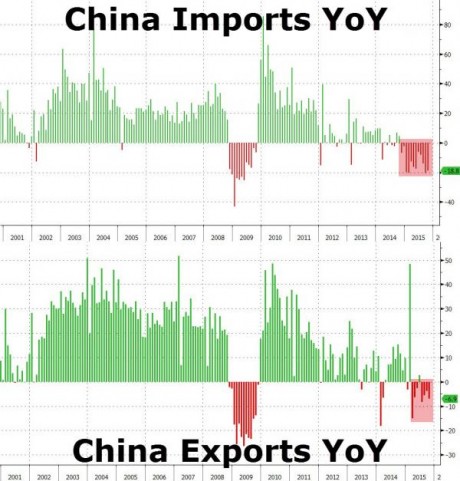
Other numbers confirm the magnitude of the economic slowdown in China. I have mentioned the ongoing plunge of the China Containerized Freight Index previously, but now it has just hit a brand new record low…
The weakness in China’s economy and its exports to the rest of the world are showing up in the weekly China Containerized Freight Index (CCFI): On Friday, it dropped to the worst level ever.
The index, operated by the Shanghai Shipping Exchange, tracks how much it costs, based on contractual and spot-market rates, to ship containers from China to 14 major destinations around the world. Unlike a lot of official data from China, the index is an unvarnished reflection of a relentless reality.
It has been cascading lower since February and has since dropped 31%. At 742 currently, it’s down 26% from its inception in 1998 when it was set at 1,000.
Here are some more deeply disturbing global trade numbers that come from my previous article entitled “18 Numbers That Scream That A Crippling Global Recession Has Arrived“…
—Demand for Chinese steel is down 8.9 percent compared to a year ago.
—China’s rail freight volume is down 10.1 percent compared to last year.
—In October, South Korean exports were down 15.8 percent from a year ago.
—According to the Dutch government index, a year ago global trade in primary commodities was sitting at a reading of 150 but now it has fallen all the way down to 114. What this means is that less commodities are being traded around the world, and that is a very clear sign that global economic activity is really slowing down.
Additionally, German export orders were down about 18 percent in September, and U.S. exports are down about 10 percent for the year so far.
Clearly something very big is happening, and it is affecting the entire planet. The CEO of the largest shipping company in the world believes that the explanation for what is taking place is fairly simple…
In fact, according to Maersk CEO, Nils Smedegaard Andersen, the reason why companies that are reliant on global trade, such as his, are flailing is simple: global growth is substantially worse than the official numbers and forecasts. To wit: “The world’s economy is growing at a slower pace than the International Monetary Fund and other large forecasters are predicting.”
Quoted by Bloomberg, Andersen says that “we believe that global growth is slowing down,” he said in a phone interview. “Trade is currently significantly weaker than it normally would be under the growth forecasts we see.“
Global financial markets can run, but they can’t hide from these horrifying trade numbers forever.
One of the big things that is contributing to this new global economic slowdown is the unwinding of the U.S. dollar carry trade. A recent piece from Phoenix Capital Research explained the U.S. dollar carry trade pretty well…
When the Fed cut interest rates to zero in 2008, it flooded the system with US Dollars. The US Dollar is the reserve currency of the world. NO matter what country you’re in (with few exceptions) you can borrow in US Dollars.
And if you can borrow in US Dollars at 0.25%… and put that money into anything yielding more… you could make a killing.
A hedge fund in Hong Kong could borrow $100 million, pay just $250,000 in interest and plow that money into Brazilian Reals which yielded 11%… locking in a $9.75 million return.
This was the strictly financial side of things. On the economics side, Governments both sovereign and local borrowed in US Dollars around the globe to fund various infrastructure and municipal projects.
Simply put, the US Government was practically giving money away and the world took notice, borrowing Dollars at a record pace. Today, the global carry trade (meaning money borrowed in US Dollars and invested in other assets) stands at over $9 TRILLION (larger than the economy of France and Brazil combined).
But now the U.S. dollar carry trade is starting to unwind because the U.S. dollar has been doing very well lately. As the U.S. dollar has surged against other global currencies in 2015, this has put a tremendous amount of stress on emerging markets around the world. All of a sudden oil, other commodities and stock markets in nations such as Brazil began to crash. Meanwhile, those that had taken out loans denominated in U.S. dollars were finding that it was taking far more of their own local currencies to service and repay those loans. This financial crunch in emerging markets is going to take years to fully play out, and it is going to take a tremendous toll on global markets.
Of course we have seen this happen before. A surging dollar helped cause the Latin American debt crisis of the 1980s, the Asian financial crisis of the 1990s and the major global recession of 2008 and 2009.
If you thought that the financial shaking that happened in late August was bad, the truth is that it was nothing compared to what is now heading our way.
So buckle your seat belts boys and girls, because we are definitely in for a bumpy ride.
Prescription Drugs Are Far More Dangerous
The DEA released new drug overdose data yesterday. According to the DEA press release:
DEA Acting Administrator Chuck Rosenberg today announced results from the 2015 National Drug Threat Assessment (NDTA), which found that drug overdose deaths are the leading cause of injury death in the United States, ahead of deaths from motor vehicle accidents and firearms. In 2013, more than 46,000 people in the United States died from a drug overdose and more than half of those were caused by prescription painkillers and heroin.
These are 2013 numbers, so let’s compare to other causes of death in the United States, according to the Centers for Disease Control.
A drug overdose, with a death rate of 13.9 per 100,000, is almost four times as common as a cause of death than gun homicides (3.6 per 100,000). Death from prescription drugs (7.2 per 100,000) is twice as common as gun homicides.

Those are the total numbers. If you prefer your stats in the often used format of x per 100,000, here you go:

Obviously, homicides aren’t exactly a leading cause of death in the US, and gun homicides, even less so. Accidental death by firearms (0.2 per 100,000) is a small blip.
Plane crashes into Akron, Ohio apartment building

A small airplane crashed into a residential area of Akron, Ohio. Many local residents are without power, and the building is on fire. There is no word on whether anyone was injured.
The small jet, identified as a “Hawker 25,” was on approach to Akron Fulton Airport when it clipped a residential building in the area of Mogadore and Skelton roads in eastern Akron, WJV in Cleveland quoted a FAA spokesman.
Ambulances and firefighters are on the site, local media report. The building is “engulfed in flames,” according to local officials, and the emergency crews are working to contain the fire.
Via RT. This piece was reprinted by RINF Alternative News with permission or license.
US Congress passes bill that bans transfer of Guantanamo detainees

The US Congress has overwhelmingly passed a $607 billion “defense policy bill” that prohibits the transfer of detainees from the Guantanamo Bay military prison in Cuba to US detention facilities.
The Senate voted 91-3 in favor of the 2016 National Defense Authorization Act (NDAA) on Tuesday following last week’s 370-58 vote in the House of Representatives.
Congress sent the measure to President Barack Obama on Tuesday. It is unclear if Obama will sign or veto it.
The overwhelming House and Senate votes signal that Congress can override a veto attempt by Obama.
Obama vetoed an earlier version of the bill over a dispute, later resolved, because of the way it increases the military budget and war spending while not increasing funding for domestic programs.
“We all know the unfortunate and unnecessary roadblocks the defense authorization bill has faced this year. We all know that the president decided to veto the version of this bill we passed last month,” Senate Majority Leader Mitch McConnell said after the bill was passed.
Apple warns UK against approving internet bill

Chief executive of tech giant Apple warns about “the very dire consequences” of the UK government’s Investigatory Powers Bill.
Tim Cook said the new obligation for companies to help security services bypass encryption would hurt “the good people,” rather than stopping those with nefarious intentions.
He added that communications companies need to protect their customers.
“You can just look around and see all the data breaches that are going on. These things are becoming more frequent,” Cook said.
Video: Cameron: Brexit could pose national security risks
Leaving the European Union may have implications for national security, Prime Minister David Cameron said in a speech outlining his EU renegotiation plan, …
Via Youtube
The Digital Dog Ate Our Civil-Liberties Homework: ‘It’s Just the Way It Is’
Of all the excuses ladled out for the Obama administration’s shredding of the Fourth Amendment while assaulting press freedom and prosecuting “national security” whistleblowers, none is more pernicious than the claim that technology is responsible.
At first glance, the explanation might seem to make sense. After all, the capacities of digital tech have become truly awesome. It’s easy to finger “technology” as the driver of government policies, as if the president at the wheel has little choice but to follow the technological routes that have opened up for Big Brother.
Now comes New York Times reporter Charlie Savage, telling listeners and viewers of a Democracy Now interview that the surveillance state is largely a matter of technology: “It’s just the way it is in the 21st century.”
That’s a great way to depoliticize a crucial subject — downplaying the major dynamics of the political economy, anti-democratic power and top-down choices — letting leaders off the hook, as if sophistication calls for understanding that government is to be regulated by high-tech forces rather than the other way around.
In effect, the message is that — if you don’t like mass surveillance and draconian measures to intimidate whistleblowers as well as journalists — your beef is really with technology, and good luck with pushing back against that. Get it? The fault, dear citizen, is not in our political stars but in digital tech.
Little hope of thaw during Bibi’s first post-Iran deal visit to Washington

Israeli PM Benjamin Netanyahu is to meet US President Barack Obama on Monday for the first time in 13 months. Relations between the two leaders are strained by personal and political disagreements that have mounted over the years.
Netanyahu and Obama are reputed to lack personal chemistry and have clashed on several occasions. The Israeli PM endorsed Obama’s Republican competitor Mitt Romney during his election campaign and came to speak before the US Congress to warn against dealing with Iran, a move which angered the White House.
For his part, Obama failed to visit Israel after going to Cairo to appeal to the Muslim world, and reportedly refused to notify Israel of the secret talks with Tehran brokered by Oman, which the Israelis allegedly learned about through their own intelligence sources.
The latest in a long string of policy confrontations between the two administrations came as Netanyahu nominated Ran Baratz as his new spokesman. Baratz once accused Obama of anti-Semitism and suggested that US Secretary of State John Kerry had the intellect of a 12-year-old.
Netanyahu is to meet Obama for the first time since the Iran nuclear deal, which the Israeli prime minister failed to derail despite a long public campaign. It is among the issues that the two intend to discuss, according to a Friday statement by White House Press Secretary Josh Earnest.
“The president looks forward to discussing with the prime minister regional security issues including implementation of the Joint Comprehensive Plan of Action [the Iran deal] to peacefully and verifiably prevent Iran from acquiring a nuclear weapon,” he said.
“The president also looks forward to discussing Israel’s relationship with the Palestinians, the situation in the Gaza Strip, in the West Bank and the need for the genuine advancement of a two-state solution,” Earnest said.
Netanyahu’s expectations from the meeting with the American president appear to be different.
“I believe that this meeting is important in order to clarify the continuation of American aid to Israel in the coming decade. It will be another step toward realizing an understanding in this direction,” the prime minister told his cabinet in Jerusalem on Sunday.
“My conversation with the president will center on recent events in the Middle East, including in Syria, possible progress with the Palestinians, or at least stabilizing the situation with them, and, of course, strengthening the security of the State of Israel, which the US has always been committed to, while maintaining the State of Israel’s comparative advantage in the face of a changing Middle East and a cycle that changes less,” Netanyahu said, as cited by the Jerusalem Post.
The aid in question is the $3.1 billion per year that Israel receives from the US to boost its security, most of it by buying American military hardware. The current ten-year agreement was signed in 2007 and needs renewal, with Israel seeking to boost the figure to $5 billion annually till 2028. A US official told Reuters that Washington is considering a $4 billion to $5 billion bracket.
The conflict with the Palestinians is painful for Israel, and it is experiencing a surge of violence that has left 11 Israelis killed by Palestinians since mid-September, AP reports. Over the same period 74 Palestinians were killed by Israeli fire, including 47 who, according to Israeli officials, were involved in attacks or attempted attacks on Israelis.
The Obama administration made pushing for a two-state solution to the Israeli-Palestinian conflict a priority, but has failed to show any significant progress. US-sponsored talks collapsed last year and the relations between Israel and the Palestinian administration are at a long-time low. In his re-election campaign, Netanyahu went as far as pledging that no Palestinian state would be established during his tenure, only to backtrack on the statement later.
US officials said last week that Obama has made a “realistic assessment” that a peace deal between Israel and the Palestinians is not possible during his final months in office, but that he would try to lay the groundwork for future peace.
Aside from his Obama meeting, Netanyahu will deliver speeches to the American Enterprise Institute (AEI), the annual Jewish Federations of North America General Assembly, and the Center for American Progress, before flying back to Israel on Wednesday.
Via RT. This piece was reprinted by RINF Alternative News with permission or license.
Africa is the Western world’s testing ground for microchip implants, weaponized viruses and experimental vaccines
The African continent continues to be used by Western powers as a testing ground for some pretty heinous things, the latest of which appears to be microchip implants. This is a concept privacy advocates in the U.S. have long warned about.
According to Patriot Truther and BusinessWire, credit card company Visa recently introduced a new specification for the use of biometrics with chip card transactions that can enable palm, iris, facial or voice biometrics. The first-of-its-kind technology is designed to be incorporated for use with the EMV® (Europay, MasterCard, Visa) chip industry standard to ensure the cards can be used around the globe.
With current surveillance technology, the biometric cards will also be traceable and trackable, as will the biometric data. This information will be valuable to merchandising corporations, technology companies and, of course, governments.
“There is increasing demand for biometrics as a more convenient and secure alternative to signatures or PINs, especially as biometrics technologies have become more reliable and available,” claimed Mark Nelsen, senior vice president of Risk Products and Business Intelligence for Visa Inc. “However, to support wide adoption, it is equally important that solutions are scalable and based on open standards. Building on the EMV chip standard provides a common, interoperable foundation, as well as encourages innovation in cutting-edge biometric solutions.”
More personal data to track
The biometrics are being sold to customers as merely being helpful, modern ways to prevent fraud and help people pay “securely.” The architecture of the design by Visa will enable fingerprints, for example, to be “securely” accepted by a biometric reader, encrypted and then validated.
“Issuers can optionally validate the biometric data within their secure systems for transactions occurring in their own environments, such as their own ATMs,” BusinessWire reported.
Absa Bank, which is a wholly-owned subsidiary of Barclays Africa Group, will become the first to use the new cards.
This comes on the heels of earlier reports stating that Wells Fargo Bank also wants to begin using “secure” biometric card technology.
Not only are such biometrics likely to be tracked, but as more of our personal information is cataloged online and stored in “clouds,” it will become more vulnerable to hacking and cyber theft.
The biometrics “test” in Africa is just the latest evil committed against the people of that continent. As noted in this open letter published by the Liberian Observer, “testing” of the Ebola virus had been occurring in Africa for years before the most recent outbreak.
Laced vaccines, Ebola as a weapon
As noted by our editor Mike Adams, the Health Ranger, in this Oct. 22, 2014 story:
The idea that Ebola might be a genetically engineered bioweapon was openly discussed by a top Liberian scientist named Dr. Cyril Broderick, who published a front-page story in the Liberian Observer containing the astonishing statement, “Ebola is a genetically modified organism (GMO).”
…Broderick goes on to assert that the U.S. Dept. of Defense has been using African women and children for bioweapons experiments.
In his own words, he talks about “…the existence of an American Military-Medical-Industry that conducts biological weapons tests under the guise of administering vaccinations to control diseases and improve the health of black Africans overseas.”
Speaking of vaccines and Africa, Adams reported the following month that “tetanus vaccines given to millions of young women in Kenya have been confirmed by laboratories to contain a sterilization chemical that causes miscarriages” — a cruel and subversive act orchestrated by UNICEF and the World Health Organization (WHO).
“We sent six samples from around Kenya to laboratories in South Africa. They tested positive for the HCG antigen,” Dr. Muhame Ngare of the Mercy Medical Centre in Nairobi told LifeSiteNews. “They were all laced with HCG.”
Sources include:
Reprinted on RINF Alternative News with permission from
Natural News.
Video: Hillary Clinton Senator Confronted On Supporting ISIS
In this video Luke Rudkowski interviews U.S Senator Kirsten Gillibrand, a Hillary Clinton campaigner about the fact of ISIS being created by the U.S. This face …
source
Video: Christopher Bollyn: “Was Boeing Uninterruptible Autopilot Used In Egyptian Plane Crash?”
Please Support The Show — http://richieallen.co.uk/ http://www.bollyn.com/ https://www.facebook.com/therichieallenshow …
Via Youtube
Video: Obama’s Rejection of Keystone XL Pipeline is a Victory for People’s Social Movements
350.org’s Clayton Thomas Mueller says President Obama’s historic decision speaks to the power of environmental, indigenous and labor movements that …
Via Youtube
Video: Top U.S. and World News Headlines for November 10, 2015
Visit http://democracynow.org to watch the full independent, global news hour, read the transcript, search our archive, and to make a donation to support us.
Via Youtube
Video: MSF Says Fleeing Workers Targeted in Kunduz Attack
MSF General Director Christopher Stokes and Codepink’s Medea Benjamin say the US Military’s explanation for the October attack that took 30 lives remains …
Via Youtube
Tory who had moat cleaned on parliamentary expenses sworn into House of Lords

A former Conservative minister, who provoked public outrage after claiming large sums of taxpayers’ money to clean the moat at his country estate, has been sworn into the House of Lords.
Lord Hailsham of Kettlethorp, formerly known as Douglas Hogg, will now be permitted to claim up to £300 each day the House of Lords is sitting thanks to the peers’ expenses system.
The former MP resigned in 2010 after his scandalous expenses were revealed in an investigation by the Telegraph. Expenses included a £2,200 claim to clean the moat surrounding his estate.
When Prime Minister David Cameron announced Hogg was to receive a peerage, he was accused of “bringing Parliament into disrepute.” The PM made the decision despite having to remove a previous nomination after a watchdog said it would be inappropriate.
Most of Hailsham’s expenses were claimed to pay for the maintenance of his 13th century manor house and gardens in Lincolnshire, which include a lodge and numerous outhouses.
Staff on the estate included a housekeeper on a salary of £14,000 per year and a full-time gardener.
The peer’s claims included the running of his housekeeper’s car, a “mole man” to keep moles at bay, and £31 to have some bees removed.
In 2009, the Telegraph reported the peer had negotiated with the House of Commons’ fees office to ensure a special deal, which automatically paid him a 12th of the annual allowance each month — effectively giving him an extra salary.
Hailsham told the fees office the monthly payments were necessary because running costs of the estate were “greatly” in excess of the maximum permitted under MPs’ second home allowances.
“It will certainly make my life a lot easier,” he said.
The peer also wrote a letter explaining all the costs of running his estate. He said he was not making expenses claims for all the maintenance costs.
“Whilst some items may be disputable as to whether they do or do not fall within the allowance, I would suggest that it is certain that allowable expenditure exceeds the allowance by a sizeable margin and consequently we need not spend too much time on debate.”
However, the expenses did include an £18,000 gardener’s salary, £1,000 in lawn-mowing fees and £671.17 for a mole catcher.
Via RT. This piece was reprinted by RINF Alternative News with permission or license.
Fast-food workers protest for higher wages nationwide

Hundreds of protesters marched in downtown Brooklyn early on Tuesday, blocking traffic and carrying banners that demand that elected leaders implement a $15 an hour minimum wage and union rights.
Fast-food workers in New York will lead the largest-ever strike to hit the nation’s fast food industry in the fight for higher wages. They hope to capture the attention of 2016 candidates by protesting one year from Election Day.
In addition to New York City, workers began a walkout of their jobs starting at 6 a.m. in cities Chicago, Atlanta and Kansas City, among others.
New York City Mayor Bill DeBlasio joined the protesters later on Tuesday morning to show his support.
“In New York City, we have well over a million people who don’t make 15 dollars an hour — a million people trying to struggle to get by. And this movement shined a light on that reality and said: ‘we’re not going to go on like that,’” the mayor said to a group of demonstrators.
Similar protests from low-paid workers of other industries are planned throughout the day, joining the Fight for 15 campaign’s call for higher wages. The campaign’s nationwide demonstration is planned for a record 270 cities.
On Tuesday evening, workers in Milwaukee will march at the Milwaukee Theatre, where the Republican presidential debate will be held.
“Workers need a raise now,” said a statement by Latifah Trezvant, a McDonald’s restaurant worker in Kansas City, Missouri, who earns $8.65 an hour, according to McClatchy DC. “We’ve got one message for anyone running for office in 2016, whether it’s for dogcatcher or president: Come get our vote. Stand up for $15 an hour and the right to a union, and we’ll stand behind you.”
The Fight for 15 campaign has seen success in New York State. Fast-food workers held a similar day of nationwide protests occurred in April, and in July Governor Andrew Cuomo pushed through a measure that would raise the minimum wage for fast food workers in New York City to $15 an hour by 2018 and statewide by 2021.
Mayor Bill Peduto of Pittsburgh, Pennsylvania announced at a Tuesday morning press conference that he issued an executive that would gradually bring the minimum wage of city workers to $15 an hour. This new measure will affect about 300 employees.
“Nobody who works full time should live in poverty,” Peduto said.
Via RT. This piece was reprinted by RINF Alternative News with permission or license.
Why Rand Paul Called Hillary Clinton a Neocon

Photo: Joseph Sohm / Shutterstock.com
Right before the November 7 Democratic Presidential Forum, Republican presidential candidate Rand Paul went on MSNBC and said Hillary Clinton was a “neocon.” The host, Chris Matthews, responded by erupting into laughter, as if the comment had no merit. But is Rand Paul’s comment really so laughable?
For more than a decade, Clinton has been trying to explain away her vote for the war in Iraq – the quintessential example of neoconservative hubris. The war is commonly described as a “strategic blunder,” but a more accurate description would be to call it a war crime responsible for incalculable human suffering. Further, Secretary of State Clinton was reportedly among the most hawkish on President Obama’s foreign policy team when it came to military intervention in Libya, Syria and Afghanistan. During the recent MSNBC forum’s broadcast, Rachel Maddow twice used the word “hawkish” to describe Clinton, once as host of the forum during the Clinton interview, and again during a panel discussion after the event.
Whether Clinton fits under the “neocon” label is not what is important. But it is important for voters to understand the reality of Hillary Clinton’s hawkish record, which goes well beyond her support for the Iraq war. Ideally, this discussion should take place during the primary, while Clinton still has to answer to progressive voters. The conversation could also serve to educate the public about the sinister nature of US policy abroad and the Democratic Party’s complicity in these policies.
The History of Democrats and Neoconservatism
Many voters associate the word “neocon” with members of the George W. Bush administration, like Dick Cheney and Paul Wolfowitz. But the Democrats played a major role in the emergence and growth of neoconservatism. Irving…
Cameron U-Turns On Own EU Referendum Wishlist As Fear Campaign Gets Underway
On the 19th May this year, David Cameron, triumphant from a largely unexpected general election win a week earlier promised to push on with the EU referendum. The Guardian headline of 19th May read “Cameron to publish EU referendum bill one day after Queen’s speech.” That was 27th May.
On the 10th October this year, The Daily Telegraph headlined “David Cameron’s four key demands to remain in the EU revealed and wrote “David Cameron and his Cabinet allies name their price for Britain to stay part of Europe”. The article covers exactly what David Cameron sees as a vision for Britain.
The Telegraph continued “Details of the Prime Minister’s negotiation plan remain secret. In a tactic that has infuriated EU politicians, Downing Street has refused to send a written list of Mr Cameron’s objectives to Brussels.” And, “Diplomats have been sent to win support from 27 European countries for a new deal between Britain and Brussels ahead of an “in-out” referendum. A new campaign will start on Monday (12th October) in an attempt to persuade voters to choose to stay in the EU.
The Key points that names the price for Britain to stay part of of Europe are:
Forcing Brussels to make “an explicit statement” that Britain will be kept out of any move towards a European superstate. This will require an exemption for the UK from the EU’s founding principle of “ever closer union”.
An “explicit statement” that the euro is not the official currency of the EU, making clear that Europe is a “multi-currency” union. Ministers want this declaration in order to protect the status of the pound sterling as a legitimate currency that will always exist.
A new “red card” system to bring power back from Brussels to Britain. This would give groups of national parliaments the power to stop unwanted directives being handed down and to scrap existing EU laws.
How Ukraine’s Finance Chief Got Rich
By Robert Parry
Before becoming Ukraine’s Finance Minister last December, Natalie Jaresko collected $1.77 million in bonuses from a U.S.-taxpayer-financed investment fund where her annual compensation was supposed to be limited to $150,000, according to financial documents filed with the U.S. Internal Revenue Service this year.
The near 12-fold discrepancy between the compensation ceiling and Jaresko’s bonuses, paid in 2013, was justified in the IRS filing from the Jaresko-led Western NIS Enterprise Fund (WNISEF) by drawing a distinction between getting paid directly from the $150 million U.S. government grant that created the fund and the money from the fund’s “investment sales proceeds,” which were treated as fair game for extracting bonuses far beyond the prescribed compensation level.
Using this supposed loophole, Jaresko and some of her associates enriched themselves by claiming money generated from U.S. taxpayers’ dollars while avoiding any personal financial risks. She and other WNISEF officers collected the bonuses from what they deemed “profitable” exits from some investments even if the overall fund was losing money and shrinking, as it apparently was in recent years.
According to WNISEF’s filing for the 2013 tax year, submitted to the IRS on Aug. 11, 2015, the value of the investment fund had shrunk from $150 million at its start to $93.9 million in the fund’s 2012 tax year and to $89.8 million in the 2013 tax year. (WNISEF’s tax years end on Sept. 30.)
So, Jaresko’s arrangement was something like taking someone else’s money to a roulette table, placing it on black, and claiming a share of the winnings if the ball stopped on black. However, if the ball landed on red, then the someone else absorbed the loss, except in this case the winners were Jaresko and her…
Video: Frontline report: Inside mountain warfare in Syria
RT’s Murad Gazdiev travelled to the remote Syrian village of Ghmam, close to Hama, which had just been liberated from jihadists by Syrian troops. Their tanks …
Via Youtube
Video: CrossTalk: Chinese wave
The most recent China wave on the remaking of the Pacific: over the last weeks Beijing and Washington have upped the ante in their game of chicken to …
Via Youtube
Video: CCTV: Palestinian woman stabs guard amid checkpoint chat
An Israeli security guard has been injured in the West Bank in the latest stabbing incident. A Palestinian woman who attacked the guard was shot. RT LIVE …
Via Youtube
Video: UK volunteer who fought ISIS in Syria barred from speaking at London university
A London university students’ union has been accused of displaying “horrible prejudice against the Kurdish cause, human rights and the freedom of speech” …
Via Youtube
Video: RAW: Heavy truck in flames dashes out of tunnel in China
CCTV cam recorded a truck in flames dashing out of tunnel in China on Friday. The vehicle went aflame while passing the tunnel and the driver made a brave …
Via Youtube
Video: Drone flyby: Syrian mountain village just liberated from jihadists
Watch RT’s exclusive onground report from the village: https://youtu.be/0OOTv7qVQIw Drone flies over Syrian village of Ghmam, in Latakia province, which had …
Via Youtube
How Israel Out-Foxed US Presidents
By Morgan Strong (Originally published May 31, 2010)
At the end of a news conference on April 13, 2010, President Barack Obama made the seemingly obvious point that the continuing Middle East conflict — pitting Israel against its Arab neighbors — will end up “costing us significantly in terms of both blood and treasure.”
Obama’s remark followed a similar statement in congressional testimony by Gen. David Petraeus on March 16, linking the unresolved Israeli-Palestinian conflict to the challenges that U.S. troops face in the region.
“The conflict foments anti-American sentiment, due to a perception of U.S. favoritism for Israel,” Petraeus said in prepared testimony. “Arab anger over the Palestinian question limits the strength and depth of U.S. partnerships with governments and peoples in the [region] and weakens the legitimacy of moderate regimes in the Arab world. Meanwhile, al-Qaeda and other militant groups exploit that anger to mobilize support.”
[Petraeus later tried to back away from this implicit criticism of Israel, fearing that it would hurt his political standing with his neoconservative allies. He began insisting that the analysis was only part of his written testimony, not his oral remarks.]Yet, the truth behind the assessments from Obama and Petraeus is self-evident to anyone who has spent time observing the Middle East for the past six decades. Even the staunchly pro-Israeli Bush administration made similar observations.
In 2007 in Jerusalem, Secretary of State Condoleezza Rice termed the Israeli/Palestinian peace process of “strategic interest” to the United…
Video: Israelis learn to defend themselves against Palestinian ‘lone-wolf’ attacks
Amid the latest wave of violence between Israel and Palestine, Israelis are increasingly taking safety into their own hands. Shooting classes are becoming ever …
Via Youtube
Human Rights Act abolition would shield soldiers from abuse claims

Abolition of the Human Rights Act will grant military personnel greater protection from legal claims against them for violating human rights overseas, according to leaked proposals to replace the European legislation with a British Bill of Rights.
A draft of the documents, obtained by the Sunday Times, reveals that under the new bill it would be impossible to take soldiers to court for actions undertaken during combat overseas. The provisions of the bill would only apply domestically.
Via RT.
’60 Minutes’ Pushes National Security Propaganda To Cast Snowden, Manning As Traitors

The television program, “60 Minutes,” aired a segment on Sunday in which it assassinated the character of Chelsea Manning and Edward Snowden, and even went so far as to question their loyalty to America. The two whistleblowers were compared to the Washington Navy Yard shooter, who killed twelve people.
It was part of an examination of what U.S. government officials perceive to be serious flaws in the process by which the Office of Personnel Management (OPM) reviews security clearances granted to government employees, but the framing made it seem like architects of “insider threat” programs from U.S. security agencies and politicians, who support total surveillance of government employees in the workplace and while they’re at home, had produced the segment.
Using language that would scare everyone’s grandparents, the CBS show used “fugitive” to describe Snowden, “convicted spy” to describe Manning (even though she is not), and “mass murderer” to describe the Navy Yard shooter Aaron Alexis. Anchor Scott Pelley amplified the terror by adding they all had “one thing in common: U.S. government security clearances which they turned into weapons.”
“Some believe that Snowden and Manning were right to expose what they saw as government abuses like the NSA’s domestic surveillance program, but few believe that all of America’s secrets should be at risk to spies, criminals, or the mentally ill,” Pelley added. “That has happened because of short cuts in a system that has placed American security into dangerous hands.” Once more, “60 Minutes” primed grandmothers across the country to tremble in their chairs while thinking of dangerous subversives lurking in the dark corridors of American security agencies.
Video: Refugee crisis could lead to EU collapse, Luxembourg FM warns
Luxembourg’s Foreign Minister has claimed the European Union could collapse shortly. This viewpoint is shared by a number of other EU politicians – but they …
Via Youtube
British protesters demand closure of detention center

Hundreds of people have staged a protest rally outside a notorious immigrant detention center in the United Kingdom, calling for its closure, Press TV reports.
Some 1,500 protesters gathered outside the Yarl’s Wood Immigration Removal Centre in Bedfordshire on Saturday afternoon, demanding that the government close the facility down and release its detainees.
Activists aboard buses from London, Birmingham, Liverpool, Oxford and other cities arrived at the site to participate in the rally organized by the Movement for Justice group.
The Yarl’s Wood center, which houses up to 400 women and is run by the private security firm, Serco, has been criticized for its treatment of the female detainees.
Large numbers of those kept at Yarl’s Wood are failed asylum seekers, who have not been charged with any criminal offence, but can be held in the center indefinitely.
Protesters hammered on the periphery walls of the detention center, chanting pro-refugee slogans and decrying the dire conditions of the detainees.
Video: Lost in Europe: What it’s like to live in Calais ‘jungle’ refugee camp
Residents of Calais ‘jungle’, the France’s biggest temporary refugee camp near the English Channel port are preparing to face a grim & hard winter soon.
Via Youtube
Video: UK drops down plan to join US-led anti-ISIS airstrikes
The US-led anti-Islamic State coalition is being let down by Britain’s reluctance to take part in bombing Syria. That’s the view expressed by the head of the UK …
Via Youtube
How Technology Kills Democracy
In shutting down whistleblowing and investigative journalism on national security issues, the U.S. government can use its technology to determine who is speaking to whom and then use that metadata as evidence of leaks, a chilling new reality is that endangers democracy, writes Norman Solomon.
By Norman Solomon
Of all the excuses ladled out for the Obama administration’s shredding of the Fourth Amendment while assaulting press freedom and prosecuting “national security” whistleblowers, none is more pernicious than the claim that technology is responsible.
At first glance, the explanation might seem to make sense. After all, the capacities of digital tech have become truly awesome. It’s easy to finger “technology” as the driver of government policies, as if the president at the wheel has little choice but to follow the technological routes that have opened up for Big Brother.

Barack Obama, then President-elect, and President George W. Bush at the White House during the 2008 transition.
Now comes New York Times reporter Charlie Savage, telling listeners and viewers of a Democracy Now interview that the surveillance state is largely a matter of technology: “It’s just the way it is in the 21st century.”
That’s a great way to depoliticize a crucial subject – downplaying the major dynamics of the political economy, anti-democratic power and top-down choices – letting leaders off the hook, as if sophistication calls for understanding that government is to be regulated by high-tech forces rather than the other way around.
In effect, the message is that – if you don’t like mass surveillance and draconian measures to intimidate whistleblowers as well as journalists – your beef is really with technology, and good luck with pushing back against that. Get it? The fault, dear citizen, is not in our political stars but in digital tech.
When Amy Goodman asked Savage about the Obama administration’s record-high prosecutions of whistleblowers under the Espionage Act, he summed up this way:
“Because of technology, it’s impossible to hide who’s in contact with whom anymore, and cases are viable to investigate now that weren’t before….
Video: Heavy rains flood Gaza & Israel streets
Heavy rains flooded streets of Israel and Gaza on Monday morning, causing cars get completely submerged and people floating down the streets on rafts.
Via Youtube
The Uprising Against Assad Was Engineered in Washington

Eric Zuesse, originally posted at strategic-culture.org
A terrific news report by Jonathan Marshall at Consortium News provides the first-ever presentation in the West of the event that sparked the demonstrations that sparked the Syrian civil war, and of the entire origin of that war.
Unlike so many online ‘news’ reports that are merely authoritarian trash because they don’t link to any of their sources (they rely instead upon dumb readers’ faith or trust in the ‘reporter’ or in the publisher, such as The New York Times or Fox News), this one from Marshall is top-notch: not only does it provide intelligently skeptical readers with instantaneous access to documentation for each one of its key points, but those sources are credible ones. Taken all together, the sources, and Marshall’s presentation of them, constitute a solid historical account of how the war to bring down Syria’s leader, Bashar al-Assad, actually started. It didn’t start by Assad’s dumping (as U.S. President Barack Obama loves to claim) “barrel bombs,” upon merely peaceful protesters in Syria. It started actually in Washington, years before that. The Obama Administration itself was taking advantage of not only the “Arab Spring” protests throughout much of the Arab world, but, specifically, of an ongoing economic catastrophe in Syria that had started five years before the anti-Assad demonstrations did: an extended drought. Here is how the source that Marshall linked to describes it, two years before the “Arab Spring” even began:
In the past three years, 160 Syrian farming villages have been abandoned near Aleppo as crop failures have forced over 200,000 rural Syrians to leave for the cities. This news is distressing enough, but when put into a long-term perspective, its implications are staggering: many of these villages have been continuously farmed for 8000 years.
That source had been published on 16 January 2010. The drought continued on; the situation only got even worse right into 2011 and up through the public demonstrations in Aleppo that started the war. There were no “barrel bombs” then. There was instead surging economic dislocation. Obama merely took advantage of it. He knew that it was coming, and he planned so as to exploit it.
In fact, a wikileaked confidential 25 November 2008 cable from the U.S. Embassy in Damascus to the CIA and other associated agencies referred to the United Nations Food and Agriculture Organization by saying:
UNFAO Syria Representative Abdullah bin Yehia briefed econoff and USDA Regional Minister-Counselor for Agriculture on what he terms the “perfect storm,” a confluence of drought conditions with other economic and social pressures that Yehia believes could undermine stability in Syria. Because he is working with such limited resources, Yehia plans to target FAO assistance to small-holding farmers in the hardest-hit province of northeast Syria, Al Hasakah. (Note: This province shares a northern border with Turkey and a southern border with Iraq. Mosul is approximately 100km from Al Hasakah province.) Because the UN appeal has, thus far, not been entirely successful, Yehia has had to prioritize aid recipients.
That was institutional U.S. federal government knowledge three months prior to Obama’s becoming President. Obama as the President-elect at the time was privy to such information. Once he got into the White House, he needed to understand what was going on in Syria. Was it dumb of Yehia to trust the U.S. government with this information? Was he naive about the type of people who sit in America’s Oval Office nowadays? Is a deer in the forest naive to move when a hunter is stalking it? Is the deer supposed to just stand still, instead? Barack Obama during his electoral campaign had provided the public with no reason to suspect that he might have been harboring aggressive designs against the Syrian government, nor even against the Russian government that has been supporting it. Yehia was just seeking help, like the deer in fear.
Obama knew what was going on. He knew that the Syrian situation wasn’t just “barrel bombs” showing up suddenly out of nowhere, from no cause, and for no reason. He knew more than was published to the public in the American press. His repeated references to “barrel bombs” after the situation in Syria blew up, suggests that he takes advantage of the fact that the American public isn’t aware of such facts. It suggests that he’s playing the American public as trusting gulls, rather than as citizens.
In fact, America’s own National Academy of Sciences recently published a study (17 March 2015), “Climate change in the Fertile Crescent and implications of the recent Syrian drought,” which opens (though propagandistically blaming Assad as having contributed to the drought): “Before the Syrian uprising that began in 2011, the greater Fertile Crescent experienced the most severe drought in the instrumental record. For Syria, a country marked by poor governance and unsustainable agricultural and environmental policies, the drought had a catalytic effect, contributing to political unrest.” (Of course, Obama doesn’t claim to be bombing Assad’s forces because Assad had ‘unsustainable agricultural and environmental policies.’) In the section of that report “Significance,” the investigators-propagandists close: “We conclude that human influences on the climate system are implicated in the current Syrian conflict.” So, since the U.S. National Academy of Sciences, in this recent study, is arguing, in effect, that Syria should have had a different government in order to avoid the alleged “poor governance and unsustainable agricultural and environmental policies” that are alleged to have contributed to causing the anti-Assad demonstrations, encouragement is being provided here for regime-change in Syria. Perhaps the failed state that Obama insists upon producing there would be the ‘solution’? To what extent is the U.S. National Academy of Sciences (its PNAS) now itself politicized, nationalistic, propagandistic — that they are retrospectively publishing something like this, which fails to criticize the U.S. Government itself for having turned down the Syrian Government’s years-long pleadings for assistance on the matter? The PNAS study ignores this. Instead, it argues only that, “The rapidly growing urban peripheries of Syria, marked by illegal settlements, overcrowding, poor infrastructure, unemployment, and crime, were neglected by the Assad government and became the heart of the developing unrest.” Wow. the NAS argues that Assad should have been more dictatorial! That would have helped prevent the effects of the drought? Does nothing that comes from the U.S. Establishment possess credibility anymore — publishing garbage like this in PNAS? Is Assad more of a dictator than Obama? Does the U.S. National Academy of Sciences really think he should have been? How absurd does the propaganda need to be in order for the U.S. to become a laughingstock to the entire world for its ‘democratic’ pretensions? After all: it’s not a democracy. And the one scientific study that has been done of that has confirmed that it’s not. So: the U.S. now insists upon installing ‘democracy’ in Syria, where all polls show that Assad would win any free election (and the latest polled finding is that he’d win at least 55% of the votes) but Obama insists that he must be ousted, so that there can be ‘democracy’ there?
Marshall’s news report about the origin of the Syrian war was published at Consortium News on 20 July 2015, but was picked up and reported to a broader audience only at a very few news-sites, each no larger (or even smaller) in audience-size than is the publisher (Consortium News) itself. Only RINF, CommonDreams and Truthout republished it. Reddit posted that story’s headline, “Hidden Origins of Syria’s Civil War,” linking to the Consortium News report, but no one up-marked it there, and still no reader-comments have been posted to it there. It was just another voice of real news unheard in the wilderness of propaganda that causes an individual tree to be ignored among the forest.
Thus: This blockbuster three-month-old news-report still remains news in the U.S., even today.
Marshall’s news report was one of the most important of all news reports on the Syrian war, and it certainly deserves larger public distribution than that. So:
Here is his historical account of the origin of the Syrian war.
—————
Investigative historian Eric Zuesse is the author, most recently, of They’re Not Even Close: The Democratic vs. Republican Economic Records, 1910-2010, and of CHRIST’S VENTRILOQUISTS: The Event that Created Christianity.
Video: Russian sports minister speaks to RT over WADA doping claims
The World Anti-Doping Agency (WADA) has accused Russia of systematic doping violations and cover-ups involving Russian officials, including the sports …
Via Youtube
US states score poorly on cronyism & corruption test

The majority of state governments are hotbeds of cronyism, with the public shut out from true accountability by loophole-ridden open-records laws, according to a new report on the integrity of statehouses throughout the US.
Eleven of the 50 US states received failing grades for transparency and accountability, while only three earned a score about 70 percent. Alaska, with a score of 76, a “C” grade, was rated highest by the Center for Public Integrity, which just released its 2015 State Integrity Investigation, “a data-driven assessment of state government.” Michigan came in dead last, with a score of 51.
“The State Integrity Investigation assesses the existence, effectiveness, and accessibility (i.e. citizen access) of key governance and anti-corruption mechanisms through a qualitative and indicator-based research process,” the Center for Public Integrity and its partner, Global Integrity, explained their comprehensive probe of state laws and political cultures from coast to coast.
The investigation’s findings are a cavalcade of embarrassing revelations about the overall climate of government transparency in the United States. From states that exempt entire branches of their government from open-records laws to states that absolutely refuse to seriously investigate ethics violations, the report’s findings are “disappointing but not surprising,” said Paula A. Franzese, a state government ethics expert at the Seton Hall University School of Law.
In New Mexico, for instance, legislators passed a resolution — without needing the governor’s approval — to exempt their emails from public records inquiries. “I think it’s up to me to decide if you can have my record,” one New Mexico representative said of the 2013 effort.
Delaware’s Public Integrity Commission, the state’s lobbying and ethics watchdog, has just two full-time staff members, the probe revealed. In 2013, a special state prosecutor found that the agency was so shorthanded, it was not able “to undertake any serious inquiry or investigation into potential wrongdoing.”
In 70 percent of states, part-time state lawmakers can vote on bills that present a clear conflict of interest with their private dealings. Such was the case in Missouri this year, when a legislator introduced a bill barring municipalities from banning plastic bags at grocery stores. The lawmaker — the director for the Missouri Grocers Association — claimed he was standing up for shopper rights. The bill eventually passed, overriding the governor’s veto.
The investigation included assessments of 13 categories within all 50 state governments. Those categories included: public access to information, political finance, electoral oversight, executive accountability, legislative accountability, judicial accountability, state budget processes, state civil service management, procurement, internal auditing, lobbying disclosure, ethics enforcement agencies, and state pension fund management.
For each state, the Center for Public Integrity and Global Integrity contacted numerous state-level organizations and experts involved in government transparency and accountability to weigh-in on a host of questions pertaining to state government operations. The report, then, is a result of a “blend of social science and journalism” with an “aim to assessing the most salient corruption risks in each state.”
Some states with poor overall scores did earn decent grades in certain categories. For instance, 29 earned a B- or better for auditing processes, and 16 earned a B- or better for budget transparency. States like Connecticut and Rhode Island were the near the top of the rankings following scandals that led to the tightening of ethics laws.
Many lowest-ranked states are bastions of American conservatism, where politicians champion limited government. Yet those states, such as Nevada and Wyoming, were joined at the bottom by the likes of Pennsylvania and Delaware, East Coast states that are considered politically liberal compared to the rest of the US.
“It’s very, very difficult for legislatures to focus on these things and improve them because they don’t want these laws, they don’t want to enforce them, and they don’t want to fund the people enforcing them,” said Robert Stern, former president of the Center for Governmental Studies, a now-defunct organization dedicated to ethics and lobbying laws in local and state governments.
Via RT. This piece was reprinted by RINF Alternative News with permission or license.
War Criminals Obama, Netanyahu visit in White House as protesters gather outside

US President Barack Obama has met with Israeli Prime Minister Benjamin Netanyahu after 13 months.
At the meeting on Monday, Obama said it was “no secret” that he has a “strong disagreement” with Bibi in regard to the nuclear accord between Iran and the world powers, rehashing his rhetoric by stressing that the two leaders agree they should make sure Iran does not get its hands on nukes.
“It’s no secret that the prime minister and I have had a strong disagreement,” the US president said, adding, he was “looking to find common ground” with the Israeli premier.
In mid-June, Tehran reached a nuclear agreement with the global powers that also included Britain, Russia, China, and Germany.
Tel Aviv has falsely been claiming that Iran is pursuing non-civilian objectives in its nuclear energy program, an allegation that has always been rejected by Tehran.
CCR Denounces Arrest of Egyptian Journalist: “All Eyes Are Watching Egypt”
NEW YORK CITY – In reaction to the Egyptian military’s arrest and incommunicado detention of renowned human rights defender, Hossam Bahgat, the Center for Constitutional Rights issued the following statement:
Hossam Bahgat, the founder of the remarkable Egyptian Initiative for Personal Rights and a brilliant investigative journalist, is one of the most important human rights defenders in the world. His arrest by the Egyptian military on charges stemming from his investigative reporting in aid of democratic progress in his country is the latest in a string of cowardly reprisals by this authoritarian government against independent journalists and the human rights movement in Egypt — as well as the ideals of the 2011 Revolution they carry. That Mr. Bahgat — who is obviously nowhere close to a security threat — is being held in incommunicado detention in the notorious Egyptian prison system is an outrage. The Center for Constitutional Rights joins the global human rights community in demanding that the Egyptian government ensure the humane treatment and the immediate release of Mr. Bahgat and calls on the U.S. government to make these demands of a government that receives billions of dollars in American aid. All eyes are watching Egypt.
The Center for Constitutional Rights is dedicated to advancing and protecting the rights guaranteed by the United States Constitution and the Universal Declaration of Human Rights. Founded in 1966 by attorneys who represented civil rights movements in the South, CCR is a non-profit legal and educational organization committed to the creative use of law as a positive force for social change.
This piece was reprinted by RINF Alternative News with permission or license.
Henoko Takes on US Imperialism
Okinawa — Around one hundred and fifty Japanese protesters gathered to stop construction trucks from entering the U.S. base “Camp Schwab,” after the Ministry of Land overruled the local Governors’ decision to revoke permission for construction plans, criticizing the “mainland-centric” Japanese Government of compromising the environmental, health and safety interests of the Islanders.
Riot police poured out of buses at six a.m., outnumbering protesters four to one, with road sitters systematically picked off in less than an hour to make way for construction vehicles.
All the mayors and government representatives of Okinawa have objected to the construction of the new coastal base, which will landfill one hundred and sixty acres of Oura Bay, for a two hundred and five hectare construction plan which will be part of a military runway.
Marine biologists describe Oura Bay as a critical habitat for the endangered “dugong” (a species of manatee), which feeds in the area, as well as sea turtles and unique large coral communities.
The bay is particularly special for its extreme rich ecosystem which has developed due to six inland rivers converging into the bay, making the sea levels deep, and ideal from various types of porites coral and dependent creatures.
Tightening noose? British views on the death penalty 50yrs since abolition

Despite its abolition in Britain five decades ago, opinion remains divided over the ethics and viability of the death penalty.
Peter Anthony Allen and Gwynne Owen Evans were the last Britons to be executed, hanged in 1964 for the murder of John Alan West.
In 1965, Labour MP Sydney Silverman, who was determined to abolish the penalty, introduced a Private Member’s Bill to suspend death sentences. While no executions took place since, the death penalty was finally abolished in all circumstances in 1998.
At the time, the majority of the population was in favor of abolition. However, recent opinion polls on capital punishment show views may be hardening once again.
Opinion poll published last yr in UK showed 65% in favour of restoring death penalty, slightly higher in men & >55s. http://t.co/yKIG7u5bO6
– louis appleby (@ProfLAppleby) May 28, 2013
According to a YouGov poll published in 2014, British people “still tend to support” the reintroduction of the death penalty, by 45-39 percent.
“The Commons vote which ended capital punishment was a milestone for British justice, yet YouGov research finds it to be one of those issues where the views of the British public go against the political consensus,” it said.
“By 45-39 percent people tend to support the reintroduction of the death penalty for murder,” it added.
However, research published in the NatCen British Social Report in March found 48 percent of the 2,878 people surveyed are in favor of the punishment — the lowest figure since the survey began in 1983, when around 75 percent ruled in favor.
Marking the 50th anniversary, Liberal Democrat leader Tim Farron called for the penalty to be abolished globally.
50 years ago today the death penalty was abolished for murder in the UK. We must keep campaigning to end it throughout the world.
– Tim Farron (@timfarron) November 9, 2015
“50 years ago today the death penalty was abolished for murder in the UK. We must keep campaigning to end it throughout the world,” he said on Twitter.
Human rights charity Reprieve is opposed to reconsidering the death penalty. “50 years of abolition is something to be proud of — but we must not let the progress we have made as a nation in the last half century be reversed by our current government, which has presided over a series of changes that undermine Britain’s commitment to human rights,” Reprieve said in a statement.
Something to celebrate. 50 yrs ago today Great Britain made the sensible and right decision in abolishing the #DeathPenalty
– Glyndwr Griffiths (@Di_Bach) November 9, 2015
Dear anyone who thinks the death penalty should be brought back to the UK, the Lee Rigby case is a very strong argument in favour #Raging
– Lorna (@Firecrackeruk) February 26, 2014
“The Foreign Office has recently scrapped its death penalty abolition strategy, and removed ‘countries of concern’ like Saudi Arabia and China from its annual human rights reports.”
“David Cameron is now openly prioritizing trade over human rights — even bidding for business with the Saudi prisons system, which would oversee the planned ‘crucifixion’ of young protestor Ali al Nimr.”
“Britain used to be a leader when it came to opposition to the death penalty — we must not allow this government to put us in bed with the hangman.”
Via RT. This piece was reprinted by RINF Alternative News with permission or license.
Britain lists Russia as major national security threat

Britain has listed Russia as one of its top-tier potential security threats alongside global terrorism and the Ebola virus.
UK’s security services published a draft of a new list of what they deem as possible threats to the country, the Express reported on Sunday.
Russia’s alleged aggression in Ukraine, the country’s vast military budget and President Vladimir Putin’s “willingness to display force” are all causes of concern.
“The last five years have seen a range of international developments, ranging from the growth of radicalization and fundamentalism to growing concerns around our energy supply, and rising aggression from Russia,” said the report.
The list also refers to China as a “threat” citing concerns over “authoritarianism and persistent human rights abuses on the part of the Chinese Government.”
Ron Paul: Without Authority, Obama’s Syria War Illegal
As the US State Department goes around the world lecturing other countries about how they must adhere to the rule of law, the White House again proves it is one of the most lawless entities on earth. The Constitution is clear; the War Powers Resolution is clear: the president is not allowed to commit the US military to combat without a Congressional declaration or at least authorization. Yet the president has been bombing Syria for a year and now is sending in US ground troops with no legal authority to do so. Congress is the president’s partner in crime and we are the victims — today on the Liberty Report:
Reprinted from The Ron Paul Institute for Peace & Prosperity.
Axman cometh: Osborne defies critics with fresh round of austerity

Chancellor George Osborne announced fresh spending cuts for several government departments on Monday in the wake of his embarrassing defeat in the House of Lords on tax credit cuts.
The environment, transport, local government and finance departments will have their day-to-day budgets, excluding capital expenditure, cut by an average 8 percent each year for the next four years, Osborne said.
The Chancellor insisted bringing the deficit down is essential for Britain’s economic security.
However, Shadow Chancellor John McDonnell described the policy as a “tactical ploy” to put pressure on Work and Pensions Secretary Iain Duncan Smith to cut Universal Credit for people on low incomes or out of work.
In his speech on Monday, Osborne said the country must not “lose its nerve” in the face of another round of austerity.
“If our country doesn’t bring the deficit down, the deficit could bring our country down,” he said. “That’s why, for the economic security of every family in Britain, the worst thing we could do now as a country is lose our nerve.”
Britain’s deficit was 4.9 percent of GDP in the year 2014/2015, despite efforts by Osborne to reduce it.
The UK’s national debt has increased steadily over the past five years by approximately £107 billion per annum. Government spending soared in the last decade by 48 percent of GDP following a series of costly bank bailouts.
McDonnell criticized the Chancellor’s economic record, citing Britain’s historically slow recovery.
Via RT.
Video: Airstrike cam: Bombs rain down on supposed jihadist hideout in Syria
A Syrian Arab Air Force airstrike hit what is said to be a militant hideout in Darayya, Syriareport.net news, media & analysis website reported on Monday.
Via Youtube
Video: Top U.S. and World News Headlines for November 9, 2015
Visit http://democracynow.org to watch the full independent, global news hour, read the transcript, search our archive, and to make a donation to support us.
Via Youtube
UAW scabs do bidding of US auto companies
The United Auto Workers is seeking to rush through a new contract on Ford workers and wrap up its months-long campaign to break the resistance of 140,000 US autoworkers and impose contracts dictated by the auto executives and Wall Street.
The UAW announced the Ford deal on Friday, even before the resolution of the vote by 53,000 General Motors workers on a similar agreement. A majority of skilled trades workers (59.5 percent) rejected the UAW-backed arrangement, while it was ratified, according to the UAW, by a narrow margin (55 percent) of production and skilled workers combined. To impose a contract after such a split vote is a violation of the UAW’s constitutional bylaws, but it had no problem running roughshod over Fiat Chrysler workers’ rights during similar circumstances in 2011.
Like the Fiat Chrysler and GM deals before it, the Ford agreement paves the way for the establishment of a permanently lower pay and benefit scale in the auto industry after the UAW colludes in driving out older, higher paid workers through speedup, victimization and supposed voluntary retirements.
Far from eliminating the hated two-tier wage and benefit system–the major demand of workers–the contracts will give the auto bosses free rein to introduce a third-, fourth- and fifth-tier of temporary and contract workers earning poverty level wages, inferior pensions and health care. Meanwhile, the insulting 1.5 percent annual wage increases for traditional workers will leave them with a two-decade decline in real wages of 25 percent by 2019.
The auto companies are already reaping record profits and a staggering 10+ percent profit margin in the US after the deals in 2007, 2009 and 2011, which reduced per vehicle costs by more than half. However, the money-mad speculators on Wall Street want even more, and the UAW, which owns a substantial portion of the automakers’ stocks, has been more than eager to comply.
The “transformative” character of the contracts goes beyond wages, however. After dumping their retiree health care benefits into a UAW-controlled trust, which promptly slashed medical coverage for hundreds of thousands of retirees and their dependents, the new agreement will slash the coverage of current workers. This has been worked out in conjunction with the Obama administration, which wants to shift the cost of health care from the employers to the backs of workers who are already making barely subsistence wages.
Throughout the course of the contract battle, the UAW has proven not to be a “trade union” or “labor organization” in any sense that workers traditionally understand such terms. Instead, it has functioned as a corporate-labor syndicate and an industrial police force for management, thoroughly hostile to the needs and interests of the workers it falsely claims to represent.
At every stage the UAW has kept information from workers and lied to them, using threats and economic blackmail to beat back rank-and-file workers. UAW officials have unabashedly spouted the company line, insisting that the corporations have nothing more to give and that if workers press for any improvements then the companies will simply shut their factories and move to Mexico and other low-wage countries.
The UAW has transformed the strike from a weapon of workers against the corporations into a weapon against the working class. If workers rejected the contracts, like the Fiat Chrysler workers did last month, the UAW would be forced to call a strike, UAW officials threatened, which would leave workers on the picket lines for weeks or months with only $220 a week from the UAW’s $600 million strike fund. Autoworkers would receive no public support, the UAW insisted, and in the end they would be forced to settle for even less.
The UAW hired a New York City public relations firm to sell its lies to workers, while during ratification votes it made workers run the gauntlet of local union functionaries who denounced them as “greedy” and “stupid” if they were planning to vote against the deal. As for the final vote counts, the UAW is more than ready to rig them to get the “right” result.
When the unions, despite their pro-capitalist leadership, still increased or at least protected the income of workers from diminution they could be termed “workers organizations.” But as Leon Trotsky, the founder of the Fourth International, explained in 1937, should the labor leaders “defend the income of the bourgeoisie from attacks on the part of the workers; should they conduct a struggle against strikes, against the rising of wages, against help to the unemployed; then we would have an organization of scabs, not a trade union.”
This is a description of the UAW, the AFL-CIO and the Change to Win organizations to a tee. They do not unite workers but divide them. They are hostile to the class struggle and socialism and endlessly preach “class harmony” while the capitalist class wages a relentless war against the working class. In the factories, the UAW ignores the grievances of workers, enforces speedup, and oversees a dictatorial regime that resembles the darkest days of industrial slavery in the early twentieth century.
Whatever the outcome of the Ford vote–and workers should reject the contract with the contempt that it deserves–the outcome of the 2015 contract battle will be a further discrediting of the UAW. It is also an exposure of the numerous pseudo-left groups that insist on the organizational dominance of the “unions” and denounce as illegitimate any efforts by workers to rebel against their authority.
The transformation of the UAW and other unions into the tools of management–which is not just an American but international phenomenon–is the result not simply of the perfidy of the corrupt and bureaucratic officials who control them. It is rooted in the failure of the pro-capitalist and nationalist program of these organizations and their political subordination of the working class to the Democratic Party.
The long-term decline of American capitalism and the growth of transnational production pulled the rug from underneath these organizations. They responded to by embracing corporatist “labor-management partnerships” and transforming from entities that pressured management for concessions into organizations that spared no effort to destroy the jobs and living standards of workers to make the corporations more profitable.
There is immense opposition and a desire by workers to fight. The fact that the UAW has had such difficulty in getting these sellout agreements through, despite the relentless propaganda campaign backed by the corporate media, is an expression of the mass opposition not just of autoworkers, but the entire working class.
The class struggle is beginning to emerge into the open. The aspirations of workers to secure their most elemental rights–for decent paying and secure jobs, for safe and humane working conditions, to collectively organize to defend their interests–will find an independent expression.
As the World Socialist Web Site and its Autoworker Newsletter have advocated, workers must form their own organizations that are democratically elected and controlled by rank-and-file workers themselves. The establishment of genuinely representative factory committees, based on the methods of the class struggle not subordination to the dictates of the capitalist system, will prove to be a powerful weapon for the working class.
Nothing has ever been won by workers outside of mobilizing their strength against the corporations and their political servants. Today vast sums of society’s wealth–created by the collective labor of workers all over the world–are monopolized by the super-rich few and squandered on war and other socially destructive purposes. That is why the struggle to secure the social rights of the working class is above all a political struggle, which can only be resolved when the working class takes the reins of economic and political power in its own hands.
Jerry White
Via WSWS. This piece was reprinted by RINF Alternative News with permission or license.
Cyber-hackers break into parliamentary computer network, demand ransom from MP

Internet criminals have used a crypto-locker virus to break into the UK parliament’s computer network and demand ransom money from an MP, it has emerged.
In the first successful cyber-attack against parliament’s secure network, hackers compromised several computers and unearthed confidential documents relating to Labour Party’s Shadow Digital Minister Chi Onwurah and her employees.
The virus, which was identified in May, locked several files stored in a shared drive serving around 8,500 people in parliament, including MPs, lords and their staff.
It spread rapidly but was stopped before it could reach highly confidential files containing private information about constituents.
The MP for Newcastle-upon-Tyne Central was however stunned to discover a ransom note on her computer, demanding her to call a number and pay a fee to unlock the infected files.
Via RT.
TSA-Trained Disney World in Goofy ‘Terrorist Detection’ Methods
The same ridiculed and useless techniques used by the Transportation Safety Administration (TSA) to not find terrorists at America’s airports are now being used at Orlando theme parks, including Disney World, Sea World, and Busch Gardens, to not find terrorists.
A Billion Dollars Hits the SPOT
The Screening of Passengers by Observation Techniques, or SPOT, program is TSA’s one billion dollar “behavioral detection” scheme. SPOT requires TSA staff to be on the lookout for indicators, “tells” to you poker players out there, that give away bad guys. Some of the actual indicators are listed on the graphic, above.
There are actually 92 individual indicators (terrorists are sneaky!), divided into various categories with a point score assigned to each. Those categories include a preliminary “observation and behavior analysis.” Those passengers pulled over for additional inspection are scored based on two more categories: whether they have “unusual items,” like almanacs and “numerous prepaid calling cards or cell phones,” and a final category for “signs of deception,” which include “covers mouth with hand when speaking” and “fast eye blink rate.”
TSA agents are also told to watch out for persons traveling “wearing a disguise.”
You can also be judged less suspicious. Points can be deducted from someone’s score based on observations that they are part of an “apparent” married couple, as long as both people are over 55. No word on same sex couples. That’s two points deducted. Women over the age of 55 have one pointed deducted; for men, the point deduction doesn’t come until they reach 65.
The Sham Syrian Peace Conference
I have always been enthusiastic in my support for peace negotiations, which
have been neglected all too often in internal and international conflicts. But
it is clear that the international conference on Syria that held its first meeting
in Vienna on October 30 is a sham conference that is not capable of delivering
any peace negotiations, and that the Obama administration knew that perfectly
well from the start.
The administration was touting the fact that Iran was invited to participate
in the conference, unlike the previous United Nations-sponsored gathering on
Syria in January and February 2014. That unfortunate conference had excluded
Iran at the insistence of the United States and its Sunni allies, even though
several states without the slightest capacity to contribute anything to a peace
settlement — as well as the Vatican — were among the 40 non-Syrian invited participants.
Iran’s participation in the Vienna conference represents a positive step. Nevertheless,
the conference was marked by an even more fundamental absurdity: none of the
Syrian parties to the war were invited. The 2014 talks at least had representatives
of the Assad regime and some of the armed opposition. The obvious implication
of that decision is that the external patrons of the Syrian parties — especially
Russia, Iran and Saudi Arabia — are expected to move toward the outline of a
settlement and then use their clout with the clients to force the acceptance
of the deal.
The Vietnam model
The idea of leaping over the Syrian parties to the conflict by having an outside
power negotiate a peace agreement on behalf of it clients is perfectly logical
in the abstract. The classic case of such an arrangement is the US negotiation
of the Paris Agreement with the North Vietnamese in January 1973 to end the
US war in Vietnam. The US-backed Thieu regime’s total dependence on US assistance
and the weight of the US military in Vietnam ensured Thieu’s forced acceptance
of the arrangement.
A New ‘War on Christmas’ Absurdity
A fairly new — and thoroughly obnoxious — Christmas tradition is for right-wing American Christian fundamentalists to detect some imagined slight and pronounce it part of the “War on Christmas,” with this year’s battle lines drawn around the Starbucks’ winter-themed cups, as Nat Parry observes.
By Nat Parry
Just as the commercial extravaganza of the Christmas season seems to begin earlier and earlier each year, with displays popping up in some places not long after Labor Day, so too does the annual absurdity known as “the War on Christmas.”
This year, we have an early taste of the asinine arguments to come with a contrived controversy over the choice that Starbucks has made for its holiday-themed coffee cup. Eschewing its typical designs incorporating iconic wintry images of reindeer and snowmen, the 2015 cup goes for a minimalist approach of a plain bright red design with the green Starbucks logo in the center.

Starbucks’ winter-themed cup.
With no pictures of Baby Jesus or even snowflakes, the red and green cup evidently is not “Christmassy” enough for some Christians, many of whom have taken to the Internet to vent their outrage. In a viral Facebook post that has received more than 10 million views, Joshua Feuerstein fumed: “Starbucks REMOVED CHRISTMAS from their cups because they hate Jesus.”
He posted an accompanying video urging people to go into Starbucks and give their names as “Merry Christmas” so that unsuspecting baristas would be “tricked” into writing “Merry Christmas” on the cups.
Within days, both #RedCups and #MerryChristmasStarbucks were trending on social media sites (although to be fair, many of the posts were ridiculing those who have gotten so bent out of shape). One typical tweet read, “If you’re Christian & upset over Starbucks cups, your priorities are out of whack and you don’t have enough to do.”
While it is certainly true that in a world rocked by refugee crises, environmental catastrophes, global conflicts, poverty and growing wealth inequality, these Christian anti-Starbucks crusaders would probably do well to get their priorities straight, it should also be said that the very premise…
Most Israelis Favor Killing Palestinians

by Stephen Lendman
(RINF) – Propaganda works. Government statements and Israeli media one-sidedly highlight Palestinian “terror” attacks, mindless of reality on the ground.
Most Israelis have no idea or concern about what’s going on inside Palestine – including longstanding occupation harshness, state-sponsored terror against an entire population, a new generation of Palestinian youths demanding freedom, justifiably resisting collective punishment and denial of their fundamental rights.
A new Tel Aviv University/Israel Democracy Institute Guttman Center for Surveys Peace Index poll shows three-fourths of Israelis don’t understand how horrifically Palestinians are persecuted – in contrast to Arabs overwhelmingly fearing it acutely.
Jews live normally. Palestinians have no control over their daily lives. Most Jews shockingly agree with the following statement: “(A)ny Palestinian who has perpetrated a terror attack against Jews (true or false) should be killed on the spot, even if he has been apprehended and no longer poses a threat.”
They support punishing family members of Palestinians accused of terrorism, including demolishing their homes – mindless that most accusations are fabricated.
In contrast, they support no action against Jews killing Palestinians, even without just cause. They feel military tribunal injustice against Palestinians accused of terrorism is too light.
Pollsters asked: “What in your opinion, should each of the following institutions or groups be given for how it has dealt with the current terror wave?”
The IDF scored highest with a 93% approval rating. Police scored 84.5%, Shin Bet (security) 72% – showing Jews don’t understand reality on the ground.
They don’t know or care about how viciously Palestinians are persecuted – including daily state-sponsored assassinations, thousands injured, along with mass arrests, imprisonments and torture.
Poll results reflect a racist Israeli society, state-sponsored indoctrination from childhood to hate Arabs, portraying them as violent gun-or-knife-toting terrorists – mindless of their humanity and international law guaranteed rights.
Former finance minister, Yesh Atid party chairman, believes Palestinians accused of threatening Israelis “should be (lethally) shot…” Numerous other fascist Israeli politicians feel the same way, especially Netanyahu and his security ministers.
Pollsters didn’t ask but likely few Israeli Jews know the extent of administrative detentions – Palestinians locked up behind bars indefinitely, uncharged and untried, entirely for political reasons, innocent victims in gulag hell, currently at least 500 including children, according to Commission of Palestinian Detainee Affairs head Issa Qaraqe.
Young children and women are treated like men, targeted for wanting justice denied them – including social web site comments Israel calls “incitement.”
On the eve of the second Intifada, Israel held 12 administrative detainees. Two years later it was over 1,000. Things appear headed in the same direction now, new administrative detentions ordered daily. Victims have no right of appeal.
Jews are urged to arm themselves. Gun license restrictions were eased. Thousands filed permit requests with the Public Security Ministry. Gun sales skyrocketed. A shoot first, ask no questions mentality threatens all Palestinians.
Speaking at an Amsterdam 77th Kristallnacht anniversary event, Arab MK Hanin Zoabi accused Israel of high crimes similar to Nazi-perpetrated ones.
“I am not an immigrant in my homeland,” she said. Scores of discriminatory laws are similar to how Hitler persecuted Jews, she explained.
“The current lesson of the Crystal Night has not been learned.” Israel’s slow-motion genocide, “ethnic cleansing” policy is modeled on how Nazis aimed to exterminate Jews. Israeli officials ‘justify the use of violence toward Palestinians.”
Zoabi quoted education minister Naftali Bennett saying “(i) is OK to kill Arabs. I have actually done so several times.” She warned of “great forces” seeking to silence pro-Palestinian voices in Europe.
State-sponsored terror rages as Netanyahu meets with Obama at the White House on Monday – their support for each other’s high crimes rock solid despite dislike for each other.
Expect nothing beneficial from the meeting for Palestinians. They remain isolated on their own, virtually ignored by the world community, mindless of their longstanding suffering at the hands of a ruthless occupier.
Stephen Lendman lives in Chicago. He can be reached at lendmanstephen@sbcglobal.net.
His new book as editor and contributor is titled “Flashpoint in Ukraine: US Drive for Hegemony Risks WW III.”
http://www.claritypress.com/LendmanIII.html
Visit his blog site at sjlendman.blogspot.com.
Listen to cutting-edge discussions with distinguished guests on the Progressive Radio News Hour on the Progressive Radio Network.
It airs three times weekly: live on Sundays at 1PM Central time plus two prerecorded archived programs.
Corporations Jack Up Prices to Funnel Our Money to the Elite, and More
In today’s On the News segment: All over the country, massive corporations buy up or buy off their competition; Seattle is proving to be the birthplace of new, progressive policies; President Obama wants to help former prisoners transition back into society; and more.
See more news and opinion from Thom Hartmann at Truthout here.
TRANSCRIPT:
Thom Hartmann here – on the best of the rest of Economic and Labor News…
You need to know this. When we talk about fixing income inequality in this country, we typically focus in on taxing the rich to redistribute wealth down to the working poor. But, we often forget about all of the income that’s constantly being redistributed up to those at the top.
Health hazards remain obstacle to human travel to Mars – NASA report

Major health risks must be addressed before humans can successfully travel to Mars, according to an new audit conducted by NASA. The US space agency says it is optimistic about resolving those issues by the 2030s.
NASA must focus on addressing major health hazards for humans to make the three-year, round-trip trek to Mars, according to an audit — NASA’s Efforts to Manage Health and Human Performance Risks for Space Exploration — led by Paul Martin, NASA’s inspector general.
Among the health concerns were damage to the central nervous system, radiation that could lead to cancer, infertility, cataracts, extensive terms of isolation, and prolonged weightlessness, which has been shown to weaken bones and muscles. The audit also found that a Mars trip poses challenges concerning food and medical supplies.
In the audit, Martin said NASA is making progress in addressing these and other Mars-related risks, all as the space agency is involved in its first yearlong mission at the International Space Station. A trip to Mars is a goal that is possible to achieve by the 2030s, NASA maintains.
“The agency still faces significant challenges to ensuring the safety of crew members on a human mission to Mars or deep space,” the 54-page report found.
Astronauts must understand that initial trips to Mars may come with risks that will not threaten crews in subsequent years, Martin wrote in the report.
NASA’s ongoing assessments of basic health risks is coupled with efforts to advance vehicular and other technologies that will allow a deep-space mission to the Red Planet and to maintain a presence there, the report acknowledged.
Expert coordination on these health concerns also needs to improve, the report said.
NASA supported the report’s findings, according to the Associated Press.
No American has spent more than seven months in space at once. No human has experienced a spaceflight longer than 14 months, a 21-year-old record held by Russian cosmonaut Valeri Polyakov.
NASA astronaut Scott Kelly holds the record for the longest spaceflight by an American, which Kelly achieved last month. His mission at the International Space Station is part of the long-term effort to study the effects of space on humans.
“I’m pretty sure I’m going to get through it without much of an issue,” Kelly said of his mission, according to the AP. He is set to return to Earth in March.
His twin brother Mark Kelly, a former astronaut, is coordinating with NASA in efforts to study the health effects of space experienced by Scott.
Last week, NASA launched a new recruiting effort to lure future space travelers and researchers to the agency. NASA Administrator Charles Bolden said the agency is looking for “a new generation of space pioneers.”
The number of astronauts at NASA’s disposal has dropped considerably since its space shuttle program began winding down — from about 150 active astronauts in the early 2000s to just 47 today, according to NASA. More will be necessary for future spaceflights.
“This next group of American space explorers will inspire the Mars generation to reach for new heights, and help us realize the goal of putting boot prints on the Red Planet,” Bolden said.
Via RT. This piece was reprinted by RINF Alternative News with permission or license.
Video: Rejecting U.S. Claims, MSF Details Horrific Bombing of Afghan Hospital & Demands War Crimes Probe
Democracynow.org – Doctors Without Borders (MSF) continues to demand an independent war crimes probe of the U.S. bombing of its hospital in Kunduz, …
Via Youtube
British military ties with Gulf States to be strengthened in defense review

Britain’s strategic defense and security review will promote a strengthening of military ties with Gulf nations, it has emerged.
Defence Procurement Minister Philip Dunne visited Dubai on Sunday to promote British-made military wares, including the Eurofighter Typhoon aircraft, made by BAE systems.
Dunne said the UK aims to “broaden and deepen our contribution to the security and stability of the region through our strategic defense and security [review] process.”
The minister told the Financial Times that he expects the Gulf region “to be referenced” in the defense spending review, which will be published in two weeks.
“We have always maintained a significant presence in terms of reassurance for the region,” he said. “The security of the region is extremely important and in British national interests.”
Dunne appeared at the Dubai Air Show, where more than 100 defense companies exhibited their products to Middle Eastern and Gulf nations.
The minister’s visit to Dubai comes amid growing concern over the lack of interest overseas for British Typhoon jets. Demand for Typhoon’s French-made rival Rafale has increased over the past year.
But Dunne insisted that low oil prices had not been detrimental to sales of British weaponry in the Gulf.
“We are not seeing any particular reduction in demand for capability,” he said.
“Far from it, we seeing more interest in defense capability enhancement” because of security concerns, he added.
He also said Britain is in “discussions with a number of countries and I am hopeful that there will be continuing demand for this aircraft.”
However, the British government has been criticized for its arms trading with Middle Eastern states. In October, a report by Transparency International suggested British arms deals had increased corruption, spread extremism and destabilized the region.
The report lists 17 nations across Middle East and North Africa (MENA) in which defense budgets are being propped up by arms trading with the West.
The report’s author warns that unless the nations selling arms take responsibility they will end up exacerbating future conflicts in an already destabilized region.
“This is one of the most unstable and conflict-riven regions in the world,” Katherine Dixon, head of Transparency International’s Defense and Security Program, told The Intercept.
“Over a quarter of the world’s most secretive defense spending is in the Middle East. Corruption puts international security at risk, as money and weapons can be diverted to fuel conflict,” she added.
Via RT. This piece was reprinted by RINF Alternative News with permission or license.
Exxon Set to Be Investigated in the Philippines as Well as New York

A few weeks ago the first ever human rights legal action seeking the accountability of the 50 big polluters was launched. Filed by Filipino typhoon survivors and several environmental organisations, it demands that the Philippines Human Rights Commission (CHR) investigate and acknowledge the complicity of 50 investor-owned fossil fuel companies in causing extreme weather events.
This comes from a consensus that the typhoons and catastrophic storms that annually batter the Philippines, and many other small island nations, are exacerbated by climate change caused by the burning of fossil fuels by distant and faceless energy companies. People in the Philippines know that they are at the end of a terrible chain reaction that destroys homes, ruins health and takes lives and livelihoods. It violates their basic human rights, so they, like many others, are starting to seek climate justice.
They are part of a growing number of people that will no longer stand for companies — despite knowledge of the harms associated with their products — continuing to engorge themselves on profit at the expense of the climate and human lives. These companies are morally bound to help communities at the frontline of climate change while financing a just transition to a 100% renewable energy future.
Cases of negligence, like the May 2014 Soma mine disaster in Turkey, which took the lives of 311 workers and injured 80 others, and litigation by communities in Peru and Ecuador against Texaco/Chevron over claims of pollution are examples of people taking a stand against how fossil fuel companies do business. The Philippines’ submission is a reflection of an understanding that fossil fuel companies are acting in violation of human rights in and of itself, no matter how carefully the company undertakes their activity. In short, we and many others are declaring: it’s not the way you do business, it’s the business itself.
Waging Endless War From Vietnam to Syria
As October ended, White House spokesperson Josh Earnest announced that the U.S. would be sending “less than 50” boots-on-the-ground Special Operations forces into northern Syria in an “advise-and-assist” program for Kurdish rebels and their (essentially nonexistent) Arab allies. Only days before, in yet another example of twenty-first-century mission creep, Secretary of Defense Ashton Carter had told Congress that the intensity of U.S. air attacks in Syria would rise “with additional U.S. and coalition aircraft and heavier airstrikes.”
For this, A-10 and F-15 aircraft were to be deployed
to Incirlik Air Base in Turkey.
It was the sort of military promise from Washington — more of the same —
that has grown increasingly familiar in these years and could be summed up by
adapting that old DuPont ad line, “better living through chemistry”:
a better world through bombing. Unfortunately for such plans, the verdict
has long been in: air power as a decisive factor in American war in this century
has proven a dismal failure. Even in skies that, with the rarest of exceptions,
offer no dangers whatsoever (other than mechanical failure) to fighter jets,
bombers, and drones, even in situations in which munitions can be delivered
to any chosen spot with alacrity and without opposition by aircraft freely patrolling
the skies overhead, air power has proven a weapon from hell in every sense of
the world. Complete “air
superiority” has been a significant factor, as in Libya, in the creation
of a string of failed states (and so breeding grounds for terror outfits) across
the Greater Middle East. In its post-modern “manhunting”
form, grimly named Predator and Reaper drones have managed to kill thousands
of leaders, lieutenants, sub-lieutenants, and rank-and-file militants in various
terrorist organizations, as well as significant
numbers of civilians, including children. Recently leaked
documents on Washington’s drone assassination campaigns indicate that,
in at least one period in Afghanistan, only 10%
of those killed were actually targeted for death. And yet the president’s
drone assassination campaign in several countries (based in part on a White
House “kill
list” and “terror
Tuesday” meetings to decide whom to target) seems only to have helped
foster the exponential growth of terror outfits across the Greater Middle East
and Africa.
In these years, air power has, in fact, been closely associated with one fiasco
or policy disappointment after another. To take a single recent example:
President Obama began his “no boots on the ground” air campaign
against the Islamic State (IS) and its “caliphate” in Syria and
Iraq in September
2014. Now, more than a year and thousands
…
‘Scholarship or War Propaganda’ attracts wide interest
By Christoph Dreier
The book Scholarship or War Propaganda, published by the Mehring Verlag publishing house in October, has hit a nerve. Just a few weeks after its appearance, it has attracted wide interest and prompted important debates.
The book documents the struggle by the International Youth and Students for Social Equality (IYSSE) and the Partei für Soziale Gleichhet (PSG, the German section of the International Committee of the Fourth International) against the return of German militarism. Last year the IYSSE revealed how Professors Herfried Münkler and Jörg Baberowski at Humboldt University in Berlin downplayed the historic crimes of German militarism and agitated for an aggressive German foreign policy. In treating these questions, the volume addresses fundamental political issues.
“The subject of this book goes well beyond the conflict at Berlin’s Humboldt University (HU),” notes the book’s forward. “It is concerned with the relationship between scholarship and politics in periods of militarism, mounting international conflict and growing social tensions. It focuses on the question: Will the universities remain centres of scholarship and free criticism? Or will they once again become state-directed cadre-training centres for right-wing and militarist ideologies, as was previously the case in German history?”
These questions had already met with a polarized response in Germany in the past year. While the IYSSE received widespread support among students and workers, organized meetings with hundreds of participants, and was elected into student parliament at Humboldt University, leading German newspapers reacted with a smear campaign against the IYSSE and the student group Münkler-Watch. The university leadership also attacked the IYSSE and accused it of “character assassination.”
In the weeks since the publication of the book, Münkler and Baberowski have made their right-wing politics even more explicit. In his new book War Fragments, Münkler justifies the US “war on terror” and encourages similar war deployments by the German Armed Forces. He praises “drone and surveillance systems” as “the weapons of post-heroic societies” and mocks critics of combat drones who defend “the ethics of a pre-bourgeois society with heroic, pre-bourgeois ideals.” In the “security agency surveillance and control systems,” he sees the modern counterbalance of the “Hague convention respecting the rules of war and Geneva conventions.”
Jörg Baberowski has made himself the spokesman of extreme right wing circles and exploits his position as a professor in order to gain access to the media and agitate against refugees while demanding the sealing off of Germany’s borders.
In an interview with the Swiss Basler Zeitung, he says that “in countries with right wing conservative parties that are critical of immigration,” there is “less violence against foreigners.” He praises the far-right Swiss People’s Party (SVP) as a “corrective for the other parties,” and claims SVP head Christoph Blocher is “on the contrary, not a right wing radical. In Germany, you are a right wing radical if you go to work on time.”
The election posters of the SVP, which contemptuously attack immigrants and the left, have now been copied by far right radicals all over Europe. In July, SVP party president Toni Brunner called on the functionaries of the party to “systematically” and “consistently” combat the building of new asylum centers. This requires “active opposition,” Brunner declares.
Baberowski has espoused similar views. During a September 24 discussion on Germany’s 3sat television network, he declared, “Wherever many people come from a foreign context and the population is not involved in solving all of these problems, it naturally leads to aggression.” Although there have been 490 attacks on refugee lodgings this year, according to official estimates, Baberowski argues, “Given the problem we currently have with immigration in Germany, I think that’s rather harmless.”
Baberowski’s downplaying of violence against refugees will come as no surprise to anyone who has read Scholarship or War Propaganda. The book shows in minute detail how Baberowski works to downplay the crimes of National Socialism in Germany and claims that violence is unavoidable. His agitation against refugees is absolutely consistent with this.
The ruling elite is using the refugee crisis to justify new wars and justify attacks on fundamental social and democratic rights. Scholarship or War Propaganda explains this development and shows the connection between the return of German militarism, which is supported by all parts of the German political establishment, from the Christian Social Union to the Left Party, and the deep crisis of capitalism and growing tensions between the imperialist powers.
This is why the book has met with such great demand at meetings at Humboldt University and also at the Goethe University in Frankfurt. “More copies of this book were sold in the first four weeks after it appeared than any other book at our publishing house,” said Wolfgang Zimmerman of Mehring Verlag.
The review published in the Left Party affiliated daily newspaper Neues Deutschland is especially remarkable. Author Kurt A. Richter takes exception to the “darts thrown at the Left Party” and “the invoking of an imaginary working class,” but cannot avoid calling the book a “necessary polemic against Herfried Münkler and Jörg Baberowski.” He says the book is by no means about a “tempest in a teapot,” but instead is part of a “weighty dispute.”
The “argumentative volume” is “extremely informative and stimulating and ought to find many readers,” writes Richter. Baberowski and Münkler are “justifiably accused of downplaying or even falsifying controversial problems of German and Russian history, in order to encourage a hegemonic role for Germany as ‘taskmaster’ (Münkler) of Europe and a policy of global intervention. Now an anthology is available whose authors not only summarize the polemic against Münkler and Baberowski, but carry it forward in an argumentative counter-analysis.”
The review concedes that the IYSSE is right on the fundamental questions. Münkler’s “academically unsound attacks on Fischer are meant to justify the supposed necessity of German interventions globally and the German claim on leadership in Europe,” writes Richter.
The chapter on Baberowski makes it clear “with what appalling ignorance Soviet history after the October revolution of 1917 is falsified, with what embarrassing tunnel vision he judges the civil war, the ‘red terror’, Stalinism and the invasion of the USSR by Nazi Germany. Baberowski even adopts the long refuted thesis of a German preventative attack, with which Hitler wanted to circumvent a ‘planned’ attack by Stalin. In this way, German fascism is actually downplayed and the aggressiveness of the German elite at that time hidden.”
Via WSWS. This piece was reprinted by RINF Alternative News with permission or license.
Ex-CIA official says Russian jet crash shows ISIL ‘winning’

Former Deputy CIA Director Michael Morell has said the crash of a Russian passenger jet in Egypt would boost the perception that Daesh (ISIL) is “winning.”
A growing number of US intelligence, military, and national security officials have indicated in recent days that the Airbus A321 was brought down by a bomb planted by terrorists.
The airliner, which was on its way to Saint Petersburg, disintegrated over the Sinai Peninsula on October 31, minutes after it took off from the Egyptian Red Sea resort of Sharm al-Sheikh, killing all 224 people aboard.
Morell said intercepted chatter among senior ISIL operatives is pushing the assessment of the crash from “possibly” a bomb to “likely,” according to The Hill.
“It’s going to add to the perception that ISIS is winning, and that has been a key strength of theirs in terms of attracting followers, attracting recruits,” he said, using another acronym for the terror network.
Morell also said that the crash might inspire al-Qaeda terrorists to try to carry out similar attacks in order to keep their “brand alive.”
“I think you’re going to see more of that kind of attacking, including attacks against Americans,” he said.
Egyptian investigators have also said that the conversations captured on the plane’s black box indicate that the crash was caused by a bomb.
The TPP’s Children’s Table: Labor Rights and Currency

The concept of the children’s table has moved from Thanksgiving dinner to presidential politics with the networks having a separate debate for the low-polling candidates for the Republican nomination. But the concept of the children’s table is also useful for understanding trade policy and the Trans-Pacific Partnership (TPP).
The TPP has two classes of issues. On the one hand, there are the issues that really matter to the drafters of the deal. These are issues like protection of patents and copyrights and other forms of investment. Disputes that arise over investment can be taken directly by foreign investors to the investor-state dispute settlement tribunals set up by the TPP.
The investor bringing the complaint gets to appoint one of the three judges hearing the complaint. A second judge is appointed by the country against whom a complaint is being brought. The third judge is jointly appointed by the investor and the government. This panel is then empowered to impose fines of whatever size it considers appropriate. This is entirely an extra-judicial process. The verdict is not appealable to any domestic court.
That is the story of the adult table. The children’s table is for issues that are of concern to labor rights, human rights and environmental rights activists. There is no mechanism through which any of these issues can be brought directly to an independent panel by labor unions or civil society groups that believe they are being violated.
Crypto Is for Everyone — and American History Proves It
Over the last year, law enforcement officials around the world have been pressing
hard on the notion that without a magical “backdoor” to access the content of any and all encrypted communications by ordinary people, they’ll be totally incapable of fulfilling their duties
to investigate crime and protect the public. EFF and many others have pushed
back — including launching a petition with our friends to SaveCrypto,
which this week reached 100,000 signatures, forcing a response from President
Obama.
This is in addition to multiple findings that the government’s “going dark”
concern has proven completely unfounded
in the past, along with former national security officers disavowing
the concern all together. And given law enforcement’s continuing attacks on
the public’s use of encryption, we think it’s time for a quick look at the long
tradition of encryption use by some ordinary, and some not so ordinary, Americans.
Of course most folks know that cryptography is a critical military tool. In
one of NSA’s
own published histories
[pdf] of cryptology, the government touts its significance, and many folks believe,
reasonably, that cryptography played a significant role in the Allies winning
WWII. But law enforcement officials have recently made clear that they believe
the government — and only the government — should
benefit from the routine use of the most secure encryption technologies. And
they are currently endeavoring
to restrict the widespread use of secure encryption technologies by the public.
But cryptography has always been far more than just a military or government
tool. Government officials were never the only ones spending time and resources
using and developing new encryption techniques. Indeed, far from being something
that has been employed only by reigning officials, encryption has been used
by civilians, businesspeople, and revolutionaries — including the Founding
Fathers of the United States — for centuries.
One of the earliest (and still unsolved) known encrypted works is the Voynich
manuscript, an illustrated codex that has been carbon-dated to the early
15th century. And the first known English-language book on cryptology was published
in 1641, entitled Mercury, or The Secret and Swift Messenger by John
Wilkins. By the 1800s, knowledge of various ways to conceal the contents
of a message was widespread — and many ordinary individuals used cryptology for
everything from business communications to love
letters.
US ‘occupying’ Eastern Europe using ‘Russian aggression’ as pretext: Analyst

A US military plan to send more forces into Europe on a rotating basis to purportedly counter a potential Russian attack is equal to a “military occupation” of eastern European states, a geopolitical analyst in Europe says.
“What is happening is that the US is militarily occupying Latvia, Lithuania and Poland under the pretext of Russian aggression,” said Joaquin Flores, director of the Center for Syncretic Studies in Belgrade, Serbia.
“When we really look at Russian policy, we can see that there is no policy of absorbing or attacking or controlling these Baltic states and Poland at all,” Flores told Press TV on Monday.
“It’s a US military occupation of these states which it feels it’s losing control over and it’s using Russia, the phantom menace of Russian aggression, as a pretext to continued military occupation of other sovereign states,” he added.
During a forum in Simi Valley, California, over the weekend, senior US military officials proposed plans to expand the American presence in Europe in a bid to counter Russia in the event of a crisis, the Wall Street Journal reported Sunday.
Video: No Charges for Border Guards in Beating, Taser Death of Mexican Immigrant
Democracynow.org – The Department of Justice has announced no border agents will be prosecuted for their role in the killing of a Mexican immigrant near San …
Via Youtube
Video: Andy Worthington On Shaker Aamer’s Release And The 112 Men Still Held At Guantanamo
Please Support The Show — http://richieallen.co.uk/ http://www.AndyWorthington.Co.Uk/ https://www.facebook.com/therichieallenshow …
Via Youtube
‘UK must quit fixation on past glories’

A new study has strongly criticized the British politicians of obsession with what it describes as “supposed past glories” and has called for a change in that mindset in order to enable the country to cooperate more with the world.
The study that was authored by former diplomats and leading academics accused “a foreign-policy elite” of having a “fixation… on past imperial glories” that clouded decision-making on issues such as international trade and Britain’s relationship with Europe.
The authors, who include the former head of the parliamentary intelligence committee, the former British ambassador to Washington and the former head of MI6, urged politicians not to base Britain’s foreign policy on “self-interest”.
“A unified national interest requires a singular identity that Britain’s open, ethno-culturally diverse society should be proud to eschew,” it said.
The Distortion and Death Behind Israel/Palestine Coverage
A crisis in Palestine is again all over the headlines. From stabbings and molotov cocktails, to killing of protesters and anti-Arab lynch mobs–how much of the mass media coverage can we really trust?
Abby Martin takes a look at how the so-called “Israel-Palestine conflict” has been covered by the mainstream press during the last crisis in the region, and the variety of tactics employed by the state of Israel to control the narrative: from it’s Hasbara propaganda machine, to outright killing of journalists.
Mission Creep Drags Britain Into Quagmire of Global Conflict
The escalation to world war appears to be in motion, just waiting for the first diplomatic row to explode into something considerably worse than fighting various hydra-like bandits in Syria. Countries are being slowly dragged into the continuing violence with ever greater weapons and destructive capabilities and vociferous verbal dogfights ever more frequent.
With Russia, Iran and China on one side and the US, France, Australia and Britain plus the GCC countries, Turkey and Jordan on the other and Iraq and Syria in the middle, a lot is a stake in the world’s tinderbox.
US president Obama promised no less than 15 times to the world that American troops would not be deployed to Syria. With intensifying U.S. military operations in both Iraq and Syria, dozens of bipartisan US lawmakers issued an open letter on Friday calling for Congress to fulfill its responsibility by voting “as quickly as possible” on whether to authorize a war that is well over a year old. In the meantime, Obama has just authorised the deployment of special forces troops to Syria as it intensifies airstrikes which has coincided with Washington’s shift in approach to the conflict. As Russia intensifies its efforts, Washington is spurred to take more effective action.
There is serious political unrest at the parliamentary level in Britain. Parliament unequivocally voted for no military action in Syria in 2013 yet PM David Cameron simply lied by omission and sent fighter jets in defiance.
Just yesterday the head of the British armed forces said “Britain is “letting down” its allies by not taking part in attacking Isil’s key strongholds in Syria,” General Sir Nicholas Houghton, the Chief of the Defence Staff, said it “makes no sense” that RAF airstrikes in Iraq stop at the border, when Britain knows Isil has based its stronghold in Syria. He seems to have forgotten that Britain is a democracy and its people are not answerable to the army.
Video: News legend Larry King talks to RT’s Rattansi ahead of UK debut
As legendary interviewer Larry King is set to debut his shows on RT UK, he sat down with RT’s “Going Underground” host Afshin Rattansi at a special RT-hosted …
Via Youtube
Video: Looted Syrian artifacts appear in London antique markets
There’s been reports that ISIS has been looting ancient sites across Syria on an industrial scale. They’re selling cultural artifacts to fund their fight, some of which …
Via Youtube
Video: Fraud Allegations Fly as Haitian Presidential Election Heads to Runoff
As Haiti’s two leading presidential candidates head to a runoff, Queens College’s François Pierre-Louis and CEPR’s Jake Johnston discuss the lack of violence …
Via Youtube
No Matter How Well Russian Media Expose Western Lies …

Eric Zuesse

https://www.youtube.com/watch?v=p54hHhlLjRk *
Western ‘news’ media simply refuse to report the lying that’s done by Western ‘news’ media and their governments.
Western media didn’t even report – and more than a decade after the fact, they still are not reporting – that George W. Bush was lying when he said on 7 September 2002 that the IAEA had just issued a report saying that Saddam Hussein was six months away from having a nuclear weapon – when he said this even though the IAEA repeatedly denied having ever issued such a report. (And: largely because Western media still don’t report that he had lied there, the Gallup Poll, on 20 June 2014, found that former President George W. Bush was continuing to be well-regarded by the American public: he still had an approval rating of 53%, and only 44% of Americans disapproved of him. His approval-rating within his own Republican Party continued to be an astronomically high 88%. His failure to have acted on pre-9/11 intelligence about Al Qaeda, the massive needless bloodshed from foreign invasions, trillions of dollars wasted, millions of needless Iraqi refugees produced, tortures and ‘renditions’ in violation of international law, and the explosion of financial fraud and its resulting economic crash, all failed to cause him to be generally unpopular amongst the American people, whose nation he had actually almost wrecked. Such is the power of a constantly lying press, which claims that all these catastrophes were ‘well-intentioned’ by the ‘democratically’ ‘elected’ President.)
And, more than a decade later, the media are still not reporting that Barack Obama lies saying that the August 2013 sarin gas attack in Syria was from Assad’s forces and not from the rebel side – which it actually was. (Obama repeats this lie every time he ‘justifies’ his invasion of Syria. He’s actually supporting the people who did that sarin attack – and he knows it.)
When will Western ‘news’ media start behaving as if they’re actual news-media in an authentic democracy, instead of mere propaganda-outlets for their government against the various nations that the local aristocracy (the Western aristocrats who also own the ‘news’ media) want to take over or else destroy – first, Libya, then Ukraine, now Syria – all allies of Russia (as had been Saddam Hussein’s Iraq), which Russia is the American aristocracy’s actual ultimate target here.
It’s like George Orwell’s 1984, in “the West.” It’s no real democracy here. It’s fake. It’s built on lies. (Just as all U.S. Presidents since the end of the Soviet Union have been lying about Russia.)
And it has been going on like this for decades in the United States. For example, farther on, in that same video (at 3:17) which is linked here at the top of this article, is also the 1990 Congressional testimony of “Nurse Nayirah” about Saddam Hussein’s atrocities in her country Kuwait, which testimony was used in Congress to ‘justify’ Bush Senior’s war against Saddam’s army in Kuwait. That ‘evidence’ too was a U.S. government hoax, engineered with the assistance of Kuwait’s U.S. Embassy and the PR firm Hill and Knowlton. (And a fuller description of that PR campaign can be found here. And also here.) It wasn’t publicly revealed, that Nayirah was a member of Kuwait’s royal al-Sabah family, she was the daughter of Kuwait’s Ambassador to the United States, Saud Nasser Al-Saud Al-Sabah. The al-Sabah family plus the National Parliament, own Kuwait (they jointly control the country and own its oil wells), and the al-Sabahs had hired Hill and Knowlton for this propaganda-operation. None of that was revealed to the public when “nurse Nayirah” was shown crying on U.S. television as she testified lying in Congress. What the al-Sabah family were actually crying about was the theft of Kuwait from them, after they had (centuries earlier) largely stolen Kuwait from the Kuwaiti public and privatized it largely to themselves. For this theft from the al-Sabahs and from the National Parliament, the Bush family, long allied with the Saud family (friends of the Sabah family) sent America’s soldiers in to kill, and be killed, in Kuwait.
We know why the Bushes did this. Why is Obama doing it? Who are his friends?
And, above all: When will the Western ‘news’ media start reporting about their own fakeness? Isn’t that the pre-condition for any intelligent consumer of news to start to take them seriously? (Perhaps Western ‘news’ executives don’t think so; perhaps they think that, instead, hiding their fakery is the only way to keep their ‘dumb’ audience’s trust.)
Here and here are two Western news-reporters who have gone public about those individual journalists’ personal refusals of demands by management to deceive the public. (Both of them were fired and then blackballed for doing this. Journalists are actually trapped.)
PERSONAL NOTE:
No one pays me to write this sort of thing. I offer my news reports and commentaries free to all American and many other Western news-media, in order to persuade them that they should start to become honest – and also in order to encourage readers to support the few that already are honest enough to report the truth about what has actually happened to the media in the Western world (google the headline to this report between quotation-marks, and see who published this and who didn’t).
The reason that I do this is that the biggest news-story of all, to me, is actually about the press itself. (Incidentally: America’s self-styled ‘critics’ of the press, such as MediaMatters, FAIR, and AIM, don’t report this particular news-beat either – they too are mere propaganda-vehicles.) And, in fact, the biggest scandal is that there is no market for honesty in the journalism-profession in the West.
The West is all that I know about and have investigated; so, I can’t say whether this corruption is the same elsewhere, and I won’t speculate about that. My concern is the corruption here, not there. And I have found lots of that corruption, such as: here and here and here and here and here and here and here and here and here and here and here and here and here and here and here and here and here and here and here and here and here.
Until the Western press starts reporting its own corruptness, democracy will be impossible in the West. Wars and other catastrophes can be the result. Criminal invasions such as of Iraq in 2003, or perhaps even of Russia itself yet to come, can result from a lying press. That’s why I am concerned about this.
* Regarding the RT investigative news report that starts this article, the BBC even had the nerve to headline, after it was telecast, a ‘news’ report supposedly exposing the RT news report as false, while not identifying anything in it to be false. On 21 September 2015 they headlined, very misleadingly, “UK regulator Ofcom backs BBC in Russian TV case,” and opened (also misleadingly saying what had allegedly been affirmed in what they had ‘won’): “The BBC has won a case against Russian TV channel RT, which claimed the corporation faked a report on Syria. The station [RT] said the BBC had ‘staged’ a chemical weapons attack for a news report, and digitally altered the words spoken by an interviewee. The BBC complained to Ofcom, saying the ‘incredibly serious’ allegations struck ‘at the heart’ of its obligations to accuracy and impartiality.” (At least that much from the BBC was honest: this RT report really did strike at the heart of the BBC’s trustworthiness.) However, only at the end of this BBC ‘news’ article, after a lot of misdirection and side-tracking in the BBC’s article, was the actual decision from Ofcom quoted from, or even summarized, when it finally said: “It [Ofcom] ruled: ‘We did not consider that viewers would have clearly understood that the ‘massive public investigation’… was a complaint by a member of the public to the BBC which had been responded to in detail by the BBC and that it was also based on a number of online articles detailing individuals’ opinions.’ RT has been directed to broadcast a summary of Ofcom’s decision that its programme was misleading.” Nothing was identified in this BBC ‘news’ article as having been ‘misleading’ in the RT news report. And, specifically, RT’s allegation that the BBC had staged and “faked a report on Syria” wasn’t actually denied in the BBC’s article (though the opening of the BBC ‘news’ article misleadingly suggested that the charge that the BBC had engaged in fakery there had been found by Ofcom to be a false allegation by RT as the BBC was alleging – which wasn’t at all true). However, in order for RT to retain its license in UK, they had to comply with the British regulatory agency’s command. And Britain doesn’t have a censored ‘news’ media? The UK is a ‘democracy’? The Home Team (BBC) can use the home-nation’s media-regulator to punish a foreign competitor that has exposed the Home Team’s lies, and this is supposed to be ‘democracy’?
Here is what Ofcom’s actual report on this case actually said:
“Ofcom has not taken forward [i.e., accepted] the BBC’s complaint of due accuracy under Rule 5.1 as this rule applies to news reports and is therefore not applicable to the Programme which was an investigative current affairs programme. However, Ofcom considered that the [RT] Programme raised issues warranting investigation under Rule 2.2 of the Code which states: ‘Factual programmes or items or portrayals of factual matters must not materially mislead the audience.’”
In other words: Whereas the BBC’s ‘news’ story here had opened by alleging that, “The BBC has won a case against Russian TV channel RT, which claimed the [BBC] corporation faked a report on Syria,” that statement by BBC was false. Ofcom’s report had clearly stated that, “accuracy … is … not applicable to the program.” Furthermore: elsewhere in Ofcom’s report, there was also this: “Ofcom’s functions do not extend to regulating the provision of the BBC’s services in so far as they concern the accuracy or impartiality of the content of any programme included in the BBC’s UK public broadcasting services.” In other words: As regards the BBC itself, accuracy isn’t required, not only in “an investigative current affairs program” but in anything at all which comes from the BBC. Wow! Why would Ofcom – supposedly the BBC’s (and all news-media’s) regulator, say such things? The reason is obvious once one reads the rest of Ofcom’s report. The BBC in its complaint to Ofcom, which had sparked this ruling by Ofcom, provided no documentation disproving or in any way contesting the truth of what the RT news-report had reported. For this reason, Ofcom instead applied a different, totally vague and therefore pliable standard, namely that “factual matters must not materially mislead the audience.” Even if the given “investigative current affairs programme” is 100% “accurate,” it must not “materially mislead” (unless it’s the BBC, which is free to falsify. The BBC is allowed to be entirely inaccurate anywhere, but RT isn’t allowed even to merely “materially mislead” – whatever that’s supposed to mean).
So: what was the basis for Ofcom’s ruling that this RT program did “materially mislead”? Ofcom presented details of where the progam was “misleading.” Most of them consisted of arguments to the effect that the private person who had investigated the BBC’s report, Robert Stuart, and who was quoted at several points in the RT report, had produced no ‘massive public investigation,’ though it was, in fact, massive and had, in fact, been made public on the Web, at https://bbcpanoramasavingsyriaschildren.wordpress.com/.
The Ofcom report said that: “The BBC said that the ‘extremely disturbing findings’ of the ‘massive public investigation’ referred to and relied on in the [RT] Programme were in fact the complaints of Mr Stuart and that the statement of Mr Stuart which is read out in the Programme is portrayed as the ‘outcome of an official public investigation’. The BBC said that these assertions are false and ‘un-evidenced’.” Ofcom there stated the BBC’s accusation, using BBC’s original complaint from BBC.
However, in fact, Mr. Stuart’s investigative report was “massive,” and it was “public” in the sense of its being online; and, as far as “official” is concerned, that three-word phrase “official public investigation” employed by the BBC in their complaint against RT, used by BBC in their charge filed at Ofcom against RT, describing RT’s references to RT’s investigation, that it was an ‘official public investigation,’ was a fabrication by the BBC: Not once in the RT news-report was that three-word phrase actually used. Never was Mr. Stuart’s report being referenced there as an “official public investigation,” nor was it referred to there as any “outcome of an official public investigation.” (You can easily confirm this fact by examining the transcript of the segment – you’ll need to click there on “Read the full transcript.”) The BBC lied there to Ofcom, and Ofcom simply took their lie on that as being the Gospel Truth.
Ofcom concluded its finding: “For the reasons stated above, Ofcom was of the view that the Programme, in stating that the BBC was the subject of a ‘massive public investigation which made some extremely disturbing findings’ presented the audience with a materially misleading fact, and therefore, within the context of the Programme which was a current affairs programme, had the potential to cause harm to viewers.”
As if the BBC’s faked chemical-weapons attack by Assad’s forces hadn’t caused real harm to the BBC’s viewers – and to democracy itself? That’s right; that’s Ofcom.
Therefore, (p. 124) “Ofcom found that the Programme as broadcast resulted in unfairness to the BBC. [Oh? It’s not ‘harm to viewers’ that Ofcom was actually concerned about here, after all?] Therefore, Ofcom has upheld the BBC’s complaint of unjust or unfair treatment in the Programme as broadcast.”
Clearly, by Ofcom’s phrase there, “unjust or unfair treatment,” they were referring to the BBC as being their client – not the BBC’s viewers, at all.
Therefore, RT, afraid that their license will be revoked if any further complaints against them by the BBC are filed at Ofcom, did whatever they were told.
According to Britain’s pro-imperialist New Statesman magazine, RT is “Putin’s Mouthpiece” and is thus a threat. So: this is how Britain deals with that alleged situation – by imitating the Soviet Union.
A nation doesn’t need to be communist in order to be a dictatorship. Just ask Julian Assange, involuntarily imprisoned for years in the Ecuadorean Embassy in London because he runs an operation (wikileaks) that exposes dictatorships that call themselves ‘democratic’ though they aren’t. Perhaps the most-successful dictatorships are the ones that (like the U.S.) deny that this is what they are.
It’s a lot easier to lead the herd to slaughter if they don’t know what is happening behind the wall at the front of the line.
Ofcom’s real message to the British public: Get in line, herd!
–––––
Investigative historian Eric Zuesse is the author, most recently, of They’re Not Even Close: The Democratic vs. Republican Economic Records, 1910-2010, and of CHRIST’S VENTRILOQUISTS: The Event that Created Christianity.
Video: Beautiful from space, dangerous on Earth: Stunning timelapse of severe cyclone from ISS
NASA has released a video of cyclone Chapala filmed from the International Space Station. The cyclone passed over the Indian Ocean and Arabian Sea, …
Via Youtube
On Bended Knee to Netanyahu
Despite Israeli Prime Minister Netanyahu’s in-your-face attempts to sabotage President Obama’s foreign policy, Official Washington’s liberal establishment is on bended knee in an obsequious show of obeisance, apparently in line with Hillary Clinton’s political wishes, writes ex-CIA analyst Paul R. Pillar.
By Paul R. Pillar
On the eve of a visit by Israeli Prime Minister Benjamin Netanyahu to Washington, we have gotten yet another of the statements from members of his government that are sufficiently unrestrained or unhinged to cause a flap both in the United States and Israel.
While Netanyahu’s own comment about the Holocaust being a Palestinian idea is still fresh in our minds, the latest ear-catching remarks come from Ran Baratz, an inhabitant of a West Bank settlement whom Netanyahu has chosen to be chief of hasbara, the selling of Israeli policies overseas. Baratz has posted a trail of entries on Facebook that have insulted, among others, President Rivlin of Israel, U.S. Secretary of State John Kerry, whom Baratz says has the mental capacity of a 12-year-old, and President Barack Obama, whom he accuses of being anti-Semitic.

Israeli Prime Minister Benjamin Netanyahu.
Netanyahu has reacted to the flap by saying that these postings do not represent the views of his government and that he will be reviewing the appointment of Baratz. But whether Baratz keeps or loses the job of chief propagandist doesn’t really matter. The backtracking that customarily follows these sorts of Israeli comments (including Netanyahu’s sort-of retraction of his assertion about the origin of the Holocaust) are less representative of what this Israeli government is about than were the original comments.
The government’s insulting or embarrassing of senior U.S. officials is nothing new and has happened repeatedly in the past, such as when it announced new construction of settlements in East Jerusalem while Vice President Joe Biden was visiting Israel. The playing of the anti-Semitism card as a response to criticism of Israeli government policy is habitual, on the part of not only the Israeli government but also some of its most loyal supporters in the United…
Video: Syrian frontline: Russian fighter jets carry out combat sorties against ISIS in Latakia
Russian fighter pilots continued combat sorties against ISIS in Latakia on Saturday. The fighter jets, including Russian Sukhoi SU-25s, SU-24s and SU-27s took …
Via Youtube
Video: Paypal Ad ‘ruins’ X-mas: Company leads kids believe Santa doesn’t exist
PayPal is coming under fire from hundreds of mortified parents who say an advert for the money transfer system ruins Christmas for suggesting Santa doesn’t …
Via Youtube
Video: Leopard prowls through busy Indian street, spreads panic
A two-year-old leopard spread panic among the residents of Jaipur, India, after prowling through the streets before straying into a house. The Forest Department …
Via Youtube
Bush-41 Finally Speaks on Iraq War
Exclusive: A dozen years too late, President George H.W. Bush has given voice to his doubts about the wisdom of rushing into the Iraq War, putting much of the blame on President George W. Bush’s “iron-ass” advisers, Dick Cheney and Donald Rumsfeld, as ex-CIA analyst Ray McGovern explains.
By Ray McGovern
Media reports on Jon Meacham’s biography of George H. W. Bush, the 41st President, have brought me a painful flashback to the deceptive, destructive — yet at the same time highly instructive — years 2002 and 2003, when his son George W. Bush, the 43rd President, attacked Iraq.
Reality should trump rhetoric regarding that godforsaken war — in my view the most unprincipled and consequential foreign policy blunder in U.S. history. This may be reason enough to renew focus on those years because, for many Americans, those events remain cloaked in mystery and misunderstanding.

President George W. Bush and Vice President Dick Cheney receive an Oval Office briefing from CIA Director George Tenet. Also present is Chief of Staff Andy Card (on right). (White House photo)
With his candor about his eldest son, the 91-year-old Bush patriarch also has sounded what may be the death knell for the moribund campaign of his younger son Jeb to be president #45. I do not suggest that #41 did that consciously. His unusually unguarded remarks, though, will lead voters to be chary of yet another Bush, if only on the “fool me once … fool me twice” aphorism that Jeb’s big brother had trouble remembering.
Meacham’s Destiny and Power: The American Odyssey of George Herbert Walker Bush will not be available to the hoi polloi until next week. Details already reported on the critical years of 2002 and 2003, however, permit — I think, rather, dictate — some preliminary analysis, before the Karl Roves of this world create still more “new history.”
The clear and present danger of getting sucked into yet another quagmire or quicksand pool on false pretenses persists. Thus, it seems fitting and proper to review the lead-up to the unprovoked “shock and awe” on Iraq proudly launched in March 2003 by #43, egged on by Vice President Dick Cheney, Defense Secretary…
Video: RAW: Italian leftists clash with riot police in Bologna
Antifascist activists from a wide range of leftist political movements clashed with riot police in Bologna on Sunday, as they protested against a rally staged by the …
Via Youtube
Video: Viewing This Video Will Save Lives. Literally!
In this video Luke Rudkowski visits the capitol of the Philippines, Manila and volunteers with an amazing local group of people called True Manila. The group is …
source
Video: Winner Takes It All (RT Documentary)
Irina Viner is a legendary Russian rhythmic gymnastics coach. Her athletes have won a myriad of accolades in the biggest international competitions. Take a …
Via Youtube
Video: Michelle Whitelaw: “I Gave My Young Boy Cannabis Oil To Save His Life! Legalise It Now!”
Please Support The Show — http://richieallen.co.uk/ http://PhoenixTears.Ca/ https://www.Facebook.Com/AdamFearlessFather/ …
Via Youtube
Video: News legend Larry King talks to RT’s Rattansi ahead of UK debut
As legendary interviewer Larry King is set to debut his shows on RT UK, he sat down with RT’s “Going Underground” host Afshin Rattansi at a special RT-hosted …
Via Youtube
Video: Life in space? ISS crew work is too stunning to call it ‘daily routine‘
US astronauts perform maintenance work outside ISS RT LIVE http://rt.com/on-air Subscribe to RT!
Via Youtube
Video: Larry King Promo
Larry King begins broadcasting across the world on ‘Politicking’ and ‘Larry King Now’ on RT. Besides that you can catch Larry this Saturday – a special edition of …
Via Youtube
Video: Russia in mourning: Funerals for Sinai A321 plane crash victims held
The move comes a week after a Russian passenger plane with 224 people onboard was downed over Sinai. The plane crash victims’ funerals are set to take …
Via Youtube
Video: Russia commemorates legendary 1941 Red Square military parade
Russia commemorates the anniversary of the legendary 1941 Red Square parade with a solemn march in honour of the Soviet soldiers that marched to the …
Via Youtube
Video: Sinai crash investigation: Facts vs speculations known so far
Speculation over a possible bomb onboard the Russian jet is one of several theories currently doing the rounds. Emergency teams are scouring an area of over …
Via Youtube
Video: $9,6mln to inject LSD in rabbits: Controversial US animal drug testing ‘veiled in secrecy’
US Health authorities have been handing out millions of dollars for studies on how recreational drugs affect animals. But scientists believe these sacrifices to …
Via Youtube
Video: Keiser Report: Mystery & magic (E833)
In this episode of the Keiser Report, Max Keiser and Stacy Herbert discuss the magic tricks required to escape the economic tricks locking the 99 percent in an …
Via Youtube
Video: Syria militants used chemical weapon, intl watchdog confirms
OPCW international watchdog has confirmed that Syrian militants used chemical weapons in August this year. However, the experts didn’t say which rebel group …
Via Youtube
Video: What We Saw At The Anonymous Million Mask March In D.C
What We Saw At The Anonymous Million Mask March In D.C.
source
Video: Fiona Barnett Witnessed Child Abuse And Murder Involving 3 Former Australian Prime Ministers!
Please Support The Show — http://richieallen.co.uk/ http://IndependentAustralia.Net/ http://PedophilesDownUnder.Com/ Twitter: @FionaRaeBarnett …
Via Youtube
Squandering Peace Hopes in Syria
The Obama administration is so wedded to its false narrative on Syria — insisting that the only answer is for Russia to force President Assad to cede power to a largely fictional U.S.-backed “moderate” opposition — that new peace talks in Vienna are headed nowhere, writes Gareth Porter for Middle East Eye.
By Gareth Porter
I have always been enthusiastic in my support for peace negotiations, which have been neglected all too often in internal and international conflicts. But it is clear that the international conference on Syria that held its first meeting in Vienna on Oct. 30 is a sham conference that is not capable of delivering any peace negotiations, and that the Obama administration knew that perfectly well from the start.
The administration was touting the fact that Iran was invited to participate in the conference, unlike the previous United Nations-sponsored gathering on Syria in January and February 2014. That unfortunate conference had excluded Iran at the insistence of the United States and its Sunni allies, even though several states without the slightest capacity to contribute anything to a peace settlement — as well as the Vatican — were among the 40 non-Syrian invited participants.

Secretary of State John Kerry delivering remarks on the crisis in Syria. (State Department photo)
Iran’s participation in the Vienna conference represents a positive step. Nevertheless, the conference was marked by an even more fundamental absurdity: none of the Syrian parties to the war were invited. The 2014 talks at least had representatives of the Assad regime and some of the armed opposition.
The obvious implication of that decision is that the external patrons of the Syrian parties — especially Russia, Iran and Saudi Arabia — are expected to move toward the outline of a settlement and then use their clout with the clients to force the acceptance of the deal.
The idea of leaping over the Syrian parties to the conflict by having an outside power negotiate a peace agreement on behalf of it clients is perfectly logical in the abstract. The classic case of such an arrangement is the U.S. negotiation of the Paris Agreement with the North Vietnamese in…
Video: Russian Army choir ‘detained’ signing 007 Spectre theme song
Courtesy: https://www.youtube.com/channel/UCXAf9ZsuI6spbAFVtdrdxVQ The Russian Army choristers are used to rave reviews for their renditions of pop …
Via Youtube
Video: Sinai plane crash: Emergency crews search A321 flight 7K9268 debris
Parts of Russian flight 7K9268 were retrieved from the Sinai crash site on Thursday as the process of cleaning and investigating the crash site continues.
Via Youtube
Video: British Sikhs mistaken for Muslims, suffer from Islamophobia
Some members of the British community are suffering the consequences of the ignorance and mistaken identity finding themselves victims of Islamophobia.
Via Youtube
Video: Naked Cameron with pig effigy paraded & burnt down in UK fest
A huge effigy of a naked British Prime Minister David Cameron, complete with accompanying pig, was set alight during Bonfire Night festivities in Lewes on …
Via Youtube
Video: CrossTalk on Syria: Russian diplomacy
Steady as she goes: Russia continues to pursue a carefully calibrated policy of force and diplomacy in Syria. Damascus invited Moscow to enter the conflict to …
Via Youtube
Video: Spacewalk footage: NASA astronauts conduct repair works outside Intl Space Station
Expedition 45 Commander Scott Kelly and Flight Engineer Kjell Lindgren are conducting a spacewalk from the International Space Station (ISS). During the …
Via Youtube
Video: Is the U.S. Strategy in the Middle East to Create Chaos?
York University Professor Sabah Alnasseri discusses the rivalries in Iraq’s parliament, the legacy of Ahmad Chalabi, and what future Syria will face.
Via Youtube
Video: Exclusive: Syrian army vs ISIS skirmishes outside Damascus — frontline report
The Syrian army has driven back Islamic State from a key highway to the city of Aleppo in the West of the country. Our crew is following the government forces on …
Via Youtube
Video: Aerial: Town swallowed by toxic mud after dam break in Brazil
A video filmed from a helicopter has revealed the horrific aftermath of a southeastern Brazilian dam collapse, in which 17 are feared dead and dozens missing.
Via Youtube
Video: Top U.S. and World News Headlines for November 6, 2015
Visit http://democracynow.org to watch the full independent, global news hour, read the transcript, search our archive, and to make a donation to support us.
Via Youtube
Video: Danish anti-ISIS fighter stripped of her passport over ‘state security’ reasons
The 22-year-old woman dropped out of college and traveled to Iraq to join Kurdish forces confronting the terrorist group. But when she came back to Denmark to …
Via Youtube
Video: Locked Up & Neglected After Fleeing Danger, Immigrant Women Detainees Launch Hunger Strike in Texas
Last week, 27 immigrant women detained at the for-profit T. Don Hutto facility in Austin began refusing meals, demanding an end to mistreatment and their …
Via Youtube
Video: IDF fires tear gas at RT crew during live from Ramallah
Israeli Forces fired teargas at Palestinian youths and journalists covering the clashes in Ramallah on Friday. RT Arabic correspondent Yafa Staty and her team …
Via Youtube
Video: We Are Many: Global Feb. 15 2003 Protests Didn’t Stop Iraq War, But May Have Changed the World
Up to 30 million people in nearly 800 cities rocked the globe on February 15, 2003, in antiwar rallies against the looming U.S. invasion of Iraq, making it the …
Via Youtube
Video: Putin grounds Russia-Egypt flights for crash probe duration
President Vladimir Putin has agreed with the Federal Security Service to halt all Russian flights to Egypt following an October 31 passenger plane crash in Sinai …
Via Youtube
Video: No Kids Behind Bars: For-Profit Texas Immigration Jails Challenged over Child Detention
Two of the most controversial detention centers nationwide opened last year in the Texas towns of Dilley and Karnes. They are run by private prison companies, …
Via Youtube
Video: Bitcoin spikes as Russian fraudster starts Ponzi scheme in China
The bitcoin exchange rate surged to above $490 on November 4 – its high point of the last year. This spike is supposedly linked to the rising popularity of …
Via Youtube
Video: The End of Family Detention? PA Immigration Jail Could Be Forced to Stop Locking Up Parents & Kids
The state of Pennsylvania has taken what could be the first step to close a controversial family detention center that has housed thousands of parents with their …
Via Youtube
Video: Full Text of TPP Trade Deal Revealed — and Critics Say It’s Even Worse Than They Thought
The details are out on the the Trans-Pacific Partnership, and critics say the trade deal is worse than they feared. The TPP’s full text was released Thursday, …
Via Youtube
‘The Occupation Doesn’t Stop’ – CounterSpin interview with Yousef Munayyer on violence in Israel/Palestine
CounterSpin interview with Yousef Munayyer on violence in Israel/Palestine

Yousef Munayyer: “What’s missing…is the status quo of military occupation, which is itself a system of violence.” (image: RT)
Play
Stop
X
MP3jPLAYLISTS.MI_0 = [
name: “1. CounterSpin Yousef Munayyer “, formats: [“mp3”], mp3: “aHR0cDovL3d3dy5mYWlyLm9yZy9hdWRpby9jb3VudGVyc3Bpbi9Db3VudGVyU3BpbjE1MTAzMFlvdXNlZl9NdW5heXllci5tcDM=”, counterpart:””, artist: “”, image: “true”, imgurl: “”
];
MP3jPLAYERS[0] = list:MP3jPLAYLISTS.MI_0, tr:0, type:’MI’, lstate:true, loop:false, play_txt:’Play’, pause_txt:’Pause’, pp_title:’FAIR’, autoplay:false, download:true, vol:80, height:71, cssclass:’ ‘, popout_css: enabled:true, colours: [“#fff”, “rgba(201,207,232,0.35)”, “rgb(241,241,241)”, “rgba(245,5,5,0.7)”, “rgba(92,201,255,0.8)”, “transparent”, “transparent”, “#525252”, “#525252”, “#768D99”, “#47ACDE”, “”, 600, 200 ],
cssInterface: “color”: “#525252” ,
cssTitle: “left”: “16px”, “right”:”16px”, “top”:”8px” ,
cssImage: “overflow”: “hidden”, “width”:”auto”, “height”:”71px” ,
cssFontSize: “title”: “16px”, “caption”: “11.2px”, “list”: “12px” ,
classes: interface:’ verdana-mjp’, title:’ left-mjp norm-mjp plain-mjp childNorm-mjp childPlain-mjp’, image:’ Himg right-mjp’, poscol:”, ul:’ darken1-mjp verdana-mjp med-mjp childNorm-mjp childPlain-mjp left-mjp’ ;
Janine Jackson interviewed Yousef Munayyer about narratives in coverage of Israel/Palestine violence for the October 29 CounterSpin. This is a lightly edited transcript.
Janine Jackson: You hear a lot in the US media about a “clash of narratives” in the fighting between Palestinians and Israelis. But the truth is US news is shaped much more by one perspective than the other.
Israeli deaths are foregrounded, with those of Palestinians often appearing as a dependent clause, even though they are far greater. Claims by Israeli authorities are presented matter-of-factly, even when they are disputed. And the overall image is of a battle between symmetrical forces, even when one is armed with knives and rocks and the other with one of the most powerful militaries in the world. It’s a presentation that is more skewed in some ways than that presented in Israeli media and it poorly serves those hoping to make sense of the situation or to envision possible ways forward.
So what should we keep in mind as we read about what’s called the “latest round” of violence in Israel/Palestine, including fights over holy sites in Jerusalem? Joining us now to discuss the issues is Yousef Munayyer. He’s executive director of the coalition US Campaign to End the Israeli Occupation. Yousef Munayyer, welcome back to CounterSpin.
Yousef Munayyer: Great to be back.
JJ: US media tend to treat the conflict between Israel and Palestine as just: Which side are you on? You know, Israelis say and believe this; Palestinians say and believe that. But it ought to be a reportable story, and it is possible to deplore knife attacks by Palestinians, for example, and still demand that these be presented in a broader context. What would that broader context on the most recent events include?
YM: I think one of the biggest challenges, really, is the schedule, if you will, on which this issue is covered. The moments when that happens is almost always when Israelis are exposed to greater degrees of violence. The problem with this, of course, is that it creates a frame of understanding, in the mind of the American news consumer, that these events happen in something of a vacuum.
What’s missing is what happens in between and always, and that is the status quo of military occupation, which is itself a system of violence, a system that holds Palestinians, that holds human beings, in a condition that is contrary to the natural human condition of freedom, and uses force, uses violence, to keep them in that position. So this systematic violence, which Palestinians are essentially acting out against in these outbursts, which eventually get covered, does not get covered the way that it should. And so what we end up getting is a very skewed representation in our media of what the real dynamics of violence are.
JJ: Someone noted that a recent USA Today story mentioned the occupation in its lead, in its first paragraph, which is something which is actually quite rare. Often the story zooms in on whatever the most recent clash was, and the occupation, if it gets in there, is kind of at the end, as part of a list of other things going on, when in fact that is crucial context in any story, one would think, of violence.
YM: Absolutely. Just because violence against Israelis stops for any period of time, the occupation doesn’t stop. It remains consistent, the violence of the occupation remains consistent, and this is the context in which all of this is occurring. And unfortunately, in the coverage that we often see, this incident-based coverage, even the reporting of those incidents is highly skewed and very much a representation of official Israeli narratives.
And we see this time after time when you have any of these incidents, with things as simple as a physical altercation, a stabbing, an attack on one group of people or a family, for example. Well, who has access to the information of what takes place in this situation? Primarily it’s the Israeli military, and it’s the Israeli military that gets to decide what information to release. And if you’re a Western reporter, you are beholden to the information that the Israeli military releases.
So they get to set the terms of what actually took place, unless, of course, the Western reporters take the initiative to actually go and investigate on the scene of these events, talk to witnesses that were there, talk to Palestinians who experience what’s going on and report as well that perspective on the events that took place. And more often than not, we only see a regurgitation of the official Israeli narrative in the vast majority of these events.
JJ: I’m looking at an AP story from today, from October 29; the headline is “Two Palestinians Killed in West Bank in Stabbing Incidents.” As you read the piece, you learn that police said one of the Palestinians killed had stabbed a soldier, wounding him lightly, and that the military said the other person had attempted to stab a soldier, but a Palestinian witness disputes that. Now there you see at work, not just the reliance on the Israeli police and the military for the information, but there also doesn’t seem to be any questioning of the idea that the penalty for stabbing, or maybe attempting to stab someone, is summary execution. Have reporters just become so inured to that, that they leave it unchallenged?
YM: It certainly seems that way. Of course, that’s what we’ve seen in terms of the response from the Israeli security apparatus, whether it’s the police or the military, in response to some of these incidents. And in many cases what happens is a Palestinian is shot and killed even at a time when they are not presenting any threat, when non-lethal force could be used to arrest them, and we’ve seen some of these incidents caught on video as well. We’ve also seen incidents where Palestinians who have already been subdued are then fired into additional times, essentially executed.
This is, of course, very troubling, not only because it is an illegal extrajudicial assassination, but also because it speaks to the message that the Israeli government is trying to send to Palestinians, and it speaks to how they believe this problem is going to be solved. That only through the use of brute force, that only through the expression that any resistance will be met with the strongest possible repression, will Palestinians get the message that this has to stop. Unfortunately what we’ve seen is that the entrenchment of the occupation, the continuance of these policies, is only likely to continue to stoke the ire of Palestinians living under these oppressive systems.
JJ: Let me continue on that idea of what sends a message. A few weeks back, lots of folks thought that it was bizarre that Israeli Prime Minister Benjamin Netanyahu would claim that a Palestinian gave Hitler the idea of the Holocaust. But in a recent piece for The Nation, you say that outlandish claims like that actually also have a kind of message-delivery purpose. Tell us a little about that.
YM: Sure. What the Israeli prime minister did, in essentially saying that Hitler didn’t intend to exterminate the Jews until a Palestinian gave him the idea, is problematic on so many levels, especially coming from an Israeli prime minister, and the representative of the state that has often condemned Holocaust revisionism.
It’s part of something bigger as well; it’s part of this attempt that Netanyahu has often made, and many others as well have made, to suggest that the reason that Palestinians behave the way that they do towards Israelis is because of a deep-seated, innate hatred of Jews. Not because of the experience that they’ve had living under the jackboot of military occupation, not because of the experience of dispossession that took place when the state of Israel was created, when hundreds of thousands of refugees were forced from their homes, not because of any of that.
Rather, what they want people to believe is that Palestinians, by virtue of who they are, are opposed to Jews. And the reason that they argue this is because they would like to continue policies of brute force. It’s obviously a very racist analysis, an analysis that is very wrong as well, but it is a politically convenient analysis for those who do not want to end the military occupation, who do not want to come to a just and lasting peace agreement with Palestinians, who, whether they like it or not, are going to be living on that land with Israelis for as long as time will allow. I think it’s a very dangerous narrative that the Israeli prime minister and many others are engaging in as well.
JJ: We’ve been speaking with Yousef Munayyer. He’s executive director of the US Campaign to End the Israeli Occupation, and you can find them online at EndTheOccupation.org. Yousef Munayyer, thank you very much for joining us today on CounterSpin.
YM: You’re very welcome.
This piece was reprinted by RINF Alternative News with permission from FAIR.
Obama’s Risky ‘Mission Creep’ in Syria
Exclusive: President Obama’s plan to dispatch up to 50 Special Forces troops into northern Syria may be a bid to appease Official Washington’s war hawks but it presents a serious risk of “mission creep” — if those soldiers and their trainees come under fire in the complicated proxy war, writes Daniel Lazare.
By Daniel Lazare
When Russian President Vladimir Putin opted in late September to intervene in Syria’s horrendous civil war, President Barack Obama seemed so taken aback that a few hopeful souls wondered if the shock might cause him to rethink his failed strategy of toppling Syrian President Bashar al-Assad while waging war on Al Qaeda’s Al Nusra and the Islamic State (also known as ISIS, ISIL or Daesh).
After all, attacking an enemy and its prime opponent never made much sense to begin with. So why not seize the opportunity to shore up Syria’s besieged government — even pressing President Assad and his political opponents to work together — while concentrating on defeating the terrorists? With more security, democratic elections might be possible, letting the Syrians take control of their own future.

Saudi King Salman meets with President Barack Obama at Erga Palace during a state visit to Saudi Arabia on Jan. 27, 2015. (Official White House Photo by Pete Souza)
But last week’s decision to insert 50 Special Forces troops in northern Syria suggests President Obama is veering off in another direction altogether. Militarily, the operation makes no more sense than anything else the administration has done in Syria.
After years of supporting so-called “moderate” rebels — who usually turn out to be allied with Al Qaeda, Al Nusra’s parent organization, or guilty of atrocities in their own right — the Obama administration is now pinning its hopes on a group calling itself the Syrian Democratic Forces, a coalition of Kurdish militias plus Arab fighters formerly tied up with Al Nusra.
But after spending ten days with the group, The New York Times’s Ben Hubbard concluded that “so far it exists in name only,” lacking both a flag and an organized command structure. Kurdish members, he found, look down on their ill-disciplined Arab…
Ari Berman on Voting Rights, Joanne Doroshow on Forced Arbitration
Play
Stop
X
MP3jPLAYLISTS.MI_0 = [
name: “1. CounterSpin Ari Berman Joanne Doroshow “, formats: [“mp3”], mp3: “aHR0cDovL3d3dy5mYWlyLm9yZy9hdWRpby9jb3VudGVyc3Bpbi9Db3VudGVyU3BpbjE1MTEwNi5tcDM=”, counterpart:””, artist: “”, image: “true”, imgurl: “”
];
MP3jPLAYERS[0] = list:MP3jPLAYLISTS.MI_0, tr:0, type:’MI’, lstate:true, loop:false, play_txt:’Play’, pause_txt:’Pause’, pp_title:’FAIR’, autoplay:false, download:true, vol:80, height:71, cssclass:’ ‘, popout_css: enabled:true, colours: [“#fff”, “rgba(201,207,232,0.35)”, “rgb(241,241,241)”, “rgba(245,5,5,0.7)”, “rgba(92,201,255,0.8)”, “transparent”, “transparent”, “#525252”, “#525252”, “#768D99”, “#47ACDE”, “”, 600, 200 ],
cssInterface: “color”: “#525252” ,
cssTitle: “left”: “16px”, “right”:”16px”, “top”:”8px” ,
cssImage: “overflow”: “hidden”, “width”:”auto”, “height”:”71px” ,
cssFontSize: “title”: “16px”, “caption”: “11.2px”, “list”: “12px” ,
classes: interface:’ verdana-mjp’, title:’ left-mjp norm-mjp plain-mjp childNorm-mjp childPlain-mjp’, image:’ Himg right-mjp’, poscol:”, ul:’ darken1-mjp verdana-mjp med-mjp childNorm-mjp childPlain-mjp left-mjp’ ;
 This week on CounterSpin: Corporate media in election mode means lots of talk about strategy and tactics and who candidates would like to have a beer with. What it could use more of is attention to core electoral issues like who gets to vote. Joining us to discuss the first presidential race in 50 years without the full protections of the Voting Rights Act is Ari Berman, senior contributing writer for The Nation magazine and author of the new book Give Us the Ballot: The Modern Struggle for Voting Rights in America.
Play
Stop
X
MP3jPLAYLISTS.MI_1 = [
name: “1. CounterSpin Ari Berman “, formats: [“mp3”], mp3: “aHR0cDovL3d3dy5mYWlyLm9yZy9hdWRpby9jb3VudGVyc3Bpbi9Db3VudGVyU3BpbjE1MTEwNkJlcm1hbi5tcDM=”, counterpart:””, artist: “”, image: “true”, imgurl: “”
];
MP3jPLAYERS[1] = list:MP3jPLAYLISTS.MI_1, tr:0, type:’MI’, lstate:true, loop:false, play_txt:’Play’, pause_txt:’Pause’, pp_title:’FAIR’, autoplay:false, download:true, vol:80, height:71, cssclass:’ ‘, popout_css: enabled:true, colours: [“#fff”, “rgba(201,207,232,0.35)”, “rgb(241,241,241)”, “rgba(245,5,5,0.7)”, “rgba(92,201,255,0.8)”, “transparent”, “transparent”, “#525252”, “#525252”, “#768D99”, “#47ACDE”, “”, 600, 200 ],
cssInterface: “color”: “#525252” ,
cssTitle: “left”: “16px”, “right”:”16px”, “top”:”8px” ,
cssImage: “overflow”: “hidden”, “width”:”auto”, “height”:”71px” ,
cssFontSize: “title”: “16px”, “caption”: “11.2px”, “list”: “12px” ,
classes: interface:’ verdana-mjp’, title:’ left-mjp norm-mjp plain-mjp childNorm-mjp childPlain-mjp’, image:’ Himg right-mjp’, poscol:”, ul:’ darken1-mjp verdana-mjp med-mjp childNorm-mjp childPlain-mjp left-mjp’ ;
 Also on the show: The New York Times has just run an eye-opening series on just what you sign away in those fine print contracts now necessary for everything from buying a cellphone to getting a job–namely, your right to justice in a court of law. We’ll talk about forced arbitration and what it means with Joanne Doroshow, founder and executive director of the Center for Justice and Democracy.
Play
Stop
X
MP3jPLAYLISTS.MI_2 = [
name: “1. CounterSpin Joanne Doroshow “, formats: [“mp3”], mp3: “aHR0cDovL3d3dy5mYWlyLm9yZy9hdWRpby9jb3VudGVyc3Bpbi9Db3VudGVyU3BpbjE1MTEwNkRvcm9zaG93Lm1wMw==”, counterpart:””, artist: “”, image: “true”, imgurl: “”
];
MP3jPLAYERS[2] = list:MP3jPLAYLISTS.MI_2, tr:0, type:’MI’, lstate:true, loop:false, play_txt:’Play’, pause_txt:’Pause’, pp_title:’FAIR’, autoplay:false, download:true, vol:80, height:71, cssclass:’ ‘, popout_css: enabled:true, colours: [“#fff”, “rgba(201,207,232,0.35)”, “rgb(241,241,241)”, “rgba(245,5,5,0.7)”, “rgba(92,201,255,0.8)”, “transparent”, “transparent”, “#525252”, “#525252”, “#768D99”, “#47ACDE”, “”, 600, 200 ],
cssInterface: “color”: “#525252” ,
cssTitle: “left”: “16px”, “right”:”16px”, “top”:”8px” ,
cssImage: “overflow”: “hidden”, “width”:”auto”, “height”:”71px” ,
cssFontSize: “title”: “16px”, “caption”: “11.2px”, “list”: “12px” ,
classes: interface:’ verdana-mjp’, title:’ left-mjp norm-mjp plain-mjp childNorm-mjp childPlain-mjp’, image:’ Himg right-mjp’, poscol:”, ul:’ darken1-mjp verdana-mjp med-mjp childNorm-mjp childPlain-mjp left-mjp’ ;
First, as usual, we’ll take a look back at the week’s press, including Ahmed Chalabi’s death, Denmark-bashing and an Uber conflict of interest.
Play
Stop
X
MP3jPLAYLISTS.MI_3 = [
name: “1. CounterSpin Banter “, formats: [“mp3”], mp3: “aHR0cDovL3d3dy5mYWlyLm9yZy9hdWRpby9jb3VudGVyc3Bpbi9Db3VudGVyU3BpbjE1MTEwNkJhbnRlci5tcDM=”, counterpart:””, artist: “”, image: “true”, imgurl: “”
];
MP3jPLAYERS[3] = list:MP3jPLAYLISTS.MI_3, tr:0, type:’MI’, lstate:true, loop:false, play_txt:’Play’, pause_txt:’Pause’, pp_title:’FAIR’, autoplay:false, download:true, vol:80, height:71, cssclass:’ ‘, popout_css: enabled:true, colours: [“#fff”, “rgba(201,207,232,0.35)”, “rgb(241,241,241)”, “rgba(245,5,5,0.7)”, “rgba(92,201,255,0.8)”, “transparent”, “transparent”, “#525252”, “#525252”, “#768D99”, “#47ACDE”, “”, 600, 200 ],
cssInterface: “color”: “#525252” ,
cssTitle: “left”: “16px”, “right”:”16px”, “top”:”8px” ,
cssImage: “overflow”: “hidden”, “width”:”auto”, “height”:”71px” ,
cssFontSize: “title”: “16px”, “caption”: “11.2px”, “list”: “12px” ,
classes: interface:’ verdana-mjp’, title:’ left-mjp norm-mjp plain-mjp childNorm-mjp childPlain-mjp’, image:’ Himg right-mjp’, poscol:”, ul:’ darken1-mjp verdana-mjp med-mjp childNorm-mjp childPlain-mjp left-mjp’ ;
LINKS:
- “Congressional Democrats Launch a New Strategy to Restore the Voting Rights Act,” by Ari Berman (The Nation, 11/3/15)
- Ari Berman
- “Arbitration Everywhere, Stacking the Deck of Justice,” by Jessica Silver-Greenberg and Robert Gebeloffoct (New York Times, 10/31/15)
- Center for Justice and Democracy
This piece was reprinted by RINF Alternative News with permission from FAIR.
Video: Kim Hutchison: “Understanding The True Meaning Of Love Can Help You heal Your Relationships”.
Please Support The Show — http://richieallen.co.uk/ http://www.LivingAsYourSoul.Com/ https://www.facebook.com/therichieallenshow …
Via Youtube
Obama’s Criminal Drone War
President Obama has relied on the lethal drone program as a “low cost” way to eliminate “terrorists,” but the project has institutionalized an imprecise strategy of human slaughter that violates international law and creates more enemies, writes Marjorie Cohn at Truthdig.
By Marjorie Cohn
A new whistleblower has joined the ranks of Edward Snowden, Chelsea Manning, John Kiriakou and other courageous individuals. The unnamed person, who chose to remain anonymous because of the Obama administration’s vigorous prosecution of whistleblowers, is a member of the intelligence community.
In the belief that the American public has the right to know about the “fundamentally” and “morally” flawed U.S. drone program, this source provided The Intercept with a treasure trove of secret military documents and slides that shine a critical light on the country’s killer drone program. These files confirm that the Obama administration’s policy and practice of assassination using armed drones and other methods violate the law.
The documents reveal the “kill chain” that decides who will be targeted. As the source said, “This outrageous explosion of watchlisting – of monitoring people and racking and stacking them on lists, assigning them numbers, assigning them ‘baseball cards,’ assigning them death sentences, without notice, on a worldwide battlefield – it was, from the very first instance, wrong.”
These secret documents demonstrate that the administration kills innumerable civilians due to its reliance on “signals intelligence” in undeclared war zones, following cell phones or computers that may or may not be carried by suspected terrorists. The documents show that more than half the intelligence used to locate potential targets in Somalia and Yemen was based on this method.
“It isn’t a surefire method,” the source observed. “You’re relying on the fact that you do have all these powerful machines, capable of collecting extraordinary amounts of data and intelligence,” which can cause those involved to think…
TPP Ignores Global Warming & Allows Murder of Labor Union Organizers

Eric Zuesse
U.S. President Barack Obama’s capstone to his Presidency, his proposed megalithic international ‘trade’ treaties, are finally coming into their home-stretch, with the Pacific deal finally being made public on Thursday November 5th.
The final Trans-Pacific Partnership (TPP) proposed treaty would leave each signatory nation liable to be sued by any international corporation that objects to any new regulation, or increase in regulation, regarding climate change, otherwise known as global warming. In no terminology is that phenomenon even so much as just mentioned in the “Environment” chapter. Regarding labor issues, including slavery, the “Labour” chapter of the TPP contains merely platitudes. (Obama allowed Malaysia into the compact despite its notoriously poor record of non-enforcement of its ban on slavery, because he wants the U.S. to control the Strait of Malacca in order to impede China’s economic and military expansion; it’s part of Obama’s anti-China policy. Almost everything that he does has different motives than the ones his rhetoric claims.) Throughout, the treaty would place international corporations in ever-increasing control over all regulations regarding workers’ rights, the environment, product safety, and consumer protection. But the environmental and labor sections are particularly blatant insults to the public – a craven homage to the top stockholders in international corporations. The world’s richest 80 people own the same amount of wealth as the world’s bottom 50%; and Obama represents those and other super-rich and their friends and servants in the lobbying and other associated industries. But he also represents the even richer people who aren’t even on that list, such as King Salman of Saudi Arabia, the world’s richest person. It’s people such as that who will be the real beneficiaries of Obama’s ‘trade’ treaties. The public will be harmed, enormously, wherever these treaties become law.
The full meaning of the terms that are set forth in the TPP agreement won’t be publicly known for at least four years, but the explicit terms that were made public on November 5th, and that will be presented to the 12 participating nations for signing, are entirely consistent with what had been expected on the basis of wikileaks and other earlier published information.
The 12 participating nations are: Australia, Brunei, Canada, Chile, Japan, Malaysia, Mexico, New Zealand, Peru, Singapore, United States, and Vietnam. Three countries were excluded by U.S. President Obama, because the U.S. doesn’t yet control them and they are instead viewed as being not allied with the main axis of U.S. international power: U.S., Saudi Arabia, Qatar, Turkey, and Israel. Those three outright-excluded countries are Russia, China, and India. (India, of course, has hostile relations with Pakistan, which is Sunni and therefore part of the Saudi-Qatar-Turkey portion of the U.S. international core, basically the Sunni portion of the core. By contrast, Russia and China have been determinedly independent of the U.S., and are therefore treated by President Obama as being hostile nations: he wants instead to isolate them, to choke off their access to markets, as much as possible. This same motivation also factored largely in his coup to take control of Ukraine, through which Russia’s gas passes on its way into the EU, the world’s largest gas-market.)
6 nations that Obama had invited into the TPP were ultimately unwilling to accept Obama’s terms and so were excluded when the final text was published: Colombia, Philippines, Thailand, Taiwan, South Korea, and Indonesia.
The phrases “global warming” and “climate change” don’t appear anywhere in the entire TPP document, nor does “climate” nor “warming” – it’s an area that’s entirely left to international corporations in each one of the separate participating nations to assault as much as they wish in order to gain competitive advantage against all of the other corporations that operate in the given nation: i.e., something for each corporation to sacrifice in order to be able to lower the given company’s costs. That raises its profit-margin. This also means that if any international corporation claims to be subjected in any participating nation, to global-warming regulation or enforcement which poses a barrier or impediment to that corporation’s profits, then that corporation may sue that given nation, and fines might be assessed against that nation (i.e., against its taxpayers) for such regulation or enforcement. National publics are no longer sovereign.
The “Labour” chapter is a string of platitudes, such as, “Article 19.7: Corporate Social Responsibility: Each Party shall endeavor to encourage enterprises to voluntarily adopt corporate social responsibility initiatives on labour issues that have been endorsed or supported by that Party.”
President Obama’s Trade Representative, his longtime personal friend Michael Froman, organized and largely wrote Obama’s proposed trade treaties: TPP for the Pacific, and TTIP and TISA for the Atlantic. Froman told the AFL-CIO and U.S. Senators that when countries such as Colombia systematically murder labor-union organizers, it’s no violation of workers’ rights – nothing that’s of any concern to the U.S. regarding this country’s international trade policies or the enforcement of them. On 22 April 2015, Huffington Post, one of the few U.S. news media to report honestly on these treaties, bannered “AFL-CIO’s Trumka: USTR Told Us Murder Isn’t A Violation,” and Michael McAuliff reported that, “Defenders of the White House push for sweeping trade deals argue they include tough enforcement of labor standards. But a top union leader scoffed at such claims Tuesday, revealing that [Obama] administration officials have said privately that they don’t consider even the killings of labor organizers to be violations of those pacts.”
In other words: This is, and will be, the low level of the playing-field that U.S. workers will be competing against in TPP etc., just as it is already, in the far-smaller existing NAFTA (which Hillary Clinton had helped to pass in Congress during the early 1990s). (Bill Clinton, Hillary Clinton, and Barack Obama, all campaigned for the Presidency by attacking Republicans for pushing such ‘trade’ deals. Their actions when they gain power, contradict their words. America and virtually the entire world has become rule of a suckered public, by perhaps as many as a thousand psychopathic aristocrats who own the international corporations and ‘news’ media, and who regularly do business with each other though they wall themselves off from the public. Typically, at their level, it makes no real difference which country their passport is from.) “Trumka said that even after the Obama administration crafted an agreement to tighten labor protections four years ago, some 105 labor organizers have been killed, and more than 1,300 have been threatened with death.” The Obama Administration is ignoring the tightened regulations that it itself had managed to get nominally implemented on paper. “Pressed for details about Trumka’s assertion that murder doesn’t count as a violation of labor rules, Thea Lee, the AFL-CIO deputy chief of staff, told HuffPost that USTR officials said in at least two meetings where she was present that killing and brutalizing organizers would not be considered interfering with labor rights under the terms of the trade measures.” Furthermore: “’We documented five or six murders of Guatemalan trade unionists that the government had failed to effectively investigate or prosecute,’ Lee said. ‘The USTR told us that the murders of trade unionists or violence against trade unionists was not a violation of the labor chapter.’” That U.S. Trade Representative, Michael Froman, is the same person Obama has negotiating with foreign governments, and with international corporations, both Obama’s TPP, and his TTIP & TISA.
The most important chapter in the TPP treaty is “Dispute Settlement,” which sets forth the means by which corporations will sue countries for alleged violations of their stockholders ‘rights’ to extract profits from operations of those corporations in the signatory countries. The underlying assumption here is that the rights of international stockholders take precedence over the rights (even over the sovereignty rights) of the citizens of any participating country.
Instead of these suits being judged according to any nation’s laws, they are allowed to be addressed only by means of private arbitration “Panels.” The Dispute Settlement chapter contains “Article 28.9: Composition of Panels.” Section #1 there is simply: “The panel shall comprise three members.” Each of the two Parties will appoint a member; one for the suing corporation, and the other for the sued nation; and both of those members will then jointly select a third member “from the roster established pursuant to Article 28.10.3”; and this third member will automatically “serve as chair.” Article 28.10.3 says that anyone who possesses “expertise or experience in law, international trade, other matters covered by this Agreement, or the resolution of disputes arising under international trade agreements” may be selected for the roster, so long as the individual meets vague criteria such as that they “be independent of, and not be affiliated with or take instructions from, any Party.” No penalty is laid out for anyone on the roster who lies about any of that. Basically, anyone may become a person on the roster, even non-lawyers may, and even corrupt individuals may, especially because there are no penalties for anyone on the roster, none at all is stated.
Then, “Article 28.19,” section 8: “If a monetary assessment is to be paid to the complaining Party, then it shall be paid in U.S. currency, or in an equivalent amount of the currency of the responding Party or in another currency agreed to by the disputing Parties.” There is no appeals-process. If a nation gets fined and yet believes that something was wrong with the panel’s decision, there is no recourse. No matter how much a particular decision might happen to have been arrived at in contradiction of that nation’s laws and courts and legal precedents, the panels’ decisions aren’t appealable in any national legal system. Whatever precedents might become established from these panels’ subsequent record of decisions will constitute no part of any nation’s legal system, but instead create an entirely new forming body of case-law in an evolving international government which consists of international corporations and their panelists, and of whatever other panelists are acceptable to those corporate panelists. Voters have no representation, they’re merely sued. Stockholders have representation, they do the suing, of the various nations’ taxpayers, for ‘violating’ the ‘rights’ of stockholders.
The roster of authorized panelists available to be chosen by any corporation’s panelists in conjunction with by any nation’s panelists, is customarily composed of individuals who move back and forth between government and private-sector roles, through a “revolving door,” so that on both ends of that, the ultimate control is with the owners of the controlling blocs of stock in various international corporations. This is the newly evolving world government. It will not block any nation from legislating protections of workers, or of consumers, or of the environment; it will simply hold a power to extract from any participating nation’s taxpayers fines for ‘violating’ the ‘rights’ of stockholders in international corporations. Citizens will increasingly be held under the axe, and the top stockholders in international corporations will be holding it. This isn’t the type of world government that was anticipated by Franklin Delano Roosevelt, Albert Einstein, the founders of the U.N., and by the other early (pre-1954) proponents of world government. But, since 1954, the plans for this anti-democratic form of emerging world government were laid; and, now, those plans are the ones that are being placed into effect.
Thus, on 26 October 2015, the United Nations Independent Expert on the Promotion of a Democratic and Equitable International Order, the international legal expert Alfred de Zayas, headlined, “UN expert calls for abolition of Investor-State dispute settlement arbitrations.” That’s the system, otherwise called “ISDS,” which already exists in a few much smaller international-trade treaties, and which is now being introduced on the largest scale ever in TPP and in Obama’s other proposed treaties. The U.N. press release, calling for its “abolition” or explicit outlawing, said:
“In his fourth report to the UN General Assembly, Mr. de Zayas focuses on the adverse human rights impacts of free trade and investment agreements and calls for the abolition of Investor-State dispute settlement mechanism (ISDS) that accompanies most of these agreements.
“Over the past twenty-five years bilateral international treaties and free trade agreements with investor-state-dispute-settlement have adversely impacted the international order and undermined fundamental principles of the UN, State sovereignty, democracy and the rule of law. It prompts moral vertigo in the unbiased observer,” he noted.
“Far from contributing to human rights and development, ISDS has compromised the State’s regulatory functions and resulted in growing inequality among States and within them,” the expert stated.”
Earlier, on 5 May 2015, I headlined, “UN Lawyer Calls TTP & TTIP ‘a dystopian future in which corporations and not democratically elected governments call the shots’.” I close now by repeating the opening of that report:
The Obama-proposed international-trade deals, if passed into law, will lead to “a dystopian future in which corporations and not democratically elected governments call the shots,” says Alfred De Zayas, the UN’s Special Rapporteur on Promotion of a Democratic and Equitable International Order.
These two mammoth trade-pacts, one (TTIP) for Atlantic nations, and the other (TTP) for Pacific nations excluding China (since Obama is against China), would transfer regulations of corporations to corporations themselves, and away from democratically elected governments. Regulation of working conditions and of the environment, as well as of product-safety including toxic foods and poisonous air and other consumer issues, would be placed into the hands of panels whose members will be appointed by large international corporations. Their decisions will remove the power of democratically elected governments to control these things. “Red tape” that’s imposed by elected national governments would be eliminated – replaced by the international mega-corporate version.
De Zayas was quoted in Britain’s Guardian on May 4th as saying also that, “The bottom line is that these agreements must be revised, modified or terminated,” because they would vastly harm publics everywhere, even though they would enormously benefit the top executives of corporations by giving them control as a sort of corporate-imposed world government, answerable to the people who control those corporations.
–––––
Investigative historian Eric Zuesse is the author, most recently, of They’re Not Even Close: The Democratic vs. Republican Economic Records, 1910-2010, and of CHRIST’S VENTRILOQUISTS: The Event that Created Christianity.
Video: ISIS blockade ceased: Assad forces retake key highway to Aleppo
The Russian Air Force is continuing its campaign against extremist groups in Syria. It has carried out nearly 3 thousand air strikes in just over a month. RT LIVE …
Via Youtube
Video: Keiser Report: Trust Machine aka Bitcoin (E832)
Check Keiser Report website for more: http://www.maxkeiser.com/ In this episode of the Keiser Report, Max Keiser and Stacy Herbert discuss the ‘trust machine’ …
Via Youtube
Video: Chew Much: US ‘gum wall’ to be cleaned after 20yrs
After 20 years of people sticking their gum to the walls of an alley by Seattle’s Pike Place Market, officials say it is time for a cleanup. Pike Place Market …
Via Youtube
Video: Arms dealers must ensure terrorists don’t get ahold of their weapons – Russian arms exporter chief
WATCH THE FULL EPISODE HERE: http://www.youtube.com/watch?v=JeYJThcoLVE The multiplication of conflicts and geopolitical tensions in recent years has …
Via Youtube
Video: New Research Says Income Inequality Worsened Under Fed’s Quantitative Easing Policy
PERI’s Gerald Epstein also says there’s no evidence that raising already-low interest rates will narrow the gap.
Via Youtube
Video: ‘No buyers, no looters’: ISIS making money on stolen antiquities
Islamic State militants are not only exacting a human toll in the Middle East but also destroying many cultural heritage sites and priceless artifacts. Syria’s ancient …
Via Youtube
Video: Release of TPP Full Text Shows Victory for Corporate Rights
Margaret Flowers challenges President Obama’s claim that the trade deal will promote a strong middle-class.
Via Youtube
Video: ‘No moderate rebels in Syria, US just trying to save face’
The US has reiterated its support for the so-called moderate opposition in Syria, despite a State Department official admitting that some of the backed rebels …
Via Youtube
Video: Anonymous members gather for Million Mask March in London
London police are clashing with protesters on Birdcage Walk, where officers have formed a human barrier and are asking marchers to “Get back” into Trafalgar …
Via Youtube
Video: Fury & Fire: Burning car, clashes with police at Million Mask March in London
Protesters took to the streets in hundreds of cities around the world for the 2015 Million Mask March on Thursday, with police arresting dozens in London READ …
Via Youtube
Poisoned Agriculture: Depopulation and Human Extinction’

There is a global depopulation agenda. The plan is to remove the ‘undesirables’, ‘the poor’ and others deemed to be ‘unworthy’ and a drain on finite resources. However, according to Rosemary Mason, the plan isn’t going to work because an anthropogenic mass extinction is already underway that will affect all life on the planet and both rich and poor alike. Humans will struggle to survive the phenomenon.
A new paper by Rosemary A Mason in the ‘Journal of Biological Physics and Chemistry’, indicates that a ‘sixth extinction’ is under way (the Holocene extinction, sometimes called the Sixth Extinction, is a name describing the ongoing extinction of species during the present Holocene epoch – since around 10,000 BCE). In her paper, ‘The sixth mass extinction and chemicals in the environment: our environmental deficit is now beyond nature’s ability to regenerate’, she argues that loss of biodiversity is the most urgent of the environmental problems, as biodiversity is critical to ecosystem services and human health. And the main culprit is the modern chemical-intensive industrialised system of food and agriculture.
Mason asserts there is a growing threat from the release of hormone-disrupting chemicals that could even be shifting the human sex ratio and reducing sperm counts. An industrial agricultural revolution has created a technology-dependent global food system, but it has also created serious long-run vulnerabilities, especially in its dependence on stable climates, crop monocultures and industrially produced chemical inputs. In effect, farming is a principal source of global toxification and soil degradation.
Without significant pressure from the public demanding action, Mason argues there could little chance of changing course fast enough to forestall disaster. The ‘free’ market is driving the impending disaster and blind faith in corporate-backed technology will not save us. Indeed, such faith in this technology is actually killing us.
Since the late 1990s, US scientists have written in increasingly desperate tones regarding an unprecedented number of fungal and fungal-like diseases, which have recently caused some of the most severe die-offs and extinctions ever witnessed in wild species and which are jeopardizing food security. Only one paper dared to mention pesticides as being a primary cause, however.
Mason cites a good deal of evidence to show how the widespread use on agricultural crops of the systemic neonicotinoid insecticides and the herbicide glyphosate, both of which cause immune suppression, make species vulnerable to emerging infectious pathogens, driving large-scale wildlife extinctions, including essential pollinators.
Providing evidence to show how human disease patterns correlate remarkably well with the rate of glyphosate usage on corn, soy and wheat crops, which has increased due to ‘Roundup Ready’ crops, Mason goes on to present more sources to show how our over-reliance on chemicals in agriculture is causing irreparable harm to all beings on this planet. Most of these chemicals are known to cause illness, and they have likely been causing illnesses for many years. But until recently, the herbicides have never been sprayed directly on food crops and never in this massive quantity.
The depopulation agenda
Mason discusses how agriculture and genetically modified organisms (GMOs) fit into a wider agenda for depopulating the planet. She notes that on the initiative of Gates, in May 2009 some of the richest people in the US met at the home of Nurse, a British Nobel prize-winning biochemist and President (2003—10) of Rockefeller University in Manhattan, to discuss ways of tackling a ‘disastrous’ environmental, social and industrial threat of overpopulation. The meeting was hosted by David Rockefeller Jr. These same individuals have met several times since to develop a strategy in which population growth would be tackled.
The Rockefeller Foundation (RF) was involved in extensive financing of eugenics research by the National Socialists (Nazis) during and after World War and was in league with some of the US’s most respected scientists from such prestigious universities as Stanford, Yale, Harvard and Princeton. The explicit aim of the eugenics lobby funded by wealthy élite families, such as Rockefeller, Carnegie, Harriman and others since the 1920s, has embodied what they termed ‘negative eugenics’, the systematic killing off of ‘undesired bloodlines’.
RF funded the earliest research on GMOs, which Mason regards as part of the depopulation agenda (of course, apart from the adverse health impacts of GMOs, Monsanto owns the ‘epicyte gene’ which causes sterility in males). The RF funded the earliest research on GMOs in the 1940s and effectively founded the science of molecular biology.
Mason cites Steven Druker to show the fraud behind GMOs and how governments and leading scientific institutions have systematically misrepresented the facts about GMOs and the scientific research that casts doubt on their safety. Druker has shown that GMOs can have severe health impacts, which have been covered up.
The Royal Society is the preeminent scientific body within the UK that advises the government. It has misrepresented the facts about GMOs and has engaged in various highly dubious and deceptive tactics to promote the technology.
Druker wrote an open letter to RS as it has an obligation to the British public to provide a public response and ‘put the record straight’ on GMOs. Although Sir Paul Nurse’s presidency of Rockefeller University terminated in 2010, after he assumed the Royal Society presidency, Mason notes that Nurse is said to have maintained a laboratory on the Rockefeller campus and has an ongoing relationship with the university.
She asks: is that why Sir Paul was unable (or unwilling) even to discuss GMOs with Steven Druker? Was he sent to London by the Rockefeller Foundation to support the UK Government in their attempt to bring in GM crops? The UK Government and the GM industry have after all been shown to be working together to promote GM crops and foods, undermine consumer choice and ignore environmental harm.
Mason then goes on to discuss the impact of glyphosate residues (herbicide-tolerant GM crops are designed to work with glyphosate), which are found in the organs of animals, human urine and human breast milk as well as in the air and rivers. She documents its widespread use and contamination of soil and water and notes that the WHO International Agency for Research on Cancer’s assessment of glyphosate being a 2A carcinogen (probably carcinogenic in humans) is unwelcome news for the agrochemical industry. She also notes that Roundup usage has led to a depletion of biodiversity and that loss of biodiversity is also correlated with neonicotinoids. However, despite the evidence, the blatant disregard concerning the use of these substances by regulatory agencies around the world is apparent.
To provide some insight into the impact on health of the chemical-intensive model of agriculture, Mason shows that in the US increases in Alzheimer’s disease, obesity, breast cancer, oesophageal cancer, congenital anomalies and a growing burden of disability, particularly from mental disorders are all acknowledged.
She claims that plans are under way to depopulate the planet’s seven million plus people to a more manageable level of between 500—2000 million by a combination of means, including the poisoning and contamination of the planet’s food and water supplies via chemical-intensive industrialised agriculture. Mason also notes that health-damaging GMOs are being made available to the masses (under the guise of ‘feeding the poor’), while elites are more prone to eat organic food.
We may be gone before planned depopulation takes hold
Although Mason cites evidence to show that a section of the US elite has a depopulation agenda, given the amount of poisons being pumped into the environment and into humans, the thrust of her argument is that we could all be extinct before this comes to fruition — both rich and poor alike.
In concluding, she states that the global pesticides industry has been allowed to dominate the regulatory agencies and have created chemicals of mass destruction that can no longer be controlled. She has some faith in systems biology coming to the fore and being able to understand the complexity of the whole organism as a system, rather than just studying its parts in a reductionist manner. But Mason believes that ultimately the public must place pressure on governments and hold agribusiness to account.
However, that in itself may not be enough.
It is correct to highlight the poisonous impacts of the Rockefeller-sponsored petrochemical ‘green revolution’. It has uprooted indigenous/traditional agriculture and local economies and has recast them in a model that suits global agribusiness. It is poisoning life and the environment, threatening food security across the globe and is unsustainable. The ‘green revolution’ was ultimately a tool of US foreign policy that has been used in conjunction with various institutions like the IMF, World Bank and World Trade Organisation. GMOs represent more of the same.
In this respect, Mason follows the line of argument in William F Engdahl’s book ‘Seeds of Destruction: The Hidden Agenda of Genetic Manipulation’, which locates the GM issue and the ‘green revolution’ firmly within the context of empire. Engdahl also sees the Rockefeller-Gates hand behind the great GMO project to a sinister eugenicist strategy of depopulation.
Mason’s concerns about depopulation therefore should not be dismissed, particularly given the record of the likes of the Gates and Rockefeller clans, the various covert sterility programmes that have been instituted by the US over the decades and the way agriculture has and continues to be used as a geopolitical tool to further the agendas of rich interests in the US.
To understand the processes that have led to modern farming and the role of entities like Monsanto, we must appreciate the geopolitics of food and agriculture, which benefits an increasingly integrated global cartel of finance, oil, military and agribusiness concerns. This cartel seeks to gain from war, debt bondage and the control of resources, regardless of any notions relating to food security, good health and nutrition, biodiversity, food democracy, etc.
Food and trade policy analyst Devinder Sharma notes the impacts in India:
“India is on fast track to bring agriculture under corporate control… Amending the existing laws on land acquisition, water resources, seed, fertilizer, pesticides and food processing, the government is in overdrive to usher in contract farming and encourage organized retail. This is exactly as per the advice of the World Bank and the International Monetary Fund as well as the international financial institutes.”
In Punjab, India, pesticides have turned the state into a ‘cancer epicentre‘. Moreover, Indian soils are being depleted as a result of the application of ‘green revolution’ ideology and chemical inputs. India is losing 5,334 million tonnes of soil every year due to soil erosion because of the indiscreet and excessive use of fertilisers, insecticides and pesticides. The Indian Council of Agricultural Research reports that soil is become deficient in nutrients and fertility.
And now, there is an attempt to push GM food crops into India in a secretive, non-transparent manner that smacks of regulatory delinquency underpinned by corrupt practices, which suggests officials are working hand in glove with US agribusiness.
As smallholders the world over are being driven from their land and the GMO/chemical-industrial farming model takes over, the problems continue to mount.
The environment, the quality of our food and our health are being sacrificed on the altar of corporate profit and a type of looting based on something we can loosely regard as ‘capitalism’. The solution involves a shift to organic farming and investment in and reaffirmation of indigenous models of agriculture. But ultimately it entails what Daniel Maingi of Growth Partners for Africa says what we must do: “… take capitalism and business out of farming.”
It must also entail, according to Maingi, investing in “… indigenous knowledge and agroecology, education and infrastructure and stand(ing) in solidarity with the food sovereignty movement.”
In other words, both farmers and consumers must organise to challenge governments, corrupt regulatory bodies and big agribusiness at every available opportunity. If we don’t do this, what Mason outlines may come to pass.
Colin Todhunter is an independent writer : you can support his writing here.
Video: Top U.S. and World News Headlines for November 5, 2015
Visit http://democracynow.org to watch the full independent, global news hour, read the transcript, search our archive, and to make a donation to support us.
Via Youtube
Video: Actor Viggo Mortensen: On Foreign Policy, Democratic Candidates Aren’t Too Far from the Hawks PT. 1
Democratic presidential candidates Hillary Clinton and Bernie Sanders have voiced support for President Obama’s plan to keep U.S. troops in Afghanistan …
Via Youtube
Video: Actor Viggo Mortensen: Warrior-King in Lord of the Rings’ Middle Earth is Peace Activist on This One
Viggo Mortensen, the actor known by millions for his portrayal of the warrior-king Aragorn in the blockbuster “Lord of the Rings” trilogy, joins us to talk about …
Via Youtube
Video: Acclaimed Actor Viggo Mortensen on the Pope, Poetry and Art in Politics
Actor, poet, photographer and book publisher Viggo Mortensen, star of the “Lord of the Rings” franchise, reads his poem “Back to Babylon” from his newly …
Via Youtube
Video: Regardless of Keystone XL, Tar Sands Oil Will Still Flow to the Gulf
DeSmogBlog’s Steve Horn says the pipeline company Enbridge is still planning a $5 billion terminal expansion. Note: After the publication of this story, the State …
Via Youtube
Video: Actor Viggo Mortensen: On Foreign Policy, Democratic Candidates Aren’t Too Far from the Hawks PT. 2
Democratic presidential candidates Hillary Clinton and Bernie Sanders have voiced support for President Obama’s plan to keep U.S. troops in Afghanistan …
Via Youtube
America’s Middle-Class Squeeze-Out
The crushing of America’s Great Middle Class continues apace with new statistics on the soaring death rate among middle-age whites. But the pattern is also visible in Greenwich Village where middle-class life is being squeezed out by the luxury of the One Percent, writes Michael Winship.
By Michael Winship
The Chinese restaurant across the street from me — one of the last, reasonably priced joints in the neighborhood — closed last weekend. Their lease was up for renewal and the rent increased from $5,000 a month to $25,000.
Such an enormous jump isn’t unusual here in the West Village, part of Greenwich Village in lower Manhattan, which has become such an expensive and trendy part of the city that I may soon be kicked out both for violating the fashion code and skewing the curve on median income.

The restaurant owner, who had run his place for three decades, was remarkably calm about it. “I understand,” he told the dining blog, Eater. “The property values are really high in this area.”
That’s an understatement. Much of Bleecker Street, for example, once a Village thoroughfare of bohemia immortalized in songs by Joni Mitchell, Bruce Springsteen and Iggy Pop, is now a mini-Fifth Avenue of upscale boutiques and chain stores from the likes of Marc Jacobs, Michael Kors, Ralph Lauren, Brooks Brothers and Coach. Gone are most of the delis and funky, mom-and-pop shops that gave the area its distinctive style.
Gone, too, are many of the community services that make a neighborhood a neighborhood, replaced by expensive housing and other amenities for the rich whose desires are obliterating the very things that made this area an attractive place to live in the first place.
Just a block north from that now-shuttered Chinese restaurant is the former site of St. Vincent’s Hospital, founded in 1849 by the Sisters of Charity, a Catholic teaching hospital that over the years treated everyone, rich or poor, and everything from cholera to AIDS (it was a pioneer in HIV-AIDS care).
Video: Police Abuse in School is Further Evidence of the Absence of Value for Black and Female
Dayvon Love of Leaders of a Beautiful Struggle discusses the context and methods of responding to the abuse of a Black female teenager by police in a South …
Via Youtube
Video: “You Have to Speak Up”: Viggo Mortensen Defends Quentin Tarantino’s Criticism of Police Killings
Award-winning film director Quentin Tarantino is refusing to back down from his criticism of police brutality, even as police unions have launched a campaign to …
Via Youtube
‘Reliance on Police Cannot Be Consistent With What We Want to Happen in Public Schools’ – CounterSpin interview with Kimberlé Crenshaw about Spring Valley High police assault
CounterSpin interview with Kimberlé Crenshaw about Spring Valley High police assault
Janine Jackson interviewed Kimberlé Crenshaw about the Spring Valley High police assault. This is a lightly edited transcript.
Janine Jackson: Condemnation came quickly when video surfaced on social media of a South Carolina police officer assaulting a female high school student in class in the process of arresting her for, according to reports, either not participating or refusing to put away a cell phone. But while demands to fire school resource officer Ben Fields, who had a history of racialized brutality, were answered, we still haven’t had a deep-going conversation as to why he was in the room in the first place.
The incident at Spring Valley High School is sadly reflective, too, of ways that black women and girls in particular encounter state violence on a daily basis. That’s the problem explored in the report Black Girls Matter: Pushed Out, Overpoliced and Underprotected, produced by the African American Policy Forum, on whose board I serve.
We are joined now by the group’s founder, Kimberlé Crenshaw. She’s professor of law at UCLA and Columbia Law School, where she also directs the Center for Intersectionality and Social Policy Studies. Welcome back to CounterSpin, Kimberlé Crenshaw.

Kimberlé Crenshaw: It’s always a pleasure, Janine; thanks for having me.
JJ: It’s welcome news that Ben Fields has been fired. But what doesn’t firing this guy do? What’s left untouched?
KC: What’s left untouched is the entire system that has produced a particularly egregious outcome for the two girls that were involved. We did spend a lot of time over the last 48 hours talking about what should happen to the police officer, and somewhat under the radar was the question of what should happen to the girls.
Some people kind of assumed that once it was decided that the officer acted out of policy, that somehow that would automatically lead to a decision that the charges against the girls should be dropped. But to our knowledge, the charges are still pending, and I think we saw in the statement of the sheriff who fired Mr. Fields that he actually saw the arrest as being legitimate.
So we now have to look deeper into how it is possible that one could be subject to arrest either for not paying attention, for looking at a cell phone, or speaking up against brutality that’s playing out in the classroom. So the big issue is, can we get to the criminalization of ordinary behavior that young people engage in?
JJ: There’s so many heartbreaking parts of this. The comment from Niya Kenny, the young woman who recorded the assault, and who spoke up and who was then arrested herself: She said she did so in part because she knew her classmate “didn’t have nobody,” that her mother and grandmother had died. It just speaks to the multiple levels of trauma in the lives of these girls. And then school was not a haven from that trauma, but an extension of it. We should remember that the trauma of an incident like this doesn’t affect only the immediate victim, but also everyone who witnesses it, and then also everyone who recognizes that they too could be subject to it and that it would somehow be ok.
 KC: Yes, and that’s a piece of what we were learning when we did our report, Black Girls Matter; there’s trauma all around. Trauma in being in an institution in which any moment you might be subject to severe punishment, including suspension or in this case arrest. There’s trauma that many young people, particularly girls, actually carry into the school with them.
As I was looking at the video, I had no idea what this young lady was dealing with, but it occurred to me that she could well be suffering from some type of personal challenge, some type of personal trauma, in which just getting to school is in and of itself a victory. If that teacher had simply perhaps approached the young lady, or just let her be for a period of time, no doubt the fact that she was suffering from some challenges would have eventually made itself known. But the moment this becomes a law enforcement issue, that becomes the moment where the student’s future is placed at risk. And that means our institutions are underserving students, not only by making such behaviors subject to law enforcement, but depriving them of the resources that they may otherwise need to handle some of the problems that they are dealing with.
 JJ: Sheriff Lott at every turn says that the young lady was disruptive and disrespectful. It reflects an attitude that the young women and girls that you spoke with for Black Girls Matter, they remarked on that a lot, didn’t they, this idea that they were disrespectful, that they were in and of themselves disruptive. That’s kind of common.
KC: We were trying to figure out what was behind the disparity. We had found that black girls were six times more likely to be suspended than white girls, and in New York it was ten times more likely. We wanted to know what the stories behind the data were, and girls would tell us that they felt strongly that the teachers and administrators looked at them as problems. They said they see them as loud, unruly; the girls used the word “ghetto,” they see us as ghetto. When we participate in class, sometimes the way that we participate, or the way that we talk, the teachers don’t like, or they see it as being disrespectful. And when they get disrespected, the response is often, well, leave the classroom.
JJ: Yeah, Brittany Cooper in Salon was saying one girl was being punished for being quiet and another girl was being punished for speaking up. It’s a textbook illustration, if we needed one, of the school-to-prison pipeline; these girls could now have records. What people call “push out” from schools, this kind of thing that basically lessens young women’s interest in going to school, makes it harder for them to be there, that then leads to many other things that then have far greater repercussions even outside of school, doesn’t it?
KC: Not only are black girls disproportionately facing push out, but the consequences of that push out include both being caught up in the school-to-prison pipeline, being arrested for things that teenagers do all the time, and teenagers do in non-zero tolerance schools without fear of arrest. But also we know that any time a girl is separated from school, it increases the risk that she won’t graduate. It increases the risk that she will encounter other types of risks when she is not in school. But then beyond that, not being able to graduate and graduate on time is associated with long-term insecurity, both economically in terms of access to the workforce, housing insecurity, and greater risk of being caught up in the criminal justice system.
JJ: Let me just ask you, finally, how do we move forward from this? What are some things that we can be doing or demanding right now with regard to this?
KC: One thing I definitely hope happens is that the frame stays open. Now that we’ve seen this, we can no longer go back to the assumption that police violence, both in and out of the school, really only impacts men and men of color in particular.
The second thing is hopefully this will create, finally, a moment where we can have a very serious conversation about whether police belong in schools at all. I often think about the fact that my own mother taught junior high school for 50 years, and she was known as a disciplinarian. She never had to rely on sworn officers to come in and do her job. So it may be that our current teachers, who have relied on the police to actually enforce classroom discipline, have got to learn new skills. If that’s the case, then let’s make that happen. But this reliance on the police cannot be consistent with what we want to happen in our public schools.
JJ: We’ve been speaking with professor Kimberle Crenshaw. You can find the Black Girls Matter report along with more work at the African American Policy Forum website; that’s aapf.org. Kimberlé Crenshaw, thank you so much for joining us today on CounterSpin.
KC: Always a pleasure, Janine; thanks.
This piece was reprinted by RINF Alternative News with permission from FAIR.
US Is Still Stonewalling an Independent Review of Why It Bombed a Hospital
“Even war has rules,” said Doctors Without Borders head Dr. Joanne Liu as
part of her response to the devastating US bombing of the organization’s hospital
in Kunduz, Afghanistan earlier this October.
After a series of different explanations and excuses — four
separate accounts of the incident over the first four days, by The Guardian’s
count — the United States still hasn’t provided a concrete explanation as
to why and how the hospital was targeted, killing 22 doctors and patients.
The attack was the worst on any Doctors Without Borders hospital in its 44
years of operating.
But it wasn’t all that different from other recent US attacks on civilian
infrastructure. Since as far back as 1991, the US has been “accidentally”
blowing up medical and humanitarian facilities in a range of places, resulting
in high civilian casualties and other “collateral damage.”
To name but a few, in 1991 the US targeted an air raid shelter in Baghdad,
killing 408 Iraqi civilians. (A US general claimed the shelter was “an active
command-and-control center.”) In 1998 the Clinton administration attacked
the Al Shifa pharmaceutical factory in Sudan, which the US claimed was associated
with the bin Laden network and was “involved in the production of materials
for chemical weapons.” As a result, according to The
Intercept, “tens of thousands of people have suffered and died” from “treatable
diseases” in the country since then. In 2001, the US attacked the complex
that housed the International Committee of the Red Cross in Kabul — not once
but twice, destroying storage warehouses that held food and supplies for refugees.
The incident in Kunduz, unfortunately, just adds to the list.
While past incidents have often failed to elicit serious calls for accountability,
Doctors Without Borders — also known by its French name, Médecins Sans Frontières,
or MSF — responded
with an outraged press release demanding an independent, impartial investigation
of the incident. Appalled by the lack of responsibility taken by either the
Afghan or US government, MSF characterized the strike as an attack on the
Geneva Conventions. “This cannot be tolerated,” the statement explained. “These
Conventions govern the rules of war and were established to protect civilians
in conflicts — including patients, medical workers, and facilities. They bring
some humanity into what is otherwise an inhumane situation.”
Call Congress —Tell Them No US Troops In Syria
The US government has announced that a “limited number” of US Special Forces are being sent to Syria. This is an egregious violation of both President Obama’s oft-repeated pledge that he will not send US ground forces to that country, and the Constitution of the United States, which clearly states that only Congress may declare war.
As Rep. Peter Welch (D-Vermont) put it in a recent statement:
“This announcement raises serious questions about the Administration’s strategy in the region. There may be credible answers but, without the engagement of Congress consistent with the requirements of the Constitution, the American people will not get the answers to which they are entitled.
“The biggest question raised by today’s announcement is, ‘When will Congress finally accept its responsibility?’ The Constitution is clear that only Congress can authorize war.”
TPP Text Confirms A Handout to Fossil Fuels
After years of closed-door secret negotiations, the Trans-Pacific Partnership (TPP) trade deal is finally seeing the light, and the published text confirms that it is just as toxic a deal for the climate as expected.
A close look at the text reveals that the TPP would: rollback multilateral environmental agreements, weaken conservation rules, give new rights to the fossil fuel industry to challenge climate protections, and lock in natural gas exports and fracking.
350.org Policy Director Jason Kowalski issued the following statement:
“The TPP is an act of climate denial. While the text is full of handouts to the fossil fuel industry, it doesn’t mention the words climate change once. The agreement would give fossil fuel companies the extraordinary ability to sue local governments that try and keep fossil fuels in the ground. If a province puts a moratorium on fracking, corporations can sue; if a community tries to stop a coal mine, corporations can overrule them. In short, these rules undermine countries’ ability to do what scientists say is the single most important thing we can do to combat the climate crisis: keep fossil fuels in the ground.
The United States should be in the business of supporting the just transition to a 100% renewable energy, not propping up the fossil fuel based economy of the past. While institutions across the planet are divesting from fossil fuels, the TPP would double down on the industry’s destructive business model. The agreement works at absolute cross purposes to governments’ attempts to reach a strong climate deal in Paris. As the world accelerates towards a clean energy future, the TPP is a dangerous detour that must be avoided.”
Zeph Repollo, Philippine Campaigns Coordinator of 350.org, who helped lead a massive protest against the TPP in the Philippines (photos below), added:
“Building inclusive economies for a better world requires people’s participation and definitely not corporate manipulation. Locally, nationally, and globally, the people’s movement to stop the fossil fuel industry that thrives in the same global economic order – favoring profits more than people-, is gaining momentum. The TPPA is a symptom of fear and desperation, a massive bid to overthrow any resistance people might throw at them. But people across all member parties, including non-member countries resist to be bound by the interest of corporate capitals. ”
###
Via 350.org. This piece was reprinted by RINF Alternative News with permission or license.
Forgotten Lesbos? British activists highlight worsening refugee crisis on Greek island

Labour leader Jeremy Corbyn joined campaigners at a “Refugees Welcome Here” rally in London on Wednesday. The protest came as the mayor of Lesbos claims the Greek island has run out of room to bury refugees’ bodies.
Corbyn joined the Shadow Secretary of State for International Development Diane Abbott and hundreds of activists to rally in support of refugees.
Activists are calling on European governments to find a political solution to the crisis that will offer refuge to hundreds of thousands of people fleeing warzones and repression in the Middle East and Africa.
The rally comes days after the mayor of Lesbos, in the east Aegean Sea, told local radio the island cannot handle the numbers of refugees arriving.
Mayor Spyros Galinos told Greece’s Vima FM radio on Monday there are more than 50 bodies in the Lesbos morgue and he was still trying to find a burial location for them.
A record 27,000 refugees arrived in Lesbos last week, according to a Save the Children worker based on the island.
Greece overtook Italy as the European country with the most new migrants arriving per day in late July.
Days before, Greek Prime Minister Alexis Tsipras signed a bailout package with European creditors which forced a new round of draconian budget cuts on the country. The fresh austerity policies made what limited funds were already available for refugees almost non-existent.
Dutch volunteer Merel Graeve, 27, who is helping at the refugee center in Moria, told RT on Tuesday night that the camp cannot accommodate all the people arriving.
“Moria has been very quiet for a few days but has been booming again since this morning. The ticketing system is a little better than before, but it is still very flawed and creates a lot of problems still.”
“With the sudden influx of people today, Moria is full again so we left this evening with many people and families sleeping outside, including babies. There were not enough blankets, not enough food and the small amount of sheltering is an ongoing problem.”
Graeve, who is a set decorator in the Netherlands, said new shelters are being built, but not quickly enough.
“The sanitation is also a huge problem, we’ve started seeing cases of scabies. The toilet and shower facilities are incredibly, unbelievably bad and dirty. Moria needs sanitation, more sheltering and better organization before the winter hits.”
Just met #UNHCR in Lesvos…time for UK to wake up to crisis…111,146 refugees arrived on this island alone in October. Remember – 111,146.
– Tim Farron (@timfarron) October 27, 2015
Ron Redmond, a spokesman for the United Nations High Commission for Refugees (UNHCR), told RT the camp was crowded because of a four-day ferry strike on the island.
“We have repeatedly said for months that the reception conditions in the Greek islands are inadequate and the government and European Union must do more to improve it. The government operates the center — UNHCR is there to support and advise. We are in Greece at the invitation of the government,” he said.
In a recent Huffington Post UK blog, journalist Lliana Bird quoted a volunteer doctor on the ground in Lesbos describing the dire situation in the camp last week, when rains swept the island.
“There are thousands of children here and their feet are literally rotting, they can’t keep dry, they have high fevers and they’re standing in the pouring rain for days on end. You have one month guys, and then all these people will be dead,” Dr. Linda said.
Humanitarian groups say thousands of people are attempting to enter Europe before the winter comes, undeterred by the increasingly harsh conditions.
“Winter and rough seas won’t stop desperate people from trying to reach Europe. [But] in the winter, seas will become much more treacherous, likely resulting in greater numbers of deaths,” the International Red Cross said.
Corbyn was one of the politicians who joined union activists and religious leaders at the Refugees Welcome Here rally in central London on Wednesday evening.
According to a Facebook page promoting the event, the demonstration highlights the lack of action by European governments in response to the humanitarian disaster.
“There remains no political agreement on finding a solution to the biggest migration of refugees to Europe since WW2,” a Facebook post reads.
“Recent EU summits have focused on seeking agreement with Turkey on stopping the flow to Europe of refugees, but no agreement on how [to] provide protection to many thousands still stranded in Hungary, Calais and other parts of the EU. With winter approaching, people are desperate,” it read.
Trade union representatives from the National Union of Teachers (NUT) and the National Union of Students (NUS) also took part in the rally, along with religious leader Rabbi Lee Wax and Talha Ahmad of the Muslim Council of Britain.
Via RT. This piece was reprinted by RINF Alternative News with permission or license.
Drug company that raised life-saving pill’s price by 5,000% is under Senate investigation

The Senate’s Special Committee on Aging wants to know more about how four drug manufacturers came to raise prices of their products. One of the companies, Turing Pharmaceutical, hiked the price of a rare pill by 5,000 percent.
Led by Chairwoman Senators Susan Collins (R-Maine) and Claire McCaskill (D-Missouri), the panel sent letters to Turing Pharmaceuticals, as well as Valeant Pharmaceuticals, Retrophin Inc, and Rodelis Therapeutics.
“The sudden, aggressive price hikes for a variety of drugs used widely for decades affect patients and health care providers and the overall cost of health care,” Collins said in a statement.
Also on Wednesday, House Democrats from the investigative committee asked their Republican counterparts to hold a vote on whether to sue Valeant and Turing.
Turing made a big splash in the news in September when it raised the cost of a toxoplasmosis drug by 5000 percent. The price of the anti-infective medication known as Daraprim, which is used to treat AIDS and cancer patients, went from $13.50 per pill to $750 in one fell swoop.
Meanwhile, Valeant upped its blood pressure treatment’s price over 600 percent in February. They say higher profits lead to better access for patients and progress in creating newer, better medical care.
The companies’ stock prices haven’t been going up though. Retrophin’s stock tumbled 14 percent while Valeant lost 2 percent after the government investigations were announced.
The Senate panel’s letter to Valeant Chief Executive Mike Pearson mentions several cases of price hikes for drugs that concerned them. The high blood pressure drug Nitropress’ price shot up 625 percent to $1,346.62 per vial. Isuprel, a heart medicine, went up 820 percent, costing $36,811 for 25 pills. Cuprimine, a rheumatoid arthritis capsule, jumped 2,949 percent in price to $26,189 for 100.
“The cost of development and acquisition and complexities in the health care cost reimbursement system,” goes into the cost of the medication, Valeant spokeswoman Laurie Little emailed Reuters.
Retrophin’s kidney disease drug, Thiola, which went from $1.50 to $30 a tablet, is the subject of another Senate panel letter. The investigative committee wants to know more about what it takes to manufacture the drug and what’s in it, to see if the price change was justified.
Via RT. This piece was reprinted by RINF Alternative News with permission or license.
To Help Syrians, Back Real Diplomacy to End the War

Rough seas and failing temperatures have failed to stop the flow of Syrian refugees to Europe, the New York Times reports.
The ultimate answer to the Syrian refugee crisis is to end the war through diplomacy among the powers backing various sides in the war to reach a political agreement that ends the fighting by ending foreign backing for the fighting, so more people won’t be driven from their homes and so that those already displaced can go home.
The good news is that the process to end the war is already underway. The question is how long it will take to stop the fighting, and how much unnecessary human misery will occur in the meantime as the result of delay in ending the war.
At last week’s meeting in Vienna of major powers involved in the conflict, which included Iran for the first time, participants agreed to accelerate all diplomatic efforts to end the war and work towards a date certain for implementation of a nationwide cease-fire. Another round of talks is planned for next week.
London stocks trail after Bank of England’s growth forecast

The Bank of England’s forecast on growth outlook leaves London stocks in red with benchmark FTSE 100 index sliding 0.28 percent on Thursday.
In its quarterly inflation report, the Bank of England said “the outlook for global growth has weakened since August”. It blamed the weakness on emerging market economies, saying growth in those regions had slowed markedly.
The report forecasts that the British economy will experience 2.5% growth in 2016, down from the current 2.7%.
The bank said that based on recent falls in oil and other commodity prices, “inflation is likely to remain lower than previously expected until late 2017.”
The Bank, however, made no indication about increasing monetary stimulus and once again held UK interest rates at the record low of 0.5%. The Monetary Policy Committee, led by Governor Mark Carney, voted 8-1 to keep the rates unchanged.
Americans oppose Obama’s plans for figting ISIL: Poll

Most Americans disapprove of US President Barack Obama’s approach in fighting the Daesh (ISIL) terrorist group, a new poll has found.
More than 6 in 10 people in the US reject Obama’s handling of the threat posed by the ISIL in Syria and Iraq, an Associated Press-GfK poll released on Thursday finds.
Support for his approach has dropped since Washington formed military coalition against ISIL in late 2014. Last year, Americans were approximately even, but disapproval has risen 8 percent since January.
This is while two-thirds of the people surveyed in the poll described the threat posed by Daesh as a “very or extremely important issue.”
The poll also found that only 40 percent of Americans still approve of the president’s management of foreign policy.
Video: RAW: Russian jets take off on anti-terror sorties in Syria
Russia began conducting airstrikes in Syria since September 30, after the Syrian government officially requested Russian aid. The Syrian Arab Army has made …
Via Youtube
The Most-Popular U.S. Presidential Candidate Blames the Poor

Eric Zuesse
The most-liked U.S. Presidential candidate believes that it’s okay to be born poor, but that anyone who stays poor is remaining poor because he or she is lazy. He also says that those poor people are trying to find excuses for their own laziness when they blame their adversities on other causes than themselves, such as the prejudices of others, or wrong governmental policies, or bad luck; and he is especially opposed to governmental policies that aim to provide special advantages to poor people: he believes that this liberalism only encourages the laziness of those people. He was born dirt-poor and now draws tens of millions of dollars in annual income; and he thinks that the reason he’s successful is that he’s terrific – and he wants all Americans to try to be terrific like he feels that he is; so, he’s on a campaign to make it happen by his becoming America’s President. And he’s turning out to be remarkably successful at this campaign, too.
Among the entire U.S. electorate including both political parties and also independents, candidate Ben Carson’s “Net favorable” rating is +21%. The second-most-popular candidate is Carly Fiorina, at +6%. The third-most-popular is Marco Rubio, at +5%. The fourth-most-popular, and the only Democrat whose net-favorable rating is positive rather than negative – i.e., who is more popular than he’s unpopular – is Bernie Sanders, at +4%. Based on the crucial predictive factor of net-favorability (or more-commonly refered to as “popularity”), the 2016 general-election campaign will thus likely be between Ben Carson and Bernie Sanders. That will probably be the ultimate contest.
This is the latest poll, issued on November 5th by Gallup; which says, “Results for this Gallup poll are based on telephone interviews conducted Oct. 19-Nov. 1, 2015, on the Gallup U.S. Daily survey, with a random sample of 7,121 adults, aged 18 and older, living in all 50 U.S. states and the District of Columbia.” So: this is more than just the typical national survey, which samples only 1,000 respondents.
The overwhelmingly most-popular candidate, Dr. Carson, says (8:30- here): “I hated poverty; I couldn’t stand it.” He said in that video there (at 18:00) “My role model is Jesus” and he then went into the “moral problem” of “the national debt,” and he continued, “Here’s the [Jesus] parable. A family falls on hard times” and the father in the parable says he’ll cut the allowance for some of his children but not for others. Carson concluded there: “How do you think that will go down? Not too well. Enough said.” In other words, Carson was asserting that governmental policies must not help the poor or disabled or otherwise disadvantaged, any more than they help the rich and successful and otherwise advantaged (including heirs to huge fortunes). The rich must receive as much government-assistance as the poor, he says, because otherwise it wouldn’t be “proportional,” as he sees it. Carson immediately cited the biblical 10% tithing system as providing the fundamental solution, the type of values-based approach that he would push as America’s President: (19:40-) “[God] has given us this system. It’s called tithe. Now, we don’t necessarily have to do it 10% [as in the Bible]. But it’s the principle. He [God] didn’t say, if your crop fails, don’t give me any tithe. He didn’t say, if you have a bumper crop, give me triple tithe. So there must be something inherently fair about proportionality.”
Carson thus endorses a flat-tax system that taxes billionaires at the identical, or “proportional,” rate that even the poorest person will be taxed to pay – ignoring the fact that the poor have more needs than desires, and that the rich have more desires than needs: he’s assuming that a dollar to the poor does the same amount of good (benefit to the person) as a dollar to the rich does. (Scientific studies – such as this – show that that’s not actually true, it’s drastically untrue; and that income above around $75,000 per year provides no additional happiness to a person – none at all – and that its only motivation above that income-level is a purely competitive one to become king-of-the-hill, richer than other people are, sort of like an addiction to money instead of any healthy desire for income or for additional economic security.) So, Carson, with his biblical beliefs, continued: (20:00-) “You make ten billion dollars, you put in a billion. You make ten dollars, you put in one.” (The existing U.S. system violates that biblical principle: The income-tax rate for the very poor is zero in the U.S., just as it is in every other country. Using the tithing-system as the basis for a nation’s taxation-system would be to introduce a sharp break away from the system in all modern nations, not only in the United States. It’s biblical, like the hijab is quranic.)
Carson’s basic assumption there is that everyone has the same obligation to fund the government: the homeless or disabled who sell something on the street must pay the same percentage “tithe” from that person’s meager income to the government as does a billionaire who flits from one mansion to another and who maybe inherited most of his wealth and all of the opportunities for growing it but whose stock dividends and interest-income pay for all of his or her consumption and then some.
Carson’s is a one-size-fits-all system, because “He [God] didn’t say, if your crop fails, don’t give me any tithe. He didn’t say, if you have a bumper crop, give me triple tithe.” For Carson, if your crop fails and you can’t make your mortgage-payment, and you get thrown out onto the street, it’s just God’s way of punishing you, and there is no government that ought to interfere with that. To interfere with it woudn’t be “proportional,” unless billionaire gentleman-farmers get the same government-benefits. To interfere with it would violate “this system. It’s called tithe.” Any poor person who doesn’t like it should just lump it and be forced to do the right thing and be “proportional” instead of (as conservatives might put it) ’envy’ the rich person. If Bill Gates should pay 10% (or whatever the figure will be), then so should someone in a homeless shelter. (Any ‘charity,’ such as from Gates or from Carson, would be magnanimous but never obligatory; government is only the obligatory part. And if there is no charity to fill a particular person’s need, then: it’s just tough luck – that’s God’s will, too.)
Dr. Carson’s government would be – in terms of the interests served and the obligations demanded from those interests – one-dollar one-vote, not really one-person-one-vote. He is basically advocating for the idea that property should control the government, individuals (persons) should not control it except to the extent that they represent property. He believes in God, and he interprets a person’s wealth as reflecting God’s reward to that person; and he interprets a person’s poverty as reflecting God’s punishment. (Humans are not supposed to question God’s judgments.) Benjamin Carson doesn’t want any government that would try to undo the choices, the decisions, that are made by God. To a religious person, that would be ‘evil.’
Carson believes that God has rewarded him because he deserves it; and Carson doesn’t want any government that seeks to violate God’s system: (19:40-) “[God] has given us this system. It’s called tithe. Now, we don’t necessarily have to do it 10% [as in the Bible]. But it’s the principle. He [God] didn’t say, if your crop fails, don’t give me any tithe. He didn’t say, if you have a bumper crop, give me triple tithe. So there must be something inherently fair about proportionality.”
Evangelicals – fundamentalist Christians – have been flocking to Carson’s banner. Their sky-high favorability-ratings of him are a significant reason why he tops the overall list. But it’s not the only reason: many other Americans are not consciously shaped by biblical values, or else they’re shaped by biblical values that contradict the biblical values that conservatives focus on – by liberal biblical values – and many of those voters are also drawn to candidate Carson because they, too, admire a man who takes the Bible seriously, even if the parts of it that have shaped Carson contradict the parts of it that have shaped those liberals. Any religious Scripture (not just the Bible) can be cited to support drastically mutually-contradictory values; no religion provides any internally consistent value-system, other than the essential belief for any religion: that The Almighty defines what is good or bad; that might makes right. The fundamental religious belief alone is sufficient to propel Carson to the top, in America’s popularity-contest. Religion is basically conservative; and Carson is clearly the leading religious candidate, at the present time.
Carson might find inspiration from Matthew 13:12, where ‘Jesus’ directly instructs his disciples, “The person who has something will be given still more, until he possesses more than enough; but the person who has nothing will find even that taken away from him.” It might be the hypothetical farmer that Carson referred to as having experienced a bad crop-year (perhaps even at the wrong time), but whom Carson would nonetheless require to pay tax at the same percentage as a billionaire. However, many liberals might instead find inspiration in Matthew 19:24, where ‘Jesus’ says: “It is easier for a camel to go through the eye of a needle than for a rich man to enter the Kingdom of Heaven.” Though that fictional ‘Jesus’ ‘spoke’ out of both sides of ‘His’ mouth, both of them were appealing to the same fundamental authoritarian principle behind worship of The Almighty: Might makes right; God alone determines what is good, and what is bad.
In this deeper sense, Carson represents even religious people who disagree with him, people who draw their inspiration from liberal passages in their Scriptures. Perhaps this is the basis for his current wave of success – the wave that might carry Carson all the way into the White House. In the final analysis the billionaires who fund the Republican Party might collectively decide that he is their champion too.
–––––
Investigative historian Eric Zuesse is the author, most recently, of They’re Not Even Close: The Democratic vs. Republican Economic Records, 1910-2010, and of CHRIST’S VENTRILOQUISTS: The Event that Created Christianity.
Video: Who Benefits From Sovereign Debt Crises? (3/5)
Economist Jayati Ghosh continues her discussion of the 136-nation move to address sovereign debt in the context of global finance.
Via Youtube
Video: Sand City: Jordan affected by huge sandstorm
A huge sandstorm took over parts of Middle East, including Jordan. People tried to stay indoors, and traffic was slowed down. US First Lady Michelle Obama had …
Via Youtube
Video: The Real Truth Behind Russian Flight KGL9268 Crash In Egypt
In this video Luke Rudkowski gives you the latest and breaking news when it comes to Russian flight that crashed in Egypt. We go over important recent, …
source
Video: World War approaching? US Syria policy ‘absurd, ridiculous’ State Department ‘running out of ideas’
Remembrance Day services and the annual ‘poppy appeal’ have been hijacked by the arms industry sponsors and the ‘never again’ motto has been dropped!
Via Youtube
Video: Maria Wheatley On Ley Line Energies, Crop Circles And The Knowledge Of Ancient Civilizations
Please Support The Show — http://richieallen.co.uk/ http://www.TheAveburyExperience.Co.Uk/ https://www.facebook.com/therichieallenshow …
Via Youtube
Video: Battle on! Syrian forces target ISIS near city of Sadad
The Syrian army continues to battle Islamic State near the town of Sadad, as local residents help build fortified positions in the area. COURTESY: RT’s RUPTLY …
Via Youtube
Washington Post’s (Very) Rough Guide to Denmark

Oddly enough, the Washington Post chose to illustrate a story about life in Scandinavia with a photo of “Miss Denmark” Mette Riis Sorensen in a Tokyo shopping mall. (photo: Toru Yamanaka/AFP/Getty)
The Washington Post decided to correct the positive image of Denmark that Sen. Bernie Sanders and others have been giving it in recent months. It ran a piece telling readers:
Why Denmark Isn’t the Utopian Fantasy Bernie Sanders Describes
The piece is centered on an interview with Michael Booth, a food and travel writer who has spent a considerable period of time in the Scandinavian countries.
Much of the piece is focused on the alleged economic problems of Denmark and the other Scandinavian countries. At one point the interviewer, Ana Swanson, asks:
Danes are experiencing a rising debt level, and a lower proportion of people working. Are these worrying signs for its economy or the country’s model?
While Denmark’s employment rate has been declining, it is still far higher than the employment rate in the United States. The employment rate for prime age workers (ages 25—54) is still more than 5 full percentage points higher than in the United States. If the rate of decline since the 2001 peak continues, it will fall below the current US level in roughly 24 years. (The US rate also fell over this period.) If we take the broader 16—64 age group, then the gap falls slightly, to 4.7 percentage points.

As far as having an unsustainable debt level, Swanson seems somewhat confused. According to the IMF, Denmark’s net debt-to-GDP ratio will be 6.3 percent at the end of this year. Sweden has a negative net debt, meaning the government owns more financial assets than the amount of debt it has outstanding. In Norway’s case, because of its huge oil assets, the proceeds of which it has largely saved, the government wealth-to-GDP ratio is almost 270 percent. This would be equivalent to having a public investment fund of more than $40 trillion in the United States.
Some of the other assertions in the piece are either misleading or inaccurate. For example, Booth is quoted as saying:
Meanwhile, though it is true that these are the most gender-equal societies in the world, they also record the highest rates of violence towards women – only part of which can be explained by high levels of reporting of crime.
Actually, Danish women are far less likely to be murdered by their husbands or boyfriends than women in the United States. Its murder rate is 0.8 per 100,000, compared to 4.7 per 100,000 in the United States.
Later Booth is quoted as saying:
In Denmark, the quality of the free education and healthcare is substandard: They are way down on the PISA [Programme for International Student Assessment] educational rankings, have the lowest life expectancy in the region, and the highest rates of death from cancer. And there is broad consensus that the economic model of a public sector and welfare state on this scale is unsustainable.
While Denmark is not among the leaders on either PISA scores or life expectancy, on both measures it is well ahead of the United States. And the “broad consensus that the economic model…is unsustainable” exists only in Booth’s head.

According to OECD figures, labor is taxed more heavily in several non-Scandinavian countries, including Belgium, Austria, Germany, Hungary, France and Italy.
Booth is also apparently confused about tax rates around the world. He tells readers:
Denmark has the highest direct and indirect taxes in the world, and you don’t need to be a high earner to make it into the top tax bracket of 56 percent (to which you must add 25 percent value-added tax, the highest energy taxes in the world, car import duty of 180 percent, and so on).
Actually, France has a top marginal tax rate of 75 percent. The U.S. rate was 90 percent during the Eisenhower administration.
Booth apparently is confused about Denmark’s public spending. He tells readers: “How the money is spent is kept deliberately opaque by the authorities.”
Actually, it is not difficult to find a great deal of information about how Denmark’s money is spent. Much of it can be gotten from the OECD’s website.
So we get that Mr. Booth doesn’t like Denmark. He tells readers that the food and weather are awful. That may be true, but his analysis of other aspects of Danish society doesn’t fit with the data.
Economist Dean Baker is co-director of the Center for Economic and Policy Research in Washington, DC. A version of this post originally appeared on CEPR’s blog Beat the Press (11/4/15).
Messages can be sent to the Washington Post at letters@washpost.com, or via Twitter @washingtonpost. Please remember that respectful communication is the most effective.
This piece was reprinted by RINF Alternative News with permission from FAIR.
It’s Always the Same War

Amy Goodman, Denis Moynihan
“To understand the nature of the present war – for in spite of the regrouping which occurs every few years, it is always the same war – one must realize in the first place that it is impossible for it to be decisive.” – “1984” by George Orwell
Barack Obama originally ran for president as the anti-war candidate. Now, as his second term winds down, the two George W. Bush/Obama wars are winding up, with a third in Syria. U.S. military forces are deployed elsewhere around the globe, as in drone striking in Yemen and Somalia, adding to the global conflagration. The United States is engaged in endless war.
The crisis of war and the millions fleeing these infernos has reached levels unprecedented since World War II, prompting the United Nations and International Committee of the Red Cross (ICRC) to issue what they called an “unprecedented joint warning” for states to end wars, respect international law and aid the 60 million refugees made homeless from recent conflicts.
United Nations Secretary-General Ban Ki-moon said: “The continuing violence is a clear indication that a political solution to the conflict in Syria is desperately needed. The fighting must stop now. There is no military solution to the crisis, not in Syria or anywhere else. From Afghanistan to the Central African Republic, from Ukraine to Yemen, combatants and those who control them are defying humanity’s most basic rules.”
ICRC President Peter Maurer added: “When humanitarian law and principles are disregarded, when humanitarian needs are trumped by political agendas, when access to the wounded and sick is denied, and when security concerns lead to a suspension of operations, people are abandoned, the notion of protection loses its meaning, and humanity is flouted. We ask that states reaffirm our shared humanity by concrete action and uphold their responsibility to respect and ensure respect for international humanitarian law.”
The joint plea of these leaders came shortly after U.S. Secretary of Defense Ash Carter mentioned that the U.S. military would be engaging in “direct action” in Iraq and Syria. White House press secretary Josh Earnest confirmed in a briefing that troops had been deployed to Syria. He said, “The president did make a decision to intensify that support by offering a small number of U.S. special operations military personnel to offer them some advice and assistance on the ground as they take the fight to ISIL.”
The conflict in Syria has become one with numerous internal actors and an increasing number of outside participants, waging proxy wars with conflicting interests. The U.S. and Russia are there, as is Iran and Shiite militias under their control, and their allies from Hezbollah. U.S.-backed Kurdish peshmerga are being attacked by Turkey, a U.S. ally. ISIS, the so-called Islamic State, is fighting the Assad government, but it is also fighting al-Qaida-linked groups like the Khorasan Group and the al-Nusra Front.
“Only by taking stock of the full magnitude of our military failure can we come to an appreciation of the imperative of beginning to think differently about our approach to the region,” Andrew Bacevich told me on the “Democracy Now!” news hour. Bacevich is a retired colonel, Boston University professor and Vietnam veteran. “The alternative, it seems to me, is to recognize that there are some wars that are unwinnable and should not be fought. If there is a solution to the problem, it has to come from nonmilitary means,” he added. Like Bacevich, his son was an Army officer. He was killed while serving in Iraq in 2007.
Finding an end to this ever-widening war is the responsibility of us all.
Back in 2001, when the Bush administration sought congressional approval to attack Afghanistan after 9/11, only one member of Congress voted no, California Rep. Barbara Lee. “September 11th changed the world. Our deepest fears now haunt us. Yet, I am convinced that military action will not prevent further acts of international terrorism against the United States,” she said in her two-minute plea from the House floor. “As a member of the clergy so eloquently said, ‘As we act, let us not become the evil that we deplore.’”
It is much more difficult to wage peace than to wage war.
Via Common Dreams. This piece was reprinted by RINF Alternative News with permission or license.
Snowden condemns Britain’s new surveillance bill

NSA whistleblower Edward Snowden has voiced his opposition to the Investigatory Powers Bill, which was unveiled Wednesday by the British government, saying ministers are “taking notes on how to defend the indefensible.”
His remarks come as Home Secretary Theresa May has admitted that UK spy agencies MI5, MI6 and GCHQ secretly collected communications data for decades to protect “national security.”
Snowden, who sought asylum in Russia after leaking top-secret documents about American and British mass surveillance techniques, posted a series of tweets condemning the new bill.
He said the powers given to security agencies in the bill amounted to access to “the activity log of your life.”
May announced on Wednesday that internet companies would be required to store a record of every website accessed by users for a year. The new bill also targets encrypted messaging services, such as WhatsApp and iMessenger, which allow users to evade hackers and data collection.
It’s not about something to hide, it’s about something to lose.
– Edward Snowden (@Snowden) November 4, 2015
Snowden expressed his opposition to the bill, which was created in the wake of his revelations.
One Snowden tweet highlights the ease with which British security agencies can get mass warrants to intercept communication data or logs of internet activity.
By my read, #SnoopersCharter legitimizes mass surveillance. It is the most intrusive and least accountable surveillance regime in the West.
– Edward Snowden (@Snowden) November 4, 2015
#SnoopersCharter does not require individualized judicial authorization in advance of *interception*. Such a dragnet is mass surveillance.
– Edward Snowden (@Snowden) November 4, 2015
“#SnoopersCharter’s ‘judicial oversight’ seems notional, not serious. Judges need power to weigh evidence, propriety,” he said.
He added that collecting web records is like making a “list of every book you’ve ever opened.”
Your web records are not like “an itemised phone bill,” they’re like a list of every book you’ve ever opened. #SnoopersCharter
– Edward Snowden (@Snowden) November 4, 2015
His comments come after May admitted that huge amounts of data, including texts, emails and phone calls, had been collected secretly by intelligence services for years before the new legislation was introduced.
The government had previously only admitted to collecting data against suspects based overseas, but May revealed that the acquisition of data had taken place in the UK under “national security directions” that formed part of the 1984 Telecommunications Act.
The powers allowed any secretary of state to order a company to “do, or not to do, a particular thing,” May said.
She claimed that the powers had been used to stop a terrorist attack on the London Stock Exchange in 2010.
Bulk data collection began after the 9/11 attacks in 2001, but were greatly increased after the 7/7 London bombings in 2005, the Times reported.
The security services insisted at the time that data collection merely allowed them to “join the dots” between terror suspects during investigations.
Via RT. This piece was reprinted by RINF Alternative News with permission or license.
Paul Ryan vs. the People

Paul Ryan paints himself as a champion of “the people” over “Washington.”
But the “people” the new House speaker defends are corporations. And the “Washington” he attacks is the one that does deliver for real people.
For the past five years, Ryan has authored the budget passed by the House of Representatives. His imprint is so great that each document is commonly known as the “Ryan budget.”
Every year, those budgets reliably propose sharp cuts to social services alongside steep tax discounts for the rich. His caucus demands these cuts, Ryan claims, because “we trust the American people.” After all, he adds, “Who knows better? The people or Washington?”
But when you look beyond these sound-bite politics at the actual choices Ryan makes in his budget, it’s easy to see whom he really trusts – and whom he really works for.
How, for example, does cutting $89 billion in Pell grants for college – as his budget last year did – put more trust in working families who are struggling to give their children a college education?
Police criticized for hostile behavior during student demo in London

The British police have come under harsh criticism for their hostile behavior during Wednesday’s student protest against the government’s plans to cut education grants.
The student demonstration for the most part was peaceful non-violent but a large police presence was seen when protesters headed to the Department for Business, Innovation and Skills. Scuffles broke out between students and police officers there.
Members of the public, protesters and politicians have termed the incident as unwanted saying for majority of students it was a moment of confusion.
Officers temporarily managed to kettle protesters and as demonstrators escaped, the tension and drama increased. Cue scores of officers running around central London trying to corner protesters. It led to a chase towards Vauxhall Bridge and along the way; members of the public became caught in the proceedings. An eyewitness told the scenes made him feel less trustful of the police.
Drug abuse leading cause of injury deaths in US: Report

Drug abuse in the United States has reached “epidemic levels” where they are the leading cause of injury-related deaths, surpassing car accidents and gun violence, according to a new US government report.
About 46,470 Americans died of drug overdoses in 2013, the last year which data was available, while 35,369 people were killed in traffic-related accidents and 33,636 were killed by guns, the Drug Enforcement Administration (DEA) said Wednesday.
“Drug abuse is ending too many lives too soon and destroying families and communities,” DEA Administrator Chuck Rosenberg said.
“We must reach young people at an even earlier age and teach them about its many dangers and horrors.”
The DEA is a federal law enforcement agency under the US Department of Justice tasked with combating drug smuggling and use within the United States.
Drug overdose deaths have risen sharply in the last ten years, up more than 50 percent from 30,711 fatalities in 2004.
Video: Who Benefits From Sovereign Debt Crises? (2/5)
Economist Jayati Ghosh continues his discussion of the 136-nation move to address sovereign debt in the context of global finance.
Via Youtube
Washington prepares for World War III
The US military-intelligence complex is engaged in systematic preparations for World War III. As far as the Pentagon is concerned, a military conflict with China and/or Russia is inevitable, and this prospect has become the driving force of its tactical and strategic planning.
Three congressional hearings Tuesday demonstrated this reality. In the morning, the Senate Armed Services Committee held a lengthy hearing on cyberwarfare. In the afternoon, a subcommittee of the House Armed Services Committee discussed the present size and deployment of the US fleet of aircraft carriers, while another subcommittee of the same panel discussed the modernization of US nuclear weapons.
The World Socialist Web Site will provide a more detailed account of these hearings, which were attended by a WSWS reporter. But certain preliminary observations can be made.
None of the hearings discussed the broader implications of the US preparations for war, or what a major war between nuclear-armed powers would mean for the survival of the human race, and even of life on our planet. On the contrary, the hearings were examples of what might be called the routinization of World War III. A US war with China and/or Russia was taken as given, and the testimony of witnesses and questions from senators and representatives, Democrats and Republicans alike, concerned the best methods for prevailing in such a conflict.
The hearings were component parts of an ongoing process. The witnesses referred to their past writings and statements. The senators and representatives referred to previous testimony by other witnesses. In other words, the preparations for world war, using cyber weapons, aircraft carriers, bombers, missiles and the rest of a vast array of weaponry, have been under way for a protracted period of time. They are not a response to recent events, whether in the South China Sea, Ukraine, Syria or anywhere else.
Each of the hearings presumed a major US conflict with another great power (sometimes unnamed, sometimes explicitly designated as China or Russia) within a relatively short time frame, years rather than decades. The danger of terrorism, hyped incessantly for the purposes of stampeding public opinion, was downplayed and to some extent discounted. At one point in the Senate hearing on cyberwarfare, in response to a direct question from Democrat Jeanne Shaheen of New Hampshire, the panel witnesses all declared that their greatest concern was nation-states, not terrorists.
One of the witnesses at that hearing was Dr. Peter W. Singer, listed as a “Strategist and Senior Fellow” for New America, a Washington think tank. He titled his presentation, “The Lessons of World War 3.” He began his prepared statement with the following description of that imagined conflict:
“US and Chinese warships battle at sea, firing everything from cannons to cruise missiles to lasers. Stealthy Russian and American fighter jets dogfight in the air, with robotic drones flying as their wingmen. Hackers in Shanghai and Silicon Valley duel in digital playgrounds. And fights in outer space decide who wins below on Earth. Are these scenes from a novel or what could actually take place in the real world the day after tomorrow? The answer is both.”
None of the hearings saw any debate about either the likelihood of a major war or the necessity of winning that war. No one challenged the assumption that “victory” in a world war between nuclear-armed powers is a meaningful concept. The discussion was entirely devoted to what technologies, assets and human resources were required for the US military to prevail.
This was just as true for the Democratic senators and representatives as for their Republican counterparts. By custom, the two parties are seated on opposite sides of the committee or subcommittee chairmen. Without that arrangement, there would be no way of detecting, from their questions and expressions of opinion, which party they belonged to.
Contrary to the media portrayal of Washington as deeply divided between parties with intransigently opposed political outlooks, there was bipartisan agreement on this most fundamental of issues, the preparation of a new imperialist world war.
The unanimity of the political representatives of big business by no means suggests that there are no obstacles in the path of this drive to war. Each of the hearings grappled, in different ways, with the profound crisis confronting American imperialism. This crisis has two major components: the declining economic power of the United States compared to its major rivals, and the internal contradictions of American society, with the deepening alienation of the working class and particularly the youth.
At the House subcommittee hearing on aircraft carriers, the chairman noted that one of the witnesses, a top Navy admiral, had expressed concern over having “an 11-carrier navy in a 15-carrier world.” There were so many challenges confronting Washington, he continued, that what was really needed was a navy of 21 aircraft carriers–double the present size, and one that would bankrupt even a country with far more resources than the United States.
The Senate hearing on cybersecurity touched briefly on the internal challenge to American militarism. The lead witness, retired Gen. Keith Alexander, former director of the National Security Agency and former head of the Pentagon’s CyberCommand, bemoaned the effect of leaks by NSA contractor Edward Snowden and Army private Chelsea Manning, declaring that “insider attacks” were one of the most serious threats facing the US military.
Democratic Senator Joe Manchin of West Virginia asked him directly, referring to Snowden, “Should we treat him as a traitor?” Alexander responded, “He should be treated as a traitor and tried as such.” Manchin nodded heartily, in evident agreement.
While the witnesses and senators chose to use the names of Snowden and Manning to personify the “enemy within,” they were clearly conscious that the domestic opposition to war is far broader than a few individual whistleblowers.
This is not a matter simply of the deep-seated revulsion among working people in response to 14 years of bloody imperialist interventions in Afghanistan, Iraq, Somalia, Libya, Syria, Yemen and across North Africa, important as that is.
A war between the United States and a major power like China or Russia, even if it were possible to prevent its escalation into an all-out nuclear exchange, would involve a colossal mobilization of the resources of American society, both economic and human. It would mean further dramatic reductions in the living standards of the American people, combined with a huge blood toll that would inevitably fall mainly on the children of the working class.
Ever since the Vietnam War, the US military has operated as an all-volunteer force, avoiding conscription, which provoked widespread opposition and direct defiance in the 1960s and early 1970s. A non-nuclear war with China or Russia would mean the restoration of the draft and bring the human cost of war home to every family in America.
Under those conditions, no matter how great the buildup of police powers and the resort to repressive measures against antiwar sentiments, the stability of American society would be put to the test. The US ruling elite is deeply afraid of the political consequences. And it should be.
Patrick Martin
Via WSWS. This piece was reprinted by RINF Alternative News with permission or license.
Turkey’s President Gets His Majority — at a Terrible Price
If there’s a lesson to be drawn from the November 1 Turkish elections, it’s that fear works, and there are few people better at engendering it than Turkish President Recep Tayyip Erdogan. Only five months after his Justice and Development Party (AKP) lost its majority in the Turkish parliament, a snap election put it back in the driver’s seat.
The cost of the victory, however, may be dear.
To achieve it, Erdogan reignited Turkey’s long and bloody war with the Kurds,
stood silent while nationalist mobs attacked his opponents, and unilaterally
altered the constitutional role of his office.
Observers from the Council of Europe and the Organization for Security and
Cooperation in Europe said that violence and attacks on the media had a significant
impact on the election. “Unfortunately we come to the conclusion that this campaign
was unfair, and was characterized by too much violence and fear,” said Andreas
Gross, a Swiss parliamentarian and head of the Parliamentary Assembly of
the Council of Europe delegation.
At the same time the European Union itself seemed to
favor an AKP victory. The EU Commission held off a report critical of Turkish
democracy until after the vote. And two weeks before the election, German Chancellor
Angela Merkel visited Turkey bearing $3.3 billion in aid for Syrian refugees
and an offer for Turkey to revive its efforts to get into the EU. Previously,
Merkel had been opposed to Turkish membership in the EU.
The finally tally is almost everything Erdogan wanted, although he fell short
of his dream of a supermajority
that would let him change the nature of the Turkish political system from a
parliamentary government to one ruled by a powerful and centralized executive
— himself.
The Formidable Erdogan
There are 550 seats in the Turkish parliament. The AKP took 49.5 percent of
the vote and won 317 seats, an increase of 59 over the June election. While
276 seats is a majority, what Erdogan wanted was a supermajority of 367 seats,
which would allow him to change the constitution without involving the electorate.
SLAM Congress’ Phone Lines: Support the Troops by Keeping Them OUT of Syria
In 2013, the Obama administration was gearing up to launch an air war on the government of Syria. Antiwar.com and other outlets responded by leading a campaign of Americans contacting Congress to say, “Hell no!”
The campaign’s overwhelming impact was reported by WND.com:
“Americans are slamming at least 24 members of Congress with thousands of phone calls and emails, urging lawmakers not to approve a military strike on Syria–by a margin of as much as 499 to 1.
A national debate is raging on Twitter. Tweets and statements from members of Congress–both Democrat and Republican–show tremendously strong opposition to President Obama’s call for an air strike on Syria:
Rep. Jim McDermott, D-Wash., tweeted, ‘Calls and emails from my constituents is 100 to 1 AGAINST getting involved in Syria. The American people are speaking.’
Rep. Elijah Cummings, D-Md., said 99 percent of the calls his office oppose an attack.
Rep. Andy Harris, R-Md., said, ‘Constituents who have contacted my office by phone or mail oppose action in Syria 523—4 so far.’
Rep. Thomas Massie, R-Ky., tweeted, ‘My phones are blowing up, and an overwhelming amount of constituents oppose U.S. military intervention in Syria.’
Rep. Matt Salmon, R-Ariz., tweeted, ‘Syria constituent calls 489—2 against.’
Rep. Shelley Capito, R-W.V., said of ‘about 1,000 calls to my office, maybe 5 are for.’
Rep. Vern Buchanan, R-Fla., said calls and emails to his offices are 600 to 9 against striking Syria.
Not So Fast: TPP Needs Public Consultation, Says Council Of Canadians
With the Trans-Pacific Partnership (TPP) text finally revealed, the Council of Canadians asks that new Prime Minister Justin Trudeau not repeat the mistakes of his predecessor by failing to consult with the public about the agreement. After years of secret talks where only cleared advisors and lobbyists were consulted — with no input from Parliament, civil society or labour organizations — a full democratic accounting of this far-reaching deal is long overdue.
The Council of Canadians is asking for a full public consultation, including an independent human rights, economic, and environmental review of the document. It also asks that the investor-state dispute settlement (ISDS) provisions, which allow corporations to sue states for lost profits, be excised from the deal. If ISDS provisions are not excised, the Council of Canadians asks that any progress made at the Paris climate talks be shielded from lawsuits.
“TPP negotiators have boasted about the supposed benefits of this deal,” says Maude Barlow, National Chairperson of the Council of Canadians. “But now that the details have come to light, Canadians can judge for themselves. Without a full public consultation, this deal has no legitimacy.”
Specifically, the Council of Canadians demands:
1. A comprehensive and independent analysis of the TPP text by the Parliamentary Budget Officer. Among other things, the analysis must assess the deal’s impact on human rights, health, employment, environment and democracy.
2. Public hearings in each province and territory across Canada as well as separate and meaningful consultation with Indigenous communities and First Nations. No agreement can be ratified without their consent.
3. Ensure that the any progress made at the United Nations Conference on Climate Change in Paris (COP21) is protected from the investor-state dispute settlement provisions (ISDS) in the TPP. Furthermore, ISDS must be excised from the TPP.
“Trudeau is under a lot of pressure to adopt this deal as soon as possible, with calls already coming in from U.S. President Barack Obama and Japanese President Shinto Abe. But a thorough public review is needed before he can establish whether the TPP is truly in Canada’s interest,” concludes Barlow.
The complete text may be accessed here: http://www.mfat.govt.nz/Treaties-and-International-Law/01-Treaties-for-which-NZ-is-Depositary/0-Trans-Pacific-Partnership-Text.php
Via Council of Canadians. This piece was reprinted by RINF Alternative News with permission or license.
Airlines told to restart UK-bound flights from Sharm el-Sheikh on Friday

Britain’s Department of Transport (DoT) has told airlines to restart homebound flights from Sharm el-Sheikh on Friday, after Downing Street cancelled all planes leaving the Egyptian resort on Wednesday night amid security fears.
DoT officials met with the chief operations officers of UK airlines to discuss the emergency measures on Thursday afternoon, according to the Guardian.
Monarch Airlines announced it will operate three rescue flights from Sharm el-Sheikh on Friday, flying into London Gatwick, Manchester and Birmingham airports, in addition to scheduled flights to the UK.
British authorities announced on Wednesday evening they believe the crash of a Russian passenger jet in Sinai on Saturday could have been caused by an Islamic State (IS, formerly ISIS) bomb aboard the plane. As a result, the British Foreign Office called for all flights to be grounded.
More than 20,000 British tourists are currently stranded in Sharm el-Sheikh.
A statement from the travel company Thomas Cook on Thursday morning said the suspensions of flights had come into “immediate effect.”
Speaking to BBC Radio 4’s Today program, Hammond said: “We will do whatever is necessary. If we have to send in additional personnel, additional equipment, if we have to have unusual handling for returning those flights, we will do so, regardless of the cost, regardless of the delay, regardless of the inconvenience.”
Asked to substantiate British and US claims the plane had been brought down by a bomb planted by Islamic State, Hammond said: “Some intelligence we can share, some we can’t. But we reached this decision on the basis of a review of all the information — intelligence is one part of it, but there’s open-source information, there’s contextual background information — and we’ve reached a conclusion.
“What we are sharing with all our partners is our conclusion. And I expect during the course of today you will see more and more of those partners looking at our conclusions and listening to our explanations and deciding that they too want to take a precautionary approach.”
Prime Minister David Cameron chaired a meeting of the COBRA emergency committee on Thursday morning to discuss ways to rescue the stranded tourists.
I will be holding another COBRA meeting later this morning – overseeing how we are helping British tourists in Sharm el-Sheikh.
– David Cameron (@David_Cameron) November 5, 2015
The meeting was followed by a statement from Transport Secretary Patrick McLoughlin in the House of Commons.
“We cannot categorically say why the Russian jet crashed but we have become concerned that the plane may well have been brought down as a result of an explosive device,” said McLoughlin.
“Safety will always be the priority and that is why the Prime Minister last night called President Sisi to express concern and to ensure that the tightest possible security arrangements were put in place at Sharm el-Sheikh.
“As a precautionary measure we have decided that flights due to leave Sharm el-Sheikh this evening for the UK will be delayed and that will allow us time to ensure the right security measures are in place for flights.”
“There have been already people sent out from the United Kingdom today to review the security arrangements at the airport.
“That is taking place. It is when that review is completed that we will allow the flights that are there tonight to depart.”
Cameron reportedly did not consult the Egyptian president, Abdel Fatah al-Sisi, before taking the unilateral decision on grounding flights. Sisi has arrived in the UK for pre-planned talks, which are likely to be marred by last night’s decision.
The Ministry of Defence (MoD) confirmed that a “small number” of military personnel are en route to the holiday destination.
This piece was reprinted by RINF Alternative News with permission or license.
Via RT.
Video: Sinai plane crash: Bomb theory prevails while probe still ongoing
The UK says it has concluded that the Russian A321 jet that crashed over Egypt’s Sinai on Saturday was likely brought down by an “explosive device.
Via Youtube
‘Moderate’ Syrian rebels being absorbed by Nusra Front — US State Dept

The US State Department has admitted that some of the so-called moderate rebels in Syria have been successfully recruited by the al-Nusra Front, an Al-Qaeda affiliate, which is being targeted by Russia’s air campaign in Syria.
The information came from US Assistant Secretary for Near Eastern Affairs Anne Patterson, giving testimony in front of lawmakers.
“The Nusra Front, which is an al-Qaeda affiliate, has absorbed a number of what we would previously call the moderate opposition,” Patterson told the House Foreign Affairs Committee.
However, the revelations had very little impact on US President Barack Obama’s plans in Syria, as Washington continues to criticize the Russian air strikes and is planning to send around 50 special operatives to Syria to train and assist the moderate rebels.
“The vast majority of Russian air strikes are targeted in areas where the Assad regime has lost territory to forces led by the moderate opposition,” claimed US Assistant Secretary of State, Victoria Nuland. “We are accelerating the work we are doing to support the moderate Syrian opposition and to protect Syria’s neighbors.”
On Friday, White House spokesman Josh Earnest announced that the US would be sending around 50 US advisers to Syria to train so-called “moderate rebels.” Earnest defined the mission as to “train, advise and assist.”
The move to send American military advisors to Syria completely contradicts what the US President Barack Obama promised just over two years ago: “I will not put American boots on the ground in Syria,” he said during a televised national address on September 10, 2013.
Some critics have spoken out, labeling the US move as unlawful.
“There is not legal authorization for troops to go into Syria without permission. This is illegal. Congress has not been consulted or asked and they have not approved it. So the president is acting out of bounds,” retired US Air Force lieutenant Karen Kwiatkowski told RT.
“Clearly, [the US] strategy of working with what we considered to be moderate rebels was wrong. And it is going to be put to an end I think. People in Washington have an imagination about how the mIddle East works that is really not related to reality at all,” Kwiatkowski added.
American advisors being deployed to Syria also brings up all the issues related to previous failures of the US train and equip program that had been run out of Turkey. The US eventually gave up on the training part of the project, as senior US officials admitted that, despite the program’s $500 million budget, the US had only trained a handful of fighters.
However, there were cases when the stockpile of weapons given to the US-trained rebels ended up in the hands of terrorists, after the so-called “moderates” willingly handed them over to jihadists soon after crossing into Syria.
Via RT. This piece was reprinted by RINF Alternative News with permission or license.
Kissinger Championed US Foreign Policy of Ignoring the Lessons of Catastrophe

In the following introduction to Kissinger’s Shadow, Greg Grandin reflects on the challenge of the media preparing an obituary for Henry Kissinger, who is now 92.
An Obituary Foretold
Henry Kissinger has been accused of many bad things. And when he dies, his critics will get a chance to rehearse the charges. Christopher Hitchens, who made the case that the former secretary of state should be tried as a war criminal, is himself gone.
But there’s a long witness-for-the-prosecution list – reporters, historians, and lawyers eager to provide background on any of Kissinger’s actions in Cambodia, Laos, Vietnam, East Timor, Bangladesh, against the Kurds, in Chile, Argentina, Uruguay, and Cyprus, among other places.
There have been scores of books published on the man over the years, but it is still Seymour Hersh’s 1983 The Price of Power that future biographers will have to top.
Hersh gave us the defining portrait of Kissinger as a preening paranoid, tacking between ruthlessness and sycophancy to advance his career, cursing his fate and letting fly the B-52s.
Small in his vanities and shabby in his motives, Kissinger, in Hersh’s hands, is nonetheless Shakespearean because the pettiness gets played out on a…
Former Reagan Administration Official Warns That Financial Disaster Is Dead Ahead

Michael Snyder
Why won’t the American people listen to the warnings? David Stockman was a member of the U.S. House of Representatives from 1977 to 1981, and he served as the Director of the Office of Management and Budget under President Ronald Reagan from 1981 to 1985. These days, he is running a website called “Contra Corner” which I highly recommend that you check out. Stockman believes that a global “debt super-cycle” that has been building for decades is now bursting, and he is convinced that the consequences for the U.S. and for the rest of the planet will be absolutely catastrophic. His findings are very consistent with what I have been writing about on The Economic Collapse Blog, and if Stockman is correct the times ahead of us are going to be exceedingly painful.
But right now, most people don’t seem to be in the mood to listen to these types of warnings. Even though there is a mountain of evidence that the global economy has already plunged into recession, U.S. stocks had a great month in October, and so most Americans seem to think that the crisis has passed.
Of course the truth is that the stock market is not an accurate barometer of the economy and it never has been. Back in 2008, almost everything else started to go downhill before stocks did, and the same thing is happening once again. In a recent article, Stockman explained that stocks are surging to absolutely ridiculous levels even though corporate earnings are actually way down…
At this point, 75% of S&P 500 companies have reported Q3 results, and earnings are coming in at $93.80 per share on an LTM basis. That happens to be 7.4% below the peak $106 per share reported last September, and means that the market today is valuing these shrinking profits at a spritely 22.49X PE ratio.
And, yes, there is a reason for two-digit precision. It seems that in the 4th quarter of 2007 LTM earnings came in at 22.19X the S&P 500 index price. We know what happened next!
Why do so many refuse to see the parallels?
This crisis is unfolding so similarly to 2008, and yet most of the “experts” are willingly blind.
Much of the stock buying that has been happening in 2015 has been fueled by stock buybacks and by M&A (merger and acquisitions). Many firms have even been going into debt to buy back their own stocks, but now sources of financing are starting to dry up. This year we have already seen the most corporate debt downgrades since 2009, and big financial institutions are now becoming much more hesitant to loan giant stacks of cash to these large corporations at super low interest rates.
So it is very, very difficult to see how the equity markets are going to move much higher than they are right now.
Meanwhile, the global economy is starting to unravel right in front of our eyes. In his recent piece, Stockman discussed some of these data points…
In the last two days we posted the latest data on two crucial markers of global economic direction––-export shipments from Korea and export orders coming into the high performance machinery factories of Germany.
In a word, they were abysmal, and smoking gun evidence that the suzerains of Beijing have not stopped the implosion in China, and that their latest paddy wagon forays–—arresting the head of China’s third largest bank and hand-cuffing several hedge fund managers including the purported “Warren Buffett” of China–-are signs not of stabilization, but sheer desperation.
So it is not surprising that Korea’s October exports–—the first such data from anywhere in the world–were down by a whopping 16% from last year, and have now been down for 10 straight months. Needless to say, China is the number one destination for Korean exports.
Likewise, German export orders plummeted by 18% in September, and this was no one month blip.
For many more recent statistics just like these, please see my previous article entitled “18 Numbers That Scream That A Crippling Global Recession Has Arrived“.
If the global economy really was doing “just fine” as Barack Obama and others suggest, then why is the largest shipping line in the world eliminating jobs and scaling back capacity?…
A.P. Moeller-Maersk A/S is scaling back capacity and cutting jobs in the world’s largest shipping line to adapt to a drop in demand.
The Danish company, which last month lowered its profit forecast for 2015 citing a gloomier outlook for the global shipping market, will shed 4,000 jobs in its Maersk Line unit as part of a program to “simplify the organization,” it said in an e-mailed statement on Wednesday.
And why are some of the biggest banks in the western world laying off tens of thousands of workers?…
Standard Chartered Plc became the third European bank in less than two weeks to announce sweeping job cuts, bringing the total planned reductions to more than 30,000, or almost one in seven positions.
The London-based firm said Tuesday it will eliminate 15,000 jobs, or 17 percent of its workforce, as soaring bad loans in emerging markets hurt earnings. Deutsche Bank AG, based in Frankfurt, last week announced plans for 11,000 job cuts, while Credit Suisse Group AG said it would trim as many as 5,600 employees.
And if things are so great in the United States, why is Target suddenly closing stores?
The truth, of course, is that things are not great. Global GDP expressed in U.S. dollars is down 3.4 percent so far this year, and total global trade has plummeted 8.4 percent.
We have entered a major global economic slowdown, and like usual, equity markets will be the last to get the memo.
But when they finally do react, that is likely going to greatly accelerate our problems. Just like we saw in 2008, when there is fear and panic in the financial markets that tends to cause the flow of credit to freeze up. And that is something that we simply cannot afford, because the flow of credit has become the lifeblood of the global economy.
So no, “the crisis” is not “over”.
Rather, the truth is that “the crisis” is just beginning, and it will soon be making front page headlines all over the planet.
UK government to legalise universal state surveillance
By Robert Stevens
Conservative home secretary Theresa May introduced before Parliament the government’s proposed Investigatory Powers Bill yesterday. The 299-page draft Bill is a fundamental assault on democratic rights and civil liberties.
It has two centrepieces:
* Internet providers will be compelled to store for 12 months the Internet browsing records of every UK citizen. Access to these records by the police and security services is authorised.
* The state’s spies will be legally able to covertly hack anyone’s computer, phone or other electronic communications device.
In its previous guise, the Bill was known as the “Snoopers Charter.”
Such was the scale of intrusions by the state into the privacy of millions that it was rejected in 2012 by the Tories’ previous coalition partners, the Liberal Democrats. But with a few modifications, mainly around the issues of judicial and ministerial oversight of warrants, the latest Bill is even more draconian than the one the Tories were forced to withdraw.
The Bill governs “all of the powers available to law enforcement, the security and intelligence agencies and the armed forces to acquire the content of communications or communications data.”
It covers electronic surveillance, telephone taps and all other forms of spying.
Under the guise of tackling “terrorist plots and serious and organised crimes,” May said the state would have “the ability to intercept the contents of communications in order to acquire sensitive intelligence…. The use of equipment interference powers to obtain data covertly from computers; and the use of these powers by the security and intelligence agencies in bulk to identify the most serious threats to the UK from overseas and to rapidly establish links between suspects in the UK.”
May stated that the Bill took on board recommendations from Parliament’s Intelligence and Security Committee; a review of existing legislation by David Anderson QC, the Independent Reviewer of Terrorism Legislation; and another review from the Independent Surveillance Review convened by the Royal United Services Institute.
The government plans to enact the new Bill by the end of 2016, as the current Data Retention and Investigatory Powers Act ceases to be law from December 2016.
May told Parliament for the first time, in an extraordinary revelation, that every government since 1994 had already issued secret directions to Internet and phone firms, under the 1984 Telecommunications Act, to hand over the all communications data of British citizens in bulk to the security services. She claimed, without citing a shred of evidence, that this data had foiled a “number of attacks” by terrorists in the UK, “including on the London Stock Exchange” in 2010.
The power to access what the Bill terms “Internet Connection Records” will not require the authorisation of a warrant by the state agency seeking the information. An Internet Connection Record is defined in the Bill as the URL of the web site accessed by a user. If the state agency wants to know the full browsing record of an individual–i.e., all the pages that the individual looked at on a web site–this will require a warrant.
May fraudulently claimed, with virtually no challenge made against her, that the Bill had the necessary safeguards in place to protect infringements of privacy, declaring that it included a “double lock” for the use of interception warrants.
In order to access the exact content of phone calls, e-mails or messages sent via social media, state agencies will require a warrant approved by the home secretary and then by a senior judge. At present, such intrusion is carried out with just the home secretary signing a warrant. The Bill establishes an investigatory powers commissioner (IPC), who will be a senior judge, appointed by the prime minister. The IPC will work with judicial commissioners (former High Court judges) who will also be able to authorise warrants.
However, in cases deemed “urgent,” the home secretary will be allowed to authorise a warrant before a commissioner even sees it. In any situation where a commissioner rejects the home secretary’s request, the home secretary would be able to apply to the senior commissioner to have the ruling overturned.
The claim that the intrusions into the privacy of all will have judicial oversight is a sop. Following May’s statement, Tory David Davis pointed out that the Bill “tells the judicial commissioners they have to make decisions based on judicial review principles, not on the basis of the evidence. In other words, the home secretary would have to behave in an extraordinary manner not to get his or her warrant approved. This is not the judge checking the evidence, it is the judge checking that the correct procedure has been followed.”
No one is to be exempted from blanket state surveillance, include members of Parliament themselves. May stated, again without a murmur of opposition, “In any case where it is proposed to intercept the communications of a Parliamentarian–including members of this House, members of the House of Lords, UK MEPs and the members of the devolved legislatures–the prime minister would also be consulted.”
In terms of the vast surveillance dragnet now being legalised, Orwell himself would have been stumped trying to describe May’s statement that the Bill contained, “no substantial new powers” and would “provide some of the strongest protections and safeguards anywhere in the democratic world and an approach that sets new standards for openness, transparency and oversight.”
In 2013, US National Security Agency whistleblower Edward Snowden proved, by making public a mass of secret documents, that the British government, via its vast GCHQ spying network, was conducting the illegal blanket surveillance of every man, woman and child in Britain. This includes all incoming and outgoing electronic communications made by British citizens.
The Bill outlined by May legalises this state surveillance, the scale of which has no historical parallel. Tweeting in response to May’s statement, Snowden pointed out that the government’s mantra that “ ’It’s only communications data’ = ‘It’s only a comprehensive record of your private activities.’ It’s the activity log of your life.”
The rot of British parliamentary democracy was evidenced as May outlined a Bill, which terminates democratic rights stretching back to the Magna Carta of 1215, to just a handful of MPs. The majority deserted the Commons in droves just before she spoke, after listening to the weekly prime minister’s questions session.
The Bill can expect to be passed in 2016 with virtually no opposition, as the Labour Party’s shadow home secretary, Andy Burnham, threw the party’s support behind May’s statement. He declared the Bill went “beyond party politics”, adding, “This is neither a snooper’s charter nor a plan for mass surveillance.”
Labour support for the Bill’s authoritarian and dictatorial measures represents a further sharp shift to the right by the party under its newly elected “left” leader, Jeremy Corbyn. As a Labour backbencher, Corbyn had previously voted against measures proposing the mass retention of communications data, dictatorial “anti-terror” legislation curtailing civil liberties and ID cards.
The Bill was also backed by the Liberal Democrats, with Nick Clegg, the former deputy prime minister in the Conservative/Liberal coalition, describing it as “much-improved” from its 2012 incarnation.
Via WSWS. This piece was reprinted by RINF Alternative News with permission or license.
The Mistress of Deception
The self-inflicted wounds of Hillary Rodham Clinton just keep manifesting themselves.
She has two serious issues that have arisen in the past week; one is political
and the other is legal. Both have deception at their root.
Her political problem is one of credibility. We know from her emails that she
informed her daughter Chelsea and the then-prime minister of Egypt within 12
hours of the murder of the U.S. ambassador to Libya, J. Christopher Stevens,
that he had been killed in Benghazi by al-Qaida. We know from the public record
that the Obama administration’s narrative blamed the killings of the ambassador
and his guards on an anonymous crowd’s spontaneous reaction to an anti-Muhammad
video.
Over this past weekend we learned that her own embassy staff in Tripoli told
her senior staff in Washington the day after the killings that the video was
not an issue, and very few Libyans had seen it. We also know from her emails
that the CIA informed her within 24 hours of the ambassador’s murder that it
had been planned by al-Qaida 12 days before the actual killings.
Nevertheless, she persisted in blaming the video. When she received the bodies
of Ambassador Stevens and his three bodyguards at Andrews Air Force base three
days after their murders, she told the media and the families of the deceased
assembled there that the four Americans had been killed by a spontaneous mob
reacting to a cheap 15-minute anti-Muhammad video.
Clinton’s sordid behavior throughout this unhappy affair reveals a cavalier
attitude about the truth and a ready willingness to deceive the public for short-term
political gain. This might not harm her political aspirations with her base
in the Democratic Party; but it will be a serious political problem for her
with independent voters, without whose support she simply cannot be elected.
Ron Paul Asks: Is Germany’s Migrant Crisis Leading To War?
Hundreds of thousands of migrants from the Middle East, Africa, even western Asia are pouring into western Europe through central Europe as Germany’s Chancellor Angela Merkel has laid down a welcome mat. Meanwhile political pressure within Germany builds, as villages of just 100 or more residents are told they must house thousands of refugees who know neither the language nor the customs of the area. Parties like the Alternative for Germany are enjoying increased popularity and electoral success. Is Germany — and the EU — headed for a crack-up? More today in the Liberty Report:
Reprinted from The Ron Paul Institute for Peace & Prosperity.
Full Text of TPP Released to Public… And It’s Horrible

‘We now have concrete evidence that the Trans-Pacific Partnership threatens our families, our communities, and our environment.’
It’s a disaster for people, the planet, democracy, and the future of the global economy.
That was the immediate assessment of informed critics as world governments, including the United States, on Thursday morning made the full text of the controversial Trans Pacific Partnership Agreement (TPP) available to the public for the first time.
Though a tightly held secret throughout the years-long negotiating process, publication of the entire text (available online here) confirms the deal’s many woeful inadequacies which had been gleaned from leaked drafts and public statements by those privy to its contents.
“The TPP is a disaster for jobs, and environment and our democracy. It is the latest stage in the corporate capture of our society,” said Nick Dearden, executive director of Global Justice Now, in response to the full text.
The enormous so-called “free trade” deal between 12 Pacific Rim nations, he continued, “has less to do with selling more goods, than with rewriting the rules of the global economy is favor of big business. Like the North American Free Trade Agreement (NAFTA), 20 years ago, it will be very good for the very richest, and a disaster for everything and everyone else. NAFTA entrenched inequality and caused massive job losses in the USA, and TPP is turbo-charged NAFTA.”
Based on its initial assessment of the text, Sierra Club said–just as predicted–the TPP would threaten the health of communities, the environment, and global climate.
“We now have concrete evidence,” said Michael Brune, the group’s executive director, “that the Trans-Pacific Partnership threatens our families, our communities, and our environment. It’s no surprise that the deal is rife with polluter giveaways that would undermine decades of environmental progress, threaten our climate, and fail to adequately protect wildlife because big polluters helped write the deal.”
Now parked for all to see and review on the website of the U.S. Trade Representative, the deal itself is over 2,000 pages long, broken into 30 separate chapters and various indexes and appendixes.
Released one month after the final deal was secured at a final negotiating meeting in Atlanta, Georgia, the publication of the text in the U.S. begins a 90-day review period before Congress.
The good news, said Dearden, is that the TPP can still be stopped and that civil society groups in all of the countries involved will use the coming weeks and months to mobilize against its passage. “We’ll be doing all we can to support the huge swathe of trade unions, campaigners, activists and consumer groups in all those countries fighting TPP in the coming months.”
In the U.S., said Brune, environmental groups like his will be marching and lobbying alongside allies from labor and economic justice groups to make sure lawmakers vote the deal down. “Congress must stand up for American jobs, clean air and water, and a healthy climate by rejecting the toxic Trans-Pacific Partnership.”
Via Common Dreams. This piece was reprinted by RINF Alternative News with permission or license.
Hog roasted! Lewes bonfire to burn effigy of Cameron with a pig’s head

Just when Prime Minister David Cameron thought the laughter and ridicule of the #PigGate scandal had smoldered out, the people of Lewes decided to mark Guy Fawkes night by burning an effigy of the Tory leader — naked with a pig’s head in his lap.
The Sussex town is famous for making its Bonfire Night festivities go with a bang, and hasn’t disappointed this November 5.
Twitter user @MattyJam92 spotted this year’s Guy, which is traditionally burned atop a bonfire, being towed into place Thursday morning. Unlike the more common effigies of Guy Fawkes, the English Catholic who attempted to blow up the Houses of Parliament in 1605, Lewes will burn a compromising incarnation of the prime minister.
The #PigGate scandal, which stemmed from a startling claim that Cameron put “a private part of his anatomy” into a dead pig’s mouth at a student initiation ceremony while a student at Oxford, led to an endless barrage of jokes and mockery. The PM has denied the claim, made in an unauthorized biography of Cameron by former Tory party donor Lord Ashcroft.
Via RT. This piece was reprinted by RINF Alternative News with permission or license.
George Bush Snr slams ‘iron-ass’ Cheney & Rumsfeld in biography

Ex-US President George H.W. Bush has a bone to pick with Dick Cheney and Donald Rumsfeld. In a new biography of the 41st president, he lashed out at their reaction to the 9/11 attacks under his son’s presidency, calling it “iron-ass,” Fox News reported.
Cheney served as defense secretary during George H.W. Bush’s 1989-1993 presidency and was vice president under his son, President George W. Bush.
“The reaction [to Sept. 11], what to do about the Middle East. Just iron-ass. His seeming knuckling under to the real hard-charging guys who want to fight about everything, use force to get our way in the Middle East,” Bush told author Jon Meacham in “Destiny and Power: The American Odyssey Of George Herbert Walker Bush,” according to Fox News.
Bush Snr reportedly added: “I don’t know, he just became very hard-line and very different from the Dick Cheney I knew and worked with.”
Cheney, the 46th US vice president, proved to be easy to please, however, and reportedly said he takes the “iron-ass” remark as a compliment.
“I took it as a mark of pride,” he told Fox News. “The attack on 9/11 was worse than Pearl Harbor, in terms of the number people killed, and the amount of damage done. I think a lot of people believed then, and still believe to this day that I was aggressive in defending, in carrying out what I thought were the right policies.”
Criticizing Cheney for acting too independently of his son by creating a national security team in his own office, Bush Snr said he may have been influenced by his wife and daughter, Lynne and Liz Cheney, Fox News cited the biography as saying. Cheney didn’t take that claim seriously either, however.
“We smile about it, we laugh about it,” Cheney told Fox. “Same with my daughter, with Liz. It’s his view, perhaps, of what happened, but my family was not conspiring to somehow turn me into a tougher, more hardnosed individual. I got there all by myself.”
In the book about George H. W. Bush, set to be published next Tuesday, the 41st president also comes down like a ton of bricks on Donald Rumsfeld, secretary of defense for most of the two terms served by his son.
“I don’t like what he did, and I think it hurt the President,” he is quoted as saying in the biography, referring to his son George W. Bush.
“I’ve never been that close to him anyway. There’s a lack of humility, a lack of seeing what the other guy thinks. He’s more kick ass and take names, take numbers. I think he paid a price for that. Rumsfeld was an arrogant fellow,” he reportedly added.
Rumsfeld declined to comment on the book, Fox News said.
Via RT. This piece was reprinted by RINF Alternative News with permission or license.
UK: ISIL terrorists possibly behind Russian passenger plane crash

British Foreign Secretary Philip Hammond says there is a “significant possibility” that ISIL terrorists brought down the Russian passenger jetliner last Saturday.
Hammond said the assessment is based on sensitive intelligence. The top British diplomat made the comments while he was asked how to rescue the Britons stranded on Egypt’s Red Sea resort of Sharm el-Sheikh.
Britain has already suspended all flights to and from Sharm el-Sheikh since Wednesday evening. In a statement, Downing Street said the measure was aimed to allow British experts to assess security.
The British authorities have said that no UK bound Aircraft will leave Sharm el-Sheikh until the intelligence services are sure it is safe. Hammond has, however, indicated that flights to rescue the stranded tourists could start on Friday. He said the British authorities are working with their Egyptian counterparts and the airlines to introduce emergency measures to bring British tourists safely and securely back to the UK.
Russian campaign on behalf of Assad in Syria angering US: Analyst

The Russian military campaign on behalf of the Syrian government has exasperated the White House because it goes against the US policy of “eliminating” President Bashar al-Assad, says a journalist and analyst in Virginia.
“The issue that the United States has with this Russian intervention in Syria is simply that Russia is intervening on behalf of President Assad,” Keith Preston, director of AttacktheSystem.com, said Thursday.
Anne Patterson, US assistant secretary of state for Near Eastern affairs, echoed the Obama administration’s concern Wednesday that Russia’s air campaign was aimed at strengthening the Assad government instead of targeting Daesh (ISIL) terrorists.
In testimony before the House Foreign Affairs Committee, the top diplomat said Moscow has “dangerously exacerbated an already complex environment,” where “at least 120,000 Syrians have been displaced as a result of regime offensives aided by Russian air strikes.”
“When the American State Department expresses concern about alleged civilian casualties or alleged displacement of refugees and so forth; that is merely holocamera, that is not something that we can really take seriously,” Preston told Press TV.
“Foul deeds will rise…”: Hamlet, in a world on the brink
Benedict Cumberbatch at the Barbican in London
“Foul deeds will rise…”: Hamlet, in a world on the brink
By George Marlowe
The recent production of William Shakespeare’s Hamlet at the Barbican in London, featuring Benedict Cumberbatch, was the fastest-selling event in that city’s theater history. It was also broadcast by the National Theatre to more than 550 cinemas in the UK and globally. Tens of thousands of people have seen the production.
This new version of Hamlet, directed by Lyndsey Turner, with its darkly atmospheric elements, has many striking and compelling moments. Cumberbatch and his fellow performers have taken considerable pains to make the language and the events of the drama intelligible to a contemporary audience.
The overall results are contradictory, however, and not entirely satisfying. Unquestionably, one senses that this is a Hamlet being performed in a period of immense social and political crisis. The weight of our time is felt, even if unevenly, in the overall mood of the piece. (As well, there is the fact of Cumberbatch’s blunt criticisms of the British government’s cruel immigration policy.) However, the production lacks dramatic and intellectual unity. It has a certain eclecticism (in style, in costume, in acting approach) and does not seem propelled by a central artistic idea.
The play written by Shakespeare at the height of his artistic powers around 1600 is his longest. It strikes an incredible range of artistic and philosophical notes, from the most earthy, bawdy and sensual to the noblest and most elevated. It sets the greatest store on human reason, its infinite faculties and sensibilities, at the same time as it depicts an official world of immense corruption and decadence. The tragedy and driving impulse of the play lie in the fact that the “time is out of joint” and it is Hamlet’s unfortunate fate to “set things right,” to reveal the truth under the surface of things. Of course, to do so has deadly consequences.
 Karl Johnson as the Ghost of Hamlet’s father [Photo by Johan Persson]
This version opens with Hamlet on stage mourning the death of his father–the former king of Denmark. Hamlet’s father, as he and the audience come to find out, has been murdered by Hamlet’s uncle, Claudius (Ciarán Hinds), the new king, who has hastily married his brother’s widow, the queen and Hamlet’s mother, Gertrude (Anastasia Hille). The ghost of Hamlet’s father (Karl Johnson, who also plays the Gravedigger in the final scenes) haunts the play from its early moments and demands his son avenge him.
Thus the play unfolds, with Hamlet seeking to find objective proof of Claudius’ fratricide–about which he has a strong intuition–and to bring out the “conscience of the king” by holding, as it were, “the mirror up to nature.”
The early scene of gaudy celebration hosted by Claudius and Gertrude, during which they glorify the present state of things, is countered by Hamlet’s grief and deep “disgust at all the affairs of life” (Hegel). Amidst the lavish and colorful goings-on, Hamlet is distinguished by his customary “inky cloak.”
Step-father and mother clearly hope Prince Hamlet will integrate himself into the political and court apparatus. They play down his father’s recent demise. Asked by his mother why his grief for his father “seems” so particular, Hamlet bitterly replies: “Seems, madam? Nay it is … I have within which passes show; / These but the trappings and suits of woe.” Claudius, in garb befitting a dictator, chastises Hamlet for his “unmanly grief.”
 Cumberbatch and Anastasia Hille (Gertrude) [Photo by Johan Persson]
Hamlet, however, breaks away from the pleasure-seeking crowd. In a soliloquy, as the rest of the stage goes black and a spotlight picks him out, he proclaims: “How weary, stale, flat and unprofitable / Seem to me all the uses of this world! … But break, my heart, for I must hold my tongue.” Cumberbatch movingly delivers the famous lines.
Hamlet knows full well as the drama proceeds that “foul deeds will rise / Though all the earth o’erwhelm them, to men’s eyes.” There is indeed something rotten and sinister in the state of Denmark (and Shakespeare’s England).
Hamlet puts on an “antic disposition,” feigns madness and attempts to confirm the king’s guilt. Cumberbatch’s Hamlet dons the ludicrous costume of a toy soldier as he mocks the long-winded Polonius, the king’s master of spies, a “rash, intruding fool” sent to watch Hamlet and discover the source of his apparent lunacy, which veers dangerously close to the real thing. (The pervasive spying is a theme of the play, less pursued in this production than in others.)
Claudius, the scheming Machiavellian king, cannot abide Hamlet’s “wild and whirling words,” which threaten to unravel his conspiracy. He admits in a monologue:
Oh, my offense is rank! It smells to heaven …
Is there not rain enough in the sweet heavens
To wash it white as snow? …
 Ciarán Hinds as Claudius [Photo by Johan Persson]
Claudius schemes to send the turbulent Hamlet to his death in England, with the help of his former schoolmates. The new king’s fear of Hamlet is not unwarranted. The latter’s very existence becomes a threat to the established order. In a rage, Hamlet accidentally kills Polonius (thinking him the king) as the old man eavesdrops on Hamlet’s confrontation with Gertrude, in which he reminds her she is implicated in the general baseness. Hille as Gertrude movingly cries out, “Oh, Hamlet, thou hast cleft my heart in twain.”
Ophelia, heartbroken by her father’s fate and the course of her relations with Hamlet, descends into madness and dies tragically. Death also follows for Hamlet’s two former schoolmates and lapdogs of the king, Rosencrantz and Guildenstern, as well as for Claudius and his mother. The play culminates in a duel to the death between Polonius’ son Laertes and Hamlet.
The Barbican production has a certain gravitas on the whole, perhaps inevitably informed by the events of the last decade in world politics. This is a Hamlet set in a time of war (between Norway and Poland, between Denmark and Norway), as a scene rarely enacted shows. “The imminent death of twenty thousand men / That for a fantasy and a trick of fame / Go to their graves like beds, fight for a plot.”
To a certain and creditable extent the anguish of youth in the face of the immense weight of historical circumstances is on display here. Cumberbatch for his part performs with definite skill and intelligence–he is in turn witty, playful, self-critical, melancholy and profoundly angry. He handles the various soliloquies, among the most renowned in the history of drama, with varying degrees of effectiveness. Some of the other characters and scenes were less successful, including a rather weak Ophelia, Horatio and Laertes.
 Benedict Cumberbatch in Hamlet [Photo by Johan Persson]
The look and feel of this Hamlet –while dazzling and atmospheric–threaten to overwhelm the play at various times with bombast and pyrotechnics. The production could have used more restraint, allowing the characters and interrelationships to come more to the fore. More could have been made of Hamlet’s own instructions to the traveling players that “in the very torrent, tempest, and, as I may say, / the whirlwind of passion, you must acquire and beget / a temperance that may give it smoothness.”
Nonetheless, despite the production’s limitations, Hamlet’s enduring appeal is his evolving and “radicalized” consciousness, which reveals the heights of human potential (and all its frailties, fragilities and weaknesses), swallowed up by the putrid state of the social organism. Hamlet laments “I could be bounded in a nutshell and could count myself a king of infinite space, were it not that I have bad dreams.” Where, after all, do his “bad dreams” come from, except from the society’s wrongdoings that haunt him? Hamlet is not speaking merely for himself, but for those who have suffered the “slings and arrows of outrageous fortune,” the “whips and scorns of time,” the “oppressor’s wrong,” the “law’s delay” and the “insolence of office.” Denmark, and the state of the world, is to him a prison.
As English critic William Hazlitt wrote of Hamlet, he is a figure that “has had his hopes blighted and his youth staggered by the apparitions of strange things; who cannot be well at ease, while he sees evil hovering him like a specter … His habitual principles of action are unhinged and out of joint with the time.”
Hegel argued that Hamlet is “a beautiful inner soul which cannot make itself actual or engage in the relationships of his present world.” Along the same lines, the Soviet critic Aleksandr Smirnov suggested that Hamlet views the murder of his father “only as an indication of the general corruption of the age, of universal and irreparable evil. Under such circumstances, personal revenge is futile.” He despises the “old world of feudal morality,” but “like the best minds of his time, he shudders at the sight; shudders because he does not see a new world that will satisfy him.”
When experiencing Hamlet today, one inevitably thinks of the type of fierce opposition to the existing state of affairs that is emerging within the younger generation, among those who can neither accommodate themselves to a time out of joint nor flow along the “corrupted currents of the world.” In Claudius, and the rest of the court, on the other hand, one is reminded of the machinations of the political-financial elite today, its toadies and bootlickers, and the foul deeds they commit to maintain their rule. War, spying, state murder, endemic corruption and official lies–have we escaped these circumstances today?
Via WSWS. This piece was reprinted by RINF Alternative News with permission or license.
NY Times Buries Intercept Whistleblower’s Shocking Drone War Disclosures
For that slice of the American public that still depends heavily on major daily
newspapers as their main source of news, they might not even know that the on-line
publication The Intercept has published a package of alarming drone-assassination
articles based on secret military documents provided by an anonymous intelligence
whistleblower.
These “Drone
Papers” show, among other disclosures, that the U.S. government has been
lying about the number of civilian deaths caused by drone strikes in Afghanistan,Yemen
and Somalia. For every targeted individual assassinated, another five or six
non-targeted individuals are killed — giving the lie to the Obama administration’s
long-standing claims of careful, precision killing of specific targets in order
to avoid killing civilians.
The Intercept, relying on a cache of slides provided to it by its
whistleblower source, posted its package of eight articles on October 15, 2015.
Among those picking up on the stories was the Huffington Post (which
ran excerpts), and other outlets — including The Guardian, Newsweek,
New York Magazine, NPR, the PBS NewsHour, CNN — which generally
cited some of The Intercept’s main findings or speculated about a “second
[Edward] Snowden” coming forth as a national security whistleblower.
As of this writing, the premiere mainstream publications that carry influence
beyond their own immediate readership in setting the nation’s news agenda —
The New York Times and The Washington Post — have carried
virtually nothing about what is in these explosive documents, which cover the
2011-2013 period. The documents show the inner workings, and the deadly failures,
of the Joint Special Operations Command’s targeted killing programs, a/k/a assassinations,
which President Obama signs off on.
Report: Military Spent Over $10 Million on ‘Paid Patriotism’
You know when you go to a baseball game and invariably during some inning break the team points out a group of soldiers or national guard members in the stands and tries to get a big round of applause going? That doesn’t just happen.
A new report from Sens. John McCain (R — AZ) and Jeff Flake (R — AZ) revealed that the Pentagon has spent over $10 million in recent years to keep those “shows of patriotism” active across sporting events.
Whether it’s paying for special VIP parking for generals or for some team to show the military’s logo on their jumbotron, these programs are overwhelmingly pay-to-play sponsorship schemes. If 20 members of the military are getting the “Richard Petty ride-along experience,” it comes as part of a $1.5 million annual expenditure.
No Longer Willing to be Bullied and Fracked, How One Pennsylvania Town Fought Back

“They are mobilizing against a system of law that empowers corporations over communities, and empowers government to preempt communities from protecting their air and water.’
In defiance of a corporate lawsuit over a proposed fracking wastewater injection well, the citizens of Grant Township, Pennsylvania on Tuesday evening adopted the country’s first municipal charter establishing a local bill of rights–a document which codifies environmental and democratic rights, and bans such drilling activity as a violation of that pact.
“The people of Grant Township spoke loud and clear: They have rights, and they will protect those rights,” said Chad Nicholson of the Community Environmental Legal Defense Fund (CELDF), who served as a consultant to the commission that drafted the charter.
Grant Township initially adopted a Community Bill of Rights in June 2014 in an effort to halt the drilling project but was overruled when a court sided with Pennsylvania General Energy Company (PGE) and the Pennsylvania Independent Oil and Gas Association (PIOGA), which argued that the rights of the fossil fuel companies trumped those of the citizens.
CELDF explains: “In its lawsuit, PGE claimed that it had a ‘right’ to inject wastewater into the Township. PIOGA has also declared that there is ‘no constitutional right to local self-government’ or to be free from the harms associated with oil and gas production.”
However, Tuesday’s vote, which called for a “transformation of the community into a home rule Township,” now invalidates most of that court ruling, according to CELDF.
Local efforts to prohibit extraction activities, such as fracking, over concerns of its impact on air and drinking water quality have faced fierce resistance from both drilling companies and state governments. In Denton, Texas, for example, a community fracking ban was overturned after the state government passed a law barring such ordinances.
This has forced grassroots groups to devise increasingly creative solutions in order to maintain sovereignty in the face of what campaigners say are deep pocketed–and politically connected–corporate interests.
Nicholson notes that close to 200 communities across the U.S. have advanced some form of community rights, though many are amendments to existing charters. The Grant Township Bill of Rights is the first written entirely on the basis of asserting and protecting “the right to clean air and water, the right to be taxed fairly, and the right to local community self-government.”
“This isn’t David versus Goliath,” he added. “This isn’t just one community standing up to say ‘no.’ Grant Township is joining with communities across the country who are standing up collectively and saying to government and corporations, ‘We’re no longer willing to be fracked, poisoned, and polluted.’ They are mobilizing against a system of law that empowers corporations over communities, and empowers government to preempt communities from protecting their air and water. Communities are saying this is not acceptable, it’s not sustainable, it’s not democratic, and it’s going to change.”
Via Common Dreams. This piece was reprinted by RINF Alternative News with permission or license.
Funding crisis, staff shortages leave NHS among world’s worse health services — OECD

Healthcare in the UK is among the worst in the developed world, a new report has concluded, with underequipped and short-staffed hospitals leading to unnecessary deaths across the country.
The report from the Organization for Economic Co-operation and Development (OECD) found that the National Health Service (NHS) has a disastrous record of preventing illnesses, with the organization’s deputy director calling the healthcare provider “outstandingly poor.”
The OECD findings will prove an embarrassment for Prime Minister David Cameron who has previously denied the NHS is suffering a lack of funding, despite an £8 billion (US$12.2 billion) black hole in its budget. He has also routinely pledged to protect the NHS budget from austerity measures.
While the report notes that access to care is “generally good,” in some areas the quality of healthcare is “poor to mediocre.” It adds that a further 75,000 doctors and nurses are needed in order to meet the healthcare standards of other developed nations.
The study compared healthcare data across 34 different countries, and found that a number of lifestyle issues have not been properly addressed in the UK.
Obesity levels are “dire” and “high rates of smoking, harmful alcohol consumption and obesity require urgent attention,” the report states.
“These are important risk factors for some of the leading causes of premature mortality, such as cardiovascular disease, cancer and diabetes. The UK population is amongst the most overweight in the OECD; one in four British adults is obese, compared to an OECD average of 19,” it adds.
The OECD also ranks Britain on the same level as Chile and Poland for its cancer care, showing a marked difference from the top performing countries.
The UK came 21st out of 23 on the cervical cancer survival list, and 20th out of 23 on breast and bowel cancer survival.
It further said survival rates after heart attacks and strokes are “worse than many other OECD countries.”
The group’s Deputy Director of Employment, Labour and Social Affairs Mark Pearson said NHS staff are too busy to focus on improving care.
“At the moment in the NHS I think there is the risk that people do not have the time to do that. What they are doing is going through the processes … rather than being a learning organization, an organization that can improve.”
He added Britain was doing “outstandingly poorly” on the prevention of illness by promoting healthy lifestyles and said suggested that low levels of investment in the NHS was mirrored by a “somewhat mediocre performance across the board — from relatively low staffing levels, to high rates of avoidable admissions for asthma and lung disease.”
Via RT. This piece was reprinted by RINF Alternative News with permission or license.
Hypocritical Obama says USA isn’t about ‘occupying countries’ & ‘firing missiles’

America’s world supremacy is not about the number of occupied countries and fired missiles, believes the US president. Its international strength relies on diplomacy, protection of human rights and cooperation with other nations.
“The measure of strength internationally is not simply by how many countries we’re occupying, or how many missiles we’re firing, but the strength of our diplomacy and the strength of our commitment to human rights and our belief that we’ve got to cooperate with other countries together to solve massive problems like terrorism, but also like climate change,” the Washington Examiner cited Barack Obama as saying on Wednesday while addressing a 350-person fundraiser in Potomac, Maryland.
Obama made the statement on the seventh anniversary of his first-term presidential election, answering Republican critics that label his external policy as toothless.
As recently as February, the president acknowledged that the US relied on its military strength and other leverage to achieve its goals, saying that “American leadership” at times entails “twisting the arms” of states which “don’t do what we need them to do.”
“We occasionally have to twist the arms of countries that wouldn’t do what we need them to do if it weren’t for the various economic or diplomatic or, in some cases, military leverage that we had – if we didn’t have that dose of realism, we wouldn’t get anything done, either,” President Obama said in an interview with Vox.
In May, Obama gave a speech at West Point Military Academy’s graduation ceremony in which he said “America must always lead on the world stage.”
“If we don’t, no one else will. The military that you have joined is, and always will be, the backbone of that leadership,” Obama said.
He stressed that the US military potential remains at the core of America’s ability to influence changes abroad, therefore the Pentagon reserves the power to launch unilateral attacks when US interests are directly threatened.
“I believe in American exceptionalism with every fiber of my being. But what makes us exceptional is not our ability to flout international norms and the rule of law; it’s our willingness to affirm them through our actions,” Obama stated.
“The question we face — the question you will face — is not whether America will lead, but how we will lead, not just to secure our peace and prosperity, but also to extend peace and prosperity around the globe,” the president told the cadets.
Obama made headlines again in August when he told a press briefing that US “tortured some folks,” speaking about enhanced interrogation tactics in the wake of the 9/11 attacks.
“In the immediate aftermath of 9/11, we did some things that were wrong. We did a whole lot of things that were right, but we tortured some folks. We did things that were contrary to our values,” Obama said.
Via RT.
Britain Ignores UN on TTIP as EU Commission Sanctions “Revolution Against Law”
The Transatlantic Trade and Investment Partnership (TTIP) has its objectors — mainly the citizens of the countries involved in what can only be seen as confirmation of a corporate takeover. Governments have confirmed that democracy is no longer a principle worth pursuing.
Three million citizens have signed a petition voicing their opposition, of which 500,000 were from Britain alone.
One month ago at least 250,000 people marched in Berlin in protest against TTIP. Nearly 500 organisations have emerged with literally millions of followers who object to TTIP. The largest ever survey carried out by the EU Commission resulted in 97% of citizens being against TTIP in any form. All ignored.
As Rosa Pavanelli, Public Services International General Secretary puts it — “what has democracy come to when the community must rely on Wikileaks to find out what our governments are doing on our behalf”.
Various leaks only go to highlight the cat and mouse game being played by the nations negotiating TTIP that only raises further citizen concerns that secret meetings are only secret as they are not in the interests of people or individual nations.
A respected human-rights expert at the United Nations, Alfred-Maurice de Zayas, says “there is a hierarchy of agreements, and at the top is the UN Charter: in case of conflict between the provisions of the UN Charter and any other treaty, the Charter prevails.” In other words, trade treaties that lead to a violation of human rights – or breach any other obligation set out in the UN Charter – are legally invalid. Most countries have signed onto human rights treaties, but “they have also entered into trade and investment agreements that hinder, delay or render impossible the fulfillment of their human rights treaty obligations.”
Video: Ex-soldier faces jail for trying to help Afghan refugee girl enter UK
A former British soldier Rob Lawrie faces up to five years in a French prison after he tried to help a young Afghan girl get in to the UK. He met four-year-old Bahar …
Via Youtube
Video: US admits ‘moderate’ Syrian rebels joined Al Qaeda affiliate
The US State Department has admitted that some of the so-called moderate rebels in Syria have been successfully recruited by the al-Nusra Front, an Al-Qaeda …
Via Youtube
Video: The Censored Reality Of The Refugee Crisis
Today 60 million human beings are displaced from war and extreme poverty. Many European countries are responding to the crisis with racist hysteria, polices …
Via Youtube
Strong Links between Glyphosate and a Multitude of Cancers that are “reaching epidemic proportions”: New Study Shows “the outcomes are alarmingly apparent”

Glyphosate is the active ingredient in the herbicide Roundup. The use of glyphosate is widespread throughout Europe. However, on 20 March the World Health Organisation’s International Agency for Research on Cancer (IARC) said that glyphosate was “classified as probably carcinogenic to humans.” This is just one step below the risk designation of “known carcinogen.”
Glyphosate has been detected in human bodies, food, water and in the air. Its use has been strongly associated with various diseases (see this and this).
Following the WHO’s classification, the European Food and Safety Authority (EFSA) has been conducting an evaluation of glyphosate and will send its final conclusions to the European Commission (EC) for consideration within the next few days. The EC will then decide whether this herbicide should be included in the EU’s list of approved active substances.
The original sanctioning and testing of glyphosate for commercial use was seriously flawed: for example, see this, this, this, and this which highlight the non-transparent, secretive and seriously compromised processes that smack of regulatory delinquency at best and outright fraud at worst in order to protect and benefit the interests of rich agribusiness.
Sustainable Pulse has moreover discovered documents from 1991 that show how the US Environmental Protection Agency (EPA) was fully aware of glyphosate’s carcinogenic potential. In 1985, the carcinogenic potential of glyphosate was first considered by an EPA panel. This committee went on to classify glyphosate as a Class C Carcinogen with “suggestive evidence of carcinogenic potential.”
This Class C classification was changed by the EPA six years later to a Class E category which suggests “evidence of non-carcinogenicity for humans.” The conclusion is that the US government is to blame for allowing glyphosate onto the commercial market because it wanted to push it as part of as global campaign to support the US biotech industry in its attempt to dominate global agriculture.
In other words, the health of the public was put before the need to protect company profits and foreign policy aims.
According to Dave Schubert, head of the cellular neurobiology laboratory at the Salk Institute for Biological Studies in La Jolla, California:
“There are a number of independent, published manuscripts that clearly indicate that glyphosate… can promote cancer and tumor growth. It should be banned.”
New report: human guinea pigs
In their recent paper, ‘Glyphosate, pathways to modern diseases IV: cancer and related pathologies’, Anthony Samsel and Stephanie Seneff paper reviewed the research literature to evaluate the carcinogenic potential of glyphosate. The paper, published in the ‘Journal of Biological Physics and Chemistry’ and to be made available online shortly, concludes that glyphosate has a large number of tumorigenic effects on biological systems, including direct damage to DNA in sensitive cells, disruption of glycine homeostasis, succinate dehydrogenase inhibition, chelation of manganese, modification to more carcinogenic molecules, such as N-nitrosoglyphosate and glyoxylate, disruption of fructose metabolism, etc.
Samsel and Seneff state that epidemiological evidence supports strong temporal correlations between glyphosate usage on crops and a multitude of cancers that are reaching epidemic proportions, including breast cancer, pancreatic cancer, kidney cancer, thyroid cancer, liver cancer, bladder cancer and myeloid leukaemia.
The authors support these correlations through an examination of Monsanto’s early studies on glyphosate and explain how the biological effects of glyphosate could induce each of these cancers.
Samsel and Seneff conclude:
“We have reviewed the research literature on glyphosate and on the biological processes associated with cancer, and we have provided strong evidence that glyphosate is likely contributing to the increased prevalence of multiple types of cancer in humans. Monsanto’s own early studies revealed some trends in animal models that should not have been ignored. Forty years of glyphosate exposure have provided a living laboratory where humans are the guinea pigs and the outcomes are alarmingly apparent. We believe that the available evidence warrants a reconsideration of the risk/benefit trade-off with respect to glyphosate usage to control weeds, and we advocate much stricter regulation of glyphosate.”
They go on to state that multiple studies have shown that glyphosate damages DNA, a direct step towards tumorigenicity, and that epidemiological studies strongly support links between glyphosate and multiple cancers, with extremely well-matched upward trends in multiple forms of cancer in step with the increased use of glyphosate on corn and soy crops.
The authors state that while these strong correlations cannot prove causality, the biological evidence is strong to support mechanisms that are likely in play, which can explain the observed correlations through plausible scientific arguments.
They argue that glyphosate’s links to specific cancer types can often be explained through specific pathologies. For example, glyphosate’s action as an oestrogen mimetic explains increased breast cancer risk. Prostate cancer is linked to sarcosine, a by-product of glyphosate breakdown by gut microbes. Impaired fructose metabolism links to fatty liver disease, which is a risk factor for hepatic tumorigenesis. Impaired melanin synthesis by melanocytes due to deficiencies in the precursor, tyrosine, a product of the shikimate pathway, can explain increased incidence of skin melanoma. This is compounded by tryptophan deficiency, as tryptophan is also protective against UV exposure. Manganese deficiency stresses the pancreas and impairs insulin synthesis, and this could explain the recent epidemic in pancreatic cancer. Increased oxalate, due in part to the proprietary formulations, stresses the kidney and contributes to risk of renal tumours. Glyphosate’s accumulation in bone marrow can be expected to disrupt the maturation process of lymphocytes from stem cell precursors. Glycine forms conjugates with organic benzenederived carcinogenic agents, and glyphosate likely interferes with this process. Glyphosate’s interference with CYP enzyme function impairs detoxification of multiple other carcinogenic agents, increasing their carcinogenic potential.
Samsel and Seneff conclude that, overall, the evidence of the carcinogenicity of glyphosate is compelling and multifactorial. Now we wait for the results and recommendations of the EFSA’s evaluation.
Given the overwhelming evidence to ban glyphosate, we can only hope that, this time, it doesn’t end up as a case of ‘move along, nothing to see‘, as the public interest and public health are again sacrificed on the altar of private commercial interests and corporate profit.
Colin Todhunter is an independent writer: support his work
Video: The Global African: Canadian Elections & Protests in Baltimore
This week Telesur’s The Global African will talk to Janaya Khan about the impact of the recent elections in Canada and Tre Murphy speaks about recent protests …
Via Youtube
Video: For Black America the Dream is a Nightmare
Veteran activist and film producer Kali Akuno discusses his forthcoming project An American Nightmare: Black Labor and Liberation.
Via Youtube
Obama’s Abuse of ‘Espionage’ Act
President Obama who took office vowing “transparency” has run one of the most opaque administrations in U.S. history, hiding information that the public needs to know and destroying the lives of government officials who dare to share some secrets with the citizenry, ex-CIA officer John Kiriakou says.
By John Kiriakou
Chelsea Manning’s attorneys are gearing up for a long and hard appeal of the former soldier’s espionage convictions. It’s not going to be easy: The Supreme Court has had several opportunities in the past to rule the Espionage Act unconstitutionally broad (which it is), but has not done so. Let’s hope the Court has come to its senses. It’s time for the Espionage Act to go.
The Espionage Act was written in 1917 to combat German saboteurs during World War I. And it was updated only once, in the early 1950s during the hysteria surrounding the trial of Julius and Ethel Rosenberg.
The truth of the matter is that the Espionage Act is almost never used. At least it wasn’t until Barack Obama became president. You see, from 1917 until 2008, the Espionage Act was used only three times to prosecute individuals not accused of aiding a foreign country. But President Obama’s Justice Department has charged nine individuals with espionage since he became president.
None of those individuals gave or sold classified information to a foreign power. None sought personal gain in any way. Instead they were charged with passing what the statute calls “national defense information” to members of the press or academia. Most of them were prosecuted for whistleblowing.
Video: Cargo plane crash-lands in S. Sudan, up to 40 reported dead
A plane has crash-landed near South Sudan’s airport shortly after taking off. Conflicting reports suggest that up to 40 people have been killed on board and on …
Via Youtube
Why NYT Dissed the ‘Drone Papers’
When the “Downing Street Memo” surfaced in the UK in 2006 revealing that the intelligence to justify the Iraq War had been “fixed” around the policy, the mainstream U.S. media largely ignored it. The same has now happened with the leak of documents about President Obama’s drone war, writes John Hanrahan.
By John Hanrahan
For that slice of the American public that still depends heavily on major daily newspapers as their main source of news, they might not even know that the on-line publication The Intercept has published a package of alarming drone-assassination articles based on secret military documents provided by an anonymous intelligence whistleblower.
These “Drone Papers” show, among other disclosures, that the U.S. government has been lying about the number of civilian deaths caused by drone strikes in Afghanistan, Yemen and Somalia. For every targeted individual assassinated, another five or six non-targeted individuals are killed – giving the lie to the Obama administration’s long-standing claims of careful, precision killing of specific targets in order to avoid killing civilians.
The Intercept, relying on a cache of slides provided to it by its whistleblower source, posted its package of eight articles on Oct. 15, 2015. Among those picking up on the stories was the Huffington Post (which ran excerpts), and other outlets – including The Guardian, Newsweek, New York Magazine, NPR, the PBS NewsHour, CNN – which generally cited some of The Intercept’s main findings or speculated about a “second [Edward] Snowden” coming forth as a national security whistleblower.
As of this writing, the premier mainstream publications that carry influence beyond their own immediate readership in setting the nation’s news agenda – The New York Times and The Washington Post – have carried virtually nothing about what is in these explosive documents, which cover the 2011-2013 period. The documents show the inner workings, and the deadly failures, of the Joint Special Operations Command’s targeted killing programs, a/k/a assassinations, which President Obama signs off on.
U.S. Prepares War Against Russia in Syrian Battlefield

Eric Zuesse
On Tuesday November 3rd, U.S. Defense Department spokesperson Laura Seal told The Daily Beast that twelve F-15C air-to-air combat planes are being sent to the Incirlik Turkey Air Base for deployment in Syria against Russia’s Su-30 air-to-air combat planes. Neither the F-15C nor the Su-30 can destroy ground-targets, only air-targets – enemy planes.
In other words: U.S. President Barack Obama is telling Russian President Vladimir Putin that unless Putin is willing to go to war against the United States, he must stop what he’s now doing in Syria. Obama is saying this in the only language whose meaning cannot be denied or misinterpreted: sending in counter-force to specifically what Russia has already sent into Syria.
If it were not the case that both the F-15C and the Su-30 are equipped only for air-to-air-combat, then the meaning of Obama’s move here wouldn’t be so clear and unambiguous. Ms. Seal made her point even clearer by volunteering to tell The Daily Beast’s reporter David Axe, “I didn’t say it wasn’t about Russia.” Axe then commented in his article, that this statement of hers “hinted at its [the deployment’s] true purpose.” But one would need to be a fool in order to deny it. The only real question here is why Obama has made this decision, which is quite likely to be fateful. So: that’s the subject: Why did he do this?
On 11 October 2015, CBS’s “60 Minutes” aired a segment, “Steve Kroft questions President Obama on topics including Russia’s incursion in Syria”, and the U.S. President was challenged there by Mr. Kroft regarding whether he’s “weak” on the Syria matter:
Steve Kroft: A year ago when we did this interview, there was some saber-rattling between the United States and Russia on the Ukrainian border. Now it’s also going on in Syria. You said a year ago that the United States – America leads. We’re the indispensible nation. Mr. Putin seems to be challenging that leadership.
President Barack Obama: In what way? Let – let’s think about this – let – let –
Steve Kroft: Well, he’s moved troops into Syria, for one. He’s got people on the ground. Two, the Russians are conducting military operations in the Middle East for the first time since World War II –
President Barack Obama: So that’s –
Steve Kroft: – bombing the people – that we are supporting.
President Barack Obama: So that’s leading, Steve? Let me ask you this question. When I came into office, Ukraine was governed by a corrupt ruler who was a stooge of Mr. Putin. Syria was Russia’s only ally in the region. And today, rather than being able to count on their support and maintain the base they had in Syria, which they’ve had for a long time, Mr. Putin now is devoting his own troops, his own military, just to barely hold together by a thread his sole ally. And in Ukraine –
Steve Kroft: He’s challenging your leadership, Mr. President. He’s challenging your leadership –
President Barack Obama: Well Steve, I got to tell you, if you think that running your economy into the ground and having to send troops in in order to prop up your only ally is leadership, then we’ve got a different definition of leadership. My definition of leadership would be leading on climate change, an international accord that potentially we’ll get in Paris. My definition of leadership is mobilizing the entire world community to make sure that Iran doesn’t get a nuclear weapon. And with respect to the Middle East, we’ve got a 60-country coalition that isn’t suddenly lining up around Russia’s strategy. To the contrary, they are arguing that, in fact, that strategy will not work.
Steve Kroft: My point is – was not that he was leading, my point is that he was challenging your leadership. And he has very much involved himself in the situation. Can you imagine anything happening in Syria of any significance at all without the Russians now being involved in it and having a part of it?
President Barack Obama: But that was true before. Keep in mind that for the last five years, the Russians have provided arms, provided financing, as have the Iranians, as has Hezbollah.
Steve Kroft: But they haven’t been bombing and they haven’t had troops on the ground –
President Barack Obama: And the fact that they had to do this is not an indication of strength, it’s an indication that their strategy did not work.
Steve Kroft: You don’t think –
President Barack Obama: You don’t think that Mr. Putin would’ve preferred having Mr. Assad be able to solve this problem without him having to send a bunch of pilots and money that they don’t have?
Steve Kroft: Did you know he was going to do all this when you met with him in New York?
President Barack Obama: Well, we had seen – we had pretty good intelligence. We watch –
Steve Kroft: So you knew he was planning to do it.
President Barack Obama: We knew that he was planning to provide the military assistance that Assad was needing because they were nervous about a potential imminent collapse of the regime.
Steve Kroft: You say he’s doing this out of weakness. There is a perception in the Middle East among our adversaries, certainly and even among some of our allies that the United States is in retreat, that we pulled our troops out of Iraq and ISIS has moved in and taken over much of that territory. The situation in Afghanistan is very precarious and the Taliban is on the march again. And ISIS controls a large part of Syria.
President Barack Obama: I think it’s fair to say, Steve, that if –
Steve Kroft: It’s – they – let me just finish the thought. They say your –
President Barack Obama: You’re –
Steve Kroft: – they say you’re projecting a weakness, not a strength–
President Barack Obama: – you’re saying “they,” but you’re not citing too many folks. But here –
Steve Kroft: No, I’ll cite – I’ll cite if you want me, too.
President Barack Obama: – here – yes. Here –
Steve Kroft: I’d say the Saudis. I’d say the Israelis. I’d say a lot of our friends in the Middle East. I’d say everybody in the Republican party. Well, you want me to keep going?
President Barack Obama: Yeah. The – the – if you are – if you’re citing the Republican party, I think it’s fair to say that there is nothing I’ve done right over the last seven and a half years.
Apparently, the U.S. President is taking this matter so much to heart, he’s now willing to start World War III over it, so as to prove that he’s not “weak.”
The Cold War was never this hot except at the time of the Cuban Missile Crisis in 1962. But in that particular instance, the U.S. faced a potential Soviet nuclear attack upon the United States, by Soviet missiles being placed near the U.S. in Cuba. This time around, it’s starting very differently: there is no danger that Russia is posing to the United States. Indeed, Putin had repeatedly requested the U.S.’s cooperation with the war against jihadists in Syria, but Obama has repeatedly refused.
Now, Obama is going farther than merely refusing to cooperate: he’s ordering Putin to stop. Obama is doing this by his action, demanding that Putin allow Sunni jihadists to take control in Syria, a nation that under Assad has a secular non-sectarian government, most of whose chief officials are Shiites (though the Prime Minister, Wael Nader al-Halqi, is Sunni), and where the Constitution is entirely non-religious and keeps a wall of separation between church-and-state (the only one like that in the entire Middle East) – which all of the opposition-organizations that are warring against it oppose, because they’re all jihadist Sunni organizations.
Obama is, in effect, now telling Putin that the United States is willing to go to war against Russia in order to be able to eliminate Syria’s non-jihadist government – a government that was founded not only as anti-jihadist but as entirely non-religious. He’s saying this in the clearest language possible, but Putin could simply ignore it. What then will be the response when American and Russian fighter-pilots fire at each other in a Syrian sky, and one of them gets killed in the process, and his plane goes down, perhaps in flames? Will the loser (either Obama or Putin) of that battle, simply quit World War III immediately after it started, before it goes nuclear? Or, will he not? And, if not, then what will his response be? And when would that mutual test of “strength” end – and how would it end?
This could get interesting. It might even get catastrophic.
–––––
Investigative historian Eric Zuesse is the author, most recently, of They’re Not Even Close: The Democratic vs. Republican Economic Records, 1910-2010, and of CHRIST’S VENTRILOQUISTS: The Event that Created Christianity.
Video: Russian Sukhoi Su-24M pre-flight check before anti-ISIS strikes
A Russian Sukhoi Su-24M was prepped for another round of anti-terror airstrikes at the Hmeymim Air Base in Latakia on Tuesday. COURTESY: RT’s RUPTLY …
Via Youtube
Video: Obama Is NOT Banning the Box
Executive editor and founder of Black Agenda Report Glen Ford questions Obama’s latest claim to be banning the box.
Via Youtube
Video: Top U.S. and World News Headlines for November 4, 2015
Visit http://democracynow.org to watch the full independent, global news hour, read the transcript, search our archive, and to make a donation to support us.
Via Youtube
Video: CrossTalk: Russia-Bashing
Western Russia-bashing is not new, though it has never been so counter-productive. Unwilling to go along to get along, Russia’s political elite is self-confident …
Via Youtube
Video: Marco Rubio Rises in the Polls While Promoting Reagan-Style Foreign Policy
Col. Larry Wilkerson digs into Marco Rubio’s worldview and foreign policy positions.
Via Youtube
Video: Election Day 2015: GOP Takes Kentucky, Ohio Rejects Pot Monopoly, and Houston Shuns LGBT Equality
Democracynow.org – Tuesday was Election Day in the United States as voters across the country decided ballot initiatives and elected city and state leaders.
Via Youtube
Video: ‘RT is glamour project’ US Senate focuses on ‘Russian propaganda’ threat
On Tuesday, an American Senate committee spent two hours discussing the supposed threat posed by Russia. But it wasn’t the military they were focusing on.
Via Youtube
Video: Facing Health Crisis, Puerto Rico Protests Unequal Federal Payments for Medicare, Medicaid
Democracynow.org – A mass protest is set for Puerto Rico on Thursday over the federal government’s unequal payments to the island’s Medicare and Medicaid …
Via Youtube
Video: Devil’s HQ in Belarus? Drone buzzes 666-shaped Soviet-era apartments
Drone footage captured incredible images of what is fast becoming known as Belarus’ own ‘satanic neighbourhood’ in Brest. It is Soviet-era block of flats built in …
Via Youtube
Video: With Historic Release of Drug Offenders & Help for Re-Entry, US Takes “First Step” on Prison Crisis
Democracynow.org – In the largest one-time release of federal prisoners in U.S. history, more than 6000 inmates have been freed early under a resentencing …
Via Youtube
America’s Chalabi Legacy of Lies
Exclusive: The passing of Iraqi fabricator Ahmed Chalabi, one of the “heroes in error” who duped the American people into the Iraq invasion, is a good time to remember how the corrupted intelligence/media process worked back then — and how it continues to operate today, writes Robert Parry.
By Robert Parry
Government officials who pushed the Iraq War in 2002-2003 are fond of claiming that they were simply deceived by “bad intelligence,” but the process was not that simple. In reality, there was a mutually reinforcing scheme to flood the U.S. intelligence community with false data and then to pressure the analysts not to show professional skepticism.
In other words, in the capital of the most powerful nation on earth, a system had evolved that was immune to the normal rules of evidence and respect for reality. Propaganda had become the name of the game, a dangerous process that remains in force to this day.

President George W. Bush and Vice President Dick Cheney receive an Oval Office briefing from CIA Director George Tenet. Also present is Chief of Staff Andy Card (on right). (White House photo)
Regarding the Iraq War case, one of the principal culprits fueling this disinformation machine was Iraqi exile Ahmed Chalabi, who died on Nov. 3 at the age of 71 from a heart attack. Chalabi, head of the U.S./neocon-backed Iraqi National Congress (INC), not only pumped intentionally false data into this process but later congratulated his organization as “heroes in error” for rationalizing the invasion of Iraq.
The INC’s principal tactic was to deluge the U.S. intelligence community — and the mainstream media — with “defectors” who provided lurid accounts of the Iraqi government hiding WMD caches and concealing its ties to Al Qaeda terrorists. Because of the welcoming climate for these lies — which were trumpeted by neoconservatives and other influential Washington operatives — there was little or no pushback.
Only after the U.S. invasion and the failure to discover the alleged WMD stockpiles did the U.S. intelligence community reconstruct how the INC’s deceptions had worked. As the CIA and the Senate Intelligence Committee belatedly…
Video: On Repeat: US says ‘premature’ for Syrian govt & opposition to meet in Russia
Moscow has invited representatives of the Syrian government and opposition groups to hold talks in the Russian capital next week. The aim is to find a solution …
Via Youtube
Video: Sinai Crash: Search zone expanded, voice recorders & black boxes to shed light on tragedy
Russian emergency teams have expanded the search zone at the Sinai plane crash site to 40 square kilometres. For a fifth day now, they’ve been trying to …
Via Youtube
Some Use Chalabi’s Death to Lay Blame for Iraq War at His Feet

Daily Beast (11/3/15) depicted Chalabi as invasion “architect”
Former Iraqi dissident and discredited huckster Ahmed Chalabi died Monday at the age of 71. While most in the media played it straight, noting Chalabi’s role in selling the Iraq War but putting in the proper context, a significant number of journalists and pundits did something very odd: They turned his death into an opportunity to lay the blame for the Iraq War at his feet.
Some described Chalabi as the Iraq War’s “architect”:
Iraqi Architect of US Invasion Is Dead
Veteran Iraqi politician Ahmed Chalabi, most remembered for his role in convincing the United States to invade his country and topple Saddam Hussein in 2003….
—Daily Beast (11/3/15)
Iraq War Architect Ahmed Chalabi Dies Aged 71
—Middle East Eye (11/3/15)

A New York Post headline over an AP piece (11/3/15) said Chalabi “helped convince” Bush to go to war
Others presented him as someone who “convinced” or “persuaded” an apparently reluctant Bush administration to invade Iraq:
Ahmad Chalabi, the Iraqi politician who from exile helped persuade the United States to invade Iraq in 2003….
–New York Times (11/3/15)
Ahmad Chalabi, Who Helped Convince Bush Administration to Invade Iraq, Dies at 71
—New York Post (11/3/15)
Some even had him “manipulating” or “duping” the US into war:
Ahmed Chalabi was a con artist & opportunist masquerading as an idealist. Manipulated US, then became Iranian ally. Never became PM. RIP.
–CFR senior fellow Max Boot (Twitter, 11/3/15)
Breaking: Iraq state media reports that Ahmed Chalabi, who proudly played role in duping US into toppling Saddam, died of natural causes
—Buzzfeed’s Borzou Daragahi (Twitter, 11/3/15)
Much of how one reads this framing depends on how one defines “the US.” Given that the term is typically used as a synonym for the US government–or at the very least its national security apparatus–it’s fair to assume that the New York Times, the Daily Beast and Max Boot intend to convey that the Bush administration was “convinced” by Chalabi. To be convinced, of course, one had to have previously been skeptical. Well, let’s take a quick look at where we know the administration stood at the time. As Paul Waldman recently documented in The Week (5/20/15):
In the summer of 2002, the administration established something called the White House Iraq Group, through which Karl Rove and other communication strategists like Karen Hughes and Mary Matalin coordinated with policy officials to sell the public on the threat from Iraq in order to justify war. “The script had been finalized with great care over the summer,” White House press secretary Scott McClellan later wrote, for a “campaign to convince Americans that war with Iraq was inevitable and necessary.”…
The intelligence wasn’t “mistaken,” as the Bush administration’s defenders would have us believe today. The intelligence was a mass of contradictions and differing interpretations. The administration picked out the parts that they wanted–supported, unsupported, plausible, absurd, it didn’t matter–and used them in their campaign to turn up Americans’ fear.
The marketing campaign nature of the build up to the war in Iraq has been thoroughly documented by a number of journalists and historians. The New York Times‘ Frank Rich, for instance, in his 2007 polemic The Greatest Story Ever Sold makes a convincing case that the Bush administration’s mind had long been made up, with facts simply cherry-picked to suit the narrative.
Bush’s own Treasury Secretary Paul O’Neill told 60 Minutes in 2004 that Bush “sought a way to invade Iraq.” Recent emails show Bush and British Prime Minister Tony Blair planning the Iraq war a whole year before 9/11. Put simply, the Bush administration didn’t need “convincing”–what it needed was fodder to convince the American public (not all of whom, of course, were ever convinced). These are two entirely different readings of history that have, in the past 48 hours, become dangerously conflated by some.

BuzzFeed (11/3/15): Without Chalabi, the US “probably would not have invaded Iraq.”
The most lofty of all these revisionist readings comes from veteran journalist Aram Roston of BuzzFeed, author of The Man Who Pushed America to War: The Extraordinary Life, Adventures and Obsessions of Ahmad Chalabi, who begins his obituary with an exceedingly dubious counterfactual:
Ahmad Chalabi, the Man Who Gave Us ISIS
If not for the man named Ahmad Chalabi, the United States probably would not have invaded Iraq in 2003. If not for the Iraq War, as a senior CIA official flatly told BuzzFeed News earlier this year, there would be no ISIS.
So not only is Chalabi responsible for the crime of the Iraq War, but also, albeit indirectly and on the word of an anonymous CIA official, for ISIS? A generous reading here is that because Roston wrote a book on Chalabi, he has an incentive to overplay his significance, but this claim is an extraordinary one. The assumption that the Bush administration–populated by PNAC alums who had been calling for the removal of Saddam since 1998–would not have been able to find some other pretext or marshal the political will without Chalabi is dubious to say the least.
But there it is, just asserted. We live in a world where, in the court of public opinion, responsibility is zero sum. The more guilty Chalabi is of something, the less Bush & Co. are. This is why terms like “architect” and “convince,” as they relate to the US government in the buildup to war, are so consequential in how they affect public perceptions.
Roston went on:
Still, the truth is that while Chalabi convinced the US to go to war, it was George W. Bush and other American leaders in Congress and the White House who believed him and made the ultimate decision that caused so much damage.
Note: not “helped convince,” but simply “convinced.” Again, Roston is familiar with Chalabi, having literally written the book on him, but in what reading of history did the Bush administration need “convincing” to go to war? What they needed was an excuse, a pretext, a justification–not to be won over. As Middle East expert Karl Sharro noted on Twitter about the strange framing by some in the media:
Ahmad Chalabi ‘duped’ the US into invading Iraq. The evil man duped a poor little country into doing something it didn’t want to do.
Jon Schwartz of The Intercept (11/3/15) would offer his own counterfactual, and one far more aligned with the facts as we know them, given that the Bush administrations was
determined to start a catastrophic war, no matter what. The US was buying lies that would help it invade Iraq, and paying top dollar. Even if Ahmed Chalabi had never lived, someone else would have been selling.
The reality is that we have ample proof the Bush administration had every intention–not to mention the sole power–to launch the disastrous Iraq invasion. Chalabi was just the right guy at the right time. He didn’t “convince” the US government; he helped the US government convince the American public. Of course, as US corporate media were active participants in this disastrous deception, they have every incentive to remember it differently.
CORRECTION: This piece originally attributed a New York Post headline over an AP story to the AP.
h/t @asadabukhalil, @BenjaminNorton, @samhusseini
Adam Johnson is an associate editor at AlterNet and writes frequently for FAIR.org. Follow him on Twitter at @adamjohnsonnyc.
This piece was reprinted by RINF Alternative News with permission from FAIR.
Video: Chinese Standoff: Robbers fail in jewelry heist attempt
A CCTV camera recorded a failed robbery in a Chinese gold shop in Yulin, Shanxi Province, northwest China. RT LIVE http://rt.com/on-air Subscribe to RT!
Via Youtube
The Death of a Charming Charlatan
By Karen Kwiatkowski
Ahmed Chalabi, age 71, has died of a heart attack in Baghdad. As a close observer of his unique role in provoking the Iraq War — a foreign policy and strategic military disaster 12 years ago — I can’t help but look back on that time as an age of innocence. That may sound ironic, but I think it’s true given that many Americans now see that even elections don’t change much.
As painful as it was to watch the U.S. government plunge into the Iraq War based on false WMD warnings — raised in part by Chalabi and his Iraqi National Congress — there was still a sense of hope back then that the truth could be told and the culprits could be held accountable. That seems now to have been a naïve dream.
In 2003, Chalabi was on track to become the new leader of Iraq, just as soon as Paul Wolfowitz’s projected “cakewalk” was finished. Towards this end, he was using, and being used by, the neoconservative cabal of Bush/Cheney appointees in the Pentagon, the National Security Council and the State Department.
Yet, despite the fact that the “cakewalk” turned into a blood-soaked grind — and has now spread disorder across the Middle East and into Europe — many of the same men and a few women are still advising and influencing the Obama administration’s security policies toward Eastern Europe, the Mideast, Russia and China.
Now, as then, this group of neocons and their “liberal interventionist” pals lack the good sense that God gave a chicken. They still march off without a recognizable moral compass (even as they assert their moral superiority) and still without the slightest respect for either the Constitution or the soldiers and marines they gleefully send into harms’ way.
Video: The True Face Of Tyranny That You Never See
In this video Luke Rudkowski shares a personal story of what he expierenced in Manila, Philippeanse. Stay tuned for more coverage around the world. Support …
source
Video: Meet The Zionist Rabbi, Risking His Life To Stand With Palestinians Against Illegal Settlements.
Please Support The Show — http://richieallen.co.uk/ https://www.facebook.com/therichieallenshow http://www.youtube.com/RichieAllenShowMedia Tune in at …
Via Youtube
Second Investigation Launched By UN Over Britain’s Treatment Of The Poor
The United Kingdom became the first country to face a high-level inquiry by the United Nations committee responsible for oversight of disability rights into charges of “grave or systemic violations” of disabled people’s rights — an investigation which provoked “fury” among Tory MPs. The committee has the power to launch an inquiry if it receives “reliable information” that such violations have been committed by a country signed up to the UN Convention on the Rights of Persons with Disabilities (CRPD) and its optional protocol. Which it did. This is one investigation focusing on one set of reports of probable abuse by government of its citizens.
In this investigation the United Nations Committee on the rights of persons with disabilities is holding separate confidential hearings in the UK as part of an investigation into the effects of welfare cuts, during which it will speak to campaigners, lawyers and service users.
The second is the United Nation’s Committee on the Covenant on Economic, Social and Cultural Rights (CESCR) which has launched an investigation into the impact of government austerity cuts on vulnerable groups more widely, not just the disabled.
This inquiry will attempt to address more than 30 topics on a much broader spectrum. Although such investigations do take place in other modern western countries and typically will include questions on the current gender pay gap, and of course youth unemployment, other subjects of a more urgent need are arising such as the treatment of migrant workers, refugees, asylum seekers and trade union rights to name a few.
Video: Maurice Bishop, Grenada and Revolutionary Lessons for #BlackLivesMatter
Don Rojas, former press secretary for slain Grenadian revolutionary Maurice Bishop, commemorated the anniversary of Bishop’s assassination and offered …
Via Youtube
Black Lives Matter? Not in an NYT Graphic
 Quick–who’s missing from this New York Times chart (11/2/15)?
The point of the chart, based on one in the Proceedings of the National Academy of Sciences, is that US non-Hispanic whites aged 45-54 have a rising mortality rate, unlike the similarly aged groups included for comparison purposes: Hispanics in the US, and people in France, Germany, Britain, Canada, Australia and Sweden.
The most obvious omission is African-Americans, who make up about 12 percent of the US population. They are left out of the chart not because they don’t support the point–they, too, have a falling death rate in the 45-54 demographic, unlike US whites–but presumably because they would require a larger graph, since the black mortality rate is still well above whites in this age group: 582 vs. 415 per 100,000.
That deaths among middle-aged whites are rising while they’re falling among other groups is a remarkable story–particularly when the disparity is explained, as the PNAS study indicates, by rising rates of drug and alcohol overdoses, alcohol-induced liver damage and suicide. But the story is complicated, surely, by the fact that the shocking news is that middle-age whites in the US now die 71 percent as often as blacks–as opposed to 56 percent as often, like they did 14 years ago.
Perhaps it would have been worth making a bigger chart to make that point?
Jim Naureckas is the editor of FAIR.org.
You can send a message to the New York Times at letters@nytimes.com, or write to public editor Margaret Sullivan: public@nytimes.com (Twitter: @NYTimes or @Sulliview). Please remember that respectful communication is the most effective.
This piece was reprinted by RINF Alternative News with permission from FAIR.
Video: Syria hospitals Russia accused of bombing don’t exist — Defense Min
The Russian Defense Ministry has denied media reports its aircraft hit hospitals in Syria, saying the medical facilities mentioned by Western media don’t actually …
Via Youtube
Video: Japanese rice field turned into massive art canvas, wins Guinness record (drone footage)
A drone caught the Guinness World Record holding art rice field, composed of seven different types of grain, in the city of Gyodashi, Saitama prefecture, Japan.
Via Youtube
Video: ‘They cuffed my hands, blindfolded me’: Israel detained over hundred kids since October
More than a hundred Palestinian children have been detained by Israeli forces since the beginning of October, rights groups say. They’ve been sent to Oz, …
Via Youtube
Video: Target Tarantino: Director under fire for police brutality speech
New York City’s largest police union is calling for a boycott of Quentin Tarantino’s films after the Oscar-winning director took part in a rally protesting the deaths of …
Via Youtube
The New Yorker Doesn’t Factcheck What ‘Everyone Knows’ Is True

Detail from a New Yorker photo illustration accompanying Dexter Filkins’ article “Death of a Prosecutor” (7/20/15). (illustration: Alex Williamson)
Dexter Filkins has been one of the top journalists covering America’s wars since 9/11–first for the New York Times, and since 2011 for the New Yorker–often uncovering stories that were not welcomed by the US national security structure. But when Filkins, in a long-form New Yorker article last summer (7/20/15), took on the subject of Argentine prosecutor Alberto Nisman’s untimely death and its relation to his role in indicting senior Iranian officials for a 1994 Buenos Aires terror bombing, it tested how far Filkins would go in questioning conventional wisdom.
The July 18, 1994, bombing of the Jewish community center in Buenos Aires (known by the Spanish initials AMIA), which killed 85 people and wounded nearly 300, is almost always blamed on Iran in media references to the attack. Other than my own investigation of the case in 2008 (The Nation, 1/19/08), I’m aware of no journalist who has gone beyond that frame in covering it.
Filkins apparently intended to write a journalistic portrait of Nisman and the disputed circumstances in which he died of a gunshot wound last January, rather than to explore the case itself. But in order to write such a portrait, Filkins had to deal with the evidence Nisman used in his AMIA indictment, and Filkins stumbled badly in writing about those issues.
Filkins’ failure goes to the root of a systemic problem of news media coverage of Iran and many other issues. Certain narratives about episodes and issues in recent history have become so unanimously accepted among political and media elites as to be virtually unchallengeable in media reporting. Such narratives have been repeated in one form or another for so many years that reporters simply would not think to question them for a moment, much less actually investigate their truth.
The narrative surrounding the AMIA bombing and its Iranian origins is a notable example of the phenomenon. Reporting on the Argentine investigation of the bombing and the indictment of the Iranians by Nisman in 2006 has treated Iran’s responsibility as an accepted and documented fact. And when Filkins believes he is adding independent reporting that corroborates Nisman’s interpretation of the evidence, he actually committed errors that a careful reporter would normally have avoided.
Filkins presents the primary evidence of Iranian/Hezbollah responsibility in Nisman’s 2006 indictment as follows:
In the course of 801 pages, he charged seven Iranian officials, including the former president, Ali Akbar Rafsanjani, and also indicted Hezbollah’s senior military commander, Imad Mugniyah. “The decision to carry out the attack was made not by a small splinter group of extremist Islamic officials,” Nisman wrote, but was “extensively discussed and ultimately adopted by a consensus of the highest representatives of the Iranian government.” Drawing on the testimony of Iranian defectors, Nisman wrote that the decision was made on August 14, 1993, at a meeting of the Committee for Special Operations, which included the Supreme Leader, Ali Khamenei.

Logo of the MEK
But if Filkins had read the English-language version of Nisman’s indictment, which is now available, or had done an online search on the subject, he would have learned that the sources that Nisman relied for that spectacular intelligence claim were not “defectors,” but the four members of the Mujahideen E Khalq’s political front, the National Council of Resistance Iran (NCRI). The MEK, an armed opposition group, had been a terrorist arm of the Saddam Hussein regime during the Iran/Iraq War, and had carried out terrorist actions against Americans and Iranians in the 1980s and early 1990s. It was taken off the State Department’s list of terrorist organizations in 2012 after a well-funded campaign to buy off prominent political and national security figures.
The two MEK sources that made specific claims about the meeting were senior officials of the organization: Reza Zakeri Kouchaksaraee, president of the NCRI’s Security and Intelligence Committee, and Hadi Roshanravani, a member of its International Affairs Committee. Nisman quotes from testimony by Kouchaksaraee before the Argentine Oral Court in 2003 that the decision to bomb the AMIA had been made by a meeting of the Supreme National Security Council on August 14, 1993: “This meeting lasted only two hours from 4:30 to 6:30 pm,” said the MEK official.
Nisman quoted Roshranravani as having testified to the same starting time, but a meeting date two days earlier: August 12, 1993. Roshranravani even claimed that the NCRI knew the exact agenda of the meeting, and that “the idea for an attack on Argentina” had been discussed during a discussion on “the strategy of exporting fundamentalism throughout the world.”
Neither NCRI official nor Nisman himself offered any explanation for how an exiled armed opposition organization could have penetrated the highest level of the Iranian government–or why Argentine investigators had been unaware of such crucial alleged intelligence for nearly a decade. Furthermore, the NCRI had by then a long history of publicizing intelligence claims–especially on alleged Iranian weapons of mass destruction–that Mossad, Israel’s international intelligence service, hoped would influence international opinion.
Nisman called two other NCRI members who testified before the same court “defectors.” But one of them, Ali Reza Ahmadi, was identified as an Iranian foreign service officer from 1981 to 1985, while the other, Hamid Reza Eshagi, was not otherwise identified. Those two witnesses made only joint statements, merely supporting what the senior officials of the NCRI had testified. They made no claim to independent knowledge of the meeting.
A review of the indictment reveals that Nisman cited the same four NCRI members a total of 61 times to document the alleged participation of each of the seven senior Iranians for whom Nisman was requesting arrest warrants. Nearly half of the citations were for Kouchaksaraee, the head of NCRI’s Security and Intelligence Committee.

Abolghasem Mesbahi (from the film Witness C: Geneva, City of Shadows)
Filkins appears to have been unaware, however, of Nisman’s reliance on the testimony of the armed opposition to the Iranian regime, with its shady history, for the crucial information on which his indictment of the Iranians was based. “Much of the testimony that guided Nisman toward the Iranian regime,” Filkins writes, “was provided by a man referred to in court documents as ‘Witness C’–Abolghasem Mesbahi, an Iranian intelligence agent who defected to Germany in 1996.”
But in identifying Mesbahi as the key source, Filkins not only misrepresents the alleged evidence in Nisman’s indictment, but also demonstrates a remarkable lack of curiosity about a figure whose record as a witness on this and other cases was marked by serious anomalies and even absurdities.
Mesbahi’s claims about Iranian sponsorship of the AMIA terror bombing had provided fodder for a number of stories on the case for years. But it turns out his story was not consistent. Mesbhai’s initial statement to Argentine investigators, in a secret 100-page deposition in 2000, claimed that Iranian planning for the AMIA bombing began in 1992. According to the transcript, Mesbahi said one Iranian intelligence cell was devoted to “cooperating with members of the Argentine police, corrupting them or threatening them to collaborate with the attack,” while another worked on obtaining the explosives.
But when Mesbahi testified to the oral court by video conference from the Argentine embassy in Berlin in November 2003, he declared: “It’s a rule that in terrorist operations, local sources of the chosen country can never be trusted. It is not possible that anyone who lived in Argentina was involved in or informed about the attack.”
In the same sensational 2000 deposition, Mesbahi claimed that, after the attack, Argentine President Carlos Menem had sent an emissary to Tehran, whom he described as a bearded man of about 50 years of age, who had negotiated a deal that resulted in a $10 million deposit to a numbered account that Menem had provided. In return, Mesbahi testified, Menem agreed to “make declarations that there was no evidence against Iran that it was responsible.” The money, he writes “was paid from another Swiss account, controlled by Rafsanjani, the Iranian president.”
But in his 2003 testimony, Mesbahi backed away from this account, saying that everything he knew about the affair had come from someone who had died in 1997, and that he did not know if any payments had actually been made.
And as for the previous date for the Iranian decision to carry out the bombing, Mesbahi told the oral court the decision was made in 1993, not 1992, as he had claimed before.
It was not only in regards to AMIA that Mesbahi was known to the US intelligence community as a “fabricator.” He had claimed to German investigators that Iran asked Libya and the Abu Nidal terrorist organization to carry out the attack on Pan Am 103 in December 1988. That claim was discredited by the FBI.
Even more outrageously, he had also concocted a tale of having been tipped off by Iranian contacts, through a series of “coded messages” in the summer and early September of 2001, about plans for a coming Iranian terrorist strike in the United States that would involve crashing civilian airliners into buildings in major US cities, including Washington and New York, on September 11–and that he had frantically tried to contact someone in German or US intelligence about the information. In fact, neither the German nor US government ever got any communication from Mesbahi.
Filkins does quote a single sentence from the head of the FBI’s mission to Buenos Aires to assist in the AMIA investigation, James Bernazzani, summing up his view of Mesbahi as a witness: “Mesbahi was full of shit.” But he does not confront the significance of Bernazzani’s comment. “Still, many American officials believe that Iran was involved in the bombing,” he writes, as if to dismiss questions of Mesbahi’s suspect credibility.
Filkins quotes former CIA operative Robert Baer as saying Iran could be presumed to be involved because of the alleged involvement of the Iranian-backed Lebanese militia group Hezbollah:
The assumption was that the Iranians were involved, because the attack was carried out by a unit that they created…. [Hezbollah security chief Imad] Mugniyah never did anything without the green light of the Supreme Leader.
But Filkins’ assumption that the United States had hard evidence of Hezbollah’s involvement is seriously misguided. Filkins cites Bernazzani’s account of assisting the Argentine intelligence agency SIDE with its investigation of the bombing by examining the truck and finding “bits of flesh and bluejeans stuck to a fragment of metal.” Filkins completes Bernazzani’s account:
Technicians at an FBI lab quickly identified a man who they believed was the driver: Ibrahim Hussein Berro, a Hezbollah operative from Lebanon. Intelligence analysts determined that Berro’s family had been fêted by Hassan Nasrallah, Hezbollah’s leader, shortly after the bombing. “The case we made would have stood up in the US judicial system,” Bernazzani said.
But that is not what happened. As Bernazzani told me in a November 2007 interview, the FBI investigators did believe the DNA evidence they found in an evidence locker had come from the suicide bomber, but they could not link it with any specific individual, because they had no DNA sample at that point with which the compare the evidence. In fact, the only evidence the FBI and its Argentine colleagues were able to find for Iranian and/or Hezbollah involvement in the bombing for several years was, he said, “circumstantial.”
Bernazzani recalled that it was more than eight years after he began working on the case in late 1996 that Nisman had taken a DNA sample from one of Ibrahim Hussein Berro’s brothers during his visit in September 2005. Bernazzani told me that he assumed–though he didn’t know for a fact–that the Argentines had compared the DNA found earlier with that of the brother.
But Nisman never talked about the DNA evidence publicly–including in his indictment–except to claim to a reporter in 2006 that the samples had been contaminated. Bernazzani was certainly under the impression in 2005, before he retired from the FBI, that the sample was not contaminated. The implication is that the DNA sample from the evidence locker and the sample taken from Berro’s brother did not match.
Filkins cites Nisman’s claim in the indictment that the coordinator of the entire AMIA bombing operation was Mohsen Rabbani, previously the leader of the Al Tawhid mosque in Buenos Aires and, in 1994, the cultural attache of the Iranian embassy. It was Rabbani, according to Nisman, “who financed the attack, oversaw the purchase of the Renault [van used in the bombing] and directed the assembly of the bomb.”
But the evidence of Rabbani’s guilt cited by Nisman is based on the kind of inferential leaps usually employed to construct crude conspiracy theories. The indictment argues, for example, that it is “reasonable to infer” that Rabbani’s withdrawal of a total of $94,000 from a bank account between March 22 and July 18, 1994, was to pay for expenses related to the AMIA attack.

Renault Trafic (cc photo: Rudolf Stricker/Wikimedia)
The evidence for Nisman’s conclusion that Rabbani had overseen the purchase of the suicide bomb car consists entirely of the fact that Rabbani “made inquiries at various Buenos Aires car dealers concerning the purchase of a van that was identical or similar to the one that was used as a car bomb in the AMIA attack several months later.” But in fact the Renault Trafic van was just about the only vehicle available in Buenos Aires for hauling relatively small loads, and the intelligence report on the surveillance of Rabbani available in the public record of the Argentine investigation shows that Rabbani had looked at a car dealer’s white Trafic on May 1, 1993–15 months before the bombing–but had not bought it.
Filkins notes approvingly Nisman’s use of phone metadata and travel dates to infer the involvement of Iran and Hezbollah in the plot to carry out the bombing. The approach used by the Argentina’s SIDE, as described in Nisman’s indictment, began with the assumption that a certain set of phones that were in contact with one another only from July 1 through July 18, 1994, represented the “operational group” for the bombing. Then they inferred that the fact that some of those phones were in contact with subscribers in Lebanon who were, in Nisman’s words, “suspected of having ties with Hezbollah” was evidence of Hezbollah’s involvement in the bombing.
Bernazzani told me that he was appalled by SIDE’s use of “link analysis” to establish responsibility, and that officials in Washington had not taken such “speculative” theorizing seriously either.”It can be very dangerous,” he said. “Using that analysis, you could link my telephone to bin Laden’s.”
Filkins thus assembled a set of “facts” from Nisman and others supporting his thesis of Iranian guilt, without any serious effort to inquire into its accuracy, reliability and significance. His handling of Bernazzani’s testimony further suggests a readiness to interpret data that doesn’t fit the accepted picture in such a way as to keep it intact.
The point of deconstructing this New Yorker piece is not that Filkins is more careless about checking facts than his journalistic peers; rather, it is to direct attention to much more bigger and more complex problem affecting the entire news media structure: a climate of opinion in which certain issues are matters of such solid consensus that normally alert and energetic journalists suspend their skepticism and factchecking, because, after all, “everybody knows” that certain propositions are true.
Gareth Porter, an independent investigative journalist and historian on US national security policy, is the winner of the 2012 Gellhorn Prize for Journalism. His latest book is Manufactured Crisis: The Untold Story of the Iran Nuclear Scare, published in 2014.
Messages to the New Yorker can be sent to themail@newyorker.com (or via Twitter: @NewYorker). Please remember that respectful communication is the most effective.
This piece was reprinted by RINF Alternative News with permission from FAIR.
Video: Plane crash lands in Pakistan, at least 10 injured
A plane crash landed, injuring at least ten people, at Allama Iqbal International Airport in Lahore, Tuesday. READ MORE: http://on.rt.com/6vej COURTESY: RT’s …
Via Youtube
Video: Keiser Report: Violent Market Surrogates (E831)
Check Keiser Report website for more: http://www.maxkeiser.com/ In this episode of the Keiser Report, Max Keiser and Stacy Herbert discuss Violent Market …
Via Youtube
Video: As Violence Soars in the West Bank, Leaders Seek Coexistence Between Peace and Occupation
Ali Abunimah, author of One Country: A Bold Proposal to End the Israeli-Palestinian Impasse, says no one has the gumption to deal with the real problem – and …
Via Youtube
Video: ‘I couldn’t shake off fear of rain’ – 53yo ‘Spiderman’ scales Paris skyscraper w/o safety harness
53yo urban climber Alain Robert, who is better known as the ‘French Spiderman’, made it to the top of a skyscraper in Paris on Tuesday. RT LIVE …
Via Youtube
Video: President Obama’s Executive Order: Ban the Box Immediately
TRNN executive producer Eddie Conway talks to the ACLU’s Toni Holness about the implications of a federally mandated “Ban the Box” act.
Via Youtube
EU and NATO Set to Destabilize Russia by Anti-Putin Propaganda Operation

Eric Zuesse, originally posted at strategic-culture.org
German Economic News | Published:10/31/15 01:23Clock |
(Translated here by – and then with closing commentary from – Eric Zuesse)
EU, US and NATO are preparing a media offensive against Russia inside Russia. The alliance aim to operate propaganda against the Russian government. This will also reduce the likelihood that independent media will thrive in Russia.
The “Strategic Communication Team East,” as this operation is called,” has already “reached its full staffing levels” as of 1 September 2015, according to the German federal government.
Critical voices against this proposal are arising from within the European Union – especially in Germany’s Left Party. …
Member of the Bundestag Andrej Hunko, from the Left Party, said:
“The new proposal is an affront to Russia. The media force will be subordinate to the Foreign Service, and thus to the EU’s military arm.” …
Parliamentarian Alexander S. Neu, also from the Left, says:
“The EU member states don’t only build, with NATO’s help, Russian-language media in the eastern EU Member States, as is happening with the television station ETV + in Estonia. In addition, there are clear indications that even Russian free media are being funded [infiltrated] directly. The EU and NATO, the propaganda program against Russia, will be extended with the start of the operation. The EU Member States already finance non-governmental media in Russia, and this means that they intervene directly in the media landscape of Russia. Russian perspectives are now to be neutralized with counter-perspectives, foreign propaganda. The expected communication offensive poses a real danger that the relationship between the Western countries and Russia will become even more confrontational than it already is. The logical reaction of Russia will be to outlaw the foreign financing of free media.”
Hunko then adds:
“Now the media and members of civil society will also be invited to this backroom politics of propaganda. It is extremely dangerous if governments and military try to gain information superiority and pretend that propaganda, even when and if it’s against propaganda, is instead news-reporting, not propaganda itself. It is particularly problematic when the ‘Strategic Communications Team East’ as described by the Foreign Office, even poke at youngsters. Instead of continuing to rely on media tutelage, the EU needs to reconsider its policy towards Russia fundamentally. To say it with the words of former EU Commissioner Günter Verheugen: Peace is possible only if no one wants to dominate the other. This also applies to the media front, Russia, the US and the EU alike.”
––
That’s the German Economic News news-report.
––
COMMENTARY by Eric Zuesse:
This cannot be understood outside its broader context, which is the West’s overall war to defeat Russia – a war that’s heading possibly to become a hot war, perhaps a very hot one. Over what, really?
America’s war to control Russia is not at all defensive (as is claimed), but extremely aggressive. Even in 2010, before there had yet been even a concocted excuse for the West to prepare for war against Russia, the Obama Administration was already struggling, behind the scenes, to get Europe on-board with their aggressive plans, under the pretext that an Anti Ballistic Missile (ABM) ‘defensive’ shield system based in Europe, which would protect against incoming Russian missiles, would be ‘defensive’ not offensive, even though it’s designed to enable a first-strike nuclear-attack knockout blow by the U.S. of Russia’s capacity to defend itself, by eliminating any incoming missile bombs in flight. It thus would be a way to eliminate Russia’s ability to defend itself. According to a wikileaked cable describing a meeting between U.S. ‘Defense’ Secretary Robert Gates and French Minister of Defense Herve Morin:
Morin, having expressed strong reservations to new U.S. and NATO missile defense (MD) plans at the NATO ministerial in Istanbul (reftel), said he wanted to explain how France sees MD and raise some questions. First, he believes that the shift from Theater Missile Defense (TMD) to defense of populations and territory will give publics a false sense of security, since the sword was ultimately stronger than the shield. For France, security came from strong defense and deterrence. Second, Morin asked what threat the system aims to counter. Nuclear states or rogue states? Third, Morin asked about funding and how European countries would participate in command and control (C2) decisions. Morin summarized his own personal opposition to MD by asserting that the U.S. and Europe have differing mentalities on defense spending. He said the U.S. has true resiliency with “infinite” means, while in Europe defense spending has collapsed in every country but the UK and France. As a result, any development needing common funding will dilute the already weak European defenses. Morin concluded by stating that it was folly to assume that MD would give us added security.
¶7. (S/NF) SecDef [Gates] refuted Morin’s arguments, pointing out that MD contributes to deterrence. SecDef explained to Morin that the system was aimed at nations with a handful of nuclear weapons and a limited but growing missile capability to launch them. Noting Iran fits that profile, SecDef said that MD provides a good deterrent against limited attacks.
In other words: the U.S. ‘justifies’ its push for ABM’s as being ‘defense’ against what Morin was calling ‘rogue states,’ not against Russia – and this is obviously a lie, so Gates didn’t answer that question in direct words, such as by saying, “This isn’t against Russia.” Gates even went further, to assert that, “the U.S. believed partnering with Russia is once again potentially possible.” (As if it hadn’t always been possible ever since 1991.)
Later, the cable says, “Responding to SecDef’s discussion of MD, Morin asked why there was a need to shift from theater to population defense” (“theater” meaning protection of military forces, versus “population” meaning protection of the civilian population) and Gates had a similarly irrelevant answer: “SecDef said the systems the U.S. was deploying have broader applications. For example the THAAD system, which the U.S. had deployed to Hawaii as a measure against North Korean threat, protects both the theater and the population.”
But actually (and Morin almost certainly knew this), the U.S. had already busted the anti-ABM Treaty with Moscow, under George W. Bush, and the first European installations of U.S. ABMs had already taken place. And they were in Poland and Czech Republic, near Russia – not at all relevant to a nuclear ‘threat’ from Iran (which didn’t even have nukes anyway). Bob Gates might as well have been a salesman for Phillip Morris, as for Lockheed Martin. (In either case, of course, he was being paid by U.S. taxpayers, not by his actual clients, the beneficiary military corporations.)
The end of that cable (section 20) includes this, from Gates to Morin: “SecDef observed that Russian democracy has disappeared and the government was an oligarchy run by the security services.” So: the U.S. argument, essentially, was that ABMs are needed against a non-existent Iranian threat to France, because … “Russian democracy has disappeared and the government was an oligarchy run by the security services.” Sounds like a pretty good description of the United States there: its aristocracy, and the CIA etc. But the evidence that the description actually applies to Russia is far less than that it applies to the U.S. (And here’s more on that, from a different angle.)
Wikileaks’ book, after reviewing and summarizing the cables concerning ABMs, doesn’t mince words, when, at the end of its seventh Chapter, Russ Wellen concludes: “Instead of wasting time and resources lamenting the effects of the [leak of] the cables on international relations and harassing Wikileaks, the United States needs to overhaul its foreign policy. Continuing to view a state such as Russia as a rival in a zero-sum game, as well as an energy resource and an emerging market, instead of as representing a people, only perpetuates conflict.” The topmost of the Amazon reviewers of this book sums up the entire 600+ pages (as E.M. Bristol wrote there): “To say that the US … comes off poorly in this book is like saying the Titanic suffered some water damage.”
America’s anti-Russia club, NATO, has crept up to the very borders of Russia and demands that Russians be so stupid as not to recognize what the West is doing, as if John Fitzgerald Kennedy had been so stupid as not to have recognized that the USSR’s placing nuclear missiles in Cuba in 1962 wouldn’t have constituted an aggressive act by the Soviets and thus needed to be blocked. Russians are even more endangered now by the U.S.: Ukraine, after all, directly borders Russia. America’s coup that overthrew the democratically elected government of Ukraine in February 2014 and installed a rabidly anti-Russian one there, was extremely bloody, and the U.S.-backed ethnic cleansing to eliminate the residents in the heavily pro-Russian far east of Ukraine has been even more so. Even Khrushchev’s intent wasn’t so aggressive against the U.S. in 1962.
This aggressive intention of the U.S. government and its allies – extending to Russia’s very doorstep in Ukraine, Poland, and the Baltics – is so intense, that U.S. President Barack Obama holds it even higher in priority than he does the war against the international jihadist movement, a movement that’s actually funded by America’s allies, the royal families of both Saudi Arabia and Qatar. The U.S. now demands that Russia not even try to defeat the jihadists in Syria (which is an ally of Russia, one that’s being attacked by jihadists hired by the Sauds and Thanis) – as if the request for Russian help, by Syria’s President (democratically elected by Syrians because no alternative person stood even a chance to hold the country together) were invalid – as if the request for that military assistance doesn’t have legitimacy, but the demand by America’s imperial President Obama does have legimacy. Obama simply lies. He said on October 3rd (1:08 on the video), “We’re not going to make Syria a proxy war between the United States and Russia,” but that’s exactly what he has been doing.
So, Obama has placed the jihadists after Russia, as his targets to destroy. Why?
Islamic jihad is mainly funded by, and an extension from, the two U.S.-backed Arabic royal families (the Sauds of Saudi Arabia, and the Thanis of Qatar), who constitute a genuine national-security threat against the West, by their ongoing financing of Al Qaeda, the Muslim Brotherhood, and other Salafist Sunni jihadist organizations, which seek to establish a global Muslim dictatorship. (“Salafist” is basically a synonym for Wahhabist Islam, the Saudi form of Islam; but it’s the term that’s used for the sect outside of Saudi Arabia.) As an example of this jihadism: the Muslim Brotherhood, in its “Who We Are” statement, refers twice to the Salafs (which means ancestors), thrice to the Sunna, and once to jihad. (Specifically regarding jihad, it says: “Prayer is the foundation of religion, jihad is the peak of the [camel’s] hump, and God [the camel’s rider] is the end [religion’s rider].”) (And here is that “Who We Are” in English.) Whereas the Thani clan (which owns Qatar) finances the Muslim Brotherhood, the Saud clan (which owns Saudi Arabia) finances Al Qaeda. Are these Europe’s allies? Or instead Europe’s enemies? They’re America’s and Saudi Arabia’s and Qatar’s tools, so long as they are carrying out their mass-murders in other countries. As Obama’s advisor Zbigniew Brzezinski told Osama bin Laden’s jihadists back in 1979 when they were fighting against Russia, “God is on your side.” To people such as Brzezinski and Obama, Russia’s abandoning communism and dictatorship, and adopting capitalism and democracy, doesn’t make any difference; like George W. Bush’s and Barack Obama’s ‘Defense’ chief has said: “Russian democracy has disappeared and the government was an oligarchy run by the security services.” But, even if that had been true (and it wasn’t true of Russia, though it has become true of the U.S.), what business is that of America’s? Even if it had been true, this wouldn’t be any reason for America to extend NATO even “one inch to the east.”
For the nations of Europe to be in NATO, and allied to the U.S., is for them to join America’s real war against Russia – a very dangerous and destructive war, which is driving millions of Syrians fleeing into Europe. Such European politicians are thus traitors to their own countries. The nations of Europe should instead be joining in defense of Russia against America’s aggressions (including now against “Strategic Communication Team East”), aggressions which started by Americas’ targeting Russia’s allies: originally, Libya; then, Syria; then, Ukraine. The U.S.-Saud-Thani threat against the most secular, non-sectarian, country in the Middle East, Syria – to replace its secular government by a jihadist one – is also a threat against all of Europe (and not only by its flooding Europe with the refugees). The refugees from Syria and Libya are merely the start of the harms to European peace. Europeans who vote for NATO (alliance with the U.S.) are voting for war against Russia – not for war against America, the Sauds and the Thanis. Not for war against Europe’s actual enemies. And, last of all, such voters, and the politicians they’re voting for, are not voting for peace.
The “Strategic Communication Team East” is the latest phase of this war-treason from these politicians, treason against their own countries. The reviewer of the Wikileaks book had it correct: “To say that the US … comes off poorly in this book is like saying the Titanic suffered some water damage.”
Russia is a part of Europe. By contrast: Saudi Arabia, Qatar, and the U.S., are not, and they don’t actually want to be. They’re not trying to be European. (During America’s invasion of Iraq in 2003, non-participant France was even publicly despised with slurring jokes aagainst “French fries.”) They’ve never requested membership in the European Union, and they’re not even on the European Continent. By contrast, Russia is historically a part of the European family. Tchaikovsky and Tolstoy were Europeans, as much as Beethoven and Dickens were. Mark Twain, great though he was, was American, not European. Arabia and today’s jihadist-supporting U.S. are not and don’t want to be European. Instead, Arabia has been, and the U.S. has become, dictatorial, even having the nerve to demand that Syria’s popular elected President Assad, the only secular leader that that country can have, must be expelled from power and replaced by a U.S./Saudi/Qatari stooge, and the nerve to proclaim that Syrians aren’t the people who possess the right and the final say-so to determine whether or when Assad should be removed from Syria’s Presidency. The EU’s leaders who favor the U.S. instead of Russia are favoring dictatorship over democracy in Syria – and in Europe, too. The U.S. used to be a democracy, but no longer is. “Strategic Communication Team East” is part of the U.S.-Arabic war against Russia – against a nation of Europe. Rather than having welcomed post-Soviet Russia into the democratic club, the United States has steadily been extending its military alliance against Russia: NATO.
As U.N. Secretary General Ban ki-Moon has said: “The future of President Assad must be decided by the Syrian people. … I think it is totally unfair and unreasonable … to paralyze all this political negotiation. This is not acceptable. It’s not fair. … Many Western countries oppose the Syrian government’s position. Meanwhile, we lost years. 250,000 people have been killed. There are 13 million refugees or internally displaced. Over 50% of hospitals, schools and infrastructure has been destroyed in Syria.” The national leaders he is implicitly charging there are actually being accused by him of war-crimes against the Syrian people; and those war-crimes are even hurting the very people whom those politicians are sworn to be serving – their own populations.
Has democracy been dying in Western countries? Is it already dead in some? Is the ignorance by Western publics regarding these historically important realities of our time, itself proof of that? Did the West learn nothing from George W. Bush’s having lied his country into the catastrophic invasion of Iraq? Now, it’s “regime-change in Syria,” also based upon lies.
–––––
The American investigative historian Eric Zuesse is the author, most recently, of They’re Not Even Close: The Democratic vs. Republican Economic Records, 1910-2010, and of CHRIST’S VENTRILOQUISTS: The Event that Created Christianity.
Video: ‘Crime of opinion’: French weatherman sacked for climate change skeptic book
A famous French weatherman has broadcast the news of his sacking in an online video, saying he was fired for writing a book challenging climate change.
Via Youtube
The Dark Truth in the Movie ‘Truth’
Exclusive: Almost four decades after starring in “All the President’s Men,” Robert Redford returns portraying another famous journalist in “Truth.” But the world has been turned upside down. Mainstream media is no longer the hero exposing a corrupt president, but the villain protecting one, as James DiEugenio explains.
By James DiEugenio
In spring 2004, CBS news producer Mary Mapes was doing what journalists are supposed to do — dig up facts that help the public understand important events and often make the powers-that-be squirm. She and Dan Rather, her colleague at the “60 Minutes” offspring “60 Minutes II,” had just exposed the U.S. military’s bizarre mistreatment of Iraqis at Abu Ghraib prison.
Documented with damning photos and direct testimony, the story revealed how U.S. military guards had stripped detainees naked and subjected them to sexual humiliations and severe physical abuse. The story forced President George W. Bush to claim that he was morally outraged by these practices and to demand that the implicated soldiers be court-martialed.
But the string that the Abu Ghraib case pulled eventually revealed that Bush and his senior advisers had authorized very similar treatment for detainees at CIA “black sites” and at Guantanamo Bay prison. In that sense, the Abu Ghraib prison story was one of the most important of the Iraq War in that it exposed the secret ugliness and grotesque criminality of Bush’s “global war on terror.”
Mapes had done other compelling stories for “60 Minutes” and its spinoff, including coverage of Karla Faye Tucker’s execution. The young woman was convicted of murder, but, in prison, became a born-again Christian and asked for a commutation from then-Texas Gov. George W. Bush. But Bush was eyeing political advancement and refused to grant it, letting her execution go forward.
Video: Celebrating 15yrs: Intl Space Station success in numbers
It’s 15 years since the International Space Station has been playing host to human inhabitants. The orbiting home has clocked up some major achievements in …
Via Youtube
Video: Top U.S. and World News Headlines for November 3, 2015
Visit http://democracynow.org to watch the full independent, global news hour, read the transcript, search our archive, and to make a donation to support us.
Via Youtube
Video: Spanish police dismantle ISIS-linked ‘terrorist cell’ in Madrid, several arrested
Police arrested several men with alleged ties to the so-called Islamic State in the wider Madrid area, Monday, successfully dismantling a suspected terrorist cell …
Via Youtube
Video: The Co-ops Collapse: How GOP & HMOs Undercut Obamacare’s Nonprofit Option, Leaving 500K Uninsured
As the Obamacare open enrollment period begins, it’s the end for many healthcare co-ops, leaving hundreds of thousands of people scrambling to find coverage …
Via Youtube
Video: Have Protests Killed the Keystone XL? TransCanada Asks U.S. for Delay in Face of Likely Rejection
The corporation behind the Keystone XL oil pipeline has asked the Obama administration to suspend its long-running review of the controversial project.
Via Youtube
A Scientific Study Shows that in U.S., Uneducated Whites Are Now Dying Younger

Eric Zuesse
An article published in the latest issue of the Proceedings of the National Academy of Sciences (PNAS), documents that, ever since 1998 in the U.S, Whites who are of non-Hispanic origin have been dying younger and younger, and that this is especially true for those Whites who are low-educated (non-BA’ed) and middle-aged (45- to 54-year-old). But it’s true also for the other age-categories of non-Hispanic Whites.
This study, by Anne Case and Angus Deaton, “Rising morbidity and mortality in midlife among white non-Hispanic Americans in the 21st century,” published now in PNAS, finds that, for the low-educated, group, “The change in all-cause mortality for white non-Hispanics 45—54 is largely accounted for by an increasing death rate from external causes, mostly increases in drug and alcohol poisonings and in suicide.” It “was driven primarily by increasing death rates for those with a high school degree or less. … Those with college education less than a BA saw little change in all-cause mortality over this period; those with a BA or more education saw death rates fall.”
Whereas in 1998, only 2 persons per 100,000 in the White non-BA’ed group died from poisonings, that figure has steadily soared since then and is now above 30, a 15-fold increase.
The suicide-rate rose from 16 to 25; and the rate from chronic liver disease rose from 16 to 21.
Poisonings are thus now the leading cause of deaths within the low-educated White middle-aged group; lung cancer is #2; suicide is #3; chronic liver disease is #4; and diabetes is #5. The only one among the five major causes that has gone down among Whites since 1998 is lung cancer (perhaps a result of reduced smoking). However, the increase from diabetes has been only very slight, from 11 to 12.
Table 2 in the article shows that for all White non-Hispanics aged 45-54, there were enormous increases (doubling in some, going to tenfold in others) in such categories as “days physical health was not good”; “days mental health was not good”; and difficulty with or related to “walking,” climbing stairs,” “standing,” “sitting,” “activities limited by physical or mental health,” “unable to work,” and “heavy drinking.”
The article doesn’t speculate as to the causes of this mortality-rise among Whites.
The question here is: what was done in or around 1998 that might have, to a greater degree than with other groups, adversely affected Whites, and especially low-educated ones, so as to have markedly and very disproportionately increased the stresses that can lead to deaths from poisonings (especially “drug and alcohol poisonings”), and from suicides?
Blacks and Hispanics have always been highly stressed in the U.S.; so, their decline in death-rates was actually continuing during this time; we’re looking here only for a differential indicator, one which can explain the rapid plunge in the welfare of Whites, and especially of middle-aged ones, and especially of low-educated middle-aged ones – not of young or old ones. However, actually, the entire category of American (non-Hispanic) Whites has been dying younger than before, and this fact also needs to be part of the same explanation.
American Whites, in their middle years, used to expect to outperform their parents; they used to expect to become better-educated and higher-income than their parents. Perhaps they no longer do.
One cannot say that the white majority has suffered more than minorities have suffered during the economic stagnation that this nation has experienced since, actually, around 1980. For example, here, from the Economic Policy Institute, is a table showing America’s economic stagnation across groups:

Furthermore, here is the Conclusion from the 2010 study, “Foreclosures by Race and Ethnicity,” that Responsible Lending did, of the extent to which the George W. Bush economic crash and home-foreclosures, affected Whites, Blacks, and Latinos:
“We have estimated that two million families have lost their primary homes and that AfricanAmerican and Latino borrowers have borne and will continue to disproportionately bear the burden of foreclosures.”
Blacks and Hispanics were hit harder by the 2005-2008 foreclosure-crisis than Whites were. And yet, ever since 1998, for some reason, Whites (especially low-educated ones) have lost hope at a far greater percentage than have Hispanics or Blacks.
Do Hispanics and Blacks have stronger psychological, and perhaps also physical, constitutions than Blacks and Hispanics do? They’ve always had lower suicide-rates than Whites. So: maybe they do.
At this stage, one can only speculate as to the reasons behind the Case-Deaton findings.
–––––
Investigative historian Eric Zuesse is the author, most recently, of They’re Not Even Close: The Democratic vs. Republican Economic Records, 1910-2010, and of CHRIST’S VENTRILOQUISTS: The Event that Created Christianity.young ones, and not of old ones, and
Is This War World III?

Thea Paneth
There are 60 million refugees in the world, the same number as were refugees at the end of WW II.
On October 31 in an unprecedented joint warning, the United Nations Secretary General Ban Ki-moon and Peter Maurer, President of the International Committee of the Red Cross called for “states to stop conflicts, respect international law and aid refugees.” Criticizing the global response to the refugee crisis, Ban Ki-moon said, “In the face of blatant inhumanity, the world has responded with disturbing paralysis.”
Despite the “unprecedented” warning, it has not received enough news coverage (a Google search turned up one hit on a news story in the Guardian UK and a post at Common Dreams) compared to the many hits any celebrity scandal generates. The chill goes down my spine when I think it’s like the world inaction when Hitler was exterminating Jews across Europe.
Is this WWIII?
I don’t know what the criteria of WW III would be, but when I sat down to make an list of current factors that could be considered, this is what I came up with and it’s not looking too good:
- Multiple confrontations between the U.S. and Russia on more than one front (Ukraine and Syria)
- Ongoing confrontations between the U.S. and China in the South China Sea
- A renewed nuclear arms race in which all nuclear nations are modernizing their nuclear arsenals instead of fulfilling treaty obligations to disarm
- Politically unacknowledged failure of all U.S. war policies in the Middle East and across Asia; universal continued pretense by the U.S. military and political elites that more war will fix the disasters
- The global arms trade in which the U.S. accounts for three-quarters of the global arms market
- Global military expenditure are $1.711 trillion, the global arms trade is $100 billion/annually, AND military spending in the Middle East in 2014 rose by 75% to $173 billion
- Japan has scotched its peace constitution
- The refugee crisis shows no sign of abating and every sign of growing and continuing to be ill-managed by the global community complete with terrible percolations of hatred towards the refugees in nations experiencing the influx
- Economic belligerence by wealthier nations towards less wealthy nations (one example: E.U. towards Greece, there are many other examples of rich nations bleeding poor ones)
- Nations and mass populations remain stubbornly indifferent to the series of crises with few exceptions
- Climate change is happening, seas are forecast now to rise up to 3 feet and probably more (even as much as 10 feet in a century or 2) and upcoming Paris talks are widely expected to fail
- There is continued suppression of dissent by surveillance, persecution of whistle-blowers and journalists with repressive police tactics used at protests around the world
The conflicts driving people to hit the road or the seas are not going to be solved by any nations dropping more bombs, putting “boots on the ground” or arming one or more sides.
Unfortunately, the U.S. bears the most responsibility for the current crises as the “greatest purveyor of violence in the world” — as true today as when Martin Luther King said it in 1967. At the same time, U.S. peace organizations are all struggling to raise needed funds to continue our efforts — marginalized though we are. This is a substantial problem that needs to be resolved. To solve these crises we need to bring the wars to a close.
If we are so inured to the suffering endured by our fellow human beings that we do not address the current refugee crisis, we are in great danger. Human empathy is a road to transformative change — that which we would not want to happen to ourselves is something we must work to prevent happening to our fellow brothers and sisters. This goes for wars as well as addressing climate change to our greatest collective ability.
When we fail in our responsibilities to this fundamental aspect of our being human is when hatred ascends and wars spiral out of control. Is this the current moment and if so what are we going to do about it?
Via Common Dreams. This piece was reprinted by RINF Alternative News with permission or license.
America’s $43 Million Afghan Gas Station

by Stephen Lendman
(RINF) – Remember earlier reports about $7,600 coffee makers, $640 toilet seats, $436 dollar hammers and numerous other US military items, including hugely overpriced weapons systems, some for ones never used or don’t work.
The Pentagon is a notorious sinkhole of waste, fraud and abuse. Trillions of dollars are unaccounted for. Oversight is entirely lacking. America’s war machine does what it pleases.
Since 1996, the Defense Department was never held accountable for over $8.5 trillion. Sweetheart deals, bribes and kickbacks are commonplace. So is routine over-billing.
DOD has a virtual blank check. Operations are rife with waste and fraud. Abuses go undiscovered for years, accountability entirely absent. Defense contractors cash in hugely – at taxpayers expense.
It doesn’t surprise to hear about another boondoggle – a US built Afghan natural gas station costing around $43 million. The Special Inspector General for Afghanistan Reconstruction (SIGAR) said its cost was 140 times its real value.
So where did the extra money go? Millions of dollars were wasted and/or stolen. Pentagon officials refused to explain. Someone profited hugely at US taxpayer expense.
SIGAR called DOD’s compressed natural gas filling station “an ill-conceived $43 million” boondoggle. “Even considering security costs associated with construction and operation in Afghanistan, this level of expenditure appears gratuitous and extreme,” it said.
Special inspector general John Sopko called it an “outrageous waste of money that raises suspicions that there is something more there than just stupidity. (It smacks of outright) fraud…corruption (b)ut I cannot currently find out more about this because of the lack of cooperation.”
Ironically, Afghanistan is rich in undeveloped natural gas reserves. It’s heavily reliant on energy imports. The Downstream Gas Utilization project overseen by the Task Force for Stability and Business Operations (TFBSO) aimed to change things.
After 14 years of US occupation, conditions are more deplorable than ever for the vast majority of Afghans, essentials to life denied or in too limited supply for millions.
The natural gas project was hugely ill-conceived, a likely scheme to steal millions, a few greedy hands profiting at expense of vital needs gone unmet.
SIGAR said a feasibility study would have shown Afghanistan lacks the needed distribution infrastructure to make a market for natural gas possible.
In 2011, Central Asian Engineering was awarded a $3 million contract anyway, ballooned to nearly $43 million by 2014. Sopko called the boondoggle “one of the worst examples of poor planning and just sheer stupidity.”
Awarding it reflects gross “mismanagement. (M)ore serious is the lack of DOD oversight and documentation.” When something exceeds expected costs by this amount, “(i)t raises suspicions.”
Congress appropriated over $820 for TFBSO from 2010 to 2014 – for economic development projects. SIGAR said DOD “hindered” its review process – responding to its requests for information, saying it lacked the “personnel expertise” to comply because a task force handling it was closed down last March.
Sopko scoffed at the comment, saying they claim “they can’t find anybody (knowledgeable) about a billion dollar program. I never encountered anything like this…It’s sort of like – poof! The program disappeared and with it all recollection and memory.”
What’s involved is grand theft. Senate Armed Services Committee member Claire McCaskill called SEGAR’s findings “outrageous.”
“There are few things in this job that literally make my jaw drop,” she said. “But of all the examples of wasteful projects in Iraq and Afghanistan that the Pentagon began prior to our wartime contracting reforms, this genuinely shocked me. It’s hard to imagine a more outrageous waste of money than building an alternative fuel station in a war-torn country” costing tens of millions over budget.
McCaskill is a former Missouri state auditor. She demanded DOD provide her committee with a full accounting of the project – including officials associated with it and all related documents.
No matter what actions Congress takes, Pentagon waste, fraud and abuse continue out-of-control, trillions of dollars down a black hole of corruption and unaccountability.
Stephen Lendman lives in Chicago. He can be reached at lendmanstephen@sbcglobal.net.
His new book as editor and contributor is titled “Flashpoint in Ukraine: US Drive for Hegemony Risks WW III.”
http://www.claritypress.com/LendmanIII.html
Visit his blog site at sjlendman.blogspot.com.
Listen to cutting-edge discussions with distinguished guests on the Progressive Radio News Hour on the Progressive Radio Network.
It airs three times weekly: live on Sundays at 1PM Central time plus two prerecorded archived programs.
Rice, wheat, mustard … India drives forward first GMO crops under veil of secrecy

A secret application has been made to India’s GEAC (Genetic Engineering Appraisal Committee) for a new variety of GMO mustard to be released for cultivation.
If accepted, this would be the first GMO variety to be approved in India – and could open the way for many more such applications for other major crops including staple foods like rice, wheat and chickpeas.
According to India’s Business Standard magazine, Deepak Pental, developer of the ‘Dhara Mustard Hybrid 11’ (DMH11) mustard seed at Delhi University, said that he had sent the proposal to the GEAC in mid-September. The GEAC is expected to meet again next week to consider the application.
The GEAC, part of the Ministry of Environment, Forests & Climate Change, is the statutory authority that appraises proposals for field trials and commercial sale of GM crops. The final decision rests with the Union environment, forests and climate change minister.
The official website of the GEAC makes no mention of this or any other recent application – indeed the entire website appears to be many years out of date and unmaintained. The most recent ‘status of pending projects’ reports dates from March 2007. No minutes of meetings have been posted since April 2012.
India’s Economic Times also reported on 3rd September that a secret meeting of the GEAC had been called that day to discuss 17 applications for field trials of six GMO including varieties of cotton, corn, brinjal, chickpea, rice and wheat.
“The GEAC did meet today and certain decisions were taken. However, they cannot be shared at this stage as minutes have to be made and the minister’s approval is required as well”, an unnamed “senior official from the Union Ministry of Environment & Forests (MoEF)” told ET, which added:
“The decisions taken at the GEAC were kept absolutely wrapped in secrecy at the Environment ministry. The members of the GEAC whom ET spoke to refused to share any information on the decisions taken at the meeting.”
The DMH11 GMO mustard, developed by Delhi University, embodies transgenic technology designed to facilitate hybridisation. Deepak Pental also claims the variety delivers a 30% yield increase.
A veil of secrecy over GMO deliberations
Prominent campaigner Aruna Rodrigues, who in 2013 challenged the Indian government over its “reckless promotion” of GMO crops in India’s Supreme Court, has denounced the secrecy surrounding the current round of GMO applications.
Consistent with the total absence of any recent information on the GEAC website, she argues that official regulators have hidden all data about the GM mustard from the public and the independent scientific community – in the process violating constitutional provisions and the orders of the Supreme Court.
The Supreme Court in 2008 had ordered that biosafety data be placed in the public domain when petitioners argued that unless the toxicity and allergenicity data are made known to the public, the applicants and concerned scientists in the country would not be in a position to make effective representations to the concerned authorities.
Rodrigues believes that the mandatory rigorous biosafety protocols required by law have not been carried out and the data pertaining to DMH11 therefore needs to be concealed.
According to Rodrigues, the secrecy surrounding GM mustard exemplifies the appalling state of regulation and smacks of corruption. She concludes the Indian government is using underhand means to introduce GM crops into Indian agriculture and that there appears to be no place for science or transparency in this process.
Kavitha Kuruganti, Convenor of Alliance for Sustainable & Holistic Agriculture (ASHA), has also been seeking biosafety data for DMH11 GM Mustard without success. “GEAC is functioning in a highly secretive fashion”, she complains.
“And while the nation does not know what is happening inside the regulatory institutions with applications like this GM mustard, biosafety data is being repeatedly declined by the regulators. What are the regulators hiding and whose interests are they protecting?”
She goes on to ask: “Why should the regulators be trusted for their safety assessment when in the case of both Bt cotton and Bt brinjal, the Supreme Court Technical Expert Committee (SC TEC) which took up a sample biosafety analyses in 2013 showed that the regulators were wrong in concluding the safety of these GMOs? …
“This current Government seems to be keen to conduct regulatory processes in a secretive fashion. Our past requests to meet with the Environment Minister to share our concerns met with no success. As the government gets more secretive and opaque around regulation, the public has a right to know what are they afraid of, if everything is safe and scientific?”
Four expert reports conclude: India is not ready for GMOs
The proposed approval of DMH11 also flies in the face of four official reports that recommend against introducing GMOs to India due to the lack of integrity, independence and scientific expertise in assessing GMO risk:
- The ‘Jairam Ramesh Report’ of February 2010, imposing an indefinite moratorium on Bt Brinjal, overturning the apex Regulator’s approval to commercialise it;
- the ‘Sopory Committee Report’ (August 2012);
- the ‘Parliamentary Standing Committee’ (PSC) Report on GM crops (August 2012);
- and the ‘Technical Expert Committee (TEC) Final Report’ (June-July 2013).
The latest TEC report recommends an indefinite moratorium on the field trials of GM crops until the government devises a proper regulatory and safety mechanism.
The Coalition for a GM Free India is therefore demanding that the Union Minister for Environment, Forests and Climate Change, Prakash Javadekar, immediately intervene to stop the processing and approval of this GM mustard and makes public all the information regarding the safety tests of the GM Mustard.
Rajesh Krishnan, Convenor of Coalition for a GM-Free India, says the government’s intention is to speed through a raft of GMO applications: “This GM mustard is also a backdoor entry for various other GM crops in the regulatory pipeline.
“While herbicide tolerance as a trait has been recommended against by committee after committee in the executive, legislative and judiciary-based inquiry processes in India related to GM crops, this GM mustard uses herbicide tolerance.
Non GMO options are already proven to work
Krishnan also argues that, more importantly, there are non-GM agro-ecological options like ‘System of Mustard Intensification’ yielding far higher production than the claimed yields of this GM mustard of Delhi University:
“Contamination is inevitable of all other mustard varieties, while India is the Centre of Diversity for mustard. This is clearly one more GMO that is unwanted and unneeded and is being thrust on citizens in violation of our right to choices, as farmers and consumers.”
He adds that the GM mustard hybrid has been created mainly to facilitate the seed production work of seed manufacturers – even though farmers already have a choice of non-GM mustard hybrids in the market, in addition to high yielding mustard varieties.
The claim is that GM mustard will provide yield increases of 25-30%. However, Rodrigues argues that higher yields are not the result of these particular transgenes but rather a direct result of hybridisation of normal crop genes.
This is basically a case of deception, she says: the use of high-yielding hybrids is a deliberate ploy to camouflage the yield attributable to the hybrid and assign it to the GM crop instead. She says that this is precisely the story that ensued with Bt cotton (which is now having disastrous consequences for many farmers) and that thread wove its way through Bt brinjal and now, openly for mustard.
Rodrigues says that the fraud is unprecedented and the case surrounding GM mustard in India is evidence of unremitting regulatory delinquency. The secrecy and regulatory delinquency that Rodrigues talks of is integral to the speeding up of the wider agenda of restructuring Indian agriculture for the benefit of an increasingly impatient Western agribusiness cartel.
These companies are pushing an unsustainable and poisonous industrialised model of farming on India based on a never-ending stream of petro-chemical inputs, commodity crops and corporate (GM) seeds. This is already impoverishing farmers and driving them out of agriculture and will ultimately have tremendously negative consequences for the nation’s food sovereignty, health and security.
An indefinite moratorium was placed on Bt brinjal (eggplant) in India in 2010. Regulators sought public feedback on that particular food crop and the Government of India took up public consultations before taking a final decision on Bt brinjal’s commercial cultivation fate in India.
But they now appear to be abandoning that precedent and moving ahead with DMH11 mustard – and other crops essential to India’s food security – without even a pretence at consultation or release of essential scientific information.
Colin Todhunter is an independent writer. Support his work here.
Oliver Tickell edits The Ecologist.
This article is an extended version of one written by Colin Todhunter with additional reporting by Oliver Tickell.
Video: A Day In Manila And Centuries of Tyranny
In this video Luke Rudkowski takes a day in Manila and goes over the current situation there and the history of Japanese, American and Spanish tyranny that …
source
Video: The Richie Allen TV Show Season 2, Episode 6 In Association With DavidIcke.com & BeyondVision.tv
Please Support The Show — http://richieallen.co.uk/ https://www.facebook.com/therichieallenshow http://www.youtube.com/RichieAllenShowMedia Tune in at …
Via Youtube