Guest Post: The Next Secular Bull Market Is Still A Few Years Away

0

Via Lance Roberts of Street Talk Live,

There have been several articles as of late discussing that the next great secular bull market has arrived. Historically, secular bear markets have averaged about 14 years, and considering that we began writing about the current secular bear market cycle in early 2000, that would put the current cycle about 2 years away from it historic average. However, the reality is that this cycle is currently unlike anything that we have potentially witnessed in the past. With massive central bank interventions, artificially suppressed interest rates, sub-par economic growth, high unemployment and elevated stock market prices it is likely that the current secular bear market may be longer than the historical average. In either event we are likely closer to the end than the beginning and the next major stock market correction will likely be the last for this cycle.

There are several fundamental reasons from valuations to the current level of interest rates that support this viewpoint.  The first chart shows the inflation adjusted, or “real”, ratio of the stock market to the economy as measured by GDP. With the economic recovery, such as it is, currently in its fourth year, the market to GDP ratio is beginning to push levels that are normally consistent with cyclical bull market peaks rather than where secular bear markets have ended.

SP500-MarketCap-GDP-020413

Furthermore, secular bull markets do not begin when prices are already stretched well above their long term growth trend. I often use the “rubber ball” analogy to express the movement of prices relative to their trends. Like throwing a rubber ball into the air — the momentum of the throw can make it seem like it is temporarily defying the laws of gravity. However, the effect of momentum will fade as the pull from gravity increases on the ball until it reaches its maximum height. The ball will then quickly revert back to earth. The same goes for the financial markets.

The chart below shows, very importantly, that secular BULL markets do not begin when prices are already trading well above their long term growth trend. Very much like past secular bear markets — prices can remain above their long term growth trend for quite some time until they eventually “mean revert.”

SP500-price-deviationfromtrend-020413

These reversions take prices to a position that is an equal distance below the long term growth trend. As the chart shows — if you had moved out of the market in early 2000 and gone into bonds you will still be well ahead of those that had stayed in the stock market.

Not surprisingly, when prices are elevated well beyond their long term trends, valuations are at levels that are normally associated with secular bull market peaks rather than the troughs where secular bull markets are usually born.

The chart below uses the Shiller Cyclically Adjusted P/E (price to earnings) ratio which has been inflation adjusted. The immediate argument to this analysis is that some analyst on television stated the “valuations are cheap based on ‘forward earnings expectations’ which are below the long term average.” There are two huge flaws in that statement:

1) The long term median P/E as shown below is based on TRAILING REPORTED earnings. Not forward operating earnings which are full of accounting issues. This is an “apples to oranges” comparison.

2) More importantly, forward earnings are ALWAYS overly optimistic by as much as 33% historically. Therefore, the valuation argument is generally wrong at the outset.

SP500-PE-Reversions-020413

This brings us to the “stocks are cheap based on interest rates” argument. Despite the fact that prices and valuations are stretched well above their historic norms this does not deter the media from finding some other flawed argument to try and lure “suckers”… um…I mean…investors into the Wall Street casino.

The chart below is the “Fed Model” which is the basis for the “stocks are cheap because earnings yield is higher than bond yields.”

Fed-Model-020413

Following this model would have kept you out of stocks primarily when you should have been in and vice versa. This is due to the intervention by the Fed to suppress interest rates to support economic growth. These suppressions have driven interest rates consistently lower over time and have been the primary factor in the creation of one bubble after the next. Subsequently, when the Fed raises interest rates, it causes a dislocation in the markets.

The fallacy of the model is quite simple. THERE IS NO SUCH THING AS EARNINGS YIELD. The earnings yield is simply the inverse of the P/E ratio whereby corporate earnings are divided by the price of the market. However, as an investor in a stock you do not receive the earnings yield in the form of a cash payment.  However, YOU DO receive the interest yield from bonds.

This is a very, very flawed analysis and one that should be forever stricken from your investment valuation models.

Nothing Organic About It

No matter how you slice the data – the simple fact is that we are still years away from the end of the current secular bear market. The mistake that analysts, economists and the media continue to make is that the current ebbs and flows of the economy are part of a natural, and organic, economic cycle. If this was the case then there would be no need for continued injections of liquidity into the system in an ongoing attempt to artificially suppress interest rates, boost housing or inflate asset markets.

Nothing shows this more clearly than the amount of excess bank reserves, which is the direct byproduct of QE programs, which exploded higher last week by $46.4 billion.

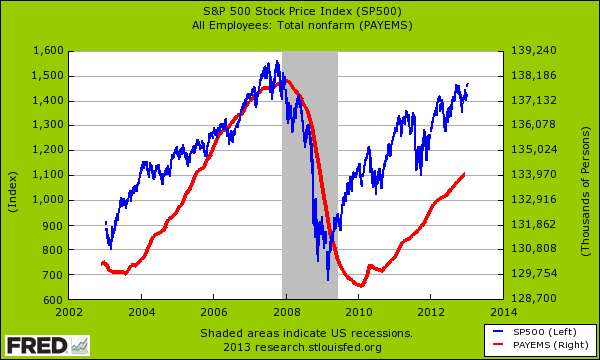
QE-Fed-BalanceSheet-SP500-020413

These liquidity pushes directly correlate with market ramp ups — not improving economics or fundamentals.

Of course, this is also why each time these programs come to an end the financial markets face steep corrections and economic growth plunges.

Into The Danger Zone

It is with this background that we continue to harp upon the dangers that are currently building in the markets. While no two market cycles are ever the same – they generally behave similarly over time. I have posted the following chart several times lately showing the high degree of correlation between the market bubble prior to 2007 and currently.

I expect that the chart will begin to decouple somewhat in the months ahead as there is not a relative crisis immediately available.  However, come May when the debt ceiling issue resurfaces, or there is a resurgence of the Eurozone crisis, or some other exogenous event crops up — stock prices are likely to correct very sharply.

SP500-2004-2008-vs-2009-Replay-020613

Using a weekly analysis, to slow down the day to day volatility of the market — the market currently cannot achieve a higher level of its overbought status. It is “pegged out”, “maxed,” or whatever other term you want to use to describe the extreme nature of the overbought condition that currently exists.

WilliamsR-Analysis-020413

The chart on the next page overlays this overbought/oversold long term weekly indicator with a weekly chart of the S&P 500.

WilliamsR-Analysis-020413-2

See the potential problem here?

The next chart shows the STA Risk Ratio indicator which is a composite index of the rate of change in the S&P 500, bullish versus bearish sentiment, the volatility index, and a ratio of new highs to new lows.  Currently, that index is approaching levels normally only seen at very significant market tops.

STA-RiskRatio-020413

I could show you chart after chart after chart. They all say the same thing — the market is extremely overbought and is currently pushing the limits of the current upside advance.

What I Am NOT Saying

The bulk of the mainstream media’s, and analyst’s, blathering is more akin to a parade of idiots rather than something you should actually spend your time paying attention to. Pay attention to the data.

While I have spilled an exorbitant amount of ink this week on all the reasons why the market is getting extremely overbought and into very dangerous territory — I am not saying that you should sell everything and hide in cash.

This may sound very counter-intuitive but the markets are being driven by the expansion of the Fed’s balance sheet. Therefore, due to this artificial influence, the market can move higher, for longer, than you can possibly fathom. It will end, eventually, and it will end badly.

However, in the meantime, this is how to approach the current market.

1) Do not add to equity exposure at this time no matter how emotionally conflicted you become. Emotions lead to bad investment decisions – always.

2) Sell some, not all, of positions that are speculative in nature and have a lot of volatility. When the correction comes these will be hit the hardest.

3) Increasing stock markets suppress bond prices. Therefore, rotate some money into bonds which will benefit from a stock market correction — “Buy where the money ain’t goin’.”

4) Hoard cash — you can’t be a buyer when things get “cheap” when you don’t have any cash to buy with.

5) Rotate from very aggressive equity exposure to more defensive positions that have an income stream. (ie utilities, staples, and healthcare) However, these positions WILL lose money when the market corrects — just not as much.

6) Beware of high-dividend plays particularly REITS and MLP’s. The majority of these positions are GROSSLY overbought and overvalued and a correction of magnitude will lead to larger losses than you can currently comprehend.

7) Fundamental valuations HAVE NO bearing on a stock market correction. No matter how fundamentally strong you think your investments are they will generally correct as much, or more, than the market. Fundamental value is only effective for eliminating bankruptcy risk. In a market environment driven primarily by programmed trading it is only PRICE ANALYSIS that matters.

8) Did I mention hoarding cash?

9) Pay attention to the trend. The trend is currently positive and we want to mindful of that. It will require a VERY substantial price correction at this point before a SELL signal is issued. This is why profit taking, and keeping new savings in cash, is the best way to stay invested but reduce overall portfolio risk.

10) Just because you take profits, or sell a position today, DOES NOT mean that you can’t buy it back after it corrects.  That is just a good portfolio management practice. There IS NO successful investor — ever in history — that only “bought and held.”

There will be corrections which are buying opportunities and there will be corrections that aren’t. Unfortunately, you will never know which is which until it is too late. This is why employing rudimentary rebalancing processes, or even basic risk management tools, to your investment portfolio will work to protect your investment principal overtime. Are you going to get out at the tops and in at the bottoms? No. Are you going to be the next great market timer? No. Will you keep from setting yourself back years from reaching your retirement goals? Definitely.

Your rating: None

2 Shias get jail terms for Qatif demos

0

Saudi protesters hold a demonstration in Eastern Province. (file photo)

Two Shia Muslims have been sentenced to prison on charges of attending demonstrations in the eastern Saudi city of Qatif.

The sentences, which were issued by a court in Eastern Province on Wednesday, were among verdicts in the case of five men accused of holding anti-government protest rallies, AFP reported.

A Saudi source, speaking on condition of anonymity, said one of the defendants was sentenced to four months, and was released afterwards as he had already spent the time in custody.

Another defendant, who had been out of custody on bail, was imprisoned for two months, and the cases of two others were adjourned to February 10.

The fifth was acquitted for lack of evidence, the source added.

“The prosecution protested the sentences and demanded they be toughened,” the source noted.

On Saturday, the court began the trials of an unspecified number of Shias on similar charges.

There have been numerous demonstrations in Saudi Arabia’s Eastern Province since February 2011, with protestors calling for political reform.

Anti-government protests have intensified since November 2011, when security forces opened fire on protestors in Qatif, killing five people and leaving scores more injured.

Activists say there are over 30,000 political prisoners in Saudi Arabia.

In October 2012, Amnesty International called on the Saudi authorities to stop using excessive force against pro-democracy protestors.

“The Saudi authorities must end their repeated moves to stifle people’s attempts to protest against the widespread use of arbitrary detention in the country,” Philip Luther, Amnesty International’s director for the Middle East and North Africa, said on October 16.

“The right of people to peaceful protest must be respected and the security forces must refrain from detaining or using excessive force against people who exercise it,” he added.

NT/MHB

Brendon Ayanbadejo and ‘The Other Team’

0

Brendon Ayanbadejo and ‘The Other Team’

Email this item Email   Print this item Print   Share this item... Share
Posted on Feb 6, 2013
AP/Nick Wass

By Mark O’Connell

This piece first appeared on The Huffington Post.

Brendon Ayanbadejo holds rank as LGBT hero-of the-moment. His post-Super Bowl, interview with CNN’s Don Lemon showcased his well informed, well-spoken, worldliness, as he declared equality for all, regardless of sexuality or gender expression. Ayanbadejo’s advocacy touches down with more impact than many advocates who are gay themselves (including Lemon, who came out in 2010 and has been a strong advocate for the community ever since), and not just because of his NFL platform, his obvious intelligence, looks, and charisma, but because he’s authentically not gay. His very straightness sends the message, “You’re allowed to be different. Different from me, and different from each other”.

We need even more passionate battle cries in this vein, on behalf of those who are different from ourselves–in general, not just in the LGBT communities–especially for those who have less power than we do.

Now, I’m ambivalent about power, and therefore about top-down advocacy. But as much as it makes me cringe, I also recognize that I benefit from power, and that it’s so tangled up into our systems that to completely extricate ourselves would be impossible. Top-down advocacy seems to imply paternalism, a patronizing of the “weaker”, and one could argue that paternalism is an inherent problem when we rely on straight public figures for effective LGBT advocacy. But we can also see this advocacy as maternalism, or using power to be nurturing, a necessary process in child development and identity formation; we gain confidence to express ourselves freely, and form a sense of self that is separate from our parents though this process. But as a man planning to raise children with another man, these gender labels don’t really work either. In fact, let’s remove the “parental” dynamic from this equation altogether and simply call what Ayanbabadejo is doing social caretaking–authentically claiming a position of social power, attuning to the differences of those who are less powerful, and encouraging them to claim their equally authentic but distinctly different identities, and forms of expression.

“Wouldn’t it be nice if powerful LGBTers could inhabit this role of social caretaker”?, you might ask. Indeed. For example, great as it is that straight movie stars like Sean Penn, James Franco, Michael Douglas, and Matt Damon show the world that kissing other men, and inhabiting feminine clothes and gestures, really doesn’t make the sky fall, we would certainly benefit from more of the likes of Jane Lynch, Sean Hayes, Wanda Sykes, Heather Matarazzo, Dennis O’Hare and Chris Colfer in that hot seat.

The problem here is that of the LGBT figures in the limelight, the ones identified as heroes (in the vein of Mr. Ayanbadejo) and the ones we tend to attach ourselves to as such, are the conformers, ie. those who are “straight acting,” suggesting that it’s OK to be gay, as long as you act “straight”. (We should take a moment to consider novelist Christopher Rice’s observation about the conundrum of the term “straight acting,” that it “implies an ignorance of the mechanics of gay sex”). Public figures like Dan Savage and Rosie O’Donnell are (tragically) often considered to be too non-conforming (too “gay acting”?) though they have both made phenomenal contributions in the way of LGBT youth and families in particular. By contrast, consider what actor Neil Patrick Harris once told Out magaizne:

“The first face that empowered me was Danny Roberts from The Real World: New Orleans. I think before him I’d never seen anyone wear [homosexuality] so comfortably… I could look to him as a role model… He represented a way that I could behave and stand tall comfortably without being an overt advocate and without being someone hiding in the shadows. I liked that.”

For those unfamiliar with the stone age of reality TV, Danny Roberts was considered to be the most “All American”/“straight acting” gay cast member on The Real World as of 1999. (The show had featured approximately one gay character per season since 1991).

It’s wonderful to know that not all queer people are created equal (that some are highly sexual, and some are not, some are outspoken, and some are not, some conform to traditional gender stereotypes and and some do not), but when those who conform are the only ones offering us hope, hope begins to look pretty limiting, and therefore pretty grim.

Perhaps the time will come when a variety of queer people will be as highly influential as Brendan Ayanbadejo, and I hope it’s soon. The more people leading authentic lives–authentically negotiating between conformity, and nonconformity, power, and vulnerability, freedom and limitations–the more we’ll all feel entitled to do so in our own way. However, while people continue to bravely live their truth, we also need those on top, those holding the trophy of social power, to authentically reflect on their own identities, their own status, and to pave the way for those who are different from them to do the same. Like an attuned caretaker to one less powerful, this process provides safety and permission to be authentically separate but equal.

Editor’s note: Brendon Ayanbadejo is Truthdig’s current Truthdigger of the Week. Read more about him here.


New and Improved Comments

If you have trouble leaving a comment, review this help page. Still having problems? Let us know. If you find yourself moderated, take a moment to review our comment policy.

Please enable JavaScript to view the comments powered by Disqus.

Sacre Bleu! France Collapses Right as Spain, Italy and Greece Become Embroiled in Corruption Scandals

0

The following is a excerpt from a recent client letter.

The house of cards that is Europe is close to collapsing as those widely held responsible for solving the Crisis (Prime Ministers, Treasurers and ECB head Mario Draghi) have all been recently implicated in corruption scandals.

Those EU leaders who have yet to be implicated in scandals are not faring much better than their more corrupt counterparts. In France, socialist Prime Minister Francois Hollande, has proven yet again that socialism doesn’t work by chasing after the wealthy and trying to grow France’s public sector… when the public sector already accounts for 56% of French employment.

France was already suffering from a lack of competitiveness. Now that wealthy businesspeople are fleeing the country (meaning investment will dry up), the economy has begun to positively implode.

The first sign of this came actually came from Germany. As we noted a few months ago, Germany had prepared a working group to examine the impact of an economic collapse in France.

German Finance Minister Wolfgang Schaeuble has asked a panel of advisers to look into reform proposals for France, concerned that weakness in the euro zone’s second largest economy could come back to haunt Germany and the broader currency bloc.


Two officials, speaking on condition of anonymity, told Reuters this week that Schaeuble asked the council of economic advisers to the German government, known as the “wise men”, to consider drafting a report on what France should do…


“The biggest problem at the moment in the euro zone is no longer Greece, Spain or Italy, instead it is France, because it has not undertaken anything in order to truly re-establish its competitiveness, and is even heading in the opposite direction,” Feld said on Wednesday.


“France needs labour market reforms, it is the country among euro zone countries that works the least each year, so how do you expect any results from that? Things won’t work unless more efforts are made.”


http://uk.reuters.com/article/2012/11/09/uk-germany-france-economy-idUKBRE8A80MN20121109

This German concern has proven to be well founded, as the recent spate of French economic data has been truly horrific.

Auto sales for 2012 fell 13% from those of 2011. Sales of existing homes outside of Paris fell 20% year over year for the third quarter of 2012. New home sales fell 25%. Even the high-end real estate markets are collapsing with sales for apartments in Paris that cost over €2 million collapsing an incredible 42% in 2012.

Since the EU Crisis began in 2008, France and Germany have been the two key countries backstopping the implosion. The fact that France is now facing an economic implosion does not bode well for the future of the Euro or the EU.

The other sovereign backdrop for the EU, Germany, is also experiencing an economic slowdown.


The German economy was hit hard by the euro zone crisis in the final quarter of last year, shrinking more than at any point in nearly three years as traditionally strong exports and investment slowed, the Statistics Office said on Tuesday…


Gross domestic product shrank by 0.5 percent in the final three months of 2012, the worst quarterly performance since Germany fell into a recession during the global financial crisis in 2008/2009 and only the second contraction since it ended.


The parlous fourth quarter pushed overall growth for the year down to 0.7 percent, a sharp slowdown from the 3.0 percent registered in 2011 and a post-reunification record of 4.2 percent in 2010. The 2012 figure was a tad below a Reuters consensus forecast for growth of 0.8 percent.


http://www.reuters.com/article/2013/01/15/us-germany-gdp-idUSBRE90E09Q20130115

Thus, we find that Europe’s primary political market props (EU leaders including ECB head Mario Draghi) are coming unraveled at the precise time that EU banks are showing warning signs and the most important EU economies are heading sharply south.

2013 is going to be a very interesting year for Europe.

We have produced a FREE Special Report available to all investors titled What Europe’s Collapse Means For You and Your Savings.

This report features ten pages of material outlining our independent analysis real debt situation in Europe (numbers far worse than is publicly admitted), the true nature of the EU banking system, and the systemic risks Europe poses to investors around the world.

It also outlines a number of investments to profit from this; investments that anyone can use to take advantage of the European Debt Crisis.

Best of all, this report is 100% FREE. You can pick up a copy today at:

http://gainspainscapital.com/eu-report/

Best

Phoenix Capital Research

Your rating: None

Rubio Not Convinced on Climate Change, Fox News Goes After Hillary, and More

0

Rubio Not Convinced on Climate Change, Fox News Goes After Hillary, and More

Email this item Email   Print this item Print   Share this item... Share
Posted on Feb 6, 2013

Change He Should Believe In: Florida Sen. Marco Rubio, a potential 2016 GOP presidential candidate, contends that there’s still “reasonable debate” on the cause of climate change (there’s not) and that he doesn’t see global warming as a threat to his home state. “The climate is always changing, that’s not the question,” Rubio told BuzzFeed. “The question is if man made activity is what’s contributing the most to it. I know people said there’s a significant scientific consensus on that issue, but I’ve actually seen reasonable debate on that principle.” Evidently Rubio is not aware of the study that shows that climate change could cost Florida up to $345 billion–not exactly chump change–by the end of the 21st century. (Read more)

Dirty Tricks Denied: Surprise redistricting changes in Virginia that were narrowly pushed through by the state’s GOP-controlled Senate while a Democrat was absent have been dealt a major blow by–shocker–someone in the party. Republican House Speaker William Howell used a procedural move to effectively kill the controversial plan, which would have given the GOP control of the Senate for “decades to come.” Said Howell: “House Bill 259 has been modified to stray dramatically, in my opinion, from the original legislative proposal.” (Read more)

Body Blow: Following Virginia’s lead, Michigan Republicans are pushing for legislation that would effectively require women who want to get an abortion to undergo an invasive transvaginal ultrasound first. The dubious rationale for the procedure is to “protect” the woman. The irony, as pointed out by Eclectablog, is that “Republicans are fighting the practical, most effective steps we can take to actually prevent abortions.” (Read more)

Dystopian Desire: A Republican lawmaker in Idaho has put forth a proposal that would require every high school student in the state to read Ayn Rand’s “Atlas Shrugged” in order to graduate. State Sen. John Goedde, who introduced the bill, wants all students to read the book because he said it “made my son a Republican.” Rand’s novel, written in 1967, has become a favorite among libertarians and the tea party in recent years. Goedde said he didn’t actually “plan on moving this forward,” however, and that it was merely meant to be “a statement.” (Read more)

Mixed Signals: Fox News is the most and least trusted news network, according to Public Policy Polling’s 4th Annual TV News Trust Poll. The survey revealed that the conservative cable news channel’s credibility is at an all-time low; however, Fox also won distinction as the single news outlet viewers trust the most. Go figure. (Read more)

Video of the Day: “Fox & Friends” may have hit another new low (and that’s saying a lot) Wednesday when host Steve Doocy suggested that former Secretary of State Hillary Clinton had had a face-lift. “Days after retiring as Secretary of State Hillary Clinton, somebody has launched a new website for her showing off this glamorous new face. Face-lift, perhaps?” Doocy said. He later tried to play it off as if he was referring to the website, and not Clinton.

–Posted by Tracy Bloom.

More Below the Ad


New and Improved Comments

If you have trouble leaving a comment, review this help page. Still having problems? Let us know. If you find yourself moderated, take a moment to review our comment policy.

Please enable JavaScript to view the comments powered by Disqus.

‘Europe’s A Fragile Bubble’, Citi’s Buiter Warns Of Unrealistic Complacency

0

Citi’s Willem Buiter sums it all up: “…the improvement in sentiment appears to have long overshot its fundamental basis and was driven in part by unrealistic policy and growth expectations, an abundance of liquidity and an increasingly frantic search for yield. The key word in the recovery globally, and in particular in Europe, growth is fragile. To us the key word about the post summer 2012 Euro Area asset boom is that most of it is a bubble, and one which will burst at a time of its own choosing, even though we concede that ample liquidity can often keep bubbles afloat for a long time.” His conclusion is self-evident, “markets materially underestimate these risks,” and the post-Draghi european performance has “gone well beyond the point of possible self-validation and therefore looks fragile.”

Excerpted from ‘New and Old Risks in the Euro Area’, Citi’s Willem Buiter

Then Buiter rips apart the Central Banker’s meme of ‘markets’ as policy tools...

We recognise that, in a decentralised market economy where expectations of the future, moods, hopes and fears drive private (and sometimes also government) behaviour directly and through their effect on the prices of real and financial assets, today’s subjective expectations and other psychological characteristics in part determine what tomorrow’s fundamentals will be.

Irreversible or costly-to-reverse decisions like capital expenditure, human capital formation, resource extraction etc, are driven by subjective expectations and moods, making the distinction between a fundamentally warranted asset boom and a bubble slightly fuzzy at the edges.

But this indeterminacy, bootstrapping, self-validating characteristic of complex dynamic economic systems inhabited by partially forward-looking households, firms and policy makers — called reflexivity by George Soros — can be taken too far.

Mere optimism and confidence will not permit the authors of this note to bootstrap themselves into winning the men’s doubles at Wimbledon 2013. The fact that financial markets have radically reduced their implied estimates of the likelihood of sovereign default in the periphery of the EA (other than in Greece) and of senior unsecured bank debt restructuring throughout the EA, core as well as periphery, should not stop us from continuing to analyse carefully the fundamental drivers of both sovereign credit risk and senior unsecured bank debt credit risk. When we do this, the conclusion that the markets materially underestimate these risks is, in our view, unavoidable.

Eliminating or mitigating some risks of disaster does not create an engine for sustained growth…

Let us recall the major headwinds for the world economy and Europe in particular. Private sector debt has hardly fallen in many EA countries to date and remains much above the levels at the beginning of the last decade (Figure 4).

Fiscal deficits have fallen in most EA countries, but general government gross debt continues to rise and remain close to all-time highs outside of war periods for many advanced economies (AEs, Figure 5).

Continued fiscal austerity thus remains all but certain in many AEs.

Many banks (both in the core and the periphery of the EA) remain weak despite a substantial amount of operational restructuring and selective recapitalizations and deleveraging. In many EA and in a number of non-EA member states of the EU, the entire national banking systems remain weak, fragile and unable or unwilling to provide funding to the real economy on a scale sufficient to support a sustained recovery.

The path to economic recovery, let alone sustained growth at an attractive growth rate of potential output remains an arduous and long one.

Euro area policy actions or announcements have also been misinterpreted or at best over-interpreted.

The ECB now provides a selective safety net for the banking sector through the LTROs (ring-fencing banking activity against a systemic collapse) and through the OMT. The OMT ring-fences sovereigns against convertibility or break-up risk, but not against the risk of sovereign debt restructuring through official sector involvement, OSI, through concessions by official creditors, or through private sector involvement, PSI, through concessions by private creditors. These measures effectively rule out the key tail risk of a break-up of the Eurozone through an involuntary forced exit of the fiscally and competitively weak member states.

It is key to recognise the fact that neither the ECB nor the ESM, nor any foreseeable evolution in their scope and resources, eliminate the risk of bail-in of unsecured bank creditors (including senior unsecured creditors, up to unsecured bank bondholders and non-guaranteed/uninsured depositors) in Cyprus, Portugal, Spain, Italy, Slovenia and indeed, unless the sovereigns in the core really are willing and able to open their pockets to support their own banks’ unsecured creditors, in Belgium, France, the Netherlands and Germany.

In addition, a number of risks have in fact increased recently.

1) Political risks in Italy and Spain

First, there are renewed political risks. In Italy, the Monte dei Paschi di Siena (MPS) bail-out is providing further support to the growing momentum former PM Berlusconi‘s party enjoys in the most recent polls, raising risks of a hung parliament in the upcoming election on February 24. The fact that ECB President Draghi was Governor of the Bank of Italy at the time when it was the supervisor of MPS when MPS is alleged to have engaged in a number of dubious financial operations creates the risk of reputational damage for the ECB President.

More significant than the individual reputations at risk is the risk that the MPS issue reinforces concerns about the potential for reputational damage to the ECB once it takes on the role of the main EA bank supervisor under the new Single Supervisory Mechanism (SSM), a concern voiced in general (rather than specific to the MPS issue) by ECB Executive Board Member Constancio recently.

Even before the MPS issue, the near-term prospects for further near-progress on banking union were dimmed by two other factors. First, the German general election, due to be held in September 2013, has reduced Chancellor Merkel’s appetite for policy actions that could be controversial domestically. This might preclude any major concessions to Germany’s EA neighbours as regards the timing and phasing of fiscal austerity, and the early introduction of key elements of banking union.

Meanwhile, in Spain, allegations about financial malpractice in the ruling Partido Popular party have further hurt the party’s popularity. They are likely to limit government effectiveness in taking unpopular further reform measures and have increased — otherwise modest — risks of government instability, should these allegations be found to be true.

These developments will in particular make it harder for the Spanish government to impose substantial additional fiscal austerity. Additional fiscal tightening would be needed to meet deficit targets following a likely diagnosis of deficit overshoots in the spring. This is despite the new, softer (and IMF-induced) conventional wisdom towards fiscal tightening in response to deficit overshoots: make up bad faith deficit overshoots within the original time frame but permit bad luck deficit overshoots to be corrected over a longer horizon. Unless there is a Keynesian Laffer curve (fiscal tightening depresses activity to such an extent that the deficit increases) the new conventional wisdom will raise the risk of future debt unsustainability.

In Greece, the government announced a primary surplus for 2012 on the basis of preliminary budget figures, but government officials also noted that the final figure is likely to be revised to a deficit of 1.2-1.3% of GDP. The domestic political situation remains tense, as evidenced by the civil mobilization orders that the Greek government has issued to metro and maritime workers. Political tensions and the risk of political instability translate in a direct and somewhat disconcerting manner into economic and financial uncertainty, the likelihood of an earlier recourse to further sovereign debt restructuring and the risk of dysfunctional politics leading to Grexit.

2) Excessive contagious optimism among policymakers

Second, the rally in asset prices and in particular the reduction in funding stress for both sovereigns and banks in the EA periphery has also lessened the perception of many policymakers of the need for major further support measures in the near-term, a perception that is evident by various remarks to the effect that ‘the worst of the crisis is over’ (see e.g. Euro Area: Sovereign Debt Crisis Update 23 Jan 2013).

Notably, ECB President Draghi neglected these dynamics when he spoke of ‘positive contagion’ at the last ECB policy meeting. In our view, there is no such thing as ‘positive contagion’ if the term ‘positive’ refers to the real economic impact of the contagion. Excessive contagious optimism, detached from fundamentals, usually ends up hurting more than it helps, even though the improvement in financial conditions that resulted from the recent rally has probably eased some of the pain in fiscally and financially weak EA countries.

3) Bail-ins of bank creditors (junior and senior) are undoubtedly coming closer.

The combination of the likely further capital needs of EA banks, the limited financial resources of the EA sovereigns (even in the core) and political opposition to bailing in tax payers to avoid bailing in senior unsecured bond creditors make it likely that bail-ins of senior unsecured bank creditors in the EA will start before 2015.

The economic and financial risks facing the EA are not only driven by governments and politics.

4) The recent appreciation of the euro and the effective monetary tightening implied by the increase in money market rates (driven by the large repayments of the first 3Y-LTRO on Jan 30) are most unwelcome from the point of view of EA domestic demand.

Summing up, in our view, the EA sovereign debt and banking crisis is far from over. If anything, recent developments, notably policy complacency bred by market complacency, combined with higher political risks in a number of EA countries highlight the risks of sovereign debt restructuring and bank debt restructuring in the EA down the line.

Source: Citi

Your rating: None

To Drone or Not To Drone? Justifying Extra-Judicial Killings

0

Scott Horton talks about the drone white paper with Sam Seder.

Can I say for the record that I hate the US reliance of drone strikes, especially on US citizens. The fact that we went in with Seal Team Six to get Bin Laden makes it clear that we don’t have to rely on this technology to capture or if you will kill—very bad people. It will only fuel more hatred of Americans. Didn’t we learn that with the coup of Iran and many of our other CIA led foreign invasions?

And it’s very telling that only Democrats will question John Brennan over their use at all. Congress better not support the use of drones on US soil—ever!!!!


NY Times:

Still, it was disturbing to see the twisted logic of the administration’s lawyers laid out in black and white. It had the air of a legal justification written after the fact for a policy decision that had already been made, and it brought back unwelcome memories of memos written for President George W. Bush to justify illegal wiretapping, indefinite detention, kidnapping, abuse and torture.

The document, obtained and made public by NBC News, was written by the Justice Department and coyly describes another, classified document (which has been described in The Times) that actually provided the legal justification for ordering the killing of American citizens.

That document still has not been provided to Congress, despite repeated demands from lawmakers. The white paper was sent to Capitol Hill seven months after the military carried out President Obama’s orders to kill Anwar al-Awlaki, an American who moved to Yemen and became an advocate of jihad against the United States.
—

According to the white paper, the Constitution and the Congressional authorization for the use of force after the attacks of Sept. 11, 2001, gave Mr. Obama the right to kill any American citizen that an “informed, high-level official” decides is a “senior operational leader of Al Qaeda or an associated force” and presents an “imminent threat of violent attack.”

It never tries to define what an “informed, high-level official” might be, and the authors of the memo seem to have redefined the word “imminent” in a way that diverges sharply from its customary meaning. It talks about “due process” and the need to balance a person’s life “against the United States’ interest in forestalling the threat of violence and death to other Americans.”

But it takes the position that the only “oversight” needed for such a decision resides within the executive branch, and there is no need to explain the judgment to Congress, the courts or the public – or, indeed, to even acknowledge that the killing took place.

Scott Lemieux writes: License to Kill

Much of the coverage of the memo, including Isikoff’s story, focuses on the justifications offered by the Obama administration for killing American citizens, including Anwar al-Awlaki and Samir Khan (two alleged Al Qaeda operatives killed by a 2011 airstrike in Yemen.) In some respects, this focus is misplaced. If military action is truly justified, then it can be exercised against American citizens (an American fighting for the Nazis on the battlefield would not have been entitled to due process.) Conversely, if military action is not justified, extrajudicial killings of non-Americans should hardly be less disturbing than the extrajudicial killing of an American citizen. The crucial question is whether the safeguards that determine when military action is justified are adequate.

On this crucial point, the framework laid out by the memo is very much inadequate. Several of the key terms laying out the conditions–what counts as an “informed” official? What levels of evidence are necessary?–are frustratingly vague. Particularly crucial is the question of what constitutes an “imminent threat.” If a threat is genuinely “imminent,” military action is more justifiable. If it isn’t, however, it becomes less plausible to argue that capture is “infeasible,” and treating a suspected terrorist as a police operation would be more important. It is damning, then, that the definition of what constitutes an “imminent threat” has very little bite.

Hillary

0
Most Read

Breaking the Chains of Debt Peonage

The Paranoia of the Superrich and Superpowerful

Only ‘Corrupt’ Scientists Believe in Climate Change, Fox News Host Claims

Budget Report Proves Krugman Right, Coulter Says ‘Screw You’ to Obama, and More

The World Until Yesterday

Most Comments

Most Emailed

Republicans: Rebranding vs. Rethinking

Conservatives Upset Over Jim Carrey’s ‘Assault Rifle’ Tweet

Brendon Ayanbadejo and ‘The Other Team’

Rubio Not Convinced on Climate Change, Fox News Goes After Hillary, and More

Drones

Reports
Ear to the Ground
A/V Booth
Arts & Culture
The World Until Yesterday
Digs
Truthdig Bazaar

The Day Wall Street Exploded

The Day Wall Street Exploded

By Beverly Gage
$18.45

more items

Cartoons

Hillary

Email this item Email   Print this item Print   Share this item... Share
Posted on Feb 6, 2013

Signe Wilkinson

Click to see more Truthdig Cartoons

Drones

Polite Society

Immigration Reform

Sequestration

More Below the Ad


New and Improved Comments

If you have trouble leaving a comment, review this help page. Still having problems? Let us know. If you find yourself moderated, take a moment to review our comment policy.

Please enable JavaScript to view the comments powered by Disqus.

’60s Icon Paul Krassner Reveals His Early History

0

Publishing a satirical magazine led Krassner to run an underground abortion referral service.

February 6, 2013  |  

Like this article?

Join our email list:

Stay up to date with the latest headlines via email.

When abortion was illegal, women had no choice but to seek out back-alley butchers for what should have been a medical procedure in a sterile environment. If there was a botched surgery and the victim went to a hospital, the police were called and they wouldn’t allow the doctor to provide a painkiller until the patient gave them the information they sought.

In 1962, there was an article in Look magazine that stated, “There is no such thing as a ‘good’ abortionist. All of them are in business strictly for money.” But in an issue of my magazine, The Realist, I published an anonymous interview with Dr. Robert Spencer, a truly humane abortionist, promising that I would go to prison sooner than reveal his identify.

Spencer had served as an Army doctor in World War I, then became a pathologist at a hospital in Ashland, Pennsylvania. He went down into the shafts after a mine accident, and aided miners to obtain Workmen’s Compensation for lung disease. At a time when 5,000 women were killed each year by criminal abortionists who charged as much as $1,500, Spencer’s reputation had spread by word-of-mouth, and he was known as the “Saint.” Patients came to his clinic in Ashland from around the country.

I took the five-hour bus trip from New York to Ashland with my gigantic Webcor tape recorder. Dr. Spencer was the cheerful personification of an old-fashioned physician. He wore a red beret and used folksy expressions like “by golly.” He had been performing abortions for 40 years. He started out charging $5, and never more than $100. He rarely used the word “pregnant.” Rather, he would say, “She was that way, and she came to me for help.”

Ashland was a small town, and Dr. Spencer’s work was not merely tolerated; the community depended on it — the hotel, the restaurant, the dress shop — all thrived on the extra business that came from his out-of-town patients. However, he built facilities at his clinic for African-American patients who weren’t allowed to obtain overnight lodgings elsewhere. The walls of his office were decorated with those little wooden signs that tourists like to buy. A sign on the ceiling over his operating table said “Keep Calm.”

Here’s an excerpt from our dialogue:

Q. Do you have any idea how many actual abortions you’re performed during all these years?

A. To be accurate, it’s 27,006

Q. Have medical people come to you, who would otherwise shun you?

A. Oh, yes, I’ve had medical people who bring me their wives, and I’ve had quite a few medical people send me patients.

Q. But they wouldn’t perform the operation themselves?

A. No, they’d never perform it, and just exactly what their attitude would be, I don’t really know. Some of them, I presume, were absolutely against it, because I’ve had ministers, and they’d bring me their daughters or their nieces.

Q. Have police come to you for professional services?

A. Oh, yes, I’ve had police in here, too. I’ve helped them out. I’ve helped a hell of a lot police out. I’ve helped a lot of FBI men out. They would be here, and they had me a little bit scared–I didn’t know whether they were just in to get me or not.

Q. What would you say is the most significant lesson you’ve learned in all your years as a practicing abortion doctor?

A. You’ve got to be careful. That’s the most important thing. And you’ve got to be cocksure that everything’s removed. And even the uterus speaks to you and tells you. I could be blind. You see, this is an operation no eye sees. You go by the sense of feel and touch. The voice of the uterus. But the only thing I can see is hypocrisy, hypocrisy. Everywhere I look is hypocrisy, Because the politicians–and I’ve had politicians in here–they still keep those laws in existence, but yet, if some friend of theirs is in trouble….

Sequestration

0
Most Read

Breaking the Chains of Debt Peonage

The Paranoia of the Superrich and Superpowerful

Only ‘Corrupt’ Scientists Believe in Climate Change, Fox News Host Claims

Budget Report Proves Krugman Right, Coulter Says ‘Screw You’ to Obama, and More

The World Until Yesterday

Most Comments

Most Emailed

Sequestration

Brennan and Kiriakou, Drones and Torture

Trump Suit

Assad Eats Syria

Pollution in China

Reports
Ear to the Ground
A/V Booth
Arts & Culture
 * NEW! * The World Until Yesterday
Digs
Truthdig Bazaar

more items

Cartoons

Sequestration

Email this item Email   Print this item Print   Share this item... Share
Posted on Feb 6, 2013

Nick Anderson

Click to see more Truthdig Cartoons

Trump Suit

Assad Eats Syria

Pollution in China

Power Outage

More Below the Ad


New and Improved Comments

If you have trouble leaving a comment, review this help page. Still having problems? Let us know. If you find yourself moderated, take a moment to review our comment policy.

Please enable JavaScript to view the comments powered by Disqus.

Byron Wien Warns “Oblivious Markets” Of 20% Correction

0

Just as markets can stay irrational longer than traders can stay solvent, so Byron Wien warns all the market-watching self-confirming bulls that “markets slough off bad news until they don’t.” Blackstone’s top-man fears the “oblivious markets” are missing the point that nothing has been solved and that a “big battle between entitlement cuts and raising the debt ceiling” is coming. Shrugging off the anchor’s insistence that earnings have been ‘pretty good’, Wien states reality as expectations are rolling over and performance following. With people complacent and investors euphoric (ignoring European risk re-emergence and depression and Middle East tensions), Wien’s brief clip concludes with his expectation of a 200 point correction in the S&P 500 in H1 2013.

Your rating: None Average: 5 (1 vote)

Brennan and Kiriakou, Drones and Torture

0

Brennan and Kiriakou, Drones and Torture

Email this item Email   Print this item Print   Share this item... Share
Posted on Feb 6, 2013

By Amy Goodman

John Brennan and John Kiriakou worked together years ago, but their careers have dramatically diverged. Brennan is now on track to head the CIA, while Kiriakou is headed off to prison. Each of their fates is tied to the so-called war on terror, which under President George W. Bush provoked worldwide condemnation. President Barack Obama rebranded the war on terror innocuously as “overseas contingency operations,” but, rather than retrench from the odious practices of his predecessor, Obama instead escalated. His promotion of Brennan, and his prosecution of Kiriakou, demonstrate how the recent excesses of U.S. presidential power are not transient aberrations, but the creation of a frightening new normal, where drone strikes, warrantless surveillance, assassination and indefinite detention are conducted with arrogance and impunity, shielded by secrecy and beyond the reach of law.
 
John Kiriakou spent 14 years at the CIA as an analyst and a case officer. In 2002, he led the team that found Abu Zubaydah, alleged to be a high-ranking member of al-Qaida. Kiriakou was the first to publicly confirm the use of waterboarding by the CIA, in a 2007 interview with ABC’s Brian Ross. He told Ross: “At the time, I felt that waterboarding was something that we needed to do. … I think I’ve changed my mind, and I think that waterboarding is probably something that we shouldn’t be in the business of doing.” Kiriakou says he found the “enhanced interrogation techniques” immoral, and declined to be trained to use them.
 
Since the interview, it has become known that Zubaydah was waterboarded at least 83 times, and that he provided no useful information as a result. He remains imprisoned at Guantanamo Bay, without charge. Kiriakou will soon start serving his 30-month prison sentence, but not for disclosing anything about waterboarding. He pled guilty to disclosing the name of a former CIA interrogator to a journalist, with information that the interrogator himself had posted to a publicly available website.
 
Meanwhile, John Brennan, longtime counterterrorism advisor to Obama, is expected to receive Senate confirmation as the new director of central intelligence. I recently asked Kiriakou what he thought of Brennan:
 
“I’ve known John Brennan since 1990. I worked directly for John Brennan twice. I think that he is a terrible choice to lead the CIA. I think that it’s time for the CIA to move beyond the ugliness of the post-September 11th regime, and we need someone who is going to respect the Constitution and to not be bogged down by a legacy of torture. I think that President Obama’s appointment of John Brennan sends the wrong message to all Americans.”
 
Obama has once already considered Brennan for the top CIA job, back in 2008. Brennan withdrew his nomination then under a hail of criticism for supporting the Bush-era torture policies in his various top-level intelligence positions, including head of the National Counterterrorism Center.
 
What a difference four years makes. With the killing of Osama bin Laden notched in his belt, Obama seems immune from counterterror criticism. John Brennan is said to manage the notorious “kill list” of people that Obama believes he has the right to kill anytime, anywhere on the planet, as part of his “overseas contingency operations.” This includes the killing of U.S. citizens, without any charge, trial or due process whatsoever. Drone strikes are one way these assassinations are carried out. U.S. citizen Anwar al-Awlaki was killed in Yemen by a drone strike, then, two weeks later, his 16-year-old son, Abdulrahman al-Awlaki, was killed the same way.
 
I asked Col. Lawrence Wilkerson, who served as chief of staff to Secretary of State Colin Powell from 2002 to 2005, what he thought of Brennan. He told me: “What’s happening with drone strikes around the world right now is, in my opinion, as bad a development as many of the things we now condemn so readily, with 20/20 hindsight, in the George W. Bush administration. We are creating more enemies than we’re killing. We are doing things that violate international law. We are even killing American citizens without due process and have an attorney general who has said that due process does not necessarily include the legal process. Those are really scary words.”
 
While Kiriakou goes to prison for revealing a name, the U.K.-based Bureau of Investigative Journalism is launching a project called “Naming the Dead,” hoping “to identify as many as possible of those killed in U.S. covert drone strikes in Pakistan, whether civilian or militant.” The BIJ reports a “minimum 2,629 people who appear to have so far died in CIA drone strikes in Pakistan.” John Brennan should be asked about each of them.

Denis Moynihan contributed research to this column.

Amy Goodman is the host of “Democracy Now!,” a daily international TV/radio news hour airing on more than 1,000 stations in North America. She is the co-author of “The Silenced Majority,” a New York Times best-seller.

© 2013 Amy Goodman

Distributed by King Features Syndicate

Get truth delivered to
your inbox every week.

Previous item: Drone Strikes Test Legal Grounds for War on Terror


New and Improved Comments

If you have trouble leaving a comment, review this help page. Still having problems? Let us know. If you find yourself moderated, take a moment to review our comment policy.

Please enable JavaScript to view the comments powered by Disqus.

‘DRC, M23 rebels sign preliminary deal’

0

Members of the Democratic Republic of Congo’s delegation sit in an empty conference hall during a second day of meetings with the M23 rebels in the Ugandan capital Kampala on December 10, 2012.

The M23 rebels and the government of Democratic Republic of Congo (DRC) have inked a “preliminary” peace deal after the failure of a 2009 agreement, a Ugandan mediator says.

Crispus Kiyonga, the Ugandan minister who is mediating the talks, said on Wednesday that the deal reached “in the spirit of reconciliation.”

He praised both sides as highly committed to the peace negotiations held in the Ugandan capital Kampala.

Kiyonga said both parties accepted responsibility for the failure of the March 23, 2009 agreement reached between the government and a now-defunct group known as the National Congress for the Defense of the People (CNDP), a precursor to M23.

He described the agreement as “significant” because it established the goodwill necessary for the talks to continue.

The M23 rebels defected from the Congolese army in April 2012 in protest over alleged mistreatment in the Armed Forces of the Democratic Republic of Congo (FARDC). They had previously been integrated into the Congolese army under the peace deal signed in 2009.

The rebels seized the eastern city of Goma on November 20, 2012, after UN peacekeepers gave up the battle for the frontier city, which is home to about one million people. The rebels withdrew from the city on December 1 under a ceasefire accord.

Since early May 2012, nearly 3 million people have fled their homes in the eastern Congo. About 2.4 million have resettled in Congo, but more than 460,000 have crossed into neighboring Rwanda and Uganda.

Congo has faced numerous problems over the past few decades, such as grinding poverty, crumbling infrastructure, and a war in the east of the country that has dragged on since 1998 and left over 5.5 million people dead.

DB/MHB

Trump Suit

0
Most Read

Breaking the Chains of Debt Peonage

The Paranoia of the Superrich and Superpowerful

Only ‘Corrupt’ Scientists Believe in Climate Change, Fox News Host Claims

Budget Report Proves Krugman Right, Coulter Says ‘Screw You’ to Obama, and More

The World Until Yesterday

Most Comments

Most Emailed

Sequestration

Brennan and Kiriakou, Drones and Torture

Trump Suit

Assad Eats Syria

Pollution in China

Reports
Ear to the Ground
A/V Booth
Arts & Culture
 * NEW! * The World Until Yesterday
Digs
Truthdig Bazaar

The Lives of Riley

The Lives of Riley

By Mark Heisler
$6.00

more items

Cartoons

Trump Suit

Email this item Email   Print this item Print   Share this item... Share
Posted on Feb 6, 2013

By Mike Luckovich

Click to see more Truthdig Cartoons

Sequestration

Assad Eats Syria

Pollution in China

Power Outage

More Below the Ad


New and Improved Comments

If you have trouble leaving a comment, review this help page. Still having problems? Let us know. If you find yourself moderated, take a moment to review our comment policy.

Please enable JavaScript to view the comments powered by Disqus.

Bahrain opposition calls for interim govt.

0

A Bahraini young protester takes part in an anti-government rally on in the village of Diraz in the west of capital Manama on February 6, 2013.

A Bahraini opposition group has called for the establishment of a transitional government as a first step to resolve the crisis in the Persian Gulf country.

Al-Wefaq National Islamic Society, the major opposition bloc in Bahrain, made the appeal during a demonstration in the country on Wednesday.

“The solution to end the crisis starts with the establishment of a transitional government, which represents different national factions in the Bahraini society,” a spokesperson of the group said.

The group also called on the ruling Al Khalifa regime to put an end to the “ongoing crackdowns and media campaigns against dissidents.”

The opposition group’s demands come ahead of the second round of the National Consensus Dialogue, which is scheduled to be held on February 10.

Six members from the opposition and eight from pro-government groups will attend the talks.

In late January, Bahraini King Hamad bin Isa Al Khalifa invited all political parties to a national dialogue.

Al-Wefaq quit the first talks, arguing that since the beginning of the negotiations, the government tried to silence the opposition.

Since mid-February 2011, thousands of pro-democracy protesters have staged numerous demonstrations in the streets of Bahrain, calling for the Al Khalifa royal family to relinquish power.

On March 14, 2011, troops from Saudi Arabia and the United Arab Emirates invaded the country to assist the Bahraini government in its crackdown on the peaceful protesters.

According to local sources, scores of people have been killed and hundreds arrested.

Physicians for Human Rights says doctors and nurses have been detained, tortured, or disappeared because they have “evidence of atrocities committed by the authorities, security forces, and riot police” in the crackdown on anti-government protesters.

NT/MHB

Assad Eats Syria

0

Assad Eats Syria

Email this item Email   Print this item Print   Share this item... Share
Posted on Feb 6, 2013

Osama Hajjaj, Cagle Cartoons, Abu Mahjoob Creative Productions

Click to see more Truthdig Cartoons

Sequestration

Trump Suit

Pollution in China

Power Outage

More Below the Ad


New and Improved Comments

If you have trouble leaving a comment, review this help page. Still having problems? Let us know. If you find yourself moderated, take a moment to review our comment policy.

Please enable JavaScript to view the comments powered by Disqus.

Pollution in China

0

Pollution in China

Email this item Email   Print this item Print   Share this item... Share
Posted on Feb 6, 2013

Daryl Cagle, CagleCartoons.com

Click to see more Truthdig Cartoons

Trump Suit

Assad Eats Syria

Power Outage

Cyber Terror

More Below the Ad


New and Improved Comments

If you have trouble leaving a comment, review this help page. Still having problems? Let us know. If you find yourself moderated, take a moment to review our comment policy.

Please enable JavaScript to view the comments powered by Disqus.

Petraeus Pal Jill Kelley Also Targeted Steinbrenner Sons

0

Remember when the Kelleys were all over the news?

And you thought that when David Petraeus quit his job, all the players in that drama would just fade away. Not so fast, the Jill Kelley saga continues to go down a very freaky path.

Just when it appeared the Jill Kelley-David Petraeus mess was behind us, along comes society magazine Town & Country with a profile of Kelley and her twin sister, Natalie Khawam.

And surprise: It’s not flattering, focusing on the twins’ alleged desire for riches and doing whatever is necessary to be among people of power.

Writer Vicky Ward doesn’t talk to Kelley or Khawam, instead getting information from a “distant cousin” — weeks after Kelley was cleared of wrongdoing in a scandal involving Petraeus, the former CIA director whose paramour sent Kelley threatening emails.

“They made up their minds they were going to use men to get money, and they discussed this quite openly in front of the family,” cousin Tony Khawam said in the article, “A Four-Star Scandal,” in the March issue.

Among the men in their sights, according to Tony Khawam: Hal and Hank Steinbrenner, sons of the late George Steinbrenner, Yankees owner and Tampa philanthropist.

“They’d take trips on the Steinbrenners’ plane and brag about how they would split Hal up from his then-wife, Christina – and then the plane would be theirs,” he told Ward.

Hal Steinbrenner and his wife at the time did break up, but not because of the Tampa twins.

As a Yankee fan I have to say that George Steinbrenner (if he were alive today) would detest how his sons are running the Yankees since they took over the reins, but apparently they weren’t dumb enough to be duped by these con-girl twins. Part of me almost wishes that it happened, but not while the sons were still with their original families.

Power Outage

0

Power Outage

Email this item Email   Print this item Print   Share this item... Share
Posted on Feb 6, 2013

Nate Beeler, Cagle Cartoons, The Columbus Dispatch

Click to see more Truthdig Cartoons

Sequestration

Trump Suit

Assad Eats Syria

Pollution in China

More Below the Ad


New and Improved Comments

If you have trouble leaving a comment, review this help page. Still having problems? Let us know. If you find yourself moderated, take a moment to review our comment policy.

Please enable JavaScript to view the comments powered by Disqus.

US sanctions on Iran raise oil prices

0

Oil prices have jumped following new US sanctions against Iran, with Europe’s benchmark Brent rising to $116.73 per barrel.

Oil prices rallied on Wednesday after the United States imposed new sanctions on Iran’s energy sector in a new attempt to force the Islamic Republic to halt its nuclear energy program.

In London, the price of a barrel of European benchmark Brent closed at $116.73, up 21 cents from Tuesday.

New York’s main contract, West Texas Intermediate (WTI) for delivery in March, closed at $96.62 on the New York Mercantile Exchange.

“The main mover this morning was the new US sanctions,” said Rich Ilczyszyn at iiTrader.

“The market sold off pretty good this [Wednesday] morning and, on that story, came all the way back,” the analyst added.

On Wednesday, the US Treasury Department announced new sanctions targeting Iranian oil revenue. The sanctions prevent Iran from gaining access to earnings garnered from its crude exports.

The sanctions require the importing countries to keep their payments at home and only release them in return for purchases of goods from them by Iran, to effectively lock up Iranian oil revenue overseas.

Iran responded by condemning the measures as yet another act of hostility from the US government.

The US has spearheaded several rounds of Western sanctions against Iran in recent years, based on the unfounded accusation that Iran is pursuing non-civilian objectives in its nuclear energy program.

Iran rejects the allegations, arguing that as a committed signatory to the nuclear Non-Proliferation Treaty (NPT) and a member of the International Atomic Energy Agency (IAEA), it has the right to use nuclear technology for peaceful purposes.

In addition, the IAEA has conducted numerous inspections of Iran’s nuclear facilities but has never found any evidence showing that Iran’s civilian nuclear program has been diverted to nuclear weapons production.

MN/MHB

Why “This Time Won’t Be Different” For Japan In Two Charts

0

While Japan’s recent attempt to massively reflate and break out of its “liquidity trap” – an artificial construct to explain what happens when an artificial model, created by a flawed and artificial economic theory explodes in a singularity of Econ PhD idiocy leaving billions of impoverished people in its wake, is nothing new, there are those who are rather skeptical this latest attempt to achieve what Japan has not been able to do in over 30 years will work. And while one can come up with complicated, expansive, verbose theories based on Keynesian DSGE models and other such gibberish, why this time will be different for Japan, there is a very quick and simple argument why it won’t.

The simple counter-argument to this time being different is summarized in the two charts below, which show the relative asset and liability composition of the various key players in the Japanese and US market, split between the Household, Investment Trust, Pension Fund, and Insurance sectors, amounting to some $54 trillion in the US and 1.5 quadrillion yen.

The key differences are highlighted in red.

What the charts above clearly show is how vastly lower the allocation to equities is in Japan relative to the US: this means that the ‘wealth effect‘ generated in Japan as a result of the recent 20%+ surge in the Nikkei has only one fifth the impact it has had in the US. More importantly the equity asset boost resulting from perceived, if not actual, future inflation, will be woefully insufficient to offset the concurrent surge in the marginal cost of living, i.e. real inflation.

As we wrote previously, not even three full months into Abe’s latest and greatest reflation experiment the prices of gas and various other non-staple products has soared. This will only get worse as energy import costs explode in the coming weeks and months, putting the Japanese consumer – now with just one (and almost zero today) nuclear power plant and thus entirely reliant on outside sources of energy – into a spending vice, where the rise in costs far outweighs the “wealth effect” from the stock market. 

The primary reason for this is that unlike the US, Japan has traditionally, culturally and historically been a nation of savers: whether this meant allocating capital into the bond market (a phenomenon which had spared the Japanese bond market from complete annihilation so far even as its debt/GDP has exploded to over 230%), or keeping it planted firmly in the bank (where it gladly collected zero percent interest).

This epic difference is best seen in the top chart, which shows that some 55.6% of all Japanese assets are in currency and deposits, compared to just 14.3% in the US.

And this is where it all begins and ends.

Prudent readers can guess where we are going from here: assuming that a few months of currency collapse manage to undo decades and generations of ingrained habits and behavioral patterns, which they most certainly can’t, assuming Abe is successful in generating his own great rotation into stocks, the question is where will the money comes from.

The answer: from the appropriate liability which matches the various “savings” tranches in the household balance sheet, namely Japanese government bonds.

That’s right: what Abe wants to do in Japan is nothing short of what Bernanke wants to do in the US – force everyone out of money markets (so far he has succeeded here – as the “great” inflow into equities, if only for the past four weeks, has not come from bonds but from money markets, which should also explain the steadfast desire of everyone from Volcker, to Geithner to the SEC to crush the $3 trillion money market industry) and out of bonds into stocks.

The problem is that in Japan a great outflow of bonds means game over. Because while in the US Bernanke just may monetize every single bond issued by the Fed without causing hyperinflation, or at least not while the shadow banking sector continues to deleverage at a pace of some $150 billion per quarter as we have shown continues to happen, Japan has no such luxury. In fact, the biggest holder by far of JGBs are various domestic pension and retirement funds, which have already indicated they may soon rotate out of bonds.

The problem is what happens once said rotation begins?

Well, the clock begins ticking. Because with a debt load of some 230% of GDP, and with debt that is 2000% of government revenue, about five times more than the second highest (Greece), a simple doubling of average interest rates means half of all government revenues goes to pay interest. Double rates again, and it’s game over for the funding side of the Japanese P&L statement, as all inbound cash will have to pay down interest, pushing Japan into the long-delayed hyperinflationary spiral.

And, by the way, none of the above is new! In fact, everything said previously has been well-known to every Japanese PM, and central banker for the past 30 years. It is also the reason why nobody has attempted the kind of ultimately suicidal move that Abe is now trying.

The good news is that it will ultimately be the bond market which puts an end to this latest bout of insanity before it is too late. Unless of course, we get bad news, which in Japan will means 2% inflation… then 12%… then 22%…. then 222% and so on.

By that point every central bank will be openly monetizing not only its own but everyone else’s debt too, as the full 1930s rerun, which most certainly included full-blown currency war just before full-blown trade war erupted, unfolds.

And as everyone knows from history, both of the above metaphoric wars in the 1930s culminated with a different war. A real one.

Source: Bank of Japan December 2012, Flow of Funds

Your rating: None Average: 4.8 (4 votes)

‘Khatib urges Iran to help stabilize Syria’

0

The Iranian Foreign Ministry says Ahmed Moaz al-Khatib, the head of the Syrian National Coalition, has called for Iran to help restore stability in the Arab country.

Foreign Ministry Spokesman Ramin Mehmanparast told IRNA on Wednesday that Khatib had met with Iranian Foreign Minister Ali Akbar Salehi on the sidelines of the 49th annual Munich Security Conference on February 3, IRNA reported.

“In his meeting with Mr. Salehi, Khatib called for the use of the Islamic Republic’s capacities for the establishment of a stable situation in Syria,” Mehmanparast said.

The Syrian opposition figure wanted these talks to help realize the demands of the Syrian people through peaceful and democratic channels, and by holding elections, Mehmanparast added.

The Iranian official hailed Khatib’s call for talks with the Syrian government as a positive step forward, saying Tehran would welcome representatives from any Syrian opposition groups seeking proximity of views.

Mehmanparast criticized the West’s support for militants fighting the government of Syrian President Bashar al-Assad, as the root of instability, insecurity and civilian losses in the country.

Syria has been experiencing unrest since March 2011. Many people, including large numbers of security forces, have been killed in the turmoil that Damascus says is being orchestrated from outside the country.

In December 2012, the Islamic Republic released the details of a long-awaited plan, which urges talks between the Syrian government and representatives of all Syrian groups regardless of their political and social tendencies in order to form a national reconciliation committee.

The plan also calls for an immediate end to all violent and military action under the supervision of the United Nations, an end to all economic sanctions imposed against the country, and the return of displaced civilians to their homes.

MRS/MHB

Wingnuts On Parade: Strike Up The Band For Senate GOP Hopefuls

0

Gosh, the Republican Party is succeeding so much with their “rebranding effort” that they can’t seem to find anyone to run against Ed Markey for John Kerry’s Senate seat. Well, I take that back. There’s this guy, the Blowhard named Dr. Keith Ablow, who makes a career out of offering bogus, junk-filled Freudian analyses on Fox News.

You might remember him from other posts here on C&L, like the one where he offers ridiculous explanations for President Obama’s normal, even mainstream policy choices by suggesting the president is working out his frustrations at being abandoned by his father. Or this one, where he profiled Media Matters’ David Brock, calling him a self-hating narcissist. There’s this one, too, where he calls for Vice President Biden to be examined for dementia. Or, you might make a judgment just on the basis of one single fact:

He actually co-wrote a self-help book with Glenn Beck.

Yes, this is the guy who has expressed an interest in running for John Kerry’s seat.

But wait! There’s more!

In Georgia, Rep. Paul Broun is widely expected to announce his candidacy to replace Senator Saxby Chambliss. Yes, THAT Paul Broun. The one who laughed off a constituent’s comment about who would shoot the president. The same Paul Broun who boycotted and trolled the president’s State of the Union address in 2011 after saying he wouldn’t attend because President Obama would “spew venom,” who compared progressives to Al Qaeda, who wanted to lower, not raise the debt ceiling in 2011, who wanted a in order to school the nation on President Obama’s sins, and the very same one who gets star billing on Jon Perr’s Republican Confederacy of Dunces.

Listen to Paul Broun for ten minutes or so and the only point of confusion will be whether he is a Bircher or a Klansman. It’s possible he’s both. Yes, he is preparing to run for Saxby Chambliss’ Senate seat.

In Iowa, wingnut Steve King is gearing up for a run at Tom Harkin’s Senate seat. Yes, once again, THAT Steve King. The same guy who thinks workers are commodities, who empathized with the guy who flew his plane into the Austin, Texas IRS office, who considered the Hate Crimes Act a “pedophile protection act“, who had no problem with the idea of a revolution similar to the one in Czechoslovakia in 1989 here in the United States, and who defends his racist remarks by admitting he just wants to see “if the pot comes to a boil.“

Yes, these three are leading off the parade of wingnuts for open Senate seats in 2014. They do seem to have one thing in common: they’re all spewing the Birch Society nonsense theories and mixing it with some serious race-baiting and hate.

On the wingnut but not a complete hater side, Geraldo Rivera is snuffling around a run for the Senate in New Jersey. Gee, Rivera and The Wingnuts would make for some interesting times on the Senate floor, but the country would be a shambles by the closing act.

However, Rachel Maddow has one thing wrong in her report above, where she maintains that Karl Rove wants to push these people out. As Jed Lewison points out, the Rove organization poured $400,000 into Steve King’s race against Christie Vilsack in 2012 and bragged about it, not that they had much to brag about overall in 2012. Rove doesn’t reject these candidates; he embraces them.

It looks like Eric Cantor and the TeaBirchers just got a fresh supply of lipstick, and they’re smearing it all over that same old pig.

Mehdi’s Morning Memo: Ebacc-Tracked

0

The ten things you need to know on Thursday 7 February 2013…

1) EBACC-TRACKED

Oh look, yet another dramatic and embarrassing coalition U-turn – this time it’s being executed by ministerial golden boy and media darling, Michael Gove. The education secretary will announce today that he’s dropping his controversial plan to scrap GCSEs in key subjects in England and replace them with an English Baccalaureate Certificate (or ‘Ebacc’).

Both the Independent (“Gove forced into humiliating U-turn over exam reform”) and the Telegraph (“Gove abandons plan to scrap GCSE amid opposition from Lib Dems”) splash on the story.

The Independent reports: “In a surprise statement in the Commons, Mr Gove will reveal that he is abandoning plans to introduce the new qualification in 2015.

“GCSEs will remain, although they will be reformed in an attempt to restore confidence in them as an internationally respected qualification.”

Labour says this is a “humiliating climbdown” from Gove – which, let’s be clear, it is – but Her Majesty’s opposition might not be able to take the credit for it – the Telegraph says the plan was shelved “because of significant opposition from the Liberal Democrats”:

“The Lib Dems are believed to have blocked the move because of high-profile criticism that it would marginalise other disciplines such as the arts and sport.”

In fact, as the Indy notes, it is “the second time the Liberal Democrats have forced a retreat by Mr Gove… Last year, Mr Clegg blocked Mr Gove’s plans to replace GCSEs with a two-tier exam system that was criticised as a return to O-levels and CSEs.”

I guess that’s Clegg 2, Gove 0.

2) THE GREAT IRAQ DEBATE

As we approach the tenth anniversary of the historic February 2003 demonstrations against the invasion of Iraq, the Huffington Post UK is hosting a public debate tonight at Goldsmiths, University of London, to ask: “Was It Worth It?” Speakers include former cabinet minister Clare Short, Times columnist David Aaronovitch, the Independent’s Owen Jones and, er, yours truly. Free tickets here.

HuffPost UK has also commissioned a series of special Iraq features to coincide with the impending anniversary and, of course, tonight’s debate:

– “Were You There? Revisiting The Iraq Demonstration, A Decade On,” reports HuffPost new boy Tom Moseley
– “We Had No Idea How Massive This Would Be,” reports Jessica Elgot
– “How Tony Blair and Iraq Robbed a Generation of Their Faith in Politics,” blogs Sam Parker
– “My Uncles Were Executed, My Parents Tortured,” Lucy Shepherd speaks to Iraqi student Mohamed Ali al-Badri

By the way, the Twitter hashtag for tonight’s debate is #hpiraq10

3) HERE COMES THE ‘MANSION TAX’. AGAIN.

Having defeated Gove over GCSEs, an increasingly confident Clegg is now going after the chancellor of the exchequer – from the Telegraph:

“The Liberal Democrats want to introduce either a one per cent levy on properties worth more than £2 million, or new council tax bands on expensive homes, the Deputy Prime Minister will say. He suggests the money raised could be used to cut income tax.

“The policy of higher taxes on property is set to become a key issue in the Eastleigh by-election caused by the resignation of former Cabinet minister Chris Huhne. George Osborne, the Chancellor, has already stated his opposition to new property taxes and Mr Clegg’s decision to go public with his demands suggests that Coalition relations will become acrimonious during the by-election campaign.”

Indeed they will! Incidentally, the by-election date has been set for 28 February.

4) BRUSSELS BELT-TIGHTENING?

David Cameron can tick gay marriage off his to-do list but today he’ll turn his attention back to that other big ‘divisive’ Tory issue: Europe. From the BBC:

“European Union leaders are due to begin a two-day summit in Brussels to try to strike a deal on the next seven years of EU spending.

“… They failed to reach a compromise at a similar summit last November.

“… Downing Street said on Wednesday that Prime Minister David Cameron was intent on seeking an agreement to lower EU spending.”

If he doesn’t secure such an agreement, the gay marriage rebels will probably morph back into EU rebels. Good luck, Dave!

5) CUTS, CUTS, CUTS

Tory austerity policies have failed and Ed Balls has been vindicated but some senior Labour figures still aren’t happy.

The Sun reports:

“Ed Miliband’s policy chief last night warned Labour must come up with an alternative policy to cut the country’s deficit – or face the ‘despair’ of voters.

“Jon Cruddas said simply opposing the Government’s plans ‘is no good’ and ‘fails to offer reasonable hope’ to ordinary people.

“The Dagenham MP added: ‘The stakes are high because when hope is not reasonable, despair becomes real.’

“Mr Cruddas said Labour faces a ‘daunting’ task to win back power after their defeat in 2010.

“His speech will be seen as a criticism of Ed Balls’ economic strategy.”

Oh yes…

BECAUSE YOU’VE READ THIS FAR…

Watch the trailer for the latest Bond movie, ‘Skyfall’, get the ‘Honest’ treatment. Very, very amusing…

6) ‘ON MANOEUVRES’

The Evening Standard’s Joe Murphy had a rather good story last night about how Tory “ministers and backbenchers” remain “on manoeuvres” in the wake of Tuesday night’s deeply divisive gay marriage vote:

“One backbencher told the Evening Standard he was approached within minutes of last night’s crunch vote by backers of a potential successor to the Prime Minister.

“‘There are both ministers and backbenchers on manoeuvres,’ said the MP. ‘They are not trying to oust Cameron now, but positioning for a vacancy after the next election. But that could change if things go badly wrong for him.’

“Another MP said: ‘Cameron is not under immediate threat but there is no leadership and no narrative. Kids are running Downing Street.'”

7) DRONED OUT

Who needs Lord Justice Leveson, eh? From the Telegraph:

“The revelation that the US has been operating a drone base in Saudi Arabia was kept secret by American media organisations for two years.

“… The revelation that the US has been operating a secret drone base in Saudi Arabia for the past two years came after a blackout on reporting agreed by American media and the Obama administration was broken by two US newspapers.”

As a result of these reports, says the Guardian, “the pressure on John Brennan, Barack Obama’s nominee for CIA director and the architect of the White House strategy on drones, intensified” ahead of his confirmation hearings in the Senate later today.

My view is pretty simple: if you’re going to violate basic human rights, and kill your own citizens via remote control, why not use the secret facilities of one of the world’s worst violators of human rights, especially when it happens to be a close ally?

8) ‘DONE, FOR YOU BIG BOY’

RBS is back in the headlines again – and, again, for all the wrong reasons. It isn’t just the £390m fine for Libor rate-rigging – it’s the banker banter, too. Can the guys and gals at the Royal Bank of Scotland get nothing right? From the Huffington Post UK:

“Following the news of the Royal Bank of Scotland’s £400m fine for its role in the London inter bank offer rate (scandal), much laughter has been heard around the city after the regulator published some of the more amusing exchanges between traders.

“…From 15 September 2007:

“Yen Trader 1: can we lower our fixings today please

“Primary Submitter: make your mind up haha , yes no probs

“Yen Trader 1: im like a whores drawers”

But it wasn’t just RBS:

“Barclays, which was also hit with a £290 million fine because of its involvement in the Libor scandal, also had its emails investigated…

“In one request for a change to the Libor, a trader said: “Please feel free to say ‘no’. Coffees will be coming your way either way, just to say thank you for your help in the past few weeks”.

“To which the Barclays submitter responded: ‘Done, for you big boy.'”

And to think: some people were saying not long ago that it was time to stop the banker bashing. Oh puh-lease. It’s barely begun…

9) JEMIMA KHAN VS JULIAN ASSANGE

My former New Statesman colleague Jemima Khan has launched what the Times calls a “blistering attack” on WikiLeaks founder (and ex-ally) Julian Assange, in this week’s NS.

From the Times:

“Ms Khan, who has defended Mr Assange through his battles with democracies, dictatorships and judges, said that his organisation had gone from speaking truth to power to expecting ‘blinkered, cultish devotion’.

“She said that WikiLeaks was now as ‘guilty of the same obfuscation and misinformation as it sought to expose’.

“She had, she wrote in the New Statesman, gone on a journey of ‘admiration to demoralisation’ with Assange.”

My favourite part of Jemima’s must-read piece is this bit:

“When I told Assange I was part of the We Steal Secrets team, I suggested that he view it not in terms of being pro- or anti-him, but rather as a film that would be fair and would represent the truth… He replied: ‘If it’s a fair film, it will be pro-Julian Assange.’ Beware the celebrity who refers to himself in the third person.”

Hear, hear!

10) THATCHER STATUE

Oh dear. From a story on the front of the Telegraph:

“She is Grantham’s most famous daughter, but when a statue of Baroness Thatcher was offered to the local museum, it was considered by some to be a dubious honour.

“The £150,000 white marble work was famously decapitated by a protester in 2002 but has since been restored.

“Not everyone in her home town is sure they want to honour Britain’s first female prime minister, however, and Grantham Museum is yet to welcome the statue with open arms.

“… One Labour councillor went further, suggesting that displaying a monument to Lady Thatcher in a prominent place could actually be “asking for trouble” and invite further attacks.”

Poor Maggie..

QUOTE UNQUOTE

“I say to the Prime Minister that he should not get so het up. After all, he has got nearly half his parliamentary party behind him.” – Ed Miliband mocks David Cameron at PMQs yesterday.

PUBLIC OPINION WATCH

From the Sun/YouGov poll:

Labour 42
Conservatives 31
Lib Dems 12
Ukip 9

That would give Labour a majority of 110.

140 CHARACTERS OR LESS

@sandsstandard Good news that Michael Gove is ditching the E-Bac. London thrives on art, music and design creativity, why cut if off at source?

@rupertmurdoch @CalebRapoport what do I know about hacking? Nothing until about two years ago. One newspaper guilty several years ago. Nothing since.

@afneil Should not the traders at RBS who so clearly fiddled libor not face criminal charges? And the bosses who conspired

900 WORDS OR MORE

Peter Oborne, writing in the Telegraph, says: “David Cameron is trashing his own party, and it’s not a pretty sight.”

David Aaronovitch, writing in the Times, says: “Fractious Tories fight their leader and each other, while docile Labour is devoid of a plan. The old politics is dying.”

Steve Richards, writing in the Independent, about the Mid Staffordshire NHS scandal, says: “Sometimes money not reform really is the answer.”

Got something you want to share? Please send any stories/tips/quotes/pix/plugs/gossip to Mehdi Hasan (mehdi.hasan@huffingtonpost.com) or Ned Simons (ned.simons@huffingtonpost.com). You can also follow us on Twitter: @mehdirhasan, @nedsimons and @huffpostukpol

US imposes tougher sanctions on Iran

0

An Iranian oil technician checks the oil separator facilities near the city of Ahvaz. (file photo)

The United States has imposed new sanctions on Iran’s energy sector in a new attempt to force the Islamic Republic to halt its nuclear energy program.

The sanctions, which took effect on Wednesday, prevent Iran from gaining access to earnings garnered from its crude exports.

The sanctions require the importing countries to keep their payments at home and only release them in return for purchases of goods from them by Iran, to effectively lock up Iranian oil revenue overseas.

Washington has also imposed sanctions against Iranian media organizations and the Iranian Cyber Police, AFP reported.

Iran responded by condemning the measures as yet another act of hostility from the US government.

The latest anti-Iran measures come at a time when Washington has expressed willingness to hold talks with Tehran.

The US has spearheaded several rounds of Western sanctions against Iran in recent years, based on the unfounded accusation that Iran is pursuing non-civilian objectives in its nuclear energy program.

Iran rejects the allegations, arguing that as a committed signatory to the nuclear Non-Proliferation Treaty (NPT) and a member of the International Atomic Energy Agency (IAEA), it has the right to use nuclear technology for peaceful purposes.

In addition, the IAEA has conducted numerous inspections of Iran’s nuclear facilities but has never found any evidence showing that Iran’s civilian nuclear program has been diverted to nuclear weapons production.

MRS/MHB

What It’s Going to Take to Claw Back Middle Class Wealth from the 1%

0

When unions decline, inequality soars and we all lose.

Photo Credit: Shutterstock.com

February 6, 2013  |  

Like this article?

Join our email list:

Stay up to date with the latest headlines via email.

If you truly care about economic justice, then you’ve got to worry about the precipitous decline of labor unions in the United States. Just take a look at these two charts. The first shows the rise and decline of union membership in the private sector from the depths of the Great Depression to today. You can clearly see that unions were a very big deal from the mid-1930s to the early 1980s. By 1953, more than one out of three American workers were members of private sector unions. That means there was a union member in nearly every family.

Through the late 1950s and 1960s, the percentage of union members declined, but the absolute number continued to increase, peaking at nearly 21 million members in 1979, (largely due to the influx of public sector workers during the 1960s and 70s). Then the decline accelerated as the share of union members fell by half between the mid-1970s and the early 1990s. (If we include public employee union members, the current rate is 11.3 percent.)

The second chart traces the share of our national income grabbed by the top one percent of U.S. households. It’s basically the inverse of the unionization chart. When unions were at their strongest, inequality was the lowest. In 1928, the top one percent hauled off 23.94 percent of all U.S. income. As unions grew, the income share for the richest dropped to less than 10 percent. And as unions declined, the income share going to the wealthiest shot right back up to 1928 levels.

It’s not a coincidence. When unions are strong, they bargain for higher wages and benefits. At the same time, non-union employers increase wages and benefits to attract qualified workers and prevent unions from coming in. Also, unions work for legislation that benefits middle- and low-income people (unemployment benefits, minimum wage, progressive taxation, Medicare, Medicaid, Social Security etc.). Overall, those efforts shift income from the top to the middle and bottom of the income ladder. (For more information on inequality, please see my new book, How to Make a Million Dollars an Hour: Why Hedge Funds Get Away with Siphoning Off America’s Wealth ).

What Happened to Unions?

While working with the labor movement over the past 35 years, I’ve heard myriad explanations for the decline: unions are not democratic enough; they don’t know how to organize the community; they’re victims of globalization; they are too bureaucratic; they don’t work hard enough in politics; they don’t embrace young people and minorities…and so on. While many of these problems are real, I don’t believe they explain what’s really going on — namely that unions and the rest of us are on the losing side of a gigantic class war.

The top one percent understands that unions are the only institution in America that stands in the way of the rich getting richer. As a result, the assault on unions has been deliberate and merciless. Step by step, labor laws have been weakened so that organizing new members has become nearly impossible. For example, employees get fired right and left for organizing activities in violation of labor law. But, employers are rarely charged by the National Labor Relations Board. And when they are, the only penalty is that the discharged workers get back their jobs and back-wages — minus what they earned in the meantime.

Republican-dominated state governments are attacking public employee unions and further weakening labor protections. Almost every day we see laws proposed that would weaken the ability of unions to engage in political action. The goal is clear — zero percent unionization.

Spot The Government-Subsidized, Channel-Stuffed “Recovery”

0

Compared to previous V-shaped recoveries, this one is not looking too rosy. From consumption to GDP, and from retail sales to consumer sentiment, the following charts show how we are doing in context. So, the next time someone on TV tells you how great we are doing, perhaps a glance at these charts will flush some of the recency bias away. There is one bright shining ‘better than any other recovery’ segment though… one that is dominated by record levels of stuffed channels – can you guess?

Charts: Barclays

Your rating: None Average: 2 (1 vote)

Prison for parodies? Arizona moves to outlaw online impersonators

0

Critics of an Internet censorship bill introduced in the Arizona House fear that proposed legislation could chill First Amendment-protected rights.

­If HB 2004 passes, it’ll be a crime punishable by prison to lie on the Internet. Administrators of Twitter parody accounts and other online impersonators will be forced to throw in the towel, or else face as much as one-and-a-half years in prison for violating a law expected to soon go up for debate.

Rep. Michelle Ugenti, a Republican lawmaker that represents the state’s District 8, proposed her parody ban bill back in December, citing complaints from a constituent that claimed to have been harassed on the Web. Her bill is among the latest that attempt to thwart cyberbullying, and she says it won’t be last. It might, though, be the most extreme.

“It’s an issue that’s only going to get bigger,” Ugenti told the Arizona Republic last month. “The Internet has gone from a novelty to having a position of credibility, and it’s appropriate to have statutes that address it specifically.”

Rep. Ugenti thinks she can help achieve that in Arizona, and strives to do as much through HB 2004, an amendment to the state’s impersonation law. HB 2004 would add verbiage to the law that’s aimed at making sure no one has to worry about any online imposters making fake posts in an attempt to wreak havoc. For the conservative lawmaker, it’s legislation that will limit just how far computer users can go with certain conduct online. Others, though, say it could be the start of much larger censorship problems.

“The bill has a high standard,” Rep. Ugenti told the Republic. “It’s the impersonation without the individual’s consent and with the intent to harm, defraud, intimidate and threaten.”

Indeed, Rep. Ugenti’s proposal would make it illegal to, without permission, create a webpage or social media account using another’s likeness with any of those intents. To what degree those desires exist is a question that isn’t touched yet in her bill, though, and that has some skeptics worried over what HB 2004 could do for free speech.

“The concern is whether overzealous prosecutors would use this language to intimidate somebody,” Kurt Opsahl, a senior staff attorney for the Electronic Frontier Foundation, told the Los Angeles Times last month. “The concern is that this would have a chilling effect.”

Touching on the topic of what exactly constitutes a degree of intent, Opsahl said certain prosecutors and judges might interpret an approved HB 2004 to their unique specifications. Even if the bill’s author insists it will only more responsibility to the Web, Opsahl fears it would make illegal even innocent mocking. And with a joke gone awry carrying an 18-month prison sentence, some people may become too scared to even see what fake Twitter accounts are available.

“The key is the ‘intent to harm,’” he said. “You can imagine someone saying, ‘Well, if you are making a parody of someone else and you are trying to make fun of them and hold them up to ridicule, that would be an attempt to harm them and thus would be within the coverage of the bill. That is the concern.”

Marie-Andree Weiss, an intellectual property, privacy, and social media attorney from New York, writes in her own commentary that HB 2004 really could be taken either of two ways.

“If the law is interpreted in an overbroad manner there is a risk that it may chill free expression,” Weiss writes in a recent post on Citizen Media Law Project. “As the Supreme Court stated in Gooding v. Wilson, ‘persons whose expression is constitutionally protected may well refrain from exercising their rights for fear of criminal sanctions provided by a statute susceptible of application to protected expression.’”

“There is a particular concern with HB 2004 that it would be applied to constitutionally protected parodies or caricatures of public officials and figures. Protection for parody, even crude parody that causes emotional injury, is clearly within the protection of the First Amendment,” she adds.

Since drafting the bill, Rep. Ugenti may have more reason than ever to worry about crude jokes blasted from computerchair quarterbacks. After introducing HB 2004, a Twitter account was registered under the username @RepMUgenti.

“I hate the internet, it always wants to make fun of me, oh and I’m a politician,” the bio of the account reads, along with a disclaimer: *This is a Parody*

Registered on January 3, 2013, the parody account has only dispatched a handful of tweets, most of which commentary that could easily be considered by many to be obscene.

“Legislative sessions are so fun, especially if you have a water bottle full of vodka,” reads one post. “I’d fuck #JamesHolmes #Aurora,” reads another. At least two other Rep. Ugenti parody accounts exist on Twitter as of this writing.

In her legal critique, Ms. Weiss writes that it doesn’t appear that HB 2004 could constitutionally apply to the parody account.

“It would be much simpler to amend HB 2004 before its passage rather than hope that the courts solve any constitutional issues,” she adds. “If it appears that the statute is actually intended to reach parodies and other protected speech, a court, bound to follow the intent of the legislature, is likely to strike the statute entirely as unconstitutionally overbroad rather than impose a judicial construction that is inconsistent with legislative intent.”

According to the most recent info on the Arizona Legiscan page, HB 2004 was referred to the State House Judiciary Committee on January 15. Meanwhile, this week Rep. Ugenti weighed in another matter in Legislature. On Tuesday, she voted in favor of advancing a bill that will forbid state agencies from publishing anything in a language other than English. Critics of HB 2283 have already warned that an approval in the full House could lead to a Civil Rights Act lawsuit, but Rep. Ugenti told the Republic this week that she was confident it would prevail.

“There’s already a precedent for it, so I don’t think we’ll have another lawsuit,” she told the paper. That law, passed in 2006, made English the official language of Arizona.

Russia turn the heat on Iceland

0

Russia's Vladimir Bystrov controls the ball in the friendly against Iceland (RIA Novosti / Alexey Danichev)

Russia’s Vladimir Bystrov controls the ball in the friendly against Iceland (RIA Novosti / Alexey Danichev)

Russia’s football team took their first win of 2013, beating Iceland 2-0 in a friendly game in Marbella, Spain.

­The Russian line-up was somewhat blighted as many squad members prepared for the restart of their football season in March.

The Russians were in control in the first half, but could only create their first real scoring chance during the 43rd minute, which was still enough to take the lead.

Iceland sprung an unsuccessful offside trap and unmarked Roman Shirokov beat keeper Hannes Thor Halldorsson, with a low shot after a good pass from Vladimir Bysrov, 1-0.

In the second half, Russia’s coach, Fabio Capello, introduced a group of younger players into the game, who added pace and emotion into the team’s play.

And it was one of the substitutes, Oleg Shatov, who doubled the teams advantage on the 66th minute.

The 22-year-old marked his national debut with a goal as his powerful blast from inside the box nearly tore the net, 2-0.

The Iceland friendly is Russia’s final test ahead of the crucial World Cup 2014 qualifier away to Northern Ireland on March 13.

Capello’s men currently sit will top of Group F, with 12 points and a comfortable 5-point gap from nearest rivals, Portugal.

Guest Post: All Is Well

0

Submitted by Jim Quinn of The Burning Platform blog,

“Facts do not cease to exist because they are ignored.” — Aldous Huxley

I woke up this past Saturday morning and opened my local paper to find out that all was well. An Associated Press article declared a healthy jobs market, fantastic auto sales, a surging housing market, and a stock market rocketing to new all-time highs. What’s not to love? If the mainstream media says the economy is as good as new, it must be so. Why should we let facts get in the way of a good storyline? The stock market has surged to 2007 highs, so the country’s employment situation must be strong.

The chart above tells a slightly different story. The S&P 500 has regained almost all its losses since October 2007 as Bernanke and Washington politicians chose to save Wall Street and screw over Main Street. The working age population has risen by 12.8 million since 2007 and there are 4 million less Americans employed. The December Household Survey from the BLS being touted by the mainstream media as proof of a jobs recovery told a slightly different story:  

  • The number of unemployed Americans went up by 126,000 in one month
  • Another 169,000 Americans left the workforce evidently because their stock market gains made them wealthy.
  • There are 250,000 more Americans unemployed than there were in September 2012.
  • There are 6,000 less Americans employed than there were in October 2012.
  • The unemployment rate reported to the masses went up to 7.9% (the true rate reached 23%).

This is just the picture over the last few months. The picture since 2007 is beyond horrific, as more than 10 million Americans have left the workforce. Everyone knows people willingly leave the labor force when the economy crashes and their net worth is reduced by 30%. Who needs a paying job then? Just because there are 101 million working age Americans not working and the labor participation rate of 63.6% is at a three decade low, certainly doesn’t mean we aren’t experiencing a tremendous jobs recovery, according to the mainstream media.   

The deep thinkers at CNBC, Fox, CNN and the rest of the captured corporate status quo mouthpieces, propagate the false storyline that the reason for Americans leaving the workforce is Baby Boomers retiring. Considering the average Boomer has $90,000 of total savings and 28% of them have less than $1,000 saved, I suspect there are few willingly leaving the workforce. The Boomers have taken on 4 million additional jobs since the low point in 2009, while the 16 to 54 year olds have lost an additional 2.9 million jobs. Does this reflect a strengthening jobs market? Does the fact that real hourly wages have fallen for the last two years reflect an improving labor market?  

Inquiring minds might wonder how auto sales could be booming when there are 4 million less employed Americans and real wages are falling. Of course, mainstream media faux journalists aren’t paid to inquire, think critically, or even think at all. They are paid to regurgitate propaganda designed to keep the masses sedated and ignorant. The “fabulous” rebound in auto sales has been buoyed by the return of easy money lending, even to deadbeat borrowers with lousy credit histories. There is a reason the Federal government hasn’t attempted to spin off their 80% control of Ally Financial (aka GMAC, Ditech, Rescap). The Feds are attempting to manufacture a recovery by doling out subprime auto loans to anyone who can scratch an X on a loan document and offering 0% loans over 7 years to good credits. How exactly does a finance company generate a profit by making 0% loans for seven years and approving loans to people with no means of paying them back? Experian recently noted that 44% of ALL auto loans have been to subprime borrowers over the last year. When a financing company doesn’t have to worry about profits or loan losses, everyone gets a Cadillac Escalade. The losses on these subprime loans will be in the billions when the next leg down in this Crisis hits. The taxpayer will unknowingly pick up the tab, just as they have been doing for the last five years. The trend in this chart is nothing but a Federal government induced fraud.


PhD in Stupidity

The Federal government induced sham auto recovery is small peanuts compared to the bubble they are blowing in the higher education realm. Since the Federal government took over 85% of the student loan market in 2009, the debt outstanding has surged to over $1 trillion from below $600 billion. The Feds don’t care about credit risk or loan losses. You’re on the hook for the losses. The purpose for doubling the amount of student loans was to artificially lower the unemployment rate by removing as many people from the labor force as possible. The 600,000 University of Phoenix enrollees getting their on-line master’s degrees in basket weaving while sitting in their mother’s basement, subsidized with $20,000 loans from the taxpayer, didn’t count as unemployed.

Enrollment in these diploma mills has begun to plunge, as the scam has been revealed. The New York Times reported that:

“Enrollments at the University of Phoenix and in the for-profit sector over all have been declining in the last two years, partly because of growing competition from other online providers, including nonprofit and public universities, and a steady drumroll of negative publicity about the sector’s recruiting abuses, low graduation rates and high default rates … including many charges that the schools enrolled students who had almost no chance of succeeding, to get their federal student aid.”

Enrolling students who have no chance of graduating is exactly what the Obama Administration and the status quo want.

Based upon the chart below you would think the United States is producing the brightest bunch of young people in U.S. history. Nothing could be further from the truth. Only 43% of the 1.66 million private and public school students who took the college-entrance exam posted scores showing they are prepared to do well in college, according to data released by the College Board, the nonprofit group that administers the SAT. The SAT data mirror scores from the ACT college-entrance exam which showed about 75% of students failed to meet college-readiness standards. If SAT scores are at decade lows, how could college enrollment be at record highs? Our government controlled public school system is graduating functionally illiterate dullards and the government is then subsidizing these subprime students as they matriculate into substandard colleges across the land. Approximately 3.4 million seniors are graduating from our high schools every year. The 1.66 million seniors who took the SAT exam are the cream of the crop. If the 50% of students who took the SAT exam could score so pitifully, imagine how dimwitted the 50% of students who didn’t even take the exam must be.  The upshot of these tests are that only 700,000 of all the graduating high school seniors (21%) are capable of getting a B minus or above in college.

college enrollment rates

Think about that for one second. Only 21% of all graduating high school seniors are intelligent enough to get a B minus in college, but 70% of them are enrolling in college. Of course enrolling in college and graduating college are two different things. Only 30% actually graduate college. The other 40% get drunk, fornicate, sleep late, fail, rack up gobs of debt, and then drop out. There are approximately 13 million 18 to 24 year olds enrolled in college today and at least 6 million of them have little to no chance of graduating. If the Federal government was not subsidizing them with loans, they would rightfully be looking for jobs geared to their intellectual capabilities. Would tuition rates be soaring if there were 6 million less drones matriculating into one of the 4,000 mostly mediocre higher learning institutions in this country?


The Federal government bureaucrats who think they can control the levers of finance to steer our economy to greater heights are creating a new subprime bubble. The absolute implosion of the for profit diploma mills, that have fed like bloated pigs at the Federal loan trough, is the Bear Stearns moment for the massive student loan losses that will be foisted on the shoulders of the American taxpayer. The deceptive schemes, fraud, and financial aid manipulation practices of the publicly traded diploma mills — Corinthian Colleges (down 90%), ITT (down 90%), Apollo Group (down 80%) and DeVry (down 60%) have been revealed, as their ill- gotten profits have evaporated and their stock prices have crashed. Enrollment at the king of worthless online degrees, the University of Phoenix, has plunged from 600,000 to 400,000 and they are closing 115 of their 227 campuses. The proof that much of the student loan bubble has been created by these for-profit shysters can be seen by the fact that 60% of all student loans are owed by people over 30 years old, with 33% owed by people over 40 years old. These people bought into the re-training fallacy perpetuated by government drones and mainstream media mouthpieces.

StudentLoans1

But still the Federal government continues to blow the bubble bigger and bigger as non-revolving consumer debt has reached all-time highs. Peter Thiel recently compared this bubble to the housing bubble we are still dealing with:

“We have a bubble in education, like we had a bubble in housing…everybody believed you had to have a house, they’d pay whatever it took. Today, everybody believes that we need to go to college, and people will pay— whatever it takes. There are all sorts of vocational careers that pay extremely well today, so the average plumber makes as much as the average doctor. I did not realize how screwed up the education system is. We now have $1 trillion in student debt in the U.S. Cynically you can say it’s paid for $1 trillion of lies about how good education is.”

Delinquency rates have already begun to skyrocket as the diploma mill scam implodes, dropouts can’t make loan payments with their EBT cards and even graduates from legitimate colleges are stuck waitressing at TGI Fridays and can’t make their payments. Millions of millenials are ensnared in the chains of debt servitude, with no chance of escape. 

Delinquency rates on student loans made in the past two years stand at 15%, according to FICO, versus 12.4% for loans made from 2005 to 2007. This is proof that loans doled out since the Federal government took control of the market have been distributed willy-nilly in a frantic effort to artificially reduce the unemployment rate. Average student- loan debt last year rose to $27,253 from $17,233 in 2005, with almost 605 of bank managers surveyed in December expecting delinquencies to worsen in six months, according to FICO. Andrew Jennings, chief analytics officer of Fair Issac, said in a statement:

“This situation is simply unsustainable and we’re already suffering the consequences. When wage growth is slow and jobs are not as plentiful as they once were, it is impossible for individuals to continue taking out ever-larger student loans without greatly increasing the risk of default.”

When subprime mortgages blew up, at least there was collateral to alleviate some of the losses. When the subprime auto loans blow up, at least there will be vehicles to repossess. Student loan debts are the ultimate in subprime, with no collateral and millions of jobless debtors. The situation is much worse than the delinquency numbers reveal. More than half of the student loans are in deferment, grace periods, or forbearance, meaning they are not currently requiring repayment. This means the true delinquency rates are twice as high as the reported figure of 15%. What happens next can be succinctly summed up by the esteemed economist John Kenneth Galbraith:

 “Then the shit hit the fan.” — John Kenneth Galbraith

The involuntary taxpayer bailout for this Federal Government created disaster will exceed $200 billion after the shit is done hitting the fan.

Do You Want Pepperoni on that Housing Recovery?

Everywhere I turn I’m hearing about the strong housing recovery that is propelling our economy, generating jobs and spurring a resurgence in retail spending by the millions of deleveraged consumers. Wall Street paid economists on CNBC, NYT economic “journalists”, and even the Fox News blond bimbo brigade all assure me the housing market is in a strong recovery and it’s the best time to buy. There are just two small problems with the story. None of the propaganda spouted by the mouthpieces of the kleptocracy is supported by the facts. And what little uptick in sales and prices that has occurred is due to collusion, fraud and manipulation by Wall Street, the Federal Reserve, the Treasury Department, and connected crony corporate interests.

I challenge anyone to show me the tremendous housing recovery on the new home sales chart below. New homes sales have “surged” to an annual pace of 369,000, only 74% below the 2006 peak and about 50% below the long term average. New home sales fell in December at the fastest rate since February 2011. Existing home sales also fell in December, are pacing at 1999 levels, and are still 30% below 2006 levels. In a country of 115 million households, with mortgage rates at all-time lows, there were a total of 26,000 new homes sold in December, and only 10,000 of them were actually built. For some perspective, new home sales are at the same level as they were in 1967 when the U.S. population was 200 million.  

The kleptocrats’ master plan has multiple dimensions designed to lure unsuspecting dupes back into the market. The Federal Reserve has bought over $1 trillion of toxic mortgage debt, freeing the criminal Wall Street banks to start raping the American public again. Bernanke has driven mortgage rates to near all-time lows by tripling his balance sheet, with promises to quadruple it before the end of the year. By driving real interest rates below zero Bernanke has the dual purpose of driving people into the stock market for a positive return and luring “investors” into the housing market.

The Wall Street part of this grand scheme has been to delay the foreclosure process on millions of homes, thereby restricting the amount of inventory on the market. By artificially creating an inventory “shortage”, they have been able to drive prices higher, with the purpose of trying to get the 25% of underwater homeowners back to breakeven. The Treasury Department, through their captured entities (Fannie, Freddie, FHA) are guaranteeing 95% of all mortgages, with the FHA requiring only 3.5% down payments, with the hundreds of billions in  present and future losses being incurred by the American taxpayer. You’ve heard of the cycle of life. This is the government cycle of fraud.

The last part of the plan has been to lure investors into the market. Fannie Mae and Freddie Mac have sold huge blocks of foreclosed homes to connected friends of Wall Street at below market rates so they could convert them to rental properties. This has further artificially reduced inventory available for sale, and jacked up prices by as much as 20% in the former bubble markets of Phoenix, Las Vegas and California. Investors and flippers account for 30% of all home sales, with another 24% of home sales listed as distressed sales. Sure sounds like a healthy market to me. With this full court press by the powers that be to produce a housing recovery, the chart below reveals the utter ineptitude of their effort. Real home prices, even using the fake government manipulated CPI, have barely budged from their lows and sit at 1990 levels. Real home prices are still down 40% from their 2006 highs.    

If a true housing recovery was underway how could mortgage purchase applications be at 1997 levels? If housing was recovering there would be more mortgage applications. It really is that simple. Do supposed journalists have any critical thinking skills or are they just playing their assigned role in this kleptocracy?

Essentially, the kleptocrats’ primary purpose has been to protect and enhance the wealth of the oligarchs that control Wall Street, Washington DC, and corporate America. They have achieved their goal, while destroying the middle class and sentencing unborn generations to a life sentence of debt servitude.

If we have been experiencing a solid jobs recovery, strong automobile sales, a resurgence of consumer spending, and rising home sales and home prices, how could GDP be negative in the 4th quarter? The mainstream media immediately declared it the best negative GDP of all-time. They pompously declared that GDP would have been positive if government defense spending hadn’t plummeted. These disgraceful excuses for journalists failed to mention the huge surge in government and defense spending in the 3rd quarter just prior to the presidential election that accounted for a 3.1% GDP and helped get Obama re-elected. A less trusting person than myself might question why the surge in government spending prior to the election.

Did the mainstream media government mouthpieces question the absolutely laughable 0.60% inflation rate used to calculate the 4th quarter GDP? No they didn’t. That wouldn’t support their storyline of recovery. Using even the bastardized CPI figure of 2.0% would have produced a -1.5% GDP figure. Using real inflation figures over time reveals what every middle class family in America knows in their bones — the economy has essentially been in recession since the early 2000s. The massive dose of debt issued by the government has masked the true nature of our economic decline.   


All is not well. Any awake and aware citizen knows the economic, financial, societal and social fabric of this country is in tatters, and is getting progressively worse by the day. Since this supposed economic recovery began in mid-2009, the country has added 4 million jobs, more than 100% of which went to workers over the age of 55, forced into the workforce by Bernanke’s zero interest rate policy. Over this same time frame of economic recovery, 16 million Americans went on food stamps. How could this possibly happen if the economy has been recovering? Either the government and mainstream media are lying about the economic recovery or the Obama administration has been fraudulently encouraging people to go on food stamps to win votes in elections. Which of these truths is more palatable to your sensibilities?     

It comes down to this. The monied interests, high financiers, corporate interests, captured politicians, government apparatchiks, and corporate media have a vested interest in maintaining the corrupt and destructive status quo. They have become rich and powerful through their manipulation of the currency, ravenous sacking of the national wealth, destruction of the working middle class, and ability to use mass media propaganda to convince the willfully ignorant masses to learn to love their debt servitude. Our once proud, liberty minded, self-sufficient nation of freedom loving individuals has devolved into a kleptocracy,  where a small cadre of powerful men run the show solely to increase the personal wealth and political power of officials and the ruling class at the expense of the wider population. They are essentially running a state sponsored embezzlement and Ponzi scheme to pillage the wealth of the dumbed down, sedated, technologically distracted masses. Our entire system has been captured and we are entering the final stages of decay and ultimately a day of reckoning where the guilty and innocent alike will suffer the awful consequences of currency collapse, death and destruction on a wide scale, and likely civil and world war.

 “The Fed is now engaged in a control fraud, and what appears to be racketeering in conjunction with a few big investment banks. They may have entered into it with good intentions, but they seem to have been turned towards deceit and corruption. This is not an historical event, but an ongoing theft in conjunction with a number of Wall Street banks, and politicians whom they have paid off through a corrupt system of campaign financing and influence peddling. This is nothing new in history if one reads the un-sanitized version. But people never think it can happen today, that somehow yesterday things were different, as if one is looking at some distant, foreign land. This is a facet of the illusion of general progress.

We are now in the cover-up stage of a scandal, similar to Watergate when the White House was stone-walling. The difference is that the corruption and capture of the government is much more pervasive now, and includes a significant portion of the mainstream media, so meaningful reform is difficult. Most of what has transpired so far has been designed to distract and placate the people in their righteous anger. The Fed deceives the Congress and the public, turns a blind eye to glaring conflicts of interest, and is essentially debasing the currency while transferring the wealth of the nation to their cronies. And still the regulators do not enforce the laws they have, and Washington drags its feet while accepting buckets of cash from the perpetrators.” — Jesse

The entire system is corrupt to its core. Both political parties, regulatory agencies, Wall Street, the Federal Reserve, and mainstream media are participants in this enormous fraud. They grow more desperate and bold by the day. The lies, misinformation and propaganda being spewed on a daily basis become more outrageous and audacious. They are using the Big Lie method on a grand scale. They frantically need to lure the muppets into the stock market and the housing market to keep the game going a little longer. You can sense we are reaching a tipping point. The system they have created is mathematically unsustainable. Therefore, it will not be sustained. The world is going mad. Governments across the globe are all trying to out debase each other. Austerity and inflation for the peasants and caviar and champagne for the Davos class is the chosen path. All is not well. Ben Bernanke and the oligarchs running the show will be immortalized in history books forever when this farce comes to a spectacular conclusion.   

 “If all else fails, immortality can always be assured by spectacular error.” — John Kenneth Galbraith

Your rating: None Average: 5 (12 votes)

Gunmen kill 9 police officers in Mexico

0

Mexican police investigate a crime scene in a drug-related shooting. (file photo)

Gunmen have killed nine police officers and wounded another in an ambush in the southwestern Mexican state of Guerrero, officials say.

The state prosecutor’s office announced the deaths on Wednesday, saying that the policemen were killed while on duty, AFP reported.

The identity of the attackers was not immediately known.

The attack occurred in the town of Apaxtla de Castrejon, located in a region known as “Tierra Caliente”.

Guerrero has long been plagued by drug gang violence. The Knights Templar and La Familia Michoacana are fighting each other for the control of criminal activity, including drug trafficking, kidnapping, and extortion in the state.

At least 70,000 people have been killed in drug-related violence in Mexico since former President Felipe Calderon launched an offensive against Mexico’s drug cartels in December 2006.

Current Mexican President Enrique Pena Nieto has vowed to reduce the crime rate as he continues the campaign against drug cartels.

MN/MHB

Syrian leadership ready to talk to opposition, Iran’s FM says

0

Iran's Foreign Minister Ali Akbar Salehi (2nd R) talks with other attendees before the start of the Organisation of Islamic Cooperation (OIC) summit in Cairo February 6, 2013.(Reuters / Asmaa Waguih)

Iran’s Foreign Minister Ali Akbar Salehi (2nd R) talks with other attendees before the start of the Organisation of Islamic Cooperation (OIC) summit in Cairo February 6, 2013.(Reuters / Asmaa Waguih)

The Assad government could be ready to sit down with leaders of Syria’s opposition, Iran’s foreign minister said Wednesday on the sidelines of an Islamic summit that saw Egypt host Iranian and Turkish delegates in Cairo.

­“I think that the Syrian government is ready to negotiate with the opposition,” Ali Akbar Salehi told Egyptian state news agency MENA.

It follows Syrian opposition leader Moaz Al-Khatib’s Monday offer to speak to a deputy of President Bashar Assad about finding a solution to the now nearly two-year-long conflict that’s seen more than 60,000 people killed.

Salehi made the statement while in Cairo as part of a three-way Islamic summit between Egypt, Iran and Turkey. Delegates from the countries held a meeting on the sidelines to address the Syrian crisis. 

“There was a three-way summit of Egypt, Turkey and Iran about the crisis and we look forward to it leading to the resolution of this crisis. We are optimistic,” Salehi said, adding that Iran’s leadership welcomed Al-Khatib’s offer.

“In the end, the government and the opposition must sit together to negotiate,” he said.

Shiite Iran is Syria’s main ally in the region, while other Sunni-majority countries have been calling for Assad to leave power, with many of them supporting the country’s insurgency directly or indirectly.

Citadel: Survivalists build city-fortress with mandatory weapon ownership

0

Reuters / Yannis Behrakis

Reuters / Yannis Behrakis

Ever wished you could travel back in time? Idaho might soon provide a glimpse into the past: a group of survivalists are planning to build a giant medieval-style fortress in which residents would carry their own weapons and defend against invaders.

The walled city would be built in the woods of the Idaho Panhandle, 70 miles southeast of Spokane, Wash. Few people live in Benewah County, and the population 9,000 would be more than doubled if the survivalists most into the region.

Coined the “Citadel”, the fortress would house 7,000 people and include houses, a school, and a gun factory. The people of Idaho are well-known for their love of guns and panic about proposed federal gun rules has only spurred a rush to purchase more of them out of fear of having their Second Amendment rights being taken away.

But those who are proposing the establishment of the Citadel say that all of the city’s residents would have to own an AR-15 rifle, 1,000 rounds of ammunition and enough supplies to withstand a collapse of society. And since AR-15s have become difficult to obtain and would be outlawed if Congress reinstates the 1994 ban on assault weapons, the fortress would have its own factory to produce them.

Residents would also be required by law to carry a side arm — a small weapon worn in a holster — whenever visiting the town center.

“Marxists, Socialists, Liberals, and Establishment Republicans will likely find that life in our community is incompatible with their existing ideology and preferred lifestyles,” states the proposal’s website.

Organizers refer to their proposed city as “a community of liberty”, which has no leader and instead hosts “a significant group of equals… each bringing their own professional skills and life experiences to the group,” Christian Kerodin, a convicted felon who is a promoter of the project, told the Associated Press.

“It is very much a ‘grass-roots’ endeavor,” he added.

Such proposals are more common among groups who have a stark opposition to mainstream society and politics in the US. Right-wing television host Glenn Beck last month revealed his plans to build a self-sustaining community named “Independence, USA”. Beck’s utopian city would remain cut off from the rest of the US and thereby isolate its residents from the propaganda that Beck believes Americans are exposed to in their current society, as well as provide them with freedom that he believes the US is lacking. 

And the number of ‘patriot groups’ desiring their own utopias has only grown since President Obama was first elected, according to spokesman for the Southern Poverty Law Center Mark Potok. But Potok said these ideas rarely generate into action and that the Citadel’s organizers are unlikely to actually build their fortress.

“The people behind the Citadel are like 12-year-old boys talking about the tree house, or the secret underground city they’re going to build some day,” he told AP. 

But the Citadel’s organizers are already making money off of their proposal: several hundred people have already paid the $208 application fee to live in the Citadel if it is developed.

Although no construction has begun on the fortress, organizers have already purchased 20 aces of land. Eventually, they hope to acquire the entire 2,000-3,000-acre compound.

And while organizers already have at least several hundred supporters, some Idaho residents are skeptical about the idea — especially the requirement for future residents to carry arms and defend themselves against invaders.

“This is Podunk, Idaho,” resident Wanda Wemhoff told AP. “What are they defending themselves against?”

Tale Of Two Markets (Again)

0

The US equity market continues to boldly go where no other market is willing to go (Dow outperforming EuroStoxx by 850bps this year). European stocks and bonds (+30-45bps) are down notably on the week (and year in some cases); Treasury yields are 4-6bps lower on the week; the USD is up 0.6% (as EUR bleeds a little lower into tomorrow’s ECB); and Gold is up 0.6% (oddly with the USD) on the week; but US equities are unchanged with Staples and Industrials holding gains on the week. Today saw credit markets and treasuries pushing notably risk-off as stocks oscillated around unch on the week – pushing to the day’s highs into the close on the back of yet another vol-selling ramp. Equity volume was average and trade size was lower than average as cash S&P and Dow managed small gains and Nasdaq a small loss as AAPL gave back its ‘buyback rumor’ gains.

Treasuries and Credit notably more risk-off vs Stocks and Vol…

leaving the S&P 500 unch for the week…

though breadth was weak once again…

but the USD is up for the week…

and Gold is up on the week…

and Treasury yields down for the week…

as stocks certainly seem on their own from shortly after the European close once again today… as Capital Context (@CapitalContext) LLC’s ETF SPY Arb model (left) indicates, today saw US equities notably more exuberant than the rest of the market capital structure and while CONTEXT (right) was more correlated – overall, risk-assets are less excited than US equities in general. The tactical asset allocation model remains market-neutral (based on credit’s divergence).

This inexorable rise in stocks to start the year is not unusual – though this is now the best in years…

AND the most disconnected from other asset classes…(HY notably divergent from previous years)

Source: Bloomberg and Capital Context

Bonus Chart: We’ve seen this disconnect before…

Bonus Bonus Chart: In case you had any question as to this market’s schizophrenia… favorable rulings in the ongoing MBIA/AGO vs BAC court battle smashed MBI’s share price up over 15% – but BofA’s also rose!! Teflon market…


Your rating: None Average: 5 (1 vote)

Tunisian government out after critic’s killing causes fury

0

TUNIS (Reuters) – Tunisia’s ruling Islamists dissolved the government on Wednesday and promised rapid elections in a bid to calm the biggest street protests since the revolution two years ago, sparked by the killing of an opposition leader.

The prime minister’s announcement that an interim cabinet of technocrats would replace his Islamist-led coalition came at the end of a day which had begun with the gunning down of Chokri Belaid, a left-wing lawyer with a modest political following but who spoke for many who fear religious radicals are stifling freedoms won in the first of the Arab Spring uprisings.

During the day, protesters battled police in the streets of the capital and other cities, including Sidi Bouzid, the birthplace of the Jasmine Revolution that toppled Zine al-Abidine Ben Ali in January 2011.

In Tunis, the crowd set fire to the headquarters of Ennahda, the moderate Islamist party which won the most seats in an legislative election 16 months ago.

Prime Minister Hamdi Jebali of Ennahda spoke on television in the evening to declare that weeks of talks among the various political parties on reshaping the government had failed and that he would replace his entire cabinet with non-partisan technocrats until elections could be held as soon as possible.

It followed weeks of deadlock in the three-party coalition. The small, secular Congress for the Republic, whose leader Moncef Marzouki has served as Tunisia’s president, threatened to withdraw unless Ennahda replaced some of its ministers.

Wednesday’s events, in which the Interior Ministry said one police officer was killed, appeared to have moved Jebali, who will stay on as premier, to take action.

“After the failure of negotiations between parties on a cabinet reshuffle, I have decided to form a small technocrat government,” he said.

“The murder of Belaid is a political assassination and the assassination of the Tunisian revolution,” he said earlier.

It was not clear whom he might appoint but the move seemed to be widely welcomed and streets were mostly calm after dark.

A leader in the secular Republican Party gave Jebali’s move a cautious welcome.

“The prime minister’s decision is a response to the opposition’s aspirations,” Mouldi Fahem told Reuters. “We welcome it principle. We are waiting for details.”

Beji Caid Essebsi, leader of the secular party Nida Touns, who was premier after the uprising, told Reuters: “The decision to form a small cabinet is a belated move but an important one.”

DIVISIONS

The widespread protests following Belaid’s assassination showed the depth of division between Islamists and secular movements fearful that freedoms of expression, cultural liberty and women’s rights were under threat just two years after the popular uprising ended decades of Western-backed dictatorship.

“This is a black day in the history of modern Tunisia. Today we say to the Islamists, ‘get out’, enough is enough,” said Souad, a 40-year-old schoolteacher outside the ministry.

“Tunisia will sink in the blood if you stay in power.”

Calls for a general strike on Thursday could bring more trouble though Belaid’s family said his funeral, another possible flashpoint, might not be held until Friday.

Ennahda, like its fellow Islamists in Egypt’s Muslim Brotherhood, benefited from a solid organisation that survived repression by the old regime, to win 42 of seats in the assembly elected in October 2011 to draft a new constitution.

And as in Egypt, the Islamists have faced criticism from secular leaders that they are trying to entrench religious ideas in the new state. A constitution is still due to be agreed before a parliamentary election which had been expected by June.

Belaid, 48, was shot at close range as he left for work by a gunmen who fled on the back of a motorcycle. Within hours, crowds were battling police, hurling rocks amid volleys of teargas in scenes reminiscent of clashes in Egypt last month.

World powers, increasingly alarmed at the extent of radical Islamist influence and the bitterness of the political stalemate, urged Tunisians to reject violence and see through the move to democracy they began two years ago, when their revolution ended decades of dictatorship and inspired fellow Arabs in Egypt and across North Africa and the Middle East.

As in Egypt, the rise to power of political Islam through the ballot box has prompted a backlash among less organised, more secular political movements in Tunisia. Belaid, who made a name for himself by criticising Ben Ali, led a party with little electoral support but his vocal opinions had a wide audience.

The day before his death he was publicly lambasting a “climate of systematic violence”. He had blamed tolerance shown by Ennahda and its two, smaller secularist allies in the coalition government toward hardline Salafists for allowing the spread of groups hostile to modern culture and liberal ideas.

On Wednesday, thousands demonstrated in cities including Mahdia, Sousse, Monastir and Sidi Bouzid, the cradle of the revolution, where police fired teargas and warning shots at protesters who set cars and a police station on fire.

While Belaid’s nine-party Popular Front bloc has only three seats in the constituent assembly, the opposition jointly agreed to pull its 90 or so members out of the body, which is acting as parliament and writing the new post-revolution charter. Ennahda and its fellow ruling parties have some 120 seats.

Since the uprising, Tunisia’s new leaders have faced many protests over economic hardship and political ideas; many have complained that hardline Salafists may hijack the revolution.

Last year, Salafist groups prevented several concerts and plays from taking place in Tunisian cities, saying they violated Islamic principles. Salafists also ransacked the U.S. Embassy in September, during international protests over an Internet video.

The embassy issued a statement condemning Belaid’s killing and urging justice for his killers: “There is no justification for this heinous and cowardly act,” it said. “Political violence has no place in the democratic transition in Tunisia.”

ECONOMIC TROUBLES

Declining trade with the crisis-hit euro zone has left the 11 million Tunisians struggling to achieve the better living standards many had hoped for following Ben Ali’s departure.

Its compact size, relatively skilled workforce and close ties with former colonial power France and other European neighbours across the Mediterranean has raised hopes that Tunisia can set an example of economic progress for the region.

Lacking the huge oil and gas resources of North African neighbours Libya and Algeria, Tunisia counts tourism as a major currency earner and further unrest could scare off visitors vital to an industry only just recovering from the revolution.

Jobless graduate Mohamed Bouazizi set himself on fire in December 2010 in the city, 300 km (180 miles) southwest of Tunis, after police confiscated his unlicensed fruit cart, triggering the uprising that forced Ben Ali to flee to Saudi Arabia less than a month later, on January 14, 2011.

President Moncef Marzouki, who last month warned the tension between secularists and Islamists might lead to “civil war”, cancelled a visit to Egypt scheduled for Thursday and cut short a trip to France, where he addressed the European Parliament.

“There are political forces inside Tunisia that don’t want this transition to succeed,” Marzouki said in Strasbourg. “When one has a revolution, the counter revolution immediately sets in because those who lose power – it’s not only Ben Ali and his family – are the hundreds of thousands of people with many interests who see themselves threatened by this revolution.”

Belaid, who died in hospital, said this week dozens of people close to the government had attacked a Popular Front group meeting in Kef, northern Tunisia, on Sunday. He had been a constant critic of the government, accusing it of being a puppet of the rulers of wealthy Gulf emirate Qatar.

DENIES INVOLVEMENT

Human Rights Watch called his murder “the gravest incident yet in a climate of mounting violence”.

Ennahda leader Rached Ghannouchi denied any involvement by his party in the killing.

“Is it possible that the ruling party could carry out this assassination when it would disrupt investment and tourism?” Ghannouchi told Reuters.

He blamed those seeking to derail Tunisia’s democratic transition: “Tunisia today is in the biggest political stalemate since the revolution. We should be quiet and not fall into a spiral of violence. We need unity more than ever,” he said.

He accused opponents of stirring up sentiment against his party following Belaid’s death. “The result is burning and attacking the headquarters of our party in many areas,” he said.

Witnesses said crowds had also attacked Ennahda offices in Sousse, Monastir, Mahdia and Sfax.

French President Francois Hollande said he was concerned by the rise of violence in Paris’s former dominion, where the government says al Qaeda-linked militants linked to those in neighbouring countries have been accumulating weapons with the aim of creating an Islamic state across North Africa.

“This murder deprives Tunisia of one of its most courageous and free voices,” Hollande’s office said in a statement.

(Additional reporting by John Irish in Paris; Writing by Alison Williams and Alastair Macdonald; Editing by Giles Elgood)

Karl Rove Pokes Tea Party Hornets’ Nest

0

Karl Rove blasted some of the “grassroots” Tea Party groups who have declared war on his newest effort to repackage the conservative crap sandwich in a prettier package that “can win elections.” This is the purpose of Rove’s new group, he claims, though Hannity contended he was really protecting incumbents from being primaried by more conservative candidates.

Rove had unkind words for some of the groups who have criticized him for his new Conservative Victory Project, saying that most of them use issues like this to raise funds for their websites, “sucking up the majority of funds on overhead.” Not that he’s wrong about that, but it certainly seems to be evidence of a deep breach inside the Republican party. Malkin was ballistic over Rove’s move, as were others.

Dana Loesch reacted to Rove in real time, tweeting up a storm about how wrong, wrong, wrong Rove was about Todd Akin.

Erick Erickson’s head must have exploded when he saw this, given his rant yesterday about Rove’s new group. Erickson seems to be playing all sides of the debate, since he didn’t spare the Tea Party anything either when he called their brand a “cancer.”

All Rove is doing is repackaging the same damaged merchandise in shinier paper. He’s fine with their crummy message, but his billionaires want candidates who will actually win with that message. On the other hand, Freedomworks, Tea Party Nation and others really want to simply put out the unvarnished goods because they’re deluded enough to think people will buy it.

Either way, they’re all missing the point, which is that what they’re selling smells very bad to most people- rotten, even. It doesn’t matter what packaging they put around it, it still stinks. But it sure is fun to watch them chew on each other. Pop the popcorn and sit back for the fireworks.

Virgin Media Bought By US Firm Liberty Global

0

Virgin Media has confirmed it will merge with Liberty Global, as it reports a hike in profit in 2012.

The cash and stock deal – which Liberty Global said is valued at \$23.3bn (£15bn) – is subject to approval by shareholders.

The transaction is equal to \$47.87 (£30.57) per Virgin Media share, the companies said.

It comes as Virgin Media, which is listed in New York but has a secondary listing in London, said its operating income for the year to the end of December was £699m – up from £540m in 2011.

The company – in which Sir Richard Branson owns a 3% stake – said its cable customers had increased by 88,700 over the last year.

Liberty Global is owned by billionaire media mogul John Malone, and already has a strong presence in Europe.

The US cable group said the merged company would have 25 million customers in 14 countries.

Mr Malone had previously said he would like to enter the UK market and had looked into buying Virgin Media before.

Following news of the deal, Liberty Global’s chief executive Mike Fries said it would keep Virgin Media’s current strategy and content, and would continue to invest in its broadband network.

He added: “Virgin Media will add significant scale and a first-class management team in Europe’s largest and most dynamic media and communications market.

“After the deal, roughly 80% of Liberty Global’s revenue will come from just five attractive and strong countries – the UK, Germany, Belgium, Switzerland and the Netherlands.”

Virgin Media, whose chief executive Neil Berkett said he would step down if the merger goes through, will continue to operate under this brand in the UK,

Almost five million households in the UK subscribe to Virgin’s broadband, television and landline services, and it has around three million mobile phone customers in Britain.

It is the second largest pay-TV group in Britain behind BSkyB, the parent company of Sky News, and has been valued at around \$20bn (£13bn).

Survey Finds Independent Businesses Benefit from “Buy Local First” Campaigns, But Still Face Looming Challenges

0

MINNEAPOLIS, MN – February 6 – An annual survey has found that independent businesses experienced solid revenue growth in 2012, buoyed in part by “buy local first” initiatives and growing public interest in supporting locally owned businesses.

But the survey also documented significant challenges facing independent businesses, most notably an increase in “showrooming” and competition from online retailers, tax and subsidy policies that favor their big competitors, difficulty obtaining loans, and a customer base still reeling from the recession.

The 2013 Independent Business Survey, which was conducted by the Institute for Local Self-Reliance in partnership with several business associations, gathered data from 2,377 independent businesses across 50 states and the District of Columbia. Among its findings:

  • Survey respondents reported revenue growth of 6.8% on average. More than two-thirds experienced revenue growth in 2012 – a larger share than in our 2011 and 2010 surveys.
  • Independent businesses in communities with an active “buy local first” initiative run by a local business organization reported average revenue growth of 8.6% in 2012, compared to 3.4% for those in areas without such an initiative.
  • Among survey respondents in cities with a “buy local first” initiative, 75% reported that the initiative had had a positive impact on their business.
  • “Showrooming” – i.e., customers examining products and seeking information in local stores and then buying online – was identified by independent retailers as one of their biggest challenges. More than 80% said showrooming was affecting their business, with 47% describing the impact as “moderate” or “significant.”
  • Lack of financing was another top challenge, with 23% businesses surveyed reporting that they had been unable to secure a needed bank loan for their business in the last two years.

Download the 2013 Independent Business Survey. View the findings of previous surveys conducted over the last five years here.

“Independent businesses are making huge strides when it comes to communicating their value and building community support, but they are still struggling in an environment in which public policy often gives major advantages to their big competitors,” said Stacy Mitchell, Senior Researcher with the Institute for Local Self-Reliance.

“This study – and the outstanding results of the Small Business Saturday last November – make clear that we have reached an important tipping point, as shoppers are showing through both their purchases and their direct feedback to indie businesses that they value the diversity, creativity, and unique services of their hometown businesses,” said American Booksellers Association CEO Oren Teicher. “For indie businesses in communities that don’t yet have a local business alliance, the time to realize the potential of working together is now.”

“These findings show the value of collaboration among local businesses, from improving sales and community support to fostering creativity and shared action in addressing the challenges facing independent entrepreneurs,” said Alissa Barron-Menza, Managing Director of the Business Alliance for Local Living Economies.

“This data supports what we are hearing from our local groups – that their work is influencing people’s choices and driving more business to local independents,” said Jeff Milchen, Co-Director of the American Independent Business Alliance.

“As this survey shows, public awareness of the benefits of independent businesses is growing, but there are new challenges,” said Kathleen McHugh, President of the American Specialty Toy Retailing Association. “Showrooming is the number one issue facing toy stores today. If consumers value that store visit and the investment local retailers make in their community, they should also want to keep those brick-and-mortar stores in business by making their purchases with them.”

“TriMega, and our independent office supply dealer members, are very encouraged by the growing impact of buy local first initiatives. We believe that ongoing education to consumers on the benefits of supporting local businesses — such as keeping dollars in the community — is gaining traction and driving positive sales results in today’s economy,” said Michael Morris, Vice President of Marketing for TriMega Purchasing Association.

“ILSR’s survey demonstrates that active ‘buy local’ initiatives are not just feel good marketing campaigns, but can in fact build a small businesses bottom line,” said Bill Brunelle, co-founder of Independent We Stand.

ADDITIONAL CONTACTS:
Dan Cullen, American Booksellers Association, 914-406-7560
Jeff Milchen, American Independent Business Alliance, 406-582-1255
Katheleen McHugh, American Specialty Toy Retailing Association, 312-222-0984
Alissa Barron-Menza, Business Alliance for Local Living Economies, 360-746-0840 x109
Parker Karnan, Independent Running Retailers Association, 206-601-7019
Corinne Shindelar, Independent Natural Food Retailers Association, 612-724-1530 x 102
Kate Lewis, Independent We Stand, 757-340-7425.
Fred Clements, National Bicycle Dealers Association, 949-722-6909
Michael Morris, TriMega, 847-961-3118

The Institute’s mission is to provide innovative strategies, working models and timely information to support environmentally sound and equitable community development. To this end, ILSR works with citizens, activists, policymakers and entrepreneurs to design systems, policies and enterprises that meet local or regional needs; to maximize human, material, natural and financial resources; and to ensure that the benefits of these systems and resources accrue to all local citizens.

Activist Zach Wahls Slams Boy Scouts’ Decision Delay on Gay Members

0

Activist Zach Wahls Slams Boy Scouts’ Decision Delay on Gay Members

Email this item Email   Print this item Print   Share this item... Share
Posted on Feb 6, 2013
Screenshot

Zach Wahls, right, debates Ed Whelan.

Lifting the discriminatory policy of banning gay members from joining its organization should have been a no-brainer for the Boy Scouts of America. Instead, the youth group Wednesday postponed an expected announcement, saying in a statement that it needed “more time for a deliberate review” because of the “complexity” of the issue.

Noted LGBT rights activist and Eagle Scout Zach Wahls–you may remember him as the Iowa student whose impassioned speech for marriage equality in front of state lawmakers was captured in a video that went viral in 2011–slammed the move. “By postponing this decision, the BSA has caved to those who argue that their anti-gay attitudes trump basic Scouting values of kindness, courtesy and bravery. Scouting was built on a foundation of respect and dignity. Today, the BSA cracked that foundation,” he said.

Perhaps the organization missed this stirring CNN segment over the weekend in which Wahls eviscerated the homophobic arguments presented by Ed Whelan, the Scout father who penned an op-ed in the New York Post asking the group to keep its policy in place.

“There’s a vast difference between being opposed to gay marriage and opposing the enrichment and development of young men because they happen to be not straight,” Wahls said. “I think [Whelan] should understand that the Scouts is about respecting the opinions of all the people who want to be members, not just some.”

(h/t Towleroad)

–Posted by Tracy Bloom.

Get truth delivered to
your inbox every week.

Previous item: Ahmadinejad Narrowly Misses Shoe Attack in Cairo


New and Improved Comments

If you have trouble leaving a comment, review this help page. Still having problems? Let us know. If you find yourself moderated, take a moment to review our comment policy.

Please enable JavaScript to view the comments powered by Disqus.

Mid Staffs Scandal: More Hospitals Investigated

0

Five hospital trusts are to be investigated over their mortality rates following the publication of the inquiry into mistreatment and neglect of patients at Mid Staffordshire NHS Foundation Trust.

An immediate probe is to be launched into Colchester Hospital University NHS Foundation Trust, Tameside Hospital NHS Foundation Trust, Blackpool Teaching Hospitals NHS Foundation Trust, Basildon and Thurrock University Hospitals NHS Foundation Trust and East Lancashire Hospitals NHS Trust.

The news follows the publication of Robert Francis QC’s landmark report into events at Stafford Hospital between 2005 and 2009, which called for a “zero tolerance” approach to poor standards in the health system.

The Department of Health put cash over patient care, the report into the unnecessary deaths of up to 1,200 patients concluded.

A total of 290 recommendations were made in the report which found the hospital trust tolerated or sought to explain away bad news.

In it, Mr Francis attacked local health authorities and the trust board – but did not blame any one individual or organisation for the “disaster” at the hospital.

The report called for a “zero tolerance” approach to poor standards of care and said hospitals which failed to comply with a “fundamental standard” should be forced to close.

It also called for greater emphasis on compassion across the health service – and said healthcare providers should be liable for prosecution if they failed to meet standards.

Mr Francis said the NHS had a series of checks and balances which should have prevented “serious systematic failure of this sort”.

But he said the system failed in its primary duty of protecting patients and that “numerous” warning signs were missed which should have alerted authorities to problems at the trust.

Speaking as the report was published, Mr Francis said: “This is a story of appalling and unnecessary suffering of hundreds of people.

“They were failed by a system which ignored the warning signs and put corporate self-interest and cost control ahead of patients and their safety.

“We need a patient-centred culture, no tolerance of non-compliance with fundamental standards, openness and transparency, candour to patients, strong cultural leadership, caring compassionate nursing, and useful and accurate information about services.

“In short, the trust that the public should be able to place in the NHS was betrayed.”

Mr Francis said whistleblowers reported failings in care, reports painted a picture of a hospital that was severely stretched and there were indications of dysfunctional management.

But he said consultants “kept their heads down” and that staff who spoke out were bullied and the truth suppressed.

Managers had “no culture” for listening to patients, who he said were excluded, along with their families, from their own care.

The report said poor leadership and staffing policies led to a “completely inadequate” standard of nursing on some wards at Stafford Hospital.

His failure to name any individual comes despite many calls for NHS Commissioning Board chief executive Sir David Nicholson to resign over the scandal.

“This is not a case where it was ever going to be possible or permissible to find an individual or a group of individuals was to blame for this,” he said.

An increased culture of compassion and caring in nursing is called for in the report, which recommended there should be a legal obligation for healthcare providers and medics to observe a “duty of candour”.

Responding to the report’s publication, Prime Minister David Cameron said: “What happened at Mid Staffordshire Hospital NHS Trust was not just wrong. It was truly dreadful.”

He also apologised on behalf of the government and country for the way the system had allowed “horrific abuse to go unchecked and unchallenged”, saying: “I am truly sorry.”

Mr Cameron said the report’s evidence of systemic failure means “we cannot say with confidence that failings of care are limited to one hospital”.

The scandal at the hospital emerged in 2009, when it was revealed between 400 to 1,200 more people died than would have been expected between 2005 and 2008.

The NHS Commissioning Board, which announced a probe into five further trusts, said the investigation would to be carried out by medical director Sir Bruce Keogh.

It said the five trusts have been “outliers” on the Summary Hospital-level Mortality Indicator (SHMI) for two successive years to 2012.

No publication of Shannon report

0

A report into the case of abducted schoolgirl Shannon Matthews will not be published in full because it could put her and her siblings at risk.

An executive summary of the Serious Case Review into the run-up to Shannon’s disappearance in Dewsbury, West Yorkshire, in 2008 was published two years ago.

The Kirklees Safeguarding Children Board has been under pressure to publish the full report, especially after the Government made a commitment to getting full Serious Case Reviews into the public domain wherever possible. But the board has now finally said it will not be publishing the full overview report.

Board chairman Bron Sanders said the Serious Case Review overview report, no matter how it was redacted, would allow specific children to be identified and would place details of their private lives into the public domain.

Mrs Sanders said: “The children in this family are all vulnerable and there is no doubt whatsoever that it would be wrong for us to knowingly cause them harm. The board always made it clear that we would do our utmost to publish the overview report for this Serious Case Review.”

Mrs Sanders said the board was, at one stage, almost ready to proceed with full publication.

She said: “On that occasion the decision on whether the board should publish was finely balanced. However, vital new information has now been considered and it is clear that we cannot publish without putting the children at risk.”

Mrs Sanders said the Government has acknowledged that there will be cases where full publication of a Serious Case Review is not appropriate. The board’s original intention to publish the full report was fought in the High Court by Shannon’s father, Leon Rose.

In October, his action was adjourned after “powerful” new “welfare material” was produced and the safeguarding board decided to reconsider its position.

Shannon disappeared from her home in Dewsbury Moor in February 2008. After a massive police operation she was discovered 24 days later at her stepfather’s uncle’s home less than a mile away. In January 2009 her mother, Karen was jailed for eight years for what a judge described as a “truly despicable” plot to abduct the nine-year-old Shannon. Michael Donovan, in whose flat the youngster was found in the base of a bed, was also jailed for eight years. Both have now been released from prison.

Euphoria

0

Presented with little comment aside from noting that the only time stocks have been this ‘euphoric’ was right before the collapse in 2000 and right before the collapse in 2008.

Equity Euphoric…

and Credit Risk Appetite rolling over…

as Global Risk Appetite heads for Euphoria…

Source: Citi and Credit Suisse

Your rating: None Average: 5 (4 votes)

Report Finds Global Collaboration in Torture Scheme

0

Report Finds Global Collaboration in Torture Scheme

Email this item Email   Print this item Print   Share this item... Share
Posted on Feb 6, 2013
Open Society Foundations

The U.S. counterterrorism practice known as extraordinary rendition, in which officials quietly transport suspects to secret prisons around the globe for detention that can lead to torture, involved the participation of more than 50 national governments–or more than one-quarter of all countries in the world–an Open Society Foundations report released Tuesday says.

The report, which constitutes the most comprehensive accounting of the top-secret program to date, says 54 nations did the United States’ dirty work, either hosting CIA “black sites,” questioning or torturing prisoners, or otherwise collaborating in the effort. The document also identifies by name 136 prisoners who were subject to extraordinary rendition.

Officials in the George W. Bush administration claimed they never intended for terrorism suspects to be tortured abroad, but some of the countries where prisoners were sent–Egypt, Libya and Syria among them–were known practitioners of violent interrogation methods.

When he arrived in office, President Obama pledged to end the U.S. government’s use of torture and ordered the closing of the CIA’s secret prisons around the world. But Obama retained the practice of rendition, which allows U.S. officials to circumvent due process requirements for suspects.

The Obama administration claimed it was relying on “diplomatic assurances” that host nations would not torture suspects in their custody who were awaiting trial or other action.

Absent the benefit of government records, the OSF’s top legal analyst for national security and counterterrorism and the report’s author, Amrit Singh, surveyed news reports, the investigations of human rights groups worldwide and notes on a handful of proceedings by foreign courts that have investigated their own countries’ involvement.

“What Singh saw was a hasty global effort, spearheaded by the United States in the months after 9/11, to bypass longstanding legal structures in order to confront the emerging threat of international terrorism,” Joshua Hersh reports at The Huffington Post.

–Posted by Alexander Reed Kelly.

Joshua Hersh at The Huffington Post:

Singh condemned the consequences of that effort in the report’s introduction. “By enlisting the participation of dozens of foreign governments in these violations, the United States further undermined longstanding human rights protections enshrined in international law–including, in particular, the norm against torture,” she wrote.

“Responsibility for this damage does not lie solely with the United States,” Singh added, “but also with the numerous foreign governments without whose participation secret detention and extraordinary rendition operations could not have been carried out.”

The list of those nations includes a range of American allies (Canada, the United Kingdom, Germany) and familiar Middle Eastern partners in the messy fight against radical Islam (Jordan, Yemen, the United Arab Emirates). Their alleged levels of participation vary widely, from countries like Poland, which agreed to host CIA black-site prisons, to nations like Portugal and Finland, which merely allowed their airspace and airports to be used for rendition flights.

Read more

More Below the Ad

Get truth delivered to
your inbox every week.

Previous item: Alaskan Climate Team Hasn’t Met in Years


New and Improved Comments

If you have trouble leaving a comment, review this help page. Still having problems? Let us know. If you find yourself moderated, take a moment to review our comment policy.

Please enable JavaScript to view the comments powered by Disqus.

Unprecedented Demand: Americans Purchase a Gun Every 1.5 Seconds

0
Mac Slavo
February 6th, 2013
SHTFplan.com

Read by 1,128 people

For the last two months Americans have been lining up in unprecedented numbers at gun shops and gun shows across the country. In fact, demand has been so massive that the FBI’s background check system in a number of states crashed as a result of being overwhelmed.

In January, some 2.4 million requests were sent to the National Instant Criminal Background Check System (NICS), which ranks last month as the second busiest in U.S. history.

It was second only to the 2.7 million people who purchased guns in December 2012.

Even before the mass shooting in Newtown, Connecticut last year, which prompted government officials on all levels to introduce legislation that would restrict access to semi-automatic personal defense rifles and other firearms deemed too dangerous for America’s streets, demand had been rising at a rapid pace.

In the last twelve months, over 20 million background checks have been performed by the FBI.

That amounts to a gun being purchased in America about every 1.5 seconds.

Considering that many states allow face-to-face sales and transfers of firearms without requiring a background check, we could easily be looking at 25 million or more guns having exchanged hands since this time last year.

ncis-background-checks(Source: Federal Bureau of Investigation)

This is what happens when government attempts to inject itself into the private lives of law abiding Americans.

Richard Feldman, president of the Independent Firearm Owners Association, said the explanation for the dramatic spike in moves to buy guns was self-evident. “This one’s easy. If the American population thinks that a product that they want — whether firearms or DVDs — may not be available in the near future, they will go for it.”

In this case, what appears to be sparking a degree of panic buying are the proposals emanating from the White House and a bi-partisan group of US senators to ban a range of military-style assault weapons including the kind of AR-15 used by the Newtown shooter to wreak carnage at Sandy Hook elementary school. senator Dianne Feinstein, a Democrat from California, has proposed reinstating the 1994 assault weapons ban that lapsed in 2004 with stronger wording that would take 158 specific models of semi-automatic assault rifles, shotguns and pistols off the market.

…

Of the top 10 entries, all but two have been recorded on or since the day of the Newtown shooting.

Via: Raw Story

The President and Vice President have made it a point to pursue a policy of disarmament, even though Joe Biden was recently caught without his teleprompter suggesting that legislation to restrict access to semi-automatic rifles and other guns would essentially do nothing to curb gun violence:

Via The Daily Sheeple

Nothing we’re going to do is going to fundamentally alter or eliminate the possibility of another mass shooting or guarantee that we will bring gun deaths down to a thousand a year from what it is now.

Americans have sent a clear message to Washington D.C. and legislators in their state Capitols.

We are not sheep that will follow your commands blindly.

We will not allow you to disarm us, to restrict our access, or to make us criminals.

Our right to bear arms is unalienable.

It’s as simple as that.

Author: Mac Slavo
Views: Read by 1,128 people
Date: February 6th, 2013
Website: www.SHTFplan.com

Copyright Information: Copyright SHTFplan and Mac Slavo. This content may be freely reproduced in full or in part in digital form with full attribution to the author and a link to www.shtfplan.com. Please contact us for permission to reproduce this content in other media formats.

Man trampled as hundreds of desperate Greeks scuffle for food (PHOTOS)

0

People reach out for a bag of oranges during a free distribution of fruit and vegetables by Greek farmers outside the Agriculture Ministry in Athens, on February 6, 2013. (AFP Photo / Louisa Gouliamaki)

People reach out for a bag of oranges during a free distribution of fruit and vegetables by Greek farmers outside the Agriculture Ministry in Athens, on February 6, 2013. (AFP Photo / Louisa Gouliamaki)

A fruit and vegetable handout in Greece led to one man being trampled on Wednesday, calling attention to the desperate conditions in the crisis-hit country. Some 55 tons of produce was given away by farmers who were protesting high production costs.

The person was injured when he was pushed by a crowd trying to grab the goods and fell and hit his head.

The chaos was sparked when food stalls ran out of fruits and vegetables, prompting dozens of people to rush to a nearby truck.

It was an “every man for himself” situation as the Greeks shoved their way to the front of the truck, competing for the food that was left. The 55 tons of food was completely gone in under two hours.

A Reuters employee at the scene was hit on the head with cauliflower heads as he attempted to photograph the situation.

People reach out for a bag of oranges during a free distribution of fruit and vegetables by Greek farmers outside the Agriculture Ministry in Athens part a farmers protest against high production costs, including petrol, on February 6, 2013. (AFP Photo / Louisa Gouliamaki)

“These images make me angry. Angry for a proud people who have no food to eat, who can’t afford to keep warm, who can’t make ends meet,”

Kostas Barkas, a lawmaker from the leftist Syriza party, told Reuters.

Other Greek lawmakers said the situation showed images “of people on the brink of despair” and the sense of “sadness for a proud people who have ended up like this.”

It’s a reality that many Greek citizens find hard to comprehend.

“It’s difficult. I never imagined that I would end up here,” 65-year-old Panagiota Petropoulos said.

“I can’t afford anything, not even at the fruit market. Everything is expensive, prices of everything are going up while our income is going down and there are no jobs,” she continued.

People line up for fruits and vegetables freely distributed by farmers during a protest against high production costs outside the Agriculture Ministry in Athens February 6, 2013. (Reuters / John Kolesidis)

Greece, which is currently in its sixth year of recession, is experiencing record high unemployment rates. Citizens have been forced to endure wage and pension cuts to satisfy European Union and International Monetary Fund demands.

The handout was an attempt by farmers to persuade the government to give them a 50 per cent price reduction on diesel-powered farm equipment, abolish the obligatory declaration for cultivation and cut Value Added Tax from 23 per cent to 6 per cent on their products and agricultural machinery and equipment.

Strikes continue to take place in various sectors, as workers protest the government’s austerity plan

On Wednesday, Greece’s ruling coalition forced striking seamen to return to work after a six-day action that suspended ferry services to dozens of Greek Islands. The strike led to food and medical shortages.

But when one strike ends, others continue.

Farmers throughout the country are in their ninth day of demonstrations, staging roadblocks with their tractors on highways across Greece on Wednesday.

Journalists working for state broadcasters went into a third day of strikes on Wednesday, protesting against the government’s policies regulating the sector. The strike is scheduled to continue until Thursday.

Various Greek Unions have held a wave of strikes over the past three years to protest the harsh austerity measures taken to secure international rescue loans.

People reach out for a bag of vegetables during a free distribution of fruit and vegetables on February 6, 2013. (AFP Photo / Louisa Gouliamaki)

People reach out to take fruits and vegetables distributed for free by farmers during a protest against high production costs outside the Agriculture Ministry in Athens February 6, 2013. (Reuters / John Kolesidis)

People reach out to take fruits and vegetables distributed for free by farmers during a protest against high production costs outside the Agriculture Ministry in Athens February 6, 2013. (Reuters / John Kolesidis)

People reach out for vegetables during a free distribution of fruit and vegetables on February 6, 2013. (AFP Photo / Louisa Gouliamaki)

Primary Dealers See 2013 Deficit As High As $1.04 Trillion

0

Yesterday we had our 15 minutes of fun with the CBO’s latest budget forecast, which, while wrong as always, provided the mainstream media with its dose of propaganda optimism, by “forecasting” that the baseline 2013 budget deficit will be some $845 billion, well below the $1+ trillion deficit in 2012 (and quite a bit above the CBO’s last year 2013 deficit forecast of $585 billion). It will be higher. And we know that not only because the CBO is a complete and utter failure when it comes to predicting the future (which as Rajoy would say would be “just as forecast, except for everything that does happen”), but because earlier today the Primary Dealers that make up the Treasury Borrowing Advisory Committee (a topic we have written extensively about in the past), released their own 2013 budget deficit forecast. The picture there is far less optimistic: the median estimate is some $929 billion, however it is the upside range that is where reality lies, and this number is, according to the likes of Goldman and JPM (who head the TBAC) as well as the 18 other Primary Dealers, as high as $1.037 trillion.

Needless to say, when fiscal 2013 closes on September 30, 2013, this number too will be an optimistic estimate of reality.

Source: US Treasury

Your rating: None

On the News With Thom Hartmann: The Largest Nurses’ Union in the US Has Joined the Fight Against Keystone XL, and More

0

In today’s On the News segment: The nation’s largest nurses union – National Nurses United – has joined the fight against the Keystone XL pipeline; the Progressive Caucus announced it will introduce legislation known at the “Balancing Act” to reduce the deficit and stimulate the economy; Republicans are promising to block the next nominee to head up the Consumer Financial Protection Bureau (CFPB); and more.


TRANSCRIPT:

Thom Hartmann here — on the news…

You need to know this. On Tuesday, President Obama urged Congress to put off the looming sequester of nearly a trillion dollars in spending cuts. But if he wants to find a suitable replacement to reduce the deficit and stimulate the economy — he should look to the left-wing of his own party: the Congressional Progressive Caucus. On Tuesday, the Progressive Caucus announced it will introduce legislation known at the “Balancing Act”, that will scrap the sequester — raise new revenue from the rich who aren’t paying their fair share — and make critical investments in our economy and infrastructure. To begin with, the Progressive Caucus’ proposal will raise $960 billion in revenue to replace the sequester, by closing tax loopholes for the billionaire hedge fund managers, closing loopholes for corporations that ship American jobs overseas, and by cutting off billions in taxpayer subsidies to Big Oil. The plan also cuts our war budget by $300 billion. With the extra revenue, the Caucus proposes new investments in education, in infrastructure, and in the middle class, with new tax cuts that actually help working people. Altogether — the proposal will slash the deficit by $3.3 trillion — and at the same time create more than a million jobs. Voters spoke loud and clear last November, when they re-elected President Obama, and elected a more progressive Congress. Now it’s time to give the American people what they want: policies that revive the middle class, and make the rich and corporate American pay their fair share in taxes again. Call your Member of Congress and tell them to support the Congressional Progressive Caucus’ Balancing Act.

In screwed news… An institution as old as America itself is in its death throes. Today — the United States Postal Service announced that it’s cutting back its delivery of mail on Saturdays — and will instead go to a five-day-delivery schedule of mail. This change is set to go into effect in August — and will reportedly save the post office $2 billion a year. This could be the first of a long series of cutbacks for the Oost Office, which is hemorrhaging billions of dollars every year, as a result of poison pill legislation passed by Republicans in Congress, and signed by President Bush in 2006. That law required the Post Office to pre-fund its retiree health benefits 75 years out into the future — for workers who aren’t even born yet. This requirement sucks five billion dollars of revenue out of the Post Office every year — and is a burden that no other business or government agency has ever had to bear. Without this requirement, the Post Office would be running surpluses. But Republicans knew exactly what they were doing when they passed the law — they were killing the Post Office and its half-million unionized workers. And today — with the announcement that the Post Office is cutting Saturday mail delivery, Republicans are patting themselves on the back, because everything is going according to plan. Ben Franklin himself started the Post Office — and it’s one of America’s most successful traditions. It’s in the Constitution! Unfortunately — unless we pressure our lawmakers to take bold steps to save the Post Office, it will just be the latest casualty in the Republicans war on unions.

In the best of the rest of the news…

Why are Republicans promising to block the next nominee to head up the Consumer Financial Protection Bureau, which gives working people numerous protections from bankster fraud? Well, because banksters are paying them to do it! Last week, 43 Republican Senators signed a letter to the President, saying they would block any new nominee to the CFPB, unless the agency is weakened so it has less oversight of Wall Street. Turns out, those 43 Senators have received over $143 million from the financial industry. The six Republican Senators, who were elected in 2012, received more than $7 million from Wall Street just in the last election cycle. Those weren’t contributions — those were investments — and now Wall Street wants their return on their investments, by having their Republicans kill the Consumer Financial Protection Bureau.

Those battling the Keystone XL pipeline just received some much-needed reinforcements. The nation’s largest nurses union — National Nurses United — has joined the fight against that toxic pipeline. As people who understand first-hand the health effects of a hotter, more polluted planet, National Nurses United is in a unique position to highlight health concerns related to the pipeline. National Nurses United Co-President Deborah Burger said, “Nurses care for patients every day who struggle with health crises aggravated by environmental pollution in its many forms… As a society, we need to reduce the effects of environmental factors, including climate change, that are making people sick, and endangering the future for our children. That’s why we oppose the Keystone XL pipeline.” As with any fight against entrenched, well-funded special interests like Big Oil — organized people need as much help as they can get to take on organized money. Kudos to National Nurses United for getting involved in the fight to save the planet.

And finally…if you’re a Member of Congress — you might want to think twice about vying for that “prized” NRA endorsement. A new Public Policy Polling survey found that an NRA endorsement will actually hurt most political candidates. The poll surveyed voters around the nation — asking them if an NRA endorsement would make them more or less likely to support a particular candidate. According to the results, 26% of voters said the NRA’s endorsement makes them more likely to support a candidate. BUT, a much higher 39% said it would make them less likely to support a candidate. Among independents, 41% said an NRA endorsement will diminish their support for a candidate. Remember, this is the same organization that spent millions in 2012, to elect pro-gun lawmakers — yet fewer than 1% of its contributions went to winning candidates. This is not an organization to be feared. If anything, it should be put in a museum.

And that’s the way it is today — Wednesday, February 6th, 2013. I’m Thom Hartmann — on the news.

Seattle Teachers Spark Rebuke of School Standardization and Privatization

0

Teachers, parents, students and other supporters cross-country declared “enough is enough” Wednesday as they joined in the National Day of Action and the growing tide of support for the Seattle teachers’ standardized test boycott.

(Photo: via Twicsy.com) The Day of Action is the culmination of a growing protest begun at Seattle’s Garfield High School against the district-mandated Measure of Academic Progress, known as the MAP test, which the teachers say is deeply flawed and hijacks essential classroom time and resources. The MAP test is not exclusive to Seattle as it is annually administered to millions of students across the country.

Calling Wednesday’s demonstrations–and the greater boycott–”the new face of teacher unionism,” National Education Association President, Dennis Van Roekel, writes in an op-ed that the Garfield teachers’ “brave” boycott has “focused attention on a long-simmering national issue.” He adds:

A growing number of teacher evaluation systems are focused exclusively on using tests to measure student growth or achievement. Even worse, administrators and education officials nationwide are employing evaluation systems with little input from educators or teacher organizations[…]

Educators are fed up with flawed accountability measures, and the new face of teacher unionism has its eyes fixed on changing the current culture of standardized testing mania. In a dramatic way, Seattle teachers and others are driving the national conversation on professional issues and school reform.

“This could be a critical moment in education, with the reform movement facing a serious challenge,” added Seattle Weekly blogger Nina Shapiro.

Ahead of the day’s demonstrations, solidarity group Scrap the Map called on supporters to “hold meetings, rallies, take photos and wear red to show support.”

Across the country, groups took action. The Berkeley, Calif. teachers union held a rally and speak out at Berkeley High and in Chicago, anti high-stakes testing coalition More Than A Score petitioned at 30 local schools.

Rochester, NY supporters are rallying at the “State of the Schools” address that is taking place on the same day. “We hope to reach out to others in the community who support the Garfield High Teachers [to] build local allies” they write, in the fight to “sustain the struggle against the standardization and privatization of our children’s education.”

Fellow educators, parents, students and other supporters joined in the chorus online. The California Teachers Association wrote on twitter (#scrapthemap), “We share deep concerns about the overemphasis on standardized tests as an indicator of student achievement,” adding:

A number shared pictures of themselves holding signs or wearing red in solidarity with the boycotting teachers.

Alaskan Climate Team Hasn’t Met in Years

0

Alaskan Climate Team Hasn’t Met in Years

Email this item Email   Print this item Print   Share this item... Share
Posted on Feb 6, 2013
Alaskan Dude (CC BY 2.0)

Icebergs that have broken off drift in Portage Lake south of Anchorage, Alaska, in 2009.

A rapid-response task force set up by former Alaska Gov. Sarah Palin with the stated intent to protect the state from the worst effects of climate change hasn’t convened since March 2011, newly released documents show.

The Immediate Action Work Group’s supervisory body, the Sub-Cabinet on Climate Change, has gone even longer without gathering–since February 2010. The inactivity was discovered via a freedom of information request made by Public Employees for Environmental Responsibility.

Meanwhile, Alaska and other Arctic regions continue to warm at a much faster rate than much of the rest of the world.

In a letter dated Feb. 1, the state government said the sub-cabinet produced three strategy documents since the 2010 meeting, but would not release them.

–Posted by Alexander Reed Kelly.

The Guardian:

Both bodies were set up by Palin, who appointed the sub-cabinet in 2007 to begin work on a strategic climate change plan for Alaska. Two years later, the immediate action work group set out a detailed report, outlining the risks to dozens of Alaskan communities.

Under [Gov.] Parnell, however, the groups fell into a state of limbo, leaving Alaska dangerously exposed to climate change, Peer said.

“On issues ranging from village relocation, to growing wildfire vulnerability and high erosion and flooding dangers, to sea ice loss, to impacts to infrastructure (ironically, including the Alaska pipeline), the state has abandoned a pro-active posture,” the organisation said in a statement.

Read more

More Below the Ad


New and Improved Comments

If you have trouble leaving a comment, review this help page. Still having problems? Let us know. If you find yourself moderated, take a moment to review our comment policy.

Please enable JavaScript to view the comments powered by Disqus.

Tunisia to dissolve govt. over protests

0

Tunisia PM to dissolve govt. after protests over Belaid’s murder

Tunisian Prime Minister Hamadi Jebali says he will dissolve the government after protests held in the country over the murder of the leading opposition leader Chokri Belaid.

TNP/SS

USPS Seeks to Cut Saturday Mail Delivery

0

USPS Seeks to Cut Saturday Mail Delivery

Email this item Email   Print this item Print   Share this item... Share
Posted on Feb 6, 2013
quinn.anya (CC BY-SA 2.0)

Struggling under the weight of mandatory future retiree benefit payments, the U.S. Postal Service said it would move to a five-day schedule in August to save $2 billion a year.

It would still drop off packages on Saturdays and mail would be deposited in post office boxes. The agency contends that it has the authority to reduce service, but some in Congress argue that legislators should make the decision.

In November, the agency reported a record annual loss of $15.9 billion for the last budget year and forecast more shortages in 2013. Since 2006, the USPS has cut annual costs by about $15 billion and reduced the size of its career workforce by 28 percent, or 193,000 employees, officials say.

–Posted by Alexander Reed Kelly.

The Guardian:

The agency’s biggest problem was not due to reduced mail flow but rather to mounting mandatory costs for future retiree health benefits, which made up $11.1bn of the losses. Without that and other related labor expenses, the mail agency sustained an operating loss of $2.4bn, lower than the previous year.

The health payments are a requirement imposed by Congress in 2006 that the post office set aside $55b in an account to cover future medical costs for retirees. The idea was to put $5.5bn a year into the account for 10 years — $5.5bn the post office doesn’t have.

No other government agency is required to make such a payment for future medical benefits. Postal authorities wanted Congress to address the issue last year, but lawmakers finished their session without getting it done. So officials are moving ahead to accelerate their own plan for cost-cutting.

Read more

More Below the Ad


New and Improved Comments

If you have trouble leaving a comment, review this help page. Still having problems? Let us know. If you find yourself moderated, take a moment to review our comment policy.

Please enable JavaScript to view the comments powered by Disqus.

Guest Post: Sheeple: Another Look At A Sad Breed

0

Submitted by Brandon Smith of Alt-Market blog,

Some phrases are endowed with immediately recognizable symbolism. When we hear them, we instantly know who and what the phrases are referring to, and can even gain a greater depth of understanding to a particular situation just by applying them. They cause us to step outside our environment and look at it in an entirely different way. They might make us laugh, they might make us cry, but we are not indifferent to these affecting words.

Throughout history there have always been people who were right, and usually a “majority” that were wrong, on any single issue. Defenders of institutionalized ignorance argue constantly that truth is “relative”, and that they should not be criticized for having their own “opinions”. They use this relativism as a cover for their unwillingness to admit a lack of knowledge. I would ask them if they believe that they are always right? That they have nothing to learn? If the truth is “relative”, if morality and principle are “gray”, then who in their mind has ever been wrong? It would seem that the only people they view as absolutely amiss are those who confront the establishment. Those that question the system they are so addicted to.

What they fail to understand is that their “opinions” were never theirs to hold. What they believe has merely been conditioned into them. They are willing to embrace the system no matter how unjust, because their entire identity is predicated on its continued existence. We do not admonish people necessarily because they are unaware (all of us were unaware at one time or another), but we do admonish them for denying the blatant facts in order to avoid admitting that they are wrong, and that they have perhaps been duped by the establishment. So, what do we call those people who remain willfully ignorant (or comfortably oblivious) in the face of the facts and follow along with the herd (the mainstream) to the detriment of the truth?

We call them sheeple…

The term “sheeple” has quickly become a word that defines an era. It is not just a tool for ridicule, though it does indeed seem to hurt the feelings of the ignorant and unaware, which to my mind, is a good thing (If they can feel shame over their factual inadequacies, then perhaps one day they can be redeemed). No, there is much more going on here… 

When one is surrounded by blatant absurdity and total loss; loss of freedom, loss of compassion, loss of humanity, that person needs a way to describe the horror. A way to shed light on the dark insanity of it. A way to remove the barriers of confusion and build a clear path to reason. He needs to quantify the threat, so that he can move beyond it, and towards understanding. 

In our modern age, we are absolutely stricken with an epidemic of willful idiocy that bears no rational excuse. A century ago, such behavior in a culture could have been chocked up to a bottleneck in the flow of concrete information. But today, mankind has a veritable buffet of data at his fingertips at any given moment. The fact of a thing, the truth of a thing, can be arrived at with a mere modicum of effort and a remedial passion for learning. We can plead “lack of access” no longer. The only obstacle left is us…

Yes, our government and our society have become corrupt to the core. Yes, the traditional sources of information in the mainstream media are utterly useless and dishonest. Yes, our public educational system is completely federalized, and our schools have been warped into lemming factories where young minds are bled dry of all creative power and individuality. Yes, the system we are born into is designed to make us stupid. However, the establishment has not yet been able to extinguish our ability to walk away. We ALL have a choice: to be taught by others, or, to learn for ourselves.

At the end of the day, sheeple are sheeple not because they have to be, but because they want to be…

It is the greatest and most exploitable weakness of man; our willingness to sacrifice anything in order to avoid admitting we know nothing. This is the philosophical slum of the common “sheeple”. It is pathetic, and it is ugly, and it is a rampant plague upon the world in the year of 2013. 

The time is coming, very soon I believe, when the sub-populous of sheeple will be used as cannon fodder to institute change in America on an unprecedented scale. It has happened many times throughout history. The establishment, seeking unlimited power, brandishes the dimmer subsections of the citizenry like a political Louisville Slugger, swinging them about wildly in an attempt to smash the ideological enemies of the state. Often, the sheeple are oblivious to the fact that they are being used as a weapon against liberty, and against truth. They only know that they must participate to “survive”, even if that survival ends up being a hollow and meaningless life.

Now more than ever it is important for the Liberty Movement to understand and identify who these people are, and what makes them tick. Time grows short, and it is easy for us to become mired in the haze of a glassy-eyed herd. Sheeple can be saved from themselves, but only if they can be made to recognize these particular behaviors as part and parcel of their own folly… 

Institutionalized Laziness

Some sheeple are not ignorant because they are unintelligent. Rather, they are ignorant because they refuse to expend any energy in discovering the facts of their world. They have become used to the idea of being “taught”, rather than going out to learn for themselves. It is easier to be told what to think than it is to develop one’s own world view. Sheeple often state that they “just want to be left alone”, and “don’t want to think about the troubles of the world”, yet nearly all of them at the same time want to feel as though they have an effect on the future. They want the benefits of a sound and balanced society but don’t want to put in the work to make such a society possible. They want “other people” to make the system work, and “other people” are certainly willing to take advantage of sheeple inaction. Tyranny cannot exist unless people willingly hand over their personal responsibilities to the system. Sheeple make oligarchy and dictatorship possible.

Arrogance Without Merit

I have met many people in my life that are not fully aware of how their world works or why terrible things happen to them. This by itself is not necessarily bad. If one is able to accept that he needs to learn more, then he has far surpassed most of society in the strength of his character. Unfortunately, sheeple do not share this attitude. They not only lack remedial knowledge on most issues, they are also unwilling to admit it, and, even viciously attack those who DO have substantial information. 

Is this due to an inferiority complex? Possibly. They are so invested in the mainstream world view as presented by media entities and government that they take it as gospel. They live the mainstream ideal, but, secretly, they harbor doubts. They know that they do not have the capacity to defend the system if confronted by an intelligent and well-versed opponent, and so, they develop a demeanor of arrogance and contempt for those who question it. This uppity manner is a defense mechanism meant to hide the weakness of their arguments. Combined with Ad hominem attacks, distraction, and physical threats, sheeple try to ward off critics so they do not have to engage in a legitimate debate they know they will lose.

Always Worried What The “Majority” Thinks

Sheeple are steeped in the realm of the mainstream. So much so that they have become nothing but a cog in the machine of the collective mind (or hive mind). Their entire existence is predicated on blind faith in the system. If the system is proven to be flawed, then THEY are proven to be flawed by extension. They will ignore all reason and defend the system wildly, as if trapped by some cult, because their fragile identity is dependent upon the continued prosperity of the establishment.     

Sheeple are in most cases motivated by nothing but fear. In their early years they likely either caved to the force of peer pressure and learned to diminish their personal pain by constantly conforming to the majority view. Or, they sought inclusion in the majority very early on and became addicted to the power that the collective is able to wield over others. In either case, they never actually questioned whether or not the “majority” was right in its behavior. Instead, they decided at some point in their life that the majority is ALWAYS right simply because it is the majority. 

Never Questions The Professional Class

Sheeple are easily impressed by anyone with a nice suit, uniform, lab coat, or an embossed diploma or title. They see and revere the costume, regardless of the man inside it. For sheeple, titles and positions of arbitrary authority make the opinions of a man more than opinion; his opinions suddenly become law.

While a Liberty Movement activist looks for the legitimacy within the individual professional, the sheeple places all faith within the institution that professional represents. His personal character is of no consequence to them, and the idea that he may have no clue what he is talking about does not occur to them. 

Obsession With The State

Because the average sheeple hasn’t the slightest inkling of how to be independent or self sufficient, they attach their survival to the success of the state. They see the word of the state as sacrosanct, and have no concept of government by the people. They will sing the praises of democratic elections and the will of the public in general participation, but, when the state goes against that will and does what it pleases, they will seek to rationalize this criminality. 

For them, government as a construct might be fallible (or not), but this fallibility does not change the finality of state authority. The government is not to be interfered with and certainly not to be opposed. To stand against the state is to stand against law, and the law, in their minds, is god. Questions of morality are irrelevant. They have become so far detached from their conscience that there is nothing left but a pitch black void, waiting to be filled with the demands of oligarchy. 

When confronted by men who are willing to fight and die to interfere with the abuse of state authority, they respond with shock and revulsion. How could anyone possibly stand against the will of the mainstream and its government champions? How dare they defy the establishment!

Blind Commitment To The False Left/Right Paradigm

When confronted, sheeple almost always move immediately to meaningless party labels. They will attack you as a “Democrat”. They will attack you as a “Republican”. But their presumptions of what makes a Democrat or a Republican are entirely skewed and inaccurate. This is, of course, not really a problem for them.

They will not acknowledge the vast similarities of corruption between both major parties because this does not serve their interests. They do not WANT to know what Liberalism is versus Neo-Liberalism. They do not WANT to know what true Conservatism is versus Neo-Conservatism. They only want an easy way to dismiss you and the information you present without having to think. The false left/right paradigm makes this possible.

Predictable Responses

Sheeple are highly predictable two-dimensional creatures. When confronted with their own failings, they will follow a pre-programmed list of responses meant to divert and confuse discussion.

They will claim that “everyone thinks they are smarter than everyone else”, and that really, the “truth is relative”. History does not support this twisted view, however. There are always moments in which some people are morally and intellectually correct, while many others are dangerously misguided. Some people make decisions that lead to chaos and destruction while others make decisions that lead to prosperity and creation. The truth, the cold hard truth, is NOT relative. It is unyielding, it is uncompromising, and it is final. To be successful as human beings requires us to be on the right side of truth more often than we are not. To assume that the truth is “malleable” to our particular desires of the moment is to always be on the wrong side.

Sheeple rely primarily on character assassination and belligerent disregard for logic in order to derail debate. They do not attack your position so much as they attack you personally. They scoff, they giggle, they taunt like children, but when it’s all over they usually say very little of any substance. 

Finally, they will use the weapon of majority opinion as a get out of jail free card, and in most cases this is not a ploy. They really do believe that if the larger percentage of the public accepts a conviction, then that conviction automatically becomes fact. Their goal, therefore, is to constantly ride the wave of majority opinion so that they will always be in a position of “righteousness”. Of course, this way of thinking has in the past led to some of the worst atrocities in recent memory. The collective mind has no concern for individual freedom, including the freedom to live in peace. Physical and psychological violence in the name of conformity is very common in such cultures. 

Sheeple are puppets in the game of political reconstruction, and their job is to cheerlead the establishment and to drown out all honest voices.  They are generally remorseless as long as they never have to face tangible consequences for their blind support of the system. They seek to strengthen the bars of the prison because the outside world of free thought and expression intimidates and paralyzes them. In an environment where survival is dependent on individual merit and principle, sheeple hold no currency. No capital. This might explain their overt hatred of individualists. For when we in the Liberty Movement seek to unchain and decentralize the world, we indirectly cut the umbilical cord between them and the nanny state. They see our fight for freedom as a threat to their ease of existence, and their very lives. Sadly, their “comfort” is derived entirely from our enslavement.

Your rating: None Average: 4.5 (15 votes)

“The Falkland islanders do not exist”

0

Argentine Foreign Minister said there is no such thing as Falkland islanders as they are British citizens living in the disputed territory.

Argentine Foreign Minister Hector Timerman has said that there is no such thing as Falkland islanders, but they are British citizens living in the disputed territory.

Speaking at a press conference in London on Wednesday, Timerman said “The Falklands islanders do not exist. What exists is British citizens who live in the Islas Malvinas.”

Moreover, he said the United Nations only recognizes two parties in disputes over the Malvinas Islands, Argentine and the UK.

“The United Nations does not recognize a third party in the conflict,” Timerman said.

The Argentinean Foreign Minister refused to attend a London meeting to discuss the Malvinas as his British counterpart William Hague admitted previously that the Falkland government representatives will also be present.

Argentina has repeatedly announced that the islander’s vote does not count as they believe the Royal Navy has expelled the Argentineans who originally lived on the territory and has replaced them with British settlers.

Britain illegally occupied the Malvinas Islands in 1833 and has since refused to leave the territory.

MOS/MOL/HE

‘Affordable’ care: 7 million to lose insurance under new health care law

0

People without health insurance receive dental care on the first day of the fourth annual free health clinic at the Los Angeles Sports Arena in downtown Los Angeles September 27, 2012.(AFP Photo / Robyn Beck)

People without health insurance receive dental care on the first day of the fourth annual free health clinic at the Los Angeles Sports Arena in downtown Los Angeles September 27, 2012.(AFP Photo / Robyn Beck)

Most of US President Barack Obama’s hallmark health care reform law will go into place next year, but a new bipartisan review suggests it will be a slow start for the program.

In an analysis released this week, the Congressional Budget Office (CBO) writes that last-minute tax changes enacted to avoid the looming fiscal cliff dilemma will largely impact who is covered and how they will be insured under the Patient Protection and Affordable Care Act, the president’s highly touted bill that has been renamed ‘Obamacare’ by its critics.

According to the CBO, maneuvers made last month to avoid a financial meltdown are likely to have made significant changes to how the president’s health care bill will work. Perhaps most significant, tax cut revisions made last month could move as many as 7 million Americans out of their job-based insurance coverage and leave them to either remain uninsured or attempt to navigate a system still ripe with kinks.

Tax cuts that were went into effect just this year alter the incentives for employers who offer health insurance, the Washington Times reports, creating a “less attractive” model that is likely to lead to fewer companies extending health care to employees.

“Instead, they’ll choose to pay a penalty to the government, totaling $13 billion in higher fees over the next decade,” Stephen Dinan writes for the Times.

Previous estimates had suggested that only around 4 million Americans would be displaced of their insurance through Obamacare.

It won’t end with just more workers being driven out of insurance plans than expected, though. According to the CBO’s analysis, not only will more companies be likely to stop extending insurance coverage to workers, but also the number of already uninsured persons who will be able to receive assistance is expected to dwindle. But while some reviews of the CBO’s findings single out the fact that millions of more Americans will become uninsured than last thought as the biggest take away from the report, others say it’s just the tip of the iceberg: additionally, those seeking coverage are expected to have a harder time securing health care thanks to a series of snafus that will complicate matters for the uninsured.

“[T]he report suggests that the new health insurance marketplaces set to launch later this year are unlikely to be completely ready in time,” Margot Sanger-Katz writes for the National Journal.

The marketplace, explains that report, “will be the place where individuals, families and small businesses can shop for insurance using tax credits.” If the marketplace isn’t ready to roll out in time, though, millions of Americans without health care will be left with little opportunity at first to purchase coverage. That, of course, on top of the prediction that fewer employers will offer coverage and millions of additional employees will be told to find insurance on their own. The CBO predicts that instead of 32 million to 34 million new people getting insurance by 2017, only around 27 million people will be covered by that point in time.

“They view the odds of success as diminishing sharply,” Douglas Holtz-Eakin, a former CBO director, adds to the National Journal.

Fox News Drops Bad Election Predictor Dick Morris

0

Fox News Drops Bad Election Predictor Dick Morris

Email this item Email   Print this item Print   Share this item... Share
Posted on Feb 6, 2013
Screenshot

Dick Morris’ forecasts failed to come true. 

Fox News, perhaps finally aware that Dick Morris is no Nate Silver, has reportedly revoked the Republican cheerleader’s conservative pollster’s right to spew nonsense on its airwaves. Morris’ contract expired, and the right-wing news channel is reportedly not renewing it.

“No single human made as many wrong, botched, bogus, and stupid predictions about the 2012 election as Dick Morris,” Dave Weigel writes at Slate. “Making fun of them, by campaign’s end, hardly seemed fair.”

It appears that assuring viewers that Mitt Romney would most certainly, definitely, absolutely win the last presidential election–among the handful of sham predictions that earned him Politico’s title of “The Worst Pundit of 2012”–had consequences after all.

More from Weigel:

But let’s kick Dick Morris while he’s down. He wasn’t merely an inaccurate pundit. He was a con artist. He used his Fox News hits and Hill columns (he still has the columns!) to pitch candidates that he would concurrently schlep to people who signed up on his mailing list. Hey, did you listen to me on TV and hear about my web site? Great! Donate to the Super PAC for America, which will plow money back into list-building and completely fail to elect any of these candidates.

Fox News elevated Morris from a pundit to a Republican activist, a speaker at Tea Party rallies and Republican events. Eleven months ago–ie, with plenty of time to go before the election–Morris spoke at a Lake County, Florida GOP meeting and tried to auction off a visit to the Fox News studios. Fox News suspended him, briefly, but the scandal should have been even more embarrassing than that. Morris was presenting his employer not as a news organization, but as a helpful part of the struggle. At the same time he was undermining the news organization’s utility to conservatives, by using it as a forum to profitably, baselessly promise that everything was gonna work out.

Read more

–Posted by Tracy Bloom.

More Below the Ad


New and Improved Comments

If you have trouble leaving a comment, review this help page. Still having problems? Let us know. If you find yourself moderated, take a moment to review our comment policy.

Please enable JavaScript to view the comments powered by Disqus.

Steelworkers, police clash at French EP

0

French riot police who cordoned off a demonstration outside the European Parliament in Strasbourg, eastern France, are surrounded by tear gas, February 6, 2013.

The protests of hundreds of steelworkers have broken out into scuffles with the police outside the European Parliament (EP) in France’s eastern city Strasbourg.

On Wednesday, workers of the world’s largest steelmaker, ArcelorMittal, came from factories across Europe to demonstrate against the company’s job cuts and restructuring plans.

The workers who were throwing buckets and breaking glass on the roadside, faced tear gas and batons flung from squads of riot police dressed in full protective armor.

Management of ArcelorMittal in January announced the planned closures of plants in Europe, leading to thousands of job cuts across the continent.

The angry protesters flocked in from plants in neighboring countries Luxembourg and Belgium as well as from Lorraine’s northeastern commune of Florange in France.

The protest comes on the day the Luxembourg-based company said global steel consumption would top last year’s two percent with a rise to three percent in 2013.

The French Democratic Confederation of Labor (CFDT) union backed the rally.

CFDT union member Edouard Martin said the company “has shutdown around ten factories in Europe,” allowing the steelmaker to slash “nearly 60,000 jobs.”

The company says the decision was made due to the weak European demand for steel in the wake of the eurozone debt-crisis.

The workers call on Members of EP to protect them and accuse ArcelorMittal of targeting European employees saying, “they want Europe to collapse.”

ArcelorMittal has promised there will be no forced layoffs in France after the French government threatened to nationalize the Florange plant.

The steel giant posted over 200 million euros in losses in the first three quarters of 2012 and has forecasted major setbacks in the market this year.

GVN/JR

Tesco takes spaghetti bolognese off shelves

0

LONDON (Reuters) – Tesco said on Wednesday it had pulled its own-brand frozen spaghetti bolognese from its stores as a precaution after the manufacturer Findus withdrew a beef product on the advice of its supplier.

The product withdrawals follow revelations that beef products sold at some of Britain’s major supermarkets and chain Burger King contained horsemeat. This has prompted investigations into suppliers.

Findus removed its beef lasagne on the advice of its supplier, which also produces Tesco’s Everyday Value spaghetti bolognese. It did not name the supplier, which Tesco said was France’s Comigel.

“Following the withdrawal of Findus beef lasagne, which is produced by Comigel, we have decided to withdraw our frozen Everyday Value Spaghetti Bolognese, which is produced at the same site, as a precautionary measure,” a Tesco spokesman said.

“There is no evidence that our product has been contaminated and the meat used in the Findus product is not used in our product,” he said. “However, we have decided to withdraw the product pending the results of our own tests.”

Findus said it had removed its beef lasagne after the supplier said it had a labelling issue with the item.

Food retailer Aldi also said it had withdrawn two frozen beef products that were also supplied by Comigel from its stores after it was told that the products did not “conform to specification.”

Last week, Tesco, the Co-operative group and Aldi fired Silvercrest Foods, a supplier owned by Ireland’s most powerful beef baron, for selling them burgers shown to contain horsemeat.

(Reporting by Brenda Goh. Editing by Jane Merriman)

Speed Trap: Big Oil Profits from High Gasoline Prices

0

WASHINGTON – February 6 – The Center for American Progress today released “Speed Trap: Big Oil Profits from High Gasoline Prices,” which shows that in 2012 BP, Chevron, ConocoPhillips, ExxonMobil, and Shell made a combined $118 billion in profits–and used billions of these dollars to buy back their own stock and lobby Congress–while collecting on special tax breaks and producing less oil. Meanwhile, American households spend nearly 4 percent of their pre-tax income for gas.

This column digs deeper into the big five’s latest earnings–including how they spent them–and explains why companies this profitable should not be receiving billions of dollars in special tax breaks–especially while conservatives plan severe cuts in vital middle-class programs such as Medicare and those devoted to education and cancer research.

The big five oil companies invested nearly $50 million of their abundant bounty in lobbying Congress in 2012. They spent nearly $8 million on federal campaign contributions, with Republican candidates receiving $4 for every $1 Democrats received. A major goal of these political efforts was to retain Big Oil’s special tax breaks, which are worth $2.4 billion annually, according to the Congressional Joint Committee on Taxation. Last March Big Oil successfully lobbied against a Senate bill to eliminate the special tax breaks. The bill was defeated by a vote of 51 to 47, with 60 votes needed for passage.

Maintaining the existing special tax breaks for the big five oil companies makes little sense. In essence, the policy allows Big Oil to force Americans to pay them twice: first at the pump through high gasoline prices and then again by robbing the U.S. Treasury of $2.4 billion annually–money that is replaced with tax revenue from the middle class. After posting enormous profits in 2012, elimination of these unnecessary special tax breaks for the five largest oil companies is long overdue.

Read the full column here.

Download full data on Big Oil’s profits and activities in 2012 (.xls)

To speak with Daniel J. Weiss, please contact Christina DiPasquale at 202.481.8181 or cdipasquale@americanprogress.org.

The Center for American Progress is a think tank dedicated to improving the lives of Americans through ideas and action. We combine bold policy ideas with a modern communications platform to help shape the national debate, expose the hollowness of conservative governing philosophy, and challenge the media to cover the issues that truly matter.

RBS fined $610 mln for Libor-fixing manipulation

0

The logo of the Royal Bank of Scotland is seen at an office in London.(Reuters / Neil Hall)

The logo of the Royal Bank of Scotland is seen at an office in London.(Reuters / Neil Hall)

US and UK authorities have fined Royal Bank of Scotland more than $610 mln for participating in a major fraud, after RBS leadership admitted the wrongdoings. The bank was of accusing a key global interest rate.

­“There were serious shortcomings in our systems and controls and also in the integrity of a small group of our employees,” Sir Philip Hampton, RBS Chairman said in a statement.

An investigation into the case uncovered that 21 employees of RBS’s staff were caught up in the rigging of London interbank offered rate, or Libor — the rate at which banks land to each other throughout the world. It provides the basis for trillions of dollars in contracts, including mortgages, bonds and consumer loans.

The UK’s Financial Services Authority issued a fine of around $140 million, while another $470 million were issued by the US regulators and the US Department of Justice. The bank stated it will make the rate-riggers cover the bill and will also cooperate in the probe.

“Libor manipulation is an extreme example of a selfish and self-serving culture that took hold in parts of the banking industry during the financial boom,” RBS Chief Executive, Stephen Hester said in a statement. 

RBS is the third major bank to be caught in a series of international rate-fixing fraud cases since the financial crisis in 2008. Another British bank, Barclays has lost several executives in the Libor scandal, including chief executive, Bob Diamond, and was issued a $453 million fine. In another episode the rate-rigging scandal cost Switzerland’s UBS Bank $1.5 billion.

Meanwhile Japanese banks have also been accused of collectively keeping the Tokyo interbank lending rate, or Tibor, intentionally high to boost profits on domestic products such as mortgages, the Financial Times reports. The accusations come from Hideto Takata, a former derivatives trader in his self-published book, coming out later this month.

Tibor rates are used for deals within Japan and have been much higher compared to yen Libor rates since early 2009. Theoretically, the two should be relatively similar since both are used for borrowings in the same currency.

Explaining how Japanese banks have profited from the spread between Tibor and yen Libor, Mr Takata said: “If Japanese banks need to borrow, they use Libor. If lending, they use Tibor. No other country has a double standard like this,” the Financial Times reported.

Compromise on the EU Budget Will Put Millions of People on the Line

0

WASHINGTON – February 6 – The compromise that EU leaders are set to reach on the European Union’s long term budget this week will put millions of people on the line, Oxfam warned today ahead of the European Council.

Oxfam estimates that the proposed €6.1 billion cuts to EU humanitarian and development aid could be enough to have lifted more than 4.6 million people in the poorest countries out of extreme poverty. The proposed cuts to emergency aid alone would mean the EU is turning a blind eye on the plight of 150 million people affected by disasters or conflicts.

Cuts target aid disproportionately

Oxfam is calling on EU leaders to protect EU aid from the hard bargaining over the next seven-year budget and reverse the proposed cuts that are disproportionately targeting aid, because proposed cuts to other sectors of the budget are marginal in comparison.

The call comes ahead of the meeting of EU Heads of States and Governments on the 7-8 February in Brussels where leaders are expected to strike a deal on a budget of ‘moderation’. Oxfam fears they will use development and humanitarian aid as a bargaining chip to protect other parts of the budget, for their own national interests.

“The proposed downsizing of the EU’s aid budget actually means a frozen budget at current levels, if not a real terms cut. This is a strange signal for the EU to send in its first budget under the Lisbon treaty. At a time when our growing global interdependence is increasingly obvious and additional political and financial commitments are required to promote a sustainable and equitable future for all, this is a breach of faith,” said Natalia Alonso, Head of Oxfam’s EU Office.

Negotiations behind closed doors

“It is grossly unfair to balance the books on the backs of the world’s poor who are being worst hit by financial and economic crises they did not cause. EU leaders should look for smarter options to find their way out of the current crisis, like tackling tax havens.

“When they negotiate behind closed doors this week, EU leaders should think about the human faces behind the budgets they intend to slash. EU aid is not only a sound investment in our common future but also an act of solidarity that delivers lifesaving aid and lifts millions of people out of poverty around the globe. And all this costs less than a weekly cup of coffee for each European citizen.”

House Representatives Introduce Bill To Protect Public Health in Appalachia

0

WASHINGTON – February 6 – Today U.S. Representatives John Yarmuth (D-KY) and Louise Slaughter (D-NY) introduced the Appalachian Community Health Emergency Act (H.R. 526) in an effort to protect families and people across Appalachia from harmful impacts of an extreme form of coal mining called mountaintop removal mining. In mountaintop removal mining, explosives are used to blast apart mountaintops and extract coal, and the remaining rubble and waste is dumped into the streams and valleys below.

More than 20 recent peer-reviewed scientific studies have revealed shocking correlations between this extreme form of mining and the poor health of the people living closest to it. People in areas closest to mountaintop removal have significantly higher rates of birth defects, major diseases, cancer, and early mortality than people living elsewhere in Appalachia. The Appalachian Community Health Emergency Act would require comprehensive studies on the health impacts of mountaintop removal coal mining on the surrounding communities, and freeze new mountaintop removal permits until those studies are conducted.

“We commend Representatives Yarmuth and Slaughter for standing up for the people living near mountaintop removal mining sites in Appalachia who have been pleading for help, and for leading this effort to protect the lives and health of Appalachian communities,” said Earthjustice Vice President of Policy and Legislation Marty Hayden. “It is time to put public health ahead of King Coal’s greed and pass this common-sense measure. We also applaud our Appalachian partners, the mountain heroes who have been tirelessly advocating for their communities and families in Washington even while suffering the impacts of mountaintop removal back at home in Appalachia.”

“With increasing evidence of health damage for those who live near mountaintop removal mining sites, people living in Appalachia desperately need Representatives Yarmuth and Slaughter’s bill to pass,” said Sierra Club environmental quality director Ed Hopkins. “It’s long past time for Congress to take action to protect Appalachian families. We thank all the sponsors of this bill for working for the well-being of the people at a time when far too many of their colleagues would rather protect powerful corporate special interests.”

Earthjustice is a non-profit public interest law firm dedicated to protecting the magnificent places, natural resources, and wildlife of this earth, and to defending the right of all people to a healthy environment. We bring about far-reaching change by enforcing and strengthening environmental laws on behalf of hundreds of organizations, coalitions and communities.

Shootout separates Russia and Finland

0

Finland's goaltender Atte Engren, left, against Russia's Yevgeny Kuznetsov in the 2012-13 Euro Hockey Tour's Oddset Hockey Games rescheduled match.(RIA Novosti / Konstantin Chalabov)

Finland’s goaltender Atte Engren, left, against Russia’s Yevgeny Kuznetsov in the 2012-13 Euro Hockey Tour’s Oddset Hockey Games rescheduled match.(RIA Novosti / Konstantin Chalabov)

Euro Hockey tour leaders, Russia, needed a penalty shootout to top Finland in the opening game of the Swedish Games on home ice in Saint Petersburg.

­It was all Finland in the opening period, with Juhamatti Aaltonen scoring a brace to give the visitors a 0-2 lead.

The packed St Pete’s Ice Palace sent Russia forward in the second 20 minutes as Anton Belov got a goal back.

The Russians put Finland under even more pressure in the third period, equalizing through Aleksandr Perezhogin in the 45th minute.

And five minutes later the hosts, finally went in front, with Vadim Shipachev capitalizing on a great pass from Aleksandr Radulov, 3-2.  

Zinetula Bilyaletdinov’s charges looked heading for the win, but the Finns came up with a shock equalizer with 36 seconds left on the clock.

Russia were on powerplay when one of the defenders gifted the puck to Aaltonen, who completed his hat-trick, 3-3.

The hosts were the better side in overtime, but Finish keeper, Atte Engren, stood firm in goal.

The game went to shootout, in which luck favored the Russian, with Viktor Tikhonov scoring his team’s winner.

Team Russia remain on top of Euro Tour standings, with 15 points after seven games.

The other three participants of the competition — Finland, Sweden and Czech Republic — are level on 9 points, with the Swedes and Czechs having a game in hand.

Next on the Russian players minds will be the clashes against Sweden on Saturday, followed by the Czech Republic on Sunday.

Japan Utilities at Risk Unless They Adapt to Changed Market Forces

0

TOKYO – February 6 – The value of Japan’s energy utilities, which slumped in the aftermath of the Fukushima nuclear disaster, will fall further if the companies continue to ignore major changes in market forces and regulations, a new Greenpeace report warns.

“The Fukushima disaster has broken the back of the traditional energy industry in Japan. The combination of the three main challenges our report highlights, aggravated by shrinking electricity demand and volatile coal, oil and LNG prices can stifle recovery if the utilities don’t quickly adapt their business models,” said Gyorgy Dallos, Greenpeace International energy investments advisor.

Published today, the Greenpeace report notes that the share prices of Japan’s 10 major utilities plummeted after the Fukushima disaster and have not recovered. Fukushima nuclear plant owner TEPCO lead the decline, while the shares of non-nuclear Okinawa Electric Power fell the least.

Despite the victory of the pro-nuclear LDP party at the national election in December, utility share prices were still 22-89% below March 2011 levels on February 1, 2013, significantly underperforming Japan’s benchmark Nikkei 225 Index, which has recovered to above pre-Fukushima levels.

Independent campaigning organization that uses non-violent, creative confrontation to expose global environmental problems, and to force solutions that are essential to a green and peaceful future.

HoW To ABaNDoN SHiT…

0

HOW TO ABANDON SHIT


.
TIS SHIT IS FUCKED II


.
TBTJ HOLDER (Final)


Holder is Too Big To Jail

As DOJ Head – He’s a Fail

Watch Lanny Breuer

Emerge from his sewer

The air was undoubtedly stale

The Limerick King


.
ROYAL BANK OF SWINDLERS

Your rating: None Average: 5 (1 vote)

Anonymous Said to Breach Federal Reserve

0

Anonymous Said to Breach Federal Reserve

Email this item Email   Print this item Print   Share this item... Share
Posted on Feb 6, 2013
alexander amatosi (CC BY-ND 2.0)

The Federal Reserve confirmed Wednesday that one of its internal websites was accessed after the hacktivist group Anonymous claimed to have stolen information on more than 4,000 banking executives.

“The Federal Reserve system is aware that information was obtained by exploiting a temporary vulnerability in a website vendor product,” a spokeswoman for the U.S. central bank said.

“Exposure was fixed shortly after discovery and is no longer an issue. This incident did not affect critical operations of the Federal Reserve system,” the spokeswoman added, saying that everyone impacted by the breach had been contacted.

The acknowledgement came after a message posted via the Twitter account OpLastResort, which is linked to Anonymous, said the group hacked the bank Saturday. “The technology news site ZDNet separately reported that Anonymous appeared to have published information said to [contain] the login information, credentials, internet protocol addresses and contact information of more than 4,000 US bankers,” The Guardian reported.

The bank would not say which site was attacked, but information provided to the bankers showed that it was a nonpublic database of contacts for use by banks during a natural disaster.

OpLastResort is a campaign that hackers associated with Anonymous started to protest against the government prosecution of Internet freedom activist Aaron Swartz, who killed himself last month to avoid a possible 31 years in jail for stealing more than 4 million articles from JSTOR, an online scholarly journal distribution and archive service.

–Posted by Alexander Reed Kelly.

The Guardian:

A copy of the message sent by the bank to members of its Emergency Communication System (ECS) and obtained by Reuters warned that mailing address, business phone, mobile phone, business email and fax numbers had been published. “Some registrants also included optional information consisting of home phone and personal email. Despite claims to the contrary, passwords were not compromised,” the bank said.

The website’s purpose is to allow bank executives to update the Fed if their operations have been flooded or otherwise damaged in a storm or other disaster. That helps the bank assess the overall impact of the event on the banking system.

Read more

More Below the Ad


New and Improved Comments

If you have trouble leaving a comment, review this help page. Still having problems? Let us know. If you find yourself moderated, take a moment to review our comment policy.

Please enable JavaScript to view the comments powered by Disqus.

The Washington Post Can’t Even Get A Basic News Story Right

0

Here’s Ed Schultz, raging about this situation last year.

No, it’s not your imagination. The Washington Post far too frequently slants their “news” stories in service of a pro-conservative, pro-corporate, pro-privatization agenda – whether on purpose or through sheer carelessness, it’s hard to say. But this is only the latest example:

The financially struggling U.S. Postal Service plans to stop delivering mail on Saturdays starting Aug. 1, the agency is set to announce Wednesday.

This means that for the first time Americans will receive mail only five days a week, a significant shift for the storied mail agency that has suffered tens of billions of dollars in losses in recent years with the advent of the Internet and e-commerce.

Gee, that sounds right. There couldn’t possibly be anything more to the story! After all, everyone you know uses email, so the internet killed it. I mean, those things you buy from eBay (another thriving internet business) must arrive by magic, right?

USPS plans to continue Saturday delivery of packages, which remain a profitable and growing part of the delivery business. Canceling Saturday mail deliveries will save USPS $2 billion annually, according to congressional and postal officials, who confirmed the news ahead of a formal announcement later Wednesday.

[…] The Postal Service said that it suffered a $15.9 billion net loss for fiscal 2012, which ended Sept. 30. That’s three times the loss recorded a year earlier.

As a former editor, I can tell you for a fact: As a group, reporters are some of the laziest people in the world. So if they get a press release about something like this, it is highly unlikely the reporter will engage his or her brain enough to probe into the reasons behind the story, because (as I said), reporters are lazy. (The pre-written narrative is “the internet killed the post office.”) So the copy editor is supposed to corral the staffer and either get them to fill in those gaps, or do it themselves.

Except that with massive layoffs in the newspaper industry, it is also likely that unqualified, inexperienced staffers are now working the copy desk.

Here’s what the story is missing:

The problem lies elsewhere: the 2006 congressional mandate that the USPS pre-fund future retiree health benefits for the next 75 years, and do so within a decade, an obligation no other public agency or private firm faces. The roughly $5.5 billion annual payments since 2007 – $21 billion total – are the difference between a positive and negative ledger.

Why would the Republican-controlled Congress pass such an absurd requirement? Why, it’s almost as if they were trying to put the Postal Service out of business!

Well, it’s really a twofer. First, they want to break up the federal unions. And second, they want to privatize the post office and give those plum contracts to their good buddies at FedEx and UPS.

But you’re not going to read that in the Washington Post. And to be fair, you probably won’t get that context in the Times, either. That librul media!

60 Groups Urge Kerry to Continue Strong Leadership on Climate Change

0

WASHINGTON – February 6 – Sixty leading environmental, conservation, development, faith-based, and social justice organizations are congratulating Secretary of State John Kerry for his commitment to fight climate change and urging him to “spur bold and immediate action” to reduce its worsening impacts on American families and communities. 

The groups sent a letter today to Kerry, the former senator newly confirmed as secretary of state, calling on him to push for strong action against climate change and to take three specific steps: to help secure a global agreement to deal with the climate crisis; to reject any new or expanded infrastructure for tar sands oil, starting with the Keystone XL pipeline; and to secure funding for international climate action, particularly in developing countries and the most vulnerable communities.

“American leadership is essential to heading off deeper climate disruption,” said Natural Resources Defense Council (NRDC) International Program Director Susan Casey-Lefkowitz. “Secretary Kerry has an opportunity to supercharge his already strong climate record by rejecting dirty fuels, starting with the Keystone XL tar sands pipeline, which would dramatically boost carbon pollution and worsen our climate.”

The State department will soon release an environmental review of the controversial Keystone XL tar sands pipeline. An earlier review assumed that even if Keystone XL were not built, other pipelines would enable tar sands expansion to occur. However, mounting evidence now shows that the tar sands industry’s plan to triple production by 2030 will not be possible without the Keystone XL tar sands pipeline.

“It must be a relief for John Kerry to leave the talk shop of the US Senate and take a post where his convictions will translate directly into policy,” said Bill McKibben, founder of350.org. “It’s hard to imagine that one of his first stands won’t be to nix the Keystone pipeline, a 1,700-mile fuse to one of the planet’s largest carbon bombs.”

On February 17, President’s Day, more than 20,000 Americans will gather in Washington, D.C., for a “Forward on Climate” rally, calling for the Obama Administration to take strong action on climate change, leading with rejecting the Keystone XL tar sands pipeline and reducing carbon pollution from the nation’s power plants–the largest source of carbon pollution today.

If approved, the Keystone XL pipeline would boost carbon pollution tomorrow by triggering a boom of growth in the tar sands industry in Canada, and greatly increasing greenhousegas emissions.

The Environmental Protection Agency (EPA) has estimated that this tar sands pipeline will boost annual U.S. carbon pollution emissions by up to 27.6 million metric tons — the impact of adding nearly 6 million cars on the road.

However, new research by Oil Change International (OCI) shows that the government’s estimates of the carbon emissions associated with Keystone XL underestimates the full impact of tar sands because a barrel of tar sands produces significantly more petroleum coke than conventional crude, which is more carbon-intensive than coal. It’s also being sold today as a cheaper substitute to it both in the U.S. and internationally. Here is the link to the research: http://priceofoil.org/2013/01/17/petroleum-coke-the-coal-hiding-in-the-tar-sands/

OCI’s research shows that Keystone XL will produce enough petcoke to fuel 5 U.S. coal plants. The emissions from this petcoke have not yet been included in climate-impact analysis of the pipeline or the tar sands industry and OCI shows that it will raise total emissions by at least 13 percent.

In addition to addressing the pipeline, Kerry has an opportunity to help lead international work to reduce climate change. Countries have agreed to negotiate a new international agreement by 2015 that will include commitments to reduce pollution by key countries. The United States can play an important role shaping that agreement and putting the world on course to reduce the threat of climate change. At the same time, the United States has joined a large number of countries seeking to mobilize significant investments in developing countries that will promote clean energy deployment, adaptation, and deforestation reductions.

350 is the red line for human beings, the most important number on the planet. The most recent science tells us that unless we can reduce the amount of carbon dioxide in the atmosphere to 350 parts per million, we will cause huge and irreversible damage to the earth. But solutions exist. All around the world, a movement is building to take on the climate crisis, to get humanity out of the danger zone and below 350. This movement is massive, it is diverse, and it is visionary. We are activists, scholars, and scientists. We are leaders in our businesses, our churches, our governments, and our schools. We are clean energy advocates, forward-thinking politicians, and fearless revolutionaries. And we are united around the world, driven to make our planet livable for all who come after us.

‘Gay marriage weakens UK PM’s stand’

0

British Prime Minister and Tory leader David Cameron has weakened his position within his party by pushing through gay marriage bill, Conservatives MPs warned.

UK lawmakers approved same sex marriage bill in the House of Commons last night, tearing the Conservative party in half with 136 Tory MPs voting against the Marriage (Same Sex Couples) Bill, compared with just 127 backing it, and 35 abstaining.

British MPs warned that Cameron’s defending gay marriage despite oppositions from most of his Tory Party members could jeopardize his position as the party’s leader.

“I think it weakens his position, and given the task that he’s got on his hands at the moment… that’s not good news,” said Sir Roger Gale, a Conservative MP who opposed the proposed legislation.

“Cameron is not under immediate threat but there is no leadership and no narrative. Kids are running Downing Street,” the quoted an anonymous backbencher as a saying.

Most Conservatives hope they could water down the legislation at later stages the bill has to pass through committee in the Commons and a vote in the House of Lords.

MOS/MOL/HE

Sweden Member Of NATO In All But Name

0

swedennato

A scandal has erupted in Sweden after the Swedish Armed Forces chief, Sverker Göranson, said that his country wouldn’t last even two days against Russia, in an attempt to spur Sweden’s NATO entry. Swedish Prosecution has accused the General of divulging state secrets. The number of Swedes backing NATO entry has been declining ever since Gen. Göranson told the local Svenska Dagbladet daily that Sweden had never been armed well enough to stand against the Soviet Union or Russia on its own. He stressed that in case of a Russian threat Stockholm would require the help of NATO or America. The General pointed out that Swedish politicians were standing in the way of the country’s militarization.

To add substance to his warning, Gen. Göranson reminded the journalist about the 2008 Russian-Georgian war, which allegedly proved that European borders could be changed as a result of a military attack. The Commander also drew attention to Russia’s beefing up its Army under President Vladimir Putin, although he stressed that such an attack on Sweden was very unlikely.

February 5, 2013

In part 2 of an interview with the Voice of Russia, Agneta Norberg, Vice Chair of the Swedish Peace Council, Member of Steering Committee of the International Peace Bureau and a member of the board of directors of Global Network Against Weapons and Nuclear Power in Space discusses the facts surrounding Sweden’s non-neutrality and the country’ s involvement in NATO and Western military expansion. Ms. Norberg gives her views on drones which she calls “murder machines” and the development and testing of drones in Sweden, including a new drone being developed in a joint European project.

Part 1 of the interview:

http://english. ruvr.ru/2013_ 01_30/Militariza tion-of-the- Arctic-We- have-to-rethink- how-war-is- fought-Nordberg/

Robles: How does Sweden officially explain that they allow these installations? And do you think all these maneuvers are designed to intimidate Russia or to try to exercise sovereignty on the Arctic?

Norberg: Well, when we drift to the Arctic, I think there are two things going on here. When they are interviewed, those who are in charge of these maneuvers, they always answer that this is for the Arctic, they openly express this — these maneuvers are for the Arctic and the resources which will be available when the ice is melting.

But the NATO maneuvers are so seldom covered in the news, in media, specifically not here in the south — I live in Stockholm; up in the north, in the local newspapers they are covered rather extensively. And they used to send quotes from the newspapers for me, otherwise I wouldn’t have known of it, because the media don’t cover it in the south, in Stockholm, where most of the people live.

So, it is sort of secretly hidden from the public to understand what is really going on. But when they are asked, they say: this is for the Arctic.

And also one thing I think you’ve mentioned is that Sweden is neutral. Forget that! We are not neutral! We have for long ago abolished neutrality. We are not non-aligned; we are nothing, because we are openly conducting war games with NATO.

But there is one difficulty, because the people in Sweden and in Finland are against. It is only about 19% of the Swedish population that accept NATO; the others don’t. So, they have that problem here.

But I can see the lust, how they try to form an enemy out of Russia, and you should understand this: how Russia now is demonized, again. And I’m so old, so I remember how they were demonizing the former Soviet Union, always, and almost on a daily basis. And now we are there again.

So, we have here in one of the latest (Names Swedish newspaper in Swedish) a picture of Putin and Russia is arming, here, and how the Russian bear now starts showing its muscles. So, at the same time, as you have these military maneuvers and military flexing of muscles, you seldom get information to the public here.

I was speaking in Norway last summer and they didn’t know about these things. I’m very often on speaking tours in the north. I was in Finland last autumn and they didn’t know about these military maneuvers either. They were really shocked when I told them.

So, here we are again, from the Cold War days, gradually Russia is the threat. And when I talk to Russian people they are not aware of this. It is like when I was travelling in the former Soviet Union, they were not aware of how you were depicted and described as a big, big threat. And I think we are there again, hiding what NATO is doing in our country and in the north, and describing the threat of Russia coming. There we are again.

Robles: Would you say it is worse than it was in the Soviet times?

Norberg: It is about the same now. We are at square one, we are back in the Cold War sentiment in a way. But it is even worse now because during the Cold War, at least Sweden had a posture that we are non-aligned and neutral. Not anymore! We have left our neutrality, we have left our non-aligned posture.

Not openly, the neutrality we have left openly, but not the non-aligned posture. I can give you an example: they are now training in North America (for) war in Nevada.

They were training together with the US in 2006 in Alaska. They went with 6 or 7 warplanes to Alaska and made a huge maneuver outside North Korea together with the US.

So, we are actively joining in different parts of the world. Of course we are in Afghanistan now.

And so I think you have to start to understand that Sweden has quite another position now and we are a NATO country. It is only a document that is left to be done. That’s the situation now in Sweden.

Robles: Can you tell us a little bit about what you think the US and NATO’s plans are for the Arctic?

Norberg: I can see that they are making a lot of war games together up in the north.

And I also know that the US and Canada are the same; I mean they are in the same organization. Canada has lost much of what they had before. I have a map in front of me where I have all the installations, and the North American-Canada Command had merged together.

So, up in the north you have a very strong militarization from Canada’s point of view and they are building up their military as never before.

And one thing that I think is important to mention is the drones. Canada is planning for a huge drone fleet, and so is Sweden. Now we have one of the world’s biggest drones which is ready in the North European Airspace Test Range which is one of the biggest in Europe for training drones.

Robles: What’s your opinion on drones?

Norberg: They should be banished, abolished or banned because they are terrible murder…we call them “murder machines”. They are conducted from a Nevada test site. They sit there in front of computers and kill people in Yemen, in Pakistan and many places.

We have a huge training area, big as Macedonia, called the North European Airspace Test Range in the northern part of Sweden where they train these drones. So, we are in this arms buildup, it’s rather dangerous I think.

The newest one is Neuron. It is a cooperation between Sweden, France, Italy, Germany, Switzerland on one of the world’s biggest drones, Neuron. That is a prototype that is now ready this year.

Robles: What is your opinion on the legality of drones because the users face no risk?

Norberg: They are totally illegal. You sit in a bunker, you don’t see anything, you just sit in front of a screen and see the target. We call them “murder machines” because these are murders. They say they kill Al-Qaeda?

Agneta Norberg is the Vice Chair of the Swedish Peace Council, a member of the Steering Committee in International Peace Bureau and on the board of directors of the Global Network Against Weapons and Nuclear Power in Space.

Two children, one woman killed in Colorado shooting

0

Denver Police Department.(AFP Photo / Doug Pensinger)

Denver Police Department.(AFP Photo / Doug Pensinger)

Two young children and one woman have been killed in an apparent shooting at a house in the US state of Colorado. Another child was critically wounded. All of the children were under the age of ten.

­Denver’s WGRZ news has reported that the injured child has been taken to the hospital and is undergoing surgery.

The bodies were found inside a house in the northern section of Denver around 6:55am local time.

The shooting appears to have been an isolated incident and there’s no indication that a shooter is on the loose, police Major Crimes Cmdr. Ron Saunier told AP.

“Is there a mass killer or someone running around? At this time we don’t believe so,” he said.

The area has been blocked off by police as they investigate the situation.

The shooting comes in the midst of a heated national debate on gun control following the December Sandy Hook massacre which killed 20 young children and six adults in Newtown, Connecticut.

The Great Lie Of The Great Rotation

0

Both the recent increase in interest rates and renewed questions about the duration of QE3, sparked by the release of the December FOMC minutes, have raised concerns about a ‘Great Rotation’ out of credit and into stocks. Barclays notes that the story goes something like this: negative total returns in fixed income and increasing equity prices will drive investors to sell the fixed income assets they have accumulated over the past several years and buy stocks. This “Great Rotation” will force investment grade corporate spreads wider. However, in nearly 100 years of data, Barclays finds no evidence of a period when rates rose, spreads widened, and equity returns were positive.

Risky assets are generally correlated, and when interest rates increase, this is usually because of an improving fundamental backdrop that drives risky asset prices higher. Sharp increases in interest rates have happened many times, including several instances post-crisis. In almost all of these periods, credit spreads tightened, as the moves were driven by improving macroeconomic fundamentals.

The few times that higher rates were accompanied by wider spreads happened in the 1970s and early 1980s, when inflation was accelerating. In each of these periods, equity prices fell sharply. As we have been warning, credit spread deterioration has tended to front-run equity weakness (with some false positives) but never with the divergence remaining consistent as a ‘rotation’ would suggest.

The only outflows associated with higher rates have been small, short-lived, and offset by buying from other large holders, such as insurance companies, which receive stronger inflows when rates are high as their product pricing improves.

Via Barclays,

Seemingly predicated on the FOMC Minutes, rates began to rise (and underperform stocks):

  • Several market participants and commentators interpreted the FOMC minutes as indicating a shortening of the duration of QE programs
  • The Summary of Economic Projections revealed that those participants who had factored a continuation of asset purchases into their projections “were approximately equally divided” between those who expected a completion of purchases around the middle of 2013 and those who judged that purchases would be required to persist for longer
  • Although we view the rise in rates following the release of the minutes as overdone, the treasury selloff has stoked concerns about the effect of rising rates on the US credit market

However, looking back at around 20 years of Barclays data, we find that spreads have never widened as rates rose

This relationship also generally holds over a longer time span. The only counterexamples occurred during periods of high inflation where equities sold off as well

Spreads Widen During Inflationary Risk-Offs

The 1970s-early 1980s was the only period in the past 90 years when credit spreads widened during interest rate increases

During that time, the U.S. economy went through several recessions, and inflation was at record highs

  • Credit spreads spiked during the 1974-75 recession and the 1980-82 recessions, periods that corresponded with sharp increases in interest rates
  • However, during each of those periods, equities sold off and underperformed credit dramatically, indicating that the credit sell-offs were reflective of generic risk-off sentiment and not a result of a rotation into equities and out of credit

Furthermore, any mutual fund outflows would likely be balanced by increased demand from insurance and pension funds

With the Fed buying, we find it hard to see how flows into credit could reverse course. And even when the Fed eventually stops, the continuing pattern of flows into credit during the current rising rate environment seem to make a “Great Rotation” unlikely

as outflows have tended to be short in duration and small in magnitude…

The historical analysis provides no example of a large-scale reallocation away from credit during periods of rising rates.

Source: Barclays

Your rating: None

Ready Meals Withdrawn Amid Meat ‘Alert’

0

Frozen spaghetti bolognese and lasagne meals have been pulled from the shelves of two supermarket chains as fears over contaminated meat products spread.

Tesco and Aldi revealed they have withdrawn a range of ready meals produced by French food supplier Comigel as “a precautionary measure”.

The move follows concern over contamination of products with horsemeat.

Tesco has pulled its frozen Everyday Value Spaghetti Bolognese, while Aldi withdrew two products called Today’s Special Frozen Spaghetti Bolognese and Today’s Special Frozen Beef Lasagne.

A Tesco spokesman said it took the step after Findus beef lasagne was removed from sale.

“Following the withdrawal of Findus beef lasagne, which is produced by Comigel, we have decided to withdraw our frozen Everyday Value Spaghetti Bolognese, which is produced at the same site, as a precautionary measure,” the spokesman said.

“There is no evidence that our product has been contaminated and the meat used in the Findus product is not used in our product.

“However, we have decided to withdraw the product pending the results of our own tests.”

Findus UK said it withdrew its 320g, 360g and 500g lasagne meals as a precautionary measure after a labelling issue with its supplier was uncovered. The company insisted it was not a food safety issue.

“Deserving consumers’ trust is a key priority for us,” said a Findus UK spokesman. “As part of that commitment, we have been constantly reviewing our supply chain.”

Aldi has withdrawn two frozen products but would not confirm if the dishes may have been contaminated or mislabelled.

“Following an alert from our French supplier, Comigel, Aldi immediately withdrew its Today’s Special Frozen Beef Lasagne and Today’s Special Frozen Spaghetti Bolognese from stores as a precautionary measure,” it said.

“Comigel has flagged concerns that the products do not conform to specification. They have been withdrawn immediately so that Aldi can conduct its own investigations into the factory concerned.

“These investigations are continuing. We will continue to maintain active scrutiny across our supply lines and will always put the quality of our products and safety of our customers first.”

The latest development comes a day after Asda withdrew products supplied by a Northern Ireland company that was storing meat found to contain a high proportion of horse DNA.

Newry-based Freeza Meats had been storing the consignment of meat, which was labelled as beef, on behalf of a supplier in the Irish Republic – Co Monaghan-based meat trader McAdam Foods. Two tested samples were found to contain 80% horsemeat.

McAdam Foods has insisted it had no knowledge that any of its meat contained horse DNA. It claimed the contaminated produce originated in Poland.

The meat had not entered the food chain and was not destined for Asda stores.

Last month, Tesco and a number of other supermarkets removed certain brands of beef burgers from its shelves after they were found to contain horsemeat.

Experts from Britain’s Food Standards Agency (FSA) told the Commons Environment Committee they could not be sure if contaminated burgers were being sold for more than a year.

At least 10 million burgers were put into storage to be dumped following the debacle.

Second grader suspended from school for ‘saving the world’

0

Image from facebook.com/ImaginationAtMaryBlair

Image from facebook.com/ImaginationAtMaryBlair

A 7-year-old Colorado boy has been suspended for pretending to throw an imaginary grenade, even though the child claims he was just trying to save the world from evil.

Second grader Alex Evans was spending last Friday’s recess on the school playground when he threw a pretend grenade at an imaginary box that he said had something evil inside it. The boy imagined saving the earth this way, by killing the “evil forces” that the imaginary box contained. When the made-up grenade detonated inside the box, Evans pretended that it exploded.

But even though the boy was just letting his imagination run wild, administrators at the Mary Blair Elementary School in Loveland, Colo., suspended him for breaking a school rule: “No weapons, real or play.”

Even the school principal seemed to understand the fictitious nature of the boy’s imagination — indicating that there is nothing more serious to the story — he proceeded to send the boy home.

“He threw the pretend grenade at an imaginary box that had something evil inside,” read the principal’s account of the story.

“I pretended the box, there’s something shaking in it, and I go pshhh,” the boy told Fox 31 Denver.

When the boy’s mother, Mandie Watkins, received the call about her son’s suspension, she disagreed with the administration’s actions and both her and her son expressed confusion about the ordeal.

“He is very confused. I’m confused as well, so it makes it hard for me to enforce these rules when I don’t even understand them,” she said.

“Honestly I don’t think the rule is very realistic for kids this age,” she added, explaining that punishing kids for trying to save the world will just cause further bewilderment.

Watkins said her son will stay home from school until the disagreement can be worked out. She is meeting with administrators on Wednesday to argue for the removal of the suspension, as well as a revision of the rule. The school district’s policy does not prohibit students from exercising their imaginations to use pretend-weapons, but individual schools are permitted to add their own rules to the student code of conduct. But psychologists argue that the rule goes against the healthy, imaginative nature that is common for a young boy.

“Since the beginning of recorded time, little boys have enjoyed games in which they project their power into the world, and that means playing with weapons,” Michael Thompson, coauthor of the book “Raising Cane: Protecting the Emotional Life of Boys”, told the San Francisco Chronicle. “I have no doubt that ‘cave’ boys pointed sticks at each other in threatening ways, or chucked rocks at one another, or imitated the spear-throwing actions of their fathers.”

But this isn’t the first time an Elementary School child was punished for pretending to use an imaginary weapon. A number of incidents have occurred since the Newtown massacre at Sandy Hook Elementary School left 26 people dead, 20 of which were children. As schools continue to fear for the safety of their own children and mourn the lives that were lost, some administrators’ tolerance for imaginary weapons has been reduced.

In December, a 6-year-old Maryland boy was suspended for forming a gun with his hands, pointing it at a student and saying ‘pow’. In January, a 5-year-old Pennsylvania-based Kindergarten student was suspended for 10 days for telling another girl that she would use her pink toy gun to shoot her. The gun blows soapy bubbles, but administrators claim the 5-year-old presented a “terrorist threat”.

“This little girl is the least terroristic person in Pennsylvania,” said attorney Robin Ficker, who was hired by the family to fight the suspension.

But new cases continue to arise and the 7-year-old Colorado student is the latest to face suspension for letting his imagination run wild.

2 children, woman shot dead in Denver

0

A woman and two children have been killed with a third child in critical condition after a shooting in the US city of Denver.

A woman and at least two children under the age of 10 were among the dead with one critically injured child taken to a hospital after a shooting incident was reported at around 6:55 a.m. local time (1355 GMT) in the US state of Colorado on Wednesday.

A neighbor said she heard gunshots around 5:00 a.m. (1200 GMT) and then “right after that a truck took off really fast.”

“It’s just scary because we all know each other around here, and we’ve been here several years,” the neighbor said, adding that “this has never happened around here and I thought it never would.”

The shooting comes amid growing calls across the US for legislative action to control free access to guns, especially assault weapons.

On December 14, 2012, a 20-year-old man, identified as Adam Lanza, killed twenty children and six adults at an elementary school in Newtown, Connecticut.

The United States experienced several mass killings in 2012, including the Colorado cinema shooting in July that killed 12 people and injured nearly 60 others. In August, a killing spree at a Sikh temple left seven people dead.

Every year, more than 30,000 people are shot and killed in the US.

GMA/JR/SS

Probe raps UK health sector for deaths

0

An inquiry into the causes of 1,200 of preventable deaths at Stafford Hospital found failings at “every level” of the system.

A £13 million inquiry into the causes of 1,200 of preventable deaths at Stafford Hospital found failings at “every level” of Britain’s National Health Service (NHS).

The two-year inquiry which was chaired by Robert Francis QC has been set up to assess unnecessary deaths of hundreds of patients at Mid Staffordshire Trust.

“Regrettably, there was a failure of the NHS system at every level to detect and take the action patients and the public were entitled to expect,” Francis said.

In his 1,782-page report, Francis called for a shake-up of health watchdogs and criminal charges for those who cause patients’ deaths by poor care and negligence.

He also made clear that there should be a “zero tolerance” approach to poor standards of care in the NHS system.

Describing the disastrous failings of Stafford Hospital, Prime Minister David Cameron claimed that such “appalling neglect and mistreatment” could never happen again.

The scandal was “not just wrong, it was truly dreadful,” said the Prime Minister.

No one has yet been blamed over the findings as the report refused to name any failing bosses.

However, angry campaigners have called for resignation of NHS chief Sir David Nicholson, as well as Royal College of Nursing chief executive Peter Carter.

MOS/MOL/HE

Spanish students rally over Ed. reforms

0

Thousands of students demonstrate against the law of Spanish Education Minister Jose Ignacio Wert in Madrid on February 6, 2013.

Spanish students in nearly one hundred cities have rallied against Premier Mariano Rajoy government’s severe cuts to the education sector.

The Wednesday demonstration comes as the second of three days of strikes that the Students’ Union (SE) called to protest against the law of Education Minister Jose Ignacio Wert.

The SE says almost 1.6 million students have joined the rally from institutes spanning the country, including Spain’s major cities Madrid and Valencia, as well as autonomous communities Andalusia, Extremadura, Aragon and Asturias.

Protesters have called for the resignation of Wert, saying his policies are ruining the public education system.

The harsh spending cuts are leaving students without a future and the government has given them “no support. They [government officials] are destroying the country,” a secondary student said.

Many students who managed to get into a university or higher education off the back of their parent’s funding are unable to continue their studies with the increasing jobless rate.

“In my circle there are practically 95 percent of jobless people. There are just a few of them who work. They get one or two-day jobs sometimes but this is impossible,” an unemployed former student at the protest said.

Madrid has slashed some 6.5 billion euros from education funding since 2010, leading to an increase in university tuition fees and class sizes while scholarships and subsidies disappear.

The 2013 budget of the country will freeze public sector salaries for the third year in a row and cut ministerial spending by an average of 8.9 percent.

Spain’s economy collapsed into recession in the second half of 2008. Millions of jobs have been lost ever since.

GVN/JR

Postal Cuts Are Austerity on Steroids

0

The austerity agenda that would cut services for working Americans in order to maintain tax breaks for the wealthy–and promote the privatization of public services–has many faces.

(Photo: Ben Brophy via Flickr)Most Americans recognize the threats to Social Security, Medicare and Medicaid as pieces of the austerity plan advanced by House Budget Committee chairman Paul Ryan (R-WI), and the rest of the Ayn Rand—reading wrecking crew that has taken over the Republican Party. But it is important to recognize that the austerity agenda extends in every direction: from threats to Food Stamps and Pell Grants, to education cuts, to the squeezing of transportation funding.

But the current frontline of the austerity agenda is the assault on the US Postal Service, a vital public service that is older than the country. And it is advancing rapidly. On Wednesday, the Postal Service announced that Saturday first-class mail delivery is scheduled for elimination at the beginning of August–the latest and deepest in a series of cuts that threatens to so undermine the service that it will be ripe for bartering off to the private delivery corporations that have long coveted high-end components of the service.

“The postmaster general cannot save the Postal Service by ending one of its major competitive advantages. Cutting six-day delivery is not a viable plan for the future. It will lead to a death spiral that will harm rural America while doing very little to improve the financial condition of the Postal Service,” says U.S. Senator Bernie Sanders, who has worked with some success in the Senate to avert deep cuts to the Postal Service. “Providing fewer services and less quality will cause more customers to seek other options. Rural Americans, businesses, senior citizens and veterans will be hurt by ending Saturday mail.”

Congress can save Saturday service. And it must.

Unfortunately, while the Senate has endorsed smart reforms that benefit the service and its customers, the House has resisted action.

The House will only act if Americans raise an outcry.

And they should. Because if this austerity fight is lost, it will not be the last defeat for public services and public workers.

The damage that come from ending Saturday delivery will be most severe in rural areas and inner cities, where small businesses and working families rely on local post offices that are already targeted for shuttering. It will, as well, be particularly harmful to the elderly, the disabled and others who rely on regular delivery and the human connection provided by letter carriers and rural delivery drivers.

The plan to end key Saturday services, which has been correctly described by the National Association of Letter Carriers as “a disastrous idea that would have a profoundly negative effect on the Postal Service and on millions of customers,” is not necessary. Ryan and his fellow proponents of austerity manufactured the current crisis in USPS funding, when they enacted the Postal Accountability and Enhancement Act of 2006 (PAEA). The PAEA forced the Postal Service to prefund its future healthcare benefit payments to retirees for the next seventy-five years. That’s something no major corporation could or would do, as it required the service to divert more than $5 billion annually to pre-pay the health benefits of retirees who have not yet been hired.

“Slowing mail service and degrading our unmatchable last-mile delivery network are not the answers to the Postal Service’s financial problems,” says National Association of Letter Carriers President Fredric Rolando. “If the Postmaster General is unwilling or unable to develop a smart growth strategy that serves the nearly 50 percent of business mailers that want to keep six-day service, and if he arrogantly thinks he is above the law or has the right to decide policy matters that should be left to Congress, it is time for him to step down.”

Rolando is right. Congress can and should intervene to preserve Saturday delivery, to provide bridge funding for the service and to develop a plan that undoes the damage done by the PAEA and reforms rules so that the Postal Service can compete in the digital era.

This is doable. The Postal Service needs to make changes. No one argues with that. But the changes should — along the lines outlined by Sanders and his allies in the Senate — allow the service to compete with private delivery firms, and they should capitalize on a rural infrastructure that can play an key role in broadband buildout and the development of new financial and community services.

The current leadership of the Postal Service will not save it; they have bought into the austerity lie. Indeed, with the Saturday delivery cut, they are promoting austerity on steroids.

Any move to save the Postal Service requires members of Congress, not just Democrats but responsible Republicans, to reject austerity and get serious about maintaining vital public services.

This is not an option. It is a constitutional responsibility.

Article I, Section 8, Clause 7 of the United States Constitution directs Congress “To establish Post Offices and post Roads.”

If Congress will not follow a constitutional charge to protect the Postal Service, should we really expect that it will defend Social Secuity, Medicare, Medicaid and other public services? The question should tell us that the work of preserving and expanding the Postal Service is an essential battle in the fight against the austerity lie.

© 2013 The Nation

9/11: Does the Truth Have a Chance?

0

131231

The years march on as we slip further and further from the World Trade Center attacks of September 11, 2001. Mainstream media won’t touch it, unless it’s in shameless defense of the neverending War on Terrorism that is used even today to “justify” attacks on countries around the globe.

9/11 and the media disinformation that has plagued it have set into motion over a decade of war, and there are still many unanswered questions surrounding that fateful day. But if we really want to understand why the world is at war, we must not let these important events slip into obscurity. After years of repeated lies, the truth is still out there.

In 2011, experts and scientists from around the world gathered in Toronto, Canada to present new and established evidence that questions the official story of 9/11. This evidence was presented to a distinguished panel of experts over a 4 day period.

Through their analysis and scientific investigations, they hope to spark a new investigation into the attacks of September 11, 2001.

As Dr. Paul Craig Roberts wrote:

“In the US on September 11, 2011, the tenth anniversary of 9/11, politicians and their presstitute media presented Americans with “A Day of Remembrance,” a propaganda exercise that hardened the 9/11 lies into dogma. Meanwhile, in Toronto, Canada, at Ryerson University the four-day International Hearings on the Events of September 11, 2001, came to a close at 5pm.

During the four days of hearings, distinguished scientists and scholars and professional architects and engineers presented the results of years of their independent research into all aspects of 9/11 to a distinguished panel consisting of the honorary president of the Italian Supreme Court who was an investigative judge who presided over terrorism cases and three distinguished scholars of high renown and judgment. The distinguished panel’s task is to produce a report with their judgment of the evidence presented by the expert witnesses.

The Toronto Hearings were streamed live over the Internet. I was able to watch many of the presentations over the four days. I was impressed that the extremely high level of intelligence and scientific competence of the witnesses was matched by a high level of integrity, a quality rare in US politics and totally absent in the American media…

Press For Truth and The International Center for 9/11 Studies Present:

The Toronto Hearings on 9/11: Uncovering Ten Years of Deception

AVAILABLE TO ORDER FROM GLOBAL RESEARCH!

Price: $22.95 (+ S&H)

CLICK HERE TO ORDER YOUR COPY!

Click here to view the TRAILER on GlobalResearchTV

Produced by:
Steven Davies
Dan Dicks
Bryan Law

An over 5 hour DVD, with comprehensive coverage of the 4 day Toronto Hearings from September 2011.

Featuring expert witness testimony from:

David Ray Griffin
Richard Gage
David Chandler
Michel Chossudovsky
Kevin Ryan
Niels Harrit
Barbara Honegger
Peter Dale Scott
Graeme MacQueen
Jonathan Cole
Cynthia McKinney
…and many more!

The Toronto Hearings on 9/11: Uncovering Ten Years of Deception

Produced By: Press for Truth
Runtime: Over 5 hours!
Release Date: April 2012
Price: $22.95 (+ S&H)

ORDER YOUR COPY TODAY!

Obama pitches short-term budget deal

0

US President Barack Obama. (File photo)

US President Barack Obama has asked Congress to pass a short-term package designed to postpone the automatic spending cuts and tax hikes scheduled for March 1.

Obama pitched the proposal on Tuesday, urging Congress to consider a smaller package of spending cuts and tax reforms in order to delay the larger cuts automatically scheduled to take place next month.

“So if Congress can’t act immediately on a bigger package…then I believe that they should at least pass a smaller package of spending cuts and tax reforms that would delay the economically damaging effects of the [cuts] for a few more months until Congress finds a way to replace these cuts with a smarter solution,” Obama said.

The president added that looming cuts do not “have to happen” and must be avoided in order to prevent further cuts into military and domestic programs.

“At the very least, we should give them the chance to come up with this budget, instead of making indiscriminate cuts now that will cost us jobs and significantly slow down our recovery,” Obama said.

He went on to blame lawmakers for the “self-inflicted wounds” due to their failure to reform government spending and address problems in the income tax laws.

Conservative Republicans in Congress are poised to let automatic cuts follow through — a move experts say would create another recession.

This comes as Obama signed into law on Monday a bill aimed at postponing the USD 16.4 trillion limit on federal borrowing until May 18 and allowing the government to have access to approximately USD 450 billion to avert a default.

As lawmakers avoided the fiscal cliff about a month ago, deep spending cuts are expected to hit the Pentagon and federal agencies next month.

GMA/JR

Iran wins Lebanon in Asian Cup game

0

Iran’s Javad Nekounam (R) celebrates after scoring a goal during the AFC Asian Cup group B qualifying football match against Lebanon in Tehran on Feb 3, 2013.

Three-time champion Iran kick-starts its 2015 Asian Cup qualifying campaign with a crushing 5-0 victory over Lebanon, with captain Javad Nekounam starring a hat-trick.

Nekounam, an ex-Osasuna player, slotted penalties either side of half-time and added the hosts’ fifth and final goal in Tehran’s Azadi Stadium in front of 10,000 fans on Wednesday.

Mojtaba Jabbari slotted a pass to striker Reza Qouchannejad who scored the first goal in the 26th minute to put the Iranians in front.

Qouchannejad made it 4-0 in the 62nd from close range off a pass from midfielder Ashkan Dejagah. Nekounam scored his third in the 80th.

The win makes Iran an early favorite to join Japan, host nation Australia and South Korea, who finished first, second and third in 2011, at the Asian Cup’s next edition in early 2015.

The top two teams from each of the five qualifying groups go through, along with the best third-placed team, with Iran already well placed at the top of Group B.

Earlier, the United Arab Emirates defeated Vietnam 2-1, and 10-man Hong Kong held Uzbekistan 0-0 in Tashkent, while Kuwait made Southeast Asian runners-up Thailand suffer in front of their own fans with a 3-1 victory in Bangkok.

Later on Wednesday, Jose Antonio Camacho’s China plays three-time champions Saudi Arabia, and 2007 champions Iraq host Indonesia.

PG/HGH

Wednesday Humor: German Education Minister Stripped Of PhD For Plagiarism

0

Some thought the irony of a Treasury Secretary who cheated on his taxes was extreme but Germany has gone one better as the nation’s Education Minister has just been stripped of her PhD due to plagiarism. As Spiegel Online reports, the University of Düsseldorf has revoked German Education Minister Annette Schavan’s degree because “she systematically and deliberately presented intellectual efforts throughout her entire dissertation that were not her own.” As such, she was guilty of “intentional deception through plagiarism.” Allegations that parts of her dissertation were not consistent with academic standards were first raised last spring and were hardened in October when a blogger released detailed findings of citation shortcomings he had found in the education minister’s dissertation. Of course, she has taken the political route to this problem – denial – admitting merely to “oversights,” and adding that “There was no cheating involved.” The university voted 12 to 2 to revoke her degree and invalidate her academic title. Schavan is yet to resign from Merkel’s Cabinet. What next? A skeet-shooting gun tzar, a job tzar responsible for thousands of jobs losses while in the private sector, or a Nobel Peace Prize winner building a drone army.

Via Spiegel Online,

Merkel’s Education Minister Has Ph.D. Title Revoked

German Education Minister Annette Schavan has long been dogged by accusations that she had plagiarized parts of her Ph.D. thesis. Now, the University of Düsseldorf has revoked her degree. She may be forced to resign from Chancellor Angela Merkel’s cabinet.

It was shortly after 8:15 p.m. on Tuesday evening when Bruno Bleckmann, a professor of ancient history at the University of Düsseldorf, stepped in front of the waiting journalists. He quickly strode up to the microphone to deliver his statement. A faculty board, Bleckmann said, had arrived at the decision to declare German Education Minister Annette Schavan’s Ph.D. thesis “invalid and to revoke her doctor title.”

Based on an internal university analysis of Schavan’s doctoral thesis, which she submitted in 1980, and on her own statement regarding her work, the committee voted 12 to 2 to invalidate her academic title, Bleckmann said. There was one abstention. “As a doctoral candidate, she systematically and deliberately presented intellectual efforts throughout her entire dissertation that were not her own,” Bleckmann said. Large sections of the work, he continued, had been taken from elsewhere without adequate attribution. As such, she was guilty of “intentional deception through plagiarism.”

The announcement is the worst possible outcome for Schavan. The very suspicion that she had plagiarized parts of her dissertation had “hit her hard,” as she said last year. Allegations that parts of her dissertation were not consistent with academic standards were first raised last spring and were hardened in October when a blogger released detailed findings of citation shortcomings he had found in the education minister’s dissertation. She has consistently denied the charges, admitting merely to “oversights.” Immediately after Bleckmann finished delivering his statement, Schavan’s lawyer released a statement indicating that the minister planned to file a legal challenge to the revocation of her dissertation at a Düsseldorf court. “There was no cheating involved,” the statement read.

…

‘Accepted Guidelines’

Bleckmann also rejected Schavan’s argument that conventions regarding citations were different at the time when she wrote her dissertation. He said that the board’s decision was not a “projection of today’s standards back in time.” He pointed out that even at the time there were “accepted guidelines” that explained how to correctly cite passages taken from secondary sources. One version of those guidelines had even been published by her Ph.D. advisor, it was recently revealed.

…

Schavan is now faced with the prospect of losing her position on Chancellor Angela Merkel’s cabinet. It wouldn’t be the first time that a German cabinet minister was forced to resign after losing a doctor title. Defense Minister Karl-Theodor zu Guttenberg stepped down in the spring of 2011 after it was determined that he had plagiarized large sections of his Ph.D. thesis. Already, demands have been made for Schavan to resign from her party by the Greens, the Left Party and the Pirate Party.

…

Your rating: None Average: 5 (7 votes)

‘Retreat only choice for Iran enemies’

0

Retreat only choice for Iran enemies: IRGC cmdr.

File photo shows IRGC forces march during an annual military parade in Tehran.

Commander of Iran’s Islamic Revolution Guards Corps (IRGC) says the enemies have no choice but to retreat when faced with Islamic Republic’s growing power.

“Ahead of the 34th anniversary of the Islamic Revolution, we are more prepared and more powerful than any time before; our enemies have been disappointed and have no choice but to gradually retreat,” Major General Mohammad Ali Jafari said on Wednesday.

“The realities of the Islamic Revolution and establishment have been recognized by the enemies. They have been forced to accept these realities,” the general added.

He went on to note that the IRGC has drawn up a comprehensive defense strategy to repel potential threats, adding, “We have identified all possible strategies [devised] by the enemies and we have comprehensive defense solutions for every possibility, and our power on the ground, in the air and at sea…[can] effectively respond to all threats.”

Israel has frequently threatened to attack Iran’s nuclear facilities based on the unfounded allegation that Iran’s nuclear energy program has been diverted towards military purposes.

Iran rejects the allegation, arguing that as a committed signatory to the Non-Proliferation Treaty and a member of the International Atomic Energy Agency, it has the right to use nuclear technology for peaceful purposes.

Iranian officials have also vowed a crushing response to any military strike against the country, warning that any such measure could result in a war that would spread beyond the Middle East.

KA/HGH/SS

Big Food Employs Cyber Armies to Confront Critics

0

Activist Post

As you read this article, Nestle is reading it too.

food trollsBig food companies enjoy greater sales and popularity using social media. Nestle takes it even further with its state of the art Digital Acceleration Team (DAT). Tasked with “listening, engaging, transforming, inspiring,” it actually looks more like a brightly lit intelligence base complete with a TV news studio-like room.

If Nestle is the number one food company and 12th place in the Reputation Institute’s most popular brands, why would it need a special department to oversee all Internet buzz – even real-time posted recipes?

Nestle is worth $200 billion and has 6,000 brands to protect, many of which are number one in their market — A little spare change goes a long way in damage control. And Nestle is still under fire from some ongoing PR nightmares.

Reuters clarified last fall that Nestle follows cyber rules and also does not buy popularity or fake profiles through social media sites. It merely monitors and deploys people to respond to negative media. Within minutes, they respond to questions and criticisms all over the Net.

Ed Rendell Intervened For Oil Company to Stop EPA Contamination Case Against Range Resources

0

A breaking investigation by EnergyWire appears to connect the dots between shadowy lobbying efforts by shale gas fracking company Range Resources, and the Obama EPA’s decision to shut down its high-profile lawsuit against Range for allegedly contaminating groundwater in Weatherford, TX.

Ed Rendell At the center of the scandal sits former Pennsylvania Gov. Ed Rendell, the former Chairman of the Democratic National Committee and the National Governors’ Association.

Just weeks ago, the Associated Press (AP) broke news that the U.S. Environmental Protection Agency (EPA) shut down the high-profile Texas lawsuit and buried an accompanying scientific report obtained during the lawsuit’s discovery phase in March 2012.

That confidential report, contracted out to hydrogeologist Geoffrey Thyne by the Obama EPA, concluded that methane found in the drinking water of a nearby resident could have originated from Range Resources’ nearby shale gas fracking operation. 

Range Resources – which admitted at an industry conference that it utilizes psychological warfare (PSYOPs) tactics on U.S. citizens – launched an aggressive defense against the EPA’s allegations that the company might be responsible for contaminating resident Steve Lipsky’s groundwater.

AP explained in its investigation that resident Steve Lipsky, who has a wife and three young children, had “reported his family’s drinking water had begun ‘bubbling’ like champagne” and that his “well…contains so much methane that the…water [is] pouring out of a garden hose [that] can be ignited.”

In response, the Obama EPA ordered Range to halt fracking. Range was non-cooperative every step of the way, refusing to comply with the legal dictates of the discovery phase and not complying with the censored water sample study implicating the company with groundwater contamination.

The new twist exposed by EnergyWire‘s Mike Soraghan is that Ed Rendell, acting “as a spokesman for Range” Resources, “proposed certain terms” to EPA Administrator Lisa Jackson. Exactly what was said remains unclear, but the EPA ultimately dropped its case against Range.  

Over a thousand pages of emails obtained by EnergyWire “offer behind-the-scenes insights in a case that has come to be seen as a major retreat by the agency amid aggressive industry push-back and support for natural gas drilling by President Obama.”

Rendell: Range’s Chosen One or Rogue Lobbyist?

The emails obtained by EnergyWire reveal that Rendell intervened directly with Administrator Jackson at some point in 2011, presumably after his term as Pennsylvania’s governor came to a close on Jan 18, 2011. An EPA attorney’s email indicated that Rendell said he was there “as a spokesman for Range.” 

According to the National Institute on Money in State Politics, Rendell took almost $200,000 from the oil and gas industry in the run-up to his 2006 electoral victory and while governor, he described himself as the industry’s “best ally.”

Upon completion of his gubernatorial stint, Rendell immediately fled to the private sector. He currently works both as an Operating Partner at Element Partners and as a Senior Advisor at Greenhill & Co., Inc.

Element Partners describes itself as a firm that, among other things, provides “services to the energy, industrial, and environmental markets” and “capital for growth, acquisitions, shareholder liquidity, recapitalizations, and buyouts.” It provides investment capital for numerous oil and gas industry clients. 

Greenhill is a similar firm, describing itself as a “leading independent investment bank focused on providing financial advice on significant mergers, acquisitions, restructurings, financings and capital raisings to corporations, partnerships, institutions and governments.” Like Element, Greenhall also provides investment capital for numerous oil and gas corporations.

Prior to the completion of Rendell’s final term as governor, three of his former aides abruptly left their jobs to work as shale gas industry lobbyists. Their names: Kenneth Scott Roy, Barbara Sexton, and Sarah Battisti. 

Sexton, Rendell’s former Executive Deputy Secretary of the PA Department Environmental Protection (DEP), transitioned into a gig working as a lobbyist for industry giant Chesapeake Energy. Battisti, another of Rendell’s cadre of Deputy Chiefs-of-Staff, became a lobbyist for BG (British Gas) Group. 

The third, K. Scott Roy, wound up as a lobbyist for Range Resources as Vice President for Government Relations and Regulatory Affairs.

Is Scott Roy the Bridge Between Ridge, Rendell, Range and MSC?

In his Range Resources bio, K. Scott Roy describes his former position as Ed Rendell’s “top advisor.” His official title was Executive Deputy Chief of Staff in the Office of the Governor. Roy also serves on the Executive Board of the Marcellus Shale Coalition, the gas industry’s aggressive lobbying arm in statehouses located within the Marcellus Shale basin. Prior to serving in the Rendell administration, Roy worked in the office of former PA Governor Tom Ridge, who went on to serve as  in 2012.  

It is as yet unclear what role Scott Roy played as one of Range’s hired guns to fend off the EPA lawsuit. Might he have contacted his old boss Ed Rendell for help pressuring the Obama administration to lay off Range? It seems a reasonable question to ask. 

Range Denies Rendell Worked on its Behalf

Range Resources spokesman Matt Pitzarella (of PSYOPs revelation notoriety) denied any connection between the company and Rendell.

“I don’t know the extent of the governor’s involvement in energy-related matters, but he never functioned as a spokesperson of Range,” Pitzarella told EnergyWire.

Given the ties that bind Rendell to Range, though, the words “plausible deniability” come to mind.

Coming full circle, it’s important to remember the human side of this story. Lipsky’s family now pays $1,000 per month for water deliveries, with life for them changed forever. 

“This has been total hell,” Lipsky told the AP. “It’s been taking a huge toll on my family and on our life.” 

Determining the truth of what happened with the EPA’s failed investigation and lawsuit against Range Resources won’t change the Lipskys’ predicament, but it would go a long way towards identifying the grasp of the oil industry’s tentacles on Washington.

Mexico: Girl, Nine, Gives Birth After ‘Rape’

0

A nine-year-old Mexican girl has given birth in what authorities have called a rape or sexual abuse case.

The baby girl was born on January 27 in Zoquipan Hospital in Jalisco state, weighing 5lbs 7oz.

The youngster, who is identified only as Dafne, was eight when she got pregnant by a teenager who has since run away, her mother told local officials.

She said: “The father is a boy who is 17, but we have not found him, since he ran away.

“We are looking for the young man to get his story because she does not understand what has happened. This is a rape or child sex abuse case,” said Jorge Villasenor with the state prosecutors’ office.

Both girls were released from the hospital over the weekend, apparently doing well.

But the hospital said it would have to do extensive follow-up work due to the new mother’s age.

The Real New World Order. Bankers Taking over the World

0

money (2)

How quickly best laid plans become passé. New world orders come, it seems, as frequently as eclipses.

The old world order (ancien régime), along with 16 million people, died during the Great European War which began on June 28, 1914 when the Austrian heir to the throne, Archduke Franz Ferdinand, was assassinated by a Serb nationalist, Gavrilo Princip, in Sarajevo. (Today he would be called a terrorist.) This assassination sent nations that had no desire to go to war into the most destructive war the world had yet experienced.

Europe at the beginning of 1914 consisted of six major empires and an assortment of minor states that the major empires didn’t care much about. The six major empires, (the Austro-Hungarian, French, German, British, Ottoman, and Russian) were ensnared in military alliances (much like the US is today) which were formed to keep the peace. The diplomats, like those today, believed that forming alliances that balanced the powers of different groups would keep them from attacking each other. The Central Powers consisted of Austro-Hungary, Germany, and the Ottoman Empire; the Triple Entente consisted of the other three. Peace, the diplomats thought was assured. What happened?

When the archduke was assassinated, the Austrians, confident in their military prowess (as Americans are today), decided to punish Serbia which was attacked on July 28. But the Serbs ambushed the Austrians at the battles of Cer and Kolubara. The Austrians were thrown back with heavy losses. Russia came to the aid of its ethnically related Serbs, and Germany invaded France through Belgium and Luxembourg. Britain came to the defense of France and the Ottoman Empire joined the war in the Balkans on the side of the Central Powers. The alliances that were to ensure the peace changed a single assassination into a massive war. When it was over, the Austro-Hungarian, the German, the Ottoman, and the Russian Empires had vanished and the United States, which joined the war late on the side of the Triple Entente had become a world player. The old world order was gone!

Woodrow Wilson, the American President, sought to create a new old world order by proposing his Fourteen Points. Wilson wanted to create separate nations out of former colonies and ensure the peace by creating a League of Nations (another peace by treaty scheme). Territorial reductions were made to Germany and Austria, a slew of new and revived nations were created in Eastern Europe, while France and Britain carved up the Ottoman Empire to suit themselves. The new old world order was just a reconfigured old world order. It didn’t last and it didn’t ensure the peace. So much for the best laid plans of diplomats.

Germany was reborn in 1933 when Adolph Hitler became Chancellor. He, too, sought to create a new world order, one dominated by a Thousand Year Reich (Empire). To that end, his policies were aimed at seizing Lebensraum (living space) for the German people by extending Germany’s borders. Austria and parts of Czechoslovakia were annexed and Poland was invaded. But alas, Poland had a mutual defense treaty (another alliance formed to ensure the peach) with Great Britain and France, so the invasion of Poland started World War II.

When it was over, Germany again was destroyed and Great Britain and France, for the most part, had had their empires diminished. The United States and the Union of Soviet Socialist Republics (Russia) found themselves at the top of another new old world order.

The victorious powers, the US, the USSR, China, Great Britain, and France tried again to ensure the peace by creating the United Nations which they attempted to keep firmly in their control by making themselves rulers of the Security Council which had a veto on all UN Activities all five nations didn’t give unanimous approval to. That was to be the new old world order. But it began to come unglued immediately. China was not represented by mainland China which had become Communist but by “Nationalist” China whose government had fled to Taiwan. Communist China soon took the Chinese seat and the two Communist nations formed a bloc while the remaining three Capitalist nations formed another. The United Nations became the Disunited Nations and has remained so to this day. This new old world order was stillborn.

Sometime after 1950 (because of secrecy, the exact date is unknown) the Bilderbergers, realizing that the old world ancient régime and all of these new old world orders were founded on nation states that kept going to war with each other, began an attempt to create a truly new world order. David Rockefeller writes,

“We are grateful to the Washington Post, the New York Times, Time Magazine and other great publications whose directors have attended our meetings and respected their promises of discretion for almost forty years. . . . It would have been impossible for us to develop our plan for the world if we had been subjected to the lights of publicity during those years. But, the world is more sophisticated and prepared to march towards a world government. The supranational sovereignty of an intellectual elite and world bankers is surely preferable to the national auto-determination practiced in past centuries.”

“For more than a century ideological extremists at either end of the political spectrum have seized upon well-publicized incidents such as my encounter with Castro to attack the Rockefeller family for the inordinate influence they claim we wield over American political and economic institutions. Some even believe we are part of a secret cabal working against the best interests of the United States, characterizing my family and me as ‘internationalists’ and of conspiring with others around the world to build a more integrated global political and economic structure — one world, if you will. If that’s the charge, I stand guilty, and I am proud of it”

If there were no nation states, no wars could erupt between them!

Some believe that these international bankers have succeeded in taking over the world, but it has never succeeded in abolishing nation states. In fact, there is some evidence that nation states may be disintegrating into smaller ones. Scotland is going to hold a referendum on withdrawing from England, Catalonia is talking about withdrawing from Spain, Czechoslovakia has broken up into the Czech and Slovak republics, there is talk again of secession in the US, and no one quite knows what is really happening in the Arab world. A new world order ruled by one government? Not hardly!

But things began to break down in the 1950s. Until then, wars were fought between armies supported by nation states, and their endings were foreseeable. A war ended when one army, either voluntarily or on command, surrendered. That era appears to have ended. Old world order warfare appears to have become passé.

When the second world war ended, the Korean Peninsula was partitioned into Northern and Southern sections occupied by the Russians and Americans respectively. Elections for unification were to be held in 1948 but were not; the Americans were unsure the result would favor the South. Open warfare broke out when North Korean forces invaded South Korea in June, 1950. Because the Soviet Union was boycotting the United Nations Security Council at the time, the United States and other countries passed a Security Council resolution authorizing military intervention. The war’s progress favored each side from time to time and continued until July, 1953 when an armistice was signed. Officially, the war still goes on today. The US provided 88% of the 341,000 international soldiers which aided South Korea. The Russians and the People’s Republic of China aided North Korea. The West’s army was international, and the era of never ending, wars may have begun.

After a short pause, the American hubris led the US to play one-upmanship with France. Since the end of World War II, the French had been trying to maintain its hold on its Southeastern Asian colony of Vietnam. But at the Battle of Dien Bien Phu, the French were soundly defeated and decided to give up the fight. American hubris about its military prowess made American diplomats believe that the US could do what the French could not and began to use American military resources to keep South Vietnam from being united with the North.

The Pentagon’s military minds viewed this conflict as a traditional two-nation-state one and believed that America’s military only had to defeat a primitive North Vietnamese army to succeed. They were wrong, and after twenty years of fighting, 58,000 Americans, millions of Vietnamese had died, and the Americans fled. But this war marked another first: the army that won all the battles lost the war. That had never before happened in history. Today, winning battles does not win wars. Truly a new era in warfare has begun. What the Pentagon’s commanders failed to realize was that the war was not a two state war. It was a war between an invading army and an indigenous people who could only be defeated by total annihilation. No possible way existed for Americans (or any other nation-state) to “win” this war.

But Americans are hard learners and they learned nothing from Korea and Vietnam, so after two misadventures that appeared to be successful (Grenada and the 1st Gulf War), the US led another multinational force into Iraq and Afghanistan. After eight years in Iraq and the installation of a new government, the US withdrew without achieving its goals, leaving Iraq in disarray. And after more than a decade in Afghanistan a similar outcome seems to be imminent. Like Vietnam, these wars too are not two-state wars.

They amount to invading armies battling indigenous peoples who themselves are not united and not under the control of any government, group, or commander. No surrendering army in either country will ever be found. But now there’s a new twist. The forces facing the invaders do not merely consist of local peoples. Those peoples are assisted by non-state but similarly minded multi-state actors. The people opposing the West in Afghanistan are the same groups opposing the West in Libya, Algeria, Syria, Yemen, Mali, Somalia, the Sudan, and elsewhere. People who have been subjugated and exploited by the West have begun an undeclared war on the West and westerners everywhere, and winning this war will require not their defeat but their annihilation. The West cannot do that without annihilating itself in the process.

The real new world order has emerged—the world’s downtrodden against the West and its puppet, surrogate colonial governments. These non-state but similarly minded actors will determine the course of future world history. There is now a new world order that the West cannot control, that military force cannot subdue, and that concessions cannot placate. Ancien régimes relied on military power to influence events. The true new world order renders military power effete. All it can now accomplish is kill for killing’s sake. Pure barbarity is what the promise of Western Civilization has been reduced to. What a wonderful world we have made!

Federal Reserve data hacked by Anonymous

0

Federal Reserve building.(AFP Photo / Saul Loeb)

Federal Reserve building.(AFP Photo / Saul Loeb)

Days after the personal information of over 4,000 banking executives was leaked to the Web by a group affiliated with the hacktivist movement Anonymous, the Federal Reserve admits to having suffered an online security breach.

Spokespeople for the Fed alerted customers on Tuesday that private information stored online was compromised during a weekend hack, all but confirming the source for a trove of data published two days earlier by the loose-knit Anonymous collective.

“The Federal Reserve system is aware that information was obtained by exploiting a temporary vulnerability in a website vendor product,” a spokeswoman for the bank tells Reuters.

Currently, the Fed maintains that the incident was mild in nature, “did not affect critical operations” of the bank and has been resolved. An admission from the Fed does suggest, however, that hackers are capable of compromising data that is presumably well protected.

During Sunday’s Super Bowl, the Twitter account @OpLastResort announced that personal info pertaining to thousands of banking executives had been obtained, and a tweet directing followers to a hacked Alabama Criminal Justice Information Center website linked to the data. Now the Fed says that an emergency notification system was indeed breached, thus compromising private but not necessarily secret user names, phone numbers and other credentials stored on the server.

The exploit, admits the Fed, allowed for the release of user contact data stored within its Emergency Communications System, or ECS, “a system used by the Federal Reserve and state banking departments to notify depository institutions of operational status in the event of natural or other disasters.”

“Information obtained from the registrants consisted of mailing address, business phone, mobile phone, business email and fax. Some registrants also included optional information consisting of home phone and personal email. Despite claims to the contrary, passwords were not compromised, but nonetheless, have been reset as a precautionary measure,” continues a spokesperson for the St. Louis Fed in a statement first obtained by ZDNet.

A source speaking to ZDNet on condition of anonymity adds, “The banks on the list were not compromised.” On the website Reddit, however, one user claims to have called some of the phone numbers published on the Alabama CJIC site and adds some insight into the severity of the breach.

“What must be so problematic for the Federal Reserve is not the information so much as this file was stolen from their computers at all. The ramifications of that kind of loss of control is severe,” Reddit user PericlesMortimer writes.

OpLastResort is an Anonymous faction of sorts that was spawned after last month’s untimely death of Reddit co-founder and computer whiz Aaron Swartz, who committed suicide at age 26 while awaiting trial. The US government was charging Swartz with violating the Computed Fraud and Abuse Act because he allegedly accessed millions of academic and scholarly articles from the website JSTOR without explicit authorization. Swartz was facing decades in prison if convicted, but OpLastResort and similar campaigns have strived in recent weeks to make progress in reforming the CFAA.

RBS Hit With £390m Fine For Fixing Libor

0

Regulators have fined the taxpayer-owned bank RBS a total of more than £390m for rigging the Libor inter-bank rate.

Around £300m of this will be clawed back from the Royal Bank of Scotland’s (RBS) bonus pool after the Government insisted the taxpayer should not pay for bankers’ mistakes.

The Financial Services Authority (FSA) in the UK fined the bank a total of £87.5m for fixing Libor, and said at least 21 individuals and one manager were involved in inappropriate conduct at the bank.

The City watchdog, which said RBS bankers worked with traders at other banks to try to manipulate Libor, found almost 220 requests for inappropriate Libor submissions.

In the US, the Commodity Futures Trading Commission (CFTC) ordered the bank to pay a penalty of more than £207m and the Department of Justice (DoJ) fined the bank £96m.

The CFTC said RBS, which is 82%-taxpayer owned, was attempting to manipulate the inter-bank lending rate as late as 2010 – with instances dating back to 2006.

It also published the content of messages between bank employees discussing fixing Libor.

One senior Yen trader wrote: “this libor setting is getting nutss (sic).”

Another message said: “its (sic) just amazing how libor fixing can make you that much money.”

RBS also confirmed that the head of its investment bank will step down, as revealed by Sky News.

John Hourican, who was brought in to rescue the business after it was bailed out in 2008, will forfeit around £4m in share options awarded to him based on past performance, but leaves with 12 months pay worth £775,000.

In a memo to staff at the bank he said he bore “some responsibility” for misconduct , despite having no involvement in or knowledge of efforts to rig Libor submissions by RBS staff.

The bank’s chief executive, Stephen Hester, told Sky News those involved in manipulating were “disgraceful”.

“They are wrongdoers – there is no place in our industry for that kind of behaviour,” he said.

“The issues … are an extreme example of a selfish and self-serving culture which – while being unrepresentative of much of banking – has too many echos in what has gone wrong in the legacy of the financial boom and which we must all be clear needs to be stamped out.”

Speaking at a Treasury news conference, Chancellor George Osborne, said: “What happened at RBS and other banks is totally unacceptable. At my insistence, the bankers, not the tax payers, will pick up the bill.”

He added: “Those people who did wrong will face the full force of the law. It is right that the senior management at RBS have taken action today.”

The bank’s chairman, Sir Philip Hampton, added that it was a “sad day for RBS”, but vowed to “put right the mistakes of the past”.

The FSA said its portion of the penalty would be donated to military charities.

As part of its settlement, RBS agreed a deferred prosecution agreement with the DoJ, as revealed by Sky’s City Editor .

The deal means that if RBS commits any form of criminal offence during the two-year period, it could have grave consequences for the bank’s ability to operate in the US.

RBS’ Japanese arm pleaded guilty to wire fraud.

The bank is one of about 20 organisations being investigated for manipulating Libor, the rate banks charge to lend one another.

It governs the price of more than $500trn (£320trn) worth of loans and transactions around the world, including mortgages.

The bank’s fine is significantly higher than Barclays’ £290m penalty, but less than UBS’ settlement with regulators, worth almost £1bn.

The Mali Blowback: More to Come?

0

The French-led military offensive in its former colony of Mali has pushed back radical Islamists and allied militias from some of the country’s northern cities, freeing the local population from repressive Taliban-style totalitarian rule. The United States has backed the French military effort by transporting French troops and equipment and providing reconnaissance through its satellites and drones. However, despite these initial victories, it raises concerns as to what unforeseen consequences may lay down the road.

Indeed, it was such Western intervention–also ostensibly on humanitarian grounds–that was largely responsible for the Malian crisis in the first place.

The 2011 NATO military intervention in Libya effort went well beyond the UN Security Council mandate to protect civilian lives, as the French, British and U.S. air forces–along with ground support by the Saudi and Qatari dictatorships–essentially allied themselves with the rebel armies. The African Union–while highly-critical of Qaddafi’s repression–condemned the intervention, fearing that the resulting chaos would result in the Libya’s vast storehouse of arms might fueling local and regional conflicts elsewhere in Africa and destabilize the region.

This is exactly what happened.

Whereas the nonviolent revolution against the neighboring Tunisian dictatorship resulted in a positive contagion of unarmed pro-democracy civil insurrections, the violent intervention in Libya resulted in a negative contagion of armed rebellions.

This is particularly tragic since Mali was seen, until recently, as one of the more hopeful political stories in Africa.

In 1991, more than two decades prior to similar pro-democracy uprisings in Tunisia and Egypt, Malians engaged in a massive nonviolent resistance campaign that brought down the dictatorship of Moussa Traoré. A broad mobilization of trade unionists, peasants, students, teachers, and others created a mass pro-democracy movement throughout the country. Despite the absence of Facebook or the Internet, virtually no international media coverage, and the massacre of hundreds of peaceful protesters, this popular civil insurrection succeeded not only in ousting a repressive and corrupt regime, but ushered in more than two decades of democratic rule.

Though–like most states in the region–the country struggled with corruption, poverty, and a weak infrastructure, Mali was widely considered to be the most democratic country in West Africa. In order to educate and promote the rights and duties of its citizens, the government implemented a program called the “Decentralization Mission” in 1993 to encourage popular participation in local and regional elections. Independent radio stations and newspapers emerged and the country experienced lively and open political debate.

The events surrounding the nonviolent revolution of 1991 were regularly commemorated, with the anniversary of the March 26 massacre a national holiday. A series of monuments in the capital of Bamako also commemorate the pro-democracy struggle.

In the years since the 1991 revolution, even contentious politics was expressed largely nonviolently. There were several periods of student-led protests in the 1990s against high unemployment and other negative effects of structural adjustment programs imposed by international financial institutions, contributing to the fall of one government through a “no-confidence” vote in parliament. The tradition of nonviolent resistance against authoritarianism came to the fore in 2001 when a proposed constitutional referendum put forward by President Alpha Oumar Konaré was called off after a series of protests by those fearing it would have threatened the country’s independent judiciary and effectively made the president immune to prosecution. Additional protests against neoliberal economic policies erupted in 2005. Hundreds peacefully demonstrated against the 2006 visit by then-French Interior Minister Nicolas Sarkozy in protest at his tough policies against immigrants. That same year, Mali hosted the World Social Forum, a mass gathering of thousands of activists from hundreds of civil society organizations.

History has shown that dictatorships overthrown through largely nonviolent civil insurrections are far more likely to evolve into stable democracies than dictatorships ousted through armed revolution or foreign intervention. Mali appeared to be a prime example of this phenomenon.

Indeed, soon after the March Revolution of 1991, the Malian government negotiated a peace agreement with armed rebels from the Tuareg minority in the north of the country, in which they agreed to end their rebellion in return for a degree of autonomy. In March 1996, there was a massive ceremonial burning of the rebels’ surrendered weapons in the capital of Bamako.

By 2012, the Malian government, led by President Amadou Toumani Touré, was becoming increasingly unpopular, failing to address and even exacerbating structural inequalities reinforced by neoliberal edicts from international financial institutions and increasingly corrupt and self-serving political leaders, local business elites, and the civil service. However, the aging president was scheduled to retire immediately following elections later in the year and it was hoped that a growing civil society movement and new leadership could more adequately address these problems.

These concerns, however, were quickly overshadowed by a renewed rebellion in the north. When last year’s initially nonviolent uprising in Libya against the Gaddafi regime turned to armed struggle, resulting in even greater government repression and thereby prompting NATO intervention, disparate armed groups–including Tuareg tribesmen– ended up liberating major stores of armaments. These vast caches of weapons were passed on to Tuaregs in Mali who, now having the means to effectively challenge the Malian government militarily, dramatically escalated their long-dormant rebellion under the leadership of the National Movement for the Liberation of Azawad (MNLA).

Elements of the Malian army believed that Touré’s government–in part because of its concern that responding too harshly might create a backlash among the Tuaregs and in part because of its corruption and ineptitude–was not adequately supporting their resistance to the rebels. On March 22, U.S.-trained Army Captain Amadou Sanogo and other officers staged a coup and called for U.S. intervention along the lines of Afghanistan and the “war on terror.”

Sanogo’s training in the United States is just one small part of a decade of growing U.S. military involvement with allied armies in the Sahel, increasing the militarization of this impoverished region and the influence of armed forces relative to civilian leaders. Gregory Mann, writing in Foreign Policy, notes how “a decade of American investment in special forces training, co-operation between Sahalien armies and the United States and counter-terrorism programs of all sorts run by both the State Department and the Pentagon has, at best, failed to prevent a new disaster in the desert and, at worst, sowed its seeds.”

With supporters of the ousted democratic government protesting in the capital and the army divided by the coup, Tuareg rebels took advantage of the chaos in the south and quickly consolidated their hold on the northern part of the country, declaring an independent state.

Then, with the Malian army routed and Tuareg forces stretched thin, radical Islamist groups–also flushed with new arms resulting from the Libya war–seized most of the towns and cities in the north. These extremists also overran additional U.S.-supplied Malian army posts, seizing 87 Land Cruisers, satellite phones, navigation aids, and other equipment provided by the American taxpayer.

Already, the Western intervention in Mali has prompted a retaliatory attack on a BP natural gas facility in neighboring Algeria, resulting in the deaths of 38 foreign hostages. The blowback could just be beginning.

The savage repression perpetrated by Mali’s Islamists, along with the potential threat from an Al Qaeda-affiliated regime, loss of access to the region’s resource wealth, and indications that the Islamists were moving south prompted direct French military intervention in January. Under such dire circumstances, even many people normally critical of Western neocolonialism argue that such military intervention may have been the least bad option. However, given that it was Western intervention and militarization of the region that largely created this mess in the first place, it inevitably raises the question as to whether it will actually end up making matters worse.

Will Liberals Rise Up and Strongly Attack the Obama Targeted Assassination Program?

0

You would think that the left would draw the line somewhere on the President’s policies.

Photo Credit: maxhphoto / Shutterstock.com

February 6, 2013  |  

Like this article?

Join our email list:

Stay up to date with the latest headlines via email.

Last year Brown University’s Michael Tesler released a fascinating study showing that Americans inclined to racially blinkered views wound up opposing policies they would otherwise support, once they learned those policies were endorsed by President Obama. Their prejudice extended to the breed of the president’s dog, Bo: They were much more likely to say they liked Portuguese water dogs when told Ted Kennedy owned one than when they learned Obama did.

But Tesler found that the Obama effect worked the opposite way, too: African-Americans and white liberals who supported Obama became more likely to support policies once they learned the president did.

More than once I’ve worried that might carry over to bad policies that Obama has flirted with embracing, that liberals have traditionally opposed: raising the age for Medicare and Social Security or cutting those programs’ benefits. Or hawkish national security policies that liberals shrieked about when carried out by President Bush, from rendition to warrantless spying. Or even worse, policies that Bush stopped short of, like targeted assassination of U.S. citizens loyal to al-Qaida (or “affiliates”) who were (broadly) deemed (likely) to threaten the U.S. with (possible) violence (some day).

Those ugly parentheses are made necessary by Michael Isikoff’s exclusive report on the Obama administration “white paper” that justifies its unprecedented claim to the power to assassinate U.S. citizens without due process on foreign soil. The New York Times and the ACLU had sued to get the administration to release the Office of Legal Counsel’s opinion in the case of the targeted assassination of Anwar al-Awlaki by drone strike in Yemen last year. The administration fought that effort, but Isikoff was leaked a summary, “Lawfulness of a Lethal Operation Directed Against a US Citizen Who is a Senior Operational Leader of Al-Qa’ida or An Associated Force.” It lays out a legal rationale far beyond anything the administration has claimed before.

Specifically, where Attorney General Eric Holder insisted such attacks would only be used to deter “imminent threat of violent attack,” similar to the rights police officers have to kill a suspect in a hostage situation or impending terror attack, the white paper clarifies what that means — or rather obfuscates — in chilling language:

The condition that an operational leader present an ‘imminent’ threat of violent attack against the United States does not require the United States to have clear evidence that a specific attack on U.S. persons and interests will take place in the immediate future.

So: the president doesn’t need “clear evidence” of a “specific attack” planned for “the immediate future.” How about little or no evidence of some vaguely debated attack at some point some day?

And while joining up with al-Qaida might be evidence that an American means his or her country grave harm, what about hooking up with “associated force”? The memo doesn’t define it. And it doesn’t restrict the power to make these judgments to the commander in chief either; it’s enough that an “informed, high-level official” deem the suspect an “operational leader” who presents the danger of an unspecified “imminent threat” — some day.

As Glenn Greenwald notes, the paper itself makes clear it’s establishing a kind of ceiling, not a floor — it allows that targeted assassination may also be allowed under conditions not outlined in the paper. “This paper does not attempt to determine the minimum requirements necessary to render such an operation lawful,” it states; rather, “it concludes only that the stated conditions would be sufficient to make lawful a lethal operation.” And it reflects a continuation of the Bush-Cheney doctrine of “global battlefield,” justifying such operations anywhere al-Qaida may be operating.

  • submit to reddit
Liked this article? Join our email list
Stay up to date with the latest headlines via email

Corbett To PA Uninsured: Sorry, Your Health Isn’t Worth It

0

corbett.jpg

Koch-kissing, ALEC-loving PA Gov.Tom Corbett had the advantage of a weak opponent and that “vote for me, I was a prosecutor who was tough on crime!” routine the first time he ran for governor. But he’s pissed off just about everyone since then by following in the wing-nuttiest footsteps of Wisconsin’s Gov. Scott Walker.

Just like Scott Walker, Gov. Corbett will be getting much closer scrutiny. The newly-elected Attorney General Kathleen Kane has appointed a special prosecutor to look into how Corbett handled (or mishandled) the investigation of Jerry Sandusky, and I suspect that will rough him up when he runs for reelection. We’re going to have to work hard to defeat this jackass, who just turned down the Medicaid expansion offered by the Affordable Care Act.

In the meantime, if you’re a PA resident, call the Governor’s office at 800-515-8134. (or email him) and ask him what you’re expected to do without affordable insurance. Call your state senator and state representative, too:

Pennsylvania Gov. Tom Corbett (R) announced Tuesday that his state will turn down the Medicaid expansion, becoming the first governor of a blue state to officially say no to the coverage provision of the Affordable Care Act that the Supreme Court made optional.

The decision will please conservative advocates who are urging leaders to stonewall Obamacare implementation. But it’s a blow to the many thousands of uninsured Pennsylvanians who would have received coverage through the program, which extends Medicaid eligibility to Americans up to 133 percent of the poverty line for participating states.

The Medicaid expansion is a financially enticing offer for states: the federal government would pay the full cost for the first few years and 90 percent after 2020. Conservative opponents fret that the federal government won’t come through with the funds. Top Democrats in Pennsylvania are already demanding that Corbett reverse course.

“Governor Corbett chose to pander to the far right and willfully inflict damage on Pennsylvania’s economy – he has undermined any promises he makes about jobs,” said State Rep. Dan Frankel, the chair of the Democratic Caucus. “The federally funded Medicaid expansion would be a win-win for Pennsylvania. … Governor Corbett should reverse his job-killing decision.”

Irish PM criticised for lack of apology on Magdalene Laundries

0

DUBLIN (Reuters) – Irish Prime Minister Enda Kenny was criticised by members of his own government on Wednesday for not issuing the state apology sought by ex-inmates of the notorious Magdalene Laundries following a damning report.

More than a quarter of the women and girls subjected to harsh discipline and unpaid work at the 10 laundries, run by Catholic nuns, were sent there by the Irish state, an official report that ran to almost 1,000 pages said on Tuesday.

The laundries have been accused of treating inmates like “slaves” for decades of the 20th century, imposing a regime of fear and prayer on girls sometimes put in their care for simply falling pregnant outside wedlock. One in 10 inmates died in care, the youngest at 15.

Kenny said on Wednesday that he was sorry for the women who had to live in such conditions but again stopped short of a full state apology, further angering groups representing women who were housed in laundries as recently as 1996.

He said the government needed time to consider the report before it was debated in parliament in two weeks’ time – but members of Kenny’s junior coalition partner Labour, including a junior minister, said an apology was needed far sooner.

“The government will make that decision and I don’t sit around the cabinet table, but my personal opinion is that there should be an apology,” Kathleen Lynch, junior minister with responsibility for the elderly, told Today FM radio.

“The stigma that has been attached to these women, the blight it has been on their lives, there’s nothing to be proud of here. You can say that everyone suffered in the 50s, yeah, but some suffered more than others.”

Lynch was referring to Kenny’s comments in parliament on Tuesday when he said the laundries, described in the report as lonely and frightening places, had to be seen in the context of an Ireland that was an uncompromising and authoritarian place.

“STUFF YOUR APOLOGY”

Criticism of Kenny also dominated the front pages of Wednesday’s newspapers alongside details from the report. The Irish Sun’s headline read “Stuff Your Apology”, while the Irish Daily Mail simply asked “Why Can’t You Say Sorry?”

Irish governments had in the past denied blame, emphasising the laundries were private institutions, but the report concluded there was “significant state involvement”.

The matter of an apology was raised by Labour lawmakers at the parliamentary party’s weekly meeting on Wednesday. One Labour member of parliament, Dominic Hannigan, said the government needed to be seen to take responsibility.

“I think it’s time for an apology, people have been waiting a long, long time for this,” he told national broadcaster RTE.

Labour leader and Deputy Prime Minister Eamon Gilmore is likely to come under pressure to apologise in parliament when he takes leaders’ questions on Thursday, with opposition parties also calling on the government to meet survivors’ appeals for compensation for their treatment in the laundries.

Unlike other harrowing reports where priests were found to have beaten and raped children in Catholic-run institutions, no allegations of sexual or physical abuse were made against the nuns at the laundries, Tuesday’s report said.

But former inmates spoke of an uncompromising regime of physically demanding work and prayer enforced by scoldings and humiliations.

The report’s findings follow investigations into clerical sex abuse and state-abetted cover-ups that have shattered the authority of the church in Ireland and rocked the Catholic Church’s reputation worldwide.

(Reporting by Padraic Halpin; Editing by Pravin Char)

Sanders to Fight for Real Postal Reform and Saturday Mail

0

Annapolis, MD – February 6 – U.S. Sen. Bernie Sanders (I-Vt.) said today he will oppose a U.S. Postal Service plan to end Saturday mail delivery.

“The postmaster general cannot save the Postal Service by ending one of its major competitive advantages. Cutting six-day delivery is not a viable plan for the future. It will lead to a death spiral that will harm rural America while doing very little to improve the financial condition of the Postal Service,” Sanders said. “Providing fewer services and less quality will cause more customers to seek other options. Rural Americans, businesses, senior citizens and veterans will be hurt by ending Saturday mail,” Sanders added.

The House last year refused to consider a Senate-passed postal reform bill that Sanders helped draft.

The Senate measure to modernize the Postal Service would have changed a 2006 congressional requirement that the mail service pre-fund 75 years’ worth of future retiree health benefits over a 10-year period. That pre-funding requirement is responsible for about 80 percent of the Postal Service’s financial losses since 2007. “No other government agency, no other corporation in America is burdened with this mandate. This mandate must be lifted,” Sanders said.

Current federal law makes it illegal to end Saturday mail delivery. The Senate-passed bill would have reinforced the ban for two more years.

“It is time for Republican leadership in the House to work with the Senate to reform the Postal Service in a way that will not harm rural America and allows the Postal Service to adjust to the digital age without ending Saturday mail delivery,” Sanders said.

Iran is a nuclear state but has no intention to launch attack on Israel — Ahmadinejad

0

Iranian President Mahmoud Ahmadinejad at Al-Azhar headquarters in Cairo on February 5, 2013. (AFP Photo / Khaled Desouki)

Iranian President Mahmoud Ahmadinejad at Al-Azhar headquarters in Cairo on February 5, 2013. (AFP Photo / Khaled Desouki)

Iranian President Mahmoud Ahmadinejad says that Tehran has no intention of attacking Israel and that the world needs to cooperate with Iran. The comments came as the leader marked a historical visit to Cairo for the 12th Islamic Summit Conference.

“[Israel] wants to attack Iran, but we’re not preparing any attack against them because the purpose of our program is defense,” Ahmadinejad told Al-Ahram newspaper in an interview before his trip to Egypt. 

The leader also reiterated that Zionists were trying to take over global power and wealth throughout the world, and that the best solution was for the world to cooperate with Iran.

“[The world] wants Iran to go back to what it was in the past, but they won’t succeed. They assume we’ll give in to pressure, but such thoughts are misguided. We’re already an industrial and nuclear country…we must ensure development and growth and bring them to pass, and the world must acknowledge our progress,” he said.

Ahmadinejad’s comments came just days after new equipment at Iran’s Natanz nuclear plant stirred condemnation from Israel and the US.

The US and its allies have long accused Iran of seeking to develop a nuclear weapons capability — a claim which Tehran has repeatedly denied.

Talks between Iran and world powers are due to take place later this month in Kazakhstan.

Russia has put pressure on Iran by saying that it expected to see “serious progress” made at this month’s nuclear talks.

Deputy Foreign Minister Sergey Ryabkov said Iran and world powers had made no progress since the last round of negotiations were held in Moscow in June 2012.

Meanwhile, Iran says the ball is in Washington’s court.

“If [the United States] demonstrates genuine goodwill and honesty, we’ll have the best possible talks,” Iran’s ambassador to Russia, Mahmoud Reza Sajjadi, told a news conference in Moscow.

A deal on the meeting, which is scheduled to take place on February 26, is being seen as a success in itself. It comes after months of haggling over possible venues and dates.

­

A historical visit to Egypt

Ahmadinejad is currently in Egypt for the 12th Islamic Summit Conference. His presence marks the first visit to Cairo by an Iranian leader in more than three decades.

Speaking at the conference, Ahmadinejad said that outside forces were trying to prevent a rapprochement between Egypt and Iran.

“There are those striving to prevent these two great countries from coming together despite the fact that the region’s problems require this meeting, especially the Palestinian question,” Ahmadinejad said, as quoted by MENA news agency.

The relationship between the two countries has been tense since Iran’s 1979 Islamic revolution and Egypt’s signing of a peace treaty with Israel the same year.

The leader went on to call for a strategic alliance with Egypt.

“We must all understand that the only option is to set up this alliance because it is in the interests of the Egyptian and Iranian peoples and other nations of the region,” he said.

Although Cairo gave Ahmadinejad a red-carpet welcome when he arrived on Tuesday, Egypt’s foreign minister downplayed the significance of the visit, saying the leader was purely in Cairo for the summit.

“It’s just a normal procedure. That’s all,” he said.

In his interview, Ahmadinejad said that Iran had offered to lend money to Egypt despite being under international economic sanctions over its nuclear program.

“I have said previously that we can offer a big credit line to the Egyptian brothers, and many services,” he said.

He did not say if there had been any response. Egypt’s current financial situation has led the country to seek aid from other countries.

On Tuesday, Cairo disclosed that its foreign reserves had fallen below the $15 billion level that covers three months’ imports.

The country is currently in talks for a $900 million loan from the EU, a $500 million loan from the African Development Bank, and a $450 million loan from the US. It is also in talks for a $1 billion loan from Turkey.

While it remains unclear whether the Egyptian government will snub Iran’s offer of financial assistance, the feelings of several Egyptian citizens regarding Ahmadinejad’s visit were a bit more clear cut.

Three Egyptians and a Syrian were detained on suspicion of trying to attack the Iranian President at a mosque, security sources told Reuters.

Video footage shows a bearded man trying twice to throw a shoe at the leader as he was surrounded by well-wishers leaving the Hussein mosque.

Postal Service to End Delivery of Letters on Saturdays

0

Washington – The Postal Service is expected to announce on Wednesday morning that it will stop delivering letters and other mail on Saturdays, but continue to handle packages, a move the financially struggling agency said would save about $2 billion annually as it looks for ways to cut cost.

The agency has long sought Congressional approval to end mail delivery on Saturdays. But Congress, which continues to work on legislation to reform the agency, has resisted. It is unclear how the agency will be able to end the six-day delivery of mail without Congressional approval.

News of the move was first reported by CBS News.

The announcement, which is expected at a Wednesday morning news conference, comes as the agency continues to lose money, mainly due to a 2006 law which requires it to pay about $5.5 billion a year into a future retiree health benefit fund. Last year, for the first time, the agency defaulted on two payments after it had reached its borrowing limit from the Treasury Department. The Postal Service also continues to see a decline in mail volume as more people shift to electronic forms of communication like e-mail and online bill paying services. Packaging is one of the few areas where the agency is seeing growth.

While many business and postal unions have generally opposed ending Saturday delivery, most Americans support the move.

A New York Times/CBS News poll last year found that about 7 in 10 Americans say they would favor the change as a way to help the post office deal with billions of dollars in debt. The Postal Service continues to suffer losses of $36 million a day and is headed for projected losses of about $21 billion a year by 2016. Last year, the Postal Service had a net loss of $15.6 billion.

The American Postal Workers Union, which represents about 220,000 workers and retirees, said the plan to end six-day delivery will add to the agency’s financial problems.

“The A.P.W.U. condemns the Postal Service’s decision to eliminate Saturday mail delivery, which will only deepen the agency’s congressionally manufactured financial crisis,” said Cliff Guffey, president of the union.

Were You There? Revisiting The Iraq Demonstration, A Decade On

0

In February 2003, London was consumed by a huge demonstration against the invasion of Iraq. A decade on, the Huffington Post joined one of the organisers of the march on a walk along its route.

On a freezing February morning, commuters are emerging from London’s Embankment Tube Station.

It was a very different scene a decade earlier, when as many as two million people took to the capital’s streets to try to stop the invasion of Iraq.

February 15, 2003 was one of the biggest ever days of public protest in the UK, with similar marches taking place around the world.

Chief steward in London that day was Chris Nineham, of the Stop the War Coalition.

Looking down the Embankment towards Waterloo Bridge, he recalls the day when the roads were closed and crowds stretched as far as he could see.

“We had realised about 10 days before it was going to be epic,” he says.

“I remember standing on this bridge, looking back along the Embankment, and the sea of people coming over Waterloo Bridge. It was just wall to wall people, and the noise was just unbelievable.”

iraq demo

Protesters march down Piccadilly in central London

Two meeting points had been arranged, with similar numbers gathering at Euston.

Nineham, who led the march from Embankment, set off at 1pm on the bright winter’s day, heading towards the Houses of Parliament and down Whitehall to Downing Street.

“It was not one of those demonstrations where people are just going through the motions – there was kind of a feeling of both anger and a sense that we could maybe make a difference.

“There was chanting, drumming, lots of banners. You can tell when a demonstration is more than the left, the trade unions, when people bring banners they’ve made themselves.“

The organisers had woken to the news that a huge demonstration had already taken place in Australia, with more planned across the world later in the day.

Estimates of the true turnout vary — the police put it at 750,000 — but Nineham stands by the organisers’ claim of two million.

They stopped outside Downing Street, although Prime Minister Tony Blair was not at home, and continued up towards Piccadilly Circus.

It was there, at around 2pm, that they spotted the rest of the protesters who had made their way from Euston. “There was the most unbelievable cheer, absolute pandemonium,” says Nineham.

“It was very moving. People were amazed at the size of this demonstration, but this was only half of it. We were euphoric.

“It’s so different today, it feels like a different reality. In a sense it is, because the whole dynamic of the city had changed.”

Striding down Piccadilly towards Hyde Park, the noise reached deafening levels, with baffled foreign shoppers coming face-to-face with a sea of angry protesters.

Nineham was at the front, alongside trade unionists, MPs and other activists.

“Even when we arrived at Hyde Park, there were hundreds of thousands of people on the Embankment who had still not moved.

“We got to Hyde Park at about 2.30pm, and it was absolutely rammed. People had just turned up here, set up stalls, and there was music playing.”

Two giant screens had been set up with speakers from Tony Benn to Miss Dynamite addressing the crowds.

“It started to get dark about 5pm, but people were still coming in. they started to light fires, there was such a sense of occasion that they did not want to leave.”

Despite the protests, Iraq was invaded March weeks later, and Tony Blair went on to win the 2005 Election.

So what did it all achieve?

“Obviously we didn’t stop the war, but we made it very difficult for governments to fight future wars,” he says. “What developed on February 15 was a kind of anti-war block that has been very obstinate.

“The government is continuing to conduct these wars, but public opinion is very much against them.”

The steward insists the former Prime Minister was eventually “hounded out” of office because of Iraq. “He tried to move it on, but the fact was that it was Iraq that did for him.”

In the decade that followed, he admits the surge in public support for the military has made his job more difficult, and says much of the protest movement is now fighting against public spending cuts.

Has the anti-war movement lost its way?

“In a certain sense the issue isn’t so centre stage given the austerity cuts, and a lot of the activism associated with the war has moved on,” Nineham says.

“But we don’t think that is a perennial thing. People will be marching again in very very large numbers, I am absolutely convinced.”

Obscuring Israel’s Occupation of Palestine: The Secrets of ‘The Gatekeepers’

0

VIDEO: Israeli Soldiers "Shoot to Kill" at Israeli Anti-war Demonstrators

“The Gatekeepers,” a new documentary, records the views of the Israeli security officials most responsible for suppressing Palestinian resistance and their growing doubts about the strategy of endless repression. But even this criticism glosses over the depth of the problem.

There is a new documentary movie about Israel called “The Gatekeepers,” directed by Dror Moreh and featuring interviews with all the former leaders of the Shin Bet, the country’s internal security organization.

The Shin Bet is assigned the job of preventing Palestinian retaliatory attacks on Israel and, as described by Moreh, the film “is the story of Israel’s occupation of the Palestinian territories as told by the people at the crossroads of some of the most crucial moments in the security history of the country.” Along the way it touches on such particular topics as targeted assassinations, the use of torture, and “collateral damage.”

“The Gatekeepers” has garnered a lot of acclaim, playing at film festivals in Jerusalem, Amsterdam, New York, Toronto, Venice and elsewhere. It has won the Los Angeles Film Critics Association’s Best Documentary Award. It has been nominated for an Oscar.

In order to promote “The Gatekeepers,” Moreh has been doing interviews and recently appeared on CNN with Christiana Amanpour. He made a number of salient points, as did the Shin Bet leaders in the clips featured during the interview.

—Moreh says, “if there is someone who understands the Israeli-Palestinian conflict, it’s these guys,” the Shin Bet leaders. Actually, this not necessarily true. One might more accurately claim that these men, who led Israel’s most secretive government institution, were and are so deeply buried inside their country’s security dilemma that they see it in a distorted fashion (with only occasional glimmers of clarity).

For instance, Avraham Shalom, head of the Shin Bet from 1981-1986, tells us that “Israel lost touch with how to coexist with the Palestinians as far back as the aftermath of the Six Day War in 1967 … when the country started doubling down on terrorism.”

But is this really the case? One might more accurately assert that Israel had no touch to lose. Most of its Jewish population and leadership have never had an interest in coexistence with Palestinians in any egalitarian and humane sense of the term. The interviewed security chiefs focus on the Palestinians of the West Bank and Gaza because they are the ones who offered the most resistance to conquest. But what of the 20 percent of the population of Israel who are also Palestinian and who actually lived under martial law until 1966? You may call the discriminatory regime under which these people live “coexistence,” but it is the coexistence of superior over the inferior secured largely by intimidation.

—Moreh insists that it is the “Jewish extremists inside Israel” who have been the “major impediment” to resolving issues between Israel and the Palestinians. The film looks at the cabal of religious fanatics who, in 1980, planned to blow up the Muslim shrine of the Dome of the Rock on Jerusalem’s Temple Mount, as well as the assassination of Prime Minister Yitzhak Rabin in 1995. Yet, as dangerous as Israel’s right-wing extremists and settler fanatics are, focusing exclusively on them obscures the full history of the occupation.

By 1977, when Menachem Begin and Israel’s right-wing fanatics fully took power, the process of occupation and ethnic cleansing was well under way. It had been conducted against both the Arab Israelis from 1948 onward, and against the Palestinians of the West Bank and Gaza after 1967. In both cases, it was initiated by the so-called Israeli Left: the Labor Party led by such people as David Ben-Gurion, Golda Meir, Shimon Peres, and Yitzhak Rabin himself. Amongst the Israeli leadership, there were no clean hands.

—Finally, Dror Moreh repeatedly pushes another message: “a central theme of the documentary is the idea that Israel has incredible tactics, but it lacks long-term strategy … if [security] operations do not support a move toward a peace settlement, then they are meaningless.”

Again, this assessment reflects Moreh being so deeply situated inside of the problem that he cannot perceive it clearly. Moreh assumes that achieving peace with the Palestinians is the only “long-term strategy” Israel could possibly have and, in its absence, Israel pursues no strategy at all.

However, an objective assessment of Israeli history tells us that there has been another strategy in place. The Zionist leaders have, in fact, always had a long-term strategy to avoid any meaningful peace settlement, so as to allow: 1. occupation of all “Eretz Israel,” 2. the ethnic cleansing or cantonization of the native population, and 3. settlement of the cleansed territory with Jews.

It is because of this same naivete that Moreh confesses himself “shocked” when Avraham Shalom compares the occupation of the Palestinian territories to “Germany’s occupation of Europe.” It is to Shalom’s credit that he made the statement on camera, and to Morah’s credit that he kept the statement in the final version of the film. But then Moreh spoils this act of bravery when he tells Amanpour: “Only Jews can say these kind of words. And only they can have the justification to speak as they spoke in the film.”

Well, I can think of one other group of people who has every right to make the same comparison Shalom makes — the Palestinians.

Retired Official’s Confession Syndrome 

For all its shortcomings, the film is a step forward in the ongoing effort to deny the idealized Zionist storyline a monopoly in the West. Indeed, that “The Gatekeepers” was made at all, and was received so positively at major film venues, is a sign that this skewed Israeli storyline is finally breaking down. Certainly, this deconstruction still has a long way to go, but the process is picking up speed.

On the other hand, there is something troubling about the belated nature of the insights given in these interviews.  They are examples of what I like to call the “retired official’s confession syndrome.” Quite often those who, in retirement, make these sorts of confessions were well aware of the muddled or murderous situation while in office. But, apparently, they lacked the courage to publicize it at the time. It would have meant risking their careers, their popularity, and perhaps relations with their friends and family.

One is reminded of the fate of Professor Ilan Pappe, who has stood up and lived his principles, and eventually lost his position at Haifa University and was, in the end, forced into exile. For most, however, including these leaders of the Shin Bet, their understanding was clouded and their actions skewed by a time-honored, but deeply flawed, notion of “duty” to carry on like good soldiers.

To date, Israel’s leaders and Zionist supporters have shown an amazing capacity to ignore all criticism. The newly re-elected Prime Minister Benjamin Netanyahu has let it be known that he has no intention of watching “The Gatekeepers.” It is also questionable how many of those who voted for him, or other right-wing politicians, will bother to seek the documentary out.

Israel’s government has recently made the decision to ignore the country’s obligations under the United Nations Human Rights Charter, a decision signaled by its representatives refusal to show up for the country’s “universal periodic review” before the Human Rights Council. Nor is there any sign that any new right-wing led government coalition will stop the ethnic cleansing and illegal colonial repopulation of East Jerusalem.

The only reasonable conclusion one can come to is that it will take increasing outside pressure on Israel, in the form of boycotts, divestment and sanctions, to convince a sufficient number of that country’s Jewish population that they must change their ways. To not change is to acquiesce in Israel’s evolving status as a pariah state.

The irony of it all is that that status will have little to do with most of Israel being Jewish (that is, it will not be a function of anti-Semitism). Yet, it will have everything to do with the fact that, in this day and age, not even the Jews, who have been subjected to some of history’s worst acts of racism, have the right to maintain a racist state.

Lawrence Davidson is a history professor at West Chester University in Pennsylvania. He is the author ofForeign Policy Inc.: Privatizing America’s National Interest; America’s Palestine: Popular and Official Perceptions from Balfour to Israeli Statehood; and Islamic Fundamentalism.

Entire Miami police squad fired after footage shows cops shopping, dining and kissing while ignoring 911 calls

0

An investigation into Miami police officers’ on-duty conduct found six officers were ignoring 911 calls while instead kissing their girlfriends, shopping, and drinking coffee.

One 911 call involved an unconscious five-month-old baby. Video footage shows Miami police officer Dario Socarras ignoring dispatch orders to save the child, while drinking coffee for nine minutes and lying to the dispatcher about being “en route”. Paramedics eventually reached the unconscious child, while Socarras never went — but still, the officer wrote in his daily report that he attended the scene.

And Socarras is only one of six officers caught neglecting their duties: after being followed and caught on surveillance video by Internal Affairs, two officers and a sergeant were fired and three were suspended without pay for dereliction of duty from the Miami Dade Police Department.

The footage of the incidents documents the department’s worst case of delinquency in its history.

Aside from ignoring the dispatch orders to save the unconscious baby, Socarras was also found to have ignored armed robbery and residential burglary calls. Instead, the officer was found kissing and cuddling with his girlfriend in the parking lot of a shopping mall on two different occasions.

Socarras was also caught misleading a crime victim, promising to fill out a police report about items that were stolen form her, while telling dispatchers that no crime had occurred. The officer proceeded to give the victim a phony case number.

“We’re talking about falsification of official records, stealing time that doesn’t belong to you, because they are supposed to be available for service or duty and they are not,” former Miami Police Chief Ken Harms told CBS4.

And the officer’s supervisor was no better: Sgt. Jennifer Gonzalez was drinking coffee with Socorras while he ignored a dispatch order and was separately recorded shopping while on duty at stores including Target, Lowes and Kohl’s. In one incident, Gonzalez bought so many items at a department store that she even requested a store clerk to help her carry and load her goods into her police car.

Investigators also found that Gonzalez would spend hours visiting her parents in an area that was outside of the district she was employed to be working in. The sergeant has been accused of letting her own neglectful work habits affect others in her department, since all of the officers accused of dereliction of duty were working for her.

Officer Jose Huerta was found repeatedly lying about his availability, claiming he was stuck on a call involving a traffic incident when in fact he was free to respond to calls that the dispatcher had waiting for him. In one incident, he failed to immediately respond to a call about a five-year-old child being locked inside a vehicle — an incident that can quickly turn deadly in the heat under the Miami sun.

Internal Affairs discovered many other incidents of neglectful duties among officers and sergeants in the Miami Dade Police Department. Even though the investigation was conducted in 2010, the delinquent sergeant and officers were not penalized until late 2012.

While this is the Miami police department’s worst case of delinquency, its officers have repeatedly come under scrutiny for illegal and negligent actions. Last week, a Miami officer was fired for shooting an unarmed motorist. In September, police officer Fausto Lopez was fired for driving more than 120 miles per hour and was found to have driven more than 90 miles per hour more than 80 times.

Cases of police neglecting their duties and violating the law are not unusual in Miami, and the video surveillance acquired by the Internal Affairs investigation shows just how dire the situation is.

Tunisia: Poltician Shot Dead Outside His Home

0

Protests are growing after Tunisian opposition politician Chokri Belaid was shot dead outside his home in what some have called an “act of terrorism”.

Thousands of Tunisians took to the streets outside the interior ministry, shouting “Shame, shame Chokri died”, “Where is the government?”, and “The government should fall”. Security forces cordoned off the area.

In Sidi Bouzid, birthplace of the Arab Spring uprisings, police fired into the air and used tear gas to disperse demonstrators.

The family of Mr Belaid, who headed the opposition Democratic Patriots party and was a harsh critic of Tunisia’s Islamist-led government, accused the ruling Ennahda party of being behind the murder.

“My brother was assassinated. I am desperate and depressed,” said his brother Abdelmajid.

“I accuse (Ennahda leader) Rached Ghannouchi of assassinating my brother,” he said.

Tunisian Prime Minister Hamadi Jebali denounced Belaid’s murder as an “act of terrorism” against the country.

“The murder of Belaid is a political assassination and the assassination of the Tunisian revolution.

“By killing him they wanted to silence his voice,” said Mr Jebali, who heads the coalition government, formed after Tunisia’s first post-Arab Spring election in 2011.

He said Belaid was shot dead with three bullets fired from close range by a man wearing a traditional long garment with a pointed hood.

Mr Belaid was a high-profile member of the opposition Popular Front party.

The party’s leader Ziad Lakhader said: “Chokri Belaid was killed today by four bullets to the head and chest … doctors told us that he has died. This is a sad day for Tunisia.”

Tunisia was the first Arab country to oust its leader and hold free elections as uprisings spread around the region two years ago, and has made a relatively smooth transition to democracy.

However, the government has faced many protests over economic hardship.

Declining trade with the crisis-hit euro zone means it has struggled to deliver the improved living standards that many Tunisians had hoped for.

Several opposition parties and trade unions have accused pro-Islamist groups of orchestrating clashes or attacks against them.

Guest Post: The United States of Debt Addiction

0

Originally posted at GoldSilver.com,

16 point 7 trillion dollars. That is our current national debt. 12 point 8 trillion dollars. That is the amount households carry in mortgage and consumer debt. We are now addicted to debt to lubricate the wheels of our financial system. There is nothing wrong with debt per se, but it is safe to say that too much debt relative to how much revenue is being produced is a sign of economic problems. At the core of our current financial mess is how we use debt as a parachute for any problem.  We’ve been masking the shrinking of the middle class by allowing households to take on too much debt for a couple of decades. The results were not positive. Too this degree, we have now created a massive moral hazard economy where savings are punished into oblivion. There is very little incentive to put your money in a bank account yielding zero percent interest when real inflation is eating away at your money like a hungry wolf. So what do people do? Well many simply cannot save and therefore choose to go into debt to finance cars, housing, and education with very little down. Where does this debt addiction lead us?

A little bit of deleveraging

US households have deleveraged from the peak in the crisis. However, much of this deleveraging has been forced via the 5 million foreclosures that have occurred:

I’m not sure if we can interpret that as some sign of a healthy and growing economy. Households have had their access to debt limited in many sectors. Yet one sector that never retreated was that in higher education. There is little doubt that there is a major bubble in higher education. Instead of addressing the problems head on we now have more access to debt as the solution. In order to compete in our service driven economy, having a skill is very important. Most will make the investment to pursue a college degree but the issue is that with easy access to debt, prices have soared. It is no surprise that college prices are following the trajectory of what happened in housing.

If you look at the above chart, a big part of the contraction has come from deleveraging from mortgages and credit card debt. Yet we are now once again loading up on auto debt and college debt. The system is now setup to punish any type of savings. Good luck trying to stash your money in a bank account and outrun even the steady pace of inflation.

Take a look at the current savings rate for Bank of America:

Of course the Fed has a hand in all of this. The Fed realizing that our system for over a decade has been juiced by debt spending, had to step in and make it unattractive to save to the point that people are willing to dive into risky investments yet again. Because of this however, you create moral hazard. For example, with housing you have many government backed loans that are now accessible with very little down. In fact, this has been the path of ownership for most Americans since many are without savings. One out of three Americans has no savings and nearly half are one or two paychecks away from being out on the streets.

This is why we have seen such a dramatic rise in food stamp usage:

Why save to buy anything when you can simply go into debt for it? That seems to be the course we are treading on. We have reached a critical point where our national debt is now higher than our annual GDP. This crossing of the Rubicon is seen as a major financial tipping point. We have also mastered how to hide certain employment figures:  

If we look at the U7b measure, the unemployed + underemployed + discouraged workers are nearly up to 25 percent. We were discussing how many younger Americans are simply riding out the weak economy by going to college.        

People think that this recovery has come from organic forces when in reality, it has come because of number games and also the Fed injecting trillions of dollars into the banking industry. Ironically these banks are using this money to speculate in markets like stocks and housing where they are now crowding out working and middle class Americans. When you have access to a printing press with no restraints, it becomes too tempting to spend into oblivion. Instead of confronting the core problems of the crisis, we are simply repeating them yet again; easy access to low down payment mortgages, easy access to student debt, consumer credit slowly expanding, and major Wall Street speculation. Addictions are never easily cured and we have yet to come to terms with our insatiable appetite for debt.

Your rating: None Average: 3 (2 votes)

French Government Fears ‘Social Implosions Or Explosions’

0

Wolf Richter  www.testosteronepit.com  www.amazon.com/author/wolfrichter

The daily drumbeat of layoff and plant-closure announcements in France has been riling up desperate workers who stand to lose their livelihood without much hope of finding a job elsewhere as unemployment has hit 10.5%. But now the government is worried about a “radicalization” of these angry workers. A major quandary: on one hand, the Socialists promised during the election to side with the workers; but on the other hand, they must somehow figure out how to create an environment where the private sector can survive.

And the private sector is gasping for air. The Services Purchasing Managers’ Index fell to 43.6 in January, from 45.2 in December (below 50 = contraction), the fastest rate of contraction since March 2009. Particularly worrisome was the steep decline in employment. Manufacturing was even worse. Its index fell to 42.9 in January. New orders plunged at the fastest rate since March 2009, with domestic demand the primary culprit. Employment skidded as excess capacity led companies to slash their headcount.

That these references to March 2009, the dark days of the financial crisis, keep cropping up in economic data is troubling. The report speaks of a “deepening malaise” and “a broad-based deterioration in the private sector” with “significant headwinds,” “accelerated job cutting,” and “heightened levels of uncertainty.” President François Hollande and his government should be in panic mode.

The private sector is anemic in France. Based on the 2013 budget, the central government will contribute 56.3% to the economy. The remaining 43.7% is spread over local and regional governments and finally the private sector–that is shriveling with the relentless de-industrialization of France.

Plant shut-downs and layoffs, or merely the announcement of these events often months or even years down the road, make bold headlines. Video clips of protests associated with them show up on TV, with angry men and women blocking the site. There are images of fires and mayhem. Managers are taken hostage. Politicians weigh in gravely and speak of “dialogue.” Layoffs and plant closures don’t go down smoothly in France.

A series of big-name companies, some of them part-owned by the state, has become part of the nightly layoff blues: Air France, steelmaker ArcelorMittal, Texas Instruments, Goodyear, refiner Petroplus, or automakers PSA PeugeotCitroën and Renault, whose unit sales in France had plunged 17% and 20% respectively last year. But it doesn’t stop there. Now home sales are grinding to a halt [read… The Next Shoe To Drop In France].

The numbers are adding up: in 2012, according to Trendeo, which tracks the creation and destruction of jobs in France, 266 industrial plants were closed last year, a 42% jump from 2011! Since 2009, a total of 1,087 old factories were shuttered while only 703 new ones were brought to life, for a net loss of 384 plants. And these new factories have on average 8.5% fewer employees than factories that are being shut down.

Just how deeply the government is worried about the growing labor unrest emerged during an interview on BFMTV on Tuesday. And not in a propitious location: Interior Minister Manuel Valls was discussing the hunt for Islamist terrorists in France–efforts that the government has redoubled since its military involvement in Mali–when suddenly the topic shifted to the government’s fear of “excesses and violence” during the next labor-related demonstrations.

“Social anger”–meaning, anger by unionized workers–“as a consequence of the financial and economic crisis, job insecurity, unemployment, and layoffs is here and has been rumbling for years,” admitted Valls. “But what we’re seeing today are less social movements but social implosions or explosions.”

Turns out, the government is already preparing for them. A memo to that effect, dated January 30, bubbled to the surface. Sent to regional directors of the police intelligence service, it underlines “the risks of incidents” or possible “threats to production equipment in case of radicalization of the conflict.” To get a handle on the situation, the government has instructed its police intelligence apparatus to gather information on the movements and to follow teetering companies “very closely” in order to anticipate a possible “radicalization” of the labor unrest.

Valls confirmed the police surveillance. “You have to carefully analyze it,” he said about the social anger. And that was the job specifically of the intelligence services of the police, he added. Ever the likeable Socialist, he found the right words. “We have to try to understand the reasons that push men and women into desperation,” he said. “Men and women who are in the process of losing their jobs.”

What about vandalism and destruction of production equipment often associated with these movements? “We have to try to understand them, but we cannot permit them,” he said firmly, as the interview drifted to the next topic: rising violence and property crimes against individuals.

The heightened police presence at these sites during times of labor unrest, often in unmarked cars, has the unions worried. And Bernard Thibault, Secretary General of the CGT, warned that it would be seen as a “provocation.” And so the second largest economy of the Eurozone enters into a phase where fear of a labor revolt hangs over every economic decision the government makes.

The unemployment rate in particular has become treacherous. While all countries use inscrutable statistical systems to make unemployment look better, France also has an administrative tool: removing tens of thousands of people every month from the unemployment rolls for spurious reasons. Read…. “The Politics of Removal”: Dressing Up French Unemployment

Your rating: None

The Two Scariest Words In Europe: “Silvio Berlusconi”

0

The coincidental resurrection of Bunga Bunga boy Berlusconi, amid financial and political fraud allegations (and facts), appears to have struck fear into the heart of European investors. The Draghi ‘promise’ seems to be getting ready to be tested as ‘populist’ Berlusconi closes the gap on his adversaries in Italy’s election – and with it brings the threat of an end to austerity and any sense of stability in the new normal fiscal and political calmness that has ‘apparently’ existed for a few months. As the chart below indicates, via Bloomberg, as interest has risen in Berlusconi, so stocks (and Italian credit markets) have plunged at their fastest pace in five months. Recent polls by Sky Italia show the gap narrowing every week as the Monti Paschi debacle drags more and more of Europe’s elite into its quagmire. The critical aspect of this renewed ‘fear’ is the thesis supporting much of the world’s risk-assets is predicated on a few fulcrum securities in Europe indicating a cessation of tail risk – with Italian bond yields at six-week highs, concerns are starting to show.

Italian stocks collapsing as Berlusconi’s popularity rises…

and Berlusconi’s poll results show his popularity is rising consistently…

As Bloomberg notes:

Prime Minister Mario Monti replaced Berlusconi in November 2011, leading a government of non-party political figures in an attempt to convince investors that the country could manage its debt. Berlusconi has pinned his comeback attempt on a pledge to reverse Monti’s budget rigor and on Feb. 3 the former premier promised to abolish a property tax and give cash back to voters.

and from now until the elections, opinion polls go dark.

With Italy (and Spain) as seemingly fulcrum risk securities – will we see a repeat of September’s resync?

Charts: Bloomberg

Your rating: None Average: 3.7 (3 votes)

Huff Post Live

0

With Britain facing the prospect of a triple-dip recession America is examining its own austerity policies and looking to us to see what lessons can be learned.

The Huffington Post UK’s political director, Mehdi Hasan, was joined on Monday by Zach Carter, HuffPost’s senior political economy reporter and Robert Shapiro, economist and chairman of Sonencon to discuss Britain’s and the USA’s situations.

The debate took part on HuffPost Live and was hosted by Alicia Menendez.

O’Reilly: Ted Nugent’s Kind of ‘Straight Talk’ is What the Republican Party Needs

0

I’m not sure what Bill O’Reilly’s smoking this week, but during his Talking Points Memo on Tuesday’s show, he seemed very enamored with wingnut Ted Nugent and his second appearance on CNN this Monday and his “straight talk” with anchor Piers Morgan.

So much for Fox trying to help the GOP with not being the “stupid party.”

Note to Bill-O — embracing the likes of Nugent isn’t going to help the Republicans with their “messaging.”

GOP’s Foreign Policy Unfit for a World Power

0

GOP’s Foreign Policy Unfit for a World Power

Email this item Email   Print this item Print   Share this item... Share
Posted on Feb 6, 2013

Chuck Hagel’s confirmation hearings to become secretary of defense have raised questions about the Republican Party’s ability to conduct U.S. foreign policy worthy of a major international player; Hillary Clinton may be responsible for the decline in the use of “Hillary” as a baby name; meanwhile, although President Obama is quite adept at Internet use, his tendency toward waging a “cyber war” is a deficient approach to online security.These discoveries and more below.

On a regular basis, Truthdig brings you the news items and odds and ends that have found their way to Larry Gross, director of the USC Annenberg School for Communication. A specialist in media and culture, art and communication, visual communication and media portrayals of minorities, Gross helped found the field of gay and lesbian studies.

The Republican Obsession
If last week’s hearing for Chuck Hagel raised questions about his capacity to be secretary of defense, the show trial conducted by his inquisitors on the tribunal raised questions about the GOP.

‘Ex-Gay’ Blogger for the ‘Christian Post’ Caught on Grindr, Admits His ‘Disobedience to Christ’
Activist Zinnia Jones, via one of her readers, revealed a Grindr profile yesterday belonging to someone who appeared to be Matt Moore, an “ex-gay” blogger for the Christian Post, who has written much about his departure from the “gay lifestyle”.

NYC Officials Threaten Funding of Brooklyn College Over Israel Event
In defense of Israel, liberal officials are copying Giuliani’s 1999 termination of funding for a museum exhibiting “offensive” art.

Watching Fish Thoughts Form
Scientists record the neuronal activity of a fish brain as the animal watches its prey.

Russian Government Now Views Internet as Main Threat to Its Position
The growth in Internet use in the Russian Federation over the last year has meant that “for the first time, the Internet began to be considered by the Russian government as the main source of threat to its well-being and stability,” according to the annual report of the Agora Inter-Regional Human Rights Organization.

Hilary: The Most Poisoned Baby Name in US History
The root word for Hilary is the Latin word “hilarius” meaning cheerful and merry, which is the same root word for “hilarious” and “exhilarating.” It’s a great name.

Why We Took Cocaine Out of Soda
When cocaine and alcohol meet inside a person, they create a third unique drug called cocaethylene.

The Problem with Tweeting a Revolution
During the most heated days of the Tahrir Square protests, Andy Carvin sent more than 1,000 tweets per day.

Six Israeli Security Chiefs Stun World
Six former heads of the Shin Bet, Israel’s secretive internal security service, have spoken out as a group for the first time and are making stunning revelations.

Geeks are the New Guardians of Our Civil Liberties
Recent events have highlighted the fact that hackers, coders, and geeks are behind a vibrant political culture.

Israeli and Palestinian Researchers Reveal that Both Sides Need to Take a Closer Look at the Books They Teach
In the Israeli-Palestinian public relations wars, it’s conventional wisdom that the textbooks used in schools in the West Bank and Gaza breed hatred for Israel.

The Pernicious Persistence of the ‘Language Shapes Thought’ Theory
Did you know that thinking in Korean makes you process life differently than thinking in English?

The Obama Administration’s Lousy Record on Cyber Security
Barack Obama is probably America’s most web-savvy president ever.

GOP to Reid: Thanks for Caving on Filibuster Reform
It was very fitting that pretty much immediately after Harry Reid ended the possibility of filibuster reform in the more-sclerotic-than-ever U.S. Senate, a Republican appointee-run court effectively killed the recess appointment.

MOOC Mess
Maybe it was inevitable that one of the new massive open online courses would crash.

More Below the Ad


New and Improved Comments

If you have trouble leaving a comment, review this help page. Still having problems? Let us know. If you find yourself moderated, take a moment to review our comment policy.

Please enable JavaScript to view the comments powered by Disqus.

Daniel Ellsberg: NDAA Indefinite Detention Provision Is Part of “Systematic Assault on Constitution”

0

A lawsuit challenging a law that gives the government the power to indefinitely detain U.S. citizens is back in federal court this week. On Wednesday, a group of academics, journalists and activists will present oral arguments in court against a provision in the National Defense Authorization Act, or NDAA, authorizing the military to jail anyone it considers a terrorism suspect anywhere in the world without charge or trial. In a landmark ruling last September, Judge Katherine Forrest of the Southern District of New York struck down the indefinite detention provision, saying it likely violates the First and Fifth Amendments of U.S. citizens. We’re joined by Daniel Ellsberg, a plaintiff in the case and perhaps the country’s most famous whistleblower. Ellsberg leaked the Pentagon Papers in 1971, exposing the secret history of the U.S. involvement in Vietnam.

AMY GOODMAN: A lawsuit challenging a controversial statute that gives the government the power to indefinitely detain U.S. citizens is back in federal court this week. On Wednesday, a group of academics, journalists, and activists will present oral arguments in court against a provision in the National Defense Authorization Act, or NDAA, authorizing the military to jail anyone it considers a terrorism suspect anywhere in the world without charge or trial.

NERMEEN SHAIKH: In a landmark ruling last September, Judge Katherine Forrest of the Southern District of New York struck down the indefinite detention provision, saying it likely violates the First and Fifth Amendments of U.S. citizens. The judge rejected the Obama administration’s argument that the NDAA merely reaffirmed an existing law recognizing the military’s right to perform certain routine duties. However, President Obama quickly appealed Judge Forrest’s ruling and sought an emergency stay on the injunction.

Well, for more, we’re joined now by Daniel Ellsberg, one of the plantiffs in the NDAA lawsuit who will be attending Wednesday’s hearings. He’s perhaps the country’s most famous whistleblower, who leaked the Pentagon Papers in 1971, the secret history of the U.S. involvement in Vietnam.

Daniel Ellsberg, welcome to Democracy Now!

DANIEL ELLSBERG: Thank you.

NERMEEN SHAIKH: So, can you talk about this case?

DANIEL ELLSBERG: Yes. Well, as an American citizen, I’m really almost whipsawed by emotions this morning. On the one hand, I’m here to attend the court hearing at the circuit court on Wednesday at the Federal Court Building, where I expect to see the Obama administration color itself with shame in arguing that an American citizen can be detained indefinitely in military custody without charges, indefinitely, violating really the core principles of law that go back to the Magna Carta. On the other hand, I was up late last night reading the 112-page document of Katherine B. Forrest, and I have to say, at the end of that–

AMY GOODMAN: The judge.

DANIEL ELLSBERG: The judgment, again, granting an injunction, saying that these provisions of the law that will be argued and defended by–shamefully, by the Obama administration and by three U.S. senators, who will be claiming that the detention is constitutional and legal–her argument was that it was facially unconstitutional. And when I read her detailed argument, 112, taking each point of the prosecution over a period now of nearly a year–their evidence, their lack of evidence, their argument–taking each argument that this was constitutional and smashing it on this, I felt pride as an American. I thought, this is the American citizen that I fought for as a marine. This is a constitutional order, a rule of law, a judge, appointed by Obama, who’s willing to say that her boss was mistaken in claiming that this rule is compatible with our rule of law.

It really says to me, at last, I think, that President Obama, who was a constitutional teacher, like Professor John Yoo, Y-O-O, of Berkeley, who authored most of these torture memos in the first place–I think that, like Yoo, Obama has to be seen as either a rotten constitutional lawyer or a man who, like Yoo, believes that the Constitution simply does not bound an American prisoner in any way in an indefinite law of torture. And either way, I believe we have here impeachable offenses by all of the people arguing this case, including the three senators–McCain, others–who will be arguing today on this. We should be looking at Brennan and the other people connected with the torture program not in terms of confirmation hearings, but in terms of impeachment hearings and convictions.

AMY GOODMAN: The case is called Hedges v. Obama. A number of people are involved–Chris Hedges, the writer, who says if–you know, he’s one of the–part of a team at The New York Times who won a Pulitzer Prize–

DANIEL ELLSBERG: He’s pressed this case, to his great credit. I have great admiration for Hedges.

AMY GOODMAN: –says that if he is talking to someone who the United States deems terrorist, he could end up in jail himself, as a journalist. Noam Chomsky, Cornel West, you yourself, Dan Ellsberg, the premier whistleblower of this country.

DANIEL ELLSBERG: For talking to Jake Appelbaum, right here, who has been identified at one point, an earlier point, as a spokesperson from WikiLeaks. Bradley Manning right now is on trial in military court with the absurd and unconstitutional charge of aiding the enemy without any element of intent, merely that his information would get to Obama–I’m sorry, to Osama bin Laden or to al-Qaeda eventually, thus making it, in effect, a terrorist organization. But giving it to WikiLeaks is very like saying that WikiLeaks is the enemy he’s aiding and affecting.

Now, simply by associating with Jake, whom I’m proud to do and I’m learning from, or supporting WikiLeaks or Manning as I do, it’s very clear that my speech, my First Amendment activities in support of their activities, can be interpreted by the vague, broad terms of this unconstitutional 1021(b)(2) section of the National Defense Authorization Act as, quote, “substantial support to an organization associated with terrorism.” These vague terms make it possible–really there’s no one at this table who could be exempt from some informed official, who we’ve now learned has the power to defend–to condemn us to death. And, of course, if you can do that, I’m sure they can feel quite easy about simply putting us in military custody like Bradley Manning, even though we’re not in the military.

NERMEEN SHAIKH: Well, this law is unprecedented in U.S. history. Can you talk about what–

DANIEL ELLSBERG: Well, as a law, it’s unprecedented, but as a practice–what we’ve seen for the last 10 years is a systematic assault on the Constitution of the United States in every aspect–in the aspects of the illegal surveillance, the warrantless surveillance, which was conducted against me 40 years ago by President Nixon and then led to his impeachment proceedings, but is now regarded as legal. That’s the way the law has changed. Efforts to assault me or kill me on the steps of the Capitol on May 3rd, 1972, a presidential hit squad of the kind that the president now takes pride in proclaiming that he runs all over the world.

AMY GOODMAN: But explain, for people who don’t know your story, how was it 40 years ago that you’re saying you could have been–

DANIEL ELLSBERG: Well, 40 years ago, I was on trial for the same offense, essentially, as Bradley Manning, though he was in the military. As a former civilian official, I released 7,000 pages of top-secret documents demonstrating lies, crimes, treaty violations by the American government that had lied us into a wrongful and hopeless war and were killing Americans and others at a great rate as it went on. For that, I was facing 115 years in prison, just as Bradley Manning is now facing life charges, essentially the same. In my case, the crime–the then-crimes against me of illegal surveillance, warrantless surveillance, the use of the CIA against me, now legal under the PATRIOT Act, and a hit squad against me, now allegedly legal by the president, all those things figured in impeachment proceedings against President Nixon.

AMY GOODMAN: We have 10 seconds.

DANIEL ELLSBERG: And it led to his resignation. They should lead, right now–we’ve seen this assault. The time has come–and Katherine Forrest has shown the way, I think–to defend the Constitution and try to restore it to the rights of Americans.

AMY GOODMAN: Dan Ellsberg and Jacob Appelbaum, I want to thank you for being with us. We’re going to do part two right after the show, and we’ll put it on the website at democracynow.org. Pentagon Papers whistleblower Dan Ellsberg and Jacob Appelbaum, computer security researcher.

Italian Bond Yields Spike To 6 Week Highs On Surge In Monte Paschi Loss Expectations

0

Nearly a month ago, the first expose on a previously secret money-losing derivative at Italy’s Banca dei Monte Paschi emerged and nobody took notice. A few days later a second derivative emerged, and the market finally paid attention sending the stock plunging and political spirits in Italy stirring due to the repeatedly bailed out bank’s close ties to the leading Italian Democratic Party. Then a third and a fourth derivative emerged. This, of course was just after Italy’s Finance Minister Grilli assured everyone that Monte Paschi is “solid“, that oversight of the bank was “continuous and thorough“, that “aid was not to help an insolvent bank” and most hilariously, that “the Italian banking system is unique for no bailouts” (except for all the bailouts as Rajoy might add).

It was also after various assurances that the first two derivatives were all there was, that Mario Draghi did not know about any of this, until it was revealed he knew years ago, and that no other banks would be impaired. Well, while we still don’t know how deep the derivative rot has spread in Italy, but it is guaranteed it does not stop at BMPS, we have now learned of yet another derivative, this time with JPM, that the bank had lied even more, and also that the previously loss estimates for Monte Paschi were, naturally, optimistic and that the final loss may be up to (or over) €1 billion.

Reuters reports:

Monte dei Paschi lied to the Bank of Italy about the terms of the so-called FRESH 2008 hybrid instrument, worth around 1 billion euros, which it used to partly fund its acquisition of Antonveneta, a judicial document showed on Wednesday.

The document, obtained by Reuters, said Monte dei Paschi’s then chief financial officer Marco Morelli had signed an indemnity document in favour of J.P. Morgan which was hidden from the regulator. J.P. Morgan in 2008 underwrote a 1 billion euro capital increase in Monte dei Paschi, and then structured the Fresh 2008 hybrid instrument, convertible in Monte dei Paschi’s shares, and sold it to a number of investors.

J.P. Morgan in Milan declined to comment.

According to the prosecutors’ document, Morelli also gave a so-called indemnity side letter to Bank of New York, which acted as an intermediary in the FRESH 2008 deal, “at the time of a meeting of the FRESH investors”, which was also hidden from the regulator.

Prosecutors suspect that the indemnity side letter violated requirements set by the Bank of Italy by making the FRESH 2008 work like a bond rather than an hybrid equity instrument.

At this point the latest bailout of BMPS, which the Bank of Italy has already pre-cleared, appears assured, as does the emergence of even more money-losing derivative transactions.

The only unknown is how many other banks will be dragged down once Silvio, in an attempt to discredit the Democratic party and gain even more popularity, reveals all the dirty laundry that only he knows as he was the Prime Minister until November 2011 when Goldman’s new head of the ECB, Mario Draghi forced him to resign by sending Italian bonds plunging.

The market appears unwilling to wait to find out, sending Italian bonds sliding, and yields spiking to 4.583% or the highest since December 14.

Revenge may well be a dish best served uncollateralized for Bunga Bunga, as Silvio exposes just enough dirt to get none other than the man who was responsible for his ouster to step down, this time from his role as ECB head as even more humiliation is piled upon the former Bank of Italy head.

Your rating: None Average: 5 (1 vote)

Kill List Exposed: Leaked Obama Memo Shows Assassination of US Citizens “Has No Geographic Limit”

0

The Obama administration’s internal legal justification for assassinating U.S. citizens without charge has been revealed for the first time. In a secret Justice Department memo, the administration claims it has legal authority to assassinate U.S. citizens overseas even if there is no intelligence indicating they are engaged in an active plot to attack the United States. We’re joined by Jameel Jaffer, deputy legal director of the American Civil Liberties Union. “If you look at the memo … there’s no geographic line,” says Jaffer. “The Obama administration is making, in some ways, a greater claim of authority [than President Bush]. They’re arguing that the authority to kill American citizens has no geographic limit.”

NERMEEN SHAIKH: The Obama administration’s internal legal justification for assassinating U.S. citizens without charge has been revealed for the first time. According to a secret Justice Department document obtained by NBC News, the Obama administration claims it has the legal authority to target citizens who are, quote, “senior operational leaders,” of al-Qaeda or “an associated force” – even if there’s no intelligence indicating they are engaged in an active plot to attack the U.S.

In September 2011, a U.S. drone strike in Yemen killed two American citizens: Anwar al-Awlaki and Samir Khan. The following month, another U.S. drone strike killed al-Awlaki’s 16-year-old son Abdulrahman al-Awlaki, who was born in Denver.

AMY GOODMAN: The document obtained by NBC News is described as a “white memo” that was provided to members of the Senate Intelligence and Judiciary Committees as a summary of a classified memo prepared by the Justice Department’s Office of Legal Counsel. Last month, a federal judge denied a request by the American Civil Liberties Union and The New York Times for the Justice Department to disclose its legal justification for the targeted killing of Americans.

The Obama administration’s secrecy around the drone program is expected to be a top issue at this week’s confirmation hearing of White House counterterrorism adviser John Brennan to be director of the CIA. Brennan has been dubbed by critics to be Obama’s “assassination czar.”

Joining us now is Jameel Jaffer, deputy legal director of the ACLU and director of the ACLU’s Center for Democracy.

You’ve looked at the white memo. This is something you’ve been asking for for quite some time, Jameel. Talk about its significance. Go through it with us point by point.

JAMEEL JAFFER: Sure. Well, it’s a very significant document, and it’s a remarkable document, and it’s something that everybody really ought to read, in the same way that everybody ought to read the torture memos from the last administration. It sets out, or professes to set out, the power that the government has to carry out the targeted killing of American citizens who are located far away from any battlefield, even when they have not been charged with a crime, even when they do not present any imminent threat in any ordinary meaning of that word. So it’s a pretty sweeping power that’s been set out. And the memo purports to provide a legal justification for that power and explain why the limits on that power can’t be enforced in any court.

NERMEEN SHAIKH: The confidential Justice Department white paper that you’re talking about, Jameel Jaffer, introduces a more expansive definition of “self-defense” or “imminent attack” than any articulated by the U.S. government before. It reads, quote: “The condition that an operational leader present an ‘imminent’ threat of violent attack against the United States does not require the United States to have clear evidence that a specific attack on U.S. persons and interests will take place in the immediate future.” Can you talk about the significance of that and how exactly “imminent” is defined in this document–

JAMEEL JAFFER: Sure.

NERMEEN SHAIKH: –or not defined?

JAMEEL JAFFER: Yeah, well, I mean, I think you–you know, you have to start with the acknowledgment that there are circumstances in which the government has the authority, and maybe even the responsibility, to use lethal force. Even if you think about it domestically–somebody is running down the street, waving a gun around, threatening civilians–the government doesn’t have to go to a judge beforehand to seek a warrant to carry out that use of lethal force. But that’s a situation in which the threat is imminent, in the ordinary meaning of the term: There’s not time to go to a judge; there’s not time for deliberation.

But the kind of imminence that the government is defining here, or the way that the government has defined the term here, is much, much broader. They’re talking about situations in which the person presents no immediate threat, there’s no known plot. These people are located far away from any actual battlefield, so you’re not talking about a situation in which there are battlefield exigencies that the government has to worry about. You’re really talking about something that looks a lot more like a law enforcement context. And in that context, the traditional rule is the government has the authority to use lethal force only in very narrow circumstances. And this memo really redefines those circumstances entirely.

AMY GOODMAN: Let’s turn to Attorney General Eric Holder, a comment he made last March when he outlined what the White House billed as the legal rationale for its claimed right to kill U.S. citizens who belong to al-Qaeda or associated forces.

ATTORNEY GENERAL ERIC HOLDER: It is an unfortunate but undeniable fact that some of the threats that we face come from a small number of United States citizens who have decided to commit violent attacks against their own country from abroad. Based on generations-old legal principles and Supreme Court decisions handed down during World War II, as well as during this current conflict, it’s clear that United States citizenship alone does not make–does not make such individuals immune from being targeted.

AMY GOODMAN: Jameel Jaffer, respond to Attorney General Eric Holder.

JAMEEL JAFFER: Well, it’s not a question of immunity. This is kind of a straw man. Nobody is arguing that Americans are entirely immune from the government’s use of lethal force. The question is: Under what circumstances can the government use lethal force? And again, for a very good reason, those circumstances have traditionally been defined very narrowly. Now what the government is doing is creating an extremely broad category of people who can be targeted without judicial review before the fact, without judicial assessment of the evidence after the fact. It’s a very dangerous thing that the government is doing.

And I think that at some level, I think the people who have written this memo and the people who are exercising this authority in the Obama administration must be convinced of their own trustworthiness. But even if you accept that the people who are now in office are trustworthy in this sense, this power is going to be available to the next administration and the one after that, and it’s going to be available in every future conflict, not just the conflict against al-Qaeda. And according to the administration, the power is available all over the world, not just on geographically cabined battlefields. So it really is a sweeping proposition.

NERMEEN SHAIKH: But what does it mean, though, that it’s not an official legal memo, it’s a white paper? Does that have any legal significance or implications?

JAMEEL JAFFER: Well, you know, some people have been saying that this is a kind of transparency that the administration, through these kinds of leaks, is giving the public the ability to assess the strength of the administration’s legal arguments. And the truth is that this is really just a briefing document, it’s not a legal memo. It does tell us a little bit about the authority that the government is claiming, but the actual legal memos are still secret. We’ve been litigating for those memos now for 18 months or two years. The administration has refused to release them. We have just appealed one case to the 2nd Circuit here in New York, to the appeals court here in New York.

NERMEEN SHAIKH: Can you explain the case? What is the case that your organization, the ACLU, is–

JAMEEL JAFFER: So, there are two–there are two Freedom of Information Act cases that we’re litigating right now. One is–one is here in New York, and the other one is in D.C. One of them is an effort to get the legal memos. We’re litigating that case with The New York Times; they have a parallel request. The other case, which is in D.C., is about, principally, civilian casualties, the question of who has been killed in these–in these drone strikes, because the administration has not released numbers. And we’re reliant on the work of very good organizations outside the administration to do that kind of work. We think that the administration should release its own numbers. So–

NERMEEN SHAIKH: And “who has been killed,” you mean U.S. citizens and non-U.S. citizen who have been killed.

JAMEEL JAFFER: Right, absolutely. So, most of the people who are being killed in these drone strikes aren’t U.S. citizens, right? There have only been four U.S. citizens–three in 2011, one in 2002. The rest have been noncitizens killed, some of them in Pakistan, some of them in Yemen, some of them in Somalia. According to the figures of the Bureau of Investigative Journalism in the U.K., we’re now talking about somewhere on the order of 4,000 people who have been killed with these drones.

And the administration still hasn’t released the legal memos that purport to justify that program. So, one of the cases that we’re litigating, the one here in New York, is the effort to get that justification. This memo, this briefing paper, provides us a little more information about that justification, but it’s not the justification itself. For the same reasons that the government was right in 2009 to release the torture memos, we think the government should release the targeted killing memo.

AMY GOODMAN: Let’s get specific. I saw you in Sundance at one of the premieres of Jeremy Scahill and Rick Rowley’s film called Dirty Wars: The World is a Battlefield. And it tells the story, among others, of Abdulrahman al-Awlaki, 16-year-old kid born in Denver, killed in a drone strike two weeks after his father was killed in a drone strike in Yemen. Talk about his case and how this relates.

JAMEEL JAFFER: Right.

AMY GOODMAN: When does the U.S. stop? What is the justification for killing this 16-year-old boy?

JAMEEL JAFFER: Well, so two things about that. First, I think one of the most chilling aspects of the power that the government is claiming here is that they’re claiming the authority to do all of this in secret, not just keep it secret from the courts or keep their justification secret from the courts, but keep the exercise of this power secret, so they can carry out these killings of American citizens, among many others, without even acknowledging to the public or to any court that they have exercised that authority. And that really is a chilling proposition. But that’s one thing, and that’s one of the things that they’ve done in the Abdulrahman case: They have failed to acknowledge that they actually carried out this killing, although everybody knows it to be true.

But we have other litigation which we’re doing with the Center for Constitutional Rights. It’s a constitutional case on behalf of the three U.S. citizens who were killed in 2011, including Abdulrahman, the 16-year-old. And that’s a case in which we are raising claims under the Fourth Amendment and the Fifth Amendment, the due process clause, arguing that the government does not have the right, again, except in these extremely narrow circumstances, to carry out targeted killings without judicial review. And the government’s response to that lawsuit has not been to defend their authority on the merits. They’re not actually saying, “We have the right to do this.” They haven’t actually filed any of those arguments in court. Instead what they’re arguing is: This question of whether the government acted lawfully or not is a political question committed to the political branches, and the judges have no role to play, no role whatsoever to play, in assessing whether the killing of an American citizen was lawful or not.

AMY GOODMAN: How does it stop? Where does it stop? You kill them in Yemen, American citizens and others–no trial, no charge. What about in the United States?

JAMEEL JAFFER: There’s no line. You know, if you look at the memo, the briefing paper that was released yesterday, there’s no geographic line. And you can remember how most of the country reacted when President Bush declared the authority to hold American citizens detained in the United States: Most of the country said, “You can’t be serious. You’re going to treat the United States as part of the battlefield. You’re going to detain American citizens inside the United States as enemy combatants.” And now, the Obama administration–you know, if you accept the memo on its face, you accept the briefing paper on its face, the Obama administration is making, in some ways, a greater claim of authority. They’re arguing that the authority to kill American citizens has no geographic limit.

NERMEEN SHAIKH: I want to turn to comments made by John Brennan, John Brennan who is Obama’s counterterrorism adviser and now his pick for CIA director. He made these comments last May and publicly confirmed that the United States has used drones to conduct targeted killings overseas.

JOHN BRENNAN: President Obama believes that, done carefully, deliberately and responsibly, we can be more transparent and still ensure our nation’s security. So let me say it as simply as I can: Yes, in full accordance with the law, and in order to prevent terrorist attacks on the United States and to save American lives, the United States government conducts targeted strikes against specific al-Qaeda terrorists, sometimes using remotely piloted aircraft often referred to publicly as “drones.” And I’m here today because President Obama has instructed us to be more open with the American people about these efforts.

NERMEEN SHAIKH: That was Obama’s nominee for CIA director, John Brennan, speaking last May. Jameel Jaffer, your comments on what he said about drone attacks?

JAMEEL JAFFER: Well, this is–this is, I think, you know, in some ways, good timing for the release of this briefing paper, because, you know, as you mentioned, John Brennan has been nominated to head the CIA. There’s going to be a vote on his nomination later this week. And some senators have said that the nomination should not go forward unless the administration is more forthcoming with its legal analysis, unless they release the OLC memo. And I think that’s exactly right. The administration should release that memo. There are also open questions about the role that Brennan played in the torture program, and those questions, too, ought to be answered before the vote goes forward. So, you know, I think it’s good timing. There are some very serious questions that ought to be asked by–

AMY GOODMAN: Do you think the Democrats will be asking these questions of a Democratic administration?

JAMEEL JAFFER: Well, you know, there were a group of senators yesterday that wrote to the administration asking for the release of the legal memo and seeming to connect the release of the legal memo to–to these votes, to the Hagel vote and to the Brennan vote. And I think that that’s an important thing. And it was a group led by Senator Wyden. So I think that there–you know, there are definitely senators who think this is important. And if people can make it known to their senators that they think it’s important, I think that would be a very good thing.

AMY GOODMAN: And your thoughts on John Brennan being the CIA pick? Already, four years ago, when President Obama wanted to do it the first time around, he was forced to withdraw his name because there was such outcry.

JAMEEL JAFFER: Well, right. I mean, I definitely have reservations about it. I think that there are these questions, these important questions about his role in the torture program. And also, you know, people have said that John Brennan is an advocate for transparency about the drone program. If that’s true, now is the right time to release the OLC memo, the legal counsel memo. And I think that the debate about his nomination should be informed by whatever’s in that memo.

AMY GOODMAN: We had a report in headlines about Open Society Justice Initiative–and you’re a fellow at the Open Society right now, on leave from the ACLU–putting out a new report that’s revealed a detailed look at global involvement in the CIA’s secret program of prisons, rendition and torture since 9/11. The initiative says 54 countries aided the CIA until President Obama stopped the program in 2009. It’s called “Globalizing Torture,” also reveals at least 136 people were held by the CIA during those years–the largest tally to date. How significant is this?

JAMEEL JAFFER: I think it’s a hugely significant report. I think it’s the most comprehensive report thus far about the people who are held by the CIA and what happened to them, and also the complicity of other countries in the CIA’s program. Some of those other countries have begun to grapple with the question of accountability for their role in that program. As you know, the United States has not. The Obama administration has interfered with civil suits that seek to hold officials accountable for their role in that program, and it has failed to bring criminal charges against senior officials who supervised the program. But I think it’s a very important thing, what the Open Society Justice Initiative has done here, and I think that it will create pressure not just on other countries to begin to grapple with that question of accountability, but on the United States, as well.

AMY GOODMAN: Final question on this issue of targeted killings: Is this President Obama’s answer to attempting to close Guantánamo? You don’t need prisons if you kill people before they go to prison.

JAMEEL JAFFER: I hope not. You know, without more information about who it is that the administration is killing and on what basis, it’s difficult to make–to draw a conclusion on that question. But I think when you see the kinds of authority that the government is claiming in briefing papers like this, it certainly raises the question about to what extent this program, the drone program, is in fact a substitute for detention.

AMY GOODMAN: And as you said, don’t they say–don’t the documents say that they will kill someone if it puts U.S. personnel at risk?

JAMEEL JAFFER: That’s right. I mean, I think that one of the–you know, one of the really troubling things about the document is the way that it defines this phrase, “Capture is infeasible,” because once you see that phrase in the first paragraph, “Capture is infeasible,” it sounds like a real restriction on the government’s authority to use lethal force. But halfway through the memo, they redefine the phrase, “Capture is infeasible,” to mean something more like: “Capture is inconvenient.” And once you redefine the phrase in that way, then you’ve opened up the possibility of the use of lethal force much more broadly. And again, it does raise the question of whether they are using the use of lethal force as a substitute for detention, and even if they’re not, whether that possibility is open for another administration in the future.

AMY GOODMAN: Jameel Jaffer, I want to thank you for being with us, deputy legal director of the ACLU, director of the ACLU’s Center for Democracy. Coming up later in the broadcast, we’ll speak with Dan Ellsberg, famous whistleblower for the Pentagon Papers. We’ll also speak with Jacob Appelbaum, who just lost a case. He does not have the right, says a federal court, to know when the government is taking his Twitter information or email information. But next up, the controversy in the Boy Scouts. Will the Boy Scouts of America allow gay leaders, gay members? Stay with us.

Naming the Dead: New Investigation into Victims of US Drone Strikes

0

dronefiring

The Bureau of Investigative Journalism is launching an ambitious new investigation, which will seek to identify as many as possible of those killed in US covert drone strikes in Pakistan, whether civilian or militant.

The Bureau is raising some of the money for this project through a crowd-funding appeal.

As part of our ongoing monitoring and reporting of CIA and Pentagon drone strikes, the Bureau has already recorded the names of hundreds of people killed in Pakistan, Yemen and Somalia.

At the end of January 2013, the Bureau was able to identify by name 213 people killed by drones in Pakistan who were reported to be middle- or senior-ranking militants.

A further 331 civilians have also now been named, 87 of them children.

But this is a small proportion of the minimum 2,629 people who appear to have so far died in CIA drone strikes in Pakistan. The Bureau’s work suggests 475 of them were likely to have been civilians.

‘At the momNaming the Dead new version4ent we know the names of fewer than 20% of those killed in Pakistan’s tribal areas. At least 2,000 deaths still remain publicly anonymous,’ said Chris Woods, who leads the Bureau’s covert drone war team.

‘Our aim will be to identify by name many hundreds more of those killed. A significant number of those identities will be known by local communities, by US and Pakistani officials, and by militant groups. We hope to convince them to share that information.’

Related story — Analysis: Why we must name all drone attack victims

Pakistani tribesmen offer funeral prayer -GettyImages

A February 15 2009 drone strike killed at least 26. Few have so far been named. (Getty Images)

The project has already secured substantial funding from a UK foundation — but it still needs more funds.

Today the US-based Freedom of the Press Foundation, a crowd-funding organisation aimed at raising money for public interest journalism, announced it is backing the Bureau’s Naming the Dead project. The Bureau’s new investigation will be one of four recipients of Freedom of the Press Foundation’s latest campaign.

Crowd-funding is an established way of supporting journalism in the US and it is increasingly being used in the UK as a way of funding projects, which established organisations ignore or will not fund.

Using the reach of the web, many people (the crowd) are able to give small amounts of money to back a cause or project in which they believe.

‘In the face of official secrecy, having the full facts about who is killed is essential for an informed debate about the effectiveness and ethics of the drone campaign,’  said Christopher Hird, managing editor of the Bureau. ‘And it is exciting to be able to give all of our supporters worldwide the chance to be part of our first venture in this democratic form of funding.’

A challenging task

Government officials, media organisations and even militant groups are often quick to identify senior militants such as Yahya al-Libi and Ilyas Kashmiri when they are killed.

Yet little is said of the hundreds more alleged militants and civilians among at least 2,629 deaths in Pakistan drone strikes.

Sth Wana letter Jan 2009Both the US and Pakistani governments are likely to keep detailed records. A recent case at the Peshawar High Court heard that officials in the tribal agencies had prepared a confidential report which ‘included details of each and every drone attack and the number, names and ages of the people killed’.

Anonymous US intelligence officials have also revealed details of CIA video surveillance on particular strikes. And the ‘Terror Tuesday’ process — in which hundreds of named alleged militants have been selected by US agencies for targeted killing — has been widely reported.

Photographs and other documents also occasionally surface. When a civilian family was killed in the first drone strike of Barack Obama’s presidency, local officials issued formal paperwork (see right) that was later obtained by the campaign group Center for Civilians in Conflict.

ID cards, family photographs and eyewitness testimony of attacks can all provide useful corroborating evidence. The graves of militants killed in drone strikes can also name them as ‘martyrs’ and give details of the strikes in which they died.

Drawing on information from a wide array of sources, the Bureau’s team will seek to build a detailed understanding of those killed.

Focus on Pakistan

While the Bureau will seek to extend the project to Yemen and Somalia in the near future, the initial focus will be on the nation where most US covert drone strikes have taken place.

Researchers based in Pakistan and the UK will seek to build up biographical information for all of those killed, whether civilian or militant — their name, age, gender, tribe, and village, for example. Where possible, photographs, witness statements and official documentation will also be published.

The team will seek assistance from the Pakistan and US governments in identifying those killed. And researchers will also call on Taliban factions and other militant groups to release information on the many hundreds of fighters killed in more than 360 US drone strikes since 2004.

Two Years on, Egyptian Revolution Caught in Violent Past

0

Egypt still reeling from January 25th anniversary violence, as police brutality moves some revolutionaries to abandon peaceful protests. Over 60 people have been killed across country, hundreds more injured, detained and still missing. Police torture leaves multiple detainees fighting for their lives in hospitals, while one activist died Monday morning after subjected to savage police torture. Attacks on police stations and government institutions are on the rise.

Obama Declares Global Cyberwar

0

Cyber Warfare: US Military Hackers and Internet Spies

Throughout his tenure, Obama governed lawlessly for the monied interests that own him. He’s waged no-holds-barred war on humanity.

Strategy includes homeland tyranny, fear-mongering, saber rattling, hot wars, proxy ones, drone ones, domestic political ones, geopolitical ones, financial ones, anti-populist ones, sanctions, subversion, sabotage, targeted assassinations, mass murder, cyberwar, and more.

In May 2009, Obama prioritized cybersecurity. He called cyber-threats “one of the most serious economic and national security challenges we face as a nation.”

“America’s economic prosperity in the 21st century will depend on cybersecurity.”

He ordered a top-to-bottom review. A Cyberspace Policy Review report followed. He waged cyberwar on Iran. He did so cooperatively with Israel.

In spring 2010, Iranian intelligence discovered Stuxnet malware contamination. The computer virus infected its Bushehr nuclear facility. At the time, operations were halted indefinitely.

Israel was blamed. Washington was involved. Had the facility gone online infected, Iran’s entire electrical power grid could have been shut down.

A more destructive virus called Flame malware is known. Internet security experts say it’s 20 times more harmful than Stuxnet. Iran’s military-industrial complex is targeted. So is its nuclear program. Maximum disruption is planned.

Obama supports draconian cybersecurity bills. Passage threatens constitutional freedoms.

Targeted assassinations eliminate America’s enemies. Lawless domestic spying is policy. So is warrantless wiretapping. Americans are as vulnerable as others.

Obama’s waging war on humanity. He’s doing it multiple ways. Last October, he signed an executive order. It expanded military authority. It authorized cyberattacks. It redefined defense. Doing so lawlessly legitimizes aggression.

In November, Presidential Policy Directive 20 followed. It’s secret. It set guidelines for confronting cyberspace threats.

Last fall, Defense Secretary Leon Panetta warned of a “cyber Pearl Harbor.” It could “cause physical destruction and loss of life,” he said. It could “paralyze and shock the nation and create a new profound sense of vulnerability.”

US officials never lack for hyperbole. Fear-mongering is longstanding policy. So are Big Lies, false flags, and other pretexts for wars, other military actions, and disruptive ones.

Cyberwar capability adds to America’s arsenal. Preemption adds another dirty tactic.

In early February, US media reports headlined stepped-up cyberwar. Preemption is prioritized. Nation states, organizations, and individuals are fair game.

US Cyber Command (USCYBERCOM) has full operational control. It’s a cyber hit squad. It’s part of the US Strategic Command.

It’s based at Fort Meade, MD. General Keith Alexander serves as National Security Agency (NSA) director and US Cyber Command head.

The New York Times cited a secret legal review. It affords Obama sweeping preemptive cyberattack powers.

It permits him “to order a preemptive strike if the United States detects (allegedly) credible evidence of a major digital attack looming from abroad.”

His word alone is policy. Corroborating evidence isn’t needed. Efforts to protect classified and proprietary information are increasing.

The Washington Post said wireless and technology giants are battling over a plan to create super Wi-Fi networks.

The Wall Street Journal said Google, Microsoft and Amazon are competing to control cloud computing business.

The Christian Science Monitor said preemptive cyberwar entered America’s arsenal. It “nugded up along side other” approved tactics and techniques.

New policies govern how intelligence agencies work. They’ve been unrestrained before. They’ll have greater powers now.

The New York Times said they’ll be able to “carry out searches of faraway computer networks for signs of potential attacks on the United States and, if the president approves, attack adversaries by injecting them with destructive code — even if there is no declared war.”

Rules of engagement are classified. Effectively there are none. Cyber-warriors are freewheeling. They’re unrestrained.

They’ll operate anywhere globally. China is a target of choice. It’s America’s main economic and geopolitical competitor.

An unnamed US official said new cyberwar strategy is “far more aggressive than anything” used or recommended before. The gloves are off. Anything goes.

Major disruptions can occur without firing a shot. Military and/or civilian power grids can be crippled. So can financial systems and communications networks.

Another unnamed US official said cyberweapons are so powerful that “they should be unleashed only by” presidential order. Exceptions would be tactical strikes.

Examples include disabling command and control as well as ground radar ahead of conventional strikes. At the same time, most cyberoperations are presidential prerogatives.

Expect Obama to take full advantage. Extrajudicial operations are prioritized. Rule of law principles are spurned. Operational procedures have been in development for over two years.

They’re headlined now. They coming out when cyberattacks more often target US companies and critical infrastructure. An unnamed US power station was crippled for weeks.

The New York Times, Washington Post, and Wall Street Journal reported cyberattacks. Obama prioritizes preemption. Doing so has no legal standing. Self-defense alone is justified. Acting on suspicions without evidence is aggression.

New rules serve Washington. Lawyers get marching orders. They’re well paid to subvert accepted legal standards. Doing so doesn’t change them.

What constitutes “reasonable and proportionate force” resides in the eye of the aggressor. New guidelines exclude the Pentagon from defending US companies or individuals without presidential authority.

Doing so is Homeland Security’s prerogative. The FBI has investigatory authority. Cybersecurity legislation remains stalled in Congress. Expect stepped up efforts for passage.

Doing so will more greatly comprise freedom. Full-blown tyranny approaches. It’s a hair’s breadth away. Whistleblowers are targeted. Dissent is endangered.

There’s no place to hide. Big Brother’s expanding exponentially. Cyber-preemption adds greater police state power.

On February 3, a Washington Post editorial headlined “Cyberwar, out of the shadows,” saying:

US Cyber Command is expanding exponentially. Doing so “is indicative of how conflict is moving toward center stage for the military, a domain similar to land, sea, air and outer space.”

It’s heading America toward unchallenged dominance.

In May 2000, the Pentagon’s Joint Vision 2020 called for “full spectrum dominance” over all land, surface and sub-surface sea, air, space, electromagnetic spectrum and information systems with enough overwhelming power to fight and win global wars against any adversary.

Doing so includes nuclear weapons use preemptively. Non-nuclear countries and adversaries are fair game.

Cyber Command includes:

(1) “Combat mission forces” cooperatively with military units.

(2) “Protection forces” to defend Pentagon networks.

(3) “National mission forces” to head off threats to critical infrastructure. They’ll operate outside America. They’ll function anywhere if authorized. They’ll strike US adversaries preemptively.

Targeting cuts both ways. Incoming attacks can precede or follow US ones. Secrecy is prioritized but compromised. Spies have clever ways of doing it.

Rules of engagement aren’t clear. Public information is limited. Sunlight is the best disinfectant. Policy need generous doses.

“If conflict in cyberspace is underway,” said the Post, “then it is important to sustain support for the resources and decisions to fight it, and that will require more candor.”

Expect little forthcoming from the most secretive administration in US history. Obama’s first term prioritized homeland repression and lawless aggression. Imagine what he has in mind for term two.

Stephen Lendman lives in Chicago and can be reached at lendmanstephen@sbcglobal.net. 

His new book is titled “Banker Occupation: Waging Financial War on Humanity.”

http://www.claritypress.com/LendmanII.html

Visit his blog site at sjlendman.blogspot.com and listen to cutting-edge discussions with distinguished guests on the Progressive Radio News Hour on the Progressive Radio Network Thursdays at 10AM US Central time and Saturdays and Sundays at noon. All programs are archived for easy listening.

http://www.progressiveradionetwork.com/the-progressive-news-hour

http://www.dailycensored.com/obama-declares-global-cyberwar/

The Paranoia of the Superrich and Superpowerful

0

The Paranoia of the Superrich and Superpowerful

Email this item Email   Print this item Print   Share this item... Share
Posted on Feb 6, 2013
Desmond Kavanagh (CC BY-ND 2.0)

By Noam Chomsky, TomDispatch

This article first appeared at TomDispatch. Read Tom Engelhardt’s introduction here.

[This piece is adapted from “Uprisings,” a chapter in “Power Systems: Conversations on Global Democratic Uprisings and the New Challenges to U.S. Empire,” Noam Chomsky’s new interview book with David Barsamian (with thanks to the publisher, Metropolitan Books). The questions are Barsamian’s, the answers Chomsky’s.]

Does the United States still have the same level of control over the energy resources of the Middle East as it once had?

The major energy-producing countries are still firmly under the control of the Western-backed dictatorships. So, actually, the progress made by the Arab Spring is limited, but it’s not insignificant. The Western-controlled dictatorial system is eroding. In fact, it’s been eroding for some time. So, for example, if you go back 50 years, the energy resources–the main concern of U.S. planners–have been mostly nationalized. There are constantly attempts to reverse that, but they have not succeeded.

Take the U.S. invasion of Iraq, for example. To everyone except a dedicated ideologue, it was pretty obvious that we invaded Iraq not because of our love of democracy but because it’s maybe the second- or third-largest source of oil in the world, and is right in the middle of the major energy-producing region. You’re not supposed to say this. It’s considered a conspiracy theory.

The United States was seriously defeated in Iraq by Iraqi nationalism –mostly by nonviolent resistance. The United States could kill the insurgents, but they couldn’t deal with half a million people demonstrating in the streets. Step by step, Iraq was able to dismantle the controls put in place by the occupying forces. By November 2007, it was becoming pretty clear that it was going to be very hard to reach U.S. goals. And at that point, interestingly, those goals were explicitly stated. So in November 2007 the Bush II administration came out with an official declaration about what any future arrangement with Iraq would have to be. It had two major requirements: one, that the United States must be free to carry out combat operations from its military bases, which it will retain; and two, “encouraging the flow of foreign investments to Iraq, especially American investments.” In January 2008, Bush made this clear in one of his signing statements. A couple of months later, in the face of Iraqi resistance, the United States had to give that up. Control of Iraq is now disappearing before their eyes.

Iraq was an attempt to reinstitute by force something like the old system of control, but it was beaten back. In general, I think, U.S. policies remain constant, going back to the Second World War. But the capacity to implement them is declining.

Declining because of economic weakness?

Partly because the world is just becoming more diverse. It has more diverse power centers. At the end of the Second World War, the United States was absolutely at the peak of its power. It had half the world’s wealth and every one of its competitors was seriously damaged or destroyed. It had a position of unimaginable security and developed plans to essentially run the world–not unrealistically at the time.

This was called “Grand Area” planning?

Yes. Right after the Second World War, George Kennan, head of the U.S. State Department policy planning staff, and others sketched out the details, and then they were implemented. What’s happening now in the Middle East and North Africa, to an extent, and in South America substantially goes all the way back to the late 1940s. The first major successful resistance to U.S. hegemony was in 1949. That’s when an event took place, which, interestingly, is called “the loss of China.” It’s a very interesting phrase, never challenged. There was a lot of discussion about who is responsible for the loss of China. It became a huge domestic issue. But it’s a very interesting phrase. You can only lose something if you own it. It was just taken for granted: we possess China–and if they move toward independence, we’ve lost China. Later came concerns about “the loss of Latin America,” “the loss of the Middle East,” “the loss of” certain countries, all based on the premise that we own the world and anything that weakens our control is a loss to us and we wonder how to recover it.

Today, if you read, say, foreign policy journals or, in a farcical form, listen to the Republican debates, they’re asking, “How do we prevent further losses?”

On the other hand, the capacity to preserve control has sharply declined. By 1970, the world was already what was called tripolar economically, with a U.S.-based North American industrial center, a German-based European center, roughly comparable in size, and a Japan-based East Asian center, which was then the most dynamic growth region in the world. Since then, the global economic order has become much more diverse. So it’s harder to carry out our policies, but the underlying principles have not changed much.

Take the Clinton doctrine. The Clinton doctrine was that the United States is entitled to resort to unilateral force to ensure “uninhibited access to key markets, energy supplies, and strategic resources.” That goes beyond anything that George W. Bush said. But it was quiet and it wasn’t arrogant and abrasive, so it didn’t cause much of an uproar. The belief in that entitlement continues right to the present. It’s also part of the intellectual culture.

Right after the assassination of Osama bin Laden, amid all the cheers and applause, there were a few critical comments questioning the legality of the act. Centuries ago, there used to be something called presumption of innocence. If you apprehend a suspect, he’s a suspect until proven guilty. He should be brought to trial. It’s a core part of American law. You can trace it back to Magna Carta. So there were a couple of voices saying maybe we shouldn’t throw out the whole basis of Anglo-American law. That led to a lot of very angry and infuriated reactions, but the most interesting ones were, as usual, on the left liberal end of the spectrum. Matthew Yglesias, a well-known and highly respected left liberal commentator, wrote an article in which he ridiculed these views. He said they’re “amazingly naive,” silly. Then he expressed the reason. He said that “one of the main functions of the international institutional order is precisely to legitimate the use of deadly military force by western powers.” Of course, he didn’t mean Norway. He meant the United States. So the principle on which the international system is based is that the United States is entitled to use force at will. To talk about the United States violating international law or something like that is amazingly naive, completely silly. Incidentally, I was the target of those remarks, and I’m happy to confess my guilt. I do think that Magna Carta and international law are worth paying some attention to.

1 2 NEXT PAGE >>>

Get truth delivered to
your inbox every week.

Previous item: The Real Debate Over American Citizenship


New and Improved Comments

If you have trouble leaving a comment, review this help page. Still having problems? Let us know. If you find yourself moderated, take a moment to review our comment policy.

Please enable JavaScript to view the comments powered by Disqus.

Ten Years After Powell’s UN Speech, Old Hands Are Ready for More Blood

0

When Secretary of State Colin Powell spoke to the U.N. Security Council on February 5, 2003, countless journalists in the United States extolled him for a masterful performance — making the case that Saddam Hussein’s Iraq had weapons of mass destruction. The fact that the speech later became notorious should not obscure how easily truth becomes irrelevant in the process of going to war.

Ten years later — with Powell’s speech a historic testament of shameless deception leading to vast carnage — we may not remember the extent of the fervent accolades. At the time, fawning praise was profuse across the USA’s mainline media spectrum, including the nation’s reputedly great newspapers.

The New York Times editorialized that Powell “was all the more convincing because he dispensed with apocalyptic invocations of a struggle of good and evil and focused on shaping a sober, factual case against Mr. Hussein’s regime.” The Washington Post was more war-crazed, headlining its editorial “Irrefutable” and declaring that after Powell’s U.N. presentation “it is hard to imagine how anyone could doubt that Iraq possesses weapons of mass destruction.”

Yet basic flaws in Powell’s U.N. speech were abundant. Slanted translations of phone intercepts rendered them sinister. Interpretations of unclear surveillance photos stretched to concoct the worst. Summaries of cherry-picked intelligence detoured around evidence that Iraq no longer had WMDs. Ballyhooed documents about an Iraqi quest for uranium were forgeries.

Assumptions about U.S. prerogatives also went largely unquestioned. In response to Powell’s warning that the U.N. Security Council would place itself “in danger of irrelevance” by failing to endorse a U.S.-led invasion of Iraq, the adulation from U.S. media embraced the notion that the United Nations could only be “relevant” by bending to Washington’s wishes. A combination of cooked intelligence and geopolitical arrogance, served up to rapturous reviews at home, set the stage for what was to come.

The invasion began six weeks after Powell’s tour de force at the United Nations. Soon, a search for Iraqi weapons of mass destruction was in full swing. None turned up. In January 2004 — 11 months after Powell’s U.N. speech — the Carnegie Endowment for International Peace released a report concluding that top officials in the Bush administration “systematically misrepresented the threat from Iraq’s WMD and ballistic missile programs.”

Left twisting in the wind was Powell’s speech to the U.N. Security Council, where he’d issued a “conservative estimate” that Iraq “has a stockpile of between 100 and 500 tons of chemical weapons agent.” The secretary of state had declared: “There can be no doubt that Saddam Hussein has biological weapons and the capability to rapidly produce more, many more.”

Nineteen months after the speech, in mid-September 2004, Powell made a terse public acknowledgment. “I think it’s unlikely that we will find any stockpiles,” he said. But no gingerly climb-down could mitigate the bloodshed that continued in Iraq.

A decade ago, Colin Powell played a starring role in a recurring type of political dramaturgy. Scripts vary, while similar dramas play out on a variety of scales. Behind a gauzy curtain, top officials engage in decision-making on war that gives democracy short shrift. For the public, crucial information that bears on the wisdom of warfare remains opaque or out of sight.

Among the powerful and not-so-powerful, in mass media and on Capitol Hill, the default position is still to defer to presidential momentum for war. Public candor and policy introspection remain in short supply.

The new secretary of state, John Kerry — like the one he just replaced, Hillary Clinton — voted for the Iraq war resolution in the Senate, nearly four months before Powell went to the U.N. Security Council. During the crucial lead-up months, Senator Kerry was at pains to show his avid support for an invasion. In early October 2002, appearing for an hour on MSNBC’s “Hardball” program live from The Citadel as an audience of young cadets filled the screen, Kerry said: “I’m prepared to go. I think people understand that Saddam Hussein is a danger.”

Since then, Kerry has publicly said that he would have voted for the war resolution even if he’d known that Iraq actually had no weapons of mass destruction. But on the Senate floor, Kerry prefaced his vote for war by rhetorically demanding to know why Saddam Hussein was “attempting to develop nuclear weapons when most nations don’t even try.” The senator emphasized that “according to intelligence, Iraq has chemical and biological weapons.”

Months later, when Powell trumpeted that theme at the United Nations, the landslide of testimonials included this one from a future U.S. ambassador to the U.N., Susan Rice: “I think he has proved that Iraq has these weapons and is hiding them, and I don’t think many informed people doubted that.”

Meanwhile, the Washington Post edition with the editorial headlined “Irrefutable” also included unanimous agreement from each of the opinion columns on the facing page.

Longtime Post columnist Richard Cohen attested to Powell’s unquestionable veracity with these words: “The evidence he presented to the United Nations — some of it circumstantial, some of it absolutely bone-chilling in its detail — had to prove to anyone that Iraq not only hasn’t accounted for its weapons of mass destruction but without a doubt still retains them. Only a fool — or possibly a Frenchman — could conclude otherwise.”

Inches away, another venerable pundit held forth. Powell managed to “present the world with a convincing and detailed X-ray of Iraq’s secret weapons and terrorism programs yesterday,” wrote Jim Hoagland, a Post foreign-policy specialist. He concluded: “To continue to say that the Bush administration has not made its case, you must now believe that Colin Powell lied in the most serious statement he will ever make, or was taken in by manufactured evidence. I don’t believe that. Today, neither should you.”

Fast forward to the current era. What are Richard Cohen and Jim Hoagland writing — about Iran?

On February 6, 2012, exactly nine years after proclaiming that “only a fool” could doubt Iraq had weapons of mass destruction, Cohen’s column declared flatly: “The ultimate remedy is Iranian regime change.” Four months ago, Cohen wrapped up a column by observing “there is still time for Iran to back down before President Obama’s red line — no nuclear weapon — is crossed. This is a war whose time has not yet come.” Not yet.

Hoagland — a decade after telling readers they should put their trust in Colin Powell’s “convincing and detailed X-ray of Iraq’s secret weapons” — is now making clear that his patience with Iran is wearing thin. “Until recently,” Hoagland wrote five weeks ago, “I had been relatively comfortable with Obama’s assertions that there is time to reach a peaceful resolution with Iran.” Hoagland’s column went on to say that military strikes on Iran “threaten disastrous political and economic consequences for the world,” so diplomatic efforts should try to avert the need for such strikes — before they become necessary.

So goes the dominant spectrum of opinionating and policymaking for war, from eagerness to reluctance. Propaganda lead-ups to warfare are as varied as wars themselves; and yet every style of such propaganda relies on deception, and every war is unspeakable horror.

After jumping onto ghastly bandwagons for one war after another, the nation’s media establishment is available to do it again. So is the current U.S. ambassador to the United Nations. So is the new secretary of state. They’re old hands, dripping with blood. They have not had enough.

‘The Suicide Shop is too politically incorrect for America’ — French director

0

The Suicide Shop, an animated film from the director of My Best Friend, caused a stir when local censors in Italy accused Patrice Leconte of promoting suicide. The director told RT why his film is unlikely to be released in America.

­“It’s too politically incorrect. A father who makes his son smoke a cigarette; a boy who orchestrates his sister’s strip-tease? No, this film isn’t for Americans. For the moment, no company has acquired the rights to screen it in America, and I don’t think they will. Shame,” Leconte told RT.

The Suicide Shop is set in a “city where life has become so sad that people have no taste for living”. Suicides become common practice, with people falling from skyscrapers like dead pigeons.

Public suicide is forbidden, but residents turn for help from the Tuvache family who run their Suicide Shop and sell everything to take your life the way you want to; from ropes and poison, to knives and guns.

(Image fThe Suicide Shop (image from kinopoisk.ru)

­The entire family works in the store. Gloomy Father Mishima shows off the evil goods, his wife Lucrezia is behind the register, and children Marilyn and Vincent to ‘pep up’ customers to end their lives.

A ‘ray of hope’ comes when an unusual baby is born into the family. Alan’s optimism is infectious, but he freaks out all the family members, even his angry father. While the kid is supposed to encourage customers to buy rope and soap, he smiles at them and says life is beautiful.

(IThe Suicide Shop (image from kinopoisk.ru)

­“The film was recently released in Italy so I went there to take part in the publicity campaign. On the eve of the release we learned that Italy has censored it so only those aged 18 and above were allowed to watch it. The pretext was that The Suicide Shop film allegedly instigated suicide, promoting people to commit suicides. While in reality, this film was just the opposite. Fortunately, the ban was lifted and the film has been released without any age restrictions. But I was very disappointed that things were misinterpreted to such a degree. The film focuses on dark and sad things only to say, C’mon, look at children and their energy; adults are too gloomy. This pep-up film was meant to prevent people from jumping out the window. I’m in no way pushing anybody to commit suicide. Life is not merry per se. I’m not an idiot, I’m a realist. I look at people around me and know perfectly well what real life is like. But even when life isn’t all roses, it’s still a little more beautiful than a suicide. If you’ve come to the point where you’ve decided to take your life means you have reached an extreme point of despair. This freaks me out. All of us have known people who ended their lives by committing suicide. It’s horrible, because we never imagined they would do it. Suicide is something very painful, and I had no intention to mock at it in my film. The only thing I wanted to say was: We often think it takes courage to take one’s life, but I think it’s coward. It’s only to escape things, to refuse to confront the circumstances. In any case, this film is by no way an excuse for suicide,” Leconte explained.

(ImaThe Suicide Shop (image from kinopoisk.ru)

­The 63-year-old French director said working on The Suicide Shop, spiced up with musical numbers, was a dream come true.

“Making an animation gave me complete freedom, in terms of inspiration to write the script and in terms of the mise en scene. I adore making ‘normal’, real films, I adore shooting with the actors, and it’s my passion. Of course, in this film I missed it — in animation you don’t shoot. However, there was an element of serene freedom instead. Nothing bad could happen to you, you had total control of everything all the time, and this feeling appealed to me a great deal. I feared it could be frustrating to return to normal films afterwards. But since the Suicide Shop I’ve made a feature film and was happy again. So, The Suicide Shop wasn’t a bad experience.”

Lecontesaid the idea of turning The Suicide Shop into an animated film wasn’t his idea.

“The project was born very quickly. I read the book by Jean Teulé and thought it couldn’t be adapted for screen because it’s too dark. But when a young producer came up to me saying he acquired the rights and suggested making an animation, I said, great! I realized that the darkness and pessimism which were too realistic, and scared me if we shot a normal film, could be brightened up in an animation film, to express very dark things with lightness,” the director told RT.

The creator of such dramas as Girl on the Bridge and Man on the Train, both box office hits in America, says he has long been tempted by the bright lights of Hollywood.

“When my films are well received in America, I regularly receive proposals to work there. I’ve always been tempted. But here, in France, I take the advantage of the freedom of inspiration and the trust of the producers, which is an amazing thing. If I have to make a film for a US major film studio, will it be the same? I’m not sure. At one point I thought I’d agree to make a film there so that when I come back I’d be bilingual at least. But you don’t make a film to practice your language skills, it’s silly. So I’ve always replied, no thanks,” Leconte explained.

­Valeria Paikova, RT

The Long, Slow Goodbye: USPS Proposes Shuttering Saturday Delivery

0

The long-threatened dismantling of the United States Postal Service has begun in piecemeal fashion as the agency announced on Wednesday plans to end Saturday mail deliveries cutting a deeper path for privatized delivery and inciting the “death spiral” of an American institution.

(Photo: *hajee via Flickr) Confirming earlier reports, Postmaster General Patrick Donahue said that the Saturday mail cutback will begin the week of August 5. The Associated Press reports that “under the new plan, mail would be delivered to homes and businesses only from Monday through Friday, but would still be delivered to post office boxes on Saturdays. Post offices now open on Saturdays would remain open on Saturdays.”

“The postmaster general cannot save the Postal Service by ending one of its major competitive advantages. Cutting six-day delivery is not a viable plan for the future. It will lead to a death spiral that will harm rural America while doing very little to improve the financial condition of the Postal Service,” said Sen. Bernie Sanders (I-Vt.) in a press release denouncing the plan.

Fredric Rolando, president of the National Association of Letter Carriers, called the move “a disastrous idea that would have a profoundly negative effect on the Postal Service and on millions of customers.”

“Providing fewer services and less quality will cause more customers to seek other options. Rural Americans, businesses, senior citizens and veterans will be hurt by ending Saturday mail,” Sanders continued. 

Under the Postal Service’s universal service model, profits generated in more lucrative locations subsidize the cost of more unprofitable routes, like those in rural areas, allowing rates to stay even across the board. Under a privatized, profit-seeking model, rural residents will likely have to pay more. 

Though most corporate media outlets are hailing the change as cost-saving, supporters of the government service call the agency’s supposed budget crisis “

According to AP,  

the agency’s biggest problem — and the majority of the red ink in 2012 — was not due to reduced mail flow but rather to mounting mandatory costs for future retiree health benefits, which made up $11.1 billion of the [2012 record $15.9 billion in] losses. Without that and other related labor expenses, the mail agency sustained an operating loss of $2.4 billion, lower than the previous year.

The health payments are a requirement imposed by Congress in 2006 that the post office set aside $55 billion in an account to cover future medical costs for retirees. The idea was to put $5.5 billion a year into the account for 10 years. That’s $5.5 billion the post office doesn’t have.

“No other government agency, no other corporation in America is burdened with this mandate,” Sanders added.

Congress has not yet approved the measure and it is not yet clear if their agreement is necessary to drop the Saturday delivery.

Lawmakers Ramp Up Pressure on Obama, Brennan to Come Clean Over Drones

0

A growing number of U.S. Congress members are now promising to ramp up pressure on the Obama Administration to reassess its lethal, and many say unconstitutional, use of drone strikes following this week’s “white paper” leak, which exposed the Department of Justice’s “profoundly disturbing” justification of drone executions of U.S. citizens.

John Brennan, nominee for CIA director, arrives at a meeting with Senate intelligence committee chairman Dianne Feinstein. (Yuri Gripas/Reuters) “It has to be in the agenda of this Congress to reconsider the scope of action of drones and use of deadly force by the United States around the world because the original authorization of use of force, I think, is being strained to its limits,” Sen. Chris Coons, D-Del., said in a recent interview.

Rep. Steny Hoyer of Maryland stated Tuesday that “it deserves a serious look at how we make the decisions in government to take out, kill, eliminate, whatever word you want to use, not just American citizens but other citizens as well.”

The Senate Foreign Relations Committee may soon hold hearings on U.S. drone policy, an aide told news agencies Tuesday.

Following Monday’s white paper leak, a bipartisan group of 11 senators wrote a letter urging President Barack Obama to release the Justice Department’s still unreleased full legal opinion on drone strikes. The white paper, which had already been shown to senators several weeks ago, contains a memo which outlines the administrations rationale for such attacks; however, as Marcy Wheeler points out today, “it [is] not the actual legal memos used to authorize the killing of Anwar al-Awlaki and who knows who else…”

Wheeler continues, “The release of this white paper must not serve to take pressure off of the White House to release the actual memos,” which contain a more detailed 50-page memorandum from the office of legal counsel, of which the members of the Senate Intelligence Committee have demanded “at least” 12 times.

In their letter to Obama, the 11 senators wrote, “We ask that you direct the Justice Department to provide Congress, specifically the Judiciary and Intelligence Committees, with any and all legal opinions that lay out the executive branch’s official understanding of the President’s authority to deliberately kill American citizens.”

“The executive branch’s cooperation on this matter will help avoid an unnecessary confrontation that could affect the Senate’s consideration of nominees for national security positions,” the Senators added, suggesting that Thursday’s scheduled nomination of CIA director, and drone program architect, John Brennan could be held up if the administration doesn’t release the full extent of legal memos.

The Senate Intelligence Committee members have promised to grill Brennan at the confirmation hearing, demanding more details–or else.

On Wednesday committee member Sen. Ron Wyden, D-Ore., threatened to “pull out all the stops” at the hearing, suggesting the potential for a filibuster of Brennan’s confirmation should Obama’s team continue to hide the full extent of legal papers.

“I want it understood that because this is such a central [issue], you have an individual with enormous influence who is really the architect of the counterterror policy in the Obama administration that I am going to pull out all the stops to get the actual legal analysis because with out it, in effect, the administration is practicing secret law,” said Wyden.

In addition to the planned grilling of Brennan at the hearing, activist group CODEPINK is promising to make their distaste for the administration’s drone policies known:

Stay tuned to www.c-span.org at 2:30pm on Thursday to hear the Senators’ questions, Brennan’s answers and the response from those of us in the audience who don’t have many such occasions to express outrage at our government’s policy of remote-controlled killing.

Former Northern Rock Chief Admitted To House Of Lords

0

The man who led Northern Rock bank to its near collapse has been ‘elected’ to the House of Lords.

Viscount Ridley won a special election for hereditary peers to replace Tory Earl Ferrers.

He resigned as Northern Rock chairman in 2007 when it was forced to be bailed out by the government.

matt ridleyViscount, then Matt, Ridley is grilled by MPs

Although most hereditary peers were kicked out of the Lords in 1999 reforms, 90 were allowed to remain.

Whenever one of them dies, a by-election is held to replace them where the voters and candidates are all hereditary peers.

The arrangement is likely to last for the foreseeable future after Lib Dem attempts to reform the Lords were thwarted last year.

Ridley, who acquired the title last year after the death of his father, fought off competition from 26 other hereditaries, including former Tory MP Douglas Hogg, who quit after claiming for moat repairs on his expenses.


James Millar

Am I right – this Viscount Ridley who’s been voted into Lords is same bloke who was chairman of Northern Rock when they busted the nation?

Ridley has described the Northern Rock fiasco as “a catastrophic black mark” on his CV.

Appearing before the Treasury Select Committee in the aftermath of Northern Rock’s collapse, he was accused of “damaging the good name of British banking”.

Under the House of Lords Act 1999, all those on the Register of Hereditary Peers are eligible to stand in by-elections.

The by-election must take place within three months of any vacancy occurring.

Dick Morris Memories: Out at Fox News For Chronic Wrongness

0

There’s a price to pay for always being wrong about every single thing. When you’re a pundit, it means even Fox News declines to renew your contract. When you’re a pundit with a penchant for toe-sucking and an irritating habit of making absurd pronouncements in a tone that suggests they’re fact, the fall can be especially precipitous.

So it is for Dick Morris, who waxed eloquent over Sarah Palin’s electability and Mitt Romney’s inevitability. After a three-month absence from Fox News’ airwaves, they confirmed today his contract expired without renewal.

Thanks to Lawrence O’Donnell and The Last Word, we have this delicious mashup of some of Dick’s dumbest moments. It’s hysterical, particularly with the benefit of 20/20 hindsight. If you haven’t had enough of Dick after that, we have a wonderful collection here at C&L for you to browse.

Rumor has it he’s jonesing for a gig on CNN. Let’s hope Jeff Zucker is smarter than that.

‘Burgernomics’ show Russian rouble still highly undervalued

0

Ruble and dollar banknotes. (RIA Novosti / Iliya Pitalev)

Ruble and dollar banknotes. (RIA Novosti / Iliya Pitalev)

The Economist has released its so-called Big Mac index where Russian rouble finds itself in the top ten of the world’s undervalued currencies.

The index is a heart lighted guide to alignment of world currencies in regard to the US dollar and is based on comparing price for a McDonald’s Big Mac in various countries. In January 2013 a burger in Russia cost $2.43 at market exchange rates, while in the United States the price was $4.37. So the “raw” Big Mac index shows that the rouble was undervalued by 44.5%. This means, the US dollar exchanges to the Russian rouble at 1/30.5 rate, while its actual rate should be 1/16.69, according to the index.

Indian rupee tops the list of world’s undervalued currencies, while the Venezuelan bolivar sits on the other end of the ranking as the most overvalued national currency. This year’s edition evaluates 45 national money units.

The Big Mac index was invented by the Economist in 1983. It’s based on purchasing-power parity which shows the direction where exchange rates should be heading in the long run. The index has become a global standard and is included in several economic textbooks, according to the Economist.

High Time for Hemp

0

Four years ago, Michelle Obama picked up a shovel and made a powerful symbolic statement about America’s food and farm future: She turned a patch of White House lawn into a working organic garden.(Domiriel/Flickr)

That was a great move, earning kudos from just about everyone this side of Monsanto and the pesticide lobby. But now, as she begins another four years in the people’s mansion, the first lady is probably asking herself: “How can I top that? What can I do this time around to plant a crop of common sense in our country’s political soil that will link America’s farmers, consumers, environment and grassroots economy into one big harvest of common good?”

Thanks for asking, Ms. Obama, and please allow me to intrude into your thoughts with a one-word suggestion: hemp. Plant a good, healthy stand of industrial hemp next to your organic garden!

This would, of course, drive the anti-drug zealots up the wall (a good place for them, I think). “Holy J. Edgar Hoover,” they’d scream, “hemp is a distant cousin of marijuana!”

Well, yes, but the industrial variety of cannabis lacks the psychoactive aspects of pot, so their hysteria is misplaced. Industrial hemp won’t make anyone high, but it certainly can make us happy, because it would deliver a new economic and environmental high for America.

Plus, hemp production is firmly rooted in American history. Question: Besides being founders of our republic, what did Thomas Jefferson and George Washington have in common? Answer: Both farmed hemp. Most of America’s founders were strong promoters of this extraordinarily useful agricultural crop, with Jefferson declaring it to be “of first necessity … to the wealth and protection of the country.”

The first draft of our Constitution was written on hemp paper. “Old Ironsides” was powered by sails of hemp cloth. As late as World War II, the government urgently pushed farmers to grow the crop as part of a “Hemp for Victory” program.

So why are American farmers today prohibited from producing this patriotic, profitable, pesticide-free plant? Political nuttiness. Most recently, in a frenzy of reefer madness, U.S. drug police decided that President Dick Nixon’s “Controlled Substance Act of 1970” not only outlawed marijuana, but also its non-narcotic cousin, industrial hemp.

If ignorance is bliss, they must’ve been ecstatic, yet their nuttiness remains the law of our land today.

While our nation is the world’s biggest consumer of hemp products (from rope to shampoo, building materials to food), the mad masters of our insane “drug war” have lumped hemp and marijuana together as “Schedule 1 controlled substances” – making our Land of the Free the world’s only industrialized country that bans farmers from growing this benign, profitable, job-creating and environmentally beneficial plant.

Thus, the U.S.A. is consuming millions of dollars’ worth of products made from hemp, that hemp comes from producers in other countries, because our farmers aren’t allowed to grow it in the U.S.A. and reap the economic benefits here at home.

The good news, though, is that a wave of sanity is now wafting across America. In Colorado, for example, farmer Michael Bowman and Denver hemp advocate Lynda Parker helped pass Amendment 64 in last fall’s election. While it legalizes personal pot use, which got all the media attention, it also directs the legislature to set up a program for “the cultivation, processing and sale of industrial hemp.”

Bowman now hopes to be the first American farmer in generations to plant a legal crop of it. Appropriately enough, he hopes to do so on April 30 – the 80th birthday of family-farmer hero and hemp champion Willie Nelson.

Even red states like Kentucky are on the move. Its Republican ag commissioner, backed by its Chamber of Commerce, is campaigning to legalize hemp farming there, and Kentucky Sen. Rand Paul is cosponsoring a national bill with Oregon Democrat Ron Wyden to take hemp off the controlled substance list.

As Bowman puts it: “Can we just stop being stupid?” To help move us in that direction, he’s seeking 100,000 signatures on a online petition requesting that President Obama include the words “industrial hemp” in his Feb. 12 State of the Union speech. I’m sure the president would appreciate my advice on this, so I suggest he say: “First thing tomorrow morning, Michelle and I are going to give a symbolic jumpstart to the development of a thriving hemp industry in America by planting a stand of it on the White House lawn.”

To sign Bowman’s petition, go to the White House website: petitions.whitehouse.gov.

© 2012 Creators.com

The Real Debate Over American Citizenship

0

The Real Debate Over American Citizenship

Email this item Email   Print this item Print   Share this item... Share
Posted on Feb 6, 2013
Flickr/From Sovereign to Serf – Roger Sayles

By Robert Reich

This post originally ran on Robert Reich’s Web page.

Sometimes we have a national conversation without realizing it. We talk about different aspects of the same larger issue without connecting the dots.

That’s what’s happening now with regard to the meaning of American citizenship and the basic rights that come with it.

On one side are those who think of citizenship as a matter of exclusion and privilege – of protecting the nation by keeping out those who are undesirable, and putting strict limits on who is allowed to exercise the full rights of citizenship.

On the other are those who think of citizenship inclusively – as an ongoing process of helping people become full participants in America.

One part of this conversation involves immigration. I’m not just referring the question of whether or how people living in the United States illegally can become citizens. (Courtesy of our fast-growing Latino population, 70 percent of whom voted for President Obama last November, we’re far closer to resolving that one than we were a year ago.)

It’s also a question of who we want to join us. Engraved on a bronze plaque mounted inside the lower level of the pedestal of the Statue of Liberty are Emma Lazarus’ immortal words, written in 1883: “Give me your tired, your poor/ Your huddled masses yearning to breathe free/ The wretched refuse of your teeming shore./ Send these, the homeless, tempest-tost, to me.”

By contrast, a bipartisan group of lawmakers last week introduced a bill giving priority to the highly skilled. “Our immigration system needs to be … more welcoming of highly skilled immigrants and the enormous contributions they can make to our economy,” said one of its sponsors, Florida Senator Marco Rubio. 

So is the priority to be those who need us, or those whom we need?

Another part of the same larger conversation concerns voting rights – the means by which citizens participate in our democracy.

Long waiting lines depressed voter turnout last November, especially in cities where Democrats outnumber Republicans. One study showed blacks and Hispanics on average had to wait nearly twice as long to vote as whites. Some gave up trying.

Voter registration is part of that issue, along with what sorts of proof of citizenship states may require. Dozens of legal challenges and lower-court decisions were made in the months leading up to the November election. Some are heading to appellate courts.

This post originally ran on Robert Reich’s Web page, www.robertreich.org

Congressional Democrats are pushing legislation to require states to ease voting requirements – allowing more early voting, online voting, and quicker means of registering. Meanwhile, the Supreme Court is preparing to hear a major challenge to the Voting Rights Act of 1965 potentially giving states more leeway to tighten voting standards.

A different aspect of the citizenship conversation concerns the rights of corporations to influence elections. The Court’s bizarre 2010 decision in “Citizens United versus Federal Election Commission” – deeming corporations people under the First Amendment, with unlimited rights to spend money on elections – didn’t consider the question of corporate citizenship as such.

But it’s likely to become a big issue in the future as large American companies that pour lots of money into our elections morph into global corporations without any particular national identity.

Most of Chrysler is owned by Fiat, and most of Fiat is owned by non-Americans. Both IBM and GE have more non-American employees and customers than American, and foreign ownership of both continues to increase. At what point do these global entities forfeit their right to influence U.S. elections?

And then there’s the growing debate about whether American citizens have the right to a trial by an impartial judge and jury before the government executes them.

You might think so. The Constitution guarantees American citizens “due process” of law. But a “white paper” from the Justice Department, recently obtained by NBC News, argues that an “informed, high-level” government official can unilaterally decide to put an American citizen to death without any judicial oversight if that official decides the citizen in question is an operational leader of Al Qaeda or one of its allies.

Even if you trust high-level officials in the current administration, their argument should give you pause. The relative ease by which targeted drones can now kill particular individuals far from recognized battlefields (as did the drone attack on American-born Anwar al-Awlaki in Yemen in September, 2011) raises uncomfortable questions about the protections accorded American citizens, as well as the potential for arbitrary decision making about who lives or dies.

They may seem unrelated, but all these issues – who gets to be an American citizen, how easily American citizens can vote, whether global corporations are American citizens entitled to influence our elections, and whether American citizens are entitled to a judge and jury before being executed – are pieces of the same larger debate: Are we more fearful of “them” out there, or more confident about “us”? Is our goal to constrain and limit citizenship, or to enlarge and fulfill its promise?

It’s an old debate in America. The greatness of our nation lies in our overriding tendency to choose the latter.

Robert B. Reich, chancellor’s professor of public policy at UC Berkeley, was secretary of labor in the Clinton administration. Time magazine named him one of the 10 most effective Cabinet secretaries of the last century. He has written 13 books, including the best-sellers “Aftershock” and “The Work of Nations.” His latest, “Beyond Outrage,” is now out in paperback. He is also a founding editor of The American Prospect magazine and chairman of Common Cause.


New and Improved Comments

If you have trouble leaving a comment, review this help page. Still having problems? Let us know. If you find yourself moderated, take a moment to review our comment policy.

Please enable JavaScript to view the comments powered by Disqus.

Don’t Menshn It

0

A social network founded by former Tory MP Louise Mensch and an ex-Labour activist who defected to the Conservatives, Luke Bozier, has folded after he reportedly refused to resign from the company in the wake of sex crime allegations.

Menshn, a topic-based rival to Twitter focusing on politics, was launched in July 2012. Mensch resigned as an MP two months later, in order to live with her husband in America.

Since the site launched, Bozier has been arrested and bailed on suspicion of viewing or possessing indecent images of children, after his website was hacked and alleged personal emails and pictures posted online.

louise mensch

Louise Mensch has closed her social networking venture Menshn

After Bozier was arrested, Mensch wrote on Twitter: “[I] saw this story yesterday with great shock and sadness and immediately filed a report with the police. He resigned from company … We are no longer in business together.”

But Bozier claimed on Wednesday that he had not resigned from Menshn, and refused to relinquish his 50% stake in the company, resulting in Mensch deciding to close the venture.

In a piece posted on his blog, Bozier said: “It was widely publicised in the days following the hacking of my private email account that I had resigned from menshn, the company I founded and co-own with Louise Mensch.

“It wasn’t the case that I had resigned as a shareholder, and continue to retain my 50% of the shares in MenschBozier Ltd. However, Louise and I no longer have anything resembling a working relationship, and she no longer wishes to run a company in which I own shares.

I think we call this sort of business practice summary justice. Louise is judge, jury and god all rolled into one, and made a sweeping knee-jerk business decision.

“I had a great time building and launching menshn, despite the mountain-sized buckets of cyber-shit I got for my association with Louise. It was a great experience and some elements of the journey were really fun. I have written about some of them as part of a book on release later in 2013.

“Menshn still has a dedicated community of users, and I thank them for their dedication. I’m sorry we weren’t able to turn it into something more sustainable. The idea — Twitter for topics — is a sound one and will be done very successfully by somebody else one day.”


Louise Mensch

Sad to see menshn go. Have explained reason on the site; contrary to assurances, Mr. Bozier decided to retain his share.


Louise Mensch

As I cannot work with him, then saw no prospect of development, & will be petitioning to wind the company up on a just and equitable basis.


Louise Mensch

because Mr. Bozier, having assured me he would transfer his share to a beneficiary, changed his mind, & I cannot work with him.

Before Menshn, Bozier was a social media consultant who claimed to have worked for Tony Blair, but defected to join the Conservative Party, saying in a statement at the time: “Labour has a vacuum of policy and a vacuum of vision.

“Even if Ed Miliband had a policy and a vision, he is clearly unable to communicate it or connect with the electorate in any meaningful way.

“The Labour Party today is not the Labour Party I joined six years ago when Tony Blair was leader.”

Falkland Islanders ‘Do Not Exist’

0

Falkland Islanders were left pinching themselves to substantiate their own being on Wednesday as the Argentine foreign minister said they do not exist.

Hector Timerman claimed there are only British citizens living on the disputed islands adding the United Nations only acknowledges two parts in the conflict – the UK and Argentina.

It came a day after he told MPs that Buenos Aires would not recognise the result of a referendum of the islanders next month on whether they wish to remain part of the British overseas territories.

He also said in a newspaper interview that the islands would be under Argentine control within 20 years, while denouncing the British as “fanatics”.

The Falklands Islands parliament has written to Timerman warning him “no amount of harassment and intimidation” would change their minds that they do not want to be ruled from Buenos Aires.

Speaking at a press conference in central London today, Timerman said: “The Falklands islanders do not exist. What exists is British citizens who live in the Islas Malvinas.

“The United Nations does not recognise a third party in the conflict. It says there are just two parts – the UK and Argentina.”

Timerman refused to take part in talks with William Hague on the issue this morning after the Foreign Secretary insisted representatives of the islanders would be present as well.

Legislative assembly members Jan Cheek and Dick Sawle were at the Foreign Office for the discussion and said afterwards they were “disappointed but hardly surprised” at his absence.

“It is, and must always be, for them to decide their own future,” Hague said afterwards, affirming the Government’s full support for the referendum and the islanders’ right to choose.

Cheek said: “Timerman dismisses us as ‘settlers’. Well, we are settlers. Like countries across the continent of the Americas, we came into existence through waves of settlement from Europe and elsewhere.

“Indeed, we Falkland islanders settled in our home long before many parts of Argentina were settled by the Argentines.

“Timerman knows full well that it is simply untrue to say that we have fewer political rights than anyone else, or that the United Nations has said that self-determination does not apply to the Falklands, or that UN resolutions preclude Argentina from sitting down with us.

“Repeating these misrepresentations doesn’t make them any truer, however inconvenient for Argentina.”

Buenos Aires was “deeply worried about our referendum”, she said, “which is why they spend so much time dismissing it”.

“Talk of the Falklands being Argentine in 20 years makes for good headlines – but smacks of desperation.

“We are a thriving community, with a growing international voice. We want good neighbourly relations with Argentina, we are willing to talk with them and we cannot be ignored. Self-determination is a universal right.

“We are very grateful to the British Government for standing up for our freedom, in contrast to those who would seek to deprive us of it.

Hague said: “I welcome their forthcoming referendum in March. This will be a chance for the people of the Falkland Islands to express their views about how they wish to be governed, and in a democratic and incontestable way without other people speaking for them. They have the British Government’s full support.”

He said there was “no way” he could have excluded the islanders’ representatives from the discussions, “especially given the current Argentine government’s behaviour towards the islanders”.

Timerman told reporters at the Argentine ambassador’s residence in London that he had travelled to the UK for a gathering of representatives from European Union countries that are in favour of dialogue.

Referring to his refusal to meet Hague, he said: “In an act of courtesy I offered a meeting to Foreign Secretary William Hague so we could discuss bilateral topics and multilateral issues like the UN Security Council.

“The attempt to impose a condition and an ultimatum made me reject the possibility of a meeting.

“With that attitude, he prevented us from meeting to discuss all the issues relevant to the bilateral relationship.”

Timerman invited the Foreign Secretary to go to Buenos Aires for a meeting “without ultimatums or conditions, as two friendly countries which are simply seeking dialogue”.

Asked if the conflict over the islands was “sterile”, Timerman said: “We are talking about the territorial integrity of a country that was invaded four times by the UK and defeated three times – but one time they were able to divide our territory.

“It is not a sterile matter, it is a very important issue for us. Maybe it is sterile for the UK, but not for us.”

Timerman also said Argentina was not seeking the UK’s “surrender” and had made attempts to improve the lives of islanders with measures such as setting up direct flights between the islands and Buenos Aires.

“Argentina is looking for a dialogue to pacifically resolve a dispute over sovereignty,” he said.

“As you know, there are very few inhabitants of the Islas Malvinas who were born in the Islas Malvinas.

“But for us, they are Argentinian citizens, and as Argentinian citizens they have all the social, civil, economic, political rights as any Argentinian citizens born in continental Argentina.”

He added: “The UN is very clear when it says that self-determination is only for native peoples and not for implanted populations.”

Timerman said the Argentine government would continue to seek to impose sanctions on British oil and gas companies which explore the waters of the South Atlantic.

“They are stealing part of the natural resources that belong to the Argentinian people,” he said.

Britain believes the discovery of oil and gas around the islands is one of the reasons Argentina has been ratcheting up its rhetoric over the territory.

Falklands Island Row

TYT: NRA’s LaPierre Makes Fox News Look Reasonable

0

From Cenk’s crew over at The Young Turks, it’s a pretty sad day when someone manages to make one of the talking heads over at Fox look rational, but that’s exactly what we got from wingnut NRA head Wayne LaPierre this weekend on Fox News Sunday. I was listening to Randi Rhodes this Monday and she made some of the same points about the DMV and the “bureaucratic nightmare” that LaPierre was complaining about during his interview with Wallace.

Here’s more from TYT’s You Tube channel and warning for the clip above, it’s not safe for work: NRA’s LaPierre Makes Fox News Look Reasonable:

“On Fox News Sunday, following the segment featuring Mark Kelly, Chris Wallace interviewed National Rifle Association CEO Wayne LaPierre about various issues surrounding gun control – ranging from background checks to mental health concerns to armed security at schools. Pressing LaPierre on his arguments, Wallace challenged him on some of his opposition to gun control.

Wallace began with background checks, citing the 1.7 million people who’ve been denied because of the checks – but LaPierre argued that most of those people weren’t prosecuted, and we can’t say they “were stopped from getting a gun at all.”*

National Rifle Association CEO Wayne LaPierre was interviewed by Chris Wallace on Fox News. There, he argued that universal checks and registries would only be a “bureaucratic nightmare.” No word on if Lapierre has ever been to the DMV or any other government regulating office. Jimmy Dore (The Jimmy Dore Show), Michael Shure (Current TV Political Correspondent), and Brian Unger (How the States Got Their Shapes) discuss.

‘I’m A Marriage Man’

0

David Cameron has rejected calls for civil partnerships to be opened up to heterosexual couples following Tuesday’s historic vote in which MPs overwhelmingly backed gay marriage.

Speaking in the Commons during prime minister’s questions on Wednesday, Cameron said he was “a marriage man” and to expand civil partnerships would “weaken” the institution.

Yesterday’s free vote tore the Conservative Party in half, with 136 Tory MPs registering opposition, compared to just 127 – including Mr Cameron – who endorsed the proposals at second reading.

As the Commons backed the proposals by a big margin of 400 to 175, environment secretary Owen Paterson and Welsh secretary David Jones voted against, while fellow Conservative cabinet ministers Philip Hammond, the defence secretary, and attorney general Dominic Grieve stayed away.

In the wake of the vote, backbench Tory MP Christopher Chope, who voted against gay marriage, asked Cameron to look at giving heterosexual couples an equal right with homosexuals to enter civil partnerships.

Cameron rebuffed the proposal, telling Chope: “Frankly, I am a marriage man. I am a great supporter of marriage – I want to promote marriage, defend marriage, encourage marriage.

“The great thing about last night’s vote is that two gay people who love each other will now be able to get married, and I think that is an important advance.

“I think we should be promoting marriage, rather than looking at any other way of weakening it.”

SEE ALSO: Gay MPs Welcome ‘Historic’ Commons Vote

Labour’s Diane Abbott said last night’s vote was a victory for equality and demonstrated that while the “arc of history” may move slowly, it “bends towards justice”.

Cameron replied: “I agree very much. I think last night’s vote will be seen not just as making sure there is a proper element of equality but also helping us to build a stronger and fairer society.

“I thought many of the speeches made last night were very moving, very emotional and I would pay tribute to all those people who have actually made this case, some of them for very many years, saying they want their love to count the same way that a man and a woman’s love for each other counts.

“That is what we have opened now in this country and that is why I’m proud it is this government that has brought it forward.”

The Labour Party has also dodged the question of whether civil partnerships should be open to heterosexual couples.

During the Commons debate yesterday, shadow equalities minister Yvette Cooper told Chope civil partnerships were a “separate issue”.

“I am sure that there will be a debate on that in due course later in our consideration of the Bill, and I know that people have different views on it. I believe that the case for equal marriage is a very powerful one,” she said.

SEE ALSO: Sarah Teather Among Four Lib Dems To Vote Against Gay Marriage

Related on HuffPost:

Spy Agencies Plan ‘Black Box’ Style Web Surveillance

0

Mick Meaney
rinf.com

servBritish intelligence services are planning to significantly increase the level of web surveillance on UK citizens.

Agencies want to use ‘black box’ style snooping devices to monitor nearly all web activity including which domain names citizens visit, and Facebook, Twitter and Skype sessions.

Known as Deep Packet Inspection, the technology allows agencies who intercept the packets of data to look through the contents. The intrusive regime is expected to cost taxpayers £1.8bn over the next 10 years, as the Home Office claims there is a 25 per cent “shortfall” in monitoring communications data.

The plans are currently in draft form, as the Liberal Democrats have dropped support for the bill.

In the U.K. parliamentary Intelligence and Security Committee’s report, Jonathan Evans, the head of Britain’s domestic intelligence service MI5, said:

“Access to communications data of one sort or another is very important indeed. It’s part of the backbone of the way in which we would approach investigations.

“I think I would be accurate in saying there are no significant investigations that we undertake across the service that don’t use communications data because of its ability to tell you the who and the when and the where of your target’s activities.”

The report also hints that Internet Service Providers, landline and mobile phone companies must “have a legal foundation to retain data,” effectively forcing companies to store our data as web snooping would become mandatory.

Email communications will also be logged. Although access to the contents of the data, such as the email addresses of senders and recipients will require a court order, the time and date stamps of that email will be available.

Nick Pickles, director of privacy at civil liberties group Big Brother Watch, told ZDNet:

“Two expert Parliamentary committees have cast serious doubts on the claim that it is necessary for every person’s email, Web site browsing and social media activity needs to be logged and kept for one year.

“The report recognises there are weaknesses in monitoring people suspected of wrongdoing. It is becoming increasingly difficult for Ministers to justify monitoring every member of the population instead of developing their ability to monitor people who are under suspicion.”

He also added:

“The report recognises for national security situations, alternatives are available and are being used. The committee also recognises the growing futility of the Home Office’s current approach given the increasing use of encryption.

“The draft Bill was a shambles and if any legislation is to allay the widespread concerns people have about an vast expansion in the power of the state to monitor every aspect of our lives it will need a fundamental and comprehensive re-write.”

This is just the latest in the British governments Big Brother agenda, which includes collecting and sharing of private medical information, the use of spy drones, spy cars on our roads, facial recognition CCTV and even authorities illegally installing cameras in people’s homes.

Watch: Jon Stewart Softballs Ray Kelly on Stop-and-Frisk

0

Stewart missed a prime opportunity to press the NYPD Police Commissioner on his most controversial tactic.

February 6, 2013  |  

Like this article?

Join our email list:

Stay up to date with the latest headlines via email.

Jon Stewart missed an opportunity to press NYC Police Commissioner Ray Kelly on the NYPD’s use of stop-and-frisk tactics during his show last night.

While interviewing Kelly, Stewart only briefly touched upon the commissioner’s most controversial strategy.

“What’s the problem with that program?” Stewart asked.

“This is a practice done in every law enforcement jurisdiction in America. You see someone who is suspicious. You stop them. You search them to see if they have a weapon,” Kelly responded.

A NYPD report released yesterday shows that minorities make up an overwhelming majority of said “suspicious people.” The report reveals that in 2011, nearly 9 out of 10 victims of stop-and-frisk tactics were African-American or Hispanic. Furthermore, the report doesn’t mention how many of those stop-and-frisked were eventually arrested, raising serious questions about the efficacy of the program.

Stewart failed to question Kelly on the strategy’s blatant racial profiling. He didn’t ask about the physical force used during many of these searches, often targeting minors. Stewart didn’t touch upon police-directed sexual assault, or the extra humiliation women must endure during these stops. And God forbid Stewart raise broader questions about stop-and-frisk’s place in our nation’s failed drug war.

The comedian, however, did point out the folly of Kelly’s defense

“What would the criterion be?” Stewart asked, regarding stop-and-frisk.

“If someone is acting in a way that rises to reasonable level of suspicion. That, they have, they are or about to commit a crime,” said Kelly.

“So, in New York, that’s about 80 percent of us.”

Watch the interview below:

Steven Hsieh is a freelance writer based in Brooklyn. Find him on Twitter here.

Russia not protecting Syria, but preventing attack on Iran — Zhirinovsky

0

The leader of the Liberal Democratic Party (LDPR), Vladimir Zhirinovsky. (RIA Novosti / Vladimir Fedorenko)

The leader of the Liberal Democratic Party (LDPR), Vladimir Zhirinovsky. (RIA Novosti / Vladimir Fedorenko)

The outspoken leader of the Liberal Democratic Party (LDPR) has said that the crisis in Syria is just the next phase in the run up to an attack on Iran.

­Zhirinovsky, accompanying State Duma Speaker Sergey Naryshkin on a visit to France, commented that Syria itself is “not really a point of interest for outside forces.”

What is of importance, he argued, is that Syria, where a militant opposition is engaged in a protracted fight against forces loyal to President Bashar Assad, serves as yet another “corridor into Iran.”

Without mentioning any specific names, Zhirinovsky said ‘they’ want to move closer to Iran, which some countries, including the United States and Israel, believe is developing a covert nuclear weapons program.

Tehran categorically rejects the claims, saying their nuclear research is for civilian purposes and complies with international restrictions.

“The situation is that it is necessary to move closer to the borders of Iran,” Zhirinovsky told an assembly of French parliamentarians in Paris. “Afghanistan is in the east where NATO troops are deployed; Iraq is in the south, and now… it is necessary to get rid of Syria in the west.”

The firebrand LDPR leader provided some insight into the humanitarian situation in Syria, as well as what may transpire in the event of an attack on Iran.

“If dozens of thousands of refugees from Syria fled the country to neighboring Turkey, hundreds of thousands of people would flee to the north from Iran,” he warned. “The situation will be similar to Syria’s one.”

Robert Bridge, RT

Evolution, Revolution and the US Senate Confirmation of Lt. General Robert L. Caslen

0

“The stupid neither forgive nor forget; the naive forgive and forget; the wise forgive but do not forget.”

 -Thomas Stephen Szasz

Since receiving word a little over a week ago of President Obama’s nomination of Lt. General Robert L. “Aroma of Jesus Christ” Caslen to become the next Superintendent (i.e. “Commander”) of West Point, I have been voraciously digesting volumes of information in order to determine what position I should take on his pending Senate confirmation. West Point faculty, staff, cadets, concerned parents of current West Point cadets, and even near-term future cadets (entering in a few months with the Class of 2017) have been stridently begging and beseeching me to use the Military Religious Freedom Foundation’s (MRFF’s) hard-won military influence and take immediate action in order to ensure that this man, who once publicly demonstrated that his personal mission of Christian proselytizing and evangelism was significantly superior to his sworn oath of commission to the United States Constitution in the scandalous Christian Embassy video (Caslen appears from approximately 4:04 to 4:14 in the linked video), would never again be given the chance to produce another religiously hostile and toxic environment for those who don’t share his faith as the most senior ranking officer at West Point.

You see, Lt. General Caslen is a devout, evangelical Christian. Was it that fact alone that has caused so many in the last few days to petition me for MRFF’s expeditious and aggressive intervention to prevent his U.S. Senate confirmation? No, not in the slightest. MRFF is truly honored to enjoy a plethora of evangelical military MRFF clients, MRFF donors, and even treasured and beloved MRFF staff who share Caslen’s evangelical version of the Christian faith. Indeed, it was never Caslen’s chosen denomination of Christianity, nor his professed personal relationship with Jesus Christ, which was the gravamen of our unconstitutional charges and effusive outrage. Far from it. What WAS the source of this “anti-Caslen” fury was the time, place, and manner in which the General chose to promote and practice his faith. He chose wrong on all three categories — egregiously so. Well, that was then and this is now. 

OK, everyone, please grab your coats – because hell is apparently freezing over. After literally painstaking consideration of every salient detail available to me, I am pleased to announce that the Military Religious Freedom Foundation fully endorses the United States Senate’s confirmation of the President’s nomination of Lt. General Robert Caslen to the position of Superintendent of the United States Military Academy at West Point.

I know, I know. Please let me explain. I’m as utterly surprised as you are.

It is important for me to make something exceedingly clear to the nearly 200 MRFF clients at West Point, along with the well over 31,200 MRFF clients throughout the U.S. armed forces (the overwhelming majority of whom – approximately 96% – are either practicing Protestants or Roman Catholics). The Lt. General Caslen who, pending likely Senate confirmation, will soon be returning to West Point as the Superintendent, does not at all appear to be the same Brig. General Caslen who chose to use his position as the 70th Commandant of Cadets at West Point (from 2006-2008) to unconstitutionally endorse his dominionist, fundamentalist, evangelical Christian faith in uniform.  In point of fact, Caslen was actually President of the notorious fundamentalist / dominionist parachurch organization, Officers Christian Fellowship, while simultaneously serving as West Point’s Commandant.

After breaking and catapulting the Christian Embassy video story into viral proportions in late 2006 and demanding an aggressive investigation by the Pentagon, MRFF took a strong stance against this man, and the six other military officers and DoD officials who appeared with him in open, brazen contempt of both bedrock military regulations and directives as well as the No Establishment Clause (First Amendment) and No Religious Test (Clause 3, Article VI) provisions of the United States Constitution. In the video, Caslen appear in uniform at the Pentagon, stating, “I’ll see a brother in the Lord from these Flag Fellowship groups, and I immediately feel like I’m being held accountable — because we’re the aroma of Jesus Christ.” The military’s “response” was predictably pitiful, pathetic, and toothless. Even though the DoD Inspector General found that Caslen and three other uniformed Christian Embassy video participants “improperly endorsed and participated with a non-Federal entity while in uniform,” and went on to recommend that “appropriate corrective action” be taken against them, no legitimate or meaningful formal punishments were ever levied against Caslen or any of the other truly odious offenders. And, thus, the not-so-tacit “message” of DoD-sanctioned acceptance and encouragement of this unconstitutional malfeasance of fundamentalist Christian supremacy and putrescent exceptionalism was trumpeted loud and clear to the American military’s legions of rank and file. There was no nuance. There never is. There will be no forgetting.

Now, I can’t speak for the professional development of the other officers and officials who appeared alongside then-Brig. General Caslen all those years ago, but they are not currently being considered for the most senior position of sculpting the leaders of tomorrow’s Army. Such formidable influence deserves and cries out for the strictest scrutiny. Shortly after the announcement of Caslen’s nomination, I began reaching out to MRFF clients and supporters who have been working closely with Lt. Gen. Caslen in the “post-Christian Embassy” era and especially during his current deployment to Iraq, where he is serving as the Chief of the Office of Security Cooperation.  His current service, including but not limited to constantly mediating the perpetual powder keg of relations between the Kurds and the central Iraqi government, is viewed universally as absolutely exemplary. 

Without exception, every one of these men and women who are directly associated with MRFF have reported to me that Lt. Gen. Caslen today has a powerfully revised view of the world that particularly includes a genuine respect for plurality, diversity, and the dire national security implications of unbridled religious extremism in all of its poisonous and divisive forms. Presumptively, that new and fresh perspective on the aforementioned religious extremism would include dominion or fundamentalist Christianity. All biblical irony aside, these distinct and clearly recognized changes in the man were not instantaneously “creationist” in origin. Quite on the contrary, his constitutional about-face was truly “evolutionary,” based on the diligent, personal examination of his nonpareil, first-hand experiences since the dark and shameful days of his participation in the wretched Christian Embassy imbroglio. It is very hard to change. Such a sea-change magnitude of evolution in personal belief and resultant behavior speaks extremely highly of this valued senior soldier.

This man, who once placed the Great Commission to “go and make disciples of all nations” (Mark 16:15 and Matthew 28:19) ahead of his sworn oath to the Constitution, has seemingly discovered the Great Commandment which Jesus espouses in his Sermon On The Mount: “Love your neighbor as yourself” (Matthew 22:39). The only question that remains is how he will perform in action at the storied Academy on the Hudson.  Will he have the guts to put pen to paper and make the hard choices to deviate from, and consequently eradicate, traditional, embedded policies of discrimination at West Point? After the recent and singularly heroic public resignation of former West Point Cadet Blake Page, Director of MRFF Affairs at West Point, there is no way Lt. General Caslen can ignore the myriad problems of unconstitutional religious oppression that exist and persist in deleteriously plaguing West Point’s vital mission.  

This new position, where Caslen will be THE titular leader of America’s oldest – and arguably most iconic and venerable – military academy will be a thorough test of the magnitude of his “evolution” and of his comprehensive mettle. For instance, to stand up and say that branding an entire cadet regiment as Christian Crusaders is wrong will take guts. Further, to acknowledge that flaunting Christian pageantry at mandatory events by requiring prayers is wrong would be revolutionary. As I wrote recently, the recent West Point Combating Terrorism Center “think tank” report on right-wing terrorist groups shamefully ignored the incalculable national security damage wrought by the at-large institutional endorsement of fundamentalist evangelical Christian dogma throughout the corpus of the entire U.S. military, including at West Point itself. For Lt. General Caslen to avoid that same mortally myopic oversight, to ignore the shameful plank in West Point’s eye while speaking out against specks in the eyes of others (à la Matthew 7:3), would be a significant transformative first step on the long, laborious road to a truly Constitutionally compliant U.S. Military. I look forward to a future where MRFF no longer has to discover and expose disgraceful invitations to West Point events, such as the recent cancelled National Prayer Breakfast invitation extended to the ignominious Islamophobe, retired Lt. General William G. Boykin. 

It is presently unclear, of course, as to what Caslen will actually do at West Point. What IS clear is that he incontrovertibly deserves and merits the chance to do it.

I readily admit that I render MRFF’s endorsement with some nontrivial trepidation. I’m not a big believer in the often-flimsy solace of mere “hope.” I think that hope is terribly overrated. However, with everything I currently know about this extraordinary man, who was once an enemy of the Constitution and a scourge to the religious liberty of cadets and soldiers, I truly do hope he can make the changes at West Point that are so desperately needed. I genuinely believe he may indeed be up to the task of furthering the protection of the religious freedom of the cadets, staff, and faculty at West Point. I will continue to monitor Lt. General Caslen’s performance and seek a meaningful, good faith dialogue between him and MRFF in order to unequivocally ensure that the precious religious freedom of the many MRFF clients at West Point are assiduously defended from the top down and even bottom up. I believe that Lt. General Caslen has “evolved.” It is my conviction that he has well learned that one’s personal religious rights, be they evangelical Christian rights or not, shall never trump the bedrock civil and human rights of one’s fellow Americans. That fact is foundational Constitutional truth.

In the fullness of time, all things are possible. It will soon be Lt. General Robert Caslen’s time at West Point to show us all what possibilities may come to fruition. If confirmed, he will become the 59th Superintendent at West Point. He will inherit and assume a position honored by the heralded legacies of luminous (and sometimes controversial) prior Academy helmsmen such as Sylvanus Thayer, Robert E. Lee, Douglas MacArthur, and William Westmoreland. MRFF wishes him well. We, along with the rest of the nation, will be carefully watching his continued evolution.

Gangnam Gaza Style: Palestinians remake viral video to showcase hardships

0

An image grab taken from a video uploaded on YouTube by user Mahmoud Medo

An image grab taken from a video uploaded on YouTube by user Mahmoud Medo

A mobile phone, a sense of humor and an internet connection were all a group of Palestinians needed to illustrate the hardships they face every day. The men made a parody of the South Korean hit ‘Gangnam Style’, naming it ‘Gangnam Gaza Style.’

The entertaining video shows five adult Palestinians and one child dancing in identical outfits. But it’s not all fun and games — because in between the dance moves, the men showcase the troubles of the region.

A handwritten sign taped to one of the singer’s backs has the word ‘unemployment’ spelled out in English and Arabic.

Later on, the group’s car runs out of gas, causing them to push it — while walking backwards and continuing their ‘Gangnam Style’ dance.

They arrive at a service station, only to realize that a sign stating ‘no fuel’ is covering the gas pump.

After realizing no gasoline is available, the men are forced to ride donkeys as their mode of transport.

“The message is about our suffering, prisoners, unemployment, and lack of electricity that causes us problems,” group member Walid Afaghani told Reuters.

The United Nations estimates that Gaza unemployment is currently at more than 40 per cent, while local economists put the figure at around 60 per cent.

An image grab taken from a video uploaded on YouTube by user Mahmoud Medo

Relaying such a hefty message to the world was surprisingly easy for the young men — the video was filmed entirely on a mobile phone, and no fancy editing or directing was used during production. 

“Our instruments are simple ones…thank God we can send a message to the world through our mobile phones,” group leader Muhamnad Barakat said. 

The conditions are a result of the Israel’s blockade on Gaza. Tel Aviv imposed restrictions on trade to Gaza in 2001 following a Palestinian uprising and tightened them once again in 2007 after Hamas seized power in the coastal enclave adjacent to Egypt.  

The Palestinian Authority — especially the Gaza Strip — is facing a severe financial crisis. It relies heavily on money from donor countries to stay afloat. However, it is deeply in debt to banks and the private sector.

“The Palestinian Authority is in deep financial trouble and the economy has been taking a nosedive in recent years because of the lack of a clear economic policy and the restriction imposed by Israel on Palestinian imports and exports,” Economist Mohsen Abu Ramadan told Press TV.

The video’s soundtrack is a cover of Psy’s ‘Gangnam Style,’ which was the most Googled term of 2012 and became the first online video to reach 1 billion hits on the internet. The song mocks Seoul’s Gangnam District, whose residents have a reputation for being upper-class and pretentious.

An image grab taken from a video uploaded on YouTube by user Mahmoud Medo

An image grab taken from a video uploaded on YouTube by user Mahmoud Medo

An image grab taken from a video uploaded on YouTube by user Mahmoud Medo

Drone Strikes’ Dangers to Get Rare Moment in Public Eye

0

Sana, Yemen – Late last August, a 40-year-old cleric named Salem Ahmed bin Ali Jaber stood up to deliver a speech denouncing Al Qaeda in a village mosque in far eastern Yemen.

It was a brave gesture by a father of seven who commanded great respect in the community, and it did not go unnoticed. Two days later, three members of Al Qaeda came to the mosque in the tiny village of Khashamir after 9 p.m., saying they merely wanted to talk. Mr. Jaber agreed to meet them, bringing his cousin Waleed Abdullah, a police officer, for protection.

As the five men stood arguing by a cluster of palm trees, a volley of remotely operated American missiles shot down from the night sky and incinerated them all, along with a camel that was tied up nearby.

The killing of Mr. Jaber, just the kind of leader most crucial to American efforts to eradicate Al Qaeda, was a reminder of the inherent hazards of the quasi-secret campaign of targeted killings that the United States is waging against suspected militants not just in Yemen but also in Pakistan and Somalia. Individual strikes by the Predator and Reaper drones are almost never discussed publicly by Obama administration officials. But the clandestine war will receive a rare moment of public scrutiny on Thursday, when its chief architect, John O. Brennan, the White House counterterrorism adviser, faces a Senate confirmation hearing as President Obama’s nominee for C.I.A. director.

From his basement office in the White House, Mr. Brennan has served as the principal coordinator of a “kill list” of Qaeda operatives marked for death, overseeing drone strikes by the military and the C.I.A., and advising Mr. Obama on which strikes he should approve.

“He’s probably had more power and influence than anyone in a comparable position in the last 20 years,” said Daniel Benjamin, who recently stepped down as the State Department’s top counterterrorism official and now teaches at Dartmouth. “He’s had enormous sway over the intelligence community. He’s had a profound impact on how the military does counterterrorism.”

Mr. Brennan, a former C.I.A. station chief in Riyadh, Saudi Arabia, has taken a particular interest in Yemen, sounding early alarms within the administration about the threat developing there, working closely with neighboring Saudi Arabia to gain approval for a secret C.I.A. drone base there that is used for American strikes, and making the impoverished desert nation a test case for American counterterrorism strategy.

In recent years, both C.I.A. and Pentagon counterterrorism officials have pressed for greater freedom to attack suspected militants, and colleagues say Mr. Brennan has often been a restraining voice. The strikes have killed a number of operatives of Al Qaeda in the Arabian Peninsula, the terrorist network’s affiliate in Yemen, including Said Ali al-Shihri, a deputy leader of the group, and the American-born cleric Anwar al-Awlaki.

But they have also claimed civilians like Mr. Jaber and have raised troubling questions that apply to Pakistan and Somalia as well: Could the targeted killing campaign be creating more militants in Yemen than it is killing? And is it in America’s long-term interest to be waging war against a self-renewing insurgency inside a country about which Washington has at best a hazy understanding?

Several former top military and intelligence officials – including Stanley A. McChrystal, the retired general who led the Joint Special Operations Command, which has responsibility for the military’s drone strikes, and Michael V. Hayden, the former C.I.A. director – have raised concerns that the drone wars in Pakistan and Yemen are increasingly targeting low-level militants who do not pose a direct threat to the United States.

In an interview with Reuters, General McChrystal said that drones could be a useful tool but were “hated on a visceral level” in some of the places where they were used and contributed to a “perception of American arrogance.”

Mr. Brennan has aggressively defended the accuracy of the drone strikes, and the rate of civilian casualties has gone down considerably since the attacks began in Yemen in 2009. He has also largely dismissed criticism that the drone campaign has tarnished America’s image in Yemen and has been an effective recruiting tool for Al Qaeda.

“In fact, we see the opposite,” Mr. Brennan said during a speech last year. “Our Yemeni partners are more eager to work with us. Yemeni citizens who have been freed from the hellish grip of A.Q.A.P. are more eager, not less, to work with the Yemeni government.”

Christopher Swift, a researcher at Georgetown University who spent last summer in Yemen studying the reaction to the strikes, said he thought Mr. Brennan’s comments missed the broader impact.

“What Brennan said accurately reflected people in the security apparatus who he speaks to when he goes to Yemen,” Mr. Swift said. “It doesn’t reflect the views of the man in the street, of young human rights activists, of the political opposition.”

Though Mr. Swift said he thought that critics had exaggerated the role of the strikes in generating recruits for Al Qaeda, “in the political sphere, the perception is that the U.S. is colluding with the Yemeni government in a covert war against the Yemeni people.”

“Even if we’re winning in the military domain,” Mr. Swift said, “drones may be undermining our long-term interest in the goal of a stable Yemen with a functional political system and economy.”

A Parallel Campaign

American officials have never explained in public why the C.I.A. and the Pentagon’s Joint Special Operations Command are carrying out parallel drone campaigns in Yemen. Privately, however, they describe an arrangement that has evolved since the frantic, ad hoc early days of America’s war there.

The first strike in Yemen ordered by the Obama administration, in December 2009, was by all accounts a disaster. American cruise missiles carrying cluster munitions killed dozens of civilians, including many women and children. Another strike, six months later, killed a popular deputy governor, inciting angry demonstrations and an attack that shut down a critical oil pipeline.

Not long afterward, the C.I.A. began quietly building a drone base in Saudi Arabia to carry out strikes in Yemen. American officials said that the first time the C.I.A. used the Saudi base was to kill Mr. Awlaki in September 2011.

Since then, officials said, the C.I.A. has been given the mission of hunting and killing “high-value targets” in Yemen – the leaders of Al Qaeda in the Arabian Peninsula who Obama administration lawyers have determined pose a direct threat to the United States. When the C.I.A. obtains specific intelligence on the whereabouts of someone on its kill list, an American drone can carry out a strike without the permission of Yemen’s government.

There is, however, a tighter leash on the Pentagon’s drones. According to American officials, the Joint Special Operations Command must get the Yemeni government’s approval before launching a drone strike. This restriction is in place, officials said, because the military’s drone campaign is closely tied to counterterrorism operations conducted by Yemeni special operations troops.

Yemen’s military is fighting its own counterinsurgency battle against Islamic militants, who gained and then lost control over large swaths of the country last year. Often, American military strikes in Yemen are masked as Yemeni government operations.

Moreover, Mr. Obama demanded early on that each American military strike in Yemen be approved by a committee in Washington representing the national security agencies. The C.I.A. strikes, by contrast, resulted from a far more closed process inside the agency. Mr. Brennan plays a role in overseeing all the strikes.

There have been at least five drone strikes in Yemen since the start of the year, killing at least 24 people. That continues a remarkable acceleration over the past two years in a program that has carried out at least 63 airstrikes since 2009, according to The Long War Journal, a Web site that collects public data on the strikes, with an estimated death toll in the hundreds. Many of the militants reported killed recently were very young and do not appear to have had any important role with Al Qaeda.

“Even with Al Qaeda, there are degrees – some of these young guys getting killed have just been recruited and barely known what terrorism means,” said Naji al Zaydi, a former governor of Marib Province, who has been a vocal opponent of Al Qaeda and a supporter of Yemen’s president, Abdu Rabbu Mansour Hadi.

Mr. Zaydi, a prominent tribal figure from an area that has long been associated with members of Al Qaeda’s Yemeni affiliate, pointed out that the identity and background of these men were no mystery in Yemen’s interlinked tribal culture.

A Deadly Ride

In one recent case, on Jan. 23, a drone strike in a village east of Sana killed a 21-year-old university student named Saleem Hussein Jamal and his cousin, a 33-year-old teacher named Ali Ali Nasser Jamal, who happened to have been traveling with him. According to relatives and neighbors of the two men, they were driving home from a nearby town called Jahana when five strangers offered to pay them for a ride. The drone-fired missile hit the vehicle, a twin-cab Toyota Hilux, just outside the village of Masnaa at about 9 p.m. The strangers were later identified in Yemeni news reports as members of Al Qaeda, though apparently not high-ranking ones.

After the strike, villagers were left to identify their two dead relatives from identity cards, scraps of clothing and the license plate of Mr. Jamal’s Toyota; the seven bodies were shredded beyond recognition, as cellphone photos taken at the scene attest. “We found eyes, but there were no faces left,” said Abdullah Faqih, a student who knew both of the dead cousins.

Although most Yemenis are reluctant to admit it publicly, there does appear to be widespread support for the American drone strikes that hit substantial Qaeda figures like Mr. Shihri, a Saudi and the affiliate’s deputy leader, who died in January of wounds received in a drone strike late last year.

Al Qaeda has done far more damage in Yemen than it has in the United States, and one episode reinforced public disgust last May, when a suicide bomber struck a military parade rehearsal in the Yemeni capital, killing more than 100 people.

Moreover, many Yemenis reluctantly admit that there is a need for foreign help: Yemen’s own efforts to strike at the terrorist group have often been compromised by weak, divided military forces; widespread corruption; and even support for Al Qaeda within pockets of the intelligence and security agencies.

Yet even as both Mr. Brennan and Mr. Hadi, the Yemeni president, praise the drone technology for its accuracy, other Yemenis often point out that it can be very difficult to isolate members of Al Qaeda, thanks to the group’s complex ties and long history in Yemen.

This may account for a pattern in many of the drone strikes: a drone hovers over an area for weeks on end before a strike takes place, presumably waiting until identities are confirmed and the targets can be struck without anyone else present.

In the strike that killed Mr. Jaber, the cleric, that was not enough. At least one drone had been overhead every day for about a month, provoking high anxiety among local people, said Aref bin Ali Jaber, a tradesman who is related to the cleric. “After the drone hit, everyone was so frightened it would come back,” Mr. Jaber said. “Children especially were affected; my 15-year-old daughter refuses to be alone and has had to sleep with me and my wife after that.”  

Anger at America

In the days afterward, the people of the village vented their fury at the Americans with protests and briefly blocked a road. It is difficult to know what the long-term effects of the deaths will be, though some in the town – as in other areas where drones have killed civilians – say there was an upwelling of support for Al Qaeda, because such a move is seen as the only way to retaliate against the United States.

Innocents aside, even members of Al Qaeda invariably belong to a tribe, and when they are killed in drone strikes, their relatives – whatever their feelings about Al Qaeda – often swear to exact revenge on America.

“Al Qaeda always gives money to the family,” said Hussein Ahmed Othman al Arwali, a tribal sheik from an area south of the capital called Mudhia, where Qaeda militants fought pitched battles with Yemeni soldiers last year. “Al Qaeda’s leaders may be killed by drones, but the group still has its money, and people are still joining. For young men who are poor, the incentives are very strong: they offer you marriage, or money, and the ideological part works for some people.”

In some cases, drones have killed members of Al Qaeda when it seemed that they might easily have been arrested or captured, according to a number of Yemeni officials and tribal figures. One figure in particular has stood out: Adnan al Qadhi, who was killed, apparently in a drone strike, in early November in a town near the capital.

Mr. Qadhi was an avowed supporter of Al Qaeda, but he also had recently served as a mediator for the Yemeni government with other jihadists, and was drawing a government salary at the time of his death. He was not in hiding, and his house is within sight of large houses owned by a former president of Yemen, Ali Abdullah Saleh, and other leading figures.  

Whatever the success of the drone strikes, some Yemenis wonder why there is not more reliance on their country’s elite counterterrorism unit, which was trained in the United States as part of the close cooperation between the two countries that Mr. Brennan has engineered. One member of the unit, speaking on the condition of anonymity, expressed great frustration that his unit had not been deployed on such missions, and had in fact been posted to traffic duty in the capital in recent weeks, even as the drone strikes intensified.

“For sure, we could be going after some of these guys,” the officer said. “That’s what we’re trained to do, and the Americans trained us. It doesn’t make sense.”

Robert F. Worth reported from Sana, and Mark Mazzetti and Scott Shane from Washington.

Alan Greaves: Funeral For Attacked Organist

0

The widow of a man who was killed on his way to midnight mass has told how her thoughts turned to those responsible as she sat by his body on Christmas Day.

Church organist Alan Greaves, 68, was attacked on Christmas Eve as he made the short walk from his home to his church in Sheffield.

Speaking at his funeral, Maureen Greaves said: “Alan bought me my last bunch of flowers on Christmas Eve morning. When I went to thank Alan and give him a kiss, he said to me ‘I love you so much Maureen, and I’m so glad that I married you.”

She added: “On Christmas Day when I sat beside Alan’s bruised and battered body, it was only natural that my thoughts would turn to the men who had so cruelly and brutally attacked him.

“But even then, I could hear Alan saying to me ‘Maureen, don’t give yourself permission’.

“I am so truly thankful to have loved and been loved by Alan. I am so proud of the man he was, and of the life that he lived.

“As my husband and my best friend, Alan loved me really well.

“He did so many little things that showed me every day how much he cared for me and supported me in all that I did.”

Earlier, Mrs Greaves told Sky News that her husband’s death was a “very great shock”.

The couple both worked for the Church Army and devoted a lot of time to helping and supporting others.

Just weeks before his death, Mr Greaves had helped establish a new food bank project for people in South Yorkshire.

Mrs Greaves said: “Obviously the house is full of memories. One of the saddest memories is that the piano has fallen silent.

“It is not something I’m going to get rid of, I will keep it and Alan’s two daughters can play the piano and one day one of them might inherit it.”

The couple got married in Sheffield in 1972 and had four children together.

Since the murder, the family has been touched by the huge support from people affected by his death.

Mrs Greaves said: “It has been very overwhelming and humbling.

“Whenever I have walked on the streets people have come to me to give me a hug to say how sorry they are and especially to ask if they can do anything for me.

“Some people that have done that I know well – others have been complete strangers.”

Two men have been charged with Mr Geaves murder. Jonathon Bowling, 22, and 21-year-old Ashley Foster are in custody awaiting trial.

The Real Debate Over American Citizenship

0

Sometimes we have a national conversation without realizing it. We talk about different aspects of the same larger issue without connecting the dots.

That’s what’s happening now with regard to the meaning of American citizenship and the basic rights that come with it. 

On one side are those who think of citizenship as a matter of exclusion and privilege – of protecting the nation by keeping out those who are undesirable, and putting strict limits on who is allowed to exercise the full rights of citizenship. 

On the other are those who think of citizenship inclusively – as an ongoing process of helping people become full participants in America. 

One part of this conversation involves immigration. I’m not just referring the question of whether or how people living in the United States illegally can become citizens. (Courtesy of our fast-growing Latino population, 70 percent of whom voted for President Obama last November, we’re far closer to resolving that one than we were a year ago.) 

It’s also a question of who we want to join us. Engraved on a bronze plaque mounted inside the lower level of the pedestal of the Statue of Liberty are Emma Lazarus’ immortal words, written in 1883: “Give me your tired, your poor/ Your huddled masses yearning to breathe free/ The wretched refuse of your teeming shore./ Send these, the homeless, tempest-tost, to me.”

By contrast, a bipartisan group of lawmakers last week introduced a bill giving priority to the highly skilled. “Our immigration system needs to be … more welcoming of highly skilled immigrants and the enormous contributions they can make to our economy,” said one of its sponsors, Florida Senator Marco Rubio.  

So is the priority to be those who need us, or those whom we need? 

Another part of the same larger conversation concerns voting rights – the means by which citizens participate in our democracy. 

Long waiting lines depressed voter turnout last November, especially in cities where Democrats outnumber Republicans. One study showed blacks and Hispanics on average had to wait nearly twice as long to vote as whites. Some gave up trying. 

Voter registration is part of that issue, along with what sorts of proof of citizenship states may require. Dozens of legal challenges and lower-court decisions were made in the months leading up to the November election. Some are heading to appellate courts. 

Congressional Democrats are pushing legislation to require states to ease voting requirements – allowing more early voting, online voting, and quicker means of registering. Meanwhile, the Supreme Court is preparing to hear a major challenge to the Voting Rights Act of 1965 potentially giving states more leeway to tighten voting standards.

A different aspect of the citizenship conversation concerns the rights of corporations to influence elections. The Court’s bizarre 2010 decision in “Citizens United versus Federal Election Commission” – deeming corporations people under the First Amendment, with unlimited rights to spend money on elections – didn’t consider the question of corporate citizenship as such. 

But it’s likely to become a big issue in the future as large American companies that pour lots of money into our elections morph into global corporations without any particular national identity. 

Most of Chrysler is owned by Fiat, and most of Fiat is owned by non-Americans. Both IBM and GE have more non-American employees and customers than American, and foreign ownership of both continues to increase. At what point do these global entities forfeit their right to influence U.S. elections?

And then there’s the growing debate about whether American citizens have the right to a trial by an impartial judge and jury before the government executes them. 

You might think so. The Constitution guarantees American citizens “due process” of law. But a “white paper” from the Justice Department, recently obtained by NBC News, argues that an “informed, high-level” government official can unilaterally decide to put an American citizen to death without any judicial oversight if that official decides the citizen in question is an operational leader of Al Qaeda or one of its allies. 

Even if you trust high-level officials in the current administration, their argument should give you pause. The relative ease by which targeted drones can now kill particular individuals far from recognized battlefields (as did the drone attack on American-born Anwar al-Awlaki in Yemen in September, 2011) raises uncomfortable questions about the protections accorded American citizens, as well as the potential for arbitrary decision making about who lives or dies. 

They may seem unrelated, but all these issues – who gets to be an American citizen, how easily American citizens can vote, whether global corporations are American citizens entitled to influence our elections, and whether American citizens are entitled to a judge and jury before being executed – are pieces of the same larger debate: Are we more fearful of “them” out there, or more confident about “us”? Is our goal to constrain and limit citizenship, or to enlarge and fulfill its promise? 

It’s an old debate in America. The greatness of our nation lies in our overriding tendency to choose the latter.

© 2012 Robert Reich

Noam Chomsky: Who Owns the World?

0

Power Systems.(Image: Metropolitan Books)Excerpted from “Power Systems: Conversations on Global Democratic Uprisings and the New Challenges to U.S. Empire.” Interviews with David Barsamian by Noam Chomsky.

Also see: The Paranoia of the Superrich and Superpowerful.

Editor’s note: “Power Systems” is a collection of recent conversations between Noam Chomsky and David Barsamian, director of Alternative Radio (www.alternativeradio.org).

Because of Noam Chomsky’s importance as a prescient and cogent analyst of the American Empire — and his longstanding invaluable writing on Truthout — we are featuring three excerpts from “Power Systems” this week on Truthout. “Power Systems” is yours with a minimum donation of $30.00 (which includes shipping and handling) — or a monthly donation of $15 — to Truthout. Click here.

David Barsamian: The new American imperialism seems to be substantially different from the older variety in that the United States is a declining economic power and is therefore seeing its political power and influence wane.

Noam Chomsky: I think talk about American decline should be taken with a grain of salt.

World War II is when the United States really became a global power. It had been the biggest economy in the world by far for long before the war, but it was a regional power in a way. It controlled the Western Hemisphere and had made some forays into the Pacific. But the British were the world power.

World War II changed that. The United States became the dominant world power. The U.S. had half the world’s wealth. The other industrial societies were weakened or destroyed. The U.S. was in an incredible position of security. It controlled the hemisphere, and both the Atlantic and the Pacific, with a huge military force.

Of course, that declined. Europe and Japan recovered, and decolonization took place. By 1970, the U.S. was down, if you want to call it that, to about 25 percent of the world’s wealth — roughly what it had been, say, in the 1920s. It remained the overwhelming global power, but not like it had been in 1950. Since 1970, it’s been pretty stable, though of course there were changes.

Within the last decade, for the first time in 500 years, since the Spanish and Portuguese conquest, Latin America has begun to deal with some of its problems. It’s begun to integrate. The countries were very separated from one another. Each one was oriented separately toward the West, first Europe and then the U.S.

That integration is important. It means that it’s not so easy to pick off the countries one by one. Latin American nations can unify in defense against an outside force.

The other development, which is more significant and much more difficult, is that the countries of Latin America are individually beginning to face their massive internal problems. With its resources, Latin America ought to be a rich continent, South America particularly.

Latin America has a huge amount of wealth, but it is very highly concentrated in a small, usually Europeanized, often white elite, and exists alongside massive poverty and misery. There are some attempts to begin to deal with that, which is important — another form of integration — and Latin America is somewhat separating itself from U.S. control.

There’s a lot of talk about a global shift of power: India and China are going to become the new great powers, the wealthiest powers. Again, one should be pretty reserved about that.

For example, many observers comment about U.S. debt and the fact that China holds so much of it. A few years ago, actually, Japan held most of the U.S. debt, now surpassed by China.

Furthermore, the whole framework for the discussion of U.S. decline is misleading. We’re taught to talk about a world of states conceived as unified, coherent entities.

If you study international relations theory, there’s what’s called the ”realist” school, which says there is an anarchic world of states, and those states pursue their ”national interest.” It’s in large part mythology. There are a few common interests, like survival. But, for the most part, people within a nation have very different interests. The interests of the CEO of General Electric and the janitor who cleans his floor are not the same.

Part of the doctrinal system in the United States is the pretense that we’re all a happy family, there are no class divisions, and everybody is working together in harmony. But that’s radically false.

In the 18th century, Adam Smith said that the people who own the society make policy: the “merchants and manufacturers.” Today power is in the hands of financial institutions and multinationals.

These institutions have an interest in Chinese development. So if you’re, say, the CEO of Walmart or Dell or Hewlett-Packard, you’re perfectly happy to have very cheap labor in China working under hideous conditions and with few environmental constraints. As long as China has what’s called economic growth, that’s fine.

Actually, China’s economic growth is a bit of a myth. China is largely an assembly plant. China is a major exporter, but while the U.S. trade deficit with China has gone up, the trade deficit with Japan, Taiwan and Korea has gone down. The reason is that a regional production system is developing.

The more advanced countries of the region — Japan, Singapore, South Korea and Taiwan — send advanced technology, parts and components to China, which uses its cheap labor force to assemble goods and send them out of the country.

And U.S. corporations do the same thing: They send parts and components to China, where people assemble and export the final products. These are called Chinese exports, but they’re regional exports in many instances, and in other instances it’s actually a case of the United States exporting to itself.

Once we break out of the framework of national states as unified entities with no internal divisions within them, we can see that there is a global shift of power, but it’s from the global workforce to the owners of the world: transnational capital, global financial institutions.

© 2013 Aviva Chomsky and David Barsamian

Tim Geithner Joins CFR As “Tireless And Creative Practitioner And Thinker”

0

Well that didn’t take long. It appears spending time with the family is over-rated (or perhaps they couldn’t stand him either) as Turbo Timmy has landed his first post-Treasury gig (Citi next?). The Council of Foreign Relations has graciously brought this “tireless and creative” thinker on board as a Distinguished Fellow. His role… “to strengthen their capacity to produce thoughtful analysis of issues at the intersection of economic, political, and strategic developments.” We assume this is his gracious ‘giving back’ phase before six-months down the line slithering over to the big bucks at a bank when he suspects no one will be looking…

The mutual adoration society continues..

Your rating: None

Assassination of Top Tunisian Opposition Leader Spurs Uprising of Thousands

0

Tunisian opposition leader Shokri Belaid was shot dead in what many are calling a politically-motivated killing Wednesday morning outside of his home. In response, over 8000 outraged Tunisians are marching on the Interior Ministry, announcing to the government ‘enough is enough.’

Tunisian opposition leader Chokri Belaid (center) had been a vocal critic of the Islamic-lead government. (Photo: Demotix/Corbis) Although the reason for the killing is unclear, it comes as Tunisia continues to struggle with “social and religious tensions” since the 2011 self-immolation of street vendor Mohamed Bouazizi which catapulted the country into nation-wide revolution, ousting its longtime dictator President Zine El Abidine Ben Ali, and triggering similar revolts across the Arab world.

Belaid was a well-known leader of the left-leaning opposition Unified Democratic Nationalist party and, as a lawyer and human rights activist, had been a vocal critic of Tunisia’s leadership–especially the dominant Islamic party, Annahda. Al Jazeera reports, “[Belaid] had accused authorities of not doing enough to stop violence by ultraconservatives who have targeted mausoleums, art exhibits and other things seen as out of keeping with their strict interpretation of Islam.”

Last month, secular President Moncef Marzouki warned the tension between secularists and Islamists might lead to “civil war.”

Outside of the ministry, security forces have begun firing warning shots to stave off the growing demonstration as thousands of protestors are chanting for the fall of the Annahda-led government, shouting “Shame, shame Shokri died”, “Where is the government?”, and “The government should fall,” Al Jazeera reports.

The headquarters of the Annahda party was set ablaze, Reuters reports, adding that “thousands more demonstrated in cities including Mahdia, Sousse, Monastir and Sidi Bouzid, the cradle of the revolution, where police fired teargas and warning shots.”

Following the Tunisian revolution of 2011 ousted a longtime dictator, spurring similar uprisings across the Arab world, the Islamic-dominated Annahda party won 42 percent of seats in the first elections and formed a government in coalition with two secular parties, including President Marzouki’s Congress for the Republic and Ettakatol.

According to reports, Belaid was an outspoken critic of the coalition government. His small party co-founded the Popular Front, a leftist alliance preparing to compete in the elections this year.

The Guardian writes that Belaid’s murder “comes amid reports of intimidation and violence against opposition groups, and days before an official commission of inquiry is due to report its findings on an attack against a trades union rally in December.”

_____________________

The White Paper: This Isn’t the Memo You’re Looking For

0

As important as it is to see the white paper DOJ gave Congress to explain its purported legal rationale, it is just as important to make clear what this white paper is not.(Carolyn Kaster/AP)

First, is it not the actual legal memos used to authorize the killing of Anwar al-Awlaki and who knows who else. As Michael Isikoff notes in his story, the Senators whose job it is to oversee the Executive Branch – even the ones on the Senate Intelligence Committee that are supposed to be read into covert operations – are still demanding the memos, for at least the 12th time. The release of this white paper must not serve to take pressure off of the White House to release the actual memos.

Which brings me to an equally important point: memos. Plural.

NBC suggests and the close tracking appears to support that this white paper is a version of the OLC memo written in June 2010 and reported on – the last time there was clamor to release the targeting killing authorization publicly – by Charlie Savage.

But as Colleen McMahon strongly hinted last month, that doesn’t mean that this white paper – and the OLC memo which it summarizes – describe the legal basis actually used to kill Anwar al-Awlaki.

Indeed, Ron Wyden has been referring to memos, in the plural, for a full year (even before, if Isikoff’s report is correct, this white paper was first provided to the Committees in June 2012).

And there is abundant reason to believe that the members of the Senate committees who got this white paper aren’t convinced it describes the rationale the Administration actually used. Just minutes after Pat Leahy reminded the Senate Judiciary Committee they got the white paper at a hearing last August, John Cornyn said this,

Cornyn: As Senator Durbin and others have said that they agree that this is a legitimate question that needs to be answered. But we’re not mere supplicants of the Executive Branch. We are a coequal branch of government with the Constitutional responsibility to conduct oversight and to legislate where we deem appropriate on behalf of our constituents. So it is insufficient to say, “pretty please, Mr. President. pretty please, Mr. Attorney General, will you please tell us the legal authority by which you claim the authority to kill American citizens abroad?” It may be that I would agree with their legal argument, but I simply don’t know what it is, and it hasn’t been provided. [my emphasis]

More importantly, one question that Wyden keeps asking would be nonsensical if he believed the content of this white paper reflected the actual authorization used to kill Awlaki.

This white paper, after all, speaks repeatedly of the AUMF and invoked Congressional approval (this is just a limited sampling).

The United States is in an armed conflict with al-Qa’ida and its associated forces and Congress has authorized the President to use all necessary and appropriate force against those entities. See Authorization for Use of Military Force.

[snip]

Accordingly, the Department does not believe that U.S. citizenship would immunize a senior operational leader of al-Qa’ida or its associated from a use of force abroad authorized by the AUMF or in national self-defense.

[snip]

None of the three branches of the U.S. Government has identified a strict geographical limit on the permissible scope of the AUMF’s authorization.

[snip]

In such circumstances, targeting a U.S. citizen of the kind described in this paper would be authorized under the AUMF and the inherent right to national self-defense.

[snip]

And judicial enforcement of such orders would require the Court to supervise inherently predictive judgments by the President and his national security advisors as to when and how to use force against a member of an enemy force against which Congress has authorized the use of force. [my emphasis]

But Ron Wyden, who has gotten this white paper, still keeps asking this question.

Is the legal basis for the intelligence community’s lethal counterterrorism operations the 2001 Congressional Authorization for the Use of Military Force, or the President’s Commander-in-Chief authority?

Now, to be fair, those bolded sections do hint at something else, the reliance on inherent authority. And in an early passage laying out the authorities, the white paper lists that Article II authority first, well before it lists the AUMF.

The President has authority to respond to the imminent threat posed by al-Qa’ida and its associated forces, arising from his constitutional responsibility to protect the country, the inherent right of the United States to national self defense under international law, Congress’s authorization of the use of all necessary and appropriate force against the enemy, and the existence of an armed conflict with al-Qa’ida under international law. [my emphasis]

But everything about this white paper uses the AUMF – that Congressional authorization – as the key authorization.

This white paper admits the President claims he could kill an American solely on his inherent Article II powers. But that’s not the argument laid out in the white paper.

Now, there are other reasons to believe this is not the authority relied on – at least not for all the attempts to kill Awlaki. After all, when they first tried to kill him on December 24, 2009, the Intelligence Community didn’t believe him to be operational; at that point, according to the knowledge the government had at that time, Awlaki would not meet the three criteria laid out in this memo.

Never fear though! This white paper makes clear that the government may not even need to fulfill those requirements before it offs a US citizen.

As stated earlier, this paper does not attempt to determine the minimum requirements necessary to render such an operation against a U.S. citizen lawful in other circumstances.

Even as shoddy as this argument is – as forced its interpretation of the word “imminent” and the court precedents – this white paper holds out the possibility that there may be other circumstances, other lesser requirements fulfilled, that would still allow the President to kill an American citizen.

And that, I fear, is what is in the real memos.

Update: Note, too, that 9 of the 11 Senators who demanded the memo have seen this white paper (all but Tom Udall and Jeff Merkley are on either the Senate Intelligence of Judiciary Committee). Yet they’re still demanding to know the “executive branch’s official understanding of the President’s authority to deliberately kill American citizens.”

© 2012 Empty Wheel

Occupiers Arrive in Court Over a Year After Their Boston Encampment Was Raided

0

A common cause for grievance among some older activists of the sixties variety is that “the kids these days” don’t protest. They’re too apathetic and jaded. They’re too isolated and detached from community. And while that may be true in certain cases, the kids these days are also aware of the omnipresent police state that constantly hovers just above their crowns, waiting to strike down with the wrath of God if they stray even slightly past the boundaries of acceptable dissent.(Flickr/Tim Pierce)

That reminder sometimes comes in spectacular displays like in Oakland when police nearly killed veteran Scott Olson with a projectile during a October 2011 Occupy Oakland protest, or the violent November 15 raid of Zuccotti in Manhattan when police barred press from entering the park to witness their tactics.

More often, the reminder is a slow bureaucratic suffocation when arrested protesters languish in the legal system for months at a time–sometimes years and years–awaiting their time in court. This process is too dull for most media outlets to devote resources too, and most protesters can’t afford the time and legal fees necessary to remain stuck in limbo. 

Protesters needn’t be stuck in jail during this glacial-speed process in order for it to be an impediment in their daily lives. Even being “free,” but being required to return to court for hearing dates over and over is a highly disruptive factor in people’s lives. Court dates mean taking time off from work or finding transportation to court. It means the state can call upon them whenever, and they have to drop everything, or else.

Five Occupy Boston defendants appeared in Boston Municipal Court on Monday–finally–following their arrests over a year ago (fourteen months, to be exact) after an October 2011 raid on the Occupy Boston encampment in Dewey Square. They were among 140 protesters charged with trespassing and unlawful assembly. (Only five defendents from the October raid have a date, the rest don’t even know the co-defendents. Meanwhile, defendents from the final December 2011 raid haven’t even had a court date set up yet).

Andrea Hill, Ashley Brewer, Brianne Milder, Tammi Arford and Kerry McDonald claim their constitutional rights of assembly and free speech were violated during the eviction.

“Arresting them and charging them with criminal conduct for exercising those rights was plainly unlawful and in violation of their constitutional rights to assembly and free speech under the First Amendment,” stated a Friday press release from the National Lawyers Guild, the association from which attorneys have volunteered to represent the protesters.

If the judge in the case grants a dismissal, there won’t be a trial, but if the judge denies the motion to dismiss, the protesters go to trail, which means more time surrendered to the state.

The agonizingly slow court system becomes all the more apparently absurd when one considers the level of “crime” in most Occupy cases: “trespassing and unlawful assembly,” in the case of Occupy Boston, on land that conservancy documents say was designed to be a space for the people to assemble. The First Amendment means nothing when the state simply throws up a thousand barriers (e.g., permit requirements, public-private partnerships that slowly strip the “public” from “public space”) preventing protesters from actually assembling and speaking freely.

Boston’s Commonwealth offered the protesters a deal after their arrests: all trespassing charges would be turned to civil infractions and a $50 fee would be issued–another indication that protesters weren’t really a threat to begin with. Dangerous criminals aren’t freed after being charged $50 fines. Most protesters took that deal, understandably given the deeply unpleasant experience of being arrested in the first place and then slowly processed.

However, twenty-four people refused to take the deal, claiming that their rights were violated, and they wanted to go to court and present their case in front of a judge.

Theoretically, that’s how the legal system is supposed to work. The Sixth Amendment to the US Constitution sets forth rights related to criminal prosecutions, including the right to a speedy trial. “Speedy” is an ambiguous term, but in Barker v. Wingo (1972) the Supreme Court laid down a four-part case-by-case balancing test to determine what “speedy” actually means, and the court determined a delay of a year or more from the date on which the speedy trial right “attaches”–meaning the date of arrest or indictment, whichever occurs first–is “presumptively prejudicial.” 

Meaning, you don’t just have the right to a trial, you have the right for it not to be a slow-ass trial. The court has found clever ways to circumvent that, including not counting “the trial” as the process leading up to said trial, which is usually longer than the process of the trial itself. There’s also the police tactic of “detaining” people without charging them with anything, a shady method that some protesters can escape by simply asking officers, “Am I free to go?” and then walking away if the officer replies in the affirmative. But often the police can snatch up protesters for any made-up reason, up to and including blocking foot traffic, a seriously laughable “crime” for anyone familiar with Manhattan sidewalks. Then those protesters are at the mercy of the slow courts.

It’s worth remembering that the Occupy Boston Five have been awaiting their day in court for over a year, and yet the perpetrators of the crimes protested by these activists–meaning major Wall Street firms–haven’t had to suffer the inefficiencies of the courts. No CEO has been showing up for court dates over the past year, having to reschedule his meetings and pick-up times for his kids. No CEO faces any charges for their very real crimes.

Truly, we have a very weird, inverted “justice” system.

© 2012 The Nation

RBS Busted On Libor Manipulation: “its just amazing how libor fixing can make you that much money”

0

Six months after the Barclays epic wristslap in which there were none – zero – criminal charges against Libor manipulators, it is time to trot out the same old theatrical song and dance again, this time focusing on bailed out RBS, which the CFTC just fined a whopping sum of $325 million, modestly less than the $16 billion profit the bank made in 2007, followed by the epic subsequent collapse which saw $104 billion in bailouts to keep the bank afloat courtesy of Biritsh taxpayers. In other words: manipulate the world’s most sensitive credit-related metric, and you will see either 5% of your peak profits deducted, or we will force you to get even more bailouts.

So digging into the details of this latest farce (while we still wait for the DOJ to launch a suit against Warren Buffett’s Moody’s) from the CFTC:

  • As recently as 2010 and dating back to at least mid-2006, RBS made hundreds of attempts to manipulate Yen and Swiss Franc LIBOR, and made false LIBOR submissions to benefit its derivatives and money market trading positions; RBS succeeded at times in manipulating Yen and Swiss Franc LIBOR;
  • At times, RBS aided and abetted other panel banks’ attempts to manipulate those same rates;
  • The misconduct involved more than a dozen RBS derivatives and money market traders, one manager, and multiple offices around the world, including London, Singapore, and Tokyo; and
  • The unlawful conduct continued even after RBS traders learned that a LIBOR investigation had been commenced by the CFTC.

Said otherwise, until one of these wonderful manipulative creeps is beheaded demonstratively (either figuratively or literally) in the town square, nothing will ever change.

And now the good stuff – the quotes. 

EXAMPLES OF MISCONDUCT

Yen LIBOR Manipulative Conduct Within RBS:

August 20, 2007: (Emphasis added.) (RBS Order pp. 17-18.)

Yen Trader 4: where’s young [Yen Trader 1] thinking of setting it?

Yen Trader 1: where would you like it[,] libor that is[,] same as yesterday is call

Yen Trader 4: haha, glad you clarified ! mixed feelings but mostly I’d like it all lower so the world starts to make a little more sense.

Senior Yen Trader: the whole HF [hedge fund] world will be kissing you instead of calling me if libor move lower

Yen Trader 1: ok, i will move the curve down[,] 1bp[,] maybe more[,] if I can

Senior Yen Trader: maybe after tomorrow fixing hehehe

Yen Trader 1: fine[,] will go with same as yesterday then

Senior Yen Trader: cool

Yen Trader 1: maybe a touch higher tomorrow

August 20, 2007: (Emphasis added.) (Reflecting awareness of UBS conduct.) (RBS Order pp. 14-15.)

Senior Yen Trader: this libor setting is getting nutss

[…]

Bank A Trader: im puzzled as to why 3m libor fixing not coming off after the FED action

[…]

Bank B Trader: [UBS] is lending dolls through my currencies in 3 month do u see him doing the same in urs

[…]

Senior Yen Trader: yes[,] he always led usd in my mkt[,] the jpy libor is a cartel now

[…]

Senior Yen Trader: its just amazing how libor fixing can make you that much money

[…]

Senior Yen Trader: its a cartel now in london[.] they smack all the 1yr irs ..and fix it very high or low

December 5, 2007: (Emphasis added.) (RBS Order p. 15.)

Yen Trader 2: FYI libors higher again today

[…]

Yen Trader 4: ‘ucksake. keep ours low if poss. don’t understand why needs to go up in yen

Yen Trader 2: no reason dude[,] [Bank C] and [Bank D] went high yest

Yen Trader 4: send the boys round

[…]

Yen Manager: pure manipulation going on

April 2, 2008: (Emphasis added.) (RBS Order p. 10.)

Senior Yen Trader: nice libor[.] our 6m fixing move the entire fixing[.] hahahah

Yen Trader 1: the BBA called to ask me about that today

Senior Yen Trader: really?

Yen Trader 1: yes

Senior Yen Trader: they complain?

Yen Trader 1: asked to speak to me about the low 6m rate

Yen Trader 1: no[,] just to make sure i was happy with it

[…]

Senior Yen Trader: i think some banks must have complain

Yen Trader 1: he called b4 any of the other banks saw our data[,] at about 11.15[,] to check it was ok

Senior Yen Trader: oh then its fine

Yen Trader 1: before publishing

Senior Yen Trader: i am sure some HF [hedge fund] will complain tomorrow ..

Yen Trader 1: tough

Senior Yen Trader: we will say we lower every tenor ..1m 3m 6m ..we feel rbs name has very good credit ..no problem getting money in

Senior Yen Trader: good way to boost share price!

Senior Yen Trader: our 3m libor is at top end …6m at bottom end …just the ideal level!

September 3, 2009: (RBS Order p. 9.)

Senior Yen Trader: [Yen Trader 6], can you ask [Primary Submitter] to drop 3m Libor by 1 bps? hold 6m libor unchange [sic] thanks

Yen Trader 6: Yes[,] going over to his desk now[,] yup, 6s going unch, 3s will drop by 1

Senior Yen Trader: domo

September 14 and 15, 2009: (Emphasis added.) (Primary Submitter agrees to switch direction of submissions over two consecutive days.) (RBS Order p. 16.)

September 14:

Yen Trader 1: high 3s and 6s please

Primary Submitter: ok

September 15:

Yen Trader 1: can we lower our fixings today please [Primary Submitter]

Primary Submitter: make your mind up[,] haha , yes no probs

Yen Trader 1: im like a whores drawers

Yen Manager’s Participation

August 22, 2007: (RBS Order pp. 10-11, 18.)

Yen Manager: Hi Mate, where are u calling the 6m and 3s Libor today ?

Yen Trader 1: i put in 1.05 and 1.15

Yen Manager: ok cool…is that close to consensus ?

Yen Trader 1: i think my 3s are too high[,] 6s will prob be 1.13 too[,] but i wanted high fixes today

Yen Manager: ok cool[,] its all a random variable for us at this stage it is just we have some small fixings

Yen Trader 1: well let me know if you have any preferencves [sic][,] each day

Yen Manager: thx will do

December 3, 2007: (RBS Order p. 11.)

Yen Manager: for choice we want lower libors…let the [Money Market] guys know pls

Yen Trader 2: sure i am setting today as [Yen Trader 1] and cash guy off [Primary Submitter]

Yen Manager: great set it nice and low

Yen Trader 2: 1.02 in 6m or lower

Yen Manager: yeh lower

Yen Trader 2: 1.01 then cant really go much lower than that

Yen Manager: ok

Yen Trader 2: u care for 1m and 3m too[?] looks to me like fra map pretty flat

Yen Manager: lower generally dude

Yen Trader 2: cool

Yen Manager: within the acceptable bounds

Yen LIBOR Collusion With UBS:

February 15, 2007: (RBS Order p. 20.)

Yen Trader 2: how many people can u get to put this 1m libor low

UBS Yen Trader: well us[,] [Bank E,] and a few others i think

February 21, 2007: (RBS Order p. 20.)

Yen Trader 2: what ur guys calling 3s libor[?] we need to get some low fixes

UBS Yen Trader: .64[,] yes will ask for low low high[,] 1m 3m 6m

Yen Trader 2: our guy agrees but reckons it will be 67[,] not good

UBS Yen Trader: no way!

[…]

UBS Yen Trader: […] make sure your boys set low 1m and 3m

Yen Trader 2: will try though [Yen Trader 1/backup Yen LIBOR submitter] wants high 3s and 6s

UBS Yen Trader: we want high 6’s too? don’t let [Yen Trader 1] keep 3m high to help [Senior Yen Trader][,] i hate that guy

May 7, 2008: (RBS Order p. 21.)

UBS Yen Trader: Hi [Sterling Cash Trader] if this is you can you pls ask for a low 6m in jpy for the next few days[.] Hope you are ok, was good seeing you last week[.] Cheers [UBS Yen Trader]

Sterling Cash Trader: Hi mate, I mentioned it to our guy on Friday and he seemed to have no problem with it, so fingers crossed.

Swiss Franc LIBOR Manipulative Conduct Within RBS:

December 4, 2008: (Emphasis added.) (RBS Order p. 25-26.)

Swiss Franc Trader: can u put 6m swiss libor in low pls?

Primary Submitter: NO

Swiss Franc Trader: should have pushed the door harder

Primary Submitter: Whats it worth

Swiss Franc Trader: ive got some sushi rolls from yesterday?

[…]

Primary Submitter: ok low 6m , just for u

Swiss Franc Trader: wooooooohooooooo[,] 0.01%? thatd be awesome

Primary Submitter: 1.33

Swiss Franc Trader: perfect[.] u r a nice man

January 30, 2009: (RBS Order p. 26-27.)

Swiss Franc Trader: high 3m libors pls!!!!!!

Primary Submitter: 0.50??

Primary Submitter: 0.51

Primary Submitter: 0.52

Primary Submitter: 0.53

Swiss Franc Trader: 0.54

Swiss Franc Trader: 0.54

Swiss Franc Trader: 0.54

Swiss Franc Trader: 0.54

Swiss Franc Trader: 0.54

Swiss Franc Trader: 0.54

Swiss Franc Trader: 0.54

Swiss Franc Trader: 0.54

Swiss Franc Trader: and low 6m

Primary Submitter: Ok i get ya

Swiss Franc Trader: 0.65

Swiss Franc Trader: 0.65

Swiss Franc Trader: 0.65

Swiss Franc Trader: 0.65

Primary Submitter: ok

Primary Submitter: libors as requested

Swiss Franc Trader: you a top dog

May 5, 2009: (RBS Order p. 27.)

Swiss Franc Trader: can we get high 3m, low 6m pls!

Primary Submitter: maybe

Swiss Franc Trader: PPPPLLLLLEEEEEAAAAASSSSEEEEEE

Primary Submitter: ok 41 52

Swiss Franc Trader: perfect perfect

May 14, 2009: (Emphasis added.) (RBS Order p. 28-29.)

Swiss Franc Trader: [Primary Submitter] pls can we get super high 3m[,] super low 6m

Swiss Franc Trader: PRETTY PLEASE!

Primary Submitter: 41 & 51

Swiss Franc Trader: if u did that[,] i would lvoe [sic] u forever

Primary Submitter: 41 & 55 then …

Swiss Franc Trader: if u did that i would come over there and make love to you[,] your choice

Primary Submitter: 41+51 it is

Swiss Franc Trader: thouht [sic] so

Primary Submitter: so shallow

RBS Collusion With Interdealer Brokers:

June 26, 2009: (Emphasis added.) (RBS Order p. 24.)

Interdealer Broker B: Hello mate, [Yen Trader 1]? You all set?

Yen Trader 1: Yeah.

Interdealer Broker B: Right listen we’ve had a couple of words with them, you want them lower right?

Yen Trader 1: Yeah.

Interdealer Broker B: Alright okay, alright listen, we’ve had a couple words with them. You want them lower, right?

Yen Trader 1: Yeah.

Interdealer Broker B: Alright okay, alright, no we’re okay just confirming it. We’ve, so far we’ve spoke to [Bank F]. We’ve spoke to a couple of people so we’ll see where they come in alright. We’ve spoke, basically one second, basically we spoke to [Bank F], [Bank G], [Bank H], who else did I speak to? [Bank I]. There’s a couple of other people that the boys have spoke to but as a team we’ve basically said we want a bit lower so we’ll see where they come in alright?

Yen Trader 1: Cheers.

Interdealer Broker B: Cheers no worries mate.

March 3, 2010: (Emphasis added.) (Former Sterling Cash Trader now employed by Interdealer Broker A.) (RBS Order p. 22.)

Former Sterling Cash Trader: can i pick ur brain?

Primary Submitter: yeah

Former Sterling Cash Trader: u see 3m jpy libor going anywhere btween now and imm?

Primary Submitter: looks fairly static to be honest , poss more pressure on upside , but not alot

Former Sterling Cash Trader: oh[,] we hve a mutual friend who’d love to see it go down, no chance at all?

Primary Submitter: haha [former UBS Yen Trader at Bank C] by chance

Former Sterling Cash Trader: shhh

Primary Submitter: hehehe , mine should remain flat , always suits me if anything to go lower as i rcve funds

Former Sterling Cash Trader: gotcha, thanks, and, if u cud see ur way to a small drop there might be a steak in it for ya, haha

Primary Submitter: noted ;-)

Former Sterling Cash Trader: 8-)

RBS Yen Trader Engaged In Wash Trades to Compensate Brokers

September 19, 2008: (RBS Order p. 23.)

Interdealer Broker B: can you do me a favour … you’re not going to get paid any bro for this and we’ll send you lunch around for the whole desk. Can you flat…can you switch two years semi at 5 3/4 , 100 yards [meaning 100 billion] … between UBS. Just get … take it from UBS, give it back to UBS. He wants to pay some bro. We won’t bro you…

Yen Trader 1: Yeah, yeah

[…]

Interdealer Broker B: Yeah. Yeah. 100 yards … actually can you make it 150 and I’ll send lunch around for everybody?

Yen Trader 1: Yeah.

Interdealer Broker B: Thanks very much. Cheers. Cheers, mate and you choose lunch.

Continuing Conduct after Commencement of Investigation:

November 22, 2010: (Emphasis added.) (RBS Order p. 30.)

Senior Yen Trader: hey …you think we be able to convince [Primary Submitter] to change the libor today?

Yen Trader 1: i can try

Senior Yen Trader: need to drop 3mth Libor and hike 6m Libor he dropped 6m by 2 bps last Friday

Yen Trader 1: at the moment the FED are all over us about libors

Senior Yen Trader: thats for the USD?

Yen Trader 1: ye[]s

Senior Yen Trader: dun think anyone cares the JPY libor

Yen Trader 1: not yet[,] i will walk over ot [sic] them

November 24, 2010: (Reflecting feigned refusal over Bloomberg Chat, immediately followed by agreement in telephone conversation.) (RBS Order pp. 30-31.)

Bloomberg Chat:

Senior Yen Trader: was wondering if it suits you guys on hiking up 1bp on the 6mth Libor in JPY … it will help our position tremendously

Primary Submitter: how you doing with all the volatilities these days? … to be honest happy with levels we see at the moment

Senior Yen Trader: ok no prob … wouldn’t want to cause any problem … thanks mate

Telephone Conversation:

Senior Yen Trader: Hello?

Primary Submitter: Morning, [Senior Yen Trader]? Hi, [Primary Submitter].

Senior Yen Trader: Yeah, how are you?

Primary Submitter: I’m pretty good sir. Very Good. We’re just not, we’re not allowed to have those conversations on [instant messages].

Senior Yen Trader: Oh, sorry about that. I didn’t know.

Primary Submitter: (laughter)

Senior Yen Trader: (laughter) Oh because of the, the BBA thing?

Primary Submitter: Yes, exactly.

Senior Yen Trader: Ah, ok ok.

Primary Submitter: So yeah, leave it with me, and uh, it won’t be a problem.

Senior Yen Trader: Ok, great.

Your rating: None Average: 5 (3 votes)

Why Don’t White-Collar Criminals Get Equal Time?

0

The Obama administration collected some crowd-pleasing headlines with its announcement that the Justice Department is suing Standard & Poor’s, the (Photo: Getty)rating agency that notoriously fueled the financial crisis and crash by duping investors into buying billions in rotten securities. The government is said to be seeking a cash penalty of more than $1 billion.

That sounds good, but President Obama and his administration are stalked by a question of scandal that will not go away: Why isn’t anyone going to jail? The lawsuit’s accusation against S&P sounds like a crime. The firm, it charges, “knowingly and with intent to defraud, devised, participated in, and executed a scheme to defraud investors.” Yet federal investigators seem unable to identify any Wall Street executives to prosecute as criminals.

Why not? The popular explanation, widely shared among citizens, is that leaders of the largest banks and financial firms are given a pass because they are “too big to jail.” The public’s cynicism sounds right. It has become a momentous black mark on the Obama presidency, like a blood stain that cannot be washed away. Does the government operate two systems of justice–one for mom-and-pop criminals and another for influential titans who run the “too big to fail” banks?

These are hard cases to make, as Justice lawyers argue. But when the feds go after the mafia, they usually start at the bottom of the criminal syndicate, put the squeeze on the little thugs and turn them to testify against the big guys who called the shots. That is what financial crimes may require, too.

I have a hunch this scandal is not going away and it will gnaw at Obama during his second term. The outrage will expand as more bits of evidence keep surfacing in various lawsuits. It reminds me a little of the Watergate scandal in the 1970s that unfolded gradually, drip by drip, long after Richard Nixon had won his reelection landslide. As evidence accumulated of criminality in the White House, Nixon was stalked by a single question: What did the president know and when did he know it?

Obama is haunted by a roughly similar question: Who decided that Wall Street mega-banks and their executives must not be prosecuted as criminals for fear this might bring down the entire economy?

Potential examples of the contradiction keep piling up. The Justice Department settles lawsuits with handsome fines, but no indictments. After years of suspicion, HSBC, Europe’s largest bank, was finally nabbed for aiding drug peddlers. Its US affiliate laundered at least $880 million in dollars for Mexican and Colombian drug cartels (often driving the cash over the US border in their own armored cars). HSBC paid a fine and was given what the Justice lawyers call a “deferred prosecution.”

UBS, the Swiss banking giant, was nailed for having manipulated the London-set bank loan rate that determines what borrowers in the US and around the world must pay in interest rates. UBS settled in cash. American protesters in San Franciso are demanding a federal investigation of whether leading US banks also had a hand in setting fraudulent interest rates.

After years of ignoring accusations, some Obama officials–Attorney General Holder and Lanny Breuer, chief of the criminal division–have essentially admitted that their decisions on prosecution were directly influenced by the question of whether indictments would rattle the entire global system and maybe trigger another crash. On PBS Frontline, Breuer acknowledged that he consulted federal regulators on whether to go ahead with criminal cases. Breuer said, “If I bring a case against Institution A, and as a result of bringing that case, there’s some huge economic effect–if it creates a ripple effect so that suddenly, counterparties and other financial institutions or other companies that had nothing to do with this are effected badly–it’s a factor we need to know and understand.”

This is essentially the Obama adminstration’s “get out of jail free” card. If a mega-bank breaks the law, its leaders merely apologize and put up some money to compensate for their crime, lest the economy and other bankers suffer collateral consequences. Imagine if the government enforced its drug laws on that principle. That would empty the prisons overnight.

Non-enforcement scandals will keep piling up because–no secret really–the financial system is riddled with fraud and related crimes. As the heat rose on Justice, Breuer resigned or rather “retired” with appropriate applause from colleagues. Treasury Secretary Tim Geithner, who doubtlessly influenced forgiveness for banks and bankers, has already left office and returned to New York. Was Federal Reserve Chairman Ben Bernanke consulted by the prosecutors? Was the White House? Who said what to whom? And what did the president know?

There are many explosive questions to ask, and dismayed members of Congress are beginning to seek answers. Senators Sherrod Brown (D-OH) and Charles Grassley (R-IA) announced they will join in a thorough search, calling upon the attorney general and other high level officials to explain their decisions or rather their failure to seek justice. As more facts surface, the scandal may become politically unavoidable.

That is what happened in Watergate. Most politicians were initially reluctant to dig deeper, but eventually they realized something deeper than political scandal was involved. It was really the question of whether Americans can believe in equal justice. Indeed, that is the question now.

© 2013 The Nation

RBS Fined £400m For Libor Scandal

0

Royal Bank of Scotland is to pay nearly £400 million to regulators in the US and UK to settle its involvement in the Libor-rigging.

RBS has agreed to pay the UK’s Financial Services Authority £87.5 million, the United States Commodity Futures Trading Commission 325 million US dollars (£208 million) and the US Department of Justice 150 million dollars (£95.8 million) for Libor fixing.

Vince Cable warned banks on Wednesday that they should be responsible for paying the fines, not the taxpayer.

RBS chairman Sir Philip Hampton said it was a “sad day for RBS”, but vowed to “put right the mistakes of the past”.

RBS said 21 staff were involved in attempting to manipulate interbank lending rates – specifically Japanese Yen and Swiss Franc Libor submissions – from October 2006 to as recently as November 2010.

All 21 have left or been subject to disciplinary action and two managers with supervisory responsibilities have stepped down.

Six staff have been dismissed, including two managers, while six have been severely disciplined or are going through a disciplinary process.

Another eight left the organisation before disciplinary action could be taken and one was dismissed for misconduct not related to these findings, added RBS.

All staff that have left the bank as a result of the investigation received no bonus for 2012 and saw full claw-back of any outstanding past awards.

Hourican leaves with 12 months pay worth £775,000, but will forfeit £9 million in bonuses for last year and clawed-back previous awards.

In a statement to the House of Commons, Financial Secretary to the Treasury Greg Clark said the manipulation of Libor was “motivated by greed” and the findings against RBS were “grave”.

It was “right” for Hourican to leave his post and forfeit bonuses, said the minister.

Clark told the Commons: “This is another day of shame for Britain’s banks, and it is vital that we recognise it as such, not because Britain stands alone in this and similar scandals – which, as we know, is far from being the case – but because Britain must stand out in the way we put things right.

“So let there be no excuses. Instead, let us have enduring, fundamental reform and let us have justice too.

“Any organisation or individuals found guilty of a crime must take full responsibility and should be punished by law, while the ordinary taxpayer must not and will not pay the price of their misdeeds.

“If in the process we hold our financial sector to higher standards than elsewhere in the world, that is nothing to shrink away from, indeed it is something we must not only welcome but actively pursue.

“That is why we have got in place a vastly stronger system of regulation so misconduct can be prevented, not just punished, and that is why we look forward to further recommendations that will be made by the parliamentary commission.

“‘My word is my bond’ is the motto on which the City was built. We must rebuild that bastion of confidence here in Britain, the best place in the world to do business, but the worst place to abuse the trust on which free enterprise depends.”

The settlement sees RBS pay £87.5 million to the UK’s Financial Services Authority, 325 million US dollars (£207.7 million) to the United States Commodity Futures Trading Commission (CFTC) and 150 million dollars (£95.8 million) to the US Department of Justice (DoJ).

The FSA said bankers at RBS colluded with other banks to try to manipulate Libor, with one trader using false “wash” trades to bribe a broker firm.

After trawling through emails and phone conversations, the City watchdog found at least 219 requests for inappropriate Libor submissions, and countless requests made verbally.

In what will come as a blow to RBS boss Stephen Hester, the CFTC said Libor misconduct was continuing in late 2010 even after the investigation had begun.

RBS also failed to enforce any “meaningful” controls surrounding Libor submission until June 2011, according to the CFTC.

“During this time, RBS was experiencing significant growth on its yen and Swiss franc trading desks, generating revenues for RBS that were multiplying over the years,” said the CFTC.

The DoJ said it was holding RBS accountable for a “stunning abuse of trust”.

DoJ assistant attorney General Breuer said: “These are extraordinary results, and our investigation is far from finished. Our message is clear: no financial institution is above the law.”

RBS is one of about 20 banks which are being investigated over involvement in manipulating the rate, which governs the price of more than 500 trillion US dollars-worth of loans and transactions around the world, including household mortgages.

Its fine has dwarfed the £290 million settlement agreed by Barclays last year over its involvement.

Swiss bank UBS has so far been hit with the biggest penalty, agreeing a near £1 billion settlement with regulators in December.

One of the former UBS traders who is alleged to have been involved in Libor fixing – Tom Hayes – is accused by the DoJ of colluding with counterparts at RBS.

Ex-UBS traders Hayes and Roger Darin were charged with conspiracy to manipulate the interbank lending rate following the UBS investigation. Hayes has also been charged with wire fraud and an antitrust violation.

Stephen Hester, chief executive at RBS, said: “Libor manipulation is an extreme example of a selfish and self-serving culture that took hold in parts of the banking industry during the financial boom.

“Today’s announcement is not the first and will not be the last reminder of the scale of the changes that need to be made. But our determination to clean up RBS for all is undiminished.”

RBS stressed that Hourican, who will leave after handing over his responsibilities, had no involvement in or knowledge of the Libor misconduct.

But the bank said both he and the board felt it was right in view of the “management issues identified in relation to this settlement and the impact on the group’s reputation”.

The bank’s markets division headed by Hourican, which has already been dramatically reduced in size, will shrink further to focus on core corporate customers, according to RBS.

Platinum Surges 12% YTD — Mine Closures Sees Supply Fall To 13 Year Low

0

From GoldCore

Platinum Surges 12% YTD — Mine Closures Sees Supply Fall to 13 Year Low

Today’s AM fix was USD 1,670.00, EUR 1,234.93, and GBP 1,066.55 per ounce.
Yesterday’s AM fix was USD 1,678.00, EUR 1,240.02, and GBP 1,063.57 per ounce.

Silver is trading at $31.81/oz, €23.64/oz and £20.41/oz. Platinum is trading at $1,736.00/oz, palladium at $768.00/oz and rhodium at $1,200/oz.

 Cross Currency and Precious Metal Table — (Bloomberg)

Gold edged off $0.50 or 0.03% in New York yesterday and closed at $1,673.00/oz. Silver rose to $32.10 in London before it dropped off to $31.60, but it then bounced back higher midday and finished with a gain of 0.25%.


Platinum in Nominal USD — 1987 to Today

Gold rose 0.6% in Australian dollars after poor retail figures led to concerns about the Australian economy and outlook for the currency.

Gold slipped $2 an ounce and the drop may have been triggered by news that India’s central bank would consider imposing value and quantity restrictions on gold imports by banks under “extreme conditions”. 

The world’s biggest consumer of gold is battling a record high current account deficit. Rather than tackling the root cause of the problem, bankers are again tackling the symptom which is demand for gold. However, the anti gold stance and attempts to curb gold demand in India by the government is leading to some 25%of gold flows into India coming from irregular channels. A warning for anti gold and anti free market governments everywhere.

A further slide in the yen led to more buying of gold futures on the Tokyo Commodity Exchange (TOCOM), with the most active contract, currently December, hitting a record for the fifth consecutive day at 5,073 yen a gram — over 0.157 million yen per ounce.

The U.S. Mint reported their bullion coin sales figures for February. Interestingly, no gold eagles or gold buffaloes (1 ounce 24K) were sold but silver continued to be favoured by bullion buyers and the US Mint sold a substantial 675,500 of one ounce silver eagles. 

Platinum has surged another 1.5% to $1,738/oz this morning and palladium its highest since September 2011 (766.22/oz) due to increasing concerns about supply and industrial and investor demand. 


Currency Ranked Returns — In Chinese Yuan

Platinum prices have already risen by more than 12% so far in 2013, following the same advance for all of 2012.

Platinum supplies have fallen to a 13-year low as mines in South Africa, the world’s biggest producer, close and the platinum industry is in crisis due to industrial unrest, geological constraints and sharply rising costs.

Global production will drop 2.7% to 5.68 million ounces, the least since 2000, according to Barclays Plc, which raised its 2013 shortage estimate sixfold last month after Johannesburg-based Anglo American Platinum Ltd. (AMS) said it plans to idle shafts. 

Anglo American Plc’s platinum unit, the largest producer, last month proposed the halt of four mine shafts that would cut about 7% of global production.

At the same time, demand from carmakers, the biggest consumer of the metal, will increase 0.5 percent in 2013, Barclays says. 

Perhaps, most importantly investors are buying platinum at the fastest pace in three years and yet holdings of platinum remain very, very small.

Global production of the metal will fall as South African output drops 3.4% to a 12-year low of 4.11 million ounces, Barclays estimates.

“Supplies are very tight and it’s a serious situation,” said Mihir Worah, who manages $110 billion in real return strategy funds at Pacific Investment Management Co., in Newport Beach, California told Bloomberg. 

“Not only are there issues on the supply side, we could see surprises on the demand side as well.”

Concern about supply sent platinum prices above gold in recent days for the first time since April. Platinum traded above gold from December 2008 through August 2011.


Platinum in USD — 1959 to Today (Speculative-Investor.com)

There was a 394,000 ounce shortage last year as Impala Platinum Holdings Ltd. (IMP) shut its Rustenburg mine, the world’s biggest, and police killed workers striking over pay at Lonmin Plc (LMI)’s Marikana complex.

South African producers closed nine platinum mine shafts and dismissed 3,332 workers in the second half of 2012, the Department of Mineral Resources says.

Amplats, said last week it would idle four shafts and cut 400,000 ounces of platinum output a year, about 7% of global production, to restore profitability. The company said last week it would postpone that decision for as many as 60 days to allow for government and union talks.

Holdings in exchange traded-products backed by platinum expanded 1% to a record 51.5 metric tons yesterday, data compiled by Bloomberg show. 

Investors have bought more than 5 tons of platinum through exchange-traded products in January, the most in three years. 

However, the 51.5 metric tonnes owned through ETPs are worth less than $3 billion and there is the potential for allocations to rise from the tiny levels of today to much higher levels in the coming months.

Platinum remains undervalued and would have to gain another 35% just to reach the record nominal high seen in March 2008 at $2,300/oz.

Longer term , platinum’s inflation adjusted 1980 high of nearly $4,000/oz seen in 1980 is likely.

In 1980, the mining industry in South Africa, where more than 80% of supply comes from, was not in crisis. China and emerging markets were not seeing the growth of huge middle classes demanding cars with catalytic converters and global currency debasement was not taking place.

Record platinum prices are also likely as platinum is an extremely rare metal and is much rarer than gold. Today, we live in a finite natural world of geological constraints and yet we are witnessing huge population growth and near infinite money creation.

Platinum and precious metals have a negative average correlation to paper assets. Precious metals are one of the very few asset classes with a positive correlation coefficient with inflation – meaning that precious metals act as a hedge against inflation.

Real diversification remains essential in order to protect and grow wealth in 2013 and in the coming years, and platinum, like silver and palladium remains compelling from a diversification point of view.

NEWS  

Platinum Advances to Four-Month High Boosting Premium to Gold – Bloomberg

Indian government ‘anti-gold’ stance leads to quarter of gold flowing thru irregular channels – MSN

China Gold: “No one knows how much the central bank is buying” – Reuters

China Gold Imports From Hong Kong Climb to Record on Wealth — Business Week

Treasury Surpasses Debt Limit on First Day of Ceiling’s Suspension — The Wall Street Journal

COMMENTARY

Morgan, Turk and Embry Presentations at Virtual Silver Investment Conference – SilverSeek

Why Buy Silver? — The Market Oracle

Silver Bullion and Gresham’s Law Going East — Resource Investor

China Imports Record Amount Of Gold In December On Price Drop — Zero Hedge

Your rating: None

Mike’s Blog Round Up

0

Today we round up the blogs who are reviewing the reviewers. If I can get revue in there, I think I win a prize!

Gin and Tacos reads and reviews the NRO’s Kathryn Jean Lopez.

Sick Horses reads, reviews, and distills the “controversy” on Michelle Obama’s posterior in the Washington Post down to its essential elements.

Herlander-Walking reviews the justification for killing Americans and Kant make sense of it.

Bonus track: Little Bang Theory serves it on the rocks.

Round-up by Tengrain of Mock, Paper, Scissors who also blogs at Dependable Renegade. Send tips to: mbru AT crooksandliars DOT com

Broke US Postal Service Cuts Saturday Delivery

0

The completely bankrupt US Postal Service, employer of some 500,000 government workers, which for the past two quarters has been surviving on liquidity fumes even as it posted it biggest ever loss in Fiscal 2012, and which recently announced its latest stamp price hike (which bought it two extra weeks of time), has just disclosed what was long anticipated: the end of Saturday mail delivery – a crushing blow to shippers of junk mail everywhere.

From The AP:

The financially struggling U.S. Postal Service says it plans to stop delivering mail on Saturdays, but continue delivering packages six days a week.

In an announcement scheduled for later Wednesday, the service is expected to say the cut, beginning in August, would mean a cost saving of about $2 billion annually.

The move accentuates one of the agency’s strong points – package delivery has increased by 14 percent since 2010. The delivery of letters and other mail has declined with the increasing use of email and other Internet use.

Considering the USPS loss last year was $16 billion, all the postal office needs to do to return to profitability is cut delivery on 7 more days in the week and all shall be fixed. Sadly, we are confident some government worker just read this and a lightbulb went over their head. And no: taxing Americans $0.45 per email sent will not be a popular measure.

Of course, the inevitable outcome is that the USPS itself will have to be bailed out. In the meantime, the USPS can spend what little money it does not have on TV ads on channels such as CNBC whose viewers are certainly unaware of the services provided by this most bloated of legacy government entities.

Your rating: None Average: 3.7 (3 votes)

‘Truly Dreadful’: PM Vows To Learn Lessons From Hospital Scandal

0

David Cameron has apologised to families of people who suffered “truly dreadful” care in the Mid Staffordshire Hospitals scandal.

Announcing a radical overhaul of hospital inspections, the Prime Minister admitted the health service had failed and said too many doctors had “kept their heads down”.

Cameron was addressing MPs after a damning report by Robert Francis QC into the deaths of between 400 and 1,200 people as a result of poor care between 2005 and 2009.

robert francis qcRobert Francis QC made 290 recommendations for the NHS in light of the scandal

With families of people who died at Mid Staffs watching from the public gallery, he spoke of his “great affection” for the NHS, praising doctors and other staff.

But he added: “We do them a huge disservice if we fail to speak out when things go wrong.”

What had happened was “not just wrong, it was truly wrong,” he said.

In a sombre address invoking his appearances after the Bloody Sunday and Hillsborough reports, Cameron apologised for the way the system had allowed “horrific abuse to go unchecked and unchallenged” for so long.

He said: “On behalf of the government, and indeed of the country, I am truly sorry.”

There had been a focus on “finances and figures” and “narrow, top-down targets”, he told MPs, as well as “a culture of only explaining the positives”.

Cameron echoed the report’s view that the Royal College of Nursing had been “ineffective”, and admitted the Department of Health had been “too remote.”

Announcing reforms to the way hospitals are inspected, the Prime Minister said local NHS boards would be suspended for a lapse in care as well as financial mismanagement.

Patients and staff will be asked for feedback, with “immediate action” if it is negative, while nurses’ pay could be performance-related in the future.

The Prime Minister confirmed that a new post of Chief Inspector of Hospitals is being created from the autumn, while immediate investigations will be launched into the hospitals with the worst death rates.

Improvements to whistle-blowing and complaints-handling procedures have also been pledged.

Coming straight after a lively Prime Minister’s Questions, it was a non-partisan exchange with the opposition benches.

Labour leader Ed Miliband said the scandal was not typical of our NHS, saying most staff were “as horrified as all of us” by what happened.

Frontrunning: February 6

0
  • Tunisian opposition politician shot dead, protests erupt (Reuters)
  • China says extremely concerned after latest North Korea threats (Reuters)
  • Postal Service to cut Saturday mail to trim costs (AP)
  • Debt Rise Colors Budget Talks (WSJ)
  • Obama proposes short-term budget fix, Republicans swiftly object (Reuters)
  • S&P Analyst Joked of Bringing Down the House Before Crash (BBG)
  • Dell’s Bigger Challenge Ahead in Turnaround After Buyout (BBG)
  • Some of the Mark Carney Gloss Is Coming Off (WSJ)
  • Japan Official Says BOJ Tools Sufficient as Shake-Up Looms (BBG)
  • S&P Lawsuit Undermined by SEC Rules That Impede Competition (BBG)
  • Heavy Clashes Erupt in Syrian Capital (WSJ)
  • Carmakers Use Aluminum Over Steel in Boost for Rio (BBG)
  • Beijing vows to raise minimum wages (FT)
  • China Port Operators Step Up Overseas Investment (WSJ)

Overnight Media Digest

WSJ

* A slowly improving U.S. economy and recently enacted tax increases will help bring down the federal deficit for the next few years, the Congressional Budget Office said Tuesday, but it will take another $2 trillion in belt-tightening over the next decade to begin to move the federal debt closer to historic levels.

* The U.S. government wants Standard & Poor’s Ratings Services to pay more than $5 billion – roughly what its parent company has earned in the past seven years – for giving its seal of approval to bundles of subprime mortgages that eventually crumbled, costing investors billions and helping sink the economy.

* Nasdaq OMX Group’s missteps during last year’s debut of Facebook Inc shares cost Wall Street an estimated $500 million. In the end, U.S. securities regulators may end up fining the exchange group 1 percent of that.

* Pinterest is in talks to raise a new round of financing that would value the online scrapbooking site at $2 billion to $2.5 billion.

* Regulators leading the world-wide probe into rate-rigging allegations are expected to announce Wednesday a settlement of around 400 million pounds ($626.72 million) with Royal Bank of Scotland, according to people close to the investigation.

* John Malone’s international cable business Liberty Global Inc has agreed to acquire U.K. cable-television and Internet provider Virgin Media Inc for $16 billion, in a deal that may create a stronger rival to market leader British Sky Broadcasting Group Plc.

* Walt Disney Co’s net income weakened in the latest quarter, even as revenue grew, reflecting slimmer profits at the movie studio, where home-video titles were less lucrative than those released in the final months of 2011.

* Chipotle Mexican Grill Inc and Panera Bread Co have posted solid results even as traditional fast-food chains like McDonald’s Corp and Yum Brands Inc are struggling with waning consumer confidence.

FT

John Malone’s Liberty Global Inc struck a deal to buy British cable group Virgin Media for $23.3 billion in a cash and stock deal, a move that would put the U.S. billionaire up against old rival Rupert Murdoch.

Michael Dell struck a deal to take Dell Inc private for $24.4 billion in the biggest leveraged buyout since the financial crisis, partnering with the Silver Lake private equity firm and Microsoft Corp to try to turn around the struggling computer company without Wall Street scrutiny.

Business secretary Vince Cable is expected to revive a radical plan to return state-owned Royal Bank of Scotland to private sector hands by distributing free shares to the public.

BP Plc is facing demands of more than $34 billion in damages from states and local government in the United States over its 2010 Deepwater Horizon disaster. The claims could significantly increase its potential bill for the Gulf of Mexico spill.

Swiss bank UBS said it was cutting bonus payments to its staff in a move to appease regulators and investors and recoup a large part of its $1.5 billion Libor fine.

Boeing said it sought permission from U.S. aviation authorities to start test flights of its 787 Dreamliner jet as part of its effort to identify the cause of battery failures that forced the plane to be grounded.

European aerospace and defence company EADS plans to bring an American on its board for the first time as the company plans to boost its credentials in the lucrative US market. The Airbus parent has nominated Ralph Crosby, a former executive at Northrop Grumman, to join its board.

Jim O’Neill, chairman of Goldman Sachs’ asset-management division and the man who coined the acronym ‘BRIC’, will retire from the bank later this year.

NYT

* Court documents offer a look at the inner workings of Standard and Poor’s, which the U.S. government says inflated credit ratings with dire consequences for the entire economy.

* Dell Inc, seeking to revive itself after years of decline, said on Tuesday it had agreed to go private in a deal led by its founder and the investment firm Silver Lake.

* U.S. President Barack Obama on Tuesday called on Congress to quickly pass a new package of limited spending cuts and tax increases to head off substantial across-the-board reductions to domestic and military spending set to begin on March 1, but his appeal for more revenue was dismissed by Republicans.

* Liberty Global Inc, the international cable company owned by American billionaire John Malone, agreed on Tuesday to buy the British cable company Virgin Media Inc for about $16 billion.

* Law firm Debevoise & Plimpton’s move to get out of the estate-planning business comes as the legal industry continues to emphasize more profitable practices.

* Twitter confirmed on Tuesday that it was acquiring Bluefin Labs, a company that analyzes online chatter about TV shows and companies and sells its findings.

* Jim O’Neill, the economist who a decade ago coined the term “BRICs” – the acronym for the emerging growth economies in Brazil, Russia, India and China – plans to retire from Goldman Sachs Group Inc later this year, the firm announced on Tuesday.

Canada

THE GLOBE AND MAIL

* The Canadian government is prepared to knock holes in the hefty tariff walls shielding dairy producers from foreign competition and admit more European cheese into the country in return for greater access to EU markets for Canada’s beef and pork.

* The Conservative government is preparing to commit long-term cash for infrastructure in its 2013 budget in an effort to squeeze more projects – including partnerships with the private sector – out of limited public funds.

Reports in the business section:

* Suncor Energy Inc has taken a writedown of nearly C$1.5 billion on its Voyageur project, a massive oil sands plant that is now at serious risk of cancellation.

* Kathleen Taylor spent years preparing for the top job at Four Seasons Hotels Ltd, but the company said on Tuesday that she will be replaced only three years after she finally sat down in the corner office.

NATIONAL POST

* Prime Minister Stephen Harper would seek a constitutional amendment to give the House of Commons primacy over any future elected Senate, said Harper’s point-person on reform in the Senate.

FINANCIAL POST

* Car loans drove Canadians to record debt in the fourth quarter of 2012 as the pace of consumer borrowing began to pick up after a brief lull, according to a survey released on Tuesday.

China

CHINA SECURITIES JOURNAL

— Top Chinese steel maker Baoshan Iron & Steel Co said it had so far bought back 424 million shares in response to a regulatory call last year for listed companies to buy back their own shares to support the stock market.

CHINA DAILY (www.chinadaily.com.cn)

— Chinese health authorities have launched a campaign to address abusive practices in the country’s growing assisted reproductive technology industry.

— Beijing weather authorities have launched a “fireworks index” to inform residents celebrating the upcoming Spring Festival holiday whether conditions are appropriate for setting off fireworks.

SHANGHAI DAILY

— Ten people who illegally detained citizens trying to take complaints to the central government have been jailed. The defendants allegedly intercepted people coming to Beijing to complain about land seizures. The practice is believed to be common in China, the report said.

— Clothing retailer H&M has been fined by the Shanghai city market watchdog for selling substandard shoes.

PEOPLE’S DAILY

— China will announce the names of the 10 most polluted cities in the country every month, said Wu Xiaoqing, vice minister of environmental protection.

Fly On The Wall 7:00 AM Market Snapshot

ANALYST RESEARCH

Upgrades

Allergan (AGN) upgraded to Outperform from Market Perform at JMP Securities
Carlyle Group (CG) upgraded to Buy from Neutral at Citigroup
Dell (DELL) upgraded to Neutral from Sell at Citigroup
Express (EXPR) upgraded to Overweight from Neutral at JPMorgan
Gannett (GCI) upgraded to Buy from Neutral at Citigroup
Marsh & McLennan (MMC) upgraded to Buy from Neutral at Goldman

Downgrades

Arch Coal (ACI) downgraded to Neutral from Overweight at JPMorgan
Ashford Hospitality (AHT) downgraded to Neutral from Outperform at RW Baird
C.H. Robinson (CHRW) downgraded to Underperform from Buy at BofA/Merrill
Centene (CNC) downgraded to Neutral from Buy at Citigroup
Charter (CHTR) downgraded to Market Perform from Outperform at Raymond James
Expedia (EXPE) downgraded to Sector Perform from Outperform at RBC Capital
Hologic (HOLX) downgraded to Neutral from Buy at BofA/Merrill
Intercontinental Hotels (IHG) downgraded to Neutral from Outperform at RW Baird
Marcus (MCS) downgraded to Neutral from Outperform at RW Baird
McClatchy (MNI) downgraded to Neutral from Buy at Citigroup
Minerals Technologies (MTX) downgraded to Neutral from Overweight at JPMorgan
Pebblebrook Hotel (PEB) downgraded to Neutral from Outperform at RW Baird
SandRidge Permian Trust (PER) downgraded to Sector Perform at RBC Capital
Silgan Holdings (SLGN) downgraded to Neutral from Buy at Citigroup
Sirius XM (SIRI) downgraded to Neutral from Outperform at Macquarie
Sohu.com (SOHU) downgraded to Neutral from Outperform at Macquarie
Trimble Navigation (TRMB) downgraded to Neutral from Overweight at JPMorgan
Validus (VR) downgraded to Neutral from Conviction Buy at Goldman
Vascular Solutions (VASC) downgraded to Hold from Buy at Benchmark Co.

Initiations

Advanced Energy (AEIS) initiated with a Buy at Citigroup
Finish Line (FINL) initiated with a Neutral at RW Baird
First Solar (FSLR) initiated with a Buy at Citigroup
Foot Locker (FL) initiated with an Outperform at RW Baird
Global Eagle (ENT) initiated with an Overweight at Piper Jaffray
MEMC Electronic (WFR) initiated with a Buy at Citigroup
SunPower (SPWR) initiated with a Buy, added to Top Picks Live at Citigroup
Suntech (STP) initiated with a Sell at Citigroup
Tesaro (TSRO) initiated with a Buy at Deutsche Bank
Thor Industries (THO) initiated with an Outperform at BMO Capital
Trina Solar (TSL) initiated with a Neutral at Citigroup
Yingli Green (YGE) initiated with a Neutral at Citigroup

HOT STOCKS

Liberty Global (LBTYA) to acquire Virgin Media (VMED) for $23.3B
Silver Wheaton (SLW) acquired some gold production from two Vale (VALE) mines for $1.9B
Biogen (BIIB) to acquire full rights and control of Tysabri from Elan (ELN)
Disney (DIS) said confident about FY13, ability to create long-term growth
Ford (F) announced 900 dealers to be certified to sell plug-in EVs by spring
Home Depot (HD) to hire 80,000 associates for spring season
Chipotle (CMG): Confident in continued ability to drive sales growth in 2013
Sees 2013 comparable restaurant sales flat to low single digits
3M Company (MMM) authorized $7.5B share repurchase program
Moody’s affirmed MetLife’s (MET) ratings, long-term ratings’ outlook to negative
Fitch: Yum! Brands (YUM) ratings not immediately impacted by China weakness
Equity Residential (EQR) sees Q1 FFO 62c-66c, consensus 66c
Zynga (ZNGA) sees FY13 EBITDA margin 0%-10%
Said no full year 2013 year guidance, cites platform transition
Netflix (NFLX), Queen Latifah’s Flavor Unit Entertainment announced multi-year deal

EARNINGS

Companies that beat consensus earnings expectations last night and today include:
Elan (ELN), W.R. Grace (GRA), KKR Financial (KFN), Horace Mann (HMN), Genworth (GNW), Jive Software (JIVE), Take-Two (TTWO), Hanesbrands (HBI), Panera Bread (PNRA), Hain Celestial (HAIN), Zynga (ZNGA)

Companies that missed consensus earnings expectations include:
AU Optronics (AUO), C.H. Robinson (CHRW), Stanley Furniture (STLY), Chipotle (CMG), Expedia (EXPE)

Companies that matched consensus earnings expectations include:
Myriad Genetics (MYGN), Aflac (AFL), Fiserv (FISV), CME Group (CME), Thoratec (THOR)

NEWSPAPERS/WEBSITES

U.S. stock exchanges, banks, trading firms and mutual funds want the SEC to study the effect of pricing some small stocks in nickels and dimes, rather than in pennies, the Wall Street Journal reports
Microsoft’s (MSFT) contribution to the Dell (DELL) buyout is a $2B gamble that the software firm can boost up one of its major customers without upsetting all the others, the Wall Street Journal reports
The Federal Reserve said that one of its internal websites had been briefly breached by hackers, though no critical functions of the U.S. central bank were affected by the intrusion, Reuters reports
Softbank (SFTBF) will issue $3.2B in corporate bonds, the biggest ever by a non-financial Japanese firm to retail investors, to convert part of the $17.7B in short-term loans used to purchase Sprint Nextel (S) to longer term debt, sources say, Reuters reports
With Michael Dell’s (DELL) deal to take his company private, he now faces the larger challenge of turning a business falling behind in personal computers into a provider of high-margin cloud-computing tools and services, Bloomberg reports
Automakers from Ford (F) to Audi (VLKAY) and Jaguar Land Rover (TTM) are using record amounts of aluminum to replace heavier steel, providing relief to producers of the metal facing excess supplies and depressed prices, Bloomberg reports

SYNDICATE

Boise Cascade (BCC) 11.765M share IPO priced at $21.00
Celldex (CLDX) 12M share Secondary priced at $7.50
MagnaChip (MX) 5M share Secondary priced at $14.50
NCI Building Systems (NCS) files to sell 54.14M shares of common stock for holders
Rose Rock Midstream (RRMS) files to sell 2M common units for holders
Silver Bull (SVBL) proposes public offering of units
TICC Capital (TICC) files to sell 3M shares of common stock
WNS Holdings (WNS) files to sell 12.6M ADSs for Warburg Pincus

Your rating: None

European Sentiment Dampened On Resurgent Berlusconi

0

The major overnight theme, as has been the case lately, has been primarily related to the wild ongoing swings in various currencies, with the JPY dominating, after the USDJPY briefly touched 94 in overnight trading on more talk, if no actual action as usual, by various BOJ officials. Of note was the bank’s Sato who said the BOJ wants focus on “channel” in which monetary policy can indirectly affect FX, JPY appreciation being corrected This ongoing FX rout in turn is pushing the Nikkei higher once more, if only in nominal terms, but keeping it largely unchanged in FX-adjusted ones. Another rout was seen earlier in Australia, where the AUD plunged following a big miss in local retail sales, confirming the retail sales weakness seen previously in the US and Europe. The issue of currency wars was dominant in Europe too, when the ECB’s Liikanen said the central bank has no exchange rate target, need to give banks time to focus on core task of lending. This happened as France president Hollande calls for the eurozone to manage its exchange rate, and as French finance minister repeats calls that the EUR has gone up far too much, too fast.

Macroeconomic news-wise, it was a quiet day, with German factory orders rising 0.8% sequentially on 0.7% expected. The implosion in domestic factory orders continued, with the boost driven by foreign orders coming from the Eurozone, as non-eurozone orders again declined, indicating that the stronger EUR continues to impact the Eurozone core adversely. Furthermore, factory orders declined -1.8% Y/Y, on expectations of a -1.2% drop. It appears everyone in the entire world now seems to have problems with accurate seasonal adjustments.

But perhaps the biggest news of the night was the resurgence of Silvio Berlusconi, who managed to close the lead to the Democratic Party leader Bersani, embroiled in the fallout from the Monte Paschi scandal, to just 3.7 points, or within the 4 point margin of error, before the February 25th elections. According to a SkyTG24 poll, support for Bersani’s bloc dropped 0.2 point to 33.1% from yesterday while support for Berlusconi’s bloc rose 0.1 point to 29.4%. This is certainly the most catalytically destabilizing event on the horizon for Italy, and Europe, as should Silvio win the Italian elections, an outcome unthinkable as recently as a month ago, all bets about Europe’s technocratic/Goldman-forced “recovery” in which only the banks are recovering, if not the people, are off.

A quick market summary as US traders come to work:

MARKETS

  • Spanish 10Y yield down 3bps to 5.35%
  • Italian 10Y yield up 1bp to 4.46%
  • U.K. 10Y yield down 1bp to 2.11%
  • German 10Y yield down 1bps to 1.64%
  • Bund future up 0.15% to 142.41
  • BTP future up 0.03% to 111.48
  • EUR/USD down 0.3% to $1.3542
  • Dollar Index up 0.26% to 79.69
  • Sterling spot up 0.11% to $1.5677
  • 1Y euro cross currency basis swap down 1bp to -19bps
  • Stoxx 600 up 0.03% to 285.65

And some more thoughts on what to expect in daily trading from Socgen:

Trading is expected to be in a transitional phase today. After an increase in risk aversion at the start of the week stemming from political uncertainty in Spain and Italy, investors on both sides of the Atlantic are not expected to find any new catalysts which would trigger strong market trends today.

Investors will probably be readying themselves for a particularly busy today tomorrow, with the ECB and BoE both meeting, and a Spanish auction.

In the meanwhile, the EUR/USD should stay beneath its lowest point from last week at 1.3712. On the other hand, the EUR should continue to outperform the JPY. The durable weakness in the JPY looks to be confirmed: the BoJ’s governor asked to move up the date of his departure from 8 April to 19 March (at the same time as two other BoJ members are leaving). The EUR/JPY and USD/JPY should thus remain in demand for a while. FI-wise, the 10Y euro swap rates should continue to consolidate below 1.95%. Watch out, though, for 10Y bono yields in the lead up to the auction: they have tightened 28bp since the beginning of the week.

Your rating: None Average: 5 (1 vote)

Gay Marriage: How Did Tory Leadership Contenders Vote?

0

On Tuesday more Tory MPs voted against gay marriage than in favour, leaving a question mark over how successful David Cameron’s modernisation project has been and how long it will last after he departs.

The prime minister has insisted he wants to remain Tory leader and prime minister until 2020, but if he goes, or is toppled sooner, five names are repeatedly mentioned as candidates – some more seriously than others – Boris Johnson, Michael Gove, Jesse Norman, Theresa May and Adam Afriyie.

Johnson was unable to vote on the Bill as he is not an MP — at the moment. The mayor of London is widely seen as the main challenger to Cameron for the top job in the party. Many expect him to make a return to parliament in time for, or just after, the 2015 general election.

Following the vote, Johnson said: “You can’t champion equality in a free society if people aren’t truly equal.

“The passage of this Bill is an important step on the road to redressing that inequality, and I welcome tonight’s vote.

Michael Gove, often seen as the most likely member of the current cabinet to have a go at succeeding Cameron, was a vocal backer of the plans and supported the Freedom to Marry pro-gay marriage group. He also voted in favour of the Bill.

However his confidence in the legislation was slightly undermined on the eve of the vote when the chair of his local party claimed Gove told him there was a risk Churches could be forced to conduct gay weddings.

Home secretary Theresa May is also often spoken of as a sucessor to Cameron. May has, so far, avoided being eaten up by the Home Office brief and, aside from a bit of trouble with the UK Border Agency, has avoided getting into any major trouble.

May, who famously (to the fury of many Tories), told her party it had to stop being the “nasty party”, voted in favour of gay marriage.

In fact, on the eve of the vote, May signed a joint letter with William Hague an George Osborne urging her fellow MPs to back the Bill.

“Civil partnerships for gay couples were a great step forward, but the question now is whether it is any longer acceptable to exclude people from marriage simply because they love someone of the same sex,” she said.

Jesse Norman, the Hereford and South Herefordshire MP who led the Tory rebels against Lords reform, kept his options open by not voting.

In an interview with the New Statesman in October last year, one of the stars of the 2010 intake acknowledged he had not expressed a public view on gay marriage. “I’ll look at the bill and decide,” he said at the time.

Following the vote, Norman rejected the suggestion his absence was based on leadership calculations. “Actually Tim,” he said on Twitter in response to a jibe from the Daily Mail’s Tim Shipman, “it screams someone who’s tried to think hard about it and thinks there are good Tory arguments on both sides.”

Adam Afriyie, the Windsor MP at the centre of a recent alleged plot against the prime minister voted to block gay marriage. However, the little-known backbencher’s nascent leadership bid may have been fatally damaged after it was exposed in its infancy.

None of the four spoke during the debate.

Related on HuffPost:

UK Deficit To Be £64bn Above Osborne’s 2015 Target

0

The UK will borrow £64bn more than expected by 2015 despite Chancellor George Osborne’s repeated attempts to control the country’s deficit, a report warned today.

As a result, spending on services like the police, defence, transport and justice could be cut by a third by 2017/18 under current Government spending plans, .

The plans suggest 1.2 million job losses in the public sector by that date, 300,000 more than predicted by the Government’s official forecasters, according to the Green Budget published by the Institute for Fiscal Studies.

The respected economic think-tank said Chancellor George Osborne’s failure to hit deficit reduction targets means tax rises or “substantial” additional cuts in welfare benefits are likely after the 2015 general election to avoid “hard to contemplate” cuts in Whitehall budgets.

The fiscal position may force the Chancellor to raid pensioner benefits, the NHS, schools or overseas aid, hitherto protected from cuts, said the report.

“Over the last 30 years, tax rises announced in the year after a general election have averaged £7.5 billion,” said the IFS.

“Considering this trend, and in the context of the current fiscal situation, further tax rises following the next election would not be surprising.”

With the public finances failing to come into balance as quickly as Osborne had hoped, IFS director Paul Johnson questioned whether the Chancellor can continue to shield the NHS, schools and overseas aid from cuts.

The Government has said it will continue to protect these three areas from cuts in the spending review for 2015/16, now being negotiated.

But Johnson said extending the protection further would mean spending on other departments – like the Home Office, Defence and Environment – falling by a third by 2017/18.

If the budget for defence equipment was protected, as Prime Minister David Cameron has suggested, that figure would rise to 35%.

Whitehall departments have so far relied heavily on job losses to meet the Chancellor’s austerity demands, and if they continued to do so at the same rate, 1.2 million public sector jobs could go by 2017/18, compared with the 900,000 forecast by the Office for Budget Responsibility, said the IFS.

Johnson said: “As economic performance and forecasts have worsened, the Chancellor has followed a dual strategy. He is allowing borrowing to increase substantially in this Parliament – allowing the automatic stabilisers to work – whilst promising another dramatic dose of public spending cuts in the next Parliament.

“The effects of concentrating all those cuts on currently unprotected areas of public service spending look hard to contemplate. A more likely scenario perhaps is that other choices will be made after the next election.

“Taxes could rise, hitherto protected elements of public spending, like the NHS and pensions, could be hit, or the date at which we reach fiscal balance will be pushed further out.”

TUC general secretary Frances O’Grady said: “The IFS is right. If the Government does not change course then there could be well over a million job losses in the public sector and savage cuts to vital services.

“This is the direct consequence of austerity policies that have shrunk the economy and cut living standards for millions.

“Even policies designed to boost investment are failing; now we learn that the Bank of England’s lending boost has failed to help business and instead gone to mortgages.

“The Chancellor needs a budget for growth, jobs and families. His medicine is failing to cure the patient, and has toxic side effects. As the IMF now recognises, it’s time for a new approach.”

Who Do These Teeth And Perma-Tan Belong To?

0

Looking at these photos you could be forgiven for thinking you had accidentally tuned into Channel 5’s revival of ‘Dallas’.

Only the truth is even more disturbing.

tony blair cherie tang party

Why Tony, why?

For that sliver of perma-tanned, gold framed and silver specked chest belongs to heart-throb antithesis, Tony Blair.

The former prime minister was attending a Chinese New Year party hosted by Hong Kong businessman, Sir David Tang, at the Dorchester Hotel.

nws_adn_tang_040213_23

If you’re loaded and you know it clap your hands…

Other (unexposed) socialite glitterati included Tracey Emin, Stephen Fry and Tom Jones.

According to the Daily Mail, celebrations continued until 6am at Sir David’s Chelsea home.

nws_adn_tang_040213_57

Stephen Fry gets into character

The 59-year-old has reason to look glowingly happy. He is reported to have earned £80m pounds since leaving office in 2007.

Dogs microchipping scheme welcomed

0

Animal charities, vets and union leaders have welcomed moves to make it compulsory for all dogs in England to be microchipped.

The Government said the idea would help reunite owners with lost or stolen pets as well as improving the welfare of dogs.

Ministers also announced plans to extend legal protection over dog attacks to cover incidents on private property.

The change will be a boost for postmen and women, health visitors and others who call at private addresses but have not been covered by the law if they are bitten by a dog.

Environment Secretary Owen Paterson said: “It’s ludicrous that in a nation of dog lovers, thousands of dogs are roaming the streets or stuck in kennels because the owner cannot be tracked down.

“I am determined to put an end to this and ease the pressure on charities and councils to find new homes for these dogs. Microchipping is a simple solution that gives peace of mind to owners. It makes it easier to get their pet back if it strays and easier to trace if it is stolen. The generous support of Dogs Trust will mean that this valuable service can be offered for free to pet owners across the country.”

Around 110,000 stray dogs are picked up by police, local authorities and animal welfare charities each year, with around half unable to be reunited with their owner because they cannot be identified. Around 6,000 dogs are put down each year, while strays cost the taxpayer and welfare charities £57 million a year.

Thousands of postal workers and hundreds of telecoms engineers are attacked by dogs every year, mainly on private property such as gardens, drives and private roads.

The RSPCA gave a cautious welcome to the news, but warned more preventative measures were needed to improve animal welfare.

David Bowles, head of public affairs, said: “Compulsory microchipping and extending the law to cover private property as well as public spaces is a welcome move. However, on their own we don’t believe they will make owners more responsible or ensure fewer dogs bite people or other animals.”

Libor Fines Should Be Paid By Bankers

0

Risk-taking bankers should foot a multimillion-pound fine for the Libor rate-fixing scandal and not expect taxpayers to pay the bill, Vince Cable said.

The Business Secretary spoke out as Royal Bank of Scotland (RBS) was braced for criminal charges and a £500 million penalty for its role.

The 81% state-owned bank is likely to announce the settlement with the Financial Services Authority (FSA) and American regulators.

But it is under sustained Government pressure to meet the fine from cash from its bonus pot amid reports traders are still set for payouts worth hundreds of millions of pounds for 2012.

“Obviously it doesn’t make any sense to pass on the costs of past misbehaviour on to the customers or to the taxpayer,” Cable told ITV’s Daybreak.

“There’s got to be individual responsibility here,” he said – renewing a warning to the bank made by Chancellor George Osborne earlier this week.

“It’s one thing to fine an institution, but an institution is made up of people who in many cases better themselves by behaving badly and we’ve got to sort out where ethical misbehaviour leads to sanctions.

“It is bizarre to us people as to why activity that most people would believe is fraud is not pursued.”

The lender is one of about 20 banks being investigated over involvement in manipulating the rate, which governs the price of more than 500 trillion US dollars’ worth of loans and transactions around the world, including household mortgages.

RBS’s fine is set to dwarf the £290 million settlement agreed by Barclays last year over its involvement.

American prosecutors, who have already charged two former employees of Swiss bank UBS over the scandal, are said to be keen to press criminal charges at RBS.

UBS has already agreed a near £1 billion settlement with regulators.

Yesterday it emerged RBS investment banking boss John Hourican is to step down.

He is reported to be in line for a parting gift of a year’s salary in lieu of notice, worth around £700,000, but had been asked by the bank’s board to forfeit the £4 million he is owed in shares.

Hourican was widely expected to shoulder the blame for RBS’s role in the interbank rate-rigging affair, although he is not believed to be directly implicated.

He has headed up RBS’s wholesale bank since the group’s bailout at the height of the financial crisis and has already overseen a mammoth restructuring, with the division’s workforce slashed by around 10,000.

Cable also said there was “no immediate prospect” of RBS being reprivatised, but indicated he was still keen on eventually distributing the bank’s shares among the public.

He told BBC Radio 4’s Today programme that the plan was not Government policy, but added: “Certainly my party has advocated that option and we want to keep that option alive.

“There is no immediate prospect of this happening, but we need to have that debate, and in and around the next general election and afterwards we can look at the various options.”

He said the future of RBS had not been settled.

“There is no immediate prospect of it being reprivatised,” he said. “The share price doesn’t allow that, there would be a massive loss, it isn’t going to happen.

“There is a variety of options. It can remain in semi-public ownership for a prolonged period of time, it could be reprivatised when the positions are better, it could be mutualised, shares given to the public, the kind of thing my party, the Liberal Democrats, have been advocating.

“Those options are all open and we haven’t foreclosed on any of them.”

David Cameron Auctions Off Justin Bieber

0

David Cameron has auctioned off Justin Bieber for £10,000, without the pop star’s knowledge.

In a curious mix of cautious Conservatism and candy-floss coated Canadian crooning, the PM offerred exclusive backstage passes as part of a Tory fundraiser.

A wealthy donor won the bid but one person has yet to be told of the sale- Bieber himself.

justin bieber cameron

Four lucky girls will get to meet the star

The Sun claim the singer wasn’t told about the deal, which has prompted Labour MP Steve McCabe to slam the party over the “cynical” stunt.

The teenage pop sensation is playing London’s O2 arena on March 7th and his record label donated the prize of “every girl’s dream” to “meet face to face with the gorgeous teen heart-throb.”

But the meet and greet is probably the last thing on Bieber’s mind, as he reportedly spent time over the weekend with his on/off girlfriend Selena Gomez.

Us Weekly claims the former Disney star was seen leaving her ex’s Los Angeles home early on Saturday morning.

A source added: “It never ends. We’ll see. It’s such drama with them.” Young love eh?

Loading Slideshow...

  • Musicians Usher, left, and Justin Bieber arrive at the 22nd Annual Kids’ Choice Awards on Saturday, March 28, 2009, in Los Angeles. (AP Photo/Chris Pizzello)

  • Musicians Usher, left, and Justin Bieber arrive at the 22nd Annual Kids’ Choice Awards on Saturday, March 28, 2009, in Los Angeles. (AP Photo/Chris Pizzello)

  • Justin Bieber performs at the Pepsi Superbowl Fan Jam Concert in Miami Beach, Florida.

  • Teen pop sensation Justin Bieber performs with Drake at the Juno Awards Sunday, April 18, 2009

  • Canadian singer Justin Bieber performs live in concert during the NRJ showcase on the 1st floor of the Eilffel Tower in Paris, France

  • Paris Jackson and Justin Bieber during a ceremony honoring the late Michael Jackson with Hand and Footprints in Cement, held at Grauman’s Chinese Theatre, on January 26, 2012, in Los Angeles.

  • Canadian singer Justin Bieber performs live during a showcase at the Universale Headquaters in Paris, France.

  • Justin Bieber arrives at the Grammy Awards on Sunday, Jan. 31, 2010, in Los Angeles. (AP Photo/Chris Pizzello)

  • Justin Bieber poses for photographs before a personal appearance at HMV in Westfield, west London. Over 1,500 fans turned up to try and meet the singer.

  • Justin Bieber performs live on stage at the Hard Rock Cafe in Las Vegas.

  • Canadian singer-songwriter Justin Bieber visits LIVE@Much in Toronto on Monday, Oct. 5, 2009. The Canadian Press Images/Christian Lapid

  • Justin Bieber and his girlfriend Selena Gomez

  • Justin Bieber with one of his idols, Sean Kingston

  • Justin Bieber with one of his many lady-friends, Kim Kardashian

  • Bieber fever

  • Justin Bieber

  • Justin Bieber

  • Justin Bieber

  • Justin Bieber

  • Justin Bieber

  • Justin Bieber

  • Justin Bieber

  • Justin Bieber

  • Justin Bieber

  • Justin Bieber

  • Justin Bieber

  • Justin Bieber

  • L-R: Smokey Robinson, Prince Michael Jackson Jr., Prince Michael Jackson II aka Blanket, Paris Jackson and Justin Bieber during the Michael Jackson Hand and Footprint Ceremony with the children of Michael Jackson making the impressions using shoes and sequined glove once worn by Michael Jackson, held at Grauman’s Chinese Theater in Hollywood, California on January 26, 2012.

  • Canadian singer Justin Bieber arrives at the Cannes festival palace, to take part in the NRJ Music awards ceremony, in Cannes, southeastern France, Saturday, Jan. 28, 2012. (AP Photo/Lionel Cironneau)

Gay Marriage: MPs Back Bill In Commons Vote

0

MPs have supported David Cameron’s plan to allow gay marriage by a majority of 225, despite an estimated 132 Tories voting against the bill.

Party leaders hailed the decision by 400 votes to 175, to give the Marriage (Same Sex Couples) Bill a second reading as a “landmark” in the fight for equality.

But the bill still faces hurdles as it moves into the committee stage and on to the House of Lords after a number of prominent Tories argued the move would undermine marriage, alienate voters and damage the party’s election prospects. 

Former minister Tim Loughton told Sky News after the vote that the opposition, which was greater than the number of Tories who backed the bill, was not about Mr Cameron’s leadership.

“It is all about a conscience issue about gay marriages where many of us have very considerable concerns about the nature of this legislation, the flaws in this legislation and what it is trying to do.

“This is only the start of it, this has got may months to go through Parliament, but for the moment clearly they have got problems.”

More than 50 Tory MPs later rebelled in a whipped vote on the timetable for the bill. Many backbenchers said they believed it should be scrutinised by the House rather than a committee of MPs.

Responding to the vote on Twitter, Mr Cameron said: “Strong views exist on both sides but I believe MPs voting for gay people being able to marry too is a step forward for our country.”

Less than two hours before the ballot, he had recorded a statement reiterating that he is a “strong believer” in the issue.

“This is, yes, about equality. But it is also about making our society stronger,” he said.

The proposed bill would allow same-sex couples to wed in both civil and religious ceremonies, provided that the religious institution consents.

Officials have stressed that religious organisations can decide for themselves if they want to “opt in” to holding gay weddings. However, the Church of England is barred from performing such ceremonies unless it changes its laws.

The bill would also allow couples who had previously entered into civil partnerships to convert their relationship into a marriage.

Deputy Prime Minister Nick Clegg said: “Tonight’s vote shows Parliament is very strongly in favour of equal marriage.

“No matter who you are and who you love, we are all equal. Marriage is about love and commitment, and it should no longer be denied to people just because they are gay.”

Labour leader Ed Miliband said it was a “proud day” in the fight for equality.

“The overwhelming majority of Labour MPs supported this change to make sure marriage reflects the value we place on long-term, loving relationships whoever you love.

“Equal marriage builds on Labour’s successes in Government which include the repeal of Section 28, equalising the age of consent, the introduction of civil partnerships and changes to the rules governing adoption.”

Radical NHS Overhaul Due After Care Scandal

0

The much-anticipated report from the public inquiry into serious failings at Mid Staffordshire NHS Foundation Trust is set to be published, kickstarted by a grief-stricken woman after her mother died.

The landmark report is expected to propose wide-ranging reforms of the NHS.

It has been suggested that chair of the inquiry Robert Francis QC will recommend that hospitals should face tough new scrutiny by teams of inspectors which include doctors and nurses.

cure the nhs

Julie Bailey, of campaign group Cure the NHS, who lost her mother Bella, aged 86 whilst she was a patient at Stafford General Hospital

The move will form part of an overhaul of the array of regulatory bodies that failed to detect failings in patient care at the trust, it has been reported.

It is also expected that Francis, a specialist in medical legal issues, will recommend a “duty of candour” that would see fines or threat of closure used against hospitals that fail to tell their patients if their treatment went wrong.

The public inquiry was ordered after it was revealed that between 400 and 1,200 people more people died than expected at Stafford Hospital between 2005 and 2009 amid “appalling” standards of care.

Julie Bailey set up the campaign group Cure The NHS after her mother, Bella Bailey, 86, died at the scandal-hit hospital in 2007.

Patients were left for hours sitting in their own faeces, food and drink was left out of reach and hygiene was so poor that relatives had to clean toilets themselves.

Gillian Peacham, whose husband Arthur died in the hospital in 2006, said that without the campaign people still would not know what happened at the hospital.

“I really truly believe that if it hadn’t been for Cure The NHS this would all have been brushed under the carpet,” Peacham said.

In addition to basic care errors there was a string of clinical blunders including botched operations, misdiagnoses and drugs were not given or given late.

Francis’s first report, drawn from the independent inquiry he chaired between 2009 and 2010, concluded that patients were “routinely neglected” while the trust was preoccupied with cost-cutting and targets.

nhs inquiry

Members of Cure the NHS demonstrate outside Stafford Hospital, during an inquiry into standards of care at Mid Staffordshire NHS Foundation Trust

Concerns have been raised that other organisations may suffer the same fate amid the NHS £20 billion efficiency drive.

Indeed cases of poor care standards at the trust are still surfacing.

Last week the trust confirmed that an employee at Stafford Hospital was suspended after taking photographs of patients.

And the week before it emerged that police were investigating after a baby was found with a dummy taped into its mouth.

Human rights lawyer Emma Jones said her firm Leigh Day is investigating claims of abuse at 10 other hospitals.

Jones, who represented 120 victims of abuse at the trust, said: “Every day abuse against patients takes place, and it is usually the most vulnerable who suffer and without widespread reform it will continue.

“People who are admitted to hospital are vulnerable. They are often frightened and have not been told what is wrong with them, or what treatment they will receive.

“These issues need to be addressed and reforms put into place as a matter of urgency to ensure such a situation does not arise again.”

The Patients Association said that the Government must urgently address the “care deficit” in the NHS.

stafford hospital

The high number of unexpected deaths at Mid Staffordshire NHS Foundation Trust could have been prevented

Chief executive Katherine Murphy said: “Whilst our first thoughts must be for those families and friends who lost loved ones so tragically in Mid Staffs, every possible action must be taken to avoid such an appalling scandal ever happening again.

“Our Helpline hears from patients, relatives and carers every day who raise concerns about basic standards of care and safety, from not receiving adequate pain relief to a lack of assistance to go to the toilet, not being met.

“There are a number of urgent issues the Government and the NHS must confront to address this care deficit and provide the highest quality services possible.

“Whatever the specific recommendations are from the Francis Inquiry, a fundamental shift in the culture of NHS organisations so that both appalling and good care are viewed as learning opportunities is crucial.”

The report was due to be published in October but Mr Francis announced that it was to be delayed.

The inquiry, which sat for 139 days, heard from heard from victims, their family members, patients’ groups, charities, medics, politicians, unions and representatives of some of the royal colleges.

So far, the bill for the Inquiry has exceeded £13 million.

Jeremy Taylor, chief executive of National Voices, said he hoped the report would act as a spur for strengthening of patient and public voice in the health service.

He said: “No matter how good, regulators and inspectors cannot be everywhere at once. Patients, families and staff are the eyes and ears of the health service. We must ensure that they are in a position to speak out and be listened to.”

Madeleine Lookalike Sends DNA Sample To Police

0

A New Zealand girl repeatedly mistaken for missing Madeleine McCann has given police a sample of her DNA which will be sent to Scotland Yard.

The girl, who has not been named, is understood to have a similar eye defect to Madeleine, prompting members of the public to believe she is the missing child.

The DNA sample is a conclusive way of proving her identity, said Detective Senior Sergeant Kallum Croudis of Dunedin Police.

“The results of this process will not be known for some time,” he told New Zealand newspaper The Southland Times.

On New Year’s Eve police launched a five-day investigation when a retailer became suspicious of a man and a young girl, who bore a resemblance to Madeleine.

However, they said they were “absolutely satisfied” she was not Madeleine, and it was not the first time she had been mistaken for the missing girl.

Madeleine was nearly four when she vanished from her family’s Portuguese holiday apartment in Praia da Luz in 2007 as her parents dined at a nearby restaurant with friends.

Madeleine’s parents, Gerry and Kate McCann, have never abandoned their high-profile campaign to find their eldest daughter, who would now be nine.

Sightings have also been reported in Sweden, Belgium and Australia.

It is not the first time a child has been DNA-tested in relation to the case of the missing British girl.

In 2011, a young girl spotted in India with a Belgian man and French woman was tested and was also found not to be Madeleine.

The World Until Yesterday

0

The World Until Yesterday

Email this item Email   Print this item Print   Share this item... Share
Posted on Feb 5, 2013

By Rachel Newcomb

“The World Until Yesterday: What Can We Learn From Traditional Societies?”
A book by Jared Diamond

With “The World Until Yesterday,” polymath and popular science writer Jared Diamond is back with a sweeping and potentially controversial new work that aims to show readers what is missing from modern life.

A professor of geography at UCLA, Diamond has attracted criticism for his insistence that environmental factors explain the rise and fall of many of the world’s great civilizations. In the Pulitzer Prize-winning “Guns, Germs, and Steel,” he argued that the advent of settled agricultural communities ultimately led to European dominance, while in “Collapse,” he contended that the downfall of great societies was linked to their failure to adapt to environmental changes.

His latest work moves away from environmental explanations and instead compares the lifestyles and customs of so-called traditional and modern societies. He aims to answer the book’s subtitle–“What Can We Learn From Traditional Societies?”–with a range of evidence from several small-scale societies around the world that have only recently begun to experience Westernization in earnest. Examining topics such as child-rearing, old age, conflict resolution, and nutrition and diet, Diamond asserts that while humans basically benefit from modernity, there are a number of areas in which traditional societies may have an edge.

To better know ourselves, Diamond believes, we can study the features of the traditional societies that are still in existence. “The world of yesterday wasn’t erased and replaced by a new world of today,” he writes. “Much of yesterday is still with us.”

book cover

The World Until Yesterday: What Can We Learn From Traditional Societies

By Jared Diamond

Viking Adult, 512 pages

Buy the book

Until relatively recently, most humans lived in small, face-to-face communities where we knew everyone, and we rarely ventured beyond the confines of our villages or towns. Diamond reminds readers that “ ‘modern’ conditions have prevailed, even just locally, for only a tiny fraction of human history; all human societies have been traditional for far longer than any society has been modern.”

From 6 million years ago until roughly 11,000 years ago, humans were hunter-gatherers, foraging for food and living in small groups. Then farming appeared. Agriculture further enabled population growth, which ultimately necessitated governments, first arising around 5,400 years ago.

State societies, Diamond argues, brought law and order to conditions of great insecurity, in which vigilante justice often kept warring groups locked in cycles of violence. Most of us are glad to surrender some measure of our liberty for the protection of the state. Yet when crimes occur, the anonymity of court proceedings and their resolution can feel unsatisfying. One fundamental “defect of state civil justice,” Diamond writes, is “that it is concerned with damages, and that emotional closure and reconciliation are secondary or irrelevant.”

Instead, he suggests emulating traditional practices of mediation in Papua New Guinea, which bring together aggrieved parties not only for the purpose of compensation but also to promote forgiveness and emotional closure. He describes an incident in which a boy was accidentally struck and killed by a minibus driven by a member of a different ethnic group. A mediator brought together the deceased boy’s family and the driver, averting a possible revenge killing while also brokering “emotional reconciliation between the two sides, and restoration of their previous relationship.”

To see long excerpts from “The World Until Yesterday” at Google Books, click here.

Diamond continues this approach throughout, describing where traditional practices have existed until very recently, noting which were worth eliminating – such as infanticide, which was prevalent because small, nomadic societies often could not support too many children in infancy – and which we could learn something from, such as diet and nutrition.

The catch is that many of the ways of life that Diamond suggests we imitate seem to disappear once traditional societies become integrated into the global economy. Diabetes, for example, is almost nonexistent in societies that depend on hunting and gathering or small-scale agriculture, but with the adoption of the modern Western diet, high in processed foods and fats, rates of the disease soar. Take the Nauru islanders of the Pacific, who in the 1920s abandoned their fishing and agricultural lifestyle for phosphate wealth. Today, in addition to obesity, two-thirds of the population over age 55 suffers from diabetes, less than a century after the disease first made its appearance.

Although Diamond is not an anthropologist by training, “The World Until Yesterday” covers much of the territory of an introductory anthropology class, where the principal concern is often to compare the everyday lives of people in traditional societies with our own, albeit without the implicit claims to progress in Diamond’s writings. Some parts of the book tread over familiar ground. A chapter on the evolution of religion, for example, offers standard explanations for the presence of religion in society: assuaging anxieties about the unknown or fostering obedience among citizens who fear divine punishments.

There are also important areas this study ignores, such as the diversity of gender roles and marriage practices around the world. These are notable for their absence only because of Diamond’s exploration of other topics that strike at the heart of what it means to be human. The culture wars over the definition of marriage could be informed by descriptions of traditional practices, which are so diverse that the idea that marriage has always been about one man and one woman is a mistaken assumption. Consider woman-marriage, for example, found in at least 40 pre-colonial African societies, in which one woman married another, often to maintain control of her own economic interests and to pass inheritances directly to her children.

Aside from some discussion of breast-feeding and child-rearing, women are nearly absent from Diamond’s account. Many anthropologists believe that women enjoyed greater equality with men in hunter-gatherer societies. Through foraging for food, they contributed more to the family’s economic well-being than women did after the rise of agriculture. But most of the cultural practices Diamond describes speak to a non-gender-specific humanity, giving little sense of women’s roles or gender dynamics. One reason for this may be that some of his examples are brief, when there could be more extensive stories from the rich ethnographic record he is clearly drawing from.

Still, Diamond’s examples from traditional societies show that many aspects of modern life may be maladaptive. For an audience that may consider the present moment uncritically, “The World Until Yesterday” reminds us that in the headlong rush to modernity, much has been lost. While noting that the advantages of modern society far outweigh the insecurities of traditional life, Diamond nonetheless makes a compelling case for the lessons that traditional societies have to teach us.

Rachel Newcomb is an associate professor of anthropology at Rollins College and the author of “Women of Fes: Ambiguities of Urban Life in Morocco.”

©2013, Washington Post Book World Service/Washington Post Writers Group

More Below the Ad

Get truth delivered to
your inbox every week.

Previous item: Youth in Revolt


New and Improved Comments

If you have trouble leaving a comment, review this help page. Still having problems? Let us know. If you find yourself moderated, take a moment to review our comment policy.

Please enable JavaScript to view the comments powered by Disqus.

Hagel and Fracture Lines in the GOP

0

Context: As yet there are no context links for this item.

Bio

Matt Welch is editor in chief of Reason magazine. Welch’s work has appeared in The Washington Post, Columbia Journalism Review, Los Angeles Daily News, Orange County Register, LA Weekly, ESPN.com, Salon.com, Wired, Pittsburgh Post-Gazette, The Daily Star of Beirut, and dozens of other publications.

Comments

Our automatic spam filter blocks comments with multiple links and multiple users using the same IP address. Please make thoughtful comments with minimal links using only one user name. If you think your comment has been mistakenly removed please email us at contact@therealnews.com

Please enable JavaScript to view the comments powered by Disqus.

US Economy “Stuck in the Mud”

0

Context: As yet there are no context links for this item.

Bio

Robert Pollin is Professor of Economics at the University of Massachusetts in Amherst. He is the founding co-Director of the Political Economy Research Institute (PERI). His research centers on macroeconomics, conditions for low-wage workers in the US and globally, the analysis of financial markets, and the economics of building a clean-energy economy in the US. His latest book is Back to Full Employment. Other books include: A Measure of Fairness: the Economics of Living Wages and Minimum Wages in the United States, and Contours of Descent: US Economic Fractures and the Landscape of Global Austerity.

Comments

Our automatic spam filter blocks comments with multiple links and multiple users using the same IP address. Please make thoughtful comments with minimal links using only one user name. If you think your comment has been mistakenly removed please email us at contact@therealnews.com

Please enable JavaScript to view the comments powered by Disqus.

London Screening of the film Stealing the Arab Spring

0

LSFC

The London Socialist Film Co-op

Sunday, 10 February 2013

Our screenings in February will start with Stealing the Arab Spring. This 34-minute film is by Julien Teil and Mahdi Darius Nazemroaya.

It incorporates the earlier material in Libya: The Humanitrian War — there is no Evidence. It will be followed by Rossella Schillaci’s award-winning Other Europe (Altra Europa).

We are delighted to welcome Jeremy Corbyn, Member of Parliament, to take Q&A and lead the audience discussion afterwards.

STEALING THE ARAB SPRING
Julien Teil and Mahdi Darius Nazemroaya, France 2012 (Advised 12A) 34 min

This documentary exposes the body of lies that led to the suspension of Libya from the Human Rights Council and generated the Nato-led war to protect the Libyan population. The allegations which claimed that Gaddafi had violently repressed and killed 6,000 of his own people had originated from human rights organisations within Libya and were sanctioned by seventy plus NGOs. These lies had spread before they were verified and led to the murder and detention of many Black African and sub-Saharan migrant workers and Black Libyans.

OTHER EUROPE (ALTRA EUROPA)
Rosella Schillaci, Italy 2011 (12A) 75min

200 migrants from Africa squat an abandoned clinic in Turin, north Italy, in 2008. The director follows three of them during a year in which they struggle for survival as legal, political refugees, dealing with suspicion from the local community and minimal support from voluntary associations and local council initiatives. This feature documentary illustrates the changing face of Europe, immigration policies and the inherent contradictions these pose for the migrants and the host community.

Playing at the Renoir Cinema
The Brunswick (Brunswick Square), London, WC1N 1AW
Tube: Russell Square (Piccadilly Line)
Buses: 7, 59, 68, 91, 168, 188
Tickets: Available on the day of screening at 10:30 am

The first choice for any true art-house fan, Renoir has a firm reputation as the home for films from established auteurs and new world cinema talent. Situated in the popular Brunswick centre, its underground bar and screens make it a resort for cineastes wanting to take a trip of discovery.

Vatican Lawyer Gives U.S. Media Credit for Uncovering Sex Scandal

0

Vatican Lawyer Gives U.S. Media Credit for Uncovering Sex Scandal

Email this item Email   Print this item Print   Share this item... Share
Posted on Feb 5, 2013
bostoncatholic.org

For once, the American media might have done some good, at least according to one Father Robert Oliver, a lawyer for the Vatican who recently assumed the role of prosecutor on sexual abuse cases from within the Holy See.

Father Oliver (pictured), now the Vatican’s official “Promoter of Justice,” said Tuesday that media coverage about accusations of sex abuse made it harder for officials to deny the reality of the crimes within their church. The effects of that denial are Oliver’s to deal with for the forseeable future.

BBC:

“I think that certainly those who continued to put before us that we need to confront this problem did a service,” Father Oliver said, speaking in Rome.

“They [the media] helped to keep the energy, if you will, to keep the movement going so that we would, honestly and with transparency, and with our strength, confront what is true,” he added.

Father Oliver said the peak of reported cases was in 2004, with 800 denunciations.

Read more

–Posted by Kasia Anderson

More Below the Ad


New and Improved Comments

If you have trouble leaving a comment, review this help page. Still having problems? Let us know. If you find yourself moderated, take a moment to review our comment policy.

Please enable JavaScript to view the comments powered by Disqus.

British Lawmakers Say Aye to Gay Marriage in Parliamentary Vote

0

British Lawmakers Say Aye to Gay Marriage in Parliamentary Vote

Email this item Email   Print this item Print   Share this item... Share
Posted on Feb 5, 2013
bbc.co.uk

Prime Minister David Cameron signaled his support for the same-sex marriage measure before the vote in the House of Commons on Tuesday.

Members of Britain’s Parliament ruled in favor of the Marriage (Same Sex Couples) Bill on Tuesday, and in case the name of this particular piece of legislation doesn’t make it clear, the vote of 400 ayes to 175 noes brings gay marriage ever closer to a state-sanctioned reality in the U.K.

The decision permits same-sex marriages in England and Wales, and though many Conservative MPs opposed the bill, that party’s leader, Prime Minister David Cameron, is backing the measure and the impulse toward equality that is propelling it through his government.

“This is, yes, about equality,” Cameron commented before the day’s big vote. “But it is also about making our society stronger. I know there are strong views on both side of the argument–I accept that. But I think this is an important step forward for our country.”

So, with France and now Britain making strong motions toward marriage equality, could the U.S. be far behind? Unfortunately, yes.

BBC:

Deputy Prime Minister and Lib Dem leader Nick Clegg said: “I genuinely believe that we will look back on today as a landmark for equality in Britain.
“Tonight’s vote shows Parliament is very strongly in favour of equal marriage.

“No matter who you are and who you love, we are all equal. Marriage is about love and commitment, and it should no longer be denied to people just because they are gay.

Read more

–Posted by Kasia Anderson.

More Below the Ad


New and Improved Comments

If you have trouble leaving a comment, review this help page. Still having problems? Let us know. If you find yourself moderated, take a moment to review our comment policy.

Please enable JavaScript to view the comments powered by Disqus.

Colleges Suing Poor Students Over Loan Defaults

0

Colleges Suing Poor Students Over Loan Defaults

Email this item Email   Print this item Print   Share this item... Share
Posted on Feb 5, 2013
Flickr/Adam Jones

Yale University.

Getting a college education doesn’t come cheap. For many students, the skyrocketing cost of tuition, fees, housing, food and books has left them little recourse but to seek federal loans.

But as the number of defaults on student loans earmarked for the poor reaches record levels, schools such as Yale, the University of Pennsylvania and George Washington University have resorted to suing their former students, Bloomberg reports. Moreover, the default levels are also affecting the prospects of current students facing extreme financial hardships who need the federal Perkins loans to cover the cost of their education.

Bloomberg:

Yale, Penn and George Washington University have all sued former students over nonpayment, court records show. While no one tracks the number of lawsuits, students defaulted on $964 million in Perkins loans in the year ended June 2011, 20 percent more than five years earlier, government data show. Unlike most student loans–distributed and collected by the federal government–Perkins loans are administered by colleges, which use repayment money to lend to other poor students.

“If you borrow to go to school, it may not be just the government that ends up coming after you if you can’t pay,” said Deanne Loonin, an attorney with the National Consumer Law Center, a nonprofit advocacy group in Boston. “We offer credit very easily.” If the student doesn’t benefit financially from the education, “the government or the school comes after them very aggressively.”

…The increase in the amount of defaulted loans among poor students comes as President Barack Obama says he wants to expand access to college for working-class families and increase funding for the Perkins program. Under his proposal, the pot for Perkins loans would increase to $8.5 billion from about $1 billion. The Education Department would service the loans instead of colleges.

Read more

–Posted by Tracy Bloom.

More Below the Ad


New and Improved Comments

If you have trouble leaving a comment, review this help page. Still having problems? Let us know. If you find yourself moderated, take a moment to review our comment policy.

Please enable JavaScript to view the comments powered by Disqus.

Gay MPs Hail ‘Historic’ Vote, Speak Of ‘Personal Battles’ Against Discrimination

0

Gay MPs celebrated victory on Tuesday evening in Westminster after the Commons voted convincingly 400 to 175 to endorse same-sex marriage.

Many MPs taking part in the debate yesterday were born before 1967, when being gay was still illegal.

In highly personal speeches some told of their struggles with their sexuality as they encouraged their colleagues to vote in favour of same-sex marriage.

Tory Crispin Blunt, said the Bill was part of an “astonishing and wonderful change” that had taken place over the past 50 years which had “taken millions of us from criminalisation to legal equality and the enjoyment of self-worth and validation”.

“Those sentiments were certainly not apparent to me as a young man,” he said. “I thought there was something wrong with me that had to be mastered, and for three decades I managed that struggle.”

“The relief and happiness that comes from not having to do so any longer is due to the courage of others who fought for all the measures to advance equality over the past five decades that are the precursors to today’s Bill.”

Stewart Andrew, the Conservative MP for Pudsey, told the Commons of the “personal battles” he had faced during “some of the most troubling and dark times” in his life.

“Many people have spoken and written about deeply held religious beliefs. From an early age, I developed those beliefs, going to church without the support of my family. That faith grew over time, but in my adolescence, I began to realise that I was gay.

He added to laughter: “Being gay in a small Welsh village really was like being the only gay in the village.”

“It was the start of some very deep questioning about my faith and my sexuality that has taken me years to try to resolve, and I am still seeking answers.”

Mike Freer, the MP who holds Finchley and Golders Green, once Margaret Thatcher‘s seat, challenged the idea he should be content with his civil partnership as it afforded him the same legal protections as marriage.

“I ask my married colleagues: did they get married for the legal protections it afforded them? Did they go down on one knee and say, ‘Darling, please give me the protections marriage affords us’? Of course they did not,” he said.

“My civil partnership was our way of saying to my friends and my family that this is who I love, this is who I am and this is who I want to spend the rest of my life with. I am not asking for special treatment; I am simply asking for equal treatment.”

Bristol West Lib Dem Stephen Williams, noted he was born in 1966, when homosexuality was a criminal offence.

“During my life we have seen much progress, but it has come in fits and starts and has not always been easy,” he said.

“Throughout my teenage years and my years at university, being openly gay was virtually impossible, because occasionally it could be a terrifying identity for an individual to have.

“I am thinking of the abuse that I received myself, and the far worse that I saw meted out to other people at school and university.

“What I say to colleagues on both sides of the House who oppose what we are trying to achieve today is please have some empathy with what your fellow citizens have been through. Equality is not something that can be delivered partially–equality is absolute.”

Stourbridge Conservative Margot James, a vice chairman of the party, said being treated equally was “very welcome indeed”.

“We still have some way to go, not just for gay people but in other areas too. My party should never flinch from the requirement to continue this progression; otherwise we may end up like the Republican party, which lost an election last year that it could have won were it not for its socially conservative agenda.”

James added: “One last point that has not been raised is that gay people have always been allowed to marry–as long as they choose someone of the opposite sex.

“This has been the case in politics and in Hollywood for reasons that are well known. Many gay people today appreciate civil partnerships, but want more–they want the status of marriage. I am thinking particularly of younger gay people, who did not have to grow up in the environment that some of us had to grow up in. I support their right to declare their love in a state of marriage.”

St Austell & Newquay Lib Dem Stephen Gilbert said he grew up “20-odd years ago in an environment that made it hugely difficult for me to be open, honest and up-front with my family, friends and workmates about the choices I wanted to take in life and the people I wanted to see”.

“That was unacceptable 20-odd years ago and it is unacceptable today, but it remains the case for many hundreds of thousands of people across our country,” he said.

“I welcome this historic Bill, which I think will end a form of discrimination and, perhaps more crucially, send a signal that this House values everybody equally across our country.

“That signal will deeply affect people like me in the same way as I was affected 20 years ago, when I saw this House vote to equalise the age of consent. That was the first time I saw other gay people on a TV screen and it was the first time that I realised that I was not alone. It changed my life.”

Former Conservative police minister, Nick Herbert, who toured TV studios on the day of the debate making the case for gay mariage was also born before being gay was decriminalised.

“Not so long ago, it was possible to sack someone because they were gay,” he said. “People did not dare to be open.”

“Thank goodness so much has changed in my lifetime. That progress should be celebrated, but we should not believe that the journey is complete.

“I think of the gay children who are still bullied at school or who are fearful about whether their friends and families accept them.

“I think of sportsmen and women–vital role models–who still do not feel able to come out. The signal we send today about whether the law fully recognises the place of gay people in our society will really matter.”

SEE ALSO: Cabinet Ministers Join Tory Dissent Against Gay Marriage

Budget Report Proves Krugman Right, Coulter Says ‘Screw You’ to Obama, and More

0

Budget Report Proves Krugman Right, Coulter Says ‘Screw You’ to Obama, and More

Email this item Email   Print this item Print   Share this item... Share
Posted on Feb 5, 2013

DREAM Come True: Consider this the new kindler, gentler Republican Party. House Majority Leader Eric Cantor on Tuesday endorsed a path to citizenship for undocumented young people who were brought into the country as children, marking a shift in the GOP’s stance on immigration. Cantor was among the Republicans who blocked the 2010 DREAM Act, which would have given undocumented young people who wanted to go to college or enlist in the military a path to citizenship. “One of the great founding principles of our country was that children would not be punished for the mistakes of their parents,” Cantor said in a speech at the American Enterprise Institute. “It is time to provide an opportunity for legal residence and citizenship for those who were brought to this country as children and who know no other home.” (Read more)

Deficit Disorder: The latest nonpartisan Congressional Budget Office economic report reveals that Nobel Prize winner Paul Krugman was right–austerity is harming the U.S. economy. According to the CBO’s Budget and Economic Outlook for the coming decade, released Tuesday, Washington, D.C.’s obsession with the deficit has damaged the economic recovery. In Talking Points Memo’s view, the report shows that the “impact of that austerity is fewer people working and slower growth.” The CBO’s report also estimated the deficit in 2013 at $845 billion, which would be the first time in five years that that figure would be less than $1 trillion. (Read more)

Tactical Retreat: It appears the Republican threat to filibuster Chuck Hagel’s nomination as defense secretary was just talk by the GOP after all. According to Roll Call, Republicans in the Senate do not have the votes to enact a filibuster. Such an extreme measure to defeat a Cabinet nominee has never been used before, and it appears the GOP doesn’t want to set that precedent. Senate Armed Services Committee Chairman Carl Levin, D-Mich., said he expects a vote on Hagel as soon as Thursday. (Read more)

Gun Chamber: Nearly two months after the horrific gun massacre in Newtown, Conn., the House finally unveiled its first bipartisan effort to curb gun violence. The measure, introduced Tuesday, aims to make trafficking firearms a federal crime–something President Obama called for in the gun control package he proposed last month. The big question now is whether Republican House leaders will bring any bills regarding guns to the floor for a vote. Two GOP lawmakers involved with the legislation have said, however, that they were “encouraged” by their talks with fellow House Republicans, and that “generally, they’re very supportive” of the proposal. (Read more)

Rabble-Rouser: Ann Coulter is at it again. The conservative attention-seeker commentator slammed President Obama, the media and pretty much anyone who favors progressive gun control efforts, telling Fox News host Sean Hannity that “It’s not just that [the media] are talking about it, it’s that they must demonize legal gun owners and [say], ‘Oh, Obama, look at him, he cares about the children.’ Screw you! You think we don’t care about the children? You’re the one who won’t do anything about the mentally ill.” She later clarified that her “Screw you!” remark–because, apparently it was unclear whom she was saying that to initially–was meant for the president and “anyone else who says that those of us who don’t support ridiculous gun laws ‘aren’t serious about saving children’ (or whatever Obama said to that effect).” That Ann Coulter–always keepin’ it classy (or not). (Read more)

Video of the Day: New Jersey’s Chris Christie may not be one of the country’s best governors, but few state leaders have as good a sense of humor as he does (for whatever that’s worth). Christie mocked his substantial girth on “The Late Show with David Letterman” on Monday. During an interview with Letterman, the governor took out a doughnut and began eating it. “I didn’t realize this was going to be this long,” Christie deadpanned.

–Posted by Tracy Bloom.

More Below the Ad


New and Improved Comments

If you have trouble leaving a comment, review this help page. Still having problems? Let us know. If you find yourself moderated, take a moment to review our comment policy.

Please enable JavaScript to view the comments powered by Disqus.

Why Ed Koch Never Became President

0

Why Ed Koch Never Became President

Email this item Email   Print this item Print   Share this item... Share
Posted on Feb 5, 2013
AP/Frank Franklin II, File

By Richard Reeves

I was standing in line for a movie years ago on Lexington Avenue in New York, when an unmistakable voice came from near the front of the line. “Hey, Dick! Hey, Dick! It’s Ed Koch!” Who else? He kept on speaking at the top of his voice–he did not have a bottom–over a couple of dozen people, asking me or telling me about some problem at City Hall or maybe complaining about the newspaper, The New York Times, of which I was then City Hall bureau chief.

I was hoping a trap door would open under him, or me, but the girl with me was impressed–”The mayor knows you?” And the rest of the folks in line got a tutorial in the politics of New York, city and state.

He was an original, as you must already know. I briefly flirted with the idea that this man could become president of the United States. The first Jewish president and the loudest. He blew his chance, if he really ever had one, in 1982 when he decided to run for governor. He had a lot going for him; a lot of people loved the guy and his style. He also had the right number of enemies–other politicians whom he sometimes reduced to sputtering.

He had come to power as a real New York liberal, a four-term congressman living alone in a $475-a-month rent-controlled one-bedroom in Greenwich Village. He was winning that 1982 Democratic primary election rather handily over a Queens lawyer named Mario Cuomo–even as someone was passing out cards in Queens, Brooklyn and Staten Island that read: “Vote for Cuomo not the Homo.”

It’s a tough town, New York. Upstate, obviously more conservative, was just as tough. Koch lost it in a Playboy interview when he was asked about all that territory from the Bronx north to the Canadian border. The interviewer asked him whether he had problems up there in the suburbs and snow country.

Koch told the interviewer, Robert Scheer, that living in the suburbs was “wasting your life.” When asked whether sitting in a subway to get around the city was also a waste of time, he replied:

“As opposed to wasting time in a car? Or out in the country, wasting time in a pickup truck when you have to drive 20 miles to buy a gingham dress or a Sears Roebuck suit? This rural America thing–I’m telling you, it’s a joke.”

That did it. The “gingham” line. Koch clobbered Cuomo in the city, ran even in the near suburbs, but lost by 30 percentage points upstate. That killed my fantasy scenario: Any New York governor is at least a plausible candidate for vice president, and then ….

Koch was no lefty. He had a deep, populist conservative streak. He was a Ronald Reagan fan, and he endorsed George W. Bush in 2000–that just might have appealed to Middle America. He was a law-and-order guy who had no use for “elitist” Democrats.

In an interview in Syracuse years after his gubernatorial run, Koch said he shouldn’t have used the “gingham” line. He thought people would take it as a joke. He then added he would never live in a place like Syracuse–or in Albany, the state capital. “New York City,” he said. “In New York City, you don’t know from one day to another who you’re going to meet, what’s going to happen, and I love that.”

And most New Yorkers liked him. He had a bad third term and sounded like a cranky Republican in later years–but was a pretty good mayor in a time of fiscal crisis. We will never see his like again.

© 2013 UNIVERSAL UCLICK

Get truth delivered to
your inbox every week.

Previous item: Military Interventions Rarely Fulfill Their Goals


New and Improved Comments

If you have trouble leaving a comment, review this help page. Still having problems? Let us know. If you find yourself moderated, take a moment to review our comment policy.

Please enable JavaScript to view the comments powered by Disqus.

Sarah Teather Among Four Lib Dems To Vote Against Gay Marriage

0

The House of Commons overwhelmingly backed gay marriage on Tuesday evening, however much attention has understandably focused on David Cameron’s failure to convince a majority of Tory MPs to endorse the move.

However it was not just Conservative MPs who opposed the legislation. Perhaps surprisingly four of the 56 Liberal Democrat MPs also opposed the same-sex marriage bill at second reading – including former coalition minister Sarah Teather.

In a statement, Teather said she was concerned that the definition of marriage was being changed, and that could make family life more unstable.

“I have found this a difficult decision because of my work previously on gay rights issues, and my judgment is finely balanced,” she said.

“I recognise that others may reflect deeply on these issues and come to a different view, in good faith.

“But it is my view that where the extra protections offered to same-sex couples are marginal, and where the potential negatives to society over a period of time may be more considerable, I am unable to support the Bill.”

The other three Lib Dems to vote against the Bill were Sir Alan Beith (Berwick-upon-Tweed), Gordon Birtwistle (Burnley) and John Pugh (Southport).

Birtwistle has made no secret of his opposition to the plans, previously telling his local newspaper: “I will vote against gay marriage. Civil partnerships are fine. Gay marriage is just not on.”

And prior to the vote Pugh said the law change “weakens the link between marriage and the family.”

A further seven Lib Dem MPs did not vote: Norman Baker (Lewes), Martin Horwood (Cheltenham), Charles Kennedy (Ross, Skye & Lochaber), Greg Mulholland (Leeds North West), John Thurso (Caithness, Sutherland & Easter Ross), David Ward (Bradford East), Jenny Willott (Cardiff Central).

Deputy leader Simon Hughes and party president Tim Farron supported the Bill, but defied the whip to vote against the programme motion. Posting on Twitter, Farron said there were issues he wanted to “iron out”.

Related on HuffPost:

Kasich Supports Medicare Expansion, Tosses Tea Partiers Into Tizzy

0

220px-Governor_John_Kasich.jpg

Ohio Governor John Kasich has evidently seen the light with regard to the Affordable Care Act’s Medicaid expansion and is now embracing it. That’s a smart thing to do, given that the expansion is incredibly generous and allows states some breathing room in their budgets.

Logic has never been a characteristic of the Tea Party, however. American Majority, the Koch-funded “grassroots” arm of the GOP, was furious.

Politico:

“I think it’s definitely going to weaken him with the conservative base,” said Chris Littleton, the Ohio director for American Majority Action. “It’s not a good idea to expand your No. 1 budget item in the middle of this kind of instability. The conservative grass roots and average voters are not going to support this in any way, shape or form.”

Tea party groups gave the decision a big thumbs down, a rare moment when they’ve been at odds with Kasich.

On Sunday, Freedomworks sent out an email blast calling on members to oppose exchanges, and pressure their state governments to join the resistance by visiting their BlockExchanges.com website and rising up against the evil goal of helping everyone get access to affordable health care.

Oh, the horror of it all. But wait, more Kochheads weighed in:

“Medicaid is a broken, costly system that needs meaningful reform; expanding the system to include another 365,000 individuals is exactly the wrong policy for Ohio families,” said Nicole Kaeding, state policy manager for Americans for Prosperity. “Instead of trapping families in a system that doesn’t work, Gov. Kasich should devote his efforts and activities to forcing Columbus and Washington to pass badly needed reforms.”

From the Ron Paul side of things:

“How can that be good for Ohio to have more people dependent on government?” asked Ted Stevenot, president of the Ohio Liberty Coalition. “How can it be good for us politically, economically? I just don’t see it.”

And still more Kochheads:

“He can’t do what most governors do, by pretending that that money is free. He knows better than anyone that that money is not free,” said the Cato Institute’s Michael Cannon. “Every dollar that is spent on Medicaid expansion increases the deficit.”

That great divide between conservative idealist hardliners and pragmatic types is now drawn darkly and starkly. The Rove-Tea Party war is only one aspect, though we really should stop calling them the Tea Party and just call them right-wing Republicans.

Kasich, once the darling of the Koch set, is now a pariah for daring to actually implement something that will help the people of his state. Move over, Chris Christie, and make room on the naughty seat for Kasich.

Update: Evidently the Billionaire Backlash has worked to some extent. Tom Corbett declines to expand Medicaid in Pennsylvania, and the North Carolina legislature is also moving to block it.

Waves of Anti-Greed Movements in the United States

0

Burkely Hermann
Dissident Voice

I was doing some research for the ‘origins’ section of the Occupy Wall Street page on Wikipedia which I have had free rein on for a while now. Doing that research gave me an idea. In my Women, Gender and Sexuality Studies class, a visiting professor came in and told us how the women’s right movement is viewed as three waves, one starting in 1920, another that included the 1960s, 1970s and 1980s, and the third one that has lasted since the 1980s. She cautioned us that this analysis is limiting. The protests against corporate greed in American history can be categorized similarly as waves up to the present day Occupy movements.

There have been intermittent protests throughout history against greed. These included when workers marched down Wall Street in 1857 shouting “We want work!,” when hundreds of people surrounded the house of speculator William Duer in 1792, when Hoovervilles were set up across the United States by the homeless in order to create homes for themselves, when ACT UP members chained themselves to the New York Stock Exchange, and when the AIDS Coalition demanded lower prices for AIDS drugs in 1980s. However, while these actions are honorable, they cannot be considered part of an organized movement against corporate greed.

You may be asking when the first wave of such an anti-greed movement occurred. Interestingly, the first wave began in the 1750s and 1790s, having an integral role in the nation’s founding. William Hoegland writes, “Amid horrible depressions and foreclosure crises, from the 1750′s through the 1790′s, ordinary people closed debt courts, rescued debt prisoners, waylaid process servers, boycotted foreclosure actions, etc.” Hoegland continues that while these people were “legally barred from voting and holding office… they used their power of intimidation to pressure their legislatures for debt relief and popular monetary policies” and had “high hopes for American independence” since they helped “enable[e]… the Declaration of Independence.” This wave included what was called Shay’s Rebellion by the elites, which took place in 1786 in “western Massachusetts [where farmers]… marched on the state’s armory in Springfield to reverse regressive finance policies that had again plunged ordinary people into debt peonage and foreclosure while bailing out rich creditors.” Eventually this rebellion was crushed but resistance continued. In 1794 people were angry once again, so they “took over the militia and debt-court system throughout western Pennsylvania and western counties of neighboring states, flew their own flag, and tried to secede from the United States and form an economically egalitarian country”; they were eventually crushed by federal troops.

The second wave really began in the 1870s which went beyond isolated actions (since the 1830s) leading up to that point, especially concentrated in tenants. While the Grange was founded in the 1860s, it developed as a force when it helped push laws that would better the life of farmers, but unfortunately it wasn’t that radical and opposed what they called “the lawless, desperate attempts of communism…” As a result, their radical partner, the Farmers Alliance began to expand. This organization became what one could call the economic movement of American farmers. It was able to offer an alternative to the usual farm system in the south by allowing people to join them, form cooperatives, and as Howard Zinn notes “buy things together and get lower prices.” This movement coincided with the struggles of working people which at this time were thinking of living in different ways and engaging in mass direct action including parades and demonstrations. Zinn wrote that “what was astonishing in so many of these struggles was not that the strikers did not win all that they wanted, but that, against such great odds, they dared to resist, and were not destroyed.” Such struggles included a series of strikes spread across the country in 1877 with workers striking in solidarity but people like Eugene Debs at the time criticized them. Other actions included the protest in Haymarket Square in 1886 which a bomb exploded in the midst the police causing them to fire on the crowd. This event sparked an international solidarity, nationwide mourning and caused the radical labor movement to be crushed but kept alive class anger for future young revolutionaries. Still, some of this energy went into electoral struggles when labor candidates ran Chicago, New York, Milwaukee, and other cities in the Texas, Ohio, and Colorado. However, the farmers’ movement kept going and evolved into a populist movement.

In the 1890s, people began to rise again in what could be called the third wave. In 1891, the Populist Party was formed, starting in Tennessee when mine workers took control of a mine in 1891. The next year it blossomed with strikes across the country in New Orleans, Idaho, Philadelphia, and Buffalo among others. The Depression in 1893, the first economic depression in US history, deeply influenced and caused an upwelling of energy in the movement against greed. People protested en masse in cities nationwide which, according to Zinn, “forced city governments to set up soup kitchens and give people work on streets or parks.” Even the radical feminist leader Emma Goldman told a massive group of unemployed workers in Union Square (New York City) to raid stores and take food. Eugene Debs, who had previously opposed the strike of 1877, became a socialist and led to one of the biggest strikes in American history. In June of 1894, a strike of the employees of Pullman Palace Car Company began, and they appealed to the American Railway Union led by Debs to not handle Pullman cars which resulted in a nationwide strike. While cars were derailed, the power of the state militia and federal troops crushed the strike, resulting in Debs going to jail and denying he was a socialist in court.

Also this year, Coxey’s Army, made up unemployed workers, engaged in the first major popular march on Washington in 1894. Ideas of socialism began to influence those in the labor movement and radicalism spread. The farmers’ movement got even stronger, bringing in many from across the country and across races to create a huge rebellion of farmers surpassing past farmers’ activism. Even so, the poverty of farmers made it hard for them to support themselves, so they changed strategy.

Being part of the new populist movement, new ideas were thrown around including government-owned warehouses where farmers could store their produce, the pushing of greenbacks to make more currency available which would be based on how much farm produce one had, and in Dakota what Zinn calls a “great cooperative insurance plan for farmers [that] insured them against loss of their crops.” Different groups across the country were united in this new movement and despite the differing situation of blacks and whites, to some extent they were able to unite together while the establishment tried to keep them apart. This is an accomplishment in and of itself. There were attempts to create a separate farmers culture which included books, pamphlets, lectures, populist journals, poems and even songs! The class-based nature of their thinking caused Norman Pollack to draw parallels between the ideas of Marx and the populists. Unfortunately, in 1896, the populist movement was sucked into political process, making alliances with the Democrats. When the Republican, William McKinley, won, in the first massive use of money during an electoral campaign, populism that had been absorbed into the Democratic Party began to disappear.

With the collapse of populism as a movement, a new movement developed. This was the socialist movement which still exists today, but it is kept marginalized through the influence of the corporatists. Herein began what can be considered the fourth wave. This movement began in the late 1890s with books like Edward Ballamy’s Looking Backward, Upton Sinclair’s The Jungle in 1906, and Jack London’s The Iron Heel. What people forget is that The Jungle expressed the need for a socialist society where people worked together cooperatively. A number of people were involved in such a movement including radicals Emma Goldman and W.E.B. Du Bois, socialists Jack London and Helen Keller and muckraker journalists like Ida Tarbell and Lincoln Steffens. In this time of radicalism, the International Ladies Garment Workers Union was formed in 1909 which gained thousands of members every day and unionization of industries began to grow. However racism was rampant through the American Federation of Labor (AFL) and those at the top had huge salaries and were part of the ‘high society’ who had goons to protect them and intimidate opponents. Such a situation led to the creation of the Industrial Workers of the World (IWW) which is still around, with its members famously called “Wobblies” that wanted to organize all of those in one industry into one big union instead of smaller craft unions that the AFL was doing. The IWW advocated militant direct action to put in place economic democracy in workplaces, what they called “industrial democracy,” and they saw that strikes were only parts of the overall class war, being training for a massive general strike to push out the employers. Around this time as well the leader of the Socialist Party, Eugene Debs, and Mother Mary Jones, a United Mine Workers of America organizer drew up a constitution which stated in its preamble: “The working class and the employing class have nothing in common. There can be no peace so long as hunger and want are found among millions of working people and the few, who make up the employing class, have all the good things of life.” This radicalism was repressed by the state when it used all it could to stamp out IWW, but instead they continued to spread bit by bit. They organized parades and mass meetings, and groups began organize, but still the concentration of wealth remained.

Eugene Debs expressed what people felt at the time and used the resources of the Socialist Party to propel his message. As the party became more successful at the polls, they became critical of the tactics of the IWW, so they pushed Big “Bill” Haywood out of the Socialist Party. Some advocating for women’s rights began to tie their aims to socialism and radicalism, some even becoming skeptical of the push for suffrage saying it didn’t free women. Later some of this energy was channeled into the system to pass what is called by textbooks “progressive” legislation which really just helped maintain the capitalist system that favored big business, as the government was controlled by Wall Street. Additionally, politicians like progressivist Robert LaFollette fended off socialism (until the election of 1924) while others masqueraded as progressives like Theodore Roosevelt. Still, the Socialist Party began to grow and the IWW continued to agitate. Worker’s struggles continued.

When World War I came, the Socialist Party was weakened. Under the war effort, these radicals were repressed and their message was silenced by using the Committee for Public Information, the first government-created propaganda effort in American history. Much of the IWW was arrested and thrown in jail, and it didn’t recover for years. Toward the end of the war and afterwards, a Red scare began in America, and radicalism was suppressed.

In the 1930s there was a flicker of hope for radicalism. People looked more than ever to socialism and there were strikes that dotted the country as radical solutions were demanded. But such “madness” was weakened with the New Deal which while providing some jobs, didn’t do much to end the underlying conditions, rather it reshuffled the cards, and is basically saved capitalism. Radicalism continued, but there wasn’t any major movement other than the socialists, the communists, and other radicals which challenged corporate greed. In the 1940s such a movement was absorbed into the national mobilization as part of the war effort. When the Cold War began, those on the radical Left were persecuted by people in government, feelings which extended throughout the 1950s.

Then came the turbulent 1960s. These years led to a spurring of new knowledge and the blossoming of left once again. Mainly this was focused on opposition to the Vietnam War, but some connected this with other struggles. Martin Luther King was one of these people. In 1968 he helped organize along with the Southern Christian Leadership Conference (SCLC) what could be considered the fifth wave. This was called the Poor People’s Campaign. King wrote that “civil disobedience has never been used on a mass scale in the North… If they are developed as weekly events at the same time that mass sit-ins are developed inside and at the gates of factories for jobs, and if simultaneously thousands of unemployed youth camp in Washington… without burning a match or firing a gun, the impact of the movement will have earthquake proportions.” King outlined specific demands and said that the campaign will be non-violent in all its regards. Sadly, he didn’t live through to this dream. Still, marchers descended on Washington D.C. and the SCLC came up with five demands including living wage jobs, popular involvement in government, capital for low-income people. Coretta Scott King expanded this, demanding what was called an Economic Bill of Rights along with others on the first day of protest (May 12, 1968), which meant increased economic and human rights for numerous groups including whites, blacks, Latinos, and Indigenous peoples. On May 21, 1968, a shantytown called Resurrection City was set up, like the Occupy tent cities. It was under surveillance by the FBI just like the current occupy movement. However, this city barely lasted a month, as on June 24 police came in to remove the protesters after their permit expired the day before. As a result, this movement was criticized by the corporate media, and some involved regretted the occupation all together. This, basically, ended this movement after six weeks.

While activism continued into the following decades, the 1970s, the 1980s, and 1990s, there was little of an organized movement. The only movement that would be of note in opposing corporate greed would be the anti-corporate-globalization movement which began in the 1980s worldwide but did not come to America until 1999. From Oregon, it later culminated in what was called “the Battle for Seattle.” This constitutes the sixth wave. While this movement continues to this day, it has been partly absorbed into the Occupy movement.

In 2008 a new slew of protests occurred nationwide. This originated from large opposition to the 700 billion dollar bank bailout and other smaller bailouts of financial firms. Reporter Arun Gupta of the New York Indypendent started the call for protest by directing some of his activist friends to send out an email to tell people or organize actions against the bailout. Organizations like Democracy for America, the AFL-CIO, United Federation of Teachers and ACORN participated in the protests, among others. But, like Occupy, while the protest was organized by TrueMajority and USAction members, it had according to one CNN article “no agenda, no leaders, [and] no organizing group”; it just wanted to make the fat cats pay. This made people like Ralph Nader comment that they should develop some concrete demands or else they will collapse. Protests started on September 26 at 100 locations and by September 28 it has spread to over 251 places including Los Angeles and Rochester. By October, the movement had spread to other cities with protests in Detroit, Baltimore, Philadelphia, and Tampa Bay. Protests were even planned for Washington D.C. to confront legislators. Of these protests, the largest was in New York City in front of Wall Street where people yelled, “The bailout is bullshit!,” “No more bail, send them [the bankers] to jail!,” and called the bailout a “class war crime” as the LA Times reported. Others carried signs calling for taxing of the rich, ending the blind transfer of wealth to Wall Street, and calling for the government to spend money to help people (education, healthcare, housing) like they were going to help Wall Street. As it turned out, the seventh wave died when the bailout was passed. However, people were still mad.

This is where the next movement came into being. Many on the Left dislike the Tea Party Movement – the eighth wave. As it turns out, popular anger about the bailout created this movement which protested Barack Obama’s bailouts, his huge stimulus package and other actions that benefited big banks. Unlike the protests against the bailout of 2008, they had a political wing and they began drafting candidates. Unfortunately for everyone, this movement was basically co-opted by Big Business and it devolved from its origins by focusing on the electoral struggle instead of direct action meaning that this wave came to an end.

In 2010 anger was still brewing. Investigative reporter David DeGraw tapped into this anger with videos in late 2009, and it culminated with a report in February of that year in which he criticized the economic elite saying it was time “for 99% of Americans to mobilize and aggressively move on common sense political reforms,” basically calling for a movement for the 99 percent, beginning the ninth wave. This movement had set goals which DeGraw proposed himself as “common sense reforms.” Over the next ten months DeGraw kept giving interviews calling for peaceful civil disobedience and it seemed that those in the elite were not happy so the site was repeatedly knocked offline. Eventually, as he puts it in a post on Washington’s Blog: “As AmpedStatus was pushing for a decentralized global rebellion against Wall Street and actively supporting the Egyptian uprising against the IMF and Federal Reserve, the attacks on the site escalated. In what appeared to be a fatal blow, the entire ISP network that the AmpedStatus.com site was hosted on was knocked offline… With a very limited budget, and in complete desperation, AmpedStatus put out a call for help… As AmpedStatus.com came under attack, Anonymous was playing a key role in supporting the uprisings in Egypt and Tunisia. When no one else with the needed technical expertise would help us and it became apparent that we would have to shut down our operation, several Anonymous members stepped up and offered to support and defend AmpedStatus.com from further attacks. They assisted in setting up a new hosting account and helped develop a new Independent social network for the 99% Movement.”

This was a turning point and showed that others wanted to organize together and create a mass movement against corporate greed. A new broad platform was proposed. In February 2011, Anonymous called for “an occupation of Wall Street… ‘The Empire State Rebellion’” and after which “A sub-group within Anonymous then joined with the AmpedStatus 99% Movement and we began a collaborative effort known as A99” which announced their “first operation by posting a video to the AmpedStatus YouTube page.” This was picked up by Zero Hedge, an economic news site and it quickly went viral. After this Anonymous called for a “Day of Rage” in the United States and “throughout April and May, members of A99 were organizing and debating possible future actions [and] they decided that Flag Day, June 14th, would be an appropriate time to launch actions.” On that day in Liberty Park, only 16 showed up and four planned to occupy it indefinitely, so they went back to the drawing board. It was the first stint at Occupy. However, nearby there were activists setting up Bloombergville to protest the budget cuts by New York City Mayor and Billionaire Michael Bloomberg which some from the Liberty Park protest joined. Then when Adbusters magazine made the call to Occupy Wall Street and bring a tent, a new chapter opened.

On September 17th, 2011 the world changed. A world revolution and the tenth wave had begun. It started with people angry as hell but over time it became more and more radical. The media will have you believe that the movement was crushed and “died” in December 2011. This is completely incorrect. The movement lives on. The tenth wave of the American anti-greed movement has been upon us and has spread worldwide as had the anti-corporate-globalization movement.

This rich history is an asset to the Occupy Wall Street movement. There is much more action than just these then “waves,” but this analysis makes known the history of challenging greed in this country. This analysis is confined to anti-greed and therefore does not discuss the peace movement, the anti-nuclear movement, and the movement to combat climate change. A Facebook event possibly by an Anonymous member is proposing an eleventh wave in later 2013. Adbusters has suggested making a whole new movement called the World Pirate Party. However, we should instead reinvigorate the base – the Occupy movement – by making it more powerful through forming new chapters and uniting with other movements.

Burkely Hermann is a blogger and student that writes about issues related to social justice.

Women in Combat: Behind the Pentagon’s Decision

0

combat

On Jan. 24, Secretary of Defense Leon Panetta announced that the Pentagon had lifted its ban on women serving in combat, and that more than 230,000 “battlefront” positions could be opened up to them. Military officials must submit plans by May on how to include women in combat, although they have until January 2016 to list male-only positions.

The reality is that women have already served in combat in Iraq and Afghanistan. They comprise 15 percent of the 1.4 million active military personnel. More than 280,000 women have been sent to Iraq, Afghanistan or to other war zones; 152 have died and 800 been injured. Enlisted women want payment for their combat duties, and they seek promotions to jobs denied them; some are suing the Pentagon over this issue.

Women join the military for the same reasons as do men. Because of the recession, high unemployment, and the proliferation of part-time and low-wage jobs, they are also subjected to the “economic draft.” This is especially true for women of color, who face worse discrimination and economic inequality. The military recruits them by promising college educations, job training and benefits.

What is the real reason behind the Pentagon’s decision now?

Is the U.S. military suddenly purging itself of sexism? Just look at the high rate of sexual assaults within the ranks and the officials’ inaction in holding perpetrators accountable. Military women are frequently mistreated – at Veterans Administration facilities and while seeking sexual trauma treatment and disability benefits.

The real answer to this question was hinted at by Joint Chiefs of Staff head, Gen. Martin Dempsey, who stressed that, “ultimately, we are acting to strengthen the armed forces.” (ABC News, Jan. 24)

The Pentagon needs more combat troops to carry out its ever-expanding war drive, to fulfill its imperialist goals of dominating many corners of the globe. It plans to send more troops to Africa, Australia and East Asia, even as it maintains existing deployments in Iraq, Afghanistan and elsewhere.

Male soldiers have been serving three and four deployments in war zones. Many suffer from war-related post-traumatic stress disorder and depression. Troop morale is low; suicides are at an all-time high. There is no military draft to replenish the forces. Pentagon and other government officials fear a major revolt among the youth if they try to reinstate it.

Women are needed in combat. This is a major reason for the Pentagon’s new policy.

What does it mean for women and men to be soldiers in an imperialist army, one that brings death and destruction in its wake? This military machine does not bring health care, food or other aid to the people under occupation, subject to bombings or threatened by drone attacks. It’s a death machine.

In the Israeli Defense Forces, women do 90 percent of the jobs men do and the government claims that shows it has “liberated” women. But their role, just like the men soldiers of this patriarchal settler state, is to brutally occupy Palestinian territories and oppress the people. There is nothing progressive about it.

However, many times in history armed women have played a progressive role, such as in World War II Resistance movements or in the Vietnamese liberation army. This is not just a question of women’s participation. The issue is the class character of the military, in whose interests it is fighting and for what purpose.

Women in the U.S. should not face sexist or racist discrimination anywhere. There should be no barriers for any women to higher education, jobs, livable wages and essential government programs, including reproductive and other health care.

Moreover, the federal government should enact a strong Equal Rights Amendment that guarantees women’s rights and bans all discrimination.

Let’s renew the call for women’s full equality while demanding that all U.S. troops be brought home now.

Howard Zinn: Lincoln and Emancipation

0

Historian Howard Zinn on Abraham Lincoln and the eventual abolition of slavery in the US. Which shows that Spielberg’s new film, Lincoln, is far from historically accurate.

John Brown was executed by the state of Virginia with the approval of the national government. It was the national government which, while weakly enforcing the law ending the slave trade, sternly enforced the laws providing for the return of fugitives to slavery. It was the national government that, in Andrew Jackson’s administration, collaborated with the South to keep abolitionist literature out of the mails in the southern states. It was the Supreme Court of the United States that declared in 1857 that the slave Dred Scott could not sue for his freedom because he was not a person, but property.

Such a national government would never accept an end to slavery by rebellion. It would end slavery only under conditions controlled by whites, and only when required by the political and economic needs of the business elite of the North. It was Abraham Lincoln who combined perfectly the needs of business, the political ambition of the new Republican party, and the rhetoric of humanitarianism. He would keep the abolition of slavery not at the top of his list of priorities, but close enough to the top so it could be pushed there temporarily by abolitionist pressures and by practical political advantage.

Lincoln could skillfully blend the interests of the very rich and the interests of the black at a moment in history when these interests met. And he could link these two with a growing section of Americans, the white, up-and-coming, economically ambitious, politically active middle class. As Richard Hofstadter puts it:

Thoroughly middle class in his ideas, he spoke for those millions of Americans who had begun their lives as hired workers-as farm hands, clerks, teachers, mechanics, flatboat men, and rail- splitters-and had passed into the ranks of landed farmers, prosperous grocers, lawyers, merchants, physicians and politicians.

Lincoln could argue with lucidity and passion against slavery on moral grounds, while acting cautiously in practical politics. He believed “that the institution of slavery is founded on injustice and bad policy, but that the promulgation of abolition doctrines tends to increase rather than abate its evils.” (Put against this Frederick Douglass’s statement on struggle, or Garrison’s “Sir, slavery will not be overthrown without excitement, a most tremendous excitement”) Lincoln read the Constitution strictly, to mean that Congress, because of the Tenth Amendment (reserving to the states powers not specifically given to the national government), could not constitutionally bar slavery in the states.

When it was proposed to abolish slavery in the District of Columbia, which did not have the rights of a state that was directly under the jurisdiction of Congress, Lincoln said this would be Constitutional, but it should not be done unless the people in the District wanted it. Since most there were white, this killed the idea. As Hofstadter said of Lincoln’s statement, it “breathes the fire of an uncompromising insistence on moderation.”

Lincoln refused to denounce the Fugitive Slave Law publicly. He wrote to a friend: “I confess I hate to see the poor creatures hunted down . .. but I bite my lips and keep quiet.” And when he did propose, in 1849, as a Congressman, a resolution to abolish slavery in the District of Columbia, he accompanied this with a section requiring local authorities to arrest and return fugitive slaves coming into Washington. (This led Wendell Phillips, the Boston abolitionist, to refer to him years later as “that slavehound from Illinois.”) He opposed slavery, but could not see blacks as equals, so a constant theme in his approach was to free the slaves and to send them back to Africa.

In his 1858 campaign in Illinois for the Senate against Stephen Douglas, Lincoln spoke differently depending on the views of his listeners (and also perhaps depending on how close it was to the election). Speaking in northern Illinois in July (in Chicago), he said:

Let us discard all this quibbling about this man and the other man, this race and that race and the other race being inferior, and therefore they must be placed in an inferior position. Let us discard all these things, and unite as one people throughout this land, until we shall once more stand up declaring that all men are created equal.

Two months later in Charleston, in southern Illinois, Lincoln told his audience:

I will say, then, that I am not, nor ever have been, in favor of bringing about in any way the social and political equality of the white and black races (applause); that I am not, nor ever have been, in favor of making voters or jurors of negroes, nor of qualifying them to hold office, nor to intermarry with white people.. . .

And inasmuch as they cannot so live, while they do remain together there must be the position of superior and inferior, and I as much as any other man am in favor of having the superior position assigned to the white race.

Behind the secession of the South from the Union, after Lincoln was elected President in the fall of 1860 as candidate of the new Republican party, was a long series of policy clashes between South and North. The clash was not over slavery as a moral institution-most northerners did not care enough about slavery to make sacrifices for it, certainly not the sacrifice of war. It was not a clash of peoples (most northern whites were not economically favored, not politically powerful; most southern whites were poor farmers, not decisionmakers) but of elites. The northern elite wanted economic expansion-free land, free labor, a free market, a high protective tariff for manufacturers, a bank of the United States. The slave interests opposed all that; they saw Lincoln and the Republicans as making continuation of their pleasant and prosperous way of life impossible in the future.

So, when Lincoln was elected, seven southern states seceded from the Union. Lincoln initiated hostilities by trying to repossess the federal base at Fort Sumter, South Carolina, and four more states seceded. The Confederacy was formed; the Civil War was on.

Lincoln’s first Inaugural Address, in March 1861, was conciliatory toward the South and the seceded states: “I have no purpose, directly or indirectly, to interfere with the institution of slavery in the States where it exists. I believe I have no lawful right to do so, and I have no inclination to do so.” And with the war four months on, when General John C. Fremont in Missouri declared martial law and said slaves of owners resisting the United States were to be free, Lincoln countermanded this order. He was anxious to hold in the Union the slave states of Maryland, Kentucky, Missouri, and Delaware.

It was only as the war grew more bitter, the casualties mounted, desperation to win heightened, and the criticism of the abolitionists threatened to unravel the tattered coalition behind Lincoln that he began to act against slavery. Hofstadter puts it this way: “Like a delicate barometer, he recorded the trend of pressures, and as the Radical pressure increased he moved toward the left.” Wendell Phillips said that if Lincoln was able to grow “it is because we have watered him.”

Racism in the North was as entrenched as slavery in the South, and it would take the war to shake both. New York blacks could not vote unless they owned $250 in property (a qualification not applied to whites). A proposal to abolish this, put on the ballot in 1860, was defeated two to one (although Lincoln carried New York by 50,000 votes). Frederick Douglass commented: “The black baby of Negro suffrage was thought too ugly to exhibit on so grand an occasion. The Negro was stowed away like some people put out of sight their deformed children when company comes.”

Wendell Phillips, with all his criticism of Lincoln, recognized the possibilities in his election. Speaking at the Tremont Temple in Boston the day after the election, Phillips said:

If the telegraph speaks truth, for the first time in our history the slave has chosen a President of the United States. . . . Not an Abolitionist, hardly an antislavery man, Mr. Lincoln consents to represent an antislavery idea. A pawn on the political chessboard, his value is in his position; with fair effort, we may soon change him for knight, bishop or queen, and sweep the board. (Applause)

Conservatives in the Boston upper classes wanted reconciliation with the South. At one point they stormed an abolitionist meeting at that same Tremont Temple, shortly after Lincoln’s election, and asked that concessions be made to the South “in the interests of commerce, manufactures, agriculture.”

The spirit of Congress, even after the war began, was shown in a resolution it passed in the summer of 1861, with only a few dissenting votes: “… this war is not waged . . . for any purpose of… overthrowing or interfering with the rights of established institutions of those states, but… to preserve the Union.”

The abolitionists stepped up their campaign. Emancipation petitions poured into Congress in 1861 and 1862. In May of that year, Wendell Phillips said: “Abraham Lincoln may not wish it; he cannot prevent it; the nation may not will it, but the nation cannot prevent it. I do not care what men want or wish; the negro is the pebble in the cog-wheel, and the machine cannot go on until you get him out.”

In July Congress passed a Confiscation Act, which enabled the freeing of slaves of those fighting the Union. But this was not enforced by the Union generals, and Lincoln ignored the nonenforcement. Garrison called Lincoln’s policy “stumbling, halting, prevaricating, irresolute, weak, besotted,” and Phillips said Lincoln was “a first-rate second-rate man.”

An exchange of letters between Lincoln and Horace Greeley, editor of the New York Tribune, in August of 1862, gave Lincoln a chance to express his views. Greeley wrote:

Dear Sir. I do not intrude to tell you-for you must know already-that a great proportion of those who triumphed in your election … are sorely disappointed and deeply pained by the policy you seem to be pursuing with regard to the slaves of rebels,… We require of you, as the first servant of the Republic, charged especially and preeminently with this duty, that you EXECUTE THE LAWS. … We think you are strangely and disastrously remiss . .. with regard to the emancipating provisions of the new Confiscation Act….

We think you are unduly influenced by the councils … of certain politicians hailing from the Border Slave States.

Greeley appealed to the practical need of winning the war. “We must have scouts, guides, spies, cooks, teamsters, diggers and choppers from the blacks of the South, whether we allow them to fight for us or not…. I entreat you to render a hearty and unequivocal obedience to the law of the land.”

Lincoln had already shown his attitude by his failure to countermand an order of one of his commanders, General Henry Halleck, who forbade fugitive Negroes to enter his army’s lines. Now he replied to Greeley:

Dear Sir: … I have not meant to leave any one in doubt. .. . My paramount object in this struggle is to save the Union, and is not either to save or destroy Slavery. If I could save the Union without freeing any slave, I would do it; and if I could save it by freeing all the slaves, I would do it; and if I could do it by freeing some and leaving others alone, I would also do that. What I do about Slavery and the colored race, I do because it helps to save this Union; and what I forbear, I forbear because I do not believe it would help to save the Union. . .. I have here stated my purpose according to my view of official duty, and I intend no modification of my oft-expressed personal wish that all men, everywhere, could be free. Yours. A. Lincoln.

So Lincoln distinguished between his “personal wish” and his “official duty.”

When in September 1862, Lincoln issued his preliminary Emancipation Proclamation, it was a military move, giving the South four months to stop rebelling, threatening to emancipate their slaves if they continued to fight, promising to leave slavery untouched in states that came over to the North:

That on the 1st day of January, AD 1863, all persons held as slaves within any State or designated part of a State the people whereof shall then be in rebellion against the United States shall be then, thenceforward and forever free. . . .

Thus, when the Emancipation Proclamation was issued January 1, 1863, it declared slaves free in those areas still fighting against the Union (which it listed very carefully), and said nothing about slaves behind Union lines. As Hofstadter put it, the Emancipation Proclamation “had all the moral grandeur of a bill of lading.” The London Spectator wrote concisely: “The principle is not that a human being cannot justly own another, but that he cannot own him unless he is loyal to the United States.”

Limited as it was, the Emancipation Proclamation spurred antislavery forces. By the summer of 1864, 400,000 signatures asking legislation to end slavery had been gathered and sent to Congress, something unprecedented in the history of the country. That April, the Senate had adopted the Thirteenth Amendment, declaring an end to slavery, and in January 1865, the House of Representatives followed.

With the Proclamation, the Union army was open to blacks. And the more blacks entered the war, the more it appeared a war for their liberation. The more whites had to sacrifice, the more resentment there was, particularly among poor whites in the North, who were drafted by a law that allowed the rich to buy their way out of the draft for $300. And so the draft riots of 1863 took place, uprisings of angry whites in northern cities, their targets not the rich, far away, but the blacks, near at hand. It was an orgy of death and violence. A black man in Detroit described what he saw: a mob, with kegs of beer on wagons, armed with clubs and bricks, marching through the city, attacking black men, women, children. He heard one man say: “If we are got to be killed up for Negroes then we will kill every one in this town.”

The Civil War was one of the bloodiest in human history up to that time: 600,000 dead on both sides, in a population of 30 million-the equivalent, in the United States of 1978, with a population of 250 million, of 5 million dead. As the battles became more intense, as the bodies piled up, as war fatigue grew, the existence of blacks in the South, 4 million of them, became more and more a hindrance to the South, and more and more an opportunity for the North. Du Bois, in Black Reconstruction, pointed this out:

.. . these slaves had enormous power in their hands. Simply by stopping work, they could threaten the Confederacy with starvation. By walking into the Federal camps, they showed to doubting Northerners the easy possibility of using them thus, but by the same gesture, depriving their enemies of their use in just these fields….

It was this plain alternative that brought Lee’s sudden surrender. Either the South must make terms with its slaves, free them, use them to fight the North, and thereafter no longer treat them as bondsmen; or they could surrender to the North with the assumption that the North after the war must help them to defend slavery, as it had before.

George Rawick, a sociologist and anthropologist, describes the development of blacks up to and into the Civil War:

The slaves went from being frightened human beings, thrown among strange men, including fellow slaves who were not their kinsmen and who did not speak their language or understand their customs and habits, to what W. E. B. DuBois once described as the general strike whereby hundreds of thousands of slaves deserted the plantations, destroying the Smith’s ability to supply its army.

Black women played an important part in the war, especially toward the end. Sojourner Truth, the legendary ex-slave who had been active in the women’s rights movement, became recruiter of black troops for the Union army, as did Josephine St. Pierre Ruffin of Boston. Harriet Tubman raided plantations, leading black and white troops, and in one expedition freed 750 slaves. Women moved with the colored regiments that grew as the Union army marched through the South, helping their husbands, enduring terrible hardships on the long military treks, in which many children died. They suffered the fate of soldiers, as in April 1864, when Confederate troops at Fort Pillow, Kentucky, massacred Union soldiers who had surrendered-black and white, along with women and children in an adjoining camp.

It has been said that black acceptance of slavery is proved by the fact that during the Civil War, when there were opportunities for escape, most slaves stayed on the plantation. In fact, half a million ran away- about one in five, a high proportion when one considers that there was great difficulty in knowing where to go and how to live.

The owner of a large plantation in South Carolina and Georgia wrote in 1862: “This war has taught us the perfect impossibility of placing the least confidence in the negro. In too numerous instances those we esteemed the most have been the first to desert us.” That same year, a lieutenant in the Confederate army and once mayor of Savannah, Georgia, wrote: “I deeply regret to learn that the Negroes still continue to desert to the enemy.”

A minister in Mississippi wrote in the fall of 1862: “On my arrival was surprised to hear that our negroes stampeded to the Yankees last night or rather a portion of them…. I think every one, but with one or two exceptions will go to the Yankees. Eliza and her family are certain to go. She does not conceal her thoughts but plainly manifests her opinions by her conduct-insolent and insulting.” And a woman’s plantation journal of January 1865:

The people are all idle on the plantations, most of them seeking their own pleasure. Many servants have proven faithful, others false and rebellious against all authority and restraint. .. . Their condition is one of perfect anarchy and rebellion. They have placed themselves in perfect antagonism to their owners and to all government and control.. . . Nearly all the house servants have left their homes; and from most of the plantations they have gone in a body.

Also in 1865, a South Carolina planter wrote to the New York Tribune that

the conduct of the Negro in the late crisis of our affairs has convinced me that we were all laboring under a delusion…. I believed that these people were content, happy, and attached to their masters. But events and reflection have caused me to change these positions.. .. If they were content, happy and attached to their masters, why did they desert him in the moment of his need and flock to an enemy, whom they did not know; and thus left their perhaps really good masters whom they did know from infancy?

Genovese notes that the war produced no general rising of slaves, but: “In Lafayette County, Mississippi, slaves responded to the Emancipation Proclamation by driving off their overseers and dividing the land and implements among themselves.” Aptheker reports a conspiracy of Negroes in Arkansas in 1861 to kill their enslavers. In Kentucky that year, houses and barns were burned by Negroes, and in the city of New Castle slaves paraded through the city “singing political songs, and shouting for Lincoln,” according to newspaper accounts. After the Emancipation Proclamation, a Negro waiter in Richmond, Virginia, was arrested for leading “a servile plot,” while in Yazoo City, Mississippi, slaves burned the courthouse and fourteen homes.

There were special moments: Robert Smalls (later a South Carolina Congressman) and other blacks took over a steamship, The Planter, and sailed it past the Confederate guns to deliver it to the Union navy.

Most slaves neither submitted nor rebelled. They continued to work, waiting to see what happened. When opportunity came, they left, often joining the Union army. Two hundred thousand blacks were in the army and navy, and 38,000 were killed. Historian James McPherson says: “Without their help, the North could not have won the war as soon as it did, and perhaps it could not have won at all.”

What happened to blacks in the Union army and in the northern cities during the war gave some hint of how limited the emancipation would be, even with full victory over the Confederacy. Off- duty black soldiers were attacked in northern cities, as in Zanesville, Ohio, in February 1864, where cries were heard to “kill the nigger.” Black soldiers were used for the heaviest and dirtiest work, digging trenches, hauling logs and camion, loading ammunition, digging wells for white regiments. White privates received $13 a month; Negro privates received $10 a month.

Late in the war, a black sergeant of the Third South Carolina Volunteers, William Walker, marched his company to his captain’s tent and ordered them to stack arms and resign from the army as a protest against what he considered a breach of contract, because of unequal pay. He was court-martialed and shot for mutiny. Finally, in June 1864, Congress passed a law granting equal pay to Negro soldiers.

The Confederacy was desperate in the latter part of the war, and some of its leaders suggested the slaves, more and more an obstacle to their cause, be enlisted, used, and freed. After a number of military defeats, the Confederate secretary of war, Judah Benjamin, wrote in late 1864 to a newspaper editor in Charleston: “. . . It is well known that General Lee, who commands so largely the confidence of the people, is strongly in favor of our using the negroes for defense, and emancipating them, if necessary, for that purpose. . . .” One general, indignant, wrote: “If slaves will make good soldiers, our whole theory of slavery is wrong.”

By early 1865, the pressure had mounted, and in March President Davis of the Confederacy signed a “Negro Soldier Law” authorizing the enlistment of slaves as soldiers, to be freed by consent of their owners and their state governments. But before it had any significant effect, the war was over.

Former slaves, interviewed by the Federal Writers’ Project in the thirties, recalled the war’s end. Susie Melton:

I was a young gal, about ten years old, and we done heard that Lincoln gonna turn the niggers free. Ol’ missus say there wasn’t nothin’ to it. Then a Yankee soldier told someone in Williamsburg that Lincoln done signed the ‘mancipation. Was wintertime and mighty cold that night, but everybody commenced getting ready to leave. Didn’t care nothin’ about missus – was going to the Union lines. And all that night the niggers danced and sang right out in the cold. Next morning at day break we all started out with blankets and clothes and pots and pans and chickens piled on our backs, ’cause missus said we couldn’t take no horses or carts. And as the sun come up over the trees, the niggers started to singing: Sun, you be here and I’ll be gone
Sun, you be here and I’ll be gone
Bye, bye, don’t grieve after me
Won’t give you my place, not for yours
Bye, bye, don’t grieve after me
Cause you be here and I’ll be gone.
 

Anna Woods:

We wasn’t there in Texas long when the soldiers marched in to tell us that we were free. … I remembers one woman. She jumped on a barrel and she shouted. She jumped off and she shouted. She jumped hack on again and shouted some more. She kept that up for a long time, just jumping on a barrel and back off again.

Annie Mae Weathers said:

I remember hearing my pa say that when somebody came and hollered, “You niggers is free at last,” say he just dropped his hoc and said in a queer voice, “Thank God for that.”

The Federal Writers’ Project recorded an ex-slave named Fannie Berry:

Niggers shoutin’ and clappin’ hands and singin’! Chillun runnin’ all over the place beatin’ time and yellin’! Everybody happy. Sho’ did some celebratin’. Run to the kitchen and shout in the window:

“Mammy, don’t you cook no more.

You’s free! You’s free!”

Many Negroes understood that their status after the war, whatever their situation legally, would depend on whether they owned the land they worked on or would be forced to be semislaves for others. In 1863, a North Carolina Negro wrote that “if the strict law of right and justice is to be observed, the country around me is the entailed inheritance of the Americans of African descent, purchased by the invaluable labor of our ancestors, through a life of tears and groans, under the lash and yoke of tyranny.”

Abandoned plantations, however, were leased to former planters, and to white men of the North. As one colored newspaper said: “The slaves were made serfs and chained to the soil. . . . Such was the boasted freedom acquired by the colored man at the hands of the Yankee.”

Under congressional policy approved by Lincoln, the property confiscated during the war under the Confiscation Act of July 1862 would revert to the heirs of the Confederate owners. Dr. John Rock, a black physician in Boston, spoke at a meeting: “Why talk about compensating masters? Compensate them for what? What do you owe them? What does the slave owe them? What does society owe them? Compensate the master? . . . It is the slave who ought to be compensated. The property of the South is by right the property of the slave. . . .”

Some land was expropriated on grounds the taxes were delinquent, and sold at auction. But only a few blacks could afford to buy this. In the South Carolina Sea Islands, out of 16,000 acres up for sale in March of 1863, freedmen who pooled their money were able to buy 2,000 acres, the rest being bought by northern investors and speculators. A freedman on the Islands dictated a letter to a former teacher now in Philadelphia:

My Dear Young Missus: Do, my missus, tell Linkum dat we wants land – dis bery land dat is rich wid de sweat ob de face and de blood ob we back. . . . We could a bin buy all we want, but dey make de lots too big, and cut we out.

De word cum from Mass Linkum’s self, dat we take out claims and hold on ter um, an’ plant um, and he will see dat we get um, every man ten or twenty acre. We too glad. We stake out an’ list, but fore de time for plant, dese commissionaries sells to white folks all de best land. Where Linkum?

In early 1865, General William T. Sherman held a conference in Savannah, Georgia, with twenty Negro ministers and church officials, mostly former slaves, at which one of them expressed their need: “The way we can best take care of ourselves is to have land, and till it by our labor. . . .” Four days later Sherman issued “Special Field Order No. 15,” designating the entire southern coastline 30 miles inland for exclusive Negro settlement. Freedmen could settle there, taking no more than 40 acres per family. By June 1865, forty thousand freedmen had moved onto new farms in this area. But President Andrew Johnson, in August of 1865, restored this land to the Confederate owners, and the freedmen were forced off, some at bayonet point.

Ex-slave Thomas Hall told the Federal Writers’ Project:

Lincoln got the praise for freeing us, but did he do it? He gave us freedom without giving us any chance to live to ourselves and we still had to depend on the southern white man for work, food, and clothing, and he held us out of necessity and want in a state of servitude but little better than slavery.

The American government had set out to fight the slave states in 1861, not to end slavery, but to retain the enormous national territory and market and resources. Yet, victory required a crusade, and the momentum of that crusade brought new forces into national politics: more blacks determined to make their freedom mean something; more whites-whether Freedman’s Bureau officials, or teachers in the Sea Islands, or “carpetbaggers” with various mixtures of humanitarianism and personal ambition-concerned with racial equality. There was also the powerful interest of the Republican party in maintaining control over the national government, with the prospect of southern black votes to accomplish this. Northern businessmen, seeing Republican policies as beneficial to them, went along for a while.

The result was that brief period after the Civil War in which southern Negroes voted, elected blacks to state legislatures and to Congress, introduced free and racially mixed public education to the South. A legal framework was constructed. The Thirteenth Amendment outlawed slavery: “Neither slavery nor involuntary servitude, except as a punishment for crime whereof the party shall have been duly convicted, shall exist within the United States, or any place subject to their jurisdiction.” The Fourteenth Amendment repudiated the prewar Dred Scott decision by declaring that “all persons born or naturalized in the United States” were citizens. It also seemed to make a powerful statement for racial equality, severely limiting “states’ rights.”

Excerpted from A People’s history of the United States.

On the News With Thom Hartmann: Teen Pregnancies Are Plummeting in New York City, and More

0

In today’s On the News segment: Official White House memo lays out the legal justification behind using drones for the targeted killing of American citizens abroad; more drilling doesn’t mean lower gas prices; Teen pregnancies are plummeting in New York City; and more. 

TRANSCRIPT: 

Jim Javinsky in for Thom Hartmann here — on the news…

You need to know this. NBC News has obtained an official White House memo, which lays out the legal justification behind using drones for the targeted killing of American citizens abroad. Three Americans have been killed via a drone strike under the Obama Administration, including Anwar al-Awlaki, his son, and Samir Khan. According to the document, President Obama, and other high-level administration officials, can order the killing of an American overseas if the individual is an imminent threat, incapable of being captured, and the operation is compatible with the rules of war. As far as what constitutes an “imminent threat,” the document provides an overly broad definition, arguing that even if the individual is not actively engaged in an imminent attack against America, he or she can still be considered an “imminent threat”, if they have in the past plotted to attack Americans, and remain a member of a hostile organization. It’s doubtful this sort of legal justification could hold up to judicial scrutiny, and civil liberties groups are up in arms after the leak. Hina Shamsi, the director of the ACLU’s National Security Project, said the White House’s justification for targeted killings, “Summarizes in cold legal terms a stunning overreach of executive authority —- the claimed power to declare Americans a threat and kill them far from a recognized battlefield, and without any judicial involvement before or after the fact…hard to believe it was produced in a democracy built on a system of checks and balances.” The man who crafted the White House’s drone policy is top adviser John Brennan. And he’s also President Obama’s nominee to head up the CIA, meaning it’s unlikely the President is having second thoughts about the drone warfare program, which has been ramped up during his presidency. This will be the greatest national security challenge facing our nation in the coming years. We must stop the senseless robotic killings abroad, and bring back the rule of law in America.

In screwed news…here’s a news flash for the “drill, baby, drill” crowd: more drilling doesn’t mean lower gas prices. It’s been a drilling boom in America, with oil production within the United States increasing 13.8% last year. However, a new report from the Energy Information Administration, shows that household spending on gasoline is at a 30-year high, as gasoline prices have increased dramatically over the last two years. Americans are now spending about 4% of their incomes on gas — or roughly $3,000 bucks a year. Meanwhile, while oil production surges, and gas prices climb, transnational oil corporations are rolling in the cash. ExxonMobil — the most profitable company in the history of the world — reported profits of $45 billion in 2012. And the top 4 oil companies reported total profits of more than $100 billion last year. The simple truth is — no matter how much oil we produce here in the United States, gas prices won’t go down, because oil corporations are making huge amounts of money keeping them high. That’s why we need more regulation, and more public ownership of our natural resources, like oil. There’s no reason why only a few billionaires should profit off the stuff underneath all of us. We should all be profiting off oil production — just like residents of Alaska do.

In the best of the rest of the news…

Some of the biggest fraudsters in the run-up to the financial crisis, in 2007 and 2008, were the credit rating agencies, like S & P and Moody’s, that gave prime ratings to junk mortgages. It’s been alleged that many of these ratings agencies actually took kick-backs from the banks to supply favorable ratings, which ended up screwing over investors. Now, the Wall Street Journal is reporting, that the U.S. Justice Department will file suit against S & P, for its role in the crisis. S & P responded by saying a DOJ lawsuit would be, “entirely without factual or legal merit.” You might remember it was S & P that downgraded the United States’ credit rating, after the debt-limit fiasco back in 2011. So this might be less about actually holding Wall Street suits accountable, and more about revenge for embarrassing our nation.

Teen pregnancies are plummeting in New York City. The city’s health commissioner told the New York Daily News, that over the last decade, teen pregnancy rates have dropped by 27%. This drop likely has something to do with New York being one of only 21 states that allows minors to have access to contraceptive services. Also, the public school system started a program two years ago, to provide students in districts with high pregnancy rates with access to Plan B. And, the majority of parents in the New York City public school system approve of this expanded access to emergency contraceptives. In other words, rather than relying on abstinence education, which results in high teen pregnancy rates in Republican southern states, New York is confronting real world problems, with real world solutions.

And finally…free internet for everyone! Well…almost. The FCC is considering plans to set-up free, high-speed public Wi-Fi in both major metropolitan areas, and rural areas. Though it would take several years to implement, this proposal could go a long way to bringing the United States up to speed with the rest of the developed world,

And that’s the way it is today —  I’m Jim Javinsky in for Thom Hartmann — on the news.

Rainforest Action Network Responds to Asia Pulp and Paper’s New Forest Commitments

0

SAN FRANCISCO – February 5 – Controversial Singapore-based paper giant, Asia Pulp and Paper (APP), today announced a new “Forest Conservation Policy” to undertake environmental and social reforms to its business practices. This comes on the heels of almost 100 international corporate customers cutting contracts or stepping away from APP paper products, most notably Disney, Staples, and Mattel, after responding to criticism about the paper company’s role in harming Indonesia’s endangered rainforests and communities. APP is the largest paper company in Indonesia and one of the largest in the world.

“Though we welcome APP’s new rainforest commitments as a milestone, the hidden story here is the controversial paper giant’s long history of broken promises, land conflicts and human rights violations across its operations,” said Lafcadio Cortesi, Asia Director for Rainforest Action Network. “APP will not be seen as a responsible company in the marketplace until its new commitments are implemented and resolve the devastating rainforest and human rights crises it has caused in Indonesia.” 

APP’s new forest commitment, which went into effect February 1, extends beyond lands controlled directly by the company to cover its entire supply base — about half of APP’s paper fiber comes from ‘independent’ suppliers. The company says it will also defer clearing and conversion of natural forests and carbon-rich peatlands while conservation and carbon values are assessed. In addition, the commitment acknowledges the company’s problems associated with land conflict, and recognizes indigenous and local community rights to land. 

“Since building its pulp mills in Sumatra, APP has deforested an area of rainforest the size of Massachusetts,” continued Cortesi. “APP has a long history of making and breaking environmental and social commitments. The real proof of APP’s new commitment will be in how it proceeds with current plans to build what could be the largest pulp mill in the world in South Sumatra.”

In 2004, APP promised to protect High Conservation Value Forests (HCVFs) and reach “full sustainability” as part of a legally binding US$6 billion debt “Master Restructuring Agreement” with Western financial institutions and Export Credit Agencies. As of March 2012, APP still remained in gross violation of this agreement.

Rainforest Action Network and its Indonesian partners are currently tracking dozens of cases of ongoing conflict between Asia Pulp and Paper, its wood suppliers and local communities across the Sumatran provinces of Jambi and Riau alone. (Raw data and background information on these cases are available on request.)

In one example, which is representative of countless others, members of the Senyerang village in the Jambi Province of Sumatra have been embroiled in high-tension conflict with APP affiliate PT. WKS for many years. PT WKS cleared community gardens and forcibly displaced dozens of families. When the community took action to block log barges from reaching its pulp mill in November of 2010, police were called in and a community leader was shot dead. The land conflict and human rights violations in Senyerang remain unresolved and the community released a press release with an update on the conflict just last week. (View an English-translated version here, and a listing of grievances against PT WKS here.)

Rainforest Action Network has campaigned since 2009 to pressure APP to reform its destructive practices, including working with ten of the top publishing companies in the US to cancel contracts with APP until the company ends its central role in Indonesia’s deforestation crisis.

Indonesia is home to some of the most biologically diverse forests in the world but it also has dangerously high rates of deforestation. Logging for pulp, along with the expansion of palm oil plantations, is a leading driver of this destruction. Indonesia is now listed as the third largest greenhouse gas emitter in the world, after the US and China. An estimated eighty per cent of its emissions come from the conversion of peatlands and other natural forests.

APP’s new commitment comes at a critical moment for Indonesia’s forests. The two-year moratorium on deforestation decreed by President Yudhoyono in 2011 expires in May this year.

For more information on APP, please visit: http://understory.ran.org/2012/12/15/app-the-most-destructive-company-in-the-world/

Center for Constitutional Rights Responds to Newly Released Targeted Killing White Paper

0

WASHINGTON – February 5 – In response to the release of a Justice Department white paper titled, “Lawfulness of a Lethal Operation Directed Against a U.S. Citizen who is a Senior Operational Leader of Al Qa’ida or An Associated Force,” the Center for Constitutional Rights made the statements below. Also today, the Center for Constitutional Rights will be filing a brief with the ACLU arguing against current and former administration officials’ attempt to keep out of court a case challenging the targeted killing of three American citizens, one of whom is the subject of this white paper.

Said Center for Constitutional Rights Senior Attorney Pardiss Kebriaei, “This white paper’s claim of executive power is disturbing enough on its own, but it doesn’t describe the vast majority of targeted killings being carried out by the U.S. government, which now number in the thousands. The government claims the authority to target a U.S. citizen who is a ‘senior operational leader of Al Qa’ida or an associated force,’ but it doesn’t provide an analysis that would explain, for example, the killing of our client’s grandson, 16-year-old Abdulrahman Al Aulaqi, nor does it describe the so-called signature strike killings of people whose identities are unknown but who fit some undisclosed profile.

“One of the most dangerous aspects of the white paper is the claim that ‘there exists no appropriate judicial forum to evaluate these constitutional considerations’ either before or after a killing,” continued Kebriaei. “The heart of our lawsuit is a demand for administration officials to account for these killings in a court of law.”

Said Center for Constitutional Rights Executive Director Vincent Warren, “The parallels to the Bush administration torture memos are chilling. Those were unchecked legal justifications drawn up to justify torture; these are unchecked justifications drawn up to justify extrajudicial killing. President Obama released the Bush torture memos to be transparent; he must release his own legal memos and not just a Cliffs Notes version for public consumption, particularly when scores of civilian lives are at stake. Despite this attempt to appear transparent, the program remains opaque. This will rightly raise many questions for John Brennan at his confirmation hearing on Thursday beyond his role in the Bush torture program, since he is among the main architects of the Obama administration targeted killing program.”

For more on the lawsuit, visit the Al Aulaqi v. Panetta case page. The case challenges the government’s assertion that the president has the unilateral authority to carry out the targeted killing of any American it designates a terrorism suspect, whether or not they present a truly imminent threat, are located far from any battlefield, or have ever been charged or convicted of any crime.

Repeal the Sequester; Don’t Postpone it

0

WASHINGTON – February 5 – After President Obama called on Congress to postpone the deep across the board spending cuts set to kick in on March 1 in the so-called sequester, Campaign for America’s Future co-director Robert Borosage said, “The sequester irresponsibly will cost over one million jobs and impede an already faltering recovery. It should be repealed, not postponed. Congress should turn its attention to jobs and growth, not to more austerity.”

“The entire debate is upside down. America has a jobs crisis, not a budget crisis. The deficit is not out of control; it is already down 25 percent in relation to the economy, and falling faster than anytime since the demobilization at the end of World War II. The across the board cuts of the sequester are a ridiculous way to approach a budget. We need to fix the economy, not fix the debt. And you can’t fix the economy by focusing on fixing the debt. It is time to invest in America’s future, not strangle the weak recovery we now have,” said Borosage

The Campaign for America’s Future applaud the Congressional Progressive Caucus for calling for repeal of the sequester. CAF is calling on its supporters to sign a petition urging its repeal.

The Campaign for America’s Future is the strategy center for the progressive movement. Our goal is to forge the enduring progressive majority needed to realize the America of shared prosperity and equal opportunity that our country was meant to be.

Members of Congress Introduce Historic Bills to Regulate and Tax Marijuana Like Alcohol at the Federal Level

0

WASHINGTON – February 5 – Members of Congress introduced bills Tuesday to end marijuana prohibition and start regulating and taxing marijuana like alcohol at the federal level.
 
Rep. Jared Polis (D-CO) introduced the Ending Federal Marijuana Prohibition Act of 2013, which would remove marijuana from Schedule I of the Controlled Substances Act and establish a system in which marijuana is regulated similarly to alcohol at the federal level. It would also remove marijuana from the jurisdiction of the Drug Enforcement Administration (DEA) and place it in the jurisdiction of a renamed Bureau of Alcohol, Tobacco, Marijuana, Firearms, and Explosives.
 
Rep. Earl Blumenauer (D-OR) introduced the Marijuana Tax Equity Act, which would create a federal excise tax on the sale of marijuana similar to that imposed on the sale of alcohol. It would also require occupational taxes for those engaged in the industry.
 
“Marijuana prohibition has proven to be just as ineffective, wasteful, and problematic as alcohol prohibition,” said Steve Fox, director of government relations for the Marijuana Policy Project. “Regulating and taxing marijuana like alcohol will take marijuana sales away from cartels and the criminal market and put them in the hands of legitimate, tax-paying businesses.”
 
“Voters and elected officials nationwide are fed up with laws that criminalize adults simply for using a product that is objectively less harmful than alcohol,” Fox said.
 
In November, voters in Colorado and Washington State approved measures making marijuana legal for adults 21 and older and directing state regulatory bodies to create regulations for businesses to cultivate and sell marijuana to adults. Bills to regulate and tax marijuana like alcohol have been introduced this year in the Hawaii and New Hampshire state legislatures, and lawmakers in Maine, Massachusetts, Rhode Island, and Vermont are expected to bring forward similar legislation.
 
A record high 58% of Americans think marijuana should be made legal, according to a survey conducted by Public Policy Polling from Nov. 30 to Dec. 2 of last year. A USA Today/Gallup poll released in December found that 63% of Americans believe the federal government should not interfere in the implementation of state marijuana laws such as those approved in Washington and Colorado.
 
In light of the growing momentum behind efforts to regulate marijuana like alcohol at the state and federal levels, the nation’s largest marijuana-policy-reform organization, the Marijuana Policy Project, has changed the name of its federal political action committee from the “MPP Medical Marijuana PAC” to the “Marijuana Policy Project PAC.”
 
“The re-naming of our PAC reflects the new reality in Washington, D.C.,” Fox said. “Following the passage of the initiatives to regulate marijuana similarly to alcohol in Colorado and Washington last November, there is finally significant momentum in Congress behind ending marijuana prohibition across the board at the federal level.”
 
“The introduction of the two new bills this week is evidence of this philosophical shift,” Fox said. “While we are obviously still committed to protecting medical marijuana patients and providers, our PAC’s new name reflects our broader mission in Congress. The end of marijuana prohibition is coming, and we plan to support elected officials and candidates who favor the repeal of this unfair, irrational, and wasteful policy.”

With more than 26,000 members and 100,000 e-mail subscribers nationwide, the Marijuana Policy Project is the largest marijuana policy reform organization in the United States. MPP believes that the best way to minimize the harm associated with marijuana is to regulate marijuana in a manner similar to alcohol. For more information, please visit http://MarijuanaPolicy.org.

Major Breakthrough in Protection for Indonesia’s Remaining Rainforests

0

Jakarta, Indonesia – February 5 – Greenpeace hailed today’s commitment from Asia Pulp & Paper (APP) to end deforestation as a major breakthrough in efforts to save Indonesia’s rainforests, after a decade of public pressure and recent negotiations with Greenpeace.

APP, one of the world’s largest producers of paper and packaging, has published a new ‘Forest Conservation Policy’ which, if implemented, could spell the end of its long and controversial history of rainforest destruction.

“We commend APP for making this commitment to end deforestation, but it’s what happens in the forest that counts and we will be monitoring progress closely. If APP fully implements its new policies it will mark a dramatic change in direction, after years of deforestation in Indonesia,” said Bustar Maitar, Head of Greenpeace’s Forest Campaign in Indonesia.

Indonesia’s rainforests are a vital habitat for endangered species including the Sumatran tiger and home to thousands of forest communities. The Indonesian government has identified the pulp and paper sector as a lead driver of deforestation in Indonesia, along with the palm oil sector.

This move by APP is the result of years of pressure from Indonesian and international NGOs challenging its role in large-scale rainforest clearance, including vital wildlife habitat and areas claimed by local communities. Greenpeace’s campaign to transform Indonesia’s pulp and paper sector has seen ground-breaking investigations of APP’s operations and high profile campaigns around the world exposing the global brands whose paper and packaging is supplied from APP. 

Many global brands suspended contracts with APP and introduced policies removing deforestation from their supply chains after a wave of public pressure inspired by Greenpeace. Over 100 companies have taken action, including Adidas, Kraft, Mattel, Hasbro, Nestlé, Carrefour, Staples and Unilever.

APP’s new commitment comes at a crucialtime for Indonesia’s forests. The two-year moratorium on deforestation decreed by President Yudhoyono in 2011 expires in May this year.

“We urge Indonesia’s government to use the momentum of APP’s move to strengthen and extend the moratorium, starting with a review of all existing forest concessions. As a matter of urgency, the government should improve enforcement of forestry laws to help companies like APP implement their conservation policies. Only concerted action from government, industry and Indonesian civil society can finally turn the tide of extinction facing Sumatra’s tigers,” said Maitar.

APP, part of the Sinar Mas group, is one of just two global pulp and paper producers in Indonesia that has relied on rainforest fibre for its products used by household brands across the world. Greenpeace has today written to the CEO of APRIL (Asia Pacific Resources International), Indonesia’s second-largest pulp and paper producer, to ask when his company plans to make a similar commitment to end deforestation.

Contacts:                                    
Bustar Maitar, Head of Greenpeace’s Forest Campaign in Indonesia (in Jakarta)
bmaitar@greenpeace.org, tel: +62 81344666135

Martin Baker, Communications for Greenpeace Forests — Indonesia (in Jakarta)
mbaker@greenpeace.org, tel: +62 81315829513

Hikmat Soeriatanuwijaya, Comms Team Leader, Greenpeace Indonesia (in Jakarta)
hikmat.suriatanwijaya@greenpeace.org, tel: +62 8111805394

Pictures/video available
Alex Yallop (Photo), Maarten van Rouveroy (Video)

Notes to editors:

1.Largely as a result of the rapid expansion of the palm oil and pulp and paper sector into Indonesia’s rainforests, by 2005 Indonesia ranked as the world’s third-highest source of greenhouse gas emissions. Loss of its forest habitat to pulp and palm oil concessions has driven endangered wildlife species such as Sumatran tiger and the orangutan closer to extinction.

In 2010, following earlier Greenpeace campaigns the palm oil division of the Sinar Mas group (GAR) agreed to a new Forest Conservation Policy to end any further rainforest clearance, including development of peatland.

APP and APRIL together account for approximately 80% of Indonesian pulp production. These companies are currently the only large-scale producers of pulp using rainforest fibre. The other pulp companies either use plantation acacia only, or produce very small volumes of pulp.

2. A copy of Greenpeace’s letter to APRIL is available here

Summary of APP’s Forest Conservation Policy commitments

·        An end to further development of any forested land, including peat forests.

·        Best practice peatland management at landscape level to reduce and avoid greenhouse gas emissions.

·        New protocols to ensure the principle of free prior and informed consent is implemented in any new plantation development, and for conflict resolution with communities affected by current operations.

·        Monitoring of commitments by The Forest Trust, with independent observers from the NGO community.

·        Additional measures to support responsible forest management throughout APP’s global supply chain.

Summary of Greenpeace’s recent campaign on APP

Since the launch of our campaign more than 100 major national and international companies have broken ties with APP. These include Adidas, Danone, Delhaize, Hasbro, ING, Kraft, Lego, Mattel, Mondi, Montblanc, Nestlé, Tesco ( in UK), Unilever, and Xerox.

July 2010 — Publication of ‘Pulping the Planet’, revealing that major companies, including KFC, Pizza Hut and Tesco, are buying from APP and showing how APP is contributing to the destruction of tiger habitat in Sumatra.

July 2010 — Publication of ‘Empires of Destruction’, exposing Sinar Mas group-wide expansion ambitions covering over a million hectares of Indonesia’s rainforest and peatlands, including wildlife habitat.

November 2010 — Publication of ‘Protection Money’, which uncovers huge expansion ambitions by government and the pulp sector that threatens millions of hectares of Indonesia’s rainforests and peatlands.

June 2011 —  Publication of ‘Toying with Destruction’ report, which shows that major toy companies are buying packaging from APP that contains rainforest fibre. Greenpeace launches a global campaign against Mattel and asks Hasbro, Disney and Lego to stop buying packaging from APP and commit to making their supply chains deforestation-free.

October 2011 — Mattel cancels its contracts with APP and instructs its suppliers to avoid wood fibre from controversial sources, including companies “that are known to be involved in deforestation”.

November 2011 — Hasbro cancels contracts with APP.

November 2011 — Greenpeace China releases “The Disappearing Rainforest “, showing that the tropical natural forests of the mountain eco-regions of central Hainan were reduced by approximately 1/4 between 2001 and 2010. Half of this reduction was caused by the expansion of pulp plantations of APP

March 2012 — Release of ‘The Ramin Trail’ report showing that ramin trees, a protected species under international CITES legislation, had been illegally traded to APP’s main pulp mill.

March 2012 — National Geographic, Xerox and Mondi confirm that they will not buy from APP.

April 2012 — Danone cancels contracts with APP and commits to develop new policies to tackle deforestation. The world’s largest sovereign wealth fund, the Norway Pension Fund, sells its stake in APP’s Indah Kiat paper mill. Soon after, Skagen Funds, Indah Kiat’s 3rd largest foreign investor sells its stake in the APP pulp mill.

May 2012 — APP’s Indah Kiat largest foreign investor, Mackenzie Financial, sells its stake, after Greenpeace Canada reveals that the investment giant has a $24 million stake in the company.

May 2012 — Greenpeace International releases the ‘Junking the Jungle’ report and reveals that KFC packaging, bought from APP, contains rainforest fibre. Launch of global campaign to get KFC and its parent company, Yum! to stop buying from APP and make its supply chain deforestation free.

July 2012 — KFC Indonesia cancels contract with APP

October 2012 — KFC UK and Ireland cancels contract with APP

5 February 2013 — APP commits to end all further rainforest clearance, including peatland forests.

Pakistan Ambassador: US Drone Strikes Are A ‘Red Line’

0

Shehrbano “Sherry” Rehman, Pakistan’s ambassador to Washington, said Tuesday that the continuing use of covert and illegal drone strikes in her country is a “red line,” adding that Pakistan is threatening to withhold further cooperation with the United States on counter-terrorism operations until they cease.

Pakistani ambassador, Sherry Rehman, called the US drone program “operationally counterproductive.” (Photo: AP) Rehman told reporters that Pakistan “wants to continue to cooperate with the US on counter-terrorism operations.” But, she said, the US’s armed drone program is an obstacle to their complete cooperation. “The drones are the red line here,” she said.

The Bureau of Investigative Journalism estimates that since 2004 there have been 362 recorded drone strikes in Pakistan, reportedly killing up to 890 civilians including 176 children.

Reporting on her statement, Huffington Post writes:

Rehman repeated the objections to the drone strikes frequently voiced by Pakistani officials and critics around the world: that they create deep resentment on the ground in Pakistan and elsewhere; that they radicalize people who had tried to stand against terrorists; that the al Qaeda leadership is decimated anyway; and that in the long term it harms U.S. and Pakistan efforts against terrorists.

“We don’t see drones as productive at all,” she said.

_____________________

Credit Ratings Agencies Are Pimps of Wall Street: It’s Time to Ban Them!

0

Firms like Standard & Poor, charged with fraud by the DOJ, are criminally incompetent and serve no public purpose.

Photo Credit: Shutterstock.com

February 5, 2013  |  

Like this article?

Join our email list:

Stay up to date with the latest headlines via email.

Is Eric Holder’s “See No Evil, Hear No Evil” Department of Justice finally getting serious about investigating fraud on Wall Street? At first glance, it would seem so, given the news that the Department of Justice has filed civil fraud charges against the nation’s largest credit-ratings agency, Standard & Poor’s, accusing the firm of inflating the ratings of mortgage investments and setting them up for a crash when the financial crisis struck.

On the one hand, there is no question that without the credit rating agencies the Wall Street guys would not have been able to pull off this colossal heist against the American people, and the ratings agencies cannot be excused. In fact, Standard & Poor’s employees openly joked about the company’s willingness to rate deals “structured by cows” and sang and danced to a mock song inspired by “Burning Down the House” before the 2008 global financial collapse, according to the DOJ lawsuit. On the other, the ratings agencies are simply the gift wrappers. DOJ has yet to go after the banksters who created these packages in the first place and who seem to be in the clear as a result of a series of unconscionably low settlements recently reached with the Justice Department.

I suppose we ought to be grateful for these baby steps in the right direction. The ratings agencies themselves have admitted to US government enquiries recently that they took money in return for ratings that were not based on any fundamental assessments other than the cash they were being paid. They have lied about the risk of default in many corporate cases and then marked down debt when the game was up further destabilizing the financial system. Hence, to say that their behavior was at the heart of the great crisis is absolutely correct.

Of course, that inevitably begets the obvious question: what took you so long and why leave it at S&P? As early as September 2004, the FBI warned that there was an “epidemic” of mortgage fraud and predicted that it would cause a financial crisis if it were not stopped. It was not contained. Everyone agrees that the mortgage fraud epidemic expanded massively after the FBI warning and still not one Wall Street figure of any note has gone to jail.

Under Treasury Secretary Geithner, and the Keystone Cops of the Department of Justice, led by Eric Holder and Lanny Breuer, we established a doctrine of “too big to jail” for the very institutions which perpetrated massive frauds on millions of Americans. Those who called for regulations that would take even that most minimal of steps necessary to reestablish the rule of law and restore our nation’s democracy and financial stability were essentially ignored. Geithner’s express rationale was that the financial system’s extreme fragility made vigorous investigations of the elite frauds too dangerous, in effect giving the banksters a get-out-of-jail-free card and in effect enshrining crony capitalism and imperiling our economy, our democracy, and our national integrity.   

So what’s changed? Well, obviously one has to ask if the departure from Treasury of Mr. Geithner, along with the ignominious resignation of the odious Lanny Breuer at the DOJ heralds a new approach, or are there are other motives in mind? 

There is a school of thought which suggests that this lawsuit is an attempt by the US government to intimidate the ratings agencies against any further US debt downgrades. If so, it’s a pretty stupid shakedown. The truth is that sovereign governments like the US empower these agencies simply by listening to them, in the same way they listen to the IMF, and put the interests of these undemocratic and crooked agencies ahead of their own national interests.

Memo Cites Legal Basis for Killing US Citizens in Al Qaeda

0

Washington – Obama administration lawyers have asserted that it would be lawful to kill a United States citizen if “an informed, high-level official” of the government decided that the target was a ranking figure in Al Qaeda who posed “an imminent threat of violent attack against the United States” and if his capture was not feasible, according to a 16-page document made public on Monday.

The unsigned and undated Justice Department “white paper,” obtained by NBC News, is the most detailed analysis yet to come into public view regarding the Obama legal team’s views about the lawfulness of killing, without a trial, an American citizen who executive branch officials decide is an operational leader of Al Qaeda or one of its allies.

The paper is not the classified memorandum in which the Justice Department’s Office of Legal Counsel signed off on the killing of Anwar al-Awlaki, a radical Muslim cleric who was born in New Mexico and who died in an American drone strike in Yemen in September 2011. But its legal analysis – citing a national right to self-defense as well as the laws of war – closely tracks the rationale in that document, as described to The New York Times in October 2011 by people who had read it.

The memo appears to be a briefing paper that was derived from the real legal memorandum in late 2011 and provided to some members of Congress. It does not discuss any specific target and emphasizes that it does not go into the specific thresholds of evidence that are deemed sufficient.

It adopts an elastic definition of an “imminent” threat, saying it is not necessary for a specific attack to be in process when a target is found if the target is generally engaged in terrorist activities aimed at the United States. And it asserts that courts should not play a role in reviewing or restraining such decisions.

The white paper states that “judicial enforcement of such orders would require the court to supervise inherently predictive judgments by the president and his national security advisers as to when and how to use force against a member of an enemy force against which Congress has authorized the use of force.”

It also fills in many blanks in a series of speeches by members of the Obama legal team about the use of force in targeted killings, including remarks by Attorney General Eric H. Holder Jr. at Northwestern’s law school in March. He asserted that the Constitution’s guarantee of “due process” before the government takes a life does not necessarily mean “judicial process” in national security situations, but offered little specific legal analysis.

Hina Shamsi, director of the American Civil Liberties Union’s National Security Project, called the paper “a profoundly disturbing document,” and said: “It’s hard to believe that it was produced in a democracy built on a system of checks and balances. It summarizes in cold legal terms a stunning overreach of executive authority – the claimed power to declare Americans a threat and kill them far from a recognized battlefield and without any judicial involvement.”

The release of the white paper comes as President Obama’s counterterrorism adviser and nominee as C.I.A. director, John O. Brennan, awaits a confirmation hearing before the Senate Intelligence Committee on Thursday. Pressure has been growing on the administration to make the secret legal documents public, or at least to provide the Intelligence Committees with more of them.

On Tuesday, eight Democratic and three Republican senators, including some Intelligence Committee members, wrote to Mr. Obama asking for the legal opinions authorizing the killing of Americans. The letter followed one sent by Senator Ron Wyden, Democrat of Oregon, a member of the Intelligence Committee who has long sought access to the legal opinions.

The senators wrote that they needed the legal opinions to judge “whether the president’s power to deliberately kill American citizens is subject to appropriate limitations and safeguards.

British MPs vote to legalize gay marriage in England, Wales

0

British MPs vote to legalize gay marriage in England, Wales

British MPs vote to legalize gay marriage in England, Wales

British MPs have voted in favor of a bill legalizing gay marriage in England and Wales.

­MORE DETAILS TO FOLLOW

Obama passes bill to lift debt ceiling

0

US President Barack Obama. (File photo)

US President Barack Obama has passed legislation that suspends the nation’s borrowing limit, averting a default and pushing debt talks until later in the year.

Obama signed into law the new bill on Monday, which postpones the USD 16.4 trillion limit on federal borrowing until May 18 and at the same time urges lawmakers to adopt a budget resolution by April 2015.

This comes while on May 19, the debt limit will be raised, allowing the government to have access to approximately USD 450 billion to avert a default.

The Senate approved the bill last week after the Democratic members including Obama warned that failure to pass the bill would threaten economic recovery.

Meanwhile, the US House of Representatives approved to lift the country’s debt ceiling late last month, with the Republicans including a provision that temporarily denies lawmakers’ pay if they fail to create a budget plan.

As lawmakers avoided the fiscal cliff about a month ago, deep spending cuts are expected to hit the Pentagon and federal agencies on March 1.

Official figures from September 2012 show that more than 46 million Americans, 15 percent of the US population, are living in poverty, making it the highest rate during the past 40 years.

GMA/PKH

Immigration Reform Prevents Employer Abuse

0

Oscar came to the United States at the age of 16 to work. There were no jobs for him in his native Guatemala, and he felt obligated to help support his parents.

He was lured across borders by the promise of work. He believed, as so many immigrants do, that there would be a job for him in America.

For the past five years, he has worked at a Los Angeles car wash that cheated him and other immigrant workers out of pay, refused protective gear and even denied drinking water.

Employers such as car washes, corporate farms, construction companies and lawn care businesses entice immigrants into the United States by providing jobs with no questions asked. They lure undocumented workers in, and then abuse them with impunity. This endangers all workers because the low-wage, hazardous conditions undocumented workers endure can become the standard. This is especially true in bad economic times. More border security is fine. But to ensure safe, family-supporting jobs remain the norm, America must hold employers to account for baiting immigrants.

Like many immigrants, Oscar, now 29, stayed with a relative when he arrived in America. At first, he found work delivering cosmetics. The company treated him decently but laid him off when business declined. That’s when he got the job at Vermont Car Wash in L.A.

The owner promised minimum wage, which was $8 an hour then in California. But when Oscar received his first paycheck, he discovered Vermont paid him $7 an hour and compensated him for only about half the hours he worked.

And that was good treatment according to two studies and an investigation by the Los Angeles Times. The L.A. Times inquiry in 2008, which was about the time Oscar began at Vermont, found the car washes “brazenly violate basic labor and immigration laws with little risk of penalty.” Some car wash companies gave workers only tips, so they were paid between $10 and $30 a day. Others paid as little as $1.63 an hour.

The University of Illinois at Chicago Labor Education Program investigated car washes in the Windy City and found they ripped off their mostly immigrant work force by about $2.2 million a year. Nearly a quarter of the workers subsisted below the federal level for extreme poverty — even after they worked more than 40 hours a week. Eighty percent received no protective equipment and many were cut, suffered rashes or experienced nausea and dizziness from the car wash chemicals. Two-thirds did not have access to clean or free drinking water at work.

In addition, a 2008 study by three non-profit organizations, “Broken Laws, Unprotected Workers,” found employers who paid low wages in New York City, L.A. and Chicago routinely violated labor laws, committed wage theft and exposed workers to hazards. The workers included undocumented immigrants but native Americans as well.

The L.A. Times investigation and the studies expose several causes for the exploitation. One is insufficient enforcement. Another is the vulnerability of undocumented immigrants.

When workers like Oscar complained, car wash owners threatened them. It’s not an empty threat. Last May, after Palermo’s Pizza factory workers in Milwaukee signed a petition to form a union, the company fired 89 workers, claiming they were undocumented and refusing to wait for documentation.

Oscar says when he asked his co-workers about the wage theft, they said the owner told them that he could do whatever he wanted because the workers had no rights.

Workers don’t really have rights unless they are enforced. Non-profit groups and unions in New York, Illinois and California have helped some workers attain their rights. They’ve filed numerous lawsuits against car wash companies and badgered state agencies to cite companies for violations. For example, last May, with the help of community groups, immigrant workers at a Bronx car wash sued and four workers at an LA car wash filed a class action suit for unpaid wages and other abuses.

In January of 2012, the California state attorney general’s office secured a $1 million settlement from eight car wash companies for wage theft. Last July, a New York judge sentenced a Bronx car wash owner to 32 days in jail and ordered him to pay $150,000 to workers denied minimum wage.

A little less than two years ago, Oscar and the workers at the Vermont Car Wash got help from the Community Labor Environmental Action Network (CLEAN) and the United Steelworkers (USW) union. Oscar said a co-worker told him that the USW could help them get paid their rightful wages if they organized and bargained collectively with the car wash owner. Oscar, who is unmarried and has no children, agreed to meet with an organizer because he was receiving so little in wages that he was having a hard time supporting himself and sending money to his parents. He explained:

“I couldn’t put up any longer with what the owner was doing.”

When a group of workers told the owner they wanted a union, Oscar thinks the owner was relieved that they weren’t filing a costly lawsuit. The owner agreed a year ago to recognize the union, and Oscar and his co-workers now receive the correct pay. They get breaks, drinking water and protective gear like rubber gloves. The USW represents workers at three L.A. car washes now, and the Retail Wholesale and Department Store Union represents workers at five in New York City.

Oscar said he believes that if no path to citizenship is provided to the 11 million undocumented immigrants already in America, business owners will feel free to continue to mistreat workers, documented and undocumented, because unions and community groups won’t be able to help them all.

President Obama has proposed new legislation that would provide a path to citizenship and further secure the boarders, but, critically, it would also crack down on companies that lure undocumented workers into the country by illegally hiring them.

That is essential to secure the dignity of all workers.

Chicago police stops immediately responding to burglaries and thefts

0

Many Chicagoans who call 911 will no longer receive immediate help. Chicago police will no longer show up at crime scenes unless someone is in critical condition or a criminal suspect remains on the scene.

It may soon take bullet wounds, broken bones, rape attacks or other injuries to catch the attention of the police department, while crimes like car thefts may largely be overlooked.

Chicagoans who report property damage, vehicle thefts, garage burglaries or other crimes in which the perpetrator is no longer on the scene will not be assisted until the police have time, thereby freeing up officers for patrol duties but also leaving distraught victims in the dark.

Starting Sunday, about 44 officers will be freed up each day and will no longer be dispatched for certain crimes. Instead, the officers will spend their time patrolling the streets and searching for crimes elsewhere. The Chicago Police Department believes it does not need to report to scenes where the victim is “safe, secure and not in need of medical attention” and the offender is “not on the scene and not expected to return immediately.”

But some Chicago residents are angry about the new response plan, arguing that the taxes they pay for police should be used to help them when they are in need.

“I think that’s ridiculous. I think if there’s a burglary, they’ve got to come. It’s what we pay for. They have to come,” said Carmen Curio, who told CBS that she lives nearby a house that burglars broke into on Christmas Day.

Ald. Nick Sposato, a Northwest Chicago resident, said he pays high enough property taxes to deserve police assistance after a traumatizing break-in.

“People are upset; they want to talk to a police officer. They want to know something is being done to prevent this in the future,” Sposato said.

In some cases, crime victims might also believe the perpetrator has left the scene when the suspect is actually still at large. And even if a victim was not physically injured, they may have experienced emotional trauma that needs to be addressed. With police failing to show up, Chicago residents can no longer be guaranteed the care that law enforcement exists to ensure.

Police Supt. Garry McCarthy said he is aware of this, but continues to believe that police are more useful on the street than responding to 911 calls.

“You’re upset; you’re violated. It’s happened to me. So, you’ve got to weigh it, and I’m making tough decisions,” he said. “I’m making a tough decision, but I’d rather have that officer on the street, doing something to prevent the next shooting than — honestly — making somebody feel better, because they’re responding rather than talking to them over the phone.”

McCarthy claims he was a victim of a burglary “three or four times”, but changed the response plan because of the city’s financial distress.

The Alternate Response Unit will draw up police reports on the phone and send evidence technicians to crime scenes later on, if documentation is necessary. Last year, about 74,000 such case reports were processed. But about 151,000 are expected to be processed this year — more than doubling the number of cases that the Chicago Police Department does not have time to attend to in person.

In 2012, 911 callers had the option to have an officer come to their location and file a report in person — but that choice will no longer be available to them unless they are injured or in the presence of a crime suspect.

The Chicago Police Department is in fact dealing with an overwhelming number of gun violence incidents, with its 513 homicides last year reaching a four-year high. Last month’s 42 homicides were the most January murders Chicago has experienced since 2002, and the city is on the pace for more than 700 murders this year.

But while gun violence does indeed need more attention than non-violent crimes, local residents continue to be distraught about the prospect of being overlooked when they call 911. With too much crime and too few police officers, the city is in a financially tough situation when it comes to fighting crime.

Assignment: Design a Flag for a New Socialist/Communist America

0
Mac Slavo
February 5th, 2013
SHTFplan.com

Read by 3,859 people

american-flag-communist

Parents and educators are outraged over an electronic curriculum system being used in Texas public schools after a recent classroom assignment called for students to design a flag for a new socialist/commuist nation.

A lesson plan for 6th graders reads as follows:

Notice socialist/communist nations use symbolism on their flags representing various aspects of their economic system. Imagine a new socialist nation is creating a flag and you have been put in charge of creating a flag. Use symbolism to represent aspects of socialism/communism on your flag. What kind of symbolism/colors would you use?

The CSCOPE curriculum is used in 875 school districts across Texas. At a recent Texas Education Committee meeting, Senators and witnesses questioned the effectiveness of the program used as a primary tool to educate millions of impressionable minds.

Committee Chairman Dan Patrick, R-Houston, called it “a mess.”

One witness compared the system to “mind control,” and an algebra teacher wept as he described quitting because he felt he was “aiding and abetting a crime” by using CSCOPE in his classroom.

…

A string of witnesses before the Senate Education Committee criticized the program for promoting liberal values they said are anti-Christian at best and openly socialist at worst.

They also complained that it is hard for nonteachers to get a look at the program.

“Discontent is rampant across the state,” said Peggy Venable, a frequent critic of public schools and the Texas director of Americans for Prosperity.

Source: Ft. Worth Star Telegram

There exists a double standard within the halls of the American indoctrination centers we refer to as public schools.

A hearing impaired three year old was recently suspended for violating a school weapons policy because the hand sign for his name resembled a gun. Just a few weeks ago, a six year old was expelled from a Texas school when she brought a pink bubble gun to school for show and tell. Administrators justified the expulsion by claiming that her actions constituted a “terroristic threat.”

Fundamental bedrock American principles protected under the US Constitution, such as the right to bear arms, are vilified by our government sponsored education system.

Yet, promoting Communism, a system responsible for the democide of hundreds of millions of people over the last century (ironically, by way of the gun) is perfectly acceptable.

Children most certainly need to be taught about the dangers of socialism and communism, but our education system needs to use some common sense when doing so.

How many of the educators giving this assignment to their students mentioned the fact that the economics of Communism leads to strife and loss of liberty? That the laws within those systems are implemented through violence and much suffering?

How many of them explained that the only way to prevent such systems from taking hold is to have an armed populace that can fight back against the tyranny?

This is what we’re up against in America today. Sixty years ago we were holding Congressional hearings in an effort to identify Communists in this country.

Today, we’re electing them to the highest of political offices.

Author: Mac Slavo
Views: Read by 3,859 people
Date: February 5th, 2013
Website: www.SHTFplan.com

Copyright Information: Copyright SHTFplan and Mac Slavo. This content may be freely reproduced in full or in part in digital form with full attribution to the author and a link to www.shtfplan.com. Please contact us for permission to reproduce this content in other media formats.

Largest US gun-right group ‘insane’

0

Nobel Prize-winning columnist Paul Krugman. (File photo)

A Nobel Prize-winning economist has described America’s largest gun lobby group as an “insane organization” that is pushing the country towards dystopia.

New York Times columnist Paul Krugman said on Sunday that the National Rifle Association (NRA) portrays a vision that America is “living in a ‘Mad Max’ movie and that nothing can be done about it.”

“What strikes me is we’ve actually gotten a glimpse into the mindset, though, of the pro-gun people…It’s bizarre,” Krugman said, adding that the NRA believes “America cannot manage unless everybody’s prepared to shoot intruders and that the idea that we have police forces that provide public safety is somehow totally impractical…”

Krugman’s remarks come nearly two months after the Sandy Hook elementary school massacre in Newtown, Connecticut where 20 small children and six school staff members were murdered.

Experts believe the deadly mass shooting served as a tipping point in the gun control debate and that the NRA is targeted to fail as a result.

Krugman went on to say that the “the craziness of the extreme pro-gun lobby has been revealed, and that has got to move the [gun control] debate and got to move the legislation at least to some degree.”

Despite repeated pledges made by US lawmakers of the need to enact stricter gun-control measures in the country, no real action is in the offing as many of the lawmakers remain deeply divided on any measure taken to further restrict gun possession.

The NRA recently announced that it seeks to expand its membership by giving out grants and legal help to gun clubs only if their members join the group, which already has 4.5 million members.

The NRA was established in 1872 and during the past 40 years it has argued that the call for gun control would threaten Americans’ constitutional right to keep and bear arms.

GMA/PKH

The U.S. Congress: From One Crisis to Another, The Politics of Debt Default

0

washington

“The full consequences of a default – or even the serious prospect of default – by the United States are impossible to predict and awesome to contemplate… Denigration of the full faith and credit of the United States would have substantial effects on the domestic financial markets and on the value of the dollar in exchange markets.”

-Ronald Reagan (1911-2004), 40th President of the United States (1981—89), (1983)

“Decisions about the debt level [should] occur in conjunction with spending and revenue decisions as opposed to the after-the-fact approach now used… [doing so] would help avoid the uncertainty and disruptions that occur during debates on the debt limit today.”

–U.S. Government Accountability Office (G.A.O.)

“I will not have another debate with this Congress over whether they should pay the bills for what they’ve racked up… We can’t not pay bills that we’ve already incurred.”

–President Barack Obama, Tuesday January 1, 2013

“That’s why the American people hate Congress.”

–Chris Christie, New Jersey Republican Governor, (January 2, 2013, after the Republican House majority refused to vote on a $60 billion aid package for victims of Superstorm Sandy)

One crisis averted, three to come! Indeed, that’s what can be said after the U.S. House of Representatives passed legislation on January 23, 2013, to suspend the government’s statutory borrowing limit for three months.

In fact, the cycle of artificially created crises will go on and on in Washington D.C. Now, the next crises are scheduled for March 1s, for March 27th and for May 19th. Stay tuned. On March 1st, automatic sequester cuts agreed by Congress in 2012 will take effect, causing an immediate cut of $69 billion in public discretionary spending. Then, on March 27, the U.S. government’s ability to fund itself (the “continuing resolution”) will run out. And, of course, come May 19, the melodrama of raising the debt ceiling will be back again in force.

Ever since Republicans took control of the 435-member U.S. House of Representatives in 2010, a fiscal drama with the White House and the U.S. Senate has been replayed time and again. One of the political gimmick is called the “raising of the country’s debt limit.”

Why so many artificial crises in the current American political system? Extreme political polarization seems to be the answer.

Indeed, since the 2010 mid-term election, when the Republican Party took control of the House of Representatives with some 242 seats, this party has behaved as if it were in fact two parties in one. There is the traditional conservative Republican Party on one side, and the radical Republican Tea Party on the other side. With some 67 anarchist anti-tax and anti-establishment Tea Party House members voting as a block, the latter has been in a position to hold the balance of power in the House and to prevent compromised solutions to the country’s fiscal problems.

A good example was the 2011 showdown between the Democratic Obama administration and the Republican-controlled House of Representatives regarding raising the U.S. government’s debt ceiling.

In the spring of 2011, House Republicans, spurred by Tea Party members who practice no party discipline toward the Republican Party except to themselves, and reneging on a decades-long bipartisan tradition, refused to raise the nation’s debt ceiling, thus threatening to push the U.S. government toward debt default. They demanded that the Obama administration concede to freezing tax revenues and to enacting massive spending cuts. In the midst of a financial crisis and an economic slowdown, such huge public spending cuts could have pushed the U.S. economy toward an economic depression similar to the 1930’s Great Depression.

For the first time, therefore, House Tea Party members decided to use the perfunctory requirement to raise the debt limit to gain partisan political advantage. That move has introduced into the functioning of the U.S. Congress an element of radicalism and brinkmanship that could prevent the U.S. government from operating properly for years to come.

Mind you, the obligation for Congress to vote on raising the U.S. government’s debt ceiling has existed since a 1917 law to that effect was enacted. It allows the U.S. Treasury to proceed with borrowing to finance government operations as outlined in an already approved budget for a given fiscal year.

Economically speaking, indeed, there are three main ways to finance public expenditures: -through tax revenues; -through borrowing; -or, through the printing press, when a government borrows from its own central bank. The latter is in fact an inflation tax imposed on every user of the national currency.

Therefore, if the U.S. Congress has already approved a public budget of operations that does not raise taxes in a sufficient amount to cover outlays, and if an inflation tax is out of question, the only other avenue left is to borrow the required funds.

For years, the 1917 requirement to raise the debt limit was considered redundant since the budget had already been approved and it was seen as a simple bipartisan formality. Since 1940, for example, the U.S. debt ceiling has been raised 94 times, 54 times by a Republican administration and 40 times by a Democratic administration. Altogether the debt ceiling has been raised 102 times since 1917. It has been raised every year that the U.S. government has run a deficit.

If the Tea Party members of the House keep on routinely using the 1917 law to formally raise the debt limit as an obstructionist tool, Congress may be constantly gridlocked and the U.S. government will continue going from crisis to crisis. A small minority of House members could then hold the U.S. government hostage. As a consequence, it could become increasingly difficult for the U.S. Administration to implement sensible economic and fiscal policies along the principle of majority rule. The U.S. economy is bound to suffer severely from such a political paralysis.

In 2011, former president Bill Clinton expressed the view that the 1917 law is unconstitutional since it goes against Article I, sec. 8 of the U.S. Constitution that requires that Congress pay “the Debts and provide for the … general Welfare of the United States.” Besides, the Fourteenth Amendment (section 4) of the U.S. Constitution states that: “the validity of the public debt of the United States… shall not be questioned.”

Therefore, if Congress does not fulfill its duties for one reason or another, the President in whom executive power is vested may have the right to act for the “general Welfare of the United States”.

In the coming weeks, if the House of Representatives refuses bipartisan cooperation and keeps stonewalling the Administration, President Obama may have no other choice but to call the Tea Party members’ bluff by unilaterally declaring the 1917 law unconstitutional and letting the courts sort it out later.

A constitutional crisis may seem to many to be a better alternative than a repetitive and protracted economic and financial crisis and an economy constantly teetering on the brink of a permanent “fiscal cliff”.

Dr. Rodrigue Tremblay, a Canadian-born economist, is the author of the book “The Code for Global Ethics, Ten Humanist Principles”, and of “The New American Empire”)

Fox Blames Alabama Hostage Case On Gun Control Supporters

0

While he works on launching a U.S. senatorial run in Massachusetts, Fox’s “Medical A-Team” psychiatrist, Keith Ablow, has his platform on the “fair and balanced” network to promote his candidacy. So this morning, when he visited Fox & Friends to discuss the psychological scars that might affect Ethan, the Alabama kindergartner just rescued after being held hostage for nearly a week, Ablow gratuitously attacked those who think this is another example of the need for stricter gun regulations and suggested they are so dedicated to an anti-gun agenda that they’d rather people get shot by the mentally ill than institutionalize them.

I’ve written many times about what a crackpot Ablow is and his propensity for diagnosing people without benefit of an examination. In this case, he diagnosed Ethan as more or less doomed to mental illness – without knowing much more than his first name. Reacting to a report that the boy has been “laughing, joking, playing and eating” after being reunited with his mother, Ablow rendered his opinion: These are “also the things that five- or six-year-olds do when they’re desperately trying to maintain some semblance of normality… I can tell you that the effort to maintain that sense of normality in and of itself has set the stage for all kinds of trouble down the road. So, as sad as it is, Ethan isn’t OK. He’s at tremendous risk for depression, post-traumatic stress disorder, alcohol and drug abuse later in life. Fractured relationships. All manner of disabilities from psychological problems.”

Nobody challenged Ablow’s “evaluation.” Instead, Steve Doocy opened the door for Ablow to opine on policy by asking if maybe “somebody should have connected some dots” about the state of the abductor’s mental health.

Ablow replied:

Gee, ya think? And there’ll be people, by the way, who say this is an argument for more gun control. Those people are reprehensible. Because the bottom line is, this guy had a hearing for medicine coming up. You mean to say the court couldn’t have connected the dots between that and the fact that his neighbors said that he had threatened kids’ lives? And that he had beaten a dog to death with a pipe and said, ‘We are holding you in the psychiatric unit for evaluation against your will.’ Really?

Gretchen Carlson prodded for more by “asking” why they don’t do that.

With unintentional hilarity, Ablow said it’s because it takes “work” and “It takes not pontificating and trying to make political points by saying we’re gonna take everybody’s guns! …Obvious people who need help aren’t given that help when we could deliver it — because we have the expertise — but we’re not willing to allocate resources, partly out of stigma, and partly out of the fact that people would rather try to pander to certain voting blocs by saying it’s all about guns. Which it isn’t.

Doocy closed by validating the hypothesis: “It didn’t have to happen.”

Karzai plans to step down in 2014

0

Afghanistan’s President Hamid Karzai says he will step down in 2014 at the end of his second term.

“The question of me staying as the president beyond 2014 is out of the question,” Karzai said on Tuesday in the Norwegian capital city of Oslo in response to reporters’ questions regarding recent speculation that he was keen to stay in power.

Karzai was elected president in 2004 and was reelected in 2009. However, reports have indicated that there were widespread electoral frauds in both polls.

The Afghan president further highlighted that he was not seeking a third term and Afghanistan’s constitution does not allow it. “There will be an election and a new president will come.”

Earlier in January he vowed to leave power next year at a joint press conference with US President Barack Obama in Washington.

“The greatest of my achievements eventually, seen by the Afghan people, will be a proper, well-organized, interference-free election in which the Afghan people can elect their next president,” Karzai said on January 11.

He also said that he will be “a retired president, and very happily a retired president.”

Afghanistan will hold its next presidential election in April 2014, a few months ahead of the end of NATO’s mission in the war-torn country.

The United States invaded Afghanistan in 2001 under the pretext of fighting terrorism. The invasion removed the Taliban from power, but the country remains insecure despite the presence of tens of thousands of US-led forces there.

MR/PKH

‘US humiliated by Iran revolution’

0

A political analyst says the United States is using Iran’s nuclear issue as an excuse to show its intrinsic hostility toward the country’s Islamic revolution, Press TV reports.

“I think the problem is not so much with Iran’s nuclear program. I think the main problem is with the Islamic Republic of Iran,” the London-based political commentator, Chris Bambery, said in an interview with Press TV on Tuesday.

The analyst pointed out that Washington still feels humiliated for losing its key ally, the former Shah of Iran, after Iran’s 1979 Islamic revolution and the ensuing hostage crisis.

“I think it’s also worth a mention that in the 1970s, Britain, America and Germany had no problem with an Iranian nuclear program because that was under the rule of the despot, the Shah. They were encouraging Iran to develop a nuclear program because the Shah was of course a key ally in the region,” he added.
The United States, Israel and some of their allies have falsely accused Iran of pursuing non-civilian objectives in its nuclear energy program. The US and certain other countries have imposed sanctions against the Islamic Republic over the unfounded allegation.

Iran has frequently declared that its nuclear energy program is solely civilian and has made it clear that any aggression against the country will definitely face a crushing response.

In addition, the International Atomic Energy Agency has never found any evidence during its inspections of Iran’s nuclear facilities to show diversion toward military objectives.

PG/SS

Drones: The Ultimate Stalkers

0

A hexacopter flown by Daniel Garate, an aerial photographer, during his demonstration at his home in Woodland Hills, Calif., Feb. 3, 2012. (Photo: J. Emilio Flores / The New York Times)A hexacopter flown by Daniel Garate, an aerial photographer, during his demonstration at his home in Woodland Hills, Calif., Feb. 3, 2012. (Photo: J. Emilio Flores / The New York Times)Imagine you’re being stalked from the sky. Every time you go in or out of any building, it’s recorded. Everybody you talk with. Everyplace you drive or take public transportation. Your sky-stalker can see through your windows, read your lips, and, using infrared cameras, can even see if you’ve lit a cigarette — of any type.

Shouldn’t this be illegal?

When Larisa Oleynik, star of “The Secret World of Alex Mack,” found she had a stalker, she got a restraining order. But if her stalker had been the police, and they were doing it with a drone, right now there are virtually no laws or regulations that would protect her. Or you.

Being concerned about such things is genuinely all-American.

You could say that our privacy concerns started with George Orwell (who, ironically, was British) and the publication of his book “1984,” but in reality the modern-day American concern about government snooping into our lives goes back before the American Revolution.

Thomas Jefferson, back before George Washington was president but after the Revolutionary War, was living in Paris and communicated in code with his protégé, James Madison, about their Federalist political enemies.

Jefferson did it again when he became President in 1801, developing an even more elaborate code to communicate with his most trusted aide, Meriwether Lewis. Their concern was which military officers, mostly leftovers from the John Adams administration, might be reading their mail or interrogating White House servants because those officers were thinking of pulling a military coup to overthrow the Jefferson administration.

The result was that Jefferson, on Lewis’s suggestion, fired two-thirds of all the commissioned officers and cut the size of the Army by over 80 percent.

Fast forward to today. Police helicopters, police trucks that can use infrared to see inside your house, and GPS units cops can attach to you car. In every case there’s a legitimate police use for these technologies, as well as an incredible potential for abuse.

The Fourth Amendment, part of the Bill of Rights that Jefferson demanded Madison put into the Constitution as the price of getting Virginia’s ratification, is one sentence long. It says:

“The right of the people to be secure in their persons, houses, papers, and effects, against unreasonable searches and seizures, shall not be violated, and no Warrants shall issue, but upon probable cause, supported by Oath or affirmation, and particularly describing the place to be searched, and the persons or things to be seized.”

In other words, they can’t spy on you — on you, personally — unless they have enough proof to bring before a judge that you’re up to something that’s probably illegal.

In the case of the police helicopters, trucks, GPS units, and phone taps, to some extent both state governments, Congress, and the Supreme Court have brought their use into at least a marginal compliance with the Fourth Amendment.

Not so with drones. At least yet.

And that’s why the City of Charlottesville, Virginia — a stone’s throw from Thomas Jefferson’s home — did a beautiful thing this week in passing a resolution calling for a ban, for the moment, on drones in their skies.

The Rutherford Institute proposed the first draft of what ultimately became the resolution that was promoted by the Charlottesville Center for Peace and Justice. It included language that said:

“WHEREAS, the federal government and the Commonwealth of Virginia have thus far failed to provide reasonable legal restrictions on the use of drones within the United States; and

“WHEREAS, police departments throughout the country have begun implementing drone technology absent any guidance or guidelines from law makers…” there should be at two-year moratorium on using information obtained from them, or on weaponizing them.

As David Swanson notes in his blog on the CCPJ site, “without proper safeguards, these drones, some of which are deceptively small and capable of videotaping the facial expressions of people on the ground from hundreds of feet in the air, will usher in a new age of surveillance in American society. Not even those indoors, in the privacy of their homes, will be safe from these aerial spies, which can be equipped with technology capable of peering through walls.”

And that doesn’t even include the capability of these police drones to be weapon-equipped, from bullets to nerve gas. Or their ability to be hacked, or their data streams to be hijacked by malicious corporations, weird stalkers, or foreign governments.

Nobody is saying there’s no legitimate place for drones in police work in America. They’re a heck of a lot cheaper than the helicopter that famously followed OJ Simpson’s car, for example. At the most basic level, they’re just an extension of already-existing and already-used technology.

And yet, as with any new technology — think email, for example, or text-messages — we need to make sure it’s used in a way that complies with the Fourth Amendment and respects our individual rights to privacy.

And that’s why it’s way beyond time to have a national conversation about drones over US skies. With the help of the CCPJ, Charlottesville has taken a great first step in starting that national dialog. Oregon, for example, has started a similar debate, with legislation introduced by both Democrats and Republicans concerned about individual privacy rights.

Let’s all work for solid legislative restrictions on police use of these drones so that they help legitimate police work while respecting the Fourth Amendment privacy rights of us all.

Republicans lash out at Ron Paul for tweet regarding Navy SEAL’s death

0

Congressman Ron Paul.(Reuters / Mark Makela)

Congressman Ron Paul.(Reuters / Mark Makela)

Former congressman and presidential contender Ron Paul is coming under attack from his own longtime political party after sending out a controversial tweet regarding the death of an ex-Navy SEAL sniper.

Rep. Paul, who only recently retired from Congress after over 20 years as a Republican representative for Texas, chimed in on Twitter over the weekend to comment on the tragic death of Chris Kyle, a 38-year-old former military marksman considered by the Pentagon to be the most deadly sniper in American military history.

Kyle was credited with 160 confirmed kills while on duty, but on Saturday was executed at the Texas shooting range where he regularly took fellow vets “as a kind of therapy to salve battlefield scars,” friends of the deceased tell the New York Times. Kyle was at the range near Glen Rose, Texas when fellow veteran Eddie Ray Routh, a 25-year-old Marine, opened fire and killed both Kyle and colleague Chad Littlefield with a semiautomatic handgun.

Routh served tours in Iraq and was reportedly brought to the shooting range as a means of treating his post-traumatic stress disorder, or PTSD.

“Chad and Chris had taken a veteran out to shoot to try to help him,” a friend of Kyle’s adds to the Times, “And they were killed.”

Rep. Paul, a veteran himself, openly responded to the news on Monday, tweeting that afternoon from his @RonPaul Twitter account.

“Chris Kyle’s death seems to confirm that ‘he who lives by the sword dies by the sword.’ Treating PTSD at a firing range doesn’t make sense,” he wrote.

Less than two days after the congressman made the remark, Rep. Paul’s comment has been retweeted nearly 1,000 times. Addressing Kyle’s death only hours after the incident occurred, however, the quip caused a backlash of sorts by many, including fellow Republicans, who felt offended by the former lawmaker’s remark.

“Really?” responded conservative talk show host Doc Washburn. “You served in the US Air Force. So by your logic, why are you still around? @RonPaul You’re not fit to tie Chris Kyle’s shoes.”

“Hey @ronpaul have you lost you mind?” added Afghan War veteran and Medal of Honor winner Dakota Meyer, 24. “That sword protected your freedom. Guess since I live by it I deserve to get murdered as well? #wow”

In one report regarding the tweet published by the conservative-leaning Daily Caller, nearly 2000 people have posted responses to the congressman’s comment. As the blowback intensified, Paul’s camp clarified the lawmaker’s remarks in a separate post published on his official Facebook page:

“As a veteran, I certainly recognize that this weekend’s violence and killing of Chris Kyle were a tragic and sad event. My condolences and prayers go out to Mr. Kyle’s family. Unconstitutional and unnecessary wars have endless unintended consequences. A policy of non-violence, as Christ preached, would have prevented this and similar tragedies,” Rep. Paul wrote.

Rep. Paul’s son, Senator Rand Paul (R-Kentucky), made a statement to Breitbart News that reads, “Chris Kyle was a hero like all Americans who don the uniform to defend our country. Our prayers are with his family during this tragic time.”

The (Gold)Man Who Invented BRIC Says “Clear Evidence Things Getting Better” As He Resigns

0

The Chairman of Goldman’s Asset Management group, unwise supporter of Man Utd, promoter of ‘decoupling’ myths, and creator of the BRIC mnemonic has decided, with everything looking so tickety-boo, to retire. Whether his great Buy BRICS fail or his BoE leadership bid fail was the final straw is unclear, but for now, the erstwhile permabull (and mocker of market skeptics) leaves us on a bright note:

  • *O’NEILL SAYS CLEAR EVIDENCE OF THINGS DOING BETTER ECONOMICALLY

20 years of ‘broken record’ survival and the Brit throws in his chips now – just as everything looks be taking off? Leave your farewell message below…

The Great Buy BRICs Fail

From Goldman Sachs,

After nearly 20 years of outstanding service, Jim O’Neill, chairman of Goldman Sachs Asset Management, has decided to retire from the firm later this year.

Jim is an influential economist and thought leader, and is regarded as an expert in the world’s foreign exchange and bond markets. Importantly, he has identified revolutionary economic trends, defining the concept of the BRICs which has become synonymous with the emergence of Brazil, Russia, India and China as growth opportunities of the future. Jim’s BRIC thesis has challenged conventional thinking about emerging markets and, as a result, has had a significant economic and social impact. More recently, his book, The Growth Map, captured his perspectives on the growth markets of today and the future.

Jim joined Goldman Sachs in 1995 as a partner in the roles of co-head of Global Economics Research and chief currency economist. He was named head of Global Economics, Commodities and Strategy Research in 2001. In 2006, Jim joined the firm’s European Management Committee. In 2010, he took up his current role as chairman of Goldman Sachs Asset Management, and since then he has strengthened our research discipline and enhanced communication among investment professionals across asset classes. In each of his roles at the firm, Jim has served our clients by formulating views on global economic and market themes and helping them to be positioned for the most significant investment opportunities.

Jim is involved in a number of non-profit organizations. He is chairman and a founding trustee of the London-based charity SHINE and also serves on the board of Teach for All and a number of other charities specializing in education. Jim has been the recipient of many awards, including an honorary doctorate in 2009 from the Institute of Education, University of London, for his educational philanthropy. He is also a member of the board of the Itinera Institute and has been on the board of Bruegel since its creation. Jim is a member of the UK-India Round Table and the UK India Business Council, and is also chairman of the Greater Manchester Local Enterprise Partnership Advisory. He previously served as a non-executive director of Manchester United before it returned to private ownership in 2005.

We wish Jim and his family all the best in the years ahead.

Your rating: None Average: 3 (1 vote)

“The War is Worth Waging”: Afghanistan’s Vast Reserves of Minerals and Natural Gas

0

"The War is Worth Waging": Afghanistan's Vast Reserves of Minerals and Natural Gas

US and NATO forces invaded Afghanistan more than eleven years ago. 

Afghanistan is defined as a state sponsor of terrorism.

The war on Afghanistan continues to be heralded as a war of retribution in response to the 9/11 attacks. 

This article, first published in June 2010, points to the “real economic reasons” why US-NATO forces invaded Afghanistan eleven years ago. 

The legal argument used by Washington and NATO to invade and occupy Afghanistan under “the doctrine of collective security” was that the September 11 2001 attacks constituted an undeclared “armed attack” “from abroad” by an unnamed foreign power.

Michel Chossudovsky, February 5, 2013

*     *     *

The 2001 bombing and invasion of Afghanistan has been presented to World public opinion as a “Just War”, a war directed against the Taliban and Al Qaeda, a war to eliminate “Islamic terrorism” and instate Western style democracy.

The economic dimensions of the “Global War on Terrorism” (GWOT) are rarely mentioned. The post 9/11 “counter-terrorism campaign” has served to obfuscate the real objectives of the US-NATO war.

The war on Afghanistan is part of a profit driven agenda: a war of economic conquest and plunder,  ”a resource war”.

While Afghanistan is acknowledged as a strategic hub in Central Asia, bordering on the former Soviet Union, China and Iran, at the crossroads of pipeline routes and major oil and gas reserves, its huge mineral wealth as well as its untapped natural gas reserves have remained, until June 2010, totally unknown to the American public.

According to a joint report by the Pentagon, the US Geological Survey (USGS) and USAID, Afghanistan is now said to possess “previously unknown” and untapped mineral reserves, estimated authoritatively to be of the order of one trillion dollars (New York Times, U.S. Identifies Vast Mineral Riches in Afghanistan — NYTimes.com, June 14, 2010, See also BBC, 14 June 2010).

“The previously unknown deposits – including huge veins of iron, copper, cobalt, gold and critical industrial metals like lithium – are so big and include so many minerals that are essential to modern industry that Afghanistan could eventually be transformed into one of the most important mining centers in the world, the United States officials believe.

An internal Pentagon memo, for example, states that Afghanistan could become the “Saudi Arabia of lithium,” a key raw material in the manufacture of batteries for laptops and BlackBerrys.

The vast scale of Afghanistan’s mineral wealth was discovered by a small team of Pentagon officials and American geologists. The Afghan government and President Hamid Karzai were recently briefed, American officials said.

While it could take many years to develop a mining industry, the potential is so great that officials and executives in the industry believe it could attract heavy investment even before mines are profitable, providing the possibility of jobs that could distract from generations of war.

“There is stunning potential here,” Gen. David H. Petraeus, commander of the United States Central Command, said… “There are a lot of ifs, of course, but I think potentially it is hugely significant.”

The value of the newly discovered mineral deposits dwarfs the size of Afghanistan’s existing war-bedraggled economy, which is based largely on opium production and narcotics trafficking as well as aid from the United States and other industrialized countries. Afghanistan’s gross domestic product is only about $12 billion.

“This will become the backbone of the Afghan economy,” said Jalil Jumriany, an adviser to the Afghan minister of mines. (New York Times, op. cit.)

Afghanistan could become, according to The New York Times “the Saudi Arabia of lithium”. “Lithium is an increasingly vital resource, used in batteries for everything from mobile phones to laptops and key to the future of the electric car.” At present Chile, Australia, China and Argentina are the main suppliers of lithium to the world market. Bolivia and Chile are the countries with the largest known reserves of lithium. “The Pentagon has been conducting ground surveys in western Afghanistan. “Pentagon officials said that their initial analysis at one location in Ghazni province showed the potential for lithium deposits as large as those of Bolivia” (U.S. Identifies Vast Mineral Riches in Afghanistan — NYTimes.com, June 14, 2010, see also Lithium — Wikipedia, the free encyclopedia)

“Previously Unknown Deposits” of Minerals in Afghanistan

The Pentagon’s near one trillion dollar “estimate” of previously “unknown deposits” is a useful smokescreen. The Pentagon one trillion dollar figure is more a trumped up number rather than an estimate: “We took a look at what we knew to be there, and asked what would it be worth now in terms of today’s dollars. The trillion dollar figure seemed to be newsworthy.” (The Sunday Times, London, June 15 2010, emphasis added)

Moreover, the results of a US Geological Survey study (quoted in the Pentagon memo) on Afghanistan’s mineral wealth were revealed three years back, at a 2007 Conference organized by the Afghan-American Chamber of Commerce. The matter of Afghanistan’s mineral riches, however, was not considered newsworthy at the time.

The US Administration’s acknowledgment that it first took cognizance of Afghanistan’s vast mineral wealth following the release of the USGS 2007 report is an obvious red herring. Afghanistan’s mineral wealth and energy resources (including natural gas) were known to both America’s business elites and the US government prior to the Soviet-Afghan war (1979-1988).

Geological surveys conducted by the Soviet Union in the 1970s and early 1980s confirm the existence of vast reserves of copper (among the largest in Eurasia), iron, high grade chrome ore, uranium, beryl, barite, lead, zinc, fluorspar, bauxite, lithium, tantalum, emeralds, gold and silver.(Afghanistan, Mining Annual Review, The Mining Journal,  June, 1984). These surveys suggest that the actual value of these reserves could indeed be substantially larger than the one trillion dollars “estimate” intimated by the Pentagon-USCG-USAID study.

More recently, in a 2002 report, the Kremlin confirmed what was already known: “It’s no secret that Afghanistan possesses rich reserves, in particular of copper at the Aynak deposit, iron ore in Khojagek, uranium, polymetalic ore, oil and gas,” (RIA Novosti, January 6, 2002):

“Afghanistan has never been anyone’s colony — no foreigner had ever “dug” here before the 1950s. The Hindu Kush mountains, stretching, together with their foothills, over a vast area in Afghanistan, are where the minerals lie. Over the past 40 years, several dozen deposits have been discovered in Afghanistan, and most of these discoveries were sensational. They were kept secret, however, but even so certain facts have recently become known.

It turns out that Afghanistan possesses reserves of nonferrous and ferrous metals and precious stones, and, if exploited, they would possibly be able to cover even the earnings from the drug industry. The copper deposit in Aynak in the southern Afghan Helmand Province is said to be the largest in the Eurasian continent, and its location (40 km from Kabul) makes it cheap to develop. The iron ore deposit at Hajigak in the central Bamian Province yields ore of an extraordinarily high quality, the reserves of which are estimated to be 500m tonnes. A coal deposit has also been discovered not far from there.

Afghanistan is spoken of as a transit country for oil and gas. However, only a very few people know that Soviet specialists discovered huge gas reserves there in the 1960s and built the first gas pipeline in the country to supply gas to Uzbekistan. At that time, the Soviet Union used to receive 2.5 bn cubic metres of Afghan gas annually. During the same period, large deposits of gold, fluorite, barytes and marble onyxes that have a very rare pattern were found.

However, the pegmatite fields discovered to the east of Kabul are a real sensation. Rubies, beryllium, emeralds and kunzites and hiddenites that cannot be found anywhere else — the deposits of these precious stones stretch for hundreds of kilometres. Also, the rocks containing the rare metals beryllium, thorium, lithium and tantalum are of strategic importance (they are used in air and spacecraft construction).

The war is worth waging. … (Olga Borisova, “Afghanistan — the Emerald Country”, Karavan, Almaty, original Russian, translated by BBC News Services, Apr 26, 2002. p. 10, emphasis added.)

While public opinion was fed images of a war torn resourceless developing country, the realities are otherwise: Afghanstan is a rich country as confirmed by Soviet era geological surveys.

The issue of “previously unknown deposits” sustains a falsehood. It excludes Afghanstan’s vast mineral wealth as a justifiable casus belli. It says that the Pentagon only recently became aware that Afghanistan was among the World’s most wealthy mineral economies, comparable to The Democratic Republic of the Congo or former Zaire of the Mobutu era. The Soviet geopolitical reports were known. During the Cold War, all this information was known in minute detail:

… Extensive Soviet exploration produced superb geological maps and reports that listed more than 1,400 mineral outcroppings, along with about 70 commercially viable deposits … The Soviet Union subsequently committed more than $650 million for resource exploration and development in Afghanistan, with proposed projects including an oil refinery capable of producing a half-million tons per annum, as well as a smelting complex for the Ainak deposit that was to have produced 1.5 million tons of copper per year. In the wake of the Soviet withdrawal a subsequent World Bank analysis projected that the Ainak copper production alone could eventually capture as much as 2 percent of the annual world market. The country is also blessed with massive coal deposits, one of which, the Hajigak iron deposit, in the Hindu Kush mountain range west of Kabul, is assessed as one of the largest high-grade deposits in the world. (John C. K. Daly, Analysis: Afghanistan’s untapped energy, UPI Energy, October 24, 2008, emphasis added)

Afghanistan’s Natural Gas

Afghanistan is a land bridge. The 2001 U.S. led invasion and occupation of Afghanistan has been analysed by critics of US foreign policy as a means to securing control over the strategic trans-Afghan transport corridor which links the Caspian sea basin to the Arabian sea.

Several trans-Afghan oil and gas pipeline projects have been contemplated including the planned $8.0 billion TAPI pipeline project (Turkmenistan, Afghanistan, Pakistan, India) of 1900 km., which would transport Turkmen natural gas across Afghanistan in what is described as a “crucial transit corridor”. (See Gary Olson, Afghanistan has never been the ‘good and necessary’ war; it’s about control of oil, The Morning Call, October 1, 2009). Military escalation under the extended Af-Pak war bears a relationship to TAPI. Turkmenistan possesses third largest natural gas reserves after Russia and Iran. Strategic control over the transport routes out of Turkmenistan have been part of Washington’s agenda since the collapse of the Soviet union in 1991.

What was rarely contemplated in pipeline geopolitics, however, is that Afghanistan is not only adjacent to countries which are rich in oil and natural gas (e.g Turkmenistan), it also possesses within its territory sizeable untapped reserves of natural gas, coal and oil. Soviet estimates of the 1970s placed “Afghanistan’s ‘explored’ (proved plus probable) gas reserves at about 5 trillion cubic feet. The Hodja-Gugerdag’s initial reserves were placed at slightly more than 2 tcf.” (See, The Soviet Union to retain influence in Afghanistan, Oil & Gas Journal, May 2, 1988).

The US.Energy Information Administration (EIA) acknowledged in 2008 that Afghanistan’s natural gas reserves are “substantial”:

“As northern Afghanistan is a ‘southward extension of Central Asia’s highly prolific, natural gas-prone Amu Darya Basin,’ Afghanistan ‘has proven, probable and possible natural gas reserves of about 5 trillion cubic feet.’ (UPI, John C.K. Daly, Analysis: Afghanistan’s untapped energy, October 24, 2008)

From the outset of the Soviet-Afghan war in 1979, Washington’s objective has been to sustain a geopolitical foothold in Central Asia.

The Golden Crescent Drug Trade

America’s covert war, namely its support to the Mujahideen “Freedom fighters” (aka Al Qaeda) was also geared towards the development of the Golden Crescent trade in opiates, which was used by US intelligence to fund the insurgency directed against the Soviets.1

Instated at the outset of the Soviet-Afghan war and protected by the CIA, the drug trade developed over the years into a highly lucrative multibillion undertaking. It was the cornerstone of America’s covert war in the 1980s. Today, under US-NATO military occupation, the drug trade generates cash earnings in Western markets in excess of $200 billion dollars a year. (See Michel Chossudovsky, America’s War on Terrorism, Global Research, Montreal, 2005, see also Michel Chossudovsky, Heroin is “Good for Your Health”: Occupation Forces support Afghan Narcotics Trade, Global Research, April 29, 2007)

Towards an Economy of Plunder

The US media, in chorus, has upheld the “recent discovery” of Afghanistan’s mineral wealth as “a solution” to the development of the country’s war torn economy as well as a means to eliminating poverty. The 2001 US-NATO invasion and occupation has set the stage for their appropriation by Western mining and energy conglomerates.

The war on Afghanistan is  a profit driven “resource war”.

Under US and allied occupation, this mineral wealth is slated to be plundered, once the country has been pacified, by a handful of multinational mining conglomerates. According to Olga Borisova, writing in the months following the October 2001 invasion, the US-led “war on terrorism [will be transformed] into a colonial policy of influencing a fabulously wealthy country.” (Borisova, op cit).

Part of the US-NATO agenda is also to eventually take possession of Afghanistan’s reserves of natural gas, as well as prevent the development of competing Russian, Iranian and Chinese energy interests in Afghanistan.

Note

1. The Golden Crescent trade in opiates constitutes, at present, the centerpiece of Afghanistan’s export economy. The heroin trade, instated at the outset of the Soviet-Afghan war in 1979 and protected by the CIA, generates cash earnings in Western markets in excess of $200 billion dollars a year.

Since the 2001 invasion, narcotics production in Afghanistan has increased more than 35 times. In 2009, opium production stood at 6900 tons, compared to less than 200 tons in 2001. In this regard, the multibillion dollar earnings resulting from the Afghan opium production largely occur outside Afghanistan. According to United Nations data, the revenues of the drug trade accruing to the local economy are of the order of 2-3 billion annually.

In contrast with the Worldwide sales of heroin resulting from the trade in Afghan opiates, in excess of $200 billion. (See Michel Chossudovsky, America’s War on Terrorism”, Global Research, Montreal, 2005)

Argentina: Falklands ‘Ours In 20 Years’

0

Argentina will control the Falkland Islands within 20 years, the country’s foreign minister has declared as he visits Britain.

Hector Timerman, in London for the first time, called the British “fanatics” as he claimed the UK was only interested in the islands because of their oil reserves.

He ruled out launching military action to end the long-standing dispute over their sovereignty but claimed Britain was internationally isolated in its claim.

His comments are the latest salvo in a 130-year-old dispute over the islands, which Argentina insists on calling the Malvinas.

“The United Kingdom has never missed an opportunity to miss an opportunity to find a solution for the Malvinas,” Mr Timerman said in a joint interview with The Guardian and The Independent.

“I don’t think it will take another 20 years. I think that the world is going through a process of understanding more and more that this is a colonial issue, an issue of colonialism, and that the people living there were transferred to the islands.

“We have been trying to find a peaceful solution for 180 years. I think the fanatics are not in Buenos Aires (but) maybe in the United Kingdom because they are 14,000km (8,700 miles) away from the islands.

“And I think they are using the people living in the islands for political (reasons) and to have access to oil and natural resources which belong to the Argentine people. I think we are not fanatical at all.”

Mr Timerman had been due to meet Foreign Secretary William Hague during his visit but he pulled out when the Foreign Office said Falklanders would also be present.

“There is not one single country in the world which supports the right of the United Kingdom to govern over the Malvinas. Not one,” he said on Thursday.

“According to the United Nations, there are only two parties to the conflict – the United Kingdom and the Republic of Argentina. It is an issue that has to be resolved by Argentina and the United Kingdom.

“By introducing a third party, the United Kingdom is changing more than 40 resolutions by the United Nations, which call the two countries to negotiate.”

Mr Timerman also dismissed next month’s planned referendum of the islanders on whether they want to remain part of the British Overseas Territories as meaningless.

“If you ask the colonial people who came with a colonial power and replaced the people who were living in the islands, it is like asking the British citizens of the Malvinas Islands if they want to remain British,” he said.

And he hit back at suggestions that the government in Buenos Aires had been agitating over the issue of the islands in an attempt to distract from economic problems at home.

“I think it is the United Kingdom that is going through an economic crisis and is becoming isolationist more than Argentina,” he said.

“They want to get out of the European Union, there is a sense here (in Britain) that we want to stop the world and get out.”

Mr Timerman later clashed with MPs when he appeared before the all-party group on Argentina, insisting again that Buenos Aires would not recognise the referendum.

“The self-determination referendum doesn’t apply to the Malvinas. It is not a colonised people, it is a colonised territory,” he said.

“It is not a matter for negotiation. Not one single country in the world recognises the sovereignty of the United Kingdom in the Malvinas.

“We have to respect the interests of the people living in the area, but not the wishes.”

‘China to support Myanmar peace talks’

0

China will continue to support Myanmar peace talks: Chinese Foreign Min.

China’s Foreign Ministry says the East Asian country will continue to support peace talks between Myanmar and Kachin rebels after the peace dialogs held in a Chinese border town.

According to a statement released by the ministry spokeswoman Hua Chunying on Tuesday, China will “continue to play a constructive role for the peace talks.”

“China would like congratulate the two parties on the achievements that have been made on significant issues including cease-fire and peace talks, and hopes they will fulfill their commitments and maintain contact,” it added.

This comes after the Myanmar government held a fresh round of talks with the Kachin Independence Army (KIA) in the Chinese town of Ruili in a bid to end the conflict raging in the country’s far north.

According to the statement issued by a government-appointed mediator who participated in the Monday meeting, Hla Maung Shwe, “Both sides discussed in a friendly and open manner… As we have agreed on future talks, I think it was positive.”

.
Reports say the two sides are set to hold another meeting in the following days.

The Kachin forces, who are seeking greater autonomy from the central government, have been engaged in fierce fighting with government troops since June 2011.

Violence erupted in Kachin state after the rebels refused to abandon a strategic base near a hydropower plant – a joint venture with a Chinese company.

Meanwhile, UN Secretary-General Ban Ki-moon has urged Myanmar’s authorities “to desist from any action that could endanger the lives of civilians living in the area or further intensify the conflict in the region,” UN spokesman Martin Nesirky said.

MAM/PKH

Obama’s “We Must Kick The Can” Presser – Live Webcast

0

Sequester, Schmequester. It would seem Q4’s initial warning from the DoD was enough to get the DC-ites scrambling. President Obama takes to the teleprompter to suggest (we assume) humbly that we swap today’s sequester plans for tomorrow’s ‘balanced’ slower rate of spending growth (oh and we are sure some new taxes). And yay verily, all will be well once again in the land of make-believe fiscal policy…

Your rating: None

Chilling Legal Memo From Obama DOJ Justifies Assassination of US Citizens

0

The most extremist power any political leader can assert is the power to target his own citizens for execution without any charges or due (Photo: Jacquelyn Martin/ AP)process, far from any battlefield. The Obama administration has not only asserted exactly that power in theory, but has exercised it in practice. In September 2011, it killed US citizen Anwar Awlaki in a drone strike in Yemen, along with US citizen Samir Khan, and then, in circumstances that are still unexplained, two weeks later killed Awlaki’s 16-year-old American son Abdulrahman with a separate drone strike in Yemen.

Since then, senior Obama officials including Attorney General Eric Holder and John Brennan, Obama’s top terrorism adviser and his current nominee to lead the CIA, have explicitly argued that the president is and should be vested with this power. Meanwhile, a Washington Post article from October reported that the administration is formally institutionalizing this president’s power to decide who dies under the Orwellian title “disposition matrix”.

When the New York Times back in April, 2010 first confirmed the existence of Obama’s hit list, it made clear just what an extremist power this is, noting: “It is extremely rare, if not unprecedented, for an American to be approved for targeted killing.” The NYT quoted a Bush intelligence official as saying “he did not know of any American who was approved for targeted killing under the former president”. When the existence of Obama’s hit list was first reported several months earlier by the Washington Post’s Dana Priest, she wrote that the “list includes three Americans”.

What has made these actions all the more radical is the absolute secrecy with which Obama has draped all of this. Not only is the entire process carried out solely within the Executive branch – with no checks or oversight of any kind – but there is zero transparency and zero accountability. The president’s underlings compile their proposed lists of who should be executed, and the president – at a charming weekly event dubbed by White House aides as “Terror Tuesday” – then chooses from “baseball cards” and decrees in total secrecy who should die. The power of accuser, prosecutor, judge, jury, and executioner are all consolidated in this one man, and those powers are exercised in the dark.

In fact, The Most Transparent Administration Everâ„¢ has been so fixated on secrecy that they have refused even to disclose the legal memoranda prepared by Obama lawyers setting forth their legal rationale for why the president has this power. During the Bush years, when Bush refused to disclose the memoranda from his Office of Legal Counsel (OLC) that legally authorized torture, rendition, warrantless eavesdropping and the like, leading Democratic lawyers such as Dawn Johnsen (Obama’s first choice to lead the OLC) vehemently denounced this practice as a grave threat, warning that “the Bush Administration’s excessive reliance on ‘secret law’ threatens the effective functioning of American democracy” and “the withholding from Congress and the public of legal interpretations by the [OLC] upsets the system of checks and balances between the executive and legislative branches of government.”

But when it comes to Obama’s assassination power, this is exactly what his administration has done. It has repeatedly refused to disclose the principal legal memoranda prepared by Obama OLC lawyers that justified his kill list. It is, right now, vigorously resisting lawsuits from the New York Times and the ACLU to obtain that OLC memorandum. In sum, Obama not only claims he has the power to order US citizens killed with no transparency, but that even the documents explaining the legal rationale for this power are to be concealed. He’s maintaining secret law on the most extremist power he can assert.

Last night, NBC News’ Michael Isikoff released a 16-page “white paper” prepared by the Obama DOJ that purports to justify Obama’s power to target even Americans for assassination without due process (the memo is embedded in full below). This is not the primary OLC memo justifying Obama’s kill list – that is still concealed – but it appears to track the reasoning of that memo as anonymously described to the New York Times in October 2011.

This new memo is entitled: “Lawfulness of a Lethal Operation Directed Against a US Citizen Who is a Senior Operational Leader of Al-Qa’ida or An Associated Force”. It claims its conclusion is “reached with recognition of the extraordinary seriousness of a lethal operation by the United States against a US citizen”. Yet it is every bit as chilling as the Bush OLC torture memos in how its clinical, legalistic tone completely sanitizes the radical and dangerous power it purports to authorize.

I’ve written many times at length about why the Obama assassination program is such an extreme and radical threat – see here for one of the most comprehensive discussions, with documentation of how completely all of this violates Obama and Holder’s statements before obtaining power – and won’t repeat those arguments here. Instead, there are numerous points that should be emphasized about the fundamentally misleading nature of this new memo:

1. Equating government accusations with guilt

The core distortion of the War on Terror under both Bush and Obama is the Orwellian practice of equating government accusations of terrorism with proof of guilt. One constantly hears US government defenders referring to “terrorists” when what they actually mean is: those accused by the government of terrorism. This entire memo is grounded in this deceit.

Time and again, it emphasizes that the authorized assassinations are carried out “against a senior operational leader of al-Qaida or its associated forces who poses an imminent threat of violent attack against the United States.” Undoubtedly fearing that this document would one day be public, Obama lawyers made certain to incorporate this deceit into the title itself: “Lawfulness of a Lethal Operation Directed Against a US Citizen Who is a Senior Operational Leader of al-Qaida or An Associated Force.”

This ensures that huge numbers of citizens – those who spend little time thinking about such things and/or authoritarians who assume all government claims are true – will instinctively justify what is being done here on the ground that we must kill the Terrorists or joining al-Qaida means you should be killed. That’s the “reasoning” process that has driven the War on Terror since it commenced: if the US government simply asserts without evidence or trial that someone is a terrorist, then they are assumed to be, and they can then be punished as such – with indefinite imprisonment or death.

But of course, when this memo refers to “a Senior Operational Leader of al-Qaida”, what it actually means is this: someone whom the President – in total secrecy and with no due process – has accused of being that. Indeed, the memo itself makes this clear, as it baldly states that presidential assassinations are justified when “an informed, high-level official of the US government has determined that the targeted individual poses an imminent threat of violent attack against the US”.

This is the crucial point: the memo isn’t justifying the due-process-free execution of senior al-Qaida leaders who pose an imminent threat to the US. It is justifying the due-process-free execution of people secretly accused by the president and his underlings, with no due process, of being that. The distinction between (a) government accusations and (b) proof of guilt is central to every free society, by definition, yet this memo – and those who defend Obama’s assassination power – willfully ignore it.

Those who justify all of this by arguing that Obama can and should kill al-Qaida leaders who are trying to kill Americans are engaged in supreme question-begging. Without any due process, transparency or oversight, there is no way to know who is a “senior al-Qaida leader” and who is posing an “imminent threat” to Americans. All that can be known is who Obama, in total secrecy, accuses of this.

(Indeed, membership in al-Qaida is not even required to be assassinated, as one can be a member of a group deemed to be an “associated force” of al-Qaida, whatever that might mean: a formulation so broad and ill-defined that, as Law Professor Kevin Jon Heller argues, it means the memo “authorizes the use of lethal force against individuals whose targeting is, without more, prohibited by international law”.)

The definition of an extreme authoritarian is one who is willing blindly to assume that government accusations are true without any evidence presented or opportunity to contest those accusations. This memo – and the entire theory justifying Obama’s kill list – centrally relies on this authoritarian conflation of government accusations and valid proof of guilt.

They are not the same and never have been. Political leaders who decree guilt in secret and with no oversight inevitably succumb to error and/or abuse of power. Such unchecked accusatory decrees are inherently untrustworthy (indeed, Yemen experts have vehemently contested the claim that Awlaki himself was a senior al-Qaida leader posing an imminent threat to the US). That’s why due process is guaranteed in the Constitution and why judicial review of government accusations has been a staple of western justice since the Magna Carta: because leaders can’t be trusted to decree guilt and punish citizens without evidence and an adversarial process. That is the age-old basic right on which this memo, and the Obama presidency, is waging war.

2. Creating a ceiling, not a floor

The most vital fact to note about this memorandum is that it is not purporting to impose requirements on the president’s power to assassinate US citizens. When it concludes that the president has the authority to assassinate “a Senior Operational Leader of al-Qaida” who “poses an imminent threat of violent attack against the US” where capture is “infeasible”, it is not concluding that assassinations are permissible only in those circumstances. To the contrary, the memo expressly makes clear that presidential assassinations may be permitted even when none of those circumstances prevail: “This paper does not attempt to determine the minimum requirements necessary to render such an operation lawful.” Instead, as the last line of the memo states: “it concludes only that the stated conditions would be sufficient to make lawful a lethal operation” – not that such conditions are necessary to find these assassinations legal. The memo explicitly leaves open the possibility that presidential assassinations of US citizens may be permissible even when the target is not a senior al-Qaida leader posing an imminent threat and/or when capture is feasible.

Critically, the rationale of the memo – that the US is engaged in a global war against al-Qaida and “associated forces” – can be easily used to justify presidential assassinations of US citizens in circumstances far beyond the ones described in this memo. If you believe the president has the power to execute US citizens based on the accusation that the citizen has joined al-Qaida, what possible limiting principle can you cite as to why that shouldn’t apply to a low-level al-Qaida member, including ones found in places where capture may be feasible (including US soil)? The purported limitations on this power set forth in this memo, aside from being incredibly vague, can be easily discarded once the central theory of presidential power is embraced.

3. Relies on the core Bush/Cheney theory of a global battlefield

The primary theory embraced by the Bush administration to justify its War on Terror policies was that the “battlefield” is no longer confined to identifiable geographical areas, but instead, the entire globe is now one big, unlimited “battlefield”. That theory is both radical and dangerous because a president’s powers are basically omnipotent on a “battlefield”. There, state power is shielded from law, from courts, from constitutional guarantees, from all forms of accountability: anyone on a battlefield can be killed or imprisoned without charges. Thus, to posit the world as a battlefield is, by definition, to create an imperial, omnipotent presidency. That is the radical theory that unleashed all the rest of the controversial and lawless Bush/Cheney policies.

This “world-is-a-battlefield” theory was once highly controversial among Democrats. John Kerry famously denounced it when running for president, arguing instead that the effort against terrorism is “primarily an intelligence and law enforcement operation that requires cooperation around the world”.

But this global-war theory is exactly what lies at heart of the Obama approach to Terrorism generally and this memo specifically. It is impossible to defend Obama’s assassination powers without embracing it (which is why key Obama officials have consistently done so). That’s because these assassinations are taking place in countries far from any war zone, such as Yemen and Somalia. You can’t defend the application of “war powers” in these countries without embracing the once-very-controversial Bush/Cheney view that the whole is now a “battlefield” and the president’s war powers thus exist without geographic limits.

This new memo makes clear that this Bush/Cheney worldview is at the heart of the Obama presidency. The president, it claims, “retains authority to use force against al-Qaida and associated forces outside the area of active hostilities“. In other words: there are, subject to the entirely optional “feasibility of capture” element, no geographic limits to the president’s authority to kill anyone he wants. This power applies not only to war zones, but everywhere in the world that he claims a member of al-Qaida is found. This memo embraces and institutionalizes the core Bush/Cheney theory that justified the entire panoply of policies Democrats back then pretended to find so objectionable.

4. Expanding the concept of “imminence” beyond recognition

The memo claims that the president’s assassination power applies to a senior al-Qaida member who “poses an imminent threat of violent attack against the United States”. That is designed to convince citizens to accept this power by leading them to believe it’s similar to common and familiar domestic uses of lethal force on US soil: if, for instance, an armed criminal is in the process of robbing a bank or is about to shoot hostages, then the “imminence” of the threat he poses justifies the use of lethal force against him by the police.

But this rhetorical tactic is totally misleading. The memo is authorizing assassinations against citizens in circumstances far beyond this understanding of “imminence”. Indeed, the memo expressly states that it is inventing “a broader concept of imminence” than is typically used in domestic law. Specifically, the president’s assassination power “does not require that the US have clear evidence that a specific attack . . . will take place in the immediate future“. The US routinely assassinates its targets not when they are engaged in or plotting attacks but when they are at home, with family members, riding in a car, at work, at funerals, rescuing other drone victims, etc.

Many of the early objections to this new memo have focused on this warped and incredibly broad definition of “imminence”. The ACLU’s Jameel Jaffer told Isikoff that the memo “redefines the word imminence in a way that deprives the word of its ordinary meaning”. Law Professor Kevin Jon Heller called Jaffer’s objection “an understatement”, noting that the memo’s understanding of “imminence” is “wildly overbroad” under international law.

Crucially, Heller points out what I noted above: once you accept the memo’s reasoning – that the US is engaged in a global war, that the world is a battlefield, and the president has the power to assassinate any member of al-Qaida or associated forces – then there is no way coherent way to limit this power to places where capture is infeasible or to persons posing an “imminent” threat. The legal framework adopted by the memo means the president can kill anyone he claims is a member of al-Qaida regardless of where they are found or what they are doing.

The only reason to add these limitations of “imminence” and “feasibility of capture” is, as Heller said, purely political: to make the theories more politically palatable. But the definitions for these terms are so vague and broad that they provide no real limits on the president’s assassination power. As the ACLU’s Jaffer says: “This is a chilling document” because “it argues that the government has the right to carry out the extrajudicial killing of an American citizen” and the purported limits “are elastic and vaguely defined, and it’s easy to see how they could be manipulated.”

5. Converting Obama underlings into objective courts

This memo is not a judicial opinion. It was not written by anyone independent of the president. To the contrary, it was written by life-long partisan lackeys: lawyers whose careerist interests depend upon staying in the good graces of Obama and the Democrats, almost certainly Marty Lederman and David Barron. Treating this document as though it confers any authority on Obama is like treating the statements of one’s lawyer as a judicial finding or jury verdict.

Indeed, recall the primary excuse used to shield Bush officials from prosecution for their crimes of torture and illegal eavesdropping: namely, they got Bush-appointed lawyers in the DOJ to say that their conduct was legal, and therefore, it should be treated as such. This tactic – getting partisan lawyers and underlings of the president to say that the president’s conduct is legal – was appropriately treated with scorn when invoked by Bush officials to justify their radical programs. As Digby wrote about Bush officials who pointed to the OLC memos it got its lawyers to issue about torture and eavesdropping, such a practice amounts to:

“validating the idea that obscure Justice Department officials can be granted the authority to essentially immunize officials at all levels of the government, from the president down to the lowest field officer, by issuing a secret memo. This is a very important new development in western jurisprudence and one that surely requires more study and consideration. If Richard Nixon and Ronald Reagan had known about this, they could have saved themselves a lot of trouble.”

Life-long Democratic Party lawyers are not going to oppose the terrorism policies of the president who appointed them. A president can always find underlings and political appointees to endorse whatever he wants to do. That’s all this memo is: the by-product of obsequious lawyers telling their Party’s leader that he is (of course) free to do exactly that which he wants to do, in exactly the same way that Bush got John Yoo to tell him that torture was not torture, and that even it if were, it was legal.

That’s why courts, not the president’s partisan lawyers, should be making these determinations. But when the ACLU tried to obtain a judicial determination as to whether Obama is actually authorized to assassinate US citizens, the Obama DOJ went to extreme lengths to block the court from ruling on that question. They didn’t want independent judges to determine the law. They wanted their own lawyers to do so.

That’s all this memo is: Obama-loyal appointees telling their leader that he has the authority to do what he wants. But in the warped world of US politics, this – secret memos from partisan lackeys – has replaced judicial review as the means to determine the legality of the president’s conduct.

6. Making a mockery of “due process”

The core freedom most under attack by the War on Terror is the Fifth Amendment’s guarantee of due process. It provides that “no person shall be . . . deprived of life . . . without due process of law”. Like putting people in cages for life on island prisons with no trial, claiming that the president has the right to assassinate US citizens far from any battlefield without any charges or trial is the supreme evisceration of this right.

The memo pays lip service to the right it is destroying: “Under the traditional due process balancing analysis . . . . we recognize that there is no private interest more weighty than a person’s interest in his life.” But it nonetheless argues that a “balancing test” is necessary to determine the extent of the process that is due before the president can deprive someone of their life, and further argues that, as the New York Times put it when this theory was first unveiled: “while the Fifth Amendment’s guarantee of due process applied, it could be satisfied by internal deliberations in the executive branch.”

Stephen Colbert perfectly mocked this theory when Eric Holder first unveiled it to defend the president’s assassination program. At the time, Holder actually said: “due process and judicial process are not one and the same.” Colbert interpreted that claim as follows:

“Trial by jury, trial by fire, rock, paper scissors, who cares? Due process just means that there is a process that you do. The current process is apparently, first the president meets with his advisers and decides who he can kill. Then he kills them.”

It is fitting indeed that the memo expressly embraces two core Bush/Cheney theories to justify this view of what “due process” requires. First, it cites the Bush DOJ’s core view, as enunciated by John Yoo, that courts have no role to play in what the president does in the War on Terror because judicial review constitutes “judicial encroachment” on the “judgments by the President and his national security advisers as to when and how to use force”. And then it cites the Bush DOJ’s mostly successful arguments in the 2004 Hamdi case that the president has the authority even to imprison US citizens without trial provided that he accuses them of being a terrorist.

The reason this is so fitting is because, as I’ve detailed many times, it was these same early Bush/Cheney theories that made me want to begin writing about politics, all driven by my perception that the US government was becoming extremist and dangerous. During the early Bush years, the very idea that the US government asserted the power to imprison US citizens without charges and due process (or to eavesdrop on them) was so radical that, at the time, I could hardly believe they were being asserted out in the open.

Yet here we are almost a full decade later. And we have the current president asserting the power not merely to imprison or eavesdrop on US citizens without charges or trial, but to order them executed – and to do so in total secrecy, with no checks or oversight. If you believe the president has the power to order US citizens executed far from any battlefield with no charges or trial, then it’s truly hard to conceive of any asserted power you would find objectionable.

DOJ White Paper

Lawfulness of a Lethal Operation Directed Against a U.S. Citizen who is a Senior Operational Leader of Al Q… by

© 2013 Guardian News and Media Limited

Chilling legal memo from Obama DOJ justifies assassination of US citizens

0

The most extremist power any political leader can assert is the power to target his own citizens for execution without any charges or due (Photo: Jacquelyn Martin/ AP)process, far from any battlefield. The Obama administration has not only asserted exactly that power in theory, but has exercised it in practice. In September 2011, it killed US citizen Anwar Awlaki in a drone strike in Yemen, along with US citizen Samir Khan, and then, in circumstances that are still unexplained, two weeks later killed Awlaki’s 16-year-old American son Abdulrahman with a separate drone strike in Yemen.

Since then, senior Obama officials including Attorney General Eric Holder and John Brennan, Obama’s top terrorism adviser and his current nominee to lead the CIA, have explicitly argued that the president is and should be vested with this power. Meanwhile, a Washington Post article from October reported that the administration is formally institutionalizing this president’s power to decide who dies under the Orwellian title “disposition matrix”.

When the New York Times back in April, 2010 first confirmed the existence of Obama’s hit list, it made clear just what an extremist power this is, noting: “It is extremely rare, if not unprecedented, for an American to be approved for targeted killing.” The NYT quoted a Bush intelligence official as saying “he did not know of any American who was approved for targeted killing under the former president”. When the existence of Obama’s hit list was first reported several months earlier by the Washington Post’s Dana Priest, she wrote that the “list includes three Americans”.

What has made these actions all the more radical is the absolute secrecy with which Obama has draped all of this. Not only is the entire process carried out solely within the Executive branch – with no checks or oversight of any kind – but there is zero transparency and zero accountability. The president’s underlings compile their proposed lists of who should be executed, and the president – at a charming weekly event dubbed by White House aides as “Terror Tuesday” – then chooses from “baseball cards” and decrees in total secrecy who should die. The power of accuser, prosecutor, judge, jury, and executioner are all consolidated in this one man, and those powers are exercised in the dark.

In fact, The Most Transparent Administration Everâ„¢ has been so fixated on secrecy that they have refused even to disclose the legal memoranda prepared by Obama lawyers setting forth their legal rationale for why the president has this power. During the Bush years, when Bush refused to disclose the memoranda from his Office of Legal Counsel (OLC) that legally authorized torture, rendition, warrantless eavesdropping and the like, leading Democratic lawyers such as Dawn Johnsen (Obama’s first choice to lead the OLC) vehemently denounced this practice as a grave threat, warning that “the Bush Administration’s excessive reliance on ‘secret law’ threatens the effective functioning of American democracy” and “the withholding from Congress and the public of legal interpretations by the [OLC] upsets the system of checks and balances between the executive and legislative branches of government.”

But when it comes to Obama’s assassination power, this is exactly what his administration has done. It has repeatedly refused to disclose the principal legal memoranda prepared by Obama OLC lawyers that justified his kill list. It is, right now, vigorously resisting lawsuits from the New York Times and the ACLU to obtain that OLC memorandum. In sum, Obama not only claims he has the power to order US citizens killed with no transparency, but that even the documents explaining the legal rationale for this power are to be concealed. He’s maintaining secret law on the most extremist power he can assert.

Last night, NBC News’ Michael Isikoff released a 16-page “white paper” prepared by the Obama DOJ that purports to justify Obama’s power to target even Americans for assassination without due process (the memo is embedded in full below). This is not the primary OLC memo justifying Obama’s kill list – that is still concealed – but it appears to track the reasoning of that memo as anonymously described to the New York Times in October 2011.

This new memo is entitled: “Lawfulness of a Lethal Operation Directed Against a US Citizen Who is a Senior Operational Leader of Al-Qa’ida or An Associated Force”. It claims its conclusion is “reached with recognition of the extraordinary seriousness of a lethal operation by the United States against a US citizen”. Yet it is every bit as chilling as the Bush OLC torture memos in how its clinical, legalistic tone completely sanitizes the radical and dangerous power it purports to authorize.

I’ve written many times at length about why the Obama assassination program is such an extreme and radical threat – see here for one of the most comprehensive discussions, with documentation of how completely all of this violates Obama and Holder’s statements before obtaining power – and won’t repeat those arguments here. Instead, there are numerous points that should be emphasized about the fundamentally misleading nature of this new memo:

1. Equating government accusations with guilt

The core distortion of the War on Terror under both Bush and Obama is the Orwellian practice of equating government accusations of terrorism with proof of guilt. One constantly hears US government defenders referring to “terrorists” when what they actually mean is: those accused by the government of terrorism. This entire memo is grounded in this deceit.

Time and again, it emphasizes that the authorized assassinations are carried out “against a senior operational leader of al-Qaida or its associated forces who poses an imminent threat of violent attack against the United States.” Undoubtedly fearing that this document would one day be public, Obama lawyers made certain to incorporate this deceit into the title itself: “Lawfulness of a Lethal Operation Directed Against a US Citizen Who is a Senior Operational Leader of al-Qaida or An Associated Force.”

This ensures that huge numbers of citizens – those who spend little time thinking about such things and/or authoritarians who assume all government claims are true – will instinctively justify what is being done here on the ground that we must kill the Terrorists or joining al-Qaida means you should be killed. That’s the “reasoning” process that has driven the War on Terror since it commenced: if the US government simply asserts without evidence or trial that someone is a terrorist, then they are assumed to be, and they can then be punished as such – with indefinite imprisonment or death.

But of course, when this memo refers to “a Senior Operational Leader of al-Qaida”, what it actually means is this: someone whom the President – in total secrecy and with no due process – has accused of being that. Indeed, the memo itself makes this clear, as it baldly states that presidential assassinations are justified when “an informed, high-level official of the US government has determined that the targeted individual poses an imminent threat of violent attack against the US”.

This is the crucial point: the memo isn’t justifying the due-process-free execution of senior al-Qaida leaders who pose an imminent threat to the US. It is justifying the due-process-free execution of people secretly accused by the president and his underlings, with no due process, of being that. The distinction between (a) government accusations and (b) proof of guilt is central to every free society, by definition, yet this memo – and those who defend Obama’s assassination power – willfully ignore it.

Those who justify all of this by arguing that Obama can and should kill al-Qaida leaders who are trying to kill Americans are engaged in supreme question-begging. Without any due process, transparency or oversight, there is no way to know who is a “senior al-Qaida leader” and who is posing an “imminent threat” to Americans. All that can be known is who Obama, in total secrecy, accuses of this.

(Indeed, membership in al-Qaida is not even required to be assassinated, as one can be a member of a group deemed to be an “associated force” of al-Qaida, whatever that might mean: a formulation so broad and ill-defined that, as Law Professor Kevin Jon Heller argues, it means the memo “authorizes the use of lethal force against individuals whose targeting is, without more, prohibited by international law”.)

The definition of an extreme authoritarian is one who is willing blindly to assume that government accusations are true without any evidence presented or opportunity to contest those accusations. This memo – and the entire theory justifying Obama’s kill list – centrally relies on this authoritarian conflation of government accusations and valid proof of guilt.

They are not the same and never have been. Political leaders who decree guilt in secret and with no oversight inevitably succumb to error and/or abuse of power. Such unchecked accusatory decrees are inherently untrustworthy (indeed, Yemen experts have vehemently contested the claim that Awlaki himself was a senior al-Qaida leader posing an imminent threat to the US). That’s why due process is guaranteed in the Constitution and why judicial review of government accusations has been a staple of western justice since the Magna Carta: because leaders can’t be trusted to decree guilt and punish citizens without evidence and an adversarial process. That is the age-old basic right on which this memo, and the Obama presidency, is waging war.

2. Creating a ceiling, not a floor

The most vital fact to note about this memorandum is that it is not purporting to impose requirements on the president’s power to assassinate US citizens. When it concludes that the president has the authority to assassinate “a Senior Operational Leader of al-Qaida” who “poses an imminent threat of violent attack against the US” where capture is “infeasible”, it is not concluding that assassinations are permissible only in those circumstances. To the contrary, the memo expressly makes clear that presidential assassinations may be permitted even when none of those circumstances prevail: “This paper does not attempt to determine the minimum requirements necessary to render such an operation lawful.” Instead, as the last line of the memo states: “it concludes only that the stated conditions would be sufficient to make lawful a lethal operation” – not that such conditions are necessary to find these assassinations legal. The memo explicitly leaves open the possibility that presidential assassinations of US citizens may be permissible even when the target is not a senior al-Qaida leader posing an imminent threat and/or when capture is feasible.

Critically, the rationale of the memo – that the US is engaged in a global war against al-Qaida and “associated forces” – can be easily used to justify presidential assassinations of US citizens in circumstances far beyond the ones described in this memo. If you believe the president has the power to execute US citizens based on the accusation that the citizen has joined al-Qaida, what possible limiting principle can you cite as to why that shouldn’t apply to a low-level al-Qaida member, including ones found in places where capture may be feasible (including US soil)? The purported limitations on this power set forth in this memo, aside from being incredibly vague, can be easily discarded once the central theory of presidential power is embraced.

3. Relies on the core Bush/Cheney theory of a global battlefield

The primary theory embraced by the Bush administration to justify its War on Terror policies was that the “battlefield” is no longer confined to identifiable geographical areas, but instead, the entire globe is now one big, unlimited “battlefield”. That theory is both radical and dangerous because a president’s powers are basically omnipotent on a “battlefield”. There, state power is shielded from law, from courts, from constitutional guarantees, from all forms of accountability: anyone on a battlefield can be killed or imprisoned without charges. Thus, to posit the world as a battlefield is, by definition, to create an imperial, omnipotent presidency. That is the radical theory that unleashed all the rest of the controversial and lawless Bush/Cheney policies.

This “world-is-a-battlefield” theory was once highly controversial among Democrats. John Kerry famously denounced it when running for president, arguing instead that the effort against terrorism is “primarily an intelligence and law enforcement operation that requires cooperation around the world”.

But this global-war theory is exactly what lies at heart of the Obama approach to Terrorism generally and this memo specifically. It is impossible to defend Obama’s assassination powers without embracing it (which is why key Obama officials have consistently done so). That’s because these assassinations are taking place in countries far from any war zone, such as Yemen and Somalia. You can’t defend the application of “war powers” in these countries without embracing the once-very-controversial Bush/Cheney view that the whole is now a “battlefield” and the president’s war powers thus exist without geographic limits.

This new memo makes clear that this Bush/Cheney worldview is at the heart of the Obama presidency. The president, it claims, “retains authority to use force against al-Qaida and associated forces outside the area of active hostilities“. In other words: there are, subject to the entirely optional “feasibility of capture” element, no geographic limits to the president’s authority to kill anyone he wants. This power applies not only to war zones, but everywhere in the world that he claims a member of al-Qaida is found. This memo embraces and institutionalizes the core Bush/Cheney theory that justified the entire panoply of policies Democrats back then pretended to find so objectionable.

4. Expanding the concept of “imminence” beyond recognition

The memo claims that the president’s assassination power applies to a senior al-Qaida member who “poses an imminent threat of violent attack against the United States”. That is designed to convince citizens to accept this power by leading them to believe it’s similar to common and familiar domestic uses of lethal force on US soil: if, for instance, an armed criminal is in the process of robbing a bank or is about to shoot hostages, then the “imminence” of the threat he poses justifies the use of lethal force against him by the police.

But this rhetorical tactic is totally misleading. The memo is authorizing assassinations against citizens in circumstances far beyond this understanding of “imminence”. Indeed, the memo expressly states that it is inventing “a broader concept of imminence” than is typically used in domestic law. Specifically, the president’s assassination power “does not require that the US have clear evidence that a specific attack . . . will take place in the immediate future“. The US routinely assassinates its targets not when they are engaged in or plotting attacks but when they are at home, with family members, riding in a car, at work, at funerals, rescuing other drone victims, etc.

Many of the early objections to this new memo have focused on this warped and incredibly broad definition of “imminence”. The ACLU’s Jameel Jaffer told Isikoff that the memo “redefines the word imminence in a way that deprives the word of its ordinary meaning”. Law Professor Kevin Jon Heller called Jaffer’s objection “an understatement”, noting that the memo’s understanding of “imminence” is “wildly overbroad” under international law.

Crucially, Heller points out what I noted above: once you accept the memo’s reasoning – that the US is engaged in a global war, that the world is a battlefield, and the president has the power to assassinate any member of al-Qaida or associated forces – then there is no way coherent way to limit this power to places where capture is infeasible or to persons posing an “imminent” threat. The legal framework adopted by the memo means the president can kill anyone he claims is a member of al-Qaida regardless of where they are found or what they are doing.

The only reason to add these limitations of “imminence” and “feasibility of capture” is, as Heller said, purely political: to make the theories more politically palatable. But the definitions for these terms are so vague and broad that they provide no real limits on the president’s assassination power. As the ACLU’s Jaffer says: “This is a chilling document” because “it argues that the government has the right to carry out the extrajudicial killing of an American citizen” and the purported limits “are elastic and vaguely defined, and it’s easy to see how they could be manipulated.”

5. Converting Obama underlings into objective courts

This memo is not a judicial opinion. It was not written by anyone independent of the president. To the contrary, it was written by life-long partisan lackeys: lawyers whose careerist interests depend upon staying in the good graces of Obama and the Democrats, almost certainly Marty Lederman and David Barron. Treating this document as though it confers any authority on Obama is like treating the statements of one’s lawyer as a judicial finding or jury verdict.

Indeed, recall the primary excuse used to shield Bush officials from prosecution for their crimes of torture and illegal eavesdropping: namely, they got Bush-appointed lawyers in the DOJ to say that their conduct was legal, and therefore, it should be treated as such. This tactic – getting partisan lawyers and underlings of the president to say that the president’s conduct is legal – was appropriately treated with scorn when invoked by Bush officials to justify their radical programs. As Digby wrote about Bush officials who pointed to the OLC memos it got its lawyers to issue about torture and eavesdropping, such a practice amounts to:

“validating the idea that obscure Justice Department officials can be granted the authority to essentially immunize officials at all levels of the government, from the president down to the lowest field officer, by issuing a secret memo. This is a very important new development in western jurisprudence and one that surely requires more study and consideration. If Richard Nixon and Ronald Reagan had known about this, they could have saved themselves a lot of trouble.”

Life-long Democratic Party lawyers are not going to oppose the terrorism policies of the president who appointed them. A president can always find underlings and political appointees to endorse whatever he wants to do. That’s all this memo is: the by-product of obsequious lawyers telling their Party’s leader that he is (of course) free to do exactly that which he wants to do, in exactly the same way that Bush got John Yoo to tell him that torture was not torture, and that even it if were, it was legal.

That’s why courts, not the president’s partisan lawyers, should be making these determinations. But when the ACLU tried to obtain a judicial determination as to whether Obama is actually authorized to assassinate US citizens, the Obama DOJ went to extreme lengths to block the court from ruling on that question. They didn’t want independent judges to determine the law. They wanted their own lawyers to do so.

That’s all this memo is: Obama-loyal appointees telling their leader that he has the authority to do what he wants. But in the warped world of US politics, this – secret memos from partisan lackeys – has replaced judicial review as the means to determine the legality of the president’s conduct.

6. Making a mockery of “due process”

The core freedom most under attack by the War on Terror is the Fifth Amendment’s guarantee of due process. It provides that “no person shall be . . . deprived of life . . . without due process of law”. Like putting people in cages for life on island prisons with no trial, claiming that the president has the right to assassinate US citizens far from any battlefield without any charges or trial is the supreme evisceration of this right.

The memo pays lip service to the right it is destroying: “Under the traditional due process balancing analysis . . . . we recognize that there is no private interest more weighty than a person’s interest in his life.” But it nonetheless argues that a “balancing test” is necessary to determine the extent of the process that is due before the president can deprive someone of their life, and further argues that, as the New York Times put it when this theory was first unveiled: “while the Fifth Amendment’s guarantee of due process applied, it could be satisfied by internal deliberations in the executive branch.”

Stephen Colbert perfectly mocked this theory when Eric Holder first unveiled it to defend the president’s assassination program. At the time, Holder actually said: “due process and judicial process are not one and the same.” Colbert interpreted that claim as follows:

“Trial by jury, trial by fire, rock, paper scissors, who cares? Due process just means that there is a process that you do. The current process is apparently, first the president meets with his advisers and decides who he can kill. Then he kills them.”

It is fitting indeed that the memo expressly embraces two core Bush/Cheney theories to justify this view of what “due process” requires. First, it cites the Bush DOJ’s core view, as enunciated by John Yoo, that courts have no role to play in what the president does in the War on Terror because judicial review constitutes “judicial encroachment” on the “judgments by the President and his national security advisers as to when and how to use force”. And then it cites the Bush DOJ’s mostly successful arguments in the 2004 Hamdi case that the president has the authority even to imprison US citizens without trial provided that he accuses them of being a terrorist.

The reason this is so fitting is because, as I’ve detailed many times, it was these same early Bush/Cheney theories that made me want to begin writing about politics, all driven by my perception that the US government was becoming extremist and dangerous. During the early Bush years, the very idea that the US government asserted the power to imprison US citizens without charges and due process (or to eavesdrop on them) was so radical that, at the time, I could hardly believe they were being asserted out in the open.

Yet here we are almost a full decade later. And we have the current president asserting the power not merely to imprison or eavesdrop on US citizens without charges or trial, but to order them executed – and to do so in total secrecy, with no checks or oversight. If you believe the president has the power to order US citizens executed far from any battlefield with no charges or trial, then it’s truly hard to conceive of any asserted power you would find objectionable.

DOJ White Paper

Lawfulness of a Lethal Operation Directed Against a U.S. Citizen who is a Senior Operational Leader of Al Q… by

© 2013 Guardian News and Media Limited

‘Iran to send Tolou satellite into space’

0

Iran to launch Tolou satellite into space: Defense min.

This file photo shows Iran’s first indigenously manufactured satellite, Omid (Hope).

Iranian Defense Minister Brigadier General Ahmad Vahidi says the Islamic Republic is planning to send Tolou (Sunrise) satellite into space from a new satellite launch center.

Addressing a group of space technology researchers in Tehran on Monday, Vahidi stated that Tolou would be launched on Simorgh satellite carrier from the Imam Khomeini Satellite Launch Center.

The Iranian defense minister stated that the final phases of the center’s construction are underway.

He added that some developed countries have not been able to send satellites into space and only five other countries in the world have had some of the achievements that Iran has made in the field.

On January 28, Iran sent a monkey into space on a suborbital flight and returned it to Earth safely.

The Islamic Republic launched the Kavoshgar Pishgam (Pioneer Discoverer) rocket, which took the primate to an altitude of 120 kilometers.

Iran launched its first domestically manufactured satellite, Omid (Hope), in 2009. The Islamic Republic sent its first bio-capsule containing living creatures into space in February 2010, using the domestically manufactured Kavoshgar-3 (Explorer-3) carrier.

Iran is one of the 24 founding members of the UN Committee on the Peaceful Uses of Outer Space, which was set up in 1959.

NT/HJL

Suez Canal To Hike Tolls On Crude Tankers By 5%

0

The raging second Egyptian Spring isn’t quite the webcast ratings bonanza it was when it first struck in 2011, which makes sense as the current Muslim Brotherhood government has the full backing of the US and thus it is in “everyone’s best interest” to not follow how close to a counterrevolution the nation once again is. And while for the time being the country’s most valuable asset, the Egypt-controlled Suez Canal Authority is in “stable” hands, that does not mean that the government, which today announced its foreign reserves had dipped precariously to only $13.6 billion, can’t enforce inflation where everyone else says deflation reigns. As a result, as of May 1, the tolls for any crude oil and other liquid tankers will rise by 5%, while tolls for other commodities will increase by 2-3%. Expect said additional infrastructure costs to be promptly passed on to end consumers around the globe.

From Seanews:

THE Suez Canal Authority has announced that tolls for the waterway will be increased from May 1.

For general cargo, ro/ro and passenger vessels the increase will be three per cent. Containerships and vehicle carriers will have the least increase at two per cent.

According to a detailed new tariff structure the tolls will increase by five per cent for crude oil tankers, petroleum product tankers, chemical carriers and other liquid bulk carriers, LPG, LNG and dry bulk carriers, said a port news report from GAC.

Your rating: None Average: 5 (1 vote)

K Street’s Deceptive Dive

0

K Street’s Deceptive Dive

Email this item Email   Print this item Print   Share this item... Share
Posted on Feb 5, 2013
jontintinjordan (CC BY 2.0)

According to figures reported under the Lobbying Disclosure Act, money spent to influence politicians decreased in 2011 and 2012. So did the total number of registered lobbyists. Does that mean the business is on the decline?

Not at all. An article in Roll Call, a news source for Capitol Hill, says an increasing amount of the work done to influence government is taking place in the shadows, out of the view of public disclosures. “And with a president who has further stigmatized registered lobbyists, K Streeters and some of their clients have made a practice of keeping their work just under the limits of the lobby laws,” Roll Call finds.

–Posted by Alexander Reed Kelly.

Roll Call:

In some cases, lobbyists have remained on the job, even with the same firms, but have deregistered, keeping their clients and their work secret. One prominent example is Steve Ricchetti, who stayed with his Ricchetti Inc., although no longer as a registered lobbyist, before joining the Obama administration last year. Lobbyists, of course, can’t work for the executive branch – President Barack Obama banned them – unless granted a waiver.

… More than the economy, more than the partisan gridlock on the Hill, Thurber asserted, it’s the lack of enforcement of lobbying laws and the resulting move to keep more lobbying work out of public view that is depressing the LDA tallies. K Street players don’t trigger the lobby law until they make more than one contact with government officials and spend at least 20 percent of their time on lobbying activities for compensation.

Read more

More Below the Ad

Get truth delivered to
your inbox every week.

Previous item: New York City Foreclosures Soar


New and Improved Comments

If you have trouble leaving a comment, review this help page. Still having problems? Let us know. If you find yourself moderated, take a moment to review our comment policy.

Please enable JavaScript to view the comments powered by Disqus.

Russia’s Sberbank ranked Europe’s fifth most valued bank brand

0

AFP Photo / Andrey Smirnov

AFP Photo / Andrey Smirnov

Russian firm Sberbank has been ranked Europe’s fifth most valuable bank, with its brand equated at $14.16 billion.

American company Wells Fargo, topped the global study, conducted by consultancy firm Brand Finance. The survey found that the worth of the 500 global banks analyzed in 2012, rose by 15%, a record growth.

Russia’s top bank Sberbank, is ranked 13th in the world and fifth among its European counterparts, following HSBC, Santander, BNP Paribas and Deutsche Bank.

Eight Russian banks have been included in the list this year, evaluated at a cost of $19.5 billion, increasing in value by 5.5 times compared to data taken in 2011 gains that have the Russian market outperforming any other. Sberbank alone has shown a 31% growth of its brand value since the last survey. In September 2012 the Economist magazine named Sberbank the world’s second greatest company by return of equity in the last ten years, after Apple Inc.

To evaluate the cost of a brand the company considered a bank’s current financial results, estimated indices for the coming five years, its geographical reach, market share and client loyalty. 2012 saw many global banks successfully recovering from the financial crisis and adding to their value, Brand Finance Chief Executive, David Haigh said, commenting on the results.

In another rating of the most trusted banks of Central and Eastern Europe, put together by Global Finance Company, three Russian banks have been included — Vnesheconombank, Sberbank and VTB ranked eight, ten and eleven respectively. The findings are based on data collected by Moody’s, Standard and Poor’s and Fitch ratings agencies.

Syrian arrested after Ahmadinejad shoe-attack in Cairo

0

Iran's President Mahmoud Ahmadinejad.(Reuters / Mohamed Abd El Ghany)

Iran’s President Mahmoud Ahmadinejad.(Reuters / Mohamed Abd El Ghany)

A Syrian has tried to attack Iranian President Ahmadinejad in front of Al-Hussein mosque in Cairo, Al Arabiya reported. The leader is in the Egyptian capital on a visit.

­DETAILS TO FOLLOW

New York City Foreclosures Soar

0

New York City Foreclosures Soar

Email this item Email   Print this item Print   Share this item... Share
Posted on Feb 5, 2013
bogieharmond (CC BY 2.0)

Activists with Occupy Wall Street demonstrate outside a foreclosed home in New York.

Foreclosures in New York City rose 19 percent last year as filings fell nationally by 3 points, a new report says. Meanwhile, New York Attorney General Eric Schneiderman announced a meager $1.9 million settlement with a robosigning giant.

The offending company, Lender Processing Services, which earned $290 million on revenues of $2.1 billion in 2011, had to pay a penalty roughly equal to the average sales price of a single Manhattan apartment, the New York Post reports.

The 13,116 foreclosed properties occurred mostly in Queens, which saw a 164 percent rise in filings, compared with a 1 percent increase in the Bronx and a 19 percent hike in Staten Island. Foreclosures fell 27 percent in Manhattan and 19 percent in Brooklyn.

–Posted by Alexander Reed Kelly.

New York Post:

The $1.9 million is New York’s portion of a $121 million multistate deal with LPS and its subsidiaries, LPS Default Solutions and DocX, to settle for misdeeds (including robosigning), overhaul its business and fix mistakes.

Foreclosure experts called the payment stunningly inadequate and noted that faulty documents created by LPS and other firms in the past are still appearing in foreclosure cases.
“It looks like a big number, but it’s truly a failing for the people in New York,” said foreclosure defense attorney Linda Tirelli. “I continue to find these documents every day.”

Read more

More Below the Ad


New and Improved Comments

If you have trouble leaving a comment, review this help page. Still having problems? Let us know. If you find yourself moderated, take a moment to review our comment policy.

Please enable JavaScript to view the comments powered by Disqus.

On Guns, Unfinished Business

0

We need your help to sustain grassroots, groundbreaking journalism. Make a tax-deductible contribution to Truthout now by clicking here.

Washington, DC — The moment that most deserves to be remembered from Sunday’s thrilling Super Bowl came before the game, when Jennifer Hudson joined students from the Sandy Hook Elementary School in singing “America the Beautiful.” It was a heart-rending elegy for the fallen — and a stirring call to action.

The brave students, in khakis and white polo shirts, survived the unspeakable massacre in Newtown, Conn., that left 20 of their schoolmates dead, riddled with bullets from an assault rifle fired by a madman. Hudson, the acclaimed recording artist and Oscar-winning actress, lost her mother, brother and nephew to Chicago’s endemic gun violence in 2008 when a troubled relative went on a murderous rampage; she had to identify all three bodies at the morgue.

The performance brought tears to the eyes of some of the players — and, surely, many television viewers. It was a reminder that life goes on, but also that we must not lose sight of unfinished business: reducing the awful toll that barely regulated, insufficiently monitored commerce in powerful weapons takes on innocent victims, day after day after day.

Despite the best efforts of the National Rifle Association and like-minded groups to make sure this business remains unfinished, reducing gun violence remains stubbornly high on the nation’s agenda.

This is partly due to the ravings of Wayne LaPierre, the NRA’s executive vice president and spokesman, who almost single-handedly, or single-mouthedly, is making the pro-gun argument sound even crazier and more irresponsible than it is. And that’s saying something.

On Sunday, LaPierre treated viewers of “Fox News Sunday” to some of his lunacy. Anchor Chris Wallace gave him the opportunity to disavow the NRA’s shameful ad accusing President Obama of hypocrisy for supporting gun control while his own family is protected by armed Secret Service agents. LaPierre stuck to his guns, such as they were.

The president’s daughters “face a threat that most children do not face,” Wallace pointed out.

“Tell that to people in Newtown,” LaPierre replied. He was about to continue in this vein before Wallace interrupted.

“Do you really think the president’s children are the same kind of target as every school child in America? That’s ridiculous and you know it, sir.”

LaPierre then went into an absurdist rant about how “all the elites and all the powerful and privileged, the titans of industry” have armed security and — in LaPierre’s fantasy — send their children to schools that are veritable bunkers. Wallace noted that he sent his children to the same school the Obama daughters attend, and there were no armed guards on campus.

“The idea of an elite class,” Wallace said, “it’s just nonsense, sir.”

When Obama unveiled his far-reaching proposals on gun violence, it appeared initially that the NRA was willing to compromise. NRA President David Keene seemed to indicate the organization would accept universal background checks for gun purchases while strongly opposing proposed bans on assault weapons and high-capacity magazines. But LaPierre declared Sunday that that the NRA will resist (BEG ITAL)any(END ITAL) new legislation.

In Senate hearings last week, LaPierre portrayed life in the United States as one long horror movie. “What people all over the country fear today is being abandoned by their government,” he said. “If a tornado hits, if a hurricane hits, if a riot occurs, that they’re going to be out there alone, and the only way they’re going to protect themselves, in the cold, in the dark, when they’re vulnerable, is with a firearm.”

He left out the zombies.

With so many members of Congress already bought and paid for, it’s understandable that the NRA would feel a measure of confidence. But I believe the pro-gun lobby is seriously overplaying its hand, and that the wind has shifted.

Former Rep. Gabrielle Giffords also testified at last week’s hearings; she spoke only briefly, because it is still difficult for her to form words after being shot in the head two years ago. The gunman was wielding a semiautomatic pistol with a 33-round magazine. No one can convince her that if we lived in the world the NRA would like to see — in which everyone is armed to the teeth with military-style guns and ammo — we would be safer. Nor can anyone convince the children of Newtown. Or Jennifer Hudson’s family.

The NRA is powerful but not omnipotent. Polls show that Americans favor sensible gun control; if Obama and other proponents of sanity keep the issue alive, we can achieve it. From sea to shining sea.

Native American confronts ‘anti-illegal immigration’ protesters (VIDEO)

0

Screenshot from YouTube user GadgetsUnlock

(10.0Mb) embed video

A Native American man criticized protesters at an Arizona rally against illegal immigration, calling them the real “illegals” for invading his country and killing Native Americans when Europeans first settled on US soil.

“You’re all fucking illegal. You’reall illegal,” the Native American man yelled at the protesters, who had gathered in Tuscon, Arizona to demonstrate their opposition to illegal immigration by Central and South Americans. “We didn’t invite none of you here. We’re the only native Americans here.”

Some have applauded the man for pointing out the protesters’ hypocrisy, who at one point immigrated to the US themselves or are descendants of immigrants. The Native American man, who was pushing his baby through town in a stroller, staged his own protest when he came across the rally.

“Get on with your bogus arguments. We’re the only legal ones here,” he yelled.

One protester was caught standing near the angry Native American and became the target of his criticism. The man was carrying a small American flag and a sign that read, “We should have put that sign up when you son of the bitches came.”

Pointing towards the American flag held by the protester, the Native American said that it “represents blood spilled by Native Americans, protecting this land from the invaders.”

“You don’t want to hear the God damn truth!” he yelled. “Get on, bitch! All the Native Americans you killed, you plant your houses here. That’s the truth.”

With Arizona’s proximity to the Mexican border, it has long been a hub for anti-immigration protests and initiatives. The state passed the “Support Our Law Enforcement and Safe Neighborhoods Act” in 2010, which is a strict anti-illegal immigration measure that has stimulated significant controversy. The law made it a misdemeanor crime for an “alien” to be in the state of Arizona without carrying registration documents. It also allows law enforcement officers to stop any individual that they suspect of being an illegal immigrant, thereby promoting racial profiling. It also imposes heavy penalties on those involved in sheltering or hiring unregistered aliens.

The law’s controversial provisions were blocked by the US Department of Justice, but the Supreme Court in 2012 ruled to uphold the “show me your papers” provision allowing law enforcement to stop anyone who looks like an illegal immigrant.

But the Native American man who staged his own protest at the rally considers it hypocritical for Americans to criticize others for immigrating into the US when everyone but Native Americans at one point did so themselves.

“That’s what [the American] flag stands for — all the Native Americans you killed to plant your houses here,” he said. “That’s the truth.”

The American Lockdown State

0

The American Lockdown State

Email this item Email   Print this item Print   Share this item... Share
Posted on Feb 5, 2013
Live4Soccer(L4S) (CC BY-ND 2.0)

By Tom Engelhardt, TomDispatch

This piece first appeared at TomDispatch.

Consider Inauguration Day, more than two weeks gone and already part of our distant past.  In its wake, President Obama was hailed (or reviled) for his “liberal” second inaugural address. On that day everything from his invocation of women’s rights (“Seneca Falls”), the civil rights movement (“Selma”), and the gay rights movement (“Stonewall”) to his wife’s new bangs and Beyoncé’s lip-syncing was fodder for the media extravaganza. The president was even praised (or reviled) for what he took pains not to bring up: the budget deficit. Was anything, in fact, not grist for the media mill, the hordes of talking heads, and the chattering classes?

One subject, at least, got remarkably little attention during the inaugural blitz and, when mentioned, certainly struck few as odd or worth dwelling on. Yet nothing better caught our changing American world. Washington, after all, was in a lockdown mode unmatched by any inauguration from another era–not even Lincoln’s second inaugural in the midst of the Civil War, or Franklin Roosevelt’s during World War II, or John F. Kennedy’s at the height of the Cold War.

Here’s how NBC Nightly News described some of the security arrangements as the day approached:

“[T]he airspace above Washington… [will be] a virtual no-fly zone for 30 miles in all directions from the U.S. capital. Six miles of the Potomac and Anacostia Rivers will be shut down, with 150 blocks of downtown Washington closed to traffic, partly out of concern for car or truck bombs… with counter-snipers on top of buildings around the capital and along the parade route… [and] detectors monitoring the air for toxins… At the ready near the capital, thousands of doses of antidotes in case of a chemical or biological attack… All this security will cost about $120 million dollars for hundreds of federal agents, thousands of local police, and national guardsmen from 25 states.”

Consider just the money. It’s common knowledge that, until the recent deal over the renewal of the George W. Bush tax cuts for all but the richest of Americans, taxes had not been raised since the read-my-lips-no-new-taxes era of his father. That’s typical of the way we haven’t yet assimilated the new world we find ourselves in. After all, shouldn’t that $120 million in taxpayer money spent on “safety” and “security” for a single event in Washington be considered part of an ongoing Osama bin Laden tax?

Maybe it’s time to face the facts: this isn’t your grandfather’s America. Once, prospective Americans landed in a New World. This time around, a new world’s landed on us.

Making Fantasy Into Reality

Bin Laden, of course, is long dead, but his was the 9/11 spark that, in the hands of George W. Bush and his top officials, helped turn this country into a lockdown state and first set significant portions of the Greater Middle East aflame. In that sense, bin Laden has been thriving in Washington ever since and no commando raid in Pakistan or elsewhere has a chance of doing him in.

Since the al-Qaeda leader was aware of the relative powerlessness of his organization and its hundreds or, in its heyday, perhaps thousands of active followers, his urge was to defeat the U.S. by provoking its leaders into treasury-draining wars in the Greater Middle East. In his world, it was thought that such a set of involvements–and the “homeland” security down payments that went with them–could bleed the richest, most powerful nation on the planet dry. In this, he and his associates, imitators, and wannabes were reasonably canny. The bin Laden tax, including that $120 million for Inauguration Day, has proved heavy indeed.

In the meantime, he–and 9/11 as it entered the American psyche–helped facilitate the locking down of this society in ways that should unnerve us all. The resulting United States of Fear has since engaged in two disastrous more-than-trillion dollar wars and a “Global War on Terror” that shows no sign of ending in our lifetime. (See Yemen, Pakistan, and Mali.) It has also funded the supersized growth of a labyrinthine intelligence bureaucracy; that post-9/11 creation, the Department of Homeland Security; and, of course, the Pentagon and the U.S. military, including the special operations forces, an ever-expanding secret military elite cocooned within it.

1 2 3 4 NEXT PAGE >>>

Get truth delivered to
your inbox every week.

Previous item: On Guns, Unfinished Business


New and Improved Comments

If you have trouble leaving a comment, review this help page. Still having problems? Let us know. If you find yourself moderated, take a moment to review our comment policy.

Please enable JavaScript to view the comments powered by Disqus.

Guest Post: Is The Global Recovery Self-Sustaining?

0

Submitted by Charles Hugh-Smith of OfTwoMinds blog,

To claim a “recovery” based on unlimited Central State borrowing and spending and central bank manipulation of asset valuations is self-sustaining is beyond absurd.

The mainstream media (MSM) is overflowing with stories proclaiming the global economy is on the mend: Europe’s crisis is in the rearview mirror, China’s growth has rebounded, Japan is aggressively pursuing Keynesian Nirvana and the U.S. economy is in the sweet spot between resurgent housing prices and ever-higher corporate profits.

This reality is the reason global stock markets have surged: everything’s getting better.

The goal of every Central Planning scheme on the planet is a self-sustaining recovery:that is, one that doesn’t require another couple trillion dollars, euros, yen or yuan to keep it from collapsing in a heap.

Though the conventional punditry is hesitant to declare victory, by reading between the lines we know the basic propaganda thrust: we are over the hump, the recovery (in housing, stocks, bat guano, etc.) is now self-sustaining.

Really? Based on what engine of growth? If we cut through the Keynesian jargon of aggregate demand and other Cargo-Cult mumbo-jumbo, what we find is the Status Quo is hoping to boost its precious aggregate demand with the same bag of tricks that imploded so spectacularly in 2008: the wealth effect based on phantom collateral created by Centrally Planned asset bubbles.

Central Planners in America have had remarkable success in inflating an asset bubble in stocks–five year highs!–but alas, the wealth effect is limited by the inconvenient reality that only the top of 10% of households own enough stock to feel any wealth effect from a market that has more than doubled in four years of Fed intervention and unprecedented fiscal profligacy.

That leaves housing as the only widely held asset that can possibly generate a wealth effect in more than the top 10% of households. This explains the Federal Reserve’s frantic campaigns to reflate housing prices: buying 10% of all outstanding mortgages in 2009-10, and then setting out to buy another 10%-20% in an unlimited mortgage buying program announced in 2012.

Add $1 trillion+ in Treasury bond purchases designed to keep interest rates negative when adjusted for inflation, and the Fed is literally pulling out all the stops to reflate housing with historically low mortgage rates.

I covered this recently in The Rise and Fall of Phantom Housing Collateral (December 13, 2012).

With the Fed’s unspoken collusion, lenders have reduced housing inventory by keeping foreclosed and defaulted homes off the market. By driving supply below recession-weakened demand, the Fed and lenders have managed to trigger bidding wars that have boosted home prices by 20% or more in beaten-up markets.

By keeping interest yields at less than zero, the Fed has effectively driven “hot money” seeking a yield into stocks and housing; as a result, investors and prospective flippers account for 30%+ of home sales.

Nothing is too grandiose for Central Planning, of course, when the goal is to save the banks from having to mark their vast portfolios of defaulted and foreclosed mortgages to market, or forcing them to liquidate millions of impaired properties. Saving crony capitalism from itself is the raison d’etre of Our Expansionist Central State (video presentation).

But inflating asset bubbles to create phantom collateral to support the much-desired borrowing-and-squandering of debt-based aggregate demand has a funny little self-destruct feature: the phantom collateral vanishes, leaving behind the debt, which still must be paid. And all those heavy monthly payments on old debt leaves less income to spend on stuff.

In other words, asset bubbles and debt based on phantom collateral crush real demand based on rising income.

In the last Fed-engineered asset bubble, mortgage debt doubled to more than $10 trillion from a previous base of $5 trillion. The phantom collateral soon disappeared, leaving homeowners owing the extra $5 trillion: the pleasure boats, fine dining and exotic vacations of debt-based aggregate demand are long forgotten, but the debt payments are still around and must be paid monthly.

The aggregate demand so beloved by Keynesians was all based on debt rising faster than either GDP or household income: As a percentage of disposable personal income, mortgage debt rose from 53% in 1960 to 113% in 2003. Mortgage debt rose from 50% of GDP in pre-bubble years to 79.3% of GDP–an astounding rise of 30% in a mere decade of home-equity-extraction, borrow-and-blow gluttony.

When this unsustainable acquisition of debt finally hit the wall in the 2008-09 global financial meltdown, debt’s unyielding rise stutter-stepped and slowed, as the collateral underlying that debt vanished into thin air.

Never fear, the Expansionist Central State to the rescue. When one debt bubble bursts, crimping the consumerist orgy of “aggregate demand,” then the State creates a new debt bubble–in this case, a $1 trillion student-loan monster that has turned a significant percentage of an entire generation into debt-serfs.

Since the collateral supporting Federal debt is presumed to be infinite, so too is the Central State’s line of credit: need $6 trillion to prop up a crony-capitalist, hopelessly corrupt and inefficient Status Quo? No problem.

Though you will not find a Keynesian pundit or economist with the courage required to admit it, the same problem of phantom collateral applies to Federal and state debt: the consumption all that debt funded is soon forgotten, but the debt remains to be paid, essentially forever.

The collateral supporting Federal debt is also phantom. Printing money is not the same as creating surplus value; that requires actual work and capital, and it is intrinsically limited by the cost-basis of production and market forces.

To claim a “recovery” based on unlimited Central State borrowing and spending and central bank manipulation of asset valuations is self-sustaining is beyond absurd. Aggregate demand (i.e. debt-based spending) supported by phantom collateral is not sustainable, no matter how many times Keynesian Cargo-Culters and Federal Reserve governors dance around their flickering little camp fire waving dead chickens.

RIP: Our Expansionist Central State (23 Minutes, 25 Slides) CHS with Gordon T. Long:

Your rating: None Average: 3 (4 votes)

The EU’s Systemic Corruption Makes Solving the Crisis Impossible

0

The single most difficult aspect about analyzing market moves in Europe is the impact of the political class on just about everything.

Worldwide, politicians are not exactly famous for honesty. However, Europe is a very special case… where just about everyone is lying on just about everything involving the economy and banking system.

This notion is illustrated wonderfully by Spain’s Prime Minister Rajoy, who was recently embroiled in a scandal in which he and many of the politicians in his party were receiving illegal payments for decades via a slush fund.

Rajoy himself allegedly received roughly $34,000 per year… from 1997-2008. This doesn’t bode well in any country, least of all one that has broken down to the point that pharmacies are running out of medicine and over 50% of youth are unemployed.

Rajoy first denied all of the allegations… then this morning stated that, “I repeat what I said Saturday: everything that has been said about me and my colleagues in the party is untrue, except for some things that have been published by some media outlets.”

At this point, why would anyone listen to what Rajoy had to say about anything?

Those investors who can remember back to last May, before Europe was fixed (by another massive lie, this one from Mario Draghi), Spain’s banking system was on the verge of collapse. What’s striking is that as late as May 28, Rajoy continued to maintain that Spain would not need a outside funding, stating, “there will be no rescue of the Spanish banking sector.”

At this point, Bankia had already requested its bailout and Spanish banks’ shares were in a free-fall. Moreover, Spain itself was just days away from requesting outside aid from the EU.

The timeline says it all:

  • May 9th: Bankia requests €4.5 billion loan, Spanish Government states that the bank is “solvent.”
  • May 21st: Spain meets Bankia’s request for loan and takes a 45% stake in the bank thereby instigating a partial nationalization.
  • May 23rd: Bankia’s bailout needs grows to €11 billion/ Rajoy retorts to France’s Hollande, “Hollande does not know the state of Spanish banks.”
  • May 24th: Bankia’s bailout needs grow to €15 billion
  • May 25th: Bankia’s bailout needs are now €19 billion (2011 profits revised to €4 billion loss)… the Spanish Bailout Fund has just €5 billion in cash.
  • May 28th: Rajoy comments, “there will be no rescue of the Spanish banking sector.”
  • Weekend of June 8-10th: Rajoy texts to his finance minister: “Aguanta, we are the fourth European power. Spain is not Uganda… If they want to force the rescue of Spain, they need to start getting ready €500 billion and another €750 billion for Italy, which will have to be rescued afterwards.”/ Spain informally asks for €100 billion bailout/ EU Finance Ministers OK the bailout.
  • Sunday June 10th: Rajoy states that the bailout is a “victory” before commenting, “This year is going to be a bad one: Growth is going to be negative by 1.7 percent, and also unemployment is going to increase.”

Thus, in just one month’s time, Spain implements the largest bank nationalization in its history and requests €100 billion from the EU to recapitalize its banks. And yet, throughout this time, Spanish politicians maintain that Spain’s banking system is “solvent” or in great shape… right up until they get the €100 billion at which point the truth comes out: “This year is going to be a bad one.”

Also note that Rajoy sealed the deal and which he proclaimed a “triumph” (along with the above statement about 2012 being a bad year) before hopping a plane to watch Spain’s soccer team play Poland.

So… Spain’s economy is lead by a man who denies that its banks are in trouble (despite one of the largest already being nationalized), then demands €100 billion for a bailout, calls said bailout a “triumph” before flying to watch a soccer match… all the while sitting on over €300,000 in illegal payments that he received in the decade leading up to the crisis.

There can be absolutely no trust in a system like this, nor can there be any transparency. The EU Crisis will not end until this sort of corruption and fraud is cleared from both the political class and the banking system (Spain itself recently admitted that several of its biggest banks have negative value).

We have produced a FREE Special Report available to all investors titled What Europe’s Collapse Means For You and Your Savings.

This report features ten pages of material outlining our independent analysis real debt situation in Europe (numbers far worse than is publicly admitted), the true nature of the EU banking system, and the systemic risks Europe poses to investors around the world.

It also outlines a number of investments to profit from this; investments that anyone can use to take advantage of the European Debt Crisis.

Best of all, this report is 100% FREE. You can pick up a copy today at:

http://gainspainscapital.com/eu-report/

Best Regards,

Phoenix Capital Research

PS. We also offer a FREE Special Report detailing the threat of inflation as well as two investments that will explode higher as it seeps throughout the financial system. You can pick up a copy of this report at:

Your rating: None

The Confidence Crisis In Spain Sends Out Shock Waves

0

Wolf Richter  www.testosteronepit.com  www.amazon.com/author/wolfrichter

It should have been a glorious event for Spanish Prime Minister Mariano Rajoy: a tête-à-tête with German Chancellor Angela Merkel. At the press conference following the 24th German-Spanish government consultation, he’d stand next to her, illuminated by her glory. He’d brag about implementing structural reforms, cleaning up the bailed-out banking sector, and moving Spain forward. He’d point at yields on government debt trending down toward normalcy. No, Spain wouldn’t need another bailout. All due to his excellent governance.

Merkel would endorse him with her benevolent smile. It would cement his political position in Spain. She’d rave about how the country has emerged from the debt crisis thanks to his tireless, bold, and courageous work in tightening the belts of his people.

But instead, Spanish stocks took a nosedive. Yields jumped. And the press conference turned into a slugfest about the corruption scandal in Spain.

The scandal burst into the open when El País published documents, allegedly handwritten by Luis Bárcenas, the ex-treasurer of Rajoy’s conservative People’s Party (PP). According to these ledgers, leading members of the PP had been paid bribes for years, with Rajoy receiving about €25,000 per year. Bárcenas himself is up to his neck in hot water; it was discovered that he had €22 million in Swiss bank accounts. The opposition has called for Rajoy’s head.

So Merkel and Rajoy were confronted with questions about the scandal–and Merkel with a blast from her past, a reference to the “black money affair” of the 1990s when her party, the CDU, under Chancellor Helmut Kohl, used an elaborate system of Swiss bank accounts to hide illegal political contributions.

The scandal broke in late 1999 with the arrest of CDU treasurer Walther Leisler Kiep for tax fraud. It ballooned relentlessly. After a few weeks, even Kohl–by then no longer chancellor–admitted to the “black accounts.” It led to an investigation by a parliamentary committee. Turns out, Kohl had used the funds to support candidates who sided with him. Numerous corporations and politicians were tangled up in it, including current Finance Minister Wolfgang Schäuble.

In short, it was a press conference from hell. Merkel emphasized that the Bárcenas scandal had not been part of their discussion. Instead, they’d talked about educational and health policies and renewable energy. And Rajoy, she said, explained his successes in implementing structural reforms and fighting unemployment….

Alas, Spain’s unemployment rate hit 26% in December, leaving 5.97 million people unemployed, up from 5.27 million when Rajoy took office in late 2011. Youth unemployment surged to 55.1%. On Monday, more bad news: the number of people receiving unemployment compensation jumped in January to the historic high of 4.98 million–up from 2 million in 2007. And the number of employed people dropped by 263,243. El País declared morosely, “the labor market begins the year with the destruction of 8,500 jobs per day.”

Nevertheless, Merkel had the “greatest respect and admiration” for what Rajoy has implemented in terms of structural reforms. It would take time for them to do their magic, she conceded, and youth unemployment was “depressingly” high. Yet she was “convinced” that the Spanish government, “with Mariano Rajoy as head,” would be able to resolve the problems. “Germany will support him with all its power,” she said.

But wasn’t she worried about Rajoy’s loss of authority? Merkel dodged; she’d already said everything, she said. “We will continue to work well together,” she added. “We have a very trusting relationship.” 

Rajoy spent his time furiously defending himself. “I have the same desire, the same hope, strength, and courage that I had when I arrived to overcome one of the most difficult situations of the past 30 years,” he said. His ability to lead the government has not been weakened. His party has a “stable majority” and “clear goals” and would continue the reform efforts. And no, he would not resign.

But the questions kept coming. Rajoy had initially denied all Bárcenas-related allegations in their totality. But some of the elements in those documents inconveniently turned out to match reality. So why were these elements true but not those relating to him and other members of the party leadership? Yes, some things were true, he conceded, but “nothing that refers to me and my colleagues in the party is true.”

He was flailing to avoid the dire fate that befell George Papandreou, the conniving prime minister of Greece, and Silvio Berlusconi, the scandal-prone prime minister of Italy. Under pressure from Merkel’s Eurozone clan, they were sacked in November 2011 and replaced by unelected technocrats.

Merkel’s support suggests that replacing Rajoy isn’t on the table just yet, though Spain is sinking deeper into its crisis that started with a pricked real estate and credit bubble, morphed into a debt crisis, a banking crisis, an economic crisis with an unemployment fiasco, and now into a confidence crisis that is sending tremors through the most important institutions of the Spanish democracy.

As Deutsche Bank co-CEO said reassuringly, “In this uncertain world, I cannot exclude anything.” Read…. The Putrid Smell Suddenly Emanating From European Banks

As if the Eurozone troubles weren’t enough: on the other end of the Mediterranean is Egypt, with parliamentary elections in April, against a backdrop of violent protests, a state of emergency in three key provinces, weapons caches discovered in Cairo, and radical Salafi forces who think the Muslim Brotherhood is far too moderate. Read….  Investors Beware: Egypt’s Revolution is Not Over.

Your rating: None Average: 5 (2 votes)

Today is the 10th Anniversary of Powell’s Infamous UN Presentation

0

(15 key slides from the infamous 2003 UN presentation making the case for war with Iraq, with anotations. Click the pause button on lower left if slides change too fast for you.)

Ten years ago today (February 5, 2003) then Secretary of State Colin Powell delivered his infamous PowerPoint Presentation before a full session of the U.N., detailing “evidence” of Iraqi dictator Saddam Hussein’s chemical, biological and nuclear weapons development along with the development of advanced delivery systems.

(GlobalSecurity has the entire 45 slide presentation, plus videos, here.)

With a bit of Googling, I was able to find out just what became of each site/item depicted in these slides. Not a single item shown that day turned out to be true. While reviewing these slides, keep in mind that the United States went to war, and over 4,000 American troops (not to mention and untold number of Iraqi civilians) died based on the claims made in these slides.

(Author’s Note: I suppose I have to tell insane Right-Wingers that this post should IN NO WAY be misconstrued as a “defense” of Saddam Hussein. The dictator of Iraq was a monster and earned his place in hell, but the world is FULL of evil dictators and the U.S. cannot be responsible for deposing all of them. Likewise, thousands of U.S. and coalition troops gave their lives fighting a war based on the “evidence” presented in this slideshow, and tens of thousands of Iraqi civilians died. In fact, arguably, more Iraqis died in our 8-year war than under the 24-year reign of Saddam Hussein.)

(Additional videos below the fold.)

Over the past decade, I’ve collected numerous videos detailing just how comically false so many of the claims made that day turned out to be (most are quite old, so forgive the quality):

(Two days before Pres. Bush stated in an interview that “we found… the mobile labs” he claimed were in Iraq, the DIA had already reported them as “the biggest sand toilets in the world.”)

Four months AFTER the invasion of Iraq, the Bush White House admitted that the claims of Iraq having a nuclear program were bogus:

Three years later, an investigation by the Republican-controlled Senate finds there never was a Saddam/alQaeda link either:

Just under 4,500 U.S. troops, 300+ coalition troops, and over 110,000 confirmed Iraqi civilians were killed (with some estimates topping 1million) in a war based on this misinformation. To this day, not a single Bush Administration official has been prosecuted for their role in drumming up this case for war (not to mention the crimes that followed. See : Abu Ghraib.)

Sobre homofobia, Fidel sempre assumiu responsabilidades, diz Mariela Castro

0

Mariela Castro Espín

Mariela Castro Espín conseguiu se libertar da herança familiar. Sobrinha de Fidel Castro, líder histórico da Revolução Cubana, e filha de Raúl Castro, atual presidente de Cuba, Mariela ganhou reconhecimento internacional não graças ao sobrenome, mas sim pela ação a favor do direito à diversidade sexual.

Cubadebate

Mariela Castro: em Cuba, “zombar dos homossexuais era algo normal, assim como depreciá-los ou denegri-los”

Licenciada em Psicologia e Pedagogia, com mestrado em sexualidade, Mariela tornou sua a causa dos homossexuais, bissexuais, lésbicas e transexuais e possibilitou que essas comunidades saíssem da marginalidade na qual fora colocada pela sociedade, como diretora do Centro de Educação Sexual (Cenesex), cuja atuação tem sido coroada com êxitos.

Desde 2007, o dia contra a homofobia é celebrado em Cuba, em 17 de maio. O Estado se encarrega gratuitamente das operações de mudança de sexo. A homofobia diminuiu de forma sensível, apesar de persistir em alguns setores. Finalmente, importantes instituições, como o Partido Comunista de Cuba ou o Ministério da Cultura, são agora aliados de primeira ordem na luta pelos direitos de todos.

Mariela se parece com a mãe, Vilma Espín. Herdou ao mesmo tempo a beleza natural e o caráter. De fato, como ilustra a conversa abaixo, deprecia a linguagem estereotipada e não vacila em apontar as injustiças que foram cometidas em Cuba no passado, ou em denunciar os obstáculos institucionais ainda presentes na sociedade. Sua franqueza não suscita unanimidade no poder cubano, particularmente no setor mais conservador. Mas, cada vez que Raúl Castro recebe uma queixa a seu respeito, a resposta é invariável: “Se você tem algo a dizer sobre a minha filha, vá procurá-la diretamente”, conta ela. No momento, os críticos não arrefeceram.

Além de não evitar nenhuma pergunta, Mariela não impôs condições prévias à entrevista, dividida em quatro partes. Na primeira parte do diálogo , aborda temas como a situação dos homossexuais após o triunfo da Revolução, as tristemente célebres Unidades Militares de Ajuda à Produção, o famoso “Quinquênio Cinza”, a Fundação do Cenesex, a luta contra a homofobia, a prostituição, o fenômeno transexual ou o casamento para todos.

Opera Mundi: Qual era a situação das minorias sexuais em 1959, após o triunfo da Revolução em Cuba?
Mariela Castro Espín: No início dos anos 1960, a sociedade cubana era o reflexo de sua herança cultural, principalmente espanhola. Cuba tinha uma cultura “homoerótica”, patriarcal e, portanto, homofóbica. Naquela época, o mundo inteiro era patriarcal e homofóbico, tanto os países desenvolvidos como as nações do Terceiro Mundo. Em todas as culturas ocidentais baseadas na religião católica dominante essas características estavam estabelecidas nos códigos culturais da relação homem/mulher.

No entanto, é curioso que o processo da Revolução Cubana, em cujo programa político se reivindicava a luta contra desigualdades, racismo e diferentes formas de discriminação contra mulheres, além do fim de injustiças e brechas entre a cidade e o campo, não tenha se interessado pelos homossexuais e os considerado vítimas de discriminações de todos os tipos. A homofobia era a regra inclusive depois do triunfo da Revolução.

OM: Então ser homofóbico era algo “natural”?
MCE: A homofobia era a regra. O que se considerava anormal era o respeito a quem havia escolhido uma orientação sexual diferente. Mas, repito, não era algo específico de Cuba. A homofobia institucionalizada dos primeiros anos da Revolução refletia essa realidade e estava em consonância com a cultura da época. Zombar dos homossexuais era algo normal, assim como depreciá-los ou denegri-los. Era normal discriminá-los no mercado de trabalho, em sua vida profissional, e esse era o aspecto mais grave.

A Revolução permitiu ao povo cubano conseguir a soberania nacional e colocou em xeque inúmeros paradigmas, como a virgindade da mulher como condição prévia ao casamento, a ausência do divórcio, o status do homem como chefe da família, a fidelidade natural da mulher frente à infidelidade do homem, a desqualificação da família monoparental e da mulher solteira, mas não se interessou pelo problema da diversidade sexual.

OM: Entre 1965 e 1968, o Estado Cubano elaborou as Unidades Militares de Ajuda à Produção, as Umap, às quais os homossexuais foram integrados à força. Você poderia falar sobre esse obscuro episódio?
MCE: Primeiro, convém precisar que as Umap afetavam todos os homens em idade de entrar no serviço militar, não só os homossexuais. Alguns, inclusive, falaram de campos de concentração para homossexuais. Não creio que seja necessário exagerar, é preciso ser fiel à verdade histórica. As Umap afetaram a todo, menos aos que podia justificar [a não integração] com um emprego estável. Os estudantes tinham que colocar entre parênteses a carreira universitária para fazer o serviço militar.

É interessante também lembrar o contexto da época. Nosso país se encontrava constantemente sob a agressão dos Estados Unidos: a Baía dos Porcos em abril de 1961, a Crise dos Mísseis em 1962, e os grupos da CIA compostos por exilados cubanos, que multiplicavam os atentados terroristas. As bombas explodiam todos os dias em Cuba, queimavam canaviais, sabotavam as ferrovias, atacavam teatros com bazuca. Não se pode esquecer essa realidade, vivíamos em estado de sítio. Grupos paramilitares agiam nas montanhas do Escambray e assassinavam trabalhadores rurais favoráveis à Revolução, torturavam e executavam jovens professores que tinham se integrado à campanha de alfabetização. No total, 3.478 cubanos perderam a vida por conta do terrorismo naquela época. Foi um período muito difícil, nós nos encontrávamos permanentemente agredidos e a luta de classes estava em seu auge. Os latifundiários tinham reagido com muita violência à reforma agrária e não estavam dispostos a perder sua posição de poder na sociedade. Então havia uma mobilização geral para a defesa da nação, e neste contexto nasceram as Umap.

OM: Então porque as Umap foram associadas ao reino do arbitrário e da discriminação?
MCE: Como todos deveriam participar na defesa do país, grupos marginais, como os hippies, por exemplo, e os filhos da burguesia que haviam se acostumado com uma vida de ócio e não trabalhavam, pois tinham recursos, tiveram que se integrar às Umap. Grupos que não se sentiam comprometidos com o processo de transformação social iniciado em 1959 e preferiam um papel de observador tinham que se integrar e trabalhar nas fábricas ou na agricultura.

Reprodução
O exército criou então as Umap para apoiar os processos de produção. Mas a realidade foi outra. O Ministério do Interior tinha a tarefa de identificar esses grupos e integrá-los à força, pois o serviço era obrigatório.

Essas pessoas não tinham uma boa imagem na sociedade cubana, que os rechaçava por sua falta de comprometimento na construção da nova nação revolucionária, e os considerava parasitas.

Lembro, em minha juventude, de ouvir reflexões desagradáveis devido à minha relação familiar com meu tio e meu pai. Alguns diziam: “É uma menininha”, quer dizer, uma “filhinha de papai”, uma pessoa que gozava de uma posição privilegiada, que não tinha o mesmo padrão de vida que o resto por seus vínculos familiares. Eu sentia uma raiva terrível cada vez que isso acontecia e me esforçava para fazer tudo o que os demais faziam, rechaçando todo tipo de privilégio ou de favoritismo. Nunca suportei esse qualificativo, que era muito depreciativo.

OM: Esse método de integração era muito arbitrário.
MCE: Convém recordar que o procedimento era arbitrário e discriminatório. Houve vozes na sociedade cubana que se opuseram a essas medidas, entre elas a Federação de Mulheres Cubanas, assim como muitas personalidades. As denúncias que algumas mães fizeram desataram esse movimento contra as Umap.

OM: E os homossexuais? Foram vítimas de muitos abusos nas Umap?
MCE: Em uma sociedade homofóbica, nesse contexto de hegemonia masculina e viril, as autoridades consideraram que os homossexuais sem profissão tinham que ser integrados às Umap para serem verdadeiros “homens”. Em algumas delas, essas pessoas foram tratadas como todos os demais e não foram vítimas de discriminação. Em outras, onde reinava a arbitrariedade, eles foram separados injustamente dos demais jovens. Havia então o grupo dos homossexuais e dos travestis, o grupo dos religiosos e dos crentes, o grupo dos hippies, etc. Foi reservado a eles um tratamento especial com chacotas cotidianas e humilhações públicas. Em uma palavra, as discriminações que existiam na sociedade cubana se tornaram mais vivas e mais cruéis nas Umap.

Não resta a menor dúvida de que o processo de criação e de funcionamento das Umap foi arbitrário. Por isso, essas unidades foram fechadas definitivamente três anos depois. Mas, repito, a situação dos homossexuais no resto do mundo era similar, às vezes pior. Isso, evidentemente, não justifica em nada as discriminações das quais os homossexuais foram vítimas em Cuba.

OM: Qual era a situação das minorias sexuais no resto do mundo?
MCE: Há um estudo extremamente interessante de um pesquisador norte-americano chamado David Carter sobre os movimentos LGBT na América Latina e no resto do mundo. Por exemplo, no nosso continente, as ditaduras militares perseguiam impiedosamente os homossexuais. Essa realidade, no entanto, não deve nos impedir de analisar criticamente o que ocorreu em Cuba.

OM: Qual foi a responsabilidade de Fidel na criação das Umap?
MCE: Fidel Castro é como o Quixote. Sempre assumiu suas responsabilidades como líder do processo revolucionário. Em razão de seu cargo, considera que deve assumir a responsabilidade de tudo o que ocorreu em Cuba, tanto os aspectos positivos como os negativos. É uma posição muito honesta de sua parte, ainda que me pareça não ser justo, pois não deve assumir sozinho todos esses excessos, o que não aproxima da verdade histórica. Era uma época na qual emergia uma nova sociedade com a criação de novas instituições, em meio a agressões, traições, ameaças contra sua vida. Fidel foi vítima de mais de 600 tentativas de assassinato. Não podia cuidar de tudo e, portanto, delegava muitas tarefas.

OM: Concretamente, qual é o vínculo entre Fidel e as Umap?
MCE: Fidel Castro não desempenhou um papel nesta criação. Na realidade, o único vínculo dele com as Umap foi quando decidiu fechá-las, após numerosos protestos da sociedade civil, e a investigação levada a cabo a pela política das Forças Armadas, que concluiu que muitos abusos foram cometidos. A partir dessa data, decidiu-se não incluir os homossexuais no serviço militar para evitar discriminações em uma força marcada pela homofobia, não apenas em Cuba, mas no resto do mundo. Também se poderá argumentar que se tratava de uma nova discriminação em relação a eles, mas sua incorporação às forças armadas foi tão nefasta por conta dos preconceitos, que resultou nessa decisão.

OM: Qual era o ponto de vista do seu pai?
MCE: Falei muitas vezes sobre esse tema com meu pai e ele me explicou que era extremamente difícil eliminar os preconceitos sem uma política de educação. Por outro lado, o universo militar continua sendo muito machista em Cuba. Lamentavelmente, é notório que, em nossas sociedades, rechaçamos tudo o que se mostra diferente. Imagine então no contexto dos anos 1960. A esse respeito, o Cenesex lançou um programa de pesquisa sobre as Umap e estamos recolhendo os testemunhos das pessoas que sofreram com essa política.

Leia as outras três partes da entrevista:
2: “PC era reflexo da sociedade cubana: machista e homofóbico”, diz filha de Raúl

3: Mariela Castro: “uma nação socialista deve defender a igualdade de todos”
4: Mariela Castro: consenso é de que homofobia e “transfobia” são incoerentes com a Revolução

Rights Lawyers Sue NYPD Over ‘Widespread and Intense’ Surveillance of Muslims

0

In a legal challenge filed on Monday, civil rights lawyers are now suing the NYPD over “widespread and intense” surveillance of Muslims living in and around New York City.People walk below a New York Police Department security camera, upper left, which was placed next to a mosque in Brooklyn, Aug. 18, 2011 (AP Photo/Bebeto Matthews, File)

The suit involves cases revealed in an earlier Associated Press investigation in which the NYPD was exposed conducting covert surveillance on Muslim communities in New York with no prior evidence of illegal activity or criminal intent–simply based on the assumption that “conservative Muslim beliefs and participation in Muslim organizations are themselves bases for investigation.”

“Investigations of any community which are not based upon indications of crime create fear and erode the confidence of a community in the power of a legal system to protect it,” said Paul Chevigny, a professor of law at New York University and one of five attorneys in the case.

“We brought this motion because even in the face of the startling evidence in the press reports, Commissioner Kelly and Mayor Bloomberg have declared the NYPD will continue its intrusive secret surveillance program targeting completely innocent activities in Muslim communities, notwithstanding the prohibitions in the Handschu guidelines the NYPD is obliged to follow.”

The civil rights lawyers involved in the case argue that the widespread practice is in direct violation of Handschu v. Special Services Division–a long running federal case that has produced a series of court orders regulating NYPD surveillance of political and religious activity. In the class-action lawsuit, sparked by NYPD surveillance of anti-war protesters in 1971, subsequent rulings have restricted the NYPD’s ability to investigate or spy on people when there is no “reasonable indication” of unlawful activity or terrorism.

Monday’s suit seeks an injunction against the NYPD to stop the tactics and asked that a monitor be appointed to oversee the department.

“The NYPD’s widespread surveillance of New York City’s Muslim communities rests upon the erroneous perception that all Muslims, regardless of their individual beliefs and values, are inherently suspect. In this way, the NYPD stigmatizes the Muslim communities by conveying the message that all Muslim have a proclivity toward violence and disloyalty,” said New York Civil Liberties Union Legal Director Arthur Eisenberg.

As a result, NYCLU adds:

Declarations of Muslim community leaders included in today’s court filing provide more detail of the harms that Muslims endure as a result of this surveillance program. In essence, they are afraid to go to community gatherings because they fear they would be branded as suspect or that their name could end up in a police file; they are afraid to talk to people and are suspicious of their neighbors because of the NYPD’s recruitment of informers; they feel violated and that they have no privacy because their community has been infiltrated; and they fear participating in any political action, even in protesting the Police Department’s tactics.

“When surveillance is conducted to detect a crime, it stops when the crime is stopped or the danger has passed. But a surveillance program like the NYPD’s has no end. It just hurts more and more people as it continues,” added said lawyer Jethro Eisenstein.

Seattle Teachers Lead Day of Action Against Standardized Tests

0

The Seattle teachers’ boycott of a district required standardized exam continues to gain traction as Wednesday’s nation-wide day of protest rallies educators and supporters across the country in a call of action to ‘Scrap the MAP.’ 

(Photo: Scrap the Map via facebook) In what some are calling “the most significant revolt to date against the Obama administration’s embrace of standardized testing,” the Seattle Educators Association along with solidarity group Scrap the Map is calling on fellow instructors, parents, students and other sympathizers to “hold meetings, rallies, take photos and wear red to show support.”

“We call on supporters of public education nationwide to participate in actions in their locale to show their support for our effort to Scrap the MAP,” they announced on their Facebook page. 

The burgeoning protest began at Seattle’s Garfield High School in early January, when educators unanimously voted to boycott against the Measure of Academic Progress, known as the MAP test, which is often used in teacher evaluations. In a change.org petition, the group cites their many grievances with the exam, including its failure to align with state standards; its administration takes time away from instruction; its negative effect on students with special needs; and its monopoly on computer labs.

“We have a different destination for our kids, and that destination is not on the MAP. Our destination is a destination of creativity. Our destination is a destination of critical thinking. We want to teach our kids to solve real problems that they see in the community, and our stand against this MAP test is teaching them that,” said Garfield High School history teacher and boycott leader Jesse Hagopian.

On Monday, the local chapter of the NAACP announced that they were backing the boycott, as well. In a statement, the civil rights group said that the test results were more “reflective of the educational and/or economic successes of the child’s parents” rather than what “students have learned over the course of a current school year” and lead to an “inequitable result” for children of color and those living in poverty.

Despite the clear groundswell against the mandated exam, the MAP test is being administered to Garfield High School students beginning Tuesday morning, though nearly the entire non-administrative staff will refuse to take part. According to Kris McBride, Garfield’s academic dean and testing coordinator, more than 100 parents have asked that their children be excused from taking the exam out of support for the teachers’ action.

The protesting teachers are asking school administration officials for an open dialogue on student and teacher assessment options. Instead, the Washington Times reports, Seattle superintendent Jose Banda is threatening the group with a 10-day suspension without pay for their boycott of the MAP test.

New Study: Offshore Tax Dodging Blows $40 Billion Hole in State Budgets

0

WASHINGTON – February 5 – With states across the country facing dire fiscal crunches and lawmakers in Washington gearing up for more budget showdowns, U.S. PIRG Education Fund released a new study revealing that state budgets were hit collectively with $40 billion in lost revenue from offshore tax dodging last year. Many of America’s wealthiest individuals and largest corporations use tax loopholes to shift profits made in America to offshore tax havens, where they pay little to no taxes. U.S. PIRG Education Fund was joined at the event by Congressman Lloyd Doggett, the Main Street Alliance, the American Sustainable Business Council, and a small business owner.

“Offshore tax abuses undermine public confidence in our tax system. They add to both the deficit and the tax burden imposed on small businesses and individuals that play by the rules,” said Congressman Lloyd Doggett (TX-35), a senior member of the House Ways and Means Committee. “In quantifying the enormous cost to our economy of tax haven abuse, U.S. PIRG has, once again, offered valuable work. More state and federal action is required to ensure that the cost of necessary security and other public services is shared fairly.”

“Tax dodging is not a victimless offense. When corporations skirt taxes, the public is stuck with the tab. And since offshore tax dodgers avoid both state and federal taxes, they hurt everyday taxpayers twice,” according to Dan Smith, Tax and Budget Advocate for U.S. PIRG Education Fund and report co-author. “States should be using that money to benefit the public.”

All told, state taxpayers across the country lost nearly $40 billion last year from offshore tax loophole abuse. To put that amount in context, $40 billion roughly equals the total amount spent by all state and local governments on firefighters in 2008. It’s also enough money to cover the educational costs for 3.7 million children for one full year.

At the national level, offshore tax loopholes cost federal taxpayers $150 billion each year, which would be more than enough to cover the scheduled spending cuts that are set to take effect in just a few weeks.

“Our economic progress is undermined when companies are rewarded for financial manipulation rather than innovation and productive investment,” said Bryan McGannon, Deputy Director of Policy at the American Sustainable Business Council.

“When corporations use offshore tax havens to avoid paying their taxes, they’re robbing states of the resources they need to lay the foundations for local, independent businesses to grow and thrive,” said Sam Blair, Network Director for the Main Street Alliance. “They’re also leaving small businesses at a direct competitive disadvantage.”

Tax havens are used by both wealthy individuals and corporations. The study found that states lost $28 billion from the corporate abuse of tax havens and $12 billion from individuals.

As of 2008, at least 83 of the top 100 publicly traded corporations in the U.S. used tax havens, according to the Government Accountability Office. At the end of 2011, 290 of the top Fortune 500 companies reported that they collectively held a staggering $1.6 trillion offshore, a Citizens for Tax Justice report found. By using offshore tax havens, corporations and wealthy individuals shift the tax burden to ordinary Americans, forcing us to make up the difference through cutting public services, growing our already big deficit, or raising taxes on everyday citizens.

“Some budget decisions are tough, but closing the offshore tax loopholes that let large companies shift their tax burden to the rest of us is a no-brainer,” Smith added.

Here are some increasingly notorious ways that some of America’s largest corporations drastically shrink their tax bill:

–   Google used accounting techniques nicknamed the “double Irish” and the “Dutch sandwich,” which involved two Irish subsidiaries and one in Bermuda, to help shrink its tax bill by $3.1 billion from 2008 to 2010.
–   Wells Fargo paid no federal income taxes in 2008, 2009, and 2010, despite being profitable all three years, largely due to its use of 58 offshore tax haven subsidiaries.
–   Microsoft avoided $4.5 billion in federal income taxes over three years by using sophisticated accounting tricks to artificially shift its income to tax-friendly Puerto Rico. The company pays its Puerto Rican subsidiary 47% of the revenue generated from its American sales, despite the fact that those products were developed and sold in the U.S.

You can download the report, “The Hidden Cost of Offshore Tax Havens: State Budgets Under Pressure from Tax Loophole Abuse,” here: www.uspirgedfund.org/reports/usf/hidden-cost-offshore-tax-havens

Her Majesty’s “Post Imperial” Government in Crisis: Prime Minister Cameron in Blunderland

0

british empire

“The refuge of the morally, intellectually, artistically and economically bankrupt is war.”(Martin H.Fischer, 1879-1962.)

It has not been an auspicious couple of weeks for UK Prime Minister David Cameron.

His Cabinet colleagues, largely a bunch of millionaires, have accused the unemployed of being work-shy and a burden on the taxpayers — never mind that businesses are closing in near industrial numbers and that often hundreds, if not thousands, apply for one job. Additionally, according to the Literacy Trust: ” One in six people in the UK struggle with literacy. This means their literacy is below the level expected of an eleven year old … Men and women with poor literacy are least likely to be in full-time employment at the age of thirty.”

A junior Health Minister has accused the poor of being fat because, she has decided, they eat the wrong things.

The latter of course, implies that the overweight poor will be a further burden on Britain’s National Health Service, being more likely to develop chronic conditions. It seems this health fascism exempts government Ministers and politicians such as the Minister for Communities and Local Government, Eric Pickles, who must flatten the tires and springs of his Ministerial limousine, along with other political rotundas, politicians who of course, live entirely at the taxpayers expense, from large salaries, with all financial outputs covered and health care.

David Cameron himself stated that without the health help he had received, often twenty four hours a day, for his little son Ivan, suffering a chronic condition which subsequently proved fatal, his family would have been unable to cope. Now under his government, the Health Service too is under government fire — slash and burn style. Cuts in welfare include attempting to force the very disabled, even potentially terminally ill back to work. Some have committed suicide.

Public anger and resentment is palpably mounting against pretty well all policies in a government seen as completely blind to the reality in Britain’s villages, towns and cities.

The government message of course is fiscal belt tightening, ”getting the economy back on track.”

Then the Prime Minister cancelled a long planned address in Europe on Britain and the EU (another mess) leapt on a ‘plane for Mali, a geographical stone’s throw away from the ruins of his last African foray, Libya, and announced support for France’s reckless insurgency, in one of the few countries the British have not invaded, plundered or colonised. So much for fiscal probity.

The opposition Labour Party’s Defence spokesman, Jim Murphy, commented of what rapidly became Operation Creep: “The UK commitment to Mali has grown from lending the French two transport aircraft, to the deployment of perhaps hundreds of troops to the region.” Most will be there, Cameron has assured, on a “training mission.”

In what should have been a mega reality check for anyone but the Prime Minister, former Labour Cabinet Minister, Frank Dobson, pointed out that: “The American catastrophe in Vietnam started off with a deployment of troops in a training capacity.”

From there he went to meddle in Algiers, popped in on the remains of Libya in a sixteen vehicle armed and armored motorcade, where he addressed a police training college (in english) and assured them that: “In building a new Libya you will have no greater friend than the United Kingdom. We will stand with you every step of the way.” That should send a chill down spines.

Cameron’s decision to fly to the Maghreb, wrote one commentator: “was a Blair-style statement that Britain intends to stay involved. Indeed, Cameron’s references to a ‘generational struggle’ make him sound remarkably similar to Tony Blair after 9/11.”

“I believe we are in the midst of a long struggle against murderous terrorists and a poisonous ideology that supports them,” he told the World Economic Forum in Davos on returning.

Whilst: “We’ve successfully put pressure on al-Qaida in Afghanistan and Pakistan, so al-Qaida franchises have been growing for years in Yemen, in Somalia” and across parts of Africa he warned. His predecessor, “Peace Envoy” Tony Blair, wanted by lawyers and others worldwide for his Iraq lies, cheered on Britain in Mali from the television studios.

It now transpires that David Cameron relies on Blair, who may yet be headed for the International Criminal Court in The Hague, as, seemingly some sort of mentor, from whom, it is reported, he has been taking personal advice.The Chancellor, George Osborne, is reported as referring to Blair as “the master.” (i)

Cameron is quoted as being: “very admiring of Blair, whom he regards as a nice person and has conviction.” With judgment like that there may be those who feel he would be dangerous in charge of a broom, yet alone a country.

Iraq’s ruins, widows, orphans, three million dead, five million displaced are testimony to Blair’s “conviction” and niceness, in this tenth anniversary of the invasion year and twenty second of the embargo, which Blair endorsed, helped sustain its strangulation, colluded with — with UK aircraft aiding the illegal US bombings, during his term in office, 1997-2007.

On Monday (4th February) David Cameron hosted Afghanistan’s President Hamid Karzai and President Asif Ali Zardari of Pakistan at a dinner at the Prime Ministerial country home, Chequers: “as part of his ongoing efforts to help to strengthen Afghanistan-Pakistan relations and promote regional peace and stability”, according to The Independent.

It would have been interesting to have been a fly on the wall as the canapés did the rounds. Ahead of this much touted mini summit, President Karzai gave lengthy interviews to the Guardian and ITN (ii.) It was to put it mildly, a bit of a broadside:

“In 2002 through 2006, Afghanistan had a lot better security. When we had our own presence there, with very little foreign troops, schools were open in Helmand and life was more secure”, said the President.

Moreover, whilst he appreciated “the sacrifices” and “contributions” of the British forces: “ … we also would like our allies in the west to recognise the immense sacrifices of the Afghan people in the last ten years, the immense loss of life and the suffering that the Afghan people put up with …”

Acknowledging corruption within the Afghan government and its agencies (indeed the allegations leveled at his own family and connections are a litany) he stated that: “in comparison to the corruption coming through the international donor contracts, and the way the money was spent (it was) really insignificant.” He gave examples.

Asked about the attacks by Afghan troops on coalition forces, he said it “pained” his Administration as a “serious breach of hospitality” for which Afghanistan is known, but: “ …there has to be a lot more cultural sensitivity by our allies when they send troops to Afghanistan. Plus much more.”

Given night raids, wholesale destruction of lives, livelihoods, homes, terrorism by Drones, his restraint was commendable, the more so since he and colleagues survived a US “friendly fire” missile attack in 2001, suffering serious injuries, his also involving damage to facial nerves, still sometimes noticeable.

Asked what stood in the way of progress in Afghanistan: “The risk is continuation of foreign interference …” Further: “The exit of foreign forces will not bring more violence … but a serious, strong, good reduction in violence will occur.” Earlier he had said: “On our own, as Afghans, we will be good. It’s the external factors that will determine the extent of progress and stability or the lack of it.”

On the planned departure of western troops from Afghanistan one comment was that perhaps the reason was: “ …that they have felt that there was no fight in Afghanistan from the very first day, that terrorism was not in Afghanistan to be found, that they had to go to the (Taliban’s) sanctuaries long time back, that they didn’t do that and since they cannot do that even today there is no point for them to stay in Afghanistan, so they would like to leave …” Ouch.

(It should be said that in the mid nineties Karzai not only worked with the Taliban, but they asked him to be their Ambassador to the United Narions.)

In a long interview there are certainly some enlightening lines. US and UK “progress” and conquest of “hearts and minds” over twelve years in Afghanistan seems to lie buried in that “graveyard of empires.”

The US is committed to “an enduring presence” in Afghanistan (it’s the minerals, stupid.) So far Hamid Karzai is talking a conciliatory line. They would perhaps be confined to the odd base, but in no towns or villages. Mr Karzai seems like a man who is capable of changing his mind.

It is to be hoped nothing went wrong with the menu of that bridge-building Prime Ministerial dinner. Britain has had another major food scandal, with horsemeat found in beefburgers — and pork in halal meat. Hope none found its way to Chequers to round off Cameron’s latest accident prone couple of weeks.

Notes

i. http://www.independent.co.uk/news/uk/politics/meet-my-nbf-david-cameron-and-tony-blair-become-chums-8478494.html

ii. http://www.guardian.co.uk/world/2013/feb/04/hamid-karzai-interview-full-transcript?INTCMP=SRCH

Common Cause and Allies Applaud Re-Launch of `Declaration for Democracy’ Campaign to Overturn Citizens United

0

WASHINGTON – February 5 – This week, Common Cause and ally organizations applauded the re-launch of the “Declaration For Democracy” campaign. Public officials signing the declaration are proclaiming  their support for amending the  Constitution  to limit the influence of money in our democracy and to restore the rights of the American people in the wake of the Supreme Court’s 2010 decision in Citizens United v. FEC.  Representatives Donna Edwards (D-MD) and Ted Deutch (D-FL) circulated a “Dear Colleague” letter on Monday urging their colleagues to sign the declaration. 

By the end of the 112thCongress, 2,000 public officials had expressed their support for a constitutional amendment. The list includes President Obama, 98 Members of the House, and 29 senators (list visible at http://united4thepeople.org). 

The Declaration For Democracy reads: “I, ____________, declare my support for amending the Constitution of the United States to restore the rights of the American people, undermined by Citizens United and related cases, to protect the integrity of our elections and limit the corrosive influence of money in our democratic process.” The declaration can be found here. 

“Voters across the country have demonstrated overwhelming support for a constitutional amendment that clarifies that unlimited campaign spending has never been free speech,” said Common Cause President Bob Edgar. “Congress must respond to that.”

 “The Supreme Court’s decisions in Citizens United and related cases put our political system on the auction block to be sold to the highest bidder,” said Marge Baker, Executive Vice President of People For the American Way. “Americans don’t want an auction, they want a working democracy. We are thrilled that Representatives Edwards and Deutch are inviting their colleagues to join the growing chorus of voices calling for change. We look forward to getting even more public officials on board this year.” 

“The greatest political reform of our time will be to abolish the legal concept of ‘corporate personhood’ and the inherently anti-democratic equation of money with political speech,” said Bill Moyer, Executive Director of the Backbone Campaign.

“Companies ought to be competing in the marketplace with the best products and services, not in our elections for unfair influence of the decisions that will impact our economy by those with the deepest pockets,” said David Levine, CEO of the American Sustainable Business Council. “This money is better spent by investing in growing our businesses, creating jobs and building a stronger economy.”

“Our electoral process should be about the rights of individuals to participate in our nation’s politics,” said Larry Cohen, President of Communications Workers of America. “That’s what democracy looks like. The Communications Workers of America commends elected officials at every level of government who are fighting to restore fairness to our political process. The role of money in politics must be completely overhauled. Today it dwarfs everything else and is distorting our democracy. Working with other progressive organizations, CWA is committed to stopping the flow of secret cash to political campaigns and making it clear to all dollars are not speech. This effort will require constitutional changes and other measures to overturn the U.S. Supreme Court’s Citizens United decision, which opened the floodgates for secret spending and today enables billionaires to buy our nation’s elections. We also will work for the public financing of elections, because without these very real changes, the one percent will continue to control our politics.”

No Climate Change Worries in Alaska

0

WASHINGTON – February 5 – A special top-level government group to address the perils that climate change poses to Alaskan communities stopped meeting three years ago, according to documents posted today by Public Employees for Environmental Responsibility (PEER). Also abandoned was an “Immediate Action” plan from 2009 to better shield communities most at-risk from sea-level rise and other climate-related changes.

Before she was picked as John McCain’s running mate, Governor Sarah Palin expressed concern that “Alaska’s climate is warming” with many coastal communities facing the brunt of unprecedented threats.

In 2007, she appointed the Alaska Climate Change Sub-Cabinet that began work on implementing a strategic plan for the state. In March 2009, an “Immediate Action Work Group” issued a detailed report to the Sub-Cabinet outlining actions needed to cushion the state’s most endangered communities.

But after Palin resigned, her successor, Gov. Sean Parnell, a former ConocoPhillips executive, focused instead on more oil development, and the Climate Sub-Cabinet was quietly shut down. In November 2012, Rick Steiner, a retired University of Alaska professor and PEER Board member, started pursuing public record requests on what happened to the Climate Change Sub-Cabinet and its recommendations.

“Alaska is the state most vulnerable to climate change, and its disastrous effects are here now, and growing worse every year,” Steiner said. “Convening the Climate Change Sub-Cabinet was the singular environmental achievement of Governor Palin, and now even that has been terminated by her successor, Governor Parnell. Ironically, Alaska’s present oil and gas production contributes to the global warming that threatens Alaska’s future. We can’t simply ignore this threat, hoping it will go away — it won’t.”

In a response to Steiner dated February 1, 2013, the state Department of Environmental Conservation (DEC) finally admitted that the Climate Change Sub-Cabinet last met three years ago in February 2010. The DEC defensively maintained that some climate-related work continued until later in 2010, but withheld all three records documenting that work. DEC also maintained that the incongruously named “Immediate Action Work Group” continued some activity early into 2011 when it, too, lapsed into oblivion.

As a result of the Parnell administration’s disinterest in climate change, detailed planning for more than 100 at-risk Alaskan communities and ecosystems seems to be in limbo. On issues ranging from village relocation, to growing wildfire vulnerability and high erosion and flooding dangers, to sea ice loss, to impacts to infrastructure (ironically, including the Alaska pipeline), the state has abandoned a pro-active posture.

“Regardless of the causes, it is hard to deny the increasingly dramatic effects of climate change, especially in the Arctic region,” stated PEER Executive Director Jeff Ruch, noting that Sarah Palin’s views on climate change have tilted rightward since 2008, migrating into the “climate denier” camp. “Alaska cannot afford to keep buried its head in the melting permafrost.”

US Prison Population Seeing ‘Unprecedented Increase’

0

The research wing of the U.S. Congress is warning that three decades of “historically unprecedented” build-up in the number of prisoners incarcerated in the United States have led to a level of overcrowding that is now “taking a toll on the infrastructure” of the federal prison system.

(Photo: :Dar via Flickr) Over the past 30 years, according to a new report by the Congressional Research Service (CRS), the federal prison population has jumped from 25,000 to 219,000 inmates, an increase of nearly 790 percent. Swollen by such figures, for years the United States has incarcerated far more people than any other country, today imprisoning some 716 people out of every 100,000. (Although CRS reports are not made public, a copy can be found here.)

“This is one of the major human rights problems within the United States, as many of the people caught up in the criminal justice system are low income, racial and ethnic minorities, often forgotten by society,” Maria McFarland, deputy director for the U.S. program at Human Rights Watch, told IPS.

In recent years, as a consequence of the imposition of very harsh sentencing policies, McFarland’s office has seen new patterns emerging of juveniles and very elderly people being put in prison.

“Last year, some 95,000 juveniles under 18 years of age were put in prison, and that doesn’t count those in juvenile facilities,” she noted.

“And between 2007 and 2011, the population of those over 64 grew by 94 times the rate of the regular population. Prisons clearly aren’t equipped to take care of these aging people, and you have to question what threat they pose to society — and the justification for imprisoning them.”

According to the new CRS report, a growing number of these prisoners are being put away for charges related to immigration violations and weapons possession. But the largest number is for relatively paltry drug offenses — an approach that report author Nathan James, a CRS analyst in crime policy, warns may not be useful in bringing down crime statistics.

“Research suggests that while incarceration did contribute to lower violent crime rates in the 1990s, there are declining marginal returns associated with ever increasing levels of incarceration,” James notes. He suggests that one potential explanation for this could be that people have been increasingly incarcerated for crimes in which there is a “high level of replacement”.

For instance, he says, if a serial rapist is incarcerated, the judicial system has the power to prevent further sexual assaults by that offender, and it is likely that no one will take the offender’s place. “However, if a drug dealer is incarcerated, it is possible that someone will step in to take that person’s place,” James writes. “Therefore, no further crimes may be averted by incarcerating the individual.”

Smarter on crime

Of course, the U.S. prison population’s blooming needs to be traced back to changes within the federal criminal justice system. Recent decades have seen an expanding “get tough” approach on crime here, under which even nonviolent offenders are facing stiff prison sentences.

In turn, overcrowding has become a massive issue, with the federal prison system as a whole operating at 39 percent over capacity in 2011, according to CRS. The result has also been significant price overruns, with the Bureau of Prisons budget doubling to nearly 6.4 billion dollars even while hundreds of millions of dollars worth of unaddressed infrastructure problems continue to mount.

Yet the problems being experienced by the federal prison system actually stand in contrast to certain trends at the state level. While some states have dealt with even more worrisome problems of prison overcrowding — including California, which in 2011 was ordered by the U.S. Supreme Court to take steps to reduce the pressure — recent years have seen movement at the state level to counter over-incarceration.

Some of this action may have come from serious state budget crises. Currently, after all, it costs between 25,000 and 30,000 dollars to house a prisoner in the United States.

According to a new report by the Sentencing Project, a Washington advocacy group working on prison reform, prisoner populations in the United States overall declined by around 1.5 percent in 2011. Furthermore, last year lawmakers in 24 states adopted policies that “may contribute to down-scaling prison populations”.

“There has been a marked change in the amount of activity at the state level to end our addiction to incarceration,” Vineeta Gupta, deputy legal director with the American Civil Liberties Union (ACLU), told IPS.

“Some states are currently having many discussions they would not have had 10 years ago — getting smarter on crime rather than tougher on crime. None of these moves are comprehensive enough to address the large scope of the problem, but they’re very important starting points.”

She continued: “Unfortunately, the federal government has been going in the opposite direction.”

Mandatory minimum

Arguably, the single most important element in explaining the record incarceration numbers both at the federal and state levels could be “mandatory minimum” sentencing requirements, under which federal and state law over the past two decades has automatically required certain prison sentences for certain crimes, particularly for drug offenses.

Such polices have eliminated the ability of judges to tailor judicial responses to individual circumstance. Over the years, sitting judges have resigned over mandatory minimum policies, while others have waged high-visibility campaigns for their rollback.

“Particular attention should be given to reforming mandatory minimums and parole release mechanisms as policies that can work to reduce state prison populations,” the Sentencing Project suggests, noting also that “Mandatory minimums do not reduce crime but result in lengthy prison terms that contribute to overcrowding.”

Such analysis echoes parts of the CRS conclusions while also under-girding growing momentum on the issue. According to the Sentencing Project, seven states last year weakened or repealed certain mandatory minimum regulations.

More dramatically, in mid-January, Senator Patrick Leahy, the head of the powerful Senate Judiciary Committee, told a Washington audience that he would support doing away entirely with federal mandatory minimums, which he called “a great mistake”.

“Senator Leahy’s comments are a very big step towards starting a conversation to address a major driver of the federal growth,” the ACLU’s Gupta says. “The hope is that some of the stuff that’s brewing in the states, where crime in some places is still at an all-time low, can now serve as an example for the federal system.”

The Old South’s Last, Desperate Stand

0

In understanding the polarization and paralysis that afflict national politics in the United States, it is a mistake to think in terms of left and right. The appropriate directions are North and South. To be specific, the long, drawn-out, agonizing identity crisis of white Southerners is having effects that reverberate throughout our federal union. The transmission mechanism is the Republican Party, an originally Northern party that has now replaced the Southern wing of the Democratic Party as the vehicle for the dwindling white Southern tribe.

As someone whose white Southern ancestors go back to the 17th century in the Chesapeake Bay region, I have some insight into the psychology of the tribe. The salient fact to bear in mind is that the historical experience of the white South in many ways is the opposite of the experience of the rest of the country.

Mainstream American history, from the point of view of the white majority in the Northeast, Midwest and West Coast, is a story of military successes. The British are defeated, ensuring national independence. The Confederates are defeated, ensuring national unity. And in the 20th century the Axis and Soviet empires are defeated, ensuring (it is hoped) a free world.

The white Southern narrative – at least in the dominant Southern conservative version – is one of defeat after defeat. First the attempt of white Southerners to create a new nation in which they can be the majority was defeated by the U.S. Army during the Civil War. Doomed to be a perpetual minority in a continental American nation-state, white Southerners managed for a century to create their own state-within-a-state, in which they could collectively lord it over the other major group in the region, African-Americans. But Southern apartheid was shattered by the second defeat, the Civil Rights revolution, which like the Civil War and Reconstruction was symbolized by the dispatching of federal troops to the South. The American patriotism of the white Southerner is therefore deeply problematic. Some opt for jingoistic hyper-Americanism (the lady protesteth too much, methinks) while a shrinking but significant minority prefer the Stars and Bars to the Stars and Stripes.

The other great national narrative holds that the U.S. is a nation of immigration, a “new nation,” a melting pot made up of immigrants from many lands. While the melting pot story involves a good deal of idealization, it is based on demographic fact in the large areas of the North where old-stock Anglo-Americans are commingled with German-Americans, Polish-Americans and Irish-Americans, along with more recent immigrant diasporas from Latin America, Asia, the Middle East and Africa.

But even before the recent wave of immigration from sources other than Europe, the melting pot never included most of the white South. From the early 19th century until the late 20th, the South attracted relatively few immigrants. Who wanted to move to a backward, rural, apartheid society dominated by an oligarchy of a few rich families? Apart from several encapsulated minorities – Cajuns in Louisiana, Germans in central Texas – most white Southerners remained descendants of colonial-era immigrants from the British Isles, chiefly English and Scots-Irish. And while Irish and German Catholics and Jews diversified the religious landscape of the North, the South was dominated by British-derived Protestant sects like the Episcopalians, Baptists and Methodists from Virginia to Oklahoma and Texas.

Two maps illustrate the demographic distinctiveness of the white South. The first shows the close correlation of evangelical Protestantism with the states of the former Confederacy. The second map is even more revealing. It shows the concentration of individuals who identified themselves to census takers as non-hyphenated “Americans.”

4 Secretive Ways Wall Street Extorts You

0

Wall Street execs continue getting richer off the backs of regular Americans.

Photo Credit: Shutterstock.com

February 5, 2013  |  

Like this article?

Join our email list:

Stay up to date with the latest headlines via email.

In January, Richard W. Fisher, president of the Federal Reserve Bank of Dallas, said that Wall Street banks, “… as a result of their privileged status, exact an unfair tax upon the American people.”

If a president of a regional Federal Reserve bank (hardly a socialist), is telling us that Wall Street is not only privileged, but using its privileges to “tax” the hell out of us, it might be wise to take a closer look. While he’s not literally talking about a tax, he’s talking about a kind of extortion — a virtual tax that ends up in the pockets of our Wall Street barons. 

While our political elites warn us about becoming the next Greece (do we get the tasty retsina, good weather and nice beaches too?), the real “tax and spend” game is taking place on Wall Street, hidden from view. In fact, Wall Street is essentially exerting a hidden tax on us day in and day out — but we don’t even notice or get anything back in return. 

Before describing how Wall Street does it, let’s try to wrap our minds around how big our biggest banks really are. In 1970, the top five U.S. banks owned 17 percent of all U.S. banking assets. By 2010, well after the crash, the top five banks owned 52 percent of all our banking assets.

Who are these giant banks today? The usual suspects — JP Morgan Chase, Bank of America, Goldman Sachs, Citigroup and Morgan Stanley. These five alone have assets that account for more than one quarter of the entire U.S. economy. They form an oligopoly, defined by Investepedia.com as “a situation in which a particular market is controlled by a small group of firms. An oligopoly is much like a monopoly, in which only one company exerts control over most of a market. In an oligopoly, there are at least two firms controlling the market.”

As a result, a very small group of banks can exert power over markets to boost profits and gouge consumers — that would be us. The extra we pay to them is precisely like a tax, except we don’t know we’re paying it. This puts an entirely new spin on “no taxation without representation.”

Here are four Wall Street ploys that create a hidden and unfair tax on all Americans.

1. Too-big-to-fail banks jack up every mortgage rate in the country. 

The largest U.S. banks use their oligopoly power to siphon money from the mortgage markets. This means they can charge consumers higher interest rates for loans and credit card debt, and they can keep interest rates on home mortgages higher than they should be. For example, the five largest banks are the primary buyers of loans originated by community banks and mortgage companies. It’s still enormously prosperous for giant banks, but the smaller community banks are squeezed. As Jeff Horowitz writes in the American Banker, “The country’s biggest banks are again making handsome profits from buying and servicing home mortgages. The smaller institutions that produce the loans have not been so fortunate.”

Neither has the consumer. Although mortgage rates are low because of the financial crash, they would be even lower if the big banks did not extract extra oligopolistic profits. It’s just a fact of economics that when competition among banks declines, the cost of mortgages to consumers goes up. How much? This amounts to a hidden tax of $1,000 per year for anyone taking out a 30-year mortgage. But this hidden tax is so subtle that the average consumer has no idea that she is being fleeced. As the New York Times, reports, “Banks are making unusually large gains on mortgages because they are taking profits far higher than the historical norm, analysts say. That 3.55 percent rate for a 30-year mortgage could be closer to 3.05 percent if banks were satisfied with the profit margins of just a few years ago. The lower rate would save a borrower about $30,000 in interest payments over the life of a $300,000 mortgage.” 

Busting the Myth That Christians Are More Generous Than Non-Believers

0

Many religious people believe giving to the church is the be-all and end all of generosity.

February 5, 2013  |  

Like this article?

Join our email list:

Stay up to date with the latest headlines via email.

The story has gone viral: A group got together at Applebees. When the tab came the minister wrote on the ticket, “I give God 10 percent, why should I give you 18?” She scratched through the automatic large-group tip and substituted a fat zero and signed it with the word “Pastor” in front of her name. The waitress posted an image on Reddit. The pastor called to complain. The waitress got fired. The internet went wild. Last I saw, one story had 80,000 comments and counting.

In reality, the pastor simply exposed something that is all too common to Christian thinking: the sense that giving to the church and to religious charities is the be-all and end all of generosity. As indignant reactions to the Applebee’s incident show, service workers sometimes pay the price:

“I worked at the Outback Steakhouse for 3 years and we ALL dreaded Sundays.”

“The Sunday after church crowd were allways the worst tippers. I found another line of work.”

“As a former waitress who frequently served large parties of CHURCH members and pastors, I can attest to the fact that the majority of them were very demanding, condescending, dismissive and cheap. When 1 or 2 from the party of 12 -15 did tip they would leave pennies and loose change.”

“I have waited tables in the past and I am sorry to say this behavior is not unusual. Often Ministers come into restaurants with their parishioners and treat the staff their to wait on them beyond poorly. They usually come in rather large parties and often leave very little tip for the poor server, who goes out of their way to care for the group.”

“I also provide a service to the public. It is ALWAYS the churches that want something for free or don’t tip.”

“I waited tables for over 30 years and I have been stiffed many times by people like her.”

I grew up in a community in which tithing was expected. My parents gave regularly to the church and provided sustaining support to missionary organizations ranging from Wycliffe Bible Translators, which targets isolated tribes for conversion, to Child Evangelism Fellowship which views America’s public schools as a mission field. Our church showcased individual missionary families as well as smart, far-reaching organizations like Focus on the Family. In my memory, it never encouraged generosity toward groups whose primary mission was justice or aid or stewardship. Similarly, church members were encouraged to take care of the elderly and ill–but only those within the church community or those being targeted for conversion. Whether and how to tip a hard-scrabbling waitress simply wasn’t a part of the conversation. 

The practice of tipping taps into two very basic moral impulses — perhaps humanity’s two most fundamental moral instincts: reciprocity and empathy. The reciprocity aspect is obvious: you give good service, I give you a good tip. (Tipping is the reason service is better here than in France.) But as comment threads about the Applebee’s waitress indicate, many of us give generously to wait-staff because we know what it’s like to be in their shoes. “Servers work hard for little money. A lot are just trying to pay their way through college or even just trying to make a little cash in high school, or even supporting a family.” “My friend works in a restaurant and I asked him how much he get paid. He said $2.00/ hr. and only depend on tips. I said, that’s against the minimum wage law? I need work just to survive to eat. Thinking about him, I always give at least 18% or 20 for the services they do.” Generosity is rooted in empathy. 

U.S. Dollar Collapse: Where is Germany’s Gold?

0

gold

The financial world was shocked this month by a demand from Germany’s Bundesbank to repatriate a large portion of its gold reserves held abroad. By 2020, Germany wants 50% of its total gold reserves back in Frankfurt — including 300 tons from the Federal Reserve. The Bundesbank’s announcement comes just three months after the Fed refused to submit to an audit of its holdings on Germany’s behalf. One cannot help but wonder if the refusal triggered the demand.

Either way, Germany appears to be waking up to a reality for which central banks around the world have been preparing: the dollar is no longer the world’s safe-haven asset and the US government is no longer a trustworthy banker for foreign nations. It looks like their fears are well-grounded, given the Fed’s seeming inability to return what is legally Germany’s gold in a timely manner. Germany is a developed and powerful nation with the second largest gold reserves in the world. If they can’t rely on Washington to keep its promises, who can?

Where is Germany’s Gold?

The impact of Germany’s repatriation on the dollar revolves around an unanswered question: why will it take seven years to complete the transfer?

The popular explanation is that the Fed has already rehypothecated all of its gold holdings in the name of other countries. That is, the same mound of bullion is earmarked as collateral for a host of different lenders. Since the Fed depends on a fractional-reserve banking system for its very existence, it would not come as a surprise that it has become a fractional-reserve bank itself. If so, then perhaps Germany politely asked for a seven-year timeline in order to allow the Fed to save face, and to prevent other depositors from clamoring for their own gold back — a ‘run’ on the Fed.

Now, the Fed can always print more dollars and buy gold on the open market to make up for any shortfall, but such a move could substantially increase the price of gold. The last thing the Fed needs is another gold price spike reminding the world of the dollar’s decline.

Speculation Aside

None of these theories are substantiated, but no matter how you slice it, Germany’s request for its gold does not bode well for the future of the dollar. In fact, the Bundesbank’s official statements are all you need to confirm the Germans’ waning faith in the US.

Last October, after the Bundesbank had requested an audit of its Fed holdings, Executive Board Member Carl-Ludwig Thiele was asked in an interview why the bank kept so much of Germany’s gold overseas. His response emphasized the importance of the dollar as the world’s reserve currency:

Thiele’s statement can lead us to only one conclusion: by keeping fewer reserves in the US, Germany foresees less future need for “US dollar-denominated liquidity.””Gold stored in your home safe is not immediately available as collateral in case you need foreign currency. Take, for instance, the key role that the US dollar plays as a reserve currency in the global financial system. The gold held with the New York Fed can, in a crisis, be pledged with the Federal Reserve Bank as collateral against US dollar-denominated liquidity.”

History Repeats

The whole situation mirrors the late 1960s, during a period that led up to the “Nixon Shock.” Back then, the world was on the Bretton Woods System — an attempt on the part of Western central bankers to pin the dollar to gold at a fixed rate, while still allowing the metal to trade privately as a commodity. This led to a gap between the market price of gold as a commodity and the official price available from the Treasury.

As the true value of gold separated further and further from its official rate, the world began to realize the system was unsustainable, and many suspected the US was not serious about maintaining a strong dollar. West Germany moved first on these fears by redeeming its dollar reserves for gold, followed by France, Switzerland, and others. This eventually culminated in Nixon “closing the gold window” in 1971 by ending any link between the dollar and gold. This “Nixon Shock” spurred chronic inflation throughout the ’70s and a concurrent rally in gold.

Perhaps the entire international community is thinking back to the ’60s, because Germany isn’t the only country maneuvering away from the dollar today. The Netherlands and Azerbaijan are also discussing repatriating their foreign gold holdings. And every month, we hear about central banks increasing gold reserves. The latest are Russia and Kazakhstan, but in the last year, countries from Brazil to Turkey have been adding to their gold holdings in order to diversify away from fiat currency reserves.

And don’t forget China. Once the biggest purchaser of US bonds, it is now a net seller of Treasuries, while simultaneously gobbling up gold. Some sources even claim that China has unofficially surpassed Germany as the second largest holder of gold in the world.

Unlike the ’60s, today there is no official gold window to close. There will be no reported “shock” indicator of a dollar flight. This demand by Germany may be the closest indicator we’re going to get. Placing blame where it’s due, let’s call it the “Bernanke Shock.”

It Takes One to Know One

In last month’s Gold Letter, I wrote about the three pillars supporting the US Treasury’s persistently low interest rates: the Fed, domestic investors, and foreign central banks — led by Japan. I examined how Japan’s plans to radically devalue the yen may undermine that country’s ability to continue buying Treasuries, which could cause the other pillars to become unstable as well.

While private investors and even the Fed might be deluding themselves into believing US bonds are still a viable investment, Germany’s repatriation news makes it clear that foreign governments are no longer buying the propaganda. And why should they? If anyone should appreciate the real constraints the US government is facing, it is other governments.

Our sovereign creditors know that Ben Bernanke and Barack Obama are just regular men in fancy suits. They know the Fed isn’t harboring some ingenious plan for raising interest rates while successfully selling back its worthless mortgage and government securities. Instead, the Fed is like a drug addict making any excuse to get its next fix. [See Bernanke’s tell-all interview with Oprah where he confesses to economic doping!]

US investors should be as shocked as the Bundesbank about the Fed’s deception. While we cannot redeem our dollars for gold with the Fed, we can still buy gold with them in the open market. As more investors and governments choose to save in precious metals, the dollar’s value will go into steeper and steeper decline — thereby driving more investors into metals. That’s when the virtuous circle upon which the dollar has coasted for a generation will quickly turn vicious.

Peter Schiff is president of Euro Pacific Capital and author of The Little Book of Bull Moves in Bear Markets and Crash Proof: How to Profit from the Coming Economic Collapse. His latest book is The Real Crash: America’s Coming Bankruptcy, How to Save Yourself and Your Country.

The Nefarious Ways 9-11 Turned America into a Lockdown State

0

Even after his death, Osama bin Laden thrives in the U.S.’s transformation into a lockdown state.

February 5, 2013  |  

Like this article?

Join our email list:

Stay up to date with the latest headlines via email.

To stay on top of important articles like these, sign up to receive the  latest updates from TomDispatch.com here.

Consider Inauguration Day, more than two weeks gone and already part of our distant past.  In its wake, President Obama was hailed (or reviled) for his “liberal” second inaugural address. On that day everything from his invocation of women’s rights (“Seneca Falls”), the civil rights movement (“Selma”), and the gay rights movement (“Stonewall”) to his wife’s new bangs and Beyoncé’s lip-syncing was fodder for the media extravaganza. The president was even praised (or reviled) for what he took pains not to bring up: the budget deficit. Was anything, in fact, not grist for the media mill, the hordes of talking heads, and the chattering classes?

One subject, at least, got remarkably little attention during the inaugural blitz and, when mentioned, certainly struck few as odd or worth dwelling on. Yet nothing better caught our changing American world. Washington, after all, was in a lockdown mode unmatched by any inauguration from another era — not even Lincoln’s second inaugural in the midst of the Civil War, or Franklin Roosevelt’s during World War II, or John F. Kennedy’s at the height of the Cold War.

Here’s how NBC Nightly News described some of the security arrangements as the day approached:

“[T]he airspace above Washington… [will be] a virtual no-fly zone for 30 miles in all directions from the U.S. capital. Six miles of the Potomac and Anacostia Rivers will be shut down, with 150 blocks of downtown Washington closed to traffic, partly out of concern for car or truck bombs… with counter-snipers on top of buildings around the capital and along the parade route… [and] detectors monitoring the air for toxins… At the ready near the capital, thousands of doses of antidotes in case of a chemical or biological attack… All this security will cost about $120 million dollars for hundreds of federal agents, thousands of local police, and national guardsmen from 25 states.”

Consider just the money. It’s common knowledge that, until the recent deal over the renewal of the George W. Bush tax cuts for all but the richest of Americans, taxes had not been raised since the read-my-lips-no-new-taxes era of his father. That’s typical of the way we haven’t yet assimilated the new world we find ourselves in. After all, shouldn’t that $120 million in taxpayer money spent on “safety” and “security” for a single event in Washington be considered part of an ongoing Osama bin Laden tax?

Maybe it’s time to face the facts: this isn’t your grandfather’s America. Once, prospective Americans landed in a New World. This time around, a new world’s landed on us.

Making Fantasy Into Reality

Bin Laden, of course, is long dead, but his was the 9/11 spark that, in the hands of George W. Bush and his top officials, helped turn this country into a lockdown state and first set significant portions of the Greater Middle East aflame. In that sense, bin Laden has been thriving in Washington ever since and no commando raid in Pakistan or elsewhere has a chance of doing him in.

Since the al-Qaeda leader was aware of the relative powerlessness of his organization and its hundreds or, in its heyday, perhaps thousands of active followers, his urge was to defeat the U.S. by provoking its leaders into treasury-draining wars in the Greater Middle East. In his world, it was thought that such a set of involvements — and the “homeland” security down payments that went with them — could bleed the richest, most powerful nation on the planet dry. In this, he and his associates, imitators, and wannabes were reasonably canny. The bin Laden tax, including that $120 million for Inauguration Day, has proved heavy indeed.

MP Fears The ‘Merciless Prism Of Equality’

0

Conservative MP Edward Leigh attacked plans to allow gay people to marry on Tuesday fearing the “merciless prism of equality”, much to the confusion of those watching the Commons debate.

The debate on the government’s same-sex marriage bill has exposed deep divisions within the Conservative Party on the issue, with some of the most pro-gay marriage and anti-gay marriage speeches coming from the same side of the House.

Leigh said that while people should be treated with tolerance, MPs had to be “very careful that law and reality do not conflict”.

“We have to get away from the idea that every single thing in life can be forced through the merciless prism of equality,” he said.

He added: “We should be concerned with equality, but not at the expense of every other consideration, not at the expense of tradition.”

Leigh also said that marriage was “profoundly pro-woman” as it was “generally men who have the propensity to want to wander off into other relationships” leaving them “holding the baby”.

To which another MP responded: “Speak for yourself.”

Loading Slideshow...

  • Conor Burns MP

    ‘the merciless prism of equality’. Jesus wept

  • Martin White

    “Merciless Prism of Equality” is confirmed as the title of the next Bond film. 007 races against time to stop a bigoted, villainous opponent

  • Hotdogs of Instagram

    I would like @grifteezy to make me an avi featuring a merciless prism of equality. Thanks.

  • Naomi

    “We have to get away from the idea that everything can be forced through the merciless prism of equality” Wait…these people are in charge?

  • backontrack

    RT @unfortunatalie: “We have to get away from the idea that everything can be forced through the merciless prism of equality” -actual thing a Tory MP just said.

  • pajh

    Hold the merciless prism of equality up to your eyes and everything looks FABULOUS.

  • Kat Dadswell

    RT @Buster_Bear: Indiana Jones and the Merciless Prism of Equality #notcomingsoon

  • Lili la Scala

    RT @FelixRatbastard: QUAIL, EARTHLINGS BEFORE THE MERCILESS PRISM OF EQUALITY.

  • Dean

    Indiana Jones and the Merciless Prism of Equality #notcomingsoon

  • John Dinnewell

    Why are all the MPs hiding from this debate? Are they too scared of this “merciless prism of equality”? #equalmarriage

  • Mike Hillier

    RT @shakeandcrawl: “Forced through the merciless prism of equality” sounds like the best sexual euphemism ever

  • pumpkin ticks

    The “merciless prism of equality” sounds like one of the levels of buerocracy in ‘brazil’

  • Seán

    ‘Merciless Prism of Equality’ – it sounds like the name of a DJ set at a club night (the night would be called ‘Binders full of women’)

Change My Mind: Is Gay Marriage A Necessary Move Towards Equality?

Two Years On, Egyptian Revolution Caught in Violent Past

0
← BACK

February 5, 2013

Egypt still reeling from January 25th anniversary violence, as police brutality moves some revolutionaries to abandon peaceful protests. Over 60 people have been killed across country, hundreds more injured, detained and still missing. Police torture leaves multiple detainees fighting for their lives in hospitals, while one activist died Monday morning after subjected to savage police torture. Attacks on police stations and government institutions are on the rise.

Watch full multipart Egypt

CNN Praises Ted Nugent for His ‘Deep Connection With The Facts’ on Gun Violence

0

This Sunday we had Chris Wallace actually calling out wingnut and chickenhawk draft dodger Ted Nugent for some of his hackery on Fox News Sunday. CNN apparently felt the need to lower the bar with this “reporting,” and I use that term lightly from their correspondent Deborah Feyerick and host Erin Burnett, who highlighted her interview with Nugent this past Friday and then followed on her show Monday night.

I guess these two decided their network needed some “fair and balanced” reporting to counter that of one of the fellow hosts on there, Piers Morgan, who had Nugent on Monday evening as well and wasn’t quite as polite to him as Feyerick was in her fawning interview to put it mildly.

I’m no fan of Morgan and wonder if his part in the phone hacking at his former job might ever catch up to him, but some of his interviews on gun control have been at least informative and interesting if not at times horrifying, like the one with Alex Jones, which was like a bad car wreck you just can’t stop watching

We’ve got our own long list on Nugent and the crap that’s come out of his mouth at C&L as well. Why anyone at CNN felt the need to prop this guy up as part of the debate over gun control in the United States is beyond me. CNN looks like they’re doing their best to play both sides of the ratings game on this issue. I’m not sure who they think they’re going to appeal to in the long run by doing this.

BURNETT: Our fifth story OUTFRONT: shooting guns with Ted Nugent.

Our Deb Feyerick was invited in the rocker’s ranch in Waco, Texas, to talk hunting, self-defense, and the Second Amendment.

(BEGIN VIDEOTAPE)

NUGENT: Fire in the hole.

(GUNFIRE)

DEBORAH FEYERICK, CNN NATIONAL CORRESPONDENT (voice-over): For Ted Nugent, gun control is putting the second bullet in the same hole as the first.

NUGENT: Two down.

FEYERICK (on camera): A lot of people look at the tragedy at Sandy Hook and they say, something’s got to be done.

NUGENT: Agreed, something has to be done.

FEYERICK: And they point to weapons that were used as the cause.

NUGENT: No. It’s not the weapons. The weapons have nothing to do with it. These — again, these weapons are in every pickup truck in Texas.

FEYERICK (voice-over): The same platinum selling rocker is passionate about his music, his family, and his firearms. Nugent is fiercely protective of the rights of law-abiding gun owners and he’s invited us to his 300-acre ranch in Waco, Texas, to explain why.

NUGENT: I’ll give you some real eye candy in a second here.

FEYERICK: We see Oryx, wild turkey and black buck antelope, all fair game during hunting season.

Like tens of millions of Americans, Nugent grew up hunting with his dad and brothers. Guns are a family tradition he has avidly passed on to his wife and kids.

(on camera): If somebody close to you were killed by a gunman, would your views on guns change?

NUGENT: Absolutely not. No, I would never turn against this wonderful tool that brings me self defense capabilities and brings me great joy in competition and marksmanship training.

Now, Deb, you climb up this platform.

FEYERICK (voice-over): I’m trying to understand the nature of the hunt.

NUGENT: When I get up here, Deb — I’m not kidding you, I do 79 concerts, and I get up here, strap myself in, I take a deep breath and I sit here for six hours.

FEYERICK (on camera): So it’s meditative to you?

NUGENT: Absolute meditation.

FEYERICK: Have you ever tried yoga?

NUGENT: I think this is a supreme yoga.

All right. Fire in the hall.

FEYERICK (voice-over): Nugent’s passion for guns and unyielding belief in the Second Amendment right to bear arms has transformed Nugent into the sometimes fanatical face of the National Rifle Association.

NUGENT: Boy, you are a city girl.

FEYERICK (on camera): I’m such a city girl.

NUGENT: Stand kind of like you’re golfing. Just squeeze that trigger.

(GUNFIRE)

FEYERICK: Geez.

(voice-over): As he teaches me gun safety, Nugent repeatedly emphasizes that gun violence is caused by criminals, mentally ill and a justice system that paroles felon too soon. He believes limiting guns and ammunition will not stop tragedies like the massacre at Sandy Hook Elementary.

(on camera): The argument that was made is that he was allowed to kill as many people as he did because it had multiple bullets and he was able to just keep firing.

NUGENT: Yes, the rate of fire in these mass shootings, it’s not a matter of bullets or fire power. A quail gun in the wrong hands is as deadly as this gun. People have got to come to that reality.

FEYERICK (voice-over): The ability to defend his family is something he takes very, very seriously.

NUGENT: When I’m being assaulted at my home, I and I alone, by any consideration whatsoever, will determine how many bullets I need to protect my family. FEYERICK: Nugent has been a sheriff’s deputy for 30 years and carries a concealed Glock at all times.

(on camera): So I want you and I to solve this problem of gun violence.

NUGENT: There is no gun violence. There is criminal violence and they use an assortment of tools.

FEYERICK: Let’s talk about background checks.

NUGENT: I like background checks.

FEYERICK (voice-over): Yes, but not at gun shows or with private sales.

(on camera): A lot of people in law enforcement have to take a psychological exam before they’re allowed to carry. So, why not ordinary citizens?

NUGENT: I wrote “Wango Tango” and I carry a gun.

FEYERICK (voice-over): Nugent sticks to his guns literally. For him, the Second Amendment is nonnegotiable.

NUGENT: America, my name is Ted Nugent, and these are all legal guns and I’m going to see that they remain legal because they’re all good.

(END VIDEOTAPE)

BURNETT: They’re all good. It was just amazing to see.

At the end there when you showed the guns, some with the pink camouflage, you said his wife is also into shooting, how many guns does he have?

FEYERICK: He’s got over 200 guns. And he’s got Israeli Uzis, he’s got guns that are made in Romania, in Serbia. A lot of the Armalite, the AR series. AR doesn’t stand for assault rifle. It stands for Armalite. He wants people to know the terms so that we can talk about these terms —

BURNETT: It can be AR-15s, so we talk about that Bushmaster that was used in Newtown.

FEYERICK: Right. Yes, he’s one of those, too. He’s got everything. He really has a big stockpile of guns. But to him, he collects them the way you and I might collect watches or collect cars, for example.

BURNETT: Wow, OK.

So, President Obama has said he doesn’t have any intention of confiscating guns. That is not his goal. He’s not trying to attack the Second Amendment. Nugent, though, doesn’t believe him.

FEYERICK: No.

BURNETT: Why?

FEYERICK: He doesn’t believe him at all because the way he sees it, he says, look, the majority of guns, 310 million guns are in the hands of law-abiding citizens. The minority are in the hands of criminal criminals. They’re the ones who are committing the crimes.

That’s why he says, why is the government coming after us saying we’re going to ban the guns when we’re not the ones who are doing anything? So, he focuses on criminality, on people who have mental illness, on making sure people stay in prisons long enough. But he says it’s not the gun.

And that’s really the point that the NRA is trying to convey as part of this debate that’s going on in the country right now.

BURNETT: So what were they to do if there were a gun ban, just ignore it?

FEYERICK: Well, in many cases, yes, because how do enforce a gun ban? What do you do? If you take all the guns away tomorrow, people are out there who will find and get their hands on guns.

BURNETT: There are hundreds of millions of guns out there.

FEYERICK: Absolutely. Do you give them — do you hand in your guns? That’s the slippery slope that he sees, once you start in that direction, you’re going to be giving up these things or law enforcement is going to be coming and trying to register them.

Or there’s a whole series of reasons why they simply do not trust any sort of gun restriction in that way.

BURNETT: All right. Deb Feyerick, thank you very much.

And still to come, Vanilla Ice. A camel and I have something in common. I’ll tell you what it is, next.

Biden And Cameron In Downing Street Talks

0

US vice president Joe Biden has held talks at Downing Street amid renewed warnings from the Obama administration that it does not want Britain to leave the European Union.

He sat down with prime minister David Cameron on the final leg of a short tour of Europe that will also include taking part in a National Security Council meeting.

joe biden david cameron

Moving in the same direction? Joe Biden met David Cameron at Number 10

Earlier he said America’s relations with the UK were “the most open” it enjoyed with any nation as he chatted with deputy prime minister, Nick Clegg.

The EU issue has gained wider international interest after Mr Cameron’s promise last month to hold an in/out referendum if he wins the next general election.

In a pre-visit interview with The Times, Mr Biden said the White House view was that the UK was “stronger as a result of its membership.

“And we believe the EU is stronger with the UK’s involvement.”

President Barack Obama has already told the prime minister in a phone call that the US “values a strong UK in a strong European Union”.

Mr Clegg made no mention of the issue as he welcomed Mr Biden to Number 10 – though he did hail the prospect on progress towards a US/EU trade deal.

He said a tie-up – which Mr Cameron is championing through the UK’s presidency of the G8 this year – could provide a “significant boost to prosperity and jobs on both sides of the Atlantic.

“It’s something which has been talked about a lot for many, many years but has been an elusive project to get going,” he said.

nick clegg joe biden

The vice-president said he and Nick Clegg have ‘established a great relationship’

The two countries should “work together to overcome the obstacles on both sides”, he added.

Mr Biden said he welcomed the chance to discuss foreign policy issues such as Afghanistan, North Africa, Iran and the Middle East where “we both have a lot at stake”.

He and Mr Clegg had “established a great relationship” over the course of regular contacts, he said, “and the most open relationship we have with any nation in the world is with Great Britain”.

While in Germany at the weekend, Mr Biden said the US would be prepared to hold direct talks with Iran when its leadership demonstrated it was “serious”.

He has also praised the French military action in Mali which Britain is supporting with the deployment of 200 military advisers to help train a West African intervention force.

Asked whether Mr Cameron would use the opportunity of Mr Biden’s visit to outline his position on Europe to the vice president, the PM’s official spokesman said: “They will certainly be discussing EU/US trade.

“As I understand it, the US position that the administration has expressed is a strong, outward-looking EU with a strong Britain inside that. That is very much our position.”

On international issues, the PM and vice president can be expected to “discuss our shared agenda around international co-operation and how the UK and US continue to work closely together on a whole series of issues”, said the spokesman.

Over 50 Countries Complicit in US Worldwide Torture Campaign

0

A new report published Tuesday titled Globalizing Torture reveals the 136 people who were channeled through and the 54 countries that were complicit in the CIA’s covert, worldwide kidnap, detention and torture operation.

A photo of the CIA secret prison where Khalid Sheikh Muhammad and other ghost detainees were tortured and interrogated; it’s on a residential street in Bucharest. (Photo via Google Maps) Compiled by the human rights group Open Society Justice Initiative (OSJI), the 231-page report details in excruciating detail the practice, known as “extraordinary rendition,” of taking detainees to and from U.S. custody without legal process and, as Danger Room’s Spencer Ackerman writes, often “handing detainees over to countries that practiced torture.”

“There is no doubt that high-ranking Bush administration officials bear responsibility for authorising human rights violations associated with secret detention and extraordinary rendition, and the impunity that they have enjoyed to date remains a matter of significant concern,” said report author Amrit Singh. “But responsibility for these violations does not end with the United States. Secret detention and extraordinary rendition operations, designed to be conducted outside the United States under cover of secrecy, could not have been implemented without the active participation of foreign governments. These governments too must be held accountable.”

The Guardian reports:

The states identified by the OSJI include those such as Pakistan, Afghanistan, Egypt and Jordan where the existence of secret prisons and the use of torture has been well documented for many years. But the OSJI’s rendition list also includes states such as Ireland, Iceland and Cyprus, which are accused of granting covert support for the programme by permitting the use of airspace and airports by aircraft involved in rendition flights.

Canada not only permitted the use of its airspace but provided information that led to one of its own nationals being taken to Syria where he was held for a year and tortured, the report says.

Iran and Syria are identified by the OSJI as having participated in the rendition programme. Syria is said to have been one of the “most common destinations for rendered suspects”, while Iran is said to have participated in the CIA’s programme by handing over 15 individuals to Kabul shortly after the US invasion of Afghanistan, in the full knowledge that they would fall under US control.

The report does not presume that these practices have completely subsided under the Obama Administration. In 2009, after taking office, President Obama rejected calls for a national commission to investigate such practices, saying he wanted to “look forward and not back.”

And, as Ackerman adds, “while Obama issued an executive order in 2009 to get the CIA out of the detentions business, the order ‘did not apply to facilities used for short term, transitory detention.'”

Much of the information revealed is likely to also reside in a 6,000-page study recently completed by the Senate Intelligence Committee of the C.I.A. detention and interrogation program; however, that report remains classified.

“Despite the efforts of the United States and its partner governments to withhold the truth about past and ongoing abuses, information relating to these abuses will continue to find its way into the public domain,” the report promises.

Critics suspect that the publication of the report was meant to coincide with Thursday’s confirmation hearing of John Brennan, Barack Obama’s choice to head the CIA.

Scarborough: Cuccinelli is ‘Certifiable When it Comes to Mainstream Political Thought’

0

Lowell Field at Blue Virginia caught this interesting tidbit from Joe Scarborough this morning. It looks increasingly like we’ll continue to see GOP battles between the extremist Tea Party and their followers and the pragmatists like Scarborough who want electoral wins.

Ken Cucchinelli is running against Democrat Terry McAuliffe for Governor of Virginia.

JOE SCARBOROUGH: Cuccinelli, right, so here’s a guy – Tea Party favorite in Virginia – the guy is certifiable when it comes to mainstream political thought. This is a guy who attacks Medicare, he attacks Medicaid, he attacks Social Security, this is a guy who said he was thinking about not having his children get Social Security numbers because, quote, “that’s how they track you.” This is a guy that has said more things that will offend the voters that swing elections than is humanly possible.

Here’s what Blue Virginia had to say on the matter:

Thank you, Republican Joe Scarborough, for echoing what Democrats, progressives, liberals, environmentalists, etc. have been saying for years: Ken Kookinelli is straightjacket/men-in-white-coats-level loony tunes. The scary thing is, Scarborough’s list was a short one for Cuckoo: add to it climate science denial, which in and of itself puts you into the tinfoil hat camp of flat earthers and “the moonshot was faked” folks; dabbling in “birtherism;” vicious anti-LGBT attitudes; support for a “personhood” amendment, which would make abortion providers murderers and also make several popular forms of contraception (as well as embryonic stem cell research) akin to murder as well. There’s a lot more than that, too, but we’ll just leave it there for now. The fact that the Republican Party could nominate a total nutjob like this, and that it’s not an isolated incident – see Todd Akin, Christine O’Donnell, Richard Mourdoch, and many others the past few years – really says it all about that party. Why would anyone in their right mind vote Republican at this point is truly beyond me.

Outsourcing Torture: 50 Countries Complicit In Extraordinary Rendition

0

Mick Meaney
rinf.com

For the first time, a report from the Open Society Foundation (PDF) reveals the scale of global CIA torture. At least 50 countries took part in “extraordinary rendition” following the 9/11 attacks, which involved taking detainees to and from U.S. custody without any legal process.

So far, the foundation has discovered the following countries, but admits there might be several that have not been uncovered yet.

Afghanistan, Albania, Algeria, Australia, Austria, Azerbaijan, Belgium, Bosnia-Herzegovina, Canada, Croatia, Cyprus, the Czech Republic, Denmark, Djibouti, Egypt, Ethiopia, Finland, Gambia, Georgia, Germany, Greece, Hong Kong, Iceland, Indonesia, Iran, Ireland, Italy, Jordan, Kenya, Libya, Lithuania, Macedonia, Malawi, Malaysia, Mauritania, Morocco, Pakistan, Poland, Portugal, Romania, Saudi Arabia, Somalia, South Africa, Spain, Sri Lanka, Sweden, Syria, Thailand, Turkey, United Arab Emirates, United Kingdom, Uzbekistan, Yemen, and Zimbabwe.

The new report found that 136 people experienced extraordinary rendition, across 54 countries.

The use of torture has long been debated, with little evidence to support its effectiveness.

The report acknowledges the legal and moral implications of the practice:

Torture is not only illegal and immoral, but also ineffective for producing reliable intelligence. Indeed, numerous professional U.S. interrogators have confirmed  that torture does not produce reliable intelligence, and that rapport-building techniques are far more effective at eliciting such intelligence.

It also highlights the dangerous ramifications of torture:

A telling example of the disastrous consequences of extraordinary rendition operations can be seen in the case of Ibn al-Sheikh al-Libi, documented in this report. After being extraordinarily rendered by the United States to Egypt in 2002, al-Libi, under threat of torture at the hands of Egyptian officials, fabricated information relating to Iraq’s provision of chemical and biological weapons training to Al Qaeda. In 2003, then Secretary of State Colin Powell relied on this fabricated information in his speech to the United Nations that made the case for war against Iraq.

As for Britain’s role in extraordinary rendition,  the foundation states:

The U.K. government assisted in the extraordinary rendition of individuals, gave the CIA intelligence that led to the extraordinary rendition of individuals, interrogated individuals who were later secretly detained and extraordinarily rendered, submitted questions for interrogation of individuals who were secretly detained and extraordinarily rendered, and permitted use of its airspace and airports for flights associated with extraordinary rendition operations.

The report also mentions the case of Sami al-Saadi, which  RINF reported on in December 2012. The British government had bought the silence of a torture victim, in an attempt to conceal its crimes against humanity.

MP Says Gay Marriage Will Put Straight People Off Marrying

0

DUP MP Ian Paisley Jr prompted laughter in the Commons on Tuesday when he said allowing gay people to get married would cause fewer heterosexual people to wed.

Speaking during the debate on the coalition’s same-sex marriage Bill this afternoon, the North Antrim MP who opposes the legislation, pointed to the experience of other European countries.

“Since same-sex marriages were introduced in Portugal, Spain and the Netherlands, mixed sex mariages have decreased quite considerably, indeed by tens and tens of thousands,” he said. “The facts are clear.”

However Yvette Cooper, the shadow minister for equalities, said she doubted there was a link between gay people getting married and straight people deciding not to.

“I can say if you looked at long term trends in marriage across a whole series of different countries, those that have same-sex marriage and those that don’t, I think he would struggle to find a causal connection between the idea that some gay and lesbian couples are now able to get married has somehow meant the heterosexual couples are running away from the church door or registry office,” she said.

A study by fact-checking website Full Fact showed that marriage rates in some European nations had declined since same-sex marriage was introduced – but this was a continuation of a trend.

The study also found that marriage rates in Belgium had actually increased since the introduction of same-sex marriage.

Change My Mind: Is Gay Marriage A Necessary Move Towards Equality?

Related on HuffPost:

Huhne’s Ex-Wife Declared ‘I Want To Nail Him’

0

Chris Huhne’s wife revealed she had taken his speeding points to the press in revenge for his affair with another woman, a court has heard.

Vicky Pryce was warned by a journalist that the revelation would inflict “maximum and perhaps fatal damage” on the senior Liberal Democrat.

But the economist and mother-of-three replied: “I have no doubt as I definitely want to nail him. More than ever actually and I would like to do it soon.”

The declaration was contained in an email between Pryce, a former government adviser, and Isabel Oakeshott, a reporter for The Sunday Times.

Their exchanges before the story broke were revealed on the first day of Pryce’s trial at Southwark Crown Court in London.

The case went ahead 24 hours after Huhne pleaded guilty to lying to police about the speeding offence, which was committed in 2003.

After repeated denials, the former energy secretary finally admitted his then wife had taken the points for him so he could avoid prosecution.

Huhne, who resigned as an MP after switching his plea to guilty, was warned he faces a likely prison sentence.

Pryce denies perverting the course of justice, claiming she was coerced into taking the points, and is now being tried alone.

Prosecutor Andrew Edis QC said the points swap only came to light in 2011 because the defendant had wanted to ruin her former husband’s career.

The jury heard she was furious after Huhne abruptly ended their 26-year marriage when his affair with PR consultant Carina Trimingham was rumbled by the press.

Pryce was told the bombshell news at half-time as she watched a World Cup football match, with Huhne saying they had “30 minutes to kill the story”.

A year later, in March 2011, she tipped off the Sunday Times and started considering the best way to destroy her ex via the press.

“Her revenge in the end was to pass the story of the 2003 points to the newspaper so they would publish it and destroy his political career,” Mr Edis said. “It was Pryce’s plan that she would get her revenge by putting an end to all that.

“She would publish what she and he had done together without complaint in 2003 so she would get her revenge for the undoubtedly very bad way he had treated her.”

Ms Oakeshott recommended that the paper ran several pieces, including a front page story and news features.

“This is what I strongly recommend you do, given your dual objectives of bringing Chris down … without seriously damaging your own reputation in the process,” she said.

She later warned about the risk of criminal proceedings, after which Pryce wrote: “I would need some reassurance that it would bring Chris down.”

Ms Oakeshott replied: “The bottom line is that this story will bring Chris down if you are prepared to go on the record, with the minor risk this carries.

“I think you can make yourself out to be very much the honourable one, saying it has very much been on your conscience ever since, saying you knew it was wrong but you were bullied into it.”

The jury heard how Pryce, helped by the Sunday Times, recorded phone calls as she tried to elicit a confession from Huhne.

“Mr Huhne did not fall for it. He denied repeatedly the suggestion that he had asked her to take any points and said that it was all ridiculous,” the court was told.

“You might come to the conclusion that these telephone calls are two manipulative people trying unsuccessfully to manipulate each other.”

Mr Edis explained that the marital coercion defence could only apply if Pryce was made to feel that she had no choice but to take the points.

He said the jury would have to decide whether she was “weak-minded” and forced to help her husband, or a “strong-minded and manipulative” woman acting of her own free will.

“From the emails, she is certainly quite a subtle, clever person,” he said.

He also pointed out that, in 2003, Pryce was a very senior civil servant and an economist with a good career in her own right who was free to support herself if her marriage ended.

The trial continues …

Tories Head For Gay Marriage Vote Revolt

0

Tory MPs will plunge deeper into civil war later when the party splits over David Cameron’s plans to allow gay marriage.

More than 100 Conservative MPs are expected to defy the Prime Minister in a vote on the bitterly controversial Marriage (Same Sex Couples) Bill.

Although the Bill will get a second reading with Labour and Liberal Democrat support, it is possible that more than half the Tories’ 305 MPs could vote against it.

That would be hugely damaging for the Prime Minister, coming amid a febrile atmosphere of plotting against him and claims that hundreds of Tory activists are deserting the party in protest.

All three major parties have allowed a free vote on the Bill. Around 20 Labour MPs, a few Lib Dems and the Democratic Unionist Party’s MPs are also expected to vote against.

But the Tories are potentially even more divided on gay marriage than they are on Europe, with party activists as well as Conservative MPs publicly clashing over the proposals to allow same sex couples to marry.

At least two members of the Cabinet, Environment Secretary Owen Paterson and Welsh Secretary David Jones, are expected to vote against the proposals and two more, Defence Secretary Philip Hammond and Work and Pensions Secretary Iain Duncan Smith, may abstain.

And in a bizarre twist ahead of the vote, gay Tory activist and pundit Iain Dale has claimed that the Conservative MPs threatening to vote against the Bill include several “closet-case gays” including “two supposedly heterosexual MPs who I know to be conducting gay affairs”.

But in a defiant warning to the Bill’s opponents, Equalities minister Maria Miller said on the eve of the debate: “What I will not be doing is stopping the legislation moving forward.

“It’s important we have a fair approach to marriage. Simply being gay is not a good enough reason not to have that available.”

She went on: “Conservative governments have done things for generations which are progressive, all the way back to the position the party had on the slave trade. I think it is a natural progression for marriage, something that has evolved over centuries anyway.”

Justice Secretary Chris Grayling also spoke out in favour of the Bill, telling gay magazine Attitude: “Changing a law has never automatically changed someone’s opinion or belief, but a change in law can result in a more supportive and protective environment.

“The Government’s proposals on the recognition of gay marriage are a sensible next step in that evolution. They make it clear that the attitudes of today’s generations are very different to those of the past.

“Of course we need to protect the right of the individual to have a conscience and of religious institutions to follow their own path. But that does not mean that the state has to do the same.”

And in a fightback against activists who oppose the Bill, the Conservative Party’s most senior volunteer, Paul Swaddle, president of the National Convention, was one of more than 50 senior figures who signed a letter backing the reforms.

“By opposing gay marriage outright, we risk alienating the voters we will need in 2015,” the letter said. “To win, the Conservative Party must mount a broad appeal. We urge our MPs to listen to the wider views of their electorate as they decide how to vote.”

But Liberal Democrat MP John Pugh broke ranks and declared that he intended to vote against gay marriage, insisting there was a “good liberal case” against the move.

In an open letter to constituents, he said his fundamental objection was that the legislation “achieves none of its objectives and weakens the link between marriage and the family”.

“It is my view that the benefits of the gay marriage proposal over and above civil partnership legislation are marginal and the risks considerable,” the Roman Catholic MP said.

“It draws government (the state) into a whole new series of debatable judgments and rulings on sexual, personal and religious behaviour.

“Far from being permissive in effect, it could herald the advent of ever more arbitrary prescription as we forget why the state legislates at all in this deeply personal aspect of life.”

Labour leader Ed Miliband said he would “proudly” vote in favour and would actively urge his MPs to join him in making “an important step forward in the fight for equality in Britain”.

And shadow chancellor Ed Balls admitted he admired the Prime Minister for proposing same sex marriage.

“I think it’s brave and he’s divided his party in quite a deep way,” Mr Balls told ITV’s Agenda. “It’s not clear why from a Conservative Party point of view he’s chosen to do this.

“The economy’s in a mess, we need a jobs plan and he’s chosen this issue. But in 50 years time we’ll look back and say, ‘Did we really have a debate where we said your sexuality will decide whether you could get married or not?”‘

Speaking just hours before the debate, Yvette Cooper MP, Labour’s Shadow Minister for Women & Equalities, said: “As more and more Conservative MPs come out against equal marriage, the important issue of equality and respect for same sex relationships must not get lost in the debate on Tory internecine warfare.

“Couples who love each other and want to make a long term commitment should be able to get married whatever their gender or sexuality. Marriage should be reason to celebrate not discriminate.”

Britain Gets Ready For More Snow

0

Parts of Britain are braced for a return of snow and gale force winds, less than a fortnight after blizzard conditions brought disruption to schools, airports and traffic networks.

Snow is predicted to fall throughout the morning, with up to 10cm in places by the afternoon along with 60mph to 70mph winds, as experts warned that temperatures were set to continue dropping throughout the week.

A forecaster with MeteoGroup, the weather division of the Press Association, said: “The worst of the snow storms will have been overnight and throughout this morning, with the risk of snow decreasing throughout the day.

“Western Scotland will predominantly get the heaviest snow, with up to 10cm, while northern Ireland and Wales will see up to 4cm and north England up to six. However, other areas, even in the south, might see some light snow storms, hail and sleet.

“There will also be some pretty strong winds throughout the morning, in areas affected by these snow showers, which will result in blizzard conditions.”

The forecaster added: “By the end of the week there could be more snow storms around, and even parts of the south may see some snow.”

Amber “be prepared” warnings for snow have been issued by the Met Office for many parts of Scotland, including the Highlands and Western Isles, Strathclyde, the south west, Lothian and Borders and Central, Tayside and Fife areas. In England the north-west, north-east and East Midlands are also affected.

Snow which began to fall in these areas overnight will continue into the morning, with some heavy showers and blizzard conditions predicted, it said.

A yellow “be aware” alert for high winds in many regions including Orkney and Shetland, the Highlands and Strathclyde is also in place.

Snow storms brought parts of the country to a standstill at the end of January. Hundreds of drivers were forced to spend the night in their cars on the M6 in Lancashire after more than a foot of snow fell.

Chinese Warship Prepared To Fire At Japanese Destroyer Last Week

0

It seems the world may have been this close to World War III as recently as last week. Kyodo reports that a Chinese warship last week directed “fire-control” radar against Japan’s Maritime Self-Defense Force vessel in the East China Sea, where Japan and China are involved in a dispute over the ownership of a group of uninhabited islands, Defense Minister Itsunori Onodera said Tuesday. The Japanese government lodged a protest with China on Tuesday afternoon as the radar was for taking aim at a firing target. “Beaming of radar for firing is very abnormal, and it could have put us in a very grave situation if things went wrong,” Onodera told a press conference, urging the Chinese side to refrain from taking such aggressive moves.

The FT adds:

Mr Onodera on Tuesday did not explain why Japan waited several weeks to protest the incidents, but a defence ministry spokesman said it took time to recheck data collected by the Japanese ships to eliminate the possibility of a false alarm. “This is sensitive matter and we needed to be sure before we protested.”

Naturally, should things have truly escalated, it would have been a question of he fired, she fired:

The Chinese defence and foreign ministries did not immediately respond to requests for comment.

“If this is true, the Chinese ships would only have taken such steps to send a warning to Japanese naval vessels after being threatened by them,” said Colonel Dai Xu, a professor at the National Defense University where the Chinese military trains young officers.

What this means is that contrary to media spin, the China-Japan island tensions are getting worse by the day as the Senkaku crisis enters its 5th month, and one day could result in a “inadvertent” firing of a missile by either side, leading to all out conventional war.

More importantly, it means that even as a Nuclear Power Plant-free Japan continues talking down its currency and in the process sending energy import prices soaring, any and all exports to China can still be kissed goodbye. We wish Japan the best of luck as it crushes the Yen to the point it can offset the loss of a 20% export market, without launching all out currency war with its other export competitors, most notably Korea. Once Japan is isolated by both China and Korea, it will be time to say goodbye.

As for China, the country has smarter ways to retaliate: like exporting its own Made in Beijing toxic smog by express overnight delivery straight into the heart of Tokyo.

Your rating: None Average: 5 (2 votes)

What a Progressive Immigration Reform Bill Looks Like

0

Context: As yet there are no context links for this item.

Bio

Isabel Garcia is the co-chair of the human rights organization Derechos Humanos in Tucson, Arizona. She’s a criminal defense and immigration lawyer, and she is on the board of the National Network For Immigrant and Refugee Rights.

Transcript

PAUL JAY, SENIOR EDITOR, TRNN: Welcome to The Real News Network. I’m Paul Jay.

This is part two of our interview with Isabel Garcia on immigration reform. And she now joins us again from Tucson. Isabel is cochair of the human rights organization Derechos Humanos in Tucson. She’s a criminal defense and immigration lawyer. She’s on the board of the National Network for Immigrant and Refugee Rights. Thanks for joining us again.ISABEL GARCIA, COCHAIR, DERECHOS HUMANOS: Thank you very much.JAY: So my main question to you is: what would immigration reform look like if you wrote it? But just before you go there, let me just ask you one basic question of principle. Does a country, does the United States have a right to say how many people can migrate to it each year, put some numbers and limits on it, and control its borders so not more than that can get in?GARCIA: Absolutely. A government has total rights. I mean, I guess the issue becomes is: is the government making the right decisions? And we’ve not been making the right decisions. But do we have a right? Absolutely. JAY: And then there’s something specific which we discussed in part one. We don’t have to go over it again, but there’s a specific issue with immigrants that have come from Mexico because for decades they were encouraged to come, even though there was no real legal status and way to come. Hundreds of thousands, millions of people were essentially asked to come to work in agriculture and other parts of the American economy, and that’s why there’s something specific about the people that are already here and undocumented. So that’s–if you haven’t watched part one, we talked about more of that in part one.Now let’s go to the question. If you were writing immigration reform, what would it look like?GARCIA: Well, I think that immigration reform is, like, an urgency. I would divide it in three broad aspects. And I will begin with the first one. And I think that we must deal with the root cause of migration, period. We should have done that 20 years ago, last year, yesterday, tomorrow, next year. We need to address the issue of mass migration, why people are coming. And then we have to address the role that the United States policy has been in those countries that have caused people to migrate unlawfully into the United States. I’ve already talked about the free trade agreement. NAFTA has propelled 6 million undocumented farm workers here. Our war in El Salvador, for instance, propelled hundreds of thousands of political refugees. Our drug war in Mexico is causing refugees. And you can see that other policies across the world with those countries result in migration here. So it’s essential that we deal with root cause. I mean, this is not–JAY: Okay. Let me just ask you a question about that.GARCIA: –a national security issue. I’m sorry?JAY: Let me ask you about that, because–you know, you won’t get, obviously, an argument from me about that, but that’s a pretty long-term issue. You’re asking for a fundamental change in U.S. foreign policy, a fundamental change in U.S. commercial relations with these countries, and that ain’t happening soon.GARCIA: I think it can be quicker. But we must deal with it. We must deal with it. And I believe that there are quick measures that instead of investing $18 billion on the border last year, that we could have engaged in employment activity that could have been much more beneficial to Mexcians or any other of–you know, even our residents along the border. I think it’s just time we do it. This argument that, oh, that’s long-term, well, you know, ten years ago, 15 years ago, whenever we engaged in NAFTA, we’ve been saying ever since then, when are you going to stop? Candidate Obama understood it. Candidate Obama in 2008, 2007 said, I would reform these free trade agreements because they displace. So he didn’t, and we have more workers. So it’s got to be done now.JAY: Okay. What’s point two?GARCIA: And especially to acknowledge it. Why not at least acknowledge that migration has to do with economics, that we should encourage people to be with your families? That’s the social part of it, because human beings form families. We should have that as our cornerstone of our reform. So that’s number one, changing policy.Number two, I would say reform our current immigration laws to reflect the reality. The reality is that we’ve invited 11 million undocumented people here. I mean, you can say here or there, you know, there’s–we’re all human beings, so you can say, oh, there’s a murderer here and a rapist here, that sort of thing. But by and large, the vast majority of immigrants are here because we’ve invited them to build our country. We should give meaningful and widespread amnesty without creating this incredible costly process to determine who’s the good immigrant versus the bad immigrant. I think we need to have as meaningful, as broad of a legalization program as possible. That would take care of everybody here. And thirdly, and very dear to my heart, is we need to begin the demilitarization of our border and our communities, because now you’re being militarized, it doesn’t matter if it’s in the state of Washington or in Iowa. We are giving way to–you know, we’ve created Arizona as the laboratory to do everything that’s anti-immigrant, and we’re using everywhere. We’re going to add more border patrol agents–imagine that, when migration is at an all-time low. So who exactly are they going after? It goes to show you that [crosstalk] going after all of us.JAY: Okay. Now, let me ask you–so, such a broad amnesty–and this is part of what President Obama’s proposal is supposed to try to deal with–is that in fact there are a lot of people who have committed, you know, violent crimes or other kinds of crimes or involved in narcotrafficking and such. I mean, it’s–I know it’s a tiny minority of the people we’re talking about, a sliver, but there are such people. Does it not need to be if–there’s a process of amnesty that does deal with that?GARCIA: Well, very limited, because let me tell you, there is an awful lot of information on everybody, you and I, and especially the immigrant population. And yes, there can be arguments. It’s not going to come from me, because I’m telling you, I’m a criminal defense attorney. I know many people who’ve made mistakes in their lives, and they pay dearly. They pay a ten-year period of sentence or 20 years. We have a criminal justice system that deals with that. I don’t believe that families should be divided.Okay. So you want violent people out of there. Do you know that we have created an $18 billion apparatus? For what? For a few people? We continue to criminalize people for illegal entry. Did you know that? Here in Tucson we will have hundreds and hundreds of thousands of people who will not be eligible, because they’ve been deported before. So they’re not going to get eligibility. And those that came back to be with their families, they’ve been found guilty of a felony. Did you know it was a felony to be found in the United States after having been formally deported? We criminalize these by the thousands here in Tucson. President Obama, as well as the senators, want to increase this costly program that does nothing for the good of this country. And so to look at more details, I invite you to look at our framework. Derechos Humanos‘ framework is at www.derechoshumanosaz.net (AZ for Arizona), www.derechoshumanosaz.net, and you will find our response, our framework that we issued on international [crosstalk]JAY: Well, I invite our viewers to do that. Go take a look. Underneath the video there’s a comments section here. So you make your comments on those proposals and President Obama’s proposals, and we’ll invite Isabel back and some other experts on this issue and can respond to some of your questions and comments about all of this.GARCIA: Thank you.JAY: So we will pursue this further. Thanks very much for joining us, Isabel.GARCIA: Thank all of you so much. Bye-bye.JAY: And thank you for joining us on The Real News Network.

End

DISCLAIMER: Please note that transcripts for The Real News Network are typed from a recording of the program. TRNN cannot guarantee their complete accuracy.


Comments

Our automatic spam filter blocks comments with multiple links and multiple users using the same IP address. Please make thoughtful comments with minimal links using only one user name. If you think your comment has been mistakenly removed please email us at contact@therealnews.com

Please enable JavaScript to view the comments powered by Disqus.

Household Water Bills To Rise By 3.5%

0

The average household water and sewerage bill in England and Wales is set to increase by 3.5%, regulator Ofwat has said.

From April the average cost of a water and sewerage bill will rise to £388 – 0.5% above the rate of inflation.

Residents in southeast England face the biggest increase of £23 a year.

Customers are helping to pay for a £25bn programme to improve the water supply.

Since the industry was privatised in 1989, water companies have spent £108bn on upgrade work.

There are many areas where water companies say they will use the extra money. One way is by tackling the amount of wastewater that seeps into our waterways.

In London, every time there is heavy rain raw sewage finds its way into the Thames. 

Thames Water spokesman Simon Evans told Sky News: “What we spend on the system for our customers dwarfs the amount we pay out to shareholders.

“Our customers have a safe reliable service – so too our shareholders, most of whom are actually pension funds, expect safe, reliable returns on their investment.

“We know household budgets are squeezed at the moment but there is essential work to do to improve the infrastructure.”

Ofwat chief executive Regina Finn said: “Back in 2009, companies wanted bills rises of 10% above inflation.

“That didn’t chime with what customers told us they wanted, so we said they could only increase bills in line with inflation.

“We understand that there is huge pressure on household incomes, and any rise is unwelcome. Inflation is driving these increases.”

Ms Finn said the regulator will ensure companies keep their promises on investments.

“We will make sure customers get value for money and if companies fall short in delivering their investment promises, we will take action,” she said.

“In the past seven years, we have made companies pay out around £550m where they have under performed.”

The new charges will vary for households depending on their supplier and whether they have a water meter, Ofwat said.

Richard III: King’s Face Is Revealed

0

The face of King Richard III has been unveiled to the world after a skeleton found under a council car park was confirmed as that of the 15th century king.

A facial reconstruction of the monarch has been released by the Richard III Society  after it was confirmed that a skeleton unearthed in Leicester was that of the king who died in the Battle of Bosworth in 1485.

The image is based on a CT scan taken by experts at the University of Leicester, who discovered the king’s skeleton during an archaeological dig last September with the help of the society.

King Richard III’s skeleton was found in the remains of the choir of the Greyfriars church, which now lies under a social services car park in the city.

The facial reconstruction was unveiled at The Society of Antiquaries at Burlington House in Piccadilly, London.

Researchers said they had concluded “beyond reasonable doubt” that the skeleton, which showed evidence of an abnormal lateral curvature of the spine, was the monarch.

DNA samples from Michael Ibsen – a Canadian-born furniture maker who is a direct descendant of Richard’s sister, Anne of York – provided further certainty.

The skeleton, with severe trauma to the skull and an arrow in the back, was unearthed on the first day of a three-week dig at the site of what is believed to have been the choir of Greyfriars Church.

Historical records show the long-lost church was the burial site of the monarch, following his brutal death at the battle of Bosworth Field in 1485.

The remains were found in good condition – with feet missing – at a depth of 68cm. The hand were crossed over the front of the pelvis and there was no evidence of a coffin or shroud found.

The king’s remains will now be reinterred at Leicester Cathedral, the nearest consecrated ground, in keeping with archaeological practice.

Shakespeare portrayed Richard III as a hunchbacked tyrant but modern historians argue that the king was the victim of Tudor propaganda.

His brief reign from 1483 saw liberal reforms, including the introduction of the right to bail and the lifting of restrictions on books and printing presses.

Richard III was the last Plantagenet monarch, a Yorkist defeated by Henry Tudor, who became Henry VII.

Mariano Rajoy’s Mindblowing Defense: “It Is All Untrue, Except For Some Things”

0

In case there was any doubt that the European circus could get any more ridiculous, here comes Spain’s uber-unpopular Prime Minister Mariano Rajoy, already embroiled in a massive kickback political scandal, with a quote that just blows everyone away: “I repeat what I said Saturday: everything that has been said about me and my colleagues in the party is untrue, except for some things that have been published by some media outlets.” And scene as your frontal lobe explodes.

From El Pais:

Answering reporters’ questions for the first time since details emerged late last week about an alleged slush fund his Popular Party (PP) controlled, Prime Minister Mariano Rajoy said on Monday in Berlin that all the information that has been published by the media “is untrue – except for some things.”

The somewhat confusing statement came during a question-and-answer session Rajoy held alongside German Chancellor Angela Merkel following their meeting to discuss Spain’s economy and the reforms being carried out by his government.

“I repeat what I said Saturday: everything that has been said about me and my colleagues in the party is untrue, except for some things that have been published by some media outlets,” the 57-year-old prime minister said.

The conservative leader did not clarify what things he believes are false, nor did he answer a Spanish reporter’s question as to who he or his party plan on suing for alleging that many officials, including himself, were given bonuses from a secret fund on top of their regular salaries.

…

On Saturday, Rajoy appeared before the cameras to refute the allegations, but reporters were kept in a separate room and not allowed to ask the prime minister any questions.

A visibly upset Merkel had to respond on two occasions to questions about the ongoing corruption cases in Spain, including an uncomfortable mention about illegal financing in her conservative Christian Democratic Union in 1999, when Helmut Kohl was leader. At one point she tried to avoid answering a reporter’s question on whether she was concerned about Spanish corruption.

“What is important is the relationship between the two governments,” she said.

Meanwhile, more PP officials have come forward to acknowledge the information contained in Bárcenas’ bookkeeping. Santiago Abascal, a former PP member of the provincial parliament in Álava, whose name appears as receiving two million pesetas [about 12,000 euros] in 1999, said he asked the party for the money after his business was attacked by terrorists. “I told the party that I couldn’t make ends meet and they gave me two million pesetas,” he said.

Luckily, while it is governed by pathological liars, Spain would never lie about its Services PMI number, the key reason for the overnight 100 pips and Dow Jones futures move higher.

The best news: Europe is truly “fixed”, if only in the football game context.

Your rating: None Average: 5 (2 votes)

Blackout

0

Blackout

Email this item Email   Print this item Print   Share this item... Share
Posted on Feb 5, 2013

Cam Cardow, Cagle Cartoons, The Ottawa Citizen

Click to see more Truthdig Cartoons

Cyber Terror

The Forbidden Fruit

Richard the GOP

South of the Border

More Below the Ad


New and Improved Comments

If you have trouble leaving a comment, review this help page. Still having problems? Let us know. If you find yourself moderated, take a moment to review our comment policy.

Please enable JavaScript to view the comments powered by Disqus.

The Forbidden Fruit

0
Most Read

Breaking the Chains of Debt Peonage

Lawmakers Seek to Legalize Pot, Trump Sues Maher, and More

Government Urges Free Wi-Fi Service

Richard III’s Remains Found Six Feet Under British Parking Lot

Rove Takes on the Tea Party, Maher Rips ‘Con Men’ Limbaugh and Beck, and More

Most Comments

Most Emailed

Pleased to Meat You

Cyber Terror

Blackout

The Forbidden Fruit

Richard the GOP

Reports
Ear to the Ground
A/V Booth
Arts & Culture
Digs
Truthdig Bazaar

The Birth of the Palestinian Refugee Problem, 1947-1949

The Birth of the Palestinian Refugee Problem, 1947-1949

By Benny Morris (Author), Roger Owen (Editor), Edmund Burke (Editor), Michael C. Hudson (Editor), Walid Kazziha (Editor), Rashid Khalidi (Editor), Serif Mardin (Editor)

Hands Washing Water

Hands Washing Water

By Chris Abani
$11.70

more items

Cartoons

The Forbidden Fruit

Email this item Email   Print this item Print   Share this item... Share
Posted on Feb 5, 2013

Angel Boligan, Cagle Cartoons, El Universal, Mexico City

Click to see more Truthdig Cartoons

Cyber Terror

Blackout

Richard the GOP

South of the Border

More Below the Ad


New and Improved Comments

If you have trouble leaving a comment, review this help page. Still having problems? Let us know. If you find yourself moderated, take a moment to review our comment policy.

Please enable JavaScript to view the comments powered by Disqus.

Labour And Lib Dem MPs To Join Tories In Voting Against Gay Marriage

0

David Cameron’s gay marriage proposals are expected to divide the Conservative Party at Tuesday evening’s Commons vote.

But while most of the attention is focused on the “rebellion” on the Tory benches, plenty of Labour MPs – and a couple of Lib Dems – are also opposed.

birtwistle

Lib Dem MP Gordon Birtwistle

According to the Labour List website, 14 Labour MPs are set to vote against gay marriage, putting them at odds with the party leadership.

The list includes shadow ministers Tony Cunningham, Stephen Pound and Rob Flello, and more Labour MPs are expected to abstain.

The three main parties are each allowing their MPs a free vote, meaning there is no official rebellion against the party leaderships.

Nonetheless, there is discord even in the Liberal Democrat ranks. Burnley MP Gordon Birtwistle has made no secret of his opposition to the plans, telling his local newspaper: “I will vote against gay marriage. Civil partnerships are fine. Gay marriage is just not on.”

Southport MP John Pugh is also against the proposals, on the grounds that the law change “weakens the link between marriage and the family.”

The Coalition for Equal Marriage, which has been tracking MPs’ voting intentions, says a further nine Lib Dem MPs have yet to declare their intentions.

More anti-gay marriage votes will come from MPs from Northern Ireland, notably the Democratic Unionist Party, despite the fact that the rules will not automatically apply there.

Frontrunning: February 5

0
  • Obama to meet with Goldman’s Blankfein, other CEOs Tuesday (Reuters)
  • Chinese Firms Shrug at Rising Debt (WSJ)
  • McGraw-Hill, S&P Sued by U.S. Over Mortgage-Bond Ratings (BBG)… but not Moody’s or Fitch
  • Dime a Dozen: Dollar Stores Pinched by Rapid Expansion (WSJ)
  • Dell Board Said to Vote Monday Night on $24 Billion LBO (BBG)
  • BOJ Governor Shirakawa to step down on March 19 (Reuters)
  • Alberta may offer more to smooth way for Keystone (Reuters)
  • Facebook Is Said to Create Mobile Location-Tracking App (BBG)
  • Barclays takes another $1.6 billion hit for mis-selling (Reuters)
  • Apple App Advantage Eroded as Google Narrows IPhone Lead (BBG)
  • Texas School-Finance System Unconstitutional, Judge Rules (BBG)
  • World Risks ‘Perfect Storm’ on Capital Flows, Carstens Says (BBG)

Overnight Media Digest

WSJ

* Michael Dell is close to finishing a risky $23 billion deal to take private the computer company he founded nearly 30 years ago, in an effort to remake Dell Inc for a post-PC era.

* The Justice Department in the United States sued Standard & Poor’s Ratings Services late Monday, alleging the firm ignored its own standards to rate mortgage bonds that imploded in the financial crisis and cost investors billions.

* Investigators remain stumped on the cause of burning batteries aboard two Boeing 787 Dreamliners, fueling pessimism about how quickly the grounded aircraft can resume flying.

* British regulators are considering forcing banks to raise billions of pounds in fresh capital to address concerns around a key gauge of their financial health.

* Oracle Corp said it will acquire telecommunications gear maker Acme Packet Inc in a deal valued at $1.7 billion, making its biggest move yet into the market for equipment that transports Internet data.

* Bridgewater Associates told its investors that it will launch a new hedge fund this year, and had sold another minority equity stake in the firm to an unidentified buyer to help ensure its long-term viability.

* The U.S. Securities and Exchange Commission, expanding a high-profile investigation, is gathering data on a broad number of trades by corporate executives in shares of their own companies, according to people familiar with the probe.

FT

Standard & Poor’s is likely to face a lawsuit filed by the U.S. Department of Justice alleging that the credit rating agency defrauded banks by issuing overly rosy ratings for mortgage-related securities in the lead-up to the financial crisis.

SGX, the Singapore stock exchange, is in talks to buy a stake in clearing house LCH.Clearnet. The Asian exchange may participate in the London Stock Exchange Group’s purchase of LCH or buy a separate stake.

Mercuria – one of the world’s top five energy traders, has hired Credit Suisse to carry out a strategic stake sale.

The Moscow Exchange is set become Europe’s largest exchange by market capitalisation after it set a price range for its initial public offering, that values the company at $4 billion to $4.6 billion.

BP Plc is likely to face a year or more of uncertainty over the cost of the 2010 Deepwater Horizon disaster as any decision on civil penalties and environmental damages is not expected to come until next year.

Former chief executive of Thales – Denis Ranque, has emerged as the front runner to become chairman of European aerospace and defence company EADS, according to two people familiar with the situation. EADS shareholders will meet next month to approve a new board and corporate governance structure at the company.

Dutch telecoms group KPN, is finalising plans to raise as much as 4 billion euros in new capital. The company whose stakeholders include Mexican billionaire Carlos Slim, is seeking to raise 2 billion euros to 4 billion euros in the form of a rights issue.

NYT

* The Justice Department in the United Status filed civil fraud charges late Monday against the nation’s largest credit-ratings agency, Standard & Poor’s, accusing the firm of inflating the ratings of mortgage investments and setting them up for a crash when the financial crisis struck.

* Dell Inc neared an agreement on Monday to sell itself to a group led by its founder and the investment firm Silver Lake for more than $23 billion, people briefed on the matter said, in what would be the biggest buyout since the financial crisis.

* China Petroleum and Chemical Corp , the state-owned oil and refining giant better known as Sinopec, is selling new shares worth up to $3.1 billion, in what ranks as one of Asia’s biggest equity deals so far this year.

* Japan Airlines said that the grounding of its Boeing 787 Dreamliner fleet would cost it 700 million yen, or $7.5 million, in earnings through March and that it would seek compensation from Boeing Co.

* British regulators will have the power to split up banks that fail to separate risky trading activity from retail banking, George Osborne, the country’s chancellor of the Exchequer, said.

* Microsoft Corp, taking aim at the world’s fastest-growing smartphone market, said on Monday that it would team up with Huawei of China to sell a low-cost Windows smartphone in Africa.

Canada

THE GLOBE AND MAIL

* Alberta Premier Alison Redford has replaced two of her cabinet ministers, a minor shuffle she says is evidence of her government “leading by example” as it focuses on economic development and looks for savings leading up to next month’s budget.

* Amid a standoff between buyers and sellers, the number of homes sold in Greater Vancouver fell 14.3 percent last month. There were 1,351 property sales in the region in January, down from 1,577 in the same month of 2012, the Real Estate Board of Greater Vancouver said Monday.

Reports in the business section:

* The end of the penny has given the Royal Canadian Mint 20 percent more capacity, and it plans to put it to use producing other countries’ coins. The Mint struck its final penny last May after the federal government announced it would kill the coin as a cost-saving measure. Monday marks beginning of the penny’s phase-out as the Mint will stop distributing them to retailers and banks.

NATIONAL POST

* The official word on the progress of free trade negotiations between Canada and the European Union is that “no deal is imminent.” Unofficially, trade sources suggest a framework deal is sitting on the Prime Minister’s desk, waiting for him to decide whether the terms are likely to cause him unacceptable political headaches.

FINANCIAL POST

* Canadian Pacific Railway Ltd’s decision to hire away a top Canadian National Railway Co executive came with the hefty price in the form of a deal not to hire about 60 of its rivals’ top marketing and operations executives through 2016. Canadian Pacific said Monday it had appointed Canadian National’s chief operating officer, Keith Creel, as its new president, chief operating officer, and the likely successor to Hunter Harrison as its chief executive.

China

CHINA SECURITIES JOURNAL

–China could raise crude oil prices after the Chinese Spring Festival holiday (Feb. 9 to 17), due to a rise in global oil prices, the official paper said citing industry sources.

–China may announce plans this year to develop 120 trading posts along its borders to stimulate the country’s struggling exports and boost investment.

–China Vanke Co Ltd, the country’s largest real estate developer by turnover, said its board had approved a plan to move trading of its foreign currency shares to Hong Kong from Shenzhen.

SHANGHAI SECURITIES NEWS

–The State Council said it plans to implement paid vacation rules to boost domestic tourism. Analysts said this could boost tourism revenues by 50 billion yuan ($8.02 billion) per year.

–China’s yuan deposits in Hong Kong could rise to 700 billion yuan this year, from 600 billion yuan last year, analysts told the official paper.

PEOPLE’S DAILY

–China’s Ministry of Public Security said it has handled 120 food safety cases and arrested 350 people since it started a crackdown on illegal food and food safety in January.

SHANGHAI DAILY

–Police seized more than 40 tons of fake mutton and beef rolls in China’s northeastern Liaoning province. The fake food was made from duck and laced with large amounts of carcinogens.

Fly on the Wall 7:00 AM Market Snapshot

ANALYST RESEARCH

Upgrades

Alon USA Partners (ALDW) upgraded to Buy from Neutral at Goldman
Armstrong World (AWI) upgraded to Overweight from Equal Weight at Barclays
Bed Bath & Beyond (BBBY) upgraded to Buy from Neutral at Citigroup
Cullen/Frost (CFR) upgraded to Outperform from Perform at Oppenheimer
D.R. Horton (DHI) upgraded to Overweight from Equal Weight at Barclays
Harmony Gold (HMY) upgraded to Neutral from Sell at Citigroup
Macy’s (M) upgraded to Buy from Neutral at Citigroup
Marvell (MRVL) upgraded to Outperform from Sector Perform at RBC Capital
Stillwater Mining (SWC) upgraded to Overweight from Neutral at JPMorgan
Target (TGT) upgraded to Buy from Neutral at Citigroup
UnitedHealth (UNH) upgraded to Conviction Buy from Neutral at Goldman
Zynga (ZNGA) upgraded to Buy from Neutral at BofA/Merrill

Downgrades

Alon USA Energy (ALJ) downgraded to Neutral from Buy at Goldman
American Science & Engineering (ASEI) downgraded to Hold from Buy at Benchmark Co.
Associated Banc-Corp (ASBC) downgraded to Perform from Outperform at Oppenheimer
AvalonBay (AVB) downgraded to Hold from Buy at Jefferies
Baidu (BIDU) downgraded to Market Perform from Outperform at Raymond James
Equity Residential (EQR) downgraded to Hold from Buy at Jefferies
Iconix Brand (ICON) downgraded to Neutral from Buy at Citigroup
Invesco (IVZ) downgraded to Market Perform from Outperform at BMO Capital
KB Home (KBH) downgraded to Equal Weight from Overweight at Barclays
Kohl’s (KSS) downgraded to Neutral from Buy at Citigroup
PulteGroup (PHM) downgraded to Equal Weight from Overweight at Barclays
Realogy (RLGY) downgraded to Equal Weight from Overweight at Barclays
Royal Caribbean (RCL) downgraded to Market Perform from Outperform at Raymond James
Ryland Group (RYL) downgraded to Underweight from Equal Weight at Barclays
Scientific Games (SGMS) downgraded to Sell from Hold at Deutsche Bank
Stryker (SYK) downgraded to Neutral from Buy at UBS
Toll Brothers (TOL) downgraded to Underweight from Equal Weight at Barclays
Yum! Brands (YUM) downgraded to Neutral from Outperform at RW Baird
hhgregg (HGG) downgraded to Underperform from Neutral at Credit Suisse

Initiations

ASML (ASML) initiated with an Outperform at Cowen
Applied Materials (AMAT) initiated with an Outperform at Cowen
Broadcom (BRCM) initiated with an Outperform at Cowen
ChipMOS (IMOS) initiated with an Outperform at Cowen
Health Care REIT (HCN) initiated with an Overweight at Barclays
Intel (INTC) initiated with a Neutral at Cowen
KLA-Tencor (KLAC) initiated with a Neutral at Cowen
Lam Research (LRCX) initiated with a Neutral at Cowen
Neurocrine Biosciences (NBIX) initiated with a Buy at Lazard Capital
Repros Therapeutics (RPRX) initiated with a Buy at Lazard Capital
SanDisk (SNDK) initiated with a Neutral at Cowen
Teradyne (TER) initiated with an Outperform at Cowen
Texas Instruments (TXN) initiated with a Neutral at Cowen
Ulta Salon (ULTA) initiated with an Outperform at Credit Suisse
Vanda Pharmaceuticals (VNDA) initiated with a Buy at Lazard Capital
Vitamin Shoppe (VSI) initiated with an Outperform at Credit Suisse
Workday (WDAY) initiated with a Neutral at Citigroup

HOT STOCKS

Dell (DELL) board said to meet last night to vote on buyout, Bloomberg reports
Yum! Brands (YUM) CEO Novak: We no longer expect to achieve EPS growth in 2013
Sees KFC China SSS improving as the year progresses
Virgin Media (VMED) confirms talks with Liberty Global (LBTYA) over possible transaction
J.C. Penney (JCP) said notice of default from bondholders is invalid, without merit
Arbitron (ARB) and Nielsen (NLSN) voluntarily provided FTC additional time for merger review
Baker Hughes (BHI) to retain process and pipeline services business
Spectra (SE) targets investments of $25B in capital expansion projects through decade
U.S. Bancorp’s (USB) Elavon acquired Collective POS, terms not disclosed
A.T. Cross (ATX) to explore strategic alternatives for Cross accessory division
Vitamin Shoppe (VSE) said FTC ended investigation into Super Supplements deal

EARNINGS

Companies that beat consensus earnings expectations last night and today include:
Becton Dickinson (BDX), Diamond Offshore (DO), NYSE Euronext (NYX), BP (BP), Yum! Brands (YUM), Array BioPharma (ARRY), Baidu (BIDU), SolarWinds (SWI), Hartford Financial (HIG), Luminex (LMNX), Anadarko (APC), Gilead (GILD), Edwards Lifesciences (EW)

Companies that missed consensus earnings expectations include:
Centene (CNC), Symetra Financial (SYA), Anadarko (APC)

Companies that matched consensus earnings expectations include:
Santander Chile (BSAC), BCD Semiconductor (BCDS)

NEWSPAPERS/WEBSITES

  • Dollar stores (DG, FDO, DLTR) are finding it harder to make money as sales-growth has slowed and in some cases margins have been shrinking as competition for their target customer–the cash-strapped consumer–has increased, the Wall Street Journal reports.
  • Money-market funds have a high-quality problem: investors are entrusting them with too much cash. The flood of money is prompting the funds to seek higher returns in investments that until recently were seen as too risky. Investors put $149B into U.S.-based money-market funds between the start of November and January 30, bringing total assets under management to $2.695T according to the Investment Company Institute, the Wall Street Journal reports
  • President Obama will meet today with CEOs from 12 companies including Goldman Sachs Group (GS) Lloyd Blankfein and Yahoo’s (YHOO) Marissa Mayer to discuss immigration and deficit reduction. Others include Arne Sorenson of Marriott International (MAR), Jeff Smisek of United Continental Holdings (UAL) and Klaus Kleinfeld of Alcoa (AA), Reuters reports
  • The euro zone’s economy has turned a corner, according to a business survey that showed businesses are more optimistic about the future but highlighted a growing split between the region’s economies. Markit’s Eurozone Composite PMI, jumped in January to a 10-month high of 48.6 from 47.2 in December, Reuters reports
  • Facebook (FB) is developing a smartphone application, expected to be released next month, that will track the location of users, sources say, bolstering efforts to benefit from growing use of social media on mobile computers, Bloomberg reports
  • Wells Fargo & Co. (WFC), which counts Warren Buffett’s company (BRK.A) as its largest shareholder, is planning to target Persian Gulf sovereign wealth funds to expand its client base in the Middle East, Bloomberg reports

SYNDICATE

Celldex (CLDX) files to sell $75M in common stock
Enterprise Products (EPD) announces offering of 8M common units
Fidus Investment (FDUS) files to sell common stock
KCAP Financial (KCAP) files to sell 4M shares of common stock
MagnaChip (MX) files to sell 5M shares of common stock

Your rating: None

Russia braces for Japan ‘propaganda’ as territorial disputes flare

0

A general view shows the coastline on Kunashir, part of a disputed chain of islands known as the Southern Kuriles in Russia and the Northern Territories in Japan (Reuters / Yuri Maltsev)

A general view shows the coastline on Kunashir, part of a disputed chain of islands known as the Southern Kuriles in Russia and the Northern Territories in Japan (Reuters / Yuri Maltsev)

Tokyo is preparing to promote Japan’s position regarding its territorial dispute with Russia, as well as with other Pacific nations, by opening a new government agency.

In an effort to win over global opinion over the disputed South Kuril Islands, Tokyo’s new government agency, called the Territorial Sovereignty Office of Planning and Coordination, will “address issues involving territories and sovereignty,” Yoshihide Suga, Japanese chief cabinet secretary, told a news conference in Tokyo on Tuesday.

The South Kurils — comprised of Kunashir, Shikotan, Iturup and the Habomai Rocks — fell under control of the Soviet Union at the end of World War II and are now considered part of the Russian Federation. Tokyo, meanwhile, argues that the Northern Territories, as it calls the island chain, are Japanese property and should be returned.

The dispute, which continues to hamper Russian-Japanese relations, prevented a formal peace treaty from being signed between Moscow and Tokyo following the end of World War II.

According to Suga, the new office will be assigned the task of studying and analyzing the positions of other countries regarding the issue of territorial problems.

Japan has territorial problems with nearly all of its closest neighbors — Russia, China, and South Korea.

In addition to laying claim to the South Kuril Islands, Japan also declares ownership of the uninhabited Dokdo Islands (called ‘Takeshima’ by Japan), which are now administered by South Korea.

The territorial dispute between Tokyo and Seoul escalated in August 2012, when South Korea’s then-President Lee Myung-bak paid a visit to Dokdo, triggering a harsh response from Japan.

The uproar was reminiscent of the diplomatic fallout that occurred between Moscow and Tokyo when Prime Minister Dmitry Medvedev visited the South Kurils in July, 2012, calling the island chain “an important part of Russian territory.”

In February 2011, then-President Medvedev invited Japan to work with Russia in the South Kurils.

“We are prepared for the joint use of the islands, to offer opportunities for investment, to protect Japanese investment and create conditions for doing business,” Medvedev said.

Tokyo, however, argued that the two countries should first solve their sovereignty dispute over the islands before there can be talk of any joint initiatives.

Meanwhile, Tokyo is involved in yet another territorial dispute with China over a group of uninhabited islands in the East Asian Sea — known as the Diaoyu in China and the Senkaku in Japan — that both nations claim.

Robert Bridge, RT

Overnight Europe-Open Levitation Returns

0

Just when one thought the old overnight futures levitation on a surging EURUSD regime was over, and was replaced by some semblance of normalcy, here comes Europe, sending the EURUSD screeching higher by some 100 pips from a support threatening 1.3460 on no news, with absolutely nothing changed, and pushing US futures to virtually unchanged from yesterday morning wiping out the entire day’s losses in 3 short hours of near-zero volume overnight trading.

On the chart below spot the moment Europe opens: apparently the mere fact of Europe opening is now fundamentally strong news.

What little news there was was decided mixed. Initially PIIGS bonds resumed sliding, but retraced following Spain’s January Services PMI which printed at 47, spiking from December’s 44.3, even as the Employment PMI plunged to 42.0, the lowest since January 2012. How the economy’s services are faring better when there is no economy to speak of is perhaps best answered by Argentina’s set of economic data metrics.

Then we got Italian Services PMI, which in turn was far worse than expected and the prior number, or 43.9, vs Exp. of 45.8 and 45.6 last, a French Services PMI which was unchanged and in line with expectations, and a German PMI just inching above expectations, from 55.3 which was also the expected print, higher to 55.7, resulting in a blended European Services PMI of 48.6, vd the 48.3 expected, or a 10 month high. Naturally, this number is unsustainable with the EURUSD this high, but that takes us back to the much discussed economic chicken or redenominated currency egg problem at the heart of the Eurozone so we won’t spend more time on it.

But perhaps the most indicative number of what is really happening was the European retail sales number which too missed expectations, declining -0.8%, below the -0.5% expected, and down from a downward revised -0.1%.

In a nutshell: this is what passes for a good day in Europe. In the meantime, the political scandal scene in both Italy and Spain is unchanged, and getting worse, especially with Rajoy summarizing it all with this absolute pearl according to El Pais: Rajoy Says ‘“It’s All Untrue, Except Some of It.” No seriously, he said that.

As for the getting worse part, according to a La7 poll, the block of frontrunner Bersani is now losing ground before Italy’s vote in two weeks, while Hollande made demands to have an exchange-rate policy and that it was not all up to the ECB to set rates. So French socialists must see the EURUSD rate too then?

Some additional comments from sellsiders on the ongoing fiasco in Europe via Bloomberg:

BNP Paribas:

  • EUR correction in full swing as Spanish and Italian headlines adding upward pressure on euro-zone risk premium: note to clients
  • Spanish bond auction need to get decent result to ease bond market tensions
  • BNP still sees Italy’s center-left as likely winner of lower house
  • EUR correction shouldn’t surprise as much of good news already priced in; however, a broad range of investors are still underweight EUR and will be tempted to buy dips

SocGen:

  • Correction can continue until ECB’s meeting on Thursday although Spanish and Italian political concerns seem unlikely to be the catalyst for a real turn in trend, Kit Juckes, strategist at SocGen, writes in note
  • Too soon for bears to come out in earnest

Citigroup:

  • Next big test for peripheral sentiment is Spanish auctions on Thursday; shift in investor mood recently may result in weaker demand for bonos, Valentin Marinov, strategist at Citigroup, writes in note
  • Downside risk for EUR/GBP could grow on renewed widening of peripheral bond yield spreads; concerns about hung Italian parliament and reform process after elections could prompt more profit-taking in periphery
  • Indications on Thursday that demand for SPGBs may be weakening, due in part to larger than expected LTRO repayments, could also push Spanish yields higher and EUR
  • EUR/GBP could drop towards 0.85 near term, though move will be viewed as tactical correction; longer term risks are still to upside

JPMorgan:

  • Berlusconi win in vote may not prompt Italy aid
  • All sides would have interests in managing possible fallout

A recap of key FX events from SocGen:

Contagion made a brief comeback in Europe yesterday as markets wonder what to make of political developments in Madrid and whether plummeting Italian markets are a sign of investors deserting local securities before the election. Unless a change of the guard takes place and puts government reforms on shaky ground, this should prove not more than a bump in the road. However the reaction has made for some pretty compelling viewing as three days have been enough to unwind virtually all of the tightening in the 2y bono/bund spread of January. Profit taking in stocks was overdue some will argue after an unbroken eight-month winning streak, especially when the last leg up was accompanied by lower volumes. A market that was technically on the cusp of being overbought last week has gone into mean reversion mode, something that has not yet fully come to fruition in EUR/G10 crosses though we have taken a first step. Does this all of a sudden turn the EUR into a sell on rallies? It is unclear down which path the allegations of corruption against Mr Rajoy will take us, but the level of spread widening was certainly persuasive enough for some to take a defensive stance. An 3-big figure move is standard procedure if retracements of last September, October and December are any guide. With fresh Spanish supply coming on Thursday, this could be the way forward until then, with 400bp an obvious key target for the 10y spread over bunds. Prior to yesterday, the 15d rolling correlation of EUR/USD with the S&P 500 was 0.79 and with the 2y bono/bund spread it stood at -0.52. The EU services PMI (final data) should not make a big difference and will only serve to reaffirm the divergences in the euro area, something that will certainly spring up during the ECB’s Q&A on Thursday

In the US the only release likely to retain market participants’ attention will be the Non-manufacturing ISM report.

Your rating: None Average: 5 (1 vote)

Francois Hollande: Eurozone must defend its currency

0

Francois Hollande addresses on February 5, 2013 deputies at the European Parliament in the eastern French city of Strasbourg (AFP Photo / Bertrand Langlois)

Francois Hollande addresses on February 5, 2013 deputies at the European Parliament in the eastern French city of Strasbourg (AFP Photo / Bertrand Langlois)

Europe must defend the vulnerable euro by developing an exchange rate policy says French President Francois Hollande. He also warned against the dangers of too much austerity, in a speech given to the European Parliament on Tuesday.

­“Europe… is leaving the euro vulnerable to irrational movements in one direction or the other,” said Hollande. He is concerned that the strength of the Euro in relation to other countries (1.35 Euros to the dollar) is making exports too expensive, and in this way could harm wider economic growth through falling demand.

“Saving money: yes, weaken the economy: no,” he said.

“A monetary zone must have an exchange rate policy or else it ends up subjected to an exchange rate that does not match the true state of its economy,” he stated, pointing out the need to re-balance. He stopped just short of calling for establishing exchange rate targets.

Countries with surpluses and high competitiveness should boost domestic demand in order to allow other countries with less the chance to return to economic stability and activity, said Hollande.

Despite advocating the independence of the European Central Bank, he called for the international monetary system to be reformed to better protect European economic interests. Although recognizing the conflicting interests among the states, he declared that he was is in favor of a policy conducive to growth and solidarity, for Europe as a whole.

He declared that although the Eurozone has moved on from the worst parts of its financial crisis, the union cannot afford “endless austerity.”
“The threat we face now is no longer the mistrust of the markets but that of the people,” Hollande said. He is a proponent of strong economic growth in place of cutbacks.

 His remarks come just two days before a meeting in Brussels to discuss the EU budget for the period 2014-2020

Egypt and the Revolt Against Morsi

0

Context: As yet there are no context links for this item.

Bio

Omar S. Dahi is an assistant professor of economics. He received his B.A. in economics from California State University at Long Beach, and his M.A. and Ph.D. in economics from the University of Notre Dame, Indiana. His research and teaching interests are in the areas of economic development and international trade, with a special focus on South-South economic cooperation, and on the political economy of the Middle East and North Africa.

Transcript

PAUL JAY, SENIOR EDITOR, TRNN: Welcome to The Real News Network. I’m Paul Jay.

In Egypt, cities along the Suez Canal continue to have mass protests against the presidency of Mohamed Morsi. Now joining us to discuss the events there is Omar Dahi. He’s an assistant professor of economics at Hampshire College in Amherst, Massachusetts. He’s also editor at the Middle East Report.Thanks again for joining us, Omar.OMAR DAHI, ASSISTANT PROF. ECONOMICS, HAMPSHIRE COLLEGE: Thanks for having me.JAY: So what is happening in these cities? Morsi not that long ago won an election. But where is that popular support and what’s happening around the Suez?DAHI: Well, what’s happening in Suez and other parts of Egypt shows how much has changed since the January 25 Revolution and how much hasn’t changed. What has changed is the level of popular mobilization, the refusal of large numbers of Egyptians to obey the diktats of the presidency, and the mass mobilization that continues among labor groups and other groups that predates the January 25 Revolution but has picked up ever since. What hasn’t changed is the perception of the illegitimacy of the major institutions within the Egyptian government. Many people view Mohamed Morsi’s presidency as being ridden with the same level of authoritarian behavior that Mubarak had. So the very way in which the president went about declaring the constituent assembly that wrote the Constitution, which was viewed to be one that was dominated by Islamists, that was not inclusive; the vote on the Constitution itself, the referendum, which had a very low turnout, around 35 percent; all that has made the people very wary and resentful of the Muslim Brotherhood authoritarian tactics. The latest violence comes, at least in Port Said, as a result of the violence that came after the court order which sentenced 21 football fans to death. And this came in the aftermath of a very violent clash which took place last year, in which supporters of a Cairo football team visiting Port Said were cornered and were attacked. But the death sentence that was meted out was basically a final straw of what has been accumulating grievances against the Egyptian government. At the same time, you’ve seen rising economic problems. There is increasing bread and fuel shortages, increasing unemployment, and a real sense that Egypt may not be able to finance its basic expenditures. They have been negotiating with the IMF, but that negotiation itself between Morsi and IMF has been very problematic. It’s been very secretive. And all points indicate that it will be a continuation of the neoliberal policies that really fueled the Egyptian uprising to begin with.JAY: Now, why is the situation seem so different along these cities in the Suez? I mean, there have been protests in Cairo, but nothing on this scale.DAHI: Sure. I mean, part of it is a long history in many of these cities of mobilization, resistance. This year they commemorated one of the first martyrs of the January 25 Revolution. But there’s been also a strong labor presence. There’s been also a sense that these cities are particularly marginalized, they’re particularly alienated from the economic growth that has been happening in Egypt for many years. The declaration of curfew in those cities, which in my opinion was mainly meant to make the Muslim Brotherhood appear as if it’s a responsible governing body that will protect the Suez Canal and won’t allow the Suez Canal to be blocked or be threatened ironically had the countereffect which triggered the more massive protest, because it reminded everyone there of the Mubarak days, which they definitely are not going back to.JAY: And do you have some sense of who’s leading this?DAHI: Well, it’s hard to say. There have been lots of reports coming out that mention a lot of labor groups, that mention a lot of activists that were involved in the demonstrations that were two years ago in the January 25 Revolution. And there was just a report today coming out of Egypt that in fact in Suez there were some members of Salafi groups who were split over what to do. There are some of them who joined the breaking of the curfew, and they were roundly condemned by others. So at this point it’s very hard to say exactly who’s making it up, but it seems to be mostly groups that took part in the January 25 Revolution two years ago.JAY: And what are the demands of these protests? I know one of them is more or less for Morsi’s head–they want him to step down. But how–what can I say?–politically evolved, conscious is this protest, in the sense–are they trying to challenge the very elite rule of Egypt, how things are owned, how income is distributed?DAHI: Well, absolutely. I mean, oddly, since the Muslim Brotherhood has come to power, they have not reformed the Mubarak-era institutions. They’ve basically taken them over and allied themselves with remnants of the old regime and made a tacit alliance, or, actually, open alliance with the army. And basically what they seem to have learned is that if you please the West, if you make an alliance with the army, and if you have enough people to basically win the majority or a plurality of these elections, then you can do whatever you want. But they have not really addressed any of the main demands of reforming the core economic, judicial, bureaucratic institutions to make them more representative.JAY: Okay. Well, we’re going to be following this story in Egypt very closely. Thanks very much for joining us, Omar.DAHI: Thank you.JAY: And thank you for joining us on The Real News Network.

End

DISCLAIMER: Please note that transcripts for The Real News Network are typed from a recording of the program. TRNN cannot guarantee their complete accuracy.


Comments

Our automatic spam filter blocks comments with multiple links and multiple users using the same IP address. Please make thoughtful comments with minimal links using only one user name. If you think your comment has been mistakenly removed please email us at contact@therealnews.com

Please enable JavaScript to view the comments powered by Disqus.

Indigenous Mapuche People Struggle Against the Chilean State and Private Companies

0

Context: As yet there are no context links for this item.

Transcript

Voiceover: Two indigenous Mapuche prisoners in Chile have ended a 76-day hunger strike, which they initiated on November 14th of 2012. Hector Llaitul and Ramón Llanquileo say they are political prisoners targeted for their ties to an organization that is part of a broader Mapuche indigenous movement. But the Chilean state says they are terrorists, accused of participating in a violent attack against a public official in a region of southern Chile known as the Araucania. The prisoners say the liquid-diet only hunger strike, now their third since 2010, is in protest to their respective 15 and 8 year prison sentences, irregularities in their legal proceedings, and the state’s application of an antiterrorist law first introduced during the military dictatorship of Augusto Pinochet. The strikes were reportedly taking their toll on the prisoners’ health, and after a visit by a human rights delegation and the formation of a Mapuche human rights organization, they agreed to call off the latest strike, which was their second in less than a year that lasted longer than 75 days. The hunger strikes emerge against the backdrop of a recent escalation in a long-term conflict between the Mapuche people and the Chilean state over access to land. Guacolda Chicahual Quilaman is the spokeswoman for Llaitul and Llanquileo. She says the state’s application of special “laws of exception” like the Antiterrorist Law in the Araucania against dozens of Mapuche activists is meant to collectively punish and criminalize the movement seeking to reclaim traditional Mapuche lands.

Guacolda Chicahual Quilaman, Spokeswoman, Mapuche Political Prisoners CAM: They are leaders of an organization within the Mapuche movement called the Coordinadora de Arauco Malleco. This organization has been heavily persecuted by the Chilean state and classified as an illicit association…what they are punishing here is not just the person, but rather the movement that is behind them that they lead, an organization that is part of the Mapuche movement which has been in the Mapuche communities coordinating the recuperation of territories, the recuperation and defense of territory from transnational businesses that have inserted themselves throughout Mapuche lands.Voiceover: Llaitul and Llanquileo were among 17 Mapuche community members accused of coordinating an attack against Prosecutor Mario Elgueta, who survived an alleged ambush by masked assailants wielding shotguns in October, 2008. Llaitul and Llanquileo are also accused of stealing wood to fund their political activities. Both maintain their innocence, and insist that the accusations are politically motivated. They say their trials were unfair and filled with irregularities. They were tried twice for the same crime, which is illegal under Chilean law. After being absolved in a military court, they were found guilty for the same charges in a civilian court. They say the state’s application of the Antiterrorist Law in their cases, which also enables the use of secret witnesses, was meant to arbitrarily punish them with lengthy sentences. Mapuche anthropologist Enrique Antileo says the cases of Llaitul and Llanquileo and dozens of other political prisoners cannot solely be understood in the context of the more recent mobilizations and state response to the Mapuche struggle for land and autonomy, positing that they are part of a long-term historical process.Enrique Antileo, Anthropologist, University of Chile: It is related to processes of struggle of the Mapuche society towards historical recognition, and these historical vindications are tied to the land, to the possibility of conquering and recuperating a space that was Mapuche and that was misappropriated, it has always been occupied by landowners, small scale capitalists, and later by large businesses, that had gone about accumulating the land as their own property, stripping the Mapuche society of their own territorial space and reducing it further and further, and so there are around 130, 140 years of long-term conflict over this issue of land, which today translates into the mobilizations among hundreds of communities that are struggling for their own space.Voiceover: There are a number of economic interests in the Aurucania region tied to the land conflict. The most significant economic activity is the forestry industry, with both national and transnational businesses as well as smaller-scale landowners controlling vast amounts of territory used in the production of wood. Industries and landowners operating in the Araucania say they have increasingly found themselves the targets of violent attacks against private property that in some cases have resulted in deaths. In the wake of the escalation, the Chilean state has essentially militarized southern Chile, which Mapuche activists say has severely impacted the civil liberties of Mapuche residents who live in the region, and subjected them to regular police violence. Chile’s current Minister of the Interior and Public Security is Andres Chadwick, one of a number of current members of rightwing President Sebastian Piñera’s cabinet who were early collaborators with military dictator Augusto Pinochet during his 17-year rule. During a recent press conference following an attack on private property in the Aracaunia that left 2 landowners dead, Minister Chadwick insisted that state security operations and the enactment of special powers in southern Chile are not intended to target the majority of Mapuche residents.Andres Chadwick, Minister of the Interior and Public Security, Chile: We are coordinating all of the necessary tasks, especially in the area of policing, in the area of the provisioning of the Carabinero police and investigations as well as in the area of police intelligence, in the same vein we are collaborating actively with the investigations that the state prosecutors are carrying forth, with the intention of not allowing these acts of violence to go unpunished in our country, because of this we are taking special actions…we are fully conscious, so that people don’t misinterpret this as an act of bad faith, that here it is a very small and limited group of very violent people who have nothing to do with the Mapuche people, the Mapuche people in their overwhelming majority, almost in their totality, are a people who want peace and who want to advance and develop, here there is a very small group, and they are causing great harm to the Mapuche cause.Voiceover: For Mapuche residents living in militarized southern Chile, Carabinero police’s actions speak louder than the minister’s words. Many Mapuche activists involved with movements demanding greater autonomy and the recuperation of ancestral lands say they are unfairly classified as terrorists by the state due to isolated incidences of violence that in a number of cases have not even been proven to have been carried out by Mapuche movements. The Real News spoke with Chilean historian Fernando Pairican who has studied Mapuche movements like Llaitul and Llanquileo’s organization the CAM. He said that while there isn’t hard data available on levels of popular support for more militant movements like the CAM among the general Mapuche population, support for their demands of territorial control and autonomy runs high in many Mapuche communities. Renowned Chilean sociologist Alberto Mayol says the government response to the conflict reflects a broader unwillingness of the state to interact with social movements, which is even more pronounced in the case of the Mapuche movement and the harsh terrorism related sentences handed down to activists like those who have initiated hunger strikes in recent years. Alberto Mayol, Sociologist, University of Chile: There has been a repertory incapacity of the Chilean state to relate with those movements that protest, and this has been very evident in the case of the Mapuche people, which has been systematically transformed into an issue of terrorism, because of this the sentences are augmented, they apply the Law of State Security and anything else that will result in more severe sentences, and the use of all forms of violence, when there is a confrontation with the Mapuche where some stones are being thrown, it’s considered an ambush, or a terrorist action, the truth is that there is a huge disproportion with respects to the Mapuche mobilization.Voiceover: In the wake of escalating violence in the Araucania since the start of 2013, Mapuche groups attending the first ever “Cumbre Mapuche,” or Mapuche Summit, denounced the military occupation of their ancestral lands and asserted calls for self-governance and self-determination. President Sebastian Piñera roundly rejected the calls for autonomy, stating “We are proud to be a multicultural country, but we are not willing to put at risk the unity of Chile.” Hector Llaitul and Ramón Llanquileo say they will continue fighting for their demands through the newly formed Mapuche Human Rights organization.


Comments

Our automatic spam filter blocks comments with multiple links and multiple users using the same IP address. Please make thoughtful comments with minimal links using only one user name. If you think your comment has been mistakenly removed please email us at contact@therealnews.com

Please enable JavaScript to view the comments powered by Disqus.

Nick Clegg’s Backbone Found Buried In Car Park

0
  • “hole in the head” – University of Leicester

    “hole in the head” – University of Leicester

  • “hole in the head” – University of Leicester

    “hole in the head” – University of Leicester

  • “rib” – University of Leicester

    “rib” – University of Leicester

  • “hip bone” – University of Leicester

    “hip bone” – University of Leicester

  • “The skeleton being excavated, showing the curve in the spine.” – University of Leicester

  • “The complete skeleton showing the curve of the spine.” – University of Leicester

  • “The complete spine” – University of Leicester

  • “We can now reveal a picture of the empty grave.” – University of Leicester

  • “Here’s a world first; an image of the in situ remains discovered by University of Leicester archaeologists.” – University of Leicester

  • “Archaeologists begin to carefully remove the remains of modern buildings to reach medieval archaeology beneath.” – University of Leicester

  • University of Leicester undated handout photo of the skull of the skeleton found at the Grey Friars excavation in Leicester, potentially that of King Richard III. (Credit: PA/University of Leicester )

  • Undated handout photo issued by the University of Leicester of the earliest surviving portrait of Richard III in Leicester Cathedral, as archaeologists involved in the hunt for the remains of Richard III have released the first image of a battle-scarred skull which could be that of the 15th century ruler. (Credit: PA/University of Leicester)

  • Archaeologists in Richard III dig

    Jo Appleby, a lecturer in Human Bioarchaeology, at University of Leicester, School of Archaeology and Ancient History, who led the exhumation of the remains, during a dig at Leicester’s Greyfriars car park, speaking at the university, as tests have established that a skeleton found under the car park, is that of King Richard III.

  • Archaeologists in Richard III dig

    University of Leicester lead archaeologist Richard Buckley, speaking at the University of Leicester Council Chamber building, as tests have established that a skeleton found under Greyfriars car park in Leicester is that of King Richard III.

  • Archaeologists in Richard III dig

    Jo Appleby, a lecturer in Human Bioarchaeology, at University of Leicester, School of Archaeology and Ancient History, who led the exhumation of the remains, during a dig at Leicester’s Greyfriars car park, speaking at the university, as tests have established that a skeleton found under the car park, is that of King Richard III.

  • University Of Leicester Makes Announcement Following Discovery Of Human Remains Which Are Possibly King Richard III

    LEICESTER, ENGLAND – FEBRUARY 04: Dr Jo Appleby, Professor Lin Foxhall and Professor Kevin Schuerer attend a press conference at University Of Leicester as archaeologists announce whether the human remains found in Leicester are those of King Richard III on February 4, 2013 in Leicester, England. The University of Leicester has been carrying out scientific investigations on remains found in a car park to find out whether they are those of King Richard III since last September, when the skeleton was discovered in the foundations of Greyfriars Church, Leicester. (Photo by Dan Kitwood/Getty Images)

  • University Of Leicester Makes Announcement Following Discovery Of Human Remains Which Are Possibly King Richard III

    LEICESTER, ENGLAND – FEBRUARY 04: Lead archaeologist Richard Buckley, speaks at a press conference at the University Of Leicester as archaeologists announce whether the human remains found in Leicester are those of King Richard III on February 4, 2013 in Leicester, England. The University of Leicester has been carrying out scientific investigations on remains found in a car park to find out whether they are those of King Richard III since last September, when the skeleton was discovered in the foundations of Greyfriars Church, Leicester. (Photo by Dan Kitwood/Getty Images)

  • University Of Leicester Makes Announcement Following Discovery Of Human Remains Which Are Possibly King Richard III

    LEICESTER, ENGLAND – FEBRUARY 04: A general view of the human remains displayed on a television screen during a press conference at the University Of Leicester as archaeologists announce whether the human remains found in Leicester are those of King Richard III on February 4, 2013 in Leicester, England. The University of Leicester has been carrying out scientific investigations on remains found in a car park to find out whether they are those of King Richard III since last September, when the skeleton was discovered in the foundations of Greyfriars Church, Leicester. (Photo by Dan Kitwood/Getty Images)

  • University Of Leicester Makes Announcement Following Discovery Of Human Remains Which Are Possibly King Richard III

    LEICESTER, ENGLAND – FEBRUARY 04: Lead archaeologist Richard Buckley (L), Dr Jo Appleby, Professor Lin Foxhall and Professor Kevin Schuerer attend a press conference at University Of Leicester as archaeologists announce whether the human remains found in Leicester are those of King Richard III on February 4, 2013 in Leicester, England. The University of Leicester has been carrying out scientific investigations on remains found in a car park to find out whether they are those of King Richard III since last September, when the skeleton was discovered in the foundations of Greyfriars Church, Leicester. (Photo by Dan Kitwood/Getty Images)

  • University Of Leicester Makes Announcement Following Discovery Of Human Remains Which Are Possibly King Richard III

    LEICESTER, ENGLAND – FEBRUARY 04: Lead archaeologist Richard Buckley, speaks at a press conference at the University Of Leicester as archaeologists announce whether the human remains found in Leicester are those of King Richard III on February 4, 2013 in Leicester, England. The University of Leicester has been carrying out scientific investigations on remains found in a car park to find out whether they are those of King Richard III since last September, when the skeleton was discovered in the foundations of Greyfriars Church, Leicester. (Photo by Dan Kitwood/Getty Images)

  • Archaeologists in Richard III dig

    Dr Turi King from Leicester University gives Michael Ibsen, a 17th generation great nephew of Richard III, a DNA swab at Greyfriars car park in Leicester during an archaeological search for the lost grave of Richard III.

  • Archaeologists in Richard III dig

    Claire Graham uses ground penetration radar (GPR) at Greyfriars car park in Leicester watched by actors dressed as Knights from Historic Equitation Ltd during an archaeological search for the lost grave of Richard III.

  • Archaeologists in Richard III dig

    File photo dated 24/8/2012 of Claire Graham using ground penetration radar (GPR) at Greyfriars car park in Leicester during an archaeological search for the lost grave of Richard III. Archaeologists searching for the lost grave of the medieval king have discovered human remains.

  • Archaeologists in Richard III dig

    Claire Graham uses ground penetration radar (GPR) at Greyfriars car park in Leicester during an archaeological search for the lost grave of Richard III.

  • University Of Leicester Makes Announcement Following Discovery Of Human Remains Which Are Possibly King Richard III

    LEICESTER, ENGLAND – FEBRUARY 04: Members of the media attend a press conference at University Of Leicester as archaeologists announce whether the human remains found in Leicester are those of King Richard III on February 4, 2013 in Leicester, England. The University of Leicester has been carrying out scientific investigations on remains found in a car park to find out whether they are those of King Richard III since last September, when the skeleton was discovered in the foundations of Greyfriars Church, Leicester. (Photo by Dan Kitwood/Getty Images)

  • Nick Clegg’s Backbone Found Buried In Car Park

    0
  • “hole in the head” – University of Leicester

    “hole in the head” – University of Leicester

  • “hole in the head” – University of Leicester

    “hole in the head” – University of Leicester

  • “rib” – University of Leicester

    “rib” – University of Leicester

  • “hip bone” – University of Leicester

    “hip bone” – University of Leicester

  • “The skeleton being excavated, showing the curve in the spine.” – University of Leicester

  • “The complete skeleton showing the curve of the spine.” – University of Leicester

  • “The complete spine” – University of Leicester

  • “We can now reveal a picture of the empty grave.” – University of Leicester

  • “Here’s a world first; an image of the in situ remains discovered by University of Leicester archaeologists.” – University of Leicester

  • “Archaeologists begin to carefully remove the remains of modern buildings to reach medieval archaeology beneath.” – University of Leicester

  • University of Leicester undated handout photo of the skull of the skeleton found at the Grey Friars excavation in Leicester, potentially that of King Richard III. (Credit: PA/University of Leicester )

  • Undated handout photo issued by the University of Leicester of the earliest surviving portrait of Richard III in Leicester Cathedral, as archaeologists involved in the hunt for the remains of Richard III have released the first image of a battle-scarred skull which could be that of the 15th century ruler. (Credit: PA/University of Leicester)

  • Archaeologists in Richard III dig

    Jo Appleby, a lecturer in Human Bioarchaeology, at University of Leicester, School of Archaeology and Ancient History, who led the exhumation of the remains, during a dig at Leicester’s Greyfriars car park, speaking at the university, as tests have established that a skeleton found under the car park, is that of King Richard III.

  • Archaeologists in Richard III dig

    Jo Appleby, a lecturer in Human Bioarchaeology, at University of Leicester, School of Archaeology and Ancient History, who led the exhumation of the remains, during a dig at Leicester’s Greyfriars car park, speaking at the university, as tests have established that a skeleton found under the car park, is that of King Richard III.

  • Archaeologists in Richard III dig

    Jo Appleby, a lecturer in Human Bioarchaeology, at University of Leicester, School of Archaeology and Ancient History, who led the exhumation of the remains, during a dig at Leicester’s Greyfriars car park, speaking at the university, as tests have established that a skeleton found under the car park, is that of King Richard III.

  • Archaeologists in Richard III dig

    University of Leicester lead archaeologist Richard Buckley, speaking at the University of Leicester Council Chamber building, as tests have established that a skeleton found under Greyfriars car park in Leicester is that of King Richard III.

  • Archaeologists in Richard III dig

    Jo Appleby, a lecturer in Human Bioarchaeology, at University of Leicester, School of Archaeology and Ancient History, who led the exhumation of the remains, during a dig at Leicester’s Greyfriars car park, speaking at the university, as tests have established that a skeleton found under the car park, is that of King Richard III.

  • University Of Leicester Makes Announcement Following Discovery Of Human Remains Which Are Possibly King Richard III

    LEICESTER, ENGLAND – FEBRUARY 04: Dr Jo Appleby, Professor Lin Foxhall and Professor Kevin Schuerer attend a press conference at University Of Leicester as archaeologists announce whether the human remains found in Leicester are those of King Richard III on February 4, 2013 in Leicester, England. The University of Leicester has been carrying out scientific investigations on remains found in a car park to find out whether they are those of King Richard III since last September, when the skeleton was discovered in the foundations of Greyfriars Church, Leicester. (Photo by Dan Kitwood/Getty Images)

  • University Of Leicester Makes Announcement Following Discovery Of Human Remains Which Are Possibly King Richard III

    LEICESTER, ENGLAND – FEBRUARY 04: Lead archaeologist Richard Buckley, speaks at a press conference at the University Of Leicester as archaeologists announce whether the human remains found in Leicester are those of King Richard III on February 4, 2013 in Leicester, England. The University of Leicester has been carrying out scientific investigations on remains found in a car park to find out whether they are those of King Richard III since last September, when the skeleton was discovered in the foundations of Greyfriars Church, Leicester. (Photo by Dan Kitwood/Getty Images)

  • University Of Leicester Makes Announcement Following Discovery Of Human Remains Which Are Possibly King Richard III

    LEICESTER, ENGLAND – FEBRUARY 04: Lead archaeologist Richard Buckley, speaks at a press conference at the University Of Leicester as archaeologists announce whether the human remains found in Leicester are those of King Richard III on February 4, 2013 in Leicester, England. The University of Leicester has been carrying out scientific investigations on remains found in a car park to find out whether they are those of King Richard III since last September, when the skeleton was discovered in the foundations of Greyfriars Church, Leicester. (Photo by Dan Kitwood/Getty Images)

  • University Of Leicester Makes Announcement Following Discovery Of Human Remains Which Are Possibly King Richard III

    LEICESTER, ENGLAND – FEBRUARY 04: A general view of the human remains displayed on a television screen during a press conference at the University Of Leicester as archaeologists announce whether the human remains found in Leicester are those of King Richard III on February 4, 2013 in Leicester, England. The University of Leicester has been carrying out scientific investigations on remains found in a car park to find out whether they are those of King Richard III since last September, when the skeleton was discovered in the foundations of Greyfriars Church, Leicester. (Photo by Dan Kitwood/Getty Images)

  • University Of Leicester Makes Announcement Following Discovery Of Human Remains Which Are Possibly King Richard III

    LEICESTER, ENGLAND – FEBRUARY 04: Lead archaeologist Richard Buckley (L), Dr Jo Appleby, Professor Lin Foxhall and Professor Kevin Schuerer attend a press conference at University Of Leicester as archaeologists announce whether the human remains found in Leicester are those of King Richard III on February 4, 2013 in Leicester, England. The University of Leicester has been carrying out scientific investigations on remains found in a car park to find out whether they are those of King Richard III since last September, when the skeleton was discovered in the foundations of Greyfriars Church, Leicester. (Photo by Dan Kitwood/Getty Images)

  • University Of Leicester Makes Announcement Following Discovery Of Human Remains Which Are Possibly King Richard III

    LEICESTER, ENGLAND – FEBRUARY 04: Lead archaeologist Richard Buckley, speaks at a press conference at the University Of Leicester as archaeologists announce whether the human remains found in Leicester are those of King Richard III on February 4, 2013 in Leicester, England. The University of Leicester has been carrying out scientific investigations on remains found in a car park to find out whether they are those of King Richard III since last September, when the skeleton was discovered in the foundations of Greyfriars Church, Leicester. (Photo by Dan Kitwood/Getty Images)

  • Archaeologists in Richard III dig

    Dr Turi King from Leicester University gives Michael Ibsen, a 17th generation great nephew of Richard III, a DNA swab at Greyfriars car park in Leicester during an archaeological search for the lost grave of Richard III.

  • Archaeologists in Richard III dig

    Claire Graham uses ground penetration radar (GPR) at Greyfriars car park in Leicester watched by actors dressed as Knights from Historic Equitation Ltd during an archaeological search for the lost grave of Richard III.

  • Archaeologists in Richard III dig

    File photo dated 24/8/2012 of Claire Graham using ground penetration radar (GPR) at Greyfriars car park in Leicester during an archaeological search for the lost grave of Richard III. Archaeologists searching for the lost grave of the medieval king have discovered human remains.

  • Archaeologists in Richard III dig

    Claire Graham uses ground penetration radar (GPR) at Greyfriars car park in Leicester during an archaeological search for the lost grave of Richard III.

  • University Of Leicester Makes Announcement Following Discovery Of Human Remains Which Are Possibly King Richard III

    LEICESTER, ENGLAND – FEBRUARY 04: Members of the media attend a press conference at University Of Leicester as archaeologists announce whether the human remains found in Leicester are those of King Richard III on February 4, 2013 in Leicester, England. The University of Leicester has been carrying out scientific investigations on remains found in a car park to find out whether they are those of King Richard III since last September, when the skeleton was discovered in the foundations of Greyfriars Church, Leicester. (Photo by Dan Kitwood/Getty Images)

  • Alabama Hostage Siege Ends As Boy Saved

    0

    A boy who was held hostage for a week is safe and his captor is dead after FBI agents stormed an underground bunker in Alabama.

    Officials said the raid went ahead after negotiations with 65-year-old Jimmy Lee Dykes deteriorated and he was seen with a gun.

    Fearing the child was in imminent danger, agents entered the bunker to rescue the five-year-old. It was not immediately clear how Dykes died.

    The boy was taken to hospital nearby. Officials have said the child has Asperger’s syndrome.

    Dykes had been accused of snatching the boy from a school bus last week after killing the driver, Charles Poland.

    Before the news conference, an ambulance that had been parked near the scene could be seen driving away. However, it was not clear if anyone was inside, and the vehicle did not have its sirens or emergency lights on.

    Daryle Hendry, who lives about a quarter-mile from where Dykes was holed up, said he heard a boom followed by a gunshot.

    Officials had been sending food and medicine to Dykes and the boy in the bunker.

    Neighbours described Dykes as a man who once beat a dog to death with a lead pipe, threatened to shoot children for setting foot on his property, and patrolled his yard at night with a flashlight and a firearm.

    Government records and interviews with neighbours indicate that Dykes joined the Navy, serving on active duty from 1964 to 1969. His record shows several awards, including the Vietnam Service Medal and the Good Conduct Medal.

    He had some scrapes with the law in Florida, including a 1995 arrest for improper exhibition of a weapon. The misdemeanour was dismissed. He also was arrested for marijuana possession in 2000.

    He returned to Alabama about two years ago, moving onto the rural tract about 100 yards from his nearest neighbours.

    Britons see immigrants as main problem

    0

    A new poll has revealed that the British public considers immigration as the biggest problem the society is faced with, but UK citizens are basically tolerant to immigration, as long as new arrivals are in work and integrate into society.

    The poll found that one in three people believes tension between immigrants and UK citizens is a major cause of division, while over half those questioned believe it is one of the top three causes, a major new survey entitled ‘State of the Nation: Where is Bittersweet Britain Heading?’ found out, the British Sunday paper wrote.

    Over the past two decades immigration has increased to historically high levels, with 100,000 more people entering than leaving the country every year since 1998.

    Sunder Katwala, the director of British Future, the think tank which carried out the survey, said it showed that there was a national anxiety about immigration which politicians needed to address.

    However, he pointed out that the results suggested that there was very little relation between the geographical distribution of immigrants and the levels of people’s concern.

    For example, immigration was regarded as a divisive issue by 19 per cent of people in the north-east of England and 20 per cent of people in Wales. In both areas a 2011 census showed that one in 20 people were born abroad. But in London, where one in three people are immigrants, the number of people who regarded immigration as divisive, still stood at 20 per cent.

    “People are obviously very anxious about immigration. But I was struck by how much it was driven by a national rather than a local tension. And I don’t think anyone has any confidence in how it is managed as a system. Also there is concern around national cohesion, identity and ability to cope with the scale of change,” said Katwala.

    MOL/HE

    Iran island hosts Fajr poetry festival

    0

    Fajr Intl. Poetry Festival kicks off in Persian Gulf island

    The seventh edition of Fajr International Poetry Festival has kicked off in the Iranian southern island of Kharg located in the Persian Gulf.

    A number of cultural officials and literary scholars attended the opening ceremony held in Kharg island today, February 5.

    Over 2000 poets from Iran and 15 other countries have taken part in this year’s literary event to vie in six different sections, said the festival’s Secretary General Reza Hamidi.

    Abbas Moshfeq Kashani, Mohammad Ali Mojahedi and Morteza Amiri are to serve at the jury panel of the newly assigned category titled ‘The Prophet of Islam’.

    Mehdi Mohaqeq, Mir Jalal al-Din Kazazi and Hossein Razmjou were summoned to attend at the ‘Criticism and Research’ section.

    The jury panel of the ‘Classic Poetry’ section is hosting Mohammad Ja’afar Yahaqi, Mohammad Reza Turki, Baha al-Din Khorramshahi, Khosro Ehteshami and Mohammad Kazem Kazemi.

    Naser Keshavarz, Mostafa Rahmandoust and Erfan Nazar Ahari were named to judge at the ‘Children and Young Adult’ section.

    Yadollah Maftoun Amini, Ali Mousavi Garmaroudi, Yousef Ali Mir Shakak and Mostafa Alipour are to impanel the jury of ‘Modern Poetry’ section while Ali Moallem, Ali Reza Qazveh and Rashid Kakavand are to serve at the ‘Songs’ section.

    Iranian and International poets are also scheduled to recite their poems at the closing ceremony of the seventh edition of the festival.

    The festival will run until February 26 on the island as well as the other cities of Tehran, Gorgan, Qazvin, Kerman, Hamedan, Ardebil, Mashhad and Shiraz.

    Iran holds the international Fajr poetry, film, theater, visual arts and music festivals every year to mark the anniversary of the 1979 Islamic Revolution.

    FGP/FGP

    Access Of Evil?

    0

    As US President George W Bush made his famous speech about the “axis of evil”, and his administration named countries including Iran, Iraq, Syria and Libya as enemies of the US, his security forces were co-operating, directly and indirectly, with those same countries to kidnap, imprison and torture citizens.

    A groundbreaking report published on Tuesday shows that more than 50 countries, a quarter of the world’s nations, cooperated with the CIA’s extraordinary rendition programme – many of them nations publicly hostile to the US.

    Canadian citizen Maher Arar, who was tortured in Syria after his rendition, told HuffPost UK the report, by the Open Society Foundation, was further proof that the US government “cooperated with dictatorial regimes that they condemned publicly but cooperated with clandestinely.”

    iran

    An Iranian cleric walks past a mural on the wall of the former US embassy

    The Open Society Foundation found that Iran, Syria and Libya all directly or indirectly transferred individuals into American hands.

    In March 2002, in his State of the Union address, Bush accused three governments of supporting terrorism and seeking weapons of mass destruction, the so-called Axis of Evil: Iran, Iraq and North Korea, which “threaten the peace of the world”.

    In May of that year, the list was expanded by Undersecretary of State John Bolton, who named Syria, Libya and Cuba as “beyond the Axis of Evil”, an expansion of Bush’s original claims.

    But the report found that in the same month Bush named Iran as one-third of the Axis of Evil, Tehran, then under President Mohammad Khatami, was involved in capturing 15 individuals and transferring them to the Afghan government, 10 of which were later handed over the Americans.

    At least six were later held in secret CIA detention.

    The report’s author Amrit Singh said: “Because the hand-over happened soon after the US invasion of Afghanistan, Iran was aware that the United States would have effective control over any detainees handed over to Afghan authorities.”

    Extraordinary Rendition Report Finds More Than 50 Nations Involved In Global Torture Scheme

    Labour MP Yasmin Qureshi, a member of the All Party Parliamentary Group on Extraordinary Rendition, told The Huffington Post UK it was indicative of a “two-pronged approach” to fighting terror.

    “Beneath the surface, the countries are all carrying out their own agendas.

    “Iran may have been happy to help hand over members of the Taliban or al-Qaeda to the US, behind the scenes or indirectly. Iran is predominantly Shia and they are Sunnis.

    “The attitude is ‘my enemy’s enemy is my friend.’ If it’s in the country’s interest, they will deal with their enemies in private, while decrying them in public.”

    Reprieve investigator Dr Crofton Black told HuffPost UK: “We don’t understand nearly enough about the collaboration of all of the countries surrounding Afghanistan, with what went on in the early days.

    “The power politics in the region is something we do not talk about enough.”

    Syria, named as part of the axis of evil in May 2002 by Bolton, was one of the “most common destinations for rendered suspects,” according to the report.

    But the CIA extraordinarily rendered at least nine individuals to Syria, whose government was headed by the current beleaguered leader Bashar al-Assad, between December 2001 and October 2002.

    maher arar

    Maher Arar, a Syrian-born Canadian who was tortured in Syria

    One of the most well-known cases is Maher Arar, a Syrian-born Canadian who was transferred to Damascus from New York by the CIA in 2002.

    He received £7.3m in compensation from Canada, who issued an apology “inaccurate and unfairly prejudicial” intelligence provided by the Royal Canadian Mounted Police to the US.

    Arar told HuffPost UK: “The US government has for long had double standards in matters related to foreign policy.

    “There is no better example than that of the practice of extraordinary rendition where the current and previous administrations cooperated with dictatorial regimes that they condemned publicly but cooperated with clandestinely.

    “The OSF report is not a surprise to me, as I have experienced the fruits of this cooperation first hand, but this revelation may be a surprise to people who still believe the US government still adheres to the rule of law in matters related to national security.”

    george bush

    Many of the extraordinary renditions coincided with George Bush’s Axis Of Evil speech

    Arar was detained for more than 10 months in a tiny grave-like cell seven feet high, six feet long, and three feet wide, beaten with cables, and threatened with electric shocks, among other forms of torture.

    Libya, which was also named as part of the axis of evil by Bolton, “detained, interrogated, and tortured extraordinarily rendered individuals, and also permitted use of its airspace and airports for the CIA’s extraordinary rendition operations.”

    Human Rights Watch found in 2012, after the fall of Colonel Gaddafi, that Western governments cooperated with a “forcible return and subsequent interrogation of Gaddafi opponents in Libya.”

    Several of the cases appear to have intimately involved the UK government.

    A leading Libyan opponent of Colonel Gaddafi, Sami al Saadi, was forcibly returned to the north African country in a joint operation with the UK and US, where he was tortured. In December 2012, he won a £2.23m settlement with the UK government.

    Saadi was forced on board a plane in Hong Kong — having sought for years to avoid the agents of the Libyan dictator —with his wife and four young children, in an alleged joint UK-US-Libyan operation.

    THE 54 COUNTRIES WHICH PARTICIPATED IN EXTRAORDINARY RENDITION

    1. Afghanistan
    2. Albania
    3. Algeria,
    4. Australia,
    5. Austria,
    6. Azerbaijan,
    7. Belgium,
    8. Bosnia-Herzegovina,
    9. Canada,
    10. Croatia,
    11. Cyprus,
    12. Czech Republic,
    13. Denmark,
    14. Djibouti,
    15. Egypt,
    16. Ethiopia,
    17. Finland,
    18. Gambia,
    19. Georgia,
    20. Germany,
    21. Greece,
    22. Hong Kong,
    23. Iceland,
    24. Indonesia,
    25. Iran,
    26. Ireland,
    27. Italy,
    28. Jordan,
    29. Kenya,
    30. Libya,
    31. Lithuania,
    32. Macedonia,
    33. Malawi,
    34. Malaysia,
    35. Mauritania,
    36. Morocco,
    37. Pakistan,
    38. Poland,
    39. Portugal,
    40. Romania,
    41. Saudi Arabia,
    42. Somalia,
    43. South Africa,
    44. Spain,
    45. Sri Lanka,
    46. Sweden,
    47. Syria,
    48. Thailand,
    49. Turkey,
    50. United Arab Emirates,
    51. United Kingdom,
    52. Uzbekistan,
    53. Yemen,
    54. Zimbabwe

    Marussia F1 to be KERS-powered in 2013

    0

    The Russian Marussia Formula One team has unveiled its 2013 car, the MR02, with the power boosting Kinetic Energy Recovery System. Marussia and the now-defunct HRT were the only teams on the grid not to use KERS in 2012.

    The team’s designers managed to integrate KERS whilst, at the same time, reducing the overall weight of the chassis, maintaining stiffness and meeting the demands of the mandatory FIA crash tests.

    The results of the upgrade will be seen once the new season starts on March 17 while the team’s principal John Booth looks forward to it with optimism.

    “We embark on the first pre-season test of 2013 feeling very positive about our new car and what lies ahead in this next important chapter in the development of the Marussia F1 Team,” the team’s official website quotes him as saying.

    The KERS recovers a moving vehicle’s kinetic energy under braking. The energy is stored in a reservoir for later use under acceleration.

    “It was said many times during 2012 that, notwithstanding the impressive steps we were taking in other areas of our development, KERS — or the lack of it — was the defining factor in determining our position relative to our immediate competitors,” says Booth.

    Well, the other important thing Marussia has to accomplish before the first GP in Australia is signing a second driver to partner Max Chilton, who makes his F1 debut this season after the team’s leading driver German Timo Glock left by mutual consent last month.

    Anti-Kremlin opposition making ‘new, improved’ constitution

    0

    RIA Novosti / Ramil Sitdikov

    RIA Novosti / Ramil Sitdikov

    Russian Opposition’s Coordination Council is drafting a new constitution that would grant the head of state fewer powers and turn the country form a “super-presidential” into a parliamentary republic.

    Only that way, they believe, can “real separation of powers” in Russia be provided.

    Under the plan, the new supreme law should be adopted through a referendum if Vladimir Putin resigns — a move the opposition activists have been demanding since the protest movement sprung up in December 2011.

    According to one of the authors of the bill, political analyst Andrey Piontkovsky, their main task is to deviate from “monarchical grounds” of the current constitution.

    “It gives enormous powers to a president,” the Coordination Council member told Izvestia daily.

    Under a new version of the law, the president would still remain a symbolic head of the multinational state and the guarantor of citizens’ rights and freedoms, Piontkovsky said. However, key functions — such as the election of the government — would be given to the parliament.

    Additionally, the opposition is mulling over a cut of powers of republics within the Russian Federation. That would serve to prevent separatism, Piontkovsky noted, adding that republics would still have a right to a second language as a symbol of their national identity. However, he said, no consensus has so far been reached on the matter.

    Instead of re-writing the entire constitution from a scratch, the Coordination Council plans to correct faults in the existing one, says another author of the draft, national-democrat Konstantin Krylov.

    The council invited independent experts to work on the project. Among them is Mikhail Krasnov — a former legal advisor to President Boris Yeltsin — who also took part in the development of Russia’s current constitution, adopted on December 12, 1993.

    Vyacheslav Lysakov from the State Duma’s Committee on Constitutional Law is confident that Russia’s supreme law has absolutely no gaps: it defines all rights of citizens and state bodies as well as providing for a legal change of power. In his view, the opposition’s project is “a broad hint” at an intention to stage a military coup, which is a crime, Izvestia cites him as saying.

    The Opposition Coordination Council (OCC) was created back in October with a goal of bringing together leaders of street protests that followed parliamentary and presidential polls. Over 80,000 people took part in the internet voting to elect the 45-member body.

    However, three month on after the start of work, the council members have doubts about its efficiency. Politicians whose views vary from liberal to leftist and nationalist can hardly find a compromise, even regarding internal rules.

    “Everyone has noticed that the OCC performs badly,” Boris Nemtsov, a co-chairman of Parnas party, noted at the council’s gathering on January 20. “After three more meetings of the Council work will be paralyzed,” added another opposition activist, Ilya Konstantinov, cited Itar-Tass.

    Another member of council, Moscow Municipal Deputy Maxim Katz, is considering quitting the body, he wrote in his internet blog on Tuesday. He said the council’s gathering only make sense ahead of large rallies, while gathering when there is “nothing to coordinate” is pointless. As a result of uncertainty of tasks, activists’ powwows turn into “endless discussions” of ideology, “who’s a true opposition member and who’s not,” and “what epithet should be given today to Putin.”

    President Putin has commented on opposition protests on several occasions and said that such people have a right to exist and should be treated with respect.

    In his view though, “they have neither a single program, nor clear and comprehensible ways of the achievement of their unclear goal.”

    “There are no people who could do anything specific,” he said right after the first street protests took place in Moscow in 2011.

    The majority of Russians do not want revolution, he stressed during a meeting with his trustees in late 2012.

    “Many ordinary citizens” in Russia believe that in case things go wrong, leaders of the protest movement would jump on an aircraft and flee, while “we will live here,” Putin stated. “No one wants this,” he added.

    US trooper injured in west Afghanistan

    0

    In this night exposure US soldiers prepare their weapons and equipment before boarding a Chinook military helicopter in Zahri district, Kandahar province. (File photo)

    One member of the US Special Forces has been injured during a nighttime operation in Afghanistan’s western province of Herat, Press TV reports.

    The incident took place Monday night when the American forces attacked a home in Shindand district, local police chief Ghulam Sakhi Hussian said on Tuesday.

    He added that two militants and two women have been killed during the attack. Three children and an Afghan trooper also have been wounded during the operation, he said.

    Earlier Tuesday, local Afghan officials said that at least six Afghan civilians were killed in a military operation carried out by US-led troopers in the district.

    Security officials also said that ten gunmen also were killed in the operation.

    Civilian casualties have long been a source of friction between the Afghan government and US-led foreign forces and have dramatically increased anti-US sentiments in Afghanistan.

    Similar incidents in the past have led to violent public protests.

    The United States and its allies entered the war in Afghanistan in October 2001 as part of Washington’s so-called war on terror. The offensive removed the Taliban from power, but after more than 11 years, the foreign troops have still not been able to establish security in the country.

    AZA/DB/HN

    Date, venue set for new Iran-P5+1 talks

    0

    This file photo shows a meeting between Iranian and P5+1 negotiators.

    Iran and the P5+1 group of world powers have agreed to hold the next round of talks mainly over Tehran’s nuclear energy program in Kazakhstan on February 26.

    The agreement was reached during a telephone conversation between European Union deputy foreign policy chief Helga Schmid and the deputy secretary of Iran’s Supreme National Security Council, Ali Baqeri, on Tuesday.

    Earlier on Sunday, Iran’s Foreign Minister Ali Akbar Salehi had said that the next round of the comprehensive talks between Iran and the P5+1 – China, Russia, France, Britain, and the US plus Germany – would be held in Kazakhstan on February 25, 2013.

    Iran and the P5+1 have held several rounds of talks with the main focus on the Iranian nuclear energy program. The last round of the negotiations between the two sides was held in Moscow in June 2012.

    The United States, Israel, and some of their allies have repeatedly accused Iran of pursuing non-civilian objectives in its nuclear energy program.

    Iran argues that as a signatory to the nuclear Non-Proliferation Treaty (NPT) and a member of the International Atomic Energy Agency (IAEA), it is entitled to develop and acquire nuclear technology for peaceful purposes.

    In addition, the IAEA has conducted numerous inspections of Iran’s nuclear facilities but has never found any evidence showing that the Iranian nuclear energy program has been diverted to non-civilian aspects.

    YH/MA/HJL

    ‘Cookie Monster’ sends second letter promising to return biscuit

    0

    AFP Photo / Hannoversche Allgemeine Zeitung / Surrey

    AFP Photo / Hannoversche Allgemeine Zeitung / Surrey

    Someone known as the ‘Cookie Monster’ has reportedly sent a second note regarding a giant cookie sculpture stolen from one of Germany’s best-known food companies. The ‘Monster’ promised to return the emblem to the Hanover headquarters of Bahlsen.

    ­German daily the Hannoversche Allgemeine Zeitung has reportedly received a second letter from the quirky thief. The Hannover police reported that a local newspaper also received a picture of someone dressed like the Sesame Street character holding what appears to be the stolen cookie.

    “Because Werni loves the biscuit as much as I do and now always cries and misses the biscuit so badly, I’m giving it back to him!!!” the letter reportedly said, referring to Werner Michael Bahlsen, the head of Bahlsen, which makes the famous Liebnitz brand of cookies.

    According to Spiegel Online, the initial letter demanded, among other things, that the company provide the treats to all the rooms at a local children’s hospital if it ever wanted to see the golden cookie again. Although the head of Bahlsen offered to donate 52,000 packs of biscuits to different organizations upon the emblem’s safe return, he said that the company “refused to be blackmailed” and was not going to meet the thief’s demands.

    Iran’s president arrives in Egypt

    0

    Iran’s President Mahmoud Ahmadinejad has arrived in the Egyptian capital, Cairo, to attend the 12th summit of the Organization of Islamic Cooperation (OIC).

    Ahmadinejad was welcomed by Egyptian President Mohamed Morsi on Tuesday upon his arrival in Cairo.

    Shortly after Ahmadinejad’s arrival, the two presidents discussed bilateral ties between Iran and Egypt in a meeting.

    Director for International Affairs at the Presidential Office Mohammad-Reza Forqani said on January 23 that the Iranian president would take part in the summit in his capacity as the rotating chairman of the Non-Aligned Movement, which comprises nearly two-thirds of the member states of the UN General Assembly.

    During his visit, Ahmadinejad will meet with Grand Sheikh of Al-Azhar Ahmed al-Tayeb and the heads of several Egyptian media. He is also expected to hold talks with acting Palestinian Authority chief Mahmoud Abbas.

    Iran severed ties with Egypt after Cairo signed the 1978 Camp David Accord with Israel and offered asylum to Iran’s deposed monarch Mohammad Reza Pahlavi. However, Iran and Egypt resumed bilateral ties after the Egyptian revolution in February 2011 which led to the ouster of Egypt’s former dictator, Hosni Mubarak.

    Morsi visited Iran for the 16th NAM summit in August 2012, which was the first trip by an Egyptian president to Tehran since the victory of the Islamic Revolution in 1979.

    MYA/MA/HJL

    Syria hacker group strikes <i>Ha’aretz</i>

    0

    Syrian Electronic Army hacked email accountrs of at least 80 staff members of Israeli paper Haaretz.

    A Syrian hacker group, known as the “Syrian Electronic Army,” has managed to infiltrate into the Israeli newspaper Haaretz’s email server, a report says.

    The hacker group broke into 80 email accounts and passwords of Haaretz employees on Friday through impersonating publisher Amos Schocken in an email.

    The Syrian Electronic Army also broke into an Israeli organization and published names, emails, and passwords of some of its employees.

    The cyber attack, which was carried out through phishing also released the telephone numbers of the organization’s officials.

    The Syrian Electric Army hacker group was established in 2011 and has been active for various intentions recently. The group reportedly backs the Syrian President Bashar al-Assad.

    Despite Assad’s praise and support for the group in a televised speech in June 2011, the group says it is independent.

    Syrian Computer Society is believed to be another hacker group that was set up by Assad’s brother. The group was previously headed by President Assad.

    The Syrian Computer Society became known after hacking the tweeter account of Reuters News Agency.

    The second hacker group is said to have been trying to infiltrate into Syrian opposition groups’ websites.

    AO/HN

    US Congress to request details of foreign account holders with US banks

    0

    Reuters / Jessica Rinaldi

    Reuters / Jessica Rinaldi

    The US government is reportedly considering requesting details from banks of foreigners holding accounts in America. The news follows US demands for details of foreign nationals’ accounts abroad.

    ­Labeled ‘part of a crackdown on tax evasion’, the US will potentially have access to the details of millions of foreign customers who hold accounts with America-based branches, according to Reuters. The move is expected to face strong resistance from the banking industry.

    Wealthy foreigners and financial institutions that bank in the US could have their account details given to the US government. The Obama administration is expected to make the request of Congress in a forthcoming Whitehouse budget proposal. 

    The Foreign Account Tax Compliance Act (FATCA) already requires overseas financial companies to identify their American customers to the Internal Revenue Service. 

    In January this year, Switzerland’s oldest bank, Wegelin & Co., was forced to close after the US imposed a $22 million fine on the institution, alongside restitution of $20 million to the IRS, and a $15.8 million fee. The bank was accused of allowing American nationals to hide their earnings after US judge gave the Internal Revenue Service (IRS) permission to obtain data on the bank from Swiss financial institution UBS. On January 5th, a Manhattan federal court ruled the information on Wegelin & Co’s former clients could be demanded by the US.  

    It’s highly possible that the new proposal will be part of a move to aid negotiations with foreign financial agencies. Reuters published part of a letter written last October by Mark Mazur, Treasury Assistant Secretary for Tax Policy, saying that the government aimed “to pursue equivalent levels of reciprocal automatic exchange in the future.” America is requesting data from foreign sources even now, and some are resisting its pressure. If successful, it is likely further fines will be imposed. 

    Bilateral agreements mean that four countries have already started sharing information on the finances of their US residents — the United Kingdom, Denmark, Ireland and Mexico. The US is negotiating with another 50 countries. 

    Many have been unable to meet the US’s requirements as they would come into direct conflict with local privacy laws. 

    Some countries, including France, Germany and China have been delaying the sharing of information, as they consider it one-sided and unreasonable that they are expected to share details of the US accounts of French, German and Chinese nationals abroad. However, the US has already progressed in their negotiations with the three. 

    Reuters said that although China appears reluctant to comply, the country is in ‘behind the scenes’ discussions. 

    FATCA requires financial institutions (non-US banks and investment funds) to inform the IRS about accounts held by those from the US with balances of more than $50,000. They face economic restrictions should they fail to provide data. FATCA was set into motion in 2010, and will come into play towards the end of 2013.

    The IRS held an ‘offshore amnesty’ in October 2011, which offered the opportunity for people with money in offshore bank accounts to come forward, before the IRS found them through data sharing.  

    Switzerland is following the UK and signed a FATCA deal with the US in December 2012, which is due to come into play in January 2014. Switzerland attracts many rich foreigners and has already been subject to US action.  

    “The United States is committed to a policy of transparency and equivalence, where appropriate, in furtherance of international cooperation to combat offshore tax evasion,” said a Treasury spokesman. 

    Swiss Federal Data Protection and Information Commissioner (FDPIC) stated in 2012 that the model for the agreement raised numerous privacy and data protection concerns. FDPIC’s 19th annual report called the agreement effectively an ‘automatic exchange of information,’ adding “We are very critical of this law that has been imposed unilaterally by the United States.”

    On January 18th, the European commission also warned the Swiss over its tax practices, saying that if the country did not agree to an automatic exchange of information, it would be ‘blacklisted’, and sanctions could be imposed.

    BP Profit Hit By Gulf Of Mexico Settlement

    0

    BP has set aside a further \$4.1bn (£2.6bn) in relation to the Gulf of Mexico oil spill, as it reported a fall in profit.

    It takes the company’s total cost of the explosion at the Deepwater Horizon rig in April 2010 to \$42.2bn (£26.8bn).

    To pay for liabilities relating to the disaster, BP has sold \$37.8bn (£24bn) worth of assets since the incident.

    Earlier this month, the oil giant agreed to plead guilty to manslaughter over its role in the incident – which resulted in the deaths of 11 workers – and pay \$4.5bn (£2.9bn) in a record criminal settlement.

    A separate, civil trial in the US is expected to begin on February 25.

    The company reported an 18% fall in its underlying replacement cost profit to \$17.6bn (£11.1bn) last year.

    In the fourth quarter, its profit was \$3.9bn (£2.5bn) – a drop of more than 20% when compared to the same period in 2011.

    But these results were stronger than some analysts expected, boosted by a record performance at its refining business.

    Chief executive Bob Dudley said: “We have moved past many milestones in 2012, repositioning BP through divestments and bringing on new projects.

    “This lays a solid foundation for growth into the long term.

    “Moving through 2013 we will deliver further operational milestones and remain on track for delivery of our ten-point strategic plan, including our target for operating cash flow growth, by 2014.”

    The company announced a quarterly dividend of 9 cents (around six pence) a share, to be paid in March. 

    Reg Presley: The Troggs Singer Dies

    0

    The Troggs frontman Reg Presley has died after a long battle with cancer, friends of the singer have announced.

    Keith Altham, music publicist and friend of Presley, posted a tribute to the 71-year-old singer/songwriter on his Facebook page.

    It said: “My dear old pal Reg Presley of The Troggs died today at 1.00, surrounded by family and friends at his home in Andover following a succession of recent strokes and a losing battle with cancer.

    “He was one very real person in a sometimes very unreal world. Our thoughts are with his wife Brenda and the the family and those legion of fans who loved his music and his band. I will miss him hugely.”

    Presley was admitted to hospital in December 2011 after suffering a suspected stroke, which followed at least one previous stroke.

    He announced he had lung cancer the following month and said he was retiring from music.

    His most famous composition was Love Is All Around, which stayed at number one in the UK singles for 15 weeks in 1994 when it was covered by Wet Wet Wet.

    The Trogg’s best-known song, Wild Thing, was not written by Presley and was itself a cover version of the number penned by Chip Taylor.

    More follows…

    Mehdi’s Morning Memo: Gay Wedding Day

    0

    The ten things you need to know on Tuesday 5 February 2013…

    1) WEDDING DAY

    Tory MPs opposed to gay marriage, speak now or forever hold your peace. Although what is more likely to happen is: Speak later on today, probably lose the vote, and then carry on chatting about how awful it is for a bit longer.

    MPs will vote on gay marriage later today. The coalition will get its Bill passed second reading given it has the support of Labour. But David Cameron will be keen to convince at least half of his 303 MPs to follow him through the ‘aye’ lobby. Winning a vote despite, rather than because, of your own party is never a good look for a prime minister.

    Maria Miller sat down with HuffPost UK yesterday ahead of today’s vote and denied reports pressure was being put on MPs to vote in favour of her Bill. The culture secretary also insisted she would not be backing down in the face of fierce opposition from within her own party. Miller, who pointed to the abolition of the slave trade as proof of her party’s progressive tradition, said it was not good enough to deny people the right to marry simply because they are gay. “Marriage is an important part of our society, it’s a vital way that people can publically state their relationships and I don’t think it’s for the state to stand in the way of that happening simply based on someone’s sexuality,” she said.

    The Daily Mail reports this morning that Iain Duncan Smith, who famously backed Section 28 while Tory leader in 2003, will vote with Cameron in favour of gay marriage.

    And William Hague, Theresa May and George Osborne have written a joint letter to the Daily Telegraph urging their colleagues to support same-sex marriage. The “big guns”, as the paper describes them, argue, “attitudes to gay people have changed”.

    During the vote eyes will be on their cabinet colleagues, including environment secretary Owen Paterson and Welsh secretary David Jones, who are known to have concerns about gay marriage.

    Speaking of Paterson. He does appear to have a habit of appointing ministerial aides who then shortly afterwards resign the post after rebelling against the government. His current PPS, David Burrowes, has told the Spectator that he intends to vote against the timetable of the bill, which is whipped, as well as the substantive intent of the legislation, which is not. This could lead to the leading anti-gay marriage MP losing his job.

    Today’s Memo is edited by Ned Simons as Mehdi Hasan can’t be dragged away from YouTube clips of Beyonce’s Sunday night Super Bowel performance.

    2) ‘GO FOR THE KILL’

    A failed marriage is at the centre of today’s other big story. Yesterday former Lib Dem cabinet minister Chris Huhne shocked Westminster by pleading guilty to perverting the course of justice after asking his wife to accept speeding points on his behalf.

    Tragically the evidence revealed as series of text messages between Huhne and his son, revealing the teenager’s anger at his father: “We all know that you were driving and you put pressure on mum. Accept it or face the consequences. You’ve told me that was the case. Or will this be another lie?”

    Huhne will resign his seat in the Commons, trigging a by-election in his Eastleigh seat. The south coast constituency is a Lib Dem-Tory marginal and will be the first proper electoral fight between the coalition partners since 2010. The Daily Mail reports Cameron has told Tory campaign headquarters to “go for the kill” in the battle for the seat.

    3) SUING THE SUN

    If Huhne’s son is annoyed at him, then the former energy secretary’s one time cabinet colleague, Andrew Mitchell, is equally angry with The Sun.

    In an interview with Channel 4’s Despatches last night, Mitchell revealed he intended to sue the paper for libel over its report that claimed he called police officers outside No.10 “plebs” during the now infamous argument at the gates.

    Mitchell is also clearly a bit miffed at the prime minster for wanting to make the scandal go away. “I think Downing Street wanted this to go away. They really wanted me to lie low and let them get on with running the country but I couldn’t do that – I couldn’t wake up every morning for the rest of my life knowing that I had been stitched up,” he Mitchell.

    4) BIDEN BACK IN TOWN

    Joe Biden is in town today to meet Cameron and Nick Clegg. He flew into Stanstead, lucky him, last night and will attend a meeting of the National Security Council later today. He is also likely to raise the issue of the European Union and Britain’s place in it.

    BECAUSE YOU’VE READ THIS FAR: Here is a gallery of photos showing Biden looking cool in aviators and fist bumping people.

    5) DEPUTY PRIME MINISTER’S LIAISON

    At 4pm the Liaison committee will grill, or rather gently warm, Nick Clegg on various areas of government policy. Usually the committee, made up of the select committee chairs, only convenes to question the prime minister. So parliamentary geeks, including your editor, are super excited and naturally assume this will be carried live on BBC and Sky. Although it does clash on TV with Antique’s Road Show — so you watch that, we’ll watch Clegg for you.

    6) PLANE CRAZY

    Let’s have jump jets. Wait, no lets have carrier jets. OK. No let’s have jump jets.

    The Ministry of Defence was strongly criticised by MPs today over the “flawed” decision to switch fighter aircraft for the Royal Navy’s new carriers – costing an extra £100m.

    It was announced in the 2010 Strategic Defence and Security Review that the Government would adopt the carrier variant of the US-built F35 Joint Strike Fighter rather than the “jump jet” version chosen by the previous Labour government.

    Ministers argued that the carrier variant was a more capable aircraft and that it would increase “interoperability” with other navies – even though it meant mothballing one of the two carriers on grounds of affordability.

    However last May, defence secretary Philip Hammond announced the MoD was reverting to the jump jet version amid fears the costs of fitting the necessary catapults and arrestor gear – “cats and traps” – were spiralling out of control.

    7) INDEPENDENCE DAY

    From the BBC: The Scottish government has drawn up a detailed paper outlining the possible transition to independence.

    Under the plans, based on a “yes” vote in a 2014 referendum, independence day for Scotland would be in March 2016. The first elections to an independent parliament would follow in May.

    8) ‘GLOBAL KIDNAP’

    The U.S. counterterrorism practice known as extraordinary rendition, in which suspects were quietly moved to secret prisons abroad and often tortured, involved the participation of more than 50 nations, according to a new report to be released Tuesday by the Open Society Foundations.

    The OSF report, which offers the first wholesale public accounting of the top-secret program, puts the number of governments that either hosted CIA “black sites,” interrogated or tortured prisoners sent by the U.S., or otherwise collaborated in the program at 54. The report also identifies by name 136 prisoners who were at some point subjected to extraordinary rendition.

    The number of nations and the names of those detained provide a stark tally of a program that was expanded widely — critics say recklessly — by the George W. Bush administration after the Sept. 11, 2001, attacks and has been heavily condemned in the years since.

    9) DRONE WARS

    A report Monday night on the nature of the administration’s drone program has the potential to dramatically revamp the debate over President Barack Obama’s foreign policy and the confirmation process for his incoming cabinet.

    The report, by Michael Isikoff of NBC News, reveals that the Obama administration believes that high-level administration officials — not just the president — may order the killing of “senior operational leaders” of al-Qaida or an associated force even without evidence they are actively plotting against the U.S.

    “A lawful killing in self-defense is not an assassination,” states the Justice Department white paper quoted by Isikoff.

    10) YES MINISTER

    Cabinet ministers should be given the power formally to appoint their most senior civil servants to help end a culture of amateurism in Whitehall, according to an independent think tank.

    Insiders, including ministers and key officials, have painted a bleak picture of the inner workings of government telling of a system that lacks expertise and deals with “appalling” members of staff by promoting them out.

    They told Reform that the two biggest issues hampering success were the “relentless” rotation of officials and an unwillingness to challenge bad performance or reward the good.

    140 CHARACTERS OR LESS

    @ChrisBryantMP Changing the law changes attitudes. Even MPs who voted against civil partnerships will vote for Same Sex Marriage today.

    @janemerrick23 Today is a very good day to bury bad views #gaymarriage #equalmarriage

    @jameschappers Angela Eagle just owned Charles Moore. Good courteous debate, though – don’t expect it’ll be same in Commons later #today

    900 WORDS OR MORE

    Rachel Sylvester in The Times: “Chris Huhne’s fall was personal, not political. But in today’s Westminster pressure cooker that counts for nothing.”

    Peter Oborne in the Daily Telegraph: “Could Chris Huhne take Nick Clegg or David Cameron with him?”

    Steve Richards in the Independent: “Gay marriage: no one can stop this social revolution now.”

    Got something you want to share? Please send any stories/tips/quotes/pix/plugs/gossip to Mehdi Hasan (mehdi.hasan@huffingtonpost.com) or Ned Simons (ned.simons@huffingtonpost.com). You can also follow us on Twitter: @mehdirhasan, @nedsimons and @huffpostukpol

    Financial Regulation and Cost Benefit Analysis for Whom

    0

    Bio

    Gerald Epstein is codirector of the Political Economy Research Institute (PERI) and Professor of Economics. He received his Ph.D. in economics from Princeton University. He has published widely on a variety of progressive economic policy issues, especially in the areas of central banking and international finance, and is the editor or co-editor of six volumes.

    Transcript

    PAUL JAY, SENIOR EDITOR, TRNN: Welcome to The Real News Network. I’m Paul Jay in Baltimore. And welcome to this week’s edition of The PERI Report, this week with Gerald Epstein, who now joins us from Amherst, Massachusetts.

    Gerry is the codirector of the Political Economy Research Institute, PERI, and a professor of economics there. Thanks very much for joining us, Gerry.GERALD EPSTEIN, CODIRECTOR, PERI: Thank you, Paul.JAY: So what are you working on this week?EPSTEIN: Well, [unintel.] one thing that caught my attention was an editorial in the Bloomberg news that came out on Sunday that’s getting a big buzz. It’s calling for more cost-benefit analysis of financial regulations, the Dodd—Frank financial regulations. This is something that the banking lobby has been pushing for as one of their stalling and obstructionist tactics, saying, look, you know, you have these [unintel.] set of financial regulations, and before imposing them we need to do a cost-benefit analysis to make sure that it doesn’t impose too much of a burden on the economy for the benefits. JAY: On the economy. But I was about to ask, cost-benefit for whom?EPSTEIN: Yeah, that’s right, cost-benefit for whom. Well, of course, they’re mostly concerned about their own costs and their own benefits. But the whole point of the financial regulation is to be concerned about social costs and benefits. So, you know, this has been a trend in Washington in the government now that has been promoted by right-wing law and economics judges and economists now for 15 or 20 years to put yet another hurdle on all kinds of regulations–environmental regulations, labor regulations, health and safety regulations, that the regulatory agencies have to go through these elaborate cost-benefit analyses. And up until now there’s been no law requiring the financial regulatory agencies to do this, like the Securities and Exchange Commission or the independent institutions like the Federal Reserve. But now the tactic that’s getting some support also from Democrats is to impose these kinds of rules.Now, part of the problem is at the same time the Republicans and their Democratic allies and the bankers are cutting back on the resources going to the financial regulatory agencies. So they’re trying to say, look, you have to do all these new analyses, but we’re not going to give you the resources to do them. So it’s obviously just an obstructionist tactic.What was surprising was when the Bloomberg news came out in supporting it, it made it seem like it was just this commonsensical idea. The problem is this. I mean, if you look at the evolution of the Dodd—Frank law, nobody thinks that’s a perfect law by any stretch of the imagination. But the fact of the matter is it went through enormous back-and-forth investigation, analysis, debate, and the rules that were put in place were put in place after a lot of discussion and analysis that suggested that these would provide benefits in the form of more financial stability, less taxpayer bailouts, that it wouldn’t unduly harm the positive role that the financial system could play. So this cost-benefit analysis essentially had already been done by the legislative process. So why put another demand that this cost-benefit analysis be done again if it’s not to obstruct the system?JAY: Well, break into it a little bit. What does that mean? Like, give us an example of what Bloomberg’s talking about.EPSTEIN: Well, so, for example, they say, okay, look at the capital requirements that the Federal Reserve in conjunction with the Basel committee in Europe and so forth are going to put on banks. Economists have known for decades that banks have to put at risk their own capital; they have to have a substantial amount of their capital involved. If they don’t, they’re going to take excessive risks. So now Bloomberg says, well, what are the costs of making banks carry more capital, and, really, what are the benefits? Well, there’s reams of articles about this already been done. That’s one example. Another one coming up is the Volcker rule. Again, there’s been a lot of assessment of the dangers of proprietary trading the Volcker rule is meant to reduce and how that led to the financial crisis.JAY: And just really quickly, explain proprietary trading again for people that haven’t followed this.EPSTEIN: Sure. Proprietary trading is when banks like JPMorgan and Goldman Sachs use their banks’ own capital or borrowed money to make risky bets, rather than just serving as intermediaries where they take money from depositors and lend it to corporations to build new capital. It’s their own risky bets on derivatives, their shorting the housing market or buying collateralized debt obligations and so forth that led to the financial crisis.JAY: So I guess if you–from the point of view of some of the financial institutions, there was a tremendous benefit in proprietary trading, and the cost was borne by the American public. So what the heck?EPSTEIN: Exactly. And that’s the way they want to keep it. And this is the most important point. The presumption in this whole push for cost-benefit analysis is the presumption that the burden should be on the regulators. Rather, we should have the burden on the financial institutions who we know have already crashed the system. The burden should be on them to prove that the kinds of activities they’re engaging in are safe and effective, are socially useful, and are not excessively dangerous. The whole point should be to shift the burden of proof onto them. And interestingly, this editorial cites a paper by Eric Posner from the University of Chicago without mentioning that this paper is like a paper that Jim Crotty and I did, said there should be a financial products safety administration kind of like the Food and Drug Administration that puts the burden on the banks to say, you cannot introduce these new products like credit default swaps, collateralized debt obligations, fancy derivatives into the system until you first prove that it’s safe and effective.The whole cost-benefit analysis is backwards, putting the burden of proof on the regulators. It should be, in fact, on the banks. JAY: Alright. Thanks a lot for joining us, Gerry. EPSTEIN: Thank you.JAY: And thank you for joining us on The Real News Network.

    End

    DISCLAIMER: Please note that transcripts for The Real News Network are typed from a recording of the program. TRNN cannot guarantee their complete accuracy.


    Comments

    Our automatic spam filter blocks comments with multiple links and multiple users using the same IP address. Please make thoughtful comments with minimal links using only one user name. If you think your comment has been mistakenly removed please email us at contact@therealnews.com

    Please enable JavaScript to view the comments powered by Disqus.

    Conservative Divisions Over Gay Marriage Laid Bare

    0

    The depth of Conservative divisions over gay marriage are to be laid bare on Tuesday when David Cameron faces being deserted by more than half of his MPs ahead of a commons vote on the issue.

    Senior Cabinet ministers have attempted to win over the wavering MPs in a letter to the Daily Telegraph that insists gay marriage is the “right thing to do at the right time”

    Chancellor George Osborne, Foreign Secretary William Hague and Home Secretary Theresa May have questioned whether it was “any longer acceptable to exclude people from marriage simply because they love someone of the same sex”.

    Justice Secretary Chris Grayling also spoke out in favour – telling gay magazine Attitude it was a “sensible next step” in tackling homophobia in the UK.

    “Changing a law has never automatically changed someone’s opinion or belief, but a change in law can result in a more supportive and protective environment,” he wrote.

    Despite this, there is intense opposition to the move from Tory traditionalists from the party’s grassroots all the way up to the Cabinet. However the Prime Minister will join the large majority of Labour and Liberal Democrat MPs in voting for the legalisation of same-sex marriage.

    Some estimates put the number of Tory MPs against the measure at upwards of 150, including Environment Secretary Owen Paterson among other ministers.

    SEE ALSO: The Conservative Ministers Vowing To Fight Gay Marriage

    All three main party leaders are allowing a free vote on what is seen as a conscience issue, although the programme motion for the timetabling of the Bill’s passage through parliament is whipped and could serve as a test of the Prime Minister’s authority.

    In the joint letter published in the Telegraph, Cameron’s three most senior Cabinet allies wrote:”Marriage has evolved over time. We believe that opening it up to same-sex couples will strengthen, not weaken, the institution.”

    “Attitudes towards gay people have changed. A substantial majority of the public now favour allowing same sex couples to marry, and support has increased rapidly. This is the right thing to do at the right time.

    Mr Grayling said social acceptance of homosexuality over the past two or three generations had been “a real step forward”.

    “The Government’s proposals on the recognition of gay marriage are a sensible next step in that evolution. They make it clear that the attitudes of today’s generations are very different to those of the past.

    “Of course we need to protect the right of the individual to have a conscience and of religious institutions to follow their own path. But that does not mean that the state has to do the same.”

    Nick Herbert: MPs Should Do the Right Thing on Gay Marriage

    On Monday, Culture Secretary Maria Miller told The Huffington Post UK there was “there is absolutely no pressure” being placed on Tory MPs to back the measure, but said the government would not budge.

    Labour leader Ed Miliband is expecting in the region of 25 of his own MPs to vote against the plan, although all of the shadow cabinet will support the Marriage (Same Sex Couples) Bill at its crucial Second Reading.

    But the proposals – which are opposed by the Church of England and its new Archbishop of Canterbury Justin Welby – should still pass easily as they are backed by the vast majority of Labour and Liberal Democrat MPs.

    Mr Miliband said he would “proudly” vote in favour and would actively urge his MPs to join him in making “an important step forward in the fight for equality in Britain”.

    Maria Miller: The Tories Are Progressive, We Ended Slavery

    Making the case for gay marriage on the BBC’s Today Programme, Labour MP Angela Eagle revealed how former Deputy Prime Minister John Prescott had reacted to her coming out in 1998.

    “He asked if it was OK to give me a hug,” she said.”He said: ‘Tell me something I didn’t know already, love.'”

    Legalising gay marriage would be “the final piece in the jigsaw,” she said.

    Ms Eagle, the Shadow Leader of the House, clashed with former Daily Telegraph editor Charles Moore, a staunch opponent of the plans.

    The columnist said he was worried about the “destiny of the human race” and warned of “diluting” the concept of marriage.

    He added: “I don’t think it should be trivialised.”

    A poll last night suggested Mr Cameron’s drive to legalise gay marriage could cost the Conservatives more votes than it wins.

    More than one-third (34%) of those taking part in the ComRes survey for ITV News said it made the Conservatives less attractive to them as voters, compared to 15% who said it made the party more appealing.

    Voters were divided over whether the coalition Government was right to try to make same-sex marriage legal, with 42% saying they were, against 40% who said they were not.

    :: ComRes interviewed 2,050 British adults from February 1 to 3.

    Related on HuffPost:

    US Vice President Joe Biden To Meet With Cameron

    0

    David Cameron is to meet US vice president Joe Biden on Tuesday amid warnings from the Obama administration that it does not want Britain to leave the European Union.

    Biden and his wife Jill arrived in the UK last night at the end of a short tour of Europe that also saw Obama‘s deputy visit Berlin and Paris.

    Ahead of his meetings with the Prime Minister and the separate meeting he is due to have with Nick Clegg, Biden reiterated US concerns about the prospect of Britain withdrawing from the EU.

    us president david cameron

    David Cameron is to meet with US Vice President Joe Biden

    The issue has gained wider international interest amid growing Conservative demands for an in/out referendum, which Cameron last month finally promised to hold in 2017 if he wins the next general election.

    He told the Times: “We value our essential relationship with the UK, as well as our relationship with the EU, which makes critical contributions to peace, prosperity, and security in Europe and around the world,”

    “We believe the United Kingdom is stronger as a result of its membership. And we believe the EU is stronger with the UK’s involvement. That’s our view.”

    President Barack Obama has already told the Prime Minister in a phone call that the US “values a strong UK in a strong European Union”.

    Also likely to be on the agenda today are the security situation in north Africa, the continuing uprising in Syria, and Iran’s nuclear programme.

    While in Germany at the weekend, Biden said the US would be prepared to hold direct talks with Iran when its leadership demonstrated it was “serious”.

    He has also praised the French military action in Mali which Britain is supporting with the deployment of 200 military advisers to help train a West African intervention force.

    The government has also offered 40 personnel to a European Union (EU) training mission to build up the fledgling Malian army.

    Biden is expected to have a working lunch with Cameron in 10 Downing Street and attend the weekly National Security Council meeting.

    On Guns, Unfinished Business

    0

    On Guns, Unfinished Business

    Email this item Email   Print this item Print   Share this item... Share
    Posted on Feb 4, 2013
    Rob Bixby (CC-BY)

    By Eugene Robinson

    WASHINGTON–The moment that most deserves to be remembered from Sunday’s thrilling Super Bowl came before the game, when Jennifer Hudson joined students from the Sandy Hook Elementary School in singing “America the Beautiful.” It was a heart-rending elegy for the fallen–and a stirring call to action.

    The brave students, in khakis and white polo shirts, survived the unspeakable massacre in Newtown, Conn., that left 20 of their schoolmates dead, riddled with bullets from an assault rifle fired by a madman. Hudson, the acclaimed recording artist and Oscar-winning actress, lost her mother, brother and nephew to Chicago’s endemic gun violence in 2008 when a troubled relative went on a murderous rampage; she had to identify all three bodies at the morgue.

    The performance brought tears to the eyes of some of the players–and, surely, many television viewers. It was a reminder that life goes on, but also that we must not lose sight of unfinished business: reducing the awful toll that barely regulated, insufficiently monitored commerce in powerful weapons takes on innocent victims, day after day after day.

    Despite the best efforts of the National Rifle Association and like-minded groups to make sure this business remains unfinished, reducing gun violence remains stubbornly high on the nation’s agenda.

    This is partly due to the ravings of Wayne LaPierre, the NRA’s executive vice president and spokesman, who almost single-handedly, or single-mouthedly, is making the pro-gun argument sound even crazier and more irresponsible than it is. And that’s saying something.

    On Sunday, LaPierre treated viewers of “Fox News Sunday” to some of his lunacy. Anchor Chris Wallace gave him the opportunity to disavow the NRA’s shameful ad accusing President Obama of hypocrisy for supporting gun control while his own family is protected by armed Secret Service agents. LaPierre stuck to his guns, such as they were.

    The president’s daughters “face a threat that most children do not face,” Wallace pointed out.

    “Tell that to people in Newtown,” LaPierre replied. He was about to continue in this vein before Wallace interrupted.

    “Do you really think the president’s children are the same kind of target as every school child in America? That’s ridiculous and you know it, sir.”

    LaPierre then went into an absurdist rant about how “all the elites and all the powerful and privileged, the titans of industry” have armed security and–in LaPierre’s fantasy–send their children to schools that are veritable bunkers. Wallace noted that he sent his children to the same school the Obama daughters attend, and there were no armed guards on campus.

    “The idea of an elite class,” Wallace said, “it’s just nonsense, sir.”

    When Obama unveiled his far-reaching proposals on gun violence, it appeared initially that the NRA was willing to compromise. NRA President David Keene seemed to indicate the organization would accept universal background checks for gun purchases while strongly opposing proposed bans on assault weapons and high-capacity magazines. But LaPierre declared Sunday that that the NRA will resist (BEG ITAL)any(END ITAL) new legislation.

    In Senate hearings last week, LaPierre portrayed life in the United States as one long horror movie. “What people all over the country fear today is being abandoned by their government,” he said. “If a tornado hits, if a hurricane hits, if a riot occurs, that they’re going to be out there alone, and the only way they’re going to protect themselves, in the cold, in the dark, when they’re vulnerable, is with a firearm.”

    He left out the zombies.

    With so many members of Congress already bought and paid for, it’s understandable that the NRA would feel a measure of confidence. But I believe the pro-gun lobby is seriously overplaying its hand, and that the wind has shifted.

    Former Rep. Gabrielle Giffords also testified at last week’s hearings; she spoke only briefly, because it is still difficult for her to form words after being shot in the head two years ago. The gunman was wielding a semiautomatic pistol with a 33-round magazine. No one can convince her that if we lived in the world the NRA would like to see–in which everyone is armed to the teeth with military-style guns and ammo–we would be safer. Nor can anyone convince the children of Newtown. Or Jennifer Hudson’s family.

    The NRA is powerful but not omnipotent. Polls show that Americans favor sensible gun control; if Obama and other proponents of sanity keep the issue alive, we can achieve it. From sea to shining sea.

    Eugene Robinson’s e-mail address is eugenerobinson(at)washpost.com.
     
    © 2012, Washington Post Writers Group

    Get truth delivered to
    your inbox every week.

    Previous item: Obama’s Flip-Flops on Money in Politics: A Brief History


    New and Improved Comments

    If you have trouble leaving a comment, review this help page. Still having problems? Let us know. If you find yourself moderated, take a moment to review our comment policy.

    Please enable JavaScript to view the comments powered by Disqus.

    World Bank “Success” Undermines Haitian Democracy

    0

    haitian children

    Part 1 of 3

    Port-au-Prince, Haiti, Dec. 20 — A $61 million dollar, eight-year World Bank community development project implemented across half of Haiti has successfully repaired roads, built schools and distributed livestock. At the same time, however, Project for Participatory Community Development (PRODEP) — Projet de développement communautaire participatif  — has also helped undermine an already weak state, damaged Haiti’s “social tissue,” carried out what could be called “social and political reengineering,” and raised questions of waste and corruption.

    As part of an overall strategy encouraging communities to participate in the choice of development project in their regions, PRODEP awarded $17,500 grants to almost 1,500 community based organizations (CBOs) in 59 communes.  But an eight-month investigation by Haiti Grassroots Watch (HGW) found that PRODEP did much more than pay for projects.

    By encouraging groups to form in order to get cash grants, PRODEP contributed to Haiti’s growing status as an “NGO Republic.” The projects also damaged traditional solidarity systems and in some cases even strengthened the power of local elites.

    Although HGW’s extensive fieldwork was concentrated in the Southeast, new reports by economists from World Bank — the institution that fundeed PRODEP — support the idea that the findings can be extrapolated.

    In their articles and a new book —Localizing Development — Does Participation Work? — Ghazali Mansuri and Vijayendra Rao found that many “community driven development” or CDD projects tend to benefit the “wealthier, more educated” participants who are “often more politically connected” and who “tend to make decisions in community meetings.” These same “elites” can even build political support and run for office, the economists said.

    Ironically, PRODEP’s national director touts the creation of new politicians.

    At a press conference last July, Michael Lecorps, director of the Haitian government’s Office of Monetization of Aid and Development Projects BMPAD (Bureau de monétisation des programmes d’aide au développement) which oversees PRODEP, said: “There are a lot of people who became deputies [parliamentarians] because of PRODEP. They created platforms, they became leaders!”

    While Lecorps may see the use of World Bank dollars to consolidate political fiefdoms as positive, others associated with PRODEP — even those sitting on the local community councils that oversee the projects — do not. Emile Theodore, a farmer outside the southeastern town of Bainet where HGW centered their research, deplored this construction of “political capital” as well as the sudden birth of dozens of “organizations” created solely to go after the funding.

    “The fact that there was $17,500 for small projects meant that a lot of organizations got created so they could get those grants,” Theodore told HGW.

    • What is the PRODEP project? What are its objectives and were they achieved?
    • What do the projects look like in and around Bainet, in Haiti’s Southeast Department?
    • How has the work been received by participants and staff at implementing agencies?
    • What are the principal findings of the World Bank economists who warn of the dangers of “development fads”?
    • What long-term harm might have been done to Haiti’s society and “social tissue”?

    What is PRODEP?

    In 2004, the World Bank launched PRODEP in Haiti. The work is mostly subcontracted to two international aid agencies: CECI (Centre d’Etude et de Cooperation International or Canadian Center for International Studies and Cooperation) and PADF (Pan-American Development Foundation). CECI and PADF set up technical bureaus throughout the country where staffers surveyed existing organizations and oversaw the creation of new ones.

    Frame from a PRODEP video. See the video here.
    See Haiti Grassroots Watch video here.

    Based in part on a similar program in Brazil, a key intent was to calm the population.

    “PRODEP began after all the political turbulence in the country,” explained Rincher Fleurent-Fils, coordinator of PRODEP’s technical office for the Southeast Department, in Jacmel. “The concern was to create social peace.”

    This claim is substantiated by Bank documents written in conjunction with other principal supporters and funders of the interim government that was put into power following the illegal overthrow of President Jean-Bertrand Aristide in 2004.

    The Interim Cooperation Framework (ICF) — released in July 2004 by the World Bank, the United Nations, European Union and Inter-American Development Bank — is a policy document meant to guide the “democratic transition” from the illegal removal of a head of state to a democratically elected government.

    “The ICF is inspired by lessons learned in similar needs identification exercises in postconflict countries, such as Afghanistan, Iraq, East Timor and Liberia,” the authors note, even though the realities of those countries differ drastically with Haiti.

    In fact, the ICF can be seen as a roadmap meant to insure the Haitian people accept the unconstitutional regime change and UN blue helmet mission. The map was laid out, the document claims, with participation from the “Haitian Government” and “civil society” — but was characterized by “the strong involvement of 26 bilateral, multilateral and United Nations agencies,” in other words, “the friends of Haiti.”

    Among other actions, the ICF recommended the “establish[ment] of decentralized participatory structures” since local authorities are “weak.”  The ICF then goes on to call for “rapid impact” and decentralized development “interventions” outside of government structures. Instead, the would be implemented by “the specialized local national organizations using a participatory approach in accordance with models already tested in Haiti” the report reads.

    “Where organizations do not exist, they will be created,” the ICF says.

    Page from the ICF.

    According to the World Bank’s own reports, at least 232 new CBOs were “created as a result of the project” and then built them into regional councils and federations, almost like a set of private “Communal Assemblies,” the participatory assemblies called for in the Haitian Constitution which have yet to be established. A virtual parallel state. [For more on this “parallel state,” see Story 3]

    The new and existing CBOs were given training and structured into regional councils called COPRODEPs. With assistance from CECI and PADF, the new councils oversaw the submission of projects from CBOs, voted on which ones PRODEP should fund and were mandated to supervise them. The projects fell into three categories: “productive” related to livestock, agriculture, fishing, etc.; “social” such as a community stores, schools or community centers; and “infrastructure” such as bridges, roads and water systems [see PRODEP photo, below]. According to the World Bank, the projects built or rehabilitated 785 kilometers of road, 444 water distribution points and 448 classrooms, and also contributed to building or stocking other community services like health clinics.

    When all was said and done, the World Bank spent a total of $29 million on 1,519 projects.

    (The groups actually got less than $17,500. According to a PRODEP/PADF official, 12 percent of the $17,500 went for administration: three percent ($525) for the COPRODEPs and nine percent ($1,575) went to the technical office overseeing the region.)

    An additional $32 million — more than half the $61 million budget — went for training, administration, evaluation and other costs for BMPAD, CECI and PADF staff, according to the Bank.  (Because HGW was never provided a budget or a copy of the evaluation completed in June 2012, despite being repeated promised that document, it was impossible to verify how money was actually spent.)

    Building “social cohesion”

    The PRODEP process was far from organic.

    PRODEP staff and the central government had control over which organizations were given the right to submit projects, sit on the councils and decide on projects. According to Fleurent-Fils, an organization had to have been officially recognized by both the local mayor’s office and by the Ministry of Social Affairs to qualify.

    “We looked at all the groups [in a region], to see what kind of organizations they were. Are they really community organizations?” PRODEPs Southeast coordinator Fleurent-Fils explained. “Once we were in touch with them, we helped them restructure themselves so they could enter into the PRODEP system.”

    PRODEP officials claim that “over 70 percent” of projects were “successful,” first of all because the concrete goals were achieved, and secondly because they created “social cohesion.” This is a term used in PRODEP documents and by PRODEP staff, such as Lecorps and like Arcène Jerome, who heads up PRODEP in the five geographic departments where PADF ran the program.

    “When all of the community organizations are federated into the COPRODEP, we have achieved our goal of reinforcing organizational capacity, reinforcing ‘networking,’ meaning links between them, to create what we call ‘social cohesion,’ because as we say, the objective is to construct ‘social capital,’” according to Jerome.

    But Jerome’s claims run counter to the recent findings of the World Bank economists.

    In their June 2012 paper “Can Participation Be Induced? Some Evidence from Developing Countries,”Mansuri and Rao said that “there is little evidence that induced participation builds long-lasting cohesion, even at the community level. Group formation tends to be both parochial and unequal… [P]eople are induced to participate and build networks. But they do so in order to benefit from the cash and other material payoffs provided by the project.”

    “Overall, projects tend to have very limited impact in building social cohesion or in rebuilding the state. They tend to exclude the poor and are dominated by elites,” the authors noted. “Induced participation — particularly when it is packaged within a project — is almost set up for failure.”

    Who is right? PRODEP or the World Bank authors?

    Have “social capital” and “social cohesion” been constructed? Are 70 percent of projects successful? What is “success”?

    Part 2 of 3

    Port-au-Prince, Haiti, Dec. 20 — A $61 million dollar, eight-year World Bank community development project implemented across half of Haiti has successfully repaired roads, built schools and distributed livestock. At the same time, however, the Project for Participatory Community Development (PRODEP) — Projet de développement communautaire participatif, has also helped undermine an already weak state, damaged Haiti’s “social tissue,” and carried out what could be called “social and political reengineering,” raised questions of waste and corruption, and contributed to Haiti’s growing status as an “NGO Republic” by creating new non-governmental organizations (NGOs). [see Story 1 for background]

    Haiti Grassroots Watch took a look at projects in and around Bainet. All visits and interviews in the Southeast took place in August, 2011.

    According to PADF, PRODEP funded a total of 60 projects in the commune of Bainet — six in the small coastal town itself, and six in each of Bainet’s nine communal sections.

    HGW visited two in town. The first, the water purification project run by OFB (Ã’ganizasyon Fanm Bene or Organization of Bainet Women) in downtown Bainet, and financed with a grant of 752,320 gourdes or about $19,000, was never operational, according to observers and an OFB member who asked that her name not be used.

    Building housing the water purification project. It has never functioned.

    “PRODEPT/PADF gave us a bunch of machinery that never worked,” she said unlocking the storefront.  Inside, dust-covered machinery filled the room. Plastic bags that were supposed to be filled with purified water lay in flat heaps on the floor.

    Nearby, the “OPA-net” cyber-café, was also locked up tight. Run by OPA (Oganizasyon Peyizan an Aksyon or Organization Peasants in Action) and funded with almost $20,000 according to World Bank documents, OPA-net has been shut for nearly three years now. Dusty screens, towers, chairs, desks and a dirty photocopy machine fill the tiny rented space.

    A view of most of the cyber-café’s equipment. 

    OPA coordinator Saint-Gladys Fleuranville said the project came to halt on January 12, 2010, the day of the deadly earthquake, because the dish connecting the center to the Internet was displaced.

    “It was working very well until then,” he said. “PADF has a Reinforcement Program that will help us. We are waiting for them because this is the only cyber-café in the entire community.”

    Asked about the water and cyber-café projects, Rincher Fleurent-Fils, coordinator of the PRODEP/PADF technical bureau in Jacmel, acknowledged that some ventures had “a few problems” that still needed to be addressed, such as the cyber-café’s internet connection. “And,” he said, “they couldn’t pay their bills.”

    Fleurent-Fils’ supervisor, Arsel Jerome who oversees the PRODEP program for PADF in five of Haiti’s departments, said he was aware that both the water purification project and the cyber-café projects were closed down.

    “The way those projects began was a little amateurish,” Jerome admitted. So much so that 119 of the 700 or so projects PADF oversaw needed some kind of “correction” or “reinforcement,” he noted.

    PADF’s PRODEP director, Arsel Jerome.

    HGW visited four more projects in Bainet’s 9th communal section, Anba Grigri. Anba Grigri sits on the other side of the Bainet River along a bumpy, muddy and rocky road. The hamlet and surrounding hills are home to about 10,000 people who have no electricity, access to clean drinking water or modern sanitation. Farmers grow potatoes, sweet potatoes, corn, sorghum and herd cows and goats; coastal residents fish.  For weeks at a time, villagers from Anba Grigri cannot reach Bainet because of the rain-bloated river. After Hurricane Isaac passed over Haiti in August 2012, the community was cut off to the east for three months.

    One of the most infamous PRODEP grantees is the fishing project. The OD9S (Oganizasyon pou Devlòpman 9vyèm Seksyon or Organization for the Development of the 9thSection) got $17,500 to buy boat engines, netting, line, coolers, a generator and batteries.

    Almost immediately, the organization split over how the money should be used. The fishermen prevailed, buying new engines and other materials that helped them go further out to sea and catch more fish. But there were accusations of faked receipts with inflated costs for materials and theft. The resulting fish are still being sold at regular market price, according to an OD9S member who spoke to HGW on camera but asked that his name not be used.

    One of the boats built with the PRODEP money.

    The fisherman also admitted that at least one engine and some of the money meant for maintenance “disappeared,” and that other gear had been lost due to “natural causes.”

    “We hope PRODEP-PADF can help us so we can buy more equipment,” he added.

    The Community Store of Bainet sits on the main road that runs through Anba Grigri. It stocks the same, mostly imported items that jam shelves in many small stores or “boutiques” throughout Haiti: canned goods, rice, beans, spaghetti, cooking oil, tomato paste, crackers, rum and other products. The Community Store sells its products at the same price as other local vendors and doesn’t receive much traffic.  During a HGW visit, store manager Delva Henry asked a friend to “buy” something for HGW’s camera.

    Delva Henry and friends hang out on the porch of the store.

    “There are a lot of other stores in our communal section,” the store manager admitted. He said he was thinking of “writing a proposal” to ask for more money so that he could better stock his store, which he runs with his wife.

    Community members reported that the store is no different than other markets.

    “It’s a private business,” according to François Brunel, a member of OJDB (Oganizasyon Jen pou Devlòpman Bene or Organization of Bainet Youth for Development). Brunel and others reported that the store offers no credit or discounts to local residents. “It’s a success because it exists and it is functioning, but they say you have to be a member of their organization to get a little credit. I think all members of the community should benefit.”

    Nearby, the Coordination of Bainet Woman (Kòdinasyon Fanm Bene or KOFAB) received a grant to set up a corn mill. HGW noted that it was up and running and appeared to be frequented by members of the community.

    The mill in action.

    “Before we had the mill, we had to thrash corn and sorghum with a pestle… or walk a long way,” said an elderly woman. “The mill has made things easier.”

    But that’s not to say that KOFAB runs it.

    “The project is a success because as you can see, it is employing me!” explained Fabien Jean André Paul who said he manages the mill business, rather than KOFAB. “From time to time I meet with the women and give them a report.”

    Mill manager Fabien Jean André Paul.

    Another project also produced results: goats. A peasant organization received a grant to buy goats, which reproduced enough so that almost every member of Mouvman Peyizan Kay Anwò (Houses on the Hill Peasant Movement) now has a goat.

    “Before, not too many of our members had goats. Now almost everyone has a goat because our organization got the project funding,” said member Alezi Jean Bastien. “Life has improved a little bit for people because the goats are worth 2,000 or 3,000 gourdes (about $50-75) each.”

    Assessments and Evaluations

    PRODEP’s track record in and around Bainet is not as good as the “over 70 percent success” touted by PRODEP and PADF. Two of the Bainet projects have been closed for years, and of the six Anba Grigri projects, two — 33 percent — were barely operating.

    “The projects didn’t work out the way they were supposed to,” said COPRODEP community council member Emile Theodore. “The majority of them have disappeared. You can’t find a trace of them. There are others that are run by a husband and wife, like the community store. As for the fish project, a little group of people is running that one also.”

    The main reason, Theodore and others say, is that once the money is disbursed, there is little follow-up and verification.

    “In some cases, it takes a while for that [supervision] to happen,” admitted Jerome. He denied knowing of any cases of corruption. “Let’s just say that sometimes there are administrative problems.”

    But in the evaluations posted online, in the literature distributed at news conferences, and in interviews, PRODEP and PADF officials made no mention of any irregularities.

    The most recent documents available online call PRODEP performances “satisfactory” with no more detail, although a 2010 document does note that evaluation had been a “main challenge.” But if “over 70 percent” of the projects were “successful,” by deduction somewhere between 20 and 30 percent were not, meaning that funding for some 400 projects — over $6 million — has been wasted.

    PRODEP and World Bank reports do not mention whether or not people accused of corruption or waste were brought to justice or held accountable.

    Despite numerous promises, HGW never received a copy of the PRODEP final evaluation that was completed in June 2012.

    What HGW did discover was that the apparent lack of monitoring, verification and evaluation are not unique to Haiti. In their survey of dozens of so-called “Community Driven Development” (CDD) programs around the world, World Bank economists Mansuri and Rao noted “a pervasive inattention to monitoring systems.” They found that only 40 percent of CDD projects they surveyed had any kind of monitoring and evaluation at all.

    “The majority of project managers participating in the survey stated that the Bank’s operation policies do not provide incentives for effective monitoring and evaluation,” the authors wrote.

    With these kinds of numbers, does PRODEP have the right to call its project a “success”?

    Part 3 of 3

    Port-au-Prince, Haiti, Dec. 20 — A $61 million dollar, eight-year World Bank community development project implemented across half of Haiti has successfully repaired roads, built schools and distributed livestock. At the same time, however, the Project for Participatory Community Development (PRODEP) — Projet de développement communautaire participatif, has also helped undermine an already weak state, damaged Haiti’s “social tissue,” carried out what could be called “social and political reengineering,” raised questions of waste and corruption and contributed to Haiti’s growing status as an “NGO Republic” by creating new non-governmental organizations (NGOs).

    Although Haiti Grassroots Watch’s extensive fieldwork was concentrated in the Southeast, a report by two World Bank economists supports the idea that the findings can be extrapolated.

    In their articles and a new book — Localizing Development — Does Participation Work? — Ghazali Mansuri and Vijayendra Rao found that many “Community Driven Development” or CDD projects tend to benefit the “wealthier, more educated” participants who are “often more politically connected” and who “tend to make decisions in community meetings.” [See stories 1 and 2]

    Thanks to PRODEP, Haiti’s “failed state” fails again

    One of the most questionable outcomes of the PRODEP system is what appears to be a deliberate undermining of Haiti’s “failed” state.

    For decades, development and emergency funding has mostly bypassed the Haitian state, which many foreign governments and agencies dismissed as corrupt and inefficient. There were and still are internal reasons for Haiti’s poorly run government institutions. But, as Oxfam Senior Policy Advisor Angela Bruce Raeburn recently wrote, “Understanding how the US and other international donors have bypassed the Haitian government in the past is key to understanding” Haiti’s weak state of the present.

    A 2011 study from the UN Office of the Special Envoy showed that in 2007, for example, only three percent of bilateral aid, and 16 percent of multilateral aid, was “budget support,” meaning support for government ministries and programs, including communal section elected officials and their budgets.

    Analysis of ODA (Overseas Development Aid) to Haiti in 2007. Bilateral donors
    gave only 3 percent to support the government’s budget, while multilateral’s
    gave only 16 percent. 

    The document states, however, that the most effective way for aid to strengthen public institutions is by channeling through them. However in Haiti “most aid is still channeled in the form of grants directly to international multilateral agencies, and non-state service providers (NGOs and private contractors).”

    Deputy Special Envoy Dr. Paul Farmer prefaced the report by noting that “creating jobs and supporting the government” is key to ensuring “access to basic services.” He called on donors  “directly invest in the Haitian people and their public and private institutions. The Haitian proverb sak vide pa kanpe — “an empty sack cannot stand” — applies here. To revitalize Haitian institutions, we must channel money through them.”

    “Community driven development” (CDD) projects like PRODEP also work better when they work with local governments, according to World Bank economists Mansuri and Rao. But the PRODEP program deliberately channeled its funding almost exclusively to non-state service providers: the agencies CECI and PADF, and the so-called community based organizations or CBOs. [see Story 1]

    What might have made more sense was to bolster Haiti’s local rural governments — the CASEC (Conseil d’administration de section communale or Communal Section Administrative Council — whose budgets pale in comparison.

    Empty CASEC office in Anba Grigri.

    In 2008, six CBOs in Anba Grigri received nearly $100,000 altogether, while the local CASEC had only about $6,500 for the entire year — to building a “community center,” repair a road, or host the town’s annual celebration.

    Construction of a parallel government?

    Even before PRODEP began, the World Bank and other donors called for the creation of organizations to “facilitate… rapid impact” decentralized “interventions” outside of local government structures. [see Story 1]

    PRODEP accomplished this by working with existing CBOs and by helping create new ones, and then by offering training and support to create COPRODEP council, for which the World Bank and PRODEP implementers had even more in mind.

    “The goal is for the COPRODEP to mature from a project-specific tool into a locally driven self-sustaining community institution, managing funds from multiple sources and supporting the institutional capacity of local public institutions,” according to 2010 World Bank document justifying $15 million in additional PRODEP funding.

    COPRODEPS are today called CADECs” (Conseils d’Appui de Développement Communautaire or Councils to Support Community Development).  PADF and CECI have been contracted to help the CADECs “in becoming independent non-profit associations that may later develop into Non-Government Organizations (NGOs) with the capacity to support local public institutions, projects, and programs,” according to the World Bank document. Local elected officials and “notables” are invited to sit on the councils, but 80 percent of seats go to CBOs.

    “It’s a little revolution taking place at the departmental level today,” explained Arsel Jerome, who heads up PRODEP in the five geographic departments where PADF ran the program.

    “The big challenge for us is to institutionalize PRODEP and for the CADECs to become permanent local structures that run all local community development activities.”

    What could be seen as a decentralization of “The Republic of NGOs” has only reached about half of Haiti’s 140 communes, but PRODEP officials recently said they are seeking $100 million to fund a nationwidePRODEP 2.

    Harm to the grassroots?

    In addition to undermining local authorities, PRODEP’s method also appears to have hurt local grassroots organizations and what the World Bank economists call “organic” or “endogenous” participation, the kind of organizing and participation that drives social movements.

    Elace Dirou, a farmer and member of Kòdinasyon Oganizasyon Bene (KOB) or Coordination of Bainet Organizations, lamented that “when these projects come into our communities, they actually destroy organizations. They make people become enemies. People that used to share what little they had — salt, matches, etc. — now turn their backs.

    Elace Dirou.

    Dirou said that KOB — founded in 1990, during the euphoric days of the democratic and popular movement — abstained from participating in PRODEP when it realized the social and political reengineering that could result from the project.

    Anthropologist Mark Schuller has been documenting such societal changes since 2001.

    Professor at the Northern Illinois University as well as the State University of Haiti, and author of the recently published Killing With Kindness — Haiti, International Aid and NGOs, Schuller said, “ With the influx of NGOs and projects, people lose their sense of solidarity, of working together. I think this is one of the most direct effects NGOs have had here. NGOs are based on contracts, on money, on ‘what can you do for me?”

    “Because foreigners are the ones helping, after a while, people even cease to believe in Haitians! They say ‘Haitians can’t do anything’ because the NGO is doing all the work in their neighborhood… It has a direct impact on peoples relationship with one another, with how they work together.”

    While PRODEP documents and officials claim the program aimed to “improv[e] community governance and build social capital,” the World Bank economists who surveyed CDD projects worldwide said that was nearly impossible.

    In their June 2012 paper “Can Participation Be Induced? Some Evidence from Developing Countries,” Mansuri and Rao concluded “the idea that all communities have a ready stock of ‘social capital’ that can simply be harnessed is naïve in the extreme.” They also note, in a paper a year earlier, that “participation [in CDD projects] has little effect on the exercise of voice or on community organized collective action outside the participatory structure. Instead, some evidence points to a decline in collective activities outside the needs of the project.”

    “Induced participation” is not the same as homegrown. Organizations that “arise endogenously” are part of social movements, while “induced” ones tend to organize because they are seeking “cash and other material payoffs,” the authors note.

    Anba Grigri saw the birth of a number of new so-called CBOs.

    “Yes, there are a lot of organizations created because of what PADF is doing. They are waiting for PADF to fund them,” according to Jean Louis Nicolas, a local elected official.

    CASEC Jean Louis Nicolas.

    Schuller has noted the same phenomenon in Haiti’s capital.

    “There are a lot of organizations founded to channel funding from ‘NGOs,’” he said. “You could call those organizations ‘fake’’ or maybe ‘pocket organizations,’ because they have a piece of paper in their pocket that says they are an organization, but for the majority of the population, they don’t really exist.”

    “Elite Capture”

    One final negative effect noted in the Southeast as well as by Mansuri and Rao is that the people and organizations that tend to benefit the most in CDD projects in poor countries are those who enjoy privilege and power at the local level. This phenomenon is known as “elite capture,” and was listed as a risk in early PRODEP documents.

    Mansuri and Rao’s survey found that in poor countries, “[a] few wealthy, and often politically connected, men — who are not necessarily more educated than other participants — tend to make decisions at community meetings.”

    Like many others in and around Bainet, François Brunel, a member of OJDB (Oganizasyon Jen pou Devlòpman Bene or Organization of Bainet Youth for Development), voiced concerns that the projects and their benefits were being used to further political careers. Brunel said CBOs that won the approval of the council were those that “were in the same political group” as powerful council members.

    “They made their choices with elections [inside the council], but in those elections, if you weren’t a good ‘partner’ of the council members, your project would not be chosen,” he said.

    Those whose projects were funded voiced similar concerns. The corn mill employee, Fabien Jean André Paul, told HGW that organizations “had to do a kind of campaign” to make sure they got the votes they needed in order to receive their funding.

    A “successful approach”?

    According to Mansuri and Rao, over the past decade the World Bank has spent some $80 billion dollars on CDDs and participatory development projects worldwide. At least $61 million was spent in Haiti.

    Was it and is it a success?

    Yes, according to its stated objectives. According World Bank documents posted online, the projects built or rehabilitated 785 kilometers of road, 444 water distribution points and 448 classrooms, and also contributed to building or stocking other community services like health clinics.

    But what about the 20-30 percent of the projects which failed? Where did the $6 million in funding money go?

    More than half of PRODEP’s $61 million — some $32 million dollars — went to the agencies overseeing the project. How was that money used?

    Even if the creation of new CBOs was an objective, don’t these “induced” organizations harm Haiti’s social tissue and the existing grassroots groups?

    And isn’t it likely that the monetization of community work and of relationships has a negative effect, as the World Bank economists and anthropologists have claimed?

    Finally, will the construction of a parallel state, a “permanent local development structure” dependent on foreign aid, contribute to Haiti’s economic development and transition to democracy?

    Haiti Grassroots Watch is a partnership of AlterPresse, the Society of the Animation of Social Communication (SAKS), the Network of Women Community Radio Broadcasters (REFRAKA), community radio stations from the Association of Haitian Community Media and students from the Journalism Laboratory at the State University of Haiti.

    Why does the “Paper Gold” Price Track the Physical Gold Price?

    0

    It’s curious, isn’t it? So-called “paper gold” (a futures contract) has a price that is not only very close to physical gold, but it remains locked to it. This is despite the fact that “paper gold” is reviled in the gold community.

    I am writing this on Sunday evening with little liquidity in the market, and yet spot gold (XAU) is 1665.80 and the December future (GC Z3) is 1674.40. There is a small positive spread, about 0.5%, between spot and future. This spread is remarkably consistent from day to day. If spot gold goes down 1.2% then the December future,and the other months as well, go down by almost exactly 1.2%.

    It’s worth underscoring that these are different prices for different things in different markets. “Paper gold” is not physical metal! If there weren’t some force that kept their prices locked together, they would detach and one could rise while the other falls, or vice versa. This is not, in fact, how they behave. They remain locked (at least for the time being). Why? What is this mysterious force that binds them tightly together?

    Let’s take a step back for a moment. The futures market exists to serve the needs of producers and consumers. Producers–miners in this case–need to have predictable and consistent cash flow so they sell some of their production forward. Consumers, such as electronics manufacturers, and jewelers, have the same need so they buy some of their raw materials forward. Both can sign a contract now that locks in a price at some date in the future.

    Of course, in the gold standard, there would be no such thing as a gold futures market. Futures for all other goods would be priced in terms of gold. Gold itself would not be available at a discount, nor would one ever need to pay a premium to get it. One could borrow it at interest, but that is in the bond market not in the futures market.

    Once a futures market is established, speculators come in to bet on the direction of the price. They do not produce the good–gold in this case–nor use it. They cannot deliver gold to a buyer, nor do they wish to be delivered gold. They want to profit from a change in the price. They believe they have superior knowledge compared to the other market participants, and so use the futures market as an easier and more convenient way to bet than the physical metal market. And besides, the futures market offers leverage.

    This is the basic theory of the futures markets, in a nutshell. Producers and consumers are trying to reduce risk. Speculators are making bets, pushing prices around, sometimes annoying the producers and sometimes annoying the consumers.

    We still have not explained the fact that the price of “paper gold” tracks the price of gold metal. To do that, we need to introduce a third type of actor in the futures markets. The arbitrageur does not care about price; he is focused on spread. The arbitrageur can buy physical metal and at the same time sell a futures contract. This will earn him a little over $8 per ounce based on the prices I quoted at the top, or a bit more than 0.5% annualized. Compared to the yield on a 1-year Treasury, about 0.15%, this isn’t bad.

    So long as the price of the futures contract is higher than the price of the physical metal, then the arbitrageur can buy metal and sell a contract to pocket this spread. This will obviously lift the price of the metal and depress the price of the paper, compressing the spread. The arbitrageur will stop when the spread becomes too small to be worth his time, effort, and risk.

    If the futures contract ever became cheaper than the physical metal (called “backwardation”) then anyone who owns a gold bar can sell it and simultaneously buy a future with the intent to stand for delivery. In this case, the arbitrageur sells physical metal and buys a future, thus depressing the price of metal and lifting the price of the future. As in the previous case, the spread is compressed.

    This is not merely academic theory. Analysis of this spread (called the “basis”) can shed light on what’s really happening in the markets. Sometimes (as now) there is a simple trade that is obvious, but only to someone looking at this spread.

    In Part II of this article (free enrollment required for full access), we walk through the analysis and propose a contrarian precious metals trade.

    Your rating: None

    Washington Post Whips Up an App to Monitor Honesty in Politics

    0

    Washington Post Whips Up an App to Monitor Honesty in Politics

    Email this item Email   Print this item Print   Share this item... Share
    Posted on Feb 4, 2013
    AP/Don Ryan

    Then-Sen. Barack Obama is visible through a video camera’s screen and viewfinder as he campaigns at Summit High School in Bend, Ore., in 2008.

    It’s a big job for one little app, but some clever minds at The Washington Post have come up with a plan for an application designed to scan politicians’ statements and see how they stack up against those pesky facts.

    What’s more, the Truth Teller app aims to perform this impressive feat of accountability in real time, giving voters a way to keep tabs on the rhetoric emitted by the politician of their choosing as it happens. If it works, it could serve the voting public as a kind of tech-enabled fact-seeking device that offers would-be elected officials and their speechwriters all the more reason to check themselves before they wreck themselves.

    Marketplace Tech:

    “We feed a video into our Truth Teller, it extracts the audio, it turns that audio into a transcript, then it takes that text, runs an algorithm and matches claims in that text to our database of facts and then returns back to the user whether this is true or false,” says Cory Haik, the Washington Post’s executive producer for digital news.

    Read more

    –Posted by Kasia Anderson.

    More Below the Ad

    Get truth delivered to
    your inbox every week.

    Previous item: Lawmakers Seek to Legalize Pot, Trump Sues Maher, and More


    New and Improved Comments

    If you have trouble leaving a comment, review this help page. Still having problems? Let us know. If you find yourself moderated, take a moment to review our comment policy.

    Please enable JavaScript to view the comments powered by Disqus.

    Race-Baiting For Profit: Check Out Tweets By Former Head of SC GOP

    0

    kincannon-racist-tweet.png

    No one will be surprised that Todd Kincannon, former Southern Carolina Republican Party chairman is tweeting racist nonsense. It’s just that this racist nonsense is, even by conservative standards, pretty blatant and ugly.

    What you may not know about Todd Kincannon, however, is that he’s been on a tear over Twitter’s policy of suspending abusive users. I wrote about it back in December, when I noted that he was abusing their algorithms to get people suspended on the left who he didn’t care for. Of course, reality was something else entirely, because the algorithm didn’t pay much attention to whether someone was liberal or conservative, and so people on all sides of the debate were suspended.

    Since then, Kincannon has switched to claiming that liberals intentionally try to silence conservatives online by using the “Gulag” to silence them. Not only has he made this claim, but he is raising money online by making it. Here’s a screenshot of part of the page he has created on Rally. It even has a logo that seems professionally designed, and yes, a clarion call to help defend conservatives.

    rallyDOTorgfundraiser.png

    That hashtag, #TGDN, stands for the “Twitter Gulag Defense Network.” Please.

    It’s difficult to take this seriously until you look at the series of tweets he spewed out last night and then again this morning. I might be able to believe the first series was simply drunk tweets if they didn’t continue on through morning and afternoon today.

    No, what Kincannon seems to be doing is being intentionally inflammatory in order to get himself suspended so he can rally the Breitbots and Tea Partiers to his defense. Of course, sympathy is always nice but money is better, so he’s got the convenient fundraising page ready for the hellraising to begin.

    The better hashtag for Kincannon’s project would be #TFD, or Trolling For Dollars.

    Going For The Kill: Is Carl Icahn Trying To Bankrupt Bill Ackman’s J.C. Penney?

    0

    By now everyone is familiar with slow-motion trainwreck from the afternoon of January 25 (keep that date in mind), when America’s premier financial Jerry Springer channel pitted one against another hedge fund moguls Carl Icahn and Bill Ackman (for those three people who missed it, here it is again). Which is why we won’t waste time recapping it, suffice to say that as a result of the hour-long spat, both Ackman and Icahn left the screamathon hating each other more than ever.

    In what may or may not be a totally separate event, we fast forward to January 29, or the following Tuesday, when JC Penney received a Notice of Default from the law firm of Brown Rudnick, representing an ad hoc group of bondholders of JC Penney’s 7.4% of Debentures due 2037 and who supposedly hold more than 50% of the issue, which according to Bloomberg amounted to some $325.6 million outstanding ($400 million at issue), or about 11% of the firm’s gross debt of $2.97 billion.

    What happened is that one or more bondholders accumulated a sufficiently large stake in one of JCP’s bonds to where they could throw the company into involuntary bankruptcy which would then accelerate payment on all bonds if a court found the bondholder claim to be valid, and which would destroy the firm’s equity due to cross-default provisions between the various bond classes, if only bondholders had a sufficiently real pretext. Which they did.

    Specifically, Brown Rudnick alleges that the company defaulted on the bond indenture when in January 2012 it signed a credit agreement secured by the company’s inventory “without providing for equal and ratable security for the Debenture holders.” JCP only disclosed this letter after the close today, when it concurrently filed a lawsuit in Delaware Chancery Court seeking to block the bondholders’ efforts to declare a default, saying the Notice of Default was without merit. To wit:

    the granting of a security interest in inventory pursuant to the Credit Agreement does not constitute an event of default under the Indenture. Pursuant to the Indenture, the negative covenant extends only to “principal property” — which does not include inventory. Furthermore, the Company has never had any loans outstanding under the Credit Agreement, and because the Indenture only covers “indebtedness for money borrowed,” the Company`s entry into the Credit Agreement would not have triggered the Indenture provision in any case. The Company has publicly disclosed for some 10 years that it has had various undrawn credit facilities secured by inventory with no bondholder allegations of violation of the Indenture.

    A cursory read of the explanation provided by JCP’s lawyers in response to the Notice of Default should make the JCP shareholders, all of whom would be immediately and massively impaired in the event the Involuntary Bankruptcy resulted in an official Chapter 11 filing, very nervous, since neither the “principal property” justification, nor the ridiculous excuse that the security stripping credit facility doesn’t really count as it was never drawn on it, would withstand much scrutiny on cross before any but the most inexperienced of bankruptcy judges.

    But what should make JCP stakeholders most nervous is that the man behind the ad hoc group may well be none other than the abovementioned corporate raider (and legendary Involuntary Bankruptcy mastermind) Carl Icahn, who is now hell-bent on making Ackman’s life a living hell in the aftermath of the January 25 televized fiasco, and who will stop at nothing to crush and humiliate Ackman’s hedge fund Pershing Square, which also happens to be the largest holder of JCP common stock with some 17.8% percent of the outstanding, or about $800 million worth of stock.

    Note: we said may. Not is. Because we won’t know for sure until Icahn confirm or denies.

    Yet some things stand out.

    First: the credit agreement was signed on January 2012: in other words, it had been in place for over a year. The fact that it was used as the reason for an involuntary bankruptcy filing only after the January 25 screamfest is very suspicious, especially since the defaulted indenture in question had been around since 1994. In other words, someone knew very well the leverage they would have by organizing an ad hoc group of debenture holders for a long time, and were merely biding their time for just the right moment.

    Next: a quick glance at the TRACE activity in the 7.4% of 2037 shows that the biggest one day trading activity in the recent past was on none other than the abovementioned January 25. We would not be surprised at all if the bulk of said trading took the form of “wave it in” on the 47th floor of 767 Fifth Avenue.

    But surely not even Icahn could promptly accumulate over $163 million bonds in a day (unless he had already been building up a stake), which is why he may have simply decided to collaborate with like-minded holders of the Debentures: either individuals who are seeking a prompt 20% take out (the bonds are trading at 84 cent of par), or simply to push the company into bankruptcy and use existing cash of some $500 million to satisfy bondholder claims, as well as to possibly take control of the company in a debt for equity. In both cases needing individuals who are not too fond of JCP, and certainly not fond at all of the Company’s largest shareholder: one William Ackman.

    A cursory look on Wall Street reveals quite a few funds who satisfy both criteria.

    And finally, let’s not forget that Icahn is one of Brown Rudnick’s core clients, most recently representing the 76 year old billionaire in the case of Icahn against Trump Entertainment.

    All of the above is, for now, conjecture, but it just fits too perfectly: the timing, the approach (so typical of the old school Icahn), and the target: because nothing would crush “retail expert” Ackman, who is openly feuding with Icahn over Herbalife, as a JC Penney bankruptcy. And nothing would bring greater validation to Icahn’s claim that he “does not respect Ackman as an investor“, uttered during the infamous January 25 debate.

    We look forward to Mr. Icahn rejecting or confirming this hypothesis: the former case likely revealing who else is not a fan of Mr. Ackman’s, while the latter pushing the Ackman vs Icahn soap opera to unprecedented and unseen before levels of inter-hedgefunder animosity, and shine even more light on the strange and confusing world where billionaires have so much money all they care about is destroying the reputation of those they perceive as their competition: a world in which ego is everything.

    Of course, if we are right, and if indeed Icahn is behind this latest “Involuntary Bankruptcy” corporate raid, our sincerest condolences and best wishes to the JCP shareholders.

    They will need it.

    Your rating: None Average: 5 (3 votes)

    Guest Post: Stocks, Money Flows, And Inflation

    0

    Via Pater Tenebrarum of Acting-Man blog,

    Sentiment Goes Nuts

    Mish reports that this week’s Barron’s cover looks like a pretty strong warning sign for stocks (but not only the cover as he points out, but also what’s inside). However, there may be an even more stunning capitulation datum out there, in this case a survey that we have frequently mentioned in the past, the NAAIM survey of fund managers. This survey has reached an all time high in net bullishness last week, with managers on average 104% long (this is to say, including the bears, the average response results in a leveraged net long position, a first).


    NAAIM

    A new record high in the net bullish percentage of the NAAIM survey of fund managers — click for better resolution.

    However, that is not all. NAIIM asks fund managers to relate their positioning as a range bounded by “200% net short” to “200% net long”, in other words, even fully leveraged net long and net short positions are considered.

    The survey keepers also relate where the most extreme replies are situated within this range. Naturally, the most bullish manager(s) have been between 180% and 200% long for some time. So that number is actually only of concern if it shrinks, which has in fact done (slightly) last week.

    However, here is the stunner: the most “bearish” fund manager is now 60% net long! That has also never happened before — in effect, there not only are no bears left, there is also no-one left who’s merely “neutral” on the market — the bullish consensus is now effectively 100% in the sense that not a single manager among those surveyed is left with an open net short position, not even a tiny one. Two weeks earlier, the most bearish respondent was still 200% short, and one week earlier 125%.

    NAAIM response range

    The NAAIM response range. The red ellipses show the new all time high in net bullish positioning, as well as the stance taken by the most “bearish” manager in the survey, who’s now 60% net long.

    That should be good for at least a two to three percent correction one would think, probably intraday (i.e., to be fully recovered by the close).

    “Money Flows”

    The nonsense people will talk — people who really should know better – is sometimes truly breathtaking. Recently a number of strategists from large institutions, i.e., people who get paid big bucks for coming up with this stuff, have assured us that “equities are underowned”, that “money will flow from bonds to equities”, and that “money sitting on the sidelines” will be drawn into the market.

    What are “underowned” equities, precisely? Are there any stocks that are not yet owned by someone, so to speak orphans, that are flying around in the Wall Street aether unsupervised? If so, give them to us please. Since apparently no-one owns them, they should presumably come for free.

    And how exactly does money “flow from bonds to stocks”, pray tell? There may well be bondholders crazy enough to sell their bonds so they can buy into a stock market that’s already 130% off the lows, but then someone else will have to buy their bonds, and someone will have to sell them his stocks. If that happens, someone will end up the patsy, but no money has “flowed” from one market to another. All that has happened is that the ownership of bonds, stocks and cash has changed. The same holds of course for so-called “money on the sidelines”.

    Admittedly, the stock of money is indeed growing, courtesy of the Federal Reserve’s virtual printing press. At the moment it increases at an 11.2% annual pace (broad money TMS-2) respectively a 9.3% annual pace (narrow money TMS-1), which is admittedly none too shabby and undoubtedly a major reason why stock prices have held firm. However, what that mainly tells us is that money is now worth less, because there is more of it. Which prices in the economy will rise when the money supply is increased is never certain, but it is certain that some prices will rise.

    Other than that, all stocks, all bonds and all cash are always held by someone. The only orphaned cash that is truly “on the sidelines” are banknotes people have lost on the street. Probably not enough to push equities even higher, but you never know.

    John Hussman has also written about this very topic again last week (Hussman is among the handful of people actually getting this right) and has raised a further interesting and logical point in this context. He explains why the weighting of bonds versus equities at pension funds and other institutional investors has been altered toward a larger percentage of bonds:

    “Quite simply, the reason that pension funds and other investors hold more bonds relative to stocks than they have historically is that there are more bonds outstanding, relative to stocks, than there have been historically. What is viewed as “underinvestment” in stocks is actually a symptom of a rise in the gross indebtedness of the global economy, enabled and encouraged by quantitative easing of central banks, which have been successful in suppressing all apparent costs of that releveraging.”

    (emphasis added)

    There you have it — all it means at this juncture is that there is more debt extant than before. In fact, a lot more — as Hussman also remarks:

    “[…] the volume of U.S. government debt foisted upon the public (even excluding what has been purchased by the Fed) has doubled since 2007, not to mention other sources of global debt issuance, while the market capitalization of stocks has merely recovered to its previously overvalued highs.”

    (emphasis in the original)

    The above facts have been pointed out over and over again, by Hussman and a few others (to our knowledge, Mish, Steven Saville and yours truly. If we forgot to mention anyone, then only because we haven’t come across their writings yet). And yet, the fallacy keeps being repeated by people all over Wall Street.

    Stocks and “Inflation”

    As noted above, there is currently (and has been for the past 4 ½ years), plenty of inflation. The money supply is inflated at breakneck speed, after all, the 10% and higher annualized growth rates we have experienced are compounding. We keep hearing from various sources that stocks are expected to be acting as a “hedge” when the time comes when a decline in money’s purchasing power becomes evident by dint of rising indexes of the “general price level”, such as CPI. For instance, Kyle Bass last week reminded us of the excellent performance of Zimbabwe’s stock market during the hyperinflation period by noting:

    “Zimbabwe’s stock market was the best performer this decade — but your entire portfolio now buys you 3 eggs”

    He’s quite right, but it would actually be a mistake to compare the current market situation and the situation we will likely have the opportunity to observe should CPI actually ever rise again, with the Zimbabwe situation (at least initially).

    Let us explain: right now, the “inflation” backdrop is a kind of sweet spot for stocks. There is plenty of monetary inflation, but the officially reported decline in money’s purchasing power is very small, which helps to keep bond yields at a low level. “Inflation expectations”, i.e., expectations regarding future CPI, have risen, but not by enough to disturb this happy state of affairs.

    It should be clear that the chance to go from “almost no inflation” (let’s call that state “A”) directly to “hyperinflation” (which we will call state “C”) is non-existent. Again, this is in the sense of rising consumer prices and disregarding the fact that the officially reported data are somewhat suspect. We are also disregarding the fact that the decline in money’s purchasing power cannot be “measured” anyway.

    So even to those who insist that stocks will protect one against the ravages of sharply rising prices of goods and services, it should be clear that things won’t simply go from “A” to “C” in one go, but will first proceed to “B” (note, we are also leaving a deflationary contraction of the money supply aside here, which everyone agrees will result in falling stock prices. As long as there are Bernanke & co. at the helm, it isn’t going to happen anyway).

    “B” is the state of affairs that pertained in the 1970s: high levels of CPI, close to and intermittently even exceeding double digits, but not hyperinflation. What would stocks likely do if we were visited by such a state “B” in spite of the valiant efforts to keep CPI as low as possible by means of an ever changing calculation method?

    Both logic and experience tell us that their valuations will be compressed, this is to say, p/e ratios will decline, very likely into single digits. This is because high levels of CPI will raise bond yields considerably, and the future stream of earnings will have to be discounted by higher interest rates. Stock prices will also reflect the then presumably much higher inflation expectations. If nominal economic growth does not exceed the increase in CPI, then neither will earnings. The 1970s have in fact already shown what happens in such an environment: the stock market tends to decline.

    So what if hyperinflation were to break out one day? In Zimbabwe even the nominal prices of stocks of companies that were effectively put out of business because they could no longer pay for inputs (due to a lack of foreign exchange) soared.

    However, Kyle Bass is correct: the devaluation of money in the wider sense was even more pronounced than the increase in stock prices. Stocks did not protect anyone in the sense of fully preserving one’s purchasing power. It was clearly better to hold stocks than cash or bonds in the hyperinflation period, but still your portfolio would ‘only buy you three eggs’ when all was said and done (while cash holdings bought absolutely nothing anymore in the end). 

    The only things that actually preserved purchasing power were gold, foreign exchange and assorted hard assets for which a liquid market exists. We have put gold in first place because it not only preserved purchasing power during the hyperinflation in Zimbabwe, it actually increased it. Stocks did no such thing.


    zimbabwe stock market

    The ZSE Industrial Index — impressive, right? Not so fast…..(via Random Thoughts) — click for better resolution.

    709px-ZWDvUSDchart

    The Zim$-USD exchange rate, official, parallel market, and the ‘OMIR’ rate (which is probably the most exact one: “…the Old Mutual Implied Rate (OMIR) was calculated by dividing the Zimbabwe Stock Exchange price of shares of the insurance company named “Old Mutual” by the London Stock Exchange Price for the same share.” — click for better resolution.

    Zimbabwe’s estimated inflation rate (from a report by the CATO institute, pdf):

    Zim-inflation-1

    Zimbabwe’s hyperinflation progression

    Hyperinflation episodes compared:

    Zim-inflation-2

    The time it took for prices to double, several hyperinflation episodes compared. As can be seen, the rise in Zimbabwe’s stock market was no match for the decline in money’s purchasing power.

    Your rating: None

    Update: Tagg Romney Decides Not To Run For Kerry’s Seat

    0

    UPDATE: Tagg has decided So no, we won’t have another Romney to kick around.

    Tagg Romney was so angry at President Obama that he wanted to throw down on him to protect his father’s honor or something.

    Bill LuMaye, host, WTPF:

    “What is it like for you to hear the president of the United States call your dad a liar? How do you react to that?”

    Tagg Romney:

    “Well, jump out of your seat and you want to rush down to the debate stage and take a swing at him. But you know you can’t do that because, well, first there’s a lot of secret service agents between you and him…”

    The Romneys, keeping it classy. I think the Secret Service might be keeping a much closer eye on Tagg from here on in. They might even just pay him a little visit, as they take such talk very seriously.

    Now Tagg is considering protecting the GOP by stepping in to sub for Scott Brown and try to take John Kerry’s Senate seat in the upcoming special election.

    Tagg Romney is considering a run in the special Senate election now that Scott Brown has opted out, the Truth Squad has learned.Related: Former Mass. Gov. Weld says no to Senate runCalls for Romney, 42, to join in the short campaign to replace Secretary of State John F. Kerry have increased since the Herald first reported heavyweight Republicans are urging both Romney and his mother, Ann, to get in. The eldest son of former governor and presidential candidate Mitt Romney already has statewide name recognition and could quickly ramp up the campaign infrastructure for a short, five-month race.

    The father of six was a regular on the campaign trail in both of his father’s failed races for president in 2008 and 2012, which would give him some political know-how while working to win over Bay State voters. But the younger Romney is weighing joining the fray against remaining with his successful venture capital firm, Solamere. Many Democrats also have noted Mitt Romney’s dismal Bay State returns in the most recent presidential election, losing the state by 23 points.

    I’d love to send him home, crying over his own loss at running for public office after he’s witnessed his father getting pummeled for two consecutive presidential races. I do hope that if he is going to follow his father’s footsteps, if he has a dog—please refrain from tying him on to the roof of the car.

    Why Giving Money Away Costs More Than You Think

    0

    As the government continues its ongoing scheme of handouts for everyone, it is worth perhaps reflecting on this behavior as non-optimal. Of course, printing money and handing it out for various grants, subsidies, and handouts was really wealth creating, the rent-seeking behavior would continue forever and everyone would be rich. However, as Professor Michael Munger points out, sometimes more money will be spent in total trying to compete for a grant or handout than the amount of money being given away. These costs are rarely considered in policymaking, but perhaps they should be. Of course, what really happens is the government awards money to organizations with the best lobbyists – not necessarily those that need it most or offer the best services. Perhaps its time for all of us to learn that you can’t just (costlessly) keep giving money away.

    Your rating: None Average: 5 (1 vote)

    Lawmakers Seek to Legalize Pot, Trump Sues Maher, and More

    0

    Lawmakers Seek to Legalize Pot, Trump Sues Maher, and More

    Email this item Email   Print this item Print   Share this item... Share
    Posted on Feb 4, 2013

    Better Late Than Never: The U.S. Department of Justice is planning to file civil charges against Standard & Poor’s over its mortgage bond ratings before the 2008 financial crisis, marking the government’s first civil lawsuit against a credit ratings firm. Some states, including California, are expected to join the lawsuit. S&P acknowledged Monday that it had received a letter from the Justice Department informing it of the pending legal action. The company issued a statement denying any wrongdoing, saying the “DOJ would be wrong in contending that S&P ratings were motivated by commercial considerations and not issued in good faith.” (Read more)

    Pot Push: An effort is under way in Washington to end the federal ban on marijuana, with two Democratic congressmen planning to introduce legislation Tuesday that would make the drug legal and taxable. Colorado Rep. Jared Polis’ measure calls for marijuana to be regulated the same as alcohol, while Oregon Rep. Earl Blumenauer’s bill would tax it. But Democratic lawmakers aren’t the only ones working on changing the nation’s drug laws–California Rep. Dana Rohrabacher is expected to introduce his own legislation that would allow states to come up with their own pot policies. (Read more)

    Unwelcome Change: Wisconsin Rep. Paul Ryan says he’s against a proposal in his state that would change the way electoral votes are awarded in the next presidential election, even though it could benefit his party. The former GOP vice presidential nominee says he likes the state’s all-or-nothing system. “I’ve always kind of liked the idea of being targeted as a state,” he told the Wisconsin State Journal. “I’d hate to be a flyover state. I’d like to be in the hunt for being a targeted state. I think it’s good for us.” Under the new proposal, Wisconsin would allocate its Electoral College votes by congressional district. Had that been the case in the 2012 election, Ryan and Mitt Romney would have collected half of the Badger State’s 10 Electoral College votes. (Read more)

    Hindering Hagel: Senate Minority Leader Mitch McConnell says Republicans haven’t ruled out filibustering Chuck Hagel’s secretary of defense nomination. If the GOP follows through, that would mark the first time a Cabinet nominee has been defeated by such means. The former Nebraska senator’s performance last week before the Senate Armed Services Committee was widely panned, something McConnell noted to reporters in Kentucky. “Senator Hagel did not do a very good job. … I think the opposition to him is intensifying,” McConnell said. “Whether that means he will end up having to achieve 60 votes or 51 is not clear yet.” (Read more)

    Monkeying Around: Donald Trump has filed a $5 million lawsuit against Bill Maher for not paying up after the billionaire real estate mogul proved he wasn’t the product of a human and an ape having sex. Maher made the joke offer last month on “The Tonight Show,” telling Jay Leno that he would donate $5 million to a charity if Trump released his birth certificate and proved he wasn’t the “spawn of an orangutan.” Evidently, the Donald didn’t get that the “Real Time” host was just parodying Trump’s offer to President Obama ahead of the November election in which he promised a donation to the charity of Obama’s choice if he released his college records and passport application. Wisely, the president ignored Trump’s bid. (Read more)

    Video of the Day: Joe Scarborough is the latest conservative to smack down the NRA over its claim that all children in the country should have the same level of protection as President Obama’s daughters. Sunday, it was Fox News host Chris Wallace bashing the organization for the “ridiculous” claim. On his MSNBC program “Morning Joe” on Monday, the former Republican congressman offered praise for Wallace while assailing the gun lobby group. “Chris Wallace really drilled down hard here–the argument. Seriously? That all of our children deserve the same amount of protection as the president of the United States’ children? That’s the problem with Wayne LaPierre and the extremist wing of the NRA’s arguments. They’re stupid arguments!”

    –Posted by Tracy Bloom.

    More Below the Ad


    New and Improved Comments

    If you have trouble leaving a comment, review this help page. Still having problems? Let us know. If you find yourself moderated, take a moment to review our comment policy.

    Please enable JavaScript to view the comments powered by Disqus.

    Richard III’s Remains Found Six Feet Under British Parking Lot

    0

    Richard III’s Remains Found Six Feet Under British Parking Lot

    Email this item Email   Print this item Print   Share this item... Share
    Posted on Feb 4, 2013
    Wikimedia Commons

    It’s hardly the kind of vaunted resting place various other British royals have enjoyed after serving their earthly tenures, but the earth beneath a municipal parking lot in Leicester, England, is where the remains of Britain’s legendary King Richard III were recently discovered.

    The bones of the contentious 15th century figure, whom William Shakespeare described as a physically “deformed, unfinish’d” and generally nasty piece of work, were discovered in September by a team from the University of Leicester and subsequently identified.

    Meanwhile, a mock-up of what the maligned monarch might have looked like has been made since the archeological breakthrough–check it out here.

    The New York Times:

    The geneticist Turi King told a news conference held by the University of Leicester research team that DNA samples taken from two modern-day descendants of Richard III’s family matched those from the bones found at the site. One of the descendants, Michael Ibsen, is the son of a 16th-generation niece of King Richard’s. The second wished to remain anonymous, the researchers said.

    The skeleton, moreover, had a gaping hole in the skull consistent with contemporary accounts of the battlefield blow that killed the monarch more than 500 years ago.

    Before the DNA findings came in, Mr. Taylor and other team members said, the university team had assembled a mounting catalog of evidence that pointed conclusively at the remains being those of the king. These included confirmation that the body was that of a man in his late 20s or early 30s, and that his high-protein diet had been rich in meat and fish, characteristic of a privileged life in the 15th century.

    Read more

    –Posted by Kasia Anderson.

    More Below the Ad


    New and Improved Comments

    If you have trouble leaving a comment, review this help page. Still having problems? Let us know. If you find yourself moderated, take a moment to review our comment policy.

    Please enable JavaScript to view the comments powered by Disqus.

    Syria foils infiltration attempt by militants

    0

    Syrian Army forces have driven back a group of militants who were attempting to enter the country from the Lebanese border.

    The gunmen, who were riding cars and motorcycles, tried to enter the Syrian city of Talkalakh, located 150 kilometers (93 miles) northwest of Damascus, late on Sunday, but were repelled by Syrian government forces and forced to flee back into Lebanon, the SANA news agency reported.

    Syria has been experiencing unrest since March 2011.

    Many people, including large numbers of security forces, have been killed in the fighting.

    The Syrian government says the chaos is being orchestrated from outside the country, and there are reports that a very large number of the militants are foreign nationals.

    MP/HGL

    BaNKSTeR HoRRoR FRoGS DisCoVeReD…

    0

    Contact Information:

    Tips: tips [ at ] zerohedge.com

    General: info [ at ] zerohedge.com

    Legal: legal [ at ] zerohedge.com

    Advertising: ads [ at ] zerohedge.com

    Abuse/Complaints: abuse [ at ] zerohedge.com

    Suggested Reading:

    Make sure to read our “How To [Read/Tip Off] Zero Hedge Without Attracting The Interest Of [Human Resources/The Treasury/Black Helicopters]” Guide

    It would be very wise of you to study our disclaimer, our privacy policy and our (non)policy on conflicts / full disclosure. Here’s our Cookie Policy. 

    Government Urges Free Wi-Fi Service

    0

    Government Urges Free Wi-Fi Service

    Email this item Email   Print this item Print   Share this item... Share
    Posted on Feb 4, 2013
    Flickr/Florian

    The Federal Communications Commission is looking into developing “Super Wi-Fi” networks that would be free and widely available to all Internet users across the United States, according to The Washington Post.

    If the FCC’s proposal is approved, it would still take several years to implement. Not surprisingly, the idea is being met with resistance by the wireless industry.

    The Washington Post:

    The proposal from the Federal Communications Commission has rattled the $178 billion wireless industry, which has launched a fierce lobbying effort to persuade policymakers to reconsider the idea, analysts say. That has been countered by an equally intense campaign from Google, Microsoft and other tech giants who say a free-for-all WiFi service would spark an explosion of innovations and devices that would benefit most Americans, especially the poor.

    The airwaves that FCC officials want to hand over to the public would be much more powerful than existing WiFi networks that have become common in households. They could penetrate thick concrete walls and travel over hills and around trees. If all goes as planned, free access to the Web would be available in just about every metropolitan area and in many rural areas.

    The new WiFi networks would also have much farther reach, allowing for a driverless car to communicate with another vehicle a mile away or a patient’s heart monitor to connect to a hospital on the other side of town.

    Read more

    More Below the Ad


    New and Improved Comments

    If you have trouble leaving a comment, review this help page. Still having problems? Let us know. If you find yourself moderated, take a moment to review our comment policy.

    Please enable JavaScript to view the comments powered by Disqus.