Stand-Your-Ground law acquits Florida man who killed wife's lover

0

It took a Florida jury just two hours to acquit a retired US Army lieutenant colonel who invoked a controversial self-defense law to explain his decision to kill his wife’s lover.

Jurors decided, after two days of testimony, that Ralph Wald, 70,
was justified in killing Walter Conley when Wald arrived home one
night to find Conley, 32, having sex with Wald’s wife, Johnna
Lynn Flores. Wald testified he shot Conley in the head and chest
because he thought the younger man was an intruder who was raping
the 41-year-old Flores. 

Wald’s attorneys successfully argued that their client’s case
fell under the jurisdiction of the Stand-Your-Ground law, a
self-defense plea used by defendants who witness a situation
where someone appears to be in harm’s way and the only option is
to intervene with deadly force. Nearly half of the fifty United
States have some form of the law. 

Wald claimed he did not recognize Conley, one of Flores’ former
boyfriends, when he found the two having sex on the living room
floor at roughly 3:00 am on March 10, 2013. The couple had been
married for under five months at the time.

Prosecutors argued that Wald, who suffers from erectile
dysfunction, murdered Conley in the midst of a jealous
rage. 

“It’s a personal insult to conduct that kind of activity in
a man’s home, his castle. It cuts to the quick. It’s
brazen
,” Assistant State Attorney Chris Moody said in his
closing argument. “That kind of deep and personal insult,
when you find another man having sex in your living room and
you can’t, would make you want to lash out. And he
did
.” 

On the witness stand, Flores claimed she was “black-out”
drunk and unable to remember much about the night in question.
Flores and Wald were married only weeks after Conley was
arrested for shooting at Flores, whose home he had been staying
at for several weeks in October of 2012. 

“I am absolutely elated,” Wald told the Tampa Bay Times
on the way out of the courtroom. Flores was also ready to
celebrate, telling reporters “Because my husband puts me
first, he’s taking me to Waffle House
.” 

In the courtroom Wald’s attorney, Joe Episcopo, said Wald is “the
kind of American who has made this country great.” 

Detectives said that when Wald phoned 911 he said he shot a man
who had been “fornicating” with his wife, failing to
ever mention the word “rape.” 

“If the same thing happened again, I would do the same
thing
,” Wald said on the stand. “I didn’t think I did
anything wrong. I had a problem, I found someone raping my
wife. I took care of it. I got a gun and I shot him
.” 

The case has, perhaps inevitably, been sensationalized in the
Florida tabloids. The trial has also been called a warm-up for
the media firestorm that will descend on Orlando, Florida when
the George Zimmerman trial begins later this year. 

Zimmerman, a Hispanic neighborhood watch coordinator, is charged
with second-degree murder for killing Trayvon Martin, an
African-American teen. Zimmerman is expected to plead not guilty
by way of Stand-Your-Ground, maintaining the disputed defense
that the 17-year-old attacked him and the only way to save his
own life was to use deadly force.

This article originally appeared on: RT

Kick the habit: Smoking ban comes into effect in Russia

0

A law banning smoking in certain public places, including airports, railway stations and bus stops, comes into force on June 1 in Russia — the country where up to 40 % of the adult population regularly light up.

From now on, smoking is officially outlawed in public transport,
schools, unis, healthcare and sports facilities, state
administration premises as well as in lifts and in stairways of
apartment blocks. Getting a dose of nicotine while at an office
is only permitted if it has a special ‘smoking room’ equipped
with a ventilation system.

To the dismay of nonsmokers, puffing cigarettes is still allowed
in many pubs, cafes, clubs and restaurants. But that is only
until July 1 2014, when the second — harshest – part of the new
law comes into force, making lighting up illegal almost
everywhere, including passenger trains, ships, transport
platforms, hotels, and market places.

In addition, from next year buying a pack of cigarettes in a
kiosk will be banned — only large shops and supermarkets will be
allowed to sell tobacco. A significant price-hike for cigarettes
is expected; up from the current average 30-60 roubles ($US1 to
2) for a pack.

Authorities hope the tough stance will help to fight Russia’s
ubiquitous habit, which kills up to 400,000 people annually. Over
60 % of men and more than 20 % of women smoke in Russia, with
many developing the unhealthy habit from childhood.

“It’s important to prevent children and teenagers from
starting to smoke. They shouldn’t be able to buy cigarettes on
their way from school
,” Russian Health Minister Veronika
Skvortsova said earlier. She added that the new legislation will
save up to 200,000 lives every year and noted that Russia’s
tobacco ban is no harsher than similar laws in other countries.

In yet another step in the war against Russians’ dangerous love
affair with cigarettes, doctors will be testing all school-kids
over 10 years of age for smoking. Additionally, all nicotine
addicts will be able to get medical help free of charge.

RIA Novosti / German Sheyn

Russians divided on efficacy of the law

Skeptics, however, state that the law – which sparked heated
debate long before it was adopted — will not really significantly
reduce the number of smokers.

As a Russian classic said, “The severity of Russian laws is
alleviated by the lack of obligation to obey them.” The question
now is how exactly these new rules will be implemented, as it is
practically impossible to have police monitoring every bus stop
or playground in such a vast country to catch smokers in action
and make them pay fines for violations (between $US 33 to 50).

Opponents of the law particularly criticize the ban on smoking in
all bars and restaurants saying that in Russia — where freezing
winters last for about six months — kicking people outside to
have their cigarette is not exactly the best solution to the
problem.

However, 76 % of the population — both smokers and nonsmokers –
welcomed the idea of banning smoking in all public places,
according to a poll by Russian Public Opinion Research Center,
VCIOM. The outlawing of all forms of tobacco
advertising imposed by the law has got even more supporters — 79
% gave a thumbs up to the initiative.

Still, the law in general has split society, with 49 percent of
the population (and a third of nonsmokers) being against the
legal initiative since it is too strict. They believe that the
ban will only spark corruption and require additional budget
spending.

RIA Novosti / Alexey Kudenko

Forbidden fruit is sweetest?

Even smokers themselves are divided on the matter, discussing it
over a cigarette. Some tobacco lovers believe the ban will help
them to finally quit smoking.

Musician Sergey Mazayev, the front man of band Moral Code and a
long-time smoker, says that the law will make taking a drag on a
cigarette more complicated. “It will be easier to quit rather
than to get humbled, go somewhere [for a smoke],
” he told
BFM. ”There is a law and it must work. Otherwise there will be
a mess as it is now. It’s very uncomfortable to live in such a
society
.”

Others though are set to fight for their right to take a drag on
a cigarette.

Well-known Russian actor, Mikhail Boyarsky, who leads the movement For Rights of Smokers is one of
the fierce opponents of the lawmakers’ solution to the smoking
problem. Having puffed for a good 50 years, he is not going to
give up and insists that special areas should be organized for
smoking so that both smokers and nonsmokers feel comfortable.

“We shouldn’t look at other countries’ [experience]. We’ve got
our own mentality: forbidden fruit is sweet,
” he said earlier
in an interview with St Pete’s MK daily. “I think a democratic
solution to the problem would be better in this case than orders
that bring no result,
” he added. The actor is confident it is
not for MPs to rule on smoking issues since it is something that
a person should decide for oneself.

A true battle between supporters and opponents of the
anti-smoking law erupted among Russian web users.

“Idiocy!” was the verdict from user nicknamed “eeg” from
Chelyabinsk region, one of the most polluted in Russia because of
massive metallurgical industrial facilities located there.
“It’s difficult to breathe, heavy traffic and here a guy comes
and has a cigarette at the doorway. Are you taking us for fools?
Bring order to the area
,” eeg demanded in a comment posted on
Echko Moskvy radio station website. 

User “vartanov” — who says he stopped lighting up – argues that
the ban on smoking is a good idea. “And those whose rights
were sort of limited, should think of the health of future
generations. A person with a cigarette should become an alien,
then a teenager would think ‘why should I start smoking? It’s not
cool when a guy smokes quietly hiding around the corner.
”

This article originally appeared on: RT

Qatar joins other Gulf States in clamping down on online media

0

The Gulf nation of Qatar is set to approve a range of new measures that aim to monitor online activity by its citizens, and could well lead to punishment for websites and users that breach the ‘general order’.

The draft of the country’s new media laws has moved on to an
advisory council for final approval, and has been expected at
least for the past year.

In March, Hamad bin Abdulaziz Al Kuwari, Qatar’s Minister of
Arts, Culture and Heritage, publicly stated that social media
would be covered by the new media laws as “it is the most
important form of free expression in the present world.”

Now, as AP reports, Qatar will seek wide leeway that could see
consequences for online items considered a threat to ‘state
security’, and it further outlaws news, video or online posts
that violate the ‘sanctity’ of a person’s private life,
regardless of whether it is slanderous.

The new measures seem to resemble those enacted in other
Western-backed Gulf states such as Kuwait and Bahrain, which have
sharply increased arrests linked to social media posts that
insult or otherwise undermine rulers.

In Bahrain, the government has gone through great lengths to
project a positive public perception, and has been intolerant of
activism over media such as Twitter since it first began to
experience a swell in demonstrations brought on by the Arab
Spring.

Bloggers in Bahrain, as well as in Kuwait, have been subject to
prosecution for comments deemed seditious or ‘blasphemous’
against the monarchies. In September of last year, for example, a
high court in Bahrain sentenced prominent independent blogger and
human rights activist Abduljalil Alsingace to life imprisonment
on charges of ‘plotting to topple’ the country’s leadership.

According to the Committee to Protect Journalists, in 2012
Bahrain saw some of the worst conditions for journalists in the
country since King Hamad bin Issa al-Khalifa assumed power in
1999. CPJ documented three journalists’ deaths, dozens of
detentions, deportations, and smear campaigns.

In the case of Qatar, Jamie Ingram, a Middle East analyst at IHS
Global Insight, sees similarities between the country’s new
online media regulations and those of other Gulf nations.

“The law in Qatar and the UAE are strikingly similar … the UAE
enacted this legislation in November of last year and Qatar’s now
following suit. They’re very concerned by the potential for
unrest and there have been restrictions on freedom of speech and
this law is simply acknowledging modern technology and catching
up to technological developments,”
Ingram told RT.  

While very quick to react to breaches s of democracy in other
nations, the West has been reluctant to openly criticize its
allies in the Gulf region as the need to maintain the status quo.

“Western countries still want to see stability in the region
and the continuance of the status quo, so this overrides any
concerns that they may have. Yes, they have attempted to put some
pressure on Bahrain, for instance, but overall they want to see
the status quo maintained,”
says Ingram.

This article originally appeared on: RT

Second strike: Several tornados sweep Oklahoma, 1 repeating fatal EF5 Moore twister route (VIDEO, PHOTOS)

0

Multiple twisters have ripped through Oklahoma City and metropolitan area during rush hour on Friday evening, killing nine people, including 2 children. One tornado repeated the route of the Moore twister which killed 23 just 12 days ago.

Follow RT’s LIVE UPDATES on tornadoes in Oklahoma.

The Oklahoma office of the Chief Medical Examiner told NBC news
that 7 adults and 2 children are confirmed dead, including a
mother and her child. 

Five of the deceased met the fate in their cars. Among the
victims were a mother and a baby, found near a car on Interstate
40 west of Oklahoma City. Reportedly, the tornado threw them out
of their vehicle.

The number of hospitalized exceeds 50, with five of them in a
critical condition, hospital officials report, while the number
of injured is growing.

Tornado debris and downed power lines are seen at Interstate-40 Westbound as traffic slowly passes in the opposite direction of Interstate-40, just east of El Reno, Oklahoma May 31, 2013.(Reuters / Bill Waugh)

“The damage is very, very widespread,” said Lara O’Leary,
a spokeswoman for the local ambulance agency.

Overall up to five tornadoes formed in Oklahoma on Friday, some
of them reaching speed of 130 km/h.

One tornado went along highway I-35, where stopped rush hour
traffic resembled a “parking lot,” according to a KWTV reporter.
At least six semi-trailer trucks were overturned.

A semi tractor-trailer is seen damaged along Interstate-40 Westbound after a tornado hit the area just east of El Reno, Oklahoma May 31, 2013.(Reuters / Bill Waugh)

Another one traveled the same route as the devastating funnel
that ravaged Moore on May 20, killing 24. But this tornado
luckily became only a pale shade of the one that devastated the
area with the 320 km/h peak gusts last week.

One more smaller tornado, according to KFOR, has been reported in
Del City, where local authorities turned town’s city hall into a
public shelter.

In the neighboring St. Louis area, a tornado ripped off the roof
of a suburban casino.

CCTV cameras in the city recorded debris falling from the sky.
Residents told KFOR that “baseball-sized hail” was raining down
on Oklahoma City and the surrounding area.

A home, damaged by a tornado, is seen south along Interstate-40 eastbound just east of El Reno, Oklahoma May 31, 2013.(Reuters / Bill Waugh)

Highway Patrol Troopers continue to scour the country for
victims.

Oklahoma Highway Patrol Troopers look at a flipped SUV, which was blown off of Interstate-40 eastbound by a tornado, just east of El Reno, Oklahoma May 31, 2013.(Reuters / Bill Waugh)

All inbound and outbound flights at Oklahoma City’s Will Rogers
World Airport were canceled; over 1,000 passengers were directed
into underground tunnels for shelter.

Heavy rain caused low visibility and made floodwaters going up
over one meter, hampering the rescue operation in Oklahoma City
and the state suffered widespread flooding.

According to ABC News 100,000 people were left without
electricity, at least 65,000 of them in the Oklahoma City area.

Cloud to ground lightning strikes near storm chasers during a tornadic thunderstorm in Cushing May 31, 2013. (Reuters / Gene Blevins)


Every year an average of 1,200 tornadoes go through the Midwest
US region known as Tornado Alley, most of them are relatively
small.

A pickup passes by tornado debris in the Westbound lane of Interstate-40, just east of El Reno, Oklahoma May 31, 2013.(Reuters / Bill Waugh)

This article originally appeared on: RT

Frankfurt riot police charge into marching Blockupy activists, scuffle with protesters

0

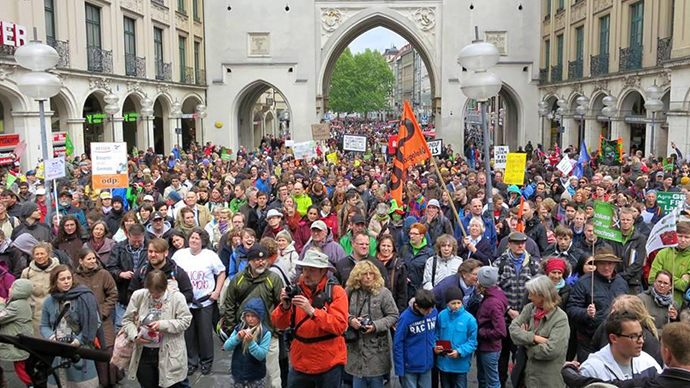
Activists of the anti-globalist Blockupy movement scuffled with dozens of riot police who charged into a marching crowd to disperse protesters, reports RT’s Peter Oliver. The march has been reportedly stopped.

What was supposed to be a march through the middle of German’s
financial capital by anti-austerity demonstrators really lasted
only about 500 meters, when several hundred riot police in full
kit came among the crowd.

The protesters started throwing paint-filled objects at the
police so puddles of paint are here and there, RT’s Peter Oliver
reported. Later the paint filled bags were confiscated by police.

The organizers maintain there are tens of thousands of protesters
and Peter Oliver witnesses a whole column of protesters going
around the ECB headquarters.

The police force has split into two groups now. They do not let
anybody through so the demonstration is not moving anywhere, as
police and protesters are locked in a stand-off. 

Water cannons arrived at the scene of a peaceful protest, Oliver
reports.

Watch video of RT correspondent Peter Oliver live from the scene.


Video:
/files/news/1f/47/00/00/original_english_international_2013-06-01_17_00_42.asf

Riot police officers have already used pepper spray several times
and some people have been taken away, but it is not clear if they
have been arrested.

RT’s crew working at the scene has been separated by the riot
police dividing demonstrators. The crew reports the use of fences
and barbed wire by police.

Photo from twitter.com user @PeterGOliver_RT

Protests in Frankfurt-am-Main started on Friday when some 3,000
‘Blockupy’ protesters, clutching signs demanding “humanity
before profit”
, blocked the main entrance of the ECB, the
organizers announced that the coalition has “reached its first
goal”
of the day.

The anti-globalism march was called to celebrate the anniversary
of the ‘Occupy’ rallies by blocking the European Central
Bank. 

The protesters moved to city’s downtown from activists’ camp in
the Frankfurt suburbs, set up earlier.

Police reported that though some protesters thrown stones and
there were some clashes at the barricades, all in all the Friday
protests were conducted peacefully.

The ECB, which has headquarters at Kaiserstrasse 29, in
Frankfurt-am-Main, has promised to remain operational during the
planned demonstrations.

Photo from twitter.com user @PeterGOliver_RT

Photo from twitter.com user @PeterGOliver_RT

Photo from twitter.com user @PeterGOliver_RT

Blockupy activists lay blame for the debt crisis in Europe with
the banks and in particular the ECB for its role in imposing
austerity measures on EU citizens.

The austerity measures proposed by the so-called troika,
consisting of the ECB, International Monetary Fund (IMF) and the
European Commission have not reduced the national debts of the
European countries. An increase of taxes and cuts of governmental
social programs they promote have actually worsened the
situation, deepening recession and increasing unemployment in the
EU dramatically.

Hanno Bruchmann, an anti-austerity activist, believes that
“There have been many capitalist crises before, but now it is
happening in the US and Europe, the financial crisis has
transformed into a debt crisis, and now is the moment in which
this has become a permanent capitalist crisis on a big
scale.”

A demonstration in German’s Frankfurt-am-Main is expected to
gather up to 20,000 protesters. Several European capitals are set
to see large rallies later in the day.

Photo from twitter.com user @PeterGOliver_RT

This article originally appeared on: RT

'Not About Trees Anymore' as Turkey Protests Intensify

0

A Turkish protester is blasted by a police watercannon in the city of Istanbul during protests that have escalated dramatically this week. (Photo: occupygezipics.tumblr.com/)What began as a protest to protect a public park in Istanbul from commercial development has escalated dramatically in a week’s time with violent clashes between demonstrators and police on Friday leading to an even larger escalation on Saturday as more than ten thousand Turkish citizens faced down security forces in a call for deeper social change.

On Saturday, what started in Gezi Park–where developers backed by the government of Prime Minister Tayyip Erdogan and his Justice and Development Party (AKP) hoped to build a shopping mall–has now spread to other parts of Instanbul.

As the Hürriyet Daily News reports:

The Turkish police’s crackdown targeting the demonstrators protesting the demolition of Taksim Gezi Park continued on June 1, as clashes broke out in Istanbul’s symbolic Istiklal Avenue and the BeÅŸiktaÅŸ district on the European side of the city.

Security forces used tear gas and water cannons this morning to quell protesters who had gathered on İstiklal Avenue, as well as its sidestreets. When the police fired the water and gas, protesters tried to escape from the narrow streets leading to the Cihangir neighborhood.

Between 4,000 and 5,000 protesters gathered again after the police’s first intervention. However police fired once again, entering the pedestrian street with a water cannon riot vehicle. Some protesters made barricades with trees and bins about 100 meters from Saint Anthony’s Church, near Galatasaray Square. Around an hour later the police destroyed the barricade and protesters escaped into sidestreets.

Despite the repeated police interventions, the numbers gathered at the protests only increased. Protesters chanted slogans against the ruling Justice and Development Party (AKP) and Prime Minister Recep Tayyip ErdoÄŸan, calling on the government to resign.

“The protesters are saying that this is not about trees anymore,” said Al Jazeera’s Rawya Rageh, reporting from Istanbul.

On Friday, in fact, an administrative court in Istanbul handed the #OccupyGezi protesters at least a temporary victory by putting a “stay” on the construction permit of the new development.

Despite that and following the aggressive use of force on Friday, including the detention of nearly 60 demonstrators on Friday, the protest movement seemed only to spread overnight.

As part of their campaign, the Gezi protest organizers released this poster calling for others to join them:

And, with dramatic photos of blood-soaked protesters at the hands of Turkish security forces via social media sites like Tumblr and Twitter, the support for those who promised to “guard the trees” has exploded.

Though he admitted police may have been overzealous in some of the use of tear gas, Ergodan was defiant on Saturday, saying that his supporters far outnumbered the youthful elements of the protests and that his favored development project would ultimately move forward.

As the Associated Press reports:

Erdogan on Saturday called on demonstrators to end anti-government protests now into a second day, but he remained defiant, insisting police would break down protests at a main Istanbul square and indicating that the government would press ahead with the redevelopment plans that sparked the demonstrations.

In a televised speech, Erdogan said police may have used tear gas excessively while confronting protesters and said this would be investigated. But he said the protesters did not represent the majority and accused them of raising tensions.

Police let off more tear gas and pressurized water against waves of protesters trying to reach a main square in Istanbul or the Parliament building in the capital, Ankara, early on Saturday, but appeared to be allowing crowds to approach the heavily guarded square in the afternoon.

A woman holds up a banner that reads “Don’t interfere with my life style ” as thousands of people gather in support. (Photo: AP)

_________________________________________

This work is licensed under a Creative Commons Attribution-Share Alike 3.0 License

This article originally appeared on: Common Dreams

Thousands of protesters on Taksim square after riot police withdrawal

0

Riot police in Istanbul are withdrawing from Taksim Square and allowing the mass protest to continue unabated, Turkish state media reports. Istanbul and Ankara are seeing a second day of violent protests, with tear gas and water cannons being deployed.

Minor scuffles
broke out after protesters lobbed fireworks at officers as they
were drawing back, the state-run Anadolu Agency reports. Police
removed barricades around the square, located in the heart of the
city, which had previously been erected to prevent the
anti-government protests, Private Dogan news agency said.

Despite the authorities decision to allow thousands to flood onto
the square, the main subway gateway to Taksim, the central
station in the city’s metro network, has reportedly been shut
down in an effort to keep more people from reaching the ongoing
protests.

Earlier the bridge over the Bosphorous Strait in Istanbul was
blocked by thousands of protesters heading west from the eastern
part of the city in an effort to reach the centrally located
square, which has been cordoned off by police.

In the capital, Ankara, security forces battled with
demonstrators who had amassed at a park near Prime Minister Recep
Tayyip Erdogan’s office. Rallies have also been staged in the
cities of Bodrum, Konya and Izmir.

Confronted with the growing street opposition, Erdogan remained
defiant, demanding that protesters “stop their demonstrations
immediately.”

“Police were there yesterday, they’ll be on duty today and
also tomorrow because Taksim Square cannot be an area where
extremists are running wild,”
the PM warned.

Screenshot from AP video

On Monday, several dozen activists tried to stage a sit-in in
Gezi Park, the last area of green space left on Taksim Square,
after several trees were torn up to make way for a commercial
redevelopment.

Erdogan dismissed the small protest on Wednesday, saying
authorities would go ahead with the plan, which entails the
construction of a replica Ottoman-era barracks that could house a
shopping mall or apartments.  

Following three days of police pressure, which saw officers douse
peaceful protesters with pepper spray and tear gas, the sit-in
attracted support from broad sections of Turkish society.

Screenshot from AP video

On Friday morning, riot police stormed the camp, deploying water
cannons and tear gas, sparking the ongoing unrest. Human rights
activists said hundreds were wounded as clashes raged on
throughout the night.

The heavy-handed tactics deployed by police have been viewed by
demonstrators as a sign of the government’s increasingly
authoritarian bent, with the park demonstration turning into a
broader, nationwide protest against Erdogan’s government.

Similar demonstrations have flared up around the country despite
a court decision to temporarily halt demolition of the park.

Erdogan said that the Turkish Interior Ministry had launched an
investigation into the use of excessive force by security forces.
In a televised speech, the Turkish PM said police may have used
tear gas excessively during their confrontation with protesters,
although he insisted they did not represent the majority and were
responsible for raising tensions. 

However, protesters have countered the claim, saying the violent
police crackdown is to blame for the recent unrest.

“This started simply as a peaceful sit-in to save a park, but
it’s become one of the worst state attacks on protesters in
recent memory — and a frightening example of the Turkish
government’s growing eagerness to crack down on its own
citizens,”
an online petition demanding that Erdogan “End
the crackdown now!” reads.

“The security forces have been individually targeting
protesters to terrify, wound and kill us. 12 people have already
suffered trauma injuries from gas canisters — one man died of
heart attack, and hundreds are suffering from excessive gas
inhalation,”
it continues.

Riot police use tear gas to disperse the crowd during an anti-government protest in Istanbul June 1, 2013.(Reuters / Murad Sezer)

Turkish protestors arrive in Taksim square after a clashing with riot policemen on June 1, 2013.(AFP Photo / Bulent Kilic)

This article originally appeared on: RT

Hand 'Em Over: Judge Rules Google Must Comply with FBI Demands for Customer Data

0

In a defeat for privacy advocates and a warning to those worried about the encroaching ability of federal law enforcement agencies to spy on electronic communications without search warrants or judicial oversight, a judge has ruled against Google Inc. saying the internet giant must hand over customer data when requested by the FBI.

In defense of privacy, Google had argued that the government’s issuance of so-called “national security letters” was both “unconstitutional and unnecessary.”

The letters require internet service providers (ISPs) or other telecommunications companies to hand over customer information, but go further by stipulating, under threat of prosecution, that the companies cannot inform their customers that the information is being sought or may be under surveillance.

As the Associated Press reports:

The letters are used to collect unlimited kinds of sensitive, private information, such as financial and phone records and have prompted complaints of government privacy violations in the name of national security. Many of Google’s services, including its dominant search engine and the popular Gmail application, have become daily habits for millions of people.

In a ruling written May 20 and obtained Friday, U.S. District Court Judge Susan Illston ordered Google to comply with the FBI’s demands.

The issue is not nearly resolved, however, as the judge did put a stay on her final decision by acknowledging that the 9th Circuit Court of Appeals will be tackling the issue of the letters in an upcoming case.

Kurt Opsah, an attorney with the Electronic Frontier Foundation, which has filed a separate suit against the government’s use of such letters, was disappointed that Illston seems to be sending mixed messages on the authority or legality of the government’s tactics. It was Illston who ruled on the suit brought by EFF in which she found, as the AP reports, “that the FBI’s demand that recipients refrain from telling anyone — including customers — that they had received the letters was a violation of free speech rights.”

“We are disappointed that the same judge who declared these letters unconstitutional is now requiring compliance with them,” Opsah said on Friday.

CNET adds:

The litigation taking place behind closed doors in Illston’s courtroom — a closed-to-the-public hearing was held on May 10 — could set new ground rules curbing the FBI’s warrantless access to information that Internet and other companies hold on behalf of their users. The FBI issued 192,499 of the demands from 2003 to 2006, and 97 percent of NSLs include a mandatory gag order.

It wasn’t a complete win for the Justice Department, however: Illston all but invited Google to try again, stressing that the company has only raised broad arguments, not ones “specific to the 19 NSLs at issue.” She also reserved judgment on two of the 19 NSLs, saying she wanted the government to “provide further information” prior to making a decision.

NSLs are controversial because they allow FBI officials to send secret requests to Web and telecommunications companies requesting “name, address, length of service,” and other account information about users as long as it’s relevant to a national security investigation. No court approval is required, and disclosing the existence of the FBI’s secret requests is not permitted.

_______________________________________________

This work is licensed under a Creative Commons Attribution-Share Alike 3.0 License

This article originally appeared on: Common Dreams

Prisoners held in British Afghan base no different to Gitmo inmates — MP

0

Preaching to other countries by Britain and the US is ‘hypocritical and hollow’ when Camp Bastion and Guantanamo are in direct breach of international law, Jeremy Corbyn, a Labour, MP told RT.

RT: Mr. Corbyn, is it right to compare Camp Bastion to
Guantanamo Bay?

Jeremy Corbyn: The principles are very much the same, that
is that people are collected or arrested as enemy combatants and
for very long periods not allowed normal judicial process. With
Guantanamo Bay, and I think the legacy of 2001, camp
Bastion and the extraordinary rendition process is something that
is going to live for a very long time, international law has been
seriously undermined by Britain and the USA in their behavior
over Afghanistan for the past 12 years.

RT: I guess not only breaking international law but
human rights violations in these facilities have occurred, in
Guantanamo we know that the detainees are starving themselves to
be heard, do we know what is happening to those at camp
Bastion?

JC: Well, it’s very difficult to find out exactly what is
happening there and also what the nationality of some of the
prisoners actually is. There is no longer any rendition going on
from either of the bases in Afghanistan to Guantanamo Bay, but
there seems to be considerable numbers held at both prisons and
its very unclear whether the handing over of the bases to the
Afghan authorities when the main forces of Britain and the USA
withdraw next year, is actually going to be complete or whether
there will be a security facility retained by the USA and
Britain, which will include the prison facilities. What we do
know is that the preaching of international law by Britain and
the USA and others seems to me very hypocritical and hollow when,
on the question of the past rendition of soldiers, not soldiers
but prisoners rather, to Guantanamo Bay but also the indefinite
detention of people in both these bases who may well be Afghan
people or may well be people from neighboring countries.

RT: We know that President Obama has said that he wants
to shut down the Guantanamo Bay prison, but those words have just
been met with skepticism now, what do we know of the British
authorities, are they planning to return these prisoners to the
Afghan authorities when they leave Afghanistan?

JC: Well, I’ve had a number of meetings with the British
government and I’ve raised the issue in parliament about British
nationals who were held in Guantanamo Bay, all of whom have now
been released and are now British residents, these are foreign
nationals with the right of residence in Britain, the most
prominent of which Shaker Aamer who is still held in
Guantanamo Bay and is on hunger strike at the present time. The
official position of the British government is that Guantanamo
should be closed down and that all the prisoners should either be
put on trial or released, that is its official position.
President Obama claimed in his first election campaign he was
going to close down Guantanamo Bay, he said as much in his second
election campaign and here we are 5 years later, it’s still up
and running, he claims or his administration claim that they
can’t get it passed in the house and the senate in the USA and
that’s the problem. I find it quite extraordinary that a major
power like the USA should flout international law in this way,
and I think we have to redouble our efforts to get Guantanamo Bay
closed down and the rule of international law asserted.

RT: Just briefly, what do these kinds of prisons tell
us about this US-led war that Britain was also involved in, in
Afghanistan?

JC: Well it shows an utter contempt for the alleged
independence of the Afghan government. The Afghan government is
supposed to be in charge of the country and there are British and
American and many other soldiers allegedly fighting to protect
this government, they claim they can’t hand prisoners over to
this government because they’ll be tortured but instead they’re
held illegally in these two bases, What we need is transparency,
the right of visiting, the right of representation, and to either
release the prisoners or put them on trial. It is simply not
right that prisoners should be held indefinitely without charge
or trial.

This article originally appeared on: RT

Gitmo staff treat detainees 'worse than animals' – prisoner's lawyer

0

The hunger strikers at the Guantanamo Bay camp are being subjected to freezing temperatures in their cells and made to choose between shower and sleep, “punished and treated like animals,” a lawyer for a Gitmo detainee told RT.

Anne Richardson’s client was among the first inmates to go on
hunger strike, she told RT, adding he is now “skin and
bones.”

RT: When did you last see your client? What can you say
about his health?

Anne Richardson: I met with my client in early May and it
was shocking to see how thin he was and how impossible it was for
him to focus. He’s been hunger striking since February 6 and it’s
just getting increasingly desperate. He has lost so much weight,
he is just skin and bones. It was just terrifying to see him in
this condition and not to know what was going to happen to him.

RT: How is he describing his daily routine at
Guantanamo? Is he complaining about what’s going on at the
prison?

AR: My client has been kept in solitary confinement; many
of his items are taken away from him, including attorney-client
mail. He was not allowed to have a toothbrush, toothpaste or soap
in his cell for many weeks. I don’t know even if he’s gotten them
to this day. They have made conditions at times freezing cold for
them in the cells. They are requiring that they submit to very
humiliating searches of their genital area in order to meet with
their attorneys or talk with them on the telephone. It is just
humiliating. It’s been difficult for them to sleep at night. They
are sometimes taken to their showers in the middle of the night,
so they have to decide between sleep and getting a little bit of
cleanliness. It’s just been very punitive.

RT: What are the detainees’ sentiments as their hunger
strike has been going on for four months?

AR: The detainees are really attempting to have treatment
be restored to them as human beings, rather than being punished
and treated like animals. I have had my client tell me many
times: “They treat animals better than they treat detainees.”
They want to be heard, they want to be treated with respect
again, and those of them who have been force-fed do not want to
have that treatment continue. The detainees are very united in
their concern that Obama not forget his promise to close
Guantanamo and to treat them fairly. It has been more than five
years now that Obama first said that he was going to close the
prison and it is still not going anywhere since that time. I
don’t think until detainees start being transferred will we see
the hunger strike end.

RT: Do you think the hunger strike might turn deadly in
the end?

AR: Most of the men there really are not suicidal. But
they have been driven to this sign of desperation by the fact
that there is nobody listening to them, nobody is forcing the
administration to follow up on its promise.

RT: What effort do you undertake to help the inmates at
Guantanamo? When do you think the hunger strike might end?

AR: The government has refused to speak with those of us
who represent the prisoners, they have refused to loosen any of
their tight restrictions on the prisoners and, as you know from
Obama’s speech, he has made very pretty promises, but he has yet
to follow up with any action. We know that if the government
would simply speak with the men, treat them fairly, would turn
their policies to the way they had been operating before this
recent crackdown, and if they started to transfer those men who
have been cleared, they could end this hunger strike right now.
At this point we are trying to get the word to the rest of the
world, so that they understand that all of the people who are
still in Guantanamo are human beings. Many of them have been
cleared by the United States government of any misconduct and the
rest deserve a trial or to be released.

This article originally appeared on: RT

Schools scanned students’ irises without permission

0

RT
June 1, 2013

Parents in Polk County, Florida are outraged after learning that students in area schools had their irises scanned as part of a new security program without obtaining proper permission.

Students at three facilities – an elementary school, a grade school and a high school – had their eyeballs scanned earlier this month as part of a ‘student safety’ pilot program being carried out by Stanley Convergent Security Solutions.

“It simply takes a picture of the iris, which is unique to every individual,” Rob Davis, the school board’s senior director of support services, wrote home to parents in a letter dated May 23. “With this program, we will be able to identify when and where a student gets on the bus, when they arrive at their school location, when and what bus the student boards and disembarks in the afternoon. This is an effort to further enhance the safety of our students.The EyeSwipe-Nano is an ideal replacement for the card based system since your child will not have to be responsible for carrying an identification card,” he added.

Parents at Daniel Jenkins Academy, Bephune Academy and the Davenport School of the Arts received the letter from the school board on May 24 informing them of the EyeSwipe-Nano program and that their child’s principal should be notified if they don’t want their son or daughter to participate.

But elsewhere in the letter, the board explained that the program would begin last Monday, May 20. By the time the letter was received on Friday, iris scans had already been completed at the three area schools without a single student opting out, Angel Clark wrote for The Examiner this week.

Because Memorial Day landed on May 27, parents were unable to receive confirmation from the school until this Tuesday, nearly one week after the scans began.

In the letter, Davis described the scanning as a safe and noninvasive way of collecting students’ biometric data as a way of ensuring the safety of pupils in the Polk County school district. Parents are appalled that they weren’t informed of the program ahead of time, though, and are calling it an invasion of privacy.

  • A d v e r t i s e m e n t

“It seems like they are mostly focused on this program, like the program was the problem. It’s not, it’s the invasion of my family’s Constitutional right to privacy that is the problem, as well as the school allowing a private company access to my child without my consent or permission,” one concerned parent wrote in a Facebook post that has since been shared hundreds of times. “This is stolen information, and we cannot retrieve it.”

When the parent reached the school on Tuesday, she was told that the program was suspended.

Reporter Michelle Malkin caught up with Davis on Wednesday and he apologized for the board’s actions and confirmed that the data had been destroyed.

“Davis told me that ‘it is a mistake on our part’ that a notification letter to parents did not go out on May 17,” she wrote. “He blamed a secretary who had a ‘medical emergency.’”

Polks planned to install EyeSwipe-Nano units on 17 local school busses starting next year. The scandal comes just months after a high school student in Texas was suspended for refusing to wear an identification card to class.

<!–

–>

This article was posted: Saturday, June 1, 2013 at 10:16 am

Tags: , ,


<!– this is where we need to show the related articles

–>

This article originally appeared on: Infowars

Cracking The Bilderberg Nut

0

Jurriaan Maessen
Infowars.com
June 1, 2013

As the stuffed dolls of mainstream media will expectedly persist in their silent obedience in all things Bilderberg, the hearts of activists and bloggers alike are again beating the drums of desperation- signaling with bells, horns, trumpets, or whatever instrument is needed to incinerate the dreaded silence that has hung heavy on journalism for many-a-decade. O there’s plenty of chatter swelling up into the airwaves about a range of non-issues and trifles to clot up the ear, usually put out by a particular type of male or female automaton screeching through the TV-screen on a balanced dose of Prozac and amphetamines.

In leading mankind further into a Faraday’s cage of disinformation the establishment media has accomplished a few things. The most important one of which is the discrediting of their own reporting- or non-reporting-, as they continue to collectively gloss over the event, subsequently digging a deep and terrible hole for themselves from which, in the end, there is no climbing out. It’s a case of professional self-mutilation really- a lucid, self- imposed state of comatose slumber that serves to transfix the populace on the disinformation-units coming straight out of the Bilderberg machine. The machine is still spitting out the packages, but now the assembly line is starting to fail at distributing them.

The annual tradition prescribes that the Anglo-American establishment will gather around its favorite deity from June 6 to June 9 in England’s green and pleasant land. Right there, in the seclusion of deep woodland shade, the participants will be busy working out in more detail how to further bankrupt the West in order to “equalize” world power under Agenda 21- and all of these deliberations occur in a most relaxing atmosphere it must seem, as if among friends. Investigators, activists and bloggers are of course now jumping into the gap left vacant by migrating “journalists” over the course of more than half a century. Is say “migrating”, but one cannot really migrate from somewhere one has never been. Regardless, in order to somehow break the spell of silence placed on Prince Bernhard’s baby by successive generations of globalist-controlled media outlets, it seems the “alternative” media are now starting to crack this solid shell of secrecy surrounding Bilderberg. The beginning of a beginning. Unfortunately the Chatham House Rulebook is a nut not easily cracked. It requires on our part creative mad inventiveness and bold adventurism to break these Rules by which Bilderberg participants are required to hold their tongue.

What is Bilderberg? An unelected, mostly unregistered “steering committee” summon a great many folk to them every single year for three days. The summoners consist of top-level bankers and aristocratic misfits. The summoned consist of a variety of elected officials, swarms of them, drifting in secret to a luxurious location somewhere in the North-West. Imagine this: these officials are all rotating to what Bilderberg itself describes as a “private meeting”, but they do so in their capacity of influence- and they’re sworn to shut up at that! In addition, the entire mainstream media apparatus vowing a solemn vow of silence. Not only is something rotten in the state of Denmark, something is stinking to high heaven in the state of Denmark. But, as with all things mechanical, an apparatus may be put to a halt by a single bolt.

For any interested and adventurous scoundrel there may still be vacancies at the upcoming Bilderberg conference. So, if you live somewhere- anywhere in the vicinity of the Grove Hotel and you are in need of a quick buck, perhaps you may still attempt to temporarily join the present hotel staff- who will no doubt welcome an extra hand in what is sure to be New World Order busy season at the hotel venue. The Grove website says: “We are committed to exceeding our guests’ expectations and, to do that, we need exceptional people.” Indeed. Exceptional people are in rich supply within the alternative media. If you are of a somewhat believable age and in the possession of some inconspicuous recording equipment, it’s definitely the job for you. Besides, the Grove appears to be a generous employer, promising future staff members “discounted accommodation for yourself, friends and family; sabbaticals and career breaks for long service employees; staff accommodation near The Grove; complimentary staff canteen as well as access to our hotel gym”.

If you are of believable age and in the possession of some inconspicuous recording equipment, it’s definitely the job for you. Although no mention is made on the starting wage for fresh staff members (in any case you’ll be paid in devalued fiat money), take into account that you’ll be recording some interesting stuff for posterity, making you the prime candidate for a star on the alternative media’s walk of fame. What are you waiting for? Perhaps there are still jobs available at the most bizarre of elite gatherings and- again- don’t forget to bring a camera or other recording device (preferably small sized and well-camouflaged) with plenty of back-up equipment as well as a secure line with the outside world in case your cover is blown by Bilderberg security.

If you’re selected on such short notice to assist the staff, you will enter the premises on what David Gergen calls “an understanding”. It will be a great example of a grassroots intelligence operation, for once not in the service of the new world order’s one percent, but as a representative of the uninvited 99 percent kept well outside the deliberations taking place. As a member of the staff you may be assigned to do such things as valet parking, baggage handling, waiting on transnationalists in the main dining area. It allows for a lover of truth to infiltrate the elite confab with a relatively simple audiovisual device. And besides, it’s not without historical precedent. It’s not the first time an employee blew the whistle on the strange dealings of the power elite. Five years after Alex Jones’ successful infiltration of the Bohemian Grove in the year 2000, a former Bohemian Grove employee named “Kyle” shot over five hours of video with a pen camera. He, like Alex Jones, was able to smuggle it out of the encampment for all the world to see. But his infiltration was not easily accomplished. While “Kyle” was working in the area, he was approached many times by older Grove participants who wanted to know if he “slept around”. It has been widely reported that Bohemian Grove members regularly fly in male and female prostitutes to prey upon in between seminars. Let this be a warning to anyone considering a last minute position at the Grove Hotel for infiltration purposes. You may put yourself in a position where you’ll be fighting off elderly globalists begging for certain “favors”.

Anyone not willing to put themselves in harm’s way (to hell with posterity!) will want to consider outsourcing any spying activities to technological gadgets such as drones the size of mosquitoes swarming the Hotel with the specific aim of irritating the hell out of Henry Kissinger. How’s that? One might deploy mechanical pigeons perhaps, to dump excrement on Shell’s entire board of directors. What the hell: we could enlist some grim-looking smurfs to spy out the proceedings at this year’s confab. They could enter the Hotel through the sewer at the risk of exiting the toilet inside at the exact moment David Rockefeller is taking a dump.

But seriously. Either an infiltrator is sent, or the judicial system in all concerned nations begin an investigation into the participation of elected officials in an unaccountable and nontransparent summit. You call it.

Jurriaan Maessen’s article first appeared at ExplosiveReports.com.

Editor’s note: The latest issue of the Infowars Magazine covers Bilderberg 2013. Pick it up at the Infowars Store today.

Infowars is calling on everyone to make their presence known outside the Grove Hotel and send a message to authorities that attempts to stifle free speech and the freedom of the press will not be tolerated.

<!–

–>

This article was posted: Saturday, June 1, 2013 at 10:07 am

Tags: ,


<!– this is where we need to show the related articles

–>

This article originally appeared on: Infowars

Gitmo strikers want independent doctors

0

File photo shows a detainee with guards at the US prison in Guantanamo Bay, Cuba.

A group of hunger striking prisoners at Guantanamo Bay prison in Cuba has called on the US-run facility’s military doctors to allow them access to non-military, independent physicians.

In a letter sent to the military doctors and published by the UK’s daily Guardian on Friday, the prisoners wrote that they cannot trust the military doctors.

Å“I cannot trust your advice because you are responsible to your superior military officers who require you to treat me by means unacceptable to me, and you put your duty to them above your duty to me as a doctor,” prisoners wrote in the letter.

About 130 prisoners have been on hunger strike at the Guantanamo Bay prison for over 100 days in protest against their long imprisonment without charge or trial, as well as the horrible conditions at the jail.

Reports say some of the prisoners on hunger strike were being force-fed via tubes snaked up their nose and into their stomach, and five had been hospitalized.

The prisoners also wrote in the letter that the force-feeding administered by military physicians is Å“in violation of the ethics” of their profession.

In April, David Remes, a lawyer representing 17 Guantanamo prisoners, said many of the hunger-striking detainees at the US infamous prison are being treated like animals and brutally force-fed.

The International Committee of the Red Cross (ICRC) has also urged US President Barack Obama’s administration to mend the situation in Guantanamo that has compelled prisoners to starve themselves, saying that the act of force-feeding is akin to torture.

MAM/SS

This article originally appeared on: Press TV

The Wars Are Coming Home

0

 Standard Podcast Hide Player | Play in Popup | Download

Gerald Celente talks to Lew Rockwell about the end of the empire.


‘Iran, India talk gas field development’

0

File photo shows installations at an Iranian gas field.

Iranâ„¢s Oil Minister Rostam Qasemi says Tehran and New Delhi have held constructive talks on Indiaâ„¢s partnership in the development of Farzad B gas field in the Persian Gulf.

Qasemi pointed to fruitful talks between Iranian and Indian officials during his three-day visit to New Delhi and said both sides discussed Indiaâ„¢s partnership in the development of Farzad B gas field.

He said that the details of negotiations will be announced by the joint team of experts of the two countries within three months.

The Farzad-B gas field has in-place reserves of up to 21.68 trillion cubic feet (Tcf), 12.8 Tcf of which may be recoverable.

The Iranian minister made the remarks on the sidelines of the 163rd ordinary session of the Organization of Petroleum Exporting Countries (OPEC) in the Austrian capital, Vienna, on Friday.

Asked if Iran might offer its crude at a lower price to encourage purchasers, Qasemi said, Å“Iran sells its crude to customers based on the international price.”

Commenting on the effect of sanctions on Iranâ„¢s crude exports, he stressed that the country is selling its crude despite the imposed embargoes.

The United States, Israel and some of their allies have repeatedly accused Iran of pursuing non-civilian objectives in its nuclear energy program. Over the false allegation, Washington and the European Union have imposed a series of illegal unilateral sanctions against the Islamic Republic.

Iran refutes the allegation over its nuclear energy program and argues that as a signatory to the Non-Proliferation Treaty and a member of the International Atomic Energy Agency, it is entitled to develop nuclear technology for peaceful purposes.

AR/HGH

This article originally appeared on: Press TV

Companies reject UK’s call for spying

0

Internet companies have rejected the UK governmentâ„¢s call for snooping on Britons’ online communications.

The worldâ„¢s five biggest internet companies have refused to voluntarily cooperate with the British governmentâ„¢s controversial Communications Data Bill, known as the Å“Snooperâ„¢s Charter”.

In a leaked letter to British Home Secretary Theresa May, which dated on April 18, web companies, including Google, Microsoft, Yahoo!, Twitter and Facebook, said the UK governmentâ„¢s revised proposals to track people’s online communications remain “expensive to implement and highly contentious”, The Guardian reported.

They also warned that the plan requiring overseas internet companies to store all British-based usersâ„¢ communications data for up to 12 months has “potentially seriously harmful consequences”.

The Communications Data Bill, which was first published last year, drew wide opposition from across the political establishment with Deputy Prime Minister Nick Clegg withdrawing his support from the bill in April on the grounds that it was an invasion of privacy.

Recently, however, the Home Secretary called for the bill to be revived in the wake of the murder of British soldier Lee Rigby, who was stabbed to death in Woolwich, south-east London last week.

The so-called Å“Snooperâ„¢s Charter” would have given agencies, including police and spying services, access to information and data collection by Internet service providers, including details of individuals’ web browsing history, social media messages and internet gaming, storing them all for 12 months.

Earlier in April, a survey by civil liberties and privacy campaign group Big Brother Watch British also found that British police forces are making as many as 250,000 requests to snoop on people’s email and phone call details every year.

SSM/HE

This article originally appeared on: Press TV

‘Iran bans not to stop petchem industry’

0

File photo shows a petrochemical plant in southern Iran.

Iranian Deputy Oil Minister Abdolhossein Bayat says illegal Western sanctions will not stop the progress of Iranâ„¢s booming petrochemical industry.

Å“Iranâ„¢s petrochemical industry is rapidly progressing and illegal sanctions will not stop the process of this industryâ„¢s … development and progress,” The director of the National Iranian Petrochemical Organization (NIPO) said Saturday.

Å“Iranâ„¢s petrochemical products are exported to five continents and demand for our countryâ„¢s petrochemical production is increasing due to [their] quality and variety,” Bayat added.

The Iranian official said last year Iran exported 16 million tons of petrochemical products worth 12 billion dollars.

The US Treasury Department issued a statement on Friday, announcing sanctions against eight Iranian petrochemical companies including Bou Ali Sina, Mobin, Nouri, Pars, Shahid Tondgouyan, Shazand, Tabriz and Imam.

At the beginning of 2012, the US and the European Union imposed new sanctions on Iranâ„¢s oil and financial sectors with the goal of preventing other countries from purchasing Iranian oil and conducting transactions with the Central Bank of Iran.

The illegal US-engineered sanctions were imposed based on the unfounded accusation that Iran is pursuing non-civilian objectives in its nuclear energy program.

Iran rejects allegations, arguing that as a committed signatory to the Non-Proliferation Treaty and a member of the International Atomic Energy Agency, it has the right to use nuclear technology for peaceful purposes.

In addition, the IAEA has conducted numerous inspections of Iran’s nuclear facilities but has never found any evidence showing that Iran’s civilian nuclear program has been diverted to nuclear weapons production.

MYA/HGH

This article originally appeared on: Press TV

Turkey protesters urge PM to resign

0

Riot police use tear gas to disperse the crowd during an anti-government protest at Taksim Square in central Istanbul on June 1, 2013.

More than 100,000 Turkish protesters have gathered at Istanbulâ„¢s Taksim Square, calling for the resignation of Prime Minister Recep Tayyib Erdogan.

The protesters occupied the iconic Taksim Square on Saturday as part of their demonstration against the governmentâ„¢s decision to demolish Gezi Park and replace it with an Ottoman-era military barracks to be used as a shopping mall.

Police forces clashed with protesters, using tear gas and water cannons to disperse them. Riot police also blocked thousands of protesters from moving towards Taksim Square.

The protesters condemned the Turkish government as a Å“fascist government” and called Erdogan a new Å“Sultan.”

The protesters also carried banners reading Å“Nation will hold ruling AKP (the Justice and Development Party) accountable,” calling on the government to resign.

Erdogan has admitted Å“extreme” police action against protesters in Istanbul.

Footages show thick smoke rising over Taksim Square, the cause of which is not known yet.

Protesters also condemned Erdoganâ„¢s stance on the ongoing crisis in the neighboring Syria.

As the unrest escalated, President Abdullah Gul called for Å“common sense” to prevail noting that anti-government protests have reached a Å“worrisome level.”

“We all need to be mature in order for the protests … which have reached a worrisome level, to calm down,” Gul said in a statement.

Reports say electricity and Internet services were shut down in parts of the city as anti-government demonstrations continued.

Earlier in the day, Erdogan called on protesters to Å“stop their demonstrations immediately,” saying the government would not back away from the controversial park project .

Thousands of people also took to the streets in other cities, including the capital Ankara, Izmir, Mugla and Antalya in support of the protesters in Istanbul.

The unrest turned into anti-government protests after police moved into Taksim Square on Friday in order to break up a sit-in protest against the razing of the park, arresting dozens of protesters.

The protesters say Gezi Park, which is a traditional gathering point for rallies and protests as well as a popular tourist destination, is the city’s last green public space.

SAB/SS

This article originally appeared on: Press TV

Six Months On, And Still No Sandy Hook Report?

0

Who made the state police king?

Hartford Courant
June 1, 2013

Who made the state police king? Why do they continue to drag their feet in releasing a final report on the investigation into the devastating Dec. 14 shootings at Sandy Hook Elementary School? Who gave that agency the authority to decide what the public should know and when they should know it?

Last March, peeved because high-ranking state police officers attending law enforcement conferences were leaking details from the massacre investigation that had not been made public, Gov. Dannel P. Malloy demanded an interim report on the status of the probe. The investigators complied, while stating that a final report on the heinous crime would not be finished until mid-June – at the earliest.

Now we are told by the state police that a final investigative report on Sandy Hook won’t be ready until the end of September, more than nine months after the crime was committed.

Read full article

Following the events of Sandy Hook, Alex Jones went on record to explain why people believed the shooting may have been an elaborate hoax, relying on a complicit media to help push the narrative.

<!–

–>

This article was posted: Saturday, June 1, 2013 at 9:43 am

Tags:


<!– this is where we need to show the related articles

–>

This article originally appeared on: Infowars

Prisoners held in British Afghan base no different to Gitmo inmates — MP

0

Preaching to other countries by Britain and the US is ‘hypocritical and hollow’ when Camp Bastion and Guantanamo are in direct breach of international law, Jeremy Corbyn, a Labour, MP told RT.

RT: Mr. Corbyn, is it right to compare Camp Bastion to
Guantanamo Bay?

Jeremy Corbyn: The principles are very much the same, that
is that people are collected or arrested as enemy combatants and
for very long periods not allowed normal judicial process. With
Guantanamo Bay, and I think the legacy of 2001, camp
Bastion and the extraordinary rendition process is something that
is going to live for a very long time, international law has been
seriously undermined by Britain and the USA in their behavior
over Afghanistan for the past 12 years.

RT: I guess not only breaking international law but
human rights violations in these facilities have occurred, in
Guantanamo we know that the detainees are starving themselves to
be heard, do we know what is happening to those at camp
Bastion?

JC: Well, it’s very difficult to find out exactly what is
happening there and also what the nationality of some of the
prisoners actually is. There is no longer any rendition going on
from either of the bases in Afghanistan to Guantanamo Bay, but
there seems to be considerable numbers held at both prisons and
its very unclear whether the handing over of the bases to the
Afghan authorities when the main forces of Britain and the USA
withdraw next year, is actually going to be complete or whether
there will be a security facility retained by the USA and
Britain, which will include the prison facilities. What we do
know is that the preaching of international law by Britain and
the USA and others seems to me very hypocritical and hollow when,
on the question of the past rendition of soldiers, not soldiers
but prisoners rather, to Guantanamo Bay but also the indefinite
detention of people in both these bases who may well be Afghan
people or may well be people from neighboring countries.

RT: We know that President Obama has said that he wants
to shut down the Guantanamo Bay prison, but those words have just
been met with skepticism now, what do we know of the British
authorities, are they planning to return these prisoners to the
Afghan authorities when they leave Afghanistan?

JC: Well, I’ve had a number of meetings with the British
government and I’ve raised the issue in parliament about British
nationals who were held in Guantanamo Bay, all of whom have now
been released and are now British residents, these are foreign
nationals with the right of residence in Britain, the most
prominent of which Shaker Aamer who is still held in
Guantanamo Bay and is on hunger strike at the present time. The
official position of the British government is that Guantanamo
should be closed down and that all the prisoners should either be
put on trial or released, that is its official position.
President Obama claimed in his first election campaign he was
going to close down Guantanamo Bay, he said as much in his second
election campaign and here we are 5 years later, it’s still up
and running, he claims or his administration claim that they
can’t get it passed in the house and the senate in the USA and
that’s the problem. I find it quite extraordinary that a major
power like the USA should flout international law in this way,
and I think we have to redouble our efforts to get Guantanamo Bay
closed down and the rule of international law asserted.

RT: Just briefly, what do these kinds of prisons tell
us about this US-led war that Britain was also involved in, in
Afghanistan?

JC: Well it shows an utter contempt for the alleged
independence of the Afghan government. The Afghan government is
supposed to be in charge of the country and there are British and
American and many other soldiers allegedly fighting to protect
this government, they claim they can’t hand prisoners over to
this government because they’ll be tortured but instead they’re
held illegally in these two bases, What we need is transparency,
the right of visiting, the right of representation, and to either
release the prisoners or put them on trial. It is simply not
right that prisoners should be held indefinitely without charge
or trial.

This article originally appeared on: RT

Gitmo staff treat detainees 'worse than animals' – prisoner's lawyer

0

The hunger strikers at the Guantanamo Bay camp are being subjected to freezing temperatures in their cells and made to choose between shower and sleep, “punished and treated like animals,” a lawyer for a Gitmo detainee told RT.

Anne Richardson’s client was among the first inmates to go on
hunger strike, she told RT, adding he is now “skin and
bones.”

RT: When did you last see your client? What can you say
about his health?

Anne Richardson: I met with my client in early May and it
was shocking to see how thin he was and how impossible it was for
him to focus. He’s been hunger striking since February 6 and it’s
just getting increasingly desperate. He has lost so much weight,
he is just skin and bones. It was just terrifying to see him in
this condition and not to know what was going to happen to him.

RT: How is he describing his daily routine at
Guantanamo? Is he complaining about what’s going on at the
prison?

AR: My client has been kept in solitary confinement; many
of his items are taken away from him, including attorney-client
mail. He was not allowed to have a toothbrush, toothpaste or soap
in his cell for many weeks. I don’t know even if he’s gotten them
to this day. They have made conditions at times freezing cold for
them in the cells. They are requiring that they submit to very
humiliating searches of their genital area in order to meet with
their attorneys or talk with them on the telephone. It is just
humiliating. It’s been difficult for them to sleep at night. They
are sometimes taken to their showers in the middle of the night,
so they have to decide between sleep and getting a little bit of
cleanliness. It’s just been very punitive.

RT: What are the detainees’ sentiments as their hunger
strike has been going on for four months?

AR: The detainees are really attempting to have treatment
be restored to them as human beings, rather than being punished
and treated like animals. I have had my client tell me many
times: “They treat animals better than they treat detainees.”
They want to be heard, they want to be treated with respect
again, and those of them who have been force-fed do not want to
have that treatment continue. The detainees are very united in
their concern that Obama not forget his promise to close
Guantanamo and to treat them fairly. It has been more than five
years now that Obama first said that he was going to close the
prison and it is still not going anywhere since that time. I
don’t think until detainees start being transferred will we see
the hunger strike end.

RT: Do you think the hunger strike might turn deadly in
the end?

AR: Most of the men there really are not suicidal. But
they have been driven to this sign of desperation by the fact
that there is nobody listening to them, nobody is forcing the
administration to follow up on its promise.

RT: What effort do you undertake to help the inmates at
Guantanamo? When do you think the hunger strike might end?

AR: The government has refused to speak with those of us
who represent the prisoners, they have refused to loosen any of
their tight restrictions on the prisoners and, as you know from
Obama’s speech, he has made very pretty promises, but he has yet
to follow up with any action. We know that if the government
would simply speak with the men, treat them fairly, would turn
their policies to the way they had been operating before this
recent crackdown, and if they started to transfer those men who
have been cleared, they could end this hunger strike right now.
At this point we are trying to get the word to the rest of the
world, so that they understand that all of the people who are
still in Guantanamo are human beings. Many of them have been
cleared by the United States government of any misconduct and the
rest deserve a trial or to be released.

This article originally appeared on: RT

US, S Korea vow alliance against North

0

US Defense Secretary Chuck Hagel (R) greets South Korean Defense Minister Kim Kwan-jin before the opening session of the Shangri-La Dialogue in Singapore on June 1, 2013.

South Korean Defense Minister Kim Kwan-jin and his US counterpart, Chuck Hagel, have vowed to maintain strong alliance in the face of what they described as potential threats from North Korea.

During a meeting on the sidelines of the Shangri-La Dialogue in Singapore on Saturday, the two defense chiefs denounced North Korea moves as not acceptable, saying that Pyongyang will only face further isolation if it pursues its nuclear weapons program.

“We have to develop the bilateral alliance so we can have joint deterrence capability that overwhelms North Korea,” South Korean Deputy Defense Minister Lim Kwan-bin quoted his boss as saying during the meeting.

“The two sides agreed to deepen military ties to develop a joint deterrence posture in response to North Korea’s nuclear and conventional weapons,” Lim added.

On May 30, US and South Korean soldiers held a joint river-crossing drill aimed at enhancing their military capabilities.

More than 300 US soldiers and 95 South Korean troops participated in the exercise, constructing temporary floats for tanks and armored vehicles to cross the Imjin River. An unnamed South Korean military official said 14 tanks and 16 armored vehicles from both South Korea and the United States were mobilized for the drill.

North Korea decried the joint military exercise as a Å“hostile act.”

The Korean Peninsula has been locked in a cycle of escalating military rhetoric since March 1, when the US and South Korea began two months of joint military maneuvers, which included nuclear-capable B-52 and B-2 bombers.

The move prompted the North Korean government to step up its war rhetoric and authorize its army to launch Å“preemptive nuclear strikes” on the United States.

MP/SS

This article originally appeared on: Press TV

Google Gestapo Coming to a City Near You

0

GiGi Erneta
Infowars.com
June 1, 2013

Lithunia, Greece and various parts of Europe are experiencing the pressure of the Google Gestapo as they drive across countries in their spy-mobiles. Google Street View service has partnered up with local tax authorities, and together they are draining the pockets of residents as they turn people against each other and into citizen spies.

The Lithuanian Tax office has gone as far as creating their own iPhone app so residents can upload information about their neighbors. “We were very impressed,” said Modestas Kaseliauskas, Lithuanian State Tax Inspectorate. “We realized that we could do more with less and in shorter time.” Hundreds of thousands of dollars are being collected out of an already cash strapped European public.

Last year over 2,500 people reported citizens that they thought might be tax evaders. Gives a whole new meaning to “see something, say something.”

<!–

–>

This article was posted: Saturday, June 1, 2013 at 9:18 am

Tags: , , , ,


<!– this is where we need to show the related articles

–>

This article originally appeared on: Infowars

The reality of Greece’s “recovery”

0


By
Robert Stevens

1 June 2013

The Greek ruling elite and its media have declared that the Greek economy is now in full “recovery” mode. On this basis, years of savage austerity that condemned millions to poverty and destitution are now described as a “success”.

The reality behind what has been termed a “Grecovery” is that only the financial aristocracy have seen their fortunes restored. For the rest of the population of around 11 million, there has been a drastic reversal in the living standards; a situation worsening by the day.

Immediately after last month’s decision by European Union finance ministers to grant Greece the first 4.2 billion euros of a $9.6 billion loan to pay off debts, the Fitch Ratings agency upgraded Greece to B- from CCC. While still six levels below investment grade, it led to Greek sovereign-bond market rallies, fuelling an overall stock market hike.

The upturn in the profits of the banks and corporations and the rising share prices of the Athens stock market is not based on any real strengthening of the Greek economy. It has been predicated on the near complete recapitalisation of the banks and the driving down of labour costs in Greece to historically low levels. Alongside this have been massive cuts in social spending with public health care, education slashed to the bone and pension rights decimated.

These policies have been imposed at the behest of the “troika” of the European Commission, International Monetary Fund and European Central Bank. Troika official are due to return to Athens this month to monitor the progress of the austerity package agreed in April with the New Democracy (ND), PASOK and Democratic Left government.

During their last inspection, officials demanded that a previously agreed €50 billion privatisation programme be accelerated. A draft report from the EU and IMF May 3 warned, “While progress has been made in preparing assets for privatisation, the overall speed of the privatisation process remains unsatisfactory.”

Under its terms, vast portions of the nation’s infrastructure and land are being handed over at rock bottom prices to global conglomerates.

ND Prime Minister Antonis Samaras undertook a trip to China in May alongside representatives from 87 Greek companies. Speaking to a business forum he said, “The Greek economy is becoming extroverted and we are planning our export strategy. In parallel a program of 28 big privatisations is in progress. We change Greece and we put it in the international map of attractive investment destinations.”

In a reference to the profits ready to be reaped as a result of the lowering of labour and production costs, Stephanos Issaias, chief executive of Invest in Greece SA said, “Greece is a developed country but possesses the potential of an emerging one.”

In Beijing a total of 271 private meetings were held between the Greek delegation and Chinese investors, with Samaras meeting with eight Chinese firms looking to make a killing from Greece’s former international airport, regional airports, ports, railways, tourism, real estate and metal production.

China is seeking to vastly extend its economic interests in Greece, with the aim of establishing its own central hub for access to European markets. In 2010 the container terminals at Greece’s largest port, Piraeus, were handed over for a pittance to the China Ocean Shipping Company (COSCO) on a 35-year lease. Piraeus is Europe’s biggest passenger harbour, the largest container port in the Eastern Mediterranean and one of the top 10 in the world.

Concluding his trip, Samaras stated, “We are leaving with the news that the Chinese Railways and COSCO will participate in the privatisation of the Greek Railway Company. We have confirmed the interest of Chinese companies in Athens airport, but this should be discussed with Hochtief and the Canadians, since they will buy their share.”

The trip ended with the signing of 11 bilateral trade and cooperation agreements with the Chinese regime.

Greek national energy resources are also being sold off with Gazprom, Russia’s biggest gas producer, on the verge of buying DEPA, Greece’s natural gas corporation. Gazprom already supplies 90 percent of Greece’s natural gas through a pipeline from Bulgaria and is expected to take over DEPA for a cut-price €750 million.

Gazprom’s expected takeover of DEPA illustrates Greece’s increasingly pivotal geopolitical importance. The United States and the EU have raised concerns about Russia establishing a stranglehold over the energy sector in the region. Such is Greece’s desperation to sell DEPA that it has agreed that Gazprom need only put down a 10 percent deposit on the purchase price. Greece has also guaranteed that Gazprom will not lose any of its deposit if the EU blocks the DEPA acquisition.

Also reportedly being sold off is Desfa, the natural gas network’s operator, to Azerbaijan’s state oil company, Socar. The Guardian noted this week that Socar is “believed to be backed by US interests,” with government officials saying it would be sold to them “for the sake of equilibrium.”

There is almost nothing owned by the state that is not being privatised. The profitable large state gambling company Opap was recently privatised for a lowly 652 million euros provided by Greek-Czech investors. The government has asked for bids for the takeover of numerous lucrative marinas. Diplomatic residences in London, Brussels, Belgrade and a land plot in Nicosia were sold off this year for a total of 41 million euros. While the wealth of the richest skyrockets, the social position of workers continues to plunge. Over the past five years of continual recession, in which 28 percent of GDP has been wiped out, more than a million private-sector jobs have gone. In addition, 150,000 public sector jobs are to go by 2015.

Unemployment stands at a record official level of 27 percent (1.3 million), and at over 60 percent for youth. In Western Macedonia, a staggering 72.5 percent of 16 to 24 year olds were unemployed in 2012, up from 52.8 percent in 2011. Four hundred thousand families in Greece have nobody earning an income and about 300,000 employed workers have not been paid for months.

A tragic result of this social counter-revolution is the doubling of the suicide rate in three years, to the highest level in 50 years. Prior to the unleashing of mass austerity, Greece had the lowest rate of suicide in Europe. The national statistics agency, Elstat, reported this month that 477 suicides were recorded in 2011 compared to 377 a year before. The rate of suicides is most probably a lot higher according to Klimaka, a non-governmental organisation. They point out that there is no available statistic on the number of failed attempts, estimated to be 15 to 20 times higher than the registered suicide rate.

After falling by 6.4 percent in 2012, the economy is set to contract by another 4.2 percent this year, according to the Bank of Greece’s annual report. In the first quarter of this year, the economy contracted by 5.3 percent compared with a year earlier. The bank’s report was followed Wednesday by an Organisation for Economic Co-operation and Development survey, which poured cold water on troika and European Commission claims that the economy will begin to grow in 2014. The OECD predicts a seventh consecutive year of economic contraction in 2014, with a further 1.2 percent decline.


‘
];
var html = htmlArray.join(”);
var pCount = $(‘#content’).children(‘p’).length;
var position = Math.floor(pCount*0.1);
$(‘#content’).children(‘p’).eq(position).before(html);
$(‘#inline-appeal’).children(‘form’).children(‘.more-options’).children(‘a’).click(function() {
$(‘#inline-appeal’).children(‘.initially-hidden’).show();
$(this).parent().hide();
return false;
});
}
}

function appendBottomAppeal() {
if (!$(‘#content’).is(‘.width72,.category’)) {
var htmlArray = [
‘

‘
];
var html = htmlArray.join(”);
if ($(‘#article-tools’).length > 0) {
$(‘#article-tools’).before(html);
} else {
$(‘#content’).append(html);
}
$(‘#inline-appeal’).children(‘form’).children(‘.more-options’).children(‘a’).click(function() {
$(‘#inline-appeal’).children(‘.initially-hidden’).show();
$(this).parent().hide();
return false;
});
}
}
$(document).ready(function(){
appendInlineAppeal();
appendBottomAppeal();
});

This article originally appeared on: World Socialist Web Site

The Woolwich killing and the responsibility of Britain’s ruling elite

0


1 June 2013

The killing of soldier Lee Rigby in Woolwich, London has lifted a corner of the carefully constructed veil of lies, intrigue and criminality surrounding British foreign policy.

Immediately after Rigby’s brutal murder, a chorus of political and media figures insisted that this was not the occasion for questioning the motives of his killers, Michael Adebolajo and Michael Adebowale.

Labour MP David Lammy described “the suggestion that the murder was a direct consequence of British foreign policy” as “superficially compelling,” including criticism of “my vote in favour of the invasion of Iraq.”

The Guardian’s Jonathan Freedland attacked “liberal and left” figures for identifying a connection between events in London and the wars in Afghanistan, Iraq, Libya and Syria for having “some sneaking sympathy, not for the act itself, but for the cause it seeks to highlight.”

Preventing discussion of the circumstances leading to the horrific crime of Adebolajo and Adebowale serves only to conceal the still-greater crimes perpetrated by Britain’s ruling elite.

Within a matter of days, it was clear that both alleged killers had been known to MI5 for years, for a decade in Adebolajo’s case. He was affiliated to the banned Islamist group Al-Mahajiroun. In November 2010, he was detained in Kenya while trying to travel to Somalia, allegedly to join the Islamist group Al-Shabaab.

On May 23, Abu Nusaybah, an associate of Adebolajo, was arrested immediately after an interview with BBC “Newsnight” in which he alleged that Adebolajo was tortured in Kenya and harassed by MI5, which asked him to become an informer.

Since then, evidence has emerged that Britain was in fact the architect of Adebolajo’s arrest and actively protected him subsequently. According to the Daily Mail, it was an SAS unit, working with MI5, which snatched Adebolajo in Kenya as he prepared to cross the border into Somalia. A source said, “The SAS took the lead role. The reason they were involved was because this man was deemed important.”

A Scotland Yard counter-terrorism officer based in Africa was “close by” as he was taken into custody by Kenya. Adebolajo was later sent back to Britain with “a Scotland Yard detective, travelling undercover,” on board.

According to Adebolajo’s legal representative in Kenya, he made a second attempt in February last year to travel to Somalia with five others and was detained by Kenyan authorities. The UK reportedly told Kenyan police he was “a clean man” and he was sent back once more to the UK.

Sources in Africa told the Mail that Adebolajo was seen in Kenya for a third time last November, in the company of a radical cleric Sheikh Hassan Makbul. On both occasions, he used a false passport.

Once again, the security services have been found to have established intimate connections with jihadist elements in order to further British imperialism’s foreign policy in the Middle East and Africa.

A key factor in Adebolajo’s being allowed free rein was his role in relation to Syria–and that of a broader layer of Islamists. A caller to the BBC’s London 94.9 radio station, Abdullah, identified Adebolajo as campaigning recently outside a community centre in Plumstead, London for youth to go and fight in Syria. Abdullah explained, “We may not have to go there because their soldiers are here,” before adding, “Success is closer than you think.”

In April, Foreign Secretary William Hague acknowledged reports that more than 100 Britons were among the 600-plus Europeans that have gone to fight in Syria with groups linked to Al Qaeda, such as the Al Nusra Front. In a letter to MPs he said that such individuals were a danger, because they “will seek to carry out attacks against Western interests in the region or in Western states now or in the future.”

The purpose of Hague’s admission was in fact to argue the case for lifting the European Union’s arms embargo on Syria in order to close down the “uncontested space” presently filled by fundamentalists with supposedly “moderate” forces armed by the Western powers.

Hague of course knows that arms sent by Britain, the European Union, the United States and its Middle East allies–such as Saudi Arabia and Qatar–are fuelling a sectarian insurgency dominated by Islamist groups they have cultivated for years. His pose was only to ensure that the war for regime change in Syria was stepped up, with the region’s oil reserves as the strategic prize.

On May 28, six days after Rigby was hacked to death, the EU arms embargo was lifted as a result of a campaign led by the UK and France. The decision guarantees that innumerable atrocities no different to that carried out in Woolwich will continue to be inflicted in Syria and neighbouring Lebanon and Iraq, by jihadists acting as terror squads on behalf of London, Washington and Paris.

At home, political forces whose crimes have fuelled the anger exploited by Islamist groups–and which have been proved once more to have covertly worked with them–are using Woolwich to argue for still greater repressive powers.

Prime Minister David Cameron has launched an “anti-terror task force” to propose “practical measures” to tackle political extremism that includes the Metropolitan police commissioner, Sir Bernard Hogan-Howe, and Andrew Parker, the director general of MI5.

The government is already mooting the reintroduction of legislation requiring telecoms companies to record the time, duration, originator and recipient of all emails, phone calls, messages on social media, webmail and Internet voice calls made in the UK.

The murder of Lee Rigby is only one of many, many tragic manifestations of how decades of wars and other colonialist adventures have served to poison social and political life in Britain and internationally, pursuant to the predatory aims of the financial oligarchy.

To secure control of vital resources such as oil, gas and minerals, large parts of the world have been despoiled, impoverished and subject to brutal intervention. Meanwhile, working people in Britain, Europe and America are forced to pay the trillions of dollars these wars cost through savage cuts aimed at enriching the criminal element that now dominates society.

No one should be intimidated or confused by the “patriotic” lies and crocodile tears emanating from the ruling class and its media. In the most fundamental sense it is they who are responsible for what happened at Woolwich. And it is they who should be politically held to account by the broad masses of working people.

Chris Marsden


‘
];
var html = htmlArray.join(”);
var pCount = $(‘#content’).children(‘p’).length;
var position = Math.floor(pCount*0.1);
$(‘#content’).children(‘p’).eq(position).before(html);
$(‘#inline-appeal’).children(‘form’).children(‘.more-options’).children(‘a’).click(function() {
$(‘#inline-appeal’).children(‘.initially-hidden’).show();
$(this).parent().hide();
return false;
});
}
}

function appendBottomAppeal() {
if (!$(‘#content’).is(‘.width72,.category’)) {
var htmlArray = [
‘

‘
];
var html = htmlArray.join(”);
if ($(‘#article-tools’).length > 0) {
$(‘#article-tools’).before(html);
} else {
$(‘#content’).append(html);
}
$(‘#inline-appeal’).children(‘form’).children(‘.more-options’).children(‘a’).click(function() {
$(‘#inline-appeal’).children(‘.initially-hidden’).show();
$(this).parent().hide();
return false;
});
}
}
$(document).ready(function(){
appendInlineAppeal();
appendBottomAppeal();
});

This article originally appeared on: World Socialist Web Site

Syrian opposition fighters arrested with chemical weapons

0


By
Bill Van Auken

1 June 2013

In a series of raids in the capital of Istanbul and in the southern provinces of Mersin, Adana and Hatay near the Syrian border, Turkish police rounded up 12 members of Syria’s Al Qaeda-affiliated Al Nusra Front along with chemical weapons materials.

The Turkish media initially reported that police recovered four and a half pounds of sarin, the deadly nerve gas which had earlier been linked to chemical weapons attacks inside Syria.

While widely reported in the Turkish press, the arrests Wednesday have been virtually blacked out by the corporate media in the US. Newspapers like the New York Times, which have openly promoted a US intervention in Syria, citing alleged chemical weapons use by the regime of Bashar al-Assad as a pretext, have posted not a word about the raids in Turkey.

The daily newspaper Zaman reported that “the al-Nusra members had been planning a bomb attack for Thursday in [the Turkish city of] Adana but that the attack was averted when the police caught the suspects. Along with the sarin gas, the police seized a number of handguns, grenades, bullets and documents during their search.”

The city of Adana, approximately 60 miles from the Syrian border, has a sizable Alawite Arab population that is sympathetic to the Syrian government and hostile to the Sunni Islamist forces that have waged the US-backed war for regime change on the ground in Syria.

The Al Nusra Front, which has formally declared its allegiance to Al Qaeda, was declared a foreign terrorist organization by the US State Department last December. The United Nations Security Council added the group to the body’s Al Qaeda sanctions blacklist Friday.

The Syrian government had requested that the group be subjected to sanctions as a terrorist organization last month, but the action was initially blocked by Britain and France. Finally, an agreement was reached to declare Al Nusra an alias for Al Qaeda in Iraq.

The Al Nusra Front has been universally acknowledged as the most effective fighting force of the so-called rebels seeking the Assad government’s overthrow. Both Britain and France recently succeeded in overturning a European Union ban on arms exports to Syria, clearing the way for them to ship weapons to the “rebels.”

None of the arrested suspects have been identified. Turkish media reported that five of them were released late Thursday, and seven are still being held for questioning. The government of Turkish Prime Minister Recep Tayyip Erdogan, which has provided extensive material support for the Syrian opposition, has given no public explanation of the police actions.

Adana provincial governor Huseyin Avni Cos denied on Thursday that sarin had been recovered in the raids but did allow that unknown chemicals had been found and were being analyzed.

The arrests come little more than two weeks after twin terrorist car bombings claimed the lives of 52 people in the Turkish city of Reyhanli in southern Hatay province near the border with Syria. The Erdogan government seized upon the incident to blame the Syrian government and call for international intervention to topple Assad. It simultaneously imposed an unprecedented gag order on the Turkish press to prevent reporting on the extensive evidence that the attacks were the work of Syrian opposition groups, which use Reyhanli as a supply base and who have free movement across the Turkish-Syrian border.

Subsequently, authorities arrested an army private on charges of “crimes against the state” for allegedly leaking top secret cables that indicated the government’s prior knowledge that the bombings were being planned by the Al Qaeda-linked forces in Syria. RedHack, the Turkish hacker group which made the cables public last week, denied that it had any contact with the arrested private, who was identified as Utku Kali.

The Adana daily Taraf reported Thursday that police are mounting road blocks and conducting searches in the area for a vehicle loaded with explosives that is believed to have been sent to the area by the US-backed anti-Assad forces.

The discovery of sarin or some other lethal chemical weapons materials in the hands of Al Nusra Front operatives in Turkey prompted calls by Russian Foreign Minister Sergey Lavrov for an immediate investigation. He condemned the continuing failure to send a United Nations inspection team to Syria to investigate a chemical weapons incident last March outside of the city of Aleppo.

“We are highly disappointed that because of the political games, the UN Secretariat failed to respond to that request swiftly,” Lavrov told reporters.

These “political games” refer to demands by Washington and its allies that any UN team be given carte blanche to inspect any and all Syrian facilities and interrogate anyone it chooses, along the lines of the inspection regime created in Iraq in the run-up to the US invasion of 2003.

The Assad government has charged that the March attack, which killed 26 people, 16 of them government soldiers, was carried out by the Western-backed forces.

The Obama administration has repeatedly declared the use of chemical weapons by the Syrian government to be a “red line” or “game changer” that would trigger unspecified US intervention. At the same time, Washington and its European NATO allies have turned a blind eye to evidence of chemical weapons use by the Islamist militias.

There have been repeated claims by the Syrian opposition groups, as well as by the British and French governments, of chemical weapons use by the regime. Last month, however, Carla del Ponte, a leading member of the UN commission of inquiry on Syria, stated that the bulk of the evidence indicated chemical weapons use by the rebels.

The latest development in Turkey suggests that the Western-backed Islamist militias were preparing to launch another chemical weapons attack, apparently against a Turkish civilian population, with the aim of producing mass casualties that would be blamed on the Syrian regime and create the conditions for a US-led intervention.

The silence of the US media on the incident only demonstrates that it is prepared to play the same role that it did in Iraq, working to sell a war based upon lies to the American public. The experience of the past decade of unending war, however, has made this task more difficult.

A Gallup poll released on Friday found that more than two out of three Americans (68 percent) oppose any US military intervention in Syria if “diplomatic efforts fail to end the civil war in Syria.”


‘
];
var html = htmlArray.join(”);
var pCount = $(‘#content’).children(‘p’).length;
var position = Math.floor(pCount*0.1);
$(‘#content’).children(‘p’).eq(position).before(html);
$(‘#inline-appeal’).children(‘form’).children(‘.more-options’).children(‘a’).click(function() {
$(‘#inline-appeal’).children(‘.initially-hidden’).show();
$(this).parent().hide();
return false;
});
}
}

function appendBottomAppeal() {
if (!$(‘#content’).is(‘.width72,.category’)) {
var htmlArray = [
‘

‘
];
var html = htmlArray.join(”);
if ($(‘#article-tools’).length > 0) {
$(‘#article-tools’).before(html);
} else {
$(‘#content’).append(html);
}
$(‘#inline-appeal’).children(‘form’).children(‘.more-options’).children(‘a’).click(function() {
$(‘#inline-appeal’).children(‘.initially-hidden’).show();
$(this).parent().hide();
return false;
});
}
}
$(document).ready(function(){
appendInlineAppeal();
appendBottomAppeal();
});

This article originally appeared on: World Socialist Web Site

Obama appoints former Bush deputy attorney general to lead FBI

0


By
Eric London

1 June 2013

[headline]Obama appoints former Bush deputy attorney general to lead FBI [ /headline]

Last week, sources within the Obama administration announced the president’s plans to appoint James Comey as director of the Federal Bureau of Investigation. He would replace Robert Mueller, who is scheduled to step down later this year.

Comey served as deputy and acting attorney general for the George W. Bush administration, where he participated in the attack on democratic rights by approving, among other measures, the administration’s domestic surveillance and torture programs.

After playing a leading role in covering for the unprecedented unconstitutional actions of the Bush administration, Comey moved on to take a leading position with Lockheed Martin, the world’s largest weapons manufacturer.

Comey worked as general counsel for Lockheed from 2005 to 2010, a period during which the company reaped immense profits off of contracts with Comey’s former employer, the US government, to build deadly weapons for use in Iraq and Afghanistan.

In 2010, Comey left Lockheed to accept the position of general counsel with Bridgewater Associates, the $122 billion hedge fund that became the world’s largest investment management firm in 2011.

Comey, who is also a member of the board of directors at London-based HSBC Holdings, became senior research scholar and Hertog Fellow of Security Law at Columbia Law School in early 2013.

Despite this record, the Democratic Party is lauding the selection of Comey as a progressive step in the defense of democratic rights.

Comey, a Republican, is “near and dear to the hearts of many liberals in Washington,” writes ABC News in an article titled “Obama’s GOP FBI Pick a Folk Hero for Democrats”.

Along with president Obama’s speech at National Defense University last week, the Washington Post called the nomination of Comey “an equally important statement about his intentions in the fight against terrorism.”

The Post concluded, “It’s that strong moral compass that the president apparently wants to lead the nation’s chief domestic law enforcement agency. That Obama would seek out someone who has so jealously guarded civil liberties, even at great personal and career risk, speaks more loudly than his speech about the legacy he wants to leave in the fight against terrorism.”

Overblown tales of Comey’s role as a defender of democratic rights are based on the only notable instance in which Comey has not actively pursued the most anti-democratic agenda possible.

In March 2004, Comey, alongside Attorney General John Ashcroft and FBI Director Mueller, opposed a maneuver by White House Counsel Alberto Gonzales. Comey had opposed Gonzales’ surreptitious nighttime visit to Ashcroft’s hospital bed in an attempt to prevent Gonzales from procuring a signature for the extension of an expanded warrantless wiretapping program. The program had been in effect under the National Security Agency from 2002 to 2004.

Comey’s actions were likely motivated by an awareness of the illegal character of the operations that the Bush administration was carrying out. He fully supported the NSA surveillance program once minor changes had been made to the wording of program guidelines.

Comey was satisfied once the Bush administration lawyers had brought the spying program under the guidelines of the Authorization for the Use of Military Force Act, which gave the president the unprecedented executive powers, ostensibly in response to the September 11th terrorist attacks.

Comey and the Department of Justice worked tirelessly to erect a scaffolding of pseudo-legal justifications for the unconstitutional spying campaign throughout 2004 and after Comey departed in 2005. It is likely that Comey and the rest of the Bush legal team were partly motivated by a desire to prepare their own legal defenses in case criminal charges were ever brought against them.

Furthermore, Comey played a leading role in the trial of US citizen Jose Padilla as an enemy combatant in a military tribunal without due process rights. Beginning in 2002, Padilla was held for over three years and was repeatedly tortured without having been charged with any crime. In 2004, Comey claimed that Padilla was “more than a criminal defendant with a broad menu of rights…”

In 2005, Comey also signed-off on the program of torture implemented by the Bush administration. A series of emails between Comey and CIA officials detail Coney’s approval of all 13 proposed “extraordinary rendition” tactics, including waterboarding and sleep deprivation. Coney wrote at the time that the torture program “was ready to go out and I concurred.”

The fact that the liberal Democratic establishment can rain such high praise on a war profiteer, financial parasite, and legal champion of the Bush administration speaks volumes to the political and moral decay of liberalism, as well as to the intensifying reaction of all sections of the American ruling class.


‘
];
var html = htmlArray.join(”);
var pCount = $(‘#content’).children(‘p’).length;
var position = Math.floor(pCount*0.1);
$(‘#content’).children(‘p’).eq(position).before(html);
$(‘#inline-appeal’).children(‘form’).children(‘.more-options’).children(‘a’).click(function() {
$(‘#inline-appeal’).children(‘.initially-hidden’).show();
$(this).parent().hide();
return false;
});
}
}

function appendBottomAppeal() {
if (!$(‘#content’).is(‘.width72,.category’)) {
var htmlArray = [
‘

‘
];
var html = htmlArray.join(”);
if ($(‘#article-tools’).length > 0) {
$(‘#article-tools’).before(html);
} else {
$(‘#content’).append(html);
}
$(‘#inline-appeal’).children(‘form’).children(‘.more-options’).children(‘a’).click(function() {
$(‘#inline-appeal’).children(‘.initially-hidden’).show();
$(this).parent().hide();
return false;
});
}
}
$(document).ready(function(){
appendInlineAppeal();
appendBottomAppeal();
});

This article originally appeared on: World Socialist Web Site

More austerity in Europe in face of record unemployment

0


By
Christoph Dreier

1 June 2013

Unemployment in the euro zone hit a two-year high in April. According to the latest figures of Europe’s Eurostat statistical agency published on Friday, the unemployment rate rose from 12.1 percent in March to 12.2 percent last month. Fully 24.4 percent of young workers have no job.

The highest jobless rates are found in the southern countries, which have plunged into deep recessions since 2008. At the top of the list is Greece, with an unemployment rate of 27.0 percent, an estimated economic contraction of 4.2 percent this year. A stunning 62.5 percent of youth are out of work.

Second is Spain with 26.8 percent jobless and 56.4 percent joblessness among youth. Rates in Portugal (17.8 percent unemployment overall, 42.5 percent for youth), Cyprus (15.6 and 32.7 percent), and Italy (12.0 and 40.5 percent) are likewise extremely high.

But also in Sweden, which saw mass rioting by suburban youth in recent weeks, nearly a quarter of workers under 25 years old are unemployed. In Germany the jobless rate is relatively low, at 5.4 percent, though Germany’s national statistical agency by contrast estimates the figure at 6.8 percent.

In France 11 percent of the working population has no job, while at least 26.5 percent of youth are unemployed. This number has increased constantly for 24 months. France’s economy is confronted with an expected recession of 0.1 percent this year.

These official Eurostat figures do not include all the people who actually do not have jobs in Europe. They downplay the total number of jobless, as the long-term unemployed, who no longer look for a job every single week, are not counted at all.

Accurate figures measuring the total number of jobless workers would therefore be even higher.

This increase in unemployment and the deep recession in many countries are the result of brutal austerity measures imposed by the European Union and the International Monetary Fund. Countries like Greece, Spain, Portugal and Italy have slashed their budgets over the last five years, dismissed hundreds of thousands of public workers, and drastically cut the wages of their remaining employees.

The European ruling elite has nothing to offer to youth of the continent but unemployment and wage cuts. That was underscored by leading politicians from Germany, Italy and France in the days before the publication of the new figures, when they presented a plan to counter youth unemployment within the EU.

Presented with great fanfare, it is in fact only an agenda for further cuts and social attacks.

German Finance Minister Wolfgang Schäuble, Labor Minister Ursula von der Leyen and their French counterparts Pierre Moscovici and Michel Sapin spoke together at a conference on Tuesday in Paris, organized by billionaire investor Nicolas Berggruen. On the same day, the four politicians published their ideas for anti-unemployment measures in the German daily Süddeutsche Zeitung .

In this article, they defend from the outset what they call the “inevitable consolidation of the state budgets” as well as “aggressive, courageous and visionary structural reforms”, which will supposedly enable the continent to survive under conditions of “worldwide competition”.

This is a description for new, deep social attacks of the type carried out by the German government in its Agenda 2010 of social cuts. These reforms led to drastic declines in wages and the destruction of labor rights. Today more than a quarter of German workers work in low-wage jobs.

According to the document, this policy should be supplemented with “impulses for employment and growth”, for the benefit of the youth. A look at the concrete measures shows however that these are nothing more than a cloak for the aggressive policy of social attacks, which the authors admitted to earlier.

While stating their support for an existing European Commission plan for €6 billion in stimulus spending, they announced not a single euro of spending dedicated to youth. They only announced a €60 billion credit program by the European Investment Bank. Parts of these credits should be given to mid-sized companies, the politicians stated.

On Wednesday the European Commission drew on the same playbook, demanding further social cuts in all European countries. According to the commission, Germany has to cut non-wage labor costs–i.e., social spending–and to increase taxes on food and other basic goods in order to remain a “strong economy in the center of Europe”.

European Commission President José Manuel Barroso also challenged the French government to intensify its demolition of workers’ social rights, to start the reform of France’s pension system and to significantly cut the cost of labor within the next 18 month. In return, the EU is granting France two more years to bring its budget deficit down to the threshold of 3 percent of GDP mandated by EU regulations.

“France lost capacity to compete over the last 10 or maybe even 20 years.” Barroso said. “Our message to France is indeed quite demanding.”

The final decision on the deficit threshold is to be taken by the European finance ministers at a meeting at the end of June.

Though French President François Hollande said that he would not accept a “dictate” from Brussels, he made it unmistakably clear that he aimed to meet demands to slash budget deficits and social spending. In a meeting with German Chancellor Angela Merkel (CDU), he said that “nothing is taboo. All the reforms that have to be undertaken will be done.”

One week ago, Hollande had already praised the policy of German Agenda 2010 as “progress”, describing it as a collection of “courageous reforms to safe employment and to anticipate social and cultural changes”.

The Greek government, which is working under the direct control of the EU Commission and the IMF, just announced the implementation of the sacking of 2,000 workers–part of plans for laying off 15,000 workers in the public sector.

Among other cuts, some 45 public libraries are reportedly to be closed. This is part of a plan to eliminate 150,000 public sector jobs–through layoffs, privatization, and attrition–whose sadistic and destructive character is particularly clear, under conditions where 62.5 percent of youth are already unemployed.

At the same time, Greece is moving ahead with plans for reducing the minimum monthly wage for youth to €427–an “impulse for growth” based on encouraging business owners to hire young workers, because they can be exploited at slave wages.

That is the program of the ruling elite and the EU institution for every single country of the continent.


‘
];
var html = htmlArray.join(”);
var pCount = $(‘#content’).children(‘p’).length;
var position = Math.floor(pCount*0.1);
$(‘#content’).children(‘p’).eq(position).before(html);
$(‘#inline-appeal’).children(‘form’).children(‘.more-options’).children(‘a’).click(function() {
$(‘#inline-appeal’).children(‘.initially-hidden’).show();
$(this).parent().hide();
return false;
});
}
}

function appendBottomAppeal() {
if (!$(‘#content’).is(‘.width72,.category’)) {
var htmlArray = [
‘

‘
];
var html = htmlArray.join(”);
if ($(‘#article-tools’).length > 0) {
$(‘#article-tools’).before(html);
} else {
$(‘#content’).append(html);
}
$(‘#inline-appeal’).children(‘form’).children(‘.more-options’).children(‘a’).click(function() {
$(‘#inline-appeal’).children(‘.initially-hidden’).show();
$(this).parent().hide();
return false;
});
}
}
$(document).ready(function(){
appendInlineAppeal();
appendBottomAppeal();
});

This article originally appeared on: World Socialist Web Site

Iran police seize ton of narcotics

0

This file photo shows Iranian border guards displaying packets of seized drugs near the border with Afghanistan.

Iranian law enforcement forces have seized more than a ton of narcotics from drug smugglers in the southern port city of Chabahar.

Colonel Mohammad-Reza Kazemi, the Chabahar police chief, said Saturday that law enforcement forces, identified a hidden place used by smugglers to keep drugs and confiscated more than 1.200 tons of narcotics.

He said that the drug dealers intended to transfer the narcotics to the central cities of the country.

According to the police official, two people have so far been arrested in connection with the case and efforts are going on to identify and apprehend other elements behind the smuggling.

Iran, which has a 900-kilometer common border with Afghanistan, has been used as the main conduit for smuggling Afghan drugs to narcotics kingpins in Europe.

Despite high economic and human costs, the Islamic Republic has been actively fighting drug trafficking over the past three decades.

Iran has spent more than USD 700 million to seal the borders and prevent the transit of narcotics destined for European, Arab and Central Asian countries.

The war on drug trade originating from Afghanistan has claimed the lives of nearly 4,000 Iranian police officers over the past 34 years.

AR/HGH

This article originally appeared on: Press TV

UK MP accused of rule-breaking

0

British Tory MP Patrick Mercer has been accused of breaking parliamentary rules on lobbying.

A senior British Conservative MP has been accused of breaking parliamentary rules after being caught in an alleged cash for lobbying scandal.

Patrick Mercer, MP for Newark, was exposed for abusing his position by tabling parliamentary questions and motions and also offering lobbyists a security pass for the House of Commons in return for money.

The sting operation, which was conducted by the Telegraph and the BBC’s Panorama programme, had undercover reporters posing as lobbyists representing businesses supporting Fiji islandsâ„¢ readmission to the Commonwealth and signed a £2,000 per month contract.

The former shadow minister announced on Friday that he resigned the Conservative whip to Å“save … party embarrassment” and referred himself to the Parliamentary Commissioner for Standards over allegations he broke lobbying rules.

According to Britainâ„¢s parliamentary rules, lawmakers are not allowed to undertake “paid advocacy” on behalf of paying clients.

Labour MP Jon Trickett urged British Prime Minister David Cameron to Å“address his failure to act by establishing a Statutory Register of Lobbyists”.

“We have seen no action from this Tory-led Government, despite David Cameron himself warning that lobbying was the next great scandal waiting to happen,” he added.

SSM/HE

This article originally appeared on: Press TV

Istanbul riot police withdrawing from Taksim square, protesters remain – state-run news agency

0

Comments

Add comment

By posting your comment, you agree to abide by our Posting rules

Log in to comment in full, or comment anonymously under character-limit restriction.

Name

New password

Retype new password

Current password

Save

Cancel

This article originally appeared on: RT

Velayati to use experts if elected

0

Iranian Presidential candidate Ali-Akbar Velayati says he plans to benefit from the services of experts as well as top managers and consultants in his future administration.

The Principlist candidate said Saturday that his administration would act on the basis of the discourse of the Islamic Revolution– that is providing welfare, security and higher income for the general public.

Velayati, who is the senior advisor to the leader of the Islamic Revolution Seyyed Ali Khamenei, Velayati has said that he will prop up the national economy by promoting production and privatization if he is elected president.

Velayati is contending against lawmaker Gholam-Ali Haddad-Adel, Secretary of Supreme National Security Council Saeed Jalili, Expediency Council Secretary Mohsen Rezaei, President of the Strategic Research Center of the Expediency Council Hassan Rohani, former First Vice President Mohammad-Reza Aref, Tehran Mayor Mohammad-Baqer Qalibaf, and former Telecommunications Minister Mohammad Gharazi.

Iranians will go to the polls in the nationâ„¢s 11th presidential election on June 14. The fourth city and rural council elections are also scheduled to be held on the same day.

PG/HGH

This article originally appeared on: Press TV

Greek workers protest anti-labor law

0

Civil service employees in Greece have gone on strike after holding a protest against an anti-labor law imposed by the government, Press TV reports.

Teachers, maritime workers, transport employees, and union members who are affected by the law took part in the demonstrations in Athens.

Under the law, the workers have been prohibited from going on strike and will be detained if they take similar action.

The Civil Mobilization Act will not expire until it is nullified by the countryâ„¢s high court.

Å“Conscription orders are still effective and will remain so indefinitely. They will not be voided unless democracy is restored in Greece…” Athens Subway Workers Unionâ„¢s Antonis Stamatopoulos said.

Newly conscripted teachers have seen a drop in salaries and pensions due to austerity measures resulting from the country’s economic crisis.

Earlier this month, the Greek Federation of Secondary Education called for a strike during the countryâ„¢s final school examinations.

Greece has been at the epicenter of the eurozone debt crisis and is experiencing its sixth year of recession, while harsh austerity measures have left tens of thousands of people without jobs.

Greek youths have also been badly affected, and more than half of them are unemployed.

The worsening debt crisis has forced the governments of European Union states to adopt harsh austerity measures and tough economic reforms, which have triggered massive demonstrations in many European countries.

SZH/SS

This article originally appeared on: Press TV

We Don't 'Trust' You: British Columbia Rejects Tars Sands Pipeline

0

The government of British Columbia formally rejected the proposed Enbridge Northern Gateway pipeline on Friday, saying that the corporation behind the project failed to address the environmental concerns tied to the tar sands project.

Protesters against Enbridge’s toxic pipeline (Todd Korol/Reuters) “The project… is not a typical pipeline,” the province wrote in a letter to the Northern Gateway Pipeline Joint Review Panel. “For example: the behavior in water of the material to be transported is incompletely understood; the terrain the pipeline would cross is not only remote, it is in many places extremely difficult to access; the impact of spills into pristine river environments would be profound,”

“(Enbridge Northern Gateway) has presented little evidence about how it will respond in the event of a spill,” the letter said. “’Trust me’ is not good enough in this case.”

A victory for environmentalists and indigenous communities who have aggressively opposed the pipeline, the rejection is a major setback for the multi-billion dollar infrastructure project in which Enbridge planned to lay pipe from Bruderheim, Alberta to Kitimat, British Columbia, passing through sensitive ecological watersheds and First Nation lands.

 ‘Trust me’ is not good enough.

As 350.org founder Bill McKibben said Friday, the decision marks an important win for the climate movement. Anti-tar sands campaigners will now be looking for Obama to follow suit and reject TransCanada’s bid to build the Keystone XL tar sands pipeline–a separate export route for Alberta’s tar sands that would pass south to the Texas coast.

“For years the tar sands promoters have said: ‘if we don’t build Keystone XL the tar sands will get out some other way,'” McKibben said in a statement.

But, he continued, “British Columbians just slammed the door on the most obvious other way, so now it’s up to President Obama. If he approve Keystone XL he bails out the Koch Brothers and other tar sands investors; if he rejects the pipeline, then an awful lot of that crude is going to stay in the ground where it belongs.”

In Canada, it seems, the public pressure against the pipeline worked as Enbridge was repeatedly rebuffed by activists and scientists when they claimed the pipeline would not have negative impacts.

“When you look at the terrain the pipeline crosses, there are some places that are nearly inaccessible so the company was unable to give us adequate detail about how they would respond to a spill in some of these locations,” Environment Minister Terry Lake said of the inevitable spills in Canada’s pristine natural habitats.

“When we get on the marine environment there’s a lot of questions about the behavior of this product in cold marine environments and a recognition that more research needs to be done on whether this material would float or whether it would sink,” Lake continued, “because obviously that makes a difference in terms of any potential spill and how it would be dealt with.”

Lake said the submission Friday does not completely kill the possibility of the pipeline being built, but it makes it far more difficult for Enbridge to attain approval.

“Until the National Energy Board is able to process all this and deliver a final verdict, we don’t want to conclude that this is absolutely a no,” he said. “But we’re just saying from what we’ve seen to date, it doesn’t meet the test.”

_______________________

This work is licensed under a Creative Commons Attribution-Share Alike 3.0 License

This article originally appeared on: Common Dreams

'Not About Trees Anymore' as Turkey Protests Intensify

0

A Turkish protester is blasted by a police watercannon in the city of Istanbul during protests that have escalated dramatically this week. (Photo: occupygezipics.tumblr.com/)What began as a protest to protect a public park in Istanbul from commercial development has escalated dramatically in a week’s time with violent clashes between demonstrators and police on Friday leading to an even larger escalation on Saturday as more than ten thousand Turkish citizens faced down security forces in a call for deeper social change.

On Saturday, what started in Gezi Park — where developers backed by the government of Prime Minister Tayyip Erdogan and his Justice and Development Party (AKP) hoped to build a shopping mall–has now spread to other parts of Instanbul.

As the Hürriyet Daily News reports:

The Turkish police’s crackdown targeting the demonstrators protesting the demolition of Taksim Gezi Park continued on June 1, as clashes broke out in Istanbul’s symbolic Istiklal Avenue and the BeÅŸiktaÅŸ district on the European side of the city.

Security forces used tear gas and water cannons this morning to quell protesters who had gathered on İstiklal Avenue, as well as its sidestreets. When the police fired the water and gas, protesters tried to escape from the narrow streets leading to the Cihangir neighborhood.

Between 4,000 and 5,000 protesters gathered again after the police’s first intervention. However police fired once again, entering the pedestrian street with a water cannon riot vehicle. Some protesters made barricades with trees and bins about 100 meters from Saint Anthony’s Church, near Galatasaray Square. Around an hour later the police destroyed the barricade and protesters escaped into sidestreets.

Despite the repeated police interventions, the numbers gathered at the protests only increased. Protesters chanted slogans against the ruling Justice and Development Party (AKP) and Prime Minister Recep Tayyip ErdoÄŸan, calling on the government to resign.

“The protesters are saying that this is not about trees anymore,” said Al Jazeera’s Rawya Rageh, reporting from Istanbul.

On Friday, in fact, an administrative court in Istanbul handed the #OccupyGezi protesters at least a temporary victory by putting a “stay” on the construction permit of the new development.

Despite that and following the aggressive use of force on Friday, including the detention of nearly 60 demonstrators on Friday, the protest movement seemed only to spread overnight.

With dramatic photos of blood-soaked protesters at the hands of Turkish security forces via social media sites like Tumblr and Twitter, the support for those promised to “guard the trees” has exploded.

Though he admitted police may have been overzealous in some of the use of tear gas, Ergodan was defiant on Saturday, saying that his supporters far outnumbered the youthful elements of the protests and that his favored development project would ultimately move forward.

As the Associated Press reports:

Erdogan on Saturday called on demonstrators to end anti-government protests now into a second day, but he remained defiant, insisting police would break down protests at a main Istanbul square and indicating that the government would press ahead with the redevelopment plans that sparked the demonstrations.

In a televised speech, Erdogan said police may have used tear gas excessively while confronting protesters and said this would be investigated. But he said the protesters did not represent the majority and accused them of raising tensions.

Police let off more tear gas and pressurized water against waves of protesters trying to reach a main square in Istanbul or the Parliament building in the capital, Ankara, early on Saturday, but appeared to be allowing crowds to approach the heavily guarded square in the afternoon.

_________________________________________

This article originally appeared on: Common Dreams

Turkey police block 1000s protesters

0

Turkish police have blocked thousands of protesters from moving towards Istanbul’s iconic Taksim Square in protest against governmentâ„¢s controversial redevelopment project.

The protesters slammed heavy-handed tactics used by police forces, condemning the Turkish government as a Å“fascist government,” and calling Prime Minister Recep Tayyip Erdogan a Å“dictator.”

Meanwhile, tear gas fired by riot police hit an area near Press TVâ„¢s reporter Serena Shim, making Shim cut short her reporting.

SAB/SS

This article originally appeared on: Press TV

Top 1% Own 39% Of All Global Wealth: Hoarding Soars As We Hurtle Toward Economic Oblivion

0

Michael Snyder
Economic Collapse
June 1, 2013

According to a study that was just released by Boston Consulting Group, the wealthiest one percent now own 39 percent of all the wealth in the world. Meanwhile, the bottom 50 percent only own 1 percent of all the wealth in the world combined. The global financial system has been designed to funnel wealth to the very top, and the gap between the wealthy and the poor continues to expand at a frightening pace. The global elite continue to hoard wealth and heap together enormous mountains of treasure in these troubled days even though the economic suffering around the planet continues to grow. So exactly how have the global elite accumulated so much wealth? Well, one of the primary ways is through the use of debt. As I have written about previously, there is about 190 trillion dollars of debt in the world but global GDP is only about 70 trillion dollars. Our debt-based global financial system systematically transfers wealth from us and our governments into the hands of the global elite. And of course the gigantic banks and corporations that the elite control are constantly gobbling up everything of value that they can find: natural resources, profitable small businesses, real estate, politicians, etc. Money, power, ownership and control are becoming very, very tightly concentrated at the top of the food chain, and that is a very dangerous thing for humanity. When too much money and power gets into too few hands, it almost always results in tyranny.

What will eventually happen when the global elite have ALL the wealth?

Will the rest of us work as serfs in a system that they have iron-fisted control over?

And what if they decide that they don’t really need billions of people working for them? Will they decide to implement population control measures in order to reduce the number of “useless eaters”? It is already happening in China and other highly centralized societies.

When all of the economic rewards of a society go to a very small handful of people, it tends to be very destabilizing. We have seen this again and again throughout history.

When people have everything taken away from them and they have nothing left to lose, they tend to become very desperate. And right now we are rapidly hurtling toward a time of great global instability. Anger and frustration are growing all over the globe, and the rate at which the gap between the wealthy and the poor is widening seems to be accelerating. Just check out these numbers…

-The wealthiest 1 percent of the global population now owns 39 percent of all the wealth on the planet.

-According to a report that was released last summer, the global elite have up to 32 TRILLION dollars stashed in offshore banks around the planet.

-According to a study conducted by Credit Suisse, the bottom two-thirds of the global population owns just 3.3% of all the wealth.

-A study by the World Institute for Development Economics Research discovered that the bottom half of the world population ownsapproximately 1 percent of all global wealth.

-It is estimated that the entire continent of Africa only ownsapproximately 1 percent of the total wealth of the world.

-Approximately 1 billion people throughout the world go to bed hungry each night.

-If you can believe it, more than 3 billion people currently live on less than 2 dollar a day.

In the world that we live in, money equals power. And the more money that the top one percent accumulate, the more power they will accumulate as well.

So exactly who are the top one percent? I discussed this at length in my previous article entitled “Who Runs The World? Solid Proof That A Core Group Of Wealthy Elitists Is Pulling The Strings“. The global elite are absolutely obsessed with power and control and they have been working to implement their agenda for a very long time. In the end, they hope to unite the entire planet under a monolithic global system that they control. They are actually quite open about this — it is just that most people do not want to believe it.

The gap between the wealthy and the poor is rapidly growing in the United States as well. Sadly, this means that the middle class is steadily disappearing as the ranks of those that are living in povertycontinues to increase.

But of course not everyone is doing badly in the U.S. right now. In fact, those that own stocks have had lots of reasons to celebrate in recent months.

So who owns stocks?

Well, the wealthy do of course. In fact, approximately 60 percent of all individually held stocks are owned by the top 5 percent of all Americans.

During the last recession, Americans lost 16 trillion dollars of wealth. Since then, about 45 percent of that wealth has been “recovered”, but the vast majority of that “recovery” has been due to rising stock prices. The following comes from a recent Washington Post article…

From the peak of the boom to the bottom of the bust, households watched a total of $16 trillion in wealth disappear amid sinking stock prices and the rubble of the real estate market. Since then, Americans have only been able to recapture 45 percent of that amount on average, after adjusting for inflation and population growth, according to the report from the St. Louis Fed released Thursday.

In addition, the report showed most of the improvement was due to gains in the stock market, which primarily benefit wealthy families. That means the recovery for other households has been even weaker.

“A conclusion that the financial damage of the crisis and recession largely has been repaired is not justified,” the report stated.

Once upon a time, the United States had the largest and most thriving middle class in the history of the world. That was a great thing. But now the middle class is being destroyed and government dependencehas surged to an all-time high.

The following are some of the incredible statistics that show how wide the gap between the wealthy and the poor in America is becoming…

  • A d v e r t i s e m e n t

-The wealthiest 1 percent of all Americans now own more than a thirdof all the wealth in the United States.

-In the United States today, the wealthiest one percent of all Americans have a greater net worth than the bottom 90 percent combined.

-According to Forbes, the 400 wealthiest Americans have more wealth than the bottom 150 million Americans combined.

-The six heirs of Wal-Mart founder Sam Walton have as much wealth as the bottom one-third of all Americans combined.

-On average, households in the top 7 percent have 24 times as much wealth as households in the bottom 93 percent.

-Between 2009 and 2011, the wealth of the bottom 93 percent of all Americans declined by 4 percent, while the wealth of the top 7 percent of all Americans increased by 28 percent.

-The poorest 50 percent of all Americans collectively own just 2.5% of all the wealth in the United States.

-The top 0.01% of all Americans make an average of $27,342,212. The bottom 90% make an average of $31,244.

For much more on how poverty is rising and the middle class is being destroyed, please see my recent article entitled “22 Facts That Prove That The Bottom 90 Percent Of America Is Systematically Getting Poorer“.

Obviously we have a huge problem here.

With each passing day, poverty is rising and more people are becomingdependent on the government.

So what is the solution to this mess?

Please feel free to voice your opinion by posting a comment below…

<!–

–>

This article was posted: Saturday, June 1, 2013 at 8:00 am

Tags:


<!– this is where we need to show the related articles

–>

This article originally appeared on: Infowars

The Pervert Guild

0

Infowars.com
June 1, 2013

One of the DOJ’s latest directives tells managers how they need to handle Lesbian, Gay, Bisexual and Transgender (LGBT) employees.

<!–

–>

This article was posted: Saturday, June 1, 2013 at 8:01 am

Tags:


<!– this is where we need to show the related articles

–>

This article originally appeared on: Infowars

Report: Britain to transfer weapons to Syrian rebels

0

Ynet
June 1, 2013

Britain is likely to arm Syrian rebels by the end of the summer if peace talks fail to make meaningful headway during the Geneva peace conference, a British diplomat told the London-based Financial Times on Friday.

However, the country’s foreign ministry was quick to stress that the decision was not final. Nonetheless rebel forces were quick to announce they have already begun preparations for the arms shipments.

“The precise timing has not yet been finalized and no decision has yet been taken. But we are likely to be shipping arms to the rebels by August,” the diplomat said.

“What I expect is that over the next two or three months western powers will move low-grade arms supplies in bulk to the rebels. The rebels need ammunition, and a lot of it, just to keep fighting,” he added.

Full article here

<!–

–>

This article was posted: Saturday, June 1, 2013 at 8:02 am

Tags: , ,


<!– this is where we need to show the related articles

–>

This article originally appeared on: Infowars

Jesse Ventura for president? Former governor toying with idea

0

Bill Salisbury
Pioneerpress.com
June 1, 2013

Former Gov. Jesse Ventura is toying with the idea of running for president in 2016.

Ventura returned from his winter home in Mexico last week, and during a stop Friday at the state Capitol, he floated a trial balloon for a White House bid.

He told reporters 2016 will be an “opportune moment” for an independent presidential candidate because no incumbent will be running and the public is fed up with the two major parties.

“If I were to decide – and I haven’t, and may not – I believe one issue would carry me to victory,” he said. “I would give the people of America their first opportunity to elect a president who doesn’t belong to a political party since George Washington.”

In addition to being an independent, Ventura said, the key to having a shot at winning is having the “ability to rise above the mainstream and get the press, which I have never had a problem doing. You guys like me, I guess.”

Full article here

<!–

–>

This article was posted: Saturday, June 1, 2013 at 8:03 am

Tags: ,


<!– this is where we need to show the related articles

–>

This article originally appeared on: Infowars

It’s okay to be a “Conspiracy Theorist,” when Maddow instructs you, it’s okay to be one!

0

Related: Maddow’s Ratings Hit New Lows Following Attacks On Alex Jones

12160
June 1, 2013

On Thursday night’s edition of “The Rachel Maddow Show,” host Rachel Maddow discussed the swirl of questions around the shooting of Ibragim Todashev, an associate of Tamerlan and Dzhokhar Tsarnaev, the two men charged with the bombing of the Boston Marathon.

FBI officials have given conflicting accounts of the questioning and killing of Todashev, who knew Tamerlan Tsarnaev through Mixed Martial Arts fighting. Todashev, who, like the Tsarnaevs, was Chechen, lived in Boston for a time before moving to Florida. Agents from the FBI traveled to Florida to question Todashev repeatedly about the bombing.

“Last week while being questioned again in Florida,” said Maddow, “something went very, very wrong and he ended up dead.”

<!–

–>

This article was posted: Saturday, June 1, 2013 at 8:05 am

Tags:


<!– this is where we need to show the related articles

–>

This article originally appeared on: Infowars

Bilderberg to Greet Alex Jones with Extra Security

0

Infowars.com
June 1, 2013

Hertfordshire Police are wary of potentially violent provocateurs that could hijack peaceful protests at the site of the 2013 Bilderberg Group meeting in Watford, UK.

<!–

–>

This article was posted: Saturday, June 1, 2013 at 8:05 am

Tags:


<!– this is where we need to show the related articles

–>

This article originally appeared on: Infowars

Iran Election Day to remain unchanged

0

This file photo shows Iranians casting their ballots in a presidential vote.

Iranâ„¢s Interior Ministry says the upcoming presidential and city and rural council elections will be held on the scheduled date as planned.

Interior Minister Mostafa Mohammad-Najjar told a meeting of provincial governors on Saturday that the results of the June 14 votes will be announced at the earliest.

The Iranian minister added that certain inspectors have been charged with monitoring the over 67,000 polling stations set up nationwide for the elections.

Mohammad-Najjar also said the ministry would honor the top ten provinces with the highest voter turnout.

On May 28, Mohammad-Najjar` said his ministry is fully prepared for the June elections and has even taken measures for a potential second round in the presidential election.

According to the ministry, nearly 50.5 million Iranians are eligible to vote in the upcoming presidential election, with more than 1.6 million first-time voters.

Lawmaker Gholam-Ali Haddad-Adel, Supreme National Security Council Secretary Saeed Jalili, Expediency Council Secretary Mohsen Rezaei, Hassan Rohani, the director of the Strategic Research Center of the Expediency Council, former First Vice President Mohammad-Reza Aref, Tehran Mayor Mohammad-Baqer Qalibaf, former Telecommunications Minister Mohammad Gharazi, and former Foreign Minister Ali-Akbar Velayati are competing against each other.

Iranians will go to the polls in the countryâ„¢s 11th presidential elections on June 14. The fourth city and rural council elections are also scheduled to be held on the same day.

PG/HGH

This article originally appeared on: Press TV

Who Was Behind the Woolwich Killing? Criminality of Britain’s Ruling Elite

0

The killing of soldier Lee Rigby in Woolwich, London has lifted a corner of the carefully constructed veil of lies, intrigue and criminality surrounding British foreign policy.

Immediately after Rigby’s brutal murder, a chorus of political and media figures insisted that this was not the occasion for questioning the motives of his killers, Michael Adebolajo and Michael Adebowale.

The Guardian’s Jonathan Freedland attacked “liberal and left” figures for identifying a connection between events in London and the wars in Afghanistan, Iraq, Libya and Syria for having “some sneaking sympathy, not for the act itself, but for the cause it seeks to highlight.”

Preventing discussion of the circumstances leading to the horrific crime of Adebolajo and Adebowale serves only to conceal the still-greater crimes perpetrated by Britain’s ruling elite.

Within a matter of days, it was clear that both alleged killers had been known to MI5 for years, for a decade in Adebolajo’s case. He was affiliated to the banned Islamist group Al-Mahajiroun. In November 2010, he was detained in Kenya while trying to travel to Somalia, allegedly to join the Islamist group Al-Shabaab.

On May 23, Abu Nusaybah, an associate of Adebolajo, was arrested immediately after an interview with BBC “Newsnight” in which he alleged that Adebolajo was tortured in Kenya and harassed by MI5, which asked him to become an informer.

Since then, evidence has emerged that Britain was in fact the architect of Adebolajo’s arrest and actively protected him subsequently. According to the Daily Mail, it was an SAS unit, working with MI5, which snatched Adebolajo in Kenya as he prepared to cross the border into Somalia. A source said, “The SAS took the lead role. The reason they were involved was because this man was deemed important.”

A Scotland Yard counter-terrorism officer based in Africa was “close by” as he was taken into custody by Kenya. Adebolajo was later sent back to Britain with “a Scotland Yard detective, travelling undercover,” on board.

According to Adebolajo’s legal representative in Kenya, he made a second attempt in February last year to travel to Somalia with five others and was detained by Kenyan authorities. The UK reportedly told Kenyan police he was “a clean man” and he was sent back once more to the UK.

Sources in Africa told the Mail that Adebolajo was seen in Kenya for a third time last November, in the company of a radical cleric Sheikh Hassan Makbul. On both occasions, he used a false passport.

Once again, the security services have been found to have established intimate connections with jihadist elements in order to further British imperialism’s foreign policy in the Middle East and Africa.

A key factor in Adebolajo’s being allowed free rein was his role in relation to Syria–and that of a broader layer of Islamists. A caller to the BBC’s London 94.9 radio station, Abdullah, identified Adebolajo as campaigning recently outside a community centre in Plumstead, London for youth to go and fight in Syria. Abdullah explained, “We may not have to go there because their soldiers are here,” before adding, “Success is closer than you think.”

In April, Foreign Secretary William Hague acknowledged reports that more than 100 Britons were among the 600-plus Europeans that have gone to fight in Syria with groups linked to Al Qaeda, such as the Al Nusra Front. In a letter to MPs he said that such individuals were a danger, because they “will seek to carry out attacks against Western interests in the region or in Western states now or in the future.”

The purpose of Hague’s admission was in fact to argue the case for lifting the European Union’s arms embargo on Syria in order to close down the “uncontested space” presently filled by fundamentalists with supposedly “moderate” forces armed by the Western powers.

Hague of course knows that arms sent by Britain, the European Union, the United States and its Middle East allies–such as Saudi Arabia and Qatar–are fuelling a sectarian insurgency dominated by Islamist groups they have cultivated for years. His pose was only to ensure that the war for regime change in Syria was stepped up, with the region’s oil reserves as the strategic prize.

On May 28, six days after Rigby was hacked to death, the EU arms embargo was lifted as a result of a campaign led by the UK and France. The decision guarantees that innumerable atrocities no different to that carried out in Woolwich will continue to be inflicted in Syria and neighbouring Lebanon and Iraq, by jihadists acting as terror squads on behalf of London, Washington and Paris.

At home, political forces whose crimes have fuelled the anger exploited by Islamist groups–and which have been proved once more to have covertly worked with them–are using Woolwich to argue for still greater repressive powers.

Prime Minister David Cameron has launched an “anti-terror task force” to propose “practical measures” to tackle political extremism that includes the Metropolitan police commissioner, Sir Bernard Hogan-Howe, and Andrew Parker, the director general of MI5.

The government is already mooting the reintroduction of legislation requiring telecoms companies to record the time, duration, originator and recipient of all emails, phone calls, messages on social media, webmail and Internet voice calls made in the UK.

The murder of Lee Rigby is only one of many, many tragic manifestations of how decades of wars and other colonialist adventures have served to poison social and political life in Britain and internationally, pursuant to the predatory aims of the financial oligarchy.

To secure control of vital resources such as oil, gas and minerals, large parts of the world have been despoiled, impoverished and subject to brutal intervention. Meanwhile, working people in Britain, Europe and America are forced to pay the trillions of dollars these wars cost through savage cuts aimed at enriching the criminal element that now dominates society.

No one should be intimidated or confused by the “patriotic” lies and crocodile tears emanating from the ruling class and its media. In the most fundamental sense it is they who are responsible for what happened at Woolwich. And it is they who should be politically held to account by the broad masses of working people.

This article originally appeared on: Global Research

Protesters hold fresh demo in Istanbul

0

[unable to retrieve full-text content]Turkish anti-government demonstrators have gathered at Istanbul’s Taksim Square in protest against a controversial construction project, as Turkish President Abdullah Gul says protests have reached a “worrisome level.”

This article originally appeared on: Press TV

John McCain: War Hero or Something Less?

0

Two time Medal of Honor recipient Marine Major General Smedley Butler once said “war is a racket.” He might have added that while enriching the few it victimizes and degrades everyone else who is caught up in the meat grinder, soldiers as well as civilians.

Consider how accounts of soldiers who are captured and subsequently turn on their own country are as old as warfare. American soldiers taken prisoner are only supposed to provide their names, ranks, and serial numbers to their captors though in practice many find themselves agreeing with their interrogators or even signing confessions to avoid abuse or obtain better conditions in their prisons. A number of American prisoners were described as having been “brainwashed” during the Korean War, the expression initially suggesting that they had been subject to psychological conditioning and indoctrination that made them question their loyalties and which subsequently produced episodes of aberrant behavior.

In some cases the psychological conditioning was combined with physical torture, but in most cases not. In nearly all cases the victims later recanted the confessions they provided to their captors, were despondent over what they had done and said while under North Korean and Chinese control, and sometimes had difficulty in readjusting to life in the United States.

 Vietnam also produced its own crop of American prisoners of war, numbering perhaps as many as 2,000 when the Paris peace talks started in 1973. One of them was John McCain, now a reliably hawkish Senator from Arizona who has recently visited Syria in an attempt to jump start a new war in the Middle East. While it is well known that McCain was a captive of the North Vietnamese for more than five years after his plane was shot down while bombing a power plant, considerably less well known is his behavior while a prisoner of war in Hanoi which has long been the object of some speculation due to allegations of possible cooperation with his captors.

McCain, who was saved from drowning by a Vietnamese civilian and was treated at a Hanoi hospital for his wounds, was the son of the Admiral commanding the Pacific Fleet, so he was what might be referred to as a high value captive for the North Vietnamese regime. As such he received considerable attention from his captors, was referred to by his fellow prisoners as the “Crown Prince,” and was, by some accounts, handled with kid gloves. And his connections may have ensured that he would receive additional high value treatment from the Pentagon upon his return to the U.S., he being awarded an astonishing Silver Star, Legion of Merit, Distinguished Flying Cross, Bronze Star and a Purple Heart for his 22 missions spent bombing mostly civilian targets in North Vietnam.

 McCain’s own tale of his torture and the confession he recorded for the North Vietnamese comes largely from his book Faith of My Fathers, in which he describes his shame at cooperating with the enemy. But some of McCain’s fellow prisoners, who were tortured and did not collaborate, have challenged his narrative, expressing their belief that McCain was not physically abused at all and that he was well treated. Others who were also in the prison camp dispute that claim. But by McCain’s own account he may have begun cooperating with the North Vietnamese within three days of his capture and was fully on board within two weeks, providing specific intelligence on his aircraft carrier, its aircraft, and the support vessels attached to it, information that was later featured in North Vietnamese radio broadcasts. One account that appeared on a wire service entitled “PW Songbird is Pilot Son of Admiral” reported that McCain may have gone beyond an acceptable level of collaboration in assisting the psychological warfare offensives aimed at American servicemen: “The broadcast was beamed to American servicemen in South Vietnam as a part of a propaganda series attempting to counter charges by U.S. Defense Secretary Melvin Laird that American prisoners are being mistreated in North Vietnam.”

Douglas Valentine, in a 2008 article in Counterpunch, describes how “On one occasion, General Vo Nguyen Giap, the top Vietnamese commander and a nationalist celebrity of the time, personally interviewed McCain. His compliance during this command performance was a moment of affirmation for the Vietnamese. His Vietnamese handlers thereafter used him regularly as prop at meetings with foreign delegations.”

It has also been claimed by retired Army Colonel Earl Hopper, admittedly without any corroborating evidence apart from what might be contained in inaccessible Pentagon files, that “McCain told his North Vietnamese captors, highly classified information, the most important of which was the package routes, which were routes used to bomb North Vietnam. He gave in detail the altitude they were flying, the direction, if they made a turn… he gave them what primary targets the United States was interested in…the information McCain provided allowed the North Vietnamese to adjust their air-defenses. As result…the US lost sixty percent more aircraft and in 1968 [and] called off the bombing of North Vietnam, because of the information McCain had given to them.”

 If McCain indeed collaborated beyond the point that might have been understandable for any prisoner seeking to ameliorate his confinement it would be an intriguing tale, particularly if it could be plausibly demonstrated that it might have influenced his subsequent behavior as a senator cheerleading for the Pentagon while simultaneously covering up some of the more disgraceful by products of Vietnam.

Pulitzer Prize winning journalist Sydney Schanberg, who was intrigued by the Vietnam POW issue, began pursuing the McCain story in the late 1980s. Schanberg, a former senior editor at the New York Times, is best known for his coverage of the war in Vietnam and his book The Killing Fields about Cambodia, which was made into an Oscar winning movie. Schanberg was unable to find a mainstream paper or magazine interested in the story but he eventually completed a feature article on the Senator and the prisoners in Vietnam entitled “McCain and the POW Cover Up,” which first appeared on the website of The Nation Institute in September 18, 2008. The article was later replayed by The American Conservative in its July 2010 edition, together with critical commentary.

 Schanberg makes two key points: first that a number of American prisoners of war were left behind in Indochina in 1973 with the connivance of top levels in the U.S. government and second that John McCain has worked assiduously to obstruct any efforts to open Pentagon files and follow up on leads to determine the status of the POWs and the “missing in action.” Admittedly, the prisoner of war issue is considerably more complicated than Schanberg represents it to be with many of the sightings and other evidence subject to challenge while his assumption that the Vietnamese were interested in exchanging their remaining prisoners for U.S. financial assistance is also somewhat speculative. But it appears undeniable based on the statements of senior U.S. government officials cited in the article and accompanying commentary that at least some prisoners were left behind with the full knowledge of and even enablement by the White House and Congress. Numerous elected and appointed officials subsequently lied to cover up their mendacity. It was a national disgrace, compounded through the fully documented case Schanberg makes for subsequent obstructionism by McCain and a number of other Senators who followed his lead, including current Secretary of State John Kerry, to impede any serious search for the missing in action and POWs.

 One might reasonably infer that McCain’s cover up of Vietnam era POW sightings could well have been driven by fear that some released prisoners might have unpleasant things to say about his activities while at Hoa Lo prison. But as the war is now long over and any remaining prisoners are surely dead, none of this would matter a great deal today realistically speaking except to the remaining POW families. But the past does shape the present and character surely does matter, particularly if one wants to become president and have the authority to send American soldiers to their deaths in support of questionable interventionist policies that might be rooted in a psychological need to fix what went wrong in Vietnam.

Though no longer a presidential candidate, John McCain is still a powerful voice in the Senate consistently advocating policies calling for the United States to use military force around the world. He is a reliable hawk who contrary to all the evidence continues to embrace the Iraq fiasco as if it were an American triumph and who is now the most active senator agitating for direct U.S. military action against Syria and Iran. His recent visit to Syria to demonstrate support for the rebels is, in fact, a violation of the Logan Act which forbids the conduct of foreign policy by anyone outside the executive branch of government.

More troubling perhaps, McCain has consistently and irrationally advocated an undeviating hard line against Russia, the only country with the military capability to confront and destroy much of the United States through its nuclear armed ballistic missile forces. McCain supports untouchable defense budgets, American Exceptionalism, and a proactive “defense” policy that is a holdover from the George W. Bush years. He constantly flouts his patriotism and war record, which have become essential parts of his political persona, and he might well be reasonably described as the leading advocate of militarism in the United States Senate.

 Much of McCain’s chauvinistic bluster might indeed be explained by guilt over his long ago confession to the North Vietnamese, a failing for which he might be making atonement through doubling down to demonstrate his unwavering support of the military. And there is also a darker side to him, possibly fed by guilt, evident in his frequently observed volcanic temper, which has been sometimes been directed against families of former prisoners who have raised the POW issue. It has been plausibly described as the side of a man who is not at peace with himself.

So who is the real John McCain? A credible case has been made that McCain may have crossed the line and collaborated extensively while a prisoner in North Vietnam. His subsequent actions to block any inquiry into the status of possible POWs have also been examined in some detail and quite reasonably questioned. Many journalists and former government officials have long been aware of McCain’s possible misrepresentation of his deportment in Hanoi even if the story has not exactly made the front pages.

The Pentagon reportedly has recordings of McCain’s radio broadcasts, which could be released if the Senator allows the Department of Defense to do so. And there would also been an intensive intelligence debriefing after the return to the United States, an unredacted version of which has never been produced. If the recordings were truly limited to an under duress script fabricated to satisfy McCain’s tormentors, as he states in his book, they would only have reinforced the image of war hero, so it raises the question of why that was not done in 2008 or when McCain made his first run for the presidency in 2000. The president of the United States has his finger on the nuclear trigger, surely making his mental state and possible betrayal of his comrades while in military service legitimate lines of inquiry. The documents relating to McCain in the Pentagon archives would reveal one way or the other at least some of the truth about the man.

There are a number of possible reasons for the unwillingness within the media and among the public to seek the truth about John McCain, also noted most recently in the broader reluctance to confront the legacy of the war against Iraq on the tenth anniversary of the invasion.

No one likes to reopen old wounds, particularly since both Vietnam and Iraq were wars fought on lies and both are now widely viewed as major policy disasters. And in post-9/11 America, government secrecy has created a situation in which information can easily be managed to both protect and benefit those in the White House and in Congress while embedded journalists increasingly become part of the story as they integrate seamlessly with policy makers. This groupthink is largely driven by the intangible beltway consensus about the underlying American myth of “we are the good guys” that the public is inclined to support in an age when the country is falsely and deliberately perceived as drowning in a sea of terrorists and ungrateful foreigners.

Confidence in America’s public institutions can be criticized but must not be seriously damaged so there is a well understood line that must not be crossed. If one were to read about a war hero Senator who turns out to be considerably less than that and who did his best to block the return of American prisoners it would undermine confidence in government and just might call into question the legitimacy of America’s wars since 1945. But it is perhaps not too late to take another look at McCain and the post-Vietnam POW issue while many veterans of that conflict are still alive. It might also help to discredit the Senate’s leading warmonger. Either way, it would be a reckoning that is long since overdue.

This article originally appeared on: Global Research

US terror drone kills 7 in south Yemen

0

File photo shows a US assassination drone at a military airport.

At least seven people have been killed in an airstrike carried out by a US assassination drone in southern Yemen.

The raid took place on Saturday after the US drone fired missiles at two vehicles in Abyan Province.

Several others were also reportedly injured in the attack.

On May 20, two people were killed in a similar airstrike in the central province of Bayda.

On May 18, a US drone targeted a truck in the al-Mahfad region of Abyan Province, killing four people.

Five people were also killed in two similar strikes in a mountainous area near Sanaâ„¢a on May 16.

The United States has stepped up its killer drone operations in Yemen over the past few years.

Washington has come under fire for increasing the drone attacks in Yemen, where the people have held many demonstrations to condemn the violation of Yemenâ„¢s sovereignty.

According to the Washington-based think tank, the New America Foundation, the US drone attacks in Yemen almost tripled in 2012, surging from 18 to 53.

US officials claim that the airstrikes target militants, but local sources say civilians have been the main victims of the attacks.

SAB/

This article originally appeared on: Press TV

More Austerity in Europe in face of Record Unemployment

0

Unemployment in the euro zone hit a two-year high in April. According to the latest figures of Europe’s Eurostat statistical agency published on Friday, the unemployment rate rose from 12.1 percent in March to 12.2 percent last month. Fully 24.4 percent of young workers have no job.

The highest jobless rates are found in the southern countries, which have plunged into deep recessions since 2008. At the top of the list is Greece, with an unemployment rate of 27.0 percent, an estimated economic contraction of 4.2 percent this year. A stunning 62.5 percent of youth are out of work.

Second is Spain with 26.8 percent jobless and 56.4 percent joblessness among youth. Rates in Portugal (17.8 percent unemployment overall, 42.5 percent for youth), Cyprus (15.6 and 32.7 percent), and Italy (12.0 and 40.5 percent) are likewise extremely high.

But also in Sweden, which saw mass rioting by suburban youth in recent weeks, nearly a quarter of workers under 25 years old are unemployed. In Germany the jobless rate is relatively low, at 5.4 percent, though Germany’s national statistical agency by contrast estimates the figure at 6.8 percent.

In France 11 percent of the working population has no job, while at least 26.5 percent of youth are unemployed. This number has increased constantly for 24 months. France’s economy is confronted with an expected recession of 0.1 percent this year.

These official Eurostat figures do not include all the people who actually do not have jobs in Europe. They downplay the total number of jobless, as the long-term unemployed, who no longer look for a job every single week, are not counted at all.

Accurate figures measuring the total number of jobless workers would therefore be even higher.

This increase in unemployment and the deep recession in many countries are the result of brutal austerity measures imposed by the European Union and the International Monetary Fund. Countries like Greece, Spain, Portugal and Italy have slashed their budgets over the last five years, dismissed hundreds of thousands of public workers, and drastically cut the wages of their remaining employees.

The European ruling elite has nothing to offer to youth of the continent but unemployment and wage cuts. That was underscored by leading politicians from Germany, Italy and France in the days before the publication of the new figures, when they presented a plan to counter youth unemployment within the EU.

Presented with great fanfare, it is in fact only an agenda for further cuts and social attacks.

German Finance Minister Wolfgang Schäuble, Labor Minister Ursula von der Leyen and their French counterparts Pierre Moscovici and Michel Sapin spoke together at a conference on Tuesday in Paris, organized by billionaire investor Nicolas Berggruen. On the same day, the four politicians published their ideas for anti-unemployment measures in the German daily Süddeutsche Zeitung .

In this article, they defend from the outset what they call the “inevitable consolidation of the state budgets” as well as “aggressive, courageous and visionary structural reforms”, which will supposedly enable the continent to survive under conditions of “worldwide competition”.

This is a description for new, deep social attacks of the type carried out by the German government in its Agenda 2010 of social cuts. These reforms led to drastic declines in wages and the destruction of labor rights. Today more than a quarter of German workers work in low-wage jobs.

According to the document, this policy should be supplemented with “impulses for employment and growth”, for the benefit of the youth. A look at the concrete measures shows however that these are nothing more than a cloak for the aggressive policy of social attacks, which the authors admitted to earlier.

While stating their support for an existing European Commission plan for €6 billion in stimulus spending, they announced not a single euro of spending dedicated to youth. They only announced a €60 billion credit program by the European Investment Bank. Parts of these credits should be given to mid-sized companies, the politicians stated.

On Wednesday the European Commission drew on the same playbook, demanding further social cuts in all European countries. According to the commission, Germany has to cut non-wage labor costs–i.e., social spending–and to increase taxes on food and other basic goods in order to remain a “strong economy in the center of Europe”.

European Commission President José Manuel Barroso also challenged the French government to intensify its demolition of workers’ social rights, to start the reform of France’s pension system and to significantly cut the cost of labor within the next 18 month. In return, the EU is granting France two more years to bring its budget deficit down to the threshold of 3 percent of GDP mandated by EU regulations.

“France lost capacity to compete over the last 10 or maybe even 20 years.” Barroso said. “Our message to France is indeed quite demanding.”

The final decision on the deficit threshold is to be taken by the European finance ministers at a meeting at the end of June.

Though French President François Hollande said that he would not accept a “dictate” from Brussels, he made it unmistakably clear that he aimed to meet demands to slash budget deficits and social spending. In a meeting with German Chancellor Angela Merkel (CDU), he said that “nothing is taboo. All the reforms that have to be undertaken will be done.”

One week ago, Hollande had already praised the policy of German Agenda 2010 as “progress”, describing it as a collection of “courageous reforms to safe employment and to anticipate social and cultural changes”.

The Greek government, which is working under the direct control of the EU Commission and the IMF, just announced the implementation of the sacking of 2,000 workers–part of plans for laying off 15,000 workers in the public sector.

Among other cuts, some 45 public libraries are reportedly to be closed. This is part of a plan to eliminate 150,000 public sector jobs–through layoffs, privatization, and attrition–whose sadistic and destructive character is particularly clear, under conditions where 62.5 percent of youth are already unemployed.

At the same time, Greece is moving ahead with plans for reducing the minimum monthly wage for youth to €427–an “impulse for growth” based on encouraging business owners to hire young workers, because they can be exploited at slave wages.

That is the program of the ruling elite and the EU institution for every single country of the continent.

This article originally appeared on: Global Research

Data Shows that Palestinians now Own just 8 per cent of Historic Palestine

0

New data published by the Lands Research Centre (LRC) shows that Palestinians own only eight per cent of historic Palestine.

The LRC is affiliated to the Arabic Studies Association in Jerusalem. In a press conference held in Ramallah, it announced the publication of its latest Year Book, in which it documents Israeli violations of Palestinian rights concerning lands and houses. The book is published in English and Arabic.

LRC director Jamal Al-Emla described 2012 as “the year of settlements”, a reference to the massive increase in settlement expansion by the occupation authorities. He used photographs, charts and maps to demonstrate that the amount of historic Palestine owned by Palestinians has been in decline since the British Mandate era right up to last year. They now own just 8 per cent of their own country. The decline, claimed Al-Emla, is due to Israel’s ethnic cleansing, expulsion of Palestinians and confiscation of their land followed by its colonisation by Jewish settlers.

“The occupation destroyed 189 houses during 2012,” he pointed out. “About 1,215 Palestinian residents, who used to live in those houses, were made homeless.” The Israeli occupation destroyed 415 commercial and agricultural properties, including wells. They also threatened to destroy 772 houses while 590 other facilities under construction, including houses, have been halted.

“The city which is endangered the most is Nablus,” said the LRC director, “followed by occupied Jerusalem.”

The data also showed that the Israeli occupation has destroyed 64,000 trees on Palestinian property, including 53,122 olive trees, which have been uprooted, burnt or drenched in raw sewage.

Fixed Israeli checkpoints in the occupied Palestinian territories numbered 240 by the end of 2012; the statistics exclude those in the old city of Hebron and land occupied in 1948. Forty-six of the checkpoints were installed in 2012.

According to Al-Emla, 14 settler-only roads were built last year to link illegal settlements across the occupied West Bank. Settler aggression against Palestinians included attacks on religious and holy sites. Out of 110 recorded attacks in 2012, claim the LRC, 86 were against mosques and 24 targeted churches.

At the end of his press conference, Al-Emla called for international complaints to be drawn up against Israeli aggression with a call to impose sanctions on Israel. He also suggested the launch of an information campaign to raise awareness about Israel’s illegal and immoral policies and activity.

This article originally appeared on: Global Research

May deadliest month for US-led troops

0

The month of May has been designated as the deadliest month this year for US-led troops in Afghanistan, though casualties were lower than last year as foreign soldiers are leaving the country, Press TV reports.

According to official figures released by the website icasualties.org, 26 US-led troops lost their lives in the war-battered country, most of them as a result of militant attacks and roadside bombs.

The website added that the overall number of the US-led International Security Assistance Force (ISAF) soldiers killed so far this year in Afghanistan now stands at 68, out of which 54 are American.

A total of 402 US-led soldiers lost their lives in Afghanistan in 2012. However, 2010 remains the deadliest year for US-led military casualties, with a death toll of 711.

Attacks on foreign troops are expected to rise in the next months, as Taliban militants have announced the beginning of their spring offensive across Afghanistan.

The militant group said it would use “every possible tactic” to inflict casualties on Afghan and US-led forces, specifically mentioning insider and bomb attacks.

The announcement prompted the Afghan authorities to beef up security in major cities across the country, including the capital city of Kabul.

The United States and its allies invaded Afghanistan as part of Washingtonâ„¢s so-called war on terror. The offensive removed the Taliban from power, but the country is still gripped by insecurity.

FKO/MP/SS

This article originally appeared on: Press TV

'Most in US oppose Syria intervention’

0

Foreign-sponsored militants load a mortar in the Sidi Meqdad suburb of the Syrian capital Damascus. (File photo)

A new opinion poll indicates that an overwhelming majority of Americans are against Washingtonâ„¢s military intervention in Syria.

According to a Gallup poll whose findings were released on Friday, some 68 percent of those surveyed opposed the US military intervention and said Washington should not get more involved in the internal affairs of Syria.

The poll, conducted on May 28-29, also showed that only 24 percent of people in the US support military intervention in the Arab country.

Based on the poll results, 49 percent of the respondents are following news about the crisis in Syria Å“very” carefully.

This comes as reports say American senators are pushing the Obama administration to intervene in Syria in favor of the militants fighting the government of President Bashar al-Assad by stepping up military support for them.

The US is already supplying the militants operating in Syria with intelligence and funds while its regional allies are providing them with weapons.

Last month, former US Defense Secretary Robert Gates warned against Washingtonâ„¢s military intervention in Syria, saying the US military involvement in Syria crisis would be a “mistake” and that the outcome would be unpredictable and messy.

Syria has been gripped by turmoil since March 2011 and the foreign-sponsored militancy has taken its toll on the lives of many people, including large numbers of Syrian soldiers and security personnel.

Syrian President Bashar al-Assad said on May 18 that militants from 29 different countries were fighting against the government in different parts of the country.

MAM/SS

This article originally appeared on: Press TV

UN warns UK on human rights abuses

0

UN warns UK govt. on human rights abuses

A UN panel criticizes Britain for its record on human rights.

A United Nations (UN) panel has criticized Britain for its record on human rights.

In a report published on Friday, the UN Committee Against Torture warned that prompt action should be taken to ensure the UK meets its obligations under the international law.

The committee also made some 40 recommendations to deal with a shortfall in the UK’s behaviour since the start of the so-called war on terror.

The UN panel condemned the British governmentâ„¢s failure to hold to account those responsible for human rights violations and for the mistreatment of prisoners in Iraq.

It also raised concerns over matters including the forced deportation of Sri Lankan asylum seekers, the controversial Justice and Security Act and the failure to hold a public inquiry into the state’s involvement in the murder of Northern Irish lawyer Pat Finucane in 1989.

The report said the committee is “deeply concerned at the growing number of serious allegations of torture and ill-treatment, including by means of complicity, as a result of the state party’s military interventions in Iraq and Afghanistan”.

In 2004, the Committee Against Torture called on the government to investigate British officialsâ„¢ complicity in torture abroad and in rendition of people to countries where they were at risk of ill-treatment.

In 2010, British Prime Minister David Cameron announced an inquiry into allegations of torture involving British officials.

Two years later, however, the probe was shelved and still no apparent steps have been taken to start a new inquiry.

The UN committee recommended that the British government “establish without further delay an inquiry on alleged acts of torture and other ill-treatment of detainees held overseas committed by or at the instigation of or with the consent or acquiescence of British officials”.

Earlier this week, The UK government acknowledged that its troops in Afghanistan are unlawfully holding eighty to ninety Afghan nationals in the British army’s Camp Bastion in the war-torn South Asian country.

Furthermore, the High Court ruled that the British government’s response to claims of torture and abuse of Iraqis by UK troops was not adequate.

SSM/HE

This article originally appeared on: Press TV

Turkey to go ahead with park project

0

Demonstrators clash with Turkish riot police during a protest against the demolition of Taksim Gezi Park, in Istanbul on June 1, 2013.

Turkish Prime Minister Recep Tayyip Erdogan says the government will not back away from a controversial park project despite massive anti-government protests in Istanbul and several other Turkish cities.

Erdogan made the remarks on Saturday, as police fired tear gas to disperse anti-government protesters in Istanbul, who were trying to reach the cityâ„¢s iconic Taksim Square for a second day.

The Turkish Premier also called on protesters to Å“stop their demonstrations immediately.”

“Police were there yesterday, they’ll be on duty today and also tomorrow because Taksim Square cannot be an area where extremists are running wild,” he added.

Erdogan then pledged to go ahead with the project, to raze Gezi Park near Taksim Square and replace it with an Ottoman-era military barracks to be used as a shopping mall.

Thousands of people also took to the streets in other cities, including the capital Ankara, Izmir, Mugla and Antalya in support of the protesters in Istanbul.

In Ankara, police blocked a group of protesters from marching to the office of prime minister and the parliament.

According to Turkey’s Dogan news agency, some 81 demonstrators were detained in Istanbul.

Reports also say that electricity and internet services were shut down in parts of the city as anti-government demonstrations continued.

The unrest turned into anti-government protests after police moved into Taksim on Friday in order to break up a sit-in protest against the razing of the park, wounding at least two dozen people.

The protesters say Gezi Park, which is a traditional gathering point for rallies and protests as well as a popular tourist destination, is the city’s last green public space.

SAB/SS

This article originally appeared on: Press TV

Iran among top 10 nuclear states: Jalili

0

Presidential candidate Saeed Jalili says despite all pressures on Iran over its peaceful nuclear energy it has become one of the top 10 world countries in this field.

Å“The Islamic Republic of Iran, despite all pressures [against it] in the field of peaceful nuclear technology, is today among the top 10 countries in the world and we have made considerable progress in this field,” the Principlist candidate said Saturday on radio.

He emphasized that achievements are made through resistance

The secretary of the Supreme National Security Council said that certain Western governments asked Iran to suspend its 3.5 percent uranium enrichment activities for two years in exchange for nuclear fuel plates.

Å“However, we (Iran) did the production [of fuel] ourselves and achieved progress,” Jalili stated.

Iran decided to enrich uranium to 20-percent level to provide fuel for the Tehran Research Reactor, which produces medical isotopes for cancer patients, after potential suppliers failed to provide the Islamic Republic with the required uranium.

The US, Israel, and some of their allies have repeatedly accused Iran of pursuing non-civilian objectives in its nuclear energy program.

Tehran has categorically rejected the allegation, arguing that as a signatory to the Non-Proliferation Treaty and a member of the International Atomic Energy Agency, it is entitled to develop nuclear technology for peaceful purposes.

Meanwhile, in another radio speech on Saturday, Tehran Mayor Mohammad-Baqer Qalibaf said foreign policy is designed to protect national interests, stressing that this objective cannot be achieved in the absence of national unity and efficient administration.

Å“We all know that foreign policy seeks to protect the countryâ„¢s interests and defend our ideals and beliefs in the world but we must know that unless we have solidarity at home and a strong and efficient administration is not in power… it will be impossible for us to find any success in our foreign policy,” the Principlist candidate stated.

Iranians will go to the polls in the countryâ„¢s 11th presidential election on June 14.

SF/HGH

This article originally appeared on: Press TV

Protests spread to more Turkish cities

0

Anti-government protesters have taken to streets in several Turkish cities after the riot police clashed with protesters demonstrating against the governmentâ„¢s development project in Istanbul.

Reports say electricity and internet services were shut down in parts of the city as anti-government demonstrations continued.

SAB/SS

This article originally appeared on: Press TV

Hillary Clinton: “We Created Al Qaeda”. The Protagonists of the “Global War on Terrorism” are the Terrorists

0

The following video features Hillary Clinton candidly acknowledging that America created and funded Al Qaeda as a terrorist organization in the heyday of the Soviet-Afghan war.

What she does not mention is that at no time in the course of the last 30 years has the US ceased to support and finance Al Qaeda as a means to destabilize sovereign countries.

The Global War on Terror (GWOT) is led by the United States. It is not directed against Al Qaeda.

Quite the opposite: The “Global War on Terrorism” uses Al Qaeda terrorist operatives as their foot soldiers as a means to destabilize secular governments.

America is the Terror State.

The GWOT is a diabolical instrument of Worldwide conquest.

It is a means to destabilizing sovereign countries and imposing regime change.

Clinton’s successor at the State Department, John Kerry is in direct liaison with Al Nusra, an Al Qaeda affiliated organization, integrated by terrorists and funded by the US and its allies.

In a bitter irony, John Kerry is not only complicit in the killings committed by Al Nusra, he is also in blatant violation of US anti-terrorist legislation. If the latter were to be applied to politicians in high office, he would be considered as a “Terror Suspect”.

New Normal? Al Nusra is on the State Department blacklist of terrorist organizations and the US Secretary of State is channeling money and weapons to Al Nusra.

Support to Al Qaeda operatives in different countries by the US government is known and documented.

In this upside down World, the Lie prevails: The Protagonists of the “Global War on Terrorism” and the “Responsibility to Protect” are the Terrorists.

Its a circular relationship, a vicious circle: Those who the lead the “Global War on Terrorism” in the name of “Democracy” are those who are supporting and financing terrorist organizations, which they themselves created.

C’est le monde à l’envers.

This article originally appeared on: Global Research

Afghan forces kill 72 Taliban militants

0

Afghan forces backed by US-led foreign troops have killed 72 Taliban militants and captured 8 others during cleanup operations across the country over the past 24 hours, Press TV reports.

Å“The large-scale security operations were launched in Badakhshan, Balkh, Ghor, Herat, Kandahar, Paktia, and Uruzgan provinces, killing 72 Taliban militants and detaining eight others. Two more armed men were also injured over the past 24 hours,” the Afghan Interior Ministry said in a statement issued on Saturday.

The statement, however, did not mention whether there were any casualties on the side of Afghan or foreign forces.

The United States and its allies invaded Afghanistan as part of Washingtonâ„¢s so-called war on terror. The offensive removed the Taliban from power, but the country is still gripped by insecurity.

In late April, the Taliban announced the start of their annual “spring offensive” against US-led and Afghan forces, vowing a new wave of attacks across Afghanistan.

The militant group said it would use “every possible tactic” to inflict casualties on Afghan and US-led forces. They specifically mentioned insider attacks, and bomb attacks.

The announcement prompted the Afghan authorities to beef up security in major cities across the country, including the capital city of Kabul.

FKO/MP/SS

This article originally appeared on: Press TV

‘Extremist views cause of econ. issues’

0

Iranian Presidential candidate Hassan Rohani says the current economic state of the country is the outcome of extremist views on economic, cultural, social and political issues.

Speaking at a news conference on Saturday, the Reformist candidate said helping to resolve all outstanding economic problems was his motive for entering the presidential race.

Rohani, who is currently the President of the Center for Strategic Research of the Expediency Council, argued that instead of adopting extremist approaches on domestic and foreign fronts, the next administration needs to forge some kind of alliance with all branches of the government as well as the elite.

He noted that this view has also been endorsed by the Leader of the Islamic Revolution Ayatollah Seyyed Ali Khamenei.

Rohani will be competing against Tehran Mayor Mohammad-Baqer Qalibaf, the secretary of Iranâ„¢s Expediency Council Mohsen Rezaei, lawmaker Gholam-Ali Haddad-Adel, Secretary of the Supreme National Security Council Saeed Jalili, former Foreign Minister Ali-Akbar Velayati, former First Vice President Mohammad-Reza Aref, and former Telecommunications Minister Mohammad Gharazi in Iran’s 11th presidential election.

On June 14, Iranians will cast their ballots at over 66,000 polling stations across the country, while some 285 polling stations will be set up for expatriates in other countries.

The president of Iran is elected for a four-year term in a national election.

PG/HGH

This article originally appeared on: Press TV

US terror drone kills 7 in south Yemen

0

[unable to retrieve full-text content]At least seven people have been killed in an air strike carried out by a US assassination drone in southern Yemen.

This article originally appeared on: Press TV

Murder, Inc: Official US Policy

0

America does it wholesale and retail. Obama’s wars increase body counts. They mount daily. Special forces death squads in over 120 countries add their own.

So do covert CIA agents. They’re licensed to kill. They do it globally.  FBI assassins operate domestically. Doing so belies their “Fidelity, Bravery, Integrity” motto.

They don’t prevent crimes. They aid and abet them. They commit them. They’re political police. They subvert democratic values. They menace freedom. They’re agents of repression.

They support wealth, power and privilege. They’re state-sponsored terrorists. They kill with impunity. They were involved in the Boston Marathon bombings. The official story doesn’t wash.

They and/or police killed Tamerlan Tsarnaev. He and his brother Dzhokhar were set up. They were convenient patsies. An image showed Tamerlan trying to surrender.

He was lying prone with his arms outstretched. He held no weapon. None was near him. No blood was visible. He was murdered in cold blood. His body was riddled with bullets from head to toe.

Brother Dzhokhar perhaps also tried to surrender. Local and/or federal assassins tried to kill him. He was shot multiple times. A throat wound prevented him from speaking.

He can now. On May 29, he called his mother in Dagastan. They had an emotional six-minute conversation. His wounds are healing. He can walk. He said he and dead brother Tamerlan are innocent.

Police, FBI, other federal agencies, and complicit operatives bear full responsibility for the Boston incident.

Ibragim Todashev knew both brothers. FBI agents interrogated him. They did so in Orlando, FL. He lived in Boston before moving there. They accused him of involvement in three September 11, 2011 Waltham, MA killings.

They said he implicated himself and Tsarnaev. They did so with no corroborating evidence. It’s standard FBI practice. It gets worse.

They implausibly claimed he attacked an FBI interrogator with a knife. No explanation why was given. He was shot and killed. Most official stories don’t wash.

This one has a distinct aroma. It doesn’t rise to the level of bad fiction. No respectable screenwriter would propose it. Todashev was murdered to silence him. Dead men tell no tales.

Khusen Taramov knew Todashev. FBI agents questioned him. Doing so was to build a stronger case against his friend and/or implicate himself. Taramov said Todashev feared for his life.

“He felt inside he was going to get shot.” “I have a really bad feeling,” he said. He had good reason for concern. “Should something happen to me, call my parents,” he added.

Taramov said he refused to come in for questioning. He asked FBI agents to do so at home.

The official story unraveled in plain sight. At a Moscow press conference, his father, Abdulbaki, accused FBI agents of killing his son “execution-style.”

“I can show you the photos taken after the killing of my son. I have 16 photographs,” he said. Friends took them after the FBI released the body.

“I just would like to say that looking at these photos is like being in a movie.”

“I only saw things like that in movies: shooting a person, and then the kill shot. Six shots in the body, one of them in the head.”

“I want justice and I want an investigation to be carried out. I want these people to be put on trial in accordance with US law. They are not FBI officers. They are bandits. I cannot call them otherwise. They must be put on trial.”

“They tortured (him) for eight hours with no attorney, no witnesses, nobody. We can only guess what was going on there until there is an official investigation.”

He added that his son believed the Boston bombings were a “set-up.” He had no involvement. He knew Tamerlan casually. They “went boxing at the same gym (and) exchanged phone numbers.”

Todashev called claims that Ibragim was shot to foil his attack “absurd. Maybe my son knew something, some information the police did not want to be made public. Maybe they wanted to silence my son.”

“They killed my son and then they made up a reason to explain it.”

Florida’s Council on American-Islamic Relations executive director Hassan Shibley said Todashev’s family and friends met with lawyers. On Friday, they submitted a formal request for a federal investigation into the killing.

According to Shibley:

“We’re not accusing anybody of anything, but we do want to know how an unarmed man who had not been charged or convicted of anything was shot seven times, once in the head, and killed.”

His group has a source close to the FBI investigation. It’s confirmed. Todashev was unarmed. All but one agent left the room. The assassin alone remained.

On May 29, the Washington Post headlined “Officials: Man who knew Boston bombing suspect was unarmed when shot.”

On Wednesday, “law enforcement officials said” so. The FBI story was sketchy and suspect. Few details were provided.

The original story changed. Other versions followed. A knife became nothing, then a table, a metal pole to a broomstick.

Fabricated stories sound this way. They’re surreal. They’re explained in slapdash, keystone cops fashion. They’re worse than bad theater. They don’t wash. They bald-faced lies.

One leads to others. This one had a short shelf life. Expect whitewash to follow. It’s standard procedure.

FBI investigations take months, authorities claim. Doing so gets what happened out of headlines. State-sponsored murder goes out of sight and mind. It becomes another non-event.

FBI assassins do what they please. They’re notorious. Insiders tell what they know. Dirty truths come out various ways.

CIA/DEA/FBI/organized crime ties are longstanding. Drugs trafficking, fraud, other financial schemes, murder and related malfeasance persist. Lies and coverup follow.

The Tsarnaev brothers and Todashev reflect numerous other high and low-profile incidents. Guilt by accusation is standard practice. Innocence is no defense.

Media scoundrels convict suspects automatically. They do so in the court of public opinion. They march in lockstep with official policy.

The ugly pattern repeats with disturbing regularity. A previous article discussed FBI responsibility for most US terror plots.

Post-9/11, George Bush declared war on terrorism. It continues under Obama. America needs enemies. When none exist, they’re invented.

Muslims are America’s target of choice. Numerous innocent victims are entrapped. Law enforcement officials or agents induce, influence, or provoke crimes that otherwise wouldn’t be committed.

Evidence gets buried. Dead men tell no tales. Score another war on terrorism victory. Over-entertained, uninformed, dismissive Americans fall for the scheme every time.

The Big Lie works so why change things. Fear, misinformation and duplicity enlist public support. Humanity’s never been less safe.

America’s war on terror shows no mercy. Security is an illusion. So is freedom. Everyone’s harmed. Full-blown tyranny looms.

Stephen Lendman lives in Chicago. He can be reached at lendmanstephen@sbcglobal.net.

His new book is titled “Banker Occupation: Waging Financial War on Humanity.”

http://www.claritypress.com/LendmanII.html

Visit his blog site at sjlendman.blogspot.com.

Listen to cutting-edge discussions with distinguished guests on the Progressive Radio News Hour on the Progressive Radio Network.

It airs Fridays at 10AM US Central time and Saturdays and Sundays at noon. All programs are archived for easy listening.

http://www.progressiveradionetwork.com/the-progressive-news-hour

http://www.dailycensored.com/murder-inc-official-us-policy/

This article originally appeared on: Global Research

Obama’s War on Whistle Blowers: The Trial of Bradley Manning

0

“If you had free reign over classified networks… and you saw incredible things, awful things… things that belonged in the public domain, and not on some server stored in a dark room in Washington DC… what would you do?”

“God knows what happens now. Hopefully worldwide discussion, debates, and reforms… I want people to see the truth… because without information, you cannot make informed decisions as a public.” Quotes from an online chat attributed to Bradley Manning

On 3 June the trial of PFC Bradley Manning finally begins. He will have spent over three years in prison. During his first year of incarceration the conditions Bradley was kept in amounted to torture and were condemned by the UN’s special rapporteur on torture, Juan Mendez.

The American government has devoted great energy and resources to the persecution of Bradley Manning since his arrest in 2010 for releasing documents to WikiLeaks that exposed US war crimes in Iraq and Afghanistan. This is all part of President Obama’s war on whisle blowers that has led to his administration arresting more people under the 1917 espionage Act than all of the previous governments put together. Up to Obama taking office the US government had only prosecuted three whistle-blowers in 40 years. Now under Obama six people have/are being prosecuted for their whistle blowing activities.
The persecution of John Kiriakou, a former CIA intelligence analyst, who was sentenced to two and half years in prison for exposing torture as official US policy sums up the attitude of Obama’s government.

Obama’s government is trying to send a very clear message to both servicemen and woman and those in the intelligence services. To those Americans he is saying don’t you dare release any document that might be critical of US foreign policy or we will come after you and put you in prison for a very long time.

Of course, this is not the only target in Obama’s sights. It is very clear from the pre-trial hearings that the military prosecutors want to send a message to journalists which is: if you have any contact with the enemies of America then you may be guilty of aiding the enemy and we will come after you also.

Journalist Alexa O’Brien has covered the Bradley Manning case from the start. As she points out, the persecution of Manning is one of the most important civil rights cases since 9/11. In her blog she commented,”At issue in the Manning trial is the danger posed to democracy and the rule of law by the government’s expanding control over information in the digital age; and the use of prejudicial prosecutions that turn whistle-blowing into treason and journalism into espionage or an act of war.”
It is not surprising that they have gone after Bradley Manning considering the revelations he allegedly made to WikiLeaks when he was serving in Iraq as an intelligence specialist. The documents released by WikiLeaks have opened a Pandora’s box of highly embarrassing and illegal activities committed by American forces. The ‘‘Iraq War” logs revealed that American armed forces routinely ignored the torture of suspects by the Iraqi security forces. Indeed, they often used torture themselves. They also revealed war crimes committed by American troops. The infamous video of an Apache attack helicopter shooting and killing 11 people in Baghdad in 2007 is probably the most famous revelation.
The Afghan war logs reveal a relentless catalogue of civilian killings by NATO forces, many of which are war crimes. Not surprisingly, most of these unlawful killings have not been investigated. The most infamous of which is the major scandal surrounding the NATO bombing of a village at Kunduz. This massacre of 140 Afghani civilians gained world wide media coverage at the time.

The military trial that Bradley Manning will receive will not be open and transparent. Military judge Denis Lind had ruled that some sections of the trial will be closed to the public to protect classified material. She has also ruled that the testimony of 24 of the 150 witnesses for the prosecution will be heard in closed sessions of the court.

On 22 May a group of prominent journalists, that includes Julian Assange, filed a lawsuit that tries to force military judge Denise Lind to grant the public and press access to transcripts of the trial proceedings, the government’s filings and court orders.

Center for Constitutional Rights Senior Attorney Shayana Kadidal.has commented,“If this lawsuit fails, Manning’s trial will take place under conditions where journalists and the public will be unable as a practical matter to follow what is going on in the courtroom. That ensures that any verdict will be fundamentally unfair …”
Amy Goodman of Democracy Now! is one of the journalists bringing the lawsuit against military judge Denis Lind. She has warned:

“Secret trials are commonplace in dictatorships, but have no place in this country. The Obama administration conducts unconstitutional dragnet surveillance of journalists to uncover protected sources, and targets whistle blowers with unprecedented use of the espionage act. Access to court documents and proceedings in the court martial of Bradley Manning is vital to the public’s right to know to what lengths their government will go to keep secret their conduct of wars and occupations abroad.”

This is one of the the most important trials of the last decade yet it is largely ignored by the mainstream media in the US. Internationally support is growing for Bradley Manning. In the UK he was recently voted The Guardian’s Person of the Year by readers.
In early December three Nobel Peace Prize winners, Archbishop Desmond Tutu, Mairead Maguire and Adolfo Perez Esquivel called upon the American people to stand up for the whistle-blower who has done so much to defend their democratic rights. Their letter of support for Bradley Manning concludes:

”We Nobel Peace Prize laureates condemn the persecution Bradley Manning has suffered, including imprisonment in conditions declared “cruel, inhuman and degrading” by the United Nations…. In the conflict in Iraq alone, more than 110,000 people have died since 2003, millions have been displaced and nearly 4,500 American soldiers have been killed. If Bradley Manning released the documents, as the prosecution contends, we should express to him our gratitude for his efforts toward accountability in government, informed democracy and peace”.

Daniel Ellsberg who leaked the top secret Pentagon Papers in 1971, that exposed the destructive and immoral nature of America’s war in Vietnam, has made an appeal for people all over the world to support Bradley Manning:

”We need money to support ongoing grass roots efforts–including rallies, petitions, and ads. Most importantly, however, we need to continue fully funding Bradley’s legal defence efforts–including possible appeals, all the way up to the US Supreme Court, if need be. The future of truth-telling is at stake, and a young man’s selfless, heroic act of patriotism deserves our support.”

To learn more about Bradley Manning’s case or to get involved, visit the Bradley Manning Support Network website.

This article originally appeared on: Global Research

Frankfurt riot police charge into marching Blockupy activists, scuffle with protesters

0


DETAILS TO FOLLOW

Photo from twitter.com user @PeterGOliver_RT

This article originally appeared on: RT

Iran game tops Game Connection Asia

0

Iranâ„¢s 2D puzzle-platform game Hate the Sin, Love the Sinner has garnered top prize of the 2013 edition of Game Connection Asia in China.

The countryâ„¢s representative game Hate the Sin won the Best Project Award of the event held in the Chinese city of Shanghai.

Produced by Iranâ„¢s Computer and Video Games Foundation, the game is based on a doppelganger that acts the same as player.

Å“In first phase, the screen is divided in two symmetry section by a vertical line. All the objects in one section are as the same in other section but some acts are different,” according to the description on the game presented on the Foundationâ„¢s website.

The game was developed by Iranâ„¢s New Folder Team including seven members.

Established in 2001, Game Connection contest takes place three times a year in Europe, the US, and Asia.

Game Connection Asia was held at the Longmont Hotel in Shanghai on May 28 and 29, 2013.

FGP/FGP

This article originally appeared on: Press TV

Unity key to counter bans: Haddad-Adel

0

Iranian presidential candidate Gholam Ali Haddad-Adel has underscored the importance of national unity and resistance as the keys to render ineffective the Westâ„¢s economic embargoes against Iran.

Å“We should join hands and prove that, as we didnâ„¢t bow to the enemy during the eight years of the [Iraqi-] imposed war, we wonâ„¢t give up in this economic war either, and we will manage our lives in a way that will turn these economic sanctions and economic threats into opportunities, God willing,” Haddad-Adel said during a Thursday campaign speech in Tehran.

Å“The latest plot that the enemies have hatched is the [imposition of] economic sanctions. Theyâ„¢ve imposed sanctions on oil, on the Central Bank [of Iran], on money transactions, on marine transportation, on insurance. They did whatever they could to place the [Iranian] nation under economic pressure,” Haddad-Adel added.

Å“Now, God willing, the nation should pass through this phase with economic resistance and an economy of resistance,” he said.

The United States, Israel and some of their allies have repeatedly accused Iran of pursuing non-civilian objectives in its nuclear energy program. Over the false allegation, Washington and the European Union have imposed a series of illegal unilateral sanctions against the Islamic Republic.

Iran rejects the unfounded allegation over its nuclear energy program, arguing that as a committed signatory to the nuclear Non-Proliferation Treaty (NPT) and a member of the International Atomic Energy Agency (IAEA), it has the right to use nuclear technology for peaceful purposes.

Å“We should know that by imposing sanctions, they want to tire the Iranian nation and try their patience, [make] the nation give up the [Islamic] Revolution, and give up independence and they want to drive a wedge between the nation and the [Islamic] establishment,” Haddad-Adel noted.

Å“Our nationâ„¢s response to the enemies that seek to take away our independence through economic sanctions, and regain domination over us and, like other countries, make our Iran the target of their plots and sow discord among us… is that we will not allow them to subject us to humiliation,” he said.

Å“Whatever it takes, we will both maintain our independence and, God willing, weather the economic embargoes,” the presidential candidate added.

In Iranâ„¢s June 14 presidential election, Haddad-Adel will be competing against Secretary of Supreme National Security Council Saeed Jalili; Hassan Rohani, the director of the Strategic Research Center of the Expediency Council; Secretary of the Expediency Council Mohsen Rezaei; former First Vice President Mohammad-Reza Aref; Tehran Mayor Mohammad-Baqer Qalibaf; former Foreign Minister Ali-Akbar Velayati; and former Telecommunications Minister Mohammad Gharazi.

SF/ASH/HJL

This article originally appeared on: Press TV

'Turkey not to retreat from park project'

0

[unable to retrieve full-text content]Turkish Prime Minister Recep Tayyip Erdogan says his government will not back away from a park project that has sparked protests in the city of Istanbul.

This article originally appeared on: Press TV

Unity key to counter bans: Haddad-Adel

0

Iranian presidential candidate Gholam Ali Haddad-Adel during a campaign speech in Tehran, May 30, 2013

Iranian presidential candidate Gholam Ali Haddad-Adel has underscored the importance of national unity and resistance as the keys to render ineffective the Westâ„¢s economic embargoes against Iran.

Å“We should join hands and prove that, as we didnâ„¢t bow to the enemy during the eight years of the [Iraqi-] imposed war, we wonâ„¢t give up in this economic war either, and we will manage our lives in a way that will turn these economic sanctions and economic threats into opportunities, God willing,” Haddad-Adel said during a Thursday campaign speech in Tehran.

Å“The latest plot that the enemies have hatched is the [imposition of] economic sanctions. Theyâ„¢ve imposed sanctions on oil, on the Central Bank [of Iran], on money transactions, on marine transportation, on insurance. They did whatever they could to place the [Iranian] nation under economic pressure,” Haddad-Adel added.

Å“Now, God willing, the nation should pass through this phase with economic resistance and an economy of resistance,” he said.

The United States, Israel and some of their allies have repeatedly accused Iran of pursuing non-civilian objectives in its nuclear energy program. Over the false allegation, Washington and the European Union have imposed a series of illegal unilateral sanctions against the Islamic Republic.

Iran rejects the unfounded allegation over its nuclear energy program, arguing that as a committed signatory to the nuclear Non-Proliferation Treaty (NPT) and a member of the International Atomic Energy Agency (IAEA), it has the right to use nuclear technology for peaceful purposes.

Å“We should know that by imposing sanctions, they want to tire the Iranian nation and try their patience, [make] the nation give up the [Islamic] Revolution, and give up independence and they want to drive a wedge between the nation and the [Islamic] establishment,” Haddad-Adel noted.

Å“Our nationâ„¢s response to the enemies that seek to take away our independence through economic sanctions, and regain domination over us and, like other countries, make our Iran the target of their plots and sow discord among us… is that we will not allow them to subject us to humiliation,” he said.

Å“Whatever it takes, we will both maintain our independence and, God willing, weather the economic embargoes,” the presidential candidate added.

In Iranâ„¢s June 14 presidential election, Haddad-Adel will be competing against Secretary of Supreme National Security Council Saeed Jalili; Hassan Rohani, the director of the Strategic Research Center of the Expediency Council; Secretary of the Expediency Council Mohsen Rezaei; former First Vice President Mohammad-Reza Aref; Tehran Mayor Mohammad-Baqer Qalibaf; former Foreign Minister Ali-Akbar Velayati; and former Telecommunications Minister Mohammad Gharazi.

SF/ASH/HJL

This article originally appeared on: Press TV

Second strike: Several tornados sweep Oklahoma, 1 repeating fatal EF5 Moore twister route (VIDEO, PHOTOS)

0

Multiple twisters have ripped through Oklahoma City and metropolitan area during rush hour on Friday evening, killing five people and wounding dozens more. One tornado repeated the route of the Moore twister which killed 23 just 12 days ago.

All five deceased met the fate in their cars.

Please read our LIVE UPDATES.

Among the victims were a mother and a baby, found near a car on
Interstate 40 west of Oklahoma City. Reportedly, the tornado
threw them out of their vehicle.

The number of hospitalized exceeds 50, with five of them in a
critical condition, hospital officials report, while the number
of injured is growing.

“The damage is very, very widespread,” said Lara O’Leary,
a spokeswoman for the local ambulance agency.

Overall up to five tornadoes formed in Oklahoma on Friday, some
of them reaching speed of 130 km/h.

Tornado debris and downed power lines are seen at Interstate-40 Westbound as traffic slowly passes in the opposite direction of Interstate-40, just east of El Reno, Oklahoma May 31, 2013.(Reuters / Bill Waugh)

One tornado went along highway I-35, where stopped rush hour
traffic resembled a “parking lot,” according to a KWTV reporter.
At least six semi-trailer trucks were overturned.

Another one traveled the same route as the devastating funnel
that ravaged Moore on May 20, killing 24. But this tornado
luckily became only a pale shade of the one that devastated the
area with the 320 km/h peak gusts last week.

One more smaller tornado, according to KFOR, has been reported in
Del City, where local authorities turned town’s city hall into a
public shelter.

In the neighboring St. Louis area, a tornado ripped off the roof
of a suburban casino.

CCTV cameras in the city recorded debris falling from the sky.
Residents told KFOR that “baseball-sized hail” was raining down
on Oklahoma City and the surrounding area.

A home, damaged by a tornado, is seen south along Interstate-40 eastbound just east of El Reno, Oklahoma May 31, 2013.(Reuters / Bill Waugh)

Highway Patrol Troopers continue to scour the country for
victims.

All inbound and outbound flights at Oklahoma City’s Will Rogers
World Airport were canceled; over 1,000 passengers were directed
into underground tunnels for shelter.

Heavy rain caused low visibility and made floodwaters going up
over one meter, hampering the rescue operation in Oklahoma City
and the state suffered widespread flooding.

According to ABC News 100,000 people were left without
electricity, at least 65,000 of them in the Oklahoma City area.

Every year an average of 1,200 tornadoes go through the Midwest
US region known as Tornado Alley, most of them are relatively
small.

Cloud to ground lightning strikes near storm chasers during a tornadic thunderstorm in Cushing May 31, 2013. (Reuters / Gene Blevins)

Oklahoma Highway Patrol Troopers look at a flipped SUV, which was blown off of Interstate-40 eastbound by a tornado, just east of El Reno, Oklahoma May 31, 2013.(Reuters / Bill Waugh)

A semi tractor-trailer is seen damaged along Interstate-40 Westbound after a tornado hit the area just east of El Reno, Oklahoma May 31, 2013.(Reuters / Bill Waugh)

A pickup passes by tornado debris in the Westbound lane of Interstate-40, just east of El Reno, Oklahoma May 31, 2013.(Reuters / Bill Waugh)

This article originally appeared on: RT

Turkey police fire tear gas at protestors

0

Turkish riot police use tear gas to disperse demonstrators during a protest in Taksim Square in central Istanbul on May 31, 2013.

Turkeyâ„¢s police have fired tear gas to disperse demonstrators who were protesting against the government of Prime Minister Recep Tayyip Erdogan.

On Saturday, police clashed with protestors trying to reach Istanbulâ„¢s iconic Square Taksim for a second day of anti-government demonstrations.

According to local media earlier in the day, despite police firing water canon, hundred protestors waving Turkish flags advanced and crossed the Bosphorus Bridge to the European side of the city to try to reach the main square.

Some protestors hurled stones at police.

According to Turkey’s Dogan news agency, some 81 demonstrators were detained in Istanbul.

Clashes were also reported in the Besiktas district. In Ankara, demonstrators tried to march on the parliament.

The unrest erupted into anti-government demonstrations after police on Friday moved into Taksim to break up a peaceful sit-in protest against the razing of nearby park, wounding at least two dozen people.

Witnesses said several protesters, including two opposition legislators, were hospitalized after being affected by the gas while two others were hospitalized after they were hit in the head by teargas canisters.

A number of protesters were also injured after a wall they climbed collapsed during a police chase. Two protestors suffered broken arms and several others had minor bone fractures.

Protesters have occupied Istanbulâ„¢s Gezi Park, near Taksim square, since May 28 to prevent bulldozers from uprooting the trees and demolishing the park in order to replace it with a shopping mall.

Police have attacked the protesters several times in the past four days but they have refused to leave the park.

On Thursday, riot police set fire to several tents and used teargas and pepper spray in a bid to force activists out of the park.

The protesters say Gezi Park, which is a traditional gathering point for rallies and protests as well as a popular tourist destination, is the city’s last green public space.

Unconfirmed reports suggest more than 10,000 people have gathered in Gezi Park.

YH/HN

This article originally appeared on: Press TV

Violence killed 1000 Iraqis in May: UN

0

People gather at the scene of a car bomb in Baghdad’s Habibiyah area, Iraq, May 27, 2013.

The United Nations says a wave of violence in Iraq left more than 1000 people dead in the month of May.

A total of 1,045 people were killed and 2,397 injured in the incidents of violence across the Arab country over the course of May, the UN said Saturday.

According to Iraqi police, at least four people were killed and more than 17 others wounded in a bomb explosion near a mosque in the Iraqi capital, Baghdad, on May 31.

Meanwhile, three policemen were killed and two others were injured after gunmen attacked a security checkpoint in the city of Fallujah.

The deadly attacks came a day after a series of bombings across Baghdad claimed 25 lives.

On May 30, the UN envoy to Iraq Martin Kobler warned that Å“systemic violence is ready to explode at any moment.”

He also urged Iraq’s political leaders to Å“engage immediately to pull the country out of this mayhem.”

On May 28, Iraqi Prime Minister Nouri al-Maliki vowed to hunt down all the terrorists linked to the recent deadly violence, saying that the motive behind the bloodshed was to return the country to the Å“dark days” of the past decade.

Thousands of Iraqis, including Shia and Sunni Muslims, also staged unity prayers across the nation on May 24 to show their solidarity in the face of attempts to drag the country into sectarian strife.

MR/NN/HJL

This article originally appeared on: Press TV

Iran candidates object to debate format

0

The eight Iranian presidential candidates during their first live televised debate on Friday, May 31, 2013

A number of Iranian presidential candidates have objected to the format of their first live televised debate.

In the debate aired live on Iran’s state TV on Friday, the eight candidates spoke about their economic plans ahead of the upcoming presidential poll. They offered their solutions to the countryâ„¢s economic problems and answered questions on major economic issues.

In the first part of the debate, candidates would appear at a podium on an order defined through drawing lots, to address a random question in a timeframe of three minutes. When the candidate at the podium would finish his three-minute speech, the other seven candidates would have 90 seconds to comment on the explanations offered by the candidate at the lectern. The candidate in question would then have two minutes to address the pieces of criticism raised by the seated seven candidates.

In another part of the program, the candidates would get questions to which they had to respond in a few words. Separately, they were shown images with economic themes and were asked to speak about their interpretations of the images.

Criticizing the format of the debate, reformist candidate Mohammad Reza Aref said the debate looked more like a university admission test. Independent candidate Mohsen Rezaei also objected, saying that it was not a dynamic presidential debate that would have the candidates engage directly with one another.

Another reformist candidate Hassan Rohani said the debate was not one expected by the viewers.

Principlist candidate Saeed Jalili also criticized the format of the debate after the program.

The organizers say it is not possible to arrange one-on-one debates for the candidates due to the limited time ahead of the June 14 election and the number of the candidates.

The eight candidates are scheduled to explain their cultural and political plans during two more televised debates next Wednesday and Friday.

SF/NN/HJL

This article originally appeared on: Press TV

Roadside bomb kills 3 in Afghanistan

0

Afghan security forces inspect the site of a car bomb attack in Kabul. (File photo)

At least three people have been killed in Afghanistan after a roadside bomb hit a police van in Khost province, local officials and medics say.

“A mine planted by Taliban rebels struck a vehicle of Border Police Force in Dawamanda district at around 11:30 a.m. local time today, killing three police personnel and injuring three others,” Xinhua quoted a local official as saying.

Governor of Dawamanda district Sayed Ahmad Khan also confirmed the Saturday blast.

The head of a hospital in Khost city said that three injured men had been taken to the hospital for medical treatment.

No group has claimed responsibility for the attack.

Frequent bomb attacks have disrupted normal life and business activities in Afghanistan.

The United States and its allies invaded Afghanistan in 2001 as part of Washingtonâ„¢s so-called war on terror. The offensive removed the Taliban from power, but insecurity remains across the country despite the presence of thousands of foreign troops.

In late April, the Taliban militant group announced the start of their annual Ëœspring offensiveâ„¢ against the US-led foreign forces and Afghan troops.

The militant group said it would use Å“every possible tactic” to inflict casualties on Afghan and US-led forces.

MSH/HN

This article originally appeared on: Press TV

‘Number of Syria refugees passes 1.6 mn.’

0

UNHCR: Number of Syria refugees passes 1.6 mn.

Syrian refugees gather at the Zaatari Camp in Jordan near the Syrian border, on July 31, 2012.

The UN refugee agency says the number of Syrian refugees sheltered in neighboring countries including Turkey, Lebanon, Jordan, and Iraq has passed 1.6 million.

The United Nations High Commissioner for Refugees (UNHCR) warned on Friday that the number of Syrians who have fled their own land to seek refuge in other states is growing very fast in the face of intensifying conflict in Syria.

“UNHCR was able to witness the dire humanitarian situation of these displaced families,” agency spokesman Dan McNorton said in Geneva.

“Due to the poor sanitation and hygiene conditions in which people were living, many, especially children, were suffering from diarrhea, respiratory problems, high fevers, ear infections and skin diseases,” he said.

The spokesman said that more than 100,000 refugees crossed the Syrian border just in the last 15 days.

On May 19, the UN warned that the number of Syrian refugees could double and reach three million people by the end of this year if the unrest does not end.

UN figures also show that more than four million Syrians have been internally displaced since the beginning of the unrest in the Arab country more than two years ago.

UNHCR says it has registered close to 1 million refugees since the start of 2013 alone, which amounts to about 250,000 people each month.

Syria has been experiencing unrest since March 2011, and many people, including large numbers of Syrian troops and security personnel, have been killed in the violence.

Several international human rights organizations have accused militants fighting against the government of President Bashar al-Assad of committing war crimes.

DB/HN

This article originally appeared on: Press TV

Cambridge Filmfest hosts Iranian short

0

Iranian filmmaker Babak Habibifarâ„¢s short production has been selected to compete at the 2013 Strawberry Shorts Film Festival in the British city of Cambridge.

Habibifarâ„¢s three-minute creation Crossword is slated to be screened along with other participated films at Midsummer Common in central Cambridge.

Established in 2004, Strawberry Shorts is a new film festival which has grown out of the annual film event held as part of Strawberry Fair which is considered as one of Europe’s biggest free festivals.

The festival is free and independent from any council run events. The event is annually held on the first Saturday in June.

FGP/FGP

This article originally appeared on: Press TV

‘Google must give customers’ data to FBI’

0

A US court says Internet giant Google must comply with the Federal Bureau of Investigation (FBI) warrantless demands and turn over the data of its costumers for intelligence processing.

Judge Susan Illston rejected Google’s argument that the so-called national security letters that the government issues to telecommunications companies, Internet service providers, banks and others were unconstitutional and unnecessary, the Associated Press reported on Saturday.

The FBI began the practice of issuing the secret letters, which do not need a judge’s approval, after the USA Patriot Act was passed.

The letters, which have sparked complaints of government privacy violations under the pretext of safeguarding national security, are employed to gather sensitive and private information including financial and phone records.

Illston in a ruling written on May 20 ordered Google to meet the FBI’s demands. However, she put her ruling on hold until the 9th US Circuit Court of Appeals could decide the matter.

She said that until then the California-based company should comply with the letters unless it shows the FBI failed to follow appropriate procedures in making its demands for the private data in the 19 letters Google is challenging.

The San Francisco-based judge said that 17 of the 19 letters were issued properly after receiving sworn statements from two senior FBI officials. She added that more information is required on two other letters.

The US Justice Department’s inspector general in 2007 found extensive violations in the FBI’s use of the letters.

The violations included demands without appropriate authorization and information that was acquired in non-emergency circumstances.

In 2011, the FBI made more than 16,000 national security letter requests for information about 7,201 people.

MR/NN

This article originally appeared on: Press TV

Pakistan's new parliament sworn in

0

Former Pakistani Prime Minister Nawaz Sharif waves to supporters in Lahore, May 11, 2013.

Pakistan’s newly-elected lawmakers have taken oath as the 14th National Assembly meets for the first time.

The session was held under tight security measures. Outgoing Speaker Fehmida Mirza administered the oath to the lawmakers.

Massive energy shortages, a badly ailing economy, and the lingering deadly militancy in the country are reported to be among the major challenges that the new lawmakers are facing.

In a statement, the National Assembly secretariat said that the election of speaker and deputy speaker will be held on June 3.

President of Pakistan Muslim League-Nawaz (PML-N), Nawaz Sharif, will be sworn in as prime minister on Wednesday June 5.

Pakistan held elections for 272 directly-elected seats of the assembly on May 11. An additional 70 seats – 60 for women and 10 for non-Muslims – are allocated on the basis of a partyâ„¢s share in the directly-elected seats.

Nawaz Sharif won 176 seats and the previously-ruling Pakistan People’s Party secured only 39.

IA/HN/HJL

This article originally appeared on: Press TV

4 rockets fired by militants hit Lebanon

0

Lebanese men remove debris from their home, which was damaged due to rockets fired by militants in Syria, in the Lebanese town of Hermel on Wednesday.

Four rockets fired by foreign-backed militants in Syria have hit Lebanon’s eastern Bekaa region, but there have been no reports of casualties.

“Four rockets struck in the area between Saraain al-Fawqa and Saraain al-Tahta near the Rayaq airport,” a Lebanese security source speaking on condition of anonymity told AFP on Saturday.

“The rockets were fired from Syrian territory. There were no casualties,” he added.

Rocket attacks blamed on foreign-backed militants in Syria have repeatedly targeted Lebanese border areas.

Last week, a girl lost her life and a women sustained injury after three mortar rounds fired by militants in Syria struck near the eastern town of Hermel in Bekaa region.

The region is a stronghold of the Lebanese resistance movement, Hezbollah.

In an interview recently broadcast on Turkish television, Syrian President Bashar al-Assad said that if the militants take power in Syria, they could destabilize the entire Middle East region for decades.

Å“If the unrest in Syria leads to the partitioning of the country, or if the terrorist forces take control… the situation will inevitably spill over into neighboring countries and create a domino effect throughout the Middle East and beyond,” the Syrian president stated.

Syria has been gripped by turmoil since March 2011 and the foreign-sponsored militancy has taken its toll on the lives of many people, including large numbers of Syrian soldiers and security personnel.

DB/HN

This article originally appeared on: Press TV

WH asked about Afghanistan troop level

0

US retired Gen. John Allen

Former top US commander in Afghanistan has called on the White House to announce how many troops will stay in the war-torn country after the 2014 withdrawal deadline.

Retired Gen. John Allen urged President Barack Obama to announce the troops numbers as he wants that Washington keep more troops in that country than previously planned, after 2014.

General John Allen put forth the suggestion in a report co-authored by former third-ranking civilian official at the Pentagon.

Washington is negotiating a long-term agreement with Kabul to maintain its military presence in Afghanistan beyond the 2014 withdrawal deadline.

Based on the report, the US military should keep several thousand troops above whatever troop levels are declared as part of the new security agreement. It says the additional troops must stay there for up to three more years.

Allen had recommended a post-2014 US force of 13,600 supported by additional NATO troops. Officials have said they are considering a range of between 8,000 and 12,000 troops.

On Thursday, Afghan President Hamid Karzai said the United States must accept conditions set by Afghans if it wants to maintain permanent military bases in his country.

Å“Any agreement will not benefit Afghanistan if they are signed without taking the interests of the country into account,” Karzai said.

On May 9, the Afghan President said Washington had demanded to keep nine military bases across Afghanistan. Karzai stated that the US planned to keep its nine bases in the main cities of the country, such as the capital Kabul, Kandahar, and Herat.

On May 2, 2012, Washington and Kabul signed a deal that authorized the presence of US troops for a period of 10 years after 2014, which was the original date agreed earlier for the departure of all foreign combat troops from Afghanistan. Afghanistanâ„¢s parliament approved the pact on May 26.

The US-led war of 2001 in Afghanistan removed the Taliban from power, but insecurity remains across the country despite the presence of foreign troops.

MSH/HN

This article originally appeared on: Press TV

Violence killed 1000 Iraqis in May: UN

0

[unable to retrieve full-text content]The United Nations says a wave of violence in Iraq left more than 1000 people dead in the month of May.

This article originally appeared on: Press TV

US reaffirms support for Philippines

0

US Defense Secretary Chuck Hagel (L) shakes hands with Philippines’ Defense Secretary Voltaire Gazmin during a meeting on the sidelines of an annual security forum in Singapore on June 1, 2013.

The United States has reaffirmed its military support for the Philippines, a former US colony, as tensions escalate between Manila and Beijing over the South China Sea.

In a Saturday meeting with his Filipino counterpart Voltaire Gazmin on the sidelines of an annual security forum in Singapore, US Defense Secretary Chuck Hagel said Washington is committed to a 1951 defense treaty signed with Manila, under which both sides are bound to help defend each other in case of external attacks.

Å“Secretary Hagel emphasized the importance of the Philippines as a treaty ally and reaffirmed the United States commitment to the Mutual Defense Treaty,” Pentagon spokesman George Little told reporters after the meeting.

Little said that both defense chiefs also “discussed deepening bilateral defense cooperation including work towards increasing rotational presence of US forces in (the) Philippines to address common challenges.”

He said the US attaches importance to maintaining the freedom of navigation in the South China Sea.

The announcement by Washington follows the recent killing of a Taiwanese fisherman by Philippine Coast Guards. The incident led to tensions between the two countries as well as with China over maritime navigation rights in the South China Sea.

Tensions between the Philippines and China started on April 8, 2012, following a naval standoff between the two countries in the South China Sea over the regionâ„¢s shoal, which both sides claim as their territory.

Six countries, including China, Philippines, Brunei, Malaysia, Vietnam and Taiwan, claim sovereignty over areas in the South China Sea, which is said to contain huge deposits of oil and gas.

China claims all of the South China Sea as an historic right, even waters close to the coasts of the Philippines and other Southeast Asian countries.

YH/HN

This article originally appeared on: Press TV

Back to the Land is Back in Vogue, and It Could Make You Happier

0

May 24, 2013
 |

Like this article?

Join our email list:

Stay up to date with the latest headlines via email.

From Homeward Bound by Emily Matchar. Copyright © 2013 by Emily Matchar. Reprinted by permission of Simon & Schuster, Inc.

The idea of going back to basics is nothing new. And the hippies of the 1960s and 1970s didn’t invent the concept, either. It’s much, much older than that.

Thoreau went to Walden Pond to “live deliberately” back in 1845, and Helen and Scott Nearing promoted “the good life” from their rustic New England farmhouse in the 1930s, influencing a generation of idealistic young Americans to take up woodworking and gardening. The back-to- the-land movement of the late 1960s and early 1970s had young people poring over the Whole Earth Catalog and flocking to rural communes, hoping to build a simpler, better world away from the constraints of what they saw as a sick mainstream society. Perhaps it was the drugs, perhaps it was the overly idealistic nature of some of these communes (“free love” tended to create commune-destroying jealousy; poverty was rampant), perhaps it was just the natural cycle of things, but the movement didn’t last long and had pretty much petered out by the end of the 1970s.

“As the 1979 energy crisis waned in the following years, so too would the accompanying desire to live more simply,” writes Melissa Coleman, the daughter of 1970s homesteaders, in her memoir, This Life Is in Your Hands. “By the 1980s oil glut, jobs and opportunities would become so plentiful in the cities that few could resist the pull to return.”

The past few decades have been solidly urban, consumerist, and technology oriented, and the idea of “back to nature” seemed passé and laughable to many, a patchouli-scented relic of a foolishly naive era. But then, starting around the early 2000s, fears about food safety and climate change began to drive a new interest in DIY food cultivation. The recession, with its subsequent reevaluation of the American Dream, helped all these trends begin to gel into something larger.

Hayes calls it radical homemaking. Others call it “simple living,” “intentional living,” “sustainable living,” “slow living,” “voluntary simplicity,” or “downshifting,” all terms that have entered or reentered the lexicon in the past few years. But “homesteading” seems to have emerged as the modern term of choice for this new kind of self-sufficient, home- focused, frugal, slowed-down lifestyle.

It’s difficult to say exactly when the word “homesteading” started to be thrown around in its current form. By looking at Google Trends, you can see that the word was practically never used in searches before 2007, but it really took off in 2008, the year the recession started and the Institute of Urban Homesteading was founded in Oakland. Around this time, a parade of neo-homesteading books began to pour into bookstores, from Abigail Gehring’s Homesteading: A Back to Basics Guide to: Growing Your Own Food, Canning, Keeping Chickens, Generating Your Own Energy, Crafting, Herbal Medicine, and More (2009) to Carleen Madigan’s The Backyard Homestead: Produce All the Food You Need on Just a Quarter Acre! (2009) and dozens more–my local Barnes & Noble has an entire shelf dedicated to these books (and their resultant memoirs), nearly all published between 2009 and the present. In 2010 a Pasadena family trademarked the term “urban homesteading” and began to send cease- and-desist letters to bloggers, setting off a firestorm in the now-robust homesteading community. Around that time, major media outlets like the New York Times began to pick up on the phenomenon: “‘Urban homesteaders’ are farming in San Francisco,” reported the paper in April 2010. “I went back to the land to feed my family,” proclaimed a Brooklyn writer-slash-urban-homesteader in a 2011 New York Times op-ed. The movement, it seemed, had arrived.

This article originally appeared on: AlterNet

Scam Alert! Press Sleeps Through the Great Post Office Fire Sale

0

May 28, 2013
 |

Like this article?

Join our email list:

Stay up to date with the latest headlines via email.

In 1906, surveyor Stephen Puter wrote a tell-all book from prison, Looters of the Public Domain, which details how Puter transferred thousands of acres of prime timberlands in Oregon and Washington from public to private owners. This sort of hustle was common in the 19th century, when much of the public domain was enclosed and converted into private fortunes with congressional help.

History is repeating itself today with the nation’s postal service, and much of the press is asleep at the wheel.

The public in 1906 became aware of frauds like Puter’s because the U.S. then had a diverse and competitive media environment willing to support gumshoe journalists as well as a president willing to investigate and prosecute criminal activity at the highest level – even U.S. senators of his own party. How times have changed as we now watch the U.S. Postal Service (USPS) looted like prime timberland. A venerable institution that helped build the country is being gutted. This is not, as the mainstream media slothfully claims, because the Internet has rendered it obsolete, but because it represents lumber ripe for the taking while what’s left of the press takes an extended holiday from curiosity.

Last July, the USPS succeeded in uniting a famously fractious town when it announced plans to sell Berkeley’s century-old downtown post office. Berkeley has, ever since, proved a public relations migraine for USPS management. USPS occasionally meets its legal obligation to take public comment on pending sales, and it did so in Berkeley on February 26 at a meeting where USPS representatives endured hours of abuse and outrage from an overflow crowd at the old City Hall. The city council and mayor unanimously condemned the proposed sale. Activists demonstrated at the historic post office, gathered petition signatures, and – in lieu of local press – leafletted town residents about what they were about to lose.

Perhaps because of that unprecedented resistance, Postmaster General Patrick Donohoe paid Mayor Bates the courtesy of a letter he said would “clarify the facts about the Postal Service’s financial crisis.”

That crisis, Donohoe claimed, has forced him to radically shrink his agency while selling properties paid for by U.S. taxpayers for over a century. Among those properties are architecturally distinguished, landmarked and centrally located post offices like Berkeley’s, many of them containing a gallery of unique New Deal murals and sculpture intended for and belonging to the American people. The handsome buildings marked by flagpoles are often the only federal presence in small towns where they double as community centers – and those public venues are vanishing under Donohoe’s watch.

The Postmaster General insisted that his agency’s nearly $16 billion deficit is not the result of a “manufactured crisis.” He neglected to mention the Republican Party’s stated intention to “modernize” the 238-year-old agency by privatizing it. Nor did he cite the pro-privatization white papers churned out by right-wing and libertarian think tanks like Cato and American Enterprise, or the political contributions lavished on congressional representatives by private carriers lusting for the USPS profit centers, or that some of those representatives and their spouses would like to “reform” the USPS right out of existence.

Absent, too, was any mention of the ruinous Postal Accountability and Enhancement Act passed by Congress in 2006 that requires the USPS, within 10 years, to fully fund its retiree health benefit fund 75 years into the future while simultaneously barring it from offering services that would compete with the private sector. Donohoe instead fell back on the “Internet-made-us-do-it” meme so often parroted by the U.S. press when it bestirs itself to report on the postal crisis at all. He explained that in order to put the USPS back onto a sound financial footing, he had slashed the size of its workforce by 193,000 employees through attrition, pared some 21,000 delivery routes, and reduced operating expenses by $15 billion. Despite all this and his recent effort to eliminate Saturday delivery, he clamed that the leaner and meaner USPS had “provided increased access to postal products and services.” Tell that to postal customers and workers these days.

This article originally appeared on: AlterNet

When Sex Hurts: What to Do About It

0

Photo Credit: Shutterstock.com/Lana K

May 29, 2013
 |

Like this article?

Join our email list:

Stay up to date with the latest headlines via email.

Takeaway: Even when sex hurts, there are many things you do to ensure a happy ending.

If only life were a chick flick. We’d all have amazing sex with great looking people who were some combination of rich, dangerous, daring or darling. We’d have great post-coital hair (in all the right places), and perfectly lit pillow talk, and time for pancakes late in the morning.

Oh, and we would never, ever have pain during sex.

If only. Unfortunately, painful sex, whether as a result of a lack of lubrication, or stemming from more serious health problems, injury or surgery, is quite common. A study released by the University of Chicago in 1999 reported that 21 percent of women between the age of 20 and 29 experienced pain with intercourse. In fact, women of all ages, as well as men, may experience sexual pain at some point in their lives. But when it goes on too long, what suffers most is our relationships.

Is pain or discomfort putting the brakes on your love life? Here are some tips on how to get back in the saddle.

Think About Position

We all have our favorites, but pain can be a great impetus to try out a new position. We’re all for going full pretzel when it’s appropriate, but pain and overly vigorous, complicated or strenuous positions don’t mix. What position will work for you? Start by thinking about what kinds of body positioning are uncomfortable. If lying on your back hurts, why not switch it up and try being on top, or on your side? (Find the positions that’ll work best for you by using our Sex Position Playlist.)

“Neutral, supported positions are generally best but it depends on your specific injury,” said Kelly Sanders a physical therapist and the president of Team Movement for Life in California.

There are also lots of great products on the market to help make things easier. Sex furniture such as the sex wedges and ramps produced by Liberator are popular because they help provide firm, stable support and maintain proper alignment. Because being comfortable is sexy too! (One caveat though: If your pain is serious enough that you’re seeing a medical professional, make sure you’re cleared for sex before you get started.)

Consider the First Move 

After surgery or injury or a long bout with painful sex, hopping in the sack might give you butterflies – and not the good kind. According to Dr. Lauren Streicher, assistant clinical professor of obstetrics and gynecology at Northwestern University’s Feinberg School of Medicine and spokesperson for Wet lubricants, many women avoid sex following surgery, even when there’s no physical issue holding them back.

“There’s a big fear factor – it can be really scary to have intercourse after surgery. As a result, they may experience poor lubrication or pelvic floor tightness,” Streicher said.

The key to overcoming this is to relax, speak up about what you think you can handle (and enjoy!) and take things slow to ensure your first intimate encounters leave you wanting more.

“Even in someone where I don’t anticipate problems, I make it clear that they should be in control of the situation. They should choose the position carefully and use a really good lubricant. Because once you have that bad experience, there’s no going back.

Adjust to a New Normal

Sometimes health problems are messy. You’re sick, you’re tired and you may be scarred and dealing with what feels like a whole new body. That often makes it hard to even feel sexy, never mind desire sex. According to Elizabeth Chabner Thompson, a radiation oncologist and the president of Best Friends for Life, the emotional aspects of sex after cancer and other illnesses are very real, but difficult to tease away from physical problems.

“Many female patients worry so much about issues such as feeling and looking attractive without hair or after breast surgery that they find it difficult to get in the mood … Men have the stress of performance, even if their reproductive organs are not affected,” Chabner Thompson said.

If your body’s changed, you have to change too, and that includes understanding that it might take some time to get used to a new you. The same goes for your partner.

“Remember that a ‘new body’ is an abrupt change,” Chabner Thompson said. “People really need time to adjust to what is a new normal. Also remember that relationships need time to adjust to illness and the stressors that go along with it too.”

This article originally appeared on: AlterNet

Guess What? Fewer Americans Call Themselves Economic Conservatives

0

Photo Credit: Shutterstock.com

May 30, 2013
 |

Like this article?

Join our email list:

Stay up to date with the latest headlines via email.

2013 has not exactly been an inspiring year on the economic front so far: Between the news of banks too big to prosecute, consumer protection stalled, financial reform thwarted, corporate taxes dodged, privatization pushed, and Social Security attacked, it has been hard to find something to smile about. But then, suddenly, out comes a little ray of sunshine from behind the clouds.

A new Gallup survey shows significant changes in the way we Americans see ourselves. The big news? We don’t like to call ourselves economic conservatives as much as we used to; in fact, that number is at a five-year low. On top of that, more of us say we’re social liberals.

What’s going on? How did something good happen when everything feels so bad?

After the shattering experience of WWI, Freud wrote about the pervasive discontent and unease with society, and he examined how humans tend to react to these feelings. In facing misery, would we throw in the towel? Would we become more aggressive? Or could we embrace the opportunity to improve our reality and transform our thinking? Freud, it must be said, was not overly optimistic about the answers to these questions.

Today, there’s a widespread feeling of skepticism about the form of capitalism we’re saddled with, which works well for a few and causes the rest of us various kinds of misery. Many Americans are beyond sick and tired of bankers, financiers and political hucksters. We see that crony capitalism is destroying our communities, our democracy, our economic well-being, and the natural world.

But will anything ever change it? I have been writing about economic matters since the Great Recession hit, trying to foster different ways of thinking. Honestly, most days it seemed like what I was trying to say was falling on deaf ears — that smart regulation was vital, that jobs must be our primary focus, that austerity was a foolish and deadly policy, and that, at a fundamental level, we need an economy that will serve society rather than the other way around.

Meanwhile, monopolies flourished, financial fraud ran rampant, deficit hawks commanded the scene in Washington, economic quacks were treated as oracles in the mainstream media, the rich got richer, and the poor got poorer.

Republicans won big-time in the 2010 midterm election, seizing control of the House and many state legislatures, including my home state of North Carolina, where they are bent on turning one of the most progressive states in the South into Mid-Atlantic Mississippi. Polls in 2010 showed that the number of Americans labeling themselves conservative, especially on the economy, jumped. Things looked pretty bleak.

Relinquishing old ways of thinking is a painful process, and more often not, a slow journey fraught with setbacks and reversals. It’s not easy to examine old assumptions about how we work, view money and allocate power. Older generations were also challenged to change the way they thought about the economy. The Great Depression etched itself deeply into America’s collective memory: The idea that the government had to step in with jobs programs, education, housing, transportation, and research investments in order to save the economy from Wall Street-driven ruin impressed itself on our grandparents. That view held sway until Ronald Reagan came along and convinced everyone that government was the problem, not the solution, and recommended that the wild horses of capitalism be set free.

America became more “economically conservative.” The idea that economic conservatism equals prudence is an old association, dating all the way back to 18th-century thinker Edmund Burke, and it’s one that proponents of reckless free-market fundamentalism took full advantage of. They vigorously repeated the lie that markets can regulate themselves, that they are resistant to fraud, and that things would be fine if the government would just let the capitalists alone. They claimed, ad nauseum, that liberals were financially naive and irresponsible spendthrifts. They more or less got away with this package of deceit until the financial crash, which happened on the watch of a free-marketeer, and one who, by the way, had the worst record on job creation in modern history. That was a serious blow to their mythology.

This article originally appeared on: AlterNet

Which Way Out of the Greek Nightmare and the Crisis of Europe?

0

A Greek flag is waved in front of the Greek Parliament while strikers march by during a protest march in Athens marking the 24-hours general strike.

May 30, 2013
 |

Like this article?

Join our email list:

Stay up to date with the latest headlines via email.

The Greek economy has crashed, and now lies broken on the ground. The causes of the crisis are pretty well understood, but there hasn’t been enough attention to the different possible ways out. Our flight crew has shown us only one emergency exit–one that is just making things worse. But there is more than one way out of the crisis, not just the austerity being pushed by the so-called “Troika” (the International Monetary Fund (IMF), European Commission, and European Central Bank (ECB)). We need to look around a bit more, since–as they say on every flight–the nearest exit may not be right in front of us. Can an alternative catch hold? And, if so, will it be Keynesian or socialist?

The origins of Greece’s economic crisis are manifold: trade imbalances between Germany and Greece, the previous Greek government’s secret debts (hidden with the connivance of Wall Street banks), the 2007 global economic crisis, and the flawed construction of the eurozone. As the crisis has continued to deepen, it has created a social disaster: Drastic declines in public health, a rise in suicides, surging child hunger, a massive exodus of young adults, an intensification of exploitation (longer work hours and more work days per week), and the rise of the far right and its attacks on immigrants and the LGBT community. Each new austerity package brokered between the Greek government and the Troika stipulates still more government spending cuts, tax increases, or “economic reforms”–privatization, increases in the retirement age, layoffs of public-sector workers, and wage cuts for those who remain.

While there are numerous possible paths out of the crisis, the neoliberal orthodoxy has maintained that Greece had no choice but to accept austerity. The country was broke, argued Troika officials, economists, and commentators, and this tough medicine would ultimately help the Greek economy to grow again. As Mark Weisbrot of the Center for Economic and Policy Research (CEPR) put it, “[T]he EU authorities have opted to punish Greece–for various reasons, including the creditors’ own interests in punishment, their ideology, imaginary fears of inflation, and to prevent other countries from also demanding a ‘growth option.’” By focusing on neoliberal solutions, the mainstream press controls the contours of the debate. Keynesian remedies that break with the punishment paradigm are rarely discussed, let alone socialist proposals. These may well gain more attention, however, as the crisis drags on without end.

Causes of Greece’s Deepening Crisis

Trade imbalances. Germany’s wage restraint policies and high productivity made German exports more competitive (cheaper), resulting in trade surpluses for Germany and deficits for Greece. Germany then used its surplus funds to invest in Greece and other southern European countries. As German banks shoveled out loans, Greek real estate boomed, inflation rose, their exports became less competitive, and the wealthy siphoned money abroad.

Hidden debt. To enter the eurozone in 2001, Greece’s budget deficit had to be below the threshold (3% of GDP) set by the Maastricht Treaty. In 2009 the newly elected Panhellenic Socialist Movement (PASOK) government discovered that the outgoing government had been hiding its deficits from the European authorities, with the help of credit default swaps sold to it by Goldman Sachs during 2002-06 (see box, p. 13). The country was actually facing a deficit of 12% of GDP, thanks to extravagant military spending and tax cuts for (and tax evasion by) the rich.

Global crisis. When the 2007 global economic crisis struck, Greece was perhaps the hardest-hit country. Investments soured, banks collapsed, and loans could not be repaid. Debt-financed household consumption could no longer be sustained. Firms cut back on investment spending, closed factories, and laid off workers. Output has fallen 20% since 2007, the unemployment rate is now above 25% (for youth, 58%), household incomes have fallen by more than a third in the last three years, and government debt has surpassed 175% of GDP.

The eurozone trap. Greece’s government could do little on its own to rescue its economy. With eurozone countries all using the same currency, individual countries could no longer use monetary policy to stimulate their economies (e.g., by devaluing the currency to boost exports or stimulating moderate inflation to reduce the real debt burden). Fiscal policy was also weakened by the Maastricht limits on deficits and debt, resulting in tight constraints on fiscal stimulus.

Neoliberal Solutions

Despite the fact that 30 years of neoliberalism resulted in the worst economic crisis since the Great Depression, neoliberals are undaunted and have remained intent on dishing out more of the same medicine. What they offered Greece were bailouts and haircuts (write-downs of the debt). While the country–really, the country’s banks–got bailouts, the money flowed right back to repay lenders in Germany, France, and other countries. Very little actually went to Greek workers who fell into severe poverty. The bailouts invariably came with conditions in the form of austerity, privatization (e.g., water systems, ports, etc.), mass public-sector layoffs, labor-market “flexibilization” (making it easier to fire workers), cutbacks in unemployment insurance, and tax reforms (lowering corporate taxes and raising personal income and sales taxes). In sum, the neoliberal structural- adjustment program for Greece shifted the pain onto ordinary people, rather than those most responsible for causing the crisis in the first place.

Austerity and internal devaluation. With steep cuts in government spending, neoliberal policy has been contracting the economy just when it needed to be expanded. Pro-austerity policy makers, however, professed their faith in “expansionary austerity.” Harvard economists Alberto Alesina and Silvia Ardagna claimed that austerity (especially spending cuts) could lead to the expectation of increased profits and so stimulate investment. The neoliberals also hoped to boost exports through “internal devaluation” (wage cuts, resulting in lower costs and therefore cheaper exports). An economist with Capital Economics in London claimed that Greece needed a 30—40% decline in real wages to restore competitiveness. A fall in real wages, along with the out-migration of workers, the neoliberals suggested, would allow labor markets to “clear” at a new equilibrium. Of course, they neglected to say how long this would take and how many workers would fall into poverty, get sick, or die in the process.

Meanwhile, international financial capitalists (hedge funds and private-equity firms) have been using the crisis as an opportunity to buy up state assets. The European Commission initially expected to raise €50 billion by 2015 from the privatization of state assets, now being revised downward to just over €25 billion through 2020. The magnitude of the fire sale in Greece is still five to ten times larger than that expected for Spain, Portugal, and Ireland. Domestic private companies on the brink of bankruptcy are also vulnerable. As the crisis drags on, private-equity and hedge-fund “vulture capitalists” are swooping in for cheap deals. The other neoliberal reforms–labor and pension reforms, dismantling of the welfare state, and tax reforms–will also boost private profits at the expense of workers.

Default and exit from the euro. Another possible solution was for Greece to default on its debt, and some individuals and companies actively prepared for such a scenario. A default would lift the onerous burden of debt repayment, and would relieve Greece of complying with all the conditions placed on it by the Troika. However, it would likely make future borrowing by both the public and private sectors more difficult and expensive, and so force the government to engage in some sort of austerity of its own.

Some economists on the left have been supportive of a default, and the exit from the euro and return to the drachma that would likely follow. One such advocate is Mark Weisbrot, who has argued that “a threat by Greece to jettison the euro is long overdue, and it should be prepared to carry it out.” He acknowledges there would be costs in the short term, but argues they would be less onerous “than many years of recession, stagnation, and high unemployment that the European authorities are offering.” A return to the drachma could restore one of the tools to boost export competitiveness–allowing Greece to use currency depreciation to lower the prices of its exports. In this sense, this scenario remains a neoliberal one. (Many IMF “shock therapy” programs have included currency devaluations as part of the strategy for countries to export their way out of debt.)

The process of exit, however, could be quite painful, with capital flight, bank runs, black markets, significant inflation as the cost of imports rises, and the destruction of savings. There had already been some capital flight–an estimated €72 billion left Greek banks between 2009 and 2012. Furthermore, the threat of a Greek exit created fear of contagion, with the possibility of more countries leaving the euro and even the collapse of the eurozone altogether. This might be welcomed by some Americans, who fear the euro as a possible rival to the U.S. dollar as a global reserve currency, threatening all the benefits that the privileged status of the dollar confers. But the collapse of the eurozone would add more chaos to a region already in crisis.

Keynesian Solutions

By late 2012, Keynesian proposals were finally being heard and having some impact on policymakers. Contrary to the neoliberal austerity doctrine, Keynesian solutions typically emphasize running countercyclical policies–especially expansionary fiscal policy (or fiscal “stimulus”), with deficit spending to counter the collapse in private demand. However, the Greek government is already strapped with high deficits and the interest rates demanded by international creditors have spiked to extremely high levels. Additional deficit spending would require that the ECB (or the newly established European Stability Mechanism (ESM)) intervene by directly buying Greek government bonds to bring down rates. (The ECB has been lending to private banks at low rates, to enable the banks to buy public bonds.) In any case, a Keynesian approach ideally would waive the EU’s deficit and debt limits to allow the Greek government more scope for rescuing the economy.

Alternatively, the EU could come forward with more grants and loans, in order to fund social-welfare spending, create employment, and boost demand. This kind of bailout would not go to the banks, but to the people who are suffering from unemployment, cuts in wages and pensions, and poverty. Nor would it come with all the other conditions the neoliberals have demanded (privatization, layoffs, labor-market reforms, etc). The European Investment Bank could also help stimulate new industries, such as alternative energy, and help revive old ones, such as tourism, shipping, and agriculture. In a European Union based on solidarity, the richer regions of Europe would help out poorer ones in a crisis (much as richer states in the United States make transfers to poorer ones, mostly without controversy).

The Role of Goldman Sachs

Greece was able to “hide” its deficits thanks to Goldman Sachs, which had sold financial derivatives called credit-default swaps to Greece between 2002 and 2006. The credit-default swaps operated a bit like subprime loans, enabling Greece to lower its debts on its balance sheets, but at very high borrowing rates. Goldman Sachs had sales teams selling these complicated financial instruments not just to Greece, but to many gullible municipalities and institutions throughout Europe (and the United States), who were told that these deals could lower their borrowing costs. For Greece, the loans blew up in 2008—2009, when interest rates rose and stock markets collapsed. Among those involved in these deals included Mario Draghi (now President of the ECB), who was working at the Greece desk at Goldman Sachs at the time. While these sales generated huge profits for Goldman Sachs, the costs are now being borne by ordinary Greek people in the form of punishing austerity programs. (For more on Goldman Sachs’s role, see part four of the PBS documentary “Money, Power, Wall Street.”)

Even some IMF officials have finally recognized that austerity is not working. An October 2012 IMF report admitted that the organization had underestimated the fiscal policy multiplier–a measure of how much changes in government spending and taxes will affect economic growth–and therefore the negative impact of austerity policies. By April 2013, economists at UMass-Amherst found serious mistakes in research by Harvard economists Carmen Reinhart and Kenneth Rogoff, alleging that debt-to-GDP ratios of 90% or more seriously undermine future economic growth. Reinhart and Rogoff’s claims had been widely cited by supporters of austerity for highly indebted countries. So yet another crack emerged in the pillar supporting austerity policies.

Keynesians have argued, contrary to the “internal devaluation” advocates, that the reduction in real wages just depressed aggregate demand, and made the recession deeper. Economists such as Nobel laureate Paul Krugman proposed that, instead, wages and prices be allowed to rise in the trade-surplus countries of northern Europe (Germany and the Netherlands). This would presumably make these countries’ exports less competitive, at some expense to producers of internationally traded goods, though possibly boosting domestic demand thanks to increased wages. Meanwhile, it would help level the playing field for exporters in the southern countries in crisis, and would be done without the punishing reductions in real wages demanded by the Troika. The Keynesian solution thus emphasized stimulating domestic demand through fiscal expansion in both the northern and southern European countries, as well as allowing wages and prices to rise in the northern countries.

Signs pointing in this direction began to emerge in spring 2013, when some Dutch and German trade unions won significant wage increases. In addition, the Dutch government agreed to scrap its demands for wage restraint in some sectors (such as the public sector and education) and to hold off at least until August on its demands for more austerity. Another €4.5 billion cuts had been scheduled for 2014, after the government spent €3.7 billion in January to rescue (through nationalization) one of the country’s largest banks.

Socialist Solutions

For most of the socialist parties in Greece and elsewhere in Europe, the neoliberal solution was clearly wrong-headed, as it worsened the recession to the detriment of workers while industrial and finance capitalists made out like bandits. Greece’s Panhellenic Socialist Movement (PASOK) was an exception, going along with austerity, structural reforms, and privatization. (Its acceptance of austerity lost it significant support in the 2012 elections.) Other socialists supported anything that alleviated the recession, including Keynesian prescriptions for more deficit spending, higher wages, and other policies to boost aggregate demand and improve the position of workers. Greece’s SYRIZA (a coalition of 16 left-wing parties, whose support surged in the 2012 elections) called for stopping austerity, renegotiating loan agreements, halting wage and pension cuts, restoring the minimum wage, and implementing a type of Marshall Plan-like investment drive. In many ways, these proposale resemble standard Keynesian policies–which have historically served to rescue the capitalist system, without challenging its inherent exploitative structure or vulnerability to recurrent crisis.

While Keynesian deficit-spending could alleviate the crisis in the short-term, who would ultimately bear the costs–ordinary taxpayers? Workers could end up paying for the corruption of the Greek capitalist class, who pushed through tax cuts, spent government funds in ways that mainly benefited themselves, and hid money abroad. Many socialists argued that the Greek capitalists should pay for the crisis, through increased taxes on wealth, corporate profits, and financial transactions, and the abolition of tax loopholes and havens. As SYRIZA leader Alexis Tsipras put it, “It is common knowledge among progressive politicians and activists, but also among the Troika and the Greek government, that the burden of the crisis has been carried exclusively by public and private sector workers and pensioners. This has to stop. It is time for the rich to contribute their share… .”

Slowly, the right-wing government began making gestures in this direction. In 2010, French finance minister Christine Lagarde had given a list of more than 2,000 Greeks with money in Swiss bank accounts to her Greek counterpart George Papaconstantinou, of the PASOK government. Papaconstantinou sat on it and did nothing. But in the fall of 2012 the so-called “Lagarde list” was published by the magazine Hot Doc, leading to fury among ordinary Greeks against establishment political leaders (including the PASOK “socialists”) who had failed to go after the tax dodgers. Another list of about 400 Greeks who had bought and sold property in London since 2009 was compiled by British financial authorities at the request of the current Greek government. In total, the economist Friedrich Schneider has estimated that about €120 billion of Greek assets (about 65% of GDP) were outside the country, mostly in Switzerland and Britain, but also in the United States, Singapore, and the Cayman Islands. The government also started a clamp down on corruption in past government expenditures. In the Spring of 2013, two politicians (a former defense minister and a former mayor of Thessaloniki, the country’s second-largest city) were convicted on corruption charges.

Socialists have also opposed dismantling the public sector, selling off state assets, and selling Greek firms to international private-equity firms. Instead of bailouts, many socialists have called for nationalization of the banking sector. “The banking system we envision,” SYRIZA leader Alexis Tsipras announced, “will support environmentally viable public investment and cooperative initiatives… . What we need is a banking system devoted to the public interest–not one bowing to capitalist profit. A banking system at the service of society, a banking system that serves as a pillar for growth.” While SYRIZA called for renegotiating the Greece’s public debt, it favored staying in the euro.

Cooperatives Around the World

Efforts at transforming capitalist firms into cooperatives or worker-directed enterprises can draw upon successes in the Basque Country (Spain), Argentina, Venezuela, and elsewhere. The Mondragón Cooperative Corporation, centered in the Basque country, has grown since its founding, in the 1950s, to 85,000 members working in over 300 enterprises. In Venezuela, the Chávez government promoted the development of cooperatives. The total number surged more than 100-fold, to over 100,000, between 1998 and 2006, the last year for which data are available. In Argentina, after 2001, failing enterprises were taken over (or “recovered”) by workers and turned into cooperatives. The recovered enterprises boasted a survival rate of about 93%. By 2010, 205 of these cooperatives employed a total of almost 10,000 workers.

Other socialist parties have put forth their own programs that go beyond Keynesian fiscal expansion, a more equitable tax system, and even beyond nationalizing the banks. For instance, the Alliance of the Anti-Capitalist Left (ANTARSYA) called for nationalizing banks and corporations, worker takeovers of closed factories, canceling the debt, and exiting the euro. The Communist Party of Greece (KKE) proposed a fairly traditional Marxist-Leninist program, with socialization of all the means of production and central planning for the satisfaction of social needs, but also called for disengagement from the EU and abandoning the euro. The Trotskyist Xekinima party called for nationalizing not just the largest banks, but also the largest corporations, and putting them under democratic worker control.

Those within the Marxist and libertarian left, meanwhile, have focused on turning firms, especially those facing bankruptcy, into cooperatives or worker self-directed enterprises. Firms whose boards of directors are composed of worker-representatives and whose workers participate in democratic decision-making would be less likely to distribute surpluses to overpaid CEOs or corrupt politicians and lobbyists, or to pick up and relocate to other places with lower labor costs. While worker self-directed enterprises could decide to forego wage increases or to boost productivity, in order to promote exports, such decisions would be made democratically by the workers themselves, not by capitalist employers or their representatives in government. And it would be the workers themselves who would democratically decide what to do with any increased profits that might arise from those decisions.

One Greek company that is trying to survive as a transformed worker cooperative is Vio.Me, a building materials factory in Thessaloniki. In May 2011 when the owners could no longer pay their bills and walked away, the workers decided to occupy the factory. By February 2013, after raising enough funds and community support, the workers started democratically running the company on their own. (They do not intend to buy out the owners, since the company owed the workers a significant amount of money when it abandoned the factory.) They established a worker board, controlled by workers’ general assemblies and subject to recall, to manage the factory. They also changed the business model, shifting to different suppliers, improving environmental practices, and finding new markets. Greek law currently does not allow factory occupations, so the workers are seeking the creation of a legal framework for the recuperated factory, which may enable more such efforts in the future. Vio.Me has received support from SYRIZA and the Greek Green party, from workers at recuperated factories in Argentina (see box), as well as from academics and political activists worldwide.

Whither Europe and the Euro?

As Europe faces this ongoing crisis, it is also grappling with its identity. On the right are the neoliberal attempts to dismantle the welfare state and create a Europe that works for corporations and the wealthy–a capitalist Europe more like the United States. In the center are Keynesian calls to keep the EU intact, with stronger Europe-wide governance and institutions. These involve greater fiscal integration, with a European Treasury, eurobonds (rather than separate bonds for each country), European-wide banking regulations, etc. Keynesians also call for softening the austerity policies on Greece and other countries.

Proposals for European consolidation have inspired criticism and apprehension on both the far right and far left. Some on the far right are calling for exiting the euro, trumpeting nationalism and a return to the nation state. The left, meanwhile, voices concern about the emerging power of the European parliament in Brussels, with its highly paid politicians, bureaucrats, lobbyists, etc. who are able to pass legislation favoring corporations at the expense of workers. Unlike the far right however, the left has proposed a vision for another possible united Europe–one based on social cohesion and inclusion, cooperation and solidarity, rather than on competition and corporate dominance. In particular, socialists call for replacing the capitalist structure of Europe with one that is democratic, participatory, and embodies a socialist economy, with worker protections and participation at all levels of economic and political decision-making. This may very well be the best hope for Europe to escape its current death spiral, which has it living in terror of what the next stage may bring.

SOURCES: Amitabh Pal, “Austerity is Killing Europe,” Common Dreams, April 27, 2012 (commondreams.org); Niki Kitsantonis, “Greece Resumes Talks With Creditors,” New York Times, April 4, 2013 (nytimes.com); Mark Weisbrot, “Where I Part from Paul Krugman on Greece and the Euro,” The Guardian, May 13, 2011 (guardian.co.uk); Alberto F. Alesina and Silvia Ardagna, “Large Changes in Fiscal Policy: Taxes Versus Spending,” National Bureau of Economic Research (NBER), October 2009 (nber.org); Geert Reuten, “From a false to a ‘genuine’ EMU,” Globalinfo, Oct. 22, 2012 (globalinfo.nl); David Jolly, “Greek Economy Shrank 6.2% in Second Quarter,” New York Times, Aug. 13, 2012; Joseph Zacune, “Privatizing Europe: Using the Crisis to Entrench Neoliberalism,” Transnational Institute, March 2013 (tni.org); Mark Weisbrot, “Why Greece Should Reject the Euro,” New York Times, May 9, 2011; Ronald Jannsen, “Blame It on the Multiplier,” Social Europe Journal, Oct. 16, 2012 (social-europe.eu); Landon Thomas, Jr., and David Jolly, “Despite Push for Austerity, European Debt Has Soared,” New York Times, Oct. 22, 2012; “German Public sector workers win above-inflation pay rise,” Reuters, March 9, 2013 (reuters.nl); Liz Alderman, “Greek Businesses Fear Possible Return to Drachma,” New York Times, May 22, 2012; Landon Thomas, Jr., “In Greece, Taking Aim at Wealthy Tax Dodgers,” New York Times, Nov. 11, 2012; Rachel Donadio and Liz Alderman, “List of Swiss Accounts Turns Up the Heat in Greece,” New York Times, Oct. 27, 2012; Landon Thomas, Jr., “Greece Seeks Taxes From Wealthy With Cash Havens in London,” New York Times, Sept. 27, 2012; Niki Kitsantonis, “Ex-Mayor in Greece Gets Life in Prison for Embezzlement,” New York Times, Feb. 27, 2013; Sam Bollier, “A guide to Greece’s political parties,” Al Jazeera, May 1, 2012 (aljazeera.com); Alexis Tsipras, “Syriza London: Public talk,” March 16, 2013 (left.gr); Amalia Loizidou, “What way out for Greece and the working class in Europe,” Committee for a Workers’ International (CWI), March 19, 2013 (socialistworld.net); Richard Wolff, “Yes, there is an alternative to capitalism: Mondragón shows the way,” The Guardian, June 24, 2012 (guardian.co.uk); Peter Ranis, “Occupy Wall Street: An Opening to Worker-Occupation of Factories and Enterprises in the U.S.,” MRzine, Sept. 11, 2011 (mrzine.monthlyreview.org); Vio.me solidarity website (viome.org).

This article originally appeared on: AlterNet

Renowned Doctor Gabor Mate on Psychedelics and Unlocking the Unconscious, From Cancer to Addiction

0

Photo Credit: By Gabor Gastonyi (Clare Day) [CC-BY-SA-3.0 (http://creativecommons.org/licenses/by-sa/3.0) or GFDL (http://www.gnu.org/copyleft/fdl.html)], via Wikimedia Commons

May 30, 2013
 |

Like this article?

Join our email list:

Stay up to date with the latest headlines via email.

Gabor Mate, M.D., says the “unconscious mind” can cause medical afflictions like cancer, addiction and trauma. In his speech at the MAPS conference, Mate rejects the assumption that the human mind and body are separate entities, and points to an inherant connection between psychological/environmental experiences and medical afflictions. He contends that the war on drugs is actually a war on drug addicts, and speaks to the addiction cessation potential of psychedelic substances. He also discusses the potential ability of psychedelic substances, particularly ayahuasca, to reverse medical issues like cancer and addiction when coupled with therapy.The following is the transcript of Dr. Gabor Mate’s speech, “Psychedelics and Unlocking the Unconscious; From Cancer to Addiction,” which he delivered at the MAPS conference in Oakland Calif., on April 20, 2013.

My subject is the use of ayahuasca in the healing of all manner of medical conditions, from cancer to addiction. And you might say what can possibly a plant do to heal such dire and life-threatening medical problems? Well, of course, that all depends on the perspective through which we understand these problems.

Now, the medical perspective, the allopathic Western medical perspective in which I was trained is that, fundamentally, diseases are abnormalities that occur either due to external causes such as a bacterium or a toxin, or they’re accidental or due to bad luck, or their due to genetics. So, the causes are outside of the usual internal experience–the emotional and psychological and spiritual life–of the individual. These are biological events, so the medical assumption goes, and the causes are to be understood and the treatments are to be administered purely in a biological fashion.

Underlying that set of assumptions are two other assumptions. One is that you can separate the human body from the human mind, so what happens to us emotionally and psychologically has no significant impact on our health. Number two: that the individual is to be separated from the environment. So, what happens to me if I get cancer? That is just my poor personal, pure personal, misfortune, or maybe because I did the wrong things like smoked cigarettes. But, that my cancer might have something to do with the lifelong interaction which I’ve engaged in with my environment–particularly the psychological social environment–that doesn’t enter into the picture.

But what if we had a different perspective?

What if we actually got that human beings are bio-psycho-social creatures by nature, and actually bio-psycho-spiritual creatures by nature–which is to say that our biology is inseparable from our psychological emotional and spiritual existence–and therefore what manifests in the body is not some isolated and unique event or misfortune, but a manifestation of what my life has been in interaction with my psychological and social and spiritual environment?

Well, if we had that kind of understanding then we would approach illness and health in a completely different fashion.

What if, furthermore, we understood something in the West which has been the underlying core insight of Eastern spiritual pathways and aboriginal shamanic pathways around the world, which is that human beings are not their personalities, we’re not our thoughts, we’re not our emotions, we are not our dysfunctional or functional dynamics, but that at the core there is a true self that is somehow connected to–in fact not connected to but part of–nature and creation.

An illness from that perspective represents a loss of that connection, a loss of that unity, a loss of that belonging to a much larger entity. And therefore, to treat the illness or the symptom as the problem is actually to ignore the real possibility that the symptom and the illness are themselves symptoms, rather than the fundamental problems.

This article originally appeared on: AlterNet

How Popular Resistance Can Defeat Corporate Power

0

May 30, 2013
 |

Like this article?

Join our email list:

Stay up to date with the latest headlines via email.

Two years ago, we announced October2011.org with an article called “ History is Knocking.” We asked if the time might be right for a larger mass of people to rise up and occupy public space to challenge the corporate control of our government, a corrupt economy and US militarism. We were not certain what the answer would be, but six months later hundreds of thousands of you did rise up in Occupy encampments across the nation. Many more were inspired by the massive mobilizations to join the work on a broad variety of injustices in their communities.

Today we know that history is no longer knocking. History has opened the door and is standing in front of us. The broad movement for peace and social, economic and environmental justice is here and you should be part of it.

Today we announce the launch of a new platform to connect and build that mass popular resistance that is growing in the US, PopularResistance.org. It provides daily movement news and resources to keep you informed about actions and events and to provide you with tools for organizing in your community (See for example these two new Occucards on Corporate Media and Public Banking).

The vision of PopularResistance.org is to end the rule of money so that people’s needs and the protection of the planet come before corporate profits.  The website puts forward a strategic framework to achieve this goal and links to 200 tactics that have proven effective — our two track philosophy is to protest and build, i.e. stop the machine and create a new world.  This process will build a mass movement, first by creating solidarity among the movements currently working for transformative change; and, second by pulling key groups of people to the movement, thereby weakening the power structure.

To make this next phase effective, we need you to be involved in PopularResistance.org.  We ask you to share this article with people in your community, people you work with across the country and people who you think should be involved; share it on Twitter, Facebook and other social networks. We want this site to be the movement’s site and encourage you to use it: submit your projects to the calendar, send us your ideas, and share articles and tools. Many have already joined as contributors and more are being added.

We announce this new effort after a tremendously successful worldwide March Against Monsanto where more than two million people participated in protests in 52 countries and 457 cities. This shows the potential of the movement and the need for sites like PopularResistance.org to let people know what occurred because the corporate, mass media gave virtually no attention to these protests.

The Monsanto march showed the power of non-hierarchical organizing, allowing leadership to grow wherever it was, and the potential for solidarity across cities and nations of the world. Now, we need to build on this success. Two nonviolent activists from the Metta Center ask the question: Could the 2 million person worldwide, May 25 march against Monsanto be the equivalent of Gandhi’s Salt March? In other words, could this be a turning point in our challenge to corporate power? We think it could be, because opposition to Monsanto is really about bigger issues of corporate power and globalization that make corporations more powerful than governments.

To build on this momentum, our first campaign as PopularResistance.org will be to stop the Trans-Pacific Partnership.  We will stop the TPP and when we do, it will be a tremendous victory against a global corporate coup of transnational corporations. It will be a victory on which we will continue to build a mass movement against the rule of money and concentrated corporate power.  Here is the strategy:

This article originally appeared on: AlterNet

We Need to Address the Profound Stupidity That Afflicts America

0

May 31, 2013
 |

Like this article?

Join our email list:

Stay up to date with the latest headlines via email.

It’s not as though a bunch of people in central Florida have been consciously conspiring about the best way to trash a 16-year-old girl’s life, but the effect of their collective personal and institutional stupidity may well produce the same effect. At first there was no sign that any of them much cared, but now there’s a ray of hope for a just outcome. Read on.

This cultural stupidity in Florida isn’t an all-American sort of thing that could happen anywhere–and probably has in a variety of forms similar to the recent mindlessness that led school officials to call the police who called the prosecutor who decided, over the phone, to have a 16-year-old girl arrested as an adult and charged with two felonies under state law because she did an outdoors experiment that blew up an 8 oz. water bottle with the force of a small firecracker, doing no damage and harming no one.

This is the case of 11th grader Kiera Wilmot, a Bartow High School honor student with straight A’s and a perfect behavior record, according to school officials. Sometime around 7 a.m. on Monday, April 22, she tried an experiment with a friend watching: she mixed hydrochloric acid (in a toilet bowl cleaner) with a bit of aluminum foil inside a plastic water bottle–a trick known familiarly as a “Drano bomb” or “works bomb.” As predicted (and shown in video), shortly after Kiera Wilmot mixed the ingredients and put the cap on the bottle, hydrogen gas was produced, with enough pressure to pop the top off the bottle with the sound of a small firecracker.

Arguably, that was a stupid thing to do, at least on school grounds.

So the Question Quickly Arises, Are There Any Grown-Ups Here?

Then the adults got involved and took the stupidity to higher levels, quickly producing a stupidity tsumani of an all too familiar American kind.

The first adult on the scene is Dan Durham the assistant principal in charge of discipline at Bartow High. He hears the bottle pop outside the building before the school day starts. He goes to investigate. He finds Kiera Wilmot and she tells him the whole story.

She tells him it’s an experiment she was doing in anticipation of the science fair. Apparently not believing her, perhaps fearing an international terror conspiracy, Durham calls the science teacher (who remains anonymous). The science teacher says that Kiera Wilmot’s bottle pop has nothing to do with science class, so his skirts are clean. Of course what she does for science class is different from the science fair, but apparently no one figures that part out.

Continuing his enforcement, Dan Durham calls in the cops, which is easy enough since there’s a “resource officer” on the premises.

At some point principal Ron Pritchard avoids involvement and allows the situation to continue to spin out of control. Faced with a bright young 16-year-old honor student with a perfect behavior record, who admits she just did an experiment that was louder than she’d expected, principal Pritchard doesn’t act to put Kiera Wilmot’s harmless behavior in perspective.

An Educator With a Passive-Aggressive Vicious Streak

Instead, with a kind of passive-aggressive viciousness, he ignores the best interests of a child under his care, he doesn’t exercise leadership or good judgment, he stays out of the way. Maybe he thinks he’s defending the institution, or himself, but whatever he was thinking, he lets law enforcement help make things worse.

And the principal knew all along what was real. Playing the kindly old duff on TV later, he said of Kiera Wilmot: “She just wanted to see what would happen and I think it shocked her that – because she was very honest with us when we were out there talking and I think, I think it kind of shocked her that it did that.”

This article originally appeared on: AlterNet

'Undocuqueers' at Crossroads Over Immigration, Gay Rights

0

May 31, 2013
 |

Like this article?

Join our email list:

Stay up to date with the latest headlines via email.

PHOENIX — Daniel Rodriguez has been a part of the immigrant rights movement for as long as he can remember. He is gay, 27 and a law school student who hopes to become an immigration attorney one day.

Rodriguez has no doubt that LGBT rights should be part of comprehensive immigration reform. But these days he finds himself in an uncomfortable position.

“This is one of those times in which our community has to sacrifice something to have a win,” said Rodriguez.

In the coming days, the Senate could consider an amendment to the “Gang of Eight” immigration bill that would allow U.S. citizens to sponsor their same-sex partners to get a green card.

Sen. Patrick Leahy, D-Vermont, said on Tuesday that he would not introduce the amendment in the Senate Judiciary Committee, and intends to present it on the floor of the Senate instead.

LGBT rights advocates expressed disappointment that the amendment was withheld Tuesday, the last day of the Senate Judiciary Committee hearings.

“We are disappointed that Senator Schumer and his ‘Gang of 8’ colleagues accepted a false choice between LGBT families and immigration reform,” said Rachel Tiven, executive director of Immigration Equality Action Fund, “when the truth is that including LGBT families from the outset would have strengthened the bill.”

When Leahy announced the Uniting American Families Act (UAFA), the controversial amendment was criticized nationally. Some Republicans and Democrats said that adding protections for same-sex couples could kill the immigration reform bill.

But those who identify as both queer and undocumented, or “undocuqueer” as they call themselves, beg to differ.

“I agree that it could hurt immigration reform but I don’t think that it would kill it,” said Rodriguez, who is the chair of Somos America, a broad coalition of pro-immigrant groups in Arizona. “I think it’s important to discuss it.”

Still, Rodriguez says that if he knew that an amendment like this would kill immigration reform and he had the power to stop it, he wouldn’t support it.

“It’s hard to the point that it verges on being hypocritical,” he said. “We have built this idea of the American dream for equality, for us to be included. It’s really difficult being that we’ve done it for so long, that in order to get there it may be that we have to put somebody down.”

Dago Bailon, the Arizona chair of the Queer Undocumented Immigrant Project (QUIP), said the chances that the amendment might pass the committee or the Senate floor are slim.

“At the end of the day, I have to ask if I’m willing to sacrifice my family for this issue, at the end of the day if we can have immigration reform without this. We’ll still be OK,” said Bailon, 26.

Both Bailon and Rodriguez, who have work permits under President Obama’s Deferred Action for Childhood Arrivals (DACA) program, have family members who are undocumented.

The argument against UAFA

President Obama has voiced his support for LGBT rights to be included in any comprehensive immigration bill. But Leahy’s amendment has been sharply criticized by members of the Gang of Eight, including Sen. Marco Rubio, R-Florida.

“It will virtually guarantee that it won’t pass,” Rubio told Politico in an interview.

Two other Republican members of the group — John McCain of Arizona and Lindsey Graham of South Carolina — also made clear their opposition to the amendment, saying it would “kill the bill.”

Democrats like Chuck Schumer found themselves between a rock and a hard place. Schumer had voiced his support for gay rights in the past, but was unwilling to support the amendment, saying he believed that voting for it would cause the Republicans to walk away from the bill.

Opponents of UAFA argue that under the current immigration proposal, all undocumented people regardless of sexual orientation would be able to apply for a provisional status.

But immigration attorney and LGBT advocate Regina Jefferies explained there is a big difference between getting a temporary work permit and having a chance at a green card through marriage to a U.S. citizen. This last option is not open to same-sex couples, even if they are legally married in one of the 12 states that allows same-sex marriage.

“People are not aware of the special impact that being in a same-sex married couple has when one of the members is from another country,” she said. “We have too many U.S. citizens living in exile because they can’t sponsor their spouse.”

Bailon and other advocates believe that an upcoming U.S. Supreme Court decision on the Defense of Marriage Act (DOMA) could make a difference in allowing same-sex partners a chance at immigration equality like any other couple.

DOMA prevents the federal government from recognizing same-sex couples for various benefits including the right to sponsor a spouse for a green card.

If the U.S. Supreme Court overturns it this year, immigration attorneys argue that it will open the door for same-sex couples who were married in states where same-sex marriage is legal to have a chance to apply for a green card through marriage.

Yet, that could be an administrative nightmare, according to Jefferies.

“It will be an unbalanced treatment of LGBT couples,” she said. “You’ll have situations in which people from one state or another won’t be able to petition for a same-sex spouse but they’ll be able to do it in another place.”

Paying lip service to LGBT rights

Youth advocates for immigration and LGBT rights like Mohammad Abdollahi, a member of the National Immigrant Youth Alliance and founder of DreamActivist.org, say there’s a split within the movement when it comes to Leahy’s amendment.

While some national organizations support the amendment publicly, he said, behind closed doors there’s pushback against it.

“Their support is not real,” he said.

Furthermore, the argument that repealing DOMA would address the needs of gay couples nationally doesn’t work, according to Abdollahi.

Under UAFA, petitioners would have to prove that they are in a committed relationship as “permanent partners.”

“Marriage law is state by state; we still have to fight every single state,” he said. “If it passes in immigration reform, it’s a federal change, regardless of laws on marriage.”

This article originally appeared on: AlterNet

US, NATO agree on Afghanistan summit

0

US President Barack Obama and NATO Secretary General Anders Fogh Rasmussen have agreed to hold a NATO summit on the withdrawal of international troops from Afghanistan in 2014.

“What we’ve agreed to is that in order for us to facilitate this entire process, that it would be appropriate for us to have another NATO summit next year,” Obama said after a White House meeting with Rasmussen on Friday.

Obama said that the US and its twenty-eight NATO allies would be able to “paint a picture of the future, whereby we’re partnering with the Afghan government on behalf of the Afghan people and on behalf of world security” at the summit.

Obama added that Rasmussen would find a host country for the 2014 NATO summit.

Rasmussen said that NATO’s combat mission is to be complete by the end of 2014, and NATO is preparing a training mission for Afghanistan in 2015.

“It will be a very different mission – a non-combat mission with a significantly lower number of troops and trainers,” he said.

On February 12, US President Barack Obama announced that 34,000 troops would come back from Afghanistan by mid-February 2014, reducing the force to about 32,000.

The United States currently has about 66,000 troops in Afghanistan, down from about 100,000 in 2010.

On May 4, after signing a bilateral security agreement, Afghan President Hamid Karzai announced that Kabul would allow the US forces to remain inside Afghanistan beyond the 2014 withdrawal deadline.

Washington and Kabul signed a deal on May 2, 2012, that authorized the presence of US troops for a period of 10 years after 2014, which was the original date agreed earlier for the departure of all foreign combat troops from Afghanistan. The Afghan parliament approved the pact on May 26.

The United States and its allies invaded Afghanistan in 2001 as part of Washingtonâ„¢s so-called war on terror. The offensive removed the Taliban from power, but insecurity remains across the country despite the presence of thousands of foreign troops.

IA/HN

This article originally appeared on: Press TV

June vote won’t change Iran N-policy: US

0

US Secretary of State John Kerry says Iran’s upcoming presidential election will not change the Islamic Republicâ„¢s nuclear policy.

In a Friday press conference with German Foreign Minister Guido Westerwelle in Washington, Kerry alluded to Iranâ„¢s nuclear energy program, saying, Å“I do not have high expectations that the election is going to change the fundamental calculus of Iran.”

Iranians will go to the polls in the nationâ„¢s 11th presidential election on June 14.

He also repeated Washingtonâ„¢s claims that the US seeks a Å“peaceful resolution” to the issues regarding Iran’s nuclear energy program, but simultaneously made a thinly-veiled threat against the Islamic Republic.

Å“We will continue to pursue… every effort to have a peaceful resolution, but Iran needs to understand that the clock is ticking,” Kerry said.

The comments come amid Washingtonâ„¢s mounting pressure against the Islamic Republic.

On Friday, the US Treasury Department imposed more unilateral sanctions on the Islamic Republic by blacklisting eight petrochemical companies in Iran.

At the beginning of 2012, the US and the European Union imposed new sanctions on Iranâ„¢s oil and financial sectors with the goal of preventing other countries from purchasing Iranian oil and conducting transactions with the Central Bank of Iran.

The illegal US-engineered sanctions were imposed based on the unfounded accusation that Iran is pursuing non-civilian objectives in its nuclear energy program.

Iran rejects the allegation, arguing that as a committed signatory to the nuclear Non-Proliferation Treaty (NPT) and a member of the International Atomic Energy Agency (IAEA), it has the right to use nuclear technology for peaceful purposes.

In addition, the IAEA has conducted numerous inspections of Iran’s nuclear facilities but has never found any evidence showing that Iran’s civilian nuclear program has been diverted to non-civilian purposes.

ASH/NN/HJL

This article originally appeared on: Press TV

Measles killing children in Pakistan

0

A Pakistani mother attends to her child suffering from measles, at a local hospital in Sukkar, Pakistan, Tuesday, Jan. 1, 2013.

An ongoing measles epidemic in Pakistan has been claiming the lives of children in the country as more than 70 new patients are being hospitalized daily, health officials say.

Thousands of children have been suffering from their worst outbreak of measles in living memory while at least 240 children have died between January to April this year.

A doctor of the Lahore Children’s Hospital said “I have been working now for more than two decades and I’ve not seen a measles epidemic of this severity.”

The latest figures from the World Health Organization (WHO) show the number of measles cases in Pakistan has increased from 4,000 in 2011 to 14,000 in 2012.

Health officials say lack of vaccines accounts for much of the epidemicâ„¢s intensity.

According to BBC, over the past few weeks 2.6 million children have received vaccines in Pakistan, and in June another 11 million are due to arrive.

While measles itself is rarely fatal, it can lead to life-threatening complications such as meningitis and pneumonia, particularly in children with low immunity.

“Some of them are arriving very late at the hospital,” the doctor said.

“After developing complications at home, their parents don’t take them to doctors, they don’t get any treatment and so when they come here…. there is not much we can do.

“Some are in the final stage of life or already dead with meningitis or pneumonia,” he goes on.

According to the WHO 306 Pakistani children died of measles last year, most of them in the flood-stricken areas. The UN body had said, 210 of cases had occurred in the southern province of Sindh affected by worst floods during the past 3 years.

MSH/HN

This article originally appeared on: Press TV

Qatar joins other Gulf States in clamping down on online media

0

The Gulf nation of Qatar is set to approve a range of new measures that aim to monitor online activity by its citizens, and could well lead to punishment for websites and users that breach the ‘general order’.

The draft of the country’s new media laws has moved on to an
advisory council for final approval, and has been expected at
least for the past year.

In March, Hamad bin Abdulaziz Al Kuwari, Qatar’s Minister of
Arts, Culture and Heritage, publicly stated that social media
would be covered by the new media laws as “it is the most
important form of free expression in the present world.”

Now, as AP reports, Qatar will seek wide leeway that could see
consequences for online items considered a threat to ‘state
security’, and it further outlaws news, video or online posts
that violate the ‘sanctity’ of a person’s private life,
regardless of whether it is slanderous.

The new measures seem to resemble those enacted in other
Western-backed Gulf states such as Kuwait and Bahrain, which have
sharply increased arrests linked to social media posts that
insult or otherwise undermine rulers.

In Bahrain, the government has gone through great lengths to
project a positive public perception, and has been intolerant of
activism over media such as Twitter since it first began to
experience a swell in demonstrations brought on by the Arab
Spring.

Bloggers in Bahrain, as well as in Kuwait, have been subject to
prosecution for comments deemed seditious or ‘blasphemous’
against the monarchies. In September of last year, for example, a
high court in Bahrain sentenced prominent independent blogger and
human rights activist Abduljalil Alsingace to life imprisonment
on charges of ‘plotting to topple’ the country’s leadership.

According to the Committee to Protect Journalists, in 2012
Bahrain saw some of the worst conditions for journalists in the
country since King Hamad bin Issa al-Khalifa assumed power in
1999. CPJ documented three journalists’ deaths, dozens of
detentions, deportations, and smear campaigns.

In the case of Qatar, Jamie Ingram, a Middle East analyst at IHS
Global Insight, sees similarities between the country’s new
online media regulations and those of other Gulf nations.

“The law in Qatar and the UAE are strikingly similar … the UAE
enacted this legislation in November of last year and Qatar’s now
following suit. They’re very concerned by the potential for
unrest and there have been restrictions on freedom of speech and
this law is simply acknowledging modern technology and catching
up to technological developments,”
Ingram told RT.  

While very quick to react to breaches s of democracy in other
nations, the West has been reluctant to openly criticize its
allies in the Gulf region as the need to maintain the status quo.

“Western countries still want to see stability in the region
and the continuance of the status quo, so this overrides any
concerns that they may have. Yes, they have attempted to put some
pressure on Bahrain, for instance, but overall they want to see
the status quo maintained,”
says Ingram.

This article originally appeared on: RT

Lebanon parl. decides to delay June vote

0

Lebanon parl. decides to delay June vote

Lawmakers attend a Parliament session in Beirut on May 31, 2013.

Lebanon’s parliament has decided to postpone the upcoming June 16 parliamentary elections due to political deadlock and security concerns linked to the unrest in Syria.

Lebanese lawmakers on Friday voted to extend the mandate of the parliament by a period of 17 months until November 2014.

It is the first time that the parliament makes such decision since the end of Lebanese 1975-90 Civil War.

The move came after the members of parliament have failed to agree on a new electoral law.

Michel Aoun, head of the Free Patriotic Movement, has criticized the move, saying, “The extension law neither respects the Constitution nor traditions.”

“They said they want to extend [Parliaments’ term] because there is a political crisis. I say that when there is a political crisis, Parliament’s term is shortened rather than extended,” Aoun said.

The move also sparked a protest rally in a main square near the parliament in the capital, Beirut.

Lebanon’s Prime Minister-Designate Tamam Salam is also still unable to form a new government because of political divisions among political parties in the country.

DB/HN

This article originally appeared on: Press TV

4 rockets fired from Syria hit Lebanon

0

[unable to retrieve full-text content]Four rockets fired from Syria have hit Lebanon’s eastern Bekaa region, but there have been no reports of casualties.

This article originally appeared on: Press TV

Iranian director Taha Karimi died at 37

0

[unable to retrieve full-text content]Iranian-Kurdish filmmaker Taha Karimi has passed away at the age of 37 due to a car accident occurred in Sulaymaniyah region in Iraq.

This article originally appeared on: Press TV

‘Iran ready to counter US cyber threats’

0

Iran has been the target of several cyberattacks over the past few years. (File photo)

An Iranian lawmaker says the country has what it takes to counter US cyber threats against the Islamic Republicâ„¢s nuclear facilities.

Å“Today, the Iranian youth are in such a position that they can respond to any threat with a more serious threat,” said Mohammad-Saleh Jokar, who sits on the National Security and Foreign Policy Committee of Iranâ„¢s Majlis, in on Friday.

Å“The US cyber war against Iran has made our country more determined in treading its nuclear path, and more eager to achieve nuclear progress,” the legislator pointed out.

In late 2011, Iran launched a cyber defense headquarters tasked with preventing computer worms from breaking into or stealing data from the country’s maximum-security networks, including nuclear facilities, power plants, data centers and banks.

Last November, Iran developed software that can control the Duqu spyware. The virus, which was discovered on September 1, 2011, is a sophisticated Trojan that acts as a backdoor into a system and facilitates the theft of private intelligence.

Earlier in June 2010, Iranian officials identified another virus called Stuxnet, and averted damage to the country’s industrial sites and resources.

Å“Cyber war is a blatant violation of international law, and, by issuing the order to launch a cyber attack against our countryâ„¢s nuclear facilities, American officials once again proved that they do not comply with international law,” Jokar pointed out.

ASH/NN/HJL

This article originally appeared on: Press TV

Nigeria force says has freed 58

0

Nigerian troops patrol the streets of the town of Baga in the northeastern state of Borno. (File photo)

Nigeria’s military and security force have said they have released 58 women and children held as suspects connected to Boko Haram militants fighting in the north of the country.

On Friday, authorities said they released the women and children in Adamawa and Borno states. These sates are two of the three states– Borno, Yobe, and Adamawa- in which President Goodluck Jonathan declared a state of emergency on May 14.

Previously, on Tuesday, the Nigerian Defense Headquarters issued a statement, saying Nigerian President Goodluck Jonathan had instructed them to release a number of detainees and “all women under custody.”

“Consequent upon the directives of the president… the Defense Headquarters will be releasing from detention a number of persons being held in connection with terrorist activities,” the statement read.

“The measure, which is in line with presidential magnanimity to enhance peace efforts in the country, will result in freedom for suspects including all women under custody,” it added.

Also on Tuesday, the head of the International Committee of the Red Cross’ regional delegation for Niger and Mali said at least 2,400 people had fled violence in northern Nigeria and were being provided with emergency supplies in Diffa in the southeast of Niger.

“These people, most of whom are originally from Niger but settled in Nigeria some time back, in some cases decades ago, are completely destitute,” Jean-Nicolas Marti stated.

Boko Haram has claimed responsibility for a number of deadly gun and bomb attacks in various parts of Nigeria since 2009.

Over the past four years, violence in the north of Africaâ„¢s most populous country has claimed the lives of 3,600 people, including killings by the security forces.

IA/HN

This article originally appeared on: Press TV

US accuses China of 'cyber intrusions'

0

The United States has once again accused China of staging cyber attacks on the US government and corporate networks.

Speaking at a security forum in Singapore attended by top Chinese military officials on Saturday, US Defense Secretary Chuck Hagel said, Å“The United States has expressed our concerns about the growing threat of cyber intrusions, some of which appear to be tied to the Chinese government and military.”

Hagel also said that Washington is determined to work closely with China and other countries Å“to establish international norms of responsible behaviour in cyberspace.”

The remarks came after Chinaâ„¢s Defense Ministry denounced a recent US report that alleged Chinese hackers had gained access to designs of over two dozen major US weapons systems.

On May 28, the Washington Post cited a US Defense Science Board report that the compromised US designs contained those for combat aircraft and ships, as well as vital missile defenses.

On May 30, Chinese Defense Ministry spokesman Geng Yansheng told a monthly news briefing, Å“It [the report] both underestimates the Pentagonâ„¢s defensive security abilities and the Chinese peopleâ„¢s intelligence.”

The spokesman added Beijing did not require assistance from outside in developing its military weapons.

Another report by the Pentagon in May accused China of trying to break into Washingtonâ„¢s defense computer network.

China issued a statement in reaction to the report and called Washington the real Å“hacking empire” that has Å“an extensive espionage network.”

On February 28, the Chinese Defense Ministry said US hackers had been the main culprits behind the massive wave of cyber attacks against two military websites in China.

Meanwhile, US President Barack Obama is set to meet with his Chinese counterpart Xi Jinping in California on June 7 and 8 to discuss cyber security.

MR/NN/HJL

This article originally appeared on: Press TV

'Hundreds of militants enter al-Qusayr'

0

Foreign-backed militants are seen in Maraat al-Numan, in the southern Idlib Province on November 20, 2012.

Hundreds of foreign-backed militants fighting the Syrian government forces have reportedly entered the western strategic city of al-Qusayr.

“Around 1,000 fighters from across Syria” have penetrated the city near the Lebanese border, head of the so-called Syrian National Council George Sabra told reporters in the Turkish city of Istanbul on Friday.

Sabra did not elaborate when the militants entered the city, located about 35 kilometers (22 mile) south of Homs Province.

The militants have been deployed to Qusayr after Syrian soldiers supported by Hezbollah fighters have gained major advantages against the foreign-backed militants in the flashpoint city in the recent weeks.

On Friday, Syrian Army forces drove back a group of militants who were attempting to enter the country from the Lebanese border through the al-Sirhaniyeh neighborhood of al-Qusayr.

According to SANA news agency, Syrian government forces confronted the militants, killing a large number of them. Some of the gunmen managed to flee back into Lebanon.

On Thursday, the Syrian Army made more gains in its fight against foreign-backed militants in Qusayr, and established their control over the towns of Brak, Jawadieh and Arjoun on the outskirts of the city.

Syrian government forces are now in control of most parts of the flashpoint city.

Syrian troops entered Qusayr from several directions on May 19 after weeks of clashes with militants. The army has kicked off the second phase of its operation in the city after successfully concluding the first phase of the battle.

Qusayr has been an important center and supply route for the foreign-sponsored militants fighting against the Damascus government.

Syria has been gripped by a deadly unrest since March 2011, and many people, including large numbers of government forces, have been killed in the violence.

Damascus says the chaos is being orchestrated from outside the country, and there are reports that a very large number of the militants are foreign nationals.

The Syrian government says the West and its regional allies including Qatar, Saudi Arabia, and Turkey are supporting the militants.

Several international human rights organizations have accused militants operating in Syria of committing war crimes.

DB/HN

This article originally appeared on: Press TV

Italy youth jobless rate at 36-yr high

0

Italyâ„¢s unemployment rate has reached its highest level in at least 36 years, with 40 percent of the youth in the European country, Press TV reports.

The Rome-based national statistics office, Istat, said on Friday that the jobless rate for people between the age of 15 and 24 rose to 40.5 percent in April, the highest since the data institute was launched in 1966.

Joblessness soared to 12 percent in April after the March reading was revised up to 11.9 percent from an initial 11.5 percent, Istat said.

Tough austerity measures, spending cuts, and pension changes introduced by Italian Prime Minister Mario Montiâ„¢s government have stirred serious concerns for many people already grappling with the countryâ„¢s ailing economy.

Italians have been staging protests against high unemployment, economic adversity, and hardship over a series of government-imposed austerity packages in the recent past.

The government says the reforms are needed to create jobs, increase competition, and cut costs in the economy.

Italy started to experience recession after its economy contracted by 0.2 percent in the third quarter of 2011 and by 0.7 percent in the yearâ„¢s fourth quarter.

Over the past decade, Italy has had the slowest growing economy in the eurozone.

The worsening debt crisis has forced the EU governments to adopt harsh austerity measures and tough economic reforms, which have triggered incidents of social unrest and massive protests in many European countries.

YH/HN/HJL

This article originally appeared on: Press TV

Kick the habit: Smoking ban comes into effect in Russia

0

A law banning smoking in certain public places, including airports, railway stations and bus stops, comes into force on June 1 in Russia — the country where up to 40 % of the adult population regularly light up.

From now on, smoking is officially outlawed in public transport,
schools, unis, healthcare and sports facilities, state
administration premises as well as in lifts and in stairways of
apartment blocks. Getting a dose of nicotine while at an office
is only permitted if it has a special ‘smoking room’ equipped
with a ventilation system.

To the dismay of nonsmokers, puffing cigarettes is still allowed
in many pubs, cafes, clubs and restaurants. But that is only
until July 1 2014, when the second — harshest – part of the new
law comes into force, making lighting up illegal almost
everywhere, including passenger trains, ships, transport
platforms, hotels, and market places.

In addition, from next year buying a pack of cigarettes in a
kiosk will be banned — only large shops and supermarkets will be
allowed to sell tobacco. A significant price-hike for cigarettes
is expected; up from the current average 30-60 roubles ($US1 to
2) for a pack.

Authorities hope the tough stance will help to fight Russia’s
ubiquitous habit, which kills up to 400,000 people annually. Over
60 % of men and more than 20 % of women smoke in Russia, with
many developing the unhealthy habit from childhood.

“It’s important to prevent children and teenagers from
starting to smoke. They shouldn’t be able to buy cigarettes on
their way from school
,” Russian Health Minister Veronika
Skvortsova said earlier. She added that the new legislation will
save up to 200,000 lives every year and noted that Russia’s
tobacco ban is no harsher than similar laws in other countries.

In yet another step in the war against Russians’ dangerous love
affair with cigarettes, doctors will be testing all school-kids
over 10 years of age for smoking. Additionally, all nicotine
addicts will be able to get medical help free of charge.

RIA Novosti / German Sheyn

Russians divided on efficacy of the law

Skeptics, however, state that the law – which sparked heated
debate long before it was adopted — will not really significantly
reduce the number of smokers.

As a Russian classic said, “The severity of Russian laws is
alleviated by the lack of obligation to obey them.” The question
now is how exactly these new rules will be implemented, as it is
practically impossible to have police monitoring every bus stop
or playground in such a vast country to catch smokers in action
and make them pay fines for violations (between $US 33 to 50).

Opponents of the law particularly criticize the ban on smoking in
all bars and restaurants saying that in Russia — where freezing
winters last for about six months — kicking people outside to
have their cigarette is not exactly the best solution to the
problem.

However, 76 % of the population — both smokers and nonsmokers –
welcomed the idea of banning smoking in all public places,
according to a poll by Russian Public Opinion Research Center,
VCIOM. The outlawing of all forms of tobacco
advertising imposed by the law has got even more supporters — 79
% gave a thumbs up to the initiative.

Still, the law in general has split society, with 49 percent of
the population (and a third of nonsmokers) being against the
legal initiative since it is too strict. They believe that the
ban will only spark corruption and require additional budget
spending.

RIA Novosti / Alexey Kudenko

Forbidden fruit is sweetest?

Even smokers themselves are divided on the matter, discussing it
over a cigarette. Some tobacco lovers believe the ban will help
them to finally quit smoking.

Musician Sergey Mazayev, the front man of band Moral Code and a
long-time smoker, says that the law will make taking a drag on a
cigarette more complicated. “It will be easier to quit rather
than to get humbled, go somewhere [for a smoke],
” he told
BFM. ”There is a law and it must work. Otherwise there will be
a mess as it is now. It’s very uncomfortable to live in such a
society
.”

Others though are set to fight for their right to take a drag on
a cigarette.

Well-known Russian actor, Mikhail Boyarsky, who leads the movement For Rights of Smokers is one of
the fierce opponents of the lawmakers’ solution to the smoking
problem. Having puffed for a good 50 years, he is not going to
give up and insists that special areas should be organized for
smoking so that both smokers and nonsmokers feel comfortable.

“We shouldn’t look at other countries’ [experience]. We’ve got
our own mentality: forbidden fruit is sweet,
” he said earlier
in an interview with St Pete’s MK daily. “I think a democratic
solution to the problem would be better in this case than orders
that bring no result,
” he added. The actor is confident it is
not for MPs to rule on smoking issues since it is something that
a person should decide for oneself.

A true battle between supporters and opponents of the
anti-smoking law erupted among Russian web users.

“Idiocy!” was the verdict from user nicknamed “eeg” from
Chelyabinsk region, one of the most polluted in Russia because of
massive metallurgical industrial facilities located there.
“It’s difficult to breathe, heavy traffic and here a guy comes
and has a cigarette at the doorway. Are you taking us for fools?
Bring order to the area
,” eeg demanded in a comment posted on
Echko Moskvy radio station website. 

User “vartanov” — who says he stopped lighting up – argues that
the ban on smoking is a good idea. “And those whose rights
were sort of limited, should think of the health of future
generations. A person with a cigarette should become an alien,
then a teenager would think ‘why should I start smoking? It’s not
cool when a guy smokes quietly hiding around the corner.
”

This article originally appeared on: RT

‘OPEC decides to maintain oil output’

0

The headquarters the Organization of Petroleum Exporting Countries (OPEC), Vienna, Austria (file photo)

Iran’s oil minister says the Organization of Petroleum Exporting Countries (OPEC) has agreed to maintain the current production ceiling of 30 million barrels per day (bpd).

The agreement was reached by OPEC oil ministers during the 163rd ordinary session of the 12-nation group in the Austrian capital, Vienna, on Friday.

After the conclusion of the OPEC session in Vienna on Friday, Iranian Oil Minister Rostam Qasemi said, Å“Following the secretary-generalâ„¢s report and given the job market situation, the decision was made to maintain the current [output] ceiling of 30 million barrels per day.”

He added that the existing oil prices are balanced, adding that a committee has been set up to monitor the prices.

The organization is due to meet again on in Vienna on December 4.

Iranâ„¢s Oil Ministry Spokesman Alireza Nikzad-Rahbar said on April 23 that OPEC members are unanimous on an oil price of USD 100 per barrel or higher.

OPEC is a Vienna-based intergovernmental organization of 12 oil-producing countries, which groups Algeria, Angola, Ecuador, Iran, Iraq, Libya, Kuwait, Nigeria, Qatar, Saudi Arabia, the United Arab Emirates, and Venezuela.

OPEC accounts for roughly 40 percent of the worldâ„¢s oil supply.

SF/NN/HJL

This article originally appeared on: Press TV

‘Blast kills 6 in Philippines capital’

0

A view of a damaged condominium unit following an explosion at the high-end residential area in Manila.

A huge explosion has hit a luxury apartment block in the Philippinesâ„¢ capital, leaving at least six people dead, officials say.

Five other people were wounded when the blast occurred late Friday in a fifth floor condominium unit in “the Fort”, a high-end residential district in the Manila suburbs.

Debris from the building littered the area, with some pieces hurled dozens of meters (yards) by the force of the blast.

Police and fire investigators cordoned off the area, searching the building to find the cause of the blast.

All residents of the building were evacuated.

Hours after the blast Interior Secretary Mar Roxas visited the scene with President Benigno Aquino, saying it was too early to tell if the blast was due to a bomb or an accident.

He added that an investigation is underway.

MSH/HN

This article originally appeared on: Press TV

Tehran 30th Qur’an competition opens

0

The 30th edition of Tehran International Qurâ„¢an Competitions has kicked off during a ceremony, hosting many participants in recitation and memorization categories.

Head of the office of Leader of Islamic Revolution Ayatollah Seyyed Ali Khamenei, Hojjatoleslam Mohammad Mohammadi-Golpayegani, along with the Iranian Minister of Culture and Islamic Guidance Seyyed Mohammad Hosseini and some other officials attended the opening ceremony held on May 31, 2013.

Over 110 reciters and memorizers from 75 world countries took part in this yearâ„¢s event to present their talents.

A number of Iranian and international reciters were selected to serve at the jury panel of the 2013 Tehran International Qurâ„¢an Competition, the State Endowment and Charity Affairs Organization had earlier announced.

Rizwan Darwish from Syria, Junaidin Idris from Indonesia, Ikmal Zaidi bin Hashim from Malaysia, Adel Khalil Mahmoud from Lebanon, and Abdel Monem Ahmed Mohammad from Sudan are among the foreign jury members.

Prominent Iranian reciter Abdul Rasoul Abaei was selected to preside over the jury members of this yearâ„¢s competition.

Hashem Soltannejad and Vahid Vakili have been named to represent Iran in the memorization and recitation categories at the upcoming event.

This yearâ„¢s competition is also slated to host a seminar on Qurâ„¢anic research that will be held on the sidelines of the international contest.

The 30th International Qurâ„¢an Competitions is scheduled to run until June 7, 2013.

FGP/FGP

This article originally appeared on: Press TV

Kyrgyzstan declares state of emergency

0

Kyrgyz pres. declares state of emergency in some parts of country

Wearing riot gear police officers cordon off the government headquarters in the Kyrgyzstan’s capital Bishkek. (file photo)

Kyrgyz President Almazbek Atambayev has declared a state of emergency in some parts of the country after clashes between security forces and protesters.

Almazbek Atambayev Dzheti-Ogyzsky district of the northern Issyk Kul region has been under curfew since Friday when the president signed a state of emergency declaration.

The state of emergency declaration, which includes a 9:00 pm to 6:00 am curfew, will last until June 10.

“All the organisers of the meeting at Kumtor will be punished in full accordance with the law. I guarantee that as president of the country,” said Atambayev.

“We will not give them the chance to shake and destroy the country.”

This came after clashes between security forces and protesters who want Kumtor mine, which is owned by the Canadian mining group Centerra Gold, to be nationalized.

Gold mine demonstrators staged protest late on Thursday, cut off power to the Kumtor mine, blocked roads and occupied local administration buildings.

Kyrgyz security forces moved in on the protestors and hit back with tear gas and rubber bullets.

The leader of the protestors, Ermek Dzhunushbayev, said that the Kumtor mine either “works for the good of the Kyrgyz people or does not work at all.”

Centerra Gold company has said, “…until calm returns and safe and secure access can be restored, the Company will continue with an orderly shutdown of the mine facilities.”

“We have a contract in place which clearly states the economic conditions set out regarding the mine, as to the taxes that we pay,” John Pearson, Vice President of Investor Relations at Centerra Gold said.

IA/HN

This article originally appeared on: Press TV

Russia plans to sign jet deal with Syria

0

Russia plans to sign a deal with Syria to sell at least 10 multi-purpose MIG-29 M/M2 fighter jets to the country.

“The Syrian delegation is in Moscow now, and the details of the contract are now being determined,” MIG corporation CEO Sergei Korotkov told reporters in the Russian capital, Moscow on Friday.

Korotkov noted that Damascus is eager to purchase “more than 10” fighter jets.

The MiG-29 M/M2 is an advanced version of the MiG-29 twin-engine fighter jet, which could be used as both anti-aircraft interceptor and a bomber.

Korotkov’s remarks came days after Russia said that it would provide Syria with S-300 air defense missile systems to deter foreign intervention in the country.

Russian Defense Minister Sergei Shoigu said on May 29 that Moscow may reconsider its commitments to restrictions on the delivery of arms to the Syrian government, following a recent decision by the European Union to end an arms embargo on the militants in Syria.

During an interview with Lebanon’s Al-Manar TV on Thursday, Syrian President Bashar al-Assad said that Damascus is already in possession of the first batch of S-300 missile defense systems from Russia.

Syria has been gripped by turmoil since March 2011 and the foreign-sponsored militancy has taken its toll on the lives of many people, including large numbers of Syrian soldiers and security personnel.

DB/HN

This article originally appeared on: Press TV

Saudi king travels to Morocco

0

Saudi Arabiaâ„¢s King Abdullah bin Abdulaziz has traveled to Morocco for an “official visit,” dismissing recent claims that the monarch was seriously ill and even clinically dead.

The state-run Saudi Press Agency (SPA) said on Friday that King Abdullah left Jeddah for the North African country. The SPA also published pictures showing princes and officials greeting the Saudi ruler at Jeddah airport before his departure.

King Abdullah and other members of the ruling Al Saud royal family have palaces in Morocco and travel there regularly.

The aging Saudi monarch has not recently appeared in the public and the country’s crown prince is attending official meetings on his behalf.

Earlier this month, a Saudi journalist working for London-Based Asharq Alawsat alleged that King Abdullah was clinically dead.

It was the second time in the past months that Asharq Alawsat reported the death of the Saudi king.

In November 2012, the daily reported that Saudi king has slipped into coma and was clinically dead nearly a week after he underwent a 14-hour-long back surgery in a hospital in the Saudi capital, Riyadh.

The report was later rejected by the Royal Court.

The 89-year-old kingâ„¢s health has declined over the past few years, during which he has been hospitalized several times.

Failing health, old age as well as the death of the kingâ„¢s half-brothers have raised concerns about the future of the oil-rich country in the face of anti-government demonstrations.

MP/HN

This article originally appeared on: Press TV

Massive tornadoes hit central US

0

A wall cloud forms near Interstate 35 and Purcell, Okla. on Thursday, May 30, 2013.

A series of devastating tornadoes are sweeping through several states in central US, days after dozens of people were killed in a massive twister in the state of Oklahoma.

Multiple tornadoes battered the Oklahoma City metropolitan area and killed a mother and a child there before moving over Missouri late Friday.

The National Weather Service warned that a Å“confirmed and extremely dangerous tornado” was near the city of Harvester, about 40 kilometers (25 miles) northwest of St. Louis.

The weather service also issued a tornado emergency for Oklahoma City and its suburbs of Moore, Yukon and Bethany.

The Oklahoma Gas and Electric Co. said over 50,000 people were without power by early Friday evening in the Oklahoma City area because of bad weather.

Tornado warnings were posted for remote areas of far southeastern Kansas and in Missouri people were urged to take shelters.

Flash flooding and twisters left three people dead in the state of Arkansas late Thursday and Friday while three others were reported missing in the floods that came after 6 inches of rain.

Å“The water just comes off that hill like someone is pouring a bucket in there,” said Danny Straessle, a spokesman for the Arkansas Department of Highway and Transportation.

On May 20, a killer tornado struck the Oklahoma City suburb of Moore, flattening homes, two schools and a hospital.

The storm has been described by the National Weather Service as the deadliest US tornado since the one that killed 161 people in Joplin, Missouri, just two years ago.

Also on May 15, an EF-4 tornado struck the US state of Texas, killing several people and injuring more than 100 residents.

MR/NN

This article originally appeared on: Press TV

Sri Lankan chief justice expresses contempt for democratic rights

0


By
Sanjaya Jayasekera and Sujeewa Amaranath

1 June 2013

Sri Lanka’s Chief Justice, Mohan Peiris, recently made remarks that openly attack democratic rights, in line with the government’s police-state methods. He declared that human rights existed to “protect the majority and not the minority of criminals” and the prime concern of the executive and judiciary was “national security.”

Peiris made his comments on May 22 while hearing a fundamental rights petition filed by M. Nimalaruban, father of Ganeshan Nimalaruban, an alleged member of the separatist Liberation Tigers of Tamil Eelam (LTTE). Nimalaruban died from injuries caused by the suppression of a prison protest by police commandos at northern Vavuniya jail in June 2012. Inmates had launched a hunger strike against the transfer of three prisoners to a jail in the south of the island. They took three guards hostage.

Injured prisoners were transferred to a prison near Colombo, but Nimalaruban died several days later, supposedly of a “heart attack.” Another inmate died later. A court allowed Nimalaruban’s body to be brought back to Vavuniya but imposed strict conditions, including the banning of a funeral gathering, to prevent any public protest.

The chief justice’s outburst followed a request by the lawyer appearing in the fundamental rights case, Saliya Peiris, for a copy of a confidential report on Nimalaruban’s death, submitted to the court by the attorney general. The chief justice refused the application, declaring: “Why do you need this? This is the way you all procure the evidence and then circulate it to the entire world to tarnish the image of the country… The executive submits confidential reports only for the eyes of judges, particularly [when] national security issues are concerned.”

“Tarnishing the image of the country” is the phrase employed by President Mahinda Rajapakse and his ministers to attack anyone criticising the government, especially over its abuse of democratic rights. The government routinely claims that there is a foreign conspiracy against the country and accuses any opposition, including by workers, youth and the poor, of helping the conspirators and putting national security at risk.

The Rajapakse government is especially sensitive to the issue of democratic rights because the US and its allies have exploited the government’s war crimes committed against Tamil civilians in the final months of the country’s protracted communal war against the LTTE to exert pressure on Colombo. Washington’s muted criticism of the government’s abuse of human rights is entirely hypocritical. Its real aim is to press Rajapakse to distance himself from the US rival, China.

Chief Justice Peiris was openly contemptuous of democratic rights, insisting that the government could use whatever force necessary to crush the prison protest. “When the prison is under siege do you want the prisons commissioner to read them the Geneva Conventions?” he declared.

Nimalaruban had not been convicted of any crime. Like thousands of Tamil youth, he had been detained as an “LTTE suspect,” following the LTTE’s defeat in May 2009, under laws that allow for indefinite detention without trial.

According to the fundamental rights petition submitted by his father, Nimalaruban had been arrested in November 2009 and held in remand for over two years. The petition declared that the detainee had been physically assaulted and subjected to torture.

The petition noted that “the death of his son was not due to natural causes but due to him having been subject to assault by the prison officers and/or by the police officers” and called for their prosecution. Nimalaruban’s father said he had observed injuries to his son’s head and legs when he was taken to the Colombo North Teaching Hospital to view the body. Nimalaruban was 25 when arrested.

Violation of the constitution and the rule of law is not new in Sri Lanka. During the 30-year war against the LTTE, successive governments built up a police-state apparatus, using sweeping powers under the draconian emergency law and the Prevention of Terrorism Act to suppress basic democratic rights, especially of the country’s Tamil minority.

The country’s judiciary has become increasingly politicised. President Rajapakse sacked the previous chief justice, Shirani Bandaranayake, in January after she ruled that the government’s plans to concentrate the economic powers of provincial governments in the hands of the central government were unconstitutional. Bandaranayake was impeached by parliament on trumped-up charges of corruption, provoking extensive protests by lawyers and sections of the judiciary. Even though Bandaranayake had been a Rajapakse appointee, the government was not prepared to tolerate any judicial independence.

Peiris, who replaced Bandaranayake, was a close confidante of Rajapakse and legal advisor to his cabinet. He played a leading role in defending the government against accusations of war crimes and human rights abuses. He appeared before the UN Human Rights Council and denied that any human right violations had occurred in Sri Lanka during the final months of the civil war.

In another recent fundamental rights case, Peiris declared that such cases should not be brought before the courts. The petitioner was challenging a decision by the land reclamation and development board to take over his land. The board operates under the defence ministry, which is controlled by the president’s brother, Gotabhaya Rajapakse.

In dismissing the petition, Peiris said the courts had no technical competence to hear some cases and that lawyers should try to negotiate settlements with the public authorities. This is nothing but a denial of anyone’s right to oppose the violation of their constitutional rights and seek legal protection from large and powerful government bodies.

The contempt for legal process and basic democratic rights in both cases by the country’s highest judge is another warning to the working class. The build up of a police state during the civil war, far from ending after the LTTE’s defeat, is continuing. It will be used against workers and youth seeking to resist the International Monetary Fund’s austerity agenda, which is being imposed by the Rajapakse government.


‘
];
var html = htmlArray.join(”);
var pCount = $(‘#content’).children(‘p’).length;
var position = Math.floor(pCount*0.1);
$(‘#content’).children(‘p’).eq(position).before(html);
$(‘#inline-appeal’).children(‘form’).children(‘.more-options’).children(‘a’).click(function() {
$(‘#inline-appeal’).children(‘.initially-hidden’).show();
$(this).parent().hide();
return false;
});
}
}

function appendBottomAppeal() {
if (!$(‘#content’).is(‘.width72,.category’)) {
var htmlArray = [
‘

‘
];
var html = htmlArray.join(”);
if ($(‘#article-tools’).length > 0) {
$(‘#article-tools’).before(html);
} else {
$(‘#content’).append(html);
}
$(‘#inline-appeal’).children(‘form’).children(‘.more-options’).children(‘a’).click(function() {
$(‘#inline-appeal’).children(‘.initially-hidden’).show();
$(this).parent().hide();
return false;
});
}
}
$(document).ready(function(){
appendInlineAppeal();
appendBottomAppeal();
});

This article originally appeared on: World Socialist Web Site

PQ appoints right-wing billionaire as Hydro-Québec chairman

0


By
Richard Dufour

1 June 2013

Pierre-Karl Péladeau, a billionaire notorious for his right-wing politics, took over the chairmanship of Hydro-Québec, Quebec’s largest publicly owned enterprise, last month.

By entrusting Hydro-Québec’s management to a prominent Quebec capitalist who has championed privatization, cuts to public services and further tax concessions for the rich, the provincial Parti Québécois government has underscored its eagerness to serve as the ruling class’s instrument in imposing austerity on working people. Péladeau is the majority shareholder and former chief executive of Quebecor, a media and communications giant, which owns 40 percent of Quebec’s daily papers by circulation, 25 percent of the province’s French TV market, and the largest cable distribution company in the province, Vidéotron. Elsewhere in Canada, a subsidiary of Quebecor owns the Toronto Sun and the Sun News cable channel, both ardent promoters of right-wing populism, as are Péladeau’s Journal de Montréal and Journal de Québec.

It is as the head of this media empire that Péladeau has assumed an increasing prominent political role, emerging as a spokesperson for the most vicious and avaricious sections of the bourgeoisie, who are baying for an immediate, all-out assault on all the social gains of the working class.

Péladeau frequently complains that trade unions have too much power in Quebec. In reality, over the course of the last three decades, the trade unions have smothered the class struggle, imposing job, wage and social spending cuts. They are completely integrated with both business and the provincial government through a series of tripartite committees and have also become major shareholders in a number of companies by way of union-controlled investment funds such as the Solidarity Fund of the Quebec Federation of Labour and the Fondaction of the Confederation of National Trade Unions.

The real targets of Péladeau’s denunciations of “union power” are the rights won by workers during the militant struggles of the 1960s and 1970s. Le Journal de Montréal has been an ardent promoter of Les lucides (the Clear-eyed), a group of journalists, academics and former PQ and Liberal Party politicians led by former PQ premier Lucien Bouchard, that has campaigned since 2005 for the Quebec government to rapidly dismantle social programs and massively reduce taxes on big business and the rich.

More recently, the Journal de Montréal and Péladeau’s other Quebec tabloids have published a series of sensationalist reports on the theme “Quebec in the red” so as to agitate for massive spending cuts. Péladeau’s newspapers have also fueled anti-immigrant chauvinism by denouncing the state policy of “reasonable accommodation” to ethnic and religious minorities and by decrying the abandonment of “our” Catholic Quebec culture. This chauvinist campaign has been adopted by the PQ, including in its call for a “Quebec citizenship” law that would strip Canadian citizens born outside Quebec of certain political rights if they couldn’t demonstrate, after three years’ residency in Quebec, “appropriate knowledge of the French language.”

In a surprise announcement that was not preceded by any public debate, PQ Premier Pauline Marois rushed Péladeau’s appointment as Hydro-Québec chairman through an emergency cabinet meeting in mid-April, so that he could personally oversee a drive to increase the profitability of the province’s largest state enterprise.

With 61 plants, Hydro-Québec is the largest producer of hydroelectricity in the world. In 2012, its sales exceeded $12 billion, with an $860 million profit, most of which goes to government coffers. Its total contribution to the province’s finances–in the form of dividends, taxes of all kinds, and hidden subsidies to privately owned aluminum smelters in the form of cut-rate electricity prices–amounts to several billion dollars annually.

For big business, these are profits that should be rightfully theirs.

In its November budget, the PQ launched a campaign to restructure Hydro-Québec at the expense of its employees and the province’s working people as a whole by announcing plans to eliminate 2,000 jobs at Hydro-Québec, 10 percent of its total workforce, and increase electricity rates for ordinary consumers,

Having sought and obtained from the Marois government the management of Hydro-Québec, Péladeau will exploit this strategic position to send thousands more jobs to the chopping block, increase electricity rates for working people, and prepare what is one of the main engines of the Quebec economy for privatization.

While managing Québecor, Péladeau has accumulated much experience in the elimination of jobs. In the last fourteen years, he has imposed 14 lockouts with a view to forcing through concessions and job cuts. The lockout at the Journal de Montréal, for example, lasted from 2009-2011 and resulted in three-quarters of the 250 workers losing their jobs through layoffs and forced retirements.

“Pierre-Karl Péladeau will rock the boat, we need him at Hydro-Québec,” said the leader of the far right Coalition Avenir Quebec (CAQ), François Legault, in response to his appointment as the new Hydro-Québec chairman. “We have said that there are 4000 jobs too many.”

QMI, the news agency of the Québecor Media group, cited Claude Garcia, a former executive of Standard Life: “Another priority is to continue increasing the productivity of Hydro-Québec. Three years ago, 2,500 posts were removed, but there are still about 7,500 positions too many.”

This is the same Garcia who in 2007 called for the privatization of Hydro-Québec during a conference attended by Péladeau and organized by the Economic Institute of Montréal (EIM), a neoliberal think-tank some of whose most prominent members write for the Journal de Montréal.

“The improvement of Quebec’s financial situation requires higher electricity rates,” said Garcia. He cited Alberta, a province that “opened up the development of its natural resources to the private sector and pays for its oil at market prices,” as a model for Quebec.

What is really at play was revealed by Garcia’s co-speaker, Marcel Boyer, then Vice-President and Chief Economist at the EIM. “Hydropower has a phenomenal value that has increased dramatically as a result of market deregulation, but from which we have not drawn all possible benefits,” he argued.

No doubt, many business people present–Péladeau in particular–were salivating at the thought of one day being able to get their hands on a prize such as Hydro-Québec.

That day has now arrived. And, just as many times in the past, for example, with Lucien Bouchard’s massive budget cuts in 1996 in the name of a “zero deficit,” it is a PQ government that is taking a major new step in implementing the ruling elite’s program of social reaction.

Péladeau has longstanding ties to both the federal Conservatives, now led by Stephen Harper, and the PQ.

Former Conservative Prime Minister Brian Mulroney has long sat on the board of directors of Québecor, and Sun TV was set up with the active encouragement of the Harper government.

In 2001, a PQ government led by Bernard Landry ordered the Caisse de Dépôt et Placement du Québec (The Quebec Deposit and Investment Fund, which manages public pension plans) to provide $3 billion dollars of Quebecers’ money to finance Péladeau’s acquisition of Vidéotron. Two years ago, the current PQ leader and premier of Quebec, Pauline Marois, caused a revolt within her parliamentary caucus when she ordered it to support Bill 204–an undemocratic law that prohibits law suits challenging a sweetheart deal between Québec City and Québecor Media for the management of a future amphitheater designed to accommodate a new National Hockey League franchise.

The nature of the PQ as a faithful defender of the capitalist ruling class was highlighted by Pauline Marois’ recent appearance at the annual general meeting of the Quebec Employers Council, which was held in Montreal.

“I repeat to you today: the government will balance the books,” assured the PQ premier. “During the last campaign, we heard people repeat every day that the PQ was held hostage by pressure groups and I do not have the courage to control public spending. However, that is exactly what I am doing,” boasted Maoris.

Referring to the appointment of Péladeau as Hydro-Québec chairman, Marois invited other “entrepreneurs” and “business leaders” to follow suit and “serve Quebec…with their experience and expertise.”


‘
];
var html = htmlArray.join(”);
var pCount = $(‘#content’).children(‘p’).length;
var position = Math.floor(pCount*0.1);
$(‘#content’).children(‘p’).eq(position).before(html);
$(‘#inline-appeal’).children(‘form’).children(‘.more-options’).children(‘a’).click(function() {
$(‘#inline-appeal’).children(‘.initially-hidden’).show();
$(this).parent().hide();
return false;
});
}
}

function appendBottomAppeal() {
if (!$(‘#content’).is(‘.width72,.category’)) {
var htmlArray = [
‘

‘
];
var html = htmlArray.join(”);
if ($(‘#article-tools’).length > 0) {
$(‘#article-tools’).before(html);
} else {
$(‘#content’).append(html);
}
$(‘#inline-appeal’).children(‘form’).children(‘.more-options’).children(‘a’).click(function() {
$(‘#inline-appeal’).children(‘.initially-hidden’).show();
$(this).parent().hide();
return false;
});
}
}
$(document).ready(function(){
appendInlineAppeal();
appendBottomAppeal();
});

This article originally appeared on: World Socialist Web Site

Obama, Congress prepare to hike interest on student loans

0


By
Leon Gutierrez and Trent Novak

1 June 2013

On Friday, US President Barack Obama unveiled his administration’s proposal for student loan borrowers. While Obama sought to rhetorically distance himself from a Republican measure that recently passed the House of Representatives, both plans would tie interest rates on student loans to Treasury bills, setting the stage for a significant increase in the amount paid by college students, graduates and their families.

During the presidential election campaign last year, Democrats and Republicans agreed to a one-year extension of the 3.4 percent loan rate for federally subsidized Stafford Loans. Beginning on July 1 of this year, interest rates for subsidized Stafford Loans and PLUS Loans are set to double if no action is taken by Congress.

Last week, House Republicans passed HR 1911, a bill that would introduce a variable interest rate for federally issued student loans, ending the current practice of setting a fixed rate. Student loans would fluctuate on a year-by-year basis, causing borrowers to face frequent changes in both the growth of their overall debt as well as the amount they are expected to pay each year.

According to the House bill, all government student debt would be tied to 10-year US Treasury notes, with an additional amount of 2.5 and 4.5 percentage points added for Stafford Loans and PLUS Loans, respectively. The rates in turn would be capped at 8.5 and 10.5 percent.

The overall goal of the bill is to generate $3.7 billion in deficit reduction over the next 10 years.

In his remarks Friday, Obama criticized the House’s bill because it “fails to lock in low rates for students next year” and “eliminates safeguards for low-income families.”

Obama’s plan, however, is remarkably similar to that proposed by the Republicans, with the slight difference that his proposal would have interest rates fixed for each individual at the amount prevailing when the loan was initially taken out. Thus, under both plans future borrowers would have their interest rates tied to those prevailing in the market for US Treasuries. For example, if a student took out a loan under the Republican plan at a rate of 5 percent, this rate could go up or down in the future depending on the rate for Treasury notes, subject to a cap of 8.5 percent for Stafford Loans. Under Obama’s plan, the rate would remain at 5 percent for the duration of the loan.

Obama’s plan, however, does not include an overall cap. The rate for the duration of the loan would be set at whatever rate prevailed in the market when the loan was issued. The end result would be that, while some students might benefit from temporarily low interest rates in the initial period after Obama’s plan was passed, eventually levels could actually be higher than what is proposed by the Republicans.

An ABC News report noted, “The dueling proposals in Congress and from the White House–even the ones that preserve the status quo in the short term–all acknowledge that the 3.4 percent interest rates on federally subsidized student loans will probably have to go up. The question now becomes when and how.”

The similarity between the plans from the administration and from Congress was acknowledged by Republicans. Rep. John Kline (Republican of Minnesota), one of the sponsors of HR 1911, said that “coming up with a market-based student loan interest rate for the long term, I like it. I am very happy for the president on this one.” This proposal was also included in Obama’s budget.

Further demonstrating the closeness between Wall Street and the Obama administration, another recent report showed that the Department of Education was employing “debt specialists” from the private sector to recover loans that had fallen into default. In 2011 the Federal Trade Commission received 181,000 complaints of abusive debt collection practices from such firms.

The situation facing college graduates in the US is disastrous. Student loan debt has surpassed $1 trillion, more than the total owed by Americans on their credit cards and auto loans. Graduates today routinely have tens of thousands of dollars in debt, with little or no prospect for a decent job.

Some 43 percent of young people today have student debt, up from 25 percent in 2003. Among 25-year-olds who have student debt, the average amount is now more than $20,000, double what it was a decade ago.

No faction of the political establishment, Democrat or Republican, is offering anything to address this crushing burden of debt that college students already face, or to slow the continual rise of college tuition, which is placing higher education out of reach for an increasing number of working young people.

The authors also recommend:

Capitalism and the crisis facing young people
[13 May 2013]

US student loan interest rates expected to double
[30 April 2013]

Obama to sign bill with cuts to student loans
[5 July 2012]


‘
];
var html = htmlArray.join(”);
var pCount = $(‘#content’).children(‘p’).length;
var position = Math.floor(pCount*0.1);
$(‘#content’).children(‘p’).eq(position).before(html);
$(‘#inline-appeal’).children(‘form’).children(‘.more-options’).children(‘a’).click(function() {
$(‘#inline-appeal’).children(‘.initially-hidden’).show();
$(this).parent().hide();
return false;
});
}
}

function appendBottomAppeal() {
if (!$(‘#content’).is(‘.width72,.category’)) {
var htmlArray = [
‘

‘
];
var html = htmlArray.join(”);
if ($(‘#article-tools’).length > 0) {
$(‘#article-tools’).before(html);
} else {
$(‘#content’).append(html);
}
$(‘#inline-appeal’).children(‘form’).children(‘.more-options’).children(‘a’).click(function() {
$(‘#inline-appeal’).children(‘.initially-hidden’).show();
$(this).parent().hide();
return false;
});
}
}
$(document).ready(function(){
appendInlineAppeal();
appendBottomAppeal();
});

This article originally appeared on: World Socialist Web Site

New strike wave spreads across South Africa’s mines

0


By
Thomas Gaist

1 June 2013

Over 1,500 chromium miners at Glencore Xstrata launched wildcat strikes beginning on May 28, which continued as of this writing.

The strikes began when two hundred miners downed tools at Helena mine in the Bushveld Complex. These 200 have already been fired by the company in retaliation, and ultimatums have been issued against the remaining strikers.

The firings add to the ongoing crisis of the mining industry, with preparations for salary talks in the face of mounting unrest.

The strikes are the most recent actions in a rising tide of militancy among South African workers. Lonmin and Anglo-American Platinum miners launched wildcat strikes beginning in mid-May, and over 10,000 South African clothing workers began striking in KwaZulu-Natal province on May 21.

The Association of Mineworkers and Construction Union (AMCU) has continuously sought to organize the return of striking miners to work. “There are channels to be followed … go back to work so that your enemies will not take advantage of this situation,” AMCU President Joseph Mathunjwa told the workers.

Time and again, the AMCU has demonstrated its thoroughgoing hostility to a movement the working class against the corrupt African National Congress (ANC) regime.

The union bureaucracy is both terrified by and hostile to the developing class struggle. Congress of South African Trade Unions (COSATU) General Secretary Zwelinzima Vavi said on Thursday: “Nineteen years later in a democracy we are becoming the protest headquarters of the world; we call that a ticking bomb about to explode.”

The bourgeoisie is denouncing the workers struggles for disrupting the flow of mining profits into the hands of the South African and international capital. International banks have withdrawn $610 million from the South African bond market in the past two weeks, amid the unrest.

Africa’s largest economy saw a slowdown in GDP growth from 2.1 percent in the final quarter of 2012 to 0.9 percent in the first quarter of 2013, the slowest rate since 2009. The mining sector accounts for 60 percent of South Africa’s export revenues.

President Jacob Zuma, for his part, blamed the deterioration in the economy on the militant workers: “The tension in the industry will not help the economy…. We could impoverish our country.”

Zuma’s threat that workers struggles will impoverish the economy is a contemptible provocation. In fact, it is his government that has worked ceaselessly with employers and the union bureaucracy–in the mines and throughout the economy–to keep South African workers on poverty wages.

Despite company representatives’ claims that the mining giants are operating on “thin margins,” Lonmin announced half-yearly profits of $54 million in early May.

New rounds of wage negotiations are set for early June. According to Bloomberg, [South African] Mineral Resources Minister Susan Shabangu and Finance Minister Pravin Gordhan have formulated a plan with platinum producers and other miners to combat any potential disruption to annual pay negotiations.

The attacks on the miners have reverberated throughout South African society, which is already characterized by deep social inequality and an official unemployment rate of 25 percent.

The strikes this month point to the explosive development of class conflict in South Africa over the past year. According to South African Minister of Labour Mildred Oliphant, a total of 17,290,552 working hours were lost in 2012 as a result of wildcat strikes. “In 2012, a total of 99 strikes were recorded in the department strike data system. Out of 99 strikes, 45 strikes were classified as unprotected or unprocedural strikes,” she said in testimony to Parliament.

This wave of strikes follows last August’s massacre of striking miners in Marikana, when union violence against workers demanding wage increases culminated in a police massacre of 34 strikers–supported by the union bureaucracy and the ANC regime. The massacre showed the reactionary character of the ANC and the murderous hostility of the union bureaucracy to the working class.

None of the workers’ demands were met, and COSATU and the National Union of Mineworkers (NUM) collaborated with the state to drive the miners back to work in the fall of 2012, under threat of mass firings.

During the past month, workers affiliated with AMCU have been at the forefront of the wildcat actions. The AMCU leadership has sought to end the actions in a timely manner, however, letting off some steam without allowing actions to get out of hand. They are pledging themselves as allies of the bloodstained Zuma regime.

This week, AMCU President Joseph Mathunjwa has claimed that the recent unrest could have been avoided if Zuma had been more willing to work with the breakaway union: “After the massacre, AMCU wrote a letter to President Zuma requesting a mining indaba [conference of leaders]. They didn’t respond. He missed a precious opportunity because he looked at the colour of the T-shirt that made the call and forgot to look at the nation. If he had, he wouldn’t be panicking like this today.”

According to Financial Mail, “Mr Mathunjwa said that neither the government nor the industry should fear bargaining negotiations with AMCU, which would engage responsibly and strive to reach an agreement.”


‘
];
var html = htmlArray.join(”);
var pCount = $(‘#content’).children(‘p’).length;
var position = Math.floor(pCount*0.1);
$(‘#content’).children(‘p’).eq(position).before(html);
$(‘#inline-appeal’).children(‘form’).children(‘.more-options’).children(‘a’).click(function() {
$(‘#inline-appeal’).children(‘.initially-hidden’).show();
$(this).parent().hide();
return false;
});
}
}

function appendBottomAppeal() {
if (!$(‘#content’).is(‘.width72,.category’)) {
var htmlArray = [
‘

‘
];
var html = htmlArray.join(”);
if ($(‘#article-tools’).length > 0) {
$(‘#article-tools’).before(html);
} else {
$(‘#content’).append(html);
}
$(‘#inline-appeal’).children(‘form’).children(‘.more-options’).children(‘a’).click(function() {
$(‘#inline-appeal’).children(‘.initially-hidden’).show();
$(this).parent().hide();
return false;
});
}
}
$(document).ready(function(){
appendInlineAppeal();
appendBottomAppeal();
});

This article originally appeared on: World Socialist Web Site

Kyrgyzstan imposes state of emergency against mine protest

0


By
Andrea Peters

1 June 2013

The government of Kyrgyzstan imposed a state of emergency in the northern district of Dzhety Ozul on Friday, in response to ongoing protests against a Canadian-owned mining operation.

Protesters are demanding that Centerra Gold, which operates the Kumtor mine in the Issyk Kul region of the Central Asian country, turn over a greater share of its profits to meet the needs of the local population. They demand that the company, whose first quarter profits soared to $51.4 million from $9.6 million a year earlier, fund roads, schools, water pipelines, and hospital equipment, and provide area residents with jobs and long-term loans. There were also demands that the mine be nationalized.

On Friday, the government violently retook control of a sub-station that provides power to the Kumtor mine. Protesters had seized the installation on Thursday night and cut off the energy supply to the mine, after having blockaded the road that leads to Kumtor since Tuesday.

According to news agencies, hundreds of police descended upon about 1,000 demonstrators, resulting in the arrest of 92 participants and dozens of injuries. The protesters defended themselves by throwing rocks against the security services, which targeted them with tear gas and, according to some reports, firearms. Police and health officials refuse to confirm or deny this allegation. At least one person was killed.

The BBC reports that the Kyrgyz government has already initiated criminal proceedings against those who allegedly damaged the power station, based on recently passed legislation that makes it illegal to occupy government buildings.

According to Russian news outlet RIA Novosti, the violence on the road leading to the Kumtor mine spread to numerous villages along the southern shore of Lake Issyk Kul, where police broke up demonstrations by local residents. In the southern Kyrgyz city of Jalalabad, anti-government forces reportedly stormed the local administrative offices and announced their intention to appoint a “people’s” governor. State officials deny that this took place.

The state of emergency and accompanying curfew is set to remain in place until June 10. Promising ongoing repression, President Almazbek Atambayev stated on Friday, “All the organizers of the unrest will be strictly punished in line with the law.”

The Kyrgyz government is protecting one of its major sources of wealth: the Kumtor mine alone accounts for 12 percent of the country’s gross domestic product (GDP), and over half of all its exports in 2011. Officials claim that the protests have already exacted $2.8 million worth of losses at the mine and hurt the summer tourism season.

“This is very serious damage. Those responsible for this crime will have to be punished,” threatened Vice-Premier Tayirbek Sarpashev.

Kyrgyzstan is one of Central Asia’s poorest countries, with an absolute poverty rate of just under 32 percent as of 2009 according to World Bank figures. Conditions are worst in high-altitude areas like Issyk Kul, the site of the current violence. Average monthly wages for the country as a whole stand at $130 a month, and many families depend on remittances from relatives working in Russia, which account for 40 percent of GDP.

Centerra Gold has been an object of popular hatred for years. In October 2012, demonstrators demanding the nationalization of the Kumtor mine attempted to storm parliament in the Kyrgyz capital Bishkek, resulting in 12 injuries at the hands of the police.

Earlier that year, a strike of 1,400 workers briefly halted operations at the facility, with workers demanding that the company increase its contributions to the state social welfare fund. One industry expert recently told The Northern Miner that Kumtor has been targeted by road blocks five times between 2005 and 2011.

In May of this year, President Atambayev blamed “mob rule” for the failure of a tender to go through on what would have been Kyrgyzstan’s second largest gold mine, Jerooy.

Speaking to EurasiaNet.org, the head of the Kyrgyz Mine Association, Valentin Bogetski, denounced the “counter-productive role of the local population”–which is deeply opposed to the development of the Jerooy mine out of deep fears that it will damage the nearby Talas River. Environmental concerns are also a factor in opposition to mining operations at Kumtor.

Even as the Kyrgyz government responded with brute force to the recent protests against Centerra Gold, sections of the country’s ruling elite are in conflict with the company over the terms of its operating license at Kumtor. The current agreement between Centerra and Kyrgyzstan was signed in 2009, prior to the ouster of former President Kurmanbek Bakiyev.

The terms of that arrangement were undoubtedly drafted to the benefit of Bakiyev and his cronies, with the slush funds generated from Kyrgyzstan’s resources regularly being divided and re-divided according to which layer inside the elite manages to hold power.

The current parliament, populated with many anti-Bakiyev forces, wants to renegotiate the deal with Centerra. In particular, many parliamentary deputies are demanding an end to the sweetheart deal signed in 2009, under which the company pays taxes of just 13 percent on its gross revenue and a further 1 percent for regional development.

Some layers within the Kyrgyz political establishment have even called for the re-nationalization of Kumtor.

Parliament had set a deadline of June 1 to either repudiate or renegotiate the deal with Centerra. President Atambayev has now stated that this deadline will be postponed. His prime minister, Zhantoro Satybaldiyev, told Reuters that the government’s goal was to establish a “joint venture by unbundling Kumtor from Centerra and registering it in Kyrgyzstan,” insisting that if this were to take place, “cash flow will double.”

Satybaldiyev’s comments make clear that the government’s intention is to negotiate an arrangement that will increase the flow of funds into the hands of well-connected government insiders.


‘
];
var html = htmlArray.join(”);
var pCount = $(‘#content’).children(‘p’).length;
var position = Math.floor(pCount*0.1);
$(‘#content’).children(‘p’).eq(position).before(html);
$(‘#inline-appeal’).children(‘form’).children(‘.more-options’).children(‘a’).click(function() {
$(‘#inline-appeal’).children(‘.initially-hidden’).show();
$(this).parent().hide();
return false;
});
}
}

function appendBottomAppeal() {
if (!$(‘#content’).is(‘.width72,.category’)) {
var htmlArray = [
‘

‘
];
var html = htmlArray.join(”);
if ($(‘#article-tools’).length > 0) {
$(‘#article-tools’).before(html);
} else {
$(‘#content’).append(html);
}
$(‘#inline-appeal’).children(‘form’).children(‘.more-options’).children(‘a’).click(function() {
$(‘#inline-appeal’).children(‘.initially-hidden’).show();
$(this).parent().hide();
return false;
});
}
}
$(document).ready(function(){
appendInlineAppeal();
appendBottomAppeal();
});

This article originally appeared on: World Socialist Web Site

Grillo’s Five Star Movement loses Italian local elections

0


By
Peter Schwarz

1 June 2013

Last week’s Italian local elections were characterized by low turnout and heavy losses for the Five Star Movement (M5S) of comedian Beppe Grillo.

In 563 cities where elections were held, only 62.4 percent of eligible voters went to the polls–15 percent less than in 2008. The Five Star Movement, which emerged as the largest party in the parliamentary elections in February with 25 percent of the vote, lost about half of its share of the vote.

The local elections are not directly comparable with the national elections, since Grillo’s movement has no developed party structure and is not present in many smaller municipalities. However, M5S also lost much support in larger cities, where it is well represented.

For example, in the capital Rome, Grillo’s supporters received only 12.8 percent of the vote, about half as much as in February. In its strongholds in the north of the country, M5S received only 8 to 9 percent of the vote, although its rise had originally started in local politics. For example, it holds the mayor’s office in the city of Parma, and has a strong presence in the regional parliament of Sicily.

The Democratic Party (PD) of Prime Minister Enrico Letta recorded some gains. It is in the lead in the 11 cities in which run-off elections will take place on June 9 and 10. With 42.7 percent in the capital, Rome, Democratic candidate Ignazio Marino is well ahead of the incumbent Gianni Alemanno (30.2 percent), a former fascist and now a member of the People of Freedom Party (PdL) of former prime minister Silvio Berlusconi. In the north, the Democrats won some municipalities from the right-wing Northern League. In national opinion polls, however, the Democrats are behind Berlusconi’s PdL.

The Five Star Movement owed its success in February’s parliamentary elections to popular outrage with the austerity policies of the European Union, implemented by the “technocrat” government of Mario Monti, with the support of Democrats and initially also the PdL. The political bankruptcy of the Italian “left” enabled Grillo to succeed with his virulent attacks on corrupt politicians, gathering crowds of tens of thousands and winning their support for the election of his movement.

However, after the general election it quickly became clear that Grillo has no answer to the social crisis, personally favours tough austerity measures and has a right-wing bourgeois programme. His authoritarian style of leadership also inflamed sharp inner-party conflicts around organizational rather than programmatic issues. There was a rebellion when Grillo, who has an income of millions, ordered that the 163 M5S parliamentary deputies only keep €2,500 for themselves out of their MP salaries of just over €10,000 a month.

There were also violent conflicts regarding the question of whether M5S deputies support a government led by the Democrats. Here, Grillo’s negative attitude prevailed, and the Democrats finally formed a grand coalition with Berlusconi’s PdL. Political observers believe the defeat in the local elections will aggravate conflicts within the M5S.

In his blog, Grillo responded to the electoral losses of his movement with a ferocious diatribe against the voters. As was the case following the general election, he attacked public sector workers and pensioners, whom he accused of selfishness in supporting corrupt parties.

It was wrong to make the media responsible for the loss of votes for the M5S, Grillo writes. Voters were well informed, he claims: “People knew what they were voting for … they are fully responsible for the choice they have made.” Five hundred thousand people whose livelihoods depend on politics, 4 million people who are covered by a public salary, as well as 19 million pensioners are keen to maintain the status quo, he commented. “They voted for themselves, and only then for the country.”

To them, Grillo counterposes “freelancers, the unemployed, those in precarious jobs, small- and medium-scale employers and students”, who are hit hard by the crisis. The two groups, which he calls “Italy A” and “Italy B”, are joined together like Siamese twins, according to Grillo. “Italy A cannot live without the taxes of Italy B; and the latter is ruined.”

There is an obvious attempt to divide the working class, and to whip up the unemployed, self-employed and small business owners against public sector workers and pensioners, in order to push through tax cuts and massive austerity measures.

This explains why the vote for Grillo’s movement has halved and many voters stayed away from the polls. Many who had voted for Grillo in the parliamentary elections found that he has no answer to the social crisis, which has massively worsened as a result of the austerity policies of the outgoing Monti government.

According to new figures from the Italian statistics office Istat, about 8.6 million Italians were living below the poverty line last year, representing 14 percent of the population, and twice as many as two years ago. The purchasing power of Italian consumers fell last year by 4.8 percent due to large tax increases.

Forty percent of young people cannot find a job. One in five Italians cannot adequately heat their homes. Meat is a luxury item for one in six; more than half cannot afford a vacation. For this year, Istat predicts an economic decline of 1.4 percent and an increase in the unemployment rate from 10.7 percent to 12.3 percent.

The worsening of the crisis means the political situation is becoming increasingly unstable. The approval rating of the new government, a grand coalition under Democrat Enrico Letta, has fallen from 43 percent to 34 percent within two weeks. The two governing parties, Letta’s Democrats and Berlusconi’s PdL, are deeply divided internally and between themselves.


‘
];
var html = htmlArray.join(”);
var pCount = $(‘#content’).children(‘p’).length;
var position = Math.floor(pCount*0.1);
$(‘#content’).children(‘p’).eq(position).before(html);
$(‘#inline-appeal’).children(‘form’).children(‘.more-options’).children(‘a’).click(function() {
$(‘#inline-appeal’).children(‘.initially-hidden’).show();
$(this).parent().hide();
return false;
});
}
}

function appendBottomAppeal() {
if (!$(‘#content’).is(‘.width72,.category’)) {
var htmlArray = [
‘

‘
];
var html = htmlArray.join(”);
if ($(‘#article-tools’).length > 0) {
$(‘#article-tools’).before(html);
} else {
$(‘#content’).append(html);
}
$(‘#inline-appeal’).children(‘form’).children(‘.more-options’).children(‘a’).click(function() {
$(‘#inline-appeal’).children(‘.initially-hidden’).show();
$(this).parent().hide();
return false;
});
}
}
$(document).ready(function(){
appendInlineAppeal();
appendBottomAppeal();
});

This article originally appeared on: World Socialist Web Site

D'Artagnan Collier, SEP candidate for Detroit mayor, speaks on the social crisis in Detroit

0


By
Bryan Dyne

1 June 2013

The Socialist Equality Party held a public meeting Thursday at Wayne State University where D’Artagnan Collier, the SEP’s candidate for Detroit mayor, reviewed the social crisis in Detroit and laid forth a program and perspective for the working class to fight back against the cuts and privatizations being carried out in the city. The meeting was well attended and included retirees, workers, students and youth from the metro Detroit area.

In his remarks Collier stressed that the official “debate” wholly excluded the needs and interests of the working class, focusing instead on tactical differences between the big business candidates over how best to make the working class pay for the bankruptcy of Detroit.

Spearheading these attacks, Collier noted, is Emergency Manager Kevyn Orr, a literal dictator over Detroit, who has the backing of the Democrats, Republicans and trade unions. He is proposing to seize every resource in the city–from the Water and Sewerage Department, the Lighting Department and Belle Isle to the Detroit Institute of Arts–and sell it off to pay back the city’s bondholders.

“Financial vultures, vandals, looters” declared Collier. “This is what they are. As if to deliberately prove this point, Orr shocked the entire population last week by announcing that the artwork at the DIA was a city asset that could be sold in the event that Detroit files for bankruptcy.

“Why should workers have access to the works of Degas, Monet, or Diego Rivera when there are bonds to be paid? No doubt there are investors who are salivating at the prospect of buying and selling these masterpieces and making a bundle in the process.”

Collier then challenged the idea put forth by Kenneth Buckfire, an investment banker hired by Orr, and a special assistant to the president of AFSCME Council 25, Ed McNeil, that it was necessary to sell of the artwork at the DIA to preserve the living standards of workers in Detroit.

“How stupid do they think we are? That we can’t see that their aim is to loot the art of the DIA AND slash wages AND eliminate city services AND shut down our libraries and schools?

“What they have done, what they are doing, to Detroit is unconscionable. A social crime! People have been thrown into jail for life for far lesser offenses.

“They think that they can get away with what they are doing without a fight. Well, they have yet to hear from the working class. They have yet to hear from the vast majority of the population as to what they think of their plan for Detroit.”

The other Detroit mayoral candidates such as Mike Duggan, Lisa Howze and Benny Napoleon, Collier noted, are defenders of capitalism. Duggan presided over the privatization of the Detroit Medical Center and the subsequent job cuts. Howze and Napoleon are both running law-and-order campaigns.

Collier also spoke in favor of uniting every section of the working class–black, white, immigrant–against the racial politics promoted by the Democratic Party establishment in Detroit, including a layer of well-off ministers and trade union officials.

In contrast, Collier put forth a socialist program for the working class of Detroit.

“We call for the emergency manager to be sent packing. We reject his legal right to dictate terms to the population of Detroit. At the same time, absolutely no confidence can be placed in the City Council or any section of the political establishment in Detroit. They all have their hands in the pot. We call for replacing the City Council with a Council of Workers Representatives, to reorganize and rebuild Detroit in the interests of the working class.

“The SEP insists that every man, woman and child has basic social and democratic rights. We have the right to a job at a decent wage. We have the right to quality public education, to health care and a secure retirement. We have the right to utilities, to not have our electricity and heat cut off in the dead of winter. We have the right to a secure home. We have the right to leisure and culture.

“We fight for a radical redistribution of wealth to ensure social equality, sharp increases in taxes on millionaires and billionaires, and the establishment of workers control over the banks and corporations to meet social need, not private profit.

The report sparked a great deal of discussion.

Usman Clemens, a member of the Wayne State IYSSE, spoke about the conditions facing youth in Detroit and internationally. “Workers, students and youth need to stand up together and fight back against the drive to destroy the educational system.

“In Detroit, a plan was approved at the beginning of this year to close another 28 public schools in Detroit by 2016. This would involve the elimination of 1,688 teachers, administrative and support staff jobs and a reduction of expenditures by nearly $200 million over the next five years. This will leave the school district with 40,000, a little more than a quarter of the 150,000 students who attended DPS schools in 2000.

“What is happening in Detroit and Michigan is happening elsewhere around the country as well. One simply needs to look at the fact that since taking office in 2009, the Obama administration has overseen the closing of an estimated 4,000 public schools and the destruction of more than 336,000 teachers’ jobs, while pursuing a reactionary school “reform” agenda of expanding charter schools.”

Larry, a retired public service worker, noted how Collier’s campaign impacts an area much broader than just Detroit. “The point was raised about the outrageous attempt to raise the issue of the selling of the DIA. This is a regional issue, not restricted to Detroit. In fact, the entire tri-county region is taxed for the DIA. At the very least the campaign should be seen as a spoke, a kernel, as a seed to reach all the workers not just of the region but the whole state at the least.“

After the meeting, informal discussion continued.

“I fully support D’Artagnan Collier’s campaign,” said Robert, a student at Macomb County Community College. “I’ve been following the Socialist Equality Party since 2008 and it is the only socialist group I’ve found that actually means what it says. I’ve encountered a lot of other groups, like the International Socialist Organization, but they all give in to identity politics. The issue is the fight for the working class and the SEP is the only group that fights for that.

“I became interested in socialism in high school after reading about the Russian Revolution and because of the financial crash in 2008. That’s when I started reading Marx. It was the only thing that made sense.”

Juan, a young worker from southwest Detroit, said, “The social conditions where I live are getting worse and worse. The roads are bad. Three-fourths of the streetlights are out. But it’s still a place where people live. That’s our home. We want it to be remade, not let go because it doesn’t make money for Orr’s friends. I think D’Artagnan’s campaign is the only way to go.”


‘
];
var html = htmlArray.join(”);
var pCount = $(‘#content’).children(‘p’).length;
var position = Math.floor(pCount*0.1);
$(‘#content’).children(‘p’).eq(position).before(html);
$(‘#inline-appeal’).children(‘form’).children(‘.more-options’).children(‘a’).click(function() {
$(‘#inline-appeal’).children(‘.initially-hidden’).show();
$(this).parent().hide();
return false;
});
}
}

function appendBottomAppeal() {
if (!$(‘#content’).is(‘.width72,.category’)) {
var htmlArray = [
‘

‘
];
var html = htmlArray.join(”);
if ($(‘#article-tools’).length > 0) {
$(‘#article-tools’).before(html);
} else {
$(‘#content’).append(html);
}
$(‘#inline-appeal’).children(‘form’).children(‘.more-options’).children(‘a’).click(function() {
$(‘#inline-appeal’).children(‘.initially-hidden’).show();
$(this).parent().hide();
return false;
});
}
}
$(document).ready(function(){
appendInlineAppeal();
appendBottomAppeal();
});

This article originally appeared on: World Socialist Web Site

Australian Liberal leader sheds a tear as Labor veteran departs

0


By
Mike Head–Senate candidate for Queensland

1 June 2013

A rare revealing moment in parliament this week spoke volumes about the real state of political and class relations in Australia. Liberal leader Tony Abbott broke down as he paid tribute to Martin Ferguson, formerly one of the Labor government’s most senior ministers, who announced he would quit parliament at the September 14 election.

Abbott’s emotional response conveyed not only a sense of political loss at the departure of one of Labor’s most experienced figures, but a foreboding about what lies ahead, for whichever party forms the next government. He, like the rest of the political establishment, is extremely conscious of the deep popular opposition that exists to the program of severe austerity that will be imposed after the election, amid the worsening impact of the post-2008 global economic breakdown.

“Well may we shed a tear,” Abbott said, as “we salute an honourable Australian.” Ferguson’s resignation was a “sad day for the parliament, a sad day for the Labor Party and a sad day for the country.” The opposition leader lauded Ferguson’s “monumental contribution” to the country, in the “best traditions” of the Labor Party as a “nation-building party,” then paid homage to him as a member of a long-serving “Labor royalty” of parliamentarians and trade union leaders.

For all his portrayal by the media, and by Labor and union leaders, as a hard man of the conservative Liberal National Coalition, Abbott has had first-hand experience with the crucial role of the Labor and union apparatus in imposing the requirements of the corporate elite. He was a senior minister in the previous Howard government, whose Work Choices legislation, which outlawed most strikes and permitted employers to impose individual contracts on their employees, provoked intense hostility throughout the working class, and became a major factor in Howard’s defeat in 2007.

Labor and union leaders, assisted by the various pseudo-left groups, worked to channel this opposition behind the election of the Labor government, even though Labor’s Fair Work industrial laws ended up retaining and reinforcing all WorkChoices’ punitive anti-strike measures.

More fundamentally, the Australian ruling class has historically relied upon the Labor Party, and its trade union partners, to keep the working class in check, particularly in times of crisis, suppressing its struggles and subordinating it to the capitalist profit system.

Ferguson’s “monumental contribution” included his role, in collaboration with the Hawke and Keating governments, as vice president and then president of the Australian Council of Trade Unions (ACTU), in imposing the notorious “prices and incomes Accords” during the 1980s and 1990s. Through this partnership, the unions became vehicles for a vast economic restructuring, on behalf of corporate Australia, at the expense of the jobs and conditions of the working class.

Ferguson was a member of a second rank of union bureaucrats, who came to the head of the ACTU after the Accords had been struck with the Hawke government, above all by metalworkers union bureaucrat Laurie Carmichael, a leader of the Stalinist Communist Party of Australia, and ACTU secretary Bill Kelty.

Prime Minister Bob Hawke, another former ACTU president, presided over the first wave of attacks on the working class, with the unions isolating and betraying every major industrial dispute and suppressing all rank-and-file opposition to the Labor and union program of “international competitiveness” and “award restructuring.”

Hawke was then dumped in favour of Paul Keating in December 1991, signalling a new stage in this offensive–notably the introduction of “enterprise bargaining” to tie workers directly to the profit demands of individual employers. Ferguson, who was installed as ACTU president in 1990, led the sellout of the Australian Pulp and Paper Mill (APPM) workers’ dispute of March—June 1992 in Burnie, Tasmania, which became a key turning point in the imposition of “enterprise bargaining.”

After two major strikes, weeks of picketing and several mass marches by APPM workers and supporters, the unions pushed through a deal under which they undertook to implement APPM’s every requirement. The Socialist Labour League, forerunner of the Socialist Equality Party, warned that this historic betrayal would pave the way for “never-ending speed up, wholesale destruction of jobs and demolition of basic rights” throughout the working class.

As our party fought to clarify, that bitter experience demonstrated the utter collapse of the old reformist program of the trade unions, of seeking concessions from the employers through a nationally-regulated economy. Worldwide, the globalisation of production had transformed the unions into the most fervent advocates and practitioners of boosting the profits of “their” capitalist class, in the scramble for world markets, at the expense of the working class internationally.

In his retirement speech, Ferguson boasted of the “hard decisions” he had made. “Let me tell you: standing at the factory gates with people who had just lost their jobs, all for the greater good of reforming our economy, was not easy.”

For his services, Ferguson was rewarded with a traditionally safe Labor seat in parliament in 1996, and ultimately became mining and resources minister in the Rudd and Gillard governments. He became notorious as a fierce defender of the profit interests of the mining conglomerates, repeatedly denouncing mining workers for making “excessive” wage claims.

After the backroom mid-2010 coup that ousted Rudd and installed Gillard–in which Labor faction bosses with close ties to the mining companies, as well as the US embassy, played the central hand–Ferguson worked hand-in-glove with the three biggest companies, BHP Billiton, Rio Tinto and Xstrata, to draft a revamped mining tax that ensured that they would pay virtually nothing.

Because of this record, tributes also poured in from the corporate establishment. Rio Tinto Australia managing director David Peever praised Ferguson’s “outstanding contribution.” Minerals Council of Australia chief executive Mitch Hook said he was a “tireless champion of open-market reforms.” According to the Australian Financial Review, Ferguson had been a Labor minister who “would be welcome in any boardroom.”

In the most immediate sense, Ferguson’s exit adds to the moribund stench surrounding the Labor government. He is the third senior minister to make such an announcement, with others expected to follow. After five and half years of first propping up Australian capitalism in the immediate aftermath of the 2008-09 crash, then increasingly imposing the burden of the bailouts to the banks and major corporations by slashing welfare benefits, public education and health care and public sector jobs, there is profound hatred toward the Labor government in the working class.

Lamenting Ferguson’s departure, Australian Financial Review columnist Jennifer Hewett wrote: “The bell tolls for Labor history–and for what is to come.” There is a clear recognition in ruling circles that the collapse of support for Labor presages a more fundamental and historic political crisis. Under conditions where the financial and corporate elite is demanding far more ferocious measures, the Labor Party, the most important instrument of rule over the past century, stands in tatters.

The SEP is standing candidates in the 2013 election as part of its fight in the working class to draw the political lessons of the entire historic experience with Laborism and trade unionism, and build a new revolutionary socialist leadership of the working class, in Australia and on an international scale. The widespread disgust with the Labor and union leadership must be translated into a conscious political struggle for the overthrow of the bankrupt capitalist profit system and the establishment of world socialism.

Authorised by Nick Beams, 113/55 Flemington Rd, North Melbourne, VIC 3051


‘
];
var html = htmlArray.join(”);
var pCount = $(‘#content’).children(‘p’).length;
var position = Math.floor(pCount*0.1);
$(‘#content’).children(‘p’).eq(position).before(html);
$(‘#inline-appeal’).children(‘form’).children(‘.more-options’).children(‘a’).click(function() {
$(‘#inline-appeal’).children(‘.initially-hidden’).show();
$(this).parent().hide();
return false;
});
}
}

function appendBottomAppeal() {
if (!$(‘#content’).is(‘.width72,.category’)) {
var htmlArray = [
‘

‘
];
var html = htmlArray.join(”);
if ($(‘#article-tools’).length > 0) {
$(‘#article-tools’).before(html);
} else {
$(‘#content’).append(html);
}
$(‘#inline-appeal’).children(‘form’).children(‘.more-options’).children(‘a’).click(function() {
$(‘#inline-appeal’).children(‘.initially-hidden’).show();
$(this).parent().hide();
return false;
});
}
}
$(document).ready(function(){
appendInlineAppeal();
appendBottomAppeal();
});

This article originally appeared on: World Socialist Web Site

165 million children malnourished worldwide

0


By
Jake Dean

1 June 2013

There are currently 165 million children globally who are chronically malnourished. This preventable condition has affected one in every four children at some point in their lives. A new report by Save the Children, Food for Thought, highlights the extraordinary impact that malnutrition has upon a child’s cognitive development.

With studies conducted in India, Peru, Guatemala, Ethiopia and Vietnam, the report details the dire consequence that malnutrition has upon children’s ability to learn. The study focuses on malnutrition within the first thousand days of life, beginning during the mother’s pregnancy, leading up to the child’s second birthday, which is a critical time for brain development.

Malnutrition is the underlying cause of death for 2.3 million children per year, an average of one death every 15 seconds.

Carolyn Miles, president and chief executive of Save the Children, stated, “A quarter of the world’s children are suffering the effects of chronic malnutrition. Poor nutrition in the early years is driving a literacy and numeracy crisis in developing countries and is also a huge barrier to further progress in tackling child deaths.”

A poor diet leads to stunted growth, which contributes to significant cognitive deficiencies. One study cited by the report states that children stunted at age five are 19 percent less likely to read the sentence, “The sun is hot.” They are also 12.5 percent less likely to write such a sentence. Children at age eight who are malnourished are 20 percent less literate than their counterparts who have access to a nutritious diet.

The findings in the report are an indictment of the economic system and world governments which have created appalling social conditions for the majority of the world’s population. The report found:

– 38 percent of children from the least developed countries have had their growth stunted by malnutrition.

– Malnourished children score 7 percent lower on math tests and are 19 percent less likely to be able to read by age eight.

– The poorest 40 percent are 2.8 times more likely to suffer long-term effects of malnutrition than the richest 10 percent.

Beyond cognitive problems, other consequences of child malnutrition can include lower self-esteem, self-confidence, and career aspirations. The report noted that children who are malnourished make 20 percent less as adults, amounting to a collective financial loss of $125 billion.

A separate report released by the International Energy Agency found that many families living in developing countries lack access to any modern form of energy services. Over 1.3 billion people globally have no access to electricity and 2.6 billion do not have clean cooking facilities. Of these people, 95 percent live either in sub-Saharan Africa or developing countries of Asia; 84 percent live in rural areas.

Though much more prevalent in developing countries, industrialized countries have witnessed a staggering growth in poverty and food insecurity in recent years.

In Greece, the impact of ruthless austerity has left the country’s working class in ruins. The unemployment rate stands at 27 percent, and youth unemployment stands at an astronomical 62 percent. Impoverished families are struggling with hunger and malnutrition.

UNICEF reported in 2012 that 439,000 Greek children lived below the poverty line, and 26 percent of Greek households with children had an “economically weak diet.” Of those children, 37 percent lacked adequate heating, and one in five families were living in “poor environmental conditions.” An estimated 10 percent of elementary and middle school students suffer from food insecurity.

“When it comes to food insecurity, Greece has now fallen to the level of some African countries,” Dr. Athena Linos, a professor at the University of Athens Medical School, told the New York Times.

In the United States, a similar social disaster is unfolding. Data released by the US Department of Agriculture this month indicates that in 2011, 21 percent of US households with children were not “food secure,” meaning they did not always have access to adequate food over the course of the year.

Nearly 6 percent of households had “very low food security” in 2011. “In households with very low food security among children,” the USDA report states, “caregivers had reported that children were hungry, skipped a meal, or did not eat for a whole day because there was not enough money for food.”

Masses of people have turned to government assistance programs and charities to fill the gap. The nationwide food pantry provider Feeding America serves 3 million people under the age of five. In public schools, 64 percent of students now receive federally subsidized lunches.

A record 47.8 million Americans are now on food stamps, or one in seven Americans. As need grows, the response of the political establishment is to cut emergency food assistance and other social safety net programs.


‘
];
var html = htmlArray.join(”);
var pCount = $(‘#content’).children(‘p’).length;
var position = Math.floor(pCount*0.1);
$(‘#content’).children(‘p’).eq(position).before(html);
$(‘#inline-appeal’).children(‘form’).children(‘.more-options’).children(‘a’).click(function() {
$(‘#inline-appeal’).children(‘.initially-hidden’).show();
$(this).parent().hide();
return false;
});
}
}

function appendBottomAppeal() {
if (!$(‘#content’).is(‘.width72,.category’)) {
var htmlArray = [
‘

‘
];
var html = htmlArray.join(”);
if ($(‘#article-tools’).length > 0) {
$(‘#article-tools’).before(html);
} else {
$(‘#content’).append(html);
}
$(‘#inline-appeal’).children(‘form’).children(‘.more-options’).children(‘a’).click(function() {
$(‘#inline-appeal’).children(‘.initially-hidden’).show();
$(this).parent().hide();
return false;
});
}
}
$(document).ready(function(){
appendInlineAppeal();
appendBottomAppeal();
});

This article originally appeared on: World Socialist Web Site

Shia educationist killed in Karachi

0

Another Shia Muslim has been killed in an attack by unknown gunmen in Pakistan’s southern port city of Karachi in the latest wave of assaults on Shias in the country.

On Friday night, the gunmen shot dead Professor Syed Azfar Rizvi, a renowned educationist and chief patron of the Pakistan Association of Press photographers, and his driver in the Karimabad neighborhood, the Pakistani television network Dawn News reported.

The Pakistan Association of Press photographers, the Private Schools Association, the Majlis Wahdatul Muslimeen and the Muttahida Qaumi Movement strongly condemned the killing.

Human rights groups have criticized the Pakistani government for its failure to stem the rising tide of violence against the countryâ„¢s Shia Muslims.

According to Human Rights Watch, about 400 Shia Muslims were killed in 2012 in Pakistan.

The New York-based group said Islamabad’s failure to capture or prosecute terrorists suggested it was “indifferent” to the killings.

On February 16, a bomb attack targeting Shia Muslims in the main bazaar of the southwestern Pakistani city of Quetta killed at least 90 people, including women and children, and injured 200 others. According to the police, most of the victims were Hazara Shias.

On January 10, a twin bomb attack at a crowded billiard hall killed more than 90 people, mostly Shia Muslims, in Quetta, which is the capital of Balochistan province.

The anti-Shia terrorist group Lashkar-e-Jhangvi (LeJ) claimed responsibility for the two bombings in Quetta. The group was founded in 1996 by Riaz Basra after he broke away from Sipah-e-Sahaba Pakistan over differences with his superiors.

On March 1, former Pakistani Interior Minister Rehman Malik said the LeJ has been involved in 80 percent of terrorist incidents in the country.

GJH/HN

This article originally appeared on: Press TV

Obama’s Elitism on Full Display

0

http://www.truthdig.com/report/item/obamas_elitism_on_full_display_20130531/

Posted on May 31, 2013

This article originally appeared on: TruthDig

Syria forces foil infiltration attempt

0

Syrian Army forces have driven back a group of militants who were attempting to enter the country from the Lebanese border.

The gunmen tried to enter the al-Sirhaniyeh neighborhood of the strategic city of al-Qusayr, located about 35 kilometers (22 mi) south of Homs, on Friday, the SANA news agency reported.

Syrian government forces confronted the militants, killing a large number of them. Some of the gunmen managed to flee back into Lebanon.

There were no reports of causalities on the side of Syrian troops.

On Thursday, the Syrian Army made more gains in its fight against foreign-backed militants in Qusayr, and established their control over the towns of Brak, Jawadieh and Arjoun on the outskirts of the city.

Syrian government forces are now in control of most parts of the flashpoint city in the western province of Homs.

Syrian troops entered Qusayr from several directions on May 19 after weeks of clashes with militants. The army has kicked off the second phase of its operation in the city after successfully concluding the first phase of the battle.

Qusayr has been an important center and supply route for the foreign-sponsored militants fighting against the Damascus government.

Syria has been gripped by a deadly unrest since March 2011, and many people, including large numbers of government forces, have been killed in the violence.

Damascus says the chaos is being orchestrated from outside the country, and there are reports that a very large number of the militants are foreign nationals.

The Syrian government says the West and its regional allies including Qatar, Saudi Arabia, and Turkey are supporting the militants.

Several international human rights organizations have accused militants operating in Syria of committing war crimes.

MP/HN

This article originally appeared on: Press TV

Stand-Your-Ground law acquits Florida man who killed wife's lover

0

It took a Florida jury just two hours to acquit a retired US Army lieutenant colonel who invoked a controversial self-defense law to explain his decision to kill his wife’s lover.

Jurors decided, after two days of testimony, that Ralph Wald, 70,
was justified in killing Walter Conley when Wald arrived home one
night to find Conley, 32, having sex with Wald’s wife, Johnna
Lynn Flores. Wald testified he shot Conley in the head and chest
because he thought the younger man was an intruder who was raping
the 41-year-old Flores. 

Wald’s attorneys successfully argued that their client’s case
fell under the jurisdiction of the Stand-Your-Ground law, a
self-defense plea used by defendants who witness a situation
where someone appears to be in harm’s way and the only option is
to intervene with deadly force. Nearly half of the fifty United
States have some form of the law. 

Wald claimed he did not recognize Conley, one of Flores’ former
boyfriends, when he found the two having sex on the living room
floor at roughly 3:00 am on March 10, 2013. The couple had been
married for under five months at the time.

Prosecutors argued that Wald, who suffers from erectile
dysfunction, murdered Conley in the midst of a jealous
rage. 

“It’s a personal insult to conduct that kind of activity in
a man’s home, his castle. It cuts to the quick. It’s
brazen
,” Assistant State Attorney Chris Moody said in his
closing argument. “That kind of deep and personal insult,
when you find another man having sex in your living room and
you can’t, would make you want to lash out. And he
did
.” 

On the witness stand, Flores claimed she was “black-out”
drunk and unable to remember much about the night in question.
Flores and Wald were married only weeks after Conley was
arrested for shooting at Flores, whose home he had been staying
at for several weeks in October of 2012. 

“I am absolutely elated,” Wald told the Tampa Bay Times
on the way out of the courtroom. Flores was also ready to
celebrate, telling reporters “Because my husband puts me
first, he’s taking me to Waffle House
.” 

In the courtroom Wald’s attorney, Joe Episcopo, said Wald is “the
kind of American who has made this country great.” 

Detectives said that when Wald phoned 911 he said he shot a man
who had been “fornicating” with his wife, failing to
ever mention the word “rape.” 

“If the same thing happened again, I would do the same
thing
,” Wald said on the stand. “I didn’t think I did
anything wrong. I had a problem, I found someone raping my
wife. I took care of it. I got a gun and I shot him
.” 

The case has, perhaps inevitably, been sensationalized in the
Florida tabloids. The trial has also been called a warm-up for
the media firestorm that will descend on Orlando, Florida when
the George Zimmerman trial begins later this year. 

Zimmerman, a Hispanic neighborhood watch coordinator, is charged
with second-degree murder for killing Trayvon Martin, an
African-American teen. Zimmerman is expected to plead not guilty
by way of Stand-Your-Ground, maintaining the disputed defense
that the 17-year-old attacked him and the only way to save his
own life was to use deadly force.

This article originally appeared on: RT

Monsanto set to halt GM push in Europe

0

Monsanto plans to halt lobbying for its genetically modified plant varieties in Europe due to low demand from local farmers, a representative from the US agricultural giant told a German daily.

“We are no longer working on lobbying for more cultivation in
Europe,”
Brandon Mitchner a representative for Monsanto’s
European branch, Tageszeitung, said in an interview set to be
published on Saturday.

“Currently we do not plan to apply for the approval of new
genetically modified crops. The reason is, among other things,
low demand of the farmers,”
he continued.

A spokeswoman for Monsanto Germany, Ursula Luttmer-Ouazane,
admitted that Monsanto recognizes that GMO crops were currently
not embraced on the European market.

“We’ve understood that such plants don’t have any broad
acceptance in European societies,”
Luttmer-Ouazane said.
“It is counterproductive to fight against windmills,” she
added.

A spokesperson for the German Ministry of Economy and
Technologies described the move as an “entrepreneurial
decision”
which needed no further comment. The ministry
added, however, it has long made its opposition to gene
modification technologies known.

“The promises of the GM industry have not come true for
European agriculture, nor have they for the agriculture in
developing and emerging economies,”
the ministry said in a
statement.

Eight national governments in the European Union have already
banned Monsanto’s MON810 maize and other forms of GMO cultivation
in their countries under an environmental protection provision
known as the ‘Safeguard Clause’.

Particularly fierce protests in Germany prompted the government
to introduce the measures in 2009 due to concerns that such
cultivation could lead to ecological degradation.

Monsanto’s rivals, such as Bayer CropScience, BASF and Syngenta,
had by and large pulled out of the German market because of
large-scale public opposition, the German daily reported.

Austria, Bulgaria, France, Greece, Hungary, Luxembourg and most
recently Poland are among other EU member states enforcing the
ban. In April, Italy joined the ranks of EU states looking to ban
the cultivation of GM crops on its soil.

The march against Monsanto, Germany. (Image from twitter user@Julia_etc)

The announcement comes amidst a series of recent public relations
battles that have brought the US firm considerable worldwide
attention.

On Wednesday, the US Department of Agriculture (USDA) said it had
conducted genetic tests on wheat from an 80-acre farm in Oregon
this past April. The tests revealed the wheat was an experimental variety
created by Monsanto that had never been approved for sale.

The discovery prompted Japanese authorities to cancel part of a tender offer to buy US western
white wheat and have suspended imports of both that variety and
feed wheat, while several other large importers of US-wheat
throughout Asia said they were closely monitoring the situation.

The European Union for its part said it will test any incoming
shipments, with plans to block those containing GMO wheat.

The USDA announcement followed a massive, global “March Against
Monsanto” held on Saturday that saw demonstrations against the
Missouri-based firm in 52 countries. Organizers for the
global protest said around 2 million protesters showed up at rallies being held
in 436 cities to protest against the seed giant and the
genetically modified food.

The march against Monsanto, Munich. (Image from twitter user@nasimjo)

This article originally appeared on: RT

Judge orders Google to comply with warrantless spy requests

0

A legal battle between Google and the United States Department of Justice is heating up as the Internet behemoth challenges the Obama administration’s warrantless requests for personal user data.

Google has been opposing the National Security Letters, or NSLs,
documents sent to telecommunication companies in secret that
compel them to provide information about subscribers to the
government. The Justice Department does not need to warrant or
subpoena the information, instead relying on a Patriot
Act-provision that allows Federal Bureau of Investigation offices
around the country to request data by stating only that it is
required for a national security matters.

Because NSLs are filed under seal and in almost all cases are
accompanied by a gag order that restricts the recipient from
speaking about the request, little information is publically
known about the process. On Friday, CNET reporter Declan
McCullagh revealed that Google’s attempt to shut-down 19 NSLs it
received ended with a federal judge saying the company must honor
17 of the government’s requests.

“A federal judge has ruled that Google must comply with the
FBI’s warrantless requests for confidential user data, despite
the search company’s arguments that the secret demands are
illegal
,” McCullagh wrote early Friday.

McCullagh went on to say that the decision was made following a
closed door court session held May 10 in San Francisco,
California. According to his sources, US District Judge Susan
Illston rejected Google’s attempt to modify or throw out 19 of
the NSLs they’ve received while leaving the opportunity for two
of the requests to be squashed.

“It wasn’t a complete win for the Justice Department,
however
,” McCullagh added, noting, “Illston all but
invited Google to try again
” by saying the company failed to
raise arguments “specific to the 19 NSLs at issue.” Google
will likely narrow their complaint to more specifically contest
the requests for those 17 orders, while Illston asked the
government to “provide further information” prior to
making a decision about the other two.

Only hours after McCullagh wrote of the closed door hearing, he
published a second article revealing a separate installation in
the long-standing fight between the feds and Google. As it turns
out, the recent meeting of attorneys in San Francisco conducted
in secrecy wasn’t the only legal episode involving the two as if
late: McCullagh wrote that the Justice Department filed a lawsuit
against Google in New York on April 22 asking a federal judge to
force Google to comply with their requests.

“Immediately after the FBI’s New York field office sent an NSL
on April 22, the bureau filed a ‘petition to enforce’ in
Manhattan federal court on the same day, an abrupt and arguably
undiplomatic move that Google says did not give it a chance to
either comply or exercise its legal right to seek judicial
review
,” he wrote.

McCullagh added that Google asked for that lawsuit to be rejected
at the time, citing the case happening in San Francisco. Judge
Illston refused their warning, according to CNET because the
government’s issue “is more squarely raised” in the New
York litigation.

Judge Illston ruled in March that NSLs are unconstitutional, but the Department of
Justice filed an appeal immediately after her decision. Until
that matter is settled, Google is expected to respond for the
still standing requests for user data pertaining to the 17
accounts presented by the DoJ.

Wired reported previously that 300,000 NSLs have been sent out
since 2000, and just this year Google began publishing limited
information on the federal requests it receives. Google said they
received letters for between 5,000 and 9,000 user accounts
between 2009 and 2012.

This article originally appeared on: RT

Riots, barricades, street battles as police fight protesters in Turkey (PHOTOS, VIDEO)

0


Published time: May 31, 2013 18:24
Edited time: May 31, 2013 23:14

Riot police use tear gas to disperse the crowd during an anti-government protests at Taksim Square in central Istanbul May 31, 2013 (Reuters / Murad Sezer)

Download video (11.93 MB)
Embed

Code

12 people have been seriously injured and hundreds suffered respiratory problems after police attacked protesters with tear gas and water cannon in an attempt to break up an Occupy Gezi Park rally in central Istanbul.

The clashes erupted after police carried out a dawn raid against
protesters Friday, the second in as many days. Demonstrators are
angry at government plans to cut down trees in Gezi Park, next to
Taksim Square, to make way for a replica Ottoman army
barracks and a shopping mall. They say it is the last green space
of any size in the center of Istanbul.

Six of the injured are suffering from serious head trauma. A
34-year old Egyptian tourist is undergoing an operation after
suffering a brain hemorrhage, Huseyin Demirduzen, from the
Istanbul Medical Chamber board, told Reuters. While a member of
the opposition Peace and Democratic Party is in intensive care in
a serious condition. 

Hundreds more suffered respiratory problems due to the effects of
tear gas, Demirduzen said. Several people were injured after a
wall they were trying to climb in an attempt to get away from
clouds of tear gas collapsed underneath them.

Late Wednesday the main opposition leader, Kemal Kilicdaroglu
from the Republic People’s Party (CHP) made a surprise visit to
the protest camp of several hundred demonstrators and promised
that members of his party would take turns to help the protesters
stop an attempt to bring back the bulldozers.

In the first raid against crowds on Thursday, police used a Mass
Incident Intervention Vehicle (TOMA) to disperse them before
seizing and burning some of their tents, according to the
Hurriyet Daily News. 

The Peace and Democracy Party described the police intervention
as “state terror” in an e-mailed statement. Amnesty
International also said it was concerned with “the use of
excessive force”
by police after what started as a peaceful
protest.

The protest at Gezi Park started on Monday after developers tore
up trees but has now become a broader demonstration against Prime
Minster Tayyip Erdogan’s Islamist Justice and Development Party
(AKP).

“This isn’t about trees anymore; it’s about all of the
pressure we’re under from this government. We’re fed up; we don’t
like the direction the country is headed in,”
Mert Burge, an
18 year-old student, who came to support the protesters after he
heard about the use of tear gas via twitter, told
Reuters. 

Turkish riot police use water cannon to disperse demonstrators during a protest against the destruction of trees in a park brought about by a pedestrian project, in Taksim Square in central Istanbul May 31, 2013. (Reuters / Murad Sezer)

In Ankara, the Turkish capital, police also used tear gas to
disperse protesters trying to reach the headquarters of the
ruling Justice and Development Party (AKP) in support of the
anti-government supporters in Istanbul.

Erdogan has said he wants to introduce an Ottoman cultural
revival. As well as a more assertive foreign policy, more
conservative policies are also being gradually introduced at
home. He is also authorizing a slew of multi-billion
dollar projects aimed at reflecting Turkey’s reemergence as a
major power including a third airport in Istanbul, which will be
one the world’s biggest and a shipping canal as big as the Suez
or Panama canals.

Tayyip Erdogan defended the decision concerning the Gezi Park,
saying “Whatever you do, we’ve made our decision and we will
implement it, we will revive history there.”
Although the
government has denied that the mall is part of the plan,
insisting it needs the space to widen a nearby road and ease
traffic congestion, according to RTE News.

While the Istanbul deputy of Tayyip Erdogan’s ruling Islamist
Justice and Development Party (AKP) Sirin Unal tweeted his
support of the police’s heavy-handed response.

“Obviously there are some people in need of gas. If you leave
there [Taksim Square] I hope you will have a good day, the system
needs to be obeyed,”
he wrote.

On May Day police clashed with tens of thousands of demonstrators
in Istanbul and there have been several smaller protests against
a tightening of alcohol sales and displays of public affection as
well the government’s stance on the neighboring Syria conflict.

A demonstrator covers her face as riot police use tear gas to disperse the crowd during a protest against the destruction of trees in a park brought about by a pedestrian project, in Taksim Square in central Istanbul May 31, 2013. (Reuters / Murad Sezer)

Turkish riot police use water cannon to disperse demonstrators during a protest against the destruction of trees in a park brought about by a pedestrian project, in Taksim Square in central Istanbul May 31, 2013. (Reuters / Osman Orsal)

A demonstrator reacts as riot police use a water cannon and tear gas to disperse the crowd during a protest against the destruction of trees in a park brought about by a pedestrian project, in Taksim Square in central Istanbul May 31, 2013 (Reuters / Murad Sezer)

Riot police use tear gas to disperse the crowd during an anti-government protests at Taksim Square in central Istanbul May 31, 2013 (Reuters / Osman Orsal)

Demonstrators set fire to barricades as they clash with riot police during an anti-government protest at Taksim Square in central Istanbul May 31, 2013 (Reuters / Murad Sezer)

This article originally appeared on: RT

'Potential city killer' asteroid with an orbiting moon flies near Earth

0

The 1998 QE2 asteroid, 2.7 km in diameter and dubbed a “potential city killer,” with its own moon rotating around it, will pass Earth on Friday, giving astronomers the only opportunity for at least the next two centuries to observe the celestial body.

The asteroid will pass Earth closer than ever before in
astronomical terms – just 5.8 million kilometers or
about 15 times the distance between Earth and the moon – 
giving a unique opportunity for astronomers to learn as much as
possible about it.

Radar observations led by scientist Marina Brozovic of NASA’s Jet
Propulsion Laboratory revealed a surprising fact about the
asteroid when it was about 6 million kilometers from Earth. Using
a 70-meter Deep Space Network antenna at Goldstone, California
NASA detected a moon that was rotating around it. These binary or
triple systems make up about 16 percent of asteroids in the
near-Earth population. The diameter of the asteroid’s satellite
was estimated at approximately 600 meters and the rotation period
of less than four hours.

In comparison, the Chelyabinsk meteorite that hit Russia in
February, injuring more than 1,500 people, was about 20 meters.
While the 1908 Tunguska meteoroid was estimated at about 100
meters as the explosion it produced was recognized to have been
the largest impact event on or near Earth in recorded history.

Events in Russia in February have triggered debate about the
threat our civilization faces from asteroids.

“An asteroid that size, a kilometer or bigger, could plausibly
end civilization,”
John Holdren, a White House science
advisor, told legislators at a US House of Representatives
Science Committee hearing in May. However only about 10 percent
of an estimated 10,000 potential “city-killer” asteroids,
those with a diameter of about 50 meters, have been found,
Holdren added.

The closest approach of the asteroid is on Friday
at 20:59 GMT, however the best time to observe the
celestial projectile will be the first week of June, when the
asteroid enters the Earth’s northern skies. At that time it will
turn its sunlit side towards our planet. 

First radar images of asteroid 1998 QE2 were obtained when the asteroid was about 3.75 million miles (6 million kilometers) from Earth. The small white dot at lower right is the moon, or satellite, orbiting asteroid 1998 QE2. Image credit: NASA/JPL-Caltech/GSSR

NASA says that it will be visible through a usual backyard
telescope despite its relative distance from Earth. At maximum
brightness on June 3 and 4 it is expected to shine as an 11th
magnitude star.

The 1998 QE2 will only pass earth again in the next two
centuries, so scientists won’t get another such opportunity to
study it.

NASA plans to exploit radars to reveal the alien
landscape that no one has ever seen before.

“It is tremendously exciting to see detailed images of this
asteroid for the first time,”
said radar astronomer Lance
Benner, the principal investigator for the Goldstone radar
observations from NASA’s Jet Propulsion Laboratory in Pasadena,
California.

Aside from monitoring potential threats, radar observations allow
the opportunity to learn more about the origins of our solar
system, the source of water on Earth, and even the origin of
organic molecules that lead to the development of life, says
NASA.

“With radar we can transform an object from a point of light
into a small world with its own unique set of characteristics. In
a real sense, radar imaging of near-Earth asteroids is a
fundamental form of exploring a whole class of solar system
objects,”
acknowledged Benner.

Another thing that intrigues scientists is the asteroid’s dark
complexion. According to the measurements of the
Spitzer space telescope QE2 reflects only 6 percent of the light
that falls on it, which makes it blacker than coal. Benner says
it makes QE2 similar to a carbon rich 101955 Bennu
asteroid, adding that the latter can harbor amino acids and other
organic molecules essential to primitive life.

The asteroid 1998 QE2 was discovered on August 19, 1998, by the
Massachusetts Institute of Technology Lincoln Near Earth Asteroid
Research (LINEAR) program near Socorro, New Mexico. The
asteroid is believed to be nine-Queen Elizabeth II
ship-lengths in size but it is not named after the
transatlantic-crossing flagship. Instead, the name is assigned by
the NASA-supported Minor Planet Center in Cambridge,
Massachusetts, which “gives each newly discovered asteroid a
provisional designation starting with the year of first
detection, along with an alphanumeric code indicating the
half-month it was discovered, and the sequence within that
half-month.”

While NASA is tracking about 95 per cent of the largest objects
flying near Earth, scientists are trying to find ways to
eliminate the potential threat of one of the celestial bodies
hitting our planet.

Following the Chelyabinsk meteor strike, the European Space
Agency (ESA) announced a joint Asteroid impact and Deflection
Assessment mission (AIDA) between Europe and the US that aims to
strike an asteroid with a spacecraft.

This article originally appeared on: RT

Obamacare to increase healthcare premiums in California up to 146 percent

0

Obama’s healthcare reform will increase individual-market premiums by as much as 146 percent in California, despite state officials’ claim that it would lower them.

New data shows that premium rates would only decrease for small
employer plans, but that the rates charged to individuals will
increase, according to Peter Lee, the executive director of the
Covered California, the state’s new health insurance exchange.

State officials last week boasted that its version of Obamacare
would serve as a “home run for consumers in every region of
California,”
Lee explained. But the numbers generate a
different narrative — one that depicts the flaws of the
Affordable Care Act.

Due to its overwhelming number of regulations and mandates,
Obamacare may increase the cost of health insurance for those who
purchase it on their own, argues Forbes contributor Avik
Roy. A 25-year-old non-smoking male, for example, is given
only the catastrophic healthcare plan as the cheapest option.
This Covered California plan has monthly premiums averaging $184.
The second-cheapest plan, called the “bronze” plan, costs $205 a
month.

In comparison, the median cost of the five cheapest healthcare
plans for the same individual was $92 per month in 2013. For the
typical 25-year-old Californian male buying his own insurance,
premiums will be 100 to 123 percent more expensive when Obamacare
is fully implemented, Lee told Forbes.

Californians over the age of 30 do not have the option to acquire
the cheapest plan, and must instead purchase the “bronze” or more
expensive packages. A non-smoking 40-year-old on the “bronze”
plan will on average be required to pay $261 a month.  

Overall, individual-market premiums would increase by 64-146
percent, and an average of 116 percent.

The numbers starkly contradict the statements made by state
officials and President Obama himself. Earlier this month, the
president said that “whenever insurance premiums go up, you’re
being told it’s because of Obamacare — even though there’s no
evidence that that’s the case.”

Economist Paul Krugman, a New York Times columnist, on Monday
published an op-ed in which he insisted that premiums in the
Golden State would decline in 2014.

“Well, the California bids are in – that is, insurers have
submitted the prices at which they are willing to offer coverage
on the state’s newly created Obamacare exchange,”
he wrote in
the Times. “And the prices, it turns out, are surprisingly
low. A handful of healthy people may find themselves paying more
for coverage, but it looks as if Obamacare’s first year in
California is going to be an overwhelmingly positive
experience.”

The Covered California exchange data contradicts the statements
made by Obamacare supporters who believe premiums will not
increase. In a press release from last week, Covered California
wrote that “it is difficult to make a direct comparison of
these rates to existing premiums in the commercial individual
market.”

But if the analysis made by Lee and Forbes author Avik Roy are
true, then healthy Californians obtaining their own health
insurance could see heightened costs, especially in the San
Francisco Bay Area, San Diego and Orange counties.  

This article originally appeared on: RT

Holder tells reporters he’ll stop spying on them

0

United States Attorney General Eric Holder said during an off-the-record meeting Thursday that the Department of Justice will change the way it conducts investigations of reporters amid scandals centered on Associated Press and Fox News journalists.

Several news organizations refused Mr. Holder’s invitation to
attend the meeting, citing contention over the Justice
Department’s plan to go over matters crucial to the press on the
condition that details of the discussion aren’t published. After
Thursday’s conference, though, the few attendees who accepted the
invitation said that the DoJ agreed to let some details emerge.

“Justice Department officials agreed that the journalists
could discuss publicly in general some of the ideas that were
discussed during the course of what [was] otherwise an off the
record meeting
,” Dylan Byers wrote for Politico. Journalists
with other publications have also opened up about the event.

Despite the Justice Department’s original plans to keep the
meeting’s details from going public, accounts of Thursday’s
address that have surfaced in the day since reveal that Mr.
Holder hoped to convince journalists that changes are on the
horizon for how his office conducts probes into journalists.

The Associated Press revealed earlier this month that the Justice
Department subpoenaed two months’ worth of phone records for
lines linked to roughly 100 journalists. Soon after, it was
acknowledged that the personal emails of Fox News reporter James
Rosen were also requested by the Justice Department. In both
instances, the government is investigating the source of separate
leaked intelligence that could have proved to be national
security risks.

In the AP case, the news service said it was likely targeted by
Holder because of a 2012 article that blew the cover on the
Central Intelligence Agency’s successful thwarting of a terrorist
attack. The AP said they did not publish its story until meeting
with both the CIA and the White House and was informed that
disclosing the details would not jeopardize national security.
Holder stands by the probe, but during this week’s meeting said
things would be conducted differently in the future.

According to Byers, Holder and Deputy Attorney General James Cole
“said they are reaching out to editors and counsels for news
organizations about how to strike what they called ‘the balance’
between protecting the flow of information and journalists’
ability to do our jobs and what they described as national
security damage
.”

“[Holder and aides] completely endorsed the president’s
statement that reporters should not be at legal risk for doing
their job. They acknowledged the need for changes in their own
guidelines and the need to have a more rigorous internal
review
,” Martin Baron added in the Washington Post.

But even if the DoJ acknowledged those changes, eyewitnesses say
it’s not certain when or how adjustments will be implemented.
While most attendees say that Holder and Cole seemed
understanding of their grievances, few walked away with feeling
fulfilled about promises that have yet to be cemented.

“I didn’t come away with a precise understanding of how those
guidelines might change, and I didn’t have impression they were
settled in their own mind
,” Byers added for a separate
Politico article.

“Who knows what’s going to happen if they in fact are going to
practice what they seem to preach and try to change some laws
that we feel are very relevant. But I think it’s sort of an
opening gambit, an opening discussion
,” New York Daily News
Washington bureau chief Jim Warren told CNN.

Holder will hold a separate meeting with members of the press on
Friday.

This article originally appeared on: RT

Ex-Microsoft manager works to create first US marijuana brand

0

A former Microsoft executive is planning to create a marijuana enterprise that he hopes will dominate the legal cannabis industry during the “dot bong era” much like Starbucks dominates the coffee industry.

James Shively, a 45-year-old ex-corporate strategy manager at
Microsoft, is working out plans for a national marijuana brand
that he will sell at medical pot dispensaries in states where the
drug is legal.

Shively is currently asking investors for $10 million to start up
the business, which he hopes will become lucrative as marijuana
becomes decriminalized or legalized across the world. The
ex-Microsoft manager hopes to purchase pot dispensaries in
Colorado and Washington, where voters legalized recreational
marijuana use, and in California, where medical use is legal.

“It’s a giant market in search of a brand,” he told
Reuters. “We would be happy if we get 40 percent of it
worldwide.”

The United Nations in 2005 estimated that the global marijuana
trade is worth $142 billion, and 18 US states have already
legalized it for medical use. Shively plans to legally import
high-quality weed for his business from Mexico.

“By creating the category of premium marijuana, we want to
position it similar to a fine cognac, a fine brandy, a fine
cigar,”
he told KIRO-TV.

The entrepreneur discussed his plans at a news conference in
downtown Seattleon Thursday, together with former
Mexican President Vicente Fox — a stark advocate of the
decriminalization of marijuana. Shively hopes that the former
president will serve as an advisor for the start-up, Reuters
reports.

“What a difference it makes to have Jamen here sitting at my
side instead of Chapo Guzman,”
said Fox, explaining that he
would rather see Shively sell marijuana legally than the Mexican
drug kingpin sell it illegally. “This is the story that has
begun to be written here.”

Shively’s plans conflict with US federal law, but he hopes to
circumvent the feds by buying local and state dispensaries where
marijuana is legal, as well as exercise a transparent business.

“If they want to come talk to me, I’ll be delighted to meet
with them,”
he told Reuters. “I’ll tell them everything
that we’re doing and show them all our books.”

Shively’s plans have been in the words for several months. In
December, he told KIRO-TV that he plans to name the business
after his great-great grandfather, Diego Pellicer, who was
allegedly the world’s largest marijuana producer in the
19thcentury.

“He was supplying hemp rope made from the marijuana tree to
the Spanish Armada during the Spanish-American War,
” Shively
told the station. “So I’ve got marijuana in my blood, so to
speak.”

Shively refers to the present as the “dot bong era”, and
says he came up with the idea for his business “after a few
bong hits.”

The businessman worked at Microsoft for six years until 2009, but
now believes that the pot industry will join the ranks of the
world’s largest corporations.

“The buzz is in the air,” he told the television station.
“This is a new industry in the making, and it’s going to be a
giant industry.”

This article originally appeared on: RT

Guantanamo inmates on hunger strike demand new doctors

0

Detainees held at the Guantanamo Bay detention facility have published a chilling plea in hopes of having the military appoint a new team of physicians to oversee their care during a hunger strike that currently involves eight out of every ten prisoners.

A letter signed by the names of nine Gitmo detainees and the
attorneys for several others was released on Friday, imploring
the United States to replace the doctors at the facility with
ones impartial to the wishes of the US government.

The letter, dated May 30 and first obtained by the Guardian’s
Spencer Ackerman, asks the military doctors currently assigned to
Gitmo to relinquish their role more than 100 days after detainees
at the facility first began refusing meals. As many as 130 of the
166 prisoners began participating in the hunger strike since
February, and the scandal has attracted the attention of the
government’s top officials, including President Barack Obama.

“I do not wish to die, but I am prepared to run the risk that
I may end up doing so, because I am protesting the fact that I
have been locked up for more than a decade, without a trial,
subjected to inhuman and degrading treatment and denied access to
justice. I have no other way to get my message across. You know
the authorities have taken everything from me
,” the letter
begins.

“For this reason, I am respectfully requesting that
independent medical professionals be allowed into Guantanamo to
treat me, and that they be given full access to my medical
records, in order to determine the best treatment for me
.”

Nine detainees at Gitmo personally signed the letter, and
attorneys representing four others signed on their behalf.
Additionally, six lawyers autographed the statement as concerned
Guantanamo defense counsels, including David Remes of Appeal for
Justice.

“I have compassion for every single man at Guantanamo,”
Remes told RT recently on the one-hundredth day of the hunger
strike. “We are in a situation where the detainees have
exercised the only power they have after all other avenues have
been exhausted, and that has been to engage in a hunger strike.
The logic of a hunger strike is death
.”

But even with the lion’s share of Gitmo detainees refusing to
eat, death has not come yet to the more than 100 men engaged on a
hunger strike. In order to keep the inmates alive, the government
has instructed physicians at the prison to force-feed the
inmates, much to the chagrin of the detainee’s wishes.

Last month, detainee Samir Naji al Hasan Moqbel gave the New York
Times a firsthand account of the horrors endured inside Gitmo’s
force-feeding rooms. He said eight military police officers in
riot gear burst into his cell, then forced an IV into his hand
and a catheter into his penis. It was “painful, degrading and
unnecessary
,” he wrote, and he wasn’t allowed to pray.

“I will never forget the first time they passed the feeding
tube up my nose. I can’t describe how painful it is to be
force-fed this way. As it was thrust in, it made me feel like
throwing up. I wanted to vomit, but I couldn’t. There was agony
in my chest, throat and stomach. I had never experienced such
pain before. I would not wish this cruel punishment upon
anyone
,” he said.

This week, those sentiments are echoed in an open letter
addressed to the military doctors assigned to the detainees.

“For those of us being fore-fed against out will, the process
of having a tube repeatedly forced up our noses and down our
throats in order to keep us in a state of semi-starvation is
extremely painful and the condition under which it is done are
abusive. If you truly had my best medical interests at heart, you
could have talked to me like a human being about my choices,
instead of treating me in a way that feels like I am being
punished for something
.”

“I have some sympathy for your impossible position,” the
detainees add in the letter. “Whether you continue in the
military or return to civilian practice, you will have to live
with what you have done and not done here eat Guantanamo for the
rest of your life. Going forward, you can make a difference. You
can choose to stop actively contributing to the abusive
conditions I am currently enduring
.”

Army Lt Col Todd Breasseale, a Pentagon spokesman, told the
Guardian, “We will not allow detainees to harm themselves —
not with weapons, not with medication, not via self-imposed
starvation to death
.”

“It’s worth noting that not only is our practice the same as
the one followed by the US Bureau of Prisons, but the practice of
enteral feeding to prevent self-imposed starvation to death has
been upheld by multiple US courts
,” he said. Even if that is
so, however, Pres. Obama in his capacity as commander-in-chief
has urged Congress to remove obstacles preventing the release of
dozens of the Gitmo detainees. In a national security address
earlier this month, he once more renewed his promise to free the
prisoners.

“I have tried to close Gitmo,” said Obama. “I
transferred 67 detainees to other countries before Congress
imposed restrictions to effectively prevent us from either
transferring detainees to other countries, or imprisoning them in
the United States. These restrictions make no sense
.”

Meanwhile, detainees ask that if the president’s wishes are
ignored, their own demands to be in charge of their own destiny
by granted by the Gitmo guards.

“I am asking you only to raise with your superiors my urgent
request that I be allowed access to examination by and
independent medical advice from a doctor or doctors chosen by my
lawyers, in confidence, and that those doctors be supplied with
my full medical noted in advance of their visit
,” the letter
concludes. “This is the least you can do to uphold the minimum
of your oath to ‘do no harm
.’”

This article originally appeared on: RT

LIVE UPDATES: Turkish police clamp down on anti-government protests

0

Turkish police have fired tear gas and water cannon to disperse a massive demonstration against the demolition of a park in central Istanbul. The rally grew into a wider anti-government protest and is spreading across the country.

02:34 GMT: The photos show angry crowds in the streets of
the Turkish capital, Ankara, overnight. Thousands rallied in the
center of the city earlier on Friday chanting for the government
to resign. Police fired tear gas to disperse several dozen
opposition supporters trying to reach the AKP
headquarters.

Anti-government protesters shout slogans as they clash with riot police in central Ankara early June 1, 2013 (Reuters / Umit Bektas)

An anti-government protester throws stones as they clash with riot police in central Ankara early June 1, 2013 (Reuters / Umit Bektas)

01:20 GMT: Thousands of fans from the three largest soccer
teams in Turkey joined the demonstrators in Istanbul, Ayda said.

01:18 GMT: As of 3:00am local time, even the most
remote and quiet neighborhoods of Istanbul have joined in the
protest, Ayda, a demonstrator, has told RT. People are
“banging on pots and pans, yelling, honking their car horns on
the streets, and yelling slogans like “Erdogan, istifa!”
(Turkish: Erdogan, resign!).”

00:00 GMT: Istanbul resident Tan Tunali told RT Istiklal
Caddesi, the street leading to Taksim Square, was almost empty as
of 2:00am local time, with the protesters spreading to other
streets. “Now a lot of people spontaneously started taking to
the streets and probably many of them are trying to get to
Taksim.”

23:50 GMT: According to an Istanbul-based activist, who
has chosen to go by the alias Pink Pig, the protest is growing
bigger. “People are coming from everywhere.” A witness
video shows that the demonstration has spread to the Besiktas
Sqaure, which is to the west of Taksim Square.

“Today the police used gas bombs and water cannon to get the
protesters away from the Gezi park. And then from Taksim square
too. They closed all the entries to the Taksim square. They
closed the Taksim metro station. Since the morning we smelt gas
in the streets of Taksim
,” the activist told RT.

23:19 GMT:

22: 40 GMT: Witness says ‘1000s of people in Ankara closed
off the protocol road, marching toward the parliament building.’
Earlier reports emerged of the protests and tear-gas having
spread from Istanbul’s Gezi to the capital Ankara. Protesters
also witnessed at two locations in Izmir, according to social
media pictures. Thousands are currently reported to be marching
towards the Parliament.

Demonstrators set fire to barricades as they clash with riot police during an anti-government protest at Taksim Square in central Istanbul May 31, 2013 (Reuters / Murad Sezer)

Riot police use tear gas to disperse the crowd during an anti-government protests at Taksim Square in central Istanbul May 31, 2013 (Reuters / Murad Sezer)

22:36 GMT: There are reports that police are teargassing
people in a subway station.

22: 31 GMT: Witness says ‘military distriburting masks’ as
police continue with the teargas, adding that it appears ‘the
military haven’t been reined in by the government.’

22:26 GMT:

22:24 GMT: Police said to have used plastic bullets,
causing more severe injuries.

Riot police use tear gas to disperse the crowd during an anti-government protests at Taksim Square in central Istanbul May 31, 2013 (Reuters / Osman Orsal)

22:15 GMT: Six out the twelve protesters injured so far
have incurred serious head trauma.

22:00 GMT: 12 protesters injured, 100 receive minor
injuries.

20:00 GMT: Police carry out dawn raid against
protesters.

21:39 GMT:

21:00: GMT: A video shows police using water cannons to
disperse protesters at Istanbul’s landmark Taksim Square.

21:00 GMT:

This article originally appeared on: RT

Five killed, tens of thousands without power as Oklahoma hit with three tornadoes: LIVE UPDATES

0

Meteorologists warned that “a particularly dangerous situation” was developing in Oklahoma, with three tornadoes reported across the state and tens of thousands without power Friday night. At least five people have been killed.

02:23 GMT: Two more fatalities were reported in a car in
Union City and another person, according to KWTV, was found dead
in El Reno. This update raises the Oklahoma death toll to
five.

02:20 GMT: Integris Canadian Valley Hospital in Yukon,
Oklahoma has admitted 14 patients, three of them critical, along
with the deceased mother and child, CNN reports.

01:14 GMT: A tornado warning has been issued for St.
Charles and St. Louis, Missouri. Residents are advised to take
shelter below ground or evacuate north immediately.

01:07 GMT: As many as six overturned semi-trucks are
laying on their side along the I-40 highway near Oklahoma City,
reports The Oklahoman. 

Current reports indicate 40,000 people are without power, with
flash flooding exceeding 5 inches in some areas of Oklahoma City.

00:55 GMT: One of the tornadoes traveled the same route as
the devastating funnel that ravaged Moore on May 20, although
forecasters stressed the winds were much weaker than the 200 mph
gusts that ravaged the area.

00:45 GMT: Another, smaller tornado has been reported in
Del City, according to KFOR, where the town’s city hall has
opened as a public shelter.

00:40 GMT: Oklahoma Highway Patrol is now warning
motorists to leave I-40 and flee the area as a storm approaches
Oklahoma City.

00:38 GMT: The number of Oklahomans who have lost power as
a result of the storms continues to increase, with Michael
Knopasek of KWTV reporting over 31,611 are now in the dark. That
number is expected to rise as “massive power flashes” have
kept the area flickering.

00:28 GMT: At least 22,000 people are now without
electricity in Moore and the Oklahoma City metro area as power
flashes continue to jolt the area, KFOR reports.

00:23 GMT: One tornado, traveling from the southwest, has
increased in speed from 25 mph to 50 mph while another storm has
broken 100 mph. Siren warnings are blaring throughout Oklahoma
City and Moore, just south of the city limits.

Storm chasers follow two large cloud lowerings near Cushing, Oklahoma (Reuters / Bill Waugh)

00:19 GMT: “This huge storm could produce a tornado
just about anywhere
,” said KWTV anchor Gary England, adding
that multiple tornadoes had already sprouted in the region
Friday.

00:16 GMT: Flash flood warnings were issued for Canadian
and Oklahoma County until 11:15 pm local time Friday. At least
12,000 people are without power in Oklahoma City, CNN has
confirmed.

Authorities repeatedly warned residents to immediately drive
south or take cover underground as the “destructive”
tornado vortex was rapidly approaching the Oklahoma City
metropolitan area, where heavy fatalities are possible.

Earlier in the day the National Weather Service advised that
large hail and wind gusts of 80 miles per hour were possible.
Several tornadoes could result, they warned, because of the
strength of the initial storm. Storm warnings are in effect until
midnight local time, with residents being warned to take cover.

A mother and child were killed after being thrown from their
vehicle, according to local KWTV. Meanwhile Moore, Oklahoma was
expecting 85 mph winds.

Reuters / Bill Waugh

Large sections of Oklahoma City were already without power as the
storm approached highway I-35, where stopped rush hour traffic
resembled a “parking lot,” according to a KWTV reporter.
Meteorologists warned drivers to steer off the roads immediately,
or abandon their vehicles if need be.

Residents told KFOR that “baseball-sized hail” was raining
down on Oklahoma City and the surrounding area. The station’s
meteorologist referred to the storm as “violent” Friday
evening as coverage continued.

Winds have been strong enough to force vehicles off the road,
with The Weather Channel claiming that its Tornado Hunt truck was
thrown “200 yards” by the winds. 

More than 1,000 people at Will Rogers Airport evacuated into an
underground safety tunnel as a precaution.

This article originally appeared on: RT

A Shocking Wake Up Call: This Is How Far The Police State Has Come *Video*

0


The American Police State
(Image courtesy Dees Illustrations)

We often talk about the destruction of American values and the rule of Constitutional law as if it were some future event.

What if it’s already too late? What if the police state we fear is coming… is already here?

The evidence is crystal clear, is it not?

This is a shocking wake up call, and one that every American who is denial about the direction in which our Republic is headed needs to see.

It’s been a long time coming.

But tonight, because of what we did on this day, in this election, at this defining moment, change has come to America.

President Barack Obama
November 5, 2008

(Watch on Youtube at ThinkOutsideTheTV or JasonA)

Hattip NinaO

Please Spread The Word And Share This Post


Author:
Mac Slavo
Views:
Read by 552 people
Date: May 31st, 2013
Website: www.SHTFplan.com


Copyright Information: Copyright SHTFplan and Mac Slavo. This content may be freely reproduced in full or in part in digital form with full attribution to the author and a link to www.shtfplan.com. Please contact us for permission to reproduce this content in other media formats.

This article originally appeared on: SHTF Plan

Beyond Bilderberg

0

About the author:

James Corbett has been living and working in Japan since 2004. He started The Corbett Report (www.corbettreport.com) website in 2007 as an outlet for independent critical analysis of politics, society, history, and economics. It operates on the principle of open source intelligence and provides podcasts, interviews, articles and videos about breaking news and important issues from 9/11 Truth and false flag terror to the Big Brother police state, eugenics, geopolitics, the central banking fraud and more.

Disclaimer: The contents of this article are of sole responsibility of the author(s). The Centre for Research on Globalization will not be responsible for any inaccurate or incorrect statement in this article. The Center of Research on Globalization grants permission to cross-post original Global Research articles on community internet sites as long as the text & title are not modified. The source and the author’s copyright must be displayed. For publication of Global Research articles in print or other forms including commercial internet sites, contact: publications@globalresearch.ca

www.globalresearch.ca contains copyrighted material the use of which has not always been specifically authorized by the copyright owner. We are making such material available to our readers under the provisions of “fair use” in an effort to advance a better understanding of political, economic and social issues. The material on this site is distributed without profit to those who have expressed a prior interest in receiving it for research and educational purposes. If you wish to use copyrighted material for purposes other than “fair use” you must request permission from the
copyright owner.

For media inquiries: publications@globalresearch.ca

This article originally appeared on: Global Research

Bogota thanks Caracas for FARC talks

0

Colombia has praised Venezuelaâ„¢s role in the peace talks between Bogota and the Revolutionary Armed Forces of Colombia (FARC).

On Friday, Humberto de la Calle, the Colombian negotiator in the talks, expressed gratitude to Venezuela after Caracas threatened to pull out over a diplomatic spat, AFP reported.

“The role of Venezuela has been very important in the dialogue and we do not want this to be interrupted,” de la Calle said, adding, “We want to certify that Venezuela has in fact been very useful, as has (Venezuelan) President (Nicolas) Maduro.”

On Thursday, the Venezuelan president accused Colombian President Juan Manuel Santos of Å“betrayal” over his meeting with Venezuelan opposition leader Henrique Capriles.

Å“I am very sorry President Santos has given credence to the fascist Venezuelan right wing,” Maduro said.

Maduro added that he put Bogota-Caracas bilateral relations under review after the Colombian presidentâ„¢s meeting with Capriles on May 29.

On Friday, Santos dismissed Maduroâ„¢s accusations, saying, Å“It is crazy to think that the Colombian government might be aware, or even worse, backing some kind of action to destabilize the Venezuelan government.”

Å“We believe that it is good for Venezuela and it is also good for Colombia that any misunderstanding can be resolved civilly, and prudently through diplomatic channels,” the Colombian president said.

Venezuela is a facilitator in the talks between the FARC rebels and the Santos government.

On May 26, the two sides in the talks published a joint statement in the Cuban capital Havana, saying they had reached a deal on the economic and social development of rural areas.

“This agreement will be the start of a radical transformation of rural Colombia,” the statement read.

FARC is Latin America’s oldest insurgent group and has been fighting the government since 1964.

Bogota estimates that 600,000 people have been killed, and some three million others have been internally displaced by the fighting.

The rebel organization is thought to have around 8,000 fighters operating across a large swathe of the eastern jungles of the Andean nation.

NT/HGL

This article originally appeared on: Press TV

“We Steal Secrets” The New Movie About Wikileaks Infuriates Wikileaks

0

Every documentary filmmaker begins with deciding on the story to be told, and, then, how to sustain audience interest.

 If your goal is to inform the public or take a stand on an important issue by explaining its origins and exposing wrong doers then you go one way. If your goal is to entertain and shroud your motives by exploring murky personality contradictions, you go another.

We Steal Secrets, Alex Gibney’s latest documentary (or is it a docudrama?), skillfully made with the backing of major media company tries to do both.

Ironically, that company, Comcast-Universal, owners of NBC, is at the same time having a major success with another movie, Fast and Furious6, glamorizing a criminal gang that relies on speedy cars.

 You could say that Wikileaks, the subject of We Steal Secrets also began with a fury — a fury against war and secrecy, and was moving as fast as it could to challenge media complacency in the digital realm.

Now, it is being ganged up on by a media that invariably builds you up before tearing you down.

The docu-tract uses slick graphics to creatively report on the origins and impact of Wikileaks, the online whistleblower collective, but then, for “balance” and perhaps to pre-empt any criticisms ofany bias, especially too much ideological sympathy, opened the tap onendless criticisms by Wiki-dissidents who have turned on founder Julian Assange, as well as the pathetic patriot hacker turned informant who ratted out Manning.

The movie revels in all the negatives that surround him, and his chief and gutsy leaker, Private First Class Bradley Manning who is on the eve of a trial that could land him behind bars for life under the 1917 Espionage Act.

On June 1st, Manning supporters will rally at the Virginia base at which he is being held.ABC News reports, “ABC News reports: “A large crowd is expected at Fort Meade this weekend for a mass demonstration in support of Army Private First Class Bradley Manning.” His trial begins June 3.

 Says Michael Ratner of the Center for Constitutional Rights:

“The Manning trial is occurring in the context of perhaps the most repressive atmosphere for free press in recent memory. It was bad enough that the Obama administration prosecuted twice the number of whistleblowers than all prior administrations combined. Then it went after logs and records of journalists and publishers…”

 Manning’s recent and widely unreported statement in Court explaining his reasons for making the secret documents public is not in the film.

 The film mentions, but does not explore,Manning’s claim that he offered his data first to mainstream newspapers including the Washington Post that showed no interest.

 Their failure to publish the story was one of the reasons the soldier turned to Wikileaks. And, also, one of the reasons that validates Wikileaks claim ofhaving a journalistic mission.

 So, the stakes are high, and its surprising that the film’s very title, “ We Steal Secrets, an ideathatmany might be taken as a Wiki-boast, was really an admission by former CIA and NSA director Michael Hayden about what the U.S. government, not Wikileaks, is all about. Balancing his espionage boosterism is a former Republican Justice Department hack.

It is very rare for an Indy filmmaker to land interviews with top intelligence honchos. Who had the juice to get this “get” as major interviews are called in the news world.

Supporters of Assange like civil libertarians, media freedom groups. Pentagon Papers leaker Daniel Ellsberg, or critics like Noam Chomsky, are conspicuously absent.

As a result, We Are Secrets seems more like a case for the prosecution than the defense,  at least in the Court of Public opinion.

The film has had a big promotional push and is already playing in three theaters in New York, a success that masks some of its editorial failings including its in your face attempt at “fairness and balance,” the pretext the one-siders at FOX use as their claim to credibility.

 The promotional hype for the film initially made it seem like an endorsement of Assange until you read it closely.

“Filmed with the startling immediacy of unfolding history, Academy Award®-winning director Alex Gibney’s We Steal Secrets: The Story of WikiLeaks details the creation of Julian Assange’s controversial website, which facilitated the largest security breach in U.S. history. Hailed by some as a free-speech hero and others as a traitor and terrorist, …”

So, there you are: the movie’s real question:  is Assange a good guy or not? And what about Manning? Why did he do what he did?  So, at the outset, Gibney leaves the political plane for a psychological, or even, a psychiatric one.  He is out to personalize and in the process depoliticize a very political issue forwhat’sknown in the news-biz as “character-based story telling.”

The mantra; stick with people, not their passions, individuals not ideas.

Yes, there’s lots of information about the goals and methods of Wikileaks,  but, that becomes in this movieasubtext to a more Shakespearean tragedy:  the rise and fall of idealists who turn into their opposites, or are using politics to work out their twisted personal issues.

Out goes more film time devoted to war crimes and information concealment; and, in comes juicy stories about sex without condoms, cross-dressing, and gender conflicts to soften the brew.

 The “worthy” appearance of investigation quickly turns into the nasty reality of exploitation with the focus on their subject’sflaws, not their bravery, a theme I am sure playedwell in the conservative board room at Comcast

 -The Village Voice asks in its review, “is a strong point of view really such a bad thing? The movie leaves you feeling lost and confused. Fix. Please.”

-The Washington Post seemed to celebrate its expose, not of government secrets–but of secret-hunter Assange, writing, “At best, Assange comes across as something of a noble jerk, a man who doesn’t care about embarrassing public figures who have done wrong. At worst, he comes across as a callous sociopath, someone who wouldn’t hesitate to publish unredacted details of military operations that might actually get people killed, only to lie about it after the fact by claiming that WikiLeaks had “systems” in place to prevent potentially harmful disclosures. There weren’t, according to several seemingly knowledgeable individuals, including Assange’s former WikiLeaks colleagues.”  (Doesn’t this reality show how bogus the oft-repeated fears of many in the media and government were?)

-The New York Times was also a bit perturbed–not too much, given the paper’s frequent trashing of Assange, (after milking the secrets he gave them)–describing it as a “tale of absolutist ideals that seemed somehow to curdle and of private torment in search of an outlet with drastic results.” Again, the theme is the personal more than the political,

 The message:  You can’t trust anyone, much less anyone challenging power.

No wonder that Assange–who was not interviewed for this movie, perhaps sensing a hit job–has turned against the movie. Wikileaks even got its hands on a script before the film’s release and annotated it to challenge its veracity. You can read it on their website at Wikileaks.org.

Wikileaks says, “The film portrays Manning’s alleged acts as failure of character rather than a triumph of conscience. The portrayal of Manning’s alleged relationship to WikiLeaks and to Assange is grossly irresponsible and suggests — erroneously and when evidence is to the contrary — that Assange may be guilty of conspiring with Bradley Manning to commit espionage or similar offences. The film buys into the current US government position that journalists and publishers can be prosecuted as co-conspirators alongside their alleged sources.

“This is a dangerous proposition for all journalists and media organizations – not just WikiLeaks. In the context of the US government’s attempts to prosecute journalists who communicate with confidential sources, Gibney’s film could have been an important and timely project. The film barely touches on the US investigation against WikiLeaks, never mentions the words “grand jury”, and trivializes the larger issues, perhaps because the film-maker could not secure an interview with Julian Assange?”

The film reports that Assange demanded millions for an interview–his way, no doubt, of mockingthe big bucks behind the production. He knew they wanted the big confrontational Q&A and wouldn’t give it them!

He says there are two more Wikleaks films on the way that he has cooperated with.

I have been impressed with Alex Gibney’s work. He is a talented pro,  and this film is worth seeing (and dissecting). I also admire the daring of Manning and Assange who are faulted for being paranoid, but,given the propaganda and legal broadsides launched against them, you can understand why.

Remember when the US government sent thugs to break into Vietnam whistleblower Daniel Ellsberg’s psychiatrist’s office looking for ways to discredit him? Making your whistleblowers appear weird and crazy is an old technique used by the powerful against those who question power.

Kafka couldn’t of come up with a more byzantine legal process than the one that Manning faces. (Military justice is said be for justice what military bands are for music.) There are,for example,no official transcripts of the legal proceedings available. Prominent journalists are calling for more access and transparency.

And while having Assange taking refuge in the Ecuador Embassy seems absurd, it is also a sign that there are people worldwide who respect and admire the work that Wikileaks does!

 We Steal Secrets is now a high profile part of the media war that Wikileaks is fighting, a war that has often put whistleblower group at odds with the press whose freedom it champions. That press insists their way is the only way and is in the business of marginalizing dissidents.

So, first, there were the newspapers, who initially rejected the secrets of government abuse, and then used Wikileaks, before repudiating Assange as not a “real journalist,” as they apparently believe themselves to be. Then, collectively and arrogantly turned on him in masse.

Now, documentaries have become part of this contested terrain.

News Dissector Danny Schechter edits Mediachannel.org and blogs at news dissector.net.  He is also an independent filmmaker. Comments to dissector@mediachannel.org.

This article originally appeared on: Global Research

Mile-wide tornado hits near Okla. City

0

[unable to retrieve full-text content]A mile-wide tornado has struck west of Oklahoma City and is headed towards it, Oklahoma City television station KFOR says.

This article originally appeared on: Press TV

Malians in Gao protest against France

0

A French soldier checks passengers of a transport truck arriving in Gao, northern Mali, on February 14, 2013.

Thousands of Malians have staged a peaceful protest in the northern city of Gao to condemn French interference in their countryâ„¢s affairs.

Up to 3,000 protesters attended Thursdayâ„¢s rally.

The participants accused France of favoring their rivals from the Tuareg ethnic group in the north.

They said French officials are working with the Tuareg to assist them continue their control of the regional capital Kidal.

The protesters also said that they have been excluded from talks to bring peace to the country’s north.

“We want France to tell us what they are up to,” protester Moussa Boureima Yoro stated.

“We are confused when they say, on the one hand that Kidal is part of Mali, and — at the same time — they act as if it doesn’t belong to Mali,” he added.

Around 4,000 French troops have been deployed to Mali since France launched a war on the Western African country on January 11 under the pretext of halting the advance of fighters who had taken control of northern Mali.

The French-led war in Mali has caused a serious humanitarian crisis in the northern areas of the country and has displaced thousands of people, who now live in deplorable conditions.

On February 1, Amnesty International condemned Å“serious human rights breaches” including the killing of Å“three children” in the French war in Mali.

The rights organization said there was Å“evidence that at least five civilians, including three children, were killed in an airstrike” carried out by French forces against the local fighters.

Franceâ„¢s Defense Minister Jean-Yves Le Drian reaffirmed in April that the country would keep 1,000 troops in Mali even after the arrival of over 12,000 UN peacekeepers later this year.

Some political analysts believe that Maliâ„¢s abandoned natural resources, including gold and uranium reserves, could be one of the reasons behind the French war.

GJH/MHB

This article originally appeared on: Press TV

Mass graves of Palestinians found in Israel

0

The skeletons of Palestinians buried in a mass grave in Tel Avivâ„¢s Jaffa district

The remains of hundreds of Palestinians killed in the 1948 Arab-Israeli War have been discovered in six mass grave sites in a Muslim cemetery in Tel Avivâ„¢s Jaffa district.

An official of the Kazkhana cemetery said on Friday that the gruesome finding took place on May 29, when the ground caved in as workers carried out renovations.

Eighty-year-old Atar Zeinab said that as a teenager he helped collect the bodies of people killed during the final months of fighting in 1948 and brought them for hurried burials in the graveyard.

“I carried to the cemetery 60 bodies during a period of three or four months,” he stated. “We used to find the people in the street and most of the time we didn’t know who they were.”

Due to the danger of being hit by flying bullets or grenade shrapnel, bodies were dumped one on top of the other in family crypts in the cemetery, contrary to Muslim custom, Zeinab added.

“We carried them early in the morning or in the night,” he said. “We put women, children, and men in the same place… nobody prayed for these people.”

The al-Aqsa Foundation for Endowment and Heritage stated that the new discoveries are the remains of people killed during the expulsion of Palestinians from their homeland and the establishment of Israel 65 years ago.

They were killed in the shelling of residential neighborhoods or by snipers located around Jaffa.

Jaffa used to be a Palestinian town. However, it was expropriate, and its Arab population was expelled en masse when the town fell to the Israeli army and militiamen in 1948. It was incorporated into the city of Tel Aviv in 1950.

Palestinians refer to the May 15, 1948 occupation of Palestine as the Nakba Day, which means the Day of the Catastrophe in Arabic, to solemnly commemorate the expulsion of more than 700,000 Palestinians from their homeland in 1948.

Israeli forces have wiped nearly 500 Palestinian villages and towns off the map, leaving an estimated total of 4.7 million Palestinian refugees hoping for an eventual return to their homeland more than six decades later.

Since 1948, the Israeli regime has denied Palestinian refugees the right of return, despite United Nations resolutions and international laws that uphold the peopleâ„¢s right to return to their homeland.

MP/HGL

This article originally appeared on: Press TV

A New “War on Drugs” in West Africa? Think Tank Report Says West Africa is a Drug Trafficking Hub

0

In a report recently conducted by the Africa Center for Strategic Studies by Senior Diplomatic Advisor David E. Brown called “The Challenge of Drug Trafficking to Democratic Governance and Human Security in West Africa” wrote that “West Africa is under attack from international criminal networks that are using the sub-region as a key global hub for the distribution, wholesale, and in­creased production of illicit drugs”.  Is the United States Government expanding the so called “War on Drugs” to West Africa?

Is it a convenient excuse to further penetrate the African continent with US government agencies such as the Drug Enforcement Administration (DEA)?

Brown further wrote that

“While West African states have made remarkable progress in democratic and economic development over the past decade, the insidious effects of narcotics trafficking have the potential to reverse many of these gains,” said the report. “The proceeds of drug trafficking, by far the most lucrative transnational criminal activity in illicit economies, are fueling a dramatic increase in narco-corruption in the region, allowing drug traffickers to stage coups d’état, hijack elections, and co-opt or buy political power.”

The Africa Center for Strategic Studies (ACSS) claims that drug dealers are staging coup d’états and are stealing elections. According to www.africom.mil newsroom report, the Western African nation of Guinea-Bissau will be the main center of operation for the DEA with the possibility of re-opening the U.S. Embassy that was closed on June 14th, 1998 due to a civil war between former President João Bernardo “Nino” Vieira and his supporters and the military-led junta:

In order to address this challenge, Brown argues that the U.S. government should expand its partnerships and physical presence in the sub-region. Specifically, the report recommends re-opening the U.S. Embassy in Guinea-Bissau and enhancing the presence of the U.S. Drug Enforcement Agency in key countries throughout the region.

David E. Brown outlines the key actors in relation to West Africa’s drug trafficking network:

The most important of these international criminal networks are from Latin America–primarily from Colombia, Venezuela, and Mexico–partnering with West African criminals. These criminals, particularly Nigerians and Ghanaians, have been involved in the global drug trade for several decades, first with cannabis and later with heroin. There is also increas­ingly strong evidence linking terrorist organizations or state sponsors of terrorism to the West Africa drug trade, including Colombia’s Revolutionary Armed Forces of Colombia (FARC), al-Qaeda in the Islamic Maghreb (AQIM), Hezbollah (allied with elements in the Lebanese diaspora), Venezuela, and Iran. These criminal and terrorist groups are also a threat to U.S. national security, because the illicit profits earned by Latin American drug cartels operating in West Africa strengthen the same criminal elements that traffic drugs to North America, and the same North African and Middle Eastern terrorist groups and nations that target the United States.

Brown says that Venezuela, the Revolutionary Armed Forces of Colombia (FARC), Al-Qaeda in the Islamic Maghreb (AQIM), Hezbollah in Lebanon and even Iran are involved in Narcotics trafficking. The drugs that are a major concern for Brown are cocaine, cannabis, heroin and amphetamines. An interesting fact on the production of heroin is that before the US invasion of Afghanistan, the Taliban government implemented a drug eradication program with the United Nations in 2000 which led to over a 90 percent decline. After the US led invasion, the production of heroin increased back to its levels before the eradication program. Even the New York Times reported in 2010 that U.S. and NATO forces are against eradicating opium crops. The report was titled ‘U.S. Turns a blind eye to Opium in Afghan Town.’ It stated that “the effort to win over Afghans on former Taliban turf in Marja has put American and NATO commanders in the unusual position of arguing against opium eradication, pitting them against some Afghan officials who are pushing to destroy the harvest.” If drug trafficking concerns the U.S. and its NATO allies, then eradicating the poppy fields should not be a problem. Not surprisingly, the United Nations Office on Drugs and Crime agrees with American and NATO forces stand on opium production:

United Nations drug officials agree with the Americans, though they acknowledge the conundrum. Pictures of NATO and other allied soldiers “walking next to the opium fields won’t go well with domestic audiences, but the approach of postponing eradicating in this particular case is a sensible one,“ said Jean-Luc Lemahieu, who is in charge of the United Nations Office of Drugs and Crime here.

Why do they see postponing the eradication initiative of opium as a sensible decision? “American military officials and United Nations drug officials see it the other way around. Opium cultivation has been largely wiped out in 20 provinces where security has been improved, and in the seven most insecure provinces, poppy is still farmed” according to the report.  Obviously, the U.S. and NATO effort to stop drug trafficking has been a failure to say the least.

The Africa Center for Strategic Studies assessment on West Africa’s drug trafficking problem is an indication that the US and its NATO allies want to further their global war agenda using the drug problem in West Africa to advance their operation in Guinea-Bissau. Guinea-Bissau is in close proximity to Mali, Nigeria and Niger. These African countries have enormous resources that would only benefit Western corporations.

The War on Drugs is another excuse to have a larger US presence in the region. Not only is Brown’s report targeting West Africa; it demonizes other political enemies of the United States such as Venezuela, Iran and Hezbollah in Lebanon.

America’s global war on drugs is an addition to its global war on terror because both agendas only expand its footprint in the continent of Africa and to the rest of the world. If American and NATO forces were seriously concerned about drug trafficking in Western Africa and elsewhere, then they would pay attention to Afghanistan.  But then again, the West is against eradicating the opium fields in Afghanistan that will only add fuel to the war on drugs in Western Africa for years to come.

This article originally appeared on: Global Research

Russian missiles endanger Israel: Kerry

0

US Secretary of State John Kerry (R) and German Foreign Minister Guido Westerwelle

US Secretary of State John Kerry and German Foreign Minister Guido Westerwelle say Russiaâ„¢s delivery of S-300 missiles to Syria will hamper efforts at planned peace talks in Geneva and put Israel at risk.

“It is not helpful to have the S-300 transferred to the region while we are trying to organize this peace [conference] and create peace,” Kerry said at a joint news conference with his German counterpart in Washington on Friday.

“We ask them again not to upset the balance within the region with respect to Israel,” he said. “The weaponry that is being provided Assad whether it is an old contract or not, has a profoundly negative impact on the balance of interests and the stability of the region and it does put Israel at risk.”

Westerwelle also said the Russian missiles would Å“endanger” the Geneva talks and put Israelâ„¢s security at risk.

The two top diplomats were referring to the joint US-Russian bid to hold an international conference on the crisis in Syria that will probably be held in mid-June in the Swiss city of Geneva.

Russia said on Tuesday that it would provide Syria with its S-300 air defense system in accordance with a previous contract. The announcement came a day after the European Union decided to end its arms embargo on Syria to lay the ground for arming militants against the Syrian government.

The warnings to Russia are made by two Western countries that provide the Israeli regime with the most advanced weaponry. In late April, Israel received its fifth Dolfin-class submarine, capable of launching missiles with nuclear warheads, from Germany.

The first two nuclear submarines were donated for free while the third was given at a 50-percent discount. Germany also paid for a third of the fourth and fifth submarines, according to International Defense News.

Berlin will also give another nuclear submarine to Israel in several years and will pay about 135 million euro of the total 600-million-euro cost of the submarine.

In March, President Barack Obama said the US would support Israel with military aid through 2017 and even beyond. This yearâ„¢s agreement would increase the current aid from $2.4 to $3.1 billion every year.

Obama also said his team would work with the Congress about another $600 million over the next two years for the development of Israelâ„¢s Iron Dome missile system.

MA/MHB

This article originally appeared on: Press TV

Kennedy Assassination. 50th Anniversary Commemoration. No One Knows the Full Story of What Happened

0

Fifty Years Later, Kennedy Shooting Less Certain than Lincoln Conspiracy

50th anniversary commemorations of the assassination of President John F. Kennedy will include a tickets-only memorial at the scene of the crime, Dealey Plaza, in Dallas, Texas. No doubt there will also be celebrations in some places, just as there were in the aftermath of the November 22, 1963, killing.

Whatever events are held, whether formal or impromptu, they will all have one thing in common: no one knows the full story of what happened.   The official version put out by the Warren Commission, is long since discredited, but independent investigations have yet to present a coherent alternative narrative.

That there is such a narrative is certain, since that would be the event as it happened. One reason we don’t know what happened is that our government has kept assassination-related material secret — protecting national security secrets say secrecy defenders. Others say stonewalling.

Polling in April 2013 suggests a waning interest in the Kennedy assassination, since only 59% of Americans now believe the official version is false. That number is considerably lower than a 2003 Gallup poll in which 75% of Americans said the Kennedy killing was a conspiracy.

In 1978, the U.S. House Select Committee on Assassinations’ lengthy inquiry concluded that JFK “was probably assassinated as a result of a conspiracy.”  The official version holds that Lee Harvey Oswald acted alone and fired only three shots. The House Committee produced evidence that at least four shots were fired.  While coming to the inevitable, evidence-based conclusion that a conspiracy killed Kennedy, the committee did not reach a conclusion as to who was part of the conspiracy.

We Know It Was a Conspiracy, But Not Who Were The Conspirators

Myriad books have been published arguing various versions of events, but for the most part the big money from publishers has gone to writers (Gerald Posner, Vincent Bugliosi). But other, conspiracy-centered writers (Mark Lane, Jim Marrs, Anthony Summers) have far out-sold the official version

That’s perhaps to be expected when the majority of Americans have believed for almost 50 years that their government is lying to them about the Kennedy assassination, just as the government has lied about so many other important things, such as the Viet-Nam war, and weapons of mass destruction in Iraq, and assassination by drone.

A couple of Hollywood movies are in the works, both based on books: “Legacy of Secrecy” with Leonardo DiCaprio and Robert DeNiro (the Mafia did it) and  “Parkland” with Colin Hanks and Paul Giamatti (Oswald did it alone).  Academy Award winner Erroll Morris is working on a documentary of the assassination (he hasn’t said who did it).

From the start, other suspects have included the CIA (because Kennedy wanted to get out of Viet-Nam), Castro (because the CIA was trying to assassinate him), and the KGB (because they’re Russian or something).

Another popular suspect has long been Lyndon Johnson, who was Kennedy’s Vice President at the time, when there were rumors that Kennedy was going to replace him on the 1964 presidential ticket.  Johnson is the most obvious first choice, at least based on the traditional analysis of means, motive, and opportunity.

Texas attorney Barr McClellan put the case against LBJ pretty strongly in his 2003 book, “Blood, Money & Power.”  McClellan was one of LBJ’s personal lawyers, but his book did not get wide notice in the mainstream media at the time — when his son, Scott McClellan was serving as White House Press Secretary for President Bush.

“Blood, Money & Power” Did Not Appear on 2003 Bestseller Lists

The New York Times referred to McClellan’s book dismissively in early 2004: “It is the most serious of public accusations, but it is so serious that serious people dismiss it as nuts. “

The only reason the Times brought it up then was that Barr McClellan had repeated his accusation on a History Channel program about the Kennedy assassination, “The Guilty Men.” The Times was reporting on serious, and eventually effective pushback against the program by “Bill Moyers and other powerful men who worked for President Johnson,” as the Times put it.

Early in May 2013, the same charge against LBJ was lodged by Roger Stone, in early publicity for his book, “The Man Who Killed Kennedy — The Case Against LBJ,” due out in the fall.  The publisher, Skyhorse Publishing in Manhattan, begins its description of the book this way:

“Lyndon Baines Johnson was a man of great ambition and enormous greed, both of which, in 1963, would threaten to destroy him. In the end, President Johnson would use power from his personal connections in Texas and from the underworld and from the government to escape an untimely end in politics and to seize even greater power. President Johnson, the thirty-sixth president of the United States, was the driving force behind a conspiracy to murder President John F. Kennedy on November 22, 1963.”

Skyhorse started publishing in 2006. In 2011, the company issued a paperback edition of Barr McClellan’s “Blood, Money & Power. Skyhorse has some 2,000 titles in print, including “Guns Across the Border” (about Operation Fast and Furious), “Hit List” by Richard Belzer (about mysterious deaths of JFK assassination witnesses), “Shooter’s Bible,” and “Big Breasts & Wide Hips” (a novel).

Roger Stone Hinted at Running for Governor of Florida as a Libertarian

As described on Huffington Post,

“Roger Stone is a legendary American Republican political consultant who has played a key role in the election of Republican presidents from Richard Nixon to Ronald Reagan to George H. W. Bush and George W. Bush. Long a an outspoken libertarian Republican Stone stunned the political world when he announced he would leave the GOP over it’s lurch to the far-right on social issues and join the Libertarian Party. The Libertarians will be on the ballot in all 50 states.”

Roger Stone (along with Karl Rove) worked for the Committee to Re-elect the President (CREEP), Richard Nixon’s 1972 campaign committee. Reportedly, Stone has a tattoo of Nixon on his back.

According to Stone, when Nixon was in the House, Johnson told him to hire Jack Ruby, which Nixon did. In 1963, Jack Ruby shot and killed Lee Harvey Oswald in the Dallas police department.

Richard Nixon was in Dallas on business for his client Pepsi Cola at the time of the assassination, leaving Dallas on the morning of November 22.

There was a fingerprint on the rifle found in the “sniper’s nest” in the Texas School Depository on November 22, 1963, that did not belong to Lee Harvey Oswald. That fingerprint belong to an associate of the vice president, a convicted murderer named Malcolm (Mac) Wallace, according to Barr McClellan and others.

According to LBJ biographer Robert Caro:

“In attaining this influence, [LBJ]  displayed a genius for discerning a path to power, an utter ruthlessness in destroying obstacles in that path, and a seemingly bottomless capacity for deceit, deception and betrayal in moving along it.”

“JFK Assassination 50th Anniversary” is the name of a facebook page dedicated to encouraging a grassroots letter writing campaign to get the U.S. to release all its information relating to the 1963 assassination. Started in August 2012, this page had 286 “likes” as of late May 2013.

This article originally appeared on: Global Research

‘Sanctions on Iran crude not effective’

0

Iranian Oil Minister Rostam Qasemi says the illegal US-engineered sanctions have not impacted the Islamic Republicâ„¢s crude oil production.

Qasemi made the remarks at a press conference on the sidelines of the 163rd ordinary OPEC session in the Austrian capital Vienna on Friday.

Å“The Westâ„¢s sanctions and unilateral pressure have not had any influence on crude oil production,” the Iranian oil minister said, adding, Å“Iran, which was a petroleum importer once, has turned into a petroleum exporter now, and is marketing for its petroleum and other oil products.”

He added that the countryâ„¢s crude oil export has decreased slightly, but the small amount is being used for the production of oil products for export.

Iranâ„¢s crude oil is subject to a European Union embargo that started on July 1, 2012, which also bars EU insurance firms from covering Iran’s exports.

The illegal US-engineered sanctions were imposed based on the unfounded accusation that Iran is pursuing non-civilian objectives in its nuclear energy program.

Iran rejects the allegations, arguing that as a committed signatory to the nuclear Non-Proliferation Treaty (NPT) and a member of the International Atomic Energy Agency (IAEA), it has the right to use nuclear technology for peaceful purposes.

In addition, the IAEA has conducted numerous inspections of Iran’s nuclear facilities but has never found any evidence showing that Iran’s civilian nuclear program has been diverted to nuclear weapons production.

With 137.6 billion barrels of proven reserves, Iran has the world’s fourth largest oil reserves, and the second largest gas reserves, estimated at 29.61 trillion cubic meters.

NT/MHB

This article originally appeared on: Press TV

Libya must hand over Gaddafi's son: ICC

0

A pre-trial chamber of the International Criminal Court (ICC) has ruled that Libya must extradite Saif al-Islam Gaddafi, the son of slain Libyan dictator Muammar Gaddafi, to The Hague.

The ICC charged Saif al-Islam in June 2012 with crimes against humanity committed during the revolution that toppled his father in 2011.

The Libyan government had challenged the ICC’s right to try Saif al-Islam on the grounds that since Tripoli was planning to put him on trial in a local court, the ICC had no jurisdiction to start its own proceedings, because The Hague-based court only intervenes if the local justice system is not functioning.

The pre-trial chamber’s judges on Friday rejected Libyaâ„¢s request to halt the prosecution of Saif al-Islam for the alleged crimes.

“The chamber concluded that it has not been sufficiently demonstrated that (Libya’s) domestic investigation (covers) the same case that is before the court,” the judges said in a statement.

The judges at The Hague recognized “Libya’s significant efforts to rebuild institutions and to restore the rule of law,” the statement noted.

However, Libya continued to “face substantial difficulties in exercising fully its judicial powers across the entire territory,” it added.

Since November 2011, the 40-year-old has been in the custody of a local militia in the western mountain city of Zintan, where the writ of the central government runs weakly.

“Libya has not yet been able to secure the transfer of Mr. (Saif al-Islam) Gaddafi from his place of detention under the custody of the Zintan militia into State authority,” judges wrote, adding they were “not persuaded that this problem may be resolved in the near future.”

Libyans rose up against Muammar Gaddafiâ„¢s four-decade rule in February 2011 and deposed him in August 2011. He was slain on October 20 of the same year.

GJH/MHB

This article originally appeared on: Press TV

Oklahoma back in the line of fire as 'violent' tornado touches down: LIVE UPDATES

0

Meteorologists warned that “a particularly dangerous situation” was developing in Oklahoma Friday, with a major tornado expected to hit the towns Calumet and Yukon, located in the center of the state. At least two people have been killed already.

The tornado reportedly touched down in Oklahoma and was rapidly
moving east, with local KFOR-TV reporting that the
“violent” storm was “wobbling” due
south.   

00:28 GMT: At least 22,000 people are now without
electricity in Moore and the Oklahoma City metro area as power
flashes continue to jolt the area, KFOR reports.

00:23 GMT: One tornado, traveling from the southwest, has
increased in speed from 25 mph to 50 mph while another storm has
broken 100 mph. Siren warnings are blaring throughout Oklahoma
City and Moore, just south of the city limits.

00:19 GMT: “This huge storm could produce a tornado
just about anywhere
,” said KWTV anchor Gary England, adding
that multiple tornadoes had already sprouted in the region
Friday.

00:16 GMT: Flash flood warnings were issued for Canadian
and Oklahoma County until 11:15 pm local time Friday. At least
12,000 people are without power in Oklahoma City, CNN has
confirmed.

Authorities repeatedly warned residents to immediately drive
south or take cover underground as the “destructive”
tornado vortex was rapidly approaching the Oklahoma City
metropolitan area, where heavy fatalities are possible.

Earlier in the day the National Weather Service advised that
large hail and wind gusts of 80 miles per hour were possible.
Several tornadoes could result, they warned, because of the
strength of the initial storm. Storm warnings are in effect until
midnight local time, with residents being warned to take cover.

A mother and child were killed after being thrown from their
vehicle, according to local KWTV. Meanwhile Moore, Oklahoma was
expecting 85 mph winds.

Large sections of Oklahoma City were already without power as the
storm approached highway I-35, where stopped rush hour traffic
resembled a “parking lot,” according to a KWTV reporter.
Meteorologists warned drivers to steer off the roads immediately,
or abandon their vehicles if need be.

Residents told KFOR that “baseball-sized hail” was raining
down on Oklahoma City and the surrounding area. The station’s
meteorologist referred to the storm as “violent” Friday
evening as coverage continued.

Winds have been strong enough to force vehicles off the road,
with The Weather Channel claiming that its Tornado Hunt truck was
thrown “200 yards” by the winds. 

More than 1,000 people at Will Rogers Airport evacuated into an
underground safety tunnel as a precaution.

This article originally appeared on: RT

GOP Congressmen Urge DOJ to Grant Asylum to German Homeschool Family

0

Following a federal appeals court decision denying asylum to a German homeschool family, a group of U.S. congressmen have sent a letter to Attorney General Eric Holder asking the Department of Justice (DOJ) to intervene. On May 14, the U.S. Sixth Circuit Court of Appeals upheld a 2012 decision by the Board of Immigration Appeals denying a request by Uwe and Hannalore Romeike to remain in the United States with their six children. The Romeikes fled to America in 2008 after suffering years of persecution from the German government over their decision to educate their children at home. Since then the family has been involved in a non-stop battle to remain in the country, with the Obama administration’s DOJ taking a lead role in trying to force the family’s deportation back to their native land.

Led by Indiana Representative Marlin Stutzman (shown), the 27 congressman penned a letter to Holder, asking him to intervene and grant the family asylum in the United States. “A decision to deny the Romeikes the opportunity to educate their children freely is a decision to abandon our commitment to freedom,” the letter reads. “Doing so would put America alongside those countries that believe children belong to the community or state.”

The congressmen advised Holder that under U.S. law, “asylum should be granted to those experiencing persecution aimed at members of a ‘particular social group,’ which possesses an ‘immutable’ characteristic that either cannot or should not be required to be changed.” The lawmakers expressed their agreement with the 2010 ruling of Immigration Judge Lawrence O. Burman that German homeschoolers represent a unique social group that is being persecuted by the German government. “Although parents can change their minds about homeschooling, no parent in a free nation should be forced by the state to make that decision,” the congressmen said.

Urging Holder to intervene, the lawmakers emphasized that the Romeike family “fled to our country, seeking relief from high fines, removal of their children by armed police officers, and threats of prison and termination of their parental rights. If forced to return to Germany, they will certainly face renewed persecution. As Americans, we have an obligation to stand with those who seek freedom. The Romeike family should find a welcoming home in the United States.”

In addition to Stutzman, the congressmen – all Republicans – signing the letter included Joe Pitts of Pennsylvania, Jeff Duncan of South Carolina, Bill Huizenga of Michigan, Lee Terry of Nebraska, Steve Stockman of Texas, Daniel Webster of Florida, and Tim Huelskamp of Kansas.

Michael Farris of the Home School Legal Defense Association (HSLDA), which is representing the Romeike family in its battle to stay in the United States, said May 28 that his group would appeal the Sixth Circuit’s decision and appreciated the congressional letter. “The Romeikes are doing the exact same thing the Pilgrims did hundreds of years ago,” said Farris in a statement, “and they need to see there are still people in our government who care for this essential American ideal.”

Included in the HSLDA efforts on behalf of the Romeikes is a petition drive that has already surpassed the 100,000 signatures needed for an official response from the Obama administration on the issue – a response that the White House has thus far refused to offer.

Farris said that “there is no doubt of the ability of the Obama administration to use its discretion to immediately grant this family permanent asylum. We urge the administration to do so at once. If our administration is willing to explore a policy of leniency for millions of immigrants, it is simply inexplicable why they cannot find room for one homeschooling family from Germany.”

Photo of Marlin Stutzman

This article originally appeared on: The New American

Snopes Misses on Story of Collusion Between Sen. Feinstein and Husband’s Company

0

When George Miller, writing for the Ventura County Tea Party on May 22, complained about the blatant conflict of interest apparent in the fact that California Senator Dianne Feinstein’s husband, Richard Blum, was the exclusive seller of some 50 buildings belonging to the U.S. Postal Service, he didn’t know that Snopes had already poo-pooed the charge out of hand back in April.

According to Miller, Blum’s company was going to make a fortune through real estate commissions as a result of his wife’s political influence:

The US has entered into a contract with a real estate firm to sell 56 buildings that currently house U.S. Post Offices. The government has decided it no longer needs these buildings, many of which are located on prime land in towns and cities across the country.

The sale of these properties will fetch billions of dollars and a handsome 6% commission to the company handling the sales. That company belongs to a man named Richard Blum. Who is Richard Blum, you ask? Why, the husband of Senator Dianne Feinstein, that’s who! What a bunch of crooks we have running this country!

However, when the folks at Snopes analyzed the story in April, they said that while Miller’s charge was largely true, it required some minor corrections, and it majorly misrepresented an important fact – namely that it found no collusion between Feinstein and her husband. 

Snopes noted that it is common knowledge that the USPS is in desperate financial condition and, in an attempt to raise some cash and cut some of its expenses, it has “earmarked for disposal” more than 600 buildings. It noted further that at a Post Office website “USPS Properties for Sale” there were 41 buildings and 11 land parcels for sale. It failed to note, however, that the website was a joint venture between the USPS and a real estate company called CBRE. But it did say that CBRE had done a deal back in 2011 to become the exclusive lister and seller of real estate for the USPS. It also noted that Blum’s private equity company, Blum Capital, “is one of CBRE’s larger institutional stockholders.” That, according to Snopes, is where the truth of the claims against Feinstein and her husband end.

According to Snopes, Blum’s involvement in the Post Office sales was no big deal, quoting from one of just two articles that they “sourced” – from the San Francisco Chronicle. Andrew Ross of the Chronicle wrote that Blum’s activities hardly constituted any sort of conflict of interest. He claimed to know that this assertion was true because Feinstein’s office spokesman, Brian Weiss, said so:

Sen. Feinstein is not involved with and does not discuss any of her husband’s business decisions with him. Her husband’s holdings are his separate personal property. Sen. Feinstein’s assets are held in a blind trust.

That arrangement has been in place since before she came to the Senate in 1992.

Claim debunked, right? Not so fast.

It’s unfortunate that Snopes didn’t dig any further into the matter. It could have, for instance, sourced an 11-page exposé of Blum and Feinstein published by the online site FoundSF entitled “Richard C. Blum and Dianne Feinstein: The Power Couple of California.” There Snopes would have found how this couple, through a continuing series of events that could only be called crony capitalism on steroids, grew their wealth, starting in 1980 when they were married, from a modest sum to well over $100 million.

In that exposé they would have uncovered another source, this time from the Los Angeles Times, which noted the couple’s illicit activities from the beginning:

A review of the senator’s first two years in office found that Feinstein supported several positions that benefited Blum, his wealthy clients and their investments. She was a vocal proponent of increased trade with China while Blum’s firm was planning a major investment there. She also voted for appropriations bills that provided more than $100 million a year in federal funds to three companies in which her husband is a substantial investor.

Visiting the Times article would have led them to another source that explained in detail her votes as head of the Military Construction Veterans Affairs and Related Agencies Subcommittee (MILCON), which funneled $1.5 billion worth of military construction contracts to URS Corporation, an engineering, design, and construction company located (where else?) in San Francisco – in which Blum had a significant financial interest. Her committee also funneled millions into Tutor Perini, one of the largest general contractors in the country, also located in California, and in which Blum also had a significant financial interest. When Blum sold his interests in URS and Tutor Perini, he booked profits estimated at between $5 and $10 million.

It gets even better. While Blum was an owner in URS, it bought a substantial piece of another company, a defense contractor called EG&G, which just happened to enjoy a windfall contract, thanks to Feinstein’s MILCON committee, of $600 million.

There are other egregious examples of how Feinstein, denials notwithstanding, funneled taxpayer funds into companies either controlled or heavily invested in by her husband. But the aforementioned examples should suffice to prove two points: Snopes often fails to dig deeply enough to discover the depth of corruption and deceit and denial in its efforts to “vet” a story like that from the Ventura California Tea Party. Second, the rampant self-dealing and obvious conflicts of interest go far beyond just a little agreement to sell some post offices through a company controlled by Feinstein’s husband.

If one listens only to Snopes and fails to dig more deeply, one may be left with the conclusion that “there’s nothing to see here. Just move along now, and thank you.”

A graduate of Cornell University and a former investment advisor, Bob is a regular contributor to The New American magazine and blogs frequently at www.LightFromTheRight.com, primarily on economics and politics. He can be reached at
This email address is being protected from spambots. You need JavaScript enabled to view it.
.

This article originally appeared on: The New American

IRS Wastes Millions on Unneeded, Unused Mobile Devices, Audit Finds

0

In fiscal year (FY) 2011, the Internal Revenue Service (IRS) spent about $2 million on aircards – devices that enable employees with laptop computers to access wireless networks outside the office – and smartphones that either went unused or were issued to employees who were not entitled to them, a Treasury Department audit has found.

According to the report, issued by the Treasury Inspector General for Tax Administration (TIGTA) in response to President Barack Obama’s 2011 executive order calling for cost-cutting measures across all federal agencies, in FY 2011 the IRS had about 35,000 aircards and 4,400 BlackBerry smartphones assigned to employees. The agency must pay a monthly access fee for each of these devices whether or not the device is used. All told, the IRS shelled out about $11.4 million in such fees in FY 2011.

With so many devices with expensive fees floating around, it is important that they be issued only to employees who absolutely need them. TIGTA found, however, that the IRS routinely issues aircards and smartphones to employees solely on the basis of their “job series classifications,” not on the basis of whether they actually need them. Employees whose job series fit a “high mobility” profile must request mobile devices, but “managerial review” of these requests “does not always ensure that requesting employees have a business need before devices are assigned,” TIGTA wrote. Furthermore, “there is no consistent process followed within the business units when determining whether an exception should be granted for requests from employees in nonprofiled job series,” TIGTA reported, so even individuals not classified as “high mobility” can still obtain devices regardless of need.

Overall, TIGTA found that “2,560 employees may have been assigned an aircard or BlackBerry smartphone without required management approval,” costing taxpayers “more than $950,000 in Fiscal Year 2011, or about $4.8 million over five years.” IRS business unit coordinators claimed that some of the devices were properly assigned but often could not prove their contentions because of inaccurate inventory records. The lack of an accurate accounting was so pronounced that TIGTA announced plans “to initiate a separate review assessing inventory controls over these devices.”

Because mobile devices are often assigned based on job series rather than necessity, many of the assigned devices just sit around gathering dust. “The IRS paid approximately $1.1 million during Fiscal Year 2011 for 13,878 aircards and 754 BlackBerry smartphones that were not used for periods of three months to one year,” reads the audit. “For example, TIGTA identified 45 aircards and 68 BlackBerry smartphones that were not used at all for the entire 12 months of the fiscal year.” The IRS has procedures in place to identify which of its thousands of aircards are not being used, but it is a cumbersome, manual process that often breaks down. The agency has no process in place for detecting unutilized smartphones – or smartphones that are being used only for voice calls and could be replaced by cellular phones with considerably lower monthly fees.

TIGTA made six commonsense recommendations to improve the IRS’s processes and lower its costs for mobile devices, saving taxpayers $5.9 million over five years. Essentially, he asked the agency to ensure that only those who need devices get them and that unused devices are deactivated. The IRS disagreed with four of the recommendations, arguing that its existing procedures are sufficient to address those concerns. Of course, if existing processes were adequate, the audit would not have uncovered so many problems in the first place. “Based on the large number of unapproved and unused devices identified during the audit, TIGTA believes the IRS should take action to enhance its existing controls,” said the report.

Asked for comment on the audit, Mattie Duppler of Americans for Tax Reform told CNSNews.com: “This isn’t just a problem with the IRS, we are seeing this problem across the government…. I commend the administration [for efforts to identify government waste], but more needs to be done to bring about transparency. And this problem isn’t ultimately going to be fixed by simply giving a recommendation to the IRS to act differently. The IRS just isn’t going to change that way.”

And why should it? The IRS isn’t spending its own money, and it needn’t fear going out of business if it disburses too much. Spending too little is the big concern of most government agencies, who fear that if they don’t spend every penny in their budget in one year, Congress will reduce their allocation the following year.

TIGTA’s recommendations, if followed, could indeed save taxpayers millions each year. But much more – including a vast amount of liberty – could be saved by abolishing the IRS and the income tax.

This article originally appeared on: The New American

It's Time to Fire Eric Holder

0

Did the Attorney General of the United States commit perjury when he appeared before the House Judiciary Committee two weeks ago? It sure looks like it.

Eric Holder was testifying about the growing scandal over the Justice Department’s seizure of telephone records of some Associated Press reporters and editors. Representative Hank Johnson (D-Ga.), one of the committee members, asked him if the Justice Department thought it could use the Espionage Act of 1917 to prosecute reporters.

Holder offered what appeared to be a straightforward reply. He said, “In regard to potential prosecution of the press for the disclosure of material – this is not something I’ve ever been involved in, heard of, or would think would be wise policy.”

Ah, but we later learned that is precisely what Holder’s agency had done against James Rosen, a reporter for FOX News. The Justice Department warrant authorizing the seizure of Rosen’s emails declared that there was “probable cause” to believe the reporter violated the Espionage Act “at the very least, either as an aider, abettor and/or co-conspirator.”

Based on this extraordinary accusation, a Federal judge agreed to the Justice Department’s request for a secret search warrant for Rosen’s private Gmail account. And guess what? The person who signed the Justice Department affidavit making those allegations was none other than the head man himself, Holder.

And while some of Holder’s defenders claim that he had just scribbled his signature on a whole bunch of papers his staff put in front of him, apparently this isn’t true either. Several reports say that he “carefully vetted” the Rosen paperwork.

It appears that the top boss at Justice knew exactly what he was doing when he ordered the surreptitious search of a reporter’s emails. So much for Holder’s claim that this is “not something I’ve ever been involved in.” As Desi Arnaz used to say to Lucille Ball, the Attorney General has “got some ’splainin’ to do.”

Of course, this was also the case three years ago, when Congress tried to find out what went wrong in Operation Fast and Furious. You’ll recall that this was a botched effort by the Bureau of Alcohol, Tobacco, Firearms and Explosives to trace how weapons went from the United States to Mexican drug cartels. Some 2,000 firearms went missing from the program. One of those weapons subsequently was used in Arizona to kill U.S. Border Patrol agent Brian A. Terry.

Congressional investigators looking into the fiasco asked Holder to give them certain documents relating to the Fast and Furious program, since ATF is a part of the Justice Department. When he refused, they served him with a subpoena demanding them. President Barack Obama then asserted executive privilege, and the Administration refused to surrender them.

As a result, the House of Representatives voted to hold the Attorney General in contempt of Congress. To no one’s surprise, the Justice Department refused to prosecute the case.

The Administration was able to protect its guy back then. But even many Democrats are starting to question Holder’s veracity now. Representative John Conyers, the ranking Democrat on the House Judiciary Committee, says he is “deeply troubled” by some of the Justice Department’s actions. But he’s willing to give Holder the benefit of the doubt… at least for now.

“Certainly, it is fair to ask additional questions about the Rosen investigation, and any role the attorney general may have played in it,” Conyers said in a statement. Then he added, “[B]ut I do not believe it credible to level charges that he may have intentionally misled the committee on this matter before we know the facts of the case in question.”

So what will the facts ultimately reveal? Did the Attorney General perjure himself this time around? Representative Peter King (R-N.Y.) is one of many people who seem to think so. He said, “There’ve been other people over the years indicted for perjury or tried for perjury on a lot less evidence than that.”

The House Judiciary Committee has sent Holder a letter, asking him to explain the apparent discrepancy between his actions against Rosen and what he told the committee when he testified under oath on May 15. Representative Robert W. Goodlatte (R-Va.), the committee chairman, said, “We will withhold judgment on what the attorney general’s actions constitute until we give an opportunity for him to explain himself.”

Even Obama said a couple of days ago that he is “troubled” about these apparent assaults on the freedom of the press by the Justice Department. But, hey, not to worry: He is going to ask Holder to investigate matters and report back to him.

In other words, the President will ask the fox to look into what’s been happening in the chicken coop. That should make everyone feel better, shouldn’t it?

One liberal law professor has had enough. In a powerful column in USA Today, Jonathan Turley, the Shapiro Professor of Public Interest Law at George Washington University, said that a hallmark of Holder’s service as attorney general has been his unquestioned loyalty to Obama:

When the president promised CIA employees early in his first term that they would not be investigated for torture, it was the attorney general who shielded officials from prosecution.

When the Obama Administration decided it would expand secret and warrantless surveillance, it was Holder who justified it.

When the president wanted the authority to kill any American he deemed a threat without charge or trial, it was Holder who went public to announce the “kill list” policy.

But now, Turley says, the Justice Department has gone too far. “The attorney general has done little in his tenure to protect civil liberties or the free press,” the law professor wrote. “Rather, Holder has supervised a comprehensive erosion of privacy rights, press freedom and due process.”

Turley says the Justice Department’s sweeping surveillance of journalists represents “the greatest attack on the free press in decades.” And he has had enough. “I am neither a Republican nor conservative,” he declared, “and I believe Holder should be fired.”

Right now, the Attorney General is scrambling to protect himself. While he claims that the Justice Department hasn’t violated any laws or guidelines, he admits that the rules “need to be updated.” And he called the controversy “an opportunity for the department to consider how we strike the right balance between the interests of law enforcement and freedom of the press.”

Nice try, Holder, but it won’t work. Better dust off your résumé and start exploring opportunities in the private sector, as the soon-to-be-departed like to say. Looks like we can color you gone. And it’s about time.

Until next time, keep some powder dry.

Chip Wood was the first news editor of The Review of the News and also wrote for American Opinion, our two predecessor publications. He is now the geopolitical editor of Personal Liberty Digest, where his Straight Talk column appears weekly. This article first appeared in PersonalLiberty.com and has been reprinted with permission.

This article originally appeared on: The New American

Colorado Governor Signs Marijuana Regulations Into Law

0

Last November, voters in Colorado and Washington approved constitutional amendments permitting adults 21 and older the right to use marijuana for recreational purposes. On Tuesday, Colorado’s Governor John Hickenlooper signed a set of bills into law that will govern the use of marijuana, calling them the state’s best efforts to navigate through uncharted territory. “Recreational marijuana is really a completely new entity,” he explained.

According to the governor, the regulations include “common sense” provisions, including required labels that post the potency of the marijuana sold, as well as mandated childproof packaging with warning labels.

Other measures include blood limits for driving under the influence of marijuana, placed at 5 nanograms per milliliter.

The state will allow adults 21 and older to possess up to an ounce of marijuana, and to grow up to six plants. Visitors to Colorado 21 and older are limited to one-fourth of an ounce in a single retail transaction, though they too are allowed to possess a full ounce.

“The laws … signed today put the health and safety of our kids front and center,” said Colorado House of Representatives Assistant Majority Leader Dan Pabon, a Democrat. “They drive a stake into the heart of a large black market while creating a regulated, legitimate industry.”

Retail stores selling marijuana are scheduled to be opened in January, but there are regulations dealing with the sale of the drug. Fox News reported, “Colorado laws attempt to curb public use of marijuana by banning its sale in places that sell food and drink that aren’t infused with the drug, an attempt to prevent Amsterdam-style pot cafes. Food laced with the drug also would have to be to-go orders.”

Additionally, Colorado laws mandate that marijuana-related magazines such as High Times be kept behind the counters of stores and be sold only to customers 21 or older. However, attorneys representing some of those publications have already challenged those restrictions. Three marijuana publications have filed suit to block the Amendment 64 law, which requires pot magazines to be treated like pornography.

Denver free speech attorney David Lane, who filed the suit, argues that the provision targets the publications’ right to free speech and undermines the goal of Amendment 64, which is to “regulate marijuana like alcohol.”

“Amendment 64 was passed by Colorado voters who intended to ‘regulate marijuana like alcohol’… [but publications] ‘whose primary focus is alcohol or alcohol businesses’ are not regulated or penalized the same way as Plaintiffs’ marijuana-focused publications,” the suit states.

Colorado is the first state to require pot magazines be moved behind the retail counters.

While some of Colorado’s regulations are similar to those proposed in Washington State – including the requirement for pot-related businesses to have security systems, 24-hour surveillance, and insurance – a number of Colorado’s laws regulating marijuana differ from proposed regulations in Washington, notes Fox News:

Colorado makes no attempt to ban concentrated marijuana, or hashish, unlike Washington. Colorado also has different possession limits on edible marijuana. Colorado also is planning a brief grandfather period during which only current medical marijuana business owners could sell recreational pot.

As for the state of Washington, the Liquor Control Board is responsible for establishing the recreational marijuana industry. Reuters reported, “Earlier this month the agency released a set of draft rules that said marijuana must be grown indoors and tested for contaminants and potency. Licenses to grow, process and sell the drug would each cost $1,000 per year on top of a $250 application fee under the proposed guidelines.”

Colorado’s new laws also provide pot businesses a chance to claim business deductions on their taxes, which had been illegal until recently because of federal law.

Of course, the sale of marijuana will also be subject to taxes. In the fall, voters will be asked to approve a 15-percent excise tax on the drug. The proceeds from that tax have already been earmarked for school construction. Likewise, there would be a recreational pot sales tax of 10 percent, additional to state and local sales taxes. Ironically, the special sales tax will be used to educate children to stay away from marijuana. “Public safety and the safety of our children were at the forefront of our minds,” said state Senator Randy Baumgardner, sponsor of some of the bills.

Colorado lawmakers have already indicated that these new laws are part of an initial approach to this unique new territory, and that these laws are likely to change. “We are going to be talking about marijuana in the state of Colorado for some time,” predicted Rep. Mark Waller.

And proponents of recreational marijuana expect Colorado and Washington to serve as the experiments for other states to observe before they institute such laws. “We can regulate the sale of alcohol in a responsible manner, and there’s no reason we can’t regulate the sale of something objectively less harmful – marijuana,” said Mason Tvert, spokesman for the Marijuana Policy Project.

Meanwhile, Colorado and Washington are preparing for a federal response to the new laws.

Hickenlooper told reporters that he fully expects the federal government to respond to the fact that Colorado and Washington State are in violation of federal drug laws. “We think that it will be relatively soon. We are optimistic that they are going to be a little more specific in their approach on this issue,” he added.

When pushed for details, the governor jokingly referred to scandals surrounding the U.S. Department of Justice: “They’ve been kind of busy,” he observed.

A spokesman for the U.S. Attorney’s Office in Denver said that the Justice Department is still considering its response.

A growing number of Americans support the legalization of marijuana, according to a Pew Research Center poll. Fifty-two percent of those polled support legalization, while 45 percent remain opposed. As observed by the San Francisco Examiner, “The findings are in line with other surveys – a 2013 Field poll, a 2012 Rasmussen Reports survey and a 2011 Gallup poll – that also reported a newfound majority of Americans in favor of legalizing marijuana.”

This article originally appeared on: The New American

Behind Eric Holder's Closed Door, News Execs Plead Case for Free Press

0

Representatives of several major news organizations went behind closed doors Thursday in an off-the-record discussion with Attorney General Eric Holder on the rules governing Department of Justice searches of news media telephone records and e-mail in investigations of news leaks.

Holder and Deputy Attorney General James Cole are “reaching out to editors and counsels for news organizations about how to strike what they called ‘the balance’ between protecting the flow of information and journalists’ ability to do our jobs and what they described as national security damage,” according to Politico editor-in-chief John Harris, one of the media executives who attended the closed-door meeting in Cole’s Justice Department office.

Other media representatives in attendance were Martin Baron, executive editor of the Washington Post; Gerald Seib, the Wall Street Journal’s Washington bureau chief; Jane Mayer, staff writer for The New Yorker magazine; and Jim Warren, the Washington bureau chief for the New York Daily News. Other news organizations that were invited but did not attend were the Associated Press, the New York Times, the Huffington Post, CNN, Fox News, Reuters, NBC News, CBS News, and the McClatchy news service. Members of those organizations cited the AG’s insistence that participants might not report on the meeting as the reason for not attending.

“They don’t help us inform the public,” McClatchy Washington bureau chief James Asher said of off-the record sessions in an interview with Poynter News University. “This one seems designed mostly to make a public relations point and not a substantive one. If the government wants to justify its pursuit of journalists, they ought to do it in public.”

“If it is not on the record, AP will not attend,” an Associated Press spokesperson told Huffington Post’s Michael Calderone, adding that AP would offer its views on how regulations should be updated in an open letter. “We would expect AP attorneys to be included in any planned meetings between the Attorney General’s office and media lawyers on the legal specifics.”

“It isn’t appropriate for us to attend an off the record meeting with the attorney general,” New York Times Executive Editor Jill Abramson told Calderone. “Our Washington bureau is aggressively covering the department’s handling of leak investigations at this time.” The Times also said at least two active leak investigations involve Times reporters

Following news stories about the seizure of AP phone records and the e-mail of Fox News chief Washington correspondent James Rosen, President Obama announced he was assigning Holder the task of coming up with proposals for revising Justice Department rules governing access to media records. Holder has until July 12 to make his recommendations. Thursday’s meeting was the first of several the attorney general has planned for getting input from media outlets across the country. Another meeting was scheduled for Friday. Huffington Post Washington Bureau Chief Ryan Grim was among the news executives who voiced objection to the off-the record requirement for the meetings. “A conversation specifically about the freedom of the press should be an open one,” Grim told CNN. “We have a responsibility not to betray that.”

Others said they would attend despite the condition that they not report on it. “ABC News will attend the meeting and press for that conversation to be put on the record,” a spokesperson told the Washington journal The Hill. “I prefer that any meeting be on the record,” Washington Post Editor-in-Chief Marty Baron stated, adding, “That said, journalists routinely participate in off-the-record sessions, whether they prefer those conditions or not, and then continue to report on events. I am going to this meeting in order to represent our interests as journalists and to raise our concerns. I’ll also listen to what the Attorney General has to say. I trust that our journalists will report on this as vigorously as they would any other subject.”

White House spokesman Josh Earnest denied it was hypocritical to insist that a meeting about press freedom be off the record.

“The AG is interested in having a constructive policy discussion with professional journalists about a subject most people think is a complex policy issue,” Earnest told reporters aboard Air Force One.

“This format will best facilitate the candid, free-flowing discussions we hope to have in order to bring about meaningful engagement,” said a Justice Department official quoted in the Erik Wemple blog at the Washington Post. The official issued the statement on the condition that he would not be named.

At the end of the session, Justice Department officials agreed that the journalists could mention publicly and in general some of the ideas that were discussed, Politico reported. According to one journalist Politico quoted without naming, the media representatives were unanimous in telling the Justice Department officials that zeal for law enforcement was trespassing on the freedom of the press. 

“The guidelines require a balance between law enforcement and freedom of the press,” the journalist said, “and we all argued that the balance was out of kilter, with the national security and law enforcement interests basically overwhelming the public’s right to get information.”

The New York Times, relying on “an adviser familiar with the deliberations,” said Holder has discussed expanding a requirement for high-level review of proposed subpoenas for reporters’ phone records to include e-mails as well. Thursday’s discussion focused on whether to tighten the rule about giving advance notice to news organizations before their records are subpoenaed, allowing them to negotiate over its scope or challenge it in court, the Times reported. Both the AP phone records and Rosen’s e-mails were searched without advance notice. The current rule for calling log subpoenas requires prior notice, provided a high-level Justice Department official “determines that such negotiations would not pose a substantial threat to the integrity of the investigation.” As the Times noted, “It is ambiguous whether that means prior notification is the general presumption or the exception.”

A lawyer for Verizon told the Times this week that the company would not say whether it had turned over calling records for Times reporters, since the company complies with Justice Department requests not to tell its customers when phone records have been subpoenaed. 

Politico ran its account of Thursday’s meeting under the headline: “Eric Holder to Media: I Get It.” But is unclear just what Holder gets about objections to government surveillance of news organizations or what the news media and the public will be getting from the Justice Department concerning the freedom of the press and the people’s right to know what their government is doing.

“I didn’t come away with a precise understanding of how those guidelines might change, and I didn’t have impression they were settled in their own mind,” Harris said of the attorney general and his deputy.

“I think it was overall a constructive conversation, but whether it results in real change remains to be seen,” Mayer of The New Yorker told Politico. “I felt all the journalists there spoke up well about the issues, and pulled no punches.”

Photo of Attorney General Eric Holder: AP Images

This article originally appeared on: The New American

Four firefighters killed in Houston blaze

0

Firefighters gather at the scene of a fire where four firefighters were killed battling a five-alarm blaze at a restaurant and hotel in southwest Houston on May 31, 2013.

At least four firefighters have been killed and five others injured while battling a massive blaze at a hotel in the southwest of Houston, Texas.

Three firefighters died at the scene and the other died at a hospital after trying to respond to the five-alarm blaze on Friday, the office of the local medical examiner said.

The fire broke out at a restaurant and club at the Southwest Inn and spread to the motel before being extinguished about two hours later.

The cause of the blaze was not immediately known.

A rescue operation is currently underway to locate the missing people. It is not known yet if any firefighters are unaccounted for.

Reports say over 100 firemen were trying to stop the blaze in sweltering temperatures which along with high humidity hampered the operation.

MA/MHB

This article originally appeared on: Press TV

US imposes new sanctions on Iran

0

The United States has imposed more unilateral sanctions on Iran by blacklisting a number of petrochemical companies in the Islamic Republic.

The US Treasury Department issued a statement on Friday, announcing sanctions against eight Iranian petrochemical companies.

The Treasury Department blacklisted Bou Ali Sina, Mobin, Nouri, Pars, Shahid Tondgouyan, Shazand, Tabriz and Imam petrochemical companies.

The US also imposed separate sanctions on Niksima Food and Beverage JLT, a frozen yogurt company based in the United Arab Emirates, saying the company has been engaged in a transaction for the purchase of petrochemical products from Iran.

At the beginning of 2012, the US and the European Union imposed new sanctions on Iranâ„¢s oil and financial sectors with the goal of preventing other countries from purchasing Iranian oil and conducting transactions with the Central Bank of Iran.

The illegal US-engineered sanctions were imposed based on the unfounded accusation that Iran is pursuing non-civilian objectives in its nuclear energy program.

Iran rejects the allegations, arguing that as a committed signatory to the nuclear Non-Proliferation Treaty (NPT) and a member of the International Atomic Energy Agency (IAEA), it has the right to use nuclear technology for peaceful purposes.

In addition, the IAEA has conducted numerous inspections of Iran’s nuclear facilities but has never found any evidence showing that Iran’s civilian nuclear program has been diverted to nuclear weapons production.

NT/MHB

This article originally appeared on: Press TV

Send weapons to Syria militants: McCain

0

US Senator John McCain says militants fighting against Syrian army forces are in dire need of Å“ammunition and heavy weapons” as the government troops are gaining ground in the crisis-hit country.

Å“Thereâ„¢s no doubt that they (the militants) need some kind of capability to reverse the battlefield situation, which right now is in favor of [Syrian President Bashar al-] Assad,” McCain said in a telephone interview with The Associated Press on Friday.

The remarks come nearly two weeks before a joint US-Russian initiative to hold an international conference in Geneva to have the Syrian government and opposition groups at the negotiating table for a peaceful resolution to the deadly crisis. The opposition has, however, refused to take part in the meeting and has set Assadâ„¢s ouster as a precondition for their participation in the event.

“It’s hard to imagine Bashar Assad negotiating his departure when he has the upper hand on the battlefield,” McCain said. “I’m all for a conference, but I think that conference should take place when Bashar Assad knows that he is doomed to defeat if he doesn’t negotiate.”

The senator, a member of the Armed Services and Foreign Relations committees, was speaking several days after he slipped into Syria through the Turkish border city of Kilis and spent nearly two hours with militant leaders.

McCain has been an outspoken supporter of arming the militants in Syria, a stance the Obama administration has shied away from adopting officially though there have been reports of the US role in coordinating the shipment of arms to the militants through Turkey and Jordan.

The call comes four days after the European Union decided to lift its arms embargo on Syria to pave the way for sending weapons to the militants. The move met with Russiaâ„¢s quick reaction which announced a day later that it was deploying its state-of-the-art S-300 aid defense missiles to Syria as part of a contract with the Arab country.

On Friday, the Syrian Army made more gains in its fight against the foreign-backed militants in the strategic city of al-Qusayr, a former militant stronghold in the western province of Homs.

The army said on Thursday that its forces had regained the control of towns of Brak, Jawadieh and Arjoun in the city.

MA/MHB

This article originally appeared on: Press TV

South African rand leads emerging market rout

0

Ambrose Evans-Pritchard
telegraph.co.uk
May 31, 2013

South Africa’s rand punched through the psychological barrier of 10 to the dollar as investors flee countries with big current account deficits, deemed most at risk. The country’s central bank said it would take action to stem the fall in the rand if moves became “abrupt and disorderly”.

The Johannesburg Stock Exchange says foreigners have withdrawn €1.1bn (£940m) from South African bonds over the past 10 days. The Turkish lira fell to the lowest in 17 months against the dollar, though it has just been upgraded to “investment” quality by Moody’s. The Thai baht fell to a one-year low, a pattern seen in much of emerging Asia.

Bond yields have spiked sharply in Turkey, South Africa, Mexico and Hungary, rippling through down corporate spreads. Yields on 10-year Polish bonds have jumped 60 basis points to 3.60pc in May as even the strongest are drawn into the turmoil. “This is the end of the bull market,” said Benoit Anne from Societe Generale. “I am now throwing in the towel. We are out of virtually all our emerging market bonds.”

Read more

<!–

–>

This article was posted: Friday, May 31, 2013 at 5:56 pm

Tags:


<!– this is where we need to show the related articles

–>

This article originally appeared on: Infowars

Pakistan may be next in line for an IMF bailout

0

Associated Press
May 31, 2013

With foreign reserves diminishing fast, Pakistan is on the brink of an economic crisis that may force its new government to ask for an unpopular bailout from the International Monetary Fund requiring a sweeping overhaul of the country’s economy.

The troubles could inject a new element of instability into the nuclear-armed nation of 180 million people that Washington is relying on to combat Islamic militants at home and to help negotiate an end to the war in neighboring Afghanistan.

Pakistan’s foreign currency reserves stood at just $6.4 billion as of May 17, down from more than $14 billion two years ago. That is only enough to cover about 1.5 months’ worth of imports while the IMF considers adequate foreign reserves for any country enough to cover three months of imports.

Read more

<!–

–>

This article was posted: Friday, May 31, 2013 at 5:49 pm

Tags:


<!– this is where we need to show the related articles

–>

This article originally appeared on: Infowars

CAR issues arrest warrant for ex-president

0

The new government of the Central African Republic has issued an international arrest warrant for former President Francois Bozize.

Public prosecutor Alain Tolmo told reporters in the CAR capital Bangui on Friday that the deposed president has been accused of kidnappings, murder, crimes against humanity, and incitement to genocide.

The prosecutor added that Bozizeâ„¢s crimes fall under the jurisdiction of the International Criminal Court, but he did not say if the government has plans to forward the case to the ICC.

“There were multiple assassinations, numbering 22 for the moment, arrests, arbitrary confinements and detentions, the destruction and burning of 3,823 homes, 119 summary executions,” he stated.

Tolmo also said that the CAR government has handed over the warrant to Interpol, adding that more warrants would soon be issued against other people involved in Bozizeâ„¢s alleged crimes.

On January 11, Bozize and representatives of the Seleka rebel coalition signed an agreement in Libreville, Gabon, after three days of negotiations brokered by regional neighbors.

However, the deal fell through, and Michel Djotodia, leading thousands of Seleka rebels, captured Bangui and proclaimed himself president after seizing power from Bozize on March 24.

The deposed CAR president fled to neighboring Cameroon, and shortly thereafter the new government launched an investigation into alleged crimes committed during the 10 years he was in power.

The Seleka rebels launched an offensive against the government of Bozize in December 2012.

There are many mineral resources, including gold and diamonds, in the Central African Republic. However, the country is extremely poor and has faced a series of rebellions and coups since it gained independence in 1960.

GJH/HGL

This article originally appeared on: Press TV

Iran condemns Arabsiar’s jail sentence

0

Arabsiarâ„¢s jail sentence part of Washingtonâ„¢s Iranophobia project: Foreign Ministry

Iran has condemned the sentencing of Iranian-American Mansour Arbabsiar to 25 years in prison as Å“ridiculous and fabricated,” saying the decision is in line with Washingtonâ„¢s Iranophobia project.

On Friday, Iranian Foreign Ministry Spokesman Seyyed Abbas Araqchi expressed regret over the prison sentence imposed by a New York court over allegations of Arbabsiarâ„¢s role in a plot to kill the Saudi ambassador to the United States, ISNA reported.

Å“By issuing such a verdict, the independence of the US judiciary system was once more warped in favor of political purposes,” Araqchi stated

The foreign ministry spokesman also said Arbabsiarâ„¢s detention conditions were inhumane, hence any confession made by the accused lacks any judicial credibility.

US District Judge John Keenan passed the sentence in Manhattan Federal Court on Thursday. Arbabsiarâ„¢s lawyer had sought a 10-year term, saying the 58-year-old is suffering from a mental disorder.

He was arrested at New York’s John F. Kennedy International Airport on September 29, 2011 on charges of planning to assassinate Saudi Ambassador Adel al-Jubeir in a bomb attack at a restaurant in Washington.

Arbabsiar was arraigned and appeared before the federal court on October 24 2011, entering a not guilty plea.

In a letter addressed to an English-speaking news channel in 2011, Arbabsiarâ„¢s family noted that the Iranian-American was held incommunicado and in poor health conditions.

The US claims that Arbabsiar has links with Iranâ„¢s Islamic Revolution Guards Corps. But Iranian authorities have strongly rejected the allegation, saying Washington has failed to substantiate its claims with any proof.

NT/MHB

This article originally appeared on: Press TV

Four firefighters killed in Houston blaze

0

[unable to retrieve full-text content]At least four firefighters have been killed and five others injured while battling a blaze at a hotel in the southwest of Houston, Texas.

This article originally appeared on: Press TV

LIVE UPDATES: Turkish police clamp down on massive Istanbul protest

0


Turkish police have fired tear gas and water cannons to disperse a massive demonstration against the demolition of a park in central Istanbul. The rally grew into a wider anti-government protest.

22: 31 GMT: Witness says ‘military distriburting masks’ as
police continue with the teargas, adding that it appears ‘the
military haven’t been reined in by the government.’

22:26 GMT:

22:24 GMT: Police said to have used plastic bullets,
causing more severe injuries.

22:15 GMT: Six out the twelve protesters injured so far
have incurred serious head trauma.

22:00 GMT: 12 protesters injured, 100 receive minor
injuries.

20:00 GMT: Police carry out dawn raid against
protesters.

21:39 GMT:

21:00: GMT: A video shows police using water cannons to
disperse protesters at Istanbul’s landmark Taksim
Square.

This article originally appeared on: RT

Novel Middle East virus may take more than a week to sicken victims

0

Melissa Healy
L.A. Times
May 31, 2013

The unfolding mysteries of the illness known as Middle East respiratory syndrome coronavirus already have the makings of an epidemiological thriller, and two newly published case reports offer grist for whoever writes the screenplay based on the latest infectious outbreak.

Since it was first detected in September 2012 in Saudi Arabia, this strain of coronavirus appears to have sickened at least 49 and killed roughly 26 people in seven countries. But public health sleuths are still scrambling to figure out some essential facts about the virus: how it spreads from person to person, who is most (and least) vulnerable, when a victim is most contagious, and how long the virus incubates before making its victims noticeably ill.

Without answers to those questions, public health authorities don’t know how best to stop the virus’ spread. They don’t even know how hard they should be working to do so, since they don’t really know what percentage of people who contract the virus become seriously ill or die. While it appears to kill roughly half of those infected, that “case fatality rate” could get less scary as we learn more about the number of people who get infected but don’t fall seriously ill.

Read full article

<!–

–>

This article was posted: Friday, May 31, 2013 at 5:02 pm

Tags:


<!– this is where we need to show the related articles

–>

This article originally appeared on: Infowars

Peak Gold: Demand Will Soar As Global Supplies Dwindle *Video*

0

peakgoldIt’s been said that all of the gold mined throughout the history of mankind could fit into just three Olympic-sized swimming pools.

With rising fuel and labor costs, successful mining operations have been few and far between, simply because there’s very little, if any, easily accessible gold, as well as its close cousin silver, left in the ground. According to Peak Resources, the supply of gold is now so limited that just 1 in 1600 new gold projects ever get off the ground. One of the key reasons for this is because mine operators have to dig deeper and spend much more money than ever before — often times just to break even.

When you consider the supply fundamentals, and couple them with the high levels of demand experienced in recent months, you can see that regardless of what is listed as the official ‘paper market’ price, gold is likely going much higher. And that’s before we even get into the monetary expansion aspect of the discussion.

While economists like Federal Reserve Chairman Ben Bernanke vehemently deny gold’s value as a mechanism of exchange, and leading market analysts take to writing obituaries for gold’s demise amid recent price swings, the fact is that all signs point to a continuation of the long-term trend.

Gold is going higher.

Michael Wittmeyer, the President of leading online gold and silver dealer JM Bullion, shares the sentiment of many precious metals investors regarding recent price movements:

There seems to be a segregation between paper and physical metals at the moment, as physical demand has never been so strong, yet metals continue to slide in the paper markets and fail to find support at any of the historical key levels thus far.

My personal recommendation is to stay the course, try to lock in the lower prices to average in a lower overall cost-basis on your metals portfolio, and stay focused on the big picture, where the fundamental reasons to own physical metals are as strong as ever.

If you’ve been paying attention, then you’ve no doubt realized that the fundamentals Mr. Wittmeyer speaks of are pretty clear cut.

The big picture is that the fundamentals for gold, despite a massive hit to its price in recent months, have not changed.

The following micro-documentary explains why we may well be on the cusp of Peak Gold, a turning point in the precious metals market that will continue to strain supply while demand across the world explodes to unprecedented levels:

Gold has no flag or allegiance… as the fiat currencies get devalued to deal with the sovereign debt crisis, gold demand will soar.

The problem and opportunity we see is that the supply is already maxed out. So, if a wave of demand comes, we can see the gold price move rapidly on supply and demand fundamentals.

The inflation will simply be icing on the cake.

Via Peak Resources:

So, the question is, do we follow the direction of Federal Reserve Chairman Ben Bernanke, who suggests gold is simply a relic, and focus our investments on his preferred asset class — the US dollar denominated Treasury Bond?

Or, do we side with over 5,000 years of history, which has shown precious metals to be the go-to store of wealth during times of uncertainty and upheaval?

This article originally appeared on: SHTF Plan

4 Israeli planes violate Lebanon airspace

0

An Israeli Heron TP reconnaissance drone, also known as the IAI Eitan (file photo)

Four Israeli military aircraft have penetrated Lebanese airspace and flown over several areas of the country in blatant violation of a UN Security Council resolution.

An unmanned aerial vehicle entered Lebanese airspace over the southern village of al-Naqoura, situated 91 kilometers (57 miles) south of Beirut, at 7:20 a.m. local time (0420 GMT) on Friday, according to a statement issued by the Lebanese military.

The remote-controlled aircraft carried out surveillance flights over several areas in southern Lebanon before it left Lebanonâ„¢s airspace at 2:15 p.m. local time (1115 GMT) while flying over al-Naqoura.

Another Israeli drone violated Lebanese airspace over the southern village of Rmeish at 10:25 a.m. local time (0725 GMT) on Friday and flew over several areas of southern Lebanon.

The Israeli aircraft left Lebanese airspace at 6:00 p.m. local time (1500 GMT) while flying over the village of al-Naqoura.

Two Israeli fighter jets also crossed into Lebanon’s airspace over the southern border village of Kfar Kila, located 96 kilometers (59 miles) south of Beirut, at 12:50 p.m. local time (0950 GMT) on Friday.

The warplanes flew over several areas in Lebanon before leaving the countryâ„¢s airspace at 2:25 p.m. local time (1125 GMT) while flying over al-Naqoura.

Israel violates Lebanon’s airspace on an almost daily basis, claiming the flights serve surveillance purposes.

Lebanon’s government, the Hezbollah resistance movement, and the UN Interim Force in Lebanon, known as UNIFIL, have repeatedly condemned the overflights, saying they are in clear violation of UN Resolution 1701 and the country’s sovereignty.

UN Security Council Resolution 1701, which brokered a ceasefire in the war of aggression Israel launched against Lebanon in 2006, calls on Israel to respect Lebanon’s sovereignty and territorial integrity.

In 2009, Lebanon filed a complaint with the United Nations, presenting over 7,000 documents pertaining to Israeli violations of Lebanese territory.

MP/HGL

This article originally appeared on: Press TV

Behind Eric Holder's Closed Door, News Execs Plead Case for Free Press

0

Representatives of several major news organizations went behind closed doors Thursday in an off-the-record discussion with Attorney General Eric Holder on the rules governing Department of Justice searches of news media telephone records and e-mail in investigations of news leaks.

Holder and Deputy Attorney General James Cole are “reaching out to editors and counsels for news organizations about how to strike what they called ‘the balance’ between protecting the flow of information and journalists’ ability to do our jobs and what they described as national security damage,” according to Politico editor-in-chief John Harris, one of the media executives who attended the closed-door meeting in Cole’s Justice Department office.

Other media representatives in attendance were Martin Baron, executive editor of the Washington Post; Gerald Seib, the Wall Street Journal’s Washington bureau chief; Jane Mayer, staff writer for The New Yorker magazine; and Jim Warren, the Washington bureau chief for the New York Daily News. Other news organizations that were invited but did not attend were the Associated Press, the New York Times, the Huffington Post, CNN, Fox News, Reuters, NBC News, CBS News, and the McClatchy news service. Members of those organizations cited the AG’s insistence that participants might not report on the meeting as the reason for not attending.

“They don’t help us inform the public,” McClatchy Washington bureau chief James Asher said of off-the record sessions in an interview with Poynter News University. “This one seems designed mostly to make a public relations point and not a substantive one. If the government wants to justify its pursuit of journalists, they ought to do it in public.”

“If it is not on the record, AP will not attend,” an Associated Press spokesperson told Huffington Post’s Michael Calderone, adding that AP would offer its views on how regulations should be updated in an open letter. “We would expect AP attorneys to be included in any planned meetings between the Attorney General’s office and media lawyers on the legal specifics.”

“It isn’t appropriate for us to attend an off the record meeting with the attorney general,” New York Times Executive Editor Jill Abramson told Calderone. “Our Washington bureau is aggressively covering the department’s handling of leak investigations at this time.” The Times also said at least two active leak investigations involve Times reporters

Following news stories about the seizure of AP phone records and the e-mail of Fox News chief Washington correspondent James Rosen, President Obama announced he was assigning Holder the task of coming up with proposals for revising Justice Department rules governing access to media records. Holder has until July 12 to make his recommendations. Thursday’s meeting was the first of several the attorney general has planned for getting input from media outlets across the country. Another meeting was scheduled for Friday. Huffington Post Washington Bureau Chief Ryan Grim was among the news executives who voiced objection to the off-the record requirement for the meetings. “A conversation specifically about the freedom of the press should be an open one,” Grim told CNN. “We have a responsibility not to betray that.”

Others said they would attend despite the condition that they not report on it. “ABC News will attend the meeting and press for that conversation to be put on the record,” a spokesperson told the Washington journal The Hill. “I prefer that any meeting be on the record,” Washington Post Editor-in-Chief Marty Baron stated, adding, “That said, journalists routinely participate in off-the-record sessions, whether they prefer those conditions or not, and then continue to report on events. I am going to this meeting in order to represent our interests as journalists and to raise our concerns. I’ll also listen to what the Attorney General has to say. I trust that our journalists will report on this as vigorously as they would any other subject.”

White House spokesman Josh Earnest denied it was hypocritical to insist that a meeting about press freedom be off the record.

“The AG is interested in having a constructive policy discussion with professional journalists about a subject most people think is a complex policy issue,” Earnest told reporters aboard Air Force One.

“This format will best facilitate the candid, free-flowing discussions we hope to have in order to bring about meaningful engagement,” said a Justice Department official quoted in the Erik Wemple blog at the Washington Post. The official issued the statement on the condition that he would not be named.

At the end of the session, Justice Department officials agreed that the journalists could mention publicly and in general some of the ideas that were discussed, Politico reported. According to one journalist Politico quoted without naming, the media representatives were unanimous in telling the Justice Department officials that zeal for law enforcement was trespassing on the freedom of the press. 

“The guidelines require a balance between law enforcement and freedom of the press,” the journalist said, “and we all argued that the balance was out of kilter, with the national security and law enforcement interests basically overwhelming the public’s right to get information.”

The New York Times, relying on “an adviser familiar with the deliberations,” said Holder has discussed expanding a requirement for high-level review of proposed subpoenas for reporters’ phone records to include e-mails as well. Thursday’s discussion focused on whether to tighten the rule about giving advance notice to news organizations before their records are subpoenaed, allowing them to negotiate over its scope or challenge it in court, the Times reported. Both the AP phone records and Rosen’s e-mails were searched without advance notice. The current rule for calling log subpoenas requires prior notice, provided a high-level Justice Department official “determines that such negotiations would not pose a substantial threat to the integrity of the investigation.” As the Times noted, “It is ambiguous whether that means prior notification is the general presumption or the exception.”

A lawyer for Verizon told the Times this week that the company would not say whether it had turned over calling records for Times reporters, since the company complies with Justice Department requests not to tell its customers when phone records have been subpoenaed. 

Politico ran its account of Thursday’s meeting under the headline: “Eric Holder to Media: I Get It.” But is unclear just what Holder gets about objections to government surveillance of news organizations or what the news media and the public will be getting from the Justice Department concerning the freedom of the press and the people’s right to know what their government is doing.

“I didn’t come away with a precise understanding of how those guidelines might change, and I didn’t have impression they were settled in their own mind,” Harris said of the attorney general and his deputy.

“I think it was overall a constructive conversation, but whether it results in real change remains to be seen,” Mayer of The New Yorker told Politico. “I felt all the journalists there spoke up well about the issues, and pulled no punches.”

Photo of Attorney General Eric Holder: AP Images

This article originally appeared on: The New American

US media execs rebuff Holder’s closed-door wiretap scandal meeting

0

rt.com
May 31, 2013

Several significant US news organizations reject the Department of Justice’s proposal to discuss off-the-record ‘new guidelines’ in light of the reporter wiretapping scandal. Last week President Obama urged the DOJ to search a consensus with the media.

Major news outlets, including Associated Press, the New York Times and the Huffington Post refused to attend the DoJ ‘reconciliation’ meeting on the current rules governing federal leaks investigations unless it is fully recorded and could be transformed into news.

President Obama appointed the US Attorney General Eric Holder to conduct meetings with news organizations, including internet media outlets, radio stations, TV channels, wire services, and media associations concerning new media guidelines.

To begin with, Holder plans to gather bureau chiefs of Washington-based national news organizations within next two days. Experts from government agencies in intelligence and investigation are to attend the meeting as well.

But the outcry raised by the scandal with the DoJ secretly recording phone calls of Associated Press reporters and gathering emails of a Fox News journalist made the proposed hush-hush dialogue unacceptable for insulted media outlets.

All hell broke loose on May 13 when the president of the Associated Press Gary Pruitt officially protested to Holder over the department’s broad surveillance of more than 100 individual reporters’ phone conversations. The AP called the ongoing monitoring a “massive and unprecedented intrusion.”

“It isn’t appropriate for us to attend an off-the-record meeting with the attorney general,” New York Times Executive Editor Jill Abramson announced in a statement. “Our Washington bureau is aggressively covering the department’s handling of leak investigations at this time.”

  • A d v e r t i s e m e n t

AP media relations manager Erin Madigan White even threatened DoJ that, should the meeting not be recorded, the news outlets will come together and share their point of view as to how DoJ media regulation should be updated in an open letter. But if the DOJ agrees to record the event, AP Executive Editor Kathleen Carroll will attend it, White said.

Moreover, AP expects its attorneys to attend any future meetings on the legal specifics between the attorney-general’s office and media lawyers.

“Evidently, there will be a future session with department officials on the substance of how the law should be applied in leak cases and I am hopeful that our counsel, David McCraw, will be able to participate in that meeting,” Jill Abramson said in a statement to The Huffington Post.

According to a tweet by the Huffington Post’s Senior Media Reporter Michael Calderone, the HP will also not attend the meeting unless there is a record.

At the same time POLITICO Editor-in-Chief John Harris will attend this week’s private meeting with Holder, as well as the Washington Post’s representative.

The meetings, aimed at restoring the trust of the US media community in the government security agencies, are scheduled to take place within weeks.

Obama is waiting for recommended media policy changes from Holder, empowered to report directly to the president on recommended media policy, by July 12.

<!–

–>

This article was posted: Friday, May 31, 2013 at 4:44 pm


<!– this is where we need to show the related articles

–>

This article originally appeared on: Infowars

Wisconsin’s voter ID law constitutional, appeals court rules

0

Brendan O’Brien
reuters.com
May 31, 2013

A Wisconsin appeals court on Thursday ruled the state’s controversial voter ID law is constitutional, a victory for supporters who say the measure limits fraud at the ballot box.

The Fourth District Court of Appeals overturned a March 2012 decision by Dane County judge Richard Niess, who ruled in favor of the League of Women Voters of Wisconsin, which claimed that the law is too burdensome, denying potential voters the right to vote.

The organization “makes no effective argument that, on its face, the requirement makes voting so difficult and inconvenient as to amount to a denial of the right to vote,” the appeals court wrote in its decision.

Read more

<!–

–>

This article was posted: Friday, May 31, 2013 at 4:26 pm

Tags: ,


<!– this is where we need to show the related articles

–>

This article originally appeared on: Infowars

NATO Secretary General rejects western military role in Syria

0

Major Garrett
cbsnews.com
May 31, 2013

NATO Secretary General Anders Fogh Rasmussen sees no direct military role in Syria for the alliance and warned against any stepped-up western military involvement.

“I think everybody realizes that any foreign military intervention might have unpredictable regional repercussions,” Rasmussen told CBS News after a White House meeting with President Obama. “And this is a reason why it’s so important to focus on finding a political solution.”

NATO currently commands six Patriot missile batteries to defend alliance-member Turkey from cross-border missile attacks from Syria. Two of the Patriot batteries are from the U.S. The other batteries are from Germany and the Netherlands.

Read more

<!–

–>

This article was posted: Friday, May 31, 2013 at 4:31 pm


<!– this is where we need to show the related articles

–>

This article originally appeared on: Infowars

Exxon Mobile Says ‘No’ to DOJ’s LGBT Discrimination Memo: We Already Do Enough

0

Infowars.com
May 31, 2013

In a move designed to deepen the rift between supporters and opponents of DOMA, the Department of Justice has released new anti-discrimination guidelines. LGBT Inclusion at Work: The 7 Habits of Highly Effective Managers asks employers to amend their current Equal Employment Opportunity policies to provide a “safe and welcome” workplace for LGBT employees. Exxon Mobile says, “No.”

The new memo includes instructions such as: Don’t assume all employees are heterosexual, don’t use words like “husband” or “wife,” and do let your employees know they’ll be treated with fairness and respect, regardless of their sexual orientation or gender identity.

On Wednesday, shareholders at ExxonMobil were approached by New York State Comptroller Thomas DiNapoli with a proposal to amend their Equal Employment Opportunity policy to reflect the new DOJ guidelines.

“Employment discrimination on the basis of sexual orientation and gender identity can diminish employee morale and productivity,” the proposal stated. “ExxonMobil will enhance its competitive edge by joining the growing ranks of companies guaranteeing equal opportunity for all employees.”

But ExxonMobil officials said the company’s existing policy already broadly prohibits discrimination of any kind, and voted 80 percent to 20 percent against the proposal.

“Based on these existing all-inclusive, zero-tolerance policies, the Board believes the proposal is unnecessary,” according to comments from board members in the proxy statement. ExxonMobil declined to comment beyond what was said in the proxy statement.

According to Money.com, “this decision puts ExxonMobil in the small pool of 12 percent of Fortune 500 companies that don’t specifically ban discrimination based on sexual orientation in the Equal Employment Opportunity policies, according to the Human Rights Campaign.” And because their policies don’t specify the inclusion of LGBT employees, ExxonMobil received a “corporate equality” score of negative 25, the lowest in the industry.

However, as GiGi Erneta pointed out in her special report for InfoWars, the LGBT community makes up only 4% of the population in the US. Most employers amended their employmee discrimination policies years ago to make the all-inclusive. Is there really a need to go back and change the wording to include LGBT employees? And if so, where do we stop? And what if we miss someone?

According to Erneta, UK officials are already considering removing the words “husband” and “wife” from all official documents. In France, they’re going to remove the words “mother” and “father” and replace them with “parent.”

Soon, we’ll all be referred to with anonymous androgynous terms like “It,” or “cattle,” … or “Sheeple.” And , as Ernata says, “What happened to the first amendment liberties for the people who are straight and christian?

<!–

–>

This article was posted: Friday, May 31, 2013 at 4:16 pm

Tags: ,


<!– this is where we need to show the related articles

–>

This article originally appeared on: Infowars

Dispute Flares Inside FDA Over Safety of Popular Blood-Pressure Drugs

0

Thomas M. Burton
Wall Street Journal
May 31, 2013

The top-selling class of blood-pressure drugs is under attack from an unusual source: a senior regulator at the Food and Drug Administration.

Bucking his bosses, Thomas A. Marciniak is seeking stronger warnings about the drugs known as angiotensin receptor blockers, or ARBs, according to internal documents reviewed by The Wall Street Journal.

The drugs, which are taken by millions of people and generated $7.6 billion in U.S. sales in 2012, may be linked to higher cancer rates, Dr. Marciniak argues, a view shared by some outside doctors. Top FDA officials say evidence doesn’t support a link.

Read full article

<!–

–>

This article was posted: Friday, May 31, 2013 at 4:16 pm

Tags:


<!– this is where we need to show the related articles

–>

This article originally appeared on: Infowars

Cuba says inclusion on U.S. terrorist list ‘shameful’

0

Jeff Franks
Reuters
May 31, 2013

In what has become an annual ritual, the United States on Thursday kept Cuba on its list of “state sponsors of terrorism” and Havana reacted angrily, calling it a “shameful decision” based in politics, not reality.

Cuba said in a statement that the U.S. government was pandering to the Cuban exile community in Miami against its own interests and the wishes of the American people.

“It hopes to please an anti-Cuban group, growing smaller all the time, which tries to maintain a policy that now has no support and doesn’t even represent the national interests of the United States,” said the statement issued by Cuba’s foreign ministry.

Read full article

<!–

–>

This article was posted: Friday, May 31, 2013 at 4:20 pm

Tags:


<!– this is where we need to show the related articles

–>

This article originally appeared on: Infowars

Guantanamo inmates on hunger strike demand new doctors

0

Detainees held at the Guantanamo Bay detention facility have published a chilling plea in hopes of having the military appoint a new team of physicians to oversee their care during a hunger strike that currently involves eight out of every ten prisoners.

A letter signed by the names of nine Gitmo detainees and the
attorneys for several others was released on Friday, imploring
the United States to replace the doctors at the facility with
ones impartial to the wishes of the US government.

The letter, dated May 30 and first obtained by the Guardian’s
Spencer Ackerman, asks the military doctors currently assigned to
Gitmo to relinquish their role more than 100 days after detainees
at the facility first began refusing meals. As many as 130 of the
166 prisoners began participating in the hunger strike since
February, and the scandal has attracted the attention of the
government’s top officials, including President Barack Obama.

“I do not wish to die, but I am prepared to run the risk that
I may end up doing so, because I am protesting the fact that I
have been locked up for more than a decade, without a trial,
subjected to inhuman and degrading treatment and denied access to
justice. I have no other way to get my message across. You know
the authorities have taken everything from me
,” the letter
begins.

“For this reason, I am respectfully requesting that
independent medical professionals be allowed into Guantanamo to
treat me, and that they be given full access to my medical
records, in order to determine the best treatment for me
.”

Nine detainees at Gitmo personally signed the letter, and
attorneys representing four others signed on their behalf.
Additionally, six lawyers autographed the statement as concerned
Guantanamo defense counsels, including David Remes of Appeal for
Justice.

“I have compassion for every single man at Guantanamo,”
Remes told RT recently on the one-hundredth day of the hunger
strike. “We are in a situation where the detainees have
exercised the only power they have after all other avenues have
been exhausted, and that has been to engage in a hunger strike.
The logic of a hunger strike is death
.”

But even with the lion’s share of Gitmo detainees refusing to
eat, death has not come yet to the more than 100 men engaged on a
hunger strike. In order to keep the inmates alive, the government
has instructed physicians at the prison to force-feed the
inmates, much to the chagrin of the detainee’s wishes.

Last month, detainee Samir Naji al Hasan Moqbel gave the New York
Times a firsthand account of the horrors endured inside Gitmo’s
force-feeding rooms. He said eight military police officers in
riot gear burst into his cell, then forced an IV into his hand
and a catheter into his penis. It was “painful, degrading and
unnecessary
,” he wrote, and he wasn’t allowed to pray.

“I will never forget the first time they passed the feeding
tube up my nose. I can’t describe how painful it is to be
force-fed this way. As it was thrust in, it made me feel like
throwing up. I wanted to vomit, but I couldn’t. There was agony
in my chest, throat and stomach. I had never experienced such
pain before. I would not wish this cruel punishment upon
anyone
,” he said.

This week, those sentiments are echoed in an open letter
addressed to the military doctors assigned to the detainees.

“For those of us being fore-fed against out will, the process
of having a tube repeatedly forced up our noses and down our
throats in order to keep us in a state of semi-starvation is
extremely painful and the condition under which it is done are
abusive. If you truly had my best medical interests at heart, you
could have talked to me like a human being about my choices,
instead of treating me in a way that feels like I am being
punished for something
.”

“I have some sympathy for your impossible position,” the
detainees add in the letter. “Whether you continue in the
military or return to civilian practice, you will have to live
with what you have done and not done here eat Guantanamo for the
rest of your life. Going forward, you can make a difference. You
can choose to stop actively contributing to the abusive
conditions I am currently enduring
.”

Army Lt Col Todd Breasseale, a Pentagon spokesman, told the
Guardian, “We will not allow detainees to harm themselves —
not with weapons, not with medication, not via self-imposed
starvation to death
.”

“It’s worth noting that not only is our practice the same as
the one followed by the US Bureau of Prisons, but the practice of
enteral feeding to prevent self-imposed starvation to death has
been upheld by multiple US courts
,” he said. Even if that is
so, however, Pres. Obama in his capacity as commander-in-chief
has urged Congress to remove obstacles preventing the release of
dozens of the Gitmo detainees. In a national security address
earlier this month, he once more renewed his promise to free the
prisoners.

“I have tried to close Gitmo,” said Obama. “I
transferred 67 detainees to other countries before Congress
imposed restrictions to effectively prevent us from either
transferring detainees to other countries, or imprisoning them in
the United States. These restrictions make no sense
.”

Meanwhile, detainees ask that if the president’s wishes are
ignored, their own demands to be in charge of their own destiny
by granted by the Gitmo guards.

“I am asking you only to raise with your superiors my urgent
request that I be allowed access to examination by and
independent medical advice from a doctor or doctors chosen by my
lawyers, in confidence, and that those doctors be supplied with
my full medical noted in advance of their visit
,” the letter
concludes. “This is the least you can do to uphold the minimum
of your oath to ‘do no harm
.’”

This article originally appeared on: RT

Obama, NATO’s Rasmussen discuss end of combat in Afghanistan

0

upi.com
May 31, 2013

NATO members must keep working with Afghan counterparts to ensure they’re ready to take over security duties next year, President Obama said Friday.

“We’ve seen great progress in the Afghan National Security Forces. We want to continue that progress,” Obama said Friday in a statement with NATO Secretary-General Anders Fogh Rasmussen in Washington. “And central to that will be those NATO members, who are contributing, continuing to work effectively with their Afghan counterparts so that moving into next year we have a successful Afghan election and we continue transition until the end of 2014 whereby our combat roles will be completed.”

Obama said he and Rasmussen discussed plans for the next 18 months and steps that could be taken after NATO troops leave Afghanistan in December 2014 “to ensure that Afghan security forces are effective and control their own borders” while NATO can be assured that Afghanistan won’t be used as a base for terrorism.

Read more

<!–

–>

This article was posted: Friday, May 31, 2013 at 4:01 pm

Tags: , , ,


<!– this is where we need to show the related articles

–>

This article originally appeared on: Infowars

Here’s How We’ll Be Forced To Pay 146 Percent More For Insurance Under Obamacare

1

Donna Anderson
Infowars.com
May 31, 2013

You’re going to be forced to buy it, whether you like it or not.

As states gear up to create the health insurance exchanges demanded under President Obama’s Affordable Healthcare Act they’re finding out that private policies for individuals aren’t going to be quite as affordable as legislators promised. In fact, in California, individual healthcare premiums will increase by as much as 64-146 percent.

As recently as last week, Peter Lee, executive director of California’s healthcare exchange, said that California’s version of the healthcare exchange would actually reduce premiums. “These rates are way below the worst-case gloom-and-doom scenarios we have heard,” boasted Lee.

But according to Forbes contributor, Avik Roy, Lee was comparing apples to oranges. An increase is inevitable because most of the current individual policies do not meet the mandates set forth by Obamacare.

“He was comparing apples–the plans that Californians buy today for themselves in a robust individual market–and oranges–the highly regulated plans that small employers purchase for their workers as a group. The difference is critical.”

One of the key mandates that will effect premiums once Obamacare kicks in is the requirement that health insurers provide coverage for people with pre-existing medical condition. As Roy explains, “Forcing insurers to cover everyone with pre-existing conditions drives premiums upward. If you know you can buy insurance after you’re sick, you have every incentive to drop out of the system now, and wait until you’re sick to buy insurance.”

Another important mandate is the requirement that requires insurers to work with everyone and restricts their ability to exclude certain doctors and hospitals from their networks. “If insurers have to work with everyone, they lose some of their negotiating leverage with hospitals to keep prices down.”

Increases will vary from state to state based on the individual states’ mandates. For example, some states require all plans to cover acupuncturists and chiropractors. Other force insurers to cover substance abuse treatment and smoking cessation programs. If you have need of these services it’s great because you’re covered under your policy. But if you don’t, then it’s just an additional expense, and, as Avik points out, “it’s another reason for you not to bother buying insurance.”

Under Obamacare, American citizens will have two options for healthcare:

Comprehensive healthcare provided by your employer: Working for a company who provides healthcare coverage might sound like the best solution. However, employer plans must also meet all of Obamacare’s mandates and requirements. Many employers will have to increase their employee coverage and in today’s economy that’s just not possible. They’ll either have to raise the employee’s contribution or decrease their workforce. Either way, it’s the employee who pays.

State’s healthcare exchanges: States are currently creating healthcare exchanges to offer a variety of packages from insurance providers. These packages will meet Obamacare mandates and, at first glance, they look like a real bargain. But unless you’re a 26-year old male who doesn’t smoke or drink and you’ve never visited a doctor in your life, you’re not going to qualify for that $95 package. Providers are using that “pre-existing condition” mandate to their advantage — not yours.

And if your state is one that requires providers to cover everything from hangnails to headaches to hemorrhoids, forget it. Even with any federal subsidies that might be available you’re never going to be able to afford healthcare.

But that doesn’t matter — you’re going to be forced to buy it, whether you like it or not. And if you already have your own private policy, think again. By this Fall, providers will start automatically canceling policies that don’t meet Obamacare minimums.

<!–

–>

This article was posted: Friday, May 31, 2013 at 4:04 pm

Tags: , ,


<!– this is where we need to show the related articles

–>

This article originally appeared on: Infowars

IRS Wastes Millions on Unneeded, Unused Mobile Devices, Audit Finds

0

In fiscal year (FY) 2011, the Internal Revenue Service (IRS) spent about $2 million on aircards – devices that enable employees with laptop computers to access wireless networks outside the office – and smartphones that either went unused or were issued to employees who were not entitled to them, a Treasury Department audit has found.

According to the report, issued by the Treasury Inspector General for Tax Administration (TIGTA) in response to President Barack Obama’s 2011 executive order calling for cost-cutting measures across all federal agencies, in FY 2011 the IRS had about 35,000 aircards and 4,400 BlackBerry smartphones assigned to employees. The agency must pay a monthly access fee for each of these devices whether or not the device is used. All told, the IRS shelled out about $11.4 million in such fees in FY 2011.

With so many devices with expensive fees floating around, it is important that they only be issued to employees who absolutely need them. TIGTA found, however, that the IRS routinely issues aircards and smartphones to employees solely on the basis of their “job series classifications,” not on the basis of whether they actually need them. Employees whose job series fit a “high mobility” profile must request mobile devices, but “managerial review” of these requests “does not always ensure that requesting employees have a business need before devices are assigned,” TIGTA wrote. Furthermore, “there is no consistent process followed within the business units when determining whether an exception should be granted for requests from employees in nonprofiled job series,” TIGTA reported, so even individuals not classified as “high mobility” can still obtain devices regardless of need.

Overall, TIGTA found that “2,560 employees may have been assigned an aircard or BlackBerry smartphone without required management approval,” costing taxpayers “more than $950,000 in Fiscal Year 2011, or about $4.8 million over five years.” IRS business unit coordinators claimed that some of the devices were properly assigned but often could not prove their contentions because of inaccurate inventory records. The lack of an accurate accounting was so pronounced that TIGTA announced plans “to initiate a separate review assessing inventory controls over these devices.”

Because mobile devices are often assigned based on job series rather than necessity, many of the assigned devices just sit around gathering dust. “The IRS paid approximately $1.1 million during Fiscal Year 2011 for 13,878 aircards and 754 BlackBerry smartphones that were not used for periods of three months to one year,” reads the audit. “For example, TIGTA identified 45 aircards and 68 BlackBerry smartphones that were not used at all for the entire 12 months of the fiscal year.” The IRS has procedures in place to identify which of its thousands of aircards are not being used, but it is a cumbersome, manual process that often breaks down. The agency has no process in place for detecting unutilized smartphones – or smartphones that are only being used for voice calls and could be replaced by cellular phones with considerably lower monthly fees.

TIGTA made six commonsense recommendations to improve the IRS’s processes and lower its costs for mobile devices, saving taxpayers $5.9 million over five years. Essentially, he asked the agency to ensure that only those who need devices get them and that unused devices are deactivated. The IRS disagreed with four of the recommendations, arguing that its existing procedures are sufficient to address those concerns. Of course, if existing processes were adequate, the audit would not have uncovered so many problems in the first place. “Based on the large number of unapproved and unused devices identified during the audit, TIGTA believes the IRS should take action to enhance its existing controls,” said the report.

Asked for comment on the audit, Mattie Duppler of Americans for Tax Reform told CNSNews.com: “This isn’t just a problem with the IRS, we are seeing this problem across the government…. I commend the administration [for efforts to identify government waste], but more needs to be done to bring about transparency. And this problem isn’t ultimately going to be fixed by simply giving a recommendation to the IRS to act differently. The IRS just isn’t going to change that way.”

And why should it? The IRS isn’t spending its own money, and it needn’t fear going out of business if it disburses too much. Spending too little is the big concern of most government agencies, who fear that if they don’t spend every penny in their budget in one year, Congress will reduce their allocation the following year.

TIGTA’s recommendations, if followed, could indeed save taxpayers millions each year. But much more – including a vast amount of liberty – could be saved by abolishing the IRS and the income tax.

This article originally appeared on: The New American

It's Time to Fire Eric Holder

0

Did the Attorney General of the United States commit perjury when he appeared before the House Judiciary Committee two weeks ago? It sure looks like it.

Eric Holder was testifying about the growing scandal over the Justice Department’s seizure of telephone records of some Associated Press reporters and editors. Representative Hank Johnson (D-Ga.), one of the committee members, asked him if the Justice Department thought it could use the Espionage Act of 1917 to prosecute reporters.

Holder offered what appeared to be a straightforward reply. He said, “In regard to potential prosecution of the press for the disclosure of material – this is not something I’ve ever been involved in, heard of, or would think would be wise policy.”

Ah, but we later learned that is precisely what Holder’s agency had done against James Rosen, a reporter for FOX News. The Justice Department warrant authorizing the seizure of Rosen’s emails declared that there was “probable cause” to believe the reporter violated the Espionage Act “at the very least, either as an aider, abettor and/or co-conspirator.”

Based on this extraordinary accusation, a Federal judge agreed to the Justice Department’s request for a secret search warrant for Rosen’s private Gmail account. And guess what? The person who signed the Justice Department affidavit making those allegations was none other than the head man himself, Holder.

And while some of Holder’s defenders claim that he had just scribbled his signature on a whole bunch of papers his staff put in front of him, apparently this isn’t true either. Several reports say that he “carefully vetted” the Rosen paperwork.

It appears that the top boss at Justice knew exactly what he was doing when he ordered the surreptitious search of a reporter’s emails. So much for Holder’s claim that this is “not something I’ve ever been involved in.” As Desi Arnaz used to say to Lucille Ball, the Attorney General has “got some ’splainin’ to do.”

Of course, this was also the case three years ago, when Congress tried to find out what went wrong in Operation Fast and Furious. You’ll recall that this was a botched effort by the Bureau of Alcohol, Tobacco, Firearms and Explosives to trace how weapons went from the United States to Mexican drug cartels. Some 2,000 firearms went missing from the program. One of those weapons subsequently was used in Arizona to kill U.S. Border Patrol agent Brian A. Terry.

Congressional investigators looking into the fiasco asked Holder to give them certain documents relating to the Fast and Furious program, since ATF is a part of the Justice Department. When he refused, they served him with a subpoena demanding them. President Barack Obama then asserted executive privilege, and the Administration refused to surrender them.

As a result, the House of Representatives voted to hold the Attorney General in contempt of Congress. To no one’s surprise, the Justice Department refused to prosecute the case.

The Administration was able to protect its guy back then. But even many Democrats are starting to question Holder’s veracity now. Representative John Conyers, the ranking Democrat on the House Judiciary Committee, says he is “deeply troubled” by some of the Justice Department’s actions. But he’s willing to give Holder the benefit of the doubt… at least for now.

“Certainly, it is fair to ask additional questions about the Rosen investigation, and any role the attorney general may have played in it,” Conyers said in a statement. Then he added, “[B]ut I do not believe it credible to level charges that he may have intentionally misled the committee on this matter before we know the facts of the case in question.”

So what will the facts ultimately reveal? Did the Attorney General perjure himself this time around? Representative Peter King (R-N.Y.) is one of many people who seem to think so. He said, “There’ve been other people over the years indicted for perjury or tried for perjury on a lot less evidence than that.”

The House Judiciary Committee has sent Holder a letter, asking him to explain the apparent discrepancy between his actions against Rosen and what he told the committee when he testified under oath on May 15. Representative Robert W. Goodlatte (R-Va.), the committee chairman, said, “We will withhold judgment on what the attorney general’s actions constitute until we give an opportunity for him to explain himself.”

Even Obama said a couple of days ago that he is “troubled” about these apparent assaults on the freedom of the press by the Justice Department. But, hey, not to worry: He is going to ask Holder to investigate matters and report back to him.

In other words, the President will ask the fox to look into what’s been happening in the chicken coop. That should make everyone feel better, shouldn’t it?

One liberal law professor has had enough. In a powerful column in USA Today, Jonathan Turley, the Shapiro Professor of Public Interest Law at George Washington University, said that a hallmark of Holder’s service as attorney general has been his unquestioned loyalty to Obama:

When the president promised CIA employees early in his first term that they would not be investigated for torture, it was the attorney general who shielded officials from prosecution.

When the Obama Administration decided it would expand secret and warrantless surveillance, it was Holder who justified it.

When the president wanted the authority to kill any American he deemed a threat without charge or trial, it was Holder who went public to announce the “kill list” policy.

But now, Turley says, the Justice Department has gone too far. “The attorney general has done little in his tenure to protect civil liberties or the free press,” the law professor wrote. “Rather, Holder has supervised a comprehensive erosion of privacy rights, press freedom and due process.”

Turley says the Justice Department’s sweeping surveillance of journalists represents “the greatest attack on the free press in decades.” And he has had enough. “I am neither a Republican nor conservative,” he declared, “and I believe Holder should be fired.”

Right now, the Attorney General is scrambling to protect himself. While he claims that the Justice Department hasn’t violated any laws or guidelines, he admits that the rules “need to be updated.” And he called the controversy “an opportunity for the department to consider how we strike the right balance between the interests of law enforcement and freedom of the press.”

Nice try, Holder, but it won’t work. Better dust off your résumé and start exploring opportunities in the private sector, as the soon-to-be-departed like to say. Looks like we can color you gone. And it’s about time.

Until next time, keep some powder dry.

Chip Wood was the first news editor of The Review of the News and also wrote for American Opinion, our two predecessor publications. He is now the geopolitical editor of Personal Liberty Digest, where his Straight Talk column appears weekly. This article first appeared in PersonalLiberty.com and has been reprinted with permission.

This article originally appeared on: The New American

Colorado Governor Signs Marijuana Regulations Into Law

0

Last November, voters in Colorado and Washington approved constitutional amendments permitting adults 21 and older the right to use marijuana for recreational purposes. On Tuesday, Colorado’s Governor John Hickenlooper signed a set of bills into law that will govern the use of marijuana, calling them the state’s best efforts to navigate through uncharted territory. “Recreational marijuana is really a completely new entity,” he explained.

According to the governor, the regulations include “common sense” provisions, including required labels that post the potency of the marijuana sold, as well as mandated childproof packaging with warning labels.

Other measures include blood limits for driving under the influence of marijuana, placed at 5 nanograms per milliliter.

The state will allow adults 21 and older to possess up to an ounce of marijuana, and to grow up to six plants. Visitors to Colorado 21 and older are limited to one-fourth of an ounce in a single retail transaction, though they too are allowed to possess a full ounce.

“The laws … signed today put the health and safety of our kids front and center,” said Colorado House of Representatives Assistant Majority Leader Dan Pabon, a Democrat. “They drive a stake into the heart of a large black market while creating a regulated, legitimate industry.”

Retail stores selling marijuana are scheduled to be opened in January, but there are regulations dealing with the sale of the drug. Fox News reported, “Colorado laws attempt to curb public use of marijuana by banning its sale in places that sell food and drink that aren’t infused with the drug, an attempt to prevent Amsterdam-style pot cafes. Food laced with the drug also would have to be to-go orders.”

Additionally, Colorado laws mandate that marijuana-related magazines such as High Times be kept behind the counters of stores and be sold only to customers 21 or older. However, attorneys representing some of those publications have already challenged those restrictions. Three marijuana publications have filed suit to block the Amendment 64 law, which requires pot magazines to be treated like pornography.

Denver free speech attorney David Lane, who filed the suit, argues that the provision targets the publications’ right to free speech and undermines the goal of Amendment 64, which is to “regulate marijuana like alcohol.”

“Amendment 64 was passed by Colorado voters who intended to ‘regulate marijuana like alcohol’… [but publications] ‘whose primary focus is alcohol or alcohol businesses’ are not regulated or penalized the same way as Plaintiffs’ marijuana-focused publications,” the suit states.

Colorado is the first state to require pot magazines be moved behind the retail counters.

While some of Colorado’s regulations are similar to those proposed in Washington State – including the requirement for pot-related businesses to have security systems, 24-hour surveillance, and insurance – a number of Colorado’s laws regulating marijuana differ from proposed regulations in Washington, notes Fox News:

Colorado makes no attempt to ban concentrated marijuana, or hashish, unlike Washington. Colorado also has different possession limits on edible marijuana. Colorado also is planning a brief grandfather period during which only current medical marijuana business owners could sell recreational pot.

As for the state of Washington, the Liquor Control Board is responsible for establishing the recreational marijuana industry. Reuters reported, “Earlier this month the agency released a set of draft rules that said marijuana must be grown indoors and tested for contaminants and potency. Licenses to grow, process and sell the drug would each cost $1,000 per year on top of a $250 application fee under the proposed guidelines.”

Colorado’s new laws also provide pot businesses a chance to claim business deductions on their taxes, which had been illegal until recently because of federal law.

Of course, the sale of marijuana will also be subject to taxes. In the fall, voters will be asked to approve a 15-percent excise tax on the drug. The proceeds from that tax have already been earmarked for school construction. Likewise, there would be a recreational pot sales tax of 10 percent, additional to state and local sales taxes. Ironically, the special sales tax will be used to educate children to stay away from marijuana. “Public safety and the safety of our children were at the forefront of our minds,” said state Senator Randy Baumgardner, sponsor of some of the bills.

Colorado lawmakers have already indicated that these new laws are part of an initial approach to this unique new territory, and that these laws are likely to change. “We are going to be talking about marijuana in the state of Colorado for some time,” predicted Rep. Mark Waller.

And proponents of recreational marijuana expect Colorado and Washington to serve as the experiments for other states to observe before they institute such laws. “We can regulate the sale of alcohol in a responsible manner, and there’s no reason we can’t regulate the sale of something objectively less harmful – marijuana,” said Mason Tvert, spokesman for the Marijuana Policy Project.

Meanwhile, Colorado and Washington are preparing for a federal response to the new laws.

Hickenlooper told reporters that he fully expects the federal government to respond to the fact that Colorado and Washington State are in violation of federal drug laws. “We think that it will be relatively soon. We are optimistic that they are going to be a little more specific in their approach on this issue,” he added.

When pushed for details, the governor jokingly referred to scandals surrounding the U.S. Department of Justice: “They’ve been kind of busy,” he observed.

A spokesman for the U.S. Attorney’s Office in Denver said that the Justice Department is still considering its response.

A growing number of Americans support the legalization of marijuana, according to a Pew Research Center poll. Fifty-two percent of those polled support legalization, while 45 percent remain opposed. As observed by the San Francisco Examiner, “The findings are in line with other surveys – a 2013 Field poll, a 2012 Rasmussen Reports survey and a 2011 Gallup poll – that also reported a newfound majority of Americans in favor of legalizing marijuana.”

This article originally appeared on: The New American

Save Alternative Media – PSTV Facing Closure

0

Paradigm Shift TV, one of the only British television station that broadcasts investigative documentaries, is facing closure as a result of severe lack in funding.

Please support them and their efforts to keep truth alive on British TV.

From PSTV:

Greetings supporters of PSTV,

We regret to inform you all that we are currently facing closure of all our services due to a financial failing beyond our control.

As it stands at present PSTV will finish broadcasting on the 31st July 2013 unless we are able to alter completely the way the we function financially.

Therefore, we have begun a campaign to ‘Save Our Station’ to find 3000 people to sign up and pay £1 a month to keep PSTV going, and  on air.

This money is used to cover channel cost, editing and schedule management and is essential if we are to continue.

We are therefore calling out to you for support, in every and any way you can, by passing on this message to others who might support our vision of bringing the alternative view to the mainstream through the television networks.

For those who are in a position to help financially you can sign up here :

Monthly Payment of £1 –

Yearly payment of £12 –

or to find out more about ‘PSTV – Save Our Station’ then you can visit our donation appeal page here:

PSTV – Save our Station Appeal

Once again we sincerely thank you for your time and support, and hope that we may reach the hearts of enough people who see the bigger picture that we are trying to manifest, and to summon up the much needed support for the work we have initiated.


Kindest Thanks

Colin Power and All the PSTV team.

Bin Laden blew himself up to avoid capture by SEALs

0

upi.com
May 31, 2013

A former leader of the Egyptian Islamic Jihad claimed Osama bin Laden took his own life and wasn’t killed by U.S. Navy SEALs in 2011, Gulf News reported.

“Bin Laden’s burial at sea story was fishy. U.S. President Barack Obama lied when he claimed that bin Laden was buried at sea. Bin Laden’s body parts were cut into multiple pieces, which is similar to suicide attacks following the bombing, so as not to leave any clue to the US forces to identify him,” Abdul Fattah told Gulf News in an exclusive interview published Monday.

Fattah said he wasn’t in Abbottabad, Pakistan, when bin Laden died but that he learned this version of events on May 2, 2011, from a relative of the al-Qaida founder.

Read more

<!–

–>

This article was posted: Friday, May 31, 2013 at 3:53 pm

Tags: ,


<!– this is where we need to show the related articles

–>

This article originally appeared on: Infowars

'Pushed to the Edge,' Seattle's Low Wage Workers Join Sweeping Movement

0

Workers outside Arby’s on S Michigan chanting Fired Up! (Photo: @Molly_O/ Twitter)In the seventh action in just eight weeks across the United States, fast food workers in Seattle are walking off the job Thursday joining a sweeping movement of low-wage workers who have been “pushed to the edge and are now taking a stand.”

“We work in one of the fastest growing industries in the nation, and our companies are making huge — even record — profits, but we barely earn enough to pay for basics like rent, food and transportation to and from work.” -Caroline Durocher, striking worker

Repeating the calls made by striking workers in other cities, the Seattle workers are demanding a living wage of $15 per hour and the right to form a union without intimidation.

“The fast food strike wave represents organized labor’s most dramatic challenge to the massive, fast-growing and virtually union-free industry,” writes the Nation’s Josh Eidelson, adding that the fast food industry’s notoriously low-wages and tenuous employment are “increasingly representative of the larger economy.”

According to the Good Jobs Seattle campaign, the strike began at 10:30 PM PST Wednesday and by midday Thursday workers from dozens of fast food chains had joined the protest, with forced shutdowns at three stores: a Taco Bell and a Burger King on 15th Avenue, and a Subway on Broadway.

Following a series of morning rallies, strikers plan to converge at 4:30 PM local time for a march from Seattle’s Denny Park to a number of fast food locations.

“My employer has pushed and pushed my coworkers and me and gotten everything they can out of us. This week, we joined together and pushed back,” writes Caroline Durocher, one of the first to walk off her job at a local Taco Bell on Wednesday night, in an op-ed about why she was joining the action.

She continues:

We work in one of the fastest growing industries in the nation, and our companies are making huge — even record — profits, but we don’t see enough of that money. We barely earn enough to pay for basics like rent, food and transportation to and from work.

[…]

That’s not the life I envisioned for myself three years ago, when I was working full time, while studying for an associate of arts degree. I was planning to continue my education and become a psychologist. That was the plan, and that’s still the plan. But my school costs became too much of a burden, and I had to leave, just a few credits shy of my degree.

And now I feel stuck in this trap — the trap of low-wage work. I work the night shift at Taco Bell in Ballard — running the register for the drive-through, ringing up one customer while taking the order of another. It’s fast-paced, hard work, but at the minimum wage of $9.19 per hour and only 27 hours per week, I don’t earn enough to make ends meet.

When I ask for more hours, my boss always says the same thing: hours are competitive — the harder you work, the more hours you’ll get. But I work hard, and I haven’t gotten any more hours.

I am stuck in a tough spot. I can’t get enough hours to get health insurance, but I only qualify for $16 a month in food stamps, which I finally decided wasn’t even worth the transportation costs to continue to get them. I can’t get a better-paying job, especially without a degree, but I can’t afford to go back to school.

[…]

So what do I have to lose? For me and my colleagues working fast —food jobs across Seattle, the answer is, ‘Nothing.’ Our backs are firmly against the wall. By joining with my coworkers, I can envision a future in which I earn enough to live, eat and go back to school.

We have been pushed to the edge, and now we are taking a stand, and I could not be more excited, or more hopeful.

The strike follows similar actions in New York, Chicago, Milwaukee, St. Louis and Detroit.

Employees from restaurant chains including McDonald’s, Burger King, Taco Bell, Subway, Arby’s, Chipotle and more are expected to participate in the demonstration.

_____________________

This work is licensed under a Creative Commons Attribution-Share Alike 3.0 License

This article originally appeared on: Common Dreams

From War to Wall Street: Gen. Petraeus Puts "Killer" Skill Set to New Use

0

Private equity firm Kohlberg Kravis Roberts & Co has a “killer” new employee–former U.S. General and CIA chief David Petraeus.

David Petraeus west of Kandahar, Kandahar Province, Afghanistan. (Chris Hondros/Getty Images)
Petraeus, well known as commander of all U.S. forces in Iraq and Afghanistan, who was subsequently appointed to lead the CIA by President Obama in 2011, is now “cashing in” on his vast experience as one of the US empire’s most powerful military figures.

With his official military and intelligence career behind him, Petraeus has been hired to serve as the chairman of KKR’s new Global Institute. 

According to KRR’s website, the institute is designed to “study the investment implications of global macroeconomic, social and geopolitical issues,” meaning Petraeus will use his “counter-insurgency” talents and expertise in global affairs to help the firm decide where to do its business in “new geographies” around the world.

As Forbes reports:

The institute will deal with macro-economic issues like the role of central banks in the world since the crisis, changes in public policy and other areas where KKR has interests like environmental and social issues that would influence its investment decisions.

However, as Rolling Stone reporter Michael Hastings has extensively detailed, Petraeus’ resume is as bloody as it is long. Specifically, the development and implementation of Petraeus’ counterinsurgency strategy in Afghanistan “was expensive, bloody, and inconclusive.”

According to Hastings, Petraeus’s Afghan policy “was an epic fail.” And in Iraq, where the Petraeus “surge” was falsely heralded as his “greatest triumph,” the country remains mired in a state of “brutal civil strife” demonstrated by daily violence, sectarian bombings, and political assassinations.

As Hasting states, Petraeus’s work belongs to “a colossal and futile waste of blood and treasure with only a tenuous connection to America’s national security interests.”

In other words, just the kind of man a global private equity firm like K.K.R is looking for.

As Henry R. Kravis, co-chief and co-founder of the KKR, said in a statement:

I have long known and respected General Petraeus and, on behalf of everyone at K.K.R., I welcome him to the firm. As the world changes and we expand how and where we invest, we are always looking to sharpen the ‘K.K.R. edge.

_______________________

This work is licensed under a Creative Commons Attribution-Share Alike 3.0 License

This article originally appeared on: Common Dreams

Congress' Farm Bill Readies to Kick Poor Off Food Assistance

0

People wait in line at a grocery store in New Orleans. With long-term unemployment still high, and with overall unemployment expected to drop only slowly for several more years, cutting the Supplemental Nutrition Assistance Program is likely to do significant harm to millions of families and workers. (SOURCE: AP/Eric Gay)If the House GOP gets its way, the new Farm Bill passing through Congress will prove the perfect opportunity to make some of the nation’s most poor and vulnerable even less secure.

At stake, funding for the Supplemental Nutrition Assistance Program (called SNAP), which provides access to staple foods for millions of families living beneath or skirting the poverty line.

“For millions of Americans, that monthly food allowance is an unsavory reminder of the consequences of social disinvestment: no matter how hard you work, at the end of the day, you’ll still be hungry.”
—Michelle Chen, In These Times

And as Paul Krugman describes in his Friday column, readers who understand what is happening in the bill should not just be shocked or cynical about the Republican’s latest attempt to “shrink” then “effectively kill” a key social program, they “should be very, very angry.”

Krugman writes:

The shrinking part comes from the latest farm bill released by the House Agriculture Committee (for historical reasons, the food stamp program is administered by the Agriculture Department). That bill would push about two million people off the program. You should bear in mind, by the way, that one effect of the sequester has been to pose a serious threat to a different but related program that provides nutritional aid to millions of pregnant mothers, infants, and children. Ensuring that the next generation grows up nutritionally deprived – now that’s what I call forward thinking.

And why must food stamps be cut? We can’t afford it, say politicians like Representative Stephen Fincher, a Republican of Tennessee, who backed his position with biblical quotations – and who also, it turns out, has personally received millions in farm subsidies over the years.

These cuts are, however, just the beginning of the assault on food stamps. Remember, Representative Paul Ryan’s budget is still the official G.O.P. position on fiscal policy, and that budget calls for converting food stamps into a block grant program with sharply reduced spending. If this proposal had been in effect when the Great Recession struck, the food stamp program could not have expanded the way it did, which would have meant vastly more hardship, including a lot of outright hunger, for millions of Americans, and for children in particular.

Also addressing the assault on SNAP in a recent column, Michelle Chen lashed out at the GOP, saying conservative lawmakers are going a step further from their well-known “starve the beast” strategy “by trying to starve actual people.”

And what’s worse, explains Chen, is that the GOP rationale is a refusal of the realities that have caused the recent increase in food stamp assistance. She writes:

Ever since 2009, conservatives have been railing against the rapid expansion of the SNAP program as if it was a policy choice by Obama. (Recall Newt Gingrich’s endless invocations of the “food stamp president” during the 2012 GOP primary.)

But food stamp usage increased as a natural function of the steep recession, which created a lot more people who were eligible for the program. (In fact, Republican counties are responsible for most of the food stamp growth.) Republican demands to enact deep SNAP cuts, while crudely punitive to the millions of low-income Americans who depend on food stamps, are also unnecessary.

As economists repeatedly point out, food assistance programs like SNAP actually have a stimulative effect on the economy. As Krugman explains, “estimates from the consulting firm Moody’s Analytics suggest that each dollar spent on food stamps in a depressed economy raises G.D.P. by about $1.70 – which means, by the way, that much of the money laid out to help families in need actually comes right back to the government in the form of higher revenue.”

And it gets worse. As The Nation’s George Zornick recently reported:

[Cutting poverty assistance is] absurdly out of sync with economic realities of the working poor. (They’re also heaped on top of a current cut to food stamps due to the expiration of a temporary boost from the federal stimulus package.) Food Research and Action Center (FRAC) estimatesthat over one-sixth of the population faces hardship in securing an adequate food supply–with appalling rates of food insecurity among black and Latino households. And among those who can afford to keep their pantries stocked, many are still too poor to afford healthy, fresh food. Food stamps just dent that gap in food security, with monthly payments averaging a luxurious $280 per household.

For all the eagerness in Congress to shrink food stamps, the program’s problem is not that it helps too many, but that it reaches too few, as Monica Potts has reported. About one in four people who qualify for some reason do not receive benefits, according to federal estimates, perhaps due to stigma or bureaucratic barriers in the application process. Many immigrant families are also excluded due to their legal status.

And Chen’s argues that the debate around SNAP provides a perfect symbol of the overall debate surrounding the nation’s economy and ongoing budget negotiations.

“That millions of people can’t afford to eat is not a cause for alarm for politicians so much as a burdensome line item,” writes Chen. And continues:

Erasing public benefits make it easier to make the poor invisible in the public mind. After all, food stamps symbolize not only the failure of “free markets” but the power of social policy to reduce endemic human suffering. For millions of Americans, that monthly food allowance is an unsavory reminder of the consequences of social disinvestment: no matter how hard you work, at the end of the day, you’ll still be hungry.

And for those lucky enough not yet starved of their political will, as Krugman urges, perhaps it’s time to get “very, very angry” about the nature and substance of this lousy debate.

____________________________________________

This work is licensed under a Creative Commons Attribution-Share Alike 3.0 License

This article originally appeared on: Common Dreams

Monsanto's 'Genetic Pollution' Threatens US Wheat Industry

0

A wheat field in Oregon. (Photo: Elias Gayles/cc/flickr) The U.S. wheat industry is reaping the swift global repercussions of the genetic pollution caused by Monsanto’s rogue glyphosate-resistant wheat on an Oregon farm.

“This will have an impact worldwide, because our trading partners do not want genetically modified wheat,” Michael Hansen, senior scientist at Consumers Union, told Bloomberg.

Katsuhiro Saka, a counselor at the Japanese Embassy in Washington, added, “In most countries the unapproved genetically modified wheat would be a target of concern.”

Already, as the New York Times reports,

Japan and South Korea suspended some imports of American wheat, and the European Union urged its 27 nations to increase testing, after the United States government disclosed this week that a strain of genetically engineered wheat that was never approved for sale was found growing in an Oregon field.

Seed giant Monsanto tested its genetically engineered (aka genetically modified) glyphosate-resistant wheat variety between 1998 and 2005 in 16 states.

But fear of such international backlash is what prompted Monsanto to abandon its GE wheat project, as Emma Hedman explains in Friends of the Earth’s blog:

In 2004 Monsanto, the world’s biggest genetically engineered seed company, pulled their GE wheat from the USDA’s approval process because of growing pressure from some of the most important international importers of United States wheat, including Japan, the UK, Malaysia, and Canada. These international consumers were weary of having genetically engineered foods as part of their food supply, and because Monsanto realized they would have no market for their wheat (since the US exports over 50% of its wheat), it abandoned the project. This is of course after they had already implemented field tests of the wheat in 16 states. The last field test of this GE wheat in Oregon was supposed to have been in 2001, and yet here it is.

The finding of the rogue wheat has prompted sharp criticism from food safety and environmental advocates.

“This was not from a recent trial, which means it’s been sitting there in the environment,” the Washington Post reports Andrew Kimbrell, executive director of the Center for Food Safety, a nonprofit group, as saying. “It’s highly doubtful that it’s just on one farm. If it’s out there, it’s out there.”

In a similar statement, Mike Flowers, a cereal specialist at Oregon State University, told Reuters, “We can’t really say if it is or isn’t in other fields. We don’t know.”

“Our farmers and food supply are severely jeopardized by such contamination episodes, yet the biotech industry responsible faces no accountability,” Bill Freese, science policy analyst for Center for Food Safety, said in a statement. “Moreover, the industry operates with little transparency, leaving both the public and regulators in the dark,” he said.

The only way to avoid more such episodes, write Greenpeace’s Janet Cotter and Eric Darier, is to drop genetically engineered crops entirely:

The Monsanto GE wheat contamination shows again that governments and industry measures to prevent contamination are failing. The only permanent solution is to immediately ban the field testing of GE crops.

More fundamentally, the world urgently needs to switch to ecological farming and get out of the chemical/GE industrial agriculture treadmill and the environmental risks it represents.

_________________________________

This work is licensed under a Creative Commons Attribution-Share Alike 3.0 License

This article originally appeared on: Common Dreams

Will Growing Turkey Protests Set Off 'Summer of Discontent'?

0

http://occupygezipics.tumblr.com/A crackdown on anti-government protesters in Istanbul escalated Friday when riot police stormed a protest encampment in Istanbul’s ‘last green space’–the beginning, not the end, of what many are now saying will be a “a summer of discontent.”

Protesters began occupying Gezi Park on Monday when bulldozers arrived to tear up Istanbul’s last green space of its kind for the construction of a mall.

The protest has grown throughout the week, now with thousands of protesters expressing anger at the use of excessive force against the crowds–quickly transforming a movement to save a public park into a wider movement against Prime Minister Tayyip Erdogan and his Justice and Development Party (AKP).

In Friday’s early morning raid, police used vast amounts of tear gas and water cannons, injuring many, with shocking images surfacing on Twitter and other social media outlets.

Protests continued throughout the day. Scores now injured and arrested, but the movement only seems to be growing.

“Clouds of tear gas rose around the area in Taksim Square that has long been a venue for political protest,” Reuters reports.

“Several of the wounded were left lying on the ground unconscious after they were hit with large quantities of tear gas and pepper spray, while two people were hospitalized with injuries to the head,” an Agence France-Presse photographer witnessed.

“They are spraying anybody like it is pesticide,” tweeted one protestor using the handle @blogcuanne, “Kids, babies, the old, tourists, nobody matters.”

Over 100 protesters were injured on Friday alone–many were hurt when a wall collapsed when dozens of protesters tried to climb over it to escape thick clouds of tear gas.

“We do not have a government, we have Tayyip Erdogan…Even AK Party supporters are saying they have lost their mind, they are not listening to us,” said Koray Caliskan, a political scientist at Bosphorus University who attended the protest. “This is the beginning of a summer of discontent.”

Several protesters in Gezi Park held a large poster with a caricature depicting Erdogan as an Ottoman sultan with a caption that read: “The people won’t yield to you.”

On Friday organizers for #OccupyGezi issued an “urgent call” to all “International Human Rights Organizations and Dear Friends, Comrades, Press Members from all over the world”:

…This morning proved to be the culmination of violence and barbarism that no words can describe, with an unproportional use of force. The exit of the park was blocked by the police, thus locking the group in the park. The protester were then taken under crossfire of tear gas and pepper bombs, nearly getting choked to death. The only way out was by breaking the walls and many were wounded during this escape.

At the moment, brutal intervention against the protestors continues. The group has been pepper-sprayed and tear-gassed once more as they were leaving the area after reading their press call! At the moment, some are in Divan Hotel at Elmadag, having taken refuge there from the effect of the gas attacks.

Dear friends, we believe we need nothing else to add; the scenes talk for themselves.

The resistance for democracy and human rights will not be terminated; we are determined to continue our struggle against a government determined to crush each and every opposition, a government that cannot tolerate even a peaceful opposition for saving trees. The present Turkish government has violated all international human rights conventions and mechanisms it is a party to.

Your valuable support and solidarity will indeed fortify our determination and resistance. Please share this news, name it and shame and blame the responsibles so that this insanity and brutality practiced against human rights defenders can be terminated through international pressure…

http://occupygezipics.tumblr.com/

http://occupygezipics.tumblr.com/http://occupygezipics.tumblr.com/http://occupygezipics.tumblr.com/

_______________________

This work is licensed under a Creative Commons Attribution-Share Alike 3.0 License

This article originally appeared on: Common Dreams

'Bradley Manning is a Hero': Ahead of Trial, Supporters Gather for Weekend March at Ft. Meade

0

As peace groups and supporters of Army whistleblower Bradley Manning plan for a large rally outside Fort Meade in Maryland over the weekend, the officials at the military base say they will shutter the main gate and possibly close off local traffic throughout the day.

Campaigners will hold rally of support for Bradley Manning outside Ft. Meade in Maryland on Saturday. (Photo: Manning Support Network) The planned protest comes just days before Manning’s official military trial begins on Monday. If convicted on all counts, Manning could face life in prison.

Hundreds, and perhaps thousands, of people are scheduled to attend the demonstration on Saturday, calling Manning a hero–not a criminal–for releasing thousands of classified military documents and other material that showed the inner workings of how the Bush administration was executing the wars in Iraq and Afghanistan, including a video of innocent civilians being gunned down by US soldiers.

In a recent statement, Daniel Ellsberg, famous for his release of the Pentagon Papers during the Vietnam War era and an outspoken critic of government’s prosecution of whistleblowers, said the event will shine a light on the courageousness of Manning’s actions.

“In releasing documents and videos to the anti-secrecy website WikiLeaks, PFC Manning made an enormously positive impact on world events,” said Ellsberg. “He revealed the terrifying misdeeds by American and coalition forces, such as the 2007 Baghdad airstrike that targeted and killed at least 12 Iraqi civilians. He opened a new pathway for truth and justice to reach the world, perhaps preventing the next unjust war from ever beginning. He even helped inspire a new, global movement for openness and democracy, ringing out from Tahrir Square to Wall Street. To me, and many others, Bradley is a hero.”

Ellsberg will speak at Saturday’s rally, which is being organized by the Bradley Manning Support Network, Veterans for Peace, Iraq Veterans Against the War, Code Pink, and others. Also speaking at the rally will be Ethan McCord, a soldier who saved the children seen in the “Collateral Murder” video leaked by Manning and released by WikiLeaks.

“Bradley Manning is a hero who wanted to aid the public, not a traitor who wanted to aid the enemy, ”said Gerry Condon, a spokesperson for Veterans For Peace. “It is a shame that our nation did not pay more attention to the information he shared with us three years ago. Many lives could have been saved – hundreds of Afghani civilians and hundreds of U.S. soldiers.”

Ellsberg urged concerned citizens to come out in support of Manning, saying his persecution by the government was a direct assault on transparency, accountability, and the public’s right to know about the acts performed in their name.

“There are those in government who rely on crimes and secrets,” said Ellsberg, “who will seek to punish him and dissuade others from offering truth to the American people. Mercifully, the Vietnam War did end, and many consider the release of the Pentagon Papers to have helped. With your assistance, Bradley’s impact can be even greater.”

_______________________________

This work is licensed under a Creative Commons Attribution-Share Alike 3.0 License

This article originally appeared on: Common Dreams

Lobbyists for Canadian Pipeline Have Deep Ties to White House

0

TransCanada and the provincial government of Alberta are paying former advisors to the Obama administration – as well as former staff of the Hillary Clinton and John Kerry presidential campaigns – to help them lobby for the proposed Keystone XL pipeline to transport tar sands fuel to the U.S.

Syncrude Tar Sands Mining Operations. (Photo by David Dodge, The Pembina Institute) The pipeline from Alberta – which is to be built by TransCanada – has been delayed for over four years pending approval from the U.S. State Department which has final say because it crosses the international border. President Barack Obama is expected to announce a decision this fall in consultation with John Kerry, who took over the State Department earlier this year from Hilary Clinton.

Potential conflicts of interest for these three top Democratic party officials have been uncovered by Friends of the Earth U.S. This came soon after Mother Jones magazine uncovered evidence that TransCanada has had strong contractual relationships with the firm that provided a positive environmental review of the pipeline for the State department.

“No one can deny that this kind of influence trading is not in the national interest when it could sway a decision that is bad for the planet and bad for the country,” Ross Hammond, a senior campaigner for Friends of the Earth told the Financial Times.

Tar sands are thick, sticky, oil-bearing clay-like deposits (the industry term is oil sands) that are laboriously extracted from locations like Alberta’s pristine boreal forests and then processed into crude oil for gasoline. Canada is already the U.S.’s largest petroleum importer, shipping roughly 2.2 million barrels a day – much of which is from tar sands. The Keystone XL pipeline will carry an additional 1.1 million barrels of crude oil 1,700 miles south to refineries in the U.S. Gulf Coast, where it can be processed for export overseas.

Between two and four tons of tar sand and two to four barrels of water are needed to produce a single barrel of oil, which ultimately releases three times more carbon dioxide than typical oil production.

Activists like 350.org and the Sierra Club have campaigned heavily against the pipeline because of the global warming consequences as well as the potential pollution impact. “Tar sands is not traditional oil,” writes Van Jones, founder of Rebuild the Dream. “It is a pipe-eating, planet-cooking, water-fouling goo that nobody knows how to get out of our water.”

In order the resolve the matter, the State Department commissioned an environmental impact assessment. In March 2013, a 2,000 page draft was published that suggested that the impact of the pipeline was not as bad as environmental activists claimed. Environmental groups, as well as the administration’s own Environmental Protection Agency, strongly disagree.

Recently is has come to light that for the last two years the State Department has been lobbied by the individuals who had previously worked for Clinton, Kerry and Obama.

For example:

* TransCanada has paid at least $1.1 million to Paul Elliott, a former member of Hillary Clinton’s presidential campaign team in 2008. Eliott worked on setting up meetings between State department officials and TransCanada executives in 2011.

* A public relations agency run by Anita Dunn, Barack Obama’s former communications director at the White House, was hired by TransCanada to direct advertisements to support Keystone in 2011.

* Bryan Cave, another Washington lobbying firm, was paid just over a third of a million dollars by TransCanada. The firm’s team included Brandon Pollak, a former member of John Kerry’s presidential campaign team. Major lobbyists like McKenna, Long and Aldridge, who have deep connections to the Clintons were also paid almost $100,000

* Graham Shalgian of Rasky Baerlein and David Castagnetti of Mehlman Vogel Castagnetti – both of whom worked on John Kerry’s presidential campaign team -were paid by the government of Alberta to “educate” US government officials about the province and Keystone XL.

“We look for good, strong, experienced, capable and ethical people who can give us the advice we need so we have a chance to present the truth about our company, our operations or a new project,” Shawn Howard, a TransCanada spokesman, told the Financial Times. “Some of the principals might know John Kerry, but there’s no end of people who know him,” Cal Dallas, Alberta’s minister of international and intergovernmental relations, added.

But TransCanada has other conflicts of interest also – it has also employed staff at Environmental Resources Management (ERM), the international consulting firm that conducted the impact assessment for the State department that came out in March.

Activists were very critical of the draft. “The number of problems identified was so numerous that you’d think the oil industry itself had written State’s report for them,” wrote Steve Kretzmann of Oil Change International. “Well, unfortunately it appears that may not be all that far from the truth.”

Days later Mother Jones magazine obtained a copy of the original documentation for the assessment that showed some significant conflicts of interest. “ERM’s second-in-command on the Keystone report, Andrew Bielakowski, had worked on three previous pipeline projects for TransCanada over seven years as an outside consultant. He also consulted on projects for ExxonMobil, BP, and ConocoPhillips, three of the Big Five oil companies that could benefit from the Keystone XL project,” wrote Andy Kroll.

“Another ERM employee who contributed to State’s Keystone report-and whose prior work history was also redacted-previously worked for Shell Oil; a third worked as a consultant for Koch Gateway Pipeline Company, a subsidiary of Koch Industries. Shell and Koch have a significant financial interest in the construction of the Keystone XL pipeline.” ERM is also a paid member of the American Petroleum Institute which has been vociferous in its support for the pipeline.

Activists have also noted that in the documentation shows that ERM replied in the negative to a question over whether it had any relationship with TransCanada when applying for the contract.

“Hiring an oil company contractor to review an oil pipeline that its clients have a financial interest in should be illegal – and it is,” wrote Gabe Elsner on a website called Checks and Balances. “Instead…a fossil fuel contractor, hid its ties from the State Department so they could green light the project on behalf of its oil company clients.

In the meantime groups are calling for Kerry to halt the review process and have the State Department conduct an Inspector General investigation to look at ERM’s ties to TransCanada and the State Department’s attempt to cover-up those ties.

Elsner submitted a complaint to the State Department inspector general which may be looking into the matter now although they have refused to confirm or deny that an investigation is taking place.

This article originally appeared on: Common Dreams

Gitmo Hunger Strikers to Military Doctors: Stop Contributing to Abuse

0

(Photo: Jordan P/cc/flickr)A group of Guantanamo detainees on hunger strike for over 100 days has issued a letter to the military doctors at the detention center urging them to allow the prisoners to receive access to independent medical professionals and “to stop actively contributing to the abusive conditions” forced upon them.

“I do not wish to die, but I am prepared to run the risk that I may end up doing so, because I am protesting the fact that I have been locked up for more than a decade, without a trial, subjected to inhuman and degrading treatment and denied access to justice,” and turned to a hunger strike as the only way to make the outside world pay attention, the letter posted by the UK’s Guardian reads.

“I do not wish to die, but I am prepared to run the risk that I may end up doing so, because I am protesting the fact that I have been locked up for more than a decade, without a trial, subjected to inhuman and degrading treatment and denied access to justice.”“Your response to my carefully considered decision [to go on hunger strike] cannot logically lead to the conclusion that your only goal is to save my life–your actions over recent months do not support such an inference,” they write, and describe the brutal conditions those inmates who are being force-fed are subjected to. By contributing to these conditions, the military doctors have violated medical ethics set by the American Medical Association and the World Medical Association, and their actions have been condemned by the United Nations.

The military doctors’ “dual loyalties” prevent the detainees from receiving fair treatment, the letter continues.

“I cannot trust your advice, because you are responsible to your superior military officers who require you to treat me by means unacceptable to me, and you put your duty to them above your duty to me as a doctor. Your dual loyalties make trusting you impossible.”

“Whether you continue in the military or return to civilian practice, you will have to live with what you have done and not done here at Guantanamo for the rest of your life. Going forward, you can make a difference. You can choose to stop actively contributing to the abusive conditions I am currently enduring.”

A document recently obtained by Al Jazeera detailed the brutality of the force-feedings of some of the hunger strikers and showed how the medical professionals at Guantanamo were not acting with medical independence.

“You will have to live with what you have done and not done here at Guantanamo for the rest of your life.”The news agency asked Leonard Rubenstein, a lawyer at the Center for Public Health and Human Rights at the Johns Hopkins Bloomberg School of Public Heath and the Berman Institute of Bioethics, to review the Standard Operating Procudure for force-feeding laid out in the document, and his responses paralled the claims made by the prisoners in their open letter.

“It is a very frightening idea that the medical staff is an adjunct of the security force,” Rubenstein said.

“The clinical judgment of a doctor or a nurse is basically trumped by this policy and protocol,” he continued. “Doctors are not acting with the kind of professional medical independence. It’s clear that notwithstanding references to preservation of detainee health in the policy the first interest is in ending the protests.”

Guantanamo officials said this month that 102 detainees were on hunger strike, though lawyers for the detainees have said the number is likely 130 to 140 of the 166 prisoners.

President Obama’s foreign policy speech last week “failed to provide any meaningful assistance to the hunger-striking detainees being held without charge at Guantanamo Bay,” UK-based charity Reprieve said.

_______________________________

This work is licensed under a Creative Commons Attribution-Share Alike 3.0 License

This article originally appeared on: Common Dreams

We Don't 'Trust' You: British Columbia Rejects Tars Sands Pipeline

0

The government of British Columbia formally rejected the proposed Enbridge Northern Gateway pipeline on Friday, saying that the corporation behind the project failed to address the environmental concerns tied to the tar sands project.

Protesters against Enbridge’s toxic pipeline (Todd Korol/Reuters) “The project… is not a typical pipeline,” the province wrote in a letter to the Northern Gateway Pipeline Joint Review Panel. “For example: the behavior in water of the material to be transported is incompletely understood; the terrain the pipeline would cross is not only remote, it is in many places extremely difficult to access; the impact of spills into pristine river environments would be profound,”

“(Enbridge Northern Gateway) has presented little evidence about how it will respond in the event of a spill,” the letter said. “’Trust me’ is not good enough in this case.”

A victory for environmentalists and indigenous communities who have aggressively opposed the pipeline, the rejection is a major setback for the multi-billion dollar infrastructure project in which Enbridge planned to lay pipe from Bruderheim, Alberta to Kitimat, British Columbia, passing through sensitive ecological watersheds and First Nation lands.

 ‘Trust me’ is not good enough.

As 350.org founder Bill McKibben said Friday, the decision marks an important win for the climate movement. Anti-tar sands campaigners will now be looking for Obama to follow suit and reject TransCanada’s bid to build the Keystone XL tar sands pipeline–a separate export route for Alberta’s tar sands that would pass south to the Texas coast.

“For years the tar sands promoters have said: ‘if we don’t build Keystone XL the tar sands will get out some other way,'” McKibben said in a statement.

But, he continued, “British Columbians just slammed the door on the most obvious other way, so now it’s up to President Obama. If he approve Keystone XL he bails out the Koch Brothers and other tar sands investors; if he rejects the pipeline, then an awful lot of that crude is going to stay in the ground where it belongs.”

In Canada, it seems, the public pressure against the pipeline worked as Enbridge was repeatedly rebuffed by activists and scientists when they claimed the pipeline would not have negative impacts.

“When you look at the terrain the pipeline crosses, there are some places that are nearly inaccessible so the company was unable to give us adequate detail about how they would respond to a spill in some of these locations,” Environment Minister Terry Lake said of the inevitable spills in Canada’s pristine natural habitats.

“When we get on the marine environment there’s a lot of questions about the behavior of this product in cold marine environments and a recognition that more research needs to be done on whether this material would float or whether it would sink,” Lake continued, “because obviously that makes a difference in terms of any potential spill and how it would be dealt with.”

Lake said the submission Friday does not completely kill the possibility of the pipeline being built, but it makes it far more difficult for Enbridge to attain approval.

“Until the National Energy Board is able to process all this and deliver a final verdict, we don’t want to conclude that this is absolutely a no,” he said. “But we’re just saying from what we’ve seen to date, it doesn’t meet the test.”

_______________________

This work is licensed under a Creative Commons Attribution-Share Alike 3.0 License

This article originally appeared on: Common Dreams

Ex-Microsoft manager works to create first US marijuana brand

0

A former Microsoft executive is planning to create a marijuana enterprise that he hopes will dominate the legal cannabis industry during the “dot bong era” much like Starbucks dominates the coffee industry.

James Shively, a 45-year-old ex-corporate strategy manager at
Microsoft, is working out plans for a national marijuana brand
that he will sell at medical pot dispensaries in states where the
drug is legal.

Shively is currently asking investors for $10 million to start up
the business, which he hopes will become lucrative as marijuana
becomes decriminalized or legalized across the world. The
ex-Microsoft manager hopes to purchase pot dispensaries in
Colorado and Washington, where voters legalized recreational
marijuana use, and in California, where medical use is legal.

“It’s a giant market in search of a brand,” he told
Reuters. “We would be happy if we get 40 percent of it
worldwide.”

The United Nations in 2005 estimated that the global marijuana
trade is worth $142 billion, and 18 US states have already
legalized it for medical use. Shively plans to legally import
high-quality weed for his business from Mexico.

“By creating the category of premium marijuana, we want to
position it similar to a fine cognac, a fine brandy, a fine
cigar,”
he told KIRO-TV.

The entrepreneur discussed his plans at a news conference in
downtown Seattleon Thursday, together with former
Mexican President Vicente Fox — a stark advocate of the
decriminalization of marijuana. Shively hopes that the former
president will serve as an advisor for the start-up, Reuters
reports.

“What a difference it makes to have Jamen here sitting at my
side instead of Chapo Guzman,”
said Fox, explaining that he
would rather see Shively sell marijuana legally than the Mexican
drug kingpin sell it illegally. “This is the story that has
begun to be written here.”

Shively’s plans conflict with US federal law, but he hopes to
circumvent the feds by buying local and state dispensaries where
marijuana is legal, as well as exercise a transparent business.

“If they want to come talk to me, I’ll be delighted to meet
with them,”
he told Reuters. “I’ll tell them everything
that we’re doing and show them all our books.”

Shively’s plans have been in the words for several months. In
December, he told KIRO-TV that he plans to name the business
after his great-great grandfather, Diego Pellicer, who was
allegedly the world’s largest marijuana producer in the
19thcentury.

“He was supplying hemp rope made from the marijuana tree to
the Spanish Armada during the Spanish-American War,
” Shively
told the station. “So I’ve got marijuana in my blood, so to
speak.”

Shively refers to the present as the “dot bong era”, and
says he came up with the idea for his business “after a few
bong hits.”

The businessman worked at Microsoft for six years until 2009, but
now believes that the pot industry will join the ranks of the
world’s largest corporations.

“The buzz is in the air,” he told the television station.
“This is a new industry in the making, and it’s going to be a
giant industry.”

This article originally appeared on: RT

Judge orders Google to comply with warrantless spy requests

0

A legal battle between Google and the United States Department of Justice is heating up as the Internet behemoth challenges the Obama administration’s warrantless requests for personal user data.

Google has been opposing the National Security Letters, or NSLs,
documents sent to telecommunication companies in secret that
compel them to provide information about subscribers to the
government. The Justice Department does not need to warrant or
subpoena the information, instead relying on a Patriot
Act-provision that allows Federal Bureau of Investigation offices
around the country to request data by stating only that it is
required for a national security matters.

Because NSLs are filed under seal and in almost all cases are
accompanied by a gag order that restricts the recipient from
speaking about the request, little information is publically
known about the process. On Friday, CNET reporter Declan
McCullagh revealed that Google’s attempt to shut-down 19 NSLs it
received ended with a federal judge saying the company must honor
17 of the government’s requests.

“A federal judge has ruled that Google must comply with the
FBI’s warrantless requests for confidential user data, despite
the search company’s arguments that the secret demands are
illegal
,” McCullagh wrote early Friday.

McCullagh went on to say that the decision was made following a
closed door court session held May 10 in San Francisco,
California. According to his sources, US District Judge Susan
Illston rejected Google’s attempt to modify or throw out 19 of
the NSLs they’ve received while leaving the opportunity for two
of the requests to be squashed.

“It wasn’t a complete win for the Justice Department,
however
,” McCullagh added, noting, “Illston all but
invited Google to try again
” by saying the company failed to
raise arguments “specific to the 19 NSLs at issue.” Google
will likely narrow their complaint to more specifically contest
the requests for those 17 orders, while Illston asked the
government to “provide further information” prior to
making a decision about the other two.

Only hours after McCullagh wrote of the closed door hearing, he
published a second article revealing a separate installation in
the long-standing fight between the feds and Google. As it turns
out, the recent meeting of attorneys in San Francisco conducted
in secrecy wasn’t the only legal episode involving the two as if
late: McCullagh wrote that the Justice Department filed a lawsuit
against Google in New York on April 22 asking a federal judge to
force Google to comply with their requests.

“Immediately after the FBI’s New York field office sent an NSL
on April 22, the bureau filed a ‘petition to enforce’ in
Manhattan federal court on the same day, an abrupt and arguably
undiplomatic move that Google says did not give it a chance to
either comply or exercise its legal right to seek judicial
review
,” he wrote.

McCullagh added that Google asked for that lawsuit to be rejected
at the time, citing the case happening in San Francisco. Judge
Illston refused their warning, according to CNET because the
government’s issue “is more squarely raised” in the New
York litigation.

Judge Illston ruled in March that NSLs are unconstitutional, but the Department of
Justice filed an appeal immediately after her decision. Until
that matter is settled, Google is expected to respond for the
still standing requests for user data pertaining to the 17
accounts presented by the DoJ.

Wired reported previously that 300,000 NSLs have been sent out
since 2000, and just this year Google began publishing limited
information on the federal requests it receives. Google said they
received letters for between 5,000 and 9,000 user accounts
between 2009 and 2012.

This article originally appeared on: RT

At least 12 injured as police fire tear gas to break up protests in Istanbul, Ankara (VIDEO, PHOTOS)

0


Published time: May 31, 2013 18:24

Turkish riot police use tear gas to disperse demonstrators during a protest against the destruction of trees in a park brought about by a pedestrian project, in Taksim Square in central Istanbul May 31, 2013. (Reuters / Osman Orsal)

Download video (11.93 MB)
Embed

Code

12 people have been seriously injured and hundreds suffered respiratory problems after police attacked protesters with tear gas and water cannon in an attempt to break up an Occupy Gezi Park rally in central Istanbul.

Six of the injured are suffering from serious head trauma. A
34-year old Egyptian tourist is undergoing an operation after
suffering a brain hemorrhage, Huseyin Demirduzen, from the
Istanbul Medical Chamber board, told Reuters. While a member of
the opposition Peace and Democratic Party is in intensive care in
a serious condition. 

Hundreds more suffered respiratory problems due to the effects of
tear gas, Demirduzen said. Several people were injured after a
wall they were trying to climb in an attempt to get away from
clouds of tear gas collapsed underneath them.

The clashes erupted after police carried out a dawn raid against
protesters Friday, the second in as many days. Demonstrators are
angry at government plans to cut down trees in Gezi Park, next to
Taksim Square, to make way for a replica Ottoman army
barracks and a shopping mall. They say it is the last green space
of any size in the center of Istanbul.

Late Wednesday the main opposition leader, Kemal Kilicdaroglu
from the Republic People’s Party (CHP) made a surprise visit to
the protest camp of several hundred demonstrators and promised
that members of his party would take turns to help the protesters
stop an attempt to bring back the bulldozers.

In the first raid against crowds on Thursday, police used a Mass
Incident Intervention Vehicle (TOMA) to disperse them before
seizing and burning some of their tents, according to the
Hurriyet Daily News. 

The Peace and Democracy Party described the police intervention
as “state terror” in an e-mailed statement. Amnesty
International also said it was concerned with “the use of
excessive force”
by police after what started as a peaceful
protest.

The protest at Gezi Park started on Monday after developers tore
up trees but has now become a broader demonstration against Prime
Minster Tayyip Erdogan’s Islamist Justice and Development Party
(AKP).

“This isn’t about trees anymore; it’s about all of the
pressure we’re under from this government. We’re fed up; we don’t
like the direction the country is headed in,”
Mert Burge, an
18 year-old student, who came to support the protesters after he
heard about the use of tear gas via twitter, told
Reuters. 

Turkish riot police use water cannon to disperse demonstrators during a protest against the destruction of trees in a park brought about by a pedestrian project, in Taksim Square in central Istanbul May 31, 2013. (Reuters / Murad Sezer)

In Ankara, the Turkish capital, police also used tear gas to
disperse protesters trying to reach the headquarters of the
ruling Justice and Development Party (AKP) in support of the
anti-government supporters in Istanbul.

Erdogan has said he wants to introduce an Ottoman cultural
revival. As well as a more assertive foreign policy, more
conservative policies are also being gradually introduced at
home. He is also authorizing a slew of multi-billion
dollar projects aimed at reflecting Turkey’s reemergence as a
major power including a third airport in Istanbul, which will be
one the world’s biggest and a shipping canal as big as the Suez
or Panama canals.

Tayyip Erdogan defended the decision concerning the Gezi Park,
saying “Whatever you do, we’ve made our decision and we will
implement it, we will revive history there.”
Although the
government has denied that the mall is part of the plan,
insisting it needs the space to widen a nearby road and ease
traffic congestion, according to RTE News.

While the Istanbul deputy of Tayyip Erdogan’s ruling Islamist
Justice and Development Party (AKP) Sirin Unal tweeted his
support of the police’s heavy-handed response.

“Obviously there are some people in need of gas. If you leave
there [Taksim Square] I hope you will have a good day, the system
needs to be obeyed,”
he wrote.

On May Day police clashed with tens of thousands of demonstrators
in Istanbul and there have been several smaller protests against
a tightening of alcohol sales and displays of public affection as
well the government’s stance on the neighboring Syria conflict.

A demonstrator covers her face as riot police use tear gas to disperse the crowd during a protest against the destruction of trees in a park brought about by a pedestrian project, in Taksim Square in central Istanbul May 31, 2013. (Reuters / Murad Sezer)

Turkish riot police use water cannon to disperse demonstrators during a protest against the destruction of trees in a park brought about by a pedestrian project, in Taksim Square in central Istanbul May 31, 2013. (Reuters / Osman Orsal)

This article originally appeared on: RT

Obamacare to increase healthcare premiums in California up to 146 percent

0

Obama’s healthcare reform will increase individual-market premiums by as much as 146 percent in California, despite state officials’ claim that it would lower them.

New data shows that premium rates would only decrease for small
employer plans, but that the rates charged to individuals will
increase, according to Peter Lee, the executive director of the
Covered California, the state’s new health insurance exchange.

State officials last week boasted that its version of Obamacare
would serve as a “home run for consumers in every region of
California,”
Lee explained. But the numbers generate a
different narrative — one that depicts the flaws of the
Affordable Care Act.

Due to its overwhelming number of regulations and mandates,
Obamacare may increase the cost of health insurance for those who
purchase it on their own, argues Forbes contributor Avik
Roy. A 25-year-old non-smoking male, for example, is given
only the catastrophic healthcare plan as the cheapest option.
This Covered California plan has monthly premiums averaging $184.
The second-cheapest plan, called the “bronze” plan, costs $205 a
month.

In comparison, the median cost of the five cheapest healthcare
plans for the same individual was $92 per month in 2013. For the
typical 25-year-old Californian male buying his own insurance,
premiums will be 100 to 123 percent more expensive when Obamacare
is fully implemented, Lee told Forbes.

Californians over the age of 30 do not have the option to acquire
the cheapest plan, and must instead purchase the “bronze” or more
expensive packages. A non-smoking 40-year-old on the “bronze”
plan will on average be required to pay $261 a month.  

Overall, individual-market premiums would increase by 64-146
percent, and an average of 116 percent.

The numbers starkly contradict the statements made by state
officials and President Obama himself. Earlier this month, the
president said that “whenever insurance premiums go up, you’re
being told it’s because of Obamacare — even though there’s no
evidence that that’s the case.”

Economist Paul Krugman, a New York Times columnist, on Monday
published an op-ed in which he insisted that premiums in the
Golden State would decline in 2014.

“Well, the California bids are in – that is, insurers have
submitted the prices at which they are willing to offer coverage
on the state’s newly created Obamacare exchange,”
he wrote in
the Times. “And the prices, it turns out, are surprisingly
low. A handful of healthy people may find themselves paying more
for coverage, but it looks as if Obamacare’s first year in
California is going to be an overwhelmingly positive
experience.”

The Covered California exchange data contradicts the statements
made by Obamacare supporters who believe premiums will not
increase. In a press release from last week, Covered California
wrote that “it is difficult to make a direct comparison of
these rates to existing premiums in the commercial individual
market.”

But if the analysis made by Lee and Forbes author Avik Roy are
true, then healthy Californians obtaining their own health
insurance could see heightened costs, especially in the San
Francisco Bay Area, San Diego and Orange counties.  

This article originally appeared on: RT

Snopes Misses on Story of Collusion Between Sen. Feinstein and Husband’s Company

0

When George Miller, writing for the Ventura County Tea Party on May 22, complained about the blatant conflict of interest apparent in the fact that California Senator Dianne Feinstein’s husband, Richard Blum, was the exclusive seller of some 50 buildings belonging to the U.S. Postal Service, he didn’t know that Snopes had already poo-pooed the charge out of hand back in April.

According to Miller, Blum’s company was going to make a fortune through real estate commissions as a result of his wife’s political influence:

The US has entered into a contract with a real estate firm to sell 56 buildings that currently house U.S. Post Offices. The government has decided it no longer needs these buildings, many of which are located on prime land in towns and cities across the country.

The sale of these properties will fetch billions of dollars and a handsome 6% commission to the company handling the sales. That company belongs to a man named Richard Blum. Who is Richard Blum, you ask? Why, the husband of Senator Dianne Feinstein, that’s who! What a bunch of crooks we have running this country!

However, when the folks at Snopes analyzed the story in April, they said that while Miller’s charge was largely true, it required some minor corrections, and it majorly misrepresented an important fact – namely that it found no collusion between Feinstein and her husband. 

Snopes noted that it is common knowledge that the USPS is in desperate financial condition and, in an attempt to raise some cash and cut some of its expenses, it has “earmarked for disposal” more than 600 buildings. It noted further that at a Post Office website “USPS Properties for Sale” there were 41 buildings and 11 land parcels for sale. It failed to note, however, that the website was a joint venture between the USPS and a real estate company called CBRE. But it did say that CBRE had done a deal back in 2011 to become the exclusive lister and seller of real estate for the USPS. It also noted that Blum’s private equity company, Blum Capital, “is one of CBRE’s larger institutional stockholders.” That, according to Snopes, is where the truth of the claims against Feinstein and her husband end.

According to Snopes, Blum’s involvement in the Post Office sales was no big deal, quoting from one of just two articles that they “sourced” – from the San Francisco Chronicle. Andrew Ross of the Chronicle wrote that Blum’s activities hardly constituted any sort of conflict of interest. He claimed to know that this assertion was true because Feinstein’s office spokesman, Brian Weiss, said so:

Sen. Feinstein is not involved with and does not discuss any of her husband’s business decisions with him. Her husband’s holdings are his separate personal property. Sen. Feinstein’s assets are held in a blind trust.

That arrangement has been in place since before she came to the Senate in 1992.

Claim debunked, right? Not so fast.

It’s unfortunate that Snopes didn’t dig any further into the matter. It could have, for instance, sourced an 11-page exposé of Blum and Feinstein published by the online site FoundSF entitled “Richard C. Blum and Dianne Feinstein: The Power Couple of California.” There Snopes would have found how this couple, through a continuing series of events that could only be called crony capitalism on steroids, grew their wealth, starting in 1980 when they were married, from a modest sum to well over $100 million.

In that exposé they would have uncovered another source, this time from the Los Angeles Times, which noted the couple’s illicit activities from the beginning:

A review of the senator’s first two years in office found that Feinstein supported several positions that benefited Blum, his wealthy clients and their investments. She was a vocal proponent of increased trade with China while Blum’s firm was planning a major investment there. She also voted for appropriations bills that provided more than $100 million a year in federal funds to three companies in which her husband is a substantial investor.

Visiting the Times article would have led them to another source that explained in detail her votes as head of the Military Construction Veterans Affairs and Related Agencies Subcommittee (MILCON), which funneled $1.5 billion worth of military construction contracts to URS Corporation, an engineering, design, and construction company located (where else?) in San Francisco – in which Blum had a significant financial interest. Her committee also funneled millions into Tutor Perini, one of the largest general contractors in the country, also located in California, and in which Blum also had a significant financial interest. When Blum sold his interests in URS and Tutor Perini, he booked profits estimated at between $5 and $10 million.

It gets even better. While Blum was an owner in URS, it bought a substantial piece of another company, a defense contractor called EG&G, which just happened to enjoy a windfall contract, thanks to Feinstein’s MILCON committee, of $600 million.

There are other egregious examples of how Feinstein, denials notwithstanding, funneled taxpayer funds into companies either controlled or heavily invested in by her husband. But the aforementioned examples should suffice to prove two points: Snopes often fails to dig deeply enough to discover the depth of corruption and deceit and denial in its efforts to “vet” a story like that from the Ventura California Tea Party. Second, the rampant self-dealing and obvious conflicts of interest go far beyond just a little agreement to sell some post offices through a company controlled by Feinstein’s husband.

If one listens only to Snopes and fails to dig more deeply, one may be left with the conclusion that “there’s nothing to see here. Just move along now, and thank you.”

A graduate of Cornell University and a former investment advisor, Bob is a regular contributor to The New American magazine and blogs frequently at www.LightFromTheRight.com, primarily on economics and politics. He can be reached at
This email address is being protected from spambots. You need JavaScript enabled to view it.
.

This article originally appeared on: The New American

‘Western countries are coup makers and Syria is going to be the same’

0


Published time: May 31, 2013 15:02

Free Syrian Army fighters carry their weapons and cheer as they drive in the northeastern provincial capital of Raqqa after capturing it, March 4, 2013. (Reuters)

Download video (84.41 MB)
Embed

Code

The lines of hypocrisy can be traced in France’s decision to pick and choose which Islamic conflicts to engage in. While they fight terrorism in Mali, they financially support and arm rebels in Syria.

Laurent Louis, a former member of the People’s Party of the
Belgian Chamber of Representatives, who famously denounced the
French intervention in Mali as ‘neo-colonialist’, has accused the
Belgian government of directly sponsoring terrorism in Syria,
sits down with RT to discuss his views on Mali, Gaddafi, Syria,
and the euro crisis.

RT: You’ve been very vocal about your
opposition/condemnation to the French intervention in Mali. You
have not been the only voice in this camp. But we know that two
thirds of the French people supported this move when Francois
Hollande announced it. What does that say about the French and
their view of interventions?

Laurent Louis: I simply think they are manipulated. They
are manipulated by the power of the media that are totally in the
hands of political leaders and therefore, as long as, you tell
the French population that France is intervening to save humanity
and to stop terrorists who are ready to commit attacks in France
and Europe, of course the population follows. They think it’s
normal, we are in danger. But that’s not true that’s the problem.
I don’t believe that tomorrow we’ll see an attack by Malian
terrorist in Europe. Actually, the war in Mali is certainly not a
fight against terrorism, it’s not to a fight against Islamism,
it’s to take advantage of natural resources in Mali and the proof
is [energy giant] AREVA is present in Mali and it gets the
support from French military forces that protect their
installations. That’s the first time that a national army goes to
provide services to a commercial company. I think here there is a
huge problem. Today our countries go to war to make money, they
don’t care about international rules. At the moment, you know,
there’s no such thing as a preventive war. It’s all aggression
wars. When we see Francois Hollande arriving in Mali and being
celebrated as a liberator, this is a publicity campaign. I think
we, we cannot interfere in the policy of a sovereign country —

RT: But French President Francois Hollande said
that France says it was merely answering the call for help of the
Malian President…what’s your view?

LL: It’s a president [in Mali] that is not legitimate
because he was not elected and I think that the former French
President Nicolas Sarkozy agrees with me, who said exactly the
same thing as me. We should not intervene in a country where
there is no government. Therefore I think that I am not the only
one to think that. And I think that international rules don’t
allow this kind of military action that are military aggression
especially to defend financial interests.

French soldiers hold tools to help a VBCI armoured vehicle stuck in mud on a mission north of Gao, March 9, 2013. (Reuters / Joe Penney)

RT: Some analysts have been pointing out how the
intervention in Libya, to a certain extent, played a part in what
happened in Mali, especially with the flow of weapons and
heightened tensions and that it also played a part in the terror
attack in Algeria. What do you think?

LL: Who provided weapons to Libya? Who helped fight
Gaddafi? It’s western countries at some point who have decided,
to fight Libya because Colonel Gaddafi had ideas to pull Africa
out of poverty. Very smart ideas, and thinking of his monetary
system, and it was troubling Western and American systems so we
had to get rid of it. That’s what the westerners did. I believe
that France and other European countries are responsible for
crimes against humanity during the military intervention in Libya
which I’ve always been opposed [to] at the Belgian
Parliament. Today we see that the weapons can come from
anywhere. Rebels in Syria are also using weapons and they find
those weapons somewhere. And who provides those weapons? Western
countries! Those are countries like the USA, England, USA
Belgium, we provided. We gave a lot of money for that opposition.
They are not an opposition, they are rebels. They are coup
makers.

RT: You also condemned the 9 million euros in aid
Belgium plans to give to the Syrian opposition. You pointed out
that you’re angry it will be given to the Syrian opposition (to
aide one side of the conflict), but the Belgian Foreign Minister
said it will be given to Syrian refugees in the region, including
1 million for Jordan’s northern Zaatari refugee camp with more
than 100,000 Syrians. Do you not believe the money will actually
reach those suffering from the crisis?

LL: I am sure, it’s always like that. We always hide that
we are doing, we always hide movement by pretending to be
humanitarian. We say that but what I see is that rebels have very
good equipment and they manage to do equal to equal with Syrian
army. So all these weapons, all this money must come from
somewhere so I am convinced that a big part of this money that we
give for humanitarian purposes that goes back to the hands of
rebels. This is absolutely sure and we have already seen that in
other countries. I think of African countries where also we give
a lot of money for humanitarian purposes but that’s still strange
because all this money that we give them, the local life quality
doesn’t improve. They still live in misery. So I really wonder
where that money goes. They must go somewhere.

RT: There’s a change in rhetoric now from western
leaders — whereas before they were rather wary of direct
involvement with Syrian rebels — now the EU may be preparing to
provide training to rebels in Syria and it may allow for the
transfer of non-lethal equipment and technical assistance for
civilian protection only. Do you believe it is realistic to
discern between the radicals and the so-called freedom fighters
in the process? How can one guarantee the equipment will not fall
in the wrong hands?

LL: Anyway as long as the equipment falls into the hands
of the rebels, the equipment falls into bad hands because for me
those people are coup organizers. The only thing they want is to
set up shariah [law system in Syria] and Syria is today a
moderate country with a leader who is looking at the West, it’s
not someone who cares about the past. Honestly I can only condemn
the way of seeing things and as far as I am concerned,
democracies are not allowed to organize coup in sovereign
countries. For me they are aggressors. we can make a
distinction between Islamists, radical islamists to [and] the
opponents to the regime, in every system there are [some], And
the population that is pro-Bashar al Assad [is there as well].
The only thing is as we noticed in countries of North Africa —
Tunisia, Libya, Egypt, all these people who could be opposed to
the local power, are of course, are very quickly removed and
replaced by radicals. because they have the financial support,
they have persuasion means. And in Syria it’s going to be the
same. If tomorrow Bashar al Assad is kicked out, it will not be
the moderate opposition that will take the power, this is the
Islamists that will be in power. They will be supported by the
United States, why? Because the US has an interest in the fact
that this part of the world knows chaos. The USA want to allow
the Americans to justify a wide sized military operation that
will have as an aim to kick out of power so-called terrorist
countries. This is the problem today. This is obvious. I don’t
understand why we don’t realize it more than it is the case
today. And therefore we have to fight this situation because we
risk to go toward a world war and this scares me a lot because
with as much manipulation, this is very dangerous, and peace is
in danger.

A construction worker looks at Pudong financial district as he wait to cross an avenue in Shanghai May 30, 2013. (Reuters / Carlos Barria)

RT: You said that you believe one of the purposes of
western intervention, aside from maintaining a presence in Africa
and the Middle East, is to fight against China. What kind of a
threat is China viewed as, or what kind of race is the West in
with China?

LL: As far as I am concerned, China is not a threat. But
China is a threat to big powers, current big powers. They see it
as something bad to see China coming on their playground. 
China is more and more present in Africa and it’s normal. They
need natural resources. Obviously it’s an economic threat. We see
that China is seizing economic resources, it’s legitimate,
there’s no problem about that. Recently I was in Congo RDC, and I
noticed that indeed there were Chinese workers that were building
highways. In Congo! I admit that countries can be generous but I
don’t think China does that for free. And obviously China in
Congo can do whatever it wants with natural resources [in
exchange for] services given to the population. What is positive
is that at least there are services given to the population. This
is a change from the western logic that we saw during
colonization, with them taking advantage of Africa without
benefiting to the locals. This is what explains that former
colonial powers such as France or other countries intervene today
in North Africa to take back some natural resources. This is the
case of France in Mali where France is only the hands of the US
in that story. This is also the case in all the northern African
countries in the so-called Arab Spring. I say so-called because
those are not real revolutionary movements. It was directed from
abroad and it’s always to put their hands on natural resources
such as gas, uranium. This is a race. This is an economic war
that we’re seeing now. Honestly I prefer that Africa could
be free of all this foreign powers that want to take advantage of
their natural resources, but I mean we cannot dream. Africa today
is the attic of the world. It’s very difficult to imagine that
Africa will one day be owned by Africans. It’s sad but it’s true.
So at least I prefer that they are partnerships where everybody
is in a win-win relationship, than a unilateral
exploitation. I can’t stand anymore to see Africans
starving when under their ground is full of natural wealth which
is crazy! All that wealth doesn’t bring anything to the local
population. They just benefit industrial companies, to
international companies and their managers. 

RT: What’s your stand on the way the EU has been
dealing with the eurozone crisis?

LL: Well, first and foremost I would like to say that this
crisis doesn’t really exist. This crisis was invented by our
leaders. It doesn’t exist really, no. It’s a crisis invented by
our leaders in order to impose on the population restrictions.
Today, in the name of the crisis, we can do anything. We reduce
social benefits, we ask workers to work more and to earn less, we
reduce public services while at the end of the day, the citizens
are not responsible for the crisis. This crisis was created by
our leaders and financial markets. This was made on purpose I am
sure of that. And who takes advantage of this? It’s companies,
they always end up with more dividends. That’s what we notice!
This is the European Union that put Greece, Spain or Portugal
into trouble. We see that there’s impoverishment of European
populations. And this is shocking to see to which extent it’s
possible to reduce benefits and put a whole population into
poverty. And all that because of a crisis that was created by
financial interest.

RT: So in your eyes, Belgium should go it alone? Why do
think that’s the best solution?

LL: I’m for an exit of the European Union, of the United
Nations and NATO because today all those institutions don’t bring
peace, but they are war mongering institutions. We must exit
because what we see are these institutions don’t work in the
interest of the population. They protect interest, they protect
lobbies, financial interests. They are in the hands of big
international companies and today citizens are forgotten. We have
to go back to the basics. We have to go back to what’s essential.
Doing politics is to defend citizens, it’s to fight for lifestyle
of the population in your country. And today Europe is doing
otherwise. It defends big companies, give them a lot of money and
the citizens we leave them on the side of the road. So I don’t
think it’s normal. I’ve always been in favor of a social Europe.
And today it’s money Europe and that I cannot support it.

This article originally appeared on: RT

Worldwide protests planned on eve of Bradley Manning trial

0

Rallies are planned this weekend in dozens of cities across the globe in support of Private first class Bradley Manning as the former Army intelligence analyst prepares to stand trial for the largest intelligence leak in United States history.

The military court-martial against the 25-year-old soldier begins
Monday in Ft. Meade, Maryland and is expected to continue
throughout the summer. Manning faces a life in prison if
convicted of the most serious of the counts against him – aiding
the enemy – but presiding judge Col. Denise Lind previously said
she’d credit the alleged leaker with 112 days due to the egregious conditions he
endured while held for roughly nine months in a US Marine brig.

Manning is charged with uploading hundreds of thousands of
sensitive documents to the anti-secrecy website WikiLeaks,
including US State Department diplomatic cables, war logs from Iraq and
Afghanistan and detainee assessment files for men held at the
military’s controversial Guantanamo Bay prison. He admitted to leaking the documents during
pretrial testimony presented in February. Army prosecutors
say al-Qaeda in the Arabian Peninsula benefited by WikiLeaks’
publishing of the documents, and a member of the Navy SEALs team
that executed the lethal raid on Osama bin Laden’s Abbottabad,
Pakistan compound is expected to take the stand during a
closed-door court hearing in the coming weeks.

Last week marked three years to the day since Manning was
captured by US authorities in Iraq while on duty and brought into
custody. He spent nearly two months inside of a cage in Kuwait before being transferred to Quantico
Marine Base in Northern Virginia, where for most of a year he was
subjected to treatment considered by a United Nations special
rapporteur to be tantamount to torture. He has spent the last two months
imprisoned at an Army facility in Leavenworth, Kansas, though
he’s been carted to-and-from Ft. Meade outside of Baltimore since
December 2011 when his pretrial hearings began.

Supporters of the soldier and his defense counsel asked the court to drop charges
against the soldier not just due to the conditions at Quantico but because of the
more than 1,000 days he’s been held in pretrial confinement.
Demonstrators will gather at Ft. Meade on the eve of the
court-martial and at other sites around the globe this weekend to
pay tribute to a man hailed as a whistleblower by some but
condemned by the country he swore to protect.

Demonstrations have been held at Quantico, Ft. Meade and other
sites since Manning was apprehended in May 2010, but organizers
of this weekend’s event near the military court expect it to be
the largest of its kind ever. Rallies elsewhere will occur on at
least four continents.

Daniel Ellsberg, a former Department of Defense employee who
infamously leaked the Pentagon Papers during the Vietnam War, is
expected to speak at Ft. Meade on Saturday and in nearby
Washington, DC on Sunday.

“Americans who care about the future of our country need to be
involved in Bradley’s defense
,” Ellsberg wrote in a statement
this month. “The defining issues of the twenty-first century,
including the transparency and accountability of our government,
are at stake. I believe history is on the side of those who seek
to reveal the truth, not on the side of those who seek to conceal
it
.”

 Daniel Ellsberg, a former Department of Defense employee. (Reuters)

Organizers expect as many as 1,000 supporters at Saturday’s rally
at the Army base, and the military acknowledged this weekend that
the number of press credential requests submitted for the trial
is five times what Ft. Meade’s media center can accommodate.
Offsite, however, rallies are expected to be held in more than
two dozen major American and international cities.

On June 1, events in Australia, Canada, Germany, the UK, Italy
and South Korea will coincide with the rally outside of Ft. Meade
as well as others planned in cities across the US.

Busses will bring supporters from all over the US to Ft. Meade on
Saturday for a march from the gates of the facility to an offsite
location where Ellsberg will be joined by a number of other
well-known advocates of the soldier, including former State
Department official Col. Ann Wright and anti-Don’t Ask Don’t Tell
activist Lt. Dan Choi.

In London, Manning supporters will gather outside the US Embassy
to rally in support. The Consulate General of the United States
will be the site of a similar event in Toronto, Ontario, as will
the US embassies in Rome, Italy and Seoul, South Korea. At least
20 events will occur in just the US on Saturday, including
protests in city parks and military bases, and demonstrators in
Toledo, Ohio will march in support of Pfc. Manning during the
historic King Wamba Parade in Toledo, Ohio. Other gatherings are
planned internationally when the court-martial begins on Monday
as part of an International Solidarity Week of Action organized
by the Bradley Manning Support Network.

“Bradley believed that the American people have a right to
know the truth about what our government does around the world in
our name. We will send a message to the military prosecuting
authority, and President Obama, that Bradley Manning is a patriot
and heroic truth-teller
,” the Support Network wrote of the
events.

On Sunday, Ellsberg will join attorney Michael Ratner and others
at a church in Washington to speak about the case. Ratner is the
president emeritus at the Center for Constitutional Rights and
serves as the American attorney for Julian Assange, founder and
publisher of WikiLeaks. Assange has been inside of the Ecuadorian
Embassy in London for 11 months in order to avoid extradition to
Sweden where he is wanted for questioning in regards to
allegation of sex crimes.

Last week, Assange spoke to Democracy Now! about the US
government’s allegation that Manning aided the enemy by going to
WikiLeaks.

“If that precedent is allowed to be erected, it will do two
things. Firstly, it means it’s a potential death penalty for any
person in the military speaking to a journalist about a sensitive
matter. Secondly, it also embroils the journalist and the
publication in that chain of communicating, they would say, to
the enemy, and therefore making them susceptible, as well, to the
Espionage Act, which also has capital offenses. And that is part
of the US – that latter part is part of the US attack on
WikiLeaks, including myself
,” Assange said.

Manning is charged with violating the Espionage Act, aiding the
enemy and a number of other counts. He pleaded guilty to lesser
offenses earlier this year carrying a possible 20 year prison
sentence, but the Army said they’d continue to pursue all charges.

This article originally appeared on: RT

Moscow allows opposition protest march on Russia Day

0

Moscow authorities have approved the 30,000-strong protest march proposed by Russian opposition groups. Scheduled for June 12, it is timed to mark the start of the trial for Bolotnaya Square case suspects and coincides with Russia Day celebrations.

The authorities have “agreed in principle” with the plan of the
so-called ‘March against executioners’, Interfax said, citing the
head of the Moscow City Security Department Aleksey Mayorov.

The opposition did not file any formal request for holding a
public rally after the march, the authorities stressed.

According to the plan, the protesters will gather at the city’s
central Kaluzhskaya Square, and head towards Bolotnaya Square,
which saw mass clashes with the police on May 6, 2012.

The June 12 march will be held in support of the activists facing
charges in the Bolotnaya Square case, as well as the other
‘political prisoners’, the leader of the Left Front movement and
member of the Russian Opposition Coordination Council Sergey
Udaltsov tweeted.

Left Front coordinator Sergei Udaltsov before the Moscow City Court reviews a complaint over his house arrest on March 6, 2013. (RIA Novosti / Andrey Stenin)

“It is the first time since 2011 that the Mayor’s Office has
promptly, without long negotiations approved a protest march by
the opposition,”
Udaltsov has noted.

The protest is said to be organized by a number of opposition
activists and supported by the Russian Opposition Coordination
Council.

A statement on the Facebook page coordinating the march said the
choice of the date was deliberate, and that it is connected to
the start of the trial for 12 suspects of the Bolotnaya Square
case early in June. It also blasted the authorities, who,
according to the opposition, are using the country’s courts to
jail “innocent men” for taking part in “mythical ‘mass
unrest’.”

Police officers force back protesters during the March of Millions rally on Moscow's Bolotnaya Square on May 6, 2012. (RIA Novosti / Andrey Stenin)

The 12 activists are facing criminal charges for “calling to
disorders and taking active part in them” during the May 6
protest on Moscow’s Bolotnaya Square. According to Russian
Prosecutor General’s Office, 82 police officers were injured as a
result of the violent clashes on May 6, and the total damage has
been estimated at over 28 million rubles (about US$900,000).

Meanwhile, the investigation into the case is ongoing, with 27
people involved in total, and 15 of them kept in pretrial
detention centers, according to RosUznik. The police have
recently searched the homes of several opposition
activists as part of an investigation.

Participants of an opposition rally on Bolotnaya Square on May 6, 2013. (RIA Novosti / Vladimir Vyatkin)

This article originally appeared on: RT

Dozen tornadoes hit already damaged Mid-west, killing one

0

More than a dozen tornadoes made their way through Oklahoma and Arkansas on Thursday, killing at least one man and bringing further damage to a region already devastated by a series of twisters.

At least two people went missing after the latest storm system
brought further destruction to the Mid-west, days after an EF5
storm killed 24 people in Moore, Oklahoma, on May 20.

One man died on Thursday after strong winds knocked
a tree onto his car in Arkansas, 30 miles southwest of Little
Rock. State police told AP that there were “confirmed fatalities”
in western Arkansas, possibly indicating that others had lost
their lives. At least nine other people were injured as the
tornadoes ripped through the region, damaging buildings,
uprooting trees and shattering windows. Two of the injuries were
attributed to a lightning strike.

Downed power lines were scattered across Oklahoma and Arkansas,
storms brought rain and hail, and flooding remains a concern in
the neighboring states of Missouri, Iowa, and Illinois.

One of the twisters ravaged a suburb of Tulsa, Oklahoma, tearing
apart roofs and causing some damage to buildings. The
tornadoes brought further destruction to the Mid-west, but none
of them were as deadly or as destructive as the twister that
touched down with 200 mph winds in Moore last week, injuring
hundreds and leveling two elementary schools.

The clouds of a thunderstorm roll over neighborhoods heavily damaged in a tornado in Moore, Oklahoma, May 23, 2013. (Reuters / Lucas Jackson)

But meteorologists report that more dangerous weather is on its
way, and that baseball-sized hail and tornadoes will continue to
ravage the region throughout Friday.

“The atmosphere will become extremely unstable this afternoon,
especially in Oklahoma, while winds in the atmosphere will be
favorable for organized severe storms, including a few supercell
thunderstorms,”
the National Weather Service announced in an
advisory.

Supercell thunderstorms, also known as rotating thunderstorms,
are responsible for generating the deadliest tornadoes, as well
as large hail and strong winds.  Oklahoma City, Tulsa,
Joplin, and Springfield, Missouri, are all in the predicted path
of Friday’s storm system. In 2011, Joplin was struck by the
second-deadliest tornado in recorded US history. In the US,
supercell storms are usually formed when cold, dry air from
Canada meets warm, moist air from the Gulf of Mexico and hot, dry
air from the deserts in the West.

Tornadoes are no rare sight in the Mid-west; the US averages more
than 1,200 tornadoes a year, with Oklahoma and Alabama
experiencing the strongest of the storms. Since 1950, those two
states have been struck by seven EF5 tornadoes each. And more
than half of all tornadoes have occurred in Alabama, Iowa,
Kansas, Oklahoma and Texas, AP reports.

As the Mid-west continues to clean up the damage left behind by
the May 20 twister, residents are continuing to take shelter to
avoid the latest storm system that is once again ravaging the
region.

This article originally appeared on: RT

Monsanto set to halt GM push in Europe

0

Monsanto plans to halt lobbying for its genetically modified plant varieties in Europe due to low demand from local farmers, a representative from the US agricultural giant told a German daily.

“We are no longer working on lobbying for more cultivation in
Europe,”
Brandon Mitchner a representative for Monsanto’s
European branch, Tageszeitung, said in an interview set to be
published on Saturday.

“Currently we do not plan to apply for the approval of new
genetically modified crops. The reason is, among other things,
low demand of the farmers,”
he continued.

A spokeswoman for Monsanto Germany, Ursula Luttmer-Ouazane,
admitted that Monsanto recognizes that GMO crops were currently
not embraced on the European market.

“We’ve understood that such plants don’t have any broad
acceptance in European societies,”
Luttmer-Ouazane said.
“It is counterproductive to fight against windmills,” she
added.

A spokesperson for the German Ministry of Economy and
Technologies described the move as an “entrepreneurial
decision”
which needed no further comment. The ministry
added, however, it has long made its opposition to gene
modification technologies known.

“The promises of the GM industry have not come true for
European agriculture, nor have they for the agriculture in
developing and emerging economies,”
the ministry said in a
statement.

Eight national governments in the European Union have already
banned Monsanto’s MON810 maize and other forms of GMO cultivation
in their countries under an environmental protection provision
known as the ‘Safeguard Clause’.

Particularly fierce protests in Germany prompted the government
to introduce the measures in 2009 due to concerns that such
cultivation could lead to ecological degradation.

Monsanto’s rivals, such as Bayer CropScience, BASF and Syngenta,
had by and large pulled out of the German market because of
large-scale public opposition, the German daily reported.

Austria, Bulgaria, France, Greece, Hungary, Luxembourg and most
recently Poland are among other EU member states enforcing the
ban. In April, Italy joined the ranks of EU states looking to ban
the cultivation of GM crops on its soil.

The march against Monsanto, Germany. (Image from twitter user@Julia_etc)

The announcement comes amidst a series of recent public relations
battles that have brought the US firm considerable worldwide
attention.

On Wednesday, the US Department of Agriculture (USDA) said it had
conducted genetic tests on wheat from an 80-acre farm in Oregon
this past April. The tests revealed the wheat was an experimental variety
created by Monsanto that had never been approved for sale.

The discovery prompted Japanese authorities to cancel part of a tender offer to buy US western
white wheat and have suspended imports of both that variety and
feed wheat, while several other large importers of US-wheat
throughout Asia said they were closely monitoring the situation.

The European Union for its part said it will test any incoming
shipments, with plans to block those containing GMO wheat.

The USDA announcement followed a massive, global “March Against
Monsanto” held on Saturday that saw demonstrations against the
Missouri-based firm in 52 countries. Organizers for the
global protest said around 2 million protesters showed up at rallies being held
in 436 cities to protest against the seed giant and the
genetically modified food.

The march against Monsanto, Munich. (Image from twitter user@nasimjo)

This article originally appeared on: RT

Judge orders Google to comply with warrantless spy requests

0

A legal battle between Google and the United States Department of Justice is heating up as the Internet behemoth challenges the Obama administration’s warrantless requests for personal user data.

Google has been opposing the National Security Letters, or NSLs,
documents sent to telecommunication companies in secret that
compel them to provide information about subscribers to the
government. The Justice Department does not need to warrant or
subpoena the information, instead relying on a Patriot
Act-provision that allows Federal Bureau of Investigation offices
around the country to request data by stating only that it is
required for a national security matters.

Because NSLs are filed under seal and in almost all cases are
accompanied by a gag order that restricts the recipient from
speaking about the request, little information is publically
known about the process. On Friday, CNET reporter Declan
McCullagh revealed that Google’s attempt to shut-down 19 NSLs it
received ended with a federal judge saying the company must honor
17 of the government’s requests.

“A federal judge has ruled that Google must comply with the
FBI’s warrantless requests for confidential user data, despite
the search company’s arguments that the secret demands are
illegal
,” McCullagh wrote early Friday.

McCullagh went on to say that the decision was made following a
closed door court session held May 10 in San Francisco,
California. According to his sources, US District Judge Susan
Illston rejected Google’s attempt to modify or throw out 19 of
the NSLs they’ve received while leaving the opportunity for two
of the requests to be squashed.

“It wasn’t a complete win for the Justice Department,
however
,” McCullagh added, noting, “Illston all but
invited Google to try again
” by saying the company failed to
raise arguments “specific to the 19 NSLs at issue.” Google
will likely narrow their complaint to more specifically contest
the requests for those 17 orders, while Illston asked the
government to “provide further information” prior to
making a decision about the other two.

Only hours after McCullagh wrote of the closed door hearing, he
published a second article revealing a separate installation in
the long-standing fight between the feds and Google. As it turns
out, the recent meeting of attorneys in San Francisco conducted
in secrecy wasn’t the only legal episode involving the two as if
late: McCullagh wrote that the Justice Department filed a lawsuit
against Google in New York on April 22 asking a federal judge to
force Google to comply with their requests.

“Immediately after the FBI’s New York field office sent an NSL
on April 22, the bureau filed a ‘petition to enforce’ in
Manhattan federal court on the same day, an abrupt and arguably
undiplomatic move that Google says did not give it a chance to
either comply or exercise its legal right to seek judicial
review
,” he wrote.

McCullagh added that Google asked for that lawsuit to be rejected
at the time, citing the case happening in San Francisco. Judge
Illston refused their warning, according to CNET because the
government’s issue “is more squarely raised” in the New
York litigation.

Judge Illston ruled in March that NSLs are unconstitutional, but the Department of
Justice filed an appeal immediately after her decision. Until
that matter is settled, Google is expected to respond for the
still standing requests for user data pertaining to the 17
accounts presented by the DoJ.

Wired reported previously that 300,000 NSLs have been sent out
since 2000, and just this year Google began publishing limited
information on the federal requests it receives. Google said they
received letters for between 5,000 and 9,000 user accounts
between 2009 and 2012.

This article originally appeared on: RT

At least 12 injured as police fire tear gas to break up protests in Istanbul, Ankara (VIDEO, PHOTOS)

0


Published time: May 31, 2013 18:24

Turkish riot police use tear gas to disperse demonstrators during a protest against the destruction of trees in a park brought about by a pedestrian project, in Taksim Square in central Istanbul May 31, 2013. (Reuters / Osman Orsal)

Download video (11.93 MB)
Embed

Code

12 people have been seriously injured and hundreds suffered respiratory problems after police attacked protesters with tear gas and water cannon in an attempt to break up an Occupy Gezi Park rally in central Istanbul.

Six of the injured are suffering from serious head trauma. A
34-year old Egyptian tourist is undergoing an operation after
suffering a brain hemorrhage, Huseyin Demirduzen, from the
Istanbul Medical Chamber board, told Reuters. While a member of
the opposition Peace and Democratic Party is in intensive care in
a serious condition. 

Hundreds more suffered respiratory problems due to the effects of
tear gas, Demirduzen said. Several people were injured after a
wall they were trying to climb in an attempt to get away from
clouds of tear gas collapsed underneath them.

The clashes erupted after police carried out a dawn raid against
protesters Friday, the second in as many days. Demonstrators are
angry at government plans to cut down trees in Gezi Park, next to
Taksim Square, to make way for a replica Ottoman army
barracks and a shopping mall. They say it is the last green space
of any size in the center of Istanbul.

Late Wednesday the main opposition leader, Kemal Kilicdaroglu
from the Republic People’s Party (CHP) made a surprise visit to
the protest camp of several hundred demonstrators and promised
that members of his party would take turns to help the protesters
stop an attempt to bring back the bulldozers.

In the first raid against crowds on Thursday, police used a Mass
Incident Intervention Vehicle (TOMA) to disperse them before
seizing and burning some of their tents, according to the
Hurriyet Daily News. 

The Peace and Democracy Party described the police intervention
as “state terror” in an e-mailed statement. Amnesty
International also said it was concerned with “the use of
excessive force”
by police after what started as a peaceful
protest.

The protest at Gezi Park started on Monday after developers tore
up trees but has now become a broader demonstration against Prime
Minster Tayyip Erdogan’s Islamist Justice and Development Party
(AKP).

“This isn’t about trees anymore; it’s about all of the
pressure we’re under from this government. We’re fed up; we don’t
like the direction the country is headed in,”
Mert Burge, an
18 year-old student, who came to support the protesters after he
heard about the use of tear gas via twitter, told
Reuters. 

Turkish riot police use water cannon to disperse demonstrators during a protest against the destruction of trees in a park brought about by a pedestrian project, in Taksim Square in central Istanbul May 31, 2013. (Reuters / Murad Sezer)

In Ankara, the Turkish capital, police also used tear gas to
disperse protesters trying to reach the headquarters of the
ruling Justice and Development Party (AKP) in support of the
anti-government supporters in Istanbul.

Erdogan has said he wants to introduce an Ottoman cultural
revival. As well as a more assertive foreign policy, more
conservative policies are also being gradually introduced at
home. He is also authorizing a slew of multi-billion
dollar projects aimed at reflecting Turkey’s reemergence as a
major power including a third airport in Istanbul, which will be
one the world’s biggest and a shipping canal as big as the Suez
or Panama canals.

Tayyip Erdogan defended the decision concerning the Gezi Park,
saying “Whatever you do, we’ve made our decision and we will
implement it, we will revive history there.”
Although the
government has denied that the mall is part of the plan,
insisting it needs the space to widen a nearby road and ease
traffic congestion, according to RTE News.

While the Istanbul deputy of Tayyip Erdogan’s ruling Islamist
Justice and Development Party (AKP) Sirin Unal tweeted his
support of the police’s heavy-handed response.

“Obviously there are some people in need of gas. If you leave
there [Taksim Square] I hope you will have a good day, the system
needs to be obeyed,”
he wrote.

On May Day police clashed with tens of thousands of demonstrators
in Istanbul and there have been several smaller protests against
a tightening of alcohol sales and displays of public affection as
well the government’s stance on the neighboring Syria conflict.

A demonstrator covers her face as riot police use tear gas to disperse the crowd during a protest against the destruction of trees in a park brought about by a pedestrian project, in Taksim Square in central Istanbul May 31, 2013. (Reuters / Murad Sezer)

Turkish riot police use water cannon to disperse demonstrators during a protest against the destruction of trees in a park brought about by a pedestrian project, in Taksim Square in central Istanbul May 31, 2013. (Reuters / Osman Orsal)

This article originally appeared on: RT

'Potential city killer' asteroid with an orbiting moon flies near Earth

0

The 1998 QE2 asteroid, 2.7 km in diameter and dubbed a “potential city killer,” with its own moon rotating around it, will pass Earth on Friday, giving astronomers the only opportunity for at least the next two centuries to observe the celestial body.

The asteroid will pass Earth closer than ever before in
astronomical terms – just 5.8 million kilometers or
about 15 times the distance between Earth and the moon – 
giving a unique opportunity for astronomers to learn as much as
possible about it.

Radar observations led by scientist Marina Brozovic of NASA’s Jet
Propulsion Laboratory revealed a surprising fact about the
asteroid when it was about 6 million kilometers from Earth. Using
a 70-meter Deep Space Network antenna at Goldstone, California
NASA detected a moon that was rotating around it. These binary or
triple systems make up about 16 percent of asteroids in the
near-Earth population. The diameter of the asteroid’s satellite
was estimated at approximately 600 meters and the rotation period
of less than four hours.

In comparison, the Chelyabinsk meteorite that hit Russia in
February, injuring more than 1,500 people, was about 20 meters.
While the 1908 Tunguska meteoroid was estimated at about 100
meters as the explosion it produced was recognized to have been
the largest impact event on or near Earth in recorded history.

Events in Russia in February have triggered debate about the
threat our civilization faces from asteroids.

“An asteroid that size, a kilometer or bigger, could plausibly
end civilization,”
John Holdren, a White House science
advisor, told legislators at a US House of Representatives
Science Committee hearing in May. However only about 10 percent
of an estimated 10,000 potential “city-killer” asteroids,
those with a diameter of about 50 meters, have been found,
Holdren added.

The closest approach of the asteroid is on Friday
at 20:59 GMT, however the best time to observe the
celestial projectile will be the first week of June, when the
asteroid enters the Earth’s northern skies. At that time it will
turn its sunlit side towards our planet. 

First radar images of asteroid 1998 QE2 were obtained when the asteroid was about 3.75 million miles (6 million kilometers) from Earth. The small white dot at lower right is the moon, or satellite, orbiting asteroid 1998 QE2. Image credit: NASA/JPL-Caltech/GSSR

NASA says that it will be visible through a usual backyard
telescope despite its relative distance from Earth. At maximum
brightness on June 3 and 4 it is expected to shine as an 11th
magnitude star.

The 1998 QE2 will only pass earth again in the next two
centuries, so scientists won’t get another such opportunity to
study it.

NASA plans to exploit radars to reveal the alien
landscape that no one has ever seen before.

“It is tremendously exciting to see detailed images of this
asteroid for the first time,”
said radar astronomer Lance
Benner, the principal investigator for the Goldstone radar
observations from NASA’s Jet Propulsion Laboratory in Pasadena,
California.

Aside from monitoring potential threats, radar observations allow
the opportunity to learn more about the origins of our solar
system, the source of water on Earth, and even the origin of
organic molecules that lead to the development of life, says
NASA.

“With radar we can transform an object from a point of light
into a small world with its own unique set of characteristics. In
a real sense, radar imaging of near-Earth asteroids is a
fundamental form of exploring a whole class of solar system
objects,”
acknowledged Benner.

Another thing that intrigues scientists is the asteroid’s dark
complexion. According to the measurements of the
Spitzer space telescope QE2 reflects only 6 percent of the light
that falls on it, which makes it blacker than coal. Benner says
it makes QE2 similar to a carbon rich 101955 Bennu
asteroid, adding that the latter can harbor amino acids and other
organic molecules essential to primitive life.

The asteroid 1998 QE2 was discovered on August 19, 1998, by the
Massachusetts Institute of Technology Lincoln Near Earth Asteroid
Research (LINEAR) program near Socorro, New Mexico. The
asteroid is believed to be nine-Queen Elizabeth II
ship-lengths in size but it is not named after the
transatlantic-crossing flagship. Instead, the name is assigned by
the NASA-supported Minor Planet Center in Cambridge,
Massachusetts, which “gives each newly discovered asteroid a
provisional designation starting with the year of first
detection, along with an alphanumeric code indicating the
half-month it was discovered, and the sequence within that
half-month.”

While NASA is tracking about 95 per cent of the largest objects
flying near Earth, scientists are trying to find ways to
eliminate the potential threat of one of the celestial bodies
hitting our planet.

Following the Chelyabinsk meteor strike, the European Space
Agency (ESA) announced a joint Asteroid impact and Deflection
Assessment mission (AIDA) between Europe and the US that aims to
strike an asteroid with a spacecraft.

This article originally appeared on: RT

Obamacare to increase healthcare premiums in California up to 146 percent

0

Obama’s healthcare reform will increase individual-market premiums by as much as 146 percent in California, despite state officials’ claim that it would lower them.

New data shows that premium rates would only decrease for small
employer plans, but that the rates charged to individuals will
increase, according to Peter Lee, the executive director of the
Covered California, the state’s new health insurance exchange.

State officials last week boasted that its version of Obamacare
would serve as a “home run for consumers in every region of
California,”
Lee explained. But the numbers generate a
different narrative — one that depicts the flaws of the
Affordable Care Act.

Due to its overwhelming number of regulations and mandates,
Obamacare may increase the cost of health insurance for those who
purchase it on their own, argues Forbes contributor Avik
Roy. A 25-year-old non-smoking male, for example, is given
only the catastrophic healthcare plan as the cheapest option.
This Covered California plan has monthly premiums averaging $184.
The second-cheapest plan, called the “bronze” plan, costs $205 a
month.

In comparison, the median cost of the five cheapest healthcare
plans for the same individual was $92 per month in 2013. For the
typical 25-year-old Californian male buying his own insurance,
premiums will be 100 to 123 percent more expensive when Obamacare
is fully implemented, Lee told Forbes.

Californians over the age of 30 do not have the option to acquire
the cheapest plan, and must instead purchase the “bronze” or more
expensive packages. A non-smoking 40-year-old on the “bronze”
plan will on average be required to pay $261 a month.  

Overall, individual-market premiums would increase by 64-146
percent, and an average of 116 percent.

The numbers starkly contradict the statements made by state
officials and President Obama himself. Earlier this month, the
president said that “whenever insurance premiums go up, you’re
being told it’s because of Obamacare — even though there’s no
evidence that that’s the case.”

Economist Paul Krugman, a New York Times columnist, on Monday
published an op-ed in which he insisted that premiums in the
Golden State would decline in 2014.

“Well, the California bids are in – that is, insurers have
submitted the prices at which they are willing to offer coverage
on the state’s newly created Obamacare exchange,”
he wrote in
the Times. “And the prices, it turns out, are surprisingly
low. A handful of healthy people may find themselves paying more
for coverage, but it looks as if Obamacare’s first year in
California is going to be an overwhelmingly positive
experience.”

The Covered California exchange data contradicts the statements
made by Obamacare supporters who believe premiums will not
increase. In a press release from last week, Covered California
wrote that “it is difficult to make a direct comparison of
these rates to existing premiums in the commercial individual
market.”

But if the analysis made by Lee and Forbes author Avik Roy are
true, then healthy Californians obtaining their own health
insurance could see heightened costs, especially in the San
Francisco Bay Area, San Diego and Orange counties.  

This article originally appeared on: RT

Holder tells reporters he’ll stop spying on journalists

0

United States Attorney General Eric Holder said during an off-the-record meeting Thursday that the Department of Justice will change the way it conducts investigations of reporters amid scandals centered on Associated Press and Fox News journalists.

Several news organizations refused Mr. Holder’s invitation to
attend the meeting, citing contention over the Justice
Department’s plan to go over matters crucial to the press on the
condition that details of the discussion aren’t published. After
Thursday’s conference, though, the few attendees who accepted the
invitation said that the DoJ agreed to let some details emerge.

“Justice Department officials agreed that the journalists
could discuss publicly in general some of the ideas that were
discussed during the course of what [was] otherwise an off the
record meeting
,” Dylan Byers wrote for Politico. Journalists
with other publications have also opened up about the event.

Despite the Justice Department’s original plans to keep the
meeting’s details from going public, accounts of Thursday’s
address that have surfaced in the day since reveal that Mr.
Holder hoped to convince journalists that changes are on the
horizon for how his office conducts probes into journalists.

The Associated Press revealed earlier this month that the Justice
Department subpoenaed two months’ worth of phone records for
lines linked to roughly 100 journalists. Soon after, it was
acknowledged that the personal emails of Fox News reporter James
Rosen were also requested by the Justice Department. In both
instances, the government is investigating the source of separate
leaked intelligence that could have proved to be national
security risks.

In the AP case, the news service said it was likely targeted by
Holder because of a 2012 article that blew the cover on the
Central Intelligence Agency’s successful thwarting of a terrorist
attack. The AP said they did not publish its story until meeting
with both the CIA and the White House and was informed that
disclosing the details would not jeopardize national security.
Holder stands by the probe, but during this week’s meeting said
things would be conducted differently in the future.

According to Byers, Holder and Deputy Attorney General James Cole
“said they are reaching out to editors and counsels for news
organizations about how to strike what they called ‘the balance’
between protecting the flow of information and journalists’
ability to do our jobs and what they described as national
security damage
.”

“[Holder and aides] completely endorsed the president’s
statement that reporters should not be at legal risk for doing
their job. They acknowledged the need for changes in their own
guidelines and the need to have a more rigorous internal
review
,” Martin Baron added in the Washington Post.

But even if the DoJ acknowledged those changes, eyewitnesses say
it’s not certain when or how adjustments will be implemented.
While most attendees say that Holder and Cole seemed
understanding of their grievances, few walked away with feeling
fulfilled about promises that have yet to be cemented.

“I didn’t come away with a precise understanding of how those
guidelines might change, and I didn’t have impression they were
settled in their own mind
,” Byers added for a separate
Politico article.

“Who knows what’s going to happen if they in fact are going to
practice what they seem to preach and try to change some laws
that we feel are very relevant. But I think it’s sort of an
opening gambit, an opening discussion
,” New York Daily News
Washington bureau chief Jim Warren told CNN.

Holder will hold a separate meeting with members of the press on
Friday.

This article originally appeared on: RT

Week in Review: Fake Arms Embargo and EU Military Support to Al Nusra in Syria

0

A Proxy War Is Raging In Syria, Washington’s Blog, May 31, 2013

Right now inside Syria, Hezbollah fighters — backed by the Syrian government, Iran and Lebanon — are fighting Al Qaeda, and Muslim Brotherhood terrorist fighters — backed by the U.S., Israel, the Eurozone, Saudi Arabia and Qatar.


US Banks Post Record Profits, Nick Barrickman, May 30, 2013

Profits for the US banking industry rose in the first quarter of 2013 to a record $40.3 billion, according to a report released by the Federal Deposit Insurance Corporation on Wednesday.


Canada and Gunboat Diplomacy, Yves Engler, May 30, 2013

People seldom think of Canadian foreign policy when the term “gunboat diplomacy” is used, but they should. It is not just the USA, Great Britain, France or other better-known imperial powers that use military force as a “diplomatic” tool.


Israel is Fighting a Regional War in Syria, Mahdi Darius Nazemroaya, May 30, 2013

The entry of Israeli troops and the Mossad security service into Syria with repeated Israeli air strikes via illegal use of Lebanese airspace on the Syrian military research facility in the town of Jamraya clarifies Israel’s role in destabilizing Syria.


Faking It: How the Media Manipulates the World into War, James Corbett, May 29, 2013

As the US and Iranian governments escalate tensions in the already volatile Straits of Hormuz, and China and Russia begin openly questioning Washington’s interference in their internal politics, the world remains on a knife-edge of military tension.


This article originally appeared on: Global Research

Yet Another Media Version of FBI Agent Shooting Unarmed Friend of Boston Bomber

0

Policemen patrol a shopping centre on March 23, 2012 in Seoul. South Korea will extradite an American man arrested on suspicion of sexually abusing children in the United States, after an eight-year international manhunt.

May 31, 2013
 |

Like this article?

Join our email list:

Stay up to date with the latest headlines via email.

For more great articles like this, go to TheNation.com

The incident raised questions from the start, but now it is approaching absurdity–maybe parody. Next thing we know the weapon will IDed as Peggy Olson’s makeshift spear.

We refer, of course, to last week’s killing of Ibragim Todashev, an old friend of deceased Boston marathon bomber Tamalan Tsarnaev, in Orlando, Florida.  He was being interrogated by an FBI agent and other detectives about what he knew, if anything, about the bombing and also about his possible role in a triple murder, tied to drugs, in Waltham, Massachusetts. Allegedly he had just confessed that he and Tsarnaev committed the murders when he freaked, grabbed a knife and lunged at the agent, who naturally shot him dead.

The story sort of smelled from the start, given that there was one crazed guy and several law enforcement enforcers, not to mention that they were questioning him about a mass bombing and a triple murder and somehow let him get at a weapon. It was a “knife,” although there was mention of a “samurai sword” maybe in the room. But few in the media raised questions.

So now it turns out–as we suspected all along–that he was unarmed when shot and killed by the FBI agent in that infamous incident. Well, that was the report two days ago. Seems that he’d been shot six or seven times. This sparked family members to charge that he was simply “executed” and it also encouraged the Boston bombing conspiracy nuts to get nuttier. Conor Friedersdorf at The Atlantic with a major take yesterday questioned not just shooting an unarmed man but the FBI unable to get its story straight.

And then, late last night: another official version: The bad guy suddenly had a “pole” that he hit an agent with–and also hit him with a table. Oh, wait, the pole might have been “a broomstick.” And he had to be shot seven times. I guess the other cops in the room were playing Angry Birds.

Read the details of that version and you almost have to laugh. One of the cops texted the FBI agent to tell him the suspect was getting agitated? And it was when the FBI guy was reading the text that all the action started? And the “samurai sword” that became a “pole” that became a “broomstick” had now become the metal part of a broom, perhaps to make it sound more like the original “knife.”

John Miller of CBS, the longtime reporter who later became an FBI hack, recounts the latest here, as usual bending over backwards to accept the official story. You’ll see that like many others he makes no mention of how the agency could claim this was a knife attack for a week before the broomstick appeared. That’s some kind of tough reporting. And here’s Friedersdorf’s update today.

Greg Mitchell has written more than a dozen books, including “Atomic Cover-up” and, with Robert Jay Lifton, “Hiroshima in America.” He writes daily for The Nation.

This article originally appeared on: AlterNet

Holder tells reporters he’ll stop spying on journalists

0

United States Attorney General Eric Holder said during an off-the-record meeting Thursday that the Department of Justice will change the way it conducts investigations of reporters amid scandals centered on Associated Press and Fox News journalists.

Several news organizations refused Mr. Holder’s invitation to
attend the meeting, citing contention over the Justice
Department’s plan to go over matters crucial to the press on the
condition that details of the discussion aren’t published. After
Thursday’s conference, though, the few attendees who accepted the
invitation said that the DoJ agreed to let some details emerge.

“Justice Department officials agreed that the journalists
could discuss publicly in general some of the ideas that were
discussed during the course of what [was] otherwise an off the
record meeting
,” Dylan Byers wrote for Politico. Journalists
with other publications have also opened up about the event.

Despite the Justice Department’s original plans to keep the
meeting’s details from going public, accounts of Thursday’s
address that have surfaced in the day since reveal that Mr.
Holder hoped to convince journalists that changes are on the
horizon for how his office conducts probes into journalists.

The Associated Press revealed earlier this month that the Justice
Department subpoenaed two months’ worth of phone records for
lines linked to roughly 100 journalists. Soon after, it was
acknowledged that the personal emails of Fox News reporter James
Rosen were also requested by the Justice Department. In both
instances, the government is investigating the source of separate
leaked intelligence that could have proved to be national
security risks.

In the AP case, the news service said it was likely targeted by
Holder because of a 2012 article that blew the cover on the
Central Intelligence Agency’s successful thwarting of a terrorist
attack. The AP said they did not publish its story until meeting
with both the CIA and the White House and was informed that
disclosing the details would not jeopardize national security.
Holder stands by the probe, but during this week’s meeting said
things would be conducted differently in the future.

According to Byers, Holder and Deputy Attorney General James Cole
“said they are reaching out to editors and counsels for news
organizations about how to strike what they called ‘the balance’
between protecting the flow of information and journalists’
ability to do our jobs and what they described as national
security damage
.”

“[Holder and aides] completely endorsed the president’s
statement that reporters should not be at legal risk for doing
their job. They acknowledged the need for changes in their own
guidelines and the need to have a more rigorous internal
review
,” Martin Baron added in the Washington Post.

But even if the DoJ acknowledged those changes, eyewitnesses say
it’s not certain when or how adjustments will be implemented.
While most attendees say that Holder and Cole seemed
understanding of their grievances, few walked away with feeling
fulfilled about promises that have yet to be cemented.

“I didn’t come away with a precise understanding of how those
guidelines might change, and I didn’t have impression they were
settled in their own mind
,” Byers added for a separate
Politico article.

“Who knows what’s going to happen if they in fact are going to
practice what they seem to preach and try to change some laws
that we feel are very relevant. But I think it’s sort of an
opening gambit, an opening discussion
,” New York Daily News
Washington bureau chief Jim Warren told CNN.

Holder will hold a separate meeting with members of the press on
Friday.

This article originally appeared on: RT

Traveling Nurse has Gun Stolen by Airport Security

0

“They cut the lock off, whoever it was that stole my weapon cut the lock off of my bag.”

Adan Salazar
Infowars.com
May 31, 2013

A nurse who travels around the world teaching what she calls a reason-based approach to medical preparedness had her firearm stolen by someone in airport security, and given the TSA’s well documented history of pilfering cash, iPads and other items from unsuspecting travelers, it’s reasonable to assume they may be the ones at fault.

The Patriot Nurse, as she is known on both her Youtube channel and website, opened her bag once she had arrived at her destination only to find someone had cut the lock securing her weapon within her luggage.

“As you can tell by my tone, this is hitting close to home, because while I was out traveling… teaching medical preparedness… and in transit my weapon was stolen, basically… Either the TSA or the baggage handlers at a choice of three airports, they took my weapon, and it was not in an official capacity, it was stolen,” stated the Patriot Nurse.

Instead of giving in to the usual feelings of helplessness that accompany being violated by theft, the Patriot Nurse decided to document her misfortune and use it as a teaching tool to help others that may suffer the same harassment.

“… I wanted to basically give you guys a heads up. Whenever you’re traveling through the airport, you need to be cognizant that they’re gonna go through your bags and it doesn’t necessarily matter if you’ve locked it or not. They cut the lock off, whoever it was that stole my weapon cut the lock off of my bag.”

As a whistleblower exposed on the Alex Jones Show last year, the TSA deliberately hires people with criminal records who exhibit violent tendencies and psychopathic behavior to man its workforce, up to and including thieves.

In 2011, one TSA worker admitted to “looking the other way” while another worker stole up to $30,000 from travelers’ bags over a 13-month period, pocketing a share of the ill gotten gains himself.

Last year, while conducting an undercover investigation, ABC News had an iPad stolen by a TSA agent at an Orlando airport. They tracked the iPad to the screener’s home where he denied he had stolen the device, then, once the theft was confirmed, passed the blame on to his wife.

In fact, airport theft by TSA workers got so out of hand that ABC News felt it necessary to release a top 20 list of the major airports where theft-related firings were most prevalent.

We can thank the federal government’s contrived war on terror for the federalized rent-a-cops stationed at every airport known as TSA workers, who are so routinely caught engaged in criminal behavior that to compile a comprehensive list of their various crimes would be a major undertaking in and of itself.

Soon, using the Boston Marathon bombing and other manufactured terror events as a pretext, we should expect to see TSA goon squads formally rolled out at train stations, bus terminals and other events, as well as conducting “security assessment” checkpoints, throughout the country while professing to “protect the homeland.”

<!–

–>

This article was posted: Friday, May 31, 2013 at 2:17 pm

Tags:


<!– this is where we need to show the related articles

–>

This article originally appeared on: Infowars

Gitmo Hunger Strikers to Military Doctors: Stop Contributing to Abuse

0

(Photo: Jordan P/cc/flickr)A group of Guantanamo detainees on hunger strike for over 100 days has issued a letter to the military doctors at the detention center urging them to allow the prisoners to receive access to independent medical professionals and “to stop actively contributing to the abusive conditions” forced upon them.

“I do not wish to die, but I am prepared to run the risk that I may end up doing so, because I am protesting the fact that I have been locked up for more than a decade, without a trial, subjected to inhuman and degrading treatment and denied access to justice,” and turned to a hunger strike as the only way to make the outside world pay attention, the letter posted by the UK’s Guardian reads.

“I do not wish to die, but I am prepared to run the risk that I may end up doing so, because I am protesting the fact that I have been locked up for more than a decade, without a trial, subjected to inhuman and degrading treatment and denied access to justice.”“Your response to my carefully considered decision [to go on hunger strike] cannot logically lead to the conclusion that your only goal is to save my life–your actions over recent months do not support such an inference,” they write, and describe the brutal conditions those inmates who are being force-fed are subjected to. By contributing to these conditions, the military doctors have violated medical ethics set by the American Medical Association and the World Medical Association, and their actions have been condemned by the United Nations.

The military doctors’ “dual loyalties” prevent the detainees from receiving fair treatment, the letter continues.

“I cannot trust your advice, because you are responsible to your superior military officers who require you to treat me by means unacceptable to me, and you put your duty to them above your duty to me as a doctor. Your dual loyalties make trusting you impossible.”

“Whether you continue in the military or return to civilian practice, you will have to live with what you have done and not done here at Guantanamo for the rest of your life. Going forward, you can make a difference. You can choose to stop actively contributing to the abusive conditions I am currently enduring.”

A document recently obtained by Al Jazeera detailed the brutality of the force-feedings of some of the hunger strikers and showed how the medical professionals at Guantanamo were not acting with medical independence.

“You will have to live with what you have done and not done here at Guantanamo for the rest of your life.”The news agency asked Leonard Rubenstein, a lawyer at the Center for Public Health and Human Rights at the Johns Hopkins Bloomberg School of Public Heath and the Berman Institute of Bioethics, to review the Standard Operating Procudure for force-feeding laid out in the document, and his responses paralled the claims made by the prisoners in their open letter.

“It is a very frightening idea that the medical staff is an adjunct of the security force,” Rubenstein said.

“The clinical judgment of a doctor or a nurse is basically trumped by this policy and protocol,” he continued. “Doctors are not acting with the kind of professional medical independence. It’s clear that notwithstanding references to preservation of detainee health in the policy the first interest is in ending the protests.”

Guantanamo officials said this month that 102 detainees were on hunger strike, though lawyers for the detainees have said the number is likely 130 to 140 of the 166 prisoners.

President Obama’s foreign policy speech last week “failed to provide any meaningful assistance to the hunger-striking detainees being held without charge at Guantanamo Bay,” UK-based charity Reprieve said.

_______________________________

This work is licensed under a Creative Commons Attribution-Share Alike 3.0 License

This article originally appeared on: Common Dreams

The Social Costs of Capitalism

0

When I was a graduate student in economics, the social cost of capitalism was a big issue in economic theory. Since those decades ago, the social costs of capitalism have exploded, but the issue seems no longer to trouble the economics profession.

Social costs are costs of production that are not born by the producer or included in the price of the product. There are many classic examples: the pollution of air, water, and land from mining, fracking, oil drilling and pipeline spills, chemical fertilizer farming, GMOs, pesticides, radioactivity released from nuclear accidents, and the the pollution of food by antibiotics and artificial hormones.

Some economists believe that these traditional social costs can be dealt with by well defined property rights. Others think that benevolent government will control social costs in the interests of society.

Today there are new social costs brought by globalism. For developed countries, these are unemployment, lost consumer income, tax base, and GDP growth, and rising trade and current account deficits from the offshoring of manufacturing and tradable professional service jobs. The trade and current account deficits can result in a falling exchange value of the currency and rising inflation from import prices. For underdeveloped countries, the costs are the loss of self-sufficiency and the transformation of agriculture into monocultures to feed the needs of international corporations.

Economists are oblivious to this new epidemic of social costs, because they mistakenly think that globalism is free trade and that free trade is always beneficial.

Economists are also unaware of the social costs of deregulation. The ongoing financial crisis which requires massive public subsidies to “banks too big to fail” is a social cost resulting from government accommodating Wall Street pressure to deregulate the financial system by repealing the Glass-Steagall Act, by removing the position limits on speculators, by preventing the CFTC from regulating derivatives, and by turning the Anti-Trust Act into dead-letter law and permitting massive economic concentrations. The social costs of successful corporate lobbying is enormous. But economists who believe that markets are self-regulating imagine that an enormous gain in efficiency has occurred, not massive social costs.

In order to keep the deregulated financial system afloat, the Federal Reserve has monetized trillions of dollars of debt over the last several years. Real interest rates have been driven into negative territory. Retirees are unable to earn any interest income on their savings and have to draw down their capital in order to cover their living expenses.

The liquidity injected into financial markets by the Federal Reserve’s policy of quantitative easing has produced huge bond and stock market bubbles. When they pop, more American wealth will be wiped out and more jobs will be lost.

Consider just one example of the social costs of jobs offshoring. When US corporations produce
howeconabroad the goods and services that they market to Americans, the goods and services that flow into the US arrive as imports. Thus, the trade deficit rises dollar for dollar.

The trade deficit means that the US has imported more than it has earned in foreign currencies by exporting. For most countries this would be a problem, but not for the US.

The US dollar is the world reserve currency, which means that it is the means of international payment and that foreign central banks hold US dollars as reserves to secure the values of their own currencies.

With the passage of time, this advantage becomes a disadvantage, because foreigners use the dollars gained from their trade surpluses to buy up American income-producing assets. They buy US Treasury bonds and US corporate bonds, and the interest income leaves the country. They purchase US companies, and the profits, dividends and capital gains leave the country. They lease Chicago’s parking meters and American toll roads, and the revenues flow abroad.

The enormous outflow of income streams creates a large current account deficit for the US, which means that foreigners have even more surplus dollars with which to buy up more US assets. In other words, a chronic trade deficit is a way to redirect a country’s revenues and profits into overseas hands.

The ownership of a country changes from its own citizens to foreigners. According to Reuters, in 1971 foreign companies owned 1.3% of all corporate US assets.

By 2008 foreigners owned 14.2 percent of all US industries, including 21.5% of mining, 25% of manufacturing, 30.2% of wholesale trade, 12% of information industries, 12% of real estate, 15% of finance and insurance, 25% of professional, scientific, and technical services, 11% of entertainment and recreation and 11% of accommodation and food services, according to a report from Economy In Crisis.

Numerous famous American brand names now are companies owned by foreigners.

Budweiser belongs to a Dutch company. Alka Seltzer belongs to a German company.

Firestone belongs to a Japanese company. The magazines Car and Driver and Woman’s Day are owned by a French company. Gerber baby food and Purina dog food belong to Swiss companies. Hellman’s Mayonnaise and Ben & Jerry’s ice cream belong to UK companies. Many thousands of former US companies have moved into foreign control as a result of the US trade deficit, which is swollen by the offshored production of US corporations.

The policy of chasing lowest labor cost abroad, that is, of pursuing absolute advantage, the antithesis of comparative advantage which is the basis of free trade, is the redirection of US profits, capital gains, rents, interest, parking meter and toll road fees into foreign hands.

Thus, there is a high social cost from corporate executives pursuing short-term profits in order to maximize their performance bonuses. The profits from offshored production are not indications of economic efficiency and social welfare. Most likely, the social costs to the US of offshored production are larger than the profits gained, making jobs offshoring a net loss to the US economy. There is little doubt that the social costs of GMOs exceed the profits of Monsanto.

But don’t expect mainstream economists to pay any attention. They are still waxing eloquently about the advantages of Globalism’s gift of the New Economy of high unemployment and low wages, financial crisis and dollar erosion.

Paul Craig Roberts is a former Assistant Secretary of the US Treasury and Associate Editor of the Wall Street Journal. His latest book is  The Failure of Laissez-Faire Capitalism. Roberts’ How the Economy Was Lost is now available from CounterPunch in electronic format. 

This article originally appeared on: Counterpunch

Deflation Smackdown: Bernanke’s Madcap Money Printing Fails to Boost Inflation

0

“Under a fiat money system, a government… should always be able to generate increased nominal spending and inflation, even when the short-term nominal interest rate is at zero.” Ben S. Bernanke, “Deflation: Making Sure It Doesn’t Happen Here”, November, 2002

The US economy is in a liquidity trap which means that the demand for credit is weak even though the Fed is increasing the monetary base (via the creation of reserves at the banks) and interest rates are at zero. This is a serious problem. When the private sector (businesses and consumers) reduces its borrowing, activity slows, output shrinks, unemployment rises, and the economy slips into recession. That hasn’t happened yet, mainly because government fiscal support and transfers have kept growth in the black. But there are signs that deflationary pressures are starting to build. The consumer price index (CPI) has dropped for two consecutive months, revolving credit is showing new signs of weakness, and deposits at banks still exceed loans by a significant margin. Add the $85 billion across-the-board budget cuts, (sequester) and the prospects for a second-half double-dip look quite good. Here’s a clip from an article in Reuters that helps to explain what’s going on:

“Consumer credit recorded its smallest increase in eight months in March, a possible hint that Americans are still trying to pare their debts….Revolving credit, (credit cards) fell by $1.71 billion after rising $453 million in February. Credit from depository institutions fell in March…

…student loans have been the driver of any growth in credit to households,” said Julia Coronado, chief North America economist at BNP Paribas…

Nonrevolving credit in March, which includes auto loans and student loans made by the government, rose $9.68 billion in March. That followed an $18.18 billion increase in February. (“Consumer credit posts smallest gain in eight months”, Reuters)

So credit growth is flagging and Obama’s contractionary economic policies have only made matters worse. It’s clear that slashing government spending when the economy is still weak—and the only areas of credit growth are student loans and subprime auto loans— is pure folly. (Note: Economists estimate that growth would be almost 2 percentage points higher if Congress and the administration put off the tax hikes and budget cuts until the economy was stronger.) The decline in credit card usage further illustrates that working people are still in deep distress and cutting-back wherever possible. Naturally, when consumer borrowing falters, aggregate demand weakens and companies scale back on business investment, which is apparent by the reduction in equipment and software purchases which slipped by 4.6% in the first quarter.

More worrisome, is the fact that consumer spending has gone up recently, even though the resumption of the payroll tax has reduced every American workers’ wages by 2 percent. The impact of these cuts have not yet been felt, mainly because consumers have been digging deeper into savings and raiding their 401Ks to make up the difference. According to a recent study released by Bankrate.com, “nearly one in five Americans admit raiding their retirement accounts during the past 12 months to cover expenses”. (NBC News) Clearly, this pattern is unsustainable. Overextended consumers will eventually be forced to cut back in the second half which will further reduce GDP.

According to Bloomberg:

“The saving rate dropped to 2.3 percent in the first quarter, compared with an initial estimate of 2.6 percent. It followed a 5.3 percent rate in the fourth quarter. Disposable income adjusted for inflation dropped at an 8.4 percent annualized rate from January through March… the biggest decline since the third quarter of 2008.” (“Economy in U.S. Grew at 2.4% Rate, Less Than First Estimated”, Bloomberg)

It’s all bad. Personal savings and disposable income are vanishing at the same time that desperate families are draining their retirement accounts just to scrape by and put food on the table. How long can that go on before something snaps?

And let’s not forget the erosion in corporate profits. Earnings have been steadily retreating for the last eight quarters due to chronic weak demand which is the unavoidable result of high unemployment, flatlining wages and a tax and regulatory system that’s blatantly-skewed in favor of the uber-rich. Check out this blurb from Zero Hedge:

“Morgan Stanley reminds us that corporate profits have been declining not for one or two quarters, but for two full years now. “For net margins, March 2013 quarter-end results showed the top 1500 US equities at 7.15%, below the peak achieved in the June quarter of 2011. In fact, net margins have declined for the top 1500 companies every quarter since June 2011″… (“The New Tapering Normal Optimism In Charts”, Zero Hedge)

So, why are stocks at all-time highs when earnings and revenues are headed sideways?

Ahhh, that’s the secret of the new financial alchemy, wherein equities soar to new heights on ho-hum economic data, historic levels of margin debt, massive stock buybacks and an ocean of central bank liquidity. Earnings and revenues are a thing of the past. Get a load of this:

“Aggregate Buybacks: Dollar-value share repurchases amounted to $93.8 billion over the fourth quarter and $384.3 billion for 2012 … Dollar-value buybacks amounted to 79.1% of free cash flow on a trailing twelve month basis, which is the largest value since Q3 2008.” (“Corporate Share Buybacks: How timely are they?”, Mish’s Global Economic Trend Analysis)

Companies are buying back their own shares hand-over-fist; nearly $400 billion in 2012 alone. Is it any wonder why stocks have surpassed their 2007 peak? The buyback craze is entirely attributable to Fed policy. Corporate kingpins clearly believe that Bernanke will continue to support the markets with as much liquidity as needed to keep equities in the stratosphere. This is also why margin debt has exploded in the last 12 months. Check this out from this week’s Wall Street Journal:

“Investors ramped up their borrowing against brokerage accounts in April, taking margin debt to its highest-ever level. Investors borrowed $384.4 billion against their investments in April, a 1.3% gain from the previous month, and a 29% rise from the same month last year, according to the New York Stock Exchange.

That exceeds the record high of $381.4 billion in debt held against investments, known as margin debt, from June 2007.

The rising level of debt is seen as a measure of investor confidence, as investors are more willing to take out debt against investments when shares are rising.” (NYSE: Margin Debt Hits Record High in April”, Wall Street Journal)

So, there’s your 15% year-to-date stock-market rally in a nutshell: $400 billion in stock buybacks, $400 billion in margin debt, and a whopping $85 billion per month subsidy via Bernanke’s bond buying bonanza. Is it any wonder why stocks, bonds, CLOs, CDOs, MBSs, junk bonds, and every other dodgy financial asset is pumped up like birthday piñata while the real economy is still stuck in the doldrums?

The fact is, there’s no transmission mechanism to move liquidity from the financial system to the economy, mainly because households and consumers refuse to borrow. As the credit report suggests, most people are not feeling flush enough to resume their pre-Lehman borrowing binge. In fact, a number of surveys indicate that most people will never return to their old ways. Those days are over. Unfortunately, less borrowing means higher unemployment, anemic business investment and sluggish growth. Monetary policy alone cannot fix this situation because—as British economist John Maynard Keynes noted more than 60 years ago—monetary easing in a liquidity trap is like “pushing on a string”. It doesn’t increase demand, lower unemployment or even boost inflation because the money doesn’t get to the people who will spend it and increase economic activity. That’s why QE has been such a spectacular flop, because adding to base money (bank reserves) has not increased the amount of money in circulation. All it’s done is pump up asset prices which merely makes rich speculators even richer.

But while QE may not have sparked another credit expansion, at least it hasn’t hurt the economy, has it?

Yes, it has, according to economist-blogger Frances Coppola who not only thinks that QE is “deflationary rather than inflationary”, but, also, that “it is one of the biggest policy mistakes in history.” Coppola backs up her claim with a number of charts and graphs all of which show how inflation fell during periods when central banks were buying sovereign bonds and boosting reserves at the banks. (Remember, the point of QE is to raise inflation expectations, not lower them.) Here’s a bit of what Coppola says in a recent post titled “Inflation, Deflation and QE”:

“Both UK and US governments believe that monetary tools such as QE can offset the contractionary impact of fiscal tightening. But this is wrong. Fiscal tightening principally affects those who live on earned income. QE supports asset prices, but it does nothing to support incomes. So QE cannot possibly offset the effects of fiscal tightening in the lives of ordinary working people — the largest part of the population. In fact because it seems to discourage productive corporate investment, it may even reinforce downwards pressure on real incomes. And when the real incomes of most people fall, so does demand for goods and services, which puts downward pressure on prices, driving companies to reduce costs by cutting hours, wages and jobs. This form of deflation is a vicious feedback loop between incomes, sales and consumer prices, which in my view propping up asset prices can do little to prevent.” (“Inflation, Deflation and QE”, Frances Coppola, Coppola Comment)

Coppola’s logic is unassailable: How can goosing stock prices (QE) offset the impact of budget cuts (austerity) when most people don’t own stocks?

It can’t, which is why unemployment is still above 7 percent, demand is weak, business investment is flagging, wages are flatlining, inequality is at levels not seen since the Gilded Age, and inflation is dropping like a stone. QE does zilch, in fact, it may be “discouraging productive corporate investment (which) reinforces the downward pressure on real incomes” (as Coppola says.)

Consider this: Bernanke has increased the monetary base by $3 trillion, but inflation is still going down. Ha! What more proof of failure do you need? (According to the Bureau of Labor Statistics the consumer price index (CPI) dropped 0.4% in April after a 0.2% decline in March…. its lowest level since November 2010.)

QE has not reversed the disinflationary trend or mitigated the impact of contractionary fiscal policy. If anything, it’s exacerbated things by creating the false hope that turbo-charged stocks can lead the way to economic recovery. They can’t. The whole “wealth effect” meme is another bogus remake of “trickle down”; the insane notion that if you give away enough money to filthy-rich plutocrats, some of the excess lucre will filter-down to working stiffs. What a joke. The chasm between rich and poor has never been wider, and it gets bigger by the day. Now, get a load of this from Lance Roberts at StreetTalk Live:

“A wave of ‘disinflation’ is currently engulfing the globe as the Eurozone economy slips back into recession, China is slowing down and the U.S. is grinding into much slower rates of growth. Even Japan, despite their best efforts through a massive QE program, cannot seem to break the back of the deflationary pressures on their economy. This is a problem that has yet to be recognized by the financial markets.

The recent inflation reports show deflationary forces at work. Wages continue to wane, economic production is stalling and price pressures are falling. More importantly, there are downward pressures on the most economically sensitive commodities such as oil, copper and lumber all indicating weaker levels of economic output…

It is very difficult to have a “general rise in price levels” amidst a lack of consumer demand driven by suppressed wages, high levels of unemployment and little demand for credit by businesses. The lack of demand exerts downward pressures on the pricing of goods and services keeping businesses on the defensive. This virtual spiral is why deflationary environments are so dangerous and very difficult to break.” (The Fed’s Real Worry — A Pick Up In Deflation, Street Talk, Zero Hedge)

Bingo. Monetary flim-flam alone will not defeat deflation, not when households refuse to borrow. No borrowing, no credit expansion. No credit expansion, no recovery.

The way to get out of our economic funk is to boost wages and hire more workers. Printing money alone doesn’t work; just look at CPI.

Deflation is NOT a problem when labor gets its fair share of productivity gains. When workers are fairly paid, they have sufficient income to buy the things that industry produces. That prevents prices from falling.

That’s how you beat deflation when you’re in a liquidity trap. Not with a printing press.

MIKE WHITNEY lives in Washington state. He is a contributor to Hopeless: Barack Obama and the Politics of Illusion (AK Press). Hopeless is also available in a Kindle edition. Whitney’s story on how the banks targeted blacks for toxic subprime mortgages appears in the May issue of CounterPunch magazine. He can be reached at fergiewhitney@msn.com.

This article originally appeared on: Global Research

GOP Congressmen Urge DOJ to Grant Asylum to German Homeschool Family

0

Following a federal appeals court decision denying asylum to a German homeschool family, a group of U.S. congressmen have sent a letter to Attorney General Eric Holder asking the Department of Justice (DOJ) to intervene. On May 14, the U.S. Sixth Circuit Court of Appeals upheld a 2012 decision by the Board of Immigration Appeals denying a request by Uwe and Hannalore Romeike to remain in the United States with their six children. The Romeikes fled to America in 2008 after suffering years of persecution from the German government over their decision to educate their children at home. Since then the family has been involved in a non-stop battle to remain in the country, with the Obama administration’s DOJ taking a lead role in trying to force the family’s deportation back to their native land.

Led by Indiana Representative Marlin Stutzman (shown), the 27 congressman penned a letter to Holder, asking him to intervene and grant the family asylum in the United States. “A decision to deny the Romeikes the opportunity to educate their children freely is a decision to abandon our commitment to freedom,” the letter reads. “Doing so would put America alongside those countries that believe children belong to the community or state.”

The congressmen advised Holder that under U.S. law, “asylum should be granted to those experiencing persecution aimed at members of a ‘particular social group,’ which possesses an ‘immutable’ characteristic that either cannot or should not be required to be changed.” The lawmakers expressed their agreement with the 2010 ruling of Immigration Judge Lawrence O. Burman that German homeschoolers represent a unique social group that is being persecuted by the German government. “Although parents can change their minds about homeschooling, no parent in a free nation should be forced by the state to make that decision,” the congressmen said.

Urging Holder to intervene, the lawmakers emphasized that the Romeike family “fled to our country, seeking relief from high fines, removal of their children by armed police officers, and threats of prison and termination of their parental rights. If forced to return to Germany, they will certainly face renewed persecution. As Americans, we have an obligation to stand with those who seek freedom. The Romeike family should find a welcoming home in the United States.”

In addition to Stutzman, the congressmen – all Republicans – signing the letter included Joe Pitts of Pennsylvania, Jeff Duncan of South Carolina, Bill Huizenga of Michigan, Lee Terry of Nebraska, Steve Stockman of Texas, Daniel Webster of Florida, and Tim Huelskamp of Kansas.

Michael Farris of the Home School Legal Defense Association (HSLDA), which is representing the Romeike family in its battle to stay in the United States, said May 28 that his group would appeal the Sixth Circuit’s decision and appreciated the congressional letter. “The Romeikes are doing the exact same thing the Pilgrims did hundreds of years ago,” said Farris in a statement, “and they need to see there are still people in our government who care for this essential American ideal.”

Included in the HSLDA efforts on behalf of the Romeikes is a petition drive that has already surpassed the 100,000 signatures needed for an official response from the Obama administration on the issue – a response that the White House has thus far refused to offer.

Farris said that “there is no doubt of the ability of the Obama administration to use its discretion to immediately grant this family permanent asylum. We urge the administration to do so at once. If our administration is willing to explore a policy of leniency for millions of immigrants, it is simply inexplicable why they cannot find room for one homeschooling family from Germany.”

Photo of Marlin Stutzman

This article originally appeared on: The New American

Watergate Amnesia, the Nixonian Slur and Other Big Lies

0

http://www.truthdig.com/report/item/watergate_amnesia_the_nixonian_slur_and_other_big_lies_20130531/

Posted on May 31, 2013

This article originally appeared on: TruthDig

Obamacare to increase healthcare premiums in California up to 146 percent

0

Obama’s healthcare reform will increase individual-market premiums by as much as 146 percent in California, despite state officials’ claim that it would lower them.

New data shows that premium rates would only decrease for small
employer plans, but that the rates charged to individuals will
increase, according to Peter Lee, the executive director of the
Covered California, the state’s new health insurance exchange.

State officials last week boasted that its version of Obamacare
would serve as a “home run for consumers in every region of
California,”
Lee explained. But the numbers generate a
different narrative — one that depicts the flaws of the
Affordable Care Act.

Due to its overwhelming number of regulations and mandates,
Obamacare may increase the cost of health insurance for those who
purchase it on their own, argues Forbes contributor Avik
Roy. A 25-year-old non-smoking male, for example, is given
only the catastrophic healthcare plan as the cheapest option.
This Covered California plan has monthly premiums averaging $184.
The second-cheapest plan, called the “bronze” plan, costs $205 a
month.

In comparison, the median cost of the five cheapest healthcare
plans for the same individual was $92 per month in 2013. For the
typical 25-year-old Californian male buying his own insurance,
premiums will be 100 to 123 percent more expensive when Obamacare
is fully implemented, Lee told Forbes.

Californians over the age of 30 do not have the option to acquire
the cheapest plan, and must instead purchase the “bronze” or more
expensive packages. A non-smoking 40-year-old on the “bronze”
plan will on average be required to pay $261 a month.  

Overall, individual-market premiums would increase by 64-146
percent, and an average of 116 percent.

The numbers starkly contradict the statements made by state
officials and President Obama himself. Earlier this month, the
president said that “whenever insurance premiums go up, you’re
being told it’s because of Obamacare — even though there’s no
evidence that that’s the case.”

Economist Paul Krugman, a New York Times columnist, on Monday
published an op-ed in which he insisted that premiums in the
Golden State would decline in 2014.

“Well, the California bids are in – that is, insurers have
submitted the prices at which they are willing to offer coverage
on the state’s newly created Obamacare exchange,”
he wrote in
the Times. “And the prices, it turns out, are surprisingly
low. A handful of healthy people may find themselves paying more
for coverage, but it looks as if Obamacare’s first year in
California is going to be an overwhelmingly positive
experience.”

The Covered California exchange data contradicts the statements
made by Obamacare supporters who believe premiums will not
increase. In a press release from last week, Covered California
wrote that “it is difficult to make a direct comparison of
these rates to existing premiums in the commercial individual
market.”

But if the analysis made by Lee and Forbes author Avik Roy are
true, then healthy Californians obtaining their own health
insurance could see heightened costs, especially in the San
Francisco Bay Area, San Diego and Orange counties.  

This article originally appeared on: RT

Post-Fukushima Japan: Deap-seated Economic and Social Crisis

0

“They’re seeking to revise the constitutional article that actually prohibits the Japanese military from functioning as a military and that is a particularly worrying sign that a nation that has been so thoroughly pacifist for the last half century is becoming militarized and nationalistic.” James Corbett

LISTEN TO THE SHOW

Length (59:19)

Click to download the audio (MP3 format)

Once an Asian Tiger, the East Asian nation of Japan has laboured under a recession which has endured more than twenty years. Adding insult to injury, an earthquake and typhoon two years ago ravaged the country and crippled the Fukushima Daiichi nuclear complex. The resulting radiation leaks left people in the vicinity to cope with the fall-out, societal and literal.

A right of centre government, led by Shinzo Abe is now in power. The Abe government, working with Bank of Japan Governor Haruhiko Kuroda has instituted a Quantitative Easing program in which the Bank of Japan is doubling the country’s money supply and buying up the lion’s share of newly issued government bonds.

The moves resulted in an increase in the value of Japanese stock prices. Capital spending, however, remains weak and the debt to GDP ratio is estimated to be over 245%.[1][2] These kinds of realities causing some to question whether the fundamentals are in place for an economic recovery, or whether the country is setting itself up for another major crisis. The precipitous 7.3% drop in the Japanese Nikkei stock market index on May 23 is not a promising sign.[3]

Then there is the wider regional and global context. The Trans-Pacific Partnership (TPP) in which Japan will soon be the twelfth partner, the Japanese-Chinese jurisdictional dispute over the Diaoyu Islands, the US-Asia pivot, and the drama around North Korea all factor into Japan’s political landscape.

James Corbett has lived in Japan since 2004. He is a GRTV producer and Global Research, journalist, researcher and broadcaster. His website Corbettreport.com has been providing independent political and economic analysis since 2007.

Corbett will spend the entire program providing his insights on what has happened to Japan, and where this unique island nation may be headed.

LISTEN TO THE SHOW

Length (59:19)

Click to download the audio (MP3 format)

The Global Research News Hour, hosted by Michael Welch, airs on CKUW 95.9FM in Winnipeg Thursdays at 10am CDT. The programme is now broadcast weekly (Monday, 5-6pm ET) by the Progressive Radio Network in the US, and is available for download on the Global Research website.

References

1) Ayai Tomisawa, May 16, 2013; Nikkei falls on banks, weak capital spending — Olympus soars, Reuters; http://www.reuters.com/article/2013/05/16/markets-japan-stocks-idUSL3N0DX18920130516
2) IMF, Japan’s national debt in relation to gross domestic product (GDP) 2013; http://www.statista.com/statistics/152666/japans-national-debt-in-relation-to-gross-domestic-product-gdp/
3) PAN PYLAS and PAMELA SAMPSON, May 23, 2013, Associated Press; Markets roiled by Nikkei’s 7.3 percent slide; http://news.yahoo.com/markets-roiled-nikkeis-7-3-percent-slide-102438837.html

This article originally appeared on: Global Research

Special Ops requires new technologies

0

upi.com
May 31, 2013

U.S. Special Operations Command personnel require new technologies for enhanced networking and communications, precision locating and targeting capabilities.

The assessment and a call to industry to produce the technology was delivered to industry by officials, including commanders of its service components and the theater special operations commands, from across U.S. Special Operations Command this month at the annual Special Operations Forces Industry Conference in Florida.

The U.S. Air Force said commanders acknowledged the capabilities delivered by industry over the past decade but said “looking to the future – the drawdown in Afghanistan, budget constraints and a refocus on the Asia-Pacific region and other parts of the globe beyond the Middle East and Southwest Asia – they said they will need more” tools for missions such as building partner capacity, irregular warfare and counter-terrorism.

Read more

<!–

–>

This article was posted: Friday, May 31, 2013 at 1:25 pm

Tags: , , ,


<!– this is where we need to show the related articles

–>

This article originally appeared on: Infowars

Obama to Sign U.N. Firearms Treaty Rejected by Senate

0

Kit Daniels
Infowars.com
May 31, 2013

Photo: ZeroOne

President Barack Obama will soon sign an international arms trade treaty previously rejected by the United States Senate.

The United Nations Arms Trade Treaty (ATT) establishes regulations for international arms sales. Categories of firearms listed in the treaty includes tanks, artillery, and small arms such as handguns. The U.N. General Assembly passed the treaty on April 2nd with a vote of 153-4, with the United States voting in favor. Obama intends to sign the treaty on June 3rd.

On March 23rd, Senator James Inhofe (R-Okla.) introduced an amendment to prevent the U.S. from entering into the treaty. It passed by a vote of 53 to 46.

Sen. Patrick Leahy (D-Vt.) introduced another amendment to ensure “that the United States will not negotiate or support treaties that violate Americans’ Second Amendment rights under the Constitution of the United States.” This amendment passed in the Senate by a voice vote.

Signatories of the treaty are encouraged to keep records on the recipients of imported arms and to introduce domestic legislation to support the treaty’s requirements, according to the National Rifle Association Institute for Legislative Action.

Due to the Senate’s response to the treaty, Obama’s signature will be symbolic at best. According to Article II, Section 2, Clause 2 of the U.S. Constitution, the President “shall have Power, by and with the Advice and Consent of the Senate, to make Treaties, provided two thirds of the Senators present concur.”

<!–

–>

This article was posted: Friday, May 31, 2013 at 1:31 pm

Tags: , , , ,


<!– this is where we need to show the related articles

–>

This article originally appeared on: Infowars

'Potential city killer' asteroid with an orbiting moon flies near Earth

0

The 1998 QE2 asteroid, 2.7 km in diameter and dubbed a “potential city killer,” with its own moon rotating around it, will pass Earth on Friday, giving astronomers the only opportunity for at least the next two centuries to observe the celestial body.

The asteroid will pass Earth closer than ever before in
astronomical terms – just 5.8 million kilometers or
about 15 times the distance between Earth and the moon – 
giving a unique opportunity for astronomers to learn as much as
possible about it.

Radar observations led by scientist Marina Brozovic of NASA’s Jet
Propulsion Laboratory revealed a surprising fact about the
asteroid when it was about 6 million kilometers from Earth. Using
a 70-meter Deep Space Network antenna at Goldstone, California
NASA detected a moon that was rotating around it. These binary or
triple systems make up about 16 percent of asteroids in the
near-Earth population. The diameter of the asteroid’s satellite
was estimated at approximately 600 meters and the rotation period
of less than four hours.

In comparison, the Chelyabinsk meteorite that hit Russia in
February, injuring more than 1,500 people, was about 20 meters.
While the 1908 Tunguska meteoroid was estimated at about 100
meters as the explosion it produced was recognized to have been
the largest impact event on or near Earth in recorded history.

Events in Russia in February have triggered debate about the
threat our civilization faces from asteroids.

“An asteroid that size, a kilometer or bigger, could plausibly
end civilization,”
John Holdren, a White House science
advisor, told legislators at a US House of Representatives
Science Committee hearing in May. However only about 10 percent
of an estimated 10,000 potential “city-killer” asteroids,
those with a diameter of about 50 meters, have been found,
Holdren added.

The closest approach of the asteroid is on Friday
at 20:59 GMT, however the best time to observe the
celestial projectile will be the first week of June, when the
asteroid enters the Earth’s northern skies. At that time it will
turn its sunlit side towards our planet. 

First radar images of asteroid 1998 QE2 were obtained when the asteroid was about 3.75 million miles (6 million kilometers) from Earth. The small white dot at lower right is the moon, or satellite, orbiting asteroid 1998 QE2. Image credit: NASA/JPL-Caltech/GSSR

NASA says that it will be visible through a usual backyard
telescope despite its relative distance from Earth. At maximum
brightness on June 3 and 4 it is expected to shine as an 11th
magnitude star, the dimmest star one can see with a home-based
telescope.

The 1998 QE2 will only pass earth again in the next two
centuries, so scientists won’t get another such opportunity to
study it.

NASA plans to exploit radars to reveal the alien
landscape that no one has ever seen before.

“It is tremendously exciting to see detailed images of this
asteroid for the first time,”
said radar astronomer Lance
Benner, the principal investigator for the Goldstone radar
observations from NASA’s Jet Propulsion Laboratory in Pasadena,
California.

Aside from monitoring potential threats, radar observations allow
the opportunity to learn more about the origins of our solar
system, the source of water on Earth, and even the origin of
organic molecules that lead to the development of life, says
NASA.

“With radar we can transform an object from a point of light
into a small world with its own unique set of characteristics. In
a real sense, radar imaging of near-Earth asteroids is a
fundamental form of exploring a whole class of solar system
objects,”
acknowledged Benner.

Another thing that intrigues scientists is the asteroid’s dark
complexion. According to the measurements of the
Spitzer space telescope QE2 reflects only 6 percent of the light
that falls on it, which makes it blacker than coal. Benner says
it makes QE2 similar to a carbon rich 101955 Bennu
asteroid, adding that the latter can harbor amino acids and other
organic molecules essential to primitive life.

The asteroid 1998 QE2 was discovered on August 19, 1998, by the
Massachusetts Institute of Technology Lincoln Near Earth Asteroid
Research (LINEAR) program near Socorro, New Mexico. The
asteroid is believed to be nine-Queen Elizabeth II
ship-lengths in size but it is not named after the
transatlantic-crossing flagship. Instead, the name is assigned by
the NASA-supported Minor Planet Center in Cambridge,
Massachusetts, which “gives each newly discovered asteroid a
provisional designation starting with the year of first
detection, along with an alphanumeric code indicating the
half-month it was discovered, and the sequence within that
half-month.”

While NASA is tracking about 95 per cent of the largest objects
flying near Earth, scientists are trying to find ways to
eliminate the potential threat of one of the celestial bodies
hitting our planet.

Following the Chelyabinsk meteor strike, the European Space
Agency (ESA) announced a joint Asteroid impact and Deflection
Assessment mission (AIDA) between Europe and the US that aims to
strike an asteroid with a spacecraft.

This article originally appeared on: RT

Rising radioactive spills leave Fukushima fishermen floundering

0

Antoni Slodkowski
reuters.com
May 31, 2013

Dozens of crabs, three small sharks and scores of fish thump on the slippery deck of the fishing boat True Prosperity as captain Shohei Yaoita lands his latest haul, another catch headed not for the dinner table but for radioactive testing.

Japan’s government banned commercial fishing in this area, some 200 km (125 miles) northeast of Tokyo, after a devastating 2011 tsunami and the reactor meltdowns and explosions that followed at the nearby Fukushima Dai-ichi nuclear plant.

The plant’s operator, Tokyo Electric Power Co, or Tepco, has battled since then to keep radioactive water used to cool the crippled reactor from leaking into the ground and the sea.

Read more

<!–

–>

This article was posted: Friday, May 31, 2013 at 1:04 pm

Tags: , , ,


<!– this is where we need to show the related articles

–>

This article originally appeared on: Infowars

Judge orders Google to comply with warrantless spy requests

0

A legal battle between Google and the United States Department of Justice is heating up as the Internet behemoth challenges the Obama administration’s warrantless requests for personal user data.

Google has been opposing the National Security Letters, or NSLs,
documents sent to telecommunication companies in secret that
compel them to provide information about subscribers to the
government. The Justice Department does not need to warrant or
subpoena the information, instead relying on a Patriot
Act-provision that allows Federal Bureau of Investigation offices
around the country to request data by stating only that it is
required for a national security matters.

Because NSLs are filed under seal and in almost all cases are
accompanied by a gag order that restricts the recipient from
speaking about the request, little information is publically
known about the process. On Friday, CNET reporter Declan
McCullagh revealed that Google’s attempt to shut-down 19 NSLs it
received ended with a federal judge saying the company must honor
17 of the government’s requests.

“A federal judge has ruled that Google must comply with the
FBI’s warrantless requests for confidential user data, despite
the search company’s arguments that the secret demands are
illegal
,” McCullagh wrote early Friday.

McCullagh went on to say that the decision was made following a
closed door court session held May 10 in San Francisco,
California. According to his sources, US District Judge Susan
Illston rejected Google’s attempt to modify or throw out 19 of
the NSLs they’ve received while leaving the opportunity for two
of the requests to be squashed.

“It wasn’t a complete win for the Justice Department,
however
,” McCullagh added, noting, “Illston all but
invited Google to try again
” by saying the company failed to
raise arguments “specific to the 19 NSLs at issue.” Google
will likely narrow their complaint to more specifically contest
the requests for those 17 orders, while Illston asked the
government to “provide further information” prior to
making a decision about the other two.

Only hours after McCullagh wrote of the closed door hearing, he
published a second article revealing a separate installation in
the long-standing fight between the feds and Google. As it turns
out, the recent meeting of attorneys in San Francisco conducted
in secrecy wasn’t the only legal episode involving the two as if
late: McCullagh wrote that the Justice Department filed a lawsuit
against Google in New York on April 22 asking a federal judge to
force Google to comply with their requests.

“Immediately after the FBI’s New York field office sent an NSL
on April 22, the bureau filed a ‘petition to enforce’ in
Manhattan federal court on the same day, an abrupt and arguably
undiplomatic move that Google says did not give it a chance to
either comply or exercise its legal right to seek judicial
review
,” he wrote.

McCullagh added that Google asked for that lawsuit to be rejected
at the time, citing the case happening in San Francisco. Judge
Illston refused their warning, according to CNET because the
government’s issue “is more squarely raised” in the New
York litigation.

Judge Illston ruled in March that NSLs are unconstitutional, but the Department of
Justice filed an appeal immediately after her decision. Until
that matter is settled, Google is expected to respond for the
still standing requests for user data pertaining to the 17
accounts presented by the DoJ.

Wired reported previously that 300,000 NSLs have been sent out
since 2000, and just this year Google began publishing limited
information on the federal requests it receives. Google said they
received letters for between 5,000 and 9,000 user accounts
between 2009 and 2012.

This article originally appeared on: RT

At least 12 injured as police fire tear gas to break up protests in Istanbul, Ankara (VIDEO, PHOTOS)

0


Published time: May 31, 2013 18:24

Turkish riot police use tear gas to disperse demonstrators during a protest against the destruction of trees in a park brought about by a pedestrian project, in Taksim Square in central Istanbul May 31, 2013. (Reuters / Osman Orsal)

Download video (11.93 MB)
Embed

Code

12 people have been seriously injured and hundreds suffered respiratory problems after police attacked protesters with tear gas and water cannon in an attempt to break up an Occupy Gezi Park rally in central Istanbul.

Six of the injured are suffering from serious head trauma. A
34-year old Egyptian tourist is undergoing an operation after
suffering a brain hemorrhage, Huseyin Demirduzen, from the
Istanbul Medical Chamber board, told Reuters. While a member of
the opposition Peace and Democratic Party is in intensive care in
a serious condition. 

Hundreds more suffered respiratory problems due to the effects of
tear gas, Demirduzen said. Several people were injured after a
wall they were trying to climb in an attempt to get away from
clouds of tear gas collapsed underneath them.

The clashes erupted after police carried out a dawn raid against
protesters Friday, the second in as many days. Demonstrators are
angry at government plans to cut down trees in Gezi Park, next to
Taksim Square, to make way for a replica Ottoman army
barracks and a shopping mall. They say it is the last green space
of any size in the center of Istanbul.

Late Wednesday the main opposition leader, Kemal Kilicdaroglu
from the Republic People’s Party (CHP) made a surprise visit to
the protest camp of several hundred demonstrators and promised
that members of his party would take turns to help the protesters
stop an attempt to bring back the bulldozers.

In the first raid against crowds on Thursday, police used a Mass
Incident Intervention Vehicle (TOMA) to disperse them before
seizing and burning some of their tents, according to the
Hurriyet Daily News. 

The Peace and Democracy Party described the police intervention
as “state terror” in an e-mailed statement. Amnesty
International also said it was concerned with “the use of
excessive force”
by police after what started as a peaceful
protest.

The protest at Gezi Park started on Monday after developers tore
up trees but has now become a broader demonstration against Prime
Minster Tayyip Erdogan’s Islamist Justice and Development Party
(AKP).

“This isn’t about trees anymore; it’s about all of the
pressure we’re under from this government. We’re fed up; we don’t
like the direction the country is headed in,”
Mert Burge, an
18 year-old student, who came to support the protesters after he
heard about the use of tear gas via twitter, told
Reuters. 

In Ankara, the Turkish capital, police also used tear gas to
disperse protesters trying to reach the headquarters of the
ruling Justice and Development Party (AKP) in support of the
anti-government supporters in Istanbul.

Erdogan has said he wants to introduce an Ottoman cultural
revival. As well as a more assertive foreign policy, more
conservative policies are also being gradually introduced at
home. He is also authorizing a slew of multi-billion
dollar projects aimed at reflecting Turkey’s reemergence as a
major power including a third airport in Istanbul, which will be
one the world’s biggest and a shipping canal as big as the Suez
or Panama canals.

Tayyip Erdogan defended the decision concerning the Gezi Park,
saying “Whatever you do, we’ve made our decision and we will
implement it, we will revive history there.”
Although the
government has denied that the mall is part of the plan,
insisting it needs the space to widen a nearby road and ease
traffic congestion, according to RTE News.

While the Istanbul deputy of Tayyip Erdogan’s ruling Islamist
Justice and Development Party (AKP) Sirin Unal tweeted his
support of the police’s heavy-handed response.

“Obviously there are some people in need of gas. If you leave
there [Taksim Square] I hope you will have a good day, the system
needs to be obeyed,”
he wrote.

On May Day police clashed with tens of thousands of demonstrators
in Istanbul and there have been several smaller protests against
a tightening of alcohol sales and displays of public affection as
well the government’s stance on the neighboring Syria conflict.

Turkish riot police use water cannon to disperse demonstrators during a protest against the destruction of trees in a park brought about by a pedestrian project, in Taksim Square in central Istanbul May 31, 2013. (Reuters / Murad Sezer)

A demonstrator covers her face as riot police use tear gas to disperse the crowd during a protest against the destruction of trees in a park brought about by a pedestrian project, in Taksim Square in central Istanbul May 31, 2013. (Reuters / Murad Sezer)

Turkish riot police use water cannon to disperse demonstrators during a protest against the destruction of trees in a park brought about by a pedestrian project, in Taksim Square in central Istanbul May 31, 2013. (Reuters / Osman Orsal)

This article originally appeared on: RT

How AIPAC Rules

0

Last week the Senate passed Resolution 65, mandating a new round of sanctions against Iran and promising to support Israel if it should choose to launch a unilateral war. The bill contradicted explicit US policy in a number of areas: it imposed secondary penalties on US allies; it lowered  the bar for military action to Israel’s preferred language of “nuclear capability” rather than acquisition of a nuclear weapon; and it interferes with the attempt to reach a diplomatic resolution to the nuclear impasse at a delicate time.  No wonder Secretary of State John Kerry implored Congress not to pass the bill when he testified before the Senate Foreign relations committee last month.

Nevertheless, the Senate bill came to a vote on May 22, and the result — in a roll call vote — was 99-0 in favor of the bill.

In the last Congress, another Iran Sanctions measure — an amendment attached to the 2012 Defense Appropriation Bill – was also opposed by the Obama administration. The provision, probably illegal under WTO rules, mandated secondary penalties against foreign banks which did business with Iran’s oil sector (US banks were already banned from doing so). Secretary of the Treasury Tim Geithner wrote a letter to the Senate Armed Services Committee “to express the Administration’s strong opposition to this amendment because, in its current form, it threatens to undermine the effective, carefully phased, and sustainable approach we have taken to build strong international pressure against Iran.”  Two State Department officials of the Administration testified against the amendment; Senate Foreign Relations Committee Chairman John Kerry also opposed the measure.

However, when the amendment’s sponsors insisted on a roll call vote, it passed 100-0. Even Senator Kerry voted for the measure he had earlier opposed.

To understand how this can happen, it is useful to look at the Israel Lobby’s legislative MO – as well as the larger dynamic around Israel advocacy within the US Congress, in our political system and in the press.

AIPAC, of course, is the premier Israel Lobby organization. Every March at its annual Conference the group assembles a huge turnout of moneyed and grassroots lobbyists.  Scores of members of Congress from both parties and political aspirants of all stripes jockey to express their loyalty to the Lobby. It is at these conferences that AIPAC’s major legislative priorities for the year are unveiled. This always includes renewed (and increased) military aid for Israel and for the last ten years or so various measures to oppose, sanction and preferably make war on to overthrow the Islamic Republic of Iran – Israel’s last remaining serious military opponent in the Middle East.

Here is the way it works.

—In the days before the yearly AIPAC conference in early March, reliable members of Congress from both parties — preferably non-Jews — are prevailed upon to submit AIPAC-drafted bills with a substantial number of initial bi-partisan sponsors. This year the highlighted legislation included House Res. 850, The Nuclear Iran Prevention Act of 2013,introduced on February 28 by California Democrat Rep. Edward Royce and 31 co-sponsors (16 Democrats and 15 Republicans); and Senate Res. 65, Strongly Supporting the Full Implementation of United States and International Sanctions On Iran, also introduced on February 28 by the every dependable Senator Lindsey Graham [R-SC] and 22 initial co-sponsors (13 Democrats and 9 Republicans). Another bill, apparently a late entry from the March 2-4 Conference itself, did not follow the preferred pattern.  House Res. 938, The United States-Israel Strategic Partnership Act of 2013 was introduced hurriedly on March 4 by Rep. Ileana Ros-Lehtinen [R-FL27] with only two Democratic co-sponsors. These three bills embodied AIPAC’s 2013 declared legislative priorities: Prevent Iranian Nuclear Weapons Capability; Strengthen U.S.-Israel Strategic Cooperation;  Support Security Assistance for Israel.

— Then, before leaving Washington, the AIPAC Conference attendees launch themselves on Capitol Hill to recruit more co-sponsors for the AIPAC bills.  Initially, this is mostly pushing on an open door, as many legislators are eager to join the bandwagon; some were simply not asked earlier in the interest of bi-partisan balance; some were not quick enough to get listed when the initial bills were introduced.  Within a few weeks of the AIPAC Conference Senate Res. 65 had an additional 55 co-sponsors, House Res. 850 added more than 250 sponsors; and House Res. 983 more than 150.

—The effort continues to line up more cosponsors with the aim of securing an irresistible momentum for the bills. Many legislators simply take more time to pin down; others (few) might have been reluctant holdouts persuaded not to find themselves isolated against the AIPAC juggernaut. An AIPAC staffer once famously bragged that “in twenty-four hours, we could have the signatures of seventy senators on a napkin”. It took a little longer this time, but Senate Res. 65 already had 91 co-sponsors before it came up for a vote. House Res. 850, still pending, now has 351 co-sponsors; H. Res. 983 has 271.

—Not all AIPAC-initiated legislation follows this pattern. Other bills or amendments come up during the year and are pushed as opportunities or needs present themselves.  Some of these bills — and the frequent “Congressional Letters” of support for Israel – have little practical impact on policy but are part of AIPAC’s promotion of discipline among US legislators. I call it “puppy training,” so that members of Congress are reflexively obedient to AIPAC’s legislative agenda. The 29 standing ovations for Israeli Prime Minister Benjamin Netanyahu when he addressed Congress in 2011 are a good illustration of the outcome. Pavlov had nothing on the Israel Lobby.

It might be tempting to conclude — as AIPAC and its allies contend — that Congress acts in response to the overwhelming public support for Israel. However, it is important to observe that votes on the Lobby’s bills are rarely much publicized in the US — as opposed to Israeli —mainstream media. Of course, the pro-Israel political machine, the Rightwing and Zionist blogosphere do pay close attention, ever-ready to reward or punish legislative misbehavior. Most of the public remains, by design, completely unaware of these political maneuverings. Not long ago, House Republican Whip Eric Cantor proposed voting separately on military aid to Israel so as to insulate it from potential cuts to Pentagon spending, but he was quickly persuaded to drop the idea. The Israel Lobby prefers to have the $3 billion plus in annual aid to Israel discretely hidden within the vast Defense Appropriation Bill.

So the power of AIPAC derives not fundamentally from Israel’s vast popularity.  Although opinion polls do regularly confirm the public supports Israel at a much higher level than the Palestinians (no surprise), substantial pluralities still prefer that the US stay neutral in the conflict.  I have seen no polling about support for the billions in military aid to Israel each year. It is hard to imagine that the majority response would be anything but negative in the light of cuts to funding other popular government programs. Not surprisingly the Lobby prefers “Don’t Ask, Don’t Tell” on the question of yearly$billions for Israel.

The apparent dominance of the Israel Lobby in Congress stems from what I would call “asymmetric politics”. AIPAC represents the power of a well-funded and single-issue political machine.  It is quick to punish recalcitrant legislators — or to reward good behavior with dollars and campaign support from the many PACS and rich donors who take its direction.

On the other side, the advocates for Palestinian rights are scattered, poor and little threat to incumbent legislators. The Arab and Muslim communities cannot match the Israel Lobby’s Jewish financial base or it mobilized grassroots numbers. Many of their communities are relatively new in the US, insecure and targeted by the well-funded complex of anti-Arab, anti-Muslim mobilization since 9/11. The great mass of the public are simply not involved and not paying much attention to the Israel-Palestine conflict or much aware of pro-Israel political power in Congress.

Seen in this light, members of Congress — ever averse to risk, as are all elected officials — are behaving rationally when they defer to the Israel Lobby.  They pay little or no price for playing ball with AIPAC and risk a backlash with no apparent reward if they don’t.

As for the broader anti-war and progressive movements, even when they have adopted good positions on Palestinian rights or opposing the Lobby-supported drive for war with Iran, these issues usually turn out to be “expendable” in comparison to other agendas.

Two recent examples will illustrate this dynamic.

This Spring, a well-established national peace organization, with a significant branch in Massachusetts, decided to endorse Democratic Rep. Ed Markey prior to the special primary election for John Kerry’s vacated Senate seat.   Markey is on the right side of most issues progressive hold dear, but he was also an initial supporter of the Iraq War. And he has become a very reliable backer of Israel-Lobby legislative priorities, where in Massachusetts he is something of an outlier on these issues. He was among only three Mass delegation co-sponsors of H. Res. 850 and among only two of H. Res. 983. He is also a dependable signer of whatever letter AIPAC is collecting signatures for, such as the one supporting the assault on Gaza a few years ago.

Some members of the peace organization argued in favor of no endorsement for Markey — at least in the primary — because of his poor record on Iran and Palestine, but they were outvoted. The majority argued that an endorsement and fundraising for Markey would give them “access” to promote better positions on these issues after the election.  A cynic may wonder whether Markey, or any other progressive legislator would take this seriously.  A long-serving national board member of the group resigned in protest.

Then there is Massachusetts’ celebrity Senator Elizabeth Warren. Many of her progressive supporters were uneasy over the boiler-plate pro-Israel language on her campaign web site, however there was little doubt that she was a genuine populist on other issues and would bring a rare progressive voice to the halls of Congress. This, in large measure, she has done.

However, when push came to shove, Sen. Warren was persuaded to add her name as a sponsor to Senate Res. 65 — late to be sure (not until May 7) — and she joined in the unanimous vote in favor of the bill. Now Warren, a faculty member of Harvard Law School undoubtedly knows the score on the Israel and Iran issues. It is hard to imagine she hasn’t had certain conversations in the Faculty Club about Palestine, heard about the many events at her school on issues of Human Rights and International Law in the Middle East or understood the role of the Israel Lobby in war-promotion and military spending.

No doubt Warren rationalized her vote pragmatically. Why risk becoming an isolated Senate freshman and losing her political credibility?  Why not submit to what was required in order to give her space to battle on other political issues she cared about? For Senator Warren — as for so many progressives and Liberals – her seat is worth the price of a vote for AIPAC.

This is the way asymmetric politics works for the Israel Lobby.  It is the dynamic that puts our country in opposition to most of the world with respect to International Law and peace in the Middle East.  And it may yet succeed in getting us into a war with Iran.

Jeff Klein is a retired local union president, peace and justice activist, Palestinian rights supporter.  He just started a blog at http://atmyangle.blogspot.com/ and can be reached at jjk123@comcast.net

This article originally appeared on: Counterpunch

Fox News Commentator: Breadwinning Women Are “Hurting our Children"

3

Conservative commentator Erick Erickson earned himself a lot of detractors Wednesday night when, responding to the news that a record number of families rely on women’s income, he argued on Fox News that it was “natural” for men to take the “dominant role” and that women being the primary breadwinner for families is “hurting our children, and it’s going to have impact for generations to come.”

But Erickson stood by his comments on Thursday, first tweeting, “Husbands and wives should play complimentary roles w/ dad as breadwinner,” and then penning a longer piece on the site he edits, Red State, making the case for why women shouldn’t be the primary earner in a household. In it, he said that single mothers currently are able to handle parenting on their own solely because society “will subsidize their doing it all”:

In modern society we are not supposed to say such things about child rearing and families. In modern society we are not supposed to point out that children in a two-parent heterosexual nuclear household have a better chance at long term success in life than others.  In modern society, we are supposed to applaud feminists who teach women they can have it all – that there is no gender identifying role and women can fulfill the role of husbands and fathers just as men do.

[…]

Feminists and politicians on both sides of the aisle view these statements as insulting to single moms and antithetical to their support for gay marriage. What should be insulting to single moms is for society to tell them they can do it all and, in fact, will subsidize their doing it all. I know a number of wonderful, nurturing single mothers. They do as best they can. Most of them have wonderful children. But not one of them prefers to be a single mother.[…]

Actually, American society is far from subsidizing the lives of single mothers. In fact, compared to other wealthy nations, single mothers fare terribly in America. Twenty five percent of single parents hold low-wage jobs, and there is a huge wealth gapbetween dual parent and single parent homes. Single parents also suffer from the United States’ lack of paid parental leave, since when they are forced to leave the workforce to raise an infant, they lose their only source of income.

Erickson has a long history of making remarkably sexist, anti-woman remarks. Last year, he referred to an all-female line up of speakers at the Democratic National Convention as “The Vagina Monologues,” a comment that prompted over 100,000 people to call on CNN – where Erickson is a contributor – to fire him.

This article originally appeared on: AlterNet

Russia raps UN on Syria chemical probe

0

Russian foreign minister has accused the United Nations of playing Å“political games” in investigating the alleged use of chemical weapons in Syria.

Sergei Lavrov said on Friday that political games by the UN have prevented Moscow from investigating the alleged use of toxic substances by militants in the northern Syrian city of Aleppo in March.

Å“We feel great disappointment with the political games of the UN General Secretariat that it failed to respond to this demand with the possible accuracy and speed,” said Lavrov, referring to a request by Damascus for an investigation into the use of chemical weapons by militants in Khan al-Assal area near Aleppo.

Å“They (UN) instead presented conditions (including demand for an expanded access to all the Syrian territories) that are, according to us, illogical and outside the rules of dealing,” Syrian official news agency SANA quoted Lavrov as saying.

The top Russian diplomat also said Moscow is waiting for Turkish officials to give more information about the confiscation of two kilograms of deadly nerve agent, sarin, in a string of raids on homes of militants affiliated with terrorist groups fighting against the Syrian government.

On March 19, at least 25 people were killed and many others were injured after militants fighting against the Syrian government fired missiles containing a chemical substance into Khan al-Assal. Syriaâ„¢s call for a probe into the case hit a brick wall.

On May 6, head of the UN Commission of Inquiry Carla Del Ponte said that testimony from victims of the conflict in Syria suggests militants have used the nerve agent, sarin.

Sarin is a colorless and highly toxic nerve agent that can cause convulsions, paralysis and death within minutes if it is absorbed through inhalation, ingestion, or contact with skin or eyes.

Sarin is classed as a weapon of mass destruction and is banned under international law.

HM/KA/SS

This article originally appeared on: Press TV

Lobbyists for Canadian Pipeline Have Deep Ties to White House

0

TransCanada and the provincial government of Alberta are paying former advisors to the Obama administration – as well as former staff of the Hillary Clinton and John Kerry presidential campaigns – to help them lobby for the proposed Keystone XL pipeline to transport tar sands fuel to the U.S.

Syncrude Tar Sands Mining Operations. (Photo by David Dodge, The Pembina Institute) The pipeline from Alberta – which is to be built by TransCanada – has been delayed for over four years pending approval from the U.S. State Department which has final say because it crosses the international border. President Barack Obama is expected to announce a decision this fall in consultation with John Kerry, who took over the State Department earlier this year from Hilary Clinton.

Potential conflicts of interest for these three top Democratic party officials have been uncovered by Friends of the Earth U.S. This came soon after Mother Jones magazine uncovered evidence that TransCanada has had strong contractual relationships with the firm that provided a positive environmental review of the pipeline for the State department.

“No one can deny that this kind of influence trading is not in the national interest when it could sway a decision that is bad for the planet and bad for the country,” Ross Hammond, a senior campaigner for Friends of the Earth told the Financial Times.

Tar sands are thick, sticky, oil-bearing clay-like deposits (the industry term is oil sands) that are laboriously extracted from locations like Alberta’s pristine boreal forests and then processed into crude oil for gasoline. Canada is already the U.S.’s largest petroleum importer, shipping roughly 2.2 million barrels a day – much of which is from tar sands. The Keystone XL pipeline will carry an additional 1.1 million barrels of crude oil 1,700 miles south to refineries in the U.S. Gulf Coast, where it can be processed for export overseas.

Between two and four tons of tar sand and two to four barrels of water are needed to produce a single barrel of oil, which ultimately releases three times more carbon dioxide than typical oil production.

Activists like 350.org and the Sierra Club have campaigned heavily against the pipeline because of the global warming consequences as well as the potential pollution impact. “Tar sands is not traditional oil,” writes Van Jones, founder of Rebuild the Dream. “It is a pipe-eating, planet-cooking, water-fouling goo that nobody knows how to get out of our water.”

In order the resolve the matter, the State Department commissioned an environmental impact assessment. In March 2013, a 2,000 page draft was published that suggested that the impact of the pipeline was not as bad as environmental activists claimed. Environmental groups, as well as the administration’s own Environmental Protection Agency, strongly disagree.

Recently is has come to light that for the last two years the State Department has been lobbied by the individuals who had previously worked for Clinton, Kerry and Obama.

For example:

* TransCanada has paid at least $1.1 million to Paul Elliott, a former member of Hillary Clinton’s presidential campaign team in 2008. Eliott worked on setting up meetings between State department officials and TransCanada executives in 2011.

* A public relations agency run by Anita Dunn, Barack Obama’s former communications director at the White House, was hired by TransCanada to direct advertisements to support Keystone in 2011.

* Bryan Cave, another Washington lobbying firm, was paid just over a third of a million dollars by TransCanada. The firm’s team included Brandon Pollak, a former member of John Kerry’s presidential campaign team. Major lobbyists like McKenna, Long and Aldridge, who have deep connections to the Clintons were also paid almost $100,000

* Graham Shalgian of Rasky Baerlein and David Castagnetti of Mehlman Vogel Castagnetti – both of whom worked on John Kerry’s presidential campaign team -were paid by the government of Alberta to “educate” US government officials about the province and Keystone XL.

“We look for good, strong, experienced, capable and ethical people who can give us the advice we need so we have a chance to present the truth about our company, our operations or a new project,” Shawn Howard, a TransCanada spokesman, told the Financial Times. “Some of the principals might know John Kerry, but there’s no end of people who know him,” Cal Dallas, Alberta’s minister of international and intergovernmental relations, added.

But TransCanada has other conflicts of interest also – it has also employed staff at Environmental Resources Management (ERM), the international consulting firm that conducted the impact assessment for the State department that came out in March.

Activists were very critical of the draft. “The number of problems identified was so numerous that you’d think the oil industry itself had written State’s report for them,” wrote Steve Kretzmann of Oil Change International. “Well, unfortunately it appears that may not be all that far from the truth.”

Days later Mother Jones magazine obtained a copy of the original documentation for the assessment that showed some significant conflicts of interest. “ERM’s second-in-command on the Keystone report, Andrew Bielakowski, had worked on three previous pipeline projects for TransCanada over seven years as an outside consultant. He also consulted on projects for ExxonMobil, BP, and ConocoPhillips, three of the Big Five oil companies that could benefit from the Keystone XL project,” wrote Andy Kroll.

“Another ERM employee who contributed to State’s Keystone report-and whose prior work history was also redacted-previously worked for Shell Oil; a third worked as a consultant for Koch Gateway Pipeline Company, a subsidiary of Koch Industries. Shell and Koch have a significant financial interest in the construction of the Keystone XL pipeline.” ERM is also a paid member of the American Petroleum Institute which has been vociferous in its support for the pipeline.

Activists have also noted that in the documentation shows that ERM replied in the negative to a question over whether it had any relationship with TransCanada when applying for the contract.

“Hiring an oil company contractor to review an oil pipeline that its clients have a financial interest in should be illegal – and it is,” wrote Gabe Elsner on a website called Checks and Balances. “Instead…a fossil fuel contractor, hid its ties from the State Department so they could green light the project on behalf of its oil company clients.

In the meantime groups are calling for Kerry to halt the review process and have the State Department conduct an Inspector General investigation to look at ERM’s ties to TransCanada and the State Department’s attempt to cover-up those ties.

Elsner submitted a complaint to the State Department inspector general which may be looking into the matter now although they have refused to confirm or deny that an investigation is taking place.

This article originally appeared on: Common Dreams

'I cannot force him to stop the hunger strike' – father of Gitmo hunger striker

0

Al-Odah’s son has been an inmate in Guantanamo for 11 years and decided to go on hunger strike to send a message to the world. His health is now seriously suffering AL-Odah tells RT.

RT: Did your son tell you why he is on hunger strike?


Al-Odah: I think this is the only way available for them
to protest their indefinite detention in Guantanamo, my son has
been there for 11 years without having justice and he is there
without committing any crime, no charges against him. So the
problem is that they don’t have anything to attract the attention
of the world, that we are there, please help us. One sentence he
told me during the last call a week ago he said father we are
pushing our life’s to the edge so

the rest of the world can hear us and help us. My wife was
sitting beside me while we were talking to him, and we can see
him. She could not prevent herself from crying, she just stepped
away from the chair and started crying, she doesn’t want her son
to see her in this situation.

RT: What exactly is going on there?


AO: It is very difficult for me to tell what is going on
there because there is surveillance, there are restrictions for
all detainees, not to talk about the conditions inside the
prison, it is very rare to know any indication from him, but I
can tell by the way he looks, he was so skinny, this is the first
time for him to put some glasses on his eyes, he looks horrible.

He could not concentrate while he was talking to me. I have
sometimes to repeat simple sentences to him two or three times,
just to get his attention so he could understand what I am
saying. When he starts talking to me, there is no talk except
social talk about the family and social things. You can tell the
way he is being treated by his look, he is so skinny, he is
disturbed, he cannot concentrate, he has a lack of nutrition
which has affected his body, his thinking, his brain, we are very
concerned, very concerned about his life.

RT: Did he say anything about the hunger strike?

AO: Well I can tell you this, I do not want him to
participate in the hunger strike, just to save his life but I
cannot force him or tell him to stop that because I don’t know
what’s going on inside this camp or inside this prison, which is
horrible. The news we have received during the 11 years, it is
horrible, the way they are being treated, abused.

There was some deaths inside the prison, so I think he is a man
and he can decide what the best is for him. My thinking or
suggestions will not be effective for him since he is living
there. 

RT: What will happen if people on hunger strike start
to die?

AO: I am hesitant to answer this, because I don’t know
what will happen to him in the coming years. I don’t know if
Obama is saying the right thing and he will do it, he will close
the camp and send the detainees to their countries. I hope, I
pray to God that he is saying the right thing. I am really,
really very cautious.

RT: Do you believe Obama intends to close
Guantanamo?

From experience, I hope that his word will be believed by me. We
have a very bad experience on this. But if he really is saying
this I am taking it very cautiously, and hope that this time he
will do it.

This article originally appeared on: RT

US lifts ban on gadget exports to Iran ahead of elections

0

The US has announced it is easing sanctions on Iran, allowing exports of computers, cellphones and software to individuals. The move comes ahead of presidential election to be held next month.

Though the chances of an Apple Store being opened in Tehran are
still slim, Iranians might soon be able to buy American computer
devices and cellphones officially and not at the black market, as
they have been forced to do by US restrictions, in force since
1992. As for Iranians living in US, they can finally feel free to
buy whatever gadgets they like – something they used to be
denied, with shops citing American sanctions.

The US Department of the Treasury says it is lifting the ban to
enhance freedom of speech. 

“The people of Iran should be able to communicate and access
information without being subject to reprisals by their
government
,” the department’s statement reads. It specifies
the sanctions will no longer apply only for non-government,
individual consumers.

The move is meant to give Iranians greater access to social media
and instant messaging tools, allowing them to avoid at least some
of the government controls on the internet. The decision is made
two weeks before the coming presidential election, recalling the
impact of the Arab Spring.

Back in 2011 regime protests were gathered as a result of
activists being able to communicate and coordinate their actions
through social media sites like Facebook and Twitter.

Iran witnessed something similar in 2009, when President Mahmoud
Ahmadinejad’s reelection led to massive protests by the
opposition Green Movement, which also used social media
extensively to summon crowds to anti-government demonstrations.

US-based human rights group, the National Iranian American
Council (NIAC), hailed Washington’s decision, explaining the
sanctions harmed common Iranians more than the
government.  

“At a time when broad sanctions are causing many Iranians to
seriously question whether the US is aiming at them or their
government, this is a very important gesture
,” said Jamal
Abdi, NIAC Policy Director.

Vladimir Kremlev for RT

Iranian political analyst Seyed Mohammad Marandi is not that
optimistic, labeling the gesture as empty. He believes lifting
some other sanctions would have been the real sign of America’s
goodwill. Meanwhile, the US is trying to “prevent the import
and export of all goods, including foodstuffs and medicine
.”

“Many patients have died as a result of medical shortages.
They are trying to wreck the Iranian economy and inflict as much
suffering as possible upon the Iranian people
.”

The analyst is questioning the US’s sincerity in its efforts to
enhance freedoms for common Iranians, as he points at how
selective Washington’s attempts at bringing democratic reforms to
Arab countries have been so far. 

“In truth, Western regimes are against the Awakening or Spring
that we see in Arab countries, because they do not want the will
of the people to be reflected in the policies of the governments
of the region. That is why they supported the Tunisian and
Egyptian dictatorships until they were on the verge of being
overthrown and that is why they support the Saudi occupation of
Bahrain. That is also why the US, Britain, and France, have
allowed the oil rich dictatorships of the Persian Gulf to heavily
fund Takfiri Salafis across the region
,” Marandi said.

This article originally appeared on: RT

Russia's leading economist explains he fled the country after being investigated

0

Leading Russian economist Sergey Guriev, who fled Russia in April, said he escaped following increasing pressure from investigators, who searched his home and office. He fears he will be named as a suspect in a case involving a conflict of interest.

Guriev, 41, left Russia on April 30 and is currently in Paris.
Earlier in the week he resigned from his job as Head of the New
Economic School.

For the first time since his exile, the prominent economist spoke
about the reasons behind his decision in an e-mail interview with
The New York Times published on Friday.

He said that after law enforcers searched his office and home and
demanded that he handed over loads of documents and 5 years-worth
emails, he was worried that they were preparing to prosecute him.

“I won’t go back even if there is a small chance of losing my
freedom. I have not done anything wrong and do not want to live
in fear
,” the newspaper cites Guriev as saying.

The economist explains the investigation centres around a 2011
report he co-authored, which contained criticism of Mikhail
Khodorkovsky’s trial. The expert opinion was requested by the
then President Medvedev. Investigators allege authors of the
report might have received funding from a company established by
Yukos, the company once owned by

Khodorkovsky. 

News of Guriev’s flight from Russia raised speculation that the
investigators’ special attention towards him could be inspired by
his support of the opposition.

President Putin’s press office dismisses any such rumors, saying
the Kremlin never wanted to put pressure on the economist.

“He is a well-known economist in Russia and enjoys
well-deserved recognition… He criticizes many of the things done
by the government, some of the economic policies, but as a
scientist and an economist he has every right to do that
,”
Dmitry Peskov, Putin’s press secretary said as cited by
Kommersant daily.

Guriev’s departure is regretted by Aleksey Kudrin, Russia’s
ex-Finance Minister and long-time Putin ally.

“If Sergey Guriev leaves New Economic School and does not
return to Russia, that would damage the country’s economic
science as well as Russian civil society
,” Kudrin said on
Twitter.

Guriev filed his resignation from New Economic School earlier
this week. The School’s board of directors announced his
resignation on Thursday.

The fugitive economist has left Moscow for Paris, where his wife
and son have been living for several years. Guriev says he will
be a visiting professor in the economics department at the
Parisian Institut d’Etudes Politiques.

On May 31, Guriev was re-elected to the board of state-controlled
Sberbank
. 

This article originally appeared on: RT

Offshore wealth reaches $8.5tn despite pressure on tax havens

0

The wealth held abroad in offshore financial jurisdictions has grown by 6.1 percent in the last year despite efforts by governments to curb tax evasion. The figures have soared to a total of $8.5 trillion, according to Boston Consulting Group.

Offshore assets, those booked out of the investor’s home country,
have grown by billions of dollars in 2012, Financial Times
reports. Switzerland is crowning the list of jurisdictions where
the funds are being kept, the new research from BCG revealed.

Investors appear to prefer the risks related to keeping funds in
tax havens against the guaranteed tithe on their fortunes by the
tax authorities at home. A number of information exchange
agreements have been forced on offshore jurisdictions by
governments like the US, the EU and the UK, since the leading
economies are striving to cope with budget deficits at home and
demand more transparency.

According to experts cited by the Financial Times, there seems to
be more for the investors in the offshore centres than an easy
way to save as much money as possible.The strong performance of
the offshore centres amid a growing crackdown on evasion is seen
by some experts as evidence that investors are using offshore
centres for reasons other than hiding money.

According to the BCG study, the major inflow of money to the
offshore centers over the next five years is likely to come from
the rich in emerging economies. These investors chose banks in
Switzerland or Liechtenstein for stability and security reasons,
rather than for tax evasion.

“The raft of tax information disclosure deals signed by
traditional European banking centres have not had a significant
impact on the amount of money and assets held there which
supports the idea that only a small fraction of overseas money
held in those jurisdictions is for tax avoidance or evasion,”

the head of tax, at Pinsent Masons law firm Jason Collins told
the Financial Times.

He named insecurity of domestic banks among the reasons why
investors transfer their money to jurisdictions like
Switzerland. “While it is true that some individuals
will use banking centres like Switzerland or Liechtenstein to
avoid or evade taxes, many are using these banking centres for
the security they provide their assets.”

Both Luxembourg and Switzerland marked a significant decline in
wealth floating from Western European countries and North
America.

Meanwhile UK based charity Oxfam, has recently released a report
saying that individuals are holding some $18.47 trillion in tax
havens around the world. According to the organization’s
estimates, tax lost in tax havens is enough to end global poverty
twice over.

This article originally appeared on: RT

Kalashnikov gives brand name to the new arms maker for free

0

The designer of the world’s most iconic firearm has freely transferred the right to use brand name Kalashnikov to a new weapons factory. It is thought to be worth $10bn.

Izhmash, the factory producing the famous gun, is merging with
another industrial plant in the town of Izhevsk — Izhmech – into
a major armory under the brand Kalashnikov.

The managing director of Izhmash says, designer Mikhail
Kalashnikov agreed to transfer the rights in February this year,
and that the documents for registration of the rights for brand
have been submitted to the Federal Service for Intellectual
property Rospatent.

The factory initially planned to buy the rights to use the name
Kalashnikov for up to 3 million roubles ($100,000), media
reports. However, the head of the factory Konstantin
Busygin said, Kalashnikov has not even raised the money issue.

Mikhail Kalashnikov (RIA Novosti / Iliya Pitalev)

“Mikhail Timofeevich is a patriot, a true patriot. Not a
single word was said about a payment,”
Busygin says.

He also said, the “Kalashnikov” brand will not be used just for
military products. “Anything from household chemicals to hats,
suits, shoes, handbags — anything you wish,”
Busygin adds.

Before the transfer of rights to use the brand, “Izhmash” had
only the right to use the word “Kalashnikov” in conjunction with
the graphical picture of the gun and its symbol on the military
products.

Izhmash is Russia’s largest producer of military automatic and
sniper weapons, as well as a wide range of civil products
shotguns, sporting rifles, machine tools and tools. The firm
exports to 27 countries, including the US, UK, Germany, Norway,
Italy, Canada, Kazakhstan and Thailand.

However, production under the brand name “Kalashnikov” has never
been regulated in terms of copyright. Illegal copies of the gun
and souvenirs are produced around the world. The opportunity from
the potential sales of “Kalashnikov” brand products can be
compared with a brand such as Apple, Lifenews.ru reports.

“The real value of the brand is in the neighbourhood of $10
billion, and it could grow up to $150bn”
, Lifenews.ru quotes
Alexander Eremenko, managing partner BrandLab.

“I’m happy to support the decision to establish a concern
“Kalashnikov”. It’s an honor for me! After all, my name does not
belong to me anymore, it has already become the property of the
whole country, all Russians,”
Kalashnikov said in a
statement to the Izhmash press secretary.

In October 2011, Mikhail Kalashnikov won a lawsuit against the
Swiss company Vinista and French distributor Hexis Energy for
illegal use of his name for commercial purposes as they planned
to produce an energy drink called Kalashnikov. 

Izhmash has been manufacturing Kalasynikov guns since the world
famous assault rifle first went into mass production in
1949. Izhmekh is better known for its production of Makrov
and Yarygin pistols. Izhmash, a 205-year-old factory and remains
an icon.

Production output sharply decreased after the conclusion of
World War II, and post Soviet Union.

A mechanic tank commander, Kalashnikov was in charge of an
anti-Nazi brigade near the town of Bryansk, south of Moscow, in
1941.

Here he first experienced the deadly effects of the German
automatic assault weapon the ‘Sturmgewehr 44’, and began
developing his own design. In 1947 the design was perfected and
the AK-47 was born.

The Kalashnikov has undoubtedly changed Soviet and post-Soviet
warfare, at home and worldwide. 

Mock assault landing at a parade on Russian Navy Day in Sevastopol. (RIA Novosti / Alexey Kudenko)


In 1956 the AK saw its first successful campaign, when Khrushchev
dispatched soldiers in Budapest, Hungary, and Russians only
suffered 7,000 casualties, compared to 50,000 Hungarians.

Kalashnikov created the greatest killing machine in human history
— a colossal influence in the weapons industry– and is now
passing on his legacy.

Kalashnikov, 93, was discharged from the hospital just before the
New Year holiday after a week-long preventative treatment stint.
According to the Izhmash press secretary, Kalashnikov feels
energized.

This article originally appeared on: RT

‘Western countries are coup makers and Syria is going to be the same’

0


Published time: May 31, 2013 15:02

Free Syrian Army fighters carry their weapons and cheer as they drive in the northeastern provincial capital of Raqqa after capturing it, March 4, 2013. (Reuters)

Download video (84.41 MB)
Embed

Code

The lines of hypocrisy can be traced in France’s decision to pick and choose which Islamic conflicts to engage in. While they fight terrorism in Mali, they financially support and arm rebels in Syria.

Laurent Louis, a former member of the People’s Party of the
Belgian Chamber of Representatives, who famously denounced the
French intervention in Mali as ‘neo-colonialist’, has accused the
Belgian government of directly sponsoring terrorism in Syria,
sits down with RT to discuss his views on Mali, Gaddafi, Syria,
and the euro crisis.

RT: You’ve been very vocal about your
opposition/condemnation to the French intervention in Mali. You
have not been the only voice in this camp. But we know that two
thirds of the French people supported this move when Francois
Hollande announced it. What does that say about the French and
their view of interventions?

Laurent Louis: I simply think they are manipulated. They
are manipulated by the power of the media that are totally in the
hands of political leaders and therefore, as long as, you tell
the French population that France is intervening to save humanity
and to stop terrorists who are ready to commit attacks in France
and Europe, of course the population follows. They think it’s
normal, we are in danger. But that’s not true that’s the problem.
I don’t believe that tomorrow we’ll see an attack by Malian
terrorist in Europe. Actually, the war in Mali is certainly not a
fight against terrorism, it’s not to a fight against Islamism,
it’s to take advantage of natural resources in Mali and the proof
is [energy giant] AREVA is present in Mali and it gets the
support from French military forces that protect their
installations. That’s the first time that a national army goes to
provide services to a commercial company. I think here there is a
huge problem. Today our countries go to war to make money, they
don’t care about international rules. At the moment, you know,
there’s no such thing as a preventive war. It’s all aggression
wars. When we see Francois Hollande arriving in Mali and being
celebrated as a liberator, this is a publicity campaign. I think
we, we cannot interfere in the policy of a sovereign country —

RT: But French President Francois Hollande said
that France says it was merely answering the call for help of the
Malian President…what’s your view?

LL: It’s a president [in Mali] that is not legitimate
because he was not elected and I think that the former French
President Nicolas Sarkozy agrees with me, who said exactly the
same thing as me. We should not intervene in a country where
there is no government. Therefore I think that I am not the only
one to think that. And I think that international rules don’t
allow this kind of military action that are military aggression
especially to defend financial interests.

French soldiers hold tools to help a VBCI armoured vehicle stuck in mud on a mission north of Gao, March 9, 2013. (Reuters / Joe Penney)

RT: Some analysts have been pointing out how the
intervention in Libya, to a certain extent, played a part in what
happened in Mali, especially with the flow of weapons and
heightened tensions and that it also played a part in the terror
attack in Algeria. What do you think?

LL: Who provided weapons to Libya? Who helped fight
Gaddafi? It’s western countries at some point who have decided,
to fight Libya because Colonel Gaddafi had ideas to pull Africa
out of poverty. Very smart ideas, and thinking of his monetary
system, and it was troubling Western and American systems so we
had to get rid of it. That’s what the westerners did. I believe
that France and other European countries are responsible for
crimes against humanity during the military intervention in Libya
which I’ve always been opposed [to] at the Belgian
Parliament. Today we see that the weapons can come from
anywhere. Rebels in Syria are also using weapons and they find
those weapons somewhere. And who provides those weapons? Western
countries! Those are countries like the USA, England, USA
Belgium, we provided. We gave a lot of money for that opposition.
They are not an opposition, they are rebels. They are coup
makers.

RT: You also condemned the 9 million euros in aid
Belgium plans to give to the Syrian opposition. You pointed out
that you’re angry it will be given to the Syrian opposition (to
aide one side of the conflict), but the Belgian Foreign Minister
said it will be given to Syrian refugees in the region, including
1 million for Jordan’s northern Zaatari refugee camp with more
than 100,000 Syrians. Do you not believe the money will actually
reach those suffering from the crisis?

LL: I am sure, it’s always like that. We always hide that
we are doing, we always hide movement by pretending to be
humanitarian. We say that but what I see is that rebels have very
good equipment and they manage to do equal to equal with Syrian
army. So all these weapons, all this money must come from
somewhere so I am convinced that a big part of this money that we
give for humanitarian purposes that goes back to the hands of
rebels. This is absolutely sure and we have already seen that in
other countries. I think of African countries where also we give
a lot of money for humanitarian purposes but that’s still strange
because all this money that we give them, the local life quality
doesn’t improve. They still live in misery. So I really wonder
where that money goes. They must go somewhere.

RT: There’s a change in rhetoric now from western
leaders — whereas before they were rather wary of direct
involvement with Syrian rebels — now the EU may be preparing to
provide training to rebels in Syria and it may allow for the
transfer of non-lethal equipment and technical assistance for
civilian protection only. Do you believe it is realistic to
discern between the radicals and the so-called freedom fighters
in the process? How can one guarantee the equipment will not fall
in the wrong hands?

LL: Anyway as long as the equipment falls into the hands
of the rebels, the equipment falls into bad hands because for me
those people are coup organizers. The only thing they want is to
set up shariah [law system in Syria] and Syria is today a
moderate country with a leader who is looking at the West, it’s
not someone who cares about the past. Honestly I can only condemn
the way of seeing things and as far as I am concerned,
democracies are not allowed to organize coup in sovereign
countries. For me they are aggressors. we can make a
distinction between Islamists, radical islamists to [and] the
opponents to the regime, in every system there are [some], And
the population that is pro-Bashar al Assad [is there as well].
The only thing is as we noticed in countries of North Africa —
Tunisia, Libya, Egypt, all these people who could be opposed to
the local power, are of course, are very quickly removed and
replaced by radicals. because they have the financial support,
they have persuasion means. And in Syria it’s going to be the
same. If tomorrow Bashar al Assad is kicked out, it will not be
the moderate opposition that will take the power, this is the
Islamists that will be in power. They will be supported by the
United States, why? Because the US has an interest in the fact
that this part of the world knows chaos. The USA want to allow
the Americans to justify a wide sized military operation that
will have as an aim to kick out of power so-called terrorist
countries. This is the problem today. This is obvious. I don’t
understand why we don’t realize it more than it is the case
today. And therefore we have to fight this situation because we
risk to go toward a world war and this scares me a lot because
with as much manipulation, this is very dangerous, and peace is
in danger.

A construction worker looks at Pudong financial district as he wait to cross an avenue in Shanghai May 30, 2013. (Reuters / Carlos Barria)

RT: You said that you believe one of the purposes of
western intervention, aside from maintaining a presence in Africa
and the Middle East, is to fight against China. What kind of a
threat is China viewed as, or what kind of race is the West in
with China?

LL: As far as I am concerned, China is not a threat. But
China is a threat to big powers, current big powers. They see it
as something bad to see China coming on their playground. 
China is more and more present in Africa and it’s normal. They
need natural resources. Obviously it’s an economic threat. We see
that China is seizing economic resources, it’s legitimate,
there’s no problem about that. Recently I was in Congo RDC, and I
noticed that indeed there were Chinese workers that were building
highways. In Congo! I admit that countries can be generous but I
don’t think China does that for free. And obviously China in
Congo can do whatever it wants with natural resources [in
exchange for] services given to the population. What is positive
is that at least there are services given to the population. This
is a change from the western logic that we saw during
colonization, with them taking advantage of Africa without
benefiting to the locals. This is what explains that former
colonial powers such as France or other countries intervene today
in North Africa to take back some natural resources. This is the
case of France in Mali where France is only the hands of the US
in that story. This is also the case in all the northern African
countries in the so-called Arab Spring. I say so-called because
those are not real revolutionary movements. It was directed from
abroad and it’s always to put their hands on natural resources
such as gas, uranium. This is a race. This is an economic war
that we’re seeing now. Honestly I prefer that Africa could
be free of all this foreign powers that want to take advantage of
their natural resources, but I mean we cannot dream. Africa today
is the attic of the world. It’s very difficult to imagine that
Africa will one day be owned by Africans. It’s sad but it’s true.
So at least I prefer that they are partnerships where everybody
is in a win-win relationship, than a unilateral
exploitation. I can’t stand anymore to see Africans
starving when under their ground is full of natural wealth which
is crazy! All that wealth doesn’t bring anything to the local
population. They just benefit industrial companies, to
international companies and their managers. 

RT: What’s your stand on the way the EU has been
dealing with the eurozone crisis?

LL: Well, first and foremost I would like to say that this
crisis doesn’t really exist. This crisis was invented by our
leaders. It doesn’t exist really, no. It’s a crisis invented by
our leaders in order to impose on the population restrictions.
Today, in the name of the crisis, we can do anything. We reduce
social benefits, we ask workers to work more and to earn less, we
reduce public services while at the end of the day, the citizens
are not responsible for the crisis. This crisis was created by
our leaders and financial markets. This was made on purpose I am
sure of that. And who takes advantage of this? It’s companies,
they always end up with more dividends. That’s what we notice!
This is the European Union that put Greece, Spain or Portugal
into trouble. We see that there’s impoverishment of European
populations. And this is shocking to see to which extent it’s
possible to reduce benefits and put a whole population into
poverty. And all that because of a crisis that was created by
financial interest.

RT: So in your eyes, Belgium should go it alone? Why do
think that’s the best solution?

LL: I’m for an exit of the European Union, of the United
Nations and NATO because today all those institutions don’t bring
peace, but they are war mongering institutions. We must exit
because what we see are these institutions don’t work in the
interest of the population. They protect interest, they protect
lobbies, financial interests. They are in the hands of big
international companies and today citizens are forgotten. We have
to go back to the basics. We have to go back to what’s essential.
Doing politics is to defend citizens, it’s to fight for lifestyle
of the population in your country. And today Europe is doing
otherwise. It defends big companies, give them a lot of money and
the citizens we leave them on the side of the road. So I don’t
think it’s normal. I’ve always been in favor of a social Europe.
And today it’s money Europe and that I cannot support it.

This article originally appeared on: RT

Worldwide protests planned on eve of Bradley Manning trial

0

Rallies are planned this weekend in dozens of cities across the globe in support of Private first class Bradley Manning as the former Army intelligence analyst prepares to stand trial for the largest intelligence leak in United States history.

The military court-martial against the 25-year-old soldier begins
Monday in Ft. Meade, Maryland and is expected to continue
throughout the summer. Manning faces a life in prison if
convicted of the most serious of the counts against him – aiding
the enemy – but presiding judge Col. Denise Lind previously said
she’d credit the alleged leaker with 112 days due to the egregious conditions he
endured while held for roughly nine months in a US Marine brig.

Manning is charged with uploading hundreds of thousands of
sensitive documents to the anti-secrecy website WikiLeaks,
including US State Department diplomatic cables, war logs from Iraq and
Afghanistan and detainee assessment files for men held at the
military’s controversial Guantanamo Bay prison. He admitted to leaking the documents during
pretrial testimony presented in February. Army prosecutors
say al-Qaeda in the Arabian Peninsula benefited by WikiLeaks’
publishing of the documents, and a member of the Navy SEALs team
that executed the lethal raid on Osama bin Laden’s Abbottabad,
Pakistan compound is expected to take the stand during a
closed-door court hearing in the coming weeks.

Last week marked three years to the day since Manning was
captured by US authorities in Iraq while on duty and brought into
custody. He spent nearly two months inside of a cage in Kuwait before being transferred to Quantico
Marine Base in Northern Virginia, where for most of a year he was
subjected to treatment considered by a United Nations special
rapporteur to be tantamount to torture. He has spent the last two months
imprisoned at an Army facility in Leavenworth, Kansas, though
he’s been carted to-and-from Ft. Meade outside of Baltimore since
December 2011 when his pretrial hearings began.

Supporters of the soldier and his defense counsel asked the court to drop charges
against the soldier not just due to the conditions at Quantico but because of the
more than 1,000 days he’s been held in pretrial confinement.
Demonstrators will gather at Ft. Meade on the eve of the
court-martial and at other sites around the globe this weekend to
pay tribute to a man hailed as a whistleblower by some but
condemned by the country he swore to protect.

Demonstrations have been held at Quantico, Ft. Meade and other
sites since Manning was apprehended in May 2010, but organizers
of this weekend’s event near the military court expect it to be
the largest of its kind ever. Rallies elsewhere will occur on at
least four continents.

Daniel Ellsberg, a former Department of Defense employee who
infamously leaked the Pentagon Papers during the Vietnam War, is
expected to speak at Ft. Meade on Saturday and in nearby
Washington, DC on Sunday.

“Americans who care about the future of our country need to be
involved in Bradley’s defense
,” Ellsberg wrote in a statement
this month. “The defining issues of the twenty-first century,
including the transparency and accountability of our government,
are at stake. I believe history is on the side of those who seek
to reveal the truth, not on the side of those who seek to conceal
it
.”

 Daniel Ellsberg, a former Department of Defense employee. (Reuters)

Organizers expect as many as 1,000 supporters at Saturday’s rally
at the Army base, and the military acknowledged this weekend that
the number of press credential requests submitted for the trial
is five times what Ft. Meade’s media center can accommodate.
Offsite, however, rallies are expected to be held in more than
two dozen major American and international cities.

On June 1, events in Australia, Canada, Germany, the UK, Italy
and South Korea will coincide with the rally outside of Ft. Meade
as well as others planned in cities across the US.

Busses will bring supporters from all over the US to Ft. Meade on
Saturday for a march from the gates of the facility to an offsite
location where Ellsberg will be joined by a number of other
well-known advocates of the soldier, including former State
Department official Col. Ann Wright and anti-Don’t Ask Don’t Tell
activist Lt. Dan Choi.

In London, Manning supporters will gather outside the US Embassy
to rally in support. The Consulate General of the United States
will be the site of a similar event in Toronto, Ontario, as will
the US embassies in Rome, Italy and Seoul, South Korea. At least
20 events will occur in just the US on Saturday, including
protests in city parks and military bases, and demonstrators in
Toledo, Ohio will march in support of Pfc. Manning during the
historic King Wamba Parade in Toledo, Ohio. Other gatherings are
planned internationally when the court-martial begins on Monday
as part of an International Solidarity Week of Action organized
by the Bradley Manning Support Network.

“Bradley believed that the American people have a right to
know the truth about what our government does around the world in
our name. We will send a message to the military prosecuting
authority, and President Obama, that Bradley Manning is a patriot
and heroic truth-teller
,” the Support Network wrote of the
events.

On Sunday, Ellsberg will join attorney Michael Ratner and others
at a church in Washington to speak about the case. Ratner is the
president emeritus at the Center for Constitutional Rights and
serves as the American attorney for Julian Assange, founder and
publisher of WikiLeaks. Assange has been inside of the Ecuadorian
Embassy in London for 11 months in order to avoid extradition to
Sweden where he is wanted for questioning in regards to
allegation of sex crimes.

Last week, Assange spoke to Democracy Now! about the US
government’s allegation that Manning aided the enemy by going to
WikiLeaks.

“If that precedent is allowed to be erected, it will do two
things. Firstly, it means it’s a potential death penalty for any
person in the military speaking to a journalist about a sensitive
matter. Secondly, it also embroils the journalist and the
publication in that chain of communicating, they would say, to
the enemy, and therefore making them susceptible, as well, to the
Espionage Act, which also has capital offenses. And that is part
of the US – that latter part is part of the US attack on
WikiLeaks, including myself
,” Assange said.

Manning is charged with violating the Espionage Act, aiding the
enemy and a number of other counts. He pleaded guilty to lesser
offenses earlier this year carrying a possible 20 year prison
sentence, but the Army said they’d continue to pursue all charges.

This article originally appeared on: RT

Moscow allows opposition protest march on Russia Day

0

Moscow authorities have approved the 30,000-strong protest march proposed by Russian opposition groups. Scheduled for June 12, it is timed to mark the start of the trial for Bolotnaya Square case suspects and coincides with Russia Day celebrations.

The authorities have “agreed in principle” with the plan of the
so-called ‘March against executioners’, Interfax said, citing the
head of the Moscow City Security Department Aleksey Mayorov.

The opposition did not file any formal request for holding a
public rally after the march, the authorities stressed.

According to the plan, the protesters will gather at the city’s
central Kaluzhskaya Square, and head towards Bolotnaya Square,
which saw mass clashes with the police on May 6, 2012.

The June 12 march will be held in support of the activists facing
charges in the Bolotnaya Square case, as well as the other
‘political prisoners’, the leader of the Left Front movement and
member of the Russian Opposition Coordination Council Sergey
Udaltsov tweeted.

Left Front coordinator Sergei Udaltsov before the Moscow City Court reviews a complaint over his house arrest on March 6, 2013. (RIA Novosti / Andrey Stenin)

“It is the first time since 2011 that the Mayor’s Office has
promptly, without long negotiations approved a protest march by
the opposition,”
Udaltsov has noted.

The protest is said to be organized by a number of opposition
activists and supported by the Russian Opposition Coordination
Council.

A statement on the Facebook page coordinating the march said the
choice of the date was deliberate, and that it is connected to
the start of the trial for 12 suspects of the Bolotnaya Square
case early in June. It also blasted the authorities, who,
according to the opposition, are using the country’s courts to
jail “innocent men” for taking part in “mythical ‘mass
unrest’.”

Police officers force back protesters during the March of Millions rally on Moscow's Bolotnaya Square on May 6, 2012. (RIA Novosti / Andrey Stenin)

The 12 activists are facing criminal charges for “calling to
disorders and taking active part in them” during the May 6
protest on Moscow’s Bolotnaya Square. According to Russian
Prosecutor General’s Office, 82 police officers were injured as a
result of the violent clashes on May 6, and the total damage has
been estimated at over 28 million rubles (about US$900,000).

Meanwhile, the investigation into the case is ongoing, with 27
people involved in total, and 15 of them kept in pretrial
detention centers, according to RosUznik. The police have
recently searched the homes of several opposition
activists as part of an investigation.

Participants of an opposition rally on Bolotnaya Square on May 6, 2013. (RIA Novosti / Vladimir Vyatkin)

This article originally appeared on: RT

Dozen tornadoes hit already damaged Mid-west, killing one

0

More than a dozen tornadoes made their way through Oklahoma and Arkansas on Thursday, killing at least one man and bringing further damage to a region already devastated by a series of twisters.

At least two people went missing after the latest storm system
brought further destruction to the Mid-west, days after an EF5
storm killed 24 people in Moore, Oklahoma, on May 20.

One man died on Thursday after strong winds knocked
a tree onto his car in Arkansas, 30 miles southwest of Little
Rock. State police told AP that there were “confirmed fatalities”
in western Arkansas, possibly indicating that others had lost
their lives. At least nine other people were injured as the
tornadoes ripped through the region, damaging buildings,
uprooting trees and shattering windows. Two of the injuries were
attributed to a lightning strike.

Downed power lines were scattered across Oklahoma and Arkansas,
storms brought rain and hail, and flooding remains a concern in
the neighboring states of Missouri, Iowa, and Illinois.

One of the twisters ravaged a suburb of Tulsa, Oklahoma, tearing
apart roofs and causing some damage to buildings. The
tornadoes brought further destruction to the Mid-west, but none
of them were as deadly or as destructive as the twister that
touched down with 200 mph winds in Moore last week, injuring
hundreds and leveling two elementary schools.

The clouds of a thunderstorm roll over neighborhoods heavily damaged in a tornado in Moore, Oklahoma, May 23, 2013. (Reuters / Lucas Jackson)

But meteorologists report that more dangerous weather is on its
way, and that baseball-sized hail and tornadoes will continue to
ravage the region throughout Friday.

“The atmosphere will become extremely unstable this afternoon,
especially in Oklahoma, while winds in the atmosphere will be
favorable for organized severe storms, including a few supercell
thunderstorms,”
the National Weather Service announced in an
advisory.

Supercell thunderstorms, also known as rotating thunderstorms,
are responsible for generating the deadliest tornadoes, as well
as large hail and strong winds.  Oklahoma City, Tulsa,
Joplin, and Springfield, Missouri, are all in the predicted path
of Friday’s storm system. In 2011, Joplin was struck by the
second-deadliest tornado in recorded US history. In the US,
supercell storms are usually formed when cold, dry air from
Canada meets warm, moist air from the Gulf of Mexico and hot, dry
air from the deserts in the West.

Tornadoes are no rare sight in the Mid-west; the US averages more
than 1,200 tornadoes a year, with Oklahoma and Alabama
experiencing the strongest of the storms. Since 1950, those two
states have been struck by seven EF5 tornadoes each. And more
than half of all tornadoes have occurred in Alabama, Iowa,
Kansas, Oklahoma and Texas, AP reports.

As the Mid-west continues to clean up the damage left behind by
the May 20 twister, residents are continuing to take shelter to
avoid the latest storm system that is once again ravaging the
region.

This article originally appeared on: RT

Monsanto set to halt GM push in Europe — report

0

Monsanto plans to halt lobbying for its genetically modified plant varieties in Europe due to low demand from local farmers, a representative from the US agricultural giant told a German daily.

“We are no longer working on lobbying for more cultivation in
Europe,”
Brandon Mitchner a representative for Monsanto’s
European branch, Tageszeitung, said in an interview set to be
published on Saturday.

“Currently we do not plan to apply for the approval of new
genetically modified crops. The reason is, among other things,
low demand of the farmers,”
he continued.

A spokeswoman for Monsanto Germany, Ursula Luttmer-Ouazane,
admitted that Monsanto recognizes that GMO crops were currently
not embraced on the European market.

“We’ve understood that such plants don’t have any broad
acceptance in European societies,”
Luttmer-Ouazane said.
“It is counterproductive to fight against windmills,” she
added.

A spokesperson for the German Ministry of Economy and
Technologies described the move as an “entrepreneurial
decision”
which needed no further comment. The ministry
added, however, it has long made its opposition to gene
modification technologies known.

“The promises of the GM industry have not come true for
European agriculture, nor have they for the agriculture in
developing and emerging economies,”
the ministry said in a
statement.

Eight national governments in the European Union have already
banned Monsanto’s MON810 maize and other forms of GMO cultivation
in their countries under an environmental protection provision
known as the ‘Safeguard Clause’.

Particularly fierce protests in Germany prompted the government
to introduce the measures in 2009 due to concerns that such
cultivation could lead to ecological degradation.

Monsanto’s rivals, such as Bayer CropScience, BASF and Syngenta,
had by and large pulled out of the German market because of
large-scale public opposition, the German daily reported.

Austria, Bulgaria, France, Greece, Hungary, Luxembourg and most
recently Poland are among other EU member states enforcing the
ban. In April, Italy joined the ranks of EU states looking to ban
the cultivation of GM crops on its soil.

The march against Monsanto, Germany. (Image from twitter user@Julia_etc)

The announcement comes amidst a series of recent public relations
battles that have brought the US firm considerable worldwide
attention.

On Wednesday, the US Department of Agriculture (USDA) said it had
conducted genetic tests on wheat from an 80-acre farm in Oregon
this past April. The tests revealed the wheat was an experimental variety
created by Monsanto that had never been approved for sale.

The discovery prompted Japanese authorities to cancel part of a tender offer to buy US western
white wheat and have suspended imports of both that variety and
feed wheat, while several other large importers of US-wheat
throughout Asia said they were closely monitoring the situation.

The European Union for its part said it will test any incoming
shipments, with plans to block those containing GMO wheat.

The USDA announcement followed a massive, global “March Against
Monsanto” held on Saturday that saw demonstrations against the
Missouri-based firm in 52 countries. Organizers for the
global protest said around 2 million protesters showed up at rallies being held
in 436 cities to protest against the seed giant and the
genetically modified food.

The march against Monsanto, Munich. (Image from twitter user@nasimjo)

This article originally appeared on: RT

Pakistan PM slams US drone attacks

0

Pakistanâ„¢s incoming Premier Nawaz Sharif has strongly condemned the US assassination drone strikes in his country, describing them as a violation of international law and the UN charter.

Sharif’s Pakistan Muslim League-N party said in a statement on Friday that the US killer drone policy also violates Pakistanâ„¢s national sovereignty.

Å“The drone attack was not only a violation of the country’s sovereignty and territorial integrity, but also an action that has been declared as a violation of international law and the UN Charter,” the statement read.

The condemnation comes two days after the latest US drone attack killed at least seven people in the restive North Waziristan region. Washington says the raid killed pro-Taliban militant leader Waliur Rehman in the remote tribal region

US President Barack Obama recently defended the use of the controversial drones as Å“self-defense.”

Sharifâ„¢s comment was his first reaction to US assassinations drone strikes since his party won the general election earlier this month.

Over the past several years, Washington has been launching drone attacks on Muslim countries, including Pakistan, Somalia, and Yemen, claiming that militants are the targets. However, casualty figures clearly indicate that civilians are the main victims.

The killing of Pakistani civilians, including women and children, has strained relations between Islamabad and Washington. The strikes have also triggered massive protests in Pakistan.

JR/KA/SS

This article originally appeared on: Press TV

Justice Department Says Use of Husband and Wife is Considered Hate Speech

1

GiGi Erneta
Infowars.com
May 31, 2013

Given the Department of Justice’s current track record — the IRS Scandal, Fast and Furious, subpoenaing the press, and other law bending activities — it is not surprising that it would reach inside its own organization and blatantly overstep the First Amendment rights of employees.

One of the DOJ’s latest directives tells managers how they need to handle Lesbian, Gay, Bisexual and Transgender (LGBT) employees.

“Silence will be interpreted as disapproval,” according to the DOJ Pride office. “LGBT Inclusion at Work: The 7 Habits of Highly Effective Managers,” was manifested by the DOJ Pride, Association of Lesbian, Gay, Bisexual and Transgender Employees of the U.S. Department of Justice and Their Allies.

According to the “Inclusion” document, the government can limit your freedom of speech, expression and your thoughts.

Here are some pieces:

Make the Right Assumptions & Avoid Making the Wrong Ones:

Do assume that LGBT employees and their allies are listening to what you are saying and will read what you are writing and make sure the language you use is inclusive and respectful. Don’t assume all employees are heterosexual.

2. Use Inclusive Language: Do use inclusive words like “partner,” “significant other” or “spouse” rather than gender specific terms like “husband” and “wife.”

3. Speak Up When Appropriate:

Do communicate a zero-tolerance policy for inappropriate jokes and comments, including those pertaining to a person’s sexual orientation and gender identity or expression.

4. Acknowledge and Engage With LGBT Employees

5. Come Out:

Do let your employees know they’ll be treated with fairness and respect, regardless of their sexual orientation or gender identity, by “coming out” or as a “straight ally. For example: Attend LGBT events sponsored by DOJ Pride and/or the Department, and invite (but don’t require) others to join you.

6. Ensure that Advancement, Development & Mentoring Opportunities are Fair and Effective:

Don’t let your discomfort with an employee’s failure to conform to gender stereotypes affect whether he or she gets a particular assignment.

7. How to Respond If an Employee Comes Out to You:

Don’t judge or remain silent. Silence will be interpreted as disapproval.

At the end of the document there is a claim that these habits “boost the performance and productivity of LGBT and non-LGBT employees alike. It also allows LGBT employees to build the kinds of open and trusting relationships with coworkers and managers that are necessary for professional success.”

How does anyone build a healthy relationship with a bully?

If the DOJ could start by allowing employees and citizens their First Amendment rights and follow the laws they enforce, maybe productive relationships might begin.

It is ironic that the DOJ considers itself an expert in developing “trusting relationships.”

This article originally appeared on: Infowars

AlterNet Comics: Jen Sorenson on The Gap's Deadly Greed

0

<!–

MailChimp RSS-Email Widget

–>

How many more lives will it take?

Like Alternet on Facebook

‘;
jQuery(‘#root_subfooter’).before( html );

var slide_top_offset = calculate_slide_div_top_offset();
var slide_left_offset = calculate_slide_div_left_offset();

jQuery(‘#like_alternet_on_fb’)
.css(‘position’,’fixed’)
.css(‘top’,’-100px’)
.css(‘width’,’450px’)
.css(‘height’,’105px’)
.css(‘background’,’#E8E8FB’)
.css(‘border’,’10px solid #223BBE’)
.css(‘border-right’,’0px’);

toggle();

}

function resize_slide_div(){

var slide_top_offset = calculate_slide_div_top_offset();
var slide_left_offset = calculate_slide_div_left_offset();

jQuery(‘#like_alternet_on_fb’)
.css(‘top’,slide_top_offset)
.css(‘left’,slide_left_offset);

}

/* HOOK SCRIPT INTO EVENTS */

var paging = String( getUrlVars()[“page”] );

if( paging == ‘off’ ){
var is_paging_off = true;
} else {
var is_paging_off = false;
}

//console.log( ‘Is paging off ? [‘ + is_paging_off + ‘] ‘ + getUrlVars()[“paging”] );

var page = String( getUrlVars()[“page”] );

if( page == ‘undefined’ ){
var is_first_page = true;
} else {
var is_first_page = false;
}

//console.log( ‘Is first page ? [‘ + is_first_page + ‘] ‘ + page );

jQuery(window).scroll(function() {

var scrollYpos = jQuery(document).scrollTop();

if( scrollYpos >= pop_in_yPos && on_off_toggle == ‘off’ ){
toggle();
}

if( scrollYpos

‘;
jQuery(‘div.media-image’).each( function(index){
src = String(jQuery(this).children(‘img.media-image’).attr(‘src’));
if( src != ” && src != ‘undefined’ ){
parts = src.split(‘/’);
if( parts[parts.length-2] == ‘slideshow’ ){ new_src = ‘/files/slideshow/’+parts[parts.length-1]; }
else if( parts[parts.length-2] == ‘AFP’ ){ new_src = ‘/files/images/AFP/’+parts[parts.length-1]; }
else if( parts[parts.length-2] == ‘public’ ){ new_src = ‘/files/’+parts[parts.length-1]; }
else if( parts[parts.length-3] == ‘public’ ){ new_src = ‘/files/’+parts[parts.length-2]+’/’+parts[parts.length-1]; }
else { new_src = false; }
if( new_src ){ jQuery(this).html(‘‘+jQuery(this).html()+enlarge_html+’‘); }
}
});

var slideshowdiv; var new_html; var img_obj; var sourcediv; var titlediv; var captiondiv; var title; var caption;

jQuery(‘div.slideshow-body div.slideshow div.field-item’).each( function(index){

slideshowdiv = jQuery(this).find(‘div.altslideshow-embedded-gallery’);
img_obj = slideshowdiv.find(‘img’);
src = img_obj.attr(‘src’);

title = slideshowdiv.children(‘div.altslideshow-title’).html();
if( title == null ){ title = ”; }

caption = slideshowdiv.children(‘div.altslideshow-caption’).html();
if( caption == null ){ caption = ”; }

if( src != ” && src != ‘undefined’ ){
// alert( ‘SRC: ‘+src );
parts = src.split(‘/’);
if( parts[parts.length-2] == ‘slideshow’ ){ new_src = ‘/files/slideshow/’+parts[parts.length-1]; }
else if( parts[parts.length-2] == ‘AFP’ ){ new_src = ‘/files/images/AFP/’+parts[parts.length-1]; }
else if( parts[parts.length-2] == ‘public’ ){ new_src = ‘/files/’+parts[parts.length-1]; }
else if( parts[parts.length-3] == ‘public’ ){ new_src = ‘/files/’+parts[parts.length-2]+’/’+parts[parts.length-1]; }
else { new_src = false; }
// alert( ‘New SRC: ‘+new_src );
if( new_src ){
img_obj.parent().attr(‘href’,new_src).attr(‘rel’,’lightbox[slides]’).attr(‘title’,title+’
‘+caption).append(‘

Click to enlarge.

‘);
}
}

//sourcediv = jQuery(this).find(‘div.altslideshow-source’);
//titlediv = jQuery(this).find(‘div.altslideshow-title’);
//captiondiv = jQuery(this).find(‘div.altslideshow-caption’);
//sourcediv.after( titlediv ).after( captiondiv );

});


This article originally appeared on: AlterNet

Terrorists driven by low self-esteem, Florida high schoolers told

0

Joshua Rhett Miller
foxnews.com
May 31, 2013

It’s low self-esteem and the need for a “sense of belonging” that drives terrorists to join groups that kill in the name of religion, according to an online lesson plan for Florida high school students.

The world history course on “Invisible Warfare” – offered by the Florida Virtual School, the nation’s first statewide Internet-based public high school – begins by asking students “what comes to mind” when considering the concept of fundamentalism and then prompts them to think of the term in a religious context. It later defines terrorism as the act of using fear or violence to accomplish certain political or religious goals.

“Common traits that psychologists have found in terrorists are that they are often risk-takers and many suffer from low self-esteem,” according to the lesson plan, which was obtained by FoxNews.com. “Sometimes joining a terrorist group provides these individuals with a sense of belonging.”

Read more

<!–

–>

This article was posted: Friday, May 31, 2013 at 12:06 pm

Tags:


<!– this is where we need to show the related articles

–>

This article originally appeared on: Infowars

High School Teacher Disciplined for Reminding Students of Their Rights

0

An Illinois high school teacher was disciplined for giving his students a real-life lesson in how to apply a subject they had just studied: the Bill of Rights.

On April 18, Batavia High School in Batavia, Illinois, asked teachers to distribute a “social-emotional learning survey” to their students. “The survey is part of measuring how students meet the social-emotional learning standards set by the state,” reported the Arlington Heights Daily Herald. “It is the first year Batavia has administered such a survey.”

As if it weren’t bad enough that the school was delving into students’ personal lives, the survey – each copy of which had a student’s name printed on it – asked questions about students’ drug and alcohol use. When social studies teacher John Dryden, who had just finished teaching a unit on the Bill of Rights, was given the surveys to hand out to his class, he began reading the questions and realized there was a problem: If a student admitted to using drugs or alcohol, he could be incriminating himself, something the Fifth Amendment was designed to prevent. This, he thought, was particularly important in light of the fact that there is a police officer stationed at the school.

Having no time to check with administrators – he’d picked up the surveys 10 minutes before his first class, and they were to be administered that day – Dryden told the Herald he “made a judgment call” to remind his first three classes of their constitutional rights. (The survey was completed during the third class period.) He said he would have discussed the matter with administrators had he received the surveys or been informed of their contents in advance and that he did raise the issue with them afterward.

“I advised my students that they had a Fifth Amendment right not to incriminate themselves,” Dryden told reporters prior to a May 28 school board meeting to review his actions. “It was not my intention for them not to take the survey.”

Dryden suspects another teacher informed the administration of what he had done when the students in that teacher’s class balked at responding to the survey.

For reminding his students of their rights, Dryden was reprimanded by the Batavia school board. He received a “letter of remedy, which outlines certain actions he must do or face more consequences,” the Herald wrote following the board meeting. In addition, the 20-year veteran of Batavia High School “said he was docked a day’s pay,” according to the Kane County Chronicle.

This occurred despite an outpouring of support for Dryden from current and former students, parents, teachers, and other members of the community. Many took to Facebook, e-mail, and even an online petition site (the petition has over 8,800 signers as of this writing) to protest Dryden’s treatment. The Chronicle reported that “dozens” also turned out to speak on his behalf at the board meeting. “Several” of them, said the Herald, told the board that “rather than being disciplined, Dryden should have been praised for reminding students they have the right to not incriminate themselves.”

“These kids need to know that the U.S. Constitution is there for them,” Batavia alderman Alan Wolff told the board.

Saying Dryden is an excellent instructor, “able to break through student apathy like no other teacher I know,” fellow Batavia High School teacher Scott Bayer informed the board, “Every teacher I talked to addressed students in the same way.”

“We as teachers were put in a situation where we were forced to react,” he explained. “Things were not communicated very well, students were apprehensive and had questions, and we couldn’t give answers.”

According to the Herald, “Several parents said they had not received notice from the district that they could choose to not have their child take the survey,” a notice that was sent by e-mail and required parents to notify the district by April 17 if they wanted their children excused from the survey.

“I was not made aware a survey was going to be issued to my son, and basically was not given any opportunity to protect his privacy rights,” Meg Humphrey, a biology teacher at the school and parent of one of its students, told the board. She also had privacy concerns because the company that sold the survey to the district is privy to students’ responses.

Emily Farrell, another parent, argued that the survey was “a complete invasion of personal information” that asked “very personal questions.”

None of this swayed the members of the school board – save one, Jon Gaspar, who voted not to reprimand Dryden but declined to elaborate on his reasons.

“The board will not support any employees giving students false impressions about those who come here every day” to work for their best interests, board president Cathy Dremel told reporters.

Likewise, Superintendent Jack Barshinger, in a statement issued following the board’s decision, said:

District teachers, social workers, guidance counselors, psychologists and others worked together for over a year to select a data-gathering instrument that could be used to determine what social or emotional issues our high school students are experiencing, and whether individual students could benefit from new or increased supportive intervention by our staff. These purposes were shared with our parents and our teachers.

The issue before the Board tonight was whether one employee has the right to mischaracterize the efforts of our teachers, counselors, social workers and others; and tell our students, in effect, that the adults are not here to help, but that they are trying to get you to “incriminate” yourselves.

However, as Reason’s Jacob Sullum observed:

Barshinger seems to think it is inconceivable that there could be anything wrong with the survey, since people with good intentions worked on it for “over a year.” Yet the survey forms that Dryden picked up from his mailbox 10 minutes before his first class on April 18 not only asked about illegal behavior; they had students’ names on them, thereby destroying any assurance of confidentiality. Even if the people who selected the survey were not trying to get students to incriminate themselves, that was the inevitable result if students who had broken the law by drinking or using illegal drugs answered the questions candidly. What guarantee did they have that their answers would not be used against them, if only to pressure them into accepting the “supportive intervention” deemed appropriate by the school? As Ronald Reagan was fond of saying, much damage can be caused by people from the government who are “here to help.”

In fact, school personnel did review students’ responses. (Otherwise, what would be the point of the survey?) “Those whose answers raised red flags were called in to the school’s student services workers, including social workers and counselors,” penned the Herald. Sullum’s – and Dryden’s – concerns are therefore well-founded.

One assumes the school district will be more open about the survey next year, if only to avoid another incident like this. Better still, the district should just scrap the whole thing and mind its own business.

This article originally appeared on: The New American

Oops! Sen. McCain Met Syrian Rebels Accused of Kidnapping

0

Sen. John McCain (R-Ariz., shown) and his goal of openly intervening in the Syrian conflict on behalf of the foreign-backed rebels – many of whom openly fight under the banner of al-Qaeda – suffered a major setback this week after a public relations stunt backfired in spectacular fashion. Media reports that surfaced Thursday claimed some of the opposition fighters he met and posed for pictures with during a recent trip to Syria were actually extremists. In fact, the radicals are accused of kidnapping Lebanese pilgrims from a village in Aleppo province.

The news, first reported by Al Jadeed and The Daily Star newspaper in Lebanon, sparked widespread ridicule and criticism of the senator as his office scrambled to deal with the embarrassing negative publicity. It also further confirmed long-held suspicions among lawmakers and analysts that, contrary to claims made by Sen. McCain and others pushing for another open U.S. war in the Middle East, rebel forces might be just as bad as the Assad regime – maybe worse. 

Sen. McCain, who is often at odds with his party and is regularly derided by conservatives as a “RINO,” sneaked across the border into Syria to give Western-backed rebel fighters a quick PR boost. He was also hoping the trip would help build support for overt U.S. intervention on behalf of the opposition, which continues to come under fire worldwide. Among the criticism: human rights abuses, firing on civilian protesters, cannibalism, massacres, using chemical weapons, deep ties to terrorist groups, Islamic extremism, openly announcing an ethnic cleansing program aimed at Shia Muslims, mass-murdering Christians, and more.

McCain has long been claiming that the U.S. government would be able to identify and vet the “good” elements among opposition fighters before overtly sending heavy military weapons. In an ironic twist, however, even his own staff was apparently unable to do so. According to the Lebanese paper, among the rebels who Sen. McCain met were men identified by two survivors as kidnappers involved in holding Shia pilgrims hostage.

One image of the senator, for example, reportedly featured Mohammad Nour, fingered as the top spokesman and photographer for the Northern Storm brigade (Asifat al Shamal) responsible for the kidnappings. Another man who reportedly met with McCain, Abu Ibrahim, was also implicated by freed hostages as part of the kidnapping operation. Some non-governmental organizations involved in the senator’s trip are now claiming that Ibrahim may be dead, but the brigade’s supposed new leader did indeed meet with McCain, the groups admitted.

Other news reports, however, say Ibrahim is actually still the commander of the kidnapping rebel brigade in question. The group, which McCain met with in Syria, according to organizers, has been holding nine hostages for over a year amid intense negotiations. The two who were released are confident that the man pictured with McCain was indeed among the kidnappers.

“I recognized him immediately,” Anwar Ibrahim, one of the kidnapping victims who was finally released last year, was quoted as saying by The Daily Star. “He was the photographer who was brought in to take our photos [during captivity]. He works with the kidnappers. He knows them very well … I don’t know anything about why McCain was visiting, or what he wanted, but I was very surprised to see [Mohammad Nour] there.”

In widely quoted statements to the media, a spokesman for Sen. McCain was in full damage-control mode. “In coordination with the Syrian Emergency Task Force, Senator John McCain traveled to and from Syria with General Salim Idris, the chief of staff of the Supreme Military Council of the Syrian opposition, to meet with two senior Free Syrian Army commanders,” spokesman Brian Rogers explained. “None of the individuals the Senator planned to meet with was named Mohamad Nour or Abu Ibrahim. A number of other Syrian commanders joined the meeting, but none of them identified himself as Mohamad Nour or Abu Ibrahim.”

According to McCain’s spokesman, the U.S.-based “Syrian Emergency Task Force” echoed his claims, saying the Sen. McCain did not go to Syria to specifically meet with any rebels named Mohamad Nour or Abu Ibrahim. The group, which helped coordinate the senator’s half-baked publicity stunt, also said that two of its members were present at the meeting and confirmed that none of those in attendance identified themselves as the kidnappers in questions. However, if McCain really did meet and pose with kidnappers, that would be “regrettable,” Rogers continued.

“A number of the Syrians who greeted Senator McCain upon his arrival in Syria asked to take pictures with him, and as always, the Senator complied,” the spokesman added. “If the individual photographed with Senator McCain is in fact Mohamed Nour, that is regrettable. But it would be ludicrous to suggest that the Senator in any way condones the kidnapping of Lebanese Shia pilgrims or has any communication with those responsible. Senator McCain condemns such heinous actions in the strongest possible terms.”

While the news has been picked up by media outlets and wire services worldwide, McCain’s spokesman tried, indirectly at least, to pin the blame for the scandal on Assad supporters. “It’s not surprising that the pro-Hezbollah forces supporting the Assad regime who originally promoted this distortion would seek to smear anything and anyone supporting the Syrian opposition,” Rogers said, apparently referring to one of the first sources to report the news, Al Jadeed.

Still, despite the embarrassing scandal and the increasingly horrifying reports about Syrian rebel atrocities, McCain is standing firm. “The senator believes his visit to Syria was critical to supporting the many brave Syrians who are fighting for their lives and the freedom of their country against a brutal regime and its foreign allies that are massacring Syrian citizens on Syrian territory,” his spokesman added. The foreign allies of the regime include the Russian government and the Iranian regime.

McCain and other pro-war politicians in Congress have been loudly demanding even more overt intervention on behalf of the rebels. President Obama and his administration, meanwhile, have been quietly helping to arm, fund, and train the rebels virtually from the start. Of course, WikiLeaks documents showed that the opposition has been receiving U.S. tax dollars since before the armed uprising even began. But certain elements in Congress want more.

As was the case in Libya, the U.S. government and its allies among Western powers and Sunni Arab dictatorships appear to be hoping to topple the regime without having to put “boots on the ground.” The primary tactic has been the use of “rebels,” many of whom are foreign mercenaries openly fighting for al-Qaeda and the imposition of sharia law after the dictator falls.

Even the Free Syrian Army (FSA) rebel alliance, touted by McCain and others as the “good guys,” recently announced an ethnic cleansing program aimed at exterminating Shia Muslims and especially members of the Alawite faith. Christians are also in the crosshairs, with news reports this week saying that an entire Christian village was massacred by rebels. 

In recent months, as The New American has been reporting since 2011 when the “revolution” began, the truth about the Islamist rebels has been more widely reported. The facts paint a very different picture than what McCain and his allies are spouting, and some lawmakers have urged caution. Sen. Rand Paul (R-Ky.), for example, recently blasted his colleagues on the Senate Foreign Relations Committee for voting to support arming the allies of al-Qaeda.

While McCain’s propaganda stunt may have backfired, the gruesome war in Syria marches on, pitting Islamist rebels against a brutal but secular dictator who protected minorities. Estimates suggest as many as 100,000 people have already been killed, with another 1.5 million being forced to flee the country so far. Why American policymakers would seek to pour fuel on the fire by deepening U.S. involvement remains unclear. The death toll, however, will undoubtedly continue to soar.       

Photo of Sen. John McCain: AP Images

Alex Newman, a foreign correspondent for The New American, is currently based in Europe. He can be reached at
This email address is being protected from spambots. You need JavaScript enabled to view it.
.

Related articles:

Syrian Rebels Massacre Christian Village

Syrian Rebel Alliance Openly Threatens Ethnic Cleansing

Obama-backed Syrian Rebels “Ethnic Cleansing” Christians

Syrian Christians Fear Genocide if al-Assad Falls to Muslim Extremists

Christian Massacres: A Result of U.S. Foreign Policy

Libyan Rebels Accused of “Ethnic Cleansing,” Black Genocide

Rand Paul: Senate Is Arming Al-Qaeda and Rushing to War in Syria

Syrian Rebels Fire on Civilian Protesters

Syrian Rebel Leader Filmed Eating Soldier’s Body Organs

Obama Plots Openly Arming Jihadist Rebels in Syria

Obama Unsure Who’s Behind Syrian Chemical Attacks – or Is He?

Top Syrian Rebel Group Merges With Al-Qaeda in Iraq

Obama Paves Way to Arm Muslim Brotherhood-linked Regime in Somalia

Obama-backed War Making Syria a Jihad Haven; Europe Threatened

Al-Qaeda & the West Back Syrian Rebels Against Assad

Obama-backed Egypt Forging “One Nation” With Sudan Terror Regime

U.S. Involvement in Syrian War Becoming More Apparent

Chemical Weapons Charge May Be Pretext to Put U.S. Troops in Syria

Reports: U.S. Personnel Arming and Training Syrian Rebels

Without Congress, Obama Deepens Overt U.S. Support for Syrian War

Most Arms Shipments to Syria Go to Jihadists

Should Pres. Obama be Detained for Violating the NDAA?

Without Asking Congress, Obama Puts U.S. Troops on Syria Border

Obama Deepens U.S. Support for Syrian Rebels with Secret Order

U.S. to Send Missiles, Troops to “Defend” Turkey From Syria

Obama Surrounds Syria with U.S. Troops; Regional War Nears

U.S.-funded Jihadist “Holy War” in Syria Seeks Sharia Dictatorship

After U.S. Uproar, Another Syrian “Civilian Massacre” Story Falls Apart

U.S.-backed Syrian Opposition Linked to Bilderberg, CFR, Goldman Sachs & George Soros

As War Propaganda Implodes, Calls for Syria Intervention Grow

Possible U.S. Involvement in Covert Warfare in Syria

Syria: From Valued Ally to “Vicious Enemy”

U.S. to Recognize One Syrian Rebel Group, Blacklist Another

Libya: Now What?

This article originally appeared on: The New American

‘Pot-Friendly’ Colorado to Regulate Marijuana Publications Like Porn

0

Three marijuana publications sued the state of Colorado over a law that forces storeowners to sell “green” magazines behind the counter, the Associated Press reports.

The regulation in question is part of a larger regulatory law signed by Governor John Hickenlooper on Tuesday to create a legal market for recreational marijuana. The magazine provision regulates the sale of pot-friendly publications in stores open to shoppers under age 21.

As with pornography, all magazines with a pro-marijuana message will be tucked behind the counter, away from children’s eyes. According to AP, the provision was included under pressure from parents.

But the publishers of High Times, the Daily Doobie and the Hemp Connoisseur say the Centennial State is trampling on their first amendment rights. They argue that photos of pot leaves “do not sell or promote obscenity,” referencing the Constitutional clause that allows for stores to cover up pornography. If magazines aren’t obscene, then regulating their sale is a violation of free speech, the publishers argue.

“This bill specifically targets the content of plaintiffs’ speech: marijuana,” the lawsuit states. “Plaintiffs’ speech is largely and often political, focusing on new and changing marijuana legalization and legislation.”

The lawsuit also argues that magazines centered on another substance, alcohol, aren’t regulated under Colorado law. This argument draws upon the name of the legal marijuana amendment Colorado voters passed in November: “The Regulate Marijuana Like Alcohol Act of 2012.”

Steven Hsieh is an editorial assistant at AlterNet and writer based in Brooklyn. Follow him on Twitter @stevenjhsieh.

This article originally appeared on: AlterNet

I Secretly Recorded Mitch McConnell, And Now the FBI is After Me

0

<!–

MailChimp RSS-Email Widget

–>

“If given another chance to record him, I’d do it again.”

Photo Credit: Curtis Morrison

May 31, 2013
 |

Like this article?

Join our email list:

Stay up to date with the latest headlines via email.

Earlier this year, I secretly made an audio recording of Sen. Mitch McConnell, the most powerful Republican on the planet, at his campaign headquarters in Kentucky. The released portion of the recording clocks in at less than 12 minutes, but those few minutes changed my life.

I leaked the recording to Mother Jones, which published it with a transcript and analysis in April, and over the days that followed, blogs and cable news shows lit up with the revelations from that one meeting. At the time, McConnell was prepping for a race against the actress Ashley Judd – it was “the Whac-a-Mole stage of the campaign,” McConnell said smugly – and the recording captures his team in some Grade-A jackassery, including plans to use Judd’s history of depression against her.

But also up for debate was the the ethics of the audio recording itself. Here’s the latest: An assistant U.S. attorney, Brian Calhoun, telephoned my attorney yesterday, asking to meet with him next Friday as charges against me are being presented to a grand jury.

In a technology age marked by vigilante heroes like Julian Assange and Anonymous, the line between journalism and espionage has grown thin. McConnell was quick to frame himself as the victim of a crime, which was to be expected. It was the guilty repositioning of a politician who has been caught being craven.

What I never expected was the pushback from my own political side. One day in April, I turned on MSNBC and saw U.S. Rep. John Yarmuth, a Democrat from Louisville and one of my personal heroes, rip me a new one:

Visit NBCNews.com for breaking news, world news, and news about the economy

“These are like petty thieves,” Yarmuth said, referring to me and my friend, Shawn Reilly, who had accompanied me as I made the recording. “They’re an embarrassment to the system. They’re an embarrassment to politics.”

In the days that following the audio leak, I lost my friendship with Shawn. I lost my apartment. I lost my job and my career path.

Unlike Mitch McConnell, I will not paint myself as a victim. I’ve learned a lot in these weeks. But nothing stung like hearing Yarmuth brush me aside like that. I was so upset that all I could do is go for a long run. Frankly, I had a good cry. And as I pounded away the stress and frustration of that moment, I had to wonder: Did I make a mistake?

____

I’m a liberal activist in Kentucky. I’m also a citizen journalist – at least I used to be – because I don’t subscribe to the lie that activism and journalism can be separated. Howard Zinn wrote,“You can’t be neutral on a moving train.” That’s how I see it: Journalism is a moving train, and we all choose which perspectives to bring along on the ride. Needless to say, journalists tend not to like me.

Since 2009, I’ve run a blog that hoped to fill a narrow void in Kentucky media by covering a ridiculous amount of public meetings, civil disobedience actions and political events, where I’m often the only person who shows up with a tripod. My blog’s YouTube channel has more than 100 videos. I started it because I have a long-standing interest in improving the collective knowledge of Kentuckians. The more informed we are, the better decisions we make. But I have other interests as well. One of my goals is to unseat Mitch McConnell.

I don’t personally dislike McConnell, but I believe he has failed Kentucky. He has prioritized his personal agenda du jour over the needs of Kentuckians for more than three decades of his so-called public service. It took the two years leading up to the 2012 election – during which his only aim was to sabotage President Barack Obama – for a wider audience to catch on to his disgraceful behavior. To hell with the Commonwealth of Kentucky, to hell with the country.

Liked this article? Join our email list
Stay up to date with the latest headlines via email

This article originally appeared on: AlterNet

Calif. Senate Votes to Drop Boy Scouts' Tax Exempt Status

0

The California State Senate voted May 29 to drop the Boy Scouts’ tax exempt status because of the organization’s refusal to allow homosexual scout leaders. The vote, which must also be approved by the state’s Assembly, came less than a week after the Boy Scouts of America (BSA) approved a change in its 103-year-old policy that will now allow boys who identify as gay to participate in the scouting program.

Senate Bill 323, which was introduced in February by openly homosexual state Senator Ricardo Lara, would revoke the tax-exempt status of all non-profit youth organizations that discriminate based on gender identity or sexual orientation. The timing of the bill and comments by Lara, however, made it clear that the main target of the measure is the BSA.

“They are out of line with the values of California and should be ineligible for a tax benefit paid for by all Californians,” Lara was quoted by the Sacramento Bee as saying regarding the Boy Scouts. “SB 323 brings our laws into line with our values.”

Lara insisted that while allowing gay-identifying boys to participate in scouting is a step in the right direction for the Boys Scouts, “continuing a ban on [homosexual] adults is based on absurd assumptions and stereotypes that perpetuate hate and homophobia. What does this mean, that up until 17 you’re fine to be in the Boy Scouts but on midnight of your 18th birthday you turn into a pedophile or a predator? What kind of warped message does this send?”

Added the homosexual legislator: “We’ve given the Boy Scouts ample time to solve their discrimination problem. And they’ve chosen a path that still leads to discrimination.”

The bill, which needed two-thirds support for passage, squeaked by the Senate on a 27-to-9 vote, with three senators – a Democrat and two Republicans – abstaining.

Karen England of California’s Capitol Resource Institute, a pro-family lobbying group, said that Lara “did not speak for us all … when he claimed SB 323 brings our laws in line with our values. This bill is about government vilifying our values and abusing its power to penalize, through taxation, those who hold different beliefs and values. SB 323 is an unprecedented intrusion by the government and a far-reaching assault on freedoms of association, speech, and religion.”

In a statement Boy Scouts spokesman Deron Smith responded to the legislative effort, saying that “today, more than ever, youth need the character and leadership programs of Scouting. We are disappointed with anything that impacts our ability to serve more youth.”

If the bill is passed by the State Assembly and signed into law by Gov. Jerry Brown, the BSA and other youth groups that do not meet California’s non-discrimination standards would be forced to pay corporate taxes on donations, membership dues, and camp fees, in addition to sales tax on food and other items sold at fund-raisers.

Meanwhile, in the wake of the BSA’s decision to welcome gay-identifying boys, churches with longtime ties to the BSA have begun their exodus from the organization. Frank Page, president of the executive committee of the Southern Baptist Convention (SBC), the nation’s largest Protestant denomination, told ABC News that the BSA policy change would be on the docket for discussion at the SBC ‘s national meeting in June, and the recommendation would be that the denomination’s 47,000 U.S. churches cut ties with the Boy Scouts. “I think I can say with pretty strong accuracy that the vast majority of Southern Baptists are very disappointed in the latest change in policy,” Page said, “deeply disappointed.”

Some 70 percent of all Boy Scout troops are sponsored by churches or religious groups, according to the BSA, and Page said that the SBC sponsors “hundreds of troops, probably thousands.” He said that the decision to cut ties with the Boy Scouts is based on the SBC’s intention to have its members conduct themselves by a biblical standard. We don’t hate people,” Page emphasized. “We don’t hate anybody, but we just felt like there’s got to be some objective standard, and we felt [the Boy Scouts] were maintaining that until recently.”

One of the first high-profile congregations to announce its exodus from Scouting was Southeast Christian Church in Louisville, Kentucky, a mega-congregation with about 300 families participating in the church-sponsored Boy Scout program. “Truly, for us it’s a logical decision,” the church’s Executive Pastor, Tim Hester, told the Louisville Courier-Journal newspaper. “We cannot be distracted from the mission God has called us to.”

In Helena, Alabama, a suburb of Birmingham, Pastor Greg Walker of First Baptist Church told WBRC-TV news that his church would also drop its Boy Scout program, saying that he could not allow his church “to openly support a sinful lifestyle.” Walker reflected that “it’s hard on a personal level to say to a troop of young boys who have done nothing wrong and to the leaders, ‘You’re not welcome here.”’

Similarly, the Rev. Mike Shaw, pastor of First Baptist Church of Pelham, Alabama, told the Birmingham News that his congregation would drop its partnership with the BSA. “We’re not doing it out of hatred,” he said, but “the teachings of Scripture are very clear on this. We’re doing it because it violates the clear teaching of Scripture.”

And in Bremerton, Washington near Seattle, Father Derek Lappe of Our Lady Star of the Sea parish said that after many years of sponsorship his Catholic parish would also cut its ties to the Boy Scouts. “It was a very difficult decision, it’s a very sad thing,” he said, “with the long legacy we have of scouting in this parish.”

Lappe explained that the new Boy Scout policy simply doesn’t align with the teachings of the Catholic Church. “My concern is this definition of a young man, a 10 to 18 year old boy as ‘openly gay’ or ‘openly homosexual,’” he told King5.com. “How is that supposed to be lived out within what we believe as Catholics and what we teach about Catholics.”

Photo of California State Senate Chamber in Sacramento, California: AP Images

This article originally appeared on: The New American

EU imposes tariff on Argentine biodiesel

0

The European Union has imposed anti-dumping duties on biodiesel imports from Argentina in a move dubbed by Buenos Aires as Å“aggressive protectionism,” Press TV reports.

The decision by Brussels to levy 10.6-percent tariff on biodiesel took effect on Friday and will be in force for six months.

Argentinaâ„¢s Foreign Ministry slammed EUâ„¢s decision, saying, Å“The measure is due to the inability of European producers to compete with more efficient producers,” describing the measure as a Å“protectionist decision that lacks technical justification.”

Spain was the first EU member state to hinder Argentinaâ„¢s biodiesel exports.

Argentinaâ„¢s President Cristina Kirchner decided to nationalize energy giant, YPF, from Spainâ„¢s Repsol in 2012, which Buenos Aires said was aimed to protect the countryâ„¢s energy sovereignty.

Spain sought to take revenge on Argentina over the nationalization by blocking all Argentinean biodiesel imports into the country.

However, Buenos Aires filed a formal complaint to the World Trade Organization (WTO) against EU to challenge the Spanish rules which Argentina argues are discriminatory against its biodiesel exports.

The newly imposed anti-dumping tariff also applies to biodiesel imports from Indonesia.

After six months, the European Commission can prolong the tariff for up to five years. However, the WTO could force the union to lift the duties.

CAH/KA/SS

This article originally appeared on: Press TV

Watch: Former Teacher Speaks Out, “Everything I loved about teaching is extinct”

0


Parents aren’t the only ones fed up with the education system in America.

Teachers often get a bad rap for the failure of America’s education system and its inferiority to the pedagogic successes of countries like China. But like many Americans who are nothing more than slaves to the mandates of the state, there are tens of thousands of teachers out there who are frustrated with the restrictions being placed on them through regulations and asinine policies.

Ellie Rubenstein is one such teacher. She’s dedicated the last 15 years to teaching her students how to be lifelong learners with an ability to think for themselves. The problem, says Rubenstein, is that her district, state and federal education boards care only about developing robotic myrmidons who follow official state-sponsored doctrines.

After years of struggle, Rubenstein called it quits. She created the I Quit You Can Fire Me channel on Youtube and publicly posted her resignation for her school board and community.

It’s a resignation that every parent in America needs to see:

The emphasis in education has shifted from fostering academic and personal growth in both students and teachers, to demanding uniformity and conformity.

Raising students’ test scores on standardized tests is now the only goal, and in order to achieve it the creativity, the flexibility, and spontaneity that create authentic learning environments have been eliminated.

Everything I love about teaching is extinct. 

Curriculum is mandated. Minutes spent teaching subjects are audited. Schedules are dictated by administrators. The classroom teacher is no longer trusted or in control of what, when, or how she teaches.

…

Even everybody’s favorite — the chickens hatching in kindergarten — has been prohibited. Why? so that the district can spend that money instead on computerized testing programs and training teachers to raise those teachers’ test scores.

But I care more about the people my students become than about the scores on the tests they take.

…

I thought I’d be a teacher the rest of my life. But I no longer feel I’m doing anything meaningful.

I have to get out before my sense of self and self-worth is completely obliterated.

Unless you are a ‘yes’ man, you will soon find out your only choice is to become one or leave.

Indeed. And who can argue that this is the same choice many of us are faced with across whatever industry or career we choose as adults?

Watch Ellie Rubenstein expose the inner workings of America’s indoctrination centers (via The Daily Sheeple):

Kimberley Paxton of The Daily Sheeple writes:

Real teachers, the ones who care about their students, the ones who teach kids to think critically and not just recite things by rote, are being targeted. Why?

Because our public indoctrination centers, also known as schools, don’t want children to think.

They want children to learn specified “facts” in order to pass standardized tests, thus creating perfect little worker bees. They want to produce adults who will not question authority or the status quo, but merely assimilate what they are told as truth, and act accordingly.

Because of this, the school system is losing those teachers who could make a real difference in the future of our country.

President Ronald Reagan once weighed in on this conversation and succinctly explained the risks to America’s future:

“Freedom is never more than one generation away from extinction.”

Every aspect of Americans’ self worth and fundamental belief systems are being targeted — from cradle to grave.

Please Spread The Word And Share This Post


Author:
Mac Slavo
Views:
Read by 9 people
Date: May 31st, 2013
Website: www.SHTFplan.com


Copyright Information: Copyright SHTFplan and Mac Slavo. This content may be freely reproduced in full or in part in digital form with full attribution to the author and a link to www.shtfplan.com. Please contact us for permission to reproduce this content in other media formats.

This article originally appeared on: SHTF Plan

Growing Turkey Protests Set Off 'Summer of Discontent'

0

[unable to retrieve full-text content]

http://occupygezipics.tumblr.com/A crackdown on anti-government protesters in Istanbul escalated Friday when riot police stormed a protest encampment in Istanbul's 'last green space'—the beginning, not the end, of what many are now saying will be a “a summer of discontent.”

[field_image_caption-raw]

read more

This article originally appeared on: Common Dreams

'Bradley Manning is a Hero': Ahead of Trial, Supporters Gather for Weekend March at Ft. Meade

0

As peace groups and supporters of Army whistleblower Bradley Manning plan for a large rally outside Fort Meade in Maryland over the weekend, the officials at the military base say they will shutter the main gate and possibly close off local traffic throughout the day.

Campaigners will hold rally of support for Bradley Manning outside Ft. Meade in Maryland on Saturday. (Photo: Manning Support Network) The planned protest comes just days before Manning’s official military trial begins on Monday. If convicted on the all counts, Manning could face life in prison.

Hundreds, and perhaps thousands, of people are scheduled to attend the demonstration on Saturday, calling Manning a hero–not a criminal–for a releasing thousands of classified military documents and other material that showed the inner workings of how the Bush administration was executing the wars in Iraq and Afghanistan, including a video of innocent civilians being gunned down by US soldiers.

In a recent statement, Daniel Ellsberg, famous for his release of the Pentagon Papers during the Vietnam War era and an outspoken critic of government’s prosecution of whistleblowers, said the event will shine a light on the courageousness of Manning’s actions.

“In releasing documents and videos to the anti-secrecy website WikiLeaks, PFC Manning made an enormously positive impact on world events,” said Ellsberg. “He revealed the terrifying misdeeds by American and coalition forces, such as the 2007 Baghdad airstrike that targeted and killed at least 12 Iraqi civilians. He opened a new pathway for truth and justice to reach the world, perhaps preventing the next unjust war from ever beginning. He even helped inspire a new, global movement for openness and democracy, ringing out from Tahrir Square to Wall Street. To me, and many others, Bradley is a hero.”

Ellsberg will speak at Saturday’s rally, which is being organized the Bradley Manning Support Network, Veterans for Peace, Iraq Veterans Against the War, Code Pink, and others. Also speaking at the rally will be Ethan McCord, a soldier who saved the children seen in the “Collateral Murder” video leaked by Manning and released by WikiLeaks.

“Bradley Manning is a hero who wanted to aid the public, not a traitor who wanted to aid the enemy, ”said Gerry Condon, a spokesperson for Veterans For Peace. “It is a shame that our nation did not pay more attention to the information he shared with us three years ago. Many lives could have been saved – hundreds of Afghani civilians and hundreds of U.S. soldiers.”

Ellsberg urged concerned citizens to come out in support of Manning, saying his persecution by the government was a direct assault on transparency, accountability, and the public’s right to know about the acts performed in their name.

“There are those in government who rely on crimes and secrets,” said Ellsberg, “who will seek to punish him and dissuade others from offering truth to the American people. Mercifully, the Vietnam War did end, and many consider the release of the Pentagon Papers to have helped. With your assistance, Bradley’s impact can be even greater.”

_______________________________

This work is licensed under a Creative Commons Attribution-Share Alike 3.0 License

This article originally appeared on: Common Dreams

Turkey police attack Istanbul sit-in

0

Turkish protesters run for shelter after riot police fired teargas to disperse a peaceful sit-in in Istanbulâ„¢s Gezi Park on May 30, 2013.

Riot police in Turkey have used teargas and water cannons to disperse a peaceful sit-in protest by hundreds of people in Istanbul.

At least two dozen people were wounded after police attacked the four-day protest in Istanbulâ„¢s iconic Taksim Square on Friday.

Witnesses said several protesters, including two opposition legislators, were hospitalized after being affected by the gas while two others were hospitalized after they were hit in the head by teargas canisters.

A number of protesters were also injured after a wall they climbed collapsed during a police chase. Two protestors suffered broken arms and several others had minor bone fractures.

Protesters have occupied the square’s park, Gezi, since May 28 to prevent bulldozers from uprooting the trees and demolishing the park in order to replace it with a shopping mall.

Police have attacked the protesters several times in the past four days but they have refused to leave the park.

On Thursday, riot police set fire to several tents and used teargas and pepper spray in a bid to force activists out of the park.

The protesters say Gezi Park, which is a traditional gathering point for rallies and protests as well as a popular tourist destination, is the city’s last green public space.

Unconfirmed reports suggest more than 10,000 people have gathered in Taksim’s Gezi Park.

HM/KA

This article originally appeared on: Press TV

Obama To Sign International Gun Control Treaty On June 3rd

0

AWR Hawkins
breitbart.com
May 31, 2013

On June 3, President Barack Obama will sign the U.N. Arms Trade Treaty (ATT).

The ATT passed in the U.N. General Assembly by a vote of 153-4 on April 2.

This treaty is ostensibly aimed at putting an end to gun trafficking across international boundaries, and both Breitbart News and the NRA have argued that it will eventually require an international gun registry in order to be enforceable.

Read more

<!–

–>

This article was posted: Friday, May 31, 2013 at 11:38 am

Tags: ,


<!– this is where we need to show the related articles

–>

This article originally appeared on: Infowars

Monsanto's 'Genetic Pollution' Threatens US Wheat Industry

0

A wheat field in Oregon. (Photo: Elias Gayles/cc/flickr) The U.S. wheat industry is reaping the swift global repercussions of the genetic pollution caused by Monsanto’s rogue glyphosate-resistant wheat on an Oregon farm.

“This will have an impact worldwide, because our trading partners do not want genetically modified wheat,” Michael Hansen, senior scientist at Consumers Union, told Bloomberg.

Katsuhiro Saka, a counselor at the Japanese Embassy in Washington, added, “In most countries the unapproved genetically modified wheat would be a target of concern.”

Already, as the New York Times reports,

Japan and South Korea suspended some imports of American wheat, and the European Union urged its 27 nations to increase testing, after the United States government disclosed this week that a strain of genetically engineered wheat that was never approved for sale was found growing in an Oregon field.

Seed giant Monsanto tested its genetically engineered (aka genetically modified) glyphosate-resistant wheat variety between 1998 and 2005 in 16 states.

But fear of such international backlash is what prompted Monsanto to abandon its GE wheat project, as Emma Hedman explains in Friends of the Earth’s blog:

In 2004 Monsanto, the world’s biggest genetically engineered seed company, pulled their GE wheat from the USDA’s approval process because of growing pressure from some of the most important international importers of United States wheat, including Japan, the UK, Malaysia, and Canada. These international consumers were weary of having genetically engineered foods as part of their food supply, and because Monsanto realized they would have no market for their wheat (since the US exports over 50% of its wheat), it abandoned the project. This is of course after they had already implemented field tests of the wheat in 16 states. The last field test of this GE wheat in Oregon was supposed to have been in 2001, and yet here it is.

The finding of the rogue wheat has prompted sharp criticism from food safety and environmental advocates.

“This was not from a recent trial, which means it’s been sitting there in the environment,” the Washington Post reports Andrew Kimbrell, executive director of the Center for Food Safety, a nonprofit group, as saying. “It’s highly doubtful that it’s just on one farm. If it’s out there, it’s out there.”

In a similar statement, Mike Flowers, a cereal specialist at Oregon State University, told Reuters, “We can’t really say if it is or isn’t in other fields. We don’t know.”

“Our farmers and food supply are severely jeopardized by such contamination episodes, yet the biotech industry responsible faces no accountability,” Bill Freese, science policy analyst for Center for Food Safety, said in a statement. “Moreover, the industry operates with little transparency, leaving both the public and regulators in the dark,” he said.

The only way to avoid more such episodes, write Greenpeace’s Janet Cotter and Eric Darier, is to drop genetically engineered crops entirely:

The Monsanto GE wheat contamination shows again that governments and industry measures to prevent contamination are failing. The only permanent solution is to immediately ban the field testing of GE crops.

More fundamentally, the world urgently needs to switch to ecological farming and get out of the chemical/GE industrial agriculture treadmill and the environmental risks it represents.

_________________________________

This work is licensed under a Creative Commons Attribution-Share Alike 3.0 License

This article originally appeared on: Common Dreams

Big Brother is Watching Your Kids: Florida School District Scans Students' Irises Without Parents' Permission

0

May 31, 2013
 |

Like this article?

Join our email list:

Stay up to date with the latest headlines via email.

Parents are outraged after learning a Florida school district scanned students’ irises last month without obtaining permission, WFTS-TV reports.

Polk County School District installed eye-scanning cameras on school busses at three locations–an elementary school, middle school and high school. The technology was put in place as part of a pilot security program, but many parents didn’t learn about it until children brought up the scanners at home.

“I thought it was kind of creepy, it’s kind of like big brother looking after your kids,” Emily Palmer, a Polk County parent, told WFTS.

The school district partnered with Stanley Convergent Security Solutions to try out its EyeSwipe-Nano technology.

Rob Davis, director of support services for Polk County Schools, said the program is designed to track student movement as they get on and off the bus. Illustrating this rather dystopic vision, Davis explained, “Within seconds, we could tell parents, ‘Yes, they got on bus No. 0750. They got on the bus at the high school at 2:05; they arrived at their bus stop at 2:45.”

Parents received a letter on May 24 announcing the EyeSwipe-Nano program, adding that students would need to obtain permission from the principal to opt out. Oddly enough, the letter announced a launch date from the past, May 20. By the time families received the letter, students on 17 school busses already had their eyes scanned.

Irate parents tried to call the school, but had to wait through a long Memorial weekend to get answers. Polk County Schools issued an apology Thursday, and put the program on halt. Meanwhile representatives from Stanley Security Solutions says the company destroyed all the information obtained without parents’ permission.

“I would have had the same questions, so I apologize to those families because that was not our intent. The intent was not to cause chaos or confusion with the parents,” Davis told WFTS.

Meanwhile, the community took to social media to express their discontent.

“It seems like they are mostly focused on this program, like the program was the problem,” wrote one parent in a widely-circulated Facebook post. “It’s not, it’s the invasion of my family’s Constitutional right to privacy that is the problem, as well as the school allowing a private company access to my child without my consent or permission. This is stolen information, and we cannot retrieve it.”

The Polk County “security” program bears resemblance to initiatives in other school districts that ignite debates of security verses privacy. This classic debate draws particularly passionate arguments when it comes to the nation’s schools, where a spate of Orwellian programs has recently launched in name of “protecting our children.” Last year, a Texas school district came under fire after a high school student objected to RFID (radio frequency identification) chips planted in her student ID, the same technology used by the Department of Agriculture to track livestock.  

Steven Hsieh is an editorial assistant at AlterNet and writer based in Brooklyn. Follow him on Twitter @stevenjhsieh.

This article originally appeared on: AlterNet

Thousands in Mexico Protest Monsanto by Throwing a Carnival of Corn

0

May 31, 2013
 |

Like this article?

Join our email list:

Stay up to date with the latest headlines via email.

On May 25, an estimated two million people across 50 countries participated in the global March Against Monsanto . Organizers estimate that these protests against the U.S.-based transnational biotech corporation were one of the largest days of coordinated action in history. Yet, despite the high level of coordination, the local actions were not all orchestrated by professional organizers – and nor were the resulting actions all traditional marches.

On Saturday, about 2,000 participants gathered in Mexico City for the Carnaval del Maíz , a “Carnival of Corn” to celebrate Mexico’s rich diversity of native corn, threatened by Monsanto’s plans to introduce a genetically modified variety of the crop. The fact that Mexico’s manifestation of the global March Against Monsanto took the form of a carnival is no coincidence. The current generation of Mexican activists is looking for new strategies to fight for social justice, and the March Against Monsanto provided an opportunity to fuse tradition and innovation into the building blocks for a global food revolution.

The beginnings of the action came from an unlikely source: a novice Mexico City activist named Thalía Güido. In early March, Güido found the “March Against Monsanto” Facebook page and learned there was to be a global protest on May 25.

“I started to see [actions] in Africa, in Boston, and I said to myself, how can it be that Mexico isn’t listed?” she remembered thinking. After the organizers confirmed that there was nothing yet planned for Mexico, she decided it was time to start planning.

She started by contacting student-activists who had belonged to her university’s chapter of Yo Soy 132, a movement that opposes Mexican President Enrique Peña Nieto and the nation’s corporate media conglomerate. They liked the idea, so she began reaching out to other organizations.

“I started sending emails like crazy,” said Güido.

The momentum began building. At the first meeting, there were four participants; by the fourth, the group barely fit in the room. By the week before the event, more than 40 different organizations, as well as independent activists, were involved in the organizing efforts – although no one wore name tags identifying what institution they were coming from. Güido attributes the rapid growth of the planning meetings to the horizontal and citizen-oriented structure of the group, as well as to the carnivalesque nature of the event.

“The truth is I don’t want to be an ‘official organizer,’” Güido often told the others. “I want this to grow as a citizen initiative.”

Celebrating subversion

Another reason the event attracted so much participation is because the target – Monsanto – is one of the largest and most reviled corporations in the world. The global scale of last Saturday’s event reflects the far-reaching influence of and animosity toward Monsanto, which is embroiled in controversies around patent litigation, health concerns, environmental destruction and small farmer oppression.

Yet, the corporation’s presence is particularly threatening in Mexico, where much of the rural culture centers on corn production. “It affects everything because our culture revolves around corn,” said farmer and activist Héctor Mendoza Rosas. “And with GMOs what you would have to do is, you wouldn’t be selecting seed, you would be buying it. You wouldn’t be saving seed. You’d have to by all of their stuff.”  

This threat to Mexico’s rural agricultural economy and sustainability isn’t new. Since the North American Free Trade Agreement went into effect in 1994, cheap corn from the United States has undercut small Mexican farmers’ ability to make a living while maintaining the traditional practices that preserve Mexico’s cultural and biological diversity. But today’s plans to introduce a genetically modified crop threatens the very global future of the crop’s genetic diversity because Mexico is, organizers explained, “the center of origin and diversification of corn.”

This article originally appeared on: AlterNet

Worldwide protests planned on eve of Bradley Manning trial

0

Rallies are planned this weekend in dozens of cities across the globe in support of Private first class Bradley Manning as the former Army intelligence analyst prepares to stand trial for the largest intelligence leak in United States history.

The military court-martial against the 25-year-old soldier begins
Monday in Ft. Meade, Maryland and is expected to continue
throughout the summer. Manning faces a life in prison if
convicted of the most serious of the counts against him – aiding
the enemy – but presiding judge Col. Denise Lind previously said
she’d credit the alleged leaker with 112 days due to the egregious conditions he
endured while held for roughly nine months in a US Marine brig.

Manning is charged with uploading hundreds of thousands of
sensitive documents to the anti-secrecy website WikiLeaks,
including US State Department diplomatic cables, war logs from Iraq and
Afghanistan and detainee assessment files for men held at the
military’s controversial Guantanamo Bay prison. He admitted to leaking the documents during
pretrial testimony presented in February. Army prosecutors
say al-Qaeda in the Arabian Peninsula benefited by WikiLeaks’
publishing of the documents, and a member of the Navy SEALs team
that executed the lethal raid on Osama bin Laden’s Abbottabad,
Pakistan compound is expected to take the stand during a
closed-door court hearing in the coming weeks.

Last week marked three years to the day since Manning was
captured by US authorities in Iraq while on duty and brought into
custody. He spent nearly two months inside of a cage in Kuwait before being transferred to Quantico
Marine Base in Northern Virginia, where for most of a year he was
subjected to treatment considered by a United Nations special
rapporteur to be tantamount to torture. He has spent the last two months
imprisoned at an Army facility in Leavenworth, Kansas, though
he’s been carted to-and-from Ft. Meade outside of Baltimore since
December 2011 when his pretrial hearings began.

Supporters of the soldier and his defense counsel asked the court to drop charges
against the soldier not just due to the conditions at Quantico but because of the
more than 1,000 days he’s been held in pretrial confinement.
Demonstrators will gather at Ft. Meade on the eve of the
court-martial and at other sites around the globe this weekend to
pay tribute to a man hailed as a whistleblower by some but
condemned by the country he swore to protect.

Demonstrations have been held at Quantico, Ft. Meade and other
sites since Manning was apprehended in May 2010, but organizers
of this weekend’s event near the military court expect it to be
the largest of its kind ever. Rallies elsewhere will occur on at
least four continents.

Daniel Ellsberg, a former Department of Defense employee who
infamously leaked the Pentagon Papers during the Vietnam War, is
expected to speak at Ft. Meade on Saturday and in nearby
Washington, DC on Sunday.

“Americans who care about the future of our country need to be
involved in Bradley’s defense
,” Ellsberg wrote in a statement
this month. “The defining issues of the twenty-first century,
including the transparency and accountability of our government,
are at stake. I believe history is on the side of those who seek
to reveal the truth, not on the side of those who seek to conceal
it
.”

 Daniel Ellsberg, a former Department of Defense employee. (Reuters)

Organizers expect as many as 1,000 supporters at Saturday’s rally
at the Army base, and the military acknowledged this weekend that
the number of press credential requests submitted for the trial
is five times what Ft. Meade’s media center can accommodate.
Offsite, however, rallies are expected to be held in more than
two dozen major American and international cities.

On June 1, events in Australia, Canada, Germany, the UK, Italy
and South Korea will coincide with the rally outside of Ft. Meade
as well as others planned in cities across the US.

Busses will bring supporters from all over the US to Ft. Meade on
Saturday for a march from the gates of the facility to an offsite
location where Ellsberg will be joined by a number of other
well-known advocates of the soldier, including former State
Department official Col. Ann Wright and anti-Don’t Ask Don’t Tell
activist Lt. Dan Choi.

In London, Manning supporters will gather outside the US Embassy
to rally in support. The Consulate General of the United States
will be the site of a similar event in Toronto, Ontario, as will
the US embassies in Rome, Italy and Seoul, South Korea. At least
20 events will occur in just the US on Saturday, including
protests in city parks and military bases, and demonstrators in
Toledo, Ohio will march in support of Pfc. Manning during the
historic King Wamba Parade in Toledo, Ohio. Other gatherings are
planned internationally when the court-martial begins on Monday
as part of an International Solidarity Week of Action organized
by the Bradley Manning Support Network.

“Bradley believed that the American people have a right to
know the truth about what our government does around the world in
our name. We will send a message to the military prosecuting
authority, and President Obama, that Bradley Manning is a patriot
and heroic truth-teller
,” the Support Network wrote of the
events.

On Sunday, Ellsberg will join attorney Michael Ratner and others
at a church in Washington to speak about the case. Ratner is the
president emeritus at the Center for Constitutional Rights and
serves as the American attorney for Julian Assange, founder and
publisher of WikiLeaks. Assange has been inside of the Ecuadorian
Embassy in London for 11 months in order to avoid extradition to
Sweden where he is wanted for questioning in regards to
allegation of sex crimes.

Last week, Assange spoke to Democracy Now! about the US
government’s allegation that Manning aided the enemy by going to
WikiLeaks.

“If that precedent is allowed to be erected, it will do two
things. Firstly, it means it’s a potential death penalty for any
person in the military speaking to a journalist about a sensitive
matter. Secondly, it also embroils the journalist and the
publication in that chain of communicating, they would say, to
the enemy, and therefore making them susceptible, as well, to the
Espionage Act, which also has capital offenses. And that is part
of the US – that latter part is part of the US attack on
WikiLeaks, including myself
,” Assange said.

Manning is charged with violating the Espionage Act, aiding the
enemy and a number of other counts. He pleaded guilty to lesser
offenses earlier this year carrying a possible 20 year prison
sentence, but the Army said they’d continue to pursue all charges.

This article originally appeared on: RT

Moscow allows opposition protest march on Russia Day

0

Moscow authorities have approved the 30,000-strong protest march proposed by Russian opposition groups. Scheduled for June 12, it is timed to mark the start of the trial for Bolotnaya Square case suspects and coincides with Russia Day celebrations.

The authorities have “agreed in principle” with the plan of the
so-called ‘March against executioners’, Interfax said, citing the
head of the Moscow City Security Department Aleksey Mayorov.

The opposition did not file any formal request for holding a
public rally after the march, the authorities stressed.

According to the plan, the protesters will gather at the city’s
central Kaluzhskaya Square, and head towards Bolotnaya Square,
which saw mass clashes with the police on May 6, 2012.

The June 12 march will be held in support of the activists facing
charges in the Bolotnaya Square case, as well as the other
‘political prisoners’, the leader of the Left Front movement and
member of the Russian Opposition Coordination Council Sergey
Udaltsov tweeted.

Left Front coordinator Sergei Udaltsov before the Moscow City Court reviews a complaint over his house arrest on March 6, 2013. (RIA Novosti / Andrey Stenin)

“It is the first time since 2011 that the Mayor’s Office has
promptly, without long negotiations approved a protest march by
the opposition,”
Udaltsov has noted.

The protest is said to be organized by a number of opposition
activists and supported by the Russian Opposition Coordination
Council.

A statement on the Facebook page coordinating the march said the
choice of the date was deliberate, and that it is connected to
the start of the trial for 12 suspects of the Bolotnaya Square
case early in June. It also blasted the authorities, who,
according to the opposition, are using the country’s courts to
jail “innocent men” for taking part in “mythical ‘mass
unrest’.”

Police officers force back protesters during the March of Millions rally on Moscow's Bolotnaya Square on May 6, 2012. (RIA Novosti / Andrey Stenin)

The 12 activists are facing criminal charges for “calling to
disorders and taking active part in them” during the May 6
protest on Moscow’s Bolotnaya Square. According to Russian
Prosecutor General’s Office, 82 police officers were injured as a
result of the violent clashes on May 6, and the total damage has
been estimated at over 28 million rubles (about US$900,000).

Meanwhile, the investigation into the case is ongoing, with 27
people involved in total, and 15 of them kept in pretrial
detention centers, according to RosUznik. The police have
recently searched the homes of several opposition
activists as part of an investigation.

Participants of an opposition rally on Bolotnaya Square on May 6, 2013. (RIA Novosti / Vladimir Vyatkin)

This article originally appeared on: RT

Dozen tornadoes hit already damaged Mid-west, killing one

0

More than a dozen tornadoes made their way through Oklahoma and Arkansas on Thursday, killing at least one man and bringing further damage to a region already devastated by a series of twisters.

At least two people went missing after the latest storm system
brought further destruction to the Mid-west, days after an EF5
storm killed 24 people in Moore, Oklahoma, on May 20.

One man died on Thursday after strong winds knocked
a tree onto his car in Arkansas, 30 miles southwest of Little
Rock. State police told AP that there were “confirmed fatalities”
in western Arkansas, possibly indicating that others had lost
their lives. At least nine other people were injured as the
tornadoes ripped through the region, damaging buildings,
uprooting trees and shattering windows. Two of the injuries were
attributed to a lightning strike.

Downed power lines were scattered across Oklahoma and Arkansas,
storms brought rain and hail, and flooding remains a concern in
the neighboring states of Missouri, Iowa, and Illinois.

One of the twisters ravaged a suburb of Tulsa, Oklahoma, tearing
apart roofs and causing some damage to buildings. The
tornadoes brought further destruction to the Mid-west, but none
of them were as deadly or as destructive as the twister that
touched down with 200 mph winds in Moore last week, injuring
hundreds and leveling two elementary schools.

The clouds of a thunderstorm roll over neighborhoods heavily damaged in a tornado in Moore, Oklahoma, May 23, 2013. (Reuters / Lucas Jackson)

But meteorologists report that more dangerous weather is on its
way, and that baseball-sized hail and tornadoes will continue to
ravage the region throughout Friday.

“The atmosphere will become extremely unstable this afternoon,
especially in Oklahoma, while winds in the atmosphere will be
favorable for organized severe storms, including a few supercell
thunderstorms,”
the National Weather Service announced in an
advisory.

Supercell thunderstorms, also known as rotating thunderstorms,
are responsible for generating the deadliest tornadoes, as well
as large hail and strong winds.  Oklahoma City, Tulsa,
Joplin, and Springfield, Missouri, are all in the predicted path
of Friday’s storm system. In 2011, Joplin was struck by the
second-deadliest tornado in recorded US history. In the US,
supercell storms are usually formed when cold, dry air from
Canada meets warm, moist air from the Gulf of Mexico and hot, dry
air from the deserts in the West.

Tornadoes are no rare sight in the Mid-west; the US averages more
than 1,200 tornadoes a year, with Oklahoma and Alabama
experiencing the strongest of the storms. Since 1950, those two
states have been struck by seven EF5 tornadoes each. And more
than half of all tornadoes have occurred in Alabama, Iowa,
Kansas, Oklahoma and Texas, AP reports.

As the Mid-west continues to clean up the damage left behind by
the May 20 twister, residents are continuing to take shelter to
avoid the latest storm system that is once again ravaging the
region.

This article originally appeared on: RT

John Kerry Proposes Investments in Palestine While Funding Israeli Apartheid, Main Obstacle to Commerce

0

As U.S. Secretary of State John Kerry attempts to put his particular spin on resolving the generations-old crisis of Israeli oppression of the Palestinians, he has travelled to the World Economic Forum. There he waved the possibility of $4 billion investments in the Palestinian economy, from a worldwide conglomerate of investors, over a period of three years. Of course, he hasn’t specified who these investors would be. It was reported that “… Kerry did not identify specific companies with plans to set up shop in the West Bank or how he hoped to remove obstacles to Palestinian commerce.”

The U.S. government in 2013 will give Israel over $3.15 billion, an increase over the billions it gave Israel last year. Yet the U.S. doesn’t ever seem to have any problem determining where that money comes from: the U.S. taxpayer has for decades been funding the apartheid state of Israel.

Regarding removing obstacles to Palestinian commerce, perhaps we could take a look at what some of those obstacles are.

*Israel has established countless checkpoints all over the West Bank. Customers wanting to get to stores that may be a few blocks from their home may have to travel miles to get to them, because IDF (Israel Defense Forces) soldiers arbitrarily close checkpoints whenever the mood so strikes them. Or, they might leave a checkpoint open, but prevent people from passing through by asking countless questions, demanding assorted identification, or simply telling them they have to wait until the soldiers are good and ready to speak to them. That could be today, or possibly, tomorrow. Or maybe the day after. And if a potential customer decides to try a different route, through a different checkpoint, there is no guarantee the response there will be any different. Merchants attempting to get to their own stores face the same checkpoints and challenges.

*Farmers need to plant seeds, irrigate crops, care for them and eventually harvest them. This becomes difficult when they require permits from Israel to plant and harvest on their own land. A Palestinian farmer may request a permit to plant during planting season, but be granted the permit only long after planting season has passed. If he or she is fortunate enough to be given permission to plant at the appropriate time of year, he/she must simply hope that permission to harvest will be granted when appropriate. It is not unusual for Israel to grant permission to a Palestinian farmer to harvest his/her crops long after they have spoiled in the field.

*If a farmer is sufficiently lucky to be permitted to plant and harvest on his/her own land at an appropriate time, the challenges do not end. Once the crops are harvested and loaded onto vehicles to be taken to market, the checkpoints challenge is then faced. Often, farmers are delayed so long by IDF soldiers at checkpoints that their produce spoils before they are allowed to pass through.

*Israel has built an excellent road system all over the West Bank. Unfortunately, Palestinians aren’t allowed to use those roads. If a new Israeli-only road happens to cross over a Palestinian road, Palestinians are then unable to use their own road; they are not permitted to cross over an Israeli road.

*The situation in the Gaza Strip is even worse. Israel controls all the borders, land, sea and air, and permits only a very limited number of imports or exports.

Yet despite these and other unspeakable human rights violations, the U.S. provides Israel with billions and billions of dollars every year. So if Mr. Kerry would like to remove obstacles to Palestinian commerce, perhaps he might want to consider ending U.S. aid to Israel.

As has every recent Secretary of State prior to him, Mr. Kerry is pushing for renewed negotiations, without preconditions. Can anyone tell this writer how that makes sense? Israel is anxious to restart negotiations without any preconditions. Why wouldn’t it? Israel takes whatever it wants from Palestine, oppresses the people, bombs them, kills them, destroys their homes, at will, with no accountability.

Why wouldn’t Israel want to ‘negotiate’, with no preconditions? Israeli Prime Minister Benjamin Netanyahu can say to the world, managing, somehow, to keep a straight face, that he is willing to return to the bargaining table at any time. Of course, while doing so, he keeps building illegal settlements on Palestinian land, and his IDF terrorists continue to ply their trade on Palestinians.

In order for any two groups to negotiate, each must have something the other wants that can only be obtained by surrendering something the other side wants. Israel has been stealing Palestinian land for over sixty years; Palestine has nothing that Israel wants that Israel can only obtain by giving up something that Palestine wants. Israel has been given free reign, mainly by the United States, although the rest of the world has been complicit in Israel’s crimes, to take whatever it wants from Palestine, with complete impunity. Therefore, no negotiations can exist between Israel and Palestine. For Mr. Kerry to suggest that they can demonstrates either his ignorance or his firm conviction in the stupidity of the world community.

But there are signs that the world community is waking up. Palestine’s admission as a member state in the United Nations last year, passed by a huge majority, was a giant step. Now the weak, spineless Palestinian leader Mahmoud Abbas must apply to the International Criminal Court. The U.S., of course, opposes such a move, as it opposed Palestine’s admission to the United Nations. One wonders why; if Israel is not guilty of unspeakable crimes against the Palestinians, what does it have to lose if the U.N. investigates? What the U.S. seems to most fear is a loss of financial support from Israeli lobbying groups for individual reelection campaigns. Human rights? The almighty dollar trumps them every time.

Robert Fantina is author of ‘Desertion and the American Soldier: 1776 — 2006.‘

This article originally appeared on: Global Research

‘US consumer spending falls in April’

0

A pedestrian checks her phone while carrying a shopping bag in New York. (file photo)

New official data show the US consumer spending fell in April as Americans are more cynical about their financial prospects.

According to a statement released by Department of Commerce on Friday, the countryâ„¢s consumer spending dropped 0.2 percent last month.

The drop comes as analysts were expecting a 0.1 rise similar to what happened in March. The fall indicates that growth may be slowing as incomes have failed to go up.

Experts believe that higher taxes and deep government spending cuts have weighed heavily on the consumersâ„¢ pockets.

Consumer spending accounts for seventy percent of economic activity in the US.

The US Department of Labor said on Thursday that applications for state unemployment benefits increased by 10,000 to 354,000 during the last week, showing the companies in the country continue to fire their workers.

An April survey conducted by the Thomson Reuters/University of Michigan showed that the US consumer confidence dropped by 2.8 points from the previous month to 76.4.

The survey indicated that consumers are pessimistic about the economic outlook for the coming months.

Nearly six million Americans are currently receiving jobless benefits. However, the actual figure would have been much higher if state authorities had not stopped extending benefit programs.

The US economy shrank by 0.1 percent in the fourth quarter of 2012, casting doubt on the strength of economic recovery in the country.

MAM/KA

This article originally appeared on: Press TV

Dick Morris: Obama Must Have Been ‘Deeply Involved’ in IRS Targeting

0

Greg Richter
newsmax.com
May 31, 2013

There’s no chance President Barack Obama knew nothing of the IRS targeting conservative groups, says political pundit Dick Morris. Why else would IRS Commissioner Douglas Schulman have visited the White House at least once a week?

“The incredible frequency of the White House visits – essentially weekly – indicate that Obama must have been deeply involved with the inner workings of the audits and harassment of conservative groups,” Morris writes on his website, DickMorris.com.

Morris asks what other reason would have brought Schulman to the White House 157 times during the period that groups with “tea party,” “patriot” and other conservative buzzwords in their names were being targeted for extra scrutiny.

Read more

<!–

–>

This article was posted: Friday, May 31, 2013 at 11:15 am

Tags: ,


<!– this is where we need to show the related articles

–>

This article originally appeared on: Infowars

Briton confirmed killed in Syria

0

UK Foreign Office confirms that a Briton fighting alongside foreign-backed militants was killed in Syria.

The UK Foreign Office has confirmed that a Briton fighting alongside foreign-backed militants was killed in Idlib, Syria.

The 23-year-old man, named as Ali Almanasfi, was among three Westerners who were ambushed by Syrian government forces in their car while traveling through the northwestern province on Thursday.

Syrian state-run television reported that a 33-year-old American woman, identified as Nicole Lynn Mansfield, and the two others were members of al-Qaeda-linked al-Nusra Front.

The TV footage showed a black car covert in bullet holes and three bodies laid out with multiple gunshot wounds. It also showed a cache of weapons, a computer, a hand-drawn map of a government installation, and a flag belonging to the terrorist group.

Å“We understand that a British National has been killed in Syria. Their family have been informed and we are providing consular assistance,” said a Foreign Office spokesperson.

Britain has played a major role in fanning the flames of unrest in the Arab country by arming and training militants fighting against the Syrian government.

Syria has been gripped by deadly unrest since March 2011, and many people, including large numbers of government forces, have been killed in the violence.

Damascus says the chaos is being orchestrated from outside the country, and there are reports that a very large number of the militants are foreign nationals.

SSM/MOS/HE

This article originally appeared on: Press TV

Deadly Honduras Counterdrugs Operation Raises New Questions Regarding U.S. Role

0

A new report from the Center for Economic and Policy Research (CEPR) and Rights Action raises new questions regarding a May 11, 2012 DEA-related counternarcotics operation in which four Afro-indigenous civilians were killed and others were wounded in Honduras’ Moskitia region.

The report, “Still Waiting for Justice,” concludes that the Honduran Public Ministry’s report — submitted to the U.S. State Department, and now available online — has “serious flaws,” such as omissions of critical testimony of police agents that suggests that U.S. Drug Enforcement Agency (DEA) agents may be responsible for the fatalities and injuries that took place during the operation. The victims included two women (at least one of whom was pregnant), a man and a 14-year-old boy.

“The Honduran government’s official investigation and report into the tragic and unnecessary killing of four villagers in Ahuas raises more questions than it answers,” paper co-author and CEPR’s Senior Associate for International Policy Alexander Main said. “The Public Ministry’s report doesn’t even attempt to establish who is ultimately responsible for the killings. Instead, it appears to be focused on absolving the DEA of all responsibility in the killings, through the omission of important testimony.”

“The investigation of the killings in Ahuas was biased at best, or intentionally manipulated at worst,” Rights Action Co-Director Annie Bird said. “In either case it is disturbing that the State Department and DEA stand behind the investigation, even as a U.S. police detective working for the U.S. Embassy participated in it must have had full knowledge of its flaws.”

The CEPR/Rights Action report notes that several eyewitnesses, including shooting victims and DEA personnel have reported that at least one State Department-titled helicopter fired on the passenger boat carrying the shooting victims. But the report states, “the Public Ministry fails to mention any of these reports. Instead, the Ministry’s report repeatedly seeks to validate the notion that all the shots that hit the victims and the boat occurred on the same horizontal plane, even though the forensic evidence that is cited suggests otherwise.”

The CEPR/Rights Action report states:

“The Public Ministry is surely acutely aware that if one of the helicopters is in any way implicated in the shooting, then both the DEA — which reportedly determines when the helicopter guns may be used — and the State Department — which owns the helicopters and contracts its pilots — are implicated as well.”

The State Department has maintained that the DEA only played a “supportive role” during the Ahuas operation, an assertion which is neither contradicted nor confirmed by the Public Ministry’s report on the incident, though this version of events is strongly implied in the report’s final observations.

The CEPR/Rights Action report also notes that the U.S. government did not allow Honduran investigators to question U.S. agents who participated in the May 11 operation, nor examine their firearms nor the helicopters’ mounted guns.

The CEPR/Rights Action report concludes that the Honduran Public Ministry’s findings do “not tell us much at all,” and don’t attempt to establish who killed the victims or whether the victims were “in any way involved in drug trafficking” as both Honduran and U.S. officials have alleged, nor what authority was actually in charge of the operation.

The authors call for the U.S. government to carry out its own investigation of the Ahuas incident, to better determine what occurred and to determine what responsibility, if any, DEA agents had in the killings. They also call on the U.S. government to cease to be an obstacle to an already flawed investigation by making DEA agents, weapons and documents — including an aerial surveillance video of the Ahuas operation in its entirety — available to investigators.

This article originally appeared on: Global Research

Deflation Smackdown

0

“Under a fiat money system, a government… should always be able to generate increased nominal spending and inflation, even when the short-term nominal interest rate is at zero.” Ben S. Bernanke, “Deflation: Making Sure It Doesn’t Happen Here”, November, 2002

The US economy is in a liquidity trap which means that the demand for credit is weak even though the Fed is increasing the monetary base (via the creation of reserves at the banks) and interest rates are at zero. This is a serious problem. When the private sector (businesses and consumers) reduces its borrowing, activity slows, output shrinks, unemployment rises, and the economy slips into recession. That hasn’t happened yet, mainly because government fiscal support and transfers have kept growth in the black. But there are signs that deflationary pressures are starting to build. The consumer price index (CPI) has dropped for two consecutive months, revolving credit is showing new signs of weakness, and deposits at banks still exceed loans by a significant margin. Add the $85 billion across-the-board budget cuts, (sequester) and the prospects for a second-half double-dip look quite good. Here’s a clip from an article in Reuters that helps to explain what’s going on:

“Consumer credit recorded its smallest increase in eight months in March, a possible hint that Americans are still trying to pare their debts….Revolving credit, (credit cards) fell by $1.71 billion after rising $453 million in February. Credit from depository institutions fell in March…

…student loans have been the driver of any growth in credit to households,” said Julia Coronado, chief North America economist at BNP Paribas…

Nonrevolving credit in March, which includes auto loans and student loans made by the government, rose $9.68 billion in March. That followed an $18.18 billion increase in February. (“Consumer credit posts smallest gain in eight months”, Reuters)

So credit growth is flagging and Obama’s contractionary economic policies have only made matters worse. It’s clear that slashing government spending when the economy is still weak—and the only areas of credit growth are student loans and subprime auto loans— is pure folly. (Note: Economists estimate that growth would be almost 2 percentage points higher if Congress and the administration put off the tax hikes and budget cuts until the economy was stronger.) The decline in credit card usage further illustrates that working people are still in deep distress and cutting-back wherever possible. Naturally, when consumer borrowing falters, aggregate demand weakens and companies scale back on business investment, which is apparent by the reduction in equipment and software purchases which slipped by 4.6% in the first quarter.

More worrisome, is the fact that consumer spending has gone up recently, even though the resumption of the payroll tax has reduced every American workers’ wages by 2 percent. The impact of these cuts have not yet been felt, mainly because consumers have been digging deeper into savings and raiding their 401Ks to make up the difference. According to a recent study released by Bankrate.com, “nearly one in five Americans admit raiding their retirement accounts during the past 12 months to cover expenses”. (NBC News) Clearly, this pattern is unsustainable. Overextended consumers will eventually be forced to cut back in the second half which will further reduce GDP.

According to Bloomberg:

“The saving rate dropped to 2.3 percent in the first quarter, compared with an initial estimate of 2.6 percent. It followed a 5.3 percent rate in the fourth quarter. Disposable income adjusted for inflation dropped at an 8.4 percent annualized rate from January through March… the biggest decline since the third quarter of 2008.” (“Economy in U.S. Grew at 2.4% Rate, Less Than First Estimated”, Bloomberg)

It’s all bad. Personal savings and disposable income are vanishing at the same time that desperate families are draining their retirement accounts just to scrape by and put food on the table. How long can that go on before something snaps?

And let’s not forget the erosion in corporate profits. Earnings have been steadily retreating for the last eight quarters due to chronic weak demand which is the unavoidable result of high unemployment, flatlining wages and a tax and regulatory system that’s blatantly-skewed in favor of the uber-rich. Check out this blurb from Zero Hedge:

“Morgan Stanley reminds us that corporate profits have been declining not for one or two quarters, but for two full years now. “For net margins, March 2013 quarter-end results showed the top 1500 US equities at 7.15%, below the peak achieved in the June quarter of 2011. In fact, net margins have declined for the top 1500 companies every quarter since June 2011″… (“The New Tapering Normal Optimism In Charts”, Zero Hedge)

So, why are stocks at all-time highs when earnings and revenues are headed sideways?

Ahhh, that’s the secret of the new financial alchemy, wherein equities soar to new heights on ho-hum economic data, historic levels of margin debt, massive stock buybacks and an ocean of central bank liquidity. Earnings and revenues are a thing of the past. Get a load of this:

“Aggregate Buybacks: Dollar-value share repurchases amounted to $93.8 billion over the fourth quarter and $384.3 billion for 2012 … Dollar-value buybacks amounted to 79.1% of free cash flow on a trailing twelve month basis, which is the largest value since Q3 2008.” (“Corporate Share Buybacks: How timely are they?”, Mish’s Global Economic Trend Analysis)

Companies are buying back their own shares hand-over-fist; nearly $400 billion in 2012 alone. Is it any wonder why stocks have surpassed their 2007 peak? The buyback craze is entirely attributable to Fed policy. Corporate kingpins clearly believe that Bernanke will continue to support the markets with as much liquidity as needed to keep equities in the stratosphere. This is also why margin debt has exploded in the last 12 months. Check this out from this week’s Wall Street Journal:

“Investors ramped up their borrowing against brokerage accounts in April, taking margin debt to its highest-ever level. Investors borrowed $384.4 billion against their investments in April, a 1.3% gain from the previous month, and a 29% rise from the same month last year, according to the New York Stock Exchange.

That exceeds the record high of $381.4 billion in debt held against investments, known as margin debt, from June 2007.

The rising level of debt is seen as a measure of investor confidence, as investors are more willing to take out debt against investments when shares are rising.” (NYSE: Margin Debt Hits Record High in April”, Wall Street Journal)

So, there’s your 15% year-to-date stock-market rally in a nutshell: $400 billion in stock buybacks, $400 billion in margin debt, and a whopping $85 billion per month subsidy via Bernanke’s bond buying bonanza. Is it any wonder why stocks, bonds, CLOs, CDOs, MBSs, junk bonds, and every other dodgy financial asset is pumped up like birthday piñata while the real economy is still stuck in the doldrums?

The fact is, there’s no transmission mechanism to move liquidity from the financial system to the economy, mainly because households and consumers refuse to borrow. As the credit report suggests, most people are not feeling flush enough to resume their pre-Lehman borrowing binge. In fact, a number of surveys indicate that most people will never return to their old ways. Those days are over. Unfortunately, less borrowing means higher unemployment, anemic business investment and sluggish growth. Monetary policy alone cannot fix this situation because—as British economist John Maynard Keynes noted more than 60 years ago—monetary easing in a liquidity trap is like “pushing on a string”. It doesn’t increase demand, lower unemployment or even boost inflation because the money doesn’t get to the people who will spend it and increase economic activity. That’s why QE has been such a spectacular flop, because adding to base money (bank reserves) has not increased the amount of money in circulation. All it’s done is pump up asset prices which merely makes rich speculators even richer.

But while QE may not have sparked another credit expansion, at least it hasn’t hurt the economy, has it?

Yes, it has, according to economist-blogger Frances Coppola who not only thinks that QE is “deflationary rather than inflationary”, but, also, that “it is one of the biggest policy mistakes in history.” Coppola backs up her claim with a number of charts and graphs all of which show how inflation fell during periods when central banks were buying sovereign bonds and boosting reserves at the banks. (Remember, the point of QE is to raise inflation expectations, not lower them.) Here’s a bit of what Coppola says in a recent post titled “Inflation, Deflation and QE”:

“Both UK and US governments believe that monetary tools such as QE can offset the contractionary impact of fiscal tightening. But this is wrong. Fiscal tightening principally affects those who live on earned income. QE supports asset prices, but it does nothing to support incomes. So QE cannot possibly offset the effects of fiscal tightening in the lives of ordinary working people — the largest part of the population. In fact because it seems to discourage productive corporate investment, it may even reinforce downwards pressure on real incomes. And when the real incomes of most people fall, so does demand for goods and services, which puts downward pressure on prices, driving companies to reduce costs by cutting hours, wages and jobs. This form of deflation is a vicious feedback loop between incomes, sales and consumer prices, which in my view propping up asset prices can do little to prevent.” (“Inflation, Deflation and QE”, Frances Coppola, Coppola Comment)

Coppola’s logic is unassailable: How can goosing stock prices (QE) offset the impact of budget cuts (austerity) when most people don’t own stocks?

It can’t, which is why unemployment is still above 7 percent, demand is weak, business investment is flagging, wages are flatlining, inequality is at levels not seen since the Gilded Age, and inflation is dropping like a stone. QE does zilch, in fact, it may be “discouraging productive corporate investment (which) reinforces the downward pressure on real incomes” (as Coppola says.)

Consider this: Bernanke has increased the monetary base by $3 trillion, but inflation is still going down. Ha! What more proof of failure do you need? (According to the Bureau of Labor Statistics the consumer price index (CPI) dropped 0.4% in April after a 0.2% decline in March…. its lowest level since November 2010.)

QE has not reversed the disinflationary trend or mitigated the impact of contractionary fiscal policy. If anything, it’s exacerbated things by creating the false hope that turbo-charged stocks can lead the way to economic recovery. They can’t. The whole “wealth effect” meme is another bogus remake of “trickle down”; the insane notion that if you give away enough money to filthy-rich plutocrats, some of the excess lucre will filter-down to working stiffs. What a joke. The chasm between rich and poor has never been wider, and it gets bigger by the day. Now, get a load of this from Lance Roberts at StreetTalk Live:

“A wave of ‘disinflation’ is currently engulfing the globe as the Eurozone economy slips back into recession, China is slowing down and the U.S. is grinding into much slower rates of growth. Even Japan, despite their best efforts through a massive QE program, cannot seem to break the back of the deflationary pressures on their economy. This is a problem that has yet to be recognized by the financial markets.

The recent inflation reports show deflationary forces at work. Wages continue to wane, economic production is stalling and price pressures are falling. More importantly, there are downward pressures on the most economically sensitive commodities such as oil, copper and lumber all indicating weaker levels of economic output…

It is very difficult to have a “general rise in price levels” amidst a lack of consumer demand driven by suppressed wages, high levels of unemployment and little demand for credit by businesses. The lack of demand exerts downward pressures on the pricing of goods and services keeping businesses on the defensive. This virtual spiral is why deflationary environments are so dangerous and very difficult to break.” (The Fed’s Real Worry — A Pick Up In Deflation, Street Talk, Zero Hedge)

Bingo. Monetary flim-flam alone will not defeat deflation, not when households refuse to borrow. No borrowing, no credit expansion. No credit expansion, no recovery.

The way to get out of our economic funk is to boost wages and hire more workers. Printing money alone doesn’t work; just look at CPI.

Deflation is NOT a problem when labor gets its fair share of productivity gains. When workers are fairly paid, they have sufficient income to buy the things that industry produces. That prevents prices from falling.

That’s how you beat deflation when you’re in a liquidity trap. Not with a printing press.

MIKE WHITNEY lives in Washington state. He is a contributor to Hopeless: Barack Obama and the Politics of Illusion (AK Press). Hopeless is also available in a Kindle edition. Whitney’s story on how the banks targeted blacks for toxic subprime mortgages appears in the May issue of CounterPunch magazine. He can be reached at fergiewhitney@msn.com.

This article originally appeared on: Counterpunch

Calif. Senate Votes to Drop Boy Scouts' Tax Exempt Status

0

The California State Senate voted May 29 to drop the Boy Scouts’ tax exempt status because of the organization’s refusal to allow homosexual scout leaders. The vote, which must also be approved by the state’s Assembly, came less than a week after the Boy Scouts of America (BSA) approved a change in its 103-year-old policy that will now allow boys who identify as gay to participate in the scouting program.

Senate Bill 323, which was introduced in February by openly homosexual state Senator Ricardo Lara, would revoke the tax-exempt status of all non-profit youth organizations that discriminate based on gender identity or sexual orientation. The timing of the bill and comments by Lara, however, made it clear that the main target of the measure is the BSA.

“They are out of line with the values of California and should be ineligible for a tax benefit paid for by all Californians,” Lara was quoted by the Sacramento Bee as saying regarding the Boy Scouts. “SB 323 brings our laws into line with our values.”

Lara insisted that while allowing gay-identifying boys to participate in scouting is a step in the right direction for the Boys Scouts, “continuing a ban on [homosexual] adults is based on absurd assumptions and stereotypes that perpetuate hate and homophobia. What does this mean, that up until 17 you’re fine to be in the Boy Scouts but on midnight of your 18th birthday you turn into a pedophile or a predator? What kind of warped message does this send?”

Added the homosexual legislator: “We’ve given the Boy Scouts ample time to solve their discrimination problem. And they’ve chosen a path that still leads to discrimination.”

The bill, which needed two-thirds support for passage, squeaked by the Senate on a 27-to-9 vote, with three senators – a Democrat and two Republicans – abstaining.

Karen England of California’s Capitol Resource Institute, a pro-family lobbying group, said that Lara “did not speak for us all … when he claimed SB 323 brings our laws in line with our values. This bill is about government vilifying our values and abusing its power to penalize, through taxation, those who hold different beliefs and values. SB 323 is an unprecedented intrusion by the government and a far-reaching assault on freedoms of association, speech, and religion.”

In a statement Boy Scouts spokesman Deron Smith responded to the legislative effort, saying that “today, more than ever, youth need the character and leadership programs of Scouting. We are disappointed with anything that impacts our ability to serve more youth.”

If the bill is passed by the State Assembly and signed into law by Gov. Jerry Brown, the BSA and other youth groups that do not meet California’s non-discrimination standards would be forced to pay corporate taxes on donations, membership dues, and camp fees, in addition to sales tax on food and other items sold at fund-raisers.

Meanwhile, in the wake of the BSA’s decision to welcome gay-identifying boys, churches with longtime ties to the BSA have begun their exodus from the organization. Frank Page, president of the executive committee of the Southern Baptist Convention (SBC), the nation’s largest Protestant denomination, told ABC News that the BSA policy change would be on the docket for discussion at the SBC ‘s national meeting in June, and the recommendation would be that the denomination’s 47,000 U.S. churches cut ties with the Boy Scouts. “I think I can say with pretty strong accuracy that the vast majority of Southern Baptists are very disappointed in the latest change in policy,” Page said, “deeply disappointed.”

Some 70 percent of all Boy Scout troops are sponsored by churches or religious groups, according to the BSA, and Page said that the SBC sponsors “hundreds of troops, probably thousands.” He said that the decision to cut ties with the Boy Scouts is based on the SBC’s intention to have its members conduct themselves by a biblical standard. We don’t hate people,” Page emphasized. “We don’t hate anybody, but we just felt like there’s got to be some objective standard, and we felt [the Boy Scouts] were maintaining that until recently.”

One of the first high-profile congregations to announce its exodus from Scouting was Southeast Christian Church in Louisville, Kentucky, a mega-congregation with about 300 families participating in the church-sponsored Boy Scout program. “Truly, for us it’s a logical decision,” the church’s Executive Pastor, Tim Hester, told the Louisville Courier-Journal newspaper. “We cannot be distracted from the mission God has called us to.”

In Helena, Alabama, a suburb of Birmingham, Pastor Greg Walker of First Baptist Church told WBRC-TV news that his church would also drop its Boy Scout program, saying that he could not allow his church “to openly support a sinful lifestyle.” Walker reflected that “it’s hard on a personal level to say to a troop of young boys who have done nothing wrong and to the leaders, ‘You’re not welcome here.”’

Similarly, the Rev. Mike Shaw, pastor of First Baptist Church of Pelham, Alabama, told the Birmingham News that his congregation would drop its partnership with the BSA. “We’re not doing it out of hatred,” he said, but “the teachings of Scripture are very clear on this. We’re doing it because it violates the clear teaching of Scripture.”

And in Bremerton, Washington near Seattle, Father Derek Lappe of Our Lady Star of the Sea parish said that after many years of sponsorship his Catholic parish would also cut its ties to the Boy Scouts. “It was a very difficult decision, it’s a very sad thing,” he said, “with the long legacy we have of scouting in this parish.”

Lappe explained that the new Boy Scout policy simply doesn’t align with the teachings of the Catholic Church. “My concern is this definition of a young man, a 10 to 18 year old boy as ‘openly gay’ or ‘openly homosexual,’” he told King5.com. “How is that supposed to be lived out within what we believe as Catholics and what we teach about Catholics.”

Photo of California State Senate Chamber in Sacramento, California: AP Images

This article originally appeared on: The New American

Obama Schedules Series Of Muslim Outreach Summits

0

Donna Anderson
Infowars.com
May 31, 2013

In the 2004 and 2008 elections, nine out 10 Muslim Americans voted for Democratic candidates.

As part of his Executive Order to increase participation of Asian Americans and Pacific Islanders in Federal Programs, President Obama has scheduled a series of Muslim Outreach Summits to find out how to make it easier for Muslims to assimilate into American society. Aside from the obvious, there’s one big problem here — there is no mention of the word “Muslims” in the executive order.

Obama’s executive order states: The purpose of this order is to establish a President’s Advisory Commission on Asian Americans and Pacific Islanders and a White House Initiative on Asian Americans and Pacific Islanders. Each will work to improve the quality of life and opportunities for Asian Americans and Pacific Islanders through increased access to, and participation in, Federal programs in which they may be underserved. In addition, each will work to advance relevant evidence-based research, data collection, and analysis for AAPI populations and subpopulations.

But a request for quote looking for someone to write the annual report for the White House Initiative on Asian Americans and Pacific Islanders (AAPI) states: The report must reflect the work and recommendations of the Commission, as well as the findings and recommendations gleaned from the Muslim Outreach Summits.

In a response to questions from contractors, there is no separate legislation to cover the Muslim Outreach Summits, it’s part of the AAPI EO and “The Muslim Outreach will cover Muslims that are part of the AAPI Community.”

The Muslim Outreach Summits are already scheduled. The first will be in Chicago on June 15, followed by San Francisco on Jun 22 and New York on June 29. The town-hall meetings will discuss was to “remove barriers to AAPI access.”

According to the “Overview & Objectives” document accompanying the request for quote, participants in the AAPI and Muslim summits will learn about federal resources and programs that can assist their constituency base,” and they’ll be able to engage directly with federal representatives from a broad range of federal service and federal aid agencies.

In the 2004 and 2008 elections, nine out 10 Muslim Americans voted for Democratic candidates. In the 2012 election the numbers dipped a little. Only 68 percent of Muslims said they’d vote for Obama, and 25 percent were undecided.

According to a 2012 HuffPo article, Muslim Americans “continue to place high importance on civil rights and foreign policy,” but they’re also concerned about the economy, jobs, education and health care.

“We came to this country for the opportunities it offered us, and we need to be focused on domestic issues that impact all Americans because now this is our home,” said New Yorker Zeba Iqbal, an Obama supporter and former executive director of the Council for the Advancement of Muslim Professionals.

<!–

–>

This article was posted: Friday, May 31, 2013 at 10:56 am

Tags:


<!– this is where we need to show the related articles

–>

This article originally appeared on: Infowars

5-year-old Interrogated By School Over Toy Cap Gun Until He Wet Himself With Fear

0

Then suspended for rest of the year

Steve Watson
Infowars.com
May 31, 2013

Yet another child barely out of nappies has been persecuted by school officials for playing with a toy gun on the school bus.

The Washington Post reports that the five-year-old from Dowell Elementary School in Lusby, Maryland was questioned by school officials for over two hours after he showed a friend his cowboy-style cap gun on the way to school.

Officials finally called the boy’s mother when he wet his pants. The mother told the Post that she found it highly unusual that her son soiled himself, indicating that he was very intimidated.

The report states that the boy’s parents bought him the plastic, orange-tipped cap gun at Frontier Town, a western-themed adventure centre. Following the interrogation, the boy told his mother that he had brought it to school because he had “really, really” wanted to show his friend, who had previously brought a water pistol to school.

The school’s principal told the mother that her son had pointed the toy at other students and pretended to shoot them, although the boy and his sister, who was also on the bus and subsequently questioned, say this is not the case.

The principal even stated that had the gun been “loaded” with caps, then it would have been “deemed an explosive and police would have been called in.”

The boy, who remains anonymous has been suspended from school for 10 days. “If the punishment stands, it would become part of the boy’s permanent school record and keep him out of classes the rest of the school year,” the report notes.

“The school was quite obviously taking it very seriously, and he’s 5 years old,” the boy’s mother said. “Why were we not immediately contacted?”

“I have no problem that he had a consequence to his behavior,” the mother added. “What I have a problem with is the severity.”

The family has hired attorney Robin Ficker, who was also the attorney involved in the infamous Hello Kitty bubble gun incident back in January, when school officials in Pennsylvania suspended a five-year-old girl for “threatening” class mates with the toy that contains a harmless soap solution. Officials were also said to have interrogated the girl for several hours, before notifying her parents.

Officials at the Mount Carmel school issued a statement describing the girl’s actions as “terroristic” and then refused to retract it following media coverage.

“Kids play cowboys and Indians,” Ficker stated with regards to the latest incident. He added that the boy’s age is important. “They play cops and robbers. You’re talking about a little 5-year-old here.”

He’s “all bugs and frogs and cowboys,” the boy’s mother added.

School officials said they cannot comment on the matter but have scheduled a “disciplinary conference” today to resolve it.

This latest knee-jerk overreaction to children playing with anything that even remotely resembles a gun comes just days after another kindergartner was punished by school officials and forced to apologise for bringing a tiny miniature lego gun onto a school bus.

The list of previous incidents of this nature is now so long that it has prompted Maryland Sen. J. B. Jennings to introduce a bill to stop such idiotic over reactions being played out over and over again in schools.

In March, a 7-year-old boy from Maryland was suspended for unintentionally biting his pop tart into the shape of a gun.

A third grader in Michigan was reprimanded by school officials when he brought a cupcake to school with a plastic toy soldier, holding a gun, on top of it.

A ten year old Virginia boy who was arrested for taking a plastic toy gun to school was forced to deal with a potentially permanent criminal record over the incident.

A student in Florence, Arizona was recently suspended because he had a picture of a gun on his computer.

A six-year-old kindergartner in South Carolina was suspended for taking a small transparent plastic toy gun to school for a show and tell.

A five-year-old in Massachusetts who faced suspension for building a small toy gun out of lego bricks and play-shooting his classmates.

We also reported on an incident that erupted when a discussion between two children about a toy nerf gun caused a lockdown and a massive armed police response at two elementary schools in the Bronx.

In another incident, a Long Island high school was also placed on lock down for 6 hours in response to a student carrying a toy nerf gun.

The nerf gun was once again the deadly weapon of choice as a university campus in Rhode Island was placed on lockdown, causing panic and minor injuries when a stampede to flee the building ensued.

In another incident, a teacher at Malden High School in Massachusetts who glimpsed sight of a “gun”, alerted police who rushed to the scene only to discover a neon water pistol. School officials then vowed to track down the suspect who brought the toy to school using surveillance cameras.

A South Philadelphia elementary student was searched in front of classmates and threatened with arrest after she mistakenly brought a “paper gun” to school.

A 6-year-old boy was suspended from his elementary school, also in Maryland, for making a gun gesture with his hand and saying “pow”.

Another two 6-year-olds in Maryland were suspended for pointing their fingers into gun shapes while playing “cops and robbers” with each other.

A couple of second grade students at a Virginia elementary school were recently suspended for two days after violating the school’s “zero tolerance” policy on weapons when they pointed pencils at other students and made gun noises.

In Oklahoma, a five-year-old boy was also recently suspended for making a gun gesture with his hand.

A 13-year-old Middle School seventh grade student in Pennsylvania was also suspended for the same hand gesture.

The terrorists really are everywhere these days.

–––––––––––––––––––––-

Steve Watson is the London based writer and editor for Alex Jones’ Infowars.com, and Prisonplanet.com. He has a Masters Degree in International Relations from the School of Politics at The University of Nottingham, and a Bachelor Of Arts Degree in Literature and Creative Writing from Nottingham Trent University.

<!–

–>

This article was posted: Friday, May 31, 2013 at 10:58 am

Tags: , ,


<!– this is where we need to show the related articles

–>

This article originally appeared on: Infowars

UK: Soldier Killing Suspect Approached by MI5 to Become Informer

0

Two British-Nigerians frightened the great former colonial empire to death by nearly beheading a soldier, in London. Yet British and other western politicians have far more blood on their hands than the young Africans. “This killing was no more awful than those committed by the military from the U.S. or other NATO nations.”

If terrorism can be defined as the wanton killing of innocent people, then there are many terrorists around the globe. Most of those terrorists are not members of al-Qaeda, al-Shabab or other organizations whose names the corporate media repeat ad nauseam. Neither are they the often decried “homegrown,” “lone wolves” or “free lancers.” Instead they are the otherwise respected presidents, prime ministers and cabinet secretaries who serve the governments in the so-called civilized nations of the world. The killing and maiming they are responsible for is swept under the rug, known only to those who survive their acts of aggression.

It is important to keep these facts in mind after the killing of a British soldier near his barracks in Woolwich, London. Lee Rigby was first run over by a car and then hacked to death by two men who immediately took responsibility for the killing. Michael Adebolajo and Michael Adebowale calmly spoke to witnesses whorecorded them blood soaked and armed with knives and meat cleavers.

The howls of outrage spread from the U.K. to the U.S. The deed was called depraved, sick, disgusting, savage, horrifying, etc. Those adjectives are in fact correct but this killing was no more awful than those committed by the military from the U.S. or other NATO nations. Lee Rigby was decapitated in Woolwich but bombs and bullets decapitate. Babies in Fallujah, Iraq are born without heads because of the lingering effects of depleted uranium. In Gaza, the Israelis terrorize a civilian population with impunity, killing men, women and children, sometimes killing entire families who are all defenseless.

In the now famous Collateral Murder video revealed by Wikileaks, American troops can be seen running over and crushing an Iraqi they had just shot to death. The soldiers killed eight people in total, two of whom were journalists. They also shot two children and killed their father. Former American soldier Ethan McCord tells the story of what he witnessed that day. “One guy’s head was off, the top of his head was completely off and his brains were on the ground and the smell, the smell still haunts me every day. I don’t know how to describe it.” Rigby faced the same fate as the men killed by American troops. He was no more deserving of such a fate, but his death isn’t any worse.

Not only is it important to acknowledge the terror committed by the governments that consider themselves so aggrieved, but there are crucial questions about the killers themselves which need answering. Just as in the recent Boston marathon bombings, the suspects had repeated contacts with their nation’s intelligence service.

One of the suspects in the Woolwich killing, Michael Adebolajo, was arrested in Kenya in 2010 as a suspected al-Shabab fighter. He told friends and family that he was tortured by Kenyan security before being deported back to Britain. After he returned home he and his family were approached numerous times by MI5 in an effort to enlist him as an informer. One of Adebolajo’s friends, Abu Nusaybah, was arrested at the BBC’s studios after giving an interview about his friend’s experiences.

Adebolajo’s family describes him as a man who came home forever changed and who attempted to get legal help to stop the harassment against him. The MI5s and the FBIs of the world are often given too much credit as creators of grand conspiracy. Sometimes they just screw up. Apparently MI5 is no more competent than their counterparts in the United States but like them they are protected by powerful people. The world will hear very little if anything about Adebolajo and MI5.

There are young men who go to Somalia to help defend it from the onslaught of violence committed against it by western nations. The United States conspired with Ethiopia to invade that country and in the process killed thousands of people. Al-Shabab might be labeled terrorist in the capitals of the west, but they have not created the blood bath in Somalia. The respected presidents and prime ministers get the blame for those atrocities.

Violence does beget violence but the violence committed by the state is supported by the media and sadly by the masses of uninformed people. There are now protests in Britain not about that government’s complicity in the destruction of Iraq or Libya but about Lee Rigby. Rigby deserves protest but so do the victims of western state terrorism. As long as there is injustice with impunity there will be what we call terrorism. Yet it should be remembered that terror comes in all sizes but the worst and biggest isn’t created by any “lone wolf” but by politicians elected to office.

Margaret Kimberley‘s Freedom Rider column appears weekly in BAR, and is widely reprinted elsewhere. She maintains a frequently updated blog as well as at http://freedomrider.blogspot.com. Ms. Kimberley lives in New York City, and can be reached via e-Mail at Margaret.Kimberley(at)BlackAgendaReport.com.

This article originally appeared on: Global Research

CIA Drone Strikes Continue Despite Obama’s Pledge for Transparency

0

Kimberly Dozier
startribune.com
May 31, 2013

The drone attack that killed a Pakistan Taliban deputy leader this week was a clear signal that despite President Barack Obama’s promise last week of new transparency in the drone program, the CIA will still launch secret attacks on militants in north Pakistan and the administration will not have to tell anyone about it.

The CIA drone took off from Afghanistan on Wednesday and struck a compound in Pakistan’s remote tribal areas where the agency believed Waliur Rehman was staying. The Pakistani Taliban later confirmed the death of Rehman, believed to be one of the key planners behind the deadly suicide bombing against a CIA base in 2009.

But White House officials would not even confirm that the strike occurred, much less confirming Rehman’s death, although the president pledged in a national security speech only last week that he would be more transparent about U.S. counterterrorism actions.

Read more

<!–

–>

This article was posted: Friday, May 31, 2013 at 10:50 am

Tags: , , , ,


<!– this is where we need to show the related articles

–>

This article originally appeared on: Infowars

Taliban deny attacking Red Cross office

0

The Taliban militant group has denied any involvement in a recent deadly attack on the International Committee of the Red Cross (ICRC) office in the Afghan city of Jalalabad.

The Taliban said in a statement on Friday that they were not involved in the fatal attack on the humanitarian organization in the country’s volatile east.

The denial comes a day after ICRC announced suspension of its operations in the troubled region.

Å“As a consequence of the attack… all our activities have been frozen and our office in Jalalabad is closed.” the organization said in a statement issued on Thursday.

At least one security guard was killed and several others, including a foreign national, were injured after an explosion took place at the ICRC gate in the city on Wednesday.

Following the explosion, unknown gunmen stormed the compound and a gun-battle broke out between Afghan security forces and the assailants.

No person or group had claimed responsibility for the attacks. However, Taliban militants are usually blamed for similar attacks.

The Taliban recently announced the start of their annual “spring offensive” across Afghanistan and vowed to increase their attacks on US-led troops stationed in the country as well as Afghan forces.

The US-led war in Afghanistan, which has caused record-high civilian and military casualties, has become the longest military conflict in the American history.

JR/KA

This article originally appeared on: Press TV

Rezaei vows to alter state-run economy

0

Iranian presidential candidate, Mohsen Rezaei, says if elected, he would minimize the role of the government in running economic activities and create a multicultural economy independent of oil money.

Å“We will take away the economy from the government institutions. We will take it away from any government institution that is involved in economy, whether it is the armed forces or ministries. The government, ministries and its related institutions are tasked with monitoring, guiding, and supporting [economic affairs]. The government is not supposed to interfere in the affairs that people can handle,” Rezaei stated in a televised speech late on Thursday.

He criticized the countries oil-dependent economy as the root of all problems faced by different administrations in the past decade.

The secretary of Iranâ„¢s Expediency Council also stated that his economic Å“revolution” would consist of such components as facilitating tourism, expanding trade, stepping up production in various fields, and exporting non-oil products.

Rezaei said he plans to widely install Å“mobile refineries” in different provinces, especially in border areas, and sell their products to make up for nearly one million barrels of crude oil which Iran has not been able to sell due to western sanctions.

Å“I estimate that 150 billion dollars can be earned by selling the products we can produce from the one million barrels of crude in question to neighboring countries,” he added.

Rezaei will be competing against Tehran Mayor Mohammad Baqer Qalibaf, President of the Center for Strategic Research of the Expediency Council Hassan Rohani, lawmaker Gholam-Ali Haddad-Adel, Secretary of the Supreme National Security Council Saeed Jalili, former Foreign Minister Ali Akbar Velayati, former First Vice President Mohammad Reza Aref, and former Telecommunications Minister Mohammad Gharazi in Iran’s 11th presidential election.

On June 14, Iranians will cast their ballots at over 66,000 polling stations across the country, while some 285 polling stations will be set up for expatriates in other countries.

The president of Iran is elected for a four-year term in a national election after the Guardian Council vets the candidates.

MRS/SS

This article originally appeared on: Press TV

British national killed in Syria

0

[unable to retrieve full-text content]The UK Foreign Office confirms that a British national has been killed in Syria hours after Syria’s state TV said government forces killed three westerners fighting alongside with militants in Idlib.

This article originally appeared on: Press TV

UK figures accused of Iraq war cover-up

0

Former British Prime Minister Tony Blair and current premier David Cameron have been accused of striking a secret deal to prevent the Chilcot inquiry to publish Iraq war key documents.

Former British Foreign Secretary David Owen said extracts of letters between ex-US President George Bush and Blair have not been made public to save the former PMâ„¢s reputation.

Speaking at the literary festival in Hay-on-Wye in Wales, Owen said Cameron had supported Blairâ„¢s decision to keep the publication of the documents related to the Iraq war secret.

Å“Publication of the Bush extracts would not be blocked if Tony Blair had not objected, nor that objection had not been supported by the present Prime Minister David Cameron,” said Owen.

“It is hard to escape the conclusion that No 10 hopes to win the neutrality or possibly tacit support of Blair by the general election,” he added.

The documents are likely to uncover that Blair had already agreed to attack Iraq up to a year before the 2003 US-led invasion of the Arab country.

The Chilcot Inquiry into British involvement in the Iraq war and its aftermath was set by former PM Gordon Brown in June 2009 and is expected to issue its report this autumn despite long delays.

The US and Britain invaded Iraq in blatant violation of international law in 2003 under the pretext of finding weapons of mass destruction (WMD) allegedly stockpiled by former Iraqi dictator Saddam Hussein. No WMDs, however, were ever discovered in Iraq.

More than one million Iraqis were killed as a result of the invasion and subsequent occupation of the country, according to the California-based investigative organization Project Censored.

BGH/SSM/MOS/HE

This article originally appeared on: Press TV

The Delusions of John McCain: Al-Qaeda Does Not Dominate CIA Proxy War in Syria

0

Kurt Nimmo
Infowars.com
May 31, 2013

McCain’s reported trip appears to be a fantasy created for propaganda purposes. Photo: Syrian Emergency Task Force

Arizona Senator John McCain, who supposedly visited the CIA’s al-Qaeda mercenaries in Syria earlier this week, said on Thursday that weapons sent to the radical Salafists will not fall into the wrong hands.

“We can identify who these people are. We can help the right people,” McCain told CIA asset Anderson Cooper, an anchor at the Pentagon’s psychological operation headquartered at CNN.

McCain defied reality and said only a small portion of the so-called rebels are radical jihadists fighting to convert Syria into failed state dominated by Sharia law. In fact, the CIA sponsored “rebels” are largely radical Sunni Salafists who behead Christians and feed them to dogs.

Remarkably, McCain said al-Nusra only accounts for 7,000 of the 100,000 mercenaries inside Syria. In fact, al-Nusra and al-Qaeda dominate the effort to topple al-Assad. “Every single day, more and more extremists flow in… They’re flowing in all the time, these extremists. But they still do not make up a sizable portion,” he said.

“Nowhere in rebel-controlled Syria is there a secular fighting force to speak of,” the New York Times reported in April. “The Islamist character of the opposition reflects the main constituency of the rebellion,” the newspaper stated, explaining that this fact is due to “the failure of more mainstream rebel groups to secure regular arms supplies,” in other words negligence on the part of the United States as it has supposedly failed to more actively support the Free Syrian Army, initially a hodgepodge of secular Syrians who were woefully ill-prepared to fight al-Assad’s well-trained army. Earlier this month, it was reported that FSA mercenaries are defecting to al-Nusra and the radical Muslim groups in record numbers.

Despite McCain’s delusions, the man he supposedly met with — Gen. Salem Idris, the leader of the Supreme Military Council of the Free Syrian Army — has teamed up with Arhar al-Sham, a partner of al-Nusra Front, recently designated as a terrorist organization by the United States.

“Idris claims his group doesn’t work with Al-Nusra, but the two have fought side by side and shared arms in their battle to overthrow Bashar Assad,” writes Bob Livingston. “The question is: Why isn’t McCain on his way to Guantanamo Bay wearing an orange jumpsuit, handcuffs and shackles?”

Finally, it is something of a stretch to believe that a U.S. senator would venture into a dangerous war zone. The event appears to be another loosely orchestrated establishment media fantasy created for propaganda purposes as neocons and other globalist warmongers in the United States, Britain and France prepare for a more active and murderous role in a conflict initiated by the United States as part of its “Arab Spring” operation to install a new round of dictators — this time, under the banner of the Muslim Brotherhood — throughout the Middle East.

<!–

–>

This article was posted: Friday, May 31, 2013 at 10:15 am

Tags: , , ,


<!– this is where we need to show the related articles

–>

This article originally appeared on: Infowars

California Senate Approves Background Checks for Ammunition Purchases

0

Susan Jones and Shannon Quick
cnsnews.com
May 31, 2013

The California Senate this week approved a collection of bills, including one (SB 53) that would require background checks, permits, and fees for the purchase of ammunition.

All ammunition sales would have to be face-to-face, happening only in the presence of a store clerk; and vendors selling the bullets would have to submit sales records to the California Department of Justice. Those vendors also would need a permit to sell ammunition.

SB 53 is one of seven “gun violence” bills approved on Wednesday. Together, the seven Democrat-sponsored bills are known as the “Lifesaving Intelligent Firearms Enforcement Act,” dubbed the LIFE Act.

Read more

<!–

–>

This article was posted: Friday, May 31, 2013 at 10:17 am

Tags: , ,


<!– this is where we need to show the related articles

–>

This article originally appeared on: Infowars

Bloc Heads – What is Bilderberg building?

1

Filmmaker Tim Porter looks at the 10 regional trading blocs being set up to control the world

Infowars.com
May 31, 2013

With the Bilderberg Group’s annual meeting about to start, we should remember that leaked memos from their second meeting in 1955 detailed plans to create the European Union and the Euro. But the globalists’ plans for a New World Order are, of course, global.

Filmmaker Tim Porter looks at origins and the strategy behind the 10 regional trading blocs being set up to control the world in this series of short videos, Bloc Heads – Builders of the New World Order, produced for the Operation Paul Revere Contest. Each group is set up from a banker’s perspective – common currency, common trading region, destruction of national sovereignty.

The series is broken into 9 videos. Included here is the first video, an introduction to the series (which also provides insight into why Muammar Gaddafi had to be removed), and the second video which focuses on the European Union.

The series has 9 videos:
1 — Intro
2 — EU European Union
3 — Eurasia
4 — Asia-Pacific
5 — South Asia
6 — AL, AU, UNASUR
7 — North America
8 — Origins 1
9 — Origins 2

All the entries for the Operation Paul Revere contest are in. We will be reviewing and posting entries until the winners are announced. Showcased videos are selected for general interest and their selection does not imply that they are finalists or have met all the contest requirements. All of the views expressed in the films are not necessarily endorsed by Infowars.com.

<!–

–>

This article was posted: Friday, May 31, 2013 at 10:06 am

Tags: ,


<!– this is where we need to show the related articles

–>

This article originally appeared on: Infowars

US man gets jail term for Obama threats

0

An American man has been sentenced to jail for allegedly threatening to kill US President Barack Obama.

On Wednesday, a courtroom in North Carolina sentenced the man identified as Donte Jamar Sims to six months in prison followed by one year of supervised release after he allegedly sent messages on social media revealing a plot to kill the US president before his address at Democratic National Convention in September 2012.

The 22-year-old Florida man posted threat messages including Å“Plotting president Obama’s Murder…Ima Assassinate president Obama this evening…The Secret Service is gonna be defenseless once I aim the Assault Rifle at Barack’s Forehead,” on Twitter.

Following his arrest in 2012, a US Secret Service agent said the man made the threats because he hated President Obama.

Å“Sims stated that he published the statements because he hated President Obama,” the Secret Service agent said.

In a separate case, an 18-year-old boy arrested for making Ëœterror threatsâ„¢ through his Facebook posts about the recent bombings in the US city of Boston remains in custody pending payment of USD 1 million bail.

This is while, the results of recent polls showed that Barack Obama’s approval ratings plunged.

According to a new poll conducted by the Quinnipiac University national, scandals dragged down Obamaâ„¢s approval rating compared to less than a month ago.

The poll of 1,419 registered voters from May 22-28, also released on Thursday, showed that 49 percent of the respondents disapproved of Obamaâ„¢s performance in creating jobs, up from 45 percent in a similar survey by the university on May 1.

The poll also showed that 49 percent of those surveyed are skeptical of Obamaâ„¢s honesty, down from 58 percent compared to September 1, 2011, the last time the Quinnipiac University asked the question.

Obamaâ„¢s administration has also faced sever broadside since the Internal Revenue Service (IRS), which collects US taxes, admitted on May 10 that it had inappropriately targeted conservative Tea Party nonprofit groups for extra scrutiny.

MAM/KA

This article originally appeared on: Press TV

The Dissolution of the West: The Root Causes of the Economic Crisis

0

From economic turmoil to social dissolution and cultural chaos, it can no longer be denied that the once-opulent West is on the brink of collapse.

In his new book, respected economist, author and former Assistant Secretary of US Treasury Dr. Paul Craig Roberts, explores the roots of this crisis and where we are going from here.

This is the GRTV Feature Interview with your host, James Corbett, and our special guest, Paul Craig Roberts.

About the author:

Paul Craig Roberts, former Assistant Secretary of the US Treasury and Associate Editor of the Wall Street Journal, has held numerous university appointments. He is a frequent contributor to Global Research.

Disclaimer: The contents of this article are of sole responsibility of the author(s). The Centre for Research on Globalization will not be responsible for any inaccurate or incorrect statement in this article. The Center of Research on Globalization grants permission to cross-post original Global Research articles on community internet sites as long as the text & title are not modified. The source and the author’s copyright must be displayed. For publication of Global Research articles in print or other forms including commercial internet sites, contact: publications@globalresearch.ca

www.globalresearch.ca contains copyrighted material the use of which has not always been specifically authorized by the copyright owner. We are making such material available to our readers under the provisions of “fair use” in an effort to advance a better understanding of political, economic and social issues. The material on this site is distributed without profit to those who have expressed a prior interest in receiving it for research and educational purposes. If you wish to use copyrighted material for purposes other than “fair use” you must request permission from the
copyright owner.

For media inquiries: publications@globalresearch.ca

This article originally appeared on: Global Research

UK far-right leader defies march ban

0

British National party leader urges his supporters to ignore a police ban on a planned march in Woolwich.

British National Party (BNP) leader Nick Griffin has urged his supporters to ignore a police ban on the far-right groupâ„¢s planned march in Woolwich, south-east London, where British soldier Lee Rigby was stabbed to death last week.

Å“Ignore reports of march ban. See you there on Saturday,” Griffin posted on Twitter, describing the ban, which was issued under the Public Order Act, as a Å“police abuse of power”.

Griffin’s party had initially applied to rally from Woolwich Barracks to the Lewisham Islamic Centre on June 1. But police re-routed the event, restricting it to Westminster.

Officers said that due to “the information and intelligence available to the MPS meant that it was necessary to impose the conditions to prevent the demonstration from resulting in serious disorder, serious damage to property, and/or serious disruption to the life of the community.”

The Unite Against Fascism (UAF) group has also confirmed it intended to go ahead with its counter-protest in Woolwich.

The racist groups across Britain used the Woolwich murder as an excuse to spread Islamophobia and have already held protests across the country, all of which were filled with violence and attacks on police officers.

BGH/SSM/MOS/HE

This article originally appeared on: Press TV

UK treasury chief warns against EU exit

0

Britainâ„¢s treasury chief secretary warns against EU exit.

Britainâ„¢s chief secretary to the Treasury Danny Alexander has warned that economic recovery would be lost if the coalition government continues to suggest willingness to leave the European Union (EU).

Alexander, who is known for being a strong pro-European, said leading the EU should be considered by politicians instead of leaving the 27-nation bloc.

Moreover, he warned that economic recovery would be undermined by threats to leave the EU.

“Arguing for Britain to leave the EU at this time is not just irresponsible, but damaging to jobs and Britain too”, Alexander said.

Å“We need to complete the single market, open up energy markets, make e-commerce borderless within Europe,” he added.

Earlier this week, the US government warned British officials against a future exit from the EU, saying that Britain would exclude itself from an investment worth billions of pounds a year.

The warning comes in the wake of Prime Minister David Cameron’s visit to Washington, which was primarily intended as a joint promotion of the Transatlantic Trade and Investment Partnership (TTIP) with Barak Obama.

Cameron said the deal could bring £10 billion a year to the UK alone. However, it was overshadowed by a cabinet rebellion back in London, where cabinet ministers threatened to support a UK exit from the EU.

BGH/MOS/SSM/HE

This article originally appeared on: Press TV

‘Western countries are coup makers and Syria is going to be the same’

0

The lines of hypocrisy can be traced in France’s decision to pick and choose which Islamic conflicts to engage in. While they fight terrorism in Mali, they financially support and arm rebels in Syria.

Laurent Louis, a former member of the People’s Party of the
Belgian Chamber of Representatives, who famously denounced the
French intervention in Mali as ‘neo-colonialist’, has accused the
Belgian government of directly sponsoring terrorism in Syria,
sits down with RT to discuss his views on Mali, Gaddafi, Syria,
and the euro crisis.

RT: You’ve been very vocal about your
opposition/condemnation to the French intervention in Mali. You
have not been the only voice in this camp. But we know that two
thirds of the French people supported this move when Francois
Hollande announced it. What does that say about the French and
their view of interventions?

Laurent Louis: I simply think they are manipulated. They
are manipulated by the power of the media that are totally in the
hands of political leaders and therefore, as long as, you tell
the French population that France is intervening to save humanity
and to stop terrorists who are ready to commit attacks in France
and Europe, of course the population follows. They think it’s
normal, we are in danger. But that’s not true that’s the problem.
I don’t believe that tomorrow we’ll see an attack by Malian
terrorist in Europe. Actually, the war in Mali is certainly not a
fight against terrorism, it’s not to a fight against Islamism,
it’s to take advantage of natural resources in Mali and the proof
is [energy giant] AREVA is present in Mali and it gets the
support from French military forces that protect their
installations. That’s the first time that a national army goes to
provide services to a commercial company. I think here there is a
huge problem. Today our countries go to war to make money, they
don’t care about international rules. At the moment, you know,
there’s no such thing as a preventive war. It’s all aggression
wars. When we see Francois Hollande arriving in Mali and being
celebrated as a liberator, this is a publicity campaign. I think
we, we cannot interfere in the policy of a sovereign country —

RT: But French President Francois Hollande said
that France says it was merely answering the call for help of the
Malian President…what’s your view?

LL: It’s a president [in Mali] that is not legitimate
because he was not elected and I think that the former French
President Nicolas Sarkozy agrees with me, who said exactly the
same thing as me. We should not intervene in a country where
there is no government. Therefore I think that I am not the only
one to think that. And I think that international rules don’t
allow this kind of military action that are military aggression
especially to defend financial interests.

French soldiers hold tools to help a VBCI armoured vehicle stuck in mud on a mission north of Gao, March 9, 2013. (Reuters / Joe Penney)

RT: Some analysts have been pointing out how the
intervention in Libya, to a certain extent, played a part in what
happened in Mali, especially with the flow of weapons and
heightened tensions and that it also played a part in the terror
attack in Algeria. What do you think?

LL: Who provided weapons to Libya? Who helped fight
Gaddafi? It’s western countries at some point who have decided,
to fight Libya because Colonel Gaddafi had ideas to pull Africa
out of poverty. Very smart ideas, and thinking of his monetary
system, and it was troubling Western and American systems so we
had to get rid of it. That’s what the westerners did. I believe
that France and other European countries are responsible for
crimes against humanity during the military intervention in Libya
which I’ve always been opposed [to] at the Belgian
Parliament. Today we see that the weapons can come from
anywhere. Rebels in Syria are also using weapons and they find
those weapons somewhere. And who provides those weapons? Western
countries! Those are countries like the USA, England, USA
Belgium, we provided. We gave a lot of money for that opposition.
They are not an opposition, they are rebels. They are coup
makers.

RT: You also condemned the 9 million euros in aid
Belgium plans to give to the Syrian opposition. You pointed out
that you’re angry it will be given to the Syrian opposition (to
aide one side of the conflict), but the Belgian Foreign Minister
said it will be given to Syrian refugees in the region, including
1 million for Jordan’s northern Zaatari refugee camp with more
than 100,000 Syrians. Do you not believe the money will actually
reach those suffering from the crisis?

LL: I am sure, it’s always like that. We always hide that
we are doing, we always hide movement by pretending to be
humanitarian. We say that but what I see is that rebels have very
good equipment and they manage to do equal to equal with Syrian
army. So all these weapons, all this money must come from
somewhere so I am convinced that a big part of this money that we
give for humanitarian purposes that goes back to the hands of
rebels. This is absolutely sure and we have already seen that in
other countries. I think of African countries where also we give
a lot of money for humanitarian purposes but that’s still strange
because all this money that we give them, the local life quality
doesn’t improve. They still live in misery. So I really wonder
where that money goes. They must go somewhere.

RT: There’s a change in rhetoric now from western
leaders — whereas before they were rather wary of direct
involvement with Syrian rebels — now the EU may be preparing to
provide training to rebels in Syria and it may allow for the
transfer of non-lethal equipment and technical assistance for
civilian protection only. Do you believe it is realistic to
discern between the radicals and the so-called freedom fighters
in the process? How can one guarantee the equipment will not fall
in the wrong hands?

LL: Anyway as long as the equipment falls into the hands
of the rebels, the equipment falls into bad hands because for me
those people are coup organizers. The only thing they want is to
set up shariah [law system in Syria] and Syria is today a
moderate country with a leader who is looking at the West, it’s
not someone who cares about the past. Honestly I can only condemn
the way of seeing things and as far as I am concerned,
democracies are not allowed to organize coup in sovereign
countries. For me they are aggressors. we can make a
distinction between Islamists, radical islamists to [and] the
opponents to the regime, in every system there are [some], And
the population that is pro-Bashar al Assad [is there as well].
The only thing is as we noticed in countries of North Africa —
Tunisia, Libya, Egypt, all these people who could be opposed to
the local power, are of course, are very quickly removed and
replaced by radicals. because they have the financial support,
they have persuasion means. And in Syria it’s going to be the
same. If tomorrow Bashar al Assad is kicked out, it will not be
the moderate opposition that will take the power, this is the
Islamists that will be in power. They will be supported by the
United States, why? Because the US has an interest in the fact
that this part of the world knows chaos. The USA want to allow
the Americans to justify a wide sized military operation that
will have as an aim to kick out of power so-called terrorist
countries. This is the problem today. This is obvious. I don’t
understand why we don’t realize it more than it is the case
today. And therefore we have to fight this situation because we
risk to go toward a world war and this scares me a lot because
with as much manipulation, this is very dangerous, and peace is
in danger.

A construction worker looks at Pudong financial district as he wait to cross an avenue in Shanghai May 30, 2013. (Reuters / Carlos Barria)

RT: You said that you believe one of the purposes of
western intervention, aside from maintaining a presence in Africa
and the Middle East, is to fight against China. What kind of a
threat is China viewed as, or what kind of race is the West in
with China?

LL: As far as I am concerned, China is not a threat. But
China is a threat to big powers, current big powers. They see it
as something bad to see China coming on their playground. 
China is more and more present in Africa and it’s normal. They
need natural resources. Obviously it’s an economic threat. We see
that China is seizing economic resources, it’s legitimate,
there’s no problem about that. Recently I was in Congo RDC, and I
noticed that indeed there were Chinese workers that were building
highways. In Congo! I admit that countries can be generous but I
don’t think China does that for free. And obviously China in
Congo can do whatever it wants with natural resources [in
exchange for] services given to the population. What is positive
is that at least there are services given to the population. This
is a change from the western logic that we saw during
colonization, with them taking advantage of Africa without
benefiting to the locals. This is what explains that former
colonial powers such as France or other countries intervene today
in North Africa to take back some natural resources. This is the
case of France in Mali where France is only the hands of the US
in that story. This is also the case in all the northern African
countries in the so-called Arab Spring. I say so-called because
those are not real revolutionary movements. It was directed from
abroad and it’s always to put their hands on natural resources
such as gas, uranium. This is a race. This is an economic war
that we’re seeing now. Honestly I prefer that Africa could
be free of all this foreign powers that want to take advantage of
their natural resources, but I mean we cannot dream. Africa today
is the attic of the world. It’s very difficult to imagine that
Africa will one day be owned by Africans. It’s sad but it’s true.
So at least I prefer that they are partnerships where everybody
is in a win-win relationship, than a unilateral
exploitation. I can’t stand anymore to see Africans
starving when under their ground is full of natural wealth which
is crazy! All that wealth doesn’t bring anything to the local
population. They just benefit industrial companies, to
international companies and their managers. 

RT: What’s your stand on the way the EU has been
dealing with the eurozone crisis?

LL: Well, first and foremost I would like to say that this
crisis doesn’t really exist. This crisis was invented by our
leaders. It doesn’t exist really, no. It’s a crisis invented by
our leaders in order to impose on the population restrictions.
Today, in the name of the crisis, we can do anything. We reduce
social benefits, we ask workers to work more and to earn less, we
reduce public services while at the end of the day, the citizens
are not responsible for the crisis. This crisis was created by
our leaders and financial markets. This was made on purpose I am
sure of that. And who takes advantage of this? It’s companies,
they always end up with more dividends. That’s what we notice!
This is the European Union that put Greece, Spain or Portugal
into trouble. We see that there’s impoverishment of European
populations. And this is shocking to see to which extent it’s
possible to reduce benefits and put a whole population into
poverty. And all that because of a crisis that was created by
financial interest.

RT: So in your eyes, Belgium should go it alone? Why do
think that’s the best solution?

LL: I’m for an exit of the European Union, of the United
Nations and NATO because today all those institutions don’t bring
peace, but they are war mongering institutions. We must exit
because what we see are these institutions don’t work in the
interest of the population. They protect interest, they protect
lobbies, financial interests. They are in the hands of big
international companies and today citizens are forgotten. We have
to go back to the basics. We have to go back to what’s essential.
Doing politics is to defend citizens, it’s to fight for lifestyle
of the population in your country. And today Europe is doing
otherwise. It defends big companies, give them a lot of money and
the citizens we leave them on the side of the road. So I don’t
think it’s normal. I’ve always been in favor of a social Europe.
And today it’s money Europe and that I cannot support it.

This article originally appeared on: RT

Genetic Engineering and Corporate Agribusiness: GMOs and the Impacts of Glyphosate Herbicide

0

Seeds evolved for millions of years before humans invented corporate agribusiness.

Genetic selection to improve crops began only when people invented farming.

Early on, there was a vast germ pool from which to select differences in vigor, growth, quality characteristics, yield or disease resistance. Even after years of extensive selection and later blending into hybrids by diligent researchers during the past century, most of this inheritance is unpatentable and therefore useless as a source of power or corporate-style profit.

Genetic engineering to modify crops exists because most of the world’s farmers depend on seeds, and as a novel way to manipulate genes it offered inviolate proprietary control. Two traits account for practically all of the genetically modified crops grown in the world today.

One deploys herbicide-tolerance enabled by a glyphosate-insensitive form of the EPSPS gene coding (key to this GMO is the soil bacterium Agrobacterium tumefaciens). The other uses insect-resistance due to one or more toxin genes derived from the soil bacterium Bacillus thuringiensis.

It is the former that concerns us here, for without glyphosate, the biotech industry would be an orphan, all dressed up with nowhere to go. Glyphosate, often known as Roundup® after the popular Monsanto product but available in many guises since its patent expired in 2000, is the partner GMOs must bring to the dance. It is a broad-spectrum herbicide that ingeniously ties up nutrient access rather than killing unwanted plants directly. It was heralded for many years as a relatively benign replacement for the horrific, dioxin-based herbicides of the past. The figures don’t lie; GMOs drive glyphosate sales.

Enter Don Huber, a plant pathologist of 50 years standing, now Emeritus Professor at Purdue University and enjoying an active post-academic life. Huber is an international authority on nutrient deficiency diseases of plants and is particularly well situated to comment on glyphosate as it functions through nutrient tie-up, not inherent toxicity.

Recently his retirement turned hyperactive when a letter he wrote to Secretary of Agriculture Tom Vilsack leaked out. Although much of the mainstream media ignored it, the letter was an immediate sensation. Huber – not coincidentally a speaker at the 2010 Acres U.S.A. Conference – informed Vilsack that a new infectious agent had been discovered. It is “widespread, very serious, and in much higher concentrations in Roundup Ready (RR) soybeans and corn,” he wrote. He appealed to the secretary for help with resources and research capability.

The letter unleashed a storm of alarm and denial, and as Huber tells below, the USDA is looking into the matter despite its recent ill-advised approval of genetically modified alfalfa.

We asked him to comment on his recent letter (see pages 54-55) and share his own thoughts and opinions on this ubiquitous farm chemical.

Read Complete interview with Prof. Huber (pdf)

This article originally appeared on: Global Research

Global Privacy Has Been Made Obsolete

0

Mick Meaney
RINF Alternative News

A massive new NSA data centre in Utah will begin collecting electronic information from citizens all around the world, regardless of the country they reside in.

The facility, code name “Bumblehive”, is 1.5-million-square-ft,  has cost almost $2-billion and  can store 1 trillion terabytes of information, creating the largest spy centre known to man.

The NSA plans to collect electronic information, everything from emails to cellphone records and even purchasing receipts from all over the world. They will store the information to identify threatening patterns, they claim.

So far, not one single country has moved to litigate against this level of domestic surveillance.

The data centre is able to capture all forms of communication, including the complete contents of private emails, cell phone calls and Internet searches, as well as all sorts of personal data trails–parking receipts, travel itineraries, bookstore purchases, and other digital “pocket litter”, though its precise purpose is secret.

Bumblehive will also use satellites, tap into undersea cables and pick up microwave links.

In 2012 Wired reported that the data centre is:

In essence, like a cloud, a digital cloud, so that agency employees, analysts from around the country at NSA headquarters and their listening posts in different parts of the U.S.–in Georgia, Texas, Hawaii and Colorado–can all access that information held in Bluffdale in that data center. And that’s pretty much a summary of what that data center is all about.

The NSA is much different from the CIA. First of all, it’s about three times the size. It costs far more.  It’s tremendously more secret than the CIA. And what it does is very different. It’s focused on eavesdropping, on tapping into major communications links, on listening to what people around the world and, to some degree, in the United States say on telephones, email, communications . . . And NSA is really the most powerful intelligence agency, not only in the U.S., but in the world today.

Syria: Assad says government is to receive missiles from Russia

0

Luke Harding and Phoebe Greenwood in Tel Aviv, and Paul Owen
guardian.co.uk
May 31, 2013

Syria’s president, Bashar al-Assad, has said Russia will deliver anti-aircraft missiles to Syria — a claim likely to dramatically increase tensions in the region and which could provoke the Israelis to launch a future strike against the weapons.

In an interview with Lebanon’s al-Manar channel Assad refused to confirm if Moscow had already begun to deliver long-range S-300 air defence rockets.

But he said he expected the Kremlin to fulfill the order, and added: “All our agreements with Russia will be implemented and parts of them have already been implemented.”

Read more

<!–

–>

This article was posted: Friday, May 31, 2013 at 9:38 am

Tags: ,


<!– this is where we need to show the related articles

–>

This article originally appeared on: Infowars

L’Italia nel business di guerra dell’F-35

0

Undici anni fa, il 30 maggio 2002, documentavamo sul manifesto in quale situazione veniva portata l’Italia aderendo al programma del Joint Strike Fighter, il caccia costruito dalla Lockheed Martin (poi ribattezzato F-35 Lightning perché «come un fulmine colpisce il nemico con forza distruttiva e inaspettatamente»). Il giorno prima, era stato annunciato l’ingresso delle principali industrie aerospaziali italiane nel programma Jsf, decantando i vantaggi che avrebbe portato in termini di occupazione e guadagni.

Era chiaro già allora che in un settore ad alta tecnologia, come quello aerospaziale, l’aumento di posti di lavoro sarebbe stato molto limitato, e che, mentre i soldi dei contratti sarebbero entrati nelle casse di aziende private, quelli per l’acquisto dei caccia sarebbero usciti dalle casse pubbliche. Era prevedibile già allora che il caccia sarebbe costato molto più del previsto e che a tale costo si sarebbe aggiunto quello di un centinaio di Eurofighter Typhoon, che l’Italia si era già impegnata ad acquistare.

Ma ormai la decisione politica era stata presa. Era stato il governo D’Alema, il 23 dicembre 1998, a firmare il primo memorandum d’accordo per partecipare al programma Jsf. In perfetto stile bipartisan, l’onore del secondo spettò al governo Berlusconi: fu l’ammiraglio Di Paola, in veste di direttore nazionale degli armamenti, a firmare al Pentagono, il 24 giugno 2002, l’accordo che impegnava l’Italia a partecipare al programma come partner di secondo livello. Venne perfezionato, nel 2007, dal governo Prodi. E nel 2009 fu di nuovo un governo Berlusconi a deliberare l’acquisto di 131 caccia che, a onor del vero, era già stato deciso dal governo Prodi.

Nel 2012, per dimostrare che di fronte alla crisi tutti devono tirare la cinghia, il governo Monti ha deciso di «ricalibrare» l’acquisto degli F-35 da 131 a 90. Lo stesso schieramento bipartisan, che aveva approvato l’acquisto dei caccia senza sapere quanto sarebbero venuti a costare, ha gioito per il risparmio così ottenuto, anch’esso non quantificabile, restando nelle nuvole il costo reale del caccia. Nel bilancio 2013 del Pentagono si prevede un costo unitario di 137 milioni di dollari, ma si tratta dell’aereo «nudo» che, una volta dotato di motore e avionica, costa molto di più. Come ammette lo stesso Pentagono, in 11 anni il costo del programma F-35 è aumentato a una media giornaliera di 40 milioni di dollari. Anche a causa dei continui problemi tecnici: si è scoperto ad esempio che il «Fulmine» è vulnerabile ai fulmini, inconveniente la cui soluzione comporterà una grossa spesa aggiuntiva.

L’Italia vuole acquistare, oltre a 60 caccia a decollo convenzionale, 30 a decollo corto e atterraggio verticale, molto più costosi. Va inoltre tenuto conto che, per mantenere operativi 90 F-35, si spenderà almeno un miliardo e mezzo di dollari annui. Altri miliardi si dovranno spendere per gli ammodernamenti e per sistemi d’arma sempre più sofisticati. Per non parlare di quanto costerà, in termini economici, impegnare gli F-35 in azioni belliche, tipo quella del 2011 contro la Libia. Restare nel programma significa quindi firmare un assegno in bianco.

Assegno in bianco non solo dal punto di vista finanziario. Le oltre venti industrie coinvolte — Alenia Aeronautica, Galileo Avionica, Datamat e Otomelara di Finmeccanica e altre tra cui la Piaggio — diventano reparti della «grande fabbrica» dell’F-35, che negli Stati uniti comprende 1.400 fornitori in 46 stati. Sotto la direzione della Lockheed Martin, che concede alle singole industrie solo il know how delle parti dell’aereo che producono: all’Alenia Aermacchi, ad esempio, quello per la produzione delle ali negli stabilimenti di Foggia e Nola (NA) e di Cameri (NO). Il know how complessivo, soprattutto quello relativo al software del caccia, resta di esclusiva competenza della Lockheed. In tal modo le industrie italiane contribuiranno a rafforzare il predominio delle industrie aerospaziali statunitensi.

I piloti e i tecnici dell’F-35 saranno formati negli Stati uniti e verranno di conseguenza a dipendere dalla U.S. Air Force più che dall’aeronautica italiana. Per di più gli F-35 «italiani» saranno integrati nel sistema C4 (comando, controllo, comunicazioni, computer) Usa/Nato. Saranno quindi di fatto inseriti nella catena di comando del Pentagono. Sarà questo a decidere il loro impiego in una guerra e ad assegnare loro le missioni da compiere. Va qui ricordato che le 70-90 bombe nucleari statunitensi, stoccate ad Aviano e Ghedi-Torre, saranno trasformate in nuove bombe nucleari a guida di precisione, particolarmente adatte ai nuovi caccia F-35.

Con la partecipazione al programma F-35, l’Italia diventa quindi ancora più dipendente dalla potenza statunitense, dai suoi interessi, dalle sue politiche di guerra. Far uscire l’Italia dal programma vuol dire non solo risparmiare miliardi, da investire in settori civili che creino vera occupazione e migliori condizioni di vita, ma affermare, non a parole ma nei fatti, che la Costituzione è ancora viva.

Manlio Dinucci

Tommaso di Francesco

This article originally appeared on: Global Research

‘Only 13% think Harper speaks the truth’

1

A new Canadian poll shows that only 13 percent of Canadians believe Prime Minister Stephen Harper is honest in saying that he had no knowledge of the recent scandal involving his chief of staff’s 90,000-dollar bailout of Senator Mike Duffy.

The poll, conducted by Ipsos Reid on May 27 and 28, involved 1,009 respondents and was published on Thursday by CTV News.

More than 42 percent were Å“convinced that the prime minister would have known about the monetary gift by Mr. Wright at the time.”

And upwards of 44 percent were Å“not sure whether or not the prime minister had any knowledge of the monetary gift made by Mr. Wright at the time.”

The survey also showed that the support for Harperâ„¢s government has declined as six in 10 Canadians either Å“strongly” or Å“somewhat” disapprove of the conservative governmentâ„¢s performance.

While the remaining four in 10 approved of the governmentâ„¢s performance at some level, down four points from last month’s reading.

More than two-thirds of those who answered the poll, 69 percent, said it was Å“time for another federal party to take over,” an increase of 11 percent since a poll conducted in December 2010.

Those who believed that the Harper government Å“has done a good job and deserves re-election,” were at 31 percent, down from the previous reading of 42 per cent.

Throughout the scandal, Harper insists that he was not aware about the payout to Senator Mike Duffy.

On May 19, Harper’s chief of staff Nigel Wright announced his resignation after it was revealed on May 14 that he had secretly given a check of 90,000 Canadian dollars (about USD 87,000) to the senator, who resigned from the conservative caucus on May 16.

Wright gave the money to help Duffy repay housing expenses, which the senator had improperly claimed.

CAH/KA

This article originally appeared on: Press TV

Kalashnikov gives brand name to the new arms maker for free

0

The designer of the world’s most iconic firearm has freely transferred the right to use brand name Kalashnikov to a new weapons factory. It is thought to be worth $10bn.

Izhmash, the factory producing the famous gun, is merging with
another industrial plant in the town of Izhevsk — Izhmech – into
a major armory under the brand Kalashnikov.

The managing director of Izhmash says, designer Mikhail
Kalashnikov agreed to transfer the rights in February this year,
and that the documents for registration of the rights for brand
have been submitted to the Federal Service for Intellectual
property Rospatent.

The factory initially planned to buy the rights to use the name
Kalashnikov for up to 3 million roubles ($100,000), media
reports. However, the head of the factory Konstantin
Busygin said, Kalashnikov has not even raised the money issue.

Mikhail Kalashnikov (RIA Novosti / Iliya Pitalev)

“Mikhail Timofeevich is a patriot, a true patriot. Not a
single word was said about a payment,”
Busygin says.

He also said, the “Kalashnikov” brand will not be used just for
military products. “Anything from household chemicals to hats,
suits, shoes, handbags — anything you wish,”
Busygin adds.

Before the transfer of rights to use the brand, “Izhmash” had
only the right to use the word “Kalashnikov” in conjunction with
the graphical picture of the gun and its symbol on the military
products.

Izhmash is Russia’s largest producer of military automatic and
sniper weapons, as well as a wide range of civil products
shotguns, sporting rifles, machine tools and tools. The firm
exports to 27 countries, including the US, UK, Germany, Norway,
Italy, Canada, Kazakhstan and Thailand.

However, production under the brand name “Kalashnikov” has never
been regulated in terms of copyright. Illegal copies of the gun
and souvenirs are produced around the world. The opportunity from
the potential sales of “Kalashnikov” brand products can be
compared with a brand such as Apple, Lifenews.ru reports.

“The real value of the brand is in the neighbourhood of $10
billion, and it could grow up to $150bn”
, Lifenews.ru quotes
Alexander Eremenko, managing partner BrandLab.

“I’m happy to support the decision to establish a concern
“Kalashnikov”. It’s an honor for me! After all, my name does not
belong to me anymore, it has already become the property of the
whole country, all Russians,”
RIA Novosti quotes Mikhail
Kalashnikov as saying.

In October 2011, Mikhail Kalashnikov won a lawsuit against the
Swiss company Vinista and French distributor Hexis Energy for
illegal use of his name for commercial purposes as they planned
to produce an energy drink called Kalashnikov.

This article originally appeared on: RT

Capitalism and Economic Imperialism

0

With ‘recovery’ the dominant economic theme in the capitalist media the unqualified inference is we all benefit. Left out is the fundamental tension of capitalism–profits care not whether they derive from zero-sum transfers or from shared growth. Unless social power is considered in association with economic production zero-sum transfers can provide the illusion of prosperity from the facts of immiseration. One particular example is the for-profit prison system where drug laws designed to target inner-city black and brown youth combined with racist policing under stop-and-frisk and driving-while-black policies feed a for-profit prison system where connected privateers profit from the deprivation of a captive citizenry.

The economic-social nexus at work in for-profit prisons is a microcosm of the imperial tendencies of the capitalist West. Its parts are the integration of state and private functions where presumed social legitimacy derives from the state function (right to imprison) and the structure (private prisons) derives its economic legitimacy from capitalist ‘efficiency.’ The broader context is political-economic relations as they have developed historically with the result of a social taxonomy (race, class) with embedded place in the existing social hierarchy. The explicit relation of domination and control affected by prisons to the systemic theft of labor of slavery finds its contemporary expression in for-profit prison labor with the ‘innovation’ of technocratic cost containment through deprivation that provides the ‘added’ profit motive. Quite explicitly here one person’s table is full because another’s has been emptied.

The strategies used to legitimate this system are fundamentally political–social taxonomy is history embedded in current relations. Statisticians call ‘crime’ statistics resulting from racist laws and policing ‘selection bias’ because the premise–the social artifact of ‘crime,’ is predetermined to derive from subsets of the population and the strategies of crime suppression ‘prove’ the predetermination by overwhelmingly targeting these subsets. The result that few ‘white collar’ criminals are in prison is a function of rich whites writing the laws and the police practice of partitioning the types of ‘crime’ they target and enforce to exclude rich whites. This tendency has multiplied with the ascension of finance capitalism with the predictable consequence economic ‘freedom’ is the freedom of the financier class to imprison historic and new under-classes under the veil of ‘efficiently’ providing a state function at a profit. The innovation is the mode of exploitation, not its purpose.

Of relevance here is the history embedded in social classes, the fact of these classes, and the social divisions produced by economic exploitation. The history of race in America, with its extended accoutrement of theoretical apologetics, provides the illusion of binary taxonomy, a convenient ‘other’ to be conquered with ‘divide and conquer’ imperial strategies. Blacks, and increasingly browns, have historically been excluded from political and economic participation to the extent their economic production has been stolen from them and put forward as the product of those who did the stealing. To the extent economic power buys political power, stolen slave labor is reified across history as a tool of economic domination.

The suggestion slavery is an existing mode of economic production in the U.S. in 2013 is twenty steps beyond outrageous to most Americans because the formal institution was ‘abolished’ one hundred and fifty years ago. I leave it to readers to decide the semantic matter yourselves with reference to the work of scholars Michelle Alexander and Kahlil Gibran Muhammad. The points of current relevance are slavery was a (radically egregious) mode of political economy premised on domination and control to expropriate labor from its producers; this stolen labor was put forward as the product of the people and institutions that stole it; and it bought exponentially greater social power for them as it aggregated and time abstracted it from its source.

The ‘innovation’ learnt from the ‘end’ of slavery was degrees of the same political-economic outcomes can be produced without it. The remnants of social catastrophe left behind by incarnations of European and American imperialism and related ‘world’ wars provided the ‘natural’ states of existence conducive to labor ‘freely’ choosing to work for multi-national corporations for subsistence wages. The unstated fact of history is people by degree ‘got by’ for millennia with no help from, or need for, the institutions Western capitalists today put forward as indispensable. Where history didn’t suffice ‘free-trade’ agreements supported by conspicuously imperialist economic theory produced the local misery necessary for Western capitalism to ‘come to the rescue.’

In contemporary terms examples of related rentier capitalism abound. The deification of the finally departed Steve Jobs of Apple Computer ignores his use of the remnants of empire (Brits in China and India) as ‘natural’ source of a willing and pliable workforce from whom under relevant theories of capitalism he stole a significant proportion of his wealth while claiming Apple’s product as his own and he used his rentier wealth as a political tool to influence government policies and avoid just taxes that pay for the social and institutional context without which history could just as well have placed him on the receiving end of its ‘largesse.’ Evidence from Mr. Job’s pathetic existence is: absent the power of labor to force just compensation, imperial capitalism will take it for itself.

The ludicrous yet persistent racial theory used to justify slavery, or at least to try to put a patina of legitimacy on it, is of it rescuing ‘backwards’ peoples from their pathetic ignorance and introducing them to the glories of ‘white’ culture through forced servitude and expropriation of their product. Those even vaguely familiar with capitalist practice of recent decades will hear echoes in the glee of Western CEOs telling tales of workers lining up outside their factories (or contracted factories) in China, India, Bangladesh etc. for their little piece of the economic pie. Left unexplained is how precisely they got there and left unsaid is Western capitalists could pay these workers what capitalist theory says they should be paid–their ‘marginal product,’ but they choose not to. Put another way, Western capitalists are only really capitalists when it come to paying themselves.

The ‘commonsense-ism’ of consumer economics–why should anyone pay more than they have to for something?–unites Wal-Mart customers with their own immiseration when the power to systematically underpay labor is considered. And in fact, if these brave capitalists provided any market ‘benefit’ other than stealing other people’s labor they should be able to pay labor its product and also become rich. (The set of theories claiming this to be the case is called ‘capitalism’). The strategic wonder that separated ‘consumer’ from ‘producer’ economics seventy-five or so years ago brought the insight to American labor that capitalist ‘competition’ would lower the prices of goods and services entirely unrelated to the level of wages. While ‘productivity’ increases could (more than) bridge this gap in theory, doing so requires prying the expropriated product from Steve Jobs’, and his brothers / sisters in economic misery’s, cold, dead hands. Please, be my guest.

Finance capitalism’s major innovations lie in the mechanics of expropriation. The proceeds of slavery, the wealth produced by forced labor that became the ‘property’ of slave owners, formed the basis of some proportion of the capital behind finance capitalism. Imperial ‘adventures’ formed some proportion as well. Mercantilist (‘protectionist’) trade policies provided state support for infant and favored industries. The point is capitalism didn’t derive from capitalism and never existed in John Locke’s or Adam Smith’s ‘state of nature.’ Western economics takes as given an existing ‘state of the world’ theorized to be supportive of ‘market’ economics without providing an explanation of its historical development. Both passing time and capitalist theory have managed to ‘sterilize’ the historical roots of capital accumulation in the Western mind.

Likewise, the existing state of the world is hypothesized to be free of historical encumbrances. The storied and now infamous Lehman Brothers investment bank got its start with capital accumulated from expropriated slave labor (link above). From the 1850s through the early 2000s blacks effectively couldn’t get a loan from Lehman Brothers or related affiliates. When in the 2000s loans (from expropriated slave labor) were made to people of color they were systematically ‘predatory’ under legal definitions existing only a few years earlier. The loans made were against property, not directly for economic production. When the housing bubble created by the banks went bust, the entirety of black wealth went with it. More wealth was lost than was ‘produced’ by the rise in house prices funded at usurious rates with slave money by rich whites.

While historically tragic, the broader point from the evolution of finance capitalism is, as with the legacy of slavery embedded in contemporary social relations, its roots are in strategies of economic imperialism, not in capitalist economic theories. The modern epic of finance capitalism running approximately from 1980 to today began with merchant (investment) banking and (most probably) will end with financial derivatives. The ‘leveraged buyouts’ of merchant banking destroyed existing economic relations to extract economic value from already existing resources. Demonstrations of the economic value created were all and only financial–stock market gains, because once associated costs were accounted for–externalized costs, shifted costs, etc. the deals amounted to looting. (Mitt Romney’s language of ‘harvesting’ assets is telling because it takes the people who produced economic value out of the picture). Likewise, the reason Wall Street is so intent on undoing derivatives restrictions is to protect its power to extract economic rents through monopoly pricing.

The modes of looting are ‘successful’ in part because they are abstracted through finance. A ‘successful’ leveraged buyout that broke existing labor and environmental relations to relocate production to low wage countries didn’t, by itself, lower the marginal product of labor nor eliminate the shifted costs of externalized environmental degradation. What it accomplished was the ability to exploit labor by paying it less than its product and to force the costs of environmental destruction onto others unimpeded by regulation. What in earlier epics was clearly imperial looting (and wholesale murder)–e.g. the British in Kenya, washed through the ‘cleanser’ of finance capitalism finds the wealth of those who produced it in the pockets of those who didn’t with nary a gunshot fired.

Framed differently, the language of trade economics assumes polities unencumbered by competing economic interests and existing relations of disproportionate political-economic power. Finance capital derives historically from this internal and external asymmetry and it perpetuates it to the extent historical relations support the mechanics of capital allocation. Concretely, existing social relations are embedded history–consider the example of Lehman Brothers ‘allocating’ expropriated wealth as imperial tool to, in the systemic sense, expropriate more wealth. And the ‘external’ history is of related exploitation–cheap clothing made in El Salvador and Nicaragua, India and Vietnam, is only cheap when costs in terms of imperial bloodshed and the confiscated self-determination puppet regimes installed at the behest of Western capital assure.

The language ‘at home’ is of political and economic freedom unencumbered by history, race, class and present circumstance. By various studies, (relative) economic mobility is lower in the ‘free-market’ economies of finance capitalism than in the residual ‘safety-net’ states of Europe. The implication for market fundamentalists is natural endowments are ‘pre’ determined and exclusive to the U.S. and U.K., else asymmetrical social power based on economic class super-cedes market outcomes. Other theories occasionally arise–genetics, cultural propensities, etc., but as corporate support for programs of social inclusion (gay marriage, rights of handicapped) suggest, explicitly exclusionary theories are bad for business. History is clearly embedded for American blacks–the U.S. remains racist to its core. The lack of economic mobility suggests a nexus of race and class are embedded fact.

The election of Barack Obama to the Presidency poses an interesting question: how can the U.S. be racist when a black man was elected President? An (admittedly rough) analogy is how Peronist Carlos Menem was elected President of Argentina in 1989 with an economic crisis and neo-liberal coup orchestrated by the IMF and international capital under way. The answer is Mr. Menem had already allied with Western bankers and internal and external corporate interests and negotiated the terms of implementing the neo-liberal program inside Argentina before he was elected. He won election after a series of right-wing catastrophes by telling an electorate desperate for decent governance that he would restore economic and political justice. Mr. Menem used his stature and credibility as a Peronist to affect an economic coup for international capital the nominal right in Argentina had lost the credibility to affect.

By 2008, through catastrophic wars and the global economic collapse, the ‘official’ political right in the U.S. had lost the credibility to govern. Unbeknownst to the electorate, black liberal candidate Barack Obama had already assured allegiance to Wall Street and the corporate-plutocrat state, including most likely promises of ‘private’ healthcare reform, before he was elected. His governance since has been to help loot the citizenry with phony mortgage ‘settlements’ and other bank-friendly connivances and the state through bailouts for the benefit of Wall Street; to implement ‘private’ healthcare reform; to promote economic austerity and to try to cut social insurance programs. Like Carlos Menem before him, Mr. Obama brought the ‘liberal’ contingent of Congress and the public along with his shift to the economic hard-right far more successfully than doddering fool John McCain or Moneybags McRomney could ever have dreamed of doing.

For those with a sense of humor, Mr. Menem’s tenure as stooge for international capital ended mere seconds before the onset of the greatest economic crisis in Argentine history and was only resolved when the citizenry rebelled and told the IMF and Wall Street to piss off. The result was quick and dramatic economic recovery.

Finally, re: last week’s column on Ben Bernanke, here is Mr. Bernanke’s explanation of how QE (Quantitative Easing) affects financial asset prices. Here is Michael Woodford’s explanation of how Mr. Bernanke’s explanation is incorrect. Here is Steve Keen’s explanation of how Mr. Bernanke’s explanation is incorrect. Here is the New York Fed’s explanation of QE and excess reserves. Here is Paul Krugman’s explanation of what QE accomplishes. Here is Walker Todd (Levy Institute) on excess reserves.

The balance sheet accounts (New York Fed, Steve Keen) have the power of relatively straightforward accounting mechanics behind them. This said, they differ in several material respects. Of interest is there are (at least) four full-blown, substantially unrelated, explanations of what QE does and doesn’t do here.

I tend toward the MMT (Steve Keen) explanation but there are implications in the NY Fed piece not covered by Mr. Keen.

I’ll write more on this later.

Rob Urie is an artist and political economist in New York.

This article originally appeared on: Counterpunch

Obama’s New FBI Chief Approved Bush’s NSA Warrantless Wiretapping Scheme

0

Glenn Greenwald
businessinsider.com
May 31, 2013

One of the biggest scandals of the Bush administration (which is really saying something) began on December 16, 2005.

That was when the New York Times’ James Risen and Eric Lichtblau were finally allowed to reveal what they had learned more than a year earlier: namely, that President Bush, in 2002, had ordered the National Security Agency to eavesdrop on the electronic communications of US citizens without first obtaining warrants from the FISA court as required by 30-year-old criminal law.

For the next three years, they reported, the NSA “monitored the international telephone calls and international e-mail messages of hundreds, perhaps thousands, of people inside the United States without warrants.” The two NYT reporters won the Pulitzer Prize for that story.

Read more

Four killed in Baghdad mosque attack

0

Firefighters and people gather at the site of an explosion near a mosque in Baghdad. (File Photo)

At least four people have been killed and more than 17 others injured in a bomb explosion near a mosque in the Iraqi capital, Baghdad.

According to Iraqi police, a roadside bomb went off near a mosque in the southwestern district of al-Saydiya as worshippers were leaving the Friday Prayers venue.

Meanwhile, three policemen were killed and two others were injured after gunmen attacked a security checkpoint in the city of Fallujah.

The attacks come a day after 25 people were killed in a series of bombings across the Iraqi capital.

There has been a recent upsurge in violence across Iraq and over 1,000 people have been killed in the past two months.

According to figures released by Iraqi security and medical sources, more than 600 people have been killed in May.

The United Nations envoy to Iraq Martin Kobler on Thursday warned that Å“systemic violence is ready to explode at any moment.”

He also urged Iraq’s political leaders to Å“engage immediately to pull the country out of this mayhem.”

Iraqi Prime Minister Nouri al-Maliki has blamed militant groups and the remnants of the former Baâ„¢athist regime for the recent wave of violence.

He has also accused some regional countries of fueling the violence in his country in a bid to topple the Iraqi government.

HM/KA

This article originally appeared on: Press TV

High School Teacher Disciplined for Reminding Students of Their Rights

0

An Illinois high school teacher was disciplined for giving his students a real-life lesson in how to apply a subject they had just studied: the Bill of Rights.

On April 18, Batavia High School in Batavia, Illinois, asked teachers to distribute a “social-emotional learning survey” to their students. “The survey is part of measuring how students meet the social-emotional learning standards set by the state,” reported the Arlington Heights Daily Herald. “It is the first year Batavia has administered such a survey.”

As if it weren’t bad enough that the school was delving into students’ personal lives, the survey – each copy of which had a student’s name printed on it – asked questions about students’ drug and alcohol use. When social studies teacher John Dryden, who had just finished teaching a unit on the Bill of Rights, was given the surveys to hand out to his class, he began reading the questions and realized there was a problem: If a student admitted to using drugs or alcohol, he could be incriminating himself, something the Fifth Amendment was designed to prevent. This, he thought, was particularly important in light of the fact that there is a police officer stationed at the school.

Having no time to check with administrators – he’d picked up the surveys 10 minutes before his first class, and they were to be administered that day – Dryden told the Herald he “made a judgment call” to remind his first three classes of their constitutional rights. (The survey was completed during the third class period.) He said he would have discussed the matter with administrators had he received the surveys or been informed of their contents in advance and that he did raise the issue with them afterward.

“I advised my students that they had a Fifth Amendment right not to incriminate themselves,” Dryden told reporters prior to a May 28 school board meeting to review his actions. “It was not my intention for them not to take the survey.”

Dryden suspects another teacher informed the administration of what he had done when the students in that teacher’s class balked at responding to the survey.

For reminding his students of their rights, Dryden was reprimanded by the Batavia school board. He received a “letter of remedy, which outlines certain actions he must do or face more consequences,” the Herald wrote following the board meeting. In addition, the 20-year veteran of Batavia High School “said he was docked a day’s pay,” according to the Kane County Chronicle.

This occurred despite an outpouring of support for Dryden from current and former students, parents, teachers, and other members of the community. Many took to Facebook, e-mail, and even an online petition site (the petition has over 8,800 signers as of this writing) to protest Dryden’s treatment. The Chronicle reported that “dozens” also turned out to speak on his behalf at the board meeting. “Several” of them, said the Herald, told the board that “rather than being disciplined, Dryden should have been praised for reminding students they have the right to not incriminate themselves.”

“These kids need to know that the U.S. Constitution is there for them,” Batavia alderman Alan Wolff told the board.

Saying Dryden is an excellent instructor, “able to break through student apathy like no other teacher I know,” fellow Batavia High School teacher Scott Bayer informed the board, “Every teacher I talked to addressed students in the same way.”

“We as teachers were put in a situation where we were forced to react,” he explained. “Things were not communicated very well, students were apprehensive and had questions, and we couldn’t give answers.”

According to the Herald, “Several parents said they had not received notice from the district that they could choose to not have their child take the survey,” a notice that was sent by e-mail and required parents to notify the district by April 17 if they wanted their children excused from the survey.

“I was not made aware a survey was going to be issued to my son, and basically was not given any opportunity to protect his privacy rights,” Meg Humphrey, a biology teacher at the school and parent of one of its students, told the board. She also had privacy concerns because the company that sold the survey to the district is privy to students’ responses.

Emily Farrell, another parent, argued that the survey was “a complete invasion of personal information” that asked “very personal questions.”

None of this swayed the members of the school board – save one, Jon Gaspar, who voted not to reprimand Dryden but declined to elaborate on his reasons.

“The board will not support any employees giving students false impressions about those who come here every day” to work for their best interests, board president Cathy Dremel told reporters.

Likewise, Superintendent Jack Barshinger, in a statement issued following the board’s decision, said:

District teachers, social workers, guidance counselors, psychologists and others worked together for over a year to select a data-gathering instrument that could be used to determine what social or emotional issues our high school students are experiencing, and whether individual students could benefit from new or increased supportive intervention by our staff. These purposes were shared with our parents and our teachers.

The issue before the Board tonight was whether one employee has the right to mischaracterize the efforts of our teachers, counselors, social workers and others; and tell our students, in effect, that the adults are not here to help, but that they are trying to get you to “incriminate” yourselves.

However, as Reason’s Jacob Sullum observed:

Barshinger seems to think it is inconceivable that there could be anything wrong with the survey, since people with good intentions worked on it for “over a year.” Yet the survey forms that Dryden picked up from his mailbox 10 minutes before his first class on April 18 not only asked about illegal behavior; they had students’ names on them, thereby destroying any assurance of confidentiality. Even if the people who selected the survey were not trying to get students to incriminate themselves, that was the inevitable result if students who had broken the law by drinking or using illegal drugs answered the questions candidly. What guarantee did they have that their answers would not be used against them, if only to pressure them into accepting the “supportive intervention” deemed appropriate by the school? As Ronald Reagan was fond of saying, much damage can be caused by people from the government who are “here to help.”

In fact, school personnel did review students’ responses. (Otherwise, what would be the point of the survey?) “Those whose answers raised red flags were called in to the school’s student services workers, including social workers and counselors,” penned the Herald. Sullum’s – and Dryden’s – concerns are therefore well-founded.

One assumes the school district will be more open about the survey next year, if only to avoid another incident like this. Better still, the district should just scrap the whole thing and mind its own business.

This article originally appeared on: The New American

Oops! Sen. McCain Met Syrian Rebels Accused of Kidnapping

0

Sen. John McCain (R-Ariz., shown) and his goal of openly intervening in the Syrian conflict on behalf of the foreign-backed rebels – many of whom openly fight under the banner of al-Qaeda – suffered a major setback this week after a public relations stunt backfired in spectacular fashion. Media reports that surfaced Thursday claimed some of the opposition fighters he met and posed for pictures with during a recent trip to Syria were actually extremists. In fact, the radicals are accused of kidnapping Lebanese pilgrims from a village in Aleppo province.

The news, first reported by Al Jadeed and The Daily Star newspaper in Lebanon, sparked widespread ridicule and criticism of the senator as his office scrambled to deal with the embarrassing negative publicity. It also further confirmed long-held suspicions among lawmakers and analysts that, contrary to claims made by Sen. McCain and others pushing for another open U.S. war in the Middle East, rebel forces might be just as bad as the Assad regime – maybe worse. 

Sen. McCain, who is often at odds with his party and is regularly derided by conservatives as a “RINO,” snuck across the border into Syria to give Western-backed rebel fighters a quick PR boost. He was also hoping the trip would help build support for overt U.S. intervention on behalf of the opposition, which continues to come under fire worldwide. Among the criticism: human rights abuses, firing on civilian protesters, cannibalism, massacres, using chemical weapons, deep ties to terrorist groups, Islamic extremism, openly announcing an ethnic cleansing program aimed at Shia Muslims, mass-murdering Christians, and more.

McCain has long been claiming that the U.S. government would be able to identify and vet the “good” elements among opposition fighters before overtly sending heavy military weapons. In an ironic twist, however, even his own staff was apparently unable to do so. According to the Lebanese paper, among the rebels who Sen. McCain met were men identified by two survivors as kidnappers involved in holding Shia pilgrims hostage.

One image of the senator, for example, reportedly featured Mohammad Nour, fingered as the top spokesman and photographer for the Northern Storm brigade (Asifat al Shamal) responsible for the kidnappings. Another man who reportedly met with McCain, Abu Ibrahim, was also implicated by freed hostages as part of the kidnapping operation. Some non-governmental organizations involved in the senator’s trip are now claiming that Ibrahim may be dead, but the brigade’s supposed new leader did indeed meet with McCain, the groups admitted.

Other news reports, however, say Ibrahim is actually still the commander of the kidnapping rebel brigade in question. The group, which McCain met with in Syria, according to organizers, has been holding nine hostages for over a year amid intense negotiations. The two who were released are confident that the man pictured with McCain was indeed among the kidnappers.

“I recognized him immediately,” Anwar Ibrahim, one of the kidnapping victims who was finally released last year, was quoted as saying by The Daily Star. “He was the photographer who was brought in to take our photos [during captivity]. He works with the kidnappers. He knows them very well … I don’t know anything about why McCain was visiting, or what he wanted, but I was very surprised to see [Mohammad Nour] there.”

In widely quoted statements to the media, a spokesman for Sen. McCain was in full damage-control mode. “In coordination with the Syrian Emergency Task Force, Senator John McCain traveled to and from Syria with General Salim Idris, the chief of staff of the Supreme Military Council of the Syrian opposition, to meet with two senior Free Syrian Army commanders,” spokesman Brian Rogers explained. “None of the individuals the Senator planned to meet with was named Mohamad Nour or Abu Ibrahim. A number of other Syrian commanders joined the meeting, but none of them identified himself as Mohamad Nour or Abu Ibrahim.”

According to McCain’s spokesman, the U.S.-based “Syrian Emergency Task Force” echoed his claims, saying the Sen. McCain did not go to Syria to specifically meet with any rebels named Mohamad Nour or Abu Ibrahim. The group, which helped coordinate the senator’s half-baked publicity stunt, also said that two of its members were present at the meeting and confirmed that none of those in attendance identified themselves as the kidnappers in questions. However, if McCain really did meet and pose with kidnappers, that would be “regrettable,” Rogers continued.

“A number of the Syrians who greeted Senator McCain upon his arrival in Syria asked to take pictures with him, and as always, the Senator complied,” the spokesman added. “If the individual photographed with Senator McCain is in fact Mohamed Nour, that is regrettable. But it would be ludicrous to suggest that the Senator in any way condones the kidnapping of Lebanese Shia pilgrims or has any communication with those responsible. Senator McCain condemns such heinous actions in the strongest possible terms.”

While the news has been picked up by media outlets and wire services worldwide, McCain’s spokesman tried, indirectly at least, to pin the blame for the scandal on Assad supporters. “It’s not surprising that the pro-Hezbollah forces supporting the Assad regime who originally promoted this distortion would seek to smear anything and anyone supporting the Syrian opposition,” Rogers said, apparently referring to one of the first sources to report the news, Al Jadeed.

Still, despite the embarrassing scandal and the increasingly horrifying reports about Syrian rebel atrocities, McCain is standing firm. “The senator believes his visit to Syria was critical to supporting the many brave Syrians who are fighting for their lives and the freedom of their country against a brutal regime and its foreign allies that are massacring Syrian citizens on Syrian territory,” his spokesman added. The foreign allies of the regime include the Russian government and the Iranian regime.

McCain and other pro-war politicians in Congress have been loudly demanding even more overt intervention on behalf of the rebels. President Obama and his administration, meanwhile, have been quietly helping to arm, fund, and train the rebels virtually from the start. Of course, Wikileaks documents showed that the opposition has been receiving U.S. tax dollars since before the armed uprising even began. But certain elements in Congress want more.

As was the case in Libya, the U.S. government and its allies among Western powers and Sunni Arab dictatorships appear to be hoping to topple the regime without having to put “boots on the ground.” The primary tactic has been the use of “rebels,” many of whom are foreign mercenaries openly fighting for al-Qaeda and the imposition of sharia law after the dictator falls.

Even the Free Syrian Army (FSA) rebel alliance, touted by McCain and others as the “good guys,” recently announced an ethnic cleansing program aimed at exterminating Shia Muslims and especially members of the Alawite faith. Christians are also in the crosshairs, with news reports this week saying that an entire Christian village was massacred by rebels. 

In recent months, as The New American has been reporting since 2011 when the “revolution” began, the truth about the Islamist rebels has been more widely reported. The facts paint a very different picture than what McCain and his allies are spouting, and some lawmakers have urged caution. Sen. Rand Paul (R-Ky.), for example, recently blasted his colleagues on the Senate Foreign Relations Committee for voting to support arming the allies of al-Qaeda.

While McCain’s propaganda stunt may have backfired, the gruesome war in Syria marches on, pitting Islamist rebels against a brutal but secular dictator who protected minorities. Estimates suggest as many as 100,000 people have already been killed, with another 1.5 million being forced to flee the country so far. Why American policymakers would seek to pour fuel on the fire by deepening U.S. involvement remains unclear. The death toll, however, will undoubtedly continue to soar.      

Photo of Sen. John McCain: AP Images

Alex Newman, a foreign correspondent for The New American, is currently based in Europe. He can be reached at
This email address is being protected from spambots. You need JavaScript enabled to view it.
.

Related articles:

Syrian Rebels Massacre Christian Village

Syrian Rebel Alliance Openly Threatens Ethnic Cleansing

Obama-backed Syrian Rebels “Ethnic Cleansing” Christians

Syrian Christians Fear Genocide if al-Assad Falls to Muslim Extremists

Christian Massacres: A Result of U.S. Foreign Policy

Libyan Rebels Accused of “Ethnic Cleansing,” Black Genocide

Rand Paul: Senate Is Arming Al-Qaeda and Rushing to War in Syria

Syrian Rebels Fire on Civilian Protesters

Syrian Rebel Leader Filmed Eating Soldier’s Body Organs

Obama Plots Openly Arming Jihadist Rebels in Syria

Obama Unsure Who’s Behind Syrian Chemical Attacks – or Is He?

Top Syrian Rebel Group Merges With Al-Qaeda in Iraq

Obama Paves Way to Arm Muslim Brotherhood-linked Regime in Somalia

Obama-backed War Making Syria a Jihad Haven; Europe Threatened

Al-Qaeda & the West Back Syrian Rebels Against Assad

Obama-backed Egypt Forging “One Nation” With Sudan Terror Regime

U.S. Involvement in Syrian War Becoming More Apparent

Chemical Weapons Charge May Be Pretext to Put U.S. Troops in Syria

Reports: U.S. Personnel Arming and Training Syrian Rebels

Without Congress, Obama Deepens Overt U.S. Support for Syrian War

Most Arms Shipments to Syria Go to Jihadists

Should Pres. Obama be Detained for Violating the NDAA?

Without Asking Congress, Obama Puts U.S. Troops on Syria Border

Obama Deepens U.S. Support for Syrian Rebels with Secret Order

U.S. to Send Missiles, Troops to “Defend” Turkey From Syria

Obama Surrounds Syria with U.S. Troops; Regional War Nears

U.S.-funded Jihadist “Holy War” in Syria Seeks Sharia Dictatorship

After U.S. Uproar, Another Syrian “Civilian Massacre” Story Falls Apart

U.S.-backed Syrian Opposition Linked to Bilderberg, CFR, Goldman Sachs & George Soros

As War Propaganda Implodes, Calls for Syria Intervention Grow

Possible U.S. Involvement in Covert Warfare in Syria

Syria: From Valued Ally to “Vicious Enemy”

U.S. to Recognize One Syrian Rebel Group, Blacklist Another

Libya: Now What?

This article originally appeared on: The New American

Offshore wealth reaches $8.5tn despite pressure on tax havens

0

The wealth held abroad in offshore financial jurisdictions has grown by 6.1 percent in the last year despite efforts by governments to curb tax evasion. The figures have soared to a total of $8.5 trillion, according to Boston Consulting Group.

Offshore assets, those booked out of the investor’s home country,
have grown by billions of dollars in 2012, Financial Times
reports. Switzerland is crowning the list of jurisdictions where
the funds are being kept, the new research from BCG revealed.

Investors appear to prefer the risks related to keeping funds in
tax havens against the guaranteed tithe on their fortunes by the
tax authorities at home. A number of information exchange
agreements have been forced on offshore jurisdictions by
governments like the US, the EU and the UK, since the leading
economies are striving to cope with budget deficits at home and
demand more transparency.

According to experts cited by the Financial Times, there seems to
be more for the investors in the offshore centres than an easy
way to save as much money as possible.The strong performance of
the offshore centres amid a growing crackdown on evasion is seen
by some experts as evidence that investors are using offshore
centres for reasons other than hiding money.

According to the BCG study, the major inflow of money to the
offshore centers over the next five years is likely to come from
the rich in emerging economies. These investors chose banks in
Switzerland or Liechtenstein for stability and security reasons,
rather than for tax evasion.

“The raft of tax information disclosure deals signed by
traditional European banking centres have not had a significant
impact on the amount of money and assets held there which
supports the idea that only a small fraction of overseas money
held in those jurisdictions is for tax avoidance or evasion,”

the head of tax, at Pinsent Masons law firm Jason Collins told
the Financial Times.

He named insecurity of domestic banks among the reasons why
investors transfer their money to jurisdictions like
Switzerland. “While it is true that some individuals
will use banking centres like Switzerland or Liechtenstein to
avoid or evade taxes, many are using these banking centres for
the security they provide their assets.”

Both Luxembourg and Switzerland marked a significant decline in
wealth floating from Western European countries and North
America.

Meanwhile UK based charity Oxfam, has recently released a report
saying that individuals are holding some $18.47 trillion in tax
havens around the world. According to the organization’s
estimates, tax lost in tax havens is enough to end global poverty
twice over.

This article originally appeared on: RT

Florida Teen Slammed to Ground for Giving Cops “Dehumanizing Stares”

0

Infowars.com
May 31, 2013

14-year-old Tremaine McMillian was slammed to the ground and put in a chokehold over the Memorial Day weekend for the crime of giving Miami-Dade cops “dehumanizing stares.” The police also didn’t approve of his body language and reacted violently to his failure to obey commands. The teen’s mother captured the incident on her cell phone.

The teen insists his only crime was ignoring the police and walking away. “I feel that should never have happened,” he told CBS Miami. “I don’t like it. I feel sad. He got in front of me on the ATC and he slammed my hand. Then he started choking me.” McMillian said his dog was injured during the takedown on Haulover Beach in Miami.

“I ran over with my son and used my cell phone when I saw my son and he couldn’t breathe,” said Maurissa Holmes, the teen’s mother. “There was no reason to slam him on the ground like that the way they did. He’s a child, not an adult. For them to jump off their ATV and do this, this is wrong. I want justice. You don’t do that to a child.”

The incident occurred after police said McMillian was involved in an incident with another teen. The police “told him that behavior was unacceptable,” said Miami-Dade Police Detective Alvaro Zabaleta. “He walked away and officers followed him. They asked where his parents were. He said he was not going to take them to them. When he started to leave the beach area, officers had to get off their ATVs to detain him. He had closed arms, clenched fists and pulled his arm away.”

“Once he was approaching the road, the officers restrained him. Again his body language was that he was stiffening up and pulling away,” said Zabaleta. “Now you’re resisting officers at that point and when the hands are swinging and you are resisting officers, at that point you have to be taken into custody.”

“Of course we have to neutralize the threat,” added Zabaleta. “When you have somebody resistant to them and pulling away and somebody clenching their fists and flailing their arms, that’s a threat.”

McMillian was arrested and charged with resisting arrest with violence, a felony,. He was also charged with disorderly conduct.

The incident is another example how police interact with the public and how they react when citizens do not obey commands or display what they consider the required amount of deference. McMillian did not pose a violent threat to police. He simply refused to obey orders and when confronted reacted with “dehumanizing stares,” a crime that resulted in a felony charge.

<!–

–>

This article was posted: Friday, May 31, 2013 at 8:47 am

Tags: ,


<!– this is where we need to show the related articles

–>

This article originally appeared on: Infowars

Men Get Sick, Too

0

Harriet Freed, in the Tikkun Daily, wrote:  “The original Women’s Liberation Movement was a movement of both race and class integration, a vision of justice for all. It saw female liberation as the basis for social revolution.”

She claims that the movement was co-opted by Gloria Steinem. She would find agreement from socialist white women, black, Asian American and Latina feminists.

Black women have been criticizing the white women’s movement for over one hundred years. They were barred from participating in the Seneca Falls Convention, 1848, and today, black, Latina and Asian American women complain about their exclusion from the feminist movement, whose trends are set by white women.

Nevertheless, those white women and token minority women who’ve been given access to a media have done a good job in promoting issues that affect women. It is because of their agitation that women have made gains.

While black men are more likely to be in prison than in college, and the enrollment of white males has declined so much that some colleges have inaugurated Affirmative Action for them, women are doing very well in higher education. “Women have represented about 57 percent of enrollments at American colleges since at least 2000, according to a recent report by the American Council on Education.” This is seven percent over the 50% that former chief Justice Sandra Day O’Connor said that women had to reach in order to achieve equity.

Women have talk shows like the one hosted by Melissa Harris Perry. It’s feisty and has intellectual heft. She ended her show on Saturday by promising a Sunday show about women’s health. The next day, the first hour included a panel of women who discussed breast cancer. It was informative. I was envious. Why no comparable show for men?

The suicide rate among white men has soared more than that of any other ethnic group; instead of this report drawing urgent media attention, it came and went with little comment. Though those who label me a “racist” after having come to my work with their minds made up before reading it, I expressed alarm about the rising rate of suicide by white males in 1988. I blamed it on the popular media requiring white males to not only be Alpha males but James Bond and Superman combined. The problem has gotten worse.

Black male health statistics are even more dismal. “Black men live 7.1 years less than other racial groups They have higher death rates than women for all leading causes of death They experience disproportionately higher death rates in all the leading causes of death 40% of black men die prematurely from cardiovascular disease as compared to 21% of white men. They have a higher incidence and a higher rate of death from oral cancer Black men are 5 times more likely to die of HIV/AIDS.” If it weren’t for an excellent health plan and devoted physicians, this black man would have been dead.

MSNBC has women’s shows and two shows whose hosts are gay and whose central issue is gay marriage, but no show dealing with the issues of American men. I was surprised to learn from Nichole Bowen of The Lady Warrior Project that most of those who are victims of sexual assault in the armed forces are men. Maybe I’ve been watching too much MSNBC, where the impression is created that all of the victims are women. They’re not the only network where the issues of gays and women take priority over those affecting men. During the same Saturday I watched CNN’s Fredricka Whitfield discuss the literacy rate among women living in Nepal.

Women have been very successful in using the media to promote their health and other issues. But men get sick too.

Ishmael Reed is the publisher of Konch. In the May issue, Amiri Baraka challenges W.W.Norton company’s feud with the Black Arts movement.

Reprinted with permission of the author.

This article originally appeared on: Counterpunch

Russia's leading economist explains he fled the country after being investigated

0

Leading Russian economist Sergey Guriev, who fled Russia in April, said he escaped following increasing pressure from investigators, who searched his home and office. He fears he will be named as a suspect in a case involving a conflict of interest.

Guriev, 41, left Russia on April 30 and is currently in Paris.
Earlier in the week he resigned from his job as Head of the New
Economic School.

For the first time since his exile, the prominent economist spoke
about the reasons behind his decision in an e-mail interview with
The New York Times published on Friday.

He said that after law enforcers searched his office and home and
demanded that he handed over loads of documents and 5 years-worth
emails, he was worried that they were preparing to prosecute him.

“I won’t go back even if there is a small chance of losing my
freedom. I have not done anything wrong and do not want to live
in fear
,” the newspaper cites Guriev as saying.

The economist explains the investigation centres around a 2011
report he co-authored, which contained criticism of Mikhail
Khodorkovsky’s trial. The expert opinion was requested by the
then President Medvedev. Investigators allege authors of the
report might have received funding from a company established by
Yukos, the company once owned by

Khodorkovsky. 

News of Guriev’s flight from Russia raised speculation that the
investigators’ special attention towards him could be inspired by
his support of the opposition.

President Putin’s press office dismisses any such rumors, saying
the Kremlin never wanted to put pressure on the economist.

“He is a well-known economist in Russia and enjoys
well-deserved recognition… He criticizes many of the things done
by the government, some of the economic policies, but as a
scientist and an economist he has every right to do that
,”
Dmitry Peskov, Putin’s press secretary said as cited by
Kommersant daily.

Guriev’s departure is regretted by Aleksey Kudrin, Russia’s
ex-Finance Minister and long-time Putin ally.

“If Sergey Guriev leaves New Economic School and does not
return to Russia, that would damage the country’s economic
science as well as Russian civil society
,” Kudrin said on
Twitter.

Guriev filed his resignation from New Economic School earlier
this week. The School’s board of directors announced his
resignation on Thursday.

The fugitive economist has left Moscow for Paris, where his wife
and son have been living for several years. Guriev says he will
be a visiting professor in the economics department at the
Parisian Institut d’Etudes Politiques.

On May 31, Guriev was re-elected to the board of state-controlled
Sberbank
. 

This article originally appeared on: RT

Unemployment benefit claims rise in US

0

Job seekers line up to attend a job fair at a Holiday Inn in New York City, United States. (file photo)

New official data show the number of US citizens applying for unemployment benefits has unexpectedly risen during the last week.

The US Department of Labor issued a statement on Thursday saying that applications for state unemployment benefits increased by 10,000 to 354,000.

The new figures indicate that companies in the United States continue to fire their workers.

Nearly six million Americans are currently receiving jobless benefits. However, the actual figure would have been much higher if state authorities had not stopped extending benefit programs.

The US Federal Reserve said on May 15 the countryâ„¢s industrial production dropped by 0.5 percent in April.

The US economy shrank by 0.1 percent in the fourth quarter of 2012, casting doubt on the strength of economic recovery in the country.

Meanwhile, the results of a new poll showed that scandals dragged down US President Barack Obamaâ„¢s approval rating compared to less than a month ago.

The Quinnipiac University national poll of 1,419 registered voters from May 22-28, also released on Thursday, showed that 49 percent of the respondents disapproved of Obamaâ„¢s performance in creating jobs, up from 45 percent in a similar survey by the university on May 1.

The poll also showed that 49 percent of those surveyed are skeptical of Obamaâ„¢s honesty, down from 58 percent compared to September 1, 2011, the last time the Quinnipiac University asked the question.

Obamaâ„¢s administration has also faced sever broadside since the Internal Revenue Service (IRS), which collects US taxes, admitted on May 10 that it had inappropriately targeted conservative Tea Party nonprofit groups for extra scrutiny.

MAM/KA

This article originally appeared on: Press TV

Guarding Assange in London

0

They set the rules about what a win was. They lost in every battle they defined. Their loss is total. We’ve won the big stuff.

— Julian Assange, Salon, May 10, 2013

We live in an age of austerity, if we are to believe the scorched earth cult that has taken over most Western governments. Budgets are being slashed by economic irrationalists. Outlays are being trimmed. The nippers and snippers are doing their worst, and here, we have an astonishing statistic. The British government, through its police arm Scotland Yard, has spent somewhere in order of $5 million “guarding” Assange. The term is itself odd — guarding suggests that he might come to harm, that protection is required. The harm, of course, is purely down to the fact that the British government might just bag him and ensure his swift departure to a country that has not, as yet, laid formal charges.

In this queer fantasy of rented laws and comic security, it is of greatest amusement that Assange, even in Ecuadorean quarters, has managed to get information of the chatter that has been taking place in GCHQ. It was obtained via a request made under the Data Protection Act. That much he revealed in an interview with Spanish television programme Salvados. Those darlings in the bunker were certainly happy to wonder what might happen to the dissident Australian.

When those in the secrecy business start pondering about set-ups, you know you are onto something rich. One member in GCHQ messaged a colleague: “They are trying to arrest him on suspicion of (XYZ)… it is definitely a fit-up… their timings are too convenient right after Cablegate.” Timing, convenience — purple material indeed. The other suggests that Assange is being a “highly optimistic fool” if he believes he won’t be extradited, a perfect position if one is to say that foolishness demands an even greater act of foolishness to expose the absurdity of it all. With almost quixotic enthusiasm, Assange has set himself the task of pushing not so much the envelope as the entire tray to the edge to see how far he can go.

The scene is dark and hilarious. There are officers at corners, officers in neighbouring buildings. “Police sit round-the-clock in a communications van topped with an array of antennas that presumably captures all electronic forms of communication from Assange’s ground-floor suite” (Salon, May 10). There are payments for overtime.

The point to be made here is that Assange has become a security analyst’s wet dream, though it might be more appropriate to call it a flood dream, copious volumes of fantasy and fear that have come together with a huge cheque. A vast security apparatus has been put in place to keep tabs on the Australian’s movements ‘in Ecuador’ as it were.

This security establishment has embellished, extended and demonstrated what sort of threat he poses to their staple of secrets. When one considers that efforts of surveillance and prosecution include the efforts of contractor ManTech of Fairfax, Virginia, an outfit that has spent some $2 million this year for a computer system designed to handle the prosecution documents (Salon, May 10), we are not so much in Robert Ludlum territory as the padded asylum.

The latest estimate of Assange’s rising bill of costs is merely skimming the surface. Those costs are incurred by the British government alone. The global breakdown is bound to be stupendous. The U.S. security apparatus, comprising such entities as the Army’s Criminal Investigative Department, the Department of Justice, the Office of the Director of National Intelligence, and the Diplomatic Security Service have people on the case.

The Australians, in an attempt to tighten the noose around one of their nationals, have obliged to help their Washington masters in trying to find ways of revoking Assange’s passport. This avenue is not surprising, given that the Australian government is notoriously indifferent to the fate of its own citizens, always keen to help other friends wanting their own nationals. Assange is in distinguished company in this regard, as the renowned Cold War journalist Wilfred Burchett suffered similarly at the hands of the Canberra drudge in the 1970s. In both cases, it would seem, publish and be damned.

Whether the British tax payer starts foaming at the mouth at the extensive and expanding bill will be something worth seeing. The bloody mindedness of the British government is considerable. The spectacle has ceased merely being absurd. It has become absurdly expensive.

Binoy Kampmark was a Commonwealth Scholar at Selwyn College, Cambridge. He lectures at RMIT University, Melbourne. Email: bkampmark@gmail.com

This article originally appeared on: Counterpunch

Scores injured in clashes as Kyrgyz horsemen hold Canadian-owned mine hostage (PHOTOS)

0

Kyrgyzstan authorities have pronounced a state of emergency following clashes around a gold ore mine between protesters and police over Centerra Gold’s mine in the north of the country. The violence left over 50 people injured.

“Doctors have provided medical care to 55 people injured in
the Dzhety-Oguz district of the Issyk-Kul region during the
events over the Kumtor gold mine,”
a Kyrgyz Health Ministry
spokesman told Interfax on Friday.

Those injured in northern Kyrgyzstan include 13 law enforcement
personnel, five of whom were admitted to the Issyk-Kul regional
hospital. Three of them sustained
injuries of medium gravity, the ministry spokesman said.

Police used tear gas and stun grenades in clashes with villagers
who tried to seize a power station feeding the mine and cut power
supplies, following several days of protests.

The mine belongs to Toronto-listed Centerra Gold and is
Kyrgyzstan’s largest gold deposit. The protests started Tuesday
afternoon when hundreds of villagers had
blocked the road to Kumtor, threatening to move on the mine if
the government did not tear up its agreement with the
company.

Centerra Gold received an environmental claim from the
Kyrgyzstan Environmental Protection and Forestry for $315 million
for alleged environmental damage. Centerra has said it is
studying the claims, but believe they are “exaggerated or
without merit”
and that the “Kumtor project complies with
Kyrgyz Republic laws on environmental, safety and health
standards.”

Centerra’s shares have dropped 33 percent in Toronto this year
after the Kyrgyz parliament decided to renegotiate the Kumor mine
contracts, which stoked fear it could shut down.

The villagers put forward several demands to Centerra Gold which
included building roads and a kindergarten, providing long-term
loans, offering more jobs and buying equipment for local
hospitals.

On Thursday night  protesters took over an electricity
substation feeding the mine and forced its operators to cut off
power. 

Police on Friday cleared away demonstrators who had been blocking
the road to Kumtor and arrested 92 people, according to Prime
Minister Zhantoro Satybaldiyev.

This article originally appeared on: RT

‘The things Obama said sounded good, but are just illusion of movement’

0

President Obama may pledge to finally close Guantanamo’s doors, but all his words are just an illusion, while prisoners are suffering at the notorious detention facility.

Human rights lawyer David Remes, who represents 17 Guantanamo
detainees has been talking to RT.

RT: President Obama has made numerous promises over the
years to close Guantanamo Bay prison. Is it likely to happen?

David Remes: I don’t see how it can happen under the
current circumstances. For one thing, President Obama keeps
blaming Congress for preventing him from transferring detainees.
As long as he puts responsibility on Congress, it’s unlikely that
he will make major moves. In addition, he’s set up this new
system for releasing Yemenis, whereby they have to go through
another review process, which is likely to take a long time if it
happens at all. So I think what he said sounded good, as usual,
but, once again, it only provides the illusion of movement. The
men face a very bleak circumstance in Guantanamo in terms of
being transferred.

RT: Has the hunger strike involving over a hundred
detainees influenced the pledge to close the facility?

DR: I haven’t talked to anyone yet, I’m going to speak to a
couple of them tomorrow afternoon. But I imagine, based on what
we’ve discussed in the past, that this was all a big snooze to
them. Obama has no credibility down there. The men even say that
they prefer Bush because he released detainees. I think this will
be disregarded or just snorted at with cynicism.

RT: Some inmates from Yemen have already been cleared
for release – but what about those from other countries?

DR: There are about thirty other detainees, from other
countries, who have been approved for transfer. About half of
them can be sent home to their own countries, but about half have
to be re-settled in third countries because of concerns about
torture in their own countries. Ambassador Dan Fried who has been
appointed to place the detainees was on the verge to transfer
these men when Congress stepped in, and that’s basically why his
office was closed. They are the most promising candidates for
transfer, but I don’t really think it’s going to happen very
soon.

RT: In the event of Guantanamo actually closing, is it
likely Washington will use other secret detention centers?

DR: If they are secret, we don’t know about them. I’m not
trying to be flip about it. I also don’t think that the US is
using secret centers — although obviously, if they are secret, I
don’t know for sure. I think they may be handing men over to
countries of origin or we may be just drowning these people
instead of imprisoning them.

This article originally appeared on: RT

Frankfurt banks surrounded in anti-austerity 'Blockupy': LIVE UPDATES

0


Published time: May 31, 2013 10:33
Edited time: May 31, 2013 13:43

Download video (2.84 MB)
Embed

Code

Thousands of anti-austerity protesters have flooded the streets leading to the European Central Bank in Frankfurt in a so-called ‘Blockupy’ protest. They are demonstrating the bank’s role in enforcing crippling spending cuts across the Eurozone.

13:38 GMT: Having reached the court-allowed limit of 200
protesters inside of the terminal, many of the demonstrators
remain outside the building with a police cordon keeping them at
bay. Activists have tweeted that anywhere between 200-800
protesters are currently blocking Frankfurt Airport Terminal 1,
although those number remain unconfirmed.

13:18 GMT: Blocupy protesters outside of Frankfurt holding
a banner opposed to Germany’s immigration policy.

12:00 GMT: 

11:56 GMT: Blockupy plans to assemble outside of the
airport to protest against German immigration policies and what
activists have decried as an “inhumane deportation
system.”
Fraport, the airport operator, has advised
passengers to arrive early for their flights.

11:46 GMT: Security has reportedly been stepped up at
Frankfurt airport in preparation for the arrival of the
‘Blockupy’ demonstrators.


11:24 GMT:
“A fountain in the Zeil district of Frankfurt
has been dyed red with detergent and raspberry syrup,”

Tweeted public broadcaster Hessischer Rundfunk.


10:54 GMT:
500 protesters have gathered outside Deutsche Bank
where police tanks have been deployed to protect the building.
The demonstrators take issue with Deutsche Bank’s policy
regarding food price speculation which critics say bumps up
prices for consumers.

Image from twitter user@Cazatalentos

10:22 GMT: The ‘Blockupy’ protesters are now separating
and heading for Deutsche Bank headquarters and Frankfurt airport.

10:20 GMT: German police estimate that around 2,500
protesters have gathered in front of the European Central Bank.
They have not reported any arrests.


10:18 GMT:
Eurostat data shows that the crisis is deepening,
and that nearly one in four young people in the Eurozone are
jobless. The combined EU unemployment rate is 23.5 percent.
Germany’s rate is the lowest at 7.5 percent.

10:01 GMT: Eurozone employment figures released, hitting
record high at 12.2 percent in April.

09:53 GMT: The ECB spokesman told The Guardian that the
Blockupy protests have not disturbed

day-to-day operations at the bank, but would not specify how many
bankers

managed to come to work.

9:31 GMT: Blockupy spokesman Ani Diesselmann announced,
“The blockade is standing.

The business of the ECB is successfully disrupted.”

This article originally appeared on: RT