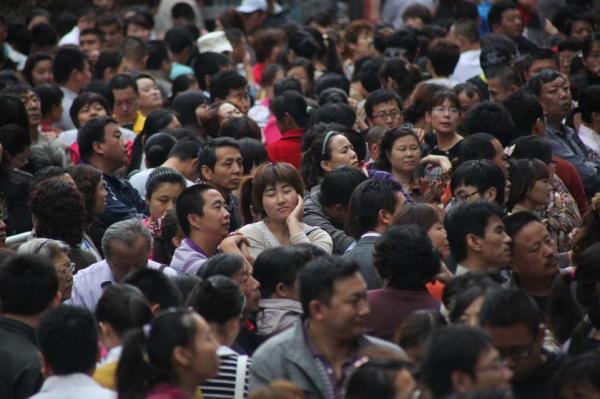
1000s rally for reform in Jordan capital

0

Protestors hold up banners, Jordanian national flags and shout slogans demanding political and economic reform, and access to corruption cases, during a demonstration after Friday prayers in Amman on June 14, 2013.

Thousands of protesters have taken to the streets in the Jordanian capital Amman after Friday prayers to demand economic and political reforms in the Arab country.

Chanted anti-regime slogans, protesters held banners accusing the regime of corruption.

“We say to them (Jordanian regime), start from today and call for reform. Work with us to achieve reform, to avoid Jordan entering into a dark tunnel that would effect everyone including the head of the regime,” said protester Mohammad al-Hout.

Protesters, most of them from the Islamic Action Front and other opposition parties, lashed out at the government, accusing it of planning to impoverish Jordanians.

Participants in the demonstration warned against the serious consequences of any move by the government to raise the prices of public utilities such as electricity.

The protest came as the government has announced recently that it plans to increase electricity bills to decrease a growing budget deficit.

DB/HN

This article originally appeared on: Press TV

Aussie Filmfest to present Farhadi ‘Past’

0

Argentine-French actress Bérénice Bejo (L) and Iranian actor Ali Mosaffa in a scene from ˜The Past™

Award winning Iranian Filmmaker Asghar Farhadi™s latest production The Past (Le Passé) is set to be screened at the 2013 Sidney International Film Festival.

Farhadiâ„¢s Paris-set tale drama The Past is scheduled to be showcased at the Special Screening section of the 60th edition of the festival which is currently held in Sydney.

Premiered in the 2013 Cannes film festival, the film will experience its first screening at an international film event.

Farhadiâ„¢s immigrant romantic drama depicts the story of an Iranian man who deserts his French wife and two children to return to his homeland. When he comes back to Paris upon his wife’s request for a divorce encounters with a complicated situation of the family there.

The Past is Farhadiâ„¢s sixth directorial experience and first one in a foreign country that was shot in the French capital, Paris.

The film scooped two prizes at the 66th Cannes film festival including the Best Actress award that went to Argentine-French actress Berenice Bejo, and the Prize of the Ecumenical Jury (prix du Jury “cuménique).

The Prize of the Ecumenical Jury was conferred on Farhadi for his filmâ„¢s moral values, according to the statement of the jury.

The movie has received warm critical acclaim by both French movie goers during its public screening in the countryâ„¢s movie theaters and those ones who followed the film in its premier at Cannes film festival.

Farhadi has recently received the yearâ„¢s medal of Paris City Hall that was dedicated by the cityâ„¢s mayor, Bertrand Delanoe, during a ceremony held in the capitalâ„¢s City Hall.

The French-language film The Past is also scheduled to be screened at the Paris Cinema Film Festival that will take place from June 28 to July 9, 2013.

The 60th Sidney International Film Festival kicked off on June 5 and will come to an end on June 16, 2013.

FGP/FGP

This article originally appeared on: Press TV

3 US soldiers wounded in Afghanistan

0

Three American soldiers have been injured in heavy gunfire with Taliban militants in Afghanistan’s eastern province of Wardak, Press TV reports.

According to local officials, the gunfire erupted between the Taliban and American forces in Saeed Abad district of Maidan Wardak province on Friday.

Five Taliban militants were also killed in the fighting.

Saeed Abad is a very dangerous area where most US military convoys as well as their supply trucks are being attacked by the Taliban there.

Attacks on foreign troops have increased recently as Taliban militants have announced the beginning of their spring offensive across Afghanistan.

The militant group said it would use “every possible tactic” to inflict casualties on Afghan and US-led forces, specifically mentioning insider and bomb attacks.

The rising death toll of US-led foreign forces in Afghanistan has also prompted growing opposition to the Afghan war in NATO member states and other countries that have contributed troops to the military occupation.

On Friday, the commander of the International Security Assistance Force (ISAF) in Afghanistan said that the gains made during about 12 years of war are not yet sustainable.

US General Joseph Dunford made the remarks during a meeting on Friday in Kabul with a group of foreign correspondents based in the Afghan capital.

He asked the international community not to abandon Afghanistan after foreign forces occupying the country leave next year.

“The gains that we have made to date are not going to be sustainable without continued international commitment,” Dunford stated. “We are not where we need to be yet”.

“The continued presence of the international community politically, in development and in security is necessary to sustain the progress that we have made.

“Is the effort we have had to date sustainable? I would say no, not until we develop the procedures (and) the institutions necessary to sustain a modern national army.”

FKH/MSH/HN

This article originally appeared on: Press TV

‘Voter turnout in Iran polls around 80%’

0

The voter turnout in Iranâ„¢s 11th presidential election, held on June 14, 2013, has been around 80 percent.

Informed sources say the voter turnout in Iranâ„¢s 11th presidential election has been around 80 percent, Press TV reports.

Meanwhile, Officials at the Election Headquarters of the Iranian Interior Ministry announced on Saturday that 6,387,317 valid ballots – from a total of 6,598,300 votes cast – have been counted at 12,058 polling stations so far (09:30 am Tehran time).

Candidate Hassan Rohani is in the lead, according to the results so far, with Principlist candidate Mohammad Baqer Qalibaf coming in second.

If a candidate wins over 50 percent of the vote in the first round, he will replace incumbent President Mahmoud Ahmadinejad. Otherwise, a run-off will be held in a weekâ„¢s time to determine a final winner in the race.

On Friday, millions of Iranian voters headed for polling stations to cast their ballots and choose the countryâ„¢s 11th president as well as their representatives in the City and Village Councils.

Nearly 50.5 million Iranians, including more than 1.6 million first-time voters, were eligible to vote in the June 14 elections.

SF/NN/HJL

This article originally appeared on: Press TV

1 nabbed over Pakistan prosecutor death

0

Pakistanâ„¢s Federal Investigation Agency prosecutor Chaudhry Zulfiqar (C) was in charge of the murder case against former military ruler Pervez Musharraf. Zulfiqar was assassinated in Islamabad on May 3, 2013.

Pakistan police say they have detained a man suspected of involvement in last month’s murder of countryâ„¢s Federal Investigation Agency prosecutor Chaudhry Zulfiqar.

Pakistani police on Friday announced Abdullah Omar, a 22-year-old law student and son of a dismissed Army officer, had been arrested in a hospital where he was being treated for a bullet wound.

“Abdullah Omar was part of the team that ambushed Chaudhry Zulfiqar near his residence in Islamabad on 3 May,” senior police officer, Jamil Hashmi said.

“He [Omar] was hit by retaliatory fire from his [Chaudhry Zulfiqar’s] bodyguard, and was whisked away from the scene in a car by his companions,” he added.

Chaudhry Zulfiqar Ali had been investigating the assassination case of former Pakistani Prime Minister Benazir Bhutto. He was shot dead in Islamabad on 3 May when he was on his way to attend the proceeding of Bhutto murder case in the anti-terrorism court in Rawalpindi.

Bhutto was killed in a gun-and-bomb attack on December 27, 2007 as she was leaving an election rally in the city of Rawalpindi.

Former Pakistani President Pervez Musharraf has been accused of failing to provide enough security for Bhutto after she returned from exile on October 18, 2007.

On Friday, Musharraf was formally arrested on suspicion of ordering the killing of Baluch politician Akbar Bugti in 2006, according to a ruling by an anti-terrorism court.

Musharraf was president of Pakistan when Bugti, the main leader in the southwestern province of Balochistan, died during an army raid in August 2006.

He is also facing charges of illegally putting judges under house arrest, after he sacked Chief Justice Iftikhar Muhammad Chaudhry, declared a state of emergency, and suspended the constitution, during a crackdown on the judiciary in 2007.

IA/HN

This article originally appeared on: Press TV

Workers Struggles: Asia, Australia and the Pacific

0


15 June 2013
Asia

Strike at Nike factory in Cambodia in fourth week

Confronted with police brutality and sackings, 4,000 Sabrina (Cambodia) workers in Kampong Speu province west of Phnom Penh are maintaining strike action begun on May 21 to demand an increase in their meagre $US75 monthly basic salary and $14 per month to help pay for transport, rent and healthcare costs. The company produces garments for the US sportswear giant Nike.

Since walking out of the factory over 20 workers, mainly women, have been hospitalised by brutal police attacks, including one pregnant worker who lost her baby. Riot police using electric stun batons and water canon have attempted to break the strike. At least eight factory representatives of the Free Trade Union have been arrested. This week, factory management sacked 300 strikers for allegedly flouting labour laws and the factory’s internal rules.

Cambodia’s garment industry employs over 400,000 workers and accounts for $4 billion, or roughly 80 percent, of Cambodia’s total export revenue. The number of strikes by garment workers nearly quadrupled last year to 134, according to the Garment Manufacturers Association of Cambodia. The 48 strikes so far this year are already more than in the whole of 2010 or 2011.

Bangladesh: More police attacks on striking garment workers

On June 10, police fired teargas and rubber bullets at protesting Fountain Garments Manufacturing workers in the Ashulia industrial area on the outskirts of Dhaka, injuring about 30. Workers were demanding a pay rise, bonus payments and a lunch allowance. Additional police were rushed to the area to contain further industrial unrest.

In New Eskaton, a Dhaka suburb, police conducted a two-day battle with striking garment workers. On June 10, a walkout by hundreds of Nadia Garments employees demanding a lunch allowance was joined by workers from Regal Garments and Astras Garments. The strike ended the following day, after police attacked workers with teargas and batons. At least six strikers were detained but later released.

Last week in Ashulia, 50 workers were injured when police used rubber bullets and baton-charged 3,000 employees who had walked out over low pay and were demanding the withdrawal of charges against workers involved in previous industrial action. The Dynasty Group suspended production for several days at its factories in fear of further labour unrest. Ongoing protests since the Rana Plaza catastrophe in Dhaka on April 24 have severely reduced garment production capacity.

India: Kingfisher Airlines employees resume protests

In a long-running dispute over dues, over 60 employees of defunct Kingfisher Airlines set up a camp in the Kingfisher House terminal building at Mumbai Airport on June 6. Pilots, cabin crew and ground staff have not been paid since August. A wife of one of the affected pilots has committed suicide over the financial stress created by non-payment of salaries.

Kingfisher, which is owned by liquor baron Vijay Mallya, started having financial difficulties in early 2012 which sparked a series of strikes by employees over delayed wage payments. The airline has been grounded since October and no longer has a flying licence. Since February Mallya has been promising staff that he would re-launch the airline.

Tamil Nadu soda ash plant workers demonstrate

Tuticorin Alkali Chemicals (TAC) workers protested outside the Provincial Collector’s office in Tuticorin on June 10 to demand that the government take over the company. Workers complained that they had not been paid wages for May and the jobs of 40 officers and many contract workers had been terminated. The TAC Employees Union submitted a memorandum to the district collector and brought the issue before the labour minister and chief inspector of factories.

Andhra Pradesh paper workers protest

Rayalaseema Paper Mill (RPM) workers demonstrated in Kurnool on June 11 outside the Labor Office. Workers were demanding unpaid wages for the last three months. The mill reopened in 2007 with 400 employees after being closed for 17 years due to financial difficulties. It is currently one of the largest paper mills in Asia.

Andhra Pradesh jute mill workers locked out

Locked out workers of the Uma Jute Mill in Kothavalasa, Andhra Pradesh protested in front of the Joint Commissioner of Labor Office on June 10. The Indian Federation of Trade Unions submitted a memorandum to the commissioner. The mill produces 30 tonnes of twine a day.

Karnataka daily wage workers in Raichur City end strike

Raichur City Municipal Council daily wage workers called off their five-day strike and protest outside the Deputy Commissioner’s office on June 8 after the management agreed to pay wage arrears. Another demand–for compensation for the death of a fellow worker Venkatesh who died while on duty–was not met. A union official told the media that workers would strike again if the remaining demand was not quickly granted.

Pakistan steel workers demonstrate over outstanding salaries

Pakistan Steel Mills (PSM) workers protested on June 7 to demand the immediate payment of outstanding April and May salaries and pensions which have affected 17,000 workers and pensioners. The Pakistan Steel Labour Union called off the protest after PSM’s chief executive officer promised to pay salaries early next week. According to one official, the PSM is requesting approval from the government for a bailout in next year’s financial budget.

Karachi municipal workers protest

On June 5, Karachi Metropolitan Corporation (KMC) workers dumped garbage outside the Sindh provincial assembly and Sindh secretariat to protest the non-payment of salaries. More than 26,000 workers have not been paid for four months. The previous day workers demonstrated in front of the Karachi Press Club parking dozens of loaded garbage trucks. The KMC Municipal Workers Union told the media that the protests would continue until workers were paid.

Burmese plastic bag manufacturing workers strike

Close to 1,400 employees of the San Kaung plastic bag factory in Shwe Pyi Thar township, on the outskirts of Burma’s former capital Yangon, have been on strike since May 6 to demand reinstatement of 47 of their colleagues who had been fired without any reason. Workers’ other demands include a pay rise, official recognition of the factory union and a management agreement that it will not dismiss workers without a valid reason or punish employees for going on strike.

Strikers have maintained a 24-hour picket at the factory gate since May 26. Thirty workers have been involved in a hunger strike and at least three hunger protesters have been hospitalised. Management has applied to the Dispute Settlement Arbitration Council to end the dispute.

Australia and the Pacific

Western Australia: Airport security workers maintain rolling stoppages

Around 80 security screeners, employed by MSS Security are continuing industrial action at the Perth Domestic Airport in a dispute for a new work agreement.

Following 24- and 48-hour strikes in the last two weeks, United Voice members walked out again on June 12 after management locked out 11 security screeners for wearing T-shirts with the slogan “Paid less in the west.” At least 25 workers have been locked out since strike action began on May 28.

The MSS workers want a 20 percent pay rise over three years and increases in shift allowances and weekend penalties to bring them on par with MSS screeners in other states. MSS workers in Perth earn 8.7 percent less annually than their counterparts in Adelaide and Melbourne where living costs are significantly lower. Workers rejected a management offer of just 3.2 percent annual increases over four years.

United Voice, however, dropped its pay rise demand by nearly half to just 12 percent over three years before it resumed negotiations with MSS on Friday.

New South Wales coal loader workers continue rolling stoppages

For the fourth time in five weeks, over 200 members of five unions at Australia’s largest coal export terminal at Port Waratah Coal Services (PWCS) in Newcastle, north of Sydney, walked off the job for eight hours on June 7 in a dispute for a new enterprise bargaining agreement. Negotiations between PWCS and the Australian Manufacturing Workers Union, Maritime Union of Australia (MUA), the Transport Workers Union, the Australian Workers Union and the Communications, Electrical and Plumbing Union have dragged on for more than nine months.

The unions want a 5 percent wage rise. The company has only offered 3.5 percent on the base rate and demanded greater productivity and “flexibility”, including abolition of current limitations on the exploitation of contract labour, ending management consultation with the unions on changes to work hours and shifts and the jettisoning of a longstanding disputes settling procedure.

PWCS’s demands are part of a wider restructuring within the Australian coal industry, triggered by falling demand in Asia. PWCS exports thermal coal from its two terminals at Carrington and Koorangang to Japan, China, South Korea and Taiwan.


‘
];
var html = htmlArray.join(”);
var pCount = $(‘#content’).children(‘p’).length;
var position = Math.floor(pCount*0.1);
$(‘#content’).children(‘p’).eq(position).before(html);
$(‘#inline-appeal’).children(‘form’).children(‘.more-options’).children(‘a’).click(function() {
$(‘#inline-appeal’).children(‘.initially-hidden’).show();
$(this).parent().hide();
return false;
});
}
}

function appendBottomAppeal() {
if (!$(‘#content’).is(‘.width72,.category’)) {
var htmlArray = [
‘

‘
];
var html = htmlArray.join(”);
if ($(‘#article-tools’).length > 0) {
$(‘#article-tools’).before(html);
} else {
$(‘#content’).append(html);
}
$(‘#inline-appeal’).children(‘form’).children(‘.more-options’).children(‘a’).click(function() {
$(‘#inline-appeal’).children(‘.initially-hidden’).show();
$(this).parent().hide();
return false;
});
}
}
$(document).ready(function(){
appendInlineAppeal();
appendBottomAppeal();
});

This article originally appeared on: World Socialist Web Site

Sri Lankan government to limit provincial powers

0


By
K. Ratnayake

15 June 2013

Sri Lankan President Mahinda Rajapakse has called for significant changes to the country’s constitution that would reduce the powers of provincial councils. The proposal follows the government’s announcement of an election for the Northern Province in September, which remains under effective military control following the defeat of the separatist Liberation Tigers of Tamil Eelam (LTTE) in 2009.

The US, India, Japan and other powers have called for the election to take place as part of a “political solution” to Sri Lanka’s protracted civil war that would involve a power-sharing arrangement with the island’s Tamil elites. By making constitutional changes, Rajapakse intends to further centralise political power in Colombo and weaken provincial governments, especially those in the North and East.

The proposed changes are to the constitution’s 13th Amendment, which was enacted as part of the 1987 Indo-Lanka Accord. Under the Accord, limited powers were to be devolved to a unified North-East provincial council as a concession to the Tamil bourgeoisie, while Indian troops were sent to the warzones to disarm the LTTE. The Accord quickly broke down, the so-called Indian peacekeepers were withdrawn, fighting resumed and the North-East provincial council remained a dead letter.

The changes to the 13th Amendment would significantly weaken the ability of provincial councils to block legislation affecting their powers. At present, such laws must have the approval of all councils before being presented to parliament, unless overridden by a two thirds majority in the national parliament. Under the proposal, only a majority of provincial councils would be needed to approve the legislation.

The Rajapakse government is determined to avoid a repetition of the political crisis that erupted after it sought to pass the Divineguma bill without the consent of all provincial councils that would strip them of some economic powers. When the Supreme Court ruled that the move was unconstitutional, the government impeached and replaced the chief justice, Shirani Bandaranayake, on trumped up corruption charges, provoking large protests.

The government is also seeking to change the constitution to prevent the merger of provinces. The northern and eastern provinces were demerged in 2006 after the Supreme Court ruled in favour of a case filed by the Sinhala-extremist Janatha Vimukthi Peramuna (JVP). The constitutional alteration would ensure that a reversal of that decision was impossible.

The Sinhala supremacist parties in the ruling coalition–the National Freedom Front (NFF) and Jathika Hela Urumaya (JHU)–are demanding the repeal of the police and land powers currently held by provincial councils, which exist only on paper. The president’s brother, defence secretary Gotabhaya Rajapakse, has publicly backed this demand, declaring that a northern provincial council with these powers could pave the way for a separate nation state. The opposition JVP demands the repeal of the 13th Amendment in toto.

President Rajapakse has cynically used this chauvinist campaign, with which he obviously sympathises, to justify his constitutional changes. At the same time, however, his proposals have opened up rifts in his coalition, with the Sri Lanka Muslim Congress (SLMC) opposed to any “diluting of powers” to provinces. The SLMC, representing the island’s Muslim elites, has long advocated a special administrative district in the eastern province. It is also deeply concerned over the government’s tacit support for the anti-Muslim campaigns of Buddhist extremist groups such as Bodu Bala Sena.

The Lanka Sama Samaja Party (LSSP), Stalinist Communist Party (CP) and Democratic Left Front have also told the president that they will oppose the constitutional changes. Their claims to be defending the rights of Tamils are a sham, as they supported the Rajapakse government’s renewal of the communal war against the LTTE in 2006 and have defended its war crimes and flagrant abuse of democratic rights.

Without the support of these coalition partners, Rajapakse is unlikely to achieve the two-thirds parliamentary majority required to pass constitutional amendments. He also risks further alienating the US and India, by turning the northern provincial council election into a farce. The opposition Tamil National Alliance (TNA), the main bourgeois Tamil Party, has declared that it will boycott the poll if the 13th Amendment is diluted.

Neither the US nor India is a champion of the democratic rights of Tamils. Both countries backed Rajapakse’s war and covered up the military’s atrocities until the defeat of the LTTE was imminent. Washington belatedly seized on the issue of “human rights” abuses as a means of pressuring the Sri Lankan government to break its ties with China. Like the US, India is seeking to counter Chinese influence in Asia. It is also seeking to pacify public hostility and anger in the southern Indian state of Tamil Nadu over anti-Tamil discrimination in Sri Lanka.

Rajapakse has decided to present a watered down 19th Amendment next week, which will only repeal the merger clause. Other proposed changes will be referred to a parliamentary select committee. Cabinet spokesman Keheliya Rambukwella told the media this week that the merger clause posed “a threat to the authority of the government” and had to be repealed.

The opposition United National Party (UNP) has opposed the constitutional changes and declared that it would develop a devolution package based on the 13th Amendment–in line with the demands of the US and India. The Sri Lankan pseudo-left groups–the Nava Sama Samaja Party and United Socialist Party–function as mouthpieces for the UNP’s bogus claim to be defending democratic rights. The UNP is a rightwing bourgeois party that was responsible for starting the island’s communal war, carrying out gross abuses of democratic rights and initiating the pro-market restructuring agenda that has devastated the living standards of working people.

The working class must reject the manoeuvring of all factions of the ruling class and their petty bourgeois, ex-left apologists. The fight for the democratic rights of working people as a whole–Sinhala, Tamil and Muslim–can only be addressed as part of a unified struggle for a workers’ and peasants’ government to implement socialist policies. That is the program for which the Socialist Equality Party fights–a socialist republic of Sri Lanka and Eelam as part of the broader fight for a United Socialist States of South Asia and internationally.


‘
];
var html = htmlArray.join(”);
var pCount = $(‘#content’).children(‘p’).length;
var position = Math.floor(pCount*0.1);
$(‘#content’).children(‘p’).eq(position).before(html);
$(‘#inline-appeal’).children(‘form’).children(‘.more-options’).children(‘a’).click(function() {
$(‘#inline-appeal’).children(‘.initially-hidden’).show();
$(this).parent().hide();
return false;
});
}
}

function appendBottomAppeal() {
if (!$(‘#content’).is(‘.width72,.category’)) {
var htmlArray = [
‘

‘
];
var html = htmlArray.join(”);
if ($(‘#article-tools’).length > 0) {
$(‘#article-tools’).before(html);
} else {
$(‘#content’).append(html);
}
$(‘#inline-appeal’).children(‘form’).children(‘.more-options’).children(‘a’).click(function() {
$(‘#inline-appeal’).children(‘.initially-hidden’).show();
$(this).parent().hide();
return false;
});
}
}
$(document).ready(function(){
appendInlineAppeal();
appendBottomAppeal();
});

This article originally appeared on: World Socialist Web Site

NSA’s Canadian counterpart runs massive domestic spying program

0


By
Keith Jones

15 June 2013

On the basis of secret government directives, Canada’s national security apparatus is conducting mass surveillance of Canadians parallel to, if not directly patterned after, the domestic spying operations of the U.S. National Security Agency (NSA).

Communications Security Establishment Canada (CSEC), the NSA’s Canadian counterpart and longstanding partner, has been scrutinizing the metadata of Canadians’ electronic communications since at least 2005.

Moreover, the NSA routinely provides Canada’s security agencies with intelligence on Canadians and CSEC reciprocates by providing U.S. intelligence officials with information about people living in the U.S. This arrangement allows both agencies to circumvent legal bans on warrantless surveillance of their own citizenry’s communications.

It was “common” for NSA “to pass on information about Canadians,” Wayne Easter, Canada’s Solicitor-General in 2002-3, told the Toronto Star this week. As Solicitor-General, Easter was responsible for overseeing the operations of the Canadian Security Intelligence Service (CSIS) and the Royal Canadian Mounted Police (RCMP).

The extent and scope of CSEC’s spying and who is being targeted and why are all zealously guarded state secrets. The CSEC functions under secret directives issued by the Minister of Defence–directives whose very existence is unknown to parliamentarians, let alone the public at large.

The Conservative government has responded to this week’s slight and very partial lifting of the veil on CSEC activities with a campaign of disinformation, dissembling and lies. This campaign has been facilitated by the opposition parties, especially the ostensibly leftwing New Democratic Party, and the corporate media; they have made no more than tepid calls for greater transparency about the CSCE’s spying.

On Monday, the Globe and Mail reported that in November 2011, Defence Minister Peter MacKay signed a secret directive authorizing the CSEC to continue its “mining” of the metadata of Canadians’ telephone and internet communications. The Globe said the program had been first authorized by Bill Graham, Defence Minister in Paul Martin’s Liberal government, in 2005, that is six years earlier.

MacKay, like U.S. President Barack Obama, responded to this revelation of massive state spying by flatly denying that CSEC is “targeting” Canadians or violating constitutional prohibitions on warrantless surveillance of their communications. This lie is predicated on the drawing of a spurious distinction between the metadata created by any electronic communication and the rest of the communication and on the transparently false claim that such information is innocuous.

According to the Globe, a briefing prepared for MacKay in 2011, presumably by CSEC or lawyers within his department, declared, “Metadata is information associated with a telecommunication … And not a communication.”

In fact metadata–which includes such information as the source, destination and duration of a telephone call–is intrinsic to any electronic communication. By systematically gathering and analyzing such metadata, the U.S. and Canadian national-security apparatuses can rapidly build up detailed profiles of targeted individuals and groups, including identifying everything from their associates, to where they work, bank, and shop, and what websites they visit.

In the course of his efforts to cover-up the scope and purpose of CSEC’s metadata mining, MacKay did make one revealing admission. In response to a question about the mass surveillance of Canadians’ communications, MacKay told Parliament, “I have a heads-up for the member … This is something that has been happening for years.”

Government sources, many of them unnamed, sought, meanwhile, to refute the Globe ’s claim that there had been serious questions within the state apparatus about the constitutionality of the CSEC’s “metadata” mining of Canadians’ communications. In its Monday report, the Globe said that in 2008 the then CSEC Commissioner–that is the head of the government-appointed “watchdog” charged with ensuring the agency does not go beyond its legal mandate–had cautioned that the program could be violating Canadians constitutional rights and, because of his concerns, the metadata mining program was suspended for more than a year.

Sources from within the government and CSEC dispute this. They say that the questions raised by Charles Gonthier–a former, now deceased former Supreme Court Justice–concerned only a small part of a much larger program, that only this part of the metadata mining program was ever suspended, and then only very briefly.

The current CSEC Commissioner has publicly defended the mass surveillance and claimed that his predecessor likewise believed that the CSEC has every right to spy on Canadian’s electronic communications. In an e-mail statement to the Toronto Star, Ryan Foreman, a spokesman for CSEC Commissioner Robert Decary, said, “The commissioner never questioned the legality of CSEC’s metadata activities.”

MacKay and the government have also sought to shield CSEC’s actions form public scrutiny by insisting that it is solely devoted to gathering foreign intelligence and, as MacKay told Parliament last Monday, “is specifically prohibited from looking at the information of Canadians.” This is an obvious falsehood and not just because warrantless metadata mining is a form of spying.

CSEC’s government mandate stipulates–as MacKay well knows since he has been the minister responsible for overseeing its work for the past seven years–that it “provide technical and operational assistance” to CSIS, the RCMP and other domestic security-intelligence and law enforcement agencies “in the performance of their lawful duties.” Furthermore CSEC can seek authorization from the Defence Minister to capture and read the communications of Canadians who are in some way connected to its foreign intelligence targets. As the Toronto Star ’s Thomas Walkom has observed, “In 2011-12, the last year for which figures are available, eight such ministerial authorizations–all of unknown size and scope–were in play.”

While vigorously defending CSEC’s metadata spying, the government has been anxious to put on a record that CSEC does not have access to the NSA’s PRISM Program and has not been using it as a means of monitoring Canadians’ communications. Under PRISM, NSA agents are able to directly access the servers of the most important U.S. based internet companies, including Microsoft, Apple, Google, and Facebook.

The government’s claims concerning the CSEC and PRISM are not credible. The CSEC has been a close partner of the NSA, sharing intelligence information with it on a daily basis, for more than six decades.

Britain, which like Canada, is part of the “Five Eyes”–a consortium formed in the late 1940s by the NSA, CSEC, and the signals communications agencies of Great Britain, Australia and New Zealand to jointly monitor global communications–has already said that it obtained intelligence about Britons through PRISM.

The NSA and CSEC, as the spurious distinction they have made between electronic communications’ metadata and rest of the communications illustrates, can and do create pretexts and mechanisms to illegally circumvent constitutional prohibitions.

Last but not least, whatever the validity of MacKay’s denial about spying on Canadians though PRISM, it only concerned CSEC. As Easter’s comments cited above demonstrate, Canada’s security agencies have long been the recipients of intelligence on Canadians from the NSA as part of longstanding Canada-U.S. intelligence-sharing agreements and partnerships.

The CSEC is part of a growing state within the state whose operations are hidden from the public. Till this week most Canadians had never heard of the CSEC and even now they knew very little about its activities. When Defence Minister MacKay renewed by secret ministerial order CSEC’s authorization to spy on Canadians’ electronic communications in November 2011 he issued six other secret ministerial directives to CSEC–none of whose subject let alone contents has been publicly revealed.

As in the United States, Canada’s elite has used the so-called war on terror to justify Canada’s participation in a series of imperialist wars, massively expand the national-security apparatus, and adopt laws that attack core democratic rights.


‘
];
var html = htmlArray.join(”);
var pCount = $(‘#content’).children(‘p’).length;
var position = Math.floor(pCount*0.1);
$(‘#content’).children(‘p’).eq(position).before(html);
$(‘#inline-appeal’).children(‘form’).children(‘.more-options’).children(‘a’).click(function() {
$(‘#inline-appeal’).children(‘.initially-hidden’).show();
$(this).parent().hide();
return false;
});
}
}

function appendBottomAppeal() {
if (!$(‘#content’).is(‘.width72,.category’)) {
var htmlArray = [
‘

‘
];
var html = htmlArray.join(”);
if ($(‘#article-tools’).length > 0) {
$(‘#article-tools’).before(html);
} else {
$(‘#content’).append(html);
}
$(‘#inline-appeal’).children(‘form’).children(‘.more-options’).children(‘a’).click(function() {
$(‘#inline-appeal’).children(‘.initially-hidden’).show();
$(this).parent().hide();
return false;
});
}
}
$(document).ready(function(){
appendInlineAppeal();
appendBottomAppeal();
});

This article originally appeared on: World Socialist Web Site

Indian Tire maker Apollo in deal to buy Cooper Tire

0


By
Shannon Jones

15 June 2013

India-based Apollo Tyres reached a deal this week to buy US tire maker Cooper Tire for about $2.22 billion. The combined entity will be the seventh-largest tire company in the world, with combined 2012 sales of $6.6 billion.

The agreement calls for Cooper shareholders to receive $35 per share in cash. The price represents a significant premium over Cooper’s current stock value, which stood at $24.56 a share on June 11. The acquisition is seen as a means for Apollo, which currently does not do business in the United States, to gain access to the US tire market. The deal would be the largest buyout of an American company by an Indian company in history.

The sale, which is subject to shareholder approval, is expected to close in the second half of this year. Apollo shares dropped 25 percent on reports of the acquisition. Financial analysts called the move risky given the high amount of borrowing required to carry out the purchase under conditions of falling global demand for tires.

Cooper Tire employs some 13,000 workers globally, with manufacturing facilities on three continents. The company’s first-quarter profits doubled to $56.1 million this year compared to a year earlier, despite a double-digit drop in sales.

The rise in Cooper’s earnings is largely due to the betrayal of a three-month lockout of workers at its Findlay, Ohio plant last year by the United Steelworkers. Despite the courageous stand by more than 1,000 Cooper Tire workers, the United Steelworkers union surrendered massive concessions, including a so-called student pay rate of just $13 an hour with no benefits. The classification is aimed a driving out older workers and replacing them with cheap new-hires.

The contract also imposed a reduction in wages by making it easier to reduce pay scales, which are on a piecework basis. If workers do not produce at least 80 percent of the average output they can be bumped down to a lower pay rate. The minimum will be increased to 85 percent within five years.

The sellout agreement also allowed management to victimize 10 workers for picket line infractions. Three of those workers ended up being terminated.

The Socialist Equality Party intervened in the Findlay lockout to provide a program and perspective for the Cooper Tire workers. It called on workers to reject the anti-Chinese nationalism of the UAW and its bankrupt strategy of relying on the National Labor Relations Board. Instead the SEP called for the independent mobilization of the working class behind the Cooper Tire workers, including reaching out to workers in the auto factories and other tire facilities. The SEP also conducted a campaign to win support from workers at Cooper’s Melksham plant in Britain.

A veteran Cooper Tire worker spoke with the World Socialist Web Site Friday about conditions since the end of the lockout. “The majority of workers now have no pension, no cost of living and are under the two-tier wage,” he said.

“We have been experiencing slumping sales since we have been back from the lockout.” He said there had not been any layoffs, but the facility had been temporarily shut down periodically due to falling demand. “In our facility we are 24/7, four shifts. Entry level is $13.50 an hour.”

“Part of their strategy in offering buyouts is to get you out and bring in someone for $13.50,” he said. “They have also been bringing people into the plant to re-rate jobs and lower the rate of pay. So for workers like me, with high seniority, it seems like time to go. The people who qualify for the buyout are taking it.”

While Apollo says it plans to honor terms of the existing contract, this cannot be taken for granted. Apollo has provoked a series of bitter struggles against its workforce in India, including a lockout of 2,700 workers at its factory in Kalamassery in 2009.

In October 2012 some 800 Apollo Tyre workers struck at the company’s nylon tire manufacturing unit in Waghodia, India over recognition of a new union, the suspension of two workers and changes in the wage agreement. The walkout ended after 19 days with the local provincial government declaring the action illegal and management refusing to concede the workers demands.

The Cooper tire worker said, “They held an informational meeting yesterday to confirm the sale and say that it would be business as usual. Apollo took out a full-page ad in the local paper saying they were not planning to close the facility. Immediately, we don’t see things changing. But who knows? This is an older facility. How can you believe anything they say?

Chico, another worker at the Findlay plant, recently took a buyout. He spoke about the pending sale. “They haven’t said anything to anybody. The union has said nothing.”

“Personally, I think they will eventually close the plants in the US. It is a shame. We don’t know what will happen to our pensions.”

He said that he was opposed to the way the United Steelworkers intervened to end the lockout on management’s terms. “I thought we should have stayed out instead of going back. I think that was the consensus of quite a few people.”

Speaking of the cuts to wages, he said “They do it at one company and the next one says we will do it too, and there is nothing you can do about it.

“We struggle to live on our wages and the top management people keep making more and more. It is not right.”


‘
];
var html = htmlArray.join(”);
var pCount = $(‘#content’).children(‘p’).length;
var position = Math.floor(pCount*0.1);
$(‘#content’).children(‘p’).eq(position).before(html);
$(‘#inline-appeal’).children(‘form’).children(‘.more-options’).children(‘a’).click(function() {
$(‘#inline-appeal’).children(‘.initially-hidden’).show();
$(this).parent().hide();
return false;
});
}
}

function appendBottomAppeal() {
if (!$(‘#content’).is(‘.width72,.category’)) {
var htmlArray = [
‘

‘
];
var html = htmlArray.join(”);
if ($(‘#article-tools’).length > 0) {
$(‘#article-tools’).before(html);
} else {
$(‘#content’).append(html);
}
$(‘#inline-appeal’).children(‘form’).children(‘.more-options’).children(‘a’).click(function() {
$(‘#inline-appeal’).children(‘.initially-hidden’).show();
$(this).parent().hide();
return false;
});
}
}
$(document).ready(function(){
appendInlineAppeal();
appendBottomAppeal();
});

This article originally appeared on: World Socialist Web Site

Germany: Three years after the Love Parade disaster

0


By
Konrad Kreft

15 June 2013

A recent report dealing with the Love Parade music festival disaster of July 24, 2010 further incriminates the festival organisers and their political backers.

The tragedy in the German city of Duisburg claimed the lives of 21 people who were crushed to death and left hundreds more injured and traumatized. Three years later, none of those responsible have been charged.

Investigations are ongoing against fifteen defendants. One other suspect has died in the meantime. The official inquiries and investigations now seem to be coming to a completion. According to the Süddeutsche Zeitung, judiciary circles “assume that charges could be laid in the summer [2013].”

In March, G. Keith Still, a professor for Crowd Science at the British-based International Centre for Crowd Management and Security Studies, presented his third report. He presented his first report in 2011, which raised serious allegations against leading political officials in the city of Duisburg and against the festival organiser, the Lopavent company.

In his study, Still made clear that the plans for the festival put forward by the organisers were untenable from the very start. The ramp at the centre of the deadly crush was far too small to deal with the onrush of festival visitors. The dimensions of the ramp were also additionally reduced by extra fencing.

The authorities in the city granted consent to the festival although any basic calculations would have revealed that a disaster was very likely. In his report Still also rejects the assertion that a mass stampede had taken place. People were crushed to death not due to panic, but rather because they had no room to manoeuvre.

In addition, calculations were deliberately forged, with the result that an “early warning system” failed. As the Süddeutsche Zeitung points out, the number of participants were counted on the day of the disaster by hand and by helicopter. A mathematical average was assumed in the calculations which included an incredible error: “If a control point failed to report data it was inserted into the table with zero. (…) Ultimately no one knew exactly how many people were on the premises.”

Despite this, organisers increased the permissible number of persons per square meter able to enter the festival. According to Still, the number of two persons per square meter should not have been exceeded. At the Duisburg festival, however, up to ten people per square meter crammed into the arena.

In advance of the festival, Lopavent and the company’s managing director Rainer Schaller had predicted one million visitors. There was no attempt to make a correct calculation of the number of visitors nor any provisions made to restrict their numbers. Cameras placed above tunnels to control movement were found to be defective on the day of the festival.

In fact, there was a deliberate campaign to prevent the Love Parade from being cancelled for safety reasons, as had been the case in the nearby city of Bochum in 2009, where city officials cancelled the event. The zeal with which the then Mayor of Duisburg Adolf Sauerland (Christian Democratic Union, CDU) sought to promote the Love Parade is well documented. Sauerland was subsequently forced to quit his post after a popular referendum, which resulted in a vote decisively against him.

In order to reduce costs to a minimum, Lopavent refused to install more extensive and costly security measures, including an electronic counter, the installation of loudspeaker systems and a sufficient number of security personnel.

Schaller has sought to cover his own tracks with the assertion that he was not involved in the preparations for the festival but his own company’s employees have testified that he urged savings to be made. Investigators are in possession of an e-mail to this effect.

According to another report dealt with in Focus magazine, Lopavent ignored safety precautions by providing just 234 staff to control the crowds, although over 600 would have been necessary to secure the 100,000-square-meter festival grounds.

According to the report, there could be “no talk of experienced staff” being at hand. When the tragedy occurred and thousands of people crammed the entrance to the festival arena, just eight security staff were present in the immediate vicinity. In order to save personnel costs, a fifth emergency exit was ruled out.

According to Focus, the prosecutor is in possession of internal e-mails showing that the organisers put huge pressure on city officials to grant a license prior to the event. Schaller instructed a lawyer to advise the Lopavent planners on how to “circumvent legal requirements”. Moreover, the e-mails indicate that Schaller had “cheated” when it came to the number of visitors, in order “to soothe urban worries.”

When the then chief officer for construction law and building regulations expressed concerns on the feasibility of the festival plans in early 2010, warning it could end in disaster, Councillor Wolfgang Rabe (CDU) and his office manager Hans-Peter Bölling intervened. They permitted a report to be drawn up in order to justify approval of the event. According to Focus, traffic researcher Michael Schreckenberg subsequently received €20,000 from the city of Duisburg for his services. Schreckenberg already had a reputation for his readiness to nod through meeting and festivals. Permission was granted to the festival although no proper report had been drawn up.

The tragedy in Duisburg revealed the cynicism of the ruling political elite and their henchmen for the safety and livelihoods of the population. In the pursuit of profit they disregarded basic safety precautions, and twenty-one people paid with their lives.

Those responsible continue to arrogantly defend themselves against the allegations. Schaller, Sauerland and Raven (who is still in office) have sought to “delegate” responsibility to subordinates who can be sacrificed and replaced.

The relatives of victims of the disaster have been treated with contempt. Before official proceedings are due to commence, the insurance company Axa offered miserly compensation payments to relatives of around €2,000 per person.


‘
];
var html = htmlArray.join(”);
var pCount = $(‘#content’).children(‘p’).length;
var position = Math.floor(pCount*0.1);
$(‘#content’).children(‘p’).eq(position).before(html);
$(‘#inline-appeal’).children(‘form’).children(‘.more-options’).children(‘a’).click(function() {
$(‘#inline-appeal’).children(‘.initially-hidden’).show();
$(this).parent().hide();
return false;
});
}
}

function appendBottomAppeal() {
if (!$(‘#content’).is(‘.width72,.category’)) {
var htmlArray = [
‘

‘
];
var html = htmlArray.join(”);
if ($(‘#article-tools’).length > 0) {
$(‘#article-tools’).before(html);
} else {
$(‘#content’).append(html);
}
$(‘#inline-appeal’).children(‘form’).children(‘.more-options’).children(‘a’).click(function() {
$(‘#inline-appeal’).children(‘.initially-hidden’).show();
$(this).parent().hide();
return false;
});
}
}
$(document).ready(function(){
appendInlineAppeal();
appendBottomAppeal();
});

This article originally appeared on: World Socialist Web Site

Fifty years since the execution of the Rosenbergs

0


From the archive of the WSWS

By
Peter Daniels and Bill Van Auken

15 June 2013

Wednesday June 19 will mark the 60th anniversary of the state execution of Julius and Ethel Rosenberg, prosecuted under the Espionage Act of 1917 on charges of conspiracy to commit espionage on behalf of the Soviet Union.

We repost below the article originally published ten years ago, on the occasion of the 50th anniversary of this crime. Little has to be changed in its assessment of the event.

Despite continuing efforts to reaffirm the guilt of the Rosenbergs, history has clearly proven that they were victims of a vicious frame-up that was carried out to its brutal conclusion in order to stoke the flames of anti-communism at the height of the Cold War. The documentary evidence of the Venona transcripts, released after the dissolution of the USSR, provides no evidence that either Julius or Ethel Rosenberg stole “the secret of the atomic bomb” and passed it to the Soviet Union.

Robert Meeropol, the younger son of the Rosenbergs, explains that “Julius Rosenberg engaged in non-atomic espionage during the 1940’s … Neither Julius nor Ethel Rosenberg was a member of an atomic spy ring that sole the secret of the Atomic Bomb. The United States government knew all along that Ethel Rosenberg was not an espionage agent, and that Julius was not an atomic spy, but executed them both anyway.” (http://www.rfc.org/caseoverview)

In addition, the Rosenberg case is more pertinent than ever, highlighted by the events of the 21st century. Nearly twelve years after US authorities declared a “war on terror,” this endless conflict is being used to justify imperialist aggression abroad and a frontal assault against civil liberties and democratic rights at home. The violent attacks on WikiLeaks, Bradley Manning and most recently Edward Snowden, charged with treason and threatened with the death penalty, echo the persecution of the Rosenbergs.

The Espionage Act is still being invoked for the reactionary purposes behind its enactment nearly a century ago. The current attacks reflect the deepening crisis of American capitalism, whether led by a Republican or Democratic administration. From George W. Bush to Barack Obama the unprecedented assaults on Constitutional and democratic rights, as reflected in the revelations of the vast NSA spying operations, continue and deepen. These attacks can only be answered by the mobilization of the working class in a political struggle against their source, the crisis-ridden profit system. We are also posting today an interview with Robert Meeropol, the Rosenbergs’ youngest son.

* * * * *

June 19 marks the 50th anniversary of the execution of Julius and Ethel Rosenberg on charges of conspiracy to commit espionage on behalf of the Soviet Union.

Many of the Rosenbergs’ contemporaries, for whom their persecution and state murder was the most searing episode in one of the darkest chapters in US history, have passed from the scene. Yet still today, for millions of people around the world, the name of the young couple evokes the Cold War, the McCarthyite witch-hunt in the United States and all of the crimes associated with Washington’s global crusade against communism. The execution of the father and mother of two young children, residents of New York City’s Lower East Side–he 35 years old and she 37 at the time of their deaths–is testimony to the savagery of which the American ruling establishment is capable when it perceives its vital interests to be at stake.

Despite the passing of five decades, the issues surrounding the Rosenberg case are in many ways posed more sharply today than at any time since the execution itself. Once again, a US administration is seeking to terrorize the entire population as a means of suppressing dissent and exercising control on behalf of a wealthy elite. Under the guise of a global “war on terrorism,” it has rammed through the USA Patriot Act–modeled in part on the anti-communist McCarran Internal Security Act of 50 years ago–assuming vast unconstitutional powers to arrest without charges, detain without trial and conduct unrestricted police surveillance.

Today, as then, the government’s fear-mongering and attacks on democratic rights are aimed at suppressing widespread opposition to American military aggression abroad.

The arrests of the Rosenbergs in 1950, their trial and conviction in 1951, and their executions in 1953 represented the high point of a nationwide campaign of anti-communist witch-hunting and hysteria. During the five years preceding the execution of the Rosenbergs, the House Un-American Activities Committee held 84 hearings into “communist subversion.” Those who refused to cooperate by “naming names”–including the group known as the Hollywood 10–were cited for contempt of Congress and imprisoned. Millions of workers were forced to take loyalty oaths, and some 15,000 federal employees were fired or forced to resign by loyalty boards created by the Truman administration.

In key industries, red scares, aided and abetted by both the AFL and CIO trade union bureaucracies, forced many of the most militant workers out of the factories and ensured the political subordination of the American labor movement to the capitalist state and its two-party system, setting into motion the decay of the labor movement and its present-day transformation into an appendage of corporate power. Blacklists were created, not only against Hollywood actors, directors and others in the filmmaking industry, but against workers as well.

The McCarthyite witch-hunt at home went hand in hand with the turn to a foreign policy of global counterrevolution, in which Washington sought to suppress the wave of revolutionary struggles that followed the Second World War, in the name of combating “Soviet aggression” and “communist subversion.”

The Soviet Union’s detonation of its first atom bomb in August, 1949 and the triumph of the Chinese Revolution that same year threw the foreign policy developed by the American ruling class into crisis and sparked the search for scapegoats–those who could be blamed for the “loss” of China and the military strength of the USSR.

With the Rosenberg prosecution, the government aimed to send an unmistakable message. As Julius himself put it not long before he was killed: “This death sentence is not surprising. It had to be. There had to be a Rosenberg case, because there had to be an intensification of the hysteria in America to make the Korean War acceptable to the American people. There had to be hysteria and a fear sent through America in order to get increased war budgets. And there had to be a dagger thrust in the heart of the left to tell them that you are no longer gonna get five years for a Smith Act prosecution or one year for contempt of court, but we’re gonna kill ya!”

The government set out to prove the Rosenbergs guilty of what J. Edgar Hoover described as the “crime of the century”–stealing the “secret of the atomic bomb” and giving it to Moscow.

Information has surfaced in recent years suggesting that Julius Rosenberg was involved in passing some form of intelligence to Soviet officials during the Second World War. According to the Soviet intelligence agent who claimed to have dealt with Rosenberg during the war years, this information pertained not to the bomb, but rather to electronics. In any case, the idea that he divulged the “secret of the atomic bomb” is preposterous on its face.

Scientifically speaking, there was no such secret. The Soviets already had a program to develop atomic weapons, and it was understood within the US government and among American scientists that it was only a matter of time before they achieved their goal. Relaying any useful information on the Manhattan Project would have required the transfer of scores of volumes of scientific material, something that never happened and, indeed, was beyond the ability of the Rosenbergs or anyone else charged in connection with the alleged spy ring.

It should be noted that at the time of the alleged conspiracy, the Soviet Union was a wartime ally of the United States, not its enemy. Aiding the Soviet Union, which was carrying out a life-and-death struggle against Nazi aggression, was hardly seen as a crime by most Americans, and many suspected that the Western powers were content to see the Soviet people bled by the Nazis.

Within the Roosevelt administration and among the scientists most directly involved in the American effort to develop an atomic bomb, there were many who expressed the opinion that information on the weapon should have been shared with the Soviets, and that any weapons developed by the US should have been placed under the control of an international commission with Soviet participation. There was grave concern that attempts to conceal information about the bomb would only exacerbate tensions with Moscow and lead inevitably to an atomic arms race.

Soon after the end of the Second World War, however, the Cold War and arms race began in earnest, followed soon enough by the hunt for spies. By January, 1950, former State Department official Alger Hiss, although never charged with spying, was convicted of perjury in connection with espionage accusations. Two weeks later the British physicist Klaus Fuchs was arrested in the UK on charges of disclosing information about US research on nuclear weapons to the Soviet Union.

During the very same week, Wisconsin Senator Joseph McCarthy became a national political figure with his highly publicized charges of Communist infiltration of the State Department and other government agencies. The Communist Party was outlawed and its leaders sent to prison under the thought-control Smith Act–later declared unconstitutional–which banned the “advocacy” of the forcible overthrow of the government. Only two weeks before the arrest of Julius Rosenberg, the Korean War broke out.

The arrest of Fuchs was followed by an intensified investigation that led to American scientists and technicians. Within a few months, the trail led to Julius Rosenberg.

The political character of the frame-up of the Rosenbergs becomes clear when one contrasts their execution to the sentences handed down in Britain to figures who were in a position to provide the Soviets with real information on the atomic bomb and pleaded guilty to doing so. Fuchs, the German-born British scientist who confessed to giving information on the bomb to the Soviets, served nine years in prison following his conviction. Alan Nunn May, a British physicist who pleaded guilty to espionage, including passing enriched uranium to his Soviet handler, served six years.

How did the Rosenbergs become the targets for a vindictive legal lynching? To understand their fate one must review the political beliefs that inspired their activities.

Their life experience was similar to that of thousands of other immigrants or first-generation Americans, especially in New York’s Jewish immigrant community during in the Great Depression. Radicalized by poverty, inequality, and the threat of fascism, and inspired by the Russian Revolution, Ethel and Julius Rosenberg joined the Young Communist League as teenagers.

During the period in which they became politically active, however, the Communist Party of the USA adopted the popular front line developed by the Stalinist bureaucracy in Moscow. The party engaged in uncritical adulation of Roosevelt and the New Deal, while gaining substantial influence both within the unions and the political life of the country as a whole. Once the US joined the war, this popular front line reached a high point, with the CPUSA describing communism as “20th century Americanism” and enforcing no-strike pledges and speedups wherever it had control in the unions. The party attracted support on the basis of “friendship for the Soviet Union,” rather than the fight for socialism.

At the same time, the Stalinist bureaucracy in Moscow took the adventurous and politically irresponsible decision to use members of Communist Parties around the world, including the CPUSA, for espionage, exposing them to the anti-communist charge that CP supporters were agents of a foreign power.

While there is no doubting the Rosenbergs’ heroism in refusing to bow to the pressure of the witch-hunters, there is also no question that the politics of the CPUSA and Stalinism left them woefully unprepared for the political transformation that took place with the onset of the Cold War, and undermined their ability to wage an effective defense.

At the trial itself, their defense team, which was close to the CP, proved itself incapable of answering the charges politically, in what was clearly a political show trial. The government’s aim was to whip up a frenzy of nationalism and anti-communism, in which membership in the Communist Party, or even support for socialist ideas, could be equated with spying for the USSR. On the advice of their lawyers, the Rosenbergs pleaded the Fifth Amendment when asked about their membership in the CP, a tactic that, under these circumstances, only played into the hands of the prosecution and its conspiracy charges.

Initially, the CP’s newspaper, the Daily Worker, shied away from the case, hoping that it would blow over. “We didn’t want to be associated in any way, shape or form with espionage,” the paper’s then-editor, John Gates, told an interviewer in 1991. “In the public mind, the words ‘spy’ and ‘communist’ were synonymous. We were very leery.”

A two-year campaign to save the lives of the Rosenbergs followed the convictions. Millions were drawn into the worldwide petitions, demonstrations and protests. The case wound its way through the appeals process, from the US Court of Appeals to, ultimately, the US Supreme Court.

The Court of Appeals for the Second Circuit ruled against the defendants in February 1952. In October of that year the Supreme Court announced that it would not hear the case.

Four justices of the Supreme Court were prepared to grant a stay of execution at the last moment, but five were required for a majority. A special session of the Court was called on June 19, 1953 to vacate a stay granted by Justice William O. Douglas. The Rosenbergs were executed that night in New York’s Sing Sing Prison.

The evidence at trial as well as subsequent revelations by key figures involved in the case have exposed the prosecution as a crude political frame-up. The bias of Judge Irving R. Kaufman, who presided over the trial, was so blatant as to arouse the anger of Supreme Court Justice Felix Frankfurter. It has been revealed since that Kaufman engaged in grossly illegal actions, including discussing the case improperly with members of the prosecution before the trial and promising the government a death penalty upon conviction.

Ethel Rosenberg, it is now almost universally acknowledged, had no connection whatsoever with espionage. Her brother, who provided the key evidence against her at trial, has since admitted that he made up the story of her involvement as part of a deal with the prosecutors to save his own neck and avoid the prosecution of his wife.

The authorities knew that the young mother of two was guilty of nothing, but decided to use her as a hostage, hoping that the threat to kill her would break her husband. In the end, she was put to death for refusing to renounce her husband and for her husband’s refusal to grovel before the government.

Witnesses to the execution described both Julius and Ethel as remarkably composed as they went to their deaths in the electric chair. Ethel, placed in the chair just after her husband’s lifeless body was removed, kissed the prison matron on the cheek. The executioner had to throw the switch of electric current five times because the leather cap containing the electrodes was too large for her head.

In justifying this barbaric state killing, Judge Kaufman delivered a reactionary diatribe at the end of the trial. He called the Rosenbergs’ supposed crime “worse than murder.” He declared: “I believe your conduct in putting into the hands of the Russians the A-bomb years before our best scientists predicted Russia would perfect the bomb has already caused, in my opinion, the Communist aggression in Korea, with the resultant casualties exceeding 50,000 and who knows but that millions more of innocent people may pay the price of your treason…We have evidence of your treachery all around us every day–for the civilian defense activities throughout the nation are aimed at preparing us for an atom bomb attack.”

Had the Rosenbergs been guilty as charged–which they were not–a far more plausible argument could be made that their actions might have saved the lives of millions. The USSR’s production of atomic weapons served as a deterrent to the aggressive impulses of American imperialism during the postwar period. Had Moscow not had the bomb, proposals to use nuclear weapons made by rabid militarists like General Douglas MacArthur during the Korean War and General Curtis LeMay during the war in Vietnam might well have been implemented.

While the international policy of the Moscow Stalinist bureaucracy was counterrevolutionary, resulting in the defeats of the working class in country after country, the very existence of the Soviet Union and its possession of nuclear arms served as a decided restraint on American ambitions. The frustration of the American ruling class over its inability to use its military advantage to impose its will on the entire world found its poisonous expression in the political vendetta against the Rosenbergs.

Recent history has seen the dissolution of the Soviet Union, and consequently the fading of the threat of nuclear retaliation as a check on US imperialism’s global machinations. The result is the Bush administration’s doctrine of preventive war and an eruption of US militarism that threatens to pave the way to another world war.

In the 50 years since they were sent to their deaths, the case of the Rosenbergs has remained a subject of sharp controversy. In the climate produced by the civil rights and antiwar movements, the political killing carried out by the US government moved new generations of workers and youth. In 1971, E. L. Doctorow wrote The Book of Daniel, a historical novel based on the Rosenbergs and their children. Doctorow assisted in turning the book into a film, Daniel (1983), directed by Sidney Lumet and boasting a cast that included Edward Asner, Lindsay Crouse, Timothy Hutton, Mandy Patinkin, Amanda Plummer and John Rubinstein. Many of the actors worked on the film for minimum salary, and Hutton turned down a million-dollar role in another film in order to star in Daniel .

The Rosenberg sons, Michael and Robert Meeropol, have worked tirelessly to explain the importance of their parents’ case. They were adopted by Abel and Anne Meeropol in 1957. Abel Meeropol, under the name Lewis Allan, was the composer and lyricist of the famed song “Strange Fruit,” a protest against the lynching of African-Americans in the American South.

The Meeropol brothers wrote We Are Your Sons, explaining their experiences, in 1975. They have continued to speak out, launching the Rosenberg Fund for Children, dedicated to the assistance of the children of political prisoners. The Rosenberg Fund is holding a commemorative event in New York City on June 19 to mark the 50th anniversary of the execution.

On the other side, a coterie of ex-Stalinists and former radicals have used the case as a vehicle for making their own peace with political reaction. Most prominent among them is Ronald Radosh, co-author of the 1983 book The Rosenberg File. Using government files and prosecution arguments, he set out to “prove” the guilt of the Rosenbergs and thereby atone for his own leftist past.

In a 2001 memoir, Commies, a book that is actively promoted by the Republican right, Radosh has followed this trajectory to its logical and miserable conclusion, writing, “the Left was wrong not just about the Rosenberg Case, but about most everything else…the entire socialist project was wrong.” Political elements such as Radosh specialize in exploiting the crimes of the Soviet bureaucracy–which many of them previously supported–to line up with the right, while defaming those who refuse to join them in groveling before political reaction.

All genuine supporters of democratic rights defend the memory of Julius and Ethel Rosenberg, just as they do that of the Haymarket martyrs, who were hung in 1887, and Sacco and Vanzetti, executed in 1927. As far as the socialist movement is concerned, the issue never was whether the defendants sought to aid the USSR. The Rosenberg case remains what it was from the very beginning–a political frame-up whose victims were sacrificed to further the interests of a ruling elite determined to defend its wealth and power through repression at home and aggression abroad.


‘
];
var html = htmlArray.join(”);
var pCount = $(‘#content’).children(‘p’).length;
var position = Math.floor(pCount*0.1);
$(‘#content’).children(‘p’).eq(position).before(html);
$(‘#inline-appeal’).children(‘form’).children(‘.more-options’).children(‘a’).click(function() {
$(‘#inline-appeal’).children(‘.initially-hidden’).show();
$(this).parent().hide();
return false;
});
}
}

function appendBottomAppeal() {
if (!$(‘#content’).is(‘.width72,.category’)) {
var htmlArray = [
‘

‘
];
var html = htmlArray.join(”);
if ($(‘#article-tools’).length > 0) {
$(‘#article-tools’).before(html);
} else {
$(‘#content’).append(html);
}
$(‘#inline-appeal’).children(‘form’).children(‘.more-options’).children(‘a’).click(function() {
$(‘#inline-appeal’).children(‘.initially-hidden’).show();
$(this).parent().hide();
return false;
});
}
}
$(document).ready(function(){
appendInlineAppeal();
appendBottomAppeal();
});

This article originally appeared on: World Socialist Web Site

D'Artagnan Collier, David Walsh speak in defense of the DIA and culture as a social right

0


By
Bryan Dyne

15 June 2013

D’Artagnan Collier, the SEP’s candidate for Detroit mayor, and David Walsh, arts editor for the World Socialist Web Site, spoke at a public meeting held by the Socialist Equality Party on Thursday attended by workers, retirees and youth from the Metro Detroit area.

Collier and Walsh discussed the threats by Detroit Emergency Manager Kevyn Orr to sell off the artwork at the Detroit Institute of Arts. The defense of culture, they said, must be part of a program for the working class to fight back against the assault on jobs and living standards.

“The art at the DIA belongs to the people of metropolitan Detroit,” declared Collier, opening the meeting. “It is not the property of the banks and hedge fund managers to loot, nor their bought -and-paid-for flunkies to seize. They are estimating that the monetary value of the art is several billion dollars. From the standpoint of the ruling class, this is several billion dollars that should be in their pockets, not housed in a public museum available for the education and enjoyment of the people of the city.”

Collier said, “We say that the working class must not be forced to pay for a crisis that it did note create. The wealthy created the crisis, and they should pay for it. It is their bankrupt system, capitalism, that has plunged the world into depression, that is driving the world towards more wars and that is creating police state measures, including the massive spying operations that were revealed by Edward Snowden.”

“Our campaign,” Collier declared, “is dedicated to educating the working class about the real social relations in society, to politically mobilize the working class in a struggle to reorganize the entire world economy on the basis of social need, not private profit.”

David Walsh’s presentation reviewed the historical foundations of the development of museums in the United States.

“The driving force in the present crisis is the effort of the super-rich to retain its wealth, to drain the population of Detroit, to reduce it to a state of pauperism,” Walsh said. “The bankers have driven the country to the edge of abyss and they want the working class to pay for that.”

Walsh described what he called “the return of the aristocratic principle: that is, the idea that the people have no basic right to hospitals, schools, museums, that if they are to have such elementary social necessities it will be the result of the generosity of the super-rich. If Bill Gates or Warren Buffet or Mark Zuckerberg of Facebook decides to keep the DIA open, for example, or perhaps buys a city or even a small state, and keeps it going, we should all be grateful and tip our caps.

“Of course, if Bill Gates decides to withdraw his money and close the museum, or put the art work in his basement, well, we’re simply out of luck. This runs counter to the progressive social thought of several centuries, which found expression in the US in the basic documents of the American Revolution and the Civil War eras.”

Walsh then reviewed the history of the DIA and public cultural institutions in the US and internationally. “The opening of art and science museums was associated in the US in the 19th century with the ideals of the Enlightenment, with the development of public education and the general socially and culturally progressive agenda.

“The generation, the population that emerged from the Civil War, which had gone through tremendous hardships to defend the Union and defeat slavery, was hungry for knowledge, progress, culture.”

Walsh also referred to the impulse given to art and public museums by the Revolutions in France in 1789 and Russia in 1917. “The Louvre, the largest and most visited art museum in the world, was the direct product of the French Revolution… The revolutionary government brought to power by the Revolution of 1789 took decisive steps—one year after the arrest of the king, the museum was opened to the public.”

“The Russian Revolution took this process to a higher level, took far more decisive and revolutionary steps. The Bolsheviks, with the assistance of the left-wing and avant-garde artists in the early days of the revolution brought the artwork of Moscow to the surrounding provinces. Not only did they bring workers to see art, they brought art to the workers!

“In short, the opening and accessibility of art (and science) museums has been associated with democratic and revolutionary social movements, or their consequences, with the effort to raise the cultural level of the population, with confidence and interest in human progress.

Walsh concluded, “Taking all this into account, is it possible to imagine a situation in which the anti-democratic, crisis-ridden, aristocratic ruling elite in the US, which cares only for its own wealth, which hates and fears the population, could permit the Detroit Institute of Arts, with its vast artistic richness, to continue operating as a museum open and accessible to the public?”

Both reports initiated a great deal of discussion.

Jeff, an adjunct teacher at Wayne State, has been following Collier’s campaign for a long time. “It was good to meet D’Artagnan in person. Of all the candidates, I’d vote for him. He’s the only one that actually speaks to the needs of society vs. the rich. The other politicians focus so much on racial politics. That’s not the central issue at all.

“One of the reasons why I like his perspective is that capitalism has so much control. Look at the NSA. It’s disgusting that they watch everything. That’s not freedom. I see Collier’s campaign, and socialism, as fighting for something where the people who actually know what they are doing in control of that aspect of society, not some banker.”

Wardell, a retiree, commented, “The discussion at this meeting was on target. I’ve come to meetings of the Socialist Equality Party before, and what they say is always a propos. They do their analysis with due diligence. It’s true that the attack on the DIA is bound up with capitalism. I think it is the height of hubris. That he [the emergency manager] even poses the question is not something you joke about. It’s like joking about selling your own mother. The question shouldn’t be posed.

“He’s testing the waters. Orr and the bankers do want to sell the art, and they want to know what the reaction of people will be if they go through with it.

“This isn’t a revenue issue. They just had the Grand Prix at Belle Isle. Why not tax that? You could generate all the revenue you need. The banks just don’t want people to have anything good in life.”

The author also recommends:

D’Artagnan Collier, SEP candidate for Detroit mayor, speaks on the social crisis in Detroit

[1 June 2013]


‘
];
var html = htmlArray.join(”);
var pCount = $(‘#content’).children(‘p’).length;
var position = Math.floor(pCount*0.1);
$(‘#content’).children(‘p’).eq(position).before(html);
$(‘#inline-appeal’).children(‘form’).children(‘.more-options’).children(‘a’).click(function() {
$(‘#inline-appeal’).children(‘.initially-hidden’).show();
$(this).parent().hide();
return false;
});
}
}

function appendBottomAppeal() {
if (!$(‘#content’).is(‘.width72,.category’)) {
var htmlArray = [
‘

‘
];
var html = htmlArray.join(”);
if ($(‘#article-tools’).length > 0) {
$(‘#article-tools’).before(html);
} else {
$(‘#content’).append(html);
}
$(‘#inline-appeal’).children(‘form’).children(‘.more-options’).children(‘a’).click(function() {
$(‘#inline-appeal’).children(‘.initially-hidden’).show();
$(this).parent().hide();
return false;
});
}
}
$(document).ready(function(){
appendInlineAppeal();
appendBottomAppeal();
});

This article originally appeared on: World Socialist Web Site

BBC “Panorama” exposes UK police cover-up in 1989 Hillsborough football disaster

0


By
Barry Mason

15 June 2013

A recent BBC Panorama television documentary exposed the more than 23-year-old government and police cover-up following the deaths of 96 Liverpool football fans at the Hillsborough football stadium, in South Yorkshire, England on April 15, 1989.

The tragedy at the stadium’s Leppings Lane end resulted in the greatest loss of life ever recorded at a sporting event in Britain. Men, women and children were crushed to death after police dangerously gave the order to open an exit gate just before kick-off.

The documentary, Hillsborough: How they buried the truth, movingly details the determined fight by relatives of the victims to bring out the truth. It was present by veteran BBC reporter Peter Marshall. A life-long Liverpool fan, he was at Hillsborough on the fateful day.

Marshall explained that an abundance of film footage existed revealing what actually happened. The BBC had eight cameras and the police had CCTV footage, plus a mobile camera unit. The BBC footage was made immediately available to the police and lawyers of the victim’s families, but was then locked away, deemed too distressing for broadcast. Panorama managed to get access to the television footage and analyse it in detail. The programme showed shots of Liverpool fans milling around the stadium, waiting to gain access ahead of the scheduled 3 pm kick-off.

At 2:52 pm, South Yorkshire Police match commander Superintendent David Duckenfield, with no justification, ordered an exit gate, Gate C, to be opened. Fans then headed through the gate for the tunnel leading to the central pens directly behind the goal. The police knew, via CCTV footage, that these central pens were already dangerously full. Normally, police would close off the tunnel and divert fans into emptier side pens, but that did not happen on this occasion.

At this point, the crowding behind the goal was dangerous and some fans were already, in fact, being crushed to death. At 3 pm the game started, but fans, desperate to escape, were attempting to climb over the steel fence at the front. The only way out was through gates onto the pitch, but these were kept locked by the authorities to prevent a “pitch invasion.”

The police called in reinforcements, but were still treating it as an attempted pitch invasion. After six minutes, the match was abandoned as more fans, many in a distressed state, poured onto the pitch.

Following the disaster, the Conservative government of Margaret Thatcher was forced to call an inquiry led by Lord Justice Peter Taylor, assisted by West Midlands Police Chief Constable Geoffrey Dear. Taylor handed South Yorkshire Police a trump card–allowing the the latter to take their own officers’ statements. In a departure from normal practice, the officers were asked to write statements on plain sheets of paper, which were taken, scrutinised and edited, removing any criticism of the police tactics on the day.

Nevertheless, Taylor found the main cause of the disaster to be a failure of police control, noting failure to block off the tunnel after opening Gate C “had been a blunder of the first magnitude.”

Three days after the disaster, Taylor and Dear were taken to Hillsborough to inspect the scene. Their police driver Mark Lewis told colleagues he had heard them agreeing that the South Yorkshire Police would have to take the blame. Lewis reported Taylor as saying: “I suppose you realise that to give the inquiry any credibility we have to apportion the majority of the blame on the police.” To which Dear is supposed to have replied, “I suppose we do.”

Lewis was advised to speak to his then boss Superintendent Norman Bettison, who spoke to the newly appointed South Yorkshire Chief Constable, Richard Wells. Wells passed on the allegation to the Director of Public Prosecutions (DPP), who were then in the process of deciding whether to bring criminal charges against the police.

Dear told Panorama he and Taylor denied the alleged conversation. Taylor died in 1997. Lewis declined to be interviewed, but said he stood by his statement.

In August 1990 the DPP decided not to bring criminal prosecutions against the police or any officials at Hillsborough.

The Coroner’s Inquest led by Stefan Popper became the longest-running on record. His verdict left the criminal failure of the emergency services’ response to the disaster unquestioned and insisted that all those who had died were beyond medical help before 3:15 pm. He returned a verdict of accidental death on them all.

Through the use of film footage, Panorama showed this was not the case.

Fifteen-year-old Kevin Williams had been carried onto the pitch and given first aid treatment by an off-duty Merseyside police officer, Derek Bruder. Bruder could not recall the exact time he treated Kevin, but did recall an ambulance driving onto the pitch as he attempted to revive him. Bruder was not called to give evidence. Instead his evidence was reported by a West Midlands Police officer who spoke of only two ambulances being present at the time.

The ambulances were on the pitch before Kevin was carried on, i.e., before the arbitrary 3:15 pm cut-off point. Panorama pointed out that West Midlands Police were well aware that there were three ambulances on the pitch, having shown the driver of the third ambulance video of his driving on.

Careful examination of the footage showed Kevin being carried onto the pitch and treated by Bruder; the time stamp being after 3:30 pm.

In 1997, 40 of family members travelled to London to meet the new Labour government’s home secretary, Jack Straw, hoping for a new inquiry. Privately, Straw said he saw no reason for one and instead appointed Lord Justice Stuart Smith to review any new evidence. In February 1998, Stuart Smith published his report stating the alteration of police statements did not amount to irregularity or malpractice. Straw announced there was no basis for a further inquiry.

In 2009, on the 20th anniversary of the tragedy, the Labour government’s Culture Secretary Andy Burnham announced that government documents relating to Hillsborough would be made public. Normally, such papers are kept secret for 30 years.

The Hillsborough families insisted that any investigation had to be carried out by people they could trust. Based on access to all the records, the Hillsborough Independent Panel made its first report in September 2012. It showed the deaths were entirely the result of corporate, police and emergency services’ negligence. In December, the accidental death verdict was overturned and the High Court ordered a new inquest.

The families’ determination to expose the truth was personified by Anne Williams, whose son Kevin died at Hillsborough. Never accepting the accidental deaths verdict, she refused to collect Kevin’s death certificate.

Speaking to Marshall, she said, “They used to say, you are right Anne, but you will not beat the system … they are wearing you down … I replied I will wear them down before they wear me down.”

Sadly, Anne died from cancer in April of this year. After the overturning of the accidental death verdict was announced, and aware she did not have long to live, she told Marshall, “My son did not die in an accident. Neither did the 95 with him, so at least we have got rid of that. The accidental death verdict used to really, really upset me, because it let them off the hook.”


‘
];
var html = htmlArray.join(”);
var pCount = $(‘#content’).children(‘p’).length;
var position = Math.floor(pCount*0.1);
$(‘#content’).children(‘p’).eq(position).before(html);
$(‘#inline-appeal’).children(‘form’).children(‘.more-options’).children(‘a’).click(function() {
$(‘#inline-appeal’).children(‘.initially-hidden’).show();
$(this).parent().hide();
return false;
});
}
}

function appendBottomAppeal() {
if (!$(‘#content’).is(‘.width72,.category’)) {
var htmlArray = [
‘

‘
];
var html = htmlArray.join(”);
if ($(‘#article-tools’).length > 0) {
$(‘#article-tools’).before(html);
} else {
$(‘#content’).append(html);
}
$(‘#inline-appeal’).children(‘form’).children(‘.more-options’).children(‘a’).click(function() {
$(‘#inline-appeal’).children(‘.initially-hidden’).show();
$(this).parent().hide();
return false;
});
}
}
$(document).ready(function(){
appendInlineAppeal();
appendBottomAppeal();
});

This article originally appeared on: World Socialist Web Site

Another boat disaster highlights criminality of Australian refugee policy

0


By
Mike Head–SEP Senate candidate for Queensland

15 June 2013

Last week’s deaths of at least 55 people, including women and children, is the latest refugee boat disaster in Australian waters. It raises the question: is the Labor government deliberately allowing asylum seekers to drown in the Indian Ocean as a means of deterring them from seeking refuge?

Prime Minister Julia Gillard and her ministers have refused to explain why no full-scale search-and-rescue operation was launched until more than 24 hours after a naval vessel spotted wreckage and floating lifejackets, just 28 nautical miles from the Australian outpost of Christmas Island.

The search–mandatory under international maritime law–began on Friday, June 7, but came too late. The next day, 13 bodies were seen in the water near the boat’s overturned hull. Just a day later, the search was called off, on the grounds that there would be no survivors. Despite outraged objections by refugee communities, customs officials announced that no operation would be conducted to retrieve any of the passengers’ bodies.

The Labor government’s message was unmistakeable: if you seek asylum in Australia, you are likely to drown at sea. Not even your remains will be recovered. It has openly exploited the disaster, saying the deaths should be a deterrent to other refugees trying to sail to Australia.

“This is another terrible tragedy, another terrible reminder of how dangerous these journeys are,” Home Affairs Minister Jason Clare declared.

Clare’s remarks are a chilling echo of those made by the former Howard Coalition government’s immigration minister Philip Ruddock when 353 men, women and children lost their lives in the 2001 SIEV X catastrophe. He told SBS TV at the time that the SIEV X sinking “may have an upside… in the sense that some people may see the dangers inherent in it.” (See: “Did the Australian government deliberately allow 353 refugees to drown?”)

The latest tragedy brings to nearly 1,500 the number of known drownings since 2001, with almost 1,000 since the Labor Party came to power in 2007. Many more asylum seekers are feared to have perished.

This mounting toll is the direct responsibility of the policies adopted by successive federal Labor and Liberal governments to deny refugees their basic democratic and legal rights, recognised by international law, to flee persecution and seek asylum. The entire “border protection” regime established since 2001, including intensive Australian police surveillance in Asian transit countries and military interceptions of boats, has forced asylum seekers to undertake increasingly hazardous voyages.

The refugees who take such risks have virtually no other prospect of finding refuge. Around the world–from Europe and North America to Asia–governments are increasingly shutting their borders, leaving millions of displaced people languishing for many years in squalid refugee camps. Most are fleeing from countries, such as Afghanistan, Iraq, Iran and Sri Lanka, which have been devastated by war or economic sanctions, led or backed by the US and its allies, including Australia.

In Australia, the Labor government, with the bipartisan support of the Liberal-National coalition, has taken the unprecedented step of excising the entire continent from the country’s own migration zone. The purpose of this measure is to strip asylum seekers of virtually all legal rights. They can be shipped off to remote detention camps in Nauru and Papua New Guinea, and denied access to tribunals and courts to challenge their treatment.

In what amounts to a bid to force refugees to quit the country, Gillard’s government has imposed a “no advantage” rule. Before even being permitted to apply for a protection visa, asylum seekers have to wait for as long as if they had remained in an overseas camp–that is, for many years. In other words, they face indefinite detention, without any trial or hearing. Because detention centres are already overflowing, some refugees are being consigned to “community detention,” living under close supervision without any right to work or study and facing destitution.

As a consequence of the Labor government’s policies, all the horrors produced by the Howard government’s mass detention of refugees have reappeared, including mental health breakdowns, suicides and desperate hunger strikes. According to the federal Ombudsman, 11 detainees have died since mid-2010–only two of natural causes.

The “border protection” measures are a blatant violation of the international Refugee Convention, which recognises a number of rights: to flee persecution, to do so without punishment, and not to be forcibly returned to a country of origin to face persecution. The UN High Commissioner for Refugees has publicly condemned the Labor government’s policies. Its own Human Rights Commissioner has branded the “no advantage” rule as unlawful, because it sets no time limit on detention.

The Australian media is fully complicit in the Labor government’s renunciation of fundamental legal principles and seek to whip up xenophobia with inflammatory claims of an invasion of refugees. To this end, the Australian’s foreign editor Greg Sheridan this week invoked the spectre of the country being overwhelmed by “Muslim immigration” and being threatened with “jihadist” extremists.

Like its counterparts around the world, the media and political establishment is consciously scapegoating asylum seekers, in order to divert attention from the deepening assault on jobs, living standards and social services to which all major parties are committed. Refugees are not responsible for the factory closures, corporate cost-cutting and budget slashing that the working class now confronts. This onslaught is the product of the bankrupt profit system and the austerity agenda being imposed by governments internationally in the wake of the 2008 global financial crisis.

Central to the Socialist Equality Party’s 2013 election campaign is the political fight against all forms of nationalism, racism and chauvinism, as part of the struggle to unify the international working class on the basis of a socialist perspective. The SEP champions the unconditional right of refugees and all workers to live and work in Australia, or any country they choose, with full legal, democratic and citizenship rights.

Refugees fleeing persecution face huge obstacles to their movements. But no such restrictions apply to the wealthy or to the operations of the global corporations that exploit the working class. Anyone with enough money can literally buy a visa. In fact, the Gillard government’s new Significant Investor Visa entitles anyone with $5 million to invest to obtain permanent residency.

The SEP opposes the entire anti-working class system of “border protection” and immigration restrictions upheld by every parliamentary party, including the Greens, who endorse the underlying nationalist framework, with cosmetic modifications, and have propped up the Labor government for the past five and a half years.

Workers around the world are confronted with the dangers of war, austerity and the drift towards dictatorship. The only way to build a world fit for all to live in is through the unified struggle by the working class to abolish global capitalism and its reactionary nation-state system, and establish a world-planned socialist economy to meet the social needs of humanity as a whole, not the super-profits of the wealthy few.

Authorised by Nick Beams, 113/55 Flemington Rd, North Melbourne, VIC 3051


‘
];
var html = htmlArray.join(”);
var pCount = $(‘#content’).children(‘p’).length;
var position = Math.floor(pCount*0.1);
$(‘#content’).children(‘p’).eq(position).before(html);
$(‘#inline-appeal’).children(‘form’).children(‘.more-options’).children(‘a’).click(function() {
$(‘#inline-appeal’).children(‘.initially-hidden’).show();
$(this).parent().hide();
return false;
});
}
}

function appendBottomAppeal() {
if (!$(‘#content’).is(‘.width72,.category’)) {
var htmlArray = [
‘

‘
];
var html = htmlArray.join(”);
if ($(‘#article-tools’).length > 0) {
$(‘#article-tools’).before(html);
} else {
$(‘#content’).append(html);
}
$(‘#inline-appeal’).children(‘form’).children(‘.more-options’).children(‘a’).click(function() {
$(‘#inline-appeal’).children(‘.initially-hidden’).show();
$(this).parent().hide();
return false;
});
}
}
$(document).ready(function(){
appendInlineAppeal();
appendBottomAppeal();
});

This article originally appeared on: World Socialist Web Site

After US Supreme Court ruling, police departments expand DNA seizure program

0


By
Eric London

15 June 2013

Local police departments across the United States have for years been amassing a DNA database of arrestees, suspects, persons of interest, witnesses and even victims. These programs will be dramatically expanded in the wake of the US Supreme Court’s 5-4 decision in Maryland v. King, handed down June 3, which ruled constitutional the widespread police practice of seizing the DNA of non-convicted arrestees.

“King is a green light,” New York University law professor Erin Murphy told the New York Times in an article published Thursday. “It’s a ringing endorsement of DNA testing, and many law enforcement agencies would see this as a drastic opportunity to expand DNA collection.”

The King ruling effectively endorses the police DNA seizure efforts that have been underway for years. By refusing to overrule a wide array of state standards that are less restrictive than those of Maryland, the court has intentionally left open the door to authoritarian collection methods. And since police are free to conduct their genetic seizure operations with little or no legal restraints, the scale of local DNA seizure efforts remains unknown.

The New York Times reported this week that police in New York City, for example, have accumulated the genetic information of 11,000 people. The District Attorney’s office in Orange County, California boasted a list of 90,000 DNA profiles, covering nearly 3 percent of the total population.

Twenty-eight states and the federal government allow police to extract a cheek swab from arrestees, but many police departments are using blatantly unconstitutional methods to expand the FBI’s Combined DNA Index System (CODIS), which currently includes the genetic records of over 11 million Americans.

Known methods used by the police to collect and search for DNA include:

– coercing witnesses into providing their genetic information in order to prove their lack of culpability for the crime they witnessed;

– filing felony charges and giving defendants the chance to trade their genetic information for a lower sentence as part of a plea bargain;

– rummaging through an individual’s trash or personal belongings to extract DNA samples;

– running “family searches” in instances where DNA found at a crime scene cannot be matched with CODIS by flagging individuals in the database whose DNA is sufficiently closely related to implicate them as possible family members of a suspect.

Though these practices go far beyond the methods set forth in the Maryland statute at issue in Maryland v. King, the Supreme Court majority in King refused to strike down such ongoing operations carried out at the behest of the FBI.

It was left to Justice Antonin Scalia to point out the ruling’s obviously unconstitutional implications:

“Make no mistake about it: As an entirely predictable consequence of today’s decision, your DNA can be taken and entered into a national DNA database if you are ever arrested, rightly or wrongly, and for whatever reason.”

The ruling in King has been celebrated by law enforcement in the week and a half since the decision was handed down. King is “simply the law catching up with technology,” said Russell Wilson, the head of the Dallas County District Attorney’s Conviction Integrity Unit in Texas. In its opinion, the Supreme Court noted the possibility that local police stations could soon begin utilizing their own DNA testing devices in precinct station houses.

President Obama voiced his enthusiasm for the expansion of the CODIS database in a 2010 appearance on Fox’s FBI propaganda series, “America’s Most Wanted.”

Accumulating a database of millions of Americans’ DNA is “the right thing to do,” Obama told Host John Walsh. “And then, as you well know, John, this is where the national registry [CODIS] becomes so important… And so, making sure that not only are we getting these DNA tests done state by state , but then nationally, everybody is talking to each other. That’s how we make sure that we continue to tighten the grip around folks who have perpetrated these crimes.”

The ruling came only days before Edward Snowden made public the Obama administration’s vast National Security Agency surveillance program, which is doubtlessly connected to CODIS as part of a wider campaign to spy on the American people.


‘
];
var html = htmlArray.join(”);
var pCount = $(‘#content’).children(‘p’).length;
var position = Math.floor(pCount*0.1);
$(‘#content’).children(‘p’).eq(position).before(html);
$(‘#inline-appeal’).children(‘form’).children(‘.more-options’).children(‘a’).click(function() {
$(‘#inline-appeal’).children(‘.initially-hidden’).show();
$(this).parent().hide();
return false;
});
}
}

function appendBottomAppeal() {
if (!$(‘#content’).is(‘.width72,.category’)) {
var htmlArray = [
‘

‘
];
var html = htmlArray.join(”);
if ($(‘#article-tools’).length > 0) {
$(‘#article-tools’).before(html);
} else {
$(‘#content’).append(html);
}
$(‘#inline-appeal’).children(‘form’).children(‘.more-options’).children(‘a’).click(function() {
$(‘#inline-appeal’).children(‘.initially-hidden’).show();
$(this).parent().hide();
return false;
});
}
}
$(document).ready(function(){
appendInlineAppeal();
appendBottomAppeal();
});

This article originally appeared on: World Socialist Web Site

‘Mali forces detaining child soldiers’

0

Amnesty International says Malian forces are detaining children, who were recruited as soldiers by armed groups during a French-led war on the country, along with adults.

The rights organization said on a report released on Friday that during a four-week visit to the West African country, it spoke to nine child soldiers aged between 13 and 17, who were held along with adults at the prison in Camp I of the gendarmerie of Maliâ„¢s capital, Bamako.

The organization said some of these children have complained of torture and ill-treatment.

Å“They hung me up to the ceiling for 15 minutes and they threatened to give me electric shocks. They threatened to kill me,” one of the detainees the Amnesty.

These children have been charged with offences that include undermining internal and external state security and acts of terrorism, the rights group said.

Gaetan Mootoo, Mali Researcher at Amnesty International said, œUnder international law, children should be detained separately from adults, and Malian law also prohibits detaining them with adults.

He added that Å“the Malian authorities should give notice to the UNICEF (the UN Children’s Fund) when arresting children suspected of association with armed groups so that their families can be identified and their cases handled by child protection professionals.”

Amnesty further called on Malian authorities to secure the release of all children held by both Malian forces and armed groups.

France launched a war in the resource-rich West African country in January 11,2013 under the pretext of halting the advance of rebel fighters in the country.

The French-led war on Mali has caused a serious humanitarian crisis in the northern areas of the country and has displaced thousands of people, who now live in deplorable conditions.

On February 1, Amnesty said Å“serious human rights breaches” — including the killing of children — were occurring in the French war in Mali.

Some political analysts believe that Maliâ„¢s abandoned natural resources, including gold and uranium reserves, could be one of the reasons behind the French war.

YH/HN

This article originally appeared on: Press TV

Rastak music warmly received in Europe

0

Iranian ensemble for contemporary Persian folk music Rastak has been warmly welcomed during its tour concert held in some European countries.

The concert was performed in different cities of Rotterdam in the Netherlands, Paris in France, Stockholm in Sweden, London in England, Koln, Hamburg, Berlin and Frankfort in Germany.

The groupâ„¢s programs were performed in a number of Iranian ethnic languages, dialects during music concerts held from May 18 to June 8, 2013.

The translation of some Iranian poems and songs into the host countriesâ„¢ languages during a particular section was presented at the program that gained acclaim by the foreign audience.

Established in 1997, Rastak is an experimental music group that aims to introduce the ancient and contemporary culture of Iran through embracing diverse regions with unique indigenous customs, dialects and music.

Led by Siamak Sepehri, the ensemble tries to merge traditional instruments and forms with contemporary rhythms.

The ensemble is slated to hold concerts in different Iranian cities after the holy month of Ramadan.

Sornaye Nowrouz, All my Ethnic Groups, Ancient Colors are Rastakâ„¢s better known records.

FGP/FGP

This article originally appeared on: Press TV

‘Iran model can change global hegemony’

0

Iranâ„¢s system of religious democracy serves as a new paradigm capable of changing the prevailing hegemonic discourse in the international political arena, an Islamic scholar tells Press TV.

Å“The idea of religious democracy, which is now being practiced in Iran, apart from the rights of the people for determining their destiny in terms of political system and having the president, has a very important point in stating that religion can now play an important role in the world of politics,” said Mohammad Saeed Bahmanpour in a Friday interview.

Bahmanpour pointed to the onrushing tide of the Islamic Awakening across the Arab world, arguing that the Islamic Republic can serve as a Å“good model” for Muslim nations.

Å“I think all the pressures which are being put against Iran [aim] to suppress this model. This model is going to change the system, the hegemony in the world,” he added.

On Friday, millions of Iranian voters headed for polling stations to cast their ballots and choose the countryâ„¢s 11th president as well as their representatives in the City and Village Councils.

Nearly 50.5 million Iranians, including more than 1.6 million first-time voters, were eligible to vote in the June 14 poll.

Å“The number of people coming and voting, the turnout in Iran, especially in Iranian democracy, is quite important for this concept. No matter who will be elected, it would assert a new idea in both the world of religion and the realm of democracy,” Bahmanpour said.

Å“The measure of turnout would give the elected president more force, more power to practice the power of president internally and in international relations,” the analyst pointed out.

ASH/NN/HJL

This article originally appeared on: Press TV

‘Facebook got 10k US data requests’

0

File photo shows the splash page for the social networking website Facebook.

The social networking website Facebook says it received between 9,000 and 10,000 requests for user data from US government entities in the last six months of 2012.

The Internet giant said on Friday that the request, which involved 18,000 to 19,000 of its users’ accounts, covered issues from minor crime to national security.

The disclosure comes after the British daily The Guardian on June 6 revealed a top secret US court order that allows the National Security Agency (NSA) to collect data on millions of Americans who are customers of the major US phone company, Verizon.

Also on June 9, former CIA employee Edward Snowden, leaked documents exposing the widespread surveillance of US communications under the Foreign Intelligence Surveillance Act (FISA), as well as a separate NSA program code-named PRISM that allows the government to access private conversations conducted over Facebook, Google, Skype and other services.

Facebookâ„¢s General Counsel Ted Ullyot wrote on the companyâ„¢s blog that the requests related to topics Å“from things like a local sheriff trying to find a missing child, to a federal marshal tracking a fugitive, to a police department investigating an assault, to a national security official investigating a terrorist threat.”

Meanwhile, he declined to say to what extent the company had met the requests, but noted that Facebook had Å“aggressively” safeguarded its users’ data.

Å“We frequently reject such requests outright, or require the government to substantially scale down its requests, or simply give the government much less data than it has requested,” he added.

Facebook was not permitted to release how many orders it received from a particular agency or on a particular subject.

The Washington Post also on June 6 reported that the NSA had direct access to Internet servers, saying their source, a career intelligence officer, was horrified of the capabilities of the systems used by the top US spy agency.

The new revelation comes as the administration of US President Barack Obama has already come under fire for secretly obtaining the phone records of the Associated Press journalists as well as the emails and phone records of a Fox News Channel reporter.

MR/NN

This article originally appeared on: Press TV

‘Election candidate shot dead in Iraq’

0

Iraqi boys inspect the site of a car bomb attack in Baghdad’s district of Sadr City on April 16, 2013.

Iraqi security officials say assailants have fatally shot a provincial election candidate in a drive-by shooting in the northern city of Mosul.

Muhanad Ghazi was gunned down as he left the mosque in al-Zahra neighborhood of Mosul, situated some 400 kilometers (250 miles) northwest of Baghdad, after Friday prayers and walked home.

Ghazi was running as a member of the Iraqi Republican Gathering, which is supported by Iraqi Prime Minister Nouri al-Maliki.

Six provincial council candidates have been killed in Mosul ahead of the June 20 elections. Residents accuse security forces of failing to do enough to prevent such attacks.

Electoral officials are holding provincial elections in the northern and western provinces of Nineveh and al-Anbar two months after the rest of the country after authorities cited security concerns.

The attack came just a day after a failed assassination attempt on Nineveh governor Atheel al-Nujaifi.

No group has claimed responsibility for the shooting, but the assault bears the hallmarks of al-Qaeda-linked militants in Iraq, who are seeking to destabilize the central government.

There has recently been an upsurge in violence across Iraq, and the authorities say Qatar and Saudi Arabia have had a hand in some of the incidents.

On June 1, the United Nations said that a total of 1,045 people were killed and 2,397 injured in violent incidents in Iraq in the month of May.

On May 30, UN envoy to Iraq Martin Kobler warned that Å“systemic violence is ready to explode at any moment.”

He also urged Iraq’s political leaders to Å“engage immediately to pull the country out of this mayhem.”

Iraqi Prime Minister Nouri al-Maliki has said that militant groups and the remnants of the former Baâ„¢athist regime are responsible for the latest wave of violence.

MP/DB/HN

This article originally appeared on: Press TV

‘3 Libyan soldiers killed in Benghazi’

0

[unable to retrieve full-text content]At least three Libyan soldiers have been killed in Benghazi where Libyan special forces have clashed with armed protestors after the demonstrators attacked army and police building.

This article originally appeared on: Press TV

Syria army inflicts losses on militants

0

Syrian army has inflicted heavy losses on foreign-backed militants fighting against the government during mop-up operations on the outskirts of the capital Damascus.

On Friday, a number of militants were killed during intense clashes with Syrian troops in the town of al-Ziyabiyeh, the official SANA news agency reported.

A militant commander, identified as Talal al-Mandil, was among the slain gunmen.

Syrian troops also stormed several terrorist hideouts in the towns of al-Khamasia and al-Ahmadia, and shot dead scores of militants. Majid Kahal, leader of the militant group Shabab al-Baraa Battalion was killed in the process.

Additionally, Syrian troops clashed with militants in the town of al-Hejjeira. Dozens of gunmen were killed in the heavy exchange of fire.

A mortar launcher used by foreign-backed militants was also destroyed.

Syrian troops engaged gunmen affiliated to the terrorist group Ansar al-Souna Battalion in the town of Yalda. Dozens of gunmen were killed and wounded during the heavy clashes.

A unit of government forces also killed a number of foreign-backed militants in the town of Daraya, located 8 kilometers (5 miles) southwest of Damascus.

Separately, Syrian army troops clashed with militants in the town of Jobar, located 2 kilometers (1.2 miles) northeast of Damascus, killing and injuring a number of them.

In the city of Douma, located about 10 kilometers (six miles) northeast of Damascus, Syrian soldiers raided a terrorist hideout and shot dead scores of militants.

Syrian forces also killed scores of armed men near the court house building in the town of Harasta, which is located northeast of Damascus.

In addition, Syrian army troops fully purged the al-Rasafa district in eastern Deir Ezzor province of foreign-backed militants on Friday.

Earlier in the day, government forces had established their control over the towns of Akash, al-Khreija, Abu Dali and Abu Ramal in the western province of Hama.

Syria has been gripped by a deadly unrest since March 2011, and many people, including large numbers of government forces, have been killed in the violence.

Damascus says the chaos is being orchestrated from outside the country, and there are reports that a very large number of the militants are foreign nationals.

The Syrian government says the West and its regional allies including Qatar, Saudi Arabia, and Turkey are supporting the militants.

Several international human rights organizations have accused militants operating in Syria of committing war crimes.

MP/HN

This article originally appeared on: Press TV

Rebels accuse DRC of refusing talk

0

Congolese officials sit in a conference hall during a second day of meetings with the M23 rebels in Kampala on December 10, 2012.

The Democratic Republic of Congoâ„¢s M23 rebels have accused the government in Kinshasa of refusing to negotiate to establish peace in the eastern DRC.

Bertrand Bisimwa, the president of the March 23 Movement (M23), wrote a letter to the UN Secretary General Ban Ki-moon’s special envoy for the Great Lakes region of Africa, saying that the Congolese government declined to negotiate at recently-reconvened peace talks in the Ugandan capital Kampala.

M23 rebels also believe the Congolese army and its allies are preparing an imminent attack against them, the letter added.

“Government delegates arrived in Kampala on Wednesday to tell the mediator that they will no longer negotiate with M23,” Bisimwa wrote.

M23 presidentâ„¢s letter said that Congolese government forces are arresting suspected supporters of the group, especially Rwandophones.

The rebels who speak speak Kinyarwanda, the language spoken in neighboring Rwanda, are called Rwandophones.

Rwanda and Uganda are accused of financing and directing rebels in the eastern Congo, an accusation both countries deny.

“In addition, government secret services are arresting a lot of people in Goma (over 50 persons to date), most of whom are Rwandophone people. Some of them have already been transferred to Kinshasa or taken to unknown locations,” Bisimwa’s letter stated.

The M23 rebels seized the eastern city of Goma on November 20, 2012 after UN peacekeepers gave up the battle for the frontier city, which is home to about one million people. The rebels withdrew from the city on December 1, 2012 under a ceasefire accord.

Peace talks between the Congolese government and M23 began in December 2012 but broke down in April. The talks were scheduled to restart this week.

Congolese government spokesman Lambert Mende said on Friday that the government did not break off the peace talks with the rebels, adding that the Ugandan government had asked Kinshasa and M23 to present proposals.

“What the government is waiting for now is for the facilitator to deliver to both parties a synthesis of the proposals… The M23 wants to restart with things that we’ve talked about for six months. They are trying to buy themselves time,” Mende stated.

The spokesman also said the Congolese army cannot be censured for preparing for an attack against the rebels on its own territory.

He denied that the security forces were particularly rounding up Rwandophones.

“We have nine people who have been transferred to Kinshasa,” he said. “Only two of them are Rwandophones.”

In February, 11 African countries signed a UN-mediated peace agreement to end the crisis in the east of the DRC, which led to the establishment of a special brigade of UN peacekeepers with a mandate to attack rebel groups.

Several armed groups, including the M23 rebels, are active in the east of the DRC and fighting for control of the countryâ„¢s vast mineral resources, such as gold, the main tin ore cassiterite, and coltan (columbite-tantalite), which is used to make many electronic devices, including cell phones.

The M23 rebels defected from the Congolese army in April 2012 in protest over alleged mistreatment in the Armed Forces of the Democratic Republic of Congo (FARDC) had previously been integrated into the Congolese army under a peace deal signed in 2009.

Since early May 2012, nearly 3 million people have fled their homes in the eastern Congo. About 2.5 million have resettled in Congo, but more than 460,000 have crossed into neighboring Rwanda and Uganda.

Congo has faced numerous problems over the past few decades, such as grinding poverty, crumbling infrastructure, and a war in the east of the country that has dragged on since 1998 and left over 5.5 million people dead.

GJH/HN

This article originally appeared on: Press TV

‘US arms to flow to militants via Turkey’

0

An American cargo plane taking off from Incirlik Air Base in southeastern Turkey. (File photo)

Media reports say Turkey, a NATO member, is likely to be the transit destination for US-supplied lethal weapons to foreign-backed militants fighting the Syrian government.

American newspaper USA Today quoted Christopher Harmer, an analyst with the Institute for the Study or War, as saying that the US is vetting to use Turkey’s Incirlik Air Base, which is technically a NATO air base, as a hub for supplying militants in Syria with weapons.

“The US moves cargo through there all the time,” Harmer said, adding that establishing a supply route to the militants “is not that hard.”

The report added that the US-supplied weapons are planned to reach terrorists in Syriaâ„¢s northern city of Aleppo through southern Turkey.

The American newspaper confirmed that Washington has been sending communication equipment to militants of the so-called Free Syrian Army through Turkey.

Å“Turkish Prime Minister Recep Tayyip Erdogan has allowed weapons from Saudi Arabia and Qatar to move through his country, and he supports the toppling of Syrian President Bashar Assad,” USA Today said.

Ankara has already welcomed Washingtonâ„¢s decision to send weapons to the militants.

Turkish officials say the decision is timely and will help create a level playing field against Syrian President Bashar al-Assad.

The report came as US President Barack Obama has ordered his administration to provide militants in Syria with weapons as the Syrian forces regain control of more areas in the country.

The decision came on Friday a day after the US claimed that the Syrian government has used chemical weapons against the militants and thus crossed Washingtonâ„¢s Å“red line.” Damascus has rejected the allegation as Å“lies.”

The delivery of the weapons, which include assault rifles, shoulder-fired rocket-propelled grenades and anti-tank missiles, would be carried out through the CIA, reports say.

Russia and the United Nations have criticized the US decision to arm the militants in Syria. Moscow warned that the move Å“risks escalating (violence) in the region.”

The US decision comes days after the militants suffered heavy losses and lost control of the strategic town of Qusayr. Syrian forces have also started an all-out operation to regain full control of the northern city of Aleppo.

Obama has been under pressure to increase the US involvement in the Syrian conflict.

On Tuesday, Former US President Bill Clinton said Washingtonâ„¢s failure to intervene in the conflict in Syria would be Å“a bad mistake.”

Syria has been gripped by a deadly unrest since March 2011, and many people, including large numbers of government forces, have been killed in the violence.

Damascus says the chaos is being orchestrated from outside the country, and there are reports that a very large number of the militants are foreign nationals.

The Syrian government says the West and its regional allies including Qatar, Saudi Arabia, and Turkey are supporting the militants.

Several international human rights organizations have accused militants operating in Syria of committing war crimes.

DB/HN

This article originally appeared on: Press TV

'Voter turnout in Iran polls around 80%'

0

[unable to retrieve full-text content]The voter turnout in Iran’s 11th presidential election has been around 80 percent, Press TV reports.

This article originally appeared on: Press TV

No-fly zone over Syria no easy task: US

0

The White House says establishing a no-fly zone over Syria is not within the bounds of possibility as it faces formidable obstacles not experienced in the implementation of such a measure in Libya in 2011.

“It’s dramatically more difficult and dangerous and costly in Syria, for a variety of reasons,” Deputy National Security Advisor Ben Rhodes said on Friday.

In Libya, the opposition forces controlled most of the country and that made it easier to protect those portions from the air, Rhodes said.

This is while in Syria militants are being pushed out of the areas they controlled. The Syrian forces have regained control of the strategic town of Qusayr and have launched a massive offensive against the militants in the northern city of Aleppo.

Syria, unlike Libya, enjoys advanced air defense systems that make it difficult to set a no-fly zone over the country, the US official said.

Rhodes announced on Thursday that the United States would expand its military support for the militants in Syria, hinting at Washingtonâ„¢s plan to directly send weapons to the anti-Syria groups.

He made the announcement after claiming that the US intelligence community is certain that the Syrian government has used chemical arms against the militants on multiple times, an allegation Damascus has rejected as Å“lies.”

MA/ MHB

This article originally appeared on: Press TV

9 Israeli planes violate Lebanon airspace

0

Nine Israeli military aircraft have penetrated Lebanese airspace and flown over several areas of the country in blatant violation of a UN Security Council resolution.

An unmanned aerial vehicle entered Lebanese airspace over the southern village of al-Naqoura, situated 91 kilometers (57 miles) south of Beirut, at 8:30 a.m. local time (0530 GMT) on Friday, according to a statement issued by the Lebanese military on Friday.

The remote-controlled aircraft carried out surveillance flights over several areas in southern Lebanon, including the towns of Riyaq and Baalbek, before it left Lebanonâ„¢s airspace at 6:30 p.m. local time (1530 GMT) while flying over the town of Alma al-Shaab.

Later in the day, two Israeli fighter jets crossed into Lebanon’s airspace over the southern border village of Kfar Kila, located 96 kilometers (59 miles) south of Beirut, at 10:50 a.m. local time (0750 GMT).

The warplanes flew over several areas in Lebanon before leaving the countryâ„¢s airspace at 12:20 p.m. local time (0920 GMT) while flying over the town of Alma al-Shaab.

On Thursday, an Israeli drone violated Lebanese airspace over the village of Kfar Kila at 7:15 a.m. local time (0415 GMT) and flew over several areas of southern Lebanon.

The Israeli aircraft left Lebanese airspace at 6:35 p.m. local time (1535 GMT) while flying over the village of al-Naqoura.

Another Israeli unmanned aerial vehicle crossed into Lebanon’s airspace over the village of al-Naqoura at 8 p.m. local time (1700 GMT). The plane carried out surveillance flights over several areas in southern Lebanon and left at 6:10 a.m. local time (0310 GMT) on Friday while flying over the southern village of Rmeish.

Four Israeli warplanes entered Lebanon’s airspace over the village of Kfar Kila at 8:30 p.m. local time (1730 GMT) on Thursday. The fighter jets flew over several areas in Lebanon before leaving the countryâ„¢s airspace at 9:50 p.m. local time (1850 GMT) while flying over the town of Alma al-Shaab.

Israel violates Lebanon’s airspace on an almost daily basis, claiming the flights serve surveillance purposes.

Lebanon’s government, the Hezbollah resistance movement, and the UN Interim Force in Lebanon, known as UNIFIL, have repeatedly condemned the overflights, saying they are in clear violation of UN Resolution 1701 and the country’s sovereignty.

UN Security Council Resolution 1701, which brokered a ceasefire in the war of aggression Israel launched against Lebanon in 2006, calls on Israel to respect Lebanon’s sovereignty and territorial integrity.

In 2009, Lebanon filed a complaint with the United Nations, presenting over 7,000 documents pertaining to Israeli violations of Lebanese territory.

MP/HGL

This article originally appeared on: Press TV

Musharraf arrested over Bugti's death

0

Former Pakistani President Pervez Musharraf has been formally arrested on suspicion of ordering the killing of Baluch politician Akbar Bugti in 2006, according to a ruling by an anti-terrorism court.

“He has been formally arrested in the Bugti murder case,” Musharrafâ„¢s lawyer Ahmed Raza Kasuri said on Friday.

“An anti-terrorism court has put him on a 14-day judicial remand… He will remain in custody in his Islamabad house,” he added.

Musharraf was president of Pakistan when Bugti, the main leader in the southwestern province of Balochistan, died during an army raid in August 2006.

Kasuri said police officers from the Balochistan capital Quetta had interrogated Musharraf and completed their work on Thursday.

“Musharraf had to appear in court in Quetta, but for security reasons the police team from Quetta came here to Islamabad,” he added. Quetta has been rocked by ethnic and sectarian violence since 2001, when Pakistan joined an alliance with the United States in the so-called war against terrorism.

Musharraf is currently under house arrest at his home in Islamabad in connection with several cases against him, including the Benazir Bhutto case. Former Pakistani Prime Minister Bhutto was killed in a gun-and-bomb attack on December 27, 2007 as she was leaving an election rally in the city of Rawalpindi. Musharraf has been accused of failing to provide enough security for Bhutto after she returned from exile on October 18, 2007.

He is also facing charges of illegally putting judges under house arrest, after he sacked Chief Justice Iftikhar Muhammad Chaudhry, declared a state of emergency, and suspended the constitution, during a crackdown on the judiciary in 2007.

In addition, Musharraf is accused of violating the constitution for giving the order to arrest the judges.

The former army general, who seized power in a bloodless coup in October 1999, stepped down as president of the country in August 2008, about six months after his allies lost parliamentary elections in February 2008 and the new government threatened to impeach him. A year later, he left the country.

In March 2013, Musharraf returned to Pakistan after nearly four years of self-imposed exile in London and Dubai to run in the May 11 parliamentary elections.

GJH/MHB

This article originally appeared on: Press TV

‘Obama orders arming Syria militants’

0

US President Barack Obama has ordered his administration to provide militants in Syria with weapons as the Syrian forces regain control of more areas in the country.

The decision came on Friday a day after the US claimed that the Syrian government has used chemical weapons against the militants and thus crossed Washingtonâ„¢s Å“red line.” Damascus has rejected the allegation as Å“lies.”

Å“The president has said that the use of chemical weapons would change his calculus, and it has,” said Ben Rhodes, Obamaâ„¢s deputy national security adviser.

The delivery of the weapons, which include assault rifles, shoulder-fired rocket-propelled grenades and anti-tank missiles, would be carried out through the CIA, reports say.

Russia has criticized the US decision to arm the militants in Syria, saying the measure Å“risks escalating (violence) in the region.”

The US decision comes days after the militants suffered heavy losses and lost control of the strategic town of Qusayr. Syrian forces have also started an all-out operation to regain full control of the northern city of Aleppo.

Obama has been under pressure to increase the US involvement in the Syrian conflict.

On Tuesday, Former US President Bill Clinton said Washingtonâ„¢s failure to intervene in the conflict in Syria would be Å“a bad mistake.”

MA/MHB

This article originally appeared on: Press TV

Gains in Afghan war unsustainable: ISAF

0

US General Joseph Dunford, the commander of the International Security Assistance Force (ISAF)

The commander of the International Security Assistance Force (ISAF) in Afghanistan has said that the gains made during about 12 years of war are not yet sustainable.

US General Joseph Dunford made the remarks during a meeting on Friday in Kabul with a group of foreign correspondents based in the Afghan capital.

He asked the international community not to abandon Afghanistan after foreign forces occupying the country leave next year.

“The gains that we have made to date are not going to be sustainable without continued international commitment,” Dunford stated. “We are not where we need to be yet”.

“The continued presence of the international community politically, in development and in security is necessary to sustain the progress that we have made.

“Is the effort we have had to date sustainable? I would say no, not until we develop the procedures (and) the institutions necessary to sustain a modern national army.”

According to the website icasualties.org, 3,335 foreign soldiers have been killed in Afghanistan since the US-led war began in October 2001.

Thousands of Afghan civilians, including a large number women and children, have been killed during night raids by foreign forces and CIA-run assassination drone strikes.

The increasing number of casualties in Afghanistan has caused widespread anger against the US and other NATO member states, undermining public support for the Afghan war.

The US-led war in Afghanistan removed the Taliban from power, but insecurity continues to rise across Afghanistan, despite the presence of about 100,000 US-led troops.

GJH/MHB

This article originally appeared on: Press TV

SARS-like virus kills 1 more in S Arabia

0

The picture shows Middle East Respiratory Syndrome Coronavirus (MERS-CoV) seen under an electron microscope.

Saudi health authorities say one more person has died and two others have fallen ill from a deadly new respiratory virus related to the Severe Acute Respiratory Syndrome (SARS) in the country.

Saudi Arabiaâ„¢s Ministry of Health announced on Friday that three new cases of the Middle East Respiratory Syndrome Coronavirus (MERS-CoV) have been identified, with one patient dying from the respiratory system virus.

The latest three cases involved two men and one woman. The 63-year-old woman has underlying medical conditions.

The latest death brings the worldwide death toll to 33, according to the World Health Organization (WHO).

Since September 2012, 46 cases of MERS-CoV have been identified in Saudi Arabia, out of whom 28 people have died.

MERS-CoV is a cousin of SARS. The virus first emerged in the Middle East, and was discovered on September 2012 in a Qatari man who had recently traveled to Saudi Arabia.

Cases have been reported in Saudi Arabia, Jordan, Qatar, the United Arab Emirates, Germany, France, Italy, Tunisia and the United Kingdom. Health officials have said the virus is likely to have already spread between people in some circumstances.

Health officials are trying to find out how humans are contracting the virus in a bid to find the best remedy to it.

It does not appear to be as contagious as SARS, which killed some 800 people in a 2003 epidemic.

MERS-CoV is most closely related to a bat virus. Scientists are considering whether bats or other animals like goats or camels are a possible source of infection.

The WHO has advised countries to test any people with unexplained pneumonia.

MP/MHB

This article originally appeared on: Press TV

Israeli forces shoot Gaza farmer

0

Israeli forces have shot and injured a Palestinian farmer in the Gaza Strip, Press TV reports.

Palestinian medical personnel said the farmer sustained moderate injuries in the city of Deir al-Balah, which is located in the center of the territory, on Friday. He was then transported to a nearby hospital to receive medical treatment.

Gaza has been blockaded since June 2007, which is a situation that has caused a decline in the standard of living, unprecedented levels of unemployment, and unrelenting poverty.

The apartheid regime of Israel denies about 1.7 million people in Gaza their basic rights, such as freedom of movement, jobs that pay proper wages, and adequate healthcare and education.

UN Humanitarian Coordinator James W. Rawley said on April 10 that a new round of Israeli restrictions on the Gaza Strip is impacting food supplies and would have “serious” effects if continued.

“Israel has announced a series of heightened restrictions on the movement of people and goods to and from the Gaza Strip, including closures of the Kerem Shalom crossing,” he said in a statement.

Rawley added, “These measures are resulting in the depletion of stocks of essential supplies, including basic foodstuffs and cooking gas, and undermine the livelihoods and rights of many vulnerable Gazan families.

“If these restrictions continue, the effect upon the Gaza population will be serious.”

MP/HGL

This article originally appeared on: Press TV

Rohani takes early lead, Qalibaf in 2nd

0

Reformist candidate Hassan Rohani is in the lead in the Iranian presidential election, according to early results, with Mohammad Baqer Qalibaf coming in second place.

An Iranian Interior Ministry official announced on Saturday that 1,759,079 valid ballots – from a total of 1,819,984 ballots – have been counted at 58,764 polling stations so far.

Following are the vote totals from the early results:

Hassan Rohani: 834,859

Mohammad Baqer Qalibaf: 320,562

Saeed Jalili: 257,822

Mohsen Rezaei: 214,368

Ali Akbar Velayati: 106,144

Mohammad Gharazi: 25,324

On Friday, millions of Iranian voters headed for polling stations to cast their ballots and choose the countryâ„¢s 11th president as well as their representatives in the city and village councils.

Nearly 50.5 million Iranians, including more than 1.6 million first-time voters, were eligible to vote in the June 14 elections.

NT/HGL/HJL

This article originally appeared on: Press TV

Hezbollah congratulates Iran on election

0

Hezbollah Secretary General Seyyed Hassan Nasrallah has congratulated Leader of the Islamic Revolution Ayatollah Seyyed Ali Khamenei, and the Iranian nation on the huge turnout in the presidential and city and village council elections.

Nasrallah made the remarks in a televised speech on Friday, the Fars News Agency reported.

Å“Iran demonstrated an example of public participation and national victory at the event (elections),” the Hezbollah secretary general noted.

The leader of the Lebanese resistance movement also described the Islamic Republic of Iran as a democratic country, in which everyoneâ„¢s vote is equal.

Nasrallah expressed hope that such Å“celebration of democracy” becomes prevalent in all Arab and Islamic countries.

Vote counting has been underway in Iran since late Friday. Hassan Rohani is in the lead in the Iranian presidential election, according to early results, and Mohammad Baqer Qalibaf is in second place. Iranian Interior Minister Mostafa Mohammad-Najjar announced early on Saturday that 861,866 votes have been counted at 1,631 polling stations so far.

On Friday, millions of Iranian voters headed for polling stations to cast their ballots and choose the countryâ„¢s 11th president as well as their representatives at the city and village councils.

Nearly 50.5 million Iranians, including more than 1.6 million first-time voters, were eligible to vote in the June 14 elections.

Hassan Rohani, who is the president of the Expediency Councilâ„¢s Center for Strategic Research, Supreme National Security Council Secretary Saeed Jalili, Expediency Council Secretary Mohsen Rezaei, Tehran Mayor Mohammad Baqer Qalibaf, former Foreign Minister Ali Akbar Velayati, and former Telecommunications Minister Mohammad Gharazi were the six candidates running for the presidential election.

Over 200,000 candidates also ran in the city and rural councils elections.

NT/MHB

This article originally appeared on: Press TV

Myanmar monks call for rule of law

0

A man walks among the debris of buildings destroyed by anti-Muslim mobs in Myanmar. (file photo)

A meeting of over 200 Myanmar Buddhist monks on how to end the violence against Muslims in the country has ended with a call for rule of law.

In a statement issued on Friday at the end of the two-day conference, held at a monastery in Hmawbi, about 32 kilometers from the former capital Yangon, the monks said that they seek peace and accused the media of maligning their peaceful religion.

Conference spokesman Dhammapiya said, “We have to ascertain if the monks who took part in the violence were fake or genuine monks. It has to be investigated and there should be rule of law to stop the violence.”

According to media reports, some monks were armed and encouraged the violence against the Muslims.

A day earlier, Dhammapiya told reporters, “We are just requesting you to write the news with the right information.”

“There are many media that report ethically. But there are some which get backing from some sort of organizations,” he said, without elaborating. “We feel that it’s not balanced.”

The violence that originally targeted Rohingya Muslims in western Myanmar is beginning to spread to other parts of the country, where Muslims who have been granted citizenship are now being attacked, according to the website burmamuslims.org.

About 800,000 Rohingyas in the western state of Rakhine are deprived of citizenship rights due to the policy of discrimination that has denied them the right of citizenship and made them vulnerable to acts of violence and persecution, expulsion, and displacement.

The Myanmar government has so far refused to extricate the stateless Rohingyas from their citizenship limbo, despite international pressure to give them a legal status.

Rohingya Muslims have faced torture, neglect, and repression in Myanmar for many years.

Hundreds of Rohingyas are believed to have been killed and thousands displaced in recent attacks by extremists who call themselves Buddhists.

The extremists frequently attack Rohingyas and have set fire to their homes in several villages in Rakhine. Myanmar army forces allegedly provide the fanatics containers of petrol for torching the houses of Muslim villagers, who are then forced to flee.

Myanmarâ„¢s government has been accused of failing to protect the Muslim minority.

Myanmar opposition leader Aung San Suu Kyi has also come under fire for her stance on the violence. The Nobel Peace laureate has refused to censure the Myanmar military for its persecution of the Rohingyas, although she recently condemned the decision by local officials in Rakhine state to enforce a two-child policy on Rohingya Muslims.

Rohingyas are said to be Muslim descendants of Persian, Turkish, Bengali, and Pathan origin, who migrated to Myanmar as early as the 8th century.

Amnesty International and Human Rights Watch have issued separate statements, calling on Myanmar to take action to protect the Rohingya Muslim population against extremists.

GJH/HGL

This article originally appeared on: Press TV

US Supreme Court: Genes Cannot Be Patented Unless They Are Synthetic

0

The US Supreme Court ruled over Association for Molecular Pathology et al. v. Myriad Genetics unanimously deciding that naturally occurring DNA cannot be patented; however synthetic versions of DNA can.

Justice Clarence Thomas wrote that natural DNA is the “basic tools of scientific and technological work” and patenting them would “inhibit future innovation premised upon them.

Concerning synthetic DNA (cDNA), developed in laboratories by selecting specific sections of DNA constitutes a product and not found under naturally occurring circumstances.

cDNA is considered “distinct from the DNA from which it was derived.”

susanne_posel_news_ cq5dam.web.1280.1280For Myriad Genetics (MG) this decision means that cDNA which is used to create synthetic proteins (components of biological pharmaceuticals) in the process known as recombinant DNA.

Thomas pointed out that “Myriad did not create anything. To be sure, it found an important and useful gene, but separating that gene from its surrounding genetic material is not an act of invention.”

Dr. Robert Darnell, president and scientific director of the New York Genome Center, explained that the Supreme Court’s decision “sets a fair and level playing field for open and responsible use of genetic information. At the same time, it does not preclude the opportunity for innovation in the genetic world, and should be seen as an important clarifying moment for research and the healthcare industry.”

MG released a statement regarding the decision: “Importantly, the Court noted that many of Myriad’s unchallenged claims are method claims applying knowledge about the BRCA 1 and BRCA 2 genes. While these method claims were not at issue in this case, the Court highlighted Federal Circuit Judge Bryson’s opinion that, ‘[a]s the first party with knowledge of the [BRCA1 and BRCA2] sequences, Myriad was in an excellent position to claim applications to that knowledge.

We believe the Court appropriately upheld our claims on cDNA, and underscored the patent eligibility of our method claims, ensuring strong intellectual property protection for our BRACAnalysis test moving forward,’ said Peter D. Meldrum, president and CEO. ‘More than 250,000 patients rely upon our BRACAnalysis test annually, and we remain focused on saving and improving peoples’ lives and lowering overall healthcare costs.’”

Angelina Jolie became the spokesperson for genetic testing as a cancer identifier and subsequent double mastectomy to prevent developing the assumed genetic disease with the publishing of an op-ed piece .

In addition, Jolie plans to have a full hysterectomy preformed to further reduce her statistical likelihood of contracting cancer. Jolie said that before she turns 40, she will have the procedure done to completely sterilize herself in the name of preventing cancer.

Is the only bio-tech pharmaceutical corporation that offers a blood test that can determine whether or not a patient is susceptible to the BRCA1 gene.

MG “discovered” and quickly patented the BRCA1 and BRCA2 genes. This meant that research on these genes would necessitate the scientists and laboratories pay MG fees, which discourages independent testing.

Of course, MG claims that they invested $500 million in finding the genes; they deserve to recoup those costs.

A little understood fact is every human is born with the BRCA1 and BRCA2 genes given to us by our mother and father. What scientists call “mutations” increase the possibility of cancer — either ovarian or breast — and the thought is that if the patient undergoes a hysterectomy or mastectomy than the possibility is reduced.

Genetic counselors, who are hired to sell the product , recommend that testing be part of the patient’s inquiry process. Once the test results are finished, it is a matter or the numbers game; reading to the patient statistical data that supposes their fate-rate.

There is a theory that the BRCA 1 & 2 genes may be more influential in some genetic types than others due to a specific type of mutation.

Stated on the National Cancer Institute’s (NCI) website concerning the BRCA 1 & 2 genes, “Not all gene changes, or mutations, are deleterious (harmful). Some mutations may be beneficial, whereas others may have no obvious effect (neutral).”

Further, the NCI clearly explains: “Not every woman in such families carries a harmful BRCA1 or BRCA2 mutation, and not every cancer in such families is linked to a harmful mutation in one of these genes. Furthermore, not every woman who has a harmful BRCA1 or BRCA2 mutation will develop breast and/or ovarian cancer.”

Dr. C.k. Naidu, senior surgical oncologist at the Basvatarakam Indo-American Cancer Hospital and Research Centre explained that “only 5 to 6 per cent of breast cancers were linked to genetic factors and 95 per cent had no genetic causes.”

There are factors such as lifestyle, nutrition and other environmental factors that play into the development of cancer.

One such culprit is parabens. When biopsies of breast tumors are researched, it is found that they contain 99% parabens.

This chemical is found in food, packaging and healthcare products.

Indeed, a recent study conducted by researchers at the New York State Department of Health in conjunction with the Department of Environmental Health Services and the University of New York at Albany found that there is an alarming amount of parabens in the US food supply which has drastically increased the propensity of the public to develop cancer — with an emphasis on breast cancer.

When random food samples were taken from various local grocery stores, 90% of the samples dangerously high levels of parabens were detected.

Those found were:

– Butyl-parabens
– Benzyl-parabens
– Propyl-parabens
– Methyl-parabens
– Ethyl-parabens

These deadly chemicals were discovered in:

– Juices
– Soft drinks
– Seafood
– Chicken
– Vegetables
– Fruits
– Breads
– Baked goods

Common every day products such as deodorant, shampoo, conditioner, cosmetics, baby formula all contain parabens which have been linked to the development of cancer.

Deodorant and antiperspirants cause breast cancer through the sweat glands and located in the upper areas of the breast.

This article originally appeared on: Global Research

“Another Nineteen: Investigating Legitimate 9/11 Suspects” As 9/11 Continues to Justify State Crimes, New Book Reveals Suspects

0

The U.S. government has turned to 9/11 again in order to justify its program of spying on all Americans and to support a new, expanded war in Syria. Yet as Americans are distracted by these ongoing crimes, the deception behind the origin of the War on Terror is being more fully revealed.

Cover2CWere the crimes of September 11, 2001 solely the work of Osama bin Laden and nineteen troubled young Arabs, or were more powerful people involved? After a decade of investigation Kevin Ryan, the co-editor of the Journal of 9/11 Studies, offers an evidence-based analysis of nineteen other suspects.

With the support of victim’s families and leading 9/11 researchers, Another Nineteen looks at who was in position to accomplish major elements of the crimes that have yet be explained. Detailed evidence is presented that reveals how each of the alternative suspects had the means, motive and opportunity to accomplish one or more aspects of the 9/11 attacks.

 “Finally a comprehensive and meticulously researched book that thoroughly details what occurred before and on 9/11. Without a doubt, Another Nineteen should be required reading for those who want the real story.” — Robert McIlvaine, father of Bobby McIlvaine, who was killed at the World Trade Center on 9/11

“Kevin Ryan has written a book that reminds us that the attacks of September 11, 2001 and their details have never really been investigated. Kevin has laid out the historical framework in a way that has never been done before. The importance of this cannot be overstated.” — Lorie Van Auken, member of the Family Steering Committee for the 9/11 Commission and widow of Kenneth Van Auken, who was killed at the World Trade Center

Starting with what should have happened that did not, and what should not have happened that did, Another Nineteen reveals that certain powerful people had the means, motive and opportunity to make 9/11 happen exactly as it did. Those people represented private networks and government programs that came together in surprising ways on 9/11.

To get the book, go to the secure E-store: https://www.createspace.com/4289114 or look for it on Amazon (by June 21).

For more information and updates, visit http://www.another19.com.

This article originally appeared on: Global Research

AlterNet Comics: Tom Tomorrow on NSA Surveillance

0

<!–

MailChimp RSS-Email Widget

–>

Behold the five stages of living in a national surveillance state.

Like Alternet on Facebook

‘;
jQuery(‘#root_subfooter’).before( html );

var slide_top_offset = calculate_slide_div_top_offset();
var slide_left_offset = calculate_slide_div_left_offset();

jQuery(‘#like_alternet_on_fb’)
.css(‘position’,’fixed’)
.css(‘top’,’-100px’)
.css(‘width’,’450px’)
.css(‘height’,’105px’)
.css(‘background’,’#E8E8FB’)
.css(‘border’,’10px solid #223BBE’)
.css(‘border-right’,’0px’);

toggle();

}

function resize_slide_div(){

var slide_top_offset = calculate_slide_div_top_offset();
var slide_left_offset = calculate_slide_div_left_offset();

jQuery(‘#like_alternet_on_fb’)
.css(‘top’,slide_top_offset)
.css(‘left’,slide_left_offset);

}

/* HOOK SCRIPT INTO EVENTS */

var paging = String( getUrlVars()[“page”] );

if( paging == ‘off’ ){
var is_paging_off = true;
} else {
var is_paging_off = false;
}

//console.log( ‘Is paging off ? [‘ + is_paging_off + ‘] ‘ + getUrlVars()[“paging”] );

var page = String( getUrlVars()[“page”] );

if( page == ‘undefined’ ){
var is_first_page = true;
} else {
var is_first_page = false;
}

//console.log( ‘Is first page ? [‘ + is_first_page + ‘] ‘ + page );

jQuery(window).scroll(function() {

var scrollYpos = jQuery(document).scrollTop();

if( scrollYpos >= pop_in_yPos && on_off_toggle == ‘off’ ){
toggle();
}

if( scrollYpos

‘;
jQuery(‘div.media-image’).each( function(index){
src = String(jQuery(this).children(‘img.media-image’).attr(‘src’));
if( src != ” && src != ‘undefined’ ){
parts = src.split(‘/’);
if( parts[parts.length-2] == ‘slideshow’ ){ new_src = ‘/files/slideshow/’+parts[parts.length-1]; }
else if( parts[parts.length-2] == ‘AFP’ ){ new_src = ‘/files/images/AFP/’+parts[parts.length-1]; }
else if( parts[parts.length-2] == ‘public’ ){ new_src = ‘/files/’+parts[parts.length-1]; }
else if( parts[parts.length-3] == ‘public’ ){ new_src = ‘/files/’+parts[parts.length-2]+’/’+parts[parts.length-1]; }
else { new_src = false; }
if( new_src ){ jQuery(this).html(‘‘+jQuery(this).html()+enlarge_html+’‘); }
}
});

var slideshowdiv; var new_html; var img_obj; var sourcediv; var titlediv; var captiondiv; var title; var caption;

jQuery(‘div.slideshow-body div.slideshow div.field-item’).each( function(index){

slideshowdiv = jQuery(this).find(‘div.altslideshow-embedded-gallery’);
img_obj = slideshowdiv.find(‘img’);
src = img_obj.attr(‘src’);

title = slideshowdiv.children(‘div.altslideshow-title’).html();
if( title == null ){ title = ”; }

caption = slideshowdiv.children(‘div.altslideshow-caption’).html();
if( caption == null ){ caption = ”; }

if( src != ” && src != ‘undefined’ ){
// alert( ‘SRC: ‘+src );
parts = src.split(‘/’);
if( parts[parts.length-2] == ‘slideshow’ ){ new_src = ‘/files/slideshow/’+parts[parts.length-1]; }
else if( parts[parts.length-2] == ‘AFP’ ){ new_src = ‘/files/images/AFP/’+parts[parts.length-1]; }
else if( parts[parts.length-2] == ‘public’ ){ new_src = ‘/files/’+parts[parts.length-1]; }
else if( parts[parts.length-3] == ‘public’ ){ new_src = ‘/files/’+parts[parts.length-2]+’/’+parts[parts.length-1]; }
else { new_src = false; }
// alert( ‘New SRC: ‘+new_src );
if( new_src ){
img_obj.parent().attr(‘href’,new_src).attr(‘rel’,’lightbox[slides]’).attr(‘title’,title+’
‘+caption).append(‘

Click to enlarge.

‘);
}
}

//sourcediv = jQuery(this).find(‘div.altslideshow-source’);
//titlediv = jQuery(this).find(‘div.altslideshow-title’);
//captiondiv = jQuery(this).find(‘div.altslideshow-caption’);
//sourcediv.after( titlediv ).after( captiondiv );

});


This article originally appeared on: AlterNet

Gold Buying Panic In China: 10,000 People Wait In Line For Their Chance to Own Precious Metals

0

Mac Slavo
SHTF Plan
June 14, 2013

One day in the near future Americans will finally realize that their money is being devalued at a rapid pace. For the time being the price increases are somewhat muted by official announcements of inflation being under control at around 2% and purported economic recovery on the horizon. The Federal Reserve and the US government are doing everything in their power to maintain a perception of stability.

But what happens when all the machinations are proven to be fruitless during the next stock market crash and currency crisis?

That’s when people panic. That’s when they start mass selling assets that hold no true value, and shift their capital to physical goods that store and preserve wealth.

In China, where the central government has manipulated the currency, economic and financial markets for decades, the people have seen it all before. And they aren’t taking any chances.

While the paper price of gold and silver may have dropped nearly 25% this year, it’s clear that demand in the real world is soaring.

If you want to know what it’s going to look like in front of precious metals dealers when confidence in our government’s ability to manage this crisis is finally lost for good, then look no further than the streets of China.

The following pictures, taken in Jinan in the last 48 hours, depict some 10,000 Chinese citizens lining up to buy physical gold, providing all the evidence you need for the argument that gold is, in fact, money.

These are absolutely stunning.

Panic Buying In China (Photo 1)

China gold buying (Photo 2)

China gold buying (Photo 4)

China Gold Buying (Photo 5)

China Gold Buying (Photo 6)

China Gold Buying (Photo 7)

Images from Caixin via Zero Hedge

The pictures are reminiscent of Americans lining up around the block during the gold buying sprees of the 1980′s in an attempt to get their hands on physical gold and silver.

Just as is the case with food, guns, ammunition, Xboxes, and iPhones, when widespread demand strikes it’s nearly impossible to get your hands on the goods you need at a fair price.

Get yours now, before the panicked masses realize what has happened.

<!–

–>

This article was posted: Friday, June 14, 2013 at 4:41 pm

Tags:


<!– this is where we need to show the related articles

–>

This article originally appeared on: Infowars

A Brave New World: Preparing Our Children for a National Emergency. New York City Schools to Conduct Yearly “Lockdown Drills”.

0

It was reported last month by the New York Daily News that New York City Schools Chancellor Dennis Walcott announced that all schools will be required to “conduct lockdown drills each year”.  Training will begin this summer according to the report:

The policy revealed by Schools Chancellor Dennis Walcott in a letter to principals Wednesday will require school leaders to attend a two-hour training program over the summer and appoint staff response teams and command posts

The policy is intended to prepare students and staff members for emergency situations that involve severe weather conditions, another Sandy Hook Massacre or any suspected acts of terrorism such as the Boston Bombings. “The drills would be a response to severe weather conditions, intruders entering the building or suspicious packages found inside or outside the building, among other crises. No one can enter or exit schools during a lockdown” the report said. Conditioning children to except lockdowns in an emergency situation is social conditioning. It involves the authorities to control the situation in any circumstance.

During the Boston bombings, martial law was declared in search of the suspected terrorists. All of Boston was on lockdown. Many people cheered the actions as a necessary step to find the terrorists. It was also reported in www.metro.us that Department of Education (DOE) spokeswoman Marge Feinberg said “many schools have already been conducting such drills.” The drills will have a major role for school officials “To ensure that all principals are trained to appropriately implement these drills and procedures as well as effectively respond to emergencies, the Office of Safety and Youth Development is providing a two-hour mandatory training focused on emergency readiness during this summer.” 

Social conditioning of children begins in public schools at an early age. You teach children to accept “Lockdown Drills” during school hours, and then they will eventually accept it as part of their lives in their adulthood. In Aldous Huxley’s ‘Brave New World’ explains what conditioning aims to accomplish with “The Director” as one of the main characters who is head of the Central London Hatchery and Conditioning Centre. The Director says:

Hot tunnels alternated with cool tunnels. Coolness was wedded to discomfort in the form of hard X-rays. By the time they were decanted the embryos had a horror of cold. They were predestined to emigrate to the tropics, to be miners and acetate silk spinners and steel workers. Later on their minds would be made to endorse the judgment of their bodies. “We condition them to thrive on heat,” concluded Mr. Foster, Our colleagues upstairs will teach them to love it.”                                                            

“And that,” put in the Director sententiously, “that is the secret of happiness and virtue — liking what you’ve got to do. All conditioning aims at that: making people like their un-escapable social destiny.

The “un-escapable social destiny” is describing a future with a government declaring martial law as they will experience in their adulthood or even sooner. Aldous Huxley was quoted at the Tavistock Group in a California Medical School in 1961 predicting what is currently taking place across the United States:

 There will be, in the next generation or so, a pharmacological method of making people love their servitude, and producing dictatorship without tears, so to speak, producing a kind of painless concentration camp for entire societies, so that people will in fact have their liberties taken away from them, but will rather enjoy it, because they will be distracted from any desire to rebel by propaganda or brainwashing, or brainwashing enhanced by pharmacological methods. And this seems to be the final revolution.

Aldous Huxley also describes the “Ultimate Revolution” in a 1962 speech at the University of California, Berkley. Here is part of the speech:

But I think that insofar as dictators become more and more scientific, more and more concerned with the technically perfect, perfectly running society, they will be more and more interested in the kind of techniques which I imagined and described from existing realities in BNW. So that, it seems to me then, that this ultimate revolution is not really very far away, that we, already a number of techniques for bringing about this kind of control are here, and it remains to be seen when and where and by whom they will first be applied in any large scale.

And first let me talk about the, a little bit about the, improvement in the techniques of terrorism. I think there have been improvements. Pavlov after all made some extremely profound observations both on animals and on human beings. And he found among other things that conditioning techniques applied to animals or humans in a state either of psychological or physical stress sank in so to say, very deeply into the mind-body of the creature, and were extremely difficult to get rid of. That they seemed to be embedded more deeply than other forms of conditioning.

And this of course, this fact was discovered empirically in the past. People did make use of many of these techniques, but the difference between the old empirical intuitive methods and our own methods is the difference between the, a sort of, hit and miss craftsman’s point of view and the genuinely scientific point of view. I think there is a real difference between ourselves and say the inquisitors of the 16th century. We know much more precisely what we are doing, than they knew and we can extend because of our theoretical knowledge, we can extend what we are doing over a wider area with a greater assurance of being producing something that really works.

Aldous Huxley predicted what would happen if a major event were to take place such as the Sandy Hook Elementary School shooting incident in Newtown, Connecticut. “Everybody is concerned about the security of children, particularly in light of (the) incidents,” said Chiara Coletti, spokeswomen for the principals union. “No one is balking at this (protocol)” the New York Daily News reported. It is understandable to fear another Newtown shooting incident.

However, to subject children and teenagers to “Lockdown Drills” every year is conditioning them to accept martial law regardless of the situation. Will “Lockdown drills” guarantee the safety of the children? Not necessarily, but it is certain that when children are trained to accept martial law in their community or in their city when the government orders a lockdown in the entire area, they will do it willingly, even in their adulthood.

This article originally appeared on: Global Research

Week in Review: Global Cyberwarfare and NSA Deception

0

Week in Review: US Elections and the Global Crisis

Global Research brings to the attention of our readers the following selected articles.

*      *     *

Canada closes Iranian embassy, suspends diplomatic ties, September 07, 2012

CIA Chief’s Istanbul Visit Aimed To Restore Turkish-Israel Ties, Stop NATO, September 07, 2012 …

This article originally appeared on: Global Research

Pentagon Insider Writes Novel About Bohemian Grove and Globalist Plot

0

Infowars.com
June 14, 2013

When Lt. Col. Anthony Shaffer published his memoirs in “Operation Dark Heart” in 2010, the Defense Department found the book so interesting they immediately snapped up the initial run of 10,000 copies to prevent them from getting into the wrong hands and future copies were heavily censored.

This week, Shaffer and co-author William H. Keith are releasing a novel, “The Last Line,” an action-packed thriller that focuses on the dark and twisted cabal known as Bohemian Grove.

The Bohemian Grove is a 2,700 acre campground amid an ancient Redwood forest. outfitted for the rich and famous, itexists not between the pages of a work of fiction but at 20601 Bohemian Avenue in Monte Rio in northern California. Owned by the Bohemian Club, a private San Francisco-based men’s art club, the Bohemian Grove hosts an annual two-week, three-weekend camping event in July for some of the most powerful and influential men in the world.

The Bohemian Club’s membership is all male and includes artists, musicians, prominent business leaders and government officials. The membership list has included every Republican and some Democratic U.S. presidents since 1923. Guests are welcome but must first pass a rigorous screening process before they’re allowed to enter the secretive society.

The annual campfest is generally assumed to be just an opportunity for relaxation and merriment, with members behaving like, well, bohemians, drinking and carousing and peeing on trees. In reality, the goings-on at Bohemian Grove are much more sinister.

A 2011 article by Infowars’ Paul Joseph Watson included excerpts from an interview with Sonoma State sociology Professor Peter Phillips, who attended the Grove in 1994. Phillips said the “elitist encampment was a forum for ‘very important people’ to discuss ‘intimate issues.’”

“They’re very clearly talking politics and business constantly,” Phillips said, completely contradicting the Bohemian Club’s claim that ‘weaving spiders come not here,’ a reference to the notion that members talking shop is severely frowned upon.

“I proved the opposite, quite clearly,” said Philips. “I heard conversations about business. ‘If GE comes in on the deal, we can get the Japanese to join’ — three men walking down a trail together.”

The Manhattan Project was born at Bohemian Grove in 1942, which led to the creation of the atomic bomb, a fact members still brag about today. And the Strategic Defense Initiative, Star Wars, was introduced during a lakeside talk in the early 80′s, before Ronald Reagan publicly proposed the program in March 1983.

In 2000, Alex Jones became the first journalist to capture on film the ritualistic “Cremation of Care” ceremony held at the Grove. “This is like something out of a Hollywood movie, where teenagers are out camping in the wilderness and come over a hill and witness some devil cult in black and red garb sacrificing some poor soul on a bloody altar.”

In his article, Watson said, “The fact that Bohemian Grove is perhaps the ultimate ‘secret room’, in which world and domestic policy is agreed upon in amidst bizarre environment of drunken frivolity, alleged homosexual prostitution, and occult pagan ceremonies should be of utmost concern to any thinking person.

Given that Shaffer’s “Operation Dark Heart” was so heavily censored by the DoD, it’s a safe bet “The Last Line” will be a real page-turner. Shaffer didn’t want to say much for fear of spoiling the plot, but he did tell Alex:

“I’ve seen you when you did the show on Bohemian Grove and I don’t want to say it didn’t influence our thinking because it did. … There’s certain elements of the government who may work against our own people’s interests, and it’s tied to Bohemian Grove.”

Check out Dark Secrets: Inside Bohemian Grove below to see Alex Jones’ historic infiltration of the occult playground of the global elite, or pick it up from the Infowars Shop and help support our growing media operation.

Back in 2011, Alex interviewed novelist, non-fiction writer, and TV show creator Brad Meltzer, host of the History Channel series Brad Meltzer’s Decoded, an American mystery and conspiracy theory investigation series that produced an episode delving into the bizarre rituals and mock sacrifices performed at Bohemian Grove.

This article originally appeared on: Infowars

Learn A Post-Collapse Trade Before It’s Too Late

0

gunsmith

There comes a point in the analysis of any problem when its escalation turns so blatantly obvious that the disaster is self-explanatory. The economic crisis in the United States and around the globe is one of those problems. While there are still plenty of people out there who remain ignorant to the immediate danger, I think we are very close (at least in America) to a point of maximum velocity. The more accelerated the awakening, however, the faster globalist interests will pull the plug on what remains of our financial system.

Most citizens are at least vaguely concerned with the state of our country and are attempting to learn more. The survival methodology has gone mainstream and grows in popularity daily. Even the annual Bilderberg meeting – a confab of the world’s most influential economic and political power mongers, which mainstream media entities have long refused to publicly acknowledge – is finally being exposed to the light of day. We are now in a race, a mad dash to shape the future battle space before the elites position themselves for the final conflict.

Further economic analysis would merely reaffirm what most of us in the liberty movement already know, but let’s recap our situation for the sake of clarity.

Full-Spectrum Fiscal Disaster Is No Longer Theory; It Is Certain

The U.S. stock market is now in the midst of perhaps the largest artificial bubble in world history. Virtually all movements in the Dow are now determined by the stimulus actions of the private Federal Reserve. Agents of the Fed, including former Chairman Alan Greenspan and current branch head Richard Fisher, have openly admitted in separate interviews that the central bank’s primary directive has been to prop up equities to give the public the illusion of stability, rather than to revamp consumer credit markets as originally promised. Because of the system’s dependence on Fed fiat, whenever the smallest rumor of a possible reduction in stimulus is heard, the markets tumble.

To illustrate how detached and absurd our economic reality has become, investors now actually rally around the Dow whenever bad financial news is released because bad news means there is higher likelihood that the Fed will continue fiat printing.

For example, Reuters reported on June 4: “A report released on Monday showed the Institute for Supply Management’s index of U.S. factory activity fell to its lowest since June 2009 and tempered expectations the Fed would retrace its stimulus measures.”

This indicates that our current economy is so fragile that it is utterly incapable of sustaining concrete investment without the Fed creating dollars out of thin air 24 hours a day, seven days a week. In fact, I have to laugh anytime a mainstream analyst suggests we have entered a phase of recovery. Let the Fed stop all stimulus, and then we’ll see how much legitimate “growth” is actually taking place.

The wealth of most Americans is down 55 percent since the “recession” officially began in 2008. Job creation remains dismal. In 2010, 58.7 percent of working-age Americans were employed. In 2013, that number fell to 58.6 percent (according to official statistics), meaning there has been no improvement in the jobs sector of the U.S. economy following the 2008 collapse, despite all the claims by the Fed and the Administrations of George W. Bush and Barack Obama that bailout dollars and quantitative easing measures would bring jobs back to life.

Also, keep in mind that a rating of 58 percent employment may have been acceptable in the 1950s and 1960s when the U.S. population was half what is today. However, 42 percent unemployed working-age Americans in a population of 350 million is a dangerous prospect. Add to this the fact that, in those days, high-paying manufacturing jobs were the norm. Today, blue collar business has been replaced by burger-shoveling-wage slavery.

Unknown trillions of dollars have been printed, the dollar has been inflated and devalued, national debt is skyrocketing, and there’s absolutely nothing to show for it.

In the global political sphere, tensions continue under the surface between North Korea and South Korea, while the conflict in Syria appears to be spreading like a plague, drawing in multiple nations and promising a high probability of widespread warfare. Any broad-based disaster at this tenuous time will trigger a breakdown in the U.S. fiscal system. A crisis is inevitable.

Once we accept this fact, we must then ask ourselves a simple question: What can we, as individuals, do about it? In the liberty movement, most activists agree on the causes of our current dilemma as well as the eventual direction we are headed. Unfortunately, the movement completely diverges when it comes to solutions.

Fight Tyranny From The Bottom Up

Though there are as many “silver bullet” ideas as there are people, I would divide the argument over solutions into two basic camps: top-down proponents and bottom-up proponents.

I have heard numerous theories fielded, from suing the Fed to voting Republican to impeachment to leaving the country to marching on Washington, D.C., with rifle in hand. These are what I call top-down solutions, none of which take into account the need for localized independence. If you cannot even sustain yourself where you live and if you are unable to provide your own survival necessities, then what good is voting, suing, impeaching or marching abroad going to do?

The problem with the average solution put forward by well-meaning, but sometimes naïve, activists is that they cannot seem to free themselves from the top-down mentality. For them, all big sociopolitical changes must be made at what they believe to be the epicenter and often by working within the controlled paradigm. They think they can play the game better than the men who created it. They forget all about the periphery, the foundation of localism. They forget that to give independence to the world, they must first give independence to themselves. I am consistently astonished by the number of liberty movement activists who don’t even have food storage, a decent rifle or a worthwhile barter skill, yet seem to think they are ready to march weapon-bound to Washington.

Let’s be clear about something: Even if the masses coalesce to overthrow our currently corrupt political matrix of puppet middlemen, we are still left with an international banking oligarchy as well as a collapsing economy. The fight doesn’t end when you boot out the paid-off politicians; the fight has just begun. It is childish and foolish to believe otherwise. Therefore, one must plan ahead if one wishes to be victorious in the battle for a decentralized society.

This decentralization starts with you – in your personal life and within your community. The last thing the establishment wants is for individuals, neighborhoods and towns to decouple from the mainstream system and provide for themselves. This is what they truly fear – not empty marches without tangible goals or intelligent planning.

One thing that every American can do right now to bolster and inspire real revolution would be to learn a trade or skill that would be highly valuable in a post-collapse environment. If you cannot sustain yourself, then you cannot thrive and you cannot fight. If your neighborhood or town is unable to produce necessities for barter, then there is no trade, no organization, no cooperation and, thus, no organized will to fight. That is to say, global liberty stems from local industry.

During a debt and currency crisis, barter will probably be the most accessible form of local industry. The following is a list of examples of post-collapse skills and trade models that you could learn or construct within the next six months in order to ensure you are a sought-after partner in your own community when breakdown occurs:

  • Fresh Water Storage And Filtration: Clean water is a precious commodity, especially in a collapse situation when central treatment plants stop functioning. Whether urban or rural, many people are not equipped to provide ample water supply that is free of contaminants. Those who choose to boil whatever stagnant pools they find still have to contend with disgusting tastes and smells. Fresh, clean water will be sought after, and stockpiling filtration equipment ahead of time means you have a ready-made barter business in place. As long as you have the means to protect that business from looters, you have cemented your position as a vital barter hub within your neighborhood or town.
  • Solar Power Bank: Use a well-maintained solar power array to charge deep-cycle batteries for your barter network. The need for electricity will not disappear post-collapse. There are literally hundreds of tools people will need, from flashlights to food dehydrators to night vision. Not everyone can afford to set up his own solar array, but most families can afford to purchase a few deep-cycle batteries. If you have the means to charge those batteries, then you have a valuable service to barter.
  • Seed Saving And Storage: The ability to grow food is a talent. A good gardener is a godsend to any survival community. That said, a person who knows how to effectively save and store seeds is even more important. Most people never consider that seed availability (especially heirloom seeds) might dissipate. One person with knowledge could take one good crop and turn it into dozens, or even hundreds. Learn to do this professionally, and you will never be without barter customers.
  • Gunsmithing: The establishment has been quite open about its intentions to continue pursuit of gun legislation and, eventually, confiscation. There may come a day very soon when the guns we have in our hands are the only guns we’ll be able to find. We will have to think less in terms of replacing items and more in terms of repairing them. Learn how to fix weapons and invest in the machinery to fashion new parts from scratch, and you will be one of the most sought-after members of your barter network.
  • Ammunition Production: I don’t have to tell you that the ammunition market is bone dry lately. I have never seen anything like it in my life, and neither has anyone else. Even during the “assault weapons ban” of the 1990s, parts and ammo were far more available than they are now. In response, smaller companies across the United States are starting to spring up to fill the void, producing higher-quality ammo at affordable prices, but with a reduced output. I would take this model down to the local level. If every survival community had a dedicated ammo smith (or at least a reloading expert), then regional and nationwide supplies might be rejuvenated (unless the Department of Homeland Security buys another 1.6 billion “practice rounds”). Making ammo can be slow and tedious (starting with scratch brass and lead is even more so). Output would be limited, but having some is better than having none. Also, I have no doubt that ammo will be treated like a currency in the near future.

There are numerous trade skills that one can learn to become more viable within a post-collapse economy. No one can provide every necessity or foresee every eventual need. Therefore, a barter community of tradesmen is essential and is the foundation of a truly free and prosperous society. The pursuit of a post-collapse skill should be at the top of every survivalist’s to-do list. It is not something to be put off or shelved for a later date. Learn one today – not tomorrow. This solution is within your power to make happen now. Do not waste the opportunity, especially in pursuit of top-down schemes that serve only to give false hope and zero returns.

You can contact Brandon Smith at:  brandon@alt-market.com

Alt-Market is an organization designed to help you find like-minded activists and preppers in your local area so that you can network and construct communities for mutual aid and defense. Join Alt-Market.com today and learn what it means to step away from the system and build something better.

To contribute to the growth of the Safe Haven Project, and to help us help others in relocating, or to support the creation of barter networks across the country, visit our donate page here

This article originally appeared on: SHTF Plan

On Civil Liberties, Comparing Obama With Bush Is Easy–and Mostly Wrong

0

http://www.truthdig.com/report/item/on_civil_liberties_comparing_obama_with_bush_is_easy_–_and_mostly_wrong_20/

Posted on Jun 14, 2013

This article originally appeared on: TruthDig

Obama to Champion NSA Spying at G8 Despite Growing Criticism at Home

0

[unable to retrieve full-text content]

Obama will fiercely the NSA spying program to global economic superpowers at next week's G8 gathering in Northern Ireland, the White House announced today.
The revelation comes when the Obama Administration is pressed to defend the secretive and extensive program to his US constituents in the face of widespread outrage.
National Security Advisor Ben Rhodes declared today that the president will impress upon global leaders the important role the program plays in fighting terrorism.
“We wil
[field_image_caption-raw]

read more

This article originally appeared on: Common Dreams

Iraqi chemical victims sue France firms

0

A group of Kurdish victims of the 1988 chemical attack against the Iraqi city of Halabja are filing a lawsuit against two French companies for supplying chemical weapons to Iraqâ„¢s former dictator Saddam Hussein, Press TV reports.

The group has requested France to launch a formal investigation into the criminality of the companies.

The plaintiffs say the French companies were definitely aware of how Saddam was using their tons of chemical shipments.

Å“These companies working with Saddam Hussein to commit genocide against the Iraqi people must be held responsible and must pay for the terrible damage they caused against the innocent Kurds,” said Iraqi journalist Saif al-Khayat.

Å“There are 427 companies from around Europe that helped Saddam Hussein regime build his military arsenal. The victims of Halabja have 100,000 documents to prove it. It is amazing that many European leaders make grand speeches about human rights, but they also support their destructive arms industry,” he added.

Nearly 5,000 people, mostly women and children, immediately died a horrific death in the biggest poison gas attack in history.

Another 7,000 were injured, crippled, or suffered long-term health problems in the Halabja poison gas attack.

Since 1983, Saddam had illegally used chemical weapons against Iranians during the 1980-1988 Iraqi-imposed war, without facing any significant reaction from the international community.

France is the worldâ„¢s fourth-largest arms exporter, and for decades, it has shipped weapons to dictators across the Middle East, West and North Africa and other parts of the world. Moreover, eight of the worldâ„¢s top 12 arms exporters are European nations.

Twenty-five years later, the survivors are demanding justice and financial help with their myriad of health problems.

ASH/KA

This article originally appeared on: Press TV

Election deadline extended for 4th time

0

Iranians line up to cast their ballots minutes after the presidential as well as city and rural councils elections opened in Iran, June 14, 2013.

Voting deadline for Iranâ„¢s 11th presidential as well as the fourth city and village councils elections has been extended four times, each time for one more hour, due to massive voter turnout.

In the fourth extension of the voting time, the Iranian Interior Ministry has extended the deadline to 2300 local time (1830 GMT).

The ministry said in a statement that voters can continue to cast their ballots until 2300 local time on Friday, five hours beyond the initial 10-hour deadline.

Head of the Election Committee of Tehran Province Safarali Baratlou said the voter turnout in the Friday elections is predicted to hit 70 percent in Tehran Province. Extra ballots are also being sent to the provinceâ„¢s polling stations.

Polls officially opened across Iran at 8:00 a.m. (0330 GMT) and were originally scheduled to end at 6 p.m. (1330 GMT).

The country’s Election Headquarters, meanwhile, said there had been no report of major irregularities from the polling stations, where representatives of the candidates have been stationed for more transparency.

Nearly 50.5 million Iranians, including more than 1.6 million first-time voters, are eligible to vote in the June 14 elections.

President of the Expediency Councilâ„¢s Center for Strategic Research Hassan Rohani, Secretary of the Supreme National Security Council Saeed Jalili, Secretary of the Expediency Council Mohsen Rezaei, Tehran Mayor Mohammad Baqer Qalibaf, former Foreign Minister Ali Akbar Velayati, and former Telecommunications Minister Mohammad Gharazi are the six candidates running in the presidential election.

Over 200,000 candidates are also running for city and rural councils elections.

PG/SS

This article originally appeared on: Press TV

‘Leader wants candidates to help winner’

0

Leader of the Islamic Revolution Ayatollah Seyyed Ali Khamenei (C) accompanied by the Head of the Leaderâ„¢s office, Hojjatoleslam Mohammad Mohammadi Golpayegani (R), cast an early ballot on June 14, 2013.

Head of the Office of Leader of the Islamic Revolution Ayatollah Seyyed Ali Khamenei has called on the presidential candidates to assist the winner of the June 14 election.

Addressing the candidates during a visit to the Election Headquarters in Tehran on Friday, Hojjatoleslam Mohammad Mohammadi Golpayegani said the Leader wants those who lose the vote to work with the president-elect.

The future president needs the help of others because he will be shouldering the heavy responsibility of running the country over the next four years, he said.

On Friday, millions of Iranian voters headed for polling stations to cast their ballots and choose the countryâ„¢s 11th president as well as their representatives at the city and village councils.

The Iranian Interior Ministry has extended the voting time by four hours to 10 p.m. (1730 GMT) due to the high turnout.

In Tehran province, extra ballots were sent to the polling stations while officials predicted that the voter turnout would hit 70 percent in the province.

Vote counting will begin at the polling stations immediately after the polls close.

There have been no reports of irregularities or security incidents at the polling stations.

Leader of the Islamic Revolution Ayatollah Seyyed Ali Khamenei cast his ballot as soon as the polls opened at 8 a.m. local time (0330).

MRS/SS

This article originally appeared on: Press TV

UK govt. criticized over energy policy

0

The Institution of Mechanical Engineers (IMechE) has criticized the British government of having Å“confusing” energy policy after a study reveals the publicâ„¢s concern over the issue.

According to the survey by IMechE, 64 percent of 2,000 people polled said they were worried about the risk of electricity blackouts, while 93 percent said they are concerned about higher electricity and gas bills.

Å“These results show there is a severe lack of public confidence in the Governmentâ„¢s confused energy policy,” said Tim Fox, head of energy and environment at the institution.

Moreover, he said that the investment in new energy infrastructure is not sufficient, adding that the country could face Å“a future of high energy prices” for the public.

Earlier in March, a study by the Office for National Statistics (ONS) showed energy bills and fuel costs pushed Consumer Prices Index (CPI) inflation to 2.8 percent in February, up from 2.7 percent in May last year.

This comes as leading energy supplier RWE Npower admitted paying zero corporation tax for three years at a time when British households have been hit hardest by soaring energy bills.

MOS/HE

This article originally appeared on: Press TV

UN chief opposes arming Syrian rivals

0

UN Secretary-General Ban Ki-moon says arming either side in Syria conflict will not be helpful and will only lead to the disintegration of the Arab country.

Å“Providing arms to either side would not address this current situation…. There is no military solution to this conflict.… The military path points directly towards the further disintegration of the country,” Ban said on Friday.

The UN chief made the remarks in response to the US decision to provide new weapons to militants fighting against the government of Syrian President Bashar al-Assad.

The New York Times reported on June 13 that US President Barack Obama decided to begin supplying the militants in Syria with small arms and ammunition. The assistance, coordinated by the CIA spy agency, could include antitank weapons, the paper said.

Ban also said he could not verify the US allegations about the use of chemical weapons by the Syrian government, adding that UN experts will continue to gather information and material on the case.

On June 13, US Deputy National Security Adviser Ben Rhodes claimed in a White House statement that the Syrian government Å“has used chemical weapons, including the nerve agent, sarin, on a small scale” against the foreign-backed Takfiri militants Å“multiple times in the last year.”

Hawkish US Senator John McCain, who is a staunch supporter of arming the militants in Syria, said Washington should even think of plans other than sending weapons to the militants Å“to change the equation on the battleground.”

Syria strongly rejects such claims and says the militants have used chemical weapons on several occasions, including during an attack in the region of Khan al-Assal in the northwestern province of Aleppo on March 19, where over two dozen people died.

The foreign-sponsored militancy, which started in Syria more than two years ago, has been taking its toll on the lives of many people, including large numbers of Syrian soldiers and security personnel.

MAM/KA/SS

This article originally appeared on: Press TV

Taliban hails Iran visit as achievement

0

The Taliban has expressed satisfaction with the outcome of a recent visit of its delegates to Iran, Press TV reports.

In a Thursday report, the Taliban described the visit as an important political achievement for the group.

The visit dealt a severe blow to the US and its puppets in Kabul, the group pointed out.

It also denounced efforts to create rift among Shias and Sunnis, noting that such a division, which is favored by Israel and the West, among the Islamic sects, will inflict irreparable damage on the Muslim world.

On June 2, Iranian Foreign Ministry Spokesman Abbas Araqchi dismissed reports about a Taliban political delegation visiting Iran from their office in Qatar.

Taliban militants have recently opened a mission in the Persian Gulf state to provide a venue for peace negotiations with Afghan President Hamid Karzai and find a peaceful end to the 12-year war in Afghanistan.

The United States invaded Afghanistan in 2001 under the pretext of fighting terrorism.

The invasion removed the Taliban from power, but the country remains insecure despite the presence of tens of thousands of US-led forces there.

AZA/ASH/KA

This article originally appeared on: Press TV

Hezbollah defends Syrians: Nasrallah

0

Hezbollah Secretary-General Seyyed Hassan Nasrallah says the Lebanese resistance movement’s presence in Syria is aimed at defending the Syrian and Lebanese people against extremists.

Nasrallah said in a televised speech on Friday that there is an American, Israeli and Takfiri project to destroy not only Syria but the entire region.

Hezbollah chief went on to say that foreign intervention in neighboring Syria began before the resistance movement got involved in the conflict.

Nasrallah noted that most Syrians support their government, but ironically tens of thousands of militants are sent to the Arab country from undemocratic states in the region to allegedly fight for democracy.

He also emphasized that Hezbollah will not change its position on Syria in the face of threats.

Å“The world is coming to fight in Syria with their money, with their weapons, and with their media,” Nasrallah added.

The turmoil in Syria erupted in March 2011, and many people, including large numbers of Syrian soldiers and security personnel, have been killed so far.

UN High Commissioner for Human Rights Navi Pillay said on June 13 that at least 93,000 people have been killed since the outbreak of the foreign-sponsored militancy against the Syrian government.

In May, Syrian President Bashar al-Assad said militants from 29 different countries are fighting against the government in different parts of the country.

MAM/KA/SS

This article originally appeared on: Press TV

Israeli forces shoot Gaza farmer

0

[unable to retrieve full-text content]Israeli forces have shot and injured a Palestinian farmer in the besieged Gaza Strip, Press TV reports.

This article originally appeared on: Press TV

Gov't Sues Exxon For 'Disrupting Lives and Damaging Environment'

0

The Department of Justice and the state of Arkansas are suing Exxon Mobil over the March 29 rupture of the company’s Pegasus pipeline which spilled thousands of barrels of crude tar sands oil over the town of Mayflower, Ark.

A dead American Coot covered in oil lies among leaves near the Bell Slough Wildlife Management Area near Mayflower, AK, on April 2. (Photo: Courtney Dunn / Greenpeace) The government offices are seeking civil penalties from the Oil Giant for violations of state waste and pollution laws.

As a statement by the Environmental Protection Agency explains:

The complaint alleges six causes of action against the defendants. The U.S., on behalf of the U.S. Environmental Protection Agency, seeks civil penalties and injunctive relief under the federal Clean Water Act for the oil spill. The state of Arkansas, on behalf of the Arkansas Department of Environmental Quality by the authority of the Arkansas Attorney General, seeks civil penalties for violations of the Arkansas Hazardous Waste Management Act and the Arkansas Water and Air Pollution Control Act. The state also seeks a declaratory judgment on ExxonMobil’s liability for payment of removal costs and damages related to the spill pursuant to the federal Oil Pollution Act.

The impact of the spill have been ongoing and widespread. Following the rupture, the oil poured into a residential neighborhood before making its way into nearby waterways, including a creek, wetlands and Lake Conway, an important source of water and recreation for the area.

Some residents of Mayflower and the surrounding area were forced to evacuate their homes while others suffered from headaches, dizziness, trouble breathing and other health problems from the perpetual presence of “toxic benzene” in the air surrounding the spill.

Glen Hooks, senior campaign representative for the Sierra Club in Arkansas, described one neighborhood where none of the 22 evacuated families have been able to return as a “sea of ‘For Sale’ signs.”

“This spill disrupted lives and damaged our environment,” said Arkansas Atty. Gen. Dustin McDaniel. “It sullied our previously pristine water and our clean air. As the party responsible for this incident, Exxon is also responsible for the penalties imposed by the state for the damage to our environment, and the company should foot the bill for the state’s cleanup costs.”

According to the Los Angeles Times,

if the court rules against ExxonMobil, it would be liable under the Clean Water Act for $1,100 for each barrel spilled, or more than $4,300 per barrel if the court determines that the spill occurred due to gross negligence or misconduct.

The spill released an estimated 5,000 barrels into Mayflower. Under Arkansas law, the company could be charged an additional $10,000 per violation per day for every day that oil is in the environment, according to the complaint.

And Reuters adds:

Federal pipeline regulators this month gave Exxon time to conduct a second round of testing on Pegasus after the company said an initial investigation into why the nearly 70-year-old line failed was inconclusive. […]

Exxon installed a new section of the pipeline in April after it removed a 52-foot-long (15.8 meter) damaged section, but it has yet to file a restart plan with federal regulators.

_____________________

This work is licensed under a Creative Commons Attribution-Share Alike 3.0 License

This article originally appeared on: Common Dreams

Domestic Spy Grid Designed Long Before 9/11

0

Kit Daniels
Infowars.com
June 14, 2013

The domestic spy grid enslaving Americans’ personal data into perpetual, digital archives was planned well before 9/11 in a manner much like the early 2001 planning for the invasion of Iraq.

A 42-page, declassified memo called Transition 2001, published in December 2000 to brief newly elected President Bush on the National Security Agency, declares that the agency’s mission demands “a powerful, permanent presence on a global telecommunications network that will host ‘protected’ communications of Americans as well as the targeted communications of adversaries.” [emphasis added]

The word “protected,” surrounded by double quotations in the memo, refers to all of the personal, private data of Americans protected by the Fourth Amendment to the United States Constitution. Simply put, prior to the post-9/11 War on Terror, the NSA had every intention of ensnaring the phone conversations, e-mails, chat logs, search history, etc. of all Americans into their wide net of domestic surveillance. Even the double quotations imply a veil of contempt towards our rights.

Predating the Transition 2001 memo by three months, and 9/11 by an entire year, a report entitled Rebuilding America’s Defenses: Strategy, Forces and Resources for a New Century calls for the U.S. Department of Defense to aggressively embrace information technologies but warns of a slow implementation unless a “new Pearl Harbor” ushers in an era of high-tech intelligence gathering.

This report also calls on the U.S. armed forces to control cyberspace, in the same vein of navies controlling the high seas, in order to protect American’s global political leadership in the “infosphere.” The report is structured upon a demand for “national leadership that accepts the United States’ global responsibilities.”

This report was published by the now-extinct Project for the New American Century, a think tank founded by former State Department staff member Robert Kagan and neoconservative William Kristol, the latter known for his statements suggesting the GOP would be better off without Ron Paul.

Although Kristol is now spinning the NSA’s end run around the Fourth Amendment as targeting foreign terrorists with proper oversight, Ron Paul on the other hand predicted the dangers of this Orwellian surveillance state over a quarter-century ago, ironically in the year 1984.

Unfortunately Ron Paul’s warning was completely ignored by our government. Not too long after the Transition 2001 memo and the Rebuilding America’s Defenses report, the U.S. Department of Defense moved towards integrating existing information on American citizens and aliens into a centralized, virtual database, as reported in a December 15, 2002 article in the New York Times by Jeffrey Rosen, entitled Total Information Awareness. According to this article, the Total Information Awareness program sought to analyze Americans’ criminal, financial, educational, medical, and travel records and could have included the development of “risk profile” technologies to determine “suspicious” patterns of behavior in individuals.

The current surveillance state was not born out of the post-9/11 world but simply thrived in it.

Other sources:
http://www.mcclatchydc.com/2013/06/13/193487/the-government-is-watching.html#Intro
http://www.globalresearch.ca/undermining-the-fourth-amendment-nsa-memos-expose-obama-administrations-lies-about-wiretapping/5338901

<!–

–>

This article was posted: Friday, June 14, 2013 at 2:52 pm

Tags: , , , , , , , ,


<!– this is where we need to show the related articles

–>

This article originally appeared on: Infowars

Man of Steel Draws Strong Parallels Between Superman and Christ

0

A bird? A plane? Nope. A Superman remake. And a darn good one. Man of Steel is an exciting superhero flick with some very strong Christian elements. In fact, it is easily the most spiritual of all of the Superman films.  

Similar to its 1970s predecessor, Man of Steel begins on the planet Krypton. Superman’s father Jor-El (Russell Crowe) helps Superman’s mother give birth to Kal-El (Superman) during the first natural birth to take place on Krypton in a long time, as Krypton’s society is highly technological. (The fact that Superman is born naturally as opposed to engineered like most other Kryptonians is actually a significant element in the film, and contributes to the religious parallels).

Like in the original film, the planet Krypton is being destroyed by its own people in their quest for energy. Superman’s father, recognizing that his planet is doomed, has issued several warnings to stop the planet’s course to annihilation, but to no avail. Wanting a better life for their son, Superman’s parents decide to send him on a spaceship to Earth.

Meanwhile, the nefarious General Zod (Michael Shannon) had been focusing his efforts on taking control of Krypton, but has been halted by Jor-El. Zod and his officers are arrested and sentenced to the Phantom Zone. Unfortunately, Jor-El is killed in the process.

The film skips forward a few years, and we find ourselves in Kansas, where the young Kal-El, who is now Clark Kent (Henry Cavill), resides with a loving set of parents, Jonathan (Kevin Costner) and Martha (Diane Lane) Kent.  

Clark has had a difficult time hiding his increasingly evident superpowers in fear that he may be a pariah, advice that he received from his parents who openly articulated concerns that he would not be understood or accepted.

Learning of his Kryptonian origins is not an easy pill to swallow for Clark Kent either, adding further to his confusion and difficulties.

For Clark, the efforts to keep his abilities hidden have left him feeling confused and alone. He wanders often, taking on odd jobs here and there, doing his best to stay under the radar.

Still, that does not stop him from using his powers to help others, displaying his true altruistic nature.

And when General Zod shows up on Earth with an army of soldiers, Clark’s selflessness and desire to aid others takes precedence over his desire to remain invisible.

It is obvious Zod is up to no good, though he attempts to deceive Superman by asking him to surrender himself and spare the human population, a proposition Superman thinks nothing of accepting. It is only when it becomes clear that Zod intends to bring harm to Earth despite Superman’s surrender that Superman resorts to violence against Zod and his soldiers.

It’s a very good thing for the people of Earth that Superman has learned from the fine examples set for him by both his Kryptonian parents and his Earthly parents. Superman thinks nothing of laying his life on the line for the sake of others.

Superman’s natural parents risked their lives to send him to Earth, and put themselves at risk standing up to Zod. And his adoptive parents are equally selfless. His father, Jonathan Kent, risked his own life to save others during a tornado. He often discusses with Clark the importance of making good selfless choices and staying true to one’s humanity.

And it’s obvious from Superman’s choices that the caring parental guidance he received has impacted him significantly. Even when he finds himself in rather dangerous scenarios, he allows his focus to be distracted by the human suffering surrounding him, and stops to deflect harm from innocent bystanders.

Likewise, the people with whom Superman becomes acquainted, most notably Daily Planet reporter Lois Lane (Amy Adams), are admirably selfless.

It is no surprise that good prevails in the end for this film. Superman is a truly good and arguably flawless hero, which is why he is often and easily characterized as Christ-like.

In fact, Warner Bros did not shy away from this parallel, having marketed specifically to Christians.

ManofSteelResources.com serves as a partnership between Warner Bros and MinistryResources.org and presents the sermon “Jesus–The Original Superhero” on its site as an available download to ministers. The site even permitted pastors to screen the film prior to opening weekend.

Warner Bros also provides family resources through the site that makes it easy for families to focus on discussion following the film.

According to Natalie Fertig of Movieguide.org, it is not difficult to see why Warner Bros is making an appeal to the Christian audiences. Fertig writes, “The original writers of Superman were of Jewish decent, and biblical values like unconditional love, sacrifice, and good triumphing over evil are found in the comics.”

And Man of Steel screenwriter David Goyer admits that biblical parallels are “baked into the DNA of the character.”

The parallels between Christ and Superman in Man of Steel can easily be seen in the language found within the film as well as in the details.

In the film, Clark’s mother tells him that the reality of his existence is a beautiful one and that he will serve as truth and hope for mankind. Likewise, Clark grows up enduring bullying and his father explains to him that the world is rejecting him. But like Christ, Clark continues to respond peacefully. At the age of 33, the very same age that many Christians believe Jesus was crucified, Clark learns the truth of his identify and is told by a computerized simulation of his father that he is called to lay down his life. His father also tells him that his role is to “embody both worlds,” referring to his world and that of Earth. His father calls him the “bridge” between the people of Earth and another world, which serves as an allusion for Christians to Christ being the mediator between us and God. When necessary, Clark uses his superhuman powers to heal. There are even moments in the film in which Superman levitates with his arms spread as if on a cross.

The similarities to Christ are undeniable.

There is a moment in the film when Clark visits a church to speak with a priest. In that scene, a vivid image of Christ from a stained-glass window in the background is seen just above Clark’s shoulder. In that scene, the priest discusses the importance of faith.

And there are several times in the film when God is directly invoked.

The Christian elements in the film help sell it as a positive family film. Likewise, there is a significant emphasis on positive parental relationships.

Unfortunately, some of the more harsh violence and the presence of some vulgar language, though not much, may prevent some parents from bringing their children to see the film, at least the younger children. Some of the images from the destruction of Metropolis may be difficult to watch, particularly as it is reminiscent to the attacks of September 11. Some of the violence can be scary for younger audiences, which is likely why it is rated PG-13.

Man of Steel possesses all of the attributes that superhero fanatics look for in a film and the credit for that likely goes to famed producer Christopher Nolan, best known for the fantastic Dark Knight trilogy. It is exciting and theatrical and boasts some spectacular effects.

It features powerful performances by some well-known actors and actresses, all of whom contribute to this heavily character-driven story.

Overall, it is one that I would recommend for all families with a small exception only for very young children.

This article originally appeared on: The New American

IMF Wades Into Fed Exit Debate, Urges No Change Through 2013

0

Ian Talley
Wall Street Journal
June 14, 2013

The International Monetary Fund lowered its 2014 growth outlook Friday and waded into the hot public debate over the Federal Reserve‘s monetary easing exit strategy by suggesting that the central bank should continue its $85 billion a month bond buying until at least the end of 2013.

“There is no need to rush to exit from monetary accommodation given the still large output gap, given the subdued growth that we have, and given the well-anchored inflation expectations,” said IMF Managing Director Christine Lagarde.

In its annual assessment of the U.S. economy, the fund kept its forecast for a slight cooling of growth this year to 1.9%, from 2.2% last year. But it cut its estimate for 2014 growth by 0.3 percentage points to 2.7% because of the automatic budget cuts that have crimped output.

Read full article

<!–

–>

This article was posted: Friday, June 14, 2013 at 2:37 pm

Tags: ,


<!– this is where we need to show the related articles

–>

This article originally appeared on: Infowars

Airlines Warned not to fly NSA Whistleblower Edward Snowden to Britain

0

Nigel Morris
Independent.co.uk
June 14, 2013

Airlines have been warned by the Home Office not to fly the CIA whistleblower Edward Snowden to Britain as he would be turned away on arrival.

The move signals the Government’s determination to avoid a repeat of the controversy over the Wikileaks founder Julian Assange, who has been living in the Ecuadorian Embassy in London for nearly a year, after being granted asylum by the South American nation.

Mr Snowden, a former CIA contractor, is in hiding after admitting being the source of classified documents that revealed the huge extent of US surveillance operations. His current whereabouts is unknown after he disappeared from a Hong Kong hotel this week.

He has not yet been charged with any offence, but the US Government looks certain to attempt to bring him back to the US to face criminal charges. The US Attorney General, Eric Holder, said: “I can assure you we will hold accountable the person who is responsible for these extremely damaging leaks.

“The national security of the United States has been damaged as a result of these leaks. The safety of the American people, the safety of the people who reside in allied nations have been put at risk as a result of these leaks.”

Mr Snowden, 29, a former technical assistant at the CIA, revealed himself as the source of top-secret documents about the National Security Agency’s monitoring of phone and internet data after he quit his job with the security contractor Booz Allen Hamilton.

His revelations about the Prism programme provoked uproar on both sides of the Atlantic. Foreign Secretary William Hague was forced to give a statement to MPs after the disclosure this month that data collected by NSA was shared with GCHQ in Cheltenham. Mr Hague insisted all GCHQ operations had been legal.

There is no evidence Mr Snowden wants to travel to Britain, but the Home Office has written to major international airlines to make clear he would not be welcome in this country. They have been told: “Carriers should deny boarding. This individual is highly likely to be refused entry to the UK.” The letter contains Mr Snowden’s photograph, passport number and date of birth. It warns that airlines which allow Mr Snowden to fly could be fined and liable to the costs of detaining and removing him from Britain.

The Home Secretary, Theresa May, has powers to turn away foreign nationals whose presence in the UK is deemed “detrimental to the public good”. The Home Office refused to comment on the letter sent out by the Risk and Liaison Overseas Network, part of UK Border Agency.

But a British official confirmed its authenticity and told Associated Press it was dispatched to airlines. It is not clear if other governments had issued similar warnings to carriers. Civil liberties groups will today protest in Hong Kong in support of Mr Snowden.

The European Commissioner for Justice Viviane Reding said yesterday US security measures should not be conducted at the expense of the public’s rights. She said there were still “fundamental issues” over the use of Prism against targets in Europe.

Just the Scent of Money Is Corrupting: Study

0

Mark Koba
CNBC
June 14, 2013

It’s often said that money corrupts. But a new study says that just the thought of getting some hard cash will do the trick.

The report by University of Utah and Harvard researchers found that individuals who could gain monetarily through unethical behavior were more likely to demonstrate that behavior than those who weren’t offered a financial gain.

“Were were interested in why good people would do bad behavior,” said Kristin Smith-Crowe, a management professor and co-author of the study released last month.

“We certainly found that the love of money is corrupting and just the mere exposure to it makes people do bad things,” Smith-Crowe said.

Using 324 undergraduate students from the university, Smith-Crowe and her colleagues conducted four separate “games” in two different groups. One group was told of a financial reward for the behavior, the other was told there was no financial reward for doing the same behavior.

In one game, students were presented with a series of scenarios in which an unethical act was committed. They were asked how likely they would be to engage in the same unethical acts for money. (The other group was asked the same question without the monetary reward.)

In another, they played a “deception game,” in which a group could earn more money by lying rather than telling the truth. (No reward to the second group for lying.)

The third game presented the students with a scenario in which they could choose to hire a candidate who promises to share insider information on a competitor if hired. (No insider information on the decision to hire someone for the second group.)

In the final trial, students engaged in a performance task in which they could earn more money by being dishonest rather than being honest. (No reward to the second group for being dishonest.)

The study found that participants who were merely exposed to the concept of a monetary gain were more likely to demonstrate unethical intentions, decisions, and behavior than the students in the separate controlled condition– without the possibility of a financial reward.

US 'Military Support' in Syria Will Lead to Full-Scale War, Critics Warn

0

As Western leaders and major media outlets rushed to back the White House’s recent claim that the Syrian government has used chemical weapons against its rebel forces–urging increased U.S. “military support” for the rebels–progressive voices emerged Friday to warn against U.S. intervention, which would only escalate the conflict and lead to an even greater loss of life in the region.

A Syrian boy sits in the rubble of house in the town of Taftanaz, Syria. (AP) Firstly, speaking on Democracy Now! Friday morning, Patrick Cockburn reminded viewers that very similar claims, which proved to be false, were made before the U.S. lead invasion of Iraq:

Well, there must be, you know, some doubts about this. You know, they [The White House] say this in a sure voice, but it’s a sure voice which reminds me of what they were saying in 2002 and 2003 about Saddam’s weapons of mass destruction.

Both Syria and its close ally Russia–who promised to send air-defense missiles to the Syrian government in the wake of Western powers lifting the ban on arms shipments to rebels in the region–denied the accusations Friday.

Alexei Pushkov, leader of the Russian lower house’s international affairs committee, accused the US of fabricating evidence, comparing it to America’s incorrect claims of weapons of mass destruction in Iraq in 2003.

“Information about the usage of chemical weapons by [Syrian President Bashar al] Assad is fabricated in the same way as the lie about [Saddam] Hussein’s weapons of mass destruction [in Iraq],” Pushkov tweeted.

Cockburn hightlighted the complexities of the conflict, of which the U.S., Russia, and others have already involved themselves in several ways. According to Cockburn, the conflict has become a “proxy war” between several foreign interests vying for power:

Cockburn states:

Yeah, it already has turned into a proxy war. You can see that with–Hezbollah and Iran were involved, but also the U.S. was–had already combined with Qatar to send weapons. Qatar has sent up to $3 billion to the rebels, 70 loads of flights of weapons, organized by–with the CIA. So, that was already happening. I think one of the–you know, what ought to happen would be to go down the diplomatic road to try and have a ceasefire. I don’t think you can have any solution at this moment in time, because you people are too involved in the war, they hate each other. But they should push for a ceasefire, and then there might be the basis for some talks afterwards. But the decision by the U.S. looks as though it’s going to push this into an all-out and long-running conflict.

Likewise, Phyllis Bennis, Fellow and the Director of the New Internationalism Project, told the Real News Network Friday that “this has been in the works for a while,” including recent U.S. troop movements in Syria’s neighbor, Jordan.

More recently, just in the last few days, we’ve seen 5,000 U.S. troops, as well as a group of Patriot missiles, sent off to Jordan on the Syrian border for a long-planned but conveniently timed, let’s say, military exercise that’s involving troops from a number of countries. But it’s quite likely that at least some of those troops and all of the Patriot missiles that are being sent will be remaining in Jordan after the two-week long exercise is over as part of the preparation for a possible direct military intervention.

Bennis went on to insist that there is absolutely no military “solution” in the region–that increased loss in human life is more than likely, as well as a long drawn out occupation:

The problem here, of course, is that they’re acting as if there is a military solution in Syria when in fact there is no military solution. And the possibility of negotiations in Geneva, something that the U.S. and Russia jointly have been working towards and calling for, is now looking less and less likely, with moves towards escalating the arms sales on both sides. […]

It can absolutely get worse. And it probably will, unfortunately. The reality is that civil wars–and this is partly a civil war. It’s also now a proxy war. There’s actually five separate wars being waged in Syria. But part of it is a civil war. Civil wars, if one side doesn’t qualitatively destroy the other, end with negotiated settlements. The question is: do those negotiations begin now, or do we wait until there’s another 70,000 or 80,000 or 100,000 Syrian casualties before going ahead with negotiations?

“So, I think once you get entangled in this,” Cockburn continued, “rather like Iraq, it’s very different to–difficult to disentangle yourself, and this could go on for years.”

Similarly, Bob Dreyfuss, writing for the Nation, described further U.S. involvement as a “slippery slope” that could lead to all out war:

So yesterday the White House decided to send weapons to the rebels. Reading the White House’s statement on the matter, it’s clear that they’re not quite ready to go all in, but that’s the problem with a slippery slope: once you send in small arms and ammunition, next comes anti-tank weapons, shoulder-fired anti-aircraft missiles and — oops! — before you know it, you’re bombing Syrian airports and imposing a no-fly zone. […]

U.S. escalation is certain to make things worse for Syrians, Dreyfuss warns:

Saying “coming weeks” makes it sound as if adding the weapons isn’t all that urgent, but the message is clear: the United States will be arming the Supreme Military Council, and it will get worse.

An unnamed “Western diplomat” told Reuters Friday that the U.S. is considering a no-fly zone in Syria.

“Washington is considering a no-fly zone to help Assad’s opponents,” one diplomat said. He said it would be limited “time-wise and area-wise, possibly near the Jordanian border,” giving no further details.

As many Common Dreams contributors have pointed out in the past, including Bennis, a no-fly zone is synonymous with an aggressive air bombing campaign, which often escalates quickly into a full scale invasion.

“How many civilians would die in that bombardment,” asked Bennis recently, “given the widespread presence of anti-aircraft facilities across the country, including in populated areas?”

Watch Bennis on the Real News below:

Watch the Democracy Now! Cockburn interview below:

_______________________

This work is licensed under a Creative Commons Attribution-Share Alike 3.0 License

This article originally appeared on: Common Dreams

AlterNet Comics: Tom Tomorrow on NSA Surveilance

0

<!–

MailChimp RSS-Email Widget

–>

Behold the five stages of living in a national surveillance state.

Like Alternet on Facebook

‘;
jQuery(‘#root_subfooter’).before( html );

var slide_top_offset = calculate_slide_div_top_offset();
var slide_left_offset = calculate_slide_div_left_offset();

jQuery(‘#like_alternet_on_fb’)
.css(‘position’,’fixed’)
.css(‘top’,’-100px’)
.css(‘width’,’450px’)
.css(‘height’,’105px’)
.css(‘background’,’#E8E8FB’)
.css(‘border’,’10px solid #223BBE’)
.css(‘border-right’,’0px’);

toggle();

}

function resize_slide_div(){

var slide_top_offset = calculate_slide_div_top_offset();
var slide_left_offset = calculate_slide_div_left_offset();

jQuery(‘#like_alternet_on_fb’)
.css(‘top’,slide_top_offset)
.css(‘left’,slide_left_offset);

}

/* HOOK SCRIPT INTO EVENTS */

var paging = String( getUrlVars()[“page”] );

if( paging == ‘off’ ){
var is_paging_off = true;
} else {
var is_paging_off = false;
}

//console.log( ‘Is paging off ? [‘ + is_paging_off + ‘] ‘ + getUrlVars()[“paging”] );

var page = String( getUrlVars()[“page”] );

if( page == ‘undefined’ ){
var is_first_page = true;
} else {
var is_first_page = false;
}

//console.log( ‘Is first page ? [‘ + is_first_page + ‘] ‘ + page );

jQuery(window).scroll(function() {

var scrollYpos = jQuery(document).scrollTop();

if( scrollYpos >= pop_in_yPos && on_off_toggle == ‘off’ ){
toggle();
}

if( scrollYpos

‘;
jQuery(‘div.media-image’).each( function(index){
src = String(jQuery(this).children(‘img.media-image’).attr(‘src’));
if( src != ” && src != ‘undefined’ ){
parts = src.split(‘/’);
if( parts[parts.length-2] == ‘slideshow’ ){ new_src = ‘/files/slideshow/’+parts[parts.length-1]; }
else if( parts[parts.length-2] == ‘AFP’ ){ new_src = ‘/files/images/AFP/’+parts[parts.length-1]; }
else if( parts[parts.length-2] == ‘public’ ){ new_src = ‘/files/’+parts[parts.length-1]; }
else if( parts[parts.length-3] == ‘public’ ){ new_src = ‘/files/’+parts[parts.length-2]+’/’+parts[parts.length-1]; }
else { new_src = false; }
if( new_src ){ jQuery(this).html(‘‘+jQuery(this).html()+enlarge_html+’‘); }
}
});

var slideshowdiv; var new_html; var img_obj; var sourcediv; var titlediv; var captiondiv; var title; var caption;

jQuery(‘div.slideshow-body div.slideshow div.field-item’).each( function(index){

slideshowdiv = jQuery(this).find(‘div.altslideshow-embedded-gallery’);
img_obj = slideshowdiv.find(‘img’);
src = img_obj.attr(‘src’);

title = slideshowdiv.children(‘div.altslideshow-title’).html();
if( title == null ){ title = ”; }

caption = slideshowdiv.children(‘div.altslideshow-caption’).html();
if( caption == null ){ caption = ”; }

if( src != ” && src != ‘undefined’ ){
// alert( ‘SRC: ‘+src );
parts = src.split(‘/’);
if( parts[parts.length-2] == ‘slideshow’ ){ new_src = ‘/files/slideshow/’+parts[parts.length-1]; }
else if( parts[parts.length-2] == ‘AFP’ ){ new_src = ‘/files/images/AFP/’+parts[parts.length-1]; }
else if( parts[parts.length-2] == ‘public’ ){ new_src = ‘/files/’+parts[parts.length-1]; }
else if( parts[parts.length-3] == ‘public’ ){ new_src = ‘/files/’+parts[parts.length-2]+’/’+parts[parts.length-1]; }
else { new_src = false; }
// alert( ‘New SRC: ‘+new_src );
if( new_src ){
img_obj.parent().attr(‘href’,new_src).attr(‘rel’,’lightbox[slides]’).attr(‘title’,title+’
‘+caption).append(‘

Click to enlarge.

‘);
}
}

//sourcediv = jQuery(this).find(‘div.altslideshow-source’);
//titlediv = jQuery(this).find(‘div.altslideshow-title’);
//captiondiv = jQuery(this).find(‘div.altslideshow-caption’);
//sourcediv.after( titlediv ).after( captiondiv );

});


This article originally appeared on: AlterNet

Sailing to Save The Polynesian Islands From Climate Destruction

0

June 14, 2013
 |

Like this article?

Join our email list:

Stay up to date with the latest headlines via email.

Two weeks ago, dozens of Hawaiians gathered at the Marine Education & Training Center in Honolulu to bid farewell to the Hōkūleʻa as she and her crew embarked on an unprecedented journey. After the group gathered in prayer aboard the Polynesian sea craft, the wind carried the double-hulled canoe onto the open sea.

The Hōkūleʻa had just departed on a voyage to circumnavigate the globe.

This four-year worldwide voyage, which launched on May 29, aims to raise awareness about climate change and its imminent threat to the Polynesian Islands, including Hawaii. Yet, the idea that a traditional Polynesian voyaging canoe has set sail to circumnavigate the globe is all the more significant because this Hawaiian tradition itself nearly went extinct.

The revival

In the 1970s, the islands underwent a “Hawaiian Renaissance.” After more than 70 years of U.S. governance, the Hawaiian people discovered renewed dignity in their ancestral heritage and cultural practices, including music, hula, language, stories, art and farming. Civil resistance also characterized this period, and young Hawaiians occupied the island of Kahoolawe, which was being used as a U.S. military training ground and bombing range.

Perhaps more than anything else, Polynesian voyaging defined the decade. Fearful of cultural extinction, a number of young Hawaiians embarked on a journey to revive the history of their islands’ discovery and the traditional navigational skills of their ancestors.

The Polynesian Voyaging Society crafted the Hōkūleʻa, a replica of the ancient Polynesian double-hulled voyaging canoes that were used thousands of years ago by the ancestors of native Hawaiians. The Hōkūleʻa, whose name means Star of Gladness in Hawaiian, is 62 feet long and 16 feet high. She has no motor and is instead steered by a long paddle and powered by two massive sails. She can travel up to 29 miles an hour in trade winds and carry nearly 20 crewmembers at a time.

After construction, the Hōkūleʻa was set to voyage 2,500 miles to Tahiti, a large island in the South Pacific Ocean. Part of the mission was to challenge the western belief that indigenous Polynesians had simply drifted to Hawaii unintentionally on ocean currents because they were incapable of navigating thousands of miles without European instruments like maps, charts, chronometers and compasses. (Another western theory, later invalidated by DNA evidence, suggested that Polynesians reached Hawaii from the Americas.)

But the Polynesian Voyaging Society couldn’t find a single Hawaiian who still knew the ancient navigation methods – called “wayfinding” – such as remembering the placement of the stars and reading the direction of the waves and swells. So the crew sought the guidance of Mau Piailug, a master navigator from the Satawal Island in the Caroline Islands of Micronesia.

The Hōkūleʻa set sail from Honolua Bay on May 1, 1976. Thirty-one days later, 20,000 elated Tahitians greeted the craft as it neared the island. The Hōkūleʻa became a symbol of Hawaiian pride, and a generation later people still felt the impact of the canoe and that first voyage.

“Now I feel proud to be from Hawaii, because I’m connected to something very real,” said current crewmember Jenna Ishii. “It’s something that has roots, and will be here long after many other technologies come and go.”

Piailug was critical to the success of HōkÅ«leÊ»a, and he taught the next generation of Hawaiian navigators the knowledge and skills necessary to continue wayfinding. Under Hawaiian direction, the HōkÅ«leÊ»a subsequently sailed to New Zealand, Tonga, the continental United States, Japan and the Satawal Island. And now she’s departed for her most ambitious voyage yet: a four-year mission to circumnavigate the globe.

This article originally appeared on: AlterNet

Gold Buying Panic In China: 10,000 People Wait In Line For Their Chance to Own Precious Metals (Stunning Pictures)

0


One day in the near future Americans will finally realize that their money is being devalued at a rapid pace. For the time being the price increases are somewhat muted by official announcements of inflation being under control at around 2% and purported economic recovery on the horizon. The Federal Reserve and the US government are doing everything in their power to maintain a perception of stability.

But what happens when all the machinations are proven to be fruitless during the next stock market crash and currency crisis?

That’s when people panic. That’s when they start mass selling assets that hold no true value, and shift their capital to physical goods that store and preserve wealth.

In China, where the central government has manipulated the currency, economic and financial markets for decades, the people have seen it all before. And they aren’t taking any chances.

While the paper price of gold and silver may have dropped nearly 25% this year, it’s clear that demand in the real world is soaring.

If you want to know what it’s going to look like in front of precious metals dealers when confidence in our government’s ability to manage this crisis is finally lost for good, then look no further than the streets of China.

The following pictures, taken in Jinan in the last 48 hours, depict some 10,000 Chinese citizens lining  up to buy physical gold, providing all the evidence you need for the argument that gold is, in fact, money.

These are absolutely stunning.

Panic Buying In China (Photo 1)

China gold buying (Photo 2)

China gold buying (Photo 4)

China Gold Buying (Photo 5)

China Gold Buying (Photo 6)

China Gold Buying (Photo 7)

Images from Caixin via Zero Hedge

The pictures are reminiscent of Americans lining up around the block during the gold buying sprees of the 1980′s in an attempt to get their hands on physical gold and silver.

Just as is the case with food, guns, ammunition, Xboxes, and iPhones, when widespread demand strikes it’s nearly impossible to get your hands on the goods you need at a fair price.

Get yours now, before the panicked masses realize what has happened.

Please Spread The Word And Share This Post


Author:
Mac Slavo
Views:
Read by 435 people
Date: June 14th, 2013
Website: www.SHTFplan.com


Copyright Information: Copyright SHTFplan and Mac Slavo. This content may be freely reproduced in full or in part in digital form with full attribution to the author and a link to www.shtfplan.com. Please contact us for permission to reproduce this content in other media formats.

This article originally appeared on: SHTF Plan

Detroit manager pitches debt recovery plan to creditors involving halt of debt payments

0

Matt Helms, Joe Guillen and Alisa Priddle
Detroit Free Press
June 14, 2013

Emergency manager Kevyn Orr on Friday laid out an extraordinary, complex and painful path back to solvency for the city of Detroit in a proposed plan to creditors.

It would spin off the city’s water department, reduce city-provided health care for retirees and immediately stop debt payments and then use that money to keep the city operating while reinvesting $1.5 billion over the next decade to boost crucial public services like police and fire, step up blight removal and transform an antiquated, failing city government.

The impact of the document Orr released publicly and to creditors in Friday’s historic meeting cannot be understated.

Read full article

<!–

–>

This article was posted: Friday, June 14, 2013 at 1:18 pm

Tags: ,


<!– this is where we need to show the related articles

–>

This article originally appeared on: Infowars

Video: FBI Director Mueller Doesn’t Know Anything About IRS Investigation

0

Infowars.com
June 14, 2013

Judging by the scant details FBI Director Robert Mueller provided at a House hearing Thursday, it doesn’t look like the investigation into the IRS’s targeting of Conservative, Tea Party and Patriot groups is something the FBI feels very comfortable discussing.

Yesterday, Ohio Rep. Jim Jordan grilled the federal bureau’s boss asking basic details on the case, but Mueller supposedly hadn’t been briefed since the investigation began. What followed was an almost comedic exchange between a befuddled FBI director and an angry state Rep. posing some very uncomfortable questions.

The entire exchange was transcribed by Fox News:

Rep. Jim Jordan: Is Mr. [Elijah] Cummings accurate in his assessment?

Mueller: Could you repeat that?

Jordan: Based on everything I’ve seen, quoting Mr. Cummings, “the case is solved” this is regarding the IRS scandal.

Mueller: Which case?

Jordan: The IRS scandal

Mueller: The IRS case? No, the IRS case is currently under investigation and it basically just started.

Jordan: Yeah, what can you tell us, you started a month ago. Have you found the now infamous two rogue agents, have you discovered who those people are?

Mueller: Well I needless to say because it’s under investigation I can’t give out any information

Jordan: Can you tell me some basics, how many investigators you’ve assigned to the case?

Mueller: Well, uh, I may be able to do that but I’d have to get back to you.

Jordan: Can you tell me who the lead investigator is?

Mueller: Off the top of my head, no.

Jordan: This is the most important issue in front of the country in the last six weeks and you don’t know who’s heading up the case? Who the lead investigator is?

Mueller: Uh, at this juncture no I do not know..

Jordan: Can you get that information to us we’d like to know. We’d like to know how many people you’ve assigned to look into this situation.

Mueller: I have not had a recent briefing on it, I had a briefing on it when we first initiated it, but I have not had a recent briefing as to where we are

Jordan: Who’s leading the case?

Mueller: I do not know who is leading the case.

Jordan: Do you know if you’ve talked to any of the victims, have you talked to any of the groups who were targeted by their government? Have you met with any of the Tea Party folks since May 14, 2013?

Mueller: I do not know what the status of the interviews are by the team that’s on it

Jordan: Would expect that that’s been done?

Mueller: Uh, they’re, uh… Certainly, at some point in time of course the investigation will be done but generally to start the investigation you get the documents so that you can have…

Jordan: But don you usually talk to the victims…

Mueller: I do not know specifically what is happening

Jordan: In your extensive record and history in investigative work, don’t you typically talk to victim? It’s a criminal investigation, don’t you talk to the victims pretty soon..

Mueller: Absolutely, and I am sure it will happen.

Jordan: So did the FBI contact any of these same victims, were they contacted by the FBI prior to the investigation when the same groups were applying for tax exemption status did the FBI pay some of these individuals a visit?

Mueller: I do not know.

Jordan: You don’t know?

Mueller: I do not know.

Jordan: Some of them testified that they were paid a visit by the FBI, specifically Catherine Engelbrecht in Texas, said she was contacted by the FBI, she was head of True the Vote. Is that true or not?

Mueller: I do not know.

Jordan: You do not know. Okay. If the FBI did contact people involved in the IRS scandal, victims groups, prior to the investigation when they were applying for tax exemption status. Why was that the case? Why would you be looking into it? And, was there possibly coordination with the IRS in why you targeted them?

Mueller: You’re asking me details about the investigation, I would be happy to get back to you. …

Jordan: I am not asking you details about the investigation. I am saying why were people targeted before the investigation started? Why were they contacted by the FBI? People who are now part of Tea Party groups who were targeted by the IRS.

Mueller: You’re asking details about the investigation. I would be happy to take your questions…

Jordan: That is not a detail about the investigation, that took place before the investigation started.

Mueller: May I please finish, you’re asking detailed about the investigation I’d be happy to get back to you and answer those questions that I can’t understanding that there is an on-going investigation..

Jordan: I am asking you basic questions about the investigation like who’s heading it up? And you can’t tell me that.

This article originally appeared on: Infowars

Rising Temperatures and Drought Fuel Largest Fire in Colorado History

0

The largest fire in Colorado history continues to rage today as scientists warn that global warming will lead to bigger and more frequent blazes.

(AP Photo) The Black Forest Fire has so far claimed two lives and 379 homes and forced the emergency evacuation of 38,000 people. The U.S. military, national guard, and over 750 firefighters have been called in to fight the flames that stalled at 25 square miles on Friday.

While the cause of the fire is unknown, drought and heightened Colorado temperatures hastened its spread.

Yet, the danger zone extends far beyond the fire’s destructive path.

The New York Times reports that communities throughout the West face threatening conditions:

After years of drought and a dry winter, communities across the West have been bracing for a brutal summer wildfire season. Thousands of acres are burning in California, and several wildfires erupted in Colorado and New Mexico, burning through a national park, sage and juniper hills and the once-idyllic community of Black Forest.

A February USDA report directly points to global warming as the real culprit behind increasing wild fires that will only worsen as temperatures continue to rise.

This warning is echoed by scientists and scholars. Mother Jones reports:

Big wildfires like Colorado’s thrive in dry air, low humidity, and high winds; climate change is going to make those conditions more frequent over the next century. We know because it’s already happening: A University of Arizona report from 2006 found that large forest fires have occurred more often in the western United States since the mid-1980s as spring temperatures increased, snow melted earlier, and summers got hotter, leaving more and drier fuels for fires to devour.

Thomas Tidwell, the head of the United States Forest Service, told a Senate committee on energy and natural resources recently that the fire season now lasts two months longer and destroys twice as much land as it did four decades ago. Fires now, he said, burn the same amount of land faster.

Meanwhile, Colorado residents fear that this fire threatens a repeat of last year’s particularly destructive fire season, as Denver met a new record of the earliest day in the year to reach 100 degrees.

_____________________

This work is licensed under a Creative Commons Attribution-Share Alike 3.0 License

This article originally appeared on: Common Dreams

Unanimous Supreme Court Ruling: Human Genes Cannot be Patented

0

On Thursday the Supreme Court ruled unanimously that patents on human genes are now void, while the successful creation of synthetic genes may continue to be patented. Both sides of the lawsuit celebrated victory.

Mike Adams of Natural News exclaimed:“Sanity prevails: human genes are not eligible for patent protection!” while the ACLU declared: “Victory! Supreme Court Decides Our Genes Belong to Us!”

On the other hand, Myriad Genetics, Inc., the biotechnology company that holds dozens of patents on human genes, wrote:

The Supreme Court of the United States upheld its patent claims on complementary DNA, or cDNA. However, the Court ruled that five of Myriad’s claims covering isolated DNA were not patent eligible. Following today’s decision, Myriad has more than 500 valid and enforceable claims in 24 different patents conferring strong patent protection for its BRACAnalysis® test.

At issue was patent law protecting intellectual property rights that establish a temporary monopoly over an invention to protect the inventor’s discovery, allow him to make his discovery public and to recoup his investment in developing it. The Supreme Court ruled that Myriad’s separation of the genes involved in breast and ovarian cancer, first discovered in the 1990s by Mary-Claire King, was not an invention that could be covered under patent law. In writing the court’s opinion, Justice Clarence Thomas said: “Myriad did not create anything. To be sure, it found an important and useful gene, but separating that gene from its surrounding genetic material is not an act of invention.”

King’s discovery had been patented by Myriad and allowed the company a virtual, though temporary (their patents expire in 2015), monopoly to charge up to $4,000 each for genetic testing such as that which led to Angelina Jolie’s decision to have a double mastectomy earlier this year. King was pleased at the decision:

It is splendid news for patients, for physicians, for scientists and for common sense. The marketplace will now be open.

Restriction of competition is one of the primary criticisms of patent law. The owner of the patent is free to market his invention without competition and such freedom often results in prices being charged that are significantly higher than a free market might allow. This, critics say, stifles competition and retards progress, especially in biomedicine. As noted in USA Today, 

The decision represents a victory for cancer patients, researchers and geneticists who claimed that a single company’s patent [Myriad’s] raised costs, restricted research and sometimes forced women to have breasts or ovaries removed without sufficient facts or second opinions.

Since 1984 the U.S. Patent Office has granted more than 40,000 such patents related to genetic material and estimates are that at least 10,000 of them are now invalidated. Almost immediately, competitors who have been watching this case announced plans to offer alternative and much less expensive tests. A spokesman for Quest Diagnostics, Wendy Bost, said:

Based on our initial review of the court’s decision, we expect it will open opportunities for Quest Diagnostics to develop new testing services, including the area of hereditary breast cancer.

As the leader in women’s health and cancer diagnostics, we are very interested in offering a BRCA [the offending gene] testing service. We now intend to … offer … test services to physicians and patients [later on] this year.

Not to be outdone, a Houston-based genetics testing company, DNA Traits, said it would immediately begin offering such tests for $995, about one-quarter of the price charged by Myriad prior to the Supreme Court’s decision.

Adams sees the Supreme Court decision as a landmark case and “a huge loss for the biotech and pharmaceutical industries [which] would love to patent all seeds and food crops – even ones it hasn’t genetically engineered.” He added:

Ultimately, this decision is a tremendous victory for all humankind because it prevents the power-hungry, evil-bent medical and biotech corporations from claiming ownership over genetic sequences that already occur in nature.

This ruling means the biotech industry cannot patent common plants and animals, either. They can’t patent human body parts or human gene sequences. Yes, the industry can still patent synthetically-created genes, said the Supreme Court, but that’s something they would actually have to create rather than merely discover in an already-existing organism….

The ruling also means that other companies can conduct research on those genes without first seeking permission from Myriad. This will actually spur more innovation, potentially leading to more advanced genetic analysis tests that might help people better understand their health risks (and hopefully encourage them to change their diets and lifestyle choices to avoid expressing those genes).

The ACLU also saw the Supreme Court’s decision as a success. By invalidating some of Myriad’s patents (and, by definition, thousands of others as well), price competition can enter the field without snuffing efforts to develop new methods and strategies for fighting diseases. Said the ACLU:

By invalidating these patents, the Court lifted a major barrier to progress in further understanding how we can better treat and prevent diseases. And in fact, the decision will help, not hinder, the biotechnology industry.

Most of the industry is focused on using genes as a starting point to create new tools, tests, and therapeutics. While all of these applications could be patented, the genes themselves should remain in the public storehouse of knowledge, for scientists at universities and corporations to freely study and use….

We celebrate the Court’s ruling as a victory for civil liberties, scientific freedom, patients, and the future of personalized medicine.

And so do we. 

A graduate of Cornell University and a former investment advisor, Bob is a regular contributor to The New American magazine and blogs frequently at www.LightFromTheRight.com, primarily on economics and politics. He can be reached at
This email address is being protected from spambots. You need JavaScript enabled to view it.
.

This article originally appeared on: The New American

Despite Big Bloomberg Money, Veto Protects Gun Rights in Nevada

0

Despite a massive influx of funds from billionaire New York City Mayor Michael Bloomberg, an anti-gun extremist using his fortune to bankroll nationwide attacks on the Second Amendment, Nevada Gov. Brian Sandoval (shown) vetoed legislation on Thursday that would have mandated “universal background checks” on gun purchases. Gun-rights activists successfully mobilized to stop the bill, inundating the Republican governor’s office with phone calls asking him to veto it.  

The defeat of the controversial legislation was viewed as a major development with implications that extend far beyond Nevada’s borders. Gun-rights supporters celebrated the veto, saying it showed that out-of-touch billionaires and their bogus polls were losing the nationwide battle to strip Americans’ God-given right to keep and bear arms. Anti-gun zealots, meanwhile, howled about the embarrassing defeat and vowed to press forward with their attack on the Second Amendment.

If the S.B. 221 legislation had been signed into law, all firearm purchases would have to be approved by authorities, essentially making firearm ownership a revocable privilege rather than a constitutionally guaranteed right. Even more alarming to critics were the potential abuses of the background check system to compile records of all gun owners and create a database – historically a precursor to confiscation. Officials continue to claim that records of the check are promptly destroyed in accordance with the law, but experts are not buying it.

“The instant background check is gun registration,” Gun Owners of America chief Larry Pratt told The New American, adding that it was crucial for citizens to continue fighting back against efforts to infringe on the Second Amendment. “The government will not answer when we ask how they are destroying the names and addresses, as required by law, of those that have been checked. They just don’t respond; ‘so sue us’ is kind of the attitude that they have.” 

The controversial bill would have also turned mental-health workers into mandated government informants by requiring them to report patients who may be a threat to themselves or others. Among other major concerns, analysts contend that as soon as a lawsuit is filed against a psychiatrist for failing to report a patient who later did something wrong, the norm will become reporting virtually everyone who seeks therapy.  

Critics of such mental-health provisions come from all across the political spectrum. Among them: psychiatrists and others who warn that people in need of assistance would be less likely to seek it if they could lose their gun rights; advocates of patient confidentiality; experts concerned about Big Psychiatry’s increasingly outlandish claims that almost every sort of human behavior should be labeled a “mental illness;” and more.

Already, the U.S. Centers for Disease Control (CDC) and the psychiatric industry claim that some 50 percent of Americans will suffer from mental disorders, an allegation blasted as ludicrous by credible psychiatrists. The potential for abusing “mental health” diagnoses to restrict individual rights is enormous, experts say, citing mountains of data.

In a statement, Gov. Sandoval outlined his reasons for vetoing the legislation. While expressing support for many of the bill’s goals, the governor said the background check provisions would “constitute an erosion of Nevadans Second Amendment rights under the United States Constitution.” It could also subject otherwise law-abiding citizens to prosecution, he added.

Law enforcement leaders in the state agreed with the governor’s analysis and requested a veto. According to the Nevada Sheriffs’ and Chiefs’ Association, the mandatory background check provisions on private sales “place an unreasonable burden on law-abiding citizens, with the potential to make them criminals.” The association also said the scheme would be “unenforceable” by law enforcement and would “do little to keep firearms out of the hands of criminals.”    

Another problem with the legislation, Gov. Sandoval continued, was a change in state law that would shift the burden of proof in prosecutions of people who sell firearms. Current law makes it a crime to transfer firearms if there is “actual knowledge” that the buyer is a “prohibited person.” If the bill had become law, sellers would be prosecuted just for having “reasonable cause to believe” – a radical change that the governor noted could subject law-abiding Nevadans to criminal prosecution.

As such, after receiving at least tens of thousands of calls from citizens seeking a veto, the governor decided not to support the controversial legislation. “Senate Bill 221, while laudable in its efforts to strengthen reporting requirements concerning mentally ill persons, imposes unreasonable burdens and harsh penalties upon law-abiding Nevadans, while doing little to prevent criminals from unlawfully obtaining firearms,” he said in the veto statement.

Gun rights activists who helped rally opposition to the bill promptly celebrated the victory, but warned that the nationwide battle to preserve the Second Amendment was far from over. Gun Owners of America, widely considered the most principled gun-rights organization, pointed out that citizens made the difference – defeating big money from out-of-state Astroturf groups like Bloomberg’s “Mayors Against Illegal Guns,” which spent hundreds of thousands of dollars on its effort in Nevada.   

“Despite Bloomberg’s fortune, his anti-gun MAIG simply doesn’t have the grassroots behind it,” noted Gun Owners of America in an e-mail blast to supporters announcing the victory. “The Governor was inclined to veto the gun control bill all along, but gun owners can be sure that – had the poll results gone the other way – he could have been easily persuaded to bow to Bloomberg’s pressure.”

The implications of the veto extend far beyond Nevada, however. “Nevada is a key state as it is home to Senate Majority Leader Harry Reid (D) and to ‘swing vote’ Senator Dean Heller (R),” GOA continued. “Defeating Universal Background Checks in the Silver State – with overwhelming numbers of callers opposing it – sends a powerful message from a Purple State, that Americans do NOT want additional gun control!”

As has become typical in the ongoing assault on gun rights, anti-Second Amendment forces were quick to trot out easily debunked polls claiming that “90 percent” of Americans support schemes to require government permission before a person can exercise his or her unalienable rights. Bloomberg and his gun-control group, which has numerous mayoral members embroiled in outrageous scandals, were particularly furious about the victory for gun rights.

“Rather than sign sensible legislation that keeps guns out of the hands of convicted felons and the mentally ill, Governor Sandoval has decided to preserve the loopholes that they use to buy guns,” whined Bloomberg in a press release, citing bogus statistics and polls to support his extremist views. “The state legislature and 86 percent of Nevadans support comprehensive background checks, but this veto means that criminals and the dangerously mentally ill will continue to get a free pass in Nevada.”

Senate Majority Leader Harry Reid (D-Nev.), a key figure in the crusade to further restrict gun rights who spoke with Gov. Sandoval about the bill, was upset as well. “I am deeply disappointed in Gov. Sandoval’s decision to veto this bill,” he was quoted as saying in the Washington Post. “People convicted of a felony or suffering from a severe mental illness should be prevented from buying a gun with a simple background check.”  

While states like Colorado, New York, and Connecticut have passed statutes infringing on the right to keep and bear arms in recent months, others have gone in the opposite direction, with some expanding gun rights and a few even nullifying unconstitutional federal gun control rules. Kansas, as one recent example, passed nullification legislation earlier this year making it a crime for federal agents to enforce certain unconstitutional restrictions on gun rights within the state. Meanwhile, South Dakota passed a law allowing teachers to carry firearms at school.

However, as The New American has been reporting for months, President Obama and his anti-Second Amendment allies are quietly working to foist more restrictions on America through “executive actions.” Recent news reports also suggest that anti-gun members of Congress are preparing for another showdown after their embarrassing Senate defeat in April. If gun rights are to survive in the long term, analysts say, Second Amendment proponents will have to stay on high alert.

Photo of Nevada Governor Brian Sandoval: AP Images

Alex Newman is a correspondent for The New American, covering economics, politics, and more. He can be reached at
This email address is being protected from spambots. You need JavaScript enabled to view it.
.

Related articles:

Obama Pursues Gun Control via Executive Action After Senate Blow

Background Checks Open Door to National Gun Registry

“Mental Illness” Diagnoses Are the Slippery Slope to Gun Confiscation

After Crushing Defeat, Obama and Gun Grabbers to Revive Effort

Why is the Federal Government Disarming Veterans?

Critics Blast Big Psychiatry for Invented and Redefined Mental Illnesses

Blasted as Whitewash, Fast and Furious Report Blames ATF and DOJ

Senate Rejects Amendment to Expand Background Checks for Gun Sales

Obama Unveils Assault on Gun Rights

AP Poll Shows Healthy Opposition to Obama Gun Control Scheme

The Real Reason Gun Control Failed

Background Checks Open Door to National Gun Registry

Facing Firm Opposition, Obama Renews Assault on Gun Rights

Gun Owners Refuse to Register Under New York Law

ACLU Raises Concerns Over Sen. Reid’s Gun Bill 

NY Times Calls Gun Owners of America an “Upstart” 

Kansas Gov. Signs Watered-down Second Amendment Protection Act

Sheriffs and Legislators Are Acting to Nullify Obama Gun Controls 

Liberty Coalition Forms to Support Sheriffs Fighting Gun Control 

Counties and Cities Now Nullifying Gun Control

States Aim to Nullify Obama Gun Control

As Obama’s Anti-gun Agenda Emerges, Republican Threatens Impeachment 

Wyoming Bill Would Nullify Obama Gun Control, Jail Feds

Obama Executive Orders on Guns Would Spark Mass Resistance 

Police Chief Seeks Nullification of Unconstitutional Gun Control

Obama Task Force Plotting Extreme Assault on Gun Rights  

This article originally appeared on: The New American

Why Obama is Declaring War on Syria

2

Beirut.

The short answer is Iran and Hezbollah according to Congressional sources. “The Syrian army’s victory at al-Qusayr was more than the administration could accept given that town’s strategic position in the region. Its capture by the Assad forces has essentially added Syria to Iran’s list of victories starting with Afghanistan, Lebanon, Iraq, as well as its growing influence in the Gulf.”

Other sources are asserting that Obama actually did not want to invoke direct military aid the rebels fighting to topple the Assad government or even to make use of American military power in Syria for several reasons. Among these are the lack of American public support for yet another American war in the Middle East, the fact that there appears to be no acceptable alternative to the Assad government on the horizon, the position of the US intelligence community and the State Department and Pentagon that intervention in Syria would potentially turn out very badly for the US and gut what’s left of its influence in the region. It short, that the US getting involved in Syria could turn out even worse than Iraq, by intensifying a regional sectarian war without any positive outcome in sight.

Obama was apparently serious earlier about a negotiated diplomatic settlement pre-Qusayr and there were even some positives signs coming from Damascus, Moscow, and even Tehran John Kerry claimed. But that has changed partly because Russia and the US have both hardened their demands. Consequently, the Obama administration has now essentially thrown in the towel on the diplomatic track. This observer was advised by more than one Congressional staffer that Obama’s team has concluded that the Assad government was not getting their message or taking them seriously and that Assad’s recent military  gains and rising popular support  meant that a serious Geneva II initiative was not going to happen.

In addition, Obama has been weakened recently by domestic politics and a number of distractions and potential scandals not least of which is the disclosures regarding the massive NSA privacy invasion. In addition, the war lobby led by Senators McClain and Lindsay Graham is still pounding their drums and claim that Obama would be in violation of his oath of office and by jeopardizing the national security interest of the United States by allowing Iran to essentially own Syria once Assad quells the uprising.” Both Senators welcomed the chemical weapons assessment.  For months they have been saying that Obama has not been doing enough to help the rebels. “U.S. credibility is on the line,” they said in a joint statement this week. “Now is not the time to merely take the next incremental step. Now is the time for more decisive actions,” they said, such as using long-range missiles to degrade Assad’s air power and missile capabilities. Another neo-con, Sen. Robert P. Casey Jr. (D-Pa.) said the opposition forces risk defeat without heavier weapons, but he also warned that may not be enough. “The U.S. should move swiftly to shift the balance on the ground in Syria by considering grounding the Syrian air force with stand-off weapons and protecting a safe zone in northern Syria with Patriot missiles in Turkey,” Casey said.

According to some analysts, Obama could alternatively authorize the arming and training of the Syrian opposition in Jordan without a no-fly zone. That appears unlikely according to this observers Washington interlocutors because the Pentagon wants to end the Syrian crisis by summers end, the observer was advised “rather than working long term with a motley bunch of jihadists who we could never trust or rely on. The administration has come to the conclusion apparently that if they are in for a penny they are in for a pound, meaning would not allow Iran to control Syria and Hezbollah to pocket Lebanon.”

Secretary of State Kerry had meetings with more than two dozen military specialists on 5/13/13. The Washington Post is reporting that Kerry believes supplying the rebels with weapons might be too little and too late to actually flip the balance on the Syrian ground and this calls “for a military strike to paralyze Al-Assad’s military capacities.” A Pentagon source reported that  the USA, France, and Britain are considering a decisive decision to reverse the current Assad momentum and quickly construct one in favor of the rebels” within a time period not exceeding the end of this summer.

Shortly after the meetings began, King Abdullah of Saudi Arabia quickly returned to Saudi Arabia from his palace at Casa Blanca, Morocco after receiving a call from his intelligence chief, Prince Bandar Bin Sultan. Bander reportedly had a representative at the White House during the meetings with President Obama’s team. King Abdullah was reportedly advised by Kerry to be prepared for a rapid expansion of the growing regional conflict.

What happens between now and the end of summer is likely to be catastrophic for the Syrian public and perhaps Lebanon. The “chemical weapons-red line” is not taken seriously on Capitol Hill for the reason that the same “inclusive evidence” of months ago is the same that is suddenly being cited to justify what may become essentially an all-out war against the Syrian government and anyone who gets in the way. Hand wringing over the loss of 125 lives due to chemical weapons, whoever did use them, pales in comparison to the more 50,000 additional lives that will be lost in the coming months, a figure that  Pentagon planners and the White House have “budgeted” as the price of toppling the Assad government.

“We are going to see a rapid escalation of the conflict”, a staffer on the US Senate Foreign Relations Committee emailed this observer: “The president has made a decision to give whatever humanitarian aid, as well as political and diplomatic support to the opposition that in necessary. Additionally direct support to the (Supreme Military Council), will be provided and that includes military support.” The staffer quoted the words of Deputy National Security Advisor Ben Rhodes to the media on 5/13/13 to the same effect.

A part of this “humanitarian assistance” the US is going to established in the coming weeks a “limited, humanitarian no-fly zone, that will begin along several miles of the Jordanian and Turkish borders in certain military areas into Syrian territory, and would be set up  and presented as a limited bid  to train and equip rebel forces and protect refugees. But in reality, as we saw in Libya a Syrian no fly zone would very likely include all of Syria.

Libya’s no-fly zones made plain that there is no such thing as a “limited zone”. Put briefly, a “no-fly zone” means essentially a declaration of all-out war. Once the US and its allies start a no fly zone they will expand it and intensify it as they take countless other military actions to protect its zones until the Syrian government falls. “It’s breathtaking to contemplate how this in going to end and how Iran and Russia will respond,” one source concluded.

The White House is trying to assuage the few in Congress as well as a majority of the American public that it can be a limited American involved and that the no-fly zone would not require the destruction of Syrian antiaircraft batteries. This is more nonsense. During the no-fly zone I witnessed from Libya in the summer of 2011 the US backed it up with all manner of refueling, electronic jamming, special-ops on the ground and by mid-July a kid peddling his bike was not safe. Over the 192 days of patrolling the Libyan no-fly zones, NATO countries flew 24,682 sorties including 9,204 bomb strike sorties. NATO claimed it never missed its target but that was also not true. Hundreds of civilians were killed in Libya by no-fly zone attack aircraft  that either missed their targets and emptied their bomb bays before returning to base  while conducting approximately 48 bombing strikes per day using a variety of bombs and missiles, including more than 350 cruise Tomahawks.

At a Congressional hearing in 2011, then US Secretary of Defense Robert Gates got it right when he explained which discussing Libya “a no-fly zone begins with an attack to destroy all the air defenses … and then you can fly planes around the country and not worry about our guys being shot down. But that’s the way it starts.”

According to the accounts published in American media, Obama could alternatively authorize the arming and training of the Syrian opposition in Jordan without a no-fly zone. That appears unlikely because the Pentagon wants to end the Syrian crisis by summers end, the observer was advised “rather than working long term with a motley bunch of jihadists who we could never trust or rely on. The administration has come to the conclusion apparently that if they are in for a penny they are in for a pound.”

In response to a question from this observer about how he thought event might unfold in this region over the coming months, a very insightful long-term congressional aid replied: “Well Franklin, maybe someone will pull a rabbit out of the hat to stop the push for war. But frankly I doubt it. From where I sit I’d wager that Syria as we have known it may soon be no more. And perhaps some other countries in the region also.”

Franklin Lamb is doing research in Syria and Lebanon and can be reached c/o fplamb@gmail.com

This article originally appeared on: Counterpunch

Millions of Iranians Head to Polls

0

(Photo: Hossein Razaqnejad/ Nasim Intl News Agency)Millions of Iranians are headed to the polls Friday to vote in the first presidential election since the highly controversial 2009 vote. Though many are despairing over a set of candidates which many say present “no alternative” to the conservatives and regime insiders who dominate Iranian politics, other reformist-minded Iranians are determined to find a glimmer of hope.

Reporting from Tehran, the BBC’s Mohsen Asgari Mohsen Asgari describes the long queues outside of the country’s polling places:

As I approach southern parts of Tehran, the lines of people are longer and in some places it is unbelievably crowded. I found Ebrahim Yazdi, a former foreign minister and now a prominent dissident, in one long queue. ‘I vote because I love Iran and I am faithful to the process of democracy,’ he said.

In an election where roughly 50 million people are eligible to vote, reports indicate that “millions” have shown up to cast their ballots. Polls across Iran opened at 08:00 local time (03:30 GMT) and were orginally scheduled to close at 18:00 (13:30 GMT). However Iranian Interior Minister Mostafa Mohammad Najjar later announced voting time will be extended for another two hours due to a “rush of voters.”

Not everyone in the country shares in this enthusiasm.

The early disqualification by the Guardian Council–the conservative body in charge of vetting all election candidates–of reformist candidate Hashemi Rafsanjani left many liberal Iranians divided over whether or not to vote at all for a field of candidates, described by one Iranian writer, as lacking “any sense of major diversity in their policies and ideologies.”

However, a recent rally behind the moderate cleric candidate Hassan Rouhani, including endorsements by Rafsanjani and former president Mohammad Khatami, have given the reformists some hope.

Though described by some as a longtime regime insider, many hope the election of Rouhani–according to Jadaliyya, an independent ezine produced by the Arab Studies Institute–will “create enough breathing room for the country’s diaspora to reignite the same grassroots activism experienced during Khatami’s presidency,” hopefully giving the reformists some “space” for change. 

According to early reports from the Guardian’s live blog of election events, Rouhani’s campaign managers have already “complained of irregularities” with the polling.

“They claim there was deliberate attempt to confuse reformists voters at thousands of polling stations by failing to update election lists to show that reform candidate had dropped out of the race,” the Guardian reports. “They also complained of a delay in the issuing of paper work for their election monitors.”

Following the 2009 election of current Iranian President Mahmoud Ahmadinejad, protesters took to the streets in anger over the results which they said had been rigged.

Ballot counting is expected to start at midnight local time and results are due to be announced in the following 24 hours. Candidates will have up to three days to lodge complaints to the Guardian Council if they are unhappy with the results.

_____________________

This work is licensed under a Creative Commons Attribution-Share Alike 3.0 License

This article originally appeared on: Common Dreams

Protesters Skeptical as Turkish PM Flips from Threats to Concessions

0

Turkey’s embattled PM Recep Tayyip Erdoganis told protesters last night that he will halt plans to redevelop Gezi Park until Turkish courts rule on an appeal and launch a public referendum if the rule falls in the government’s favor.

(Photo: Joshua Kahn Russell/Monument at Taksim Square) The move comes a day after European parliament voted to condemn the PM’s violent crackdown on Turkey’s ballooning protests that has left five dead and over 5,000 injured.

Erdogan’s Wednesday threats to shut down the protests in 24 hours were followed by Thursday late-night private meetings with members of the Taksim Solidarity, one organization behind the Taksim Square protests that has gained heightened visibility.

Just outside of the Thursday meetings, police fought back protesters. PressTV reports:

Witnesses said police fired tear gas at some 200 protesters who had gathered in Ankara city centre, near the offices of the prime minister, while the meeting was underway. Five demonstrators were also arrested.

The PM’s gesture towards concession appeared an attempt to quiet Turkey’s mass mobilizations, now well into their third week, as the U.S.-backed head of government faces a growing political crisis.

Taksim Solidarity members who attended the private meeting declared that the question of whether to accept the PM’s latest move ultimately rests with protesters, many of whom are not affiliated with Taksim Solidarity. CBS reports:

Tayfun Kahraman, one of the Taksim Solidarity members who attended the meeting, said he believed Erdogan had offered “positive words,” and that fellow activists would consider them in a “positive manner.” But he said those in Gezi Park would “make their own assessments.”

The Washington Post reports that it is not a given that protesters will be satisfied by Erdogan’s latest move.

Many protesters have been skeptical of plans for a referendum, saying that they do not believe elections can be fair when Erdogan holds tight sway over the media. Others mistrust the judiciary, saying that Erdogan controls them too.

The protests began in late May after activists occupying Gezi Park to protect it from redevelopment were violently evicted by police, sparking mass outrage. Mobilizations have since spread to dozens of cities and broadened to incorporate grievances against what many consider to be the increasingly authoritarian rule of the ruling AKP party.

A poll of Gezi Park protesters released this week finds that approximately half protest due to general dissatisfaction with the government.(Photo: Joshua Kahn Russell: Free Breakfast, Lunch, and Dinner Table at Gezi Park)

_____________________

This work is licensed under a Creative Commons Attribution-Share Alike 3.0 License

This article originally appeared on: Common Dreams

House Votes to Maintain 'Indefinite Detention' at Gitmo

1

Guantanamo will stay open and continue to be a place of “indefinite detention” for individuals cleared for release.

(Photo: Aslan Media/ Flickr) This was the result of a vote Friday by members of the US House of Representatives, who rejected a plan to close the detention facility where 166 individuals are currently being held.

Further, Representatives voted 236 to 188 to add a restriction to the National Defense Authorization Act of 2014 that bars any of the roughly 56 prisoners who have been cleared by military and intelligence officials to be sent to Yemen from being transferred there for one year.

“Not everybody that we rounded up and took to Guantanamo, unfortunately, turned out to be the very dangerous terrorists that we thought they were,” said Rep. Adam Smith (D-Wash.), who along with Reps. Jim Moran (D-Va.) and Jerry Nadler (D-N.Y.) sponsored the failed closure amendment. 

“Determining that if there is any minimal threat whatsoever we’re simply going to hold them forever is, well, quite frankly, un-American. That is contrary to our values to say we’re going to hold somebody indefinitely–I gather forever–because we think there might possibly be some risk,” Smith added. “That’s not the way the Constitution is supposed to work.”

This ruling follows the recent announcement by military officials that, of the 166 detainees, only “20 at most” will ever officially be charged and tried for a crime.

Over 100 of the prison detainees are taking part in an ongoing hunger strike, protesting against the cruelty of their indefinite detention. Over forty of those participating are currently being force-fed, a process denounced by many as being a form of torture.

_____________________

This work is licensed under a Creative Commons Attribution-Share Alike 3.0 License

This article originally appeared on: Common Dreams

GI Problems Related To GMOs Common Cause For Autistic Children Acting Out

0

Donna Anderson
Infowars.com
June 14, 2013

Appearing with Mike Adams on Infowars Nightly News, Andrea Lalama looks like any other proud mother. But hiding beneath the surface is a strong, outspoken advocate who wants to not only help increase awareness of autism, she wants to help stop it, and she believes that GMO foods are the culprit.

Andrea Lalama is the mother of two autistic children and the founder of the Reversing Autism Foundation. Her Facebook account, and the accounts of many of her followers, was recently suspended for posting pictures of her children holding posters during a rally protesting GMO foods. Lalama believes GMO-giant Monsanto was behind the suspension.

Here’s the photo of the children that caused Facebook to suspend her account.

Lalama is also a homeopath/holistic consultant and she’s done extensive research on the connection between genetically modified foods and autism. It’s her firm belief that autism can sometimes be reversed by eliminating GMO foods from childrens’ diets.

During her research Lalama found that the toxins contained in bio-pesticides are capable of affecting the intestinal walls, causing gastrointestinal problems, such as gastroenteritis and possibly leaky gut condition, which, among other symptoms, typically result in chronic constipation.

A June 10 article in the Atlantic reports that approximately one in 88 children in the U.S. has an autistic spectrum disorder, and up to 70 percent of them have gastrointestinal (GI) abnormalities at some point during childhood or adolescence. They are also “3.5 times more likely to have constipation or chronic diarrhea than children who are not autistic.”

The Atlantic article continues, “A study published last year in the Journal of Abnormal Child Psychology linked the GI issues with behavior, showing that autistic children who have GI issues often experience extreme anxiety as well as regressions in behavior and communication skills.” Due to the nature of autism, many children are unable to communicate verbally and resort to acting out when they’re uncomfortable or in pain.

Additionally, prescribing psychotropic drugs to control the behavior outburst may intensify the GI problems. “Once the GI issues are treated, aggressive and problematic behaviors sometimes subside.”

Dr. Kara Margolis, a pediatric gastroenterologist at New York Presbyterian Hospital and a researcher at Columbia University Medical Center, says, “These are kids who, their whole lives turned around when we treated the GI issues,” Margolis said. “They’re not miracles. They seem like miracles, but really all it takes is a recognition that GI things happen in these kids and they manifest in very different ways than in kids who are not autistic.”

Psychotropic drugs to control the behavior only irritates the GI problem, and relieving GI problems with medication only solves the problem temporarily. Once medications are discontinued the problems can recur. Lalama’s research indicates that completely removing GMO foods from the diet may have a lasting effect on reversing autism.

This article originally appeared on: Infowars

Sweden warns against US aid to Syria militants

0

Press TV
June 14, 2013

Swedish Foreign Minister Carl Bildt has warned against the humanitarian ramifications of the US decision to provide new weapons to militants in Syria, saying the scenario will spark an “arms race” in the Arab country.

“I don’t think the way forward is to get an arms race going in Syria. There’s a risk that that would undermine the conditions for a political process,” Bildt said in a Friday TV interview.

The New York Times reported on June 13 that US President Barack Obama has decided to begin supplying the militants in Syria with small arms and ammunition. The assistance, coordinated by the CIA spy agency, could include antitank weapons, the paper said.

Bildt expressed concern that the US scenario to arm the militants in Syria would prompt Russia to boost its military support for the Syrian government.

“There’s no doubt that that would be very serious and [may] have even more serious humanitarian consequences,” the Swedish foreign minister added.

On Friday, top commander of foreign-backed militants in Syria, Brigadier General Salim Idris, welcomed the US decision, expressing hope that it “will be implemented on the ground as soon as possible.”

The turmoil in Syria erupted in March 2011, and many people, including large numbers of Syrian soldiers and security personnel, have been killed so far.

  • A d v e r t i s e m e n t

In May, Syrian President Bashar al-Assad said militants from 29 different countries were fighting against the government in different parts of the country.

UN High Commissioner for Human Rights Navi Pillay said on June 13 that at least 93,000 people have been killed since the outbreak of the foreign-sponsored militancy against the Syrian government.

<!–

–>

This article was posted: Friday, June 14, 2013 at 11:33 am

Tags: , , ,


<!– this is where we need to show the related articles

–>

This article originally appeared on: Infowars

Unprecedented Coalition Pushes Back on Government’s Domestic Spying

0

The national security establishment’s latest domestic spying scandal has galvanized a lightning-fast response where nearly 100 civil liberties-minded advocacy groups and technology companies are calling on Congress to “halt the surveillence and provide a full public accounting of the NSA’s and FBI’s data collection programs.”

In just days after the U.K. Guardian and The Washington Post reported the ongoing domestic data dragnet, the StopWatching.Us coalition has emerged and in its first two days has generated more than 110,000 signers for a letter that will be sent to Congress.

“A little earlier this morning (Thursday), we hit 100,000 sign-ups,” said activist Sina Khanifar. “The response testifies to how deeply the public feel about the recent revelations regarding the NSA’s access to our private data.”

Domestic spying is nothing new, but last week Americans awoke to new disclosures by Edward Snowden, a CIA and NSA whistleblower who distributed a top secret court order from a Justice Department tribunal created under the Foreign Intelligence Surveillance Act that demanded that Verizon turn over so-called meta data of its domestic telephone customers to federal police and spy agencies. That disclosure was by claims that giant Internet companies, such as Google, also were complying with data mining requests under FISA, even though their lawyers said they did so reluctantly.

These eyebrow-raising revelations that every American’s online lives were accessible to federal law enforcement and spy agencies have prompted an uproar across the political spectrum and not just among more traditional privacy and civil liberties groups.

As noted by the AtlanticWire.com, the coalition “comprises perhaps the most diverse collection of groups in the modern history of American politics. Among the groups and businesses that are signatories to it are: 4Chan, Freedomworks, BoingBoing, CREDO Mobile, Greenpeace USA, Mozilla, reddit, Sunlight Foundation, Taxpayers Protection Alliance, and California’s The Utility Reform Network.”

Tea Party groups and MoveOn.org are also part of the coalition, Khanifar adds, saying that many founding members were attending a Personal Democracy Forum conference in New York City last Thursday and Friday when the whistle-blowing stories appeared.

“It’s incredible how broad it’s grown,” he said.

The coalition is using a script written by the recently deceased Internet activist Aaron Swartz to deliver e-mails to members of Congress via contact forms on their websites.

“The revelations about the National Security Agency’s surveillance apparatus, if true, represent a stunning abuse of our basic rights,” the coalition’s website says. “We demand the U.S. Congress reveal the full extent of the NSA’s spying programs.”

“The data collected by the NSA includes every call made, the time of the call, the duration of the call, and other ‘identifying information’ for millions of Verizon customers, including entirely domestic calls, regardless of whether those customers have ever been suspected of a crime,” their letter to Congress says. “ The Wall Street Journal has reported that other major carriers, including AT&T and Sprint, are subject to similar secret orders.”

This “blanket data collection” is unconstitutional and “strikes at bedrock American values of freedom and privacy,” the letter continues. “This dragnet surveillance violates the First and Fourth Amendments of the U.S. Constitution, which protect citizens’ right to speak and associate anonymously, guard against unreasonable searches and seizures, and protect their right to privacy.”

The coalition demands that Congress reform the sections of the USA PATRIOT Act that sanction that domestic data mining, and create a special subcommittee to investigate the “extent of this domestic spying” and recommend “legal and regulatory reform to end unconstitutional surviellance.” They also want public officials responsible for the spy programs held accountable.

This article originally appeared on: AlterNet

Are You Roundup Ready? Spray, Poison, Eat: Glyphosate In Our Food

Countercurrents 14/6/2013, Global Research and GreenMedInfo16/6/2013, Pravda 20/6/2013 and Ki Kisan Awaaz, vol.4, no.7, July 2013

Historians may look back and write about how willing we are to sacrifice our children and jeopardize future generations with a massive experiment that is based on false promises and flawed science just to benefit the bottom line of a commercial enterprise. So said Don Huber in referring to the use of glyphosate and genetically modified crops. Huber was speaking at Organic Connections conference in Regina, Canada, late 2012.
Huber is an emeritus professor in plant pathology at Purdue University in the US and has worked with the Department of Homeland Security to reduce the impact of plant disease outbreaks. His words are well worth bearing in mind given that a new study commissioned by Friends of the Earth Europe (FoE) and GM Freeze has found that people in 18 countries across Europehave been found to have traces of glyphosate in their urine (1).
Friends of the Earth Europe commissioned laboratory tests on urine samples from volunteers in 18 countries across Europeand found that on average 44 percent of samples contained glyphosate. The proportion of positive samples varied between countries, with Malta, Germany, the UK and Poland having the most positive tests, and lower levels detected in Macedonia and Switzerland. All the volunteers who provided samples live in cities, and none had handled or used glyphosate products in the run-up to the tests.
The influence of the biotech sector on safety and regulation
Although ‘weedkiller in urine’ sounds alarming, Tom Sanders, head of the nutritional sciences research division at King’s College London, says the levels found are unlikely to be of any significance to health because they are 300 times lower than the level which might cause concern. Alison Haughton, head of the Pollination Ecology Group at Rothamsted Research, said that if FoE and GM Freeze want their work to have scientific credibility and provide a genuine contribution to the debate on pesticide residues, they should submit their work for publication in a peer-reviewed journal.
Valid points, you might think. But FoE believes that there is sufficient evidence to suggest environmental and health impacts from glyphosate warrant concern. It wants to know how the glyphosate found in human urine samples has entered the body, what the impacts of persistent exposure to low levels of glyphosate might be and what happens to the glyphosate that remains in the body. New research published in the journal Entropy sheds disturbing light on such concerns (discussed later in this article).

In 2011, Earth Open Source said that official approval of glyphosate had been rash, problematic and deeply flawed. A comprehensive review of existing data released in June 2011 by Earth Open Source suggested that industry regulators in Europe had known for years that glyphosate causes birth defects in the embryos of laboratory animals. Questions were raised about the role of the powerful agro-industry in rigging data pertaining to product safety and its undue influence on regulatory bodies (2).

In the same vein, FoE says there is currently very little testing for glyphosate by public authorities, despite its widespread use, and authorities in Europe do not test for glyphosate in humans and tests on food are infrequent. Glyphosate was approved for EU-wide use in 2002, but FoE argues that the European regulatory agencies did not carry out their own safety testing, relying instead on data provided by the manufacturers.

Of course there are certain scientists (usually with links to the agro-industry) who always seem to be strident in calling for peer-reviewed evidence when people are critical of the biotech sector, but then rubbish it and smear or intimidate the scientists involved when that occurs, as has been the case with Dr Arsad Pusztai in the UK or Professor Seralini in France. It is therefore quite revealing that most of the data pertaining to glyphosate safety came from industry studies, not from peer-reviewed science, and the original data are not available for independent scrutiny.   

Increasing use

With references to a raft of peer-reviewed studies, FoE also brings attention to the often disturbing health and environmental dangers and impacts of glyphosate-based herbicides throughout the world (1). The FoE study also highlights concerns around the increasing levels of exposure to glyphosate-based weed killers, particularly as the use of glyphosate is predicted to rise further if more genetically modified (GM) crops are grown. It is after all good for business. And the biggest producer of glyphosate is Monsanto, which sells it under the brand name ‘Roundup’.

“The figures don’t lie; GMOs drive glyphosate sales.” (3)

Despite its widespread use, there is currently little monitoring of glyphosate in food, water or the wider environment. The FoE commissioned study is the first time monitoring has been carried out across Europe for the presence of the weed killer in human bodies. FoE Europe’s spokesperson Adrian Bebb argues that there is a serious lack of action by public authorities and indicates that this weed killer is being widely overused. 
This certainly needs to be addressed not least because the prediction concerning increasing exposure to glyphosate is not without substance. The introduction of Roundup Ready crops has already resulted in an increase of glyphosate use. Using official US government data, Dr Charles Benbrook, research professor at the Center for Sustaining Agriculture and Natural Resources at Washington State University, states that since 1996 the glysophate rate of application per crop year has tripled on cotton farms, doubled in the case of soybeans and risen 39 percent on corn (4). The average annual increase in the pounds of glyphosate applied to cotton, soybeans, and corn has been 18.2 percent, 9.8 percent, and 4.3 percent, respectively, since herbicide tolerant crops were introduced.
Glyphosate is used on many genetically modified crops. 14 new GM crops designed to be cultivated with glyphosate are currently waiting for approval to be grown in Europe. Approval of these crops would inevitably lead to a further increase of glysphosate spraying. In the US, biotech crops, including corn, soybeans, canola and sugarbeets, are planted on millions of acres annually.  
Increasing dangers
Evidence suggests that Roundup could be linked to a range of health problems and diseases, including Parkinson’s, infertility and cancers, according to a new peer-reviewed report, published recently in the scientific journal Entropy (5). The study also concluded that residues of glyphosate have been found in food.
These residues enhance the damaging effects of other food-borne chemical residues and toxins in the environment to disrupt normal body functions and induce disease, according to the report, authored by Stephanie Seneff, a research scientist at the Massachusetts Institute of Technology, and Anthony Samsel, a science consultant. The study says that negative impact on the body is insidious and manifests slowly over time as inflammation damages cellular systems throughout the body.
In 2010, the provincial government of Chaco province in Argentina issued a report on health statistics from the town La Leonesa. The report showed that from 2000 to 2009, following the expansion of genetically-modified soy and rice crops in the region (and the use of glyphosate), the childhood cancer rate tripled in La Leonesa and the rate of birth defects increased nearly fourfold over the entire province (6).
Professor Huber also notes the health risks associated with the (increasing) use of glyphosate. He says a number of plant pathogens are emerging, which when consumed could impact human health. Based on research that he alludes to (he refuses to make his research public or identify his fellow researchers, who he claims could suffer substantial professional backlash from academic employers who received research funding from the biotechnology industry), Huber notes that the use of glyphosate changes the soil ecology, killing many bacteria, while giving other bacteria a competitive advantage. This makes plants highly susceptible to soil borne diseases. At the same time, glyphosate has a negative effect on a number of beneficial soil organisms (7).
Huber’s concerns about the impact of long term use of glyphosate on soil sterility are similar to concerns expressed by Elaine Ingham, a soil ecologist with the Rodale Institute, and also research carried out in by Navdanya in India (8).
As for GM crops, Huber says they have lower water use efficiency, tend to be nutrient deficient, have increased bud and fruit abortion and are predisposed to infectious diseases and insect damage. He suggests that Roundup Ready crops, treated with glyphosate, have higher levels of mycotoxins and lower nutrient levels than conventional crops.
“… you could say that what you’re doing with glyphosate is you’re giving the plant a bad case of AIDS. You’ve shut down the immune system or the defense system.” Professor Ron Huber (7)
He concludes that, when consumed, the GM crops were more likely to cause disease, infertility, birth defects, cancer and allergic reactions than conventional crops.
Huber claims that consumption of food or feed that was genetically modified could bring the altered genes in contact with the microbes in the guts of the livestock or people who eat them. He feels this increases diseases, such as celiac disease, allergies, asthma, chronic fatigue syndrome, diabetes, gluten intolerance, irritable bowel disease, miscarriage, obesity and sudden infant death syndrome.
While none of these findings conclusively prove that plant (or animal) diseases are caused by the glyphosate, Huber feels safety evaluations have been inadequate, suggesting that previous (GM sector) research was substandard and extremely misleading in its interpretation of results – or worse.
With some hugely powerful players involved here, many of whom have successfully infiltrated important government and official bodies (9), much of the science and the ensuing debate surrounding glyphosate is being manipulated and hijacked by vested interests for commercial gain.
“… publishing in this area can also be difficult. I know from the International Symposium on Glyphosate that they had to find a journal publisher outside this country (the US) to publish the research data and symposium proceedings. It’s pretty hard to get it published in the States. There are also some hazards to publishing if you’re a young researcher doing research that runs counter to the current popular concepts. A lot of research on safety of genetic engineering is done outside of this country because it’s difficult to gain access to the materials, or the statements you have to sign to have access to those materials stating that you won’t publish without permission of the supplier. I think the 26 entomologists who sent their letter to EPA in 2009 stated it aptly when they said that objective data wasn’t available to the EPA because the materials haven’t been available to them or that they’re denied the opportunity to publish their data.” Professor Ron Huber (7)

Notes 

Surveillance and the Corporate State

0
With all of the fear mongering the subject has received in recent decades, Americans have in fact had remarkably little to fear directly from ‘terrorism.’
While actual attacks have been spectacular–they were designed to garner attention, they are both rare and far less dangerous than opportunistic politicians and the dim bureaucrats of the ‘security’ state care to communicate. As comedian Stephen Colbert (correctly) pointed out, including the attacks of September 11, 2001 and more recently in Boston, more Americans have died from furniture falling on them than from terrorist attacks.
Depending on which statistics you choose, 10X — 20X more Americans dieevery year from (preventable) medical errors than have died in the entirety of U.S. history from terrorist attacks. In practical terms, terrorism is among the least probable threats Americans face.
The George W. Bush and Barack Obama administrations would have us believe they, and the corporate-state they represent, have something to do with this. That is, they argue the threat is real but they stand as effective shields between terrorists and the citizenry.
In fact, George W. Bush was warned of the September 11, 2001 attacks so many times and so loudly by U.S. and overseas intelligence agencies and prominent world leaders before they occurred the fact they did occur falls clearly on his failure of leadership, not on an absence of information the attacks were coming. As history has it, Bush administration actions were so egregious Mr. Bush and Vice President Dick Cheney both refused to give legally binding testimony on what they knew prior to the attacks.
And before the Boston bombings the FBI was repeatedly warned by Russian intelligence the accused bombers posed a credible threat. Even more spectacularly, the full surveillance program imagined, built and explained to prevent exactly the kind of acts that occurred in Boston failed to prevent them— even with the addition of specific warnings regarding the specific people who carried them out. To the portion of the citizenry who favor police-state intrusion, the ‘false’ choice of surveillance or security in this case provided the surveillance without providing the security.  And the few attacks that have occurred have been extremely efficient at promoting the interests of security-state charlatans and opportunists with no discernable benefit to the populace in return.
These facts are known to the Obama administration, the Pentagon, the NSA, the CIA and various and sundry spy agencies. And despite the assertions ‘we’ have been saved from nebulous and lightly specified attacks on numerous occasions, those detailed are largely FBI ‘sting’ operations where the FBI convinced marginalized, desperate people to carry out plots it conceived, engineered, financed and controlled. By reports, had the FBI and its paid informants not conceived the plots they never would have been conceived. The government is manufacturing fake terrorists and failing to stop ‘real’ terrorists while creating a totalitarian technocracy to solve the relatively small problem of non-state violence against the citizenry. Stupidity alone cannot explain what is going on here.
What building fear of low probability events into the monster that is going to devour us has accomplished is to facilitate the launch of poorly conceived military adventures and to effectively sell the evolution of the U.S. (the West, actually) into a corporate-fascist surveillance state. The problem of ‘terrorism’ is microscopic compared with the expensive catastrophe of the private healthcare system and half the population living in poverty. Using social resources to reduce medical ‘errors’ would save many multiples of ‘American lives’ more than surveillance and control against a contrived ‘enemy.’ And against history, the creation and funding of a large bureaucracy devoted to ‘security’ has produced a self-perpetuating political economy now instantiated into nearly all public and private institutions.
By reports, more than one million people, overwhelmingly civilians working for ‘private’ corporations, have top security clearance to serve the surveillance state. As for-profit businesses, surveillance for state ‘interests’ is but one line of enterprise with similar information quite often serving ‘purely’ commercial purposes. As the FBI is in the process of demonstrating, paying large numbers of people to find ‘terrorists’ means they will either find or manufacture them to justify paychecks and profits. And one way the CIA reportedly got around its Church Commission prohibition against domestic spying was by purchasing the information from commercial sources–the agency ‘self’ interpreted the law to read it could purchase and use the information as long as it didn’t directly collect it. But this is legal sophistry–the intent of the original law was to prohibit government agencies from spying on U.S. citizens. And clever parsing of the language doesn’t convert lawlessness to law.
To the uninitiated, Mr. Obama is either lying or ignorant of the facts of what ‘his’ government is doing regarding spying on U.S. citizens. The ‘metadata’ he admits is being collected is in fact the only ‘efficient’ way to find the  ‘micro-data,’ the specific content of the phone calls, emails, text messages etc. being recorded and digitally stored to be turned into information ‘useful’ to the corporate-state. The NSA has been conducting keyword searches of digital communications for decades now. The analytical challenge with doing this is one of timing–once a communication containing a keyword has taken place it must be retrieved to be analyzed. Only content that has been stored can be retrieved. The metadata has analytical content by itself, but why would the NSA have foregone keyword and key-phrase surveillance when fiber-optic cable now carries digitized phone calls as well as data? The reasonable assumption, and what has now apparently been exposed, is every digital transmission that is connected to external sources (e.g. Internet, phone lines, satellite) is recorded and reviewed by corporate — government computer programs and those ‘of interest’ are passed on to ‘analysts.’
The argument frequently appears the quantity of information being intercepted and recorded renders it useless–the human effort required to analyze it would employ half the population of the planet against the other half. What isn’t understood in this view is the power of computer programs to turn ‘metadata’ into actionable information before actual human beings ever see it. The keyword search is one fairly primitive example. Many who use the Internet understand the corporate practice of ‘profiling’ visitors to websites down to the products and services they glide over without actually clicking on. This data is aggregated in various configurations and used to craft web content to the thus-determined interests of ‘consumers.’
There are two points to consider here–profiles regarding political leanings, sexual orientation, medical history, arrests, debts etc. are as easy to create and distribute as any commercial profile and the practice of customizing content can be used for nefarious purposes by the corporate-state. An example of how the latter works is some Internet searches yield dramatically different results depending on the ‘profile’ of the person doing the search. Were the political left, right, or any combination thereof to materially challenge the creeping fascism of the corporate state, or simply rebel at the power of large banks to steal houses through fraudulent foreclosures, detailed profiles including names, family relations, employers, financial records, political affiliations, websites visited, phones calls made and on and on ad infinitum can be compiled with a few lines of computer code. Additionally, any electronic means of social organization or communication can be manipulated to craft perceptions, distribute disinformation or simply shut down social webs in the corporate state’s claimed interests.
Deeming this far-fetched requires ignorance of both existing technologies and recent American history. The FBI’s CointelPro program against left-leaning political organizations in the 1960s and 1970s had the essential elements of police-state excess. The FBI used murder, ad hoc violence, bombings, disinformation and paid informants to disrupt and destroy the Black Panthers, the Weather Underground and various anti- war groups, going so far as to target Dr. Martin Luther King and Malcolm X for surveillance, disinformation and assorted dirty tricks (and possibly murder). Against Occupy Wall Street the Federal and local governments used the electronic spying and disruption methods outlined above along with ’pre-emptive’ kidnappings to prevent protesters from protesting, informants, entrapment and extreme violence. As FBI files recently released under the FOIA (Freedom of Information Act) indicate, any left-wing group opposed to government policies is considered ‘terrorist.’
The counter argument typically put forward by connected rich white men (New York Times’ David Brooks and Tom Friedman), that targets of police-state excess shouldn’t have been doing what they were doing, requires a near complete ignorance of history for its power. The American Revolution was certainly illegitimate in this view–Americans weren’t Americans when the Revolution began, they were Brits rebelling against the British government. Furthermore, there is little unity of circumstance amongst the citizenry–the interests of employer and employee, rich and poor, historical ‘in’ and ‘out’ groups, are not aligned. The Black Panthers arose from centuries of racial oppression with the simple demand the police and white racists stop murdering them and their families and communities. The Weather Underground blew up buildings to bring an end to the murder of three and one-half million people (Robert McNamara’s count) in a war that had been deemed a lost cause by the highest echelons of government a decade earlier. That the culpable bankers and war criminals Messrs. Brooks and Friedman socialize with don’t even face criminal charges, let alone police violence, illustrates the class view embedded here.
Moreover, the argument state power is legitimate in an alleged democracy is premised on no one being above the law. George W. Bush, and likely Barack Obama in the near future, has limited ability to travel abroad for danger of being arrested on war crimes charges. And what better mode of perpetuating a rogue regime than to use state surveillance and control to quash legitimate political opposition, or even define what opposition is legitimate and what isn’t? Moreover, the conceit if you’re doing nothing wrong you have nothing to fear from police-state excess places no limits on state intrusion. Were David Brooks, Tom Friedman and their families to be rousted from bed in the middle of the night and tasered, handcuffed and then pepper sprayed while the police tore the walls and floorboards from their houses looking for evidence of possible crimes, the world might be a safer place for the rest of us. Even more lawless variations of police actions were a regular occurrence against the socially marginal in the time and place I grew up in.
The superficially plausible argument none of the abuses of government power from surveillance technologies can be proven illegal relies on the premises all laws are ‘legal’ and that paradox and ambiguity can be resolved unilaterally by the Obama administration and government spy agencies in their own favor. In fact, the Obama administration has claimed the rights of secret laws governing secret technologies used for secret purposes against secret ‘suspects’ based on secret ‘evidence’ reviewed by secret commissions housed in secret locations to be legal. In the broadest possible terms, the U.S. Constitution states otherwise. Mr. Obama simply does not have the legal right to spy on and murder U.S. citizens any more than the Bush administration did.
And liberal Democrat Barack Obama has led the most aggressive efforts of investigation and extreme sanction in American history against the ‘whistleblowers’ that have been the only sources of information on the workings of government available. When combined with Mr. Obama’s claim to the right to murder U.S. citizens without judicial review based on secret interpretations of secret laws that rely on secret evidence to ‘target’ secret suspects in secret locations with secret weapons for secret reasons, it is ludicrous to assert full knowledge of government actions is a prerequisite to demanding both transparency and accountability.
The reaction of official Washington to disclosures of its malfeasance has been to use positions of power to lie about the nature of the threat–improbable ‘terrorism’ versus the corporate-state fascism that keeps it in office and earning profits; to lie about the nature of the malfeasance–trashing the Constitution to claim rights and privileges for itself the Constitution specifically prohibits; and to charge the actions of Edward Snowden in disclosing the information he did to be an enemy of the people rather than one of the few citizens in recent history who has acted in the name of community and justice rather than against it. The role of prominent Democrats in all of these suggests ‘voters’ counting on political resolution at the polls remain deluded.
The U.S. in particular, and the West more broadly, is in a really bad spot right now. The half of the population that reportedly supports the intrusions of corporate-state fascists apparently sees itself out of harms’ way because of political-economic privilege and / or because it still trusts Mr. Obama to ‘do the right thing.’ However, Mr. Obama is doing with the imperial Presidency exactly what his predecessor, George W. Bush did with it–use it to perpetuate his own power through surveillance, control and murder. And those who still trust Mr. Obama haven’t been paying attention to his unyieldingly corporatist policies against the citizenry. One immediately necessary step is to give political support to Edward Snowden and other truth-tellers of corporate state malfeasance.
Another is to conceive of political change outside the corporate-fascist state increasingly in evidence.
Rob Urie is an artist and political economist in New York.

This article originally appeared on: Counterpunch

ADL Spies: The Strange History of the Anti-Defamation League

1

“[T]he Anti-Defamation League for many years has maintained a very important, confidential investigative coverage of Arab activities and propaganda….Our information, in addition to being essential for our own operations, has been of great value and service to both the United States State Department and the Israeli government. All data have been made available to both countries with full knowledge to each that we were the source.” —  Letter from Benjamin R. Epstein, National Director, Anti-Defamation League to Saul Joftes, Executive Secretary, B’nai B’rith, July 7, 1961.

Those were the days when snooping usually meant digging through garbage cans, checking other people’s mailboxes, and primitive phone tapping. How the Anti-Defamation League is doing it today one can only imagine.

Over the last three days of April, the ADL celebrated its 100th anniversary in Washington DC in high style with Vice President Joe Biden the featured speaker at its Centennial Gala dinner on April 30 and Attorney General Eric Holder doing the obligatory genuflecting the day before.

Standing next to the ADL’s ubiquitous current national director, Abe Foxman, Biden told the one thousand paying guests, “You have become the conscience of this country, no matter what the issue. You have been a pillar of the Jewish community, but you reach out and you have reached out your embrace for all communities.”

For hundreds of organizations and thousands of individuals the ADL’s embrace has been too close for comfort and “unconscionable” would be a term more befitting the organization’s activities. What is definitely in order is a reminder that this year also marks the 20th anniversary of the exposure of a nation-wide spying operation run by the ADL that went back at least five decades.

In January, 1993, San Francisco newspapers reported that the city’s police department had raided the ADL’s Northern California office and discovered it was keeping files on more than 600 largely liberal civic organizations and over 10,000 individuals whose interests and activities included but also went far beyond those of the Arab-American community.

After examining the sequestered files, San Francisco police inspector Ron Roth, estimated that 75% of the information had been illegally obtained and by November, District Attorney Arlo Smith appeared to be on the verge of indicting the ADL for numerous violations of state and city codes.

The appearance was deceiving. With an eye on being elected California’s attorney general the following year, Smith realized, too late as it turned out, that he would need the financial and political clout of San Francisco’s influential Jewish community that had helped to propel him to his job as the city’s DA. So he threw in the towel mere hours before ADL officials would be called to testify before a grand jury.

In an agreement reached a week earlier but issued Nov. 15, 1993, just before the filing deadline, Smith’s office released a statement explaining his reasoning: “The SFDA and Defendants agree that litigation concerning Defendant’s activities would involve disputed issues of fact and law and that such litigation would be expensive and time-consuming both to the SFDA and Defendants.”

That all litigation involves “disputed issues of fact and law” apparently did not occur to Smith. His dropping of the case, however, made little impression on his erstwhile Jewish backers.

They made it known that they would not forgive him for not only opening the investigation into the ADL’s spying operations but making available to whoever in the public would pay the copying fees, 704 pages of documents that revealed in considerable detail the extent of the ADL’s nation-wide spying operations. (See the Israel Lobby Archive, www.irmep.org/ila)

In exchange for being let off the hook and while admitting no wrong-doing, the ADL agreed that it would no longer do, at least in California, what it was shown to have been doing, i.e., soliciting and/or obtaining non-public information on individuals and organizations from government sources.

In addition, it would “create a Hate Crimes Reward Fund,” in the amount of $25,000, which would “provide monetary rewards for information leading to the arrest and/or conviction of the perpetrators of hate crimes.” (The latter seems to be a fetish of the ADL which, incredibly, has just been allowed to trademark the statement, “Imagine a world without hate.”)

What was an important concession by the city, from the ADL’s standpoint, was that its files seized by the SFPD would remain closed to the public and would not be opened without the ADL being given an opportunity to voice its objections.

In California, the ADL’s secret spying and file keeping was mainly the provenance of Roy Bullock, a beefy San Francisco weight-lifter, who went by the code name, “Cal,” and reported to the ADL’s chief spymaster in New York, the now deceased Irwin Suall.

To keep the relationship out of public as well as government eyes, Bullock was paid through a cut-out in Beverly Hills, Bruce Hochman, a lawyer and member of the ADL’s board, also now deceased.

As late as July 19, 1992, Suall had described Bullock as “our Number One fact finder” whose assignments included, in addition to his duties in California, attending and monitoring conferences and conventions of Arab-Americans across the country.

He was, in fact, doing the kind of work that former ADL director Ben Epstein described in the quote at the beginning of this article. At the time, Bullock was receiving close to $25,000 a year for monitoring what he and the ADL considered “antidemocratic” organizations and individuals and he had been doing it for 40 years.

It wasn’t Bullock’s only income, to be sure. He was also an “art dealer” and this provided an explanation for his turning up at Arab-American conferences across the country as I later learned. He “just happened” to be in this or that city at the same time, buying art.

A month after the SFPD had confiscated Bullock’s files, the ADL was still trying to avoid being linked with him, even within the organization. On February 25, 1993, a cover letter for “talking points” to its regional directors referred to Bullock as “an individual who is alleged to have a relationship with the ADL.”

To the public, when its ties to Bullock could no longer be denied, he was described simply as a private contractor and that the files he kept were for his own use. When this attempted cover-up quickly fell apart, he was put directly on the ADL payroll and provided with an attorney.

Bullock had divided the organizations and individuals on which he was keeping tabs into two categories to which he assigned the names, Pinko and Right, the latter made up largely of neo-Nazis and skinheads, the groups usually associated by the public as ADL’s main targets. When questioned by Inspector Roth, Bullock defined “Pinko” as “left wing.”

Among the 647 organizations he so designated were the NAACP, ACLU, Asian Law Caucus, Centro Legal de la Raza, Irish Northern Aid, Japanese-American Citizens League, the National Indian Treaty Council, Earth Island Institute and 20 trade union locals plus the San Francisco Labor Council. Jewish organizations that had taken positions critical of Israeli policies also found their way into his “Pinko” section.

On finding its name on the list, the Asian-Law Caucus quickly notified the ADL that it was withdrawing from a joint event previously planned with the Jewish defense organization. Rather than apologizing, the ADL was defiant, responding with a letter that placed the onus on the Asian Law Caucus for the cancellation.

In a letter addressed to the director of the Asian Law Caucus, dated April 29. 1953, the ADL’s regional director, Elliot Bien, wrote that he was “dismayed on a number of levels when I learned that the Asian Law Caucus felt it necessary to pull out of this program on short notice as a protest of some sort against the ADL…. [T]hat the pullout was completely unjustified and unfair….”

The ADL was and remains more sensitive to Black-Jewish relations. Jews have been heavily involved with the NAACP since its inception in 1909. That they have also been the major source of its funding has been viewed by many observers in the post civil rights era as designed to keep the organization from taking political positions that would offend the Jewish establishment, such as expressing sympathy with the Palestinian cause or criticizing Israel’s arms sales to South Africa.

This was typified by the attitude of long-time NAACP Director Roy Wilkins, widely characterized as an “Uncle Tom” by black activists, who withdrew the NAACP from the National Black Political Convention in 1972, taking exception to a resolution that condemned Israel for “expansionist policies and forceful occupation of the sovereign territories of another state.”

On May 5, 1993, the ADL’s New York headquarters sent a letter to its regional offices, noting that “Abe Foxman wrote newly installed NAACP Director Benjamin Chavis, assuring him that the ADL had never targeted the NAACP for investigation” and recommended that if they had not already done so, the directors should reach out to “local branches of the NAACP” and “do so now.”

“You may note,” the letter went on, “that the news story in which the NAACP was named, cited names in Bullock’s files as ours. [T]he ADL has never targeted nor would it ever target for investigation any individual or organization on the basis of race, religion, ethnic origin, or sexual orientation.” The letter ignored the fact that a year earlier, the ADL had issued a 50-page “ADL Research Report, entitled “The Anti-Semitism of Black Demagogues and Extremists.”

Heading the list were Min. Louis Farrakhan of the Nation of Islam, Illinois Congressman Gus Savage, Rev. Al Sharpton, Kwame Ture (the former Stokely Carmichael), poet Amiri Baraka, and rappers Ice Cube and Professor Griff and Public Enemy. Certain black newspapers and radio stations that didn’t feel beholden to the Jewish community also came in for their lumps.

Chavis, with a long history of civil rights activity, was no Roy Wilkins. In an effort to revive what had become a moribund organization and make it more representative of the black community, he sought to involve some of those condemned in the ADL’s booklet, but it was his reaching out to Farrakhan that set off the alarm bells at ADL headquarters and put him at odds with Foxman.

It also caused the NAACP’s major Jewish funders to put away their check books until Chavis, who became caught up in an unrelated personnel matter, tendered his resignation.

Given Foxman and the ADL’s obsession with what it considers to be “black anti-Semitism,” which includes, for example, speaking about the prominent role of Jews in the African slave trade or comparisons of Israel with apartheid South Africa, it was logical that Bullock would an eye on the NAACP and other African-American as well as black African organizations. He was nothing if not thorough, keeping multiple files on the African National Congress and 47 other anti-apartheid organizations.

Bullock also was found to have 77 files on 58 Arab-American organizations besides the thousands of individuals who belonged to those organizations. His modus operandi in infiltrating Arab-American and anti-apartheid organizations, was to pretend he was sympathetic to their respective causes. He succeeded in not only becoming a member of the local chapter of the American-Arab Anti-Discrimination Committee but, because of his size and weight, he would be in charge of “security” at all its events.

Bullock was assisted in his endeavors by a San Francisco policeman and former CIA contractor in El Salvador, Tom Gerard, who would take down the license plate numbers of people attending Palestinian and Arab-American events and provide Bullock with their names, addresses, and personal information, all of which was illegal. What made this easy for Gerard was that he was the SFPD’s “official liaison” to the Arab community.

What was particularly embarrassing for the ADL was the release of information that Bullock and Gerard, who had also provided information directly to ADL officials, were also being paid by South African intelligence agents to supply information on the activities of the Bay Area’s anti-Apartheid organizations and South African exiles affiliated with the ANC and other black African organizations.

In one of his depositions, Bullock acknowledged that doing this required no additional work since he was already spying on the anti-apartheid movement for the ADL. Foxman, on his part, had openly condemned the African National Congress as a “terrorist” organization that supported the PLO.

One individual the South African agents were particularly interested in was Chris Hani, the man who was expected to succeed Nelson Mandela as the country’s president. Hani was assassinated in South Africa shortly after a speaking tour in California during which he was trailed by Bullock who prepared a lengthy report on it for the South African government, a copy of which was found in his files.

Foxman, though unapologetic, was anxious to neutralize public discussion of the close ties that existed between Israel and South Africa, particularly the Jewish state’s arms sales to the apartheid regime. Thanks, however, to the willingness of the anti-apartheid movement and the Congressional Black Caucus to bury the issue, he ended up having little to worry about.

While Bullock had, at times, infiltrated neo-Nazi and skinhead groups, none of which posed tangible threats to the American Jews, their images in the organization’s mailings were useful in frightening Jewish donors into contributing to the ADL’s $60 million dollar budget and paying Foxman’s salary which in 2009 amounted to $563,024. The main focus of the ADL was on Palestinians and Arab-Americans and their solidarity groups.

One of the targets Bullock “befriended” was Palestinian-American Alex Odeh, the head of the Orange County chapter of the ADC who would be killed by a terrorist bomb when he opened the door to his Santa Ana office on October 11, 1985.

In Bullock’s files, police found a key to Odeh’s office as well as the floor plan. Although Bullock has not been linked to the unresolved murder, the fact that an ADL spy was in possession of such items is something that Foxman obviously would not want advertised.

There were two law suits filed against the ADL over the 1993 revelations but only one proved to be headache from the ADL’s perspective. This was a class action suit filed on April 14, 1993, by former congressman, Paul “Pete” McCloskey, himself a victim of pro-Israel witch hunters, on behalf of 17 individuals who believed they had been spied upon because of their work on behalf of justice for the Palestinians and/or their active opposition to South African apartheid.

A second suit was filed by a group of targeted organizations, among them the Labor Committee on the Middle East (LCOME) which Labor activist Steve Zeltzer and I co-founded in 1987. That suit, over which the organizations seemed to have little say, was settled by their lawyer in 1999 after the ADL, admitting no wrong doing, agreed to destroy its files, to get out of the spying business, and contribute $50,000 to police departments for racial sensitivity training. Steve and I did not think that an adequate response to the seriousness of the ADL’s transgressions and LCOME refused to be a party to that settlement.

By February, 2002, when the ADL elected to settle McCloskey’s suit out of court, there would be only three individuals remaining in the class: Zeltzer, Anne Poirer, and myself. In addition to our involvement in anti-apartheid activities, Steve and I had launched the Labor Committee on the Middle East in 1987, whose founding meetings at Zeltzer’s home, Bullock had attended. Anne had been a long time anti-apartheid activist.

Our suit charged the ADL with violating a narrow privacy provision of California state law,1798.53, which holds that “Any person, other than an employee of the state or of a local government agency…..who intentionally discloses information, not otherwise public, which they know or should reasonably know was obtained from personal information maintained by a state agency or from ‘records’

… maintained by a federal government agency, shall be subject to a civil action, for invasion of privacy, by the individual to whom the information pertains.”

In this instance, the 9th District Court of California had determined that information on Zeltzer and me had been provided to the governments of Israel and South Africa and that information on Annie Poirier had been given to South Africa.

Over nearly a decade of court appearances and status conferences, what we insisted upon, above all else, and what prevented an earlier settlement, was that under no circumstances would we sign a confidentiality agreement that would forbid us speaking or writing about the suit.

We felt we needed to be free to talk about what we had learned along the way about the ADL’s spying activities, information that the ADL, understandably, preferred to be kept secret.

Until the very last moment, the Friday afternoon before the Monday when the case would have gone to trial, the ADL had balked at making that concession. In the end they gave in. In addition, they agreed to pay a modest cash settlement to the three of us plus McCloskey’s legal expenses. He had taken our case pro bono.

What was, perhaps, the most revealing moment in the legal battle took place in McCloskey’s Redwood City office during the ADL’s questioning of former Mossad agent, Victor Ostrovsky. McCloskey had brought Ostrovsky down from Canada to provide whatever information he might have that would link the ADL to Israel and assist us in our case.

When Ostrovsky left the Mossad, he took with him a number of documents, some of which were the source his “By Way of Deception,” a record of his time with the Israeli spy agency.

As Ostrovsky took his seat next to McCloskey, he faced the usual battery of attorneys representing the ADL and Bullock. The atmosphere, however, was very different. Throughout the many court appearances and the taking of depositions, the ADL’s lawyers had been cordial, if not friendly, to us, even though we were on opposite sides.

This would not be the case with Ostrovsky. It is not an exaggeration to say that their eyes were gleaming with hatred. They made no effort to conceal their hostility to a person they obviously viewed as a traitor to Israel which, at that moment, they clearly viewed as their client as much as was the ADL.

That this was more than conjecture on my part was soon revealed when David Goldstein, the lead attorney, demanded that Ostrovsky turn over to him, in the name of the ADL, all the documents he had taken from the Mossad. Ostrovsky, quite naturally, refused. Later the ADL’s lawyers inveighed upon a judge, without success, to force him to comply with their demand.

Thanks to our refusal to sign the confidentiality agreement, you can read about that on CounterPunch

When the reports of the ADL spying first appeared in the media, there were those who thought the respected Jewish defense organization had simply made a mistake in its zeal to protect Israel and that the spying operation was an anomaly.

Nothing can be further from the truth. But let’s begin at the beginning.

The ADL was formed by B’nai B’rith in 1913 to serve as the leading Jewish defense agency in the wake of the conviction of Leo Frank, an officer of the National Pencil Co. in Atlanta, Georgia for the murder of 13 year old Mary Phagan, a shop floor worker at the pencil factory. It was a verdict that many believed to be a miscarriage of justice, which was compounded by Frank being kidnapped from a prison hospital two years later and lynched. He is the only American Jew known to have suffered that fate.

By 1937, the Anti-Defamation League had embarked on another occupation, keeping files and spying on what it considered to be communist or pro-communist organizations and individuals.

In that year, a 1947 Congressional hearing revealed, it had begun providing information on the recently formed National Lawyers Guild and on individuals applying for federal civil service jobs and some who had not applied for jobs, to the original House Committee on Un-American Activities, chaired by the notorious racist Rep. Martin Dies, which came to be referred to simply as the Dies Committee.

Newly declassified FBI files obtained by IRmep’s Grant Smith reveal that on August 8, 1940, the ADL offered a confidential list of hundreds of undercover ADL investigators to FBI Director J Edgar Hoover. ADL offered the contact list as a resource for FBI informants and additional undercover agents.

Some members of the list, such as Abraham Feinberg, would later be investigated by the FBI as agents of a foreign government and for quashing investigations targeting illegal arms-smuggling from the US to Israel.

Feinberg would become later well known in as the man who delivered an envelope filled with a large amount of cash to Harry Truman—$ 2 million JFK told Gore Vidal— that enabled him to launch the whistle stop campaign that led to his victory in the 1948 presidential elections. Truman had earned Feinberg’s largesse by recognizing Israel minutes after David Ben-Gurion declared the state into existence.

During the anti-communist witch hunts that marked the beginning of the Cold War, the ADL assisted and acted as a go-between for both the Congressional committees and members or former members of the Communist Party who chose to inform on their one-time comrades, friends, and family members.

With the arrival of Israel, the ADL began to redirect its tasks. Arab delegations to the United Nations and Arab-American organizations became its targets. In the letter cited at the beginning of this article, the ADL’s Ben Epstein wrote B’nai B’rith’s Saul Joftes that “we have maintained an information-gathering operation since 1948 relating to activities emanating from the Arab Consular Offices, Arab United Nations Delegations, Arab Information Center, Arab Refugee Office and the Organization of Arab Students.”

In 1969 the ADL infiltrated the 18th annual National Convention the Organization of Arab Students. ADL operatives posed as reporters while strategizing on how to gain control of the OAS’s national headquarters and neutralize its chapters.

After receiving its report, the FBI briefly considered investigating the ADL as an Israeli foreign agent. The ADL effort was ultimately successful to the degree that OAS chapters became less political in the ensuing decades and began serving more as campus clubs with a cultural focus.

In November, 1983, in response to widespread criticism of Israel over its invasion and occupation of Lebanon the previous year, the ADL’s New England office put out a 49 page mimeographed booklet containing the names of individuals and organizations that the league classified as “pro-Arab propagandists.”

It was not intended for the general public, but for Jewish students on college campuses to help them counter these “propagandists” who were trying “to sway Americans from their historically strong support for Israel.” Moreover, the booklet claimed, “many of these propagandists use their anti-Zionism as a guise for their deeply felt anti-Semitism.”

The booklet, with each page stamped “CONFIDENTIAL,” was prepared by Jordan Millstein, the ADL’s local campus coordinator and was sent out with a cover letter from Leonard Zakim, the Executive Director of its New England Office.

“Should you need more information on these individual groups or any others,” wrote Zakim, “please call us. Also, if you have any knowledge of any individuals or groups not listed in the booklet, please pass the information on to us so that we can have a more complete and useful listing.”

One can imagine the outrage had a Palestinian or Arab-American group put out a similar publication containing a list of individuals and organizations that they accused of putting Israel’s interests before those of the United States.

Among the individuals on the ADL list were Professors Edward Said of Columbia, Michael Hudson of Georgetown, Lawrence Michalak of UC Berkeley, Wahlid Khaladi of Harvard, Naseer Aruri of Southeastern U., Israel Shahak of Hebrew University who “contends that Israel practices ‘apartheid’ against Palestinian Arabs,” former Senator James Abourezk of South Dakota, and our lawyer, Pete McCloskey, who served 16 years in Congress, from 1967 to 1983, the year the booklet was published.

The publication came to the attention of the 1400 member Middle East Studies Association the following November which passed a resolution calling on the league to disown the document

When that story was finally reported In the NY Times on Jan.25, two months later, Jeffrey Ross, the ADL’s director of campus affairs, claimed it had been an “unfortunate incident” and would not be repeated.

He said that Millstein, the author, was an “overly zealous student volunteer” who no longer worked for the league. Zakim acknowledged “the document had been careless” as the Times characterized it and that “he would not have written a cover letter for it if he had considered the matter thoroughly.”

In 2002, three years after his death from cancer in 1999, the bridge that serves as the northern entrance and exit from Boston was named the Leonard P. Zakim Bunker Hill Memorial Bridge after Zakim and the American colonists who fought the British in the Battle of Bunker Hill.

Despite the ADL having promised to get out of the business of illegally obtaining information on its enemies in exchange for not being prosecuted back in 1993, there is no evidence, twenty years later that it has.

What it has done is strengthen its ties with police across the country through its LEARN program (Law Enforcement Agency Resource Network) in which it trains police in dealing with “extremist groups” and “hate crimes.”

As for Bullock, I have heard of no recent citing but I have a hunch that somewhere in the country the aging agent is still going through other people’s garbage cans, peeking in their mailboxes and infiltrating a new generation of “Pinko” organizations for the ADL. If you look for his image on Google you will find three of them, all right next to photos of Abe Foxman.

Jeffrey Blankfort is a journalist and radio host and can be reached at jblankfort@earthlink.net

This article originally appeared on: Global Research

Obama readies July climate plan

0

Ben Geman
The Hill
June 14, 2013

President Obama intends to unveil a package of second-term climate change policies in July, according to a news account.

Bloomberg reports that Obama, at closed-door fundraisers in recent weeks, “has been telling Democratic party donors that he will unveil new climate proposals in July.”

The story cites sources that attended the events or have been briefed. Bloomberg notes that a person “close to the White House” said final decisions are still being made about the plan.

Read full article

<!–

–>

This article was posted: Friday, June 14, 2013 at 11:22 am

Tags: ,


<!– this is where we need to show the related articles

–>

This article originally appeared on: Infowars

NYC Introduces Bill To Outlaw 3D Printed Guns

0

Licensed gun makers would be forced to register plastic firearms

Steve Watson
Infowars.com
June 15, 2013

The New York City council introduced a bill Wednesday that would make it a crime “to create any firearm, rifle, shotgun, or any piece or part thereof,” using a 3D printer.

The legislation would, for the first time in the US, make it illegal for anyone, other than a gunsmith, to print the parts. Even licensed gun makers would have to notify police and go about registering any printed firearm within 72 hours.

Ars Techinca reports that the bill is squarely aimed at Defense Distributed, an Austin-based nonprofit digital publisher and 3D Printing R&D firm that has developed some of the world’s first 3D Printable gun components.

Last month, the group announced it was in its final stages of testing a functional firearm produced almost entirely out of plastic parts manufactured by a 3D printer, named the “Liberator pistol“. The gun was successfully fired by the group in a test that received widespread media attention.

On May 6, the group began distributing schematics for the single-shot pistol freely online, allowing anyone connected to the Internet to download them from anywhere in the world. Two days later, the group received a letter from the State Department claiming that what they were doing was illegal according to International Traffic in Arms Regulations.

The letter included a take down order, demanding that all the files be removed from the Defense Distributed website. The group’s founder, Cody Wilson, complied with the order. However, the files had already gone viral and spread throughout the internet on sites such as Pirate Bay, meaning they had already been downloaded over 100,000 times.

“I’m waiting for the shoe to drop–there’s probably going to be an indictment of some kind,” Wilson told Ars by phone on Thursday. “They’re going to come back.”

“So this evening [the White House] announces [the] arming of Syrian rebels,” Wilson added via text message minutes later. “[The Department of State] can literally put guns in the hands of terrorists, but fuck me [because] zomg ‘national security.’”

Wilson’s vision has inspired others to copy the idea and create their own 3D printable firearms, including this one, created for just $25 dollars by hobbyists in Wisconsin, which successfully fired nine .380 caliber rounds.

The New York City council’s legislative attack comes in the wake of similar actions at the State level, as well as in other States such as California, and at the national level with the introduction into the House of a bill entitled The Undetectable Firearms Modernization Act, which would ban “any firearm that, after removal of grips, stocks, and magazines, is not as detectable as the Security Exemplar, by walk-through metal detectors calibrated and operated to detect the Security Exemplar.”

Defense Distributed, which has also successfully produced 3D printed AR-15 lower and related magazines, has also recently been targeted by the Department of Homeland Security. Fox News recently reported that a DHS memo is being sent to various state and federal law enforcement agencies cautioning, “Limiting plastic guns may be impossible,” and that 3D guns pose “public safety risks.”

“Significant advances in three-dimensional (3D) printing capabilities, availability of free digital 3D printer files for firearms components, and difficulty regulating file sharing may present public safety risks from unqualified gun seekers who obtain or manufacture 3D printed guns,” warns the bulletin compiled by the Joint Regional Intelligence Center,” the memo states.

“This is a serious threat,” a nervous law enforcement source reportedly told Fox, adding, “These could defeat magnetometers. The only security procedure to catch [the 3D firearms] is a pat down. Is America ready for pat-downs at every event?”

Constitutional experts have stated that although banning the actual manufacture, sale, and possession of plastic weapons is feasible, restricting the schematics of the printable weapons is a violation of the First Amendment.

Defense Distributed owner Cody Wilson has appeared on Infowars programming numerous times. In this appearance from May, Wilson discusses government moves to shut down printable firearms.

–––––––––––––––––––––-

Steve Watson is the London based writer and editor for Alex Jones’ Infowars.com, and Prisonplanet.com. He has a Masters Degree in International Relations from the School of Politics at The University of Nottingham, and a Bachelor Of Arts Degree in Literature and Creative Writing from Nottingham Trent University.

This article originally appeared on: Infowars

NSA Spying: From the UN to PRISM

0

“It’s déjà vu all over again.” It was Yogi Berra’s classic observation in 1947, and one eminently appropriate for Edward Snowden more than a half century later. Only the subject now is NSA secret operations, not baseball. Specifically, the déjà vu observation refers to an earlier leak of that agency’s secret operations. And this time, unlike before, America is taking notice.

Clandestine snooping by the National Security Agency? A member of an intelligence agency leaking secrets? All that’s new here is the abundant attention focused on this latest example of NSA’s enormous power to play by whatever rules it establishes–or by no rules at all.

Last time around, it was the London Observer revealing NSA’s clandestine operation. This time it’s the Guardian. British press lighting the stage, illuminating an American cast.

Entering into the heated, certainly contentious, discussion about the Snowden disclosure is a panoply of concerns. National security versus civil rights, the extent and powers of the Patriot Act, the sharing of secrets, hero versus criminal, whistleblower versus leaker. All hot topics.

Here’s the déjà vu aspect that deserves our attention: Exactly ten years ago, this same all-powerful agency launched an illegal spy operation against representatives of six members of the UN Security Council in an attempt to convince those members to vote in favor of a US-UK resolution legitimizing the invasion of Iraq. It doesn’t take rocket science to determine just how personal information about the six could be used to influence their vote–according to NSA’s secret memorandum–“to obtain results favorable to US goals.” In the ten-year-old case, newspapers worldwide (except in the US) ran banner headlines reading, “US Dirty Tricks at the UN.” Readers wondered about a game of high-stakes blackmail.

Katharine Gun, a British Secret Service office stationed at GCHQ in Cheltenham, England, received a copy of NSA’s invitation to join in the illegal UNSC operation, and made the same decision as did spytriedSnowden. She leaked the information. She was 27 at the time. Snowden is 29.

Within a matter of weeks, Katharine was arrested for high crime against her country, George W. Bush and Tony Blair withdrew the controversial proposed resolution, and we went to war.

Later, looking back, Michael Hayden, the agency’s director at the time, told C-SPAN’s Brian Lamb that the NSA works only within the confines of the law, within “what’s legally permitted.” This would not be the only time he would insist that everything the NSA did was in compliance with the law. But spying on the UN was not legal. One of the questions that will not go away, especially with the present attention focused on the Snowden case, is what US intelligence can do legally and what it cannot.

For the most part, the fact that Hayden’s claim is at best controversial and at worst a lie has escaped public notice until now. But not this time, because the media are watching and Snowden is speaking out. In an extensive interview, he defended his seeking sanctuary in Hong Kong and denied that he was, in fact, defecting to China, “an enemy of America.” China, he observed is not America’s “enemy.” We are significant trade partners. We are not at war. Apparently, he feels safer in Hong Kong than in the US.

Snowden left the country believing he was a target, that he would spend the rest of his life concerned about retribution for having leaked NSA secrets. As for questionable Big Brother behavior by intelligence agencies, “It will only get worse until policy changes,” he said. Seeking a policy paradigm switch that protects both the individual and the nation challenges all Americans–except for those determined to retain the status quo.

Snowden is right to be concerned about the quality of his future life. Katharine Gun didn’t run. After first denying that it was she who leaked the NSA illegal spy operation, she confessed. Married only a few months, she knew at the time that her plans for the future were shattered. After a year awaiting trial, charges against her were dropped the day her trial opened at the Old Bailey. The Government, with her signed confession in hand, chose not to present evidence that the invasion of Iraq was, in fact, legal, a demand by the Defense.

Life for Katharine since she was granted freedom has been difficult. An expert in Oriental languages and a Mandarin translator at the time of her arrest, finding and keeping employment has been difficult. For a time, she tried living in another country. Nothing will ever be the same. Yet, she has no regrets.

As she left the courtroom, Katharine’s response to questions about why she did what she did were very much like Snowden’s. “I only followed my conscience,” she said, adding, “I would do it again.” This holds today.

Actor Sean Penn put it beautifully in speaking about Katharine: “It was a decision of conscience in a world where nobody celebrates that. She will go down in history as a hero of the human spirit.”

In contrast, former Prime Minister Tony Blair saw Gun differently, and would likely see Snowden through the same lens.

“We are going to be in a very dangerous situation as a country if people feel they can simply spill out secrets or details of security operations, whether false or true, and get away with it.”

For Snowden, time will tell what “getting away with it” really means.

Marcia Mitchell is co-author of The Spy Who Tried to Stop a War: Katharine Gun and the Secret Plot to Sanction the Iraq Invasion

This article originally appeared on: Counterpunch

Millions of Iranians Head to Polls

0

(Photo: Hossein Razaqnejad/ Nasim Intl News Agency)Millions of Iranians are headed to the polls Friday to vote in the first presidential election since the highly controversial 2009 vote. Though many are despairing over a set of candidates which many say present “no alternative” to the conservatives and regime insiders who dominate Iranian politics, other reformist-minded Iranians are determined to find a glimmer of hope.

Reporting from Tehran, the BBC’s Mohsen Asgari Mohsen Asgari describes the long queues outside of the country’s polling places:

As I approach southern parts of Tehran, the lines of people are longer and in some places it is unbelievably crowded. I found Ebrahim Yazdi, a former foreign minister and now a prominent dissident, in one long queue. ‘I vote because I love Iran and I am faithful to the process of democracy,’ he said.

In an election where roughly 50 million people are eligible to vote, reports indicate that “millions” have shown up to cast their ballots. Polls across Iran opened at 08:00 local time (03:30 GMT) and were orginally scheduled to close at 18:00 (13:30 GMT). However Iranian Interior Minister Mostafa Mohammad Najjar later announced voting time will be extended for another two hours due to a “rush of voters.”

Not everyone in the country shares in this enthusiasm.

The early disqualification by the Guardian Council–the conservative body in charge of vetting all election candidates–of reformist candidate Hashemi Rafsanjani left many liberal Iranians divided over whether or not to vote at all for a field of candidates, described by one Iranian writer, as lacking “any sense of major diversity in their policies and ideologies.”

However, a recent rally behind the moderate cleric candidate Hassan Rouhani, including endorsements by Rafsanjani and former president Mohammad Khatami, have given the reformists some hope.

Though described by some as a longtime regime insider, many hope the election of Rouhani–according to Jadaliyya, an independent ezine produced by the Arab Studies Institute–will “create enough breathing room for the country’s diaspora to reignite the same grassroots activism experienced during Khatami’s presidency,” hopefully giving the reformists some “space” for change. 

According to early reports from the Guardian’s live blog of election events, Rouhani’s campaign managers have already “complained of irregularities” with the polling.

“They claim there was deliberate attempt to confuse reformists voters at thousands of polling stations by failing to update election lists to show that reform candidate had dropped out of the race,” the Guardian reports. “They also complained of a delay in the issuing of paper work for their election monitors.”

Following the 2009 election of current Iranian President Mahmoud Ahmadinejad, protesters took to the streets in anger over the results which they said had been rigged.

Ballot counting is expected to start at midnight local time and results are due to be announced in the following 24 hours. Candidates will have up to three days to lodge complaints to the Guardian Council if they are unhappy with the results.

_____________________

This work is licensed under a Creative Commons Attribution-Share Alike 3.0 License

This article originally appeared on: Common Dreams

Iran election deadline extended 1 hr

0

[unable to retrieve full-text content]Voting deadline for Iran’s 11th presidential as well as fourth city and village councils elections has been extended for one more hour to 2100 local time (1630 GMT).

This article originally appeared on: Press TV

Iran urges Canada to exercise wisdom

0

Iranian Foreign Minister Ali Akbar Salehi has reacted to Canadaâ„¢s move to prevent the opening of polling stations for Iranian expatriates in the country, urging Ottawa to exercise Å“wisdom” and resort to dialogue.

Å“I am not aware what has happened to make Canada take such a decision, and I advise Canadian officials to [exercise] rationality and wisdom,” Salehi told reporters on Friday.

Å“We want to have the best [bilateral] relations with Canada … and if there is a misunderstanding, it could be settled through dialogue,” Salehi noted, urging Canada to give up unjustified hostility against the Iranian nation.

Over 60,000 polling stations have been set up across Iran as the country holds its 11th presidential vote as well as its 4th city and rural elections. Iranian nationals living abroad can also cast their ballots at 285 polling stations set up overseas.

President of the Expediency Councilâ„¢s Center for Strategic Research Hassan Rohani, Secretary of the Supreme National Security Council Saeed Jalili, Secretary of the Expediency Council Mohsen Rezaei, Tehran Mayor Mohammad Baqer Qalibaf, former Foreign Minister Ali Akbar Velayati, and former Telecommunications Minister Mohammad Gharazi are the six candidates running in the presidential election.

Over 200,000 candidates are also running for city and rural councils elections.

Nearly 50.5 million Iranians, including more than 1.6 million first-time voters, are eligible to vote in the June 14 elections.

MRS/SS

This article originally appeared on: Press TV

Protesters Skeptical as Turkish PM Flips From Threats to Concessions

0

Turkey’s embattled PM Recep Tayyip Erdoganis told protesters last night that he will halt plans to redevelop Gezi Park until Turkish courts rule on an appeal and launch a public referendum if the rule falls in the government’s favor.

(Photo: Joshua Kahn Russell/Monument at Taksim Square) The move comes a day after European parliament voted to condemn the PM’s violent crackdown on Turkey’s ballooning protests that has left five dead and over 5,000 injured.

Erdogan’s Wednesday threats to shut down the protests in 24 hours were followed by late-night private meetings Thursday with members of the Taksim Solidarity, one organization behind the Taksim Square protests that has gained heightened visibility.

Just outside of the Thursday meetings, police fought back protesters. PressTV reports:

Witnesses said police fired tear gas at some 200 protesters who had gathered in Ankara city centre, near the offices of the prime minister, while the meeting was underway. Five demonstrators were also arrested.

The PM’s gesture towards concession appeared an attempt to quiet Turkey’s mass mobilizations, now well into their third week, as the U.S.-backed head of government faces a growing political crisis.

Taksim Solidarity members who attended the private meeting declared that the question of whether to accept the PM’s latest move ultimately rests with protesters, many of whom are not affiliated with Taksim Solidarity. CBS reports:

Tayfun Kahraman, one of the Taksim Solidarity members who attended the meeting, said he believed Erdogan had offered “positive words,” and that fellow activists would consider them in a “positive manner.” But he said those in Gezi Park would “make their own assessments.”

The Washington Post reports that it is not a given that protesters will be satisfied by Erdogan’s latest move.

Many protesters have been skeptical of plans for a referendum, saying that they do not believe elections can be fair when Erdogan holds tight sway over the media. Others mistrust the judiciary, saying that Erdogan controls them too.

The protests began in late May after activists occupying Gezi Park to protect it from redevelopment were violently evicted by police, sparking mass outrage. Mobilizations have since spread to dozens of cities and broadened to incorporate grievances against what many consider to be the increasingly authoritarian rule of the ruling AKP party.

A poll of Gezi Park protesters released this week finds that approximately half protest due to general dissatisfaction with the government.(Photo: Joshua Kahn Russell: Free Breakfast, Lunch, and Dinner Table at Gezi Park)

_____________________

This work is licensed under a Creative Commons Attribution-Share Alike 3.0 License

This article originally appeared on: Common Dreams

Turkey PM again urges end to protests

0

Turkish Prime Minister Recep Tayyip Erdogan has renewed his call on anti-government demonstrators to end their protests, Press TV reports.

On Friday, Erdogan asked the protesters occupying Istanbul’s Gezi Park near the iconic Taksim Square to leave the area Å“by tonight.”

Å“I hope it will be over by tonight…. Please now leave the Gezi Park and go to your homes,” Erdogan said.

The Turkish premier went on to say that the message of the protesters has been heard.

Å“You have stayed here as long as you could and have relayed your message. If your message is about Taksim Gezi Park, it has been received and evaluated.”

The Taksim protesters say the issue is not just Gezi Park, adding that they will continue their protests against the Ëœincreasingly authoritarian styleâ„¢ of Erdoganâ„¢s administration.

On Thursday, negotiations between Turkish prime minister and the representatives of anti-government protesters ended inconclusively.

The protesters dismissed Erdoganâ„¢s Å“last warning” to evacuate the park.

The unrest in Turkey erupted after police broke up a sit-in staged at Taksim Square on May 31 to protest against a government plan for the redevelopment of Gezi Park.

The Turkish prime minister has faced international condemnation for his handling of the crisis. Turkish police have also been strongly criticized for using excessive force against the peaceful protests.

Five people, including a police officer, have reportedly died in the clashes and more than 5,000 protesters and 600 police officers have been wounded.

MAM/KA/SS

This article originally appeared on: Press TV

UK Treasury hints Scottish budget cuts

0

Britainâ„¢s Treasury signals Scottish budget cuts.

Britainâ„¢s Treasury has signaled major cuts to the Scottish budget for the 2015-16 financial year, after six government departments agreed a combined reduction of 8 percent in their budgets.

The departments, which agreed on new spending cuts, include the Home Office, Department for Environment Food and Rural Affairs and the Department for Culture Media and Sport, which mostly cover areas devolved to Scotland.

The other three departments are the Scotland Office, Wales Office and the Law Officers Department.

The actual amount of cuts to each department and how they could impact Scotland is still not clear as the Treasury has delayed giving details until the Spending Review is unveiled.

British Chancellor George Osborne is looking to find £11.5 billion in savings before making his Spending Review announcement on June 26.

However, with only 12 days to go before the Spending Review is announced, 10 of the 24 departments remain to be settled among which is the Ministry of Defence (MoD).

Last month, British Defence Secretary Philip Hammond said further defence cuts could undermine the countryâ„¢s military capability. He sounded skeptical that he will be able to meet Osborneâ„¢s requests on budget cuts.

Earlier this week, Whitehall spending watchdogs also warned Osborne over short-term emergency cuts, saying the measures cannot produce permanent savings for UK taxpayers.

MOS/HE

This article originally appeared on: Press TV

Afghan women protest rights decree

0

Afghan university students chant slogans as they demonstrate against the presidential decree on womenâ„¢s rights in Kabul. (file photo)

Hundreds of angry Afghan women in Kabul have demanded the repeal of a controversial presidential decree on their rights, Press TV reports.

The protesters said the decree – supposed to prevent violence against women – is imposed by foreigners and violates the Islamic law.

Afghan President Hamid Karzai signed off on the decree on womenâ„¢s rights as part of his commitments to international donors.

Some Afghan organizations fear that the US-led foreign states want to impose their agenda and tarnish the Afghan culture under disguise of Western democracy and womenâ„¢s rights in the country.

A brief parliamentary debate in recent weeks was ended after fierce opposition from several lawmakers who said several provisions of the decree violated the Islamic law. The Afghan lawmakersâ„¢ vehement opposition blocked an attempt to cement the decreeâ„¢s provisions in legislation.

The violence against women has increased since the US-led foreign forces invaded the country. The foreign forces have also killed thousands of civilians, including many women and children, in airstrikes and night-time raids since they invaded the country in 2001.

The United States and its allies invaded Afghanistan as part of Washingtonâ„¢s so-called war on terror. The offensive removed the Taliban from power, but the country is still gripped by insecurity.

AZA/JR/KA

This article originally appeared on: Press TV

Mitchell Spy

0

spytried

This article originally appeared on: Counterpunch

UN chief opposes arming Syrian rivals

0

UN Secretary-General Ban Ki-moon says arming either side in Syria conflict would not be helpful. Ban made the remarks in response to the US decision to provide new weapons to militants fighting against the government of Syrian President Bashar al-Assad.

MAM/SS

This article originally appeared on: Press TV

US Chemical Weapons Report in Syria ‘Fabricated’ — Russian MP

0

RIA Novosti
June 14, 2013

A US government report concluding Syria has used chemical weapons against rebels, crossing what US President Barack Obama has previously described as a “red line,” is a fabrication, a senior Russian lawmaker said Friday.

“Information about the usage of chemical weapons by [Syrian President Bashar] Assad is fabricated in the same way as the lie about [Saddam] Hussein’s weapons of mass destruction [in Iraq],” Alexei Pushkov, head of the Russian lower house of parliament’s international affairs committee, said on Twitter.

US intelligence reports presented to the UN and the international community prior to the US-led invasion of Iraq in 2003 claimed Saddam Hussein’s regime possessed weapons of mass destruction including nerve agents, ballistic missiles and a nuclear weapons program. The US claimed the threat posed by those weapons justified the invasion of Iraq, but after the country was occupied, the alleged weapons of mass destruction were never found.

President Obama “is going the same way” as former President George W. Bush did then, Pushkov said.

The White House said on Thursday it now believes with “high confidence” that Syrian government forces have used chemical weapons many times during the two-year conflict there, and vowed to boost US aid to the armed opposition fighting to remove Assad from power.

White House Deputy National Security Adviser Ben Rhodes said Obama had decided to provide further support, including military support, for Syrian opposition forces as a result of its conclusion that government forces has used such chemical weapons.

Rhodes declined to clarify whether this support would entail providing arms to the Syrian opposition, but said US aid to armed opposition on the ground would differ greatly “in scope and scale” from assistance Washington had previously provided to the rebels. The US goal, Rhodes said, is to “strengthen their effectiveness.”

Syrian government officials have accused opposition forces of using chemical weapons against President Bashar Assad’s military in a March attack in outside of the northern city of Aleppo.

Some 93,000 people are believed to have died since fighting broke out between Syrian government forces and rebels in March 2011, according to the latest UN figures.

Is the Snowden Case Headed for a Plea Deal?

0

I’m guessing that there is more to Edward Snowden’s choice of Hong Kong instead of Iceland as an intial refuge than a matter of dim sum over skyr, hangikjöt, kleinur,laufabrauð, and bollur.

At the very least, Snowden can keep the global media pot boiling with interviews to the avid Hong Kong media about exciting China-related hacking secrets, thereby raising his profile and improving his chances of receiving genuine due process from the courts in Hong Kong and the United States.

It’s a better way to keep the world engaged in Snowden’s situation than giving an interview to the Fréttablaðið (Iceland’s biggest newspaper), watching the international stories slip to the inside page, and waiting for somebody to kick the door in.

But there’s another card he can play, especially if he doesn’t want to get extradited to the United States, albeit after a spectacular and presumably fair trial in Hong Kong, and then spend the rest of his life in a US prison.

That’s for him to make a deal with the US Government not to ignite whatever dynamite he’s got on the four laptops he brought to Hong Kong, in return for brief, easy time in some US penitentiary.

After all, in terms of informing and inflaming the public, Snowden’s work is pretty much done.

And he’s done it without revealing any operational details.

Maybe the best use of the rest of the information he’s got is as a “get out of jail” card.

If the USG doesn’t act interested, maybe its attitude will change after a few more embarrassing tidbits make it into the public domain.

I’ll be interested to see if the US government tries to get some kind of injunction to get the Hong Kong papers not to report his revelations and remove Snowden’s public relations megaphone—and diminish his bargaining power.

In the worst case, Snowden could threaten to turn over his goodies to the PRC if he didn’t get a deal.

That would certainly get Washington’s attention; but it would be immediately leaked to the press, branding Snowden with the “traitor” label, destroy any standing he’s been able to accrue, and make him fair game for whatever skullduggery the US decides to send down the pipe.

I doubt that’s Snowden’s strategy.

But maybe he’s bedeviling the US government with the unnerving prospect that the longer he stays in Hong Kong, the better the chance is that he’ll get snatched by PRC security services; and, if he does get arrested prior to extradition, who knows what will happen to him–and his laptops—during interrogation?

It’s a dangerous game with no guaranteed outcome, but what do you expect if you walk out of the United States with a computer full of secrets?

I think Edward Snowden (and Glenn Greenwald) knew what to expect, and that’s why he’s in Hong Kong.

Since I think CounterPunch readers expect some factual meat and potatoes as well as airy speculation, here are some more thoughts on Edward Snowden’s Panopticon:

For Some People, Edward Snowden’s Panopticon Is Already Here

Critics of Snowden’s leak concerning the extent of NSA surveillance often fall back on the argument that “people who don’t do bad things have nothing to fear”, i.e. extensive/intensive surveillance isn’t an issue for non-wrongdoers.

The “Panopticon” issue raised by Snowden (from a Foucault book) states, on the other hand, that omnipresent surveillance is by its nature oppressive–for everyone, including the “good guys”.

The gold standard for routine, workaday surveillance used to be the post office.

Some of us are old enough to remember the halcyon days when the greatest threat to public safety was the danger that a postal worker would go off and shoot himself and/or his boss and coworkers and/or the public at large.

As was reported in the press in the 1990s, a big part of “going postal” was the stressful work conditions (I’m assuming that some of the same practices prevail today, with some modifications, but we’ve got bigger homicidal fish to fry than the post office now and there isn’t as much reporting on the labor conditions inside the USPS).

A key problem at the post office was rampant Taylorism (industrial time management).

Workers who worked hard and were efficient were not rewarded; they got more work and longer routes. Therefore workers “paced themselves” so they would not conspicuously exceed their quotas.

Management’s main job was squeezing more work out of the employees, and a key task was to identify and push the workers who were “pacing themselves”.

The whole system was underpinned by the surveillance system. It wasn’t just to detect mail theft. It was to catch workers who weren’t giving what the USPS considered 100%.

In 1998, Traci Hikull profiled USPS operations in northern California for the San Jose Metro:

Jan Maddux, president of the 1,000-plus-member American Postal Workers Union Local 73, sits in his San Jose office describing some uncharming but typical managerial tactics. “You’re gone 10 minutes and 30 seconds on your break, and you’re AWOL 30 seconds,” he says. “They’ll stand behind you and watch you to make sure you’re not casing [sorting mail] with one hand because that’s wasting time, see? So they’ll write you up.”

…

“These people work hard. The workload …” [a local postmaster] sighs, not finishing the sentence. When asked if he thinks the pressure to perform makes employees feel like they’re being watched for slipups, he covers his face with his hands and scrubs at it, the same way people do when they’ve been staring at a computer monitor too long.

“We’re supervising them not to catch them messing up but to be sure everything is handled properly,” he says finally.

“We have all these spotlights on us, and that’s why we’ve just gotten better and better,” Cattivera adds. “And isn’t that the way it should be? Shouldn’t we be held accountable to make sure you get your mail every day?”

…

It’s not hard to see why people lose it working for the post office. The constant surveillance alone would drive some people over the edge, and the peculiar logic takes care of the rest.

The fact of being under continual surveillance is, by itself, enough to stress people out.

A study in England concluded that pervasive workplace surveillance increased stress-related complaints by 7 to 10%:

Monitoring noted by the PSI study includes logging emails and internet usage, keystroke loggers, recording and timing calls and measuring shop-till throughput.

Bearing the brunt of the IT scrutiny are administrative and white-collar employees, such as call-centre staff and data-entry workers, who complained of an increase in work strain of 10 percent when they are being watched.

In 2013, the LA Times’ Alana Samuels wrote a two-part piece on today’s “harsh workplace” and the central role of surveillance. She reported:

Phil Richards used to like his job driving a forklift in a produce and meat warehouse. He took pride in steering a case of beef with precision.

Now, he says, he has to speed through the warehouse to meet quotas, tracked by bosses each step of the way. Through a headset, a voice tells him what to do and how much time he has to do it.

It makes the Unified Grocers warehouse in Santa Fe Springs operate smoothly with fewer employees, but it also makes Richards’ work stressful.

“We’re just like human machines,” said Richards, 52. “But with machines, they don’t care whether you feel good, or if you’re having a bad day.”

Technology has eliminated many onerous work tasks, but it’s now one of the factors contributing to a harsher work environment.

Employers are using technology to read emails and monitor keystrokes, measure which employees spend the most time on social networking websites and track their movements inside and outside the office. They can see who works fastest and who talks the most on the phone. They can monitor how much time people spend talking to co-workers – and how much time they spend in the bathroom.

…

The sanitation truck that James Brooker III drives in Raleigh, N.C., has a GPS device that enables his bosses to track his every move. Co-workers have been disciplined for driving too slowly or for taking an extra 10 minutes on a lunch break on a tough day, he said.

“You’re always worried that you’re not doing your job correctly,” he said. “It makes you stressed out, and there’s so much pressure to rush.”

…

Employers can read workers’ email, see what websites they visit and read any emails or text messages stored on work-issued computers or smartphones. In all but six states (California is one of the exceptions), employers can require employees to provide their passwords to social networking sites. And in most states, employers can monitor their employees and are not required by law to tell them it’s happening.

…

Michael Cunningham found this out the hard way.

His employer suspected he wasn’t working when he said he was and put a GPS device on Cunningham’s personal car without telling him. Officials tracked him driving to a diner instead of work, tracked his son driving to an internship and tracked him during an approved vacation in Massachusetts. A year later, they fired him, explaining the GPS had confirmed their suspicions that he was falsifying his time sheets.

With the help of the American Civil Liberties Union, Cunningham sued his employer, the New York state Department of Labor, but lost. Judges in New York’s Appellate Division ruled that the law does not prohibit employers from using GPS to monitor employee behavior if it is relevant to the employee’s job performance.

The ruling means that although the government has to get a warrant to use a GPS device to track criminals, it can legally track its employees without approval from the employee or a judge, said Corey Stoughton, the ACLU lawyer on the case.

…

When executives at Dixie Specialty Insurance, a Mississippi company, noticed a few employees were working more slowly than they once had, they installed software from Awareness Technology on company computers to monitor what websites the employees were visiting and block the more popular ones. Productivity jumped, said Cassandra Phillips, the company’s information technology manager.

Software from another company, SpectorSoft Corp., tracks how much time employees spend on certain websites and can measure whether it is “active time” – whether or not the employee is typing or clicking, for example.

In the private sector, the objective of surveillance is enhanced productivity.

And it works best, in true Panopticon style, when employees assume surveillance is universal and pervasive and modify their activity without the local Bill Lumbergh showing up to give them a nudge.

And then the company can lay off Bill Lumbergh! That’d be great! Start chewing those Rolaids, Bill!

In other words, control is internalized together with, of course, the stress.

In private life, I think a similar dynamic will apply as surveillance becomes more pervasive.

The result will not be enhanced productivity; it will be enhanced compliance.

We will experience the Stasi-worthy anxiety that our activities are being continually observed and judged and we may be found wanting.

The slogan could be: “I must do more; what must I do?”

That’s life in the brave new world of the Panopticon.

Safer? Maybe

More stressful? Definitely.

Peter Lee edits China Matters. His ground-breaking story on North Korea’s nuclear program, Big Bang Theory in North Korea, appears in the March issue of CounterPunch magazine. He can be reached at: chinamatters (at) prlee. org.

This article originally appeared on: Counterpunch

Fraternity Prank Made African American Mail Carrier Haul 79 Boxes Labelled "F*ggot N*gger" Backward

0

Phi Delta Theta at the University of Chicago

A U.S. Post carrier got caught in the middle of a racist, homophobic prank orchestrated by a fraternity of jackasses at the University of Chicago, the Chicago Sun-Times reports.

About a week after Memorial Day, Iran Becton received an order to deliver 79 boxes to the Phi Delta Theta house on the university’s campus. He “needlessly” carried every single package from his post office truck to the door of the frat house, before a member informed him that his hard labor was all part of an infantile joke.

“I went back to the truck for the boxes about six or seven times,” Becton told the Sun-Times. “After the last trip, one of the frat guys came out and said it was a practical joke. Another guy said that I should read the name backwards and I’ll get the joke.”

Inscribed on all 79 boxes: the name “Reggin Toggaf.” Put that up to a mirror to reveal the sophisticated humor of these fine, fraternal gentleman. Spelled backwards, the intended recipient of each box is the name “F*ggot N*gger.”

Chicago Division Postal Inspection Services, as well as Victory Packaging–the company that shipped the boxes–are both investigating the incident. The university issued a statement calling it “deplorable.” The Chicago Postal Inspection Service spoke with university police, as well as the fraternity vice president, and halted mail delivery to the house until members write a formal apology. However, a spokesperson noted to the Sun-Times that Phi Delta Theta was the “intended target” of the prank, not Becton.

For the mail carrier, an apology isn’t enough. Becton, who is African American, told the ­ Sun-Times he felt “humiliated,” and wants the post officer inspector to “go after the person who ordered all this stuff.”

“This is ridiculous that all you can tell me is that you are sorry it happened,” Becton said. “These are U.S. Postal inspectors. You can’t tell me they can’t do anything.”

The Sun-Times notes that the “joke involved the abuse and possibly the destruction of postal property,” a federal offense.

This isn’t the only example of entrenched prejudice at the prestigious University of Chicago. The Black Youth Project revealed a Facebook page called Politically Incorrect Maroon Confessions, where more than 950 “confessions” from U of C students range from insensitive to flat out hate speech. One entry laments the “onslaught of black people invading UChicago.” Another simply states, “Let’s start a male movement fuck feminists.” And The Huffington Post notes a 2012 incident in which the Alpha Delta Phi fraternity threw a “Conquistadors and Aztec Hoes” party, fraught with racist depictions of Latinos.

As for the U of C members of Phi Delta Theta, no one has yet faced any disciplinary action. Mack Julion, president of the National Association of Letter Carriers, Branch 11, told the Sun-Times that he visited the house and spoke with the fraternity’s former president.

“I gave him my card and told him he may put something in writing,” Julion said. “I told him I would talk to the letter carrier and see how he feels. That was on Saturday and I haven’t heard back.”

Steven Hsieh is an editorial assistant at AlterNet and writer based in Brooklyn. Follow him on Twitter @stevenjhsieh.

This article originally appeared on: AlterNet

The National Security Agency: A Global Superpower

0

Recent revelations that the U.S. National Security Agency is conducting massive meta-data vacuuming of the phone calls and Internet transactions of tens of millions of Americans and, perhaps, billions of people around the world, with little or no effective oversight by President Obama, the U.S. Congress, or the federal court system means that the intelligence agency has become, in its own right, a global superpower.

NSA acts like a virtual «state within a state». The director of NSA, a four-star flag officer, also wears the hat of Commander of the U.S. Cyber Command, the chief cyber-warfare echelon within the Department of Defense. Just as any nation-state, NSA also has alliances with similar signals intelligence and cyber-warfare agencies around the world, including Britain’s Government Communications Headquarters (GCHQ), Australia’s Defense Signals Directorate (DSD), Communications Security Establishment Canada (CSEC), and the Government Communications Security Board (GCSB) of New Zealand. These English-speaking partners are known as the «Five Eyes» countries and the signals intelligence alliance began after World War II and grew in scope during the Cold War.

NSA also has «third party» intelligence sharing agreements with a number of other signals intelligence agencies, but these smaller agencies are like NSA;’s very own colonial territories. Third party signals intelligence agencies of countries like Germany, Japan, South Korea, Denmark, Norway, Italy, Spain, and Thailand are expected to feed their intelligence «take» into the massive computer databases NSA maintains at its headquarters in Fort Meade, Maryland, but these Third Party entities receive very little intelligence in return. In fact, the Five Eyes «Second party» partners of NSA receive relatively little intelligence from NSA in exchange for the massive amounts of intercepted communications they make available to NSA. Even  more secretive are NSA’s «Fourth Party» partners, including neutral Sweden, Finland, Austria, and Switzerland and, in what may pose a problem for Snowden, last reportedly in Hong Kong, the People’s Republic of China has been a «Fourth Party» partner of NSA since the early 1980s. NSA maintained two eavesdropping stations in western China directed against the nuclear testing facilities of the Soviet Union and then Russia.

It has been a common practice for NSA and its international partners to keep secret the activities of the NSA from even prime ministers. New Zealand Labor Party Prime Minister David Lange, who served in office from 1984 to 1989, stated that he and other ministers «were told so little « about the activities of NSA and GCSB and that this raised the question as to whom those concerned with international electronic surveillance saw themselves ultimately responsible.  Later found in Lange’s archived papers was  a 31-page TOP SECRET UMBRA HANDLE VIA COMINT CHANNELS ONLY GCSB report on New Zealand’s communications intercepts on behalf of NSA of targets in the South Pacific and Antarctica.

In 1975, when Australian Labor Party Prime Minister Gough Whitlam demanded information on the activities of NSA bases in Alice Springs and Woomera, Australia, the U.S., working with Australian intelligence, prevailed upon the Australian Governor General Sir John Kerr, to depose Whitlam and appoint the conservative and pro-U.S. opposition leader as prime minister. In effect, NSA ensured that a democratically-elected government was overthrown in a bloodless and seemingly constitutional coup d’état.

NSA’s intelligence collections programs, including the PRISM meta-data vacuuming and storage and retrieval system exposed by NSA contractor whistleblower Edward Snowden, allegedly operate under U.S. government «oversight». However, the congressional oversight, the Intelligence Committees of the U.S. Senate and House of Representatives, are mere rubber stamp entities, as is the chief judicial oversight body, the Foreign Intelligence Surveillance Court (FISC). The FISC, which was established by the Foreign Intelligence Surveillance Act of 1978 in response to the surveillance abuses of the NSA, FBI, and CIA during the Lyndon Johnson and Richard Nixon presidencies, was tasked with ensuring that any use of NSA to conduct domestic surveillance was subject to a court order from the FISC. However, the FISC is a secret court and its decisions are classified. It has rarely denied a government request for a surveillance warrant in its entire history.

Internal NSA regulations intended to protect the communications of U.S. citizens from snooping largely went by the wayside after the 9/11 attack, an event that was extremely fortuitous for surveillance enthusiasts in the NSA top hierarchy.

After 9/11, NSA began to expand its operations and capabilities. Due to commence operations in September this year is a massive $2 billion NSA computing facility in Utah, known as «NSA Utah,» that will be able to process and store in a computer space the size of 17 football fields a yottabyte of data, which is equivalent to a quadrillion gigabytes of data. NSA Utah will be the mother lode of the NSA’s PRISM meta-data, including communications intercepts and direct feeds from the servers of Microsoft, Google, Apple, Skype, Yahoo, Facebook, PalTalk, AOL, Youtube, and DropBox. There are reports that Twitter will soon be pressured to join the surveillance program. As influential as some of the aforementioned companies are, they are miniscule compared to the NSA superpower.

Joining NSA Utah will be an $860 million, 600,000 square feet, High Performance Computing Center at NSA’s Fort Meade «campus» headquarters. There is another new NSA massive computing center at Oak Ridge National Laboratory in Tennessee. Adding to these are massive Regional Security Operations Centers (RSOCs) at facilities known as «NSA Georgia» in Fort Gordon, «NSA Texas» in San Antonio, and «NSA Hawaii» in Kunia on Oahu. It was at Kunia where Snowden gained access to classified documents on PRISM, NSA access to Verizon phone calls and emails, and a global interception system known as BOUNDLESSINFORMANT.

Classified maps of BOUNDLESSINFORMANT Global Access Operations (GAOs) show that the number one target for NSA surveillance is Iran, followed by Pakistan, with Jordan, Egypt, and India in third, fourth, and fifth place, respectively. Kenya, the country of President Barack Obama’s paternal heritage, was the number one target for NSA surveillance in sub-Saharan Africa. Germany, a «third party» partner of NSA, tops all other countries in Europe as NSA’s number one target. Other major NSA targets are Afghanistan, Iraq, China, Yemen, Saudi Arabia, and the United Arab Emirates. Astoundingly, NSA spies on the United States more than it does on Russia, North Korea, Somalia, Cuba, or Venezuela.

NSA’s largest foreign operational center is in Menwith Hill, England. The Menwith Hill base works closely with GCHQ, which is headquartered in a massive structure in Cheltenham, England, which is nicknamed «The Doughnut» because of its shape. Others say the building looks like an eye. Not to be left behind, CSEC is building a C$880 million, 775,000 square feet new headquarters southeast of Ottawa. Australia’s DSD operates a large satellite communication intercept facility in Geraldton, West Australia.

Rather than curtail the powers of NSA after the Cold War, the U.S. Congress and Bush I, Clinton, Bush II, and Obama administrations have presided over the omniscient agency’s expansion and greater powers of surveillance. NSA has an internal security force, the «Q Group,» that conducts its own investigations with or without the assistance of the FBI. NSA is the second largest employer in the state of Maryland, surpassed only by the U.S. Postal Service. NSA’s clout as an employer allows the agency to run roughshod over elected state officials and members of Maryland’s congressional delegation. In Maryland, there is no such thing as saying «no» to the NSA.

NSA’s cyber-warriors have the capability to shut down banking networks, generate power blackouts to major metropolitan regions, throw a «kill switch» on the Internet in particular countries and regions, and manipulate vote counting and election results reporting. There is very little independent oversight of these dangerous operations.

Edward Snowden claims that an NSA operator with the necessary «authorities» or access rights can read the personal email of anyone, including the President of the United States. If a low-level technician like Snowden could read such personal email or listen in on private phone calls, the capability of NSA to blackmail politicians from Maine to California and Argentina to Zambia stands as a stark example of the power that is in the hands of the NSA director. It is also worrisome that NSA’s current commander, U.S. Army General Keith Alexander, attended the elitist and secretive Bilderberg Conference in 2012, 2011, 2010, 2009, and 2008. As David Lange once asked, «to whom do those who have the power of total surveillance see themselves ultimately responsible?» NSA’s General Alexander appears to be beholden more to the unelected wealthy and privileged doyens of capitalism than to either the American people or their elected representatives in the Congress.

This article originally appeared on: Global Research

HSBC’s Respected Steel Says Gold Over $1,600/oz In 2013

0

Mark O’byrne
Gold Core
June 14, 2013

[…] James Steel, chief commodities analyst at HSBC in New York continues to be constructive on gold in the medium and long term and sees gold rising to $1,600/oz in the second half of 2013.

In a Bloomberg audio interview, Steel said that this year the gold market has been under pressure and has experienced a rotational shift out of commodities in general driven by the constant chatter of a tapering off in QE and experienced very steep declines in mid April. He likens it to a rugby scrum pulling back and forth near the $1/400oz level, between ETF outflows and strong physical demand for coins and bars, notably from China.

Steel said that in the past few weeks the heavy ETF outflows have died down, and prior to this year they were mostly static. The peak for ETF’s was 85M ounces at the end of last year. He says most institutions have already exited that wanted to get out.

Market chatter has been nervous about the unwinding of QE3.  Steel points out that unwinding or paring back is very different than an exit.  The Fed many need to do tapering for a long time before it ends their program.

Steel mentions that it was the jewellery market that drove the gold market in the past and now it is investment demand and demand from China. He believes gold will average is $1,542/oz and he is predicting a rally in the second half of the year up to $1,600/oz. Longer term, he is on record  as saying that gold will rise to over $2,000/oz.

Read full article

Iraq: 10 Years Later, the Debate Still Rages

0

It was a debate which seemed to dance around the main issue.

The six-hour discussion on the British decision to go to war against Iraq in 2003 often focussed on issues such as the evidence — or lack of it — that Saddam Hussein had weapons of mass destruction (WMD) or what the head of the UN inspection team, Hans Blix, had or had not said. But Tony Blair’s decision to join George W Bush in going to war was so clearly fuelled by a desire to maintain and promote Britain’s status as chief ally of the US that these issues seem marginal by comparison.

Green MP Caroline Lucas, who initiated the debate, said the arguments for war “were deeply flawed” and that 10 years of war and chaos had made people in Britain less secure. Others drew a comparison between the pressure to go to war in Iraq a decade ago and similar pressure to become involved in wars in Syria and Iran today.

There was something chilling about the smug self-confidence of the Foreign Office minister Mark Simmonds as he asserted that the Government could say nothing about the rights and wrongs of the Iraq war until the Chilcot Inquiry — in its fourth year — reported. His patronising manner implied that the Government regarded yesterday’s debate as a self-indulgent trip down memory lane, and of little relevance.

Mr Simmonds’ encouraging words about the political and economic progress being made by Iraq today added to the sense of unreality; the death toll from attacks in May rose over 1,000 for the first time since 2008. He even re-used the old propaganda line to the effect that “most of Iraq is at peace”, which was often employed by Tony Blair after 2004 to pretend that media accounts of the slaughter were exaggerated. As a journalist in Baghdad at the time I found it frustrating to hear this particular lie so often, because one could not discredit it by a visit to one of these supposedly peaceful provinces without being killed in the attempt.

It is a pity that so much of the debate about Iraq in Britain still revolves around the “dodgy dossier” and other bits of propaganda. The US determination to go to war to overthrow Saddam Hussein predated all this and made such manoeuvres largely irrelevant. The US was impelled by popular rage over 9/11 and a desire to repair America’s sense of might and invulnerability. The US had also found the war to overthrow the Taliban in 2001 much easier than expected, and was expecting another triumph in Iraq.

What is striking about the US attitude to the Iraq war and the British is that there is much greater American willingness to admit mistakes and learn from them. And it is not just that Britain may have made a mistake in going to war, but that it went on making them. For instance, it tried and failed to control southern Iraq around Basra with a handful of troops. Three years on, the British Army dispatched a force of inadequate size, in Helmand province, whose main impact was to exacerbate rebellion.

Watching the debate, supporters and critics of the war in Iraq both tend to amalgamate two different events: The invasion and the occupation. Many Iraqis accepted the invasion as a necessary evil to get rid of Saddam and bring an end to devastating UN economic sanctions. But very few inside Iraq accepted a long-term occupation and within a year both Sunni and Shia Arabs were in revolt. “It was the mother of all mistakes” as one Iraqi leader puts it. But opponents of the war such as Glenda Jackson yesterday spoke of the lack of a post-war plan as a failing, though such a plan would have required full-scale foreign control.

British government policy towards the impending war in Iraq in 2003 is repeated in its policy towards the conflict in Syria. In demonising Saddam Hussein, Tony Blair imagined that the Iraqi leader’s base of support was so limited that it could be disregarded. William Hague speaks of Bashar al-Assad as if he had no constituency and, with his departure, the war would end though it very obviously would not.

Caroline Lucas is right to make the point that it is an excuse and an evasion to say that MPs and others were misled by false information into supporting the war. Intelligence about Syrian chemical weapons appears to be of the same dubious quality.

The debate yesterday was significant not only because it is 10 years since the Iraq war but because it coincides exactly with the moment when the US and its European allies are deciding if they are going to get further involved in the war in Syria. The memory of past disasters does not seem to be having much impact.

PATRICK COCKBURN is the author of “Muqtada: Muqtada Al-Sadr, the Shia Revival, and the Struggle for Iraq.

This article originally appeared on: Counterpunch

US censures Israel for settlement plans

0

The United States has criticized the Israeli regimeâ„¢s plan to construct over 1,000 illegal settler units in the Occupied Palestinian Territories.

Å“The secretary has expressed his concern in the past both publicly and in private conversations.” State Department spokesperson Jen Psaki said in a statement on Friday.

Å“We don’t accept the legitimacy of continued settlement activity,” the statement said.

Israel said earlier it is going ahead with plans to build more than 1,000 homes in two illegal settlements deep in the West Bank in the Occupied Palestinian Territories.

A regime spokesman said on Thursday that the new homes will be built in Itamar and Bruchin settlements, located in an area of the West Bank which Israel occupied in 1967.

On the same day, Nabil Shaath, an adviser to acting Palestinian Authority chief Mahmoud Abbas, said the latest Israeli move shows Tel Aviv Å“is destroying the two-state solution and the prospects of a peace deal in deeds and words.”

Last month, the Israeli settlement watchdog Terrestrial Jerusalem reported that Tel Aviv plans to build 1,000 new settler units in East al-Quds (Jerusalem).

The NGO said that contracts for 300 homes in the northeastern settlement of Ramot were signed and another 797 plots were to be offered for sale in the southern settlement of Gilo.

Gilo is also one of five major settlements in East al-Quds that were established by the Israeli regime following the Six-Day War of 1967.

The Israeli settlements in the occupied Palestine have created a major obstacle to the Middle East peace process.

A report released last month revealed that the Israeli regime confiscated 1,977 acres of the Palestinian lands in the occupied West Bank for its settlement activity during 2012.

The settlements, which cover an area roughly equal to 1,035 soccer fields and twice as big as New York’s Central Park, were approved by Å“military order,” the Israeli daily Haaretz reported on May 27.

More than half a million Israelis live in over 120 illegal settlements built since Israelâ„¢s occupation of the Palestinian territories of the West Bank and East al-Quds in 1967.

MAM/KA

This article originally appeared on: Press TV

High turnout, Islamic Republic’s asset

0

Large voter turnout boosts Iran’s intl. power: Cleric

Voters in the Iranian city of Karaj cast their ballots during the countryâ„¢s presidential and city and rural councils elections on June 14, 2013.

A senior Iranian cleric says unlike other countries, a massive voter turnout in Iran elections is an asset which boosts the Islamic Republicâ„¢s international standing.

Å“The quality of elections in the Islamic Republic is different from other countries in that … elections in our country are meant to [offer] support to the Islamic establishment,” Tehran interim Friday Prayers leader, Ayatollah Mohammad Emami-Kashani, told worshippers in the capital city.

He added that in the Western countries such as the United States, power oscillates between two parties without a significant role for the public participation in the elections.

However, Å“the asset of the Islamic Iran is the nation, backed by intellectuals, experts and universities. Therefore, greater enthusiasm [for taking part] in elections will further strengthen the country’s Islamic establishment, given the effective role of our government in awakening the Muslim world and disappointing the enemy,” Ayatollah Emami-Kashani stated.

Å“A maximum voter turnout in elections helps the Islamic establishment to push ahead with its stances in the international arena,” he added, describing participation in elections as not only a right, but a duty.

The cleric further echoed a call by Leader of the Islamic Revolution Ayatollah Seyyed Ali Khamenei, who urged both supporters and critics of the government to participate in the June 14 elections.

On Friday, polls officially opened in Iran for presidential as well as city and rural councils elections at 8:00 a.m. (0330 GMT). Later in the day, the Interior Ministry extended the original 10-hour deadline by two hours due to a massive voter turnout.

President of the Expediency Councilâ„¢s Center for Strategic Research Hassan Rohani, Secretary of the Supreme National Security Council Saeed Jalili, Secretary of the Expediency Council Mohsen Rezaei, Tehran Mayor Mohammad Baqer Qalibaf, former Foreign Minister Ali Akbar Velayati, and former Telecommunications Minister Mohammad Gharazi make up the six candidates running in the presidential election.

Over 200,000 candidates are also running for city and rural councils elections.

MRS/SS

This article originally appeared on: Press TV

'Eurozone inflation rises in May'

0

The European financial crisis began in early 2008.

New official data show the inflation rate increased across the eurozone in May, amid deteriorating economic situation and public discontent across the 17-nation bloc.

The data released by EU statistics office Eurostat on Friday indicated that the eurozone inflation rose to 1.4 percent in May from 1.2 percent in April.

Estonia and the Netherlands had the highest inflation rates of 3.6 percent and 3.1 percent respectively, the report said.

The figure is, however, far below the 2.4-percent inflation rate for the same period last year.

The 27-nation European Union witnessed a higher inflation rate in May. The EU inflation rose to 1.6 percent compared with 1.4 percent in April.

The news comes a few weeks after a new survey conducted by the French research company Ipsos revealed that the vast majority of citizens in major EU states, including France, Spain and Italy, are dissatisfied with the economic situation in their countries.

Deteriorating economic situation in Europe has created growing discontent among the European public, with many nations across the continent grappling with teetering economies.

The European financial crisis began in early 2008. Insolvency now threatens heavily debt-ridden countries such as Greece, Portugal, Italy, Ireland, and Spain.

The worsening debt crisis has forced EU governments to adopt harsh austerity measures and tough economic reforms, which have triggered massive demonstrations in many European countries.

ASH/KA

This article originally appeared on: Press TV

Iran extends voting deadline by 2 hrs

0

Iranian voters throng voting station in the central city of Isfahan on June 14, 2013.

Iranian Interior Ministry has extended the voting deadline for the country’s presidential as well as city and village councils elections by two hours due to massive voter turnout.

The ministry said in a statement that voters can continue casting their ballots until 2000 local time (1530 GMT) on Friday, two hours beyond the initial 10-hour deadline.

Polls officially opened across Iran at 8:00 a.m. (0330 GMT) and were originally scheduled to remain open till 6 p.m. (1330 GMT).

The Iranian Interior Minister Mostafa Mohammad-Najjar had earlier reported a high public participation in the elections, stressing that the ministry was closely monitoring the election process.

Mohammad-Najjar also stated that the vote counting process would start immediately after polls close, and that the process would be faster compared to previous elections.

The country’s election headquarters, meanwhile, said there had been no report of major irregularities from the polling stations, where representatives of the candidates have been stationed for more transparency.

Nearly 50.5 million Iranians, including more than 1.6 million first-time voters, are eligible to vote in the June 14 elections.

President of the Expediency Councilâ„¢s Center for Strategic Research Hassan Rohani, Secretary of the Supreme National Security Council Saeed Jalili, Secretary of the Expediency Council Mohsen Rezaei, Tehran Mayor Mohammad Baqer Qalibaf, former Foreign Minister Ali Akbar Velayati, and former Telecommunications Minister Mohammad Gharazi are the six candidates running in the presidential election.

Over 200,000 candidates are also running for city and rural councils elections.

MRS/SS

This article originally appeared on: Press TV

UK backs US chemical weapons claims

1

British Foreign Secretary William Hague(L), British Prime Minister David Cameron (R)

Britain has backed Washingtonâ„¢s claims that Syrian President Bashar al-Assad has used chemical weapons against militants in Syria, raising prospects of joining the US on arming the insurgents in the Arab country.

British Prime Minister David Cameron supported Whitehouse claims over the use of chemical weapons by Syrian government and said the two countriesâ„¢ spying agencies have been sharing information.

Cameron, who will speak to the US President Barack Obama today ahead of the G8 summit in Northern Ireland, said he welcomes the assessment by the Americans and that Britain shares the USâ„¢s views on the issue.

The British Foreign Secretary William Hague also stated that the British government agrees with the US assessment and said the crisis demands a “strong, determined and coordinated response from the international community”.

On June 13, US Deputy National Security Adviser Ben Rhodes claimed in a White House statement that the Syrian government Å“has used chemical weapons, including the nerve agent, sarin, on a small scale” against the foreign-backed Takfiri militants Å“multiple times in the last year.”

The statement implied the Syrian government has crossed Washingtonâ„¢s Å“red line”, which according to President Barack Obamaâ„¢s last year remarks would prompt the US to become more involved in the conflict in the Arab country by providing the insurgents with military support.

Syria, however, strongly rejects such claims and said the militants have used chemical weapons on several occasions, including an attack in the region of Khan al-Assal in the northwestern province of Aleppo on March 19, where over two dozen people died.

Senior Russian politician Alexei Pushkov also dismissed the claims and said they have been made up to help the US justify intervening in the conflict.

Earlier probes by UN investigators have pointed to evidence of insurgents having used chemical weapons in the war-torn country.

MOS/HE

This article originally appeared on: Press TV

Syria opposition hails US arms supply

0

Foreign-sponsored insurgents are seen in the northern city of Aleppo. (File photo)

Syria’s foreign-backed opposition has welcomed a decision by the United States to provide militants fighting the Syrian government with new weapons.

Å“We hope that such a move will not be ink on paper, but will be implemented on the ground as soon as possible,” top commander of foreign-backed militants in Syria, Brigadier General Salim Idris, said on Friday.

In a similar move, the head of the so-called Syrian National Coalition (SNC) George Sabra also welcomed the decision, describing it as Å“a positive step.”

The New York Times reported on June 13 that the Obama administration has decided to begin supplying the militants in Syria with small arms and ammunition. The assistance, coordinated by the CIA spy agency, could include antitank weapons, the paper said.

Hawkish US Senator John McCain, who is a staunch supporter of arming the militants in Syria, said on the same day that Washington should even think of plans other than sending weapons to the militants Å“to change the equation on the battleground.”

The turmoil in Syria erupted in March 2011, and many people, including large numbers of Syrian soldiers and security personnel, have been killed so far.

In May, Syrian President Bashar al-Assad said militants from 29 different countries were fighting against the government in different parts of the country.

UN High Commissioner for Human Rights Navi Pillay said on June 13 that at least 93,000 people have been killed since the outbreak of the foreign-sponsored militancy against the Syrian government.

MAM/KA/SS

This article originally appeared on: Press TV

Iran says voter turnout to hit 70%

0

[unable to retrieve full-text content]Head of the Election Committee of Tehran Province says the voter turnout in Iran’s July 14 elections is predicted to hit 70 percent in the province.

This article originally appeared on: Press TV

5 militants killed in E Afghanistan

0

At least five Taliban militants have been killed and three US-led troopers injured in violent clashes in Afghanistan’s eastern province of Wardak.

Afghan security sources said the shooting incident took place between American forces and Taliban militants in the Saeedabad district of the province on Friday.

The volatile area has been the scene of Taliban attacks against American military convoys and supply trucks in the past.

Attacks on foreign troops are expected to rise in the next months, as Taliban militants have announced the beginning of their “spring offensive” across Afghanistan.

The militant group said it would use “every possible tactic” to inflict casualties on Afghan and US-led forces, specifically mentioning insider and bomb attacks.

The United States and its allies invaded Afghanistan in 2001 as part of Washingtonâ„¢s so-called war on terror. The offensive removed the Taliban from power, but the country is still gripped by insecurity.

The increasing number of military casualties in Afghanistan has caused widespread anger in the US and other NATO member states, undermining public support for the Afghan war.

JR/KA

This article originally appeared on: Press TV

US, Israel aim to delegitimize Iran vote

0

The United States and Israel are trying to delegitimize Iran presidential election in order to destabilizing the country as part of their Ëœregime changeâ„¢ agenda, a political analyst says.

Å“The fact of the matter is that the United States like the other imperial powers, particularly its partner in Israel … is attempting to destabilize Iran and delegitimize the elections…,” the founder of the website, stopimperialism.com, in New York, Eric Draitser, said in an interview with Press TV on Friday.

The analyst noted that the Western propaganda against Iranâ„¢s presidential election is aimed at portraying the country as Å“a dictatorship” that Å“is not capable of changing its policy without some kind of Western-initiated regime change.”

Pointing to the US-led sanctions imposed against Iran over its nuclear energy program, Draitser said the measures are intended to hurt the Iranian people and not the government, Å“so that the Iranian people become so upset and discontent that they [would] rise up against the government.”

Å“So what the United States is interested in is not democracy. It is not anything other than regime change for the purposes of extending its hegemony,” he added.

The analyst also criticized the electoral process in the US as a rigged game that is Å“designed to put puppets in power that execute the agenda of the military industrial complex and finance capital.”

The US Secretary of State John Kerry on a visit to Israel on May 24, called into question the credibility of Iran’s presidential election after US State Department spokesman, Patrick Ventrell, criticized Iranâ„¢s Guardian Council over the vetting process of presidential candidates.

Polls officially opened in Iran for presidential as well as city and rural councils elections at 8:00 am (0330 GMT) on Friday.

The president of Iran is elected for a four-year term in a national election.

PG/SS

This article originally appeared on: Press TV

Sweden slams US aid to Syria militants

0

Swedish Foreign Minister Carl Bildt has warned against the humanitarian ramifications of the US decision to provide new weapons to militants in Syria, saying the scenario will spark an Å“arms race” in the Arab country.

Å“I don’t think the way forward is to get an arms race going in Syria. There’s a risk that that would undermine the conditions for a political process,” Bildt said in a Friday TV interview.

The New York Times reported on June 13 that US President Barack Obama has decided to begin supplying the militants in Syria with small arms and ammunition. The assistance, coordinated by the CIA spy agency, could include antitank weapons, the paper said.

Bildt expressed concern that the US scenario to arm the militants in Syria would prompt Russia to boost its military support for the Syrian government.

Å“There’s no doubt that that would be very serious and have even more serious humanitarian consequences,” the Swedish foreign minister said.

On Friday, top commander of foreign-backed militants in Syria, Brigadier General Salim Idris, welcomed the US decision, expressing hope that it Å“will be implemented on the ground as soon as possible.”

The turmoil in Syria erupted in March 2011, and many people, including large numbers of Syrian soldiers and security personnel, have been killed so far.

In May, Syrian President Bashar al-Assad said militants from 29 different countries were fighting against the government in different parts of the country.

UN High Commissioner for Human Rights Navi Pillay said on June 13 that at least 93,000 people have been killed since the outbreak of the foreign-sponsored militancy against the Syrian government.

ASH/KA

This article originally appeared on: Press TV

British Honeybees Are Dying Faster Than Ever

0

Dina Spector
Business Insider
June 14, 2013

UK honeybee deaths were the worst on record, the British Beekeepers Association (BBKA) said in a statement on Thursday.

Over the 2012-2013 winter season, 34 honeybee colonies of every 100 were lost on average – more than double that of the previous year.

Widespread die-offs are being blamed largely on bad weather and a late spring, BBKA said in their report.

An exceptionally rainy season – the summer of 2012 was the wettest the UK had seen in 100 years – prevented honeybees from going out and collecting nectar and pollen from flowers, needed to nourish bees, produce honey, and to pollinate other crops. Poor nutrition, in turn, makes honeybees more susceptible to disease and other stressors. A scarcity of pollen and nectar even when honeybees were able to leave their hives served as an additional blow.

Read full article

<!–

–>

This article was posted: Friday, June 14, 2013 at 9:57 am

Tags: ,


<!– this is where we need to show the related articles

–>

This article originally appeared on: Infowars

The NSA Apologists

0

When you cut through the fog, the NSA controversy is about whether we should trust people with institutional power. Edward Snowden’s courageous exposure of massive secret surveillance separates those who say yes from those who say, “Hell no!”

The trusting attitude can be found among progressives and conservatives alike (with notable exceptions), and even some who have identified themselves as libertarians. Matt Miller, an occasional guest host on the progressive network MSNBC, left no doubt where he stands when he flippantly wrote in the Washington Post,

Do you empathize more with those who govern – and who in this case are charged with protecting us? Or has the history of abuse of power, and the special danger from such abuses in an age when privacy seems to be vanishing, leave you hailing any exposure of secret government methods as grounds for sainthood?…

Is there potential for abuse? Of course. An Internet-era J. Edgar Hoover is frightening to conjure. But what Snowden exposed was not some rogue government-inside-the-government conspiracy. It’s a program that’s legal, reviewed by Congress and subject to court oversight.

So it’s okay if the government monitors masses of innocent people as long as it’s reviewed by a clique of gagged members of Congress and a secret rubber-stamp “court.” That’s what I call trust in power. Frankly, it’s more alarming that the spying is legal rather than rogue. Michael Kinsley once said, “The scandal isn’t what’s illegal, the scandal is what’s legal.”

Miller’s progressive colleague Richard Cohen said much the same thing in much the same tone:

The National Security Agency has been monitoring telephone calls and e-mails – and even social media stuff of the sort you shouldn’t have been doing anyway. [!] To this, a whole lot of people have expressed shock. Oaths to the Fourth Amendment have filled the air. Unreasonable searches are simply unconstitutional, they assert – without asserting that anything has in fact been searched or seized. It has merely been noted and, if suspicious, referred to a court for the appropriate warrant.

The programs certainly can be abused. (So can local police powers.) But oddly enough, proof that this has not happened comes from the self-proclaimed martyr for our civil liberties, Edward Snowden.…

A defining trait of those who trust power is that abuse is of no concern until it occurs – if we learn about it, that is. It never occurs to them that power is inherently abusive. Donald Boudreaux informs us that Edmund Burke, the conservative Whig, had a keener insight to abuse. Burke wrote of America in 1775:

 In other countries, the people, more simple, and of a less mercurial cast, judge of an ill principle in government only by an actual grievance; here they anticipate the evil, and judge of the pressure of the grievance by the badness of the principle. They augur misgovernment at a distance; and sniff the approach of tyranny in every tainted breeze.

(Cohen is true to form. After President Jimmy Carter’s energy-crisis speech in 1977, Cohen urged Carter to throw his arms around the sweaty beast of power – that’s nearly verbatim – concluding, “We are waiting for our orders, Mr. President.”)

Both Miller and Cohen, along with others others, try to diminish the disclosures by asserting that the government is only doing what Google does every day. The difference between, on the one hand, surveillance by a coercive monopoly with the legal authority to use aggressive force and, on the other, commercial offerings from one of several competing service providers seems to elude them.

The editorial board of the Post agrees with its columnists:

Just as it is important not to exaggerate the national security risks of transparency, it is also important not to give into the anti-government paranoia [!] of grandstanding politicians such as Sen. Rand Paul (R-Ky.), who on Sunday invoked the tyranny of King George III to criticize programs that are the result of a checked, deliberative process across three branches of government. Part of what makes this different is that if enough Americans expect more privacy after the debate Mr. Snowden incited, their representatives in Washington can act on their behalf.

That’s another mark of trust in power: a belief that those “representatives” actually represent us in any meaningful sense. The great unasked question is: How can someone literally represent anywhere from several hundred thousand to tens of millions of people?

For every ridiculous thing said by someone on the so-called Left, you can find an equivalent on the Right. Mark Thiessen, once a speech writer for President George W. Bush and Secretary of Defense Donald Rumsfeld, devoted his Washington Post column to assuring those of us who distrust power that “Big Brother is not watching you.” About the mass collection of telephone logs, Thiessen says we have no grounds for concern:

In Smith v. Maryland, the Supreme Court held that there’s no reasonable expectation of privacy, and thus no Fourth Amendment protection, for the phone numbers people dial (as distinct from the content of the call), because the number dialed is information you voluntarily share with the phone company to complete the call and for billing purposes.

A third sign of trust in power is being impressed when one branch of government decides that you and I have no “reasonable expectation” that another branch of government will respect our privacy. After all, if you are willing to disclose a phone number to the telephone company (by calling that phone), why would you mind if the NSA stored the number (and other information) for future reference? Verizon, NSA – to quote a recent secretary of state, what difference does it make?!

“The leaks do not describe the many ‘inward-facing’ restrictions directed by the Foreign Intelligence Surveillance Court to the government that describe the conditions and limitations on when and how the data can be accessed and how they can [be] used,” Thiessen writes.

In other words, trust them. The components of government will limit each other. What’s that you say? The director of national intelligence, James Clapper, lied before the Senate Intelligence Committee and the American people when asked if the government was collecting information on millions of Americans? He had to lie. It was for our own good. (The head of the NSA, Gen. Keith Alexander, lied too.)

As is said in the law, falsus in uno, falsus in omnibus.

David Brooks, the New York Times resident conservative, portrays Snowden as an alienated character, like Holden Caulfield, who “has not been a regular presence around his mother’s house for years,” who was an inadequate neighbor, and who has his priorities screwed up:

But Big Brother is not the only danger facing the country. Another is the rising tide of distrust, the corrosive spread of cynicism, the fraying of the social fabric and the rise of people who are so individualistic in their outlook that they have no real understanding of how to knit others together and look after the common good.

This seems rather overwrought. Let’s remember that all Snowden did was tell us how extensive the government’s data collection is; it goes beyond what even an author of the relevant law intended. (So much for its trumpeted legality. Note well: legal and constitutional language is inherently underdeterminate and subject to biased interpretation by those with an interest in expanding power.) From what Brooks has to say, you’d think a blank check for the government is what holds society together. Did Snowden indulge an excessive individualism, or did he in fact “look after the common good”? If you trust power, you’ll choose the former.

For society to function well [Brooks continued], there have to be basic levels of trust and cooperation, a respect for institutions and deference to common procedures. By deciding to unilaterally leak secret N.S.A. documents, Snowden has betrayed all of these things.

Well, yes, trust and cooperation are necessary for society to function well. But that does not mean one should trust inherently untrustworthy institutions – quite the contrary. Snowden has struck a blow for trust and cooperation by exposing the spies in our midst.

What these pundits won’t understand is that distrust of power, which lies at the very heart of the centuries-old liberal tradition, is responsible for so much of what is good about civilization. It is when people not only distrusted power but also grasped that they were justified in doing so that liberation began its slow progress, and zones of personal freedom began to be carved out.

Lord Acton’s dictum – “Power tends to corrupt, and absolute power corrupts absolutely” – is only liberalism’s the most famous statement of distrust. Before Acton, David Hume, one of the giants of the Scottish Enlightenment, noted,

Political writers have established it as a maxim, that, in contriving any system of government, and fixing the several checks and controuls of the constitution, every man ought to be supposed a knave, and to have no other end, in all his actions, than private interest. By this interest we must govern him, and, by means of it, make him, notwithstanding his insatiable avarice and ambition, co-operate to public good. Without this, say they, we shall in vain boast of the advantages of any constitution, and shall find, in the end, that we have no security for our liberties or possessions, except the good-will of our rulers; that is, we shall have no security at all.

One could quote the early liberals all day on this subject, but you get the point. Those who today apologize for the NSA, the Obama administration, and their enablers in Congress betray the deepest ideals of Western civilization. They, not Edward Snowden, are the traitors.

Sheldon Richman is vice president and editor at The Future of Freedom Foundation (www.fff.org) in Fairfax, Va. He can be reached through his blog, Free Association.

This article originally appeared on: Counterpunch

WATCH: John Oliver Humiliates Pat Robertson, Who is Afraid of Gay Boy Scouts

0

<!–

MailChimp RSS-Email Widget

–>

Our favorite British guest host takes on our favorite right-wing, Christian extremist.

Photo Credit: SHUTTERSTOCK

June 14, 2013
 |

Like this article?

Join our email list:

Stay up to date with the latest headlines via email.

On last night’s Daily Show, summer guest host John Oliver took on the recent news of the Boy Scouts of America lifting the ban on gay members.

 “That is wonderful news for gay boy scouts, but a tragic end for the merit badge for ‘closet staying,’” Oliver quipped.

Oliver noted that progress was “fractural,” as the ban remains for scout leaders. “That must create an awkward situation at Boy Scout graduations,” Oliver observed, before acting out a hypothetical scenario in which an outgoing scout receives congratulations, only to be told to “burn in hell, pervert,” upon sharing aspirations of Boy Scout leadership one day.

Progress, however limited, is progress, right? Not for our favorite religious extremist Pat Robertson, who can’t stand to see the fabric of our Boy Scouts “torn up, in order to accommodate a few kids who want to do sex with each other.”

“Wait? ‘Do sex?’” Oliver remarked. “That phrase is just the latest reason why I feel sorry for Mrs. Pat Robertson.”

WATCH:

Liked this article? Join our email list
Stay up to date with the latest headlines via email

Like Alternet on Facebook

‘;
jQuery(‘#root_subfooter’).before( html );

var slide_top_offset = calculate_slide_div_top_offset();
var slide_left_offset = calculate_slide_div_left_offset();

jQuery(‘#like_alternet_on_fb’)
.css(‘position’,’fixed’)
.css(‘top’,’-100px’)
.css(‘width’,’450px’)
.css(‘height’,’105px’)
.css(‘background’,’#E8E8FB’)
.css(‘border’,’10px solid #223BBE’)
.css(‘border-right’,’0px’);

toggle();

}

function resize_slide_div(){

var slide_top_offset = calculate_slide_div_top_offset();
var slide_left_offset = calculate_slide_div_left_offset();

jQuery(‘#like_alternet_on_fb’)
.css(‘top’,slide_top_offset)
.css(‘left’,slide_left_offset);

}

/* HOOK SCRIPT INTO EVENTS */

var paging = String( getUrlVars()[“page”] );

if( paging == ‘off’ ){
var is_paging_off = true;
} else {
var is_paging_off = false;
}

//console.log( ‘Is paging off ? [‘ + is_paging_off + ‘] ‘ + getUrlVars()[“paging”] );

var page = String( getUrlVars()[“page”] );

if( page == ‘undefined’ ){
var is_first_page = true;
} else {
var is_first_page = false;
}

//console.log( ‘Is first page ? [‘ + is_first_page + ‘] ‘ + page );

jQuery(window).scroll(function() {

var scrollYpos = jQuery(document).scrollTop();

if( scrollYpos >= pop_in_yPos && on_off_toggle == ‘off’ ){
toggle();
}

if( scrollYpos

‘;
jQuery(‘div.media-image’).each( function(index){
src = String(jQuery(this).children(‘img.media-image’).attr(‘src’));
if( src != ” && src != ‘undefined’ ){
parts = src.split(‘/’);
if( parts[parts.length-2] == ‘slideshow’ ){ new_src = ‘/files/slideshow/’+parts[parts.length-1]; }
else if( parts[parts.length-2] == ‘AFP’ ){ new_src = ‘/files/images/AFP/’+parts[parts.length-1]; }
else if( parts[parts.length-2] == ‘public’ ){ new_src = ‘/files/’+parts[parts.length-1]; }
else if( parts[parts.length-3] == ‘public’ ){ new_src = ‘/files/’+parts[parts.length-2]+’/’+parts[parts.length-1]; }
else { new_src = false; }
if( new_src ){ jQuery(this).html(‘‘+jQuery(this).html()+enlarge_html+’‘); }
}
});

var slideshowdiv; var new_html; var img_obj; var sourcediv; var titlediv; var captiondiv; var title; var caption;

jQuery(‘div.slideshow-body div.slideshow div.field-item’).each( function(index){

slideshowdiv = jQuery(this).find(‘div.altslideshow-embedded-gallery’);
img_obj = slideshowdiv.find(‘img’);
src = img_obj.attr(‘src’);

title = slideshowdiv.children(‘div.altslideshow-title’).html();
if( title == null ){ title = ”; }

caption = slideshowdiv.children(‘div.altslideshow-caption’).html();
if( caption == null ){ caption = ”; }

if( src != ” && src != ‘undefined’ ){
// alert( ‘SRC: ‘+src );
parts = src.split(‘/’);
if( parts[parts.length-2] == ‘slideshow’ ){ new_src = ‘/files/slideshow/’+parts[parts.length-1]; }
else if( parts[parts.length-2] == ‘AFP’ ){ new_src = ‘/files/images/AFP/’+parts[parts.length-1]; }
else if( parts[parts.length-2] == ‘public’ ){ new_src = ‘/files/’+parts[parts.length-1]; }
else if( parts[parts.length-3] == ‘public’ ){ new_src = ‘/files/’+parts[parts.length-2]+’/’+parts[parts.length-1]; }
else { new_src = false; }
// alert( ‘New SRC: ‘+new_src );
if( new_src ){
img_obj.parent().attr(‘href’,new_src).attr(‘rel’,’lightbox[slides]’).attr(‘title’,title+’
‘+caption).append(‘

Click to enlarge.

‘);
}
}

//sourcediv = jQuery(this).find(‘div.altslideshow-source’);
//titlediv = jQuery(this).find(‘div.altslideshow-title’);
//captiondiv = jQuery(this).find(‘div.altslideshow-caption’);
//sourcediv.after( titlediv ).after( captiondiv );

});


This article originally appeared on: AlterNet

Man Beaten to Coma by Border Patrol, Wife Stops Deportation

0

Photo Credit: Democracy Now!

June 14, 2013
 |

Like this article?

Join our email list:

Stay up to date with the latest headlines via email.

The following is a transcript originally published in Democracy Now!

AMY GOODMAN: This is Democracy Now!, democracynow.org, The War and Peace Report. I’m Amy Goodman. As the immigration reform bill makes its way through the mark-up process in the House and Senate, we turn now to the growing push to add harsher border security measures in order for the bill to pass. This week a key member of the so-called bipartisan Gang of Eight working on the bill, Republican Senator Marco Rubio of Florida, said he himself may vote against the bill unless it includes an amendment that calls for full control of the border and 90 percent apprehension of illegal border crossings before immigrants can apply for legal status. The amendment would also require what it calls “situational awareness” of each one-mile segment of the southern border.

For more, we turn to two people working to introduce measures that protect human rights and civil liberties and to the bill, as well. Andrea Guerrero is the co-chair of Southern Border Communities Coalition and executive director of Alliance San Diego. Joining her is Shena Gutierrez, volunteer with Southern [Border Communities] Coalition. She has a very personal experience related to the border: her husband nearly killed in an encounter with Border Patrol agents. While still unconscious in the hospital, he was threatened with deportation. Andrea and Shena live in California but join us from Washington, D.C., where they’ve been meeting with members of Congress.

Let’s go to Andrea Guerrero. If you can talk for a moment about what the so-called Gang of Eight immigration reform bill is and what you are calling for?

ANDREA GUERRERO: Certainly, Amy. The Gang of Eight in the Senate introduced a comprehensive immigration reform bill that includes a Title I that is all about border enforcement. Overall, we think that the bill is, on balance, a good bill. We think that the Title I that treats–deals with border enforcement is, overall, a good title. And we have been working to improve that title. In the mark-up process, we were able to advance some significant amendments that improve the quality of life in the border region, protect the civil liberties of those living in the border region. We are concerned that the rhetoric around the border continues to dominate the conversation around immigration reform. And many who speak of the border have never been to the border or don’t know anyone from the border. So we are here in Washington, D.C., to carry a message of what the border is like. It’s not a barren wasteland. There are 15 million people living in the border region. We have lives. We have businesses. We have families. And we want to make sure that Border Patrol, which has become the largest law enforcement agency in the country concentrated in the border region, is respecting our civil liberties, our civil rights and those of those who are crossing into the country.

AMY GOODMAN: Shena Gutierrez, can you tell us what happened to your husband?

SHENA GUTIERREZ: Sure. Two years ago, March 30th–he was deported to Mexico March 21st. And, you know, he was desperate. You know, we have two young children. At the time, our son was two and a half; our daughter was only four months old. And our daughter was in the hospital. And he was deported, and he was just trying to figure out how to get back to us. March 30th, he attempted to cross back, and I lost contact with him that day. Wednesday, Thursday, Friday go by. By Saturday, I’m completely going insane, not knowing what happened, where he’s at, if he’s alive, if he’s OK. I mean, it just wasn’t like him to not call me and let me know what was going on.

This article originally appeared on: AlterNet

26 Members of Congress to Live Off Food Stamp Budget to Protest Cuts

0

Twenty-six members of Congress will live off of a food stamp budget this week to draw attention to House Republicans cuts to the Supplemental Nutrition Assistance Program (SNAP). The program’s eligibility requirements already leave out 50 million food insecure households, but another 2 million Americans would lose access to food stamps in the proposed changes for the Farm Bill.

The SNAP challenge means that Rep. Barbara Lee (D-CA) and 25 participating members must try to live off of under $4.50 per day for food and drink.

Lee detailed the tough decisions she made grocery shopping – butter and milk were outside her budget and a McDonalds value menu item will count as her midweek break – in a blog post. “What I’m thinking about most during this trip is that I’m shopping only for myself,” she wrote, comparing the difficult decisions now to when she needed public assistance as a single mother. “When I was a young, single mother, I was on public assistance. It was a bridge over troubled water, and without it, I wouldn’t be where I am today. I spent hours debating what to buy and what to skip, all the while keeping my sons in my mind.” Many Americans receiving SNAP benefits are under 18 years old and live in working households.

On Wednesday, the participating Democrats chronicled their trips to the grocery store, where they poured over coupons and attempted to buy a week’s worth of food for about $30:

Other officials have attempted to live off of food stamps for short periods of time. Newark Mayor Cory Booker took the challenge earlier this year. When Phoenix Mayor Greg Stanton participated in the challenge, he found he was “tired” and it was “hard to focus” by day four. “If I were doing this with no end in sight, I probably wouldn’t be so pleasant,” he wrote. Sen. Chris Murphy (D-CT), who recently participated in the SNAP challenge, found “I’m hungry for five days…I lost six pounds in four days.”

Compare these reactions to the arguments made by conservatives, who pan food stamps as government dependency. “Unfortunately, the rapid growth of this program has only increased dependency on government and added to our federal deficit,” 25 Republican members wrote in a letter Tuesday. Last Thanksgiving, a Fox News host joked she would look “fabulous” on a food stamp diet.

Rebecca Leber is a research assistant for the ThinkProgress war room. She graduated from the University of Rochester and holds a B.A. in political science and English with a minor in economics.

This article originally appeared on: AlterNet

Elizabeth Warren’s QE for Students

0

On July 1, interest rates will double for millions of students — from 3.4% to 6.8% — unless Congress acts; and the legislative fixes on the table are largely just compromises. Only one proposal promises real relief — Sen. Elizabeth Warren’s “Bank on Students Loan Fairness Act.” This bill has been dismissed out of hand as “shameless populist demagoguery” and “a cheap political gimmick,” but is it? Or could Warren’s outside-the-box bill represent the sort of game-changing thinking sorely needed to turn the economy around?

Warren and her co-sponsor John Tierney propose that students be allowed to borrow directly from the government at the same rate that banks get from the Federal Reserve – 0.75 percent. They argue:

Some people say that we can’t afford low interest rates for students. But the federal government offers far lower rates on loans every single day – they just don’t do it for everyone. Right now, a bank can get a loan through the Federal Reserve discount window at a rate of less than one percent. The same big banks that destroyed millions of jobs and broke our economy can borrow at about 0.75 percent, while our students will be paying nine times as much as of July 1.

This is not fair. And it’s not necessary, either. The federal government makes 36 cents on every dollar it lends to students. Just last week, the Congressional Budget Office announced that the government will make $51 billion on the student loans it issued this year – more than the annual profit of any Fortune 500 company, and about five times Google’s yearly earnings. We should not be profiting from students who are drowning in debt while we are giving great deals to big banks.

The archly critical Brookings Institute says the bill “confuses market interest rates on long-term loans (such as the 10-year Treasury rate) with the Federal Reserve’s Discount Window (used to make short-term loans to banks), and does not reflect the administrative costs and default risk that increase the costs of the federal student loan program.”

Those criticisms would be valid if the provider of funds were either a private bank or the American taxpayer; but in this case, it is the U.S. Federal Reserve.  Warren and Tierney assert, “For one year, the Federal Reserve would make funds available to the Department of Education to make these loans to our students.” For the Fed, completely different banking rules apply. As “lender of last resort,” it can expand its balance sheet by buying all the assets it likes. The Fed bought over $1 trillion in “toxic” mortgage-backed securities in QE 1, and reportedly turned a profit on them.  It could just as easily buy $1 trillion in student debt and refinance it at 0.75%.

Which Is a Better Investment, Banks or Students?

Students are considered risky investments because they don’t own valuable assets against which the debt can be collected. But this argument overlooks the fact that these young trainees are assets themselves. They represent an investment in “human capital” that can pay for itself many times over, if properly supported and developed.  This was demonstrated in the 1940s with the G.I. Bill, which provided free technical training and educational support for nearly 16 million returning servicemen, along with government-subsidized loans and unemployment benefits. The outlay not only paid for itself but returned a substantial profit to the government and significant stimulus to the economy. It made higher education accessible to all and created a nation of homeowners, new technology, new products, and new companies, with the Veterans Administration guaranteeing an estimated 53,000 business loans. Economists have determined that for every 1944 dollar invested, the country received approximately $7 in return, through increased economic productivity, consumer spending, and tax revenues.

Similarly in the 1930s and 1940s, the Reconstruction Finance Corporation funded the New Deal and World War II and wound up turning a profit, without drawing on taxpayer funds. It’s an initial capitalization was only $500 million; yet the RFC eventually lent out $50 billion — the equivalent of about $500 billion today. It raised money by issuing debentures, a form of bond. It got all of this money back, made a profit for the government, and left a legacy of roads, bridges, dams, post offices, universities, electrical power, mortgages, farms, and much more that the country did not have before.

In 1944, President Franklin Roosevelt proposed an Economic Bill of Rights, in which higher education would be provided by the government for free; and in the progressive 1960s, tuition actually was free or nearly free at state universities. Some countries provide nearly-free higher education today. In Norway, Denmark, France and Sweden, the cost of college is less than 3% of median income, as compared to 51% in the U.S.

Other countries make loans available to their students interest-free. For more than twenty years, the Australian government has successfully funded students by giving out what are in effect interest-free loans. They are “contingent loans,” which are repaid only if and when the borrower’s income reaches a certain level.  New Zealand also offers 0 percent interest loans to New Zealand students, with repayment to be made from their incomes after they graduate.

Banks Are Good Credit Risks Only Because They Are Backed by the Government

In a National Review article titled “Warren’s Student-loan Demagoguery,” Ian Tuttle argues that the discount window should not be available to students because the Fed defines that resource as “an instrument of monetary policy that allows eligible institutions to borrow money, usually on a short-term basis, to meet temporary shortages of liquidity caused by internal or external disruptions,” and because the discount window is “an emergency measure used to prevent runs on banks.”

It may be true that the Fed’s discount window is open only to banks, but the Federal Reserve Pact was passed by Congress and can be modified by Congress. The reasoning behind the policy needs to be re-examined.

The question is, why do banks routinely have “shortages of liquidity”?  What does that mean? It means they have lent out depositor funds that don’t properly belong to them, gambling that they will be able to replace the money before the depositors demand it back. The banks have a binding commitment to return customer money “on demand.” They can make good on that commitment because, and only because, the Fed and the FDIC back them up in a massive shell game, in which they borrow from each other or the Fed overnight — just long enough to make their books appear to balance — and then give the money back the next day. Banks are good credit risks only because they have the backstop of the Fed and the government behind them. Without those guarantees, we would be back to the cycle of endless bank runs of the 19th and early 20th centuries.

“Our students are just as important to our recovery,” says Warren, “as our banks.” What if students, too, were backed by the government’s guarantee? What if, as in Australia and New Zealand, students were not required to repay the investment in human capital represented by their educations until the economy provided them with jobs? What if the government made it a policy to provide them with jobs? This too has been done before, quite successfully. It was part of Roosevelt’s New Deal. As detailed by Prof. Randall Wray, citing N. Taylor’s The Enduring Legacy of the WPA:

The New Deal jobs programs employed 13 million people; the WPA was the biggest program, employing 8.5 million, lasting 8 years and spending about $10.5 billion. It took a broken country and in many important respects helped to not only revive it, but to bring it into the 20th century. The WPA built 650,000 miles of roads, 78,000 bridges, 125,000 civilian and military buildings, 700 miles of airport runways; it fed 900 million hot lunches to kids, operated 1500 nursery schools, gave concerts before audiences of 150 million, and created 475,000 works of art. It transformed and modernized America.

In the 1930s, the government was in a worse financial position to achieve all this than it is now; but the commitment and the will were there, and the means were found. In World War II, the means were found again. The government always seems to be able to find the means to fund a war. We can just as easily find the means to fund our economic recovery. And if the funding comes from the Federal Reserve, the government need not be propelled into a mounting debt owed at mounting interest. The funds can be provided interest-free; and because they represent an investment in productive capital, the debt itself can be repaid with the fruits of the investment — the jobs that create the salaries that generate taxes and consumer demand.

The default rate on student loans is close to 10% today because there are no jobs available to repay the loans, and because the interest rate is so high that the debt is doubled or tripled over the life of the loan. Give students loans and jobs, and the default problem will cure itself.

Investing in our young people has worked before and can work again; and if Congress orders the Fed to fund this investment in our collective futures by “quantitative easing,” it need cost the taxpayers nothing at all. The Japanese have finally seen the light and are using their QE tool as economic stimulus rather than just to keep their banks afloat. We need to do the same.

ELLEN BROWN is an attorney and president of the Public Banking Institute. In Web of Debt, her latest of eleven books, she shows how a private banking oligarchy has usurped the power to create money from the people themselves, and how we the people can get it back. Her websites are http://WebofDebt.com, http://EllenBrown.com, and http://PublicBankingInstitute.org. 

This article originally appeared on: Counterpunch

Elizabeth Warren’s QE for Students: Populist Demagoguery or Economic Breakthrough?

0

http://www.truthdig.com/report/item/elizabeth_warrens_qe_for_students_20130614/

Posted on Jun 14, 2013

This article originally appeared on: TruthDig

President Obama OKs Shipment of Arms to Al-Qaeda in Syria

0

President Obama has given the green light to the shipping of weapons from the United States to opposition forces in Syria.

In a statement released by Ben Rhodes, the deputy national security advisor for strategic communications, the White House claims that “our intelligence community assesses that the Assad regime has used chemical weapons, including the nerve agent sarin.”

The Syrian government’s purported use of a chemical weapon, the president’s national security statement said, “crosses clear red lines” for the United States and the international community.

On April 26, President Obama invoked very historic words when asked about where precisely the red line was drawn.

“To use weapons of mass destruction on civilian populations crosses another line with respect to international norms and international law,” the president warned.

In a letter sent to the White House by Senators John McCain (R-Ariz.), Carl Levin (D-Mich.), and six other senators, intelligence reports were mentioned from “the French, British and Israeli governments” that corroborate claims of nerve gas deployment by Assad’s military.

The president, however, has not always been so sure.

In fact, the senators were compelled to send that letter because they felt that President Obama was waffling on his resolve to commit the United States to adding military support to the millions of dollars in financial support already sent to Syrian rebels.

A recent report by The New American reveals that there may be very good reason to doubt the “weapons of mass destruction” assertion made Thursday by the president. As The New American noted:

The “varying degrees of confidence” the Obama administration has claimed for intelligence reports of chemical weapons use by government forces in Syria may become more varied and less confident if evidence cited by a United Nations investigator is substantiated. Reuters reported from Geneva on Sunday that one member of a UN team looking into human rights violations in Syria’s two-year-old civil war said the evidence pointed to use of sarin gas by the rebel forces.

Carla Del Ponte, a former Swiss attorney general and a member of the UN independent commission of inquiry on Syria, said in a Swiss-Italian television interview that the commission’s investigations produced “strong, concrete suspicions” about the origin of the nerve-gas attack.

“Our investigators have been in neighboring countries interviewing victims, doctors and field hospitals and, according to their report of last week which I have seen, there are strong, concrete suspicions but not yet incontrovertible proof of the use of Sarin gas, from the way the victims were treated,” Del Ponte said. “This was use on the part of the opposition, the rebels, not by the government authorities,” she added.

While the United Nations has certainly not proven itself trustworthy, nor should its findings ever be accepted as persuasive by the government of the United States, the report it filed indicating possible use of sarin gas by the opposition army that the United States is now arming should be enough to give the president pause.

There, is however, an even more concrete set of facts that should cause the president to refuse to authorize sending an unidentified arsenal to the hodgepodge host of the enemies of Assad.

On August 1, 2012, Reuters reported on a secret order signed by President Obama providing support to Syrian rebel forces opposing the regime of Bashar al-Assad. Reuters wrote that “Recent news reports from the region have suggested that the influence and numbers of Islamist militants, some of them connected to al Qaeda or its affiliates, have been growing among Assad’s opponents.”

The next day, The New American covered the same story, writing that: “Western governments, brutal Sunni-Arab dictatorships, an assortment of terror groups including al-Qaeda, and other powerful interests have all been backing the uprising since long before violence even broke out last year.”

Later that same day, in a story covering the violence of the Syrian uprising, the BBC reported:

The al-Qaeda-styled group in Syria is Jabhat al-Nusra li-Ahl al-Sham (the Front for the Protection of the Syrian People). 

Like other al-Qaeda affiliated groups, al-Nusra’s statements and videos are usually issued by its own media group, al-Manara al-Baida (the White Minaret) in Syria.

Al-Nusra has claimed responsibility for several attacks against the Syrian army, security and shabiha (state-sponsored thugs) since it announced its formation early this year.

Finally, under a headline reading “Al-Qaida turns tide for rebels in battle for eastern Syria,” The Guardian (U.K.) reports:

They try to hide their presence. “Some people are worried about carrying the [black] flags,” said Abu Khuder. “They fear America will come and fight us. So we fight in secret. Why give Bashar and the west a pretext?” But their existence is common knowledge in Mohassen. Even passers-by joke with the men about car bombs and IEDs [improvised explosive devices].

According to Abu Khuder, his men are working closely with the military council that commands the Free Syrian Army brigades in the region. “We meet almost every day,” he said. “We have clear instructions from our [al-Qaida] leadership that if the FSA need our help we should give it. We help them with IEDs and car bombs. Our main talent is in the bombing operations.” Abu Khuder’s men had a lot of experience in bomb-making from Iraq and elsewhere, he added.

The foregoing accounts of the hostilities in Syria provide nearly irrefutable evidence that numerous al-Qaeda militants are found among the ranks of Syrian rebels (particularly within the Free Syrian Army), including among those filling leadership roles within those forces.

Perhaps, some may argue, President Obama is not aware of the presence of al-Qaeda militants in the Syrian opposition. Unless he doesn’t talk to members of his cabinet, such an assertion is unsupportable.

At a press conference in May 2012, Secretary of Defense Leon Panetta admitted, “We do have intelligence that indicates an al-Qaeda presence in Syria.” So much for not knowing.

In light of the overwhelming evidence of the leadership role assumed by al-Qaeda over the rebel forces he has now ordered armed with American weaponry, is President Obama guilty of supporting al-Qaeda? If so, should he be subject to indefinite detention under the terms of the National Defense Authorization Act (NDAA)?

As The New American has chronicled since it was first proposed, the NDAA purportedly authorizes the president of the United States to deploy the armed forces to apprehend and indefinitely detain anyone suspected of providing support to terrorists. Section 1021 of the NDAA reads in relevant part:

Congress affirms that the authority of the President to use all necessary and appropriate force pursuant to the Authorization for Use of Military Force (Public Law 107-40; 50 U.S.C.1541 note) includes the authority for the Armed Forces of the United States to detain covered persons (as defined in subsection (b)) pending disposition under the law of war.

A covered person under this section is any person as follows: 

A person who was a part of or substantially supported al-Qaeda, the Taliban, or associated forces that are engaged in hostilities against the United States or its coalition partners, including any person who has committed a belligerent act or has directly supported such hostilities in aid of such enemy forces.

And, finally:

Detention under the law of war without trial until the end of the hostilities authorized by the Authorization for Use of Military Force.

A plain reading of Section 1021 reveals, then, that anyone who is found to have “substantially supported” al-Qaeda or associated forces can be detained by the military until the end of the War on Terror.

If the laws passed by Congress apply only to the American people and not to the president or members of Congress themselves (15 senators recently voted to arm Syrian rebels), then the United States has become an aristocracy, whose ruling class is not governed by the laws they pass.

Photo of President Barack Obama: AP Images


 Joe A. Wolverton, II, J.D. is a correspondent for The New American and travels frequently nationwide speaking on topics of nullification, the NDAA, and the surveillance state. He can be reached at
This email address is being protected from spambots. You need JavaScript enabled to view it.

This article originally appeared on: The New American

U.S. Agencies Said to Swap Data With Thousands of Firms

0

Michael Riley
Bloomberg
June 14, 2013

Thousands of technology, finance and manufacturing companies are working closely with U.S. national security agencies, providing sensitive information and in return receiving benefits that include access to classified intelligence, four people familiar with the process said.

These programs, whose participants are known as trusted partners, extend far beyond what was revealed by Edward Snowden, a computer technician who did work for the National Security Agency. The role of private companies has come under intense scrutiny since his disclosure this month that the NSA is collecting millions of U.S. residents’ telephone records and the computer communications of foreigners from Google Inc (GOOG). and other Internet companies under court order.

Many of these same Internet and telecommunications companies voluntarily provide U.S. intelligence organizations with additional data, such as equipment specifications, that don’t involve private communications of their customers, the four people said.

Read full article

<!–

–>

This article was posted: Friday, June 14, 2013 at 9:38 am

Tags: , ,


<!– this is where we need to show the related articles

–>

This article originally appeared on: Infowars

Someone, Somewhere, Is Watching You All The Time, And You Can’t Stop It

0

Infowars.com
June 14, 2013

The idea that someone is listening every time you pick up your cell phone is scary enough, but a recent report by David Knight makes it alarmingly clear that someone, somewhere, is watching every single move you make. Short of removing yourself from the grid and buying yourself an invisibility cloak there’s literally no way to escape the prying eyes of the feds.

After learning last week that the National Security Agency (NSA) had been using data-mining techniques to monitor cell phone and email communications between millions of American citizens, you might have been outraged for a moment, or maybe even a day or two. But then, if you’re like most Americans, you thought, “Well, I don’t spend much time on my phone or my computer anyway, so they’re not talking about me.”

Rest assured — they most certainly are talking about you. And they’re monitoring your activities in ways you probably don’t even realize.

In a June 14 report, David Knight discusses the Florida Prescription Drug Monitoring Program, a program which tracks purchases of drugs such as oxycodone and hydrocodone as well as other drugs ranging from anti-anxiety medications to sleeping pills. All purchases are sent to a database and the information is used to help shut down pill mills and to prevent patients from “doctor shopping.”

Now, you might be saying to yourself, “Well, I don’t live in Florida, and even if I did, I only purchase drugs for legitimate purposes and only under the supervision of my physician, so again, this doesn’t apply to me.”

First, the names and personal information of everyone who purchases these types of drugs in Florida — even if it’s with a legitimate prescription — are entered into this database.

But what’s most important to understand is that it isn’t just your cell phone or email or prescription purchases that you need to be concerned about. It’s everything you do that’s connected with a database or a network, and that covers just about everything we do these days.

Currently sitting on President Obama’s desk is a proposal that would require companies to build into their network structures the capability for the federal government to automatically tap into the system and collect information.

This is a crucial piece of legislation. Currently, companies are asked to comply when the feds want access to a database but if the company isn’t technologically able to comply then the feds can’t force them to. However, with this new legislation, all companies will be required to build the necessary systems into their networks. If not, they face fines of up to $25,000 per day.

Still think these “privacy issues” don’t affect you? Then consider all of the databases and networks that currently hold your own name and personal information — your bank, your physician and your pharmacy are just the tip of the iceberg.

If you have a library card, you’re in a database. If you have a savings card from your local grocery store, you’re in a database. If you have credit or debit cards, you’re in a database. If you have a security system in your home, if you have OnStar in your car, if you belong to Facebook, Twitter, Reddit, or any other online social network, if you use a workout monitor that’s connected with the Internet to track your weight loss goals, if you belong to a gym, Weight Watchers, or Jenny Craig, if your child attends a school, if you’re a member of a church … the list is endless.

Now, think of all of the reasons these various companies and services have your name in their database. At the very least, they’re recording your personal contact information. But most are tracking other personal user statistics, like what time you’re home, where you went over the weekend, and what you bought at the hardware store.

If your name is on a list somewhere and that list is eventually loaded into an electronic database or onto the Internet, then someone, somewhere, is constantly watching you and when Obama signs this new legislation the feds will automatically have access to that information.

<!–

–>

This article was posted: Friday, June 14, 2013 at 9:32 am

Tags: , ,


<!– this is where we need to show the related articles

–>

This article originally appeared on: Infowars

Arrest Obama Under NDAA For Supporting Terrorists in Syria

0

President has violated section 1021 of act he signed into law

Paul Joseph Watson
Infowars.com
June 14, 2013

Under the terms of the National Defense Authorization Act that he personally signed into law, President Barack Obama should immediately be arrested and indefinitely detained for providing support to Al-Qaeda terrorists in Syria.

President Barack Obama

Section 1021(b)(2) of the NDAA law allows for the indefinite detention of U.S. citizens on “suspicion of providing substantial support” to groups engaged in hostilities against the U.S. such as al-Qaeda and the Taliban.

The indefinite detention provision also applies to Americans who have given “substantial support” to terrorists or other “associated groups”.

Although the administration has attempted to differentiate between FSA militants and Al-Qaeda terrorists in Syria, the two groups have become one and the same. Even if you make a distinction between the FSA and Jabhat al-Nusra terrorists in Syria, the FSA is still clearly an “associated group” under the terms of the NDAA.

By announcing that his administration will arm the Syrian rebels in anticipation of a no fly zone being imposed over areas of the country, President Barack Obama is giving direct support, aid and comfort to terrorists. Obama and his top administration officials clearly represent a national security threat to the interests of the United States and should immediately be arrested and detained under the NDAA.

The evidence that FSA militants in Syria are being led by Al-Qaeda terrorists and are carrying out terrorist atrocities is overwhelming.

– Jabhat al-Nusra is now the leading front line fighting force in Syria and is commanding the other rebel groups.

– In April, the head of Jabhat al-Nusra pledged allegiance to al-Qaeda chief Ayman al-Zawahiri.

– FSA rebels are defecting to Jabhat al-Nusra in droves.

– Jabhat al-Nusra killed U.S. troops in Iraq.

– Immediately after the State Department declared Jabhat al-Nusra a terrorist organization, 29 different FSA rebel outfits pledged allegiance to the Al-Qaeda group.

– FSA rebels have vowed to “fight the U.S.” once they finish with Bashar Al-Assad.

– FSA rebels have been filmed burning US and Israeli flags on more than one occasion.

– FSA rebels have been filmed singing songs that glorify Osama Bin Laden and the 9/11 attacks.

– One FSA group even calls its fighting unit the “Osama Bin Laden” brigade.

– Another video shows FSA rebels chanting, “We are all with Osama bin Laden!”

– FSA rebels have voiced their desire to see the Al-Qaeda flag fly over the White House once the rebels are victorious across the region.

– FSA rebels have been filmed cutting out people’s hearts on camera and eating them while chanting “Allahu Akbar”.

– FSA rebels have been responsible for innumerable beheadings over the course of the conflict, chanting “Allahu Akbar” as they decapitate their victims.

– FSA rebels have committed innumerable sectarian murders, including beheading a man for being a Christian and feeding him to the dogs.

– FSA rebels have also forced children to behead people and carry out other atrocities.

– FSA rebels have ransacked Christian churches.

– FSA rebels have massacred entire villages of Christians.

– Earlier this week, FSA rebels slaughtered a 14-year-old boy for supposedly insulting Mohammed.

– FSA rebels have murdered numerous journalists in targeted killings, including Maya Nasser and most recently Yara Abbas.

– FSA rebels have been pictured numerous times flying the black flag of Al-Qaeda and wearing uniforms with Al-Qaeda insignia.

– FSA rebels have been caught on camera preparing chemical weapons attacks.

– In March, UN human rights investigator Carla del Ponte said FSA rebels had used chemical weapons.

– FSA rebels have forced prisoners to become suicide bombers.

– According to eyewitnesses on the ground, at least half of the so-called “Syrian rebels” aren’t even Syrian and are foreign jihadists sent by the likes of Saudi Arabia and Qatar.

In announcing that his administration will provide arms to Al-Qaeda terrorists and associated groups like the FSA, Obama has violated his oath to protect and defend America against its enemies and should at the very least be subject to immediate impeachment proceedings, if not detained under the NDAA which clearly outlines the illegality of providing support to terrorist organizations.

*********************

Paul Joseph Watson is the editor and writer for Infowars.com and Prison Planet.com. He is the author of Order Out Of Chaos. Watson is also a host for Infowars Nightly News.

<!–

–>

This article was posted: Friday, June 14, 2013 at 9:27 am

Tags: ,


<!– this is where we need to show the related articles

–>

This article originally appeared on: Infowars

Time to Buy a House? Not on Your Life!

0

Anyone who buys a house in today’s market should be aware of the risks. They should know that current prices are not supported by fundamentals, but by unprecedented manipulation by the Fed, the Obama administration, Wall Street Private Equity investors, and the nation’s biggest banks. If any of these main-players withdraws or even reduces their support for the market (in other words, if the banks release more of their distressed inventory, if rates rise, if PE firms buy fewer homes, or if the Congress curtails current mortgage modification programs), housing prices will fall. Given the increasing volatility in global stock and bond markets in recent weeks—which is likely to intensify as the Fed implements its exit strategy from QE— interest rates will continue to fluctuate putting downward pressure on housing sales and prices. The impact the Fed’s policy will have on markets and the economy is unknown. The Central Bank is in uncharted water. That makes it a particularly bad time to buy a home. Caveat emptor.

When we say that fundamentals are weak, it means that the factors that typically drive the market are not strong enough to boost sales or push up prices. In a normal market, “first-time homebuyers” and “move up” buyers would represent the vast majority of sales. In today’s market, these two “demand cohorts” are actually quite weak, which is to say that current prices are not sustainable. Consider this: According to Lender Processing Services (LPS) Mortgage Monitor for April, there are “4,699,000, or 9.76% of home loans delinquent or in foreclosure as of April 30th”…” (“Mortgage Delinquencies Down….But a Record 843 Days to Foreclose“, Naked Capitalism)

So, nearly 5 million homes are either seriously delinquent or in some stage of foreclosure. This unseen backlog of distressed homes makes up the so called “shadow inventory” which is still big enough to send prices plunging if even a small portion was released onto the market.  In other words, supply vastly exceeds demand in real terms. Now check this out from Zillow:

“13 million homeowners with a mortgage remain underwater. Moreover, the effective negative equity rate nationally –where the loan-to-value ratio is more than 80%, making it difficult for a homeowner to afford the down payment on another home – is 43.6% of homeowners with a mortgage.” (Zillow)

This might sound a bit confusing, but it’s crucial to understanding what’s really going on. While many people know that 13 million homeowners are underwater on their mortgages, they probably don’t know that nearly half (43.6%) of the potential “move up” buyers (who represent the bulk of organic sales) don’t have enough equity in their homes to buy another house. Think about that. Like we said, housing sales depend almost entirely on two groups of buyers; firsttime homebuyers and move up buyers. Unfortunately, the number of potential move up buyers has been effectively cut in half. It’s simply impossible for prices to keep rising with so many move up buyers on the ropes.

So, if “repeat” buyers cannot support current prices, then what about the other “demand cohort”, that is, firsttime home buyers?

It looks like demand is weak there, too. According to housing analyst Mark Hanson: “First-timer home volume hit a fresh 4-year lows last month and distressed sales 6-year lows”.

So, no help there either. Firsttime homebuyers are vanishing due to a number of factors, the biggest of which is the $1 trillion in student loans which is preventing debt-hobbled young people from filling the ranks of the firsttime homebuyers. Given the onerous nature of these loans, which cannot be discharged through bankruptcy, many of these people will never own a home which, of course, means that demand will continue to weaken, sales will drop and prices will fall.

The banks have countered this weakness in demand by withholding distressed inventory. According to Realty Trac, foreclosures are down 33 percent in May year-over-year. There’s no reason for this reduction in foreclosures because there are nearly 5 million homes that are either seriously delinquent or in some stage of foreclosure. The banks are simply manipulating distressed supply to push up prices and avoid losses. To better understand what the banks are up to, check out this article on Marketwatch666:

“As of April, the average seriously delinquent homeowner has not paid on their mortgage for 503 days, and that the typical home in foreclosure has been delinquent for 843 days; in general, those who are seriously delinquent (more than 90 days past due) are not being foreclosed on, and those who are in the foreclosure process are not having their homes seized. Since this metric seems to be increasing an average of ten days a month, and new foreclosure starts are being added each month which should be bringing the average days down, we can only conclude that the foreclosure process is damn near frozen.” (“Mortgage Delinquencies Down….But a Record 843 Days to Foreclose“, Naked Capitalism)

“843 days”! That’s a new record, which means that the banks are actually dragging the process out longer today then ever before. This has had profound effect on prices which have soared by more than 10 percent in the last 12 months creating the illusion of a sustainable recovery. Keep in mind, that the banks have little choice in the matter. They are still sitting on more-than one trillion dollars worth of non performing loans leftover from the recession. If they simply dumped their backlog of distressed homes onto the market all at once, the deluge would push prices below their 2009-lows leaving bank balance sheets in tatters. That’s the scenario they want to avoid at all costs.  Now get a load of this article in last week’s Reuters:

“Well over a million U.S. homeowners are months behind on payments on government-backed mortgages, raising the risk federal housing agencies will end up facing the cost of managing a fresh flood of foreclosed homes, two government watchdogs said on Thursday.

Some 1.7 million borrowers have missed several payments on mortgages backed by the U.S. government, the inspectors general of the Federal Housing Finance Agency and Department of Housing and Urban Development said in a joint report.

These loan delinquencies represent a “shadow inventory” of homes that could hit the market if foreclosed on, which would need be managed by government-run Fannie Mae (FNMA.OB) or Freddie Mac (FMCC.OB), or some other federal housing agency.” (“Shadow’ homes could burden U.S. housing agencies”, Reuters)

Actually, the numbers are much larger that Reuters indicates, but it’s good to see someone in the MSM finally acknowledging the magnitude of the problem.

It would be interesting to know how many of these 1.7 million non-performing loans were shunted off to Fannie and Freddie in 2009 and 2010 by cagey banksters who knew that they were essentially worthless. We’ll probably never know for sure. The fact is, the vast majority of toxic mortgages weren’t created by the GSE’s but by crooked bankers who pooled the dreck into private label securities and sold them to gullible investors around the world. Now, much of that securitized sewage is festering on the Fed’s bloated balance sheet. The Fed has replaced the shadow banking system as the place where bad loans go to die.  Here’s more from Reuters:

“Once seized, these so-called real estate owned properties, or REOs, present significant financial challenges to these government agencies, the report said.

“Not only are current REO inventory levels elevated … they may rise over the next several years depending on the number of shadow inventory properties that are ultimately foreclosed on,” the report stated….

The report said the shadow inventory, which is made up of loans that have been delinquent for at least 90 days, is more than seven times the inventory of REOs that Fannie Mae, Freddie Mac and HUD currently own.” (Reuters)

So, the number of seriously delinquent mortgages IS MORE THAN SEVEN TIMES the inventory of REOs that Fannie Mae, Freddie Mac and HUD currently own?!? What the hell kind of shell-game are these guys playing? Do you get the impression, dear reader, that the government is pulling the wool over your eyes? 7X is a bit more than a rounding error, I’d say.

Okay, so the government has been fudging the numbers to make things look better than they really are. (What a surprise) But why would the GSE’s try to hide what’s going on, after all, Fannie and Freddie have implicit government guarantees, so they don’t really have to worry about falling prices. And, as far as the red ink, well, Uncle Sugar will take care of that, right?

Not exactly. It looks to me like Fannie and Freddie are tailoring their policies to meet the needs of the banks. As Reuters reluctantly admits, “Even a fraction of the shadow inventory falling into foreclosure could considerably swell … inventories of REO properties.”

It’s simple, really; more foreclosures mean lower prices. Lower prices, in turn, mean heavier losses for the banks. That’s why Fannie and Freddie are playing hide-n-seek; it’s another giveaway to the banks.

Reuters again: “Fannie Mae and Freddie Mac owned about 158,000 REO properties at the end of September 2012, while HUD had about 37,000.” (Reuters)

Huh? The author has already admitted that the real number is at least 7 times that amount (“Well over a million.”), so why the sudden reversal? Is he trying to downplay the bad news to slip it past his editor?

Many of the experts still anticipate between 3 to 6 million foreclosures in the next few years, so it is doubtful that the current strategy will work. Eventually, the floodgates will open, distressed supply will be released, and prices will drop.

And distressed inventory is just one of many headwinds facing the housing industry today. There’s also this: “Rising Prices Lead to Fewer Investor Purchases, Longer Holding Times“, DS News:

“Close to half–48 percent–of the investors surveyed in May said they will purchase fewer properties in the next 12 months than they did in the past year.” (DS News)

And this from CNN Money:

“Say goodbye to ultra-low mortgage rates.

In the past month, rates have been on the rise and they are expected to continue to climb. This week, the average rate on a 30-year fixed-rate mortgage jumped another 10 percentage points to 4.07% and are up from 3.3% in early May, according to mortgage giant Freddie Mac.

“It’s unlikely that rates will ever be that low again,” said Doug Duncan, Fannie Mae’s chief economist. “Those who didn’t take advantage of record-low rates have missed the boat – at least for now.” (“Why 3% Mortgage Rates Are a Thing of the Past”, CNN Money)

And this:

Application Volume Stumbles, Sales to Suffer, OC Housing News

“Mortgage application data for May lends credence to analysts’ predictions of a slowdown in the year’s second half, Capital Economics says in its latest US Housing Data Response. According to Capital Economics’ data–compiled from statistics offered by the Mortgage Bankers Association (MBA)–total mortgage application volume fell 2.0 percent from April to May, the first monthly drop since February and the biggest decline since January.” (“Application Volume Stumbles, Sales to Suffer“, OC Housing News)

And, finally, this from BusinessWeek:

“Hedge fund manager Bruce Rose was among the first investors to coax institutional money into the mom and pop business of single-family home rentals, raising $450 million last year from Oaktree Capital Group LLC.

Now, with house prices climbing at the fastest pace in seven years and investors swamping the rental market, Rose says it no longer makes sense to be a buyer.

“We just don’t see the returns there that are adequate to incentivize us to continue to invest….There’s a lot of – bluntly – stupid money that jumped into the trade without any infrastructure, without any real capabilities and a kind of build-it-as-you-go mentality that we think is somewhat irresponsible.” (“Carrington Stops Buying U.S. Rentals as Blackstone Adding“, BusinessWeek)

I could go on, but why bother? You get the point. The fact is, is that this is a uniquely bad time to buy a house. There’s too much uncertainty about rates, inventory, demand and investors. The risks far outweigh the rewards. Anxious buyers should hold-their-horses and wait for the market to normalize instead of chaining themselves to sinking asset that will cost them a bundle. Remember, patience is a virtue. It can also save you a lot of dough.

MIKE WHITNEY lives in Washington state. He is a contributor to Hopeless: Barack Obama and the Politics of Illusion (AK Press). Hopeless is also available in a Kindle edition. Whitney’s story on how the banks targeted blacks for toxic subprime mortgages appears in the May issue of CounterPunch magazine. He can be reached at fergiewhitney@msn.com.

This article originally appeared on: Counterpunch

Too Much Prozac Turns Minnows Into Killers

0

Jon Chang
ABC News
June 14, 2013

Fish swimming in water with a trace of the anti-depressant Prozac did not adopt a cheery disposition. Instead, they became edgy, aggressive and some even killed their mates.

The fish were subjected to traces of the drug by a research group at the University of Wisconsin-Milwaukee that examined how environmental exposure to the medication altered the behavior of fathead minnows, a common fish found throughout the Midwest.

Lead researcher Rebecca Klapper says that this experimental setup could actually be a reflection of the fishes’ reality.

Read more

<!–

–>

This article was posted: Friday, June 14, 2013 at 9:19 am

Tags: ,


<!– this is where we need to show the related articles

–>

This article originally appeared on: Infowars

Non-Violent Keystone XL Activists = 'Eco-Terrorists,' According to TransCanada Documents

0

Documents recently obtained by Bold Nebraska show that TransCanada – owner of the hotly-contested Keystone XL (KXL) tar sands pipeline – has colluded with an FBI/DHS Fusion Center in Nebraska, labeling non-violent activists as possible candidates for “terrorism” charges and other serious criminal charges.

Further, the language in some of the documents is so vague that it could also ensnare journalists, researchers and academics, as well. 

TransCanada also built a roster of names and photos of specific individuals involved in organizing against the pipeline, including 350.org‘s Rae Breaux, Rainforest Action Network‘s Scott Parkin and Tar Sands Blockade‘s Ron Seifert. Further, every activist ever arrested protesting the pipeline’s southern half is listed by name with their respective photo shown, along with the date of arrest.

It’s PSYOPs-gate and “fracktivists” as “an insurgency” all over again, but this time it’s another central battleground that’s in play: the northern half of KXL, a proposed border-crossing pipeline whose final fate lies in the hands of President Barack Obama.

The southern half of the pipeline was approved by the Obama Admin. via a March 2013 Executive Order. Together, the two pipeline halves would pump diluted bitumen (“dilbit”) south from the Alberta tar sands toward Port Arthur, TX, where it will be refined and shipped to the global export market.

Activists across North America have put up a formidable fight against both halves of the pipeline, ranging from the summer 2011 Tar Sands Action to the ongoing Tar Sands Blockade. Apparently, TransCanada has followed the action closely, given the level of detail in the documents.

Another Piece of the Puzzle

“The Hot Springs School District practiced a lockdown procedure after pretending to receive a letter from a group that wrote ‘things dear to everyone will be destroyed unless continuation of the Keystone pipeline and uranium mining is stopped immediately,” explained the Rapid City Journal. “As part of the drill, the district’s 800 students locked classroom doors, pulled down window shades and remained quiet.”

This latest revelation, then, is a continuation of the troubling trend profiled in investigative journalist Will Potter’s book “Green Is the New Red.” That is, eco-activists are increasingly being treated as domestic eco-terrorists both by corporations and by law enforcement. 

TransCanada Docs: “Attacking Critical Infrastructure” = “Terrorism”

The documents demonstrate a clear fishing expedition by TransCanada. For example, TransCanada’s PowerPoint presentation from Dec. 2012 on corporate security allege that Bold Nebraska had “suspicious vehicles/photography” outside of its Omaha office.

That same presentation also says TransCanada has received “aggressive/abusive email and voicemail,” vaguely citing an incident in which someone said the words “blow up,” with no additional context offered. It also states the Tar Sands Blockade is “well-funded,” an ironic statement about a shoe-string operation coming from one of the richest and most powerful industries in human history.

Another portion of TransCanada’s PowerPoint presentation discusses the various criminal and anti-terrorism statutes that could be deployed to deter grassroots efforts to stop KXL. The charge options TransCanada presented included criminal trespass, criminal conspiracy, and most prominently and alarmingly: federal and state anti-terrorism statutes.

Journalism Could be Terrorism/Criminal According to FBI/DHS Fusion Center Presentation

An April 2013 presentation given by John McDermott – a Crime Analyst at the Nebraska Information Analysis Center (NIAC), the name of the Federal Bureau of Investigation (FBI) and Department of Homeland Security (DHS) funded Nebraska-based Fusion Center – details all of the various “suspicious activities” that could allegedly prove a “domestic terrorism” plot in-the-make. 

NAIC says its mission is to “[c]ollect, evaluate, analyze, and disseminate information and intelligence data regarding criminal and terrorist activity to federal, state, local and tribal law enforcement agencies, other Fusion Centers and to the public and private entities as appropriate.”

Among the “observed behaviors and incidents reasonably indicative of preoperations planning related to terrorism or other criminal activity” is “photography, observation, or surveillance of facilities, buildings, or critical infrastructure and key resources.” A slippery slope, to say the least, which could ensnare journalists and photo-journalists out in the field doing their First Amendment-protected work.

Another so-called “suspicious activity” that could easily ensnare journalists, researchers and academics: “Eliciting information beyond curiosity about a facility’s or building’s purpose, operations, or security.”

Melissa Troutman and Joshua Pribanic – producers of the documentary film “Triple Divide” and co-editors of the investigative journalism website Public Herald – are an important case in point. While in the Tioga State Forest (public land) filming a Seneca Resources fracking site in Troy, Pennsylvania, they were detained by a Seneca contractor and later labeled possible “eco-terrorists.”

“In discussions between the Seneca Resources and Chief Caldwell, we were made out to be considered ‘eco-terrorists’ who attempted to trespass and potentially vandalize Seneca’s drill sites, even though the audio recording of this incident is clear that we identified ourselves as investigative journalists in conversation with the second truck driver,” they explained in a post about the encounter, which can also be heard in their film.

“We were exercising a constitutional right as members of the free press to document and record events of interest to the public on public property when stripped of that right by contractors of Seneca.”

Activists protesting against the American Legislative Exchange Council (ALEC) during its April 2013 meeting in Arizona were also labeled as possible “domestic terrorists” by the Arizona FBI/DHS Fusion Center, as detailed in a recent investigation by the Center for Media and Democracy.  

“Not Just Empty Rhetoric”

It’d be easy to write off TransCanada and law enforcement’s antics as absurd. Will Potter, in an article about the documents, warned against such a mentality. 

“This isn’t empty rhetoric,” he wrote. “In Texas, a terrorism investigation entrapped activists for using similar civil disobedience tactics. And as I reported recently for VICE, Oregon considered legislation to criminalize tree sits. TransCanada has been using similar tactics in [Canada] as well.”

And this latest incident is merely the icing on the cake of the recent explosive findings by Glenn Greenwald of The Guardian about the National Security Agency’s (NSA) spying on the communcations records of every U.S. citizen.

“Many terrorism investigations (and a great many convictions) are politically contrived to suit the ends of corporations, offering a stark reminder of how the expansion of executive power — whether in the context of dragnet NSA surveillance, or the FBI treating civil disobedience as terrorism — poses a threat to democracy,” Shahid Buttar, Executive Director of the Bill of Rights Defense Committee told DeSmogBlog.

© 2013 DeSmogBlog.com

This article originally appeared on: Common Dreams

Attorney General Holder: "No Intention to Spy" on Congress

0

Attorney General Eric Holder (shown) offered to answer in closed session when asked in a Senate hearing if the executive branch had been monitoring the phone calls of members of Congress. The question was put to Holder by Senator Mark Kirk (R-Ill.) at a June 6 hearing of the Senate Appropriations Committee. The hearing was overshadowed by news the previous evening of the government’s daily collection of Verizon’s telephone records and the revelation that same day of the National Security Agency’s PRISM program for tracking the communications made through several of the nation’s largest telephone companies. The following exchange between Kirk and Holder received little more than passing mention in news coverage: 

Sen. Kirk: Mr. Attorney General, I want to take you to, uh, the Verizon scandal, and which I understand takes us to possibly monitoring up to 120 million calls. You know, when government bureaucrats are sloppy, they’re usually really sloppy. So I want to just ask: Can you assure to us that uh, that no phones inside the capital were monitored, members of Congress, that would give a future executive branch, if they start pulling this kind of thing up, would give them unique leverage over the legislature?

AG Holder: Uh, with all due respect, Senator, I don’t think this is an appropriate setting for me to discuss, um, that issue. I’d be more than glad to come back, uh, in a – in an appropriate setting to discuss, uh, the issue that, that you have raised. But in this open forum, I don’t, I do not have a way to…

At that point, Kirk cut short Holder’s response. 

Sen. Kirk: I would, uh, interrupt you to say, the correct answer would be [to] say, ‘No, we stayed within our lane, and I’m assuring we did not spy on members of Congress.

AG Holder: There has been no intention to spy on members of Congress and members of the Supreme Court.

It may or may not be revealing, but surely it is interesting that Holder mentioned the Supreme Court in that context. Clearly the attorney general wanted to discuss the matter, if at all, only behind closed doors, with the press and public shut out. And his carefully guarded statement that there has been “no intention” to spy on members of Congress leaves open the possibility that members may have come under surveillance by accident, which could happen easily enough. Given the number of calls involved, it’s quite likely phone numbers of members of Congress are included. And if members have spoken on the phone with a person or persons targeted in an investigation of a news leak about a foreign terrorist plot, then it’s quite possible those conversations have been captured by a wiretap authorized by the FISA Court, which almost never refuses a government request for a warrant. As long as no representative’s or senator’s own phone was targeted, Holder’s answer could be technically correct.  

But the Justice Department last month seized the records of all the phone calls for a two-month period last year to and from the phone lines of 20 Associated Press reporters and three AP offices, along with the main line for the AP in the House press gallery. Surely some of those reporters had calls to and from members of Congress. And calls made to members of the House and Senate Intelligence Committees, who are briefed on classified information, would likely have caught the attention of the investigators. Senators Ron Wyden (D-Ore.) and Mark Udall (D-Col.) are on the Intelligence Committee and have repeatedly sounded alarms about the secrecy surrounding FISA Court interpretations of government surveillance powers under the PATRIOT Act, saying the public would be “stunned” to learn the extent of those powers. But would anyone be surprised if we were to learn the FBI had taken a special interest in the home and office phone numbers of those two senators and the numbers of those to whom and from who they make and receive calls?

Sen. Kirk spoke of “unique leverage” the executive branch might have over the Congress if the legislators’ phone calls were under surveillance. Such leverage is called, in common parlance, blackmail, and it could be useful whenever the administration sees a need to gain the support or silence the opposition of a member or members of Congress. And it might not be anything the actual member did that could cause legal problems or embarrassment if it were passed on to prosecutors or exposed to the public. In a Washington Examiner column this week, Gene Healy offered just one example of how that sort of thing worked in the heyday of the late FBI Director J. Edgar Hoover:

In his book The Secrets of the FBI, Ronald Kessler quotes one of the FBI director’s former top lieutenants: “The moment [Hoover] would get something on a senator,” he’d send an emissary to the Hill to “advise the senator that ‘we’re in the course of an investigation, and we by chance happened to come up with this data on your daughter.’… From that time on, the senator’s right in his pocket.”

Hoover was legendary not only for his anti-communism and crime-fighting, but also for using the vast amount of information collected by his agency as, in Kirk’s phrase, “unique leverage” in rewarding political friends and punishing enemies, right up until his death in 1972. He has been gone for more than 40 years, but that doesn’t mean all the techniques he developed and put into practice at the agency he ruled for half a century are buried with him. They may be alive and well in a more technologically advanced FBI in the J. Edgar Hoover building in Washington, D.C.

Photo of Attorney General Eric Holder: AP Images

This article originally appeared on: The New American

The History of America’s Secret Wars: Corporate Espionage and the Outsourcing of National Security

0

This text is excerpted from Big Lies: How Our Corporate Overlords, Politicians and Media Establishment Warp Reality and Undermine Democracy

Pre-9/11 Flashback

When NATO’s US and British troops in Macedonia began evacuating Albanian rebels in June 2001, officials claimed that they were merely trying to help Europe avert a devastating civil war. Most media dutifully repeated this spin as fact. But the explanation only made sense if you ignored a troublesome contradiction; namely, US support for both the Macedonian Armed Forces and the Albanians fighting them. Beyond that, there was a decade of confused and manipulative Western policies, climaxing with NATO bombing and the imposition of “peace” through aggression in Kosovo. Together, these moves effectively destabilized the region.

In Macedonia, the main “cut out” — spook-speak for “intermediary” —was Military Professional Resources, Inc. (MPRI), then a major private military company (PMC) whose Macedonian field commander was a former US general with strong ties to Kosovo Liberation Army Commander Agim Ceku and Macedonian General Jovan Andrejevski.

MPRI and other PMCs that have succeeded it receive much of their funding from the US State Department, Pentagon, and CIA. For example, MPRI trained and equipped the Bosnian Croat Muslim Federation Army with a large State Department contract. Over the years, the company claimed to have “helped” Croatia, Serbia, Bosnia, and Macedonia — in effect, arming and training all parties. In 2000, it pulled in at least $70 million from its global operations.

Working closely with the Pentagon, MPRI also arranged for the Kosovo Liberation Army’s (KLA) training and weapons in the run up to the war on Yugoslavia. Later, the same firm channeled token military aid to the Macedonian army, new US weapons to the rebels, and military intelligence to both sides.

Actually, it was a standard procedure, applied with great success in the Middle East for decades: Keep warring parties from overwhelming one other and you strengthen the bargaining power of the puppeteer behind the scenes. Better yet, combine this with disinformation; that is, tell the public one thing while doing the opposite.

It’s not a question of allies and enemies. Those designations can change for any number of reasons. In 1999, ethnic Albanians were victims and freedom fighters. In 2001, they were “officially” a threat. Manuel Noriega, Saddam Hussein, and Osama bin Laden were just three of the friends-turned-pariahs who learned that lesson.

And what was the real objective in Macedonia? The country was in a financial straight jacket, its budget basically controlled by the IMF and the World Bank on behalf of international creditors. Since the IMF had placed a ceiling on military expenditures, the only funding option left was privatization. According to Jane’s Defense Weekly, the process started with the sale of the government’s stake in Macedonian Telekom.

Even more was at stake — things like strategic pipeline routes and transport corridors through the country. But that wouldn’t become obvious for years, if ever. This is another traditional tactic: Keep the true agenda under wraps for as long as possible.

Pretexts for War

Despite 24-hour news and talk about transparency, there’s much we don’t know about our past, much less current events. What’s worse, some of what we think we know isn’t true.

The point is that it’s no accident. Consider, for example, the proximate circumstances that led to open war in Vietnam. According to official history, two US destroyers patrolling in the Gulf of Tonkin off North Vietnam were victims of unprovoked attacks in August 1964, leading to a congressional resolution that gave President Johnson the power “to take all necessary measures.”

In fact, the destroyers were spy ships, part of a National Security Agency (NSA) eavesdropping program operating near the coast as a way to provoke the North Vietnamese into turning on their radar and other communications channels. The more provocative the maneuvers, the more signals that could be captured. Meanwhile, US raiding parties were shelling mainland targets. Documents revealed later indicated that the August 4 attack on the USS Maddox — the pretext for passing the Gulf of Tonkin Resolution — may not even have taken place.

But even if it did, the incident was still stage managed to build up congressional and public support for the war. Evidence suggests that the plan was based on Operation Northwoods, a scheme developed in 1962 to justify an invasion of Cuba. Among the tactics the Joint Chiefs of Staff considered then were blowing up a ship in Guantanamo Bay, a phony “communist Cuba terror campaign” in Florida and Washington, DC, and an elaborate plan to convince people that Cuba had shot down a civilian airliner filled with students. That operation wasn’t implemented, but two years later, desperate for a war, the administration’s military brass found a way to create the necessary conditions in Vietnam.

NSA and Echelon

For more than half a century, the eyes and ears of US power to monitor and manipulate information (and with it, mass perceptions) has been the NSA, initially designed to assist the CIA. Its original task was to collect raw information about threats to US security, cracking codes and using the latest technology to provide accurate intelligence on the intentions and activities of enemies. Emerging after World War II, its early focus was the Soviet Union. But it never did crack a high-level Soviet cipher system. On the other hand, it used every available means to eavesdrop on not only enemies but also allies and US citizens.

In Body of Secrets, James Bamford described a bureaucratic and secretive behemoth, based in an Orwellian Maryland complex known as Crypto City. From there, supercomputers linked it to spy satellites, subs, aircraft, and equally covert, strategically placed listening posts worldwide. By 2000, it had a $7 billion annual budget and directly employed at least 38,000 people, more than the CIA and FBI. It was also the leader of an international intelligence club, UKUSA, which includes Britain, Canada, Australia, and New Zealand. Together, they monitored and recorded billions of encrypted communications, telephone calls, radio messages, faxes, and e-mails around the world.

Over the years, however, the line between enemies and friends blurred, and the intelligence gatherers often converted their control of information into unilateral power, influencing the course of history in ways that may never be known. No doubt the agency has had a hand in countless covert operations; yet, attempts to pull away the veil of secrecy have been largely unsuccessful.

In the mid-1970s, for example, just as Congress was attempting to reign in the CIA, the NSA was quietly creating a virtual state, a massive international computer network named Platform. Doing away with formal borders, it developed a software package that turned worldwide Sigint (short for “signal intelligence”: communication intelligence, eavesdropping, and electronic intelligence) into a unified whole. An early software package was code named Echelon, a name later connected with eavesdropping on commercial communication.

Of course, the NSA and its British sister, the Government Communications Headquarters (GCHQ), refused to admit Echelon existed, even though declassified documents appeared on the Internet and Congress conducted an investigation. A European Parliament report also confirmed Echelon’s activities, and encouraged Internet users and governments to adopt stronger privacy measures in response.

In March 2001, several ranking British politicians discussed Echelon’s potential impacts on civil liberties, and a European Parliament committee considered its legal, human rights, and privacy implications. The Dutch held similar hearings, and a French National Assembly inquiry urged the European Union to embrace new privacy enhancing technologies to protect against Echelon’s eavesdropping. France launched a formal investigation into possible abuses for industrial espionage.

When Allies Compete

A prime reason for Europe’s discontent was the suspicion that the NSA had used intercepted conversations to help US companies win contracts heading for European firms. The alleged losers included Airbus, a consortium including interests in France, Germany, Spain, and Britain, and Thomson CSF, a French electronics company. The French claimed they had lost a $1.4 billion deal to supply Brazil with a radar system because the NSA shared details of the negotiations with Raytheon. Airbus may have lost a contract worth $2 billion to Boeing and McDonnell Douglas because of information intercepted and passed on by the agency.

According to former NSA agent Wayne Madsen, the US used information gathered from its bases in Australia to win a half share in a significant Indonesian trade contract for AT&T. Communication intercepts showed the contract was initially going to a Japanese firm. A bit later a lawsuit against the US and Britain was launched in France, judicial and parliamentary investigations began in Italy, and German parliamentarians demanded an inquiry.

The rationale for turning the NSA loose on commercial activities, even those involving allies, was provided in the mid-90s by Sen. Frank DeConcini, then chairman of the Senate Intelligence Committee. “I don’t think we should have a policy where we’re going to invade the Airbus inner sanctum and find out their secrets for the purpose of turning it over to Boeing or McDonnell Douglas,” he opined. “But if we find something, not to share it with our people seems to me to be not smart.” President Bill Clinton and other US officials buttressed this view by charging that European countries were unfairly subsidizing Airbus. In other words, competition with significant US interests can be a matter of national security, and private capitalism must be protected from state-run enterprises.

The US-Europe row about Airbus subsidies was also used as a “test case” for scientists developing new intelligence tools. At US Defense Department conferences on “text retrieval,” competitions were staged to find the best methods. A standard test featured extracting protected data about “Airbus subsidies.”

 Manipulating Democracy

In the end, influencing the outcome of huge commercial transactions is but the tip of this iceberg. The NSA’s ability to listen to virtually any transmitted communication has enhanced the power of unelected officials and private interests to set covert foreign policy in motion. In some cases, the objective is clear and arguably defensible: taking effective action against terrorism, for example. But in others, the grand plans of the intelligence community have led it to undermine democracies.

The 1975 removal of Australian Prime Minister Edward Whitlam is an instructive case. At the time of Whitlam’s election in 1972, Australian intelligence was working with the CIA against the Allende government in Chile. The new PM didn’t simply order a halt to Australia’s involvement, explained William Blum in Killing Hope, a masterful study of US interventions since World War II. Whitlam seized intelligence information withheld from him by the Australian Security and Intelligence Organization (ASIO), and disclosed the existence of a joint CIA-ASIO directorate that monitored radio traffic in Asia. He also openly disapproved of US plans to build up the Indian Ocean Island of Diego Garcia as a military-intelligence-nuclear outpost.

Both the CIA and NSA became concerned about the security and future of crucial intelligence facilities in and near Australia. The country was already key member of UKUSA. After launching its first space-based listening post-a microwave receiver with an antenna pointed at earth-NSA had picked an isolated desert area in central Australia as a ground station. Once completed, the base at Alice Springs was named Pine Gap, the first of many listening posts to be installed around the world. For the NSA and CIA, Whitlam posed a threat to the secrecy and security of such operations.

An early step was covert funding for the political opposition, in hopes of defeating Whitlam’s Labor Party in 1974. When that failed, meetings were held with the Governor-General, Sir John Kerr, a figurehead representing the Queen of England who had worked for CIA front organizations since the 50s. Defense officials warned that intelligence links would be cut off unless someone stopped Whitlam. On November 11, 1975, Kerr responded, dismissing the prime minister, dissolving both houses of Parliament, and appointing an interim government until new elections were held.

According to Christopher Boyce (subject of The Falcon and the Snowman, a fictionalized account), who watched the process while working for TRW in a CIA-linked cryptographic communications center, the spooks also infiltrated Australian labor unions and contrived to suppress transportation strikes that were holding up deliveries to US intelligence installations. Not coincidentally, some unions were leading the opposition to development of those same facilities.

How often, and to what effect, such covert ops have succeeded is another of the mysteries that comprise an unwritten history of the last half century. Beyond that, systems like Echelon violate the human right to individual privacy, and give those who control the information the ability to act with impunity, sometimes destroying lives and negating the popular will in the process.

Hiding the Agenda in Peru

In May 1960, when a U-2 spy plane was shot down over Soviet territory, President Dwight Eisenhower took great pains to deny direct knowledge or authorization of the provocative mission. In reality, he personally oversaw every U-2 mission, and had even riskier and more provocative bomber overflights in mind.

It’s a basic rule of thumb for covert ops: When exposed, keep denying and deflect the blame. More important, never, never let on that the mission itself may be a pretext, or a diversion from some other, larger agenda.

Considering that, the April 20, 2001, shoot down of a plane carrying missionaries across the Brazilian border into Peru becomes highly suspicious. At first, the official story fed to the press was that Peruvian authorities ordered the attack on their own, over the pleas of the CIA “contract pilots” who initially spotted the plane. But Peruvian pilots involved in that program, supposedly designed to intercept drug flights, insist that nothing was shot down without US approval.

Innocent planes were sometimes attacked, but most were small, low flying aircraft that didn’t file flight plans and had no radios. This plane maintained regular contact and did file a plan. Still, even after it crash-landed, the Peruvians continued to strafe it, perhaps in an attempt to ignite the plane’s fuel and eliminate the evidence.

“I think it has to do with Plan Colombia and the coming war,” said Celerino Castillo, who had previously worked in Peru for Drug Enforcement Agency. “The CIA was sending a clear message to all non-combatants to clear out of the area, and to get favorable press.” The flight was heading to Iquitos, which “is at the heart of everything the CIA is doing right now,” he added. “They don’t want any witnesses.”

Timing also may have played a part. The shoot down occurred on the opening day of the Summit of the Americas in Quebec City. Uruguay’s President Jorge Ibanez, who had proposed the worldwide legalization of drugs just weeks before, was expected to make a high-profile speech on his proposal at the gathering. The downing of a drug smuggling plane at this moment, near territory held by Colombia’s FARC rebels, would help to defuse Uruguay’s message and reinforce the image of the insurgents as drug smugglers.

If you doubt that the US would condone such an operation or cover it up, consider this: In 1967, Israel torpedoed the USS Liberty, a large floating listening post, as it was eavesdropping on the Arab-Israeli war off the Sinai Peninsula. Hundreds of US sailors were wounded and killed, probably because Israel feared that its massacre of Egyptian prisoners at El Arish might be overheard. How did the Pentagon respond? By imposing a total news ban, and covering up the facts for decades.

Will we ever find out what really happened in Peru, specifically why a missionary and her daughter were killed? Not likely, since it involves a private military contractor that is basically beyond the reach of congressional accountability.

In 2009, when the Peru shoot down became one of five cases of intelligence operation cover up being investigated by the US House Intelligence Committee, the CIA inspector general concluded that the CIA had improperly concealed information about the incident. Intelligence Oversight and Investigations Subcommittee Chairwoman Jan Schakowsky, who led the investigation, didn’t rule out referrals to the Justice Department for criminal prosecutions if evidence surfaced that intelligence officials broke the law. But she couldn’t guarantee that the facts would ever come to light, since the Committee’s report of its investigation would be classified.

The most crucial wrinkle in the Peruvian incident is the involvement of DynCorp, which was active in Colombia and Bolivia under large contracts with various US agencies. The day after the incident, ABC news reported that, according to “senior administration officials,” the crew of the surveillance plane that first identified the doomed aircraft “was hired by the CIA from DynCorp.” Within two days, however, all references to DynCorp were scrubbed from ABC’s Website. A week later, the New York Post claimed the crew actually worked for Aviation Development Corp., allegedly a CIA proprietary company.

Whatever the truth, State Department officials refused to talk on the record about DynCorp’s activities in South America. Yet, according to DynCorp’s State Department contract, the firm had received at least $600 million over the previous few years for training, drug interdiction, search and rescue (which included combat), air transport of equipment and people, and reconnaissance in the region. And that was only what they put on paper. It also operated government aircraft and provided all manner of personnel, particularly for Plan Colombia.

 Outsourcing Defense

DynCorp began in 1946 as the employee-owned air cargo business California Eastern Airways, flying in supplies for the Korean War. This and later government work led to charges that it was a CIA front company. Whatever the truth, it ultimately became a leading PMC, hiring former soldiers and police officers to implement US foreign policy without having to report to Congress.

The push to privatize war gained traction during the first Bush administration. After the first Gulf War, the Pentagon, then headed by Defense Secretary Dick Cheney, paid a Halliburton subsidiary nearly $9 million to study how PMCs could support US soldiers in combat zones, according to a Mother Jones investigation. Cheney subsequently became CEO of Halliburton, and Brown & Root, later known as Halliburton KBR, won billions to construct and run military bases, some in secret locations.

One of DynCorp’s earliest “police” contracts involved the protection of Haitian President Jean-Bertrand Aristide, and, after he was ousted, providing the “technical advice” that brought military officers involved in that coup into Haiti’s National Police. Despite this dodgy record, in 2002 it won the contract to protect another new president, Afghanistan’s Hamid Karzai. By then, it was a top IT federal contractor specializing in computer systems development, and also providing the government with aviation services, general military management, and security expertise.

Like other private military outfits, the main danger it has faced is the risk of public exposure. Under one contract, for example, DynCorp sprayed vast quantities of herbicides over Colombia to kill the cocaine crop. In September 2001, Ecuadorian Indians filed a class action lawsuit, charging that DynCorp recklessly sprayed their homes and farms, causing illnesses and deaths and destroying crops. In Bosnia, private police provided by DynCorp for the UN were accused of buying and selling prostitutes, including a 12-year-old girl. Others were charged with videotaping a rape.

In the first years of the 21st century, DynCorp’s day-to-day operations in South America were overseen by State Department officials, including the Narcotic Affairs Section and the Air Wing, the latter a clique of unreformed cold warriors and leftovers from 80s operations in Central America. It was essentially the State Department’s private air force in the Andes, with access to satellite-based recording and mapping systems. In the 1960s, a similar role was played by the Vinnell Corp., which the CIA called “our own private mercenary army in Vietnam.” Vinnell later became a subsidiary of TRW, a major NSA contractor, and employed US Special Forces vets to train Saudi Arabia’s National Guard. In the late 1990s, TRW hired former NSA director William Studeman to help with its intelligence program.

DynCorp avoided the kind of public scandal that surrounded the activities of Blackwater. In Ecuador, where it developed military logistics centers and coordinated “anti-terror” police training, the exposure of a secret covenant signed with the Aeronautics Industries Directorate of the Ecuadorian Air Force briefly threatened to make waves. According to a November 2003 exposé in Quito’s El Comercio, the arrangement, hidden from the National Defense Council, made DynCorp’s people part of the US diplomatic mission.

In Colombia, DynCorp’s coca eradication and search-and-rescue missions led to controversial pitched battles with rebels. US contract pilots flew Black Hawk helicopters carrying Colombian police officers who raked the countryside with machine gun fire to protect the missions against attacks. According to investigative reporter Jason Vest, DynCorp employees were also implicated in narcotics trafficking. But such stories didn’t get far, and, in any case, DynCorp’s “trainers” simply ignored congressional rules, including those that restrict the US from aiding military units linked to human rights abuses.

In 2003, DynCorp won a multimillion-dollar contract to build a private police force in post-Saddam Iraq, with some of the funding diverted from an anti-drug program for Afghanistan. In 2004, the State Department further expanded DynCorp’s role as a global US surrogate with a $1.75 billion, five year contract to provide law enforcement personnel for civilian policing operations in “post-conflict areas” around the world. That March, the company also got an Army contract to support helicopters sold to foreign countries. The work, described as “turnkey” services, includes program management, logistics support, maintenance and aircrew training, aircraft maintenance and refurbishment, repair and overhaul of aircraft components and engines, airframe and engine upgrades, and the production of technical publications.

In short, DynCorp was a trusted partner in the military-intelligence-industrial complex. “Are we outsourcing order to avoid public scrutiny, controversy or embarrassment?” asked Rep. Schakowsky upon submitting legislation to prohibit US funding for private military firms in the Andean region. “If there is a potential for a privatized Gulf of Tonkin incident, then the American people deserve to have a full and open debate before this policy goes any further.”

If and when that ever happens, the discussion will have to cover a lot of ground. Private firms, working in concert with various intelligence agencies, constitute a vast foreign policy apparatus that is largely invisible, rarely covered by the corporate press, and not currently subject to congressional oversight. The Freedom of Information Act simply doesn’t apply. Any information on whom they arm or how they operate is private, proprietary information.

The US government downplays its use of mercenaries, a state of affairs that could undermine any efforts to find out about CIA activities that are concealed from Congress. Yet private contractors perform almost every function essential to military operations, a situation that has been called the “creeping privatization of the business of war.” By 2004, the Pentagon was employing more than 700,000 private contractors.

The companies are staffed by former generals, admirals, and highly trained officers. Name a hot spot and some PMC has people there. DynCorp has worked on the Defense Message System Transition Hub and done long-range planning for the Air Force. MPRI had a similar contract with the Army, and for a time coordinated the Pentagon’s military and leadership training in at least seven African nations.

How did this outsourcing of defense evolve? In 1969, the US Army had about 1.5 million active duty soldiers. By 1992, the figure had been cut by half. Since the mid-1990s, however, the US has mobilized militarily to intervene in several significant conflicts, and a corporate “foreign legion” has filled the gap between foreign policy imperatives and what a downsized, increasingly over-stretched military can provide.

Use of high technology equipment feeds the process. Private companies have technical capabilities that the military needs, but doesn’t always possess. Contractors have maintained stealth bombers and Predator unmanned drones used in Afghanistan and Iraq. Some military equipment is specifically designed to be operated and maintained by private companies.

In Britain, the debate over military privatization has been public, since the activities of the UK company Sandline in Sierra Leone and Papua New Guinea embarrassed the government in the late 1990s. But no country has clear policies to regulate PMCs, and the limited oversight that does exist rarely works. In the US, they have largely escaped notice, except when US contract workers in conflict zones are killed or go way over the line, as in the case of Blackwater.

According to Guy Copeland, who began developing public-private IT policy in the Reagan years, “The private sector must play an integral role in improving our national cybersecurity.” After all, he has noted, private interests own and operate 85 percent of the nation’s critical IT infrastructure. He should know. After all, Copeland drafted much of the language in the Bush Administration’s 2002 National Strategy to Secure Cyberspace as co-chair of the Information Security Committee of the Information Technology Association of America.

Nevertheless, when the federal government becomes dependent on unaccountable, private companies like DynCorp and Blackwater (later renamed Xe Services) for so many key security services, as well as for military logistics, management, strategy, expertise and “training,” fundamental elements of US defense have been outsourced. And the details of that relationship are matters that the intelligence community will fight long and hard to keep out of public view.

Corporate Connections and “Soft Landings”

Although the various departments and private contractors within the military-intelligence-industrial complex occasionally have turf battles and don’t always share information or coordinate strategy as effectively as they might, close and ongoing contact has long been considered essential. And it has expanded as a result of the information revolution. The entire intelligence community has its own secret Intranet, which pulls together FBI reports, NSA intercepts, analysis from the DIA and CIA, and other deeply covert sources.

Private firms are connected to this information web through staff, location, shared technology, and assorted contracts. Working primarily for the Pentagon, for example, L-3 Communications, a spinoff from major defense contractor Lockheed Martin, has manufactured hardware like control systems for satellites and flight recorders. MPRI, which was bought by L-3, provided services like its operations in Macedonia. L-3 also built the NSA’s Secure Terminal Equipment, which instantly encrypts phone conversations.

Another private contractor active in the Balkans was Science Applications, staffed by former NSA and CIA personnel, and specializing in police training. When Janice Stromsem, a Justice Department employee, complained that its program gave the CIA unfettered access to recruiting agents in foreign police forces, she was relieved of her duties. Her concern was that the sovereignty of nations receiving aid from the US was being compromised.

In 1999, faced with personnel cuts, the NSA offered over 4000 employees “soft landing” buy outs to help them secure jobs with defense firms that have major NSA contracts. NSA offered to pay the first year’s salary, in hopes the contractor would then pick up the tab. Sometimes the employee didn’t even have to move away from Crypto City. Companies taking part in the program included TRW and MPRI’s parent company, Lockheed Martin.

Lockheed was also a winner in the long-term effort to privatize government services. In 2000, it won a $43.8 million contract to run the Defense Civilian Personnel Data System, one of the largest human resources systems in the world. As a result, a major defense contractor took charge of consolidating all Department of Defense personnel systems, covering hiring and firing for about 750,000 civilian employees. This put the contractor at the cutting edge of Defense Department planning, and made it a key gatekeeper at the revolving door between the US military and private interests.

Invisible Threats

Shortly after his appointment as NSA director in 1999, Michael Hayden went to see the film Enemy of the State, in which Will Smith is pursued by an all-seeing, all hearing NSA and former operative Gene Hackman decries the agency’s dangerous power. In Body of Secrets, author Bamford says Hayden found the film entertaining, yet offensive and highly inaccurate. Still, the NSA chief was comforted by “a society that makes its bogeymen secrecy and power. That’s really what the movie’s about.”

 Unlike Hayden, most people don’t know where the fiction ends and NSA reality begins. Supposedly, the agency rarely spies on US citizens at home. On the other hand, the Foreign Intelligence Surveillance Act allows a secret federal court to waive that limitation. The rest of the world doesn’t have that protection. Designating thousands of keywords, names, phrases, and phone numbers, NSA computers can pick them out of millions of messages, passing anything of interest on to analysts. One can only speculate about what happens next.

After 9/11 the plan was to go further with a project code named Tempest. The goal was to capture computer signals such as keystrokes or monitor images through walls or from other buildings, even if the computers weren’t linked to a network. An NSA document, “Compromising Emanations Laboratory Test Requirements, Electromagnetics,” described procedures for capturing the radiation emitted from a computer-through radio waves and the telephone, serial, network, or power cables attached to it.

Other NSA programs have included Oasis, designed to reduce audiovisual images into machine-readable text for easier filtering, and Fluent, which expanded Echelon’s multilingual capabilities. And let’s not forget the government’s Carnivore Internet surveillance program, capable of collecting all communications over any segment of the network being watched.

Put such elements together, combine them with business imperatives and covert foreign policy objectives, then throw PMCS into the mix, and you get a glimpse of the extent to which information can be translated into raw power and secretly used to shape events. Although most pieces of the puzzle remain obscure, enough is visible to justify suspicion, outrage, and a campaign to pull away the curtain on this Wizard of Oz. But fighting a force that is largely invisible and unaccountable — and able to eavesdrop on the most private exchanges, that is a daunting task, perhaps even more difficult than confronting the mechanisms of corporate globalization that it protects and promotes.

This article originally appeared on: Global Research

UK Protesters to Canadian PM: 'Keep Oil Peddlers' Out of Europe

0

Greeting Canadian Prime Minister Stephen Harper as he arrived at the UK’s Parliament Thursday morning was a barrage of environmental activists who came to declare that “dirty tar sands fuels have no place in the UK or Europe.”

Protesters with the UK Tar Sands Network rallied outside of Parliament Thursday against the presence of Canadian PM Stephen Harper. (Photo: @JHAtheron/ Twitter) Three environmental activists scaled the roof of the House of Lords and managed to interrupt Harper’s speech to Parliament before being arrested for attempting to enter “non public rooms,” the BBC reports.

In a series of videos posted online, “Love Canada, Hate Tar Sands” protesters filmed themselves on the roof preparing for the disruption.

“We have entered Parliament to interrupt Harper’s speech. We have managed to climb onto the roof with t-shirts saying ‘oil out of politics’, ‘stop Harper’ and ‘stop the tar sands’. Two campaigners have spilled molasses on the floor outside of Parliament,” the group wrote on their site.

They continue:

From further marginalizing historically shunted Indigenous people, to muzzling world class climate scientists, Prime Minister Harper has shown time and again that nothing will stand between him and developing dirty tar sands, even though tar sands will create unprecedented global warming.

Now Harper brings his circus of oil peddlars to Europe to interfere in EU climate legislation, to push his monstrous industry onto Europeans.

Cameron’s government opens its arms to Harper and his cronies, bestowing upon them the great honour of addressing Parliament.

Instead of being honored, Harper should be shamed internationally but he is instead invited to address both Houses of Parliament. Harper has taken Canada down a dangerous climate path, destroying whole ecosystems and overriding centuries-old treaty rights. Now is now trying to stain Europe too.

We will not let this go unchallenged.

On the ground level, roughly 50 demonstrators with the UK Tar Sands Network rallied in the Commons outside of Parliament carrying signs that read “Stop Harper” and “Tar Sands Kills.”

According to a statement issued by the group, Harper has come to London “partly with the aim of lobbying against a piece of EU climate legislation (the Fuel Quality Directive) which could label the tar sands as more polluting than conventional oil and discourage its future import, closing off Europe as a desperately-needed potential market.”

The protesters have filed the Early Day Motion, to be published Friday, which “criticizes the recent barrage of lobbying from Canada and the oil industry, particularly UK oil giants Shell and BP,” and calls on the UK government to support legislation discouraging future tar sands imports. The legislation is expected to be voted on later this year.

The statement continues: 

On his trip, Harper is also hoping to seal the deal on the controversial Canada-EU free trade agreement (CETA), which could also provide a boost to the tar sands industry, giving oil and gas companies more rights than communities and making it much more difficult for the UK and EU to seriously address climate change in the future. 

“Tar sands oil is one of the dirtiest, most polluting fuels out there,” declared Caroline Lucas, the Green MP who is tabling the Early Day Motion. “David Cameron must make it clear to the Canadian Prime Minister during his visit to the UK that such dirty fuels have no place in the UK or Europe, and UK Ministers must commit to supporting proposals to label tar sands oil as more carbon intensive than other fuels through the EU Fuel Quality Directive.”

“Harper’s government has been trying to foist its dirty product on Europe by spreading misinformation and lobbying against climate legislation that would discourage tar sands imports,” said Jess Worth, from UK Tar Sands Network, who added that the UK government “should be ashamed of itself” for bestowing such an honor as is speaking before Parliament “on a man who is scuppering climate action abroad and trampling over Indigenous rights and environmental protection at home.”

CBC news reports that, during his speech to Parliament, Harper did in fact touch upon the trade agreement calling it “a historic step – a monumental one, in fact.”

Further, he expressed his “deep appreciation” to the government of UK Prime Minister David Cameron for “robust advocacy on behalf of this agreement,” saying “It will be a great benefit to all of our citizens.”

_____________________

This work is licensed under a Creative Commons Attribution-Share Alike 3.0 License

This article originally appeared on: Common Dreams

Victory for Patients: SCOTUS Rules Against Gene Patents

0

The U.S. Supreme Court ruled unanimously Thursday that human genes cannot be patented, a victory for “patient care and medical innovation,” that will allow greater access to genetic testing and more affordable treatment for cancer patients, the American Civil Liberties Union said today.

A DNA double helix is seen in an undated artist’s illustration released by the National Human Genome Research Institute to Reuters on May 15, 2012.
(Reuters/National Human Genome Research Institute/Handout)
The court decision invalidated patents on two genes associated with hereditary breast and ovarian cancer in response to a lawsuit filed by the ACLU and the Public Patent Foundation (PUBPAT) on behalf of women’s health groups and thousands of researchers, health professionals and patients.

The case concerned patents on human genes held by Myriad Genetics, a Utah based corporation, on human genes that are tied to the risk of hereditary breast and ovarian cancer–an issue that received public attention in May when actress Angelina Jolie revealed she had a preventive double mastectomy. The news spawned debate over the procedure that is out of reach for most patients because of the extremely high costs related to Myriad’s monopoly over the genes.

Myriad’s patents had allowed them to set the terms and cost of testing the genes and “made it difficult for women to access alternate tests or get a comprehensive second opinion about their results,” the ACLU explains.

ACLU continues:

The patents allowed a Utah company, Myriad Genetics, to control access to the genes, known as BRCA1 and BRCA2, thereby giving them the right to limit others from doing research or diagnostic testing of the genes, which can be crucial for individuals making important medical decisions.

“Today, the court struck down a major barrier to patient care and medical innovation,” said Sandra Park, senior staff attorney with the ACLU Women’s Rights Project. “Myriad did not invent the BRCA genes and should not control them. Because of this ruling, patients will have greater access to genetic testing and scientists can engage in research on these genes without fear of being sued.”

The decision is a major shift in patent law pertaining to human biology and declares that all the patents on human genes are invalid.

Justice Clarence Thomas, who wrote the court’s decision, stated:

“We hold that a naturally occurring DNA segment is a product of nature and not patent eligible merely because it has been isolated.”

“The court rightfully found that patents cannot be awarded for something so fundamental to nature as DNA,” said Daniel B. Ravicher, executive director of PUBPAT and co-counsel in the lawsuit.

“I’m relieved that no other women will have to go through what I went through,” said Lisbeth Ceriani, a breast cancer survivor and plaintiff in the case, who was faced with having to pay over $4,000 for Myriad’s testing. “I’m so glad that the Supreme Court agrees that women deserve full access to vital information from their own bodies.”

The court did, however, rule that “synthetically produced genetic material” could be patented as opposed to genes extracted from the human body, known as isolated DNA.

_____________________

This work is licensed under a Creative Commons Attribution-Share Alike 3.0 License

This article originally appeared on: Common Dreams

Louisiana Overhaul of Discriminatory Law: Hundreds Cleared from Sex Offender List

0

Over 700 people accused of selling or soliciting sex for money were wiped from the sex offender registry in Louisiana last night after a historic settlement to beat back the state’s archaic ‘Crimes Against Nature’ laws.

Photo: Center for Constitutional Rights The development marked a huge victory for sex workers, members of the LGBTQ community, poor people, and women, who disproportionately bore the brunt of a law that slapped heavy punishments on accused sex workers.

The victory came after Women with a Vision, BreakOUT!, and the Center for Constitutional Rights worked with affected communities to file a class action lawsuit.

“Yesterday when I heard, I was so excited. This was a grassroots, queer-led, effort. People were screaming for change, and they won,” declared Deon Haywood, executive director of New Orleans-based Women with a Vision.

Louisiana’s Crime Against Nature by Solicitation (CANS), was created in the late 1800s to criminalize sexual devience, and today targets the selling of oral or anal sex for a fee.

Before 2011, police had full discretion over whether to charge accused sex workers with prostitution, which results in a misdemeanor, or CANS, which mandates registration as a sex offender.

Salon reports:

In practice – and particularly in New Orleans, whose police department is currently under a federal consent decree for discriminatory practices – that has meant the disproportionate charging of people of color and LGBT people for “crimes against nature.” The Department of Justice report on discrimination in the New Orleans Police Department noted that “in particular, transgender women complained that NOPD officers improperly target and arrest them for prostitution, sometimes fabricating evidence of solicitation for compensation. Moreover, transgender residents reported that officers are likelier, because of their gender identity, to charge them under the state’s ‘crimes against nature’ statute – a statute whose history reflects anti-LGBT sentiment.”

“There is a thing called guilty of walking while transgender,” explained Haywood.

The Center for Constitutional Rights explains that sex offender status heavily penalizes already marginal communities.

People affected by this law have been barred from homeless shelters, physically threatened, and refused residential substance abuse treatment because providers will not accept registered sex offenders at their facilities. As in the earlier case, all plaintiffs in this action proceeded anonymously for fear of retaliation.

A federal judge last year ruled that forcing people convicted of CANS to register as sex offenders violates their constitutional rights. Yet, when hundreds remained on the registry after this federal ruling, community organizations worked with the affected community and lawyers to file the class action lawsuit that was settled last was settled last night.

Community groups explain that the victory was won by people directly affected by the law. “This case would move forward by people standing in their truth and sharing their stories,” explains Deon Haywood, whose organizatin takes on issues of Sex Worker Rights, Drug Policy Reform, HIV Positive Women’s Advocacy, and Reproductive Justice outreach, according to their website. 

“We did something people said we couldn’t do,” says Haywood. “They said we couldn’t organize the population represented in this case. They said we couldn’t win because of who we were. People say change doesn’t happen in the south. But it just did.”

_____________________

This work is licensed under a Creative Commons Attribution-Share Alike 3.0 License

This article originally appeared on: Common Dreams

Physicians Brand Gitmo a "Medical Ethics Free Zone"

0

A “feeding chair” in the Guantanamo medical wing where hunger-striking detainees are force fed. (Photo: Sgt. Brian Godette, Army 138th Public Affairs Detachment)As a result of the ongoing and systematic force-feeding of hunger-striking detainees at the Guantanamo Bay detention center, the facility is now branded a “medical ethics free zone,” according to a group of senior US physicians.

“Actions violating medical ethics, taken on behalf of the government, devalue medical ethics for all physicians,” write Dr. George Annas, Dr. Sondra Crosby and Dr. Leonard Glantz in a commentary published Wednesday in the New England Journal of Medicine.

In their statement, the senior medical professors from Boston University make the case that the prison’s medical staff have a moral duty to boycott the treatment, which many in the international community have denounced as a form of torture.

“Guantanamo officials have consistently sought to medicalize hunger strikes by asserting that protestors are ‘suicidal’ and must be force-fed to prevent self-harm and ‘save lives,'” they write. “Hunger strikers are not attempting to commit suicide. Rather, they are willing to risk death if their demands are not met. Their goal is not to die but to have perceived injustices addressed.”

Over 100 of the 166 individuals detained at Guantanamo are taking part in the hunger strike which was initiated in February due to mistreatment by prison officials and has since spiraled into a larger demonstration against the inhumanity of indefinite detention.

Recent reports estimate that over forty of those participating prisoners are being force-fed by military personnel. The practice has been ongoing despite comments made by President Obama in his May 23 speech on terrorism when he said, “Look at our current situation, where we are force-feeding detainees who are[…]on a hunger strike […] Is this who we are?[…] Is that the America we want to leave our children? Our sense of justice is stronger than that.”

Described by one detainee as being like a “razor blade [going] down through your nose and into your throat,” the three physicians declare that any medical personnel participating in such an act is simply serving as a “weapon for maintaining prison order.”

They continue:

Physicians at Guantanamo cannot permit the military to use them and their medical skills for political purposes and still comply with their ethical obligations. Force-feeding a competent person is not the practice of medicine; it is aggravated assault. Using a physician to assault prisoners no more changes the nature of the act than using physicians to “monitor” torture makes torture a medical procedure. Military physicians are no more entitled to betray medical ethics than military lawyers are to betray the Constitution or military chaplains are to betray their religion.

Describing Guantanamo as a “legal black hole,” the physicians call on their colleagues to “take constructive political action” and use their influence to petition the Department of Defense to abandon the practice.

“Guantanamo is not just going to fade away, and neither is the stain on medical ethics it represents,” they conclude.

_____________________

This work is licensed under a Creative Commons Attribution-Share Alike 3.0 License

This article originally appeared on: Common Dreams

Protesters File Into Taksim Square Despite PM's 'Final Warning'

0

Turkish protesters continued to file into Taksim Square Thursday night and vowed to remain in Istanbul’s Gezi Park despite a ‘last warning’ issued by Prime Minister Recep Tayyip Erdogan.

Mothers at Istanbul protest Thursday, holding hands and forming a line for their children. (photo via Twitter / TIME TURKIYE @timeturkiye) Erdogan was scheduled to meet late Thursday night with some representatives of the protesters occupying the park, as he did Wednesday night.

However, many have called Erdogan’s meetings a facade–meaning the protesters he has chosen to meet with do not represent the country’s broader protest movement and the thousands of protesters involved.

Another showdown between police and protesters remained likely.

“We have arrived at the end of our patience,” Erdogan told local party leaders in Ankara, the capital.

“I am giving you my final warning,” he said, directing his comments toward the protesters.

Now five people have died and over 5,000 have been injured as a result of the heavy police crackdown on the movement that began as a peaceful protest to protect Instanbul’s last public green space but turned to a larger movement against the Erdogan’s government.

_______________________

This work is licensed under a Creative Commons Attribution-Share Alike 3.0 License

This article originally appeared on: Common Dreams

After Closed Door Meeting, Senators Toe NSA Line

0

The U.S. Senate Intelligence Committee met with officials from the NSA, Justice Department, and the FBI in a closed door briefing Thursday to learn more about the telephone and Internet surveillance programs within the NSA that were revealed by NSA whistleblower Edward Snowden over the past week.

Mark Wilson/Getty Images

General Keith B. Alexander, the Director of the National Security Agency, walked to a closed-door meeting with the Senate Intelligence Committee on Thursday. NSA director Keith Alexander announced that the agency will be making public more information in the coming days about its surveillance programs–in a bid to shape public opinion on the effectiveness and scope of the programs–including the program’s success in targeting “terrorists.”

As the Senators filed out of the secretive meeting, Guardian reporter Spencer Ackerman was there to gather first impressions.

Senator Bob Corker, Republican of Tennessee, toed the NSA’s line, stating, “We were given some very specific and information about how these programs have helped keep Americans safe.” Corker did not specifically answer Ackerman on whether the NSA programs had helped prevent “dozens of terrorist events,” as NSA director Keith Alexander claimed on Wednesday.

Regarding this claim, Senators Mark Udall and Ron Wyden, both members of the Senate intelligence committee, released a statement earlier on Thursday stating that they are not convinced by the testimony of the NSA director.

“We have not yet seen any evidence showing that the NSA’s dragnet collection of Americans’ phone records has produced any uniquely valuable intelligence,” the statement read.

“When you’re talking about important liberties that the American people feel strongly about, and you want to have an intelligence program, you’ve got to make a case for why it provides unique value to the [intelligence] community atop what they can already have,” Wyden, an Oregon Democrat, told the Guardian in an interview on Thursday.

“Gen Alexander’s testimony yesterday suggested that the NSA’s bulk phone records collection program helped thwart ‘dozens’ of terrorist attacks, but all of the plots that he mentioned appear to have been identified using other collection methods,” Wyden and Udall said in the statement. “The public deserves a clear explanation.”

Heading out of the Committee hearing, Senate intelligence chair Dianne Feinstein said Alexander “wants to be exact.”

“What he wants to give us are the cases where this stopped a terrorist attack, both here and in other places. And he wants to be exact about the detail and we should have that Monday,” she said.

Feinstein added that it’s her “understanding” that an individual NSA query of the phone records metadata database does not require a court order.

Thus, as Ackerman reports, “seemingly according to this description of her understanding, NSA can search through phone records unilaterally.”

_______________________

This work is licensed under a Creative Commons Attribution-Share Alike 3.0 License

This article originally appeared on: Common Dreams

US Drums of War Beat Louder in Syria

0

In a statement released Thursday evening, the Obama administration is claiming to have proof that Syrian president Bashir al-Assad has been using chemical weapons–crossing Obama’s “red line” established to justify U.S. military action.

(Reuters) In the statement, the White House said the President is weighing his options in the coming weeks, which include direct U.S. military support to groups within the Syrian opposition:

“…the President has augmented the provision of non-lethal assistance to the civilian opposition, and also authorized the expansion of our assistance to the Supreme Military Council (SMC), and we will be consulting with Congress on these matters in the coming weeks. This effort is aimed at strengthening the effectiveness of the SMC, and helping to coordinate the provision of assistance by the United States and other partners and allies. Put simply, the Assad regime should know that its actions have led us to increase the scope and scale of assistance that we provide to the opposition, including direct support to the SMC. These efforts will increase going forward.

The United States and the international community have a number of other legal, financial, diplomatic, and military responses available. [emphasis added by Common Dreams] We are prepared for all contingencies, and we will make decisions on our own timeline. Any future action we take will be consistent with our national interest, and must advance our objectives, which include achieving a negotiated political settlement to establish an authority that can provide basic stability and administer state institutions; protecting the rights of all Syrians; securing unconventional and advanced conventional weapons; and countering terrorist activity.

The deputy national security adviser, Ben Rhodes, said: “The president has made a decision about providing more support for the opposition and will be providing further support to the SMC (Supreme Military Council) and that includes providing military support. I can’t detail what types of support yet.”

He added: “We have not made any decision about a no-fly zone … The best thing we can do is help the opposition on the ground.”

On cue, Senator John McCain beat the drums a little louder.

“I applaud the president’s decision and I appreciate it,” he stated.

“But the president of the United States had better understand that just supplying weapons is not going to change the equation on the ground [or] the balance of power. These people — the Free Syrian Army — need weapons, heavy weapons to counter tanks and aircraft, they need a no-fly zone…”

According to an “exclusive” report by The Daily Beast last month, the Obama administration has asked the Pentagon to give further review to a series of US military plans that could be used in Syria, including the implementation of a “no fly zone” over the country.

As Common Dreams staff writer Jon Queally wrote at the time, “A famous and innocuous-sounding euphemism in military circles, a ‘no fly zone’ demands overt military action which would necessitate a massive bombing campaign focused on wiping out anti-aircraft capabilities, radar installations, and the opposition’s own air forces. The fact that creating a ‘no fly zone’ requires such an intense, offensive bombing campaign is often left out of mainstream media reporting in the US.”

According to Common Dreams contributor and foreign policy analyst Shamus Cook:

“One country cannot enforce a no fly zone inside another country without first destroying the enemy Air Force, not to mention its surface to air missiles.”

“We saw in Libya that a no fly zone quickly evolved into a full scale invasion, which would happen again in Syria,” he continued. The main difference, argues Cook, is “that Syria has a more powerful army with more sophisticated weaponry, not to mention powerful allies – Iran and Russia.”

“How many civilians would die in that bombardment,” asks Phyllis Bennis, foreign policy expert and senior fellow at the Institute for Policy Studies, “given the widespread presence of anti-aircraft facilities across the country, including in populated areas?”

The White House said it was still preparing a “credible, evidentiary case to share with the international community and the public,” and provided no solid evidence in its statement.

_____________________

This work is licensed under a Creative Commons Attribution-Share Alike 3.0 License

This article originally appeared on: Common Dreams

Non-Violent Keystone XL Activists = 'Eco-Terrorists,' According to TransCanada Documents

0

Documents recently obtained by Bold Nebraska show that TransCanada – owner of the hotly-contested Keystone XL (KXL) tar sands pipeline – has colluded with an FBI/DHS Fusion Center in Nebraska, labeling non-violent activists as possible candidates for “terrorism” charges and other serious criminal charges.

Further, the language in some of the documents is so vague that it could also ensnare journalists, researchers and academics, as well. 

TransCanada also built a roster of names and photos of specific individuals involved in organizing against the pipeline, including 350.org‘s Rae Breaux, Rainforest Action Network‘s Scott Parkin and Tar Sands Blockade‘s Ron Seifert. Further, every activist ever arrested protesting the pipeline’s southern half is listed by name with their respective photo shown, along with the date of arrest.

It’s PSYOPs-gate and “fracktivists” as “an insurgency” all over again, but this time it’s another central battleground that’s in play: the northern half of KXL, a proposed border-crossing pipeline whose final fate lies in the hands of President Barack Obama.

The southern half of the pipeline was approved by the Obama Admin. via a March 2013 Executive Order. Together, the two pipeline halves would pump diluted bitumen (“dilbit”) south from the Alberta tar sands toward Port Arthur, TX, where it will be refined and shipped to the global export market.

Activists across North America have put up a formidable fight against both halves of the pipeline, ranging from the summer 2011 Tar Sands Action to the ongoing Tar Sands Blockade. Apparently, TransCanada has followed the action closely, given the level of detail in the documents.

Another Piece of the Puzzle

“The Hot Springs School District practiced a lockdown procedure after pretending to receive a letter from a group that wrote ‘things dear to everyone will be destroyed unless continuation of the Keystone pipeline and uranium mining is stopped immediately,” explained the Rapid City Journal. “As part of the drill, the district’s 800 students locked classroom doors, pulled down window shades and remained quiet.”

This latest revelation, then, is a continuation of the troubling trend profiled in investigative journalist Will Potter’s book “Green Is the New Red.” That is, eco-activists are increasingly being treated as domestic eco-terrorists both by corporations and by law enforcement. 

TransCanada Docs: “Attacking Critical Infrastructure” = “Terrorism”

The documents demonstrate a clear fishing expedition by TransCanada. For example, TransCanada’s PowerPoint presentation from Dec. 2012 on corporate security allege that Bold Nebraska had “suspicious vehicles/photography” outside of its Omaha office.

That same presentation also says TransCanada has received “aggressive/abusive email and voicemail,” vaguely citing an incident in which someone said the words “blow up,” with no additional context offered. It also states the Tar Sands Blockade is “well-funded,” an ironic statement about a shoe-string operation coming from one of the richest and most powerful industries in human history.

Another portion of TransCanada’s PowerPoint presentation discusses the various criminal and anti-terrorism statutes that could be deployed to deter grassroots efforts to stop KXL. The charge options TransCanada presented included criminal trespass, criminal conspiracy, and most prominently and alarmingly: federal and state anti-terrorism statutes.

Journalism Could be Terrorism/Criminal According to FBI/DHS Fusion Center Presentation

An April 2013 presentation given by John McDermott – a Crime Analyst at the Nebraska Information Analysis Center (NIAC), the name of the Federal Bureau of Investigation (FBI) and Department of Homeland Security (DHS) funded Nebraska-based Fusion Center – details all of the various “suspicious activities” that could allegedly prove a “domestic terrorism” plot in-the-make. 

NAIC says its mission is to “[c]ollect, evaluate, analyze, and disseminate information and intelligence data regarding criminal and terrorist activity to federal, state, local and tribal law enforcement agencies, other Fusion Centers and to the public and private entities as appropriate.”

Among the “observed behaviors and incidents reasonably indicative of preoperations planning related to terrorism or other criminal activity” is “photography, observation, or surveillance of facilities, buildings, or critical infrastructure and key resources.” A slippery slope, to say the least, which could ensnare journalists and photo-journalists out in the field doing their First Amendment-protected work.

Another so-called “suspicious activity” that could easily ensnare journalists, researchers and academics: “Eliciting information beyond curiosity about a facility’s or building’s purpose, operations, or security.”

Melissa Troutman and Joshua Pribanic – producers of the documentary film “Triple Divide” and co-editors of the investigative journalism website Public Herald – are an important case in point. While in the Tioga State Forest (public land) filming a Seneca Resources fracking site in Troy, Pennsylvania, they were detained by a Seneca contractor and later labeled possible “eco-terrorists.”

“In discussions between the Seneca Resources and Chief Caldwell, we were made out to be considered ‘eco-terrorists’ who attempted to trespass and potentially vandalize Seneca’s drill sites, even though the audio recording of this incident is clear that we identified ourselves as investigative journalists in conversation with the second truck driver,” they explained in a post about the encounter, which can also be heard in their film.

“We were exercising a constitutional right as members of the free press to document and record events of interest to the public on public property when stripped of that right by contractors of Seneca.”

Activists protesting against the American Legislative Exchange Council (ALEC) during its April 2013 meeting in Arizona were also labeled as possible “domestic terrorists” by the Arizona FBI/DHS Fusion Center, as detailed in a recent investigation by the Center for Media and Democracy.  

“Not Just Empty Rhetoric”

It’d be easy to write off TransCanada and law enforcement’s antics as absurd. Will Potter, in an article about the documents, warned against such a mentality. 

“This isn’t empty rhetoric,” he wrote. “In Texas, a terrorism investigation entrapped activists for using similar civil disobedience tactics. And as I reported recently for VICE, Oregon considered legislation to criminalize tree sits. TransCanada has been using similar tactics in [Canada] as well.”

And this latest incident is merely the icing on the cake of the recent explosive findings by Glenn Greenwald of The Guardian about the National Security Agency’s (NSA) spying on the communcations records of every U.S. citizen.

“Many terrorism investigations (and a great many convictions) are politically contrived to suit the ends of corporations, offering a stark reminder of how the expansion of executive power — whether in the context of dragnet NSA surveillance, or the FBI treating civil disobedience as terrorism — poses a threat to democracy,” Shahid Buttar, Executive Director of the Bill of Rights Defense Committee told DeSmogBlog.

© 2013 DeSmogBlog.com

This article originally appeared on: Common Dreams

No-fly zone over Syria unlikely: France

0

Foreign-sponsored militants load a mortar in a suburb of Damascus. (File photo)

France says imposing a no-fly zone over Syria is unlikely for now, noting that a decision from the United Nations Security Council is required for the measure.

Å“The problem with this type of measure is that it can only be put in place with approval from the international community. A decision from the United Nations Security Council is needed and not just any decision,” French Foreign Ministry Spokesman Philippe Lalliot said in a statement on Friday.

Earlier in the day, senior Western diplomats said that Washington is mulling a no-fly zone close to Syria’s southern border with Jordan.

Å“Washington is considering a no-fly zone to help Assad’s opponents… possibly near the Jordanian border,” a diplomat who spoke on condition of anonymity said.

On June 13, US Deputy National Security Adviser Ben Rhodes claimed in a White House statement that the Syrian government Å“has used chemical weapons, including the nerve agent sarin, on a small scale” against the foreign-backed Takfiri militants Å“multiple times in the last year.”

Hawkish US Senator John McCain, who is a staunch supporter of arming the militants in Syria, said Washington should even think of plans other than sending weapons to the militants Å“to change the equation on the battleground.”

The turmoil in Syria erupted in March 2011. Since then, many people, including large numbers of Syrian soldiers and security personnel, have been killed.

UN High Commissioner for Human Rights Navi Pillay said on June 13 that at least 93,000 people have been killed since the outbreak of the foreign-sponsored militancy against the Syrian government.

In May, Syrian President Bashar al-Assad said that militants from 29 different countries were fighting against the government in different parts of the country.

MAM/KA

This article originally appeared on: Press TV

Fresh strikes to hit UK post offices

0

UKâ„¢s Post office workers set to stage a fresh strike later this month as talks fail.

Thousands of workers in Britainâ„¢s biggest post offices are to stage a fresh strike later this month in a long-running row over branch closures, jobs and pay.

Members of the Communication Workers Union (CWU) in hundreds of Crown Post Offices will walkout for half a day on June 20 and all day on June 29.

The union said members at main post offices have not received a pay rise in more than two years, while workers at other sites received two increases worth 6.75 percent over the same period of time.

Å“Thereâ„¢s no change, no new offers and no movement from the Post Office,” CWU deputy general secretary Dave Ward said.

“This dispute can’t be resolved while the CEO Paula Vennells remains aloof and absent from talks,” he added.

According to CWU officials, up to 4,000 staff working in 373 Crown post offices will take part in the industrial action in a bid to pressure the government to rethink its plans to close or franchise 76 Crown offices, the larger branches usually based in high streets, and dismissing 800 staff.

Crown Post Offices constitute only three percent of the mail network of 11,800 branches across Britain, but handle 20 percent of all transactions and 40 percent of financial services sales.

MOS/HE

This article originally appeared on: Press TV

Syria slams US chem. weapons claims

0

Scores of people, mostly civilians, were rushed to hospitals in Aleppo following the terrorist chemical attack on March 19, 2013.

Syria has dismissed the United Statesâ„¢ allegations of use of chemical weapons against foreign-backed militants as mere Å“lies” and Å“fabrications.”

Å“The White House published a statement full of lies about the use of chemical weapons in Syria, based on fabricated information, through which it is trying to hold the Syrian government responsible for such use,” Syriaâ„¢s Foreign Ministry said in a statement on Friday.

The statement also noted that the US decision to arm militants is a flagrant example of double-standard policy.

Å“The United States, in resorting to a shameful use of pretexts in order to allow President Obama’s decision to arm the Syrian opposition, shows that it has flagrant double standards in the way it deals with terrorism.”

Earlier in the day, a Syrian Foreign Ministry official said that the US decision to arm the foreign-backed insurgents Å“demonstrates… the direct involvement of the United States in the Syrian bloodbath.”

On June 13, US Deputy National Security Adviser Ben Rhodes claimed in a White House statement that the Syrian government Å“has used chemical weapons, including the nerve agent sarin, on a small scale” against the foreign-backed Takfiri militants Å“multiple times in the last year.”

Hawkish US Senator John McCain, who is a staunch supporter of arming the militants in Syria, said Washington should even think of plans other than sending weapons to the militants Å“to change the equation on the battleground.”

Syria strongly rejects such claims and says the militants have used chemical weapons on several occasions, including an attack in the region of Khan al-Assal in the northwestern province of Aleppo on March 19, where over two dozen people died.

The foreign-sponsored militancy, which turned the situation in Syria into turmoil more than two years ago, has been taking its toll on the lives of many people, including large numbers of Syrian soldiers and security personnel.

MAM/KA

This article originally appeared on: Press TV

No fly zone over Syria unlikely: France

0

[unable to retrieve full-text content]France says imposing a no-fly zone over Syria is unlikely for now, noting that a decision from the United Nations Security Council is needed for the measure.

This article originally appeared on: Press TV

455 foreign reporters cover Iran vote

0

Over two hundred foreign reporters have travelled to Iran to cover the countryâ„¢s June 14th elections.

Iranian Minister of Culture and Islamic Guidance Seyyed Mohammad Hosseini says over 450 foreign reporters are covering the countryâ„¢s 11th presidential election.

Hosseini said 250 reporters are residents of the Islamic Republic, while 205 foreign reporters have traveled to Iran to cover the Friday election.

The Iranian official noted that over 2,000 local reporters and journalists are also covering the presidential, as well as city and rural councils elections.

He said journalists from Azerbaijan, Austria, Spain, Australia, the United States, the United Kingdom, Ukraine, Italy, Belarus, Belgium, Turkey, Denmark, Russia, Japan, Sweden, Switzerland, France, Finland, Norway, Venezuela, Netherland, India and Greece are present in the country for the election coverage.

On Thursday, head of the Foreign Reporters Bureau of Iranâ„¢s Ministry of Culture and Islamic Guidance, Alireza Shirvani, said the number of foreign reporters covering the presidential election has increased about 15 percent compared to the presidential race four years ago.

Polls officially opened in Iran for presidential and city and rural councils elections at 8:00 am (0330 GMT) on Friday.

The president of Iran is elected for a four-year term in a national election.

Six candidates, namely President of the Expediency Councilâ„¢s Center for Strategic Research Hassan Rohani, Secretary of the Supreme National Security Council Saeed Jalili, Secretary of the Expediency Council Mohsen Rezaei, Tehran Mayor Mohammad Baqer Qalibaf, former Foreign Minister Ali Akbar Velayati, and former Telecommunications Minister Mohammad Gharazi are running in the presidential election.

Over 200,000 candidates are also running for city and rural councils elections.

PG/SS

This article originally appeared on: Press TV

US claims on Syria unconvincing: Russia

0

Russian President Vladimir Putin’s Senior Foreign Policy Adviser Yuri Ushakov (file photo)

Russia says the United Statesâ„¢ allegations that the Syrian government has used chemical weapons against the foreign-backed militants are Ëœunconvincingâ„¢.

Å“…I will say frankly that what was presented to us by the Americans does not look convincing…. It would be hard even to call them facts,” Russian President Vladimir Putin’s Foreign Policy Adviser Yuri Ushakov said in a statement on Friday.

Ushakov slammed Washington for decision to supply more arms to foreign-backed militants in Syria, saying the decision undermines joint efforts to organize a peace conference and find a solution to the crisis in the Arab country.

On June 13, US Deputy National Security Adviser Ben Rhodes claimed in a White House statement that the Syrian government Å“has used chemical weapons, including the nerve agent, sarin, on a small scale” against the foreign-backed Takfiri militants Å“multiple times in the last year.”

Syria strongly rejects such claims and says the militants have used chemical weapons on several occasions, including an attack in the region of Khan al-Assal in the northwestern province of Aleppo on March 19, where over two dozen people died.

Earlier probes by UN investigators have also pointed to evidence of insurgents having used chemical weapons in Syria.

US press reports on June 13 said the Obama administration had decided to begin supplying the militants in Syria with small arms and ammunition. The assistance, coordinated by the CIA spy agency, could include antitank weapons, according to US officials cited by the New York Times.

The foreign-sponsored militancy, which started in Syria more than two years ago, has been taking its toll on the lives of many people, including large numbers of Syrian soldiers and security personnel.

MAM/KA/SS

This article originally appeared on: Press TV

Voting hours will be extended: Minister

0

Voters in the Iranian southeastern city of Kerman stand in line to cast their ballots in the countryâ„¢s 11th presidential election which coincides with the 4th rural and city councils elections in the country on July 14, 2013.

Iranian Interior Minister Mostafa Mohammad-Najjar says the voting hours of the countryâ„¢s 11th presidential and the fourth city and rural councils elections will be extended.

Mohammad-Najjar said the voter turnout at the Friday elections has been high and thus the polling stations will remain open for more hours beyond the initial deadline.

Polls officially opened in Iran for presidential and city and rural councils elections at 8:00 a.m. (0330 GMT) on Friday, and were originally scheduled to remain open for 10 hours.

Mohammad-Najjar said the Interior Ministry was closely monitoring the process of voting and would take immediate action to investigate any suspected violation of law.

He said the candidates’ representatives were present at all polling stations in line with the measures taken to increase transparency.

The minister also said the vote counting process would start immediately after polls close, and that the process would be faster compared to previous elections.

President of the Expediency Councilâ„¢s Center for Strategic Research Hassan Rohani, Secretary of the Supreme National Security Council Saeed Jalili, Secretary of the Expediency Council Mohsen Rezaei, Tehran Mayor Mohammad Baqer Qalibaf, former Foreign Minister Ali Akbar Velayati, and former Telecommunications Minister Mohammad Gharazi make up the six candidates running in the presidential election.

Over 200,000 candidates are also running for city and rural councils elections.

MRS/SS

This article originally appeared on: Press TV

Syria slams US chem. weapons claims

0

[unable to retrieve full-text content]Syria has dismissed Washington’s claims about the use of chemical weapons against foreign-backed militants as mere “lies” and “fabrications,” noting that the US decision to arm militants is flagrant example of double-standard policy.

This article originally appeared on: Press TV

Syria slams US chemical weapons claims

0

[unable to retrieve full-text content]Syria has dismissed Washington’s claims about the use of chemical weapons against foreign-backed militants as mere “lies” and “fabrications,” noting that the US decision to arm militants is flagrant example of double-standard policy.

This article originally appeared on: Press TV

Iran religious minorities, expats vote

0

Iran religious minorities, expatriates take part in pres. vote

Amid massive turnout of voters in Fridayâ„¢s elections, Iranian religious minorities and expatriates have also joined their compatriots to cast their ballots, Press TV reports.

Å“We Zoroastrians always, especially today on June 14th thatâ„¢s a very special day, feel [that] we are part of the elections because we would like to [participate in the election]…. We are duty-bound religiously … to stand shoulder by shoulder alongside our Muslim, Christian, Jewish and other religious minorities to take part in the enthusiastic elections,” Rashid Khorshidian, a Zoroastrian voter, told Press TV.

Å“When it comes to the destiny of Iran, we should all try to pick the right and most qualified person as the next president so that he would be able to serve Iran,” Ebrahim Saidian, a Jewish voter, told Press TV.

Iranian expatriates in over 90 countries are also voting to choose a new president for their country. Over 850,000 ballot papers have been sent to polling stations overseas.

Iranians in the United States can vote at eighteen stations in different states. Election authorities say they are ready to send more ballot papers if needed.

Presidential as well as city and rural councils elections officially opened in Iran at 8:00 am local time (0330 GMT) on Friday and are scheduled to remain open for ten hours. The time can be extended if necessary.

Leader of the Islamic Revolution Ayatollah Seyyed Ali Khamenei cast his ballot minutes into the poll.

Nearly 50.5 Iranians are eligible to vote in the June 14 election. More than 1.6 million of those eligible are first-time voters.

The president of Iran is elected for a four-year term in a national election.

Six candidates, namely President of the Expediency Councilâ„¢s Center for Strategic Research Hassan Rohani, Secretary of the Supreme National Security Council Saeed Jalili, Secretary of the Expediency Council Mohsen Rezaei, Tehran Mayor Mohammad Baqer Qalibaf, former Foreign Minister Ali Akbar Velayati, and former Telecommunications Minister Mohammad Gharazi are running in the presidential election.

Over 200,000 candidates are also running for city and rural councils elections.

AR/SS

This article originally appeared on: Press TV

Syria slams US chemical weapons claims

0

[unable to retrieve full-text content]Syria has dismissed Washington’s claims about the use of chemical weapons against foreign-backed militants as mere “lies” and “fabrications,” noting that the US decision to arm militants is flagrant example of double-standard policy.

This article originally appeared on: Press TV

Man Behind Syrian ‘Chemical Weapons’ Claim Is Fiction Writer Who Covered Up Benghazi

0

White House makes miraculous discovery to distract from domestic scandals

Paul Joseph Watson
Infowars.com
June 14, 2013

Ben Rhodes, the White House national security advisor behind the claim that President Bashar Al-Assad used chemical weapons in Syria, is a fiction writer with zero educational background in government, diplomacy or national security who also played a key role in covering up the truth behind the attack on the US consulate in Benghazi.

Ben Rhodes (left). Image: Wikimedia COmmons

Yesterday, Rhodes announced that the White House had “high confidence” that the Syrian Army had used chemical weapons, providing no evidence, and that the Obama administration would now take steps to arm FSA rebels, who as has been widely documented are being led by Al-Qaeda terrorists who killed U.S. troops in Iraq. The Wall Street Journal also reports that a no fly zone is being prepared that would embroil the United States in yet another war.

35-year-old Rhodes has been a speechwriter for Obama since 2007 and now enjoys the role of deputy national security adviser for strategic communication. He created the infamous term “kinetic military action” to describe the bombardment of Libya which allowed Obama to skirt around the constitutional question of having to declare war.

Rhodes’ expertise revolves around manufacturing narratives. “He earned a master’s degree in fiction-writing from New York University just a few years ago,” writes Ed Lansky. “He did not have a degree in government, diplomacy, national security; nor has he served in the CIA, or the military. He was toiling away not that long ago on a novel called ‘The Oasis of Love” about a mega church in Houston, a dog track, and a failed romance.”

As Stephen Hayes documents in a lengthy Weekly Standard piece, Rhodes was instrumental in altering CIA talking points to delete references to Islamic terrorists being involved in the attack on the US consulate in Benghazi, setting the foundation for the Obama administration’s cover-up of the incident by claiming the siege was a demonstration against an anti-Muslim film. This was an attempt to hide the fact that the White House had supported Al-Qaeda terrorists in the overthrow of Gaddafi, just as they are now doing in Syria.

Rhodes can also count on the support of the US corporate media in selling fairytales about chemical weapons, since his brother David is the president of CBS News.

The central involvement of a fiction writer in selling yet another war based on dubious claims about the use of weapons of mass destruction is perfectly appropriate for an administration that is clearly beating the war drums in order to distract from domestic scandals.

“Just a few weeks ago the US Intelligence Community did not believe claims that the Syrian government used chemicals, then, after scolded by the Israelis they changed their tune to a very qualified “maybe.” Now, with no formal investigation at all and no word on the chain of evidence or its source, we are told with absolute certainty that the Assad government has used the weapons. And they can’t tell us because it is secret! Just like magic these things happen when needed!” writes Daniel McAdams.

In addition, the innumerable examples of Obama-backed Syrian rebels obtaining and using chemical weapons – including the recent discovery by Turkish police of 2kg of sarin nerve gas in the hands of Al-Nusra terrorists — have been conveniently swept aside.

The question of why the Syrian Army, which has been achieving battlefield victories via conventional means for months, would use chemical weapons on a limited scale with no appreciable advantage other than to draw international condemnation and a pretext for US involvement, remains unanswered.

The White House is now accelerating America’s involvement in yet another unconstitutional, unaffordable war despite there being little appetite for it on both sides of the aisle and despite warnings that the conflict could escalate into World War 3.

In pledging to increase military support for Syrian rebels and preparing a no fly zone, the Obama administration is openly aiding terrorists who have sworn allegiance to Al-Qaeda.

– Immediately after the State Department declared Jabhat al-Nusra a terrorist organization, 29 different FSA rebel outfits pledged allegiance to the Al-Qaeda group.

– FSA rebels have vowed to “fight the U.S.” once they finish with Bashar Al-Assad.

– FSA rebels have been filmed burning US and Israeli flags on more than one occasion.

– FSA rebels have been filmed singing songs that glorify Osama Bin Laden and the 9/11 attacks.

– One FSA group even calls its fighting unit the “Osama Bin Laden” brigade.

– Another video shows FSA rebels chanting, “We are all with Osama bin Laden!”

– FSA rebels have voiced their desire to see the Al-Qaeda flag fly over the White House once the rebels are victorious across the region.

– FSA rebels recently massacred an entire village of Christians while this week they slaughtered a 14-year-old boy for supposedly insulting Mohammed.

President Barack Obama is preparing to add another bullet point to the growing list of reasons of why he should be impeached, by embroiling the United States in another unconstitutional war which will serve little purpose other than to empower terrorists while pouring gasoline on an already raging inferno.

*********************

Paul Joseph Watson is the editor and writer for Infowars.com and Prison Planet.com. He is the author of Order Out Of Chaos. Watson is also a host for Infowars Nightly News.

<!–

–>

This article was posted: Friday, June 14, 2013 at 6:04 am

Tags: , ,


<!– this is where we need to show the related articles

–>

This article originally appeared on: Infowars

Canada police probe Senate scandal

0

The Royal Canadian Mounted Police (RCMP) have launched a criminal investigation into a spending scandal at the Senate, which involves Canadian Prime Minister Stephen Harperâ„¢s former chief of staff.

Harperâ„¢s chief of staff Nigel Wright resigned unexpectedly in May after it was revealed that he had paid 90,000 Canadian dollars (about 87,700 US dollars) to Senator Mike Duffy in an effort to help him repay money he had wrongly claimed as the expenses of the Senate.

The RCMP announced the investigation on Thursday, saying it was looking into all information connected to the transaction to Å“determine whether a criminal act has taken place.”

Å“The RCMP would only lay charges when there is sufficient evidence to do so,” spokeswoman Corporal Lucy Shorey said in a statement.

After the payment, Duffy ended his cooperation with an audit, a move that prompted opposition cries of a cover-up and demands for an investigation.

Duffy has also resigned from the Tory caucus, and is now an independent senator. However, it is Wrightâ„¢s admission that shocked the Canadian people since the scandal is the first one to reach into the prime ministerâ„¢s office after he was elected.

The RCMP investigation was leaked when Federal Ethics Commissioner Mary Dawson earlier announced the suspension of her own review of whether Wright was in a conflict of interest when he wrote the check to Duffy.

According to Dawson, she had to stop her review of the matter since Wright was also being investigated for the same matter by the RCMP.

The Canadian premier has said that Wright only wrote a personal check to a friend and had not consulted with him in advance.

Å“Iâ„¢m not happy. Iâ„¢m very upset about some conduct we have witnessed, the conduct of some parliamentarians and the conduct of my own office,” Harper told his caucus in May.

MR/HSN

This article originally appeared on: Press TV

Iran presidential candidates cast votes

0

Six Iranian presidential candidates: (Top L-R) Saeed Jalili, Mohammad- Baqer Qalibaf and Ali Akbar Velayati. (Bottom L-R) Hassan Rohani, Mohammad Gharazi and Mohsen Rezaei

Amid the massive turnout of voters in Fridayâ„¢s elections, Iranian presidential candidates have joined the rest of the nation in casting their ballots.

Shortly after the polls opened, independent candidate Mohammad Gharazi showed up at a polling station in southeast Tehran and cast his vote.

Describing June 14 as a national day, Gharazi said the real winner of the elections is the Iranian people and stressed that whoever wins the race bears a great responsibility.

Presidential candidate Hassan Rohani also cast his ballot on Friday morning. He urged all Iranians to make their presence felt on the political arena and further reinforce the Islamic Republic by turning out in force in the elections.

After casting his ballot, Principlist candidate Mohammad Baqer Qalibaf also emphasized that popular vote is tantamount to law, adding that the candidate who emerges victorious should be respected by all.

Ali Akbar Velayati, another Principlist candidate, also urged Iranians to take part in the election fervidly, saying peopleâ„¢s vote was the reaffirmation of the Islamic Republic.

Independent candidate Mohsen Rezaei, for his part, urged a massive turnout in the elections. He called upon all Iranians to play an active role in determining their fate.

Principlist candidate Saeed Jalili also called for a high voter turnout and stressed that all people should respect he who is elected.

Polls officially opened in Iran for presidential, and city and rural council elections at 8:00 am (0330 GMT) on Friday and are scheduled to remain open for ten hours. The time can be extended if necessary.

Leader of the Islamic Revolution Ayatollah Seyyed Ali Khamenei cast his ballot minutes into the polls.

Nearly 50.5 Iranians are eligible to vote in the June 14 election. More than 1.6 million of those eligible are first-time voters.

The president of Iran is elected for a four-year term in a national election.

Over 200,000 candidates are also running for city and rural council elections.

AR/NN/HMV

This article originally appeared on: Press TV

US claims on Syria unconvincing: Russia

0

[unable to retrieve full-text content]Russia says claims by the United States that the Syrian government has used chemical weapons are ‘unconvincing.’

This article originally appeared on: Press TV

Interior Ministry closely monitors voting

0

Iranâ„¢s Interior Ministry says it is closely monitoring the process of voting and will take immediate action to investigate any suspected violation of law.

Interior Minister Mostafa Mohammad-Najjar told reporters on Friday that the entire process of voting is recorded in the comprehensive elections system.

He added that the representatives of the six candidates are present at all polling stations which is in line with the measures taken to increase the transparency of the voting process.

He further said that vote counting will start across the country immediately after polls close, stressing that the ministry will not sacrifice precision and transparency for speed.

Polls officially opened in Iran for presidential and city and rural council elections at 8:00 am (0330 GMT) on Friday. The time will be extended if necessary.

The interior minister said on Thursday that 5,283,192 Iranians are eligible to vote, some 1.36 million of whom are first-time voters.

On measures adopted to hold the presidential election abroad, the minister said Iranian nationals overseas can vote in 290 polling centers set up in 96 countries.

The president of Iran is elected for a four-year term in a national election.

Six candidates, namely President of the Expediency Councilâ„¢s Center for Strategic Research Hassan Rohani, Secretary of the Supreme National Security Council Saeed Jalili, Secretary of the Expediency Council Mohsen Rezaei, Tehran Mayor Mohammad Baqer Qalibaf, former Foreign Minister Ali Akbar Velayati, and former Telecommunications Minister Mohammad Gharazi are running in the presidential election.

Over 200,000 candidates are also running for city and rural council elections.

SF/NN/HMV

This article originally appeared on: Press TV

NSA whistleblower barred from UK

0

The British government has alerted air carriers around the world not to allow the American NSA whistleblower who exposed top-secret US electronic spying operations to board a flight to the UK.

The travel alert on Edward Snowden, a former contract employee of the worldâ„¢s largest spy institution, the National Security Agency (NSA), appears on a Home Office letterhead and dated Monday, demanding airlines to deny him boarding because Å“the individual is highly likely to be refused entry to the UK,” The Associated Press reports Friday.

The report notes that a photograph copy of the official British document was observed at a Thai airport on Friday and a British diplomat, who spoke on condition of anonymity, confirmed the legitimacy of the document and the fact that it was Å“sent out to airlines around the world.”

The document titled Å“RALON Carrier Alert 15/13” had a photograph of Snowden and gave his date of birth and passport number. It said: Å“If this individual attempts to travel to the UK: Carriers should deny boarding.” It warned that carriers may Å“be liable to costs relating to the individualâ„¢s detention and removal” should they allow him to travel.

The diplomat further asserted that such official alerts are issued to airlines that fly into Britain and that the penalty for any carrier that flies Snowden to the European country would be 2,000 British pounds (USD3,150).

He added Snowden would likely have been deemed by the UKâ„¢s Home Office to be detrimental to the Å“public good.”

This is while airlines in Thailand, Malaysia and Singapore also confirmed receiving the British travel alert against Snowden.

The AP report then goes on to speculate that although no formal charges have been files against the former US spy, Å“Snowdenâ„¢s world is now shrinking.”

The US-based major news agency then argues Å“if other countries follow Britainâ„¢s example and bar his entry, Snowden would have few options for seeking refuge if he were not allowed to stay in his preferred sanctuary of Hong Kong.”

According to the report, China has not formally commented on what it plans to do with the US whistleblower, but a major Chinese newspaper has urged Beijing to use Snowden to gain information on US spying operations against China rather than expel him.

Snowden announced in a Thursday interview with a Hong Kong-based newspaper that the US spy agency that he worked for was also engaged in massive hacking against China and Hong Kong.

Pointing to the Ëœextensive hacking operationsâ„¢ by the US, Snowden told the South China Morning Post newspaper that he wanted to show Å“the hypocrisy of the US government when it claims that it does not target civilian infrastructure, unlike its adversaries.”

Snowdenâ„¢s new assertions about American cyber attack operations against China seriously undermines Obama administrationâ„¢s recent publicity campaign on what it alleges to be massive hacking operations by the Chinese military to Å“steal” American corporate and government secrets.

He further told the Hong Kong daily that the agency ran 61,000 hacking operations, with Å“hundreds of targets” in China and Hong Kong.

The hacking operations, Snowden added, had been in place since 2009 Å“and targeted the Chinese University of Hong Kong, public officials, businesses and students.”

He further emphasized, Å“We hack network backbones — like huge Internet routers, basically — that give us access to the communications of hundreds of thousands of computers without having to hack every single one.”

The interview was reportedly the first public comments made by Snowden since Monday, when he checked out of the Hong Kong hotel where he had been staying.

MFB/MFB

This article originally appeared on: Press TV

Voting hours will be extended: Minister

0

[unable to retrieve full-text content]Iranian Interior Minister Mostafa Mohammad-Najjar says the voting hours of the country’s 11th presidential and 4th city and rural council elections will be extended.

This article originally appeared on: Press TV

With Scandals Raging At Home, Obama (Conveniently) Discovers Chemical Weapons Use in Syria

0

Daniel McAdams
Lew Rockwell Blog
June 14, 2013

Barely a week after President Obama announced the ascendance of the left-neocon, humanitarian interventionist cultists Susan Rice and Samantha Power to the top of his foreign policy team, and in a time of choking scandal, alas a light at the end of the tunnel has appeared for the Obama regime: his old friend war!

The entirety of the US corporate media is breathlessly – and, predictably, in lockstep – amplifying the Obama administration’s sudden amazingly convenient discovery that the Syrian government has used chemical weapons after all!

Just a few weeks ago the US Intelligence Community did not believe claims that the Syrian government used chemicals, then, after scolded by the Israelis they changed their tune to a very qualified “maybe.” Now, with no formal investigation at all and no word on the chain of evidence or its source, we are told with absolute certainty that the Assad government has used the weapons. And they can’t tell us because it is secret! Just like magic these things happen when needed!

And who has come forward to announce this breaking news discovery? Obama’s rising national security council staff star Ben Rhodes, who,

“…earned a master’s degree in fiction-writing from New York University just a few years ago . He did not have a degree in government, diplomacy, national security; nor has he served in the CIA, or the military. He was toiling away not that long ago on a novel called ‘The Oasis of Love” about a mega church in Houston, a dog track, and a failed romance.”

Rhodes is known as “the man behind the Benghazi cover-up” for his alleged role in altering the White House talking points and is suspected by some insiders to be the author of Obama’s “red line” language threatening Syria.

And who says it is useless to study fiction-writing at university?

By the way, all that sarin gas discovered by the Turks in the hands of the US-sponsored Syrian rebels? Not a word from the US.

Hang on, war is coming

UPDATE: Thanks to Deb for this fascinating fact: Ben Rhodes’ brother is the president of CBS News!

<!–

–>

This article was posted: Friday, June 14, 2013 at 5:13 am

Tags: , ,


<!– this is where we need to show the related articles

–>

This article originally appeared on: Infowars

Our Criminals in The State Department

0

Infowars.com
June 14, 2013

It’s not just police departments barring employment to people whose IQ is too high, or the large number of criminals hired by TSA. The State Department now admits it’s a huge problem for them. But we already had indications of criminal activity at State.

<!–

–>

This article was posted: Friday, June 14, 2013 at 5:09 am

Tags: , , , ,


<!– this is where we need to show the related articles

–>

This article originally appeared on: Infowars

Is Obama Starting A War With Syria Just To Distract Us From All The Scandals?

0

Michael Snyder
Economic Collapse
June 14, 2013

Well, isn’t that convenient? At the moment when the Obama administration is feeling more heat then ever before, it starts another war. Suddenly everyone in the mainstream media is talking all about Syria and not about the IRS scandal, Benghazi,NSA snooping or any of the other political scandals that have popped up in recent weeks. As if on cue, Obama made headlines all over the globe on Thursday by claiming that the Syrian government has used chemical weapons against the rebels “multiple times”, and that the U.S. was now ready to do more to assist the rebels. That assistance is reportedly going to include “military support” for the rebels and a no-fly zone over at least part of Syria is being discussed. Without a doubt, these are acts of war, and this conflict is not going to end until Assad has been ousted. But Assad will not go quietly. And all it would take is for Assad to fire a couple of missiles at Tel Aviv for a huge regional war to erupt in the Middle East. And what happens if Russia or China decides to get involved in the conflict in Syria? Obama is playing with fire, but he has shown again and again that he is willing to do virtually anything if it will benefit him politically.

As far as the Obama administration is concerned, there is no such thing as a coincidence. The timing of this announcement regarding Syria was not an accident. If Obama wanted to use chemical weapons as an excuse to go after Syria he could have done it weeks ago, or he could have waited several more months before taking action. He chose to do it right now for a reason, and hopefully the American people will be able to see right through this.

So exactly what are we going to be doing for the Syrian rebels? Well, we will definitely be arming them and training them. And it is probably reasonable to assume that there will be American “advisers” on the ground inside Syria helping to organize the Syrian resistance. In fact, according to Debka, a large U.S. Marine force has already been deployed to the Jordanian border with Syria.

In addition, according to the Wall Street Journal, U.S. aircraft may be involved in enforcing a no-fly zone inside Syria…

A U.S. military proposal for arming Syrian rebels also calls for a limited no-fly zone inside Syria that would be enforced from Jordanian territory to protect Syrian refugees and rebels who would train there, according to U.S. officials.

Asked by the White House to develop options for Syria, military planners have said that creating an area to train and equip rebel forces would require keeping Syrian aircraft well away from the Jordanian border.

To do that, the military envisages creating a no-fly zone stretching up to 25 miles into Syria which would be enforced using aircraft flown from Jordanian bases and flying inside the kingdom, according to U.S. officials.

No matter how you slice it, the United States is now in a state of war with Syria. The only question is how “involved” we are going to get.

And several prominent Republicans are already rushing forward to applaud Barack Obama on this latest move. The following comes from aCBS News report…

Sen. John McCain, R-Ariz., who met with the rebels last month and has been a vocal critic of the president’s Syria policy said in a joint statement with Sen. Lindsey Graham, R-S.C.: “We appreciate the President’s finding that the Assad regime has used chemical weapons on several occasions. We also agree with the President that this fact must affect U.S. policy toward Syria. The President’s red line has been crossed. U.S. credibility is on the line. Now is not the time to merely take the next incremental step. Now is the time for more decisive actions.”

But you know what? Many of these Syrian rebels have actually pledged allegiance to al-Qaeda.

Yes, you read that correctly.

The whole point of the “war on terror” was to supposedly fight al-Qaeda, but now the U.S. military is allied with them.

Why in the world would we want to help the people who are supposed to be our greatest global enemy?…

A Syrian rebel group’s pledge of allegiance to al-Qaeda’s replacement for Osama bin Laden suggests that the terrorist group’s influence is not waning and that it may take a greater role in the Western-backed fight to topple Syrian President Bashar Assad.

The pledge of allegiance by Syrian Jabhat al Nusra Front chief Abou Mohamad al-Joulani to al-Qaeda leader Sheik Ayman al-Zawahri was coupled with an announcement by the al-Qaeda affiliate in Iraq, the Islamic State of Iraq, that it would work with al Nusra as well.

Lebanese Sheik Omar Bakri, a Salafist who says states must be governed by Muslim religious law, says al-Qaeda has assisted al Nusra for some time.

“They provided them early on with technical, military and financial support , especially when it came to setting up networks of foreign jihadis who were brought into Syria,” Bakri says. “There will certainly be greater coordination between the two groups.”

This group of jihadists has been responsible for car and suicide bombings all over Syria, and they are the ones that have been doing the heaviest fighting on the front lines…

When the group Jabhat al Nusra first claimed responsibility for car and suicide bombings in Damascus that killed dozens last January, many of Syria’s revolutionaries claimed that the organization was a creation of the Syrian government, designed to discredit those who opposed the regime of President Bashar Assad and to hide the regime’s own brutal tactics.

Nearly a year later, however, Jabhat al Nusra, which U.S. officials believe has links to al Qaida, has become essential to the frontline operations of the rebels fighting to topple Assad.

Not only does the group still conduct suicide bombings that have killed hundreds, but they’ve proved to be critical to the rebels’ military advance. In battle after battle across the country, Nusra and similar groups do the heaviest frontline fighting. Groups who call themselves the Free Syrian Army and report to military councils led by defected Syrian army officers move into the captured territory afterward.

The prominence of Nusra in the rebel cause worries U.S. and other Western officials, who say its operations rely on the same people and tactics that fueled al Qaida in Iraq — an assertion that is borne out by interviews with Nusra members in Syria.

These are no “freedom fighters”. In fact, if these guys take over they will be much worse than Assad. These “rebels” recently massacred an entire villages of Christians, and just two days ago they slaughtered a 14-year-old boy for supposedly insulting Mohammed…

The rebels, according to ABC News’ reconstruction of the Syrian groups’ reports, appear to have whipped Qatta. When they brought him back to where they’d taken him, his head was wrapped by a shirt.

The rebels waited for a crowd to gather; Qatta’s parents were among them. Speaking in classical Arabic, they announced that Qatta had committed blasphemy and that anyone else who dared insult the Prophet Mohammed would share his fate. Then, the shirt still wrapped around the boy’s head, the rebels shot him in the mouth and neck.

Is this really who the U.S. government wants to be allies with?

Are we that stupid?

And guess what? According to the Los Angeles Times, the Obama administration is considering plans to bring all of the poor “refugees” that are allied with these “rebels” to the United States…

Two years into a civil war that shows no signs of ending, the Obama administration is considering resettling refugees who have fled Syria, part of an international effort that could bring thousands of Syrians to American cities and towns.

A resettlement plan under discussion in Washington and other capitals is aimed at relieving pressure on Middle Eastern countries straining to support 1.6 million refugees, as well as assisting hard-hit Syrian families.

But now we are committed to this conflict thanks to Obama.

There will be no backing down until Assad is gone.

Of course this could create a huge regional war in the Middle East or even eventually lead to World War III, but Obama doesn’t seem to care.

For now, Obama is saving his own skin, and that is the most important thing to him.

<!–

–>

This article was posted: Friday, June 14, 2013 at 5:14 am

Tags: , , ,


<!– this is where we need to show the related articles

–>

This article originally appeared on: Infowars

How Credible Are the Claims that Mass Surveillance Stops Terror Attacks?

0

Washington’s Blog
June 14, 2013

We documented yesterday that top national security experts say that the government’s spying programsdon’t make us safer … and that spying leaks don’t harm America.

In reality, top experts have said again and again that spying had little or no role in stopping terror plots.

So why are some government officials claiming that the spying programs are protecting us … and that blowing the whistle leaves us vulnerable?

Let’s start with NSA boss Keith Alexander. One of the leading journalists on the NSA — James Bamford —notes today at Wired that Alexander has a long history of lying, illegal action, and incompetence:

In 2001, Alexander was a one-star general in charge of the Army Intelligence and Security Command, the military’s worldwide network of 10,700 spies and eavesdroppers. In March of that year he told his hometown Syracuse newspaper that his job was to discover threats to the country. “We have to stay out in front of our adversary,” Alexander said. “It’s a chess game, and you don’t want to lose this one.” But just six months later, Alexander and the rest of the American intelligence community suffered a devastating defeat when they were surprised by the attacks on 9/11.

Given the insane amount of information that American intelligence had about the planned 9/11 attacks well ahead of time (here, here and here), Alexander should have been fired.

Alexander was also guy who originally instituted illegal mass surveillance on Americans after 9/11

Following the assault, he ordered his Army intercept operators to begin illegally monitoring the phone calls and email of American citizens who had nothing to do with terrorism, including intimate calls between journalists and their spouses. Congress later gave retroactive immunity to the telecoms that assisted the government.

Two years later, Rumsfeld appointed Alexander–now a three-star general–director of the NSA, where he oversaw the illegal, warrantless wiretapping program while deceiving members of the House Intelligence Committee. In a publicly released letter to Alexander shortly after The New York Times exposed the program, US representative Rush Holt, a member of the committee, angrily took him to task for not being forthcoming about the wiretapping: “Your responses make a mockery of congressional oversight.”

(Alexander has repeatedly lied to Congress over spying).

Bamford also notes that Alexander was one of the main people responsible for the American torture program:

In 2003 Alexander, a favorite of defense secretary Donald Rumsfeld, was named the Army’s deputy chief of staff for intelligence, the service’s most senior intelligence position.Among the units under his command were the military intelligence teams involved in the human rights abuses at Baghdad’s Abu Ghraib prison.

And Alexander has also helped unleash the hounds of cyber-warfare:

Ironically, having helped create the market in zero-day exploits and then having launched the world into the era of cyberwar, Alexander now says the possibility of zero-day exploits falling into the wrong hands is his “greatest worry.”

Indeed, Bamford notes that Alexander wants the NSA to “own the net”, and to conduct massive offensivecyber-warfare against the rest of the world.

Then there’s Congressman Peter King. Not only is King a blowhard who basically thinks that all Muslims are terrorists, but he substantially supported the Irish Republican Army – a designated terrorist group — for decades.

Then there’s Dianne Feinstein, the California Senator. While the San Francisco native pretends that she’s a liberal who is for the little guy, Feinstein:

  • – Has long pushed SOPA, PIPA and other anti-web privacy bills

Congressman Mike Rogers is the author of CISPA, which top security experts say is not needed … and would do more harm than good.

As top constitutional and military law expert Jonathan Turley notes, the current defenses of the spying program are nothing but butt-covering.

The entire spying program is exactly like the other major security boondoggles which are claimed to protect us, but which — according to the top experts — actually harm our national security:

They are being pushed because some people make huge bucks or gain political power … not because they are good for America.

As top NSA whistleblower William Binney told us in an interview last week, the people in charge of our intelligence programs are corrupt … and nothing will change until we clean house.

<!–

–>

This article was posted: Friday, June 14, 2013 at 5:12 am

Tags: , , ,


<!– this is where we need to show the related articles

–>

This article originally appeared on: Infowars

Americans on Both Sides of the Aisle Oppose War In Syria

0

Washington’s Blog
June 14, 2013

Left-leaning Huffington Post calls the Syria war a “quagmire”:

Right-leaning Drudge Report shows a picture of an Al Qaeda soldier with weapons:

The American public is extremely hesitant to intervene directly in Syria’s fighting.

Indeed, a June 1st NBC/Wall Street Journal poll found:

The American public is extremely hesitant to intervene directly in Syria’s civil war.

Asked to pick a response to stop the killing of civilians in Syria, just 15 percent in the poll say they favor U.S. military action, and only 11 percent want to provide arms to the opposition.

By comparison, a plurality of respondents – 42 percent – prefer to provide only humanitarian assistance, and 24 percent believe the U.S. shouldn’t take any action.

Perhaps more significantly, those attitudes cut across party lines and almost all demographic groups.

“Whether you voted for Romney or Obama, they have the same opinion on Syria,” said Republican pollster Bill McInturff, who conducted the survey with the Democratic firm Hart Research.

“It explains the great reticence of the American public,” McInturff added.

Similarly, Gallup found on May 31st:

Sixty-eight percent of Americans say the United States should not use military action in Syria … even though they expect that diplomatic efforts will fail to bring peace.

Gallup found that 72% of Democrats, 70% of Independents and 64% of Republicans oppose war in Syria.

And the Philadelphia Tribune reported on May 26th:

Americans are right to be wary about the United States getting more involved in Syria.

A new Fox News poll released days before Memorial Day, a day of remembering the men and women who died in military service for the United States, shows that 68 percent of voters say the U.S. should stay out of greater involvement in Syria because it’s a civil war and the U.S. could actually end up helping anti-American extremist groups.

***

The poll showed that opposition to getter involvement in Syria was across the political spectrum: Of those who are Independents 65 percent agree the U.S. should stay out of Syria, Democrats (69 percent) and Republicans (70) agree.

Of voters who have served in the military 67 percent say the U.S. should not intervene.

***

The opposition of American voters is understandable after two long, costly and unnecessary wars in Iraq and Afghanistan. Americans have not forgotten that the Bush administration used the claim that Iraq possessed weapons of mass destruction as a pretext for invading that country. That claim proved to be false.

***

There is evidence that the U.S. could be making the mistake of getting involved in a civil war that is not vital to U.S. national security interest and that could actually end up arming anti-American extremist groups.

Indeed, there is substantial doubt that the Syrian government — as opposed to other parties, or evenother countries — used chemical weapons.

And we are backing Al Qaeda and other terrorists in Syria, and pissing off Hezbollah and other terrorist groups even more. That’s a recipe for increasing terrorism.

But where there are petro-resources at play, the U.S. is always willing to invade.

<!–

–>

This article was posted: Friday, June 14, 2013 at 5:13 am

Tags: , , ,


<!– this is where we need to show the related articles

–>

This article originally appeared on: Infowars

20 Examples Of How America Is Rapidly Going Down The Toilet

0

Michael Snyder
Economic Collapse
June 14, 2013

Deep corruption is eating away at every level of American society like cancer. We can see this in our families, we can see this in our businesses, and we can especially see this in our government. We have the highest rate of divorce in the world, we have the highest rate of teen pregnancy in the world, we have the highest rate of obesity in world, and nobody has higher rates of cancer, heart disease and diabetes than we do. The suicide rate is soaring and our economy is falling apart. Meanwhile, our politicians seem absolutely clueless and we have piled up the biggest mountain of debt that the world has ever seen. Has America ever been in such bad shape before? The following are 20 examples of how America is rapidly going down the toilet…

#1 Why do so many members of the media have family members that work for the White House? Is this one of the reasons why the mainstream media is so soft on Obama? Just check out the following list which was recently compiled by the Washington Post…

The list of prominent news people with close White House relations includes ABC News President Ben Sherwood, who is the brother of Elizabeth Sherwood-Randall, a top national-security adviser to President Obama. His counterpart at CBS, news division president David Rhodes, is the brother of Benjamin Rhodes, a key foreign-policy specialist. CNN’s deputy Washington bureau chief, Virginia Moseley, is married toTom Nides, who until earlier this year was deputy secretary of state under Hillary Rodham Clinton.

Further, White House press secretary Jay Carney’s wife isClaire Shipman, a veteran reporter for ABC. And NPR’s White House correspondent, Ari Shapiro, is married to a lawyer, Michael Gottlieb, who joined the White House counsel’s office in April.

#2 Why are IRS agents training with AR-15 rifles? Exactly who do those IRS agents expect to be using those weapons against?

#3 The city of Detroit is on the verge of declaring the largest municipal bankruptcy in U.S. history, but a 41-year-old city worker is about to starting drawing a $96,000 annual pension…

Matt Schenk isn’t your average retiree. He’s 41, works full-time and collects $194,000 a year at the Detroit Water and Sewerage Department.

But as soon as next month, he’ll start collecting an estimated $96,000 annual pension, courtesy of an early retirement incentive offered to Wayne County appointees. It had no age restriction.

#4 The number of sexual assaults in the U.S. military is up 35 percent since 2010.

#5 The suicide rate for Americans between the ages of 35 and 64 rose by close to 30 percent between 1999 and 2010. The number of Americans that are killed by suicide now exceeds the number of Americans that die as a result of car accidents.

#6 The United States has the highest rate of obesity on the planet by far. The U.S. also has the highest rate of cancer, the highest rate of heart disease and the highest rate of diabetes.

#7 An illegal immigrant brutally raped and killed a 9-month-old girl in Richland, Washington recently, but you won’t hear anything about it from the big mainstream news networks because it might hurt the immigration bill being pushed through Congress.

#8 Even though the United States has been able to fully secure the border between North Korea and South Korea for the past 60 years, U.S. Senator Check Schumer says that it would take “years and years and years” to secure the border between the United States and Mexico.

#9 All over America illegal immigrants are turning pleasant communities into crime-infested cesspools. The following is what Doug Hoagland says is going on down in California…

Three decades ago, before past amnesties opened the flood gates to illegal criminals, all of the farming communities mentioned in this report were thriving small towns with low crime rates and an extremely pleasing quality of life. Now, every single one of these once fine little towns are cesspools of crime, infested with drug smugglers, anchor baby welfare trolls, where decent people can no longer walk the streets at night. According to the latest census report Selma is, like most of California’s invaded cities, 78 percent Hispanic….and likely half of them illegal.

Also cited in this same report is the tragic fact that the local jails are so full these criminals must be turned out early to make way for the next fresh batch of arrestees. The Chief of Police lamented the fact that the “criminal early out” program allows the newly released criminals to go out and commit more crime.

During my entire 22-year Air Force career I always dreamed of retiring to my sedate and peaceful little town where I grew up. Then I came home, took a look around, saw the gangsters and the prolific graffiti that graces every street in town and decided to dwell elsewhere.

#10 The U.S. family is rapidly breaking down. 100 years ago, 4.52 were living in the average U.S. household, but now the average U.S. household only consists of2.59 people.

#11 The NSA spies on virtually everything that we do, but the Obama administration has banned U.S. law enforcement officials from spying on Islamic mosques without special permission.

  • A d v e r t i s e m e n t

#12 Why is the University of Chicago removing pews from an 88-year-old chapel in order to make room to accommodate Islamic prayer rugs?

#13 Barack Obama has decided to allow the sale of the Plan B One-Step abortion pill to girls under the age of 17 without a prescription. So now young girls will be able to go to the drug store and pick up these pills at any time and their parents might not ever find out about it.

#14 The United States has lost more than 56,000 manufacturing facilities since 2001, and millions upon millions of good paying jobs have been shipped out of the country. But Barack Obama is secretly negotiating even more “free trade” agreements which will destroy our economic infrastructure even further.

#15 The state legislature of California has just passed a law that allows boys to shower with girls in the public schools if that is more “consistent” with their gender identity.

#16 Why is Barack Obama strongly against a measure that is being proposed in Congress that would protect the “religious liberty” of American service members?

#17 In the United States today, the government treats military veterans like human garbage. Back in 2009, the number of veterans that had been waiting for more than a year to have their veteran benefits approved was 11,000. Today, that number has soared to 245,000. While they are waiting, the federal government is glad to provide them with “end of life” literature that helps them to determine when their lives are “no longer worth living“.

#18 Today, the U.S. ranks only 51st in the world for life expectancy even though we spend far more on health care than anyone else on the planet does. Sadly, our health care system has become a giant money making scam that is not really concerned about whether most of us live or die.

#19 The level of government dependence in the United States is at a level that we have never seen before. Back in 1960, the ratio of social welfare benefits to salaries and wages was approximately 10 percent. In the year 2000, the ratio of social welfare benefits to salaries and wages was approximately 21 percent. Today, the ratio of social welfare benefits to salaries and wages is approximately 35 percent.

#20 The U.S. national debt is now $16,738,704,836,178.59, and it is being projected that it will increase by another 106 trillion dollars over the next 30 years. Of course that will never happen. The truth is that the financial system of America will totally collapse long before we ever add another 106 trillion dollars to our debt.

<!–

–>

This article was posted: Friday, June 14, 2013 at 5:10 am

Tags: , , ,


<!– this is where we need to show the related articles

–>

This article originally appeared on: Infowars

UK: RBS to cut 2,000 jobs

0

One of Britainâ„¢s largest banks, the Royal Bank of Scotland, is understood to be preparing for 2,000 job cuts in a key restructuring plan in its investment branch.

RBS has officially announced it is going through a redundancy program but has not clarified the scale of the cuts, with insider sources saying up to 2,000 staff could be sacked.

The 82-percent-taxpayer-owned lender said it is turning the focus of its markets division to its core fixed income products and would close down all structured retail investor operations.

The news comes as RBS chief executive Stephen Hester has been forced to step down by the end of the year as the government prepares to sell the public stake in the bank.

The details of the privatization plan are expected to be announced next week by the Treasury.

The sell-off follows advice from the International Monetary Fund that urged the British government last month to sell the taxpayer-held shares in RBS and Lloyds, following their bail-out during the financial crisis.

AMR/HE

This article originally appeared on: Press TV

'Elections should raise Iran’s intl. status'

0

Iranian Majlis Speaker Ali Larijani casts his vote in Iranâ„¢s 11th presidential and 4th city and rural council elections on June 14, 2013.

Iranian Majlis speaker describes Å“elections” and Å“peopleâ„¢s presence on the scene” as among the main pillars of the Islamic Republic of Iran, saying elections should promote the countryâ„¢s international status.

Speaking to reporters after casting his votes for Iranâ„¢s 11th presidential and 4th city and rural council elections on Friday, Ali Larijani said peopleâ„¢s presence on the political arena sends the message that they continue to support the Islamic establishment 34 years after the victory of the Islamic Revolution.

Å“The elections should [lead to] domestic changes in the country and improve economic conditions, and change our position on the international stage and help the Islamic Awakening movement,” the top Iranian parliamentarian stated.

Iranâ„¢s economic situation makes it all the more necessary for people to make their choice Å“carefully,” so that it would be possible to resolve the problems under the new circumstances and have a Å“positive impact on international issues,” he added.

Larijani further said that Iran is facing pressure on the international stage, but popular support would further energize the Islamic establishment to secure a desirable status in the world.

Meanwhile, Judiciary Chief Ayatollah Sadeq Amoli Larijani also told reporters after casting his vote that the wise Iranian nation would once again create a Å“major epic.”

Å“Massive presence of the [Iranian] people in the elections will be the Islamic establishmentâ„¢s key weapon in facing Western countries,” Amoli Larijani said.

Prudent Iranian people are well aware that the country is facing a Å“special situation,” said the top judge.

He stated that enemies have tried their best to create voter apathy, but to no avail.

The judiciary chief emphasized that the Iranian nation will stand firm on its ideals and will never give up the lofty objectives of the Islamic Revolution.

The Iranians began casting their ballots at 8:00 am (0330 GMT) on Friday with the polls scheduled to remain open for ten hours. The time can be extended if necessary.

Six candidates, namely President of the Expediency Councilâ„¢s Center for Strategic Research Hassan Rohani, Secretary of the Supreme National Security Council Saeed Jalili, Secretary of the Expediency Council Mohsen Rezaei, Tehran Mayor Mohammad Baqer Qalibaf, former Foreign Minister Ali Akbar Velayati, and former Telecommunications Minister Mohammad Gharazi are running in the presidential election.

Over 200,000 candidates are also running for city and rural council elections.

SF/NN/HMV

This article originally appeared on: Press TV

Constitutional Entropy in America

0

It is a somber measure of the accelerating pace of constitutional entropy in America that Alan Dershowitz, that avid advocate of torture, strutted forth as one of the few voices of restraint following the capture of young Dzhokhar Tsarnaev. When most commentators were making carnivorous howls for the bullet-ridden teenager to be stripped of his constitutional rights and declared an enemy combatant, Dershowitz, who has previously endorsed waterboarding suspected terrorists under the outlandish “ticking time-bomb” theory, urged the Obama administration to treat Tsarnaev as an ordinary criminal suspect, read him his Miranda rights and provide him access to an attorney.

This sensible legal advice, which is regularly used in cases involving mass murderers, serial killers and abortion clinic bombers, was promptly steamrolled by Eric Holder’s Justice Department as it rushed to invoke an “emergency exception” to abrogate Tsarnaev’s rights under the Fifth Amendment.

Citing only the most tenuous thread of legal authority, federal prosecutors and military interrogators subjected Dzhokhar Tsarnaev to sixteen hours of questioning, while he was cuffed to his hospital bed in the Intensive Care Unit. This sordid treatment was rationalized through the so-called Quarles Exemption, which derives from a 1984 Supreme Court case where New York police questioned an unarmed suspect in a rape case about a missing gun without advising him of his rights. Quarles soon pointed the police toward the weapon. Ironically, prosecutors chose not to charge Quarles with rape, but did try and convict him on gun charges, which he had essentially confessed to while in police custody. The cops later lamely cited an immediate risk to public safety as the reason for not issuing Quarles a Miranda warning. That case was the subject of a scorching dissent by Justice Thurgood Marshall, who wrote that the ruling “endorsed the introduction of coerced self-incriminating statements in criminal prosecutions.”

Since 2010, the Obama administration has mounted an assiduous assault on the Fifth Amendment by boring even larger holes in Miranda protections. The first major blow was struck in the interrogation of the Times Square bombing suspect Faisal Shahzad. Like Tsarnaev, Shahzad was an American citizen. Like Tsarnaev, Shazad was detained and grilled for hours before being read his rights and offered an attorney. After softening up Shazad through the initial interrogation, the Times Square bomber eventually waived his rights and continued to blab away to the FBI about the logistics of his failed plot.

Sensing the keen prosecutorial advantages of this strategy, Holder sent a memo to the FBI in March of 2011 urging federal criminal interrogators to invoke the Quarles exception in domestic terrorism cases, using the rule to aggressively probe for information well beyond looming threats to public safety: “There may be exceptional cases in which, although all relevant public safety questions have been asked, agents nonetheless conclude that continued unwarned interrogation is necessary to collect valuable and timely intelligence not related to any immediate threat,
Hopeless-Barack-Obama-and-the-Politics-of-Illusion-Book-Jacket-photoand that the government’s interest in obtaining this intelligence outweighs the disadvantages of proceeding with unwarned interrogation.”

So the stage was set for the wide-ranging Tsarnaev interrogation. Over the course of more than two days, federal agents from the High Value Detainee Interrogation Group queried Tsarnaev, who was suffering from bullet wounds to his head, neck and legs, about every aspect of the bomb plot, about his family, his friends, his finances and his political and religious beliefs. Ignoring Tsarnaev’s repeated requests to consult with a lawyer, the inquisitors duly
extracted a full confession from the young man and selectively leaked some of his most incriminating statements to the press, so that even if a court eventually rules his pre-Miranda confession inadmissible at trial, the contents will already have been seared indelibly on the minds of potential jurors.

Even this sinister suspension of bedrock legal rights that reach back to the Magna Carta wasn’t enough to satiate the terror-hawks. The congressional warlords, odious figures like Lindsay Graham and Peter King, launched a frantic scramble to exploit the bombing by calling for expanded police and surveillance powers. Of course, this means fresh financial opportunities for the Homeland Security Complex, that ravening claque of consultants and contractors who are feasting at the trough of America’s last growth industry. Their loathsome lobbyists, many of them former Pentagon officials and CIA operatives, swirl like wraiths around the still smoldering ruins scenting out fresh opportunities to cash in. It is a morbid form of legalized looting.

In the wake of the bombings, Boston itself became a vast panorama of paranoia. Police entered homes without warrants, detained citizens without probable cause, shut down sprawling neighborhoods in a spastic search for a lone seriously wounded teen. Over a single night, the cradle of our revolution became fully pacified, docile, willing to offer up the most cherished liberties of the Republic without even being asked.

We’ve reached the end of something vital in America. The instruments of social control have become deeply internalized. The psychological conditioning no longer requires siege sirens or color-coded alerts. Now entire cities reflexively obey the dictates of authority and are snugly sequestered behind cordons of the mind.

Jeffrey St. Clair is the editor of CounterPunch. His most recent book (with Joshua Frank) is Hopeless: Barack Obama and the Politics of Illusion (AK Press).

A version of this essay was published in the May issue of CounterPunch magazine.  

This article originally appeared on: Counterpunch

S Africa punishes troops over UN mission

0

Ninety-three South African soldiers have been disciplined for offenses committed while deployed in a United Nations mission in the Democratic Republic of Congo.

South African Minister of Defense and Military Veterans Nosiviwe Mapisa-Nqakula said Wednesday that the offending soldiers were punished for charges that ranged from murder to drunkenness, as well as sexual misconduct.

One soldier was found guilty of murder and sentenced to 24 years in prison.

Å“The harshest possible sanction has been handed down,” Mapisa-Nqakula said, adding that the South African military would not accept any cases related to Å“reported incidences of the abuse of women and children.”

The UN had brought 93 charges against the South African soldiers, who were serving under the UN peacekeeping command in the Democratic Republic of Congo between 2003 and 2011.

The development comes at a time of heightened tension in Central Africa as several armed groups, including the M23 rebels, are fighting for control of the vast mineral resources of the Democratic Republic of Congo, such as gold, the main tin ore cassiterite, and coltan (columbite-tantalite), which is used to make many electronic devices, including cell phones.

Since early May 2012, nearly three million people have fled their homes in eastern Democratic Republic of Congo. About 2.5 million have resettled in the country, but more than 460,000 have crossed into neighboring Rwanda and Uganda.

GMA/HSN

This article originally appeared on: Press TV

Ethiopia approves new deal on Nile dam

0

A picture taken on May 28, 2013 shows the Blue Nile in Guba, Ethiopia, during its diversion ceremony.

Ethiopiaâ„¢s parliament has approved a measure to push ahead with its Nile River dam project, while changing a colonial-era deal that gave Egypt and Sudan majority stake in the great river.

Ethiopiaâ„¢s 547-member parliament unanimously agreed on Thursday to ratify the Nile River Cooperative Framework Agreement, which states that a committee must be established to oversee Nile projects – including the controversial $4.7-billion hydroelectric dam in Ethiopia.

The agreement was previously endorsed by five other countries that shared the Nile water source, including Rwanda, Tanzania, Uganda, Kenya and Burundi.

Meanwhile, Egyptian lawmakers fear the new dam will diminish their share of the Nile, which provides the desert nation almost all of its water needs.

On June 11, Egyptâ„¢s President Mohammed Morsi warned Ethiopian leaders that Å“all options are open on the table.”

Ethiopian Prime Minister Hailemariam Desalegn has vowed that no one will stop the building of the multi-billion-dollar energy project, which is diverting the flow of the river.

A ten-man panel of experts has found that the dam will not significantly affect Egypt or Sudan.

The Nile River Cooperative Framework Agreement was made to replace the 1929 British treaty that awarded Egypt veto power over in Nile projects. In 1959, Sudan and Egypt signed a contract that divided the Nile waters between them, while disregarding the rights of other countries.

Egypt faces a water crisis as its population increases. In the 1960s, the average water share per person was 2,800 cubic meters. Now, the figure has dropped to 600 cubic meters, much below the poverty line, which is 1,000 cubic meters per person.

The Nile, located in northeast Africa and the longest river in the world, supplies water to Egypt and Sudan. It is formed from two rivers: the Blue Nile and the White Nile. Egypt is dependent on the Blue Nile, which starts in Ethiopia.

GMA/HSN

This article originally appeared on: Press TV

Market Buzz: Rebound on US news

0

On Thursday most global stocks stepped into the bear market territory. Selloffs are likely to continue on Friday, however much will depend on the economic updates due later in the day in Europe and the US.

Russian floors have started off Friday higher, attempting to
rebound after Thursday’s losses. The MICEX advanced 1.2 percent
in the early trade to 1295.06, while the RTS added 1.32 percent
to 1278.33.

On Thursday Russian stocks closed lower, however after America
released a positive reading on US economy. MICEX ended Friday
1.49 percent lower at 1281.89, and RTS closed down 0.16 percent
at 1261.63 on strengthening Russian ruble.

Most European bourses closed mixed on Thursday following heavy
losses in Japan. The World Bank’s revised growth forecast for
China’s economy of just 7.7 percent from an earlier reading of
8.4 percent signaling slowdown on lack of investment added to the
negative sentiment.

The benchmark Stoxx 600 index slipped 0.1 percent to 290.51. The
UK’s FTSE 100 index of leading shares added 0.1 percent to
6304.63, Germany’s DAX declined 0.6 percent to 8095.39 and
France’s CAC 40 ended up 0.1 percent to 3797.98.

On Friday eurozone is to release official data on consumer price
inflation, which accounts for the majority of overall inflation.

US stocks rallied Thursday on positive reports from the US job
market and optimistic update on retail sales, easing concerns
over a steep fall in Japan.

The Dow Jones industrial average jumped 1.2 percent, to
15,176.08, ending its three-day-long series of losses.  

The S&P 500 gained 1.5 percent, to 1,636.36, and the NASDAQ
gained 44.94, or 1.3 percent, to 3,445.37.

The US will round up the week with data on producer price
inflation, industrial production, the capacity utilization rate,
the current account and preliminary data from the University of
Michigan on consumer sentiment.

Investors however are still worried over the Federal Reserve’s
and other central banks’ intention to pull out of their stimulus
programs of pumping money into the financial systems of their
states. The situation in Japan also concerns investors.

Stocks in Asia rebounded Friday after the massive drop in Japan
on Thursday. Investors were encouraged with good news from the
US.

Tokyo’s Nikkei 225 advanced 2.4 percent to 12,748.33, rebounding
from Thursday’s 6.4 percent drop that dragged the stocks into
“bear market” territory.

China’s Shanghai Composite gained 0.2 percent to 2,152.96 after
Thursday’s 2.8 percent loss. Hong Kong’s Hang Seng gained 1
percent to 21,093.50 and South Korea’s KOSPI added 0.2 percent to
1,885.63.

Taiwan’s Taiex index lost 0.4 percent to 7,916.76 and Australia’s
ASX S&P 200 rose 1.7 percent to 4,776.60. Benchmarks in
Singapore, Philippines, Indonesia and New Zealand also grew.

Oil is currently trading lower with Brent losing 0.37 percent to
$104.50, and WTI trading 0.2 percent lower at $96.70.

This article originally appeared on: RT

US claims of Assad’s chemical weapons are lies — Pushkov

0

A senior Russian MP holds that the recent White House statement of chemical weapons use by the Syrian government is as false as the notorious reports about Iraqi WMDs.

“The data about Assad’s use of chemical weapons is fabricated
by the same facility that made up the lies about Saddam Hussein’s
weapons of mass destruction. Obama is walking George W. Bush’s
path
,” the head of the Duma’s Foreign Affairs Committee
Aleksey Pushkov tweeted.

The Russian MP was referring to the 2003 invasion in Iraq
prompted by the US and UK claims that Saddam Hussein possessed
weapons of mass destruction that threatened neighboring nations.
The UN probe into the matter was underway as the invasion started
and no traces of WMD have been discovered on Iraqi territory
since the war ended, prompting accusations that the US
administration and special services fabricated the data to get an
excuse to start the conflict.

In comments to Russian news agencies Pushkov noted that the
supplies of arms from the US to the Syrian rebels would hardly
lead to the overthrow of President Bashar Assad’s regime. He
added that the government in Syria is supported by “a
significant, if not the larger, part of the population
” and
the Syrian military “show a high degree of resistance.”

Pushkov also forecast that the United States would now attempt to
further escalate the situation.

“Now they are arming the rebels but then they will come to
some form of direct military involvement. We cannot exclude the
possibility of cruise missile strikes and if this measure brings
no result — of direct military intervention
,” he said.

The statement was made shortly after US authorities publicly
announced that they had proof that pro-government forces used
chemical weapons, like the nerve agent sarin in the Syrian
conflict, killing at least 150 people. At the same time, the US
side claimed that there was no proof about similar actions from
the rebels’ side.

US Deputy National Security Advisor Ben Rhodes has told the press
that President Barack Obama has decided to boost the US support
to the Syrian opposition forces and that this would now include
military support. The detailed orders will be issued within the
nearest weeks after Obama consults with the Congress, the
official added.

Earlier last week UK and France said that their probes into the
alleged use of chemical weapons in Syria showed that the
pro-government forces did it at least once causing casualties
among rebels and called the international community for immediate
action. Many officials, including top Russian politicians, noted
that the impartiality of British and French researchers is under
question and urged an independent probe.

The UN is currently preparing its own independent investigation,
but it might take a long time. Syrian government has said it was
ready to accept the UN delegation and help with the
investigation.

In late March one of the conflicting parties in Syria allegedly
used a sarin-charged missile near the city of Aleppo. The
government and rebels now accuse each other of the attack that
killed at least 25 people.

While the UK, France and now the United states accuse pro-Assad
forces, Turkish media said in early June that the country’s
security forces had found sarin gas in the homes of members of
the Al-Qaeda-linked Al-Nusra Front — one of the main groups
opposing the Syrian government.

Russian officials have repeatedly condemned the use of chemical
weapons and urged an all-sided and unbiased research into all
incidents connected with the issue.

This article originally appeared on: RT

The Fish of Fukushima

0

On June 4th, 2013, London-based news source the Guardian reported, “Fukushima tuna safe to eat — study.”  The day before, the Los Angeles Times reported, “Scientists to eaters: Don’t freak out over Fukushima fish.” The San Diego Union-Tribune was emphatic: “Tuna Pose No Risk after Nuke Disaster,” and online, “Fukushima seafood radiation risk nil, study says.” The BBC ran with, “Fukushima tuna pose little health risk.” And CNN declared, “Fukushima tuna study finds minuscule health risks.”

So which is it? Does that sushi or canned tuna pose a minuscule risk, just a little one, or is it safe? The Proceedings of the National Academy of Sciences published a report online May 30, 2013 that garnered these vastly disparate headlines. The NAS team studied measurements of cesium-137 and cesium-134 in Bluefin tuna caught off the California coast. The cesium was dumped or leaked as liquids into and deposited as gaseous fallout on the Pacific Ocean from Fukushima’s three catastrophic reactor meltdowns. The poisoned tuna swam 5,000 miles to our West Coast.

It is clear from the report that the Union-Tribune and the Guardian grossly “mis-headlined” the NAS’s findings. The tuna had an estimated 7.7 nano-sieverts [the sievert is a standard measure of the biological impacts of radiation] per 7-ounce serving. Since no radiation exposure of any kind is “safe,” headlines writers declaring the risk is “nil” and the tuna “safe” had not done the slightest bit of digging.

A simple internet search of agency web sites illustrates the fact that every US government agency that regulates radiation exposures, including the Nuclear Regulatory Commission, the Energy, Transportation and Health and Human Services Departments and the National Academy of Sciences itself, agrees that there is “no safe dose.” The National Council on Radiation Protection says, “[E]very increment of radiation exposure produces an incremental increase in the risk of cancer.” In addition to noting that “radiation is a carcinogen,” the American Nuclear Society warns, “It may also cause other adverse health effects, including genetic defects in the children of exposed parents or mental retardation in the children of mothers exposed during pregnancy.”

The headline writers seem not even to have read the contents of their own stories, since the Union-Tribune report says, “the amount doesn’t represent a significant health risk.” Translating this low risk message into none at all or one that’s “nil” is extremely misleading and negligent at best. In the middle of the Guardian article, Nicholas Fisher, the lead US author of the study from Stony Brook University in New York says not that the tuna is safe, but that, “I wouldn’t necessarily encourage them to eat these fish – they can eat something else!”

The BBC article said a person eating a 200-gram meal of tuna would receive a radiation “dose equivalent” from cesium of less than eight nano-sieverts. “This is about a thousand times less than the dose someone would receive from a typical dental X-ray.” This comparison and others made to jet airplane rides and the effects of cosmic rays are shockingly deceptive and bogus, like comparing apples to tire irons. This is because external, single-shot exposures like medical and dental X-rays do not lodge in internal tissues, as does ingested or inhaled cesium. Internal radiation emitters deliver a chronic, ongoing exposure and bombard surrounding tissues where they can smash apart DNA again and again. Think of the difference between warming yourself before a glowing wood fire, and popping a hot coal into your mouth.

The BBC went as far as to say that the 200g portion would produce a dose of “roughly five micro-sieverts, which carries an increased probability of developing a fatal cancer of about two in 10 million.” If everyone on earth eats that single lunch, the “nil” effect translates to 1,600 cancer deaths. It’s a limited to be sure, but it’s a powerful little nothing if you’re the one with the cancer.

Another significant fault of the lazy reporting is that radiation exposure effects women, children, infants and people with immune dysfunction far more seriously than “reference man,” the hypothetical 20 to 30 year old “Caucasian male” used in most radiation protection regulations, including those designed to protect the general public. Its use is scientifically outrageous since the vast majority of people fall outside the definition. Most news accounts also neglected to mention that radiation’s effects are cumulative and irreversible and that the poisoned tuna risk has to be considered in conjunction with medical X-rays, tracer isotopes in medicine, dental X-rays, whole-body airport X-ray scanners, high-dose medical CT scans, food irradiation and a hundred other incidental sources.

In northeast Japan, the sale of rockfish and greenling has been banned because of cesium contamination. Reuters said May 31, 2013 that while some fish there contain cesium levels allowed by the government (100 Bequerels-per-kilo or less), fish that live near the sea-floor, like cod, halibut and sole, often test for fantastic levels of cesium.

One Japanese fisherman, 80-year-old Shohei Yaoita, who opposes Japan’s plan to dump more cesium into the sea told Reuters something we all might recall: “They say it’s safe, but they had always told us that the nuclear power is safe too.”

John LaForge works for Nukewatch, a peace and environmental justice group in Wisconsin.

This article originally appeared on: Counterpunch

Packaging Cancer

0

For thy sake tobacco, I would do anything but die.

— Charles Lamb, (1775-1834) A farewell to Tobacco

Money talks. Frequently it finds its voice only when it is given to others. Consider Senators Mitch McConnell (R.KY) and Richard Burr (R.N.C.). Senator Burr, having received $534,000, has the distinction of being the recipient of more money from cigarette companies than any other member of Congress according to statistics compiled by the non-partisan Center for Responsive Politics. His colleague (and the minority leader of the senate) Mitch McConnell has received $456,000. The money that cigarettes have paid the two men, as well as some of their colleagues, makes them understandably sensitive to the well-being of their donors and they have expressed their gratitude by letting Europe know that it can’t follow in Australia’s footsteps and impose restrictions on how its donors are portrayed to the public. But first, a bit of history.

In August 2012 the High Court of Australia issued an opinion that was exceedingly unfriendly to the package in which the cigarette is delivered.   The court, depriving individual cigarettes of that which causes them to standout from their competitors, said all cigarettes had to be sold in uniform packages. Company logos can no longer be displayed on packages. All printing on the packages must use identical fonts and the package must have a dark brown background. To add insult to injury, the Australian Court said graphic health warnings have to cover 90% of the back of the package and 70% of the front. That ruling was especially distressing for the cigarette because it came just a few months after the United States Federal Court of Appeals for the 6th Circuit had approved  rules issued by the Food and Drug Administration that required graphic displays of warning images on cigarette packs. It also approved the rule that required graphic warnings to be placed on the top half of the front and back of each pack. In its opinion the court said: “We can envision many graphic warnings that would constitute factual disclosures . . . . A non-exhaustive list of some would include a picture or drawing of a nonsmoker’s and smoker’s lungs displayed side by side; a picture of a doctor looking at an x-ray of either a smoker’s cancerous lungs or some other part of the body presenting a smoking-related condition; a picture or drawing of the internal anatomy of a person suffering from a smoking-related medical condition; a picture or drawing of a person suffering from a smoking-related medical condition.” Australia plus the 6th Circuit created an air of gloom among cigarettes that no amount of smoke could dispel. The U.S. Circuit Court for the District of Columbia dispelled it.

Ten days after the Australia Court ruled, the D.C. Court declined to approve the graphic warnings the FDA had required. Among one of the more catchy images it refused to approve was a picture of a man with cigarette smoke coming out of the tracheotomy hole in his throat. Saying that many “of the images chosen by FDA could be misinterpreted by consumers.” It suggested, as one example, that the tracheotomy image could be construed by the consumers as suggesting that receiving a tracheotomy “is a common consequence of smoking.”

Since two courts had arrived at differing conclusions it was widely assumed that the U.S. Supreme Court would weigh in and let the cigarette know which court got it right. It was not to be. On April 22, 2013, the Supreme Court let it be known it would not resolve the differences between the two Courts of Appeal. Although the domestic threat is at bay until the FDA comes up with new rules, the cigarette’s need for vigilance goes on and it is in Europe that it enlisted the aid of those it has supported.

In December 2012 the European Commission proposed significant restrictions on tobacco branding and flavoring. On the theory that for a cigarette to be fully appreciated, it should taste like tobacco and not like peppermint, it banned flavorings such as menthol.  On the theory that cigarettes are harmful it said graphic  warnings on the front of the package that now take up 30% of the package must be increased to 75%. The rules also require that the packages include the kinds of graphic warnings favored by the 6th Circuit and not favored by the D.C. circuit.

On June 7, 2013, it was reported that Senators McConnell and Burr along with Senator Rand Paul (R. Ky.) and Kay Hagan (D. N.C.) had written to the European Union warning of dire consequences should the Union adopt the regulations on cigarette packaging it was proposing. The Senators said the proposed regulations would violate international trade rules and adversely affect trade relations with the United States. It’s good they explained. Otherwise one might have thought it had to do with all the money the cigarette companies pay them in order to preserve their friendship.

Christopher Brauchli can be emailed at brauchli.56@post.harvard.edu.

This article originally appeared on: Counterpunch

Apathy and Our Totalitarian Future

0

The thing the American public is not understanding about the implications of the NSA scandal is this: encroaching totalitarianism can move slowly, in stages.

1. Surveillance: First is a dramatic increase in the amount of surveillance and data collection undertaken by private actors and the state. This forms the surveillance state, which thanks to a number of important whistleblowers we are now finally recognizing.

2. Criminalization: The state now has a vast pool of information about everybody. They will want to use it to further the control and force mechanisms they already exert through criminalization and incarceration. We are likely to see more behavior criminalized then previously — and in fact we are, as various forms of political dissent become criminalized and the prosecution of non-violent activists, drug users, poor people who cannot pay off their debts etc. continues to be a priority. Most importantly, whistleblowers, individuals who try to inform the public about the extent of the surveillance state or about criminal acts by the state are singled out for excessively harsh prosecution, obviously meant as a deterrent.  Meanwhile, to reinforce our apparent helplessness, military or law enforcement agents who abuse their positions or even brutalize or kill unnecessarily are in most cases protected by their bureaucracies and the justice system.  Police abuse and repression become normalized, as was seen in the reaction to the Occupy movement. Among the public this increases paranoia and fear.

3. Public acceptance: The public is not entirely happy about these developments but feel unable to do much other than accept them for a variety of reasons. One is because of perceived threats to their security caused by terrorism, real or imagined. Another is because of real and imagined fears of the consequences of dissent, and the knowledge we are being watched. And finally most people are otherwise busy trying to survive in a harsh capitalist economy with an ever-diminishing safety net, and endless entertaining distractions.

Unfortunately, the end result of this is a totalitarian state. A state which reserves the right to kill anybody anywhere in the world at any time and which reserves the right to collect all the data it wants about anybody anywhere in the world. A combination which implies: “We will be watching everything, everywhere, all the time, and if you get out of line you may be killed.”

The overwhelming majority of both Republicans and Democrats are culpable in creating this situation. The intention may not be to make the US into a globalist totalitarian killing machine run by spooks, sellout figureheads and the 0.01%, but that will still be the outcome if we do not stop this.

Apathy means giving in to a potentially irrevocably bleak future. We cannot afford the luxury of it.

Jonathan Taylor is a Professor in the Geography Department at California State University, Fullerton.

This article originally appeared on: Counterpunch

The War on Metadata

0

Ideas are fashioned weapons. When applied to the right spot, their result can be immediate, overwhelming, collapsing. The pressing need for populations across countries to revolt against the revolting, to assert sovereignty over themselves, their information, their very sense of being human, is now greater than ever.

The metadata authoritarians, the wet dreamers of information, habituated paranoids, must be challenged. Their activities must themselves be subject to surveillance. Franz Kafka’s nightmarish world, with its sinister bureaucratic pitfalls, potholes of arbitrary acts by state, must be inverted, its legacy reversed. Their actions must themselves be countenanced by judicial scrutiny. The law, in short, must be given its sight again.

The sinister nature of the modern information regime lies in its seemingly benign quality. Big Brother is a celebrity show, not a vicious, maniacal controller of human behaviour, a murderous pestilence against people’s dignity. The dystopia we are readying ourselves for will be all the more hideous because it demands complicity, that need to be protected against ourselves by those who claim they know best.

This is a social contract of a different sort, one signed in a somnambulist state. It demands a surrender of information to social media outlets because we demand to sup with the devils of the virtual world. It demands a reduced privacy regime because controlling privacy is much like controlling air in a vacuum — it doesn’t ‘exist’. It entails that governments are entitled, indeed mandated, to gather huge pools of data to dip into, constructing personalities, trends and tendencies. “We know you before you know yourselves.”

The issue of gathering information to protect state security is a symbolic justification. It is rarely a genuine one. Policing and security can be the business of the shadows, but it should never be an unaccountable one. One doesn’t convict an entire population for the crimes of one member, but the premise of the metadata state reverses that assumption. We are all pre-emptively guilty of something, according to that worldview. The justification here is that we have nothing to worry about if we have done nothing untoward. The innocent shall be free.

An embryonic WikiLeaks political party in Australia, the first anti-surveillance party of its type in the world, is determined to accelerate the campaign against the metadata troops. For his speech, delivered from the Ecuadorean embassy to the International Symposium on Electronic Art in Sydney, its founder Julian Assange promoted the idea that law enforcement and security agencies should obtain judicial warrants to access metadata and telecommunications. Nothing radical, except to the metadata conscripts.

Currently, the law of Australia regarding metadata regulation pales in comparison to its other legal cousins — senior pen pushers and police officers have the say as to whether access to internet data records can be granted.

Such suggestions for reform have been seconded by the Greens Party, spearheaded by Senator Scott Ludlam of Western Australia. Ludlam’s push here is to introduce a bill requiring organisations to obtain a warrant when accessing the telecommunications data of Australian citizens. Currently, in Ludlam’s words, “no crime needs to even be afoot — these requests are basically just fishing expeditions” (Sydney Morning Herald, Jun 12).

In the 2011-2 financial year, 300,000 requests for metadata were made by Australian authorities covering everything from the animal welfare protection group the RSPCA to Australia Post. Some armchair idiot is evidently enjoying the sheer banality of it.

The proposal has been sneezed at by the Gillard government, that esteemed loyal entity of U.S. surveillance which fears that it won’t get a seat at the White House dining table if it heeds the warnings of WikiLeaks and any likeminded crew. One would expect the defender of the legal system, the Attorney-General Mark Dreyfus, to be made of more enlightened mettle, but this would be stretching it. By his own admission at a speech at the Privacy Reform and Compliance Reform in Sydney (Jun 12), “Privacy is often a key consideration in the development of law and justice policy.” Except, of course, in certain cases, where it would be “impractical” to expect law enforcement authorities to apply for judicial oversight.

As Assange has pointed out, “the Gillard government and the Abbot-led opposition have not condemned the revelations that whistleblower Ed Snowden has brought to the world’s attentions” (The Age, Jun 13). Slaves, of course, rarely realise the state of their own subjugation.

The war against metadata will be long. Even if a regime of warrants is established in countries that currently do not require it, there is no guarantee that it will be effective. The United States, with such amendments as the First and Fourth, has a legal system that, on paper, protects citizens from undue interference by the state. Yet it was that very same state that gave us PRISM.

The warrant is dying a slow and terrible death in the land of the free. The Foreign Surveillance Court, established in 1978, is essentially clandestine. It is a secret court comprising 11 federal judges that grants secret warrants. The applicant is the Justice Department representing the FBI or NSA. Naturally, mused author Tim Weiner, there are no defence lawyers present in the process (NPR, Jun 10). Naturally, the majority of such warrants are approved — judges don’t want their heads on the stately platter if they are found to have bungled a decision.

This war will involve various closely fought campaigns. It will entail an adjustment of the security culture that sees threats before it sees stability, fear before it finds comfort. It will demand that politicians who are elected oversee their portfolios and allow the public, that ever feared phenomenon of the polis, access to their activities. God forbid it might demand the spineless to grow spines.

Binoy Kampmark was a Commonwealth Scholar at Selwyn College, Cambridge. He lectures at RMIT University, Melbourne. Email: bkampmark@gmail.com

This article originally appeared on: Counterpunch

The Snoop Solution

0

Were Barack Obama as clever at being President as he is at running for President, he would now declare a national emergency, take a pile of sequestered money, print some more if there isn’t enough, and then hire everybody who wants a job to read all the emails and text messages and to listen to all the phone calls the National Security Agency, the NSA, can pack onto its hard drives.

I don’t mean outsourcing the work to politically connected private contractors; the government has been doing that for years and it hasn’t exactly worked out. I mean getting everybody in on the act.

Since everybody now knows that everything is already available for Homeland Securers to peruse, there is no point in maintaining old fictions about privacy rights and Constitutional constraints.

It would be far wiser now to get as many people as they can on board with the program.

Madeleine Albright, that “humanitarian interventionist” avant la lettre, famously said, in so many words, that there is no point in having a huge military and equipping it with the latest gadgets, if you don’t use it to kill people now and then.

A similar point could be made for the surveillance data the Bush and Obama Administrations have collected.  What is the point of having it, if you don’t actually read it or listen to it?

If you’ve got it, use it. If even Madeleine Albright could figure this out, surely Obama can too. They are of one mind on so many other things — for example, the merits of wreaking death and destruction upon millions of people through sanctions.

Perhaps Obama was persuaded by the arguments of statisticians and computer scientists that mining “meta data” is more informative for most “national security” purposes than outright snooping.

But Obama’s surveillance regime is no more about keeping people safe from terrorists than the Clinton-Albright sanctions, the prelude to the Iraq War, were about getting Saddam Hussein to make nice. His surveillance state exists to keep “we, the people” quiescent, and the sanctions were put in place to maintain the prerogatives of empire.

By deputizing hordes of snoops, Obama could do himself a great deal of good. It might even save his presidency. How can he not see that?

Could it be, as they say at the NSA, that he hasn’t yet connected the dots? For his sake, therefore, I’d better explain.

* * *

The late Sidney Morgenbesser once called a colleague a quantum philosopher — because no one could understand him and his position at the same time.

In that sense, what Paul Wellstone used to call “the Democratic wing of the Democratic Party” — what is left of it after Clinton and Obama — is comprised of quantum legislators.

One can understand them; for the most part, they are good people who mean well, and who support the New Deal — Great Society liberal consensus. But what they are seems to have no connection with the positions they take.

To get a handle on their positions, one need only imagine what Republicans would now be doing had their party not been taken over by know-nothings, theocrats, and Ayn Rand libertarians; and were they not sublimely unreasonable and concerned only to advance the interests of their paymasters and, of course, themselves.

“Progressive” Democrats and the positions they take are each understandable, but not at the same time.

Understanding them is of little use, however, for understanding contemporary American politics; not just because there are so few of them, but also because they are a marginalized lot.

The Obama Administration and the national leadership of the Democratic Party are mainly to blame for this, but the victims have much to answer for too. If only they had been a tenth as obstinate as ordinary Republican legislators have been in recent years, who knows what mischief they might have prevented or what good they might have gotten done and might still be doing!

Obama is not now, though he may once have been, part of his party’s Democratic wing. Perhaps, therefore, he too was once a quantum pol. If so, there are no traces left.

From the beginning, Obama’s positions have confounded – and disappointed – the expectations even of those who never expected much.  But their underlying logic is discernable.

The political figure Obama has become is another matter.

Before the 2008 election, the man was a Rorschach figure on whom voters projected their hopes.

Now that reality has intruded, that is mostly over. But one thing hasn’t changed: there is still no there there.

This is why it is fair to say that, for all practical purposes, there is no Obama apart from the positions he takes.

The man is not like a sub-atomic particle or, for that matter, a progressive Democrat. He is more like a ghost, a figure with no real substance.

To understand his presidency therefore, there is only one way: forget about trying to figure out what he is, and look just at what he does.

Obama apologists, the ones who blame Republicans for everything and insist that their man is the best of all possible Presidents, would disagree.

They still hang on to the persona that many voters in 2008 inferred from what is known about Obama’s intelligence, education, and experience of the world. Perhaps they also bolster their illusions with selective readings of what he wrote and said before he entered national politics and while running for office in 2008.

In any case, by 2012, full-fledged Obama apologists had become a vanishing breed. Fortunately for Obama, Lesser Evilists rose up in their stead. For that, Obama will be forever in Mitt Romney’s debt.

Were they not mindless ingrates, the grandees of the Grand Old Party would also now be thanking Romney for being such a bust. Of course, they would prefer to have one of their own running the show; in high capitalist circles, class solidarity generally trumps enlightened self-interest.

But with a Democrat in the White House, especially one whose base routinely cuts him endless slack, they have less reason to fear a revival of social movements that would challenge their power and privileges.

Such a revival is long overdue. Only two years ago, the Occupy movements seemed to portend its emergence. Wise capitalists would take heed and be grateful that they have Obama, not Romney, for a protector. But wisdom these days is in short supply in capitalist quarters.

Be that as it may, we have the President we have.

Perhaps he is conflicted as a person; perhaps he has misgivings about the killing his minions do and about the mayhem his policies stir up. Perhaps he regrets his government’s violations of basic rights and liberties, and the impunity it grants to war criminals and banksters who are too big to fail.  Perhaps it sickens him to toady up to the worst of the worst, the fraction of the one percent who are leading the country and the world to ruin.

But it doesn’t matter. As a public figure, Obama is what he does. And so we can only look to what he does, to the positions he takes, to see what would make sense for him to do in the circumstances he has helped to fashion.

* * *

When we do, several themes emerge.

An unflinching devotion to “bipartisanship” is one.

The idea is not to find common ground between Democrats and Republicans. That would be pointless because there already is a far-reaching consensus at the level of basic ideological commitments.  Both parties are in thrall to corporate America, and both see the world the same way.

What Obama wants is cooperation in advancing the objectives Democrats and Republicans share.  There has never been less of that than there now is.

In view of how much harm those shared objectives do — domestically, internationally and environmentally – this is not an altogether bad thing. But the government’s dysfunctionality has gotten so out of hand that the socially useful things it does are in jeopardy. This is a problem that must be addressed.

For this sorry state of affairs, we have mainly the obstinacy of Republican legislators, and the mischievous connivance of their party’s leadership, to thank.

Obama is right; this has to change. But his determination to turn the situation around by anticipating every Republican desire — only to be rebuffed, over and over again – borders on the pathological.

He takes for granted the constituencies that support him, not bothering even to toss an occasional crumb their way.  The labor movement gets the brunt of his malign neglect, but they all do to some extent. It is the other face of the contempt for him evinced by those for whose approval he yearns.

Obama-style bipartisanship is only indirectly about changing the way Washington works, and only incidentally about deflecting criticism as he advances policies only Republicans could love.

It isn’t even about ingratiating himself and his party with the pillars of American capitalism, the dream of many a Democrat since the Clinton days.

That would be a fool’s errand because Republicans are not about to lose their sugar daddies. They would sooner bring the entire government to a halt than let Democrats take their place.

Yet, like Charlie Brown, Obama keeps trying. In the comics, it is funny; in the real world, it is only pathetic.

Then there is Obama’s commitment to what people nowadays euphemistically call “the private sector.” That means facilitating the predations of banksters and corporate moguls and imposing austerity on everyone else, ninety-nine percent or more of us.

It means privatizing and outsourcing and reckless disregard of the public good. Anything to keep profits up, including the timeworn way — keeping wages down.

In saner times, President Eisenhower’s nominee for Secretary of Defense, General Motors CEO Charlie “Engine” Wilson got into trouble when he said that what is good for General Motors is good for the country as a whole — and vice versa.

If we substitute “corporate America generally” for General Motors – and if we understand “good for” to mean not literally good for but believed to be good for by the greediest of our capitalists and their ideological flacks – we have Obama’s position to a tee.

Needless to say, Obama is all for enriching the rich. But, for him, insofar as we can infer a him from the positions he takes, bolstering a sense of the legitimacy of the economic system that makes the rich richer is an even higher priority.

The evils of capitalism have been evident from the moment of its inception. But the system’s irrationality, its inability to translate the enormous wealth it produces into corresponding improvements in peoples’ lives, though long evident, has by now become so thoroughly transparent that not all the ideologues in the world can keep this reality from being widely acknowledged.

Hence the need to make it seem that capitalists still do something useful, that they are, in the current phrase, “job creators.” Of course, they are, if there are no alternatives. But governments create jobs too — better ones, in many circumstances.

Were that fact to take hold of peoples’ consciousness, the obvious question would be:  who needs capitalists anyway?

And so, the threat of a good example must be beaten down. To that end, the hope and change President is there — making sure that government does no more job creation than is strictly necessary for keeping the private sector afloat.

This is not a stance that serves him well, especially with the economy still in a wretched state. But Obama has backed himself into a corner, and there is no clear way out.

Then there is Obama’s fascination with high tech killing and daring-do killers.

The Nobel laureate seldom passes up opportunities to “support the troops,” and he speaks eloquently of America’s “warrior heroes.” But it is plain that he has no special fondness for GI Joes or their beleaguered female equivalents.

He prefers weaponized drones, Navy Seals, and other special ops forces.

The man has his very own Murder Incorporated, and he seems to enjoy putting it to use.   Traditional warfare may be necessary from time to time, to keep the empire in line. But that is so twentieth century. How much cooler is it to set flesh and blood action figures loose upon the world, and have them do the empire’s business!

Unfortunately, though, Obama isn’t just playing games. The friends and families of dead Afghanis, Pakistanis, Yemenis, Somalis and others can testify to that. The families and friends of at least four American citizens can testify as well.

Obama’s self-proclaimed  “balancing” of “security concerns” with Fourth Amendment protections against unreasonable searches and seizures and First Amendment defenses of free speech and freedom of the press is of a piece with his general disregard of the rule of law.

Indeed, the surveillance state he has helped fashion is in plain violation not just of Constitutional protections, but also of the spirit behind them.

The authors of our Constitution were supremely aware of the close relation between democratic governance and governmental transparency. This is why they accorded pride of place to the free flow of information.  It may have been an accident, but it is nevertheless revealing that they put the First Amendment first. They understood that, without its protections, a democratic state cannot endure.

Who knows, or cares, what the Constitutional scholar, Professor Obama, thinks about that. What matters is that when he does his balancing, their concerns hardly register.

And so, he punishes whistle blowers, encouraging a compliant media to vilify and mock them. He treats a free and open media as if it were an enemy waiting to pounce.

The official rationale is that national security requires no less.

Leave aside the obvious point that the main threat to national security these days does not, and could not possibly, come from the “terrorists” whom the Bush and Obama Administrations use as pretexts.  It comes from impending ecological catastrophes.

Precious little is being done to guard against, much less hold off, those threats.

This is wildly irrational, just as it is wildly irrational to turn the world upside down to fight Bin Laden’s ghost. But that, at least, does make some sense once we realize that the surveillance state Obama et. al. have concocted is directed more towards protecting the authorities from embarrassment than towards protecting the people they purport to serve from political violence.

* * *

Obama’s 2012 victory restored some of the political capital he squandered after 2008, but this time only for a few weeks. Practiced now in the art of obstinacy, Republicans took immediate aim — and brought his presidency to the brink of ruin.

In Obama’s first two years, when Democrats controlled both the House and the Senate, he did manage to get some significant legislation passed. His signal achievement was the Affordable Care Act, Obamacare.

It was, in the main, contrived, years earlier, in right-wing think tanks in an effort to stave off genuine health care reform, and it bore an uncanny resemblance to the Massachusetts plan put in place by his rival in 2012, Governor Mitt Romney.

It was a milquetoast insurance reform — beneficial, but insurance industry and health-care profiteer friendly, and calculated to set back the cause of genuine health care reform for yet another generation.

But those were Obama’s salad days. The first two years of his second term are unlikely to produce anything comparable — not even a pale semblance of needed immigration reform, notwithstanding a vaunted bipartisan “compromise” designed to feather the nests of those who stand to benefit from an increasingly militarized border.

Still, Obama’s presidency is not a lost cause. A powerful dose of prosperity could turn it around.

However to get from here to there, he needs a serious job program, and that much “big government” is anathema to the Obama we have come to know from the positions he takes.

A jobs program that was far too small for the situation it addressed was acceptable in 2009, when the economy was on the brink of catastrophe, and when Democrats and Republicans still cooperated a little. But that was then.

The situation now is more hopeless, and so is Obama — now that his deficit hawk persona has crystalized along with his determination to give the private sector pretty much everything it wants.

If he is to salvage anything from his second term, the time is therefore past due for him to pull the proverbial rabbit out of the proverbial hat. What better way could there be than to deputize everybody to snoop on everything?

Since mining meta-data can be more revealing than outright listening in, this would be something of a make-work project.

But, again, the point is not so much to bolster national security as national passivity, the kind that comes naturally to a dumbed down public obsessed with gossip and titillation.

Because the plan Obama should launch is so vile, Republicans would have to go along; they have a reputation for vileness to maintain.  How could a Lindsey Graham object, and he isn’t even the worst of them? And how could Obama not salivate at the prospect, at last, of a real bipartisan consensus?

Moreover, the proposal is high-tech enough too to be enthralling, and mind numbing enough to be truly useful.  The media have been dumbing down public discourse with intrusive, titillating gossip from time immemorial. Why not make what is already a national pass time an official national priority?

Best of all, this is a jobs program that no one can fault; because, in a perpetual war regime like ours, national emergencies trump all. And who knows — maybe Obama’s economic team can figure out a way to privatize it as well.

Vile, capitalist friendly, techie, intrusive and moronizing — the perfect Obama plan. What is he waiting for? What more could he want?

ANDREW LEVINE is a Senior Scholar at the Institute for Policy Studies, the author most recently of THE AMERICAN IDEOLOGY (Routledge) and POLITICAL KEY WORDS (Blackwell) as well as of many other books and articles in political philosophy. His most recent book is In Bad Faith: What’s Wrong With the Opium of the People. He was a Professor (philosophy) at the University of Wisconsin-Madison and a Research Professor (philosophy) at the University of Maryland-College Park.  He is a contributor to Hopeless: Barack Obama and the Politics of Illusion (AK Press).

This article originally appeared on: Counterpunch

The Human Equivalent of the $640 Toilet Seat

0

Neoliberal economics has been an ideological mantra of Republicans and Democrats alike since President Jimmy Carter began the wave of privatization and deregulation that exploded during the succession of Republican and Democratic presidencies after 1980.

The central premise of the dogma is that the private sector can do just about anything more cheaply and more efficiently than the public sector (including perhaps the conduct of war, if the rise of mercenaries is any indicator).

Examples of neoliberal economics in action include: the giant job sucking sound of North American Free Trade Agreement, deregulation of the financial sector, the rise of a private prison industry, the intrusive use of contractor Transportation Security Administration inspectors at airports, mercenaries in Iraq and Afghanistan, and the contracting-out of intelligence analysis (where high school dropouts apparently can claim to earn $200,000 a year as intelligence analysts, although his employer pegged his salary at “only” $122,000), etc.  Lurking ever more ominously in the offing is the ultimate privatization cash cow: Social Security.

Does privatization work as predicted by the neo-liberal ideologues?

The 2008 financial crisis was one shot across the bow. The National Security Agency may be having second thoughts, because the latest snooping scandal indirectly opens a window into another shot across the bow. But the privatization debacle in the nuts-and-bolts management of the Pentagon provides indisputable reasons to trash this theory.

According to a report by Elaine Grossman at the Global Security Newswire, the Pentagon now employs about 700,000 service contractors, most of whom do work that was traditionally done by civil servants and military personnel. While contract service employees comprise 22% of the Defense Department’s workforce, they now account for 50% of the workforce cost, by the Pentagon’s own admission. That is because these contractor employees cost two to three times as much per year as the average civil-service employee.

This cost differential should not surprise anyone who remembers the spare parts horrors of the 1980s.

Think of these people as the 21st Century human equivalent of the $640 toilet seats or $436 hammers of the 1980s. That is because the reasons for these “costs” are the same: it is all about allocating overhead spending by contractors in an unaccountable financial system.

Just as a toilet seat did not really cost $640 at the margin, most of these contract employees are not making more than $150,000 to $200,000 per year in pay at the margin – the difference between market prices (including salaries) and the government’s “prices” is hidden in the contractors’ overhead costs.

Although Grossman does not mention it, the Defense Department has even hired contractors to write statements of work to be used in awarding other contracts.

I was amazed to first learn about this practice during a trip to Ohio’s Wright-Patterson Air Force Base in the late 1980s. As was sheepishly explained to me by working-level pukes on the scene, the rate of contract spending had increased so rapidly, they could not write the contracts fast enough the spend the money they were assigned to spend.

So they hired contractors to write the contracts.

This was all approved by their management. When I worked at Wright-Patt as an Air Force officer in the late 1960s – during the Vietnam boom years –  for all our many mismanagement warts, we at least wrote our own statements of work for the new contracts we were charged with overseeing (to be sure, some individual government dirtbags would have their favorite contractor write a statement of work so that a contract would be tuned for that contractor and perhaps even a future job offer for the military or civilian employee – but if they got caught, they would have been fired or court martialed. At least this was true in the Flight Dynamics Laboratory, when I worked there).

Also not mentioned in Grossman’s informative report is the fact that contractors are also deeply involved in the running of the Pentagon’s unauditable Planning, Programming, and Budgeting System, or PPBS. The PPBS is the central information system supporting the defense secretary’s decision-making. It is both the insider’s medium and score card for indentifying the winners and losers, because it lays out precisely where the defense chief wants the Pentagon’s money to be going over the next five or six years.

So, not only are contractor personnel doing mundane administrative lifting of running this system, they are privy to – and in some cases deeply involved in – shaping the detailed decisions concerning what the Pentagon intends to spend its money on over the next five or six years. That means, to put it charitably, there is penumbra of conflicting interests between the buyer and the sellers.

Any readers who doubt this conflict of interest should pause to consider why the major weapons contractors maintain huge “public relations” offices in Washington, D.C., employed thousands of retired military officer and civil servantd, why there are hordes of Beltway consultants, lobbyists and similar snoops whose job is to learn what the secretary is up to. Their aim is to prevent any nasty surprises for their bosses, and, more importantly, to influence resource-management decisions before they are made, either in the Pentagon and/or in Congress. Anyone who thinks the information does not spill out of the contractors involved in operating the PPBS into the maw of this crown, given their level of deep penetration, does not understand what the K Street Gucci-shoe crowd is all about.

But the most outrageous abuse of neo-liberal privatization is in auditing. By the Pentagon Comptroller’s own admission, the inestimable Ms. Grossman reminds us, the Pentagon is hiring contractors to audit its books – i.e., the very books providing the data which are theoretically rolled up into the PPBS data base.

The Pentagon’s books have defied auditing for years and the PPBS has been a shambles since at least the 1970s (e.g., non believers can take a glance at  my 1980 report Defense Facts of Life). Yet Grossman reports that Pentagon Comptroller Robert Hale just told Congress, “I’m hiring a lot of contractors because they know how to do audits, we don’t yet.”

Don’t know how to audit the books yet?

Give me a break.

That Secretary Hagel allowed his Comptroller to make such a lame excuse is preposterous.

Hagel knows the audit requirement was levied on the Pentagon in 1990, when Congress passed and the President signed the Chief Financial Officers Act. In the early 1990s, the Pentagon comptroller John Hamre promised Congress the books would be auditable in 1997 or so. Hagel, as a former senator and national-security expert, must know that the deadline has been shifted with nauseating repetitiveness by Hamre and his successors. It now stands at 2017.

The fact that the Pentagon does not have an in-house capability to do audits is a reflection of its own priorities: delay and obfuscation. The Pentagon does not have a capability to make sense out of accounting systems after 20-plus years of failing to meet its legal obligations, it has not assigned a high enough priority to fixing the problem. Punt bluntly, the Pentagon does not want to have the audit capability.

The reason why the Pentagon does not want auditable books is simple: it would interfere with the money flow.  The Military-Industrial-Congressional Complex (MICC) is more about pumping the money flowing through it than it is about protecting our nation.  The perpetual confusion and disorder of the of the bookkeeping shambles acts as a kind of grease enhancing the volume and velocity of the MICC’s self-organzing money flux.  The chaos makes it easy for bureaucratic log rollers to do their magic while saying they are making tough decisions … the result is a kind of perpetual motion money pump, as I explained in my last testimony before Congress in June 2002.

This management nightmare is not Hagel’s fault — he inherited it.

But the bureaucratic culture of delay and obfuscation is well entrenched in this MICC’s political economy, and that is now his problem … but it threatens to capture him like it captured all his predecessors since James Forrestall defenestrated (himself?) out the 16th floor of the Bethesda Naval Hospital.

Instead of tolerating lame excuses, Mr. Hagel – and his senior staff like Comproller Hale – ought to be upfront about the depths of the mess, but that is not likely to happen.

One of the beauties of Versailles on the Potomac is that nothing changes for the courtiers feeding at the public trough in the Hall of Mirrors. Once you have learned the requisite skill set of courtiership, you can leave, then return, learn a few new acronyms, and you are back in business.

Part of that skill set is the art of making lame excuses.

Franklin “Chuck” Spinney is a former military analyst for the Pentagon and a contributor to Hopeless: Barack Obama and the Politics of Illusion, published by AK Press. He be reached at chuck_spinney@mac.com

This article originally appeared on: Counterpunch

Gangsta Government

0

“I’ll let you have the $10,000 for three points. That’s only because I know you.”

I’m listening to Tony yak, my Shylock. Yak, yak has earned the moniker. He never gives his mouth a rest.

Yak’s giving me the loan at street price: $30 for every $1,000. That’s “juice.” Every week I’ll pay $300, but nothing comes off the top.

Usury’s a felony. The Yak did a three-and-a -half year stretch for it.

That’s the way it was back in the day.

Now, credit card companies make cash loans at 28 percent with Congress’ blessing.

Many Credit card companies call Delaware home.

Corporate-media-labeled “liberal progressive,” Joe Biden, championed these thieves for 36 years. Bankers contributed mightily to keep him in office and advance his career.

Our vice president’s no liberal progressive, anymore than our president’s a socialist. If they are, they’re piss poor examples of both.

In America, money doesn’t talk, but screams to a comatose public, a criminal government and a corrupt media. You don’t have to listen hard to hear it.

*  *  *

After Bush’s “reign of error,” our “socialist” received more money from Wall Street, Big Pharm and the insurance companies than McCain. Corporations knew Obama would win. The $1 billion the president spent on his campaign didn’t come from the poor, the unions, or the N.A.A.C.P.

In this era of doublespeak, bribery’s commonplace, and referred to, euphemistically, as campaign donations. Once elected, our venal legislators forget campaign promises and become baptized pragmatists.

Law enforcement locks up the occasional campaign donor but rarely locks up congressmen who solicit the bribes.

Lock up the prostitutes but wink at the Johns.

Of the $2 billion spent on the last presidential election, 65 percent of it was “donated” by less than 250 powerbrokers.

This shrieks campaign finance reform.

Over 90 percent of incumbents outspent their opponents. America holds auctions, not elections.

When George Soros or the Koch Brother’s vote mean more than yours, the Republic is broken. Our legislators are millionaires, and people in power make laws to benefit themselves.

The status quo ensures that the cries of the poor will go unheard over the whispers of the rich.

* * *

Our investment bankers and financial systems have gamed the system. In the last decade, Wall Street donated almost $12 billion to both corporate parties. Major corporations hire the best accountants to avoid taxes.

G.E. throws some poor schmuck working for the IRS a 72,000-page tax return form.

“Go ahead. Find something wrong. I dare you.”

Our Congress has neither the resources, nor the inclination to prevent corporate tax dodgers.

Indeed, many congressmen would be grateful for access. Who hires an honest accountant?

Our legislators did agree to repeal the law that prohibits its members from insider trading. A Congress that couldn’t pass a fart through cotton comes together finally to screw its citizens.

Hear the cash howling yet?

* * *

When banks go broke, they borrow money from the Fed at near zero interest.

Students don’t contribute to congressmen’s coffers, so our nation’s future will pay back loans at a six times higher rate than the Wall Street thieves who robbed us.

Even more egregious, Federal student loan rates are set to double on July 1. Senators Bernie Sanders and Elizabeth Warren introduced legislation to ensure students receive the same loan rates the Fed gives big banks on Wall Street: 0.75 percent. Senate Republicans blocked the bill — so much for investing in America’s future.

The same righteous pricks who will run to the barricades to ensure not one dollar trickles down to public education, yet insist our inequitable tax code remains the same, say that students must pay 6.8 percent.

Congress must keep the populous uninformed and uneducated. If citizens analyze what they receive for their 35 percent tax burden, the ruling class, who pay only 15 percent, will only get richer buying futures in pitchforks and torches.

 * * *

Investment bankers steal $3 trillion, and not one act of jurisprudence against any of them: zero, zilch, yet, Republicans scream,

“Deregulate Wall Street.”

We’re told bankers are honorable men.

Imagine a bank robber screaming,

“We have too many cops.”

Our bankers tell us regulations hinder growth. Trust us. Prosperity will trickle down.

Trickle down economics?

In my neighborhood, we called that piss down my back and tell me it’s raining.

Regulators are too fucking far between as it is.

An old adage states the best way to rob a bank is to own one, and every child knows that more money can be stolen with a pen than a gun.

* * *

Years after the largest heist in history, no one has done shit to the Wall Street shysters who robbed us in plain sight.

No investment banker has gone to jail.

No new regulations put in place.

Nothing’s changed.

Indeed, the nation watched stunned as our Congress apologized to the well-heeled felons on national T.V.

Government’s not the noose around the thieves’ neck but the stool beneath their feet.

Yet, the narcoleptics who pass for voters say nothing. Watching the NFL and American Idol has become the American equivalent of Nero’s fiddling.

As Lord Acton reminds us,  “Where you have a concentration of power in a few hands, all too frequently men with the mentality of gangsters get control. History has proven that.”

* * *

Back in the ‘60s, my Bronx buddy, Vinny, did three years for a mob boss. After his “bit,” he was rewarded with a $300,000 house, and, so he could earn, six number shops: not on Park Avenue, not on Sutton Place, but in Harlem.

Illegal numbers is a poor man’s game. Our State Governments know that.

Although lotteries are sold in bodegas and newspaper stores across the states, they’re most successful in poor neighborhoods, where the hopeless line up with $2 dreams. The State doles out welfare with one hand, and then tugs a bit back with the other – to the tune of $50 billion a year.

Mob number shops caused less harm than today’s government sponsored lotteries.

Black markets couldn’t advertise on television or erect kiosks in grocery stores. The wise guys never took in anywhere near what state-run lotteries do.

* * *

When the mob owned Vegas, I could count cards and make a buck: no more.

Corporations made a subtle, yet substantial, blackjack rule change. No longer must the dealer stand on all 17s. Now the dealer must hit soft 17 — an ace and a six. This swings the edge back to the casinos at an astonishing five percent. Count all the cards you want. You can’t win anymore. The MIT boys changed the game.

Corporations sign the checks and pay for the bottom line. Vegas gamblers received better odds from the mob than the corporations.

The same could be said about America’s taxpayers.

CEOs are the new Dons.

Only these vampires want to drink your blood, not dip their beak.

American Airlines CEO Tom Horton wants a $20 million payout after he bankrupted the airline, cut jobs and froze pensions.

According to Forbes, McKesson’s CEO, John H. Hammergren, “earned” $131 million last year. That number rolls easily off the tongue, yet it breaks down to over $2.5 million a week.

No one “earns” that kind of money. No amount of labor justifies it.

That’s theft not compensation.

A capitalist creates wealth, a socialist distributes it, but whatever the euphemism, a thief is a thief. When the world’s top 400 people earn more than the other 4.5 billion, that’s not economic capitalism, but economic cannibalism.

Under communism, man exploits his fellow man, and under capitalism it is EXACTLY the opposite.

We need financial oversight and fast.

* * *

Gorilla advertising sells just about anything.

I’ve a Jack Russell Terrier.

Oliver eats anything: vegetables, potato chips, even canine feces.

On a long car trip, I forgot to eat breakfast.

Worse, I hadn’t fed Oliver. I decided to suck it up and buy two fast food burgers.

Despite his hunger, Oliver sniffed and twisted his head. I peeled the excess and offered the patty alone.

Still adamant, he’d rather starve.

Google the ingredients used to make this worldwide conglomerate’s ribs. It’s not even food.

Their legendary boneless pork sandwich, famously molded to resemble a rack of ribs, is both a feat of modern engineering and shrewd marketing.

A Nebraska professor, Richard Mandigo, developed the “restructured meat product.” He says it contains a mixture of tripe, heart, and scalded stomach, mixed with salt and water.

It’s then re-molded into any specific shape – in this case, a fake slab of ribs.

Is it any wonder America lead the world in obesity and cancer and our health care costs spiral?

Budget cuts and shrewd lobbying have defanged the FDA, and to attract our innocents, colorful sliding ponds and clowns help peddle “happy” meals.

Mothers who take children through the golden arches should be arrested for child abuse, and the infamous clown should be led away in handcuffs.

But in my America, fast food means money, and currency speaks louder than common sense.

 * * *

If a citizen throws a candy wrapper on the street, he receives a fine for littering.

When big oil pollutes our air and oceans they receive kickbacks disguised as tax breaks.

Only 35 government inspectors patrol over 56,000 oil wells in the Gulf.

Like Wall Street, they’ll police themselves.

Exxon and British Petroleum run ads over our airways about their company’s clean energy and clean environment policies. If the once proud fourth estate exposes the gangsters, they’ll lose their advertising.

Big money’s din deafens the media as well.

* * *

Our government spends millions to keep marijuana users incarcerated.

Cigarettes kill. Alcohol kills. Pills kill. How about a war against a worthy adversary? Who has ever died from pot?

Big Pharm donated twice as much as big oil to political parties last year. They don’t want marijauna legal.

Go to an A.A. meeting in any American suburban town. I guarantee there are more attendees under 25 than over.

Most of these kids are hooked on Percocet and Oxycodone. Many graduated to a cheaper habit: heroin.

Marcia Angell, former editor-in-chief of New England Journal of Medicine, published an article damning the over-prescription of psychoactive drugs.

Since the launch of Prozac in 1987, the number of people treated for depression has tripled. Ten percent of Americans over age six are taking antidepressants.

Antipsychotic drugs like Risperdal, Zyprexa and Seroquel are replacing cholesterol-lowering agents as the top-sellers in the U.S., largely because they are being prescribed to children.

The business insider informs us that painkillers kill more Americans than heroin and cocaine combined.

Imagine a heroin dealer advertising on television? Yet pharmaceutical companies advertise freely over the public airwaves with Congress’ blessing.

When big money talks, even little children listen.

* * *

The word Privilege is derived from the Latin meaning private law.

When Wall Streeters sniff coke, law enforcers treat it fairly benignly but treat crack smokers like malignant growths that must be removed. They’re both addictive forms of cocaine, yet one’s snorted through silver straws.

When a wise guy broke the mob’s code, he had to answer for it, egalitarian punishment. Business was business. He couldn’t buy his way out. When’s the last time a rich man in America received the death penalty?

Money makes an eloquent case for innocence.

* * *

The IRS got Capone for tax evasion.

How the mighty has fallen.

If the Feds dare question the legitimacy of political write offs (501s), the corporate media attacks them.

Recently we had a candidate for the presidency that took the political hit rather than release more than his last two-years-tax returns.

According to the Wall Street Journal, an estimated $23 trillion — more than the GDP of USA and Japan combined – is hidden offshore.

When busted for tax evasion or illegal earnings, mobsters lose everything. Why can’t the Rico Act be applied to white-collar crime? It can but won’t, because our lawmakers are routinely complicit.

Deaf to corruption’s cacophony, they hear only money.

* * *

Imagine my Shy, Yak, going broke and borrowing from me at 0 percent, so he can loan my money back to me at three points.

Banks have been sticking it up our keisters since the Republic’s birth.

Mortgages pay back the interest first, which insures, like the street Shylock, little comes off the principal. And our benevolent bankers even charge points for the privilege of exploitation.

Mortgage — from the Latin — Death Grip.

* * *

How much longer will we allow corporations to abuse the system? When will the rich be punished the same as the poor?

Our athletes go to Disneyland, while 15 million children go to be bed hungry. Legislators spend more in five hours on defense than five years on healthcare.

Our Republic’s purchasers should take a tip from the wise guys. Grease the pan. The cookies are sticking. People are wising up.

Ninety three percent of recovery gains went to less than two percent of the population. First, Wall Street architects the meltdown and then benefits from the “recovery.”

The party is over, and it’s time for those who enjoyed it to pay the fiddler. Educated bandits chipped, chiseled and finally drove down the American promise.

Awake and take back your Republic.

Run these bastards out of town on a rail.

William O’Connor is a Vietnam veteran, former Bronx firefighter and pub and restaurant owner. He is a stand-up comic and a UF journalism graduate.  O’Connor has a weekly column that can be found on-line entitled, “Confessions of a New York Bookie.” He can be reached at: Oconnor.WilliamP@gmail.com

This article originally appeared on: Counterpunch

Responsibility to Inflict

0

You wouldn’t expect a comedian to deliver an insight into the American doctrinal system, but George Carlin once did. During a memorable stand-up performance, he talked how the American military manipulates the nomenclature of war to shield the public from the grisly effects of the battlefield. He noted how, after World War I, soldiers returned to the States having been “shell shocked.” After World War II, those vacant stares, concussed reasoning, and horrible headaches were refashioned as, “combat fatigue”. A lexical summit was reached following the Vietnam War, when psychiatrists hit upon the bland and innocuous, “Post-Traumatic Stress Disorder”, a benign term more suggestive of the clinical aftermath than the living hell.

As our Gulf Wars unfurled before us on CNN, the phrase was truncated to “PTSD”, satisfying the all-new 24-hour news cycle. Once mentioned, it was swiftly buried beneath an avalanche of mystifying military terms, such as the F-15, the scud, SA-3s, WMDs, projectile munitions, ABMs, incendiaries, UAVs, bunker busters, APCs, Kevlar vests, DMZs and IEDs, among others. No surprise that the viewer would often fall into a catatonic state as the on-screen army lieutenant waved a magic wand at a topography of bombardment.

Carlin’s expert description of this nuanced progression from clarity to anguished abstraction is still relevant, as the Pentagon busily redefines every new term generated by feckless international bodies hoping to place constraints on its reckless imperialism. Even as I write, three such terms are helping to freshly disarm the conscience of the American public for wars with Syria and Iran, a process now codified into three simple steps, no more difficult to learn than a Caribbean salsa.

Falsifying a Legitimate Framework: RTP

America has for some time been intervening abroad under the flimsy pretext of “humanitarian intervention.” Since Bill Clinton’s Eastern European exploits made a travesty of this well-intentioned term, and George Bush’s Iraqi quagmire helped cement its fate, it became obvious to the sage arbiters of empire that our ham-fisted use of such a delicate euphemism had delegitimized it. Hence the more recent “Responsibility to Protect” (RTP), which makes imperial interference feel a bit more consequential if not sufficiently messianic. The RTP protocol was defined and passed as a resolution by the United Nations General Assembly in 2005, the latest in a long line of ethical protocols designed to restrain state terror, but whose ironic fate is to be used by states to justify the very acts they were meant to deter.

As Noam Chomsky recently related, another version of RTP has been commonly invoked by the West, namely that of The Report of the International Commission on Intervention and State Sovereignty on Responsibility to Protect, by an extempore Canadian commission headed by Gareth Evans, former Australian Prime Minister and “intellectual father” of RTP. It authorizes “action within an area of jurisdiction by regional organizations subject to their seeking subsequent authorization from the Security Council.” Note how this version makes the Security Council’s sanction a requirement–ex post facto. The U.N. version requires not only a Security Council resolution in advance of action, but also real attempts at mediation, sanction regimes, and other non-military means as a necessary impediment to rash unilateral interventions. By including an option for states to act beyond the purview of the U.N., the Evans version simply elides the very protocol that gave the RTP its heft. States are thus morally compelled, when faced with a temporizing Security Council, to act unilaterally to address “conscience shocking situations crying out for action.”

This hyperbolic moral injunction was conjured, in spirit if not name, by George Bush in 2003 just moments after conjuring WMDs out of thin air. The right often rails against the idea of diluting our sky-clear moral vision in the amoral bogs of the U.N. General Assembly, where worldwide pariahs like Iran and Iraq and Venezuela have a say in the decision-making process. But the alternative–leaving decisions about interventions up to the jaundiced and self-interested judgment of imperial states–is far worse.

Summoning the Mushroom Cloud: WMDs

With the shabby justifications of a reworked RTP at the ready, the fear of “conscience-shocking” events must be made to “cry out for action.” This spring and summer, the always-useful Weapons of Mass Destruction (WMD) rationale is being re-commissioned as the falling domino that invokes RTP in the Syrian conflict.

In contrast to PTSD, which is what our soldiers suffer, and is thus designed to disguise the evidence of real anguish, the term WMD is what the enemy possesses, and is thusly calibrated for maximum fearmongering. So far it is a brilliant acronym for stirring up hostile sentiment. The signal for intervention used to be given by a mushroom cloud, the fear of which had mid-century Americans frantically digging absurd bomb shelters in their backyards. Today, the mushroom cloud is a low fog. Chemical weapons are the trending WMD and clear “red line” across which dire consequences await the perpetrator. On Tuesday The New York Times noted that the Obama administration has concluded “with some degree of varying confidence,” that the Assad regime has slain rebels with chemicals. This despite concessions that the sarin chain of custody is hazy. The issue is thus settled. Evidence is no longer a prerequisite for conviction. A dose of speculation from the Times and a grave look from John Kerry will do. (See the annexation of Texas and Gulf of Tonkin as useful precedents in this regard.)

Thus President Obama will be free to step forward, unencumbered by needless legal restraints, to invoke his fuzzy math: WMD + RTP = NATO. Later a few groggy journalists, hung over from the festival of premeditated bloodlust, will hazily recall that key evidence for the use of chemical weapons is by the rebels themselves. But the story will be drowned in the din of gurgling marine fuel as aircraft carriers speed toward Syrian shores.

War By Another Name: NFZ

If WMDs are the smoking gun, the vaunted “No Fly Zone” has become the default mechanism by which we actually implement RTP. As witheringly outlined by Conor Friedersdorf of The Atlantic, the imposition of a no-fly zone is an act of war. Imposing one means laying waste not only to a country’s air force, but also its caches of anti-aircraft missiles. Warmongering zealots like Arizona Congressman John McCain, who persistently calls for a no-fly zone in Syria and anywhere else bombs can helpfully fall, often fail to note–as even U.S. military officials have–that just 10 percent of the casualties in the Syrian conflict are victims of President Bashar al-Assad’s air power. Doesn’t this call the no-fly strategy into question? Not if your objective is regime change. Any pretext will suffice.

It is instructive to note the disinterest with which the U.S. treats another less scintillating strategic option: diplomacy. Proposed talks between Syrian stakeholders and Russia, the United States, and Iran have been kneecapped by America’s petulant insistence that Iran be excluded. After all, the larger point of the conflict is to expose Tehran. Having them usefully negotiating a cease fire would only undermine that objective’s critical dependency: deposing Assad. Comically, the Syrian National Council (SNC) has lifted a page from America’s negotiating playbook by refusing to participate unless Assad’s removal is agreed to in advance. This is asking that one’s demands be met as a pre-condition of negotiations. If Assad were to concede this, what would be point of the talks? Could not the SNC simply fax a timetable to the bunkered regime?

This petulant demand by the SNC belies its hubris. The SNC knows that the West is salivating at the prospect of replacing Assad with a pliant Sunni proxy. But even this is naïve. Can we be sure that the SNC itself is not a front for a bought-and-paid-for mix of Salafist mercenaries, motivated, armed, and backed by Western intelligence?

Victimized, Ignored

In any event, foreign populations aren’t much interested in our brotherly assistance. Perhaps because it so often results in greater bloodshed than was originally anticipated by state action, as was the case with the NATO bombing of Serbia in 1999, when massive ethnic cleansing was hysterically conducted under the chaos of the bombing raids. In just the last dozen years, our unquenchable thirst for petro-resources has led, directly or indirectly, to hundreds of thousands of deaths across the Middle East, beginning in Iraq and continuing through the Syrian conflict today, with rubble-strewn Libyan towns and Afghan villages littered in between. And that’s leaving aside the many thousands of dismembered, otherwise maimed, exiled or internally displaced citizens.

It was precisely this fear that caused the RTP to draw fire at a 2009 General Assembly debate. All of the usual suspects objected. Iran complained of the lack of a normative framework for the application of RTP. Venezuela stressed the possibility that the concept could be manipulated for the exploitation of weaker states. Syria complained that a critical clause on the protection of the population had been mysteriously elided from the Secretary-General’s report on implementation of RTP.

But their misgivings fell on deaf ears. We’re now witnessing the consequences, as the Syrian plot unfolds with an Iranian showdown brimming on the horizon. Is it any wonder that the U.S. and Israel were notably silent during those proceedings? Would their insipid platitudes have inspired anything but contempt?

Almost anywhere American foreign policy is at work, there are tragedies afoot. Drones filter through the depleted ozone over lands still smoldering with depleted uranium. The most heinous deformities now appear in the birth population of Fallujah, where the U.S. deployed white phosphorous against Iraqi ‘insurgents.’ At the State Department, bizarre blueprints dating from the neocon era still promise to refashion the Middle East as a deregulated free market paradise–or at worst, an plundered ghetto good for renditions and other imperial habits that require a touch of inhumanity.

Flags of Freedom

Whether the rationale is RTP or WMD or a flight-free sky, the images that will soon swarm your television set will serve up the prefabricated triumph of might in the service of higher moralities. You already know the script. Our benevolent but militant emissaries will plant our spangled flags alongside foreign oil derricks. They’ll prop up a makeshift government infused with uncomprehending exiles and unfeeling sociopaths. Then they’ll attempt to pacify the vanquished with the maxims of a threadbare paternalism–and the great gift of a phantom democracy. The storyline has become so tawdry and discredited in recent years, it is a wonder that our government even bothers to defend its actions. Better to drop the pretense altogether, embrace the dark side, and proclaim our lofty vision for the planet: One world, under surveillance, with indignity and injustice for all. All rights reserved.

Jason Hirthler is a writer, strategist, and 17-year veteran of the communications industry. He lives and works in New York City and can be reached at jasonhirthler@gmail.com.

This article originally appeared on: Counterpunch

Made In Post-Chinaâ„¢

0

The scene was a 2011 dinner held at the home of venture capitalist John Doerr in Woodside, California, a short drive south of San Francisco. Those on the guest list—the aforementioned Jobs, as well as Facebook’s Mark Zuckerberg, Oracle’s Larry Ellison, Yahoo’s Carol Bartz–presented a veritable murderer’s row of the billionaire geeks who, in recent decades, had prescribed the American Dream its glasses; and all were gathered to discuss, over champagne and snorting laughter, the future of their industry and its relationship to the domestic economy. The question—innocent enough, carefully phrased–of whether the iPhone might someday be manufactured in the U.S., where it was conceived and developed—and indeed where many earlier titans of tech, like Thomas Edison and Henry Ford, had flourished and employed millions of workers—was put by perhaps the only non-CEO at the table: President Obama.

“They’re not coming back.”

And they needn’t. For as today’s ever-more-enlightened corporate officers, such as those of the Silicon Valley coterie described above, are concerned–and they’re in agreement with virtually every ‘guru’ of Wall Street and swami in The City you want to name—economic nationalism–entailing as it does notions of regional financial security and job rootedness–is just one more material attachment; and international capital—she is a rolling stone. Local politicians, meanwhile, with their sepia-toned rhetoric of “reshoring” and “bringing back” these industries, which had anchored and maintained so many of their constituents, are simply playing the part left to them, and invoking nostalgia to assuage present pain, while avoiding the acknowledgement that it’s largely out of their hands now. There are of course numbers out there, factual and positive, to trumpet, of low-yield, capital-intensive jobs, conjured up out of youthful–and yes, high tech—industries since 2010, and these have certainly furnished real employment to real Americans, but they are, on balance, paltry, and no rejoinder to Mr. Jobs’ bald-faced observation. The era of ‘Made in America’ remains an all but closed chapter in American history–and, interestingly, its Chinese analogue now appears, in all aspects, on the same path.

Made in China

Foreign Direct Investment (FDI) in China began shortly after the industrialized nations underwent a crisis of accumulation that extended from 1965 to 1982. What ascended out of the crisis was the period of “neoliberalism” which saw profitability rise between 1982 and 1997.  The emergence, movement, and on-going reconstitution of global capital was prefigured and circumscribed by the antagonisms of labor, a pattern consistent with 150 years of industrial history.

When out of the mass of productive powers thrown together for the war effort there emerged a much invigorated and enlarged labor movement, unwilling, in the decades following, to retire of itself–after defeating Hitler and winning welfare—into passivity, capital–well, capital became understandably anxious. Capital reacted to the labor strife, and falling profit rates, through the creation of labor-saving technological innovations, “technological fixes” but with a spike in union density, wildcat strikes and  wages, (and consequently) higher labor costs resulted in a “profit squeeze” in the US, and a reorganization towards lean production of deregulation of capital and labor markets, concessionary union contracts, and mergers and acquisitions.

The postwar boom had not been slowing in the 1960s, exactly, but the working and middle classes continued to demand a larger share of it.  In reaction, the proprietors of capital decided, in short order, to take their dollars and pounds, marks, francs, and lira, elsewhere; to void trade barriers, wherever protective of labor, and inaugurate a bonanza of deregulation that would cast all of Western labor into direct competition with its as-yet unorganized counterparts. But a good deal had already been achieved, in the way of: solidarity, wage increases, labor laws, a social safety net, inflation in the political costs of smashing up peaceful protests. To counter these remaining victories: a tremendous algal bloom in consumerism, reabsorbing wages through the tranquilizing allure of tchotchkes, purchasable on credit; a spiritual blight facilitated by a parallel increase in the ubiquity of advertisements–on TV, in the subways, on the buses, in the stadiums, by the highways, in the neighborhoods—and eventually on the internet, where they now blot out the sun. Globalization is a phase in a historical process, and can be reversed no more than could the industrial revolution.

So while the famous diplomatic mission of 1972—when all of contemporary Western media descended onto Beijing to witness America’s grand gesture of good faith—has since passed into official record with Richard Nixon’s jowly charm being the thing what done the trick and made sociable a hardnosed nation, the stakes were much higher than simply bringing another party in to foot conference lunch bills; capital needed new frontiers. With a few concessions on the Taiwan question, it got them. Let it be known, then: before Ronald Reagan’s stiff upper lip could overthrow the U.S.S.R.’s Evil Empire, and raise the Iron Curtain, Nixon’s canny ability to withhold racial epithets for a few days had itself reduced the Bamboo Curtain to toothpicks, packaged for export. “Rang yi bu fen ren xian fu qu lai,” announced Deng Xiaoping in 1978, “Let some people get rich first.” (And “some” did.) Billions of dollars of Foreign Direct Investment (FDI) inundated the countryside, summoning out of China’s vast reserves of unorganized labor and raw materials a great dread empire of toilers and smokestack-afforestation; a real life Mordor, forging acid-washed jeans by the ton. And within a scant few decades China had come out atop the world economic standings—at the number 2 position; a scoreboard-don’t-lie moment of apparently objective triumph for Chinese leaders and their neoliberal bedfellows.

But the Chinese working class, so often caricatured in the West as either globalization’s passive victims or its active vectors–as its stoic assemblers of sneakers or its eager army of blacklegs–have, in recent years been exploding this mythology, and asserting themselves in ever-higher numbers. Younger workers, who moved from their villages in the interior to the industrial metropolises then rising in the southeast, during the 80s and early 90s, are proving rather uppity. As Duan Yi, a Chinese labor activist, attests, “The new generation of workers born in the 80s and 90s are not like their parents. They want to make a life in the cities. So they are becoming better organized and more rebellious than ever before.” Chinese government figures paint a picture of burgeoning upheaval: the incidence of mass protests between 1993 and 2003 grew six fold, from 10,000 protests to 60,000; from some 730,000 protestors to over 3 million.

Tellingly, the labor costs for big firms during this same period tripled–encroaching upon and often flattening profit margins. Indeed a 2012 survey conducted by the American Chamber of Commerce found only 73% of U.S. based firms in Shanghai to be profitable—down from 78% in 2011 and 79% in 2010: an ongoing slide the firms attributed to rising labor and logistical costs, a shrinking labor supply, and the development of domestic competition. Almost half of manufacturers and importers in another survey of the same year said they would, in light of the same reasons, consider moving out of the country altogether—of which 26% did. China is in the throes of a major shift in the balance of power between labor and capital, transforming producers into consumers, a deficit-West with a surplus-East.

And this bumper crop of wildcat strikes and work stoppages, which has only accelerated since 2004, is all the more significant for its illicitness in the nominally socialist state–where independent unions and strikes are in fact illegal, and all grievances–concerning workplace conditions, wages, the appointment rather than election of factory representatives–must be mediated through the All-China Federation of Trade Unions, or ACFTU. But the usefulness of that particular legal channel is demonstrated by the recourse en masse to extralegal means.

Whereas previous policy dictated that the nail that stands up get the billystick, recent events have shown government goons being, most ominously, called off. But this goon-leashing would be in line, apparently, with what a 2012 IMF report concluded was a large-scale return—accompanying not only rising labor cost but rising raw material costs as well—of the Chinese economy to services and away from investment and export-led growth; a transition in which the Chinese working classes figure also as consumers, whom must be cultivated, and not as just so much brute labor. And accordingly, 2012 marked the first time that China’s working population shrank (by 3.5m). At this rate many economists, even in the IMF, predict that China will reach a point of labor scarcity soon, the so-called “Lewis turning point”, an inevitable developmental phase when wages surge sharply, industrial profits are squeezed, with a steep fall in investment. The current process in China is similar to the crisis of the 1960s and 70s. A workers’ struggle leads to higher wages and broader social reforms, resulting in diminished labor output and higher costs of maintaining workers in production as well as an increased “social wage”, squeezing profits further. In the final phase: capital innovates by automating and/or leaving for a more profitable terrain.  The transition may deepen the crisis of accumulation in the “real economy”, at least in the short term, for international capital. Capital depends on the Chinese State to continue its role as comprador; a shift away from this configuration undermines industrial capital’s bottom-line.

Post-China

And the oxen-cum-cash cows have been fattening. While consumer debt in the U.S. has itself grown a none-too-reassuring 10% in the last half decade, in China–which now has more active credit card accounts than the U.S. has citizens–it has ballooned an astonishing 67%. Concurrently, GDP output from services—transport, retail, real estate, etc.–is reaching new heights, and in the past 3 quarters has outperformed industrial sectors for the first time since 1961.

Such is the speed of this transition—from the world’s supply-side workshop to its next great marketplace—that manufacturing balance sheets in China and the U.S. may soon converge, and the twain to meet as early as 2015–at least below the Mason-Dixon, according to the Boston Consulting Group (BCG). In evidence: the relative momentum of Chinese workers, who have been winning real medium wage increases of 17% per annum since 2009 taking home nearly five times what they were in 2000, while their American counterparts have annually coughed up 1.5% and the real value of UK workers fell to 2003 levels in 2012.   And since wages, which account for 20-30% of manufacturing costs, were in 2011 only 30% lower in China than in the lowest-paying American states, that leaves for bridging a mere 10-15% gap. Once warehousing and logistical considerations are factored in, says BCG, respective profits, too, approach—and will by 2015 achieve—parity.

But this isn’t to suggest that a downturn in Chinese domestic industry will mean a consequent uptick in America’s, and–to their own amazement–the realization of politicians’ promises–because, as former U.S. Labor Secretary Robert Reich has recently written, “if we didn’t have to compete with lower-wage workers overseas, we’d still have fewer factory jobs because the old assembly line has been replaced by numerically-controlled machine tools and robotics. Manufacturing is going high-tech.” Some of these increasingly automated capital-intensive production that have already returned to the US have concentrated jobs in a narrow “highly skilled” class, reflecting the West’s intensifying economic inequality, and a rapidly drying-up consumer base. Labor economists predict that this accelerated ‘technological fix’ of laborsaving automation is, and will continue to, “hollow out” the job market in the US, replacing living with dead labor, further substituting the material for the immaterial. Even Chrysler’s much-ballyhooed “Imported from Detroit” campaign, with its promise of rejuvenation if the Heartland just toughs it out, is, by the company’s own admission, “[not] intended to be literal.” What’s left then for the Joe Schmoes, whose jobs, if they aren’t being exported, are being increasingly colonized by machines?

Manufacturers in the east and west will no doubt be following Apple supplier Foxconn’s example to replace a million workers with a million robots within 3 years to “cope with rising labor costs.” In recent years the world’s largest contract manufacturer of electronics and China’s largest private-sector employer, Foxconn, has made global headlines after a series of suicides and labor protests. In February 2013, Apple stocks tumbled by 2.4% after Foxconn’s announcement of a hiring freeze, announcing that they will be opening a 10,000-worker facility in Brazil whilst at the same time committing $10 billion to open factories in Indonesia. This dwarfs Apple’s high-profile announcement of $100 million of investment in high-tech capital-intensive with a skeletal labor force operating to operate the machines in the US.

The rostrum set has their answer: learn to program, says David Cameron; “take a shot, go for it. Take a risk. Get the education. Borrow money, if you have to, from your parents. Start a business,” says Mitt Romney–just take on additional debt pursuing additional training, which you may have to do again many times before you retire, if you can retire. Or become a CEO. Easy peasy.

But skilled labor (which includes programmers and other degreed grunts, but also the “immaterial” sectors, comprising the creative departments of advertising, research and development, and so on) isn’t immune either. Their white collar domains—which were enlarged during industry’s decline to accommodate the new service economy, and cultivate its markets while managing a new and growing bottom floor of McJobs—are contracting as overseas markets mature and local workers move up the chain. And if the younger, high-tech elements have been insulated from this reshuffling, it is not owing to any especial significance in their work, but to a saturation point that has yet to be reached—and the lingering necessity for grey matter in the computer world.

And as the public sector–the West’s last redoubt of union power—suddenly finds itself besieged by state and local-level politicians, eager to turn economic crisis into opportunity and please big donors while marginalizing opposition blocs, the Keynesians–right on cue–come running over the hills, repair kits in tow. No, no, no: re-invest in the public sector! Rehire those laid off cops! Build bullet trains! It’s the only way to staunch job outflow and breathe life again into a moribund economy–and isn’t that what we all want? Sorry, but this ain’t your father’s welfare state, Paul Krugman. Deregulation has gradually rendered Keynesianism a lost cause. With little to no red tape holding it to a social contract or national allegiance, capital is free now to get its profits wherever it finds them. Thus, the present crisis differs not in degree but in kind, and–here comes Michael Spence with the cold water–“[a] structural problem demands a structural answer.” Government packages only restore pre-crisis demand temporarily, and are, “unlikely to generate the escape velocity needed to get out of the jobs hole,” because, “non-tradable job growth can’t mask the declines in the tradable sector anymore.” Steve no-Jobs wasn’t making it up.

Further cementing this redistribution of jobs and industry, from the U.S. (and Europe) to capitalism’s suburbs, is a shift in purchasing power: not only has the dollar been depreciating for a decade, but a full fifth of U.S. household annual income today goes to servicing debt–instead of, y’know, buying more things. Emerging markets, however, are entering consumer society’s first bloom; and strike-won wages there just beginning to disappear into iPhones and cineplexes. Years of wage suppression in the West predicated on a neoliberal ‘social contract’ of cut-rate Chinese goods are in a process of mutation. As Bruce Rockowitz, CEO of Li & Fung which handles 4% of China’s exports to the US, claims “It is the end of cheap goods,” and that none of the alternatives will come close to curbing costs and inflation like China. “There is no next” after China, says Rochowitz, predicting that the price of goods will rise by 5% per annum, optimistically, and that Li & Fung’s sourcing operation has already seen annual price increases of 15%.

The Twilight of the Spatial Fix

Though, the question of ‘where next?’ persists, if these territories–Indonesia, Peru, Mexico, Eastern Europe–mature into service economies, will capital nest its factories and convert raw materials and labor into finished product? Africa, populous as it is, lacks the readymade infrastructure to support the logistics of large-scale manufacture. And though Vietnam and India, have variously been touted as the “next China,” the real truth in these prophecies, it turns out, has less to do with their inexorable transformation into tomorrow’s workshops for the developed world, churning out new products by the tanker loads, than with their active resistance to such a future.

While China undergoes a labor shortfall, the UK and US have a burgeoning surplus population of unemployed or underemployed contract workers, aptly captured in the title of a 2012 Forbes article “Careers Are Dead. Welcome to Your Low-Wage, Temp Work Future” with 40% more people holding temp jobs since 2009 and the Bureau of Labor Statistics stating that three out of five new jobs created are part-time and low-wage with no possibility of progression. A new generation of workers can look forward to lives marked by uncertainty and precariousness.

As a consequence of increasing labor costs the price of consumer goods in the industrialized economies will rise, coupled with mushrooming debt levels, falling real wages, a downward resetting of asset prices, accelerated automation of both the service and industrial sector and a reduction of debt-financed purchases, with the net effect of plummeting consumer-buying power. Even with the continued offensive by the state to attract investment and profitability, there is no policy that will benefit both the proprietors of capital at the top and the laborers at the bottom. Any plan that expands the workers’ share will undermine profitability, but without consumer spending the crisis will remain. The system weighs heavy by the contradictions embedded within it

While China is on a path to a service economy other emerging markets are turning export-oriented production inward towards domestic consumption. In the US evolving ‘technological fixes’ exacerbate the crises of overproduction with dwindling options to divert it within the “real economy”. The post-industrialized West should take heed: ‘those jobs are gone and they’re not coming back.’ In the 1970s neoliberalism’s raison d’etre was the overtake of labor by capital, a process of annexation that continues with today’s crisis.

David Harvey says that “capital never solves its crisis tendencies, it merely moves them around” but that “if the spatial fix is negated… global crisis in inevitable.” As capital continues down the path of least wages into ever-obscurer corners of the globe, following ever smaller returns, while leaving mobilized whatever labor it presses into service, it’s bound to run out of easily exploitable room; the spatial fix is a vanishing frontier, accelerating toward obsolescence.

What then? Evolution or revolution: history.

Ashok Kumar is a PhD student of Labor Geography at Oxford University. He tweets @broseph_stalin.

Alex Gawenda is a Chicago-based scrounger who writes sometimes.[1]


[1] Important insights and contributions from Joel Feingold

This article originally appeared on: Counterpunch

Zimbabwe president sets election date

0

Zimbabwean President Robert Mugabe has announced plans for a nationwide presidential election at the end of July, despite objections from the prime minister.

Mugabe said on Thursday that he was empowered to set the presidential election, set for July 31, in light of a court ruling that stated he would be in breach of his constitutional responsibilities by failing to declare polls by June 29.

Prime Minister Morgan Tsvangirai, however, has strongly condemned the presidentâ„¢s move, accusing Mugabe of unilaterally forcing elections on a preferred date.

Tsvangirai said electoral and democratic reforms demanded under the new constitution cannot be finalized by July 31.

Å“I appeal to fellow Zimbabweans to remain calm and vigilant in the face of this provocation and illegality,” said Tsvangirai, while replying to a letter sent by Mugabe informing the prime minister of the decision.

Mugabe and Tsvangirai were mandated to form a coalition government after the 2008 presidential election, with policies outlining a timeframe for election polls.

GMA/HMV

This article originally appeared on: Press TV

Sonnets for Struggle and Solidarity

0

John Thelwall (1764-1834), though victim of a stammer as a child, became the foremost orator in England of the 1790s, not in the stuffy gentleman’s club of Parliament but in the wide open common fields where the people could come to hear him. The government imprisoned him on a charge of high treason. He published his Poems Written in Close Confinement in The Tower and Newgate (1795).

The sonnet “To Tyranny” was written in the Tower of London on 14 July 1794. It is for the Greeks who’ve just lost their radio and TV, shut down to please the IMF, the European Commission and the European Bank. It is for the people in Istanbul at Taksim Square who are struggling to save some trees, and preserve an ancient neighborhood against proud development pomp. And it is for us to help us remember the depth of our struggle and our duty of solidarity.

To Tyranny

O Hell born Tyranny! How blest the land

Whose watchful citizens with dauntless breast

Oppose thy first approach! With aspect bland

Thou wont, alas! too oft, to lull to rest

The sterner virtues that should guard the throne

Of Liberty. Deck’d with the gaudy zone

Of Pomp, and usher’d with lascivious arts

Of glossing Luxury thy fraudful smile

Ensnares the dazzled senses, till our hearts

Sink, palsied, in degenerate lethargy.

Then bursts the swoln destruction forth; and while

Down the rough tide of Power Oppression drives

The shipwreck’ed multitude, no hope survives,

But from the whelming storm of Anarchy.

This sonnet was composed in Newgate Prison on 24 October 1794. The jury found Thelwall innocent. The government responded by passing two Gagging Acts partly intended to silence him. It is for Julian Asange, Bradley Manning, and Edward Snowden.

The Cell

Within the Dungeon’s noxious gloom

The Patriot still, with dauntless breast,

The cheerful aspect can assume —

And smile — in conscious Virtue blest!

The damp foul floor, the ragged wall,

And shattered window, grated high;

The trembling ruffian may appal,

Whose thoughts no sweet resource supply.

But he, unaw’d by guilty fears

(To Freedom and his Country true)

Who o’er a race of well-spent years

Can cast the retrospective view,

Looks inward to his heart, and sees

The objects that must ever please.

Peter Linebaugh teaches history at the University of Toledo. The London Hanged and (with Marcus Rediker) The Many-Headed Hydra: the Hidden History of the Revolutionary Atlantic. His essay on the history of May Day is included in Serpents in the Garden. His latest book is the Magna Carta Manifesto. He can be reached at:plineba@yahoo.com

This article originally appeared on: Counterpunch

The Spectre of Populism

0

London.

A spectre is haunting Europe: the spectre of populism. All the powers of old Europe have entered into a holy alliance to exorcise this spectre. Various political movements and politicians are described as ‘populist’ in the media and in academia. To name but a few: Nigel Farage’s Euroscepticism in Britain, Geert Wilders’s Islamophobia in the Netherlands, Beppe Grillo’s anti-elite campaign in Italy, Jobbik’s anti-Semitism in Hungary, Die Linke’s anti-austerity programme in Germany, Marine Le Pen’s Fascism with a human face or Jean-Luc Mélenchon’s pro-6th Republic in France. What do these political forces have in common? In truth, very little. Some are ideologically and politically poles apart. If these parties are politically different, why indiscriminately refer to them as ‘populist’?

What is ‘populism’?

Traditionally, the notion of ‘populism’ has been used to refer to the opportunistic exploitation of popular, sometimes demagogic, sentiments with a resonance amongst the masses. More recently, the label of ‘populism’ has been more loosely applied. In its current acceptation, populism essentially entails:

– A criticism of the forms and practices of liberal democracy;

– A movement that tends to draw its values from the past and which offers an ideological and sentimental landmark;

– A ‘Manichean’ worldview in which the ‘people’ are celebrated and the political elites are presented as ‘corrupt’ and ‘out of touch’. Populism is therefore about siding with ‘the people’ against ‘the elites’.

– Demagogy and ‘catch-all’ politics.

Such typology is not entirely enlightening. Firstly, to be critical of liberal-democratic institutions does not necessarily make a politician or a party an enemy of those institutions, let alone a threat to democracy. Secondly, mainstream parties arguably can also draw inspiration and values from the past. Think, for instance, of conservatives and traditional social-democrats. Thirdly, there is nothing wrong with popular movements singling out ‘corrupt’ and ‘out of touch’ politicians. Fourthly, virtually all parties across the political spectrum are desperate to be in tune with ‘vox pop’ and practice various forms of ‘catch-all’ politics. Otherwise, why would they bother to run focus groups and why would they be over-reliant on opinion polls? These preliminary remarks show that populism is a rather ambivalent concept and therefore one has to exercise a degree of caution when using it.

Until 15-20 years ago, studies on populism referred almost exclusively to Latin America. In the 1930s and 1940s, many regimes based themselves on authoritarian politics such as Getúlio Vargas’s Estado Novo in Brazil or Juan Perón in Argentina. Here, populism meant that leaders and political forces adapted to the prevailing mood of the nation, moving within the ideological spectrum from left to right several times during their political lives. From the 1950s, Latin American populism managed to capture high levels of working-class support, notably when it was associated with left-leaning petty bourgeois nationalism.

A perceived threat to representative democracy

Over the past fifteen years or so, the word’s meaning has changed quite considerably. Nowadays, it rarely defines authoritarian regimes which appeal to the masses, but rather designates left-wing or right-wing movements which are seen as challenging the dominant ideas or policies. What is more, critics of populism worry about the mobilisation of the people in politics. Roy Hattersley, the former deputy leader of the Labour Party, recently observed that ‘the mantra of the moment is “listen to the people” — a call for populist politics dressed up to look like a demand for the genuine democracy which is said to be denied to Britain by an unrepresentative and remote elite.’ According to this line of reasoning, popular democracy seems unnecessary and it can even be dangerous. It certainly has to be mediated though a professional political elite who is wiser and knows better.

More than anywhere else in Europe, the notion of populism has been used aplenty in French politics and academia. This is largely due to the persisting electoral successes of the Front National, an extreme-right party, from the mid-1980s onward. It is quite ironic to note that the reference to populism in French media and academia is inversely proportional to the presence and visibility of the ‘people’ in politics (understood as working-class or ‘popular’ classes). In other words, the less represented the ‘popular’ classes are in political parties, in parliament or in government, the more ‘populism’ is branded a threat for French society.

Talk about ‘populism’ culminated in 2005. After a politicised debate nationwide, 55% of French voters rejected the European Constitution. Mainstream parties and media had all called for a ‘yes’ vote. They were prompt to reprimand an ‘irrational’ and ‘immature’ electorate which had followed ‘populist’ politicians from the right and from the left. Hardly one year later, the Lisbon Treaty — a repackaged version of the European Constitution — was adopted by heads of state behind closed doors. This time, the French government did not consult its people. Nicolas Sarkozy, then French president, publicly admitted that had he organised a new referendum, the French would have opposed it again. To paraphrase Bertolt Brecht: by voting ‘the wrong way’, the French ‘people had forfeited the confidence of the government’. As the government could not possibly ‘dissolve the people and elect another’, it opted to impose its decision in this most undemocratic manner.

Distrusting the people

There is more to it than the question of people’s ‘political immaturity’. The ‘populism’ tag subliminally signals that the popular classes are morally corrupt and dangerous. Evidence of this is that they support demagogues. By labelling political movements as antagonistic as UKIP, the Five Star movement, Jobbik, the Front National or Die Linke, one tends to demonise forces which have only one thing in common: they disagree with mainstream political parties’ policies. In so doing, one confuses political movements which are historically antagonistic. For instance, Marine Le Pen and Jean-Luc Mélenchon are both frequently called ‘populist’ in the media and by some academics. Yet their worldview and policies are totally at loggerheads. Le Pen’s politics is essentially ‘ethno-centred’ (end of immigration, anti-Islam stand, discrimination against foreigners), whereas Mélenchon’s politics is essentially a radical critique of neoliberal economics. By branding both politicians as ‘populist’, one rather insidiously suggests to the public that the Front National and the Front de Gauche are two symmetrical forces. In other words, they are the two flip sides of the same coin or the same rotten apples that spoil the barrel.

In the mid-1980s, the French political scientist Pierre-André Taguieff presented the Front National as a ‘National-Populism’; a notion originally used in the United States to describe the New Right [1]. He was adamant that the Front National was no longer ‘extreme’ or ‘fascist’, but simply ‘radical’. This is a contentious interpretation. The Front National in the mid-1980s was a party which had been founded ten years earlier by a ragbag of Monarchists, former Nazi collaborators, Maurrasians, former OAS members (French terrorist organisation in Algeria), and whose leader had been condemned several times for publicly expressing racial and anti-Semitic abuse. Critics saw it as an attempt to water down the Front National fascistic legacy (Vichy and Pétainism, French Algeria), as well as the extreme nature of some of its policies (on immigration and nationality law). Indeed to call the Front National ‘populist’ sounds less extreme and threatening. It somehow gives the party an air of ‘respectability’. Some have contended that it helped kick-start a long process of ‘de-demonisation’ of the French extreme right.

The categorisation of the extreme right as ‘populist’ has above all helped discredit both the left and the popular classes themselves. In the mid-1995, Pascal Perrineau talked of ‘Gaucho-Lepénisme’ to explain that a significant fraction of communist voters had transferred their votes to the Front National [2]. If true, this would demonstrate that the ‘two political extremes’ converge and are politically compatible. Furthermore, it would confirm the idea that blue collar workers are racist and authoritarian, and therefore politically unreliable. Annie Collovald has demonstrated that this was a far-fetched interpretation [3]. Marine Le Pen may have received 31% of the working-class vote in the first round of the 2012 presidential election; the truth of the matter is that 69% of them did not vote for her. Furthermore, the notion of ‘Gaucho-Lepénisme’ overlooks two important factors. Firstly, a very large number of working-class voters abstain from voting altogether. Secondly, since the 1950s, there have always been a fair number of working-class people who have rejected the left in France. So there is nothing new here.

Populism and demophobic feelings

‘Reasonable’ commentators in France suggest that the popular classes switch their allegiance from mainstream parties to the extreme right or the radical left for essentialist reasons; because they are allegedly ‘racist’, ‘authoritarian’ and politically ‘immature’. Few wonder whether this vote transfer might not have to do with the socio-political environment, such as the economic policies implemented by mainstream parties (austerity), the economic crisis, unemployment, the loss of class identity or politicians’ corruption and broken promises. As for the so-called ‘authoritarian’ penchant of the popular classes, the ‘reasonable’ mainstream parties only have themselves to blame. Both Parti Socialiste and Union pour un Movement Populaire have for so long put at the heart of their programmes and rhetoric the issues of immigration and law and order, both advocating a ‘tough stand’ on crime.

It is tempting to point out that the accusation of ‘populism’ for some betrays hardly concealed ‘demophobic’ feelings. Those who constantly fear or lament ‘populism’ seem indeed to believe that voters — notably of modest extraction — cannot be trusted to make the right political decisions. Thus when they do not vote the way the political elites had anticipated, their opinion is null and void. The 2005 referendum in France famously illustrated this point. Furthermore, mainstream parties as well as governments and international organisations have a tendency to project their own interests as ‘national interests’ while the interests of their opponents are belittled as ‘corporatist’ and ‘narrow’, or to put it in one word as ‘populist’.

Ambiguous and ill-defined, the notion of ‘populism’ offers little heuristic value. It furthermore fails to grasp the various backgrounds and motivations of anti-systemic parties as well as the nature and density of their conflict with the dominant social, economic and political institutions in our societies. The use of ‘populism’ is today problematic. In some quarters, the fight against ‘populism’ seems to be a convenient pretext to dismiss whoever challenges the ideas of what Alain Minc once optimistically called the ‘Circle of Reason’. Others call it the ‘Circle of Neoliberal Thought’.

Philippe Marlière is professor of French politics at University College London (UK). He tweets @PhMarliere

Notes. 

[1] Pierre-André Taguieff, ‘La rhétorique du national-populisme (I)’, Cahiers Bernard-Lazare, no 109, June-July 1984, p. 19-38 and (II), Mots, no 9, octobre 1984, p. 113-139.

[2] Pascal Perrineau, Le symptôme Le Pen. Radiographie des électeurs du Front National , Paris, Fayard, 1997.

[3] Annie Collovald, Le populisme du FN, un dangereux contresens, Editions du Croquant, 2004.

This article originally appeared on: Counterpunch

N Ireland all set for G8 police state

0

British police are preparing one of their most unprecedented security operations, involving water cannons and summary hearings, for next weekâ„¢s G8 summit in Northern Ireland.

Police Service of Northern Ireland district commander Chief Superintendent Pauline Shields said more than 8,000 officers are being dispatched to Northern Ireland to help local police in the security operations.

The arrangements include a daunting four-mile security fence around the Lough Erne Golf Resort that will host the summit on Monday and Tuesday next week, while another barbed wire barrier is being set up outside the area.

The police have also deployed several mobile water cannons to frighten off potential protesters with a seven-mile area of the Lough Erne lake itself being closed down and patrolled by police boats.

“I would say the scale of the G8 in Northern Ireland is the biggest operation that the Police Service of Northern Ireland has ever had to deal with and probably as big as any police service throughout the UK would have dealt with,” Shields said.

This comes as she dismissed concerns that the police are gearing up a heavy-handed response to any protests outside the summit venue.

Police say they have made 260 extra prison cells available in nearby Omagh, Country Tyrone, and in the Northern Irish capital of Belfast, while sixteen judges will be on standby to hold summary hearings for arrested demonstrators.

But Shields claimed the measures are only meant to Å“facilitate” peaceful protests.

Å“We will have a policing operation in place that will facilitate peaceful protest…. We believe there may be a small minority of people who may be intent on causing disorder – we would ask people to abide by the law and if they break the law, then we will be in a position to deal robustly with them,” she said.

AMR/HE

This article originally appeared on: Press TV

A Graveyard for Migrants

0

One of the women lay face up, her torso cutting a diagonal line across the railway track. The other lay face down, her right leg splayed over the same track at the thigh. Both wore reddish tank tops and pants that went down just below the knee. A police officer with an automatic weapon watched over the bodies.

It was far too late to do anything to help. Little yellow numbers, from one to six, were placed on each piece of ballistic evidence, grim reminders of how Mexico is refashioning its police after the US model.

According to local media, the women were murdered by stab and bullet wounds in the late afternoon on May 30. A preliminary report suggests they refused to pay the quota charged by a criminal group after climbing up on the train. Their bodies were found later that same day just north of the Mexican tourist town of Palenque, in Chiapas.

Both women were from Honduras—Mexicans don’t risk traveling on cargo trains when they migrate through their country toward the United States. Most Central Americans traveling through Mexico do so as undocumented migrants. This means they are not afforded the right to free movement.

If they board a bus, undocumented migrants in Mexico can be pulled off and deported by soldiers at numerous checkpoints dotting northern-bound highways. Without paperwork, they can’t make it past the airport service counter. Thus, the train remains the most accessible means of transport for Hondurans, Guatemalans, Salvadorans, Nicaraguans, and others who hope against hope they’ll make to the US and find employment.

The double murder on the train tracks in Chiapas took place on the heels of an Observation Mission into the conditions of migrants in southern Mexico, coordinated by the Mesoamerican Migration Movement. The Mission, led by activists and members of the Catholic Church as well as journalists based in Veracruz and Mexico, made its way from Orizaba, in Veracruz state, to Tenosique, a municipality in Tabasco state, which borders Guatemala.

On the last night of the four-day Mission, participants stayed overnight at La 72, a migrant shelter in Tenosique. The shelter was opened following the discovery of the bodies of 72 migrants on a ranch in San Fernando, in the border state of Tamaulipas in August of 2010. It takes its name in honor of the memory of the dead.

A report from the mission was prepared by participants and delivered to four members of Mexico’s senate who visited the shelter on May 28.

“What motivated us to carry out this mission is the tragedy, the new tragedy that came to light through the media in Cosoleacaque, in the community of Barrancas, when the train was attacked,” said Fray Tómas Gonzalez Castillo when the report was presented to senators.

“This tragedy has had aftershocks, just like after an earthquake, just recently on May 14, here in Tenosique, the train was stopped and there were kidnappings, we’re looking after the victims now, though they are not present today for security reasons,” he said.

The report’s final text rejected the official version of events related to the attack on migrants in the evening of May 1in Barrancas, in southern Veracruz. Dozens of migrants were wounded, one seriously, after they were attacked while riding the cargo train.

Members of the state government claimed the migrants were wounded because of infighting between migrants. But when hundreds of people descended from the train and sought refuge in the village of Las Barrancas, they told local authorities that they were attacked on the train related to the payment of a quota.

South of Las Barrancas, in Las Choapas, Veracruz, members of the Observation Mission, witnessed a train passing carrying between 1,000 and 1,500 migrants. As the train stopped and started as machinists added another car, we watched passengers got off to buy food, pop and water from local vendors along the tracks.

Some on the train that day claimed they were told they would be required to pay four $100 quotas to travel through four stations, each controlled by criminal groups. Those who don’t pay are kidnapped and ransomed, assaulted, killed or disappeared.

“Today there’s a lot of death along the train tracks, and we want support as migrants, a permit or something, so that we can follow the path to our dream, our dream is to arrive to the United States and help our people,” said Gustavo Adolfo, a Garifuna man from Honduras on his way up to the US.

“Over the last years thousands of migrants have been disappeared and thousands have died on the trains without their families ever finding out what happened. We are victims, we are kidnapped, and we die as innocents.”

In the places the Mission visited in Veracruz state, church groups and local organizations provide assistance to migrants, including shelter, meals and legal aid.

“The participation of the government, for it’s part, lacks organized, coordinated assistance for people who are migrants,” reads the report. “Among various agencies, the services offered are intermittent, lacking, and in some areas and cases, null.”

Those who have stepped in to assist migrants have also been threatened and intimidated for their work. “Around two years ago there started to be complaints in this region, complaints of human rights abuses thathave been taken to the authorities, and the activists here have received threats for their work,” said José Jacques, a former legislator who took part in the Mission and in the writing of the report.

There was a time when the extortion and murder of migrants was primarily an issue in the US-Mexico border region. Over the past years, Mexico’s southern region has also become a hellish passage for migrants.

The report ends by echoing a general sentiment that “Mexico is a graveyard for migrants.” The appearance of the bodies of two women migrants murdered two days after the document was released is a dreadful confirmation of their conclusion.

Dawn Paley is a freelance journalist and independent researcher. She was the only foreign journalist to take part in the Observation Mission. Find more of her work online at dawnpaley.ca.  She is a regular contributor to the Americas Program www.cipamericas.org

This article originally appeared on: Counterpunch

'American faith in Congress lowest ever'

0

A new US poll finds that American public trust in the nationâ„¢s legislative body is down to a new all-time low of only 10 percent and the lowest among 16 other major institutions mentioned in the study.

According to the survey study conducted by the prominent Gallup Corporation in early June and released Thursday, the percentage of Americans expressing confidence in US Congress Å“is the lowest for a trend that dates back to 1973,” when it received its highest approval rating on record, only 42 percent.

This is while the degree of confidence American people have expressed about Congress has consistently been at its lowest points for the past several years and slightly higher in the mid-1980â„¢s and early 2000s.

The divided Congress between the two historically dominant political parties, with Democrats controlling the Senate and Republicans the House, is one of the key reasons for the low levels of confidence rank-and-file Democrats and Republicans express, and is tied to American public frustrations with the institutionâ„¢s inability to get much done.

Democrats, independents, and Republicans are about equally likely to express low confidence in Congress, Gallop observes, noting that it likely reflects the split control of Congress between the dominant rival parties.

The survey study further found that next to Congress, Americans participating in the poll also expressed their lowest regards for major healthcare providers, organized labor, corporate business, major media outlets and big banks.

The very low public trust in US Congress found it the Gallup study is quite consistent with findings of other survey studies in the past year, measuring peopleâ„¢s confidence in the American legislative branch.

MFB/MFB

This article originally appeared on: Press TV

Russia slams ‘fabricated’ info on Syria

0

A man is brought to a hospital in Khan al-Assal, southwest of Aleppo, Syria, where militants used chemical weapons against people for the first time in March 2013.

A senior Russian lawmaker says the information on the use of chemical weapons by the Syrian forces against militants is Ëœfabricated.â„¢

Alexei Pushkov, who is head of the foreign policy committee in the lower chamber of the Russian parliament, said in a Friday message posted on Twitter that the information has been concocted in a similar fashion as lies about Iraqâ„¢s weapons of mass destruction prior to Washingtonâ„¢s invasion of the Arab state in 2003.

Å“Information about the use by [Syrian President Bashar] Assad of chemical weapons has been fabricated in the same place as the lies about (Saddam) Hussein’s weapons of mass destruction,” Alexei Pushkov said.

The US claims that Syria has used chemical weapons against the militants, implying that the government of Assad has crossed Washingtonâ„¢s Å“red line.”

Syria strongly rejects the claims as Å“lies,” saying that the militants have used chemical weapons on several occasions, including an attack in the region of Khan al-Assal in the northwestern province of Aleppo, where over two dozen people died.

On June 13, US Deputy National Security Adviser Ben Rhodes said in a White House statement that his countryâ„¢s intelligence community assesses that Å“the Assad regime has used chemical weapons, including the nerve agent sarin, on a small scale against the opposition multiple times in the last year.”

He also said Washington and the international community have a number of Å“other legal, financial, diplomatic, and military responses available,” noting that they are Å“prepared for all contingencies, and we will make decisions on our own timeline.”

US President Barack Obama had previously said Syriaâ„¢s crossing the red line would prompt Washington to become more involved in the conflict in the Arab country by providing the militants with military support.

Meanwhile, the Russian legislator further said, Å“Obama is taking the same path as George Bush.”

Senator John McCain who is a staunch supporter of arming the militants in Syria has said that the US should even think of plans other than sending weapons to the militants Å“to change the equation on the battleground.”

MR/

This article originally appeared on: Press TV

Brand Greece

0

‘Crisis’ is a Greek word but so too is ‘Icon’. Picture, representation, sign or symbol: each conveys the same thing. An icon fixes a visual into the individual membrane and acts as a reference to define a community. During its financial nadir when bailouts, austerity measures, strikes and pension cuts became the everyday reality, advertisers began to rethink ‘Greece’. The Greek crisis became so endemic to the entire country, tourism took a huge hit. No one wanted to visit a country in financial ruin. Croatia seemed a better alternative. A glass of retsina at a portside tavern with octopus drying overhead may remain an iconic sight every summer throughout Greece, but it occurs to dwindling crowds. Even the tavern’s Albanian waiters want to leave Greece given they are unwaged and rely on commission. Iconic images of sun and sea of Greece only go so far.

Peter Economides was responsible for the management of Coca Cola’s $2 billion account worldwide, and in 2011 wanted to re-calibrate Greece’s image abroad.

Frustrated at the negative images of a broken economy, institutional corruption and rioting on the streets, Economides believed Greece could overcome its crisis by ‘image management’. What was required was a ‘common brand narrative’ where Greeks united under positive values. The country needed to own its vast history and put its best face forward. Ancient sites, Byzantine frescoes, kefi every night in Plaka: there was rich material to use.

The question is what should Greece focus on to restore its battered reputation? The fabled Greek Isles? Rich produce abundant in fertile fields? Greek hospitality? Those iconic qualities of Greek life have been severely dented since 2009 when George Papandreou told the world the coffers were empty and bankruptcy was a euro away. A little history will tell you the islands were not only for holiday-makers but were desolate places incarcerating political exiles in the 20th century. Food stuffs? Olive oil, a mainstay of the Peloponnese, has suffered bad crops and failing prices. Strawberries are now deemed ‘blood strawberries’ ever since exploited immigrants in Manolada were shot at by their boss for daring to ask for their wage. 

And what of that vaunted hospitality? Greeks are locking their doors in the countryside, something unheard of prior to the GFC which set off alarms bells in the banking sector and ensnared Greece.

All this comes at a time when the Troika (EU, ECB and IMF) are demanding the Greek government reduce, slash and contract jobs, pensions, health and education budgets, but also to stall young dreams and horizons. Youth unemployment is reaching a staggering 70% and suicides are rampant.

Indeed, when German bankers arrived in Athens in June to check the decline of tax revenue due to public service lay-offs and a 23% VAT, it seemed the patient was dying and they wanted to get its cut of the death rites. Given this lonesome-georgeterrible context what images can advertisers conjure up to turn around Greece’s tawdry reputation? How will newer Greek icons emerge? For one, celebrities were vouching for a Greek renaissance. On TV German academics claimed Greece was a guiding light to the future whilst Hollywood stars proclaimed their love of the ancient past. Importantly, feel-good ads were directed at a traumatized youth. Telco’s were declaring ‘together we can overcome’ showing a bunch of healthy kids piled onto a bike. If that didn’t work at least Coca Cola was being realistic. Its campaign was to ‘believe in a better tomorrow’.

I’m afraid rebranding Greece during the crisis is going to need more than ‘image management’, (a term one step to propaganda at its most Orwellian). Every nation seeks to present its better face to the world, its called tourism after all. But any nation worth its salt will escape branding, just as any individual will evade categories. Greece can’t be confined to a single image anymore. Eliminate or create one image and another five will emerge, because Greece is a multi-headed Hydra. ‘Everything is a brand’ suggests Economides, but to brand a nation is to place it in a straitjacket. Coke is a global brand because it doesn’t change, doesn’t offend its consumers and does not ask them to be free agents. Isn’t that the opposite of Greece, the birthplace of democracy, debate, and freedom?

In an effort to present its best face to the world, two words should not be forgotten in Greece of 2013: ‘Golden Dawn’. These neo Nazis are immersing themselves into mainstream politics, whilst their overt racism and violence is given covert police approval. Plans to build a mosque in Athens proved the latest provocation to the far right. 

This is a disturbing sub narrative at the heart of Greece today and no white-washing by advertising gurus will put this ill back inside Pandora’s Box. Deal with necessity first is an ancient proverb, because the rest is decoration. Create a state free of corruption, get a reliable tax audit in process, provide justice for all, re-invest in Greek social capital, and make a case to prioritize humans rather than spreadsheets. These boring minutiae are not the stuff of whizz bang campaigns but they are needed to clean the stables of previous skata. Hercules can be upgraded to play a role in 21st century Greece, provided he isn’t swayed by people in the know telling him all he requires is to smile at the camera whilst fighting monsters.

Images shift and change according to the circumstances but also according to the viewer, the other half of an icon’s power. The sum of eyes that visit, read, think and dream of Greece means a collective perception at street level will always be more authentic than the one created at Madison Avenue. Greece is a work-in-progress, much like the Parthenon today held together by metal scaffolds. Old Greece, frail and in need of support is aided by the new. That is an image advertisers shy away from. Thankfully it’s free of copyright and can be seen in the lens of tourists around me.

Jorge Sotirios is in Athens researching his book on the impact of the Greek crisis: Graffiti Over Marble, to be published in 2014. He is the author of Lonesome George, C’est Moi!  A South American Odyssey (Big Sky Publishing). He can be reached at jorgedionysios@gmail.com

This article originally appeared on: Counterpunch

Ankara police fire tear gas on protesters

0

[unable to retrieve full-text content]Turkish police have fired tear gas to disperse anti-government protesters in the capital, Ankara.

This article originally appeared on: Press TV

‘60,000 polling stations set up in Iran’

0

Iranâ„¢s Interior Minister says 60,000 polling stations have been set up across the country for the 11th presidential and 4th city and rural council elections.

Speaking on national television on Thursday, Mostafa Mohammad-Najjar added that 130,000 ballot boxes have been prepared for the Election Day.

On measures adopted to hold the presidential election abroad, the minister said Iranian nationals overseas can vote in 290 polling centers set up in 96 countries.

Polls officially opened in Iran for presidential and city and rural council elections at 8:00 am (0330 GMT) on Friday.

The polls are scheduled to remain open for ten hours, Mohammad-Najjar said, adding that the time will be extended if necessary.

The Iranian minister noted that 1,040 executive teams are tasked with running the presidential election, with another 1,485 teams in charge of city and rural council elections.

He said ballot counting will begin at the polling stations immediately after the voting ends and the results will be announced as soon as possible.

Mohammad-Najjar added that 50,283,192 Iranians are eligible to vote, some 1.36 million of whom are first-time voters.

The minister also called on presidential candidates and their supporters to abide by law and avoid speculations on results before official tallies are announced.

The president of Iran is elected for a four-year term in a national election.

Six candidates, namely President of the Expediency Councilâ„¢s Center for Strategic Research Hassan Rohani, Secretary of the Supreme National Security Council Saeed Jalili, Secretary of the Expediency Council Mohsen Rezaei, Tehran Mayor Mohammad Baqer Qalibaf, former Foreign Minister Ali Akbar Velayati, and former Telecommunications Minister Mohammad Gharazi are running in the presidential election.

Over 200,000 candidates are also running for city and rural council elections.

SF/NN/HMV

This article originally appeared on: Press TV

Rich Chinese Export Pollution to Poorer Regions

0

http://www.truthdig.com/report/item/rich_chinese_export_pollution_to_poorer_regions_20130614/

Posted on Jun 14, 2013

This article originally appeared on: TruthDig

Morning Propaganda Edition

0

On Wednesday’s episode of “Morning Edition” on NPR, a segment was devoted to exploring the extreme violence that has engulfed Honduras in recent years. Indeed, if measured by per capita murder rate, Honduras is now the most dangerous in the country in the world. There are many reasons why Honduran civil society has broken down like this, but let’s suspend that discussion for the moment in order to focus on one particular aspect of this story on NPR that was quite revealing.

At one point in the segment, Carrie Kahn, the NPR correspondent reporting from Honduras, said the following:

Last year, the U.S. Congress held up funding to Honduras over concerns of alleged human rights abuses and corruption, particularly in the Honduran police force. Part of the funds are still on hold.

This is an astonishing statement for someone who purports to be a journalist. Unless Ms. Kahn has psychic powers, she cannot know why the U.S. Congress held up funding to Honduras. She can only know why Congress said it was holding up funding to Honduras. There is often a profound difference between why politicians say they are implementing policy X and why they are actually doing it. As you might have heard, politicians are occasionally dishonest and insincere, and their decisions are informed by a number of factors that have nothing to do with their personal beliefs. For a journalist, someone who is supposed to adversarially cover politicians and express skepticism at everything they say, this kind of blind faith is inexcusable.

The problem, though, is that Ms. Kahn’s statement is actually quite a bit worse than that. Even if she had said, “the U.S. Congress held up funding to Honduras over what it claimed were concerns of alleged human rights abuses and corruption,” instead of just mindlessly repeating what the government claimed, that would still be wildly insufficient for any journalist who takes her profession even the slightest bit seriously. Why? Because the United States government provably does not base its decisions on allocating foreign aid on “concerns about human rights and corruption.”

For decades, the U.S. has provided aid to some of the most repressive and corrupt governments on Earth. Going down the list would be trivial, but, for the sake of comparison, let’s stay relatively close by and just look at Colombia. The U.S. government ships hundreds of millions of dollars to the Colombian government every year; in FY 2012, $443 million was provided, making Colombia the leading recipient of U.S. aid in the hemisphere.

In a strange twist, though, Colombia is also widely considered to be the most repressive violator of human rights in the hemisphere, and corruption there is rampant. This is quite a conundrum. Ms. Kahn tells us that the U.S. withheld aid from Honduras “over concerns of alleged human rights abuses and corruption.” But the U.S. evidently has no such “concerns” in Colombia and continues to send hundreds of millions of dollars in annual aid. One is almost tempted to conclude that the U.S. government makes these decisions based not on noble and selfless “concerns” about human rights and corruption, but, rather, on what it perceives to be U.S. interests.

Ms. Kahn must know that the government claim she dutifully parroted is transparently fraudulent and, in fact, downright comical. She cannot be a working journalist and not know this. Presumably, she follows the news, she is knowledgeable regarding basic facts about U.S. aid, and she knows that the U.S. has always cheerfully sent aid to brutal regimes around the world. She’s not a wide-eyed poly-sci 101 student who is shocked to find out that U.S. government decisions are not invariably and solely based on considerations of Good and Evil.

Ms. Kahn is a highly educated reporter, and she obviously does know these things, but the culture of obedience and submissiveness in American journalism is so profound that she probably doesn’t even consciously realize that she’s serving state power instead of doing journalism. The U.S. government told her that aid is being withheld to Honduras because of concerns about human rights and corruption, therefore aid is being withheld to Honduras because of concerns about human rights and corruption. That’s that. Then she goes on NPR, unquestioningly repeats government claims, and she’s done her job. We would call this “propaganda” if it happened in the Soviet Union, but it’s called “journalism” when it happens here.

Justin Doolittle writes a political blog called Crimethink. He has an M.A. in public policy from Stony Brook University and a B.A. in political science from Coastal Carolina University.

This article originally appeared on: Counterpunch

Imagine If We Were Number One

0

No, not number one in military spending (which we are). Not number one in incarceration rates (which we are as well). What if, instead of these things, the U.S. became hyper-focused on becoming the most peaceful nation on earth?

The recently released 2013 Global Peace Index (GPI) placed the U.S.100th out of 162 countries. That’s not so spectacular. The GPI, which is endorsed by a number of Nobel Peace laureates, eminent individuals, and renowned academics, considers factors related to both negative peace, that is, the absence of violent conflict, and positive peace, or characteristics of just and humane societies, like ample housing, access to education, lack of poverty, healthcare, and gender equality.  The GPI’s Positive Peace Index measures attitudes, institutions and structures that either promote or prohibit a peaceful environment.

The 2013 GPI noted that, since the 2008, 110 countries have become less peaceful. The U.S is one of these. The U.S scores particularly poorly in regards to its high prison and jail population, its large and active military, the number of conflicts it is engaged in overseas and the number of combat deaths, its heavy weapons capacity and ease of access to small arms. The U.S. rates moderately on measures related to gender equality, education, and infant mortality.

This failure to commit to peace is a global catastrophe, and a costly one at that. The GPI report, available at www.visionofhumanity.org, calculates the total economic impact of containing violence to have been $9.46 trillion in 2012. According to the report, cutting the cost of violence in half would be enough to repay all the debts of the developing world, provide for European financial stability, and fully fund the Millennium Development Goals.

So, what does it take to get to the top, to be a “peace” country? The top ten of the GPI is dominated by small Nordic countries, although New Zealand, Canada and Japan are included as well. Despite being far different geographically and in its population, the U.S can perhaps draw a thing or two from these countries. Difficult economic times notwithstanding, Iceland is number one for its low crime rates, its minimal military, and its resistance to getting involved in global violent conflict. In general, the high peace countries tend to have, among other qualities, more equitable distribution of resources, greater trust between citizens, and more social cohesion. They invest in health and education and seek alternatives to retributive justice.  In essence, nations that score high on positive peace tend also to be high on the overall GPI.

Perhaps the most important goal for the U.S. is to reduce the size, expenditure, and use of its military. It is this militarism that is the underlying cause of the country’s poor ranking. Yet 57% of President Obama’s proposed 2014 budget is devoted to military. Not a step in the right direction.  All the more reason, however, for anyone who wants peace to remain vocal and vigilant. How about if we try to be number one at something else for a change.

Laura Finley, Ph.D., teaches in the Barry University Department of Sociology & Criminology and is syndicated by PeaceVoice.

This article originally appeared on: Counterpunch

US and Israeli Intelligence

0

Uncovering documented instances of torture is a challenge. That challenge grows even greater when the torture one is investigating is undertaken by agencies whose definition demands secrecy and cover up. Therefore, when I began this article by looking for instances of torture committed by the United States Central Intelligence Agency (CIA) and Israel’s Shin Bet, I met nothing but dead ends and cul de sacs. It was only after I discovered documents unearthed by Wikileaks and various Israeli human rights agencies that I was able to proceed. The process involved is comparable to going back in time. A certain instance of torture is presented in the human rights report and traced back from there. While this piece is primarily discussing torture by US and Israeli intelligence agencies in a general manner, it is the specific cases that validate that discussion.

One does not need to be reminded that torture is an accepted method when it comes to interrogating prisoners today. This is true no matter whether the torturer is working for an acknowledged authoritarian regime like Mubarak’s Egypt or a supposedly democratic, liberal regime like the United States or Israel. Despite the desire of those agencies and governments involved with these interrogations to hide their methods from the public, the facts do come out. After all, unless the victims of torture are killed or permanently and completely removed from any human contact, sooner or later someone will hear their story. This became clear most recently when prisoners held in various US/CIA prisons in Afghanistan and Iraq were able to detail what had happened to them during interrogation. Furthermore, it was the leaks to the media by military members and the arrogant acknowledgement of torture by the US administration under George Bush that made it clear how widespread torture actually was. Official announcements of “enhanced interrogation methods” still being used are no longer broadcast, so if they are still in use, the public is not being told.

Most of the methods publicly acknowledged by the Central Intelligence Agency, the US military and the contractors in the Agency’s employ are methods also known to be used by the Israeli agency Shin Bet. Indeed, a report by the Israeli human rights organization B’Tselem published on January 1, 2011 discusses a 1999 Israeli high court ruling that ruled “that Israeli law does not empower ISA interrogators to use physical means in interrogation, and that the specific methods discussed in the petition filed were illegal.” In the article (and elsewhere on their website) the methods discussed include sleep deprivation, beatings, painful cuffing, sudden pulling of the body, sudden twisting of the head, the “frog” crouch, and bending the back (the “banana” position), among other physical manipulations. These methods are not applied singularly, but in combination and over an extended period of time. After the court ruling and the report of the Landau Commission (which found instances similar to the court but was not as certain as to their illegality), the number of instances of torture by Shin Bet and other Israeli agencies supposedly diminished. However, they have not ended… in fact, whenever a so-called “ticking bomb” scenario appears, harsher interrogation methods are usually applied.

As anyone who has even followed the discussion around the recently released US film Zero Dark Thirty knows, it is the ticking bomb scenario that provides supporters of torture with their rationale for defending it. This discussion usually leads to more and more exceptions to the unacceptance of torture by its adherents and, one assumes, those who actually administer the interrogati1722.coverons.

In 2007 B’thslem and HaMoked issued another report regarding Shin Bet practices six years after the high court ruling that was supposed to have forbidden torture by Israeli Security agencies, The report, wrote “…the ISA routinely operates an interrogation system involving the psychological and physical ill-treatment of interrogees. This system includes several key aspects: The isolation of the interrogee from the outside world; the use of conditions of incarceration as a means to apply psychological pressure and to debilitate the interrogee physically; the shackling of the interrogee in painful positions; the humiliation of the interrogee; and the use of threats. In a minority of cases, probably those defined as “ticking bombs,” the ISA also uses violent interrogation methods that constitute full-scale torture (beating, the tightening of handcuffs, the sudden pulling of the body, the bending of the back, and so on).”

There are literally thousands of accounts by Palestinian detainees describing the torture dealt to them while in Israeli custody. Indeed, as the B’Tselem/HoMoked report made clear: “It should be emphasized that, far from being used only in special circumstances, torture methods are used against a large number of Palestinian detainees. According to the last official estimate, some 23,000 Palestinians were interrogated by the GSS between 1987 and 1994. According to the experience of B’Tselem and other human rights organizations, it is very rare indeed that the GSS interrogates Palestinians without using at least some of the methods described below. In 1995, following the death of a Palestinian detainee as a result of “shaking”, the then Prime Minister, the late Yitzhak Rabin, said that this method had been used against 8,000 detainees.”

The CIA is well known for its practice of torture, too. In a moment of unusual candor, General Barry McCaffrey once stated while discussing the invasion of Afghanistan in 2001: ‘We tortured people unmercifully. We probably murdered dozens of them during the course of that, both the armed forces and the CIA.’”(Cohn, Marjorie. NLG Review) Rarely has there been such a bold admission by a top military or intelligence official regarding overt violations of US and international laws. The normal procedure is to violate the laws and hope the violations go unnoticed. A prime example of this in recent years has been the CIA program of rendition. Under this program, US intelligence agents (or contractors working for the agency) have kidnapped individuals, hooded and bound them, and sent them to be tortured and interrogated in countries throughout the world. Recent revelations about this program since the so-called global war on terror was initiated listed at least fifty-four countries throughout the world that participated at the CIA’s behest.

On November 5, 2009, the London Times reported that twenty-three Americans, including Robert Seldon Lady, a former CIA base chief in Milan, were tried and convicted by an Italian court in 2009. These convictions were in regards to the rendition and torture of Abu Omar, an Egyptian cleric who was kidnapped in Milan, Italy and transferred to Germany, then to Egypt where he was tortured. All but one of those convicted were CIA agents. The Italian government has not sought extradition although all of the convicted were sentenced to at least five years in prison. Germany would also have prosecuted except that the US refused to provide relevant information to prosecutors.

In 2005, hundreds of photographs were released to the media around the world. These photos showed individuals in US military uniforms torturing and sexually abusing Iraqi prisoners in Abu Gharaib prison. The release of the photographs provoked an outcry around the world. They also caused the Washington denial machine to go into high gear. Administrators in the Pentagon, Defense Department and the White House issued statements disavowing any knowledge of the torture and abuse. Instead, these officials and other spokespeople told the media and public that the torturers were acting on their own and that the United States did not condone torture. Simultaneously, the US Congress worked in concert with the military and White House to block the publication of more pictures, some which reportedly provided even more graphic detail of the torture administered in the US-run prisons of Iraq.

When all was said and done, the public knew very little about the actual chain of command regarding this torture. Legal justifications written up by White House legal counsel were shown to have been written before the torture was alleged to have taken place. These documents are little more than rationales redefining torture in order to justify what were now termed “enhanced interrogation methods.” The methods included many of the stress positions also used by Shin Bet against Palestinians and others, along with various forms of psychological torture and even the practice of waterboarding. All of the techniques utilized are considered torture under UN conventions, yet by merely renaming them, the White House and Pentagon convinced themselves, their underlings, and enough of the US public that they did not torture. While these practices certainly continue (albeit most likely on a smaller scale), any outcry has been limited to a few antiwar, human rights and religious organizations.

As Michael Ratner of the Center for Constitutional Rights makes clear in his book The Trial of Donald Rumsfeld, the legal rationalization for the US torture of its prisoners is based on a false premise. In addition, the argument used to legitimize the premise is poorly made and ultimately wrong and illegal. Yet, dozens, if not hundreds, of human beings have been tortured using this false and illegal premise. The case presented in the The Trial of Donald Rumsfeld is straightforward and reasoned and based on decades of accepted universal practices and understanding of the definition of war crimes. It is also the basis for the case made by Ratner and others in the German courts in 2006. Unfortunately, in what most assuredly was a political decision, the German government prosecutor refused to pursue the case.

What did become clear from the uproar around the leaked Abu Ghraib photos was the following. The CIA hired so-called contractors to extricate information from Iraqi (and one assumes Afghan) prisoners. These individuals were trained by CIA operatives and others. They were given leeway in utilizing their training and, if they went beyond accepted methods, their status as contractors provided the US government and its agencies with a legal deniability. Some of the corporations involved in this web of torture included Blackwater (now Academi), Engility, (formerly known as L-3 Services and Titan Corporation), and CACI International. Of these, only Engility was forced to pay any type of compensation. None of the corporations and their employees faced any criminal charges.

According to the Center of Constitutional Rights (CCR):

The reason is because the private military contractors
have raised many legal defenses— many of which we have
argued are plainly inapplicable to private corporations —
which have taken up the court’s time and resources. So
far, CACI and Titan/L-3 have focused the courts on any
question but whether the plaintiffs were tortured. The
following are several of the defenses claimed by the contractors:
– government contractor defense argues that contractors
were operating under the control of the U.S. military
and therefore cannot be held liable for their actions because
all they were doing is what the government told
them to do and the actions of the government in “combat”
cannot be reviewed by a court.

– political question doctrine argues that the lawsuits
deal with fundamentally political or policy choices that
courts should refrain from reviewing and, in light of the
separation of powers, should leave to the executive oregislative branches;
– derivative immunity argues that that their behavior
constituted combatant activities for which the United States
is itself immune and for which contractors, in turn, should
be immune.

Furthermore, a majority of the Court of Appeals for the District
of Columbia created a new defense when they dismissed
Saleh v. Titan under a “battlefield preemption” theory,
which essentially aims to bar civil lawsuits from addressing
abuses and other torts that occur on a “battlefield.” Of
course, plaintiffs challenge that the torture at issue in these
cases constitutes “combat” and that Abu Ghraib and other
prisons are “the battlefield.” This defense, if allowed to
stand, could have far reaching consequences for contractor
accountability.

In short, the contractors deny their liability and so do the government agencies that hired them to do their dirty work. In other words, the plan worked exactly as it was designed to work.

<![CDATA[]]>

Torture by intelligence agencies is difficult to prove. This is precisely how these agencies want it to be. The examples of torture and its denial discussed in this article are anecdotal evidence of a regime of torture much deeper and complex than acknowledged by the governments involved and the mainstream media. It is only through the work of nonprofits like the above-quoted Center for Constitutional Rights, the Asian Human Rights Commission and media such as the journal this originally appeared in (Torture: Asian And Global Perspectives) that the facts about torture will ever be revealed.

Ron Jacobs is the author of the just released novel All the Sinners, Saints. He is also the author of The Way the Wind Blew: a History of the Weather Underground and Short Order Frame Up and The Co-Conspirator’s Tale. Jacobs’ essay on Big Bill Broonzy is featured in CounterPunch’s collection on music, art and sex, Serpents in the Garden. His third novel All the Sinners Saints is a companion to the previous two and is due out in April 2013.  He is a contributor to Hopeless: Barack Obama and the Politics of Illusion, published by AK Press. He can be reached at: ronj1955@gmail.com.

Bibliography:

B’TSelem/Hamoked. Absolute Prohibition. The Torture and Ill-Treatment of Palestinian Detainees. May 2007

Ibid. Kept in the Dark: Treatment of Palestinian Detainees in the Petah Tikva Interrogation Facility of the Israeli Security Agency. October 2010

Center for Constitutional Rights. “Accountability for Torture by Private Military Contractors”. New York. 2011

Cohn, Marjorie. “Free Pass for Torturers.” National Lawyers Guild Review. 2011 (68)

Owen, Richard.” 23 CIA agents are sentenced over ‘extraordinary rendition’ kidnap: Italy” London. The Times. November 5. 2009.

Ratner, Michael. The Trial of Donald Rumsfeld: A Prosecution by Book. New York.  The New Press. 2008

This article originally appeared on: Counterpunch

The Frankendata Monster

0

So far, the biggest revelation of the NSA spying story is…that anyone actually thinks this story is a big revelation.

A look back to 2006 reveals a story in the USA Today that sounds a lot like the whistle blown by Edward Snowden. In fact, the massive, technologically-driven surveillance state got its biggest push over a decade ago under the inauspicious midwifery of Iran-Contra superstar Vice Admiral John Poindexter.

After 9/11 changed everything–including the Constitution–Poindexter slid into a cozy chair at the laboratory of shadow democracy called DARPA (Defense Advanced Research Projects Agency) and quickly started experimenting with the market opportunity created by the PATRIOT Act. His work gave birth to the Total Information Awareness program.

The TIA was exactly what it sounded like–an omnipresent database containing as much information as it could possibly collect. In addition to gathering and storing all emails, text messages, credit card activity, traffic tickets, court records, social network traffic and medical records, it also included a biometric gizmo called “HumanID” that could analyze facial features, body movements, gait and other biological traits and determine the identity of a distant human target.

That was just one of many dystopian daydreams being pursued by Poindexter and his Military-Industrial contractor buddies at Hicks & Associates–a Northern Virginia “consulting firm” populated with defense insiders. Hicks & Associates was also a wholly-owned adjunct of big-time government contractor SAIC (Science Applications International Corporation).

However, the unbearable “totalness” of Poindexter’s Frankendata program did not sit well with members of Congress. Just a couple years after 9/11, Congress actually voted to defund the TIA.

But mere democracy could not stop it.

As Shane Harris of the National Journal reported in 2006, the TIA “lived on” like a B-movie monster. After Congress officially pulled the plug, key components of the TIA program were simply parceled out to other agencies. Cloaked in code-worded black budget secrecy, the money kept flowing into programs like Topsail (a cute re-naming of the TIA’s Genoa II program) and into the main TIA program, which was re-named “Basketball.”

Both Topsail and Basketball were quickly passed on to a little-known agency called ARDA (Advanced Research and Development Activity), which took control of the “research” and reengaged SAIC in a remunerative “public-private partnership” to further develop a program that (it’s worth noting again) had been officially ended by an act of Congress.

Silly Congress.

They just couldn’t keep up with an “intelligence community” they’d helped to unleash over the course of two dark days in October of 2001 when they passed the ironically and perhaps tragically-named PATRIOT Act.

With the Fourth Amendment irrevocably exiled to the Island of Quaint Notions–along with the Geneva Conventions–there was little they could do to stop the national security behemoth standing astride both sides of the Potomac River.

Even if they’d wanted to pursue TIA (aka Basketball) as it moved from DARPA to ARDA, intelligence busybodies made a renewed effort to obscure an agency that, according to an AP story, wasn’t even “listed in the U.S. Government Manual, the 684-page official compilation of federal departments, agencies and offices.”

But it did have a website.

So, in the interest of not-quite-full disclosure, ARDA’s website was taken down in 2005 and the agency rechristened the DTO (Disruptive Technology Office). Like its predecessors, the DTO was located at Fort Meade, Maryland on the site of…wait for it…the NSA.

Despite the shell games, speculation persisted that the TIA-Basketball-ARDA programs continued under the auspices of the DTO. So, in 2007 the DTO was folded into yet another acronymic agency–IARPA (Intelligence Advanced Research Projects Activity).

When IARPA was founded, the former head of the DTO–Dr. Michael Macedonia–left to join the newly-created “National Security Division” of Forterra Systems, the self-described “market and technology leader in private virtual worlds.”

Forterra’s advisory board includes a former Air Force colonel named Jack Thorpe who, according to Businessweek, “…served as Program Manager and Office Director at Defense Advanced Research Projects Agency (DARPA) for 12 years.”

Isn’t that a happy coincidence?

And Forterra’s “private virtual worlds” are built on its OLIVE (On-Line Interactive Virtual Environment) technology, which, not coincidentally, was purchased in 2010 by…wait for it…SAIC!

Also not coincidentally, OLIVE is now the foundation of SAIC’s “Virtual Government” techno-product–“vGov.” According to a Tech News Daily blurb in 2010, vGov is a “virtual world that will function much like a secure ‘Second Life’ for government agencies.”

SAIC developed vGov in concert with the USDA, Department of Homeland Security, Air Force and National Defense University, and they anticipate a plethora of national security applications.

So, SAIC participated in the genesis of the TIA through its Hicks & Associates consultancy. It popped up throughout the shell games leading up to the folding of the DTO into IARPA. And it followed up on Dr. Macedonia’s shift over to Forterra by buying it up so they could get into the business of selling “Virtual Government” back to the US taxpayer.

They’ve already scored a profitable-sounding “indefinite delivery/indefinite quantity” contract to provide “Virtual Government” to the USDA–and there is little doubt that vGov is being sold back to the intelligence community. Unfortunately, you probably need an avatar with a security clearance to find out exactly what is going on inside the “Virtual Government.”

And this really is the point of the NSA spying story–how the merger of corporations with government agencies has turned the US government into an actual “virtual government” populated with public-private avatars operating in a Second Life-style world all their own.

Insiders like John Poindexter, Jack Thorpe and Dr. Macedonia pass effortlessly between public and private, capitalizing on the ultimate captive market–the fearful taxpayer. And national security is, and has been since the end of World War II, one of the greatest sales pitches ever devised.

While the American taxpayer is fed a diet of shock and awe and fear and loathing, the people living in the recession-proof world of public-private partnerships work tirelessly to protect their job security under the guise of super-secret national security.

They live in an “indefinite delivery/indefinite quantity” America built on a virtual government of industrial complexes–the Military-Industrial Complex, the Prison-Industrial Complex, the Political-Industrial Complex, the Healthcare-Industrial Complex and–as we now see thanks to Edward Snowden–the Security-Industrial Complex.

So, the Wall Street Journal headline that reads “U.S. Relies on Spies for Hire to Sift Deluge of Intelligence” may have it backwards. The banal truth is more likely that “Spies for Hire Rely on the Deluge of Intelligence Collected by the U.S. to Have Something to Sift Through.”

And, therefore, they’ve got a reason to keep sending taxpayers the bill.

JP Sottile is a freelance journalist, published historian, radio co-host and documentary filmmaker (The Warning, 2008). His credits include a stint on the Newshour news desk, C-SPAN, and as newsmagazine producer for ABC affiliate WJLA in Washington. His weekly show, Inside the Headlines w/ The Newsvandal, co-hosted by James Moore, airs every Friday on KRUU-FM in Fairfield, Iowa. He blogs under the pseudonym “the Newsvandal“.

This article originally appeared on: Counterpunch

Inside the International Socialist Organization

0

Whenever I reflect back on my decade-long experience in the American Socialist Workers Party during the Vietnam War epoch, I feel like I am auditioning for the lead role in Samuel Beckett’s “Krapp’s Last Tape”:

Just been listening to that stupid bastard I took myself for thirty years ago, hard to believe I was ever as bad as that. Thank God that’s all done with anyway. (Pause.) The eyes she had! (Broods, realizes he is recording silence, switches off, broods. Finally.) Everything there, everything, all the— (Realizing this is not being recorded, switches on.) Everything there, everything on this old muckball, all the light and dark and famine and feasting of . . . (hesitates) . . . the ages! (In a shout.) Yes! (Pause.) Let that go! Jesus! Take his mind off his homework! Jesus (Pause. Weary.) Ah well, maybe he was right.

I suppose that the one benefit derived from my misspent youth was learning enough about “Marxist-Leninism” first-hand so that I could be credible to young people today about avoiding my mistakes. Fortunately, the weight of history makes it much more difficult for groups like the SWP to attract new members since the “Russian” paradigm that they are based on is extinct.

One of the more dynamic and attractive groups on the far left is the International Socialist Organization (ISO). The ISO’ers made a splash recently by going on a campaign to expose the editors of CounterPunch as a bunch of sexist frat boys in the “Animal House” vein with Jeff St. Clair and Joshua Frank reprising Bluto and Otter. My intention here is not to reopen the brouhaha but to take a look at the ISO from the perspective of Jeff St. Clair’s recent article on the Silent Death of the American Left. I will argue that there is a relationship between a left so badly in need of resurrection now and transcending the type of sectarian divisions associated with the “Russian” paradigm.

The ISO was born in 1976 as a result of a faction fight in a group called International Socialism (IS). Ideologically the IS rested on a “state capitalist” theory that regarded the USSR as a kind of new society ruled by bureaucrats who were exploiting the workers in the name of socialism. When I first encountered this theory in the early 1990s, I had trouble understanding how the term capitalist could be applied to the USSR since the lash of market relations was nowhere to be seen, especially for a labor force that had little to worry about runaway shops and unemployment. If you read the Communist Manifesto, it will be clear that capitalism was ruled by a bourgeoisie that “cannot exist without constantly revolutionising the instruments of production, and thereby the relations of production, and with them the whole relations of society.”

But what in the world did this have to do with a Soviet Union that moved at a snail’s pace, particularly when it came to high technology? I was always reminded of Spalding Gray’s “Monster in a Box” monologue where he describes a visit to Russia. In attempting to explain in his own off-kilter manner why the USSR collapsed, he compares the communications system on an American battleship to its Soviet counterpart. It turns out that the Russian admiral uses an old-fashioned tube to speak to his men down in the engine-room.

The people who left the IS to form the ISO were given substantial support by the British IS’ers, who were in the process of forming the British SWP, a group now embroiled in controversy over a top leader not being punished for raping a young female member, a result of his crony ties to the investigating committee.

The British SWP was the mother ship of a worldwide movement in the mold of Leon Trotsky’s Fourth International, which was itself modeled on the Comintern. While Leon Trotsky was a very astute critic of Stalin, his party-building methodology yielded nothing but sects and cults. By the 1950s there were almost as many “Fourth Internationals” as Elvis imitators in Las Vegas, each with its own batty pretender to the throne. For example, Juan Posadas was the genius at the helm of his own International based in Latin America. He argued that UFO sightings were an indication of advanced socialist societies in outer space and advocated a preemptive nuclear strike against the USA by the USSR, so that socialism could arise out of the nuclear ashes.

Tony Cliff was the founder of the British SWP. Born Yigael Gluckstein in 1917, Cliff was a charismatic figure with a particular appeal for intellectuals such as Christopher Hitchens who joined the movement during the Vietnam antiwar movement. One major intellectual who has stuck with the party through thick and thin is Alex Callinicos, the author of 30 books and countless articles and now Professor of European Studies at King’s College London.

Jim Higgins, who died in 2002 at the age of 72, was a chastened ex-member of the British SWP and author of “More Years for the Locust: The Origins of the SWP”, a witty and knowing account of what it was like to belong to such a sect, especially its tendency to live in the past:

It does not require a particularly profound knowledge of the Trotskyist tradition to notice certain similarities between Marxist obscurantism and an addiction to Christian arcana, together with shared fissiparous tendencies. There is Trotsky, like Peter, the first and the best of the disciples and then there is the ever-growing proliferation of sects, sectlets and insects claiming direct descent from the master. Each one of them has a cast iron reason for standing against the rest. If the class nature of Stalinist Russia seemed of vital import to Trotsky in 1940, then it must be at the centre of our thoughts in 1996. Never mind that country no longer exists; the maintenance of the argument is the maintenance of the tradition, it has become an end in itself. So powerful is this yearning for the certainties of the past that even the way some of us talk and write is redolent of Comintern jargon of the 1920s, freshly translated from the Russian by an incompetent.

Somewhere along the line friction developed between the ISO and the mother ship. In early 2001 there was a bitter divorce between the two groups over a number of issues, with the British SWP accusing the Americans of not understanding “the lessons of Seattle”, which meant having a different take on the anti-globalization protests of 1999. How dare they? Plagiarizing Dreiser, Callinicos referred to his former comrades as an “American Tragedy” in a 2001 article that complained among other things about how his tiny group of his supporters were being treated by the party’s overwhelming majority: “The ISO’s December 2000 convention in any case marked a further qualitative stage in the group’s sectarian degeneration. In an almost hysterical atmosphere, a minority within the ISO that defended the analysis of the anti-capitalist mood shared by the rest of the IS Tendency were subjected to vilification, bullying, and intimidation.”

This of course is par for the course in such organizations. When you are in the minority, you get bullied, vilified and intimidated for not recognizing the brilliance of the leadership of the moment. A couple of months ago a sizable minority of the SWP walked out after realizing that trying to bring the leadership to account over the rape scandal and overcome a general lack of democracy would lead to them being treated like pork-eaters in a Mosque. Among the dissidents were the gifted Verso author Richard Seymour and science-fiction maven China Mieville. I strongly suspect that any left organizing they’re involved with will bear fruit and serve as an inspiration for the left in the USA. That’s just my opinion.

Once the ISO was unmoored from the SWP, it went from strength to strength. It threw itself into the antiwar movement as well as many campus-based struggles. During my 21-year tenure at Columbia University, I ran into them at a campus literature table on many occasions. Their success was an inspiration to two old friends who like me had broken from the Trotskyist movement. One was Sol Dollinger, the husband of the UAW Flint Women’s Auxiliary leader Genora Dollinger. The Dollingers followed Harry Braverman and Bert Cochran into the Socialist Union of the mid to late 1950s. Known as the “Cochranites”, the group had the audacious idea that unity rather than sectarian divisions on the left was necessary. As anybody old enough to remember the 1950s can attest, these were not good times to start any kind of new left group–sane or batty. So they fell apart in 1959. Braverman, of course, went on to write “Labor and Monopoly Capital”, a classic study of changes in the American economy.

Peter Camejo was another old friend who grew to respect the ISO’s work on the Nader campaign and what he regarded as their respect for democratic rights. Peter had problems with any group that adhered to the “Russian” model but saw them as a kind of butterfly struggling to break through the confines of the chrysalis they had inherited from the British SWP.

To some extent, the ISO’s growth must be attributed to the sorry state of the competition. My own group–the American SWP–had 2000 members in the year that the ISO was formed but drove most of them out over the next thirty years because they were not “Bolshevik” enough to go from one crappy factory job to another in search of a revolutionary proletariat, like Captain Ahab looking for Moby Dick. The only other sizable group on the left was the Workers World Party that suffered a walkout from the people who went on to form the Party for Socialism and Liberation. They were far more important to the antiwar movement than the ISO but have failed to capitalize on their accomplishments, probably because of the generally crude nature of their party organs that read like they were written for a kindergarten class and their ingrown culture.

In 2008 Lars Lih wrote a book titled “Lenin Rediscovered: What Is to Be Done? In Context” that posed a fundamental challenge to the way that groups like the ISO was organized. Lih claimed that Lenin did not create a party of a new type but simply tried to copy the example of the German Social Democracy of Rosa Luxemburg and Karl Liebknecht, a pluralist and transparent organizational model that had little to do with the “vanguard” conceptions that allowed Alex Callinicos to give the boot to his American comrades.

If you are not that familiar with the German socialist movement of 100 years ago (who can blame you?), it might make more sense to think in terms of Eugene V. Debs’s Socialist Party or the IWW, organizations that sprang from the native soil. There is little question that once groups in the USA began imitating Lenin’s party in a mechanical fashion, the road to ruin was guaranteed.

The ISO is trying to give Lih his proper due (Haymarket Books, their publishing house, has put out a paperback version of his book) but continues to insist that a new type of party did come into existence in 1917. This involves putting a positive spin on the questionable initiatives of the Kremlin (mostly cooked up by Gregory Zinoviev, who was played to perfection by Jerzy Kosinski in Warren Beatty’s “Reds”).

Paul Le Blanc, an ISO member who has made explaining the Comintern as relevant to our tasks today a high priority, has twisted himself into a virtual pretzel trying to make its early history look sensible. At a conference sponsored by Historical Materialism that took place at NYU in April, Le Blanc tried to put a positive spin on the “21 Conditions” that had to be met in order for a working-class organization to get stamped as kosher by the Kremlin in 1919. Condition number ten called for the formation of “Red Trade Unions”, a totally idiotic measure that would have divided the working class and made it more vulnerable to attacks by the bosses and the cops. Condition twenty-one made sure that anybody sitting on the fence would get the message: “Those party members who fundamentally reject the conditions and Theses laid down by the Communist International are to be expelled from the party.”

After Peter Camejo had been expelled from the American SWP along with hundreds of others including Le Blanc, he went to Venezuela to read Lenin and figure out what went wrong. When he returned, he met with me and pointed out that in the entire history of the Bolshevik party, only a single person had ever been expelled–namely Bogdanov, the author of a third-rate science fiction novel and some distinctly odd philosophical notions. Who knows, maybe Edmund Wilson was right that things went downhill from that point?

Le Blanc went even further out on a limb on May 31 at the “Dangerous Ideas for Dangerous Times” conference in London organized by Tariq Ali and other independent radicals, and even seemed ready to saw it off. Speaking on the topic of “Leninism for Now”, he tried to somehow make Morris Lewitt seem reasonable. Lewitt was a top leader of the American SWP who died at the age of 95 in 1998 and was some kind of inspiration to Le Blanc. Goodness knows why.

In 1944 Lewitt gave a report to the American SWP that included this super-sectarian formulation: “We can tolerate no rivals. The working class, to make a revolution can do it through only one party and one program… We are monopolists in politics and we operate like monopolists. Either through merger or irreconcilable struggle. We have proved this by the whole history of our movement.” When I first came across this howler in the early 1980s, everything fell into place. No wonder the SWP went from 2000 members to about a hundred. But why would anybody see it as anything else except a sectarian rant? Le Blanc justifies it, or at least tries to put it into context, by stating that the Trotskyists were up against “authoritarian Stalinism”.

Well, yes and no. Just three years later in 1947 Bert Cochran and Harry Braverman would defend working with the Communist Party in the UAW against the Walter Reuther bureaucracy that was about to impose a loyalty oath on the union. The “Stalinists” were ready to join forces with the Trotskyists, who had sizable auto union representation in Detroit and Flint, including Ernie Mazey who would eventually become part of the union bureaucracy along with his Socialist Party brother Emile. For the time being, the radical members of the UAW believed that anti-Communism had to be resisted. There had to be a united front against the gathering McCarthyite tide.

However, James P. Cannon, the leader of the SWP, and his top lieutenant Morris Lewitt would have none of this. They ordered the UAW members to bloc with Walter Reuther. Since Stalinophobia ran so deep in the Trotskyist movement, the Cochranites felt that they had no other recourse except to form their own organization based on a more inclusive approach.

In May 1954 Bert Cochran wrote an article titled “Our Orientation” that includes words as germane today as they were back then:

Our purpose is to bring our ideas into the mass movement, and to gradually raise the consciousness of the ranks to the historic tasks. But the last thing in the world we should attempt is to inculcate the ranks with the necessity of adopting our specific tradition, and impressing upon them the truth of all the evaluations and proposals broached by Trotsky from 1923 on. The thought that in the coming period of our activity we have to go out of our way to mention the name and work of Leon Trotsky, and the name and the existence of the Fourth International, shows how far all of us have become infused with narrow group thinking, and organizational fetishism, how far we have traveled from the outlook of Frederick Engels, who warned the Socialists in America not to publish the Communist Manifesto, as it was based on old-world experiences, and that the American labor movement, developing under different conditions, would not understand it, and would not know what Marx and Engels were talking about. Why isn’t it possible for us to take this simple thought of Engels and apply it to ourselves and our work? If Engels didn’t think this was putting a question mark over his revolutionary integrity, why should we?

Probably I am the last person in the USA that the ISO wants to take advice from. But I will give it anyway. To start with, I think they should really think about using a new name. Practically anything would be better than International Socialist Organization. It would also be a good idea to dump the visual clichés like the clenched fist. I suppose that they have a handle on these sorts of problems inasmuch as nary a hammer-and-sickle can be found on their website. Smart people internationally are beginning to think hard about these questions. Naturally the folks who left the British SWP are on the leading edge as indicated by Tom Walker’s contribution on May 2nd:

Intervene. Build. Cadre. Recruit. Centralism. Discipline. Indiscipline. Smash. Oppositionist. Comrade. Purge. Bourgeois. Layer. Expel. Vanguard. Front. Turn. Propaganda.

All these words and more are part of the very particular jargon we have been used to, both in the Socialist Workers Party and on the wider revolutionary left. Taken together, they are certainly evocative — and not in a good way.

Now I have no ideas on what words should replace this hoary lexicon but I am sure that the bright young things in the ISO can come up with something better.

Finally, and on somewhat of a more challenging basis, there really has to be a rethinking of the whole “democratic centralism” question. I think that most people understand that the ISO develops its strategy and tactics internally and then “intervenes” with them in the mass movement as indicated in Tom Walker’s note above.

I think that ideas have to be considered on their own merit in the mass movement independent of who is articulating them. My own experience in the American SWP is that people hated our guts even when they agreed with our ideas. It was quite off-putting to see every single SWP’er at an antiwar conference in the late 60s voting in the same way no matter what other people had to say. What was the point of having a conference? You could just invite one SWP’er to the conference who had been assigned 5 or 6 hundred votes and put an end to the charade.

On my own Marxism mailing list of 1500 subscribers, I have debated Cuba over the years with ISO’ers (they think it is a totalitarian dungeon) with an ever-increasing sense of futility. Even if what I say makes sense, they won’t buy it. The simple truth is that intellectual conformity in such groups is not a function of bureaucratic measures such as expulsion (although it obviously comes into play during sharp debates). It is all about peer pressure. Who would want to get on the other side of a heated debate with the people you hang out with all the time and who you consider to be the smartest people on earth? Of course, there are people like Jeff St. Clair, Joshua Frank, and me who don’t mind thinking and speaking for ourselves.

Just call us CounterPunchers.

Louis Proyect blogs at http://louisproyect.wordpress.com and is the moderator of the Marxism mailing list. In his spare time, he reviews films for CounterPunch.

This article originally appeared on: Counterpunch

Americans on Long-Term Hunger Strike to Close Gitmo Prison

0

Unreported in the mainstream press is the dramatic long-term hunger strike by a group of Americans in solidarity with the hunger strikers in Guantanamo prison. The fasters include CODEPINK cofounder Diane Wilson (on a water-only fast since May 1), Veterans for Peace member Brian Wilson (May 12), and former president of Veterans for Peace, Elliott Adams. Below is an interview with Elliott Adams, who began his hunger strike on May 17.

Why did you decide to take this dramatic action, which entails such personal sacrifice?

What is happening in Guantanamo is despicable. Just think about it: 86 prisoners are cleared by the government— the Department of Defense, Justice, and Homeland Security over a year ago, and they’re still being held. Many of them have been held for over 11 years!

Now the prisoners’ access to their attorneys has also been reduced. They have a new rule that to meet with their attorneys, they have to go through a draconian search process, which includes people touching their genitals and anus, violating their religion.

The prisoners in Guantanamo are desperate. They see no sign that they will ever get out of that place. They’ve tried the legal route but now realize that even though the government has decided not to charge them and admits that they’re not a threat to US national security, they’re still going to be held. The only way they can see to get out is to starve themselves. That is a level of desperation that Americans don’t understand. And instead of releasing them or giving them trials, the government is brutally force-feeding them.

It’s disgusting. It’s a violation of our moral and religious principles, international law, national law; it’s a violation of the Declaration of Independence, the Constitution, the things that are supposed to define America. It goes against the very principles I thought the American flag stood for when I was a young man.

I just can’t sit and enjoy my life when my country is doing such terrible things to these people. It’s up to us to force our government to get them out of there.

How are you feeling physically? Have you lost a lot of weight?

I’m losing 1-1.5 pounds every day. I got rid of excess fat, and I can physically see my muscles deteriorating. I feel tired at times.

As soon as you start a long-term fast, your electrolytes get out of balance; you face potential heart problems. Once you start digesting the body a little bit, you immediately face potential kidney damage. The reduced diet may lead to nerve damage. It can be a very high-risk thing to be doing. There is also the aspect that it is uncomfortable not to eat.

But these are tiny things compared to what those men at Guantanamo are experiencing.

Have you done any hunger strikes in the past?

This is the first indefinite one I’ve done. The last one I had to stop after nine days due to health problems.

How long are you planning to continue the hunger strike? What will convince you to start eating again?

My hunger strike is open-ended. I don’t know when we’ll see significant motion but I need to see some real action, not just nice words.

What has been the reaction of your family and friends?

Most of the people who love me think it’s crazy; it’s wrong; it’s stupid. Fortunately, my wife is still putting up with me. She’s been very patient for many, many years.

How do you feel about the fact that dozens of hunger strikers are being force-fed every day?

It’s really simple: it’s torture. So says the American Medical Association, the World Medical Association, and anybody with a conscience. To force-feed a conscious person is torture.

What do you think President Obama should be doing?

He should start by invoking the national security waiver that allows him to release the 86 prisoners who have been cleared for release. He needs to stop talking and take action.

It reminds me of when George McGovern ran for president in 1972. People said to him, “You’re in favor of getting out of Vietnam, but that’s a really complicated issue. How do you do that?” His answer was, “I’d try ships and planes.” It’s time we start getting people out–on ships and planes.

Do you see similarities between the way prisoners in Guantanamo are treated and prisoners in the US are treated?

Yes, absolutely. In both cases, we have situations that are immoral. Here in the US we’ve been holding prisoners in solitary confinement, 24 hours a day by, for decades! It’s as wrong as what’s happening at Guantanamo, just a different flavor of torture and abuse.

Do you think military courts can provide Guantanamo prisoners with a fair trial?

No, of course not–that’s why they created the military courts. In an extreme hierarchy like the military, you cannot have a fair trial. The judge, the prosecutor, the jury–everybody is subject to what they’re told. That’s the way it works. It’s like saying the Spanish Inquisition or Salem Witch Hunt held fair trials. The whole idea of a military trial is an oxymoron.

More importantly, our civilian court system works. We have certainly tried and handled in our court system people far worse than those at Guantanamo. We can handle it. We can give them a fair trial.

Why do you think President Obama is not releasing those prisoners in Guantanamo who have been cleared for release?

Somewhere in the hierarchy of the Democrat party, someone is thinking it will cost votes. They calculate that if they release the cleared prisoners, the Republicans will call them soft on terrorists. That is why we have to build grassroots support for releasing the prisoners. We have to make it a good political move for them. We have to force our government to do what’s right.

What do you say to Americans who think the Guantanamo prisoners are “the worst of the worst” and should stay there?

I don’t think those people know much about these prisoners. I think they ought to educate themselves, and then they’ll discover that it’s pure hogwash–these people are not the worst of the worst. I can guarantee you the US prisons hold people far worse than those at Guantanamo, people so fundamentally mean you wouldn’t even believe it. I’m not saying all of the people at Guantanamo are saints, but to say that they are the worst of the worst is a misunderstanding. In fact, our own government has determined that the majority of them should be cleared because they represent no threat to US society.

How do you think the situation at Guantanamo is seen overseas, particularly in the Muslim world?

People all over the world have lost respect for us because they see us violating the principles we are supposed to stand for and the principles of international law. In the eyes of the world, Guantanamo delegitimizes the government, the country, and even you and me because we’re paying for it. That’s why I think Guantanamo is a risk to our national security.

It’s also a violation of the American dream, the “grand experiment” that President Abraham Lincoln referred to. We can’t sit idly by while that experiment is ruined.

Medea Benjamin is cofounder of www.codepink.org and www.globalexchange.org , and author of Drone Warfare: Killing by Remote Control. She interviewed Assange on April 18, 2013. For more information about Assange’s case, see http://justice4assange.com/extraditing-assange.html.

This article originally appeared on: Counterpunch

‘Egyptians free to join Syria militants’

0

File photo shows Takfiri militants in Syria.

An adviser to Egyptâ„¢s President Mohammed Morsi says Egyptians are free to join the foreign-backed Takfiri militants fighting against the government in Syria.

Khaled al-Qazzaz said on Thursday that Cairo was not adopting any measures against those who sought to fight against the Syrian government along with the extremist militants.

Å“The right of travel or freedom of travel is open for all Egyptians,” the Egyptian official stated.

Qazzaz, who is President Morsiâ„¢s adviser on foreign affairs, further rejected concerns that the Egyptians who fight alongside Takfiri militants in Syria would return home as extremists, even though such groups continue with attacks against Egyptian police and military in the northern Sinai Peninsula. Å“We donâ„¢t consider them a threat,” he said.

Several dozen Egyptian nationals have reportedly been killed while fighting against the government of Syrian President Bashar al-Assad over the past months of turmoil in Syria, but the number has not been independently confirmed.

In May, President Assad said that militants from 29 different countries were fighting against the government in different parts of the country.

The turmoil in Syria erupted in March 2011. Since then, many people, including large numbers of Syrian soldiers and security personnel, have been killed.

On June 13, UN High Commissioner for Human Rights Navi Pillay said that at least 93,000 people have been killed since the outbreak of the foreign-sponsored militancy against the Syrian government.

MKA/HSN

This article originally appeared on: Press TV

The Elections in Pakistan

0

Back in May, Pakistan went to the polls and elected members of the National Assembly and Provincial Assemblies. Nawaz Sharif’s party, the PML-N, secured a comprehensive victory in the elections.

Thus, the 63-year old steel magnate, Sharif, was recently sworn in Pakistan’s Prime Minister for the third time in his political career that spans over three decades. In his address, among other things, Sharif talked about drone bombings and terrorism. Obviously, in a country that has seen numerous casualties and a good deal of collateral damage owing to Washington’s involvement in Afghanistan, it only makes sense for the Prime Minister to oppose drone bombings. But the challenge that lies for Nawaz Sharif is much greater than mere words.

To begin with, the apparently never-ending war in Afghanistan has caused enough damage to set into motion the notions of terrorism and extremism all throughout Pakistan’s tribal areas. Blame whoever you want – the US for its unfair wars, the Afghans for their, let us say (for lack of a better word) not-so-rational attitude, or the Pakistani tribal folks themselves for being in the wrong place at the wrong time – at the end of the day, drones kill people, and the Pakistanis too, just like any other nation, do not like being killed. The fact that Nawaz Sharif got an overwhelming majority and the voter turnout in the elections was well over 60% further shows that the Pakistani masses crave for a change – not necessarily the change Obama keeps promising; albeit a change where drones do not act as substitutes for alarm clocks and wake people up.

Coming back to the elections. Prior to the polls, almost every major pundit out there predicted a hung government or split verdict for Pakistan. After all, the country has had its share of weak democratic traditions, and the ethnic diversity in Pakistan is enough to create multiple regional parties. Apparently, PML-N’s victory has proven all of that wrong.

Come to think of it, the results are not that astonishing either. Even though the initial surveys were showing a visible favor towards Imran Khan’s PTI, PML-N defied the odds. More than half of Pakistani voters dwell in rural areas – areas that are dominated by headmen and chiefs, and like it or not, such headmen and chiefs are at better terms with the much older and more experienced PML-N than the relatively newer PTI. Anyway, if you are looking for a more sombre explanation, the fact that the country is marred by frequent power outages and acute electricity shortage also played a role in Sharif’s success – Imran Khan promised change, but Nawaz Sharif promised electricity, and when it comes to power crisis, rhetorical promises of change fall flat.

The question that now arises is, what next? Terrorism and power outages are not the only challenges before Sharif’s government. Sluggish economic growth, ever increasing unemployment, rampant corruption and energy crisis are just few of the many problems that Pakistan is currently facing. Add to it the fact that Pakistan has had a history of shaky democratic governments, and the Prime Minister’s post surely seems like a crown of thorns. Furthermore, Sharif’s own previous track record does not speak highly of him. This is his third tenure as the PM, and the earlier two terms were marked by cases of corruption and instability all around Pakistan. Intimidating judges, threatening officials, carrying out nuclear tests while the country suffers from poverty – you name it! PML-N’s earlier outings as the party in power have not be promising, to say the least. Oh while we are at it, let us not forget cases of nepotism. For the record, almost one-half of Sharif’s household and relatives enjoyed political positions in his last run at the office, and it goes without saying that hardly any of them enjoyed affection of the masses.

However, every cloud has a silver lining, and right now, Sharif also seems to enjoy the respect of his rivals, coupled with the new democratic zeal that Pakistan is experiencing of late. Add to it the fact that Sharif currently enjoys a rather impressive majority in the Assembly, and you have every ingredient for a stable and successful government. Furthermore, it is also interesting to note that it was Nawaz Sharif who played a key role in the establishment of the Environmental Protection Agency in 1997.

As of now, it makes little sense to expect miracles. There is nationwide consensus in Pakistan that the erstwhile PPP government did little to uplift the country from its sorry state. Instead, cases of corruption and NATO appeasement proved to be the nail in its coffin. The best thing for Pakistan is to expect that a comparatively less corrupt Sharif will provide a better government than PPP.

In terms of agenda, Sharif has talked a great deal: better ties with India, curbing terrorism and extremism, pursuing economic growth and solution to the energy crisis, as well as regional peace in South Asia. Ah… the utopia!

The last few years have been tough for Pakistan; so tough, that it can be argued that Pakistan’s hopes of becoming a regional hegemon seem to be fading away. Pursuing a friendly policy towards India is, thus, an obvious choice for Sharif. Similarly, staying aloof from extremists is no longer a luxury but a compulsion for any democratic government in Pakistan. Corruption and energy crisis are not issues that can be solved overnight – and assuming that Pakistan continues to struggle under the clutches of corruption, having a peaceful neighborhood may provide it the economic boost it needs (the Iran-Pakistan-India gas pipeline, for instance, can serve as an apt example of economic growth stemming out of regional co-operation).

Pakistan has served as a key player in the region for the past six decades, primarily due to its location and also due to its rather decent and interestingly cordial ties with mutually suspicious nations (China, USA, Russia, Central Asia and Middle East). Nawaz Sharif, as a result, has a great responsibility of bringing peace to Pakistan in particular and South Asia in general, and also countering extremism whilst saving democratic institutions in the country. Whether or not Sharif succeeds with his responsibilities is a question that only time can answer. For Pakistan’s and South Asia’s sake, let us pray he does.

About the author: Sufyan bin Uzayr is a writer based in India and the Editor of Brave New World (www.bravenewworld.in). He is associated with numerous websites and print publications and has also authored a book named “Sufism: A Brief History”. You can visit his website (www.sufyanism.com) or find him on Facebook (www.facebook.com/sufyanism).

Sufyan bin Uzayr is a writer based in India and the Editor of Brave New World (www.bravenewworld.in). He is associated with numerous websites and print publications and has also authored a book named “Sufism: A Brief History”. You can visit his website (www.sufyanism.com) or find him on Facebook (www.facebook.com/sufyanism).

This article originally appeared on: Counterpunch

National unity key to success: Rafsanjani

0

Chairman of Iran’s Expediency Council Ayatollah Akbar Hashemi Rafsanjani says national unity is the key to the countryâ„¢s success and tackling threats.

After casting his ballots on Friday morning, Rafsanjani expressed optimism that the elections would bring about national solidarity in the country.

Å“National unity is the prerequisite to success and overcoming domestic and foreign threats,” Rafsanjani told reporters.

“National solidarity prepares the ground for the resolution of problems, which can be achieved through public cooperation and rapport, and avoiding divisions; divisions that constitute a dangerous poison for our country and nation,” he added.

Among other top officials who cast early ballots were Chairman of the Assembly of Experts Ayatollah Mohammad-Reza Mahdavi Kani and Chairman of the Guardian Council Ayatollah Ahmad Jannati.

Ayatollah Mahdavi-Kani said that taking part in the election was a Å“religious, national and legal duty,” urging Iranians to take part in the election enthusiastically.

Ayatollah Jannati, for his part, said that the peopleâ„¢s votes will Å“break the back of the enemies and will be a thorn in their eyes.” He also called on any candidate who wins the election to serve the interests of the people.

Polls officially opened in Iran for presidential, and city and rural council elections at 8:00 am (0330 GMT) on Friday and are scheduled to remain open for ten hours. Leader of the Islamic Revolution Ayatollah Seyyed Ali Khamenei cast his ballot minutes into the polls.

Nearly 50.5 Iranians are eligible to vote in the June 14 elections. More than 1.6 million of those eligible are first-time voters.

The president of Iran is elected for a four-year term in a national election.

Six candidates, namely President of the Expediency Councilâ„¢s Center for Strategic Research Hassan Rohani, Secretary of the Supreme National Security Council Saeed Jalili, Secretary of the Expediency Council Mohsen Rezaei, Tehran Mayor Mohammad Baqer Qalibaf, former Foreign Minister Ali Akbar Velayati, and former Telecommunications Minister Mohammad Gharazi are running in the presidential election.

Over 200,000 candidates are also running for city and rural council elections.

AR/NN/HMV

This article originally appeared on: Press TV

Boulder’s Rebuke of Palestine

1

The headline in the Boulder Daily Camera, whose editorial page supported the project, read: “Boulder City Council Denies making Nablus a sister city,” and indeed that is what happened at this week’s city council meeting in that university town with a history of taking controversial, but ethical decisions for decades. Not this time…

Boulder: A history of controversial Sister City Projects that have worked

It was the Boulder City Council, which at the height of Reagan’s war against Nicaragua voted to make Jalapa, Nicaragua a sister city, a relationship that has continued for 30 years or so now (and in which my father-in-law, Lowell Fey, (once again!) actively participated). It was the Boulder City Council, which at the height of the Cold War had the moral courage to make Dushambe, capitol of Tajikistan a sister city as well. It resulted, for Boulder, in the construction of a magnificent `tea house‘, one of the city’s pearls.

It should not be surprising then that participants in the two sister city projects would be among those who attended last night’s special meeting of the Boulder City Council to defend a proposal for Boulder to develop a formal Sister City relationship with Nablus, West Bank, Palestine and to argue for the advantages of such projects. Even before formal `official’ recognition, the project has generated a number of rich exchanges between Boulder and Nablus, which will continue despite the City Council `No’ vote.

While there were a sizable number of opponents in the room, there were many others, including myself, who attended and who enthusiastically supported the project from diverse sectors of Boulder’s thriving progressive community. I was there to read a statement signed by more than 40 Denver-Boulder area Jews, some religious, some not, in support of the Boulder-Nablus Sister City Project and to speak, as I did, as a member of the Front Range Chapter of Jewish Voice for Peace. Many of the proposal’s opponents spoke of how the issue is `so complex’ , controversial, that the issue would divide, rather than unify the Boulder community.

Neither of these arguments are convincing, or for that matter, new. Israel’s more ardent supporters, when faced with the facts of Israel’s 46 year illegal military occupation of Palestinian territories, try to hide behind the veil of `complexity’, and to avoid the `O’ word, ie — Occupation. But the questions posed by Boulder City Council members — and the disingenuous remarks of Boulder Mayer Appelbaum to the media after the event — suggest that the council had approached the meeting with already closed minds that logic and facts were not going to be able to prey open.

Losing Control of the Narrative…

As for the issue of establishing a sister city relationship between a Colorado city and a Palestinian one being `controversial’…what nonsense! It might be controversial within the Jewish Community, but it  isn’t particularly controversial at all among the broader the population who have over the past decade become more sympathetic to the situation, the plight of the Palestinian people, and this fact was obvious to anyone attending last night’s meeting.

The fact of the matter is that outside of bubble that Boulder’s mainstream Jewish synagogues, the ADL have long lived in concerning the Israeli-Palestinian issue, blind support for Israel — and using the pretext of the holocaust as a justification for Israeli crimes against the Palestinian people — has lost much of its steam.

Yes, it is true that the room was divided more or less evenly (I didn’t count) between the project’s supporters and opponents. But a closer look gives a different picture. With two exceptions that I recall out of some 70 speakers, a local minister and a particularly ardent pro-Zionist Asian-American woman, virtually all of the projects opponents were Boulder (or Denver) Jews with strong ties to a few of the synagogues and they came with their two rabbis (more on these two further down) and the Anti-Defamation League (ADL).

But if anything, the meeting revealed that Israel’s more zealous supporters themselves enjoy a shrinking popular base of support. In fact, my impression was that, the vote aside,  they were rather politically isolated last night. More important, last night suggested that Israel’s defenders are losing control of the narrative as new voices come on the scene. And this has them running scared.

On the other hand, if the project’s supporters ultimately lost the vote, still, their community support is growing and my sense was that it is more, much more broad based, and this was reflected in those who came to speak in defense of the proposal. All kinds of people spoke in support of the project, suggesting, once again, that the attempt of the likes of the ADL and its supporters to control the narrative on the Israeli-Palestinian issue is breaking down. They are no longer able to monopolize the message.

There were no small number of Jews who came to support the proposal, there were four Palestinians who spoke but there were also many people who are not Jewish, not Palestinian, not Muslim who spoke as well. This is important — the issue of Palestine — of the human and national rights of the Palestinian people — is no longer confined to the main players themselves — the issue is becoming more universal.

City Council Approval Not To Be…

But Boulder City Council approval of the project was not to be. Times have changed as has the make up of the City Council itself. If in the past the Council chose hope over fear, this time they failed to show what was needed — just a little bit of courage.  The ethical courage of Boulder’s elected city officials has all but evaporated.

This was apparent from the  cowardly way several members of the council bought into the McCarthyite attacks on the Boulder-Nablus Sister City key organizer Guy Benintendi. These efforts were spearheaded by the ADL’s Scott Levin, Bruce Deboskey’s replacement. Levin, looking dapper and professional in his three piece suit, is the relatively new regional director of the Mountain States Anti-Defamation League.

While the ADL in Colorado has some genuine achievements under its belt — especially its exposure of right-wing Christian fundamentalism at the Air Force Academy a few years back, it has spent (or so it appears to me) an inordinate amount of time watch-dogging and actively intervening to undermine local peace groups critical of Israel or simply friendly to the Palestinian people — there appears to be no distinction between the two —  be it Friends of Sabeel, the Boulder based Rocky Mountain Peace and Justice Center, or now the Boulder-Nablus Sister City Project.

Doing their duty to God and Zion

Supporting Levin, doing their patriotic duty for God and Zion were two local rabbis, Rabbi Saloway and Rabbi Rose, both of Boulder, both relatively young, both considered on most issues on the liberal side of the spectrum, which they probably are, that is with the usual exception…`liberal on everything but…’ the end of the sentence being `Palestine’ where their political liberalism, interestingly enough, seems to collapse, a tendency that is — to use a double negative — not untypical.

I did not get the name of Saloway’s synagogue, but Rose’s home is Har Hashem. Also playing a leading role in opposing the project and virtually any local initiative where the word `Palestinian’ might appear, was Bill Cohen, retired local lawyer, a long time defender of Zionist causes in Boulder. Combined, the four of them were `the heavy hitters’ of Boulder’s mainstream Jewish Community…except really, none of them were that profound. Just more of the same old, same old…old Mogen David in a new bottle.

Many spurious arguments were made last night in opposition to the proposal that Boulder’s city government formally endorse the Boulder-Nablus Sister City Project. In fact, the only honest comment that I saw came in letter to the editor to the Boulder Daily Camera several weeks ago where it was argued that the project was `dangerous’ because it would result in a growing sympathy among Boulderites and Coloradoans for the situation of the Palestinian people and an erosion of pro-Israeli control of the Israel-Palestine narrative that has so dominated American public life.

The writer is correct about that.

Person-to-person programs like this one — they need not be political — develop long term ties between people that break down prejudices. That is exactly what they are meant to do, and yes, it often results in sympathy. Yet this is a telling piece of logic, isn’t it: that support for Israeli policies is necessarily based on keeping the American people in a state if ignorance of the Palestinian reality, hostile to that reality — thus the importance of the mainstream Jewish Community — remaining the filter through which the Palestinian reality is understood. Independent contacts undermine this paradigm.

Maintaining a monopoly control of information on the realities of Palestinian life under occupation is at the heart of the matter, what the meeting was about.  The ADL and the synagogues want to maintain their control of the narrative; the Boulder-Nablus Sister City Project is an attempt to break down that control of information, for a more open relationship on a human level with Palestinians and Palestine. And this it seemed is what had to be prevented. In the end though, all the efforts of the ADL, the rabbis and their supporters to block the project from getting official sanction will fail. They have one the battle but will lose the war for a simple reason: justice is not on their side.

After listening to the Gang of Four, a person would come away with the impression that it is those evil Palestinians who have occupied Israel since 1967 and not the contrary.They had, planned or not — it matters little — a coordinated approach. As the ethical basis of their opposition to direct contacts between Boulderites and Palestinians becomes shakier, their logic has become more shrill. It included slandering the city of Nablus, `a dangerous place’, calling the sister city project `political’ (as though their opposition to the project wasn’t!), claiming to be moderates (which they are not) and attacking Benintendi. Their approach was empty and shallow, but well presented, even polished. It worked, at least in the sense of pressing the City Council to vote against the project.

We are for sister city projects…but not this one

My favorite line — repeated ad nauseum throughout the evening by the heavy hitters and their `flock’ went something like this: we are FOR sister city projects…but not this one! Yes, as if to legitimize his opposition to the project, Rabbi Saloway wanted the audience to know how he’d picked olives with Palestinians in the West Bank…but opposes the Boulder-Nablus Project because Guy Benintendi is involved. Rabbi Rose expressed concern that the human rights of Palestinian women and gays are being violated, but then said not a word about Israel’s policies of military occupation, which by omission he either supports or is two cowardly to condemn. Bill Cohen’s comments, frankly, are not even worth commentary.

Each tried to put forth their progressive credentials, how they are for women’s and gay rights (perhaps!), how they are `dialogue’ on Israel and Palestine (as long as they control the narrative). Right. They combined their assertion of progressive credentials (important — this is a Boulder ritual) with what some later speakers defined as hate speech. Nablus is a horrible place, Palestinians hate gays and engage in honor killings, …the poor Palestinian women.

Sport of the Day: Vilify `The Evil’ Guy Benintendi

Attacking Benintendi has become something of a local sport in Boulder Jewish circles. But after all Benintendi continues to use the `O’ word (Occupation) to describe Israel’s `relationship’ to the Palestinians. Levin couldn’t resist taking a cheap shot at Boulder-Nablus Sister-City spokeswoman Essrea Cherin which he described condescendingly as `a Jewish face to the project’ (or something to that effect), but most of the personal attacks of the evening concentrated on Guy Benintendi.

The anti-Benintendi campaign, the personal attacks against Guy Benintendi had several purposes, first and foremost was to divert the attention from the Boulder-Nablus Sister City’s already positive and effective track record. It was also intended to smear the project with a `left brush’ and to claim that its people-to-people goals covered a `hidden agenda’, this in a city with a rich radical history, a history which the city council itself tried to distance itself from.

Finally targeting Benintendi had yet another purpose  – to cause dissension in the ranks of project supports, to divide its more left elements, of which Benintendi is obviously one from its more moderate supporters. I could not tell if this pressure worked. Liberals have a long history of abandoning their left companeros when the going gets tough, but my impression was that the groups internal solidarity, held. That is the important thing from where I am sitting, much more important, actually than the Council’s vote itself.

It is precisely the alliance between people like Essrea Cherin, who defended the project with integrity and honesty and Benintendi that gives the Boulder-Nablus Sister City Project its core energy. But then I am outside the group’s internal dynamics (and have no interest in getting more involved). I just hope that they can keep the project together, alive and that rather than undermining the project’s goals, that last night’s struggle will, the contrary, strengthen the effort.

The measure was voted down by a sizable 6-3 margin. For a moment I was surprised at the calm demeanor of the council itself, including Boulder’s mayor, Matt Appelbaum, who chaired the meeting. The meeting was well run in the main…both those for and against the project lined up an impressive list of speakers to defend the project.

If the council members were calm in the face of `an emotional issue’, it was most probably because, the dye was already cast before the meeting itself, that, the council members knew well how the vote would go and therefore why not let the good citizens of Boulder, both sides of the issue, blow off a little steam. It would make the council look good in the sense that they had let the debate proceed in the first place, give the trimmings of democracy without its essence — a very Boulder way of doing things. A cynical observation I admit, but until proven wrong,  I’ll stick with it.

OK… lutta continua…The Boulder-Nablus project, despite this City Council set back — maybe even because of it, will come back stronger, more vibrant, more humane than ever and its opponents exposed for the small minded bigots (sorry that precisely how I see them) that they are…

Rob Prince is a lecturer Lecturer in International Studies at the University of Denver.

This article originally appeared on: Counterpunch

No result after talks on Turkey protests

0

Turkish anti-government protesters took to the streets in Ankara and Istanbul on June 13, 2013.

Negotiations between Turkeyâ„¢s Prime Minister Recep Tayyip Erdogan and the representatives of anti-government protesters have ended without a clear result.

Members of Taksim Solidarity, a group that has been organizing protests at Gezi Park in the city of Istanbul, met with the Turkish premier overnight on Thursday in the capital, Ankara, in an effort to end a long-running protest sit-in at Istanbulâ„¢s iconic Taksim Square without resorting to police intervention.

Witnesses said police fired tear gas at some 200 protesters who had gathered in Ankara city centre, near the offices of the prime minister, while the meeting was underway. Five demonstrators were also arrested.

Following the meeting, Huseyin Celik, a spokesman for Erdoganâ„¢s Justice and Development Party (AKP), said construction work at the park would be suspended until a court ruling on the issue.

The Turkish official added that a referendum could be held on the future of Gezi Park after the courtâ„¢s decision.

However, the Taksim protesters say that the issue is not just Gezi Park, and that they will continue their protests, which many of them say are against the Ëœincreasingly authoritarian styleâ„¢ of Erdoganâ„¢s administration.

Taksim Solidarity does not represent all the protesters.

The unrest in Turkey erupted after police broke up a sit-in staged in Taksim Square on May 31 to protest against a government plan for the redevelopment of Gezi Park.

The protests soon spread to other cities across the country and turned into calls for the resignation of the Turkish prime minister.

On Thursday, the protesters dismissed Erdoganâ„¢s Å“last warning” to evacuate the park.

Erdogan had said in a live television broadcast, Å“I am making my last warning: mothers, fathers please withdraw your kids from there.”

The Turkish prime minister has faced international condemnation for his handling of the crisis. Turkish police have also been strongly criticized for using excessive force against the peaceful protests.

Five people, including a police officer, have reportedly died in the clashes in Turkey and more than 5,000 protesters and 600 police officers have been reported wounded.

MKA/HSN

This article originally appeared on: Press TV

Reform and Revolution at Left Forum 2013

0

This year’s Left Forum, held from 7 to 9 June at Pace University in lower Manhattan, was a rather impressive conference, one that arguably lived up to the Forum’s self-ascribed description as the “largest [single] gathering in North America of the US and international Left.” Rather justifiably, this year’s theme at Left Forum was “Mobilizing for Ecological/Economic Transformation”; a great number of the panels and plenary sessions exhibited during the weekend reflected this dual sense of urgency well. As is to be expected from a large-tent meeting of “civil libertarians, environmentalists, anarchists, socialists, communists, trade unionists, black and Latino freedom fighters, feminists, anti-war activists, students, and people struggling against unemployment, foreclosure, inadequate housing, and deteriorating schools,” though, the diversity of voices presented at this year’s Left Forum included some perspectives that were more palatable than others. In this sense, the Forum exemplified the long-standing tensions among leftists between agitating and mobilizing for reform as against revolution, and vice versa. While I reiterate my admiration and respect for most of the speakers and intellectual positions I encountered during the Forum’s weekend, it should be clear which perspectives I found to be more legitimate, as the reader progresses through this report-back I have made of the particular events I attended over the Forum’s three days.

The Forum’s double theme of ecology and economy were met with considered reflection during the Forum’s very first event, its opening plenary, which took place Friday evening.  Nancy Holmstrom, the session’s chair, emphasized the historical progression reflected in the Forum’s decision this year to take up ecology as central to its theme–an unprecedented step in the conference’s nearly decade-long history. She observed clearly that climate change and the environmental crisis writ large first and foremost threaten the lives and livelihoods of people of color, women, and the working classes, especially for those who reside within “less-developed” contexts. Recalling Earth First’s slogan that there can be “no jobs on a dead planet,” she gently rejected the (anti)catastrophist line formulated by Sasha Lilley and co. which makes it taboo to speak of impending ecological doom out of fear of alienating the populace at large, hence driving it even further from the radical political engagement that would be necessary to avert the self-destruction impelled by capital. Though Holmstrom claimed that there are likely deep-seated denial mechanisms governing much of popular thinking on the environmental crisis, she optimistically pointed to recent findings which exhibit greater concern regarding these matters. In this way, she invoked a specter of optimism and affirmation for the remainder of the three-day event.

The plenary proper began with an intervention by Christian Parenti, author of Tropic of Chaos: Climate Change and the New Geography of Violence (2011); he entitled his talk “What Climate Change Implies for the State.” Quite plainly, he here asserted that the Left should adopt a strategy of recovering and reclaiming the territory of the State, “reshaping” it toward the end of an all-out short-term mobilization to resolve the threat of climate destruction. Noting the situation to be “bleak” and perhaps even “apocalyptic,” Parenti warned that it already may be too late to prevent self-propelling catastrophic climate change and the Venus effect that Jim Hansen writes about: a 1000-year period of unchecked warming that delivers Earth into a Venus-like state that would destroy all possibilities for life. As against this, however, Parenti claimed a short window of opportunity during which we might still have the chance to respond effectively to the climate challenge, by mandating progressive 10% reductions in carbon emissions annually. Returning to his initial comments, Parenti insisted that the means to this end must be the State; complaining that the neo-liberal turn in recent decades has erased statist strategies from left-wing thought, he rather strangely then proceeded to theorize that the State’s primary role within the emergence and stabilization of capitalism has been to facilitate the exploitation and destruction of nature by capitalists. Somehow, apparently, this same mechanism could be used totally to invert this fundamental role he sees within the forseeable future: developing his idea of a “shadow socialism” as reflected in the history of the State apparatus (a thesis he takes from a forthcoming book), Parenti listed the numerous contributions the U.S. government has made to industrialization and expansion following 1776: the building of canals and railroads; the opening-up of vast tracts of land (no mention of genocidal policy vs. indigenous inhabitants of said lands); support for the rise of aviation, public education, the New Deal; and the prosecution of warfare. He then argued that the U.S. contribution to climate catastrophe could be brought under control simply by applying the 1970 Clean Air Act: in his words, “we’re [just] waiting for numerous rules from the EPA.” Parenti proposed a vision whereby the Post Office mandate its entire ground-fleet to switch from conventional engines to electric ones, suggesting that this would reduce the general price of electric cars and so help that transition along…. Naturally, no consideration of the theory of State or regulatory capture was made by Parenti, and it remains unclear what his suggestions mean practically: vote Hillary in 2016, or what? In closing, he acknowledged that his recommendations were clearly very far from radical or revolutionary, but he insisted that the Left desperately needs to come up with “realistic solutions” to the climate crisis, and that any strategy of merely “being outraged” or “invoking the righteousness of our cause” will fail totally.

Similar in scope and orientation were the comments made by former presidential candidate Dr. Jill Stein, the second speaker for the opening plenary. Describing her discourse as “political medicine” of sorts, Stein called for a generalized exercise of the power of ordinary people against “the 1%.” Listing the numerous recent popular upsurges seen in North America–for example, the international day of action against Monsanto, ongoing strikes by fast-food workers, student agitation in Montreal–she held out the hope that a popular movement from below might arrive “just in time” to stave off environmental breakdown. Inverting the infamous posturing of the Iron Lady, Stein declared that climate science shows us that no alternative exists but to break with the status quo–as illustrated in the half-million who perish annually from climate change, the thousand children dying every day. Expressing concern that megadroughts are now the “new normal”–she mentioned the raging wildfires seen to the north of Los Angeles in May, and alarmingly worried that the “livestock needed to feed humans” would be imperiled by future heat-waves, even if air-conditioned human spaces were not (no veganism here)–Stein called for systemic transformational change to be effected at an “emergency rate.” The means? For her, the option remains the Green New Deal she had formulated during her presidential campaign, which would create 25 million jobs, stop oil wars, codify the rights to work and to unionize, cancel student debt, and provide Medicare and free tuition for all. She noted that she sees what might be an “unstoppable force for change” in the 1/3 of black males administered by the criminal-justice system, together with the presently unemployed and the millions of essentially “indentured servants” who graduate from college highly indebted. Noting that the “real catastrophe” is the myth of powerlessness, Dr. Stein called on us all to assert our power in the streets and in the voting booths.

Certainly the most stimulating of the three interventions at the opening plenary came from renowed world-systems theorist Immanuel Wallerstein, who spoke last. He began by asserting that, like organisms, all social systems have lives, and that the capitalist system will not–cannot–possibly survive much longer. (When this claim was met with resounding audience applause, Wallerstein, ever the scientific Marxist, quickly clarified that such a declaration was simply a factual statement, rather than a projected desire.) Stipulating that the general hope of humanity is to achieve “relative democracy” and “relative egalitarianism,” Wallerstein noted that there exists no democratic State in the present world-system, and that no such State has ever existed. Counterposing the “spirit of Davos” with the “spirit of Porto Alegre,” he hypothesized that the capitalist world-system will inevitably be altogether replaced by another system (or a multiplicity of systems) by 2050; Wallerstein calculated that the odds are approximately 50/50 for the egalitarian and democratic Geist to win out against hegemonic power. Hanging over the chance for revolutionary social transformation, however, are the “three imponderables” Wallerstein soberly identified, all of them outgrowths of the logic of capitalism: environmental crisis, pandemics, and nuclear warfare. The first of these is associated with the inherent operation of capitalism, claimed the professor: for capitalists to internalize the externalized environmental costs of production, profit and hence growth would be impossible. Similarly, he argued, the specter of pandemics finds its basis in highly unequal access to healthcare, while the possibility of a “Dr. Strangelove” event precipitated by some particular “nut” grows more likely under Wallerstein’s prediction of expanding nuclear proliferation in the coming decades, as the acquisition of such weapons responds to defensive needs amidst the imperialist onslaught. Wallerstein clearly declared the “figures” on climate change to be “devastating”; the question is whether the imponderables will explode before the conclusion of the stipulated transition to more humane social systems by 2050. Endorsing the Andean conception of sumak kawsay (buen vivir, or “good living”), Wallerstein argued that economic growth should be seen as cancerous rather than virtuous, and he insisted that future civilizational change will require a decline in overall standards of living–if these are to be measured by “wealth” in commodities. In conclusion, the point for Wallerstein is for us to reflect rationally and carefully on our values, and on what realities we want to preserve, and which we would like to jettison. He closed by emphasizing that no solution is possible within the strictures of the capitalist world-system.

The more than 350 panels offered at Left Forum 2013 began on Saturday morning. During the first session, my comrades and I presented on the “Theory of One-Dimensional Society, the Specter of Climate Collapse, and Prospects for Social Transformation.” We began the session by showing the infamous calving event off the Greenland ice sheet as captured in the 2012 film Chasing Ice; the film-maker’s juxtapositioning of the ice break-up with scaling of a similar event in lower Manhattan proved rather instructive, given the physical location of the event. As chair, I introduced the panel and opened by presenting and briefly evaluating Herbert Marcuse’s theory of the one-dimensional society, as developed in One-Dimensional Man (1964) and previous essays: essentially, that monopoly capitalism is unique as a social system in that it largely erodes the function of the imagination and hopes for a better reality by promoting instrumental reason in place of critical rationality, in addition to the mass consumerism which creates artificial needs that tie subordinated classes into the Establishment, with the resulting empirical failure of the proletariat to smash capital. I did however note limitations to the application of Marcuse’s theses in the present day, given for one that American-style capitalism is surely failing to “deliver the goods” to the general population of the U.S., given soaring poverty rates and other indicators of social hardship, and in light of well-established public-opinion polls which demonstrate significant differences in orientation among U.S. residents in comparison with established governmental policies on a number of issues, environment among them. I then questioned whether the issue was a matter of providing a practical opening for popular, dissident opinion to be expressed in policy-making; aligning myself with Takis Fotopoulos and Max Horkheimer (at the latter’s most optimistic), I theorized that the worrying apathy exhibited in the U.S. main on the climate and a number of other pressing matters could perhaps well be overturned with the advent for example of workers’ councils and community decision-making structures. Next, my comrade Jani Benjamins invoked Jacques Ellul and warned of Western “technique” which has essentially colonized the entire world, directing everything to the end of production; he quite sensibly observed that historical considerations show clearly that the presently overdeveloped social relations seen in capitalist societies are very far from necessary or desirable.

My friend Sky Cohen then intervened, commencing his presentation with a clear repudiation of the main thesis of Catastrophism: he asserted that it is precisely because we are not dealing with the horrific realities of climate change that we remain apathetic, and that it would be entirely unproductive for radicals to isolate ourselves from the conversation, as the authors of that volume would seem to suggest. He noted the trajectory of human population growth from 2 to 7 billion over the past century, not to promote any Malthusianism, but rather to warn of the immense number of persons considered by hegemonic power as “surplus populations” whom these power-groups effectively expect to be sacrificed to the altar of growth and profit. Sky then mentioned the negating studies showing a 90% decline in Caribbean coral reef cover and mentioned the ongoing droughts in the U.S., as well as the frightening wildfires that have raged in southern California. Given prevailing trends, Sky cautioned, hundreds of millions of Southern peoples are likely to be displaced from their homes over the coming decades; in light of what seem to be the new (disastrous) ecological constants, he expressed his impatience with the often “hyper-utopian” hopes projected by many anarchists against the very real trends tending toward annihilation. He mentioned the 3500 deep-water oil wells scattered around the globe, questioning to what degree a successful post-capitalist revolution could effectively avoid the ecological disaster represented by each such oil-rig, and he tragi-comically noted that, while the Keystone XL pipeline meets with legitimate resistance, the largest oil spill in history–the highway and transportation system of the U.S.–is met without question, and in fact is celebrated and embraced. Lastly, Quincy Saul declared his agreement with many of the previously made points, asserting that we must as a movement tell the truth, even if the prospect of mobilizing to avert catastrophe seems a desperate one. He noted that most people remain entirely untouched by the goings-on at Left Forum, and indeed that the one-dimensional society pervades even (and especially) so-called activist spaces. Quincy declared boldly that there exists no real left or climate movement in the U.S., and he asked why it is that we are failing to accomplish anything in these terms. The specter of extinction–including human extinction–he asserted, is not primary in our minds, yet he observed that the work of an anti-capitalist movement has seemingly never been easier, for to continue with economic growth obviously implies suicide. Painting the panorama as a largely “ghastly” one, Quincy nonetheless declared that we must not succumb to despair or cynicism, but rather seek to build revolutionary movements amidst the likely go-ahead that will be given to projects like Keystone XL, and advocate a generalized reduction in consumption levels to approximately those now enjoyed by the middle classes of presently developing societies.

For the second session on Saturday, I attended the panel “Jean-Paul Sartre Revisited in a Time of Crisis,” chaired by Elizabeth Bowman of the Center for Global Justice and the Radical Philosophy Association. Professor Joseph Catalano of Kean University spoke first, presenting among other points Sartre’s famous argument that the world’s state is as it is because of the way we are–that is to say, that we tolerate the hegemonic powers which oversee generalized destruction and brutality, and hence we confront the world we deserve. Catalano claimed Sartre as postulating that, if millions perish due to poverty and war, it is our own responsibility; he also clearly established Sartre’s belief in the presence of radical evil, particularly among the most affluent classes, who exhibit hatred for common people in their desire to uphold their privileges amidst mass social misery: capitalists “love to kill.” Bowman spoke next, focusing her comments on Sartre’s unpublished manuscripts on ethics from the mid-1960’s. She opened by noting Sartre’s reaction to the atomic bombings of Hiroshima and Nagasaki in August 1945, which was to claim that humanity could either continue on its present path or destroy itself entirely. Developing from his anxiety regarding nuclear warfare, Bowman argued, Sartre then came to conclude that each person must assume zir responsibility for the fate of human history; echoing Immanuel Kant, Sartre came to hold that, in whatever action we take, we present a maxim by which we believe humanity should act in general (“Morality and History”). According to Bowman, Sartre’s vision of a future society importantly features an absence of power relations, and he argues that this society should be developed autonomously rather than by diktat–that is, not at the behest of a Party. Bowman concretely asked how it is that we might get everyone collectively to decide to stop shopping, so as to bring down capital, and she pointed via Sartre to the problem of self-subordination to given social systems: noting Sartre’s enthusiasm for the Algerian Revolution, she cited Sartre’s belief that social change will come about when the chance of dying in struggle against the system becomes less than that of dying by continuing to follow the orders handed down by the system’s administrators.

Next on the Sartre panel was Bob Stone, who reflected on Sartre’s 1964 Rome lecture at the Gramsci Institute which examined the idea of an “integral humanity.” Stone explained that Sartre found two contemporary political models particularly inspiring for action: the French Resistance to Nazi occupation, and the Algerian Revolution. Both attempts began as clandestine means to awaken the working class to its task of liberating humanity from oppression altogether, as through individual assassination campaigns, yet they developed later into centralized armies. Stone spoke to the “negative totalizers” which radically threaten the present continuation of Sartre’s hopes for universal human emancipation, with nuclear war and ecocide being the most dire of these. Indeed, recalling Günther Anders (though not mentioning him by name), Stone described humanity itself as a whole as now being the oppressed, against Marxian analyses which privilege consideration of the proletariat: we all are the “us-objects.” Stone’s concept of these “negative totalizers” stressed that these are human creations and hence contingent realities that can be reversed; he called for a new Bastille, and optimistically asserted that, thanks to technology, humanity presently has a better capacity to coordinate generalized uprisings than was the case during Sartre’s lifetime: if between 10 and 40 million protested the impending Iraq invasion on 15 February 2003, then surely these same persons (and more) can organize a global general strike! Lastly on this panel, Matthew Ally spoke to socio-ecological perspectives on Sartre, examining the intertwining trends of anti-humanism within much of environmentalism and the anti-ecological sentiments seen in much of humanism. Though Sartre clearly cannot be reclaimed as a pioneering ecologist–as Ally noted, Simone de Beauvoir is on record as having remarked that Jean-Paul much preferred the concrete world of cities to nature, and Sartre himself wrote in his 1965 manuscripts that the natural world must be “subjected […] to human desires without reciprocity”–his toxic anthropocentrism, instrumentalism, and exceptionalism remain important philosophical residues which continue to necessitate interrogation and abolition today.

During Saturday’s lunch break, noted anarcho-syndicalist and linguist Noam Chomsky gave a public address at the Forum. Sadly enough, much of his commentary constituted repetition of many of his other recent speeches and articles (see, for example, here), so if the reader is familiar with these interventions, little new will be presented in this brief summary of his talk. Nonetheless, to share: Chomsky analyzed what he calls “really existing capitalist democracy” (RECD), which contradicts substantive notions of democracy–participatory, direct, and so on–and in fact mirrors mainstream liberal-democratic theory, which (like Leninism) holds that the general populace must be excluded from decision-making processes and regimented so as to support the status quo, or at least refrain from interfering with it. Following some initial comments on the current state of U.S. politics, which Chomsky cautiously warned to bear resemblances to late Weimar Germany, he asked how the future fares under continued conditions of RECD: doubtlessly, highly grim. The two “dark shadows” which threaten the future are those of environmental catastrophe and nuclear war. The first such threat is “obvious,” one that is being exacerbated “enthusiastically” by the advanced-capitalist settler-colonial societies on the one hand and, says Chomsky, resisted on the other by so-called “primitive” societies. Each day’s environmental indicators as reported in the press show the “lunacy” of RECD, which for Chomsky in fact represents its self-described “rationality.”  While Chomsky warned that there exists no “guardian angel” to ensure that the material conditions for decent survival not be utterly destroyed by capitalism, he did note that the U.S. public is close to the international norm in its expression of concern for the environment and advocacy of measures to prevent its collapse, as revealed in public-opinion polls. With regard to nuclear war, Chomsky alarmingly mentioned that this specter came close to conflagration just two years ago, during the covert operation to assassinate Osama bin Laden: Obama had ordered the SEAL team sent to kill OBL to use all necessary force to escape, even and especially if such force would have to be directed against the Pakistani military, which of course was not apprised of the clandestine strike beforehand. Chomsky asserted that war could well have resulted, had the SEAL team been located, and that this war could have surpassed the nuclear threshold. That it did not was a matter of luck.

In terms of Iran, Chomsky sensibly proposed that a rational alternative to the controversy over uranium enrichment and U.S./Israeli threats of attack would be to establish a nuclear-weapons free zone in the region (NWFZ), yet he noted that progress toward this end was subverted most recently when Obama cancelled the December 2012 conference on the subject that was planned to be held in Helsinki. Chomsky similarly positioned U.S. anxiety over China’s expansion of its military in its governing assumption that it owns the world–as reflected in the question posed among mainstream thinkers of who “lost” China to revolution in 1949. Chomsky closed by noting that soon there will be celebrated the eight-hundredth anniversary of the Magna Carta, which famously included the Charter of Liberties as well as the Charter of the Forests–the latter, less well-known, endorsing the idea of commons as against private depredation. In contrast to Garrett Hardin and other capitalist apologists, Chomsky asserted that it is the indigenous who protect the Earth’s systems, and that the Latin American example of “liberation” from the “lethal grip” of imperialism via the Pink Tide governments that have arisen over the past decade should prove inspirational. Channeling Martin Luther King, Jr., Chomsky ended by observing that while one trend in human history tends toward oppression and destruction, its inversion–which Chomsky implied to carry more weight–seeks justice, freedom, “and even survival.”

It is a pity that I arrived late to the panel I chose for the subsequent (third) session, “A New World in Our Past: Using Anarchist History Today.” My lateness meant that I missed all of James Birmingham’s presentation on anarchist archaeology (or anarchaeology) and most of Cam Mancini’s words on current Wobbly (I.W.W.) strategy. However, I did catch the comments made by Wayne Price, author of The Value of Radical Theory (2013) and Anarchism & Socialism: Reformism or Revolution? (2010). Price gave a historical analysis of the most recent sustained anarchist upheaval in the United States, which took place during the Sixties (which in fact amount to the years 1955-1975, as he claimed). The various experiences of anti-authoritarian left groupings during these decades showed, in Price’s estimation, the often large impacts that small groups of radicals can have–Price compared the legacy of the Sixties to that of the radical abolitionists before the Civil War. He shared the seemingly little-known fact that there was registered more opposition to the Vietnam War among working-class persons than on college campuses, and he examined the dialectical process whereby the shattering decolonization efforts undertaken by Third World masses called into question the priorities of many middle-class students and activists within the U.S.–yet the successes evinced by these national liberation forces often served to legitimize Leninist and Stalinist ideologies among U.S. radicals, to the detriment of anarchism. Price foresees another economic crash on the horizon, one that will bring about generalized suffering, and he predicts that a future mass-movement will be a combination of the class-struggle radicalism of the 1930′s and the New Left of the 1960′s. Concretely in these terms, he mentioned the 2005 transportation workers’ strike in New York City, which effectively shut down the city: if this model were to be replicated, supported, and intensified, he argued, its effects on finance capital could be considerable! For his part, the panel chair Adam Quinn shared some of his findings from research into historical anarchist-immigrant communities in the U.S.: he hypothesized that many such immigrants espoused anarchist philosophies both because of their previous exposure to strong anarchist movements in their mother countries (e.g. Italy and Spain) as well as in response to their experiences with the worst aspects of the statist bureaucracy in the U.S.. Mentioning the recuperation by secular Jewish anarchist-immigrants of traditional Jewish holidays, Quinn envisioned similar proposals for leftists today, toward the end of expressing greater joie de vivre. He also regulated Price in the question-and-answer period, when the latter misrepresented the neo-Zapatistas’ original attempt to catalyze a social revolution throughout Mexico with their January 1994 insurrection.

The first session of the Forum’s third and final day saw an especially exciting panel, hosted by Social Medicine: “Health Care Struggles in Embattled Communities: Critical Historical Lessons, Political Continuities–Black Panther Party, Harlem; Young Lords, Lincoln Hospital/South Bronx–and Beyond.” This event began with the words of Professor Alondra Nelson, author of Body and Soul: The Black Panther Party and the Fight against Medical Discrimination (2011). Beginning with the projection of the famous image of Bobby Seale and Huey P. Newton dressed in leather jackets, with the latter brandishing a shotgun, Nelson declared that the leftist romance which has focused on the Black Panther Party’s (BPP) armed self-defense campaigns has in fact served to eclipse its efforts to promote justice in healthcare. Indeed, Nelson shared that the BPP’s 1972 revision of its original ten-point platform included new demands for “completely free health care for all black and oppressed people” as well as “mass health education and research programs” designed to “give Black and oppressed people access to advanced scientific and medical information.” In this sense, the BPP’s vision was not limited merely to a sort of welfare-state improvement in access to medical care, but rather based itself in the chance to develop self-determined healthcare systems. Nelson importantly situated the BPP’s strides in calling for revolutionary medicine within the established history of racism in the medical sphere as directed against blacks, from the Black Cross Nurses’s association, which was to form the basis for the health-care infrastructure of the new nation-state envisioned by Marcus Garvey, to Fannie Lou Hamer’s denunciations of sterilization campaigns as well indeed as the medical neglect to which Huey Newton was subjected after being shot by police in 1967. The professor also mentioned international influences on the BPP’s health activism: the examples of Che Guevara and Frantz Fanon, in particular, as well as the Maoist barefoot doctors campaigns, with which BPP militants were well-acquainted from their frequent visits to Red China. Nelson noted that, at its height, the BPP was running campaigns that claimed to be testing tens of thousands for sickle-cell anemia, and that it stipulated that it have a clinic operational in each of its national chapters; additionally, she explained that the Panther’s newletters often straightforwardly presented scientific and medical information, without any sort of patronizing simplification. She closed her presentation by noting that the BPP’s health-care activism lives on through such examples as the Carolyn Downs Medical Center in Seattle, as in that of the Common Ground clinic set up in New Orleans after Hurricane Katrina.

After Nelson, Cleo Silvers spoke, having been a participant in the world-historical takeover by workers of the Mental Health Services department of Lincoln Hospital in the Bronx in 1970. The occupation lasted just under a month, said Silvers, and this has been the first and only time such a thing has happened, at least within the U.S. Shepard McDaniel of the People’s Survival Program then spoke to the role played by the Lincoln Detox Program in the occupied hospital, an initiative that sought to use acupuncture and other holistic methods to stem the tide against heroin abuse in the local community. One audience member stressed that the Panthers’ health-care model has been fruitfully reproduced in many other contexts, especially on the global level–e.g. among the Zapatistas.

Following the Panther healthcare presentations, I attended another excellent panel: “Political Ecologies of Developmental Terrorism: Neo-Liberalism and People’s Resistance in India,” as organized by the Sanhati organization. Partho Ray opened by discussing agricultural and environmental matters in India, following the turn to neo-liberalism taken by the Indian State in the late twentieth century. He observed precipitous ecological decline with the onset of trade liberalization and the attendant shift to cultivation of cash crops, together with the introduction of genetically modified seeds owned by Monsanto and co. As has been noted on these pages recently, Ray estimated that 300,000 Indian agriculturalists have taken their lives over the past two decades due to indebtedness, failed crops, and increases in the prices of farming inputs. He warned that, while U.S.-India cooperation on nuclear matters is infamous, the less well-known joint Knowledge Initiative on Agriculture seeks explicitly to propagate the U.S. agricultural model in India, where some 70% of the population is involved in agricultural production–the KIA board, Ray reports, includes such luminaries as Walmart and Monsanto. As against these trends, Ray pointed to the development of ecological alternatives within the janatana sarkars established in the regions of land liberated from governmental control by Maoist rebels. Speaking to nuclear energy policy in India, Rajeev Ravisankar observed that the toxic origins of nuclear power in the country–the erection of the Tarapur reactor in 1963–were helped along by Bechtel and General Electric; he finds the development of nuclear-weapons capacity by the Indian State to be little more than an exercise in nationalist chauvinism, particularly with the 1998 expansion in such capacity, as overseen by the BJP. Ravisankar rightly noted stark inequalities in India’s turn to nukes: while the development of nuclear power and arms prove highly profitable to the wealthy, and project images of virility to boot, it is ordinary Indians who must suffer from the effects of nuclear waste, mining for thorium and uranium, and the specter of accidents. Ravisankar warned of present plans to construct the largest nuclear plant in the world in Jaitapur (9000 MW), and he explored the controversies over the ongoing Koondankulam project in coastal Tamil Nadu in detail. Ironically enough, plans for the Koondankulam plant were first agreed to in 1988 between Rajiv Gandhi and Mikhail Gorbachev–this, two years after the Chernobyl catastrophe! The heroic mass-resistance exhibited in recent years to the planned Koondankulam plant seeks physically to block the designs of the “rich capitalists, multinational corporations, imperial powers, and global mafia,” in the words of S.P. Udayakumar, in favor of the well-being of humans and nature alike–no matter what the State says, accusing protestors of being manipulated by foreign powers!

Following Ray and Ravisankar, Sam Agarwal described the “largest land-grab since Columbus” that is being prosecuted in the Indian state of Chhattisgarh, an entity that was carved out of Madhya Pradesh in 2000 explicitly for the purpose of facilitating mineral exploitation. There can be no doubt that Chhattisgarh is well-endowed in natural resources: its territory contain substantial quantities of tin, iron ore, uranium, and diamonds, all of which have stimulated the appetites of parasitical multinational companies. One of the major problems within this process is the fact that nearly a third of the state’s population is adivasi, or indigenous, and that most of Chhattisgarh’s mineral wealth is concentrated in regions that are themselves largely populated by adivasis, who observe collective notions of property. Indeed, Agarwal reports that a full 40% of the state’s adivasi population has been forcibly displaced in recent years to make way for mining operations! What is more, this mass-mineral exploitation also implies devastating deforestation policies, with an estimated 78% of forests in the state’s Korba district affected by mineral development. Agarwal argues that federal mining regulations are simply fradulent: the protections they stipulate are regularly ignored, and adivasi gram sabhas (popular assemblies) often meet with violence and coercion intended to grant consent to companies’ designs for surface mining. Furthermore, the salwa judum paramilitary militias are estimated to have destroyed some 644 villages, affecting over 350,000 adivasis. Despite these depressing realities, Agarwal holds out the hope that people’s power can work to block the continuation of mining devastation, as in the case of the Rowghat iron-ore mine, where the power of the Naxalite insurgency has effectively prevented the carrying out of mining. Finally, Siddharta Mitra explored similar issues as seen in the western Orissa mountains (Niyamgiri), where the Dongria Kondh people confront the London-based Vendanta corporation, which desires to mine bauxite from the highly biodiverse hills where they reside. As in Chhattisgarh, the process is plagued with fraud, whereby Vedanta on the one hand accepts the decisions of the gram sabhas of adivasis residing in elevations below those they desire for the mining, and the State on the other hand fabricates countless charges of sedition against indigenous resistors, and moreover besieges their communities.

Perhaps the most disastrous panel I encountered at Left Forum this year was “How to Solve the Israel-Palestine Conflict: 0, 1, or 2 State Solution.” First-off, no speaker on the panel even considered a no-state solution to the crisis, so I am unsure why that option was mentioned in the title. Beyond that, the panel (excluding the chair, who merely moderated) consisted of three Jewish Americans, two of whom defended at least in an interim period the existence of Israel, and only one Palestinian. Regarding the relative absence of indigenous Palestinian voices at the discussion, though, Norman Finkelstein (being one of the panelists) clarified that all Palestinians who had originally been invited to speak had refused to do so, and that the sole Palestinian present at the actual panel, attorney Lamis Deek, was a late addition. In his comments, Finkelstein reiterated the line he has developed in recent years, namely that while the mass-mobilization of Palestinians themselves to force Israel’s hand in ending the occupation is a necessary and critical condition of a just resolution, it is not sufficient, in that international public opinion must also support them. He argued that the question surrounding Israel-Palestine should not be framed as one associated with personal preferences, but rather pragmatism: the international consensus, to which the U.S., Israel, and a few assorted members of the Pacific island “mafia” constitute the only dissenters, is for a two-state solution. Finkelstein claimed that those who, like the Boycott-Divestment-Sanctions (BDS) campaign, claim to invoke international law for their cause cannot pick and choose which aspects of such law they desire to see implemented–international law as presently formulated supports Israel’s right to exist, in sum, and thus militates against contemplation of a one-state solution. Self-described lesbian socialist Sherry Wolf spoke next, showering praise on BDS for having aided in presenting a counter-narrative to ruling ideas on the Israeli State; among other things, she asserted that a two-state solution would enshrine the legal discrimination suffered by Arab Israelis. Generally, she expressed dismay at “realist” approaches to the conflict, such as those that favor two states; citing the example of the Egyptian Revolution, she stressed that, had the protestors begun from “practical” premises, Mubarak would likely still be in power! Professor Stephen Shalom followed, arguing that even if the Palestinians were to achieve a one-state solution, it would still be unjust, assuming it kept the capitalist mode of production intact. So while he hopes ultimately for a binational solution in the future, in addition to a revolutionary overthrow of capitalism and imperialism, Shalom feels that practically it is already difficult enough to achieve something approximating a legitimate two-state solution–meaning one that is not a mere archipelago of bantustans–and that mobilizing for one state would prove exponentially harder. Deek spoke next (last), noting that Israel is not fighting for its survival, but rather for the maintenance of the privilege of domination it exerts over the indigenous Palestinians. She declared passionately that Palestinians will not renounce their rights to return to the lands from which they were expelled 65 years ago, nor that they should be asked to do so. In her opinion, the present state of Gaza shows the future of a two-state solution; for her, the question should not be one of convenience, but rather justice.

The question-and-answer period for this panel was entirely a mash-up: a great deal of yelling, interruptions, mischaracterizations, evasions. Following his comments at the beginning of the panel, Finkelstein remained silent under the very end of the discussion period, when he remarked that any movement that seeks to engage a general audience would do well to invoke international law, and that posturing by making nice-sounding claims in a small room at the Left Forum is an entirely different matter.

The final event at Left Form 2013 was the closing plenary, which featured renowned Marxian ecologist John Bellamy Foster, German anti-systemic theorist Tadzio Müller, and Bolivian Vice President Álvaro García Linera. The mere fact that García Linera was invited to speak at the Forum remained a source of controversy throughout the three days of the conference, given his role in the violent repression of a May 2013 general strike targeting the Morales regime for its failures to live up to its supposed commitment to socialism and notions of buen vivir, not to mention a similar repression in 2011 of indigenous protestors opposed to the State’s plans to construct a highway through the TIPNIS park reserve. On the other hand, of course, the Forum’s organizers were seemingly pleased that Morales had in April 2010 hosted the World People’s Conference on Climate Change and the Rights of Mother Earth, as a counter-summit to the official negotiations that have meaninglessly been held by the UN Framework Convention on Climate Change (UNFCCC) for two decades now.

Foster opened his comments, entitled “The Epochal Crisis,” by noting that finance capital dominates the entirety of the world economy at present; he observed that economic growth rates within the Triad (U.S./Canada, Europe, and Japan) have been slowing down over the past decades, and likely will continue to slow in those to come. As was to be expected, he here restated his theory of Marx’s conception of the “metabolic rift,” whereby capitalist agriculture depletes the Earth’s soil of its necessary minerals–a symbol of its larger disruptive effects in ecological terms. Quite simply, Foster declared that the majority of production under capitalism is simply waste, and relatedly that it is the global South which bears the brunt of ecological exploitation today. He once again invoked his theory of the “environmental proletariat,” mentioning that China’s Pearl River delta is among the world’s most industrialized regions, yet, like Bangladesh, is threatened greatly by future sea-level rise. Foster speculated that, with the intensification of the effects of climate change, those proletarianized by capitalism will engage in mass struggle–left unanswered is the puzzling question of how it is that this “eco-proletariat” might intervene effectively, given that it will likely be far too late if it does not act, insofar as it can, before the ocean’s levels rise by several meters. He outlined a vision taken from David Harvey that calls for “co-revolutionism” between ecological and economic concern, and closed by stating that he was “honored” to present at the plenary with his co-panelists, whom he claimed to have “done more to advance” these visions than he had. Apparently the contemporary critique of “socialist” productivism escapes the good professor.

In my view, Tadzio Müller’s comments, which followed those made by Foster, were at once explosive and justified, proving in this sense to be a good corrective to the relative lack of criticality espoused by larger-name celebrities present at Left Forum, from Christian Parenti to Foster himself. Müller began by warning the audience that, rather than celebrate or engage in comforting left-wing delusions, “we do need to worry, quite a lot.” In general terms, he argued, humanity is losing, and “losing big”: though movements against austerity have arisen to combat neo-liberal designs in southern Europe, for example, they have had few successes in actually preventing such reactionary policies from being implemented. Similarly, claimed Müller, we cannot expect the miraculous transformation of millions of Euro-Americans to militant socialism; the ongoing economic crisis, which might have catalyzed such changes, manifestly has failed to do so. Given this negating state of affairs, Müller observed that the question is one of identifying a leverage point, as from physics: that is, given a limited ability of leftist movements to “project force,” such groupings should expend their anti-systemic energies in an effective manner. One concrete example Müller presented was that of the ongoing energy transition seen in Germany in recent decades, a development that was accelerated after the 2011 Fukushima disaster, when mass-mobilizations in the streets forced the rightist, neo-liberal Merkel regime to commit to the phasing out of nuclear energy over the short term. Today, a full 20% of the country’s total energy comes on average from renewables sources–and this figure can reach 100% on especially sunny days. Moreover, up to 2/3 of this energy is owned at the local level, rather than by large corporations. For Müller, renewable energy by its design inherently lends itself much more to decentralized notions of politics, and so in his opinion this development, which he terms the most positive socio-ecological transformation seen in any industrialized society, merits a great deal more reflection and, indeed, reproduction.

Then came the vice president’s turn to speak. Immediately upon taking to the podium, a large portion of the right-hand side of the orchestra seating exploded, holding up signs and banners calling for the release of prisoners arrested during the repression of May’s anti-government protests and condemning any yanqui intereference in Bolivia’s internal politics. García Linera continued with his prepared comments, unfazed, not even deigning to afford eye contact with his dissident compatriots, who by phenotype far more closely resemble the country’s indigenous majority than he. The VP droned on about the formal and informal subsumption of labor to capital, and other revelations he had supposedly come to in his years working by Morales’ side. I decided to leave prematurely, disgusted by his arrogance. As I exited the auditorium, there were his Escalades, loyally awaiting the return of the vice head of State.

Javier Sethness Castro is author of Imperiled Life: Revolution against Climate Catastrophe and For a Free Nature: Critical Theory, Social Ecology, and Post-Developmentalism. His essays and articles have appeared in Truthout, Climate and Capitalism, Dissident Voice, MRZine, Countercurrents, and Perspectives on Anarchist Theory. He is currently working on writing a political and intellectual biography of Herbert Marcuse.


This article originally appeared on: Counterpunch

American Narcissism

0

If you see something, say something. Who isn’t familiar with this slogan, trademarked by New York’s Transportation Authority and licensed to Homeland Security for the government’s rule-by-fear campaign?

Whistleblower Edward Snowden saw something, said something, because what he witnessed and participated in was egregious, a crime against constitutional rights. His goal: to spark a public debate about civil liberties.

He has. Americans are questioning if trading privacy for security is an acceptable bargain, although the spy grip on Verizon accounts, social media sites, etc. has never been about safety, but instead contracts and profit.

Snowden’s revelations, brought to us by journalist Glenn Greenwald, reveal much more than the mining of our phone calls and Internet activity, if that weren’t chilling enough. Really, the NSA’s abuse of power appears limitless.  Both Orwellian actions, “offensive cyberwarfare,” launched against other countries, and “domestic cyber-operations,” can be waged at the whim of the president or his cabinet members.

Barack Obama said that an open discussion is “healthy for our democracy.” Yet leadership has debilitated democratic values. So much so that the data gathering, to mine our thoughts, our intellectual property, our intentions, is government breaking and entering—invading our entrance foyers, living rooms, dining rooms, offices, family rooms, bedrooms, bathrooms, attics, basements, and our closets. Feeling us up and down, their fingers probing crevices, folds, and orifices.

I see a prism as reflection, light. Now the word, uppercased, is a violation, thought rape. The new rule is: I think therefore I am… theirs.

Sen. Diane Feinstein, representing Wall St and chairwoman of the Senate Intelligence Committee (check this link and another for a glimpse into lifestyles of the filthy wealthy), weighed in with trademark-able ickiness:

I flew over the World Trade Center going to Senator Lautenberg’s funeral and I thought of those bodies jumping out of that building hitting the canopy. Part of our obligation is keeping America safe.

Calling for the arrest of Greenwald, Peter King, representing Wall St, said, “… this is putting American lives at risk and clearly done to hurt Americans.” King earlier effused that Snowden be prosecuted to the fullest extent of the law. “This is a matter of extraordinary consequence to American intelligence,” he said.

Oh, my. Really, it’s a matter of our intelligence–this assumption that we’re stupid. But then why wouldn’t they presume this? We’ve allowed them to pass the Patriot Act, the NDAA, SOPA (among others), to lie a path to endless war with concepts like WMD, mushroom clouds, and “fighting them there so we don’t have to fight them here,” along with further fear-inducing and nationalistic rhetoric. Here’s a recent Obama example:

And long after the current messengers of hate have faded from the world’s memory, alongside the brutal despots, deranged madmen, and ruthless demagogues who litter history — the flag of the Unites States will still wave from small-town cemeteries, to national monuments, to distant outposts abroad and that flag will still stand for freedom.

Astonishing.

Americans have an image of themselves as rugged individualists.  (But we are in this together, borderless, an ecosystem.) Many who cling to the nonconformist construct have been reduced by 9/11 panic to wave the red, white, and blue and chant “USA! USA! USA! while eying suspiciously anyone who practices Islam or wears head covering that isn’t a baseball cap.

I read about Snowden and see Bradley Manning, another young man who saw something and said something, who hoped to expose the truth about American wars in Iraq and Afghanistan. He’s being court martialed for his courage.

I look at comments beneath articles to take a pulse, see what people think about Manning. When someone says he endangered US troops, I wonder if the commenter believes the people in the countries we’re destroying are unaware that our military kills defenseless men, women, and children.

Yet here’s what Obama said in March of 2010 to US troops in Afghanistan:

Make no mistake, this fight matters to us…it matters to the Afghan people. Al Qaeda and the violent extremists who you’re fighting against want to destroy. But all of you want to build – and that is something essential about America. They’ve got no respect for human life. You see dignity in every human being. That’s part of what we value as Americans. They want to drive races and regions and religions apart. You want to bring people together and see the world move forward together. They offer fear, in other words, and you offer hope.

That’s a load of American exceptionalism/narcissism.

Meanwhile, not one mainstream media outlet has insisted that our government release Manning, whose military oath includes reporting war crimes. Nor has any mainstream media outlet called for the prosecution of those who green-lighted the spy program. Not one mainstream media outlet has demanded the impeachment of Barack Obama.

Why? Because despite the talk that Snowden’s audacity is provoking, a majority of Americans say the NSA’s program is tolerable.

We are witnessing crimes committed by our government, in our names. If we see something, we should say something. The acquiescence of the masses supports an unaccountable government. The terrorists in DC and on Wall Street are winning. If we allow them to persist, not only will they hijack our thoughts, they also will hold the deeds to our souls.

Missy Beattie has written for National Public Radio and Nashville Life Magazine, and was an instructor of memoirs writing at Johns Hopkins’ Osher Lifelong Learning Institute in Baltimore She can be reached at missybeat@gmail.com.

This article originally appeared on: Counterpunch

The Virus and the Virus

0

Hendra, Ebola, malaria, SARS, XDR-TB, Q fever, simian foamy virus, Nipah, and influenza. One of these bugs, or an as yet undiscovered cousin, will likely kill a few hundred million of us someday soon. It isn’t if, as many of the scientists Dave Quammen interviews across his new book repeat, it’s when, a when it happens no one knows when.

David Quammen’s Spillover, surveying a variety of roads a wildlife pathogen might take to a deadly human infection, reads like a gothic thriller, at 500+ pages epic in scope across levels of biocultural organization and locale. DNA to global geography. Quammen’s Montana hometown to the deepest rainforest.

As he has in his other books, Quammen here’s a generous narrator, patiently making complex ideas plain to an audience he repeatedly addresses across the proverbial canteen bar as fellow travelers. He roughs us through the places he describes, not only through the muck in the field, but in the lab and in and out of concepts. We’re taken 0-60 on the differences between screening for antibodies and isolating a virus and through a history of mathematical modeling of susceptibles, infecteds and recovered.

Of course, people can go to a faraway place or outlandish idea and not see a damn thing. Indeed, while we come off churlish knocking good people for good work, Quammen’s book is so well-written, so fleshed out, so comprehensive that like Laurie Garrett’s tomes it gives the impression of an authority it doesn’t quite possess. Think on the shitty conversationalist who refuses anyone else a word in edgewise.

The same can be said of the scientists Quammen covers, with whom he throws in unconditionally, querying them for guidance rather than cross-examining for answers.

Don’t get me wrong, many of the scientists and medical staff Quammen tags along with are brave and bright beyond belief. Spillover channels George R.R. Martin, killing off its characters with aplomb. One researcher bites it in a bush plane crash. Sixty hospital staff in Kikwit are eaten by Ebola. Doctors and nurses across Asia took the biggest blasts of secondary SARS infection. Malaria killed evolutionary biologist William Hamilton, at the time playing an epidemiological Livingstone looking for HIV’s Congolese source.

But we would do well to add the more jaundice view missing here. Leaving aside the field’s Olympic plagiarism and backstabbing, disease scientists are actors within a broader political economy that pigeonholes many a researcher to an epistemological script. Not only within scientific metaphysics, but across naked economic interests. Several of the scientists Quammen interviews are flat-out mercenaries, taking Cargill money, for instance, to investigate outbreaks–vis-à-vis palm oil in Indonesia, for instance–of Cargill’s own making.

If these researchers profit from their sins of commission, by taking these prevaricators at their word, even for what he genuinely believes to be a greater good, Quammen suffers (and inflicts) a bout of traumatic bonding.  quammenspill

What aim such noble sacrifice? The Big Idea Quammen flogs is that new diseases–viruses, bacteria, fungi, protists, prions and worms spilling over from wildlife–arise out of human impacts on the population biology of host and pathogen alike,

Make no mistake, they are connected, these disease outbreaks coming one after another. And they are no simply happening to us; they represent the unintended results of things we are doing. They reflect the convergence of two forms of crises on our planet. The first crisis is ecological, the second is medical. As the two intersect, their joint consequences appear as a pattern of weird and terrible new diseases, emerging from unexpected sources…

These sources? Previously marginalized pathogens turn ecological opportunity across suddenly juxtaposed landscapes into an evolutionary payoff. Coxiella burnetti, the bacterium behind Q fever, has infected

dairy cows in California, sheep in Greece, rodents in North Africa, and bandicoots back home in Queensland. It passed from one species to another in the form of miniscule airborne particles, often dispersed from the placenta or the dried milk of an infected female animal, inhaled and then activated through the lungs, or taken directly into the bloodstream from the bite of a tick.

In essence, causality–and any effective intervention–is found in the field, both quite literally and as a philosophical premise, rather than in the object, say, in the form of a bacterium or any single host population. The connections organisms make (and break) with each other embody the pathways over which pathogens evolve their distinctive adaptations.

Quammen places blame for the shifts in the landscape driving pathogen spillover squarely on humanity’s shoulders, including population growth, global transport and travel, climate change, deforestation, and domesticated animals (which, for instance, it overtreats with prophylactic antibiotics and transports across great distances).

Explaining the ecosystemic dependencies out of which new pathogens arise isn’t nearly enough, however. Quammen rarely touches the processes occurring farther upstream. Pathogens are embedded in circuits of capital in such a way as to reverse conclusions based on ecology alone.

Take highly pathogenic H5N1, the bird flu, which almost certainly emerged in the southeastern Chinese province of Guangdong in 1996 before spilling over into Hong Kong a year later. When we include the economic relationship Hong Kong and Guangdong share, cause and effect shift direction.

By the 1990s the Pearl River Delta had returned to pre-Revolutionary dynamics whereby the now newly reintegrated Hong Kong turned back to acting the proverbial front of the store, providing capital and marketing to Guangdong–the back of the store–where industrial production of unnerving scale continues to this day. Indeed, at the time of H5N1’s emergence–and SARS’s, which also arose in Guangdong–4/5 of Hong Kong’s foreign direct investment went to Guangdong, including backing the shifts in agriculture and land use implicated in the new infections there.

Contrary to the morality tale that repeatedly characterized Hong Kong as some innocent victim, Hong Kong proves as responsible as Guangdong for H5N1′s emergence.

Or take Quammen’s dispatch five klicks south of Yokadouma, Cameroon, at Mambele Junction,

where Karl Ammann saw chimpanzee arms stashed under the hood of a log truck. It was also one of the locations featured in Bradon Keele’s paper on the chimpanzee origins of HIV-1. Chimp fecal samples from hereabouts had shown high prevalence of the virus in its most fateful form. Somewhere very nearby was Ground Zero of the AIDS epidemic.

Exactly the travel floor show at which Quammen’s advance reviewers hooted and hollered. But the characterization confuses mechanism for causality. It’s true, the virus first emerged in Africa (although unlikely by the nigh on racist caricature of a reluctant bushmeat hunter Quammen fantasizes at the heart of his HIV chapter). But the causes aren’t African alone.

Mike Worobey’s group dated the emergence of HIV’s group M, the clade that seeded the pandemic, to 1908, give or take fifteen years. In this time frame French and German colonial administrations competed for land and labor, radically altering the region’s landscape and social order.

As Walter Rodney describes, African labor was redirected by force and economic compulsion to producing for European export. The regime melded and juxtaposed pre-colonial and provincial social behaviors, including population fragmentation, cycle migration, sex and age biases urban and rural, with sex a commodity.

Clear-cutting meanwhile broadened the wildlife-human interface. Animals, and their pathogens, until then at one and the same time more tightly integrated at the level of the local village and more marginalized at the regional scale, became more exposed to the new order. In short, as the forest’s edge grew in extent, so did the epizoological traffic.

Deforestation concomitantly turned bushmeat from a subsistence food item into a commodity that supported logging camps in the thousands and, later, farming towns growing on the edges of the contracting forest. Associated logging roads and rail integrated the deepest forest with regional cities.

In short, explanations of HIV’s origins must be extended to an imperial epizoology, out of Africa and to Europe’s capitals, a framework establishment researchers have started to assimilate if by dint of overwhelming evidence.

Even the methods scientists use to characterize diseases are freighted with such histories. As the geographer Peter Gould described, the SIR modeling Quammen takes the time to teach us is loaded with political assumptions, disappearing complex social epidemiologies inside billiard-ball simultaneous equations and cellular automata.

Quammen, coming off the folksy neoliberal, does address economic impacts on disease emergence, but in two ways that conveniently obfuscate responsibility for a particular economic order. First, he’ll detail an impact without naming names: deforestation, agriculture, antibiotics, etc. Indeed, not a single corporation involved in said disturbances is named in the book.

Second, he’ll riff on a global South informal economy, local palate, or illegal trade cutting into forest and food web, but fail to address the regional neoliberalism and structural adjustment New York and London bankroll, turning subsistence consumption into an export economy. Quamman’s cynicism is naively obstructionist.

There are exceptions. Quammen’s description of the agroeconomics around Q fever in the Netherlands bears repeated reading,

Among the first things he mentioned, when I asked about the character of Herpen as a community, was the big change that had come in local farming practices within the past decade: the increase in goats.

This change had actually started back in 1984, when the European Community established quotas on cow milk that pushed Dutch farmers away from dairy cattle. Many continued as dairymen but started milking goats. The dairy-goat trend grew stronger after 1997 and 1998, when outbreaks of classical swine fever (caused by a virus, but not zoonotic) led to mass cullings of pigs, and many pig farmers, hard hit financially and scared about a recurrence, sought an alternative line of husbandry…From a low of about 7,000 animals in 1983, the total Dutch goat population had increased to 374,000 by 2009…

Another shot gave a clearer view of what he called a “deep litter shed,” the standard arrangement for housing hundreds or thousands of dairy goats. The shed had a concrete floor, recessed below ground level so that it could contain weeks’ or months’ worth of bedding straw, goat shit, and urine, a savory mulch of organic waste that grew ever deeper and, warmed by decay, offered a lovely culture medium for microbes.

But such glimmers aren’t translated to the larger context. Indeed, Quamman and the One Health devotees he interviews prescribe scut work more tuned to cleaning up the next outbreak than preventing it,

The practical alternative to soothsaying, as Burke put it, is “improving the scientific basis to improve readiness.” By “the scientific basis” he meant the understanding of which virus groups to watch, the field capabilities to detect spillovers in remote places before they become regional outbreaks, the organizational capacities to control outbreaks before they become pandemics, plus the laboratory tools and skills to recognize known viruses speedily, to characterize new viruses almost as fast, and to create vaccines and therapies without delay.

Emergency capacity is always critical. But that’s what you’re left with when you refuse to say the other ‘c’ word.

While Quammen and the researchers he champions see and hear viruses of a sort, others, a growing group, just as ensconced in representative sampling and statistics, see and hear viruses of another kind completely. These pathogens, our next generation in science is learning, transmit by surplus value and margin call, wearing molecular suits of the finest cut.

Rob Wallace is an evolutionary biologist and public health phylogeographer currently visiting the Institute for Global Studies at the University of Minnesota. He blogs at Farming Pathogens.

This article originally appeared on: Counterpunch

UK Labour raps PM on ‘crashing’ econ.

0

British Labour leader Ed Miliband has lambasted British Prime Minister David Cameron on his government’s economic policies, especially the falling living standards.

Speaking during the Prime Minister’s Questions at the House of Commons, Miliband said three years into Cameronâ„¢s Tory-led coalition government, the living standards are still falling.

Miliband said the situation clearly shows that the PM does not even know why his economic policies are failing to trigger growth.

Å“No answer from this prime minister on the living standards crisis that is facing families up and down the country,” he said.

Å“The reality is this. Day in day out what people see is prices rising, wages falling, while the prime minister tells them theyâ„¢re better off, he claims the economy is healing but for ordinary families life is getting harder, theyâ„¢re worse off under the Tories,” he added.

The opposition leader also touched on the recent figures that show salaries have been nose-diving by an average £1,300 each year after Cameron took over as PM in May 2010.

Miliband also suggested that Cameron is leading the country to an economic collapse quoting remarks by the MP for Leicestershire Northwest who described the economic situation in Britain to a crashing airplane.

Å“Itâ„¢s like being in an aero plane the pilot doesnâ„¢t know how to land. We can either do something about it, or sit back, watch the in-flight movies and wait for the inevitable,” he warned.

Britain has been grappling with a massive financial crisis since 2008 and forecasts show the situation is not getting better in the near future.

Earlier this month, key British thinktanks warned that Britons should be prepared to put up with more austerity measures at least by 2020, despite the governmentâ„¢s pledge to rein back public debt in a five-year spending cut program that end in 2015.

This is while, one of the thinktanks, the Institute for Fiscal Studies (IFS) warned that the public face further pressure as they will bear the brunt of a potential easing of cutbacks on government departments after 2015.

According to the EU statistics authority, Eurostat, Britain still has one of the highest budget deficits in the European Union despite massive spending cuts.

Eurostat figures showed in April that Britainâ„¢s ratio of budget deficit to gross domestic product (GDP) was 6.3 percent in 2012 that is only behind debt-ravaged Spain, Ireland, Greece and Portugal in the worst-performing EU economies.

This is only slightly better than the situation in 2009 in the wake of the financial meltdown when budget deficit comprised 11.5 percent of the GDP in 2009, which put it behind Ireland and Greece.

AMR/HE

This article originally appeared on: Press TV

Secret Trade Agreements Threaten to Undo Our Last Shreds of Food Safety

0

June 13, 2013
 |

Like this article?

Join our email list:

Stay up to date with the latest headlines via email.

If you think the U.S. government is doing a sub-par job of keeping your food safe, brace yourself. You could soon be eating imported seafood, beef or chicken products that don’t meet even basic U.S. food safety standards. Under two new trade agreements, currently in negotiation, the U.S. Food and Drug Administration (FDA) could be powerless to shut down imports of unsafe food or food ingredients. And if it tries, multinational corporations will be able to sue the U.S. government for the loss of anticipated future profits.

More frightening? Negotiations for both agreements are taking place behind closed doors, with input allowed almost exclusively from the corporations and industry trade groups that stand to benefit the most. And the Obama Administration intends to push the agreements through Congress without so much as giving lawmakers access to draft texts, much less the opportunity for debate.

Designed to grease the wheels of world commerce, the Trans-Atlantic Trade and Investment Partnership (TTIP) and the Trans-Pacific Partnership (TPP) would force the U.S. and other participating countries to “harmonize” food safety standards. That means all countries that sign on to the agreement would be required to abide by the lowest common denominator standards of all participating governments. So for instance, say Vietnam allows higher residues of veterinary antibiotics in seafood than the U.S. allows, and Vietnam and the U.S. both sign on to the TPP. As a trade partner, the U.S. could be forced to lower its standards to allow for imports of seafood from Vietnam — or face a lawsuit by the seafood exporter for depriving the company of future sales of its products in the U.S.

The U.S. has already had a taste of this type of policy under the North American Free Trade Act (NAFTA). In 2005, the Canadian Cattlemen for Fair Trade sued the U.S. government for banning imports of beef and live Canadian cattle after a case of mad cow disease was discovered in Canada. In the end, the U.S. prevailed, but not until it had spent millions to defend itself in court. Mexico wasn’t so fortunate when three companies (Corn Products International, ADM/Tate & Lyle and Cargill) sued the Mexican government for preventing imports of high fructose corn syrup. Mexico lost all three cases, and was forced to pay out a total of $169.18 million to the three firms.

Among the many gifts to Big Ag contained in the TTIP and TPP? Back-door entry for their genetically modified seeds and crops. Countries, including those in the European Union, could find it increasingly difficult to ban, or even require the labeling of, genetically modified organisms (GMOs), if biotech companies determine that those countries’ strict policies restrict fair trade and infringe on the companies’ “rights” to profit.

The TTIP and the TPP are, individually and combined, two of the largest free trade agreements in world history. According to the Citizens Trade Campaign (CTC) the TPP alone covers 40 percent of the global economy. That percentage will likely grow, because the agreement allows for other countries, besides the 12 currently involved, to “dock on” after the agreement is in place.

Both the TTIP and TPP could have dangerous consequences for food safety in the U.S., and around the world. But they’re not limited to food or agriculture policy. Both also contain sweeping policies that could affect everything from the environment and sustainability, to healthcare, Internet freedom and the financial markets. Given the potential of these agreements to shape global policy on so many fronts, it’s reasonable to assume that negotiators would actively solicit, and take into careful consideration, input from the affected parties, including consumers, farmers and governments. Instead they’ve taken the opposite approach. From day one, negotiations for the TTIP and TPP have been shrouded in secrecy. The public and participating governments, including the U.S. Congress, have been shut out of the negotiating process, denied access to everything from early proposals to final draft texts.

This article originally appeared on: AlterNet

Why the Media and Power Establishment Prevented the Public from Understanding the Tsarnaev Bomber Brothers' Motives

0

June 13, 2013
 |

Like this article?

Join our email list:

Stay up to date with the latest headlines via email.

This article first appeared at Not Safe for Work Corporation.

“Proud to be from Chechnya, I miss my homeland. #chechnyanpower” – Dzhokhar Tsarnaev

“This family [Tsarnaevs] was trying to settle in a number of places but could not properly assimilate anywhere. At the same time, they could always refer to Chechnya, which is seen as a land of noble knights and as a fairy-tale island by many Chechens who have never lived there.” – Maierbek Vatchagayev, president, Association of Caucasian Studies

As soon as the Boston Marathon bombers were identified as two brothers from Chechnya who had been granted political asylum in the US a decade earlier, experts from both the left and the right furiously assured us that the bombings and shootings that left five dead and some 270 wounded had nothing to do with Chechnya or the brothers’ Chechen identity and experience.

On the right, there’s been an effort to hitch the blame all on their two favorite villains: Islam, and Vladimir Putin. The right is more responsible than anyone for coddling and protecting Chechen terrorists and separatists – Washington neocons and their right-wing allies have been assuring us for over a decade that Chechen terrorism isn’t really terrorism, since Chechens only kill Russians. It makes no logical sense, but that hasn’t stopped the neocon/right-wing lobby from arguing all this time that Chechens have some kind of Western-gag-reflex preventing their violence from blowing back this way.

On the left and libertarian side, stories of the Boston Marathon bombings were stripped of just about every relevant and interesting detail. It was all whittled down to a canned cautionary tale on the evils of the US police state. In the left’s defense, at least they’ve been motivated by recent history – previous terror attacks have led to ethnic and religious profiling targeting Muslims. That’s understandable, but it’s not journalism. Willful ignorance in the name of virtue does not tend to illuminate anything.

Meanwhile, US counterterrorism officials played around with their clunky definitions trying to decide if one or both brothers were “self-radicalized” or “never radicalized” or “radicalized on the Internet” or “radicalized in Dagestan.”

With any serious attempt to understand the Tsarnaev brothers, the inadequacy of such facile definitions becomes clear. What made them kill and maim so many Americans when America was the only country that did a lot to improve their lives? And how could it be possible to deny the importance of key aspects of their lives – their personal experiences as Chechens in Russia, their Chechen identity, their rather banal struggles and family infighting as immigrants in the USA.

Of all the myths about Tsarnaevs that “experts” in the media have pushed, the stupidest and most offensive falsehood is the claim that that Chechnya – its violence, wars and savagery – played no role in shaping Tamerlan and his younger brother, Dzhokhar. Tamerlan’s fourth-grade teacher told journalists who bothered asking – German journalists from Focus magazine – that she recalled how traumatized young Tamerlan was from living in Chechnya up through Boris Yeltsin’s invasion and the shelling of the Tsarnaev’s village in 1995. This teacher described Tamerlan as a “refugee from Chechnya, from the war and terrorism.”

And yet, we were assured, Chechnya had nothing to do with shaping the Tsarnaev brothers’ minds or their actions.

Initially, the old right-wing Cold War outfit, the Jamestown Foundation, led the PR campaign to steer attention away from Chechnya – and Jamestown’s “experts” were front and center, cited in just about every major media outlet in the days after the Tsarnaev brothers’ identities were revealed. Unlike other right-wing interests, Jamestown and its allies in Radio Free Europe/Radio Liberty (both Jamestown and RFE/RL were founded by the CIA during the Cold War) downplayed both the Chechnya angle and the extent to which jihadi terrorism dominates the Chechen separatist movement.

This article originally appeared on: AlterNet

In Praise of Darkness

0

Aurora Borealis in arctic skies behind mountains in Norway.
Photo Credit: Jamen Percy/Shutterstock.com

June 13, 2013
 |

Like this article?

Join our email list:

Stay up to date with the latest headlines via email.

To stay on top of important articles like these, sign up to receive the latest updates from   TomDispatch.com here.

One summer some years ago, on a peninsula jutting off another peninsula off the west coast of Iceland, I lived among strangers and birds. The birds were mostly new species I got to know a little, the golden plovers plaintively dissembling in the grass to lead intruders away from their nests, the oystercatchers who flew overhead uttering unearthly oscillating cries, the coastal fulmars, skuas, and guillemots, and most particularly the arctic terns. The impeccable whiteness of their feathers, the sharpness of their scimitar wings, the fierceness of their cries, and the steepness of their dives were all enchanting.

Terns were once called sea swallows for their deeply forked tails and grace in the air, and in Latin, arctic terns were named sterna paradisaea by a pietist Danish cleric named Erik Pontoppidan, at the end of a turbulent career. It’s not clear why in 1763 he called the black-capped, white-feathered arctic terns sterna paradisaea: birds — or terns — of paradise. He could not have known about their extraordinary migration, back in the day when naturalists — and Pontoppidan himself in his book on Norway — thought swallows buried themselves in the mud in winter and hibernated, rather than imagining they and other birds flew far south to other climes.

Of all living things, arctic terns migrate farthest and live in the most light and least darkness. They fly tens of thousands of miles a year as they relocate from farthest north to farthest south. When they are not nesting, they rarely touch ground and live almost constantly in flight, like albatrosses, like their cousins the sooty terns who roam above the equatorial seas for years at a time without touching down. Theirs is a paradise of endless light and endless effort. The lives of angels must be like this.

The far north is an unearthly earth, where much of what those of us in temperate zones were told is universal is not true. Everyone walks on water, which is a solid. In winter, you can build palaces out of it, or houses out of snow. Ice is blue. Snow insulates. Water crystallizes into floating mountains that destroy whatever collides with them. Many other things turn hard as rock in the cold. Nothing decays, and so time stops for the dead, if not the living. Cold is stability and warmth can be treacherous.

Trees dwindle; shrubs cling to the ground; and further north nothing remains of the plant kingdom but low grasses, diminutive flowers, mosses, and lichens hidden beneath the snow part of the year; and nearly every species but the reindeer and some of the summer birds is carnivorous. In winter, light can seem to shine upward from the white ground more than from the dark sky where the sun doesn’t rise or rises for an hour or two a day. And at the poles themselves, there are not 365 days per year but one long night and one long stretch of light, and the sun rises once in the spring and sets once in the fall.

Their opposite is the equator, where every day and every night of the year is exactly twelve hours long. The further north or south you go, the longer summer days and winter nights get. In Iceland, each day of spring was several minutes longer than the one before, so that in May the days went from nearly 17 to 20 hours long, and by June there is no true darkness, no night. The sun dipped low around midnight or after and there were spectacular sunsets that melted into sunrises, because the sun never went entirely away.

This article originally appeared on: AlterNet

When a Woman Wants Sex Like a Man — Why Do We Deny the Intensity of Female Lust?

0

June 13, 2013
 |

Like this article?

Join our email list:

Stay up to date with the latest headlines via email.

When as a teenager Katherine Angel felt herself suddenly overflowing with lust, she began to wonder: Where are the similarly hungry women? In “Unmastered: A Book on Desire, Most Difficult to Tell,” she says of her burgeoning erotic wanting, “The words I would have put this into, had I felt the urge – the words I still put this into – are these: I feel like a man.”

This is a book for every woman who has ever felt like a man for being sexual.

It is largely a sexual autobiography, but also self-conscious proof-positive that women are capable of being just as desirous as men. She writes poetically about having her partner ejaculate on her: “I love this. The sudden wet coolness on me. The smell: summer rain on cement. Fresh, open windows.” Of her lover’s swollen member, she says, “It is beautiful. It unnerves me, in its gorgeous attentiveness.” It would be a daringly personal work for any woman to write, but perhaps especially so for Angel, a Cambridge-educated academic and feminist who has researched female sexual dysfunction.

More than the personal risks, though, she explores the challenges and contradictions of being a sexual woman in a culture that – oh, you know – fears, suppresses and devalues female sexuality. Angel connects the way women are generally socialized to be “sympathetic, charming, unselfish” to the ways in which they take on male wanting as their own – or, as she puts it, the “porousness, in intuiting the other’s desire, and conflating it with one’s own.”

She beautifully details the Fun House mirror maze of desire. She writes of watching porn, “I imagine sex with her – or is it me? – through his eyes. I see myself as he might. I allow myself desire for her through my desire for him.” (That is an observation that completely jibes with sex research showing that female porn viewers spend a lot of time looking at the women’s bodies and the men’s faces responding to them.)

Not only does she find herself adopting her partner’s wants but also protecting him from his own masculine insecurity:

Yes, you are my big man, fucking me. Yes, you’re so big so hard. Yes, you are everything you feel under pressure to be. I am not disappointed! You know that deep well of fear that flickers in your eyes? I can see it, I can feel it, and I am telling you that it does not exist. I am pouring myself into that well; I block it up with my sympathy, my empathy, my acute feeling for your anxiety. I am proof of your masculinity, of your endless potency.

But this isn’t pure self-sacrifice, as she later admits in a characteristically complicating conclusion: “I lock him into his masculinity. I am anxious to protect it, for it pains me, it pains my femininity, to see it fragmented.” In Angel’s view, she’s as invested in her partner’s masculinity as he is in her femininity, and they limit each other because of it.

I spoke to Angel by phone about how feminism initially constrained her sexuality, what sexual empowerment truly means and why she decided to include the story of her abortion in a book about female desire.

It seems that writing this book comes with its risks, given the personal nature of it, the subject matter and your work in academia. Why did you feel compelled to take that risk?

At a very deep level there was a story I needed to tell as a writer, that was to do with understanding the way these very complicated questions about sexuality and feminism and power and gender kind of play themselves out in my life. There was a story I needed to articulate, and I needed to do so in a very particular voice. Part of that feeling was looking around and seeing how incredibly problematic we seem to find women, desire, women’s experience of their bodies, all those kinds of issues.

This article originally appeared on: AlterNet

Police Trained to Treat Keystone XL Protesters as 'Terrorists'

0

Photo Credit: Shutterstock.com/Rena Schild

June 13, 2013
 |

Like this article?

Join our email list:

Stay up to date with the latest headlines via email.

It’s often difficult to gauge just how much fear activists instill in the powers that be. But on Wednesday, environmental activists protesting the Keystone XL pipeline saw firsthand how much TransCanada, the corporation in charge of the pipeline, is shaking in its boots.

Bold Nebraska, a grassroots landowner advocacy group, obtained TransCanada’s presentation slides (below) via a Freedom of Information Act request to the Nebraska State Patrol. These slides revealed that TransCanada provided training to both federal and local police forces on how to crack down on environmental activists, even going so far as to train them to arrest the activists under anti-terrorism statutes.

Lauren Regan, legal coordinator for Tar Sands Blockade and executive director of the Civil Liberties Defense Center said, “This is clear evidence of the collusion between TransCanada and the federal government assisting local police to unlawfully monitor and harass political protestors.”

According to a 350.org press release the slides were presented last month in Nebraska, althought they date back to December, 2012. They specifically call out Occupy Pipe, Occupy Houston, STOP, Rainforest Action Network and Tar Sands Blockade in their presentations, which create an overall narrative that the activists are criminals and terrorists who need to be stopped.

One slide even has photos and descriptions of the “professional organizers” in a “most wanted” fashion:

Scott Parkin, an organizer at Rising Tide North America and campaigner at the Rainforest Action Network, who was listed on this slide, told AlterNet: “It’s pretty appalling. … They want to paint us as terrorists and make people scared of us.”

To the contrary, Parkin said, the activists–some of whom are grandparents– are not a bunch of crooks working underground. They are very upfront about their goals and work with landowners. 

The slides describe the movement as “lead by professionals and organized.” They report that Tar Sands Blockade “appears to be well-funded” by “Large and small donation from individuals.” Under a slide titled, “Protestor Tactics,” TransCanada states the activists “suddenly show up, driving to the entrance of site. Could be five or fifteen or more in several vehicles.”

Under a slide titled “Protestor Motivations,” TransCanada implies that these activists are just protesting because that’s what they do. One bullet point simply quotes an activist saying: “I have been an activist for fifty years. I am seventy,” obviously side-stepping the activist’s true motivations for wanting to stop the Keystone XL pipeline.

Further slides list the activists’ “criminal activity,” to which Tar Sands Blockade responded on their site:

Although TransCanada’s presentation to authorities contains information about property destruction, sabotage, and booby traps, police in Texas and Oklahoma have never alleged, accused, or charged Tar Sands Blockade activists of any such behaviors. Since August 2012, Tar Sands Blockade has carried out dozens of successful nonviolent direct actions to physically halt construction of the Keystone XL pipeline in Texas and Oklahoma. All of these acts, as well as every pipeline protest in Nebraska, have maintained strict commitments to nonviolence.

Another slide lists all of the laws the activists can supposedly be found violating, and a presentation suggests that the activists are planning “terrorist acts,” and can thus be charged via anti-terrorism statutes:

According to the presentation, there are eight signs of terrorism, including “surveillance,” “suspicious persons” and “terrorism funding.”

Ron Seifert, a spokesperson for Tar Sands Blockade who was pictured in the slideshow said: “Try as TransCanada might to slander Tar Sands Blockade and our growing grassroots movement, we know who the real criminals are. … The real criminals are those profiting from this deadly tar sands pipeline by endangering families living along the route and pumping illegal levels of air toxins into fence-line communities.”

This article originally appeared on: AlterNet

10 of the Most Lied About Drugs

0

June 13, 2013
 |

Like this article?

Join our email list:

Stay up to date with the latest headlines via email.

The market for legal–or until recently legal–highs is booming. A recent report by the EU’s drug agency, for example, shows that it is currently monitoring a staggering  280 of them. What exactly are these myriad substances? Thanks in part to the media’s habit of lumping them together into one scary whole–with regular outbreaks of frenzy, such as with Bath Salts last year–they often remain shrouded in mystery and rumor.

To get closer to the truth I decided to ask Jeff Lapoint, MD, an attending physician in emergency medicine and medical toxicology at Kaiser Permanente in San Diego, who is also a former senior toxicology fellow at New York University’s Bellevue Hospital. He’s an expert who both understands these drugs’ complex chemistry and, through his work with New York City’s Poison Control, has hands-on experience of how these drugs can affect users. Despite having seen the dark side of these substances, he retains a cool head when it comes to the future of this market, recognizing that harsher laws will do nothing to help users, and that there’s no such thing as a “bad” chemical. But in their current unregulated condition–with dosing, toxicity, cuts, etc., all a crap shoot–using some of these chemicals as drugs can be very bad indeed.

Legal highs vary wildly in their effects–and have-a-go chemists are constantly developing new compounds. Trying to map such a market isn’t easy, but with Lapoint’s expertise–and some user experiences, including one or two of my own–we’ll make a start.

1. Synthetic Cannabinoids (Spice, K-2, etc.)

“Man has been smoking marijuana for 4,000 years,” says Dr. Lapoint. “That’s a pretty damn good human trial. Compare that to five years of synthetic cannabinoids. We have no idea what the long-term effects of those might be, and that’s scary.” Lapoint concedes that the debate on the medical properties of marijuana is still up for grabs, though “what you cannot argue with is marijuana’s safety.” But he warns that synthetic cannabinoids are an entirely different ball game. In fact, he says, calling this stuff “synthetic marijuana” at all is a fallacy.

Synthetic marijuana briefly took off among users who enjoyed the novelty of a legal drug that actually worked. Experiences ranged from the sublime: “ I felt a very familiar sensation of ‘getting high’ exactly as if I had just hit some decent bud,” to the terrifying: “ Marijuana is simply lovely. However, I consider Spice to be the lovely Mary Jane’s psychotic sister that stays locked in the attic, chained to a pole and wearing a muzzle.”Synthetic cannabinoids have been sold under countless brand names; the more famous include Spice, K2 and Black Magic. As with many legal highs, the ingredients listed on the package usually comprise a selection of allegedly benign legal herbs, but lab testing tells a different story. The psychoactive effects are caused by spraying certain chemicals–most commonly  JWH-018,HU-210 and CP-47/497–onto the plant material. Their active ingredients are lab-tweaked variations of THC–pot’s active ingredient–that often “do not even [structurally] look like THC anymore,” says Lapoint. “The only similarity between this stuff and marijuana is that these substances bind to cannabinoid receptors in the brain. This is worrying because we do not fully understand these receptors.” Some synthetic cannabinoids bind to these receptors up to 100 times more effectively than THC, with wildly unpredictable effects, including psychosis and depression.

Last year the US government outlawed many of the more popular synthetic cannaboids, but there is almost no end to the tweaking that can be done to THC’s chemical structure. Chances are, the next wave of “synthetic marijuana” will act even less like pot than the first. Lapoint compares the dangerous boom in these substances to the mass production of dangerous bathtub hooch during Prohibition. “The sad truth is that there is a safer substance that humankind has extensive experience with, yet it remains illegal.”

This article originally appeared on: AlterNet

Texas Students Thrown in Jail for Days … as Punishment for Missing School?

0

The enforcement of the state’s truancy laws, which were strengthened substantially in 2003, have led to a range of abuses, according to a complaint filed Wednesday with the U.S. Department of Justice:

  • Students have been taken out of school in handcuffs, held in jail for days at a time, and fines have totaled more than $1,000 for students who miss more than 10 days of school.
  • The students who are hauled into court to face truancy or lateness charges are not provided with legal counsel. The only lawyers in the courtroom are the judge and a member of the district attorney’s office, unless the student’s family can afford their own representation.
  • Defendants are charged court fees even if they prevail in fighting the accusations, discouraging people from exercising their right to a full hearing.

The complaint, filed by a coalition of advocacy groups for young people and the disabled, targets the Dallas, Garland, Mesquite, and Richardson school districts in Texas and urges the Justice Department to force reforms and “declare the practice of criminally prosecuting children as adults for truancy” a violation of their constitutional rights.

For their part, some school officials, lawmakers, and judges say that the rigid enforcement system has led to improved attendance.

In a statement, Dallas County Judge Clay Jenkins defended the program.

“The Dallas County system offers the best chance for truant students to get back in class and graduate,” said Jenkins, adding that the courts are staffed by attorneys who specialize in juvenile justice issues, and make use of agencies who work to solve the underlying issues behind the truancy of students.

Certainly, the volume of cases has been striking. Texas adult courts in one recent year handled 113,000 truancy cases. Dallas County truancy court alone collected nearly $3 million in fines. It sent 67 students age 17 and older to jail because of truancy violations, and 53 students younger than 17 to juvenile detention centers. (Statewide records were not available.)

The complaint asserts that the program unfairly targets minorities and underprivileged students, and routinely puts youngsters in jail rather than keeping them in school.

Texas, like many other states, has been struggling with truancy issues for years. To combat the problem, the state legislature has passed a series of laws to stiffen penalties for absent and tardy students. In the 1990s, the legislature designated “failure to attend school” as a Class C misdemeanor, which meant that children could be tried as adults for missing school.

Texas state law now requires schools to report students to truancy court when a student has 10 or more unexcused absences within a six-month period. The complaint says that when students appear in court, they are often pressured to plead guilty and accept fines of anywhere from $80 to $500 rather than go to trial, pay additional court fees, and risk jail time. If students fail to appear in court or pay their fines on time, they can be arrested and jailed. Wyoming is the only other state in the country with a similar law, the complaint says.

In 2003, Dallas County got even more aggressive. According to the complaint, county officials lobbied the legislature to allow it to create its own specialized court system that would handle only truancy cases. The request was granted and since then four public school districts in the county have agreed to send their truant cases to the specialized courts.

This article originally appeared on: AlterNet

Edward Snowden: How the Intelligence Story of the Age Leaked Out

0

As he pulled a small black suitcase and carried a selection of laptop bags over his shoulders, no one would have paid much attention to Ed Snowden as he arrived at Hong Kong International Airport. But Snowden was not your average tourist or businessman. In all, he was carrying four computers that enabled him to gain access to some of the US government’s most highly-classified secrets.

Today, just over three weeks later, he is the world’s most famous spy, whistleblower and fugitive, responsible for the biggest intelligence breach in recent US history. News organisations around the globe have described him as “America’s Most Wanted”. Members of Congress have denounced him as a “defector” whose actions amount to treason and have demanded he be punished to the fullest extent of the law.

His supporters argue that his actions have opened up a much-needed debate on the balance between security and privacy in the modern world.

So is he whistleblower or traitor? That debate is still raging.

Snowden, aged 29, had flown to Hong Kong from Hawaii, where he had been working for the defence contractor Booz Allen Hamilton at the National Security Agency, the biggest spy surveillance organisation in the world. Since Monday morning, he has gone underground. Hong Kong-based journalists, joined by the international press, have been hunting for him. At the height of the search, reporters recruited Twitter followers to see if they could successfully identify the lighting and other hotel furnishings shown in the video in which he went public. They did: the $330-a-night Mira Hotel, on Nathan Road, the busy main shopping drag in Kowloon district.

Knowing it was only a matter of time before he was found, Snowden checked out at lunchtime on Monday. It is thought he is now in a safe house.

What happens now? The US is on the verge of pressing criminal charges against him and that would lead to extradition proceedings, with a view to bringing him back to the US for trial and eventually jail.

If America is planning to jail for life Bradley Manning, who was behind the 2010 WikiLeaks release of tens of thousands of state department memos, what retribution lies in store for Snowden, who is guilty of leaking on a much bigger scale? The documents Manning released were merely “classified”. Snowden’s were not only “Top Secret”, but circulation was extremely limited.

For an American, the traditional home for the kind of story Snowden was planning to reveal would have been the New York Times. But during extensive interviews last week with a Guardian team, he recalled how dismayed he had been to discover the Times had a great scoop in election year 2004 — that the Bush administration, post 9/11, allowed the NSA to snoop on US citizens without warrants — but had sat on it for a year before publishing.

Snowden said this was a turning point for him, confirming his belief that traditional media outlets could not be trusted. He looked around for alternative journalists, those who were both anti-establishment and at home with blogging and other social media. The member of this generation that he most trusted was the Guardian commentator Glenn Greenwald.

In January, Snowden reached out to a documentary filmmaker and journalist, Laura Poitras, and they began to correspond. In mid-February, he sent an email to Greenwald, who lives in Brazil, suggesting he might want to set up a method for receiving and sending encrypted emails. He even made a YouTube video for Greenwald, to take him step-by-step through the process of encryption. Greenwald did not know the identity of the person offering the leaks and was unsure if they were genuine. He took no action. In March, in New York, he received a call from Poitras, who convinced him that he needed to take this more seriously.

This article originally appeared on: AlterNet

Should Men Avoid Posting Naked Selfies If They Want to Score Online Dates?

0

June 13, 2013
 |

Like this article?

Join our email list:

Stay up to date with the latest headlines via email.

In a technological era, the Dos and Don’ts of online dating are not always clear-cut. With a vast array of online dating options to choose from, it is easy to overstep courtship boundaries when interacting with the opposite sex as we try to determine what exactly constitutes “acceptable” conduct on our quest to find a potential match.

While most dating sites do not condone the circulation of explicit content or naked photography, in reality the online dating world is jam-packed with thousands of profile pictures comprising of half-naked male “selfies”–self-portraits–as well as men who are eager to send women lewd graphic material.

As an online dater in New York, the singles capital of the world, I have received my fair share of uninvited male genitalia pictures and dating requests from men with half-naked selfies. Whenever I am confronted with such images, I am always left feeling bemused as I ponder what drives a man to publicly post a nude picture of himself online. Does it make me a prude because I find such images distasteful?

Irrespective of my own personal judgments, what seems apparent is that many men do not understand that certain types of selfies drastically affect their chances of meeting their match. There is a huge difference between a man posting a tasteful body shot of himself surfing at the beach compared with a semi-nude picture snapped in front of the mirror at his home–the former option appealing much more to a woman’s psyche.

Likewise, while it is acknowledged that not all women are necessarily opposed to the idea of dating a man with a provocative self-image, according to serial online dater, Alessandra Doria, 26, most women would probably not view these men seriously as a potential life partner.

“If they have a good body and showed some intellectual interest on their profile, perhaps I would date them. I have my own version of a selfie and I’m pretty well educated. Over the years I have encountered some guys who have had the intellectual standing to back up their pictures, while others just have no brains. Men put these photographs up for different reasons; some put it up because that is all they have to offer, others because that is all they are interested in offering,” she told AlterNet.

So how does a woman who is seeking a meaningful lasting relationship online get the message across to a man that his naked selfie is not the way to her heart? One disgruntled New York woman took extreme measures in the most public way possible on such a quest. A guy named Trevor got more than he bargained for when the woman responded to his unsolicited naked online selfie by reposting the image on her blog and emailing the picture to his mother, for all the world to see.

The incident generated mass discussion, particularly from online female daters who shared similar experiences about men trying to win them over with shots of their private parts. One woman exclaimed, “To the men of the world, from a woman…it is not romantic to send us pictures of your penis.”

Whether you agree with the woman’s actions or not, perhaps the bigger issue this spectacle raised is whether men in this digital-dating era are actually cognitively aware of the message that their half-naked selfie is projecting to the opposite sex.

According to Jeannie Assimos, director of advice and content for eHarmony, if a man posts inappropriate self-shots of himself online, he is sending a message that he doesn’t have healthy boundaries and is in this for sex or attention. Moreover, any women seeking a relationship partner will absolutely run the other way if they see these types of images.

This article originally appeared on: AlterNet

US business owner guns down staff, self

0

US business owner shoots dead employees, self in St. Louis

Police investigators at the scene of a shooting in St. Louis, where a business owner shot dead three employees before turning the gun of himself.

In another US shooting a business owner has shot dead three of his employees and then himself in central state of Missouri.

Two women and two men were killed in the Thursday incident that occurred at a healthcare business in the major city of St. Louis, according to police.

“The gentleman who killed the other three people inside the office appeared to have an argument with others and at some point opened fire with a weapon,” said St. Louis Police Capt. Michael Sack told reporters in a Thursday press briefing.

The argument, Sack noted, Å“appeared to be brief,” although he did not elaborate how he made such determination and the cause of the dispute.

Meanwhile, local press reports identified the business where the shooting took place as AK Home Health Care, which shared a building with other businesses.

The ages of those killed ranged from early 40s to mid-50s, but their identities were not released pending notification of their immediate relatives.

A semiautomatic handgun was found next to the owner’s body, police said.

According to the authorities, no one was injured in the incident and there were no witnesses to the shooting.

Shooting incidents across the US continue unabated as the nationâ„¢s lawmakers have refused to consider legislation to better control guns and even enforce stricter background checks for gun buyers following last Decemberâ„¢s shooting massacre of 20 children and 7 adults at a Connecticut Elementary School.

Every year, more than 30,000 people are shot and killed in the US.

The United States averages 87 shooting deaths per day as the result of gun violence, with an average of 183 injured, according to the University of Chicago Crime Lab and the Centers for Disease Control.

MFB/MFB

This article originally appeared on: Press TV

Argentine ex-leader gets 7 years in jail

0

Argentinaâ„¢s former president Carlos Menem is sentenced to seven years in jail on charges of violating international embargoes and illegally smuggling weapons to Ecuador and Croatia during his tenure.

A court on Thursday handed down the sentence to the 82-year-old, who is currently serving as a senator.

The court also forbade Menem from holding elective office for 14 years and requested the Senate to vote to eliminate the immunity he enjoys as a legislator.

Due to the immunity, Menem must first go through an impeachment process by his fellow lawmakers. According to legal observers, Menem could be imprisoned after his term ends in 2017, in case the legislators do not succeed in ousting him from the Senate.

Meanwhile, the judges said the Senate should not take any action against Menem until the sentence is final. It means the ex-president could remain free while the Supreme Court studies any appeal.

Menem’s then-defense minister, Oscar Camilion, and 10 others also received sentences of four to five years.

An appellate court in March found Menem guilty and overturned his acquittal at trial in 2011. The higher court said the weapons could not have been smuggled without Menem’s direct participation and approval.

Menem, who ruled from 1989 to1999, admitted to signing secret decrees to export weapons to Venezuela and Panama. However, he said he did not know that the weapons and ammunition manufactured in his country went to Ecuador and Croatia. The two countries were subject to international embargoes at the time.

The appeals court rejected his defense as Å“incomprehensible,” since evidence shows that customs procedures were not followed due to pressure from the presidency.

Menem was determined to be a Å“co-author of the crime of smuggling, aggravated by the fact that it involved military weapons and required the intervention of public officials,” the appellate court said.

The weapons were dispatched to Croatia in seven shipments aboard freighters between 1991 and 1995. More weapons were sent to Ecuador aboard three flights in February 1995.

MR/HMV

This article originally appeared on: Press TV

Syria to Lebanon: Maintain border safety

0

File photo shows Lebanese soldiers patrolling an area on the border with Syria.

Syria has called on Lebanonâ„¢s army to guarantee security and stability on the border between the two countries, expressing Ëœkeennessâ„¢ on the security of Lebanon.

According to a report by Lebanonâ„¢s state-run National News Agency, Lebanese caretaker Foreign Minister Adnan Mansour received a letter from Syrian Foreign Minister Walid al-Muallem regarding the situation on the border region.

Mansour said that the Syrian foreign minister had stressed the Å“importance that the Lebanese army controls the borders in a way that guarantees security and stability.”

The letters mentioned the security deals between Damascus and Beirut, highlighting Syriaâ„¢s Å“keenness on Lebanonâ„¢s security,” the Lebanese minister stated.

Muallem also called on Lebanese officials to Å“exert every possible effort to take the necessary measures that promote the common pursuit of both countries and peoples, within the framework of mutual concern for respecting the sovereignty and integrity of each country.”

On June 12, extremist militants in Syria fired a number of rockets at the Lebanese border towns and villages in Bekaa Valley.

There has been an upsurge in such assaults since the Syrian army managed to inflict major losses on foreign-sponsored armed groups in Syria, accomplishing a series of successful operations in its fight against terrorists with the help of Lebanese resistance movement Hezbollah.

On May 25, Hezbollah Secretary-General Seyyed Hassan Nasrallah defended the resistance movementâ„¢s decision to fight militants in the Syrian border town of Qusayr, saying the extremist groups in neighboring Syria are also a threat to all Lebanese communities.

On June 5, the Syrian state TV said Qusayr, which lies near the border with Lebanon, was under full control of the Syrian army following three weeks of fighting with militants.

The turmoil in Syria erupted in March 2011. Since then, many people, including large numbers of Syrian soldiers and security personnel, have been killed.

UN High Commissioner for Human Rights Navi Pillay said on June 13 that at least 93,000 people have been killed since the outbreak of the foreign-sponsored militancy against the Syrian government.

In May, Syrian President Bashar al-Assad said that militants from 29 different countries were fighting against the government in different parts of the country.

MKA/HSN

This article originally appeared on: Press TV

UN must condemn Hatlah carnage: Syria

0

File photo shows Takfiri militants near Aleppo, northwestern Syria.

Syria has called on the United Nations to condemn the slaughter of 60 Shia Muslims in the eastern village of Hatlah by foreign-backed Takfiri militants.

In letters to UN Secretary General Ban Ki-moon and the UN Security Council, the Syrian Foreign Ministry urged the world body to Å“assume its responsibilities, in light of its relevant resolutions of counter-terrorism, to condemn the massacre in Hatlah village,” Syriaâ„¢s official news agency SANA reported on Thursday.

On June 11, Takfiri militants attacked Hatlah in the eastern governorate of Deir al-Zour, killing 60 Shia residents, mostly women and children. Nearly a dozen militants were also killed as a group of local residents took up arms to defend their village.

The Syrian Foreign Ministry further said, Å“The terrorists also looted, burglarized the citizensâ„¢ properties, burned their houses and attacked and sabotaged the worship places.”

The letters also reiterated warnings by the Syrian government against the expansion of terrorism and extremism in case the UN fails to take proper measures against such barbaric acts instigated by the Takfiri armed groups, including the al-Qaeda-affiliated al-Nusra Front terrorist group and its allies, including the so-called Free Syrian Army.

Å“Syria stresses that when a number of states refused to condemn such crimes, they would encourage the terrorist groups to go ahead in their crimes which target the innocent citizens through committing massacres, random shelling on civilian regions,” the letters stated.

The Syrian Foreign Ministry also slammed a recent decision by the European Union, backed by France and the UK, to lift an arms embargo on the militants. Damascus warned against the dangers of supporting the extremist groups.

Foreign-sponsored militancy in Syria, which broke out in March 2011, has claimed the lives of many people, including large numbers of Syrian soldiers and security personnel.

The Syrian government says the West and its regional allies, particularly Qatar, Saudi Arabia and Turkey, support terrorism in Syria through funding, arming and reinforcing the extremist militants operating inside the country.

MKA/HSN

This article originally appeared on: Press TV

Permanent Washington’s Backlash to Edward Snowden

0

http://www.truthdig.com/report/item/permanent_washingtons_backlash_to_edward_snowden_20130613/

Posted on Jun 13, 2013

This article originally appeared on: TruthDig

US-backed Turkish government threatens violent crackdown

0


By
Johannes Stern

14 June 2013

The US-backed Turkish government of Prime Minister Recep Tayyip Erdogan is threatening a massive police crackdown on anti-government protests which have spread over Turkey in the past two weeks.

Speaking to local leaders of the ruling Justice and Development Party (AKP) in the Turkish capital Ankara on Thursday, Erdogan declared: “We have arrived at the end of our patience. I am giving you my final warning. We have not responded to punches with punches. From now on security forces will respond differently.”

Erdogan issued an ultimatum to protesters, threatening that “this will be over in 24 hours.” He declared that “this square belongs to the people of Istanbul, the people of the whole country, and to all international visitors. So we cannot allow lawbreakers to hang around freely in this square.”

He added, “We will clean the square. I have given orders to the interior minister.”

Erdogan’s threats came after a meeting with a group of opposition activists on Wednesday and proposals by his government to hold a public referendum to decide the fate of the contested Gezi Park in Taksim Square, the epicenter of the protests. Police attacks on demonstrators protesting government plans to bulldoze the park and replace it with a shopping mall ignited nationwide mass protests which the Turkish government is now desperate to shut down.

Already on Tuesday, riot police had launched a brutal police attack on the iconic Taksim Square in Istanbul, the main center of the protests. Since the beginning of the unrest, which has spread from Gezi Park in Taksim Square to 78 cities across the country including the capital Ankara, the Erdogan government has sought to drown the protests in blood.

Police have repeatedly attacked protesters on Taksim Square and in other cities firing water cannons, tear gas and rubber bullets. Since the first attack on May 31, six protesters have been killed, more than 5,000 have been injured and over 3.300 detained by the police.

On Thursday Ether Sarisuluk, 26, who had been on life support for 12 days, was pronounced dead. Reportedly he was injured in a crackdown by riot police when a tear gas canister hit his head during protests in Ankara.

The human rights organization Amnesty International criticized the Turkish authorities for excessive violence against protesters. “Never has there been a time when police violence was this widespread and this sustained. It is unprecedented,” Andrew Gardner, the group’s researcher on Turkey, told the British newspaper The Independent .

“Police have been using tear gas as a punitive measure, rather than for crowd dispersal as it is intended. There have been cases where police are firing directly at protesters, causing serious head injuries. They are also firing tear gas into buildings, which can be very dangerous,” Gardner said.

Erdogan’s plans to step up the violence against protesters are backed by Turkey’s allies in Washington and in the capitals of the European powers.

The Obama administration tacitly approved Erdogan’s massive crackdown on Tuesday, making no official comment. It also did not comment on Erdogan’s latest threats.

A group of European Union ambassadors reassured the Erdogan government during a meeting in Ankara. “The EU position was clearly stated by EU High Representative for Foreign Affairs and Security Policy Catherine Ashton, who said that the negotiations with Turkey will continue. Because Turkey needs the EU now more than ever,” one ambassador said.

He also stressed that the incumbent Turkish government is legitimate, as it is has been elected by the people.

Commenting on whether the anti-government demonstrations can have an impact on the relations between the EU and Turkey, the EU ambassadors unanimously said “the suspension of the negotiations is certainly not in question.”

A resolution passed by the European parliament on Thursday praised what it called “moderate response” of Turkish President Abdullah Gül to the protests. At the same time, the resolution hypocritically criticized “the disproportionate and excessive use of force by Turkish police to break up peaceful and legitimate protests” urging the Turkish authorities to respect the rights of its citizens.

The support for Erdogan’s looming crackdown by Washington and the EU reflects imperialism’s strategic partnership with Turkey. Both Europe and the United States have substantial business interests in Turkey and want to prevent further protests and strikes by any means.

Above all, however, the imperialist powers regard the ongoing mass protests in Turkey as a threat to their plans to step up their war preparations against Syria.

Turkey is one of imperialism’s key allies in the ongoing war against Syria aimed at deposing Syrian President Bashar Al-Assad and preparing for war against Iran. The pro-Western Sunni Islamist opposition forces in Syria are largely armed and supplied via Turkey, where the CIA is operating a command-and-control center in Adana. NATO has installed Patriot surface-to-air missile systems near the Syrian border, which are regarded as a prerequisite to enforce a no-fly zone over Syria.

The day after Erdogan’s threats the United States stepped up their propaganda to prepare for direct military intervention in Syria. The Deputy National Security Advisor for Strategic Communications for US President Barack Obama, Ben Rhodes, claimed in a written statement that “the Assad regime has used chemical weapons, including the nerve agent sarin, on a small scale against the opposition multiple times in the last year.”

The claims by the US government are completely unsubstantiated and serve — as the lies about weapons of mass destructions (WMD) in Iraq ten years ago — merely as a pretext to prepare for another neo-colonial war in the Middle East.

Washington’s intensifying war preparations against Syria will only drive it towards closer support for the Erdogan government, which has emerged as a key ally in the US-led war against Syria. The only force that can fight the imminent danger of a violent crackdown in Turkey and a wider imperialist war in the Middle East is the working class. The fight against Erdogan can develop only as an independent revolutionary struggle of the working class based on a socialist perspective.

Such a struggle must be directed against the middle class protest groups that have dominated the protests so far. As Erdogan’s deadline ran out, members of the Taksim Solidarity Group–a leading protest platform of 80 organizations and parties–met with the prime minister for emergency discussions early Friday after thousands of defiant protesters refused to leave Taksim Square.


‘
];
var html = htmlArray.join(”);
var pCount = $(‘#content’).children(‘p’).length;
var position = Math.floor(pCount*0.1);
$(‘#content’).children(‘p’).eq(position).before(html);
$(‘#inline-appeal’).children(‘form’).children(‘.more-options’).children(‘a’).click(function() {
$(‘#inline-appeal’).children(‘.initially-hidden’).show();
$(this).parent().hide();
return false;
});
}
}

function appendBottomAppeal() {
if (!$(‘#content’).is(‘.width72,.category’)) {
var htmlArray = [
‘

‘
];
var html = htmlArray.join(”);
if ($(‘#article-tools’).length > 0) {
$(‘#article-tools’).before(html);
} else {
$(‘#content’).append(html);
}
$(‘#inline-appeal’).children(‘form’).children(‘.more-options’).children(‘a’).click(function() {
$(‘#inline-appeal’).children(‘.initially-hidden’).show();
$(this).parent().hide();
return false;
});
}
}
$(document).ready(function(){
appendInlineAppeal();
appendBottomAppeal();
});

This article originally appeared on: World Socialist Web Site

Turkey, Syria and the hypocrisy of US imperialism

0


14 June 2013

From the Bush administration’s launching of the war of aggression against Iraq in 2003 through to the Obama administration’s backing of a war for regime change in Syria a decade later, Washington has continuously draped its predatory policies in the Middle East in the false banners of “human rights” and “democracy.”

Such claims have been thoroughly refuted, in the first instance, by the immense human suffering and oppression wrought by US militarism in the region. It is estimated that the US “liberation” of Iraq cost a million lives, turned millions more into refugees and lay waste to the country’s infrastructure and social institutions. In Syria, the promotion of a sectarian civil war by US imperialism and its allies has claimed more than 80,000 lives, while again producing millions of refugees and ravaging an entire society.

Equally revealing is the collection of allies upon which Washington depends to pursue its strategic and profit interests in the Arab world. They are overwhelmingly reactionary monarchies that ruthlessly suppress any opposition within their own country: Saudi Arabia, Qatar, Bahrain, the United Arab Emirates, Jordan. These US-allied champions of democracy employ beheadings, torture, arbitrary imprisonment and religious obscurantism and persecution to sustain their parasitic dynasties.

Now, the social upheavals in what is arguably Washington’s most important regional ally have torn to shreds the phony democratic pretenses and exposed the hypocrisy of US policy in the region.

The Obama administration has lent tacit support to the brutal repression unleashed by the government of Prime Minister Recep Tayyip Erdogan against hundreds of thousands of young people, workers, professionals and other Turkish citizens who have taken to the streets of Istanbul, Ankara and scores of other cities across Turkey. The crackdown has left at least five people dead, sent some 5,000 people to the hospital and resulted in the arrests of thousands more.

The White House and the State Department maintained a discrete silence in the wake of the brutal assault on peaceful demonstrators in Taksim Square on June 11. As heavily armed riot police unleashed tear gas, water cannon and stun grenades against the protesters, injuring hundreds, no one in the Obama administration uttered a word about human rights or democracy.

A week earlier, the White House spokesman Jay Carney had issued a mealy-mouthed statement affirming Washington’s platonic commitment to “freedom of expression and assembly,” while warning protesters against “provoking violence.”

After making it clear that Obama would make no statement nor would he speak to Erdogan about the repression, the spokesman concluded: “Turkey is a very important ally. And look, all democracies have issues that they need to work through … I think that we continue to work with Turkey on a range of issues–as a NATO ally and as a key player in the region–and we look forward to doing that.”

In calling Turkey a “key player in the region,” Carney was obviously referring to its role as a safe haven and forward base for the Islamist militias that Washington has unleashed on Syria. Foreign fighters from as far away as Chechnya, the Balkans and Western Europe are funneled across the Turkish border; Turkey also hosts a CIA station that coordinates the flow of billions of dollars in money and arms provided by Saudi Arabia, Qatar and Saudi Arabia to fuel the slaughter across the border.

Washington thus hypocritically claims that its war for regime change in Syria is driven by its horror at Assad’s repression of armed Islamist opposition groups, but supports Erdogan’s repression of peaceful protests that could interfere with US war plans.

None of this gives pause to the collection of pseudo-left organizations–from the International Socialist Organization in the US to the New Anti-Capitalist Party in France and the Left Party in Germany–who have lent their support to the imperialist war on Syria, proclaiming it a “revolution.”

The events in Turkey and Syria, however, are intimately connected. Erdogan’s participation in the US-led war against Syrian President Bashar al-Assad is immensely unpopular with the Turkish people. Polls indicate that between 70 and 80 percent of Turkish citizens oppose this intervention.

There is widespread concern that the war being promoted by Erdogan in Syria will engulf Turkey itself. Twin car bombs killed 50 people in the town of Reyhanli on the Turkish border last month, followed by the arrest in the same region of 12 members of the Al-Qaeda-affiliated Al-Nusra Front, who initial reports said had a quantity of deadly sarin gas.

The Turkish government’s war policy is particularly unpopular among Turkey’s major religious and ethnic minorities, such as the Alevis. Erdogan’s backing for Al Qaeda-linked Sunni Islamist fanatics in Syria is an extension of his domestic policy of imposing Islamist social policies in Turkey. His decision to name a new bridge over the Bosporus Strait after a 16th century Ottoman sultan who slaughtered tens of thousands of Alevis heightened these concerns.

In a more fundamental sense, the Turkish developments mirror those within the United States itself, with the turn towards militarism and intervention abroad feeding the growth of attacks on democratic rights and police state measures at home. In both countries, both foreign and domestic policies are pursued in the interest of ruling corporate and financial cliques at the expense of the broad masses of working people.

The moral charades performed by the Obama administration and its pseudo-left assets about “human rights” and “democracy” in Syria are, as the case of Turkey makes clear, completely hypocritical. They are designed to deceive the public about the criminal nature of Washington’s escalating campaign of military aggression to secure US hegemony over the oil-rich regions of the Middle East and Central Asia–a campaign that threatens to drag the people of Turkey, the entire region and beyond into a bloody conflagration.

The struggle for the democratic and social rights of working people in Syria, Turkey and throughout the planet can be conducted only on the basis of the independent political mobilization of the working class in struggle against imperialism and the capitalist profit system.

Bill Van Auken


‘
];
var html = htmlArray.join(”);
var pCount = $(‘#content’).children(‘p’).length;
var position = Math.floor(pCount*0.1);
$(‘#content’).children(‘p’).eq(position).before(html);
$(‘#inline-appeal’).children(‘form’).children(‘.more-options’).children(‘a’).click(function() {
$(‘#inline-appeal’).children(‘.initially-hidden’).show();
$(this).parent().hide();
return false;
});
}
}

function appendBottomAppeal() {
if (!$(‘#content’).is(‘.width72,.category’)) {
var htmlArray = [
‘

‘
];
var html = htmlArray.join(”);
if ($(‘#article-tools’).length > 0) {
$(‘#article-tools’).before(html);
} else {
$(‘#content’).append(html);
}
$(‘#inline-appeal’).children(‘form’).children(‘.more-options’).children(‘a’).click(function() {
$(‘#inline-appeal’).children(‘.initially-hidden’).show();
$(this).parent().hide();
return false;
});
}
}
$(document).ready(function(){
appendInlineAppeal();
appendBottomAppeal();
});

This article originally appeared on: World Socialist Web Site

Tens of thousands protest closure of public television in Greece

0


By
Christoph Dreier

14 June 2013

Tens of thousands of workers demonstrated on Thursday throughout Greece against the closure of the public broadcaster ERT by the Greek government. With ERT workers still occupying the station’s main building, people from around the globe are retransmitting the signal of their protest channel on web sites and through radio or satellite.

Conservative Prime Minister Antonis Samaras (ND) ordered the shutdown of the 75-year-old ERT and the immediate dismissal of its 2,700 workers on Tuesday evening without any warning. In a sudden operation on the stroke of midnight, police cut off electricity to the antennas and threatened remaining workers with arrest if they did not leave the building.

Since then, the workers have occupied the main building of the ERT station in the Athens suburb of Agia. They are supported by thousands of workers, who are demonstrating in front of the building to show their solidarity. At noon Thursday, the crowd swelled to well over 10,000.

Demonstrators shouted slogans like “Hands off public broadcasting!” while other held banners reading “Fire Samaras, not ERT workers!”

Thanos Lykourias, 30, an office worker, who earns €800 a month and lives with his mother, told the British daily the Guardian: “Samaras can’t tell us what to watch or not. This isn’t about ERT or workers anymore, it’s about democracy and freedom of speech.”

An older protester told German public television station ARD: “I came here today, because otherwise this government would dismiss all of us at a certain time.”

Smaller demonstrations took place in cities throughout the country. In Thessaloniki thousands gathered in front of the building of ERT3, which is also occupied by the workers. Bus drivers, railway workers, and seamen struck in solidarity with ERT employees. Some schools were closed, and hospitals worked on emergency staff. Air traffic controllers also laid down their work for two hours. Journalists announced plans to strike until ERT is reopened.

ERT employees are still broadcasting their NET television protest signal over the Internet, reporting on latest developments of strikes and demonstrations. On Thursday, the Geneva-based European Broadcasting Union (EBU) took the signal from a studio in Thessaloniki and transmitted it back to Greek homes over satellite.

The Greek Communist Party (KKE) also offered the channel of its party broadcaster to transmit the signal from the ERT program. Support also came from 50 European TV broadcasters that signed a joint declaration against the shutdown.

Dozens of other web sites are also transmitting the livestream. One supporter of the ERT even registered the web address nerit.gr to stream the program. NERIT is the proposed name for a new public broadcaster the government intends to set up if the ERT workers are defeated–with lower staff and lower wages.

Popular support for ERT workers expresses the widespread social anger and opposition within Greece to deep social cuts that have devastated all sections of the working class. Latest data released yesterday show a new rise of unemployment to 27.4 percent in the first quarter of 2013. More than 850,000 jobs have been wiped out since the beginning of Greece’s six-year recession, with average wages falling 35 to 50 percent in the same period.

The ERT workers published a statement pointing to this fact and refuting the denunciation by Samaras that ERT employees are a privileged layer: “Are his charges of lack of transparency, cronyism and pillage self-criticism? While contract workers were being sacked, ERT’s leadership appointed by Samaras was hiring consultants and handing production contracts to cronies, at exorbitant cost and with low viewer ratings. These are the things that we are condemning all this time saying that we are not striking to maintain our privileges but to overturn the marginalizing and degrading of ERT.”

Support for ERT is also an expression of workers’ opposition to attacks on democratic rights, which are bound up with austerity policies. In the last five months, the state has violently crushed three major strikes.

On Thursday, Samaras openly stated that he closed the ERT not only in order to save money, but also for ideological reasons. “Greece had become a true Jurassic Park, a unique country in the world that saw the survival of dinosaurs with antiquated ideological obsessions that have become extinct everywhere else,” Samaras said.

The government not only threatened to jail ERT workers if they did not leave the building, but also tried to stop broadcasting.

The finance ministry wrote in an email to broadcast operators that “any broadcasts carrying ERT’s signal are unauthorized … and can be sanctioned under the law.”

In its brutal attacks, the government can rely on the institutions of the European Union, which have dictated the social cuts and other anti-democratic measures. On Thursday evening, Samaras met with senior EU officials to discuss obtaining the next tranche of €3.3 billion in loans. In order to get the money, Samaras has to move ahead with sacking 2,000 workers by the end of the month.

Within the coalition, Samaras and his conservative New Democracy (ND) party were criticized by the two junior partners–the social democratic PASOK and the Democratic Left (DIMAR). At a meeting on Thursday all coalition partners decided to have a summit on Monday to clarify the question.

PASOK and DIMAR made clear, however, that they support deep attacks on ERT workers, and have only minor objections to Samaras’s policy. “We support a radical restructuring of ERT”, Evangelos Venizelos, the chairman of PASOK and former finance minister said, “but not with blacked-out screens.”

The Coalition of the Radical Left (SYRIZA) is seeking to prevent an explosive development of working class struggles against the government and its attacks. SYRIZA chairman Alexis Tsipras went to the protests, calling for “democracy and social cohesion”. In fact, his party refused several opportunities to bring down the austerity government and collaborates closely with the police forces.


‘
];
var html = htmlArray.join(”);
var pCount = $(‘#content’).children(‘p’).length;
var position = Math.floor(pCount*0.1);
$(‘#content’).children(‘p’).eq(position).before(html);
$(‘#inline-appeal’).children(‘form’).children(‘.more-options’).children(‘a’).click(function() {
$(‘#inline-appeal’).children(‘.initially-hidden’).show();
$(this).parent().hide();
return false;
});
}
}

function appendBottomAppeal() {
if (!$(‘#content’).is(‘.width72,.category’)) {
var htmlArray = [
‘

‘
];
var html = htmlArray.join(”);
if ($(‘#article-tools’).length > 0) {
$(‘#article-tools’).before(html);
} else {
$(‘#content’).append(html);
}
$(‘#inline-appeal’).children(‘form’).children(‘.more-options’).children(‘a’).click(function() {
$(‘#inline-appeal’).children(‘.initially-hidden’).show();
$(this).parent().hide();
return false;
});
}
}
$(document).ready(function(){
appendInlineAppeal();
appendBottomAppeal();
});

This article originally appeared on: World Socialist Web Site

FEMA refuses disaster relief to West, Texas

0


By
Matthew MacEgan

14 June 2013

In a letter dated June 10, addressed to Texas Governor Rick Perry and signed by Federal Emergency Management Agency (FEMA) administrator Craig Fugate, the government stated it would provide no additional money to help rebuild the small Texas town of West.

The farming community was the location of a deadly fertilizer plant explosion that killed 15 people, injured more than 200 others, and destroyed 37 blocks.

Following the April 17 disaster, President Barack Obama attended a memorial service for the victims, including 10 first responders. The president stated in front of the grieving crowd that they “are not forgotten.” Obama declared, “we stand with you, and we do not forget. And we’ll be there even after the cameras leave and after the attention turns elsewhere. Your country will remain ever ready to help you recover and rebuild and reclaim your community.”

In response to the June 10 memo from FEMA, Governor Perry was at pains to explain the rejection of requests for federal recovery funds. “[Obama] said his administration would stand with them, ready to help,” Perry stated. “We anticipate the president will hold true to his word and help us work with FEMA to ensure much needed assistance reaches the community of West.”

According to the Associated Press, which obtained a copy of the letter, FEMA made clear that after a review of the state’s appeal, the agency decided that the explosion “is not of the severity and magnitude that warrants a major disaster declaration.” Therefore, this denial is for funds for public assistance, which would help the city to rebuild, as well as for further individual aid.

FEMA provided several million dollars in assistance to the town and its residents in the month after the disaster. But the agency stated that will not provide the widespread assistance typically available in the wake of natural disasters such as tornadoes or hurricanes.

It is not unusual for FEMA to reject assistance requests in the wake of emergencies that do not stem from natural disasters. In 2010, FEMA turned down a similar request after a gas pipeline explosion consumed most of a northern California neighborhood.

The West rejection is also the latest in a host of disputes between the state of Texas and the Obama administration, which includes a previous denial of assistance following the devastating 2011 drought and wildfires.

This decision means that there will be less money to repair public roads, sewer lines, and a school that was destroyed by the explosion.

As of Wednesday, FEMA has stated that the US Small Business Administration has approved some $7 million in aid and loans for West residents who were impacted by the blast. FEMA has said it is paying 75 percent of the debris removal costs–mainly to private contractors and other for-profit companies–and will reimburse the state and the municipality for the initial emergency response. FEMA also says that the 764 applicants who have registered so far will receive follow-up telephone calls to identify any pending needs.

However, West Mayor Tommy Muska has stated in response to the FEMA letter that the rural community of 2,800 people cannot cover the costs of the repairs. “I’m very disappointed,” he told reporters. “I guess we’re third page news now.”

FEMA representative Dan Watson states that some funds will be available through insurance payouts and through the state, but Muska does not believe that the state will provide enough money on its own. “I’m not sure what their definition of a major disaster is,” he commented. “I know what I see over there and it’s pretty bleak.” Muska estimates the cost of repairs to be about $57 million, including $40 million to rebuild a school. “We’ve got to have some assistance,” he said.

West schools superintendent Marty Crawford has stated that officials had requested the FEMA aid to help pay for structural damage. An intermediate school by the plant was completely destroyed, along with parts of the high school and middle school. The district expects to get tens of millions of dollars in insurance money to help pay for the repairs, but they still require the FEMA aid to complete the repairs.

The FEMA announcement follows complaints the Bureau of Alcohol, Tobacco, Firearms and Explosives (ATF) and the State Fire Marshall’s Office have shut out US Chemical Safety Board investigators from the explosion site, hampering the investigation, and have irreparably altered and removed important physical evidence.


‘
];
var html = htmlArray.join(”);
var pCount = $(‘#content’).children(‘p’).length;
var position = Math.floor(pCount*0.1);
$(‘#content’).children(‘p’).eq(position).before(html);
$(‘#inline-appeal’).children(‘form’).children(‘.more-options’).children(‘a’).click(function() {
$(‘#inline-appeal’).children(‘.initially-hidden’).show();
$(this).parent().hide();
return false;
});
}
}

function appendBottomAppeal() {
if (!$(‘#content’).is(‘.width72,.category’)) {
var htmlArray = [
‘

‘
];
var html = htmlArray.join(”);
if ($(‘#article-tools’).length > 0) {
$(‘#article-tools’).before(html);
} else {
$(‘#content’).append(html);
}
$(‘#inline-appeal’).children(‘form’).children(‘.more-options’).children(‘a’).click(function() {
$(‘#inline-appeal’).children(‘.initially-hidden’).show();
$(this).parent().hide();
return false;
});
}
}
$(document).ready(function(){
appendInlineAppeal();
appendBottomAppeal();
});

This article originally appeared on: World Socialist Web Site

Deadly chemical plant explosion in Louisiana

0


By
Matthew MacEgan

14 June 2013

An explosion and fire Thursday morning at a chemical plant in Geismar, Louisiana, has killed at least one person and injured at least 73 others. As of Thursday afternoon, 26 people had been rushed to three different hospitals in the area. At least two of the wounded are listed in critical condition as of this writing. Authorities ordered people within a two mile radius to stay indoors in part because of toxic smoke.

The blast at 8:37 a.m. local time sent a huge fireball and a column of smoke into the sky above the Mississippi River just south of Baton Rouge. The explosion occurred at the William Olefins chemical plant, which sits 60 miles upriver from New Orleans. The factory produces approximately 1.3 billion pounds of ethylene and 90 million pounds of polymer grade propylene, both of which are used in the petrochemical process to make plastics.

The fire, fueled by the flammable propylene, burned on for five hours after the blast. Louisiana State Police Captain Doug Cain told reporters that the persistence of the blaze was “good in the sense that it is burning itself off, so there’s no impact outside the fence line of the facility.”

One gets the sense that the tragedy could have been even larger in scale. Three hundred employees were evacuated from the plant. According to the company, all employees have been accounted for, including 10 who stayed behind in a safe room within the plant. Emergency shut-off valves have been closed and the unit in question has been isolated.

The petrochemical industry is particularly prone to occasional fires and explosions due to the use of massive equipment operating under intense pressure and high heat. However, most of these outbreaks, which are brought under control fairly quickly and with little injury or damage, do not make news headlines. Southern Louisiana is home to a large share of the country’s petrochemical facilities and has seen at least two other blasts in the past two years alone.

Louisiana has a high industrial accident rate. Federal data on fatal injuries from 2011 recorded 111 workplace deaths. The state registered 44,900 injuries on the job in the span of the year. A report issued in December by the Louisiana Bucket Brigade, an environmental health organization, found that over the course of that year the state’s 17 oil refineries reported 301 accidents. The data, which came from industry self-reporting, likely understates the actual accident rate.


This article originally appeared on: World Socialist Web Site

‘Obama Africa trip to cost up to $100m’

0

The first extended trip by US President Barack Obama to sub-Saharan Africa later in June is expected to cost American taxpayers between $60 million to $100 million, a report says.

The exorbitant travel expenses are due to the immense logistical challenge including elaborate security provisions, making it one of the most expensive trips during Obamaâ„¢s tenure, according to a classified document obtained by the Washington Post and revealed on Friday.

Obama is expected to travel with his family, making stops in Senegal, South Africa and Tanzania, from June 26 to July 3. US officials will be providing nearly all the resources instead of relying on foreign assistance.

The colossal preparations are similar with those of previous executive travels, including the deployment of hundreds of Secret Service agents, a medically-staffed aircraft carrier or amphibious ship on full standby, the use of numerous cargo planes transporting 56 support vehicles and supplies, as well as fighter jets on 24-hour watch, among other expenses, the Post said.

The trip may also include a safari excursion, which would require a special counterassault team outfitted with snipers who would eliminate any wayfaring wildlife such as cheetahs, lions or other potentially dangerous animal that dare wander too close to the visiting family.

Obama is expected to hold meetings with leaders from each respective country.

The trip will take place at a time of Chinaâ„¢s growing influence in Africa and severe economic distress in the United States with across-the-board spending cuts.

After the budget sequestration took effect on March 1, some $85 billion in automatic budget cuts to federal spending caused major problems for the public and private sectors in the United States.

Meanwhile, the manufacturing growth contracted to its lowest reading in four years in May, as the US economy shrank by 0.1 percent in the fourth quarter of 2012 – casting doubt on the strength of economic recovery in the country.

GMA/HSN

This article originally appeared on: Press TV

Cutting offshore businesses key to reviving global economy – Putin

0

Putting a lid on speculative and often illegal financial schemes developed through offshore zones is one the keys to a more stable global economy, according to President Putin talking to RIA Novosti.

The need to ammend the IMF structure and learn to live by ones
means were among other remedies the President suggested for the
struggling economies across the globe.

Ahead of the two key economic events — G8 meeting in Great
Britain at the start of the next week and St. Petersburg
International Economic Forum later on June 20-23 — Russia’s
President Vladimir Putin gave a broad interview to the RIA
Novosti information service.

QUESTION: Increasing transparency of the global economy
and abandoning the active use of offshore zones was declared by
Great Britain as one of the priorities of its G8 Presidency. What
tools for global economy deoffshorisation will be proposed by
Russia? In this regard, will Russia make a proposal at the summit
to examine the problem of the British Virgin Islands, which are
under the jurisdiction of Great Britain, more thoroughly?

VLADIMIR PUTIN: Deoffshorisation is an important condition
for eliminating structural imbalances in the global economy. It
is no secret that it is in offshore zones that considerable
amounts of speculative and sometimes blatantly criminal capital
are accumulated. And the countries and territories where it is
registered often have very little understanding of the money
owners or its origin. Sudden emergence and uncontrol

This article originally appeared on: RT

Two dead, tens of thousands evacuated as worst fire in Colorado history spreads

0

An immediate, mandatory evacuation was ordered Thursday for Colorado Springs, Colorado as the Black Forest fire, the most destructive wildfire in state history, approaches Colorado’s second-largest city.

The fire has already burned 360 homes and damaged at least 14
more, affecting approximately 38,000 people in 13,000 homes
across the state. The blaze is expected to continue over the next
few days, with temperatures forecasted in the 90s and wind gusts
passing 30 mph.  

“The winds yesterday really stirred the fire and pushed it off
in quite a few directions
,” El Paso County Sheriff Terry
Maketa told reporters Thursday. “Wind is probably our number
one threat. It is what has been the game changer. It is what has
changed the conditions. I don’t know any other word to describe
it but ‘very dynamic
.’”  

A U.S. Army Blackhawk helicopter patrols over the Black Forest Fire in Black Forest, Colorado June 13, 2013 (Reuters / Rick Wilking)

The remains of two people have been recovered near the Black
Forest wildfire, according to 9News in Denver. The victims were
found in a heavily wooded area that was not destroyed by the
fire, with authorities saying they were packing to evacuate but
did not make it out on time. Their bodies were found in their
garage not far from the car. 

A criminal investigation was underway, with the county coroner
expected to examine the bodies Thursday. 

The Black Forest fire alone has affected 25 square miles, and
with 750 firefighters fighting the blaze authorities admitted
only five per cent had been contained.

Colorado Governor John Hickenlooper signed three disaster
emergency authorizations Thursday, which will devote $10.15
million to helping firefighters put out the inferno. Three fires
have been burning simultaneously, forcing tens of thousands to
evacuate.

Colorado Spings / Photo by Nick Polyushkin

The El Paso Sheriff’s Office, which counts the 400,000 people who
live in Colorado Springs under its jurisdiction, warned via
Twitter that the “MANDATORY EVACUATION order means you are in
immediate danger. Load your family and pets, and GO
NOW
.” 

Thursday’s order affected an additional 13,000 homes across
94,000 acres, extending from Black Forest north into Elbert
County, according to the Denver Post. No injuries to firefighters
or civilians have yet been reported, although Sheriff Maketa said
there had been reports of people who refused to evacuate their
homes, putting themselves at risk. 

The Black Forest fire has already ravaged 15,700 acres. Areas
south of Colorado Springs were under a pre-evacuation notice as
of Thursday afternoon. 

An aerial view of a destroyed house in the aftermath of the Black Forest Fire in Black Forest, Colorado June 13, 2013 (Reuters / Rick Wilking)

“The wind-driven fire quickly grew in size and intensity,
prompting the evacuation of 190 homes and subsequently the
Colorado Territorial Correctional Facility
,” the order
stated, referring to the Royal George fire in Fremont County.
“The fire started on the south side of the river and spotted
to the north side. All available firefighting resources were
committed to firefighting and structural protection
.” 

Colorado Spings / Photo by Nick Polyushkin

The Royal George fire was only about 20 per cent contained by
Wednesday night after burning about 3,000 acres approximately 15
miles from Cañon City. This inferno destroyed at least 20
buildings on both sides of the historical Royal Gorge Bridge, a
popular tourist attraction stretching 950 miles above the
Arkansas River that was reportedly damaged but still
intact. 

Maketa advised residents to watch for information updates, as the
“staggering” situation has rapidly changed through the
day. 

“Home assessments can change in 10 minutes,” he said.
“We are trying to keep it as accurate as possible. Homes we
knew were standing (Wednesday), I personally witnessed going down
last night
.”

This article originally appeared on: RT

Dozens of convictions in question as NYPD detective said to have falsified murder confessions

0

Brooklyn prosecutors are examining 50 homicide convictions involving a retired police detective who may have intimidated suspects into confessing to crimes they never committed — with words he chose.

Louis Scarcella was a celebrated member of the Brooklyn North
Homicide squad through the crack-cocaine epidemic of the 1980s
and 1990s, when he gained a reputation for his unusual ability to
draw out confessions. He investigated about 175 murders alone and
helped with almost 200 more, but questions have been raised on
whether Scarcella coerced, or even entirely fabricated, the
admissions of guilt. 

The inquiries began after David Ranta was released from prison
earlier this year. Ranta, once a drug addict and petty criminal,
spent nearly 23 years in prison for the 1990 murder of a Brooklyn
rabbi, despite no physical evidence linking him to the crime
other than a confession statement he maintains he didn’t write.
The investigating detective was Louis Scarcella. 

Upon reviewing the cases Scarcella was involved in throughout his
29-year career with the NYPD, The New York Times discovered some
alarming coincidences among the confessions. In at least five,
the suspects begin their statement with the phrases “You got
it right
” or “I was there.” Ranta’s statement, which
he has always denied delivering, begins, “I was
there
.” 

Scarcella relied on a drug addicted prostitute to act as a
witness in at least six different, unconnected murder trials.
Teresa Gomez has since died, but lawyers said she was “Louie’s
go-to witness
,” despite major credibility issues. One
prosecutor wrote, according to New York news and culture blog
Gothamist, that “It was a near folly to even think that anyone
would believe Gomez about anything
.” 

The Conviction Integrity Unit, a section of the Brooklyn district
attorney’s office, refused to identify the 50 cases under
inspection, though observers to the investigation fear dozens of
innocent men may have been imprisoned only because they were
investigated by a corrupt NYPD detective. 

Lawyers for other defendants, almost all of whom are still behind
bars, said the confessions’ similarities prove the trend was
deliberate.  

“It’s sort of beyond belief that it would be
coincidental
,” Stephen Banks, the chief lawyer for the Legal
Aid Society, which is reviewing 20 of Scarcella’s cases, told the
Times.

Law experts admitted that a detective’s speech is often
incorporated into the phraseology of a confession, although the
likelihood that so many suspects would use the same pattern
remains minimal. 

“It’s hard to imagine all five people used the same exact
words
,” said University of San Francisco law professor
Richard Leo, a confessions specialist, as quoted by the Times.
“It almost sounds like a template.” 

Jabbar Washington is among those who claim Scarcella put them in
prison without sufficient proof. Washington was implicated in a
1995 home invasion that left one man dead and two other people in
comas. 

“You got it right,” Washington supposedly wrote just
minutes after he was brought in for questioning. “I was
there
.” 

Washington testified at his own trial that Scarcella grabbed him
by the neck and testicles before giving Washington a script for
the confession, according to the Times. 

“He always said the cop fed him what to say,” said Mark
Pollard, Washington’s lawyer at the time. 

Scarcella, for his part, has denied any wrongdoing, at one point
appearing on the Dr. Phil show to discuss falsified confessions.
The former detective was approached by the New York Post after
the Brooklyn DA asked a judge to vacate Ranta’s conviction. 

“They threw me under the bus,” he said. “I was appalled
when I got the news. I stand by the confession 100 per cent. I
never framed anyone in my life. You have to be a low devil to
frame someone. I sleep well at night
.”

This article originally appeared on: RT

Death of Yuri Gagarin demystified 40 years on

0

After over 40 years of secrecy, the real cause of death of Soviet cosmonaut Yuri Gagarin, the first human in space, has been made public. Russia’s prominent cosmonaut Aleksey Leonov reveals the truth behind the events of that tragic day.

For over 20 years Aleksey Leonov, the first man to conduct a
spacewalk in 1965, has been struggling to gain permission to
disclose details of what happened to the legendary Yuri Gagarin
in March 1968. 

Back then a State Commission established to investigate the
accident (which Leonov was a part of), concluded that a crew of
MiG-15UTI, Yuri Gagarin and experienced instructor Vladimir
Seryogin, tried to avoid a foreign object — like geese or a hot
air balloon — by carrying out a maneuver that had led to a
tailspin and, finally, collision with the ground. Both pilots
died in that test flight.


“That conclusion is believable to a civilian — not to a
professional,”
Leonov told RT. He has always had a firm
stance against the secrecy surrounding Gagarin’s death, and
wanted at least his family to know the truth.


“In fact, everything went down differently,” he says.


According to a declassified report, there is a human factor
behind the tragic incident – an unauthorized SU-15 fighter jet
was flying dangerously close to Gagarin’s aircraft.  


“In this case, the pilot didn’t follow the book, descending to
an altitude of 450 meters. I know this because I was there; I
heard the sound and talked to witnesses. While afterburning the
aircraft reduced its echelon at a distance of 10-15 meters in the
clouds, passing close to Gagarin, turning his plane and thus
sending it into a tailspin — a deep spiral, to be precise — at a
speed of 750 kilometers per hour,”
Leonov tells.


However, the name of the man responsible for Gagarin’s death is
still not being disclosed. Keeping him anonymous was a condition
under which Leonov was allowed to talk. It is only known that the
pilot is now 80 years old and is in poor health.

Alexey Leonov


“I promised that I wouldn’t name [him],” Leonov said.
 

Conspiracy theories have surrounded the events of that day for
years. They included suicide — even a collision with a UFO.

But for all intents and purposes, the case is closed, and the
newfound truth should provide those affected with closure. Such
is the conclusion of the first woman in space, Russian Valentina
Tereshkova. She spoke at a press conference at the UN
headquarters in Vienna, where she participated in a conference of
the Committee for the Peaceful Use of Outer Space.


“The only regret here is that it took so long for the truth to be
revealed,”
she said. “But we can finally rest easy.”

Gagarin’s passing was not only a tragedy, but a career-ending
moment for Tereshkova. The state simply wouldn’t let her fly
anymore, as the possibility of losing a second cosmonaut of such
stature would have been simply catastrophic.

“They forbade me from flying ever again, even piloting planes.
The repercussions of the death of one cosmonaut were so great
that they wanted to keep me safe.”

But the source of Tereshkova’s deepest sadness still lies with
Gagarin’s passing. She tried to hold back tears, as she spoke:
“I still miss him. It is a loss not only for us cosmonaut
colleagues, but for the entire community.”

First female cosmonaut Valentina Tereshkova (RIA Novosti)

This article originally appeared on: RT

Why I read the WSWS

0


Bjørn Richter

14 June 2013

I am grateful for your work as I still find your site the best and most relevant online. I am impressed with the research and thorough work of the WSWS.

The WSWS faces huge obstacles, challenges and hard work when confronted with the immense indoctrination (brainwashing we used to call it), double standards and lies in (especially) the western world where “might becomes right”.

It seems as if even today the minds of many ordinary European people almost genetically accept their leaders’ double standards, the media’s self-censorship and lies, where they would hold most other countries accountable for war crimes. It’s amazing what the majority believe (want to believe) again and again. Seven out of 10 Norwegians supported Norwegian pilots bombing Libya. The government here, in fact, requested NATO to be the first in line to bomb.

In the beginning, quite a few years ago, I felt I had to check the articles of the WSWS against other sources–other dissenters, writers and journalists–especially in the US. Now, after experiencing a constant path of truth-seeking of your site I check western self-censoring, main stream information against the WSWS.

It gives a stability that is important in these times. Good luck. The WSWS is more important than ever and gets better all the time.


‘
];
var html = htmlArray.join(”);
var pCount = $(‘#content’).children(‘p’).length;
var position = Math.floor(pCount*0.1);
$(‘#content’).children(‘p’).eq(position).before(html);
$(‘#inline-appeal’).children(‘form’).children(‘.more-options’).children(‘a’).click(function() {
$(‘#inline-appeal’).children(‘.initially-hidden’).show();
$(this).parent().hide();
return false;
});
}
}

function appendBottomAppeal() {
if (!$(‘#content’).is(‘.width72,.category’)) {
var htmlArray = [
‘

‘
];
var html = htmlArray.join(”);
if ($(‘#article-tools’).length > 0) {
$(‘#article-tools’).before(html);
} else {
$(‘#content’).append(html);
}
$(‘#inline-appeal’).children(‘form’).children(‘.more-options’).children(‘a’).click(function() {
$(‘#inline-appeal’).children(‘.initially-hidden’).show();
$(this).parent().hide();
return false;
});
}
}
$(document).ready(function(){
appendInlineAppeal();
appendBottomAppeal();
});

This article originally appeared on: World Socialist Web Site

Sri Lanka: Storm kills dozens of fishermen

0


By
our correspondents

14 June 2013

At least 50 fishermen died as a result of a storm that hit Sri Lanka’s southwestern coastal area last Saturday. More bodies of dead fishermen were recovered from the sea on Tuesday. The death toll may rise as 17 persons were still missing as of Wednesday.

The homes of fishing families at Beruwala, Balapitiya and Hikkaduwa in the south, and Dehiwela, Ratmalana and Moratuwa in the western province, were also badly affected. According to the disaster management department, some 1,433 persons have been displaced, 107 houses completely destroyed and 2,228 homes damaged.

Speaking to the WSWS, angry fishermen condemned the government for not providing a proper early warning system and safety facilities. Though the storm was a natural disaster, many lives could have been saved if people had been alerted in advance.

The director of the meteorology department, Sunil Jayasekera, told reporters that his institute sent a warning to all agencies about weather conditions last Saturday. But he admitted that the department lacked sophisticated technology to observe sudden changes of the weather. His deputy, Lalith Chandrapala, said the department was also short-staffed by 17 meteorologists and 77 technical officers, making it difficult to cope with storm events.

The government immediately blamed meteorology department officials and washed its hands of responsibility. Its evasion was so blatant that an editorial in the Island stated: “What usually happens is that politicians employ such tactics to assuage and divert public anger at the expense of state officials and pigeonhole probe reports.” The media establishment is concerned that the disaster has added to the increasing anti-government discontent.

The government made some face-saving gestures. As is usual, President Mahinda Rajapakse appointed a committee to investigate the disaster and whether lapses occurred in the meteorology department. He offered compensation of just 100,000 rupees ($US800) to the families of those who died, plus 15,000 rupees for funeral expenses.

After the December 2004 Asian tsunami disaster, Rajapakse’s predecessor, Chandrika Kumaratunga, pledged to establish a weather warning system. However, this system has not yet been tested to assess its effectiveness. Fishermen were badly affected by the tsunami, which killed nearly 40,000 people in Sri Lanka.

In 2011, the government promised to allocate funds to modernise the meteorology department. However, Disaster Management Minister Mahinda Amaraweera admitted the plan was put off to 2014. This postponement is the result of government spending cutbacks.

When WSWS reporters went to the Kadalamaththa area of Dehiwela on Monday, hundreds of people had gathered to see whether further bodies would be found. Kadamaththa consists of a narrow coastal strip, about three kilometres long.

About 1,000 families live in the area, between the sea and a railway line. Most of their houses are built with wooden planks. They have no basic facilities, such as running water and sanitation. The majority earn a living by fishing. Others sell vegetables or do odd jobs.

Fishermen are among poorest layers of Sri Lankan society. Typically, three fishermen go to sea in a small fibre boat fitted with an engine. About 7,000 rupees must be spent on fuel and food. After allowances for fuel, fishing gear and nets, half the day’s income goes to the boat owner. Their monthly income varies from 10,000 to 12,000 rupees, depending on the catch.

We spoke to the widow of Sudath Rohana, who died in the storm. They have three children. Rohana had lost his house during the 2004 tsunami, and moved to a small house in Panadura, about eight kilometres away. Because it was difficult for him to travel every day, he lived in a room at a community centre in the fishing village. His wife said they lived a difficult life and the future would be worse now that he had died.

Fisherman Wimalasiri survived the storm. “We narrowly escaped and returned to the shore with great difficulty. Most died because their boats hit against rocks in the access passage from the shore to the deep sea. We have been demanding the widening of this access passage for years. We raised this demand with the president [Rajapakse] before, when he was fisheries minister. Nothing happened,” he explained.

Wimalasiri added: “This government builds roads for the beautification of towns, and spends money building airports, but does nothing to protect the lives of ordinary people.”

Another fisherman Munasighe Rajapakse explained that he had gone to sea last Saturday and survived, but workmate Thilak Upathissa had died. “We didn’t get any catch that day. The waves became rough. Suddenly our boat went up and turned upside down. Upathissa was trapped inside.”

Rajapakse commented: “The government now claims to provide protective gear for all fishermen and will fine us if we fail to wear them. But we don’t receive any subsidy, and the fuel subsidy has also been cut.”

Fishermen said they could not afford safety equipment, even though the government blames them for not using it. The price of a set light–a piece of fisheries communication equipment–recently increased from 17,000 to 30,000 rupees.

Fishermen from Balapitiya told the WSWS that if the government had taken action and warnings had been issued last Friday night, many lives could have been saved. Most people died because their boats capsized near the shore on their return.

R.G. Karunaratna, the chairman of the Rural Fisheries Society in Balapitiya, said: “Six fishermen drowned before our own eyes. Four boats, which came next, capsized near the harbour. Three [people] managed to reach the shore.”

Another reason for the high casualty rate was the lack of a harbour with advanced communication equipment and other facilities. When President Rajapakse was fisheries minister, he promised to build a harbour at Balapitiya but only the foundation stone was laid.

Fishermen are forced to risk their lives because of their poverty. Nilmini Nilanka, now a widow with three children after her husband died in the storm, explained: “He did not have a proper job for months. Our family was starving most of the time. Some days we had to borrow money or take loans on high interest rates to meet our day-to-day expenses. I have no idea how we can live without him.”

The government’s callous disregard for the wellbeing of working people stems from its drive to implement the austerity demands of the International Monetary Fund on behalf of the corporate elite. The lack of proper safety measures for fishermen, including a storm warning system, is one aspect of its broader agenda of slashing public spending on jobs and essential services.


‘
];
var html = htmlArray.join(”);
var pCount = $(‘#content’).children(‘p’).length;
var position = Math.floor(pCount*0.1);
$(‘#content’).children(‘p’).eq(position).before(html);
$(‘#inline-appeal’).children(‘form’).children(‘.more-options’).children(‘a’).click(function() {
$(‘#inline-appeal’).children(‘.initially-hidden’).show();
$(this).parent().hide();
return false;
});
}
}

function appendBottomAppeal() {
if (!$(‘#content’).is(‘.width72,.category’)) {
var htmlArray = [
‘

‘
];
var html = htmlArray.join(”);
if ($(‘#article-tools’).length > 0) {
$(‘#article-tools’).before(html);
} else {
$(‘#content’).append(html);
}
$(‘#inline-appeal’).children(‘form’).children(‘.more-options’).children(‘a’).click(function() {
$(‘#inline-appeal’).children(‘.initially-hidden’).show();
$(this).parent().hide();
return false;
});
}
}
$(document).ready(function(){
appendInlineAppeal();
appendBottomAppeal();
});

This article originally appeared on: World Socialist Web Site

Snowden defends actions as Obama administration pushes for prosecution of whistleblower

0


By
Thomas Gaist

14 June 2013

Edward Snowden, the former intelligence employee, is facing extradition and prosecution by the US government for his actions in exposing the National Security Agency’s massive police-state surveillance system.

In an interview with the South China Morning Post, Snowden asserted that the US government has been “trying to bully” Hong Kong into extraditing him.

“I am not here to hide from justice,” he said from an undisclosed location in Hong Kong. “I am here to reveal criminality.” Snowden left the hotel he was previously staying in out of concern that he would be targeted by US intelligence.

“The US government will do anything to prevent me from getting this into the public eye, which is why they are pushing so hard for extradition,” he told the Post.

In testimony before a House committee on Thursday, FBI Director Robert Mueller said that “all necessary steps” are being taking to prosecute Edward Snowden. “As to the individual who has admitted to making these disclosures, he is the subject of an ongoing criminal investigation,” Mueller said.

ABC News reported Thursday that US officials now consider Snowden’s case a “foreign espionage matter” due to supposed concerns that he “may be attempting to defect to China with a trove of America’s most sensitive secrets.”

In an effort to defend the unconstitutional programs, Obama administration officials are relying on the standard justification for every police state measure enacted since September 11, 2001: “the war on terror.”

Mueller claimed in his testimony that the spying programs–which accumulate the telephone records of hundreds of millions of people on an ongoing basis–would have prevented the September 11 attacks and would also prevent “another Boston.”

These claims are belied by the fact that both attacks were carried out by individuals that were being closely followed by US intelligence agencies.

Speaking before the Senate Appropriations Committee on Wednesday, General Keith Alexander, the head of the NSA, made similar claims. “We had intercepts on [Khalid al-]Mihdhar,” Alexander told the hearing, referring to one of the September 11 hijackers. “But we didn’t know where he was.”

“We could take [Mihdhar’s cell phone number] and go backwards in time…we’d say this looks of interest and pass this to the FBI,” Alexander said.

In fact, sections of US intelligence were aware of the movements of Mihdhar, along with other hijackers, for some time preceding the September 11 attacks. Mihdhar had been placed on a CIA watch-list on August 21, 2001. On August 23, the CIA notified the FBI of Mihdhar’s receipt of a US visa from the embassy at Jeddah.

As for Boston, the main alleged perpetrator of the marathon bombings in April was known to the FBI, which had been warned by Russian intelligence on multiple occasions of his potential affiliation with Islamic fundamentalist groups based in Chechnya.

Adding to the strange and unexplained circumstances of the Boston attacks–which were used as a pretext to shut down an entire city and place it under martial law–is the fact that a key witness, Ibragim Todashev, was killed by the FBI at the end of last month.

Alexander also held closed-door hearings with the House Intelligence Committee on Thursday, after which leading representatives of both parties emerged to claim that the spying programs had stopped dozens of terrorist attacks.

Another secret meeting with Alexander was attended by 47 members of the Senate, organized by the Democratic Party Chairman of the Senate Intelligence Committee, Dianne Feinstein, who has previously denounced Snowden for “treason.” No evidence has been presented about the alleged attacks that had been thwarted, said Feinstein, because the NSA was taking its time in order to “be exact” about what will be shown to the public.

On Thursday, in an article titled “NSA surveillance played little role in foiling terror plots, experts say” the Guardian cited David Davis, a former British foreign office minister, as saying that the use of the case of Najibullah Zazi, who allegedly plotted to bomb the New York subway, by Feinstein and Obama administration officials to justify the spying programs was “misleading” and “an illusion.”

The Guardian also cited an anonymous former CIA who flatly rejected Feinstein’s claim that the NSA program had been crucial in the case of David Headley, who played a role in the Mumbai attacks: “That’s nonsense. It played no role at all in the Headley case. That’s not the way it happened at all.”

The efforts of top military and government officials to concoct a “war on terror” pretext for the spying program is bound up with the effort to cover up for the real aim–the accumulation of vast amounts of data to be used against any opposition that emerges to the policies of the American ruling class.


‘
];
var html = htmlArray.join(”);
var pCount = $(‘#content’).children(‘p’).length;
var position = Math.floor(pCount*0.1);
$(‘#content’).children(‘p’).eq(position).before(html);
$(‘#inline-appeal’).children(‘form’).children(‘.more-options’).children(‘a’).click(function() {
$(‘#inline-appeal’).children(‘.initially-hidden’).show();
$(this).parent().hide();
return false;
});
}
}

function appendBottomAppeal() {
if (!$(‘#content’).is(‘.width72,.category’)) {
var htmlArray = [
‘

‘
];
var html = htmlArray.join(”);
if ($(‘#article-tools’).length > 0) {
$(‘#article-tools’).before(html);
} else {
$(‘#content’).append(html);
}
$(‘#inline-appeal’).children(‘form’).children(‘.more-options’).children(‘a’).click(function() {
$(‘#inline-appeal’).children(‘.initially-hidden’).show();
$(this).parent().hide();
return false;
});
}
}
$(document).ready(function(){
appendInlineAppeal();
appendBottomAppeal();
});

This article originally appeared on: World Socialist Web Site

Pretext for a new war: Obama lies about Syrian chemical weapons

0


By
Peter Symonds

14 June 2013

In a statement issued Thursday, the Obama administration has declared that the Syrian regime of President Bashar al-Assad has violated “international norms” by using chemical weapons on multiple occasions over the past year. The claim is a transparent lie that will be used by the US and its European allies, Britain and France, as the pretext for arming their right-wing Islamist proxies and for military intervention.

The allegations are no more credible than the lies about weapons of mass destruction that were used to justify the criminal US-led invasion of Iraq. The statement by Deputy National Security Adviser Ben Rhodes claimed that US intelligence agencies had “high confidence” in their assessment, but acknowledged that physiological evidence of sarin gas exposure did “not tell us how or where the individuals were exposed or who was responsible.”

The US claims simply ignored evidence that anti-Assad militias had chemical weapons and may have used them. Late last month, the Turkish press reported that the Al Qaeda-linked Al Nusra Front, which forms the military backbone of the anti-Assad forces, had obtained chemical weapons and was planning to use them (see: “Syrian opposition fighters arrested with chemical weapons”). The Syrian “rebels”, which have been pressing for Western military assistance, have far more to gain than the Assad regime by staging small-scale chemical weapons attacks.

Rhodes alluded to the real purpose of the chemical weapons allegations, saying that Obama had declared they were “a red line” that “would change his calculus and it has.” He acknowledged that Obama had “authorised the expansion of our assistance to the [opposition] Supreme Military Council” and would be “consulting with Congress… in the coming weeks.” He warned that “these efforts will increase going forward.”

The timing of the announcement is no accident. It comes as the Obama administration has been immersed in emergency discussions this week on how to stem the recent defeats inflicted on the anti-Assad militias. The Syrian army, reinforced by fighters from Hezbollah, the Lebanese Shiite militia movement, took back the strategic town of Qusayr on June 5, cutting a crucial supply line from Lebanon for the so-called rebels.

Syrian government forces are reportedly now massing in the north for a drive to seize Syria’s largest city of Aleppo. The Wall Street Journal reported that General Salim Idris, the titular commander of the “Free Syrian Army,” has issued desperate appeals to the US, France and Britain for “anti-tank missiles, anti-aircraft weapons and hundreds of thousands of ammunition rounds.” According to a US official involved in talks with Idris, he warned that “he cannot hold on to Aleppo without these weapons.”

The disintegration of anti-Assad forces is not primarily due to the lack of weapons. Rather, working people are increasingly hostile to sectarian atrocities carried out by the right-wing Islamists that dominate the Syrian opposition forces. Even the British-based Economist acknowledged: “Many Syrians originally sympathetic to the rebels have been horrified by events such as the reported execution on June 9 of a 14-year-old boy by jihadists in Aleppo, allegedly for insulting the Prophet Muhammad.”

The US is already engaged in talks with France and Britain over the direct supply of arms to Syrian opposition forces and plans to press for further assistance at next week’s G8 meeting. Washington has already been colluding with Middle Eastern allies–Qatar and Saudi Arabia–to supply large quantities of arms and ammunition to the Syrian “rebels.”

French officials plan to meet with General Idris this weekend to assess his military needs. The European Union lifted its embargo on supplying military hardware to anti-Assad militias on the condition that shipments not start until August 1. Speaking to the Wall Street Journal, French officials dismissed the timetable as a “gentlemen’s agreement” that was not legally binding.

The Journal also revealed advanced US plans to impose a no-fly zone inside areas of Syria adjacent to Jordan. The Pentagon has already moved Patriot anti-missile systems, F-16 fighters and V-22 tilt rotor Osprey aircraft, used to rescue downed pilots, to Jordan under the guise of participating in joint war games. The US has also stationed a big-deck amphibious warship with a Marine Expeditionary Unit in the Jordanian port of Aqaba.

According to the Journal, the Pentagon plan involves “creating an area to train and equip rebel forces” inside Syria and “a no-fly zone stretching up to 25 miles into Syria which would be enforced using aircraft flown from Jordanian bases.” The Jordanian regime has already agreed to the use of its military bases and “it would take about a month” to implement.

As was the case in the US-NATO war to topple Libyan leader Muammar Gaddafi, the imposition of a no-fly zone would simply be the pretext for an escalation into a full-scale air war in support of anti-Assad militias on the ground. Given the far more substantial character of the Syrian military, it could also be a prelude to the intervention of US-led ground forces.

Influential Republican Senator John McCain has already been pressing for a far more aggressive American intervention into Syria, including supplying weapons and airstrikes. In a clear signal that the Democrats and the Obama administration are rapidly moving to do so, former President Bill Clinton was reported in the New York Times yesterday as saying in meeting with McCain that it had been a “big mistake” not to directly intervene, and, gesturing towards the senator, added: “I agree with you about this.” The Obama administration’s bogus claims about chemical weapons use have now provided the pretext.

Once again the Obama administration is dragging the American people into a reactionary, neo-colonial war on the basis of lies. Washington’s determination to oust President Assad is no more about bringing “democracy” to Syria than the US invasion of Iraq was to end the supposed WMD threat posed by Iraqi leader Saddam Hussein.

US imperialism is seeking to establish its untrammelled domination in the oil-rich Middle East at the expense of its rivals and regards both Syria and its ally Iran as obstacles to its interests. A reckless escalation of the Syrian conflict by the US and its European allies raises the very real danger of drawing in other major powers such as Russia into a broader regional and international war.


‘
];
var html = htmlArray.join(”);
var pCount = $(‘#content’).children(‘p’).length;
var position = Math.floor(pCount*0.1);
$(‘#content’).children(‘p’).eq(position).before(html);
$(‘#inline-appeal’).children(‘form’).children(‘.more-options’).children(‘a’).click(function() {
$(‘#inline-appeal’).children(‘.initially-hidden’).show();
$(this).parent().hide();
return false;
});
}
}

function appendBottomAppeal() {
if (!$(‘#content’).is(‘.width72,.category’)) {
var htmlArray = [
‘

‘
];
var html = htmlArray.join(”);
if ($(‘#article-tools’).length > 0) {
$(‘#article-tools’).before(html);
} else {
$(‘#content’).append(html);
}
$(‘#inline-appeal’).children(‘form’).children(‘.more-options’).children(‘a’).click(function() {
$(‘#inline-appeal’).children(‘.initially-hidden’).show();
$(this).parent().hide();
return false;
});
}
}
$(document).ready(function(){
appendInlineAppeal();
appendBottomAppeal();
});

This article originally appeared on: World Socialist Web Site

Philadelphia inspector involved in building collapse commits suicide

0


By
Nick Barrickman

14 June 2013

On Wednesday night the body of Philadelphia Department of Licenses and Inspections building inspector Ronald Wagenhoffer was discovered by police in his truck with a gunshot wound to the chest. Wagenhoffer had been the chief inspector for the building that collapsed last week on Market Street, a major thoroughfare in the city of Philadelphia, which killed six people and injured over a dozen more, as the four-story structure came crashing down on shoppers in a nearby thrift store. The death has been ruled a suicide.

Wagenhoffer had been involved in the building’s demolition process, being the chief inspector for the property and visiting the site as recently as May 14 in response to a complaint just weeks before the fatal collapse occurred. Though investigations are still ongoing relating to the circumstances of the inspector’s death, the suicide raises questions about the relationship of the city government with the building’s private contractors.

“We’re a city in deep and profound mourning,” stated Everett Gillison, the head of the Department of Licenses and Inspections, to assembled news reporters. In regard to the wave of lawsuits and inquiries that have been leveled at the city in the wake of the tragedy, Gillison stated that “the department did what it was supposed to do under the code as it existed at the time,” relaying that “this is a criminal investigation, which means criminal behavior is alleged and it was not on Mr. Wagenhoffer.”

It has since been revealed that on the day of the collapse demolition crews had been operating heavy excavating machinery around the structure, which had not been permitted by regulators. Attempting to shirk blame for this, Kenneth Edelin, attorney for contracting firm Griffin Campbell, resorted to asserting that the firm’s management simply “didn’t see” the equipment being used, although the contractor in charge had been on site at the time of the incident speaking to the building’s owner.

Neither the state of Pennsylvania nor the city of Philadelphia requires their demolitionists to undergo certification or display any type of competence prior to being hired for a job. It has been subsequently revealed that the owner of the building, Richard Basciano, had hired the contractors for a mere $10,000 while experts have estimated the job would cost much more. Under these circumstances, acting “under the code” would not have prevented the building’s collapse.

Attorney Edelin has stated that numerous government agencies had visited the site in the proceeding weeks. “Obviously, the demolition was allowed to continue,” he added, noting that Griffin Campbell had spoken to OSHA officials as recently as the day of the accident.

Numerous lawsuits have been launched by survivors of the collapse against the firm and the various other players involved. James Golkow, attorney for one of the survivors, has stated that in the days leading up to the collapse there had been numerous complaints of bricks falling onto the roof of the Salvation Army store that was subsequently crushed.

According to city code, a property inspector must give the go-ahead for a demolition permit before a building is demolished, returning to the premises once the procedure has been nearly completed. It has been shown that numerous complaints had been raised by nearby residents involving the practices of Griffin Campbell. Video taken of the building before its collapse shows crews hacking apart the building’s edifice as bricks fall onto the street below. Similarly, the walls were not laterally braced, in violation of Occupational Safety and Health Administration (OSHA) regulations.

In the wake of the tragedy, officials have sought to pin the blame for the events entirely on Campbell’s crane operator, Sean Benschop, who was found to have traces of marijuana in his bloodstream on the day of the building’s collapse.

“Justice will only be served if Sean Benschop receives a sentence that buries him in a jailhouse forever, just like his victims were buried on Wednesday,” stated Philadelphia Democratic Mayor Michael Nutter. Nutter has made similar statements in an attempt to minimize the event and its implications.

In has been revealed that Benschop, along with the Griffin Campbell firm, had done extensive work for the city of Philadelphia, including several other demolition jobs. Edelin cited that the firm’s view of the employee had been “the same as the view held by the City of Philadelphia, who had hired Mr. Benschop to do any number of demolitions.”

Various investigations by city attorneys and legislators launched into the actions leading to the disaster will act as a brake on any sincere inquiries into the facts of the incident, serving rather to cover up the roles of various officials involved in such corruption.

Similarly, proposals for new regulations coming from the mayor’s office have refrained from demanding contractors receive any sort of certifications. Since the incident, city license and inspections officers have paid visits to over 300 construction sites, having to stop work at several due to numerous violations.

The author also recommends:

Building collapse in Philadelphia exposes corruption, lack of government oversight

[10 June 2013]


‘
];
var html = htmlArray.join(”);
var pCount = $(‘#content’).children(‘p’).length;
var position = Math.floor(pCount*0.1);
$(‘#content’).children(‘p’).eq(position).before(html);
$(‘#inline-appeal’).children(‘form’).children(‘.more-options’).children(‘a’).click(function() {
$(‘#inline-appeal’).children(‘.initially-hidden’).show();
$(this).parent().hide();
return false;
});
}
}

function appendBottomAppeal() {
if (!$(‘#content’).is(‘.width72,.category’)) {
var htmlArray = [
‘

‘
];
var html = htmlArray.join(”);
if ($(‘#article-tools’).length > 0) {
$(‘#article-tools’).before(html);
} else {
$(‘#content’).append(html);
}
$(‘#inline-appeal’).children(‘form’).children(‘.more-options’).children(‘a’).click(function() {
$(‘#inline-appeal’).children(‘.initially-hidden’).show();
$(this).parent().hide();
return false;
});
}
}
$(document).ready(function(){
appendInlineAppeal();
appendBottomAppeal();
});

This article originally appeared on: World Socialist Web Site

Japanese stocks plunge amid global financial turmoil

0


By
Andre Damon

14 June 2013

The Japanese stock market plunged 6.4 percent Thursday. The sell-off–part of a 21 percent fall over the past three weeks–was only the most visible sign of the growing volatility in global stock, bond, and currency markets, rooted in fears that any letup in asset purchases by the US Federal Reserve could trigger a global financial collapse.

On May 22, Federal Reserve Chairman Ben Bernanke said in congressional testimony that the US central bank could consider scaling back their $85 billion a month asset purchase program “in the next few meetings” if there is a significant improvement in the economy. This remark added to investors’ growing fears of an end to global central banks’ unprecedented money-printing operations.

Bernanke’s remarks served as a catalyst for a sell-off in bond markets. Last week, research firm EPFR Global said that investors pulled $12.53 billion out of global bonds over the preceding week, the largest bond sell-off on records dating back to 2001. Since the end of April, the interest rate on US 30-year Treasury notes has shot up from 2.8 to 3.37 percent.

Fears that the Federal Reserve would draw down its “quantitative easing” program has also caused emerging market currencies to plunge in value. Over the past three months, the Brazilian real has fallen 8 percent against the dollar, the Indian rupee has fallen 6.8 percent, and the Australian dollar has fallen 7.7 percent.

Credit in emerging markets has likewise tightened significantly. Over the past month, JPMorgan’s emerging market EMBI bond index has risen by one percentage point, to 5.5 percent.

The sell-offs in these currencies have been so substantial that governments have moved to stem the process. India’s central bank intervened to try to halt the slide in the rupee Tuesday.

That same day, Bank Indonesia announced that it would raise its main interest rate by a quarter of a percentage point, to 6 percent.

The Brazilian government announced that it would eliminate the one percent tax on financial transactions in the country, seeking to halt the slide of the real, which hit its lowest level against the dollar in four years.

These actions come as the world economy continues to deteriorate. China’s economy grew at a rate of 7.7 percent last year, the slowest rate in 13 years, and indicators of economic growth are trending downward.

On Thursday the World Bank cut its growth estimate for the Chinese economy in 2013 to 7.7 percent, down from 8.4 percent, and warned of the potential for a “sharp” slowdown of the Chinese economy.

The report noted the “possibility that high investment rates prove unsustainable, provoking a disorderly unwinding and sharp economic slowdown.”

Earlier this month, HSBC said that its index of manufacturing activity in China fell to 49.2 in May, the lowest level in eight months, and significantly lower than the reading of 50 that indicates the point between contraction and expansion.

The sell-off in Japan came as investors voiced their dissatisfaction with the Abe government for not attacking working-class living standards aggressively enough. As the Wall Street Journal put it, Abe’s latest set of economic restructuring proposals “was missing a few key policy items that markets and the business sector were hoping to see, including a reduction in the corporate tax rate and deregulation of employment rules to aid corporate restructuring.”

In the global sell-off of bonds there may well be a similar warning to the Federal Reserve: any move to restrict the vast quantities of cash flowing into global markets will be met with a calamitous sell-off.

But the element of panic is likely even more pervasive. US stocks have been rising for four years and have more than doubled since their low point in early 2009. Yet since 2010, the US economy has created an average of only 162,000 jobs per month, lower even than the 166,000 average monthly growth rate of the US working-age population.

The only thing sustaining the dizzying rise in stock values, amid a disastrous real economic situation, is the vast infusion of cash into financial markets by central banks, coupled with global austerity programs that have drastically slashed wages and swelled corporate profits.

But there are growing fears that the entire global economic setup created on the basis of the Federal Reserve’s asset-purchasing program is on the verge of collapse.

“The tectonic plates of the world economy are shifting,” the Wall Street Journal noted in an alarmed article on its front page Wednesday. “For the past few years, the global economy, struggling to recover from a financial crisis, has relied on a few constants: The US would print plenty of money and keep interest rates very low. China would provide a lot of demand and vacuum up commodities from around the world.”

But the reversal of these trends could be a “harbinger of more volatility in financial markets…that yields an unwelcome increase in market interest rates before the US economy achieves what Fed Chairman Ben Bernanke once called ‘escape velocity.’”

The global panic over the prospect of a “tapering” of bond buying by the Federal Reserve is ultimately an expression of the phony character of the economic “recovery.” Asset values, having swelled from the vast infusions of Federal Reserve cash, are totally out of proportion with the slowing global economy and threaten to plunge at any moment.

Last month, Gillian Tett wrote in the Financial Times, “While the flood of central bank liquidity is enabling the system to absorb small shocks, it is also masking a host of internal contradictions and fragilities that could surface if a shock hits. Or… precisely because central banks are trying to pursue stability at all costs, the potential for a future violent instability is rising apace; ‘tail risk,’ as statisticians say, is growing.”

Put more plainly, Tett is warning that even as the vast expansion of credit by central banks has partially masked the deepening economic contradictions in the global financial system, it has paved the way for a financial collapse on or exceeding the scale of the 2008 crash.


‘
];
var html = htmlArray.join(”);
var pCount = $(‘#content’).children(‘p’).length;
var position = Math.floor(pCount*0.1);
$(‘#content’).children(‘p’).eq(position).before(html);
$(‘#inline-appeal’).children(‘form’).children(‘.more-options’).children(‘a’).click(function() {
$(‘#inline-appeal’).children(‘.initially-hidden’).show();
$(this).parent().hide();
return false;
});
}
}

function appendBottomAppeal() {
if (!$(‘#content’).is(‘.width72,.category’)) {
var htmlArray = [
‘

‘
];
var html = htmlArray.join(”);
if ($(‘#article-tools’).length > 0) {
$(‘#article-tools’).before(html);
} else {
$(‘#content’).append(html);
}
$(‘#inline-appeal’).children(‘form’).children(‘.more-options’).children(‘a’).click(function() {
$(‘#inline-appeal’).children(‘.initially-hidden’).show();
$(this).parent().hide();
return false;
});
}
}
$(document).ready(function(){
appendInlineAppeal();
appendBottomAppeal();
});

This article originally appeared on: World Socialist Web Site

Germany: The SPD’s new press spokesman

0


By
Peter Schwarz

14 June 2013

One hundred days before the general election, nervousness and panic are growing at Willy-Brandt-Haus, the headquarters of the Social Democratic Party (SPD). Despite widespread social discontent and the growing scandals surrounding Angela Merkel’s Christian Democratic Union (CDU) government, the SPD is failing to get anywhere near the 30 percent mark in opinion polls. Only together with its favoured coalition partner, the Green Party, can the SPD poll at about 40 percent–the same level of support recorded by the CDU and its Bavarian sister party, the Christian Social Union (CSU).

The more desperately the SPD attempts to improve its electoral chances the more obvious it becomes that the party is no different from the current government, and supports its pro-business, militaristic and anti-democratic policies.

On Monday, this was again highlighted when surprisingly the SPD’s candidate for chancellor in the upcoming elections, Peer Steinbrück, sacked his former press spokesman Michael Donnermeyer and replaced him with Rolf Kleine. The SPD top candidate’s new front man embodies all that is backward, right-wing and reactionary in German politics.

The 52-year-old Kleine has spent much of his career as a journalist in the editorial office of the tabloid newspaper Bild. From 2000 to 2012, he headed the paper’s Berlin office of the right-wing Springer group. In this capacity, he was responsible for and authored numerous editorials that are difficult to reconcile with the official election propaganda of the SPD.

For example, Kleine ranted uncontrollably against the “bankrupt Greeks”, whom he sweepingly accused of “corruption, inefficiency and the incredible waste of billions”. He refused to support the emergency loans to the country threatened by bankruptcy, as advocated by the SPD. According to Klein in a Bild editorial of April 13, 2010, “EVERY EURO [given to the Greeks] should be too dear for us” (emphasis in original).

Klein also defended former SPD state minister Thilo Sarrazin and his racist diatribe Germany Abolishes Itself. When SPD leader Sigmar Gabriel sought to draw a connection between the anti-Islamism of Sarrazin and the fatal rampage of right-wing radical Anders Breivik on the Norwegian island of Utöya, Kleine replied indignantly, “Sarrazin (66), SPD member and former Berlin state finance minister, has repeatedly pointed to abuses in Germany in past years, including criticizing the unwillingness of many foreigners to integrate with us…. The pugnacious ex-minister received wide acclaim across party lines for many of his theses–even from prominent contemporaries such as former [SPD] Chancellor Helmut Schmidt! And Sarrazin’s book Germany Abolishes Itself (with over 1.3 million copies sold so far) catapulted its author overnight onto all the best-seller lists. Nevertheless, the SPD leadership–and especially Gabriel–has tried to get rid of the unpopular party colleague.”

Steinbrück justified hiring Kleine as press spokesman by arguing he was a “media professional”. If Steinbrück means that he is able to poison public opinion and intrigue behind the scenes, then he is undoubtedly right.

For example, in his capacity as head of the Berlin office of Bild, Kleine was directly involved in bringing down President Christian Wulff (CDU), who owed both his political rise and his abrupt fall from grace to his close relations with the paper’s editorial team.

According to a report that appeared in Bild on December 12, 2012, Kleine attended the crucial meeting in December 2011 that gave the thumbs down to Wulff. A small circle under the leadership of Editor-in-chief Kai Dieckmann decided to publish the report about Wulff’s private home loan, initiating his destruction by the media.

The social interests Kleine serves can be seen by his last professional engagement. Prior to his appointment as Steinbrück’s press spokesman he worked for 16 months as chief lobbyist for the real estate giant Deutsche Annington (DAIG). The company, founded by London private equity firm Terra Forma Capital Partners in 2001, follows a typical “locust” business model.

DAIG buys up housing stocks from public owners or large corporations at a low flat fee of around €50,000 (US$66,730) per housing unit. In this way, the company has acquired 11 of 18 state-owned railway housing associations (65,000 dwellings), Heimbau AG in Kiel (10,000 apartments), former company housing belonging to energy company RWE (4,500 homes), and Viterra AG, which previously belonged to energy company E.ON (152,000 dwellings).

Some of the apartments were then sold on at much higher prices to the previous tenants. In addition, rents were increased, maintenance reduced, repair costs and staffing cut back. Despite an increase in the housing stock it owned, the number of DAIG employees fell from 1,900 in late 2005 to currently around 1,100.

Since a large part of the property purchases were leveraged, and the debts dumped on the housing associations, investors saw fantastic returns on equity for which the tenants will have to pay in the final analysis. In this way, in 12 years DAIG became the largest landlord in Germany, with a net asset value (assets minus liabilities) of €4.25 billion (US$5.67 billion). It is currently preparing its IPO.

Tenants associations have repeatedly accused DAIG of neglecting tenants’ interests and neglecting maintenance. That the former chief lobbyist of this property speculator has now becomes the press spokesman of the SPD candidate for chancellor exposes the party’s election promise to provide “affordable housing” as a bad joke.

However, Kleine’s appointment has brought Steinbrück little good fortune. The day after his appointment, he had to publicly apologize, because Steinbrück posted a photo of the Vietnamese General Nguyen Giap under the headline “The FDP is back!” on his Facebook page–the photo was a blatantly racist allusion to the Vietnamese origins of Free Democratic Party chairman Philipp Rösler.

The appointment of Kleine says much about the character of the SPD and its contempt for the electorate. The party that once posed as the representative of the ordinary worker has become fully integrated into the milieu of speculators and the rich and powerful. Since it adopted the welfare and labour “reforms” of Agenda 2010 and the Hartz IV laws under Chancellor Gerhard Schröder, the SPD has been unreservedly accepted by big business as fully representing their interests.

The SPD is so far removed from the conditions of existence of broad social layers that it has lost any sense of the impact of its own actions. For the electorate, it has nothing but contempt. It believes that they can be endlessly manipulated and taken for a ride. Otherwise, how could the SPD come up with the notion of entrusting its media work to a journalist from Bild, to which no self-respecting SPD politician would have given an interview in the past?

In these circumstances, the SPD’s low poll numbers are a positive signal. They show that many, especially younger voters, have seen through the SPD and are not prepared to trust it.

Under these circumstances, the Left Party has taken over the task of reviving the SPD’s fortunes. Its whole election campaign is geared towards presenting itself to the SPD as a reliable coalition partner or the party that could help it to a majority–as it already does or has done in several of Germany’s states. In preparation for the general election the Left Party has junked almost everything that could stand in the way of it collaborating with the SPD–from rejecting international deployments by the German Armed Forces to its former opposition to Hartz IV.

Those who want to fight poverty, unemployment, welfare cuts and militarism should support the election campaign of the Socialist Equality Party (Partei für Soziale Gleichheit, PSG) and help build it as an international socialist party of the working class.


‘
];
var html = htmlArray.join(”);
var pCount = $(‘#content’).children(‘p’).length;
var position = Math.floor(pCount*0.1);
$(‘#content’).children(‘p’).eq(position).before(html);
$(‘#inline-appeal’).children(‘form’).children(‘.more-options’).children(‘a’).click(function() {
$(‘#inline-appeal’).children(‘.initially-hidden’).show();
$(this).parent().hide();
return false;
});
}
}

function appendBottomAppeal() {
if (!$(‘#content’).is(‘.width72,.category’)) {
var htmlArray = [
‘

‘
];
var html = htmlArray.join(”);
if ($(‘#article-tools’).length > 0) {
$(‘#article-tools’).before(html);
} else {
$(‘#content’).append(html);
}
$(‘#inline-appeal’).children(‘form’).children(‘.more-options’).children(‘a’).click(function() {
$(‘#inline-appeal’).children(‘.initially-hidden’).show();
$(this).parent().hide();
return false;
});
}
}
$(document).ready(function(){
appendInlineAppeal();
appendBottomAppeal();
});

This article originally appeared on: World Socialist Web Site

German Socialist Equality Party (PSG) presents its candidates for the 2013 elections

0


14 June 2013

The Socialist Equality Party (Partei für Soziale Gleichheit, PSG) is putting up candidates for the parliamentary elections and for the state election in Hesse, scheduled for September 22, 2013.

The aim of the PSG election campaign is to unite workers and youth in Germany and Europe in the fight against social cuts, unemployment and militarism and in defense of democratic rights. The campaign is part of a global initiative by the International Committee of the Fourth International to build revolutionary socialist workers’ parties.

The PSG is standing a total of nine candidates on state lists in Berlin, North Rhine-Westphalia and Hesse. Currently party members and supporters are collecting the thousands of signatures required according to German electoral law for ballot access. The forms for these signatures can also be downloaded directly from the web site of the PSG and sent by post.

Berlin

The leading candidate of the PSG in Berlin is Ulrich Rippert (62), chairman of the PSG. Rippert is a founding member of the Socialist Labour League (Bunds Sozialistischer Arbeiter, BSA), the forerunner of the PSG, and has been active for more than 40 years in the Trotskyist movement. He is a member of the international editorial board of the World Socialist Web Site and has been a candidate in several previous parliamentary and European elections. Rippert is the father of two daughters and lives in Berlin. He is a candidate on the party list for Berlin for the parliamentary elections.

Christoph Vandreier (32) is deputy chairman of the PSG and works on the editorial board of the World Socialist Web Site. His focus is political developments in Eastern and Southeastern Europe. He joined the Trotskyist movement at an early age and for a time led the work of the International Youth and Students for Social Equality (IYSSE) in Germany. Vandreier has lived in Berlin and worked for many years as a psychologist, aiding those with drug addiction problems. He is a candidate on the party list for Berlin for the parliamentary elections.

Susanne Salamah (55) works as an administrative assistant and is a member of the executive committee of the PSG. She joined the Trotskyist movement in 2000 and plays a leading role in the Berlin state association of the PSG. She writes regularly for the World Socialist Web Site on topics related to Berlin politics. Salamah is the mother of two daughters and lives in Berlin. She is standing on the state list for Berlin for the parliamentary elections.

Endrik Bastian (49) is a nurse and member of the executive committee of the PSG. He grew up in East Germany and joined the Trotskyist movement a few years after the collapse of the German Democratic Republic (GDR). Bastian now leads the work of the Berlin State Association of the PSG. He has represented the party as a candidate in a number of federal elections. Bastian is the father of three children and lives in Berlin. He is a candidate on the party list for Berlin for the parliamentary elections.

North Rhine-Westphalia

Dietmar Gaisenkersting (46) is a member of the National Executive of PSG and leads the work of the party in North Rhine-Westphalia. He joined the Trotskyist movement in 1989, during the period of the collapse of Stalinism and the fall of the Berlin Wall. He writes regularly for the World Socialist Web Site and has been a PSG candidate in several European and national elections. Gaisenkersting grew up and lives in the Ruhr region and is the father of two sons. He works as a teacher in Duisburg and is a candidate on the party list for North Rhine-Westphalia for the parliamentary elections.

Elizabeth Zimmermann-Modler (56) is a member of the National Executive of PSG and has been a member of the Trotskyist movement since 1975. She was politicized as a youth by such developments as the Vietnam War and the right-wing military coup in Chile in 1973. She writes regularly for the World Socialist Web Siteon industrial developments and trade unions as well as the crimes of the Wehrmacht and refugee policy. She has been a candidate in parliamentary and European elections for the PSG on a number of occasions. Zimmermann-Modler works as a clerk and lives in Duisburg. She is standing on the state list for North Rhine-Westphalia for the parliamentary elections.

Hesse

Marianne Arens (61) works as a technical illustrator for a company in Frankfurt. She joined the Trotskyist movement in 1973 and writes regularly on developments in Italy for the World Socialist Web Site. Born in Bern, Switzerland, she has lived in Hesse for 35 years. Arens is married and has an adult son. She is standing on the state list for Hesse for the parliamentary election and is also a direct candidate for the electoral district of Offenbach City (Constituency 43) in the Hesse state election.

Achim Heppding (59) is a social worker and has been active in the Trotskyist movement for over 30 years. The son of a lathe operator, Heppding focuses on developments in the car industry for the World Socialist Web Site. He has represented the PSG in the Hesse state elections on several occasions and was also a PSG candidate in the European elections. Heppding lives and works in Offenbach. He is a candidate on the party list for Hesse for the parliamentary elections and on the national list, and also a replacement candidate for the electoral district of Offenbach City (Constituency 43) for the Hesse state election.

Helmut Arens (64) worked for Hoechst AG for over 35 years. Today he is retired and has a grown son. He has been a member of the Trotskyist movement, both as an executive member of the PSG and its predecessor organization, the BSA, for 40 years. Arens has represented the party in several parliamentary and European elections and in the Hesse state elections of 2003 and 2008. He is a candidate on the party list for the Hesse election.


‘
];
var html = htmlArray.join(”);
var pCount = $(‘#content’).children(‘p’).length;
var position = Math.floor(pCount*0.1);
$(‘#content’).children(‘p’).eq(position).before(html);
$(‘#inline-appeal’).children(‘form’).children(‘.more-options’).children(‘a’).click(function() {
$(‘#inline-appeal’).children(‘.initially-hidden’).show();
$(this).parent().hide();
return false;
});
}
}

function appendBottomAppeal() {
if (!$(‘#content’).is(‘.width72,.category’)) {
var htmlArray = [
‘

‘
];
var html = htmlArray.join(”);
if ($(‘#article-tools’).length > 0) {
$(‘#article-tools’).before(html);
} else {
$(‘#content’).append(html);
}
$(‘#inline-appeal’).children(‘form’).children(‘.more-options’).children(‘a’).click(function() {
$(‘#inline-appeal’).children(‘.initially-hidden’).show();
$(this).parent().hide();
return false;
});
}
}
$(document).ready(function(){
appendInlineAppeal();
appendBottomAppeal();
});

This article originally appeared on: World Socialist Web Site

Elevator companies invoke anti-worker law in bid to break Ontario strike

0


By
Carl Bronski

14 June 2013

The National Elevator and Escalator Association (NEEA), the umbrella bargaining body for elevator companies in Canada, has invoked an anti-democratic provision in Ontario labour law to force a significant portion of striking Ontario elevator technicians back to work.

One thousand four hundred elevator technicians in the province, members of the International Union of Elevator Constructors (IUEC), have been on strike since May 1. They are resisting demands by Otis, ThyssenKrupp, Schindler and KONE to undercut staffing agreements and impose drastic speed-up and seniority concessions. In the run-up to the strike, the companies refused to enact a contract provision that allowed for elevator maintenance to continue uninterrupted alongside extended negotiations beyond the April 30 deadline.

The NEEA is relying on clauses within the Ontario Labour Relations Act temporarily enacted by the right-wing government of Conservative Premier Mike Harris in 2000 to avert a repeat of a 1998 “rolling” strike wave by Toronto-area construction trades. The legislation was made permanent by the Liberal government of Dalton McGuinty in 2005.

As a result of the Harris-McGuinty amendment to Ontario’s labor law, workers in the residential construction trades in Toronto and surrounding suburban regions may only legally strike between May 1 and June 15. The legislation was designed to undercut the bargaining power of the construction workers, by permitting them to engage in job action for only a short period of time and at the beginning of the spring-summer surge in residential construction. Since the legislation was enacted, construction union bosses and the employers have presided over a series of concessions contracts in the industry.

The provision in the Labour Relations Act covers workers involved in “constructing, altering, decorating, repairing or demolishing” residential buildings; yet the NEEA, counting on the complicity of the big business Liberal government and the provincial Labour Relations Board, is seeking to arbitrarily invoke it against the elevator workers.

Union spokesmen quickly argued that the provision does not “directly apply” to technicians in the IUEC, as they–unlike bricklayers, electricians and carpenters–are not by and large considered part of the residential construction industry. The union nonetheless has given every indication that it will instruct its members to comply with the strikebreaking provision.

There are over 800 striking elevator workers in the area that the NEEA claims is affected by the strike-ban. The NEEA expects to force a significant portion of them back to the job sites while leaving hundreds more on the picket lines.

Strikers have characterized the move by the elevator companies as a “divide and conquer” strategy, as a portion of the membership will be forced to cross the picket lines of their striking brothers and sisters. Those forced back to work can be compensated under an arbitrated temporary contract that the NEEA has suggested could eventually be made permanent. This creates the possibility of two separate agreements and a split workforce.

While giant condominium and su-division building companies currently gorging on a local construction boom will see immense benefit from having the elevator workers forced back on the job, individuals dependent on elevators in hospitals, seniors’ homes, and the thousands of other residential buildings not under repair will continue to be held hostage by the NEEA’s assault on the working conditions of the elevator technicians.

Since the beginning of the dispute, NEEA officials have claimed that their priority in dispatching (often unqualified) management personnel to perform the strikers’ work has been residential high rises, seniors’ homes and hospitals. In reality, however, the majority of their deployments have been to the downtown Toronto skyscrapers that contain the headquarters of Canada’s major banks, corporations, law firms and investment houses. Property management companies in the city’s financial district have consistently reported that there are no elevator delays in their facilities. The situation, however, is not so rosy for thousands of residents in Toronto’s neighbourhoods. Newspapers have reported lengthy delays in elevator repair, safety violations and a spate of trapped passenger emergencies.

Strikers have charged that the province’s elevator safety body–the Technical Standards Safety Authority (TSSA)–has turned a blind eye to the companies’ use of uncertified repair personnel and the by-passing of province-wide mandatory monthly elevator safety checks. One of the board members on the purportedly neutral TSSA is a chief negotiator for the elevator companies in the current dispute. Despite this, the TSSA has insisted that it has “no role in the dispute” even as it has admitted that safety violations have already occurred.

For his part, Liberal Labour Minister Yasir Naqvi has maintained a low profile during the dispute, simply (and erroneously) stating that “all safety regulations” are being enforced. Similarly, the provincial New Democratic Party has only paid cursory lip service to the issue, preferring instead to join the Ontario Federation of Labour in their continuing effort to prop-up the big-business minority Liberal government. On Tuesday, the NDP voted in favour of the latest Liberal austerity budget, placing on record their support for the Liberals’ plans to freeze public sector workers’ pay and impose major annual social spending cuts until the provincial budget is balanced in 2017.


‘
];
var html = htmlArray.join(”);
var pCount = $(‘#content’).children(‘p’).length;
var position = Math.floor(pCount*0.1);
$(‘#content’).children(‘p’).eq(position).before(html);
$(‘#inline-appeal’).children(‘form’).children(‘.more-options’).children(‘a’).click(function() {
$(‘#inline-appeal’).children(‘.initially-hidden’).show();
$(this).parent().hide();
return false;
});
}
}

function appendBottomAppeal() {
if (!$(‘#content’).is(‘.width72,.category’)) {
var htmlArray = [
‘

‘
];
var html = htmlArray.join(”);
if ($(‘#article-tools’).length > 0) {
$(‘#article-tools’).before(html);
} else {
$(‘#content’).append(html);
}
$(‘#inline-appeal’).children(‘form’).children(‘.more-options’).children(‘a’).click(function() {
$(‘#inline-appeal’).children(‘.initially-hidden’).show();
$(this).parent().hide();
return false;
});
}
}
$(document).ready(function(){
appendInlineAppeal();
appendBottomAppeal();
});

This article originally appeared on: World Socialist Web Site

Edward Snowden reveals US computer hacking aimed at China

0


By
John Chan

14 June 2013

Former US National Security Agency (NSA) contractor Edward Snowden revealed to Hong Kong’s English-language newspaper, the South China Morning Post, on Wednesday that Washington has hacked into hundreds of civilian targets in Hong Kong and mainland China.

Snowden is a major blow to the claims made by the Obama administration that China is the greatest threat to global cyber security. This claim has been used to intensify US pressure on China and justify developing US cyber warfare capabilities to attack targets around the world.

For months, the Obama administration and US press outlets like New York Times have created a public scare–alleging, without any concrete evidence that Chinese military cyber warfare units were hacking into US government, military and corporate networks. Obama himself has repeatedly raised the issue with Chinese President Xi Jinping, including at their first summit in California just last weekend.

Snowden has confirmed the US National Security Agency (NSA) has been hacking computers in Hong Kong and mainland China at least since 2009.

According to documents shown to the South China Morning Post, the hundreds of targets of US hacking in Hong Kong include public officials, a university, businesses and students. They contain specific dates and IP addresses of computers in Hong Kong and mainland China hacked by NSA in the past four years. They also included indications whether an attack was ongoing or had been completed, and other additional operational information. The documents reveal that the success rate of hacking against Hong Kong computers was more than 75 percent.

All attacks were aimed at civilian computers with no reference to Chinese military systems, Snowden said. He said it demonstrates “the hypocrisy of the US government when it claims that it does not target civilian infrastructure, unlike its adversaries.”

Snowden explained he did not know what specific information they were looking for on these computers, “only that using technical exploits to gain unauthorised access to civilian machines is a violation of law.”

Snowden said that the basic method of the NSA hackings is to attack network backbones, which are “like huge internet routers, basically, that give us access to the communications of hundreds of thousands of computers without having to hack every single one.” One of the targets, the Chinese University of Hong Kong, fits into this category. It houses the Hong Kong Internet Exchange–a central hub of servers through which all web traffic in the city passes.

Snowden declared, “The primary issue of public importance to Hong Kong and mainland China should be that the NSA is illegally seizing the communications of tens of millions of individuals without any individualised suspicion of wrongdoing. They simply steal everything so they can search for any topics of interest.”

Snowden’s interviews expose the criminal policies of the United States government, which has always claimed to be the champion of defending “human rights” in China.

Washington’s blatant and illegal hacking of computers in Chinese territory also lays bare the hypocrisy of Obama’s “pivot to Asia”–aiming to contain China with a network of pro-US alliances. It is justified with claims that Washington is supposedly uniting with “democracies” such as Japan and Australia to militarily contain and encircle the “authoritarian” China. In fact, Washington is engaged in massive spying on targets in China, as well as in the United States itself.

What Snowden revealed, as a low-ranking NSA employee, is only a small part of the cyber war the US is preparing, as part of its general military preparations against China.

Even before Snowden’s revelation of US cyber-attacks on China, Matthew Aid, a US intelligence expert, revealed in Foreign Policy on June 10 the existence of a NSA unit centrally involved in hacking Chinese computer and telecommunications networks during the past 15 years.

According to Aid, the highly secretive Maryland-based Office of Tailored Access Operations (TAO) has been “generating some of the best and most reliable intelligence information about what is going on inside the People’s Republic of China.”

Aid explained that given the large scale of TAO operations, it could no longer hide itself and is known to the Chinese government. This apparently became an issue during the recent US-China summit last weekend. Initially, Obama provocatively inserted the item of cyber security into the agenda at his meeting with Chinese President Xi–without even bothering to first inform Beijing.

China’s top Internet official, Huang Chengqing, implicitly threatened to release “mountains of data” of US cyber hacking to steal Chinese government secrets.

Aid said that even though no one in the US media bothers to ask the White House whether the Chinese charges are true, “it turns out that the Chinese government’s allegations are essentially correct.”

“According to former NSA officials interviewed for this article,” Aid wrote, TAO was now the largest and most important component of NSA’s Signal Intelligence Directorate, with 1,000 military and civilian hackers, analysts and engineers.

Aid wrote that TAO’s mission is to collect intelligence on foreign targets by cracking passwords, compromising computer security systems, stealing data stored on their hard drives, and then copying all messages and data traffic passing through targeted email and text-messaging. The technical term for this operation is known as CNE, or computer network exploitation.

TAO, Aid explained, “is also responsible for developing the information that would allow the United States to destroy or damage foreign computers and telecommunications systems with a cyber-attack if so directed by the president.” This will be carried out by the US Cyber Command established by Obama.

The Chinese government has not directly commented on Snowden’s case so far, but the official China Daily admitted that the case will “test developing Sino-US ties.” At the recent summit, the two presidents agreed to put aside the row over cyber security for now, after Obama extracted concessions from Xi to put pressure on North Korea to return to talks over its nuclear programs.

But Snowden’s flight to Hong Kong, which is indirectly under Chinese jurisdiction, has placed fresh pressure on Beijing. Not only is Xi seeking to improve relations with Washington, but there are fears that revelations of US cyber-hacking could trigger a broader backlash against China’s own vast programs of online and physical spying on Chinese citizens.

There are now 700 million Internet users in China, especially among youth. The Chinese government has been using its notorious “Great Firewall” to block them from any web sites with oppositional political ideas.

There has been support in China for Snowden as someone standing up to totalitarian power. CNN reported that China’s Internet users “were typically supportive of the 29-year-old.” An internet user “Xiaogong” hailed him “a real fighter for human rights. Now he is in China, we should protect him.”

The Wall Street Journal also wrote that China’s internet users welcomed him as a “hero.” “This is the definition of heroism,” one microblogger wrote. “Doing this proves he genuinely cares about his country and about his country’s citizens. All countries need someone like him!”


‘
];
var html = htmlArray.join(”);
var pCount = $(‘#content’).children(‘p’).length;
var position = Math.floor(pCount*0.1);
$(‘#content’).children(‘p’).eq(position).before(html);
$(‘#inline-appeal’).children(‘form’).children(‘.more-options’).children(‘a’).click(function() {
$(‘#inline-appeal’).children(‘.initially-hidden’).show();
$(this).parent().hide();
return false;
});
}
}

function appendBottomAppeal() {
if (!$(‘#content’).is(‘.width72,.category’)) {
var htmlArray = [
‘

‘
];
var html = htmlArray.join(”);
if ($(‘#article-tools’).length > 0) {
$(‘#article-tools’).before(html);
} else {
$(‘#content’).append(html);
}
$(‘#inline-appeal’).children(‘form’).children(‘.more-options’).children(‘a’).click(function() {
$(‘#inline-appeal’).children(‘.initially-hidden’).show();
$(this).parent().hide();
return false;
});
}
}
$(document).ready(function(){
appendInlineAppeal();
appendBottomAppeal();
});

This article originally appeared on: World Socialist Web Site

Russia's 'Global Mind' banking on $50 bln 2020 Expo glory

0
<!–Alexander Yakovenko–>

Dr Alexander Yakovenko, Russian Ambassador to the United Kingdom of Great Britain and Northern Ireland, Deputy foreign minister (2005-2011).

World Expo is held every five years. Ekaterinburg is competing with Dubai (UAE), Izmir (Turkey), Ayutthaya (Thailand) and Sao Paulo (Brazil) for the 2020 vote, which will be held in November 2013. Who will win? A cool Russian summer or something else?

The Russian Expo Theme “the Global Mind” implies three major
objectives: to create an opportunity for comprehensive discussion
of modern realities so as to “synchronize our clocks with the
global time”; to develop an efficient platform for promotion of
innovations; to highlight the significance of multiculturalism
and the importance of its preservation. In order to achieve these
objectives the Theme is broken down in five sub-themes:
Innovation, Economics, Society, Quality of Life, Culture. Russia
has created a special Programme for Assistance to Developing
Countries providing for a fully covered participation in the Expo
of about 80 nations.

The Bid Committee presented a draft of the
complex, which will be built if the city wins the
bid to host the exhibition. Implementation of the
project will require urban infrastructure
investments to the tune of $50 billion, half of which
will be raised from private investors,
including foreign companies.

Today, Russia’s steady economic, technological and industrial
development has allowed it to maintain a prominent position in
the World Expo arena, and demonstrate the newest projects and
achievements in all strategically important and innovative areas.

In spite of Russia’s long tradition and experience in
participating in World Expositions, it has not yet had the honor
of hosting one.

Home to approximately 1.4 million people and located 1,667
kilometers east of Moscow, Ekaterinburg is the administrative
centre of the Sverdlovsk region and the main city of the Ural
Federal District of the Russian Federation. 

As the fourth largest city in Russia, Ekaterinburg has served as
a significant stopping point on what is known as the Siberian
Route — the 8,000 kilometre passage from Moscow to China. Today,
Ekaterinburg is a major transport hub for people and goods,
serving as a junction along the Trans-Siberian railway, home to
an ultra-modern international airport and an intersecting point
of six federal highways.

Today, Ekaterinburg is the beneficiary of a robust and diverse
economy, consistently rated as an attractive place to do
business. It has hosted major international conferences and
conventions, and is home to representatives of more than 400
multinational companies.

Ekaterinburg creating a strategic infrastructure for
innovation-driving business, including investments of billions of
dollars in technoparks, industrial parks, innovative technology
centres and modern transportation and communications
infrastructures. Manufacturing is the city’s leading economic
sector with an annual turnover exceeding €3.7 billion. Goods
manufactured in Ekaterinburg are exported to more than 100
countries around the world.

An average of 20 foreign businesses are launched from
Ekaterinburg each year and a total of 320 foreign businesses were
registered in 2010 which only reinforces its position as a
growing hub for international business and investment.

Ekaterinburg is also notable for its role as a major centre for
science, education and technology. Additionally, with its 20
academic research institutes, the city is a centre of research
for science and technology, namely for advanced nanotechnologies.

Home to 31 higher-education institutions and 45 regional
affiliates of higher education institutions from cities such as
Moscow and Saint-Petersburg, and more than 220,000 students, the
city has emerged as an education hub.

Indicative of its business-friendly environment, for the past
four years Ekaterinburg has been included in the Top 10 list of
Forbes Magazine as one of the best and most convenient cities for
business in Russia.

Largely renovated in 2009, Ekaterinburg’s international airport,
Koltsovo, is served by more than 30 domestic and international
airlines and connects to 80 cities around the world. It currently
welcomes 3.5 million passengers per year and will be able to
serve 8 million per year by 2020. In 2012, the Koltsovo Airport
was named the best airport in the CIS countries by the World
Routes Awards.

To further strengthen its bid for the World Expo 2020, the city
is building Ekaterinburg Expo into the area’s largest exhibition
complex and the most advanced facility of its kind in
Russia. 

In order to win Russia will need
to convince more than 80 countries who have a
voice in determining the host city of
the Expo. We sincerely expect to receive the
necessary support and strongly believe that World Expo 2020 in
Ekaterinburg will be a huge success.

The statements, views and opinions expressed in this column are solely those of the author and do not necessarily represent those of RT.

This article originally appeared on: RT

Stop G8 protest capitalist militarism

0

Anti-capitalist protesters marched in London on the second day of their planned weeklong action on Wednesday to condemn the British capitalâ„¢s ties to militarism and capitalist violence.

The rally, organized by Stop G8 campaign group, saw scores of demonstrators gather outside the offices of the worldâ„¢s third largest arms producer BAE Systems before marching across Central London in a tour of locations linked with arms trade in the city.

The protesters, some of them wearing skull masks, carried flags reading Å“Arms dealers here today. This is not OK”, Å“Stop the DSEi Arms Fair” and Å“Think weâ„¢re scary? Youâ„¢ll find arms dealers inside”.

Some of the protesters also tried to close down part of the street outside the BAE Systems with a caution tape reading Å“Warning: Arms trade at work”.

Stop G8 has planned a week of action ahead of the G8 summit in Northern Ireland that will be held on June 17 and 18.

The action, however, is not being tolerated by British authorities with the police beginning its heavy-handed crackdown on the Stop G8 protests since their very beginning on Tuesday.

The force arrested 57 during the Tuesday rallies as well as in a raid on a deserted building on Beak Street, London, which was being used by campaigners as their Social Centre.

Several people were injured in the raid including two with serious head injuries.

The Wednesday rally also went ahead with scores of police officers surrounding the marchers from all sides.

AMR/HE

This article originally appeared on: Press TV

Berlusconi sought to ‘eliminate’ Gaddafi

0

Former Libyan dictator Muammar Gaddafi (L) and Italyâ„¢s former Prime Minister Silvio Berlusconi pose for photographers during a meeting in Rome on November 16, 2009.

A report says Italyâ„¢s former Prime Minister Silvio Berlusconi had asked the Italian secret services to Ëœeliminateâ„¢ Libyan dictator Muammar Gaddafi.

Å“In the middle of the Libyan crisis… Silvio Berlusconi made a rather unusual request to the head of the secret services: ËœCan you eliminate Gaddafi?â„¢” Italyâ„¢s Il Fatto Quotidiano newspaper reported on Thursday.

However, Berlusconiâ„¢s spokesman Paolo Bonaiuti has issued a statement, rejecting the report as Å“utterly false, unbelievable, absurd and unacceptable.”

Å“How can they claim Berlusconi could even have thought of committing an abomination of the kind?” Bonaiuti said.

Il Fatto Quotidiano cited an authorized diplomatic source close to the security services.

Å“It appears to have been a rather naive attempt on Berlusconiâ„¢s part to resolve an embarrassing situation,” the left-wing daily stated in its report.

The ousted Libyan dictator had made several visits to Italy. He would stay at a tent set up in the gardens of the Libyan embassy in the Italian capital, Rome. Gaddafi would also attend parties thrown by Berlusconi, who is currently facing charges over corruption, tax fraud, and a sex scandal.

The Italian tycoonâ„¢s relations with Gaddafi caused him embarrassment after the Libyan uprising against Gaddafi in 2011, the report said, quoting Italyâ„¢s former Defense Minister Ignazio La Russa.

Å“He certainly didnâ„¢t talk to me about it, but it is possible. Berlusconi was worried by the idea of finding himself in difficulty because of being thought of as too close to the Libyan leader,” Il Fatto Quotidiano cited La Russa.

Only months before Berlusconiâ„¢s Ëœrequestâ„¢ to the Italian secret services, he had referred to Gaddafi as Å“my friend” in a prime ministerial press conference on December 23, 2010.

Libyans rose up against Gaddafiâ„¢s four-decade rule in February 2011. The dictator was deposed in August 2011, and he was slain on October 20 of the same year.

MR/HSN

This article originally appeared on: Press TV

Leader casts presidential vote

0

[unable to retrieve full-text content]Leader of the Islamic Revolution Ayatollah Seyyed Ali Khamenei has cast his ballot in Iran’s 11th presidential and 4th city and rural council elections as the polls officially open across the country.

This article originally appeared on: Press TV

Presidential, council polls open in Iran

0

[unable to retrieve full-text content]Polls have opened in Iran for presidential, and city and rural council elections as nearly 50.5 million eligible voters prepare to cast their ballots.

This article originally appeared on: Press TV

Look What This ‘Conspiracy Theorist’ Had To Say Back in 1984…

0


Ron Paul - RevolutionaryBack in 1984, well before most Americans had ever heard of mobile phones or used a computer, the Federal government was hard at work mining whatever data they could get their hands on.

President Reagan was in office and given his staunch stance on limited government no one could possibly have suspected that he, of all people, would be the Commander in Chief presiding over a fledgling surveillance state.

Despite the ignorance of our populace and attempts to keep the American people in the dark, one lone wolf on the floor of the Congress had the prescient insight to understand what was really going on… and where it would one day lead.

He’s one of the original conspiracy theorists… referred to by many is a quack or a nut for his non-mainstream views of government and his constant warnings of tyranny on our doorstep.

Today his ‘theories’ have been proven to be 100% fact.

Watch this short video of Ron Paul recorded on September 6, 1984 and don’t ever say we weren’t warned.

It’s now common knowledge that federal government computers are routinely used to compare lists…

Computer surveillance seems appropriate for 1984, and unfortunately, the wave of the future.

…

Millions of tax dollars are spent on this type of computer surveillance.

A disgusting procedure for a professed free society.

…

The irony is that it’s done by an administration that brags about its limited government philosophy.

And the little condemnation we hear comes from those that would involve government in every jot and tittle of our economic lives.

Why is it that it’s so difficult to defend freedom consistently across the board?

Via Liberty Blitzkrieg and The Daily Crux:

(Watch at Youtube from The Daily Sheeple)

They were doing it 30 years ago with limited processing capabilities and data storage.

Today, the sky’s the limit.

Please Spread The Word And Share This Post


Author:
Mac Slavo
Views:
Read by 240 people
Date: June 13th, 2013
Website: www.SHTFplan.com


Copyright Information: Copyright SHTFplan and Mac Slavo. This content may be freely reproduced in full or in part in digital form with full attribution to the author and a link to www.shtfplan.com. Please contact us for permission to reproduce this content in other media formats.

This article originally appeared on: SHTF Plan

UN condemns deadly Kabul attack

0

United Nations Secretary-General Ban Ki-moon has condemned an attack which killed 17 people near the Afghan Supreme Court building in the capital Kabul.

In a statement released on Thursday, Ban condemned the bomb attack which took place on June 11 near the building saying Å“Targeted attacks against civilians are unacceptable and a serious breach of international humanitarian law.”

According to the statement, Ban also called on Å“those responsible to immediately halt such attacks, which only add further to the suffering of the Afghan people.”

Nearly 40 people were also injured in the attack.

General Mohammad Zahir, the head of criminal investigations at the Interior Ministry, said the attack targeted a bus carrying Afghan Supreme Court workers.

According to reports, Taliban militants claimed responsibility for the violent attack.

Earlier this week, Jan Kubis, the UN special envoy to Afghanistan and head of the UN Assistance Mission in Afghanistan (UNAMA), voiced concern over the rise in civilian casualties in war-torn Afghanistan from January 1 to June 6 this year.

He said the UN recorded 3,092 civilian casualties during the period, up 24 percent compared to the same period last year.

Taliban militants have recently announced the start of their annual “spring offensive” against US-led and Afghan forces, vowing a new wave of attacks across Afghanistan.

Taliban said it would use “every possible tactic” to inflict casualties on Afghan and US-led forces.

The announcement prompted the Afghan authorities to beef up security in major cities across the country, including Kabul.

The United States invaded Afghanistan in 2001 under the pretext of combating terrorism. The offensive removed the Taliban from power, but insecurity continues to rise across the country despite the presence of thousands of US-led soldiers.

MAM/HN

This article originally appeared on: Press TV

93,000 killed in Syria conflict: UN

0

At least 93,000 people have been killed in the foreign-sponsored militancy that started against the government of Syrian President Bashar al-Assad more than two years ago.

UN Commissioner for Human Rights Navi Pillay said on Thursday that since last July more than 5,000 people have fallen victim to the violence every month.

The figure covers the period between March 2011 and the end of April 2013, the UN’s top human rights official said, adding that the real number of the fatalities is potentially much higher.

Of the 6,561 minors who lost their lives in the conflict, more than 1,729 were children under 10 years old, Pillay said.

The previous UN figure, released in January, said nearly 60,000 people had been killed in the conflict.

On Wednesday, more than 120 Takfiri militants were killed in fighting in the suburbs of the northern city of Aleppo after the army said it had regained full control of Kafar Hamra, a suburban area of the strategic city.

A day earlier, the militants captured of the village of Hatlah in the eastern province of Deir Ezzor after killing more than 60 Shia residents.

The Syrian crisis began in March 2011. Damascus says the West and its regional allies, such as Qatar, Saudi Arabia, and Turkey, are supporting the militants.

MA/MHB

This article originally appeared on: Press TV

US decides to keep fighters in Jordan

0

The United States has decided to keep F-16 fighter jets and Patriot anti-missile weapons in Jordan after ending a joint military drill there this month.

On Thursday a US defense official said Washington will also keep a unit of marines on amphibious ships off the coast in the region after consultations with Jordanian leaders.

The US officials decided to keep the troops and weapons upon the request of Jordan amid concerns over the conflict in neighboring Syria.

The military equipment had been sent to Jordan for a major military drill, dubbed Eager Lion. According to military officials over 4,500 US troops, around 3,000 Jordanians, and 500 soldiers from other countries participated in the exercise, which started on Sunday.

Russia and Syria have already shown concerns over the deployment of U-S Patriot missiles and fighter jets to the region.

On May 14, Jordanâ„¢s Chairman of the Joint Chiefs of Staff Lieutenant General Mishal Mohammed Zabin met with the army chiefs of the US, France and Turkey as well as the deputy secretary-general of the NATO, Alexander Vershbow, to discuss Å“preparations underway for the Eager Lion exercise.”

Jordan has received bulky aid from the US in recent years. Washington has granted USD 2.4 billion (EUR 1.85 billion) in aid to Amman in the past five years, according to official figures.

IA/HN

This article originally appeared on: Press TV

Turkish PM, protest leaders hold talks

0

Protesters light flares during a protest at Taksim Square in central Istanbul, Turkey, on June, 13, 2013.

Turkish Prime Minister Recep Tayyip Erdogan has entered into emergency talks with representatives of anti-government protesters after they rebuffed his ultimatum to leave Gezi Park in central Istanbul.

On Thursday, Turkish television showed around a dozen members of Taksim Solidarity entering Erdoganâ„¢s Ankara residence for their first face-to-face meeting.

Taksim Solidarity is the core group behind the campaign to save Gezi Park from demolition.

Earlier in the day, the protesters rejected Erdoganâ„¢s “last warning” to evacuate the park, which has been the center of mass anti-government rallies.

“I’m making my last warning: mothers, fathers please withdraw your kids from there,” he said in a live television broadcast on Thursday.

Negotiations with Erdogan come after the government announced its readiness to hold a referendum on a controversial development plan in Istanbul in an attempt to put an end to the ongoing protests in the country.

The unrest began on May 31 after police broke up a sit-in held at Taksim Square to protest against the proposal to demolish Gezi Park.

The death toll from clashes between anti-government protesters and police in Turkey has reached five. The latest victim was a 26-year-old protester who succumbed to injuries he had sustained on June 1.

Around 5,000 of the demonstrators have also been injured so far.

The protesters say the park, which is a traditional gathering point for rallies and demonstrations as well as a popular tourist destination, is the city’s last green public space.

Amnesty International has censured the Turkish police for the tactics they have used to control the protests.

MN/MHB

This article originally appeared on: Press TV

‘US to give military support to militants’

0

US Deputy National Security Adviser Ben Rhodes says the president of United States has decided to provide militants fighting the Syrian government with military support.

“The president has made a decision about providing more support to the opposition. That will involve providing direct support to the SMC,” Rhodes said on Thursday, referring to Syrian Military Council (SMC). Å“That includes military support,” he added.

“I cannot detail for you all of the types of that support, for a variety of reasons, but again, suffice to say this is going to be different in both scope and scale in terms of what we are providing.”

Senior Republican US Senators John McCain and Lindsey Graham welcomed the move, but said in a statement that “more decisive actions” were needed.

“It’s been reported to me by reliable sources that the president… has decided, he’s reached the conclusion that they used chemical weapons, and that they are going to provide arms to the rebels,” McCain said.

“Since he hadn’t announced it, he may reverse that. But I’ve been told that that’s the case,” he added.

Earlier in the day, Rhodes said in a White House statement that “Our intelligence community assesses that the Assad regime has used chemical weapons, including the nerve agent sarin, on a small scale against the opposition multiple times in the last year.”

Last year, US President Barack Obama said Syriaâ„¢s crossing the red line would prompt the US to become more involved in the conflict in the Arab country by providing the militants with military support.

Former US President Bill Clinton said on Tuesday that Washingtonâ„¢s failure to intervene in the conflict there would be Å“a bad mistake.”

IA/HN

This article originally appeared on: Press TV

US Drums of War Beat Louder in Syria

0

[unable to retrieve full-text content]

In a statement released Thursday evening, the Obama administration is claiming to have proof that Syrian president Bashir al-Assad has been using chemical weapons—crossing Obama's “red line,” established to justify U.S. military action.

In the statement, the White House said the President is weighing his options in the coming weeks, which include direct U.S. military support:

read more

This article originally appeared on: Common Dreams

Police attack protesters in Ankara

0

Protesters run from tear gas and water cannons used by the Turkish police to disperse a demonstration on Kizilay square in Ankara on June 9, 2013.

Turkish police have attacked anti-government protesters in the capital Ankara as Prime Minister Recep Tayyip Erdogan entered into emergency talks with protest representatives.

On Thursday, Ankara police fired tear gas and made several arrests as protesters blocked some roads in the capital.

The clashes came as Erdogan held talks with representatives of protesters in a bid to end the two-week anti-government demonstrations.

Negotiations with Erdogan come after the government announced its readiness to hold a referendum on a controversial development plan in Istanbul in an attempt to put an end the ongoing protests in the country.

Earlier in the day, the protesters rejected the prime ministerâ„¢s ultimatum to evacuate Istanbulâ„¢s Gezi Park in central Istanbul, the epicenter of the protests.

Thousands of people remained camped out in the iconic Taksim Square close to the park, in defiance of Erdogan’s warning to leave the area immediately.

Meanwhile, a group of mothers formed a human chain in the square to protect their children and prevent clashes between them and the police.

The anti-government unrest began after police broke up a sit-in staged in Taksim Square on May 31 to protest against the demolition of Gezi Park.

The death toll from clashes between anti-government protesters and police in Turkey has reached five. The latest victim was a 26-year-old protester who succumbed to injuries he had sustained on June 1.

Around 5,000 of the demonstrators, most of whom are young and middle-class, have also been injured so far.

The protesters say the park, which is a traditional gathering point for rallies and demonstrations as well as a popular tourist destination, is the city’s last green public space.

Amnesty International has censured the Turkish police for the tactics they have used to control the protests.

MN/HN

This article originally appeared on: Press TV

Israeli soldiers pole dance in video

0

A new video has surfaced on YouTube showing a group of half-naked female Israeli soldiers pole dancing around a rifle in their army barracks.

The video, in which the women’s faces are blurred out, was aired on Israel’s TV on Thursday, the Mail Online reported.

The three women in the 30-second video dance around the weapon, which one of them is holding like a stripper’s pole in the middle of the room.

One of the soldiers in the video is heard telling her companion to “dance on the rifle like a slut.”

The person filming the event is heard saying she will post the video on the social networking website Facebook.

The new scandal broke up only days after another group of female Israeli soldiers posted half-dressed photos of themselves on Facebook.

Over the past few years, the Israeli military has on occasions disciplined soldiers for improper posts in social media networks.

Earlier this year, an Israeli soldier was criticized for posing naked with a gun and writing anti-Palestinian tweets.

In a video posted to YouTube in 2010, another male Israeli soldier was filmed dancing suggestively around a blindfolded Palestinian woman.

Photos of a female Israeli soldier posing in front of Palestinian prisoners were also discovered earlier that year.

MN/MHB

This article originally appeared on: Press TV

On DNA, Scalia was right

0

http://www.truthdig.com/report/item/on_dna_scalia_was_right_20130613/

Posted on Jun 13, 2013

This article originally appeared on: TruthDig

‘S Africa to return Gaddafi-linked assets’

0

South Africa has reached an agreement with Libya to return more than 1 billion US dollars in assets stashed in the country by former Libyan dictator Muammar Gaddafi.

“The repatriation from South Africa of Libyan funds and assets will be handled in terms of United Nations protocols,” South African Finance Minister Pravin Gordhan said in a statement issued on Thursday.

Libyan newspapers reported on June 2 that the South African government was called upon to assist Tripoli in repatriating Gaddafi’s diamonds, gold and cash.

According to reports, Libyan investigators had provided the South African treasury with evidence that four local banks and two security companies have held the assets.

Libyan newspapers have published extracts of letters sent from Libya’s justice and finance ministers to their South African counterparts, revealing that Libyan investigators had Å“uncovered large funds and assets in South Africa and neighboring states.”

The investigators reportedly found out about the state funds hidden in South Africa from Gaddafiâ„¢s former intelligence chief Abdullah al-Senussi.

Libyans rose up against Gaddafiâ„¢s four-decade rule in February 2011 and deposed him in August 2011. He was slain on October 20 of the same year.

MAM/MHB

This article originally appeared on: Press TV

FBI chief defends US espionage program

0

The director of the Federal Bureau of Investigation (FBI) has defended the US government’s espionage program.

At a House Judiciary Committee on Thursday, Robert Mueller said that the Foreign Intelligence Surveillance Court has approved the program and they have been conducted in compliance with US law and with oversight from Congress.

The FBI chief also said that the former US intelligence contractor Edward Snowden is the target of a criminal probe.

“The individual who has admitted making these disclosures … is the subject of an ongoing criminal investigation,” Mueller stated.

“These disclosures have caused significant harm to our nation and to our safety. We’re taking all necessary steps to hold the person responsible for these disclosures,” he added

On June 9, Snowden leaked documents exposing the widespread surveillance of US communications under the Foreign Intelligence Surveillance Act (FISA), as well as a separate National Security Agency (NSA) program code-named PRISM that allows the government to access private conversations conducted over Facebook, Google, Skype and other services.

“I don’t want to live in a society that does these sort of things,” Snowden told The Guardian over the weekend. Å“I do not want to live in a world where everything I do and say is recorded. That is not something I am willing to support or live under.”

On June 8, National Intelligence Director James Clapper defended the electronic surveillance tool PRISM and insisted that various intelligence-gathering programs being used by the US government are legal.

On June 6, the British daily revealed a top secret US court order that allows the NSA to collect data on millions of Americans who are customers of the major US phone company, Verizon.

According to the order, Verizon should Å“on a daily basis” submit to the NSA data, including phone numbers, location, and duration of all phone calls in its systems, both in the US and between the US and other countries.

IA/MHB

This article originally appeared on: Press TV

ObamaCare Costs May Compel U.S. Lawmakers and Aides to Resign

0

In November 2010, a significant number of members of Congress were ousted from their posts because of their votes for the passage of ObamaCare earlier that year. This year, quite a number of lawmakers may also be leaving their jobs as a result of the healthcare legislation – except this time, it’s voluntary: in fear of the rising costs of their health insurance premiums.

The provision at issue is called the Grassley Amendment, which states that the government may offer members of Congress and their staff only health insurance plans that are “created” in the bill or “offered through an exchange.”

Currently, aides and lawmakers are covered under a very generous federal health insurance package whereby the government subsidizes approximately 75 percent of the premiums for the health insurance plans.

But Politico explains why dozens of lawmakers are considering retiring early or simply quitting:

Government-subsidized premiums will disappear at the end of the year under a provision in the health care law that nudges aides and lawmakers onto the government health care exchanges, which could make their benefits exorbitantly expensive.

Sources said several aides have already given lawmakers notice that they’ll be leaving over concerns about Obamacare. Republican and Democratic lawmakers said the chatter about retiring now, to remain on the current health care plan, is constant.

Politico notes that Democrats and Republicans in Congress are awaiting specific details from the Office of Personnel Management (OPM) on the ObamaCare provision that will do away with government-subsidized premiums. A decision on that rule is expected by fall.

However, if the issue is not resolved, there is some speculation that there will be a mass exodus of lawmakers and aides from Capitol Hill, just as Congress is supposed to be addressing significant legislation such as immigration.

The issue may be even more dire for members of the House, as they are typically less wealthy than those in the Senate.

Rep. John Larson (D-Conn.) states that if the issue is not resolved, “I think we should begin an immediate amicus brief to say, ‘Listen this is simply not fair to these employees.’ They are federal employees.”

Rep. Pete Sessions (R-Texas) believes there will not be a resolution and that the fear of high costs will become a reality. “This is the law,” he contends. “It’s going to hinder our ability with retention of members; it’s going to hinder our ability for members to take care of their families.”

Sessions adds that lawmakers have been engaged in “quiet conversations” regarding the impending threat.

Veteran lawmakers are hopeful that if they retire this year, they may be able to remain covered under the current healthcare plan. Rep. Jo Bonner (R-Ala.) had already planned his resignation from Congress. And now his staff is being influenced by the effects of Obama’s signature healthcare legislation: “I’ve lost one staffer,” said Bonner, “who told me in confidence that he had been here for a number of years and the thought of losing the opportunity to keep his health insurance on Dec. 31 [forced him to leave]. He could keep what he had and on Jan. 1 he would go into that big black hole. And then I’ve got another staff member that I think it [ObamaCare] will be a factor as she’s contemplating her future.”

Throughout the year, Democrats and Republicans have discussed options to correct the problem, including administrative corrections.

“The leadership has assured members that fixing this issue is a top priority,” said one Democratic leadership aide. “This issue must be fixed by administrative action in order that the flawed Grassley Amendment’s spirit is honored and all staff and members are treated the same.”

Of course, how correcting this issue will be perceived by the American people is another issue. The notion behind the Grassley Amendment is ultimately “what’s good for the goose is good for the gander.” Therefore, it stands to reason that if the provisions of ObamaCare are not sufficient for members of Congress, they are certainly not sufficient for the American people.

For some, the uncertainty is making it difficult to plan.

“Between the constant uncertainty surrounding sequestration, and the likelihood aides will soon be paying for the subsidy portion of their health care coverage, congressional office budgets are being squeezed once again, and it’s causing a lot of concern amongst chiefs of staff regarding how to best handle the situation,” said one chief of staff to a senior Democratic member of the House. “Do we give raises to junior level aides so they can afford to pay for their higher health care costs, and if so, where do we find the funds to do so? Additionally, leadership has been relatively silent in terms of providing guidance to offices, which is frustrating.”

That is a feeling with which the American people are all too familiar. Forbes reported last month that businesses are citing “uncertainty over Obamacare” as a basis for not hiring new employees and insurers are blaming the healthcare law for skyrocketing premiums.

But with many in Congress believing that they deserve to be exempt from these woes, critics are wondering whatever happened to a government “of the people, by the people, for the people”?

This article originally appeared on: The New American

6.7-magnitude quake strikes off Java

0

An earthquake measuring 6.7 on the Richter scale has struck off Indonesiaâ„¢s most densely-populated island of Java, but there have been no immediate reports of casualties or damage.

According to the US Geological Survey, the quake took place at 11:47 pm (1647 GMT) on Thursday and was centered some 170 kilometers (106 miles) east of Flying Fish Cove, on Australia’s Christmas Island.

The US Geological Survey also said that the quake was 11 kilometers (7 miles) deep.

The tremor has reportedly forced panicked residents and hotel guests to flee into the streets in Kawalu, West Java province.

Following the tremor, the Indonesian Meteorology, Climatology and Geophysics Agency issued a statement saying that Å“There are no immediate reports of damage or casualties, but we know the quake was felt in several parts of Java…There is no potential for a tsunami.”

On April 20, a 6.4 -magnitude earthquake jolted Indonesiaâ„¢s Maluku, but caused no casualties or material damage.

On April 6, an earthquake measuring 7.2 on the Richter scale struck eastern Indonesia’s mountainous West Papua province.

Indonesia is vulnerable to earthquakes since it is located on the Pacific Ring of Fire, a region known for its seismic and volcanic activity caused by friction between shifting tectonic plates.

Last year, a 6.4-magnitude quake rocked the west coast of Sumatra Island, killing at least one person. An 8.7-magnitude earthquake also hit off the city of Banda Aceh in Sumatra Island in May 2012, triggering regional tsunami alerts.

A strong quake off the shores of Indonesia triggered a tsunami that killed 230,000 people in 13 countries around the Indian Ocean in 2004. Most of the deaths were in the northern Indonesian province of Aceh.

MAM/HN

This article originally appeared on: Press TV

Police arrest woman after request to see warrant

0

Bailey Miller
My Fox Lubbock
June 13, 2013

Slaton police came to this woman’s house, who wishes to remain anonymous, to arrest her son. But by asking one simple question, she found herself behind bars instead.

“I told him, ‘I will release my son to you upon viewing those orders.’ Those were exactly my words,” The complainant said. “He said, ‘This is how you want to play?’ He took two steps back, turned around to the officer and said, ‘Take her.’ They turned me around, handcuffed me, and took me in.”

The complainant said she was aware police would be coming to apprehend her 11-year-old son based on a criminal complaint, and that she just wanted to see the warrant. As it turns out, that warrant didn’t exist. She spent the night in jail while her son was left at home.

Read full article

<!–

–>

This article was posted: Thursday, June 13, 2013 at 5:47 pm

Tags: ,


<!– this is where we need to show the related articles

–>

This article originally appeared on: Infowars

4 people shot and killed in Missouri

0

Police officers gather at the Cherokee Place Business Incubator in the US city of St. Louis, Missouri, on June 13, 2013.

Four people have been shot and killed in a shooting at the Cherokee Place Business Incubator in the US city of St. Louis, Missouri, police say.

“There are 4 adult victims, 2 male and 2 female, confirmed dead at a scene of a shooting in the 2700 block of Cherokee,” city police said on Twitter on Thursday.

Police official said the incident appears to be a murder-suicide and one of the men was the shooter, adding that all of victims were employees.

“After an investigation that included a review of the video of the building, we determined this was a murder-suicide,” said St. Louis Police Captain Michael Sack.

“The gentleman who killed the other people inside the office appeared to have had an argument with the others and at some point opened fire with a weapon,” Sack added.

Police have also recovered a semi-automatic handgun from the scene which is thought to be the weapon used in the shooting.

Every year, more than 30,000 people are shot and killed in the United States.

The US averages 87 gun deaths each day as a function of gun violence, with an average of 183 injured, according to the University of Chicago Crime Lab and the Centers for Disease Control.

The year 2012 was a record setting year for gun sales in the US.

About 4.5 million firearms are sold annually in the United States at a cost of 2 to 3 billion dollars.

On December 14, 2012, twenty children and six adult victims were fatally shot by a gunman — who later killed himself — at the Sandy Hook Elementary School in the town of Newtown in the US state of Connecticut. Earlier in the day, the assailant killed his mother in another location.

There have been reports that the twenty-year-old killer, Adam Lanza, suffered from a personality disorder, was on the antidepressant Prozac, and was fond of first-person shooter games.

IA/MHB

This article originally appeared on: Press TV

Huge explosion in Westminster, Colorado, two homes destroyed

0

Two homes have been blasted apart in Colorado’s state capital after an explosion, reported to be caused by gas, according to local channel 7News Denver. Debris scattered everywhere and a number of people remain unaccounted for.

A further 7-8 homes were damaged in the explosion, and two are
reportedly injured. The blast happened in the Westminster
district of Denver at around 11:30 a.m. local time.


“It was a huge, huge explosion. I can’t describe it, it was so
loud,”
local resident Nancy Passerella told CBS Denver.

Video footage from the disaster’s aftermath was obtained by 7News
Denver from airtracker7.

Firefighters are unsure if the explosion was started by natural
gas or propane, according to the channel. They are sifting
through the wreckage of the houses, searching for people that may
have been trapped. 2/3 people have not yet been located in the
aftermath of the explosion.

Xcel Energy told 7News it has turned off the gas in the area.

Some eight blocks in the area were initially evacuated, as a
strong smell of gas hung in the air. However, residents are being
allowed to return to their homes. Only two cul-de-sacs are
presently under evacuation orders.

This article originally appeared on: RT

Four dead in Missouri murder-suicide shooting

0

At least four people are dead after multiple victims were shot before the gunman took his own life at a business in St. Louis, Missouri Thursday afternoon. Police say the others killed were probably employees at the business.

Local KTVI News reported at around 1:45 pm local time Thursday
that shots were fired on the 2700 block of Cherokee Street, just
blocks from the Mississippi River.

Around one hour later, KTVI was reporting that two men and two
women were shot dead, with emergency personnel treating several
other victims on the scene. KTVI’s Jeff Rainford reports that a
gun was recovered by police and authorities are not engaged in a
manhunt.

The incident occurred inside of Cherokee Place Business
Incubator, one block from the Casa Loma Ballroom. Matt
Fitzpatrick, a resident of St. Louis, was down the street at the
time of the shooting and tweeted, “Really great innovators,
companies,and the like off Cherokee street, helping build this
city. And then this happens
.” 

Police told local media they had not yet identified the three
others killed, but suspect they worked at Cherokee Place Business
Incubator.

This article originally appeared on: RT

France launches probe into ‘vulnerable’ nuclear base after media disclosure

0

The French government ordered an inquiry into a nuclear submarine base off the coast of Brittany after the claims in the local paper that the strategic site is vulnerable for terrorist attack due to poor security.

The country’s defense minister, Jean-Yves Le Drian, took the
publication by Le Telegramme de Brest daily very seriously,
calling for an immediate check at the base on the Ile Longue
island, AFP reports.  

The paper has called the base “a fortress on paper,”
revealing huge security flaws at the facility, which hosts
France’s four nuclear attack submarines.  

According to the publication, access controls to the base were
very weak as they didn’t use biometric identification systems,
which are common for most modern airports.

The badges of the servicemen had no traceability on entering or
exiting the facility as well as logging of previous visits, with
the primitive magnetic strip being quite easy to duplicate.

Le Telegramme added that the civilian workers making repairs at
the base needed just a piece of paper with a few basic details,
which “a child of 12 could reproduce”, to enter the
territory of the military installation.

With no scanners or detection systems in place, nobody even
bothered to inspect the content of their trucks, which could’ve
well been carrying large amounts of explosives, the paper
stressed.

The journalists noted that the 115 military police deployed to
protect the facility were part-time volunteers, many of whom were
young, inexperienced and poorly paid.

The paper also found problems in the field of information
security as the base was easily accessible to internet enquiries,
with too much data on the site being available to the general
public.

Despite being a top secret object, it can be without problems
found on the Google Maps web mapping service.

French nuclear submarine base at the Ile Longue island. (Image from Google Maps)
The submarines at the Ile Longue island constitute the bulk of
France’s nuclear deterrent after the country closed its
land-based, long-range nuclear system at the Albion Plateau back
in 1999.

The four nuclear subs, which are commonly known as ‘Boomers’, are
each equipped with 16 inter-continental ballistic missiles.

Le Telegramme warned that there’ll be serious trouble if they
fall into the wrong hands as firepower of just one submarine is
equal to 960 times the nuclear explosion in Hiroshima in 1945.

Independent defense consultant, Jean-Marie Collin, told Francetv
Info that the investigation into the Ile Longue base is an “an
admission of weakness”
by the French defense ministry, which
indicates problems in the country’s national security.

The expert stressed that the facility is “extremely well
protected”
from a possible military assault, but added that
the real “danger rather comes from inside than from outside of
the base”.

According to Collin, there’s risk of a base employee making a
fatal mistake or an Al-Qaeda suicide bomber making his way into
the base, which may lead to very serious consequences for the
French state.

This article originally appeared on: RT

US Supreme Court rules human genes can’t be patented

0

In a historic ruling that drastically affects the future of science and medicine, the Supreme Court unanimously decided that human genes cannot be patented, but that synthetically created DNA strands are “patent eligible”.

The ruling is a victory for science researchers who have been
restricted from creating tests or treatment options involving
human genes that were already patented.  The case
revolved around the Utah biotech firm Myriad Genetics, which was
facing a lawsuit for placing patents on the BRCA1 and BRCA2
genes. These genes often appear with mutations in patients that
eventually develop breast or ovarian cancer.

Award-winning actress Angelina Jolie last month announced that
she had a double mastectomy after taking a test that found a
mutation in one of her BRC genes.

As a result of its patents, Myriad has been able to monopolize
research and testing for these genes, thereby preventing other
doctors and researchers from developing alternate options
involving the BRCA1 and BRCA2 strands. Women at risk of ovarian
or breast cancer had no other options aside from taking the
expensive Myriad test, which is not always covered by insurance.

But in its landmark ruling, the nine Supreme Court justices wrote
that “a naturally occurring DNA segment is a product of nature
and not patent eligible merely because it has been isolated.”

Scientists, doctors and researchers are now able to develop new
tests for the BRCA1 and BRCA2 genes, as well as all other natural
DNA that was previously patented.

“Today, the court struck down a major barrier to patient care
and medical innovation,”
Sandra Park, senior staff attorney
at the American Civil Liberties Union, said in a statement.
“Myriad did not invent the BRCA genes and should not control
them. Because of this ruling, patients will have greater access
to genetic testing and scientists can engage in research on these
genes without fear of being sued.”

The US Patent and Trademark Office has granted universities,
research institutes and medical companies patents on at least
4,000 human genes, and patents currently cover 40 percent of all
human DNA, Reuters reports. These patents will no longer
apply, but the Supreme Court did rule to allow the patenting of
artificially created genes.

“Synthetically created strands of nucleotides known as
composite DNA (cDNA)”
are patent eligible, the justices
wrote. This half of the court’s decision represents a partial
victory for Myriad, which will be allowed to keep its patents on
cDNA. The company’s shares jumped 10 percent to $37.47 after
Thursday’s ruling. 

“We believe the court appropriately upheld our claims on cDNA
and underscored the patent eligibility of our method claims,
ensuring strong intellectual property protection for our
BRACAnalysis test moving forward,”
Peter D. Meldrum, Myriad’s
president and chief executive, told AP.

But with patents removed from human DNA, women at possible risk
of developing breast or ovarian cancer may soon have other test
and treatment options at a lower price.

This article originally appeared on: RT

Syria crossed ‘red line’ using chemical weapons on rebels — White House

0


Published time: June 13, 2013 21:09
Edited time: June 13, 2013 22:21


AFP Photo / Dimitar Dilkoff

Download video (27.7 MB)
Embed

Code

American officials say they have confirmed that the Syrian government has used chemical weapons against the insurgency seeking to remove it, asserting that the move crosses a “red line.”

An internal memorandum circulating within the Obama
administration has assessed that chemical weapons, most likely
the nerve gas sarin, were used multiple times in battle against
the Syrian rebels.

The “intelligence community assesses that the Assad regime has
used chemical weapons on a small scale against the opposition
multiple times in the last year
,” according to that memo, as
cited by The New York Times. 

White House officials speculated over evidence that nerve gas had
been used as of April, but that evidence is now being called
“definitive” — with Congressional sources describing the
conclusion as crossing the “red line” for US intervention
as previously defined by the president.

According to officials who spoke with the Wall Street Journal on
Thursday, the US military is currently considering a proposal for
arming factions of the Syrian insurgency — as well as
establishing a limited no-fly zone over the country to be
enforced from nearby Jordanian territory.

That no-fly zone could stretch for up to 25 miles into Syrian
territory, and would be set up in a bid to train and equip rebel
forces and protect refugees, officials said. 

A no-fly zone would not require the destruction of Syrian
antiaircraft batteries, according to the accounts cited in
American media. The White House could alternatively authorize the
arming and training of the Syrian opposition in Jordan without a
no-fly zone.

Congress was being notified of the conclusions over chemical
weapons use in the country on Thursday in classified documents.
Findings were corroborated by evidence sent to the US by France,
which along with Britain claimed that Assad’s forces had used
chemical weapons.

In a conference call to reporters on Thursday, the White House
said that the intelligence community estimates that as many as
150 people, or about 0.16 per cent (0.0016) of the 93,000
reported deaths in the Syrian conflict, could have been a result
of chemical weapons used by pro-Assad forces.

The White House said during the same call that the US “will
make decisions on our own timeline
” regarding the next steps
on Syria. President Obama will consult with G8 partners,
including Russia, about Syria next week.  

Republican senators John McCain and Lindsay Graham called on the
US to provide “lethal assistance, especially ammunition &
heavy weapons
” to Syria’s rebels on Thursday.

“The President must rally an international coalition to take
military actions to degrade Assad’s ability to use airpower and
ballistic missiles and to move and resupply his forces around the
battlefield by air
,” said a joint statement by the pair.

As a UN probe was underway into allegations of chemical weapons
use in May, lead investigator Carla Del Ponte said the findings
showed that rebels were behind at least one chemical weapons
attack. “This was used on the part of the opposition, the
rebels, not by the government authorities
,” Del Ponte told
Swiss TV.

This article originally appeared on: RT

Cop cleared of wrongdoing after shooting kittens in front of screaming kids

0

An Ohio policeman shot to death a litter of kittens on Wednesday, telling a group of screaming children that the animals would be going to “kitty heaven”. But instead of firing the officer, the local police department cleared him of any wrongdoing.

Humane Officer Barry Accorti was responding to a report of a
litter of feral cats that were located in the woodpile of a home
in North Ridgeville on June 10. The resident who made the call
said the cats were bringing flees to the home and leaving dead
wildlife in her backyard.  Twenty minutes after the call was
made, the officer arrived at the scene. After spotting the five
kittens, he told the resident’s distressed children that the cats
would be going to heaven. Shortly thereafter, he took a gun from
his vehicle and shot the animals to death.

“He informed [the resident] that shelters were full and that
these cats would be going to kitty heaven,”
Ohio SPCA
Director Teresa Landon told the Cleveland Sun News. “She
assumed he would be trapping them or something and taking them to
a shelter and they would be humanely euthanized if they were not
adopted.”

Initially, the woman who made the call assumed that the gun was a
tranquilizer. But to her surprise, the 8-to-10 week-old kittens
were shot dead, just 15 feet from the back door to her house.

“She was very distraught when this happened,” Landon said.
“He started shooting them right in front of her. Her children
were upstairs in view of the windows. They started screaming and
crying because they heard the gunshots. They started screaming,
‘Mommy, he’s killing the kittens.’”

The homeowner’s four children are all between the ages of 5
months and 7 years.

Landon told the Sun News that the incident is heartbreaking and
inexcusable, and that a humane officer should never resort to
using a weapon unless the animal is in severe pain or attacking
the officer. 

Landon said that Accorti should be fired and charged with animal
cruelty. But instead, Police Chief Mike Freeman cleared the
officer of any wrongdoings and concluded that his actions were
appropriate.

“After visiting the scene, talking with the responding officer
and re-interviewing the complainant, I have decided his actions
were appropriate and have decided not to impose any disciplinary
measures for the incident,”
Freeman wrote in a press release,
describing the cats as having been “euthanized”. He also
stated that research and animal organizations perceive shooting
as a humane form of euthanasia. But Landon still believes the
officer should be prosecuted

“The kittens were just sitting there,” she told The
Morning Journal. “They didn’t have to die. They were only 10
months old at most and they still could have been
socialized.”

This article originally appeared on: RT

CIA paramilitary operation emerges in agent’s lawsuit

0

A covert CIA agent was accused of committing war crimes during a paramilitary operation overseas. Now as the probe proves to be inconclusive, the undercover officer is suing the Central Intelligence Agency.

The agent, whose name has not been released due to the sensitive
nature of the case, plans to formally sue the CIA on Friday.
Meanwhile details of the suit were published by Foreign Policy on
Thursday as the first details emerge about a secretive campaign
carried out by Uncle Sam that may have violated international
law.

Sometime in 2010 or 2011, the plaintiff – identified only as John
Doe in the legal filing – became entwined in a CIA inspector
general probe that put him and others at the center of suspected
war crimes.

“Following a specific overseas assignment/activity, John Doe
was wrongfully accused of participating in, committing and/or
possessing information about war crimes
,” the lawsuit states.
“Other CIA employees were also accused.”

Doe was engaged in “offensive operations against individuals
designated or viewed as enemies of the United States
,” the
complaint contests, and although he admits he had concerns about
that activity, he insists he did nothing wrong. Last year an
attorney for the inspector’s general office made the same
determination, but Doe is still under administrative suspension
and says his life has been destroyed by the scandal.

Mark Zaid, Doe’s attorney, doesn’t divulge what those operations
actually consisted of, but the CIA’s clandestine operations have
raised eyebrows internationally as of late, so much so that US
President Barack Obama recently said he wants to shift control of
the agency’s controversial targeting kill done program to the
Department of Defense. But with little oversight and leaked
accounts a rare occurrence, very few details exist about the
CIA’s operations overseas. Earlier this year, New York Times
journalist Mark Mazzetti authored an entire book focusing CIA
paramilitary operations around the world.

But while the activity Doe is alleged to have engaged in remains
unknown, Foreign Policy’s John Hudson has more on what has
happened since the IG investigation first got off the ground:

“For instance, following the operation, Zaid says his client’s
computer and cell phone were compromised by cyber hackers. At
first, the client believed a foreign power was responsible and
notified the FBI, which opened an investigation but could not
determine the origin of the attack. After working with the FBI in
its investigation, and finding it unusually cooperative, Zaid
suspects the CIA was spying on his client.”

“In connection with internal investigations of John Doe, CIA
employees, either with or without authority, initiated physical
and electronic surveillance of him, some of which were
unlawful
,” the complaint reads.

“The surveillance included harassment tactics undertaken by
local law enforcement who were cooperating with the CIA. Other
tactics involved corruption of electronic devices such as
computers and cellphones. The Federal Bureau of Investigation
opened an investigation into CIA’s activities involving John
Doe.”

Zaid writes in the complaint that the Administrative Procedure
Act empowers courts to “compel agency action unlawfully withheld
or unreasonable delayed,” and that the length of delay in
formally closing the IG’s investigation into his client “fails
the rule of reason
.”

The IG, the complaint continues, “is aware that there is no
evidentiary basis for the allegations against John Doe and is
purposely refusing to administratively close its investigation in
order to discredit or otherwise cause harm to his career
.”
Zaid is asking the US District Court for the District of Columbia
to compel the CIA to close its investigation and expedite the
process “in every way possible.”

This article originally appeared on: RT

Syria has used chemical weapons: US

0

The United States has claimed that Syria has used chemical weapons against the militants, implying that the government of President Bashar al-Assad has crossed Washingtonâ„¢s Å“red line.”

“Our intelligence community assesses that the Assad regime has used chemical weapons, including the nerve agent sarin, on a small scale against the opposition multiple times in the last year,” Deputy National Security Adviser Ben Rhodes said in a White House statement on Thursday.

Last year President Barack Obama said Syriaâ„¢s crossing the red line would prompt the US to become more involved in the conflict in the Arab country by providing the militants with military support.

“The United States and the international community have a number of other legal, financial, diplomatic, and military responses available. We are prepared for all contingencies, and we will make decisions on our own timeline,” Rhodes said.

Senator John McCain, a staunch supporter of arming the militants in Syria, expressed happiness at the announcement, adding the US should even think of plans other than sending weapons to the militants Å“to change the equation on the battleground.”

Pressure is building on Obama to directly intervene in the conflict in Syria.

Former US President Bill Clinton said on Tuesday that Washingtonâ„¢s failure to intervene in the conflict there would be Å“a bad mistake.”

MA/MHB

This article originally appeared on: Press TV

After Closed Door Meeting, Senators Toe NSA Line

0

The U.S. Senate Intelligence Committee met with officials from the NSA, Justice Department, and the FBI in a closed door briefing Thursday to learn more about the telephone and Internet surveillance programs within the NSA that were revealed by NSA whistleblower Edward Snowden over the past week.

Mark Wilson/Getty Images

General Keith B. Alexander, the Director of the National Security Agency, walked to a closed-door meeting with the Senate Intelligence Committee on Thursday. NSA director Keith Alexander announced that the agency will be making public more information in the coming days about its surveillance programs–in a bid to shape public opinion on the effectiveness and scope of the surveillance program–including the program’s success in targeting “terrorists.”

As the Senators filed out of the secretive meeting, Guardian reporter Spencer Ackerman was there to gather first impressions.

Senator Bob Corker, Republican of Tennessee, toed the NSA’s line, stating, “We were given some very specific and information about how these programs have helped keep Americans safe.” Corker did not specifically answer Ackerman on whether the NSA programs had helped prevent “dozens of terrorist events,” as NSA director Keith Alexander claimed on Wednesday.

Regarding this claim, Senators Mark Udall and Ron Wyden, both members of the Senate intelligence committee, released a statement earlier on Thursday stating that they are not convinced by the testimony of the NSA director.

“We have not yet seen any evidence showing that the NSA’s dragnet collection of Americans’ phone records has produced any uniquely valuable intelligence,” the statement read.

“When you’re talking about important liberties that the American people feel strongly about, and you want to have an intelligence program, you’ve got to make a case for why it provides unique value to the [intelligence] community atop what they can already have,” Wyden, an Oregon Democrat, told the Guardian in an interview on Thursday.

“Gen Alexander’s testimony yesterday suggested that the NSA’s bulk phone records collection program helped thwart ‘dozens’ of terrorist attacks, but all of the plots that he mentioned appear to have been identified using other collection methods,” Wyden and Udall said in the statement. “The public deserves a clear explanation.”

Heading out of the Committee hearing, Senate intelligence chair Dianne Feinstein said Alexander “wants to be exact.”

“What he wants to give us are the cases where this stopped a terrorist attack, both here and in other places. And he wants to be exact about the detail and we should have that Monday,” she said.

Feinstein added that it’s her “understanding” that an individual NSA query of the phone records metadata database does not require a court order.

Thus, as Ackerman reports, “seemingly according to this description of her understanding, NSA can search through phone records unilaterally.”

_______________________

This work is licensed under a Creative Commons Attribution-Share Alike 3.0 License

This article originally appeared on: Common Dreams

Explosion at US plant kills 1, injures 73

0

Smoke and fire billow out of a chemical plant in Geismar, Louisiana, on June 13, 2013.

An explosion at a chemical factory in the US state of Louisiana has killed at least one person and injured 73 others.

The incident took place on Thursday at the Williams Olefins plant in Geismar, a small town north of New Orleans. Some 600 hundred workers were inside the plant at the time of explosion.

People living near the plant reported that they felt their homes shake due to the blast and saw huge plumes of black smoke and fire surrounding the plant.

Residents within a two-mile radius were told to take cautionary measures like staying inside, and turning off air conditioning units to avoid the potentially toxic smoke.

“Our emergency-response crews are thoroughly trained to respond to these types of incidents and are diligently performing their work with their first priority being the safety and well-being of people in and around the area,” the company said in a statement.

“We are in the process of accounting for all personnel,” it added.

On April 17, almost 70 people died and hundreds of others injured in a large explosion at a fertilizer plant in the city of West, Texas.

IA/MHB

This article originally appeared on: Press TV

Sudan blames rebels for blast, fire

0

Sudanâ„¢s Army Spokesman Sawarmi Khaled Saad (file photo).

Sudan has blamed rebels based in South Sudan for a blast and fire in its Diffra oil field in the disputed Abyei area, claimed by Khartoum and Juba.

In a Thursday statement, Sudanâ„¢s Army Spokesman Sawarmi Khaled Saad said that the rebels Å“…received technical support from South Sudan’s army to help them explode the pipeline (on Wednesday)… which led to a fire that has now been controlled.”

This comes after Sudanese President Omar Hassan al-Bashir ordered the stoppage of oil transfers through Sudanese territory from South Sudan, saying the government of President Salva Kiir is supporting rebels in Sudan.

Å“Bashir ordered the minister of oil to stop the flow of South Sudanese oil from tomorrow, Sunday,” Sudanâ„¢s state media reported on June 8.

“Sudan will not allow revenues from oil exports from South Sudan to be used to support rebels and mercenaries against Sudan,” Bashir said.

Sudanâ„¢s Information Minister Ahmed Bilal Osman and the country’s intelligence chief Mohammed Atta both confirmed that the oil shutdown started and it would continue for 60 days.

This is while, Juba denies Khartoumâ„¢s accusations of supporting rebels in Sudan.

In March, Sudan and South Sudan struck a deal to resume the flow of southern oil exports through pipelines in the north. The pipelines, which are South Sudan’s only route to international market, carry oil from the landlocked South through Sudan to a port on the Red Sea.

Two neighbors also agreed to withdraw their troops from contested border areas to ease tensions and facilitate the resumption of oil exports.

South Sudan seceded from the Republic of Sudan on July 9, 2011, after decades of conflict with Khartoum. The new oil-rich nation is one of the least developed countries in the world, with one in seven children dying before the age of five.

MAM/HN

This article originally appeared on: Press TV

Western-backed Syrian Rebels Massacre Shia Villagers

0

Less than a month after a spokesman for the Western-backed “Free Syrian Army” threatened in a television interview to exterminate Shia Muslims across the nation, dozens of Shia villagers in Syria were massacred by Sunni rebel forces this week, according to international news reports citing government officials and opposition fighters. Analysts said the brutal killing spree, segments of which were recorded on video and posted online, illustrated the problems with the bloody “regime change” operation being waged by the Obama administration, European powers, Sunni Arab dictators, and oftentimes foreign jihadists on the ground. About two weeks ago, rebels also massacred a Christian village.      

Media accounts of the latest bloodbath reported that between 30 and 60 Shia civilians were killed by rebel forces in Hatla, a village in Deir al-Zour close to Iraq invaded by thousands of foreign-backed jihadists this week. While the Bashar al-Assad regime and opposition “activists” have offered slightly differing accounts of what happened, a general outline of the slaughter is starting to emerge – particularly as video evidence continues to surface online. The picture it paints is not pretty, and even some factions of the opposition have condemned the attacks on civilians amid an increasingly sectarian conflict fueled in large part by foreign powers.

In video recordings of the attack, rebel fighters – more than a few of whom were wearing what the Associated Press described as “Al-Qaida-style headbands” – boast about their murderous rampage. Amid the now-typical and incessant Islamist shouts of “Allahu Akbar,” opposition fighters can be seen torching civilian homes and celebrating over dead bodies. “This is your end, you dogs,” one rebel says, cursing the executed “pug-nosed” Shia Muslims shown in one video. Another man can be heard shouting “the homes of the infidel Shiites were burned.”

In an online film cited by the New York Times, rebel forces show off the signature black flag used by al-Qaeda, its Syrian affiliate al-Nusra, and other Islamist terror groups. “We have raised the banner of ‘There Is No God but God’ over the houses of the rejectionist Shiite apostates,” an opposition fighter chants as the village burns, referring to Shia Muslims as “rejectionists” due to their different interpretation of Islam. “Here are the jihadists celebrating their storming of the rejectionists’ houses – the Shiite rejectionists!”

The secular Assad regime, which has support among minority communities including Shia Muslims and Christians, promptly condemned the killings. In official statements, the brutal dictatorship, which has tried to protect minorities from jihadist attacks, said foreign-backed terrorists had “carried out a massacre against villagers in which older people and children were killed.” The regime’s official news agency said the terror group al-Nusra, which merged with al-Qaeda in Iraq earlier this year and is considered among the most effective fighting forces, had “perpetrated a massacre” that killed some 30 civilians, “among them women and children.” 

Opposition “activists,” meanwhile, said that over 60 Shias had been killed, but that at least some of them, if not most, were members of pro-government militias. Rebels cited in the U.K. Independent newspaper said the attack had been triggered by the dictatorship’s decision to arm villagers, who are surrounded by Sunnis in an oil-rich province controlled by jihadist opposition forces.

The anti-Assad so-called “Syrian Observatory for Human Rights” was cited in media reports claiming that the victims were “mostly” armed supporters of the regime and that 10 rebels had also been killed. “These atrocities were carried out on a sectarian basis,” the Observatory was quoted as saying about the massacre of Shias, adding that it was often hard to tell the difference between fighters and civilians.

More than a few analysts have long questioned the veracity of the bizarre “Observatory” – an outfit that apparently consisted of just one man behind a computer in Britain with supposed “sources” in Syria. However, the “Observatory” continues to be widely cited in the establishment press. The regime’s credibility, of course, is also in serious doubt, but on multiple occasions its information has proven correct while rebel claims parroted in the Western press have been debunked.

The U.S. State Department, which was exposed by WikiLeaks showering millions of American tax dollars on Syrian opposition groups since long before the outbreak of civil war, had a spokesperson condemn the attack in statements to reporters. Apparently the Obama administration was “appalled by reports that rebels have killed 60 Shia in Hatla village,” the department was quoted as saying.

Unsurprisingly, no mention was made of the president’s own well-documented role in fomenting the conflict by supporting jihadist rebels with weapons, funds, and training. “The motivations and circumstances surrounding this massacre remain unclear, but the United States strongly condemns any and all attacks against civilians,” State Department spokesperson Jen Psaki told the Associated Press.  

The fact that Shias are in the crosshairs, though, should not be a surprise. As The New American reported last month, the FSA – the primary alliance of opposition fighters – had already promised to target Shia Muslims, and especially members of the Alawite community to which Assad belongs, as part of a broad ethnic cleansing program.

In a TV interview with a Turkish television program, a spokesman for the rebel coalition announced that minority communities would be “wiped off the map” if the regime’s forces managed to capture the city of Al-Qusair. The Syrian military recently finished taking control of the key city from rebels, cutting off a main supply line to the opposition.

According to a report in Bloomberg, rebel Free Syrian Army “Colonel” Abdel-Hamid Zakaria made the threat to exterminate minority-denomination Muslims in Syria on Al-Arabiya television. “We don’t want this to happen, but it will be a reality imposed on everyone,” Zakaria said during the interview, referring to his alliance wiping certain minority communities off the map if regime forces succeeded in taking Al-Qusair. “It’s going to be an open, sectarian, bloody war to the end.”

The public genocide announcement came shortly after Sen. Rand Paul (R-Ky.) blasted his Senate Foreign Relations Committee colleagues for voting to arm the rebels, many of whom openly fight under the banner of al-Qaeda. “This is an important moment,” Sen. Paul said about the vote. “You will be funding, today, the allies of al Qaeda.”

Goaded on by RINO Republicans such as Sen. John McCain, who made a recent trip to Syria and accidentally got caught posing with rebel kidnappers, the Senate Committee expressed its backing for arming groups that openly threaten to exterminate minorities. Syrian Christians, who are perceived as pro-Assad because the regime protected them from Islamist violence for decades, are also being slaughtered by rebels.

As The New American has documented extensively, the U.S. government, a former ally of Assad, began supporting the opposition years before open warfare began. President Obama, however, despite trying to create the public perception that his administration was offering mostly rhetorical and humanitarian backing to rebel forces, has ramped up that support to unprecedented levels. U.S. troops are currently stationed along the Syrian border helping to train rebel fighters even as the administration continues to funnel taxpayer money and weapons to the jihadist opposition.

On the other side of what many analysts argue is essentially a “proxy” war, meanwhile, are Assad’s foreign allies. Among the most important: the Islamist regime in Tehran, Russia’s Vladimir Putin, and the Lebanese Shia militia known as Hezbollah, which the U.S. government considers to be a terrorist group. The Russian and Iranian governments are both reportedly supplying the dictatorship in Damascus with weapons while Hezbollah fighters pour across the border into Syria to beat back rebel forces. 

As the conflict intensifies, the United Nations estimates that more than 80,000 people have been killed so far. More than a million have already fled abroad to escape the fighting, too. At this point, analysts largely agree that the brutal war will almost certainly continue raging as foreign powers pour more fuel on the fire in the form of weapons and money. Civilians, meanwhile, will stay stuck in the crossfire, with Christians and Shias among the primary rebel targets.

Photo of Syrian rebels: AP Images

Alex Newman, a foreign correspondent for The New American, is currently based in Europe. He can be reached at
This email address is being protected from spambots. You need JavaScript enabled to view it.
.

Related articles:

Syrian Rebel Alliance Openly Threatens Ethnic Cleansing

Syrian Rebels Massacre Christian Village

Russia to Arm Syria, EU Lifts Embargo on Rebels

Oops! Sen. McCain Met Syrian Rebels Accused of Kidnapping

Obama-backed Syrian Rebels “Ethnic Cleansing” Christians

Syrian Christians Fear Genocide if al-Assad Falls to Muslim Extremists

Christian Massacres: A Result of U.S. Foreign Policy

Libyan Rebels Accused of “Ethnic Cleansing,” Black Genocide

Rand Paul: Senate Is Arming Al-Qaeda and Rushing to War in Syria

Syrian Rebels Fire on Civilian Protesters

Syrian Rebel Leader Filmed Eating Soldier’s Body Organs

Obama Plots Openly Arming Jihadist Rebels in Syria

Obama Unsure Who’s Behind Syrian Chemical Attacks – or Is He?

Top Syrian Rebel Group Merges With Al-Qaeda in Iraq

Obama Paves Way to Arm Muslim Brotherhood-linked Regime in Somalia

Obama-backed War Making Syria a Jihad Haven; Europe Threatened

Al-Qaeda & the West Back Syrian Rebels Against Assad

Obama-backed Egypt Forging “One Nation” With Sudan Terror Regime

U.S. Involvement in Syrian War Becoming More Apparent

Chemical Weapons Charge May Be Pretext to Put U.S. Troops in Syria

Reports: U.S. Personnel Arming and Training Syrian Rebels

Without Congress, Obama Deepens Overt U.S. Support for Syrian War

Most Arms Shipments to Syria Go to Jihadists

Should Pres. Obama be Detained for Violating the NDAA?

Without Asking Congress, Obama Puts U.S. Troops on Syria Border

Obama Deepens U.S. Support for Syrian Rebels with Secret Order

U.S. to Send Missiles, Troops to “Defend” Turkey From Syria

Obama Surrounds Syria with U.S. Troops; Regional War Nears

U.S.-funded Jihadist “Holy War” in Syria Seeks Sharia Dictatorship

After U.S. Uproar, Another Syrian “Civilian Massacre” Story Falls Apart

U.S.-backed Syrian Opposition Linked to Bilderberg, CFR, Goldman Sachs & George Soros

As War Propaganda Implodes, Calls for Syria Intervention Grow

Possible U.S. Involvement in Covert Warfare in Syria

Syria: From Valued Ally to “Vicious Enemy”

U.S. to Recognize One Syrian Rebel Group, Blacklist Another

Libya: Now What?

This article originally appeared on: The New American

Southern Baptist Resolution Condemns Boy Scouts' Acceptance of Gays

0

The Southern Baptist Convention (SBC), the nation’s largest Protestant denomination, has passed a resolution at its annual meeting condemning the decision by the Boy Scouts of America (BSA) to allow teens who identify as homosexual to participate in Scouting. The SBC is the first denomination to come out officially against the controversial move of the 103-year-old boys’ leadership organization, which continues to be pressured by gay activist groups to drop its ban on homosexual Scout leaders. While the resolution, passed by SBC delegates at the denomination’s annual meeting in Houston, stopped short of calling for Southern Baptist congregations to drop their Boy Scout programs, it “voiced strong opposition to acceptance of gay scouts – with a top church leader predicting a ‘mass exodus’ of youths from the program that has been a rite of passage for more than a century,” reported Fox News.

With religious organizations sponsoring two-thirds of the nation’s Boy Scout troops, and SBC congregations among the strongest hosts among evangelical churches, a departure from Scouting by such churches could have a devastating impact on the BSA organization. “There will be a mass exodus over time,” predicted Frank Page, president of the SBC’s Executive Committee. “Churches are finally going to have to come to realize there is a point when you say, ‘sorry, no more.’”

Passage of the resolution was no surprise, given the failed efforts of SBC leaders to convince BSA officials to hold the line on the traditional values that have defined the Boy Scouts since the organization’s U.S. founding in 1910. The resolution noted that the SBC’s own statement of faith declares that “Christians should oppose … all forms of sexual immorality, including adultery, homosexuality, and pornography,” and pointed out that Southern Baptists have consistently “expressed their opposition to the normalization of homosexual behavior in American culture through more than a dozen resolutions over the past thirty years.”

The resolution said that the decision by the Boy Scouts to accept “gay” participants is “viewed by many homosexual activists as merely the first step in a process that will fundamentally change the BSA,” placing the Boy Scouts “at odds with a consistent biblical worldview on matters of human sexuality.” The resolution declared that the move by the BSA “has the potential to complicate basic understandings of male friendships, needlessly politicize human sexuality, and heighten sexual tensions within the Boy Scouts.”

Baptist Press News, published by the SBC, noted that the resolution “expressed continued opposition to the policy change and gratitude for the thousands within the Scouting family and the broader culture who voiced opposition to the BSA executive leadership’s intent to change its membership and leadership policies.”

The SBC also used the resolution to thank “each voting member of the National Council [of the BSA] who voted in opposition to the policy change for membership” as well as to voice the denomination’s “well-founded concern that the current executive leadership of the BSA, along with certain board members, may utilize this membership policy change as merely the first step toward future approval of homosexual leaders in the Scouts.”

The resolution concluded with SBC members declaring “our love in Christ for all young people regardless of their perceived sexual orientation,” along with a prayer “that God will bring all youth into a saving knowledge of our Lord Jesus Christ.”

The SBC is not the only prominent Protestant denomination to condemn the BSA’s policy change concerning homosexual Scouts. The Assemblies of God, the nation’s largest Pentecostal denomination, also expressed its opposition to the move, predicting it would lead to “a mass exodus from the Boy Scout program, as Assemblies of God and many other churches can no longer support groups that are part of an organization allowing members who are openly homosexual.”

Within its own ranks the BSA has witnessed a significant opposition to its slipping moral positions. The Christian Post reported that in the BSA’s “Voice of the Scout” survey, which polls active members of the scouting community, “61 percent of respondents agreed that it’s acceptable for an openly gay teenager to be denied membership into the Boy Scouts. Likewise, 58 percent of the Scouting community supports the current policy that ‘prohibits open homosexuals from being scouts or adult scout leaders,’ and agrees that the policy ‘is a core value of scouting found in the Scout Oath of Law.’”

Photo of close-up of Boy Scout uniform: AP Images

This article originally appeared on: The New American

Israel going ahead with construction plan

0

The illegal Israeli settlement of Ma’aleh Adumim in the occupied West Bank (file photo)

The Israeli regime is going ahead with plans to build more than 1,000 homes in two illegal settlements deep in the West Bank in the Occupied Palestinian Territories.

A regime spokesman said on Thursday that the new homes will be built in Itamar and Bruchin settlements, located in an area of the West Bank which Israel occupied in 1967.

Nabil Shaath, an adviser the acting Palestinian Authority chief Mahmoud Abbas, said Israel’s latest move shows that the Tel Aviv regime was committed to peace.

“This Israeli government is destroying the two-state solution and the prospects of a peace deal in deeds and words,” he said.

Last month, the Israeli settlement watchdog Terrestrial Jerusalem reported that Tel Aviv plans to build 1,000 new settler units in East al-Quds (Jerusalem).

The NGO said that contracts for 300 homes in the northeastern settlement of Ramot were signed and another 797 plots were to be offered for sale in the southern settlement of Gilo.

Gilo is also one of five major settlements in East al-Quds that were established by the Israeli regime following the Six-Day War of 1967.

The presence and continued expansion of Israeli settlements in the occupied Palestine has created a major obstacle for the efforts made to establish peace in the Middle East.

A report released last month revealed that the Israeli regime confiscated 1,977 acres of the Palestinian lands in the occupied West Bank for its settlement activity during 2012.

The settlements, which cover an area roughly equal to 1,035 soccer fields and twice as big as New York’s Central Park, were approved by Å“military order,” the Israeli daily Haaretz reported on May 27.

The report said most of the new settlements were located deep in the Palestinian-inhabited West Bank.

More than half a million Israelis live in over 120 illegal settlements built since Israelâ„¢s occupation of the Palestinian territories of the West Bank and East al-Quds in 1967.

The United Nations and most countries regard the Israeli settlements as illegal because the territories were captured by Israel in the war of 1967 and are hence subject to the Geneva Conventions, which forbid construction on occupied lands.

MN/HN

This article originally appeared on: Press TV

Former Tea Party Governor Makes Possession of Bong a Felony

0

Kurt Nimmo
Infowars.com
June 13, 2013

Own a water pipe? In Florida, you’ll go to prison for five years.

It’s another sign that the Tea Party meme is an excuse to institute more statist coercion. Florida Governor Rick Scott has signed legislation that will make possession of a pipe a third degree felony beginning July 1. A third degree felony in Florida could result in a five year prison term, a loss of the right to vote (for career politicos like Scott), and a lifelong criminal stigma.

Back in 2010 the Tea Party rallied around Scott and it was acknowledged that the party was largely responsible for his election victory.

In all fairness, the honeymoon ended soon thereafter when Scott showed his real colors, most recently when he had a Second Amendment supporting sheriff, Nick Finch, arrested.

The Florida Tea Party support for Republican Scott is simply another example of how politically naïve Tea Party members are. That naivety resulted in the near effortless takeover of the Tea Party by Republican operatives who scoured it of any original libertarian influence or connection to Ron Paul. It was quickly reduced to a cheering section for the establishment.

Rick Scott is “really the Benedict Arnold of the tea party/patriot movement in Florida. Most conservatives feel betrayed by him and members have been calling me and saying they want him fired,” Everett Wilkinson of the South Florida Tea Party told the Associated Press.

Scott is a tax-and-spend Republican who exploited a sophomoric Tea Party to get elected. He is a true blue lover of the state and believes in the divine right of government to rule over the individual and use violence against him. Due to this, Scott thinks he has the right to put people in corporate-run prison for possessing the following:

(a) Metal, acrylic, glass, stone, plastic, or ceramic smoking pipes, with or without screens, permanent screens, or punctured metal bowls.
(b) Water pipes.
(c) Carburetion tubes and devices.
(d) Chamber pipes.
(e) Carburetor pipes.
(f) Electric pipes.
(g) Air-driven pipes.
(h) Chillums.
(i) Bongs.
(j) Ice pipes or chillers.

The Tea Party needs to get with the program or face irrelevance. It needs to get out of the establishment Republican Party and return to its roots, if that is even possible.

The Tea Party began as the Boston Tea Party in 2006. It was founded by a group of former Libertarian Party members who criticized the party for its “abdication of political responsibilities,” declaring that “Americans deserve and desperately need a pro-freedom party that forcefully advocates libertarian solutions to the issues of today.” The Boston Tea Party opposed statism at all levels. “The Boston Tea Party supports reducing the size scope and power of government at all levels and on all issues, and opposes increasing the size, scope and power of government at any level, for any purpose.”

It needs to return to these values. But probably never will. Instead, we can expect basically good-hearted folks to be fooled over and over ad infinitum by the establishment.

<!–

–>

This article was posted: Thursday, June 13, 2013 at 4:21 pm

Tags: , ,


<!– this is where we need to show the related articles

–>

This article originally appeared on: Infowars

Clinton: US making bad mistake on Syria

0

Former US President Bill Clinton has taken a swipe at the Obama administrationâ„¢s policy on Syria, saying Washingtonâ„¢s failure to intervene in the conflict there would be Å“a bad mistake.”

Speaking in a question-and-answer session with Republican Senator John McCain in Manhattan on Tuesday, the former Democratic president said any US commander-in-chief would risk sounding like a Å“total fool” if they let public opinion get in the way of intervening in a crisis abroad, Politico reported on Thursday.

Å“Some people say, ËœOkay, see what a big mess it is? Stay out!â„¢ I think thatâ„¢s a big mistake. I agree with you about this,” Clinton told McCain.

McCain, who recently took a trip to Syria through Turkey and met some militant commanders there, has been a vocal critic of Obamaâ„¢s cautious policy on Syria. He has asked the White House to arm the militants with missiles.

“We could use our stand-off weapons, such as cruise missiles, to target Assad’s aircraft and ballistic missile launchers on the ground,” McCain said last week.

Now that the Syrian forces have seized the strategic town of Qusair and launched a massive assault on the militants to regain the full control of the northern city of Aleppo, internal pressure is mounting on Obama to directly get involved in the conflict by sending weapons to the militants.

Syria has been gripped by a deadly unrest since March 2011, and many people, including large numbers of government forces, have been killed in the violence.

Damascus says the chaos is being orchestrated from outside the country, and there are reports that a very large number of the militants are foreign nationals.

The Syrian government says the West and its regional allies including Qatar, Saudi Arabia, and Turkey are supporting the militants.

Several international human rights organizations have accused militants operating in Syria of committing war crimes.

MA/HN

This article originally appeared on: Press TV

Afghan child casualties worrisome: UN

0

Afghan children watch a US-led soldier shooting at a target. (file photo)

The United Nation has expressed grave concern over the Å“unacceptable” and Å“very worrying” rise in child casualties as a result of the US-led war in Afghanistan.

On Thursday, the UN Children’s Fund (UNICEF) issued a statement saying that at least 414 Afghan children were killed or wounded in the first four months of 2013 — an increase of 27 percent compared to the same period in 2012.

According to the statement, of those 414, at least 121 children were killed and 293 were injured through April 30.

On Tuesday, Jan Kubis, the UN special envoy to Afghanistan and head of the UN Assistance Mission in Afghanistan (UNAMA), voiced concern over the rise in civilian casualties in war-torn Afghanistan from January 1 to June 6 this year.

He said the UN recorded 3,092 civilian casualties during the period, up 24 percent compared to the same period last year.

On June 6, at least three children were killed and seven others injured in an airstrike carried out by US-led forces in Afghanistanâ„¢s northeastern province of Kunar.

The US-led foreign forces have killed thousands of people, including many civilians, in airstrikes and night raids since they invaded the country in 2001.

Afghanistanâ„¢s Defense Ministry has repeatedly warned the US-led troops to stop airstrikes in residential areas.

Washington claims that its airstrikes target militants, but local sources say civilians have been the main victims of the attacks.

Civilian casualties caused by foreign forces have been a major source of tension between Kabul and Washington.

The US-led war in Afghanistan, which has caused record-high civilian and military casualties, has become the longest military conflict in the history of the United States.

MAM/MHB

This article originally appeared on: Press TV

Yemen Shia funeral turns into protest

0

Yemenis protest the killing of Shia Houthis in Sanaâ„¢a. (file photo)

The funeral of Zaidi Shias, killed on Sunday by Yemenâ„¢s security forces, has turned into an angry anti-government demonstration in the countryâ„¢s capital Sanaâ„¢a.

On Thursday, thousands of demonstrators marched from University Square in the north towards the Grand Mosque in central Sanaâ„¢a and demanded the government dismantle Yemenâ„¢s national security services.

On Monday, the Zaidis staged a similar protest outside the headquarters of the national security services to denounce the brutality of the security forces and called on the government to address the killing of innocent people.

On Sunday, regime forces killed 13 Shia Houthi protesters and wounded 100 others during a demonstration outside the headquarters of the internal security services.

The protesters were demanding the dismantling of the services because of its involvement in suppression of political activists under ousted dictator Ali Abdullah Saleh.

The protesters were also demanding the release of the Houthis being held by the authorities.

Human Rights Watch has demanded an investigation into the killings.

Yemenâ„¢s Zaidi population, also known as Houthis, have long been protesting about what they call oppression and discrimination by Yemenâ„¢s Saudi-backed government.

Yemenâ„¢s Shia Houthi movement draws its name from the tribe of its founding leader Hussein Badreddin al-Houthi.

The conflict between the government of Saleh and Houthi fighters in northern Yemen began in 2004 and ended when a truce was reached in 2010.

In August 2009, Salehâ„¢s government launched Operation Scorched Earth to uproot the Houthi resistance fighters, whom Sana’a had accused of seeking a return to the Zaydi imamate, overthrown in a 1962 coup.

In November 2009, Saudi forces also started fighting against the Houthis and bombing their positions after accusing the fighters of killing Saudi border guards.

Houthi fighters said that Saudi forces used toxic materials, including white phosphorus, in the attacks on northern Yemen.

The Houthis, who control parts of the north and are engaged in reconciliation talks with Sanaâ„¢a, accuse the government of violating their civil rights and marginalizing them politically, economically, and religiously.

Saleh, who ruled Yemen for 33 years, stepped down in February 2012 under a US-backed power transfer deal in return for immunity, after a year of mass street demonstrations demanding his ouster.

His vice president, Abdrabuh Mansur Hadi, replaced him on February 25, 2012 following a single-candidate presidential election backed by the United States and Saudi Arabia.

The Houthi movement played a key role in the popular revolution that forced Saleh to step down.

MN/HN

This article originally appeared on: Press TV

4 people shot and killed in Missouri

0

[unable to retrieve full-text content]Four people have been shot and killed in a shooting at the Cherokee Place Business Incubator in the US city of St. Louis, Missouri, police say.

This article originally appeared on: Press TV

FBI chief Mueller says spy tactics could have stopped 9/11 attacks

0

Dan Roberts
The Guardian
June 13, 2013

The FBI has shrugged off growing congressional anxiety over its surveillance of US citizens, claiming such programs could have foiled the 9-11 terrorist attacks and would prevent “another Boston”.

The FBI director, Robert Mueller, also revealed that US authorities would be taking action against whistleblower Edward Snowden for revealing the extent of its activities, confirming that the FBI and department of justice were taking “all necessary steps to hold the person responsible”.

But Mueller’s testimony before the House judicial oversight committee brought angry responses from many congressmen, who questioned whether such surveillance was lawful and demanded to know why it had failed to prevent the Boston bombing if it were so effective.

Read more


Physicians Brand Gitmo a "Medical Ethics Free Zone"

0

A “feeding chair” in the Guantanamo medical wing where hunger-striking detainees are force fed. (Photo: Sgt. Brian Godette, Army 138th Public Affairs Detachment)As a result of the ongoing and systematic force-feeding of hunger-striking detainees at the Guantanamo Bay detention center, the facility is now branded a “medical ethics free zone,” according to a group of senior US physicians.

“Actions violating medical ethics, taken on behalf of the government, devalue medical ethics for all physicians,” write Dr. George Annas, Dr. Sondra Crosby and Dr. Leonard Glantz in a commentary published Wednesday in the New England Journal of Medicine.

In their statement, the senior medical professors from Boston University make the case that the prison’s medical staff have a moral duty to boycott the treatment, which many in the international community have denounced as a form of torture.

“Guantanamo officials have consistently sought to medicalize hunger strikes by asserting that protestors are ‘suicidal’ and must be force-fed to prevent self-harm and ‘save lives,'” they write. “Hunger strikers are not attempting to commit suicide. Rather, they are willing to risk death if their demands are not met. Their goal is not to die but to have perceived injustices addressed.”

Over 100 of the 166 individuals detained at Guantanamo are taking part in the hunger strike which was initiated in February due to mistreatment by prison officials and has since spiraled into a larger demonstration against the inhumanity of indefinite detention.

Recent reports estimate that over forty of those participating prisoners are being force-fed by military personnel. The practice has been ongoing despite comments made by President Obama in his May 23 speech on terrorism when he said, “Look at our current situation, where we are force-feeding detainees who are[…]on a hunger strike […] Is this who we are?[…] Is that the America we want to leave our children? Our sense of justice is stronger than that.”

Described by one detainee as being like a “razor blade [going] down through your nose and into your throat,” the three physicians declare that any medical personnel participating in such an act is simply serving as a “weapon for maintaining prison order.”

They continue:

Physicians at Guantanamo cannot permit the military to use them and their medical skills for political purposes and still comply with their ethical obligations. Force-feeding a competent person is not the practice of medicine; it is aggravated assault. Using a physician to assault prisoners no more changes the nature of the act than using physicians to “monitor” torture makes torture a medical procedure. Military physicians are no more entitled to betray medical ethics than military lawyers are to betray the Constitution or military chaplains are to betray their religion.

Describing Guantanamo as a “legal black hole,” the physicians call on their colleagues to “take constructive political action” and use their influence to petition the Department of Defense to abandon the practice.

“Guantanamo is not just going to fade away, and neither is the stain on medical ethics it represents,” they conclude.

_____________________

This work is licensed under a Creative Commons Attribution-Share Alike 3.0 License

This article originally appeared on: Common Dreams

Protesters File Into Taksim Square Despite PM's 'Final Warning'

0

Turkish protesters continued to file into Taksim Square Thursday night and vowed to remain in Istanbul’s Gezi Park despite a ‘last warning’ issued by Prime Minister Recep Tayyip Erdogan.

Mothers at Istanbul protest Thursday, holding hands and forming a line for their children. (photo via Twitter / TIME TURKIYE @timeturkiye) Erdogan was scheduled to meet late Thursday night with some representatives of the protesters occupying the park, as he did Wednesday night.

However, many have called Erdogan’s meetings a facade–meaning the protesters he has chosen to meet with do not represent the country’s broader protest movement and the thousands of protesters involved.

Another showdown between police and protesters remained likely.

“We have arrived at the end of our patience,” Erdogan told local party leaders in Ankara, the capital.

“I am giving you my final warning,” he said, directing his comments toward the protesters.

Now five people have died and over 5,000 have been injured as a result of the heavy police crackdown on the movement that began as a peaceful protest to protect Instanbul’s last public green space but turned to a larger movement against the Erdogan’s government.

_______________________

This work is licensed under a Creative Commons Attribution-Share Alike 3.0 License

This article originally appeared on: Common Dreams

NSA’s Digital Dragnet on Americans. Government is Trading Your Info with Mega Corps

0

Just like the Bradley Manning document dump was old news to anyone who bothered to follow the news closely since 2003, the latest Ed Snowden PRISM whistle-blowing exercise shouldn’t come as any surprise for the same reasons.

Yes, the Snowden leak story is important, but it’s hardly anything new.

Why Snowden, why now? None of this raised that many eyebrows before, so why now? One could easily compile a series of large book just based on reports of NSA, Patriot Act and FISA over-reach since 2001, enough to be sure that this latest big ‘scoop’ by the mainstream media shouldn’t even cause you to blink.

Here’s the point: NSA privacy invasions may be “unacceptable”, but the fact is — just like torture, indefinite detention and aggressive war-making — they’re practically legal in today’s America — thanks to all the dirty laws and executive orders Barack Obama said once upon a time he would repeal but hasn’t. For that reason, this whole Snowden affair makes good news, but back at home it has no teeth to rip open the seams of change — just as Bradley Manning’s plight changed nothing at all. Business as usual.

This reality should mitigate the significance of the Snowden story, and should also prompt questions about this media fire storm being a controlled story — acting as a sort of pressure valve release for the powers stealing away your privacy behind the scenes.

Also, the timing of this being framed as a potential diplomatic stand-off with China couldn’t be more suspect either.

What’s more, the gravitas of this latest cloak and dagger drama out of Hong Kong has certainly pushed the issue out in public again — which is a good thing in many ways, but it also distracts the public from some of the more dirtier aspects of the digital dragnet in America today… 

For starters, the provisions by Obama’s White House includes to gathering or seizing of digital data and records across all international borders with countries who have signed up to give away private information at the request of Washington — often using ‘diplomatic’ coercion and intimidation to get it. That is a major achievement for any group keen on consolidating a global police state — the framework is now in place. 

Secondly, for quite some time now, the NSA has been giving away, trading, or perhaps selling our records to corporate giants — and most Americans had no idea it was happening. The same is true for the reverse, where mega corps hand your data to the NSA. Google happens to be one of the biggest gov’t clients and offenders in this cesspit of data exchange carried out behind closed doors. Who says lobby money and contributions doesn’t buy much these days?

Both gov’t and mega corps have grown too large and have achieved digital monopolies like never before. The only solution left is a sort of anti-trust move — perhaps to strip these behemoths down, and decentralise their power and influence because as we all can see now — they are above morals and the law.

This level of collusion between the government and corporations is naked fascism on its face. What a racket. That’s where America is at today…
–

This article originally appeared on: Global Research

Triggering Sectarianism in Syria, Destabilizing the Secular State

0

Western politicians, and their Gulf counterparts, are engaged in a concerted campaign to portray Hezbollah’s recent involvement in Syria as a main cause of the overt sectarian nature of the Syrian ‘opposition’, and are using Hezbollah to subvert the opposition’s sectarian origins and inherent ideologies. Several underlying factors need to be addressed as to why this campaign is being pushed forward, and why it is important for Western and Gulf nations to exacerbate the demonization towards Hezbollah in the Middle East. This campaign can be construed as part of the US/Saudi (KSA)/Israeli agreed policy of “choking the resistance”. That resistance being: Iran, Syria and Hezbollah, otherwise falsely labelled as the “Shi’ite crescent”.

When one views the Syrian conflict in its true geopolitical reality — which is a multi-national US-led regime change effort designed to weaken Iran’s staunch ally — it becomes clear as to why Hezbollah’s inevitable involvement was a desired outcome of the concerted destabilization efforts from US allies. These allies, namely: Qatar and Saudi Arabia, (by extension the Hariri/Future Movement camp in Lebanon) have engaged in a strict policy to foment and enable a Salafist dominated sectarian insurgency to take hold in Syria. It is beyond ridiculous to suggest either the KSA or Qatar, are attempting to spread ‘democracy’, ‘freedom’ or even pluralism in a secular Arab country; while espousing intolerant Salafi/Wahhabi incarnations of Islam within their own lands. Put simply, both the Saudi Arabia (KSA) and Qatar have actively encouraged and fomented extremist militants and Islamic radicals to wage war in Syria because they are the type of ideologues that are closest to their own oppressive domestic doctrines.

Moreover, once the falsehood that the Syrian war simply erupted from oppression of ‘peaceful protesters’ is removed, and the harsh realities of the sectarian make-up of the Syrian ‘opposition’ is acknowledged; it becomes clear why Shi’a towns and villages along the Syrian/Lebanese border have been targeted and attacked by Salafist militants since virtually the onset of the conflict. Western and Gulf leaders denounce Hezbollah’s intervention and accuse the resistance group of exacerbating sectarian tensions; willingly ignoring that for the past two years, the vast majority of ‘opposition’ militants have espoused a hardline sectarian Salafi ideology, and have indeed, poured through Lebanons borders with arms and funds in tow.

A prominent example of this wilful ignorance arises in the much talked about town of Qusair. Many a Western politician portrayed the sectarian ramifications of Hezbollah’s assault on the rebel-held town; but the same Western politicians (and lackey media) totally ignored, and then subverted the fact that when the rebels ‘liberated’ the town of Qusair from Government control in 2012, they quickly took it upon themselves to ethnically cleanse all Christians from the area. Obviously, this has no bearing on the sectarian dynamic in Western politician’s eyes. A multitude of hardline Sunni sheikhs have given veiled fatwas against Shi’a and Alawite seen as Government supporters, throughout the two-year conflict; culminating last weekend in prominent cleric Yusuf Qaradawi declaring through Qatari media that all young Sunni men should take up the fight against Hezbollah “the Shi’a party of Satan” and the minority Alawite Government of Assad in Syria.

During the course of the conflict, several revealing reports have shed light on just how large a role certain factions within Lebanese Government (Hariri/March 14/Future Movement) have taken it upon themselves to become conduits for the Kingdom of Saudi Arabia’s policy of destabilization in Syria. Saad Hariri’s camp in Lebanon is inextricably tied to Saudi Arabia and the US’ paranoid and hegemonic plans for the Levant, in attempts to curb Iraninan expansion and assert Saudi, ergo: Western dominance. In turn Saudi Arabia is acting in favour of its major global allies, those of a western variety, predominantly being the US and the UK in the decades long “special relationship”. Again, these important dynamics have been thoroughly subverted and hidden from the Western public, yet every attempt is made to highlight Hezbollah’s role in supporting the Assad government. Again, the fact Hezbollah has been defending Shi’ites, Christians and Sunni alike from Jihaddi/Salafists hell-bent on “cleansing” them from Syria and Lebanon’s border region’s goes unmentioned.

Acknowledging the geopolitical dynamic’s of these “relationships”, and the effects their joint campaigns are having on Syria and its surroundings; are key to understanding the sectarian quagmire that is in danger of engulfing the entire region. The US, along with its Gulf allies have been engaged for years in a concerted destabilization and subversion campaign against Syria in order to weaken Iran. These plans were specifically designed to also subvert Hezbollah, remove a bulwark to Israeli oppression and expansion, and ultimately determine a new political force in South Lebanon; one that is compliant to Western demands and subservient to Israel. The chosen policy in which this campaign was to be implemented was through the explicit fomentation and enablement of radical sectarian forces and societal division, evidently resulting in the sectarian nature of the conflict spreading throughout the region today.

In turn, the dominance of radical Sunni ideologues that espouse a hatred for Shi’a has not gone unnoticed inside Lebanon and Hezbollah’s ranks, and is having the adverse effect that Saudi Arabia and their allies have long desired. Sectarian influenced attacks on Shi’ite towns and villages in the border regions have been commonplace. With the constant actual, and rhetorical threat to minorities and Shi’a coming from opposition Salafi elements, and the swathes of militants using Lebanon’s borders and towns as staging grounds to attack Syria; Hezbollah has been backed into a corner with no way out other than to fight for its existence and vital supply lines. Hezbollah being reliant on the Assad Government is not through any sectarian affiliation, (which Western politicians and media like to portray, disregarding that many Shi’a view Alawites as heretics, and the Baathist ideology is strictly secular) but through a political and strategic relationship. The resistance in Lebanon cannot survive under current threats without the support of the Assad government, and vital land and logistic routes to Iran. Completing the “resistance axis”.

The West and specifically the GCC are now portraying Hezbollah as the sectarian antagonist, claiming it is solely a Shi’a militant group fighting on behalf of the Assad government for its Shi’a connections to the Alawites of Syria, and Shi’a of Iran. Again, these simplistic attributions to Hezbollah bear no reality to its pluralistic nature. Its militant wing is currently fighting alongside Shi’a and Christians, in an army that is dominated by Sunni conscripts. (yes the SAA is majority Sunni believe it or not) In Lebanon, Hezbollah provide for, and peacefully live alongside Shi’a, Sunni and Christian alike. Yet the dominant narrative coming from the West and the Gulf is that Hezbollah is responsible for increasing sectarianism. This is turning culpability for the sectarian dynamic of the Syrian conflict completely on its head; in order to subvert the violent, intolerant monster that the US, Saudi Arabia, Qatar and others have created to wage war on their behalf.

In another disturbing and recent example of the Syrian rebels sectarian ideology, from the village of Hatla, in Deir Ezzor; an estimated 60 Shi’a residents of the town were killed, apparently for the crime of being Government supporters (described as ‘militia’ in western media even though victims include women and children). Elements of Jabhat al Nusra, the prominent ‘opposition’ fighting force in Syria posted videos of the attack in which they state: “We have raised the banner ‘There is no God but God’ above the houses of the apostate rejectionists, the Shia,” The language used by the ‘rebels’ on camera is again, explicitly sectarian, and commonplace among the many videos openly touted online by such radical groups: “This is the Shia, this is the Shia carcass, this is their end,” the cameraman declares as a victim is revealed lying dead on the floor. Widespread sectarian killings are not anomalies inside Syria. During protests in 2011, the chants for reform and democracy were quickly usurped by sectarian slogans such as “Christians to Beirut, Alawites to the grave”.

With recent death toll estimates from leading pro-opposition group the Syrian Observatory for Human Rights (one man in Coventry but widely touted in Western media) suggesting that at least 43% of the dead are Syrian army members or Government militia; it raises the immediate question of how false the one-dimensional narrative of “Assad killing his own people” must actually be? Unless we are supposed to believe that over the course of two year’s the Syrian Army has killed ten’s of thousands of its own soldiers, it becomes difficult to envision this conflict as anything other than a foreign-funded war against the Syrian state. A war that from the beginning has been led by client states of the US, that espouse brutal, violent and intolerant versions of Islam, and have a proven history of furthering their covert policies by fomenting, arming and funding radical ‘shock troops’ to undertake sectarian warfare and societal division to meet their geopolitical objectives.

There are predominantly two parties to blame for the sectarianism rife in Syria and spreading beyond its borders, they are: Saudi Arabia and Qatar. Sitting behind these states, and driving their destructive policy is, as always, the Empire of the era. Those who gain the most from destabilizing whole resource-rich regions for their own benefit. For the last 60 years, that Empire has been the United States of America.

This article originally appeared on: Global Research

Central Banks’ Bubble Bursting, Sending Markets Down Worldwide

0

When the Japanese stock market lost more than six percent of its value on Wednesday in a massive sell-off, pundits jumped on the move to try to explain what happened, and what it all means. Evan Lucas, a market strategist at IG Markets, wrote:

The storm clouds are building: the Dow has just suffered its first three-day losing streak for the year, the Chicago VIX [fear] index has climbed further; Europe is sliding off its highs; China is slowing down faster than expected, and the BOJ [Bank of Japan] is holding [off] on additional stimulus action.

Hans Goetti, chief investment officer at Finaport, explained why:

We’ve been living in an environment where economically speaking, bad news was good news because bad news meant more monetary stimulus. The rally that we have had over the past one-and-a-half years has been mainly driven by central banks and now the punch bowl is about to be taken away.

Two analogies are often used to describe the actions of the Federal Reserve in the United States as well as other central banks around the world: the punch bowl, and the drug addict. Each is helpful in explaining the addictive nature of easy money (or alcohol or drugs) and the inevitable withdrawal that takes place when the stimulus is removed.

According to Austrian school business cycle theory these declines in markets are the inevitable consequences of an expanding money supply, sold as the answer to fighting a recession. Low interest rates, Keynesians believe, help to stimulate borrowing and investment which works to reverse the economic downtrend and get things moving again. There are numerous flaws in this theory, including not knowing just how much new money needs to be printed, or when to stop. The problem is simple: Central bankers don’t know the answer to either question and as a result are unprepared for the consequences, or even to recognize them while they are occurring.

What’s being reported are those consequences. On Wednesday, the Dow Jones Industrial Average (DJIA) rose by more than 100 points early in the day, reversed course and dropped 260 points, ending the day down 126 points, capping its first three-day losing streak in 2013. Similar losses were recorded by the S&P 500 Index and the Nasdaq, while the “fear index” (the CBOE Volatility Index) spiked over 18 (five points above where it usually trades).

In the last 30 days the Dow has lost 500 points while the S&P 500 has broken through support levels, and put-call ratios (another measure of risk of a sell-off) have been rising. Market breadth (stocks rising in price compared to those falling) has gone negative as well. International bond fund investors are redeeming shares at a rate not seen since the start of the Great Recession.

It’s happening because there are whispers that the punch bowl might be taken away, perhaps sooner than later. Since November 2008, when the Fed introduced its plan to fight the Great Recession with plans to expand the money supply by $600 billion, it has continually added new money to the economy until the total now exceeds $3 trillion. But that fades in comparison to the expansion by central banks world-wide, estimated at more than $12 trillion since 2007.

This was aided and abetted in Japan by the program called “Abenomics,” a gigantic Keynesian program of new money creation named for its primary instigator, Shinzo Abe, the current prime minister of Japan. This huge expansion of the money supply initially served to weaken the Japanese yen sufficiently to make Japan temporarily more competitive in world markets. This in turn drove the moribund Nikkei 225 to highs not seen in decades, topping out in May at 15,943. On Thursday the Nikkei 225 index closed at 12,445, a decline of 22 percent, well into bear market territory. The FTSE (London’s equivalent of Wall Street’s S&P 500 Index) topped out at 6,876 in May, and ended the day at 6,304, a decline of more than eight percent, while shares of the Brazilian Total Return Index topped out at 34,664 in May and ended the day at just 28,655, a decline of 17 percent in less than a month. 

The dominoes continue to fall, according to John Nyaradi, writing in the Wall Street Journal’s Marketwatch:

Domino #1: Apple Computer was the first domino to fall as it reached an all-time high of more than $700/share in September 2012, only to fall to an interim low of $390 in April 2013. Recently, the stock has enjoyed a tepid rally but still remains firmly locked in bear market territory, down more than 35% from its September high. Viewed as a bellwether of the tech sector and a prominent player in the S&P 500, Apple was the first domino to fall.

Domino #2: In a long-term bull market until October 2012, gold has been variously viewed as the “barbarous relic,” the only “true” currency and the ultimate “safe haven” against both currency collapse and runaway inflation….

Recently, however, the luster is off the precious metal, and gold has been a falling domino, to say the least. Peaking at $1800/oz in October 2012, gold has fallen to interim lows of $1362/oz in April 2013, a stunning six-month decline of 24%.

Domino #3: Another “safe haven” and the ultimate “no risk” investment, United States Treasury bonds are starting to wobble and could become the third domino to fall. The value of 30-year Treasury bonds has plummeted 8.9 percent between May 1 and June 7 alone, and this has more than troubling ramifications for important things like the real estate market, corporate profits, interest on the national debt and the future of U.S. equity prices.

This is a colossal domino, and its fall would be a major game changer across the entire spectrum of global financial assets.

Domino #4: The real estate sector has been the one really bright spot in our ongoing mediocre economic recovery, but now even it seems at the cliff’s edge and ready to take a tumble. The iShares Dow Jones U.S. Real Estate ETF fell 9.3 percent between May 21 and June 7.

Whether Wall Street becomes Domino #5 (or #6 after Japan) will likely become clear over the next weeks and months. It’s not being helped any by Fed Chairman Ben Bernanke who just announced that he won’t be attending the annual Jackson Hole Conference in August, due to a “personal scheduling conflict.” This is the first time a Fed chairman has missed this confab in 25 years.

Regardless, the pins are lined up for a major correction, a reflection of central banking’s determined move to flood the world economy with digital currency without regard for those nasty unforeseen consequences that are now surfacing. It may be that Bernanke is doing his disappearing act just in time. 

A graduate of Cornell University and a former investment advisor, Bob is a regular contributor to The New American magazine and blogs frequently at www.LightFromTheRight.com, primarily on economics and politics. He can be reached at
This email address is being protected from spambots. You need JavaScript enabled to view it.

This article originally appeared on: The New American

Deutschlands Ein-Parteien-System

0

Am 22. September 2013 findet die Bundestagswahl in Deutschland statt. Diese Wahlen werden mit besonderer Spannung beobachtet werden, da man sich fragt, was sie für die Austeriätspolitik der Merkel-Regierung und die Euro-Krise bedeuten werden. Aus einer anti-sparpolitischen und sozialistischen Perspektive sind diese Wahlen auch für die neue deutsche Partei Die LINKE. Von Bedeutung. Trotz der wachsenden wirtschaftlichen und sozialen Ungleich steht DIE LINKE in Umfragen bei nur 8 %. Diese Partei stellt sich der Herausforderung sich in einem ungünstigen und sogar feindliche Umfeld als eine wirkliche Alternative zu präsentieren. In diesem Artikel, exklusiv veröffentlicht in der Zeitung Junge Welt, reflektiert Oskar Lafontaine über die momentane Lage der Partei.

Lafontaine begann seine Karriere als Willy Brandts politisch talentiertester Zögling und wurde dann die beliebteste Führungsfigur der Sozialdemokratischen Partei Deutschlands (SPD), während diese von 1982 bis 1998 in der Opposition saß. Im Jahre 1998 wurde er dann von der britischen Presse als der gefährlichste Mann Europas bezeichnet, denn als Finanzminister der ersten rot-grünen aus SPD und Grünen hatte er Pläne für eine Regulierung der Finanzmärkte. Doch dann trat er zurück, als er einsehen musste, dass es in der Koalition an Unterstützung für seine links-keynesianistische Politik fehlte.

Seit Anfang 2000 war Lafontaine ein prominenter Kritiker des neoliberalen Kurses der neuen Regierung und 2004 trat er der, von linksgerichteten Gewerkschaftern, SPD-Dissidenten und radikalen Linken gegründeten westdeutschen Partei Wahlalternative für Arbeit und soziale Gerechtigkeit (WASG) bei. Seine Bedingung dabei war, dass diese sich mit der ostdeutschen Partei des demokratischen Sozialismus (PDS) zusammenschließen würde, um mit ihr eine vereinte linke Partei in deutschland zu bilden. 2005 führte Lafontaine die Partei mit 8.7 % in den Bundestag und 2009 erhöhte die Partei ihren Stimmenanteil mit ihm auf 11.9 %. Aus gesundheitlichen Gründen entschied sich Lafontaine seine Führungsposition in der Bundespartei aufzugeben, um sich fortan auf seine Rolle als Oppositionsführer im Saarland zu konzentrieren. Trotzdem bleibt seine Stimme in der Partei sehr einflussreich und oftmals wurde schon seine Rückkehr gefordert.

In der kommenden Bundestgagswahl kann Die Linke nur erfolgreich sein, wenn sie sich weigert ein weiterer Flügel der „deutschen Einheitspartei“ zu werden.

Deutschlands „Ein-Parteien-System“

In den kommenden Monaten wird in Deutschland eine Komödie aufgeführt. Das Stück heißt Lagerwahlkampf. Die Hauptdarsteller sind Angela Merkel und Peer Steinbrück. In den Nebenrollen sehen wir Horst Seehofer, Sigmar Gabriel, Philipp Rösler, Jürgen Trittin und das übrige Führungspersonal von CDU/CSU, SPD, FDP und Grünen. Für die Linke ist in dieser Revue eigentlich kein Auftritt vorgesehen. Mit Hilfe des Verfassungsschutzes, der Konzernmedien und der öffentlich-rechtlichen Rundfunkanstalten wird alles versucht, die unbequeme Partei vom Laufsteg des Kapitalismus zu vertreiben.

Der scharfzüngige US-Schriftsteller Gore Vidal hatte schon vor Jahren formuliert: »Demokratie ist ganz offensichtlich ein Ort, wo unzählige Wahlen abgehalten werden, zu immensen Kosten ohne Themen und mit austauschbaren Kandidaten.« In den USA gab es für ihn nicht mehrere Parteien, sondern ein »Einparteiensystem mit zwei rechten Flügeln«, die für die Interessen der Großkonzerne eintreten. In den Medien sah er Instrumente der Propaganda zur Konservierung der gesellschaftlichen Machtverhältnisse.

Mag man die Meinung Gore Vidals noch als literarische Übertreibung eines Schriftstellers abtun, so wird die Übertragung seines Urteils über die US-Politik auf die bevorstehende Bundestagswahl durch Heribert Prantl in der Süddeutschen Zeitung bestätigt: »Der Lagerwahlkampf ist ein Wahlkampf, den es eigentlich nicht mehr gibt … Lagerwahlkampf ist ein ungutes Wort, auch wenn es von Heiner Geißler stammt … Was Geißler damals bezeichnen wollte, existierte in der Tat. Es gab konträre Positionen in allen Grundfragen der Politik: Außen-, Wirtschafts-, Energie- und Ausländerpolitik … Die fundamentalen Unterschiede zwischen den Parteien (die Linke ausgenommen) sind verschwunden.«

Amerikanisierung

Zweifellos hat die Amerikanisierung der deutschen Politik dazu geführt, daß wir heute, auch in Deutschland, ein Einparteiensystem mit vier Flügeln haben, um in dem Bild Gore Vidals zu bleiben. Die Flügel nennen sich CDU/CSU, SPD, FDP oder Grüne und treten mal mehr, mal weniger für die Interessen der Banken und Großkonzerne ein, wie die Steuerpolitik der letzten Jahre und die vielen Rettungsschirme beweisen. Sie bejahen ohne Einschränkung eine Wirtschaftsordnung, in der die ungleiche Reichtums-, Vermögens- und Machtverteilung dadurch zustande kommt, daß eine Minderheit die Mehrheit für sich arbeiten läßt und dieser Mehrheit den ihr in Form von Löhnen und Belegschaftsanteilen zustehenden vollen Ertrag ihrer Arbeit vorenthält. Im Gegensatz zur bundesdeutschen Einheitspartei sagt die Linke: Eigentum sollte nur durch eigenes Tun, durch eigene Arbeit entstehen und nicht dadurch, daß man andere für sich arbeiten läßt. So lange sich große Vermögen und die daraus hervorgehende gesellschaftliche Machtstruktur dadurch bilden, daß die Minderheit die Arbeit der Mehrheit »ausbeutet«, so lange können sich logischerweise die Interessen der Mehrheit nicht durchsetzen. Mit anderen Worten: Eine Demokratie, das heißt eine Gesellschaftsordnung, in der sich die Interessen der Mehrheit durchsetzen, scheitert an den von der deutschen Einheitspartei zementierten Machtstrukturen.

So lange diese nicht angetastet werden, dürfen Schaukämpfe ausgetragen und heftige Auseinandersetzungen auf Nebenkriegsschauplätzen geführt werden. Je weniger die grundsätzlichen politischen Standpunkte voneinander abweichen, um so lauter muß das Geschrei sein, um den Anschein eines Lagerwahlkampfes aufrecht zu erhalten. Dazu noch einmal Heribert Prantl: »Wahrscheinlich gibt es, trotz des Boheis, der um die Rentenpolitik gemacht wird, nur tausend Leute in Deutschland, die hier die Differenzen zwischen Union und SPD buchstabieren können. Bei anderen Fragen ist es ähnlich.« Auch die FAZ spricht von einem »unechten Lagerwahlkampf«.

Man darf sich auch nicht blenden lassen durch die rot-grüne »Plagiatsaffäre«. Mit großem Fleiß haben Sozialdemokraten und Grüne Politikvorschläge der Linken abgeschrieben und abgewandelt, um die durch ihre Regierungspolitik verursachten gesellschaftlichen Verwerfungen — prekäre Arbeitsverhältnisse, Niedriglöhne, Altersarmut, Zerstörung der sozialen Sicherungssysteme — vergessen zu machen. Das gilt ohne Anspruch auf Vollständigkeit für den Mindestlohn, die bescheidenen Rentenverbesserungsvorschläge, die Erhöhung des Hartz-IV-Satzes, die Praxisgebühr, die Studiengebühr, die Leiharbeit, die Werkverträge, den Spitzensteuersatz, die Vermögenssteuer, die Abgeltungssteuer, die Finanztransaktionssteuer, die Mietbegrenzung, die Energiepreisbegrenzung, die Deckelung der Dispozinsen, die Euro-Bonds, den Lizenzentzug für Banken, die Steuerhinterziehung fördern, das Trennbanksystem, die Begrenzung der Managergehälter, die Gläubigerhaftung und den Schuldenschnitt, um nur einige Beispiele zu nennen.

Dieser Ideenklau kann nicht darüber hinwegtäuschen, daß sich SPD und Grüne ebenso wie CDU/CSU und FDP, wenn es darauf ankommt, als systemtreue Abteilungen der bundesdeutschen Einheitspartei erweisen. Die einheitliche Zustimmung zur Schuldenbremse im Grundgesetz, zum europäischen Fiskalpakt und zu den verschiedenen Rettungsschirmen zeigt, daß sich das »linke Lager«, bestehend aus SPD und Grünen, nicht von seiner Hartz-IV- und Agenda-2010-Politik gelöst hat. Der Fiskalpakt ist die Festschreibung dieser brutalen Kürzungspolitik für ganz Europa. SPD und Grüne haben nur deshalb die ­Chuzpe, sich Europaparteien zu nennen, weil sie das Europa des freien Marktes und der Konzerne als das Alleinmögliche verinnerlicht haben.

Blindgänger

Mißt man die soziale Wirklichkeit an der erklärten politischen Absicht, dann ist es kein zu hartes Urteil, wenn man die beiden »linken« Protagonisten des bevorstehenden »Lagerwahlkampfes« als europäische Blindgänger bezeichnet. Der Europäische Rat beschloß im Dezember 2000 in Lissabon, unter Mitwirkung des rot-grünen Kanzlers Gerhard Schröder, »die europäische Union zum wettbewerbsfähigsten und dynamischsten wissensbasierten Wirtschaftsraum der Welt zu machen — einen Wirtschaftsraum der fähig ist, ein dauerhaftes Wachstum mit mehr und besseren Arbeitsplätzen und einen größeren sozialen Zusammenhalt zu erzielen«. Das war die hehre Absicht. Und wie sieht die Wirklichkeit aus?

Wenn die jungen Europäer, die in zunehmendem Maße arbeitslos werden, das heute lesen, sind sie wohl berechtigt, an der Urteilsfähigkeit dieser Staatenlenker zu zweifeln. Wann werden die Politiker der deutschen Einheitspartei begreifen, daß ein Wirtschaftssystem, das die Gewinn- und Vermögensmaximierung der Minderheit zum Ziel hat, notwendigerweise Zustände hervorbringt, wie wir sie jetzt in Europa beobachten können?

Vor diesem Hintergrund ist es ein schlechter Witz, wenn CDU/CSU, SPD, FDP und Grüne die soziale Gerechtigkeit in den Mittelpunkt des »Lagerwahlkampfes« stellen wollen.

Logisch, weil systemimmanent, ist es ebenfalls, das beide »Lager« die Menschenrechtskriege zum wesentlichen Instrument ihrer Außenpolitik erkoren haben. In unnachahmlicher Weise hat Prinz Harry die Quintessenz dieser neuen Ära der deutschen Außenpolitik auf der ersten Seite der Bild zusammengefaßt: »Töten, um Leben zu retten, darum geht es.« Bemerkenswert in diesem Zusammenhang ist sicherlich, daß Politiker von SPD und Grünen Merkel und Westerwelle heftig kritisierten, weil die Bundesregierung beim Libyen-Krieg nicht mitmachte.

Alleinstellungsmerkmal

Die Linke, und das weiß die große Mehrheit ihrer Anhänger und Mitglieder, hat eine Existenzberechtigung nur dann und kann sich nur dann in Wahlkämpfen erfolgreich behaupten, wenn sie nicht zu einem weiteren Flügel der Einheitspartei wird. Ihr Alleinstellungsmerkmal ist die Befürwortung einer Wirtschaftsordnung, in der jedem der volle Ertrag seiner Arbeit zukommt. Diese Wirtschaftsverfassung führt zu demokratischen Belegschaftsunternehmen und nicht zu autoritären Wirtschaftsstrukturen mit Leiharbeit, Werkverträgen, Niedriglöhnen und Minijobs. Sie führt zu einer friedlichen Außenpolitik, die sich Rohstoffe durch Handel und nicht durch Menschenrechtskriege sichert.

Vor diesem Hintergrund wird deutlich, warum SPD und Grüne seit Jahren das Angebot der Linken zur Zusammenarbeit schroff zurückweisen. Die Politiker der deutschen Einheitspartei wollen unter sich bleiben. Strukturreformen, die die ständig zunehmende ungleiche Verteilung von Wohlstand und Lebenschancen in Deutschland verändern würden, lehnen sie ab. Die Wahlprogramme von SPD und Grünen, in denen Vorschläge der Partei Die Linke ganz oder in abgeschwächter Form übernommen wurden, dienen nur der Verschleierung. Die Wählerinnen und Wähler sollen nicht erkennen, daß hinter diesen Ankündigungen keine Realisierungsabsicht steht. Wie sagte doch der einstige Großmeister sozialdemokratischer Wahlkampagnen Franz Müntefering: Es ist unfair, die Parteien nach der Wahl an ihren Wahlversprechen zu messen.

Der herbeigeredete Lagerwahlkampf ist eine Farce. Die Wählerinnen und Wähler werden ein Déjà-vu-Erlebnis haben. Nach der Wahl wird es in Deutschland so sein wie vor der Wahl, gleich, welche Politiker und Fraktionen der Einheitspartei die Bundesregierung bilden. Erstaunlicherweise geben Vertreter der deutschen Wirtschaft einer rot-grünen Bundesregierung klammheimlich den Vorzug. Der ehemalige BDI-Chef Keitel sagte kürzlich: »Wenn ein Land wirtschaftspolitische Reformen machen muß, ist es besser, wenn die Regierung keine politische Farbe hat, die sie verdächtig macht, Unternehmen zu begünstigen.«

This article originally appeared on: Global Research

Was passiert in Istanbul?

0

An meine Freunde außerhalb der Türkei:

Ich schreibe diesen Brief, um euch wissen zu lassen, was die letzten fünf Tage lang in Istanbul passiert ist. Ich muss muss dies persönlich tun, weil die meisten Medien-Quellen lahmgelegt sind, das Wort von Mund zu Mund sowie das Internet sind die einzig verbleibenden Wege, uns zu erklären und um Hilfe und Unterstützung zu bitten.

Vor vier Tagen traf sich eine Gruppe von Menschen, die keiner spezifischen Organisation oder Ideologie angehören, in Istanbuls Gezi Park. Unter ihnen waren viele meiner Freunde und Studenten. Ihr Beweggrund war simpel: gegen die geplante Zerstörung des Parks, auf dem ein weiteres Einkaufszentrum entstehen soll, zu demonstrieren und diese zu verhindern. Es gibt unzählige Einkaufszentren in Istanbul, mindestens eins in jeder Nachbarschaft! Die Zerstörung der Bäume sollte Donnerstag früh beginnen. Die Leute kamen mit ihren Decken, Büchern und Kindern. Sie schlugen ihre Zelte auf und verbrachten die Nacht unter den Bäumen. Früh am Morgen, als die Bulldozer ankamen, um die jahrhundertealten Bäume aus dem Boden zu reißen, standen sie auf, um die Operation zu stoppen.

Sie taten nichts, als vor den Maschinen zu stehen.

Keine Zeitung, kein TV-Kanal war da, um über die Proteste zu berichten. Es war ein totales Medien-Blackout.

Aber die Polizei erreichte bald den Park mit Wasserwerferwagen und Pfeffer Spray. Sie verjagte die Massen aus dem Park.

Am Abend vervielfachte sich die Menge an Demonstranten, ebenso wie die Anzahl an Polizisten um den Park. In der Zwischenzeit hatte die lokale Regierung alle Wege zum Taksim-Platz, wo der Gezi Park liegt, abgeriegelt. Die Metro war lahmgelegt, Straßenbahnen fuhren nicht mehr, Straßen waren blockiert.

Aber immer mehr Menschen kamen zu Fuß ins Zentrum der Stadt. Sie kamen von überall aus Istanbul. Sie kamen aus allen möglichen Hintergründen, Ideologien und Religionen. Sie alle kamen, um gegen die Zerstörung von etwas Größerem als dem Park zu demonstrieren:

Das Recht, als Bürger dieses Landes ehrbarer zu leben.

Sie sammelten sich und marschierten. Die Polizei jagte sie mit Pfeffer-Spray und Tränengas, sie fuhr mit ihren Panzerwagen über Menschen. Zwei junge Leute wurden überfahren und getötet. Eine andere junge Frau, eine Freundin von mir, wurde am Kopf von einem Tränengaskanister getroffen. Die Polizei schoss diese direkt in die Menge. Nach einer dreistündigen Behandlung ist sie nun immer noch auf der Intensivstation und in kritischem Zustand. Während ich das hier schreibe, wissen wir nicht, ob sie durchkommen wird. Dieser Blog ist ihr gewidmet.

Diese Leute sind meine Freunde. Sie sind meine Schüler, meine Verwandten. Sie hegen keine „geheime Agenda“, wie der Staat zu sagen pflegt. Ihre Agenda ist offen. Sie ist klar und deutlich. Das ganze Land wird von der Regierung an Unternehmen verkauft, um Einkaufszentren, luxuriöse Eigentumswohnungen, Autobahnen, Dämme und Atomkraftwerke zu bauen. Die Regierung lechzt nach Gründen (und erfindet diese auch beizeiten), um Syrien gegen den Willen des Volkes anzugreifen.

Damit nicht genug: die staatliche Kontrolle des persönlichen Lebens wurde in letzter Zeit unerträglich. Der Staat unter seiner konservativen Agenda erließ viele Gesetze und Regularien bezüglich Abtreibung, Kaiserschnitt, Verkauf und Konsum von Alkohol und sogar der Lippenstiftfarbe einer Stewardess.

Die Menschen, die zum Zentrum von Istanbul marschieren verlangen ihr Recht darauf, ein freies Leben zu führen, Gerechtigkeit, Schutz und Respekt vom Staat zu erfahren. Sie verlangen in die Entscheidungsprozesse ihrer Städte miteinbegriffen zu werden.

Was sie stattdessen bekamen, war exzessive Gewalt und enorme Mengen an Tränengas. Drei Leute verloren ihr Augenlicht.

Dennoch marschieren sie weiter. Hunderttausende reihen sich ein. Einige Tausende überquerten die Bosporus-Brücke zu Fuß, um sie zu unterstützen.

Keine Zeitung und kein Nachrichtensender berichtete über diese Ereignisse. Sie waren damit beschäftigt „Miss Turkey“ und „Die merkwürdigste Katze der Welt“ auszustrahlen.

Die Polizei verfolgte die Leute weiterhin und verbrauchte eine solche Menge an Tränengas, dass streunende Katzen und Hunde davon vergiftet wurden und starben.

Schulen, Krankenhäuser und sogar 5-Sterne-Hotels um den Taksim-Platz herum öffneten ihre Türen für die Verletzten. Doktoren füllten Klassen— und Hotelräume, um sie zu versorgen. Einige Polizisten weigerten sich, die Unschuldigen anzugreifen und kündigten ihre Arbeit. Um den Platz wurden Störsender aufgestellt, um die Internetverbindung und die 3G-Netzwerke zu blockieren. Anwohner und Unternehmen in der Region boten den Menschen auf der Straße kostenlose WLAN-Verbindungen an. Restaurants gaben Essen und Wasser umsonst heraus.

In Ankara und İzmir sammelten sich ebenfalls Menschen auf den Straßen, um sich mit dem Widerstand in Istanbul zu solidarisieren.

Die Mainstream-Medien zeigten immernoch „Miss Turkey“ und „Die merkwürdigste Katze der Welt“.

Ich schreibe diesen Brief, damit ihr wisst, was in Istanbul vor sich geht. Die Massenmedien werden euch — zumindest in meinem Land — nichts davon berichten. Bitte postet so viele Artikel ins Internet wie ihr sehen könnt und tragt die Kunde weiter.

Als ich auf meiner Facebookseite Artikel, die die Lage in Istanbul erklären, postete, fragte mich jemand: „Was erhoffst du dir davon, dich vor fremden Leuten über unser Land zu beschweren?“

Dieser Blog ist meine Antwort. Ich erhoffe mir von meinen „Beschwerden“:

Freiheit des Ausdrucks und des Wortes,
Achtung der Menschenrechte,
Kontrolle über die Entscheidungen, die ich bezüglich meines eigenen Körpers treffe,
Das Recht, mich überall versammeln zu können ohne als Terrorist betrachtet zu werden.

Aber am allermeisten erhoffe ich mir, während ich diese Infos an euch, meine Freunde in anderen Teilen der Welt, verbreite, eure Aufmerksamkeit, eure Unterstützung und Hilfe!

Bitte sagt es weiter und teilt diesen Blog mit euren Bekannten.

Danke!

This article originally appeared on: Global Research

Video Game Casts Tea Party and Patriot Groups as Enemy Terrorists

1

Magazine article literally asks, “Do you have what it takes to pull the trigger on a fellow citizen?”

Adan Salazar
Infowars.com
June 13, 2013

The latest installment of the popular Rainbow Six video game franchise casts Americans fed up with government corruption and banker domination as domestic terrorists intent on carrying out killings and bombings, yet another startling indication of how media is influencing the public to accept protesters and people generally upset with the way their government is being run as the new terrorist threat.

Screen capture taken from Rainbow Six Patriots game preview.

“In Tom Clancy’s Rainbow 6 Patriots, Team Rainbow faces a new and very real threat called the ‘True Patriots,’ a highly-trained, well-organized revolutionary group that claim the American government is irrevocably corrupted by greedy politicians and corporate special interests. The True Patriots will do whatever it takes to reclaim their country,” Ubisoft’s description of the game states.

The description goes on to label members of the fictitious movement as the “new breed of terrorists,” stating, “…players will face critical scenarios that will require them to make tough ethical decisions in order to stop this new breed of terrorists.”

Game Informer Magazine, national retail video game chain Game Stop’s exclusive magazine, claimed a tumultuous political atmosphere was the motivation for Ubisoft to pit American citizens against federal agents.

From the December 2011 issue of Game Informer:

“Americans are angry and why shouldn’t they be? With an exponentially expanding national debt, crippling foreclosures, corporate bailouts, degrading infrastructure, dwindling job market and widening income gap between the haves and have-nots, it’s getting harder to believe politicians when they speak of American exceptionalism as if it were a fundamental truth.

“In response to gradual erosion of our beloved nation, resentful citizens of all kinds of political backgrounds are rising up in the form of new political movements like the Tea Party and Occupy Wall Street.”

Reading further in the magazine’s short intro for the game, we find the real motivation behind the game’s inception.

“In 2009, the Southern Poverty Law Center reported a massive resurgence in anti-government paramilitary groups, which have jumped from 43 militias in 2007 to nearly 300 in 2010. The sudden surge has captured the attention of the Department of Homeland Security, NSA, CIA, and FBI, who all view these groups as a real threat to the stability of the nation. Moreover, many of these disenfranchised groups frequently put their members through intense military training exercises — for what, no one knows.”

In their final introductory paragraph, the Game Informer writers ask, “Do you have what it takes to pull the trigger on a fellow citizen?”

Screen capture taken from Rainbow Six Patriots game preview.

Rainbow 6 Patriots was announced in 2011, but its release has been held back. When GameStop pulled pre-sales from its database without explanation, some speculated that the game had been shelved entirely.

However, in a recent interview Ubisoft Montreal CEO Yannis Mallat told media that the game “has a place in the studio,” and last year, “Ubisoft CEO Yves Guillemot said there was a ‘good chance‘ the game had been shifted to next-gen,” according to Gamespot.

A look at the game’s trailers shows players playing as members of the Rainbow Six squadron will have no choice but to shoot innocent people (and even police officers) in certain situations.

This is just the latest example of an ongoing media campaign to demonize Constitutionalists and those seeking to uphold the principles of the Founding Fathers of the nation, as terrorists.

Earlier this year, we reported on how the cable TV network AMC was producing a show titled, “We Hate Paul Revere,” following two brothers that hate the famous patriot activist who became a hero during the American Revolutionary War when he went on his “midnight ride” to warn patriots and patriot militias that the British were coming.

In March, we also discussed how the Fox TV series “The Following” attempted to portray Constitutionalists and militia members as serial killers and terrorists.

Add these “coincidences” to a July 2012 report we wrote covering a DHS study that characterized Americans who are “suspicious of centralized federal authority,” and “reverent of individual liberty” as “extreme right-wing” terrorists, and you begin to see a pattern.

Recently, the Internal Revenue Service was also forced to apologize for targeting patriot and Tea Party groups.

As the federal government further embroils itself in scandal after scandal, and as it takes huge strides to implement a hellish vision of a free society, using an unchecked police state as its muscle — now police in New York can arrest you for merely annoying them, and recently the Supreme Court ruled that police can take DNA swabs from citizens as a “legitimate police booking procedure” — the desperation to stifle opposition has become readily apparent.

Watch the propaganda slickly disguised as a video game in the preview below:

<!–

–>

This article was posted: Thursday, June 13, 2013 at 2:24 pm

Tags:


<!– this is where we need to show the related articles

–>

This article originally appeared on: Infowars

New York lawmakers propose ban on anonymous online comments

3

Chenda Ngak
CBS News
June 13, 2013

New York state lawmakers have proposed a ban on anonymous online comments.

Called the Internet Protection Act (A.8688/S.6779), the legislation would require a web site administrator to pull down anonymous comments from sites, including “social networks, blogs forums, message boards or any other discussion site where people can hold conversations in the form of posted messages.”

The bill states:

A web site administrator upon request shall remove any comments posted on his or her web site by an anonymous poster unless such anonymous poster agrees to attach his or her name to the post and confirms that his or her IP address, legal name, and home address are accurate. All web site administrators shall have a contact number or e-mail address posted for such removal requests, clearly visible in any sections where comments are posted.

Among the bills’ sponsors are New York Assemblyman Dean Murray and Sen. Thomas O’Mara, who say the proposed law is to fight cyberbullying.

“Cyberbullying has become one of the great tragedies of the Internet age,” O’Mara said at a press conference. “Numerous national studies tell us that upwards of 40 percent of students have experienced some form of cyberbullying at least once, and they feel helpless in the face of it. Victims of anonymous cyberbullies need protection. We’re hopeful that this legislation can be helpful to the overall effort to deter and prevent anonymous criminals from hiding behind modern technology and using the Internet to bully, defame and harass their victims.”

Critics of the bills claim the law will infringe upon free speech.

“This statute would essentially destroy the ability to speak anonymously online on sites in New York,” said Kevin Bankston, a staff attorney with the Center for Democracy and Technology told Wired, adding that anyone who disagrees with a heckler could have the comment taken down.

The proposed law raises questions over privacy and security, as well. The bill would allow website owners access to private information, like a user’s home, e-mail and IP address.

A basic website can be operated by as little as one person. The bill would give that website administrator full access to private information, with no additional security provisions for users who would have to hand over their personal information.

Additionally, website administrators currently don’t have to disclose their identity to users and can pay to protect their personal information from the WHOIS registry. If the legislation is enacted, the personal information exchange would be a one-way street.

Currently, no votes have been taken on the legislation.

Utah Cops Assassinated 21-year-old Woman Sitting in Her Car, Parents Claim

0

Police shot a young woman to death “assassination style” as she sat in her car, amid “widespread and systemic corruption” in the undercover drug force, the woman’s parents claim in court.

Melissa Kennedy and Frederick Willard, parents of the late Danielle Willard, sued West Valley City, its police Officers Shaun Cowley and Kevin Salmon, Lt. John Coyle, Police Chief Thayle “Buzz” Nielsen, and 10 Doe officers, in Federal Court.

West Valley City, pop. 125,000, is a suburb of Salt Lake City.

According to the complaint: “On Nov. 2, 2012, at approximately 1:30 p.m., decedent Danielle Misha Willard, 21 years old, was fatally shot in the back of her head, assassination style, by defendants Shaun Cowley and Kevin Salmon, members of the narcotics unit of the West Valley City Police Department, while she was seated in her vehicle in the parking complex of the Lexington Apartments, …

Defendants’ execution of Danielle Willard was without justification, unrelated to any legitimate law enforcement purpose, and done purposefully and/or in reckless disregard of her safety and well-being.”

Willard’s parents say the “brutal killing” was “untimely and unwarranted,” and that Cowley and Salmon “were engaged in a pattern and practice of illegal conduct.”

“Since the tragic shooting of Danielle Willard, it has been uncovered that Officers Cowley and Salmon were engaged in a pattern and practice of illegal conduct and widespread and systemic corruption, sanctioned by the West Valley Police Department, culminating in the unjustified and senseless killing of Danielle Willard,” the complaint states.

The narcotics unit was disbanded after the shooting, the parents say, and West Valley City admitted “rampant corruption and systemic constitutional violations by its officers,” including mishandling evidence and confiscating drugs for personal benefit.

“In the months following Danielle Willard’s fatal shooting, the narcotics unit of the West Valley Police Department was disbanded. To date, two supervisors and five other rank and narcotics [sic] unit officers have been placed on administrative leave, along with Officers Cowley and Salmon; another West Valley City Police Department officer, Michael Valdes, was discovered in Wyoming, dead from what appeared to be a self-inflicted gunshot wound; and Chief Nielsen has retired.

“West Valley City admits to rampant corruption and systemic constitutional violations by its officers, including mishandling of evidence, confiscation of drugs for personal benefit, theft of seized property, illegal use of GPS tracking systems, improper use of confidential drug informants, and commission of perjury.

“Since the shooting death of Danielle Willard, Salt Lake County District Attorney Sim Gill has sought the dismissal of 115 criminal cases and the United States Attorney’s Office has dismissed eleven criminal cases as a result of the illegal conduct of the defendant officers and others within the department,” the complaint states.

The parents do not say why Danielle Willard was in the parking lot where she was shot, or her whereabouts before the fatal shooting. But they say Cowley and Salmon were no strangers to “misconduct.”

“West Valley City continued the employment of Cowley and Salmon and allowed little to no supervision of these officers in spite of the fact that these officers had prior citizen complaints for misconduct,” the complaint states.

“The city’s deliberate indifference in the training of its law enforcement officers related to the use of reasonable force and lawful seizures, as well as the deliberate indifference by the police department’s hierarchy to the safety of its citizens or the adherence to the Constitution’s protection of individual rights, are the moving force behind the misconduct engaged in by Officers Cowley and Salmon. The widespread corruption and misconduct of West Valley City officers are all factors leading to the shooting death of Danielle Willard.”

The plaintiffs seek punitive damages for wrongful death and civil rights violations.

They are represented by Mark Geragos of Los Angeles and Jon Williams of Salt Lake City.

This article originally appeared on: AlterNet

Bank Robbery Suspect Wants NSA Surveillance Records for Defense

0

Breitbart
June 13, 2013

Terrance Brown, 40, is on trial in South Florida for allegedly conspiring with four other men to hijack armored trucks delivering cash to banks in 2010. All have pleaded not guilty. But now Brown has come up with a unique defense: he wants the National Security Agency to turn over his phone records to the court to demonstrate his innocence.

The case, which is taking place in federal court, involves phone records — the FBI and prosecutors have been using cellphone records to demonstrate the men’s locations near the robbery attempts. The prosecution said that it was unable to get cellphone records from the time before September 2010 because the phone carrier had destroyed the records.

But Brown has new hope: his lawyer, Marshall Dore Louis, filed documents requesting NSA documents showing phone location records for Brown’s cellphones on the night of one of the robberies. “The president of the United States has recognized this program has been ongoing since 2006,” wrote Louis, “to gather the phone numbers [and related information] of everybody including my client in 2010.”

The judge, Robin Rosenbaum, gave the prosecutors a few weeks to respond. “There are security procedures that must be followed,” said Assistant US Attorney Michael Walleisa. One prosecutor, Michael Gilfarb, said that the information might not be relevant, depending on whether Brown carried his phone that night, given the fact that Brown’s wife said he didn’t have a cellphone at that time.

Ben Shapiro is Editor-At-Large of Breitbart News and author of the New York Times bestseller “Bullies: How the Left’s Culture of Fear and Intimidation Silences America” (Threshold Editions, January 8, 2013).

Rand Paul Defends Life From Conception to “Last Natural Breath”

0

Speaking at the National Hispanic Christian Leadership Conference and Latino Partnership for Conservative Principles forum at the Hyatt Regency Hotel in Washington on June 12, Sen. Rand Paul (R-Ky., shown) said he believes there will be a time when everyone is judged on whether they took a stand in defense of human life.

“One thing worth fighting for is life,” said Paul. “I don’t think a civilization can long endure that does not have respect for all human life, born and not yet born.”

“We have a great many problems in this country to solve. But I believe there will come a time when we are all judged on whether or not we took a stand in defense of all life from the moment of conception until our last natural breath.”

During his speech, Paul made a distinction between using federal powers arbitrarily and using them to protect the rights of citizens:

Though I believe in limited powers for the federal government, I believe, as our founders did, that primary among these powers and duties is the protection of life – that government cannot protect liberty if it does not first protect life.

 We must embrace the values of life, liberty and prosperity that will lead this country back to greatness. And we should do so proudly as Christians.

Though the forum was organizing primarily to focus on immigration issues, Paul used his speech to touch on family matters and to explain the Christian principles that guide his political life:

I’m a Christian, a husband and a father. I’m faithful to my wife and my family. I try to be good at all those things, though, of course, we all fall short of perfection in our lives. I try to adhere to the tenets of God’s word in the New Testament. I take seriously my oath to defend the Constitution. And I try to fight for truth and my values regardless of the political outcome, regardless of how popular or unpopular they may be.

Senator Paul introduced S. 583 (“A bill to implement equal protection under the 14th article of amendment to the Constitution for the right to life of each born and preborn human person,” known as the “Life at Conception Act”) last March, saying that the “right to life is guaranteed to all Americans.” 

Paul stated of the bill that it “legislatively declares what most Americans believe and what science has long known – that human life begins at the moment of conception, and therefore is entitled to legal protection from that point forward.”

A press release on the legislation issued by Sen. Paul’s office quoted Section 1 of the 14th Amendment to illustrate that S. 583 builds on that amendment, rather than altering the Constitution:

No State shall make or enforce any law which shall abridge the privileges or immunities of citizens of the United States; nor shall any State deprive any person of life, liberty, or property, without due process of law;

nor deny to any person within its jurisdiction the equal protection of the laws.

However, many constitutionalists, even the most stridently pro-life among them, would argue that the 14th Amendment – passed to protect the citizenship rights of the former slaves – opened a Pandora’s Box that eventually led to an expansion of federal power and the severe compromise of states’ rights. It established a precedent, they would argue, that led to abuses of federal judicial authority permitting such travesties of justice as the infamous Roe v. Wade decision.

Others would argue that since it is impossible to put the genie back in the bottle, legislation such as Senator Paul’s is needed to reverse the damage already done. It is an argument that divides many pro-lifers and that will not easily be resolved.

Many strict constitutionalists preferred the approach taken by Senator Paul’s father, former Rep. Ron Paul, who introduced the We the People Act that would have removed the jurisdiction of federal courts to rule on moral issues such as abortion, permitting states to establish laws reflecting the moral principles of their citizens.

Regardless of how constitutionalists may feel about Sen. Paul’s proposed legislative solution to the abortion holocaust, few will dispute his closing words at the June 12 forum:

Man’s humanity toward man is how we will be judged. For the teacher. For the student. For the immigrant. For the unborn. For the next generation.

We, as Christians, should never lose sight of what’s important. We, as Americans, should never lose sight of the things we share in common, and do our best to love thy neighbor, every chance we get.

Thank you and God bless.

Photo of Rand Paul speaking at National Hispanic Christian Leadership Conference June 12: AP Images

This article originally appeared on: The New American

As We Predicted: A Globalist Totalitarian Pig Calls For the ARREST of JOURNALIST Glenn Greenwald

3


SHTFplan Editor’s Note: Nevermind that operatives within the U.S. government, authorized at the highest level, have been snooping on Americans’ phone calls, emails and personal lives in direct violation of the fourth amendment of the U.S. Constitution. That’s NOT the issue. The issue, according to our lawmakers and many within the intelligence community, is that we the people found out about it. The only people that need to be prosecuted here for their transgressions are the individuals who leaked the damning info — former NSA analyst Edward Snowden and the journalist who broke the story, UK Guardian reporter Glenn Greenwald. If it were up to the state, these men would be hanged in a public square for treason… and those who broke the fundamental laws of our nation would be promoted and given medals for their actions. This is the America is which we now live.


Well, it took less than 72 hours for our latest video Urgent Message From The Totalitarian State: Arrest Journalist Glenn Greenwald to move from the edges of satire to full blown tyrannical reality.

In the video we stated specifically “we are calling for the immediate arrest of Journalist Glenn Greenwald. The recent actions of Mr. Greenwald, a reporter for the Guardian, cannot be allowed to stand in a Totalitarian state.”

Knowing that our once great Republic is now more interested in silencing whistleblowers and preventing further “leaks” than it is in honoring the Constitution and the rule of law, we figured it would be just a short leap to the Orwellian proposition of arresting journalist Glenn Greenwald in order to guard the Totalitarian state from that pesky Fourth Estate.

Well, it has happened. Totalitarian pig Peter King, who previously called for the arrest of NSA whistleblower Edward Snowden, today jumped the shark. In an interview with Fox News the New York Congressman proclaimed that “No right is absolute” as he demanded the arrest of The Guardian investigative journalist Glenn Greenwald whose apparent “crime” was giving Snowden the international platform from which to blow his whistle.

If it wasn’t clear before, let it be clear now, the Republic has been overrun by corrupt, totalitarian pigs.

Please Spread The Word And Share This Post


Author:
SGT Report
Views:
Read by 515 people
Date: June 13th, 2013
Website: http://sgtreport.com/


Copyright Information: This content has been contributed to SHTFplan by a third-party or has been republished with permission from the author. Please contact the author directly for republishing information.

This article originally appeared on: SHTF Plan

India plans to expand Iran exports

0

India plans to increase its exports to Iran to about USD 6 billion in the current fiscal year that began in April, Press TV reports.

Director General of the Federation of the Indian Exports Organizations Ajai Sahai made the remarks in an interview with Press TV, adding that New Delhi has taken many initiatives to expand its sales to the Islamic Republic.

Indiaâ„¢s Trade Ministry also announced on Tuesday that the country has offered incentives to Indian traders for exports to Iran.

Å“Accordingly, exports of such goods to Iran which have been imported against payment in freely convertible currency would be permitted against payment in Indian rupees also, subject to at least 15-percent value addition,” the Directorate General of Foreign Trade, an arm of Indian Trade Ministry, said in a notification on its website.

New Delhi made the move a week after US Secretary of State John Kerry announced a 180-day exemption from Washington’s sanctions on Iran for nine economies, namely China, India, Malaysia, South Korea, Singapore, South Africa, Sri Lanka, Turkey, and Taiwan.

India is among Asiaâ„¢s major importers of energy, and relies on the Islamic Republic to satisfy a portion of its energy requirements.

The West, led by the United States, has imposed a series of sanctions on the Islamic Republic on the pretext that Iran may be pursuing a military program under the cover of its nuclear energy activities.

Iran has vehemently rejected the allegations, saying that its nuclear activities are entirely peaceful and that it is entitled to such a program as a signatory to the Treaty on the Non-Proliferation of nuclear Weapons (NPT).

MKA/SS/HMV

This article originally appeared on: Press TV

100s of foreign reporters to cover polls

0

Hundreds of foreign reporters have travelled to Iran to cover the countryâ„¢s June 14th elections, Press TV reports.

Å“Around 430 reporters representing 190 different media from 40 countries are here to cover the presidential election,” Alireza Shirvani, head of Foreign Reporters Bureau of Iranâ„¢s Ministry of Culture and Islamic Guidance, said in a Wednesday press conference in Tehran.

He noted that the number of foreign reporters covering the presidential election has increased about 15 percent compared to the presidential race four years ago.

Also at the press conference, Abbas Ali Kadkhodaei, spokesman of the Guardian Council, the body that vets the presidential candidates and supervises the election, briefed the reporters on the Friday polls.

Å“The preliminary results of the election will be announced by the Interior Ministry. It is not for me to say when they will announce it. The Guardian Council must authenticate the results and announce it after all the complaints are reviewed,” Kadkhodaei told reporters.

Å“The process can take place between seven to ten days according to the Article 79 of Iran election law,” he added.

The Guardian Council spokesman rejected the idea of the presence of international observers, saying, Å“People believe that international observers coming to Iran would be an insult to them, and it is not acceptable.”

Foreign media reporters have expressed satisfaction with the governmentâ„¢s cooperation and praised the Iranian peopleâ„¢s desire to participate in the election.

Iranians will cast their ballots at over 66,000 polling stations across the country in the nationâ„¢s 11th presidential election on June 14. Iranian nationals abroad will also be able to vote at 285 polling stations that will be set up overseas.

The fourth city and rural council elections are also scheduled to be held on the same day.

Opinion polls also show that more than 60 percent of the nearly 50.5 million eligible voters will be taking part in the election.

MT/ASH/SS/HMV

This article originally appeared on: Press TV