Egypt anti-coup alliance calls for demos

0

Supporters of Egyptâ„¢s ousted president, Mohamed Morsi, call for his reinstatement during a protest rally in Nasr City, Cairo. (file photo)

An anti-coup alliance in Egypt has called on people to hold million-strong Å“People Protect Revolution” demonstrations across the North African country.

Å“O great people of Egypt… Rage, gather and participate positively to protect your Revolution from defeat or deviation,” Egyptâ„¢s Anti-Coup Pro-Legitimacy National Alliance said in a statement on Thursday.

Å“You have taught the world, with your daily persistent and peaceful protests and activities, the meaning of perseverance and steadfastness,” it said.

Å“You have turned out by the millions for more than sixty continuous days, filling all the streets and squares of our beloved Egypt in support of your glorious January 25th Revolution,” it added referring to the 2011 revolution that toppled former Egyptian dictator Hosni Mubarak.

It also expressed anger over the wave of hatred and enmity propagated by supporters of the July 3 military coup d™état in Egypt which toppled the first democratically elected Egyptian head of state Mohamed Morsi and led to deaths of hundreds of people.

The statement called on Egyptians to continue their Å“daily demonstrations and peaceful protest activities …for the return of legitimacy, to safeguard the gains of January 25 Revolution.”

Å“We must do this tirelessly and persistently until the coup is defeated,” the statement said.

The army-appointed government has launched a bloody crackdown on Morsi supporters ever since his ouster and arrested more than 2,000 Muslim Brotherhood members.

About 1,000 people were killed in a week of clashes between Morsi supporters and security forces after police dispersed their protest camps in a fatal crackdown on August 14.

The massacre sparked international condemnation and prompted world bodies to call for an independent investigation into the violence.

MAM/KA

…read more

Republished from: Press TV

Empire-USA is Crashing

0

David Redick
Activist Post

Introduction

History shows us that all empires fail. The essay in the previous link shows the three phases of all empires; One; Growth, Two; Maturation, and Three; Decline and Failure.

It compares the same four characteristics for each Phase, and how they vary. The nature of the characteristics for Phase Three are: Land: Lose colonies, or control of other nations, by revolution or voluntary release (due to expense and unrest). Strength: No longer a world leader. Power declines by 50% or more, especially in foreign matters.

Value of fake currency crashes in purchasing power by 50% or more. Default on debt (or pay off with low value paper money). Government: Becomes weak, more corrupt, and desperate.

Leaders try to gain power (decrees, martial law, etc.) to survive citizen discontent. “Bread and Circuses” grow, now called grants, subsidies, stimulus, and entitlements. The army consists of mostly professional careerists, and volunteers, many of whom join because they can’t find work elsewhere.

Standards are lowered (criminal records, non-citizens, health issues) to aid recruiting for wars of empire (non-defense). Use of mercenaries and contractors grows toward 50% or more of total staff, and their loyalty is to their Generals (or Corporate officials), and original homeland, not the country that pays them. Ethics: Corruption and decadence are rampant in both citizen, business, and government conduct.

Failure occurs as the parent nation of the empire either; 1) Survives, but at a reduced level of strength and standard of living (England, France, Italy, Spain, Mongolia, and Russia are examples, or 2) Ceases to exist due to takeover by other nations or groups. Sadly, the USA fits all of the above characteristics of a failing empire!

Read more

Germany trade surplus narrows in July

0

Germanyâ„¢s trade surplus has narrowed in July due to an unexpected drop in exports, data from the countryâ„¢s federal statistics office shows.

The data presented on Friday by Destatis revealed that German exports fell by 1.1 percent in July compared to the preceding month while imports were up 0.5 percent.

The trade surplus has declined to 16.1 billion euros from 16.9 billion euros, showing that imports grew faster than exports.

The July decline came despite forecasts by analysts of a 0.7-percent increase in exports for the month.

Destatis also reported that the exports to eurozone countries fell by 0.7 percent in July compared to the same month last year.

The countryâ„¢s economy relies heavily on exports, but domestic consumption recently became an important factor in trade surplus.

The German government has forecasted that the countryâ„¢s exports will negatively affect gross domestic product (GDP) this year.

The International Monetary Fund (IMF) has halved its 2013 economic growth forecast for Germany to 0.3 percent. In April, it said the economic growth for 2013 would be 0.6 percent.

Germanyâ„¢s economy weakened in 2012 and is now struggling as it just avoided recession after posting a mere growth of 0.1 percent in first quarter of this year, following a 0.5 percent contraction in final quarter of 2012.

The new data comes just weeks ahead of federal elections on September 22 to determine the 598 members of the 18th Bundestag, Germanyâ„¢s main federal legislative house.

CAH/KA/SS

…read more

Republished from: Press TV

EU court nixes sanctions on Iran banks

0

The European Union’s top court has thrown out sanctions imposed against eight Iranian banks and companies for their alleged ties to Iranâ„¢s nuclear energy program.

On Friday, the European Court of Justice in Luxembourg ruled that there was not sufficient evidence to justify the unilateral sanctions imposed by the bloc on the Iranian entities, AP reported.

The court, however, said the sanctions will stay in place for at least two months pending any appeal.

The United States, Israel and some of their allies have repeatedly accused Iran of pursuing non-civilian objectives in its nuclear energy program, with the US and European Union using the claim as an excuse to impose illegal sanctions against Tehran.

Iran has categorically rejected the allegation, stressing that as a committed member of the International Atomic Energy Agency (IAEA) and a signatory to the Non-Proliferation Treaty, it is entitled to develop nuclear technology for peaceful purposes.

In addition, the IAEA has conducted numerous inspections of Iran’s nuclear facilities, but has never found any evidence showing that Iran’s civilian nuclear program has been diverted toward military objectives.

AR/SS

…read more

Republished from: Press TV

McCain Confronted on Syria at Angry Town Hall Meeting

0

Woman whose cousin was killed by US-backed rebels pleads with Senator

Paul Joseph Watson
Infowars.com
September 6, 2013

Senator John McCain was confronted on several occasions by Americans opposed to an attack on Syria during an angry town hall meeting that underscored polls which show massive resistance to military intervention.

Fresh off the back of public criticism for being photographed playing poker on his phone during a crucial Senate hearing on Syria, McCain was told in no uncertain terms during a town hall meeting in Arizona that his advocacy for using US military might to topple Bashar Al-Assad was not shared by his constituents.

“We didn’t send you to make war for us. We sent you to stop the war,” one man said as the audience applauded.

“Why are you not listening to the people and staying out of Syria? It’s not our fight,” added another man, complaining that lawmakers were not representing the will of voters.

During the event another man stood next to McCain before revealing a sign which read, “”Don’t Bomb Syria!!!”

The most passionate confrontation undoubtedly involved a woman whose 18-year-old cousin was killed ten days ago in Syria by US-backed rebels.

“They’re not Syrian, they’re coming to Syria from all over the world to fight….we cannot afford to turn Syria into another Iraq or Afghanistan,” she said.

“You can do it by diplomacy, not bombs, Sen. McCain. We cannot afford to shed more Syrian blood,” added the woman.

“I beg you — my family is there, there’s so many good Syrians, the majority of the Syrian people want to save their country and you also need to listen to the majority of the American people who do not want you to go there….enough is enough….we don’t want Al-Qaeda to take over,” she said as the crowd cheered. She went on to highlight the attacks on Christians in Syria, saying she could trace her family back to the bible.

“We refused to be forced to leave and flee and be considered collateral damage,” the woman concluded.

McCain responded by asserting he knew the rebels in Syria and that they were moderates. However, the rebels McCain met with in Syria earlier this year were “a known affiliate of the rebel group responsible for the kidnapping of 11 Lebanese Shiite pilgrims,” according to reports.

The deputy leader of the so-called “moderate” FSA also recently made it clear that, “the mujahideen rebels’ supreme council will disband unless the West drops its demands to steer clear of violent jihadists,” reported National Review.

Perhaps the most well known if not the most brutal atrocity committed by US-backed rebels, where an opposition militant is seen cutting out and eating the heart of a Syrian soldier, was committed by FSA commander Abu Sakkar, hardly the action of a “moderate”.

Public fury with McCain’s advocacy of an attack on Syria is unsurprising given polls which show a clear majority of Americans oppose military intervention. A Reuters/Ipsos poll found that just 9 per cent thought the US should intervene in Syria’s civil war, with 60 per cent opposed.

Watch the full video of a woman whose cousin was killed by US-backed rebels in Syria confronting McCain below.

Facebook @ https://www.facebook.com/paul.j.watson.71
FOLLOW Paul Joseph Watson @ https://twitter.com/PrisonPlanet

*********************

Paul Joseph Watson is the editor and writer for Infowars.com and Prison Planet.com. He is the author of Order Out Of Chaos. Watson is also a host for Infowars Nightly News.

This article was posted: Friday, September 6, 2013 at 6:04 am

Tags: ,


<!– this is where we need to show the related articles

–> …read more

Republished from: Infowars

DARPA goes deep: New Hydra project to see underwater drones deploying drones

0

The sky is no longer the limit for US drone warfare, with secret military research agency DARPA considering a conquest of the seven seas with an underwater drone carrier.

America’s Defense Advanced Research Projects Agency (DARPA) recently held
a presentation of its new Hydra unmanned underwater drone carrier
project at John’s Hopkins University Applied Physics Laboratory.
‘Proposer’s Day’ was set to beef up interest from defense
contractors.

“The Hydra program will develop and demonstrate an unmanned
undersea system, providing a novel delivery mechanism for
insertion of unmanned air and underwater vehicles into
operational environments,”
says the Hydra Proposers’ Day
website.

In order to tout military contractors, DARPA’s Tactical
Technology Office (TTO) envisages that their Hydra unmanned
submarine carrier would use “modular payloads within a
standardized enclosure to enable scalable, cost-effective
deployment of rapid response assets.”

Hydra network is expected to be capable of deploying both the
unmanned underwater vehicles (UUVs) and ‘conventional’ unmanned
aircraft (UAVs), notably all of that remaining submerged. Also
DARPA engineers consider developing for the submersible a special
capsule for stealth underwater transportation of troops.

“The rising number of ungoverned states, piracy, and
proliferation of sophisticated defenses severely stretches
current resources and impacts the nation’s ability to conduct
special operations and contingency missions,”
DARPA’s
proposal paper maintains.

In broader terms, the Hydra project implies building an
underwater drone fleet to ensure surveillance, logistics and
offensive capabilities at any given time globally, throughout the
world’s oceans, including shallow waters and probably any river
deltas or systems.

“The climate of budget austerity runs up against an uncertain
security environment,”
said Hydra program manager Scott
Littlefield in a media release. “An unmanned technology
infrastructure staged below the ocean’s surface could relieve
some of that resource strain and expand military capabilities in
this increasingly challenging space.”

DARPA’s gadget gurus believe they’ll have a functional demo of an
underwater Hydra drone network by 2018, in case they find
sufficient funding.

This all sounds sci-fi, yet drones deploying drones could be the
future of unmanned warfare. Concurrently with the Hydra project,
DARPA is developing a similar program with Lockheed Martin aimed
at developing unmanned vehicles and drones to supply troops by
air and land.

Last January DARPA also announced another program exploring an
upward falling payloads (UFPs) concept, implying storage of
necessary supplies on seabed in waterproof containers. Yet the
UFP and Hydra are two separate projects, a DARPA spokesman
stressed.

“The basic difference is that UFP involves systems deployed at
the bottom of the deep sea for years at a time, while Hydra plans
for modules in shallower water that are submerged for weeks or
months at a time,”
he explained the difference on request
from InformationWeek.

The Hydra platform might also be in demand in case of natural
disasters, as drones could deliver emergency equipment close to
coastline of the affected areas.

“Hydra will integrate existing and emerging technologies in
new ways to create an alternate means of delivering a variety of
payloads close to the point of use,”
informs DARPA, which
eyes the not-so-remote future primarily through the prism of
military application of innovative technology.

With all the technological ambitions in hand, DARPA may soon be
seen setting Guillermo del Toro’s movie ‘Pacific Rim’ as
benchmark. In any case, surfers in, say, 2020, will have to act
with discretion. Who knows what will be watching them from
underneath.

Republished from: RT

Pro-War Senator Votes Bought With 83% More Defense Lobby Money?

Zero Hedge

September 6, 2013

Wednesday’s 10-7 vote in the Senate Foreign Relations Committee supporting an authorization of military attacks on Syria may have been affected by varying levels of financial support the senators got from political action committees representing the defense industry, and from the companies’ employees. As The Daily Mail reports, on average, a ‘yes’-voting senator received 83% more money from defense contractors than one who voted ‘no.’ Committee members who voted Wednesday to support the proposal collected an average of $72,850 in defense campaign financing between 2007 and 2012, Wired magazine reported, based on data collected by the Center for Responsive Politics. Those who dissented in the committee vote averaged $39,770, with the four senators who received the least amount of defense dollars, ranging from $14,000 to $19,250, all voted no. At a Pentagon-estimated cost of around $5 billion per month (for a 2-month deployment) — and in light of our previous discussion on lobbying ROIs – is it any wonder?

Via The Daily Mail,

…

Among the biggest contributors to senators involved in yesterday’s vote were Lockheed Martin, Boeing, United Technologies and Honeywell International, companies that make everything from stealth bombers to long-range missiles and aerial drones.

While members of Congress have complained that Pentagon budget cuts due to the 2013 budget sequester will hamper any military effort in the Middle East, those giant contractors will likely benefit from any military action.

A single Tomahawk cruise missile costs the government between $700,000 and $1.4 million, according to published estimates. And each unmanned Predator aerial drone sets the Defense Department back a whopping $4 million.

In 2012 A Pentagon spokesman told CNN that it costs another $815,000 per year to pay, deploy, feed, house, arm and maintain every soldier on the ground in Afghanistan.

Applying that math to the 75,000 troops the Pentagon has said it will need to secure Syrian chemical weapons sites, a two-month deployment at similar costs would cost $5.09 billion per month.

And as a reminder, here again is the Greatest ROI opportunity ever… if only to corporations:

The dream of virtually anyone who has ever traded even one share of stock has always been to generate above market returns, also known as alpha, preferably in a long-term horizon. Why? Because those who manage to return 30%, 20% even 10% above the S&P over the long run, become, all else equal (expert networks and collocated flow-frontrunning HFT boxes aside), legendary investors in the eyes of the general public, which brings the ancillary benefits of fame and fortune (usually in the form of 2 and 20). This is the ultimate goal of everyone who works on Wall Street. Yet, ironically, what most don’t realize, is that these returns, or Returns On Investment (ROI), are absolutely meaningless when put side by side next to something few think about when considering investment returns.

Namely lobbying.

Because it is the ROIs for various forms of lobbying the put the compounded long-term returns of the market to absolute shame. As the following infographic demonstrates, ROIs on various lobbying efforts range from a whopping 5,900% (oil subsidies) to a gargantuan 77,500% (pharmaceuticals).

How are these mingboggling returns possible? Simple — because they appeal to the weakest link: the most corrupt, bribable, and infinitely greedy unit of modern society known as ‘the politician‘.

Yet who benefits from these tremendous arbitrage opportunities? Not you and I, that is for certain.

No — it is the faceless corporations — the IBM Stellar Sphere, the Microsoft Galaxy, Planet Starbucks — which are truly in the control nexus of modern society, and which, precisely courtesy of these lobbying “efforts”, in which modest investments generate fantastic returns allowing the status quo to further entrench itself, take advantage of this biggest weakness of modern “developed” society to make the rich much richer (a/k/a that increasingly thinner sliver of society known as investors), who are the sole beneficiaries of this “Amazing ROI” — the stock market is merely one grand (and lately broken, and very much manipulated) distraction, to give everyone the impression the playing field is level.


This article was posted: Friday, September 6, 2013 at 5:23 am

Tags: ,


<!– this is where we need to show the related articles

–>

Republished from: Infowars

Documents Confirm NSA Inserts “Back Doors” Into Web, Software

0

RT
September 6, 2013

The latest top-secret documents leaked to the media by former intelligence contractor Edward Snowden reveal that United States and British spy agencies have invested billions of dollars towards efforts to make online privacy obsolete.

The New York Times, the Guardian and ProPublica all reported on Thursday that newly released Snowden documents expose the great lengths that the National Security Agency and Britain’s Government Communications Headquarters, or GCHQ, have gone to in order to eavesdrop on encrypted Internet communications.

According to the latest Snowden leak, the NSA and its British counterpart have circumvented the encryption methods used to secure emails, chats and essentially most Internet traffic that was previously thought to be protected from prying eyes.

The price tag for such an endeavor, the Guardian reported, is around a quarter-of-a-billion dollars each year for just the US, and involves not just intricate code-breaking, but maintaining partnerships with the tech companies that provide seemingly secure online communication outlets.

“The files show that the National Security Agency and its UK counterpart GCHQ have broadly compromised the guarantees that Internet companies have given consumers to reassure them that their communications, online banking and medical records would be indecipherable to criminals or governments,” James Ball, Julian Borger and Glenn Greenwald reported for the Guardian.

Outside of the shadowy collaboration with Silicon Valley companies, the governments have also reportedly employed supercomputers capable of decrypting codes commonly used by the most popular online protocols, including HTTPS, voice-over-IP and Secure Sockets Layer (SSL).

“For the past decade, NSA has lead [sic] an aggressive, multi-pronged effort to break widely used Internet encryption technologies,” a 2010 GCHQ document referenced by the Guardian reads. “Vast amounts of encrypted Internet data which have up till now been discarded are now exploitable.”

With regards to reaching that goal through private-sector cooperation, the Guardian reported that the NSA works with tech companies to “covertly influence” their products.

So significant is the leak, the Times and ProPublica reported, that intelligence officials asked that the documents not be published in fear that the disclosures would prompt surveillance targets, such as terrorist organization, to alter the way they communicate online.

In an editorial published alongside the scoop this week by ProPublica, reporters Stephen Engelberg and Richard Tofel said the outlet decided to go ahead with the story because “It shows that the expectations of millions of Internet users regarding the privacy of their electronic communications are mistaken.”

News of the agency’s vast code-breaking capabilities comes just weeks following the shuttering of no fewer than two Internet services that provided encrypted email for paying customers.

Last month, the founder of email provider Lavabit announced that he was shutting down his company because staying in business would likely force him “to become complicit in crimes against the American people.”

“Our government can order us to do things that are morally and ethically wrong, order us to spy on other Americans and then order us, using the threat of imprisonment, to keep it all secret,” Levison told RT.

The next day, competitor Silent Circle announced they’d be suspending their encrypted email service as well.

In the three months since Snowden fled the US and began leaking classified documents to the media, a number of international outlets have published revelations made possibly by the analysis of top-secret files. According to the Times, Snowden supplied reporters with 50,000 documents, and the Guardian’s Greenwald said at least dozens were, in his opinion, newsworthy.

The latest revelation comes days after the media began reporting on the leaked US intelligence “black budget” supplied by Snowden. In that document, US Director of National Intelligence James Clapper prefaced an executive summary by saying that America is “investing in groundbreaking cryptanalytic capabilities to defeat adversarial cryptography and exploit Internet traffic.”

According to the secret funding request, the US Consolidated Cryptologic Program asked for $11 billion in fiscal year 2013 towards covert, code-breaking programs.

ABC: Syrian Strike Could Be ‘Significantly Larger’ Than Most Anticipated

0

Washington Free Beacon
September 6, 2013

ABC’s Jonathan Karl reported President Obama’s plan for a Syrian strike could be “significantly larger” than most anticipated Thursday on “World News Tonight.”

Karl quoted an unnamed national security official who claimed the attack could do more damage to Assad in 48 hours than the Syrian rebels have done in two years:

JONATHAN KARL: […] ABC News has learned the president’s national security team is preparing for a significantly larger military attack than most had anticipated. The air campaign which is expected to last at least two days will potentially include an aerial bombardment of missiles and long range bombs fired from B-2 and B-52 bombers flying from the United States. That in addition to a relentless assault of Tomahawk missiles fired from those four Navy destroyers in the eastern Mediterranean. Those ships are loaded with nearly 200 missiles, plans call for firing the vast majority of them. As one senior national security official told ABC News, this military strike could do more damage to Assad’s forces in 48 hours than the Syrian rebels have done in nearly two years of civil war. That’s more than President Obama seemed to be suggesting just days ago.

PRESIDENT OBAMA: What we are envisioning is something limited […] We send a shot across the bow saying stop doing this.

This article was posted: Friday, September 6, 2013 at 5:27 am

Tags: ,


<!– this is where we need to show the related articles

–> …read more

Republished from: Infowars

Top Chemical Weapons Expert Highly Skeptical of U.S. Case Against Syrian Government

0

Washington’s Blog
September 6, 2013

Jean Pascal Zanders is widely acknowledged as one of the world’s top chemical weapons experts, having been quoted in the last two weeks about Syrian chemical weapons by McClatchy, Time, theLos Angeles Times, Post-Gazette, Huffington Post, Der Spiegel, Agence France-Presse, Global Post, theTelegraph, and many other publications.

We interviewed Zanders by phone.

Q: You were quoted in the Huffington Post on August 30th as saying that the Youtube videos cited by the American government were not conclusive, as you couldn’t tell where or when the videos were taken … or even whether they were from the same incident or different incidents.

Do you still hold that view, or have you seen other videos that change your mind?

Zanders: No, I have not changed my mind. The general observation still stands, and it will stand until we have the actual report from the U.N. investigation.

I do not deny that a chemical with toxic chemicals has taken place. But I am just as concerned about how people are interpreting things in terms of a particular goal … which in this case is military intervention.

Living in a democracy we have the rule of of law, and we collect and analyze a variety of evidence collected at certain scenes before passing any kind of final judgment.

One of the concerns I have is if we look over the periods starting in March 19th with the major allegation of chemcial weapons use near Aleppo, Syria, everything is being reinterpreted as sarin.

When I look at video images that have been going around, what I see is a large number of people suffering from aspyhixia, but only a minority (if the photos are representative of the total picture) display symptoms that would correspond to exposures to neurotoxicants.

John Kerry used the term “signatures of sarin”. But signatures of sarin are things one can have from other organophosphorus compounds.

Q: You’re talking about the fact that pesticides or other nerve agents can give “false positives” for sarin? [Background]

Zanders: Yes, but not just that.

Somebody could have been — and this is purely hypothetical — exposed to an organophosphorus compound neurotoxicant which is produced in large volumes in industry. For example, for agricultural purposes.

On the low end of the spectrum, we have insecticide sprays which we can buy in the supermarkets. On the middle of the spectrum, we have organophosphorus compounds which are intermediaries of other products, or that are used in agriculture for pest and rodent control. I know specifically that the use of such compounds for pest and rodent control is common in the Middle East.

So, if someone were exposed to that in the right volume, there would be clear signatures of neurotoxicant exposure.

So it’s not just a question of false signatures in the sense of chemical tests giving a false positive, but also physiological symptoms that someone might show due to exposure to these commonly-used chemicals.

[The area where the chemical incident occurred was in a heavily-contested battle zone and had been heavily bombed. So that could have released industrial or agricultural chemicals.]

Q: Do you have any knowledge about whether the chain of custody of alleged U.S. tests which Kerry talked about are proper?

Zanders: No, and that’s part of my criticism that Western governments have overstated their case.

We do not know where the samples come from. And we do not know how representative they are for a certain area.

Certain samples could have been selectively given to Western sources for analysis. Assume that you do not know where a sample comes from … your whole chain of custody is compromised.

That’s why UN inspectors can only use samples they have collected themselves.

There was an article in the Wall Street Journal a couple of days ago saying that Prince Bandar got one alleged victim of chemical warfare out of the country, sent him to the UK, and that person is the basis of which the British made their claims about Syrian chemical weapons use. [Article.]

That goes to a single person. This is quite remarkable, if true.

Q: What other indications weaken the American, British and French argument that the Syrian government carried out a chemical weapons attack?

Zanders: The extreme focus on sarin — as if only government forces would be able to have sarin — doesn’t make sense. If the UN team were to come up with evidence that toxic chemicals other than sarin were used, does that prove that it was not the Syrian government which is responsible?

I personally don’t think that we have all the facts in right now to be absolutely certain. And I think this is reflected in the U.S. document with the terminology “high confidence” and David Cameron saying it’s his “judgment” or the government’s “judgment”, which reflects an interpretation of the facts.

In the U.S. document, there is not a single reference to physiological samples.

Postscript: Zanders says we must wait for the results from the U.N. weapons inspection before reaching any conclusions about who is responsible for the August 21st tragedy. [Background.]

‘Russian landing ship en route to Syria’

0

Russia is dispatching a massive landing ship carrying Ëœspecial cargoâ„¢ toward the Syrian coast, a report says.

Russiaâ„¢s Interfax news agency quoted an unnamed Russian navy official as saying that Nikolai Filchenkov will leave the Ukrainian port city of Sevastopol later on Friday.

Å“The vessel will dock in Novorossiysk, where it will take special cargo on board and head to the designated area of military service in the eastern Mediterranean,” the source said.

The source, however, did not elaborate on the nature of the cargo.

Russia has recently deployed other warships to the Eastern Mediterranean in an effort to beef up its naval grouping in the region amid the intensifying US war rhetoric against Syria.

On September 1, Moscow dispatched its Priazovye reconnaissance ship tasked with collecting information in the tense region, which will be operating separately from the naval unit.

Russian military sources said on September 4 that Moscow was sending three more naval ships, including a missile cruiser, to the Eastern Mediterranean. The missile cruiser is to be joined by two other vessels, a destroyer from Russiaâ„¢s Baltic Fleet and a frigate from the Black Sea Fleet.

The war rhetoric against Syria intensified after Syria militants claimed the army had carried out a fatal chemical weapons attack in the suburbs of Damascus on August 21, which killed hundreds of Syrians.

Damascus has repeatedly said the attack was a false-flag operation carried out by the Takfiri groups in a bid to draw in foreign military intervention.

Russian President Vladimir Putin said on September 3 that Moscow has its own plans to deal with a US military offensive against Syria.

Å“We have our own ideas about what we would do and how we would do it if the situation develops toward the use of force or otherwise,” Putin said.

MKA/HSN

…read more

Republished from: Press TV

‘US, Israel seek pro-West Mideast’

0

File photo shows Egyptian supporters of ousted President Mohamed Morsi shout slogans as they rally outside Cairo’s Rabaa al-Adawiya Mosque.

An Iranian parliamentarian says the US and Israel try to destabilize the Middle East in a bid to turn it into a region favorable to the West.

Å“The lackeys of the US and Israel seek to stir up insecurity in the region to create a Middle East which is favorable to the West, and through this [act of] sedition they seek to provide a safe haven for the Zionist regime [of Israel],” said Hossein Sobhani-Nia, who sits on the Presiding Board of Iranâ„¢s Majlis.

He said the US and Israel seek to add to the complications in the Middle East and seek to curtail Iranâ„¢s political influence in the region and across the world.

Pointing to the developments in Egypt, Sobhani-Nia said that the Egyptian revolution has not yet failed, but certain US-Israeli currents in the region seek to abort it.

He stressed that Iran will do its utmost to protect the anti-Israeli resistance front as well as the wave of Islamic Awakening.

Egypt has been the scene of increasing violence since the military ouster of former president Mohamed Morsi in July. Morsi was elected president on June 24 following the overthrow of former dictator Hosni Mubarak.

The army-appointed government has launched a bloody crackdown on Morsi supporters and arrested more than 2,000 Brotherhood members.

Hundreds of people have lost their lives in the violence between Morsi supporters and the security forces so far.

AR/NN/HMV

…read more

Republished from: Press TV

Two dead in Minnesota shooting

0

Police investigate the scene of a fatal shooting in Roseville, Minnesota, Thursday, Sept. 5, 2013.

Gunfire in a parking lot behind several businesses in Roseville, Minn., Thursday left two men dead in what police called a murder-suicide.

One man was dead at the scene of the shooting, which was reported about 4:15 p.m. CDT and the other died about 6 p.m. at a Minneapolis hospital, Roseville Police Lt. Lorne Rosand told the Minneapolis Star Tribune.

The victims, found along with a pistol outside two vehicles belong to them, were in their 30s or 40s, he said. Their names had not been released.

The shooting occurred behind a CPI Card Group facility, which shares a loading dock area with a shopping center that houses REI, Tuesday Morning, a furniture store and an urgent care clinic, the newspaper said.

Rosand said a woman who saw the shooting was being questioning. UPI

ISH/HJ

…read more

Republished from: Press TV

Study: “Beginning of the Longest Period of Economic Decline in American History”

0

Mac Slavo
SHTFPlan.com
September 6, 2013

Economists will often argue that booms and busts are cyclical. Every depression or recession we’ve ever experienced in America has, usually within just a few years, been followed by booming periods of growth.

But, as the best and brightest of the financial world like to say, past performance is not a guarantee of future results.

According to a demographic study from economists at Cornell University and the Congressional Joint Committee on Taxation, the recovery that many Americans believe is taking hold right now may not actually be happening. In fact, it could take another 30 years or more…

Keep in mind that the study takes into account only the demographic factors over the next several decades and does not include additional government taxation, currency devaluation, and overall global economic supply & demand factors.

The next few decades could be uncharacteristically bleak, according to a new study.

…

Demographic factors – which have largely aided the U.S. economy in the past – could end up pushing incomes down for the next 30 years or more.If other factors don’t force incomes up, we may be at the beginning of the longest period of economic decline in American history.

…

These trends alone could reduce the median income by 0.43 percentage points per year between now and 2020, 0.52 points per year between 2020 and 2030, and 0.2 points per year between 2030 and 2040.

Those numbers might sound small, but over time they would add up to a significant loss of purchasing power for the typical American and a long era of decline for the nation as a whole.

A typical worker earning $50,000 today would earn only about $48,400 by 2020 if his or her income fell by the amounts projected in the study. The worker’s income would fall to about $45,900 in 2030, $45,000 in 2040 and to less than $44,000 in 2050. In a society built upon consumer power and the idea that succeeding generations leap ahead of preceding ones–rather than fall behind them–four decades of falling incomes could be catastrophic.

The study only makes income projections relating to demographic changes.

Other changes could either offset those income declines, or exacerbate them. Future tax hikes or cutbacks in Social Security–some combination of which seems likely, to deal with mounting government debt–would reduce income even more, for instance.

It’s no secret that the middle class is dying a slow and horrible death, which willultimately lead to impoverishment of the majority of our population. As of right now 100 million Americans are already living at or near poverty — and this is supposed to be an economic recovery!

The study notes that if you’re making $50,000 today, you’d be making $45,000 by 2040. And again, this analysis is based strictly on demographic changes.

Now take into account the continued and inevitable destruction of the US dollar. Over the last hundred years, since the establishment of the Federal Reserve, the US dollar has lost over 95% of its value. In another 30 years we can expect a further devaluation, if not an all out collapse. That reduces your purchasing power another 30% or so. In the future, you’ll be paying $10 for a gallon of gas or milk, but making less money.

And that purchasing power decrease doesn’t even take into account the increased demand on global resources for economies like China, India, Russia, and Brazil, which are adding more strain on supplies of oil and food commodities. Supply and demand alone will drive prices higher.

Finally, as the government (local, state, and federal) goes deeper into the hole, we can fully expect a number of austerity measures that will include increased taxation on individuals (think Obamacare, which has been officially labeled a tax by the U.S. Supreme Court), cuts in benefits like social security & disability, and increased regulatory fees and burdensome mandates on businesses.

Everything that is being done right now is working against us, on almost every level.

While there may be positive swings in economic growth, wages or real estate prices throughout the next thirty years, the reality is that Americans will continue to get poorer, until there is no middle class left.

We often look to the third-world for an idea of what real poverty looks like, but we don’t have to do that anymore.

This trend is now taking shape in the United States, and we’ll soon see slums like those in Detroit springing up all over the country to house the tens of millions of people who will be affected by this collapse over coming years.

House likely to reject Syria war: Report

0

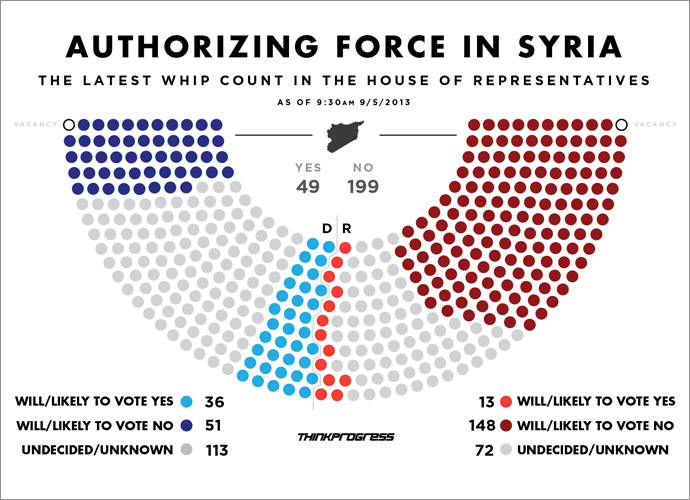
Recent reports have indicated that members of the US House of Representatives will probably turn down a resolution authorizing a US attack on Syria.

A whip count by Think Progress has shown that an overwhelming majority of US representatives are either undecided or likely to vote against a US attack on the Middle Eastern country.

According to data from the Think Progress Syria Whip Count, 26 congressmen will vote Å“yes” on the war powers resolution, 18 will probably vote in favor of it, 152 lawmakers are still undecided, 20 will probably vote Å“no” and 84 representatives will vote against the resolution. The data characterized 20 votes as Å“unknown.”

Meanwhile, House Minority Leader Nancy Pelosi (D-Calif.) has said she is not sure if President Obama could get the support of a majority of House Democrats for his war plan.

The New York Times also reported on Wednesday that congressional Democrats are a major barrier to Obamaâ„¢s plan for an attack on Syria.

Meanwhile, a recent Washington Post-ABC News poll revealed major public opposition in the US to military strikes on Syria. The poll showed that nearly six in 10 Americans are against launching missile strikes on Syria over accusations that the Syrian government used chemical weapons against militant groups.

Washington has accused the government of Syrian President Bashar al-Assad of launching a chemical attack in the suburbs of Damascus on August 21, killing hundreds of people. The Syrian government has strongly rejected the allegation.

Texas Republican lawmaker, Rep. Michael Burgess, has said the evidence the Obama White House showed at a classified briefing on Sunday for such allegations was Å“pretty thin” and even indicated that foreign-backed militants might have been behind the alleged chemical attack.

Former US congressman Ron Paul has also said that the alleged chemical weapons attack in Syria was a Å“false flag” likely carried out by the US-backed militant groups.

Å“The group that is most likely to benefit from that is al-Qaeda. They ignite some gas, some people die and blame it on Assad,” Paul, a long-time Republican representative from Texas, said during a Fox News interview filmed last week.

Amid the public and congressional opposition to a possible US attack on Syria, the Pentagon is considering a doubling-up of its capacity for strikes against the Arab country.

Pentagon is planning to broaden its strike capacity using US Air Force assets including weapons-bearing bombers.

The Obama administration is also considering the use of US and French aircraft to conduct strikes in Syria as Obama has directed the Pentagon to expand the list of potential strike targets in the country.

ISH/HJ

…read more

Republished from: Press TV

'Iran, Turkmenistan share region stance'

0

Iranâ„¢s Majlis Speaker Ali Larijani says the Islamic Republic and Turkmenistan have common ground on regional developments and both stress the need for the establishment of peace in the Middle East.

Å“Iran and Turkmenistan have a very close view on the establishment of peace, stability and tranquility in the region,” Larijani said in a meeting with Turkmenistanâ„¢s President Gurbanguly Berdymukhammedov in Ashgabat on Friday.

He praised Turkmenistanâ„¢s considerable progress during recent years, saying Iran is ready to work closely with the country to contribute to its development.

Å“Iran is ready to carry out infrastructural projects in Turkmenistan, particularly with regard to roads, refineries, oil and gas,” the Majlis speaker pointed out.

The Turkmenistan president, for his part, lauded the growing trend of bilateral cooperation with Iran on various political, economic and cultural fronts, expressing hope the two countries will witness further expansion of relations.

Larijani and Berdymukhammedov also discussed a protocol to exchange prisoners between the two countries and ways to counter smuggling of narcotics and terrorism.

They agreed that an economic group will follow up discussions on promotion of mutual economic cooperation.

Heading a high-ranking politico-parliamentary delegation, Iranâ„¢s Majlis speaker arrived in Turkmenistan on Thursday for an official three-day visit aimed at expanding bilateral ties between Tehran and Ashgabat.

Larijaniâ„¢s visit comes at the invitation of his Turkmen counterpart, Akja Nurberdiyeva, who visited Tehran in November 2009.

Berdimuhamedow had previously stressed the significance of the visit for boosting parliamentary cooperation between the two countries.

Iran is reportedly Turkmenistanâ„¢s second largest trade partner after Russia, exporting machinery, construction materials, vehicles, foodstuff, agricultural and petrochemical products, and electrical appliances to Turkmenistan. It also imports natural gas, electricity, textiles and agricultural products from its northeastern neighbor.

Last year, Iran and Turkmenistan signed a memorandum of understanding to raise mutual trade to USD 10 billion.

Tehran and Ashgabat have had official diplomatic relations since Turkmenistan’s independence from the Soviet Union in 1991, with Iran becoming the first nation to recognize Turkmenistan as an independent country.

SF/NN/HMV

…read more

Republished from: Press TV

‘Kazakhstan backs Iran's N-program’

0

Iranian Majlis Speaker Ali Larijani (L) shakes hands with Chairman of Kazakhstanâ„¢s Senate Kairat Mami in Ashgabat on September 6, 2013.

The chairman of Kazakhstanâ„¢s Senate has thrown his countryâ„¢s weight behind Iranâ„¢s peaceful nuclear activities, expressing hope that the Western dispute over Tehranâ„¢s nuclear energy program will be settled during the tenure of the new Iranian administration.

Kazakhstan has always backed the peaceful use of nuclear energy not only by Iran but by all countries, Kairat Mami said in a Friday meeting with Iranian Majlis speaker Ali Larijani in Turkmenistan.

Larijani and Mami are both on official visits to Ashgabat at the invitation of their Turkmen counterpart Akja Nurberdieva.

The Iranian Majlis speaker, for his part, touched upon the growing relations between Tehran and Astana, calling on both sides to tap into the existing potential to further bolster reciprocal ties.

Larijani thanked Kazakhstan for having hosted two rounds of talks between Iran and the P5+1 group of world powers, namely the five permanent members of the UN Security Council plus Germany.

Å“Westerners are biased against Iranâ„¢s nuclear issue, and we appreciate Kazakhstanâ„¢s friendly stance in this regard,” he said.

Å“On the nuclear issue, we have new proposals and will pursue them to achieve results,” Larijani added.

On Thursday, Iranian President Hassan Rouhani officially assigned the Foreign Ministry to take charge of future nuclear talks with the P5+1 group.

Iran and the P5+1 group have held several rounds of talks on a range of issues, with the main focus being on Iranâ„¢s nuclear energy program. The two sides wrapped up their latest round of negotiations on April 6 in the Kazakh city of Almaty. An earlier meeting had been held in Almaty on February 26-27.

The Unite States, Israel and some of their allies falsely claim that Iran is pursuing non-civilian objectives in its nuclear energy program, with Washington and the European Union using the unfounded allegation as a pretext to impose illegal sanctions on Iran.

Tehran strongly rejects the groundless claim over its nuclear activities, maintaining that as a committed signatory to the Non-Proliferation Treaty and a member of the International Atomic Energy Agency, it has the right to use nuclear technology for peaceful purposes.

SF/NN/HMV

…read more

Republished from: Press TV

No law will stop Obama’s democracy-bombs over Syria

0

Regardless of how Congress votes, Obama is going to attack Syria. The president is doing his best to avoid constructive dialogue when the focus should be international law, not ‘international norms’ as defined by Washington.

As world leaders descend on the Russian city of St. Petersburg to discuss global tax regimes and international trade, this year’s G20 Summit is really a G20+1, with an extra seat allocated for the massive elephant in the room.

Many of the leaders attending have brought along their foreign ministers, as the summit will also informally serve as a global platform to discuss the sorry state of affairs in Syria. One can only speculate as to the substance of any exchanges between President Putin and his American counterpart and forced smiles will be in no short supply.

“He is lying and knows he is lying. It’s sad,” said Putin, of John Kerry’s address to the US Congress. That about sums it up — the lies and deceit of the Obama administration are so breathtaking, so innumerable, and they’re being trumpeted knowingly and shamelessly. Want a taste of highly moral and ethical narrative being championed in favor of “the Syrian people?” Look no further than the New York Times, with its recent headline “Bomb Syria, Even If It Is Illegal,” which argues that Obama and his poodles should “declare that international law has evolved and that they don’t need Security Council approval to intervene in Syria.”

The establishment press is calling for blood, and they’re claiming the moral high ground while doing it — slightly pathological? You bet. The insane are really running the asylum on this one.

Read the full story on RT.com

Nile Bowie is a Malaysia-based political analyst and a columnist with Russia Today. He also contributes to PressTV, Global Research, and CounterPunch. He can be reached at nilebowie@gmail.com.

Japan urges rest to China ties

0

Japan has called for a reset in strained ties with neighboring China, following a meeting between the leaders of the two countries at the G-20 summit in Russia.

Japanese Prime Minister Shinzo Abe and Chinese President Xi Jinping briefly met on the sidelines of the Group of 20 summit in Saint Petersburg, to discuss the disputed islands in the South China Sea, Japan’s Chief Cabinet Secretary Yoshihide Suga told reporters on Friday.

Å“Prime Minister Abe explained (to Xi) about our thoughts that we should develop Japan-China relations by going back to the original point of the strategic, mutually beneficial relationship,” Yoshihide said.

The Chinese leader responded by admitting that ties between the two nations were facing Å“grave difficulties,” and that Japan should Å“correctly deal” with issues such as the islands dispute.

Xi added that conflicts should be handled Å“in line with the spirit of facing history squarely and looking forward to the future so as to seek a way to properly manage differences.”

The meeting marks the first between the two leaders since bilateral relations sunk last year after Japan publicly declared ownership of a series of disputed islands in the East China Sea.

Tokyo and Beijing remain locked in a bitter territorial dispute over the island chain controlled by Japan under the name Senkakus, but claimed by China as the Diaoyus.

Beijing also accuses Tokyo of not making sufficient amends for its hostile and avaricious behavior following the events of World War II.

GMA/HMV

…read more

Republished from: Press TV

Russia, UK talk Syria in St. Petersburg

0

Russian President Vladimir Putin (L) welcomes British Prime Minister David Cameron at the start of the G20 summit in Saint Petersburg on September 5, 2013.

Russian President Vladimir Putin has discussed the crisis in Syria with British Prime Minister David Cameron.

Putin met with Cameron early on Friday on the sidelines of the G20 summit in the Russian city of Saint Petersburg after discussing the Syrian crisis over dinner with other world leaders.

The meeting comes as the Group of 20 developed and developing economies failed to bridge their divisions over US plans for a military intervention in Syria.

Å“The sides have once again exchanged views regarding the situation in Syria,” Kremlin spokesman Dmitry Peskov said.

Peskov added that Putin and Cameron also confirmed their intentions to Å“continue working on developing cooperation on a wide variety of issues.”

The rhetoric of war against Syria first gained momentum on August 21, when the militants operating inside the country and the foreign-backed Syrian opposition claimed that over a thousand people had been killed in a government chemical attack on militant strongholds on the outskirts of Damascus.

The Syrian government categorically rejected the accusation and said the militants had conducted the attack to draw in foreign military intervention.

Meanwhile, US President Barack Obama has asked the Congress to back the military action against Syria. The US Senate Committee on Foreign Relations passed a resolution in this regard on September 4. The resolution now needs Congressional approval.

France has expressed support for the attack on Syria, while German Chancellor Angela Merkel has also ruled out Germanyâ„¢s participation in a military strike.

The UK parliament has voted against military action against Syria.

MR/HSN

…read more

Republished from: Press TV

‘Egypt dissolves Muslim Brotherhood’

0

Egyptians condemn the deadly crackdown on supporters of deposed President Mohamed Morsi during a protest rally in Alexandria on August 16, 2013.

The Egyptian government has moved to dissolve the countryâ„¢s largest political organization, the Muslim Brotherhood, a report says.

Cairo has decided to proceed with the dissolution of the Muslim Brotherhood as a legally registered non-governmental organization (NGO), the state-run Al-Akhbar newspaper said on Friday.

Hany Mahana, the spokesman for the minister of social solidarity, told the newspaper, Å“The ministerâ„¢s decision has in fact been issued but it will be announced at the start of next week in a press conference.”

On September 2, the judicial advisory panel, set up by the countryâ„¢s military-backed government, accused the Brotherhood of operating outside the law and recommended its termination.

In March, the Muslim Brotherhood registered itself as an NGO following a court decision on the legal status of the group.

The Brotherhood was founded in 1928 following the collapse of the Ottoman Empire, but was banned by the countryâ„¢s military rulers in 1954.

On July 3, the head of Egyptâ„¢s armed forces, General Abdel Fattah al-Sisi, announced that President Mohamed Morsi, a leading former member of the Brotherhood, was no longer in office.

On July 5, Brotherhood supreme leader Mohamed Badie said the move against Morsi was illegal and millions would remain on the streets until the reinstatement of the ousted president.

The army-appointed government has launched a bloody crackdown on Morsi supporters ever since his ouster and arrested more than 2,000 Brotherhood members, including Badie, who was detained on August 20.

About 1,000 people were killed in a week of clashes between Morsi supporters and security forces after police dispersed their protest camps in a fatal crackdown on August 14.

GMA/HSN

…read more

Republished from: Press TV

Manufacturing Consent on Syria

0

Edward Herman and Noam Chomsky gained much notoriety from their seminal book, Manufacturing Consent, more than two decades ago. The central thesis of that book — that political and media elites construct propaganda narratives in order to build support for U.S. foreign policy — remains as relevant today as ever. Obama’s proposed intervention in Syria is a case in point. Public support for military action remains quite low — ranging from between one-quarter to one-third of Americans according to recent polls.  That’s likely to change in coming weeks to months as the administration ramps up its pro-intervention rhetoric, and as political elites, reporters, and media pundits uncritically repeat and embrace his messages.

The 2011 intervention in Libya provides a template for the administration’s plan: defend an intervention via humanitarian rhetoric that lambastes a dictator for serious human rights abuses; deliver a number of public speeches in an effort to build support for war; and once troops begin to enter harm’s way, sit back and enjoy increased support as Americans “rally around the flag” in support of the conflict. This formula was enough to gain support for intervention from between 50 to 60 percent of Americans in the case of Libya, and is likely to do the same in Syria once Congress goes along.

The process has already begun. A senate committee already voted 10-7 to grant authorization for force, and a floor resolution is likely to follow in this Democratic controlled chamber. The Obama administration has largely controlled the narrative on Syria over the last year and a half, stressing that the United States is seriously concerned with Assad’s abuses and use of chemical weapons against rebels and civilians. A September survey from the Pew Research Center finds that by a factor of more than two-to-one, Americans conclude that, from what they have “read and heard,” that “there is clear evidence that the Syrian government used chemical weapons against civilians.” The beleaguered peoples of Syria, Obama contends, need a helping hand from the United States, which is said to be unconditionally concerned with protecting the safety and security of those targeted by Weapons of Mass Destruction. The claim that the Syrian government has used chemical weapons against its people has been largely accepted in political and media discourse, despite the fact that the administration has yet to present any concrete evidence. The failure to present evidence presents a particular problem considering claims appearing in news reports that rebel groups may be guilty of using chemical weapons. The Syrian government may very well have used these weapons, and this would probably surprise few people, but the key point here is that the administration has done nothing to present that case before announcing its campaign for war.

In analyzing major news stories via the Lexis Nexis academic database, my findings suggests that during early 2012 and in the first half of 2013 (both periods when reporting of the Syrian civil war was growing), the percent of stories referencing the Obama administration significantly outnumbered references to Congressional Republican opponents in the news by between ten to twenty percentage points.  In other words, the administration had a clear advantage in controlling the narrative on Syria — as presidents typically do when it comes to foreign policy. Reports claiming that both the Syrian government and rebel groups have engaged in human rights abuses and used chemical weapons represent a challenge to Obama’s Syria narrative. According to Lexis Nexis, reports referencing these two points barely appeared in U.S. news stories from 2012 to 2013. Instead, the grand narrative on Syria emphasized Obama’s rhetoric on the need to confront Assad, while also stressing the efforts of rebels to take down the government. Predictably, those paying close attention to news on Syria have fallen in line behind the president. My analysis of Pew Research Center polling data from 2012 finds that those paying “a lot” or “some attention” to Syria in the news were significantly more likely to support U.S. military intervention and more likely to embrace supplying weapons to rebels than those paying attention to Syria news “not at all.” The effects of pro-administration media content, however, were blunted by the fact that relatively few Americans were paying attention to Syria from 2012 through early 2013 (typically less than 50 percent in polls when this question was surveyed). Pro-administration coverage is likely to produce growing support for intervention by late 2013 however, considering that a strong majority of Americans (over 60 percent from recent survey findings) are now paying attention as the U.S. prepares for war. Mass support will be necessary to tip the scales in favor of intervention.

Clearly, Obama read the writing on the wall and saw from the latest polling figures that opposition to war has persisted by a factor of two-to-one; hence his effort to achieve support from Congress. This president would like to spread responsibility for the intervention between himself and the legislature, in an obvious effort to prevent a public mutiny focused on executive and to avoid the tarnishing of his presidential “legacy.” This effort has little to do with a commitment to the rule of law, as Obama argues (Congress according to the Constitution has the power to declare war, not the president). Obama showed contempt for Congress and little interest in securing a congressional resolution in the 2011 Libya intervention. Receiving support from Republican hawks and Democratic allies on Syria, however, will add an element of perceived “legitimacy” to the war effort, likely bumping up public support.  This much seems clear from late August NBC polling demonstrating that 79 percent of Americans feel that “Obama should be required to receive approval from Congress before taking military action in Syria.”

Obama’s delivery of a number of speeches shortly before the conflict begins (as happened in Libya), will likely be accompanied by growing support among those paying attention to presidential rhetoric and reporting on Syria. Pundits in the media will fawn over the president for his efforts to promote “transparency” in the intervention by presenting “clear cut” and “definitive” evidence that the Syrian government used chemical weapons — of course, without bothering to pressure for a return of inspectors to verify these claims. Finally, as the U.S. military enters into the hostilities, many will grant short-term support to the president, seeking to demonstrate their “support for the troops” during a difficult time.  This “rally effect” has accompanied every war in recent history, and it will be no different in Syria. The combination of these three developments will likely result in at least a bare majority of Americans (perhaps more) supporting limited intervention, so long as ground troops are not introduced.

The notion of “manufacturing consent” seems appropriate here, considering that challenges to war are being marginalized in political discourse.  Some of those points are worth reflecting on:

* Why should Americans accept Obama’s artificial “red line” in the sand that dictates intervention based upon evidence of the Syrian government’s use of chemical weapons? Estimates suggest that approximately 100,000 Syrians have already been killed in the civil war. Do we even know how many have died as a result of chemical weapons use as compared to conventional weapons? What makes a death via chemical weapons more morally outrageous than a death via conventional weapons? Do the families of the dead care about this distinction? A murder is a murder regardless of the type of bomb used. The “red line” narrative appears to be little more than a propaganda line used to drum up public support for war at the expense of critical thought.

* Should we really believe that air strikes are going to disarm the Syrian regime, or at least render its alleged chemical stockpile harmless? This seems fanciful, despite the fact that so many pundits are accepting this position. Those familiar with the disarmament process know that it requires the introduction of international inspectors, which first need to identify facilities where chemical weapons reside, in order to disarm them. Without such efforts, there is reason to question the assumption that a bombing campaign will prevent future use of chemical weapons. The bombing campaign seems intended to degrade Assad’s military capabilities — rather than his chemical weapons stockpiles — so as to provide the Syrian rebels with an opportunity to take the offensive against the government. Obama hasn’t been honest with the public about this motive for action.

* Why is military intervention superior to intensifying sanctions? Increased sanctions send the message that repression is unacceptable, as the guilty country becomes even further isolated from the rest of the world. This solution has the added advantage of removing U.S. responsibility for the bombing of civilians in large numbers. Furthermore, the sanctions alternative will at least ensure that the U.S. does not further exacerbate instability in Syria, considering the concern that violence could spill into neighboring countries. Hezbollah has announced that it will launch attacks against Israel following a U.S. intervention in Syria. Hezbollah’s attacks would most certainly be accompanied by Israeli incursion into Lebanon, contributing to further regional instability, death, and destruction.

* Why Syria, and why now? There are so many examples of repressive allied regimes that receive a free pass on human rights abuses. Reports suggest that more than 600 civilians were killed in the recent military crackdown by the U.S.-allied Egyptian dictatorship, with scarcely a word from the president, compared to the 1,500 hundred who died in the Syrian government’s alleged chemical weapons attack last month. Plenty of examples of human rights abuses by U.S. favored dictators (or by countries with little strategic value) have produced little to no response from U.S. presidents. To name a few: the Saudi and Bahraini government crackdown on protesters in Bahrain during the Arab Spring; government genocide against civilians in Darfur during the 2000s; the Turkish government’s suppression of tens of thousands of Kurds from the 1990s onward; the murder of hundreds of thousands via genocide in Rwanda during the 1990s; the Indonesian government’s occupation and genocide in East Timor from the 1970s through 1990s; Saddam Hussein’s gassing of the Kurds during the mid to late 1980s, when he remained a valued U.S. ally. We could add more countries to the list, but the main point is that allied human rights abusers (or those responsible for abuses in countries with little strategic value) receive a pass, while designated enemies of state (Libya and Syria being the most recent examples) are targeted due to geopolitical U.S. interests — the most salient being Middle Eastern oil.

* What about those chemical weapons? Why should the Obama administration expect the public to accept that Assad used chemical weapons when literally no evidence has been presented? To simply accept presidential rhetoric without evidence would be a serious mistake in light of the way that intelligence was knowingly and criminally manipulated by Bush in selling the war with Iraq. If it turns out that both sides are guilty of using chemical weapons, what is the humanitarian or moral basis for intervening in favor of rebels — who themselves have amassed quite a horrendous human rights record — against the government?

* What of humanitarian concerns? Do we really think that bombing military emplacements located in civilian areas can be defended as humanitarian? Such attacks are likely to escalate the human rights abuses in Syria, rather than curtail them. It is a historical fact that the vast majority of deaths during war are civilians. Perhaps we should stop defending wars by using mythical humanitarian rhetoric when we know that they produce destruction and death, instead of humanitarian relief.

To date, I have seen little effort to address these criticisms. Such concerns have been brought up from time to time in the news, but if past trends continue, media coverage will privilege presidential narratives over anti-war views. At day’s end, Syria appears to have all the makings of a classic effort to “manufacture consent” in favor of war.

Anthony DiMaggio holds a Ph.D. in political science from the University of Illinois, Chicago. He has taught American Government and Global Politics at a number of colleges and universities, and is the author of numerous books, including Mass Media, Mass Propaganda (2008); When Media Goes to War (2010); Crashing the Tea Party (2011); and The Rise of the Tea Party (2011). He is currently completing a book on presidential rhetoric: From Fear to Democracy: Presidential Rhetoric from the War on Terror to the Arab Spring, and can be reached at: anthonydimaggio612@gmail.com

…read more

Republished from: Counterpunch

When War is Swell: the Carlyle Group and the Middle East at War

0

Paris.

A couple of weeks ago, in a dress rehearsal for her next presidential campaign, Hillary Clinton, the doyenne of humanitarian interventionism, made a pit-stop at the Carlyle Group to brief former luminaries of the imperial war rooms about her shoot-first-don’t-ask-questions foreign policy.

For those of you who have put the playbill of the Bush administration into a time capsule and buried it beneath the compost bin, the Carlyle Group is essentially a hedge fund for war-making and high tech espionage. They are the people who brought you the Iraq war and all those intrusive niceties of Homeland Security. Call them the Knights of the Revolving Door, many of Carlyle’s executives and investors having spent decades in the Pentagon, the CIA or the State Department, before cashing in for more lucrative careers as war profiteers. They are now licking their chops at the prospect for an all-out war against Syria, no doubt hoping that the conflagration will soon spread to Lebanon, Jordan and, the big prize, Iran.

For a refresher course on the sprawling tentacles of the Carlyle Group, here’s an essay that first appeared in CounterPunch’s print edition in 2004. Sadly, not much has changed in the intervening years, except these feted souls have gotten much, much richer.  — JSC

Across all fronts, Bush’s war deteriorates with stunning rapidity. The death count of American soldiers killed in Iraq will soon top 1000, with no end in sight. The members of the handpicked Iraqi Governor Council are being knocked off one after another. Once loyal Shia clerics, like Ayatollah Sistani, are now telling the administration to pull out or face a nationalist insurgency. The trail of culpability for the abuse, torture and murder of Iraqi detainees seems to lead inexorably into the office of Donald Rumsfeld. The war for Iraqi oil has ended up driving the price of crude oil through the roof. Even Kurdish leaders, brutalized by the Ba’athists for decades, are now saying Iraq was a safer place under their nemesis Saddam Hussein. Like Medea whacking her own kids, the US turned on its own creation, Ahmed Chalabi, raiding his Baghdad compound and fingering him as an agent of the ayatollahs of Iran. And on and on it goes.

Still not all of the president’s men are in a despairing mood. Amid the wreckage, there remain opportunities for profit and plunder. Halliburton and Bechtel’s triumphs in Iraq have been chewed over for months. Less well chronicled is the profiteering of the Carlyle Group, a company with ties that extend directly into the Oval Office itself.

Even Pappy Bush stands in line to profit handsomely from his son’s war making. The former president is on retainer with the Carlyle Group, the largest privately held defense contractor in the nation. Carlyle is run by Frank Carlucci, who served as the National Security advisor and Secretary of Defense under Ronald Reagan. Carlucci has his own embeds in the current Bush administration. At Princeton, his college roommate was Donald Rumsfeld. They’ve remained close friends and business associates ever since. When you have friends like this, you don’t need to hire lobbyists..

Bush Sr. serves as a kind of global emissary for Carlyle. The ex-president doesn’t negotiate arms deals; he simply opens the door for them, a kind of high level meet-and-greet. His special area of influence is the Middle East, primarily Saudi Arabia, where the Bush family has extensive business and political ties. According to an account in the Washington Post, Bush Sr. earns around $500,000 for each speech he makes on Carlyle’s behalf.

One of the Saudi investors lured to Carlyle by Bush was the BinLaden Group, the construction conglomerate owned by the family of Osama bin Laden. According to an investigation by the Wall Street Journal, Bush convinced Shafiq Bin Laden, Osama’s half brother, to sink $2 million of BinLaden Group money into Carlyle’s accounts. In a pr move, the Carlyle group cut its ties to the BinLaden Group in October 2001.

One of Bush Sr.’s top sidekicks, James Baker, is also a key player at Carlyle. Baker joined the weapons firm in 1993, fresh from his stint as Bush’s secretary of state and chief of staff. Packing a briefcase of global contacts, Baker parlayed his connections with heads of state, generals and international tycoons into a bonanza for Carlyle. After Baker joined the company, Carlyle’s revenues more than tripled.

Like Bush Sr., Baker’s main function was to manage Carlyle’s lucrative relationship with Saudi potentates, who had invested tens of millions of dollars in the company. Baker helped secure one of Carlyle’s most lucrative deals: the contract to run the Saudi offset program, a multi-billion dollar scheme wherein international companies winning Saudi contracts are required under terms of the contracts to invest a percentage of the profits in Saudi companies.

Baker not only greases the way for investment deals and arms sales, but he also plays the role of seasoned troubleshooter, protecting the interests of key clients and regimes. A case in point: when the Justice Department launched an investigation into the financial dealings of Prince Sultan bin Abdul Aziz, the Saudi prince sought out Baker’s help. Baker is currently defending the prince in a trillion dollar lawsuit brought by the families of the victims of the 9/11 attacks. The suit alleges that the prince used Islamic charities as pass-throughs for shipping millions of dollars to groups linked to al-Qaeda.

Baker and Carlyle enjoy another ace in the hole when it comes to looking out for their Saudi friends. Baker prevailed on Bush Jr. to appoint his former law partner, Bob Jordan, as the administration’s ambassador to Saudi Arabia.

Carlyle and its network of investors are well positioned to cash in on Bush Jr.’s expansion of the defense and Homeland Security department budgets. Two Carlyle companies, Federal Data Systems and US Investigations Services, hold multi-billion dollar contracts to provide background checks for commercial airlines, the Pentagon, the CIA and the Department of Homeland Security. USIS was once a federal agency called the Office Federal Investigations, but it was privatized in 1996 at the urging of Baker and others and was soon gobbled up by Carlyle. The company is now housed in “high-security, state-of-the-art, underground complex” in Annandale, Pennsylvania. USIS now does 2.4 million background checks a year, largely for the federal government.

Another Carlyle subsidiary, Vought Aircraft, holds more than a billion dollars in federal contracts to provide components for the C-117 transport plane, the B-2 bomber and the Apache attack helicopter. Prior to 2001, Vought had fallen on hard times. Just before the 9/11 attacks, Vought announced that it was laying off more than 1,200 employees, more than 20 percent of its workforce. But business picked up briskly following the airstrikes on Afghanistan and the war on Iraq.

In 2002, Carlyle sold off its biggest holding, United Defense. The sale may have been prompted by insider information leaked to Carlucci by his pal Rumsfeld. In early 2001, Carlyle was furiously lobbying the Pentagon to approve contracts for the production of United Defense’s Crusader artillery system, an unwieldy and outrageously expensive super-cannon. Rumsfeld disliked the Crusader and had it high on his hit list of weapon systems to be killed off in order to save money for other big ticket schemes, particularly the Strategic Defense Initiative.

But, as detailed in William Hartung’s excellent book, How Much Are You Making in the War, Daddy?, Rumsfeld didn’t terminate the Crusader immediately. Instead, he held off on a public announcement of his decision for more than a year. By that time, Carlucci and Baker devised a plan to take United Defense public. The sale to unsuspecting investors netted Carlyle more than $237 million. Six months later, Rumsfeld closed the book on the Crusader. By then the gang at Carlyle had slipped out the back door, their pockets stuffed with cash. United Defense was able to petition the Pentagon to compensate them to the tune of several million for cancellation of the contract. Even when you lose, you win.

So the men behind the Carlyle Group drift through Washington like familiar ghosts, profiteering off the carnage of Bush’s disastrous crusades, untroubled by any thought of congressional investigation or criminal prosecution, firm in the knowledge that the worse things get for the people of the world, the less secure and more gripped by fear the citizens their own country become, the more millions they will reap for themselves. Perpetual war means perpetual profits.

Let’s leave the last word to Dan Broidy, author of The Iron Triangle, an illuminating history of the Carlyle Group: “It’s not an exaggeration to say that September 11 is going to make the Carlyle investors very, very rich men.”

JEFFREY ST. CLAIR is the editor of CounterPunch and the author of Been Brown So Long It Looked Like Green to Me: the Politics of Nature, Grand Theft Pentagon and Born Under a Bad Sky. His latest book is Hopeless: Barack Obama and the Politics of Illusion. He can be reached at: sitka@comcast.net.

This essay is excerpted from Jeffrey St. Clair’s book Grand Theft Pentagon  

…read more

Republished from: Counterpunch

China urges nuclear diplomacy with Iran

0

China has stressed the need for a peaceful resolution of the West’s standoff with Iran over Tehranâ„¢s nuclear energy program, reaffirming Beijingâ„¢s opposition to the use of coercive measures against Tehran.

Å“… all parties should adhere to the efforts to maintain and promote the process of dialog and to find negotiated and appropriateÅ“ settlement of the dispute, Wang Min, China’s deputy permanent representative to the UN said at a Security Council meeting on Thursday.

He reiterated that a peaceful solution is the Å“only correct and viable path” to settle the issue.

China is always opposed to the use or threat of use of force, excessive pressure and new sanction measures against Iran, Wang said.

He added that Beijing Å“will continue to work with all sides to seek settlement of the issue through diplomatic means.”

The United States, Israel and some of their allies have repeatedly accused Iran of pursuing non-civilian objectives in its nuclear energy program, with the US and European Union using the claim as an excuse to impose illegal sanctions against Tehran.

Iran has categorically rejected the allegation, stressing that as a committed member of the International Atomic Energy Agency and a signatory to the Non-Proliferation Treaty, it is entitled to develop nuclear technology for peaceful purposes.

In addition, the IAEA has conducted numerous inspections of Iran’s nuclear facilities, but has never found any evidence which shows Iran’s civilian nuclear program has been diverted to nuclear weapons production.

AR/NN/HMV

…read more

Republished from: Press TV

Only Republicans Can Save Us Now

0

In Gulliver’s Travels (1726), Jonathan Swift has his hero say of the inhabitants of Brobdingnag: “I cannot but conclude that the Bulk of your Natives, to be the most pernicious Race of little odious Vermin that Nature ever suffered to crawl upon the Surface of the Earth.”

Gulliver might have used those words, just as appropriately, to describe House and Senate Democrats as they mobilize to support Barack Obama’s looming Syrian War.

Large majorities of Americans understand how dangerous Obama’s war plans are. The awareness is dawning too that it is morally preposterous for the United States, a serial violator of international law and the main purveyor of terror and violence in the world today, to assume the role of judge, jury and enforcer for the Middle East or anywhere else.

CounterPunch readers know this well. There have been scores of postings on this site and elsewhere exposing the bankruptcy of Obama’s case. I have written several of them myself, and there is no need now to go over the same terrain again. The arguments are familiar; the conclusions are obvious.

House and Senate Democrats understand this too; so does Obama. And yet they persevere.

The former scramble to back their leader out of party loyalty and because, where Obama is concerned, they, along with many of their constituents, feel obliged, like Babbitt in Sinclair Lewis’ eponymous novel, to “boost, not knock.” For Obama, it is a matter of saving face – after boxing himself in by stupidly drawing a red line in the sand.

If only the heavens were just! Then there would be a hell for Democratic Obama enablers like Nancy Pelosi and Harry Reid, and for their media flacks; John Kerry and Hillary Clinton would befoul the nethermost regions.

It would be especially wonderful if there were also a special hell where Barack Obama and Bashar Al-Assad could dwell together for all eternity – comparing their stockpiles of weapons of mass destruction (we know whose would be bigger), composing kill lists to no effect, and dreaming impotently of flaunting international law.

But, alas, none of these miscreants will face cosmic Justice; damn God for not existing! The American people, the Syrian people, and the peoples of the countries into which the Syrian civil war spills over will suffer this-worldly punishments instead.

Of course, there are a few brave Democrats still, and some of them will probably not succumb, even in the end, to their leadership’s line. Ironically, however, at this point, the best chance for holding back the Obama juggernaut lies with the GOP.

Only a couple of weeks ago, relying on Republicans for any decent objective would have seemed as outrageous as Obama’s war plans now do. Republicans haven’t changed either; circumstances have – thanks more to Obama’s bungling than to anything the Syrian government might have done.

The GOP was the Greater Evil Party before, and it still very much is; Republicans still make Democrats look good.

The best of them are unabashed (ruling) class warriors.  Others, like John McCain, are always at the ready to go to war. And then there are the lunatics who have taken over the asylum the GOP has become.

Gulliver’s words hardly do them justice.

To be sure, their obstinacy elevates them. The ignorance, indeed the outright stupidity, they evince inspires fear and awe.  From the standpoint of classical aesthetic theory, the Grand Old Party, at its extreme, almost rises to the level of the sublime.

And although it is madness, there is method to it.  Had pre-Obama Democrats been even a tenth as obstinate, they might have stopped George W. Bush in his tracks. But that “pernicious Race of little odious Vermin” didn’t have it in them.

Still they are by almost any measure the lesser evil. It does not follow, however, that it is always worse when Democrats lose.

Obama trounced John McCain in 2008, and Democrats then controlled both the House and the Senate. Nevertheless, the nascent Tea Party, born in reaction to Obama’s victory, has set the agenda ever since.

It is becoming a familiar theme: Republicans lose and yet their influence is enhanced.

Obama won again in 2012. Had Mitt Romney won instead and had he proposed anything like what Obama is planning for Syria, we can be sure that Democrats would by now have overcome their inherent pusillanimity, and would be united in an effort to stop him. They would have a good chance of succeeding too.

Instead, we have the sickening spectacle now taking place.

We even have Democratic Party front organizations like MoveOn.org polling its left-leaning membership over whether to support Obama’s perilous, self-serving folly. How pathetic is that!

The lesson is plain: lesser evils are not always worse or, what comes to the same thing, when we look to the larger consequences, it is not always obvious who the lesser evil is; not as obvious, anyway, as is usually supposed.

In any case, the party that is ostensibly the greater evil by any measure is now our best, perhaps our only, hope for avoiding the impending disaster Obama and his inner circle are about to foist upon the world.

Perhaps nothing will stop our Nobel laureate from launching this next war of choice. Certainly public opinion won’t; our decrepit political class is contemptuous of it — from the President on down.

But the bought and paid fors in Congress do ultimately need votes, and therefore cannot ignore their constituents’ wishes entirely. And there is at least some chance that Obama might find it unwise to defy a Congressional vote.  That is what happened with David Cameron in the British Parliament; it could also happen here.

But with only a few Democrats courageous enough, and progressive enough, not to follow their leader, Congressional disapproval can only happen with massive Republican support.

Can Republicans be counted on to do the right thing? If they do, it will be by going against their nature. Except for a few brave souls in the party’s libertarian fringe, Republicans, like mainstream Democrats, are imperialists at heart. But, unlike Democrats, they have a saving grace: they hate Obama (for all the wrong reasons, of course) and will do anything to hurt him.

Theirs is not the kind of hatred that sharpens awareness and quickens the mind. Their hatred is irrational and blind.

In its service, some of them are willing, even eager, to close the government down, bringing incalculable harm to everyone. This could happen very soon, when Congress must, yet again, raise the debt ceiling.

The poor will then suffer more than the rich, but there will be no winners — except perhaps the Obamaphobes, who care about nothing so much as bringing the President down.

Their immediate objective  this Fall will be to thwart funding for Obamacare, as required by the Affordable Care Act.  They are just mean and stubborn enough to hold the entire government hostage to this end.

This is odd, to say the least, since the core principles of the Affordable Care Act are Republican concoctions — fashioned in the early 1990s at the Heritage Foundation as an alternative to Hillary Clinton’s proposals. And, as everyone knows, when he was the Governor of Massachusetts, Mitt Romney put a plan very much like Obama’s into effect.

The Affordable Care Act is nevertheless likely to do more good than harm, and it is less market-centered than doctrinaire libertarians might like. Even so, from the point of view of the Republican mainstream in the pre-Obama days, it is definitely on the right (that is, the wrong) side of the class struggle. A more honest name for it would be “the Healthcare Profiteers and Private Insurers Protection Act” or perhaps  “the Set the Cause of Genuine Health Care Reform Back Another Generation Act.”

However Obamacare’s Republican coloration hardly matters to Obama’s Republican opponents; he is behind the Affordable Care Act – therefore they will do anything to stop it.

Will it be the same when it comes to his Syrian War?

It would be for sure but for one sad fact: right-wing ideology and anti-Obama animosity have become entangled with the Tea Party’s take on “patriotism,” according to which, by jingo, nobody gets away with dissing the USA.

That is what Bashar Al-Assad supposedly did — “supposedly,” because the case is hardly proven, except in the minds (or words) of John Kerry, Chuck Hagel, and others in the innermost-circle of the Commander-in-Chief.

But Tea Party Republicans work on faith, not evidence, and they believe what their pundits tell them. They therefore find themselves on the horns of a dilemma. They want to hurt Obama by any and all means. But, at the same time, they will brook no challenge to “USA Number One.”

It therefore matters whether they see Obama starting another war to save his own face (or, rather, his own sorry ass), or whether they think the war he wants to start is about saving face for the United States. Because both are true, it could go either way.

Nothing else concerns them. They could care less about poison gas and they are fine with Syrians killing Syrians. Since many of them are islamophobic, that prospect positively warms their hearts.

In this respect, they are essentially of one mind with the Obama administration and the mainstream of the lesser evil party.

Therefore, like their rivals, if they come to believe that America’s “credibility” depends on intervening to enforce prohibitions on the use of chemical weapons — never mind that we don’t really know what happened in the Damascus suburbs last month, and that any U.S. intervention is all but certain to have the opposite effect – then they too will go along.

As a criminal organization writ large, the American empire cannot tolerate defiance; “credibility” is all.  On this point, as on so many others, the greater and lesser evil parties converge.

Our only hope, then, is that right-wing Republicans focus on Obama’s “credibility,” not America’s. That could happen; their hatred might just be blind enough.

If they prevail, and then if Obama is convinced that it will hurt him politically to ignore Congress’ will, the danger will pass. Otherwise, beware!

With a real Left gone missing and with a Democratic Party that is worse than useless, this is what it has come to.

Who would have imagined that the “hope” Obama used to talk about meant hoping that Republicans will keep him from starting a war even “dumber” than the one he campaigned against (before continuing it for several years and then repackaging it in order to make it seem like it wasn’t entirely lost)!

Obama promised “change,” and he wasn’t lying. But change like this makes even George Bush look good.

ANDREW LEVINE is a Senior Scholar at the Institute for Policy Studies, the author most recently of THE AMERICAN IDEOLOGY (Routledge) and POLITICAL KEY WORDS (Blackwell) as well as of many other books and articles in political philosophy. His most recent book is In Bad Faith: What’s Wrong With the Opium of the People. He was a Professor (philosophy) at the University of Wisconsin-Madison and a Research Professor (philosophy) at the University of Maryland-College Park.  He is a contributor to Hopeless: Barack Obama and the Politics of Illusion (AK Press).

Republished from: Counterpunch

'US seeks to protect Israel by Syria war'

0

Syriaâ„¢s Ambassador to Tehran Adnan Mahmoud says Washingtonâ„¢s military strike against the Arab country aims to Å“support and protect” the Israeli regime in the region.

By attacking Syria, the US and the West seek to target the anti-Israeli resistance front in the region which comprises Syria, Iran and Hezbollah, said the envoy in a Thursday meeting in Tehran with representatives of the Bolivarian Alliance for the Americas (ALBA).

The Syrian government and nation will defend their country by standing up to foreign plots and will emerge victorious, he added.

He emphasized that Syria is not alone in countering the ongoing crisis and noted that certain countries in the region and across the world as well as the resistance front will support Damascus against any military attack.

Washington seeks to kill the Syrian people and wreak havoc on the country just as it has left behind a trail of death and destruction in Iraq and other US-occupied countries, Mahmoud pointed out.

He added that the US has breached the UN Charter and other international regulations.

The Syrian people and government will stand up to the West and the US and believe that they will finally achieve victory, Mahmoud said.

Syria has been gripped by deadly unrest since March 2011. According to reports, the Western powers and their regional allies — especially Qatar, Saudi Arabia, and Turkey — are supporting the militants operating inside Syria.

The call for military action against Syria intensified after foreign-backed opposition forces accused the government of President Bashar al-Assad of launching a chemical attack on militant strongholds in the suburbs of Damascus on August 21.

Damascus has vehemently denied the accusations, saying the chemical attack was carried out by the militants themselves as a false-flag operation.

On August 31, US President Barack Obama said he had decided that Washington must take military action against the Syrian government, which would mean a unilateral military strike without a UN mandate.

Obama said despite having made up his mind, he will take the case to the US Congress. But he added that he is prepared to order military action against the Syrian government at any time.

SF/NN/HMV

…read more

Republished from: Press TV

Mexican Teachers Hit the Streets

0

The first nine months of the Enrique Peña Nieto administration have been a cleverly-orchestrated exercise in media manipulation. But you can’t really ignore 20,000 pissed-off teachers dragging monstrous Mexico City to a halt. As the Institutional Revolutionary Party (PRI) golden boy gave his first Informe, or State of the Union address, on Monday, the Chamber of Deputies, the Senate and the great Zocalo square were all hit by the latest public backlash to his much-hyped reform agenda.

Peña Nieto faced resistance even before he was elected; tens of thousands of students correctly predicting a fraud-drenched July 2012 vote. Police clashed with protesters on the day of his inauguration, now immortalized on social media as #1DMX. Although Mexico’s Big Media (Televisa and the rest) are firmly behind the new PRI administration, the resistance is now digitized, tweeted and fully-Facebooked.

The centerpiece of the new administration has been the “Pact for Mexico”; a very vague political consensus for the structural reforms that the Right says the country needs to move forward. And everybody’s on the Right these days — the leaders of the National Action Party (PAN) and the center-left(ish) Democratic Revolutionary Party (PRD) defied much of their rank-and-file to get with the program. If the drug war years of Felipe Calderon portrayed a Mexico on the brink of chaos, the Pacto is intended to show a thriving Latin American democracy boldly pushing ahead.

For the last two weeks, however, thousands of teachers from the National Coordinating Committee of Education Workers (CNTE) who oppose a controversial education reform have been marching daily on the two chambers, the Interior Ministry and the capital’s international airport. Metro and bus stations have been closed. The city’s main square has been swamped by tents. Frustrated capitalino motorists — simultaneously the most patient and volatile drivers in the world — have been turning the air every shade of blue.

The crux of the education reform is standardized testing for teachers across the nation; some of the most underfunded and beleaguered maestros in Latin America. Monopolized by a crooked union that hands out jobs for cash, Mexican public education has long been a national embarrassment (a recent World Economic Forum report ranked the system 107th in the world). And this in a country where over eight million young people neither work nor go to school, according to a study by the OECD.

The 20,000 or so teachers from southern Mexico who have held the capital’s downtown hostage in recent days thus fiercely divide opinion. Are they progressives contesting the privatization of the public education system, or hapless country bumpkins refusing to move with the times?

School’s Out for Protests

The CNTE should not be confused with the SNTE — the largest labor union in Latin America and former plaything of political kingmaker and “Mexico’s most powerful woman” Elba Esther Gordillo. La Maestra, who ran the syndicate like her own private mafia and embezzled vast amounts of public funds, also opposed the new reform and threatened protests that would have been considerably larger than the CNTE’s. Cue a political coup d’état as Peña Nieto scuppered Gordillo’s plans by arresting her on corruption charges. Her money-grabbing exploits had been public knowledge since the 1990s but this was a shrewd preemptive strike. No surprise that her successor is one hundred percent down with the bill.

The CNTE has therefore been dubbed the “dissident union”. The majority of its members hail from impoverished southern states like Chiapas, Oaxaca and Guerrero, where resources are scarce and teachers would suffer most heavily from the proposed shake-up. These are men and women working in classrooms that often don’t have electricity; let alone access to the worldwide web.

Like everything in Mexico, it’s a case of the haves and have-nots. The teachers I’ve spoken to from the CNTE don’t oppose testing — on the contrary, many want better training and support from the government — but they’re well-aware of the lunacy of applying a one-size-fits-all evaluation to vastly unequal regions of the country. Not to mention that in many of the poorest areas, teachers work outside of the national curriculum, giving classes based on usos y costumbres — traditional customs — to students for whom Spanish is a second language.

To call the CNTE “radical” — as much of the media has done — is laughable. Presumably they’re on the same side as the “radical” students who opposed widespread vote-buying and fraud during last year’s election. This, too, is part of media relations under Peña Nieto. Opposition to the reforms is a sign of backwardness; a failure to embrace the neoliberal future. Private investment in education is also a key element of the reform bill.

This battle between the city and the countryside, corporatization and autonomy, is key to understanding civil resistance movements in Mexico. Only this summer the Zapatista Army of National Liberation (EZLN) in Chiapas invited journalists and activists the world over to visit their autonomous schools in the caracoles, ahead of the twentieth anniversary of their legendary 1994 uprising.

As such, it’s easy for the Mexican government to turn public opinion against protesters. The CNTE, like the Zapatistas, are “rebels” who refuse to enter the modern world. They don’t speak for the average person, even if very few Mexicans in the short term stand to gain anything from these reforms. What’s lacking, above all, is any honest debate about where the country is headed.

The reforms being pushed by the new administration — which include labor, fiscal and energy reforms — are inevitably going to widen the gap. They’re part and parcel of Mexico’s ongoing “structural adjustment”, which began in the 1980s and is now being repackaged with a big red-white-and-green bow under the banner of the “new PRI”. They mark the country’s ongoing shift away from the social and labor rights guaranteed by the 1917 Constitution towards full-on liberalization of the economy.

Nobody doubts that Mexico needs reforms — and how — but the political and judicial reforms that should be the foundation for growth have been put on the backburner in favor of business-friendly bills that downsize government and increasingly push civil society to the margins. Combine this with notorious amounts of public and private sector corruption and you’re looking at a disaster already in progress. In this sense, Mexico is stuck between a rock and a hard place — bent politicos and crony capitalists operating without restraint thanks to the lack of anything resembling rule of law.

Civil Society Hamstrung (For Now)

There have been ongoing protests — great and small — since President Peña Nieto took office in December. Indeed, according to the Public Security Ministry, over 8,000 public demonstrations take place in Mexico City every year. One by one the various reforms have been vocally shot down by groups who oppose them. But we haven’t seen anything on the scale of the recent protests in Brazil, Egypt or Turkey. Beyond the current CNTE gathering, there isn’t even really a “movement”.

In comparison with other Latin American countries, the Mexican left often struggles to find common ground. A handful of students left over from last year’s election protests briefly joined the CNTE demonstrations on Sunday but the #YoSoy132 movement is a shadow of what it promised to be last summer and has long been infiltrated by violent elements. This was the justification — or excuse — for a slew of arbitrary arrests at this week’s protests.

Andres Manuel Lopez Obrador (AMLO), one of very few voices of reason within the establishment left, split with the increasingly centrist PRD last year and now has his own political vehicle in the form of Morena, a party built around his Movement for National Regeneration. The two-time presidential candidate, who still commands considerable support among the country’s working class, has been written off as “irrelevant” for years but can still grandstand with the best of them when the moment calls for it.

AMLO will hold a massive rally in the Zocalo this coming Sunday, ostensibly to oppose the privatization of state oil company PEMEX, another of the administration’s goals. But even he is viewed with varying degrees of suspicion by the wider left wing and struggled to bring social movements on board his campaign in 2012. In short, the Mexican left is all over the shop, including its social base.

Edgardo Buscaglia, one of the shrewdest observers of the country’s politics, has pointed to Mexicans’ love for the marchita and long, flowing speeches without the organizational capacity to actually generate political pressure. The result is a passionate yet always fragmented civil society that rarely coalesces into anything transformative. A revolution this isn’t, and the PRI knows it.

Meanwhile, Peña Nieto is trying to put the bloody drug war headlines of the Felipe Calderon era behind him. While parts of Mexico remain extremely violent, the administration is playing down both homicide figures and the power of the country’s organized crime groups, preferring to focus on the business at hand — Mexico’s emergence from years of economic underachievement.

The PRI is infinitely more skilled at managing dissent and pulling the strings of the media than the clueless Calderon. But with more teachers from around the country arriving in the capital every day and plenty more for Mexicans to get angry about, it’s a case of how long the carefully-manicured façade will last.

Paul Imison is a journalist based in Mexico City. His book, Blood and Betrayal: Inside the Mexican Drug Wars, will be published by CounterPunch / AK Press next fall. He can be reached at: paulimison@hotmail.com.

…read more

Republished from: Counterpunch

How “Your” Government Works

0

The Obama administration has announced the formation of a panel of “outside experts” to review the NSA’s surveillance practices. And a wide-ranging, diverse collection of experts they are; when it comes to institutional backgrounds and viewpoints, they span the entire spectrum from A to B. They remind me a bit of the space shuttle crew in an episode of The Simpsons: “They’re a colorful bunch …  There’s a mathematician, a different kind of mathematician, and a statistician.”

Richard Clarke, who served on the National Security Council under two Bushes and a Clinton, was the counter-terrorism tsar for three administrations. Michael Morell is a former CIA director who was at Obama’s side during the kill of bin Laden and probably heavily involved in the whole “wink, wink, nudge, nudge” operation of “unofficial” leaks to the Zero Dark Thirty propaganda operation. Cass Sunstein, former White House information tsar under Obama, in 2010 authored a paper explicitly endorsing “cognitive infiltration” by the government – i.e., government secretly enlisting the help of “respected outside experts” posing as independent commenters to debunk “conspiracy theories” critical of government policy on social media. You know, like those boiler rooms the Mossad runs full of people pretending to be independent college students defending the Israeli apartheid state against social media critics.

This bunch of clowns bears an amazing resemblance to the “outside experts” running other aspects of government policy. You know how the U.S. government brags about all the “stakeholders seated around the table” when it drafts new laws or treaties on “intellectual property?” Oddly enough, there aren’t many from the Electronic Frontier Foundation or Creative Commons. But you bet your booty the RIAA, MPAA and Microsoft will be represented extremely well.

Pretty much every pick for U.S. Treasurer is a former CEO of Goldman-Sachs or Citigroup. Obama’s favorite for Federal Reserve chairman is Larry Summers, the ultimate insider’s insider from America’s quasi-public, quasi-private network of finance capitalist institutions.

Likewise, if you look through the assorted Assistant and Deputy and Assistant Deputy Secretaries at the USDA, you’ll find a gaggle of former Vice Presidents and Directors from Monsanto, Cargill and ADM. The second-tier political appointees at the FDA will generally be there as a change of pace between stints in the C-Suites of Merck and Pfizer. Basically the entire military procurement policy apparatus is an alliance of military (ahem, “Defense”) contractors and Pentagon procurement officers, rigging tests and getting their lies straight so Congress will rubber-stamp their new weapons systems.

If you think all this insider involvement in policy represents “regulatory capture,” or the corruption of an originally pristine system by campaign money and lobbyists, you’re missing the point. It’s their ability to use the state as a tool for extracting rents from society that makes these people insiders in the first place. Most of the profits they get in the “marketplace” [sic, sic, SICK] result either from rents on artificial scarcity enforced by the state, or from direct government subsidies to their operating costs. Protecting the profits of “insiders” is what governments do. If it weren’t for state subsidies and state-enforced entry barriers, artificial property rights, artificial scarcities and regulatory cartels, there wouldn’t be a Goldman Sachs or a Citigroup. There wouldn’t be an ADM, Cargill or Monsanto. There wouldn’t be a Merck or Pfizer, a Disney or Microsoft.

The government exists, since the beginning of the first states, to serve landlords, capitalists, usurers, bureaucrats and assorted other rentiers – not to serve us. The state, by its very nature, is executive committee of an economic ruling class. Trying to “reform” government through outsider review is like trying to reform the Mafia.

Kevin Carson is a senior fellow of the Center for a Stateless Society (c4ss.org) and holds the Center’s Karl Hess Chair in Social Theory.

…read more

Republished from: Counterpunch

Britain and Chile 40 Years After Pinochet’s Coup

0

England

Ask anybody from Santiago about the noise heard in the Chilean capital’s skies on the morning of Sept. 11, 1973, and they will probably tell you about the screeching roar of the British Hawker Harrier jets as they bombed La Moneda. Within minutes the planes had set fire to the presidential palace. After the air attack on the president’s offices, Chile’s army, directed by Augusto Pinochet and a group of generals, stormed the building. President Salvador Allende died in the attack.

Britain had been supplying all branches of the Chilean military with arms even under Allende, the democratically elected president ousted by Pinochet, who was his defense minister. In 1973, with British matériel and more than a nod and a wink from the CIA, a more than century-old Latin American democracy fell to authoritarianism. Pinochet stayed in power from 1973 to 1990 and sustained friendly, special relations with London and Washington, D.C., even as concerns about human rights abuses mounted.

In 2013, the anniversary year of Pinochet’s coup, Britain is aggressively refreshing its ties to Chile’s military establishment. From May 28-30, Chile’s defense minister visited London for annual bilateral defense discussions. Earlier in May, a 15-member delegation of military and civilian security and defense officials from 11 countries came to Chile on a “study tour” organized by Britain’s Royal College of Defense Studies with the support of the UK Embassy in Santiago. Chile’s defense minister welcomed the group. In late July and early August, “academics” from the British Army’s college at Sandhurst traveled to Santiago to train students from Chile’s defense institutions in counterinsurgency techniques.

There’s no secret to Britain’s current ties to Chile’s military: the British government has advertised these visits on the Foreign and Commonwealth Office website, stating that counterinsurgency training “was organised as part of the ongoing efforts to reinforce and strengthen the close ties between the British and Chilean Ministries of Defence.

Chile is an ever-present reminder to the West of the excesses of Cold War anti-communism. Pinochet seized power for the country’s capitalist establishment and labeled his leftist antagonists violent extremists. Pinochet did not shirk from calling his opponents terrorists and subversives. The dictator governed Chile through terrifying presidential rule from 1973 until 1990. A million people went into exile, tens of thousands were tortured, and thousands died or disappeared without a trace, often in the allied causes of counterinsurgency, counterterrorism or anti-communism.

In the 1980s, Margaret Thatcher and Pinochet strengthened their special relationship. Thatcher offered staunch support, staving off criticism of the general’s human rights abuses since he shared information to help defeat the Argentine generals who in 1982 attacked Las Malvinas/Falkland Islands. Thatcher had supported Pinochet when she came into office after her landslide victory against the Labour Government in 1979. Thatcher dropped the de facto arms embargo imposed by British parliamentary leftists in reaction to the human rights abuses after the 1973 coup.

British support for Pinochet never waned, even with Thatcher out of office and New Labour elected to government in 1997. A year after Tony Blair’s victory, London police arrested Pinochet to face extradition to Spain. While under house arrest, the ex-prime minister, since elevated to Lady Thatcher, visited him at a rented mansion house in Surrey, a leafy west London suburb. The BBC reported that Thatcher thanked Pinochet on behalf of the British people, saying “I know how much we owed to you for your help.” Thatcher extolled the former dictator for “bringing” democracy to Chile.

Britain’s current support for Chile’s military attracts attention because Santiago’s law-and-order establishment have been criticized for heavy-handed repression against student protesters, and for using anti-terror legislation to permit violence against the indigenous community of Mapuches. In Santiago on July 30, British academics from the UK’s Army Officer School presented a counterinsurgency course to participants drawn from Chile’s military. By coincidence, also on July 30 in the capital, the United Nations Special Rapporteur on Human Rights and Counter-Terrorism expressed concern over the “confused and arbitrary … misuse” of Chile’s counter-terrorism legislation that had “resulted in real injustice” against the country’s Mapuche indigenous people. The state had met Mapuche land protesters with violent repression, some of them detained and imprisoned as terrorists.

U.N. Special Rapporteur Ben Emmerson, a British human rights barrister, concluded his two-week country visit to Chile in July with the statement that the Carabineros (its gendarmerie, a type of police belonging to Chile’s army) and investigative police had violently abused the Mapuche using Chile’s anti-terror legislation. The Special Rapporteur confirmed that these crimes by state agents remained unpunished. The U.N.’s counter-terrorism and human rights expert recommended a “new independent investigation body” regarding the “excessive violence” by the state under the anti-terror legislation against the Mapuche land protesters.

The British counter-insurgency courses included 20 students from Chile’s military establishment. According to the Foreign and Commonwealth Office’s press release these students came from the Chilean Ministry of Defense, the National Intelligence Agency, the Carabineros and all three branches of Chile’s military. Chile is, as one British Foreign Office minister said in March 2012, “a long-standing friend of the UK.”

The democratic transition has not calmed Chile’s politics, or restored complete faith in state institutions. Films, literature, music, scholarly studies and Chile’s left-wing student protest movement all demonstrate that the country has never reconciled itself to the coup and the subsequent 17 years of authoritarianism. The country remains divided between the Right and the Left, in spite of official truth commissions that account for past excesses of torture, political imprisonment and disappearances at the hands of Pinochet’s military government. Human rights activists and observers have long criticized Chile’s judiciary for its ongoing sympathy to Pinochet-era human rights abusers.

The UK Coalition Government’s present support for Chile’s military seems willfully ignorant of the history of the effects of a special relationship forged 40 years ago in the crucible of the anti-communist coup. Pinochet left office in 1990 but the wounds inflicted on Chilean society have never healed. Over the past two decades Chile has attempted to transition from dictatorship to democracy. Chile’s democratic governments have signed up to human rights treaties, but the legacy of abuses and impunity persist, creating deep divisions within Chile. The Chilean state continues to abuse human rights, as the U.N. Special Rapporteur on Counter-terrorism and Human Rights has observed — he will present a full report on Chile in 2014. Britain has ignored the consequences of its role: the United Kingdom government has never been forced to reflect on its support for Pinochet, all the while cozying up to Chile’s defense establishment.

This piece first appeared in Tico Times.

Patrick Timmons is a writer, human rights journalist, and language teacher with a PhD (2004) in Latin American History from the University of Texas at Austin. From 2011 to 2012 he was the Human Rights, Migration, and Security Policy Officer at the British Embassy in Mexico City where he reported for the UK’s Foreign and Commonwealth Office on a wave of killings of journalists in the Mexican Gulf state of Veracruz. He is finishing his first book Plucking the Plumed Serpent: A Memoir of Madness and Sensibility in North America. He divides his time between Mexico City and Colchester, England.

…read more

Republished from: Counterpunch

What We (Don’t) Talk About When We Talk About War Crimes

1

“When you sign a security clearance and swear oaths, you actually have to abide by that. It is not optional.”

— Steven Bucci, of the neo-conservative Heritage Foundation, speaking of Chelsea Manning (formerly known as Bradley) 13

Really? No matter what an individual with security clearance is asked to do? No matter what he sees and knows of, he still has to ignore his conscience and follow orders? But Steven, my lad, you must know that following World War II many Germans of course used “following orders” as an excuse. The victorious Allies of course executed many of them.

Their death sentences were laid down by the International Military Tribunal at Nuremberg, Germany, which declared that “Individuals have international duties which transcend the national obligations of obedience. Therefore individual citizens have the duty to violate domestic laws to prevent crimes against peace and humanity from occurring.”

Nuremberg Principle IV moreover states: “The fact that a person acted pursuant to order of his Government or of a superior does not relieve him from responsibility under international law, provided a moral choice was in fact possible to him.”

Manning, and Edward Snowden as well, did have moral choices, and they chose them.

It should be noted that Barack Obama has refused to prosecute those under the Bush administration involved in torture specifically — he declares — because they were following orders. Has this “educated” man never heard of the Nuremberg Tribunal? Why isn’t he embarrassed to make this argument again and again?

I imagine that in the past three years that Manning has had to live with solitary confinement, torture and humiliation, adding mightily to her already existing personal difficulties, the thought of suicide has crossed her mind on a number of occasions. It certainly would have with me if I had been in her position. In the coming thousands and thousands of days and long nights of incarceration such thoughts may be Manning’s frequent companion. If the thoughts become desire, and the desire becomes unbearable, I hope the brave young woman can find a way to carry it out. Every person has that right, including heroes.

The United States and its European poodles may have gone too far for their own good in their attempts to control all dissenting communication — demanding total information from companies engaged in encrypted messaging, forcing the closure of several such firms, obliging the plane carrying the Bolivian president to land, smashing the computers at a leading newspaper, holding a whistle-blowing journalist’s partner in custody for nine hours at an airport, seizing the phone records of Associated Press journalists, threatening to send a New York Times reporter to jail if he doesn’t disclose the source of a leak, shameless lying at high levels, bugging the European Union and the United Nations, surveillance without known limits … Where will it end? Will it backfire at some point and allow America to return to its normal level of police state? On July 24, a bill that would have curtailed the power of the NSA was only narrowly defeated by 217 to 205 votes in the US House of Representatives.

And how long will Amnesty International continue to tarnish its image by refusing to state the obvious? That Cheleas Manning is a Prisoner of Conscience. If you go to Amnesty’s website and search “prisoner of conscience” you’ll find many names given, including several Cubans prominently featured. Can there be any connection to Manning’s omission with the fact that the executive director of Amnesty International USA, Suzanne Nossel, came to her position from the US Department of State, where she served as Deputy Assistant Secretary for International Organizations?

A phone call to Amnesty’s office in New York was unable to provide me with any explanation for Manning’s omission. I suggest that those of you living in the UK try the AI headquarters in London.

Meanwhile, at the other pre-eminent international human rights organization, Human Rights Watch, Tom Malinowski, the director of HRW’s Washington office, has been nominated by Obama to be Assistant Secretary of State for Democracy, Human Rights and Labor. Is it really expecting too much that a high official of a human rights organization should not go to work for a government that has been the world’s leading violator of human rights for more than half a century? And if that designation is too much for you to swallow just consider torture, the worst example of mankind’s inhumanity to man. What government has been intimately involved with that horror more than the United States? Teaching it, supplying the manuals, supplying the equipment, creation of torture centers in much of the world, kidnaping people to these places (“rendition”), solitary confinement, forced feeding, Guantánamo, Abu Ghraib, Bagram, Chile, Brazil, Argentina, Chicago … Lord forgive us!

William Blum is the author of Killing Hope: U.S. Military and CIA Interventions Since World War II, Rogue State: a guide to the World’s Only Super Power . His latest book is: America’s Deadliest Export: Democracy. He can be reached at: BBlum6@aol.com

…read more

Republished from: Counterpunch

Turning Back Dystopia

0

Louis D. Brandeis and Samuel D. Warren were right when they argued in 1890 that “the right to be let alone… secures the exercise of extensive civil privileges.” That ownership of being, secured by legal protections, remains one of the most powerful features of any state which regards personal liberties as sacrosanct. It ensures spatial protection. It enables identity, however peculiar, to flourish.

Unfortunately, the hollowing out of the state’s activities, the interlinking with the corporate sector, and the privatisation of security services, has made an assault on such concepts as privacy relentless.

Technology has made sifting bureaucrats indifferent, executing state directives with a degree of moral flabbiness. U.S. President Barack Obama takes the standard line that the Peeping Toms of security are gathering information on subjects responsibly, without a sense of villainy. “They are not looking at people’s names, and they’re not looking for content. But by sifting through this so-called metadata, they may identify potential leads with respect to folks who might engage in terrorism.”

The paradox at one end is that officials can gather information (in Australia, without a formalised warrant system) in the hope of mining those “folks” who engage in things naughty against the state, but who are also bound by covenants of secrecy. Violations of privacy are complemented by undertakings to keep mum. The state’s withering of the body of liberties takes place unabated, concealed by en edifice of stifling silence.

The secrecy extends to the entire conduct of the dispute resolution process in which employees might find themselves when contesting a claim with the public service. This can be seen by employees of the Australian Public Service, to take one acute example, which insists on gagging clauses in any settlement offers that might not need to go to court.

Such deeds of release, as they are termed, can serve a primary purpose: to conceal forms of management, or systematic mismanagement, within an agency. They can be used, therefore, to cut the oxygen off from the whistleblowing process.

In the United States, it is fitting that some efforts are being made to combat programs which have seen the relentless accumulation of information under the auspices of protection. Their aspiring rationale is that the more data we have on you, the safer we make you.

The phone records program is a particular nasty in this regard, maintained by an unduly broad reading of the Patriot Act. There is no need on the part of government to show probable cause that the particular individual might be engaged in terrorist activities.

The American Civil Liberties Union has made the plausible case against such latitudinal reasoning, filing a lawsuit arguing that metadata, when suitably sifted, can reveal the private dispositions of the users as standard eavesdropping activities. “Each time a resident of the United States makes a phone call, the NSA records whom she called, when the call was placed and how long the conversation lasted.” The agency tracks “when she called the doctor, and which doctor she called; which family members she called, and which she didn’t”.

Much of this lies in the problems of expectations. It is incumbent on the part of elected officials and members of the public to foster the necessity of respecting privacy. To that end, attitudes such as Justice Harry Blackmun from 1979 must be deemed archaic, views doubting whether “people in general entertain any actual expectation of privacy in the numbers they dial.”

Such ills also find themselves manifest in the private sector, with entities such as Facebook prove indifferent to the way information is transferred or sought by government services. As Edward Snowden’s disclosures show, such companies tend to share the same pillow with their government counterparts. Governments seek information; companies dealing with an extensive base of users pass them on. Subscribers are none the wiser at the fact that they the surveillance voyeurs are in charge.

Last week, it was revealed that the social-networking monster had received requests for information from the agents of 74 countries on 38,000 users, with half of them coming from the United States (Al-Jazeera, Aug 27). Mind you, Colin Stretch, Facebook’s general counsel, puts up a brave front in response to such queries. “We fight many of these requests, pushing back when we find legal deficiencies and narrowing the scope of overly broad or vague requests.”

Such a response is hardly sufficient. The companies want to stay in business. It is axiomatic that, in order to do so, they may have to relent more than they might wish. Security interests, however vague, prevail.

The movement against broad based intrusions must involve a concerted effort of law that will police the interception of material and monitor access to the private data bases of users by “third parties”. The global movement against surveillance, orchestrated by such parties as the WikiLeaks Party in Australia, must roar with confidence. Dystopia must be rolled back.

Dr. Binoy Kampmark was a Commonwealth Scholar at Selwyn College, Cambridge. He lectures at RMIT University, Melbourne and is currently running with Julian Assange for the WikiLeaks Party in Victoria. Email: bkampmark@gmail.com

…read more

Republished from: Counterpunch

How Ahistorical Journalism Serves Power

0
41W3xhHKpjL

Oscar Wilde referred to Western history as a “calendar of infamy.” 1963 should stand as a prominent mark on such a calendar. It was in this year that covert CIA operations assisted the Ba’ath Party in its overthrow of the governments of both Syria and Iraq. These two U.S.-organized and -funded coups were directly responsible for the eventual rise of power of dictators Hafez al-Assad (the father of Bashar al-Assad) in Syria and Saddam Hussein in Iraq.

You won’t read about the ’63 coups in a U.S. newspaper, however.

Contemporary journalism has a horrendous habit of considering history superfluous. If an event happened more than two–maybe three, if you’re lucky–decades ago, it’s impertinent. We just want the “facts,” and we want them now. No nuance, no complexity, and, Ford forbid, please no ambiguity. Ahistorical “journalism” is the norm; historical framing is abnormal.

The problem is, in order to adequately consider the problems we face today, in order to understand all of their implications, we must take into consideration the historical contexts in which they are situated. Syria didn’t just appear yesterday. The civil war didn’t just happen today. These things are the products of a series of historical, politico-economic factors.

In lieu of an historical context, the corporate media, as a remarkably homogenous whole, prefers a partisan context. Generally speaking, although both are execrable, the conservative corporate media is doing a much better job of covering Syria of late than is the liberal corporate media. Why? Because it’s a Democrat who wants to do the bombing.

There’s good reason the corporate media eschews complexity in reporting. Complexity lends itself to ambiguity. Even worse, complexity inhibits the ease with which one can disseminate simple, watered-down “news,” confusing and alienating readers (and potential readers), who have gotten used to a world in which events are always either black or white. Worst of all, the communication of complexity simply takes more words, and thus more human labor–and thus more compensation. All of these consequences are obvious obstacles to profits, and, in a capitalist framework, should consequently be mitigated—or, better yet, eliminated.

Murdoch, the always “forward”-looking capitalist, famously framed Fox “News” as a product being marketed to a consumer. “There was room for another point of view and another service,” he insists, at a 15-year celebration of its “fair and balanced” reporting. “We like to give people a choice.” In this brave new world, it’s not about providing, you know, actual news coverage; it’s about providing a “service” (a monetized one, it goes without saying), about giving consumers a “choice” as to which facts they would like to see disregarded and which facts they would like to see overemphasized and distorted. In this new age of techno-capitalism, “journalism,” information, reality itself is commodified, manipulated to serve profits, mass-marketed and sold to the hungry consumer. There is a demand for a far-right-biased “news” source, Murdoch recognized. He, a faithful servant of the Almighty Free Marketâ„¢, merely responded to such consumer demand with a plentiful supply.

CNN, MSNBC, and others quickly caught on, toeing the party line of liberal faction of the same Business Party. As John Nichols and Robert W. McChesney write in their recent book Dollarocracy: How the Money and Media Election Complex is Destroying America (all emphases mine):

“Michael Wolff characterized Fox News as “the ultimate Murdoch product,” because it brought tabloid journalism to American television. What has been missed in the analysis of Fox News is the business model of tabloid journalism: dispense with actual reporting, which costs a lot of money to do well, and replace it with far less expensive pontificating that will attract audiences. For a tabloid news channel, that means the value added is a colorful partisan take on the news; otherwise the channel has no reason to attract viewers. Former CNN head Rick Kaplan told the story of how he was confronted by Time Warner executives in 1999 or 2000 who were dissatisfied with CNN’s profits despite what had been record revenues and a solid return. “But Fox News made just as much profit,” Kaplan was informed, “and did so with just half the revenues of CNN, because it does not carry so many reporters on its staff.” The message to Kaplan was clear: close bureaus and fire reporters, lots of them. In short, Fox News is the logical business product for an era where corporations deem journalism an unprofitable undertaking.”

It is easy to see how journalism is an “unprofitable undertaking.” “The customer is always right” is the Golden Rule of consumer capitalism. When one offends a customer, one offends potential profits. Global affairs, however, political machinations, economic maneuvering, all of these are inherently inconsistent and irregular forces. Inconsistency and irregularity tend to be unpleasing trends. To ensure that such unpleasantness does not prompt offense, all “news” must be forced through a narrow, unvariegated filter. A particular kind of action (e.g., military intervention by a “democratic” country) becomes inherently “pro-freedom,” by its very definition; its particular historico-politico-economic context needn’t be considered. Another kind of action (e.g., nationalization of natural resources to benefit the entire population, and not just a small elite) becomes, always and everywhere, “anti-freedom.” Such axiomatic logic ensures a steady supply of the consumable product (“journalism”), to meet a steady consumer demand (a desire, and even necessity, to understand what is happening in the world around one’s own self).

It is obligatory that capitalism expands, lest it collapse in on itself. New markets must be created; “creative” entrepreneurs must necessarily think of new aspects of life to commodify. Perpetual growth is not optional; “there is no alternative.” It was only a matter of time until the news, until reality itself, was transformed into a product. By “dollarocracy,” Nicols and McChesney of course mean capitalism, the system as a whole, yet are afraid to overtly recognize it as such, to avoid red-baiting (and encourage book sales).

The first victim in the commodification of journalism is history. The ways in which power and capital struggle to obfuscate and bury unpleasant histories are in fact quite remarkable. One must admit, it does take a certain kind of ingenuity to erase entire peoples’, entire lands’ histories from public consciousness (see: the treatment of Palestine in the corporate media).

Zhou Enlai once quipped “One of the delightful things about Americans is that they have absolutely no historical memory.” The jesting nature of the comment aside, there is a degree of truth in it. We live in a culture in which a serious study of history is not only not valued, it is highly discouraged, looked down upon. Those who choose to study history in college are seen as foolish, because they are not studying something profitable, like business or (“free” market) “economics,” or even stupid, because they obviously weren’t smart enough to get into a lucrative “Science, Technology, Engineering, Mathematics” program. As a result, the privileged, educated class of the U.S.–those with leadership positions, those with the power to make decisions that affect the way the rest of us live–is often somewhat knowledgeable of the sciences, but has absolutely no sense of history. And, when you have no sense of history, it is as if you were “born yesterday,” historian Howard Zinn reminds us, in a most prescient warning on “Conversations in History” in 2001.

“If I don’t have any history, then whatever you, the person in authority, the president at the microphone, announcing we must bomb here, we must go there–the president has the field all to himself; I cannot counteract because I don’t know any history. I can only believe him. I was born yesterday. What history does is give you enough data so you can question anything that is said from on high, and you can measure the claims that are being made by people in authority against the reality. And you can look at similar claims that were made before, and see what happened then. Here’s a president who’s saying ‘We’re going to war for democracy,’ and then you go back through history and see how many times have presidents said ‘We are going to war for democracy’ and what have those wars really been about.“

The corporate media, the pivotal propaganda arm of any advanced capitalist system, reinforces the values necessary to keep the system of which it is a part going, reflects its position in a form of socioeconomic organization that seeks only to preserve a status quo of mindless consumption. In such a structural role, historical perspective is not allowed. A knowledge of history is subversive. We don’t need subversion, we need obedience; we don’t need knowledgeable citizens, we need uninformed consumers.

In his segment on the same early-2000 University of California series, Chomsky explains one ways in which “news” sources justify this historical disregard: “concision.” He jokes that he could never be on Nightline, as he is guilty of the crime of challenging power, of questioning propaganda, of the unspeakable sin of demanding evidence for one’s assertions. “In fact, the structure of the news production system is you can’t produce evidence,” he states. He recalls that the producer of Nightline, one Jeff Greenfield, when asked why he’s never featured Chomsky on the show, says “he lacks concision.” Chomsky does not reject such a claim; he agrees entirely.

“The kind of things I would say on Nightline you can’t say in one sentence, because they depart from standard religion. If you want to repeat the religion, you can get away with it between two commercials. If you want to say something that questions the religion, you’re expected to give evidence, and that you can’t do between two commercials. Therefore you lack concision; therefore you can’t talk. That’s a terrific technique of propaganda. To impose concision is a way of virtually guaranteeing that the party line gets repeated over and over again and that nothing else is heard.”

With even the most cursory of looks at the press itself, we see that Chomsky could hardly be more correct. The corporate media, almost without exception, marches in complete accord with Uncle Sam’s orders. In its oft-cited 2013 “Freedom of the Press” report, even the Freedom House–a shill organization for the U.S. government, in the words of Chomsky and Herman “a virtual propaganda arm of the government and international right wing”–must admit that the U.S. takes a very underwhelming 23rd place, tied with Barbados, Costa Rica, and Jamaica. The situation is probably much worse. Six corporations control 90% of the U.S. media, down from 50 in 1983. “The more nefarious US foreign policy, the more it relies on media complicity.” And the more nefarious US foreign policy, the more money there is to be made in armament sales.

In his magnum opus, Orwell writes, “Who controls the past controls the future; who controls the present controls the past.” The corporate media controls mainstream access to information at present. (Yes, this stranglehold may have loosened a bit in the past two decades, with the emergence of the internet and new independent media, yet it is still very much the case.) It almost completely disregards the past. The utter absence of historical data implicitly reifies power structures and socio-cultural mythologies. Given the natural flow of human thought processes, of deep-seated notions of cause-and-effect, some kind of history is necessary to frame any given phenomenon. In the place of actual historical fact, ergo, we find a shared collective delusion, a ludicrous vision of the world in which the Almighty Founding Fathersâ„¢ put into motion a mission–a mission guided by a love for “freedom,” for “democracy”–that Uncle Sam benevolently maintains throughout His years, that finds its fruition in the military intervention of Emperors Obama, Bush, Clinton, Bush, Reagan, and their ilk.

When the “news” therefore indicts parties for the very crimes we have committed against others–for using chemical weapons when we ourselves have used them more than anyone else in history–when the “news” ignores the role we have played in the past (and still play) in these crimes, the corporate media does exactly what Orwell predicted: it creates and propagates a white-washed future, one that multi-national corporations, and the imperialist governments who act on their behalf, shape to reflect and serve their pecuniary interests.

Syria offers us a prime illustration of how this ahistorical propaganda system works. The press has ensured that every American now knows that Assad is a dictator and that Syria is in the middle of a bloody civil war, yet the knowledge ends there. Virtually no one discusses the aforementioned U.S.-backed 1963 coup; even fewer acknowledge the vile history of imperialism preceding this. One, however, can understand very little about what is happening in Syria (or in the rest of the Middle East) today without such historical framing.

The beginning of the story should be at least vaguely familiar. Like Africa, Syria, along with the rest of the Middle East, was carved into colonies by European powers, with a complete disregard for ethnic and regional boundaries. In the last years of the 19th and the first years of the 20th centuries, vast oil deposits were found in these colonies. A century of gruesome imperialism, of political manipulation, of complete disregard for human life in the face of corporate profits, followed, and continues up to this very day.

Over two years ago, Adam Curtis, in his BBC blog, published an interesting article titled “The Baby and the Ba’ath Water.” The piece, although politically naïve and even imperialist itself (it was syndicated by BBC, after all), is well researched, and does a good job of outlining the primary events in modern Syrian history, helping us to understand how, as with the vast preponderance of contemporary problems in the Middle East (and the world), the capitalist West’s past (and present) imperialism is ultimately responsible for much of today’s political woes.

While many of us know that, in 1953, Uncle Sam played a primary role in destabilizing and overthrowing the democratically-elected government of Iran, only a few years before, He was also active in destabilizing and overthrowing the democratically-elected government of Syria. The first in a series of CIA-backed Syrian coups, president Shukri al-Quwatli was overthrown in 1949. Agent Deane Hinton professed “I want to go on record as saying that this is the stupidest, most irresponsible action a diplomatic mission like ours could get itself involved in, and that we’ve started a series of these things that will never end.” It goes without saying that Hinton, the imperialists’ Cassandra, was ignored. A period of incredible political turmoil followed (as did the loss of countless innocent lives–not that Uncle Sam has ever cared about those). Capitalism’s Iniquitous Army attempted to overthrow the government again in 1957, yet failed. Just six years later, it tried again, and was successful.

This brings us to 1963. In this year, the C.I.A. ensured that the Ba’ath Party was successful in its overthrow of the Syrian and Iraqi governments. The party, although socialist, was adamantly anti-communist and anti-Nasserist (Nasser went so far as to call them “fascist”). The U.S. thus realized it could instigate sectarian conflict among the anti-imperialist, pan-Arab left by sponsoring Ba’athist coups–and providing “kill lists” to purge the countries’ prominent communists (yes, in spite of what they taught you in high school “history” class, Uncle Sam loves Him some purges too). These two coups led to the later dictatorships of Hafez al-Assad and Saddam Hussein, both of whom worked their way up the Ba’ath Party ranks.

Supporting one side alone was not enough for the U.S., nonetheless. Just as Uncle Sam funneled weapons and resources to both sides of the almost decade-long Iraq-Iran war, when the Ba’ath party divided into an Iraqi and a Syrian faction in 1966, the U.S. too exploited the sectarian divisions. Such is the principal strategy of the imperialist West: divide and conquer.

It is this messy imperialist past that instigated the relationship between Syria and the U.S.S.R./Russia, a relationship that continues to this day–as consistently emphasized by the Russophobic corporate media. Clay Claiborne of the Daily Koshas done extensive research on the aftermath of the ’63 coup, detailing Hafez al-Assad’s actions up to the entrance of his son into office in 2000, right up to today. In a particularly illuminating article, written a year ago, “Barack Obama’s Courtship of Bashar al-Assad,” Claiborne notes that Obama met with the Syrian President in November 2008, before he himself was even elected. The enthusiastic Democrat, the purveyor of “Change,” snuggled closely up next to the dictator in an attempt to convince him to serve U.S. interests in the region–namely pro-Israel and anti-Iraq and -Iran policies. We can add Assad to a very, very long list of draconian dictators whom Uncle Sam has been perfectly willing to support, as long as they are willing to support U.S. interests in the region–along with Saddam Hussein, Hosni Mubarak, Muhammad Zia-ul-Haq, Mohammad Reza Pahlavi, Muammar Gaddafi, and many, many more.

Ignoring all of this history is ignoring reality. We can’t consider the stories we read in the corporate media real “journalism” when they ignore the very historical phenomena responsible for them coming into being. Contemporary “news” sources report on Assad as the “brutal dictator” (that he is) as though we had nothing to do with his rise to power. The imperialist West, we, had everything to do with his rise to power. And we’ve helped him cling to it (while supporting the rebels, in a yet another example of our support-both-sides strategy). This isn’t about chemical weapons. The U.K. sold chemicals to Syria 10 months after the civil war began. The U.S. provided Saddam Hussein with the chemical weapons he used to massacre the Kurds, and sells chemical weapons to Israel and countries around the world. No, this is about hegemony (particularly that of the oil variety).

Amidst the incessant barrage of reports on Syria, few turn the finger inward on the most culpable of all in this mess: US.

To even begin wading through all of the propaganda, we must first study history. We must recognize our past crimes, and see that the government today is merely continuing in this same maleficent tradition. Only then will we see that it is we, the U.S. (along with the U.K., and a few other imperialist countries), who are ultimately responsible for most of the problems in Syria, in the Middle East, and in much of the world. Only then will we see that further intervention from the very people who caused these problems in the first place is an act of insanity of the most absurd, farcical degree. Only then will we ever have a chance to end the needless human suffering.

Ben Norton is an artist and activist. His website can be found at http://bennorton.com/.

Republished from: Counterpunch

Kaiser Obama

0

When Barack Obama was an inexperienced presidential candidate back in 2008, one question that was repeatedly raised was whether he was qualified to competently carry out the duties required of the executive. Upon announcing that — contrary to Bush’s belligerent approach — he favored negotiating with foreign leaders, Obama invoked John F. Kennedy’s failed attempt to negotiate with then Soviet premier Nikita Khruschev in Vienna in 1961. Confirming the suspicions of many, Obama’s example betrayed a profound lack of knowledge of US history. For, among other things, Kennedy was famously out of his depths in that 1961 summit. Not only did Khruschev bully and belittle Kennedy, in Kennedy’s own words Khruschev treated him “like a little boy.” Telling New York Times reporter James Reston that Khruschev “beat the hell out of me,” and “savaged me,” Kennedy added that his dealings with Khruschev at that 1961 summit amounted to one “of the worst experiences of my life.”

Needless to say, John F. Kennedy’s foreign relations debacle would not seem a very strong precedent to invoke if one wanted to encourage confidence in one’s capacity to handle international affairs.

Five years later, as Obama trains his tomahawk missiles on Syria — pursuing a war path certain to lead to further horror for untold Syrians and the region in general — one cannot help but wonder whether President Obama is as ignorant of early 20th century history as candidate Obama was of the Cold War.

Though Obama seems confident that a strike against Syria would amount to a “limited”, controlled, conflict, it is hardly arcane knowledge that unpredictability and dissimulation are not only the most elementary of warfare tactics, but invariables of military conflict. As that master militarist Napoleon Bonaparte put it, “War is a lottery, and one should risk only small amounts.” In spite of this maxim, however, and Obama’s assurances to the contrary, a war with Syria risks very large amounts. Not only does it carry the potential to fuel a long, drawn out conflict in the already destabilized region, anyone paying attention to the Middle East over the past few years must recognize that such a strike could easily lead to thermonuclear war as well. Though this may sound sensationalistic, the probability of such a catastrophic outcome is so real that it should not be dismissed out of hand. As is well known, Israel is not only in possession of nuclear weaponry, the US ally (and the US itself for that matter) has been gunning for war with Iran — one of Syria’s most important allies — for years. Pakistan, another nuclear power, has meanwhile stated that it would oppose the US should the latter attack Iran, potentially dragging India, another US ally (and nuclear power) into the fray as well. Seen from this perspective, it is beyond foolhardy to predict a quick, easy outcome — not that that is what Obama actually wants.

By all accounts, a quick outcome was never the Obama Administration’s top goal. Rather than preventing a humanitarian crisis, until recently Obama et al. were primarily interested in keeping the war going as long as possible, encouraging the belligerents to bleed themselves dry. It seems a prolonged war, rather than peace, would, ironically, have created the most stable situation — at least as far US interests are concerned, Syrian people be damned.

As conditions shifted, however, and insofar as Obama seems to be following the George H. W. Bush, post-Cold War “New World Order” associated with the Cheney, Wolfowitz, et al., Project for the New American Century (one major aim of which is the initiation of war against Iraq, Iran, and Syria, among other nations), there are plenty of reasons to suspect that the US would not shrink from taking advantage of an opening in the fluctuating Syria situation — allowing the US to not only shore up its control of the Middle East, with its vast resources, but to contribute to its encirclement of China to boot.

Notwithstanding such grand designs vis-a-vis Syria, and with the caveat that one can never really know what is being planned, as the pitch for war intensifies it seems safe to presume that the Obama team does not necessarily plan to restrict US involvement to the “limited scope” heretofore discussed. To be sure, as the New York Times reported, when Saudi and Syrian opposition leaders complained about the potential lack of forcefulness implied by the pledge to deliver limited strikes, John Kerry assured them that language involving limitations was only designed to mollify the US public.

Additionally, instead of the delay attached to Obama’s decision to wait for congressional approval for a US strike leading to cooler, more pacific heads, the delay appears to be producing a predictably contrary effect; instead of cooling down, feelings are heating up. As retired US General Jack Keane told the BBC, goals are being reassessed. Rather than simply talking about restoring a chemical weapon-free norm, talk has turned to not only “deterring” but “degrading” Assad’s military capabilities. At the same time that the military is discussing degrading Assad’s forces, talk has turned as well to “upgrading” the opposition — all of which sounds far closer to advocating the “regime change” that, just days ago, was dismissed as being outside the “limited scope” of the intended strike.

In spite of all this, even if the US could, hypothetically, simply and quickly “restore” the chemical weapon-free “norm” which was — in the words of National Security Adviser Benjamin J. Rhodes — the principal rationale for air strikes, and even if US forces could quickly withdraw from the war-zone, there is still no way to ensure that a military intensification of the sort involving missile strikes won’t inadvertently widen the conflict.

Indeed, while Obama’s argument in favor of launching a military strike against Syria — specifically his position that his and US credibility is at stake — brings to mind JFK’s Cuban Missile Crisis, the parallel is in fact far closer to an exponentially far more severe conflict, one that started nearly one hundred years ago: the first World War. This, however, should not lead one to dismiss all comparisons to the Cuban Missile Crisis; by launching an attack on Syria, Obama would not be merely potentially instigating a world war, he would be setting in motion what could very well amount to a world war fought with nuclear weapons.

Though this may sound dramatic, it should not really be too contentious a claim. For, in addition to the likely involvement of Israel (and possibly Pakistan), the US — the only country to attack another with nuclear weaponry — has already been using low-grade nuclear weaponry in the region, in the form of depleted uranium, since the 1991 Gulf War. Moreover, in another — though less well-known — capacity that Obama shares with Kennedy, Obama has in fact already brought the world to the verge of nuclear war. Though not widely reported, Operation Neptune Spear — the 2011 invasion of Pakistan that resulted in the extralegal assassination of Osama bin Laden — involved violating Pakistan’s sovereignty. Because the Pakistanis were unaware of the incursion into their territory, and had good reason to fear that their rivals the Indians (or the US even, in what are referred to as “snatch and grab” operations) could have been seizing nuclear weapons, the Pakistan government was nearly provoked into launching a nuclear strike, precipitating nuclear war.

In spite of the potential for staggering human harm, like his predecessors Obama continues to assert US hegemony, selectively referencing and selectively enforcing international norms. As he vivifies a pivotal component of the US system of power, this should really not seem too out of the ordinary, nor should it seem strange that Obama should increasingly come across as a veritable pastiche of presidents past. Beyond his nods to Reagan and Lincoln, his Nixon-esque war crimes, and the aforementioned JFK resemblances, it has been widely noted that Obama’s claim that Syria is using “weapons of mass destruction” echoes Bush II’s similar, 2003 claim. Moreover, the legal argument for bombing Syria absent UN sanction is also remarkably similar to the argument Clinton — and NATO — put forward for bombing Kosovo absent UN approval in 1999. In that purportedly humanitarian mission, NATO forces attacked the Serbs, notoriously inflaming the conflict there as well as exacerbating harm to civilians. Yet while the present situation is indeed similar to the conflict involving Kosovo and Serbia, it may in fact be related less to the NATO bombing of Kosovo than to events that transpired in Serbia nearly a century earlier. For inasmuch as the present tangle of alliances creates an extremely volatile situation, Syria resembles Serbia in 1914, at the time of the Austro-Hungarian invasion that triggered World War I.

Ninety-nine years ago, the multi-ethnic Austro-Hungarian Empire ruled over not only a large expanse of Central Europe, but over a considerable portion of the Balkan Peninsula as well. Controlling much of this territory since the 16th century, by the early 20th the Austro Hungarian Empire was sandwiched between its ally, the German Empire, and its rivals, the Russian and Ottoman empires. When the nationalistic furor of the late 19th century infused its client-states with a desire for national autonomy, the Slavic Kingdom of Serbia — allied with their fellow Slavs, the Russian Empire — was not alone in agitating for political independence. And when the nationalist assassin Gavrilo Princip shot and killed the Austrian Archduke Franz Ferdinand in Sarajevo in 1914, he set off a chain reaction of alliances and counter-alliances that brought all of the major powers to war with one another.

When the Austro Hungarian Empire invaded Serbia to punish its regicidal transgression, the Russian Empire — a Serb ally — was drawn into war against the Austro Hungarians. And since the Russian Empire was allied with France and Great Britain in their Triple Entente as well, the Austro-Hungarian Empire and its allies — the German Empire and the Ottoman Empire (from whose conquered territory Syria would be carved) found themselves at war with the French, British, and Russian empires. Fueled by nationalistic sentiment, and by imperialist competition for economic expansion, as well as for natural resources, like oil, the ensuing offensives quickly engulfed the world in one of the most devastating wars of human history.

Yet in spite of the massive arms race leading up to it, and the unprecedented toll the Great War would ultimately take, many initially predicted that it would be a short war. Though it is unclear as to whether Kaiser Wilhelm II truly believed that it would be a brief fight, or whether he was merely attempting to raise morale among his subjects, he reputedly told his troops — in a phrase reminiscent of Obama’s assurances concerning the limited scope of war with Syria – that the troops would be “home before the leaves have fallen from the trees.”

In another echo from WWI, in a recent interview with Le Figaro, Syrian dictator Bashar al-Assad described the war torn region as “a powder keg.” Though it has arguably become a cliche, the expression “powder keg” is most famous for designating the Balkans on the eve of WWI. And though these correspondences, not to mention competition over resources, may be germane to most military engagements, the case with Syria shares an analogous complex of highly volatile alliances that could, with minimal provocation, lead to a metastasization of violence comparable to, or even surpassing, that of WWI.

For instance, since Syria is allied with Iran — a nation nearly as populous as Egypt — an attack on Syria could very easily drag that pivotal nation into the war. The fact that the US has been ratcheting up pressure on Iran for the past few years only increases the likelihood of war with one of Syria’s principal allies. Indeed, one of the reasons the Obama Administration appealed to congress to authorize attacks on Syria in the first place was that they feared that a unilateral strike could potentially destroy their chances for obtaining permission to launch a later war with Iran. Beyond the US, however, one of the United States’ closest allies —  Israel — is also itching for war with Iran.

Although it seems likely that Israel will stay out of a war with Syria, as it stayed out of the 1991 Gulf War, it is hardly a stretch to imagine that Israel — whose leadership is far more bellicose now than it was in 1991 — and has been pressing for war with Iran for years — would take advantage of the “legality” that the opportunity of war provides and attack Iran. Indeed, as of the morning of September 3rd, Israel and the US confirmed that the two just concluded joint military exercises, testing Sparrow target missiles in the Eastern Mediterranean.

While this in itself may not be unusual, the extremely hawkish rhetoric of Netanyahu, among others in the Israeli government, may be indicative of plans for attacking Iran. And while recent studies have cast doubts as to Germany’s unilateral belligerence back in 1914, few would be surprised if Israel were to mimic Germany’s World War I invasion of France — invading Iran, Syria, or Lebanon (where Hezbollah, whose effective 2006 military performance against Israel caused no small degree of embarrassment for Israel, is ensconced) all under the legalistic cover provided by a state of war.

Russia, meanwhile, whose power is arguably stronger than it’s been since the dissolution of the Soviet Union, is another longtime partner of Syria. Having supported Syria throughout the Cold War, political, economic, and military ties between the two nations are still close. And while Russia has not indicated that it would enter the war, according to Bloomberg Russia has moved several warships — including two destroyers, an anti-submarine ship, and a missile cruiser — into the eastern Mediterranean in a show of force.

Of all the alliances, however, the strangest is arguably that of the US and the Syrian opposition. Among others in the coalition of Syrian rebel forces, the Al Nusra Front — which is among the strongest of the rebel forces — is allied with al Qaeda. Since al Qaeda happens to be the US’ principal enemy in its so-called War on Terror, by aligning with the Syrian opposition, the US will place itself in the peculiar position of being — in some respects — at war with itself. What makes this alliance all the more strange, however, is that rather than the Assad government, evidence suggests that it may be the rebels who are responsible for launching the August 21st chemical weapons attacks that Obama and Kerry argue require a punitive response.

To be sure, despite Obama’s humanitarian rationale for bombing Syria, there is in fact no credible evidence to support the finding that the horrors Obama saw in a series of YouTube videos were launched by the Assad regime. As was the case with the lead up to the Iraq War, instead of strong, persuasive evidence, the US government has been building its case for war on contradictory and incomplete evidence, filling the gaps with conjecture. In spite of these shortcomings, Obama is proceeding with his case anyway. Arguing that, in addition to stopping a humanitarian disaster, US involvement is necessary to maintain Obama’s and US credibility. Of course, in putting forth such an argument, Obama and his supporters have missed the fact that they cannot lose what they never possessed in the first place. For, in addition to the flimsiness of their evidence, the US has lost nearly all of its credibility already. Preemptively dismissing a UN weapons inspection report on the matter, maintaining that the time lapse of five days would preclude the UN team from collecting unadulterated evidence (contrary to the claims of experts who note that, though evidence may lose some of its freshness, highly relevant information can be collected months and even years after an event), did little to bolster US credibility either. To be sure, rather than engaging in a good faith analysis of what is actually happening vis-a-vis chemical weapons in Syria, and who is actually to blame, and where the attacks in fact occurred, and which faction indeed controlled the area at the time, repeating Bush II’s arguments regarding weapons of mass destruction Obama is rushing into another war.

Yet even if the Assad regime did use chemical weapons, as Obama claims, as horrifying as such an attack may be, it would still not suffice to provide the US with legal justification for an attack on Syria. That is, if the US Congress sanctions Obama’s use of force, that may lend legitimacy to Obama’s war; but because the US is proceeding without  UN Security Council consent, and is not acting in self-defense, a US strike itself would constitute an extra-legal — criminal — act of war.

None of the above, however, should distract attention from what ought to be the topmost concern — the human crisis unfolding in the Middle East. With over one hundred thousand casualties in two years of fighting, and over two million refugees (and over triple that amount displaced within Syria) the Syrian people are no doubt suffering the depredations of not only the brutal Assad dictatorship but the persistent, deadly attacks committed by the rebel forces. As the former attempt to hold onto power, and as the latter attempt to assume it, not only are the belligerents killing thousands of innocent people; held hostage to the Assad dynasty for generations, the Syrian people are now held hostage by the rebel opposition as well.

While concerned people argue that something must be done, those expecting US strikes to initiate human rights in Syria may find themselves as disappointed as enlightened Prussians were when Napoleon’s defeat of the Prussians in the first few years of the 19th century failed to initiate human rights there. Instead of bringing liberté, egalité and the other universalistic ideals of the French Revolution, Napoleon brought brutal occupation. Similarly, the US does not extend the ideals suspended in its Declaration of Independence to the lands it divides and conquers. One needn’t point to the atrocities committed in Vietnam or the war crimes — revealed by Chelsea Manning, among other imprisoned whistleblowers — committed in Iraq and elsewhere to demonstrate this; one need merely refer to the US justice system, or the ongoing Snowden affair to see that the US doesn’t realize these ideals, or its very own laws, within its very own borders. As Global Cop, the US’ principal function is the dissemination of Global Order — a function which, insofar as it simply maintains order (as opposed to justice), amounts as well to a mere semblance of politics. With such a conflation of politics and war in play, one can expect the Syrian people — along with so many others throughout the world today — to be held hostage by the US, as well as by Assad and the rebels.

Among its other attributes, and contrary to Carl von Clausewitz’s formulation that war is the continuation of politics by other means, war (which is fundamentally force) is qualitatively distinct from politics. For though politics may often be conducted dishonestly and manipulatively, politics differs from war to the extent that it relies on some measure of consent and participation. As such, rather than the continuation of politics, war marks politics’ failure. In spite of this, though, this conflation of war and politics tends to pass for our very notion of politics. Not only is war regarded as the continuation of the political, in many respects politics (and economics) has become indistinct from a variety of war.

Not only have normalized hostility and competitiveness become pervasive aspects of everyday life, to the degree that these are taken as natural, what pass for conditions of peace in the US, and elsewhere, are often indistinct from a variety of slow-burning cold war — a class war in which social classes (and so-called races) regard one another not as neighbors, but more or less as enemies competing for the same “scarce” resources — from vital resources, including water, homes, and food, to completely arbitrary resources, like jobs. Popular say in how these resources are distributed is taken for granted as being outside the scope of the political.

Because the internalization of these norms involves conceiving of (not only the natural world, but) the poor, the working class, and organized labor, among others, as enemies to be dismissed, such groups tend to be regarded as obstacles to be removed rather than as political partners with whom to negotiate a shared existence. As opposed to an actually egalitarian politics, then, which would attempt to collectively rectify collective problems, contemporary ideological hostility not only rationalizes the attack on labor and the poor, but leads in turn to its complementary egalitarianism — a regressive egalitarianism in which all are dragged to the same impoverished level.

An actual politics, on the other hand, is distinct from war. And insofar as this is the case, an actual politics — in which all are equal partners — is anathema to Global Order. Indeed, to the extent that an actual politics emphasizes inclusion (as opposed to exclusion), and justice (which requires constant adjustment -as opposed to order and stability), rather than a pseudo-political regressive egalitarianism, an actual, egalitarian politics would champion a critical egalitarianism in which global resources would be equitably distributed. This, in turn, would necessitate a disruption and adjustment of the existing Global Order. Not only did something akin to this type of critical egalitarianism arise with the Arab Spring (among other popular, emancipatory, political movements), somewhat ironically it provided the Syrian opposition a veneer of political legitimacy in the first place. And though the initial Syrian uprising may have been related to the emancipatory political movement that swept through North Africa and the Middle East, the opposition in Syria very quickly turned into a force at odds with the universal, emancipatory ambitions characteristic of the Arab Spring. Much like the Morsi government in Egypt (which was less a deviation from the old game of neoliberal political economics than a new party to it, that merely wanted a seat at the old game of exploitation) the Syrian opposition, like Assad’s regime, along with the US, are but facets of the existing Global Order.

As recent events in Egypt have demonstrated, this Hostage-Order relation is a systemic problem that cannot be simply reversed, or inverted. Indeed, any such inversion still maintains the principal relation — i.e., though they may be different, it still continues to hold hostages. While it cannot be reversed, however, this does not mean that it cannot be neutralized altogether. Neutralization, though, only ever acts as a type of political defibrillator, momentarily pausing pathological rhythms. That is, after a defibrillation, a new rhythm of life must proceed. And in order for a salutary rhythm to emerge, among other things those national, international, and economic institutions that perpetuate rhythms of coercion and exploitation, and preclude salutary modes of life from arising, must be dismantled. In a political landscape dominated and determined by the institutional and physical parameters of the nation state, these determinants must be dismantled as well.

It takes little insight at this point to see that a US strike will not only not induce any such salutary situation, it is likely to exacerbate monumental harms. Insofar as it is pursuing Order — an Order indistinct from systemic ecological and human harms — this should not come as any surprise. Yet, whether it will be because of anthropogenic, ecological disasters, such as Fukushima, or war, or whether it will be the result of emancipatory political and social movements, this Order is itself destined to fade.

To be sure, as Obama argues his case for bombing Syria it is interesting to reflect upon the fact that at least since the death of Louis XIV, in 1715, there has been a major shake up in European western power every hundred years. In 1815, after the defeat of Napoleon, the alliance largely established at the Congress of Vienna maintained a balance of power that persisted until an industrializing, unified Germany upset it, leading to World War I in 1914, after which a new Order arose. And now, in 2013, over 20 years since the end of the Cold War, one cannot help but wonder whether an overextended, historically unpopular US will precipitate its own demise, joining Napoleon’s Empire, and the Austro Hungarian Empire, and so many others in the clutter of the dustbin of history.

Elliot Sperber is a writer, attorney, and contributor to hygiecracy.blogspot.com He lives in New York City and can be reached at elliot.sperber@gmail.com.

…read more

Republished from: Counterpunch

Biofuels Gever Still Grips EU Elite

0
9780745333335_p0_v1_s260x420

I am bemused when Ireland’s EU commissioner Máire Geoghegan-Quinn is hailed as a “progressive”. Twenty years have passed since — as a justice minister — she oversaw the decriminalisation of homosexuality in her country. Though she deserves some kudos for standing up to the Catholic hierarchy, she has behaved in an obsequious manner towards more powerful men in her current role as the Union’s science chief. I am referring here to the titans of the energy industry.

The World Food Programme, the World Bank and numerous anti-poverty groups have all documented how using agricultural crops for transport causes the price of basic groceries to rise, thereby exacerbating hunger. Yet Geoghegan-Quinn has decided to disregard these warnings and to continue promoting biofuels.

In July, Geoghegan-Quinn announced that 1 billion euros in EU funds was being allocated to a new initiative for supporting “bio-based industries”. Among the stated objectives of this seven-year project are to replace oil refineries with “biorefineries” and to hasten the production of alternatives to conventional petrol and diesel.

Because the bumph prepared for the initiative is peppered with “green” buzzwords like “sustainable” and “locally-sourced”, it is important to look at who its main beneficiaries will be. Far from being a bunch of organic farmers or tree-huggers, the corporate consortium behind the project brings together agri-food giants like Unilever and Cargill with the Dutch airline KLM and the Spanish oil and gas firm Repsol.

This means that the future of Europe’s energy is being shaped by unaccountable corporations whose primary motivation is maximising profits, not meeting the needs of society.

Geoghegan-Quinn is more gung-ho in supporting biofuels than many of her colleagues in the European Commission.

In October 2012, the EU’s executive belatedly conceded that a goal established in 2007 that biofuels should power 10% of all cars and truck journeys by 2020 was harming the hungry. Revising the target, it stipulated that the proportion of road trips undertaken with food crops should not exceed 5%.

Despite that admission, Geoghegan-Quinn used a conference in Dublin on Valentine’s Day this year to declare her undying love for biofuels. Branding the “food versus fuel” debate as “too simplistic”, she argued that “with a fully functioning bioeconomy” the need for both nutrition and energy can be satisfied.

Her reassurances jar with a recent study by ActionAid, which found that the biofuel industry is gobbling up Africa’s resources. According to the charity, less than 100 European companies took over 6 million hectares of land in sub-Saharan Africa between 2009 and 2013. The EU’s biofuels craze could push up the price of foods by 36% by 2020, ActionAid has estimated.

Certain of a generous pension when she finishes her current job, Geoghegan-Quinn will not endure much anguish over higher supermarket bills. Millions affected by her policies won’t have the same luxury.

Why is she being so callous? The most plausible explanation is that she has allowed her attitude to biofuels be determined by the army of corporate lobbyists who regularly badger her entourage. It has been reported that these lobbyists bombarded her office with three emails every hour ahead of a key decision in October 2012.

Despite the damage caused by the EU’s targets for biofuels, these lobbyists are pushing for fresh targets to be set, according to documents that I have seen. An alliance of large food and energy firms called ePure has been urging Geoghegan-Quinn to provide incentives for biofuel use beyond 2020. The Carlyle Group — a private equity firm with a history of business connections to both the Bush and Bin Laden families — has struck an alarmist tone in its dealings with the Commission. Last year, it predicted that a weakening of the EU’s biofuels goals would “leave the industry fighting for its survival”.

Geoghegan-Quinn has proven receptive to these arguments. A key recommendation of the “bio-based industries” initiative is that 25% of all transport be undertaken with biofuels by 2030.

Even before she agreed to fund this initiative, Geoghegan-Quinn oversaw a variety of schemes designed to boost the use of biofuels in aviation. Participants in an EU-financed research project called ALFA-BIRD (alternative fuels and biofuels for aircraft development) included Shell and the weapons manufacturers Dassault and Rolls-Royce.

The official rationale for such projects is to make transport more environmentally friendly. Asking a notorious polluter like Shell or firms whose bottom line depends on military aggression for help on protecting the environment is like asking Starbucks for advice on ending tax avoidance.

Of course, research is required into the future of transport. Data published by the European Environment Agency indicates that transport accounts for almost one-quarter of all the EU’s greenhouse gas emissions. Given the massive contribution of road and air travel to climate change, it is surely imperative that policy-makers focus on ways of reducing car and plane journeys.

If Geoghegan-Quinn was a genuine progressive, she would encourage research on such topics as how more cities can follow the fine examples set by Copenhagen and Amsterdam, where cycling is a popular way of getting around. She would prioritise public transport over congestion and seek to curb the growth of airports.

Championing biofuels is a convenient way of dodging necessary action. It allows powerful corporations to spout gibberish about “sustainability”, as they carry on causing hunger.

David Cronin’s book Corporate Europe: How Big Business Sets Policies on Food, Climate and War will be published in August. It can be pre-ordered now from Pluto Press.

Republished from: Counterpunch

Will Congress Now Save Obama’s Face By Selling Out Democracy and the Syrian People?

0
howecon

As I observed in previous columns, Obama was pushed out onto the end of the limb by Israel and the neoconservatives. The UN, NATO, the British Parliament, and the rest of the world left the White House Fool there, out on the limb where Israel put him, to make war on Syria all alone.

This proved to be beyond the Fool’s ability, but instead of crawling back off the limb and finding an excuse to get down, Obama decided to buy the Congress and to tell more lies.

The White House and its presstitute media are telling Congress that it is too humiliating for the President of “the world’s only superpower” to have to crawl back along the limb and get down just because he told a lie. Congress must ”save face” for the liar who is “America’s first black president,” or the prestige and credibility of the US will be lost.

What this really means, of course, is that the credibility of the Israel Lobby and the neoconservatives will be lost unless America again commits a war crime and destroys the life and prospects of many more people in the Middle East.

Heaven forbid that Washington lose prestige! So money, lots of it, is speaking in Washington and in European capitals. We know that the despicable Cameron will do all in his power to prostitute the British government for Washington.

What has the “socialist” Hollande been promised that makes him so willing to demonstrate that France is Obama’s whore?

What larger share of NATO’s military budget is Washington promising to underwrite in exchange for NATO’s support for another American war crime?

Will bags of money enable Washington to gather support for its latest crime against humanity?

But first Congress has to be brought around.

Congress will be pressured “to show a common front” with the White House in order to maintain America’s credibility. Members of the House and Senate will be told that now that America has been abandoned by its allies, Congress cannot leave the President of the United States hanging out to dry. Congress must rush to the rescue of America’s prestige or Washington will lose its clout and Congress will lose its campaign contributions from the Israel Lobby and the military/security complex.

This argument can even be effective with the strongest opponents to the attack on Syria. Americans have a long tradition of jingoism, and the prospect of lost prestige rankles. But before Congress is pushed into wrapping itself in the flag and giving its OK to another war crime, Congress needs to consider whether endorsing Obama’s attack on Syria helps US prestige or hurts it.

It is clear that the American people overwhelming oppose an attack on Syria. Whether Americans have caught on over the years to Washington’s endless war lies or whether they simply see no point to the wars and no gain to America from 12 years of costly war, I cannot say. At a time when a large percentage of Americans are having difficulty paying their mortgages, car payments, and putting food on the table, Washington’s wars seem an expensive luxury.

It is not only the civilian populations of Afghanistan, Iraq, Libya, Pakistan, Yemen, Somalia, and Syria who have suffered. Tens of thousands of America’s young have either been killed, maimed for life, or are suffering permanent post-traumatic stress.

Washington’s wars have caused thousands of divorces, alcoholism, drug addiction, and homelessness for veterans who were deceived and had their humanity abused by the criminals that rule in Washington.

For Congress, allegedly the representatives of the American people, not the backstop for the executive branch’s undeclared agenda, to ignore the people’s will and to endorse a war that the American people do not support would be another decisive blow against democracy. If Congress endorses Obama’s war, it will prove that American democracy is a hoax.

If the White House were to succeed in using Congress’ OK to a military attack on Syria to convince the British Parliament and NATO to go along, despite the strong opposition of the British and European peoples, Western Democracy would everywhere be discredited. Where is the democracy when a few elites at the top can do whatever they want, commit any crime, despite the majority opposition of citizens?

If Congress endorses Obama’s transparent lies, American democracy will never recover. If Congress makes itself the handmaiden of the executive branch, Congress will never again have an independent voice. Congress might as well close down. It will have rendered itself superfluous and powerless.

If European governments endorse Obama’s lies, it means the end of the West’s democratic prestige and will strip away the cloak behind which the West has hidden its crimes against humanity. The voice of the West will never again carry any moral authority.

The loss of Western credibility is a huge price to pay in order to rescue a discredited president whom no one believes, not even his supporters. Essentially Obama is a cipher whose term of office is complete. The obama regime epitomizes the degeneration of the American state.

Instead of voting on whether to allow Obama to attack Syria, Congress should be voting to impeach Obama and Kerry. Their blatant lies, dictatorial claims, and arrogant inhumanity are powerful arguments for removing them from office.

The lies told by the Obama regime are so transparent that it makes one wonder just how stupid the regime thinks the American people are. Little doubt the white house is relying on its Ministry of Propaganda, a.k.a., the presstitute media, to undermine Americans’ confidence in their common sense and to make them accept the latest fiction. The tactic is to use the peer pressure of the prostitute media to silence Americans’ conscience.

Media insouciance is everywhere. Yesterday NPR calmly reported the lies about Assad that the Obama regime has concocted to cover another act of naked aggression. In the same breath, NPR voiced “the world’s outrage” over the rape and murder of one woman in India.

I, of course, do not agree with the raping and killing of anyone, but just imagine the raping and killing that will occur when Obama unleashes the dogs of war on Syria.

NPR is no longer an alternative voice. Yesterday NPR was beating the drums for war. NPR provided a forum for the head of one of the main neoconservative lobbies for war, and in the next hour had Democratic and Republican House and Senate leaders repeating all of Obama and Kerry’s lies about how America’s prestige cannot tolerate allowing Assad to use “chemical weapons against his own people.” No one listening to NPR heard the voice of those demanding peace and truth. NPR was too busy lying for Obama to care about truth and certainly gave truth no voice on the program.

The presstitute media and the House and Senate “leaders” who report to the military/security complex and to the Israel Lobby keep talking about Assad’s “own people,” but Assad’s own people support him. Polls of Syrians show that Assad has more support from the Syrian people than every head of every Western country has from their citizens. Cameron’s, Hollande’s, Merkel’s and Obama’s poll numbers are dismal compared to the Syrian peoples’ support for Assad.

Just as there was no evidence that Saddam Hussein had “weapons of mass destruction,” but the facts did not stop the Bush regime from telling its lies that resulted in massive deaths and destruction of Iraqis, deaths and destruction that continue as I write, Assad has not used chemical weapons “against his own people.” All of the evidence points to a false flag event that Obama could seize upon to launch America’s 7th war in 12 years.

Moreover, al-Nusra fighters are not Assad’s “own people.” The al-Nusra front are Islamist extremists recruited from outside Syria and sent in by Washington and Saudi Arabia to overthrow an elected Syrian government, just as Washington used the Egyptian military to overthrow the first elected Egyptian government in history and to shoot down in the streets hundreds of Egyptians who were protesting the military’s overthrow of the government that they had elected.

Whether or not Assad used chemical weapons against Washington-supported al-Nusra jihadists, and US Intelligence says that there is “no conclusive evidence,” it is nevertheless a war crime for Washington to attack a country that has not attacked, or threatened to attack, the US. Under the Nuremberg standard established by the United States, naked aggression is a war crime regardless of the character of the country attacked or the weapons it uses against forces that attack it.

If Washington succeeds in enabling the al-Nusra terrorists to overthrow the secular Syrian government, how will Washington get Syria away from al-Nusra? In Iraq the death and destruction continues today at the same pace as under the attempted US military occupation. The criminal Bush regime did not bring “freedom and democracy” to Iraq. The Bush regime brought death and destruction that continues long after Washington’s exit. In Iraq today, as many people are blown apart and murdered as during the height of Bush’s war of aggression.

The chaos in which Washington left Iraq is a far cry from “freedom and democracy.” The Obama war criminal did the same to Libya. In Afghanistan Washington added 12 years of war on top of the 10 years of war that Afghans fought with the Red Army. The purpose of Washington’s war in Afghanistan has never been stated. No one knows what the war is about or why it continues.

According to the Bush regime, Afghanistan was attacked because the Taliban would not hand over Osama bin Laden without proof that he was responsible for 911. So why does the war continue after his death?

The lies being told by Obama and Kerry are so transparent that it makes one wonder if their strategy is to make such a poor case for war that the control Israel and the neocons have over US foreign policy will be broken. What else is one to make of such absurd statements as John Kerry’s claim that “this is our Munich moment!” There is no comparison between Assad’s defensive effort to prevent the overthrow of the Syrian government by foreign jihadists supported by Washington and Hitler’s aggressive stance toward Czechoslovakia.

The Syrian government has initiated no war and has threatened no one.

America as my generation knew it no longer exists. Criminals have taken over and now rule. Financial policy is in the hands of a small handful of banksters who control the US Treasury, the Federal Reserve, the financial regulatory agencies and who run the world for their own greed and profit. Foreign policy is the preserve of the Israel Lobby and the neoconservatives, every one of which is tightly tied to Israel. Americans have no voice, and no representation. Whatever America is, the government is not influenced by the voices of the American people.

Whatever America is, it most certainly is not a democracy in which government is accountable to the people.

America is a country where a tiny elite has all power and does as it wishes.

If Congress rallies to obama’s war, Congress will have pushed the world closer to nuclear war. Russia and China see that the UN is powerless to prevent aggression and that Washington’s aggression is aimed at them. As Russia and China build their nuclear forces, they will draw a starker line at Iran. Iran is Russia’s underbelly, and Iran is 20 percent of China’s oil supply.

From what I have been able to discern, both the Russian and Chinese governments have lost all confidence in Washington. Neither government believes any of Washington’s lies and both countries are aware of Washington’s attempt to isolate them diplomatically and to surround them with military bases. Both countries know that they can expect the same demonization from the presstitute western media as Saddam Hussein, Muammar Gaddafi, and Assad have received. They understand that western demonization is the prelude to destabilization and to military attack.

With the hubris, arrogance, and insanity of Washington an established fact, Russia and China perceive an enemy that intends their destruction. As neither country is going to accept their demise, Congress’ acquiescence to obama’s lies in order to save “America’s prestige” sets the stage for nuclear war.

However, if Congress refuses to be committed to a war crime based on a lie, rejects Obama’s bribes and intimidation, and vetoes the war criminal’s attack on Syria, it means, the end of the influence of the Israeli Lobby, the bloodthirsty neoconservatives, and war mongers John McCain and Lindsay Graham.

Without Washington’s neoconservative belligerence, the governments of the world might, despite powerful and selfish private interests, be able to come together to sustain life on earth by protecting an increasingly vulnerable ecology from the predations of private capitalism.

If Congress fails to restrain the war that Obama seeks, the world doesn’t have long to exist before the life-destroying bombs drop.

Paul Craig Roberts is a former Assistant Secretary of the US Treasury and Associate Editor of the Wall Street Journal. His latest book The Failure of Laissez-Faire Capitalism. Roberts’ How the Economy Was Lost is now available from CounterPunch in electronic format.

Republished from: Counterpunch

Children and Women for Sale

0

To be born poor in our world is to be born vulnerable and in danger of exploitation of one kind or another; to be incarnated female and poor is to greatly intensify the risks. If you are born a girl to parents of tea-pickers in Assam in North Eastern India (earning as little as US $1.50 a day) there is a good chance you will be sold to a local recruitment ‘agent’ by your loved ones for around $50, he will sell you on to a city ‘employer’ for up to $800 and into a life of abuse and suffering. When Elaina Kujar was 14, she was trafficked to Delhi from the Lakhimpur district of Assam and spent four years as a sex slave.

The Guardian 20/07/2013 reports that her owner “would sit next to her watching porn in the living room of his Delhi house, while she waited to sleep on the floor. “Then he raped me,” she says, looking down at her hands, then out of the door”. It is thought there are hundreds of thousands of girls, some as young as 12 years old, being sold into slavery of this kind in the capital. It is a brutal picture repeated more or less throughout India, where there are early signs that the ‘economic miracle’, which has fueled widespread inequality, is beginning to unravel.

Trafficking of persons constitutes the third largest global organised crime (after drugs and the arms trade) and it’s growing year on year. The United Nations (UN), define trafficking as “any activity leading to recruitment, transportation, harbouring or receipt of persons, by means of threat or use of force or a position of vulnerability”. It is a $10 billion a year criminal enterprise fuelled by a poisonous cocktail of factors, including ECPAT, state, “poverty, uneven development, official corruption, gender discrimination, harmful traditional and cultural practices, civil unrest, natural disasters and lack of political will to end it”. The interrelated primary causes stemming from one underlying source — social injustice.

Almost 80% of all worldwide trafficking is for sexual exploitation, with an estimated 1.2 million children being bought and sold into sexual slavery every year, and India is the poisonous hub, for Asia, and, some say, the world. End trafficking in India and the worldwide epidemic in human suffering caused by this crime will be greatly reduced. Each year millions of women and children are trafficked in India, which according to the US State Department (USSD) is “a source, destination and transit” country for “men women and children subjected to forced labour and sex trafficking”. Whilst the vast majority (90%), remain within the country, moving from one state to another, some find their way to the Gulf States, as well as America and Europe. In amongst the reams of material on trafficking in India, I read the staggering government statistic, stating that a child goes missing somewhere in the country every eight minutes. Almost 35,000 children were officially reported missing in 2011 (latest figures), over 11,000 of them were from West Bengal, however it is thought only 30% of cases are reported.

Although most missing children are trafficked into commercial sex work, according to the USSD, “the forced labor of millions of its citizens constitutes India’s largest trafficking problem; men, women, and children in debt bondage are forced to work in industries such as brick kilns, rice mills, agriculture, and embroidery factories”. Trafficking in India is a violent, complex issue fuelled by a range of factors: economic injustice and social inequality, harmful cultural attitudes and regional gender imbalances, with corruption amongst government officials and police the facilitating mechanism, which allows trafficking of children and women to not only continue, but to expand, illegal brothels to flourish and traffickers to go unpunished. Women and girls are the main victims, trafficked for purposes of prostitution, forced marriage, as well as domestic work, which often entails sexual abuse.

The vast majority find themselves working in India’s sprawling Commercial Sex Industry (CSI), which according to the government, has about 3 million prostitutes, of which 40% are children — under 18 year-olds, and they say there is growing demand for younger and younger girls — partly because of the high level of HIV/Aids amongst prostitutes; 70% of those working in Mumbai are thought to have the virus. Sexual exploitation through sex tourism, child sex tourism, pedophilia and prostitution in places of religious pilgrimage and other tourist destinations are all on the increase.

Gender discrimination is prevalent throughout India and sexual abuse (including molestation and rape) of women in many parts of the country is widespread. Two recent incidents of rape (notably of middle class women) have captured the media’s attention and to some extent highlighted the issue; the Delhi gang rape on a bus in the city of a 23 year-old physiotherapy student in December 2012, who subsequently died of her injuries, and the recent violent rape in Mumbai of a young intern photojournalist. Rape is but the loudest of a range of atrocities women in India face, many of which feed into trafficking in the country. The BBC report that “police records from 2011 show kidnappings and abductions of women were up 19.4%”, so too “women being killed in disputes over dowry payments by 2.7%, torture by 5.4%, molestation by 5.8% and trafficking by an alarming 122% over the previous year”.

In addition to trafficking for prostitution, girls and women are bought and sold into forced marriages in areas where there is a deficit of women, (and where practices such as wife swapping amongst brothers are reported) due to female infanticide; the violent act of killing a baby girl in the womb. It is estimated that 10 million Indian girls have been aborted in the past two decades The Lancet report, “due to an overwhelming desire for sons and fear of dowry payments”. Punjab and Haryana in the North of the country have the highest proportion of missing girls at birth, others have a surfeit, in the last year e.g. “15,000 women from Bihar, Orissa and Andhra Pradesh”, India Today (26/08/2013) report, were trafficked into Rajasthan, where female infanticide, despite government ambiguity on the subject, is known to occur.

Girls lucky enough to survive pregnancy and early childhood — when babies can be suffocated or drowned within “24 hours of a baby’s birth… by the mother or the midwife”, The Raw Story 3/02/2012 state, face a life of discrimination and prejudice, violence and exploitation. The dowry system that demands parents of a bride pay substantial amounts to the groom is a major cause of female infanticide. “We have to give gold, silver, cash, vessels, beds, television sets, air coolers, clothes to the groom’s family and also arrange for a three-day village feast during a daughter’s wedding. We have to start saving for the dowry since the day a daughter is born. I will have to sell my land to get them married,” a mother in Rajasthan said.

Trafficking of children, (half of whom are between 11 and 14 years of age) and women is a plague of the poor, the vast majority of victims, India’s National Human Rights Commission (NHRC), says, “belong to socially deprived sections of society, including Scheduled Castes, Scheduled Tribes, etc.”, and shockingly, ”children from drought-prone areas and places affected by natural or human-made disasters”. The poor and conflict-torn Northeastern states of Odisha, Jharkhand, Assam and Chhattisgarh are high source areas, where victims are transported from village home to city hell via a hectic hub, Kolkata in West Bengal is one such criminal centre. ECPAT relay the story of Deepa, a 15 year-old girl from a village outside Kolkata, her horrific experiences mirror those of many. Drugged by a woman, she was kidnapped and sold into CSW. “I was told that I would have to become a prostitute”, Deepa protested and “was beaten so much, my whole body was covered in bruises, then they used hot iron rods to hit me — eventually I had to agree to it”.

She was imprisoned and guarded by the sister of the woman who sold her; “my day began at six in the morning and I had about 12 to 14 customers on a daily basis and my day ended at 3am”. She escaped when a client allowed her to use his phone and call her parents. Trafficked children, NHRC found, are “subjected to physical and sexual abuse” and treated as slaves, with debt bondage one of many tools employed to trap children into perpetual servitude. Debt or bonded labour, the NGO Anti-Slavery states, “is probably the least known form of slavery today, and yet it is the most widely used method of enslaving people”. The International Labour Organisation (ILO) estimates there to be a minimum 11.7 million people in forced labour in the Asia-Pacific region, the majority of whom, are in debt bondage. Poverty and criminal exploitation lies at the heart of bonded labour. Often without land or education, people desperate for the cash required for daily survival sell their labour and their life, in exchange for cash. This account from an Adivasi (indigenous) women is typical; “My original debt was 1,563 rupees (just £18). I was promised an annual salary of more than 15,630 rupees, but I worked for almost four years before my landlord agreed to pay me anything. When I complained about not getting paid, he called the police to beat me up”. Despite the fact that bonded labour is illegal in India, the government (as this account records and Anti Slavery make clear), is unwilling “to enforce the law, or to ensure that those who profit from it are punished”.

Young girls fetch the highest prices in the city brothels, where the madams and pimps are concerned about one thing only — making money, no matter the human suffering. On the rare occasion that a victim is found and rescued, and a prosecution brought, children commonly refuse to testify due to fear of retribution by traffickers, who may be family members or ‘friends’. Freed from the horrors of the red light districts, girls who have worked as prostitutes are shunned by their parents. Ostracised by their families, and excluded from society many women, made to feel guilty by community prejudice have little choice but to seek refuge within the world of commercial sex work where they have been imprisoned or in some cases become agents for traffickers, who prey on vulnerable families offering them false hope and a way out of the economic prison in which they find themselves.

The BBC 9/01/2013 spoke to an unnamed trafficker in Kolkata, who said, “I traffic 150 to 200 girls a year, [and demand is rising] starting from age 10, 11 and older, up to 16, 17″, making around $1000 per child. He has agents working in the source areas, who promise parents the girls will find work in Delhi, then they are sold to “placement agencies”, with no regard to what happens to the children, it is after all just a business to such ruthless, greedy men and women. Local politicians and “Police are well aware of what we do. I have to tell police when I am transporting a girl and I bribe police in every state — in Calcutta, in Delhi, in Haryana”.

One such girl was 13-year-old Rukhsana from West Bengal, kidnapped in January 2012 when three men pushed her into a car as she walked home from school. “They showed me a knife and said they would cut me into pieces if I resisted”. After a terrifying three-day journey in cars, buses and on trains, they reached a house in the northern Indian state of Haryana, where Rukhsana was sold to a family of four — a mother and her three sons. She was confined to the house for a year, humiliated, beaten and routinely raped by the eldest of the three sons.

Children and women trafficked are at risk of all manner of ills, from unwanted pregnancy to HIV/Aids, cervical cancer, severe physical injury, violence, drug abuse and more, not to mention the emotional trauma and long term psychological impact. Educational programmes are required to alter destructive cultural practices that contribute to outdated gender attitudes and, whilst NGOs working with victims are offering essential support, it is the Indian government that must act to implement the plethora of regulations outlawing trafficking and associated criminality in the country including Police and official corruption. Such urgent and essential measures would certainly help to reduce the epidemic of trafficking in India. However for there to be fundamental lasting change, the extreme levels of inequality and social injustice within Indian society need to be addressed, and, (as the visionary Brandt Report made clear), the most effective way to do this is through the equitable sharing of resources, knowledge and wealth.

Graham Peebles is director of the Create Trust. He can be reached at: graham@thecreatetrust.org

…read more

Republished from: Counterpunch

Trans-Pacific Partnership Secrecy Tightens

0

The secret Trans-Pacific Partnership is about to become even more secret, perhaps seen as a necessity in light of plans to make it easier for tobacco companies to sue while making health care more difficult to obtain.

The governments negotiating the draconian TPP still don’t want you to know what’s in it. Many of them issued cheery press releases congratulating themselves for the “progress” they made last week in Brunei. But you will search in vain for any information on what TPP negotiators are up to. They will now end their practice of “consultation” – the August 23 to 30 negotiations (the 19th round) are the last scheduled. Instead, negotiators will begin to meet in unannounced meetings.

In other words, not only is the text of the TPP to remain a secret, the negotiations themselves are to now be secret.

Formal negotiating rounds had occurred roughly every three months, but now negotiators henceforth will meet “intersessionally in the coming weeks” before meeting again at an Asia-Pacific Economic Cooperation (APEC) meeting in Bali, Indonesia, in early October. Although the good news is that, despite the efforts of several governments, most forcefully the Obama administration, it appears virtually certain there will be no deal to sign then.

The bad news is that obtaining details may become more difficult. The new, less formal format can reasonably be interpreted to mean that particularly harsh text is being discussed. Several of the 12 negotiating governments are balking at various proposals, but given that each remains inside the talks and issues content-free press releases, the secrecy shrouding the TPP text remains in place, with a stronger curtain apparently about to shut out any stray sunshine.

Yes to tobacco, no to medicine

The Obama administration has consistently pushed for the most draconian rules. Washington’s latest outrage concerns regulations on tobacco products, universally opposed by tobacco companies. Early drafts of the TPP included “safe harbor” provisions protecting national tobacco-control measures – such as package warnings and advertising and marketing restrictions – from corporate challenges. But the Obama administration has reversed course under tobacco industry and U.S. Chamber of Commerce pressure, intending to severely limit the ability of signatory governments to maintain their laws.

The Office of the U.S. Trade Representative said its counter-proposal would “contain a general exception for matters necessary to protect human life or health” and add a provision that a complaining “party” (that is, a corporation) must first meet with “health authorities … to discuss the measure.”

Note that there is nothing in the proposal that prevents a complaining “party” from suing to overturn a regulation following a discussion. And the “general exception” is meaningless as the arbitration boards that hear investor complaints (controlled by entities such as the World Bank) consistently rule that any environmental or safety rule that reduces a corporation’s profits be overturned. For example, Canada was forced to pay Ethyl Corporation $13 million and issue an apology because it had banned a gasoline additive that causes neurological damage and contributes to air pollution. This additive was already banned in the U.S., where Ethyl is based, but the chemical company claimed Canada’s ban “expropriated” its profits.

U.S. trade negotiators can write with a straight face that their proposals “work together to preserve the right to regulate tobacco products domestically,” but health advocates aren’t laughing. The Campaign for Tobacco-Free Kids and four other health care advocacy groups issued a joint statement condemning the cave-in to the tobacco industry:

“[T]his language is far weaker than [the] original proposal, would not cover lawsuits initiated by tobacco companies and would not provide nations that adopt strong tobacco control measures with the protection they need from tobacco industry challenges.”

Trade agreements wielded as battering rams

Already, tobacco companies, which must continually create new smokers to replace those who die, are not shy about using existing trade agreements to knock down regulations. The Campaign for Tobacco-Free Kids statement notes:

“The tobacco industry and its allies in government increasingly use trade and investment agreements to challenge legitimate tobacco control measures, and have done so specifically against laws adopted in the U.S., Australia, Uruguay, Ireland, Norway and Turkey. … Tobacco companies and several countries have filed trade challenges to Australia’s law requiring that cigarettes be sold in plain packaging, while Philip Morris International has used an investment agreement to challenge Uruguay’s tobacco control laws, including its requirement for large, graphic health warnings. These costly challenges are aimed not only at defeating tobacco control measures, but also at discouraging governments from enacting them in the first place.”

Philip Morris is also suing Australia for damages because of tobacco regulations, despite the country’s High Court ruling that it has no right to sue. Philip Morris moved assets to Hong Kong to be able to sue Australia under a bilateral trade agreement, and the TPP would open the floodgates to similar suits.

At the same time, U.S. intellectual-property proposals would make medicines more expensive through rules that would extend patents and data exclusivity periods for brand-name drugs, impeding trade in generic medicines, and putting new limits on how drug prices are set or regulated, according to the Council of Canadians. Already, Eli Lilly and Company, one of the world’s largest pharmaceutical companies, is suing Canada for $500 million because Canada would not grant it two patents. Eli Lilly claims the denial is an illegal confiscation of profits under the North American Free Trade Agreement.

The Global Treatment Access Group, a coalition of Canadian civil society organizations, in a discussion of health issues, writes that the proposed TPP provisions concern public health policy and therefore do not belong in a trade agreement. These provisions would, inter alia:

“regulate countries’ drug pricing programs to the benefit of patented, brand-name pharmaceutical companies, undermining the ability of governments’ public insurance programs to negotiate reduced prices from manufacturers. … Undermining governments’ ability to manage costs of its public insurance schemes by ensuring value-for-money when it comes to pharmaceutical reimbursement is obviously of great concern.”

What you don’t know can hurt you

The more TPP negotiating governments proclaim their transparency, the more opaque the talks. Here’s a sampling of what governments had to say after last week’s Brunei round ended. The U.S. Office of the Trade Representative provided this happy talk:

“Buoyed by the ministerial engagement and their commitment to actively guide the negotiations, negotiators advanced their technical work this round on the texts covering market access, rules of origin, investment, financial services, intellectual property, competition, and environment. They also made progress on the packages providing access to each other’s markets for goods, services, investment, financial services, temporary entry, and government procurement.”

You’ll wait in vain for any details of said work. Apparently wishing to end any pretense of independence, the Australia Department of Foreign Affairs and Trade issued the same four-paragraph release, word for word. The New Zealand Ministry of Foreign Affairs & Trade couldn’t be bothered to issue a report at all, merely publishing the chief negotiators’ joint statement, which was similar pablum.

The Canada Ministry of Foreign Affairs, Trade and Development did manage its own statement, but, alas, is no more substantive than the others:

“During the 19th round, negotiators built on the progress made to date in several areas, including on goods market access, rules of origin, investment, services, financial services, temporary entry, intellectual property, government procurement and environment.”

No word from Ottawa, either, on what the negotiated text might include. The ministry did say that it saw no problem with the U.S. reversal on tobacco.

Signs of resistance?

Thus far, the only signs of resistance among TPP negotiators comes from Malaysia, which reportedly will not sign anything this year as it conducts a “cost-benefit analysis.” On August 27, Malaysia put forth a proposal to completely “carve out” tobacco regulations from the agreement. It is not known if any other countries have joined Malaysia in seeking to preserve tobacco regulations.

The Vietnamese newspaper Thanh Nien reports that the U.S. is the only TPP negotiating country not a signatory to the World Health Organization Framework Convention on Tobacco Control, which mandates policies to reduce tobacco usage. Passage of the U.S. tobacco proposal would put Vietnam and the other countries in violation of their WHO obligations. So much for the “rule of law.”

In the meantime, legislators around the Pacific Rim continue to demand access to the secret TPP text. Two years ago, in 2011, the New Zealand government denied a hearing on the TPP asked for by 13 organizations and there is no indication that any hearing will be held. A Canadian opposition member of parliament, Don Davies of the New Democratic Party, has asked the government of Stephen Harper “to give Canadian MPs the same information that US Members of Congress have about the ongoing Trans Pacific Partnership negotiations.”

Perhaps Mr. Davies should aim higher, as few members of the U.S. Congress have seen the TPP text, and then only because of loud demands and under condition that they not reveal any of the text in public. They haven’t.

Malaysia and, it is believed, New Zealand, are balking at U.S. demands aimed at dismantling state-owned enterprises; New Zealand and Australia are resisting demands on dairy and sugar products, respectively; and Japan is likely to resist U.S. demands that it open its borders for automobiles. And Chile’s former chief TPP negotiator recently resigned, expressing strong doubts about the wisdom of health-related proposals, although that country’s negotiating stands do appear to have changed.

Another development that could delay any agreement is if Barack Obama fails to goad the U.S. Congress into re-approving “fast track” trade authority. If such an authority is granted, Congress can only vote yes or no with no amendments allowed. But if Congress does not vote to give away its authority, the process is significantly slowed down because amendments can be made, which would require the text to go back to the negotiators. Activists believe Congress might vote on fast-track authority the first week of October.

Stopping the TPP will happen in the streets, however, not in legislative bodies. It is impossible to overstate the disaster that would occur from an implemented TPP: Labor and environmental laws would be outlawed as fetters on the right to maximum profits; national sovereignty would be a relic of the past; and smaller countries would have no control over the plunder of their resources by the larger countries’ multi-national corporations. Under the TPP, the task of governments,codified in law, would be to maximize corporate profits.

Such is the dystopia that awaits us unless there is a massive international movement against the TPP, and then to overturn existing “free trade” agreements.

Pete Dolack writes the Systemic Disorder blog. He has been an activist with several groups.

…read more

Republished from: Counterpunch

The Effective Path To Controlling Chemical Weapons Is Not War

0

The most effective deterrent against the use of chemical weapons is not the mass bombing of Syria, an action that would be illegal under international law and counterproductive, but to use the international legal system that has been built since World War I and take legal action under the Chemical Weapons Convention.

Members of the Security Council should immediately pass a resolution referring the issue of the use of chemical weapons in Syria to the International Criminal Court.  This would be an approach working within the framework of the rule of law to enforce the ban on chemical weapons that all members of the Security Council would agree on and would strengthen the international regimen that bans chemical weapons, rather than weaken it.

In his August 31st Statement on Syria, President Obama warned about of the “costs of doing nothing,” in response to the use of chemical weapons.  The president asked:

“What’s the purpose of the international system that we’ve built if a prohibition on the use of chemical weapons that has been agreed to by the governments of 98 percent of the world’s people and approved overwhelmingly by the Congress of the United States is not enforced?”

Just as President Obama has complied with the constitution by seeking a resolution from Congress authorizing the use of the military in Syria, he should also respect the rule of international law by abiding by the requirements of the chemical weapons ban and referring the matter to the International Criminal Court for investigation and prosecution.

A legal framework is in place to handle the prohibited use of chemical weapons.  The Chemical Weapons Convention provides for investigation of alleged violations by specialist bodies constituted by the Convention, as well as collective measures by states parties in response to activities prohibited by the Convention, recourse to the UN General Assembly and Security Council in cases of particular gravity, and referral of disputes to the International Court of Justice. These procedures cover not only the 189, countries that are signatories to the Convention but also countries like Syria that are not. The procedures of the Convention allow for the Executive Council of the Chemical Weapons Convention or the Conference of States Parties to convene a special meeting to consider the situation in Syria and recommend appropriate responses by states parties and the United Nations.

To operate within the law, the United States should provide the UN Security Council with the evidence it has regarding the use of chemical weapons by the Assad government.  Other members of the Security Council should do the same and these materials should be provided to the International Criminal Court.   This will allow the gaps in intelligence, alleged manipulation of intelligence, different information on who used the weapons and inconsistency between nations to be investigated.  We urge Russia, China or other members of the Security Council to propose a resolution referring the case to the International Criminal Court if the United States fails to do so.

If the United States proceeds with its plans to attack Syria over the alleged use of chemical weapons the U.S. will be violating, rather than supporting, international law; it will be acting in violation of the rule of law, rather than using the rule of law to enforce the chemical weapons ban.  As the Western States Legal Foundation said in a September 2013 briefing paper:

“There is no provision of international law, however, that allows ad hoc coalitions of countries to determine for themselves who they believe the guilty parties to be, and to punish them by acts of war against the territory of a sovereign state. The United Nations Charter allows unilateral military action only where a country is under attack or imminent threat of attack.”

There is no question that under international law, the allegations of chemical weapons use by the Syrian government do not provide a legal basis for military action by the United States.  To put it directly: The United States will be violating international law if it attacks Syria.

The failure of the attorney general, White House counsel or  congressional committees to focus on the reality that a military attack on Syria is illegal shows the corruption of the rule of law in the United States.  The primary purpose of the UN is to “maintain international peace and security.” The UN makes it difficult to go to war as a country attacking another as the most serious crime a nation can commit. During the congressional hearings on the Syrian attack, not one senator or Member of Congress has asked Secretary Kerry, Secretary Hagel or General Dempsey how many civilians the United States is likely to kill in this illegal military attack.

The United States should become a signatory to the International Criminal Court, joining the 122 countries that have already signed the agreement. Perhaps U.S. leaders would consider the legality of their actions and the impact aerial bombing will have on the civilian population if they knew their actions would be reviewed by an independent tribunal and they would be held accountable.

To act within the rule of law to effectively deter the use of chemical weapons the following should occur:

1. The U.S. should present its evidence regarding use of chemical weapons in Syria to the UN Security Council.

2. The Security Council should condemn any use of chemical weapons and forbid further use of chemical weapons.

3. It should expand the scope of the UN investigation to include the issue of responsibility for attacks, refer the Syrian situation to the International Criminal Court for further investigation and adjudication, and call for convening of a peace conference.

4.      If the Security Council remains unable to act, the General Assembly should assume responsibility under the Uniting for Peace procedure.

An attack by the United States on Syria would almost certainly result in many civilian casualties with great potential of a wider war and unpredictable consequences.  Aerial bombardment is a diffuse tool not narrowly targeted on stopping the alleged use of chemical weapons, but a blunt act of war that will cause widespread harm.  The United States government should not pursue this risky and illegal attack. Instead, it must pursue the legal, secure means of investigation and prosecution under the Chemical Weapons Convention.

Kevin Zeese serves as Attorney General in the Green Shadow Cabinet, and is a member of the Steering Committee of the Bradley Manning Support Network and an organizer of Popular Resistance.

…read more

Republished from: Counterpunch

Mad Cow Returns?

0

New Hampshire health officials are investigating a case of Creutzfeldt-Jakob disease, sometimes called human mad cow disease, which may have spread to surgical patients through contaminated instrumentation. Mad cow in cattle, called BSE (bovine spongiform encephalopathy), is believed to be spread by proteins called prions which are essentially indestructible.

Though prions are not technically “alive” because they lack a nucleus, they manage to reproduce and are almost impossible to “kill.” They are not inactivated by cooking, heat, autoclaves, ammonia, bleach, hydrogen peroxide, alcohol, phenol, lye, formaldehyde, or radiation, and they remain in the soil, contaminating it for years. Alcohol actually makes prions more transmissible by binding them to metal like surgical instruments. A scientific paper says that after a prion-contaminated electrode was treated with “benzene, 70 percent ethanol, and formaldehyde vapor,” it still transmitted CJD to two patients.” Needless to say, surgeons and morticians approach CJD cases with trepidation.

There is a “small, but definite, risk that the surgeon or others who handle the brain tissue may become accidentally infected by self-inoculation,” says the National Institute of Neurological Disorders and Stroke. That means CJD tests are not always conducted.

US beef imports are still limping back after three US cows were diagnosed with BSE in the early 2000’s. Two were born in the US and one was imported from Canada and slaughtered in Washington state. Within 24 hours of the USDA’s first mad-cow announcement late in 2003, Mexico, Russia, Brazil, South Africa, Hong Kong, Japan, Singapore, Taiwan, Malaysia, South Korea, and 90 other countries banned US beef. The only reason the European Union didn’t ban it was it was already banned for its hormone content. Ninety-eight percent of the United States’ $3 billion overseas beef market evaporated almost overnight thanks to mad cow.

With such money at stake and the domestic beef market to consider, it is not surprising that government officials play down mad cow risks. Even a rumor roils beef futures markets. But a quick look at previous government assurances of public safety during mad cow risks is not comforting.

With the US’s first mad cow, found in Washington state, the government said, “By December 27, 2003, FDA had located all potentially infectious product rendered from the BSE-positive cow in Washington State. This product was disposed of in a landfill in accordance with Federal, State and local regulations” Sounds good except that two major newspaper disagreed.

The Los Angeles Times reported that despite “a voluntary recall aimed at recovering all 10,000 pounds of beef slaughtered at the plant the day the Washington state cow was killed, some meat, which could have contained the Washington cow, was sold to restaurants in several Northern California counties.”

The San Francisco Chronicle reported “Alameda and Santa Clara counties have been informed by the state that 11 local restaurants and a market purchased soup bones from the suspect lot, but they have also declined to identify which establishments purchased them.” Eating potential lethal food is none of our business?

Questions lingered about the US’s second and third mad cows, too. The government protected the identities of the ranches that produced them, one in Alabama and one in Texas, and never found the source of the BSE. However both ranches were cleared to produce meat for the public again within a month.

The USDA is pledged to protect both US food consumers and domestic food industries, but when it comes to mad cow, it’s clear who is the priority. Even when Creutzfeldt-Jakob disease (CJD) has appeared to come in clusters, government officials have called the diseases “sporadic”–meaning they happen by chance and are not from the food. Possible clusters have appeared in New Jersey, Idaho, Indiana, Tennessee and Texas.

Martha Rosenberg is an investigative health reporter. She is the author of  Born With A Junk Food Deficiency: How Flaks, Quacks and Hacks Pimp The Public Health (Prometheus).

Republished from: Counterpunch

Who’s Hiding Behind the Accountability Mask?

0

Responses to wrongdoing must not exacerbate problems.
– Jonathan Granoff, President, Global Security Institute

Watching news coverage of the debate over bombing Syria, one realizes there’s more going on than Barack Obama or John Kerry are telling Congress and the American people. Kerry may have sworn to tell the truth, the whole truth and nothing but the truth to the Senate Foreign Relations Committee – but that doesn’t mean he has to tell the whole story.

The fact is there’s an elephant in the room everyone involved seems sworn to never mention. Or if it slips out, it suddenly gets silenced. That elephant is Israel.

Consider this little mind game: What if Syria and the rest of the volatile Middle East did not surround the tiny state of Israel? Would we still need to bomb Syria? With the Arab world in an uproar right now, tensions are especially high in Israel, thanks to its iron-walled determination to sustain a military occupation over native Palestinians.

Secretary of State John Kerry sees the Israel/Palestine crisis as one of his most important diplomatic challenges. It’s ironic that Kerry, once an eloquent antiwar Vietnam veteran, is now the Obama administration’s point man pushing hard for war and the bombing of Syria. The same irony haunts President Obama, a consistent opponent of the Iraq War and, of course, winner of the Nobel Peace Prize.

Let’s extend this mind game: What if Israel had been established in the early 20th century on the Africa continent between Chad and Darfur, which is in western Sudan. Imagine that Sudanese President Omar al-Bashir had voiced hatred for this tiny neighbor populated by refugees from Europe. When Bashir took up slaughtering many thousands of Darfurians, would the president of the United States have sent in cruise missiles – instead of what he did, which was nothing? In fact, while the US president damned Bashir’s slaughter on one hand, US Pentagon and Intelligence operatives met with Sudan’s chief military intelligence officers to iron out cooperation against terrorism. (In the hunt for al Qaeda, let’s not forget how Bill Clinton actually sent cruise missiles into Sudan to blew up what turned out to be a civilian pharmaceutical plant. It was a big embarrassment.)

Then there’s the very recent case of Egypt, whose military units purposely gunned down over 1000 students and other pro-democracy demonstrators in the streets and wounded or locked up many thousands more. Why this did not rise to the level of an “atrocity” in need of “accountability” is a mystery. But, then, I’m more a moralist than a blind US patriot.

Actually, I’m being intentionally disingenuous, here, since I – and many other Americans – do understand what’s going on. It’s not really a mystery. It’s the international variant on that tried-and-true American standby, selective enforcement or selective accountability. You know how it works: You have all sorts of laws or “red lines” on the books that you only enforce against those you don’t like. It’s actually quite elegant. For those you do like, the law is either ignored or there is some mitigating condition. In the case of the Egyptian military, that mitigating condition is the US government’s purchase of loyalty with annual donations of cash rooted in a pact to keep the Egyptian military friendly with Israel.

Equally compelling, there was no call to attack Egypt because our leaders liked what their Egyptian military friends were doing, which was to unseat the Muslim Brotherhood party that rose to power democratically and to brutally crush the Brotherhood movement once-and-for-all across the nation. It’s true, they did not use chemicals to kill their people. But dead is dead.

Selective accountability doesn’t take into consideration the hypocrisy factor of the present US government outrage when we have used white phosphorus, napalm and chemically volatile weapons like agent orange and depleted uranium shells for decades to kill people, many of them civilians. The same goes for all those coordinates and bombing instructions we gave Iraq intelligence so the Iraqis could drop sarin gas on Iranians at least three times during the Iran-Iraq War. That was OK because it turned the war around in favor of our ally, the man who would only later become the arch-villain Saddam Hussein.

Israel is at the center of both the Egypt story and the Syria story. Israel’s role since the Cold War era has been as an outpost of US imperialism in the Middle East, a role that is becoming ever more difficult to sustain as the region comes unglued. In fact, Israel’s role vis-a-vis the US is so tricky it’s often relegated to the realm of secrecy; in many ways it has become a relationship that demands silence.

The Israeli lobby — The American Israel Public Affairs Committee (AIPAC) – was recently described by a White House operative as “the 800 pound gorilla in the room” when it came to selling the bombing of Syria. AIPAC’s argument is that if Syria is not attacked, Iran will be emboldened. Once the “gorilla” remark appeared in The New York Times, a funny thing happened. It subsequently disappeared in all future editions and on the NYT website. Someone had gotten to The Times and all mention of AIPAC was scrubbed from the story.

The recent history is interesting. According to a Financial Times article, in 2007 Israel shifted its position on Syrian President Bashar al-Assad from accepting the “devil they knew” to wanting him removed. His links with Hezbollah and Iran were the reason. “Removing Syria from the Iranian axis is seen as an overwhelming Israeli interest,” The Financial Times reported. Former Israeli Deputy Prime Minster Avigdor Lieberman said the collapse of the Assad regime “would be a severe blow to Iran’s subversive activities in the region, given that Assad’s Syria serves as a forward base [for Iran].”

Pressure from Israel explains a lot about the intensity of the Obama Administration’s call to bomb Assad and Syria. A broken up and fragmented Syria would not necessarily be friendly to Israel, but it’s considered by Israeli leaders (including, The Financial Times says, Prime Minister Benjamin Netanyahu) much less of a threat to the Zionist state than an Assad-dominated Syria.

Does this constitute Israel as “the tail wagging the US dog”? That’s a subjective metaphoric call. All we know is tiny Israel is a significant factor in the mix, and it’s consistently held up as a militarist model for attacking “terrorism.” This even though in comparison to tiny Israel, the US is a massive continent-size nation with friends to its north and south and vast oceans to the east and west. That is, it has nothing at all in common with tiny Israel – unless you see Israel as a US imperial outpost in a hostile region.

Instead of avoiding this elephant in the room, as the nation and Congress debate bombing Syria I submit it would be in the national interest and, thus, beneficial for politicians and ordinary Americans to discuss the US-Israel relationship in a more frank manner without fear.

We act as if Arab and Muslim states are the entire problem in the Middle East. We like to box them up as cultural “failures” because they don’t operate at the warp speed of more “exceptional” Western cultures like the US and Israel. The Muslim religion can be exasperating – but so can fundamentalist Christianity and super orthodox Judaism.

We hear all the time how Arab and Muslim nations have failed in the modernism game. But what about the failures of modernism itself? Failures like environmental catastrophe, corporate power and greed, George W. Bush’s Iraq War and the 2008 financial collapse. That’s the short list. Don’t all these major, largely top-down problems at some point accumulate into something pretty serious?

Is it possible for cultures to get too far ahead of themselves for their own good? Maybe it’s a good thing to slow down to do some serious self-examination for the good of the larger system. The current debate over bombing Syria is a perfect place to begin such a national discussion. It’s already begun. If not bombing Syria means a loss of face for the President of the United States, maybe that’s not such a terrible thing. Maybe it’s a sign of progress – a balancing of runaway militarism.

Jonathon Granoff, quoted above in an epigram, points out that it doesn’t make much sense for the United States to hold Syria’s Assad “accountable” for acts of violence when the likelihood is very good a US military attack will only exacerbate and increase the problem of violence. This seems very hard for American militarists to grasp. If moral accountability is the real reason the bombing of Syria is being proposed (and it may not be the real reason), the arguments for such a moral response are simply preposterous and as disingenuous as suggesting most Americans don’t really understand what’s going on here – that from the beginning the US has avoided the idea of a negotiated solution like the plague and has clearly focused on knocking off Assad like they did Muammar Gaddafi.

The problem for the Obama administration is that it has consistently sent out signals that regime change was its goal and that it was a certainty. Now that Assad seems able to hold onto power (in fact, he’s telling everyone he’s fighting the US’s favorite terrorist network, al Qaeda) the US has to either eat crow or escalate. It seems Israel and the US have concluded the only way to move the regime change idea along is some kind of US intervention that alters the stalemate nature of the war – like someone shooting off a gun in a room full of squabbling people.

Polls and anecdotal interviews across the nation suggest the American people are thoroughly fed up and opposed to an attack on Syria – a feeling expressed strongly across party lines.

Granoff, president of the Global Security Institute, says Assad should be prosecuted by the International Criminal Court (ICC).

“If [the ICC] decided that crimes against humanity had been committed, the entire political landscape would change,” he says. “[Chemical weapons] use is illegal as a war crime if intentionally directed against a civilian population in a non-international armed conflict. Such a crime can be prosecuted by the ICC.”

For militarists, accountability via the ICC is not as satisfying as killing people and destroying things. International prosecution would take time, and more people would likely be killed in the meantime. But more death and wider war is also a certainty if the US sends bombs into Syria. And we’re at the point it’s not outlandish to envision US intervention leading to a region-wide conflagration – as Rachel Maddow recently put it, “Syria as the Archduke Ferdinand leading to World War Three.”

So there are a number of options short of more killing and destruction. For instance, serious, pragmatic talks involving all the interested parties from the US and Russia to Israel and Iran is a real possibility. All it would require is willingness and humility and dropping the old and tired “Munich” analogy.

It’s actually quite a historically novel idea for parties to bypass war and sit down for negotiations. Usually, the traditional, escalating bloodbath cycle has to run its horrific course, and talks happen only when all parties involved are sick of the killing and the destruction.

I submit it’s time for President Obama to actually earn his Nobel Peace Prize by giving up on bombing Syria and throwing the power of his office into pursuing the negotiation route.

JOHN GRANT is a member of ThisCantBeHappening!, the new independent three-time Project Censored Award-winning online alternative newspaper. His work, and that of colleagues DAVE LINDORFF, GARY LINDORFF, ALFREDO LOPEZ, LORI SPENCER, LINN WASHINGTON, JR. and CHARLES M. YOUNG, can be found at www.thiscantbehappening.net

…read more

Republished from: Counterpunch

UN chief warns against Syria strike

0

UN Secretary General Ban Ki moon has warned against extremely grave consequences of a looming US strike against Syria, saying further militarization of the turmoil must be avoided.

Å“I must warn that ill-considered military action could cause serious and tragic consequences,” Ban said on the sidelines of the G20 summit, which is underway in the Russian city of Saint Petersburg.

The UN chief underlined the necessity of avoiding Å“further militarization of the conflict [in Syria] and revitalize the search for a political settlement instead.”

Ban further described the humanitarian crisis in Syria as Å“unprecedented” in recent history, saying, Å“As some flee the country, others dig in to fight.”

In an earlier address to the Group of 20 economies, the UN chief said any decision regarding the Syrian issue should be taken within the framework of the UN Charter.

The G20 summit has failed to reach a consensus over the US plans for an attack on Syria.

While US President Barack Obama is using the meeting to push for his strike plan, the European Union, and the BRICS emerging economies (Brazil, Russia, India, China and South Africa) as well as Pope Francis – in a letter – warned against the dangers of a US military strike on Syria.

Washingtonâ„¢s war rhetoric against Syria intensified after Syria militants claimed the army had carried out a deadly chemical weapons attack in the suburbs of Damascus on August 21, which killed hundreds of Syrians.

Damascus has repeatedly said the deadly attack was a false-flag operation carried out by the Takfiri groups in a bid to draw in foreign military intervention.

On August 31, the US president delayed an imminent military strike against Syria to seek approval for the move from the Congress, which will debate the issue when lawmakers return from recess on September 9. The Obama administration has, however, said it Å“has the right” to attack Syria even if the Congress does not approve the measure.

MKA/HSN

…read more

Republished from: Press TV

Trans-Pacific Partnership Secrecy Tightens

0

The secret Trans-Pacific Partnership is about to become even more secret, perhaps seen as a necessity in light of plans to make it easier for tobacco companies to sue while making health care more difficult to obtain.

The governments negotiating the draconian TPP still don’t want you to know what’s in it. Many of them issued cheery press releases congratulating themselves for the “progress” they made last week in Brunei. But you will search in vain for any information on what TPP negotiators are up to. They will now end their practice of “consultation” – the August 23 to 30 negotiations (the 19th round) are the last scheduled. Instead, negotiators will begin to meet in unannounced meetings.

In other words, not only is the text of the TPP to remain a secret, the negotiations themselves are to now be secret.

Formal negotiating rounds had occurred roughly every three months, but now negotiators henceforth will meet “intersessionally in the coming weeks” before meeting again at an Asia-Pacific Economic Cooperation (APEC) meeting in Bali, Indonesia, in early October. Although the good news is that, despite the efforts of several governments, most forcefully the Obama administration, it appears virtually certain there will be no deal to sign then.

The bad news is that obtaining details may become more difficult. The new, less formal format can reasonably be interpreted to mean that particularly harsh text is being discussed. Several of the 12 negotiating governments are balking at various proposals, but given that each remains inside the talks and issues content-free press releases, the secrecy shrouding the TPP text remains in place, with a stronger curtain apparently about to shut out any stray sunshine.

Yes to tobacco, no to medicine

The Obama administration has consistently pushed for the most draconian rules. Washington’s latest outrage concerns regulations on tobacco products, universally opposed by tobacco companies. Early drafts of the TPP included “safe harbor” provisions protecting national tobacco-control measures – such as package warnings and advertising and marketing restrictions – from corporate challenges. But the Obama administration has reversed course under tobacco industry and U.S. Chamber of Commerce pressure, intending to severely limit the ability of signatory governments to maintain their laws.

The Office of the U.S. Trade Representative said its counter-proposal would “contain a general exception for matters necessary to protect human life or health” and add a provision that a complaining “party” (that is, a corporation) must first meet with “health authorities … to discuss the measure.”

Note that there is nothing in the proposal that prevents a complaining “party” from suing to overturn a regulation following a discussion. And the “general exception” is meaningless as the arbitration boards that hear investor complaints (controlled by entities such as the World Bank) consistently rule that any environmental or safety rule that reduces a corporation’s profits be overturned. For example, Canada was forced to pay Ethyl Corporation $13 million and issue an apology because it had banned a gasoline additive that causes neurological damage and contributes to air pollution. This additive was already banned in the U.S., where Ethyl is based, but the chemical company claimed Canada’s ban “expropriated” its profits.

U.S. trade negotiators can write with a straight face that their proposals “work together to preserve the right to regulate tobacco products domestically,” but health advocates aren’t laughing. The Campaign for Tobacco-Free Kids and four other health care advocacy groups issued a joint statement condemning the cave-in to the tobacco industry:

“[T]his language is far weaker than [the] original proposal, would not cover lawsuits initiated by tobacco companies and would not provide nations that adopt strong tobacco control measures with the protection they need from tobacco industry challenges.”

Trade agreements wielded as battering rams

Already, tobacco companies, which must continually create new smokers to replace those who die, are not shy about using existing trade agreements to knock down regulations. The Campaign for Tobacco-Free Kids statement notes:

“The tobacco industry and its allies in government increasingly use trade and investment agreements to challenge legitimate tobacco control measures, and have done so specifically against laws adopted in the U.S., Australia, Uruguay, Ireland, Norway and Turkey. … Tobacco companies and several countries have filed trade challenges to Australia’s law requiring that cigarettes be sold in plain packaging, while Philip Morris International has used an investment agreement to challenge Uruguay’s tobacco control laws, including its requirement for large, graphic health warnings. These costly challenges are aimed not only at defeating tobacco control measures, but also at discouraging governments from enacting them in the first place.”

Philip Morris is also suing Australia for damages because of tobacco regulations, despite the country’s High Court ruling that it has no right to sue. Philip Morris moved assets to Hong Kong to be able to sue Australia under a bilateral trade agreement, and the TPP would open the floodgates to similar suits.

At the same time, U.S. intellectual-property proposals would make medicines more expensive through rules that would extend patents and data exclusivity periods for brand-name drugs, impeding trade in generic medicines, and putting new limits on how drug prices are set or regulated, according to the Council of Canadians. Already, Eli Lilly and Company, one of the world’s largest pharmaceutical companies, is suing Canada for $500 million because Canada would not grant it two patents. Eli Lilly claims the denial is an illegal confiscation of profits under the North American Free Trade Agreement.

The Global Treatment Access Group, a coalition of Canadian civil society organizations, in a discussion of health issues, writes that the proposed TPP provisions concern public health policy and therefore do not belong in a trade agreement. These provisions would, inter alia:

“regulate countries’ drug pricing programs to the benefit of patented, brand-name pharmaceutical companies, undermining the ability of governments’ public insurance programs to negotiate reduced prices from manufacturers. … Undermining governments’ ability to manage costs of its public insurance schemes by ensuring value-for-money when it comes to pharmaceutical reimbursement is obviously of great concern.”

What you don’t know can hurt you

The more TPP negotiating governments proclaim their transparency, the more opaque the talks. Here’s a sampling of what governments had to say after last week’s Brunei round ended. The U.S. Office of the Trade Representative provided this happy talk:

“Buoyed by the ministerial engagement and their commitment to actively guide the negotiations, negotiators advanced their technical work this round on the texts covering market access, rules of origin, investment, financial services, intellectual property, competition, and environment. They also made progress on the packages providing access to each other’s markets for goods, services, investment, financial services, temporary entry, and government procurement.”

You’ll wait in vain for any details of said work. Apparently wishing to end any pretense of independence, the Australia Department of Foreign Affairs and Trade issued the same four-paragraph release, word for word. The New Zealand Ministry of Foreign Affairs & Trade couldn’t be bothered to issue a report at all, merely publishing the chief negotiators’ joint statement, which was similar pablum.

The Canada Ministry of Foreign Affairs, Trade and Development did manage its own statement, but, alas, is no more substantive than the others:

“During the 19th round, negotiators built on the progress made to date in several areas, including on goods market access, rules of origin, investment, services, financial services, temporary entry, intellectual property, government procurement and environment.”

No word from Ottawa, either, on what the negotiated text might include. The ministry did say that it saw no problem with the U.S. reversal on tobacco.

Signs of resistance?

Thus far, the only signs of resistance among TPP negotiators comes from Malaysia, which reportedly will not sign anything this year as it conducts a “cost-benefit analysis.” On August 27, Malaysia put forth a proposal to completely “carve out” tobacco regulations from the agreement. It is not known if any other countries have joined Malaysia in seeking to preserve tobacco regulations.

The Vietnamese newspaper Thanh Nien reports that the U.S. is the only TPP negotiating country not a signatory to the World Health Organization Framework Convention on Tobacco Control, which mandates policies to reduce tobacco usage. Passage of the U.S. tobacco proposal would put Vietnam and the other countries in violation of their WHO obligations. So much for the “rule of law.”

In the meantime, legislators around the Pacific Rim continue to demand access to the secret TPP text. Two years ago, in 2011, the New Zealand government denied a hearing on the TPP asked for by 13 organizations and there is no indication that any hearing will be held. A Canadian opposition member of parliament, Don Davies of the New Democratic Party, has asked the government of Stephen Harper “to give Canadian MPs the same information that US Members of Congress have about the ongoing Trans Pacific Partnership negotiations.”

Perhaps Mr. Davies should aim higher, as few members of the U.S. Congress have seen the TPP text, and then only because of loud demands and under condition that they not reveal any of the text in public. They haven’t.

Malaysia and, it is believed, New Zealand, are balking at U.S. demands aimed at dismantling state-owned enterprises; New Zealand and Australia are resisting demands on dairy and sugar products, respectively; and Japan is likely to resist U.S. demands that it open its borders for automobiles. And Chile’s former chief TPP negotiator recently resigned, expressing strong doubts about the wisdom of health-related proposals, although that country’s negotiating stands do appear to have changed.

Another development that could delay any agreement is if Barack Obama fails to goad the U.S. Congress into re-approving “fast track” trade authority. If such an authority is granted, Congress can only vote yes or no with no amendments allowed. But if Congress does not vote to give away its authority, the process is significantly slowed down because amendments can be made, which would require the text to go back to the negotiators. Activists believe Congress might vote on fast-track authority the first week of October.

Stopping the TPP will happen in the streets, however, not in legislative bodies. It is impossible to overstate the disaster that would occur from an implemented TPP: Labor and environmental laws would be outlawed as fetters on the right to maximum profits; national sovereignty would be a relic of the past; and smaller countries would have no control over the plunder of their resources by the larger countries’ multi-national corporations. Under the TPP, the task of governments,codified in law, would be to maximize corporate profits.

Such is the dystopia that awaits us unless there is a massive international movement against the TPP, and then to overturn existing “free trade” agreements.

Pete Dolack writes the Systemic Disorder blog. He has been an activist with several groups.

…read more

Republished from: Counterpunch

Imagining Syria

0

After Charles died, I tried to convince friends and acquaintances that complaining–squandering even a minute of happiness–is an extravagance they’d regret. Eventually I realized that death of a spouse or loved one couldn’t be understood until it’s experienced. Maybe that’s protection, insulation. Really, how could we approach each day if we knew at the molecular level the agony of bereavement?

I think of this now when I hear the blustering of men devoid of empathy. Of women barren of compassion. Those too blind to see.

This morning when I ran, I passed a sign in front of an enclave of alley shops. It said, “Who’s Next”. Syria. Syria is next, I thought.

A few weeks ago, when running, I heard a man on a phone, a pay phone. “This is the United States of America and this is my son I’m talking about.” I’ve noticed him before, with several bags, asleep on a bench, wrapped in a blanket despite the heat. I’ve thought about him, wanting to know more. Wanting to know what he meant when he said, “This is the United States of America . . .”

This is the United States of America, whose “leadership” is cutting deals to commit acts of savagery in Syria, undaunted by public opposition. During Tuesday’s Senate hearing, Sen. John McCain played iPhone poker. Yes, that’s right. While his colleagues heard about rogue regimes and horror, the jingoist was losing thousands of dollars in fake money. But he’d had his say the day before, and his mind, set on war, is inflexible.

I am trying to imagine what it must be like to live in Syria, to be Syrian. Really, I have no reference point, other than a natural disaster, a tornado whose force shattered window glass, blowing scalpel-like shards to amputate bedside table legs. Oh, and lift the roof off our house.

More than 2 million Syrian refugees have fled their country since the civil war began in March of 2011. The number’s expected to reach 3 million by 2013’s end. Think about this. Think about it as you have dinner, watch your favorite TV show, brush your teeth, make love, pour the coffee, kiss the children goodbye before they catch the school bus, as you drive to work.

What would you say to your children? How would you comfort them? How would you tell them that America is poised to explode still more carnage? Really, what would you say? Would you tell those old enough to grasp the concept of hypocrisy that the US condemns the use of chemical weapons even though it is the US that has used and provided them (Agent Orange, white phosphorus, depleted uranium)?

You could explain–that the US establishes the rules governing which countries can use chemical weapons and also determines which countries can include nuclear weapons in their arsenals. That this is American exceptionalism at work.

Probably, you would hold your children close and then say, “Gather a few things you want to take, just a few. We have to leave?” And then answer their question with, “No, I don’t know when we’ll return.”

To what will they return?

And what about those who can’t leave? Those who have no means, the sick, the old?

How does anyone make sense of the senseless?

Think about it.

That Barack Obama will cross a line because he’s determined a “red line” has been crossed. That Obama represents a country that’s crossed red lines for more than 200 years, committing crimes against humanity with each crossing.

From the Rose Garden last Saturday, Obama said with customary arrogance, “We are prepared to strike whenever we choose.”

And on Monday, after McCain and Lindsey Graham met with the president, McCain said it would be “catastrophic” if congress fails to approve the president’s proposal–that our credibility would be “shredded.” (Someone needs to be reminded that US credibility was shredded long ago and that life, our ecosystem, should be the consideration.)

Bloodthirsty Graham then said, “The president has to fix this. We urged the president to up his game.”

Ah, there’s the distillate. It’s a game. Another war game. But it isn’t a game to Syrians. It’s real, deadly.

During Tuesday’s Senate hearing, Sec. of State John Kerry was asked if there would be American boots on the ground. He replied that this wouldn’t be off the table. When Sen. Bob Corker challenged, Kerry reversed. “There will not be American boots on the ground in respect to the civil war.” (What exactly does that mean?) In closing, Kerry said not acting would turn America into “spectators of slaughter.”

It’s more accurate to say that a military strike, even a limited one, is an escalation serving to perpetuate America’s role of slaughterer?

An absence of understanding, of being unable to GET the essence of man-made suffering, is not insulation, not self-protection. Instead it’s a separation from empathy.

Let the rest of us imagine we are Syrian. And never be too blind to see.

Missy Beattie has written for National Public Radio and Nashville Life Magazine. She was an instructor of memoirs writing at Johns Hopkins’ Osher Lifelong Learning Institute in Baltimore. Email: missybeat@gmail.com.

…read more

Republished from: Counterpunch

The Effective Path To Controlling Chemical Weapons Is Not War

0

The most effective deterrent against the use of chemical weapons is not the mass bombing of Syria, an action that would be illegal under international law and counterproductive, but to use the international legal system that has been built since World War I and take legal action under the Chemical Weapons Convention.

Members of the Security Council should immediately pass a resolution referring the issue of the use of chemical weapons in Syria to the International Criminal Court.  This would be an approach working within the framework of the rule of law to enforce the ban on chemical weapons that all members of the Security Council would agree on and would strengthen the international regimen that bans chemical weapons, rather than weaken it.

In his August 31st Statement on Syria, President Obama warned about of the “costs of doing nothing,” in response to the use of chemical weapons.  The president asked:

“What’s the purpose of the international system that we’ve built if a prohibition on the use of chemical weapons that has been agreed to by the governments of 98 percent of the world’s people and approved overwhelmingly by the Congress of the United States is not enforced?”

Just as President Obama has complied with the constitution by seeking a resolution from Congress authorizing the use of the military in Syria, he should also respect the rule of international law by abiding by the requirements of the chemical weapons ban and referring the matter to the International Criminal Court for investigation and prosecution.

A legal framework is in place to handle the prohibited use of chemical weapons.  The Chemical Weapons Convention provides for investigation of alleged violations by specialist bodies constituted by the Convention, as well as collective measures by states parties in response to activities prohibited by the Convention, recourse to the UN General Assembly and Security Council in cases of particular gravity, and referral of disputes to the International Court of Justice. These procedures cover not only the 189, countries that are signatories to the Convention but also countries like Syria that are not. The procedures of the Convention allow for the Executive Council of the Chemical Weapons Convention or the Conference of States Parties to convene a special meeting to consider the situation in Syria and recommend appropriate responses by states parties and the United Nations.

To operate within the law, the United States should provide the UN Security Council with the evidence it has regarding the use of chemical weapons by the Assad government.  Other members of the Security Council should do the same and these materials should be provided to the International Criminal Court.   This will allow the gaps in intelligence, alleged manipulation of intelligence, different information on who used the weapons and inconsistency between nations to be investigated.  We urge Russia, China or other members of the Security Council to propose a resolution referring the case to the International Criminal Court if the United States fails to do so.

If the United States proceeds with its plans to attack Syria over the alleged use of chemical weapons the U.S. will be violating, rather than supporting, international law; it will be acting in violation of the rule of law, rather than using the rule of law to enforce the chemical weapons ban.  As the Western States Legal Foundation said in a September 2013 briefing paper:

“There is no provision of international law, however, that allows ad hoc coalitions of countries to determine for themselves who they believe the guilty parties to be, and to punish them by acts of war against the territory of a sovereign state. The United Nations Charter allows unilateral military action only where a country is under attack or imminent threat of attack.”

There is no question that under international law, the allegations of chemical weapons use by the Syrian government do not provide a legal basis for military action by the United States.  To put it directly: The United States will be violating international law if it attacks Syria.

The failure of the attorney general, White House counsel or  congressional committees to focus on the reality that a military attack on Syria is illegal shows the corruption of the rule of law in the United States.  The primary purpose of the UN is to “maintain international peace and security.” The UN makes it difficult to go to war as a country attacking another as the most serious crime a nation can commit. During the congressional hearings on the Syrian attack, not one senator or Member of Congress has asked Secretary Kerry, Secretary Hagel or General Dempsey how many civilians the United States is likely to kill in this illegal military attack.

The United States should become a signatory to the International Criminal Court, joining the 122 countries that have already signed the agreement. Perhaps U.S. leaders would consider the legality of their actions and the impact aerial bombing will have on the civilian population if they knew their actions would be reviewed by an independent tribunal and they would be held accountable.

To act within the rule of law to effectively deter the use of chemical weapons the following should occur:

1. The U.S. should present its evidence regarding use of chemical weapons in Syria to the UN Security Council.

2. The Security Council should condemn any use of chemical weapons and forbid further use of chemical weapons.

3. It should expand the scope of the UN investigation to include the issue of responsibility for attacks, refer the Syrian situation to the International Criminal Court for further investigation and adjudication, and call for convening of a peace conference.

4.      If the Security Council remains unable to act, the General Assembly should assume responsibility under the Uniting for Peace procedure.

An attack by the United States on Syria would almost certainly result in many civilian casualties with great potential of a wider war and unpredictable consequences.  Aerial bombardment is a diffuse tool not narrowly targeted on stopping the alleged use of chemical weapons, but a blunt act of war that will cause widespread harm.  The United States government should not pursue this risky and illegal attack. Instead, it must pursue the legal, secure means of investigation and prosecution under the Chemical Weapons Convention.

Kevin Zeese serves as Attorney General in the Green Shadow Cabinet, and is a member of the Steering Committee of the Bradley Manning Support Network and an organizer of Popular Resistance.

…read more

Republished from: Counterpunch

Syria: A turning point against empire?

0

President Obama meets with congressional leaders at the White House to discuss military action against Syria on Sept. 3, 2013.

President Barack Obama has threatened gratuitous, unilateral, offensive military action against Syria, which would compound the already grisly Syrian war casualties. His juvenile justification is national prestige. The threatened military action confronts Congress and the American people with a momentous choice: either to repudiate the President in favor of the Constitution and a Republic; or, to acquiesce in one-branch government, international lawlessness, and self-ruination in imitation of all previous Empires.

The Constitution’s architects were preoccupied with institutional barriers to warfare for good reason. In times of war, the law is silent. War makes legal what is customarily murder. Instruments of arbitrary power initially employed against foreign danger routinely return to crush freedom at home. War aggrandizes executive authority and disarms the separation of powers–the cornerstone of liberty. James Madison, father of the Constitution, sermonized:

“War is in fact the true nurse of executive aggrandizement. The strongest passions and most dangerous weaknesses of the human breast, ambition, avarice, vanity, the honorable or venal love of fame, are all in conspiracy against the desire and duty of peace.”

The Founding Fathers were keenly alert to the lessons of history and the chronic warfare that fueled the decline and fall of the Roman Empire. Author Joseph Schumpeter observed about Rome:

“There was no corner of the world where some interest was not alleged to be in danger or under actual attack. If the interests were not Roman, they were of Rome’s allies; and if Rome had no allies, then allies would be invented. When it was utterly impossible to contrive such an interest–then it was the national honor that had been insulted. The fight was always invested with an aura of legality.”

Accordingly, Article I, section 8, clause 11 of the Constitution endows Congress as opposed to the President with exclusive power to authorize offensive use of the military. In contrast to the Executive, the Legislative Branch has no incentive to contrive excuses for military conflict. The constitutional understanding that only Congress could authorize war was universal. It was explicit in the writings of Madison, Thomas Jefferson, George Washington, and Supreme Court Justices James Wilson and William Patterson. Before his election in 2008, President Obama, Vice President Joe Biden, and former Secretary of State Hillary Clinton vociferated against the constitutionality of unilateral presidential wars.

President Obama lacks constitutional authority unilaterally to employ military force against Syria. In addition, such military action would be criminal under international law.

The post-World War II Nuremburg tribunal championed by the United States established the principle that war not justified by self-defense, i.e., a response to an actual or imminent attack, constitutes the crime of aggression. Syria has neither attacked the United States nor threatens to do so. United States military action against Syria to maintain national prestige or otherwise would be a war crime. Among other things, the crime of aggression is defined in the Rome statute of the International Criminal Court as follows: “Bombardment by the armed forces of a State against the territory of another State or the use of any weapons by a State against the territory of another state.” Thus, Congress should withhold authorization for President Obama to employ military force against Syria, and should prohibit the expenditure of any funds of the United States for that purpose.

The United States has no moral obligation to seek alleviation of Syria’s self-inflicted dystopia. We neither created nor inflamed the strife. Syrians have no allegiance to the United States. They pay us no taxes. They are not governed by our laws. The sole purpose of the United States Government is to safeguard the liberty of American citizens to pursue their ambitions and to chart their destinies. It is not empowered to coerce us into playing putative Good Samaritan abroad to gratify the President’s moral conscience or chesty quest to bestride the globe like a colossus.

Any other conclusion would invite endless wars and a pernicious doctrine of “might- makes-right.” Internal repression and internecine conflict pervade the world. If the United States attacks Syria over human rights atrocities, it would set a precedent that would lie around like a loaded weapon ready for use by Russia to attack Saudi Arabia, China to attack Vietnam, Iran to attack Bahrain or Iraq, ad infinitum.

President Obama’s unilateral war to overthrow Libya’s Colonel Muammar Gaddafi usurped the war powers of Congress and constituted an impeachable offense against the Constitution under Article II, section 4. Congress should pass a resolution warning the President that a second edition of the Libya usurpation by offensive use of the military against Syria without congressional authorization will result in his impeachment by the House of Representatives, conviction by the Senate, and removal from office for flouting the Constitution’s separation of powers.

Depend upon it. Military action against Syria will not stop there. Like Hercules attacking the Hydra, new “humanitarian” military justifications to kill in the Middle East, Africa, or South Asia will be concocted. Worldwide resentment will be further inflamed. The United States will be less safe.

Billions for self-defense, but not one cent for Empire, should be the national security creed of the United States. It was the spirit that gave birth to the American Republic, and justified the sacrifices at Valley Forge. We need to honor the foreign policy of the United States mandated by the Constitution as elaborated in then Secretary of State John Quincy Adams’ July 4, 1821 Address to Congress:

“[She] goes not abroad, in search of monsters to destroy… She well knows that by once enlisting under other banners than her own…she would involve herself beyond the power of extrication, in all wars of interest and intrigue, of individual avarice, envy, and ambition, which assume the colors and usurp the standard of freedom… She would be no longer the ruler of her own spirit… [America’s] glory is not dominion, but liberty.”

ISH/HJ

…read more

Republished from: Press TV

Mad Cow Returns?

0

New Hampshire health officials are investigating a case of Creutzfeldt-Jakob disease, sometimes called human mad cow disease, which may have spread to surgical patients through contaminated instrumentation. Mad cow in cattle, called BSE (bovine spongiform encephalopathy), is believed to be spread by proteins called prions which are essentially indestructible.

Though prions are not technically “alive” because they lack a nucleus, they manage to reproduce and are almost impossible to “kill.” They are not inactivated by cooking, heat, autoclaves, ammonia, bleach, hydrogen peroxide, alcohol, phenol, lye, formaldehyde, or radiation, and they remain in the soil, contaminating it for years. Alcohol actually makes prions more transmissible by binding them to metal like surgical instruments. A scientific paper says that after a prion-contaminated electrode was treated with “benzene, 70 percent ethanol, and formaldehyde vapor,” it still transmitted CJD to two patients.” Needless to say, surgeons and morticians approach CJD cases with trepidation.

There is a “small, but definite, risk that the surgeon or others who handle the brain tissue may become accidentally infected by self-inoculation,” says the National Institute of Neurological Disorders and Stroke. That means CJD tests are not always conducted.

US beef imports are still limping back after three US cows were diagnosed with BSE in the early 2000’s. Two were born in the US and one was imported from Canada and slaughtered in Washington state. Within 24 hours of the USDA’s first mad-cow announcement late in 2003, Mexico, Russia, Brazil, South Africa, Hong Kong, Japan, Singapore, Taiwan, Malaysia, South Korea, and 90 other countries banned US beef. The only reason the European Union didn’t ban it was it was already banned for its hormone content. Ninety-eight percent of the United States’ $3 billion overseas beef market evaporated almost overnight thanks to mad cow.

With such money at stake and the domestic beef market to consider, it is not surprising that government officials play down mad cow risks. Even a rumor roils beef futures markets. But a quick look at previous government assurances of public safety during mad cow risks is not comforting.

With the US’s first mad cow, found in Washington state, the government said, “By December 27, 2003, FDA had located all potentially infectious product rendered from the BSE-positive cow in Washington State. This product was disposed of in a landfill in accordance with Federal, State and local regulations” Sounds good except that two major newspaper disagreed.

The Los Angeles Times reported that despite “a voluntary recall aimed at recovering all 10,000 pounds of beef slaughtered at the plant the day the Washington state cow was killed, some meat, which could have contained the Washington cow, was sold to restaurants in several Northern California counties.”

The San Francisco Chronicle reported “Alameda and Santa Clara counties have been informed by the state that 11 local restaurants and a market purchased soup bones from the suspect lot, but they have also declined to identify which establishments purchased them.” Eating potential lethal food is none of our business?

Questions lingered about the US’s second and third mad cows, too. The government protected the identities of the ranches that produced them, one in Alabama and one in Texas, and never found the source of the BSE. However both ranches were cleared to produce meat for the public again within a month.

The USDA is pledged to protect both US food consumers and domestic food industries, but when it comes to mad cow, it’s clear who is the priority. Even when Creutzfeldt-Jakob disease (CJD) has appeared to come in clusters, government officials have called the diseases “sporadic”–meaning they happen by chance and are not from the food. Possible clusters have appeared in New Jersey, Idaho, Indiana, Tennessee and Texas.

Martha Rosenberg is an investigative health reporter. She is the author of  Born With A Junk Food Deficiency: How Flaks, Quacks and Hacks Pimp The Public Health (Prometheus).

Republished from: Counterpunch

Zubin Mehta’s Unequal Music

0

Had Zubin Mehta been a Baul singer from West Bengal, an undisputed part of India, set to perform in Kashmir, would the separatists and civil society have an issue with it? Unlikely, despite Jammu and Kashmir’s fear of India imposing itself on the state.

1500 people will witness the ‘Feelings of Kashmir’, if the protest groups allow Mehta to perform at the Ehsaas-e-Kashmir concert with the Bavarian State Orchestra on Saturday, September 7. From the airport to the venue at the Shalimar Mughal Gardens, the fortification is complete.

The objections are stunning in the simulation of elitism. People will be discomfited by the cordons, is one such. Is this not the point being emphasised — that the state is indeed barricaded or, as Hurriyat Conference’s hardliner faction leader Syed Ali Shah Geelani likes to repeat in EU’s words, just a “beautiful prison”?

In the battle between the sweet pill and the bitter pill, the multiple organ failures are forgotten. Nobody comes out unscathed.

Placebo

Something unconnected with the aspirations of the people often appears to give temporary relief. Chief Minister Omar Abdullah is known to offer placebos by way of parks, ski resorts, motor racing. This too is a separatist cocoon quite removed from the issues the people are fighting for. After his initial silence, he came up with the magnificently redundant statement: “Everyone has political views but music is in our culture. To present music as outside the Kashmiri tradition is not right.”

Cultural intervention is a known device, and it is important to define it holistically. It is possible to assume that by not permitting a western classical performance there is ignorance about it. This needs to be factored in while considering why people are opposed to it.

Extreme attitudes obfuscate. The universality of music is not in question here, but while it may provide a balm to individual souls it is egregious to speak in terms of groups, whether for or against.

The major concern seems to be that the concert will reach 50 countries and get wide exposure to convey that the state is “normal”. This is disingenuous. Bollywood films are shot there. Artistes visit the state. There is tourism, even if limited. They do not live in bunkers or hideouts. Have not academics and activists used global platforms to draw attention to the conditions in the state? How, then, can a handful of people alter this perception?

Separate separatism

Geelani’s call for a bandh would have worked as dissent had he not supported the local cultural festival, Haqeeqat-e-Kashmir (Truth about Kashmir). If there is a strike, then who will attend this show? How would it be any less celebratory, even if the purpose is to highlight the suffering of the people?

This comes across as merely a reactionary idea. When Geelani said, “If the civil society organises any programme, it is in the interest of the freedom movement”, would he consider varied artistic expressions that are not about protest? How many music groups has Geelani supported? Local bands have been banned and a couple of years ago some Kashmir University students too protested, “Music is haraam and un-Islamic”. In Silencing Kashmir (CounterPunch, Feb 11), I had written: “Those who profess freedom of expression do not entertain even a devil’s advocate stance, which only reveals how close-minded and muzzling such ostensible independent thinking is. If we want to permit all kinds of thought, why do we seek to curb what in our opinion is regressive?”

Much of westernised forms of artistic expression may quite likely use the tragedy only as creative inspiration.

The dead cannot hear and beyond the YouTube subscribers and university halls few will understand, and fewer might want their lives replicated as elitist angst. There can never be a uniform standardised protest.

Germany’s ambassador, Michael Steiner, had said, “With the magic power of music, crossing geographical, political and cultural borders, we want to reach the hearts of Kashmiris with a message of hope and encouragement as situation is challenging and daily life is not easy. This concert is for the people of Kashmir. Beethoven, Haydn and Tchaikovsky, played by a world acclaimed maestro and one of the best orchestras of the world in one of the most enchanting places in the world.”

In some ways, this too could work as protest, an acknowledgement of the need for hope. Is this an imperialist and patronising attitude? If it was, then why would Mirwaiz Farooq make a cringe-worthy statement? He said: “I appeal to Germany and its ambassador that they should spend the concert money, which seems to be many crores, on the JKs ailing health and education. We are not saying that Germany should give this money to Hurriyat. But if the amount they want to spend on the musical concert would be used on upgrading health and education infrastructure, we will feel obliged.”

How will this obligation not lead to interference? Philanthropy is an easy route to enter markets. He seems to be asking for loose change and not awareness. Should the German embassy wish to offer such assistance it will be routed through the Indian government. Some others have spoken about how Germany should put pressure on India, instead. Would these acts not affect the disputed nature of the “conflict zone”?

Suppose Zubin Mehta had announced his support for the Kashmiri cause, would he have been acceptable? Would the money spent and the limited VIP attendance then be justified? Incidentally, the civil society planned to send out invites to the US, UK, German, and other EU embassies. This apparently would not amount to intervention.

Conflicted Activism

The protest letter that went out to the German Embassy has, among other things, a problem with the concert being a “cultural tribute”. Taking issue with the press release, it states: “The concert, said to be a part of a ‘broader engagement’ is being organized by the German Embassy and supported by the ‘competent authorities both at Central as well as at Union State level’. The costs of the concert are covered by ‘benevolent sponsors mainly from the business world in India and Germany, as well as Incredible India and the German Foreign Office’. The people of Jammu and Kashmir take immense pride in our rich history of resisting oppression.”

There is no denying this is a commercial venture, but to suggest that the list of invitees would be all co-opted by the “occupying state” would necessitate examining of the credentials of these activists, too. Who do they speak for? Are they not ‘invitees only’ in the revolt? Do they represent all voices of protest? There are Kashmiris who want freedom, but have no problem with such a concert. If the concern is with tagging of the “Incredible India” campaign, then one will have to start questioning how even separatist leaders use the Indian passport. Separatist aspirations of the region have been sanctified in Article 370 that does not even permit Indians from other states to invest there. However, this is within the Indian Constitution, by virtue of which the state is at the mercy of it. Therefore, the leaders are pragmatic enough to realise that resistance from within has greater validity.

The letter further states, “The Nuremberg principles clearly established that to be complicit in crime is to commit crime under international law. There is no place for silence.” Had Zubin Mehta refused at the very start by saying that Kashmir was dangerous territory, would it not have demonised the state?

There is a fear that such a show will signal that all is well. When the soldier-civilian ratio is 1:5, it is hardly a peaceful place. However, three militant organisations have issued a threat if the performance is held: “Our mujahideen in the valley will target the western tourists and its responsibility will be on the German ambassador.” This conveys the impression that Kashmir has bartered its ‘moral right’. The fight for azaadi (independence) has emphasised the excesses of the security forces, especially towards civilians. Extremists threatening tourists takes the mickey out of this real issue. It was bound to happen when the state’s rebels grant licence for a siege by outside ‘caretakers’.

While it is important to expose human rights failures, workers on the ground in Kashmir have been working towards this goal; separatist leaders are also routinely put under house arrest. They do not have identical goals. It is the more visible activists, wearing the ornamental badge of “pro-separatist”, who take over.

Kabir Suman strums the guitar and sings, “Dear Zubin Mehta. Will your music weep for the martyrs, seventy thousand Kashmiris killed. Will your music bring back the thousands-disappeared in the shadows of the hills?…Be careful great conductor. Your baton may prompt a wail. When human souls are chained, both peace and music fail.”

Why is he then using music? Ironically, he is a politician from the Trinamool Congress Party in West Bengal that does not have a very egalitarian record. Yet, today he is seen as the sound of sanity in Kashmir. The activists and urban youth do not realise that the intrusion they are wary of can come in different garbs.

Some of the voices that support autonomy — and I might add that I do — also get noticed by the corporate media. Words that creatively spout protest, clawing at the entrails of the wronged, have tasted blood. Zubin Mehta will go away, limousines in his trail. What will the Kashmiris do about those who feed on every carcass to sanctify their concern? The halo cannot hide the masks of the publicity-seeking mavens. Their twisted tongues shouting azaadi conveniently decide on what version of freedom suits them.

“People demand freedom of speech as a compensation for the freedom of thought which they seldom use” — Kierkegaard

Farzana Versey is a Mumbai-based writer. She can be reached at Cross Connections

…read more

Republished from: Counterpunch

Who’s Hiding Behind the Accountability Mask?

0

Responses to wrongdoing must not exacerbate problems.
– Jonathan Granoff, President, Global Security Institute

Watching news coverage of the debate over bombing Syria, one realizes there’s more going on than Barack Obama or John Kerry are telling Congress and the American people. Kerry may have sworn to tell the truth, the whole truth and nothing but the truth to the Senate Foreign Relations Committee – but that doesn’t mean he has to tell the whole story.

The fact is there’s an elephant in the room everyone involved seems sworn to never mention. Or if it slips out, it suddenly gets silenced. That elephant is Israel.

Consider this little mind game: What if Syria and the rest of the volatile Middle East did not surround the tiny state of Israel? Would we still need to bomb Syria? With the Arab world in an uproar right now, tensions are especially high in Israel, thanks to its iron-walled determination to sustain a military occupation over native Palestinians.

Secretary of State John Kerry sees the Israel/Palestine crisis as one of his most important diplomatic challenges. It’s ironic that Kerry, once an eloquent antiwar Vietnam veteran, is now the Obama administration’s point man pushing hard for war and the bombing of Syria. The same irony haunts President Obama, a consistent opponent of the Iraq War and, of course, winner of the Nobel Peace Prize.

Let’s extend this mind game: What if Israel had been established in the early 20th century on the Africa continent between Chad and Darfur, which is in western Sudan. Imagine that Sudanese President Omar al-Bashir had voiced hatred for this tiny neighbor populated by refugees from Europe. When Bashir took up slaughtering many thousands of Darfurians, would the president of the United States have sent in cruise missiles – instead of what he did, which was nothing? In fact, while the US president damned Bashir’s slaughter on one hand, US Pentagon and Intelligence operatives met with Sudan’s chief military intelligence officers to iron out cooperation against terrorism. (In the hunt for al Qaeda, let’s not forget how Bill Clinton actually sent cruise missiles into Sudan to blew up what turned out to be a civilian pharmaceutical plant. It was a big embarrassment.)

Then there’s the very recent case of Egypt, whose military units purposely gunned down over 1000 students and other pro-democracy demonstrators in the streets and wounded or locked up many thousands more. Why this did not rise to the level of an “atrocity” in need of “accountability” is a mystery. But, then, I’m more a moralist than a blind US patriot.

Actually, I’m being intentionally disingenuous, here, since I – and many other Americans – do understand what’s going on. It’s not really a mystery. It’s the international variant on that tried-and-true American standby, selective enforcement or selective accountability. You know how it works: You have all sorts of laws or “red lines” on the books that you only enforce against those you don’t like. It’s actually quite elegant. For those you do like, the law is either ignored or there is some mitigating condition. In the case of the Egyptian military, that mitigating condition is the US government’s purchase of loyalty with annual donations of cash rooted in a pact to keep the Egyptian military friendly with Israel.

Equally compelling, there was no call to attack Egypt because our leaders liked what their Egyptian military friends were doing, which was to unseat the Muslim Brotherhood party that rose to power democratically and to brutally crush the Brotherhood movement once-and-for-all across the nation. It’s true, they did not use chemicals to kill their people. But dead is dead.

Selective accountability doesn’t take into consideration the hypocrisy factor of the present US government outrage when we have used white phosphorus, napalm and chemically volatile weapons like agent orange and depleted uranium shells for decades to kill people, many of them civilians. The same goes for all those coordinates and bombing instructions we gave Iraq intelligence so the Iraqis could drop sarin gas on Iranians at least three times during the Iran-Iraq War. That was OK because it turned the war around in favor of our ally, the man who would only later become the arch-villain Saddam Hussein.

Israel is at the center of both the Egypt story and the Syria story. Israel’s role since the Cold War era has been as an outpost of US imperialism in the Middle East, a role that is becoming ever more difficult to sustain as the region comes unglued. In fact, Israel’s role vis-a-vis the US is so tricky it’s often relegated to the realm of secrecy; in many ways it has become a relationship that demands silence.

The Israeli lobby — The American Israel Public Affairs Committee (AIPAC) – was recently described by a White House operative as “the 800 pound gorilla in the room” when it came to selling the bombing of Syria. AIPAC’s argument is that if Syria is not attacked, Iran will be emboldened. Once the “gorilla” remark appeared in The New York Times, a funny thing happened. It subsequently disappeared in all future editions and on the NYT website. Someone had gotten to The Times and all mention of AIPAC was scrubbed from the story.

The recent history is interesting. According to a Financial Times article, in 2007 Israel shifted its position on Syrian President Bashar al-Assad from accepting the “devil they knew” to wanting him removed. His links with Hezbollah and Iran were the reason. “Removing Syria from the Iranian axis is seen as an overwhelming Israeli interest,” The Financial Times reported. Former Israeli Deputy Prime Minster Avigdor Lieberman said the collapse of the Assad regime “would be a severe blow to Iran’s subversive activities in the region, given that Assad’s Syria serves as a forward base [for Iran].”

Pressure from Israel explains a lot about the intensity of the Obama Administration’s call to bomb Assad and Syria. A broken up and fragmented Syria would not necessarily be friendly to Israel, but it’s considered by Israeli leaders (including, The Financial Times says, Prime Minister Benjamin Netanyahu) much less of a threat to the Zionist state than an Assad-dominated Syria.

Does this constitute Israel as “the tail wagging the US dog”? That’s a subjective metaphoric call. All we know is tiny Israel is a significant factor in the mix, and it’s consistently held up as a militarist model for attacking “terrorism.” This even though in comparison to tiny Israel, the US is a massive continent-size nation with friends to its north and south and vast oceans to the east and west. That is, it has nothing at all in common with tiny Israel – unless you see Israel as a US imperial outpost in a hostile region.

Instead of avoiding this elephant in the room, as the nation and Congress debate bombing Syria I submit it would be in the national interest and, thus, beneficial for politicians and ordinary Americans to discuss the US-Israel relationship in a more frank manner without fear.

We act as if Arab and Muslim states are the entire problem in the Middle East. We like to box them up as cultural “failures” because they don’t operate at the warp speed of more “exceptional” Western cultures like the US and Israel. The Muslim religion can be exasperating – but so can fundamentalist Christianity and super orthodox Judaism.

We hear all the time how Arab and Muslim nations have failed in the modernism game. But what about the failures of modernism itself? Failures like environmental catastrophe, corporate power and greed, George W. Bush’s Iraq War and the 2008 financial collapse. That’s the short list. Don’t all these major, largely top-down problems at some point accumulate into something pretty serious?

Is it possible for cultures to get too far ahead of themselves for their own good? Maybe it’s a good thing to slow down to do some serious self-examination for the good of the larger system. The current debate over bombing Syria is a perfect place to begin such a national discussion. It’s already begun. If not bombing Syria means a loss of face for the President of the United States, maybe that’s not such a terrible thing. Maybe it’s a sign of progress – a balancing of runaway militarism.

Jonathon Granoff, quoted above in an epigram, points out that it doesn’t make much sense for the United States to hold Syria’s Assad “accountable” for acts of violence when the likelihood is very good a US military attack will only exacerbate and increase the problem of violence. This seems very hard for American militarists to grasp. If moral accountability is the real reason the bombing of Syria is being proposed (and it may not be the real reason), the arguments for such a moral response are simply preposterous and as disingenuous as suggesting most Americans don’t really understand what’s going on here – that from the beginning the US has avoided the idea of a negotiated solution like the plague and has clearly focused on knocking off Assad like they did Muammar Gaddafi.

The problem for the Obama administration is that it has consistently sent out signals that regime change was its goal and that it was a certainty. Now that Assad seems able to hold onto power (in fact, he’s telling everyone he’s fighting the US’s favorite terrorist network, al Qaeda) the US has to either eat crow or escalate. It seems Israel and the US have concluded the only way to move the regime change idea along is some kind of US intervention that alters the stalemate nature of the war – like someone shooting off a gun in a room full of squabbling people.

Polls and anecdotal interviews across the nation suggest the American people are thoroughly fed up and opposed to an attack on Syria – a feeling expressed strongly across party lines.

Granoff, president of the Global Security Institute, says Assad should be prosecuted by the International Criminal Court (ICC).

“If [the ICC] decided that crimes against humanity had been committed, the entire political landscape would change,” he says. “[Chemical weapons] use is illegal as a war crime if intentionally directed against a civilian population in a non-international armed conflict. Such a crime can be prosecuted by the ICC.”

For militarists, accountability via the ICC is not as satisfying as killing people and destroying things. International prosecution would take time, and more people would likely be killed in the meantime. But more death and wider war is also a certainty if the US sends bombs into Syria. And we’re at the point it’s not outlandish to envision US intervention leading to a region-wide conflagration – as Rachel Maddow recently put it, “Syria as the Archduke Ferdinand leading to World War Three.”

So there are a number of options short of more killing and destruction. For instance, serious, pragmatic talks involving all the interested parties from the US and Russia to Israel and Iran is a real possibility. All it would require is willingness and humility and dropping the old and tired “Munich” analogy.

It’s actually quite a historically novel idea for parties to bypass war and sit down for negotiations. Usually, the traditional, escalating bloodbath cycle has to run its horrific course, and talks happen only when all parties involved are sick of the killing and the destruction.

I submit it’s time for President Obama to actually earn his Nobel Peace Prize by giving up on bombing Syria and throwing the power of his office into pursuing the negotiation route.

JOHN GRANT is a member of ThisCantBeHappening!, the new independent three-time Project Censored Award-winning online alternative newspaper. His work, and that of colleagues DAVE LINDORFF, GARY LINDORFF, ALFREDO LOPEZ, LORI SPENCER, LINN WASHINGTON, JR. and CHARLES M. YOUNG, can be found at www.thiscantbehappening.net

…read more

Republished from: Counterpunch

UN chief warns against Syria strike

0

UN Secretary General Ban Ki moon has warned against extremely grave consequences of a looming US strike against Syria, saying further militarization of the turmoil must be avoided.

Å“I must warn that ill-considered military action could cause serious and tragic consequences,” Ban said on the sidelines of the G20 summit, which is underway in the Russian city of Saint Petersburg.

The UN chief underlined the necessity of avoiding Å“further militarization of the conflict [in Syria] and revitalize the search for a political settlement instead.”

Ban further described the humanitarian crisis in Syria as Å“unprecedented” in recent history, saying, Å“As some flee the country, others dig in to fight.”

In an earlier address to the Group of 20 economies, the UN chief said any decision regarding the Syrian issue should be taken within the framework of the UN Charter.

The G20 summit has failed to reach a consensus over the US plans for an attack on Syria.

While US President Barack Obama is using the meeting to push for his strike plan, the European Union, and the BRICS emerging economies (Brazil, Russia, India, China and South Africa) as well as Pope Francis – in a letter – warned against the dangers of a US military strike on Syria.

Washingtonâ„¢s war rhetoric against Syria intensified after Syria militants claimed the army had carried out a deadly chemical weapons attack in the suburbs of Damascus on August 21, which killed hundreds of Syrians.

Damascus has repeatedly said the deadly attack was a false-flag operation carried out by the Takfiri groups in a bid to draw in foreign military intervention.

On August 31, the US president delayed an imminent military strike against Syria to seek approval for the move from the Congress, which will debate the issue when lawmakers return from recess on September 9. The Obama administration has, however, said it Å“has the right” to attack Syria even if the Congress does not approve the measure.

MKA/HSN

…read more

Republished from: Press TV

Keith Jarrett in the Landscape of Bach

0
jarrettbach

No keyboard player of this or any other age has been more wide-ranging than Keith Jarrett. His contributions to jazz extend from the endlessly astonishing treatment of standards to expansive and spontaneous explorations of the endless space beyond the limits of form and genre. Jarrett’s music-making as represented by his prolific output of recordings challenges the boundaries that separate classical from jazz, the improvised from the notated.

His choice of instruments is all-embracing as well: Jarrett’s double LP of 1979 Hymns/Spheres captures him improvising hymn settings and pastoral scenes on the magnificent baroque organ at the Benedictine Abbey in Ottobeuren in South Germany; the recording was finally reissued by ECM this year on CD. Jarrett’s Book of Ways from 1986 stretches to two CDs and nearly two hours of clavichord ruminations. This is the medium that would seem ideally suited to a keyboard player such as Jarrett who listens with such depth and intensity: the clavichord is perhaps the only instrument that is best heard by the person actually playing it.

Jarrett’s performances on harpsichord, especially of the music of J. S. Bach, have been still more distinguished, even if the result is treated with skepticism by some specialists. His 1989 Goldberg Variations arguably treated this epoch-making set of keyboard pieces with too much respect, thoroughly abjuring flashy virtuosity in favor of nuanced consideration. But this attitude yields its own marvels: the tender release of one note before the caress of the next; the cherishing of an unexpected harmony; the irrepressible and unexpected ornament; the thoughtful consideration of the contrapuntal logic between canonic voices. One has the feeling of listening to Jarrett listening to himself rather than performing for you. Eavesdropping on his intensely intimate music making is revelatory.

The unsurpassed sensitivity of Jarrett’s keyboard playing can be heard equally on piano or harpsichord: while he understands the crucial differences between these instruments, these never hinder his search for expressive possibility. That he has recorded the two books of Bach’s Well-Tempered Clavier on piano and harpsichord respectively demonstrates that while the choice of instrument is not irrelevant, each provides unique means to the same end: the finely-shaped representation of musical thoughts ranging from the transparently beautiful to the densely complicated.

In the realm of chamber music Jarrett chose the harpsichord for his recording of the Bach gamba sonatas with violist Kim Kashkashian: thus a modern string instrument converses with an eighteenth-century keyboard. The point of such combinations is an expansion of possibility that the use of different instruments encourages, especially when operated by a musician of Jarrett’s gifts.

For his recording with Michelle Makarski of keyboards; I could well have imagined Jarrett at one of the clear and responsive early pianos of Bach’s own time. Nonetheless, Jarrett shows that under his hands, the carefully-voiced modern piano treated with taste and brilliance and recorded with the ECM label’s famed clarity and ambience is an appropriate, even if anachronistic, tool for this set of six sonatas of bracing allegros, erudite counterpoint, and celestial slow movements.

In these last years of the CD medium it is interesting to see how objects fast-becoming obsolete present music held to be timeless. The cover of Jarrett’s forthcoming Bach disc is an atmospheric black-and-white photo of pond or swamp, in which a tree trunk is reflected, the tableau streaked through with misty, luminous swaths–perhaps the light of reason and interpretation penetrating the murky depths of Bachian consciousness? The disc contains no liner notes explaining historical contexts or current conditions for the music and its performance. Nor are the performer’s bios included: it is as if the music and musicians will speak for themselves. Better not to set foot into the oily waters of history and scholarship.

Along the top edge the photo blends to black for the title: first comes the great composer then the title– “Six Sonatas for Violin and Piano.” The performers are then given their due, violinist Makarski preceding the far more famous Jarrett in accordance with the order of the instruments given by the CD’s title. Flipping two pages into the attractive booklet, which while it militantly rejects explanation and elucidation in the form of English prose has many vivid photographs of the musicians during the recording sessions held at the American Academy of Arts and Letters in New York City, one encounters a facsimile of a copy of the sonatas partly in Bach’s hand. In this manuscript the title of the collection, written in modish Italian that even transform Bach’s first name to Giovanni, places the “harpsichord obbligato” first, then lists violin solo. True, the instruments are variously partners and competitors through the varied genres and moods encountered in these six sonatas, but to think of them in modern terms as violin sonatas is a mistake. Bach’s own son Carl Philipp Emanuel called them “harpsichord trios,” praising them long after his father’s death for their stylistic currency even against the very different tastes of the later eighteenth century.

In the twenty first century there is no need to defend these sonatas against the trends of popular, or even classical music, culture. That they inhabit their own realm doesn’t mean that they are safe: they are replete not only with the Bachian traits of erudition, strangeness, and complexity, but also with a range of emotional registers that only the best musicians can draw out, whether playing mighty modern grand pianos, towering organs, or whispering clavichords.

Tremendous individual interpreters at their instruments, Jarrett and Makarski are also perfectly matched for collaboration. The ensemble playing is unsurpassed, from the radiant precision of fast trills to the tandem heartbeats of their elegant phrasing and articulation. There is exuberance here, but also plenty of reserve, Makarski using vibrato sparingly as a kind of ornament, that is, in just the way it was deployed in Bach’s day. Her intonation is unfailingly accurate, and the sighing diminuendo with which she rounds off many notes, especially long ones, is a touch that transcends stylistic appropriateness and captures, depending on context, both the fire and melancholy in the music.

Jarrett never thunders on the big black piano, which gained its incredible size in the nineteenth century to fill increasingly large concert halls; he generally remains well below the loudest his instrument has to offer, exploring instead the many shades of softness. Yet his playing does not come across as overly careful, as it occasionally did on his harpsichord Goldbergs. The sprinting tempo of the last movement of the first sonata in B minor gathers its intensity not just from its pace but also from Jarrett’s vibrant touch: the fingers of this militantly acoustic musician can be electric.

Jarrett and Makarski take the concluding Presto of the A major sonata at a challenging clip, but without losing the soaring grandeur of the movement’s melody nor blunting the spirited dialogue between the parts. One of the obsessions of Bach’s eighteenth century was the crispness and accuracy of ornaments: the devil was and is in such details. Both Jarrett and Makarski have what contemporary English writers would have called a “crisp shake”–exact, vivid trills. These flourishes impart great energy to the proceedings.

If the duo’s brio raises the listener’s spirits, the slow movements make one recall that the eighteenth century was the great age of tears: find your baroque self and cry when you hear Jarrett’s threnodic accompaniment to the second Adagio of the E major Sonata, with Makarski soaring heavenward in the triplets above. As always in Bach, the roles are then reversed, further depths plumbed and heights ascended.

To hear Jarrett and Makarski traverse the poignantly elegant Andante from the first sonata is to understand that beyond the fashionable pose of the piece lurks something deeply mournful. The intense beauty of this and other slow movements is almost painful. If you want to know music that can be haunting and hopeful at the same time, take in the plaint of the Largo from the C minor Sonata that opens the second of these two CDs and listen to how the slightest push or pull in tempo and dynamic from both Jarrett and Makarski constantly proves that this music must be interpreted with great care and intensity for it to achieve expressive meaning.

The duo’s reading of the fugal final movement of the last sonata in G major is a rousing, racing final stage of the pair’s uplifting journey through Bach’s landscape of invention and emotion. This moving twenty-first century recording of eighteenth-century music heard on what are essentially nineteenth-century instruments is timeless.

DAVID YEARSLEY is a long-time contributor to CounterPunch and the Anderson Valley Advertiser. His latest book is Bach’s Feet. He can be reached at  dgyearsley@gmail.com

Republished from: Counterpunch

Not a Step in the Right Direction

0

In response to heavy public opposition to a unilateral executive war against Syria (yes, limited strikes on another country are certainly a “war in the legal sense“), the Obama administration has given the appearance of a tip of the hat to Constitutional procedure by “seeking approval” from Congress.

I know quite a few people who, while still rightly opposed to intervention in Syria from a moral standpoint, have referred to this as “at least going in the right direction.”

I don’t.

In fact, beyond a temporary delay before the imperial president’s next foreign crime, this changes nothing. It’s a band-aid, at best.

Here’s three reasons why.

1. Dick, is that you?

The rhetoric coming from the “peace candidate” would have fit quite nicely anywhere in the Bush war years. When Obama says he doesn’t actually need permission from Congress to wage war against another country, and that he “always reserves the right and responsibility to act,” it may-well have been the words of Dick Cheney.

John Kerry, the reformed anti-war activist, might as well be Rumsfeld or Wolfowitz, or any of the other criminals of those unfortunate days.

FACT: These people don’t have principles or sound morals. They have power. And they want to use it. Asking for permission to declare war while claiming it’s not needed doesn’t give me warm fuzzies, it makes me angry.

You didn’t get a “Peace President.” You’ve been had.

2. In Any Case

This so-called constitutional process proposed by the Obama administration is wildly unconstitutional, at best. Unfortunately, most Americans don’t understand the constitutional underpinnings of congressional and executive war powers, so it’s a wolf in sheep’s clothing.

Here’s the short version.

The Constitution delegates the power to “declare war” to Congress. The President, then, has the power to wage the war once declared by Congress. Just because Congress “authorizes” something, does not mean it has fulfilled this requirement.

Usually, it’s just a sham.

In October, 2002, that’s exactly what happened. Congress passed the Authorization to Use Military Force Against Iraq. While it sure is nice that those politicians wanted us to think they were doing their job, making sure it was the representatives of the People making the determination whether or not the country would be engaged in war, they did nothing of the sort.

The important language from that AUMF is:

The President is authorized to use the Armed Forces of the United States as he determines to be necessary and appropriate in order to:

(1) defend the national security of the United States against the continuing threat posed by Iraq; and

(2) enforce all relevant United Nations Security Council resolutions regarding Iraq

No. That’s not constitutional. Not even close.

Congress didn’t declare war. They told George Bush, “You make the call. Let us know what you decide.”

That flies in the face of what James Madison had to say:

“The executive has no right, in any case, to decide the question, whether there is or is not cause for declaring war”

In ANY case.

Yeah, that includes the “case” where congress might say to the President, “you decide,” as happened in 2002.

Fast forward to today, and Barack Obama wants the same power that George Bush was handed. From the text of the president’s proposed AUMF for Syria:

(a) Authorization. – The President is authorized to use the Armed Forces of the United States as he determines to be necessary and appropriate in connection with the use of chemical weapons or other weapons of mass destruction in the conflict in Syria in order to —

(1) prevent or deter the use or proliferation (including the transfer to terrorist groups or other state or non-state actors), within, to or from Syria, of any weapons of mass destruction, including chemical or biological weapons or components of or materials used in such weapons; or

(2) protect the United States and its allies and partners against the threat posed by such weapons.

You see that? It’s the exact same thing. This would authorize the President to make the actual determination as to whether or not diplomacy or war will be what this country pursues.

James Madison said the executive doesn’t have that right — in any case.

I think I’m pretty safe siding with the “Father of the Constitution” over Bush and Obama on war powers.

3. Bad vs Bad

The so-called “more limited” AUMF proposed in the Senate is unconstitutional garbage as well.

The President is authorized, subject to subsection (b), to use the Armed Forces of the United States as he determines to be necessary and appropriate in a limited and tailored manner against legitimate military targets in Syria, only to: (1) respond to the use of weapons of mass destruction by the Syrian government in the conflict in Syria; (2) deter Syria’s use of such weapons in order to protect the national security interests of the United States and to protect our allies and partners against the use of such weapons; and (3) degrade Syria’s capacity to use such weapons in the future.

If you believe that handing the president the same power to make the final determination over war is somehow a better situation, I’ve got some land on Saturn to sell you.

Just One Person?

There’s good reason to want a system where just one person would never have the power to determine if an entire country will go to war. To determine if you’ll have to pay for their killing. To determine, possibly, if you or your children may have to fight and die for their cause.

The Founders knew this because they experienced it.

You and I should know this too, because you and I are experiencing it first hand.

No one in the world wages more war than the United States of America. And it’s been like that for a long time.

On the one hand, I would argue that this “shoot first” mentality is not just morally wrong, it’s a complete failure. Well, unless of course success is measured by the amount of money they need to keep taking from you to hand over to the war machine.

On the other hand, this just reaffirms the fact that neither Congress nor the President should be trusted no matter who is in power.

These people will never stop the power and cash cow on their own. They need to be resisted.

I, for one, am ready to stand against them. Are you with me?

Michael Boldin is editor and co-founder of PopulistAmerica.com and founder and president of the Tenth Amendment Center in Los Angeles, California. He welcomes your feedback at mboldin@populistamerica.com

…read more

Republished from: Counterpunch

Don’t Tell Us What Our “Marginal Productivity” Is

0

When you take a big dose of syrup of ipecac, you get a big stream of projectile vomiting. And when someone calls for a living wage, you get a nice big vomit stream from the usual suspects on the Right, denouncing such calls on the basis of what they call “hard-headed economic rationality.” Response to the recent strike by fast food workers is no exception: An endless slough of cookie cutter pieces once again recycling the old chestnut that strikes for better wages are useless because wages are determined by the marginal productivity of labor.  Fast food franchise owners pay low wages because they’re forced to by the Iron Law of Marginal Productivity – they can only pay workers based on the revenue they bring in, or they go out of business. It’s an argument as old as Henry Hazlitt’s Economics in One Lesson.

In the latest regurgitation of the “marginal productivity” argument Eric Raymond (“Fixing the fast food strike,” Armed and Dangerous, August 30), an iconic figure in the free and open-source software movement who writes a lot of sense on information freedom and network organization but little else, says “in order for you to pay a worker $15 per hour, that worker has to net you more than $15 an hour in revenue.” And “flipping burgers is not neurosurgery. The job procedures are simple and mechanical; adding a lot of value with a human touch is hard.” So what franchise owners can pay “is constrained by economics. The wages they can pay are effectively bounded above by the amount of revenue each employee can capture.”

This is both circular and backwards. According to John Bates Clark’s marginal productivity theory, the “marginal productivty” of a factor or input is what it contributes to the final price of the product. So the “marginal productivity” of a factor is simply what it can command. This means that the market price mechanism is secondary to the nature of the institutional structure of power that controls the production inputs. When an economic ruling class uses state power to enforce a monopoly on production inputs, their “marginal productivity” is nothing more than the rents they are able to extract, and pass on to the consumer, from enclosing access to those production inputs.

So to say that the return on factors is determined by marginal productivity, but marginal productivity depends on the return the owner of a factor is able to command, is circular.

At the same time, it’s backwards. Labor is different from other factors of production in one regard. Owners of land and capital will dispose of their full supply, guided only by one consideration: Revenue maximization. If labor were governed by the same law, workers would work as much as they were physically able to on a sustainable basis. But in fact there’s a backward-bending supply curve of labor because, unlike using land and capital, expending labor – at least after a certain point – is unpleasant. Labor, unlike a piece of land or a lump of coal, has to be persuaded to supply its own productive services – to crawl out of bed in the morning and go into a place it would rather not be.

Since the main source of equilibrium price for reproducible commodities is the cost of factor inputs, it’s more accurate to say that the productivity of labor in a free market would be the price required to overcome the disutility of labor.

The fact that workers toil under such conditions for so little money is not the effect of the free market pricing mechanism. It’s the result of the structure of power that controls the factors of production. Historically, as Franz Oppenheimer argued in The State, it is impossible to exploit labor so long as employers are forced to compete with the possibility of self-employment. Exploitation only becomes possible when unoccupied land is no longer freely available for independent production. And the land is nowhere near being fully occupied by natural means – i.e., actually using it. Instead, it’s enclosed by a privileged class of landlords, who control access to vacant and unimproved land. Other forms of productive property are likewise enclosed for rents by an economic ruling class, with the help of the state.

The purpose of the state, since its origin, has been to enforce such artificial scarcities and artificial property rights on behalf of the economic ruling class. The rents of the propertied classes result not from their contributions to production —  i.e., actually producing something – but from enclosing and controlling access to productive opportunities. The great share of income, under capitalism, comes not from production but from controlling the conditions under which others are allowed to produce.

The result is that, by artificially restricting independent access to the means of production and subsistence, the supply of wage labor is artificially inflated compared to the demand for it.

So in a truly free market, the main source of commodity value would be the requirement to pay labor enough to make it worth their while, in their own subjective perception, to engage in production.

Our goal as market anarchists is not to “force” anyone to pay labor more, but to tear down the enclosures that force workers to accept wage employment only on the terms offered by the economic ruling class.

Kevin Carson is a senior fellow of the Center for a Stateless Society (c4ss.org) and holds the Center’s Karl Hess Chair in Social Theory.

…read more

Republished from: Counterpunch

Financial Half-Truths in Puerto Rico

0

A Moment of “Half-Way” Honesty About Puerto Rico in the Financial Press

Last week in Barron’s, the journalist Andrew Bary, shows a rare example of honesty, even if only “half-way” honesty, in assessing the economic situation in Puerto Rico, the oldest U.S. colony. In an article entitled, “Troubling Winds”i, Bary warns of the dangers in the current investment climate in Puerto Rico, especially for municipal bonds, while reminding all of the failure of U.S. capitalism in its colony despite his unwillingness, as well as that of the analysts he cites, to make this very obvious connection. Such is the myopia so typical among the acolytes of capitalism.

However, the reasons behind this blatant warning to investors come as no surprise, especially for people struggling to survive under conditions of decaying capitalism in the colonial world. The picture painted by the author is painfully familiar:

“The economy has been in recession since 2006, the unemployment rate is 13.2%, and the budget has been structurally imbalanced for nearly a decade. The poverty rate is high, government employment accounts for a quarter of all jobs, and transfer payments make up 40% of income. More than a quarter of Puerto Rico’s nearly four million residents receive food stamps.”

Needless to say, these figures, which in the case of the unemployment numbers represent a gross underestimate due to statistical manipulations commonly used by official sources, do not speak of the negative social impact, from the collective anxiety to the perverse self-destructive tendencies, so prevalent in colonial society.

The Amount and Character of Public Debt in Puerto Rico

According to the article cited, Puerto Rico has a total public debt of $70 billion, $53 billion of which is tax-supported, i.e. is paid with taxes collected, from a dozen government agencies that have issued bonds. This amount places Puerto Rico third, behind California and New York, with respect to total debt held by US “states.” However, the burden of Puerto Rican debt in relation to measures such as gross domestic product (GDP), personal income and population results in a per capita debt of $14,000, or ten times the average of the 50 states.

The central government, the Corporation for Financing through Sales Taxes (COFINA in Spanish), the Water and Sewer Authority (AAA), the Highway and Transportation Authority (ACT — DTOP), and the Electric Power Authority (PREPA) are among the government agencies that have accumulated the most debt. The AAA bonds have already been rated junk and all others, with the exception of COFINA, are considered only one level above junk (Triple B-) in terms of investment grade.

From the point of view of the capitalists, the 7% yield that currently characterizes investment in Puerto Rican bonds, and which exceeds what is considered an investment in quality municipal bonds by two percentage points, indicates an erosion of trust investors. From the point of view of the masses of workers, this represents an “open season” to extract from the population a number of additional taxes and fees while cutting basic services and continuing the campaign of mass layoffs in the public sector, notwithstanding campaign promises to the contrary, all with the purpose of transferring increasing amounts of public funds to finance capital.

Among the financial houses with the largest share of Puerto Rican bonds are Oppenheimer Funds and Franklin Templeton. Virtually all of their mutual Funds contain Puerto Rican bonds.

This begs the question, with such a negative panorama, why would anyone but the riskiest investor even consider Puerto Rican bonds in the first place? The Barron’s article highlights an important detail, explaining that “the interest payments on the majority of Puerto Rico bonds are exempt from state and local taxes in all 50 states” resulting in a “triple tax exemption — federal, state, and local.” This, which is rare in the municipal bond market, is an attraction for investors in high tax states.

To this we add another important detail. About $ 9 billion of Puerto Rico’s debt carries insurance. Although this represents a small percentage, especially when compared to cases like Detroit, a large part of this is in the form of sophisticated financial instruments called interest rate “swaps”. On a previous occasion, informed by the insights of Ellen Brown,ii we noted how these “swaps”, which tie fixed-rate bonds to variable interest rate debt, had been exposed as schemes orchestrated by banks, credit rating agencies and the now discredited LIBOR index to extract additional payments over the principle and interest on loans taken by municipalities and other governmental entities. In order to continue drawing on bond markets, the colonial government will have no choice but to buy more insurance in the form of “swaps”, which will lead to greater outflows to finance capital.

A Bag of Solutions or a Bag of Tricks?

In response to this situation, the colonial government has resorted to a strategy predicated on the all too familiar demands of finance capital. Could it be otherwise? Under conditions of decaying capitalism in which a colonial state sheds all pretenses in showing its true class character class, it would appear not.

The solutions proposed by the current colonial government are tantamount to the same familiar austerity measures, of which the acolytes of financial capital sing so many praises, while provoking workers worldwide to take the streets: increases in taxes and fees, cuts in services, and reversals of historical conquests of the working people to achieve a better quality of life.

For example, the latest government colonial budget includes $1.4 billion in new taxes, not including a proposed new tax of 15 cents per gallon of gasoline that has been postponed for the time being due to the ire of local businesses interests. The colonial government anticipates that a new Patente tax, nominally on businesses only, will generate $439 million per year. No one with an inkling of common sense can doubt that the additional costs will be passed on to consumers. The plan also includes $270 million to be generated by ending corporate tax exemptions for some businesses, which would mean an increase in the corporate tax rate to 1994 levels after having been reduced by 30% in 2011. Yet, this borders on the ridiculous when one considers that in 1994 tax exemptions under IRS Code 936iii were still in force. The ridiculous becomes absurd considering that the colonial government expects a proposed new tax on cigarettes to generate $334 million. In other words, they want to impose $60 million more in taxes on smokers than on large companies, undoubtedly out of concern for the health of everyone!

The conclusion: after years of colonial policies based on corporate tax breaks, we now have corporate tax rates at the very same level as before along with a series of new taxes that will be passed on to consumers.

The crown jewel of the colonial budget plan was the “overhaul” of the pension system. After warnings from Wall Street that the credit rating of the island would be reduced to junk, the colonial government, with its bourgeois courts as accomplices, started a campaign to wrest from the working class its historical conquests in an unprecedented act of struggle class. The so-called reforms include increasing the retirement age, raising contributions from public employees by 2%, as well as a reduction in pensions and benefits for many retirees. The biggest change, however, includes a forced switch to a “hybrid” scheme or “defined contribution” from the previous defined benefit plan.

With the pretext of an unfunded liability of $37 billion and a public relations campaign cleverly coordinated with credit rating agencies like Moody’s, S & P, and Fitch, the colonial government moved aggressively to fulfill its role as an agent of finance capital. This role could be no other than to coordinate the looting of the pensions of thousands of public employees who now see the largest financial houses play their savings on a market that seems more like a Condado Beachiv casino while charging exorbitant fees. As is known, the colonial government’s move was unsuccessfully challenged in court, where a 5-4 decision upheld the Law 3. Despite all of this, Wall Street is already treating Puerto Rican debt as junk, as evidenced by the 7% yield referred to above.

The final prong of the colonial government’s strategy is to increase the fees and rates on everything it can. Increases in electricity rates, which are already three times more expensive than the U.S. average, as well as transportation directly impact everyone. Further increases, even in the form of “indirect” hikes, will surely be passed on to the most vulnerable.

This picture casts a dark cloud over all economic forecasts. It appears that the acolytes of American capitalism in the colony have painted themselves into a corner from which there is little hope of escape. If the analysis of Puerto Rico’s economic reality in the latest edition of Barron’s has left the defenders of colonialism on the island scrambling to give a credible answer, their proposed solutions should leave workers without any illusions.

At the end of this provocative article, the author, Andrew Bary, urges investors to question whether the colonial government “will continue to have the political will to impose painful measures on relatively poor Puerto Rican residents to service debt held mostly by affluent Americans.”

Revolutionary workers also urge. They urge an end to capitalism and all the political machinery that sustains it in Puerto Rico. They urge working class forces with revolutionary consciousness to organize and impose painful measures on the relatively few rich who benefit from this system at the expense of the majority.

Carlos Borrero is a New York based writer.

Notes

[iii]Section936 under the IRS code served as the framework for corporate taxholidays for US companies operating in Puerto Rico for decades until 1996.

[iv]This is a tourist section famous for fancy hotels and casinos located in SanJuan, PR.

…read more

Republished from: Counterpunch

Colombia president reshuffles cabinet

0

Colombiaâ„¢s President Juan Manuel Santos has reshuffled his cabinet amid social unrest and ongoing anti-government protests in the country.

On Thursday, Santos replaced five ministers, including the interior, justice and agriculture ministers, out of 16 cabinet members.

The 62-year-old president said this new cabinet was determined to achieve peace with the Revolutionary Armed Forces of Colombia (FARC) rebels.

Talks between the FARC rebels and the Colombian government kicked off in Cuba in November 2012. The talks recess and resume every few weeks as clashes between the two sides continue.

FARC is Latin Americaâ„¢s oldest insurgent group and has been fighting the government since 1964.

Bogota estimates that 600,000 people have been killed, and some three million others have been internally displaced by the fighting.

Colombia has also witnessed widespread protests that began on August 19, when farmers put up roadblocks on highways across the country to show their resentment against Colombiaâ„¢s free trade agreements with the United States and Europe.

The farmers complain that due to free trade accords, it is impossible for them to compete with imports, which they say are now less expensive.

A recent poll has shown that that public approval rating of the Colombian president has fallen to its lowest level since he took office in 2010, because of the farmersâ„¢ strike and slight progress in peace talks with the FARC rebels.

MR/HSN

…read more

Republished from: Press TV

Postcard from Trenton

0

I had been in Trenton, I dunno, maybe two hundred times before I decided to know it a little. For years, I would stop there on the way to NYC from Philly, or vice versa, but I was never compelled to wander from the Trenton Transit Center. This lack of curiosity is inexcusable, for “there is no place that isn’t worth visiting at least once,” as Evelyn Waugh wrote somewhere, and which I’d amend to “a bunch of times,” for each subsequent encounter can only deepen one’s understanding, for people are always infinitely fascinating, no matter where they may dwell, and how they cope with their environment cannot be but instructive. Shoot, man, even Northern Virginia is worth visiting more than once, I’d concede, though that would severely test any sensate being’s taste, hope, faith in humanity, tolerance, self-respect and sense of humor.

Having owned a car for less than two years in my life, and I’m two month-shy of 50, I’ve always been a walker, but I never really developed a passion for aimless walking until I lived in Italy in 2003-2004. Europe is a compact continent with an extensive rail system, so any of its city, town or village can be reached by train, and from the station, you’re free to wander as much as you want, without fear of missing your last train back, for there’s always one coming, it seems. The towns there are also much more accommodating towards walkers, and even the countryside is walkable, with public paths through fields and orchards.

Then in 2005, I had the luck to be in East Anglia for nearly a year, thanks to a T.K. Wong Fellowship, so I was able to meander through many of the villages mentioned in W.G. Sebald’s dirge like masterpiece, The Rings of Saturn, which begins, “In August 1992, when the dog days were drawing to an end, I set off to walk the county of Suffolk, in the hope of dispelling the emptiness that takes hold of me whenever I have completed a long stint of work.” All the places described by Sebald had seen much better days, with some, Great Yarmouth, for example, considered laughable, when noticed at all. Sebald’s home city, Norwich, had also become the butt of jokes although it had been England’s second greatest city, but such is life, for everything will become (bad) jokes in due time, if not obliterated completely from this unfunny earth. Everything will become New Jersey, in short, if not, horror of horrors, Trenton, friggin’ New Jersey.

OK, OK, so listen up, y’all, I was on State Street, just minding my own business, you know, slow sipping a Colt-45 on the steps of the Trenton Saving Funds Society, founded in 1901 and deader than your sex life, when this dude hollered, “You’re from Southeast Asia?”

“Yeah. What?”

“Ever heard of Angkor Wat?”

“Yeah, that’s in Southeast Asia.”

“Ever heard of Nagasaki?”

“Yeah,” I grinned, “but that’s not in Southeast Asia. That’s in Japan, man. That’s where they dropped the second atomic bomb!”

Ignoring my irrelevant information, this man, about 30, continued to quiz and educate me, “Do you know where the word nigger comes from?”

“Negro? As in a mispronunciation of negro?”

“No, man. Negro comes from naga, and naga is a sacred snake. If you’re a Southeast Asian, you must know how sacred the snake is, for you guys have turned the snake into a dragon, like Bruce Lee, enter the dragon! So the black race is sacred. We are the original and most powerful race, but the white man can’t stand this, so they have corrupted our name from na-ga to nig-ger. Are you following me?”

“Yeah.”

“The white man would have you believe black people are only from Africa, but that’s nonsense! We were everywhere. We built Angkor Wat and the Egyptian pyramids. To keep us down, the white man has rewritten our history. He wants the world to think we’re just savages but we’re the original man, the true man and the greatest man. The Buddha was a black man. You ever noticed his full lips and kinky hair? King Solomon was black, and Jesus, of course, was black. From us, everything has come. We’re not just black, we’re all colors! See those people right there? What do you see?”

“I don’t know. Three people?”

“What kind of people?”

“Black people?”

“No, no, no! One is blue black, one is reddish, and one is kind of yellow, like you. You see, black people can be all colors, because all colors come from black, but black itself is not a color. You got that?”

By this time, I had taken out pen and paper to jot down this copious lecture. Across the street was the handsome First Presbyterian Church. Built in the Greek Revival style, it hides what’s left of Colonel Johann Rall, commander of German mercenaries during the pivotal Battle of Trenton in 1776. George Washington, his conqueror, now stands atop a fluted column lording over this city. When the monument was unveiled in 1893, the New York Times deemed it “the greatest day in the history of New Jersey.”

Satisfied at having an eager student, the dude presented me with his profile, to appear more melodramatic against the slanting sunlight, then continued, “The pyramids are also a lot older than what the white man says. They’re more than 150,000 years old, and so is Angkor Wat! Do you know that light bulbs were found inside the pyramids? And batteries too, but all these facts have to be suppressed by the white man, because the white man can never admit that the Naga race, the so-called nigger race, reached a higher level of civilization thousands of years ago, when the white man was still living in caves!”

As he was talking, a passerby saluted him, “Peace! God!” So he asked me, “Did you hear that?”

“What?”

“What he said.”

“Peace? God?”

“Yes. Peace! God! He called me a God, because I am a God. Every black man is a God, and you, as a colored person is also a God, but the white man is a corruption. He is in fact the devil, you heard me, and his days are numbered. A black scientist created the white man 6,600 years ago, but it’s time for the black race to reassert his superiority. Look, look,” and he pointed to his arm, leg, leg, arm and head in turns, “what do you have?”

“What do you mean?”

“What does that spell? The first word of each!”

“Allah?”

“Yes, Allah!”

“But what does it mean? It’s just a linguistic accident, man! If we were talking another language, you wouldn’t have Allah at all!”

“But we are speaking English, and English is the universal language. This is no accident. The time for Allah has come, and it will happen here, in America.”

Many will have recognized by now that this man was spouting from the Nation of Islam’s teachings, and much has already been written about the Black Muslims’ problematic views on race, so I will only add that any man who thinks of an entire race as evil in origin and purpose is undoubtedly a racist, so this black man lecturing me was clearly a racist, and I cringe whenever anyone insists that black people cannot be racist since blacks are not structurally in power. To condemn, despise or demonize anyone for the color of their skin alone is the very definition of racism, and this is a moral, individual failing that can befall anyone, of any color, and at any time too, I should add, from moment to moment. To deny blacks of this moral agency, to posit that they cannot lapse or sink into racism, or rise above it, is to deny their very humanity, so what would that make you but the ultimate racist?

Done with my education, for now, my lecturer left me his name, Melchezidek, meaning “My Righteous King,” and his phone number, then he hopped on this beat up bike and rode away. One can’t help but wonder how can a man with such a world view function in the larger society, populated as it is with so many devils? In Trenton, though, as in most of our cities and towns, he may not have too, since blacks and whites are still mostly segregated in a society billed as post-racial when it elected a president who’s only half demonic in genetics, though entirely evil in actions, it has turned out, with yet another bloodbath coming with the incipient assault on Syria.

The government that harassed then murdered Martin Luther King now commemorates him, in the most superficial manner, each year. Flatulent speeches are given, but no sanctioned maven ever asks why he was gunned down, or points out that the syndicate that squashed King continues to kill, torture or lock up anyone who can seriously shine a light on its sinister working. Witness the recent murder of Michael Hastings, for example, or the humiliation and breaking down of Bradley Manning. In any case, Trenton never recovered from the rioting that followed King’s assassination, though it was already in decline, with the erosion of its industrial base, and white flight, occurring well before 1968. Note that nearby Levittown, a prototypical suburb built from scratch, was completed by 1958.

With its compact layout, Trenton is very walkable, though one must watch out for bullets, knives and cars careening out of control after their drivers had been shot dead. With four more months to go, Trenton has already tied its all-time record of 31 murders for an entire year, and the homicide figure only indicates a portion of the bloodshed, of course. On August 15th, for example, a 24-year-old ex convict kicked and punched his girlfriend, stabbed her dog to death, then shot two cops, sending both to the hospital, with one still in critical condition as of this writing, 14 days later. The shooter was himself killed by police bullets, and that is not counted as a homicide. So practice extra caution when wandering through North or East Trenton, and don’t you even think that the South or West Ward is entirely free of lacerating or puncturing surprises. Oh shoot, am I shot?! In short, it’s wisest not to trek through Trenton, but what the hell, let’s just go, and so I was putzing around Clinton Avenue when it started to rain hard, so soaking wet, I decided to duck into La Guira. Opening the door, I entered a tiny vestibule to espy an apparition behind bullet-proof plexiglass, so I asked, “Bar?” After my grim ghost nodded towards a second door, I entered a darkened purgatory, hitched myself onto a stool, then inquired, “What kind of beer do you have?”

“Every kind.”

“Tecate?”

“No, sorry.”

“Rolling Rock.”

“No, sorry.”

“Uh, Yuengling?”

“Yes!”

I was the only customer. On TV, a swooning hostess asked some toothsome chica, “¿Como le gustan los hombres?” Grinning, she chirped, “Muy románticos! Buenos trabajadores! Altos!” She was about to choose between two well-inked beefcakes, half naked, with “Leo” and “Tauro” signs dangling on their toned chests, but suddenly, there was kicking, punching and hair pulling, for we had switched to the Steve Wilkos Show, as the bartender didn’t want me to be flummoxed by Spanish. I found out he was Dominican and had been in the US all of five months. Though his English comprehension was bare bones, we did try to converse, and all was friendly and pleasant until some middle-aged guy arrived and got all weirded out at my camera. He was the bar owner. To calm down this excitable crank, I explained that I was visiting Trenton from Philly, and only took photos to share the countless virtues of his lovely establishment with the rest of the world, and I was having a great time until I encountered his hectoring, irritated mug, but since he was being so rude now, I would never return, so he barked, “Don’t come back!” I didn’t appreciate this pissy mofo ruining my hopped up sense of well being and equilibrium, a glancing nirvana that had cost me a dear $8, including tips, so I called him an asshole before I left.

It turns out, though, that Mr. Martin Rodriguez has ample reasons to be touchy, for his dismal bar has become a ground zero for mayhem and police misconduct. A look at the recent history of La Guira, then, becomes a window into Trenton itself. In February of 2012, cops were called to deal with an unruly customer, Darrel Griffin, whom they roughly arrested, along with a second suspect, Michele Roberts, for reasons unclear, though a surveillance camera does show a police woman grabbing Roberts’ hair, screaming at her and slamming her head against the wall, all after Roberts has already been handcuffed and not resisting. Roberts claims she has only gone there to drop off a dish of lasagna for a private party, but the cops thought she was filming them with her cell phone, so they went berserk. In any case, no charges were ever filed against Roberts or Griffin, though both are suing the Trenton police for excessive force used in their (illegal) arrests.

Though not one of Jacob’s cursed creation, and hence not inherently and irreversibly evil, Griffin is hardly a placid Buddha, however, or a turn-the-other-cheek Jesus. Hell, he might not be any kind of God at all. In 2005, a 20-year-old Griffin was charged with shooting Omar Hightower in the head. With such a slug stuck in his brain, Hightower suffered seizures for years until he finally died in 2013. Charges against Griffin were dismissed, however, because the state could not gather enough evidence against him. Peace! God!

In April of 2013, La Guira again made the news when a surveillance camera caught officers of the New Jersey State Police strip searching a man down to his brief, as other patrons looked on. Caught twice now by La Guira’s annoying cameras, the cops have decided the remedy is to go after Martinez himself, by visiting his business often and citing him for petty or imaginary violations. They’re trying to shut La Guira down in retaliation, Martinez has protested to the press, for it is certainly no nuisance spot in this half-boarded up neighborhood. Well, it is a crappy bar, but within its concrete, asphalt, garbage and broken glass context, it is a heavenly oasis where Gods and Goddesses can drain Coor’s Lite, Bud, Ciroc and Grey Goose as they bump, grind, shake and twerk. (See, see, Mr. Martinez, I am talking up your blasé shit hole, so you should give me a shot of Jameson the next time I walk in!)

Guira is a Dominican percussive instrument, by the way, and a nice chunk of Clinton Avenue, where La Guira is located, could have gone kaboom! this last April, when scavengers removed a stove from an abandoned home, thus releasing gas from broken pipes. It’s not clear why gas was still kept on there, but not much works the way it’s supposed to in Trenton. Indicted for corruption, its mayor, Tony Mack, has refused to step down, though his continued presence has blocked state funds to this strapped city. “Napoleon” or “The Little Guy,” as Mack is known, claims he has been entrapped by the FBI.

As its mayor tries to avoid prison, Trenton goes on falling apart. Leaving La Guira, I walked for miles through desolation and neglect, but it wasn’t just that, for people still had to live here. Each day they had to walk past these empty, boarded up or overgrown homes. Some were trying to ward off the degradation and violence with positive messages. On Martin Luther King Boulevard, a home owner had hung up a pink banner with a white cross over a purple heart, “Love One Another. John 3:34.” Not far away, I saw another banner on the wire fence of a garage. With two painted daisies, and lettering in four colors, it pleaded, “Can’t we do something different for OUR FUTURE?”

Presently I came upon Olden Avenue, with its many Polish businesses, still thriving after many decades. Employing my standard salutation, I asked a man, “Hey, where can you get a drink around here?”

“Let me see. You can go to Stevie Teetz. It’s just down the street. It’s a strip bar!”

“Oh, man, I don’t need no extra! I just want a beer!” In fact, I didn’t even care for a beer, but one often talks just to talk, and in a strange neighborhood, sometimes one talks just to see how one is received. In any case, onward I marched, past Stevie Teetz, and finally out of Trenton altogether, into Ewing, where I saw an “ARMED FORCES CAREER CENTER” at a strip mall. A uniformed soldier was getting into his SUV, so I waited for him to drive away before taking out my camera. Post 9-11, soldiers are often found in public, so it’s no longer a surprise to find yourself in the International House of Pancakes, for example, next to a crowded table of soldiers, and they won’t be in dress uniforms but battle fatigues. On TV, soldiers are also often inserted into commercials, newscasts, political events or sporting contests. This is done to remind us that we’re in an endless war and, more importantly, to condition citizens into accepting the presence of soldiers in civilian settings. The relentless erosion of the Posse Comitatus Act is mostly done on a visual and psychological level, for now, but already one sees soldiers with live weapons where they have no rights to be, but then the Constitution is but a quaint myth in contemporary America. Hardly anyone cares about it, not the Obama apologists, and certainly not our mesmerized youths with their eyes glued to Miley Cyrus’ ass. Children reared on Hannah Montana can now follow their sexually deranged, hair-horned and tongue wagging idol into a psychotic adulthood. Peace! God!

I took my photos in full view of the recruiting office’s plate glass windows, with who knows how many eyes behind them, so within seconds, a uniformed soldier appeared to say that that was not allowed, so I smiled, apologized then walked away. He also smiled. After I had gone about twenty yards, however, and was already past the back of this building, two more soldiers came running out, with one asking me to stop, which I did. When he asked me my name, I readily gave it to him, though I really didn’t have to, as he had no jurisdiction over anyone in this civilian setting. I knew I had done nothing illegal, as taking photos in public is never against the law, though it may sometimes be rude. A second soldier then demanded I deleted my photos of the recruiting office, which I did, as he watched. (I knew I could still retrieve these images later, as long as I didn’t shoot over them.) By this time, a third, older soldier had appeared, so four well-trained, gung-ho combatants had so far been dispatched to handle one dumbass, middle-aged retard with his beat up, often repaired camera with a dusty lens and missing eye piece. If they could get so excited over a harmless American at some stupid Jersey strip mall, imagine their possibly lethal overreaction to anything remotely suspicious in, say, Afghanistan or Iraq? There, even a munchkin raising a lollipop to his mouth might make one of our brave heroes jump, holler and discharge.

Faced with this farcical situation, I laughed, shook my head and told the soldiers, “This is ridiculous. You will go to bed tonight thinking how absurd this is.” That’s when they gave me the predictable line about the heightened alert needed against the threat of terrorism, but I said a terrorist would not need to take a photo of their office, especially with a huge camera and standing in full view of their plate glass windows. As I’ve pointed out before, you can bomb a place just fine without snapping photos of it beforehand, but if you must scope out a public target, you can just stroll by and look at it, or you can go on Google Maps and get all the information you need about its exterior.

Back and forth we went, with a soldier telling me that “it is illegal to take photos of a federal building,” which is not correct, or all those thousands of tourists snapping photos daily of the Capitol, White House and countless other buildings should be arrested immediately. One of the grunts wanted to walk back in, but the other was becoming quite heated, maybe because I had said, “You guys are being brainwashed into becoming so paranoid. Don’t you see how ridiculous this is?” When the pissed one snapped, “I’m defending our country,” I responded, “You’re not defending anything! You’ve been standing out here harassing me!”

“Call the cops,” he said to his more composed partner.

“Call the cops for what?!” I smirked. “What am I doing that’s illegal?”

To intimidate me, the other guy did pretend to use his cell phone, but he ended up not calling anyone, and they finally walked back inside.

If this was Iraq, Afghanistan or, hell, Southeast Asia a generation ago, a smart mouth like me might be laid to rest in several chunks, then pissed on, but since this was only New Jersey in 2013, I have lived to relate this tiresome tale. Soon enough, though, these jumpy fellows will be well armed and blazing within your earshot, right here, in the Homeland.

The War on Terror has been incoherent and nonsensical from the beginning. On the pretext of going after Bin Laden, a known CIA asset, the US invaded Afghanistan, then it attacked Saddam Hussein, whom it had propped up for decades, and now Washington is openly supporting terrorists in its war against Syria. On the home front, every terror plot going back to 9-11 has either been abetted by Washington, at the very least, if not entirely schemed by it. In Portland and Cherry Hill, such plots were used to entrap innocents, while in Boston, it was to frame its own assets while terrorizing the entire country, all for propaganda purposes. In short, the US can’t be fighting terror when it is the world’s most prolific and relentless generator of terror. Without terror, America would be out of business, literally. As the US is about to rachet up considerably the terror it has been unleashing on Syria, all Americans should feel sick to their stomachs, but most of us will simply sit back and watch, in boredom or great excitement, and when tired of this extra bloody entertainment, we’ll yawn and switch back to our regular programming.

Linh Dinh is the author of two books of stories, five of poems, and a novel, Love Like Hate. He’s tracking our deteriorating socialscape through his frequently updated photo blog, State of the Union.

…read more

Republished from: Counterpunch

Britain’s Global Influence Undermined by Scottish Independence Call

0

Posh lad George Osborne headed north of the Border this week to tell the Scots how lucky they are to be ruled by Westminster.

That’s a bit like sending a Sunderland supporter into my native Newcastle to give a lecture in the hallowed grounds of St James’ Park about the finer points of the beautiful game!

Few on the south side like or trust the Chancellor of the Exchequer so I would question the motives of those who dispatched him to the North in the expectation he would receive a rousing welcome.

It’s already well known that there are more pandas in Scotland than Conservative MPs and now that the female in Edinburgh Zoo continues to show positive signs she’s pregnant it looks as though the only endangered species here are the Tories.

I say ‘here’ because this is where I made my home a couple of years ago and as a member of the Geordie Tribe I reckon we’re close enough to hold a valid opinion on independence.

In fact I’m quite sure, following the ruthless Tory-inspired destruction of the North East’s shipyards, coal and steel industries that if the vote for independence was extended 100 miles south it would be seized upon enthusiastically with both hands.

The boss class in the south has never done any favours to northerners and I expect most Scots feel exactly the same but at least they have a chance to do something about it now.

I can’t believe anyone was taken in by the nonsense which came tumbling out of Osborne’s mouth when he said Scots would be £2,000 better off if they voted ‘no’ in next year’s referendum.

Like all of the figures coming out of Westminster they need to be scrutinized very closely. My man with the abacus says the sum of £2,000 is per household and would not be realized for a full 30 years; in other words Osborne is promising Scots the square root of nowt.

Bearing in mind the appalling state of the education system in England he might be able to blind folk on his side of the Border, but in Scotland where there’s a superior system in place and no such thing as university fees it’s not that easy to pull the wool over the eyes of canny Scots.

Here’s a figure to consider though — it will cost £25 billion to replace the Trident nuclear system … imagine the extra burden to taxpayers in England, Wales and Northern Ireland should Scotland’s 5.3 million population opt out not to mention the mind-boggling costs of installing a new nuclear facility if the Prime Minister still wants to dine at the same table as other nuclear powers including America, Russia, France and China.

Not content with using dodgy maths, Osborne also claims that the United Kingdom could boost real incomes by as much as four per cent after 30 years … not convincing at all from a man who gets his monthly budget predictions wrong and failed to see the double dip recession coming.

Seriously, if the Westminster crew were that sincere why have they waited until now to plan a bright future for Scotland? The truth is while Northerners have often been regarded as an afterthought, Scotland hasn’t even appeared on their political scanner.

Traditionally the North and Scotland have been viewed as Labour strongholds so the Tories never really concerned themselves with our lives other than to loot, pillage and then destroy the once lucrative heavy industries, livelihoods and communities.

Eton-educated Osborne even said Scotland’s trade would collapse without the UK … the truth is Scotland would be a lot better off today if his ilk hadn’t taken an axe to the shipbuilding, mining and steel industries.

And if the Tories had worked out a way of siphoning off the oil, gas and whisky and shipping the Edinburgh Festival off to Chipping Norton they would have done it by now.

Labour has always taken the North and Scotland for granted and, since the toxic introduction of Blairism, the region has become even worse off.

It’s little wonder the Scottish National Party has done so well. The formula is simple; the SNP puts Scots first and that is something none of the London-based politicians can do, or even promise to do.

Now we are being told we are better together. Does anyone seriously believe that? I don’t see any of the dominions, colonies, protectorates or other territories which cut themselves free from British rule queuing up to return to once the largest empire in history.

If Scots do cut themselves free from the yoke of Westminster rule it will mean an end to nuclear weapons and all that it costs the Scottish taxpayer to keep the British PM dining at the table of the G7 and G8 countries.

It would mean an end to legislation designed to extract more money from the pockets of the working classes and those who can least afford pernicious inventions like the divisive bedroom tax. Cutting off the ball and chain that is the UK, Scotland would be able to continue to maintain a free education system, free medical prescriptions and guarantee the survival of the National Health Service here at least.

Having already stood up to America on several issues in recent years, Scotland has shown it is prepared to punch above its weight and will not be bullied by superpowers or cajoled into foolish military adventures demanded through so-called special relationships.

Scottish Justice Secretary Kenny MacAskill stood firmly by his decision in August 2009 to release the terminally ill Lockerbie bomber Abdelbaset al-Megrahi to Libya on compassionate grounds. US president Barack Obama reacted angrily at the time as did the US Secretary of State Hilary Clinton, this was further exacerbated when Scottish ministers later refused a demand to attend the US Senate hearing in July 2010.

And under the present Holyrood government there is no way Scottish lives would have been wasted or used as cannon fodder in Iraq or Afghanistan for imperialistic wars built on lies and deception.

The referendum is all about putting people before politics and that’s something the war-mongering, sleazy, expense-fiddling, out-of-touch cronies and posh kids in Westminster know nothing about.

Scotland’s withdrawal from the union will expose fully something many of us have known for years: one of the world’s oldest political democratic systems no longer exists. Britain is being ruled at the moment by a cabal of over-privileged rich blokes who form a coalition government not one single person voted for in the last General Election.

Come Referendum Day, my advice to the Scots is: “Get out now while you have a chance.”

Yvonne Ridley is a British journalist and a patron of Cageprisoners.

…read more

Republished from: Counterpunch

Philippines recalls envoy to China

0

A Philippine flag stands on the disputed Scarborough Shoal in the South China Sea. (File photo)

The Philippines has recalled its ambassador to China as Beijing accuses Manila of creating a problem over a disputed island in the South China Sea.

Philippine Ambassador to China Erlinda Basilio flew back to Manila on Friday for consultations over disputed Huangyan Island, located about 220 kilometers off the main Philippine island of Luzon.

The Philippine Defense Department accused China of illegally laying 75 concrete blocks on the chain of reefs and rocks along the Scarborough Shoal.

Manila said the Chinese blocks were laid within the internationally recognized exclusive economic zone of the Philippines, and could be used as a prelude for Beijing to build structures at the shoal.

On Thursday, Chinese officials urged the Philippines to engage in talks about the code of conduct (COC) in the South China Sea.

China rejected the allegations of block-laying, while asserting its sovereignty over the shoal – located about 650 kilometers from Hainan Island, the nearest Chinese land mass.

Å“The Scarborough Shoal is Chinaâ„¢s intrinsic territory. The Philippines should respect Chinaâ„¢s sovereignty… and create the necessary conditions and environment for discussions over the COC, rather than making trouble out of nothing,” said Chinese Foreign Ministry spokesman Hong Lei.

China will host other Southeast Asian countries later this month to discuss COC conditions for the South China Sea.

Brunei, Malaysia, Taiwan and Vietnam also have declared their claims to parts of the South China Sea.

China and the Philippines have had recurring standoffs over the disputed territories of the South China Sea, amid US calls for stronger military alliances and more troop presence in the Asia-Pacific region.

The US recently increased joint military exercises with the Philippines and other countries in the Asia-Pacific region.

Analysts have warned that the Philippines risks losing part of its sovereignty by agreeing to expand the US military presence in the country, while Washington is sending a signal to the region that it supports the Philippinesâ„¢ claims on the South China Sea disputes.

GMA/HSN

…read more

Republished from: Press TV

Poetry and Revolution

0
che.randall

It is an honor to have Margaret Randall as the second featured poet in my Political Poetry series here at CounterPunch.

In the first installment I quoted poet Bill Tremblay as saying: “the war is the war against the imagination.” Tremblay said, “A world without imagination is a world of spiritual poverty, a diminished world, a world where the sun never shines.”

Franco Berardi echoes this sentiment in his new book, THE UPRISING: ON POETRY AND FINANCE. Berardi argues that tinkering with capitalism is not going to bring about a more just and equitable world. Instead, he is looking to poets to reshape the global imagination, so that humanity can honestly address our environmental, political, and economic crises, without constantly resorting to war.

Margaret Randall has been doing exactly that for 50 years.

Born in 1936, raised in New York and New Mexico, Randall is a renowned poet, photographer, feminist and social activist whose quest for knowledge and experience has taken her around the world. In the 1960s, with Mexican poet Sergio Mondragon, she co-founded and co-edited EL CORNO EMPLUMADO / THE PLUMED HORN, a bilingual literary journal which published some of the most dynamic and meaningful writing of the era. Even then she opposed the safe and sterile take of the academic publications, one of the frightening residues of McCarthyism; EL CORNO deliberately sought work outside that box. She lived for a quarter century in Mexico, Cuba, and Nicaragua, with shorter stays in Peru, and North Vietnam in 1974, always searching for new ways of understanding the world and humanity.

Randall’s poetic sensibilities, and the imagery in her poetry, reflect her expansive experience and travels. The US Government, however, considered some of her books to be subversive, and upon returning to the United States in 1984, she was ordered deported. Randall won her case in 1989 and now lives with her partner, the painter Barbara Byers, in Albuquerque.

From 1984 through 1994 she taught at a number of US universities. She is the mother of four children, and grandmother of ten, whose adventures in radical political poetry continue apace. (See her website at the end of this article for details.)

I’ll be demonstrating Randall’s highly crafted style and radical politics through excerpts from three poems included in her recent book, THE RHIZOME AS A FIELD OF BROKEN BONES (Wings Press).

There is an abundance of imagery from the natural world in this book of poems, and it is fitting that the first poem, titled “The Rhizome as a Field of Broken Bones”, describes certain varieties of the plant form known as “rhizome”:

From hops to orchids,

ginger to the sanctified bloom

we call Lily of the Valley

a horizontal stem

or root mass

moves beneath the ground,

feeling its way,

choosing where it will wake and rise

in yet another multiplying mirror

we hold to history.

As Randall explains in the poem, rhizomes are survivors, eminently adaptable, and worthy of study: “We who see a field/of broken bones/view pale faces/on memory’s imprint/befriend the rhizome:/neither beginning nor end.”

Her style is alluring and lyrical in a classical way, with lovely alliterations and flawless rhythms. It is literary with perfectly placed references to historical figures and events, as well as the elements of the natural world — the things that inform our language. When properly used in poetry, they convey epochs of meaning and significance.

Randall paints beautiful pictures, but her poetry is dead serious. In the poem there is a field of broken bones like rhizomes, scattered perhaps by “the lab scientist/willing to consider/a million lives collateral damage, intent only on his chance/at the big prize.”

Memories and important lessons spring from these metaphorical rhizomes. In one instance she asks you to “Imagine you are a child/in Phnom Penh/ the skulls creeping rootstalks/one sprouting another/from its node/of ideology gone insane…”

In another instance she asks you to “Contemplate the sharp edge/ of a Rwandan machete/ and try to remember if you/ wielded the weapon or knew its steel/against your throat.”

One lesson we learn from the poem is plain as day: if you want to travel with Margaret Randall, you’ll need to “break the hold/ steep systems of convention/have on you.”

Smashing outdated and oppressive conventions with mythic logic is, of course, the purpose of political poetry. And like a rhizome, political poetry can root you in a reality that is majestic, lethal, and potentially transcendent — depending on how much effort you are willing to put into it.

In the poem “La Llorona”, the poet’s quest for knowledge leads her to seek out a ghost on the banks of the San Antonio River. A poem of great imagination and wit, skillfully crafted, it embodies an interview with a woman from another century — one of those many centuries in the Norton Anthology where women are conspicuously absent — and gives her a chance to set the record straight.

When the poet asks the ghost why she didn’t proclaim her innocence at the time, the ghost replies:

I didn’t expect that from you,

thought you were smarter than to ask,

and must know that we can talk and talk

and they still believe

only what fits the stories they write

to keep us under control.

Women’s power or the power denied women throughout history is a recurring theme in Randall’s poetry, one of several political messages that needs to be repeated constantly, for those who wish to forget, and those who have yet to learn. Power itself, as exercised or abused by anyone, is a theme that compels her. As I found reading her poems, there is always more to learn about history, as well as what is going on right now.

That’s one of the distinguishing characteristics of Randall’s poetry; as with all great political poetry, it drives its message home before you know what hit you.

That is the effect of eloquence.

In our macho, militarized American culture, we often think of men as the rightful heirs to PTSD and flashbacks. This is partly because we haven’t had a war on American soil for many generations. No other nation has the capability to strike America with the type of weapons it employs — from the daggers of the vaunted Navy SEALs, to the 50-calibre machine guns of the happy pilots in the Collateral Murder video, to the drones and Cruise missiles of CIA officers and Navy commanders casually killing by remote.

This is gradually changing, as women fill the ranks in the military and witness firsthand the ravages of war America spreads, so neo-liberally, around the world on a daily basis.

Randall did not have to join the military to be blessed and cursed with the knowledge of war.

In her poem, “Our Job was to Move Their Bodies”, she describes how the pungent smells on a blistering hot day in Albuquerque transport her to Nicaragua.

“A skull came free in my hands.

Thin book of poems without a cover.”

I’ll begin my interview with Margaret Randall by asking her about this poem.

DV Thank you, Margaret, for taking the time to talk to me. In the poem “Our Job was to Move Their Bodies”, you express many feelings about the war, including regret — “a greater loss”. What happened in Nicaragua, and how did it affect your poetic sensibilities?  

MR And thank you, Doug, for this conversation.

As you mention in your introduction, I went to Mexico in 1961 and spent the tumultuous sixties there. In 1968 I participated, along with thousands, in the Mexico Student Movement. The repression following that movement forced me to flee with my family to Cuba in 1969. We lived there for 11 years, during which time I got to know some of the revolutionaries from other Latin American countries who were there for military training or to heal from prison and torture. Among these were several Sandinistas, Nicaraguans who were fighting to oust their country’s long-time dictator, Anastasio Somoza.

When the Sandinistas were victorious, in 1979, my old friend Catholic priest and poet Ernesto Cardenal invited me to Nicaragua to interview the women who had taken part in that struggle. He was the country’s first Minister of Culture. I had already written several books of oral history with women. In Nicaragua I did the fieldwork for what would eventually be SANDINO’S DAUGHTERS in 1979-1980. I returned to Cuba where I wrote the book, and then decided to move on to Nicaragua. This was a brand new revolution with all sorts of challenges. I was particularly interested in how the Sandinistas would address issues concerning women and poets.

The poem to which you refer, “Our Job Was to Move Their Bodies,” is only one of a number generated by my years in Nicaragua. Every once in a while another surfaces. In this particular poem I refer to a moment shortly after victory, when the Sandinistas decided it was time to move the bodies of dead combatants from where they had fallen, and been placed in shallow graves, to proper cemeteries. I, along with many others, was part of that. There’s nothing like the stench of human death to make war real.

But here it might be important to point out that there are many different sorts of war. The domestic abuse–incest, rape, battery–to which women are routinely subjected also constitutes a war, albeit mostly condoned and socially more hidden. Hundreds of thousands of women and children in our country alone suffer PTSD similar to that what our soldiers and veterans suffer. And then too, we are now discovering the outrageous numbers of women in the military who complain of being raped by their fellow soldiers or superiors; this might be called a war within a war.

I have also written poems out of the betrayal of some of our revolutionary hopes. One such recent unpublished poem is “Everyone Lied”:

We wanted to make the world a better place

but everyone lied,

fought power with humble flesh,

blood, brilliance,

and the luck of the innocent.

The enemy’s lies assaulted us, their language

diminished our numbers,

turned us against one another,

touched lovers, confused our sense

of who we were or why.

And we lied about them, claimed they were

drug dealers and murderers,

all their food poisoned,

all their streets unsafe.

Then we lied about our own,

sowed serious doubt, set fatal traps.

Of course we lied to the CIA

and others who tortured us,

but also to our parents, children,

and those who came to us

for truth.

We lied by omission, convinced we must

reveal no contradiction.

The real story could only benefit

those who would destroy the dream,

who wanted us dead.

Accounts to be settled later.

We lied to protect our own and then

to justify not protecting our own.

We lied on a need to know basis,

parroted our leaders

even when they pretended genocide away.

We failed to question his disappearance,

100 knife-wounds in her body,

followed our leaders who lied to us,

then lied to ourselves:

the pain that changed our molecules.

Until later turned out to be the promise

we could not keep, a tired ghost

destined to wander hollow-eyed:

the lie that would come back to haunt

a sacrifice too big to name.

DV You have a new book out, CHE ON MY MIND (Duke University Press). Please tell about your experience in Cuba and the effect of the Cuban Revolution, and perhaps Che in particular, on Latin American poetry.  

MR As I said, my family and I lived for 11 years in Cuba. This was during the revolution’s second decade: 1969-1980. Much had been consolidated, but much remained to be done. It was a privilege to be able to raise my children in that country, where young people were “the spoiled ones of the revolution” (los mimados de la revolución), and values of justice and fairness were emphasized. Today I see those values not only in my own children but in theirs; in how they have raised my grandchildren. I have written a memoir about those years: TO CHANGE THE WORLD: MY YEARS IN CUBA (Rutgers et University Press, 2011).

The Cuban revolution profoundly influenced life in general and poetry in particular throughout Latin America. The Cuban revolution was a beacon of hope, living proof that liberation from local oligarchies and US control was possible. In Cuba itself, from the beginning all sorts of artistic expression was encouraged and supported. People often commented on the fact that the new Cuban poets weren’t writing socialist realist verse. We don’t have to write about the revolution, one young poet told me at the time, we are the revolution.

Argentinean Ernesto Che Guevara, because he took part in the Cuban revolution, is associated with that country. But he transcends the Cuban context and has become an icon of my generation and of others in terms of standing for liberation, justice and nonconformity. I never knew Che personally; he died before I went to live in Cuba. But I got to know several of his family members, and his children went to school with mine. More importantly, he was a symbol of human dignity, and of the capacity to follow through on one’s ideals.

I have long been fascinated by Che, and last year found myself writing about him. My book is not a biography; there are more than enough of those. Rather, it is a feminist poet’s reminiscence of a man and his era, which is also mine. The book is impressionistic, but includes some stories that have never before been told. And I also add some of my own political analysis.

DV You spent time in North Vietnam. The US did a lot of damage there, as well as in neighboring nations Cambodia and Laos. We rarely hear anything about Southeast Asia. What was your experience like there? Did you meet poets?  

MR The United States War in Vietnam really defined my generation. I was living in Cuba in 1974, and as I say I had written quite a bit of oral history with women. The North Vietnamese Women’s Union (the country was divided back then) invited me to come to interview women who were participating in all areas of the war effort. I was able to travel from Hanoi all the way down to Quang Tri, below the 17th Parallel. It was a formative experience, especially for someone like myself whose country was waging war against the Vietnamese people. I was there just six months before the US was defeated. I did meet a number of poets and writers on that first trip; I spent one whole day at the Vietnamese Writer’s Union. But I also met many ordinary people who loved poetry, who could recite long poems from memory.

Twenty-eight years later I returned to Vietnam with my partner. It was very moving to see how the country had rebuilt, and how most people had reconciled with those years of horror. And we made a subsequent trip quite recently, on which we also visited Burma, Thailand, Laos and Cambodia. These last two countries also suffered greatly during the US war in Southeast Asia. It was particularly emotional to be able to visit the Killing Fields in Cambodia.

I should say that after that first visit to North Vietnam, in 1974, I was unable to write a successful poem about the experience. I just couldn’t find the words. That can happen sometimes. Following our most recent trip, I did better. I have a chapbook called WHERE DO WE GO FROM HERE?, that speaks to some of what I felt then.

DV What in particular did the US government find so subversive about your work? What was it like going through that experience in 1984 and while you were trying to re-establish yourself in America?

MR In Mexico, in 1967, married to a Mexican citizen and with three small children to support, I had taken out Mexican citizenship as a way of obtaining a better job. In the process, I inadvertently lost my US citizenship. This made it possible for the US government, so many years later, to try to deport me under the 1952 McCarran-Walter Immigration and Nationality Act. It declared some of my writing to be “beyond the good order and happiness of the United States” (the actual language of the Act).

Like any immigrant, I had to apply for a Green Card. I was ushered into a room at the Albuquerque office of INS, and interviewed. Seven of my books were open on a table, with passages highlighted in yellow magic marker. These passages contained opinions contrary to US policy in Southeast Asia and Central America. In many cases they weren’t even my opinions, but the opinions of women I’d interviewed. I’ve never believed that the government really found those opinions so extreme; they were being expressed, after all, by many people through the country at the time. I think they were trying to punish me for having had the audacity to live in places such as Cuba and Nicaragua, or having visited North Vietnam during the war. They didn’t like it that I had disseminated information hard to come by in the corporate press.

DV Please speak about the art of translating poems, and how that influences your own poetry.

MR Translation is an art in and of itself. I have done quite a bit of Spanish/English translation, mostly poetry. I’m not sure translating has influenced my own poetry, but it has certainly made me more aware of language, how it is used, how it expresses ideas. Translation is also extremely personal. A few years ago someone made an interesting poster with a brief poem in Spanish and eight or ten different English translations. Reading some of them without the original, you would have been hard put to recognize them as the same poem.

DV: Please speak about women joining the military. Will women soon be writing poems about that?

MR: Women have long written poems about war, very powerful ones. Although not in as great a number as men, women have fought in wars, been important members of underground struggles, smuggled messages and weapons, nursed at the front, and much else. Recently the rape of women during war has been recognized as a crime against humanity.

As I have gotten older, war–all war–seems more and more counterproductive to me. It never solves anything and always causes great trauma and destruction. Of course I want women to be able to do all that they want to do, including fighting if they so desire. But that’s not my thing. As you mentioned, I didn’t need to go to war to know war. I have an old poem (1982) called “All Last Week,” which I think illustrates the horror of war for young women. It appeared in my 1988 book MEMORY SAYS YES (Curbstone Press), and is dedicated to my youngest daughter, Ana, who was 12 at the time:

All last week you preened before the mirror

viewing emerging breasts, then covering them

with gauze-thin blouse

and grinning: getting bigger, huh?

The week before you wore army fatigues

leveling breasts and teenage freckles,

tawny fuzz along your legs. A woman. Beginning.

Today you don fatigues again.

Today you pack knapsack and canteen,

lace boots over heavy socks

and answer the call Reagan and Haig

have slung at your 12 years.

Yours and so many others

–kids 14, 15, 18, so many others who will go

and some of them stay, their mothers

shouting before the Honduran Embassy:

Give us our sons’ bodies back,

give us back their bodies! At least that.

All last week you preened before the mirror,

moving loose to new rhythms

long weekend nights. Junior High math. Sunday beach.

Today you go off

to the staccato of continuous news dispatches.

And I, in my trench, carry your young breasts

in my proud and lonely eyes.

DV Final question, Margaret. Please tell me a little about your craft, and how you write poetry.

MR My process has varied throughout my life, in accordance with what else I was doing at the time. When I was very young, I believed–as many young poets do–that writing was all about inspiration. I waited for the inspiration to come. In my middle years, as someone who always had to work for a living and who chose to have four children, my writing was relegated to late at night when all the other chores were done (and I was usually extremely tired). This was especially true during my Cuban and Nicaraguan years, when helping to build a new society also demanded time and energy. As I’ve grown older, have been able to retire and my children have moved fully into their own lives, I’ve had the great luxury of making my writing my primary activity. Today I know that poetry needs inspiration and a whole lot of hard work.

I’m a morning person so I get up early. By around seven I’m usually in my studio. And I write 8 to 10 hours a day. This time frame includes study, of course–a lot of reading about the subjects with which I’m grappling. My poems may be sparked by an idea, an image, something I read in the paper, a particular feeling. I get that down in some immediate way (that may not even end up in the finished poem, usually doesn’t in fact) and then I begin to “riff.” As I shape the poem its form begins to suggest itself, at this point in my life almost automatically. In fact it sometimes suggests itself too directly, and then I have to intentionally break it up, even toss parts of it altogether, to get where I want to go. My poems easily go through 20 to 30 revisions or drafts. I’m one of those people for whom writing on a computer has been truly wonderful; cut and paste is such a useful tool. When I think I finally have what I want, I consider the poem “finished.” But changing a word here or there, or even a whole line, sometimes doesn’t end there. Reading in public is one of my favorite activities, and I can feel the audience’s energy acutely. I’ve been known to change a word or leave a whole line out in the middle of a reading, as a result of audience response.

I think one of my dilemmas is still about when something I want to write about demands a poem or would be better served by an essay or some other sort of prose text.

One last thing I guess I should say is that the term “political poetry” really doesn’t resonate much with me. I know most people make the distinction between poems that address political issues and those that don’t. But to me, everything is political in the broadest sense. A good poem can be about anything. It will of course reflect the poet’s philosophy. In this sense, a poem about love or landscape can be highly political.

DV Thank you, Margaret Randall.

Please visit Margaret’s website http://www.margaretrandall.org/ for information on her books, including CUBAN WOMEN NOW, SANDINO’S DAUGHTERS, and SANDINO’S DAUGHTER REVISITED. Titles out this fall include MORE THAN THINGS (essays), CHE ON MY MIND (reminiscence of Che Guevara), and DAUGHTER OF LADY JAGUAR SHARK (poetry). Contact Margaret at mrandall36@gmail.com

For information about Doug Valentine, visit his website www.douglasvalentine.com or email him at dougvalentine77@gmail.com

One of Margaret Randall’s poems will appear in the forthcoming anthology With Our Eyes Wide Open: Poems of the New American Century (West End Press, March 2014). Please email Amanda Sutton at amanda@ampersandcomm.com for information about pre-ordering the anthology.

Republished from: Counterpunch

‘US pressured UK into quick Syria vote’

0

British Prime Minister David Cameron has been pressured by US officials for a quick vote on Syria intervention, a British cabinet minister has said.

Kenneth Clarke, who is a Minister Without Portfolio, said Cameronâ„¢s government was under pressure by Americans for a quick decision on Syria intervention and therefore did not have time to ensure there would be enough support from the parliament.

Å“The Americans wanted us to make this vote very quickly,” he told Channel 4 News.

Clarke blamed the Commonâ„¢s vote against military intervention in Syria on the trauma of the Iraq War, saying Britons are extremely scared by the experience of that.

Å“People were so scarred by the experience of Iraq. we did not manage to get across to enough of our people that we were not repeating the gross error of Iraq,” the Conservative minister claimed.

Cameronâ„¢s plans to launch an offensive against the government of Syrian President Bashar al-Assad were defeated after British MPs rejected the motion by 285 votes to 272 in a Commons vote on Thursday, August 29.

According to a ComRes survey for The Independent, two-thirds of British people oppose the US plans to attack Syria and want the UK to keep out of the escalating conflicts.

MOS/HE

…read more

Republished from: Press TV

Coming of Age on the Streets of Italian New York

0
9781599540580_p0_v2_s260x420

With all the recent attention paid to the civil rights movement of the sixties, the wisdom of our elders has taken on a new meaning for activists and academics today. Last week, the celebrated Michelle Alexander (The New Jim Crow) told her many Facebook followers it was time to get out of the narrow lane of activism, to see the bigger picture and connect the key issues of our time. She was moved to write this after reflecting on the anniversary of the March on Washington and her singular focus on incarceration within the United States. I am sure she is not alone in this regard.

This past month, there were many opportunities to reflect on the words, actions, and careers of important historical figures such as the only remaining speaker from the 1963 March, Representative John Lewis of Georgia. We saw profile pieces of Bayard Rustin, the lead organizer of the march alongside A. Philip Randolph, in various news outlets and calls that the new civil rights movement–the gay, lesbian, bisexual and transgender equality movement–needed leaders as courageous and impassioned today. There were also discussions about the problematic approach to women leaders in the movement and implications of the lessons to be learned today about respect and true equality.

In times like these, we see the importance of anniversaries and the remembrance of history. Yet, within the same week, we also bristle at the cool calculation and sheer hypocrisy of modern liberal US politicians such as President Obama, John Kerry, Susan Rice, Nancy Pelosi, and Eric Holder pushing for yet another war with highly suspect motivations. These Democrats are highly regarded for their achievements and backgrounds simultaneously. In other words, many have claimed that they are living embodiments of progress in a United States that had moved beyond race and gender issues. Of course, such claims are highly dubious and the problems that the US faces today can be traced to the systemic and racist imperialism of Washington and Wall Street.

It does beg the question: Where we would be without all those small pockets of resisters, working for equality, transparency and peace throughout the long nights, drawing the connections in their minds and then out in the streets? Yes, times are bad today but there have been enormous strides made in pooling people from many different backgrounds, locations and ideologies together to defy injustice. Unfortunately, single-issue and identity politics has continued to hamper the formation of more profound movements for which so many yearn.

The Making of a Radical Public Intellectual

Perhaps it is an appropriate time to turn (or return) to a radical thinker who is not as well known amongst younger generations as he should be. Dr. Michael Parenti has inspired countless students around the world. By covering a broad array of political topics, both international and domestic, he has woven important narratives about our modern world. He has a natural gift for conveying messages of strength and unity with eloquence and humility. It is all too rare to have such a figure turn 80 years old and continue to reach out to new and old audiences, employing a consistent disregard for the powerful and a passion for the people.

Parenti came of age in a special time and place for movements of social justice. His work can be better understood by looking at his background and, thankfully, as the latest volume in the VIA Folios series comes the author’s memoirs,Waiting for Yesterday: Pages from a Street Kid’s Life (New York: Bordighera Press, 2013). It provides us with a look at Parenti’s younger days in New York City’s Italian Harlem. The reader will find intriguing and amusing tales of, among many other topics, wise grandmother midwives, street games and nicknames, the icemen of Manhattan, the misinterpreted role of Italians in both World Wars, and a confident rebuttal to silly stereotypes of Italian American culture and celebrity. The connections Parenti draws within the anecdotes of his earliest days come across as strong as those he has drawn throughout his celebrated career opposing empire, racism, organized religion and countless other topics.

The Moral and the Relative

While I had read at some point that Parenti was from New York City and I understood the name was Italian, I never really paid too much attention nor was too interested in such personal connections (unlike my father, who always takes note of success or renown among his fellow Italian Americans). If anything, I sensed that most who trace their ancestry back to Italy tended toward conservative political stances that I couldn’t understand, nor tolerate. I was often disturbed by my kind’s eagerness to forget or misinterpret the struggles their own parents or ancestors endured when they arrived in the New World. Yet, after studying some Italian while living in Rome, I recalled Mr. Parenti’s work and contemplated its significance to me as an Italian American from New York. It was also then that I realized that his surname actually translates to relative or related, befitting due to his rare gifts of communication.

I most recently rediscovered the author after a conversation with a dear professor from my Queens College days. Gerald Meyer, who is a leading scholar on Italian Americans in New York City, had encouraged me to delve into the world of my Italian America heritage at a critical point in my life. He recently pointed out to me that Michael Parenti was actually born and raised on the same streets as both my parents and nearly all my extended family and that he had written a new book about the neighborhood.  I was eager to hear this world-renowned scholar’s tribute to the New York City that I always wished I knew better: that gritty but lively neighborhood where there were cousins, friends, fruit vendors, gangs and excitement packed on every block. It was a world of tenement buildings and projects where the Southern Italian language and culture, that of my own blood, was everywhere.

From New York Streets to the World At Large

Parenti’s memoir, an engaging read at 155 pages, is evocative of a time and era that have historical significance but are often reduced to caricature and even disparaged. The work is full of interesting information that I think many readers, not only Italian Americans, would find familiar, heartwarming, and enlightening. For those who are unfamiliar with the culture beyond the stereotype, the book provides a grasp of US history that is as relevant now as ever. The street smart Parenti is certainly one of the more astute observers on the political scene in the US, critical of the power that is wielded by greedy and morally bankrupt business and government elites. Born in 1933, he grew up in a small enclave of Barese migrants around East 112th Street in northern Manhattan. His mother, however, was considered an outsider, since her family was from Calabria, the southernmost region of the boot on the Tyrrhenean side. The Calabrian immigrants at that time lived in another enclave mere blocks away in East Harlem, but in those days, for those folks, it was a world away.

Parenti reminds us that most Italian immigrants that arrived in the so-called last great wave would not likely have identified as Italian but rather from the region or the city from which they came. The term paesani, we learn, was not actually meant to refer to countrymen or fellow Italians; rather it was meant by the migrants to refer to those from the same city or town in the homeland. This explains why it seemed problematic when Michael’s father went on to marry an “alien” from outside the region his family knew and understood.

Parenti points out that only after facing harsh discrimination did many of these migrants warm to the notion that they were all somehow “Italian” and, oddly enough, became nationalists half a world away. In the US, these men and women were unwelcome outside of their communities despite their hard work and contributions. There were also implications of criminality, violence and an uncivilized nature that dominated media depictions (and still do to a certain extent), effectively stigmatizing the culture of the migrants in both the eyes of their impressionable children and the rest of society. This was evident in the case of the Italian radicals, Sacco and Vanzetti, who were unfairly tried and executed in the 1920s. For many of these migrants, the US was unwelcome in their hearts and they longed for their home across the Atlantic. The author describes how the older Italian migrants used to belt out curses in their distinctive accents, such as mannaggia l’America or Damn America! Life in Southern Italy was hard but for these men and women, there was a sense of belonging that many would never seem to find in their adopted New York.

The common cause with which some of these migrants would identify stretched beyond the narrow confines of their culture. Parenti frequently emphasizes the compassion and commiseration between the different races in the US. He also devotes several informative pages to the US Congressional representative from his district, Vito Marcantonio and the renowned New York City educator Leonard Covello. The effects of marginalization were rather evident on the streets of Harlem and, consequently, these two community leaders were devoted to justice for all.

For Vito Marcantonio, the issue of justice revolved around economics but also consistent anti-war and anti-imperialist stances. For example, Marcantonio fought for the rights of his Puerto Rican constituency in New York and in the Caribbean, despite charges of disloyalty from his fellow Italian Americans. Unfortunately, the African American labor organizer A. Philip Randolph was actually reluctant to work with the Marc (as he was affectionately known) because refused to shun Communist Party members who asked for his support and assistance.[1] In acceding to these requests, the New York City congressman was wrongly depicted as a communist himself.  Then, as today, ideology hobbled the efforts to build unity and overcome racial and class-based oppression, even among the most determined and effective leaders and activists.

For Marcantonio, and similarly for Parenti throughout his career, experiences of racism and prejudice shaped their thinking processes and encouraged an uncompromising radical posture. In Marcantonio’s case, he was often shunned and/or targeted by the centers of political power while beloved by his own people, i.e. the Italian, Puerto Rican, and African Americans living in his crowded district. Parenti´s career as an academic has also been hampered by marginalization. In an interview in 2012, he explained that he was ¨deprived of a regular university position because of my activism and iconoclastic writings¨ and therefore devoted his life to being a public intellectual.[2] In his memoirs, he reflects on how the community he grew up in has largely vanished over the years. The Italian American identity that defined his upbringing had gradually weakened. Meanwhile, Parenti himself frequently “looked beyond the horizon” and the old neighborhood. It seems he countered the loss of his authentic culture by traveling throughout the country, writing and lecturing extensively in the name of speaking truth to power, and forging the connections and relationships that define his career.

While much of our cultural heritage either remains in the memories of the elders or has vanished with the departed, it is increasingly incumbent on younger generations to frequently reflect upon our history. I would agree with the caveat added by the late great Howard Zinn that our radical and popular history is most riveting. As Michelle Alexander recently noted, we need to bring the most relevant aspects of this history into our own broader understanding and remind others of the meaningful connections. It is no small consolation that Michael Parenti is still willing and able to remind us of such lessons, providing us with the essential contexts. That he does so with humor, intelligence, and style is all the more reason to celebrate.

Adam Chimienti is a teacher and a doctoral student originally from New York. He can be reached at ajchimienti@gmail.com.

Notes

[1] A prime example of this was when Vito Marcantonio sponsored a bill for a permanent Fair Employment Practices Committee in 1943 because of the Communist taint that Marcantonio had acquired. For more see Lisa Phillips, A Renegade Union: Interracial Organizing and Labor Radicalism, (Champaign: University of Illinois Press, 2013), 77-84.

[2] Carl Boggs, “Reflections on Politics and Academia: An Interview with Michael Parenti,” New Political Science, Vol 34:2, 1 June 2012.

Republished from: Counterpunch

Stop Obama's War on Humanity: A Personal Statement

0

Stop Obama’s War on Humanity: A Personal Statement
by Stephen Lendman
Candidate Obama pledged hope, peace and change. President Obama delivered duplicity, war and betrayal. 
It didn’t surprise. His Senate voting record warned. It was way right-of-center. It showed where he stands. His tenure as president does writ large.
He’s no man of the people. He’s soulless, anti-progressive, anti-populist, anti-labor, anti-fairness, anti-dissent, anti-democratic, anti-freedom, anti-civil and human rights, anti-environmental sanity, and anti-government of, by and for everyone equitably.
His rap sheet exceeds the worst of his predecessors. He’s hard-right, reactionary, belligerent, pro-business, and pro-war.
He’s waging it nonstop. He’s doing so on humanity. He’s done it throughout his tenure. He assures lots more ahead. 
He prioritizes advancing America’s imperium. He seeks unchallenged global dominance. He’s doing so through the barrel of the gun. He’s pistol-whipping countries into submission. He’s doing it by destroying one after another.
He’s waging war on peace. He claims it’s for peace. He lied saying so. He’s a serial liar. He’s a moral coward. He’s a war criminal multiple times over. He heads a repressive homeland police state apparatus.
He’s done what his supporters thought impossible. He’s done it at home and abroad. He exceeds the worst of George Bush. 
He wrecked the economy. He looted America’s wealth. He handed it to Wall Street crooks. He rewarded other corporate favorites. He did it at the expense of popular needs.
He consigned growing millions to impoverishment, unemployment, underemployment, homelessness, hunger, despair and deprivation. He doesn’t give a damn what they deserve. He’s mindless of their needs.
He destroyed hard won labor rights. He wants education commodified. He wants it made another business profit center.
He’s waging war on whistleblowers, dissenters, Muslims, Latino immigrants, and environmental and animal rights activists called terrorists.
He governs lawlessly. He does so for powerful monied interests. They own him. He delivered at the expense of ordinary Americans deserving better.
He’s waging war on freedom. International, constitutional and US statute laws don’t matter. Police state justice replaced them. Obama appointed himself judge, jury and executioner.
He decides who lives or dies. Habeas and due process rights are gone. Diktat power rules. It affords justice to no one ordered killed, arrested or otherwise abused.
Anyone accused of terrorist connections gets marked for death. Summary judgment substitutes for judicial fairness. Rule of law principles don’t matter. 
One-man rule replaced them. Obama usurped unchecked authority. He can order anyone arrested and imprisoned for life without charge or trial. He can do so on his say alone.
US citizens are vulnerable. They can be indefinitely held uncharged without trial. They can be imprisoned based solely on suspicions, baseless allegations or none at all.
US military personnel can arrest them. They can do so at home or abroad. Anyone can be disappeared. They can be thrown into military dungeons. They’re afforded no rights. They can’t appeal.
They can rot there forever. They can be brutally tortured. They can be assassinated on Obama’s say. No one anywhere is safe.
Torture is official US policy. So is global state terror. Policy prioritizes killing by drones, death squads, or other means. 
Eliminating America’s enemies alone matters. Whether real or imagined makes no difference. America’s unfit to live in. Everyone is potentially vulnerable. 
Waging war on Islam rages. Counterterrorism is cover for mass slaughter. Replacing independent states with pro-Western puppet governance remains policy. Advancing America’s imperium matters most. So does supporting wealth, power and privilege.
America never was beautiful. It’s no democracy. It’s a convenient illusion. It’s pure fantasy. Freedom’s on the chopping block for elimination. Constitutional rights don’t matter. They seldom did earlier. They don’t now.
Unconstitutional mass surveillance is official US policy. Big Brother watches everyone. What Bush began, Obama accelerated. He did so straightaway in office. He lied claiming otherwise.
Free societies don’t tolerate these practices. Obama authorized them secretly. He subverted constitutional law. He violated the public trust. He broke every major campaign pledge made.
He defends the indefensible. Americans have never been less safe. Freedom’s more illusion than reality. 
Obama’s done more to subvert rule of law principles than any previous president. He made freedom a four-letter word.
He promotes regime change globally. He want sovereign independent countries destroyed. He wants subservient vassal states replacing them. He wants unchallenged global dominance. 
He’s waging war on humanity to achieve it. He’s slaughtering millions in the process. He’s heading America for full-blown tyranny and ruin. He risks mass annihilation doing so.
All wars are based on lies. America’s heading for more. Syria’s in the eye of the storm. Iran’s turn awaits. Humanity’s survival is at stake. 
Today is the most perilous time in world history. Conditions make things unsafe everywhere. Daily events should scare everyone. Warmakers win peace prizes. Rewarding them encourages more war. 
Why not when it’s considered peace. Real peacemakers are vilified. So are social democrats. Doing the right thing is called wrong.
Mass anti-war activism more than ever is needed. Obama plans shock and awe on Syria. On September 4, Senate Foreign Relations Committee members approved lawless aggression.
They authorized attacking Syria. They did so illegally. They did it mindlessly. Expect full Senate approval to follow. Expect House members to go along.
Obama risks embroiling the Middle East in conflict. He risks the unthinkable. He risks global war. He risks mushroom-shaped cloud finality. 
He represents the worst of imperial lawlessness. He risks ending life on earth. People power alone can stop him. Grassroots activism more than ever is needed.
Organized people can beat imperial warmakers. It takes time, patience and commitment. He takes willingness to do the right things. It takes knowing there’s no alternative.
It’s either taking a stand for peace or perish! There’s no in between. If that’s not motivation enough to act, what is?
Stephen Lendman lives in Chicago. He can be reached at lendmanstephen@sbcglobal.net. 
His new book is titled “Banker Occupation: Waging Financial War on Humanity.”
http://www.claritypress.com/LendmanII.html
Visit his blog site at sjlendman.blogspot.com. 
Listen to cutting-edge discussions with distinguished guests on the Progressive Radio News Hour on the Progressive Radio Network.
It airs Fridays at 10AM US Central time and Saturdays and Sundays at noon. All programs are archived for easy listening.
http://www.progressiveradionetwork.com/the-progressive-news-hour 
http://www.dailycensored.com/stop-obamas-war-humanity-personal-statement/

…read more

Republished from: Stephen Lendman

'P5+1 ready for talks with Iran'

0

Iranian and P5+1 negotiators talk during a meeting in the Kazakh city of Almaty in April 2013.

The spokesman for the European Union (EU) Foreign Policy chief has announced the readiness of P5+1 group of world powers for a new round of talks with Iran.

“We are in touch with the Iranian side,” said Michael Mann, spokesman for Catherine Ashton. “We stand ready to resume negotiations as soon as possible,” he added.

Ashton represents the P5+1 group – comprising five permanent members of the UN Security Council plus Germany.

In a phone conversation with Iranâ„¢s new Foreign Minister Mohammad Javad Zarif last month, Ashton said the group was ready to resume negotiations with Iran as soon as the administration of President Hassan Rouhani appoints the countryâ„¢s negotiating team.

On Thursday, the Iranian president officially assigned the Foreign Ministry to take charge of future nuclear talks with the P5+1 group.

The negotiations were previously conducted by Iranâ„¢s Supreme National Security Council (SNSC).

Iran and the P5+1 have held several rounds of talks on a range of issues, with the main focus being on Tehranâ„¢s nuclear energy program.

The two sides wrapped up their latest round of negotiations in April in the Kazakh city of Almaty. An earlier meeting had been held in Almaty in February.

The US, Israel, and some of their allies have repeatedly accused Iran of pursuing non-civilian objectives in its nuclear energy program. Iran has categorically rejected the allegations, saying that its nuclear activities are entirely peaceful and in line with the Non-Proliferation Treaty, to which it is a signatory.

Meanwhile, numerous inspections of Iran’s nuclear facilities by the International Atomic Energy Agency have never found any evidence showing that the Iranian nuclear energy program has been diverted toward non-civilian purposes.

AR/NN/HMV

…read more

Republished from: Press TV

‘US will lose Russia, China to Syria war’

0

US will lose Russia, China if attacks Syria: Dr. Marandi

A political commentator says a US attack on Syria will further isolate Washington in the international community as the United States could Ëœlose friendsâ„¢ like Russia and China, Press TV reports.

Å“The United States is going to lose friends; key countries like Russia and China will be unforgiving and definitely people in Iraq and other regional countries will harden their stance against the Saudi dictatorship and other American client regimes in the region,” Mohammad Marandi, a professor at University of Tehran, told Press TV on Thursday.

If the US launches a strike against Syria, it Å“will be seen as a pariah state and a rogue regime that carries out attacks on different countries one after another,” Marandi stated.

Touching upon the reaction of Iran to a US offensive against Syria, the analyst stated that the Islamic Republic would play an Å“unclear” part in helping the Syrians against any act of aggression.

Å“The Iranians never show their hands, as they say, but I think that the Americans definitely will recognize and understand that the Iranians will make life for them a lot more difficult and those who support aggression against Syria in this region will definitely not benefit from the strikes and from aggression.” said Marandi.

Washingtonâ„¢s war rhetoric against Syria intensified after Syria militants claimed the army had carried out a deadly chemical weapons attack in the suburbs of Damascus on August 21, which killed hundreds of Syrians.

Damascus has repeatedly said the deadly attack was a false-flag operation carried out by the Takfiri groups in a bid to draw in foreign military intervention.

Russian President Vladimir Putin has described as Å“utter nonsense” the allegations that the Syrian government was behind the attack.

On September 4, Putin said, Å“If there is evidence that chemical weapons were used by the regular army… then this evidence must be presented to the UN Security Council. And it must be convincing.”

China has also warned against a military intervention in Syria, saying such a move would only worsen the situation in the Middle East.

MKA/HSN/HMV

…read more

Republished from: Press TV

Stovepipe of Corporatism Cooking

0

Cry “Havoc!” and let slip the dogs of war

-Shakespeare

Emboldened through the recent ‘decision’ concerning no unilateral attacking of Syria by the ‘Democracy’ which the ‘United Kingdom’ represents, this small article a delineation as would be of what amounts to no more than a ‘stovepipe of bullshit’ steamed up as to be so hot and concentrated, so ubiquitous, as to baffle brains and burn bodies; and thus to compel ‘humanitarian response’ under a convenient abbreviation acronymic as ‘R2P’ which alternatively construed — given the Syrian situation in Geopolitical context — could mean ‘Return to Protozoa’ as opposed to ‘Responsibility to Protect’ in face of the greatest obscenities as ‘Man’ can be degenerated, or degraded indeed, so as to ‘liberate’?

For what exactly is ‘humanitarian’ about children blown limb from limb to an evil which can deny same — and spout forth about ‘collateral damage’?

It matters not where the child be from, such the Ã‰galité?

‘Ä–galité’ — such the ‘lamp lifted up beside the golden door’?

‘Cui Bono?’ remains the great question, if not the greatest, when it comes down to ‘apperception’ being as a manipulated interaction of need and perception, and as tragedy of ‘Realpolitik’ manifest there are (alas!) many sad whores of Humanity as variety of dogs of war whom should seek to control and manipulate perception as to mere ‘propaganda’ to point of illusion accepted by way of apperception — and as consequences must follow such the ‘Havoc!’ as so ‘created’ by mere degenerates; with the necessary precedent of steaming pile of shit expelled from the ‘underworld’ Luciferian — presented as ‘Casus Belli’ for more war; more death and destruction to cause of profit by way of the service of illusion; such the stovepipe, such the ‘Corporatism’?

‘Cui Bono?’ is a question which must remain outside said stovepipe on pragmatic grounds (see below) — as it demands answering form of the recognition of others — and consciousness beyond the psychopathic; form of outrageous arrows of injustice and nobility constituting desirable illusion: this alongside the question as to whether a ‘Tomahawk’ Cruise missile can contain within it ‘Humanitarianism’ regardless of ‘collateral damage’?

(-It is to be remembered that the cliché of Totalitarianism is always: ‘Never Question Me!’)

Is not mainstream media as tool of Corporatism become but a mere ‘stovepipe of shit’ under the need to create illusion which covers up naked truth; such the prison as has been made of the ‘daily crust’ when it boils down to it?

Remember that image served up of the missile going down a chimney as communicating ‘surgical precision’?

Such control.

Such manipulation.

Such ‘Yellow Journalism’?

There can be little if any ‘Life, Liberty and the pursuit of Happiness’ when such control and manipulation entails (as it must) madness as articulated within:

And inside the heart of that bomb, mysteriously but truly present, is a fat, little old lady on her way to the world’s fair. And that lady is as innocent as she is fat and motherly

In such ‘distance’ : the stovepipe of Corporatist degeneracy is visible as risible — sense of all the tea in China could not lead you to lie; could not lead you to take ‘survival’ from the wilful infliction of sufferance on others; could not lead you towards the conviction that you do it for their own, and your own, good, such the convenient ‘conjunction ‘ of illusion; could not lead you to ‘enlist’ as a willing executioner; let alone that there be children and pregnant women such the sufferance which denial of ‘Life, Liberty and the Pursuit of Happiness’ demands, as in the ‘fat and motherly innocence’ of which Robert Stone wrote?

Could not lead you to enjoin, as a ‘booster’ of the lie; to be an engineer of the stovepipe of shit, such the ‘pragmatism’?

The word has gone out such that even the privileged buffoon as Old Etonian and Bullingdon Club member and current UK Prime Minister David Cameron ‘gets it’ — and for America as mere Colony much as Wall Street is subservient to ‘The Square Mile’ such the ‘Masters of the Universe’ it remains for ‘O’Bummer’ as President of the United States such the ‘Lo!’ as Thoreau intimated; sense of become the tool of tools, to go for it ‘Unilateral’ in defiance of the United Nations, and of the American Constitution, in failing to ‘get it’?

The American equivalent of ‘The Bullingdon Club’ being ‘Skull and Bones’ — such the aspect of the stovepipe seen as stereotype — and that old Skull and Bones man John Kerry truly ‘made his bones’ as Gangsters say in the lies he recently delivered with conviction concerning Syria; lies which no less than Vladimir Putin denounced as same?

And to such playful thuggery, such fierce fun, in such ‘game’ is added, as a mere afterthought of course, the fine print of ‘illumination’ courtesy of the Kabbalah as something acknowledging ‘blessed state’ which demands looking down on what would otherwise be viewed as ‘peer’?

To point of looming block on high; such the detail of the execution?

When the first Tomahawk missile launches against Syria, such the defiance against Russia and China as against the ‘United Nations’ as of Gaddafi spoke, then there is a significant possibility we can bend over and kiss our asses goodbye in the almost inevitable escalation as will arise ‘Realpolitikal’ — such as demands the acknowledgement of the Satanic?

Undoubtedly evil contains within it the seeds of its own destruction — but should such allow for Ecocide — is the philanthropy of the good as a Majority to be trodden underfoot by the arrogation of the bad as a minority?

Does ‘collateral damage’ contain within it such as we struggle to make an honest crust, and as such any ‘Vox Populis’ of reason must silenced by the stovepipe, such the delivery of shit with such force as would deny any ‘sticking in the craw’?

-Force fed shit in the darkness — and loving it as a happy mealâ„¢?

The history of the stovepipe of degeneracy is not something you should know about, same sense as the knowing child at the performance of a magician who reveals the illusion behind every trick is unwelcome to the deceiver:

‘it’s hidden up his sleeve, there’s a fine wire controlling the movement, the cards are marked thus, there’s a trapdoor worked by the lever there, those mirrors are angled so as to…, those legs are false and the subject is a contortionist…’.

But the ‘magic’ of which we talk concerning the ‘casus belli’ of war conjured is not the ‘innocent’ fun of entertainment, sense of ‘harmless illusion’ in the theatricality such as of bodies being ‘cut’ in half; it is rather of the death of many thousands cause of profit, and the blood would not be seen — much as the sufferance of millions presented as ‘Liberation’?

Whom the more evil, the bastard that carries out the obscene act to point of the blood visible on red hands or the bastard that issues the orders for such obscenity from a distance, such that the blood will not be visible on his or her hands?

Into such speculation, as a senepod, must be acknowledged the place of the engineers of the stovepipe; those who propagate illusion to cause pragmatic; those who willingly bear false witness from a distance?

We are present at a particularly apocryphal moment in the history of the World as an epiphenomenon reiterating the limitations of psychophysical parallelism as human consciousness?

Perchance the corpus callosum is a bridge too far when it comes to limitation imposed upon psychopathology?

Other people’s money has been expended over the course of so many years concerning the desired ‘regime change in Syria’, considerably so given the cost of the ‘Free Syrian Army’ as took over from the ‘Free Libyan Army’ — such the trope of the stovepipe?

We are supposed not to remember the lies, we are supposed to be reborn again sense of an ‘epiphany’ arising from the stovepipe of corporatist degeneracy; we are supposed to embrace a ‘humanitarianism’ in which we ‘protect’ people by destroying women, children and the unborn as yet. We are supposed to be ‘spawny eyed’ suckers in a Theater of War in which our disbelief is suspended; such the shock and awe enabling the arrogation of deception.

The shit from the stovepipe is supposed to be so hot that it burns incredulity in a compunction to embrace illusion; we are supposed to exist in the ‘Panopticon’ without realising the fact of the walls — as they are not to be seen thru action of ‘self censorship’ as one expression of fear.

We are not supposed to remember the lies about the hiding place of Osama Bin Laden as another evil bogeyman, or the weapons of mass destruction of Iraq, or the babies being torn from incubators, the yellow cake, the drones as could be launched in forty five minutes, the Viagra fuelled troops and the ‘Genocide’ of an evil regime led by another Hitler with ‘Holocaust’ in mind as a trademark which is not to be questioned, let alone denied.

The stovepipe of Corporatism has chosen to portray the deployment of chemical weapons as a new threat, a new ‘red line’.

It is a stovepipe which Goering delineated succinctly and presciently in:

Why, of course, the people don’t want war. Why would some poor slob on a farm want to risk his life in a war when the best that he can get out of it is to come back to his farm in one piece? Naturally, the common people don’t want war; neither in Russia nor in England nor in America, nor for that matter in Germany. That is understood. But, after all, it is the leaders of the country who determine the policy and it is always a simple matter to drag the people along, whether it is a democracy or a fascist dictatorship or a Parliament or a Communist dictatorship.

-And then the ‘mechanics’ of the stovepipe as the ‘drag’:

 the people can always be brought to the bidding of the leaders. That is easy. All you have to do is tell them they are being attacked and denounce the pacifists for lack of patriotism and exposing the country to danger. It works the same way in any country.

So the situation is thus as seen thru the fog, constituted of steaming shit, of the war ongoing:

after over two years of war in Syria, the money spent by Saudi Arabia and Qatar, and the Zionists of Israel on munitions and mercenaries characterised as ‘freedom fighters’, the result of regime change has not been attained. The answer to this was to be a ‘Libyan stovepipe’ redux; a ‘No Fly Zone’ meaning the bombardment by ‘NATO’ as under a ‘R2P’ of a humanitarian coalition which should permit the ‘freedom fighters’ to attain military superiority; effectively a regime change which should bring things more in to line with the aspirations of Empire.

Only a couple of problems changed the meaning of ‘No Fly Zone’.

Russia and China had memories of Libya, and this not form of the bumbling idiocy of a moral degenerate such as ‘Dubya’ as a POTUS — in other words they could articulate the ‘fool me once’ proverb correctly as opposed to a symptom of how far Democracy has been degenerated in the United States as delineated in this.

The abiding question of Syria as a humanitarian intervention remains why should a regime ‘winning’ a war elect to deploy the very weapons which have been made a ‘red line issue’ agree to inspection surrounding same by the UN, and why should an article in mainstream media some time beforehand be disappeared down the ‘memory hole’; said article outlining the mechanics of the stovepipe of corporatist degeneracy elected to be pursued in this case?

To paraphrase ‘Dubya’:

‘there’s an old saying in Wall Street, or is it the Square Mile, in any case it is Zionist, and it is that by ‘way of Deception, war shall be done’.

In this case the deception is that of chemical weapons false flag, and that cruise missiles launched to point of destroying the infrastructure of Sovereign State and supporting cannibals as freedom fighters, such the irony of ‘order from chaos’ and use of the term ‘degrading’, is the demand of ‘humanitarianism’, form of ‘R2P’ as bullshit concentrated to the point of euphemism by TLA (Three Letter Acronym)?

As this small article is written, there is a ‘full press’ on the stovepipe, which for some entails being under no illusions as to what the consequences will be should the correct ‘vote’ not be delivered when it boils down to the swallowing of shit and the ‘willing’ embrace of waste. Those ‘some’ are, tragically, the proxy Democratic Representatives of ‘The People’ of the United States of America. They are to suspend any disbelief concerning ‘modus operandi’; they are to forget the ‘on the ground’ reality of Afghanistan, Iraq and Libya,; they are to ‘go with the flow’ from the stovepipe — and in such process themselves become true waste. ‘The Heat’ is on — and such tragedies as Fukishima are on the backburner when it comes to questions such as ‘Tell me, can you feel it?’ context of psychopathology?

To paraphrase Orwell, if there is any hope, it lies with the People.

-Suppose they ordered a War and nobody came?

Stephen Martin can be reached at: stephenmarti@yahoo.com

…read more

Republished from: Counterpunch

Vote 1 Socialist Equality Party in the Australian federal election!

0


By
the Socialist Equality Party

6 September 2013

The Socialist Equality Party calls on all workers, young people and students to vote for our Senate candidates in New South Wales, Victoria, South Australia, Western Australia, and Queensland in Saturday’s federal election. A vote for the SEP is a vote for the only party that opposes the US drive to war, the corporate agenda of austerity and restructuring, and deepening attacks on democratic rights (see: “How to vote Socialist Equality Party”).

Amid the sharpest global economic crisis since the 1930s, the official campaign of the parliamentary parties, Labor, Liberal, and Greens, has been a fraud from beginning to end. It has been aimed at suppressing discussion of the crucial issues confronting ordinary people, at the same time covering up the essential unanimity within the political establishment for war, for pro-business economic restructuring and austerity spending cuts, and for further attacks on democratic rights. Regardless of who forms the next government, that is the agenda that will be advanced immediately after the election, whichever party wins office.

A vote for the SEP is a vote for the only party that fights for the independent mobilisation of the working class to establish a workers’ government on the basis of a socialist and internationalist program.

The Greens-backed minority Labor government has been one of the few internationally to unconditionally line up behind the Obama administration’s preparations for a military assault on Syria. Prime Minister Kevin Rudd has echoed all the lies and pretexts for war issued from the White House. From the very beginning of a US bombing campaign in Syria, Australian military-intelligence facilities such as Pine Gap will play an important role. Thanks to the courageous revelations of National Security Agency whistle-blower Edward Snowden, it is now known that Australian intelligence facilities are routinely used not only to bolster the global US surveillance network but also to target individuals under Obama’s illegal drone assassination program.

After spending the past two years fuelling a violent sectarian war via Al Qaeda dominated proxy militia forces, Washington and its allies are preparing to bomb Syria, not because of chemical weapons or concern for Syrian civilians, but to advance the geo-strategic interests of US imperialism. Regime change in Damascus will be the first step in a wider agenda involving a devastating war with Iran, which is ultimately directed against Russia and China. The American ruling elite is attempting to offset US capitalism’s economic decline through the use of military violence aimed at preventing any rival power from challenging its global hegemony.

Australia is on the front line of the Obama administration’s active preparations for war against China. Rudd’s removal as prime minister in 2010 was carried out by US assets within the Labor Party and trade union bureaucracy, in order to fully align Australian foreign policy with the US “pivot” to Asia. During Gillard’s tenure, a new US Marine base was opened in Darwin, the Cocos Islands were prepared to station US drone aircraft, and naval bases were readied for wider use by US nuclear warships. These initiatives were taken without even the semblance of a democratic discussion within parliament, let alone among the Australian population. They have since been buried, with the political and media establishment maintaining an unofficial “D-notice” on the US military agenda in the region and Australia’s role in it.

A vote for the SEP is a vote for the only party that opposes the US-led war drive against Syria and the military build-up against China. We are fighting to build a new antiwar movement of the working class against the escalating dangers posed by the eruption of US militarism.

The official campaign has been dominated by a reactionary bidding war between the Labor and Liberal parties over which can devise the most punitive and illegal policies against refugees and asylum seekers. Rudd’s decision to permanently deport all asylum seekers arriving in Australia by boat to small, impoverished Pacific islands in flagrant breach of international law is without precedent. This unlawful, repressive treatment of the world’s most vulnerable people stands as a warning of the anti-democratic methods that will be used against the entire working class as social tensions rise and major class struggles erupt.

The Labor Party is the most ruthless political representative of big business and finance capital. Since his reinstallation, Rudd has announced a new “national competitiveness agenda”–the relentless driving up of workplace productivity, in collaboration with the trade unions, at the direct expense of jobs and conditions. The industrial agreement imposed last month on General Motors Holden workers shows what this means. There, the trade unions, using as a weapon against the workers the company’s threat that it would shut down production, drafted the deal that includes a three-year wage freeze, cuts in work breaks, and mandating company control over holiday leave.

Both of the major parties have prepared detailed plans for sweeping budget cuts, to be unveiled only after the election. As the Australian economy heads rapidly toward outright recession, the corporate elite and the ultra-wealthy are determined to make the working class bear the full burden of the crisis. Working people will see their living standards devastated as public funding is cut for public healthcare, education, welfare, and other basic services. The next government will seize upon the new benchmarks established by the social counter-revolution underway in the US and Europe to drive up the “international competitiveness” of Australian capitalism at the direct expense of the working class.

As in Europe and the US, this agenda cannot be implemented with the democratic consent of the people. That is why, under the pretext of the fraudulent “war on terror” new authoritarian and outright dictatorial forms of rule are being prepared.

The Socialist Equality Party and our ten Senate candidates are alone in speaking for the working class and fighting for its interests in the 2013 election campaign.

The Greens have spent the last three years in a de facto ruling coalition with the Labor Party, and bear responsibility for all of its policies, including the alignment with the US war drive against China, the brutal treatment of asylum seekers, and every round of the government’s budget cuts, such as those impoverishing single parents. The Greens are concerned above all to preserve parliamentary “stability”, in the interests of Australian capitalism. None of the record number of single issue, protest, and so-called independent candidates standing in the election represents an alternative–all accept the framework of the profit system and the existing political setup, and have pitched their campaigns toward influencing the major parties.

In opposition to the pseudo-left organisations, such as Socialist Alternative and Socialist Alliance, the SEP insists that it is not the task of the working class to “revive the trade unions”, which function as open agencies of corporate management. Nor can workers defend their class interests by voting for the Greens to “punish Labor” in the utterly futile hope that it will cease being a party of big business.

The working class cannot resolve any of the problems it confronts within the existing parliamentary framework. It is necessary to strike out on a new road.

A vote for the SEP is just the beginning. It is a statement of support for the fight to build a genuine political alternative, the fight for socialist internationalism. This means breaking the stranglehold of the financial oligarchy over social and economic life, and establishing a democratically and rationally planned socialist economic system, based on social equality. The mining companies, the banks, and the largest corporations must be taken into public ownership under the democratic control of the working class, and an emergency public works program instituted to end unemployment and provide decent paying jobs to all, along with affordable high-quality housing and free universal health care, education and social services. This perspective can be advanced only through the struggle of the working class to build its own political party, the Socialist Equality Party.

Authorised by Nick Beams, 113/55 Flemington Rd, North Melbourne VIC 3051


‘
];
var html = htmlArray.join(”);
var pCount = $(‘#content’).children(‘p’).length;
var position = Math.floor(pCount*0.1);
$(‘#content’).children(‘p’).eq(position).before(html);
$(‘#inline-appeal’).children(‘form’).children(‘.more-options’).children(‘a’).click(function() {
$(‘#inline-appeal’).children(‘.initially-hidden’).show();
$(this).parent().hide();
return false;
});
}
}

function appendBottomAppeal() {
var excludes = [ ‘lect-a20’ ];
var url = document.location.href;
var filename = url.substring(url.lastIndexOf(“/”) + 1, url.length);
if (!$(‘#content’).is(‘.width72,.category’) && excludes.indexOf(filename.substr(0,8)) == -1) {
var htmlArray = [
‘

‘
];
var html = htmlArray.join(”);
if ($(‘#article-tools’).length > 0) {
$(‘#article-tools’).before(html);
} else {
$(‘#content’).append(html);
}
$(‘#inline-appeal’).children(‘form’).children(‘.more-options’).children(‘a’).click(function() {
$(‘#inline-appeal’).children(‘.initially-hidden’).show();
$(this).parent().hide();
return false;
});
}
}
$(document).ready(function(){
appendInlineAppeal();
//appendBottomAppeal();
});

…read more

Republished from: World Socialist Web Site

Snowden documents reveal NSA operation to break encryption codes

0


By
Jerry White

6 September 2013

Documents recently released by National Security Agency leaker Edward Snowden uncover a decade-long operation by the NSA to break personal privacy encryption codes, enabling it to spy on the emails, Internet activity, cell phone calls and business transactions of millions of people in the US and around the world.

The 50,000 or so documents Snowden provided to the British Guardian newspaper, expose details of two highly classified programs, codenamed “Bullrun” by the NSA and “Edgehill” by its British counterpart, the Government Communications Headquarters (GCHQ). The information published by the Guardian and the New York Times Thursday provides further insight into the US government’s violation of core Constitutional protections against unreasonable searches and seizures.

The files show how the NSA and GCHQ spy on the world’s population, running roughshod over privacy rights and collaborating with Internet providers and other companies, which falsely assure customers that their communications, online banking and medical records are not decipherable to identity thieves and governments.

The Guardian notes: “Those methods include covert measures to ensure NSA control over setting of international encryption standards, the use of supercomputers to break encryption with ‘brute force,’ and–the most closely guarded secret of all–collaboration with technology companies and internet service providers themselves.

“Through these covert partnerships, the agencies have inserted secret vulnerabilities–known as backdoors or trapdoors–into commercial encryption software.”

Snowden previously revealed how Microsoft and other Silicon Valley technology giants worked with the NSA–in the top-secret Prism program–to circumvent encryption programs and open web chats, emails and Skype communications to NSA and FBI spying.

Funding for the newly revealed program–$254.9 million a year and $800 million since 2011–dwarfs that of the Prism program, which costs $20 million annually. The “Bullrun” operations are detailed in the NSA’s top secret 2013 budget request under the heading “Sigint [signals intelligence] enabling.”

The program “actively engages US and foreign IT industries to covertly influence and/or overtly leverage their commercial products’ designs,” the document states. None of the companies involved in such partnerships are named.

Among other things, the program is designed to “insert vulnerabilities into commercial encryption systems.” These would be known to the NSA, the Guardian notes, but not to any one else, including ordinary customers, who are tellingly referred to in the document as “adversaries.”

“These design changes make the systems in question exploitable through Sigint collection … with foreknowledge of the modification. To the consumer and other adversaries, however, the systems’ security remains intact.”

The document notes that the program’s aims include making commercial encryption software “more tractable” to NSA surveillance by “shaping” the worldwide marketplace and continuing efforts to break into the encryption used by the next generation of 4G phones.

Two decades ago, US intelligence agencies, concerned over the spread of encryption software like Pretty Good Privacy, sought to impose a “Clipper Chip” which would have given the NSA a permanent key to break digital encryption. The effort was defeated after a backlash by political and business interests concerned about undermining America’s global technology edge, along with civil liberties groups.

The NSA immediately set out to circumvent this. The Times reports: “Beginning in 2000, as encryption tools were gradually blanketing the web, the N.S.A. invested billions of dollars in a clandestine campaign to preserve its ability to eavesdrop. Having lost a public battle in the 1990s to insert its own ‘back door’ in all encryption, it set out to accomplish the same goal by stealth.”

With the collaboration of technology companies in the US, employing specialized computers, the Times continues, “the N.S.A. hacked into computers to snare messages before they were encrypted. In some cases, companies say they were coerced by the government into handing over their master encryption keys or building in a back door. And the agency used its influence as the world’s most experienced code maker to covertly introduce weaknesses into the encryption standards followed by hardware and software developers around the world.”

Paul Kocher, who helped design the widely used Secure Sockets Layer (SSL) encryption technology, told the Times that after the NSA failed to insert the Clipper Chip, “they went and did it anyway, without telling anyone. The intelligence community has worried about ‘going dark’ forever, but today they are conducting instant total invasion of privacy with limited effort. This is the golden age of spying.”

The NSA shares its code-breaking capabilities internationally with its so-called Five Eyes partners, which include intelligence agencies in Britain, Australia, New Zealand and Canada. A 2010 memo describing a NSA briefing to its British counterparts, said: “Cryptanalytic capabilities are now coming online. Vast amounts of encrypted Internet data which have up till now been discarded are now exploitable.” Another memo, noted that when British intelligence analysts were first told about the program, “those not already in briefed were gobsmacked!”

Another document–the 2013 budget request by NSA Director James R. Clapper, Jr.–notes the agency’s ongoing spying efforts. “We are investing in groundbreaking cryptanalytic capabilities to defeat adversarial cryptography and exploit Internet traffic.” The budget memo also highlights “partnerships with major telecommunications carriers to shape the global network to benefit other collection accesses.”

Speaking in Stockholm earlier this week, President Obama–who is spearheading an international manhunt to silence Snowden–declared the US government was “not going around snooping at people’s emails or listening to their phone calls.” In fact this is precisely what the Obama administration is doing.

Facing popular opposition in the US and around the world to another neo-colonial war against Syria, and explosive social tensions within the United States itself, the American ruling class is dispensing with democratic forms and increasingly employing police-state methods.


‘
];
var html = htmlArray.join(”);
var pCount = $(‘#content’).children(‘p’).length;
var position = Math.floor(pCount*0.1);
$(‘#content’).children(‘p’).eq(position).before(html);
$(‘#inline-appeal’).children(‘form’).children(‘.more-options’).children(‘a’).click(function() {
$(‘#inline-appeal’).children(‘.initially-hidden’).show();
$(this).parent().hide();
return false;
});
}
}

function appendBottomAppeal() {
var excludes = [ ‘lect-a20’ ];
var url = document.location.href;
var filename = url.substring(url.lastIndexOf(“/”) + 1, url.length);
if (!$(‘#content’).is(‘.width72,.category’) && excludes.indexOf(filename.substr(0,8)) == -1) {
var htmlArray = [
‘

‘
];
var html = htmlArray.join(”);
if ($(‘#article-tools’).length > 0) {
$(‘#article-tools’).before(html);
} else {
$(‘#content’).append(html);
}
$(‘#inline-appeal’).children(‘form’).children(‘.more-options’).children(‘a’).click(function() {
$(‘#inline-appeal’).children(‘.initially-hidden’).show();
$(this).parent().hide();
return false;
});
}
}
$(document).ready(function(){
appendInlineAppeal();
//appendBottomAppeal();
});

…read more

Republished from: World Socialist Web Site

Euro zone hatches plan to wring further billions from Greece

0


By
Robert Stevens

6 September 2013

A deepening of the subjugation of Greece by the super-rich is being proposed in a plan outlined in a new report by the European Stability Mechanism (ESM). The ESM is the eurozone’s €500 billion permanent European “rescue” fund.

Currently being discussed by the troika–the International Monetary Fund, European Central

Bank and European Commission–the scheme proposes to the move state-owned property intended for privatisation into a Luxembourg-based holding company. This would then be administered by foreign privatisation officials. It was first mooted as far back as two years ago and will be formally discussed with the New Democracy/PASOK Greek government when troika officials return to the country later this month.

The Financial Times noted, “The new holding company would be empowered to manage the real estate portfolio independently from Greek government interference, including raising cash against the portfolio’s value to either pay down government debt or improve some of the lots, many of which are now unattractive to private buyers.”

Luxembourg is cited as the location of such a holding company as it attracts investment from global corporations with its low corporation tax and already hosts other special purpose vehicles.

As a precondition of the second troika loan agreement with Greece 18 months ago, it was expected that state assets to the value of €9.2 billion would be privatised by the end of this year and to €19 billion by 2015. Only a fraction of this has been raised by the Hellenic Republic Asset Development Fund (Taiped) launched in 2010. The flagship sale of the gas utility Depa, expected to raise close to €1 billion, collapsed when Russia’s Gazprom, the only shortlisted bidder, withdrew at the last minute. In July, new projections were agreed with only €3.2 billion in revenues expected this year and €8.7 billion by 2015.

None of the funds raised from this looting of public assets will provide any relief to the Greek population, which has endured an unprecedented decline in living standards over recent years.

Rather all the proceeds from these sales, which are priced well under their true value, will go to paying off debts owed to the ultra-wealthy banking elite. As an ESM spokesman said, “The benefit of privatisation is to generate resources for Greece to help overall development and pay back its own debt faster.”

Around 80,000 state-owned buildings, tourist facilities and plots of land are to be sold off. The ESM report estimates that these state assets are worth “anything above some €20bn”.

This week it was announced that the Port of Piraeus in which the state holds a 74 percent stake is to be fast-tracked for full privatisation. China’s Cosco Pacific’s Piraeus Container Terminal (PCT) presently operates the Piraeus’s container piers II and III under a 35-year deal signed in 2009 and worth over $5 billion.

Also for sale are the northern ports of Thessaloniki and Alexandroupolis. Another privatisatioconsidered to be vital is that of the Hellenic Railways’ operating company, TrainOSE.

The ESM plan reveals the determination of the troika to extract further tens of billions from Greece and their insistence that no delays in the implementation of mass austerity be tolerated.

The Greece Reporter web site revealed Tuesday that the troika will not allow any recovery measures to three state-owned companies: LARKO, the state mining company; ELVO, producer of buses and military vehicles; and EAC, which produces Greek defence systems.

According to the article, on Monday the troika sent the Greek government an email to “insist on liquidating the enterprises and dismissing their employees without compensation.” The government had proposed to save €12 million after the completion of a programme allowing 350 EAC staff to leave on a voluntary basis.

The last troika agreement with Greece stipulates that a final decision must be made on all three companies by the end of this month.

The privatisation programme is being pushed by the most right-wing layers utterly unconcerned about the social destruction being wrought as a result. Stelios Stavridis, former head of Taiped, gave an interview with Norway’s Bergens Tidende newspaper in which he enthused over the asset-stripping and denounced those opposing it as “averagely clever”.

Stavridis was recently removed as the head of privatisations after he was exposed as receiving hospitality aboard the private jet of oil and shipping magnate Dimitris Melissanidis, soon after the latter had signed a deal to buy the state’s one-third share in gaming company Opap. Stavridis was previously a candidate for the pro-privatisation Drasi party before joining New Democracy in 2012.

In the interview, titled, “ For sale: Sunny country with 11 million inhabitants”, Stavridis commented, “Privatisation; it’s a god’s blessing. Because it’s all about investment, it’s all about job creation, it’s all about wealth creation.” He added, “Growth in this country depends on privatisation. So, we are the last hope and the last resort of Greece.”

Addressing those opposed to the selling off of the former airport site at Elliniko, he stated, “They’re just preaching. They’re just saying no, no, no. F*ck you!”

“It’s the free-market competition”, he continued. “Someone wins; someone loses. Now, if you start, you know, crying your head off because some people are taking advantage of your misery, I mean it’s your own responsibility to turn things around. C’est la vie. It’s a matter of thinking”, he stated.

Such language typifies the extraordinarily privileged and fascistic layers, both in Greece and internationally, who are dictating Europe’s austerity measures. Stavridis’s comments were made as more details emerged on the scale of the social tragedy that has been unleashed against the working class population.

A report by the Labour Institute of the GSEE trade union federation, to be issued in full later this month, states that 1 million jobs have been lost since 2009. Unemployment now officially stands at nearly 28 percent, with 1,381,088 people out of work. In same month in 2009, 452,465 were jobless.

The institute found that 37 percent of the unemployed rely entirely on support from their families. Due to changes designed to slash welfare costs, only 12 percent of the unemployed receive any unemployment benefit. Some 24.6 percent of the unemployed rely on dwindling avings and 9.3 percent are forced to rely on friends for help.

The survey found that 60 percent of those who are jobless suffer from long-term unemployment. The creation of such an enormous body of reserve, cheap labour has resulted in 55 percent of the unemployed now willing to work for any salary and 53.7 percent of men and 38 percent of women prepared to move location for work.

The study found that workers have already lost about one quarter of their previous purchasing power. It forecasts that if high unemployment continues to result in lower wages overall, half of workers’ purchasing power will be lost in 2014.

In just three years, wages of salaried employees and the self-employed have fallen by an astonishing €41 billion.


‘
];
var html = htmlArray.join(”);
var pCount = $(‘#content’).children(‘p’).length;
var position = Math.floor(pCount*0.1);
$(‘#content’).children(‘p’).eq(position).before(html);
$(‘#inline-appeal’).children(‘form’).children(‘.more-options’).children(‘a’).click(function() {
$(‘#inline-appeal’).children(‘.initially-hidden’).show();
$(this).parent().hide();
return false;
});
}
}

function appendBottomAppeal() {
var excludes = [ ‘lect-a20’ ];
var url = document.location.href;
var filename = url.substring(url.lastIndexOf(“/”) + 1, url.length);
if (!$(‘#content’).is(‘.width72,.category’) && excludes.indexOf(filename.substr(0,8)) == -1) {
var htmlArray = [
‘

‘
];
var html = htmlArray.join(”);
if ($(‘#article-tools’).length > 0) {
$(‘#article-tools’).before(html);
} else {
$(‘#content’).append(html);
}
$(‘#inline-appeal’).children(‘form’).children(‘.more-options’).children(‘a’).click(function() {
$(‘#inline-appeal’).children(‘.initially-hidden’).show();
$(this).parent().hide();
return false;
});
}
}
$(document).ready(function(){
appendInlineAppeal();
//appendBottomAppeal();
});

…read more

Republished from: World Socialist Web Site

Obama's Planned Lawless Aggression on Syria Based on Lies, Damn Lies and Big Lies

0

Obama’s Planned Lawless Aggression on Syria Based on Lies, Damn Lies and Big Lies
by Stephen Lendman
Permanent war is official US policy. Throughout his tenure, Obama waged multiple direct and proxy wars. 
He’s heading for direct intervention against Syria. He’s doing it lawlessly. He’s doing it based on lies, damn lies and Big Lies. 
They launch all wars. Sunshine is the best disinfectant. Truth is the ally of peace. It’s the enemy of war. It matters most. It’s journalism’s first casualty.
On September 5, AP headlined “Russia’s Putin calls John Kerry a liar on Syria,” saying:
He addressed his human rights council. He recalled watching Tuesday’s congressional debate. Kerry was asked about Al Qaeda. He denied it was operating in Syria.
“This was very unpleasant and surprising to me,” said Putin. “We talk to (the Americans) and we assume they are decent people, but (Kerry) is lying and he knows he is lying. This is sad.”
“The Syrian rebels’ main combat unit is the so-called Al-Nusra, an Al Qaeda unit,” said Putin. America is “aware of that.”
Congressional members have no authority to order attacks on Syria, he added.
“What are they sanctioning? They’re sanctioning aggression, because anything outside the UN Security Council framework is aggression, except for self-defense.” 
“But, as we know, Syria is not attacking the US, so this isn’t about defense. This is inadmissible in principle.”
“Why (do Kerry and others) say that not a single US soldier will appear in Syria?” 
“Because they think this is unnecessary, that those militants will cope on their own.” 
“What they need is support by means and equipment. They don’t have planes (or) missile equipment.” 
This should be given to them (Americans say). Well, they’ll get it, right now,” said Putin.
He strongly disputes US claims that Syria used chemical weapons. He called them “absolute nonsense.”
“Even in the US there are experts who question the reliability of the facts presented by the administration,” he said. 
“These experts do not exclude the possibility that the Syrian opposition has conducted a pre-planned provocation in order to give their sponsors a reason for military intervention.”
On Tuesday, Senate Foreign Relations Committee members asked Kerry if Al Qaeda infiltrated Syria’s opposition. That’s “basically incorrect,” he said. 
Insurgents have “increasingly become more defined by (their) moderation,” he claimed.
When asked if America attacking Syria would strengthen extremist elements, he said:
“No, I don’t believe (so). As a matter of fact, I think you actually make the (moderate) opposition stronger. And (it’s) getting stronger by the day now.”
Kerry disagreed with claims that “a majority of (opposition fighters) are Al Qaeda and (other) bad guys.”
He said they comprise 15 – 25% at most. He lied saying so. Al Qaeda, Al Nusra and other extremist elements comprise the great majority of anti-Syrian forces.
They’re Western-enlisted, armed, funded, trained and directed. They’re imported from dozens of countries. CIA, US special forces and Pentagon contractors are directly involved.
Kerry knows. He lied claiming otherwise. Putin forthrightly called him out. He strongly opposes Obama’s planned war.
Attacking Syria without Security Council authorization is lawless aggression, he said. Congress has no authority to circumvent international law.
Under the Constitution’s Supremacy Clause, it’s automatically US law. Violating it constitutes a high crime against peace. It’s the supreme crime. It exceeds all others.
On Wednesday, US Defense Secretary Chuck Hagel added insult to injury. He said Russia supplied Syria with chemical weapons. He lied claiming it. He knew he lied. He lied anyway.
He told House Foreign Affairs Committee members:
“The Russians supply them. Others are supplying them with those chemical weapons. They make some themselves.” He didn’t elaborate.
Pentagon damage control followed. Spokesman George Little said:
“In a response to a member of Congress, Secretary Hagel was referring to the well-known conventional arms relationship between Syria and Russia.”
Little called Syria’s chemical weapons program “largely indigenous.” At the same time, he claimed:
Russian supplied military equipment can “be modified or otherwise used to support (Syria’s) chemical weapons program.” He didn’t elaborate. He in part repeated Hagel’s Big Lie.
Russia provides Syria with conventional weapons. Nothing sold contravenes international law.
Igor Korotchenko is a Russian Defense Ministry public council member. He’s National Defense magazine chief editor. He responded to Hagel, saying:
“The Pentagon chief’s statement is a blatant lie like the notorious test tube with anthrax from the arsenal of Saddam Hussein that then-US Secretary of State Colin Powell was shaking in the Security Council.”
“The United States has powerful and effective special services, and Hagel could have turned to them to obtain comprehensive information that the Russian Federation has never supplied weapons of mass destruction to anyone, even its closest allies.”
It’s malicious. It’s full of Big Lies. In part it states:
“Whereas Syria is in material breach of the laws of war by having employed chemical weapons against its civilian population;
Whereas the abuses of the regime of Bashar al-Assad have included the brutal repression and war upon its own civilian population, resulting in more than 100,000 people killed in the past two years, and more than 2 million internally displaced people and Syrian refugees in Turkey, Jordan, Lebanon, and Iraq, creating an unprecedented regional crisis and instability;
Whereas the Assad regime has the largest chemical weapons programs in the region and has demonstrated its capability and willingness to repeatedly use weapons of mass destruction against its own people, including the August 21, 2013 attack in the suburbs of Damascus in which the Assad regime murdered over 1,000 innocent people, including hundreds of children;
Whereas there is clear and compelling evidence of the direct involvement of Assad regime forces and senior officials in the planning, execution, and after-action attempts to cover-up the August 21 attack, and hide or destroy evidence of such attack;
Whereas the actions and conduct of the Assad regime are in direct contravention of Syria’s legal obligations under the United Nations Charter, the Geneva Conventions, and the Geneva Protocol to the Hague Convention on the Prohibition of the Use in War of Asphyxiating, Poisonous or other Gases, and of Bacteriological Methods of Warfare, and also violates standards set forth in the Chemical Weapons Convention;
Whereas Syria’s use of weapons of mass destruction and its conduct and actions constitute a grave threat to regional stability, world peace, and the national security interests of the United States and its allies and partners;
Whereas the objectives of the United States use of military force in connection with this authorization are to respond to the use, and deter and degrade the potential future use of weapons of mass destruction by the Syrian government;
Whereas the President has authority under the Constitution to use force in order to defend the national security interests of the United States:
Now, therefore, be it,
Resolved by the Senate and House of Representatives of the United States of America in Congress assembled,
SECTION 1. SHORT TITLE.
This joint resolution may be cited as the ‘Authorization for the Use of Military Force Against the Government of Syria to Respond to Use of Chemical Weapons.’
SECTION 2. AUTHORIZATION FOR USE OF UNITED STATES ARMED FORCES.
(a) AUTHORIZATION-The President is authorized, subject to subsection (b), to use the Armed Forces of the United States as he determines to be necessary and appropriate in a limited and tailored manner against legitimate military targets in Syria, only to: (1) respond to the use of weapons of mass destruction by the Syrian government in the conflict in Syria; (2) deter Syria’s use of such weapons in order to protect the national security interests of the United States and to protect our allies and partners against the use of such weapons; and (3) degrade Syria’s capacity to use such weapons in the future.
SECTION 3. LIMITATION. The authority granted in section 2 does not authorize the use of the United States Armed Forces on the ground in Syria for the purpose of combat operations.
SECTION 4. TERMINATION OF THE AUTHORIZATION FOR THE USE OF UNITED STATES ARMED FORCES.
The authorization in section 2(a) shall terminate 60 days after the date of the enactment of this joint resolution, except that the President may extend, for a single period of 30 days, such authorization.
SECTION 7. RULE OF CONSTRUCTION. The authority set forth in Section 2 of this resolution shall not constitute an authorization for the use of force or a declaration of war except to the extent that it authorizes military action under the conditions, for the specific purposes, and for the limited period of time set forth in this resolution.
NOTE:
Attacking Syria up to 90 days constitutes war. It’s lawless aggression. Claiming otherwise doesn’t wash. 
Congress has no authority to circumvent international, constitutional or US statute laws. Doing so constitutes a high crime against peace.
Senate Foreign Relations Committee members voting yea are guilty of planned war crimes.
Syria doesn’t threaten America. It never did. It doesn’t now. War authorization claims are lies. Senate members know it. They lied anyway.
America and Israel alone threaten world peace. They’re out-of-control rogue powers. They operate extrajudicially. They defend the indefensible. 
They threaten mass killing and destruction. They’re partnered against Syria. They target Iran next. They want Lebanon’s independent government destroyed.
Israel wants unchallenged regional dominance. America wants it globally.
John Kerry didn’t rule out using ground forces against Syria. US special forces and CIA already operate there covertly.
On September 3, Yahoo!News headlined “Kerry opens door to US ground troops in Syria,” saying:
He “opened the door Tuesday to sending American troops into Syria if Bashar Assad’s regime collapses and al-Qaida-linked extremist groups stand to get their hands on his chemical weapons.”
“In the event Syria imploded, for instance, or in the event there was a threat of a chemical weapons cache falling into the hands of al-Nusra or someone else, and it was clearly in the interest of our allies – and all of us, the British, the French and others to prevent those weapons of mass destruction falling into the hands of the worst elements,” said Kerry 
“I don’t want to take off the table an option that might or might not be available to the president of the United States to secure our country.”
In other words, Obama intends using all means to topple Assad. Regime change was planned years ago. War is America’s option of choice.
Peace was long ago ruled out. So was resolving US/Syrian differences diplomatically.
Syria’s been lawlessly ravaged since March 2011. Obama wants it entirely destroyed. He wants pro-Western puppet governance installed. 
He wants Iran isolated. He wants longstanding regime change plans implemented against the Islamic Republic. 
He wants full-scale war on humanity. He may end up destroying it altogether. Stopping him matters most. Whatever it takes!
Stephen Lendman lives in Chicago. He can be reached at lendmanstephen@sbcglobal.net. 
His new book is titled “Banker Occupation: Waging Financial War on Humanity.”
http://www.claritypress.com/LendmanII.html
Visit his blog site at sjlendman.blogspot.com. 
Listen to cutting-edge discussions with distinguished guests on the Progressive Radio News Hour on the Progressive Radio Network.
It airs Fridays at 10AM US Central time and Saturdays and Sundays at noon. All programs are archived for easy listening.
http://www.progressiveradionetwork.com/the-progressive-news-hour 

…read more

Republished from: Stephen Lendman

How a University's Attempt to Teach Unionizing Professors a Lesson Could Backfire, Big Time

0

Photo Credit: Shutterstock.com/Gerry Boughan

September 4, 2013
 |

Like this article?

Join our email list:

Stay up to date with the latest headlines via email.

What does a research university in Boston have in common with the corporations Pfizer, Cablevision and IBM?

They hire the same union-buster. According to Adjunct Action, a project of the Service Employees International Union (SEIU), Northeastern University has retained Jackson Lewis, a law firm used by major corporations to thwart employee organizing efforts. The AFL-CIO calls the New York-based firm ‘the number one union-buster in America.’ The move could signal intensified efforts by university administrations to defeat organizing drives among contingent faculty, which have been gaining momentum in several cities.

Adjunct Action has had modest success so far in its efforts to unionize non-tenure-track faculty at private colleges across Boston, which it began this spring. Part-time faculty at Bentley University and Tufts Colleges have already filed for union elections, which will be held this fall. Adjuncts at Northeastern have formed an organizing committee and other schools are well on their way, say union organizers.

Last week, part-time employees at Northeastern received a memorandum from Provost and Senior Vice President for Academic Affairs Stephen W. Director. The memo, obtained by In These Times, says that ‘some part-time faculty members have expressed concern about what they have described as intrusive behavior’ by union organizers and assures faculty ‘that Northeastern University has not divulged your contact information to union organizers.’ It continues:

Obviously, you have no obligation to speak with a union organizer or to respond to their contact efforts if you do not wish to do so.

We understand these recent efforts to contact our faculty are part of a larger effort, labeled ‘Adjunct Action,’ to organize faculty members in Boston and the surrounding area.

Ultimately, the decision about whether to support SEIU or not is yours. We do want to emphasize that the issue of union representation is of critical importance to every faculty member, including you, as well as to the University as a whole. Therefore, we urge you not to remain uninvolved. However you may feel about this issue, please make your voice count.

Anti-union letters and e-mails are a mainstay of employer efforts to counter employee organizing. According to a 2009 study by Kate Bronfenbrenner, director of labor education research at the Cornell School of Industrial and Labor Relations, employers used this tactic during 7 out of every 10 NLRB-supervised union representation elections between 1999 and 2003. Such communications are legal under the free speech provisions of the National Labor Relations Act, and have been a key component of employer campaigns since the 1970s. But Broffenbrenner’s study notes that as the ‘union avoidance’ industry has grown more sophisticated during the past two decades, such actions have been followed with increasing frequency by more punitive tactics such as retaliatory firings, which are illegal. Adjunct Action says that Northeastern’s decision to hire Jackson Lewis could presage a more aggressive anti-union campaign.

(Northeastern University confirmed that the memo had been sent to faculty, but did not respond to a request for comment on whether it had retained Jackson Lewis. The law firm also declined to comment).

The memo goes on to express concern about the effect that a union would have on the ‘collaborative’ culture of the university:

All of our faculty–tenured, tenure-track and non-tenure track–play critical roles in Northeastern University’s success. Over the years, the faculty and the administration have fostered an extremely collaborative relationship built upon mutual respect and trust. We believe this dynamic, which rests upon direct communication, will most effectively allow Northeastern University, our faculty and our students to meet the challenges that lie ahead. We encourage all of our faculty members to work directly with the University on any issues or concerns they may have. We are concerned about the impact that ceding your rights to do so to an outside organization, which is unfamiliar with our culture, will have on our community.

‘The letter doesn’t resonate with my experience working at Northeastern,’ says Abigail Machson-Carter, an adjunct professor who teaches writing to international students in the university’s Global Pathways department and is a supporter of the union effort. ‘There isn’t much direct communication between administrators and part-time workers. They offer us a contract, and we can either sign it or not.’

Machson-Carter has another part-time job at UMass Boston, where adjuncts are unionized, that supplements her income and provides health insurance. But she says that for many of her co-workers, the issue of a union ‘is a quality of life issue.’ Adjuncts are typically paid by the course, and the average rate is $2,900, according to crowd-sourced figures from the website the Adjunct Project. This amounts to an average hourly wage of $8.90 an hour, with 4 in 5 adjuncts earning less than $20,000 annually. Most lack access to health insurance. At Northeastern, rates per course range from $2,200 for sociology courses to $11,250 for computer sciences courses, according to the crowd-sourced data.

Such salaries have become the rule rather than the exception, with America’s non-tenure-track faculty now making up nearly two-thirds of the teaching workforce in higher education. SEIU, which currently represents 15,000 adjuncts nationwide, is intensifying its efforts to unionize them, as are a handful of other non-academic unions.

As reported previously, labor’s emerging focus on contingent faculty suggests promising new directions for organizing precarious workers. Inspired by successes in Washington, D.C., where SEIU Local 500 now represents a majority of part-time faculty across the metro region, the union has launched campaigns in Boston and Los Angeles with the eventual goal of creating citywide bargaining committees that can represent part-time faculty who juggle multiple jobs on multiple campuses. These efforts, as well as a similar campaign by the United Steelworkers in Pittsburgh, are modeled in part off of the ‘metro strategy’ outlined by labor educator and contingent faculty activist Joe Berry in his book Reclaiming the Ivory Tower. Berry argues that contingent faculty must organize industry-wide to change their own working conditions and combat the corporatization of the university.

While many adjuncts are currently represented by one of three national academic unions, non-academic unions like SEIU and USW are focusing their efforts on private colleges and universities, where part-time faculty are for the most part unorganized at present. Given that there are also substantial legal barriers to collective bargaining by full-time faculty and graduate student workers at private schools, successful campaigns to unionize adjuncts would break new ground.

But the ‘union avoidance’ industry, on which Jackson Lewis literally wrote the book, has excelled at frustrating labor’s efforts to make inroads into unorganized industries. For example, the firm has helped block efforts by the United Federation of Teachers to increase unionization in New York City charter schools, according to the union.

One of the ways that Jackson Lewis recruits new clients, notes London School of Economics professor John Logan, is through seminars ‘stressing that ‘militant organizing unions’ such as SEIU are targeting firms in hither to union-free sectors of the economy.’

This isn’t the first time that a university has retained a union-busting law firm. Reached by e-mail, New York University (NYU) professor of social and cultural analysis Andrew Ross notes that the NYU administration retained both Jackson Lewis and Proskauer Rose during a protracted fight with its Graduate Student Organizing Committee (GSOC), which lost recognition after its contract expired in 2005.

‘Under the direct guidance of these legal consultants, the NYU administration followed each page from the union-busting playbook,’ writes Ross, who is also a co-editor of the anthology The University Against Itself: the NYU Strike and the Future of Academic Labor.

In 2000, GSOC negotiated the first-ever contract between graduate employees and a private university. But a 2004 ruling by the Bush-era National Labor Relations Board reversed an earlier decision and denied graduate students union recognition under the logic that they are students, rather than employees. As Josh Eidelson reported, nothing in the NLRB ruling prevented NYU from continuing to negotiate with the union, but the school decided to withdraw recognition. The university reportedly retained Jackson Lewis when graduate students continued to agitate for renewed negotiations after the contract expired in 2005. A bitter strike in 2006, during which 20 strikers were fired, ended without a contract.

‘Who knows how many millions of dollars have been lavished on these firms, simply to prevent graduate employee unions from obtaining a foothold in the private sector?’ asks Ross.

Recent organizing by contingent faculty has been met with similar tactics. A fight for union recognition by adjuncts at American University, which they won in February 2012, drew the support of students who accused the university of union-busting, and inspired a new spin on a popular picket-line chant: ‘What’s disgusting? Union-busting! What’s outrageous? Adjunct wages!’

‘When an institution decides to spend tuition money on anti-union activity they often contradict their own stated values on free association and workers rights–something which students, who are paying enormous tuition bills, don’t take kindly to,’ writes Anne McLeer, director of higher education and research for SEIU Local 500 in Washington, D.C., to In These Times via e-mail. ‘Plus, they could use that money to better compensate adjuncts.’ She says that where D.C.-area adjuncts have won unions, institutions have adopted a more collaborative posture.

Meanwhile, Duquesne University in Pittsburgh is seeking to void a vote by its adjuncts to form a union under the rationale that the university’s affiliation with a Roman Catholic order should exempt it from the jurisdiction of the National Labor Relations Board. As Mark Oppenheimer, reporting for the New York Times, put it: ‘Catholic moral theologians say Catholics have a special duty to recognize unions–and Catholic administrators say their university has a special right not to.’

Adjuncts, who typically work on a contract basis, are vulnerable to retaliation by university administrations. But Machson-Carter is hopeful that heavy-handed tactics by the university will galvanize, rather than chill, organizing efforts. ‘For a lot of people, this was the thing that really fired them up,’ she says of the provost’s letter and the university’s reported consultations with Jackson Lewis. ‘The fact that instead of putting money into quality teaching or professional development, they’re spending it on a law firm makes us more determined to have a voice in what’s happening at the school in the future.’

Republished from: AlterNet

9 Ways America Has Fueled the Bloody Civil War in Syria

0

Photo Credit: Shutterstock.com

September 4, 2013
 |

Like this article?

Join our email list:

Stay up to date with the latest headlines via email.

President Obama’s threats against Syria are framed by the carefully crafted image of a responsible superpower reluctantly drawn into a horrific conflict caused by others. But the reality is very different.

For more than two years, U.S. policy has quietly fueled the escalation of the conflict in Syria and undermined every effort to bring the Syrian people the ceasefire and peaceful political transition they need and want. Whoever is directly responsible for hundreds of deaths in the latest alleged chemical weapons incident, the critical covert and diplomatic role the United States has played in a war that has killed at least 100,000 people means that their blood is also on our hands.

So, if Manna is correct, we Americans have played a decisive role at the critical moments for war or peace in Syria, including the one we are now confronting. If it comes as a surprise to you as an American that you are responsible for the horrific nightmare taking place in Syria, please review the well-documented record of what has been done in your name, albeit secretly and without your knowledge in many cases:

1)  As protests spread through the Arab world in 2011, the mostly leftist groups who organized the Arab Spring protests in Syria formed the NCB to coordinate peaceful protests and resistance to government repression. They agreed, and they still agree, on three basic principles: non-violence; non-sectarianism; and no foreign military intervention. But the U.S. and its allies marginalized the NCB, formed an unrepresentative “Syrian National Council” in Turkey as a government-in-exile and recruited, armed and trained violent armed groups to pursue regime change in Syria.

2)  The United States, the United Kingdom, France, Turkey, Saudi Arabia and Qatar began flying in fighters, weapons and equipment to turn the Syrian Spring into a bloody civil war. Once they had overthrown the government of Libya, at the cost of 25,000 to 50,000 lives, they began adapting the same strategy to Syria, despite knowing full well that this would be a much more drawn-out, destructive and bloody war.

3) Even as a Qatari-funded YouGov poll in December 2011 found that 55% of Syrians still supported their government, unmarked NATO planes were flying fighters and weapons from Libya to the “Free Syrian Army” base at Iskanderum in Turkey. British and French special forces were training FSA recruits, while the CIA and US special forces provided communications equipment and intelligence, as in Libya.  Retired CIA officer Philip Giraldi concluded, “Syrian government claims that it is being assaulted by rebels who are armed, trained and financed by foreign governments are more true than false.”
4) Over the past two years, we have learned more about who is doing what in Syria.  Anti-government sources acknowledged in June 2013 that 2,100 of the 16,700 rebel fighters killed so far in Syria were foreigners, while only 145 of 41,600 loyalists killed in action were foreign Hezbollah members.

6) On the diplomatic front, as Haytham Manna told Le Vif, the United States has played an equally insidious role. As Kofi Annan launched his peace plan in April 2012, the U.S. and its Western and Arab monarchist allies made sure that their Syrian proxies would not comply with the ceasefire by pledging unconditional political support, backed up by more weapons and generous funding.

7) The US joined France and its other allies at three Orwellian “Friends of Syria” meetings to launch what French officials referred to as a “Plan B”, to escalate the war and undermine the Annan peace plan. At the second Friends of Syria meeting, nine days before Annan’s ceasefire was due to take effect, the U.S and its allies agreed to provide funds for the Free Syrian Army to pay its fighters, while Qatar and Saudi Arabia pledged to increase their supply of weapons.
8) Annan finally assembled all the permanent members of the Security Council and other governments involved in the war in Syria in Geneva at the end of June 2012. The Western powers briefly dropped their previously non-negotiable demand to remove President Assad as the first step in a political transition, so that all sides could finally sign on to the Annan plan. But then the U.S. and its allies rejected a UN Security Council resolution to codify the agreement and revived their previous demands for Assad’s removal.
9) In May 2013, after tens of thousands more Syrians had been killed, Secretary Kerry finally went to Moscow and agreed to renew the peace process begun in Geneva in June 2012. But since May, the United States has once again reneged on the Geneva agreement and chosen to escalate the war even further, by providing direct weapons shipments and now missile strikes to support its proxies in Syria.
So, far from being reluctantly dragged into a terrible conflict not of its own making, the United States and its allies have in fact followed a quite coherent policy of regime change, modeled roughly on their successful overthrow of the Libyan government in 2011. The main difference has been the absence of foreign air support for the Syrian rebels. In Libya, NATO conducted 7,700 air strikes, demolishing Libya’s air defenses in the early stages of the campaign and thereafter bombing at will throughout the country. The fact that Syria possesses a far more extensive, modern, Russian-built air defense system has successfully deterred the West and its Arab royalist allies from following the same strategy in Syria.
Until now that is. The somewhat arbitrary “red line” regarding chemical weapons is serving as a pretext to launch missile strikes, degrade Syria’s air defenses and expose it to future air strikes. While President Obama tries to assuage liberals with promises of limited and proportionate strikes, there has been a steady parade of hawkish Republicans emerging from closed door meetings at the White House reassured that, as theGuardian wrote on Tuesday, this is indeed “part of a broader strategy to topple Bashar al-Assad.”
In fact, Obama admitted in an interview with Jeffrey Goldberg for the Atlantic in March 2012 that his entire assault on Syria is itself part of a broader strategy to isolate Iran by destroying its strongest Arab ally. When asked what more the U.S. could do to topple Assad, Obama laughed and said, “Well, nothing that I can tell you, because your classified clearance isn’t good enough.”

But enough details have now emerged of the true contours of this policy to make his crocodile tears for alleged nerve agent victims seem grotesque. The atrocious position in which he has placed the American public in whose name he acts should spur outrage, at a political class who connive in such cynical and murderous policies; at commercial media who laugh all the way to the bank as they misinform and mislead us; and yes, at ourselves for being patsies for serial aggression and genocide, in Vietnam, Iraq and now Syria.

To paraphrase Mr. Obama speaking in Sweden on Wednesday, the world set a “red line” when the UN Charter prohibited the use of military force except in self defense or in legitimate collective security operations mandated by the UN Security Council.  The US Senate set a “red line” when it ratified the UN Charter by 89 votes to 2.  As Obama said, “The international community’s credibility is on the line, and America and Congress’s credibility is on the line because we give lip service to the notion that these international norms are important.”  And when we are talking about war and peace, it is not just our credibility that is on the line, but the very nature of the world that we live in.

So please take a few minutes and call your “Representatives” in Congress to insist that they vote “No” on the authorization of U.S. aggression against Syria. Ask them instead to pass a resolution recommitting the United States to the June 2012 Geneva peace plan, which starts with a ceasefire by all parties to the conflict, including the United States.

Nicolas J. S. Davies is author of Blood On Our Hands: The American Invasion and Destruction of Iraq. He wrote the chapter on “Obama At War” for the just released book, Grading the 44th President: A Report Card on Barack Obama’s First Term as a Progressive Leader.

Republished from: AlterNet

The Real Story Behind "Orange Is the New Black"

0

September 5, 2013
 |

Like this article?

Join our email list:

Stay up to date with the latest headlines via email.

Weed creator Jenji Kohan’s new Netflix series Orange Is the New Black became an instant hit this summer, due at least in part to the show’s unique premise: A dramatic comedy set inside a female minimum security prison. Orange brings incarcerated women into America’s living rooms, where viewers embrace the characters as people with strengths and flaws–a stunning difference from the portrayal of prisoners in shows like Lock Up.

Told from the perspective of Piper Chapman, an upper-middle-class white woman thrust into a world typically reserved for the less privileged, Orange presents a racially diverse, nearly all-female cast that explores the complexity of female characters rarely seen on television. When Chapman is sentenced to 15 months in federal prison for a crime she committed a decade earlier–delivering money for an international drug cartel–she finds herself part of an underclass “nice blonde ladies” like herself are usually exempt from. Using Chapman’s (often nauseatingly annoying) privilege as a reference point, the show reveals the blurred lines between choice and chance, raising questions about notions of justice in America.

Kristen Gwynne caught up with the real Piper Chapman–Piper Kerman, author of the 2010 memoir Orange Is the New Black, on which the show is based–to learn more about her experiences and the show’s portrayal of reality behind bars.

Kristen Gwynne: So, why did you write the memoir in the first place?

Piper Kerman: I came home from prison in 2005 and what I found was that practically every single person I knew wanted to hear about the experience in as much detail as I was willing to describe. I am an upper-middle-class person, and a lot of people that I know didn’t know anything about the prison system. You’d be surprised that, once you get people talking about something that is generally really shameful, more people have experience with the criminal justice system than people assume. But I just found that folks had a pretty voracious curiosity. I firmly believed that talking about my own experience would provide an inroad to people who might not otherwise pick up a book about the criminal justice system at all.

KG: Do you think writing from the perspective of a middle-class white women makes it easier for people from a similar background to understand a criminal justice system that does not target them or their communities?

PK: That’s possible. Certainly, I do believe it probably makes it more likely for them to imagine themselves in a person’s shoes, going through the system.

KG: Are white Americans still not ready to listen directly to the stories of women of color?

PK: I don’t really know the answer to that. I think the criminal justice system in this country is so huge and sprawling that it is very important to have a multitude of voices talking about the impact of that system on human beings. And particularly when you start thinking about all the segments of the criminal justice system–policing, the courts, corrections–it is an enormous, enormous government system affecting millions of lives, and there are a lot of different people’s stories to be told.

KG: You’ve said women tend to disappear into the “rabbit hole” of incarceration, where they become nearly invisible to free society. How does the show further your goal of facilitating a conversation about the criminal justice system?

PK: What I hoped to do with the book–and what made me really happy about the show when I first saw it–was to describe prison in a way different from what people are already assuming. “Who is in prison?” is an important question. People don’t think about women when they think about prisons and prisoners. I wanted to show that “who,” first of all, in a broader and more multifaceted sense, and also “why?” What are the pathways, either chosen or imposed, that put people in the criminal justice system, and what really happens to them there? What really happens in the conditions of confinement?

Republished from: AlterNet

9 Myths About Obama’s Drone Killings Debunked [Video]

0

Photo Credit: Shutterstock.com/ TheBlackRhino

September 5, 2013
 |

Like this article?

Join our email list:

Stay up to date with the latest headlines via email.

The Obama administration has launched more drone strikes in recent weeks than any time since 2009, according to human rights lawyers and overseas media reports. Attacks in Yemen killed more than 37 people, Reuters reported. Nearly all of their identities remain unknown.

The killings are a bleak reminder that Syria is not the only war President Obama is pushing. Despite the president’s recent pledges to make the drone program more transparent to the public, it remains not only secretive and unaccountable, but also at odds with U.S. and international law. What is known is that the White House appears to permit extrajudicial executions, in violation of international human rights law, virtually anywhere in the world, and the victims from these strikes include many innocent civilians, including children.

The administration’s refusal to discuss and debate the legality and morality of the drone program prompted Director Robert Greenwald and his team of  filmmakers at Brave New Foundation to create an onscreen, virtual debate in which many of the country’s top human and civil rights lawyers respond to statements made by Obama administration spokespeople about the program.

The lawyers’ rebuttals to the government’s assertions make it clear the official rhetoric does not match the reality of the attacks. They show that the White House’s policies treat the world as a battlefield and disregard the human lives at stake.

A preview of the debate was released this week, and the full-length version will be available in October free of charge. The arguments question the legality of using deadly military drones to attack people in countries where no political violence has been directed against the U.S., America has not declared official war, and more moderate diplomatic efforts could still be employed were American lives or interests really at risk.

The filmmakers interviewed drone victims in Pakistan, and their personal stories are included in the documentary. The following are arguments excerpted from the documentary, featuring six legal experts as they break down the arguments of the president and his administration to reveal the way rampant logical fallacies are used to justify drone warfare.

Read the myths below the video preview:

Myth #1: Drone killings are few, focused and vetted.

In January 2012, President Obama confirmed and defended the use of drone strikes. He said the attacks were “a targeted, focused effort at people who are on a list of active terrorists who are trying to go in and harm Americans, hit American facilities, American bases … for the most part, they have been very precise.” The President added, “this thing is kept on a very tight leash.”

“Mr. President, the argument that this is a short list, and that it’s on a short leash, and that we can trust you to make the right decisions because these are threats to Americans, is a disingenuous argument,” countered Morris Davis, retired Air Force Colonel, Chief Prosecutor Guantanamo Bay. “In some cases, the targets you’ve hit have been Americans, where they have been denied due process, their day in court. If you want to evict Anwar al-Awlaki from his house, you have to give him notice and his day in court to contest it. But you’re saying that you have the right alone to put him on a list and designate him for assassination without trial. That’s a pretty broad leap for a president to make.”

Myth #2: Drones legally protect against imminent threats.

“First, the strikes are legal,” John Brennan, assistant to the President for Homeland Security and Counterterrorism, said in April 2012. “As a matter of domestic law the Constitution empowers the president to protect the nation from any imminent threat of attack.”

Republished from: AlterNet

Former Christian Fundamentalist: How Science Made Me Lose My Religion

0

Photo Credit: Shutterstock.com/Snap2Art

September 5, 2013
 |

Like this article?

Join our email list:

Stay up to date with the latest headlines via email.

Ed Suominen was raised in a small sect of Lutheran Christianity called Laestadianism. Of the 32,000 denominations into which Christianity has fractured, his is one of the more conservative. Members believe in the literal truth of the Bible, including the creation story. They eschew sins like drinking, dancing, watching television, wearing earrings, and playing school sports. They marry only within their own sect and believe God alone should decide how many children they have. Suominen followed the rules; he met and married the right kind of girl, and together they have 11 children.

But Suominen is also an engineer, trained at the University of Washington. He has been a patent agent and an inventor, and eventually his work with electrical and digital systems led him to notice something his church hadn’t taught him about: the power of natural selection. He was trying to optimize a design, when he came across a useful software tool:

“You set up an artificial chromosome with each digital ‘gene’ determining a parameter for some widget you want to design. Then you created a population of individual widgets by running simulations with different sets of randomly chosen parameters, and had the widgets ‘mate’ with each other. You repeated this process over many successive generations, throwing in some mutations along the way. Those widgets that worked best in your simulation had the best shot at having ‘children’ in the next generation.”

It was the beginning of the end. After discovering the practical value of evolutionary computation, Suominen began reading about evolutionary biology. The Genesis story fell apart and frayed the fabric of his Christian belief.

Outsiders sometimes scratch their heads about the dogged insistence of creationists that Adam and Eve actually existed 6,000 years ago in a perfect garden without predators or pain, until they took Satan’s bait and bit into a world-changing apple. How is it, 100 years after Darwin, that we are still fighting about what will be taught in biology classes? Why, in their determination to refute evolution, do some Christians seem intent on taking down the whole scientific enterprise?

The answer lies in Suominen’s lived experience. As he puts it, “You don’t have original sin without an original sinner. And without original sin…you don’t need a redeemer.” In other words, the central story of Christianity, the story of a perfect Jesus who becomes a perfect human sacrifice and saves us all relies on the earlier creation story.

After evolutionary computation cracked the walls of Suominen’s information silo, his curiosity and training as an engineer took over. He spent the next year consuming books about Christianity, by defenders of the faith and by critics. He wrote about his spiritual journey in a series of musings now published under the title, An Examination of the Pearl. 

Since evolution is what most compelled his fascination, he began exploring the various ways Christians try to reconcile biblical teachings and biology. The end result was a second book, Evolving Out of Eden, written with Robert Price, a Bible scholar and former Christian. Suominen launched the project torn between curiosity and a desire to affirm old beliefs. By the end, he confessed: “I was raised a fundamentalist and spent four decades living as one; I’m still not ready to call myself an atheist. But after co-authoring this book, I just can’t see where there’s any room for a god.”

In a recent interview, Ed Suominen discussed his life-changing journey.

Valerie Tarico: Your book is about evolution, both biological and personal. You’ve been through a change in worldview that most people can only imagine. Does it feel disorienting?

Republished from: AlterNet

How to Keep Sex Alive in a Long-Term Relationship

0

Photo Credit: Shutterstock

September 5, 2013
 |

Like this article?

Join our email list:

Stay up to date with the latest headlines via email.

One widely acknowledged challenge of long-term relationships is keeping the sexual spark alive. There are so many things that get in the way: careers, routines, health problems, kids and even just lack of interest. Over time, what used to be several times a week becomes maybe once or twice a week, then a few times a month until sometimes, couples aren’t getting down to it at all. Ever.

And that, for one partner or the other, can be a deal-killer.

The truth is that we aren’t horny teenagers forever. Many long-term partners struggle with a loss of desire or sexual drive at some point in their relationship. And that’s normal. Unfortunately, many also break up because they aren’t able to openly discuss this issue and find a solution together.

Sex is a game for two. That means if you aren’t getting any, both you and your partner have to get involved in the solution. Here are some tips on what to do if the sex in you relationship dries up.

The issue of lack of sex never goes away on its own. Keeping quiet and allowing frustration to build only makes matters worse; nothing kills the mood more than anger and silent brooding.

To avoid this vicious cycle forget about touch for a minute and start talking. You need to open up to your partner about how you feel. If lack of sex is affecting your life and your feelings for one another, you need to acknowledge it. Talking about the fact that you don’t have sex isn’t always sexy, but neither is not having sex. If you want to get back to bed, you’ll have to buck up and speak up.

Of course, bringing it up isn’t easy. Our sex lives tend to be a soft spot, especially when things aren’t going well. We tend to react, to be hurt, or to feel attacked when our partners bring up the problem. If you’re going to make the first move, choose your words carefully. Talk about how you feel. And do not, in any circumstances, accuse your partner of anything.

Say, “I feel frustrated that we don’t have sex as often as we used to.”

Not, “You never have sex with me anymore.”

Say, “I feel sad that we aren’t connecting.”

Not, “Why did you stop putting out?”

Say, “I miss you.”

Not, “I’m tired of how you’re treating me.”

See the difference? If you open a discussion you’re more likely to make progress. If you blame the problem on your partner without being willing to listen to how he or she feels, you’re setting yourself up to fail.

Dude, Where’s My Sex Drive?

Loss of libido can happen for many reasons. It can be linked to physical illnesses, childbirth, stress or depression. It can be a side effect of medication, such as birth control or antidepressants. In other words, just because you aren’t having sex doesn’t mean your partner’s lost interest; it might just mean his or her body isn’t allowing all that sexual energy to fire up. That’s why it’s important to discuss your sex life, and what may have caused it to slow down.

That said, a lack of sex drive can also have roots in the relationship. How is your communication? Do you still feel attracted to each other? Was there a recent event – infidelity, breach of trust – that made one partner angry with the other? When lack of sex drive is a symptom of another problem, you’ll have to deal with that before you can get back on track in the sack.

Republished from: AlterNet

Damascus Dispatch: Residents of Syria's Splintered Capital City Brace For U.S. Bombing

0

as-Salhiyye Square in Central Damascus.
Photo Credit: Delayed Gratification/Flickr

September 5, 2013
 |

Like this article?

Join our email list:

Stay up to date with the latest headlines via email.

“Life is almost normal in the centre of Damascus,” local resident Hisham says from the predominantly Christian neighbourhood of Bab Touma. “Only the occasional noise of artillery on the outskirts reminds me that we are at war.”

The sound of artillery is now normal in Damascus. Hisham tells IPS on the phone from Damscus of the constant jams “due to the tight security measures” as well as increases in the price of food and fuel. But shops are still well stocked in his district, he says. This is an area where President Bashar al-Assad and his late father and former President Hafez al-Assad still fight for hegemony, which is depicted in street murals, on car windshields and even as souvenirs.

“I feel like I’m living in some kind of golden cage: I go to the gym every day after work, I hang out with friends in the same places… But I know that just a mile away people struggle to survive in the worst conditions.” Like many in Damascus Hisham gave only his first name due to security concerns.

After a couple of years of war in Syria, downtown Damascus looks very much like Baghdad. The city centre is surrounded by a ring of concrete blocks guarded by tight security to protect Assad’s city strongholds from other areas that are divided, or already under control of the armed opposition.

The atmosphere is a good deal gloomier after the alleged chemical attack on Aug. 21 on the outskirts of the Syrian capital, and there have been warnings of missile strikes.

Last Saturday, U.S. President Barack Obama talked about a limited but strong operation to deter a future chemical attack. The American Congress is due to convene on Sep. 9 to discuss this.

Aram, a Bab Touma resident in his 30s, cannot hide his concern.

“I don’t support the attack and I’m not afraid of American bombs. I only fear they could pave the way to all the terrorists that are today trying to destroy our country.”

Today no one denies the fact that since the beginning of the uprising in March 2011, the Syrian opposition has been backed by numerous armed groups, many of which pay allegiance to al-Qaeda.

Salim Muslim, co-president of the Democratic Union Party, the dominant party among Syrian Kurds, claims that such alliances have already taken their toll.

“Today we cannot say that Assad is stronger, it’s simply that, after two-and-a-half years, the opposition is weaker. It is fragmented in a myriad of different branches with support from both outside and inside Syria [and is] diminishing by the day.

“The weakness of the Free Syrian Army makes it difficult for them to distance themselves from Islamic radicals because the latter have more military power.”

The situation in Saida Zainb, a working class suburb south of Damascus, hardly resembles that in Bab Touma. The area is a battleground between the government and the opposition. Many of its buildings have collapsed as a result of heavy shelling.

Hani Hosam, who openly supports the Syrian insurgents, says shops and stalls are being attacked by Assad loyalists in the district. Power cuts here are common, and supplies scarce.

Hosam doubts that there will be an intervention.

“An eventual attack will not favour any of the foreign countries’ interests. It will only bring destruction to the Syrian people,” Hosam told IPS on Skype. “The situation on the ground is very complex, and we badly need a peaceful solution.”

In Jaramana in east Damascus, another restive district, Naziha does not agree.

Republished from: AlterNet

Snowden's Latest Major Leak: The NSA’s Secret Campaign to Crack, Undermine Internet Security

0

September 5, 2013
 |

Like this article?

Join our email list:

Stay up to date with the latest headlines via email.

US and British intelligence agencies have successfully cracked much of the online encryption relied upon by hundreds of millions of people to protect the privacy of their personal data, online transactions and emails, according to top-secret documents revealed by former contractor Edward Snowden.

The files show that the National Security Agency and its UK counterpart GCHQ have broadly compromised the guarantees that internet companies have given consumers to reassure them that their communications, online banking and medical records would be indecipherable to criminals or governments.

The agencies, the documents reveal, have adopted a battery of methods in their systematic and ongoing assault on what they see as one of the biggest threats to their ability to access huge swathes of internet traffic — “the use of ubiquitous encryption across the internet”.

Those methods include covert measures to ensure NSA control over setting of international encryption standards, the use of supercomputers to break encryption with “brute force”, and — the most closely guarded secret of all — collaboration with technology companies and internet service providers themselves.

Through these covert partnerships, the agencies have inserted secret vulnerabilities — known as backdoors or trapdoors — into commercial encryption software.

The files, from both the NSA and GCHQ, were obtained by the Guardian, and the details are being published today in partnership with the New York Times and ProPublica. They reveal:

– A 10-year NSA program against encryption technologies made a breakthrough in 2010 which made “vast amounts” of data collected through internet cable taps newly “exploitable”.

– The NSA spends $250m a year on a program which, among other goals, works with technology companies to “covertly influence” their product designs.

– The secrecy of their capabilities against encryption is closely guarded, with analysts warned: “Do not ask about or speculate on sources or methods.”

– The NSA describes strong decryption programs as the “price of admission for the US to maintain unrestricted access to and use of cyberspace”.

– A GCHQ team has been working to develop ways into encrypted traffic on the “big four” service providers, named as Hotmail, Google, Yahoo and Facebook.

The agencies insist that the ability to defeat encryption is vital to their core missions of counter-terrorism and foreign intelligence gathering.

But security experts accused them of attacking the internet itself and the privacy of all users. “Cryptography forms the basis for trust online,” said Bruce Schneier, an encryption specialist and fellow at Harvard’s Berkman Center for Internet and Society. “By deliberately undermining online security in a short-sighted effort to eavesdrop, the NSA is undermining the very fabric of the internet.” Classified briefings between the agencies celebrate their success at “defeating network security and privacy”.

“For the past decade, NSA has lead [sic] an aggressive, multi-pronged effort to break widely used internet encryption technologies,” stated a 2010 GCHQ document. “Vast amounts of encrypted internet data which have up till now been discarded are now exploitable.”

An internal agency memo noted that among British analysts shown a presentation on the NSA’s progress: “Those not already briefed were gobsmacked!”

The breakthrough, which was not described in detail in the documents, meant the intelligence agencies were able to monitor “large amounts” of data flowing through the world’s fibre-optic cables and break its encryption, despite assurances from internet company executives that this data was beyond the reach of government.

The key component of the NSA’s battle against encryption, its collaboration with technology companies, is detailed in the US intelligence community’s top-secret 2013 budget request under the heading “Sigint [signals intelligence] enabling”.

Funding for the program — $254.9m for this year — dwarfs that of thePrism program, which operates at a cost of $20m a year, according to previous NSA documents. Since 2011, the total spending on Sigint enabling has topped $800m. The program “actively engages US and foreign IT industries to covertly influence and/or overtly leverage their commercial products’ designs”, the document states. None of the companies involved in such partnerships are named; these details are guarded by still higher levels of classification.

Republished from: AlterNet

MDMA or "Molly" Is Not the Enemy

0

September 5, 2013
 |

Like this article?

Join our email list:

Stay up to date with the latest headlines via email.

This has been a hard week for dance music culture, and the media has identified a culprit: MDMA. The third day of the Electric Zoo festival in New York was canceled, despite vigilant staff. Six overdoses were reported at two shows in Boston last week, at two venues known for stringent-to-the-point-of- volatility security checkpoints. Not to mention that Miley Cyrus seems to be the most vocal celebrity proponent of the drug at the moment.

I don’t expect to be able to write a comprehensive defense here, only to share a few thoughts. And I have two separate arguments that may seem somewhat at odds with each other: first, that MDMA is not essential to enjoying dance culture; and second, that, in spite of that, it’s gotten a worse rap than it deserves. I’m not going to touch on the history of rave culture (such as the Second Summer of Love in Britain, which also resulted in crackdowns) or the grander economic/political forces at play with the war on drugs in America. Instead, this is a personal defense of dance culture today.

I also want to acknowledge that MDMA use isn’t risk-free behavior; while there are some precautions you can take, like using testing kits, there’s no way to completely eliminate risk. What I’m arguing isn’t that MDMA use is completely safe, but that for the few extreme situations we see reported, there are millions more people who land in the middle of the spectrum between drug-free and using to excess.

I, personally, have taken MDMA a total of 15 to 20 times in my life.

I was first offered MDMA when I was a sophomore in college. A cool, older friend (it’s always a cool, older friend, right?) invited us to a “rave” in Connecticut. Since even alcohol was pretty new to me then, the idea seemed totally foreign and scary. My preconceived notions of “molly” were terrifying, to say the least, and I declined to attend the rave, since people there would be on drruuuugggsss.


Fast forward about two years. My first dose was wrapped (as part of an elaborate group ritual) in a Fruit Roll-Upâ„¢, which I ingested orally on the MBTA. We were headed to a Rusko show at Royale Nightclub in Boston. Definitely not my scene now, but “dance music” was fairly new to me (and a lot of people my age) at the time. I did a lot of reading and talking about the drug with people beforehand. I watched the Peter Jennings documentary “Ecstasy Rising” – an extremely objective look, and something I was surprised to see from someone I’d watched on TV all the time with my parents.

Despite my prior research, I was still anxious. I was afraid of losing control, of becoming disconnected from my sense of self. It took about an hour and a half for the drug to kick in, and there was no singular moment of “holy shit, I’m on drruuuugggsss” the way I had expected. It’s impossible for anyone to prepare you for MDMA, and by that I mean you’re probably going to expect something far more extreme than the actual outcome.

The appeal that MDMA has for me is the complete lucidity that it offers, particularly in contrast to alcohol. After that first experience, I felt that my mind-set had permanently shifted (and not in the sense that proverbial “ice cream scoops” had been shaved from my brain). As someone who’s historically been quite introverted and socially anxious, and particularly reticent about touch (there was a time when hugs from friends, even after heavy drinking, seemed like a massive mental undertaking), I felt like a layer of my personality had been peeled back.

Republished from: AlterNet

Colombia police clash with protesters

0

Colombian police have clashed with protesters amid strikes by the countryâ„¢s farmers who demand that the government address their needs.

Police used tear gas to disperse demonstrators after a group of protesters blocked a highway that connects the capital, Bogota, to Villavicencio in central Colombia.

The demonstrators threw explosives at police personnel and vehicles. They said the highway would be closed until the Colombian government agrees to hold talks with agrarian companies.

Reports say similar demonstrations were also held in the southwestern province of Cauca.

The protests started on August 19 and spread across Colombia after President Juan Manuel Santos said the Å“supposed national farmers strike does not exist,” in an attempt to downplay the importance of the move.

However, he later was forced to apologize for the statement and deployed high-level officials to hold talks separately with the different sectors.

Å“We recognize that the farmersâ„¢ protests respond to real needs and problems. We are listening to them and offering solutions,” Santos said.

The farmers are critical of the governmentâ„¢s agricultural policies, complaining that due to free trade accords with the United States and Europe, it is impossible for them to compete with imports, which they say are now less expensive.

A recent poll has shown that that public approval rating of the Colombian president has fallen to its lowest level since he took office in 2010, because of the farmersâ„¢ strike and slight progress in peace talks with the Revolutionary Armed Forces of Colombia (FARC).

According to the Gallup survey, which was conducted amid a two-week strike by farmers, only 21 percent of those polled said they had a positive opinion of Santos.

MR/HSN

…read more

Republished from: Press TV

Muddled Ethics, Inventive Anthropology

0

Hanya Yanagihara’s debut novel catches the reader within its first few pages, guaranteeing, I suspect, wide readership if not best-seller status.  The first thing you will encounter is an Associated Press article: “Renowned Scientist Faces Charges of Sexual Abuse” (March 19, 1995).  Included in the article is this revealing statement, Dr. Abraham Norton Perina “won the Nobel Prize in Medicine in 1974 for his identification of Selene syndrome, a condition that retards aging.”  A subsequent news article reveals that Norton (as he is called) has been sentenced to 24 months in prison.  Other tantalizing details reveal that Norton had adopted 43 children from an island in Micronesia where he had conducted his field work.  One of the children, a boy, accused him of rape.

The Preface, by Norton’s colleague, Ronald Kubodera, briefly summarizes the man’s discovery, in 1950, of a unique condition that affected a tribe of people, U’ivuans, a lost tribe of people on the island of Ivu’ivu.  The people “did not physically age.” The People in the Trees, thus, falls into a long tradition of literary works describing the search for eternal life–longevity, paradise, life everlasting.  What fools we are.  For even embedded in Norton’s study (and we know this from the beginning) is the co-dependent factor that although the U’ivuans live for hundreds of years, mental deterioration is not retarded.  And the explanation for this strange pairing? At age sixty, each U’iuvan consumes an indigenous turtle that results in this dual condition. It’s a wild idea that Yanagihara formulates, though Norton will need years to unravel all the details of U’iuvan life beginning with his initial encounter with one of the people of the trees.

That incident itself demonstrates Yanagihara’s extraordinary inventiveness.  During Norton’s initial journey to the island with his mentor, a celebrated anthropologist, named Paul Tallent, the two of them encounter a strange creature, slithering down a tree, head first: clearly a woman, about four feet high, with “drooping teats,” hirsute–dirty and matted–munching some indigenous fruit, so strange to the eye by her behavior as if she had forgotten “how to behave as a human and was slowly, steadily forgetting.”  The two Americans’ local guide is unable to communicate with the creature, though she puts up little resistance to return with them to their remote camp in the jungle.  In time, she will be given the name Eve, and it will be determined that she is approximately 250 years old.

But before this discovery, Kubodera, who acts as the editor of Norton’s journals (written after the charges against him of pedophilia) begins with the Nobel Prize winner’s childhood in Indiana, where he was born in 1924, with an identical twin named Owen.  In truth, the oddities of Norton’s life begin there, with his homoerotic attachment to his brother (who much later will be described as gay). Both children are weird, creepy, though the best evidence of that is revealed later after Norton has started medical school.  This is at the end of World War II, when Yanagihara tells us that the American government supported a number of “outlandish” cancer studies. A loner, Norton is given a work-study position in a medical laboratory, where experiments are conducted on mice, dogs, and monkeys.  Norton’s creatures are mice, of which he states, “I rather enjoyed killing the mice,” the ones who were horribly deformed because of the experiments.  ”What you did was hold a mouse by its tail and twirl it in a circle like a lasso until it was dizzy, its head lolling sickly from side to side.  Then you’d put it on the table and with one hand hold its head behind its ears. And with the other hand pull it up by its tail.  A little crick! And the neck would be broken.” With no friends, no mentors in the lab who like him, Norton is pushed out of sight and pawned off on Paul Tallent, about to depart for Micronesia.

The strange story becomes stranger.  After the discovery of Eve, Norton and Tallent discover seven other “immortals,” as they begin calling them–all of them outsiders, kicked out of the lost tribe because of their mental deterioration.  Tallent’s interest in the tribe is anthropological: their strange rites, the eating of the turtle that results in eternal life.  Norton is attracted to Tallent (whom he describes as “beautiful”), fascinated by a rite of passage for the village’s young boys involving sodomy and fellatio, and–since he is a scientist/doctor–hopeful of finding some way to capture one of the island’s rare turtles and take it back to civilization.

All of this is a whopping tall tale but, fortunately, much more than that.  Yanagihara, whose father was a research scientist at NIH, is interested in a number of complicated ethical issues.  As she asks in a background sheet included with the publicity for the novel, “If a great man does awful things, is he still a great man? How do we measure greatness in someone, anyway?  Can a person’s failings be balanced against their genius?”  Those questions apply to the real-life figure who was the catalyst for her novel: Dr. Carlton Gadjusek, a Nobel Prize winner, imprisoned in 1998. He adopted more than fifty children, was accused of molesting several of his sons, and sent to jail.  Gadjusek’s work was with people in Papua New Guinea, but it lead to similar ethical issues that Yanagihara explores in her novel, because once Tallent and Norton publish their discoveries, Ivu’ivu is inundated with scientists from Western pharmaceutical companies who stalk the infamous turtle for profit.

Everything about the U’ivians changes.  They begin wearing clothes, become enamored of western products, converted by missionaries–in short, they quickly forget their traditions as their culture decays and eventually disappears.  The pharmaceutical companies strip the island of its fauna and flora in their attempt to determine what in the environment created the right atmosphere for the longevity-producing turtle.  Norton initially begins adopting the children from the tribe once he observes how their social structure has collapsed.  Each time he returns to the island he adopts a few more.

Paradise has been lost.  Yanagihara herself gets into murky territory when she observes (in that publicity release), “I certainly have no problem with this kind of pure science but in an age–our age–where the only thing preventing the furtherance of some sort of medical advancement or exploration is the artificial imposition of ethics, one is forced to ask oneself what science is for: What do we expect from it? How much are we willing to tolerate? And what are we prepared to see destroyed in its wake?”  What the hell does she mean by “the artificial imposition of ethics”?

The People in the Trees is one of the most intellectually probing novels that I have read in years.  Yanagihara asks serious questions with complicated answers.  Yes, in the plethora of fascinating anthropological issues related to her made-up people, the U’iuvan of Ivu’ivu, she muddies her feet a few times. During their initial encounter with the islanders, Tallent and Norton pass out so many cans of Spam to the people that one would assume they have arrived with a flotilla of ships stuffed with crates of the awful meat.  Norton brings forty plus children to the United States with such ease that one wonders if he hasn’t hidden them in his suitcases, without encountering any formal adoption or immigration complications.  But you will not be able to put this novel down (including the lengthy, made-up footnotes) once you begin reading it, once you are mesmerized by Yanagihara’s extraordinary talent.  Three cheers for originality.

Hanya Yanagihara: The People in the Trees

Doubleday: 368 pp., $26.95

Charles R. Larson is Emeritus Professor of Literature at American University in Washington, D.C. Email: clarson@american.edu.

…read more

Republished from: Counterpunch

Senators backing Syria war got lobby cash

0

As the Senate Foreign Relations Committee voted 10-7 on Wednesday in favor of an authorization of military action against Syria, data show senators who voted Å“yes” on the resolution received more money from the defense industry.

On average, the senators who voted Å“yes” on President Barack Obamaâ„¢s strike plan for Syria received 83 percent more financial support from defense contractors than those who voted Å“no,” according to The Center for Responsive Politics, a research group that tracks money in US politics.

The data show that over a 5-year period, most of more than $1,000,000 that flowed from the defense lobby to senators who weighed in on the war powers resolution went to those who were in favor of military action.

Senator John McCain, a leader of the Senateâ„¢s hawk faction who supports Å“regime change” in Syria, came on the top of the list with $176,300 in defense donations.

The resolution would limit military action against Syria to a period of 60 days, with the possibility of a 30-day extension. It also bans the use of US ground troops.

Both chambers of Congress are expected to vote on the resolution after lawmakers return from recess on September 9.

Washington has accused the government of Syrian President Bashar al-Assad of launching a chemical attack in the suburbs of Damascus on August 21, killing hundreds of people. The Syrian government has strongly rejected the allegation.

On Saturday, President Obama, who had previously described the use of chemical weapons as a Å“red line,” announced his decision to attack Syria.

HJ/HJ

…read more

Republished from: Press TV

Saudi Arabia’s “Chemical Bandar” behind the Chemical Attacks in Syria?

0

Nothing the US claims about what happened in Syria adds up. We are being asked to believe an illogical story, when it is much more likely that it was Israel and Saudi Arabia who enabled the Obama Administration to threaten Syria with war.

The Obama Administration’s intelligence report on Syria was a rehash of Iraq. “There are lots of things that aren’t spelled out” in the four-page document, according to Richard Guthrie, the former project head of the Chemical and Biological Warfare Project of the Stockholm International Peace Research Institute. One piece of evidence is the alleged interception of Syrian government communications, but no transcripts were provided.

Just as with the Obama Administration’s speeches which all fall short of conclusively confirming what happened, nothing was categorically confirmed in the intelligence report. Actually it comes across more as a superficial college or university student’s paper put together by wordsmiths instead of genuine experts on the subject.

Going in a circle, the report even depends on “unnamed” social media and accounts as sources of evidence or data. Lacking transparency, it states that “there are accounts from international and Syrian medical personnel, videos, witness accounts, thousands of social media reports from at least 12 different locations in the Damascus area, journalist accounts and reports from highly credible non-governmental organizations.”

Chances are that these unnamed sources are actually foreign-funded insurgents, Israeli media, Saudi media, the Syrian Observatory for Human Rights — which includes fighters in the ranks of the insurgency and salutes Saudi Arabia as a model democracy — or the NGO Doctors Without Borders. These are the same sources that have been supporting the insurgency and pushing for regime change and military intervention in Syria.

Moreover, one of the main sources of the intelligence and communication interceptions that are supposed to be a smoking gun is none other than Israel, which is notorious for doctoring and falsifying evidence.

The US intelligence report also claims to have advanced knowledge about the plans to launch a chemical weapons attack several days before it happened. A leading expert on chemical weapons, Jean Pascal Zanders, who until recently was a senior research fellow at the European Union’s Institute for Security Studies, asks why the US government did not tell the world about it and issue warnings about a chemical attack at that time.

An Israeli-Saudi-US conspiracy?

The US-supported anti-government forces fighting inside Syria are the ones that have a track record of using chemical weapons. Yet, Obama and company have said nothing.

Despite the anti-government forces accusations that the Syrian military launched a chemical weapon attack on Homs at Christmas in December 2012, CNN reported that the US military was training anti-government fighters with the securing and handling of chemical weapons. Under the name of theDestructive Wind Chemical Battalion, the insurgents themselves even threatened to use nerve gas and released a video where they killed rabbits as a demonstration of what they planned on doing in Syria.

According to the French newspaper Le Figaro, two brigades of anti-government fighters that were trained by the CIA, Israelis, Saudis, and Jordanians crossed from the Hashemite Kingdom of Jordan into Syria to launch an assault, respectively on August 17 and 19, 2013. The US must have invested quite a lot in training both anti-government brigades. If true, some may argue that their defeat prompted the chemical weapons attack in Damascus as a contingency plan to fall back on.

However, how they came by chemical weapons is another issue, but many trails lead to Saudi Arabia. According to the British Independent, it was Saudi Prince Bandar “that first alerted Western allies to the alleged use of sarin gas by the Syrian regime in February 2013.” Turkey would apprehend Syrian militants in its territory with sarin gas, which these terrorists planned on using inside Syria. On July 22 the insurgents would also overrun Al-Assal and kill all the witnesses as part of a cover-up.

A report by Yahya Ababneh, which was contributed to by Dale Gavlak, has collected the testimonies of witnesses who say that “certain rebels received chemical weapons via the Saudi intelligence chief, Prince Bandar bin Sultan, and were responsible for carrying out the gas attack.”

The Mint Press News report adds an important dimension to the story, totally contradicting the claims of the US government. It quotes a female insurgent fighter who says things that make a link to Saudi Arabia clear. She says that those who provided them with weapons “didn’t tell them what these arms were or how to use them” and that they “didn’t know they were chemical weapons.” “When Saudi Prince Bandar gives such weapons to people, he must give them to those who know how to handle and use them,” she is quoted.

There is also another Saudi link in the report: “Abdel-Moneim said his son and 12 other rebels were killed inside a tunnel used to store weapons provided by a Saudi militant, known as Abu Ayesha, who was leading a fighting battalion. The father described the weapons as having a ‘tube-like structure’ while others were like a ‘huge gas bottle.’”
So it seems that the Saudis enabled the chemical attack while the Israelis provided them cover to ignite a full-scale war, or at the very least enable a bombing campaign against Damascus. Israel and Saudi Arabia have empowered the Obama Administration to threaten war on Syria.

Obama wants to change the balance of power in Syria

The moralistic language coming out of Washington is despicable posturing. The hypocrisy of the US government knows no bounds. It condemns the Syrian military for using cluster bombs while the United States sells them en mass to Saudi Arabia.

The UN inspectors entered Syria in the first place on the invitation of the government in Damascus. The Syrian government warned the UN for weeks that the anti-government militias were trying to use chemical weapons after they gained control of a chlorine factory east of Aleppo. As a precaution, the Syrian military consolidated all its chemical weapons into a handful of heavily guarded compounds to prevent the anti-government forces from reaching them. Yet, the insurgents launched a chemical weapon attack against the Syrian government’s forces in Khan Al-Assal on March 19, 2013. Turning the truth on its head, the insurgents and their foreign backers, including the US government, would try to blame the Syrian government for the chemical attack, but the UN’s investigator Carla Del Ponte would refute their claims as false in May after extensive work.

Concerning the alleged August attack the Obama Administration has been lying and contradicting itself for days. They say that traces of chemical weapons cannot be eliminated, but that the Syrian government destroyed that same evidence that cannot be eradicated. They want an investigation, but say they already have all the answers.

The claims that the Syrian government used chemical weapons in the suburb of Ghouta defy logic. Why would the Syrian government unnecessarily use chemical weapons in an area that it controls and shoot itself in the foot by presenting the US and its allies with a pretext to intervene? And of all the days it could unnecessarily use chemical weapons, the Obama administration wants us to believe that the Syrian government picked the day when United Nation inspectors arrived in Damascus.

Even the biased and misleading state-run British Broadcasting Corporation admitted that there was something strange about the event. The BBC’s own “Middle East Editor Jeremy Bowen says many will ask why the [Syrian] government would want to use such weapons at a time when [United Nations] inspectors are in the country and the military has been doing well militarily in the area around Damascus.”

The US is deliberately pointing the finger for the use of chemical weapons at the Syrian government.

American officials have a track record of lying to start wars against other countries. This has been the consistent modus operandi of the US from Vietnam to Yugoslavia, and from Iraq to Libya.

It is not Syria that is going against the international community, but the warmongers in Washington, which include the Obama Administration.

Washington is threatening to attack Syria as a means of prolonging the fighting inside Syria. The US government also wants to have a stronger hand in the country’s future negotiations by restoring the balance of power between the Syrian government and America’s anti-government insurgent allies, thus weakening the Syrian military and ending its winning momentum against the insurgency. If not softening Damascus up for the insurgents, America wants to level the equation and undermine the Syrian government before a final negotiation takes place.

Now is the time for the “responsibility to prevent war”–the real R2P–to come into play.

This article was originally published on RT.

…read more

Republished from: Global Research

The Not So Bright Future of Green Energy

0

Imagine a world fueled wholly by renewable energy. Rooftops lined with solar panels, ridges and coastlines dotted with turbines, rivers tamed by massive dams. A world free of fossil fuels and their polluting emissions. A sleeker, quieter, greener world.

For many of my progressive friends, such a vision represents the future. Eventually, the argument goes, the U.S. government will ‘wake up’ and start subsidizing Green Energy a la Germany and Spain, putting tens of thousands to work rebuilding our electrical infrastructure, and evading climate change’s nastier aspects.

A wonderful vision, I’ll agree.

A look at some current realities, however, suggests a future not so rosy.

At present, only 7 percent of total American energy consumption is powered by renewables.  (Biomass: 4.5%; hydro: 3.26%; wind: 1.2%; solar .16%.) Even in vanguard nations like Spain and Germany, fossil fuels still supply the lion’s share of energy needs, at 75 and 76% respectively. Massive government-subsidies notwithstanding, only 7.5 percent of global demand is satisfied by renewables. To say we have our work cut out is an understatement.

Consider wind power. In the US today, some 45,000 turbines generate 60,000 megawatts. Wind apologists claim the US possesses the capacity for 60 quads, or 17,584,264,999.98 megawatts. Yet as was pointed out in Richard Heinberg’s, The Party’s Over, to produce even “…18 quads of wind power in the US by 2030 would require the installation of something like half a million state-of-the-art turbines, or roughly 20,000 per year starting now.” (Now being 2003).

Solar offers similar challenges. Though USDE studies estimates a total 350 quads of US solar potential, (total consumption being 100 quads), the cost would be an astronomical six trillion dollars, and would require an area roughly the size of Maryland.

Hydropower is even more daunting. Assuming a target of 50% of consumption, we would need to build an additional 38,333 new dams–and that’s on top of the billions we’d need to spend repairing the existing 2,300.

Given the current political climate, does any of this seem likely?

Not with a Congress who would slash crucial social programs while pumping billions into unconstitutional domestic spy programs.

Even if some cataclysmic event forced the government’s hand–a sudden spike in sea level, say–there is still the problem of storage.

Unlike fossil fuels whose tangibility permits energy-conversion pretty much anytime, anywhere, renewables are dependent on ever-changing environmental outputs. If the wind ain’t blowing or the sun ain’t shining, the juice ain’t flowing. In a perfect world, you’d capture and store the excess generated during wind events and long summer days, releasing it whenever supply failed to meet demand. Unfortunately, such technology does not yet exist–at least not on an efficient and cost-effective scale.

Currently, there are two main ways of storing renewable-generated power at grid-scale: pumped hydroelectricity and compressed air energy storage (CAES). Pumped hydroelectricity works by pumping water uphill into large reservoirs during times of high supply, and releasing it when supply is low. The rushing water turns a turbine, creating electricity. While effective, this approach is expensive and environmentally destructive. It’s also only feasible in mountainous regions, leaving the Midwest and much of the East S.O.L.

The other method, CAES, works similarly. Excess generation is used to force hot air into underground vaults where it is stored until needed. When released, the air is fed through a series of electricity-generating turbines. However, much of the heat is lost during storage, leaving behind air that is cooler, less expansive. New designs to capture and store the heat before it is absorbed are still on the drawing board.

Other methods–lithium batteries, vehicle grid storage, ultracapacitors, hydrogen–show promise but are either underdeveloped, too expensive, impractical, or all three.

The unfortunate truth is after decades of R&D we still don’t have a workable, grid-scale storage solution.

So okay, you say, we’re dragging our feet a bit. But that’s what human-beings always do. And then someone comes along at the last second and invents some brilliant new device, and everything’s fine.

A technological breakthrough is certainly a possibility, but it would have to be implemented using–you guessed it–fossil fuels. Fossil fuels so sparse and precious as to make their use for anything other than the most immediately profitable activities unthinkable.

If the federal government had acted in the Seventies and Eighties, before the rise of China and India, it might have been possible. But not now. Not with 6 trillion in debt. Not with banks sitting on billions in reserves.

The future of renewable power will be one that is sporadic and piece-meal. A community here, a city there. A cluster of cabins on a Montana ranch with an array of aging solar panels.  Military and governmental installations. A wealthy and privilege few.

For the rest of us, it will be very much as it is now: getting by with less.

Jeremy Tucker blogs at deadnationwalking and can be reached at jeremytucker99@gmail.com He is the creator/star of two short satirical films: FU Ocean and The 20 Minute Weightlifting Freakout with Boz Blackknuckle. He lives in Newtown, Pennsylvania.

…read more

Republished from: Counterpunch

Colombia police clash with protesters

0

Colombian police have clashed with protesters amid strikes by the countryâ„¢s farmers who demand that the government address their needs.

Police used tear gas to disperse demonstrators after a group of protesters blocked a highway that connects the capital, Bogota, to Villavicencio in central Colombia.

The demonstrators threw explosives at police personnel and vehicles. They said the highway would be closed until the Colombian government agrees to hold talks with agrarian companies.

Reports say similar demonstrations were also held in the southwestern province of Cauca.

The protests started on August 19 and spread across Colombia after President Juan Manuel Santos said the Å“supposed national farmers strike does not exist,” in an attempt to downplay the importance of the move.

However, he later was forced to apologize for the statement and deployed high-level officials to hold talks separately with the different sectors.

Å“We recognize that the farmersâ„¢ protests respond to real needs and problems. We are listening to them and offering solutions,” Santos said.

The farmers are critical of the governmentâ„¢s agricultural policies, complaining that due to free trade accords with the United States and Europe, it is impossible for them to compete with imports, which they say are now less expensive.

A recent poll has shown that that public approval rating of the Colombian president has fallen to its lowest level since he took office in 2010, because of the farmersâ„¢ strike and slight progress in peace talks with the Revolutionary Armed Forces of Colombia (FARC).

According to the Gallup survey, which was conducted amid a two-week strike by farmers, only 21 percent of those polled said they had a positive opinion of Santos.

MR/HSN

…read more

Republished from: Press TV

Muddled Ethics, Inventive Anthropology

0

Hanya Yanagihara’s debut novel catches the reader within its first few pages, guaranteeing, I suspect, wide readership if not best-seller status.  The first thing you will encounter is an Associated Press article: “Renowned Scientist Faces Charges of Sexual Abuse” (March 19, 1995).  Included in the article is this revealing statement, Dr. Abraham Norton Perina “won the Nobel Prize in Medicine in 1974 for his identification of Selene syndrome, a condition that retards aging.”  A subsequent news article reveals that Norton (as he is called) has been sentenced to 24 months in prison.  Other tantalizing details reveal that Norton had adopted 43 children from an island in Micronesia where he had conducted his field work.  One of the children, a boy, accused him of rape.

The Preface, by Norton’s colleague, Ronald Kubodera, briefly summarizes the man’s discovery, in 1950, of a unique condition that affected a tribe of people, U’ivuans, a lost tribe of people on the island of Ivu’ivu.  The people “did not physically age.” The People in the Trees, thus, falls into a long tradition of literary works describing the search for eternal life–longevity, paradise, life everlasting.  What fools we are.  For even embedded in Norton’s study (and we know this from the beginning) is the co-dependent factor that although the U’ivuans live for hundreds of years, mental deterioration is not retarded.  And the explanation for this strange pairing? At age sixty, each U’iuvan consumes an indigenous turtle that results in this dual condition. It’s a wild idea that Yanagihara formulates, though Norton will need years to unravel all the details of U’iuvan life beginning with his initial encounter with one of the people of the trees.

That incident itself demonstrates Yanagihara’s extraordinary inventiveness.  During Norton’s initial journey to the island with his mentor, a celebrated anthropologist, named Paul Tallent, the two of them encounter a strange creature, slithering down a tree, head first: clearly a woman, about four feet high, with “drooping teats,” hirsute–dirty and matted–munching some indigenous fruit, so strange to the eye by her behavior as if she had forgotten “how to behave as a human and was slowly, steadily forgetting.”  The two Americans’ local guide is unable to communicate with the creature, though she puts up little resistance to return with them to their remote camp in the jungle.  In time, she will be given the name Eve, and it will be determined that she is approximately 250 years old.

But before this discovery, Kubodera, who acts as the editor of Norton’s journals (written after the charges against him of pedophilia) begins with the Nobel Prize winner’s childhood in Indiana, where he was born in 1924, with an identical twin named Owen.  In truth, the oddities of Norton’s life begin there, with his homoerotic attachment to his brother (who much later will be described as gay). Both children are weird, creepy, though the best evidence of that is revealed later after Norton has started medical school.  This is at the end of World War II, when Yanagihara tells us that the American government supported a number of “outlandish” cancer studies. A loner, Norton is given a work-study position in a medical laboratory, where experiments are conducted on mice, dogs, and monkeys.  Norton’s creatures are mice, of which he states, “I rather enjoyed killing the mice,” the ones who were horribly deformed because of the experiments.  ”What you did was hold a mouse by its tail and twirl it in a circle like a lasso until it was dizzy, its head lolling sickly from side to side.  Then you’d put it on the table and with one hand hold its head behind its ears. And with the other hand pull it up by its tail.  A little crick! And the neck would be broken.” With no friends, no mentors in the lab who like him, Norton is pushed out of sight and pawned off on Paul Tallent, about to depart for Micronesia.

The strange story becomes stranger.  After the discovery of Eve, Norton and Tallent discover seven other “immortals,” as they begin calling them–all of them outsiders, kicked out of the lost tribe because of their mental deterioration.  Tallent’s interest in the tribe is anthropological: their strange rites, the eating of the turtle that results in eternal life.  Norton is attracted to Tallent (whom he describes as “beautiful”), fascinated by a rite of passage for the village’s young boys involving sodomy and fellatio, and–since he is a scientist/doctor–hopeful of finding some way to capture one of the island’s rare turtles and take it back to civilization.

All of this is a whopping tall tale but, fortunately, much more than that.  Yanagihara, whose father was a research scientist at NIH, is interested in a number of complicated ethical issues.  As she asks in a background sheet included with the publicity for the novel, “If a great man does awful things, is he still a great man? How do we measure greatness in someone, anyway?  Can a person’s failings be balanced against their genius?”  Those questions apply to the real-life figure who was the catalyst for her novel: Dr. Carlton Gadjusek, a Nobel Prize winner, imprisoned in 1998. He adopted more than fifty children, was accused of molesting several of his sons, and sent to jail.  Gadjusek’s work was with people in Papua New Guinea, but it lead to similar ethical issues that Yanagihara explores in her novel, because once Tallent and Norton publish their discoveries, Ivu’ivu is inundated with scientists from Western pharmaceutical companies who stalk the infamous turtle for profit.

Everything about the U’ivians changes.  They begin wearing clothes, become enamored of western products, converted by missionaries–in short, they quickly forget their traditions as their culture decays and eventually disappears.  The pharmaceutical companies strip the island of its fauna and flora in their attempt to determine what in the environment created the right atmosphere for the longevity-producing turtle.  Norton initially begins adopting the children from the tribe once he observes how their social structure has collapsed.  Each time he returns to the island he adopts a few more.

Paradise has been lost.  Yanagihara herself gets into murky territory when she observes (in that publicity release), “I certainly have no problem with this kind of pure science but in an age–our age–where the only thing preventing the furtherance of some sort of medical advancement or exploration is the artificial imposition of ethics, one is forced to ask oneself what science is for: What do we expect from it? How much are we willing to tolerate? And what are we prepared to see destroyed in its wake?”  What the hell does she mean by “the artificial imposition of ethics”?

The People in the Trees is one of the most intellectually probing novels that I have read in years.  Yanagihara asks serious questions with complicated answers.  Yes, in the plethora of fascinating anthropological issues related to her made-up people, the U’iuvan of Ivu’ivu, she muddies her feet a few times. During their initial encounter with the islanders, Tallent and Norton pass out so many cans of Spam to the people that one would assume they have arrived with a flotilla of ships stuffed with crates of the awful meat.  Norton brings forty plus children to the United States with such ease that one wonders if he hasn’t hidden them in his suitcases, without encountering any formal adoption or immigration complications.  But you will not be able to put this novel down (including the lengthy, made-up footnotes) once you begin reading it, once you are mesmerized by Yanagihara’s extraordinary talent.  Three cheers for originality.

Hanya Yanagihara: The People in the Trees

Doubleday: 368 pp., $26.95

Charles R. Larson is Emeritus Professor of Literature at American University in Washington, D.C. Email: clarson@american.edu.

…read more

Republished from: Counterpunch

Senators backing Syria war got lobby cash

0

As the Senate Foreign Relations Committee voted 10-7 on Wednesday in favor of an authorization of military action against Syria, data show senators who voted Å“yes” on the resolution received more money from the defense industry.

On average, the senators who voted Å“yes” on President Barack Obamaâ„¢s strike plan for Syria received 83 percent more financial support from defense contractors than those who voted Å“no,” according to The Center for Responsive Politics, a research group that tracks money in US politics.

The data show that over a 5-year period, most of more than $1,000,000 that flowed from the defense lobby to senators who weighed in on the war powers resolution went to those who were in favor of military action.

Senator John McCain, a leader of the Senateâ„¢s hawk faction who supports Å“regime change” in Syria, came on the top of the list with $176,300 in defense donations.

The resolution would limit military action against Syria to a period of 60 days, with the possibility of a 30-day extension. It also bans the use of US ground troops.

Both chambers of Congress are expected to vote on the resolution after lawmakers return from recess on September 9.

Washington has accused the government of Syrian President Bashar al-Assad of launching a chemical attack in the suburbs of Damascus on August 21, killing hundreds of people. The Syrian government has strongly rejected the allegation.

On Saturday, President Obama, who had previously described the use of chemical weapons as a Å“red line,” announced his decision to attack Syria.

HJ/HJ

…read more

Republished from: Press TV

The Not So Bright Future of Green Energy

0

Imagine a world fueled wholly by renewable energy. Rooftops lined with solar panels, ridges and coastlines dotted with turbines, rivers tamed by massive dams. A world free of fossil fuels and their polluting emissions. A sleeker, quieter, greener world.

For many of my progressive friends, such a vision represents the future. Eventually, the argument goes, the U.S. government will ‘wake up’ and start subsidizing Green Energy a la Germany and Spain, putting tens of thousands to work rebuilding our electrical infrastructure, and evading climate change’s nastier aspects.

A wonderful vision, I’ll agree.

A look at some current realities, however, suggests a future not so rosy.

At present, only 7 percent of total American energy consumption is powered by renewables.  (Biomass: 4.5%; hydro: 3.26%; wind: 1.2%; solar .16%.) Even in vanguard nations like Spain and Germany, fossil fuels still supply the lion’s share of energy needs, at 75 and 76% respectively. Massive government-subsidies notwithstanding, only 7.5 percent of global demand is satisfied by renewables. To say we have our work cut out is an understatement.

Consider wind power. In the US today, some 45,000 turbines generate 60,000 megawatts. Wind apologists claim the US possesses the capacity for 60 quads, or 17,584,264,999.98 megawatts. Yet as was pointed out in Richard Heinberg’s, The Party’s Over, to produce even “…18 quads of wind power in the US by 2030 would require the installation of something like half a million state-of-the-art turbines, or roughly 20,000 per year starting now.” (Now being 2003).

Solar offers similar challenges. Though USDE studies estimates a total 350 quads of US solar potential, (total consumption being 100 quads), the cost would be an astronomical six trillion dollars, and would require an area roughly the size of Maryland.

Hydropower is even more daunting. Assuming a target of 50% of consumption, we would need to build an additional 38,333 new dams–and that’s on top of the billions we’d need to spend repairing the existing 2,300.

Given the current political climate, does any of this seem likely?

Not with a Congress who would slash crucial social programs while pumping billions into unconstitutional domestic spy programs.

Even if some cataclysmic event forced the government’s hand–a sudden spike in sea level, say–there is still the problem of storage.

Unlike fossil fuels whose tangibility permits energy-conversion pretty much anytime, anywhere, renewables are dependent on ever-changing environmental outputs. If the wind ain’t blowing or the sun ain’t shining, the juice ain’t flowing. In a perfect world, you’d capture and store the excess generated during wind events and long summer days, releasing it whenever supply failed to meet demand. Unfortunately, such technology does not yet exist–at least not on an efficient and cost-effective scale.

Currently, there are two main ways of storing renewable-generated power at grid-scale: pumped hydroelectricity and compressed air energy storage (CAES). Pumped hydroelectricity works by pumping water uphill into large reservoirs during times of high supply, and releasing it when supply is low. The rushing water turns a turbine, creating electricity. While effective, this approach is expensive and environmentally destructive. It’s also only feasible in mountainous regions, leaving the Midwest and much of the East S.O.L.

The other method, CAES, works similarly. Excess generation is used to force hot air into underground vaults where it is stored until needed. When released, the air is fed through a series of electricity-generating turbines. However, much of the heat is lost during storage, leaving behind air that is cooler, less expansive. New designs to capture and store the heat before it is absorbed are still on the drawing board.

Other methods–lithium batteries, vehicle grid storage, ultracapacitors, hydrogen–show promise but are either underdeveloped, too expensive, impractical, or all three.

The unfortunate truth is after decades of R&D we still don’t have a workable, grid-scale storage solution.

So okay, you say, we’re dragging our feet a bit. But that’s what human-beings always do. And then someone comes along at the last second and invents some brilliant new device, and everything’s fine.

A technological breakthrough is certainly a possibility, but it would have to be implemented using–you guessed it–fossil fuels. Fossil fuels so sparse and precious as to make their use for anything other than the most immediately profitable activities unthinkable.

If the federal government had acted in the Seventies and Eighties, before the rise of China and India, it might have been possible. But not now. Not with 6 trillion in debt. Not with banks sitting on billions in reserves.

The future of renewable power will be one that is sporadic and piece-meal. A community here, a city there. A cluster of cabins on a Montana ranch with an array of aging solar panels.  Military and governmental installations. A wealthy and privilege few.

For the rest of us, it will be very much as it is now: getting by with less.

Jeremy Tucker blogs at deadnationwalking and can be reached at jeremytucker99@gmail.com He is the creator/star of two short satirical films: FU Ocean and The 20 Minute Weightlifting Freakout with Boz Blackknuckle. He lives in Newtown, Pennsylvania.

…read more

Republished from: Counterpunch

UN lauds Iran’s relief aid to Syria

0

Iranian Ambassador to Damascus Mohammad-Reza Raouf Sheibani (R) and UN Under-Secretary General for Humanitarian Affairs and Emergency Relief Coordinator Valerie Amos meet and held talks on Syria in Damascus on September 5, 2013.

UN Under-Secretary General for Humanitarian Affairs and Emergency Relief Coordinator Valerie Amos has praised Iran for sending humanitarian aid to crisis-hit Syria.

In a meeting with Iranian Ambassador to Damascus Mohammad-Reza Raouf Sheibani in the Syrian capital Damascus on Thursday, the deputy UN chief further called on Tehran to help facilitate the delivery of the world bodyâ„¢s humanitarian assistance to the Syrian people.

She said, Damascus, too, has facilitated the distribution of foreign aid among Syrians.

The senior UN also pointed to her talks with Syrian officials as well as UN measures to deliver humanitarian aid to the Syrian people.

The Iranian envoy, for his part, gave a report about Tehranâ„¢s humanitarian assistance to Syrians since the onset of the crisis in the Arab country.

He said the main reason behind the poor humanitarian condition in Syria is the economic blockade on the country, stressing that Western sanctions are affecting the lives of the Syrian people more than the Damascus government.

The ambassador also voiced Iranâ„¢s readiness to deliver more aid to the crisis-stricken people of Syria.

Iran has dispatched several consignments of humanitarian supplies, including medicines and medical equipment, to Syria to help people affected by the unrest in the Arab country.

Syria has been gripped by deadly unrest since 2011. According to reports, the Western powers and their regional allies — especially Qatar, Saudi Arabia, and Turkey — are supporting the militants operating inside Syria. Some 100,000 people have been killed since the beginning of the crisis.

The UN said Tuesday that the number of Syrians who have fled their country has now crossed the 2 million mark.

AR/NN/HMV

…read more

Republished from: Press TV

Three Poems by William Farrell

0

The Condescension of Mercy

At that moment

the largest thing in the world

was that eye,

deer, brown.

And the deepest breaths

and the loudest were his,

pitched on a side,

chased as if by wolves,

wheezing out a bloody muzzle,

teeth broken, antler useless,

unable to resurrect within himself

the buck he once was.

The stoop of mercy came

in the short vowel a shot gun exclaims,

and as the slug spread into its brain,

the eye that fixed us all left its socket

and stared at the world as it was,

the uniformed executioner apologizing

to no one for everyone

as the deer tried to run through

the air with its last legs.

The cop, a stand up guy,

telling any who would listen

how he hated to see that.

The Haunt of War

The General writes his memoir,

the usual stuff:

the vice of war,

the stains on a uniform,

trying to come clean

so that he may live with himself

at the White House Wedding

and the National Cemeteries,

through the hand shaking and back slapping

of his peers and the policy makers,

the salutes of children.

He learned French at the Academy

and never used it.

He was taught the lessons of Hiroshima and Nagasaki,

killing civilians as strategy.

He believed enemies, under maximum fire power,

would buckle. Only, in his war,

they didn’t buckle.

The cost of war became too much.

He was forced to retire,

gloriously.

At the burn center, his trust in God

faltered. He saw his belief in all

its manifestations. How it was born,

how it lived, how it withered.

His daughter is the only family left.

She loved her father, and for the record,

states he died an unhappy man.

Lament

“Only The dead have seen the end of war.”

Plato

I live close enough to trains

to hear them at night,

and far enough away

to feel lonely when I do.

Before all of our loves

we will nurse a single hate,

coddle a great fear,

sanctify our wrath,

and bless our children soldiers.

Before all our empathy

we will bleed a single principle,

enlist the easy lie,

come out of the closet with God.

Smart bombs mock our intelligence.

Dead civilians — and we are all civilians —

walk from my imagination to a TV screen.

The do not look at me;

they will not pass quickly.

I have sympathy for the many,

influence over the few.

I live close enough to trains

to hear them at night,

and far enough away

to feel lonely when I do.

M.William Farrell is a retired postman who lives in Milwaukee, Oregon. He has read at the state legislature and and elsewhere but is reluctant to commit his poems to print. He has appeared in the Portland Review and in Mr. Cogito. 

This edition of Poets’ Basement was guest edited by Robert A. Davies, the author of Melons and Mendelssohn. He can be reached at rjdavies3@comcast.net.

Editorial Note: (Please Read Closely Before Submitting)

Poets Basement is now on Facebook. Find us as http://www.facebook.com/poets.basement.

To submit to Poets Basement, send an e-mail to CounterPunch’s poetry editor, Marc Beaudin at counterpunchpoetry@gmail.com with your name, the titles being submitted, and your website url or e-mail address (if you’d like this to appear with your work).  Also indicate whether or not your poems have been previously published and where. For translations, include poem in original language and documentation of granted reprint/translation rights. Attach up to 5 poems and a short bio, written in 3rd person, as a single Word Document (.doc or .rtf attachments only; no .docx — use “Save As” to change docx files to “.doc”). Expect a response within two months (occasionally longer during periods of heavy submissions).

Poems accepted for online publication will be considered for possible inclusion of an upcoming print anthology.

For more details, tips and suggestions, visit http://crowvoice.com/poets-basement. Thanks!

…read more

Republished from: Counterpunch

What Happened to the Anti-War Movement?

0

http://www.truthdig.com/report/item/what_happened_to_the_anti-war_movement_20130905/

Posted on Sep 5, 2013

…read more

Republished from: TruthDig

Seven Little Words; Let’s Go To War Again

0

http://www.truthdig.com/report/item/seven_little_words_lets_go_to_war_again_20130905/

Posted on Sep 5, 2013

…read more

Republished from: TruthDig

On Syria, the Wrong Questions

0

http://www.truthdig.com/report/item/on_syria_the_wrong_questions_20130905/

Posted on Sep 5, 2013

…read more

Republished from: TruthDig

US Attack on Syria: Why Russia is on the Right Side

0

Moscow’s calibrated response to developments in the West Asian country stems from the realisation that it stands to gain from whatever course the U.S. adopts

“In a race across a minefield it is wise to let other runners overtake you,” quipped a Russian Middle East expert explaining why Moscow adopted a low-key attitude to the rapidly escalating Syria crisis.

The comment pretty accurately captured Moscow’s stand. Russia has vehemently protested U.S. plans to attack Syria, but has also made it clear that it was not going to war with the West over the Middle East country.

Russia of course is no match for the erstwhile Soviet Union. But Moscow has rendered Syria crucial diplomatic and military support since the outbreak of civil strife in the country. It has vetoed all western resolutions in the U.N. Security Council condemning the Syrian government.

Russia, which has been the main source of weapons for Syria since 1973, has stepped up its supplies in the past two years.

“Russia has done all it could to arm Syria,” said Ruslan Pukhov, Director of the Centre for Analysis of Strategies and Technologies (CAST) military analysis think tank.

In his interview to the Russian daily Izvestia last week, Syrian President Bashar al-Assad confirmed that Russia was honouring “all contracts” it had signed with Syria.

“Russia continues to supply Syria with what it requires to defend itself and its people,” the Syrian leader said.

At the same time, the Kremlin’s response to U.S. threats to attack Syria has been distinctly measured.

It took President Vladimir Putin 10 days to comment on the U.S. threat to punish Syria for the reported chemical attack near Damascus on August 21. He rubbished U.S. claims that the Syrian government was behind the attack and warned the U.S. not to jump the gun and commit another “mistake” by attacking Syria. But when asked what Russia would do if the U.S intervened, he just said that this would be “very sad.”

Stands to gain

Experts say that Moscow’s calibrated reaction largely stems from realisation that U.S. President Barack Obama has got trapped into his own rhetoric about “red lines,” and whatever he does now will play into Russia’s hands.

“Russia doesn’t have to do anything, just sit back and relax, and we’ll end up the winning side,” said Prof. Georgy Mirsky of the Moscow Institute of World Economy and International Relations.

Moscow stands to gain whatever course Mr. Obama takes, experts said.

“If Obama attacks Syria he will be seen fighting on the side of al-Qaeda, whose militants make up a third of the opposition forces, even according to U.S. military commanders,” said analyst Yulia Latynyna.

If the U.S. attack is “limited” and “narrow,” as Mr. Obama has declared, it may even strengthen President Assad who will be able to say he has stood up to the world’s most powerful nation.

Analysts, however, think the U.S. may well slide down the slippery path of broader intervention in Syria.

“Having started to take part in this campaign, the United States will be unable to get out of it without removing Bashar al-Assad. And considerations of prestige will outweigh all the doubts of those who fear chaos after a change of regime,” said Dr. Fyodor Lukyanov, chairman of the Council on Foreign and Defense Policy.

At a recent press conference on Syria, Russia’s Foreign Minister Sergei Lavrov lamented a lack of “strategic thinking” in U.S. foreign policy. In contrast, Russia has repeatedly demonstrated it has strategic vision, with the situation in Iraq, Libya and Syria proving it right.

Mr. Lavrov said Russia had “no plans to go to war” over Syria, but he did not say Russia would not react.

China factor

Russia will continue to block any anti-Syrian moves at the U.N. Security Council, expose the illegal nature of U.S. interference and the foolishness of siding with Islamist radicals in Syria.

Moscow will also cement its ties with Iran and China. Iranian President Hassan Rouhani placed a telephone call to Mr. Putin last week, with the two leaders calling for resolving the Syrian crisis “exclusively through political and diplomatic means.” The Russian and Iranian Presidents will have their first face-to-face meeting on the sidelines of a Shanghai Cooperation Organisation summit in Kyrgyzstan in mid-September.

Also, last week, China’s Ambassador to Russia Li Hui called on Deputy Foreign Minister Mikhail Bogdanov, Russia’s point man for the Middle East, to discuss “further Russian-Chinese political and diplomatic interaction in connection with a sharp aggravation of the situation around Syria.”

Last, but not least, Russia will continue to arm Syria.

“Russia and Iran have far more possibilities to help Assad than the other side can help rebels,” said Prof. Mirsky. “We can ship him as many weapons as he needs, while Iranians can send over its Islamic Revolution Guards in the guise of volunteers. America has no chance of winning this war.”

The one thing Russia will not do is stop the U.S. from running the minefield of being bogged down in Syria.

…read more

Republished from: Global Research

UK Foreign Secretary meets Syria rebels

0

UK Foreign Secretary William Hague has met with leaders of Syria opposition group SNC in London.

UK Foreign Secretary William Hague has met with leaders of the so-called Syrian National Coalition (SNC) in London, discussing the crisis in the Arab country.

In a meeting with the SNC head Ahmad al-Jarba, Hague described the foreign-backed group as Å“the sole legitimate representatives of the Syrian people” and expressed the UK’s support for the opposition.

“The people of Syria should be in no doubt that the UK stands fully behind the Syrian National opposition,” Hague said.

He also described the foreign-backed opposition group as “the best possible hope for a political solution” to the crisis in the country.

The meeting comes after a gruesome video released by The New York Times on Thursday showed foreign-backed militants in Syria killing seven captured government soldiers execution style.

The video, which was filmed in April near Idlib showed the rebelsâ„¢ commander is reading a bitter revolutionary verse and then fires a bullet into the back of the first prisonerâ„¢s head. His gunmen followed suit, promptly shooting all the men at their feet.

MOS/HE

…read more

Republished from: Press TV

G20 deeply divided over Syria war

0

The Group of 20 developed and developing economies has discussed the Syrian crisis at its summit in Russia, but failed to reach a consensus over the US plans for an attack on Syria.

The first day of the G20 summit was held in St. Petersburg on Thursday.

While US President Barack Obama is using the meeting to push for his strike plan, the European Union, and the BRICS emerging economies (Brazil, Russia, India, China and South Africa) as well as Pope Francis – in a letter – warned against the dangers of a US military strike on Syria.

Chinese Deputy Finance Minister Zhu Guangyao said, Å“Military action would have a negative impact on the global economy, especially on the oil price – it will cause a hike in the oil price.”

UN Secretary General Ban Ki-moon is also in St. Petersburg to push for diplomacy rather than military option regarding Syria.

Å“Let us remember: every day that we lose is a day when scores of innocent civilians die,” Ban said. Å“There is no military solution.”

German Chancellor Angela Merkel has also ruled out Germanyâ„¢s participation in a military strike against Syria.

The rhetoric of war against Syria first gained momentum on August 21, when the militants operating inside the country and the foreign-backed Syrian opposition claimed that over a thousand people had been killed in a government chemical attack on militant strongholds on the outskirts of Damascus.

The Syrian government categorically rejected the accusation and said the militants had conducted the attack to draw in foreign military intervention.

Obama has asked the Congress to back themilitary action against Syria. The US Senate Committee on Foreign Relations passed a resolution in this regard on September 4. The resolution now needs Congressional approval.

France has expressed support for the attack on Syria, but the UK parliament has voted against the move.

MR/HSN/HMV

…read more

Republished from: Press TV

US doubling strike capacity for Syria

0

The Pentagon is considering a doubling-up of its strike capacity as Washington is preparing for an attack on Syria.

US naval commanders announced on Thursday that US destroyers are Å“fully ready” to conduct what they called a Å“vast spectrum of operations” against Syria, The Independent reported.

According to the British newspaper, the Pentagon is planning to broaden its strike capacity using US Air Force assets including weapons-bearing bombers.

The assets include B-52 bombers, which can carry and launch cruise missiles, B1s armed with long-range and air-to-surface missiles, and B-2 stealth bombers.

Meanwhile, The New York Times has reported that the administration of President Barack Obama is considering the use of US and French aircraft to conduct strikes in Syria.

The Times also said that Obama has directed the Pentagon to expand the list of potential strike targets in Syria.

The involvement of manned aircraft in a possible military operation in Syria has raised concerns over how the US would act if American airmen were shot down while overflying Syrian territory.

Å“We have provided a range of options to the President, but we will not discuss the details of those options or our operational planning,” Commander Bill Speaks, a Pentagon spokesman, told The Independent.

On Wednesday, the Senate Foreign Relations Committee voted 10-7 in favor of a resolution authorizing the Obama administration to attack Syria.

The resolution would limit military action against Syria to a period of 60 days, with the possibility of a 30-day extension. It also bans the use of US ground troops.

Obama administration officials have embarked upon an extensive lobbying campaign on Capitol Hill where US lawmakers in both chambers of Congress are expected to vote on military action against Syria after they return from recess on September 9.

Washington has accused the government of Syrian President Bashar al-Assad of launching a chemical attack in the suburbs of Damascus on August 21, killing hundreds of people. The Syrian government has strongly rejected the allegation.

Russia has said the evidence provided by the US and its allies is Å“inconclusive” and contains Å“no supporting facts.”

A recent Washington Post-ABC News poll has shown that nearly 60 percent of Americans are against missile strikes on Syria over accusations that the Syrian government used chemical weapons against militant groups.

The poll also shows that seven in 10 Americans oppose Washington and its alliesâ„¢ arming militant groups in Syria.

ISH/HJ

…read more

Republished from: Press TV

Media Deceit Tries to Make Opponents of a Syria Attack Think They Are a Minority

0

How Time magazine headlined the poll:

The actual headline from the poll:

How Time reports on the poll in its lead:

A plurality of Americans supported potential air strikes on Syrian government installations in a poll this summer by Quinnipiac University.

How the poll’s first paragraph reads:

American voters say 61 — 27 percent that it is not in the national interest to be involved in Syria and oppose 59 — 27 percent providing arms and military supplies to anti-government groups, according to a Quinnipiac University national poll released today.

How Time then contradicts itself and hints at its own lie:

But majorities of Americans say it is not in the interest of the United States to involve itself in the Syrian conflict and are opposed to providing military aid to the Syrian opposition.

How can it be true that a majority of Americans say the U.S. shouldn’t get involved and at the same time be true that a plurality of Americans support air strikes on Syria? Obviously, both can’t be true. And they’re not. Time’s headline and lead paragraph are not just misleading, they are a lie. Time doesn’t bother to try to explain the self-contradiction to its readers.

See, what Time doesn’t inform its readers is that the poll question it is referring to was not a question about whether the people polled supported or opposed military action against Syria. Rather, it was a question that assumed the U.S. would attack Syria and asked under that assumption whether those surveyed would prefer the U.S. to use weapons that risked American lives or weapons that don’t. Here is the actual question:

Do you think the United States should or should not use weapons which don’t risk American lives, such as drones and cruise missiles, to attack Syrian government targets?

There are only to possible answers to this question: (a) I think the U.S. should use weapons that risk American lives, or (b) I think the U.S. should not use weapons that risk American lives. The answers given absolutely in no way show that Americans support attacking Syria. For a plurality of those polled to have answered (b) does not imply that they (c) actually support attacking Syria. And, of course, the poll, as already noted, in fact showed that a majority are opposed to such action. That was actually the very next question.

The Time reporter, Zeke J Miller, could not possibly have not been aware of what the poll actually said. Incompetence simply can’t explain this. He made a willful decision to attempt to deliberately deceive his readers, knowing that many would see the headline and not read past it, that many more would not pick up on his self-contradiction, and that fewer still would bother to go to the source to see what the poll actually said (yes, I’m one of those few who does that). So he thought he could get away with it.

Which he no doubt will. Miller probably has a bright career ahead of him. He knows how to play the game to get ahead. He knows that leaving the job of actual journalism and instead becoming a hack for the establishment will get him places. He understands that joining the priesthood for the state religion and playing the role of propagandist to manufacture consent for criminal U.S. foreign policies might open doors for him that being a real journalist and reporting the truth just would not.

…read more

Republished from: Global Research

Western-backed Islamist forces attack historic Syrian town of Maaloula

0


By
Johannes Stern

6 September 2013

As the imperialist powers prepare for a major attack on Syria, their Islamist proxy forces on the ground feel strengthened and are intensifying their murderous campaign of ethnic and sectarian cleansing.

Yesterday, international news agencies reported that Islamist opposition forces attacked the historic town of Maaloula, in the Rif Dimashq Gonvernorate 50 km northeast of the capital, Damascus. The town is inhabited by Christians and Muslims alike and is on a UNESCO list of tentative world heritage sites.

Maaloula has two of the oldest monasteries in Syria, the Greek Catholic monastery Mar Sarkis and the Greek Orthodox Mar Taqla. The origins of Mar Sarkis go back to the fifth or sixth century. The village is also famous as one of the three locations where Western Aramaic–the language Jesus probably used the most–is still spoken.

Residents of Maaloula said that Islamist militants stormed their village Wednesday night, after a rebel blew himself up at a government checkpoint near the entrance of the city. According to Rami Abdul-Rahman, the director of the Observatory for Human Rights, a London-based pro-opposition group, said the fighters included members of the Al Qaeda-linked Al Nusra Front.

After the suicide bombing, Islamist fighters attacked government forces and took over the checkpoint, disabling two tanks and an armored personnel carrier and killing at least eight Syrian army soldiers. The rebels then staged hit-and-run attacks on the village and eventually overran the Safir hotel on the mountain overlooking the city. From there, Islamists shelled Maaloula’s Christian churches with mortars. According to the Surya al-Ain web site, the Temple of the Holy Prophet Elijah caught fire and was damaged.

“It’s a war,” a frightened nun who asked not to be identified as she feared repercussions told Associated Press. “It has been going from 6 a.m. in the morning.”

She also said some 100 people from the village took refuge in her convent. Twenty-seven orphans who live there had been transferred to nearby caves overnight “so they were not scared.”

On Thursday the Syrian military sent reinforcements to Maaloula from Damascus and drove out the Islamists. Heavy clashes between army troops and rebel fighters reportedly continued in the surrounding mountains. The nun said the frightened residents expect the Islamist militants to return to the mountaintop hotel and continue shelling the town below.

According to the Arabic Al Hadath website , the Islamist fighters vowed to take revenge on the Christians after the “triumph of the revolution.”

The attack on Maaloula and the shelling of another world heritage site in Syria highlights the criminal character of the imperialist intervention. The imperialist powers rely on violent Sunni Islamist forces and a policy of ethnic and sectarian cleansing to bring down the Syrian regime of Bashar al-Assad as part of their strategy to recolonize Syria and prepare for war against Shiite Iran. In the past two years, US imperialism and its European and regional allies have financed and supported the Syrian rebels, who are dominated by Al Qaeda and terrorize or murder Syria’s religious minorities.

Opposition forces are responsible for countless massacres, such as the Houla massacre in June 2012 or in Hatlah in June this year–where dozens of Shia Muslims and Alawites were slaughtered by the Free Syrian Army. Syrian minorities and especially the Christians face the threat of extinction.

In a recent testimony to the US House of Representatives’ Committee on Foreign Affairs, Nina Shea, the director of the Center for Religious Freedom, said Syrian Christians “face a distinct peril so dire that their ability to survive in Syria is being seriously doubted by church leaders and independent secular observers, alike.”

According Shea, “Christians have been reportedly displaced by the regime in Tal Nasri, Um Sharshoh, and the old city of Homs. They have been reportedly displaced by the Free Syrian Army in Mesmye, Daraa, Ghassaniy, Idlib, Quseir and Rable in Homs.”

Jean Clement Jeanbart, the Archbishop of Aleppo’s Melkite Greek Catholic Church, referred to the fears of the 2.5 million-strong Christian minority in Syria about the Islamist mercenaries.

After the public execution of Muhammad al-Qatta, a 14 year old coffee seller, in early June by a group of jihadists in Aleppo for allegedly insulting the Prophet Muhammad, he told the Rome-based Catholic outlet AsiaNews: “Wherever they appear, Islamist militias have made life impossible for the Christians. Christians are terrified by these militias and fear that in the event of their victory they would no longer be able to practice their religion and that they would be forced to leave the country.”

Jeanbart described how jihadist fighters entered Syria’s second city Aleppo: “As soon as they reached the city, Islamist guerrillas, almost all of them from abroad, took over the mosques. Every Friday, an imam launches their messages of hate, calling on the population to kill anyone who does not practice the religion of the Prophet Muhammad. They use the courts to level charges of blasphemy. Whoever is contrary to their way of thinking pays with his life.”

With a Western military assault on Syria is imminent, the Islamist fighters, who had been on the retreat in the past months, are intensifying their terrorist actions. On Thursday, a car bomb exploded in front of a research center belonging to the Ministry of Industry, killing four and wounding several people. According to the Syrian news agency SANA, an attack on a sports hall in Damascus killed Mohammed Ali Neimeh, a member of the Syrian national taekwondo team.

In the recent weeks, more graphic videos appeared on the internet documenting the gruesome crimes of the US-backed opposition. One videos showed the killing of three Alawite truck drivers who ran into a roadblock set up by Al Nusra fighters in the Eastern desert, close to the Iraqi border. The Islamist fighters drag the frightened workers on the road side and murdered them immediately. The video was shot and posted by the Islamists themselves to use it for their propaganda. It was later documented by PressTV.com and can be seen here .

Another video shows the gruesome beheading of three Syrians. One of victims was identified by the Vatican as Syrian Catholic priest Francois Murad.

The jihadist forces’ horrible actions give a glimpse of the crimes to come as the imperialist powers push to topple Assad and put the opposition in power, as part of their drive to re-colonize Syria and the entire Middle East.


‘
];
var html = htmlArray.join(”);
var pCount = $(‘#content’).children(‘p’).length;
var position = Math.floor(pCount*0.1);
$(‘#content’).children(‘p’).eq(position).before(html);
$(‘#inline-appeal’).children(‘form’).children(‘.more-options’).children(‘a’).click(function() {
$(‘#inline-appeal’).children(‘.initially-hidden’).show();
$(this).parent().hide();
return false;
});
}
}

function appendBottomAppeal() {
var excludes = [ ‘lect-a20’ ];
var url = document.location.href;
var filename = url.substring(url.lastIndexOf(“/”) + 1, url.length);
if (!$(‘#content’).is(‘.width72,.category’) && excludes.indexOf(filename.substr(0,8)) == -1) {
var htmlArray = [
‘

‘
];
var html = htmlArray.join(”);
if ($(‘#article-tools’).length > 0) {
$(‘#article-tools’).before(html);
} else {
$(‘#content’).append(html);
}
$(‘#inline-appeal’).children(‘form’).children(‘.more-options’).children(‘a’).click(function() {
$(‘#inline-appeal’).children(‘.initially-hidden’).show();
$(this).parent().hide();
return false;
});
}
}
$(document).ready(function(){
appendInlineAppeal();
//appendBottomAppeal();
});

…read more

Republished from: World Socialist Web Site

The pseudo-lefts and the Australian election

0


By
Peter Symonds

6 September 2013

Just as the various pseudo-left organisations–Socialist Alternative, Socialist Alliance, the Socialist Party and Solidarity–have lined up behind the preparations of US imperialism for a criminal war on Syria, so they are again urging support in the Australia federal election for the mouthpieces of the corporate and financial elites–the Labor Party and the Greens.

The pseudo-lefts are recycling the worn-out lie that Labor and the Greens represent a “lesser evil” than the Liberal National Coalition. Their “socialist” criticisms of Labor and the Greens are designed to appeal to widespread anti-Labor sentiment among workers and young people, only to channel it back behind Labor and the official parliamentary set-up.

Socialist Alternative’s latest editorial, entitled “A choice beyond the no-choice election” and posted on its website on August 30, is a typical example. It begins with a stream of abuse against opposition leader Tony Abbott and his “filth-pot conservative mates” for covering up their plans to slash social spending–an echo of Labor’s own election campaign. The article acknowledges that Labor is “the party that made neoliberal economic policy ‘common sense’,” but nevertheless advocates a Labor vote, claiming that the Liberals will be “more receptive” than Labor to the demands of big business.

Another Socialist Alternative editorial “Labor paves the way for Abbott” on August 20, offers a variation on the theme. After bemoaning “Labor’s fawning over big business” it suggests that a vote for the Greens ahead of Labor “sends a message that a significant number reject Labor’s disgraceful shift to the right.”

The rest of the pseudo-left peddles the same fraud: vote Greens ahead of Labor in order to pressure the Labor Party to halt its rampage to the right, and preference both parties ahead of the Liberals.

Any mention, let alone review, of the record of the past six years of Labor government is taboo for these organisations, because it would demonstrate that the exact opposite has taken place. Amid the most severe crisis of global capitalism since the 1930s, the entire political establishment–including its pseudo-left wing–has lurched sharply to the right.

In the lead-up to the November 2007 election, these layers shamelessly promoted the Labor Party as a progressive alternative to the Coalition government of Prime Minister John Howard. They functioned as cheerleaders for the trade unions’ cynical campaign against Howard’s notorious WorkChoices industrial relations legislation, in order to convince workers that their working conditions would improve under a Kevin Rudd-led Labor government. At the same time, they promoted Labor’s phony anti-war credentials, along with its pledge to pull troops out of Iraq, as good coin.

In February 2007, Socialist Alternative leader Mick Armstrong enthused: “Indeed the differences between Labor and the Liberals are more substantial than they have been for over a decade.” By the time of the election Socialist Alternative was openly calling for a vote for Labor and the Greens to “Kick Howard out.”

As the Socialist Equality Party had consistently warned, Labor leader Kevin Rudd abandoned his “progressive” election rhetoric almost as soon as he took office. The Labor government pulled troops out of Iraq, only to expand Australia’s military involvement in Afghanistan. It abolished Howard’s detested WorkChoices industrial legislation, only to implement, with the aid of the trade unions, the even more restrictive Fair Work Australia code that outlawed industrial action by workers. Rudd offered his much-publicised apology to the Stolen Generations, only to expand the Howard government’s military-police intervention against oppressed Aboriginal communities in the Northern Territory. At the same time he maintained the essential features of Howard’s ruthless “border protection” regime, including the indefinite incarceration of refugees on Christmas Island.

In June 2010, Rudd was ousted in an inner-party coup, orchestrated by a handful of Labor and trade union powerbrokers with close connections to the US embassy, and replaced by Julia Gillard. While millions of ordinary working people were profoundly shocked by this anti-democratic act, the pseudo-lefts immediately sought to downplay its significance. The Socialist Alternative headlined its comment on the coup: “Meet the new boss, same as the old boss.”

The Socialist Alternative’s Armstrong welcomed Gillard as prime minister, declaring: “[A]t least in the short term, Gillard is likely to revive the confidence of disillusioned Labor supporters and be more capable of standing up to Abbott.” In its Green Left Weekly, Socialist Alliance expressed the same sentiment: “Many people will be breathing a sigh of relief that the worrying prospect of a Tony Abbott Liberal government seems less likely than it did before.”

In reality, the installation of Gillard signalled Labor’s further shift to the right, in response to new demands by Washington, and by the financial and corporate elite. Big business was insisting that the Rudd government end its stimulus measures; the major mining corporations were campaigning for a repeal of Rudd’s mining tax, while Washington regarded Rudd’s muted attempts to ease US-China tensions as an obstacle to the Obama administration’s increasingly aggressive and militarist policy towards China.

In the August 2010 election, just weeks after Rudd’s removal, the pseudo-lefts once again called for a vote for the Greens and Labor. So great, however, was the hostility in the working class to the coup, and to the Labor government’s reactionary record during the previous three years, that Gillard failed to secure a majority. The result was the first hung parliament in 70 years. After weeks of parliamentary manoeuvres and haggling, Gillard and the Greens closed a deal that enabled Labor to form a minority government, with ongoing support from the Greens.

During the next three years, Gillard and the Greens implemented every one of the demands of those responsible for installing her in office. Without any discussion or debate in the parliament, let alone a vote, and behind the backs of the Australian people, Gillard integrated Australia fully into the Obama administration’s war drive against China. The new Labor prime minister handed over the Australian parliament to Obama as a platform for his formal announcement of the US “pivot to Asia,” then signed an agreement to base US Marines in Darwin and open up other Australian military bases to US forces.

The majority of the pseudo-left responded with a deafening silence. For its part, Socialist Alternative openly dismissed any threat of a US war against China, echoing the platitudes of the establishment media that the close economic integration of the two countries precluded the possibility of any conflict. In this it acted, not only as the mouthpiece of the Labor government, but of US imperialism itself. Two years later, in 2012, Socialist Alternative member Corey Oakley made absolutely explicit the class orientation of the pseudo-lefts when he denounced their former “knee-jerk anti-imperialism,” lining his organisation up behind the Obama administration’s preparations for war against Syria.

As soon as she was installed, Gillard personally assisted the mining giants to rewrite Rudd’s mining tax to ensure they would pay next to nothing. And in her first speech as prime minister she committed her government to budget cuts and further privatisations by completing the anti-working class, pro-market restructuring agenda initiated by the Hawke and Keating Labor governments from 1983 to 1996.

Backed by the Greens, the new minority Gillard government implemented a series of “reforms,” in education, health and disability, not to improve the living standards of the working class, but to open up profitable new avenues for business. Gillard accelerated the transformation of the most vulnerable sections of the population–including single parents and the unemployed–into a pool of cheap casual labour by reducing their already poverty-level benefits. Moreover, while the Greens publicly postured as defenders of the rights of refugees, they continued to back Gillard’s government as she personally presided over the revival and expansion of Howard’s brutal “Pacific Solution”, and the indefinite detention of asylum seekers on remote, impoverished, and disease-infested Pacific islands.

As resistance emerged in the working class to the escalating assault on jobs, wages, working conditions and social services, Gillard relied on the trade unions to confine and suppress it through the use of Labor’s Fair Work Australia (FWA) industrial legislation. In 2011, when Qantas took the unprecedented step of grounding the airline, Labor’s FWA banned all industrial action and, with the backing of the Labor government and the unions, imposed a regressive arbitrated settlement. The sell-out of Qantas workers by the unions set the stage for a series of lockouts and further attacks on jobs and conditions. When construction workers, Victorian nurses and NSW public sector workers defied the draconian laws, they were threatened with huge penalties. In every struggle, the pseudo-lefts acted as the political guard dogs for the trade unions, stifling criticism of the leadership and hailing their wretched betrayals as “victories.”

By the beginning of 2013, hostility within the working class towards both Gillard and her government had reached unprecedented proportions, threatening the Labor Party with electoral oblivion at the polls. Fearing the collapse of the Labor Party itself, and with it, the two party system, which has been the vital prop for bourgeois rule since Australian federation in 1901, the political and media establishment used the ongoing, seething internecine conflict within Labor’s ranks to orchestrate another leadership change. Rudd was chosen due to his status among millions of ordinary people as the victim of Gillard’s deeply unpopular, anti-democratic coup.

Yet again, acting as the faithful lapdogs of the powers-that-be, the pseudo-lefts welcomed Rudd’s return–just as they had welcomed his removal–as a means of reviving Labor’s fortunes. Socialist Alliance leader Peter Boyle described, in the Green Left Weekly on June 29, the collective “sigh of relief… it offered hope that Tony Abbott and his Liberal National coalition would not have the victory in the next election predicted in all opinion polls for many months.”

As always, Socialist Alternative was on hand to cover up the political implications for the working class and to justify its own accommodation to the latest leadership upheaval, by advising in its editorial of July 10 against “getting caught up in the maelstrom of electoral politics”.

Rudd’s return marked another rightward shift, expressed in his blatantly illegal policy of permanently deporting refugees to Papua New Guinea and his declaration of a new “national competitiveness agenda” aimed at driving up productivity by slashing jobs and working conditions, and laying out the post-election agenda for whichever party wins government. Most significantly, having drawn the lesson from his removal, Rudd immediately aligned unconditionally with the Obama administration’s preparations for a criminal military assault on Syria.

In tomorrow’s election, Socialist Alternative continues to advocate a vote for the Greens and Labor. In its editorial last week, it declares it “a tragedy” that the Coalition looks “on track to win convincingly”, and offers the following explanation: “For so long our side has hesitated and wavered… [Labor] Left and union quiescence has allowed the ALP to shift unopposed to the right. The more it has shifted and the more passive the union movement has become, the more the conservatives have been able to get a hearing.”

For Socialist Alternative, “our side” means the union bureaucrats and so-called Labor lefts, who, far from being passive and quiescent, have been actively implementing the Labor government’s pro-war, anti-working class, anti-democratic agenda, and suppressing any resistance to it within the working class.

The pseudo-left organisations speak for an affluent and complacent layer of the upper middle class, centred on the privileged union apparatuses, sections of academia, the welfare bureaucracy, “green” entrepreneurs, “radical” journalists and lawyers, and advocates of various forms of identity politics based on gender, sexual preference and race, that look to the Labor Party and the Greens to improve their life opportunities. For this social stratum, the “tragedy” of an incoming Coalition government lies in the possible downgrading of their business and career prospects.

In the 2013 election, the Socialist Equality Party is the only party that represents the interests of the working class. We have consistently fought for workers and young people to make a conscious political break from the Labor Party, the trade unions and their nationalist program and to begin to mobilise independently, in defence of their own class interests, on the basis of an internationalist and socialist perspective. It is precisely to prevent such a political development that all the efforts of the pseudo-lefts have been oriented.

Authorised by Nick Beams, 113/55 Flemington Rd, North Melbourne VIC 3051


‘
];
var html = htmlArray.join(”);
var pCount = $(‘#content’).children(‘p’).length;
var position = Math.floor(pCount*0.1);
$(‘#content’).children(‘p’).eq(position).before(html);
$(‘#inline-appeal’).children(‘form’).children(‘.more-options’).children(‘a’).click(function() {
$(‘#inline-appeal’).children(‘.initially-hidden’).show();
$(this).parent().hide();
return false;
});
}
}

function appendBottomAppeal() {
var excludes = [ ‘lect-a20’ ];
var url = document.location.href;
var filename = url.substring(url.lastIndexOf(“/”) + 1, url.length);
if (!$(‘#content’).is(‘.width72,.category’) && excludes.indexOf(filename.substr(0,8)) == -1) {
var htmlArray = [
‘

‘
];
var html = htmlArray.join(”);
if ($(‘#article-tools’).length > 0) {
$(‘#article-tools’).before(html);
} else {
$(‘#content’).append(html);
}
$(‘#inline-appeal’).children(‘form’).children(‘.more-options’).children(‘a’).click(function() {
$(‘#inline-appeal’).children(‘.initially-hidden’).show();
$(this).parent().hide();
return false;
});
}
}
$(document).ready(function(){
appendInlineAppeal();
//appendBottomAppeal();
});

…read more

Republished from: World Socialist Web Site

The US-Al Qaeda alliance in Syria and the fraud of the war on terror

0


6 September 2013

Twice during testimony this week before congressional committees on the Obama administration’s request for an Authorization for the Use of Military Force resolution backing US aggression against Syria, Secretary of State John Kerry brushed aside questions about the predominant role played by Al Qaeda and its affiliates in the US-instigated civil war in Syria, insisting that the “opposition has increasingly become more defined by its moderation.”

For the second time in a decade, US imperialism is preparing to launch a war based on lies about weapons of mass destruction and Al Qaeda. In 2003, Washington invaded Iraq to topple the regime of Saddam Hussein based on the claim that it possessed weapons of mass destruction and was prepared to turn them over to Al Qaeda. No such weapons existed and the Iraqi regime was an enemy of Al Qaeda.

Now, ten-and-a-half years later, the Obama administration is preparing a war against Syria based on a fabricated intelligence report attributing an alleged August 21 chemical weapons attack outside Damascus to the government of President of Bashar al-Assad, while falsely claiming that the so-called “rebels” are controlled by “moderate democrats,” with the Al Qaeda elements representing an insignificant minority. Again, both claims are lies.

There is every reason to believe that the August 21 attack–carried out on the very day that UN weapons inspectors invited to Syria by Assad began their work–was carried out by the “rebels” themselves to provide the pretext for a US attack. On the verge of military defeat by Syrian government forces, they had everything to gain from such a turn of events, while the Assad regime had everything to lose.

As for Kerry’s claims about the anti-Assad forces, Reuters news agency felt compelled to contradict the American secretary of state, reporting September 5 that his “public assertions that moderate Syrian opposition groups are growing in influence appear to be at odds with estimates by US and European intelligence sources and nongovernmental experts, who say Islamic extremists remain by far the fiercest and best-organized rebel elements.”

As Kerry was extolling the democratic virtues of the “rebels” on Wednesday, jihadist militias were laying siege to the Christian village of Maalula, north of Damascus, seizing high ground and shelling defenseless civilian neighborhoods and churches and threatening to unleash a sectarian bloodbath.

This is but the latest of countless atrocities carried out by the US-backed Islamist militias, which were funneled into Syria along with arms and funding from Washington and its allies with the aim of toppling the Assad regime and redrawing the political map of the Middle East. The main reason for the rush to direct US military intervention is the disintegration of this effort in the face of defeats on the battlefield as well as mounting popular hostility and revulsion on the part of the Syrian people.

Recent videos posted online have recorded the Islamist fighters’ crimes. We caution our readers: you are looking at the handiwork of a depraved organization that functions as an ally of the US government, which is working to bring it to power.

These acts include the roadside execution of three truck drivers for the “crime” of being members of the Alawite minority. (One of the drivers tells the killers, “We’re just trying to earn a living.”)

They also include the beheading of a Catholic priest. Another video recently smuggled out of Syria by a disgusted defector from the “rebel” camp shows a mass execution of defenseless Syrian soldiers who have been taken prisoner.

These atrocities go largely unreported in the corporate-controlled media, which dedicate their efforts (with decreasing success) to molding public opinion in support of war. When pressed on confirmed atrocities by these “rebels,” Kerry and other war supporters insist that only US bombing can prevent “radicalization.”

The politicians and media pundits advocating a “humanitarian” attack on Syria all invoke the estimated 100,000 victims of the country’s civil war as justification for US bombing. None of them acknowledge that this war was foisted on Syria by the US and other Western powers. They hide the fact that their proxies in this battle for regime-change, the Islamist militias, are responsible for much of the carnage.

According to the Syrian Observatory for Human Rights, an anti-Assad group, fully 40 percent of these casualties are Syrian soldiers and pro-government militiamen. How many civilians these fascist killing squads have murdered is not known, but they are engaged in continuous attacks on Alawites, Christians, Kurds and other minorities, as well as on secular Sunni Muslims.

Why is Kerry compelled to lie about the crimes of these elements? Why does he pretend that the non-existent “moderate opposition” and the empty shell of the “Free Syrian Army” are the real forces fighting the Assad regime?

The lies are aimed at covering up the reality that the US and its intelligence agencies have a close working relationship with Al Qaeda and its affiliates. This is not new. Washington traditionally employed right-wing Islamist groups to suppress left nationalist and socialist movements in the Middle East and beyond. It utilized such forces in the CIA overthrow of the Mossadegh government in Iran in 1953 and the CIA-backed military coup and mass killings in Indonesia in 1965.

Al Qaeda, which is the most well known of these forces, was created by the CIA and Pakistani intelligence, aided and financed by the Saudi monarchy, during the US-instigated war against the pro-Soviet regime in Afghanistan in the 1980s.

The continuation of these ties–evidenced by the current collaboration in Syria–explains many things. Why, for example, members of Al Qaeda who were well known to US intelligence were able to freely enter and operate within the US in the period leading up to their participation in the 9/11 terrorist attacks. Why, as well, Washington evinced a decided lack of zeal in the hunt for Osama bin Laden until well after he had become a spent force, outliving his usefulness.

The impending US aggression against Syria underscores the monumental fraud of Washington’s war on terror, aided and abetted by a servile media that deliberately withholds information which runs counter to US war propaganda. The main achievement of this twelve-year “war” has been the toppling of secular Arab regimes–Iraq, Libya and now Syria–that were hostile to Al Qaeda, and the strengthening of the fascistic Islamist terrorist movement, which now serves as US imperialism’s proxy army.

In Libya, just as in Syria today, US imperialism and its allies utilized these forces to effect regime-change, arming, training and providing air support for Al Qaeda in the Islamic Maghreb and similar elements. That intervention, justified, as today in Syria, on “humanitarian” grounds, killed thousands and left the country in ruins.

The way in which these terrorists are used as an instrument of imperialist foreign policy found a crude expression in a recent meeting between Russian President Vladimir Putin and Prince Bandar Bin-Sultan, the chief of Saudi intelligence and the key link between Washington and Riyadh. According to a leaked transcript of the encounter, in return for Russian acquiescence to regime-change in Syria, Bandar offered not only oil and gas deals, but “a guarantee to protect the Winter Olympics” next year in Sochi, Russia from terrorist attacks by Chechen Islamists. Bandar assured Putin that these groups were “controlled by us” and could be instigated or restrained as it suited Saudi and US interests.

The criminal US intervention in Syria, utilizing Al Qaeda, and now the turn to a direct and unprovoked military assault that threatens to ignite a regional and even world war, have exposed the descent of US foreign policy into the depths of criminality under the presidency of Barack Obama.

Bill Van Auken

Please enable JavaScript to view the comments powered by Disqus.
<!– blog comments powered by Disqus –>


‘
];
var html = htmlArray.join(”);
var pCount = $(‘#content’).children(‘p’).length;
var position = Math.floor(pCount*0.1);
$(‘#content’).children(‘p’).eq(position).before(html);
$(‘#inline-appeal’).children(‘form’).children(‘.more-options’).children(‘a’).click(function() {
$(‘#inline-appeal’).children(‘.initially-hidden’).show();
$(this).parent().hide();
return false;
});
}
}

function appendBottomAppeal() {
var excludes = [ ‘lect-a20’ ];
var url = document.location.href;
var filename = url.substring(url.lastIndexOf(“/”) + 1, url.length);
if (!$(‘#content’).is(‘.width72,.category’) && excludes.indexOf(filename.substr(0,8)) == -1) {
var htmlArray = [
‘

‘
];
var html = htmlArray.join(”);
if ($(‘#article-tools’).length > 0) {
$(‘#article-tools’).before(html);
} else {
$(‘#content’).append(html);
}
$(‘#inline-appeal’).children(‘form’).children(‘.more-options’).children(‘a’).click(function() {
$(‘#inline-appeal’).children(‘.initially-hidden’).show();
$(this).parent().hide();
return false;
});
}
}
$(document).ready(function(){
appendInlineAppeal();
//appendBottomAppeal();
});

…read more

Republished from: World Socialist Web Site

Syrian war, threat of global conflict dominate G20 summit

0


By
Alex Lantier

6 September 2013

The threat of a major war and deep US-Russian tensions over Syria have overshadowed the St. Petersburg G20 summit of leaders of the world’s 20 largest economies. The summit’s ostensible main agenda item–crises in “emerging market” economies such as India and Turkey–has been subsumed into discussion of the devastating global economic impact of a new war in the Middle East.

In the hours before the summit, Iranian officials indicated they were prepared to go to war to defend their ally, Syrian President Bashar al-Assad, against a US-Israeli attack. Iranian Supreme Leader Ayatollah Ali Khamenei said that Washington and its allies “are using [allegations of] chemical weapons use as a pretext … saying that they want to intervene for humanitarian reasons.”

The commander of Iran’s Quds Force, Qassem Soleimani, issued a statement declaring: “The aim of the United States is not to protect human rights, but to destroy the front of resistance [against Israel]. We will support Syria to the end.”

An account of an August 25 meeting in Tehran between United Nations Undersecretary-General Jeffrey Feltman and Iranian officials leaked to Egypt’s Al Ahram newspaper gave more details on Iranian plans. The Iranian officials said they could guarantee that Syria had not used chemical weapons. They indicated that if, however, Israel joined a US attack on Syria, they would go to war to defend Syria.

Israel has already mounted several air strikes on Syrian targets in recent months and has long battled Lebanon’s Hezbollah organization, which has been drawn into the fighting on Assad’s side. There is a real potential for both Israeli and Iranian intervention in a Syrian war launched by Washington, France and their allies, setting the stage for a broad regional war.

In the opening hours of the G20 summit Thursday, Russian spokesmen reported that the BRICS countries (Brazil, Russia, India, China and South Africa) had warned of the economic effects of a war in Syria. There is particular concern over the impact on the price and supply of oil should a US-Iranian conflict shut down the Persian Gulf oil trade.

Chinese Vice-Finance Minister Zhu Guangyao warned that “military action would definitely have a negative impact on the global economy, especially on oil prices.”

BRICS officials also criticized the US Federal Reserve’s plans to start winding down its “quantitative easing” money-printing program. They complained that the Federal Reserve was undermining their economies by feeding expectations of higher interest rates in the United States and thereby encouraging investors to pull capital from so-called “developing” economies and invest it in the US to get higher returns. Russian and Brazilian officials called on Washington to coordinate monetary policy with other governments.

During the summit meeting itself, British Prime Minister David Cameron defended his decision to submit the question of Britain’s participation in the war to a vote in Parliament. In a stunning defeat for Cameron, the Parliament last week voted against military action as it emerged that Cameron had no evidence to support US, British and French charges that Assad carried out a chemical attack in Ghouta.

Cameron denounced those who opposed his case for war with Syria, saying they failed to take a “stand against the gassing of children” and had to “live with the way they voted.”

Russian officials pointed out that Washington had no evidence to support its charges that Assad used chemical weapons. They called on Washington to let the UN conclude its investigation into the attacks.

Several other G20 countries, including Brazil, Mexico and India, called for the UN to oversee investigations and negotiations. South Africa and Brazil stressed that unilateral action against Syria by the United States and its allies–France, Turkey and the Persian Gulf oil sheikhdoms–would be in violation of international law.

The US-led war drive against Syria underscores the collapse of the international legal order and intensifying divisions between the major powers.

With France, due to Cameron’s defeat, currently the only European country preparing to participate in a US assault on Syria, the impending war is provoking a diplomatic crisis within the European Union. EU President Herman Van Rompuy issued a statement yesterday calling for the Syria crisis to be addressed “through the UN process.” He also declared that “there is no military solution to the Syrian conflict.”

Van Rompuy added, “As to what the European Union’s reaction will be if there is a military intervention by France, we do not yet know. We are working on this.”

France’s conservative daily Le Figaro wrote bitterly that this was a “slap in the face” of French President François Hollande and an alignment of the EU with German foreign policy.

Above all, the Syrian war is bringing to the fore the conflict between the US and Syria’s main ally, Russia, which views Washington’s promotion of Islamist terrorist groups in the Middle East as a threat to its interests in Eurasia and its own internal security. (See: NATO’s Afghan draw-down stokes Kremlin’s fears of clash with US ).

With the CIA and its European and Arab allies arming the Islamist opposition in Syria, Russia has deployed a naval flotilla off the Syrian coast even as Washington has sent warships to the eastern Mediterranean to prepare missile strikes on Syria. The Kremlin has also sold Assad portions of a high-tech S-300 anti-aircraft defense system.

At the same time, Russian officials have repeatedly signaled their interest in reaching a settlement with Washington. On Wednesday, Russian President Vladimir Putin said he did not rule out supporting US military action against Syria if the UN produced proof that Assad’s forces had carried out chemical attacks. He also confirmed that he had frozen delivery of further S-300 parts to Syria.

On Thursday, Russian officials made further conciliatory statements, claiming that Russia’s naval deployments in the Mediterranean were primarily intended to evacuate its citizens from Syria. These remarks did nothing to slow Washington’s war drive, however, and the standoff between Russian and US ships in the eastern Mediterranean continues.

Several weeks ago, Obama snubbed Putin, canceling a planned post-G20 summit meeting between the two. The ostensible reason for the diplomatic rebuke was Russia’s decision to grant temporary asylum to National Security Agency (NSA) whistleblower Edward Snowden. Tensions over Snowden have now been compounded by Washington’s preparations to launch an unprovoked war of aggression against Russia’s ally, Syria.

In congressional testimony Wednesday, US Secretary of State John Kerry said it was “basically incorrect” to view the Syrian opposition as dominated by Al Qaeda. In making this assertion, Kerry ignored official US findings that Al Qaeda-linked militias have carried out hundreds of terror bombings in Syria.

Putin commented, “We talk to [US officials] and we assume they are decent people, but he is lying and he knows he is lying. This is sad.”

These rising diplomatic and military tensions reflect the inability of any government to halt the drive to war, which can be fought only on the basis of the mobilization of the working class in struggle against capitalism. Six years ago, Putin responded to the Bush administration’s threats to launch a war with Iran by declaring that such a conflict would lead to World War III. Today, the drive to war against Syria poses the danger of precisely such a conflict.

Please enable JavaScript to view the comments powered by Disqus.
<!– blog comments powered by Disqus –>


‘
];
var html = htmlArray.join(”);
var pCount = $(‘#content’).children(‘p’).length;
var position = Math.floor(pCount*0.1);
$(‘#content’).children(‘p’).eq(position).before(html);
$(‘#inline-appeal’).children(‘form’).children(‘.more-options’).children(‘a’).click(function() {
$(‘#inline-appeal’).children(‘.initially-hidden’).show();
$(this).parent().hide();
return false;
});
}
}

function appendBottomAppeal() {
var excludes = [ ‘lect-a20’ ];
var url = document.location.href;
var filename = url.substring(url.lastIndexOf(“/”) + 1, url.length);
if (!$(‘#content’).is(‘.width72,.category’) && excludes.indexOf(filename.substr(0,8)) == -1) {
var htmlArray = [
‘

‘
];
var html = htmlArray.join(”);
if ($(‘#article-tools’).length > 0) {
$(‘#article-tools’).before(html);
} else {
$(‘#content’).append(html);
}
$(‘#inline-appeal’).children(‘form’).children(‘.more-options’).children(‘a’).click(function() {
$(‘#inline-appeal’).children(‘.initially-hidden’).show();
$(this).parent().hide();
return false;
});
}
}
$(document).ready(function(){
appendInlineAppeal();
//appendBottomAppeal();
});

…read more

Republished from: World Socialist Web Site

Louisiana sheriff’s deputies kill husband, wife in domestic dispute

0


By
E.P. Bannon

6 September 2013

Family members of a husband and wife killed by sheriff’s officers outside New Orleans have filed a lawsuit claiming the couple was shot even though they posed no danger. In August 2012, St. John the Baptist Parish sheriff’s deputies responding to a domestic dispute shot and killed both parties. A witness to the scene claimed that they were shot without provocation and that one of them had been unarmed at the time. Officers allegedly planted a weapon on one of the bodies, made false reports, and destroyed evidence.

Patricia Doyle filed a lawsuit against sheriff’s officers on August 26 on behalf of her granddaughters, as well as her deceased daughter and son-in-law. Doyle had reportedly called 911 last year in the middle of a domestic dispute between her daughter, Deborah Prine, and son-in-law, Robert Prine. She told the operator that Deborah Prine was armed and would try to get responding deputies to shoot her, but she would not hurt anyone. Doyle asked to make sure responding officers did not harm her daughter.

Instead, according to Patricia Doyle’s complaint, 14 officers appeared on the scene and immediately began taking defensive positions. Deborah Prine left the house with a rifle strapped to her shoulder and walked to the end of the driveway. Her rifle remained uncocked and facing upward throughout the series of events. At no point did she reach for the rifle or point it at any of the officers. She did not fire the weapon at any time.

Officers ordered Prine to put down her weapon. Doyle pleaded with the officers not to shoot her daughter. The officers did not give Prine enough time to respond to the order. Mere seconds after issuing the order, officers shot Prine and she fell to the ground. The rifle dropped from her shoulder and the shock incurred from the fall caused it to discharge.

Prine, having been separated from her rifle, was now unarmed and defenseless on the ground. At no point did she reach for the rifle. Officers then fired a second round of shots into her. At this point, Robert Prine ran up to his wife’s body, screaming. He was likewise unarmed. Officers shot and killed him.

Heather and Karen Prine, the daughters of Robert and Deborah Prine, were on the phone with Doyle during the shootings. They heard Doyle pleading with the officers and then gunfire.

Officers then allegedly planted a knife and fork on Robert Prine’s body and claimed that he had been armed at the time of the shooting. They claimed that Deborah Prine had cocked her rifle and pointed it at deputies. Additional claims were made that Robert Prine had hit Doyle and threatened to stab her, that Robert and Deborah Prine struggled for control of the rifle, and, finally, that immediately after Deborah was shot, Robert Prine had run toward officers brandishing a knife and fork threatening to stab them. The officers also allegedly destroyed evidence, including various witness testimonies.

The details of this case are similar to a lawsuit filed less than two weeks earlier. The son of Barbara Lassere, a 60-year-old LaPlace woman who was shot by a St. John the Baptist sheriff’s deputy, filed a lawsuit on August 14th.

According to police reports, Lassere had been pulled over in LaPlace for a headlight-related traffic violation when she refused to get out of the car and brandished a pistol at an officer. She then fled the scene, resulting in a low-speed chase ending at a nearby local residence. She then again refused to get out of the car and allegedly fired a shot at the deputy. The deputy then returned fire and shot her through the chest.

Lassere’s relatives claim, however, that neither she nor anyone else in the family had ever owned a firearm. Relatives also claimed that Lassere was “terrified” of police and to them it seemed highly unlikely she would behave in such a violent manner toward them.

The response by the sheriff’s office was characterized by a heavy-handed display of brute force. Officers arrived at the scene with multiple squad cars, police dogs, and even riot gear. Lassere was given numerous conflicting and shouted demands. She was told at the same time, for example, to put her hands on the steering wheel and to put her hands outside the driver’s side window in the air.

Lassere’s niece, Angela Moore, was at the house at the time of the shooting. She claimed she heard four shots and saw a “policeman with a big gun in his hands” who told her to go next door. The pistol that Lassere allegedly brandished at officers was recovered at the scene, although some relatives claim it did not belong to her. Since Moore was forced to leave the scene, there are no witnesses to verify whose pistol it was.

One need not look too far into the past to see other blatant examples of corruption, brutality and even murder within the police apparatus in Louisiana. In the immediate aftermath of Hurricane Katrina, New Orleans Police Department (NOPD) officers shot and killed unarmed residents on numerous occasions.

In one instance, a rookie NOPD officer shot an unarmed man named Henry Glover with a non-issue assault rifle in a strip-mall parking lot. Glover, a father of four, had been searching for fuel and water during the first few days following the hurricane. A few months before, NOPD officers had opened fire on a large group of residents on the Danziger Bridge. The shots wounded four residents and killed two, including a 17-year-old.


‘
];
var html = htmlArray.join(”);
var pCount = $(‘#content’).children(‘p’).length;
var position = Math.floor(pCount*0.1);
$(‘#content’).children(‘p’).eq(position).before(html);
$(‘#inline-appeal’).children(‘form’).children(‘.more-options’).children(‘a’).click(function() {
$(‘#inline-appeal’).children(‘.initially-hidden’).show();
$(this).parent().hide();
return false;
});
}
}

function appendBottomAppeal() {
var excludes = [ ‘lect-a20’ ];
var url = document.location.href;
var filename = url.substring(url.lastIndexOf(“/”) + 1, url.length);
if (!$(‘#content’).is(‘.width72,.category’) && excludes.indexOf(filename.substr(0,8)) == -1) {
var htmlArray = [
‘

‘
];
var html = htmlArray.join(”);
if ($(‘#article-tools’).length > 0) {
$(‘#article-tools’).before(html);
} else {
$(‘#content’).append(html);
}
$(‘#inline-appeal’).children(‘form’).children(‘.more-options’).children(‘a’).click(function() {
$(‘#inline-appeal’).children(‘.initially-hidden’).show();
$(this).parent().hide();
return false;
});
}
}
$(document).ready(function(){
appendInlineAppeal();
//appendBottomAppeal();
});

…read more

Republished from: World Socialist Web Site

How to vote Socialist Equality Party

0


6 September 2013

The Socialist Equality Party (SEP) is standing a Senate group of two candidates in each of New South Wales, Victoria, Queensland, South Australia and Western Australia. Voters cast their votes for the Senate on the large white-coloured ballot paper.

To guarantee that you cast a valid vote for the SEP, first find the “Socialist Equality Party” group ABOVE the thick black line on the Senate ballot paper. Then, simply write the number 1 in the box for the Socialist Equality Party group. Do not mark any other boxes above the line, and DO NOT number any of the boxes below the thick black line.

If you think you have made a mistake, do not hesitate to inform the polling booth officials that you need another ballot paper. This is your right.

In New South Wales, the SEP candidates Nick Beams and Zac Hambides are Group “AE”. Write the number 1 in the box for Group “AE” ABOVE the thick black line. Click here to download our How-To-Vote card for NSW.

In Victoria, the SEP candidates Patrick O’Connor and Tania Baptist are Group “AK”. Write the number 1 in the box for Group “AK” ABOVE the thick black line. Click here to download our How-To-Vote card for Victoria.

In Queensland, the SEP candidates Mike Head and Gabriela Zabala are Group “J”. Write the number 1 in the box for Group “J” ABOVE the thick black line. Click here to download our How-To-Vote card for Queensland.

In South Australia, the SEP candidates James Cogan and Peter Byrne are Group “A”. Write the number 1 in the box for Group “A” ABOVE the thick black line. Click here to download our How-To-Vote card for South Australia.

In Western Australia, the SEP candidates Peter Symonds and Joe Lopez are Group “E”. Write the number 1 in the box for Group “E” ABOVE the thick black line. Click here to download our How-To-Vote card for Western Australia.

Authorised by Nick Beams, 113/55 Flemington Rd, North Melbourne, VIC 3051


‘
];
var html = htmlArray.join(”);
var pCount = $(‘#content’).children(‘p’).length;
var position = Math.floor(pCount*0.1);
$(‘#content’).children(‘p’).eq(position).before(html);
$(‘#inline-appeal’).children(‘form’).children(‘.more-options’).children(‘a’).click(function() {
$(‘#inline-appeal’).children(‘.initially-hidden’).show();
$(this).parent().hide();
return false;
});
}
}

function appendBottomAppeal() {
var excludes = [ ‘lect-a20’ ];
var url = document.location.href;
var filename = url.substring(url.lastIndexOf(“/”) + 1, url.length);
if (!$(‘#content’).is(‘.width72,.category’) && excludes.indexOf(filename.substr(0,8)) == -1) {
var htmlArray = [
‘

‘
];
var html = htmlArray.join(”);
if ($(‘#article-tools’).length > 0) {
$(‘#article-tools’).before(html);
} else {
$(‘#content’).append(html);
}
$(‘#inline-appeal’).children(‘form’).children(‘.more-options’).children(‘a’).click(function() {
$(‘#inline-appeal’).children(‘.initially-hidden’).show();
$(this).parent().hide();
return false;
});
}
}
$(document).ready(function(){
appendInlineAppeal();
//appendBottomAppeal();
});

…read more

Republished from: World Socialist Web Site

German election: Opposition Greens and Left Party evade issues in TV debate

0


By
Christoph Dreier

6 September 2013

On Monday evening, Germany’s ARD television channel broadcast the so-called three-way battle among the top candidates of the Free Democratic Party (FDP), the Greens and the Left Party. Although viewers witnessed some heated confrontations in contrast to the chancellorship duel (Angela Merkel versus Peer Steinbrück) the day before, all the parties agreed to exclude from the debate the main social and political issues.

All three candidates are responsible for savage social attacks that have already taken place. FDP parliamentary faction leader Rainer Brüderle spoke as a representative of the current federal government. The Greens’ Jürgen Trittin was environment minister in Gerhard Schröder’s Social Democratic-Green Party government, whose Agenda 2010 austerity programme and Hartz IV welfare reform has inflicted the most brutal social devastation since the end of the Second World War.

The Left Party’s Gregor Gysi was economics senator and architect of the Social Democratic Party (SPD)-Green Party administration in the city-state of Berlin. One of his first official acts was to support a bailout of almost €22 billion for the bankrupt Berlin Banking Society, which was subsequently financed through unprecedented cuts in social and staffing budgets.

Against such a background it is hardly surprising that none of the speakers wanted to discuss the areas in which biting social attacks are being planned for the period after the elections. However, all three party representatives agreed that the billions required for the euro bailout’s guarantee–which the federal government had pledged in line with the European Stability Mechanism (ESM)–was needed for what Trittin referred to as “European solidarity”.

After Left Party parliamentary faction leader Gysi had briefly warned that this guarantee might have to be honoured, he hastened to reassure the audience that he also supported backing the bailout.

In fact, the hundreds of billions of euros from the ESM and the purchase of government bonds by the European Central Bank (ECB) has not gone to the crisis-ravaged EU countries and certainly not to the people of those countries, but exclusively to the banks and speculators, whose investments had become worthless overnight.

Over the last three years, public creditors have massively bought up Greece’s rotten government bonds to save the private banks. About two-thirds of Greek sovereign debt is now in public hands. A debt cut for Greece, deemed necessary by all the experts, will directly burden the German treasury with tens of billions of euros. The next federal government will take this as the pretext to enforce further comprehensive social cuts throughout Europe, including Germany.

None of those present spoke about this background to the coming election. Nevertheless, it was generally agreed that federal budget spending must be reduced. While Brüderle held back from recommending new austerity measures, Trittin argued for reducing subsidies and abolishing child care benefits without any compensation. “You’ve been building up further debt in a situation where you should have been consolidating budgets”, he told the FDP.

Gysi also called for fiscal consolidation. “When the tax sources start gushing, it’s time to make savings”, he said. He proposed among other things saving money by dismantling bureaucracy–i.e., the same method employed by the SPD-Left Party Berlin Senate, which slashed 35,000 jobs in the public sector.

Other international issues were not mentioned at all in the three-sided battle, because all the parties present have adopted the same stance, starkly at odds with the majority opinion of the population.

Thus, neither the candidates nor the moderators uttered a single word about the preparations for war against Syria. The federal government has long supported the US-backed rebels and has already signaled to the US its support for a military campaign. The Greens welcome this development. Daniel Cohn-Bendit, co-president of the European Greens, even called for German participation in a military intervention.

The Left Party has been active in the region for years, systematically supporting the rebels who are now calling for imperialist intervention. Last December, Left Party chairperson Katja Kipping and deputy chairman Jan van Aken were in favour of intervention in Syria. Today, the Left Party is cynically trying to cover its tracks. It officially rejects a military strike in order to neutralize the population’s opposition to the war.

The systematic monitoring of the entire population, as revealed by whistleblower Edward Snowden, was concealed for years by the party representatives in the Parliamentary Control Committee (PCC) and the G10 Commission. This massive spying operation, revealed en masse in recent weeks, was also not worth mentioning as far as the candidates were concerned.

The committee investigating the series of murders committed by the National Socialist Underground (NSU) consisted of deputies from all the parliamentary factions, who cooperated to hide the German intelligence agency’s support for the extreme right-wing terrorists.

To divert attention from these issues, the party representatives indulged in heated debates over the details of a tax increase, the introduction of a minimum wage, and the framework for pension awards. Emulating the orchestra on the sinking Titanic, they spouted symphonic waves of words designed to distract people from the real issues and their own brutal plans for the future.

At the end, Gysi made an effort to place a few social demands–such as abolition of the Hartz IV benefits scheme, increases for pensioners, and rejection of bank bailouts. Given the past policies of the Left Party, the impression he made was far from credible. Whenever it came to their votes, the Left Party always agreed to bank bailouts and merciless attacks on social provision.

More credible was his clear message regarding a future coalition. “Negotiations [between political parties] don’t break down because of us”, Gysi said, “but because of the SPD and the Greens”. An SPD-Left Party-Green Party coalition would put the Schröder government’s war policy, social attacks and dismantling of democratic rights in the shade. The evening’s debate showed the Left Party was determined to provide left cover for such an alliance.


‘
];
var html = htmlArray.join(”);
var pCount = $(‘#content’).children(‘p’).length;
var position = Math.floor(pCount*0.1);
$(‘#content’).children(‘p’).eq(position).before(html);
$(‘#inline-appeal’).children(‘form’).children(‘.more-options’).children(‘a’).click(function() {
$(‘#inline-appeal’).children(‘.initially-hidden’).show();
$(this).parent().hide();
return false;
});
}
}

function appendBottomAppeal() {
var excludes = [ ‘lect-a20’ ];
var url = document.location.href;
var filename = url.substring(url.lastIndexOf(“/”) + 1, url.length);
if (!$(‘#content’).is(‘.width72,.category’) && excludes.indexOf(filename.substr(0,8)) == -1) {
var htmlArray = [
‘

‘
];
var html = htmlArray.join(”);
if ($(‘#article-tools’).length > 0) {
$(‘#article-tools’).before(html);
} else {
$(‘#content’).append(html);
}
$(‘#inline-appeal’).children(‘form’).children(‘.more-options’).children(‘a’).click(function() {
$(‘#inline-appeal’).children(‘.initially-hidden’).show();
$(this).parent().hide();
return false;
});
}
}
$(document).ready(function(){
appendInlineAppeal();
//appendBottomAppeal();
});

…read more

Republished from: World Socialist Web Site

Eastern Europe split over Syria intervention

0


By
Markus Salzmann

6 September 2013

Ten years ago, in the war against Iraq, almost all Eastern European countries supported the “coalition of the willing” led by the US and the UK. The bourgeois governments that had come to power following the fall of their Stalinist predecessors regarded the Iraq war as an opportunity to distance themselves from Russia, move closer to the US and put pressure on Germany and France. At that time, US Defence Secretary Donald Rumsfeld coined the term “old” and “new” Europe. “Old” Europe–France and Germany–refused to participate in a military intervention. Rumsfeld’s “new” Europe–Poland, the Czech Republic and other Eastern European states–supported the intervention.

Most Eastern European governments are now reacting more cautiously to the preparations for war against Syria and reject any military involvement. The reason is the massive hostility to war among their own people, on the one hand, and their economic and political rapprochement with Russia, on the other. Both of these elements are bound up with both the deep economic crisis in southern Europe and tensions with EU headquarters in Brussels.

According to the Polish foreign ministry, Secretary of State John Kerry used a telephone call to ask his Polish counterpart Radoslaw Sikorski to participate in an international response to the alleged use of chemical weapons by the Syrian regime. Poland’s Prime Minister Donald Tusk declared, however, that Poland “did not plan to participate in an intervention in Syria.” His government was not convinced that a war would “put a stop to the crimes”.

Representatives of the Czech Republic have also declared their opposition to participation in a war against Syria. The transitional government of Jiri Rusnok declared that any intervention in Syria lacked a legal basis and would not solve the problems. “For us, Syria is a very sensitive country with which we have had long relationships,” said Rusnok. “We are not happy about the conflict, but we do not believe that a solitary action can solve anything. We remain sceptical.”

President Milos Zeman made similar comments. “In my opinion, in Syria, on the one side stands a secular dictator and on the other religious fanatics with al-Qaeda at their head,” the president said. The Czech Republic is one of the few NATO countries that have opened a diplomatic embassy in Syria.

The Social Democrats (CSSD), whom current opinion polls predict will provide the next prime minister, have spoken out against military intervention. Party leader Bohuslav Sobotka said that a possible military strike could exacerbate tensions in the region and lead to the escalation of the conflict.

US government representatives are urging Hungary to support a military strike against Syria. The spokesperson of the Hungarian foreign ministry, Gabor Kaleta, commented that the government had already severed its diplomatic ties with the Assad regime and no longer regarded it as the legitimate representative of Syria, but Budapest would not currently participate with direct military support.

The Latvian government, however, spoke out in favour of a military strike against Syria. Latvian foreign minister Edgar Rinkevics said last week in a radio interview that Latvia would support a military intervention without the backing of the UN Security Council. He spoke openly in favour of a rapid military strike, to send President Bashar al-Assad a “message”.

The governments in Warsaw, Prague and Budapest are also not fundamentally against a military attack on Syria. They supported the war against Iraq and are still participating to some degree in the occupation of Afghanistan. However, foreign policy changes are underway in the Eastern European countries.

Poland did not take part in the 2011 war against Libya. Given the parliamentary elections in the autumn of that year, both Tusk’s right-wing Civic Platform (PO) as well as other parties refused to participate.

According to a 2011 survey, 88 percent of the Polish population was against sending troops. Recent polls show that rejection of foreign missions by the Army has continued to grow after 42 Polish soldiers have died in Iraq and Afghanistan.

In the Czech Republic, Hungary, Bulgaria and other Eastern European countries the vast majority of the population opposes a military intervention in Syria.

Another reason for the reluctance of some Eastern European governments is a stronger rapprochement to Russia, which has so far opposed a military strike against Syria.

Hungary is currently deepening its economic relations with Russia. Especially since the right-wing government of Victor Orban came to office, conflicts between Hungary and the rest of the European Union have increased and his government is more oriented towards Moscow. Russia is now Hungary’s largest trading partner outside the EU. An estimated €10 million is currently budgeted for the establishment of Hungarian trade centres in Russia.

Czech President Milos Zeman is also striving for greater economic cooperation with Russia. For the political leadership in Moscow, Zeman’s victory in the presidential elections this year against the right-winger Karel Schwarzenberg came as a relief, according to Fyodor Lukyanov, Chairman of the Presidium of the Russian Council for Foreign and Defence Policy.

“The Czech left was mostly open to cooperation with Russia,” said Kai-Olaf Lang of the German Institute for International and Security Affairs. “Moreover, Zeman’s circle enjoys close economic contacts with Russian companies. As president, Zeman would probably follow a policy of change towards Russia, towards greater cooperation.”

Zeman has contacts with the Russian oil company Lukoil. One of his closest advisers, the lobbyist Miroslav Slouf, has long worked for Lukoil. The head of Lukoil’s Czech office, Martin Nejedl, supported Zeman’s presidential campaign.


‘
];
var html = htmlArray.join(”);
var pCount = $(‘#content’).children(‘p’).length;
var position = Math.floor(pCount*0.1);
$(‘#content’).children(‘p’).eq(position).before(html);
$(‘#inline-appeal’).children(‘form’).children(‘.more-options’).children(‘a’).click(function() {
$(‘#inline-appeal’).children(‘.initially-hidden’).show();
$(this).parent().hide();
return false;
});
}
}

function appendBottomAppeal() {
var excludes = [ ‘lect-a20’ ];
var url = document.location.href;
var filename = url.substring(url.lastIndexOf(“/”) + 1, url.length);
if (!$(‘#content’).is(‘.width72,.category’) && excludes.indexOf(filename.substr(0,8)) == -1) {
var htmlArray = [
‘

‘
];
var html = htmlArray.join(”);
if ($(‘#article-tools’).length > 0) {
$(‘#article-tools’).before(html);
} else {
$(‘#content’).append(html);
}
$(‘#inline-appeal’).children(‘form’).children(‘.more-options’).children(‘a’).click(function() {
$(‘#inline-appeal’).children(‘.initially-hidden’).show();
$(this).parent().hide();
return false;
});
}
}
$(document).ready(function(){
appendInlineAppeal();
//appendBottomAppeal();
});

…read more

Republished from: World Socialist Web Site

Chrysler Warren Truck workers oppose war with Syria

0


By
a WSWS reporting team

6 September 2013

Opposition to the impending war against Syria is deeply felt among American workers.

On Wednesday, a Socialist Equality Party campaign team visited the Chrysler Warren Truck Assembly Plant outside of Detroit to distribute the World Socialist Web Site statement, “No to War with Syria,” calling for the mobilization of workers in opposition to the US war plans. The statement exposed the lies advanced by the Obama administration about the supposed use of chemical weapons by the government of Syria. It noted that the attempt by President Obama to obtain a congressional resolution sanctioning the use of force against Syria was a cynical charade, aimed at allowing the Obama administration to claim the decision for war had been arrived at democratically.

Despite the non-stop media campaign in favor of war, SEP campaigners encountered widespread and strong opposition to an attack on Syria at the plant that builds the Dodge Ram truck. Those speaking in opposition to the war included both younger workers and veteran Chrysler employees.

Typical of the comments against the threat of a new military intervention in the Middle East, a worker shouted, “We’ve done enough bombing haven’t we? We are the number one bomber in the world!”

Another worker remarked, “It’s ridiculous. And to think, Obama won the Nobel Peace Prize!”

A third added, “Let them settle it themselves. We had a civil war in the United States and they didn’t come over here.”

A number of workers stopped to discuss their views on the impending war. Carron, a newly hired worker with three months at the plant said, “I don’t think we should be in a war with anyone. People have families. I think war is pointless.

“It is a money thing. I believe we should settle issues peacefully. We just got back from a war. I was even thinking about joining the military myself, but fortunately I got hired here.”

Andre, a worker with 18 years in the auto plants, pointed to the economic interests driving the US to war. “It is always about oil and power. The US is a supposedly ‘democratic society,’ but who are we to push our ‘democracy’ on anyone else? It is the people’s decision on how they want to live.”

He expressed skepticism in the claims by the Obama administration that war was needed to punish Syria for its alleged use of chemical weapons. He drew the analogy to claims by the United States that Syria’s ally Iran was seeking to obtain nuclear weapons.

“Just like with nuclear weapons. We are the only country that has used nuclear weapons, but we want to keep certain countries from having nuclear weapons.”

Another worker told the WSWS he was skeptical of claims about chemical weapons use by Syria. “Until we get actual proof, I don’t think so. I don’t want to go on one man’s word.

“The rebels happen to be Al Qaeda. So it is good to help them out and yet we want to kill them in Yemen? I think it is a major runaround. I am not looking forward to another Iraq. My son is of draft age.”

He added, “What I am also concerned with being an auto worker is that I build a truck that gets 25 miles per gallon. You raise oil prices, and no one is going to buy a truck. If gas prices go up, that is one-half my paycheck.”

Arthur, a young worker, said he was strongly opposed to another war. He expressed concern that a military intervention in Syria would lead to a wider war involving the major powers.

“I think it is going to get us all killed. If the US attacks Iran they will attack Israel and that will draw in Russia and China. And there you go. I think that has always been their plan.

“They talk of chemical weapons. Why would Syria use those weapons? They are winning the war. Why are they sending more warships? They said it was going to be a ‘limited’ war.

“Obama is not who we thought he was. Obama is nothing but a puppet. He promised hope and change and things have gotten worse. I want to know who he really is. How did he get all his money? When he first came in he rated himself a man of the people. Now he is a monster.

“He wants a war with Syria but can’t even get a $9.50 an hour minimum wage passed. Even [Republican House Speaker] John Boehner is agreeing with Obama.

“The jobs that are being created are low-wage, but housing prices are going through the roof. How is this happening? I think the crash will be bigger this time than last.

“I understand Snowden. We are supposed to be a democracy. If you let the government spy on you and think it is ok, you don’t deserve democracy. That is what Jefferson said.”

Jeff, another Warren Truck worker said. “It’s poor people fighting poor people, for the benefit of the rich. The connection between all these wars is minerals. We fight for the control, domination and transfer of mineral wealth from one group of rich people to another.”


‘
];
var html = htmlArray.join(”);
var pCount = $(‘#content’).children(‘p’).length;
var position = Math.floor(pCount*0.1);
$(‘#content’).children(‘p’).eq(position).before(html);
$(‘#inline-appeal’).children(‘form’).children(‘.more-options’).children(‘a’).click(function() {
$(‘#inline-appeal’).children(‘.initially-hidden’).show();
$(this).parent().hide();
return false;
});
}
}

function appendBottomAppeal() {
var excludes = [ ‘lect-a20’ ];
var url = document.location.href;
var filename = url.substring(url.lastIndexOf(“/”) + 1, url.length);
if (!$(‘#content’).is(‘.width72,.category’) && excludes.indexOf(filename.substr(0,8)) == -1) {
var htmlArray = [
‘

‘
];
var html = htmlArray.join(”);
if ($(‘#article-tools’).length > 0) {
$(‘#article-tools’).before(html);
} else {
$(‘#content’).append(html);
}
$(‘#inline-appeal’).children(‘form’).children(‘.more-options’).children(‘a’).click(function() {
$(‘#inline-appeal’).children(‘.initially-hidden’).show();
$(this).parent().hide();
return false;
});
}
}
$(document).ready(function(){
appendInlineAppeal();
//appendBottomAppeal();
});

…read more

Republished from: World Socialist Web Site

Australian meetings: Young people discuss SEP’s socialist policies

0


By
our reporters

6 September 2013

Students, workers, professional people and retirees attended the SEP’s final election meetings this week in Melbourne, Sydney, Brisbane, Perth and Adelaide. For a number of people, it was their first SEP event. WSWS reporters spoke with some of the young people about the party’s political analysis and other issues discussed at the meetings.

Milica, a 17-year-old secondary student from Dandenong, an outer eastern Melbourne suburb, said, “the SEP meeting was a very respectful, intelligent environment and I was very glad to be a part of it….

“I am Serbian. My family came to Australia in 2000. We experienced the war, and crazy as it seems, I do remember something from then. I was only three years at the time and we lived in a very small apartment. It was during the 1999 bombings. Everyone in the apartment block went down into the basement and I remember my dad holding me and hearing the whoosh of the planes. All the wars since then have been said to be for humanitarian reasons, but in reality all they are going to do is murder the people.

“Obama and his politics are like Labor and Liberal here. There is not a lesser of two evils, there are just evils. Obama seems to be the same as George Bush was.

“I’ve tried to keep up with the election campaign here but it is so biased. You turn on the television and all you hear is, ‘we will stop the [refugee] boats, we will stop the boats’ and that is the entire campaign. It is the like the war on terror in America, where they use it to cover up the declining social situation–they’re not addressing any of the real issues.”

Milica said the SEP had “great ambition and I’m really happy that there is a party out there that is legitimately fighting to unite the working class … Up until two months ago I had no idea that your party actually existed. I think that is a problem. People have to start questioning what is going on in the world. They have to look to the past to see what has happened previously. I really want to be involved in changing the world.”

Dina, a Year 11 high school student, said the meeting was “very informative. I learnt a lot–it has opened my eyes a bit more. It’s a pretty negative picture and it makes me pretty angry–the war and what is happening in Detroit.

“My family is from former Yugoslavia and we came to Australia because of the war. It made me realise about war. When you go to Sarajevo all the buildings are covered in bullet holes and the war is still a touchy topic.

“I want to live in a just world–it is not that now–and I hope other young people will feel the same. There should have been more young people of our age at the meeting. I thought, why not go? I’ll learn something. I’m glad I did.”

In Brisbane, Tom, an 18-year-old TAFE student, said the most important aspect of the discussion was “differentiating between official politics and what is required globally. I mean official politics today, and for however long in the past, has an agenda behind it, and that is not to benefit the people per se, but the people that make up the 0.01 percent of the world.”

Tom was impressed by Jerry White’s presentation on the social crisis in America. “I recently learned that Detroit was in the [bankrupt] position. That was my first point of research when I started looking into your party and this meeting: the decline of the US. So not all of what Jerry White had to say was new to me, but it was more important for clarification.

“I have started reading the World Socialist Web Site. It has a lot of good stuff. I have no qualms with the content. It’s set out structurally. Initially, it was the inconsistencies in our national government that attracted my political curiosity, then how much greater the inconsistencies were abroad, say in Britain and America. That got me looking at the corporate backed-entity that is government. It spawned from there: too many inconsistencies for my liking.”

Georgina, 23, a PhD anthropology student from the University of Newcastle, said she came to the meeting to learn about the SEP’s opposition to a US-led war against Syria.

“The main difference between the SEP and other parties is that it tells the truth,” she said. “It’s not about presenting a façade to try to pull wool over people’s eyes. It’s actually saying, objectively, this is what’s happening and this is why; looking back in history and what it all means.”

“Nick Beams made it clear that it [the preparations for war against Syria] is not an arbitrary thing, as if the US was saying we just want to bomb Syria because of chemical warfare. The report given today actually showed its deeper significance and huge geopolitical implications. I think the attack will go ahead and, as Nick said, we don’t know what that will spark.

“Jerry White’s report on Detroit was amazing; that a city can go bankrupt in the first place–that whole concept astounds me–but also to outline what that means for Detroit … This is a model for what will be used in other cities.”

Ben, 20, a TAFE business student from Campbelltown in Sydney, said the meeting was “basically common sense and I agree with everything presented. It seems to me that the SEP is the only answer, the only political avenue to go down.”

Ben said he had been “thinking about politics a lot. What has interested me is where the world is going. It seems to be going against the good of everybody and I came here because I want to do something.

“Jerry [White] from America made things a lot clearer. It’s obvious that the American government is breaking the rules and this is going to affect everywhere else, including here. They are still on top, so if they go down it will affect everyone. The US is going against what it was founded on.”

Michael, a Victoria University arts student in Melbourne, said the meeting “clearly brought out the role of US imperialism. I’m only scratching the surface of this engaging material. I came to get a sense of what this party is. When you learn the facts about capitalism and imperialism, you see that it’s something you wouldn’t want to stand up for.”

Commenting on US President Obama, Michael said: “In high school when he was elected, the first black president, I followed the crowd. But you can see that he’s just a puppet for the ruling class. That’s not how it’s presented in the media. Learning about capitalism and how ‘democracy’ really works, makes it clear what he represents.”

Ahmed, another Victoria University student, originally from Pakistan, said it was “important” to speak with Jerry White and for young people “to discuss what is happening.”

“This is the first time I have voted in Australia. I just became an Australian citizen a few months ago and joined the Labor party. I joined because I hate Liberals, but I’m a university student and Labor is increasing my fees every year. Why should I vote for them?”

Ahmed said he had stopped returning phone calls from the Labor Party. “The Greens have made a mockery of themselves by joining with the Labor Party,” he added. “Everybody knows now they are only interested in power and to get power in the Senate.”

Ahmed commented: “I’ve learnt many things [from the meeting], especially about Detroit. This is something new to me. I’d mainly been thinking that America is exploiting poor countries, but finding out that Detroit is bankrupt makes me realise that it a broader issue; it’s global.”

In Perth, there was a lively discussion after the meeting. Rohan said: “I am glad I came and I want to take this further by reading the web site. That is how I will inform myself more. I agree with the goals discussed here. Capitalism has festered under greed, and those in power want to stay in power, but the working class is the majority. It’s amazing what I heard here today–you tell us the truth.”

Alam, originally from Bangladesh, commented: “Capitalism is an efficient monster and it will be hard to change things.” After discussing the global financial crisis and the collapse of the post-World War II Bretton Woods system with SEP candidate Peter Symonds, Alam said: “I agree it can’t go on forever and it can’t be bailed out again.”

Authorised by Nick Beams, 113/55 Flemington Rd, North Melbourne VIC 3051


‘
];
var html = htmlArray.join(”);
var pCount = $(‘#content’).children(‘p’).length;
var position = Math.floor(pCount*0.1);
$(‘#content’).children(‘p’).eq(position).before(html);
$(‘#inline-appeal’).children(‘form’).children(‘.more-options’).children(‘a’).click(function() {
$(‘#inline-appeal’).children(‘.initially-hidden’).show();
$(this).parent().hide();
return false;
});
}
}

function appendBottomAppeal() {
var excludes = [ ‘lect-a20’ ];
var url = document.location.href;
var filename = url.substring(url.lastIndexOf(“/”) + 1, url.length);
if (!$(‘#content’).is(‘.width72,.category’) && excludes.indexOf(filename.substr(0,8)) == -1) {
var htmlArray = [
‘

‘
];
var html = htmlArray.join(”);
if ($(‘#article-tools’).length > 0) {
$(‘#article-tools’).before(html);
} else {
$(‘#content’).append(html);
}
$(‘#inline-appeal’).children(‘form’).children(‘.more-options’).children(‘a’).click(function() {
$(‘#inline-appeal’).children(‘.initially-hidden’).show();
$(this).parent().hide();
return false;
});
}
}
$(document).ready(function(){
appendInlineAppeal();
//appendBottomAppeal();
});

…read more

Republished from: World Socialist Web Site

'Lebanon opposes strike against Syria'

0

Lebanese Foreign Minister Adnan Mansour has expressed his countryâ„¢s opposition to any military offensive against Syria, calling on all countries to work together closely to prevent any such aggression against the Arab state.

In a Thursday meeting with Iranâ„¢s Ambassador to Beirut Ghazanfar Roknabadi, the Lebanese minister expressed hope that the United States would pay heed to the realities and pursue a rational and logical policy on the crisis in Syria given the strong global opposition to a military attack on Damascus.

The Iranian envoy, for his part, submitted to Mansour a message by his Iranian counterpart Mohammad Javad Zarif on the ongoing developments in the region.

Mansour and Roknabadi also exchanged views on the latest developments in Lebanon and other parts of the region, especially in light of the US war threats against Syria.

Speaking to reporters after the meeting, Roknabadi reaffirmed Iranâ„¢s opposition to any military action against Syria and said the Islamic Republic is doing its utmost to distance Lebanon and the entire Middle East from Å“hostile measures.”

The call for military action against Syria intensified after foreign-backed opposition forces accused the government of President Bashar al-Assad of launching a chemical attack on militant strongholds in the suburbs of Damascus on August 21, which killed hundreds of Syrians.

The Syrian government has repeatedly said the deadly attack was a false-flag operation carried out by the militants in a bid to draw in foreign military intervention.

On August 31, US President Barack Obama delayed an imminent military strike against Syria to seek approval for the move from Congress, which will debate the issue when lawmakers return from recess on September 9.

The Obama administration has, however, said it Å“has the right” to attack Syria even if the Congress does not approve the measure.

On Thursday, Leader of the Islamic Revolution Ayatollah Seyyed Ali Khamenei warned the US against attacking Syria, saying Washington will certainly pay the price for such adventurism.

Å“We believe that the Americans are committing a folly and mistake in Syria and will accordingly take the blow and definitely suffer,” Ayatollah Khamenei said.

SF/NN/HMV

…read more

Republished from: Press TV

South Korea bans Fukushima seafood

0

South Korea has started boycotting all seafood products from Japanâ„¢s Fukushima region, following reports of radiation contamination from the crippled nuclear plant.

South Koreaâ„¢s Ministry of Oceans and Fisheries said Friday that Seoul has now banned all fishery products from Fukushima and seven other nearby prefectures.

South Korean Prime Minister Office Spokesman Shin Joong-don said, Å“The government has decided to take a special measure, which is banning imports of all seafood from eight Japanese prefectures around Fukushima, after having a ministerial-level meeting presided by Prime Minister Chung Hong-won on September 5, and a government-ruling party consultation on 6th.”

The ministry said Tokyo had failed to release sufficient information regarding the damaged nuclear plant and its continuous stream of contaminated water leaking into the Pacific.

Japanese officials say the level of radioactive water leaking from the site has reached its highest point ever.

Scientists also tested high rates of radioactive cesium in fish near the plant.

Å“The measures are due to the sharp increase in concern from the public about the flow of hundreds of tons of contaminated water into the ocean at the site of the Fukushima nuclear accident in Japan. Our government made the decision as it is unclear how the Japanese crisis will progress and it will be difficult to precisely predict the future risk with the Japanese government data only,” Shin Joong-don stated.

One of the only two active reactors at the Oi plant, in the Fukui Prefecture in western Japan, went offline on September 3, with the other one being halted later this month.

Fukushima Daiichi Nuclear Power Plant was damaged in a mega-earthquake followed by a tsunami on March 11, 2011.

GMA/HSN

…read more

Republished from: Press TV

UK public against Syria meddling: Poll

0

A new survey has found overwhelming opposition among the UK public to any military intervention in Syria.

According to a ComRes survey for The Independent, two-thirds of British people oppose the US plans to attack Syria and want the UK to keep out of the escalating conflicts.

The study revealed that around 60 percent of Britons disagree that the US should launch air strikes against the government of Syrian President Bashar al-Assad over the alleged use of chemical weapons near Damascus, while less than 30 percent agree.

Moreover, about 80 percent of British people believe any military strikes against Syria should first be sanctioned by the United Nations (UN).

More than 60 percent also said Iraq war experience in 2003 means the UK should avoid any military intervention in the Arab country.

Earlier last week, US President Barack Obama called for congress to authorize military action against Syria.

Russian President Vladimir Putin, however, warned any military action without UN approval would be “an aggression”.

Syria has been gripped by deadly unrest since 2011. The UN has reported that more than 100,000 people have been killed and millions displaced due to the violence.

MOS/HE

…read more

Republished from: Press TV

‘Bahrain, black hole of human rights’

0

Bahraini forces fire tear gas to disperse protesters during an anti-regime protest in the village of North Sehla, west of Manama, on September 4, 2013.

Bahrainâ„¢s main opposition group al-Wefaq has censured a decision by the Arab League to establish a human rights court in Manama, saying the Persian Gulf kingdom is the Ëœblack hole of human rights.â„¢

On Wednesday, the al-Wefaq movement said designating the Manama regime to host the tribunal casts doubt on the credibility of the institution.

Å“Al-Wefaq revealed that there are more than 55 types of human rights violations that have been perpetrated by the regime in Bahrain against citizens, including natural and fundamental human rights,” said the group, adding, Å“This entrenches the idea of Bahrain being the human rights black hole.”

The Arab League foreign ministers came up with the decision at a meeting in Cairo on September 1. The Al Khalifa regime has lauded the move as a recognition of its eligibly to host the pan-Arab court.

Human Rights Watch has also criticized the Arab organization for choosing Manama as the host city of such a tribunal.

Å“The establishment of a glitzy new court wonâ„¢t disguise the fact that Bahrain has a dismal and worsening record in that regard,” said Nicholas McGeehan, Persian Gulf researcher with Human Rights Watch.

The Manama regimeâ„¢s human rights record has come under scrutiny over its handling of anti-regime protests that erupted across the Arab country in early 2011.

Bahrainis demanded political reform and a constitutional monarchy, a demand that later changed to an outright call for the ouster of the ruling Al Khalifa family following its brutal crackdown on popular protests.

However, the Manama regime launched a brutal crackdown on the peaceful protests and called in Saudi-led Arab forces from neighboring states. Scores of people have been killed and hundreds of others arrested in the clampdown.

Al-Wefaq says more than 200 people, including a woman and 19 children, were detained during the regime crackdown on protesters in July.

MKA/HSN

…read more

Republished from: Press TV

Putin calls Kerry a liar on Syria

0

Russian President Vladimir Putin has criticized senior US officials including Secretary of State John Kerry in particular for Å“openly lying” about the status of armed opposition in Syria.

At congressional hearings this week, while making the case for President Barack Obamaâ„¢s plan for military action in Syria, Kerry told senators that the armed opposition in Syria Å“has increasingly become more defined by its moderation,” implying that al-Qaeda affiliated groups no longer make up the majority of the militants in the Arab country.

Å“Itâ„¢s not pleasant for me to see this. While we communicate with them and assume they are decent people, he [Kerry] lies openly. And he knows he lies,” said Putin ahead of Obamaâ„¢s arrival in St. Petersburg for the G20 summit.

Kerryâ„¢s assessment of the armed opposition in Syria appears at odds with US and European intelligence sources that assert extremists by far make up the majority of the militant groups fighting against Syrian President Bashar al-Assad.

Intelligence sources also say the al-Qaeda-affiliated terrorist group al-Nusra Front is better organized and trained among other militant groups in Syria, according to Reuters.

State Dept. spokeswoman Jennifer Psaki defended Kerryâ„¢s position, calling Putin’s comment “preposterous.”

The United States has claimed the Syrian government was behind a deadly chemical weapons attack in the suburbs of Damascus last month, even though there is no evidence linking the attack to the government forces.

The Obama administration is preparing to attack Syria under the pretext of the chemical weapons attack. Russia, a key ally of Syria, has strongly rejected the notion of military action.

Last month, Obama canceled a summit meeting with Putin after a series of US-Russian disputes, including Moscowâ„¢s decision to grant asylum to American whistleblower Edward Snowden.

HJ/HJ

…read more

Republished from: Press TV

US seeks to continue Gitmo force-feeding

0

The US government is seeking the dismissal of a legal appeal by hunger-striking prisoners at the notorious Guantanamo detention facility aimed at banning the torturous practice of force-feeding.

In July, a federal judge ruled that the practice of force-feeding hunger strikers at Guantanamo amounted to torture but rejected he legal appeal filed by four prisoners, arguing she did not have the jurisdiction to stop the practice.

On Thursday, the administration of President Barack Obama demanded the dismissal of the prisonersâ„¢ appeal and a hearing has been scheduled on October 18 in the Court of Appeal in Washington, DC, reported the Global Post.

Å“It is Department of Defense policy to support the preservation of detainees’ life and health by appropriate clinical means and standard medical intervention, in a humane manner, and in accordance with all applicable standards,” the motion by the administration attorneys said.

Images from the detention center published in June showed how prisoners were force-fed by military guards, being strapped to a metal restraint chair and fed through the nose with plastic tubing.

In protest against harsh conditions and indefinite detention without charge or trial, a hunger strike began in early February at Guantanamo and still continues after seven months.

Administration authorities said on Thursday that 31 prisoners at Guantanamo were still being forcibly fed by plastic tubes.

Closing the detention camp was a central theme of Obamaâ„¢s presidential campaign in 2008 as he acknowledged that the prison was a symbol of the US governmentâ„¢s violation of human rights.

Five years on, over 160 prisoners still remain in the infamous jail, most of whom without any charge for over a decade.

ISH/HJ

…read more

Republished from: Press TV

US farmers challenging Monsanto patent claims appeal to Supreme Court

0


Published time: September 06, 2013 04:00

Reuters / Pascal Rossignol

Public advocacy groups and farmers have joined forces to challenge biotech giant Monsanto’s claims on genetically engineered seed patents, and to halt the company’s aggressive lawsuits against anyone whose fields are contaminated by their GMOs.

Seventy-three US farmers, seed companies, and public advocacy
groups appealed their case against Monsanto Co. to the Supreme
Court on Thursday.

The case seeks to challenge Monsanto’s aggressive claims on
patents of genetically-engineered seeds and aims to bar the
chemical and biotech company from suing anyone whose field is
contaminated by such seeds.

Monsanto has in the past sued over 100 farmers for patent
infringement and won cases against farmers who were found to have
used seeds without paying the company royalties.

In June, the US Court of Appeals for the Federal Circuit affirmed a previous ruling which states that the
group of organic and otherwise non-GMO farmers and other
plaintiffs do not have standing to prohibit Monsanto from suing
them should the company’s genetic traits end up on their holdings
“because Monsanto has made binding assurances that it will not
‘take legal action against growers whose crops might
inadvertently contain traces of Monsanto biotech genes (because,
for example, some transgenic seed or pollen blew onto the
grower’s land).'”

But the company’s assurances did not assuage the plaintiffs’ fear
of future alleged patent infringement.

“While the Court of Appeals correctly found that the farmers
and seed sellers had standing to challenge Monsanto’s invalid
patents, it incorrectly found that statements made by Monsanto’s
lawyers during the lawsuit mooted the case,”
said Daniel
Ravicher, Executive Director of the Public Patent Foundation
(PUBPAT) and lead counsel to the plaintiffs in the case, OSGATA
et al v. Monsanto. “As a result, we have asked the Supreme
Court to take the case and reinstate the right of the plaintiffs
to seek full protection from Monsanto’s invalid transgenic seed
patents.”

Ravicher says the company’s patents on genetically-modified seeds
don’t meet the “usefulness” requirement of patent law. The
plaintiffs’ filing cites evidence proving that the
genetically-engineered seeds have negative economic and health
effects, while the supposed benefits for food production and
avoiding toxic pesticides are weak.

“As the leading arbiters of justice in the US, it behooves the
Supreme Court to hear this important case to protect America’s
farmers from abusive patent infringement lawsuits and invalidate
Monsanto’s flawed patents as their products have been shown to be
damaging to human health and the environment and failed to live
up to the marketing hype,”
Dave Murphy, a plaintiff in the
case and founder of the advocacy group Food Democracy Now, said
in a statement.

Monsanto issued a statement Thursday saying the plaintiffs were
looking for controversy where it doesn’t exist.

“The District Court ruled and Court of Appeals affirmed that
there was no controversy between the parties,”
the company
said in the statement. “There is neither a history of behavior
nor a reasonable likelihood that Monsanto will pursue patent
infringement against farmers who have no interest in using the
company’s patented seed products.”

Republished from: RT

Low-level arrests exploded under Bloomberg’s ‘zero tolerance’ policy

0


Published time: September 06, 2013 04:06

Reuters / Brendan McDermid

The number of arrests made for low-level violations in New York City grew exponentially over the past decade, a result of the so-called “zero tolerance” policy that sought to prevent people from committing future crimes by arresting them preemptively.

New York Mayor Michael Bloomberg has spent much of his final year
in office defending the city’s stop-and-frisk policy, which a
federal judge ruled was unconstitutional in August. But while he
and Police Commissioner Ray Kelly fended off allegations of
stop-and-frisk’s inherent racial discrimination, complaints about
severe policing have largely stayed out of the headlines. 

Nearly 90,000 additional people were arrested in 2010 compared to
when Bloomberg took office in 2002, according to new numbers
published by DNAinfo.com. Then, two years later, 60,000 more
people were arrested than the decade prior. 

“The majority of those people were picked up for public
urination, turnstile jumping, drinking on the street, smoking pot
and disorderly conduct, and then put through the criminal justice
system
,” wrote criminal justice journalist Murray Weiss.
“As the number of arrests for minor crimes rose dramatically,
arrests for serious crimes — such as rape, robbery and assault —
declined roughly 10 percent during the same period
.” 

Former New York City Police Commissioner William Bratton
introduced the policy during his tenure in the 1990s, when New
York was struggling to shed the crime image it earned over the
previous three decades. 

Despite criticism from civil liberties advocates, Bloomberg
continued that philosophy, cracking down on relatively minor
offenses with the idea that an arrest was preventing an
inevitable future crime. 

“Does this approach sweep up some criminals? Yes. Does
it keep them from doing something worse
? Probably,” a
former police officer told journalist Weiss. “But is it worth
what it is costing the city in terms of overtime,
police-community relations, and clogging the court system
?
I don’t think so.”  

Arrests peaked in 2010, with 422,982 people taken into custody,
although 383,869 of those were for low-level offenses. Court
statistics indicate that judges do not take many of the “zero
tolerance” arrests seriously, throwing out approximately 10
percent of New York’s quality-of-life arrests without taking any
court action, according to DNAinfo.com. 

Crime has fallen 30 percent during Bloomberg’s tenure, although
he and Kelly have been criticized for crediting stop-and-frisk
and instructing officers to be overzealous. Violent offenses —
murder, rape, and robbery — remain a concerning problem in
cities, but such crime has overall fallen in the US for five
straight years, leading many to wonder whether New York’s
policies are particularly effective or simply part of a national
trend. 

“At the end of the day, crime is going to go down, and there
is a validation to the overly zealous approach because it is a
secret to the success
,” a former NYPD tactician told Weiss,
later adding that the policies can easily be manipulated by
lawmakers. “You have to constantly re-evaluate what you are
doing and ask, ‘Are you getting the right persons
?’”

Republished from: RT

Senators who backed Syria resolution got 83 per cent more defense lobby money than those who voted against it, campaign finance numbers show

0

By David Martosko

Wednesday’s 10-7 vote in the Senate Foreign Relations Committee supporting an authorization of military attacks on Syria may have been affected by varying levels of financial support the senators got from political action committees representing the defense industry, and from the companies’ employees.

On average, a ‘yes’-voting senator received 83 per cent more money from defense contractors than one who voted ‘no.’

The resolution in its current form would endorse Obama administration-led strikes against Syria for up to 90 days, following revelations that the regime of dictator Bashar al-Assad used a nerve gas weapon against civilians as part of a brutal civil war.

The resolution would not authorize the deployment of ground forces, but MailOnline reported Wednesday that the Pentagon has already estimated the need for 75,000 troops to secure Syria’s vast supplies of chemical weapons and the factories that produce them.

Read Daily Mail Complete Article:

Disclaimer: The contents of this article are of sole responsibility of the author(s). The Centre for Research on Globalization will not be responsible for any inaccurate or incorrect statement in this article. The Center of Research on Globalization grants permission to cross-post original Global Research articles on community internet sites as long as the text & title are not modified. The source and the author’s copyright must be displayed. For publication of Global Research articles in print or other forms including commercial internet sites, contact: [email protected]

www.globalresearch.ca contains copyrighted material the use of which has not always been specifically authorized by the copyright owner. We are making such material available to our readers under the provisions of “fair use” in an effort to advance a better understanding of political, economic and social issues. The material on this site is distributed without profit to those who have expressed a prior interest in receiving it for research and educational purposes. If you wish to use copyrighted material for purposes other than “fair use” you must request permission from the
copyright owner.

For media inquiries: [email protected]

…read more

Republished from: Global Research

Croatia may face legal action over EU law

0

Croatian President Ivo Josipovic (R) holds a shirt he received from Lithuaniaâ„¢s President Dalia Grybauskaite on the day Croatia became the 28th member of the European Union, Zagreb, June 30, 2013.

A top European Union official says Croatia may face legal action if it fails to comply promptly with the unionâ„¢s extradition rules.

On Wednesday, the EUâ„¢s top justice official, Viviane Reding, sent a letter to Croatian Justice Minister Ornate Miljenic, stating that his promise to implement European Arrest Warrant in Croatia next year is not enough.

Referring to Croatiaâ„¢s national legislation that was changed a few days before the countryâ„¢s EU entry to prevent the government from extraditing those involved in crimes committed before 2002, Reding wrote in a two-page letter, Å“I am… surprised to learn that the amendment would take more than 10 months and would only enter into force on 15 July 2014.”

In July, Croatia joined the European Union as its 28th member after many years of independence war – from 1991 to 1995 – that ended in the collapse of Yugoslavia.

The disagreement with the EU started promptly over extradition laws, when Zagreb government made efforts to protect war veterans against facing inquiries elsewhere in the EU.

Last month, Croatia pledged to comply fully with the European Union to avoid sanctions including loss of the EU aid.

GHK/HSN

…read more

Republished from: Press TV

US admiral says ships in Mediterranean ‘fully ready’ for potential Syria strike

0


Published time: September 06, 2013 02:00

The guided missile destroyer USS Barry.(Reuters / Rob Gaston)

US Navy destroyers in the Mediterranean are “fully ready” to launch cruise missiles into Syria as part of a US military campaign that would not involve “extraordinary” monetary costs, a top admiral said Thursday.

Admiral Jonathan Greenert said that the US was considering using
Tomahawk missiles against Syria at a cost of $1.5mn each. His
statement confirmed what no other officials had said publicly —
though some had leaked similar information anonymously.

Greenert called the Tomahawks “a really good option” for
commanders.

The Navy has four destroyers in the Mediterranean which are
capable of launching cruise missiles into Syria. The US also has
an aircraft carrier and accompanying warships in the Red Sea,
should Washington decide to strike.

The US naval ships deployed in the region “are fully ready for
a vast spectrum of operations, including operations that they may
be asked to do, from launching Tomahawk missiles to
protecting…the ships themselves,”
the admiral said.

Greenert, a chief naval operations officer who focuses on
preparedness of Navy forces, also seemed to confirm the rough
estimate made by US Defense Secretary Chuck Hagel on Wednesday in
front of the House Foreign Affairs Committee, when he told
Congress that a US campaign in Syria would likely cost “tens
of millions”
of dollars.

“The numbers are nagging but they’re not extraordinary at this
point,”
Greenert said at an event held by the conservative
think-tank American Enterprise Institute.

Comments about the cost of intervention made by Hagel and
Greenert reflect a belief that any US strike on Syria would be
limited to a few days, though military budget analysts say
Hagel’s figure is a low estimate.

“I was surprised when I heard him [Hagel] say tens of millions
of dollars. That’s low-balling it,”
Todd Harrison, a defense
budget analyst at the Center for Strategic and Budgetary
Assessments, told Reuters.

Much of the cost of a potential Syria strike would go to
replacing munitions used. That funding would not be required
until after September 30, when the 2013 fiscal year ends.

“If you include the replacement costs of munitions, [an
operation against Syria] could cost half a billion, up to a
billion dollars depending on the number of targets they go
after,”
he said.

Should US military action in Syria extend beyond current
estimates, a supplemental spending measure would have to be
approved by Congress. Greenert did not rule out the need for a
further spending authorization.

“A supplemental might be the order of the day,” he said
about a protracted involvement in Syria.

NATO fired 221 Tomahawk cruise missiles during its air war
against Libya in 2011. Half of those were fired during the
opening phase of the campaign. That intervention cost the US
around $1bn in total, according to the Pentagon.

Republished from: RT

Pakistan arrests 2 over Himalayas attack

0

Pakistani rescuers move a coffin of a foreign tourist from an ambulance to a hospital in Islamabad on June 23, 2013.

Pakistani security forces have arrested two suspects in connection with an attack that killed nearly a dozen people in a remote and mountainous area in northern Pakistan.

Å“One of the suspects, Qareeb Ullah, was a member of the Pakistani Taliban movement and he was involved in planning and executing the killing of tourists at Nanga Parbat base camp,” Mohammad Naveed, a senior police official in the Gilgit-Baltistan region of Diamer District, said on Thursday.

On June 23, ten foreign tourists and a Pakistani guide were killed by militants disguised as Pakistani security forces at the base camp.

The attack occurred as the foreigners were preparing to climb Nanga Parbat, which is part the Himalayan Range and the ninth highest mountain in the world.

Naveed did not reveal any information regarding the identity of the second suspect, but said, Å“The suspects killed the Diamer police chief and two military officers investigating the Nanga Parbat incident (last month).”

Taliban claimed responsibility for the attack, saying the assault was in revenge for the death of their deputy commander Wali-ur-Rehman in a US drone strike in May.

Thousands of Pakistanis have lost their lives in bombings and other militant attacks since 2001, when Pakistan entered an alliance with the United States in the so-called war on terror.

Thousands more have been displaced by the wave of violence and militancy sweeping across the country.

MAM/MHB

…read more

Republished from: Press TV

Sen Graham Warns of Nuke Strike After Missing Nuke Report

0

Alex Jones & Anthony Gucciardi
Infowars.com
September 5, 2013

Senator Lindsay Graham has warned South Carolinians about the threat of a ‘terrorist nuclear attack’ on the same day that our exclusive high level military intel revealed to us that nuclear warheads were being shipped to South Carolina from a major Texas airforce base under an ‘off the record’ black ops transfer.

Found in the CBS report entitled ‘Graham: Nukes In Hands Of Terrorists Could Result In Bomb Coming To Charleston Harbor’, the report details Graham’s warning that a lack of military action in Syria could result in a nuclear ‘bombing’ in Charleston, South Carolina – the very destination of the black ops nuclear transfer. The CBS report reads:

“He [Graham] says if there is no U.S. response [to Syria], Iran will not believe America’s resolve to block Iran from developing nuclear weapons. Graham also says those nuclear weapons in the hands of terrorists could result in a bomb coming to Charleston Harbor.”

Graham is quite literally saying that if we do not launch a war with Syria, South Carolina may be nuked. And this ultimately reeks of yet another false flag being orchestrated by the United States government in order to send us into war, or at the very least a threat. Except this time, we’re talking about nuclear weapons. Amazingly, we were the first to get intel on this from our credible and extremely high level military source, who told us the following:

“Dyess is beginning to move out nuclear war heads today. I got a tap from DERMO earlier. He said it was the first time they have been even acknowledged since being put there in the 80′s. No signature was required for transfer… There was no directive. He said that Dyess Commander was on site to give authority to release. No one knew where they were going really, but the truck driver said to take them to South Carolina and another pick up will take them from there.”

This was sent to us before the Graham report came out warning about the nuclear attack on South Carolina, and coincides exactly with what Graham is saying. I am deeply concerned by these findings, and ask everyone to spread the word on this information immediately. Whether or not Graham is receiving intel from higher ups and believes in a legitimate terror attack on the horizon is unknown, but the reality here is that we have intelligence that has linked the unsigned transfer of nuclear warheads to this exact location.

Here is the video report we did on Tuesday regarding the missing nuclear warheads:

Now, we need answers.

The entire event is eerily similar to the unsigned nuke transfer that is now known as the ’2007 United States Air Force nuclear weapons incident’, in which nuclear warheads went ‘missing’ from Minot Air Force Base and Barksdale Air Force Base back in August of 2007. The Minot event, however, was major national news and was even covered by the mainstream media extensively. Disturbingly, however, numerous individuals from the base began dying like flies and committing suicide after the event – and that’s even when it was in the mainstream.

Hopefully, this entire thing will amount to nothing and pass by without any form of ‘terror’ attack. Hopefully the attendee during the speech who told the US News publication that Graham’s speech was ‘absolute fear mongering’ is right. Unfortunately, the military source revealing this information is extremely accurate and is absolutely certain that a black ops nuclear transfer did indeed take place. And what’s more concerning is the fact that we have not heard from the source in quite some time.

We are risking our lives bringing you this report on the high level intel and connecting the dots here to what Lindsay is saying. You won’t hear about this in the mega media unless we force them to cover it, and it’s up to us to get this out there. For the first time, we may be able to utilize this high level intelligence to get answers and stop a potential attack.

This article was posted: Thursday, September 5, 2013 at 8:21 pm

Tags: , , ,


<!– this is where we need to show the related articles

–> …read more

Republished from: Infowars

Rwanda, DRC agree on peace efforts

0

Joseph Kabila (left), the president of Democratic Republic of Congo, and Rwandan President Paul Kagame (right)

Rwandan President Paul Kagame has met with Congolese President Joseph Kabila in Uganda and agreed to make efforts to establish peace in the conflict-ridden eastern Congo.

The leaders of the two warring neighbors held a rare face-to-face meeting in the Ugandan capital Kampala on Thursday and called for a quick resumption of peace talks between the Congolese government and the March 23 movement (M23), which is allegedly backed by Rwanda.

Ugandan President Yoweri Museveni arranged the meeting at a time when Rwandan troops are reportedly gathering near the border with Congo, raising the prospect of another war in the Great Lakes region of Africa.

The UN and Kinshasa have repeatedly accused Rwanda of helping the rebels in Congo. Rwanda has always denied the charges that it is backing the M23, but Kigali has never publicly condemned the militia, which is strengthening its grip over the provinces of North Kivu and South Kivu in the eastern Congo.

In a statement issued late on Thursday, the presidents called for peace talks to resume within three days’ time “and conclude within a maximum period of 14 days during which maximum restraint must be exercised on the ground to allow for talks to conclude.”

“M23 should put an end to all military activities, and stop war and threats of overthrowing the lawful government of (Congo),” said the statement.

The M23 rebels defected from the Congolese army in April 2012 in protest over alleged mistreatment in army.

The M23 rebels seized Goma, the main city in the eastern Democratic Republic of Congo, on November 20, 2012 after UN peacekeepers gave up the battle for the frontier city. The rebels withdrew from the city on December 1, 2012 under a ceasefire accord.

During a November 24 summit of the International Conference on the Great Lakes Region (ICGLR), an 11-member regional bloc, the Congolese government pledged to start peace talks with M23 rebels.

The talks between Kinshasa and the M23 began in December 2012 but broke down in April 2013.

The M23 rebels and several other armed groups are active in eastern Congo and are fighting for control of the countryâ„¢s vast mineral resources, such as gold, the main tin ore cassiterite, and coltan (columbite-tantalite), which is used to make many electronic devices, including cell phones.

Since early May 2012, nearly three million people have fled their homes in eastern Congo. About 2.5 million have resettled in Congo, but about 500,000 have crossed into neighboring Rwanda and Uganda.

GJH/HN

…read more

Republished from: Press TV

FBI adds Syrian Electronic Army to wanted list

0


Published time: September 06, 2013 01:28

Reuters / Joe Skipper

The Federal Bureau of Investigation has added the Syrian Electronic Army (SEA), an active group of hackers sympathetic to the government of Syrian President Bashar Assad, to its list of wanted criminals.

Though working largely on the periphery for the last few years,
the SEA has recently raised its profile considerably after
temporarily disabling major media outlets.

Just one week after the SEA disabled The New York Times’ website
for a considerable number of hours on August 27, the FBI issued
an advisory warning Americans about the SEA and its capabilities.
The statement also reported that any US citizen found to be
aiding the hackers will be investigated as a terrorist who is
actively aiding attacks against US companies.

The memo, dated August 30, was first published by journalist
Matthew Keys.

“The Syrian Electronic army, a pro-regime hacker group that
emerged during Syrian anti-government protests in 2011, has been
compromising high-profile media outlets in an effort to spread
pro-regime propaganda
,” the advisory stated. “The SEA’s
primary capabilities include spearphishing, web defacements, and
hijacking social media accounts to spread propaganda
.”

While little is known about the SEA, the collective claims it
took control of domain servers for the The Times, Twitter, and
The Huffington Post last week in its most recent cyber-attack.
The SEA also defaced a Marine Corps recruitment website on
September 2, posting images of US soldiers holding messages of
contempt regarding possible American involvement in Syria.

“The Syrian army should be your ally not your enemy,” a
letter on the page read. “Refuse your orders and concentrate
on the real reason every soldier joins the military, to defend
their homeland. You’re more than welcome to fight alongside our
army rather than against it
.”

The Marines stated that their webpage had not been infiltrated,
although users were in fact redirected to a different site.

The SEA has also claimed responsibility for cyber-attacks on The
Washington Post and Thomson Reuters, along with posting false
news on the Associated Press’ Twitter feed. As a result of the
online attack, the Associated Press – one of the most trusted
sources for journalists – falsely reported that US President
Obama had been injured in a surprise attack on the White House,
causing a brief panic online. The tweet caused the stock market
to fall by over 150 points.

Republished from: RT

1000s Mexico teachers protest in capital

0

Demonstrators clash with riot police during a protest in Mexico City on September 1, 2013.

Thousands of teachers have taken to the streets in the Mexican capital to protest against new education reforms passed by the Mexican Congress.

Reports say that angry teachers staged rallies and blocked access to Mexico City’s airport on Thursday.

The protests forced many passengers heading for the airport to abandon their cars and hurry through the streets on foot in order to catch their flights.

Police also cordoned off the airport to prevent the teachers from blocking all entrances and airport management asked the passengers to take alternate routes to the airport if some are blocked.

On Wednesday, Mexico’s Congress gave final approval to a government bill to overhaul an education system.

Last December, Mexican President Enrique Pena Nieto pushed through changes to the countryâ„¢s constitution in a move to bring education under government control.

The bill introduces mandatory teacher evaluations and reduces the power of unions in hiring teachers.

More than 70,000 teachers went on strike in southern Mexico last week, leaving over one million children without classes at the start of the school year.

IA/HN

…read more

Republished from: Press TV

Pat Buchanan asks: Just Whose War Is This?

0

Just whose war is this? asks Pat Buchanan.
Why, Israel’s, of course.

http://www.wnd.com/2013/09/just-whose-war-is-this/

The post Pat Buchanan asks: Just Whose War Is This? appeared first on PaulCraigRoberts.org.

…read more

Republished from: Paul Craig Roberts

Turkish Official: “Chemical Weapons Sent From Turkey to Syria”

0

A former member of a city council in the Turkish province of Hatay says that the chemical weapons used in last month’s attack in Syria were transported from Turkey, Press TV reports.

“Four months ago, Turkish security forces found a two-kilogram cylinder with sarin gas after searching the homes of Syrian militants from the al-Qaeda and al-Nusra.

They are using our borders to take the gas into Syria,” Mohamad Gunes said.

“The Syrian president has no reason to kill his own people,” he added.

People in the southern province, which borders Syria, said that the weapons were used by the al-Qaeda-linked al-Nusra Front militants and not the Syrian government.

Uploaded By Alex Caplan via Press tv

“America and Israel had al-Qaeda use chemical weapons in order to push us into war; none of us wants war here. In the history of Hatay, we all lived peacefully side by side, now there is Mossad, CIA and al-Qaeda all over the place. We are worried that they might use chemical weapons against us,” said Farid Mainy, a Hatay resident and an activist.

The residents believe the Turkish government is allowing the transfer of weapons because Ankara is trying to create a pretext in order to wage war on its neighbor.

US President Barack Obama is trying to convince the Congress to approve a military strike against Syria over the alleged use of chemical weapons by the Syrian government.

Washington says it has obtained evidence proving that the Syrian army was behind the chemical attack near Damascus on August 21, which killed hundreds of Syrians.

The Syrian government has repeatedly said that the deadly attack was carried out by militants operating inside the country in a bid to draw in a foreign military intervention.

Obama has delayed military action pending Congressional approval at a vote scheduled for September 9.

On Monday, Russia dismissed as “absolutely unconvincing” the evidence presented by the US accusing the Syrian government of the gas attack.

“When you ask for more detailed proof, they say all of this is classified so we cannot show this to you,” Russian Foreign Minister Sergey Lavrov stated.

Syria has been gripped by deadly unrest since 2011. According to reports, the Western powers and their regional allies – especially Qatar, Saudi Arabia, and Turkey – are supporting the militants operating inside Syria.

In a statement issued on Tuesday, the United Nations High Commissioner for Refugees (UNHCR) said that the number of Syrian refugees, who have fled the country’s 29-month-long conflict, reached two million.

“Syria is hemorrhaging women, children and men who cross borders often with little more than the clothes on their backs,” the UNHCR said.

The UN refugee agency also said that some 4.2 million people have also been displaced inside Syria since the beginning of the conflict in the Arab country.

…read more

Republished from: Global Research

Militants execute Syrian soldiers: Video

0

A gruesome video has emerged which shows foreign-backed militants in Syria killing seven captured government soldiers execution style.

The video, which was released by The New York Times on Thursday, shows the militants, believed to be members of the Jund al-Sham group, standing over seven shirtless men kneeling face-down before them. Five were trussed, their backs showing signs of torture.

In the video, the rebelsâ„¢ commander — known as Å“the Uncle” — is seen reading a bitter revolutionary verse and then fires a bullet into the back of the first prisonerâ„¢s head. His gunmen followed suit, promptly shooting all the men at their feet.

The footage ends abruptly after the militants dump the soldiersâ„¢ bodies into a well.

The video was filmed in April near Idlib, a city in northwestern Syria, and was smuggled out of Syria by a former rebel who decided to make a break with the militants and flee the country because of such cold-blooded murders.

It is the latest in a growing series of accounts of rebel savagery in the country.

Last month, another video emerged on the Internet, which showed the al-Qaeda-affiliated group al-Nusra Front militants pouring a flammable liquid on three hand-cuffed, blind-folded men, who appeared to be Syrian Kurd soldiers.

The militants then pushed the three into a fire they had made.

The latest video has been aired at a time when US President Barack Obama is trying to convince Congress to approve a military strike against Syria over the alleged use of chemical weapons by the Syrian government.

Washington says it has obtained evidence proving the Syrian army was behind the chemical attack near Damascus on August 21, which killed hundreds of Syrians.

The Syrian government has repeatedly said that the deadly attack was carried out by militants operating inside the country in a bid to draw in a foreign military intervention.

On Tuesday, US Secretary of State John Kerry testified before the US Senate Foreign Relations Committee on the issue of radicalized rebels in Syria.

Kerry said that the assumption that the Syrian opposition had become more infiltrated by al Qaeda was “basically incorrect” and that the opposition has “increasingly become more defined by its moderation.”

On Wednesday, Russian President Vladimir Putin called Kerry a liar, saying the US secretary of state denied that al-Qaeda was operating in Syria.

Å“This was very unpleasant and surprising for me. We talk to them (the Americans) and we assume they are decent people, but he is lying and he knows that he is lying. This is sad,” Putin said to his human rights council.

Syria has been gripped by deadly unrest since 2011. According to reports, the Western powers and their regional allies — especially Qatar, Saudi Arabia, and Turkey — are supporting the militants operating inside Syria.

In a statement issued on Tuesday, the United Nations High Commissioner for Refugees (UNHCR) said the number of Syrian refugees, who have fled the countryâ„¢s 29-month-long conflict, reached two million.

Å“Syria is hemorrhaging women, children and men who cross borders often with little more than the clothes on their backs,” the UNHCR said.

The UN refugee agency also said some 4.2 million people have also been displaced inside Syria since the beginning of the conflict in the Arab country.

MN/HN

…read more

Republished from: Press TV

US considers training Syria militants

0

Amid Washingtonâ„¢s increasing efforts to wage a military strike against Syria, the United States is considering a plan to train the foreign-backed militants.

American military trainers are set to train the militants in Jordan in order to help increase their capabilities, US officials told the Associated Press on Thursday.

The unnamed officials did not explain about the details of the training programs.

The US Central Intelligence Agency has been training the militants fighting the Syrian government forces, but it seems the new programs are broader.

During a House Foreign Affairs Committee hearing on Syria Wednesday, Gen. Martin Dempsey, chairman of the Joint Chiefs of Staff, said he was “mostly supportive of helping the opposition by their development, by their training and equipping, not by becoming their military arm.”

The administration of US President Barack Obama is planning to attack Syria under the pretext that the Syrian government carried out chemical weapons attacks.

The United States has claimed the government of Syrian President Bashar al-Assad was behind a deadly chemical weapons attack in the suburbs of Damascus last month, even though there is no evidence linking the attack to the government forces.

President Obama has called for a prompt vote from Congress authorizing the use of force in Syria.

Meanwhile, a senior adviser to President Assad said al-Qaeda-linked terrorists were responsible for the chemical attack.

Assadâ„¢s political and media adviser Bouthaina Shaaban said al-Qaeda was behind the attack just as it was responsible for Å“killing Syrian people, raping women, [and] kidnapping Christian clerics.”

Å“The same people who were on the London Tube and who killed British people, the same people who on 9/11 in New York killed American people, they are the same people in Mali, the same people in Libya, the same people in Iraq, the same people in Syria,” Shaaban added.

A new poll conducted by Washington Post-ABC News showed that nearly six in 10 in the US are opposed to missile strikes on Syria.

According to the survey, 70 percent of Americans also oppose Washington and its allies providing militant groups in Syria with weapons.

AGB/AGB

…read more

Republished from: Press TV

Pope criticized for firing envoy secretly

0

The pope of the Roman Catholic Church has been denounced for secretly firing Vatican’s envoy to the Dominican Republic over allegations of child sexual abuse.

On Wednesday, Pope Francis recalled Archbishop Jozef Wesolowski and launched a probe following the news in local media outlets that the archbishop was involved in pedophilia.

And Vatican spokesman Federico Lombardi announced that Wesolowski had been “relieved of his duties”.

A day later, human rights activists censured the pope for making surreptitious and reckless decisions.

“Like all of his predecessors, Pope Francis is acting belatedly, secretively and recklessly,” Barbara Dorris, the director for the US-based Survivors Network of those Abused by Priests (SNAP), said in a statement published on Thursday.

“Catholic officials act only when forced to do so by media pressure,” she lamented.

“When they do act, they act secretively — in this case, by not disclosing the allegations, the suspension or the reason for the suspension,” Dorris added.

Wesolowski, 65, had been the papal nuncio in Santo Domingo for six years until the Vatican clandestinely sacked him on August 21.

Over the past few years, the Roman Catholic Church has been facing numerous scandals of child sexual abuse by priests, mainly in the United States and Europe.

GHK/GJH/MHB

…read more

Republished from: Press TV

EU Exploring Scheme to Install Speed-Limiting Devices on Cars

0

As the deeply unpopular Brussels-based European Union continues to usurp unprecedented powers over citizens and formerly sovereign national governments, another example of the EU gone wild just hit the headlines. Under its latest controversial scheming, supposedly aimed at improving “road safety,” all civilian cars within the 28-member state bloc could be fitted with a device to prevent speeding – essentially preventing any speed in excess of 70 miles per hour through automatic controls.

Critics, including senior U.K. officials, are already lambasting the idea, with more than a few invoking the name of George Orwell and his infamous “Big Brother.” Opponents say it is an invasion of privacy, a potential safety hazard, the wild ideas of a nanny state in need of restraint, and more. The increasingly out-of-control EU, meanwhile, is defending its consideration of the scheme while claiming that a flurry of British media accounts about it are misleading.

According to multiple news reports and documents about the technology, one alternative under consideration is a system that would work by using cameras in cars to detect speeding. If a vehicle is traveling faster than the speed limit, the car could start automatically applying the brakes – or at least loudly warning the driver to slow down under the less-Orwellian version of the schemes. Much of the technology to remotely control a car, which can be accessed by both hackers and governments, is already in cars today.

The controversial plan could also involve the use of satellites, which would reportedly communicate automatically with the vehicle and ensure that speed regulations are being obeyed. If approved, car manufacturers could be forced to install the devices on their new products, though in practice, much of the technology is already standard. Various reports also suggested that owners of existing cars could be forced to fit them with the speed-limiting technology.  

However, before a formal proposal has even been announced, British media accounts said that U.K. Transportation Secretary Patrick McLoughlin is already expressing his firm opposition to the plan. An unnamed “government source” reportedly told the Mail on Sunday that U.K. officials had been instructed to oppose the schemes because they “violated” motorists’ freedom.

“This has Big Brother written all over it and is exactly the sort of thing that gets people’s backs up about Brussels,” the anonymous official was quoted as saying in the report, referring to the increasingly serious outrage among Britons about the perpetually expanding powers of the EU – fury that could even lead to secession if voters get their way. “The Commission wanted his views ahead of plans to publish the proposals this autumn. He made it very clear what those views were.”

Speaking to the Press Association for an article that appeared the U.K. Guardian, another unnamed “government source” echoed those statements on the transportation secretary’s views. “It is definitely something that he is keen to resist and he has told officials that it is something we don’t want to do,” the source was quoted as saying. “To be forced to have automatic controls in your car amounts to Big Brother nannying by EU bureaucrats.”

A spokesman for the British Automobile Association (AA), meanwhile, pointed out that the technology could potentially even create safety hazards in certain situations. “If you were overtaking a tractor and suddenly needed to accelerate to avoid a head-on collision, you would not be able to,” the spokesman was quoted as saying in the Daily Mail, one of the myriad dangers that could result from the implementation of the scheme.

Multiple news reports also quoted a spokesman for the European Commission, who sent out a statement about the scheme. “There is a currently consultation focusing on speed-limiting technology already fitted to HGVs (Heavy Goods Vehicles) and buses,” the unnamed spokesman said. “Taking account of the results, the Commission will publish in the autumn a document by its technical experts which will no doubt refer to ISA (Intelligent Speed Adaptation) among many other things.”

However, following a massive outcry about government overstepping its bounds – especially among car enthusiasts, critics of the emerging super-state, and liberty-minded activists – senior EU officials tried hard to downplay the news. In a follow-up statement released by the European Commission, the unelected technocrats who largely dictate policy across the region claimed they were simply looking at the scheme as a potential “long-term” plan rather than something in the pipeline right now.

“The Commission has supported past research into ISA (Intelligent Speed Adaptation),” the statement conceded. “There is a current stakeholder consultation and study focusing on speed limiting technology already fitted to HGVs (Heavy Goods Vehicles) and buses. One aspect of that is whether ISA could in the long-term be an alternative.”

The statement also complained that its previous statement had not been quoted in its entirety. Apparently, almost all of the news reports about the scheme left out one sentence sent by the spokesman, who said: “The Commission has not tabled — and does not have in the pipeline — even a non-binding Recommendation, let alone anything more.”

The outraged response by the eurocrat establishment also claimed, apparently falsely, that news reports about its scheming were “inaccurate beyond the limit.” However, based on numerous other statements made in the same response, it appears that the myriad articles were essentially all on the mark: The EU is indeed considering a plan and the associated technology needed to impose speed-limiting devices on drivers.

Toward the end of its response, the commission went on to claim that it was part of its “job” to “look at, promote research into and consult stakeholders” about “new road safety technology.” Apparently its scheming is done in “close cooperation” with “member states” and British authorities have “generally supported such efforts.” How far eurocrats would go in their supposed quest for “safety” remains unclear, but so far, real limits have not been identified.

Clearly furious as evident in the tone of the EU response, the unnamed author or authors of the commission’s retort went on to lambaste British officials. “It might indeed also seem strange to some that the UK government – if the press reports are accurate at least in that respect – apparently objects so violently to even being consulted about a range of future ways in which lives could be saved on Europe’s roads.” It was not clear who “some” might refer to other than the eurocrats who wrote the response.

Despite the EU’s protestations, this would hardly be the first wild power grab by the increasingly powerful super-state. As The New American reported this year, for example, the EU is seeking to ban all non-approved and non-registered seed varieties. It is also hauling the British government to a European “court” for not handing out enough welfare to immigrants, sparking a furious backlash that poured fuel on the already-raging secessionist fire.

Indeed, eurocrats today regulate everything from the size and shape of cucumbers to the containers used to serve olive oil in restaurants. They want to regulate everything else, too, as former Maoist revolutionary and current European Commission “President” Jose Manual Barroso works fiendishly to create a “federation” that he says is “inevitable.” Critics, including sitting presidents, have said the Brussels-based entity is now in the final stages of smashing nationhood and “democracy” in the bloc.

As the EU steadily abolishes national sovereignty and self-government in Europe, President Obama announced a plan earlier this year to create a Transatlantic Trade and Investment Partnership (TTIP). If approved by Congress, the radical scheme – long sought by the establishment – would aim to harmonize the American regulatory system with the EU’s nightmarish and perpetually expanding regime. Putting the brakes on this scheming would require imposing a speed limit of zero on government usurpations of power by the United States or EU. Critics of the planned TTIP power grab are urging concerned citizens to get involved and stop it before it is too late.     

Alex Newman, a foreign correspondent for The New American, is normally based in Europe. He can be reached at
This email address is being protected from spambots. You need JavaScript enabled to view it.
.

Related articles:

The EU: Regionalization Trumps Sovereignty

Suspicions Growing Over Death of Journalist Probing NSA and CIA Abuses

Remaining Support for EU Crumbles, Poll Shows

EU in Final Phase of Destroying Democracy, Czech President Warns

Germany’s Merkel Calls for EU Veto Power Over National Budgets

EU Targets Seeds and Gardeners; Critics Lash Out

U.K. May Soon Vote to Leave EU Despite Massive Pressure

…read more

Republished from: The New American

Naomi Klein: Why Big Green Groups Can Be More Damaging Than Right-Wing Climate Deniers

0

Photo Credit: Barnaby Chambers/ Shutterstock.com

September 5, 2013
 |

Like this article?

Join our email list:

Stay up to date with the latest headlines via email.

Canadian author Naomi Klein is so well known for her blade-sharp commentary that it’s easy to forget that she is, above all, a first-rate reporter. I got a glimpse into her priorities as I was working on this interview. Klein told me she was worried that some of the things she had said would make it hard for her to land an interview with a president of the one of the Big Green groups (read below and you’ll see why). She was more interested in nabbing the story than being the story; her reporting trumped any opinion-making.

Such focus is a hallmark of Klein’s career. She doesn’t do much of the chattering class’s news cycle blathering. She works steadily, carefully, quietly. It can be surprising to remember that Klein’s immense global influence rests on a relatively small body of work; she has published three books, one of which is an anthology of magazine pieces.

Klein’s first book, No Logo, investigated how brand names manipulate public desires while exploiting the people who make their products. The book came out just weeks after the WTO protests in Seattle and became an international bestseller. Her next major book, The Shock Doctrine, argued that free-marketeers often use crises — natural or manufactured — to ram through deregulatory policies. With her newest, yet-to-be named book, Klein turns her attention to climate change. Scheduled for release in 2014, the book will also be made into a film by her husband and creative partner, Avi Lewis.Such focus is a hallmark of Klein’s career. She doesn’t do much of the chattering class’s news cycle blathering. She works steadily, carefully, quietly. It can be surprising to remember that Klein’s immense global influence rests on a relatively small body of work; she has published three books, one of which is an anthology of magazine pieces.

Klein’s books and articles have sought to articulate a counternarrative to the march of corporate globalization and government austerity. She believes climate change provides a new chance for creating such a counternarrative. “The book I am writing is arguing that our responses to climate change can rebuild the public sphere, can strengthen our communities, can have work with dignity.”

First, though, she has to finish the reporting. As she told me, speaking about the grassroots response to climate chaos: “Right now it’s under the radar, but I’m following it quite closely.”

Jason Mark: During your career you’ve written about the power of brand names, populist movements around the world, and free market fundamentalism. Why now a book and film on climate change?

Naomi Klein: You know, The Shock Doctrine , my last book, ends with climate change. It ends with a vision of a dystopic future where you have weak infrastructure colliding with heavy weather, as we saw with Hurricane Katrina. And rather than working to prevent future disasters by having lower emissions, you have all these attempts to take advantage of that crisis. At the time, it seemed to me that climate change was potentially going to be the biggest disaster-capitalism free-for-all that we’ve seen yet. So it was quite a logical progression for me to go from writing about disaster-capitalism in The Shock Doctrine  to writing about climate change. As I was writing The Shock Doctrine , I was covering the Iraq War and profiteering from the war, and I started to see these patterns repeat in the aftermath of natural disasters, like the Asian tsunami and then Hurricane Katrina. There are chapters in that book on both of those events. Then I came to the idea that climate change could be a kind of a “people’s shock,” an answer to the shock doctrine — not just another opportunity by the disaster capitalists to feed off of misery, but an opportunity for progressive forces to deepen democracy and really improve livelihoods around the world. Then I came across the idea of “climate debt” when I was doing a piece on reparations for Harper’s magazine. I had a meeting with Bolivia’s climate negotiator in Geneva — her name is Angélica Navarro — and she put the case to me that climate change could be an opportunity for a global Green Marshall Plan with the North paying climate debts in the form of huge green development project.

Republished from: AlterNet

Brazil cancels Dilma team's trip to US

0

Brazilian President Dilma Rousseff has canceled a US visit by a team of officials preparing for her next monthâ„¢s state visit to Washington, a further sign of an escalating row between Brasilia and Washington over US spying on Brazilian officials.

Brazilian officials made the announcement on Thursday, a day after a Reuters report revealed that Rousseff was considering canceling her scheduled visit to the US and downgrading bilateral commercial ties unless Washington offers a public apology for the National Security Agency (NSA)’s massive surveillance program that directly targeted the private communications of the Brazilian leader and her top aides.

“She is completely furious,” said a senior Brazilian official, who spoke on condition of anonymity.

“This is a major, major crisis…. There needs to be an apology. It needs to be public. Without that, it’s basically impossible for her to go to Washington in October,” the official added.

On Sunday, Brazilâ„¢s Globo TV reported that the NSA spied on emails, phone calls and text messages of Rousseff and Mexican President Enrique Pena Nieto.

The report was based on documents released by US surveillance whistleblower Edward Snowden, a former NSA contractor.

Rousseff is scheduled to visit the White House in late October to meet her US counterpart Barack Obama and discuss a possible 4-billion-dollar jet fighter deal, cooperation on oil and biofuels technology between the two biggest economies in the Americas, as well as other commercial projects.

The Brazilian official said that Rousseff is ready to cancel the visit and take other punitive measures against Washington, including the termination of the potential purchase of F-18 Super Hornet fighters from Chicago-based Boeing Co.

Meanwhile, US State Department spokeswoman Jen Psaki said on Thursday that she has Å“no further update” on the Brazilian president demanding a public apology over alleged US spying.

Å“We certainly value our relationship with Brazil. That is why we of course extended the invitation to President Rousseff to visit the United States. We look forward to continuing our vital relationship with Brazil and ongoing discussions. As you all know the President will be of course be seeing President Rousseff at the G20 but beyond that I don’t have any further update at this point,” Psaki said.

And Obama did meet Rousseff on the sidelines of the G20 summit in Russia, but there are not reports that he offered the apology.

“The president met with President Rousseff of Brazil today between the first G20 plenary session and tonight’s dinner,” the White House said on Thursday.

In July, Brazilâ„¢s O Globo newspaper said the NSA has been spying on Brazilian companies and individuals for a decade.

The newspaper reported on July 7 that the NSA had collected data on billions of telephone and email conversations in the country.

The report said that information released by Edward Snowden reveals that the number of telephone and email messages logged by the NSA in the 10-year period was near to the 2.3 billion captured in the US during the same period.

Snowden, a former CIA employee, leaked two top secret US government spying programs under which the NSA and the Federal Bureau of Investigation (FBI) are eavesdropping on millions of American and European phone records and the Internet data from major Internet companies such as Facebook, Yahoo, Google, Apple, and Microsoft.

The NSA scandal took even broader dimensions when Snowden revealed information about its espionage activities targeting friendly countries.

GJH/MHB

…read more

Republished from: Press TV

The US Government Stands Revealed to the World as a Collection of War Criminals and Liars

1

The US Government Stands Revealed to the World as a Collection of War Criminals and Liars

Paul Craig Roberts

Does the American public have the strength of character to face the fact that the US government stands before the entire world revealed as a collection of war criminals who lie every time that they open their mouth? Will Congress and the American public buy the White House lie that they must support war criminals and liars or “America will lose face”?

The obama regime’s lies are so transparent and blatant that the cautious, diplomatic President Putin of Russia lost his patience and stated the fact that we all already know: John Kerry is a liar. Putin said: “This was very unpleasant and surprising for me. We talk to them [the Americans], and we assume they are decent people, but he [Kerry] is lying and he knows that he is lying. This is sad.”
http://www.informationclearinghouse.info/article36117.htm

When Secretary of State Colin Powell was sent by the criminal bush regime to lie to the UN, Powell and his chief of staff claim that Powell did not know he was lying. It did not occur to the Secretary of State that the White House would send him to the UN to start a war that killed, maimed, and dispossessed millions of Iraqis on the basis of total lies.

The despicable John Kerry knows that he is lying. Here is the American Secretary of State, and obama, the puppet president, knowingly lying to the world. There is not a shred of integrity in the US government. No respect for truth, justice, morality or human life. Here are two people so evil that they want to repeat in Syria what the bush war criminals did in Iraq.

How can the American people and their representatives in Congress tolerate these extraordinary criminals? Why are not obama and John Kerry impeached? The obama regime has every quality of Nazi Germany and Stasi Communist Germany, only that the obama regime is worse. The obama regime spies on the entire world and lies about it. The obama regime is fully engaged in killing people in seven countries, a murderous rampage that not even Hitler attempted.

Whether the criminal obama regime can purchase the collaboration of Congress and the European puppet states in a transparent war crime will soon be decided. The decision will determine the fate of the world.

As for facts, the report released to the UN by the Russian government concludes that the weapons used in chemical attacks in Syria are similar to the weapons in the hands of al-Nusra and are different from the weapons known to be possessed by Syria.
http://www.informationclearinghouse.info/article36116.htm

The obama regime has released no evidence to the UN. This is because the criminal regime has no evidence, only made up fairy tales.

If the obama regime had any evidence, the evidence would have been released to British Prime Minister david cameron to enable him to carry the vote of Parliament. In the absence of evidence, cameron had to admit to Parliament that he had no evidence, only a belief that the Syrian government had used chemical weapons. Parliament told Washington’s puppet that the British people were not going to war on the basis of the Prime Minister’s unsubstantiated belief.

Are the American people and the rest of the world just going to stand there, sucking their thumbs, while a new Nazi State rises in Washington?

Congress must vote down the war and make it clear to obama that if he defies
the constitutional power of Congress he will be impeached.

If the US Congress is too corrupt or incompetent to do its duty, the rest of the world must join the UN General Secretary and the President of Russia and declare that unilateral military aggression by the US government is a war crime, and that the war criminal US government will be isolated in the international community. Any of its members caught traveling abroad will be arrested and turned over to the Hague for trial.

The post The US Government Stands Revealed to the World as a Collection of War Criminals and Liars appeared first on PaulCraigRoberts.org.

…read more

Republished from: Paul Craig Roberts

The US Government Stands Revealed to the World as a Collection of War Criminals and Liars

The US Government Stands Revealed to the World as a Collection of War Criminals and Liars

Paul Craig Roberts

Does the American public have the strength of character to face the fact that the US government stands before the entire world revealed as a collection of war criminals who lie every time that they open their mouth? Will Congress and the American public buy the White House lie that they must support war criminals and liars or “America will lose face”?

The obama regime’s lies are so transparent and blatant that the cautious, diplomatic President Putin of Russia lost his patience and stated the fact that we all already know: John Kerry is a liar. Putin said: “This was very unpleasant and surprising for me. We talk to them [the Americans], and we assume they are decent people, but he [Kerry] is lying and he knows that he is lying. This is sad.”
http://www.informationclearinghouse.info/article36117.htm

When Secretary of State Colin Powell was sent by the criminal bush regime to lie to the UN, Powell and his chief of staff claim that Powell did not know he was lying. It did not occur to the Secretary of State that the White House would send him to the UN to start a war that killed, maimed, and dispossessed millions of Iraqis on the basis of total lies.

The despicable John Kerry knows that he is lying. Here is the American Secretary of State, and obama, the puppet president, knowingly lying to the world. There is not a shred of integrity in the US government. No respect for truth, justice, morality or human life. Here are two people so evil that they want to repeat in Syria what the bush war criminals did in Iraq.

How can the American people and their representatives in Congress tolerate these extraordinary criminals? Why are not obama and John Kerry impeached? The obama regime has every quality of Nazi Germany and Stasi Communist Germany, only that the obama regime is worse. The obama regime spies on the entire world and lies about it. The obama regime is fully engaged in killing people in seven countries, a murderous rampage that not even Hitler attempted.

Whether the criminal obama regime can purchase the collaboration of Congress and the European puppet states in a transparent war crime will soon be decided. The decision will determine the fate of the world.

As for facts, the report released to the UN by the Russian government concludes that the weapons used in chemical attacks in Syria are similar to the weapons in the hands of al-Nusra and are different from the weapons known to be possessed by Syria.
http://www.informationclearinghouse.info/article36116.htm

The obama regime has released no evidence to the UN. This is because the criminal regime has no evidence, only made up fairy tales.

If the obama regime had any evidence, the evidence would have been released to British Prime Minister david cameron to enable him to carry the vote of Parliament. In the absence of evidence, cameron had to admit to Parliament that he had no evidence, only a belief that the Syrian government had used chemical weapons. Parliament told Washington’s puppet that the British people were not going to war on the basis of the Prime Minister’s unsubstantiated belief.

Are the American people and the rest of the world just going to stand there, sucking their thumbs, while a new Nazi State rises in Washington?

Congress must vote down the war and make it clear to obama that if he defies
the constitutional power of Congress he will be impeached.

If the US Congress is too corrupt or incompetent to do its duty, the rest of the world must join the UN General Secretary and the President of Russia and declare that unilateral military aggression by the US government is a war crime, and that the war criminal US government will be isolated in the international community. Any of its members caught traveling abroad will be arrested and turned over to the Hague for trial.

About Dr. Paul Craig Roberts

Paul Craig Roberts was Assistant Secretary of the Treasury for Economic Policy and associate editor of the Wall Street Journal. He was columnist for Business Week, Scripps Howard News Service, and Creators Syndicate. He has had many university appointments. His internet columns have attracted a worldwide following. His latest book, The Failure of Laissez Faire Capitalism and Economic Dissolution of the West is now available.

The post The US Government Stands Revealed to the World as a Collection of War Criminals and Liars appeared first on PaulCraigRoberts.org.

‘ICC should probe chemical weapons use’

0

German Foreign Minister Guido Westerwelle has urged that the International Criminal Court (ICC) should be tasked to examine an alleged chemical weapons use in Syria.

“I have again pressed for the UN Security Council to give a mandate to the ICC to examine the chemical attack in Syria,” Westerwelle made the remarks on Thursday on the sidelines of the G20 summit in Russia’s Saint Petersburg.

“We have launched this initiative already in January,” he said, adding, “The situation has worsened sufficiently for another initiative.”

The German foreign minister also condemned any use of banned arms and said, “Naturally, use of chemical weapons is absolutely unacceptable.”

This comes as the US insists on waging military action against the Arab country despite a growing global opposition to such a move.

The US war rhetoric against the country intensified after Syria militants claimed the army had carried out a deadly chemical weapons attack in the suburbs of the Syrian capital Damascus on August 21, which killed hundreds of Syrians.

Damascus has vehemently denied the accusations, saying the chemical attack was carried out by the militants themselves as a false-flag operation.

On August 31, US President Barack Obama said he had decided that Washington must take military action against the Syrian government, which would mean a unilateral military strike without a UN mandate.

Obama said despite having made up his mind, he will take the case to the US Congress. But he added that he is prepared to order military action against the Syrian government at any time.

Syria has been gripped by deadly unrest since March 2011. According to the United Nations, more than 100,000 people have been killed and millions of others displaced in the violence in the country.

IA/HN

…read more

Republished from: Press TV

‘US move to attack Syria illegitimate’

0

Russia’s chief of staff has condemned a US decision to attack Syria as Å“illegitimate”, calling for international efforts to find a political solution to the crisis in the Arab country.

Sergei Ivanov made the remarks on the sidelines of a G20 Summit in Saint Petersburg on Thursday, saying most of the leaders attending the summit have expressed their desire for a peaceful settlement of the Syrian crisis.

“Obviously, the majorit y [of the leaders] are in favor of a solution for Syria by peaceful means,” RIA Novosti quoted him as saying.

Ivanov went on to say that there is no firm evidence that the Syrian government has used chemical weapons and it is not logical for President Bashar al-Assad to carry out such an attack.

US President Barack Obama is trying to convince the Congress to approve a military strike against Syria over the alleged use of chemical weapons by the Syrian government.

Washington says it has obtained evidence proving the Syrian army was behind the chemical attack near Damascus on August 21, which killed hundreds of Syrians.

The Syrian government has repeatedly said that the deadly attack was carried out by militants operating inside the country in a bid to draw in a foreign military intervention.

Obama has delayed military action pending Congressional approval at a vote scheduled for September 9.

On Monday, Russia dismissed as Å“absolutely unconvincing” the evidence presented by the US accusing the Syrian government of the gas attack.

Å“When you ask for more detailed proof, they say all of this is classified so we cannot show this to you,” Russian Foreign Minister Sergey Lavrov stated.

Syria has been gripped by deadly unrest since 2011. According to reports, the Western powers and their regional allies — especially Qatar, Saudi Arabia, and Turkey — are supporting the militants operating inside Syria.

In a statement issued on Tuesday, the United Nations High Commissioner for Refugees (UNHCR) said the number of Syrian refugees, who have fled the countryâ„¢s 29-month-long conflict, reached two million.

Å“Syria is hemorrhaging women, children and men who cross borders often with little more than the clothes on their backs,” the UNHCR said.

The UN refugee agency also said some 4.2 million people have also been displaced inside Syria since the beginning of the conflict in the Arab country.

IA/MHB

…read more

Republished from: Press TV

Walmart protesters arrested in cities across US

2


Published time: September 05, 2013 23:06

Sarabine Milien (L) and her nephew, Isiaha Chery, join with other protesters in front of a Walmart store as they target the company which they say needs to improve working conditions and rehire workers they say were fired for engaging in labor activities on September 5, 2013 in Miami Gardens, Florida.(AFP Photo / Joe Raedle)

Walmart protesters launched scattered demonstrations across the US on Thursday in an attempt to bring attention to what they say is the company’s refusal to pay employees a livable wage and to urge the halting of ongoing illegal employment practices.

Police dispersed crowds in multiple cities, arresting workers and
supporters participating in the largest anti-Walmart rallies
since November 23, 2012. 

Demonstrators in New York City were arrested while trying to
deliver a petition directly to board member Christopher Williams
at his office on Fifth Avenue in Manhattan. The petition demanded
that Walmart begin providing workers with an annual wage of
$25,000 and enact policies that better protect workers against
discrimination.    

Three workers, from a group of approximately 20 people, were
detained and charged with disorderly conduct for trespassing and
blocking the entrance to the building. 

The protests come just weeks after an assembly of Walmart workers
demanded the reinstatement of 20 employees who were allegedly
fired for participating in strikes in early June. Our Walmart, a
union-backed members group, told The Guardian that it has filed
over 100 unfair labor practice charges against the big-box store
with the National Labor Relations Board. Walmart’s corporate
board said it was investigating “several cases.”

Walmart workers and supporters protest low wages outside one of the company's stores in Miami Gardens, Florida September 5, 2013.(Reuters / Joe Skipper)

Walmart spokesperson Kory Lundberg told the Huffington Post that
the protests are “just a show” and do not affect the
company’s morale. The corporation has denied any
wrongdoing. 

“With very few exceptions, the cast members don’t work for
Walmart nor are they affiliated with the company in any way
,”
Lundberg said. 

Hundreds gathered outside the Four Seasons hotel in Los Angeles
where Yahoo CEO and Walmart board member Marissa Mayer lives in a
Penthouse apartment. 

A SWAT team arrested peaceful protesters in Renton, Washington,
located just outside Seattle. Officers donning riot gear and
armed with large rifles encircled a group gathered in the streets
— a technique used throughout the Occupy movement to prevent
photos from being taken.  

The civil disobedience – which was also reported in Chicago,
Boston, Sacramento, Miami, and Dallas — follows a string of fast
food protests in which employees of major chains demanded higher
wages. More events are expected in the coming weeks in
Washington, where the city council recently passed a bill
requiring major chains to pay workers at least $12.50 an
hour. 

Barbara Collins, who says that she was fired from Walmart for
participating in a strike, penned an article for Salon.com ahead
of the protests, explaining why she was willing to be arrested.

“Don’t get me wrong — I love[d] my job and my customers. But
no matter how hard I worked, I still didn’t make enough to afford
even basic necessities like food, rent and clothing for my
kids
,” she wrote. 

“And despite the years I’ve invested there, I was never
guaranteed 40 hours a week. Sometimes, I was scheduled as few as
eight hours a week. I had to visit three different local food
banks once a month just to feed my family. Eventually, I had to
turn to food stamps
.”

Republished from: RT

US drone attack kills 6 in NW Pakistan

0

At least six people have been killed in an attack by a US assassination drone in Pakistanâ„¢s troubled northwestern tribal region.

The causalities came after the drone fired a missile at a residential area in Ghulam Khan town in North Waziristan tribal district along the Afghan border, on Thursday.

On August 31, four people were killed in a similar attack in the village of Heso Khel, situated about 35 kilometers (21 miles) east of Miranshah — the main town in North Waziristan.

The Islamabad government has repeatedly protested against US drone strikes, saying they violate Pakistan’s sovereignty.

Pakistani Prime Minister Nawaz Sharif recently blasted the aerial assaults in his country, describing them as a violation of the international law and the United Nations Charter.

Washington claims its drone strikes target militants, although casualty figures show that Pakistani civilians are often the victims of the non-UN-sanctioned attacks.

The United States often uses its assassination drones to hit targets in Pakistan and some other countries including Yemen and Afghanistan.

US President Barack Obama recently defended the use of the controversial drones as Å“self-defense.”

The airstrikes, initiated under former US President George W. Bush, have been escalated under the Obama administration.

The United Nations says the US-operated drone strikes in Pakistan pose a growing challenge to the international rule of law.

Philip Alston, UN special envoy on extrajudicial killings, said in a report in late October 2010 that the attacks were undermining the rules designed to protect the right of life.

Alston went on to say that he fears the drone killings by the US Central Intelligence Agency could develop a “Playstation” mentality.

MAM/HN

…read more

Republished from: Press TV

US and UK spy agencies defeat privacy and security on the internet

0

James Ball, Julian Borger and Glenn Greenwald
TheGuardian.com
Sept. 5, 2013

US and British intelligence agencies have successfully cracked much of the online encryption relied upon by hundreds of millions of people to protect the privacy of their personal data, online transactions and emails, according to top-secret documents revealed by former contractor Edward Snowden.

The files show that the National Security Agency and its UK counterpart GCHQ have broadly compromised the guarantees that internet companies have given consumers to reassure them that their communications, online banking and medical records would be indecipherable to criminals or governments.

The agencies, the documents reveal, have adopted a battery of methods in their systematic and ongoing assault on what they see as one of the biggest threats to their ability to access huge swathes of internet traffic — “the use of ubiquitous encryption across the internet”.

Read full article

This article was posted: Thursday, September 5, 2013 at 5:20 pm

Tags: ,


<!– this is where we need to show the related articles

–> …read more

Republished from: Infowars

NSA Cracking Encryption with Supercomputers

3

Michael Winter
USA Today
September 5, 2013

U.S. and British intelligence agencies have cracked the encryption designed to provide online privacy and security, documents leaked by former intelligence analyst Edward Snowden show.

In a clandestine, decade-long effort to defeat digital scrambling, the National Security Agency, along with its British counterpart, the Government Communications Headquarters (GCHQ), have used supercomputers to crack encryption codes through “brute force” and have inserted secret “back doors” into software with the help of technology companies,The Guardian,The New York Times and ProPublicareported Thursday.

The NSA has also maintained control over international encryption standards.

As the Times points out, encryption “guards global commerce and banking systems, protects sensitive data like trade secrets and medical records, and automatically secures the e-mails, Web searches, Internet chats and phone calls of Americans and others around the world.”

The American Civil Liberties Union, which has filed a federal suit challenging the government’s collection of telephone communications data, immediately called the NSA’s efforts to defeat encryption “recklessly shortsighted” and are making the Internet less secure for all.

In a statement, the ACLU said the actions will “further erode not only the United States’ reputation as a global champion of civil liberties and privacy but the economic competitiveness of its largest companies.”

“The encryption technologies that the NSA has exploited to enable its secret dragnet surveillance are the same technologies that protect our most sensitive information, including medical records, financial transactions and commercial secrets,” said Christopher Soghoian, principal technologist of the ACLU’s Speech, Privacy and Technology Project. “Even as the NSA demands more powers to invade our privacy in the name of cybersecurity, it is making the Internet less secure and exposing us to criminal hacking, foreign espionage, and unlawful surveillance.”

The spy agencies have focused on compromising encryption found in Secure Sockets Layer (SSL), virtual private networks (VPNs) and 4G smartphones and tablets. The NSA spent $255 million this year on the decryption program — code named Bullrun — which aims to “covertly influence” software designs and “insert vulnerabilities into commercial encryption systems” that would be known only to the agency.

The documents leaked by Snowden, who has been granted temporary asylum in Russia, do not name specific companies or encryption technologies, and refer to customers and users as “adversaries.”

The NSA calls its decryption efforts the “price of admission for the U.S. to maintain unrestricted access to and use of cyberspace.”

A 2010 memo describing an NSA briefing to British agents about the secret hacking said, “For the past decade, N.S.A. has led an aggressive, multipronged effort to break widely used Internet encryption technologies. Cryptanalytic capabilities are now coming online. Vast amounts of encrypted Internet data which have up till now been discarded are now exploitable.”

The GCHQ is working to penetrate encrypted traffic on what it called the “big four” service providers – Google, Yahoo, Facebook and Microsoft’s Hotmail.

One document shows that by 2012, the British agency had developed “new access opportunities” into Google’s systems.

Major tech companies did not immediately respond. In the past, they have said they cooperate with government agencies only as prescribed by law.

The NSA says code-breaking is fundamental to its mission of protecting national security by deciphering communications from terrorists, spies or other U.S. adversaries.

During the 1990s, the agency fought unsuccessfully to have a secret government portal included in all encryption protocols.

Experts and critics say that while “back doors” may help intelligence gathering, they weaken the Web’s overall security and trust, and could be used against Americans.

“The risk is that when you build a back door into systems, you’re not the only one to exploit it,” Matthew Green, a cryptography researcher at Johns Hopkins University, told the Times. “Those back doors could work against U.S. communications, too.”

Bruce Schneier, a security technologist, examined the documents before they were published and authored an analysis for the Guardian. He told USA TODAY that they are the biggest revelations yet from the documents leaked by Snowden and said they show NSA has “subverted” much of the Internet and tech companies that form its backbone.

Read more

The American People Have Spoken: Calls to Congress 499 to 1 against Syria war

0

By Garth Kant and Chelsea Schilling

Americans are slamming at least 24 members of Congress with thousands of phone calls and emails, urging lawmakers not to approve a military strike on Syria — by a margin of as much as 499 to 1.

A national debate is raging on Twitter. Tweets and statements from members of Congress — both Democrat and Republican — show tremendously strong opposition to President Obama’s call for an air strike on Syria:

Rep. Jim McDermott, D-Wash., tweeted, “Calls and emails from my constituents is 100 to 1 AGAINST getting involved in Syria. The American people are speaking.”

Rep. Elijah Cummings, D-Md., said 99 percent of the calls his office oppose an attack.

Rep. Andy Harris, R-Md., said, “Constituents who have contacted my office by phone or mail oppose action in Syria 523-4 so far.”

Rep. Thomas Massie, R-Ky., tweeted, “My phones are blowing up, and an overwhelming amount of constituents oppose U.S. military intervention in Syria.”

Rep. Matt Salmon, R-Ariz., tweeted, “Syria constituent calls 489-2 against.”

Rep. Shelley Capito, R-W.V., said of “about 1,000 calls to my office, maybe 5 are for.”

Rep. Vern Buchanan, R-Fla., said calls and emails to his offices are 600 to 9 against striking Syria.

Contact Congress and let your lawmakers know how you feel about authorizing President Obama to strike Syria.

Rep. Tim Griffin, R-Ark., tweeted, “I received 225 emails via www.griffin.house.gov website over the weekend regarding Syria, and out of the 225 only 3 support U.S. military action against Syria.”

Rep. Steve Chabot, R-Ohio, said he is getting swamped with phone calls and on-the-street comments from constituents telling him to oppose a strike on Syria.

Rep. Rand Paul, R-Ky., said, “I’m told the phone calls are 9 out of 10 against a strike in Syria, from my constituents in Kentucky.”

Rep. Ralph Hall, R-Texas: “I have received hundreds of calls and letters from constituents expressing strong opposition.”

Rep. Michele Bachmann, R-Minn., tweeted, “My office has been inundated with constituent phone calls and emails about Syria. Virtually unanimous opposition to military intervention.”

Rep. Jason Chaffetz, R-Utah, tweeted, “So far about 500 emails regarding Syria. 499 say NO and 1 say YES go to war” and “Hundreds of calls to our Provo and Washington, D.C., office. So far not a single call in favor of bombing Syria.”

Rep. Paul Gosar, R-Ariz., tweeted, “The phones in my office are ringing off the hook and mail is flowing in. Almost all of the people are opposed to intervention in Syria.”

Sen. Mike Lee, R-Utah, tells WND his office is hearing the same overwhelming opposition to intervention.

Rep. Brad Sherman, D-Calif., said, “I don’t know a member of Congress whose e-mails and phone calls are in favor of [bombing Syria.]”

Rep. Steve Southerland, R-Fla., said 96 percent of his emails and phone calls are from constituents who want to express their opposition to military action. He said, “Overwhelmingly, we are hearing pushback from our citizens against military intervention in Syria.”

Rep. Jeff Duncan, R-S.C.,  said he’s heard no support from his constituents for striking Syria: “I have not had a single person, not a single person, in over 92 Facebook posts just a little while ago in a question we posed, having a single constituent or a South Carolinian saying let’s go to war in Syria.”

Sen. Angus King, I-Maine, said “a very high percentage” of the constituents contacting his office have been against U.S. involvement in Syria. He estimated that 90 percent of more than 1,000 calls and emails from Americans have been urging him not to support intervention.

Sen. Bernie Sanders, I-Vt., said, “I can tell you that in my office, the phones are bopping off the hook there. And almost unanimously people are opposed to what the president is talking about.”

Rep. Ted Yoho, R-Fla., told the House Foreign Affairs Committee hearing he and his constituents say “not just no, but heck no!” to Syria intervention.

Rep. Alan Lowenthal, D-Calif., has received more than 653 e-mails, phone calls and social-media. Only 11 of the comments favored strikes.

Sen. Dianne Feinstein, D-Calif., admitted her constituents’ calls were “overwhelmingly negative” over a possible Syria intervention, but she added, “They don’t know what I know.”

Rep. Justin Amash, R-Mich., tweeted, “I’ve been hearing a lot from members of our armed forces. The message I consistently hear: Please vote no on military action against Syria.”

Meanwhile, U.S. men and women in the military are taking to social media to anonymously demand that the Obama administration refrain from sending them to fight Syria.

Uniformed military members posted photos of themselves on Facebook with paper messages covering their faces, declaring:

“I didn’t join the Marine Corps to fight for al-Qaida in a Syrian civil war.”

  • “I didn’t sign up to kill the poor for the rich. No war in Syria!”
  • “Obama, I will not deploy to fight for your al-Qaida rebels in Syria. WAKE UP, PEOPLE!”
  • “I didn’t join the Navy to fight for al-Qaida in a Syrian civil war.”

WND’s own unscientific poll now shows Americans are overwhelmingly opposed to military action in Syria by a 78 to 1 ratio.

Republished from: Global Research

US, UK spy agencies crack encryption

0

The National Security Agency (NSA) headquarters at Fort Meade, Maryland.

American and British spy agencies have violated online privacy by cracking the encryption that secures communications including emails, banking transactions and phone conversations, documents show.

The newly leaked documents by US whistleblower Edward Snowden were published by The New York Times, ProPublica and The Guardian on Thursday.

The US National Security Agency and Britainâ„¢s Government Communications Headquarters (GCHQ) used a variety of means such as supercomputers and secret court orders for setting encryption standards.

Å“The files show that the National Security Agency and its UK counterpart GCHQ have broadly compromised the guarantees that Internet companies have given consumers to reassure them that their communications, online banking and medical records would be indecipherable to criminals or governments,” the Guardian reported.

The NSA is reportedly spending more than $250 million a year on a project, which “actively engages the US and foreign IT industries to covertly influence and/or overtly leverage their commercial products’ designs” to make them “exploitable.”

ProPublica said it decided to go ahead with the article because of its importance to the public.

“The story, we believe, is an important one. It shows that the expectations of millions of Internet users regarding the privacy of their electronic communications are mistaken,” ProPublica’s editors said.

Snowden earlier leaked confidential information that showed the NSA collects data of phone records and Internet communication of American citizens.

The former NSA contractor, who is charged with espionage in the United States, is currently staying in Russia. Snowden supplied reporters with 50,000 secret documents.

AGB/AGB

…read more

Republished from: Press TV

TX women bring abortion fight to world of video games

0

Mark Wiggins
KVUE
Sept. 5, 2013

It’s world of abortion politics meets the world of video games.

The game Choice: Texas, a Very Serious Game is a text-based browser game in which players will assume the role of one of five Texas women facing crisis pregnancies. In a video posted to the crowdfunding website indiegogo, the game’s creators described it as “an interactive fiction game designed to raise awareness of the financial, geographical and other barriers facing women seeking an abortion in Texas.”

The project is the creation of Austin writer and poet Allyson Whipple and friend Carly Kocurek, a native Texan and video game historian teaching in Chicago. In an interview with KVUE, Whipple says the idea for a game portraying the difficulties facing women in Texas came before the most recent legislative session began.

Read more

This article was posted: Thursday, September 5, 2013 at 5:06 pm

Tags: ,


<!– this is where we need to show the related articles

–> …read more

Republished from: Infowars

Senators Voting for Strikes on Syria Got More Defense Money

0

A new analysis offers a look at the difference between campaign contributions from defense contractors to the senators who voted Wednesday on whether to approve a strike on Syria.

Senator Dick Durbin. (Photo: SenRockefeller/cc/flickr) The Senate Foreign Relations Committee members who voted ‘yes’ to a resolution authorizing military force “received, on average, 83 percent more campaign financing from defense contractors than lawmakers voting against war,” Wired reported Thursday.

Based on data from OpenSecrets.org, the analysis showed the top recipients of contributions from defense industry employees and political action committees between 2007 and 2012 were Sen. John McCain (R-Ariz.) at $176,300 and Sen. Dick Durbin (D-Ill.) at $127,350, both of whom voted ‘yes.’

The ‘yes’ voters received an average of nearly $72,850 from the industry over the five-year period, while the ‘no’ voters’ average was just $39,770.

The committee passed the resolution 10-7, and a full vote on the resolution will likely head to Senate next week.

_______________________

This work is licensed under a Creative Commons Attribution-Share Alike 3.0 License

Republished from: Common Dreams

New NSA Revelations: Internet Privacy Encryption Virtually 'Defeated'

0

Internet privacy safeguards known as encryption technologies promised by email, online banking, and other such online databases have been virtually ‘defeated’ by the U.S. National Security Agency, according to new documents obtained by the Guardian, New York Times, and ProPublica.

According to the Guardian–which has reported extensively on the NSA’s dragnet surveillance practices revealed by NSA whistleblower Edward Snowden–the NSA and its British counterparts the GCHQ have used “covert measures” to control and manipulate international encryption standards to the benefit of the NSA, largely through building “industry relationships” with many technology companies and internet service providers.

As joint reporting by ProPublica and the New York Times explains, according to the documents and interviews with industry officials, the NSA has deployed “custom-built, superfast computers to break codes” and began collaborating with “technology companies in the United States and abroad” to build ‘backdoor’ entry points into their products and introduced weaknesses into their encryption standards.

The records do not identify which specific companies have been working with the NSA to this extent. However, one document does reveal that a GCHQ team has been working to develop ways into encrypted traffic on the “big four” service providers, named as Hotmail, Google, Yahoo and Facebook.

“By deliberately undermining online security in a short-sighted effort to eavesdrop, the NSA is undermining the very fabric of the internet.”

Through these relationships the NSA has become nearly immune to most encryption technologies, and has thus mastered the use of “supercomputers” to break encryption with “brute force,” leaving a dying number of encryption technologies immune to NSA surveillance.

As one of the NSA documents obtained by the news agencies states, the NSA “actively engages US and foreign IT industries to covertly influence and/or overtly leverage their commercial products’ designs,” and in turn inserts “vulnerabilities into commercial encryption systems.”

“US and British intelligence agencies have successfully cracked much of the online encryption relied upon by hundreds of millions of people to protect the privacy of their personal data, online transactions and emails,” the Guardian reports.

“For the past decade, NSA has lead [sic] an aggressive, multi-pronged effort to break widely used internet encryption technologies,” a 2010 GCHQ document states. “Vast amounts of encrypted internet data which have up till now been discarded are now exploitable.”

“Cryptography forms the basis for trust online,” said Bruce Schneier, an encryption specialist and fellow at Harvard’s Berkman Center for Internet and Society. “By deliberately undermining online security in a short-sighted effort to eavesdrop, the NSA is undermining the very fabric of the internet.”

The NSA’s encryption busting program called “Sigint [signals intelligence] enabling” received $254.9 million in 2013 alone (compared to $20 million allotted to the previously exposed PRISM program).

“The encryption technologies that the NSA has exploited to enable its secret dragnet surveillance are the same technologies that protect our most sensitive information, including medical records, financial transactions, and commercial secrets,” said Christopher Soghoian, principal technologist of the ACLU’s Speech, Privacy and Technology Project. “Even as the NSA demands more powers to invade our privacy in the name of cybersecurity, it is making the internet less secure and exposing us to criminal hacking, foreign espionage, and unlawful surveillance. The NSA’s efforts to secretly defeat encryption are recklessly shortsighted and will further erode not only the United States’ reputation as a global champion of civil liberties and privacy but the economic competitiveness of its largest companies.”

_______________________

This work is licensed under a Creative Commons Attribution-Share Alike 3.0 License

Republished from: Common Dreams

‘Turkey deploys military units near Syria’

0

File photo shows a border crossing between Turkey and Syria in Kilis province.

Turkey has deployed military units along its southern border with Syria, reports say amid speculations that the US may launch a military strike against the Arab country.

Turkish news agency Dogan said on Thursday that a 20-vehicle convoy with a tank contingent was deployed to the border area of Yayladagi in Hatay province on Wednesday, and was followed by 15 more vehicles Thursday, AFP reported.

Tanks, missile launchers and anti-aircraft guns on hilltops near the border town of Kilis were aimed at Syria, state-run TRT television said.

State-run news agency Anatolia also said that an already enlarged troop presence on the southern border would also be reinforced.

Six Patriot missile batteries, supplied by fellow NATO members, have been also been deployed in the area, which would be used in the event of a military action in Syria.

Turkey, which has sided with the militants fighting to oust President Bashar al-Assad, has a border with Syria that stretches for more than 900 kilometers (559 miles).

The United States and its allies, including Turkey, say there should be an attack on Syria in response to alleged use of chemical weapons by the Syrian government.

Turkish Prime Minister Recep Tayyip Erdogan reiterated on Wednesday that Turkey would take part in any international coalition against Syria.

“We have said that we are ready to take part in any kind of coalition and we perceive this as a coalition of volunteers,” Erdogan said without elaborating, shortly before leaving for the Group of 20 meeting in the Russian city of St. Petersburg.

Washington says it has obtained evidence proving the Syrian army was behind the chemical attack near Damascus on August 21, which killed hundreds of Syrians.

The Syrian government has repeatedly said that the deadly attack was carried out by militants operating inside the country in a bid to draw in a foreign military intervention.

A former member of a city council in Hatay province has told Press TV that the chemical weapons used in last monthâ„¢s attack in Syria were transported from Turkey.

Å“Four months ago, Turkish security forces found a two-kilogram cylinder with sarin gas after searching the homes of Syrian militants from the al-Qaeda and al-Nusra. They are using our borders to take the gas into Syria,” Mohamad Gunes said.

Å“The Syrian president has no reason to kill his own people,” he added.

People in the southern province also said the weapons were used by the al-Qaeda-linked al-Nusra Front militants and not the Syrian government.

“America and Israel had al-Qaeda use chemical weapons in order to push us into war; none of us wants war here. In the history of Hatay, we all lived peacefully side by side, now there is Mossad, CIA and al-Qaeda all over the place. We are worried that they might use chemical weapons against us,” said Farid Mainy, a Hatay resident and an activist.

The residents believe the Turkish government is allowing the transfer of weapons because Ankara is trying to create a pretext in order to wage war on its neighbor.

Syria has been gripped by deadly unrest since 2011. According to reports, the Western powers and their regional allies — especially Qatar, Saudi Arabia, and Turkey — are supporting the militants operating inside Syria.

In a statement issued on Tuesday, the United Nations High Commissioner for Refugees (UNHCR) said the number of Syrian refugees, who have fled the countryâ„¢s 29-month-long conflict, reached two million.

Å“Syria is hemorrhaging women, children and men who cross borders often with little more than the clothes on their backs,” the UNHCR said.

The UN refugee agency also said some 4.2 million people have also been displaced inside Syria since the beginning of the conflict in the Arab country.

MN/HN

…read more

Republished from: Press TV

‘Egypt's govt. behind attempt on min. life’

0

Egyptians gather at the site of a car bomb explosion that targeted the convoy of the Egyptian Interior Minister Mohamed Ibrahim in Cairoâ„¢s Nasr City on September 5, 2013.

A senior leader of an Egyptian anti-coup alliance has accused the countryâ„¢s interim government of being behind an assassination attempt against Interior Minister Mohamed Ibrahim.

In a Thursday interview with Egyptian daily Al-Masry Al-Youm, Diaa al-Sawy, the leader of the National Alliance to Support Legitimacy, said the attack may be a Å“plot” by the interim government to justify a possible crackdown on pro-Morsi protesters, who have vowed to hold mass demonstrations on Friday across the country.

Å“We are afraid this incident, at this time, possibly aims to provide the excuse for a massacre to be committed Friday during the demonstrations planned by supporters of [ousted] President Mohamed Morsi,” Sawy said.

Ibrahim survived a car bomb attack that targeted his convoy near his home in Cairoâ„¢s Nasr City on Thursday morning.

No one has yet claimed responsibility for the attack that left 10 policemen and 11 civilians injured.

Hours after the failed assassination attempt, Ibrahim appeared on state television and condemned the attack as a “cowardly assassination bid”.

Later in the day, the interim government issued a statement, pledging to continue fighting Å“terrorism with force and determination.”

On July 3, army chief Abdel Fattah al-Sisi announced that Mohamed Morsi, a leading former member of the Muslim Brotherhood, was no longer in office and declared the head of the Supreme Constitutional Court, Adly Mahmoud Mansour, the new interim president of Egypt. The army also suspended the constitution.

Army officials said that Morsi, who took office in June 2012, was being held Å“preventively” by the military.

On July 5, Brotherhood supreme leader Mohamed Badie said the coup against Morsi was illegal and millions would remain on the street until he is reinstated as president.

Badie vowed to “complete the revolution” that toppled the Western-backed regime of former Egyptian dictator Hosni Mubarak in 2011.

The army-appointed government has launched a bloody crackdown on Morsi supporters and arrested more than 2,000 Brotherhood members, including Badie, who was detained on August 20.

About 1,000 people were killed in a week of violence between Morsi anti-coup protesters and security forces after police dispersed their protest camps in a deadly operation on August 14.

The massacre sparked international condemnation and prompted world bodies to call for an independent investigation into the violence.

MAM/MHB

…read more

Republished from: Press TV

White House lobbied 185 lawmakers to back Syria strike

0

Aamer Madhani
USA Today
September 5, 2013

Top administration officials – including President Obama himself–have now reached out to 185 lawmakers as part of the White House effort to win congressional support for a military strike against Syria, according to a White House official.

The official, who was not authorized to comment and spoke on condition of anonymity, said senior White House officials have held meetings or taken part in calls with 60 senators and 125 House members as part of their outreach effort on Syria.

On Wednesday, White House chief of staff Denis McDonough held calls with members of the Progressive Caucus and Hispanic Caucus, some of whom have expressed reluctance to vote in favor of the use-of-force authorization.

Read more

This article was posted: Thursday, September 5, 2013 at 4:24 pm

Tags: ,


<!– this is where we need to show the related articles

–> …read more

Republished from: Infowars

Georgia officials consider putting assault rifles inside schools

0

Sonia Moghe
CBS Atlanta
Sept. 5, 2013

Gainesville police want three local schools to consider giving school resource officers quicker access to long-range rifles, in case of an emergency.

Jay Parrish, who helps train officers on how to use firearms for the Gainesville Police Department, said the guns are M4s and would only be placed in schools with school resource officers, and only when the officers were present. He said they would be kept secure in safes.

“The adversary has bigger, better weapons than what the officers carry in their day-to-day operations,” Parrish said.

Read full article

This article was posted: Thursday, September 5, 2013 at 4:38 pm

Tags: ,


<!– this is where we need to show the related articles

–> …read more

Republished from: Infowars

Which Antioxidants Protect Against Alzheimer’s Disease?

0
Which Antioxidants Protect Against Alzheimer's Disease?

Are you walking into rooms but can’t remember why? Staring into the refrigerator and wondering what you needed? Forgetting familiar phone numbers? Maybe an orange or a carrot would help.

A study from the University of Ulm suggests that people with mild dementia — an early sign of Alzheimer’s Disease — have significantly lower blood concentrations of vitamin C and beta-carotene than their healthy counterparts.

The researchers suggest it might be possible to influence the development of Alzheimer’s Disease by your diet or by taking dietary antioxidants.

Alzheimer’s Disease is the leading cause of dementia and the 6th leading cause of death in the U.S.  It affects about 5.3 million Americans and 12 million people worldwide. Every 69 seconds another person is diagnosed with Alzheimer’s Disease.

A neurodegenerative disease, Alzheimer’s is believed to be caused by the accumulation of amyloid-beta plaques and a loss of synapses between neurons in the brain. Oxidative stress, the process that produces free radicals in cells, is believed to promote its development.

In this study, researchers wanted to know if antioxidants — compounds that combat free radicals — could protect against the brain degeneration.

They looked at whether low blood-serum levels of certain antioxidants — vitamin C, vitamin E, beta carotene, lycopene and coenzyme Q10 — could be a risk factor in the onset and development of Alzheimer’s Disease. They studied 74 patients with mild dementia and 158 healthy controls, all aged between 65 and 90 years.

Published in the Journal of Alzheimer’s Disease, their results show that the concentration of vitamin C and beta-carotene in the serum of Alzheimer’s patients was significantly lower than in the blood of control subjects.

However, no difference was found between the groups for the other antioxidants tested – vitamin E, lycopene and coenzyme Q10.

The researchers believe that their results need to be confirmed in a larger prospective study to determine whether in fact vitamin C and beta-carotene might prevent the onset and development of Alzheimer’s disease.

Bottom line? Keep your mind sharp by eating lots of fruits and vegetables, especially those high in vitamin C and beta-carotene.

Vitamin C is an antioxidant found in high concentrations in citrus fruits such as oranges, lemons and grapefruit, as well as in many other fruits and vegetables like bell peppers, kale, kiwi and strawberries.

Beta-carotene is a precursor to vitamin A and is responsible for the pigment in orange colored fruits and vegetables. It’s also found in red, yellow, and green colored fruits and vegetables. Most people get their beta-carotene through eating carrots but other rich sources include cantaloupe, broccoli, apricots and spinach.

Disclaimer: This article is not intended to provide medical advice, diagnosis or treatment. Views expressed here do not necessarily reflect those of GreenMedInfo or its staff.

Republished from: Green Med Info

Missouri man withheld HIV-positive status from hundreds of partners due to ‘fear of rejection’

0


Published time: September 05, 2013 21:23

AFP Photo / Kevork Djansezian

A Missouri man possibly exposed hundreds of sexual partners to the HIV virus because he feared that he would be rejected if he told them he was infected, police said.

David Lee Mangum from Dexter, a small town in southeastern
Missouri, was arrested last week on suspicion of reckless
exposure to HIV after authorities received a tip from a man who
claimed he was a sexual partner of Magnum’s and had recently
tested positive for the virus that causes AIDS.

According to the statement, the partner, identified as D.B. in
court documents, first met Mangum in October 2012 via a
Craigslist ad. D.B., 28, told authorities that he asked Mangum if
he had any diseases before they had sex. Mangum, 37, denied that
he did.

They lived together for a short time and had unprotected sex –
sometimes involving other men – before the relationship dissolved
in June. A former acquaintance of Mangum’s called D.B. to tell
him that Mangum was HIV positive since 2003, when he was
diagnosed in Texas. D.B. then tested positive in July, according
to the probable-cause statement.

Upon arrest, Mangum told police that he’s had over 300 sexual
partners since 2003. Fifty to 60 of those partners lived Stoddard
County, Mo., an area of around 30,000 people.

“Mangum admitted he never disclosed he had HIV to any of his
sexual partners in Stoddard County,”
Dexter Police Det. Cory
Mills wrote in the statement.

“I inquired why Mangum did not disclose he was HIV positive to
his sexual partners and he replied, ‘Fear of rejection,'”

Mills continued.

Mangum is being held on a $250,000 cash bond, according to
official records. Under Missouri law, knowingly exposing a person
to HIV without consent is punishable by up to 15 years in prison.
A person can be sentenced to life in prison for knowingly
infecting someone with the virus.

Republished from: RT

Walmart protesters arrested in NYC

0

The New York Police Department arrested three Walmart protesters in New York City on Thursday during demonstrations against the company’s wages and protections, according to Making Change At Walmart, a coalition of Walmart worker advocates.

The protesters planned to deliver a petition to company board member Christopher Williams at the time of their arrests, Making Change At Walmart spokesperson Evan Yeats said in an interview with The Huffington Post. There are no Walmarts in New York City, but protesters wanted to deliver the petition directly to Williams’ office.

The petition called for a minimum full-time starting salary of $25,000 and better worker protections.

Barbara Gertz, a current Walmart employee in Denver, Colorado, was among those arrested, Yeats said. Lucas Handy, a former Walmart associate from Iowa who was fired for speaking out against the company, and Susan Gulick, a former Walmart associate from South Carolina, were also arrested, according to Yeats.

Despite the arrested protesters all being current or former Walmart employees, Walmart spokesperson Kory Lundberg said in an email to HuffPost that these demonstrations are “just a show.”

“[W]ith very few exceptions, the cast members donâ„¢t work for Walmart nor are they affiliated with the company in any way,” he added. The Huffington Post

AGB/AGB

…read more

Republished from: Press TV

Mexico calls on US to probe NSA spying

0

Mexican President Enrique Pena Nieto has called on US President Barack Obama to order a probe into allegations that the US National Security Agency (NSA) has spied on his private communications.

The Mexican president made the remarks in a Thursday interview with Russia Today on the sidelines of a G20 Summit in Saint Petersburg after speaking with Obama by telephone.

“The Mexican government has made it clear that there must be an investigation and that there must be sanctions if there were acts that were outside international agreements and outside the law,” said Nieto, whose remarks were also aired by Mexican radio.

On Sunday, Brazilâ„¢s Globo TV reported that the NSA spied on private communications of Brazilian President Dilma Rousseff and the Mexican president.

The report was based on documents released by US surveillance whistleblower Edward Snowden.

On Monday, the Mexican Foreign Ministry said that it had called on Washington to conduct an Å“exhaustive investigation” into the issue, and condemned Å“any kind of spying against Mexican citizens in breach of international law.”

Snowden, a former CIA employee, leaked two top secret US government spying programs under which the NSA and the Federal Bureau of Investigation (FBI) are eavesdropping on millions of American and European phone records and the Internet data from major Internet companies such as Facebook, Yahoo, Google, Apple, and Microsoft.

The NSA scandal took even broader dimensions when Snowden revealed information about its espionage activities targeting friendly countries.

IA/MHB

…read more

Republished from: Press TV

LAPD vs. Photographers

When photographer Shawn Nee began taking photos around Los Angeles, he never thought that his camera would get him in trouble with police.

Nee has been shooting the sights of Los Angeles for years, but he
has also been repeatedly detained for doing his job. He has never
been charged with a crime. In the latest incident, police took
Nee to the police station after he photographed them from 90 feet
away. Nee’s case is just one example of the tense between some LA
cops and photographers.

“There have been a number of times that I’ve been detained for
taking pictures. For all types of different reasons
,” Nee
said.

Most recently, Nee was taken to a Hollywood police station after
photographing officers from nearly 100 feet away. Body cameras
that Nee wears show he was quite a distance from the apartment
building that police were responding to. Officers detained Nee,
however, claiming the photographer was interfering with police
work

“I was handcuffed to a bench, brought to an interrogation
room. I invoked my right to remain silent. I requested my lawyer
many times. All of which were ignored
,” Nee said.

This is not Nee’s first controversial detainment by an LA cop.

Previously, Nee was taking photos at a subway station when he was
confronted by a Los Angeles County Sheriff deputy. Nee was
handcuffed by the deputy who insinuated the photographer could be
complicit in terrorism.

Nee has filed a federal lawsuit against the department, claiming
they violated his rights. Two other photographers are also part
of the suit. They say they were also detained by LA County
deputies while taking pictures in public places.

“Anytime they use these types of tactics against citizens who
are simply trying to cover what they’re governments are doing,
especially when its public, yhat’s unconscionable and it needs to
stop
,” said Steven Silverman, founder of Flex Your Rights.

Then there is the case of Tyson Heder. He was violently arrested
by the LAPD during a raid on Occupy LA.

“The days where police officers can get away with this sort of
abuse and lying, those days are simply over, because there are
cameras everywhere
,” Silverman said.

Heder beat the charges of resisting arrest and assault. He is now
moving forward with a civil suit against the Los Angeles Police
Department.

“People have the right to observe, have the right to document.
We have the right to share the truth
,” Nee said.

Nee now avoids some parts of Los Angeles for fear of running into
overzealous deputies. A consequence of what some photographers
call a violation of their constitutional rights.

Republished from: RT

White House to spend another $12m promoting Obamacare

0

Alexander Burns and Kyle Cheney
Politico
Sept. 5, 2013

The Obama administration is readying a multimillion-dollar onslaught of ads in a dozen red states to encourage Americans to sign up for Obamacare insurance exchanges, media-tracking sources tell POLITICO.

CMS [Centers for Medicare and Medicaid Services] has reserved at least $12 million in airtime starting Sept. 30 in Texas, Florida, Pennsylvania, Arizona, Georgia, Missouri, Ohio, Indiana, North Carolina, Oklahoma, Tennessee, Louisiana and Michigan.

All but one, Missouri, are led by Republican governors – including many who have been hostile to the health law – and even in Missouri, a Republican-dominated legislature has set an anti-Obamacare agenda.

Read full article

This article was posted: Thursday, September 5, 2013 at 3:44 pm

Tags: , ,


<!– this is where we need to show the related articles

–> …read more

Republished from: Infowars

Administration rebrands controversial immigration post to skirt funding cut-off

0

Barnini Chakraborty
Fox News
September 5, 2013

The Obama administration is being accused of trying to pull a fast one on lawmakers by re-branding a controversial immigration job – a “public advocate” for both legal and illegal immigrants – after Congress explicitly voted to defund it.

The administration over the summer quietly changed the name of the position, first created in February 2012, from “public advocate” to deputy assistant director of “Custody Programs and Community Outreach.” It was a change in name only. The administration kept the person in charge and the job description the same.

By doing so, the White House has been able to keep the post off the congressional chopping block — a move Judicial Watch called “sneaky” in a recent report.

Read more

This article was posted: Thursday, September 5, 2013 at 3:33 pm

Tags:


<!– this is where we need to show the related articles

–> …read more

Republished from: Infowars

Video: Syrian Rebel Admits Using Chemical Weapons

0

“We’ll kill their women and children like Osama Bin Laden said”

Paul Joseph Watson
Infowars.com
September 5, 2013

A video has emerged of an opposition rebel militant in Syria apparently confessing to using chemical weapons in order to follow Osama Bin Laden’s mantra of killing women and children.

The individual in the clip, Nadeem Baloosh, is a member an insurgent group called Riyadh Al Abdeen, which is active in the Latakia area of Syria.

Baloosh speaks of “chemicals which produce lethal and deadly gases that I possess,” before going on to state, “We decided to harm them through their women and kids.”

Baloosh ponders if it is acceptable to harm women and children before quoting the Koran, “Fight them as they fight you. ” He goes on to quote Osama Bin Laden (whom other rebel groups have openly praised).

“We’ll kill their women and children like Sheikh Osama Bin Laden said — “until they cease killing our women and kids,” he states.

Baloosh goes on to talk about the Syrian Army approaching the area where his rebel group were located, before stating, “So we had the idea that this weapon was very powerful and effective to repel them, we announced if they approached one meter, everything is permitted.”

“We will strike them in their homes, we will turn their day into night and their night into day,” adds Baloosh.

The footage adds to the increasing weight of evidence that suggests US-backed rebels possess and have used chemical weapons on more than one occasion, although such reports have been habitually downplayed by the mainstream media.

Earlier today Russia announced that it had compiled a 100 page report proving opposition rebels “were behind a deadly sarin gas attack in an Aleppo suburb earlier this year.”

Carla Del Ponte, the leading member of the UN inquiry into the attack, which happened in March, told Swiss TV that there existed “strong, concrete suspicions but not yet incontrovertible proof” that rebels were responsible for the atrocity.

As we highlighted last week, Syrian rebels in the Damascus suburb of Ghouta admitted to a reporter that they were responsible for last month’s chemical weapons incident which western powers have blamed on Bashar Al-Assad’s forces, revealing that the casualties were the result of an accident caused by rebels mishandling chemical weapons provided to them by Saudi Arabia.

Despite the fact that the report was written by credible Associated Press and BBC correspondent Dale Gavlak, it has received virtually zero mainstream attention.

In addition, leaked phone conversations that emerged earlier this year between two members of the Free Syrian Army contain details of a plan to carry out a chemical weapons attack capable of impacting an area the size of one kilometer. Footage was also leaked showing opposition militants testing what appeared to be nerve agents on laboratory rabbits.

There are also multiple other videos which apparently shows US-backed rebels preparing and using chemical weapons.

Facebook @ https://www.facebook.com/paul.j.watson.71
FOLLOW Paul Joseph Watson @ https://twitter.com/PrisonPlanet

*********************

Paul Joseph Watson is the editor and writer for Infowars.com and Prison Planet.com. He is the author of Order Out Of Chaos. Watson is also a host for Infowars Nightly News.

This article was posted: Thursday, September 5, 2013 at 3:30 pm

Tags: ,


<!– this is where we need to show the related articles

–> …read more

Republished from: Infowars

Google argues for right to continue scanning Gmail

0

Martha Mendoza
Associated Press
September 5, 2013

Google’s attorneys say their long-running practice of electronically scanning the contents of people’s Gmail accounts to help sell ads is legal, and are asking a federal judge to dismiss a lawsuit that seeks to stop the practice.

In court records filed in advance of a federal hearing scheduled for Thursday in San Jose, Google argues that “all users of email must necessarily expect that their emails will be subject to automated processing.”

Read more

This article was posted: Thursday, September 5, 2013 at 3:27 pm

Tags: , ,


<!– this is where we need to show the related articles

–> …read more

Republished from: Infowars

Obama Brings Mad Dash for War to G20 Summit

0

President Obama and President Vladimir V. Putin G-20 summit in St. Petersburg, Russia on Sunday (Photo: Alexander Zemlianichenko/Associated Pres)Without having proven his case to Congress or the U.S. people, President Obama is bringing his drive for war against Syria to the G20 summit, where his attempts to sell the strikes to global leaders are being met with mixed reception and, in some cases, fierce opposition.

The Chinese government declared in a pre-G20 briefing that it joins Russia–host of the summit–in standing against proposed military strikes. Chinese deputy finance minister Zhu Guangyao declared, “Military action would have a negative impact on the global economy, especially on oil prices — it will cause a hike in the oil price.”

Meanwhile, the rift between Obama and Russian President Vladimir Putin appears to be growing, after Putin escalated language opposing strikes Wednesday, levying charges that U.S. Secretary of State John Kerry “is lying and knows he is lying,” and Russian government officials announced a 100-page report they claim shows that the opposition against President Bashar al-Assad carried out chemical weapons attacks earlier this year.

Catholic church head Pope Francis wrote a personal letter to Putin, ahead of the G20 meetings, making a “heartfelt appeal” to world leaders to prevent the “futile pursuit of a military solution.”

While France, Turkey and Saudi Arabia stand behind U.S.-led strikes, President Obama otherwise grows increasingly isolated in his sprint towards war, following the British parliament’s rejection of military intervention.

Obama has already set to work to sell the intervention to hesitant allies, including a Thursday meeting with Japanese Prime Minister Shinzo Abe, who has so far refrained from sharing publicly his position on military intervention. Obama will meet with President François Hollande of France and President Xi Jinping of China in coming days.

Benjamin J. Rhodes, the president’s deputy national security adviser, told reporters on Air Force One as they traveled to Russia, “We would not anticipate every member of the G20 agreeing about the way forward in Syria, particularly given the Russian position,” the New York Times reports

Meanwhile, an overwhelming majority of people in the U.S. are against military strikes on Syria, according to all major polls, and neither Congress nor the Senate have officially approved attacks.

_____________________

This work is licensed under a Creative Commons Attribution-Share Alike 3.0 License

Republished from: Common Dreams

NSA Surveillance Blowback: Brazil's President May Cancel Washington Visit

0

In the fallout of the revelations of vast spying by the NSA, there are signs Brazil’s President Dilma Rousseff may be canceling her scheduled Oct. 23 visit to Washington.

Brazil’s President Rousseff arriving at the G20 in St. Petersburg on Thursday. (Photo: Ichiro Guerra/Blog do Planalto/cc/flickr) On Sunday, journalist Glenn Greenwald reported that the NSA had spied on the phone calls and electronic communications of Rousseff as well as Mexico’s President Enrique Pena Nieto.

Reuters reported Wednesday that would Rousseff possibly cancel her formal trip to the White House in October unless she received a public apology for the surveillance.

An unnamed senior Brazilian official told the news agency, “She is completely furious.”

“This is a major, major crisis …. There needs to be an apology. It needs to be public. Without that, it’s basically impossible for her to go to Washington in October,” Reuters reports the official as saying.

And on Thursday, another sign the visit could be canceled emerged.

Various news agencies are reporting that Brazil canceled a visit by a team of aides in preparation for Rousseff’s trip. The team was expected to head to Washington this weekend.

Reason for the cancellation was not given, though the Associated Press reports it is a “further sign of the escalating tension with the U.S.” in the wake of the spying revelations.

Whether or not the October meeting is canceled, Rousseff and President Obama have the chance for a confrontation over the espionage as they are among the leaders at the G20 summit in St. Petersburg, Russia on Thursday.

“The President, I think, will be able to see President Rousseff on the margins of the G20, I’m sure, and to discuss these [NSA spying] issues,” said Ben Rhodes, deputy national security adviser for Strategic Communications.

The spying controversy is unliley to die down anytime soon, as Greenwald tweeted on Thursday that “there’s an even bigger Brazil/NSA story coming Sunday.”

____________________________

This work is licensed under a Creative Commons Attribution-Share Alike 3.0 License

Republished from: Common Dreams

Food Insecurity, Hunger Plague US at Record Levels

Food insecurity in the United States remains at record levels for the 5th year in a row, with 17.6 million households having difficulty feeding their families, and 7 million of these suffering from “very low food security” that forced them to go hungry in 2012, a new report by the U.S. Department of Agriculture reveals.

A shocking 14.5 percent of all U.S. households–amounting to 49 million people–suffered food insecurity in 2012, with poor households, “households with children headed by single women or single men,” and African American and Hispanic households hardest hit.

“[W]hat we’re seeing are a lot of working families that are unable to make ends meet. We’re seeing a lot of seniors and we are definitely serving a lot more children,” Carey Miller, executive director of the Food Bank of Iowa in Des Moines that distributes products to pantries, soup kitchens and emergency shelters in nearly half the state, told USA Today.

While the report showed a slight improvement since 2011, the authors say that it is not statistically significant and that hunger rates have remained alarmingly high since the 2008 Great Recession. “The prevalence of food insecurity has been essentially unchanged since 2008,” the report reads.

The findings, based on survey data from the Census Bureau, come as congressional Republicans push for a $40 billion slash to the federal Supplemental Nutrition Assistance Program which provides food assistance to millions of low-income families in the US.

“Food insecurity remains a very real challenge for millions of Americans,” declared Agriculture Secretary Tom Vilsack. “Today’s report underscores the importance of programs such as the Supplemental Nutrition Assistance Program that have helped keep food insecurity from rising, even during the economic recession.”

_____________________

This work is licensed under a Creative Commons Attribution-Share Alike 3.0 License

Republished from: Common Dreams

‘Militants kill 15 in northeastern Nigeria'

0

Suspected members of the Boko Haram militant group have shot dead 15 people in an attack on a local market in northeastern Nigeria, residents have said.

The attack took place in the town of Gajiran in Borno state on Thursday, AFP reported.

Gajiran residents said the gunmen pretended to be traders attending the market.

“Some of them came aboard trucks while others came on foot to beat the security checks at the entrance of the town,” resident Ibrahim Bulama said.

They then “blended among traders conducting business,” before opening fire in the market, killing 15 people, he added.

Borno state is considered Boko Haram’s stronghold and has seen a spate of similar attacks on locals in recent weeks.

On May 15, the Nigerian army launched an offensive against Boko Haram, a day after President Goodluck Jonathan declared a state of emergency in the three northeastern states of Borno, Yobe, and Adamawa.

Boko Haram — whose name means Å“Western education is forbidden” — says its goal is to overthrow the Nigerian government.

The group has claimed responsibility for a number of deadly gun and bomb attacks in various parts of Nigeria since 2009.

Over the past four years, violence in the north of Africaâ„¢s most populous country has claimed the lives of 3,600 people, including killings by the security forces.

MN/MHB

…read more

Republished from: Press TV

Google argues for right to continue scanning Gmail

0

Martha Mendoza
Associated Press
September 5, 2013

Google’s attorneys say their long-running practice of electronically scanning the contents of people’s Gmail accounts to help sell ads is legal, and are asking a federal judge to dismiss a lawsuit that seeks to stop the practice.

In court records filed in advance of a federal hearing scheduled for Thursday in San Jose, Google argues that “all users of email must necessarily expect that their emails will be subject to automated processing.”

The class action lawsuit, filed in May, says Google “unlawfully opens up, reads, and acquires the content of people’s private email messages” in violation of California’s privacy laws and federal wiretapping statutes. The lawsuit notes that the company even scans messages sent to any of the 425 million active Gmail users from non-Gmail users who never agreed to the company’s terms.

Google has repeatedly described how it targets its advertising based on words that show up in Gmail messages. For example, the company says if someone has received a lot of messages about photography or cameras then it might display an advertisement from a local camera store. Google says the process is fully automated, “and no humans read your email…”

“This case involves Plaintiffs’ effort to criminalize ordinary business practices that have been part of Google’s free Gmail service since it was introduced nearly a decade ago,” argue company attorneys in their motion to dismiss the case.

Privacy advocates have long questioned the practice.

“People believe, for better or worse, that their email is private correspondence, not subject to the eyes of a $180 billion corporation and its whims,” said Consumer Watchdog president Jamie Court.

Obama Brings Mad Dash for War to G20 Summit

0

President Obama and President Vladimir V. Putin G-20 summit in St. Petersburg, Russia on Sunday (Photo: Alexander Zemlianichenko/Associated Pres)Without having proven his case to Congress or the U.S. people, President Obama is bringing his drive for war against Syria to the G20 summit, where his attempts to sell the strikes to global leaders are being met with mixed reception and, in some cases, fierce opposition.

The Chinese government declared in a pre-G20 briefing that it joins Russia–host of the summit–in standing against proposed military strikes. Chinese deputy finance minister Zhu Guangyao declared, “Military action would have a negative impact on the global economy, especially on oil prices — it will cause a hike in the oil price.”

Meanwhile, the rift between Obama and Russian President Vladimir Putin appears to be growing, after Putin escalated language opposing strikes Wednesday, levying charges that U.S. Secretary of State John Kerry “is lying and knows he is lying,” and Russian government officials announced a 100-page report they claim shows that the opposition against President Bashar al-Assad carried out chemical weapons attacks earlier this year.

Catholic church head Pope Francis wrote a personal letter to Putin, ahead of the G20 meetings, making a “heartfelt appeal” to world leaders to prevent the “futile pursuit of a military solution.”

While France, Turkey and Saudi Arabia stand behind U.S.-led strikes, President Obama otherwise grows increasingly isolated in his sprint towards war, following the British parliament’s rejection of military intervention.

Obama has already set to work to sell the intervention to hesitant allies, including a Thursday meeting with Japanese Prime Minister Shinzo Abe, who has so far refrained from sharing publicly his position on military intervention. Obama will meet with President François Hollande of France and President Xi Jinping of China in coming days.

Benjamin J. Rhodes, the president’s deputy national security adviser, told reporters on Air Force One as they traveled to Russia, “We would not anticipate every member of the G20 agreeing about the way forward in Syria, particularly given the Russian position,” the New York Times reports

Meanwhile, an overwhelming majority of people in the U.S. are against military strikes on Syria, according to all major polls, and neither Congress nor the Senate have officially approved attacks.

_____________________

This work is licensed under a Creative Commons Attribution-Share Alike 3.0 License

Republished from: Common Dreams

NSA Surveillance Blowback: Brazil's President May Cancel Washington Visit

0

In the fallout of the revelations of vast spying by the NSA, there are signs Brazil’s President Dilma Rousseff may be canceling her scheduled Oct. 23 visit to Washington.

Brazil’s President Rousseff arriving at the G20 in St. Petersburg on Thursday. (Photo: Ichiro Guerra/Blog do Planalto/cc/flickr) On Sunday, journalist Glenn Greenwald reported that the NSA had spied on the phone calls and electronic communications of Rousseff as well as Mexico’s President Enrique Pena Nieto.

Reuters reported Wednesday that would Rousseff possibly cancel her formal trip to the White House in October unless she received a public apology for the surveillance.

An unnamed senior Brazilian official told the news agency, “She is completely furious.”

“This is a major, major crisis …. There needs to be an apology. It needs to be public. Without that, it’s basically impossible for her to go to Washington in October,” Reuters reports the official as saying.

And on Thursday, another sign the visit could be canceled emerged.

Various news agencies are reporting that Brazil canceled a visit by a team of aides in preparation for Rousseff’s trip. The team was expected to head to Washington this weekend.

Reason for the cancellation was not given, though the Associated Press reports it is a “further sign of the escalating tension with the U.S.” in the wake of the spying revelations.

Whether or not the October meeting is canceled, Rousseff and President Obama have the chance for a confrontation over the espionage as they are among the leaders at the G20 summit in St. Petersburg, Russia on Thursday.

“The President, I think, will be able to see President Rousseff on the margins of the G20, I’m sure, and to discuss these [NSA spying] issues,” said Ben Rhodes, deputy national security adviser for Strategic Communications.

The spying controversy is unliley to die down anytime soon, as Greenwald tweeted on Thursday that “there’s an even bigger Brazil/NSA story coming Sunday.”

____________________________

This work is licensed under a Creative Commons Attribution-Share Alike 3.0 License

Republished from: Common Dreams

Food Insecurity, Hunger Plague US at Record Levels

0

The Capuchin Soup Kitchen in Detroit, Michigan serves food to the hungry (Photo: Flickr Creative Commons/Sam Beebe)Food insecurity in the United States remains at record levels for the 5th year in a row, with 17.6 million households having difficulty feeding their families, and 7 million of these suffering from “very low food security” that forced them to go hungry in 2012, a new report by the U.S. Department of Agriculture reveals.

A shocking 14.5 percent of all U.S. households–amounting to 49 million people–suffered food insecurity in 2012, with poor households, “households with children headed by single women or single men,” and African American and Hispanic households hardest hit.

“[W]hat we’re seeing are a lot of working families that are unable to make ends meet. We’re seeing a lot of seniors and we are definitely serving a lot more children,” Carey Miller, executive director of the Food Bank of Iowa in Des Moines that distributes products to pantries, soup kitchens and emergency shelters in nearly half the state, told USA Today.

While the report showed a slight improvement since 2011, the authors say that it is not statistically significant and that hunger rates have remained alarmingly high since the 2008 Great Recession. “The prevalence of food insecurity has been essentially unchanged since 2008,” the report reads.

The findings, based on survey data from the Census Bureau, come as congressional Republicans push for a $40 billion slash to the federal Supplemental Nutrition Assistance Program which provides food assistance to millions of low-income families in the US.

“Food insecurity remains a very real challenge for millions of Americans,” declared Agriculture Secretary Tom Vilsack. “Today’s report underscores the importance of programs such as the Supplemental Nutrition Assistance Program that have helped keep food insecurity from rising, even during the economic recession.”

_____________________

This work is licensed under a Creative Commons Attribution-Share Alike 3.0 License

Republished from: Common Dreams

Iran, Turkey discuss anti-narcotics bid

0

Iranian anti-narcotics police display illicit drugs seized at Iran’s border with Afghanistan. (file photo)

Iranian and Turkish anti-narcotics authorities have agreed to forge closer cooperation in fighting illicit drugs.

In a Thursday meeting in the Turkish city of Istanbul, head of the Iranian anti-narcotics police, General Ali Moayedi, who is leading a delegation during an official visit to the country, held talks with head of Istanbulâ„¢s anti-drugs police, Saleh Cemen, and discussed strategies to further deepen mutual collaboration.

The two officials also underscored the need for both countries to exchange intelligence and experience, and keep each other informed of the latest development on fighting drugs in their respective countries.

Istanbulâ„¢s drug enforcement chief stated after his meeting with Moayedi that they discussed ways to expand police cooperation between the two nations, which are both major corridors for the smuggling of illicit drugs from east to west.

He further emphasized that one of the key strategies to fight drug trade is the timely exchange of intelligence between countries, adding Turkey has good cooperation with Iran in that regard.

Iran lies on a transit corridor between opium-producing Afghanistan and drug dealers and abusers in Europe. To counter drug trafficking, the Iranian government has deployed thousands of security personnel along its eastern borders and has erected over 1,000 kilometers of embankments, canals, trenches, and cement walls.

Since the victory of the Islamic Revolution in 1979, about nearly 4,000 Iranian security personnel have lost their lives in the countryâ„¢s relentless anti-drug campaign.

MFB/NN/MHB

…read more

Republished from: Press TV

US: Russia holding UN hostage on Syria

0

US Ambassador Samantha Power speaks to reporters about the American position on Syria. September 5, 2013.

US Ambassador to the United Nations Samantha Power has criticized Russia for holding the United Nations Security Council “hostage” over Syria.

“Russia continues to hold the council hostage and shirk its international responsibilities, including as a party to the Chemical Weapons Convention,” Power told reporters at the UN in New York on Thursday.

She added that the council “is not protecting the stability of the region; it is not standing behind, now, an internationally accepted ban on the use of chemical weapons.”

The US official claimed that “the system has protected the prerogatives of Russia, the patron of a regime that would brazenly stage the world’s largest chemical weapons attack in a quarter-century, while chemical weapons inspectors sent by the United Nations were just across town.”

Power made the remarks as Washington has blamed Syrian President Bashar al-Assad for the August chemical weapons attacks. An allegation denied by the Syrian government.

Å“We in the United States agree with the view that, at times like this, the Security Council should live up to its obligations and should act,” Power said.

The United States and Russia locked horns over the crisis in Syria. Russia has vetoed three Western-proposed resolutions against Syria.

On Thursday, US President Barack Obama and Russian President Vladimir Putin exchanged a tense handshake during the opening of the G20 summit in St. Petersburg.

The Obama administration is planning to attack Syria under the pretext of the chemical weapons attacks. Putin, however, strongly rejected the military action.

Putin warned the Western countries against taking one-sided action in Syria, saying Moscow has provided some components of the S-300 air defense missile system to Syria but has frozen further shipments.

The Russian president suggested that his country may sell the missile systems elsewhere if Western nations attack Syria without UN Security Council backing.

AGB/AGB

…read more

Republished from: Press TV

Privacy, pulverized: NSA, GCHQ can bypass online encryption, new Snowden leak reveals

0


Published time: September 05, 2013 19:57

Reuters / Pawel Kopczynski

The latest top-secret documents leaked to the media by former intelligence contractor Edward Snowden reveal that United States and British spy agencies have invested billions of dollars towards efforts to make online privacy obsolete.

The New York Times, the Guardian and ProPublica all reported on
Thursday that newly released Snowden documents expose the great
lengths that the National Security Agency and Britain’s
Government Communications Headquarters, or GCHQ, have gone to in
order to eavesdrop on encrypted Internet communications.

According to the latest Snowden leak, the NSA and its British counterpart
have circumvented the encryption methods used to secure emails,
chats and essentially most Internet traffic that was previously
thought to be protected from prying eyes.

The price tag for such an endeavor, the Guardian reported, is
around a quarter-of-a-billion dollars each year for just the US,
and involves not just intricate code-breaking, but maintaining
partnerships with the tech companies that provide seemingly
secure online communication outlets.

“The files show that the National Security Agency and its UK
counterpart GCHQ have broadly compromised the guarantees that
Internet companies have given consumers to reassure them that
their communications, online banking and medical records would be
indecipherable to criminals or governments
,” James Ball,
Julian Borger and Glenn Greenwald reported for the Guardian.

Outside of the shadowy collaboration with Silicon Valley
companies, the governments have also reportedly employed
supercomputers capable of decrypting codes commonly used by the
most popular online protocols, including HTTPS, voice-over-IP and
Secure Sockets Layer (SSL).

“For the past decade, NSA has lead [sic] an aggressive,
multi-pronged effort to break widely used Internet encryption
technologies
,” a 2010 GCHQ document referenced by the
Guardian reads. “Vast amounts of encrypted Internet data which
have up till now been discarded are now exploitable
.”

With regards to reaching that goal through private-sector
cooperation, the Guardian reported that the NSA works with tech
companies to “covertly influence” their products.

So significant is the leak, the Times and ProPublica reported,
that intelligence officials asked that the documents not be
published in fear that the disclosures would prompt surveillance
targets, such as terrorist organization, to alter the way they
communicate online.

In an editorial published alongside the scoop this week by
ProPublica, reporters Stephen Engelberg and Richard Tofel said
the outlet decided to go ahead with the story because “It
shows that the expectations of millions of Internet users
regarding the privacy of their electronic communications are
mistaken
.”

News of the agency’s vast code-breaking capabilities comes just
weeks following the shuttering of no fewer than two Internet
services that provided encrypted email for paying customers.

Last month, the founder of email provider Lavabit announced that
he was shutting down his company because staying in
business would likely force him “to become complicit in crimes
against the American people
.”

“Our government can order us to do things that are morally and
ethically wrong, order us to spy on other Americans and then
order us, using the threat of imprisonment, to keep it all
secret
,” Levison told RT.

The next day, competitor Silent Circle announced they’d be
suspending their encrypted email service as
well.

In the three months since Snowden fled the US and began leaking
classified documents to the media, a number of international
outlets have published revelations made possibly by the analysis
of top-secret files. According to the Times, Snowden supplied
reporters with 50,000 documents, and the Guardian’s Greenwald
said at least dozens were, in his opinion, newsworthy.

The latest revelation comes days after the media began reporting
on the leaked US intelligence “black budget” supplied by Snowden. In that document,
US Director of National Intelligence James Clapper prefaced an
executive summary by saying that America is “investing in
groundbreaking cryptanalytic capabilities to defeat adversarial
cryptography and exploit Internet traffic
.”

According to the secret funding request, the US Consolidated
Cryptologic Program asked for $11 billion in fiscal year 2013
towards covert, code-breaking programs.

Republished from: RT

Rattling the Sabre on Syria: Time to Cut Through Media Disinformation

0

War, weapons, invasion, incursion, lies, legalities, murder… Are we really here again?

The headlines of both mainstream and alternative media are replete with ever-evolving news on Syria. The world is holding its breath in terror, with many taking to the streets in protest and others working hard to ensure the truth on Syria reaches as many people as possible in an effort to prevent what would undeniably be a catastrophic war.

Fingers are being pointed and accusations flung hard and fast, but there are a few key points to keep in mind. According to Phil Greaves:

It seems many have forgotten the last two and a half years of western sabre-rattling and covert military aggression against the Syrian state. It is worth reiterating that without the vast amount of military, financial, and diplomatic largesse the west and their regional clients have thrown at the “revolutionary rebels” in Syria — who have now beyond doubt been exposed as sectarian extremists, lead and dominated by Al Qaeda ideologues — the violent insurgency in Syria would have been defeated long ago by the Syrian army. (See “Syria: Obama’s Pretext for War“, Global Research)

In addition, Michel Chossudovsky writes:

“No one can reasonably believe in a “war on terrorism” which consists in channeling money and weapons to the terrorists. It’s a non sequitur.” (See “What Happened to the “Global War on Terrorism”? The U.S. is “Fighting for Al Qaeda” in Syria“, Global Research)

Global Research has worked to bring its readers critical news, information, and analyses to reverse the tide of mainstream media disinformation. We have been the important reference of first choice for many of our readers in our coverage of topics like Syria, Libya, Iraq, Palestine, Fukushima, the Arab protest movement, the global economic crisis, and the financial meltdown in America.

Global Research has moved to the forefront of institutions presenting a hard-hitting, progressive, and intelligent critique of world politics and in particular of American foreign policy. I check it every day just to see who is on there and what they are saying. We need to keep this unique voice alive and kicking against the establishment.
– Francis A. Boyle, Professor of International Law (click for list of articles)

Global Research’s work is critical in the face of mainstream media disinformation and we have managed to remain independent, acting as a vital information portal. But we still need all the help we can get. Without the support of our valued readers, the Global Research websites would not exist or grow. Spread the message, tell friends, introduce Global Research to discussion groups and classes, distribute our stories, post them on your blogs and social media pages.

We have been able to develop our activities thanks to the contribution of Global Research readers. For those who are willing and able, we ask you to support our projects and battle to get critical, unreported stories and information out as a means to challenge the tide of misinformation being used as a smokescreen for imperialism and war. Global Research does not seek financial support from private and public foundations. This is why we value every single donation and contribution made by our readers.

Please support Global Research, please support getting the truth out.

Donate online, by mail or by fax

Become a member of Global Research

Show your support by becoming a Global Research Member
(and also find out about our FREE BOOK offer!)

Browse our books, e-books and DVDs

Visit our newly updated Online Store to learn more about our publications. Click to browse our titles:

Join us online

“Like” our FACEBOOK page and recommend us to your friends!

Subscribe to our YouTube channel for the latest videos on global issues.

A note to donors in the United States:
Tax Receipts for deductible charitable contributions by US residents

Tax Receipts for deductible charitable contributions by US residents can be provided for donations to Global Research in excess of $400 through our fiscal sponsorship program. If you are a US resident and wish to make a donation of $400 or more, contact us at [email protected] (please indicate “US Donation” in the subject line) and we will send you the details. We are much indebted for your support.

Republished from: Global Research

Naomi Klein: Why Big Green Groups Are More Damaging Than Right-Wing Climate Deniers

0

Photo Credit: Barnaby Chambers/ Shutterstock.com

September 5, 2013
 |

Like this article?

Join our email list:

Stay up to date with the latest headlines via email.

Canadian author Naomi Klein is so well known for her blade-sharp commentary that it’s easy to forget that she is, above all, a first-rate reporter. I got a glimpse into her priorities as I was working on this interview. Klein told me she was worried that some of the things she had said would make it hard for her to land an interview with a president of the one of the Big Green groups (read below and you’ll see why). She was more interested in nabbing the story than being the story; her reporting trumped any opinion-making.

Such focus is a hallmark of Klein’s career. She doesn’t do much of the chattering class’s news cycle blathering. She works steadily, carefully, quietly. It can be surprising to remember that Klein’s immense global influence rests on a relatively small body of work; she has published three books, one of which is an anthology of magazine pieces.

Klein’s first book, No Logo, investigated how brand names manipulate public desires while exploiting the people who make their products. The book came out just weeks after the WTO protests in Seattle and became an international bestseller. Her next major book, The Shock Doctrine, argued that free-marketeers often use crises — natural or manufactured — to ram through deregulatory policies. With her newest, yet-to-be named book, Klein turns her attention to climate change. Scheduled for release in 2014, the book will also be made into a film by her husband and creative partner, Avi Lewis.Such focus is a hallmark of Klein’s career. She doesn’t do much of the chattering class’s news cycle blathering. She works steadily, carefully, quietly. It can be surprising to remember that Klein’s immense global influence rests on a relatively small body of work; she has published three books, one of which is an anthology of magazine pieces.

Klein’s books and articles have sought to articulate a counternarrative to the march of corporate globalization and government austerity. She believes climate change provides a new chance for creating such a counternarrative. “The book I am writing is arguing that our responses to climate change can rebuild the public sphere, can strengthen our communities, can have work with dignity.”

First, though, she has to finish the reporting. As she told me, speaking about the grassroots response to climate chaos: “Right now it’s under the radar, but I’m following it quite closely.”

Jason Mark: During your career you’ve written about the power of brand names, populist movements around the world, and free market fundamentalism. Why now a book and film on climate change?

Naomi Klein: You know, The Shock Doctrine , my last book, ends with climate change. It ends with a vision of a dystopic future where you have weak infrastructure colliding with heavy weather, as we saw with Hurricane Katrina. And rather than working to prevent future disasters by having lower emissions, you have all these attempts to take advantage of that crisis. At the time, it seemed to me that climate change was potentially going to be the biggest disaster-capitalism free-for-all that we’ve seen yet. So it was quite a logical progression for me to go from writing about disaster-capitalism in The Shock Doctrine  to writing about climate change. As I was writing The Shock Doctrine , I was covering the Iraq War and profiteering from the war, and I started to see these patterns repeat in the aftermath of natural disasters, like the Asian tsunami and then Hurricane Katrina. There are chapters in that book on both of those events. Then I came to the idea that climate change could be a kind of a “people’s shock,” an answer to the shock doctrine — not just another opportunity by the disaster capitalists to feed off of misery, but an opportunity for progressive forces to deepen democracy and really improve livelihoods around the world. Then I came across the idea of “climate debt” when I was doing a piece on reparations for Harper’s magazine. I had a meeting with Bolivia’s climate negotiator in Geneva — her name is Angélica Navarro — and she put the case to me that climate change could be an opportunity for a global Green Marshall Plan with the North paying climate debts in the form of huge green development project.

Republished from: AlterNet

10 unproven claims for war on Syria

0

In the lead-up to the Iraq War, I researched, wrote and circulated a document to members of Congress which explored unanswered questions and refuted President Bush’s claim for a cause for war.

The document detailed how there was no proof Iraq was connected to 9/11 or tied to al-Qaeda’s role in 9/11, that Iraq neither had WMDs nor was it a threat to the U.S., lacking intention and capability to attack. Unfortunately, not enough members of Congress performed due diligence before they approved the war.

Here are some key questions which President Obama has yet to answer in the call for congressional approval for war against Syria. This article is a call for independent thinking and congressional oversight, which rises above partisan considerations.

The questions the Obama administration needs to answer before Congress can even consider voting on Syria:

Claim #1. The administration claims a chemical weapon was used.

The UN inspectors are still completing their independent evaluation.

Who provided the physiological samples of sarin gas on which your evaluation is based? Were any other non-weaponized chemical agents discovered or sampled?

Who from the United States was responsible for the chain of custody?

Where was the laboratory analysis conducted?

Were U.S. officials present during the analysis of the samples? Does your sample show military grade or lower grade sarin gas?

Can you verify that your sample matches the exact composition of the alleged Syrian government composition?

Claim #2: The administration claims the opposition has not used chemical weapons.

Which opposition?

Are you speaking of a specific group, or all groups working in Syria to overthrow President Assad and his government?

Has your administration independently and categorically dismissed the reports of rebel use of chemical weapons which have come from such disparate sources as Russia, the United Nations, and the Turkish state newspaper?

Have you investigated the rumors that the Saudis may have supplied the rebels with chemicals that could be weaponized?

Has the administration considered the ramifications of inadvertently supporting al Qaeda-affiliated Syrian rebels?

Was any intelligence received in the last year by the U.S. government indicating that sarin gas was brought into Syria by rebel factions, with or without the help of a foreign government or intelligence agents?

Claim #3: The administration claims chemical weapons were used because the regime’s conventional weapons were insufficient.

Who is responsible for the conjecture that the reason chemical weapons were used against the Damascus suburbs is that Assad’s conventional weapons were insufficient to secure “large portions of Damascus”?

Claim #4: The administration claims to have intelligence relating to the mixing of chemical weapons by regime elements.

Who saw the chemical weapons being mixed from August 18th on?

Was any warning afforded to the Syria opposition and if not, why not?

If, on August 21st a “regime element” was preparing for a chemical weapons attack, has an assessment been made which could definitively determine whether such preparation (using gas masks) was for purpose of defense, and not offense?

Claim #5: The administration claims intelligence that Assad’s brother ordered the attack.

What is the type of and source of intelligence which alleges that Assad’s brother personally ordered the attack?

Who made the determination that Assad’s brother ordered the attack, based on which intelligence, from what source?

Claim #6: The administration claims poison gas was released in a rocket attack.

Who was tracking the rocket and the artillery attack which preceded the poison gas release?

Did these events occur simultaneously or consecutively?

Could these events, the rocket launches and the release of poison gas, have been conflated?

Based upon the evidence, is it possible that a rocket attack by the Syrian government was aimed at rebels stationed among civilians and a chemical weapons attack was launched by rebels against the civilian population an hour and a half later?

Is it possible that chemical weapons were released by the rebels — unintentionally?

Explain the 90-minute time interval between the rocket launch and chemical weapon attacks.

Has forensic evidence been gathered at the scene of the attack which would confirm the use of rockets to deliver the gas?

If there was a rocket launch would you supply evidence of wounds from the rockets impact and explosion?

What is the source of the government’s analysis?

If the rockets were being tracked via “geospatial intelligence,” what were the geospatial coordinates of the launching sites and termination locations?

Claim #7: The administration claims 1,429 people died in the attack.

Secretary Kerry claimed 1,429 deaths, including 426 children. From whom did that number first originate?

Claim #8: The administration has made repeated references to videos and photos of the attack as a basis for military action against Syria.

When and where were the videos taken of the aftermath of the poison gas attack?

Claim #9: The administration claims a key intercept proves the Assad regime’s complicity in the chemical weapons attack.

Will you release the original transcripts in the language in which it was recorded as well as the translations relied upon to determine the nature of the conversation allegedly intercepted?

What is the source of this transcript? What was the exact time of the intercept? Was it a U.S. intercept or supplied from a non-U.S. source?

Have you determined the transcripts’ authenticity? Have you considered that the transcripts could have been doctored or fake?

Was the “senior official,” whose communications were intercepted, a member of Assad’s government?

How was he “familiar” with the offensive? Through a surprised acknowledgement that such an attack had taken place? Or through actual coordination of said attack? Release the transcripts!

Was he an intelligence asset of the U.S., or our allies? In what manner had he “confirmed” chemical weapons were used by the regime?

Who made the assessment that his intercepted communications were a confirmation of the use of chemical weapons by the regime on August 21st?

What is the source of information that the Syrian chemical weapons personnel were “directed to cease operations”?

Is this the same source who witnessed regime officials mixing the chemicals?

Does the transcript indicate whether the operations they were “directed to cease” were related to ceasing conventional or chemical attacks?

Will you release the transcripts and identify sources of this claim?

Do you have transcripts, eyewitness accounts or electronic intercepts of communications between Syrian commanders or other regime officials which link the CW attack directly to President Assad?

Who are the intelligence officials who made the assessment — are they U.S. intelligence officials or did the initial analysis come from a non-U.S. source?

Claim #10: The administration claims that sustained shelling occurred after the chemical weapons attack in order to cover up the traces of the attack.

Please release all intelligence and military assessments as to the reason for the sustained shelling, which is reported to have occurred after the chemical weapons attack.

Who made the determination that was this intended to cover up a chemical weapon attack? Or was it to counterattack those who released chemicals?

How does shelling make the residue of sarin gas disappear?

The American people have a right to a full release and vetting of all facts before their elected representatives are asked to make a decision of great consequence for America, Syria and the world. Congress must be provided answers prior to the vote, in open hearings, not in closed sessions where information can be manipulated in the service of war. We’ve been there before. It’s called Iraq.

AGB/AGB

…read more

Republished from: Press TV

99% of Calls to Congress Are AGAINST War in Syria

1

On the heels of Reuters poll showing only 9% support military action.

Millions of Americans are completely overloading the phone lines of Congress in a historical, unprecedented response to shut down the Obama war machine.

This comes in the wake of the recent Reuters poll that found only 9% of respondents back Obama in his quest for a military strike on Syria.

Here’s a sample run-down of statements made by House and Senate members showcasing the almost unanimous opposition from their constituents for a war in Syria:

– Rep. Matt Salmon (R-Az.) admitted to National Review that 498 out of the 500 calls to his office were completely against an attack on Syria.

– Rep. Elijah Cummings (D-Md.) said that “99 percent of the calls coming to my office are against” a war in Syria. It is interesting to note that 76% of his district voted for Obama in 2012.

– Rep. Rand Paul, R-Ky. said “I’m told the phone calls are 9 out of 10 against a strike in Syria, from my constituents in Kentucky.”

http://www.youtube.com/watch?v=FbLma_C3rkU

Republished from: Infowars

Homeland Security’s Suspicious Activities Reporting: “If You See Something, Say Something”

0

“See Something, Say Something” was a recent fear-based media campaign to popularize an initiative of the Department of Homeland Security’s (DHS) called the Nationwide Suspicious Activities Reporting (SAR) Initiative (aka NSI). The NSI codified the actions of our nation’s spooks (FBI, local police, the CIA) who had, ever since 9/11/01 and the infamous Patriot Act, already been aggressively targeting and infiltrating nonviolent antiwar, peace and justice activist groups with spies, even stooping so low as to provoke violence by their agents provocateur in order to discredit them in the eyes of the public.

The Nationwide Suspicious Activities Reporting Initiative was DHS’s intent to “gather information regarding behaviors and incidents associated with criminal activity – but without the customary restrictions on collecting data on individuals in the absence of reasonable suspicion or probable cause”. In other words, if you “See Something, Say Something”.

The mandate of the NSI was to encourage average US citizens to “observe behavior that could reasonably be indicative of pre-operational planning related to terrorism or other criminal activity.” In other words, DHS approves of every patriot and pseudo-patriot becoming snitches, both on our enemies, on our neighbors or on those we may be bigoted against (or someone of another race, skin color, nationality, political party, creed, sexual preference, economic class or gender). And we are urged to report our suspicions to the NSI authorities.

But the NSI and the NSA weren’t counting on people of conscience like Julian Assange, Bradley Manning, Edward Snowden and the millions of intelligent and courageous and patriotic truth seekers who have been smeared with the pejorative “9/11 Truthers” taking the “See Something, Say Something” admonition seriously. The professional spook operatives in the various “intelligence services”, who are the tools of the unelected shadow government were hoping that American war crimes like “Collateral Murder” (google it) and the NSA’s illegal wiretapping were not to be exposed. Say Something, Say Something was not intended to be taken seriously by people of conscience like the Transform Now Plowshares Three who exposed international war crimes at Oak Ridge TN nuclear weapons facility and are now rotting in prison awaiting sentencing. See: http://transformnowplowshares.wordpress.com/

”Snitching” on enemies of the state has been historically regarded as the patriotic thing to do in times of national security crises

The reality of snitching on others for purposes of national security has been around for a long time. Just think Adolf Hitler’s or Joseph Stalin’s totalitarian police states where free thought was a crime against the state.

And we can go back further in history. The Praetorian Guards of the Roman Empire had spy outfits when the oppressed were suspected of rising up against the Roman tyranny.

In American history we can go back at least to the adoption of the US Constitution, in which the only provision for the death penalty was treason (“giving aid and comfort to the enemy”).

The war fevers of the Revolutionary War, the War of 1812, the Mexican War, the Civil War and the Spanish-American War (more accurately known as the Philippine-American War) all had their legal ways to ferret out dissenters.

And so the US Congress, immediately after entering World War I, passed the Espionage Act of 1917 amended soon thereafter by the Sedition Act of 1917 — aimed at domestic “enemies” —  which prohibited many forms of speech, including “any disloyal, profane, scurrilous, or abusive language about the form of government of the United States…or the flag of the United States, or the uniform of the Army or Navy”.

Those acts criminalized anyone who seemed to be “insufficiently patriotic”, “defeatist” or otherwise opposed to the war effort. Specifically, the Espionage Act criminalized anybody who caused or attempted to cause “insubordination, disloyalty, mutiny, refusal of duty in the military or naval forces of the United States, or to willfully obstruct the recruiting or enlistment service of the United States”. Fascism regularly re-emerges to degrade democracy in the Land of the Free.

Objectors to war and killing on the basis of their consciences were accused of being traitors and were spied upon, harassed and imprisoned during the Red Scare of 1918 — 1919 and the infamous Palmer Raids. Many conscientious objectors to war and killing were deported and even given the death penalty. Even Eugene V. Debs, the Socialist Party candidate for president in 1904, 1908 and 1912, was arrested and sentenced to 10 years in prison for making a speech that “obstructed recruiting”. He ran for president in 1920 while in prison and was so popular with the working class that he got almost 1 million write-in votes.

<<>>

I have long thought that it was my obligation to say something if I saw something that is a significant threat to humanity, the planet or even the country that I love. I honestly feel, along with many other peacemakers, that it is my patriotic duty to warn others of potentially serious issues that may have been over-looked or under-appreciated. Speaking up about things that may be unethical, immoral or illegal is what whistle-blowers and prophetic voices do, so many of us activists have accepted the Department of Homeland Security’s invitation to be a snitch on domestic enemies in high places, particularly about what really happened on 9/11/01, realities that unequivocally disprove the official White House Conspiracy Theory and its Big Lies.

I have chosen to trust my eyes and ears and intuition when confronted with the overwhelming evidence that debunks what the pathological liars in the infamous Cheney/Bush/Rove/Rumsfeld administrations have had to say and to keep Saying Something.

On 9/11/01 (and many times since then in the 12 years and hundreds of hours of study and research that I have done on that Crime and Cover-up of the Century) I saw and heard the evidence and testimonies from eye-witnesses of the multiple explosions in the three WTC buildings. I saw and studied the free-fall collapse and pulverization of the two 110-story World Trade Center Towers 1 & 2 (whose office fires — totally unable to soften steel, much less melt it — went out rapidly soon after the towers were hit). I saw and heard the evidence from Architects and Engineers for 9/11 Truth that the buildings had been demolished in classical pre-planned, controlled demolition fashion. I also saw the censored-out controlled demolition of WTC # 7, which put the lie to the Cheney/Bush propaganda campaign and their fraudulent 9/11 Commission Report.

I saw the pyroclastic flows of powdered skyscrapers coming from ground zero. Knowing that “pyroclastic flows” only occur with volcanoes and controlled demolitions of skyscrapers, I understood that every one of the 110 steel-reinforced concrete floors, each one acre in size, and the millions of tons of very toxic fine powder were now scattered widely over New York City and not at the base of the towers. I noted that none of the massive steel beams were poking up out of the ruins, putting the lie to the ridiculous fire and pancake theories.

I saw and heard the initially-uncensored eyewitness testimony from dozens of unbiased observers, including many NYFD firefighters, who heard the explosions, and I knew, with absolutely certainty, that the buildings had had bombs pre-planted in them by domestic enemies rather than foreign ones.

I heard the initially-truthful eyewitness live accounts from many mainstream TV journalists about bombs going off in the WTC towers and then noted that those accounts were never allowed to be repeated on day 2 and thereafter. And I knew the fix was in.

I saw the many “squibs” of smoke that were shown dramatically on slow-motion replay of the exploding towers. The “squibs” represented high-velocity explosions blowing out the side of the Twin Towers just ahead of the leading edge of the collapses, and I recognized that the timing mechanisms of the computer-controlled demolition job had gone slightly awry.

I saw and heard Larry Silverstein, the brand new owner of the World Trade Center complex, who had insured the buildings against terrorist attacks (and collected), admit that he had approved the plan to “pull” (implode) WTC 7 later that afternoon (at 5:20 pm) “because there had been so much death and destruction”.

I saw and heard the BBC journalist Jane Standley, with tower # 7 clearly still standing behind her, announce that WTC tower # 7 had collapsed. The tower was not to collapse until a half hour later. That was evidence of foreknowledge and therefore evidence of conspiracy. See http://whatreallyhappened.com/WRHARTICLES/bbc_wtc7_videos.html.

I saw and heard and read about hundreds of other irrefutable items that proved beyond a shadow of a doubt that the official White House Conspiracy Theory was a lie and a fraud, shamefully endorsed by the untrustworthy Mainstream Media, Big Business, Wall Street, 98% of the US Congress, the Wall Street Banksters and the Billionaire 1 Percenters in charge of the US economy and government. Anybody interested in uncovering the truth about 9/11 themselves — and then saying something — can find ample evidence online at the powerful video “9/11 is the Litmus Test” at: http://www.youtube.com/watch?v=21pPpYw_axQ (Preview) ; and these important other videos at http://www.ae911truth.org; http://www.911scholars.org; or http://loosechange911.com/

The “See Something, Say Something” campaign wasn’t intended for people of conscience

Over the past painful, bloody, world-history altering 12 years since 9/11/01, I and millions of other whistleblowers and seekers after truth and justice have seen most of our fellow Americans being cunningly deceived by massive (and massively successful) propaganda techniques that have infiltrated every media outlet, every corporate entity, every political office that are repeating the Cheney-Bush lies about 9/11.

Each repeat of these documentable lies has been an act of dishonor (by hiding the truth and thus delaying the ability to heal from the trauma) to the victims (including both the 3000 in New York and the millions in the Middle East), the victim’s families, and the millions of deceived American soldiers (and their equally deceived loved ones) who eagerly and patriotically went to war and, by participating in the unjust slaughter of innocents, had their souls and bodies destroyed — all on the basis of a false flag operation designed by the Bush Administration NeoCon insiders of the Project for a New American Century (PNAC).

The following 2011 short essay (from http://www.currentinvective.com/wp/?p=147) summarizes the feelings of the many truth-seekers who have seen the truth about 9/11 and have been patriotically saying something that needs to be said about what really happened. I have excerpted most of it below. The piece is entitled “Believe Your Eyes”.

“We’re one week from the ten-year mark, and the “mystery” of the century remains censored out of your local newsrag. It’s taboo to talk about unanswered questions surrounding the events of 9/11/2001, and this means we have to forget the dead, too.

“Unsatisfactory as the news blackout is for the victims and their survivors, it works out nicely for the deluded masses. This is because they’re not really deluded: they know the truth but it hurts too much to acknowledge. Their faith, like most faith, probably, is pretense, even transparent pretense. Their suspension of disbelief is delicate, creating a problem for culpable government and media. People might eventually believe their eyes, and the evidence that will ultimately bring them to consciousness must be suppressed, anniversary or no anniversary. That’s why you won’t see much video of the buildings coming down. The video itself is an indictment, and reasoned discourse about it, which would naturally accompany any airing, must be avoided at all costs.

“Modern technology makes it possible for us to confirm the breadth and depth of the censorship. Search the Internet for references to 9/11 in newspapers, on television or radio, or even in the left-leaning blogs that dot the Web. You will find almost nothing about the events of that day. Plenty on peripheral matters like the shape and size of the memorial and the Islamic center going up in the neighborhood, but nothing in the mass media on what actually happened.

“No questions are raised about any of it. Looking for an update or reconsideration of the 9/11 commission report? Forget about it. Interviews with those present in the bunker with Richard Cheney a few minutes before the Pentagon was struck, confirming (or not) that he had advance knowledge of the event? Not going to happen. Analysis of the video, which shows buildings coming down in free-fall, violating the laws of physics? Don’t hold your breath waiting for that conversation. Discussion of what happened to the third building that collapsed that day and maybe a public airing of the landlord’s on-camera admission that he had the building demolished? Not yet, and not ever. Discussion of the mayor’s culpability for death and disability among rescue and cleanup workers? Not to be talked about. Scientists last year found tiny chips of undetonated explosives— manufactured, demolition-grade material—in dust collected by near neighbors of the World Trade Center on that day. You won’t find any mention of that finding in any paper.

“What accounts for the absence of even a single report reviewing the actual events of that day in the New York Times, Washington Post, New York News, CBS, Wall St. Journal, NPR, Democracy Now, Huffington Post, Common Dreams? …

“I don’t take people seriously anymore if I find out they believe the official conspiracy theory. All of their opinions are suspect. Want to tell me how to fix the economy? First tell me what you believe happened on 9/11. Want to recommend a book or advise me why bombing Libya was a good idea (or a bad one)? Tell me first whether you believed your eyes when you saw the World Trade Center demolished by explosives.

“9/11 denial is a mental illness that ought to be assigned its own diagnostic code. I suspect most of the excess armchair violence, Prozac popping, and compulsive eating and drinking we see in the new millennium has its origin in this disorder. PTD: post-traumatic denial. Seeing ain’t believing.”

Dr. Kohls is a retired physician from Duluth, MN. He is involved in peace, nonviolence and justice issues and therefore resists fascism, corporatism, militarism, racism and other movements that involve violence and are anti-democratic, de-humanizing and unsustainable. He is a member of Medical Professionals for 9/11 Truth.

…read more

Republished from: Global Research

“Boots on the Ground”? 75,000 Troops “Required to Secure Chemical Weapons if Damascus Falls”

0

The potential of strategic US strikes in Syria has sparked fears Damascus’ chemical weapons could fall into the wrong hands if the government is toppled. A recent congressional report says 75,000 troops would be needed to safeguard the WMD caches.


The Congressional Research Center (CRS) report, issued just one day before the alleged August 21 chemical weapons attack in a Damascus suburb, was compiled with the aim of “responding to possible scenarios involving the use, change of hands, or loss of control of Syrian chemical weapons.”

It states that Syria’s chemical weapon stockpiles, which a French intelligence report recently estimated at over 1,000 tons, have been secured by Syrian Special Forces.

“Due to the urgency of preventing access to these weapons by unauthorized groups, including terrorists, the United States government has been preparing for scenarios to secure the weapons in the event of the Assad regime’s loss of control,” the document reads

Testifying before the Senate Armed Services Committee on March 7, 2012, then-Secretary of Defense Leon Panetta warned the ouster of Assad would present a scenario “100 times worse than what we dealt with in Libya.”

In order to secure the 50 chemical weapon and production sites spread across Syria, in addition to storage and research facilities, “The Pentagon has estimated that it would take over 75,000 troops to neutralize the chemical weapons,” the document continues, citing a February 2012 CNN report.

Meanwhile, a resolution backing the use of force against President Bashar Assad’s government cleared the Senate Foreign Relations Committee on a 10-7 vote on Wednesday, although section 3 of the draft ostensibly ruled out US combat operations on the ground.

The wording of the text, however, could potentially allow for troops on the ground for the sake of non-offensive operations, including securing chemical weapons stockpiles and production facilities.

While the Senate committee initially opted to limit US military involvement in the country to 90 days with no potential of ground operations, Republican Senator John McCain joined forces with Democratic Senator Chris Coons to add a provision calling for “decisive changes to the present military balance of power on the ground in Syria.”

The Obama administration’s vacillations on Syria were perhaps best exemplified by Secretary of State John Kerry. Speaking before the Senate Foreign Relations Committee on Tuesday, Kerry suggested it would be preferable to give the White House the power to send in ground forces in the event that Syria “imploded” or if chemical weapons were at risk of being obtained by extremists.

“I don’t want to take off the table an option that might or might not be available to a president of the United States to secure our country,” he told the committee in the run up to the vote.

After being told by Senator Bob Corker — the top Republican on the committee — his sentiments regarding boots on the ground were not “a very appropriate response,” Kerry quickly backtracked.

“Let’s shut the door now,” Kerry said. “The answer is, whatever prohibition clarifies it to Congress or the American people, there will not be American boots on the ground with respect to the civil war.”

Having cleared committee, the measure authorizing force in Syria is expected to reach the Senate floor next week. Senator Rand Paul, a republican with strong ties to the Tea Party movement, has threatened a filibuster.

…read more

Republished from: Global Research

In the Drumbeat for War, Kerry Offers Questionable Analysis of Syrian Opposition

0

September 5, 2013
 |

Like this article?

Join our email list:

Stay up to date with the latest headlines via email.

In his recent  testimony before Congress, Secretary of State John Kerry has been painting a picture of Syrian rebels that is both at odds with what many intelligence analysts say, and with previous statements Kerry and the Obama Administration have made, Reuters has pointed out.

While attempting to make the case for President Obama’s plans for military intervention during the Senate hearing this week, Kerry asserted that the opposition to Syrian President Bashar al-Assad “has increasingly become more defined by its moderation, more defined by the breadth of its membership, and more defined by its adherence to some, you know, democratic process and to an all-inclusive, minority-protecting constitution. And the opposition is getting stronger by the day.”

Hmmm. Highly questionable, say other experts.

Both the U.S. and allied intelligence sources (as well as private experts who have been following the developing story of the Syrian civil war) are suggesting that the assessment is rather inaccurate, overly optimistic and, it should be said, manipulative. Many are stating that extremist Islamist groups like the al Qaeda-aligned Nusra Front are better organized, trained and armed–in spite of being smaller in number.

Kerry’s remarks follow-up Obama’s statement, made early last friday, and signal a remarkable shift in tone in the mere two years since the administration vocalized concerns about sending U.S. forces into Syria at the risk of placing the country into Islamists’ hands. Since then, the actual potential for danger seems to ebb and flow depending on what works best for Obama’s plan of action.

Just two months ago, deputy director of the Pentagon’s Defense Intelligence Agency, David Shedd, estimated that at least 1,200 different rebel groups were active in Syria, and that Islamic extremists were in a position to expand their influence exponentially. He also said the likelihood was that radical elements would take over other larger segments of the opposition.

Kerry’s new assessment has been challenged by various officials around the world, starting with Texas Republican Michael McCaul, who, during a second hearing on Wednesday, asked Kerry, “Who are the rebel forces? Who are they? I ask that in my briefings all the time, and every time…it gets worse and worse, because the majority now of these rebel forces…are radical Islamists pouring in from all over the world.”

“In a hard-fought civil war, especially one without a single well-organized opposition movement, success goes to the most ruthless and dedicated elements, which also tend to be the most extreme in their views,” said Paul Pillar, one of the country’s foremost Middle East analysts, to Reuters. “We are seeing such a process in Syria today.”

Russian President Vladimir Putin, whose relationship with the Obama administration has been strained since he granted sanctuary to Edward Snowden, and because of his cozy relationship with the Assad regime, has also chimed in, calling Kerry a liar. “This is very unpleasant and surprising for me. We talk to [the Americans] and we assume they are decent people, but he is lying and he knows that he is lying. This is sad.”

Putin’s harsh words come hours after it was reported that the seating chart at the G20 Conference has been altered due to strains between Obama and Putin. They are now separated by five chairs instead of two.

Rod Bastanmehr is a freelance writer in New York City with a passion for music, film and culture. Follow him on Twitter @rodb.

Republished from: AlterNet

Live: Walmart Workers Protest Across the Country in Day of Action

0

Walmart strikers arrested in NYC on Thursday after attempting to deliver a petition to Walmart executives. (Image via Twitter / @ChangeWalmart)Walmart workers across the country are protesting nationwide on Thursday with actions at big box locations in at least 15 cities.

Today’s day of action is the largest since Walmart employees walked off the job on Black Friday last year in a national effort to draw attention to the abysmal working conditions at the nation’s largest retail employer.

On Monday, Walmart failed to meet a Labor Day deadline for the ongoing demands set by angry employees which called for the retail giant to reinstate workers who who have been fired or disciplined for participating in past strikes and to publicly commit to improving wages and working conditions.

“Walmart, we cannot wait any longer for you to do the right thing for American workers. Our jobs should not be at risk when we speak out about improvements that would help our families and Walmart customers,” said a Cindy Murray a Walmart worker who was recently arrested for protesting at Walmart’s Washington, DC offices. “Walmart employees like me are not making enough to support our families even though we work at the country’s largest company.”

As the Guardian reports, thousands of workers and their supporters were expected in Thursday’s actions which include a march in Los Angeles and a rally outside the Four Seasons hotel in San Francisco where Marissa Mayer, Yahoo! CEO and Walmart board member has a penthouse apartment, .

Other store protests are expected in Baton Rouge, LA, Boston, MA, Chicago, IL, Cincinnati, OH, Dallas, TX, Denver, CO, Los Angeles, CA, Miami, FL, Minneapolis, MN, New York, NY, Orlando, FL, Sacramento, CA, San Francisco, CA, Seattle, WA, and Washington, DC.

Several arrests of Walmart employees were reported in New York Thursday morning, after the workers attempted to deliver a petition to the New York headquarters of Williams Capital Group, whose chairman, Christopher Williams, is a Walmart board member.

Follow live tweets to stay up on the actions throughout the day:

According to one of the campaign groups who helped organize the protests, Making Change at Walmart, the megastore has illegally disciplined nearly 80 workers since June. Additionally, the union-backed Walmart-workers group OUR Walmart has filed more than 100 Unfair Labor Practice charges with the National Labor Relations Board (NLRB) against the store over recent months.

______________________________

This work is licensed under a Creative Commons Attribution-Share Alike 3.0 License

Republished from: Common Dreams

Civil liberties coalition wants Congress to probe DEA spy program

Concerns over the United States government’s vast surveillance apparatus aren’t subsiding, even three months after former intelligence contractor Edward Snowden first started leaking national security documents.

On Thursday, the American Civil Liberties Union, the National
Organization for the Reform of Marijuana Law and more than 20
other groups signed letters to Congress asking for an
investigation into a recently revealed spy program that lets
federal officials with the Drug Enforcement Administration access
non-terrorism intelligence collected by other agencies.

Earlier this month, Reuters unveiled news of a long-standing
federal program, the Hemisphere Project, that puts intelligence collected
by the National Security Agency into the hands of DEA agents. In
turn, Hemisphere allows narcotics officers to benefit from
information that was accumulated with the intent of thwarting
terrorist plots, not drug deals, since 2007.

Documents obtained by the New York Times suggest that 4 billion
call detail records are populated within the Hemisphere database
each day, all in great secrecy until this month.

“[T]he scale and longevity of the data storage appears to be
unmatched by other government programs, including the NSA’s
gathering of phone call logs under the Patriot Act
,” the
Times claimed.

Now the ACLU, NORML and roughly two-dozen other groups are asking
US lawmakers to look into the program.

According to Reuters, the groups sent a letter to congressional
leaders on the judiciary, homeland security and oversight
committees this week, condemning the latest revelations
“serious and far-reaching.”

“For too long Congress has given the DEA a free pass,”
Bill Piper of the Drug Policy Alliance told Reuters. “Our hope
is that Congress does its job and provides oversight of an agency
that has a long track record of deeply troubling behavior
.”

The revelation earlier this month regarding a NSA/DEA alliance
came amidst a series of other scoops in recent weeks exposing how the US
intelligence community has conducted itself in the years since
the September 11, 2001 terrorist attacks. Leaked NSA documents
attributed to Snowden have shown that information about the phone
calls and Internet habits of millions of Americans has been
collected by the government, and a steady stream of disclosures
have continuously been covered in the media since the UK’s
Guardian and the Washington Post began profiling the leaker’s
cache of classified documents on June 5.

Only days after the first Snowden leak revealed that the NSA was
collected telephony metadata pertaining to millions of Verizon
Business Services customers on a daily basis, the ACLU filed a suit alleging they were denied their
“reasonable expectation of privacy, free speech and
association, right to be free of unreasonable searches and
seizures and due process rights
.”

In July, NORML signed on to a separate lawsuit filed by an array of plaintiffs
located in the state of California, including the First Unitarian
Church of Los Angeles, the Council on Islamic Relations and the
Electronic Frontier Foundation. In that claim, the plaintiffs
said they were challenging “an illegal and unconstitutional
program of dragnet electronic surveillance
” waged by the US
government, specifically “the bulk acquisition, collection,
storage, retention and searching of telephone communications
information
” that was already being argued by the ACLU.

Now with the latest letters to be sent to Capitol Hill, the ACLU
and NORML are working side-by-side to ideally bring a stop to
just another intelligence program they say is illegal.

“Why has the DEA kept this surreptitious surveillance program
in the shadows
?” Ezekiel Edwards of the ACLU Criminal Law
Reform Project asked this week in a blog post on the
organization’s website. “Because, as with so many of
government surveillance programs, Hemisphere raises serious
constitutional questions
.”

“Simply put, under the tired guise of protecting Americans
from drugs, the US government has secretly targeted and invaded
the life and privacy of millions of its own citizens
,”
Edwards wrote. “The US should be ending the War on Drugs, not
expanding it by secretly outsourcing widespread
surveillance
.”

According to Reuters, representatives with the DEA have defended
the Hemisphere Project and say it is not in violation of any law.
A classified hearing is expected in the House of Representatives
later this month.

Republished from: RT

10 Chemical Weapons Attacks Washington Doesn’t Want You to Talk About

0
10, chemical, weapons, attacks, washington, doesnt, want, you, to, talk, about,

Wesley Messamore
policymic.com
September 5, 2013

It lacks the moral authority. We’re talking about a government with a history of using chemical weapons against innocent people far more prolific and deadly than the mere accusations Assad faces from a trigger-happy Western military-industrial complex, bent on stifling further investigation before striking.

Here is a list of 10 chemical weapons attacks carried out by the U.S. government or its allies against civilians..

1. The U.S. Military Dumped 20 Million Gallons of Chemicals on Vietnam from 1962 — 1971

Via: AP

During the Vietnam War, the U.S. military sprayed 20 million gallons of chemicals, including the very toxic Agent Orange, on the forests and farmlands of Vietnam and neighboring countries, deliberately destroying food supplies, shattering the jungle ecology, and ravaging the lives of hundreds of thousands of innocent people. Vietnam estimates that as a result of the decade-long chemical attack, 400,000 people were killed or maimed, 500,000 babies have been born with birth defects, and 2 million have suffered from cancer or other illnesses. In 2012, the Red Cross estimated that one million people in Vietnam have disabilities or health problems related to Agent Orange.

2. Israel Attacked Palestinian Civilians with White Phosphorus in 2008 — 2009

10, chemical, weapons, attacks, washington, doesnt, want, you, to, talk, about,

Via: AP

White phosphorus is a horrific incendiary chemical weapon that melts human flesh right down to the bone.

In 2009, multiple human rights groups, including Human Rights Watch, Amnesty International, and International Red Cross reported that the Israeli government was attacking civilians in their own country with chemical weapons. An Amnesty International team claimed to find “indisputable evidence of the widespread use of white phosphorus” as a weapon in densely-populated civilian areas. The Israeli military denied the allegations at first, but eventually admitted they were true.

After the string of allegations by these NGOs, the Israeli military even hit a UN headquarters(!) in Gaza with a chemical attack. How do you think all this evidence compares to the case against Syria? Why didn’t Obama try to bomb Israel?

3. Washington Attacked Iraqi Civilians with White Phosphorus in 2004

10, chemical, weapons, attacks, washington, doesnt, want, you, to, talk, about,

Via: AP

In 2004, journalists embedded with the U.S. military in Iraq began reporting the use of white phosphorus in Fallujah against Iraqi insurgents. First the military lied and said that it was only using white phosphorus to create smokescreens or illuminate targets. Then it admitted to using the volatile chemical as an incendiary weapon. At the time, Italian television broadcaster RAI aired a documentary entitled, “Fallujah, The Hidden Massacre,” including grim video footage and photographs, as well as eyewitness interviews with Fallujah residents and U.S. soldiers revealing how the U.S. government indiscriminately rained white chemical fire down on the Iraqi city and melted women and children to death.

4. The CIA Helped Saddam Hussein Massacre Iranians and Kurds with Chemical Weapons in 1988

CIA records now prove that Washington knew Saddam Hussein was using chemical weapons (including sarin, nerve gas, and mustard gas) in the Iran-Iraq War, yet continued to pour intelligence into the hands of the Iraqi military, informing Hussein of Iranian troop movements while knowing that he would be using the information to launch chemical attacks. At one point in early 1988, Washington warned Hussein of an Iranian troop movement that would have ended the war in a decisive defeat for the Iraqi government. By March an emboldened Hussein with new friends in Washington struck a Kurdish village occupied by Iranian troops with multiple chemical agents, killing as many as 5,000 people and injuring as many as 10,000 more, most of them civilians. Thousands more died in the following years from complications, diseases, and birth defects.

5. The Army Tested Chemicals on Residents of Poor, Black St. Louis Neighborhoods in The 1950s

10, chemical, weapons, attacks, washington, doesnt, want, you, to, talk, about,

In the early 1950s, the Army set up motorized blowers on top of residential high-rises in low-income, mostly black St. Louis neighborhoods, including areas where as much as 70% of the residents were children under 12. The government told residents that it was experimenting with a smokescreen to protect the city from Russian attacks, but it was actually pumping the air full of hundreds of pounds of finely powdered zinc cadmium sulfide. The government admits that there was a second ingredient in the chemical powder, but whether or not that ingredient was radioactive remains classified. Of course it does. Since the tests, an alarming number of the area’s residents have developed cancer. In 1955, Doris Spates was born in one of the buildings the Army used to fill the air with chemicals from 1953 — 1954. Her father died inexplicably that same year, she has seen four siblings die from cancer, and Doris herself is a survivor of cervical cancer.

6. Police Fired Tear Gas at Occupy Protesters in 2011

10, chemical, weapons, attacks, washington, doesnt, want, you, to, talk, about,

The savage violence of the police against Occupy protesters in 2011 was well documented, and included the use of tear gas and other chemical irritants. Tear gas is prohibited for use against enemy soldiers in battle by the Chemical Weapons Convention. Can’t police give civilian protesters in Oakland, California the same courtesy and protection that international law requires for enemy soldiers on a battlefield?

7. The FBI Attacked Men, Women, and Children With Tear Gas in Waco in 1993

10, chemical, weapons, attacks, washington, doesnt, want, you, to, talk, about,

At the infamous Waco siege of a peaceful community of Seventh Day Adventists, the FBI pumped tear gas into buildings knowing that women, children, and babies were inside. The tear gas was highly flammable and ignited, engulfing the buildings in flames and killing 49 men and women, and 27 children, including babies and toddlers. Remember, attacking an armed enemy soldier on a battlefield with tear gas is a war crime. What kind of crime is attacking a baby with tear gas?

8. The U.S. Military Littered Iraq with Toxic Depleted Uranium in 2003

10, chemical, weapons, attacks, washington, doesnt, want, you, to, talk, about,

Via: AP

In Iraq, the U.S. military has littered the environment with thousands of tons of munitions made from depleted uranium, a toxic and radioactive nuclear waste product. As a result, more than half of babies born in Fallujah from 2007 — 2010 were born with birth defects. Some of these defects have never been seen before outside of textbooks with photos of babies born near nuclear tests in the Pacific. Cancer and infant mortality have also seen a dramatic rise in Iraq. According to Christopher Busby, the Scientific Secretary of the European Committee on Radiation Risk, “These are weapons which have absolutely destroyed the genetic integrity of the population of Iraq.” After authoring two of four reports published in 2012 on the health crisis in Iraq, Busby described Fallujah as having, “the highest rate of genetic damage in any population ever studied.”

9. The U.S. Military Killed Hundreds of Thousands of Japanese Civilians with Napalm from 1944 — 1945

10, chemical, weapons, attacks, washington, doesnt, want, you, to, talk, about,

Napalm is a sticky and highly flammable gel which has been used as a weapon of terror by the U.S. military. In 1980, the UN declared the use of napalm on swaths of civilian population a war crime. That’s exactly what the U.S. military did in World War II, dropping enough napalm in one bombing raid on Tokyo to burn 100,000 people to death, injure a million more, and leave a million without homes in the single deadliest air raid of World War II.

10. The U.S. Government Dropped Nuclear Bombs on Two Japanese Cities in 1945

10, chemical, weapons, attacks, washington, doesnt, want, you, to, talk, about,

Although nuclear bombs may not be considered chemical weapons, I believe we can agree they belong to the same category. They certainly disperse an awful lot of deadly radioactive chemicals. They are every bit as horrifying as chemical weapons if not more, and by their very nature, suitable for only one purpose: wiping out an entire city full of civilians. It seems odd that the only regime to ever use one of these weapons of terror on other human beings has busied itself with the pretense of keeping the world safe from dangerous weapons in the hands of dangerous governments.

This article was posted: Thursday, September 5, 2013 at 1:47 pm

Tags: , , ,


<!– this is where we need to show the related articles

–>

Republished from: Infowars

War, War, What is it Good For?

0

Andrew P. Napolitano
lewrockwell.com
September 5, 2013

President Obama’s request for express congressional authorization for a limited aerial invasion of Syria raises profound legal and constitutional questions. For starters, there is simply no legal basis in international law to support an American invasion of Syria. Yet, notwithstanding that, federal law permits the president to commit U.S. military forces anywhere he wants for up to 90 days, without express authorization from Congress. So, why did Obama ask for the authorization he surely knows he already has?

Since March 2011, Syria has been in the throes of a civil war. Those seeking to oust the government of President Bashar al-Assad are a mixture of his domestic political opponents, disgruntled former Syrian military officers and dangerous radical foreign Islamist fighters affiliated with al-Qaida. International organizations monitoring the war have put the dead from both sides at more than 100,000 persons.

Until last week, the U.S. had steadfastly stayed out of this war, as its outcome is unlikely to affect American national security. Though Assad is a former friend who once famously dined with then Sen. John Kerry, he is now a monster willing to go to extremes to stay in power. On the other hand, our allies in the region surely would prefer that the Syrian government not be run by or under the influence of al-Qaida, and federal law prohibits Americans and the U.S. government from aiding al-Qaida. Hence, our neutrality – until Obama made a thoughtless and bravado-driven comment during his re-election campaign in August 2012, and now fears that his bluff has been called.

Read more

This article was posted: Thursday, September 5, 2013 at 1:29 pm

Tags: , ,


<!– this is where we need to show the related articles

–> …read more

Republished from: Infowars

G20 Summit: Obama Faces Heavy Criticism From World Leaders

0

Putin accuses Kerry of lying; Mexico and Brazilian presidents accuse Obama of spying

Julie Wilson
Infowars.com
September 5, 2013

Just hours prior to President Obama’s arrival at the G20 Summit, Russian President Putin criticized US officials, including Secretary of State John Kerry in particular.

After tuning in to the Congressional debates, Putin heard Kerry tell a congressman al-Qaeda forces no longer make up the majority of the opposition in Syria. Putin argues the main combat unit in Syria is al-Nusra, a main unit of al-Qaeda, and the US knows it.

“It’s not pleasant for me to see this. While we communicate with them and assume they are decent people, he [Kerry] lies openly. And he knows he lies,” said Putin.

“They’re fighting not just about Syria, but the Edward Snowden controversy, and all of this is playing out as the President is on the world’s stage,” said Fox News correspondent Ed Henry.

Of course the White House response is that Putin is just “flat out wrong.” But as Infowars has continually reported, evidence points towards the Syrian rebels as the culprits for the chemical weapons attack near Damascus on Aug. 21.

Just last week the rebels …”admitted to Associated Press correspondent Dale Gavlak they were responsible for last week’s chemical weapons incident which western powers have blamed on Bashar Al-Assad’s forces, revealing that the casualties were the result of an accident caused by rebels mishandling chemical weapons provided to them by Saudi Arabia.”

Tensions toward the US is growing after leaked documents from former NSA employee Edward Snowden revealed the US has been spying not just domestically, but also on world leaders.

The Brazilian and Mexican governments have both recently come out publicly expressing their distaste over the “unacceptable invasion” of privacy by the US spy program.

This week Brazilian President Dilma Rousseff called for “international regulations to protect citizens and governments alike from cyber espionage,” reports the Washington Post. She is even considering canceling her appearance at a US state dinner scheduled for October in which she was to be “honored.”

Brazilian officials have requested a “prompt written explanation over the espionage allegations.”

Mexican President Enrique Pena Nieto also expressed outrage after discovering his emails and phone calls were being monitored by NSA prior to his election last July.

The Guardian’s Glen Greenwald told AP in an email that a “…DNI presenter, a program used by NSA to open and read emails and online chats,” was used to intercept the electronic communication of both Rousseff and Pena Nieto.

In response, Obama offered his usual nonchalant affirmations when he stated:

“I can give assurances to the publics in Europe and around the world, that we’re not going around snooping at people’s emails or listening to their phone calls. What we try to do is target very specific areas of concern.”

Former Secretary of Defense Donald Rumsfeld has also been vocal about Obama’s wish-washy foreign affair policies when he told CNN:

“This president has tried to find a way to blame everybody or anybody for everything. Leadership requires that you stand up, take a position, provide clarity and take responsibility. I can’t image him saying he didn’t draw the red line. He did draw the red line.”

This article was posted: Thursday, September 5, 2013 at 1:36 pm

Tags: , ,


<!– this is where we need to show the related articles

–> …read more

Republished from: Infowars

Obama Brings Push for War to G20 Summit

0

President Obama and President Vladimir V. Putin G-20 summit in St. Petersburg, Russia on Sunday (Photo: Alexander Zemlianichenko/Associated Pres)Without having proven his case to Congress or the U.S. people, President Obama is bringing his drive for war against Syria to the G20 summit, where his attempts to sell the strikes to global leaders are being met with mixed reception and, in some cases, fierce opposition.

The Chinese government declared in a pre-G20 briefing that it joins Russia–host of the summit–in standing against proposed military strikes. Chinese deputy finance minister Zhu Guangyao declared, “Military action would have a negative impact on the global economy, especially on oil prices — it will cause a hike in the oil price.”

Meanwhile, the rift between Obama and Russian President Vladimir Putin appears to be growing, after Putin escalated language opposing strikes Wednesday, levying charges that U.S. Secretary of State John Kerry “is lying and knows he is lying,” and Russian government officials announced a 100-page report they claim shows that the opposition against President Bashar al-Assad carried out chemical weapons attacks earlier this year.

Catholic church head Pope Francis wrote a personal letter to Putin, ahead of the G20 meetings, making a “heartfelt appeal” to world leaders to prevent the “futile pursuit of a military solution.”

While France, Turkey and Saudi Arabia stand behind U.S.-led strikes, President Obama otherwise grows increasingly isolated in his sprint towards war, following the British parliament’s rejection of military intervention.

Obama has already set to work to sell the intervention to hesitant allies, including a Thursday meeting with Japanese Prime Minister Shinzo Abe, who has so far refrained from sharing publicly his position on military intervention. Obama will meet with President François Hollande of France and President Xi Jinping of China in coming days.

Benjamin J. Rhodes, the president’s deputy national security adviser, told reporters on Air Force One as they traveled to Russia, “We would not anticipate every member of the G20 agreeing about the way forward in Syria, particularly given the Russian position,” the New York Times reports

Meanwhile, an overwhelming majority of people in the U.S. are against military strikes on Syria, according to all major polls, and neither Congress nor the Senate have officially approved attacks.

_____________________

This work is licensed under a Creative Commons Attribution-Share Alike 3.0 License

Republished from: Common Dreams

“Addicted to Digitial Devices”: Practice Safe Social Media

0

There’s a physiological side to the effects of social media on the developing or developed brain that needs to be considered. Young children are at special risk.

A baby’s brain more than doubles during the first year of life. The faster cells are growing, the greater the possibility that they can take up mistakes.

Also, there is growing evidence of addiction to the devices that are physiological and not merely social. Just try taking one away from a cranky toddler who is glued to a screen.

Myelin is a fatty protective sheath that surrounds brain cells called neurons. Myelination is the process of acquiring this protection that takes place throughout childhood and adolescence and is not actually complete until the mid-20s and a little bit later in young males than females.

Low-powered but erratic pulses of microwave radiation from cell phones and other digital devices have been shown to interfere with myelin formation. This could increase the lifetime risk of developing neurodegenerative diseases such as Parkinson’s and other problems such as hearing deficits and tinnitus — chronic ringing in the ears.

In fact iPhones today, and all smart phones, come with warnings that are buried deep within the phone to tell you not to keep the phone directly on the body. Advice about this can be found at local clinics including Dr. Mark Menolascino out in Wilson, Teton Orthopedics, Teton Dermatology and Jackson pediatrics, as well as downloads on HealthTrust.org.

Recently, the government of South Korea concluded that one in five of its young people is addicted to digital devices.

Neuropsychiatrists in that nation have diagnosed a new category of brain damage called digital dementia. This results when the left and right hemispheres of the brain become stunted and do not develop adequately. Growing numbers of young people have been diagnosed with this problem and have the inability to remember numbers, difficulties in establishing eye contact and with empathy, and problems in impulse control and concentration.

While it may be cute to watch a toddler with sweet stubby fingers enchanted by the digital screen, we have no idea what this electronic stimulation is doing to rapidly developing brain cells or that child’s ability to become a socially responsible and engaged adult. That’s why the American Academy of Pediatrics has consistently warned that children need more lap time than app time.

There’s no doubt that these new devices have opened up new frontiers in art and science. But we have to ask how we can use them in safer ways that protect the growing brain and also promote a real sense of social engagement and belonging.

 Your cover story [July 23] highlighted the creative art produced by talented young people today using digital media and did acknowledge that “it will take your life over if you let it, but it’s not real …”

If you must give the device to a cranky toddler, please disconnect from the Internet and put it on airplane mode so that it will not be sending and receiving microwave radiation more than once every second.

While these devices are referred to as social media, ironically they often lead to people being alienated from one another.

As I dictate this note to you from Café Boheme, using a speakerphone with the device not on my body, I sit across the room from a small table where a young boy has been glued to his electronic game for more than one hour while his father is working on his own device. Neither has said a word to the other one or looked the other in the eye. The room contains five people all intensely connected electronically to their own devices, but none connecting socially to anyone or anything around them.

During yesterday’s Jenny Lake boat ride, a group of tourists was holding their iPads and other devices up to film the ride rather than directly experiencing it with one another. We now live in a world where many people find it more important to video or snap the world in which they exist to share with the anonymous throngs online rather than talk to the person standing next to them.

Indeed as your article notes, #Connectedbutalone.

“We have the ability to connect with people all over the world, yet people are more separate than ever before.”

I hope that your paper will continue to promote a balanced discussion of how we can use this technology so that it doesn’t erode the social fabric of our lives or result in population-wide brain damage from which we can never recover.

ehtrust.org, FB campaign for safer phones, @DevraLeeDavis

Copyright EH Trust 2013

…read more

Republished from: Global Research

NSA Surveillance Blowback: Brazil’s President May Cancel Washington Visit

In the fallout of the revelations of vast spying by the NSA, there are signs Brazil’s President Dilma Rousseff may be canceling her scheduled Oct. 23 visit to Washington.

On Sunday, journalist Glenn Greenwald reported that the NSA had spied on the phone calls and electronic communications of Rousseff as well as Mexico’s President Enrique Pena Nieto.

Reuters reported Wednesday that would Rousseff possibly cancel her formal trip to the White House in October unless she received a public apology for the surveillance.

An unnamed senior Brazilian official told the news agency, “She is completely furious.”

“This is a major, major crisis …. There needs to be an apology. It needs to be public. Without that, it’s basically impossible for her to go to Washington in October,” Reuters reports the official as saying.

And on Thursday, another sign the visit could be canceled emerged.

Various news agencies are reporting that Brazil canceled a visit by a team of aides in preparation for Rousseff’s trip. The team was expected to head to Washington this weekend.

Reason for the cancellation was not given, though the Associated Press reports it is a “further sign of the escalating tension with the U.S.” in the wake of the spying revelations.

Whether or not the October meeting is canceled, Rousseff and President Obama have the chance for a confrontation over the espionage as they are among the leaders at the G20 summit in St. Petersburg, Russia on Thursday.

“The President, I think, will be able to see President Rousseff on the margins of the G20, I’m sure, and to discuss these [NSA spying] issues,” said Ben Rhodes, deputy national security adviser for Strategic Communications.

The spying controversy is unliley to die down anytime soon, as Greenwald tweeted on Thursday that “there’s an even bigger Brazil/NSA story coming Sunday.”

____________________________

This work is licensed under a Creative Commons Attribution-Share Alike 3.0 License

Republished from: Common Dreams

Kerry's Claims on Syrian Opposition Don't Hold Up: Experts

0

Members of Jund al-Sham, a militia unit within the Free Syria Army that is waging a war against the government of President Bashar al-Assad, prepare to execute seven captured soldiers in a still from a video smuggled out of the country by a former member of the unit. Questions continue about the blowback that will follow if the U.S. decides to further back the rebel army in this complex and bloody civil war. (Image: NYT)Though he spent much of the week trying convince lawmakers about the solidity of the Obama administration’s case for war against Syria, Secretary of State John Kerry and his testimony before Congress have become the target of pushback Thursday as experts on the situation took issue with his overly “optimistic” characterization of the opposition forces inside the war-torn country.

Specifically, as Reuters reports, “Kerry’s public assertions that moderate Syrian opposition groups are growing in influence appear to be at odds with estimates by U.S. and European intelligence sources and nongovernmental experts, who say Islamic extremists remain by far the fiercest and best-organized rebel elements.”

Pressed by many members of the House Foreign Relations Committe on Wednesday about the dominance of Al-Qaeda-affiliated militias within the ranks of the anti-government forces and amid repeated questions about “who exactly” the U.S. would be supporting if it deepened its military involvement in Syria’s civil war with military strikes, Kerry made assurances in his testimony that the Syrian opposition had “increasingly become more defined by its moderation.”

However, as an explosive story on the frontpage of the New York Times on Thursday illustrates, key factions within those forces have been shown to use brutal tactics–including summary executions–in their attempts to overthrow the government of President Bashar al-Assad. Though well-documented elsewhere, the Times offered a newly surfaced video to exemplify some of the atrocities carried out by opposition during the more than two-year long civil war.

That video, smuggled out of Syria by a former member of the unit and obtained by the Times, which can be viewed below, shows captured Syrian soldiers being shot in the back of the head, following orders from a unit commander. (Warning: though redacted, video contains graphic content):

As the Times describes, the gruesome video

offers a reminder of the foreign policy puzzle the United States faces in finding rebel allies as some members of Congress, including Senator John McCain, press for more robust military support for the opposition.

In the more than two years this civil war has carried on, a large part of the Syrian opposition has formed a loose command structure that has found support from several Arab nations, and, to a more limited degree, the West. Other elements of the opposition have assumed an extremist cast, and openly allied with Al Qaeda.

And Reuters, citing experts both inside and outside of government, reviews how characterizations about the role of extremist fighters in Syria made by Kerry are being challenged by many.

While the radical Islamists among the rebels may not be numerically superior to more moderate fighters, [experts] say, Islamist groups like the al Qaeda-aligned Nusra Front are better organized, armed and trained.

Kerry’s remarks represented a change in tone by the Obama administration, which for more than two years has been wary of sending U.S. arms to the rebels, citing fears they could fall into radical Islamists’ hands.

As recently as late July, at a security conference in Aspen, Colorado, the deputy director of the Pentagon’s Defense Intelligence Agency, David Shedd, estimated that there were at least 1,200 different Syrian rebel groups and that Islamic extremists, notably the Nusra Front, were well-placed to expand their influence.

Lastly, and pulling no punches in a piece titled, “Does Obama Know He’s Fighting on al-Qa’ida’s Side?“, longtime Middle East correspondent for the Independent Robert Fisk last week, covered the topic by stating that, “If Barack Obama decides to attack the Syrian regime, he has ensured — for the very first time in history — that the United States will be on the same side as al-Qa’ida.”

“Quite an alliance!” Fisk declared tongue-and-cheek, though made every indication there was nothing funny about the situation unfolding in Syria.

_______________________________________________

This work is licensed under a Creative Commons Attribution-Share Alike 3.0 License

Republished from: Common Dreams

Chicago isn’t safe despite “safe passage” signs

0

gunssavelife.com
September 5, 2013

Editor’s note: If Chicago wasn’t a “Second Amendment Free Zone” this sort of nonsense would not be necessary.

“Safe Passage” is a feel-good slogan dreamed up by Chicago Police Chief Garry McCarthy and the mayor Rahm Emanuel to foster a sense of safety where there is none.

They have dragged city employees off their jobs and forced them to man positions along designated “safe passage” routes — everyone from firefighters to sanitation workers.

Yes, the garbage men and firemen are acting as cops.

The Chicago Public Schools have also hired hundreds of people (screened for drugs and criminal histories, we’re sure!) to watch the routes.

Read more

This article was posted: Thursday, September 5, 2013 at 1:11 pm

Tags: , ,


<!– this is where we need to show the related articles

–> …read more

Republished from: Infowars

One killed in Saudi raid on activists

0

File photo shows anti-regime protesters and security forces in Saudi Arabia.

Saudi regime forces have reportedly shot and killed a teenager in the Eastern Province amid the kingdomâ„¢s heavy-handed clampdown on dissidents.

According to reports, the 19-year-old boy was killed in the town of Awamiya, located in the eastern Qatif region, after Saudi forces raided the houses of anti-regime activists in the area.

Reports further indicate that at least 15 people have been wounded and several others arrested during the operation.

Locals say houses of 23 activists have been raided. They are wanted for charges of organizing anti-regime gatherings in the towns of Awamiya and Qatif.

Since February 2011, protesters have held demonstrations on an almost regular basis in Saudi Arabia, mainly in Qatif and Awamiyah, primarily calling for the release of all political prisoners, freedom of expression and assembly, and an end to widespread discrimination.

Al Saud rulers have also been the target of the protests, especially after security forces killed five protesters and injured many others in the province in November 2011.

Amnesty International has called on the Saudi authorities to Å“end their repeated moves to stifle peopleâ„¢s attempts to protest against the widespread use of arbitrary detention in the country,” and to respect the right of people to peaceful protest.

MKA/SS/HMV

…read more

Republished from: Press TV

The Public Intellectual and The Marketing of World History

0

THERE IS a current trend in the way world history is manufactured that deserves closer scrutiny: It is the complete surrender of the humanities to marketing mechanisms and branding strategies.

We don’t have to leave England to find the revolution. Niall Ferguson, the British historian — and now Harvard professor -, recently published an opinion article in the German Times in which he ruminates about ’6 Killer applications’ that the West invented to undo its competitors.

Ferguson goes on the say that, after having dominated world history for centuries, someone pushed the “wrong buttons” and we lost our pristine vantage. Meanwhile, the “new players in Asia” have picked up the rules of the game.

I dread to think it isn’t quite as dramatic as the philosopher would have it: World history is still written by the Fergusons — and Harvardians — of this world. Social climbers from the east are rare in this sport. I agree, though, that indeed everyone seems to be talking about the rise of Asia these days.

What’s also new is the trending of fashionable internet fads or business allusions toward world historical events. Public intellectuals these days enjoy a “the mass media” effect and have fully emerged into the world of blogging, vlogging, and social media.

The philosopher can be stalked on Big Think, TED Talks, YouTube, Newsweek, Bloomberg, his own blog, and, of course, Facebook and Twitter. Ferguson is a computer-savvy networker, or… at least his subordinates are. A Google search on his name spurns out four million hits (last access: Aug 2013) — and places Niall Ferguson’s thumbnail alongside those of mighty Henry Kissinger, Paul Krugman, and John Maynard Keynes, no less.

About a hundred years ago, before the great wars, a rather pessimistic Oswald Spengler described 20th century civilization as ‘organic’ and apparently ‘dying’ in front of our bloody eyes. Ferguson is a man of his time, too. He describes 21th century civilization as ‘digital’ and apparently in danger of being unduly formatted, recklessly copy-pasted, or accidently bunged at the desktop bin.

The iPad generation will find mass history hip and illuminating; at the very least they can relate because they too, exist digital. Like all ‘information’, history today seems more fabricated than ever and comes with a download button — it’s the green one, Bob… below the commercial ads…, no, beneath those popup-windows!

According to Ferguson’s fancy allusions, the West “downloaded” six “Apps,” became the military and economic champion, and could easily out-perform grander and more mature societies such as the Chinese or Indian. [Now, it is their turn, he says]

As if this fragility of our current situation —Europe’s lack of self-confidence and America’s lack of vision- wasn’t enough wood for the pessimists to hackle, Ferguson hurries to explain that the Eastern folks —inspired by what Japan achieved in the 19th and 20th century of drawing level with Europe — have now irreversibly caught up.

The Asians have downloaded our freely available killer apps, and use them against the very inventors of modernity, as there are:

Killer-App One: The Institutions and Division of Powers.
Killer-App Two: The Scientific Revolution.
Killer-App Three: The State of Law.
Killer-App Four: Modern Medicine.
Killer-App Five: The Consumer Society.
Killer-App Six: The Protestant Work Ethic.

Ornamenting factual history with internet slogans or business credo may be invigorating to some; but it also tells about the shift of creativity and branding in today’s Google-based scholarship: The already lofty boundaries between history making and campaign marketing now seem to have completely vaporized. Mere history, facts plain and plane in space, is at best obscure and trivial unless it is branded and ambassadored by a famous person.

Niall Ferguson, the media sensation, says that a “good work ethic” (aka Max Weber’s Protestant Ethics) can be installed by anyone who has also uploaded — or updated — blueprints for institutions that “reward labor.” And while we are still digesting such profound insights, would you also subscribe to Ferguson’s blog, his Facebook page, his Youtube videos, and would you also be so kind as to re-tweet his words to all your Google Plus circles, please? At no time in history perhaps were historians more self-aware that they also must be sly entrepreneurs.

The global age is sure to replace former ‘national versions’ of history with one single HISTORY in with very few influential public intellectuals compete in ways whichever sell their personality best. Histories will be handed over from state propaganda to marketing departments. Lesser known histories and traditional scholars who don’t have the resources and influences to compete globally will be shoveled away and down into internet oblivion.

Today, America’s world historians like Thomas Friedman, Francis Fukuyama or Jared Diamond travel like pop stars, command their own global brands — the media, the fans, the publishing cult. They can do literally whatever they want with world history; even occasionally —for sensationalism’s sake- declare “the end” of it, like Fukuyama did (and Immanuel Kang and Georg Hegel before him). Niall Ferguson is only the latest superstar. Together with only a few hundred others, those public intellectuals rule and divide world history among them.

Some critics have argued that public intellectuals misrepresent true scholarship, because public intellectuals talk a lot but don’t read as much. That’s why we have so many Middle East commentators whose only language is English; they never spent, say, then years of their life learning Arabic, Hebrew, Turkish, etc. Public intellectuals, by definition, must have outward personalities, over-sized egos, use slogans and create new words, flatter their readers, and are — technically speaking — a breed of salesmen.

To their defense we may reply that most public intellectuals were humble scholars once, perhaps like Richard Dawkins, but who then decided to leave the ivory tower precisely because they want to make a difference in the world now. In contrast, mere scholars rarely make a difference during their life-time.

We cannot predict the future but we can influence it: Historians and public intellectuals have been known to employ whatever comes available to them in any given time to boost their sales and expand their personal brands.

Now unchecked capitalism, boundless egotism, and the digital age have given them unprecedented leverage. Youtube personalities like Niall Ferguson, but also Noam Chomsky, Tariq Ali, or Slavoj Zizek, no longer just command the public discourse — they have become 24/7 planetary visionaries.

The ‘version of history’ that’s on electronic offer, syndicated by millions of computers, is no longer political or propagandistic; it is about personality, about glamour and sales, vanity and influence, it is about being funny and being amazing at storytelling, about being controversial and relevant to as many people as possible. Only history that has a brand name to it and has been beaded through our machines and social networks will ever see a chance of going viral. @nfergus #KillerApps, Re-tweet.

Dr. Thorsten Pattberg is a research fellow at The Institute for Advanced Humanistic Studies at Beijing University. He can reached at [email protected]

…read more

Republished from: Global Research

Top Chemical Weapons Expert Says We Don’t Know Who — Or Even What — Caused Syrian Deaths

0

Western Samples Were Selectively Chosen Without a Verifiable Chain of Custody … We Must Wait for UN Report Before Reaching Any Conclusions

Jean Pascal Zanders is widely acknowledged as one of the world’s top chemical weapons experts, having been quoted in the last two weeks about Syrian chemical weapons by McClatchy, Time, theLos Angeles Times, Post-Gazette, Huffington Post,  Der Spiegel, Agence France-Presse, Global Post, the Telegraph, and many other publications.

We interviewed Zanders by phone.

Q: You were quoted in the Huffington Post on August 30th as saying that the Youtube videos cited by the American government were not conclusive, as you couldn’t tell where or when the videos were taken … or even whether they were from the same incident or different incidences.

Do you still hold that view, or have you seen other videos that change your mind?

Zanders: No, I have not changed my mind. The general observation still stands, and it will stand until we have the actual report from the U.N. investigation.

I do not deny that a chemical with toxic chemicals has taken place. But I am just as concerned about how people are interpreting things in terms of a particular goal … which in this case is military intervention.

Living in a democracy we have the rule of of law, and we collect and analyze a variety of evidence collected at certain scenes before passing any kind of final judgment.

One of the concerns I have is if we look over the periods starting in March 19th with the major allegation of chemcial weapons use near Aleppo, Syria, everything is being reinterpreted as sarin.

When I look at video images that have been going around, what I see is a large number of people suffering from aspyhixia, but only a minority (if the photos are representative of the total picture) display symptoms that would correspond to exposures to neurotoxicants.

John Kerry used the term “signatures of sarin”.  But signatures of sarin are things one can have from other organophosphorus compounds.

Q: You’re talking about the fact that pesticides or other nerve agents can give “false positives” for sarin? [Background]

Zanders: Yes, but not just that.

Somebody could have been — and this is purely hypothetical — exposed to an organophosphorus compound neurotoxicant which is produced in large volumes in industry. For example, for agricultural purposes.

On the low end of the spectrum, we have insecticide sprays which we can buy in the supermarkets. On the middle of the spectrum, we have organophosphorus compounds which are intermediaries of other products, or that are used in agriculture for pest and rodent control. I know specifically that the use of such compounds for pest and rodent control is common in the Middle East.

So, if someone were exposed to that in the right volume, there would be clear signatures of neurotoxicant exposure.

So it’s not just a question of false signatures in the sense of chemical tests giving a false positive, but also physiological symptoms that someone might show due to exposure to these commonly-used chemicals.

[The area where the chemical incident occurred was in a heavily-contested battle zone and had been heavily bombed. So that could have released industrial or agricultural chemicals.]

Q: Do you have any knowledge about whether the chain of custody of alleged U.S. tests which Kerry talked about are proper?

Zanders: No, and that’s part of my criticism that Western governments have overstated their case.

We do not know where the samples come from. And we do not know how representative they are for a certain area.

Certain samples could have been selectively given to Western sources for analysis.  Assume that you do not know where a sample comes from … your whole chain of custody is compromised.

That’s why UN inspectors can only use samples they have collected themselves.

There was an article in the Wall Street Journal a couple of days ago saying that Prince Bandar got one alleged victim of chemical warfare out of the country, sent him to the UK, and that person is the basis of which the British made their claims about Syrian chemical weapons use. [Article.]

That goes to a single person. This is quite remarkable, if true.

Q: What other indications weaken the American, British and French argument that the Syrian government carried out a chemical weapons attack?

Zanders: The extreme focus on sarin — as if only government forces would be able to have sarin — doesn’t make sense. If the UN team were to come up with evidence that toxic chemicals other than sarin were used, does that prove that it was not the Syrian government which is responsible?

I personally don’t think that we have all the facts in right now to be absolutely certain. And I think this is reflected in the U.S. document with the terminology “high confidence” and David Cameron saying it’s his “judgment” or the government’s “judgment”, which reflects an interpretation of the facts.

In the U.S. document, there is not a single reference to physiological samples.

Postscript: Zanders says we must wait for the results from the U.N. weapons inspection before reaching any conclusions. [Background.]

…read more

Republished from: Global Research

Navy says cost of Syria strikes would be ‘nagging’ but not ‘extraordinary’

0

google.com
September 5, 2013

The cost of possible military strikes against Syria would not be “extraordinary,” the US Navy chief said Thursday, downplaying the potential price tag of the operation.

Admiral Jonathan Greenert’s comments appeared to confirm a rough estimate from Pentagon chief Chuck Hagel on Wednesday, who told lawmakers the punitive strikes would likely cost “tens of millions” of dollars.

Naval ships and submarines equipped with Tomahawk cruise missiles are expected to play the primary role in punitive strikes proposed by President Barack Obama, who has asked Congress to back intervention to punish Damascus over the alleged use of chemical weapons.

In outlining the funds required, Greenert said that a single Tomahawk missile costs $1.5 million and that keeping some ships in the area would costs millions more.

Read more

This article was posted: Thursday, September 5, 2013 at 12:50 pm

Tags: , ,


<!– this is where we need to show the related articles

–> …read more

Republished from: Infowars

‘Obama doing what Bush did’

0

What US President Barack Obama is asking the country’s lawmakers to vote for seems to many Americans like what his predecessor George W. Bush did a decade ago, says Wayne Slater, a senior political writer at the Dallas Morning News.

On Wednesday, the Senate Foreign Relations Committee voted 10-7 in favor of a resolution authorizing the Obama administration to attack Syria.

The Obama White House welcomed the Senate vote saying, Å“America is stronger when the president and Congress work together.”

Meanwhile, senior officials within the Obama administration have launched intense lobbying efforts on Capitol Hill to press US congressmen to vote for the authorization of a US military action against Syria.

Å“President Obama is asking the Congress to step in and give him authority for a strike on Syria which to many Americans looks like what President Bush did in Iraq a decade ago,” said Slater in a phone interview with Press TV on Wednesday.

Å“This is a difficult situation for Americans as many of them donâ„¢t like the idea that someone has gassed children and innocent civilians in Syria and that this administration says it has probable evidence that the administration in Syria did it. Thatâ„¢s enough to make a lot of people including the president and some members of the Congress want to approve the idea of a strike on Syria,” Slater added.

A Texas Republican lawmaker, Rep. Michael Burgess, has said that the evidence the Obama White House showed him earlier this week for its claims that the Syrian government has used chemical weapons was Å“pretty thin.”

Meanwhile, Russia has said that the evidence Washington and its allies have provided for such allegations is Å“inconclusive” and contain Å“no supporting facts.”

According to a new Washington Post-ABC News poll, nearly 60 percent of Americans are opposed to missile strikes on Syria over accusations that the Syrian government used chemical weapons against militant groups.

Moreover, seven in 10 Americans oppose the US and its alliesâ„¢ arming militant groups in Syria.

ISH/ISH

…read more

Republished from: Press TV

Russia on Syria: Alternative to Peace Is Bloody Chaos

0

Russia on Syria: Alternative to Peace is Bloody Chaos
by Stephen Lendman
Russian Foreign Minister Sergei Lavrov addressed Obama’s intended lawless aggression. He did so forthrightly. He did it because it matters.
Russia strongly opposes Washington’s regime change plans. It won’t stay silent and watch. Interfax reported Lavrov’s comments. 
He made them ahead of the September 5 and 6 St. Petersburg G20 summit. They’re important.
“Contradictory processes that are unfolding in the world mean that resolute action is needed on our part,” Lavrov said.
“We will continue to oppose attempts to legitimize change of regime operations under the flag of responsibility for protection,’ and to advocate the solution of problems by politico-diplomatic methods with respect for the sovereignty, territorial integrity and equality of all nations.”
“This means more complicated and subtle work than brutal military interference, but that alone can ensure long-term conflict settlements and further stable development in conflict-stricken regions of the world.” the minister said.
“One can assume confidently that in 2013 the problem of conflict prevention and settlement will remain one of the priorities for the world community,” 
“We will focus on the situation in the Middle East, in North Africa, on the Korean Peninsula, and in Afghanistan.” 
“Naturally, we will continue to make active efforts for the political settlement of conflicts in the Commonwealth of Independent States as well, primarily the Nagorno-Karabakh and Transdniestrian conflicts.”
In 2013, Russia holds the rotating G20 chairmanship. It intends using it responsibly.
“This mechanism is objectively playing an increasing role today,” said Lavrov.
“It is to be the center for crisis management in the financial and economic sphere, a means of putting the global economy on a trajectory of confident, sustained and balanced growth, and a way of reforming the international financial and economic architecture.” 
Russia will propose that the G20 “give consideration to a set of measures to create new stimuli to investment in real economic sectors and initiatives on modernizing national systems of sovereign borrowings and sovereign debt management.” 
“We will continue active work to build a unifying agenda for the transparency and predictability of energy markets, energy efficiency and ‘green growth.’ ” 
Russia will focus on “problems of support for international development, liberalization of global trade and progress at the Doha round of World Trade Organization negotiations, and on issues of employment and action against corruption.”
“An important resource for raising the efficiency of our foreign policy is more extensive use of ‘mild force’ in foreign policy.” 
Chance for peace in Syria is slim, said Lavrov. Russia won’t stop pursuing it.
“Given the developments in Syria, chances for such a solution based on the communique issued by the Syria Action Group at its meeting in Geneva on June 30, 2012, are dwindling, but there still is a chance and we should struggle for it,” he said.
“An alternative to a peaceful solution is bloody chaos. The longer it persists and the larger its scale, the worse for everyone.” 
“The recent contacts in Geneva in a trilateral format – Russia-USA-Arab League/UN special representative Lakhdar Brahimi – showed that there still are opportunities to find common ground on how to ensure the implementation of the Geneva accords, if attempts to rewrite them are dropped.” 
“We are full of determination to follow this path. It’s now our partners’ turn.” 
“Although in words they are supporting a political settlement, in reality they are encouraging war until Bashar Assad is deposed.” 
“A double game in the current situation in Syria is extremely dangerous and fraught with the further militarization and deepening of the conflict, the surge of radical moods, terror threats and religious violence.” 
Peaceful conflict resolution requires “coordinated efforts by all outside parties which should speak with one voice and strive to bring the plenipotentiary representatives of the Syrian government and the opposition to the negotiating table.”
“It is necessary to stop a fierce armed standoff that claims human lives, inflicts sufferings on the people and threatens to split the Syrian state apart and cause the crisis to spill over to neighboring countries.” 
Lavrov wants inter-Syrian dialogue steps taken. He wants them implemented to help all Syrians.
He called force against Iran extremely worrisome. It’s fraught with negative consequences. It harms global security, he said. 
“The threat of the use of force against Iran is looming over the negotiating process,” he said. It’s very alarming.” 
“We are calling on all our partners to act with maximum prudence – threats to use force hamper the achievement of mutually acceptable agreements.” 
“A military scenario would have the most negative consequences for regional and global security, all the more so given the current turbulence in the Middle East.” 
At the same time, P5+1 nuclear talks are “so far going hard but (are) undoubtedly promising,” .
“Over the past year, it has been possible to find some points of contact and bring our positions closer together somewhat.” 
“It’s a basis on which we should move forward. Meticulous and persistent efforts are needed to obtain positive results.”
“We have no evidence that the Iranian leadership has decided to develop a military nuclear program.” 
“The IAEA regularly confirms Iran’s conscientious compliance with the Agreement on Guarantees and the absence of evidence that declared nuclear materials have been used for prohibited purposes.” 
“Admittedly, the agency notes that the framework of this agreement prevents it from becoming reliably confident that there are no undeclared nuclear materials or activities in Iran.” 
“Deeper and comprehensive control is needed, and that is what must underlie a settlement.”
“At a meeting in Tehran on December 13 between IAEA representatives and the Iranians, progress was achieved to an agreement on modalities of interaction with the aim of eliminating suspicions that there were elements of a military dimension to the Iranian military program in the past.” 
Lavrov hopes for a definitive agreement ahead. Given Washington’s obstructionism, it won’t be easy.
“Our principle is that Iran has an unquestionable right to a civilian nuclear program, including a right to enrichment, after all remaining issues have been clarified and – let me repeat – the entire Iranian nuclear activity has been put under reliable and comprehensive IAEA control,” he said.
“The international community should respond to constructive moves on the part of Iran reciprocally, including by phasing out sanctions, both unilateral and those imposed via the UN Security Council.” 
US/Russia relations are worrisome, Lavrov admits. “There are a number of sore points in our relations, missile defense being one of them with no agreement reached thus far.” 
Missile defense systems for offense targeting Russia risks potential confrontations.
“The main thing is that these systems should not weaken Russia’s deterrence arsenal or disturb the decades-old the balance of forces,” Lavrov said.
He reiterated Moscow’s unconditional demand. It wants clear-cut guarantees America won’t target Russia. It wants what it won’t get. 
At the same time, Lavrov hopes Washington will take a more constructive approach. It hasn’t so far. The Evil Empire’s been reinvented. Cold War politics is back.
Under Putin, Russia is proud and reassertive. It’s not about to roll over for Washington. Putin wants its rights respected. He wants greater Moscow influence.
He stresses Russia’s “independent foreign policy.” He affirms the “inalienable right to security for all states, the inadmissibility of excessive force, and unconditional observance of international law.”
He and Obama disagree on fundamental geopolitical issues. Key is national sovereignty. So are war and peace. America claims a divine right to fight. Putin prioritizes conflict resolution.
Disagreements between both countries play out in dueling agendas. Russia’s gone all-out to prevent full-scale war on Syria. It’s valued regional interests are too important to sacrifice.
It resists Obama’s plan to oust Assad. Doing so means Iran’s next. Russia’s determined not to let Washington keep bulldozing other countries into submission. 
It’s taking a stand now. Its tactics won’t entirely be known until they’re fully revealed. It prefers constructive dialogue by all parties. It’s ready to do what it takes without cooperation.
Conditions keep heating up. On September 5, Russia Today (RT) headlined “Russia warns of nuclear disaster if Syria is hit.” 
RT quoted Foreign Ministry spokesman Alexander Lukashevich saying:
“If a warhead, by design or by chance, were to hit the Miniature Neutron Source Reactor (MNSR) near Damascus, the consequences could be catastrophic.”
Russia’s Foreign Ministry wants an IAEA risk evaluation. It’s urgent. It wants it quickly. It wants “an analysis of the risks linked to possible American strikes on the MNSR and other facilities in Syria.”
According to Lukashevich, the region risks “contamination by highly enriched uranium and it would no longer be possible to account for nuclear material, its safety and control.”
Radiological material could fall into the wrong hands. IAEA said it’ll “consider the questions raised if we receive (a formal) request.”
Syria’s MNSR facility contains a small amount of nuclear material. According to Carnegie Endowment for International Peace expert Mark Hibbs:
It’s enough to cause “a serious local radiation hazard.” It would affect a major regional city. Damascus’ population numbers around 1.7 million. They’ll all potentially be endangered. 
Risking a small portion of them can’t be tolerated. Cruise missile technology isn’t perfect. Targeting at times goes astray. 
Ones other than those chosen are struck. Odds that Syria’s MNSR might be hit are too great to risk.
On September 5, Itar Tass headlined “Russian analyst: US strike against Syria unavoidable.”
According to Russian Institute of Strategic Studies director/Lt. General Leonid Reshetnikov:
“The aggression, should it take place, will bring about a sharp aggravation of the situation in the Middle East.”
“Over the past three to four years the United States has created in the region a whole belt of states that have to exist in the condition of semi-chaos, semi-destruction and semi-functioning.” 
“This is true of the whole of North Africa, Iraq and Afghanistan. Syria is next. Then there will follow Iran, if it does not surrender to the Americans’ demands.”
“(T)his smells like war near Russia’s southern borders. The United States is building a corridor from China to the Mediterranean, where it will be deploying its military basis, just the way it has done in Afghanistan in Iraq, because it regards this part of the world as its oil and gas artery.”
US media scoundrels promote war. Inflammatory headlines, commentaries and editorials do so.
On September 4, The New York Times headlined “Rockets in Syrian Attack Carried Large Payload of Gas, Experts Say.”
Expects cited say what Washington wants to hear. They repeat US, British and French officials saying only Syria has large amounts of deadly toxins. Clear evidence shows otherwise.
Experts base their analysis on online videos and photos. They’re not corroborated. Images are easy to create. They’re simple to fake.
Without independently verified proof, analysis based on them lacks credibility. Don’t expect The New York Times to explain. Its report excluded comments from other experts raising these and other important issues.
A same day Times editorial headlined “The Stakes in Congress,” saying:
“The administration is walking a difficult line, trying to persuade Congress and Americans that limited military strikes will be enough to be punitive and effective yet will not pull the United States into another Middle East conflict.”
“The administration is still committed to establishing peace and avoiding a complete collapse of the Syrian state.”
“At a minimum, there should be severe international condemnation of Mr. Assad’s slaughter of civilians at the gathering of the Group of 20 nations this week in St. Petersburg, Russia.” 
“But since the meeting’s host is President Vladimir Putin, Mr. Assad’s arms supplier, even that may be unlikely.”
Fact check
Times editors march in lockstep with administration policy. They report one-way. They largely suppress alternative views.
They want Assad ousted. They support lawless aggression to do so. They repeat official lies. They ignore inviolable international law. 
They betray readers in the process. They’re not alone. Western media scoundrels suppress truth. 
They ignored Syrian authorities discovering 281 barrels filled with toxic chemicals. They did so weeks earlier. There was enough to destroy a whole city. They didn’t care.
They proliferate Big Lies instead. They do it repeatedly. They do it consistently. They support what demands condemnation. They risk world chaos. It doesn’t matter. They endorse America uber alles right or wrong.
A Final Comment
On September 5, Russia Today headlined “Russia releases key findings on chemical attack near Aleppo indicating similarity with rebel-made weapons.”
Insurgents were caught using toxic chemicals multiple times before. Russia has its own credible evidence. It produced 100 pages of documentation. It did so in July.
At the time, Moscow’s UN envoy Vitaly Churkin said:
“I have just passed the analysis of samples taken at the site of the chemical attack to the UN Secretary General (Ban Ki-moon).”
“It was determined that on March 19 the rebels fired an unguided missile Bashair-3 at the town of Khan al-Assal, which has been under government control.” 
“The results of the analysis clearly show that the shell used in Khan al-Assal was not factory made and that it contained sarin.”
Its contents “didn’t contain chemical stabilizers in the toxic substance. (It’s) not a standard chemical charge.”
RT added:
“The RDX – an explosive nitroamine commonly used for industrial and military applications – found in the warhead was not consistent with what the armed forces use.”
The Bashair-3 warhead “is the work of Bashair al-Nasra.” It’s a brigade “with close ties to the Free Syrian Army.”
Soil and shell samples contained “non-industrially synthesized nerve agent sarin and diisopropylfluorophosphate.”
During WW II, Western nations used it to produce chemical weapons. Report findings were “extremely specific.” They can “substantially aide” UN investigators.
Over 30 people died in Khan al-Assal. Syria straightaway sought a UN investigation. It accused insurgents of using chemical weapons.
Washington, Britain and France blocked the UN from acting. They want insurgent crimes suppressed. 
Syrian soldiers suffered poisoning after discovering tanks with sarin gas traces. Investigating what happened in Ghouta “is impossible without consideration of all these facts,” said Russia’s Foreign Ministry.
It doesn’t matter. Western officials want fingers pointed the wrong way. It’s longstanding policy. 
Substituting lies for truth paves the way for lawless aggression. Expect it. It’s coming. It’s the American way.
Stephen Lendman lives in Chicago. He can be reached at lendmanstephen@sbcglobal.net. 
His new book is titled “Banker Occupation: Waging Financial War on Humanity.”
http://www.claritypress.com/LendmanII.html
Visit his blog site at sjlendman.blogspot.com. 
Listen to cutting-edge discussions with distinguished guests on the Progressive Radio News Hour on the Progressive Radio Network.
It airs Fridays at 10AM US Central time and Saturdays and Sundays at noon. All programs are archived for easy listening.
http://www.progressiveradionetwork.com/the-progressive-news-hour 

…read more

Republished from: Stephen Lendman

Russia Says Its Sending Warships To Med For Evacuations From Syria

0

Flagship of the Baltic Fleet on its way toward Syria

Steve Watson
Infowars.com
Sept 5, 2013

Following several reports of Russia sending warships to the Mediterranean Sea over the past week, The Kremlin’s chief of staff has officially told reporters that the intention is to prepare to evacuate Russian citizens from Syria.

AP reports that Russian news agencies on Thursday quoted senior official Sergei Ivanov as saying that Russia is upping a naval presence in the region to “primarily” be prepared to rescue Russians should a US military bombardment take place.

Yesterday it was reported that Russia is sending three more ships to the eastern Mediterranean to bolster its fleet. The additional deployments include two destroyers, one of which is the flagship of the Baltic Fleet, as well as another missile cruiser.

The information came via a Interfax report that cited an unidentified Russian Navy official, who also admitted that the ships would improve Russian surveillance capability over U.S. ships and submarines deployed in the area.

Last week Russia, Syria’s staunch ally, was reported to have deployed an anti-submarine ship and a missile cruiser to the area, in order to back up the Russian military facility in Syria at the port of Tartus.

As we reported, the Russian Navy denied that the dispatch of the warships was linked to western military action against Syria, despite Interfax quoting a source in the armed forces’ general staff who said the deployment was in response to the “well-known situation”.

A Russian Naval spokesperson told RIA Novosti that the maneuvers were part of planned rotation and not linked to the worsening situation in Syria.

Now, however, the Russians have admitted that the deployments are linked to Syria, albeit with a humanitarian mission, rather than a battle mission.

The revelations, along with reports of China also sending warships to the Syrian coast, are sure to stoke fears of a larger international conflict, should the US strike Syria.

Both Russia and China have warned that a military attack on Syria would have “catastrophic consequences” for the region and are vehemently opposed to US military action.

The nations are clearly responding to that fact that five U.S. destroyers and an amphibious ship are currently positioned in the eastern Mediterranean awaiting strike orders. The USS Nimitz and three other warships are also stationed in the nearby Red Sea.

According to Ariel Cohen, a senior research fellow at the US think tank the Heritage Foundation, a western attack on Syria would prompt Russia to “deploy a permanent naval squadron in the Mediterranean and accelerate the search for naval bases and anchorages, such as Tartus and Latakiyeh in Syria.”

–––––––––––––––––––––-

Steve Watson is the London based writer and editor for Alex Jones’ Infowars.com, and Prisonplanet.com. He has a Masters Degree in International Relations from the School of Politics at The University of Nottingham, and a Bachelor Of Arts Degree in Literature and Creative Writing from Nottingham Trent University.

This article was posted: Thursday, September 5, 2013 at 12:34 pm

Tags:


<!– this is where we need to show the related articles

–> …read more

Republished from: Infowars

Russia Says It’s Sending Warships To Med For Evacuations From Syria

0

Flagship of the Baltic Fleet on its way toward Syria

Steve Watson
Infowars.com
Sept 5, 2013

Following several reports of Russia sending warships to the Mediterranean Sea over the past week, The Kremlin’s chief of staff has officially told reporters that the intention is to prepare to evacuate Russian citizens from Syria.

AP reports that Russian news agencies on Thursday quoted senior official Sergei Ivanov as saying that Russia is upping a naval presence in the region to “primarily” be prepared to rescue Russians should a US military bombardment take place.

Yesterday it was reported that Russia is sending three more ships to the eastern Mediterranean to bolster its fleet. The additional deployments include two destroyers, one of which is the flagship of the Baltic Fleet, as well as another missile cruiser.

The information came via a Interfax report that cited an unidentified Russian Navy official, who also admitted that the ships would improve Russian surveillance capability over U.S. ships and submarines deployed in the area.

Last week Russia, Syria’s staunch ally, was reported to have deployed an anti-submarine ship and a missile cruiser to the area, in order to back up the Russian military facility in Syria at the port of Tartus.

As we reported, the Russian Navy denied that the dispatch of the warships was linked to western military action against Syria, despite Interfax quoting a source in the armed forces’ general staff who said the deployment was in response to the “well-known situation”.

A Russian Naval spokesperson told RIA Novosti that the maneuvers were part of planned rotation and not linked to the worsening situation in Syria.

Now, however, the Russians have admitted that the deployments are linked to Syria, albeit with a humanitarian mission, rather than a battle mission.

The revelations, along with reports of China also sending warships to the Syrian coast, are sure to stoke fears of a larger international conflict, should the US strike Syria.

Both Russia and China have warned that a military attack on Syria would have “catastrophic consequences” for the region and are vehemently opposed to US military action.

The nations are clearly responding to that fact that five U.S. destroyers and an amphibious ship are currently positioned in the eastern Mediterranean awaiting strike orders. The USS Nimitz and three other warships are also stationed in the nearby Red Sea.

According to Ariel Cohen, a senior research fellow at the US think tank the Heritage Foundation, a western attack on Syria would prompt Russia to “deploy a permanent naval squadron in the Mediterranean and accelerate the search for naval bases and anchorages, such as Tartus and Latakiyeh in Syria.”

–––––––––––––––––––––-

Steve Watson is the London based writer and editor for Alex Jones’ Infowars.com, and Prisonplanet.com. He has a Masters Degree in International Relations from the School of Politics at The University of Nottingham, and a Bachelor Of Arts Degree in Literature and Creative Writing from Nottingham Trent University.

This article was posted: Thursday, September 5, 2013 at 12:34 pm

Tags:


<!– this is where we need to show the related articles

–> …read more

Republished from: Infowars

Putin: Kerry’s lies ‘Pathetic’

0

Russian president says U.S. Secretary of State “knows he is lying”

Adan Salazar
Infowars.com
Sept. 5, 2013

On the eve of the G-20 summit, Russian president Vladimir Putin had some harsh words regarding U.S. Secretary of State John Kerry’s campaign for Syrian intervention.

“We talk with these people. We assume that they are decent. But he lies,” Putin said of Kerry’s drive to go to war, according to Time Magazine. “And he knows that he lies. That’s pathetic.”

The remarks “seemed more fitting for a barroom scrap than a Kremlin statement…” Time Magazine claimed.

Since a chemical weapons attack took place on August 21, Kerry has fiercely attempted to sell Congress and the American public on the immediate necessity of a no-boots-on-the-ground military strike on Syria.

As Putin pointed out, however, the former presidential contender and Skull and Bones initiate has not been very honest in representing certain aspects of the scenario in Syria.

During his speech last Friday, for instance, Kerry said that at least 1,429 Syrians were killed in the chemical weapons attack “including at least 426 children.” That number was greatly exaggerated from a figure quoted by international aid group Doctors Without Borders, who claimed the actually number of dead was 355.

During the same speech, Kerry also described seeing “…rows of dead lined up in burial shrouds, the white linen unstained by a single drop of blood.” In fact, Kerry was describing a propaganda photo “accidentally” used by the BBC last year (interestingly, also in a push for Syrian invasion) which was retracted after it was found to be a photo from the 2003 Iraq war.

According to Time, Putin also took issue with Kerry’s denial that Al-Qaeda forces were infiltrating ranks in the Free Syrian Army, a fact that Infowars and others have constantly driven home.

“They lie beautifully, of course. I saw debates in Congress. A congressman asks Mr Kerry: ‘Is al Qaeda there?’ He says: ‘No, I am telling you responsibly that it is not’,” Putin said, according to a Reuters report covering a meeting of Russia’s Presidential Council of Human Rights.

“Al Qaeda units are the main military echelon, and they know this,” Putin stated. “It was unpleasant and surprising for me — we talk to them, we proceed from the assumption that they are decent people. But he is lying and knows he is lying. It’s sad.”

Putin is correct in his assertions. During the past year, Infowars has been at the forefront of reporting on the merging of elements within the Free Syrian Army with jihadist elements that possess direct ties to al Qaeda groups and thus to the CIA.

For months, we have repeatedly documented brutal attacks led by these groups, including attacks on Christian churches, terrorist bombings and grisly, unchecked massacres.

Additionally, the London Telegraph has also reported that several Syrian rebel groups have pledged allegiance to the Jabhat al-Nusra Front, an al-Qaeda affiliate group responsible for killing American troops in Iraq and which was designated a terror group by the State Department last December.

Even The New York Times has had to report that “Most of the arms shipped at the behest of Saudi Arabia and Qatar to supply Syrian rebel groups fighting the government of Bashar al-Assad are going to hard-line Islamic jihadists, and not the more secular opposition groups.”

Despite a wealth of evidence supporting the fact that if we launch into a Syrian intervention we will, as Congressmen Dennis Kucinich and Ted Cruz put it, be “Al Qaeda’s air force,” the president, his Secretary of State and Congressmen in the Senate Foreign Relations Committee who voted in favor of a strike yesterday are unfazed in their drive to go to war.

An intervention strategy was approved in a 10-7 vote which outlined that such strikes should last no longer than 90 days — an irrational timeline, given that wars are by their very nature unpredictable.

This article was posted: Thursday, September 5, 2013 at 12:41 pm

Tags: , ,


<!– this is where we need to show the related articles

–> …read more

Republished from: Infowars

Intl. bodies urged to prevent Syria war

0

A member of the so-called Free Syrian Army sits on a sofa in the middle of a debris-strewn street in Deir al-Zor, Syria, on April 2, 2013.

Venezuelan Ambassador to Tehran Amenhotep Zambrano has condemned Å“on behalf of all Latin American nations” a military attack on Syria and called on global bodies to stop the US from launching such a war.

Å“We ask all international movements and organizations to stop the war on Syria by any means,” Zambrano said on Thursday.

Zambrano added, Å“We love the establishment of peace in the world. As representative of the Venezuelan government, we voice our support for the Syrian nation that has demonstrated its resistance and steadfastness over the past years.”

The Venezuelan diplomat went on to say that the US has exerted pressure on Syrians, financially supported terrorist groups operating in Syria, and sought to bring the Syrian nation and government to their knees through economic sanctions.

He added that Washington is accusing the Syrian government of the chemical attack and has decided to attack this country because they know that the Syrian government will not bow to their demands.

Zambrano went on to say that the sovereignty and territorial integrity of Syria have been violated, stressing that Syria plays a very important role in the establishment of peace because the Syrian nation has stood up against imperialism.

The call for military action against Syria intensified after foreign-backed opposition forces accused the government of President Bashar al-Assad of launching a chemical attack on militant strongholds in the suburbs of Damascus on August 21.

Damascus has vehemently denied the accusations, saying the chemical attack was carried out by the militants themselves as a false-flag operation.

On August 31, US President Barack Obama said he had decided that Washington must take military action against the Syrian government, which would mean a unilateral military strike without a UN mandate.

Obama said despite having made up his mind, he will take the case to the US Congress. But he added that he is prepared to order military action against the Syrian government at any time.

Syria has been gripped by deadly unrest since March 2011. According to reports, the Western powers and their regional allies — especially Qatar, Saudi Arabia, and Turkey — are supporting the militants operating inside Syria.

MP/SS/HMV

…read more

Republished from: Press TV

Making the World Safe for Banksters: Syria In the Cross-hairs

0

http://www.truthdig.com/report/item/making_the_world_safe_for_banksters_syria_in_the_cross-hairs_20130905/

Posted on Sep 5, 2013

Republished from: TruthDig

US stance on Syria illegitimate: Duma

0

A foreign-backed militant points his weapon at government forces in an industrial area of Syria’s eastern town of Deir Ezzor, on September 2, 2013.

Russia’s State Duma says the US congressmenâ„¢s refusal to meet with a Russian parliamentary delegation to talk about Syria demonstrates Washington’s illegitimate stance on Damascus.

“By rejecting this dialogue the US Congress shows that it is afraid of demonstrating the illegitimacy of its position towards Syria,” State Duma Vice-Speaker Sergei Zheleznyak said on Thursday.

The House of Representatives Speaker John Boehner has refused to meet with Russian officials in Washington next week for discussions on Syria which has been gripped by violence since March 2011.

On Tuesday, Boehner announced his support for President Barack Obamaâ„¢s plans to conduct a military attack against Syria.

Zheleznyak, however, pledged to raise the issue of Syria at the September 6-7 London conference of G8 parliament speakers.

“I will initiate a detailed discussion of the Syrian problem with the speaker from the US Congress at the speakers’ meeting,” he said.

The rhetoric of war against Syria first gained momentum on August 21, when the militants operating inside the country and the foreign-backed Syrian opposition claimed that over a thousand people had been killed in a government chemical attack on militant strongholds on the outskirts of Damascus.

The Syrian government categorically rejected the accusation and said the militants had conducted the attack to draw in foreign military intervention.

The talk of war reached a peak on August 27 when media outlets reported US plans for likely surgical attacks.

The US lawmakers drafted a bipartisan measure on September 4 – to be voted on in the two chambers of the US Congress later – imposing a 90-day deadline for US military intervention, but banning the Å“deployment of any US troops on the ground” in Syria.

SAB/KA

…read more

Republished from: Press TV

Iran’s Khamenei warns of U.S. loss over intervention in Syria

0

dailystar.com.lb
September 5, 2013

Iran’s most powerful authority, Ayatollah Ali Khamenei, said on Thursday the United States was using a chemical attack in Syria’s civil war as a pretext to interfere in the country and warned it would suffer loss from any intervention.

“In the case of Syria, the chemical attack is a pretext… The Americans try to play with words and pretend that they’ve become involved in this case for humanitarian aims,” Khamenei told a meeting of the Assembly of Experts, a state body.

“I believe the Americans are making mistakes in Syria and they have felt the impact and will certainly suffer loss,” he said in the speech, whose text was published on his official website.

Read more

This article was posted: Thursday, September 5, 2013 at 12:27 pm

Tags: ,


<!– this is where we need to show the related articles

–> …read more

Republished from: Infowars

Making the World Safe for Banksters: Syria In the Cross-hairs

0

http://www.truthdig.com/report/item/making_the_world_safe_for_banksters_syria_in_the_cross-hairs_20130905/

Posted on Sep 5, 2013

Republished from: TruthDig

US stance on Syria illegitimate: Duma

0

A foreign-backed militant points his weapon at government forces in an industrial area of Syria’s eastern town of Deir Ezzor, on September 2, 2013.

Russia’s State Duma says the US congressmenâ„¢s refusal to meet with a Russian parliamentary delegation to talk about Syria demonstrates Washington’s illegitimate stance on Damascus.

“By rejecting this dialogue the US Congress shows that it is afraid of demonstrating the illegitimacy of its position towards Syria,” State Duma Vice-Speaker Sergei Zheleznyak said on Thursday.

The House of Representatives Speaker John Boehner has refused to meet with Russian officials in Washington next week for discussions on Syria which has been gripped by violence since March 2011.

On Tuesday, Boehner announced his support for President Barack Obamaâ„¢s plans to conduct a military attack against Syria.

Zheleznyak, however, pledged to raise the issue of Syria at the September 6-7 London conference of G8 parliament speakers.

“I will initiate a detailed discussion of the Syrian problem with the speaker from the US Congress at the speakers’ meeting,” he said.

The rhetoric of war against Syria first gained momentum on August 21, when the militants operating inside the country and the foreign-backed Syrian opposition claimed that over a thousand people had been killed in a government chemical attack on militant strongholds on the outskirts of Damascus.

The Syrian government categorically rejected the accusation and said the militants had conducted the attack to draw in foreign military intervention.

The talk of war reached a peak on August 27 when media outlets reported US plans for likely surgical attacks.

The US lawmakers drafted a bipartisan measure on September 4 – to be voted on in the two chambers of the US Congress later – imposing a 90-day deadline for US military intervention, but banning the Å“deployment of any US troops on the ground” in Syria.

SAB/KA

…read more

Republished from: Press TV

Medieval peasants got a lot more vacation time than you

0

Lynn Parramore
blogs.reuters.com
September 5, 2013

Life for the medieval peasant was certainly no picnic. His life was shadowed by fear of famine, disease and bursts of warfare. His diet and personal hygiene left much to be desired. But despite his reputation as a miserable wretch, you might envy him one thing: his vacations.

Plowing and harvesting were backbreaking toil, but the peasant enjoyed anywhere from eight weeks to half the year off. The Church, mindful of how to keep a population from rebelling, enforced frequent mandatory holidays. Weddings, wakes and births might mean a week off quaffing ale to celebrate, and when wandering jugglers or sporting events came to town, the peasant expected time off for entertainment. There were labor-free Sundays, and when the plowing and harvesting seasons were over, the peasant got time to rest, too. In fact, economist Juliet Shor found that during periods of particularly high wages, such as 14th-century England, peasants might put in no more than 150 days a year.

As for the modern American worker? After a year on the job, she gets an average of eight vacation days annually.

Read more

This article was posted: Thursday, September 5, 2013 at 12:17 pm

Tags:


<!– this is where we need to show the related articles

–> …read more

Republished from: Infowars

EPA SWAT Team Raids Gold Miners in Alaska

0

Paramilitary task force “reminding” miners not to put too much mud in the water.

Kit Daniels
Infowars.com
September 5, 2013

Heavily armed Environmental Protection Agency SWAT teams are now raiding gold miners in Alaska in a search for “possible violations” of the Clean Water Act.

The latest raid, according to the Alaska Dispatch, involved four to eight armed officers, equipped with body armor, ambushing miner camps and intimidating miners from the remote town of Chicken, which only has 17 permanent residents.

Video tour of Chicken, Alaska:

“Imagine coming up to your diggings, only to see agents swarming over it like ants, wearing full body armor, with jackets that say POLICE emblazoned on them, and all packing side arms,” C.R. “Dick” Hammond, one of the victimized gold miners, said.

The EPA disclosed that the raids were part of the “multi-jurisdictional” Alaska Environmental Crimes Task Force set up to investigate possible violations of Section 404 of the Clean Water Act, which regulates the amount of mud discharged into waterways.

When members of the Alaska Congressional delegation asked why the EPA equipped the task force with armor and weapons, the agency claimed that the Alaska State Troopers advised them on “rampant drug and human trafficking going on in the area.”

The state police agency publicly refuted this claim.

“The Alaska State Troopers did not advise the EPA that there was dangerous drug activity,” Trooper spokesperson Megan Peters said. “We do not have evidence to suggest that is occurring.”

The Alaska Department of Law also said it did not advise the EPA on any current dangers in the area.

Even the U.S. Senator for Alaska, Lisa Murkowski, questioned the EPA’s claims.

“Their explanation, that there are concerns within the area of rampant drug trafficking and human trafficking going on, sound wholly concocted to me,” Murkowski said. “This seems to have been a heavy-handed, and heavy-armor approach. Why was it so confrontational?”

“The EPA really didn’t have any good answers for this.”

The miners are demanding a September 14 meeting in Chicken with the EPA, the state agencies, and the Alaska federal delegation to publicly discuss the raids.

One of the miners, David Likins, said that they routinely take federal compliance exams and that when a federal agency has a problem with a mining activity, it notifies the miner to correct it.

“This (the EPA raid) was way over the top and uncalled for,” he said. “It was a massive show of intimidation.”

Linkins further stated that the task force may have found only one “possible clean water violation” during the course of their aggressive investigation, which he believes created a dangerous situation for both the miners and the agents.

“If it were my mine, and I was sitting on some gold, and people came storming out of the woods, I would probably meet them on the porch, with my shotgun.”

Heavy-handed federal tactics used against honest citizens under the guise of “environmental concerns” have been going on for years.

On April 6, 2001, the U.S. Department of the Interior cut off Klamath River access to Oregon farmers during a drought in order to maintain higher water levels for fish covered under the Endangered Species Act.

This irrigation shut-off in a critically dry region led to massive protests and rallies and even national attention.

Over 20,000 people took part in a “bucket brigade” in Klamath Falls, Oregon in which they passed 50 buckets on water through the city as a sign of protest against the government giving priority to fish over farmers.

This article was posted: Thursday, September 5, 2013 at 12:23 pm

Tags: , , ,


<!– this is where we need to show the related articles

–> …read more

Republished from: Infowars

Pope urges G20 to shun Syria war talks

0

Pope Francis has encouraged world leaders attending the Group of 20 Summit to abandon the Å“futile pursuit” of a military solution for Syria.

In a Thursday letter addressed to Russian President Vladimir Putin, host of the two-day G20 Summit in Saint Petersburg, the Pope expressed grave concern over the Å“one-sided interests” regarding the conflict in Syria.

Å“To the leaders present, to each and every one, I make a heartfelt appeal for them to help find ways to overcome the conflicting positions and to lay aside the futile pursuit of a military solution,” Francis wrote.

Francis said the talk of military action on Syria has prevented a diplomatic end to the conflict and caused the Å“senseless massacre” of innocents.

The Vatican summoned 71 ambassadors to the Holy See to inform them of the Churchâ„¢s position on Syria whose August 21 chemical attack had generated Å“horror and concern” from around the world.

Vatican and church officials have warned of a potential world war, as US President Barack Obama pushes for a Syria strike during the G20 meeting.

On Wednesday, the head of Francis’ Jesuit order, the Rev. Adolfo Nicolas, said that military action by the US and France would be an Å“abuse of power.”

Å“I cannot understand who gave the United States or France the right to act against a country in a way that will certainly increase the suffering of the citizens of that country, who, by the way, have already suffered beyond measure,” Nicolas remarked.

Nevertheless, a number of Western countries, including the United States, France and Britain, quickly started campaigning for war.

On Wednesday, the US Senate Committee on Foreign Relations approved a draft resolution backing the use of force against Syria. The draft resolution requires the approval of both chambers of Congress before it can be interpreted as any form of congressional authorization for the US administration to launch an attack on Syria.

GMA/KA

…read more

Republished from: Press TV

'US, ME puppets bent on ousting Assad'

0

US, regional puppets teamed up to oust Assad: Dr. Salami

US Secretary of State John Kerry (L) and his Saudi counterpart Prince Saud al-Faisal

A prominent political analyst says Washington has teamed up with Å“regional puppet regimes,” including some Arab states, in an attempt to overthrow the Syrian government through an attack on the crisis-hit country, Press TV reports.

Å“US Secretary of State John Kerry has formed a union with regional puppet regimes including Saudi Arabia, the United Arab Emirates, Qatar and Turkey and marshaled up their servile support for military action against the Syrian government of President Bashar al-Assad,” Iranian author and Middle East expert Dr. Ismail Salami wrote on Press TV website.

On Wednesday, Kerry said before the US House of Representatives that some Arab countries have offered to bear the entire cost of Washingtonâ„¢s military strike against Syria.

Also on September 3, US Defense Secretary Chuck Hagel said during a hearing at the Senate Foreign Relations Committee that Washingtonâ„¢s key partners, including Saudi Arabia and the UAE, Å“have assured us of their strong support for US action” against Syria.

Dr. Salami further wrote, Å“The vocal support of Saudi Arabia, Turkey and Qatar plus their dollar aids to those who persevere in fermenting chaos and commotion in Syria have sufficed to convince the Americans that they do not need to worry about the potentially colossal financial losses in case of a military strike as they would be taken care of.”

The US war rhetoric against the Arab country intensified after Syria militants claimed the army had carried out a deadly chemical weapons attack in the suburbs of Damascus on August 21, which killed hundreds of Syrians.

Damascus has repeatedly said the deadly attack was a false-flag operation carried out by the militants in a bid to draw in foreign military intervention.

On August 31, US President Barack Obama delayed an imminent military strike against Syria to seek approval for the move from the Congress, which will debate the issue when lawmakers return from recess on September 9.

The Obama administration has, however, said it Å“has the right” to attack Syria even if the Congress does not approve the measure.

The White House initially claimed that an attack on Syria would not be about Å“regime change,” but later admitted that it may serve as part of a broader strategy to topple Assad.

MKA/SS/HMV

…read more

Republished from: Press TV

Family of man beaten by US police to sue

1

The Long Beach Police Department is defending its actions after a viral video posted this week showed officers with batons beating a man whose family later said they would file a lawsuit.

In the video, which was uploaded to YouTube on Monday, a man identified as 46-year-old Porfirio Santos-Lopez is seen lying on his back as four police officers stand over him.

As a witness records the incident with her cell phone, the officers repeatedly strike Santos-Lopez with their batons and a Taser.

The woman who recorded the video declined to be identified.

Å“In the beginning, he was not fighting back. He was just lying there, taking the Tase and the baton hits,” she told KTLA. Å“I guess itâ„¢s just a typical reaction that anybody would have – just start kicking around.”

Long Beach police later released surveillance video that, according to officials, shows Santos-Lopez shortly before his arrest.

Å“That individual seemed to be irrational. He was combative,” Long Beach police Sgt. Aaron Eaton said Tuesday. Å“In the video that is on YouTube, he can be seen kicking at the officers.”

Police were called to the scene to break up a fight to which Santos-Lopez was a party, authorities said. Surveillance video taken outside a liquor store showed Santos-Lopez fist-fighting with two other men, police said.

He was drunk and out of control when police arrived on scene, authorities said. Santos-Lopez kicked an officer in the face and kicked the baton out of an officerâ„¢s hand during the arrest, Eaton said.

Family members said Santos-Lopez was recovering from surgery in the hospital. The family plans to sue Long Beach Police Department, according to Santos-Lopezâ„¢s wife, Lee Ann Hernandez.

Å“They broke two of his bones in his right arm around his elbow. They broke it so bad that he needed surgery,” Hernandez said.

Several cuts required stitches, and one of Santos-Lopezâ„¢s lungs was collapsed, his wife said.

Lopez-Santos had a history of mental illness and police had been called to help him in past, Hernandez said.

Å“He needs help because he hears people talking and he sees people, and he knows that,” she said.

The officers involved in Santos-Lopezâ„¢s arrest remained on active duty as an investigation was underway, authorities said. KTLA 5

ISH/ISH

…read more

Republished from: Press TV

China and the US-Saudi-Israeli Plan for the Middle East

0
1-MENA-REGION-CHINA-SYRIA

THE YINON PLAN LIVES ON

Named after Israel’s minister of foreign affairs at the time of the 1982 invasion of Lebanon and occupation of Beirut, with about 25 000 dead, this divide-and-rule geostrategy plan for the MENA (Middle East and North Africa) lives on.

Already victims of this strategy since 2011 — operated by Israel, the US and Saudi Arabia — we have the divided and weakened states of Iraq, Libya, Yemen and Syria. Egypt and even Tunisia can also possibly be added to the list. Others can be identified as likely short-term target victim countries.

In February 1982 the foreign minister Oded Yinon wrote and published ‘A Strategy for Israel in the Nineteen Eighties‘, which outlined strategies for Israel to become the major regional power in the Middle East. High up the list of his recommendations was to decapitate and dissolve surrounding Arab states into sub-nations, warring between themselves. Called the peace-in-the-feud or simply divide and rule, this was part of Yinon’s strategy for achieving the long-term Zionist goal of extending the borders of Israel, not saying where but potentially a vast region. His strategy was warmly and publicly supported by leading US policy makers with close ties to Israel, like Richard Perle, by the 1990s.

This regional balkanization plan is centred on the exploitation of ethnic, religious, tribal and national divisions within the Arab world. Yinon noted the regional landscape of the MENA was “carved up” mainly by the US, Britain and France after the defeat and collapse of the Ottoman empire in 1917. The hastily traced and arbitrary borders are not faithful to ethnic, religious, and tribal differences between the different peoples in the region — a problem exactly reproduced in Africa, when decolonization started in the 1950s and 1960s. Yinon went on to argue this makes the Arab world a house of cards ready to be pushed over and broken apart into tiny warring states or “chefferies” based on sectarian, ethnic, national, tribal or other divisions.

Central governments would be decapitated and disappear. Power would be held by the warlord chiefs in the new sub-nations or ‘mini-states’. To be sure, this would certainly remove any real opposition to Israel’s coming regional dominance. Yinon said little or nothing about economic “collateral damage”.

To be sure, US and Saudi strategy in the MENA region is claimed to be entirely different, or in the Saudi case similar concerning the means — decapitating central governments — but different concerning the Saudi goal of creating a huge new Caliphate similar to the Ottoman empire. Under the Ottomans nations did not exist, nor their national frontiers, and local governments were weak or very weak.

Al QAEDA: The new US-NATO conscript army in the MENA region, and beyond.

ISLAMIC INSURGENCY IS WELL KNOWN IN CHINA

China knows plenty about Islamic insurgency and its potential to destroy the nation state. Even in the 1980s and 1990s, some 25 years ago, China had an “Islamic insurgency” threat concentrated in its eastern resource-rich and low population Xinjiang region. Before that, since the early days of the Peoples’ Republic in the 1950s, China has addressed Islamic insurgency with mostly failed policies and strategies but more recently a double strategy of domestic or local repression, but aid and support to Islamic powers thought able to work against djihadi insurgents — outside China — has produced results.

The Chinese strategy runs completely against the drift of Western policy and favours Iran.

A report in ‘Asia Times’, 27 February 2007, said this: “Despite al-Qaeda’s efforts to support Muslim insurgents in China, Beijing has succeeded in limiting (its) popular support….. The latest evidence came when China raided a terrorist facility in the country’s Xinjiang region, near the borders with Pakistan, Afghanistan, Tajikistan and Kirgizstan. According to reports, 18 terrorists were killed and 17 were captured”.

Chinese reporting, even official white papers on defence against terror are notoriously imprecise or simply fabricated. The official line is there is no remaining Islamic insurgency and — if there are isolated incidents — China’s ability to kill or capture militants without social blowback demonstrates the State’s “hearts and minds” policy in Xinjiang, the hearth area for Chinese Muslims, is working.

Chinese official attitudes to Islamic insurgency are mired with veils of propaganda stretching back to the liberation war against anti-communist forces. These featured the Kuomintang which had a large Muslim contingent in its Kuomintang National Revolutionary Army. The Muslim contingent operated against Mao Zedong’s central government forces — and fought the USSR. Its military insurgency against the central government was focused on the provinces of Gansu, Qinghai, Ningxia and Xinjiang and continued for as long as 9 years after Mao took power in Beijing, in 1949.

Adding complexity however, the Muslim armed forces had been especially active against the Soviet Union in the north and west — and by 1959 the Sino-Soviet split was sealed. Armed hostilities by Mao’s PLA against the Red Army of the USSR broke out in several border regions, with PLA forces aided by former Muslim insurgents in some theatres. Outside China, and especially for Arab opinion, Mao was confirmed as a revolutionary nationalist similar to non-aligned Arab leaders of the period, like Colonel Husni al-Zaim of Syria and Colonel Nasser of Egypt.

CHINA’S THREAT TO WESTERN STRATEGY IN THE MENA

Especially today, some Western observers feign “surprise” at China’s total hostility towards UN Security Council approval for “surgical war” strikes against Syria. The reasons for this overlap with Russia’s adamant refusal to go along with US, Saudi Arabian, Turkish and French demands for a UNSC rubber stamp to trigger “regime change” in Syria but are not the same. For China the concept of “regime change” with no clear idea — officially — of what comes next is anathema.

As we know, when or if al Assad falls, only chaos can ensue as the country breaks apart, but this nightmare scenario for China is brushed aside by Western politicians as a subject for “later decision”.

China’s successful efforts to keep the global jihad from spreading into its territory is surely and certainly taken as a real challenge by Saudi-backed insurgents in western China. Various reports indicate the al-Qaeda organization trains about 1 000 mostly Xinjiang-origin Uighurs and other Chinese Muslims every year. Located in camps in Afghanistan, Pakistan, Kirgizstan and elsewhere, this terror training has continued since at least the mid-1990s, for a total of more than 15 years.

The focus on Xinjiang, formerly called Turkestan is no accident. The region’s Russian influence is still strong, reinforced by Muslim migration from Russia in the 19th century, accelerated by the Russian Civil War and 1917 revolution. During China’s warlord era preceding Mao’s rule, the USSR armed and supported the Muslim separatist East Turkestan Republic which only accepted Mao’s rule when the PRC under the Chinese communists was fully established in 1949. The longstanding East Turkestan jihadi movement (ETIM) is highly active today after being relaunched in the early 2000′s, especially since the Iraq war of 2003. It however mainly acts in “external theatres” such as Pakistan’s Baluchistan province. The Baluchi of Pakistan have long-term rebellious relations with the central government in Islamabad, and are allied with Kurd nationalists in Iraq, Syria, Lebanon and Turkey.

The US Council on Foreign Relations in a 29 May 2012 briefing on Xinjiang noted that since the Chinese Qing dynasty collapse of 1912, the region has experienced various types of semi-autonomy and on several occasions declared full independence from China. The Council for example notes that in 1944, factions within Xinjiang declared independence with full support from the USSR, but then cites US State Dept. documents claiming that Uighur-related terrorism has “declined considerably” since the end of the 1990s and China “overreacts to and exaggerates” Islamic insurgency in Xinjiang.

Notably, the US has declassified the ETIM Islamic movement — despite its terror attacks — as a terrorist organization. The ETIM was defined as such during the Bush administration years, but is no longer listed as a Foreign Terrorist Organization (FTO) in the State Dept. FTO list as from January 2012.

China has fully recognized the Islamic insurgency threat, with its potential for drawing in hostile foreign powers seeking to destroy national unity and break the national government. Its concern, shared by Indian strategists and policy makers is to “stop the rot” in the MENA.

THE CHINESE STRATEGY

Unofficially, China regards the US and Saudi strategy in the MENA and Central Asia as “devil’s work” sowing the seeds of long-term insurgency, the collapse of the nation state and with it the economy. The US link with and support to Israel is in no way ignored, notably Israel’s Yinon plan for weakening central governments and dissolving the nation state right across the MENA.

China’s main concern is that Central Asian states will be affected, or infected by radical Islamic jihadi fighters and insurgents drifting in from the West, from the Middle East and North Africa. These will back the existing Islamic insurgent and separatist movement in resource-rich Xinjiang. To keep Central Asian states from fomenting trouble in Xinjiang, China has cultivated close diplomatic ties with its neighbors, notably through the Shanghai Cooperation Organization which has a secretariat concerned with counter-insurgency issues.

US analysts however conclude, very hastily, that China “instinctively supports the status quo” and therefore does not have an active international strategy to combat djihadi violence and anarchy outside China. US analysts say, without any logic, that China will respond to and obediently follow initiatives from Washington and other Western powers — as it has starkly not done in the UN Security Council when it concerns the Western powers’ long drawn out attempt to repeat, for Syria, their success in 2011 for getting UNSC approval to the NATO war in Libya!

China was enraged, and regarded it as betrayal when its support for limited action by NATO in Libya — a rare instance of China compromising on nonintervention — turned into an all-out “turkey shoot” to destroy the Gaddafi clan. Libya was handed over to djihadi militants, who subsequently declared war against central government, an accelerating process resulting in Libya, today, having no central government with any real authority. That experience certainly hardened Beijing’s responses on Syria.

Post-Mao China has restored the concept of Chinese cultural continuity, with a blend of Confucian, Taoist and Buddhist strands which had been been weakened but not completely destroyed in the years of ideologically-driven Communism. For the Communists of Mao’s era “history was bunk”, not even a mixed bag but an unqualified evil that must be smashed. The Chinese attitude to radical Islam as embodied in the ideologies of Wahabism and Salafism is the same — they are treated as a denial of world history and its varied cultures, with immediate and real dangers for China. Its counter-insurgency strategy against Islamic radicals is the logical result.

This strategy ensures closer Tehran-Beijing relations, usually described by Western analysts as a “balancing act” between ties to Washington and growing relations with Iran. China and Iran have developed a broad and deep partnership centered on China’s oil needs, to be sure, but also including significant non-energy economic ties, arms sales, defense cooperation, and Asian and MENA geostrategic balancing as a counterweight to the policies and strategies of the United States and its local allies, Saudi Arabia and Israel. Chinese attention now focuses the Washington-Riyadh axis and its confused and dangerous MENA region geostrategy, resulting in a de facto proliferation of Islamic djihadi insurgents and the attack on the basic concept of the nation state across the region. The Chinese view is that Iran’s version of “Peoples’ Islam” is less violent and anarchic, than the Saudi version.

OPPOSING THE WASHINGTON-RIYADH AXIS

Both Chinese and Indian strategists’ perceptions of the US-Saudi strategy in the MENA, and other Muslim-majority regions and countries is that it is dangerous and irresponsible. Why the Western democracies led by the US would support or even tolerate the Saudi geostrategy and ignore Israel’s Yinon Plan — as presently shown in Syria — is treated by them as almost incomprehensible.

China is Tehran’s largest trading partner and customer for oil exports, taking about 20% of Iran’s total oil exports, but China’s co-operation is seen as critical to the Western, Israeli and Arab Gulf State plan to force Iran to stop uranium enrichment and disable the capacity of its nuclear program to produce nuclear weapons. Repeated high-level attempts to “persuade Beijing” to go along with this plan, such as then-US Treasury Secretary Timothy Geithner’s 2012 visit to Beijing, however result each time in Chinese hosts politely but firmly saying no. This is not only motivated by oil supply issues.

Flashpoints revealing the Chinese-US divide on Iran crop up in world news, for example the US unilateral decision in January 2012 to impose sanction on Chinese refiner Zhuhai Zenrong for refining Iranian oil and supplying refined products back to Iran. This US action was described by China’s Foreign Ministry spokesman as “totally unreasonable”. He went on to say that “China (has) expressed its strong dissatisfaction and adamant opposition”.

At the same time, China’s Xinhua Agency gave prominence to the statement made by Iran’s OPEC delegate Mohamed Ali Khatibi: “If the oil producing nations of the (Arab) Gulf decide to substitute Iran’s oil, then they will be held responsible for what happens”. Chinese analysts explained that China like India was irritated that Iranian oil sanctions opened the way for further de facto dominance of Saudi Arabia in world export supplies of oil, as well as higher prices.

Iran is however only the third-largest supplier of oil to China, after Angola and Saudi Arabia, with Russia its fourth-largest supplier, using EIA data. This makes it necessary for China to run sustainable relations with the Wahabite Kingdom, which are made sustainable by actions like China’s Sinopec in 2012 part-funding the $8.5 billion 400 000 barrels-per-day refinery under construction in the Saudi Red Sea port city of Yanbu.

The Saudi news and propaganda outlet Al Arabiya repeatedly criticises China and India for their purchase of Iranian oil and refusal to fully apply US-inspired sanctions. A typical broadside of February 2013 was titled “Why is China still dealing with Iran?”, and notably cited US analysts operating in Saudi-funded or aided policy institutes, such as Washington’s Institute for Near East Policy as saying: “It’s time we wised up to this dangerous game. From Beijing’s perspective, Iran serves as an important strategic partner and point of leverage against the United States”. US analysts favourable to the Saudi strategy in the MENA — described with approval by President Eisenhower in the 1950s as able to establish a Hollywood style Saudi royal “Islamic Pope” for Muslim lands from Spain to Indonesia — say that Iran is also seen by China as a geopolitical partner able to help China countering US-Saudi and Israeli strategic action in the Middle East.

A 2012 study by US think tank RAND put it bluntly: “Isolated Iran locked in conflict with the United States provides China with a unique opportunity to expand its influence in the Middle East and could pull down the US military in the Gulf.” The RAND study noted that in the past two decades, Chinese engineers have built housing, bridges, dams, tunnels, railroads, pipelines, steelworks and power plants throughout Iran. The Tehran metro system completed between 2000 and 2006 was a major Chinese engineering project.

THE BIG PICTURE

China’s Iran policy and strategy can be called “big picture”. Iranian aid and support to mostly but not exclusively Shia political movements, and insurgents stretches from SE Asia and South Asia, to West and Central Asia, Afghanistan, the Caspian region, and SE Europe to the MENA. It is however focused on the Arabian peninsula and is inevitably opposed to Saudi geostrategy. This is a known flashpoint and is able to literally trigger a third world war. Avoiding this is the big picture — for China.

Li Weijian, the director of the Research Center of Asian and African Studies at the Shanghai Institute for International Studies puts it so: “China’s stance on the Iranian nuclear issue is not subject to Beijing’s demand for Iranian oil imports, but based on judgment of the whole picture.” China is guided in foreign relations by two basic principles, both of them reflecting domestic priorities. First, China wants a stable international environment so it can pursue domestic economic development without external shocks. Second, China is very sensitive to international policies that ‘interfere in or hamper sovereign decisions”, ultimately tracing to its experience in the 19th and 20th centuries at the hands of Western powers, and the USSR, before and after the emergence of the PRC. It adamantly opposes foreign interference in Taiwan, Tibet, and Xinjiang.

This includes radical Islamist or djihadi interference, backed by any foreign power. While China has on occasions suspected Tehran of stirring Islamic insurgency inside its borders it sees the US-Saudi geostrategy of employing djihadists to do their dirty work as a critical danger, and as wanton interference. Indian attitudes although not yet so firm, are evolving in the same general direction. Both are nuclear weapons powers with massive land armies and more than able to defend themselves.

Claims by Western, mostly US analysts that China views Iran as exhibiting “unpredictable behaviour” in response to US-led sanctions and that Iran is “challenging China’s relations with its regional partners” can be dismissed. In particular and concerning oil, China is well aware that Iran will need many years of oil-sector development to return to anything like pre-Islamic revolution output of more than 5 million barrels a day. Unless oil sanctions are lifted, Iran’s oil output will go on declining, further increasing the power of the Gulf States led by Saudi Arabia, and Shia-governed but insurgency threatened Iraq to dictate export prices.

China dismisses the claim that its policies have hampered US and other Western political effort to dissuade Iran from developing nuclear weapons capability.

China’s distaste for toppling almost any central government, even those run by dictatorial strongmen springs from a deep sense of history — marked by insecurity about the uncertain political legitimacy of governments arising from civil war and revolution — like the PRC. At its extreme, this Chinese nightmare extends to fears that if the US-Saudi geostrategy can topple governments in the Middle East almost overnight, what will stop them from working to bring down China’s government one day? Unlike almost all MENA countries minus the oil exporters, China has scored impressive victories in the fight against poverty. Its economy although slowing creates abundant jobs and opportunity.

For China, this is the only way to progress.

HARDENING POLICIES AND POSITIONS

The emerging Chinese anti-Islamist strategy also underlines a menacing reality for the US and other Western powers. China rejects the belief there is still only one superpower in today’s world–the USA. The USA’s weakened economy and uncontrollable national debt, its confused and cowardly drone war, its slavish support to Israeli and Saudi whims do not impress China — or India.

To be sure China’s classic-conventional weapons development programs lag far behind the US. The Chinese military strategy for pushing back US dominance focuses global reach ballistic missiles, tactical nuclear weapons, drones, submarines, and military space and cyberwarfare capabilities.

With the PLA it possesses the biggest land army in the world. No US warmonger, at least saner versions would “take on China”.

China has invested heavily in Iraq, Saudi Arabia and other Gulf states, as well as Iran. It does not want to see its investment effort destroyed by deliberately promoted Islamic anarchy. Also, its Middle Eastern presence will continue due to the fact that while US dependence on oil imports is declining, China overtook the US as the world’s largest oil importer on a daily basis, this year, several years ahead of analysts’ consensus forecasts.

The likely result is that China is now poised and almost certain to strengthen relations with Iran. The intensifying Syrian crisis as well as the dangerously out of control US-Saudi-Israeli djihadi strategy, of fomenting sectarian conflict and destroying the nation state in the MENA, will likely prompt China to soon take major initiatives.

Republished from: Global Research

Kerry’s characterization of Syrian opposition contradicts intel reports

0


Published time: September 05, 2013 17:03

U.S. Secretary of State John Kerry (Alex Wong/Getty Images/AFP)

Secretary of State John Kerry told the United States Congress this week that rebel fighters in Syria are becoming more moderate amid allegations that extremist groups are infiltrating the opposition. New reports suggest quite the contrary, however.

Kerry is among the most determined officials in US President
Barack Obama’s administration to ask for a strike against Syrian
leader Bashar al-Assad as of late, but critics of American
intervention say arming the rebels overseas may hurt the goals
being tossed around in Washington. Of particular concern is how
extremist groups who are unfriendly to the US but also fighting
against Assad would benefit from American assistance.

On Tuesday this week, Kerry told the Senate Foreign Relations
Committee that the opposition “has increasingly become more
defined by its moderation, more defined by the breadth of its
membership and more defined by its adherence to some, you know,
democratic process and to an all-inclusive, minority-protecting
constitution
.”

“Our goal is to help the opposition,” Kerry said, later
adding, “and the opposition is getting stronger by the
day
.”

But despite insistence from the country’s top diplomat,
intelligence reports analyzed in recent days have suggested that
extremist groups fighting against Assad are gaining power.

According to a report published on Thursday by Reuters
journalists Mark Hosenball and Phil Stewart, radical Islamists
attempting to oust Assad pale in number to more moderate fighters
but “are better organized, armed and trained.”

Among those extremists, the reporters noted, are the al-Qaeda
aligned al-Nusra Front. At this rate, they reported, that group
may gain even more influence among the opposition.

“Left unchecked, I’m very concerned that the most radical
elements will take over larger segments
” among rebel
fighters, David Shedd, deputy director of the Pentagon’s Defense
Intelligence Agency, told Reuters.

According to Shedd, the conflict in Syria could continue at this
rate for upwards of several years and may very well pave the way
for extremist fighters to influence the more moderate rebel
groups that Kerry said are growing in number.

Responding to Reuters’ request for comment, a spokesperson at the
Department of State said that the secretary’s remarks ring true
to the administration’s official stance, and supported Kerry’s
claim that a more democratized army is on the rise by saying the
opposition has “taken steps over the past months to coalesce,
including electing leaders
.”

Outside of the administration, however, others are also unsure
with regards to Kerry’s estimate. Speaking to Voice of America
this week, Dr. Jonathan Schanzer of the DC-based think tank The
Foundation for Defense of Democracies said he couldn’t get behind
Kerry’s remarks.

“The Nusra Front and the Islamic State, along with a range of
other Salafi factions, remain a serious problem
,” Schanzer
said. “The jihadi factions are still among the most effective
fighting forces in the Syrian opposition
.”

Ahmad Majidyar, a senior research associate at DC’s American
Enterprise Institute, told VOA he doesn’t exactly agree either
with the State Department either.

“Secretary Kerry provided no information to back up his
statement about the move to moderation, but all indications on
the ground contradict his assertion
,” Majidyar said.

“The Syrian uprising initially began by ordinary,
pro-Democracy citizens seeking an end to dictatorship
,”
Majidyar added. “Two years now into the civil war, however,
al-Qaeda-affiliated groups have emerged as the most powerful
fighting force battling the Syrian government
.”

“At present,” he continued, “the most adequately
equipped and well-trained insurgent groups in Syria are two
al-Qaeda affiliates. While these radical groups have benefited
from an influx of foreign fighters joining their ranks and
increasing funding from Sunni fundamentalists in the Gulf States,
the genuine Syrian opposition has grown weaker and more fractured
as a result of the international community’s failure to support
and unite them
.”

That isn’t to say Kerry is on his own, however. In the Wall
Street Journal this week, war analyst Elizabeth O’Bagy wrote that
the composition of rebel fighters in the opposition groups had
“improved significantly” in recent time and has
“demonstrated a willingness to submit to civilian authority,
working closely with local administrative councils
.”

O’Bagy has been analyzing the Syrian conflict for some time, and
earlier this year said things were much worse. When the New York
Times caught up with her in April, she argued that the make-up of
anti-Assad fighters was far from homogenous.

“When the armed rebellion began, defectors from the
government’s staunchly secular army formed the vanguard. The
rebel movement has since grown to include fighters with a wide
range of views, including Qaeda-aligned jihadis seeking to
establish an Islamic emirate, political Islamists inspired by the
Muslim Brotherhood and others who want an Islamic-influenced
legal code like that found in many Arab states
,” she said.

“My sense is that there are no seculars,” O’Bagy told the
Times more than four months ago.

Now as the US moves towards launching a strike, O’Bagy is seeing
at least a little bit of more structure among the opposition. To
the Journal, she said, “While traveling with some of these
Free Syrian Army battalions, I’ve watched them defend Alawi and
Christian villages from government forces and extremist
groups
.”

Meanwhile, the Associated Press reported this week that al-Qaeda
linked rebels attacked a regime-held Christian village on
Wednesday. According to the AP, a Nusra Front rebel blew himself
up near a regime checkpoint on Wednesday by the predominately
Christian village of Maaloula, after which other rebels stormed
the town and opened fire.

Commenting on Kerry’s assessment of the opposition group on
Thursday, Russian President Vladimir Putin said, “he is lying
and he knows that he is lying
.”

“This is certainly not the first time we’ve seen a visceral
response from President Putin
,” an unnamed State Department
official responded to Fox News. “Needless to say, the
secretary of state testified truthfully and accurately to the
Congress
.”

The results of a Washington Post/ABC News poll released on
Wednesday concluded that 27 percent of Americans support
supplying Syrian rebels with arms; 70 percent oppose equipping
the opposition with weaponry.

Republished from: RT

Kabul mosque attack blamed on Pakistan

0

Men stand in front of a Shia Muslimsâ„¢ mosque in Kabul where worshippers were attacked on September 5, 2013.

Afghan authorities have blamed a Pakistani militant group for an attack on a Shia Muslim mosque located in western part of the capital, Kabul.

Afghan security officials said the attack happened around 4:30 a.m. local time in the western part of the Afghan capital as worshippers gathered for morning prayers on Thursday.

Afghanistan’s National Directorate of Security (NDS) said three worshippers were wounded when two heavily armed gunmen opened fire inside the mosque.

At least two anti-Shia attackers were killed in an exchange of fire. The anti-Shia bombers were killed before they could set off his explosives.

The latest attack comes at a time when the country is grappling with growing wave of violence and militancy.

The NDS said the anti-Shia attackers were senior members of the death squad of a Pakistani-based pro-Taliban and an anti-Shia terrorist group known as Lashkar-e-Jhangvi (LeJ). The group has carried out numerous terrorist attacks across Pakistan over the past few years.

Å“The enemies of the prosperity and stability of the people of Afghanistan include circles inside Pakistanâ„¢s intelligence service and the Punjabis,” the statement said. Punjab is Pakistanâ„¢s most powerful province and is home to some of the most vicious militant groups, including Lashkar-e-Jhangvi.

The pro-Taliban anti-Shia groups have launched a violent campaign against the Shia Muslims across Pakistan. Shia Muslims in Pakistan say the government must take decisive action against the forces involved in the targeted killings. They also accuse Islamabad of failing to provide security for the Muslim community.

The relations between Kabul and Islamabad are also traditionally mired in distrust. Afghanistan and Pakistan blame each other for the Taliban violence plaguing both countries.

JR/KA

…read more

Republished from: Press TV

Kerry’s characterization of Syrian opposition contradicts intel reports

0


Published time: September 05, 2013 17:03

U.S. Secretary of State John Kerry (Alex Wong/Getty Images/AFP)

Secretary of State John Kerry told the United States Congress this week that rebel fighters in Syria are becoming more moderate amid allegations that extremist groups are infiltrating the opposition. New reports suggest quite the contrary, however.

Kerry is among the most determined officials in US President
Barack Obama’s administration to ask for a strike against Syrian
leader Bashar al-Assad as of late, but critics of American
intervention say arming the rebels overseas may hurt the goals
being tossed around in Washington. Of particular concern is how
extremist groups who are unfriendly to the US but also fighting
against Assad would benefit from American assistance.

On Tuesday this week, Kerry told the Senate Foreign Relations
Committee that the opposition “has increasingly become more
defined by its moderation, more defined by the breadth of its
membership and more defined by its adherence to some, you know,
democratic process and to an all-inclusive, minority-protecting
constitution
.”

“Our goal is to help the opposition,” Kerry said, later
adding, “and the opposition is getting stronger by the
day
.”

But despite insistence from the country’s top diplomat,
intelligence reports analyzed in recent days have suggested that
extremist groups fighting against Assad are gaining power.

According to a report published on Thursday by Reuters
journalists Mark Hosenball and Phil Stewart, radical Islamists
attempting to oust Assad pale in number to more moderate fighters
but “are better organized, armed and trained.”

Among those extremists, the reporters noted, are the al-Qaeda
aligned al-Nusra Front. At this rate, they reported, that group
may gain even more influence among the opposition.

“Left unchecked, I’m very concerned that the most radical
elements will take over larger segments
” among rebel
fighters, David Shedd, deputy director of the Pentagon’s Defense
Intelligence Agency, told Reuters.

According to Shedd, the conflict in Syria could continue at this
rate for upwards of several years and may very well pave the way
for extremist fighters to influence the more moderate rebel
groups that Kerry said are growing in number.

Responding to Reuters’ request for comment, a spokesperson at the
Department of State said that the secretary’s remarks ring true
to the administration’s official stance, and supported Kerry’s
claim that a more democratized army is on the rise by saying the
opposition has “taken steps over the past months to coalesce,
including electing leaders
.”

Outside of the administration, however, others are also unsure
with regards to Kerry’s estimate. Speaking to Voice of America
this week, Dr. Jonathan Schanzer of the DC-based think tank The
Foundation for Defense of Democracies said he couldn’t get behind
Kerry’s remarks.

“The Nusra Front and the Islamic State, along with a range of
other Salafi factions, remain a serious problem
,” Schanzer
said. “The jihadi factions are still among the most effective
fighting forces in the Syrian opposition
.”

Ahmad Majidyar, a senior research associate at DC’s American
Enterprise Institute, told VOA he doesn’t exactly agree either
with the State Department either.

“Secretary Kerry provided no information to back up his
statement about the move to moderation, but all indications on
the ground contradict his assertion
,” Majidyar said.

“The Syrian uprising initially began by ordinary,
pro-Democracy citizens seeking an end to dictatorship
,”
Majidyar added. “Two years now into the civil war, however,
al-Qaeda-affiliated groups have emerged as the most powerful
fighting force battling the Syrian government
.”

“At present,” he continued, “the most adequately
equipped and well-trained insurgent groups in Syria are two
al-Qaeda affiliates. While these radical groups have benefited
from an influx of foreign fighters joining their ranks and
increasing funding from Sunni fundamentalists in the Gulf States,
the genuine Syrian opposition has grown weaker and more fractured
as a result of the international community’s failure to support
and unite them
.”

That isn’t to say Kerry is on his own, however. In the Wall
Street Journal this week, war analyst Elizabeth O’Bagy wrote that
the composition of rebel fighters in the opposition groups had
“improved significantly” in recent time and has
“demonstrated a willingness to submit to civilian authority,
working closely with local administrative councils
.”

O’Bagy has been analyzing the Syrian conflict for some time, and
earlier this year said things were much worse. When the New York
Times caught up with her in April, she argued that the make-up of
anti-Assad fighters was far from homogenous.

“When the armed rebellion began, defectors from the
government’s staunchly secular army formed the vanguard. The
rebel movement has since grown to include fighters with a wide
range of views, including Qaeda-aligned jihadis seeking to
establish an Islamic emirate, political Islamists inspired by the
Muslim Brotherhood and others who want an Islamic-influenced
legal code like that found in many Arab states
,” she said.

“My sense is that there are no seculars,” O’Bagy told the
Times more than four months ago.

Now as the US moves towards launching a strike, O’Bagy is seeing
at least a little bit of more structure among the opposition. To
the Journal, she said, “While traveling with some of these
Free Syrian Army battalions, I’ve watched them defend Alawi and
Christian villages from government forces and extremist
groups
.”

Meanwhile, the Associated Press reported this week that al-Qaeda
linked rebels attacked a regime-held Christian village on
Wednesday. According to the AP, a Nusra Front rebel blew himself
up near a regime checkpoint on Wednesday by the predominately
Christian village of Maaloula, after which other rebels stormed
the town and opened fire.

Commenting on Kerry’s assessment of the opposition group on
Thursday, Russian President Vladimir Putin said, “he is lying
and he knows that he is lying
.”

“This is certainly not the first time we’ve seen a visceral
response from President Putin
,” an unnamed State Department
official responded to Fox News. “Needless to say, the
secretary of state testified truthfully and accurately to the
Congress
.”

The results of a Washington Post/ABC News poll released on
Wednesday concluded that 27 percent of Americans support
supplying Syrian rebels with arms; 70 percent oppose equipping
the opposition with weaponry.

Republished from: RT

‘Militants losses behind US war threats’

0

Foreign-backed militants run to take cover during clashes with Syrian Army forces in the northern city of Aleppo. (File photo)

The Syrian ambassador to Iran says the US is seeking a military strike against his country due to the failure of foreign-backed militants in toppling President Bashar al-Assadâ„¢s government.

After two years of crisis and terror operations by Western-backed Takfiri groups in Syria, now the US has entered the scene and plans to engage in a direct war against Syria, Adnan Mahmoud said in Tehran on Thursday.

Mahmoud added that the accusations against the Syrian government of having used chemical weapons are similar to the false claims that the US used as a pretext to invade Iraq in 2003.

Noting that the foreign-backed militants used chemical arms in a number of areas including the Khan al-Assal region in the northern city of Aleppo, the Syrian envoy said Damascus has welcomed UN investigations into the issue and has been cooperative with the UN inspectors probing the case.

Mahmoud condemned the US for seeking massacre and destruction in Syria, blaming Washington for violating the UN Charter and other international laws by invading and occupying independent countries.

He said the US intention behind the potential military intervention in Syria is protecting the Israeli regime by targeting the anti-Israel resistance front in the region.

The Syrian diplomat, however, vowed that the Syrian Army and nation will defend their country against any act of aggression, voicing confidence that Syria will not be alone in its resistance against Western plots.

US war threats against Syria first gained momentum in late August, after the militants operating inside Syria and the foreign-backed Syrian opposition claimed that over a thousand people had been killed in a government chemical attack on militant strongholds in the suburbs of the capital, Damascus.

The Syrian government categorically rejected the accusation and said the militants had carried out the false-flag operation to prompt a foreign military intervention in the crisis-hit country amid the advances of the Syrian army against the militants.

Nevertheless, a number of Western countries, including the United States, France, and Britain, quickly started campaigning for war.

On Wednesday, the US Senate Committee on Foreign Relations approved a draft resolution backing the use of force against Syria.

The document requires the approval of both chambers of Congress before it can be interpreted as any form of congressional authorization for the US administration to strike Syria.

MRS/SS/HMV

…read more

Republished from: Press TV

Kabul mosque attack blamed on Pakistan

0

Men stand in front of a Shia Muslimsâ„¢ mosque in Kabul where worshippers were attacked on September 5, 2013.

Afghan authorities have blamed a Pakistani militant group for an attack on a Shia Muslim mosque located in western part of the capital, Kabul.

Afghan security officials said the attack happened around 4:30 a.m. local time in the western part of the Afghan capital as worshippers gathered for morning prayers on Thursday.

Afghanistan’s National Directorate of Security (NDS) said three worshippers were wounded when two heavily armed gunmen opened fire inside the mosque.

At least two anti-Shia attackers were killed in an exchange of fire. The anti-Shia bombers were killed before they could set off his explosives.

The latest attack comes at a time when the country is grappling with growing wave of violence and militancy.

The NDS said the anti-Shia attackers were senior members of the death squad of a Pakistani-based pro-Taliban and an anti-Shia terrorist group known as Lashkar-e-Jhangvi (LeJ). The group has carried out numerous terrorist attacks across Pakistan over the past few years.

Å“The enemies of the prosperity and stability of the people of Afghanistan include circles inside Pakistanâ„¢s intelligence service and the Punjabis,” the statement said. Punjab is Pakistanâ„¢s most powerful province and is home to some of the most vicious militant groups, including Lashkar-e-Jhangvi.

The pro-Taliban anti-Shia groups have launched a violent campaign against the Shia Muslims across Pakistan. Shia Muslims in Pakistan say the government must take decisive action against the forces involved in the targeted killings. They also accuse Islamabad of failing to provide security for the Muslim community.

The relations between Kabul and Islamabad are also traditionally mired in distrust. Afghanistan and Pakistan blame each other for the Taliban violence plaguing both countries.

JR/KA

…read more

Republished from: Press TV

Sebelius Describes Federal Government As ‘Our Federal Family’

0

Susan Jones
CNS News
Sept. 4, 2013

September is National Preparedness Month, and in a news release urging everyone to be mindful of potential terror attacks, natural disasters, and pandemics, Health and Human Services Secretary Kathleen Sebelius said the federal government is ready to help:

“While our federal family is becoming better prepared to support the nation, we know that being truly resilient requires the whole community coming together,” she said.

“Simply put: bystanders can’t stand by. We’ve seen countless times that bystanders are truly the first responders. They save lives. Each of us must be ready to help others when every minute counts.”

Read full article

This article was posted: Thursday, September 5, 2013 at 11:41 am

Tags:


<!– this is where we need to show the related articles

–> …read more

Republished from: Infowars

6 Ways We Talk About a Teenage Girl's Age–5 of Them Messed Up

0

Last week, Montana District Judge G. Todd Baugh declared a troubled, now dead, 16-year-old girl culpable for her own rape. (The girl was just 14 when the crime occurred.) While in the process of reducing her rapist’s 15-year sentence to 30 days, he explained that the victim was “older than her chronological age,” and “as much in control of the situation” as the 49-year-old teacher found guilty of raping her. After outraged protest and demands that he be removed from the bench, Baugh apologized and has called for a new hearing. This case bears striking similarity to one in the U.K. earlier this summer in which a 13-year-old girl involved was described, including by the judge, as sexually “predatory.”

This happens with dulling regularity, and has for years. One month ago, defense lawyers in Louisiana used similar reasoning in a case involving a juvenile detention guard and a 14-year-old in his care. They argued that the girl had consented to sex with the guard, though she was three years younger than the age of consent in Louisiana.

The language used in these cases demonstrates our confused notions about girls’ ages and what they mean.

An adolescent girl isn’t allowed to be “her age.” Indeed, she doesn’t actually have one age but many that people assess and judge as she goes through her day. When it comes to sexual assault, consent and justice, an individual girl’s “age” is especially a matter of social construction. Society constructs her age in at least six different ways:

First, there’s her chronological age. This is the easiest one, based on a girl’s birthday. Simple enough.

Second, there’s the age her body looks – which, for too many people in and out of the justice system, apparently makes a difference in rape. In 2000, a South Caroline Circuit judge halved a 27-year-old youth minister’s sentence in a case involving a 14-year-old, explaining, that the girl’s body “was [at] an unusual stage of maturity.” But what does this ridiculous consideration of “physical maturation” mean for girls starting puberty at younger and younger ages? That assault of an older-looking 10-year-old is more forgivable?

Third, there’s emotional age. There are 12-year-olds capable of more easygoing conversation, passionate feeling, emotional intimacy and mature deliberation than some 30-year-olds. That does not, however, make them, in any way, the equal of a 30-year-old. These qualities are separate and apart from experience, power differentials, authority, control and consent. Judges generally don’t take emotional maturity into account when adults engage minors in other unlawful activities, and they shouldn’t in cases of sexual assault either. An emotionally and intellectually mature 15-year-old is still not allowed to vote. When a 49-year-old provides a 13-year-old alcohol, does a judge take into account how much the 13-year-old may have wanted to drink, or that the 13-year-old can hold his liquor? We cannot excuse teachers, coaches, priests and mentors from rape prosecution when they assault children in their care. We have legal ages for a reason.

Fourth, there’s commercially profitable age. This is the age at which a girl begins to be targeted for sexualizing products, often but not always based on her appearance. This age has become depressingly young. Girls are saturated with marketing messages about body enhancing products and “fun” ideas about how to look, dress, stand, speak, run, sit, eat,walk, work, sleep, starve, fix their hair, shave, bleach, cut bits off, add bits on and pose so that they are sexy. In other words, so that they are pleasing to boys and men.

Republished from: AlterNet

The Startling Size, Scope and Growth of U.S. Military Operations in Africa

1

To stay on top of important articles like these, sign up to receive the latest updates from TomDispatch.com  here.

They’re involved in Algeria and Angola, Benin and Botswana, Burkina Faso and Burundi, Cameroon and the Cape Verde Islands. And that’s just the ABCs of the situation. Skip to the end of the alphabet and the story remains the same: Senegal and the Seychelles, Togo and Tunisia, Uganda and Zambia. From north to south, east to west, the Horn of Africa to the Sahel, the heart of the continent to the islands off its coasts, the U.S. military is at work. Base construction, security cooperation engagements, training exercises, advisory deployments, special operations missions, and a growing logistics network, all undeniable evidence of expansion — except at U.S. Africa Command.

To hear AFRICOM tell it, U.S. military involvement on the continent ranges from the miniscule to the microscopic. The command is adamant that it has only a single “military base” in all of Africa: Camp Lemonnier in Djibouti. The head of the command insists that the U.S. military maintains a “small footprint” on the continent. AFRICOM’s chief spokesman has consistently minimized the scope of its operations and the number of facilities it maintains or shares with host nations, asserting that only “a small presence of personnel who conduct short-duration engagements” are operating from “several locations” on the continent at any given time.

With the war in Iraq over and the conflict in Afghanistan winding down, the U.S. military is deploying its forces far beyond declared combat zones. In recent years, for example, Washington has very publicly proclaimed a “ pivot to Asia,” a “rebalancing” of its military resources eastward, without actually carrying out wholesale policy changes. Elsewhere, however, from the Middle East to South America, the Pentagon is increasingly engaged in shadowy operations whose details emerge piecemeal and are rarely examined in a comprehensive way. Nowhere is this truer than in Africa. To the media and the American people, officials insist the U.S. military is engaged in small-scale, innocuous operations there. Out of public earshot, officers running America’s secret wars say: “Africa is the battlefield of tomorrow, today.”

The proof is in the details — a seemingly ceaseless string of projects, operations, and engagements. Each mission, as AFRICOM insists, may be relatively limited and each footprint might be “small” on its own, but taken as a whole, U.S. military operations are sweeping and expansive. Evidence of an American pivot to Africa is almost everywhere on the continent.  Few, however, have paid much notice.

The U.S. Military’s Pivot to Africa, 2012-2013 (key below article) ©2013 TomDispatch ©Google

If the proverbial picture is worth a thousand words, then what’s a map worth? Take, for instance, the one created by TomDispatch that documents U.S. military outposts, construction, security cooperation, and deployments in Africa. It looks like a field of mushrooms after a monsoon. U.S. Africa Command recognizes 54 countries on the continent, but refuses to say in which ones (or even in how many) it now conducts operations. An investigation by TomDispatch has found recent U.S. military involvement with no fewer than 49 African nations.

In some, the U.S. maintains bases, even if under other names. In others, it trains local partners and proxies to battle militants ranging from Somalia’s al-Shabab and Nigeria’s Boko Haram to members of Al-Qaeda in the Islamic Maghreb.  Elsewhere, it is building facilities for its allies or infrastructure for locals. Many African nations are home to multiple U.S. military projects. Despite what AFRICOM officials say, a careful reading of internal briefings, contracts, and other official documents, as well as open source information, including the command’s own press releases and news items, reveals that military operations in Africa are already vast and will be expanding for the foreseeable future.

Republished from: AlterNet

Warning: D.C. cops under orders to arrest tourists with empty bullet casings

0

Paul Bedard
Washington Examiner
September 5, 2013

Washington police are operating under orders to arrest tourists and other non-residents traveling with spent bullet or shotgun casings, a crime that carries a $1,000 fine, a year in jail and a criminal record, according to a new book about the city’s confusing gun laws.

“Empty shell casings are considered ammunition in Washington, D.C., so they are illegal to possess unless you are a resident and have a gun registration certificate,” pens Emily Miller in her investigative book, “Emily Gets Her Gun: … But Obama Wants to Take Yours.”

Under the law, live or empty brass and plastic casings must be carried in a special container and unavailable to drivers. Having one, for example, in a cup holder or ash tray is illegal.

Read More

This article was posted: Thursday, September 5, 2013 at 11:32 am


<!– this is where we need to show the related articles

–> …read more

Republished from: Infowars

Pressure mounts on Obama over Syria at G20 summit

0

Timothy Heritage
Reuters
September 5, 2013

U.S. President Barack Obama faced growing pressure from world leaders not to launch military strikes in Syria on Thursday at a summit on the global economy that was eclipsed by the conflict.

The Group of 20 (G20) developed and developing economies met in St. Petersburg to try forge a united front on economic growth, trade, banking transparency and fighting tax evasion.

But the club that accounts for two thirds of the world’s population and 90 percent of its output is divided over issues ranging from the U.S. Federal Reserve’s decision to end its program of stimulus for the economy to the civil war in Syria.

Read More

This article was posted: Thursday, September 5, 2013 at 11:25 am

Tags: , ,


<!– this is where we need to show the related articles

–> …read more

Republished from: Infowars

NRA joins ACLU lawsuit, claims NSA starting ‘gun registry’

0

Brendan Sasso
The Hill
Sept. 5, 2013

The National Rifle Association joined the American Civil Liberties Union’s lawsuit on Wednesday to end the government’s massive phone record collection program.

In a brief filed in federal court, the NRA argues that the National Security Agency’s database of phone records amounts to a “national gun registry.”

“It would be absurd to think that the Congress would adopt and maintain a web of statutes intended to protect against the creation of a national gun registry, while simultaneously authorizing the FBI and the NSA to gather records that could effectively create just such a registry,” the group writes.

Read more

This article was posted: Thursday, September 5, 2013 at 11:14 am

Tags: ,


<!– this is where we need to show the related articles

–> …read more

Republished from: Infowars

Iran Foreign Ministry to lead nuclear talks

0

Iran Foreign Ministry has been tasked with leading future negotiations between the Islamic Republic and the P5+1 group of world powers over the countryâ„¢s nuclear energy program.

On Thursday, Iranian President Hassan Rouhani officially assigned the Foreign Ministry to take charge of future nuclear talks with the P5+1 group — Britain, China, France, Russia, and the United States plus Germany.

The talks were previously conducted by Iranâ„¢s Supreme National Security Council (SNSC).

Iran and the P5+1 group have held several rounds of talks on a range of issues, with the main focus being on Iranâ„¢s nuclear energy program. The two sides wrapped up their latest round of negotiations on April 6 in the Kazakh city of Almaty. An earlier meeting had been held in Almaty on February 26-27.

In a letter to Rouhani on August 6, European Union (EU) foreign policy chief, Catherine Ashton, expressed the world powersâ„¢ preparedness to engage in Å“meaningful talks” with Iran over the nuclear issue. The Iranian president, in return, expressed Tehranâ„¢s readiness to enter into Å“meaningful” negotiations with the P5+1.

The Unite States, Israel and some of their allies falsely claim that Iran is pursuing non-civilian objectives in its nuclear energy program, with Washington and the European Union using the unfounded allegation as a pretext to impose illegal sanctions on Iran.

Tehran strongly rejects the groundless claim over its nuclear activities, maintaining that as a committed signatory to the Non-Proliferation Treaty and a member of the International Atomic Energy Agency, it has the right to use nuclear technology for peaceful purposes.

MKA/SS/HMV

…read more

Republished from: Press TV

Obama: As Warlike as Bush, and Just as Lonely

1

With obscene imperial arrogance, President Obama proclaimed that the “world” — not he — has drawn a bloody “red line” in Syria. “I didn’t set a red line,” said Obama, at a stop in Sweden on his way to a Group of 20 nations meeting in St. Petersburg, Russia. “The world set a red line.”

That’s news to the rest of the planet, including most of the Group of 20 and the meeting’s host, Russian President Vladimir Putin, who described Obama’s claims that Syria used sarin gas against civilians in rebel-held areas as “completely ridiculous.” “It does not fit any logic,” said Putin, since Syrian President Assad’s forces “have the so-called rebels surrounded and are finishing them off.”

It’s news to China, which will surely join Russia in vetoing any Security Council motion to provide legal cover for Obama’s aggression. And it’s news to the usually compliant UN Secretary General Ban Ki-moon, who this week reaffirmed that “the Security Council has primary responsibility for international peace and security” and “the use of force is lawful only when in exercise of self-defense in accordance with article 51 of the United Nations Charter and or when the Security Council approves such action.”

It’s news to Great Britain, America’s temporarily wayward poodle, whose parliament rejected any military entanglement in Obama’s red line. As esteemed political analyst William Blum points out, 64 percent of the people of France oppose their government’s planned participation Obama’s Battle of the Red Line.

Apparently, a young and impressionable Obama took the 1985 USA for Africa song “We are the World” too literally, and believes that all one need do is sing or shout the words to make it so.

A new Reuters poll shows 56 percent of the American public oppose U.S. intervention in Syria, with only 19 percent backing Obama. The First Black U.S. President, who was hired (by corporate sponsors, and later elected) to put a new face on U.S. imperial policy after his predecessor’s defeat and international isolation over Iraq, now finds himself more alone in the world than George Bush, and with even less support at home.

Nevertheless, Obama will doubtless press forward with his aggression, for the same reason that Bush defied world opinion and a vibrant domestic anti-war movement, ten years ago. U.S. imperialism has no option but to bang its military fist on the table to reset the global game board, just as it attempted — and ultimately failed — to do in Iraq in 2003, and as a unified NATO temporarily accomplished, after a 7-month bombing campaign, in Libya in 2011.

Obama’s Syria crisis is another chapter in the Euro-American response to the so-called “Arab Spring” that threatened to upset western dominance in the center of global energy extraction — the end game for global capitalism as we know it. Within a week of Mubarak’s fall from power in Egypt, the U.S. State Department informed the press corps that Washington prefers monarchs to autocrats in the Middle East — a very loud signal that the U.S. had suddenly become far more dependent on the royal thieves of the Persian Gulf, the only Arab forces in the region on which the U.S. could depend. Peering into the abyss of sustained popular agitation in the Arab world, the U.S. and its European and royal Arabian allies attempted to leap ahead of the curve of events with a massive display of NATO force against Libya and a mobilization of jihadists in the region, mustered mainly by Saudi Arabia and Qatar.

The goal was to transform the character of the Arab Spring into a battle against secular socialist regimes in Tripoli and Damascus, along with a general Sunni jihad against heretical Shiites of one sect or another. The mission was to remove those states whose very existence threatened the monarchies while at the same time diverting the masses’ energies into sectarianism. (All of which is fine with Israel, whose strategy since its founding has been to foster chaos and division in the Arab world.)

Libya fell with the assassination of Muammar Gaddafi (Hillary Clinton: “We came, we saw, he died”), but the Assad government in Syria has held on for almost three years, and was prevailing in its battle against the U.S./Saudi/Qatari-backed jihadists. The 2011 game plan was coming undone. This summer in Egypt, where the West’s nightmare of eviction from the entire Mideast began two and a half years ago, the military seized total power and went on a killing spree against the Muslim Brotherhood, exponentially complicating the U.S. regional jihadist strategy. General Abdel Fattah el-Sisi’s government, which is carrying out a ghastly pogrom against its own Islamists, opposes the U.S. strike against Syria and tells its followers that the U.S. might turn against the Egyptian military regime, next. (This, despite massive infusions of cash from the Arab monarchs to the military government.) Both sides in Egypt’s divided society now accuse the other of being allied with Enemy Number One: the U.S. The crisis that Washington hoped to get ahead of, with the attack on Libya, had metastasized. Egypt was wholly unmanageable, and Syria was defeating Washington’s jihadists.

Thus, the transparent frame-up of Assad, with direct U.S. participation. It was a panicky move, with the fate of the Empire at stake. Mistakes in execution were surely made, and will come to light — which is why U.S. intelligence agencies hedge their accusations against Assad, leaving room to construct alternative scenarios as the original fable falls apart under the weight of facts and logic.

Obama may well get permission from the U.S. Congress to smash the Syrian state. The president reserves the right to launch the attack, unilaterally, and will not be punished if he does so. It is quite possible that Assad will soon be dead, and Al-Nusra jihadists will be cutting off heads in what’s left of central Damascus. But one thing is certain: the U.S. has no long term allies among the Arab people — certainly not the jihadists, who will also turn on their royal paymasters at the first opportunity. The game board cannot be reset — not for long — and, at some point in the not too distant future, the U.S. will be ejected from much of the Arab world.

Obama lays down his red line because — as in 2011 — he has no other options. It has been a twisted “Arab Spring” — but, for U.S. imperialism, it is winter in Arabia.

BAR executive editor Glen Ford can be contacted at [email protected].

…read more

Republished from: Global Research

'Syria war will further mar US image'

0

Syrians inspect a damaged mosque at the Sheikh Yassine district area in the eastern city of Deir al-Zor on February 16, 2013.

An Iranian lawmaker has condemned US threats of a military strike against Syria, stating that such an action will further tarnish Washingtonâ„¢s image.

Member of Iran Majlis National Security and Foreign Policy Committee Mohammad Reza Mohseni Sani said on Thursday that the United States and the West seek new breathing space in the wake of their international isolation.

Å“The US has neither the UN approval, nor the global consensus for an attack on Syria, and merely intends to restore the reputation it has lost over the past years. It should know, however, that an onslaught on Syria will not help to restore its reputation and will further mar its image,” he pointed out.


The Iranian legislator further noted that Washington will suffer a much graver defeat than those in Afghanistan and Iraq should it launch a strike on Syria.

He added that the US is apparently seeking to lure other countries into war through propaganda and warmongering and then withdraw, but Syria is ready to defend itself.

The Iranian MP stated that a US military action on Syria will put all its interests as well as Israel in danger.

The call for military action against Syria intensified after foreign-backed opposition forces accused the government of President Bashar al-Assad of launching a chemical attack on militant strongholds in the suburbs of Damascus on August 21.

Damascus has vehemently denied the accusations, saying the chemical attack was carried out by the militants themselves as a false-flag operation.

On August 31, US President Barack Obama said he had decided that Washington must take military action against the Syrian government, which would mean a unilateral military strike without a UN mandate.

Obama said despite having made up his mind, he will take the case to US Congress. But he added that he is prepared to order military action against the Syrian government at any time.

MP/SS/HMV

…read more

Republished from: Press TV

Lawless president, lawless Congress

0

On August 7, 1964, the United States House of Representatives voted 416-0, and the U.S. Senate voted 88-2, to support Presidentâ„¢s Johnsonâ„¢s decision to bomb targets inside North Vietnam in response to what the president said were North Vietnamese attacks on the U.S.S. Maddox and U.S.S. Turner Joy in the Gulf of Tonkin.

Those votes also authorized the Å“Commander in Chief to take all necessary measures to repel any armed attack against the forces of the United States and to prevent further aggression,” which helped open the floodgates to full-blown war in Vietnam.

Despite agreement between the president and the Congress, the presidentâ„¢s actions and the congressional vote violated both the United Nations Charter and the United States Constitution.

This would have been the case even if the North Vietnamese had attacked the two U.S. destroyers in the Gulf of Tonkin, which they did not.

Similarly, in October 2002, the House voted 296-133 and the Senate 77-23 to authorize President George W. Bush to resort to military force against Iraq Å“as he determines to be necessary and appropriate” in order to Å“defend the national security of the United States against the continuing threat posed by Iraq.”

This too was an illegal authorization of the use of force, and would have been even if Iraq had possessed WMD, which it did not.

These votes authorizing force were illegal because (a) the United States was not subjected to an Å“armed attack” on its territorial borders by Vietnam or Iraq; neither Vietnam nor Iraq had any capability to engage in such an attack, and (b) the UN Security Council did not authorize the United States to resort to force in Vietnam or Iraq.

On these two counts, then, the Congress voted in violation of the cardinal rule of the UN Charter-Article 2(4)-which prohibits the threat or use of force by states in the conduct of their international relations.

Significantly, there was a third count of illegality. As I mentioned recently, in 1967 the Lawyers Committee on American Policy toward Vietnam, which included some of the most prominent international law scholars and foreign policy intellectuals of that era, published an important legal memorandum called Vietnam and International Law.

In it, and while citing the supremacy clause of the U.S. Constitution-Article VI(2)-the Lawyers Committee wrote: Å“The United States Constitution considers ratified treaties to be the supreme law of the land and therefore considers any violation of such a treaty to be a violation of the Constitution.”

Thus, because the UN Charter is a treaty ratified by the United States, when the U.S. violates the Charter, it also violates the Constitution.

And, as the Lawyers Committee wrote: Å“No branch of Government is permitted directly or indirectly to violate the Constitution.”

The Lawyers Committee then wrote: Å“Individual nations are bound by their international obligations toward other nations, regardless of their constitutional law. By disregarding international obligations a country acts in violation of international law, even if such a violation had been authorized by domestic law or by a domestic organ. Were this not the case, any country could liberate itself from its obligations toward the international community simply by domestic legislation or domestic decision.”

The same law-international and constitutional-that applied to the U.S. war in Vietnam and the U.S. invasion of Iraq would apply to any congressional authorization of force in Syria by the United States.

Like Vietnam and Iraq, Syria has not engaged in an Å“armed attack” against the United States, and has no military capability to do so.

As in Vietnam and Iraq, the UN Security Council has not authorized the United States to engage in any use of force in Syria.

Thus, a congressional authorization of military force in Syria would violate the UN Charter, and thus, as above, the U.S. Constitution.

This would be the case even if the Obama administrationâ„¢s claims about the use of chemical weapons by the Syrian government were accurate, although, like the Gulf of Tonkin incident and Iraqi WMD, there is no detailed or confirmed evidence to date about which entity in Syria used chemical weapons.

We have already seen in recent weeks that the president and the Congress (or at least congressional leaders) seem content to continue violating the Constitutionâ„¢s Fourth Amendment ban against unreasonable searches and seizures with their ongoing warrantless phone, email, and Internet surveillance of Americans.

An authorization by Congress to use force in Syria would quickly build on that high-profile precedent of unconstitutionality, and identify the United States even further in the eyes of the world as the lawless state it is openly becoming.

As such, it is not possible for the United States to morally and legally vindicate the ban on the use of chemical weapons in Syria by an unconstitutional vote in Congress and an illegal use of force under the UN Charter.

In addition, the 1925 protocol banning use of chemical weapons-Protocol for the Prohibition of the Use in War of Asphyxiating, Poisonous or Other Gases, and of Bacteriological Methods of Warfare-does not stipulate that military force should be used to enforce the ban on chemical weapons.

Rather than a U.S. resort to force, the UN Security Council with U.S. support should, as first steps, insist on an immediate ceasefire in the civil war in Syria and an accelerated implementation of a permanent cessation of hostilities in accordance with the steps outlined in the Geneva Communiqué of June 2012.

If President Obama, Secretary of State Kerry, and congressional leaders put as much effort into a lawful remedy to the war in Syria as they have on behalf of an unlawful one, the lawful one might succeed.

ISH/ISH

…read more

Republished from: Press TV

Russia says it’s compiled 100-page report blaming Syrian rebels for a chemical weapons attack

0

Matthew Schofield
McClatchy
September 5, 2013

Russia says it has compiled a 100-page report detailing what it says is evidence that Syrian rebels, not forces loyal to President Bashar Assad, were behind a deadly sarin gas attack in an Aleppo suburb earlier this year.

In a statement posted on the Russian Foreign Ministry’s website late Wednesday. Russia said the report had been delivered to the United Nations in July and includes detailed scientific analysis of samples that Russian technicians collected at the site of the alleged attack, Khan al Asal.

Russia said its investigation of the March 19 incident was conducted under strict protocols established by the Organization for the Prohibition of Chemical Weapons, the international agency that governs adherence to treaties prohibiting the use of chemical weapons. It said samples that Russian technicians had collected had been sent to OPCW-certified laboratories in Russia.

The report itself was not released. But the statement drew a pointed comparison between what it said was the scientific detail of the report and the far shorter intelligence summaries that the United States, Britain and France have released to justify their assertion that the Syrian government launched chemical weapons against Damascus suburbs on Aug. 21. The longest of those summaries, by the French, ran nine pages. Each relies primarily on circumstantial evidence to make its case, and they disagree with one another on some details, including the number of people who died in the attack.

The Russian statement warned the United States and its allies not to conduct a military strike against Syria until the United Nations had completed a similarly detailed scientific study into the Aug. 21 attack. It warned that what it called the current “hysteria” about a possible military strike in the West was similar to the false claims and poor intelligence that preceded the United States invasion of Iraq.

“The Russian report is specific,” the ministry statement said. “It is a scientific and technical document.”

The statement also noted that the attention paid to the Aug. 21 attack had diverted attention from the investigation into the March 19 incident, which was the reason U.N. investigators were in Syria when the more recent attack took place.

“Unfortunately, that investigation still essentially has not begun,” the statement said.

There was no immediate comment from the United States. Independent chemical weapons experts contacted by McClatchy said they had not had time to read the Russian document, which was released as Secretary of State John Kerry was appearing before the House Foreign Affairs Committee to make the Obama administration’s case for a retaliatory strike on Syria as punishment for the attack.

A U.N. team spent four days late last month investigating the Aug. 21 incident. The samples it collected from the site and alleged victims of the attack are currently being examined at OPCW labs in Europe. U.N. Secretary General Ban ki-Moon has urged the United States to delay any strike until after the results of that investigation are known.

Richard Guthrie, formerly project leader of the Chemical and Biological Warfare Project of the Stockholm International Peace Research Institute, who said he had not seen the original report, said the Russian statement on the makeup of the sarin found outside Aleppo, which the Russians said indicated it was not military grade, might reflect only that “there are a lot of different ways to make sarin.”

He added: “The messy mix described by the Russians might also be the result of an old sarin stock being used. Sarin degrades (the molecules break up) over time and this would explain a dirty mix.”

But he also said that there could be doubts about the Russian conclusion that the rockets that delivered the sarin in the March 19 incident were not likely to have come from Syrian military stocks because of the use of RDX, an explosive that is also known as hexogen and T4.

“Militaries don’t tend to use it because it’s too expensive,” Guthrie said. He added in a later email, however, that it’s not inconceivable that the Syrian military would use RDX “iff the government side was developing a semi-improvised short-range rocket” and “if there happened to be a stock available.”

“While I would agree that it would be unlikely for a traditional, well-planned short-range rocket development programme to use RDX in that role, it is not beyond the realms of possibility that, as the Syrian government did not seem to have an earlier short-range rocket programme, it may have been developing rockets with some haste and so using materials that are at hand,” he said.

Another expert, Jean Pascal Zanders, raised a note of caution, questioning a Russian assertion that the sarin mix appeared to be a western World War II vintage.

“The Western Allies were not aware of the nerve agents until after the occupation of Germany,” he wrote in an email. “The USA, for example, struggled with the sarin (despite having some of the German scientists) until the 1950s, when the CW program expanded considerably.”

The Russian Foreign Ministry posted the statement shortly after Russian President Vladimir Putin had asked a Russian interviewer what the American reaction would be if evidence showed that Syrian rebels, not the Assad regime, had been behind a chemical weapons attack.

The report dealt with an incident that occurred March 19 in Khan al Asal, a town outside the city of Aleppo, in which 26 people died and 86 were injured. It was that incident that the U.N. team was originally in Syria to investigate when the Aug. 21 attack took place.

The statement’s summary of the report said that neither the munitions nor the poison gas in the Khan al Asal attack appeared to fit what is possessed by the Syrian government. The statement said Russian investigators studied the site, sent the materials they found to study to OPCW sanctioned laboratories in Europe, and followed agreed upon United Nations investigation standards.

According to the statement, the report said the shell “was not regular Syrian army ammunition but was an artisan-type similar to unguided rocket projectiles produced in the north of Syria by the so-called gang ‘Bashair An-Nasr.’ ”

In addition, Russian investigators determined that the burst charge was RDX, which is “not used in military chemical munitions.”

The Russian analysis found soil and shell samples contained a sarin gas “not synthesized in an industrial environment,” the statement said. The report said the chemical mix did not appear to be a modern version of the deadly agent but was closer to those “used by Western states for producing chemical weapons during World War II.”

CORRECTION: An early version of this story incorrectly said the report itself had been released.

Walmart to Extend Health Insurance to Same-Sex Partners of Its Employees

0

The nation’s largest private employer has announced that it will extend healthcare and other benefits to the domestic partners of its non-married employees, including to homosexual partners. Walmart quietly announced its new policy, which will begin in January, with a postcard sent to employees. Forbes reported that Walmart told its employees that all full-time company “associates” would be able to cover a spouse or domestic partner regardless of gender.

Forbes quoted Walmart’s senior vice president of benefits, Sally Welborn, as writing in an internal memo to company management that the move was a “business decision, not a moral or political decision. We operate in 50 states, hundreds of municipalities and Puerto Rico, and as clarified under the Supreme Court’s decision to strike down section 3 of the Defense of Marriage Act (DOMA), each of these states are developing different definitions of marriage, domestic partner, civil union, etc. By developing a single definition for all Walmart associates in the U.S. and Puerto Rico, we are able to ensure consistency for associates across our markets.”

According to Forbes, the memo included an admonition from Welborn to Walmart executives and retail managers about their words and actions regarding the controversial policy change. “Your behavior matters,” Welborn’s memo reportedly said. “The words you use also matter. We are counting on you to be thoughtful, supportive and understanding of multiple viewpoints. Your visibility can make a big difference to how associates feel.”

Chad Griffin of the Human Rights Campaign (HRC), a high-profile homosexual activist group, applauded Walmart’s decision, recalling that he once worked at an Arkansas Walmart. “I am moved by my former employer’s historic action that further proves equality is good business,” Griffin wrote in an e-mailed statement published by USA Today. Griffin gushed that the company “has sent a cultural signal that equality for LGBT (lesbian, gay, bisexual and transgender) people is the simplest of mainstream values.”

HRC, which spends a lot of time pressuring companies to extend special consideration to homosexuals, claimed that some 62 percent of Fortune 500 companies already offer domestic partner benefits, according to USA Today. Walmart, with 1.3 million employees, is representative of large companies that are being compelled through government policy into extending benefits to workers with same-sex partners.

In her memo to Walmart executives, Welborn conceded that “given the diverse world we live in today, a comprehensive benefits package that includes domestic partner benefits appeals to the contemporary workforce. Many companies, including most of our competitors, already offer spouse/partner benefits to their employees.

Pro-family leaders decried Walmart’s announcement, noting that while promoting itself as a family-friendly company the retailer appears to be caving in to decidedly anti-family cultural trends. “Naturally, [we’re] disappointed,” said Tim Wildmon of the American Family Association concerning Walmart’s announcement. “It validates a lifestyle which we think corporate America should discourage rather than promote.”

In another business-related move by a Fortune 500 company, in late August United Parcel Service (UPS) responded to impending changes in the nation’s healthcare structure by announcing that it would drop company-sponsored health insurance for the working spouses of some 15,000 non-union employees. By contrast, Starbucks, which provides health insurance to employees working at least 20 hours per week, promised that it would hold the line on any such cuts, though it didn’t share its strategy for success in a domestic economy under increasing assault by federal mandates.

 Photo: AP Images

…read more

Republished from: The New American

'US threats on Syria organized terrorism'

0

Lebanonâ„¢s resistance movement Hezbollah says the United Statesâ„¢ plan to launch a military strike on Syria constitutes Å“organized terrorism.”

“US aggression against Syria, or the threat of it, is… organized terrorism and threatens the region and its people,” Hezbollah said in a statement on Thursday.

The statement was read out to the media by MP Hassan Fadlallah from the Hezbollah bloc in Lebanonâ„¢s Parliament.

The resistance movement also warned that any US military intervention in Syria would pose a “threat to regional and international peace and security.”

Hezbollah stressed that Washingtonâ„¢s campaign to launch strikes on Syria was intended to “support Israel and tighten the grip of Western colonialism on the region.”

“The involvement of the US administration in direct aggression against Syria confirms Hezbollah’s conviction that the (Syria) crisis… is part of a strategic plot intended to place the region under foreign control,” the statement added.

This was the first reaction by Hezbollah to a possible American war that has already provoked opposition worldwide.

The rhetoric of war against Syria gained momentum on August 21, when the militants operating inside Syria and the foreign-backed Syrian opposition claimed that over a thousand people had been killed in a government chemical attack on militant strongholds in several suburbs of Damascus.

The Syrian government categorically rejected the accusation and said the militants had conducted the attack to draw in foreign military intervention amid the recent advances made the Syrian army against militants operating in the country.

SAB/KA/HMV

…read more

Republished from: Press TV

How to Stop Obama’s Military Aggression Against Syria – Paul Craig Roberts

3

How to Stop Obama’s Military Aggression Against Syria

Paul Craig Roberts

Many are asking what can be done to stop the pending US attack on Syria.

Two things can be done.

One is for the US Congress to realize that it does not save America’s face for Congress
to endorse a policy that has been rejected by the rest of the world, including Washington’s closest ally, Great Britain. For Congress to endorse what the UN Secretary General and the President of Russia have made unequivocally clear would be a war crime under international law harms, not rescues, America’s reputation. Doing the wrong thing to save face does not succeed.

In the event that Congress fails to understand the real stakes and votes to support a criminal action, the second thing that can be done to stop the attack is for most other countries in the world—China, India, Japan, Brazil, Australia, Canada, Iran, South Africa, the European and South American countries—to add their clear unequivocal statements to those of the UN General Secretary and President Putin that an American attack on Syria that is not authorized by the UN Security Council is a war crime. Expression by the governments of the world of this truthful statement would make it clear to Washington that it is isolated from the world community. For Obama to proceed in an act of aggression in the face of united opposition would destroy all influence of the US government and make it impossible for any officials of the Obama regime to travel abroad or to conduct business with other governments. What government would conduct business with a war criminal government? It is up to the governments of the world to make it clear to Washington that the US government is not above the law and will be held accountable.

The post How to Stop Obama’s Military Aggression Against Syria – Paul Craig Roberts appeared first on PaulCraigRoberts.org.

…read more

Republished from: Paul Craig Roberts

Pakistan urges enhanced ties with Iran

0

Pakistani President Asif Ali Zardari has expressed satisfaction over the current level of relations between Pakistan and Iran, calling for further expansion of bilateral ties in diverse areas.

During a meeting with Iranian Ambassador to Islamabad Alireza Haqiqian on Wednesday, Zardari recalled his trips to Tehran and stated that the exchange of visits between Pakistani and Iranian officials attests to their convergence on a host of issues as well as the strong relations between the two neighboring and friendly countries.

He also attributed the increased economic cooperation between Islamabad and Tehran to strenuous efforts made by both Pakistani and Iranian officials, stressing that the two states share common views on a great many regional and international issues.

Haqiqian, for his part, welcomed the advancement of Iran-Pakistan cooperation, expressing hope that Tehran and Islamabad would continue their collaberation in all fields.

President Zardari will complete his five-year term next week.

On August 10, Pakistanâ„¢s president-elect Mamnoon Hussain called for the expansion of ties with the Islamic Republic of Iran in all spheres.

Hussain pointed to the policies of Pakistanâ„¢s next government on promotion of ties with neighboring states and said he expects to travel to Tehran to discuss development of bilateral relations with senior Iranian officials.

On July 30, Hussain, backed by the ruling Pakistan Muslim League-N party, was elected as Pakistanâ„¢s 12th president.

MP/SS/HMV

…read more

Republished from: Press TV

Congress may vote ‘No’ on Syria attack

0


Published time: September 05, 2013 15:44

Chip Somodevilla/Getty Images/AFP

While President Barack Obama attempts to drum up support overseas for a potential strike against Syria, lawmakers in the United States House of Representatives appear not all that likely to authorize the use of military force.

Obama is currently meeting with international leaders in Russia
at the annual G-20 meeting, where he is reportedly lobbying
foreign representatives to rally behind a US-led strike against
Syrian President Barack al-Assad. As American politicians prepare
to vote on whether or not they should authorize such an attack,
however, Obama’s cause is quickly losing support in Congress.

According to analysis conducted Think Progress, lawmakers in the
House are leaning towards a “no” vote with regards to approving a
strike against Assad to retaliate against his alleged use of
chemical weapons on Syrian civilian last month outside of
Damascus.

Compared to earlier in the week, lawmakers in the House are now
more likely to vote against authorizing a strike. The website
reported Thursday morning that 199 US representatives are
expected to shut-down any strike against Syria, with 49 lawmakers
in the House looking towards voting yes.

Image from thinkprogress.org

Think Progress says their latest research reveals a drastic
change that has occurred literally overnight. According to their
reporters, 30 new lawmakers are now likely to vote against a
strike, while the group of those expected to approve military
action has only accumulated three new representatives since the
previous day.

The latest figures posted by Think Progress were updated Thursday
morning, only hours after lawmakers in both the House and Senate
discussed what action, if any, should be taken to reprimand
Assad’s regime.

On Wednesday, the Senate Foreign Relations Committee voted 10-to-7 in favor of using military
force in Syria, but the full chamber will have to weigh in before
a strike is agreed upon. Meanwhile, the House isn’t expected to
vote until next week, and at this rate the lawmakers in the
Republican-controlled chamber of Congress are likely to reject a
plan that would target Assad.

The Obama administration said previously that they want to launch
a limited, proportional strike in Syria that would degrade
Assad’s capability of using chemical weapons in the future. And
while the Senate committee gave him the initial go-ahead on
Wednesday, others in Congress aren’t quite certain how to move
forward.

Sen. Rand Paul (R-Kentucky), a libertarian-leaning lawmaker with
staunch isolationist views, said he opposes any use of force
overseas. Sen. John McCain (R-Arizona), another leading
Republican in Washington, complained earlier this week that the
latest plan of action isn’t aggressive enough.

According to Think Progress, 149 Republicans in the House are
likely to disapprove a strike on Syria, while only 13 are
expected to vote in favor of using force.

“The numbers are a contrast to 2002, when Democrats in the
House provided ‘the bulk of the opposition’ to President George
W. Bush’s Iraq war resolution – though a majority of Democrats
(61 percent) still backed war
,” Think Progress reported.
“Only six House Republicans voted against the Iraq war in
2002.”

At the same time, support isn’t all that rampant among the
American public either. According to a poll conducted by the Washington Post in conjunction
with ABC News that was released on Wednesday, only 36 percent of
Americans say they’ll support an initiative that would involve
launching missiles against the Syrian government.

Republished from: RT

‘Syria war political quagmire for US’

0

The secretary of Iranâ„¢s Expediency Council has warned that US military intervention in Syria will get out of hand and turn into a Å“political quagmire” for Washington.

Å“Americans are planning to attack Syria presuming that the countries around Syria including Palestine, Turkey, Egypt and Iraq are insecure and instable, and the flames of war will not spread to those countries, which is a wrong and dangerous presumption,” Mohsen Rezaei said on Thursday.

Å“With the protraction of war, a kind of humanitarian and Islamic solidarity could take shape in the region and in the world that can turn this country into a political quagmire for the US, which would take [Washington] years to get out of,” Rezaei added.

Despite Washington’s claims, the official said, the US warmongering is aimed at strengthening the US footing in the oil-rich Middle East, undermining the influence of China, Iran and Russia in the region, and saving the Israeli regime from the siege that has been laid to it by the resistance front and the Islamic Awakening.

Å“If a war breaks out in Syria, it will be limited but the challenge arising from it will linger on for many years to come,” he warned.

Rezaei expressed hope that Europeans and Americans will prevent a new act of Å“adventurism” by their governments to save the lives of thousands of soldiers in a war that would also inflict serious damage on the innocent people of Syria.

The US war rhetoric against the Arab country intensified after Syria militants claimed the army had carried out a deadly chemical weapons attack in the suburbs of Damascus on August 21, which killed hundreds of Syrians.

The Syrian government has repeatedly said the deadly attack was a false-flag operation carried out by the militants in a bid to draw in foreign military intervention.

On August 31, US President Barack Obama delayed an imminent military strike against Syria to seek approval for the move from Congress, which will debate the issue when lawmakers return from recess on September 9.

The Obama administration has, however, said it Å“has the right” to attack Syria even if the Congress does not approve the measure.

MRS/SS/HMV

…read more

Republished from: Press TV

How to Stop Obama’s Military Aggression Against Syria – Paul Craig Roberts

How to Stop Obama’s Military Aggression Against Syria

Paul Craig Roberts

Many are asking what can be done to stop the pending US attack on Syria.

Two things can be done.

One is for the US Congress to realize that it does not save America’s face for Congress
to endorse a policy that has been rejected by the rest of the world, including Washington’s closest ally, Great Britain. For Congress to endorse what the UN Secretary General and the President of Russia have made unequivocally clear would be a war crime under international law harms, not rescues, America’s reputation. Doing the wrong thing to save face does not succeed.

In the event that Congress fails to understand the real stakes and votes to support a criminal action, the second thing that can be done to stop the attack is for most other countries in the world–China, India, Japan, Brazil, Australia, Canada, Iran, South Africa, the European and South American countries–to add their clear unequivocal statements to those of the UN General Secretary and President Putin that an American attack on Syria that is not authorized by the UN Security Council is a war crime. Expression by the governments of the world of this truthful statement would make it clear to Washington that it is isolated from the world community. For Obama to proceed in an act of aggression in the face of united opposition would destroy all influence of the US government and make it impossible for any officials of the Obama regime to travel abroad or to conduct business with other governments. What government would conduct business with a war criminal government? It is up to the governments of the world to make it clear to Washington that the US government is not above the law and will be held accountable.

Note the reports from congressional offices of the total lack of any support for Obama’s
attack on Syria. The entire world is now watching the obama regime demonstrate its total
disregard for the will of the people. The obama regime is showing that American democracy
is a hoax. http://www.wnd.com/2013/09/calls-to-congress-244-to-1-against-syria-war/

About Dr. Paul Craig Roberts

Paul Craig Roberts was Assistant Secretary of the Treasury for Economic Policy and associate editor of the Wall Street Journal. He was columnist for Business Week, Scripps Howard News Service, and Creators Syndicate. He has had many university appointments. His internet columns have attracted a worldwide following. His latest book, The Failure of Laissez Faire Capitalism and Economic Dissolution of the West is now available.

The post How to Stop Obama’s Military Aggression Against Syria — Paul Craig Roberts appeared first on PaulCraigRoberts.org.

Poll Pinpoints Public’s Climate Fears

0

http://www.truthdig.com/report/item/poll_pinpoints_publics_climate_fears_20130905/

Posted on Sep 5, 2013

Republished from: TruthDig

The Murder of Dr. David Kelly. “A Symbol of the Blackness of the Tony Blair Cabal”

0

Where has a very small band of doctors and lay persons got to in achieving a searching and lawful inquiry into the death of this man? Not very far is the answer. But their energy, ethos, powers of analysis and intelligence have unearthed so many unanswered questions and so many lies that logic dictates foul play was the cause of his demise. And the fact that Lord Falconer of Thoroton arranged for Lord Hutton of Bresagh  “urgently to conduct an investigation into the circumstances surrounding the death of Dr Kelly ” within three hours of the corpse being found showed very clearly that the Blair cabal wanted to contain, manipulate and emasculate any inquiry into this most high profile and unnatural death.

Some have criticised us for focusing on the death of one man, when the ‘coalition of the willing’ had murdered over 1 million humans, by usual ratio maimed over 2 million and caused 4 million to flee their homes. 5 million orphans, 1 million widows, and unusual and frequent birth defects completes the ‘legacy’ of Anthony Blair. The media here in perfidious Albion have often referred to this need of his for a legacy. It is there in good measure as the sun sets on that multitude of graves.

The focus on Kelly’s death is entirely appropriate. It is a symbol of the blackness of the Blair cabal.

It is also a bleak monument to the power and cunning of the British state. It has also revealed the principles in some. I can recall a colleague or two saying to me with a thin smile ‘He was bumped off wasn’t he?’ as the shoulders were shrugged. Many believe that cause of death but they go on to say that an inquest will never happen; Britain will never know the story until decades have passed. They might have in mind that most of the records will not be opened for another 60 years. These submissive people will still vote at the next election for Tweedledee, Tweedledum or Tweedle, lamely accepting that their government can do such things, and get away with it. This disconnection is maintained by the media, by shallow thought and by blind loyalty to an illusory democracy.

Norman Baker MP wrote a good book — ‘The Strange Death of David Kelly’. He concluded that he had been murdered.

That book would be longer now because many more facts, omissions and lies have been disinterred since 2007 but that has got us no further. I have described this case as being of very high voltage; the state, so shadowy in such things, has been determined to keep the lid tightly fastened on the truth in that churchyard of St Mary’s, Longworth. Every time one looks at the transcripts on the Hutton ‘Inquiry’ web site (1) contradictions and omissions jump out.  The five chapters preceding the last two on the law, record some of the most salient. Some others are in the front of my mind. 

The first policeman on the scene after the lay searchers had reported their grisly find, was Detective Constable Coe. When he gave ‘evidence’ at Hutton he said there was only one colleague with him — DC Shields. Others at and near the scene reported there were two men with Coe. In an important Daily Mail article of 9th of August 2010 (2) Coe confessed that there was a second man with him. His name has not been released but he should have appeared at Hutton and be named anyway. In the same interview he volunteered ‘On the ground there wasn’t much blood about, if any.’ Coe, since retired, has been interviewed by the Thames Valley police but an inquiry under FoI showed it to be cursory.

There is no question that the body was moved. Ms Holmes was the lay searcher who was lead by her dog Brock to Dr Kelly and came within 4 foot of his corpse. The time was 9.20 am. She described the head and shoulders as being slumped against a tree. Mr Bartlett, the paramedic attended at about 10am with his colleague Ms Hunt. The body was ‘laid on its back’.

An interview with him by the Daily Mail 12 September 2010 (3) records — ‘He was lying flat out some distance from the tree. He definitely wasn’t leaning against it…. ‘When I was there the body was far enough away from the tree for someone to get behind it. I know that because I stood there when we were using the electrodes to check his heart. Later I learned that the dog team said they had found him propped up against the tree. He wasn’t when we got there. If the earlier witnesses are saying that, then the body has obviously been moved.’ At this point a coroner would have closed the inquest and the police would then have opened a criminal investigation. The only explanation for a dead body being moved by a person or persons unknown is a malign one. But Hutton did not adjourn the inquiry; the show had to go on. My Lord Hutton (4) – 

“I have seen a photograph of Dr Kelly’s body in the wood which shows that most of his body was lying on the ground but that his head was slumped against the base of the tree — therefore a witness could say either that the body was lying on the ground or slumped against the tree. These differences do not cause me to doubt that no third party was involved in Dr Kelly’s death.”

David Bartlett is a brave and decent man; he is now a threatened species in these fair islands. In this Daily Mail of the 12th September 2010 (3) he said this of Hutton’s inquiry.

“I thought they’d already decided the outcome and wanted someone to confirm it for them. They’d decided it was going to be suicide and that was all cut and dried…. I wasn’t impressed with how it was conducted. It should have been under oath, the photographs of the scene should have been released and they shouldn’t have sealed the documents for 70 years.”

David Bartlett should have been conducting the inquiry but instead it required wigs and mountains of smooth but vapid words.

So the ‘law’ denied a scientist, and the living, a factual inquiry into his death. The lie, and not the law was invoked. I have described my own examination of the forensic medical ‘evidence’ of Dr Nicholas Hunt that underpinned the verdict as to cause of death and thus of suicide. Firstly he did not reveal his first post-mortem report of the 19th of July 2003 at the Hutton Inquiry although Hutton referred to its existence in his opening statement. The scan of the only available report by Hunt dated 25th of July and which was made public in the autumn of 2010 had the title ‘Final Post Mortem Report’. The coroner had also referred to that first report in his letter to the Department of Constitutional Affairs –

“The preliminary cause of death given at the opening of the inquest no longer represents the view of the Pathologist and evidence from him would need to be given to correct and update the evidence already received.” (5)

We might assume the first report spoilt the narrative significantly. Secondly he spoke only of one blood sample when he took five. He stayed silent when Dr Allan spoke of NCH44 which by deduction from his opening description of his tests contained NO paracetamol or DPPP. We can assume the same for the two other samples that Dr Allan had examined in his advanced laboratories. Why else were they passed over by the barrister? And finally, we have the ‘enhancement’, the ‘sexing up’ of the blood observed by Hunt at the scene and on the corpse. We could at least say that Hunt did not provide sound and complete evidence for the causes of death he listed. Perhaps he was overawed by the Hutton circus.   

 I have written on the ‘report’ provided by Professor Shepherd to the Attorney General on the 16th of March 2011 in chapter 5 but there is more. (6)  He omitted discussion or defence of Hunt’s failure to bring his first PM report to Hutton. He would have known how the GMC had castigated Shorrock for his failure in this. (7)

Secondly, he dismissed the evidence of Ms Holmes.

Thirdly he dismissed my proposition that the volume of blood external to the corpse should be capable of measurement.

I had provided papers from the field of midwifery. Without such measurement, how can the pathologist say the victim died from haemorrhage alone? Dr Michael Powers QC has made this point with sharpness. Schorn MN Vanderbilt University School of Nursing, Nashville, TN 37240, USA ‘Visual estimation of blood loss is so inaccurate that its continued use in practice is questionable and it should not be used in research to evaluate treatment.’  Fourthly he dismisses the value of Henssge’s nomogram and his methods in estimating the time of death from the core and environmental temperatures. The scientific bases for Professor Henssge’s methods are very sound and backed up by observation. He has been most helpful in correspondence with me. Aside from the timing of events like a gun shot by witnesses or by CCTV for instance, Henssge’s methods remain central in estimating the time of death. Finally there is “ ..in which a young individual died solely as a result of a self inflicted, solitary incision of her left ulnar artery’ against the post-mortem report of the lady HSL82 recording a second cause of death — alcohol intoxication. Two other statements follow which emphasise the possibility. I have no words with which to sum up Professor Shepherd’s report to the Attorney General. None.

Given the lies it is fair to ask ten years on how he might have been assassinated, if that is what happened. No inquest, for a long list of reasons including the test of ‘beyond reasonable doubt’, could possibly have brought a verdict of suicide. When my little letter to the Morning Star was published on the 16th of December 2003 I said at the end

“I have hesitated in writing this because I would not wish to hurt any family feelings but the elite have shown no such qualms.”

That wish still obtains but the hurt in Iraq is still felt by many millions. That probably goes unfelt by millions in Britain.

 So what might have taken place? He probably made a rendezvous outside the village with a familiar person. It is likely he was taken away by car and ‘debriefed’. He would later have been sedated by an agent which could not be detected by standard forensic laboratory tests. One cannot force an adult to swallow tablets, especially given his difficulty in this, so to get Co-proxamol into his stomach and circulation a stout Ryle’s tube would have been inserted and a suspension of ground up tablets instilled. This might explain the abrasion of his lower lip which Dr Hunt could not.

It was a common happening in anaesthesia if the blade of the laryngoscope was not lubricated and the lip was not held down as it was introduced, the lip coming up against the incisors. Dr Hunt — “Yes, in the mouth there was a small abrasion on the lower lip. This was of the order of 0.6 by 0.3 centimetres, so very small; and there was no significant reaction to it.

Q. How could that abrasion have occurred?

A. With the particular appearance and location of this abrasion then it may have been caused by contact with the teeth, in other words biting.” 

If a murder is to be made to look like suicide then the act has to be separate from the scene so that it is not contaminated by evidence of crime. It is possible that he was winched down from a helicopter with a man holding him by a ‘fire mans lift’. The cutting of the left wrist and ulnar artery would have been done later with great difficulty, given the very unsuitable knife, at the final scene on Harrowdown Hill. Although it seems there was plentiful herbiage in the wood, no police witness described a path that was taken by David Kelly from the bridle path to the tree. If he was winched down through the tree canopy that would explain the three abrasions on his scalp, and on dissection — two bruises over his chest on the left side, one bruise below his left knee and two below the right. But Dr Hunt’s explanations are of interest. (8) see paras 18.4 to 19.5.

 And how might his life have been ended? The morbid possibilities are wide. Dr Hunt described a ‘tiny red lesion of uncertain origin on the inner aspect of the right thigh.’ It is not reported that the tissues beneath the skin were dissected so this was not excluded as an injection site. But transdermal injection can be used and eutectic solutions/creams etc as shown by Mossad’s attempts to assassinate Khaled Meshaal. As for agents, the ones that leave no trace are chosen. Physostigmine was used, again by Mossad, on Mahboub in Dubai with the help of sixteen cloned passports for entry and exit.

Our laws have been subverted; there has been no inquest. And Miriam Stevenson, through careful study and analysis, has shown that an inquest in this case would now be shackled in many ways. We were right to insist upon one although the sacrifices of time and effort have been vast. Others have sacrificed money. When the plea to the High Court was mounted in the summer of 2011 (9), Margaret Hindle and Miles Goslett, a free lance journalist, set up a fund raising campaign. Within a month £30,000 was raised from 440 members of the public. The outrage and disgust that people felt with the authorities over the death of Dr Kelly was great. One message by post conveys this very well –

“I am a pensioner with very limited funds, and only say this as I feel that this is so important to our Country that all efforts should be made to expose both governments of treating the public with total, and extreme contempt, As an ex Soldier thought that I had fought for democracy and pride in British standards. I feel let down, and betrayed by both Parties, the last for being totally vacuous and beyond all credibility, and practically the latest who seem to have lost all moral fibre, for which we were, as a nation, so proud.
I wish the campaign well, and hope that you can give us back some pride and expose this cover-up.”

 I consider the deportation of Dr Kelly from Kuwait as being highly significant. His withering dismissal regarding the two machines which had been promoted strongly by the US as being for germ warfare by Saddam’s forces was even more significant.  

The last words are Dr Hunt’s –

Knox. You have already dealt with this, I think, but could you confirm whether, as far as you could tell on the examination, there was any sign of third party involvement in Dr Kelly’s death?

Dr Nicholas Hunt. No, there was no pathological evidence to indicate the involvement of a third party in Dr Kelly’s death. Rather, the features are quite typical, I would say, of self inflicted injury if one ignores all the other features of the case.

 This went without remark or question and characterised the whole.

NB All the words and ideas in this piece are the author’s alone.

Notes

1.     http://webarchive.nationalarchives.gov.uk/20090128221546/http://www.the-hutton-inquiry.org.uk/

2.     http://www.dailymail.co.uk/news/article-1301210/Detective-Dr-David-Kellys-body-raises-questions-death.html#ixzz0y8AIdUwV

3.     http://www.dailymail.co.uk/news/article-1311255/Dr-David-Kellys-body-obviously-moved-Paramedic-death-scene-reveals-concerns-Hutton-Inquiry.html

4.     http://webarchive.nationalarchives.gov.uk/20090128221546/http://www.the-hutton-inquiry.org.uk/content/report/chapter05.htm#a29      para 151

5.     http://dhalpin.infoaction.org.uk/23-articles/dr-david-kelly/144-letter-to-ms-c-f-floyd-investigation-officer-general-medical-council

6.     http://dhalpin.infoaction.org.uk/23-articles/dr-david-kelly/149-concerns-re-evidence-of-professor-shepherd

7.     http://dhalpin.infoaction.org.uk/23-articles/dr-david-kelly/146-shorrock-gmc

8.     http://webarchive.nationalarchives.gov.uk/20090128221546/http://www.the-hutton-inquiry.org.uk/content/transcripts/hearing-trans33.htm        

9.     http://dhalpin.infoaction.org.uk/23-articles/dr-david-kelly/122-an-inquest-for-dr-david-kelly-now-or-never-our-laws

…read more

Republished from: Global Research

US-led airstrike kills 12 in Afghanistan

0

US fighter jets conduct an airstrike in an area of Afghanistan. (file photo)

A US-led airstrike has claimed the lives of at least a dozen people, and injured several others in the troubled southeastern Afghanistan, security officials say.

The sources said the deadly air attack happened in the southeastern province of Logar on Thursday.

There are conflicting reports about the identity of the victims. Locals say the dead were civilians, but Afghan officials insist that they were all Taliban militants.

This comes after 16 others lost their lives in a similar attack in the eastern Paktia Province.

Thousands of people have died in US-led airstrikes in Afghanistan since the invasion of the country. The Afghan government has repeatedly called on foreign forces to stop the airstrikes in residential areas.

Washington claims that its airstrikes target militants, but local sources say civilians have been the main victims of the attacks.

The Afghan government has on numerous occasions warned Washington to stop attacks on innocent civilians.

Civilian casualties caused by foreign forces have been a major source of tension between Kabul and Washington.

The casualties inflicted by US-led troops have sparked massive anti-US protests in the past.

In separate developments, nearly fifty people were reported killed in incidents of violence across Logar, Wardak and Ghazni provinces over the past 24 hours.

The United States and its allies invaded Afghanistan in October 2001 as part of Washingtonâ„¢s so-called war on terror. The offensive removed the Taliban from power, but insecurity continues to rise across the country, despite the presence of thousands of US-led troops.

JR/KA

…read more

Republished from: Press TV

China: Military strike against Syria would hurt global economy

0

Don Lee
LA Times
September 5, 2013

A senior Chinese official, backing Russia in opposing a U.S.-led military strike in Syria, warned that such action would hurt the global economy.

It “will definitely have a negative impact on the world economy,” said Vice Finance Minister Zhu Guangyao, speaking ahead of the Group of 20 summit here.

Zhu said estimates from the International Monetary Fund indicate that a military strike would lead to a $10 jump in the price of a barrel of oil, which in turn would cut global economic growth by 0.25%.

Read More

This article was posted: Thursday, September 5, 2013 at 10:01 am

Tags: , , ,


<!– this is where we need to show the related articles

–> …read more

Republished from: Infowars

14th member of Congress talks impeachment

0

Scott Greer
WND
September 5, 2013

House Republican Duncan Hunter of California says if President Obama orders a military strike on Syria without the approval of Congress, it would constitute an impeachable offense.

The suggestion makes Hunter the 14th member of Congress to raise the prospect of impeaching Obama, though some of those lawmakers have stopped short of calling for proceedings.

The others are Sen. Tom Coburn, R-Okla.; Rep. Kerry Bentivolio, R-Mich.; Sen. Ted Cruz, R-Texas; Rep. Blake Farenthold, R-Texas; Sen. James Inhofe, R-Okla.; Rep. Jason Chaffetz, R-Utah; Sen. Tim Scott, R-S.C.; Rep. Michele Bachmann, R-Minn.; Rep. Steve Stockman, R-Texas; Rep. Louie Gohmert, R-Texas; Rep. Trey Radel, R-Fla.; Rep. Steve King, R-Iowa; and Rep. Ted Yoho, R-Fla.

“I think he’s breaking the law if he strikes without congressional approval,” Hunter told the Washington Times on Tuesday. “And if he proceeds without Congress providing that authority, it should be considered an impeachable offense.”

Obama is seeking the approval of Congress to use military force in response to Syria’s alleged use of chemical weapons. This is despite the fact that the president and his aides believe that they don’t need congressional approval for military action. Some aides have even suggested that Obama could still strike the beleaguered Middle Eastern nation if Congress rejects his proposal.

The Senate Foreign Relations Committee today approved a resolution allowing Obama to use limited force against Syria.

Hunter, who recently traveled to the Syria-Jordan border, believes military action against Syria would be illegal without the consent of Congress. He also believes that the action that Obama is calling for is ineffective and would serve no real purpose.

“Unless the president’s willing to go to war with Syria and send my Marines back in to another country in the region, you don’t just fire warning shots, and you don’t lob a few missiles and say, OK, wipe your hands, job well done, they’re deterred,” Hunter stated.

Hunter is a former Marine officer who served in both Iraq and Afghanistan.

Read the details about Obama’s actions and how they align with the Constitution, in “Impeachable Offenses,” by Aaron Klein and Brenda J. Elliott.

His statement comes on the heels of the release of Aaron Klein and Brenda J. Elliot’s critical new book, “Impeachable Offenses: The Case for Removing Barack Obama from Office.”

Already, the Daily Mail of London has called “Impeachable Offenses” “explosive,” reporting the book contains a “systematic connect-the-dots exercise that the president’s defenders will find troublesome.”

Read More

US voters ‘conned’ time and time again

0

American voters have been Å“hoodwinked and fooled and conned like innocent people in a rigged or criminal card game” several times and they are being Å“hauled along by their nose into another war” in Syria, says Michael Burns, an American political analyst.

On Wednesday, the Senate Foreign Relations Committee voted 10-7 to give US President Barack Obama the authority to use military force against Syria.

Senior officials within the Obama administration have also launched a lobbying campaign to press US lawmakers in both chambers of US Congress to vote for the authorization of a US military action against Syria.

Å“He [Obama] has gone to Congress where he knows he will get support in great part due to the Israeli lobby who basically want to see a destabilized Middle East,” said Burns in a phone interview with Press TV on Wednesday.

Å“The American people are hauled along by their nose into another war the consequences of which we donâ„¢t know other than the money thatâ„¢s paid to buy our Congress is simply being funneled into the coffers of our congressmen with the message: ËœGo to war against Syria. Destabilize the Middle Eastâ„¢,” Burns added.

Washington has accused the government of Syrian President Bashar al-Assad of launching a chemical attack in the suburbs of Damascus on August 21, killing hundreds of people. The Syrian government has strongly rejected the allegation.

A new Washington Post-ABC News poll has shown nearly six in 10 Americans are opposed to missile strikes on Syria over accusations that the Syrian government used chemical weapons against militant groups.

ISH/ISH

…read more

Republished from: Press TV

Obama was the Candidate of the War Lobby Funded by the Crown Family

0

Under U.S. federal law an ultra-rich person is not supposed to make a campaign contribution of more than $2,300 per election each year to any one candidate for U.S. federal office. Yet in recent years members of an ultra-rich Chicago-based family, the Crown Dynasty, have apparently been making individual campaign contributions of more than $2,300 per election each year to a federal candidate named Barack Obama. According to the Center for Responsive Politics web site, for instance:

On September 29, 2003, Paula Crown of Henry Crown & Company gave an individual campaign contribution of $9,500 to Barack Obama. Subsequently, Paula Crown gave another individual campaign contribution of $2,000 to Obama on June 2, 2004 and a third individual campaign contribution of $2,000 to Obama on February 24, 2005. Four days later, on February 28, 2005, Paula Crown also gave a $25,000 campaign contribution to the Democratic Senatorial Campaign Committee. The following year, Paula Crown gave another $25,000 campaign contribution to the Democratic Senatorial Campaign Committee on June 15, 2006;

On March 25, 2003, Susan Crown of Henry Crown & Company gave an individual campaign contribution of $2,000 to Obama. Later that same year, on December 10, 2003, Susan Crown gave a second individual campaign contribution of $5,000 to Obama. A few months later, on March 11, 2004, another individual campaign contribution of $5,000 was given to Obama by Susan Crown. And the following month, an additional individual campaign contribution of $5,000 was given by Susan Crown on April 15, 2004 to Obama;

An individual campaign contribution of $12,000 was also given on December 10, 2003 by Renee Crown to Obama. The following year, an individual campaign contribution of $2,000 was also given to Obama by Renee Crown on June 2, 2004;

On March 10, 2004, an individual campaign contribution of $12,000 was given by Rebecca Crown to Obama. The next month, on April 15, 2004, Rebecca Crown also gave a $10,000 campaign contribution to the DNC Services Corporation;

On June 27, 2003, James Crown of Henry Crown & Company gave an individual campaign contribution of $10,000 to Obama. The following year, on June 2, 2004, James Crown also gave an individual campaign contribution of $2,000 to Obama. That same year, a campaign contribution of $10,000 was also given to the DNC Services Corporation by James Crown. The following year, James Crown also gave a $25,000 campaign contribution to the Democratic Senatorial Campaign Committee on February 28, 2005 and an individual campaign contribution of $2,000 to Obama on February 24, 2005. On June 15, 2006, another $25,000 campaign contribution was given to the Democratic Senatorial Campaign Committee by James Crown;

On February 23, 2004, Elizabeth Crown gave an individual campaign contribution of $12,000 to Obama;

On February 23, 2004, Patricia Crown also gave an individual campaign contribution of $12,000 to Obama;

The following day, on February 24, 2004, Joann Crown also gave an individual campaign contribution of $12,000 to Obama;

A few days later, on March 3, 2004, William Crown also gave an individual campaign contribution of $12,000 to Obama;

A. Steven Crown also gave an individual campaign contribution of $5,000 to Obama on September 29, 2003. That same year, on December 11, 2003, a second individual campaign contribution of $7,000 was also given to Obama by A.Steven Crown of Henry Crown & Company.

In its 1980 edition, Everybody’s Business: An Almanac (by Milton Moskowitz, Michael Katz and Robert Levering) made the following reference to the Crown family of Chicago ‘s history of making money from General Dynamics’ weapons manufacturing activity:

“General Dynamics, more than any other aerospace company, is dependent on the Pentagon; government defense contracts account for two-thirds of their sales…The power behind the scenes is Henry Crown, a Chicago financier and one of the richest, but least known, men in the country. A group headed by Crown, who was 83 in 1980, owns about 20% of the company. His associates, who sit on the General Dynamics board with him, are his son, Lester Crown, and Chicago industrialist Nathan Cummings, founder of Consolidated Foods…”

After Henry Crown’s death, General Dynamics sold its F-16 fighter jet production unit and the Crown family reduced its ownership stake in General Dynamics from 20% to 8%. But, according to the General Dynamics web site at http://www.generaldynamics.com/, in 2005 “General Dynamics Combat Systems” was “becoming the world’s preferred supplier of land and amphibious combat systems development, production and support;” and “its product line” included “a full spectrum of armored vehicles, light wheeled reconnaissance vehicles, suspensions, engine transmissions, guns and ammunition handling systems, turret drive systems, and reactive armor and ordnance.”

The General Dynamics web site also indicated in 2005 that members of the Crown family like Henry Crown & Company President James Crown and Henry Crown & Company Chairman Lester Crown still sat on the General Dynamics corporate board in 2005-between retired Pentagon officials (like former U.S. Under-Secretary of Defense for Acquisition and Technology Paul Kaminski, former U.S. Naval Chief of Naval Operations Jay Johnson, former U.S. Army Chief of Staff John Keane, Retired U.S. General George Joulwan and former U.S. Air Force Chief of Staff Lester Lyles) and a former Royal Navy Vice-Admiral for the UK Ministry of Defense named Robert Walmsley.

A 2003 press release of the General Dynamics Ordnance and Tactical Systems business unit in St. Petersburg, Florida also noted that it had formed “a strategic alliance with Aeronautics Defense Systems, Ltd.,” an Israeli firm based in Yavne. Aeronautics Defense Systems Ltd. is the firm that developed the Unmanned Multi-Application System (UMASa) aerial surveillance tool which the Israeli military uses to “provide a real-time ‘bird’s eye view’ of the surveillance area to combatant commanders and airborne command posts.” According to then-Israeli Deputy Prime Minister Ehud Olmert, the agreement between General Dynamics and Aeronautics Defense Systems to bring together “both companies’ state-of-the art technologies in defense and homeland security” was “additional proof of the technological and commercial benefits that alliances between industries from the U.S. and Israel can produce.”

From its investments in Pentagon war contractors like General Dynamics and U.S. real estate, the Crown family has accumulated a family fortune of $3.6 billion, according to a 2004 Forbes magazine estimate. The Jerusalem Post also noted in its February 27, 2005 issue that “the Crown family of Chicago ” is also “well-known for its support of sectarian Jewish causes.” In addition, long-time General Dynamics board member Lester Crown was also a member of the Advisory board of Medis Technologies, a joint venture business partner of Israel Aircraft Industries Ltd. in recent years.

Yet, ironically, the 2008 presidential candidate who apparently is being financially backed by the next generation of the Crown Dynasty seems to be marketing himself these days as “the next generation’s anti-war candidate.”

…read more

Republished from: Global Research

Soldiers battle militants in west Syria

0

Syrian army soldiers are battling al-Qaeda-linked militants in and around a Christian mountain village in the west of the country.

The foreign-backed militants launched an assault on the ancient Christian village of Maaloula on Wednesday after an al-Nusra Front fighter blew himself up in front of an army checkpoint outside the village.

The militants then seized a mountaintop hotel and began shelling the community there.

They also reportedly surrounded a church and a mosque before the Syrian government forces fought them off to retake the village, located some 60 km northeast of the capital Damascus, on Thursday.

More clashes have occurred in the mountains around the village between government troops and al-Qaeda linked fighters.

Home to around 2,000 people, the village of Maaloula has been registered on the UNESCO list of tentative world heritage sites. Some villagers there still speak a version of Aramaic, an ancient language believed to have been spoken by Jesus Christ.

The attack came amid the rising talk of a US war against Syria.

The rhetoric of war against the Arab country first gained momentum on August 21, when the militants operating inside Syria and the foreign-backed Syrian opposition claimed that over a thousand people had been killed in a government chemical attack on militant strongholds in several suburbs of Damascus.

The Syrian government categorically rejected the accusation and said the militants had conducted the attack to draw in foreign military intervention amid the recent advances made the Syrian army against militants operating in the country.

SAB/KA/HMV

…read more

Republished from: Press TV

Iran Majlis speaker due in Ashgabat

0

Iranâ„¢s Majlis Speaker Ali Larijani is expected in Turkmenistan for an official three-day visit aimed at expanding bilateral ties between Tehran and Ashgabat.

Heading a high-ranking politico-parliamentary delegation, Larijani will arrive in Ashgabat on Thursday evening, Iranian Ambassador to Turkmenistan Seyyed Mohammad Mousa Hashemi Golpayegani said hours before Larijani’s departure from Tehran.

Å“Delivering a speech at Turkmenistanâ„¢s parliament as well as the University of Ashgabat, and paying a visit to the ancient Merv in Mary Province are other major items on the itinerary of the Iranian parliament speaker and his entourage in Turkmenistan,” Golpayegani added.

Larijaniâ„¢s visit comes upon an invitation of Larijani’s Turkmen counterpart, Akja Nurberdiyeva, who visited Tehran in November 2009.

Earlier, Turkmen President Gurbanguly Berdimuhamedow stressed the significance of the visit in boosting parliamentary cooperation between the two countries.

Iran is reportedly Turkmenistanâ„¢s second largest trade partner after Russia, exporting machinery, construction materials, vehicles, foodstuff, agricultural and petrochemical products, and electrical appliances to Turkmenistan. It also imports natural gas, electricity, textiles and agricultural products from its northeastern neighbor.

Last year, Iran and Turkmenistan signed a memorandum of understanding to increase the trade volume and economic relations between the two countries to USD 10 billion.

Tehran and Ashgabat have had official diplomatic relations since Turkmenistan’s independence from the Soviet Union in 1991, with Iran becoming the first nation to recognize Turkmenistan as an independent country.

MRS/SS/HMV

…read more

Republished from: Press TV

Report: China Sends Warships to Coast of Syria

0

PLA dispatches vessels to “observe” US maneuvers

Paul Joseph Watson
Infowars.com
September 5, 2013

China has reportedly sent warships to the coast of Syria to “observe” the actions of US and Russian ships as tensions build in preparation for a potential military strike on Syria which could come as soon as next week.

Image: Jinggangshan Warship

According to the Russian news outlet Telegrafist.org, the People’s Liberation Army dispatched the Jinggangshan amphibious dock landing ship and the vessel was seen passing through the Red Sea towards the Suez Canal, the waterway in Egypt that leads to the Mediterranean Sea and waters off the coast of Israel, Lebanon and Syria.

According to the report, the ship has not been sent to engage in any aggressive actions but is merely there to “observe” the actions of Russian and US warships. However, the Jinggangshan is equipped for combat and was utilized as part of a “show of force” in maneuvers aimed at defending the South China Sea earlier this year.

The report states that additional PLA warships have also been sent to the region but that their identity is unknown.

Yesterday it was reported that Russia was sending three more ships — two destroyers and a missile cruiser — to the eastern Mediterranean to bolster its forces which already include three other warships dispatched over the last two weeks.

Earlier this week, Russia criticized the United States for sending warships close to Syria, with Russian Defense Ministry official Oleg Dogayev remarking, “The dispatch of ships armed with cruise missiles toward Syria’s shores has a negative effect on the situation in the region.”

Five U.S. destroyers and an amphibious ship are currently positioned in the eastern Mediterranean awaiting strike orders. The USS Nimitz and three other warships are also stationed in the nearby Red Sea.

In a related story, China today toughened its rhetoric on Syria, warning President Barack Obama that, “Military action would have a negative impact on the global economy, especially on the oil price — it will cause a hike in the oil price.”

The Global Times, a newspaper described by Foreign Policy Magazine as “hyper nationalistic” and an “angry Chinese government mouthpiece, also published an editorial yesterday which slammed Obama for failing to prove that last month’s chemical weapons attack was the work of the Syrian government, charging that Washington’s “geopolitical interests” in the region were behind the military build-up.

The editorial, which also complains of the total lack of media coverage in America concerning reports that Syrian rebels admitted responsibility for last month’s chemical weapons attack, accuses the White House of “ignoring logic as it beats war drums.”

Facebook @ https://www.facebook.com/paul.j.watson.71
FOLLOW Paul Joseph Watson @ https://twitter.com/PrisonPlanet

*********************

Paul Joseph Watson is the editor and writer for Infowars.com and Prison Planet.com. He is the author of Order Out Of Chaos. Watson is also a host for Infowars Nightly News.

This article was posted: Thursday, September 5, 2013 at 9:48 am

Tags: ,


<!– this is where we need to show the related articles

–>

Republished from: Infowars

Answer to Benghazi obfuscation? Impeachment

0

Bob Unruh
WND
September 5, 2013

While some crucial details concerning the Benghazi terror attack that left four Americans dead still are being withheld, Americans already have a response.

Impeachment.

Almost 53 percent of respondents to a new poll say that President Obama should be impeached because of what he did, or didn’t do, regarding the terror attack on the U.S. facility in Libya.

“There is notable outrage about the Obama administration’s handling of the murders in Benghazi nearly a year ago, as 53 percent of all respondents said Obama should be impeached for his handling of this issue. Just 9 percent said they were unfamiliar with the Benghazi story, and among those who knew at least a little about it, 58 percent said Obama should be impeached,” said Fritz Wenzel of Wenzel Strategies, which did the survey Aug. 23-28. It carries a margin of error of 3.67 percentage points.

Read More

This article was posted: Thursday, September 5, 2013 at 9:48 am


<!– this is where we need to show the related articles

–> …read more

Republished from: Infowars

G20 summit begins in Saint Petersburg

0

World leaders have begun a two-day summit in Saint Petersburg to address global economy challenges as well as the prospect of a US military strike against Syria.

The Group of 20 (G-20) summit started on Thursday, with Russian President Vladimir Putin receiving heads of state to discuss key economic issues, while urging participants to discuss the Syrian crisis later in the evening.

Putin opened the summit by calling for stronger efforts to speed up economic growth, stressing that structural reforms are needed to guarantee sustainable development worldwide.

He also said government debts must be reduced, and mechanisms like taxation need to be overhauled.

China’s deputy finance minister, Zhu Guangyao, warned that the United States need be Å“mindful of the spillover effects and work to contribute to the stability of the global financial markets and the steady recovery of the global economy.”

The Organization for Economic Cooperation and Development (OECD) said Tuesday that the USâ„¢s move to cut back on its monetary stimulus program has harmed emerging economies, with businesses and consumers relying on low interest rates and friendly loans that loose monetary policy provides.

Meanwhile, the conflict in Syria has not been scheduled on the formal agenda, but is expected to be discussed on the sidelines of the summit.

US President Barack Obama is likely to push for his plan for Syria strike during the summit, despite international outcry calling for the crisis to be resolved through talks.

China warned that any military action against Syria would harm the global economy through causing a hike in oil prices.

Moscow said the United States has failed to show convincing proof that Damascus was behind last month’s deadly gas attack.

Created in 1999, the Group of 20 (G20) accounts for 85 percent of the world economy and about two-thirds of its population.

G20 is comprised of the United States, Germany, Japan, France, Italy, Britain and Canada, the European Union, Argentina, Australia, Brazil, China, India, Indonesia, Mexico, Russia, Saudi Arabia, South Africa, South Korea and Turkey.

GMA/KA

…read more

Republished from: Press TV

Four killed in Damascus car bomb attack

0

Syrians walk past burned-out car bombs after a deadly attack in Jaramana suburb in southeast Damascus. (file photo)

At least four people have been killed and six others injured after a car bomb attack rocked the western area of the Syrian capital, Damascus, local media report.

The blast took place on Thursday near a research and testing center affiliated with the Syrian Ministry of Industry in Damascusâ„¢s Sumaria neighborhood, the official SANA news agency reported.

“A terrorist car bomb attack killed four people and wounded six others,” SANA said, adding that the bombing damaged nearby cars and shops.

A series of car bombs have hit Damascus since the beginning of the unrest in March 2011.

The fresh attack came as the war rhetoric against Syria is escalating.

The talks of war against the Arab country first gained momentum on August 21, when the militants operating inside Syria and the foreign-backed Syrian opposition claimed that over a thousand people had been killed in a government chemical attack on militant strongholds in several suburbs of Damascus.

The Syrian government categorically rejected the accusation and said the militants had conducted the attack to draw in foreign military intervention.

Nevertheless, a number of Western countries, including the United States, France, and Britain, quickly started campaigning for war.

On Wednesday, the US Senate Committee on Foreign Relations approved a draft resolution backing the use of force against Syria. The draft resolution requires the approval of both chambers of Congress before it can be interpreted as any form of congressional authorization for the US administration to launch an attack on Syria.

SAB/KA

…read more

Republished from: Press TV

Russia Warns of Nuke Disaster If Syria Attacked

0
Isometric view of the Syrian MNSR. Illustration: Syrian Atomic Energy Commission

Kurt Nimmo
Infowars.com
September 5, 2013

Isometric view of the Syrian MNSR. Illustration: Syrian Atomic Energy Commission

Russia’s Foreign Ministry spokesman, Alexander Lukashevich, has issued a statement warning that a military strike on Syria by the United States will result in a nuclear disaster.

Lukashevich said a miniature reactor near Damascus and other nuclear facilities pose a threat of radioactive contamination if attacked. “The consequences could be catastrophic,” he said.

The attack, now under consideration in Congress, “might affect targets sensitive in terms of nuclear security and nuclear non-proliferation,” including the Miniature Neutron Source Reactor (MNSR) near Damascus, Lukashevich said in a statement, according to RIA Novosti.

Possible risks include “possible contamination of adjacent territories with highly enriched uranium and radioactive decay products and the de-facto impossibility of ensuring control and safety of nuclear material at this object,” he said.

“In order to prevent events from taking a negative turn, we strongly urge the IAEA secretariat to promptly react to the situation and to present member states with an analysis of risks related to airstrikes on the MNSR and other objects in Syria,” the Foreign Ministry statement reads.

This article was posted: Thursday, September 5, 2013 at 9:19 am

Tags: , , ,


<!– this is where we need to show the related articles

–>

Republished from: Infowars

Egypt govt. vows to defeat 'terrorism'

0

Egypt interim govt. pledges to defeat ‘terrorism’ with ‘iron hand’

Egypt’s military-installed interim government has pledged to fight the so-called “terrorism” with an “iron hand” after its interior minister survived a bomb attack in Cairo.

“The Cabinet insists that this criminal act will not prevent the government from confronting terrorism with force and determination,” the interim government said in a statement on Thursday.

Speaking on state television after the attack, interim Interior Minister Mohamed Ibrahim said his convoy was targeted by a large explosive device which had apparently been blown up by remote control. He said the attack targeted his own car.

The incident happened near the ministerâ„¢s motorcade in Cairo’s eastern Nasr City. At least 22 people were injured in the blast, including two policemen and a child. Some reports say two suspected attackers were killed by police.

No group has so far claimed responsibility for the attack.

Meanwhile, the military-backed interim government has stepped up the military trials of supporters of the ousted president Mohamed Morsi. The military courts have handed long jail sentences to Muslim Brotherhood leaders and members over the past couple of days.

The North African country has been the scene of increasing violence since the military ouster of Morsi in July.

The army-appointed government has launched a bloody crackdown on Morsi supporters and arrested more than 2,000 Brotherhood members, including the partyâ„¢s supreme leader, Mohamed Badie, who was detained on August 20 on charges of Å“inciting violence.”

Hundreds of people have lost their lives in the violence between Morsi supporters and the security forces so far.

The massacre sparked international condemnation and prompted world bodies to call for an independent investigation into the violence.

JR/KA

…read more

Republished from: Press TV

Syria air defense very efficient: Russia

0

Syriaâ„¢s air defense forces are capable of intercepting any enemy aircraft and about half of the Tomahawk missiles that might violate its airspace in the event of a US war, a Russian military source says.

Å“The Syrian air defense system is very efficient,” the source, identified as a former air defense system commander, was quoted as saying.

The source added that Syrian defense system Å“is deeply layered and presumes the maximum use of fighter aircraft and all point and tactical air defense weapons.”

The Syrian air defense system employs the Buk anti-aircraft missile systems, which is Å“used to intercept cruise missiles – Syria has such weapons, and they are very efficient,” according to the source.

The former commander said that the system Å“is built in such a way that enemy aircraft, once they get into the countryâ„¢s airspace and the air defense systemâ„¢s radar field, they virtually cannot leave it.”

US Senateâ„¢s Foreign Relations Committee voted on Wednesday to approve President Barack Obama administration’s plan to wage military action against Syria for its alleged use of chemical weapons.

The rhetoric of war against Syria first gained momentum on August 21, when the militants operating inside the Middle Eastern country and the foreign-backed Syrian opposition claimed that over a thousand people had been killed in a government chemical attack on militant strongholds in Damascus.

Damascus categorically rejected the accusation as part of a scheme to draw in foreign military intervention.

GMA/KA/HMV

…read more

Republished from: Press TV

Rand Paul Firm on Syria; Schools Secretary Kerry on Constitution

0

On Wednesday, September 4, Senator Rand Paul (R-Ky.) showed Senator John McCain (R-Ariz.) what being a “maverick” really means.

After voting against a measure sponsored by McCain authorizing President Obama to order a military attack on Syria, Paul laid out the moral and constitutional issues with waging war on the Assad regime:

We are told there is no military solution in Syria, yet we are embarking on a military solution. The President has failed to demonstrate a compelling American national interest in the Syrian civil war.

To be sure, there is a tragedy of a horrific nature in Syria, but I am unconvinced that a limited Syrian bombing campaign will achieve its intended goals. I frankly think that bombing Syria increases the likelihood of additional gas attacks, may increase attacks on Israel and Turkey, may increase civilian deaths, may increase instability in the Middle East, and may draw Russia and Iran further into this civil war.

By pre-announcing a limited attack, we pre-announce limited effect.

Our brave young soldiers should not be asked to risk their lives and limbs in a civil war with no certain ally. On the one hand, we have a tyrant who gassed his own people. On the other hand, we have radical Islamists and al-Qaida. When no compelling American interests exist, we should not intervene. No compelling interests exist in Syria.

Despite Paul’s appeal to reason and the rule of law, McCain’s measure passed out of committee by a vote of 10-7.

During the hearing, Paul offered an amendment aimed at reminding his colleagues of the constitutional limits on the executive branch.

Paul’s amendment declared, “It is the sense of the Senate that the President does not have the power under the Constitution to unilaterally authorize a military attack in a situation that does not involve stopping an actual or imminent threat to the nation.”

Not surprisingly, the committee voted 14-4 against Paul’s amendment.

Undaunted, should the full body of the Senate be permitted to vote on the call to grant the president dictatorial war-waging power, Senator Paul promises to renew his retrenchment measure. “It should be made explicit that the Constitution invested the power to go to war in Congress. Since the Administration refuses to say it will abide by this vote, win or lose, Congress should send a clear message,” Paul said.

Standing alone or nearly so is a familiar position for the freshman senator and would-be presidential candidate. From surveillance to aid to Egypt, from the use of drones to target American citizens to launching illegal and unconstitutional military operations in Syria, Paul has stood up for the Constitution, in open and hostile defiance of GOP leadership.

Republican leaders in both houses of Congress have contracted the fever for spilling blood in Syria. As reported by The New American:

In the Republican-controlled House of Representatives, Speaker John Boehner (R-Ohio), Majority Leader Eric Cantor (R-Va.) and other GOP stalwarts appear ready to join Senate counterparts McCain, Graham, and others in bowing to Obama’s global mission of defending peace through what some have called “humanitarian bombing.” Even Democrats, who have been known to turn rather completely against wars they had previously authorized, may be walking into a trap by voting to authorize the military action, because Obama can force them to share in the blame if it turns into a debacle.

As the following transcript of Secretary of State John Kerry’s testimony before the Senate Foreign Relations Committee reveals, Rand Paul schooled the secretary on the separation of powers and other basic constitutional principles.

Sen. Paul: Thank you for coming today. It’s not often I get to compliment the president. I can only count the number of times on one hand, but when I first heard that the president was going to come to Congress, boy was I pleasantly surprised, I was proud of my president. I didn’t vote for him and I still am opposed to him quite a few times, but I was proud that he did this, and I was just about to stand on my feet and clap and give him a standing ovation, and then I heard, “Well, if I lose the vote, I’ll probably go ahead and do the bombing anyway.”

And so it does concern me. I want to be proud of the president but every time I’m just about there, then I get worried that really, he doesn’t mean it – that he’s going to sort of obey the Constitution if he wins. So I heard Secretary Kerry say, “if we win, sure, but if we lose”? What? Make me proud today, Secretary Kerry. Stand up for us and say you’re going to obey the Constitution even if we vote you down, which is unlikely by the way, but if we do, you would go with what the people say through their Congress and you wouldn’t go forward with a war that your Congress votes against. Can you give me a better answer, Secretary Kerry?

Sec. Kerry: I can’t give you a different answer than I gave you. I don’t know what the president’s decision is, but I can tell you this, and it ought to make you proud, because he still has the constitutional authority and he would be in keeping with the Constitution.

Sen. Paul: I disagree with you there. I don’t believe he has the constitutional authority. I think Congress has this. Madison was very explicit when he wrote the Federalist Papers. He wrote that history supposes, or the Constitution supposes what history demonstrates that the executive is the branch most likely to go to war, and therefore the Constitution vested that power in the Congress. It’s explicit and runs throughout all of Madison’s writings. This power is a congressional power and is not an executive power.

They didn’t say,”big” war or “small” war. They didn’t says “boots on the ground,” “not boots on the ground” – they said “declare war.” Ask the people on the ships launching the missiles whether they’re involved with war or not.

If we do not say that the Constitution applies, if we do not say explicitly we will abide by this vote, you’re making a joke of us, you’re making us into theater, and so we play constitutional theater for the president. You’re probably going to win. Just go ahead and say it’s real and let’s have a real debate in this country and not a meaningless debate that’s in the end you lose and say, oh well we had the authority anyway. We’re going to go ahead to war anyway.

And for the next eight minutes or so, Senator Paul exposed the hypocrisy and constitutional disdain demonstrated by the president and his fellow warmongers on Capitol Hill.  

For 10 minutes total, Senator Paul stood with James Madison and the Constitution and against McCain, Graham, Boehner, Cantor, Obama, Kerry, Reid, and Pelosi.

Reports around the country indicate that the American people are informing lawmakers that they oppose military intervention in Syria. When the order to attack comes and President Obama and his congressional co-conspirators ignore the people, there will be little distinguishing the United States from the bellicose empires of history.

While it’s nearly certain that the president and Congress will pull the trigger and launch missiles on Syria, it remains to be seen how the American people will respond to this haughty disregard of their will.

Joe A. Wolverton, II, J.D. is a correspondent for The New American and travels frequently nationwide speaking on topics of nullification, the NDAA, and the surveillance state. He can be reached at
This email address is being protected from spambots. You need JavaScript enabled to view it.

…read more

Republished from: The New American

Oregon Bakery Closes Over Owners' Refusal to Serve Gay Wedding

0

A Gresham, Oregon, bakery has closed its doors following months of relentless attacks by homosexual activists angered that the owners had refused to bake a wedding cake for a pair of lesbians.

While Sweet Cakes by Melissa is not closing up shop completely, on August 30 owners Aaron and Melissa Klein posted a note on the bakery’s Facebook page informing customers and friends that they would be closing their retail store and doing business from a bakery in their home.

While the couple did not explain why, at the bottom of the move is the Kleins’ decision last January to decline the business of a pair of homosexual women who planned to marry and wanted the bakery to produce a cake for them. The Kleins’ refusal prompted the women to file a discrimination complaint against the business with the Oregon Bureau of Labor and Industries.

After the story made the papers and TV news, the bakery began to be inundated with harassment from homosexual activists enraged that the Kleins would place their faith above the state’s anti-discrimination statute. Aaron Klein told Fox News that in addition to boycotting their business, some individuals even took to sending threatening messages against the couple and their three children.

Aaron Klein pointed out that, like the majority of practicing Christians, he and Melissa hold no animosity toward homosexuals. He told Fox News that their refusal boils down to their faith in God. “I believe marriage is between a man and a woman,” he said. “I don’t want to help somebody celebrate a commitment to a lifetime of sin.”

On the bakery’s website, the Kleins emphasize their commitment to traditional marriage, explaining that they believe that “when a man and woman come together to be joined as one, it is truly one of the most special days of their lives.” They added that “we feel truly honored when we are chosen to do the cake for your special day.”

While the initial boycott and harassment did little to impact the bakery’s overall business, the homosexual lobby then began to target other wedding businesses in the area, threatening to boycott florists, photographers, wedding planners, and other vendors who continued to work with Sweet Cakes by Melissa.

“That tipped the scales,” Aaron Klein told Fox News. “The LGBT activists inundated them with phone calls and threatened them. They would tell our vendors, ‘If you don’t stop doing business with Sweet Cakes by Melissa, we will shut you down.’”

He stated, “It’s a sad day for Christian business owners and it’s a sad day for the First Amendment. The LGBT attacks are the reason we are shutting down the shop. They have killed our business through mob tactics.”

Melissa Klein explained to a local TV news reporter her reason for refusing to do business with the lesbian couple. “The Bible tells us to flee from sin,” she said. “I don’t think making a cake for it helps. I guess in my mind I thought we lived in a lot nicer of a world where everybody tolerated everybody.”

Meanwhile, the Oregon Bureau of Labor is moving ahead with its investigation into the discrimination charge against the Kleins, with the agency’s commissioner, Brad Avakian, leaving little question about where he is coming down on the issue. “Everybody is entitled to their own beliefs,” Avakian told the Oregonian newspaper, “but that doesn’t mean that folks have the right to discriminate.”

Sounding alarmingly like a minion from Mao’s infamous Great Leap Forward, Avakian said that “the goal is to rehabilitate” those, like the Kleins, who use their moral and spiritual compass to guide their businesses. “For those who do violate the law,” he continued, “we want them to learn from that experience and have a good, successful business in Oregon.”

Judging by the bakery’s Facebook page, the Kleins have received an overwhelming amount of support from those who agree with their moral and Christian stand. “Thank you for not backing down from your Christian beliefs!” posted one Sweet Cakes fan. “God will bless you more & more!!!”

Another encouraged that “your courage and faithfulness is inspiring. Persecution is here, now, for the American church. Let’s continue to pray for Christians everywhere. May God richly bless you.”

A third wrote: “Thank you for standing up for your beliefs and not backing down to pressure!!! I wish ALL Christians in this country had your fortitude. I don’t think the country would be like it is today if they did!”

The Kleins join a number of business owners across the nation who have been targeted for declining to do business with homosexuals. As reported by The New American, a pair of homosexual men recently leveled a charge of discrimination against an Iowa couple who own a bistro and wedding venue after they refused, because of their Christian faith, to service the gay pair’s wedding.

Similarly, a cake bakery in Denver, Colorado, was boycotted by the area’s homosexual community after the owner refused to bake a wedding cake for two homosexual men.

Earlier this year Washington State’s attorney general filed a discrimination lawsuit against a Christian florist who gently declined the business of a homosexual man who wanted her to provide the floral arrangements for his same-sex marriage.

In March 2012 a Kentucky homosexual group filed a discrimination complaint against a T-shirt company in Lexington after the Christian owner refused to print themed shirts for the group’s community “gay pride” event.

And in August the New Mexico Supreme Court ruled against the Christian owners of a photography studio who had earlier been convicted of discriminating against a pair of lesbian women for refusing to provide the photography for their homosexual partnering ritual. The state high court upheld a lower court ruling against the owners, declaring that “a commercial photography business that offers its services to the public … must serve same-sex couples on the same basis that it serves opposite-sex couples.”

As for Aaron and Melissa Klein, while their store has closed, a sign was posted on its window that reads: “This fight is not over. We will continue to stand strong…. The Lord is good and we will continue to serve Him with all our heart.”

…read more

Republished from: The New American

Atrocities Committed by Syrian “Protesters”: Is This What We Fight For?

0
Rebels_in_Syria

Daniel Taylor
Infowars.com
September 5, 2013

The American mainstream media has labeled Syria’s rebel army as down-trodden “protesters” since the civil war — sparked by CIA trained Al Qaeda forces being injected into the country — began over 2 years ago. The actions of these individuals are truly horrific. Senator Ted Cruz has denounced the Obama administration’s support of these Al Qaeda fighters, saying that the United States “is not Al-Qaeda’s air force.” Members of the U.S. military are also speaking out. Photos posted to facebook and twitter show soldiers holding signs proclaiming “I didn’t join to fight for Al Qaeda!” As shown by the articles below, the Obama administration has no moral authority to launch an attack on Syria. The Al Qaeda forces that have received the backing of the Obama administration have committed countless atrocities. Among these examples, evidence clearly shows — as reported by the Associated Press — that the rebel forces claim responsibility for the Syrian chemical attack.

A short list of Syrian rebel crimes:

As US strike looms, al-Qaida-linked rebels attack regime-held Christian village

“Al-Qaida-linked rebels launched an assault Wednesday on a regime-held Christian village in the densely populated west of Syria and new clashes erupted near the capital, Damascus…”

Al-Qaeda militants kill 24 civilians near Ras al-Ain

“Al-Qaeda linked terrorists in Syria have beheaded all 24 Syrian passengers traveling from Tartus to Ras al-Ain in northeast of Syria, among them a mother and a 40-days old infant.”

Syrian rebels behead priest

(Article continues on next page.)

This article was posted: Thursday, September 5, 2013 at 8:43 am

Tags: , ,


<!– this is where we need to show the related articles

–>

Republished from: Infowars

Ex-World Leaders Urge US to Forego Military Attack on Syria

0

U.S. Navy destroyers are pictured during exercises in March 2013. (Specialist 3rd Class Declan Barnes/U.S. Navy via AP)UNITED NATIONS – The United States, which is preparing to launch a military strike on Syria, is being cautioned by several former world leaders and Nobel Peace laureates to seek a political solution to the ongoing crisis — and forego armed intervention in the beleaguered Middle Eastern nation.

Former U.N. Secretary-General Kofi Annan, who described the 2003 U.S. invasion of Iraq as “illegal” and a violation of the U.N. charter, unequivocally declared Wednesday there is no military solution to the crisis in Syria.

Six Nobel Peace laureates, speaking on behalf of the Nobel Women’s Initiative (NWI), called upon the United States and its allies to use the international legal system, primarily the International Criminal Court (ICC), to respond to the use of chemical weapons in Syria.

At the same time, the Brussels-based International Crisis Group (ICG) said if the United States goes ahead with the military attack, it will have taken such action for reasons largely divorced from the interests of the Syrian people.

“The administration has cited the need to punish, deter and prevent use of chemical weapons — a defensible goal, though Syrians have suffered from far deadlier mass atrocities during the course of the conflict without this prompting much collective action in their defence,” said ICG.

Even as the administration of U.S. President Barack Obama has decided to bypass the Security Council, Annan said the 15-member U.N. body has “a moral responsibility to find common ground, putting the well-being of the Syrian people at the forefront of its decisions.”

This is the only way, he said, to end the violence and achieve a peaceful settlement based on an inclusive political process.

But the Security Council remains deadlocked, with Russia and China threatening to veto any resolution endorsing military action against Syria.

Speaking on behalf of the 11-member group called ‘The Elders’, Annan said: “We urge all member states to await the report of the U.N. inspectors on the use of chemical weapons in Syria and the deliberations of the Security Council before drawing conclusions and deciding on the course of action.”

The Elders, founded in 2007 by former South African President Nelson Mandela and currently chaired by Annan, is a group that includes former Finnish President Martti Ahtisaari, former Norwegian Prime Minister Gro Harlem Brundtland, former Brazilian President Fernando Henrique Cardoso, former U.S. President Jimmy Carter, former Irish President Mary Robinson and former Mexican President Ernesto Zedillo.

In a statement released Wednesday, Annan said the Elders are appalled by the use of chemical weapons against civilians in Syria.

“We strongly condemn the use of such weapons as inhumane and criminal. Those responsible must be held accountable both individually and collectively,” the statement read.

The group says U.N. inspectors should determine the facts and the United States should await their report to Secretary-General Ban Ki-moon. There is no timeline for the release of the report, which focuses primarily on the chemical arms attack in Syria on Aug. 21.

The United States says it has evidence to prove that Syrian security forces were responsible for the attack but President Bashar al-Assad has accused rebel forces of using weapons of mass destruction (WMDs).

The Syrian conflict has raged for two and a half years with over 100,000 people killed, many thousands injured, two million refugees and over four million people internally displaced within Syria.

“There is no military solution to this conflict. Therefore every effort must be made to stop further bloodshed and to re-energise the political process to put an end to the conflict that has devastated and brutalised Syria,” Annan said.

The Nobel laureates, including Jody Williams (U.S.), Shirin Ebadi (Iran), Tawakkol Karman (Yemen), Mairead Maguire (Ireland), Leymah Gbowee (Liberia) and Rigoberta Menchu Tum (Guatemala), are asking the U.N. Security Council to refer the case of the chemical weapons attack to the ICC.

“We hope that U.S. legislators, like their British counterparts, will recognize that there is no public appetite to resolve this problem through more bombs and more violence,” said Jody Williams, who won the Nobel Peace prize in 1997 for her work against the use of anti-personnel landmines.

“Americans know that any intervention, far from being a strategic move, will only lead to more loss of lives and even possibly to retaliation against Americans,” she added.

Last week, British Prime Minister David Cameron lost a vote — on military intervention in Syria — in the House of Commons.

The laureates say the use of chemical weapons is a “war crime that should be addressed by the international legal system created precisely for such events”.

They are urging the international community to convene the Syria Peace Conference, known as Geneva II, as one of the many nonviolent measures available to the international community help resolve Syria’s conflict and to include women in the peace process.

© 2013 IPS North America

Republished from: Common Dreams

War Crimes, International Law and the “Perception Management of Genocide”

0

Overruling the foundations of international law, the U.S. is intent on attacking Syria. The UN has not given permission. U.S. President Obama will ask Congress for permission. Syria has not attacked the U.S.. The United Kingdom and Canada have refused to partake overtly. France awaits U.S. Congressional approval.

In 2011 the Libya newly formed by NATO officially recognized as the legitimate government of Syria, the Syrian National Council, one of the rebel groups which would make up the Syrian National Coalition. In 2012 the following Islamic countries recognized the entire rebel Syrian National Coalition: Bahrain, Kuwait, Oman, Qatar, Saudi Arabia, United Arab Emirates. In 2012 these Judao-Christian NATO countries officially recognized the Syrian National Coalition: France, Turkey, Italy, U.K., Spain, Denmark, Norway, Germany, Belgium, Luxemboug, U.S., Australia, and the Netherlands. Official recognition followed extensive covert assistance to rebels.

The transition to direct military actions against the current selected victim, without UN approval violates the UN Charter, the law against aggression as defined by the Rome Statute of the International Criminal Court, the Convention on Genocide, and the Laws of War.

According to the ICC definition in Article 8 of the Rome Statute: “act of aggression” means the use of armed force by a State against the sovereignty, territorial integrity or political independence of another State, or in any other manner inconsistent with the Charter of the United Nations (Wikipedia). Article 15 states: In respect of a State that is not a party to this Statute, the Court shall not exercise its jurisdiction over the crime of aggression when committed by that State’s nationals or on its territory. So the law does not apply to the U.S. and Israel (and Sudan) since these refused to ratify the Rome Statute. Countries who have ratified it, subject to the law, are not likely to participate in a military attack on Syria.

The Rome Statute does not protect leaders of nations who aren’t members of the International Criminal Court from prosecution for the crime of genocide. Foreseeing a tactical need for what might be declared genocide, the U.S. commitment to the Convention on Genocide itself is accompanied by Reservations which make its application to the United States subject to U.S. interpretation. This provided some warning of U.S. foreign policy intentions.

In the U.S. people’s natural fear and hatred of genocide is reinforced by seventy years of propaganda, entertainment, academic curricula, and literary and intellectual understandings about Europe’s Holocaust of the Jews in WWII. The agenda of a non-ICC member committing genocide, would be to perception manage the people’s awareness of contemporary genocide into norms of profit making and wars of defense.

North American discussion of genocide is kept rigorously apart from the defense industry’s arsenal of nuclear weapons or discussion of nuclear power. The threat of genocide in the nuclear destruction of national groups and particularly nuclear strike policies, forced the West’s understanding of the Convention to focus on the singular threat to scapegoated groups within its own cultures.

When the U.S. with NATO powers attacked the Federal Republic of Yugoslavia in 1999, bombing civilian areas and infrastructure, FRY President Milosevic correctly charged the NATO powers with genocide at the International Court of Justice. NATO country defense against the charge relied on legal technicalities rather than refutation. It also relied on the un-adjudicated death of Milosevic in the Tribunal’s prison, and the replacement of the International Court of Justice with the International Criminal Court. The charge of genocide against NATO countries remained; the offending countries were not absolved of guilt. When the genocide is obscured its perpetrators wander into old age un-prosecuted.

Milosevic ‘s fate may have dissuaded other victim nations from appealing to international courts for justice.

U.S. policy toward the countries it destroys through military actions removes the victim government’s recourse to international justice. The denial of legal justice begins well before the military action with the transformation of the victim country’s leader into a monster. U.S. media focus on the leader’s violation of human rights, for policies as ugly as those at Guantanamo Bay but noted by the press as extreme, inhumane, intolerable, despicable, and criminal. This transfers the people’s outrage at their own leaders to crimes of a foreign leader.

The war on Islam has allowed dehumanization of Muslims, followed by the bombing of civilian centres, civilian infra-structure, and subsequent destruction of national cultures, ie. Iraq, Afghanistan, Libya. The human rights violations of the naturally evolved governments were used as justification for US/NATO intervention. The English speaking world, fearing the strict morality of Islam and its purity, centered its attacks on Islam on the immorality of Muslim leaders. Saddam Hussein was executed in a victor’s court after 15 years of a Western media hate campaign.

The propaganda against Muammar Gaddafi led to his degradation and extra-judiciary murder. Both adhered to moral codes and were more effective, protective and humane leaders than those who replaced them. Portraying Islam on a world-wide stage as morally deficient began with an Anglo-American literary campaign using Salman Rushdie’s Satanic Verses, which provoked such extreme response from Muslim fundamentalists that literary establishments devoted to freedom of speech rose in arms. As though the Jewish and Christian intellectuals of nuclear powers had the right to judge religious sensibilities of less well armed religions. The concept of a “war on Islam” itself was carefully avoided by the media.

At what point do unequal religious wars, which have resulted in the destruction of several Muslim nations and Muslim peoples so far become clearly a genocide ?

The genocidal aspect of destruction of the Federal Republic of Yugoslavia as a national group, was diluted by focusing on the genocides of individual ethnic and religious groups of Croats, Serbs, and Muslims.

In Iraq however, the national group was of one predominant religion. By emphasizing and encouraging sectarianism within Iraq, the public’s perception of a genocide was bent to internal dissent and civil war. The red mist of the 1990 U.S. / Coalition invasion, where thousands of shopkeepers in uniform were machine gunned and bulldozed into desert trenches (with military and civilian casualty statistics suppressed by Global media), the statistics on the damage to Iraq, its people, its culture, its intellectual community, the diaspora of Iraqi refugees seeking lives in foreign countries, were ground to a fine powder by the second Gulf War and establishment of the NATO country controls which left us with Iraq of today.

Since 1990 a proliferation of U.S. organizations and foundations became devoted to the issue of genocide, and based in the Universities or governments which provided us with the leaders propagating the genocides. Yale which supplied the nation with Presidents Bush Senior and Junior, hosts the the Genocide Studies Program at Yale (founded 1998). Harvard which provided President Obama with a curious education in law boasts the Carr Center for Human Rights Policy (founded 1999) that provided Samantha Powers and the Canadian Michael Ignatieff a platform for supporting the invasion of Iraq, an aggression. U.S. Organizations devoted to the prevention of Genocide have been reluctant to recognize Israel’s policies toward Palestinians as violations of the Convention.

Throughout North America, the ‘genocide prevention’ establishment (which now includes the FBI) is unswervingly dedicated to supporting U.S. Government policy, excusing, or ignoring it.

In Canada most organizations devoted to Genocide prevention, as well as the experts on genocide, are firmly Canadian government advocates, while it is usually government which presents the primary threat of genocide against a people.

It is just because the contemporary government policies which allow extremes of injustice against Aboriginals have a history, that their continuation is “intentional”. The effect is made clear by history, evidence, statistics, and human suffering. To confuse contemporary policies which assure the termination of a group, with the ugliness or glories of conquest, insists on historical crimes as a norm and re-writes history to accommodate a contemporary and essentially bureaucratic evil. The intention of discovering and settling the Americas was not genocide. Its tactical use of genocide, which continues for profit, is genocide, and the need to manage the public into perceiving the damage against American Indians as “collateral damage” has laid the groundwork for the tragic crimes of American history: the bombing of Hiroshima, of Nagasaki, the firebombing of Dresden, the defoliation of Vietnam, the bombing of Iraq. Each involves the immense “collateral damage” of millions of civilian lives. It is when the creation of “collateral damage” becomes a policy that it becomes clearly genocide. U.S. and NATO policy in the Middle East is consistently killing hundreds of thousands of civilians, displacing millions, destroying infra-structure, and past any claim of “collateral damage,” outside international law and without assuming the care of a conquered people as required by law.

Canada’s Montreal Institute for Genocide [sic] and Human Rights Studies (founded 1986) hosts the government’s “All-Parliamentary Group on the Prevention of Genocide” and “Will to Intervene Project.” Canada’s Senator Romeo Dallaire tries to move the concept of “Right to Protect” (R2P) which can result in military intervention ‘to stop a genocide’, toward peace keeping, ie. to keep the fighting groups apart. General Dallaire, commander of the UN peace keeping mission during genocide in Rwanda was doing just that when abandoned by the world powers that signed the Convention on Genocide.

Currently, Dallaire would have favoured intervention in Syria some years ago but wonders why military intervention is suggested now when it would do no good for the people. He advises against a military attack on Syria, particularly without accurate field information. The UN report of its chemical weapons investigators is neither prepared nor released.

The domain of what genocide is and where the word applies is fairly strictly controlled, manipulated and media managed, by or to the interests of the offending government. Perception of contemporary genocide is increasingly controlled by statistics in the hands of government and corporate organizations. What happens to the people is one factor in an economic equation. Genocide becomes less a matter defined by race, ethnicity, religion, economic status or class, and more a tool of the powerful to depopulate, control, and organize accepting groups into consumerism.

People tend not to cooperate with what they know is a crime. This doesn’t always express itself in underground movements, political activism, or guerrilla warfare, but simply in non-cooperation. North America, built by its people, is entirely vulnerable to its people. All the refineries, nuclear facilities, power stations, military bases, government offices, rely finally on human security. Finally the people are responsible for whether the society will function or not. Perception management in the government’s statements and media propaganda offer the illusion of its control over millions of powerless individuals. Yet each person thinks, and loves, and wants a future. So if the U.S. President insists on another illegal attack on yet another Muslim country it isn’t only up to Congress, which may show the limited understanding of a very wealthy elite, but the decision of a people who pays for the government’s decisions with their future.

…read more

Republished from: Global Research

Bomb targets girls' school in Pakistan

0

A powerful bomb explosion outside a girls’ school has left nearly a dozen children wounded in Pakistan’s troubled northwestern tribal region, security sources say.

The sources said the bomb went off at in the northwestern town of Bannu located in Khyber Pakhtunkhwa Province on Thursday.

At least 11 children were shifted to a nearby hospital for medical treatment.

Law enforcement agents cordoned off the area after the blast and launched an investigation.

No individual or group has claimed responsibility for the attack so far.

Tehrik-e Taliban Pakistan (TTP) militants are the main suspects in the incident.

The TTP has banned female education in northwestern Pakistan in a move that has affected thousands of girls there and caused the number of enrolments to drop dramatically.

The group warns parents against sending their daughters to schools, describing education as ‘unnecessary’ and ‘harmful’ for girls.

Over the past several years, TTP militants have destroyed hundreds of schools, especially in Khyber Pakhtunkhwa Province.

In December 2012, Pakistan and UNESCO unveiled the Malala Plan, which aims to get all the girls in the world into school by the end of 2015.

Militants have carried out numerous attacks against security forces as well as civilian institutions, and managed to spread their influence in various regions of the country, despite frequent offensives by the Pakistani Army.

Thousands of people have lost their lives in bombings and other militant attacks since 2001 when Pakistan entered an alliance with the US on the so-called war against terrorism, according to local media.

Since late 2009, there has been a surge in militant attacks in Pakistan and thousands more have been displaced by the wave of violence and militancy sweeping across the country.

JR/KA

…read more

Republished from: Press TV

NRA Files Brief Supporting ACLU Suit Challenging NSA Surveillance

0

“Misery acquaints a man with strange bedfellows,” Shakespeare wrote in The Tempest. The misery – of many sorts – that has surfaced in the wake of this summer’s National Security Agency (NSA) surveillance revelations has brought together two erstwhile political enemies.

On Wednesday, September 4, the American Civil Liberties Union (ACLU) authored a blog post reporting that “an impressive array of organizations and individuals are expected to file amicus briefs today in support of the ACLU’s constitutional challenge to the government’s collection of the call records of virtually everyone in the United States.”

Perhaps the most unlikely member of the coalition is the National Rifle Association (NRA).

In its brief filed in support of the ACLU’s legal challenge to the NSA’s broad surveillance activity, the NRA identified the federal government’s search and seizure of the electronic communications of Americans as a threat to their liberty that could ultimately aid in the backdoor creation of a national gun owner registry. Specifically, the NRA’s brief argues:

The mass surveillance program raises both issues, potentially providing the government not only with the means of identifying members and others who communicate with the NRA and other advocacy groups, but also with the means of identifying gun owners without their knowledge or consent, contrary to longstanding congressional policy repeatedly reaffirmed and strengthened by Congresses that enacted and reauthorized the legislation at issue in this case. The potential effect on gun owners’ privacy is illustrative of the potential effect of the government’s interpretation of the statute on other statutorily protected privacy rights.

In response to the flurry of filings from groups backing its efforts to thwart the growth of the surveillance state, the ACLU called the briefs “a real testament to the fact that the government’s dragnet surveillance practices are offensive to Americans from across the political spectrum.”

Other groups uniting with the ACLU include the Reporters Committee for Freedom of the Press, the PEN American Center, and the Electronic Frontier Foundation (EFF). The ACLU reports that the EFF’s brief will be submitted on behalf of “members of Congress, including Representative Jim Sensenbrenner (R-Wis.), one of the authors of the Patriot Act.”

On its website, the EFF summarized the content of Sensenbrenner’s brief, writing:

In the brief, Sensenbrenner argues that Congress never intended the Patriot Act to permit the NSA’s collection of the records of every telephone call made to, from and within the United States. Sensenbrenner urges the court to deny the NSA’s motion to dismiss and grant the ACLU’s motion for a preliminary injunction, which would halt the program until the case is decided.

In a statement supporting his participation in the ACLU’s lawsuit, Sensenbrenner said:

I stand by the Patriot Act and support the specific targeting of terrorists by our government, but the proper balance has not been struck between civil rights and American security. A large, intrusive government – however benevolent it claims to be – is not immune from the simple truth that centralized power threatens liberty. Americans are increasingly wary that Washington is violating the privacy rights guaranteed to us by the Fourth Amendment.

Sensenbrenner has been in the news after accusing the Obama administration of misinterpreting the Patriot Act and exceeding the authority granted by that measure to the executive branch.

After meeting with the president in the Oval Office last month, Sensenbrenner issued the following statement:

It is becoming increasingly apparent the balance between security and liberty has been tainted. Amidst public outcry, the President invited members from both sides of the debate to discuss this important issue. The conversation was productive and everyone agreed something must be done. 

Washington must ensure our homeland is protected, as is our right to privacy. Therefore, following the August recess, I intend to introduce legislation to ensure Section 215 of the Patriot Act is properly interpreted and implemented. The bill will ensure the dragnet collection of data by the NSA is reined in, safeguards are established to significantly increase the transparency of the FISA Court and protections are put in place for businesses who work with the government.

If the Wisconsin congressman were serious about protecting the security of the homeland, he would abandon half measures and call for an outright and immediate defunding of the NSA and for hearings to hold all those accountable who have nurtured the growth of the surveillance state.

The suit in which the briefs of the NRA, EFF, and others are being filed is ACLU v. Clapper. In that suit, filed in June, the ACLU “challenges the government’s ongoing collection, under Section 215 of the Patriot Act, of the details of every single phone call made by every American.”

Although scant, there have been a handful of congressional attempts to curtail the federal government’s monitoring of all real and virtual communications. The ACLU reports:

Currently there are 19 bills pending in Congress with more expected to be introduced. The legislation can be broken down into four broad categories: 1) substantive reforms to the laws the NSA believes allow it to conduct its surveillance programs, 2) disclosure of the FISA Court opinions that determined the programs were legal, 3) general reporting of the number and types of surveillance orders received by recipients and how many users affected, and 4) reforms to the FISA Court.  

One notable example of one of the people’s representatives trying and failing to beat back the expansion of the scope of federal surveillance is the so-called Amash Amendment.

As was reported by The New American, the House of Representatives narrowly defeated an amendment to the defense appropriations sponsored by Republican Congressman Justin Amash of Michigan and Democratic Congressman John Conyers, also of Michigan.

The Amash Amendment would have revoked authority “for the blanket collection of records under the Patriot Act. It would also [have barred] the NSA and other agencies from using Section 215 of the Patriot Act to collect records, including telephone call records, that pertain to persons who are not subject to an investigation under Section 215” of the Patriot Act.

Amash’s measure failed by a vote of 205-217.

The Amash Amendment, as valiant and necessary as it was, did not, for example, do anything to undo the PRISM program.

Using PRISM, readers will remember, the NSA and the FBI are “tapping directly into the central servers of nine leading U.S. Internet companies, extracting audio, video, photographs, e-mails, documents, and connection logs that enable analysts to track a person’s movements and contacts over time,” as reported by the Washington Post and the Guardian (U.K.).

This particular weapon of mass collection relies on Section 702 of the Foreign Intelligence Surveillance Act (FISA) for justification of the surveillance of Internet activity. Amash’s amendment made no mention of Section 702 and thus would have left PRISM completely intact.

Unfortunately, the ACLU’s suit contains that same flaw.

For his part, President Obama is softening his hard line in the face of European opposition to the surveillance his administration has conducted of the continent’s citizens.

During a press conference in Sweden on Wednesday, President Obama took a new tack on the NSA scandal, saying there are “legitimate questions” about the NSA’s use of its purported authority to monitor communication.

As reported Wednesday by the Guardian, the president said that “existing laws may not be sufficient to deal with advances in technology that have allowed the NSA to gather much more data than before.”

Proving, however, that any feint toward reining in the NSA was nothing more than hollow rhetoric aimed at ameliorating the damage the surveillance story has done in Europe, President Obama repeated the lies he and his water carriers have told many times since the surveillance scandal broke in June. The Guardian reports that the president said during an appearance with the Swedish prime minister:

What I can say with confidence is that when it comes to our domestic operations, the concerns that people have back home … we do not surveil the American people or persons within the United States. There are a lot of checks and balances in place designed to avoid a surveillance state.

Joe A. Wolverton, II, J.D. is a correspondent for The New American and travels frequently nationwide speaking on topics of nullification, the NDAA, and the surveillance state. He can be reached at
This email address is being protected from spambots. You need JavaScript enabled to view it.

…read more

Republished from: The New American

Obama’s Case for Syrian Nerve Gas Attack Doesn’t Hold Up

0

In the run-up to the United States’ 2003 invasion of Iraq, Sir Richard Dearlove, then the head of Great Britain’s Secret Intelligence Service, wrote that in Washington, “the intelligence and facts were being fixed around the policy” of regime change in Iraq. Today, many observers believe they are witnessing a replay of this approach as the Obama administration seeks to justify war with Syria.

McClatchy Washington Bureau, for instance, declared that the “administration’s public case for attacking Syria is riddled with inconsistencies and hinges mainly on circumstantial evidence” – evidence that the administration has been notably reluctant to share with the public or foreign governments.

According to an unclassified summary of an intelligence assessment released by the White House, U.S. intelligence “collected streams of human, signals and geospatial intelligence” showing the Syrian regime of Bashar al-Assad preparing to deploy chemical weapons in its ongoing civil war three days before it allegedly did so on August 21.

“That claim,” observed McClatchy, “raises two questions: Why didn’t the U.S. warn rebels about the impending attack and save hundreds of lives? And why did the administration keep mum about the suspicious activity when on at least one previous occasion U.S. officials have raised an international fuss when they observed similar actions?”

The simplest explanation is that the administration doesn’t believe its own spin. Unlike many in the press who have uncritically repeated White House claims, administration officials know full well that the evidence of a chemical attack by the Assad regime is dubious at best.

“A careful examination of [the administration’s] claims reveals a series of convolutedly worded characterizations of the intelligence that don’t really mean what they appear to say at first glance,” wrote Truthout’s Gareth Porter.

“The document displays multiple indications that the integrity of the assessment process was seriously compromised by using language that distorted the intelligence in ways that would justify an attack on Syria.”

For starters, the summary says, “We intercepted communications involving a senior official intimately familiar with the offensive who confirmed that chemical weapons were used by the regime on August 21 and was concerned with the U.N. inspectors obtaining evidence.”

Porter, however, found that U.S. intelligence did not intercept the communications but merely received a purported intercept from Israeli intelligence, which he said “raises a major question about the integrity of the entire document. The Israelis have an interest in promoting a U.S. attack on Syria, and the authenticity of the alleged intercept cannot be assumed.”

Furthermore, although the summary says that the official “confirmed” the regime’s use of chemical weapons, The Cable reported (based on a leaked version of the intercept) that “an official at the Syrian Ministry of Defense exchanged panicked phone calls with a leader of a chemical weapons unit, demanding answers for a nerve agent strike,” suggesting that the attack was not ordered by the Syrian government, if indeed it was carried out by Syrian forces at all.

In addition, the summary implies that the official wanted to prevent UN inspectors from finding evidence of a nerve gas strike, but the assertion that he was “concerned with the U.N. inspectors obtaining evidence” could just as well mean that he wanted inspectors to obtain all the available evidence because it would exonerate his government. This is a highly likely scenario given that after the alleged nerve gas attack the Assad regime almost immediately agreed to allow UN inspectors, some of whom were already in Damascus at the government’s request, to have what Porter calls “unimpeded access” to the location of the claimed attack.

As it happens, the Obama administration, not the Assad regime, has been the government opposed to UN inspections. U.S. officials have dismissed the regime’s willingness to allow inspections as a political tactic and claimed that inspections taking place several days after the attack would be meaningless – an assertion McClatchy exposed as patently false, noting that traces of sarin and mustard gas had been detected in Iraq in 1992, four years after they were deployed.

The U.S. government, meanwhile, has relied on evidence “smuggled out of Syria by opposition activists,” penned Porter. The reliability of such evidence, of course, is highly suspect since the chain of custody is unknown and the suppliers have a strong motive for trying to pin chemical attacks on the Syrian government.

“Syrian chemical weapons personnel were operating in the Damascus suburb of ‘Adra from Sunday, August 18 until early in the morning on Wednesday, August 21 near an area that the regime uses to mix chemical weapons, including sarin,” reads the intelligence summary. “On August 21, a Syrian regime element prepared for a chemical weapons attack in the Damascus area, including through the utilization of gas masks.”

Again one must parse these words carefully. “Despite the use of the term ‘operating,’ the US intelligence had no information about the actual activities of the individual or individuals being tracked through geospatial and signals intelligence,” Porter wrote. In fact, he pointed out, at the time the information was obtained, officials said it was viewed as “nothing out of the ordinary.” Moreover, the supposed preparation for a chemical weapons attack with gas masks could just as easily indicate that the regime was expecting to be attacked rather than to launch an attack. The intelligence summary is deliberately ambiguous on these matters, allowing the administration to imply that the regime was preparing to mount a nerve gas offensive without actually saying so.

The peculiar phrasing of other parts of the summary indicates that intelligence analysts are not at all confident that nerve gas was even deployed on August 21, much less that it was used by the Assad regime, Porter argued. A former senior U.S. intelligence official told him that “the choice of wording actually means the intelligence analysts ‘do not know’ if nerve gas was used.”

What’s more, the summary’s implication that online videos of supposed victims prove that a nerve gas attack occurred is simply untrue, according to Porter: “Most of the alleged victims being shown in the videos posted online do not show symptoms associated with exposure to nerve agents.” Furthermore, those treating them, while not wearing protective clothing, did not exhibit any symptoms; and, wrote Porter, “the number of those treated who survived far outnumbered the dead, contrary to what would be expected in a nerve gas attack.”

There is also the matter of the number of alleged victims. The summary flatly states that the United States has “determined that 1,429 people … including at least 426 children” were killed in the attack but gives no explanation as to how the government arrived at these numbers and does not offer a range of estimates from different sources, as is the usual practice.

In short, practically everything the administration has said – or, in large measure, cleverly implied – regarding the supposed chemical weapons attack cannot withstand scrutiny. But the same is true of White House pronouncements on a host of other matters, including Obama’s last major foreign offensive and its aftermath, so why would anyone expect the administration to have a sudden fit of honesty while trying to stampede Americans into a war that the vast majority of them opposes?

…read more

Republished from: The New American

MUST WATCH: Jon Stewart Eviscerates John McCain for Playing On-Line Poker During Senate Hearing On Syria

0

<!–

MailChimp RSS-Email Widget

–>

“Sorry Senator, is this possible global conflagration interrupting your video poker time?”

September 5, 2013
 |

Like this article?

Join our email list:

Stay up to date with the latest headlines via email.

Jon Stewart had a field day last night with the revelation that hawkish Senator John McCain was caught blatantly playing on-line poker during the hearing of whether to back the Obama Administration’s plans to take military action, a.k.a. bomb, Syria.

“We begin tonight’s show once again with the strong possibility of a nebulously-defined, targettish American-led bombing designed to bring peace and stability to the bombees,” the comedian, very much back in the host’s saddle of “The Daily Show” began.

Noting that such a serious matter would no doubt command the serious attention of every lawmaker in teh room, Stewart then cut to the now famous shot of McCain playing poker on his phone. “Sorry Senator, is this possible global conflagration interrupting your video poker time?” Stewart said, later suggesting, “Instead of playing pretend poker in the Senate, go to an actual casino and pretend you know what the government should do.”

Caught, and called out on his actions, McCain giggled, rather insanely, and Stewart hilariously lampooned that.

Watch for yourself:

Liked this article? Join our email list
Stay up to date with the latest headlines via email

Like Alternet on Facebook

‘;
jQuery(‘#root_subfooter’).before( html );

var slide_top_offset = calculate_slide_div_top_offset();
var slide_left_offset = calculate_slide_div_left_offset();

jQuery(‘#like_alternet_on_fb’)
.css(‘position’,’fixed’)
.css(‘top’,’-150px’)
.css(‘width’,’450px’)
.css(‘height’,’105px’)
.css(‘background’,’#E8E8FB’)
.css(‘border’,’10px solid #223BBE’)
.css(‘border-right’,’0px’);

toggle();

}

function resize_slide_div(){

var slide_top_offset = calculate_slide_div_top_offset();
var slide_left_offset = calculate_slide_div_left_offset();

jQuery(‘#like_alternet_on_fb’)
.css(‘top’,slide_top_offset)
.css(‘left’,slide_left_offset);

}

/* HOOK SCRIPT INTO EVENTS */

var paging = String( getUrlVars()[“page”] );

if( paging == ‘off’ ){
var is_paging_off = true;
} else {
var is_paging_off = false;
}

//console.log( ‘Is paging off ? [‘ + is_paging_off + ‘] ‘ + getUrlVars()[“paging”] );

var page = String( getUrlVars()[“page”] );

if( page == ‘undefined’ ){
var is_first_page = true;
} else {
var is_first_page = false;
}

//console.log( ‘Is first page ? [‘ + is_first_page + ‘] ‘ + page );

jQuery(window).scroll(function() {

var scrollYpos = jQuery(document).scrollTop();

if( scrollYpos >= pop_in_yPos && on_off_toggle == ‘off’ ){
toggle();
}

if( scrollYpos

‘;
jQuery(‘div.media-image’).each( function(index){
src = String(jQuery(this).children(‘img.media-image’).attr(‘src’));
if( src != ” && src != ‘undefined’ ){
parts = src.split(‘/’);
if( parts[parts.length-2] == ‘slideshow’ ){ new_src = ‘/files/slideshow/’+parts[parts.length-1]; }
else if( parts[parts.length-2] == ‘AFP’ ){ new_src = ‘/files/images/AFP/’+parts[parts.length-1]; }
else if( parts[parts.length-2] == ‘public’ ){ new_src = ‘/files/’+parts[parts.length-1]; }
else if( parts[parts.length-3] == ‘public’ ){ new_src = ‘/files/’+parts[parts.length-2]+’/’+parts[parts.length-1]; }
else { new_src = false; }
if( new_src ){ jQuery(this).html(‘‘+jQuery(this).html()+enlarge_html+’‘); }
}
});

var slideshowdiv; var new_html; var img_obj; var sourcediv; var titlediv; var captiondiv; var title; var caption;

jQuery(‘div.slideshow-body div.slideshow div.field-item’).each( function(index){

slideshowdiv = jQuery(this).find(‘div.altslideshow-embedded-gallery’);
img_obj = slideshowdiv.find(‘img’);
src = img_obj.attr(‘src’);

title = slideshowdiv.children(‘div.altslideshow-title’).html();
if( title == null ){ title = ”; }

caption = slideshowdiv.children(‘div.altslideshow-caption’).html();
if( caption == null ){ caption = ”; }

if( src != ” && src != ‘undefined’ ){
// alert( ‘SRC: ‘+src );
parts = src.split(‘/’);
if( parts[parts.length-2] == ‘slideshow’ ){ new_src = ‘/files/slideshow/’+parts[parts.length-1]; }
else if( parts[parts.length-2] == ‘AFP’ ){ new_src = ‘/files/images/AFP/’+parts[parts.length-1]; }
else if( parts[parts.length-2] == ‘public’ ){ new_src = ‘/files/’+parts[parts.length-1]; }
else if( parts[parts.length-3] == ‘public’ ){ new_src = ‘/files/’+parts[parts.length-2]+’/’+parts[parts.length-1]; }
else { new_src = false; }
// alert( ‘New SRC: ‘+new_src );
if( new_src ){
img_obj.parent().attr(‘href’,new_src).attr(‘rel’,’lightbox[slides]’).attr(‘title’,title+’
‘+caption).append(‘

Click to enlarge.

‘);
}
}

//sourcediv = jQuery(this).find(‘div.altslideshow-source’);
//titlediv = jQuery(this).find(‘div.altslideshow-title’);
//captiondiv = jQuery(this).find(‘div.altslideshow-caption’);
//sourcediv.after( titlediv ).after( captiondiv );

});


Republished from: AlterNet

Obama Seeks Congressional Approval For Strikes While Insisting That He May Attack Regardless Of Lack Of Approval

0

There is a wonderful scene unfolding on Capitol Hill. In the past, President Barack Obama has insisted that he alone decides what constitutes a war and when he needs a congressional declaration. It was a claim that was challenged in federal court when I represented members of Congress.

Now, however, England has refused to go along with the latest American-led military venture and there is heavy opposition in the public.

Obama therefore is now saying that he wants to consult with Congress while his aides insist that he really does not need such consultation and, unless they agree with him, may just ignore them. Welcome to the new Imperil Presidency and what now constitutes checks and balances.

What is interesting is that Obama appears to be looking for an out after he painted himself in a corner by declaring a “red line” over the use of chemical weapons. According to some reports, that was not in the prepared comments for him to read but, once he said it, it became U.S. policy.

He was clearly ready to go to war to show that he is not to be mocked but then the English balked at his latest military venture. It appears that he may be willing to blame Congress if there is a vote against the attacks, even though he continues to maintain that he does not need such approval. He is calling for a vote in direct conflict with his position in the Libyan war.

I have spoken to people at the Pentagon who have complained privately that there appears to be no adult supervision at the White House and that there is major opposition to this course in the military. The feeling is that Obama aides are drifting again into a war with wider implications and uncertain ends.

What is left is utter confusion. You have a President who claims unchecked powers who wants to attack another nation.

You have an attack that has been steadily downgraded into “limited” and “brief” operations to try to get the world to just let Obama carry out his threat and leave.

You have a Congress that it desperately trying to pretend that it is relevant in any respect to this country going to war while not making any substantive decision. This is what comes from departing from the clear language of the Constitution in requiring declarations of war before attacking another country.

Disclaimer: The contents of this article are of sole responsibility of the author(s). The Centre for Research on Globalization will not be responsible for any inaccurate or incorrect statement in this article. The Center of Research on Globalization grants permission to cross-post original Global Research articles on community internet sites as long as the text & title are not modified. The source and the author’s copyright must be displayed. For publication of Global Research articles in print or other forms including commercial internet sites, contact: [email protected]

www.globalresearch.ca contains copyrighted material the use of which has not always been specifically authorized by the copyright owner. We are making such material available to our readers under the provisions of “fair use” in an effort to advance a better understanding of political, economic and social issues. The material on this site is distributed without profit to those who have expressed a prior interest in receiving it for research and educational purposes. If you wish to use copyrighted material for purposes other than “fair use” you must request permission from the
copyright owner.

For media inquiries: publications@globalresearc[email protected]

…read more

Republished from: Global Research

The Last Chance to Stop the National Defense Authorization Act (NDAA): “Permits Military to Seize U.S. Citizens, Hold them Indefinitely in Military Facilities”.

0

 I and my fellow plaintiffs have begun the third and final round of our battle to get the courts to strike down a section of the National Defense Authorization Act (NDAA) that permits the military to seize U.S. citizens, strip them of due process and hold them indefinitely in military facilities. Carl Mayer and Bruce Afran, the lawyers who with me in January 2012 brought a lawsuit against President Barack Obama (Hedges v. Obama), are about to file papers asking the U.S. Supreme Court to hear our appeal of a 2013 ruling on the act’s Section 1021.

“First the terrorism-industrial complex assured Americans that they were only spying on foreigners, not U.S. citizens,” Mayer said to me recently. “Then they assured us that they were only spying on phone calls, not electronic communications. Then they assured us that they were not spying on American journalists. And now both [major political] parties and the Obama administration have assured us that they will not detain journalists, citizens and activists. Well, they detained journalist Chris Hedges without a lawyer, they detained journalist Laura Poitras without due process and if allowed to stand this law will permit the military to target activists, journalists and citizens in an unprecedented assault on freedom in America.”

Last year we won round one: U.S. District Judge Katherine B. Forrest of the Southern District of New York declared Section 1021 unconstitutional. The Obama administration immediately appealed her ruling and asked a higher court to put the law back into effect until Obama’s petition was heard. The appellate court agreed. The law went back on the books. I suspect it went back on the books because the administration is already using it, most likely holding U.S. citizens who are dual nationals in black sites in Afghanistan and the Middle East. If Judge Forrest’s ruling were allowed to stand, the administration, if it is indeed holding U.S. citizens in military detention centers, would be in contempt of court.

In July 2013 the appellate court, in round two, overturned Forrest’s ruling. All we have left is the Supreme Court, which may not take the case. If the Supreme Court does not take our case, the law will remain in place unless Congress strikes it down, something that federal legislators have so far refused to consider. The three branches of government may want to retain the ability to use the military to maintain control if widespread civil unrest should occur in the United States. I suspect the corporate state knows that amid the mounting effects of climate change and economic decline the military may be all that is left between the elite and an enraged population. And I suspect the corporate masters do not trust the police to protect them.

If Section 1021 stands it will mean that more than 150 years of case law in which the Supreme Court repeatedly held the military has no jurisdiction over civilians will be abolished. It will mean citizens who are charged by the government with “substantially supporting” al-Qaida, the Taliban or the nebulous category of “associated forces” will be lawfully subject to extraordinary rendition. It will mean citizens seized by the military will languish in military jails indefinitely, or in the language of Section 1021 until “the end of hostilities”–in an age of permanent war, for the rest of their lives. It will mean, in short, obliteration of our last remaining legal protections, especially now that we have lost the right to privacy, and the ascent of a crude, militarized state that serves the leviathan of corporate totalitarianism. It will mean, as Forrest pointed out in her 112-page opinion, that whole categories of Americans–and here you can assume dissidents and activists–will be subject to seizure by the military and indefinite and secret detention.

“As Justice [Robert] Jackson said in his dissent in the Korematsu case, involving the indiscriminate detention of Japanese-American citizens during World War II, once an unconstitutional military power is sanctioned by the courts it ‘lies about like a loaded weapon, ready for the hand of any authority,’ ” Mayer said.

In our lawsuit the appellate court never directly addressed the issue of using the military to hold citizens and strip them of due process–something that is clearly unconstitutional. Instead, the court held that I and the other plaintiffs did not have standing to bring the case. It said that because none of us had been imminently threatened with arrest we had no credible fear. This was an odd argument. When I was a New York Times reporter I was, as stated in court, arrested and held by the U.S. military in violation of my First Amendment rights as I was covering conflicts in the Middle East. In addition I was briefly detained, without explanation, in the Newark, N.J., airport by Homeland Security as I returned from Italy, the court was told.

During the five years I covered the war in El Salvador the Reagan administration regularly denounced reporters who exposed atrocities by the Salvadoran military as “fifth columnists” for the rebel movement, a charge that made us in the eyes of Reagan officials at the very least accomplices to terrorism. This, too, was raised in court, as was the fact that during my seven years as a reporter in the Middle East I met regularly with individuals and groups, including al-Qaida, that were considered terrorists by the U.S. government. There were times in my 20-year career as a foreign correspondent, especially when I reported events or opinions that challenged the official narrative, that the U.S. government made little distinction between me and groups that were antagonistic to the United States. In those days there was no law that could be used to seize and detain me. Now there is.

Journalist Alexa O’Brien, who joined the lawsuit as a plaintiff along with Noam Chomsky, Daniel Ellsberg and others, was incorrectly linked by the security and surveillance state to terrorist groups in the Middle East. O’Brien, who doggedly covered the trial of Chelsea (formerly Bradley) Manning, co-founded US Day of Rage, an organization dedicated to electoral reform. When WikiLeaks in February 2012 released 5 million emails from Stratfor, a private security firm that does work for the U.S. Department of Homeland Security, the Marine Corps and the Defense Intelligence Agency, it was revealed that the company was attempting to tie O’Brien and her organization to Islamic radicals and websites as well as jihadist ideology.

Fred Burton, Stratfor’s vice president for counterterrorism and corporate security and a former deputy director of the counterterrorism division of the State Department’s Diplomatic Security Service, and Thomas Kopecky, director of operations at Investigative Research Consultants Inc. and Fortis Protective Services LLC, had an email exchange over this issue. Kopecky wrote: “I was looking into that US Day of Rage movement and specifically asked to connect it to any Saudi or other fundamentalist Islamic movements.

Thus far, I have only hear[d] rumors but not gotten any substantial connection. Do you guys know much about this other than its US Domestic fiscal ideals?” Burton replied: “No, we’re not aware of any concrete connections between fundamentalist Islamist movements and the Day of Rage, or the October 2011 movement at this point.” But that soon changed. Stratfor, through others working in conjunction with the FBI, falsely linked US Day of Rage to al-Qaida and other Islamic terrorist organizations. Homeland Security later placed her group on a terrorism watch list.

This will be the standard tactic. Laws passed in the so-called war on terror will be used to turn all dissidents and activists into terrorism suspects, subjecting them to draconian forms of state repression and control. The same tactic was used during the anti-communist hysteria of the 20th century to destroy union leaders, writers, civil rights activists, intellectuals, artists, teachers, politicians and organizations that challenged entrenched corporate power.

“After 12 years of an undeclared permanent war against an undefined enemy and multiple revelations about massive unconstitutional spying by the government, we certainly hope that the Supreme Court will strike down a law that replaces our civilian system of justice with a military one,” said Mayer. “Unless this happens there will be little left of judicial review during wartime.”

Afran, a law professor at Rutgers University, asked last week during a conversation with me:“Does the Army have to be knocking on your door saying, ‘Come with me,’ before there will be the ability to challenge such a law?” He said the appellate court’s ruling “means you have to be incarcerated before you can challenge the law under which you’re incarcerated.”

“There’s nothing that’s built into this NDAA [the National Defense Authorization Act] that even gives a detained person the right to get to an attorney,” Afran said. “In fact, the whole notion is that it’s secret. It’s outside of any judicial process. You’re not even subject to a military trial. You can be moved to other jurisdictions under the law. It’s the antithesis of due process.”

The judges on the appellate court admitted that we as plaintiffs had raised “difficult questions.”

“This is a way of acknowledging they’re troubled by the apparent lack of constitutionality of the law,” Afran said during our conversation. “But they were not willing to face the question head on. So, in effect, they said, ‘Well, when someone’s threatened with arrest, then we have a concrete injury.’ But no one’s going to be threatened with arrest. They’ll simply be arrested. They’re not going to send a letter saying, ‘By the way, on Thursday next we’re going to place you in military custody.’ … The whole point of the law is that they’re going to come in and take you [in secrecy].”

The appellate court stated that the law does not apply to U.S. citizens and permanent residents. In reading the law this way the justices were saying, in effect, that I and the other plaintiffs had nothing to fear. Afran called this a “circular argument.” The court, in essence, said that because it did not construe the law as applying to U.S. citizens and lawful residents we could not bring the case to court.

“They seem to accept a lot of what we said, namely that the whole history of the jurisprudence, of the court decisions, is that American civilians cannot be placed in military custody,” Afran said. “And they accept the idea that Section E of the statute says, ‘Nothing herein shall be construed to affect existing authorities as to the detention of U.S. citizens.’ So on the basis of that they say this is not meant to add any new powers to the government and since the government doesn’t have power over civilians in this way the law can’t be extended to civilians. The problem is by saying there’s no standing, they deprive the district court of entering an order, saying and declaring that the statue does not apply to U.S. citizens or permanent residents, lawful residents in the U.S.”

The court, in essence, accepted the principle that citizens cannot be taken into military custody but refused to issue a direct order saying so that would be enforceable.

“We have the absurdity of the court of appeals, one of the highest courts in the country, saying this law cannot touch citizens and lawful residents, but depriving the trial court of the ability to enter an order blocking it from being used in that way,” Afran said. “The lack of an order enables future [military] detentions. A person may have to languish for months, maybe years, before getting a court hearing. The [appellate] court correctly stated what the law is, but it deprived the trial court of the ability to enter an order stopping this [new] law from being used.”

“A law is not constitutional just because habeas corpus says you have a right to go to court to try to get out,” Afran said in speaking about the legal mechanism by which someone might challenge custody. “The citizen is entitled not to be detained in the first place absent probable cause. Habeas corpus is a remedy of last resort. It’s not there to justify the use of unconstitutional detention laws.”

The Supreme Court takes between 80 and 100 cases a year from about 8,000 requests. There is no guarantee our appeal will ever be heard. If we fail, if this law stands, if in the years ahead the military starts to randomly seize and disappear people, if dissidents and activists become subject to indefinite and secret detention in military gulags, we will at least be able to look back on this moment and know we fought back.

…read more

Republished from: Global Research

Video: Forum on Preventing an Attack on Syria

0

Videos filmed by Les Solomon.

The Charlottesville Forum on Preventing a U.S. Attack on Syria was held in Charlottesville VA at the Friends Meeting House on September 4, 2013. Speakers included: David Swanson, John Whitehead, Helena Cobban, Roy Hange, and Dave Norris, with lots of public discussion. Congressman Robert Hurt’s Director of Outreach was present, and in Video #8 a member of the audience asks him to respond to what he’s heard. Congressman Hurt himself agreed the next morning to meet with the organizers of this event at his Charlottesville office at 11:30 a.m.

Sponsored by WarIsACrime.org, Charlottesville Center for Peace and Justice, Amnesty International Charlottesville, Students for Peace and Justice in Palestine.

David Swanson is the author of books including War Is A Lie and When the World Outlawed War. He is the host of Talk Nation Radio. Swanson blogs at DavidSwanson.org and WarIsACrime.org and works as Campaign Coordinator for the online activist organization RootsAction.org. Swanson also works on the communications committee of Veterans For Peace, of which he is an associate (non-veteran) member. Swanson is Secretary of Peace in the Green Shadow Cabinet.

John Whitehead is an attorney and author who has written, debated and practiced widely in the area of constitutional law and human rights. He is president of the Rutherford Institute, a nonprofit civil liberties and human rights organization. He authors a widely syndicated column and hosts a national public service radio campaign. His most recent book is A Government of Wolves. See Rutherford.org.

Helena Cobban is the founding owner of Just World Books, a Charlottesville-based book publisher. Previously, she had a long career as a writer and researcher on world affairs, focusing on the Middle East. She speaks Arabic and has reported and written extensively about Syria for nearly 40 years. Her 2000 book on the Syrian-Israeli peace talks of 1992-96 was published by the U.S. Institute of Peace. From 2008 through 2011 she was a member of the U.S.-Syria Working Group of Search for Common Ground. She is a member of Charlottesville Friends Meeting (Quakers) and sits on the board of Virginians for Alternatives to the Death Penalty.

Roy Hange is a Mennonite pastor who has spent 30 years studying Western Asia (the Middle East). He has lived for 3 years in Egypt, 6 in Syria, and 1 in Iran. Hange has taught peace building at Eastern Mennonite University and the University of Virginia. See CharlottesvilleMennonite.org.

Dave Norris has served as a Charlottesville City Council Member or Mayor since 2006. He’s executive director of the Charlottesville Institute. Norris has served as Executive Director of Big Brothers Big Sisters of the Central Blue Ridge, Executive Director of PACEM, Associate Director of Madison House, and Interim Director of the Public Housing Association of Residents. He is founder of the Charlottesville Vegetarian Festival. He has been a leading advocate for anti-war resolutions on Charlottesville City Council and in the U.S. Conference of Mayors, spoke at the Military Industrial Complex at 50 conference and will be MCing the Charlottesville Center for Peace and Justice’s 30th anniversary celebration on September 21st. See CvilleDave.Blogspot.com.

…read more

Republished from: David Swanson

Are Democrat Lawmakers Immune to Public's Growing Anti-War Outcry?

0

Obama has now sought authorization from US Congress to authorize military action against Syria, but is their enough pressure on lawmakers from constituents to stop the push for war? (Photo: AFP)As anti-war voices try to galvanize their efforts to stop the Obama administration’s push for war in Syria, the tenor in Congress so far shows little sign–most strikingly among the president’s fellow Democrats–that the public opposition to a possible war is getting through to lawmakers.

As the second day of congressional hearings came to a close Wednesday, the level of opposition from members of Obama’s party was weak at best, with most members providing conciliatory statements on administration intelligence claims and few choosing to raise the critical questions circulating among policy experts and progressive coalitions.

This seeming acquiescence in Congress comes as poll after poll (after poll) shows U.S. public opinion firmly against a U.S. war in Syria.

While the House Foreign Relations Committee heard testimony from Secretary of State John Kerry, Defense Secretary Chuck Hagel, and Gen. Martin Dempsey on Wednesday, the Senate version of that committee was busy voting “Yes” on a resolution authorizing the use of military force. That resolution will now go to the full Senate for a debate and vote, likely in the coming days.

With only two Democrats on the Senate committee voting “no” (Sen. Ed Markey of Massachusetts voted “present”) the result showed that despite some reservations, members of the Democratic caucus seem to be falling in line behind Obama in his push for a U.S. military attack.

Meanwhile, progressive, liberal and anti-war groups–including the Progressive Change Campaign Committee (PCCC), RootsAction.org, Just Foreign Policy, MoveOn.org, CodePink, Win Without War and others–are trying to utilize the political space opened by the debate in Congress by activating their memberships and agitating against the rush to war.

“The terrible and widespread killing in Syria will become even more terrible and more widespread if the U.S. military (or a coalition of allies) launches an attack,” reads the online petition put out by RootsAction.org, which urges members of Congress to vote against any authorization of force.

“The choice is not between doing nothing and bombing the Syrian people,” it said.

After polling its members and providing an online forum on Syria last week, MoveOn.org–which has been markedly absent in challenging Obama’s regressive policies generally–announced its opposition to an attack on Syria Wednesday and asked its more than nine million members to tell President Obama, the Senate, and the House of Representatives not to be “fooled into thinking that war-making will protect or defend a population.”

The activist group CodePink–which made its opposition to war known at both the Senate and House hearings on the issue–called for “diplomacy and aid, not military strikes” for Syria.

Asking members of congress to oppose military action, CodePink argued that the U.S., in fact, did have the power to improve the situation in Syria, but this meant “brokering an immediate ceasefire prior to regional negotiations, and stepping up humanitarian aid to Syrian refugees.”

MoveOn.org also offered the lawmakers and Obama a path away from military aggression by recommending a more “effective, and prudent approach,” that would include fostering an international call “for a multilateral ceasefire” in the ongoing Syrian civil war.

And the PCCC, which found resounding opposition among its members on the issue, sent its anti-war message to Congress in the form of a memorandum, which stated:

You now face a decision that involves life and death. This decision also involves billions of dollars. And it will send a signal to your constituents and the world about our nation’s morals and our ability to make strategic, goal-oriented decisions. This historic moment must transcend political party.

In the last 72 hours, we surveyed PCCC members across the nation — in every state and congressional district. We’ve received over 57,000 responses so far, and a clear result: Your progressive base stands firmly against bombing Syria.

And the Win Without War coalition has urged its member to pressure their representatives to oppose military force, saying “We agree with US military leaders who assert that only a political solution will end the suffering of the Syrian people and urge all parties to pursue such a settlement.”

One concern, of course, is whether or not the petition drives by these groups can be followed by a truly assertive or powerful enough anti-war push in the halls of Congress or in the streets to actually halt the attack.

So far, erstwhile “progressive” members of Congress have been mostly overshadowed by a conservative movement that motivates against Obama’s push for war for nearly all the wrong reasons and a Congressional leadership from both parties that is now expected to whip votes for war at a feverish and frantic clip.

If Democratic members of Congress are feeling enough heat from constituents to actually challenge the pressure eminating from the White House over Obama’s push for authorization, they have yet to show it.

But this last question also follows: If the anti-war movement doesn’t exist, who are all these people so against the war in Syria?

______________________________________________________

This work is licensed under a Creative Commons Attribution-Share Alike 3.0 License

Republished from: Common Dreams

Obama Cites Intl Law to Justify War, Disregards When It Serves Peace

0

U.S. President Barack Obama waves from Air Force One during his departure at Stockholm-Arlanda International Airport, Thursday, Sept. 5, 2013, in Stockholm, Sweden. Obama is traveling to St. Petersburg, Russia, to meet with foreign leaders at the G20 economic summit. (AP Photo/Claudio Bresciani)In a stopover in Stockholm, Sweden on his way to the G20 summit set to begin in Russia on Thursday, President Obama defied logic–or at least consistency–as he argued that it was the “international community’s credibility that was on the line” and not his own when it came to a military assault on Syria.

Making reference to the Convention Against Chemical Weapons and the obligation to respond to Syria militarily for the alleged use of such weapons, Obama said: “My credibility is not on the line. The international community’s credibility is on the line because we give lip service to the notion that these international norms are important.”

But the president’s comments create an obvious contradiction because it has been the stated position of the Obama administration to avoid engaging with the United Nations over the issue, sidestepping the world body by ignoring its investigation into the alleged used of chemical weapons in Syria and deciding against presenting its own case for military action to the UN Security Council despite the legal requirement that it do so.

“The world set a red line when governments representing 98% of the world’s population said the use of chemical weapons was abhorrent and passed a treaty forbidding their use even when countries are engaged in war,” Obama argued. “That was not something I just kind of made up, I did not pluck it out of thin air.”

However, the U.S. does show that it is willing to “pluck” and choose which “international norms” it considers worth upholding.

As top White House officials pressed the case for an attack on Syria with members of of the U.S. Congress all week, it has become clear that it now wants Congressional authorization (though even that has been treated like a formality in some respects). However, forging a legal case and receiving the backing of the Security Council for an assault on Syria is plainly not on the Obama administration’s agenda.

But, as Yale law professors Oona A. Hathaway and Scott J. Shapiro wrote in a New York Times op-ed on Thursday, receiving authorization for military force–aka war–against a sovereign nation is “not optional” but, in fact, necessitated by the UN Charter. They write:

If the United States begins an attack without Security Council authorization, it will flout the most fundamental international rule of all – the prohibition on the use of military force, for anything but self-defense, in the absence of Security Council approval. This rule may be even more important to the world’s security – and America’s – than the ban on the use of chemical weapons.

Mr. Obama cannot justify an attack on Syria based on any direct threat to the United States. Nor does there appear to be a direct threat to Turkey, a member of NATO, which might justify an assault based on collective self-defense.

As Phyllis Bennis of the Institute for Policy argued this week, “The [UN] Charter was specifically designed to make it difficult to get authorization for military force – its whole raison d’etre is to stand against the scourge of war. So any new decision to go to use military force without Council authority means that use of force is illegal.”

So as Obama stands to shame the world into supporting a new U.S. military campaign in the Middle East, while at the same time sidestepping the very body that was created to give the world’s government an opportunity to act in concert, the president’s grandstanding on international “credibility” exposes the glaring inconsistency of the president’s policy.

_____________________________________________

This work is licensed under a Creative Commons Attribution-Share Alike 3.0 License

Republished from: Common Dreams

Manchester police ignore 60% of crimes

0

Only 40 percent of all reported crimes in Greater Manchester are investigated, leaving a large amount of criminal cases filed by the public unsolved, a high-ranking police officer says.

Sir Peter Fahy, chief constable of Greater Manchester Police (GMP) said only the Å“most serious crimes” and those that have a high likelihood to Å“produce evidence of the offender” can be dealt with due to an overwhelming amount of reported crimes.

Å“In practice, this translates into about 40 percent of crime being actively pursued at any time. We look at all crimes to identify patterns of offending and to build the picture of where we need to target police patrols,” Fahy said.

Å“In many crimes there are no witnesses, no CCTV and no forensic opportunities,” he added.

This comes as austerity measures bite into the salaries of the law enforcement in Britain and the government has reduced their resources needed to combat thugs.

According to a report by HMIC, which is responsible for the inspection of the police forces in England and Wales, the GMP has until March 2015 to slash police officer posts by 19 percent.

The cuts mean there will be 1,525 fewer police officers in GMP in the four years to 2015 and is equivalent to a budget cut of almost £150 million.

Greater Manchester has a population of 5.5 million and in April 2012-13 had over 300,000 reported crimes.

GVN/MOS/HE

…read more

Republished from: Press TV

Iran MPs support Syria amid US threats

0

Iranian lawmakers have voiced support for Syria amid US threats of a military intervention in the Arab state on the pretext of a recent chemical weapons attack near Damascus.

In a statement on Wednesday, Iranian lawmakers highlighted the religious commands and the contents of the Islamic Republicâ„¢s Constitution about the need to support the oppressed people of the world.

Å“Now, who can hear the call of Syrian Muslims, who are massacred on a daily basis by wild cannibalistic Takfiris, and remain indifferent? Who can hear the news about the killing of innocent pregnant women in Syria simply because they are Alawites, and easily pass over it?”

The statement also referred to some inhumane acts committed by terrorists in Syria, expressing great surprise at the actions of “those who take steps to please the at this historical juncture when the US and West are trying to uproot the [anti-Israel] resistance in the Middle East to support the usurping Zionist regime.”

The Iranian legislators also warned the United States and Israel that the oppressed nations of the world have been waiting many years for the moment “to wipe out the axis of tyranny and oppression,” adding that an attack on Syria will hasten their downfall.

The call for military action against Syria intensified after foreign-backed opposition forces accused the government of President Bashar al-Assad of launching a chemical attack on militant strongholds in the suburbs of Damascus on August 21.

Damascus has vehemently denied the accusations, saying the chemical attack was carried out by the militants themselves as a false-flag operation.

On August 31, US President Barack Obama said he had decided that Washington must take military action against the Syrian government, which would mean a unilateral military strike without a UN mandate.

Obama said despite having made up his mind, he will take the case to US Congress. But the White House has added that it Å“has the right” to attack even without congressional backing.

MP/SS/HMV

…read more

Republished from: Press TV

Kerry: Arabs offer to pay for Syria war

0

Antiwar protesters sit behind US Secretary of State John Kerry has he addresses the House Foreign Affairs Committee on Sep. 14, 2013.

US Secretary of State John Kerry has said that some Arab countries have offered to pay the entire cost of a US attack on Syria.

Å“With respect to Arab countries offering to bear costs and to assist, the answer is profoundly yes,” Kerry said on Wednesday in the House of Representatives. Å“They have. That offer is on the table.”

In response to questions by US lawmakers about the details of the offer, Kerry said, Å“they have been quite significant. I mean, very significant.”

Å“In fact, some of them have said that if the U.S. is prepared to go do the whole thing, the way weâ„¢ve done it previously in other places, theyâ„¢ll carry that cost. Thatâ„¢s how dedicated they are to this,” he added.

Nevertheless, Kerry refused to reveal the name of the Arab countries that have offered Washington to cover the cost of its war on Syria as antiwar activists antiwar activists sat behind him hold their red-painted hands aloft.

Senior officials within the administration of President Obama, including Secretary of State John Kerry, have launched a lobbying campaign to press US lawmakers in both chambers of US Congress to vote for the authorization of a US military action against Syria.

On Wednesday, the Senate Foreign Relations Committee voted 10-7 to give Obama the authority to use military force against the Middle Eastern country.

The resolution would limit military action against Syria to a period of 60 days, with the possibility of a 30-day extension. It also bans the use of US ground troops.

Many US lawmakers have raised concerns over a possible US military intervention in Syria.

According to the New York Times, congressional Democrats are a major barrier to Obamaâ„¢s war plans.

Washington has accused the government of Syrian President Bashar al-Assad of launching a chemical attack in the suburbs of Damascus on August 21, killing hundreds of people. The Syrian government has strongly rejected the allegation.

According to a new Washington Post-ABC News poll, nearly six in 10 in the US are opposed to missile strikes on Syria over accusations that the Syrian government used chemical weapons against militant groups.

Seventy percent of Americans also oppose Washington and its alliesâ„¢ providing militant groups in Syria with weapons, according to the poll.

ISH/ISH

…read more

Republished from: Press TV

The Dangers of Nuclear War: The Grim Facts on Nuclear Stockpiles

0

Disclaimer: The contents of this article are of sole responsibility of the author(s). The Centre for Research on Globalization will not be responsible for any inaccurate or incorrect statement in this article. The Center of Research on Globalization grants permission to cross-post original Global Research articles on community internet sites as long as the text & title are not modified. The source and the author’s copyright must be displayed. For publication of Global Research articles in print or other forms including commercial internet sites, contact: [email protected]

www.globalresearch.ca contains copyrighted material the use of which has not always been specifically authorized by the copyright owner. We are making such material available to our readers under the provisions of “fair use” in an effort to advance a better understanding of political, economic and social issues. The material on this site is distributed without profit to those who have expressed a prior interest in receiving it for research and educational purposes. If you wish to use copyrighted material for purposes other than “fair use” you must request permission from the
copyright owner.

For media inquiries: [email protected]

…read more

Republished from: Global Research

UK teachers to strike over pay row

0

Teachers have geared up to strike across England in a row over pay, pensions and workload, teachersâ„¢ unions say.

Britainâ„¢s two biggest unions for teachers the National Union of Teachers (NUT) and National Association of Schoolmasters Union of Women Teachers (NASUWT) urged the UK government on Thursday to put an end to reforms that change the way teachers are paid.

NUT General secretary Cristine Blower xplained the limited choice teachers have, but to strike, despite it being “at the start of the new academic year.”

“With pay, pensions and working conditions being systematically attacked and an education secretary who refuses to listen or negotiate, teachers now have no other choice,” she added.

According to the general secretary of the NASUWT, Chris Keates, teachers are ”angered” by British Secretary of State for Education Michael Gove for his failure to address their concerns.

Gove proposed to link teachersâ„¢ pay to their classroomsâ„¢ performance. Teachers staged strikes in June and intend to continue regional strikes on October 1, in Yorkshire, the Midlands and the east of England, and also on October 17, in the North East and London.

GVN/SSM/HE

…read more

Republished from: Press TV

John Kerry, Warmonger

0

John Kerry is not exactly inspiring confidence as Secretary of State.

Heâ„¢s become the biggest cheerleader for war against Syria in the entire administration.

At the Senate hearings yesterday, he wouldnâ„¢t even rule out putting boots on the ground in Syria, even though President Obama had assured us on Saturday that this wouldnâ„¢t happen.

Asked directly about it, hereâ„¢s what Kerry had to say: If chemical weapons were at risk of falling into the hands of Al Qaeda types in Syria, he said: Å“I donâ„¢t want to take off the table an option that might or might not be available to a President of the United States to secure our country.”

He then backtracked and tried to slam the door shut on putting U.S. ground troops there, but if you were listening, you had to conclude that this door is still kind of open.

And anyway, why is the U.S. planning an action that logically will help Al Qaeda types in Syria, who are opposed to the Assad government?

Kerry also repeated Obamaâ„¢s falsehood from Saturday that the President has the authority to attack Syria without authorization from Congress. By saying so, Kerry shows himself to be ignorant or disdainful of the Constitution and of the War Powers Act.

Once more, a majority of the American public doesnâ„¢t want war. And once more, the political class is intent on dragging us into it.

To be sure, if it is proven that Assad used chemical weapons, that would be a war crime.

But remember, at the Nuremburg trials, Justice Robert Jackson said the greatest war crime of all was waging an aggressive war.

And thatâ„¢s what John Kerry and Barack Obama seem prepared to commit-unless we organize and stop them.

AHT/ARA

…read more

Republished from: Press TV

Ten Chemical Weapons Attacks Washington Doesn’t Want You to Talk About

2

 by Wesley Messamore

Washington doesn’t merely lack the legal authority for a military intervention in Syria.

It lacks the moral authority. We’re talking about a government with a history of using chemical weapons against innocent people far more prolific and deadly than the mere accusations Assad faces from a trigger-happy Western military-industrial complex, bent on stifling further investigation before striking.

Here is a list of 10 chemical weapons attacks carried out by the U.S. government or its allies against civilians..

1. The U.S. Military Dumped 20 Million Gallons of Chemicals on Vietnam from 1962 — 1971

Via: AP

During the Vietnam War, the U.S. military sprayed 20 million gallons of chemicals, including the very toxic Agent Orange, on the forests and farmlands of Vietnam and neighboring countries, deliberately destroying food supplies, shattering the jungle ecology, and ravaging the lives of hundreds of thousands of innocent people. Vietnam estimates that as a result of the decade-long chemical attack, 400,000 people were killed or maimed, 500,000 babies have been born with birth defects, and 2 million have suffered from cancer or other illnesses. In 2012, the Red Cross estimated that one million people in Vietnam have disabilities or health problems related to Agent Orange.

2. Israel Attacked Palestinian Civilians with White Phosphorus in 2008 — 2009

10, chemical, weapons, attacks, washington, doesnt, want, you, to, talk, about, Via: AP

White phosphorus is a horrific incendiary chemical weapon that melts human flesh right down to the bone.

In 2009, multiple human rights groups, including Human Rights Watch, Amnesty International, and International Red Cross reported that the Israeli government was attacking civilians in their own country with chemical weapons. An Amnesty International team claimed to find “indisputable evidence of the widespread use of white phosphorus” as a weapon in densely-populated civilian areas. The Israeli military denied the allegations at first, but eventually admitted they were true.

After the string of allegations by these NGOs, the Israeli military even hit a UN headquarters(!) in Gaza with a chemical attack. How do you think all this evidence compares to the case against Syria? Why didn’t Obama try to bomb Israel?

3. Washington Attacked Iraqi Civilians with White Phosphorus in 2004

10, chemical, weapons, attacks, washington, doesnt, want, you, to, talk, about, Via: AP

In 2004, journalists embedded with the U.S. military in Iraq began reporting the use of white phosphorus in Fallujah against Iraqi insurgents. First the military lied and said that it was only using white phosphorus to create smokescreens or illuminate targets. Then it admitted to using the volatile chemical as an incendiary weapon. At the time, Italian television broadcaster RAI aired a documentary entitled, “Fallujah, The Hidden Massacre,” including grim video footage and photographs, as well as eyewitness interviews with Fallujah residents and U.S. soldiers revealing how the U.S. government indiscriminately rained white chemical fire down on the Iraqi city and melted women and children to death.

4. The CIA Helped Saddam Hussein Massacre Iranians and Kurds with Chemical Weapons in 1988

CIA records now prove that Washington knew Saddam Hussein was using chemical weapons (including sarin, nerve gas, and mustard gas) in the Iran-Iraq War, yet continued to pour intelligence into the hands of the Iraqi military, informing Hussein of Iranian troop movements while knowing that he would be using the information to launch chemical attacks. At one point in early 1988, Washington warned Hussein of an Iranian troop movement that would have ended the war in a decisive defeat for the Iraqi government. By March an emboldened Hussein with new friends in Washington struck a Kurdish village occupied by Iranian troops with multiple chemical agents, killing as many as 5,000 people and injuring as many as 10,000 more, most of them civilians. Thousands more died in the following years from complications, diseases, and birth defects.

5. The Army Tested Chemicals on Residents of Poor, Black St. Louis Neighborhoods in The 1950s

In the early 1950s, the Army set up motorized blowers on top of residential high-rises in low-income, mostly black St. Louis neighborhoods, including areas where as much as 70% of the residents were children under 12. The government told residents that it was experimenting with a smokescreen to protect the city from Russian attacks, but it was actually pumping the air full of hundreds of pounds of finely powdered zinc cadmium sulfide. The government admits that there was a second ingredient in the chemical powder, but whether or not that ingredient was radioactive remains classified. Of course it does. Since the tests, an alarming number of the area’s residents have developed cancer. In 1955, Doris Spates was born in one of the buildings the Army used to fill the air with chemicals from 1953 — 1954. Her father died inexplicably that same year, she has seen four siblings die from cancer, and Doris herself is a survivor of cervical cancer.

6. Police Fired Tear Gas at Occupy Protesters in 2011

The savage violence of the police against Occupy protesters in 2011 was well documented, and included the use of tear gas and other chemical irritants. Tear gas is prohibited for use against enemy soldiers in battle by the Chemical Weapons Convention. Can’t police give civilian protesters in Oakland, California the same courtesy and protection that international law requires for enemy soldiers on a battlefield?

7. The FBI Attacked Men, Women, and Children With Tear Gas in Waco in 1993

At the infamous Waco siege of a peaceful community of Seventh Day Adventists, the FBI pumped tear gas into buildings knowing that women, children, and babies were inside. The tear gas was highly flammable and ignited, engulfing the buildings in flames and killing 49 men and women, and 27 children, including babies and toddlers. Remember, attacking an armed enemy soldier on a battlefield with tear gas is a war crime. What kind of crime is attacking a baby with tear gas?

8. The U.S. Military Littered Iraq with Toxic Depleted Uranium in 2003

10, chemical, weapons, attacks, washington, doesnt, want, you, to, talk, about, Via: AP

In Iraq, the U.S. military has littered the environment with thousands of tons of munitions made from depleted uranium, a toxic and radioactive nuclear waste product. As a result, more than half of babies born in Fallujah from 2007 — 2010 were born with birth defects. Some of these defects have never been seen before outside of textbooks with photos of babies born near nuclear tests in the Pacific. Cancer and infant mortality have also seen a dramatic rise in Iraq. According to Christopher Busby, the Scientific Secretary of the European Committee on Radiation Risk, “These are weapons which have absolutely destroyed the genetic integrity of the population of Iraq.” After authoring two of four reports published in 2012 on the health crisis in Iraq, Busby described Fallujah as having, “the highest rate of genetic damage in any population ever studied.”

9. The U.S. Military Killed Hundreds of Thousands of Japanese Civilians with Napalm from 1944 — 1945

Napalm is a sticky and highly flammable gel which has been used as a weapon of terror by the U.S. military. In 1980, the UN declared the use of napalm on swaths of civilian population a war crime. That’s exactly what the U.S. military did in World War II, dropping enough napalm in one bombing raid on Tokyo to burn 100,000 people to death, injure a million more, and leave a million without homes in the single deadliest air raid of World War II.

10. The U.S. Government Dropped Nuclear Bombs on Two Japanese Cities in 1945

Although nuclear bombs may not be considered chemical weapons, I believe we can agree they belong to the same category. They certainly disperse an awful lot of deadly radioactive chemicals. They are every bit as horrifying as chemical weapons if not more, and by their very nature, suitable for only one purpose: wiping out an entire city full of civilians. It seems odd that the only regime to ever use one of these weapons of terror on other human beings has busied itself with the pretense of keeping the world safe from dangerous weapons in the hands of dangerous governments.

Republished from: Global Research

Bahrain opp. boycotts dialog session

0

A Bahraini protester stands facing riot police during clashes in the village of North Sehla, west of Manama, on September 1, 2013.

The Bahraini opposition has boycotted a national dialogue session in protest against the Manama regimeâ„¢s restrictions on its activities.

Representatives from five Bahraini opposition groups led by al-Wefaq bloc did not participate in the Wednesday talks which were planned to end the kingdomâ„¢s political deadlock.

Al-Wefaq said in a statement on Thursday that the opposition boycotted the talks in protest to Justice Ministryâ„¢s decision to limit “meetings of political societies with diplomats and international delegates.”

Under the limitations, political groups in the Persian Gulf kingdom need government approval for their intended meetings with foreign diplomats and that a foreign ministry representative must be present in such meetings.

The al-Wefaq statement described the decision as “restricting and irrational.”

Launched in February, the national dialogue was aimed at ending the political deadlock that was sparked by anti-regime demonstrations. The talks resumed on August 28 after a two-month summer break.

Bahrainis have been staging demonstrations since mid-February 2011, demanding political reforms and a constitutional monarchy, a demand that later changed to an outright call for the ouster of the ruling Al Khalifa family following its brutal crackdown on popular protests.

Scores have been killed, many of them under torture while in custody, and thousands more detained since the popular uprising in Bahrain began.

Protesters say they will continue holding anti-regime demonstrations until their demands for the establishment of a democratically-elected government and an end to rights violations are met.

SAB/KA

…read more

Republished from: Press TV

Russia warns of nuclear disaster if Syria is hit

0
USS NImitz (AFP Photo / Navy Media Content Services / HO / Raul Moreno)

A military strike on Syria could lead to a nuclear catastrophe if a missile were to hit a reactor containing radioactive uranium, a Russian Foreign Ministry spokesman warned. The remark comes as the US continues to push for a military strike on Syria.

“If a warhead, by design or by chance, were to hit the Miniature Neutron Source Reactor (MNSR) near Damascus, the consequences could be catastrophic,” Aleksandr Lukashevich said in a Wednesday statement.

Russia’s Foreign Ministry urged the UN International Atomic Energy Agency (IAEA) to complete a risk evaluation as the US continues to seek support for military action. It asked the agency to “react swiftly” and carry out “an analysis of the risks linked to possible American strikes on the MNSR and other facilities in Syria.”

Lukashevich stated that the region could be at risk of “contamination by highly enriched uranium and it would no longer be possible to account for nuclear material, its safety and control.” He added that such material could fall into the wrong hands.

The IAEA said that it is aware of the statement, but it is waiting for a formal request asking the agency to complete a risk evaluation. “We will consider the questions raised if we receive such a request,” Reuters quoted an IAEA spokesperson as saying.

The agency said in a report to member states last week that Syria had declared there was a “small amount of nuclear material” at the MNSR, a type of research reactor usually fuelled by highly enriched uranium.

Although this type of a reactor would not contain a lot of nuclear material, it would be enough to cause “a serious local radiation hazard” if the reactor was hit, nuclear expert Mark Hibbs from the Carnegie Endowment for International Peace told Reuters.

The United States Senate Foreign Relations Committee voted on Wednesday to approve President Obama’s plan to strike Syria in retaliation against the alleged use of chemical weapons by President Bashar Assad’s regime.

Should Congress move to approve the president’s request, the US could soon initiate a limited strike on Syria.

On the other hand, Moscow needs convincing proof — not rumors — from UN experts that chemical weapons were used in Syria, Russian President Vladimir Putin said in an interview with AP and Channel 1 on Tuesday.

“We believe that at the very least we should wait for the results of the UN inspection commission in Syria,” Putin said. He added that so far there is no information regarding exactly which chemical agent was used in the attack in the Damascus suburb, or who was behind it.

Republished from: Global Research

Obama warned of Syria war aftermath

0

A number of student and online activists have sent an open letter to US President Barack Obama, warning him of the consequences of a potential military attack on Syria.

The rhetoric of war against Syria first gained momentum on August 21, when the militants operating inside the Middle Eastern country and the foreign-backed Syrian opposition claimed that over a thousand people had been killed in a government chemical attack on militant strongholds in the Damascus suburbs of Ain Tarma, Zamalka and Jobar.

Damascus categorically rejected the accusation.

On August 31, US President Barack Obama said he has decided that Washington must take military action against the Syrian government, which would mean a unilateral military strike without a UN mandate. Obama, however, said his administration will first seek authorization from Congress.

In a copy of the letter sent to Press TV, the activists recalled the colossal costs of the US invasion of Afghanistan and Iraq, warning of the repercussions of an attack on Syria, which, they said, would seriously threaten Americaâ„¢s national interests.

The following are highlights from the letter:

Economic Problems

The billion-dollar costs of war in Iraq and Afghanistan have brought about the losses that we are witnessing today. American people are seeking solutions to their problems. An order to launch a possible attack against Syria cannot solve the problems of housing, employment and health care as well as thousands of other miseries the Americans are facing.

US Record of Human Rights Crimes

The possible US attack on Syria will add to track record of the US governmentâ„¢s crimes against humanity. Your new world order and super power status mentality has long been outdated; and Syria is not a secure way of reinstating them. Donâ„¢t forget that you are still suffering from the repercussions of your invasions of Afghanistan and Iraq and you are stuck in a quagmire.

Opposition to Democracy in Syria

The fate of Syria is determined by the Syrian people, not by the Takfiris coming from different countries, nor by reactionary Arab leaders and the Zionist regime. Ignoring peopleâ„¢s demands will be costly.

Do you intend to move forward against the voices of the Syrians, the world and even the American people and call your move as one that supports democracy?

AR/NN/HJL

…read more

Republished from: Press TV

Trade union responses to the attack on wages by the EU!

0
As part of the austerity programmes across Europe in response to the economic crisis, European Union (EU) institutions have increasingly become involved in an attack on trade union rights. In this guest post, Anne Dufresne highlights especially the attack on national wage formation and considers potential responses by European trade unions.

Photo by habeebee

Wages, and thus trade unions, are being violently attacked by European authorities. Until now, wages have remained an exclusively national issue as a negotiated right at the very core of trade unions’ identity. It had been excluded from the EU’s competences since the Maastricht Treaty. Yet, for approximately two years, with the implementation of the new ‘European economic governance’ (Pact for the Euro, Six-Pack,..), the economic actors of the EU have kidnapped wages. The ECB, DG ECFIN and the ECOFIN Council transformed it into a statistic figure of ‘Unit labour cost (ULC)’, measured as an indicator that should be contained in order to improve competitiveness. A threshold of wage increases should be respected to avoid a financial penalty. So, from a negotiated right at national level, wages have become a European market price!

According to the European Council ‘the obstacles of institutional nature to a flexible adjustment of prices and salaries to market conditions (must be) suppressed’. And this is why since 2010, wage institutions have been suffering all over Europe, more or less violently so depending on the state of subordination of that particular country to the EU: with the authoritarian interventions of the Troika (Commission, ECB, IMF) and its compulsory austerity plans in the so-called ‘peripheral countries’ of the South, the East and in Ireland (unilateral reduction of minimum wages, brutal cuts in public services) or through recommendations of the Commission in the countries of the North (questioning of the indexation and wage stop in Belgium, reduction of minimum wages in France, etc.). Dismantling collective bargaining systems that people fought for is equal to a frontal attack on the very existence of trade unions in each of the member states. The Commission makes no secret about this and indicated in a recent report of DG ECFIN that it should be possible ‘to promote measures that lead to a global reduction of the ability that trade unions have to set wages’ (2012).  As they are facing this threat, how do European trade unions fight back?
Photo by Kheel Center, Cornell University

For too long, wages have remained a taboo issue for the European Trade Union Confederation (ETUC), which preferred the European Social Dialogue, excluding precisely wages. But the frontal attack perpetrated by the EU brought the subject to the foreground. In April 2008, the ETUC organised the first European demonstration with the slogan ‘increasing salaries and better sharing of profits’, and not a vague slogan such as ‘for a Social Europe’. In May 2011, at its latest Congress in Athens, the ETUC was able to express a common diagnosis by the vast majority of European trade unions (only CFDT was of a different opinion): it clearly opposed the Commission and its governance and demanded the stop of the anti-salary bulldozer strategy of the EU. So, if there is a real consensus amongst trade unions to refuse persistent wage austerity, the key question is: how can we proceed? What could be the trade unions’ counter-strategy?

A first answer goes back to the 1990s. The ETUC, following the track of the European Metalworkers’ Federation, which in the meantime merged in the Federation of European Industries, with the chemical and textile Federations, had developed a strategy to fight wage dumping: the coordination of collective bargaining.The idea was to promote a ‘union’ wage norm, according to which real wages should at least increase in parallel with the increase of productivity. While the EU (regardless of inflation) now promotes nominal wages ‘according to productivity’ and pleads for a downwards harmonisation all over Europe, it is important to update this union norm and to reinforce the European coordination attempts by trade unions. A more offensive approach against the current European wage policy would be to promote the reinforcement of all collective bargaining institutions in the different countries in order to back a European growth policy driven by wage increases.
Photo by HatM

A second line of inquiry: the European minimum wage, is a watchword that could impose itself given the differences in wages paid within the EU and the lack of a minimum level in some countries. A European regulation allowing for a relative increase in all countries could be the introduction of a minimum wage calculated in relation to the national average wage: 50% in the short-term and then 60% in the longer term. Trade unions in big countries are broadly in favour: French organisations with the ‘SMIC’ model, English unions with the success of their recently obtained minimum and the German unions that are looking for a universal standard before the next elections. Nevertheless, the ‘no front’, with the Italians and the Scandinavians in particular, is clearly against this because they fear that their bargaining systems of minimum sectoral wages, that are often very high, might suffer. Their veto has been blocking all demands in this matter since the beginning of the century. The current impossibility to find an agreement on this issue, despite the ever increasing assaults against wages, shows that there is still a long way to go before obtaining a common bargaining dynamic at the transnational level.


Photo by HatM

So a lot of questions are left over: how can we break the deadlock of national withdrawal by trade unions? How can we avoid an unbalanced increase between countries, social tensions and eventually the stalemate of the trade union movement? How can we create a new balance of power in response to the economic players of the EU?

The challenges this implies are huge: on the one hand, there is the implementation of a strategy of ‘Europeanisation’ of social movements, already underway with the increasingly rapid success of decentralised movements. A good example was the transnational strike of 14 November 2012, which was new because it was organised simultaneously in all southern countries, hit most severely by austerity measures. On the other hand, the social partners should regain their power with respect to wages. If wages are to be dealt with at EU level then they are the only ones who can manage this and not the economic actors which pursue a policy of surveillance of wage moderation. This is likely to be a long way…
This post was first published by the Social Europe Journal.
Anne Dufresne is a Researcher at FNRS-FRS of the Université Catholique de Louvain, Belgium and a Research Fellow at IRES, France.

Mediterranean diet can boost mind health

0

Mediterranean dietary style has been associated with better cognitive function, lower rates of mind decline and a reduced risk of dementia, according to a new research.

The recent analysis reveals that a Mediterranean diet not only supports memory and thinking skills in old age, but it protects mind against cognitive problems and age-related disease such as Alzheimerâ„¢s.

Mediterranean diet is known for higher daily consumption of fruit, vegetables, cereals, olive oil, and fish, and lower intakes of meat and dairy products.

The study was conducted by a team of researchers from the University of Exeter Medical School in England and supported by the National Institute for Health Research Collaboration for Leadership in Applied Health Research and Care in the South West Peninsula (NIHR PenCLAHRC).

The eating habits and cognitive function for the participants was assessed by the new and particular criteria during the study.

The recent research has been reported to be the only systematic study on the Mediterranean food and its association with the health.

The Mediterranean dietary pattern was also proved to play significant role in decreasing the odds of developing muscle weakness and other signs of frailty in old age.

The popular diet of the region is usually high in antioxidants and unsaturated fatty acids like omega-3, which supports brain and heart health.

According to an earlier study, enjoying a diet full of fruits, vegetables and fish, and avoiding alcohol lower the risk of death caused by stroke and heart attack.

Adopting a Mediterranean diet also long believed to protect individuals against cancer and depression.

Å“High content of olive oil in such diet, however, is believed to enhance the amount of serotonin, the main brain transmitter, targeted by the majority of anti-depression drugs, lowering the risk of the condition.”

The elements of the diet, moreover, improve blood vessel function, fight inflammation, and repair oxygen-related cell damage — all of which can help lower the risk of developing depression.

FGP/FGP

…read more

Republished from: Press TV

Alyssa Milano ‘Sex Tape’ Promotes Attack on Syria

0

PR stunt regurgitates Obama’s “red line” propaganda

Paul Joseph Watson
Infowars.com
September 5, 2013

Actress Alyssa Milano has created a fake ‘sex tape’ which serves to propagandize for an attack on Syria.

The PR stunt, designed to “inform” people about the situation in Syria, merely regurgitates the official narrative about Assad being behind last month’s chemical weapons attack which violated Barack Obama’s “red line”.

It makes no mention of the other side of the debate, including the UN’s acknowledgment that the FSA rebels used chemical weapons back in March or last week’s report by Associated Press correspondent Dale Gavlak which contained interviews with rebels who admitted being responsible for the chemical weapons incident in Ghouta.

While the video, which originally featured on FunnyorDie.com, will by no means achieve the same viral success as Kony 2012, it is certainly directed at a similar audience judging by its total lack of nuance or intellectual sophistication.

Facebook @ https://www.facebook.com/paul.j.watson.71
FOLLOW Paul Joseph Watson @ https://twitter.com/PrisonPlanet

*********************

Paul Joseph Watson is the editor and writer for Infowars.com and Prison Planet.com. He is the author of Order Out Of Chaos. Watson is also a host for Infowars Nightly News.

This article was posted: Thursday, September 5, 2013 at 5:41 am

Tags: ,


<!– this is where we need to show the related articles

–> …read more

Republished from: Infowars

Russia warns of nuclear tragedy in Syria

0

Russian foreign ministry has warned that a military strike against Syria may lead to a nuclear disaster if a small reactor near capital Damascus is hit.

“If a warhead, by design or by chance, were to hit the Miniature Neutron Source Reactor (MNSR) near Damascus, the consequences could be catastrophic,” said Russian Foreign Ministry spokesman Aleksandr Lukashevich is a Wednesday statement cited in a RT report.

The development comes as the US still insist on waging military action against the Arab nation despite a growing global opposition to such moves.

Russian foreign ministry further called on UNâ„¢s International Atomic Energy Agency (IAEA) to conduct a risk evaluation as the administration of US President Barack Obama continues to seek support for military measures against the Syrian nation.

It asked the agency to Å“react swiftly” and carry out Å“an analysis of the risks linked to possible American strikes on the MNSR and other facilities in Syria,” the report adds.

Lukashevich is further cited in the report as emphasizing that the region may be at risk of Å“contamination by highly enriched uranium and it would no longer be possible to account for nuclear material, its safety and control.”

IAEA, meanwhile, said in a report to member states last week that Syria had declared there was a Å“small amount of nuclear material” at the MNSR, a type of research reactor usually fuelled by highly enriched uranium.

The agency further announced that it will not conduct a risk evaluation until it receives a formal request to do so, according to press reports.

The is while US Senateâ„¢s Foreign Relations Committee voted on Wednesday to approve Obama administration’s plan to wage military action against Syria for its alleged use of chemical weapons, an accusation fiercely denied by the government of President Bashar al-Assad.

If both house of Congress vote to approve Obamaâ„¢s war plan, the US could soon initiate a military strike on Syria.

The development comes while UN experts are still investigating the use of chemical weapons in Syria and Russian President Vladimir Putin has emphasized that Moscow needs convincing evidence and not rumors from UN experts that chemical arms were indeed used by government forces.

Å“We believe that at the very least we should wait for the results of the UN inspection commission in Syria,” Putin said in a recent interview.

The rhetoric of war against Syria first gained momentum on August 21, when the militants operating inside the Middle Eastern country and the foreign-backed Syrian opposition claimed that over a thousand people had been killed in a government chemical attack on militant strongholds in the Damascus suburbs of Ain Tarma, Zamalka and Jobar.

Damascus categorically rejected the accusation.

Nevertheless, a number of Western countries, particularly the US, France, and the UK, hastily began a publicity campaign to promote military action against the Syrian nation.

MFB/MFB

…read more

Republished from: Press TV

Supreme Court Preview: A Storm Is on the Horizon

0

http://www.truthdig.com/report/item/supreme_court_preview_a_storm_is_on_the_horizon_20130905/

Posted on Sep 5, 2013

Republished from: TruthDig

The Syrian War: What You’re Not Being Told

0

Zero Hedge
September 5, 2013

What’s really going on in Syria? Let’s look at the evidence from a non-mainstream media perspective…

TED talks now routinely censoring scientists who share ideas on consciousness

0

Mike Adams

Natural News
September 5, 2013

The “TED talks” organization, once founded on the idea of spreading good ideas, has become the new priesthood of status quo dogma. The TED organization doesn’t want you to hear the really important, breakthrough advancements in scientific thinking, and to enforce that intellectual ignorance, it has resorted to censoring and suppressing two of the most important scientists our world has ever produced.

This is being accomplished by a cowardly board of “anonymous scientific advisors” who have seized control of TED’s talks while hiding behind a curtain of anonymity. These “scientific advisors” no doubt represent the interests of Big Pharma, biotech and the corporate-dominated “science” sellout community that’s desperately trying to crush any real revolution in scientific understanding.

While TED is positioned as trendy and cool, it’s actually just another vehicle of idea suppression that has joined with other dark forces which are attempting to keep humankind ignorant of the reality of consciousness, free will, spirituality and the fact that our cosmos is far more than physical “stuff.” TED gladly features scientists who unveil technologies that will be used to enslave humanity, but the organization doesn’t want you to hear about advances in understanding that can set you free.

Graham Hancock and The War on Consciousness

Perhaps the most prominent victim of TED censorship and idea suppression is none other than Graham Hancock, author of the now-censored TED Talk called, “The War on Consciousness.”

Although it was de-listed by TED, the video was archived on YouTube, so you can still watch it here:
http://www.youtube.com/watch?v=SHbkEs_hSec

As you’ll see in this talk, the idea that humans might have consciousness was so offensive to the TED high priests that they felt the talk needed to be suppressed and “removed from circulation.”

“Some speakers use the language of science to promote views that are simply incompatible with all reasonable understanding of the world,” says TED. “Giving them a platform is counterproductive. [So] we’ve appointed a board of scientific advisers. They are (deliberately) anonymous, for obvious reasons.”

Obviously, they’re anonymous because they are hiding from anyone being able to scrutinize their decisions.

Keep in mind that, throughout history, “scientific advisors” once insisted the Earth was flat. “Scientific advisors” claimed inhaling mercury would cure the flu. “Scientific advisors” once thought there were only four vitamins necessary for complete human nutrition.

If the history of science has taught us anything, it’s that scientists are perpetually delusional in their belief that they know everything. Why should we suddenly believe that the scientists of 2013 somehow know everything when the scientists of 1985, 1945, 1897 and earlier are now known to have been foolishly and arrogant incorrect about so many things? And why should we believe any anonymous board of scientific advisors who are, themselves, beyond any measure of scrutiny?

“Science” is not a set of facts and knowledge; it is a process of questioning reality, seeking answers, advancing and expanding our understanding even as we rewrite old scientific truths with new ones.

But TED thinks the calendar of scientific advancement reached its final end point in 2013. There is apparently nothing new to learn! And thus a board of anonymous, cowardly “scientific advisors” who are hiding from public view is now able to selectively censor whatever ideas they don’t want discussed in a public forum.

TED has become a “secret society” of the high priesthood of corporate-backed junk science

Such an approach is wildly un-democratic, utterly lacking in transparency and integrity. It puts TED in the category of a high priesthood – a “secret society” of controllers – who decide what you can and can’t explore in terms of ideas. In this way, TED completely discredits itself and devalues all its presentations because at this point you have to assume all the “allowed” TED speakers have been reviewed and approved by this secretive science advisory board which may very well consist of scientists working for Monsanto, GlaxoSmithKline and other criminal corporations who destroy life for profit.

Watch Graham Hancock’s video to find out for yourself just why his ideas are so dangerous that TED felt compelled to censor them:

Graham Hancock, by the way, isn’t the only scientist being censored by TED…

TED censors Rupert Sheldrake and his talk on “The Science Delusion”

In his widely-celebrated TED talk, Rupert Sheldrake went right to the point and exposed the “delusion” of modern-day science. What delusion is that? The delusion that our bodies, our minds and indeed our entire universe are nothing but physical stuff. “Materialism” is the fairy tale on which nearly all of modern science is based, and materialism is a delusion.

Sheldrake, author of “Science Set Free,” opens his talk with this statement:

The science delusion is the belief that science already understands the nature of reality in principle, leaving only the details to be filled in.

Right there, Sheldrake probably got banned from TED’s secret board of “scientific advisors,” whose collective egos probably couldn’t even fit in the conference room where this TED talk was being delivered.

Scientists get absolutely infuriated when you tell them they don’t know everything. Today’s status quo scientists have become so convinced they know everything that anyone who challenges their view of reality, consciousness, materialism, cosmology, origin of the species or other similar concepts is immediately branded a heretic and attacked or censored.

Here is the link to Rupert Sheldrake’s “upsetting” video:

“Scientific racism”

It is crucial to note in all this that TED is playing mind games in its explanation of why it chose to censor these important scientific talks on consciousness and the nature of reality. In TED’s explanation, which is also posted anonymously so that TED’s own high priests can hide behind the curtain of anonymity, they explain that talks are censored because of “quality” issues.

Yet this explanation is, itself, an outright lie. In terms of presentation quality, both Hancock and Sheldrake are world-class presenters. They both speak with authority, without making any noticeable presentation mistakes, and they both have obviously brought a tremendous amount of research and thought to their presentations.

There is no “quality” problem with their presentations.

What’s really going on here is that TED is censoring them because of the CONTENT of their presentations, not the quality of the presentations. When Martin Luther King uttered that people should be judged “on the content of their character, not the color of their skin,” he meant that ideas are more important than outside appearances.

Yet TED is exercising a kind of “scientific racism” by suppressing and censoring people whose ideas put them in the minority, and whose rise would threaten the church-like institutions of scientific power that currently dominate the world (GMOs, Big Pharma, nuclear weapons, etc.). In action and in spirit, TED insults humanity, conspires to block human understanding and gives a nod to all the systems of enslavement that have keep human beings in chains, both figuratively and literally, for centuries.

At the risk of invoking a terrible era of injustice when one group of people were kept suppressed by another group who thought themselves superior, TED is your “intellectual massa,” and TED thinks of Hancock and Sheldrake as its slaves who must be kept in shackles, lest they teach all the other slaves scientific literacy. And gee, then they’d have a real uprising on their hands, and that’s bad for the science plantation status quo that keeps the pharma / vaccines / GMOs / weapons industries humming for profit at the expense of humankind.

So TED decides to figuratively strap Hancock and Sheldrake to a whipping post and publicly giving them a bloody lashing by prominently censoring their talks. It’s not just about punishing these individual offenders, as you well know: it’s about sending a message to all the other slaves that they’d better not talk about “ideas worth spreading,” lest they too find themselves tied to a post and whipped to the point of public ridicule.

In real U.S. history, slaves were kept under control through a policy of forced illiteracy. Teaching a slave to read was a criminal offense. Today, TED is practicing the same thing in a much more profound and dangerous way. Through its selective censorship of talks on consciousness, it is pushing forced illiteracy on the subject of consciousness, making sure no one spreads the “dangerous” idea that you are a conscious being with a free will and a non-physical, spiritual component which is not bound by materialism and cannot be measured under a microscope.

Why the idea of consciousness is so dangerous to conventional science

To really understand the desperation behind TED’s censorship and attempted suppression of ideas from people like Hancock and Sheldrake, you first have to understand why the idea of consciousness is so incredibly dangerous to the mythology of modern-day science.

According to virtually all modern-day “conventional” scientists, all humans are biological robots who utterly lack consciousness, free will, and anything resembling a non-physical mind. They insist there is no soul, no God and that all spirituality is complete bunk. Meditation and prayer are hoaxes, they insist, and there is no such thing as premonition, intuition or other psychic phenomena of any kind.

The entire system of corporate-driven science that dominates the world today depends on this “materialistic” delusion of the world. If scientists admit that humans have consciousness, then suddenly companies like Pfizer wouldn’t be able to continue conducting vaccine medical experiments on children. If scientists admit a non-physical soul survives physical death, then suddenly it makes sense that people are held accountable for their actions, and then the “scientific” pollution of the world with chemicals, mercury, GMOs and other toxins sounds downright sinful. Drug companies might even have to stop committing felony crimes to stay in business!

If doctors admit the existence of the mind, then suddenly they cannot claim 100% power and control over the health outcomes of patients. The very idea that a patient has free will and consciousness threatens the power dominance of all conventional medical doctors. So fighting the idea of consciousness is essential to protecting the medical monopoly that enriches drugs-and-surgery doctors.

Essentially, if consciousness is embraced, all the science books have to be re-written. Because suddenly there’s another force in the universe that can’t be explained with quarks and muons and the so-called “God particle.” Scientists hate to re-write their books and lectures. And they sure don’t want to be seen as ever being incorrect about anything. So they will defend their outmoded, flat-Earth delusions to their dying day.

TED, it seems, is all too happy to further those delusions for as long as possible, holding back humanity from any real revolution in consciousness – the very kind of revolution that’s essential for helping humankind achieve lasting progress.

Revealed: Pentagon knew in 2012 that it would take 75,000 GROUND TROOPS to secure Syria’s chemical weapons facilities

0

DAVID MARTOSKO
UK Daily Mail
September 5, 2013

Securing Syria’s chemical weapons stockpiles and the facilities that produced them would likely require the U.S. to send more than 75,000 ground troops into the Middle Eastern country, MailOnline learned Wednesday.

That estimate comes from a secret memorandum the U.S. Department of Defense prepared for President Obama in early 2012.

U.S. Central Command arrived at the figure of 75,000 ground troops as part of a written series of military options for dealing with Bashar al-Assad more than 18 months ago, long before the U.S. confirmed internally that the Syrian dictator was using the weapons against rebel factions within his borders.

‘The report exists, and it was prepared at the request of the National Security Advisor’s staff,’ a Department of Defense official with knowledge of the inquiry told MailOnline Wednesday on condition of anonymity.

‘DoD spent lots of time and resources on it. Everyone understood that this wasn’t a pointless exercise, and that eventually we would be tasked with going and getting the VX and sarin, so there was lots of due diligence.’

The logistical difficulties of bringing Syria’s chemical warfare infrastructure under control stands in stark contrast with the text of a resolution passed Wednesday by a powerful Senate committee, and with assurances Secretary of State John Kerry has given committees in both houses of Congress.

The War Powers Resolution, which passed the Senate Foreign Relations Committee late Wednesday on a bipartisan 10-7 vote, includes text noting that it ‘does not authorize the use of the United States Armed Forces on the ground in Syria for the purpose of combat operations.’

If President Obama were to deploy ground forces in Syria, the final words of that phrase — ‘for the purpose of combat operations’ — could become a loophole large enough to drive a Humvee through.

Speaking to the committee on Tuesday as he made the case for a congressional authorization to bomb critical Syrian military sites, Kerry seemed to leave open the possibility that ‘boots on the ground’ could be marshaled specifically to secure chemical weapons stockpiles ‘in the event Syria imploded, for instance.’

Kerry also mused on a scenario in which ‘there was a threat of a chemical weapons cache falling into the hands of al-Nusra or someone else and it was clearly in the interest of our allies and all of us — the British, the French and others — to prevent those weapons of mass destruction falling into the hands of the worst elements.’

‘I don’t want to take off the table an option that might or might not be available to a president of the United States to secure our country,’ Kerry concluded.

But moments later he insisted ‘the military plan that has been developed by the joint chiefs … is limited. It does not involve boots on the ground. This is not Iraq and this is not Afghanistan.

Less than a day later, Kerry sang the same refrain for members of the House Foreign Affairs Committee.

‘There will be no boots on the ground,’ Kerry said Wednesday.

‘The president has said that again and again. And there is nothing in this authorization that should contemplate it. And, we reiterate, no boots on the ground.’

An August 20, 2013 report from the nonpartisan Congressional Research Service, whose research muscle is tapped routinely by members of Congress, described that troop estimate and attributed it to a February 22, 2012 CNN report.

When that report aired, the network cited unnamed Pentagon officials who said securing the chemical warfare installations would be extraordinarily difficult,’ and might require more U.S. ground forces than were in Afghanistan at the time.

A British Parliamentary report published in July determined that there is ‘no doubt amongst the UK intelligence community that the Syrian regime possesses vast stockpiles’ of weaponized chemical agents.

The Congressional Research Service underscored concerns ‘that Syria could transfer its chemical weapons to Hezbollah in Lebanon,’ further explaining the need for large masses of U.S. troops in the country during the early days of a military attack.

The White House confirmed ten days later that ‘the Syrian government carried out a chemical weapons attack in the Damascus suburbs on August 21, 2013.’

A preliminary assessment that at least 1,429 people were killed in that attack, including at least 426 children, has formed the basis for President Obama’s demand that Congress approve a series of targeted air strikes in retaliation.

The full Senate may vote on the Was Powers Resolution as soon as Monday, barring a filibuster for Kentucky Sen. Rand Paul, who hinted during a Tuesday conference call that he might repeat the March marathon during which he spoke for 13 hours straight in order to delay a confirmation vote on CIA Director John Brennan.

The House of Representatives could face a longer, more drawn-out process with Republicans at the helm, and growing public opposition to new military action in the Middle East.

The Congressional Research Service underscored concerns ‘that Syria could transfer its chemical weapons to Hezbollah in Lebanon,’ further explaining the need for large masses of U.S. troops in the country during the early days of a military attack.
The White House confirmed ten days later that ‘the Syrian government carried out a chemical weapons attack in the Damascus suburbs on August 21, 2013.’
A preliminary assessment that at least 1,429 people were killed in that attack, including at least 426 children, has formed the basis for President Obama’s demand that Congress approve a series of targeted air strikes in retaliation.
The full Senate may vote on the Was Powers Resolution as soon as Monday, barring a filibuster for Kentucky Sen. Rand Paul, who hinted during a Tuesday conference call that he might repeat the March marathon during which he spoke for 13 hours straight in order to delay a confirmation vote on CIA Director John Brennan.
The House of Representatives could face a longer, more drawn-out process with Republicans at the helm, and growing public opposition to new military action in the Middle East.

John Kerry Steals Wolfowitz’s Iraq Lines for Syria War

0

Daniel McAdams
Lew Rockwell Blog
September 5, 2013

Secretary of State John Kerry at the House Foreign Affairs Committee Hearing on Syria war authorization Today:

“With respect to Arab countries offering to bear costs…the answer is profoundly yes. They have. That offer is on the table.”

Deputy Defense Secretary Paul Wolfowitz, March 23, 2003 on the eve of the Iraq war, before the House Appropriations Committee:

 ”The oil revenues of that country could bring between $50 and $100 billion over the course of the next two or three years. Now, there are a lot of claims on that money, but … We are dealing with a country that can really finance its own reconstruction and relatively soon.”

Wolfowitz’s “free” war ended up costing the US taxpayer more than one trillion dollars. How much will Obama and Kerry and Rice and Power’s “free” war cost us?

There are many more similarities. Both wars are based on lies and falsified evidence. In the run up to both wars, Congress completely ignored whether the basic assertions of the administration were true or false. That debate did not happen. The debate was only on when and how to go in. How to finesse the authorization for the use of force so as to not appear to give the president too much blanket authority while at the same time giving him the maximum blanket authority.

The same is the case today. With very few exceptions, the “opposition” to the war authorization came from those who were irritated that it did not go further, demanding that the president establish no fly zones and boots on the ground.

Americans by a large majority do not at present want a war on Syria. Probably a week or so more of Kerry’s “Assad is Hitler” propaganda will peel off several percentage points in favor of US action. With the propaganda tuned, they may even get close to a majority.

But as long as Hitler is on the menu, perhaps it is worthwhile to revisit a moment of profound honesty from one of his deputies, Hermann Göring, interviewed in a jail cell at his Nuremberg trial:

Göring: Naturally, the common people don’t want war. …But, after all, it is the leaders of the country who determine the policy and it is always a simple matter to drag the people along, whether it is a democracy or a fascist dictatorship or a Parliament or a Communist dictatorship.
Gilbert: There is one difference. In a democracy, the people have some say in the matter through their elected representatives, and in the United States only Congress can declare wars.
Göring: Oh, that is all well and good, but, voice or no voice, the people can always be brought to the bidding of the leaders. That is easy. All you have to do is tell them they are being attacked and denounce the pacifists for lack of patriotism and exposing the country to danger. It works the same way in any country.

This article was posted: Thursday, September 5, 2013 at 5:03 am

Tags: , ,


<!– this is where we need to show the related articles

–> …read more

Republished from: Infowars

2 Congress Members: We Shouldn’t Be “Al Qaeda’s Air Force”

0

Washington’s Blog
September 5, 2013

Politico notes:

“We certainly don’t have a dog in the fight,” [Senator Ted] Cruz said, calling it a civil war in Syria. “We should be focused on defending the United States of America. That’s why young men and women sign up to join the military, not to, as you know, serve as Al Qaeda’s air force.”

Last week, former Congressman Dennis Kucinich said striking Syria would make the U.S. Military ‘Al-Qaeda’s Air Force’.
U.S. troops and veterans agree.

John Kerry claimed yesterday — in response to grilling from Congress — that the Syrian opposition is not made up of Al Qaeda terrorists:

Senator Ron Johnson: It seems like initially the opposition was maybe more Western-leaning, more moderate, more democratic, and as time has gone by, it’s degraded, become more infiltrated by al-Qaeda.

John Kerry: No, I–

Senator Ron Johnson: Is that–is that basically true?

John Kerry: No, that is–

Senator Ron Johnson: Or to what proportion has that happened?

John Kerry: No, that is actually, basically not true. It’s basically correct. The opposition has increasingly become more defined by its moderation, more defined by the breadth of its membership, and more defined by its adherence to some, you know, democratic process and to an all-inclusive minority-protecting constitution, which will be broad-based and secular with respect to the future of Syria.

But the evidence is to the contrary. Senator Cruz noted that — of the nine major rebel groups — sevenhave ties to Al-Qaeda.  He’s right.

Indeed, Kerry’s claims have been thoroughly debunked by the New York Times, (and here), Wall Street Journal, USA Today, CNN, McClatchy (and here), AP, Time, BBC, the Independent, the Telegraph,Agence France-Presse, Asia Times, and the Star (and here).

Indeed, the the New York Times has reported that virtually all of the rebel fighters are Al Qaeda terrorists.

This article was posted: Thursday, September 5, 2013 at 5:03 am

Tags: , ,


<!– this is where we need to show the related articles

–> …read more

Republished from: Infowars

‘Chem. attack, US excuse for Syria war’

0

Leader of the Islamic Revolution Ayatollah Seyyed Ali Khamenei says the US seeks to use the issue of the chemical attack in Syria as an excuse to take military action against the Middle Eastern country.

The Leader also noted that the US is making a mistake regarding Syria and will definitely pay the price for that.

AR/HJL

…read more

Republished from: Press TV

Will 1000 American ‘Human Shields’ Stop Another Criminal War?

0

Damascus

A sort of roller coaster atmosphere pervades Damascus these days with “good” and “bad” news rising and falling, often by the quarter hour. Much of the population is monitoring closely the news and quickly expressing their interpretations of the latest media reports and rumors as well as predicting the fairly precise timing of the now assumed American attack on their country.

In the very popular, and normally crowded Abaa Coffee House on the edge of the old city in what is called the Sarugha section, students and others enjoy the fine cool mist, as Damascenes have done for years, that is sprayed from ceiling pipes to provide welcome relief from the 37 degree Celsius (98 degrees F) outside temperatures. Many are clued to their laptops and/or in animated conversation analyzing the likely extent and timing of the soon believed to be arriving American missiles.

This observer often meets interlocutors in the Abaa because it’s very pleasant, large with dozens of tables, cheap and two blocks from my hotel.  I have noticed that common greetings are changing from “kif hallack”  ” (how are you?)  and “Arak lahekan” (see you later)  to “Get  home safely” and “Good luck with the checkpoints.”

But there is also a distinct growing esprit de corps and a broad coming together of much of the population here as the countdown to the American attack on Syria begins.  An evident rallying around the Assad regime, which one presumes is the opposite of what the White House was hoping would result from its threats.

A good friend from the Syrian Arab Red Crescent Society (SARCS) an humanitarian organization doing amazing rescue, and medical services for Syrians and Palestinians during this expanding crisis, described one way that her friends are preparing for the American attack.  “We gathered our important documents, birth, marriage certificate and passport and made photo copies.  Then we leave them with friends in “safe” areas or even bury them somewhere. No one knows how bad the Americans will bomb us. At work we have been told during our final practice drill last saturday that the next siren will be the ‘real thing’ and we will do as we have planned for.” She added, “Many of my friends and family are leaving but it’s not easy and is very expensive now to go to Lebanon and they don’t want us— and my family has decided to stay in our home no matter what happens in the coming days.”

One common topic being discussed is the reluctance of the American public to attack Syria and how Obama can ignore it.  “What kind of Democracy do you have that your President can ignore the will of the American public?”  this observer is frequently asked.  One soldier who is stationed with his unit just outside my hotel seemed to speak from his heart: “You Americans claim you are trying to help the Syrian people.  Every child knows, both here and in your country I think, that the coming attack will make things much worse for the Syrian people and many others. The American people are good and we hope they can control their government, but we are preparing for the worst and there will be consequences you will come to regret as with Afghanistan, Iraq and Libya.”

The government here is assuring the public that Syria is ready for the American attack and that public services will continue.  TV channels show around the clock images of heroic Syrian army exploits with marital and patriotic music. Youngsters, students and workers are gathering at presumed targets offering themselves as Human Shields in solidarity with their countrymen while challenging President Obama to bomb their beloved Syria.

Interestingly, an International Human Shield movement is coalescing according to informed sources here and abroad. One initiative is to bring 1000 Americans and thousands of others, to Syria within the next ten days to guard likely bomb sites reminding one of the International Solidarity Movement international volunteer’s efforts in Occupied Palestine in order to try to protect homes of Palestinians from Government bulldozing.

Some redacted specifics have been disclosed to this observer from an international organizing committee working around the clock on this Human Shield initiative.

Some descriptive excerpts:

International Human Shields  are planning on coming to Syria in solidarity with the Syrian people and in an effort to send a global message and hopefully deter an American attack next week…

Timing — While moves can be made fast and with all other key elements in place, time is not in our favor.  Ten mores days for preparation would be ideal. The HS initiative assumes that it must be done in such a way that very little time lapse from the official announcement of the action to the actual arrival of the Human Shields on the ground in Syria…

Impact — In order to achieve a significant impact having at least 1000  Americans and several thousand international Human Shields deployed in Syria is the objective. With ideally at least one representative from every UN Member State, as evidence of the true ‘international community’ opposing the American attack.

The US activist-based steering committee is quickly bringing together professionals in IT, marketing, logistical planning and implementation, spokesperson(s), public relations, accounting, documentarians, and experienced project managers. Ferries from European ports are to be arranged to carry significant numbers of Human Shields from Major European cities. Ideally, several jumbo jets will be chartered to carry human shields from some of the world’s major cities and use of land convoys are under consideration.

An excerpt:

HS/Government Relations — The first objective of the enemies of Syria will be to portray Human Shields as nothing more than pawns of President Bashar al-Assad. This was precisely what the mainstream media did in 2003, presenting Human Shields as pawns of Saddam.  In order for the Human Shields to have power they must be seen as independent supporters of the people of Syria who represent the will of the vast majority of people around the world who oppose the pending US-led western attack. The HS should however work with prominent leaders in the civilian sector of Syrian society and great effort should be made to produce daily news stories of the Human Shields and Syrian people working together to protect Syria from the ongoing foreign instigated aggression. There are once again many details here and these would need to be discussed and agreed if any action will be able to reach its full potential.

Strategy — The sites that Human Shields deploy to must be very well publicized and these sites must be identified as protected sites under the Fourth Geneva Convention. The White House is saying that they are not going to attack infrastructure (as they did with Iraq in 2003), but they must attack the infrastructure as the goal is to drive Syria into the stone age and make it so weak that Israel will through its agents eventually take Syria over. They know that the Syrian people and military cannot be defeated without massive attacks on the infrastructure.

So it is absolutely vital that all power plants, water treatment facilities, bomb shelters (if they exist), civilian communications sites, food storage sites and other such sites that are critical to the civilian population are the primary if not sole focus of sites for the HS to deploy. They cannot deploy to military sites, although I personally feel this is morally defensible, it will neutralize the power of the HS in the public relations realm and intelligent public relations is absolutely critical.

A comprehensive list of protected sites is to be produced immediately and these sites will need to be verified by the most independent sources we can manage to obtain. UN representatives or former representatives would be great, human rights attorneys, legal experts and others of this type are very useful.

There will be room to deploy to sites not specifically listed in the Fourth Geneva Convention, such as with ethnic and religious minority communities who are deathly afraid of the foreign invaders/terrorist. Special emphasis should be placed on Christian populations as the western audience sadly has more sympathy for Christians than Muslims.”

Our goal is to personalize the people of Syria and show their suffering through the eyes of the HS with effective daily reports to be uploaded on the Internet and reported by legitimate news agencies such as Press TV, RT and Telesur. A massive effort must be made to educate the public about the reasons for the Fourth Geneva Convention (FGC) and the imperial powers undeniable record of knowingly destroying the lives of ‘protected persons’ as defined in the FGC. There must be high quality, well-spoken Arabic/English speaking spokespersons.

We should be ready to provide evidence of any attack on such sites the moment it happens and have legal briefs prepared to immediately charge the aggressors with war crimes. This is why it is critical that the HS are almost exclusively at sites that are protected by the FGC.

The Action Plan concludes:

We cannot necessarily stop them from doing what they intend to do, but we can make their aggression harm them far more than Syria and its people in the end. Herein lays the power, using the enemies momentum against him in the most powerful way possible.

Time will tell which Americans will arrive first in Syria, the military or the American public.  Many Syrian are today praying it will be the latter and have pledged to join them to defeat the coming aggression.

Franklin Lamb is doing research in Syria and Lebanon and can be reached c/o fplamb@gmail.com

…read more

Republished from: Counterpunch

Lawlessness and Ruin in Libya

0

A little under two years ago, Philip Hammond, the Defence Secretary, urged British businessmen to begin “packing their suitcases” and to fly to Libya to share in the reconstruction of the country and exploit an anticipated boom in natural resources.

Yet now Libya has almost entirely stopped producing oil as the government loses control of much of the country to militia fighters.

Mutinying security men have taken over oil ports on the Mediterranean and are seeking to sell crude oil on the black market. Ali Zeidan, Libya’s Prime Minister, has threatened to “bomb from the air and the sea” any oil tanker trying to pick up the illicit oil from the oil terminal guards, who are mostly former rebels who overthrew Muammar Gaddafi and have been on strike over low pay and alleged government corruption since July.

As world attention focused on the coup in Egypt and the poison gas attack in Syria over the past two months, Libya has plunged unnoticed into its worst political and economic crisis since the defeat of Gaddafi two years ago. Government authority is disintegrating in all parts of the country putting in doubt claims by American, British and French politicians that Nato’s military action in Libya in 2011 was an outstanding example of a successful foreign military intervention which should be repeated in Syria.

In an escalating crisis little regarded hitherto outside the oil markets, output of Libya’s prized high-quality crude oil has plunged from 1.4 million barrels a day earlier this year to just 160,000 barrels a day now. Despite threats to use military force to retake the oil ports, the government in Tripoli has been unable to move effectively against striking guards and mutinous military units that are linked to secessionist forces in the east of the country.

Libyans are increasingly at the mercy of militias which act outside the law. Popular protests against militiamen have been met with gunfire; 31 demonstrators were shot dead and many others wounded as they protested outside the barracks of “the Libyan Shield Brigade” in the eastern capital Benghazi in June.

Though the Nato intervention against Gaddafi was labeled as a humanitarian response to the threat that Gaddafi’s tanks would slaughter dissidents in Benghazi, the international community has ignored the escalating violence. The foreign media, which once filled the hotels of Benghazi and Tripoli, have likewise paid little attention to the near collapse of the central government.

The strikers in the eastern region Cyrenaica, which contains most of Libya’s oil, are part of a broader movement seeking more autonomy and blaming the government for spending oil revenues in the west of the country. Foreigners have mostly fled Benghazi since the American ambassador, Chris Stevens, was murdered in the US consulate by jihadi militiamen last September. Violence has worsened since then with Libya’s military prosecutor Colonel Yussef Ali al-Asseifar, in charge of investigating assassinations of politicians, soldiers and journalists, himself assassinated by a bomb in his car on 29 August.

Rule by local militias is also spreading chaos around the capital. Ethnic Berbers, whose militia led the assault on Tripoli in 2011, temporarily took over the parliament building in Tripoli. The New York-based Human Rights Watch has called for an independent investigation into the violent crushing of a prison mutiny in Tripoli on 26 August in which 500 prisoners had been on hunger strike. The hunger strikers were demanding that they be taken before a prosecutor or formally charged since many had been held without charge for two years.

The government called on the Supreme Security Committee, made up of former anti-Gaddafi militiamen nominally under the control of the interior ministry, to restore order. At least 19 prisoners received gunshot shrapnel wounds, with one inmate saying “they were shooting directly at us through the metal bars”. There have been several mass prison escapes this year in Libya including 1,200 escaping from a prison after a riot in Benghazi in July.

The Interior Minister, Mohammed al-Sheikh, resigned last month in frustration at being unable to do his job, saying in a memo sent to Mr Zeidan that he blamed him for failing to build up the army and the police. He accused the government, which is largely dominated by the Muslim Brotherhood, of being weak and dependent on tribal support. Other critics point out that a war between two Libyan tribes, the Zawiya and the Wirrshifana, is going on just 15 miles from the Prime Minister’s office.

Diplomats have come under attack in Tripoli with the EU ambassador’s convoy ambushed outside the Corinthia hotel on the waterfront. A bomb also wrecked the French embassy.

One of the many failings of the post-Gaddafi government is its inability to revive the moribund economy. Libya is wholly dependent on its oil and gas revenues and without these may not be able to pay its civil servants. Sliman Qajam, a member of the parliamentary energy committee, told Bloomberg that “the government is running on its reserves. If the situation doesn’t improve, it won’t be able to pay salaries by the end of the year”.

PATRICK COCKBURN is the author of “Muqtada: Muqtada Al-Sadr, the Shia Revival, and the Struggle for Iraq.

…read more

Republished from: Counterpunch

Obama faces resistance to Syria war

0

Rep. Matt Salmon, R-Arizona

US President Barack Obama and his allies on Capitol Hill are facing resistance from rank-and-file members in Congress who still believe that it’s not in US interest to launch a war against Syria.

While a range of congressional leaders said on Tuesday that they would support a strike on Syria, many other members are openly opposed — or at least undecided.

“It’s going to be very difficult for [the president] to convince me the United States should be involved,” Rep. Matt Salmon, R-Ariz., told FoxNews.com. “I’m not seeing any threat to our national security.”

“I don’t think a majority of the Republican conference will support this,” Salmon said on Wednesday. “And I suspect some Democrats will defect.”

Salmon said, “[John] Boehner is not my boss,” referring to the Hose Speaker who said on Tuesday that he will vote in support of the use of military force in Syria. “The people who elected me are my boss. Voters are saying, ‘Please, do not engage in Syria.’ ”

Also on Wednesday, Michigan Republican Rep. Justin Amash tweeted: “If members of Congress care at all what constituents think, they will not authorize strikes in #Syria. “Never seen an action w/ less support.”

On Monday, South Carolina Republican Reps. Trey Gowdy and Jeff Duncan also said they did not support a strike.

“The case has not been made to me of why the United States should be involved in Syria,” Gowdy said. “I don’t see where any imminent threat to the United States is evident,” Duncan said.

The comments reflect multiple polls in the US that show the American public is widely opposed to military action against Syria.

The US and some of its allies want to launch missile strikes on Syria over accusations that the country used chemical weapons against militant groups, an allegation strongly rejected by the Syrian government.

AHT

…read more

Republished from: Press TV

‘Al-Qaeda behind Syria chemical attack’

0

Bouthaina Shaaban, the political and media adviser to Syrian President Bashar al-Assad

A senior adviser to Syrian President Bashar al-Assad says al-Qaeda-linked terrorists were responsible for a deadly chemical attack in the country last month.

Assadâ„¢s political and media adviser Bouthaina Shaaban rejected the Western allegations accusing the Syrian government forces of being responsible for the August 21 attack on the outskirts of Damascus.

The Syrian official said al-Qaeda was behind the attack just as it was responsible for Å“killing Syrian people, raping women, [and] kidnapping Christian clerics.”

Å“The same people who were on the London Tube and who killed British people, the same people who on 9/11 in New York killed American people, they are the same people in Mali, the same people in Libya, the same people in Iraq, the same people in Syria,” Shaaban stated.

She called on the United States and its allies, who have been blatantly issuing threats of war against Syria, to wait for the results of a report by the team of United Nations chemical weapons experts, expected to be completed later this month.

Å“They are using the same lies, the same fabrications, the same claims, in order to target our country and our people,” Shaaban said, comparing the chemical weapons accusations against Syria to those used to justify the Iraq war, which ultimately proved false.

She further demanded that Washington provide the world with evidence backing its accusation against the Syrian government.

The rhetoric of war against Syria first gained momentum on August 21, when the militants operating inside the country and the foreign-backed Syrian opposition claimed that over a thousand people had been killed in a government chemical attack on militant strongholds in the Damascus suburbs of Ain Tarma, Zamalka and Jobar.

The Syrian government categorically rejected the accusation.

Nevertheless, a number of Western countries, including the United States, France, and Britain, quickly started campaigning for war.

On Wednesday, the US Senate Committee on Foreign Relations approved a resolution backing the use of force against Syria. The resolution requires the approval of both chambers of the Congress.

SZH/HSN/HJL

…read more

Republished from: Press TV

Unemployment up in France in 2013 Q2

0

Official figures show that the number of the unemployed people in France rose to above three million in the second quarter of 2013.

The figures released by France national statistics agency, INSEE, indicated on Thursday that unemployment in France jumped for the first time above three million in the second quarter of this year.

The jobless rate for young people also stood at 24.6 percent amid the government efforts to raise competitiveness and decrease unemployment.

In July, President Francois Hollande vowed to reverse the growing trend of unemployment by the end of 2013, saying that economic recovery was on the doorstep.

Some indicators suggested that activity has picked up in the second quarter. However, economists warn that bad weather and spending on energy were the main reasons behind the second-quarter rise of activity.

France is one of a few rich-world economies with a double-digit unemployment rate, others being eurozone members Spain and Italy, along with South Africa.

In an attempt to lower the countryâ„¢s huge debt load, the French government has increased taxes and implemented several reforms and spending cuts. However, the measures have proven unproductive since the financial crisis in the eurozone has not been resolved and the European Union is still bogged down in recession.

Europe plunged into a financial crisis in early 2008. The worsening debt crisis has forced the EU governments to adopt harsh austerity measures and tough economic reforms.

MR/HSN

…read more

Republished from: Press TV

Iran, Cuba reject military action on Syria

0

This file photo shows a number of foreign-backed militants in Syria.

Iran and Cuba have expressed concerns about the consequences of any foreign military action against Syria, stressing a political approach to resolve the crisis in the Arab country.

Iranian Foreign Minister Mohammad Javad Zarif and his counterpart Bruno Rodriguez Parrilla expressed their deep reservations about the threats of military action against Syria in a telephone conversation on Wednesday.

During their conversation, Zarif and Parrilla reviewed the latest developments in Syria, highlighting the need for a political settlement of the conflict in the country.

Zarif further censured any use of chemical weapons and urged the international community to pay more attention to the destructive role of the terrorist and Takfiri groups in the region, particularly in Syria.

Parrilla also noted that any use of force against Syria is doomed to fail, saying a political solution is needed in the war-ravaged country.

The top Cuban diplomat also congratulated Zarif on his appointment and subsequent approval by the Majlis as Iranâ„¢s foreign minister.

The rhetoric of war against Syria first gained momentum on August 21, when the militants operating inside the Middle Eastern country and the foreign-backed Syrian opposition claimed that over a thousand people had been killed in a government chemical attack on militant strongholds in the Damascus suburbs of Ain Tarma, Zamalka and Jobar.

Damascus categorically rejected the accusation.

Nevertheless, a number of Western countries, particularly the US, France, and the UK, hastily began a publicity campaign to promote military action against the Syrian nation.

The talk of war reached a peak on Tuesday, August 27, when media outlets revealed US plans to wage an attack against Syria for the first time.

Later, however, domestic and international calls against a potential war forced some of the warmongering countries to tone down their war rhetoric.

Washington, nevertheless, has remained defiant, saying it will go ahead with its military plans against Syria without the approval of the United Nations or even the support of its allies.

Despite earlier reservations, US lawmakers drafted a bipartisan measure on Wednesday, allowing US military intervention in Syria without the use of ground troops, pending passage in both houses of Congress.

To prevent a long-term US military commitment in the country, however, the draft measure also imposes a 90-day deadline for Washingtonâ„¢s war effort.

The American insistence on waging war against Syria comes as the team of UN inspectors, who recently visited the Arab country to probe the sites of chemical attacks, has yet to release its findings.

MFB/NN/HJL

…read more

Republished from: Press TV

Abbas’s Village Leagues and Palestinian Silence

0

Suppose several armored vehicles belonging to a branch of the Palestinian Authority raided an Israeli border village at the eve of a new round of peace negotiations. One can picture PA President Mahmoud Abbas defending the killings, stating that the attack was made in the cause of protecting the security of the Palestinian public. Would the Israeli delegation return to the talks with handshakes and smiles?

The answer is an obvious no. Yet the Palestinian delegation did return to real recently renewed peace talks after Israeli forces’ raided a refugee camp in north Jerusalem on August 26, killing three. This was not the only lethal Israeli attack to take place during “peace talks”, and it will not likely be the last.

Granted, Palestine is an occupied nation, and its leadership possesses far fewer advantages than its Israeli counterpart; but if negotiations exist under such humiliating circumstances, can Abbas and his chief negotiator Saeb Erekat reasonably expect any fair outcome from these talks?

Of course not. Yet Abbas continues to offer more concessions that defy logic and the history of diplomacy. After volunteering last year to terminate claims to historic Palestine during an Israeli TV interview, which was rightly understood as a direct dismissal of Palestinians’ right of return to land occupied in 1947-48, he is still unrepentant.

“The Palestinians would abandon historic claims to land that is now in the state of Israel in the event of a far-reaching peace deal,” he told a group of Israeli parliamentarians, as reported by The Guardian newspaper on August 23.

Abbas, who serves no purpose aside from filling the US-entrusted role of the “moderate” Palestinian, has no vision of his own. Rather he is an assortment of confounded ideas about peace and justice and international law. He is willing to abandon the internationally enshrined rights of his people, yet expects a “just” agreement that would usher in “an end of the conflict”.

He doesn’t even seem to fully grasp the timetable set forth for the negotiations: “We wanted the meetings … to take place every day or every second day, and not once a week or every 10 days like the Israelis want. I don’t know why they don’t want to. We don’t have much time.”

Although his term as a president of the PA has expired, and his authority doesn’t enjoy a speck of democratic credentials, he makes concessions in the name of his people. “You have a commitment from the Palestinian people and also from the leadership, that if we are offered a just agreement, we will sign a peace deal that will put an end to the conflict and to future demands from the Palestinian side.”

Abbas’ statements have grown so increasingly strange that few political commentators — aside from those working in self-serving media outlets belonging to, partly funded by, or permitted to operate under the auspices of the PA in the West Bank — even bother to decipher his outlandish remarks.

The current peace process, styled on the 1993 Oslo I Accord, is long dead as far as its chances of achieving any peace, just or otherwise. Israel has made it crystal clear that no peace deal is present on its agenda.

In August alone, the Israeli government announced bids for 3,000 more housing units in illegal Jewish settlements. Abbas himself, although playing along for non-altruistic reasons, is aware of that. “I can’t say that I’m optimistic, but I hope we aren’t just wasting our time.”

That said, and although irrelevant as far as its declared reasons for finding a fair solution to the historic conflict, Oslo is not dead as a culture. That aspect of Oslo is very much alive. It continues to define Palestinian political bankruptcy and split Palestinian society.

As disheartening as it may sound, the accord’s legacy has plenty of supporters who are benefiting, to various degrees, from its perks and privileges. It has polarized Palestinians around factional and geographical lines. And unlike other attempts by Israel to weaken Palestinian resolve, this particular gambit has had unparalleled success.

History is laden with failed Israeli experiments aimed at destroying the Palestinian national project from within. In 1976, the Israeli government, then led by Yitzhak Rabin, conducted local elections in the West Bank and Gaza. It was a classic Rabin move aimed at stripping the Palestine Liberation Organization and nationalist leaders of any validity in the occupied territories.

Israel had by then made-up another group of Palestinian “leaders”, which consisted mostly of traditional heads of clans, a small, self-seeking oligarchy that historically accommodated whatever foreign power happened to be ruling over Palestinians at the time. Israel was almost certain that its allies were ready to sweep the local elections, but it miscalculated.

Israel’s miscalculation in 1976 was a rude awakening for both its military and political leaderships, whose plans had officially faltered when the results came out. National candidates won an overwhelming majority, sweeping 148 of the 191 mayoralties and councillorships. The attempt to create an early version of Abbas and his PA was a complete failure.

But Israel was never to give up trying to mold local Palestinian leaders as alternatives to elected Palestinians or internationally recognized representatives of the Palestinian struggle. In 1978, Israeli leader Menachem Begin established the Village Leagues, giving its members relatively wide powers, including approving or denying developmental projects in the occupied territories.

He armed them and also provided them with Israeli military protection. But that too was deemed to fail. “The league members [were] widely regarded as collaborators by their fellow townspeople and villagers (And by 1983) Israel had begun recognizing the artificial nature of the Village Leagues and acknowledged the failure of the efforts to create political institutions capable of mobilizing Palestinian support for the occupation,” wrote Ann Mosely Lesch and Mark Tessler in Israel, Egypt and the Palestinians: From Camp David to Intifada.

As a revamped version of the Village Leagues and their clan-like political apparatus, Abbas’ authority is working too well. Palestinians have to face up to the inescapable reality that their leadership has completely acquiesced and their continued silence is an affirmation of that defeat.

Ramzy Baroud is editor of PalestineChronicle.com. He is the author of The Second Palestinian Intifada: A Chronicle of a People’s Struggle  and  “My Father Was a Freedom Fighter: Gaza’s Untold Story” (Pluto Press, London).

…read more

Republished from: Counterpunch

‘Potential US war on Syria illegitimate’

0

A senior Iranian lawmaker says any potential US military action against Syria would be in breach of international law and the UN Charter.

Washington seeks to legitimize its planned military strike on Syria by securing a green light from American legislators, but congressional approvals are considered legitimate only within the US system, said Hassan Sheikholeslam, an adviser to Iranâ„¢s Majlis Speaker Ali Larijani on international affairs.

It is crystal clear that US President Barack Obamaâ„¢s decision to attack Syria does not have Å“international legitimacy,” the Iranian parliamentarian said, adding that the UN Charter stipulates that countries are allowed to use coercion only under two circumstances.

Under the UN Charter, he said, military strikes are legal only in self-defense, viz. when a country is attacked, or if approved by the UN Security Council.

Å“Obamaâ„¢s [plan for a] strike on Syria not only runs counter to [international] law, the UN Charter and the laws of war, but it will also be a move against human rights as it will entail the killing of people,” he pointed out.

He said the US has decided to resort to the strategy of war against Syria following the failure of the foreign-backed militants to defeat the Syrian forces.

The rhetoric of war against Syria first gained momentum on August 21, when the militants operating inside the Middle Eastern country and the foreign-backed Syrian opposition claimed that over a thousand people had been killed in a government chemical attack on militant strongholds in the outskirts of Damascus.

The Syrian government has categorically rejected the accusation.

On August 31, US President Barack Obama said he has decided that Washington must take military action against Syria, which would mean a unilateral military strike without a UN mandate. Obama, however, said his administration will first seek authorization from Congress.

Although the American legislators were highly skeptical of any US war on Syria at first, criticizing the draft resolution that had been sent to them by the Obama administration, they now seem on their way to approving White House plans for a war.

All of this comes while the team of UN inspectors, who recently visited Syria to probe the sites of the gas attacks, has yet to release the findings of its inspection.

The UN, Iran, Russia, and China have warned against war.

AR/NN/HJL

…read more

Republished from: Press TV

War Profiteers, Slavery and the Hypocrisy of Imperialism

0
Across the world, people are protesting against US intervention in Syria. Polls show widespread skepticism of the impending war. Rather than making Americans safer, intervention is likely to support forces connected to al Qaeda. Yet it still seems inevitable that the US government will launch cruise missiles at Syria, escalating the country’s bloody civil war. Why?
Because politicians don’t work for the people. As Thomas Knapp of the Center for a Stateless Society puts it, “politicians and soldiers work for (and constitute part of) the political class. Their job is to transfer as much wealth as possible from your pockets to that class’s bank accounts.”
In that case, they’re doing their job quite well. The war profiteers at Raytheon have seen their stock prices soar in anticipation of the Syrian war. As the Boston Herald reported on August 31st, “The Waltham-based manufacturer of the Tomahawk cruise missiles, expected to be used in any strike on Syria, saw its stock hit a 52-week high last week at $77.93 per share, and has stayed near that high, closing yesterday at $75.41.”
Officials like John Kerry argue that this war is somehow a humanitarian response to atrocities by the Assad regime. But the corporations that stand to profit are no humanitarians. To the contrary, they have been involved in some of the most grotesque human rights violations of our time.
For example, war profiteers profit off slave labor. Raytheon, Lockheed Martin, General Dynamics, Boeing, and BAE Systems all use prison labor to manufacture military equipment. Prisoners are often forced to labor under sweatshop style conditions, and when they are paid they often receive meager wages like 23 cents an hour. As William Hartung puts it, “There’s no greater restriction on a worker’s rights than being stuck in prison.” Profiting off prison labor creates an incentive to keep prisons full, which may be part of why America has the largest prison population on Earth. Most of America’s prisoners are non-violent offenders, and the majority are people of color. The racism and injustice of slavery remains, and war profiteers benefit from it.
War profiteers also benefit from human rights violations at America’s borders. Their products are used to violate privacy through pervasive surveillance at the border. They are wielded by Border Patrol agents who murder migrant workers and break indigenous communities like the  Tohono O’oodham Nation apart. This aggressive border security helps bosses exploit and abuse undocumented workers. With the threat of deportation and a militarized border hanging over their head, they are deterred from reporting wage theft, sexual violence, and other abuses by their employers. So once again war profiteers enable exploitation, violence and abuse.
Then there’s the warfare they profit from worldwide. General Atomics profits by making Predator drones that kill innocents in Pakistan and Yemen. A litany of corporations profited from the invasion and occupation of Iraq. Like the impending war in Syria, this invasion was justified largely under humanitarian pretenses. Yet rather than “liberate” Iraqis, this invasion brutalized them. The US government murdered innocents, tortured prisoners, and illegally used white phosphorus, a chemical weapon, to kill Iraqis. American war profiteers made a killing from a war in which the US government crossed the very same “red line” they accuse Assad of crossing.
As Emma Goldman wrote decades ago, “no one, be it individual or government, engaged in enslaving and exploiting at home, could have the integrity or the desire to free people in other lands.”  By this standard, we must not trust the US government or the war profiteers to “free” anyone in Syria.
Nathan Goodman is a Senior Fellow and Lysander Spooner Research Scholar in Abolitionist Studies at the Center for a Stateless Society (c4ss.org).

Republished from: Counterpunch

US Planned Syrian Civilian Catastrophe Since 2007: Timeline

0

Tony Cartalucci
Activist Post

NBC News’ report, “‘The great tragedy of this century’: More than 2 million refugees forced out of Syria,” stated:

More than 2 million Syrians have poured into neighboring countries as refugees, the United Nations revealed on Tuesday. Around 5,000 people per day are fleeing the three-year conflict, which the U.N. says has already claimed over 100,000 lives. “Syria has become the great tragedy of this century — a disgraceful humanitarian calamity with suffering and displacement unparalleled in recent history,” said António Guterres,  the U.N.’s high commissioner responsible for refugees.

But, while the UN and nations across the West feign shock over the growing humanitarian catastrophe unfolding in and around Syria, the goal of a violent sectarian conflict and its predictable, catastrophic results along with calls to literally “bleed” Syria have been the underlying strategy of special interests in the United States, Israel, Saudi Arabia and their regional partners since at least 2007.

A Timeline: How the Syrian Conflict Really Unfolded

Western media networks have ensured that a singular narrative of “pro-democracy” uprisings turning violent in the face of brutal oppression by the Syrian government after the so-called “Arab Spring” is disseminated across the public.

In reality, “pro-democracy” protesters served as a tenuous smokescreen behind which armed foreign-backed extremists took to the streets and countrysides of Syria to execute a sectarian bloodbath years in the making. Here is a timeline that illuminates the true cause of Syria’s current conflict and the foreign interests, not the Syrian government, responsible for the tens of thousands dead and millions displaced during the conflict.

Read more

China: Syria raid harms global economy

0

Chinaâ„¢s Deputy Finance Minister Zhu Guangyao has warned that any military action against Syria would harm the global economy through causing a hike in oil prices.

Å“Military action would have a negative impact on the global economy, especially on the oil price – it will cause a hike in the oil price,” the Chinese minister told reporters on the sidelines of a Group of 20 Summit in the Russian city of St. Petersburg on Thursday.

Zhu reiterated China™s stance vis-à-vis Syria, calling for a political solution to the crisis in the country.

The comments came as Brent crude rose above $115 a barrel on Thursday as the US war rhetoric against Syria has intensified.

Brent crude rose 21 cents to $115.12 by 0224 GMT, after ending 77 cents lower, Reuters reported. US oil price also increased by 25 cents to $107.48.

The rise in prices comes as US President Barack Obamaâ„¢s efforts to win domestic and international backing for a military strike against Syria passed the first hurdle on Wednesday as the US Senate Committee on Foreign Relations approved a resolution that sets a maximum 90-day limit on any engagement in Syria, and bars the use of US troops on the ground.

The resolution requires the approval of the US Congress.

Experts say the increasing war rhetoric would further boost the demand outlook for oil. A new war in the Middle East, they warn, could even get regional oil producers dragged into the conflict.

Syria is not a big oil producer but it is located in an oil-rich region, and investors are worried that a US strike there may spread across the region, which pumps a third of the worldâ„¢s crude.

DB/HSN

…read more

Republished from: Press TV

Marijuana use on the rise in US

0

The number of Americans regularly using marijuana is on the upswing since 2002, according to data released Wednesday by the Department of Health and Human Services in the annual National Survey on Drug Use and Health.

Nearly 23.9 million Americans aged 12 or older – or 7.3 percent of that population – were “current” marijuana users in 2012, meaning they used the drug in the past month, the survey estimated. The number of daily or near-daily marijuana smokers was estimated at around 7.6 million.

Estimated user figures were calculated with self-reported information from 67,500 respondents.

The rate of current marijuana use was 7.0 percent in 2011, and 6.9 percent in 2010. Those rates are too close to the 2012 rate for the change to be statistically significant, according to the survey report. However, last year’s rate was statistically higher than the eight years prior, from 2002 to 2009.

Some marijuana policy advocates downplayed the apparent – albeit non-statistically significant – increase in the drug’s use.

“The survey found that overall past-month marijuana use increased by less than half of 1 [percent] from 2011 to 2012, and use by individuals aged 12-17 decreased by less than three-quarters of 1 [percent],” the Marijuana Policy Project noted in a press release.

“Today’s survey reveals nothing new,” said Dan Riffle, MPP federal policy director, in a statement. “Billions of dollars are being spent to enforce marijuana prohibition laws, yet they have utterly failed to reduce supply and demand. By keeping marijuana illegal, our government is simply handing over control of a lucrative market to violent drug cartels instead of legitimate taxpaying businesses.”

The advocacy group Law Enforcement Against Prohibition echoed the sentiment in a statement provided to U.S. News.

“Every year, this survey comes out and the government once again affirms what we already know: arrests and incarceration are the wrong tools to deal with substance abuse,” said Neill Franklin, a retired Maryland police officer and LEAP’s executive director.

“If we really wanted to confront the drug problem, we’d invest in public health, not law enforcement,” he added. “Unfortunately, treatment doesn’t create profit for private prisons or result in seized assets for police departments, so the war on drugs, which is really a war on people, rages on.”

Marijuana policy advocates were recently handed two major victories by the Obama administration amid increasing public support for drug reform.

The Department of Justice announced Aug. 29 it would not seek to block the opening of recreational marijuana stores in Colorado and Washington. Voters opted by large margins to legalize marijuana in those states in November 2012 and shops are slated to open early next year.

Federal prosecutors’ anti-drug zeal was also curtailed earlier in August when Attorney General Eric Holder said he would instruct them to err against filing charges that bring mandatory-minimum sentences for non-violent drug offenses.

Marijuana was by far the most used drug by the national survey’s respondents. Past-month methamphetamine use dipped to .2 percent in 2012, hallucinogen use remained stable at .4 percent and cocaine use perked up to .6 percent. U.S. News & World Report

AHT/ARA

…read more

Republished from: Press TV

Surveillance and Leakage

0

As the Chelsea Manning and Edward Snowden episodes draw to a close with Manning receiving an outrageous 35-year jail sentence and Snowden being granted temporary asylum in Russia, Julian Assange continues to campaign from within the Ecuadorean Embassy in London. These people are responsible for leaking secret government documents which demonstrate the extent to which the US government is interfering in the national affairs of other countries and the private communications of millions of people. The role of private corporations is ambiguous but it is clear that they have actively assisted governments around the world to spy on their citizens.

These people view government surveillance as a panopticon and have highlighted the ways in which corporations and government operate in concert to produce regimes of surveillance and social control. The media has happily created controversy over government surveillance by publishing the information which the three activists supplied. Newspapers and television have framed these events as David and Goliath struggles between these individuals and shadowy government forces.

Snowden has revealed the cooperation between governments and corporations in gathering and analyzing private communications. Although the exact level of cooperation is disputed, governments have been accessing the information collected by major internet corporations. The controversy has focused on government surveillance rather than the vast, detailed, and ongoing scrutiny of individual information conducted by corporations as part of their daily activities.

In the panopticon each human is rendered visible due to the central locus of surveillance. Safety for the majority of individuals in the electronic panopticon involves remaining an anonymous piece of data in the electronic stream. If one becomes visible in the stream through associations or activities which raise a red flag to the authorities, such a searching for certain words or communicating with particular groups or individuals, then one becomes suspect, a potential problem whether for criminal activity, political subversion or for terrorism.

However the actions of Assange, Manning, and Snowden turn this visibility on its head. Assange and Snowden released secret government information to the mass media. Assange had been releasing secret information privately provided to him by various individuals on the WikiLeaks website. However the website remained relatively unknown. Assange chose to promote his own and WikiLeaks visibility by releasing the information to the mass media.

When Manning was arrested in 2010, Assange became concerned about his own safety. He then approached the mass media as a personality in his own right stating that such visibility would protect him from lurking government forces seeking to incarcerate him.

In the same year, under political pressure, Amazon refused to continue hosting the WikiLeaks website. As a result, the WikiLeaks main site and a sub-site were inaccessible from the US and Europe.

Snowden followed a similar course to Assange—using the media and flight to protect himself from prosecution. The media of course could not resist the draw of such potent human drama. News organizations promoted the visibility of these individuals as well as the clandestine information.

How do these actions disrupt the new panopticon? They make the secret actions of government visible and its connections with corporations. Nevertheless, corporations continue to collect personal information and monitor human behavior with seeming impunity. Resistance comes in the form of reflecting the system back to itself.

The panopticon operates by requiring every individual to internalize the assumption that the authorities are watching everything they do and to act in a manner which does not draw the attention of the authorities. However within our society remain certain values which encourage individuals to monitor government behavior to ensure that it does not abuse its power and to reveal it when abuses are detected. These values are embedded in our system of law, education, and politics. As a democracy we believe overtly that the citizens are responsible for surveillance of the government. The boundaries of these values are constantly debated.

Releasing secret government information to the public assumes that effective political opposition exists which will end executive excesses. Relying on government institutions to rein in their own abuses is misguided. Congress refused to pass legislation to limit the NSA activities. Such exposition also assumes that there is an active civil society, independent of government, which has the power to do something about this. This no longer seems to be the case.

Through turning to the mass media for protection in visibility, Assange and Snowden appeal to the mythological ‘People’ who supposedly hold the power in a democracy. The People form an audience to be appealed to and entertained until one can obtain a safe legal and physical space. Both Assange (ongoing) and Snowden (temporarily) inhabited what Zygmunt Bauman called the ‘non-spaces of postmodern society’:

Snowden in an airport and Assange in an Embassy. Assange is now effectively imprisoned in the Ecuadorean Embassy in London. For most people these places represent a passing through on their way to somewhere else. The fact that both Snowden and Assange were able to create a safe space free from the authorities within these places shows the ambiguity of these locations in terms of the power structures. It is possible to slip through the gaps these spaces represent.

Bauman’s concept of the ‘space of flows’ is useful here. Power in the electronic panopticon operates through such flows; a constant movement of information through the electronic stream. Such information is temporarily collected in NSA databanks where it is sifted and sorted for information related to illegal, dissident, or terrorist activity. The storage space required to store such volumes of data is only available temporarily and then it is deleted, only the most relevant information is kept.

Different types of information have value to different institutions. For the secret services, purportedly, it is the value of information that will lead to an apprehension or prevent a terrorist attack. For the media it is information which will create news, a sensation, a scandal. Outrageous behavior by government is great news, criminal behavior as well. For corporations it is information which signals a marketing opportunity. The sifting and sorting of this information forms a system of surveillance. However there are moments when information becomes visible which creates conflict between institutions. Usually the rift soon closes over and business as usual resumes but these are the times most fertile for significant social change.

Joanne Knight investigates the overreaching influence of corporations on our political processes and daily lives. She has contributed to The Age newspaper and Australian political magazines Arena and Dissent. She has a Masters of International Relations.

…read more

Republished from: Counterpunch

Cambodia garment workers hold protest

0

Garment workers sit beside police officers during a protest in front of a factory owned by Sabrina (Cambodia) Garment Manufacturing in Kampong Speu province, west of Phnom Penh. (File photo)

Thousands of garment workers in Cambodia have hold a demonstration after a factory supplying global brands allegedly dismissed hundreds of their colleagues for striking over conditions.

According to union leaders, the Singapore-owned SL Garment Processing factory sacked more than 700 workers on Wednesday. Over 5,000 others were also suspended after a two-week-long strike.

They had walked out claiming intimidation over regular factory inspections conducted by an official flanked by military police.

On Thursday, nearly 4,000 workers marched from the factory to the City Hall in the capital Phnom Penh to call on the government to intervene in the dispute.

Å“We want the factory to allow the workers to go back to work,” said Ath Thorn, who is president of the Coalition of Cambodian Apparel Workers Democratic Union.

Å“But if they want to close they factory they must pay compensation to workers according to the law,” he added.

Cambodia frequently faces disputes over wages, safety and conditions in its multibillion-dollar garment industry.

About 650,000 people are working in the lucrative industry, which is a main source of foreign income for the Southeast Asian country.

The International Labor Organization (ILO) in July accused Cambodia of failing to improve working conditions in the sector.

In May, two workers were killed at a factory producing shoes for Japanese sports brand Asics after a ceiling collapse. The fatal incident led to intensification of concerns over worker safety in Cambodia.

MR/HSN

…read more

Republished from: Press TV

Obama’s Central Asian Gambit

0

The NATO draw-down in Afghanistan and pending US strikes against Syria have Russia concerned that its border relations with Central Asia will soon be threatened. With the genuine concern coming from the Left that an attack on Syria would lure Iran into a war, there has been less focus on Iran’s Central Asian neighbors, which are increasingly becoming pawns in a resource scramble between Russia, the US, and China. Enter the New Great Game.

Russia started voicing its concern about US intervention in Syria last year, and recently reinforced its positions in Kyrgyzstan and Tajikistan with military agreements to the tune of more than a billion dollars. Russia’s 700 soldiers based in Kyrgyzstan and 7,000 soldiers in Tajikistan provide an intimidating presence in the region to say the least. Upon returning from the BRICS summit in Durbin this March, as EU-friendly rebels ousted the BRICS-leaning government of François Bozizé in the Central African Republic, Putin ordered military exercises on the Black Sea involving precisely 7,000 troops (along with 20 jets, and 50 pieces of artillery). The maneuvers put to rest questions of Russian battle readiness and capacity to act in the Mediterranean. The gesture was noteworthy: Syria would not be the next Libya; Central Asia would not be the next Central African Republic.

Even key US strategic thinkers like Zbigniew Brzezinsky have speculated about Imperial motives in Syria. Last month, Brzezinsky stated, “I am struck how eager Great Britain and France appear to be in favor of military action. And I am also mindful of the fact that both of these two powers are former imperialist, colonialist powers in that region… I do not see the context for [military action]. I am concerned that its participants are too narrowly based, that is, it is America and former colonial powers. That seems to me to create a political problem immediately.” In other words, it would seem that the context for military intervention lies in colonial history.

In Which History Repeats

It was the early 19th Century when Syria was to be Napoleon’s entry point for a military intervention into Central Asia. The endgame: a coordinated strike with Russia against British India. Tsar Paul had noted British plans to attack Russia and her allies, the Swedes and Danes, and planned a preemptive intervention through Afghanistan of India, the “crown jewel” of the British Empire. The British registered the move immediately, positioning forces in Afghanistan towards a stalemate fraught with diplomatic intrigue that would involve China in what would become known as the Great Game. The rivalry between Russia and England would end shortly before the onslaught of the First World War, which would see the dissolution of the Ottoman Empire (thanks in no small part to the original Arab Awakening, along with an invasion from the Tsar), as well as the overthrow of the Russian monarchy, itself. The short-lived “Syrian Mandate” following WWI soon evaporated, and Soviet relations in the area would come to have profound influence not only on Syria and Libya, but Central Asia as well.

US forces worked to combat Soviet influence in Afghanistan and Pakistan, and the US-deflected Soviet invasion of Afghanistan is largely seen as the endgame of the Cold War. Russia would be party to the 2003 US invasion of Afghanistan, but grudgingly sat on the sidelines during the NATO invasion of its old ally Libya. After the 9/11/12 attack on the US consulate in Benghazi, head of Russia’s Foreign Affairs Committee Aleksei K. Pushkov exclaimed, “Under Qaddafi they didn’t kill diplomats. Obama and Clinton are in shock? What did they expect–‘Democracy?’ Even bigger surprises await them in Syria.”

Washington did not take the lesson to heart. Instead, the US got into bed with Al Qaeda forces against Assad, bringing ripples of power to militant Islamists in Central Asia–particularly, the Islamic Movement in Uzbekistan, which has an important presence in Tajikistan as well. One seventh of Russia is Muslim, a population largely concentrated in the South, and the Russian government has become increasingly wary of radical Islam in the lead-up to the Winter Olympics in Sochi. Moscow does not take lightly the ballast to radical Islam coming from Syrian rebels supported by Washington.

Dangerous Footholds

US hegemony in Central Asia has suffered important losses to Russia in recent years. A couple of months ago, Kyrgyzstan set a deadline for US abandonment of the critical airbase in Manas, a refueling base for fighter jets and stopover point for US troops. The closing of the Manas base is not necessarily Russia’s doing–the US had made itself unpopular through the practice of dumping jet fuel over farmland, not to mention the Pentagon’s no-bid contracts with the regime of the deposed ruler Askar Akaev and his successor, the also-deposed Bakiyev. Bakiyev’s successor, Rosa Otunbayeva, highlighted the problem to the Washington Post: “The corruption is endless. All these dark corners. It is like trying to clean the Augean Stables.”

At the same time, Russian opposition to Manas has never been a secret, and the announcement of a $2 billion aid package to Kyrgyzstan after the decision to begin closing the base in 2009 was redoubled by the switching of Pentagon contracts to a joint Kyrgyz-Russian venture. Russia operates its own airbase in the country, the Kant airbase, which it sees as a vital prophylactic to its interests in the region.

Chinese President Xi Jinping has chosen these escalating tensions to visit Central Asia, and he will soon pay Kyrgyzstan a visit; the “reconstruction of Manas Airport” and a new railway system will surely be on the agenda. China’s entrance into business relations with Krygyzstan over the reclamation of Manas appears to mop up the old US hegemony, which puts both the US and Russia in a somewhat defensive position. Looking at a Kygyzstsan without a US airbase in the region, and with Russian and Chinese air presence is like looking down the wrong side of a barrel for US interests. Yet, the US has an ace up its sleeve in Central Asia.
Uzbekistan remains a close friend to the US military, but not necessarily to US interests. The US maintained an important airbase there until 2005, when Washington criticized the regime for massacring over a hundred protesting civilians. Seen as the most dangerous country in the region, Uzbekistan is a hotbed of human trafficking and child labor (Human Rights Watch calls the country’s record “atrocious”). Yet two visits from Hillary Clinton in 2012 cemented a powerful renewed alliance with the country–so powerful in fact that Uzbekistan subsequently “suspended” its relationship with Russia’s Collective Security Treaty Organization to join NATO. A year later (two months ago), the US downgraded Uzbekistan in human trafficking rank, drawing the ire of human rights activists around the world. A less followed story had the NATO Liaison Officer’s regional office move to Tashkent (capitol of Uzbekistan) from Kazakhstan at the safe time. Corporate contracts in Uzbekistan, however, remain slow in coming. While the Karimov regime does not play ball with the Yankees, China is making inroads.

On Tuesday, Turkmenistan and China signed a bilateral energy agreement; the President’s next destination is Uzbekistan. The commodity turnover between Uzbekistan and China has skyrocked by 60 percent in the first six months of 2013, and Jinping intends to increase engagements in trade as well as political influence. Will China’s competitive edge in Uzbekistan, where US contractors have met with such difficulty, be treated with the same kind of vexation that their presence in pre-coup Mali brought to the French?

Tajikistan’s huge natural gas reserves are also on the docket for Jinping’s Central Asian tour. At the same time, China’s ventures in Tajikistan mark a crucial geopolitical position that many do not want to see happen. In a surprising report released in July, the Center for Strategic Studies announced the discovery of “underground games” being carried out to create two new Central Asian states out of shared borders between Tajikistan and Afghanistan. Called Badakhshan and Ferghana Valley, these states are seen by Russia and China as “aimed against, first of all, them” and their interests in the region. Some, including members of Afghanistan’s parliament, think that the breakaway states are the brainchild of the US and UK, which seeks a portion of China’s territory as well (Aga Khan, spiritual leader of Badakhshan, is based in London).

In coming years, this much is certain: the North Atlantic will have a hard go in Central Asia, and Russian diplomacy along with Chinese business has made moves to protect their interests in Central Asia first. Whether or not Putin’s bluff about bombing Saudi Arabia in the event of an airstrike against Syria proves true (it probably won’t), the US will find the same problems that the French did in the early 19th Century if it attempts a Central Asian gambit. If Afghanistan is “the graveyard of empires,” the New Great Game and the hegemonic rivalries therein, may position the next volatile balance of power in the global rush to grab land and resources. With climate change ravaging the region and Islamist as well as more general uprisings increasing in frequency, Central Asia will be a difficult terrain to navigate both politically and economically in the decades to come.

Sasha Ross is a moderator of the Earth First! Newswire, the coordinator of the Earth First! Journal–Cascadia Field Office, and an activist with Bark. His recent writings can be found in continent., The Singapore Review of Books, and Life During Wartime (AK Press 2013). He is also the editor of the forthcoming anthology, Grabbing Back: Resistance Against the Global Land Grab (AK Press 2014). This article is also being published at newswire.earthfirstjournal.org.

…read more

Republished from: Counterpunch

Internet Hackers and the Real Threat They Expose

0

While certainly not over-shadowing the Obama Administration’s military threats against Syria, the cyber attack that brought the mighty New York Times to its knees last week is a major development and should get us all thinking.

The attack, a Dedicated Denial of Service attack, took the Times’ website off-line for a day and was one of a series of attacks on major information institutions by a hacker group called The Syrian Electronic Army. The SEA appears to be a network of hackers (some of them outside Syria) who are loyal to Syrian President Bashar al-Assad and apparently ready to attack anyone who’s not. Because this was, after all, the website of one of the world’s most powerful and prominent newspapers, the sudden exposure of its vulnerability was daunting.

The vulnerability of websites was further demonstrated by the five day attack two weeks ago on the website of Sahara Reporters, a site featuring news on Africa that is always provoking the ire of repressive governments and corrupt politicians. This attack was particularly nasty and protracted. It took technologist Ross Glover of May First/People Link, of which Sahara Reporters is a member, nearly five days to combat and then finally control the attack so that the website could return to normal functioning.

There were nearly ten major cyber attacks in August against very prominent targets and such coincidence begs for a lesson. It’s not hard to find. The Internet is vulnerable to attack. Our corporations and governments concentrate on defending against attacks on financial and military targets on-line, conducting surveillance on the human race and launching their own cyber-attacks against “enemies” abroad. All the while they do literally nothing to protect against threats on information and organizing centers, some of the resources people need the most. With all the money put into on-line surveillance, there’s been very little put into developing ways to block DDOS attacks or secure the real Internet. Put simply, you and your communications are not a priority.

Most of these attacks appear to be the work of the SEA which, while insisting it’s not a government project, makes no bones about its allegiance to the Assad regime. The SEA’s strategy, as it were, is to disrupt news websites and social media that carry criticism of the regime, to “spread the truth” they say. But its targets, like the Times, indicate that a website’s prominence and authority are also important criteria. There are lots of publications that are much more critical of Assad than the Times. And the character of their attacks – providing almost no informative content – mean they’re more interested in disrupting information than spreading it.

Founded in 2011, as Syrian society erupted in protest and “Arab Spring” activity, the SEA has been a busy operation. It has launched attacks against BBC News, the Associated Press, National Public Radio, Al Jazeera, Financial Times, The Daily Telegraph, The Washington Post and Human Rights Watch. It’s also spammed social networking sites including President Obama’s Facebook page and Oprah Winfrey’s – posting repeated pro-Assad slogans that temporarily consumed both sites.

Among its most famous attacks was one this past April on the Associated Press news agency, in which tweets falsely claimed the White House had been bombed and President Barack Obama injured. The tweets were quickly countered by the White House but during the short lapse, they caused plenty of confusion, understandable jitters and a huge drop in stock market prices.

It’s not clear who was behind the attack on the Sahara Reporters but you can pretty much take your pick. The remarkable site has been a frequent target of attack because of its unfettered and un-restrained reportage on Africa, a good way to amass enemies.

Attacks of this type are terrorism. Sure, they don’t blow up bodies or destroy homes or offices but terrorism isn’t aimed at winning wars or defeating armies in battle – as obscene as such destructive enterprises are. Its goal is to frighten people, make them feel vulnerable, and disrupt the patterns of behavior that make people, news organizations or movements functional. They seek to momentarily derail the social trains we travel in our normalcy. That derailment, the theory goes, causes people to think twice before doing something or to refrain from doing it again. It’s strategic bullying and, because information is so critical and central to our daily functioning, this kind of bullying is both disturbing and potentially effective.

It’s the hacker’s version of the kind of intimidation the NSA (and all U.S. security agencies) thrive off of and this may be why a government that is obsessed with any activity it deems challenging to its own security couldn’t care less about anyone else’s. To explore that damning fact, we should start by understanding what these hackers are actually doing and, on today’s Internet, it is a very simple activity.

The two terms to understand are “phishing” and “DDOS”.

Phishing – as you may have guessed, it’s based on “fishing” – is the capture of username and password data. There are many ways to do this including phony email or faux websites – like when you get that email from your bank asking you to log into a site in some other country whose sole purpose is to capture the username and password you regularly use for your banking account. The phishing strategies are countless but they all rely on you giving them the information.

Given the heightened consciousness about these crude theft techniques, most sophisticated hackers rely on what’s called a “brute force attack” to get passwords. Again, variations abound, but the idea is to run a long list of passwords against the encrypted passwords on the server hosting your email or website. If all passwords are complicated and “secure”, this is time-consuming but any insecure password (like “yourname123″) is going to be cracked quickly and the account compromised. Once that happens, the hackers are into the system posing as you. They can post what they want and, if they have administrator permissions, they can wreck the website.

These password theft techniques are probably what SEA hackers used to get into social networking sites or into the websites they have defaced. Someone with a Facebook account had an easy password or some administrator of one of those social networking systems got sloppy.

The Dedicated Denial of Service (or DDOS) attack, on the other hand, doesn’t seek to replace content, it seeks to block it. It does this by sending repeated “requests” (a url) for a specific website page at blinding speed until the page can no longer be reached by legitimate visitors. More sophisticated hackers will target the site’s IP address (the number that identifies the server the site is on). In that case, every site housed by the server is affected and will, quite quickly, become unavailable. The coy part of this approach is that the administrators of the server don’t initially have any idea which site is actually being targeted. It’s like bombing a neighborhood to kill one person.

There are many ways server administrators fight off these attacks and attackers have continuously developed ways to counter those attack-resistance techniques which server administrators have developed techniques for resisting. The battle between those who would shut down communications and those who fight to keep them going goes on and on.

The DDOS attack is what happened to Sahara Reporters and what has happened to some of SEA’s targets. But the New York Times attack last week is different and much more disturbing. To perform that piece of mayhem, the SEA hackers appear to have gotten access to the DNS records for the Times’ site which are handled by the Australian DNS provider Melbourne IT. DNS, domain name service, is basically a huge bank of records that list a domain (let’s say thiscantbehappening.org) and provide information about where that domain is handled – the location of the server that houses the website associated with that domain. This is very secure stuff and domain companies (a select group of corporations that hold this vital information for the entire Internet and constantly serve it up) take security very seriously.

Somehow, the SEA hackers managed to get to the account for the New York Times domain and change its pointers, sending people who typed in that domain to some other server and website. It’s kind of like switching the names of streets on a map – you’re going to the wrong place when you type in that url.

It wasn’t hard for New York Times technologists to get the record changed back but the question remains: how in the world did these guys get the password for the Times’ DNS account? The answer is that the Times’ DNS account was being handled by a U.S. based “reseller”, a company that sells the services of a larger firm. Somehow, the SEA got hold of credentials from one of the reseller’s staff and they simply logged into the Times DNS account and changed the pointer to one of their propaganda sites.

DNS control is one of the least publicized but most intense arenas of controversy and conflict within the Internet world. A company that controls your DNS records controls your website and email services. They are the people who point visitors your way and steer email as it’s being delivered. A problem at the DNS wreaks havoc on communications. For that matter, a threat from the government or more likely a corporation can kill a site immediately. That’s been the battle waged by the Yes Men, the politically progressive spoofers who specialize, among other prank projects, in critically spoofing corporate sites like Chevron, Exxon, the Times and the New York Daily News. Every time they put up a spoof site, the corporation’s lawyers start copyright threats, eventually threatening action against the DNS provider itself unless the site is removed. The Yesmen usually take the site down voluntarily so as not to put hundreds of people out of communication.

Spoofing is protected by the First Amendment and the YesMen would probably win any court case on these issues but that fight isn’t worth the money a DNS provider would have to invest and, for a corporation, money is more important than freedom. The sites invariably come down in the Internet version of a hostage situation.

There is a daunting reality to all this: you can’t really protect a communications system that is designed to be open. Attacks like these maliciously exploit the “openings” that are the very power of the Internet – its robust freedom, its openness and its full access.

Or can you? Have we really explored the possibility of an Internet technology in which people’s on-line time is protected and the ability to connect is given priority? The success of technological innovation is, in part, the support large institutions give projects. All technology projects are started by small groups of technologists and some grow and thrive through Internet users’ support (and without corporate or government help) but many other projects get that help and grow. There’s a reason why these companies choose what they do: it makes them money. There’s a reason why governments concentrate on what they do: it furthers their political ambitions.

So we have corporate software that goes to extremes protecting your computer’s privacy (and protecting its own user license) and we have government on-line programs designed to spy into every corner of your life and managing huge data-centers to store the information gleaned in the spying.

But we have no corporate or government commitment to keep your website on-line. We have no official commitment to assure that news websites are never silenced because, to governments and companies, none of that matters very much. It’s significant that President Obama screamed bloody murder when Edward Snowden revealed information about how our govenrment spies on us but was silent when news and information sources like the Times or Sahara Reporters were reduced to silence. The information you need is not important to them. The information you want to spread has no value to them.

In this “protect yourself” environment, there are a few things you can do if you’re a website owner (a growing number of us) or a person registered with a website (just about all of us).

First, if you are considering hosting a website, ask your prospective provider a simple question: “If my site is hit by a Dedicated Denial of Service attack, what is your policy?” Most of them will say, “We’ll take your site down to protect the other users on the server.” And that sounds reasonable but it’s not.

Capitulating to some bully trying to shut you up isn’t the role of a provider; they are “in business” to faciliate and enable communication not repress it when someone decides they want it repressed. If there is no protection for freedom of speech, there is no democracy or freedom or, for that matter, speech.

Besides, because most DDOS attacks hit the IP address of the server housing your site and most providers use a “shared IP” system in which a huge number of websites have the same IP, taking things off-line doesn’t protect other sites; it spreads the forced silence.

Your answer should be: “If you can’t invest the time and effort to fight off a DDOS attack, I can’t host my site with you.”

Second, develop a good password for sensitive sites and change it every month or so. This sounds extreme but a good password is one you can’t remember or that is so idiosyncratic for you that nobody is going to come close to guessing it. The name of your child or dog or high school isn’t. Your name backwards is a joke. Making things more challenging and time-consuming for means the phisher is going to cast the hook in other waters.

Third, no matter how safe you are, your email can be cracked so don’t leave sensitive information in emails stored on your server – this is actually the default for most providers so ask them if they store your email (store sensitive stuff on your own computer) and ask your corresondents to do the same. The first step to good security is talking about it.

Fourth, encrypt. It’s easy to do if your provider allows it and so ask the provider about that and how to apply programs like Pretty Good Privacy (PGP) and its FOSS implementation GNU Privacy Guard (GPG) to your email. Encrypted email can’t be read on-line and, when it’s stored, it can’t be read until it’s been de-crypted; that type of decryption is very difficult and time-consuming. The hacker will probably consider the time not worth consuming.

Of course, all of this would be less necessary (or perhaps automatic) if we were to build another Internet or radically alter the one we have. And that’s the fifth point we need to take on. All of this demonstrates the importance of progressive movements uniting to support the development of alternative forms of and structures for Internet communications. That’s a subject for another time.

Disclaimer: Alfredo López is a member of the Leadership Committee of May First/People Link, the organization to which both Sahara Reporters and Yes Men belong and the host for both websites.

Alfredo Lopez writes about technology issues for This Can’t Be Happening!

…read more

Republished from: Counterpunch