Kerry Signs UN Arms Trade Treaty – Civilian Disarmament Advancing

0

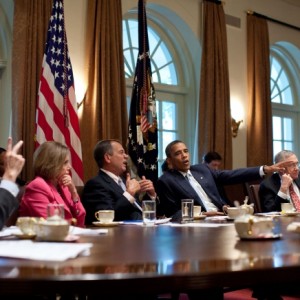
Secretary of State John Kerry signed the United Nations Arms Trade Treaty Wednesday. Upon adding his signature, Kerry addressed the world body:

On behalf of President Obama and the United States of America, I am very pleased to have signed this treaty here today. I signed it because President Obama knows that from decades of efforts that at any time that we work with — cooperatively to address the illicit trade in conventional weapons, we make the world a safer place. And this treaty is a significant step in that effort.

Promptly, Secretary-General Ban Ki-moon thanked Kerry and Obama for their complicity in consolidating UN control over weapons and ammunition:

Today, a number of countries signed the Arms Trade Treaty, pushing the total number of signatures to more than half of all Member States.

The Secretary-General, as the depository of the Treaty, welcomes every signature to this important treaty. At the same time, it is of particular significance that the largest arms exporting country in the world, the United States, is now also among those countries who have committed themselves to a global regulation of the arms trade. He believes this will contribute to efforts to reduce insecurity and suffering for people on all continents. He calls upon other countries to follow suit.

On Monday, a source inside the State Department alerted The New American that Secretary Kerry would commit this act of treason. What’s more, we were told that key members of the Senate were informed Tuesday that Kerry intended to sign the treaty and that the reaction from senators was one of disinterest.

In fairness, a few senators have spoken out today (Wednesday), warning President Obama not to try to bypass the Senate in his fervor to enforce the terms of this globalist gun grab.

Senator Bob Corker (R-Tenn.), the ranking member of the Senate Foreign Relations Committee, sent the president a letter reminding him that:

As you know, Article II, Section 2 of the United States Constitution requires the United States Senate to provide its advice and consent before a treaty becomes binding under United States law. The Senate has not yet provided its advice and consent, and may not provide such consent. As a result, the Executive Branch is not authorized to take any steps to implement the treaty.

President Obama knows this and he also knows that in March, 53 senators voted “to uphold Second Amendment rights and prevent the United States from entering into the United Nations Arms Trade Treaty.”

Americans know something, too. They know that this administration has never failed to use every murderous act of armed violence as a pretext for tyranny. From Newtown to the Navy Yard, President Obama has issued scores of executive orders directly violating the Constitution’s explicit prohibition on the infringement of the right to keep and bear arms.

John Kerry’s signing of the Arms Trade Treaty demonstrates that he and his boss will continue along this treasonous trajectory until control of all weapons and ammunition is consolidated into the UN and its client governments.

There is so much wrong and so much unconstitutional about the Arms Trade Treaty that it is difficult to describe it all. The following summary of the agreement should be sufficient, however, to call to action all constitutionalists, gun owners, and lovers of liberty. Senators, President Obama, and Secretary of State John Kerry must know that we will not sit idly by while they surrender our sovereignty and plot to confiscate our weapons.

First, the Arms Trade Treaty grants a monopoly over all weaponry in the hands of the very entity (approved regimes) responsible for over 300 million murders in the 20th century.

Furthermore, the treaty leaves private citizens powerless to oppose future slaughters.

An irrefutable fact of armed violence unaddressed by the UN in its gun grab is that all the murders committed by all the serial killers in history don’t amount to a fraction of the brutal killings committed by “authorized state parties” using the very weapons over which they will exercise absolute control under the terms of the Arms Trade Treaty.

Article 2 of the treaty defines the scope of the treaty’s prohibitions. The right to own, buy, sell, trade, or transfer all means of armed resistance, including handguns, is denied to civilians by this section of the Arms Trade Treaty.

Article 3 places the “ammunition/munitions fired, launched or delivered by the conventional arms covered under Article 2” within the scope of the treaty’s prohibitions, as well.

Article 4 rounds out the regulations, also placing all “parts and components” of weapons within the scheme.

Perhaps the most immediate threat to the rights of gun owners in the Arms Trade Treaty is found in Article 5. Under the title of “General Implementation,” Article 5 mandates that all countries participating in the treaty “shall establish and maintain a national control system, including a national control list.”

This list should “apply the provisions of this Treaty to the broadest range of conventional arms.”

Mark it down: If the treaty is ratified by the United States or if its provisions are enforced by executive order, within months the federal government (likely under the management of the Department of Homeland Security) would begin compiling a list of who owns, buys, sells, trades, or transfers any firearm, as well as the ammunition, parts, and components of those weapons.

After creating this database, the federal government would be required under the provisions of Article 5(4) of the Arms Trade Treaty to “provide its national control list to the Secretariat, which shall make it available to other States Parties.”

That’s right. The UN treaty demands that the list of gun and ammunition owners not only be in the hands of our own government, but be sent to foreign regimes, as well. This provision would guarantee that should an American owner of a legally purchased firearm decide to emigrate, he will be on the radar of the ruling regime in his new home.

Americans are right to recognize this registry as the first step toward confiscation. Without such a registry, it would be impossible to monitor weapons transfers effectively because governments can’t track weapons exchanges and transfers unless they know who has them to begin with.

Article 12 adds to the record-keeping requirement, mandating that the list include “the quantity, value, model/type, authorized international transfers of conventional arms,” as well as the identity of the “end users” of these items.

In very clear terms, ratification of the Arms Trade Treaty by the United States would require that the U.S. government force gun owners to add their names to the national registry. Citizens would be required to report the amount and type of all firearms and ammunition they possess.

Section 4 of Article 12 of the treaty requires that the list be kept for at least 10 years.

Finally, the agreement demands that national governments take “appropriate measures” to enforce the terms of the treaty, including civilian disarmament. If these countries can’t get this done on their own, however, Article 16 provides for UN assistance, specifically including help with the enforcement of “stockpile management, disarmament, demobilization and reintegration programmes.”

In fact, a “voluntary trust fund” will be established to assist those countries that need help from UN peacekeepers or other regional forces to disarm their citizens.

Arguably, the Arms Trade Treaty would become the law of the United States if the Senate were to ratify the treaty.

While that is the process that the Constitution establishes for the implementation of treaties, fundamental principles of construction and constitutional law dictate that no treaty that violates the Constitution can become the supreme law of the land.

In the case of the UN’s Arms Trade Treaty, there is no doubt that regardless of presidential signatures or congressional consent, this treaty cannot pass constitutional muster and therefore will never be the valid law of the land.

Unless, of course, Americans once again acquiesce to President Obama’s assumption of illegal authority and relinquish their rights and weapons regardless of the reasons they should not do so.

Finally, citizens must understand a very important nuance of Secretary Kerry’s assurance in his speech that the Arms Trade Treaty isn’t about taking away freedom, “it is about keeping weapons out of the hands of terrorists and rogue actors.” Americans must remember that Kerry, Obama, and the UN consider gun owners to be “terrorists” and “rogue actors,” thus subject to seizure of their firearms in the name of “international peace and global security.”

For John Kerry and Barack Obama, the confiscation of weapons from civilians is an act of, as Kerry said Wednesday, “advancing important humanitarian goals.”

For Americans, however, it is a giant leap toward enslavement.

Americans would be wise at this critical time to remember the words of George Washington, who advised:

A free people ought not only to be armed and disciplined, but they should have sufficient arms and ammunition to maintain a status of independence from any who might attempt to abuse them, which would include their own government.

Joe A. Wolverton, II, J.D. is a correspondent for The New American and travels frequently nationwide speaking on topics of nullification, the NDAA, and the surveillance state. He is the host of The New American Review radio show that is simulcast on Youtube every Monday. He can be reached at
This email address is being protected from spambots. You need JavaScript enabled to view it.

Photo of John Kerry signing Arms Trade Treaty as UN Under Secretary-General for Legal Affairs Miguel Serpa Soares looks on: AP Images

Related articles:

Final Version of Arms Trade Treaty Released; Disarmament of Civilians on Track

Global Gun Grab on Track Following UN Arms Trade Treaty Conference (Video)

Religious, Civil Rights Group Urge Obama to Sign Arms Trade Treaty

Copyright: The New American

Dangerous Addiction to Secrecy

0

After decades of mutual suspicions, the U.S. and Iranian governments appear headed toward face-to-face contacts. But mutual trust still awaits truth-telling about important facts that defined the relationship – and that may require breaking a dangerous addiction to secrecy.

If President Barack Obama is right about the revived hopes for settling several interlocking crises in the Middle East – from Iran’s nuclear program to the Israel-Palestinian conflict — a good starting place would be a decision by the various sides to lift the curtains of unnecessary secrecy surrounding both current events and their historical context.

But the key actors in these geopolitical dramas can’t seem to shake their addiction to secrecy. For instance, on the historical front, Iran and Russia — as well as Israel and the U.S. intelligence community — have evidence about alleged Republican-Iranian interference in President Jimmy Carter’s hostage negotiations with Iran in 1980, but this material is still kept hidden.

Over the years, key Iranians, including former President Abolhassan Bani-Sadr, have declared that a secret deal was struck with Ronald Reagan’s presidential campaign to delay the release of 52 American hostages in Iran until after the U.S. election to guarantee Carter’s defeat. But the Iranian government has kept officially mum on its role in the so-called October Surprise case.

In 1993, the Russian government supplied a U.S. congressional task force with a secret summary of Soviet-era intelligence information corroborating the allegations of a Republican-Iranian deal, but the summary contained few details about Moscow’s proof and there was no serious U.S. follow-up of the disclosure with Russian officials. Israel allegedly helped implement the brokered deal by becoming Iran’s weapons supplier in the early 1980s.

The U.S. intelligence community presumably has October Surprise information, too, although when the congressional task force sought it in 1992 the CIA director was Robert Gates, one of the CIA officers implicated in the 1980 operation. He had been installed at the head of the intelligence community in 1991 by President George H.W. Bush, another suspect. So, it probably should have come as no surprise that Gates, the CIA and Bush’s White House dragged their feet on document production in 1992.

So, as a show of good faith now, the various players could stop playing games and open up their archives to finally resolve this nagging historical mystery. Some Republicans might even think better of the Iranians if they knew that Ayatollah Ruhollah Khomeini helped install their hero, Ronald Reagan, in the White House.

Other Americans might see it as a case of geopolitical karma: the United States secretly undermined Iran’s democracy in 1953 and the Iranians returned the favor to the United States in 1980. Just recently, the U.S. government confirmed that the CIA, indeed, had organized a coup d’etat against the elected Iranian government of Prime Minister Mohammad Mossadegh in 1953, installing the autocratic Shah of Iran who governed Iran harshly until 1979.

The Iranians could now show their appreciation for that belated U.S. admission by disclosing whatever evidence they have about Republican double-dealing during the 1980 hostage crisis. Whatever those facts may show, the truth could clear the air — and establish some trust — as the United States and Iran grapple with how to resolve the current dispute over Iran’s nuclear program. [For the latest and most detailed account of the October Surprise evidence, see Robert Parry’s America’s Stolen Narrative.]

No Stonewall on Syrian Case

On a more current topic — the question of who was behind the chemical weapons deaths outside Damascus, Syria, on Aug. 21 — government claims of secrecy also should be dropped and all pertinent evidence should be presented to the world.

The Russians have a 100-page report purportedly clearing the Syrian government but they haven’t made it public. The Obama administration claims to have physical evidence proving the Syrian government’s guilt but won’t release it, either. Instead, President Obama and Secretary of State John Kerry seem committed to a strategy of simply de-legitimizing any doubts that Syrian President Bashar al-Assad is guilty.

On Aug. 30, the Obama administration released a four-page “Government Assessment” that asserted the Syrian government’s guilt without presenting any evidence at all. The white paper was palmed off as an “assessment” from the U.S. intelligence community but it really was posted on the Internet by the White House press office.

In a pattern reminiscent of George W. Bush’s phony case for war with Iraq in 2002-2003, U.S. journalists and politicians quickly recognized that their career prospects were brightened if they joined the anti-Assad stampede and darkened if they got in the way.

Then, the 38-page report issued by United Nations inspectors last week presumably sealed the deal on Assad’s guilt, as major U.S. news outlets extrapolated from evidence in the report to conclude that the attack must have been launched by Syrian government forces intimately connected to protecting Assad.

Though the actual facts in the UN report were much murkier — including the absence of any chemical weapons agents at one site and inspectors’ warnings that the evidence at the second site may have been manipulated — the U.S. news media brushed past those concerns and marched in lockstep with Secretary Kerry and President Obama.

Everyone, it seemed, knew that only Assad apologists and crazies would continue harboring doubts. Secretary Kerry declared as much when he announced that he would not let the UN get bogged down in a debate over the guilt of the Syrian government. “We really don’t have time today to pretend that anyone can have their own set of facts,” he said in a slap at the Russians.

President Obama reinforced the point in his address to the UN General Assembly on Tuesday: “It’s an insult to human reason and to the legitimacy of this institution to suggest that anyone other than the regime carried out this attack.”

The Stubborn Doubters

Yet, the stubborn doubters reportedly include members of the U.S. intelligence community and UN officials. Clearly, if the Obama administration had the entire intelligence community onboard, there would have been no need for such a dodgy dossier as the “Government Assessment” posted by the White House press office rather than by the Director of National Intelligence. (I was told as much by a source close to U.S. intelligence on Syria.)

And, Robert Fisk, a veteran reporter for London’s Independent newspaper, found a lack of consensus among UN officials and other international observers in Damascus — despite the career risks that they faced by deviating from the conventional wisdom regarding Assad’s guilt.

“In a country — indeed a world — where propaganda is more influential than truth, discovering the origin of the chemicals that suffocated so many Syrians a month ago is an investigation fraught with journalistic perils,” Fisk wrote. “Nevertheless, it also has to be said that grave doubts are being expressed by the UN and other international organisations in Damascus that the sarin gas missiles were fired by Assad’s army.

“While these international employees cannot be identified, some of them were in Damascus on 21 August and asked a series of questions to which no one has yet supplied an answer. Why, for example, would Syria wait until the UN inspectors were ensconced in Damascus on 18 August before using sarin gas little more than two days later — and only four miles from the hotel in which the UN had just checked in?

“Having thus presented the UN with evidence of the use of sarin — which the inspectors quickly acquired at the scene — the Assad regime, if guilty, would surely have realised that a military attack would be staged by Western nations.

“As it is, Syria is now due to lose its entire strategic long-term chemical defences against a nuclear-armed Israel — because, if Western leaders are to be believed, it wanted to fire just seven missiles almost a half century old at a rebel suburb in which only 300 of the 1,400 victims (if the rebels themselves are to be believed) were fighters.

“As one Western NGO put it … ‘if Assad really wanted to use sarin gas, why for God’s sake, did he wait for two years and then when the UN was actually on the ground to investigate?’”

Fisk also reported that “information is now circulating in the city [of Damascus] that Russia’s new ‘evidence’ about the attack includes the dates of export of the specific rockets used and — more importantly — the countries to which they were originally sold. They were apparently manufactured in the Soviet Union in 1967 and sold by Moscow to three Arab countries, Yemen, Egypt and Colonel Muammar Gaddafi’s Libya.

“These details cannot be verified in documents, and Vladimir Putin has not revealed the reasons why he told Barack Obama that he knows Assad’s army did not fire the sarin missiles; but if the information is correct — and it is believed to have come from Moscow — Russia did not sell this particular batch of chemical munitions to Syria.

“Since Gaddafi’s fall in 2011, vast quantities of his abandoned Soviet-made arms have fallen into the hands of rebel groups and al-Qa’ida-affiliated insurgents. Many were later found in Mali, some in Algeria and a vast amount in Sinai. The Syrians have long claimed that a substantial amount of Soviet-made weaponry has made its way from Libya into the hands of rebels in the country’s civil war with the help of Qatar — which supported the Libyan rebels against Gaddafi and now pays for arms shipments to Syrian insurgents.”

So, rather than bullying people who still have questions about the Aug. 21 incident — or just shouting more loudly than the other side — the Obama administration and the Russian government might want to lay their cards on the table. The secrecy addiction among major world powers is deeply corrosive to democracy and makes a mockery of popular rule.

If President Obama’s pleasant words about the universal human right of self-governance are to mean anything meaningful, he should accept that democracy is meaningless if a population is denied facts and left drowning in a swamp of propaganda.

Investigative reporter Robert Parry broke many of the Iran-Contra stories for The Associated Press and Newsweek in the 1980s. You can buy his new book, America’s Stolen Narrative, either in print here or as an e-book (from Amazon and barnesandnoble.com). For a limited time, you also can order Robert Parry’s trilogy on the Bush Family and its connections to various right-wing operatives for only $34. The trilogy includes America’s Stolen Narrative. For details on this offer, click here.

Copyright: Global Research

Hundreds of fabricated security clearances issued in past decade

0


Published time: September 25, 2013 20:14

Aaron Alexis (L), who the FBI believe to be responsible for the shootings at the Washington Navy Yard in the Southeast area of Washington, DC and Edward Snowden (R), who has been working at the National Security Agency (AFP Photo / Reuters / Fort Worth Police Department)

At least 350 illegitimate security clearances were given out in the US in the past nine years. The real number is likely to be much higher, as a descending ladder of investigations reveals negligence at all levels.

Reuters derived the figure by calculating all the falsified
profiles listed in 21 successful cases between 2004 and 2012
against U.S. Office of Personnel Management (OPM) employees and
contractors, in which it was proven that they made false
statements.

The worst culprits were two employees of Virginia-based firm
USIS, the company that issued security clearances to
whistleblower Edward Snowden and Washington Navy Yard shooter
Aaron Alexis, who killed 12 people last week. Two of its
employees each fabricated parts of over forty profiles.

Among the transgressions were an interview conducted with a man
who had been dead for at least a decade, as well as making up
form entries for candidates applying for top security clearances
in various branches of the US military.

Most of the perpetrators were only placed on probation or
assigned community service after making a plea bargain with the
prosecutors.

Last week, the Department of Justice said that it had more than
sixty other pending cases.However, this may only be the tip of
the iceberg.

Last year, OPM issued more than 2.3 million clearances.
Three-quarters of those were farmed out to independent
contractors.

The majority of those were processed by USIS. The company was
founded by former OPM employees, which won a $2.45 billion tender
for security investigations back in 2011. The firm also has a
support services contract with OPM, which means that it is
involved in evaluating its own work on behalf of the government
agency.

Dozens of employees have come out in recent months saying that
the company’s background checks were frequently box-ticking
exercises done at maximum speed to curtail expenses.

The DOJ is investigating the company for ‘flushing’ –
systematically cutting corners to issue as many security
clearances as possible. The company has been under federal
scrutiny since 2011, but the DOJ stepped up its efforts after
government contractor Snowden’s leaks. He admitted that he
specifically obtained a high clearance job to collect classified
government data that he later leaked to the media.

OPM is looking to rescind at least a part of its deal with USIS.

Yet, OPM is not blameless itself. It was made aware of Alexis’
“unadmitted” past criminal history – such as shooting the
tires of a neighbor’s car – and decided to hand out his clearance
anyway.

Closer scrutiny has revealed that the entire system may be
fundamentally ineffectual.

Nearly 5 million US citizens possess a security clearance, with
more than 1.4 million with a ‘top secret clearance’. Unless
either the total number of clearances is whittled down, or the $1
billion a year spent on issuing them is increased, it is unlikely
that the mechanism will manage to filter out all potential
security threats.

Besides, those like Edward Snowden – who passed multiple
background checks – may not be weeded out until they become
active.

The Senate Homeland Security Committee is scheduled to meet on
October 1 to discuss the future of security clearances.

Copyright: RT

Vitamin C Saves Man Dying of Viral Pneumonia

0
Vitamin C Saves Man Dying of Viral Pneumonia

Allan Smith, a New Zealand Dairy farmer, contracted Swine Flu while away on vacation in Fiji. When he returned home, the flu quickly evolved into severe

Interviewed in part two was the Principle Advisor to the Health Ministry and Senior Intensive Care Specialist, David Galler, who denied that the intravenous vitamin C was a contributing factor in the Allan Smith’s recovery. He proclaimed that the recovery could have been just as likely from a “bus driving by” as the high dose vitamin C . When asked what he would need as proof to that vitamin C is effective, he replied he would need a randomized controlled trial, such as those for new drug approval funded by a pharmaceutical company.

Apparently Dr Galler is unaware of three double blind placebo controlled studies of IV Vitamin C in critically ill patients in the ICU. These studies were published in Dr. Galler’s own peer-reviewed specialty medical literature. (1-5)

Continue to Page 2

Disclaimer: This article is not intended to provide medical advice, diagnosis or treatment. Views expressed here do not necessarily reflect those of GreenMedInfo or its staff.

Copyright: Green Med Info

America’s Re-shoring of Jobs Is Accelerating

1

More than half of 200 U.S. companies with sales greater than $1 billion are moving jobs back to the United States, or are planning to, within the next two years. The announcement by Boston Consulting Group (BCG) on Tuesday confirms a subterranean paradigm shift that’s been underway for at least two years. Because of rising labor costs in China and elsewhere, the mathematics supporting offshoring of former American jobs has drastically changed for the worse, according to Harold Sirkin, senior partner at BCG:

Over the past couple of years, we’ve projected an improvement in U.S. manufacturing competitiveness by 2015 that would help drive an American manufacturing revival. The results of our latest survey make clear that a profound shift in attitude is beginning.

When you look at the total cost of production for many goods, the U.S. appears increasingly attractive.

The impact is likely to be enormous. A report released by BCG in August predicted that between 2 ½ million and 5 million new jobs would be created in U.S. manufacturing before the end of the decade, less than seven years from now. This is estimated to bring down the unemployment rate by between two and three full percentage points.

In that August report, it was noted that the shift has already begun but without media fanfare. Since 2005, U.S. exports have been growing more than seven times faster than the country’s economy as a whole. In fact, exports from the United States are now at their highest point in 50 years, according to BCG. And this is just the beginning.

The math that makes such a move not only predictable but inexorable involves more than just labor costs. When adjusted for productivity and taking into account energy costs, quality, proximity, supply chain management, and other factors, the United States is surprisingly competitive:

We estimate that by 2015, average manufacturing costs in the five major advanced export economies that we studied — Germany, Japan, France, Italy and the UK — will be 8 to 18 percent higher than in the U.S….

As a result, we estimate that the U.S. could capture up to 5 percent of total exports from these countries by the end of the decade.

Five percent doesn’t sound like much but when multiplied by the world’s total exports, estimated to be almost $18 trillion in 2012, that’s almost one trillion dollars. To put that in perspective, as of June 30, the Federal Reserve estimates America’s output at $16.67 trillion. If that comes to pass the economic impact in the United States would, to put it mildly, be impressive.

Sirkin is unabashedly optimistic:

Over the past 40 years, factory jobs of all kinds have migrated from high-cost to low-cost countries.

Now, as the economics of global manufacturing changes, the pendulum is finally starting to swing back. In the years ahead, it could be America’s turn to be on the receiving end of production shifts, as more companies use the U.S. as a low-cost export platform.

As noted elsewhere, lower energy costs, thanks to fracking and its success in unlocking oil and gas reserves heretofore unavailable, are an increasingly important part of the equation. In less than two years, the price for natural gas is projected to be between 60 and 70 percent lower here than in Europe or Japan, and consequently the cost of electricity will be 40 to 70 percent lower here than there. That’s an advantage that the United States will likely enjoy for years if not decades to come. China has enormous untapped oil shale reserves, perhaps even larger than those in the United States, but so far their efforts to extract significant quantities of it to quench its own internal thirst for energy have faltered.

Environmentalists have all but shut down fracking efforts in the eurozone, and the high labor costs in Norway, Finland, Denmark, and Sweden will keep them out of the picture for years. Although China still enjoys a labor cost advantage over the United States at the moment, when all other factors are taken into account, China is also losing its attractiveness. BCG estimates that the production of between 10 and 30 percent of goods that the United States now imports from China could return to the United States in the next few years.

In those industries using enormous quantities of energy, America’s advantage will continue to improve. In the petrochemical industry, the United States is expected to capture between $7 billion and $12 billion of the market from Western Europe and Japan. In Germany, for example, natural gas (which is an important feedstock in making chemicals) costs nearly three-and-a-half times more than in the United States, making manufacturing costs nearly 30 percent higher there than in the United States. In China total manufacturing costs are projected to be 16 percent higher, and 28 percent higher in France.

In heavy machinery, the U.S. advantage over Japan is 7 percent, 14 percent over Germany and France, and 15 percent over Italy. Similar advantages are projected in the making of transportation equipment.

Taken altogether then, the U.S. advantage is impressive. With a large labor pool of skilled labor with productivity three times that of Chinese labor, fewer transportation and other supply chain issues, higher quality of final output, and energy prices that keep dropping as the fracking boom continues, there is little to stand in the way of the resurgent manufacturing boom in the United States.

As Sirkin noted back in March:

Companies … are realizing that when labor content, productivity, logistics and the many indirect costs, risks and headaches of managing supply chains extending halfway around the world are fully accounted for, it … makes better economic sense to manufacture in the U.S.

A graduate of Cornell University and a former investment advisor, Bob is a regular contributor to The New American magazine and blogs frequently at www.LightFromTheRight.com, primarily on economics and politics. He can be reached at
This email address is being protected from spambots. You need JavaScript enabled to view it.
.

Copyright: The New American

Homeland Security Tests Facial Recognition “Machine”

0

On September 21, the Department of Homeland Security tested a new facial recognition system at the 6,000 seat Toyota Center in Kennewick, Washington, during the season home opener of the Tri-City Americans, a junior hockey team in the Western Hockey League.

The story was initially released by the local Tri-City Herald, in a September 13 article linked to the hockey team’s website. The reporter, Annette Cary, phrased the story in innocuous-sounding terms:

Hockey fans at the season opener of the Tri-City Americans will have a chance to help the U.S. Department of Homeland Security improve its facial recognition capabilities.

Video will be taped by Pacific Northwest National Laboratory [PNNL] at the Sept. 21 game in a portion of the Toyota Center in Kennewick.

It is planned to be used by the U.S. government to test the capabilities of facial recognition software that is available or in the prototype stage.

The report noted several provisions made by PNNL to allay the concerns of attendees who feared that the test might invade their privacy. PNNL bought 46 extra seats providing video-free areas for those who did not want to be taped.

“If they didn’t want to be videotaped, they could very easily not be videotaped,” the Herald quoted Nick Lombardo, a PNNL project manager, as saying.

The report explained that PNNL was interested in taping its own staffers, rather than random members of the public.

“Basically the crowd is background,” PNNL engineer Marcia Kimura told the Herald.

The report also cited a statement from Patty Wolfhope, a program manager at the Department of Homeland Security, who assured the public that no names of people will be collected during the test and that only government researchers, not the technology developers, will see the video.

It might be fair to say that more Americans would be concerned that the DHS has collected video of their face than a private firm like PNNL.

An indication of how sensitive a topic the use of facial recognition technology has become is reflected by how widespread this small-scale test conducted in a medium-sized city of about 75,000 people has been reported. Articles about the test have appeared in Britain’s Daily Mail and on the website of RT, the Russian-based television network. Extensive coverage was also provided by Rawlson King, a contributing editor to the technology website BiometricUpdate.com.

While most of the reports amounted to matter-of-fact descriptions of the procedures and technology involved in the test, RT’s coverage alone addressed potential abuses and mentioned Homeland Security’s (DHS) role much more often than the other reports. Perhaps Russians, having lived under a totalitarian police state that monitored their every move, are more familiar with what can happen when the government takes too strong an interest in its citizens’ whereabouts. Among RT’s observations:

• “DHS will utilize a sophisticated system of cameras to collect pictures of attendees in real-time from as far away as 100 meters and then match them up with images of faces stored on a database.”

• “The exercise will mark the latest drill for the DHS’ Biometric Optical Surveillance System, or BOSS, and when it’s fully operational it could be used to identify a person of interest among a massive crowd in the span of only seconds.”

• “This isn’t the first time that the DHS and PNNL teamed up with the Toyota Center, but researchers are hoping that this endeavor will be the most successful yet. The New York Times’ Charlie Savage reported last month that the technology was tested recently at the arena, but the government determined at the time that the product “was not ready for a DHS customer.” If it succeeds this time around, however, it could open the door for deploying similar systems at international crossings and other hubs across the United States patrolled by DHS.”

The August 21 report in the Times, “Facial Scanning Is Making Gains in Surveillance,” quoted a statement from Ginger McCall, identified as “a privacy advocate”: “This technology is always billed as antiterrorism, but then it drifts into other applications. We need a real conversation about whether and how we want this technology to be used, and now is the time for that debate.”

Another quote cited by RT not reported in the U.S. stories about the Kennewick test was from a statement from Jennifer Lynch, identified as a staff attorney for the Electronic Frontier Foundation (EFF). EFF filed a lawsuit against the FBI earlier this year because of the Bureau’s Next Generation Identification program (NGI), to be launched in 2014. Said Lynch:

NGI will result in a massive expansion of government data collection for both criminal and noncriminal purposes. Biometrics programs present critical threats to civil liberties and privacy. Face-recognition technology is among the most alarming new developments, because Americans cannot easily take precautions against the covert, remote and mass capture of their images.

RT explained that the “Next Generation Identification program … will ideally provide the FBI with a database containing the biometric information of millions of Americans. Law enforcement will then be able to use that trove of data to compare persons of interest caught on film with images already used on state drivers’ licenses and other governmental files.” (Emphasis added.)

As an avid watcher of the popular CBS television series, Person of Interest, this writer finds the RT writer’s choice of the term “persons of interest” to be an interesting coincidence. The series, starring actor Jim Caviezel, is about a former Special Forces member and CIA agent recruited by a reclusive billionaire software genius (Michael Emerson) who built a highly sophisticated computer system for the government that collects data from omnipresent video surveillance cameras, using facial recognition software to identify the persons captured on video. The system is constantly referred to on the program as “the Machine.”

Forced to work underground because their mission puts them at odds with the government, the team comprised of Caviezel, Emerson, and a couple of sympathetic New York City police officers utilize the machine to help citizens in danger — citizens the government regards as “irrelevant.” Because of this work, members of the team sometimes find themselves targeted by government agents.

Though a fictionalized, dramatized presentation, and focusing on private individuals who employ facial recognition software for good, the series also makes evident the threat to freedom such technology would present if used by government agencies.

The voiceover from the show’s opening states:

You are being watched. The government has a secret system: a machine that spies on you every hour of every day. I know, because I built it. I designed the machine to detect acts of terror, but it sees everything. Violent crimes involving ordinary people; people like you. Crimes the government considered “irrelevant.” They wouldn’t act, so I decided I would. But I needed a partner, someone with the skills to intervene. Hunted by the authorities, we work in secret. You’ll never find us, but victim or perpetrator, if your number’s up… we’ll find you.

Copyright: The New American

Obama’s Top Official Pushing Tar Sands in Secret Trade Deal

0

U.S. Trade Representative Michael Froman confirmed by President Obama in May 2013 (Photo: AP)As President Obama publicly promises to curb carbon emissions, his top trade official is pushing for tar sands industry handouts and influence in the highly secretive Transatlantic Trade and Investment Partnership, launching attacks on EU tar sands regulations that green groups say are already too insufficient.

“The U.S. has no business rolling back any kind of protection from the world’s dirtiest oil at a time when we’re supposed to be making progress on climate,” Eddie Scher of the Sierra Club told Common Dreams.

Questioned before the House Ways and Means Committee in late July, U.S. Trade Representative Michael Froman railed against a proposed change to the EU Fuel Quality Directive that requires a 6 percent reduction in gas and diesel emissions by 2020. The ammendment under question would label bitumen—oil extracted from tar sands—as a high-emissions diesel, a rating that would ‘discourage‘ but not prevent EU fuel suppliers from buying tar sands oil.

Environmental groups say that the regulation that Froman is attempting to gut is already grossly insufficient. “The regulation is not really doing anything,” Scott Parkin of Rainforest Action Network told Common Dreams. “It’s just saying tar sands should be called something different. We are saying that tar sands need to stay in the ground. Period.”

Yet, Froman charges this so-called regulation goes too far. When Rep. Kevin Brady (R-Texas) claimed the proposed regulations are “discriminatory, environmentally unjustified and could constitute a barrier to U.S.-EU trade,” Froman stated, “I share your concerns.”

“I have raised these issues with senior Commission officials on several occasions, including in the context of the Transatlantic Trade and Investment Partnership (T-TIP),” he wrote in a letter to the House Ways and Means Committee. “We continue to press the Commission to take the views of stakeholders, including U.S. refiners, under considerations as they finalize these amendments.”

Obama’s trade official is publicly advocating for the tar sands oil industry despite the president’s June speech in which he declared he would cut carbon emissions and only approve the Keystone XL pipeline if it “does not significantly exacerbate the problem of carbon pollution.”

Green groups, who say the oil pipeline would increase carbon emissions by definition, are organizing a mounting campaign against the Keystone XL pipeline and tar sands extraction. So far, 75,000 people have pledged to commit civil disobedience if the president approves the pipeline.Protest against tar sands extraction in London in 2009. (Photo: Flickr Creative Commons / Eugenio hidden side) Opponents of the proposed Keystone XL pipeline demonstrate in front of the White House in 2011. (Photo: Chip Somodevilla/Getty Images)

_____________________

This work is licensed under a Creative Commons Attribution-Share Alike 3.0 License

Copyright: Common Dreams

VIDEO: Rockets Used in Damascus Chemical Weapons Attack Fired from Makeshift Flatbeds, Not Military Vehicles

0

Video emerges of unmarked truck-mounted launcher surrounded by militants, firing same ordnance used in August 21 Damascus (and other) chemical attacks.

A note of clarification: The US maintains that the chemical weapons attack in Damascus in late August could only have been the work of the Syrian government because the militants do not possess the means to carry out such an attack. The report below proves that the technology used to fire the rockets allegedly used in the attack require nothing more than a modified flatbed truck, and that the militants on record have received training and are assisted by Western contractors specifically to handle weapons inside of Syria.

The very concept of a false flag attack is to use weapons that one’s framed enemy would have at their disposal. This report lays to rest the myth of exotic, inaccessible technology preventing US-backed terrorists from carrying out the Damascus attacks. Considering which party stood the most to gain from the attacks, and the amount of time that has passed with the West still unable to produce convincing evidence, it is clear America and its allies have failed (and will be unable) to make their case.

In September 17, 2013′s article, “5 Lies Invented to Spin UN Report on Syrian Chemical Weapons Attack,” one fabrication used by the West was exposed in particular [emphasis added]:

Lie 1. Chemical weapons were delivered with munitions not used by rebels: This claim includes referencing “Syria watcher” Eliot Higgins also known as “Brown Moses,” a UK-based armchair observer of the Syrian crisis who has been documenting weapons used throughout the conflict on his blog.

While Higgins explains these particularly larger diameter rockets (140mm and 330mm) have not been seen (by him) in the hands of terrorists operating within and along Syria’s borders, older posts of his show rockets similar in construction and operation, but smaller, most certainly in the hands of the militants.

The Washington Post contends that somehow these larger rockets require “technology” the militants have no access to. This is categorically false. A rocket is launched from a simple tube, and the only additional technology terrorists may have required for the larger rockets would have been a truck to mount them on. For an armed front fielding stolen tanks, finding trucks to mount large metal tubes upon would seem a rather elementary task — especially to carry out a staged attack that would justify foreign intervention and salvage their faltering offensive.

Video has now emerged showing just the sort of unmarked improvised trucks predicted US-backed terrorists would use to carry out the attacks, surrounded by a combination of civilian-dressed and semi-uniformed individuals firing ordnance identical to those used during the Damascus chemical weapons attack. Western media sources are scrambling to explain how this is instead, the “smoking gun” proving the Syrian government was behind the attacks, and not the so-called “rebels.”

This tenuous argument is being spearheaded by the “Brown Moses Blog” run by UK sofa-based, self-taught “weapons expert” Eliot Higgins, which claims:

The following video was just sent to me by @Paradoxy13, showing the type of munition linked to alleged chemical attacks being loaded and fired by what appears to be Assad’s forces .

Unfortunately for Higgins’ credibility and objectiveness, the conclusion he jumps to (based apparently on the color hats everyone is wearing in the video) is based on “evidence” sent to him by Twitter user @Paradoxy13, an overt supporter of the armed militants operating in Syria. His Twitter timeline is proudly topped with the French-colonial flag now being used by the so-called “Free Syrian Army” and flooded with overtly biased propaganda backing both the terrorists in Syria, and their Western sponsors abroad.

The alleged footage Higgins posted on his blog comes from YouTube account, “Darya Revolution” — clearly belonging to militant supporters.

The video descriptions claims:

The moment of launching surface- to —surface missile from Mazzeh military airport – it could carry a chemical head- on the day of the “chemical massacre” in Eastern Ghouta. Darayya Media Centre shot the missile at the exact second it was launched from Mazzeh Military Airport towards Eastern Ghout at around 6 AM. Many soldiers were seen around the point of launching the missile with red caps, which indicates that they were presidential guards.

What serendipity to have both a massive chemical attack in Damascus just as UN monitors arrived in the Syrian capital, and now video shot by militants who claim they just so happened to have a camera ready to film the rockets as they were launched toward Eastern Ghouta in Damascus.

At face value, nothing about this points to the Syrian government — as Higgins claims. Higgins even has to remind readers that the chemical weapons attack allegedly took place at night, directly contradicting the description of the video he is citing as a “smoking gun.”

Image: After firing a single rocket, the truck is promptly covered and prepared for transit. The purpose of a national chemical arsenal is to provide a deterrence against foreign aggressors and for deployment in pitched, full-scale warfare. This modified truck was clearly designed for launching a single rocket, at a painfully slow rate of fire — not for tactical purposes. It is however, literally, the perfect vehicle for a false-flag attack, particularly the chemical attack carried out in Damascus in late August.

….

The video shows two trucks surrounded by a motley crew of both uniformed and non-uniformed individuals carrying a variety of weapons — typical of “Free Syrian Army” formations, atypical of the Syrian Arab Army’s operations which include columns of tanks, clearly marked aircraft, camouflaged trucks, and soldiers in full battledress.

There appears to be one truck for carrying and loading the rockets, and another for launching them — the launcher can be seen at the end of the video being concealed under a tarp. Aside from this, there are no other military vehicles seen in the vicinity, and the trucks themselves are unmarked, converted civilian vehicles typical of the “technicals” (improvised fighting vehicles) used by terrorists both in Libya and now Syria. For trucks allegedly carrying “government” chemical weapons, or even large high-explosive rockets, there is surprisingly lax security around them and a suspicious desire to conceal the improvised weapon system after use.

Image: Terrorists in Syria, and previously in Libya, with the exception of stolen military vehicles, rely on improvised fighting vehicles of varying sophistication called “technicals” like the one pictured above. The larger flatbed featured in a recent video, launching a rocket similar to those found at the scene of an alleged August chemical weapons attack in Damascus, is also clearly an improvised fighting vehicle.

….

The painstakingly slow process of loading and firing a single rocket would also negate any practical tactical advantage on the battlefield were this footage of another attack, on another day, using a conventional rocket for an artillery strike — as Higgins seems to suggest. The Syrian military possesses an extensive arsenal of artillery pieces and multiple rocket launchers that could easily bombard targets with better accuracy, increased frequency and effectiveness.

Additional “evidence” cited by Higgins of “regime use” of these rocket systems consists solely of militant footage of rocket impacts — not of Syrian troops actually firing the weapons. Higgins operates under the false assumption that previous chemical attacks showing up in militant videos depicting similar rockets could only be the work of the Syrian government, and not false flag operations carried out by an increasingly desperate West and their proxy forces inside Syria. Aside from this assumption, he provides no evidence to back up his claims.

Higgins was handed a “smoking gun” by the people most likely to have benefited from the crime, who claim they “found it” at the feet of the very government they are fighting. Without critical examination, and apparently based on the color hats several individuals were wearing, Higgins concludes that the footage portrays the Syrian government launching a single massive rocket from a modified flatbed.

In reality, we are most likely looking at the EXACT method the US-backed terrorists in Syria used to carry out the chemical weapons attack in Damascus in late August. Whether or not the rockets contained chemical weapons could be a matter of debate — as the rockets and other evidence were all clearly tampered with in the days before the UN investigated the site — this according to the UN itself. On page 18 of the UN’s report (22 of the .pdf), the UN states [emphasis added]:

The time necessary to conduct a detailed survey of both locations as well as take samples was very limited. The sites have been well travelled by other individuals both before and during the investigation. Fragments and other possible evidence have clearly been handled/moved prior to the arrival of the investigation team.

It is confirmed that the US has been training militants and providing “contractors” to accompany them into Syria where they have been operating specifically to handle chemical weapons. CNN reported in their 2012 article, “Sources: U.S. helping underwrite Syrian rebel training on securing chemical weapons,” that:

The United States and some European allies are using defense contractors to train Syrian rebels on how to secure chemical weapons stockpiles in Syria, a senior U.S. official and several senior diplomats told CNN Sunday.

The training, which is taking place in Jordan and Turkey, involves how to monitor and secure stockpiles and handle weapons sites and materials, according to the sources. Some of the contractors are on the ground in Syria working with the rebels to monitor some of the sites, according to one of the officials.

While the video above is claimed to be a “smoking gun,” it instead, under critical examination, illustrates the means with which the false-flag operation was carried out in late August — for the sole purpose of justifying direct Western military intervention to save a faltering proxy war.

That the same rocket used in Damascus has now been seen launched from makeshift flatbeds and not olive green military rocket launchers, along with answering the basic question of “to whose benefit?” and considering that militants are confirmed to have US training in handling of chemical weapons — all at the very least tear down the narrative that “only the Syrian regime” could have carried out the attacks.

Copyright: Global Research

Global Warming About to Claim Half a Billion People

0
Glacier.

A glacier in the Himalayas. (Photo: Karunakar Rayker / Flickr)Three quarters of a billion people is a lot of people.

And that’s how many people, within the next 22 years, will almost certainly run low on water – a necessity of life – in just the regions who’s rivers are supplied with water from the glaciers in the Himalayas.

To put that in perspective, 750 million people is more than twice the current population of United States. It’s about the population of all of Europe. In the year 1900 there were only 500 million people on the entire planet. Seven hundred fifty million people is a lot of people.

The IPCC – the international body of scientists analyzing global climate change – is releasing its new report in stages over the next week and this early piece was reported on by the Financial Times on Monday. Under the headline “Climate Change Chief Sounds Alert on Himalayan Glaciers,” the opening sentence of the article by Pilita Clark summarizes a very tightly:

“The glaciers of the Himalayas are melting so fast they will affect the water supplies of a population twice that of the US within 22 years, the head of the world’s leading authority on climate change has warned.”

And that’s just the Himalayas and the rivers flow out of their glaciers toward South Asian regions including India, Pakistan, Nepal, Bhutan, and China. There are similar glaciers along the mountain ranges of western South America that supply water to other hundreds of millions of people – they are all at risk, too. We’re even seen it here in the United States, with last year’s drought in the West. Glaciers are changing in Europe, and the regions of Tanzania supplied by the famous “Snows Of Kilimanjaro,” are drying up in ways that are creating serious drought problems for the people in those parts of Africa.

Contrary to what the front groups funded by the fossil fuel industry would have you believe, climate change doesn’t just mean the winters are milder. Or the plants have more carbon dioxide.

It means that hundreds of millions of people will be displaced, will starve, and will die. It means wars. It means famines. It means raging forest fires and the death of grasslands. It means the acidification of our oceans and the destruction of our ocean ecosystems. It means that we stand on the edge of tipping points that hurtle humanity toward extinction.

Yes, extinction.

There have been five mass extinctions in the history of the Earth, times when more than half of all life died and all the top predators – animals like us – vanished or nearly finished. All of these mass extinctions were provoked by geologically-sudden global warming.

And now we are driving a similar process by burning fossil fuels.

People around the world are already dying from global climate change. Wars are already being fought because of climate change. The Earth is changing before our very eyes.

There are solutions, ranging from a carbon tax to rapid transitions into alternative energy. We need to be pursuing them now.

The debate is long over. The world is waking up.

And the fossil fuel Industry is being shown for what it is – fossils promoting fossils, intellectual frauds and greedheads.

It’s time to move from the energy forms of the 19th century into the modern, clean, nonpolluting energies currently available in the 21st-century. Now.

Copyright: Truth Out

Syrian National Coalition Spurns Peace

0

Syrian National Coalition Spurns Peace
by Stephen Lendman
The Western-sponsored Syrian National Coalition (SNC) lacks legitimacy. It’s an artificial construct. It operates extrajudicially.
It’s a rogue outlaw gang. It supports war. It abhors peaceful conflict resolution. It wants Assad toppled. It wants governance subservient to Western interests replacing him.
It’s anti-democratic. It wants diktat rule. It wants Syrian sovereignty destroyed. It wants Syrians having no say over who’ll lead them. It represents what the great majority of Syrians oppose.
It doesn’t matter. Obama wants another imperial trophy. He intends war to get it.
On September 22, Russia Today (RT) headlined “Syrian National Coalition to attend Geneva 2 if transitional government on table.”
On July 6, Ahmad Jarba became SNC’s new president. He replaced acting head George Sabra. He succeeded Mouaz al-Khatib.
He resigned over lack of enough international support, internal divisions, and disarray among “rebel” factions.
According to the Economist, “there is little reason to believe (Jarba) will wield more influence than his successor(s).”
On September 22, Reuters headlined “Syrian opposition group says willing to attend Geneva talks,” saying:
“In a letter to the UN Security Council dated September 19, seen by Reuters, SNC President Ahmad Jarba said the coalition ‘reaffirms its willingness to engage in a future Geneva Conference.’ “
“But ‘all parties must agree that the purpose of the conference will be the establishment of a transitional government with full executive powers.’ ”
“The SNC has insisted that Assad play no role in a transitional authority.”
Jarba’s letter “called on the UN Security Council to make any resolution on a Assad’s chemical weapons subject to (UN Charter) ‘Chapter 7’…which could authorize the use of force in case of non-compliance.”
Separately he said:
“(E)nding the killing of Syrian people is only possible by stopping the regime’s war machine and barring it from using its aviation, missiles and artillery, and depriving it of its chemical weapons.”
Syria agreed to Geneva II dialogue with no preconditions. SNC officials rejected peace talks earlier.
Now they accept them conditionally. Assad won’t step down. Syrians elected him. They have sole right to decide who’ll lead them.
Russia wants Syria’s conflict resolved diplomatically. It rejects Chapter VII military force authorization. According to Russian Foreign Minister Sergei Lavrov:
“The resolution of the Security Council, which will approve the decision of the OPCW (Organization for the Prohibition of Chemical Weapons) executive council, will not be over Chapter 7.”
“We said it distinctly in Geneva and the document that we agreed on says no single word about it.”
“We may grab on to Chapter 7 every time somebody claims that the regime or the opposition used chemical weapons and encourage playing on emotions, which is unacceptable when taking serious decisions,” he added.
“Or we may rely on professionals, who must evaluate thoroughly, impartially and objectively every piece of such information and report to the Security Council.”
Russia prioritizes getting all parties to attend Geneva II with no preconditions. Assad agreed. Opposition elements haven’t.
Moscow’s prepared to set a date. “The (SNC) vocally opposed the Russian-American plan to destroy Syrian chemical weapons.” said Lavrov.
They reject it “because they were expecting that the problem would be solved through a military intervention,” he added.
“And they were disappointed after the intervention failed to materialize and the issue went to the strictly diplomatically-legal framework.”
“The more often and louder statements from some capitals, including Washington, European and Middle-Eastern countries come saying that Assad is a criminal and that he has no place on Earth other than at The Hague Tribunal, the more defiant becomes this coalition, which claims the right to represent the entire Syrian people,” he explained.
John Kerry insists Assad must go. So does Obama. On September 21, Deputy National Security Advisor for Strategic Communications Ben Rhodes said:
Obama will address the General Assembly on Tuesday.
“He will reinforce the need for the international community to stand strongly against the use of chemical weapons, and continue to argue for a clear diplomatic process to put Assad’s chemical weapons under international control and ultimately destroy them, including our support for a UN Security Council resolution that enforces consequences on the Assad regime should they fail to cooperate with the international community in that effort.”
In other words, he wants Security Council Chapter VII authorization for war.
According to Rhodes, Syria’s conflict must be resolved by “remov(ing) Assad from power.”
“Our belief is that there should be a UN Security Council resolution and that that is necessary to ensure that there’s a verifiable process and that there are consequences that are enforced upon the Assad regime should they fail to comply.”
“(O)ur objectives (include) a UN Security Council resolution and to do so through Chapter 7.”
“And so it’s going to continue to be the position of the United States that in order to have a credible process where the actions of the Assad regime can be monitored, can be verified, and that there can be consequences for their non-compliance, we want to have a UN Security Council resolution.”
“…I think this demonstrates how diplomacy backed by a credible threat of force can achieve an important objective of not just deterring chemical weapons use, but destroying chemical weapon stockpiles, and reinforcing the international prohibition against chemical weapons.”
“…I think what was clear coming out of Geneva is that the Assad regime had to undertake a process that was verifiable and transparent to the international community and, frankly, that there had to be consequences.”
In mid-September, Kerry and Lavrov announced an agreed on six-point plan:
(1) Syria will place its chemical weapons under international control.
(2) In one week, it will provide a “comprehensive” CW list.
(3) Extraordinary Chemical Weapons Convention procedures will be implemented to destroy them.
(4) Syria will give international inspectors full, “unfettered access” to all chemical weapons sites.
(5) All CWs must be destroyed by mid-2014. No precise date was stipulated.
(6) The UN will provide logistical support and compliance assurance with what’s agreed on.
Terms exclude Chapter VII military force authorization. Rhodes lied saying “we made clear in the document in Geneva that we’d be pursuing a UN Security Council resolution and that it would be under Chapter 7.”
“Our position is that Chapter 7 is necessary so that there are consequences, and so that there’s enforcement for noncompliance by the Assad regime.”
“Chapter 7 allows for a broad range of consequences for the Security Council to debate and determine.”
“We would argue for the strongest possible enforcement, and that’s our position.”
“The President made very clear that in terms of the potential for US action, that remains on the table, particularly as we seek to deter the use of chemical weapons.”
On September 23, 2009, Obama addressed the General Assembly. He did so for the first time. He prioritized “a new era of engagement with the world.” He listed four fundamental pillars:
(1) “First, we must stop the spread of nuclear weapons, and seek the goal of a world without them.”
(2) “the pursuit of peace.”
(3) “(T)here will be no peace unless we take responsibility for the preservation of our planet.”
(4) “a global economy that advances opportunity for all people.”
In over four and a half years in office, Obama pursued polar opposite initiatives. Going forward, he intends more of the same.
He prioritizes war. He abhors peace. He tolerates no independent governments. He wants pro-Western vassal states replacing them.
He’s ravaging one country after another to achieve it. Syria is in the eye of the storm. Iran’s turn awaits.
New wars follow earlier ones. They repeat in disturbing succession. Throughout his tenure, not a single day of peace was achieved. NOT ONE!
Administration policy prioritizes belligerence. Diplomacy is spurned. Nobel laureate Obama perhaps thinks war is peace.
He wages it relentlessly. He does so preemptively. He authorizes it lawlessly. He’s a war criminal multiple times over.
He’s got lots more death and destruction in mind. War on Syria is longstanding US policy.
Obama intends waging it with or without Security Council authorization. Rogue leaders operate this way. Stopping him remains top priority.
Russia’s going all out to do it. Its peace agenda deserves universal support.
Stephen Lendman lives in Chicago. He can be reached at lendmanstephen@sbcglobal.net.
His new book is titled “Banker Occupation: Waging Financial War on Humanity.”
http://www.claritypress.com/LendmanII.html
Visit his blog site at sjlendman.blogspot.com.
Listen to cutting-edge discussions with distinguished guests on the Progressive Radio News Hour on the Progressive Radio Network.
It airs Fridays at 10AM US Central time and Saturdays and Sundays at noon. All programs are archived for easy listening.
http://www.progressiveradionetwork.com/the-progressive-news-hour

Copyright: Stephen Lendman

Argentine President raps UK hypocrisy

0

Argentine President Cristina Fernandez de Kirchner condemns the UK government for deploying nuclear-armed submarines around the Malvinas Islands, media reports said.

Speaking before the UN General Assembly in New York on Tuesday, the Argentine president once more slammed Britain for conducting military movements in the South Atlantic.

Cristina Fernandez highlighted her countryâ„¢s progress in the field of nuclear energy program and other technologies, adding that Argentina has also signed all international agreements and pacts as far as nuclear energy is concerned.

She denounced the UK government for failing to abide by its commitments and obligations saying Å“the British preach but take refuge in the UN Security Council Ëœdouble standardsâ„¢ be it referred to nuclear energy, human rights or abiding repeated UN resolutions with overwhelming support, calling for negotiations on the issue of Ëœour Malvinas territoriesâ„¢.”

Å“Argentina unlike the United Kingdom, has not taken a stance of Ëœhypocrisyâ„¢ or Ëœdouble standardsâ„¢” underlined Cristina Fernandez.

Å“We do not go around condemning the use of nuclear energy with military ends, and at the same time send out nuclear submarines,” she added.

Å“This happens to us Argentines, where the United Kingdom have militarised the South Atlantic and sends nuclear submarines” to an area that is clearly Argentine and Latin American sphere of influence, the Argentine President noted.

MOL/HE

Copyright: Press TV

6.8-magnitude quake rocks Peru

0

A 6.8-magnitude earthquake has struck off the Pacific coast of southern Peru, with no immediate report of casualties.

The Wednesday quake shook much of Peru as its epicenter was 72 kilometers (45 miles) south of the town of Lomas at a depth of 30 kilometers (18 miles), according to the US Geological Survey.

The quake centered off a sparsely populated area of the southwestern coast and was felt across most of southern Peru, triggering scenes of panic.

There were no immediate reports of injuries, however, local media reported that some houses had collapsed in a region near the quake.

In addition, Carlos Meija, the mayor of the nearest sizeable town, Acari, said the quake had broken windows and cracked walls of some adobe dwellings.

There were also reports of a two-kilometer section of the Panamerican Highway being partially blocked due to sand shaken loose by the quake.

The tremor was also felt in the capital Lima some 500 kilometers (310 miles) away and caused buildings to sway in the city of Arequipa, located about 300 kilometers from the epicenter.

On July 17, the southern area of the country also experienced a 6.2-magnitude earthquake, which had an epicenter 85 kilometers (53 miles) northwest of city Arequipa.

CAH/SS

Copyright: Press TV

Jon Stewart Eviscerates Cruz and Republicans on Anti-Obamacare Crusade

0

September 25, 2013
|

Like this article?

Join our email list:

Stay up to date with the latest headlines via email.

Jon Stewart had a field day with the Ted Cruz-led Republican Party threat to shut down the government unless the President agrees to defund Obamacare last night.

After showing a clip of the filibustering, tea partying Senator saying, “Nothing is hurting America more than Obamacare,” Stewart riffed that, “Nothing makes food taste worse, nothing makes it harder to get an erection, nothing spoils Breaking Bad, nothing sews you into a human centipede like Obamacare. Obamacare will murder your hope.”

If Obamacare is hurting jobs, Stewart wondered allowed, what would a government shutdown do?

In a segment where Stewart seemed barely able to contain his hysterics, perhaps in response to Republican hysterics, he mocked Cruz’s assertion that Americans will get “addicted to Obamacare like sugar.” Stewart pointed out that the “sugar” in this metaphor is, of course, “health insurance.” He added that ,”Entitlements are like crack to us,” and that, yes, Americans are “sucking the glass d*ck of not having our old people freeze to death or have to live off cat food.”

Summing up, Stewart addressed the Republicans directly. “You’re protecting America from this terrible Obamacare plan that, once we get a taste of [it], we’ll never want to be without,” Stewart argued. “You only win if the program fails. Obamacare is your Springtime For Hitler.”

Watch for yourself:

Copyright: AlterNet

Pro-, anti-Morsi students clash

0

Egyptian soldiers monitor the scene as Morsi supporters clash with opposition demonstrators in the northern city of Alexandria. (File photo)

University students supporting Egypt™s ousted president, Mohamed Morsi, have clashed with pro-military students in two universities.

Clashes broke out between pro-Morsi students and those supporting the military-installed government at Zagazig University in the northern city of Sharqiya on Wednesday after hundreds of supporters of the deposed president staged a protest gathering and chanted slogans against the military.

Five students were injured during the clashes.

Supporters and opponents of Morsi also clashed at Alexandria University. Several people were also wounded in confrontations there.

Egyptian students have held several pro-Morsi demonstrations across the country since the start of the new academic year on Saturday, demanding his reinstatement.

On September 22, at least 11 students were injured after supporters and opponents of Morsi clashed at Zagazig University.

Morsi, who was Egypt’s first democratically elected president, was ousted by the army after one year in office on July 3. The move sparked nationwide protests, which lasted for weeks.

Following his ouster, Egypt army chief, Abdel Fattah al-Sisi, appointed head of the Supreme Constitutional Court, Adly Mahmoud Mansour, as interim president of Egypt. The army also suspended the constitution and put Morsi under house arrest.

Hundreds of protesters have been killed in violent crackdown on supporters of Morsi by security forces.

State prosecutors announced on September 1 that Morsi would stand trial for inciting murder and violence.

HM/SS

Copyright: Press TV

Singh confirms meeting with Sharif at UN

0

Indian PM Manmohan Singh will meet with Pakistani Premier Nawaz Sharif on the sidelines of the UN General Assembly session.

Indian Prime Minister Manmohan Singh has confirmed that he will meet with his Pakistani counterpart, Nawaz Sharif, on the sidelines of the UN General Assembly session this weekend.

Singh said in a statement on Wednesday that he looked forward to bilateral meetings with the leaders of neighboring Pakistan, Bangladesh, and Nepal.

New Delhi and Islamabad have been working behind the scenes in recent weeks to secure the high-level meeting.

Premier Sharif has recently called for a new beginning with India, amid simmering tensions and killings in the Kashmir region.

“Let us make a new beginning. Let us sit together to resolve all outstanding issues in a friendly manner and in a peaceful atmosphere,” he said, adding, “We must become good friends. Hold each other’s hands. We must sit together with open and clean heart,” Sharif said in mid-August.

The fresh talks were aimed at resolving long-standing disputes including the Kashmir issue.

Media reports say, however, that no major breakthroughs were expected on controversial issues such as the Kashmir dispute and terrorism.

Nevertheless, the two countries will agree to ease a number of trade and travel restrictions in the interest of peace.

Analysts say the meeting with Sharif will raise hopes of a possible resumption of stalled peace talks over Kashmir.

India and Pakistan have fought three wars since their independence from Britain in 1947 — two of them over Kashmir.

Kashmir is divided between India and Pakistan by the UN-monitored Line of Control, but is claimed in full by both countries. It lies at the heart of more than 60 years of hostility between India and Pakistan.

JR/SS

Copyright: Press TV

Family of Marine vet killed by SWAT team awarded $3.4 million settlement

0
The family of a United States military veteran killed in 2011 after an Arizona SWAT team fired 71 rounds at him from the doorstep of his Tucson-area home has been awarded a multi-million dollar settlement from law enforcement.

Jose Guerena’s wife, Vanessa, will receive the $3.4 million
agreed to last week after a two-year legal battle between the
Marine veteran’s estate and Pima County, Arizona.

Guerena died two
years ago
when a SWAT team entered his house in the early
morning hours of May 5, 2011 and fired dozens of rounds of
ammunition from semi-automatic weapons. Guerena’s wife reportedly
woke him up abruptly that morning after being concerned with
noises coming from outside of the house. An investigation
revealed that Guerena was holding a legally owned AR-15 for
protection when the officers entered his home, though he never
once pulled the trigger on his own weapon.

Guerena, 26, was fatally wounded in the one-sided shootout after
being struck with 22 of the 71 shots fired by the SWAT team.

Officers had been dispatched to the Guerena residence as part of
a drug trafficking investigation. A Grand Jury investigation
released after his death suggested that Guerena and some members
of his family were involved in a narcotics ring, and the county
attorney’s office ultimately cleared the SWAT officers of any
wrongdoing, KVOA News reported.

According to the Arizona Daily Star, the Pima County Sheriff’s
Department did not want to reach a settlement but suggested that
taxpayers would have to front an even larger cost if Guerena’s
family brought the issue to court.

“The Pima County Sheriff’s Department strongly believes the
events of May 5, 2011, were unfortunate and tragic, but the
officers performed that day in accordance with their training and
nationally recognized standards
,” Deputy Tracy Suitt wrote.
“However, legal advisers and insurers recognize the
unpredictable resolution of disputes at trial regarding police
conduct and even well-accepted police tactics. As a result,
well-established business and insurance principles call for
compromise and the resolution of disputed cases to mitigate risk
and avoid the expense of a trial
.”

Pima County Administrator Chuck Huckleberry called the agreement
a “calculated risk-management settlement,” the Daily Star
reported.

According to the paper, Pima and its insurance company will pay
$2.35 million towards the settlement. The towns of Marana, Oro
Valley and Sahuarita, Arizona will all chip in towards the
$3.4 million sum as well. Law enforcement agencies from all towns
were being sued by the Guerena estate for allegedly acting
negligently throughout the ordeal. According to the suit,
emergency responders denied providing any medical assistance to
Guerena until more than an hour after he was shot.

Copyright: RT

NSA chief defends spying on Americans

1

Collection of bulk phone records by US intelligence agencies is essential to preventing terrorist attacks and œwrong decisions” by Congress could curb this power, the head of the National Security Agency said.

œWe need our nation to understand why we need these tools, and what those tools mean to civil liberties and privacy and what they mean to defending this country,” NSA Director General Keith Alexander said during a keynote speech at a security conference in Washington on Wednesday.

Bulk phone records were used to determine if there was a threat to New York City in the aftermath of the April 15 bombing of the Boston Marathon, as well as to determine if there were terrorist plots against US embassies abroad during the summer, Alexander said in an interview after his speech.

œSomebody who has a database that can look at the foreign and the domestic numbers can look at those and get the information back quickly can tell you where there™s a threat and where there™s not,” Alexander said. He declined to discuss details about the cases.

The NSA is facing a backlash from some lawmakers and privacy advocates over abuses in spy programs exposed by former government contractor Edward Snowden and in documents recently declassified by President Barack Obama™s administration.

Alexander pleaded for support of NSA programs during his speech at the conference, which was attended primarily by government and industry officials specializing in cybersecurity.

œWe can™t do that without your help,” he said. œThat™s my ask of you.”

In particular, Alexander said the agency needs to collect bulk phone metadata, such as numbers dialed and call durations, to connect intelligence dots.

Alexander said it™s œflat wrong” that NSA analysts have been listening to all phone calls of Americans or reading citizens™ emails.

He said analysts who were found to have committed 12 intentional abuses within the past 10 years have been punished or left the agency.

œCongress is back in session. This is going to pick up,” Alexander said. œThe American people have to weigh in and get the tools we need to protect this country and defend our civil liberties and privacy.”

Alexander also warned that a terrorist attack similar to the mall shooting in Nairobi, Kenya, last week could occur in the US if NSA authorities are curbed.

Snowden fled the US after releasing classified data to media outlets and is currently in Russia on temporary asylum. Salon.com

AGB/HJ

Copyright: Press TV

Occupy Everything. Did We Ever Give It Back?

0

When the Pentagon ends an occupation, crawling home from Vietnam or Iraq or Afghanistan with its Tomahawk missile dragging between its legs, it declares victory every time. And, depending on how you define victory, it certainly leaves lasting effects. The cancer and birth defects and poisoned water supplies bear witness: there was an occupation here.

When the Occupy Movement lost its presence on television and therefore in real spaces that are never quite as real as television, it too left a lasting impact. But it was a positive lasting impact, difficult as yet to measure fully, but observable in many areas.

I’ve just read Nathan Schneider’s new book, Thank You, Anarchy: Notes From the Occupy Apocalypse, with a foreword by Rebecca Solnit. I consider this book one of the lasting benefits of Occupy. We need a movement as badly as ever, but we now have great experimental lessons to draw on, and collective experience to benefit from.

Veterans of the Occupy encampments have added their strengths to the antiwar and environmental movements, and the growing movements against predatory home loans, foreclosures, student loan sharks, etc.

But primarily, Occupy has changed minds, some dramatically and some slightly — the sum total impossible to discern. But there is no doubt that opposition against the war on Iraq, denounced as futile by many who took part in it, laid much of the groundwork for successful opposition to missile strikes on Syria. Occupy can be expected to bear similar fruit.

I recommend reading Schneider’s story and considering yet further some of the strategic questions debated without end by General Assemblies — those debates recounted in Schneider’s book.

We’re going to need to know how and why we are committed to nonviolence. We’re going to need to consider how and whether we can build something national or international without the corporate media. We’re going to need to develop further our ability to combine our disparate movements against the giant triplets of racism, militarism, and extreme materialism. We’re going to have to be capable of engaging in big-picture political action while becoming service centers to the homeless or avoiding doing so. We’re going to have to further refine our ability to have fun without becoming foolish. We’re going to have to appreciate unpredictable chaos and learn to generate and steer it without ever knowing what it is. We’re going to have to decide whether we grow by hating the police or by meeting their antagonism with our own jiu-jitsu. We’re going to have to become more international, more non-national, and more local, all at once. We’re going to have to create a movement that grows and grows and grows prior to winning and regardless of winning, while directing its energy toward the most likely winning path.

As I was writing this at Millers bar in Charlottesville, Va., the waiter saw my book, started talking to me about Occupy, and told me that Global Friend Bombs are the way to build connections and “organize the masses.” I had never heard of global friend bombs, but I had had many previous experiences of the word “Occupy” opening up conversations about changing the world in place of “do you want fries with that?”

Newspapers are the first draft of an imperial eulogy. The first draft of history is our books. Read them. Debate them. Mic-check them. Expect the unexpected. Occupy Wall Street. Occupy Main Street. Occupy Everything and Never Give It Back.

The beginning is near!

Copyright: David Swanson

‘Iran defense policy based on deterrence’

0

Iran defense doctrine based on deterrence: Iranian cmdr.

Commander of the Iranian Army™s Ground Forces Brigadier General Ahmad-Reza Pourdastan addresses the Army™s elite units on September 25, 2013.

A commander of the Iranian Army™s Ground Forces says the country™s defense doctrine is based on deterrence, stressing that Iran will be the instigator of war.

œWe have never been and will never be the initiator of war,” Brigadier General Ahmad-Reza Pourdastan said on Wednesday.

œAs the military arms of the [Islamic] establishment, we feel obligated to strengthen our capabilities so that we can face any threats from the ground, air and sea with might so that we can make the enemies sorry for their action,” Pourdastan.

He made the comments in an address to the Iranian Army™s elite units during a ceremony commemorating the Sacred Defense Week which marks the 33rd anniversary of the eight-year Iraqi-imposed war of the 1980s.

œIn the field of ground defense, the [Army] Ground Forces have, with the help of the defense industry and universities, reached a point where it can improve its existing equipment and design and manufacture new ones based on it doctrines.”

The Army’s Ground Forces are capable of defending the country™s vast borders, said Pourdastan, adding, œWe are well familiar with techniques and tactics and know the threats.”

The Iranian commander announced on the same day that the Army is set to unveil an indigenous unmanned aerial vehicle (UAV). The remote-controlled aircraft, named Yasir, will be unveiled in an official ceremony on September 28, according to Pourdastan.

In recent years, Iran has secured great accomplishments in its defense sector and attained self-sufficiency in producing essential military equipment and systems.

The Islamic Republic has repeatedly said its military might poses no threat to other countries, insisting that its defense doctrine is based on deterrence.

MKA/HGH

Copyright: Press TV

Iran develops new air defense system

0

Commander of Khatam al-Anbiya Air Defense Base Brigadier General Farzad Esmaili says Iran has developed a new indigenous air defense system capable of diverting and destroying anti-radar missiles.

On Wednesday, the senior Iranian military commander made the announcement about the Yavar (Assistant) air defense system, saying Iranian defense experts have completed the scientific, research and technical stages of the project.

Esmaili said the main radar and its peripheral equipment were designed in the first stage, and then the missile system was designed and mounted on the Iranian air defense system.

On September 22, Khatam al-Anbiya Air Defense Base displayed a number of its military hardware at the Armed Forces parade marking the beginning of the Sacred Defense Week in late September, which commemorates the braveries of the Iranian soldiers who fought in the 1980-1988 Iraqi-imposed war and defended their country from enemy aggressions.

The hardware included Nebo mobile radar system, Kasta surveillance system, Matla’ al-Fajr radar system, S-200 missile system, Hog missile system, Shahab radar system and Skyguard defense system.

In recent years, Iran has made great achievements in its defense sector and has attained self-sufficiency in producing essential military equipment and systems.

Tehran has repeatedly assured other nations that its military might poses no threat to other countries since the Islamic Republic™s defense doctrine is based entirely on deterrence.

MP/HGH

Copyright: Press TV

As Obama Promises Carbon Cuts, His Top Trade Official Pushes Tar Sands

0

Protest against tar sands extraction in London in 2009. (Photo: Flickr Creative Commons / Eugenio hidden side)As President Obama publicly promises to curb carbon emissions, his top trade official is pushing for tar sands industry handouts and influence in the highly secretive Transatlantic Trade and Investment Partnership, launching attacks on EU tar sands regulations that green groups say are already too weak.

“Obama says he’s serious about tackling climate change, but he’s got his chief trade official running around Europe trying to gut their climate laws,” Glenn Hurowitz, executive director of Catapult Campaigns, told The Huffington Post.

Questioned before the House Ways and Means Committee in late July, U.S. Trade Representative Michael Froman railed against a proposed change to the EU Fuel Quality Directive that requires a 6 percent reduction in gas and diesel emissions by 2020. The ammendment under question would label bitumen—oil extracted from tar sands—as a high-emissions diesel, a rating that would ‘discourage‘ but not prevent EU fuel suppliers from buying tar sands oil.

Environmental groups say that the regulation that Froman is attempting to gut is already grossly insufficient. “The regulation is not really doing anything,” Scott Parkin of Rainforest Action Network told Common Dreams. “It’s just saying tar sands should be called something different. We are saying that tar sands need to stay in the ground. Period.”

Yet, Froman charges this so-called regulation goes too far. When Rep. Kevin Brady (R-Texas) claimed the proposed regulations are “discriminatory, environmentally unjustified and could constitute a barrier to U.S.-EU trade,” Froman stated, “I share your concerns.”

“I have raised these issues with senior Commission officials on several occasions, including in the context of the Transatlantic Trade and Investment Partnership (T-TIP),” he wrote in a letter to the House Ways and Means Committee. “We continue to press the Commission to take the views of stakeholders, including U.S. refiners, under considerations as they finalize these amendments.”

Obama’s trade official is publicly advocating for the tar sands oil industry despite the president’s June speech in which he declared he would cut carbon emissions and only approve the Keystone XL pipeline if it “does not significantly exacerbate the problem of carbon pollution.”

Green groups, who say the oil pipeline would increase carbon emissions by definition, are organizing a mounting campaign against the Keystone XL pipeline and tar sands extraction. So far, 75,000 people have pledged to commit civil disobedience if the president approves the pipeline.

_____________________

This work is licensed under a Creative Commons Attribution-Share Alike 3.0 License

Copyright: Common Dreams

McGrath: “If You Think the Crisis of 2008 is Over, Then You’re Falling Right Into the Game Plan”

The game is rigged, the pain is coming, and we’re all about to become victims of greed and government once again.

Charlie McGrath of Wide Awake News explains why:

If you think the crisis of 2008 is over, then you’re falling right into the game plan of The Powers That Be.

Washington D.C., the Federal Reserve, any business analyst that can get in front of a camera… wants you to believe that any coming crisis financially is not related to 2008. It’s going to be a new event altogether. And they’re going to blame it on you… the American people.

If you believe that then you have been duped.

The crisis of 2008 never ended. It got far, far worse. We haven’t fixed any of the problems. We’ve made them more systemic. We’ve made them more powerful and more in control of this economy.

Out of the top 25 companies that were heavy into sub-prime mortgages… the leaders and CEO’s of these corporations, to a man and woman, are back in the lending business.

They’re back in the game… You would think some of these guys would be in prison; they’re not. They’re back working at this exact same thing that tanked this country in 2008.

As Charlie notes, these exact same people, the ones who engineered the sub-prime debacle that wiped out the wealth of millions of Americans, are now doing exactly what they were doing before. They’re lending money to unqualified borrowers to the tune of tens of billions of dollars because they say they, “want to help.”

But, as before, they are luring American borrowers into taking on interest-only loans that will lead to more foreclosures and defaults as soon as the payments on the those mortgages reset.

This isn’t about helping Americans. This is about money, plain and simple.

Will we never learn?

The honest answer: no.

There is only one way this is going to end and it’s going to be horrific for 99% of us.

McGrath continues…

Before you think I am just sounding bitter because these wealthy people [bank leaders] managed to hold on to their money while so many people in this nation saw their standard of living fall, saw their number one investment tank, and saw their future basically be throw into the air in the form of sovereign debt, I’m not.

I’m telling you all this because it’s going to happen again.

A story came out just yesterday showing that the Federal Reserve, this institution that bent over backwards to save the aforementioned individuals and institutions that they work for, now holds more debt… than was ever created in this nation from George Washington through Bill Clinton… $3.4 trillion they now own.

You might think that’s great. You stick them with the bill and walk away.

But that’s not the way it’s going to work.

With this holding of debt they also hold the power over this economy.

…

Our leaders must understand that this private institution, that is not federal and that has no reserves, is running roughshod over this economy and they’re serving their financial special interest masters on Wall Street because that’s what they’re made up of.

And at the end of the day when this comes crashing down they will be the ones holding all the power.

We need to realize this because this crisis is not over. A far worse crisis is yet to come.

We live in a nation of people who will not step out of their perceived reality, and they are going to pay the price for their ignorance.

In a previous commentary Charlie McGrath warned about the disaster that will soon come our way.

We’re talking about the potential for an absolute credit freeze that will make the situation in New York spread across this country almost overnight.

Ask yourself this question: Are you prepared to take care of yourself?

If you cannot answer that question with the affirmative it is time to stop just listening to alternative media and thinking of it as entertainment, but taking the advice seriously and considering if you have a plan to take care of yourself and loved ones if the situation arises.

Because if you look around this world, if you look at the mainstream media, they’re forewarning you about what’s coming.

There is a disaster coming. Get ready for it. Make sure you are mentally and physically prepared for what is coming.

From Charlie McGrath of Wide Awake News

When the credit markets froze in 2008, then Secretary of the Treasury Henry Paulson warned members of Congress that if something wasn’t done there would be tanks on the streets of America.

Some would laugh at that notion. But this is no conjecture.

Guess what folks… this next go ’round there will be no bail out, no saving the system, and no relief coming.

What’s coming is what the U.S. government has been simulating for the last half decade: A total collapse of our financial system, civil unrest, and the very real possibility of a lock-down of the United States of America in its entirety.

Copyright: SHTF Plan

US Plans Nuclear-Capable Missile Test on Day of UN Nuclear Disarmament Meeting

0

Just hours after the conclusion of the International Day of Peace on September 21st, the United States conducted a test of an unarmed Minuteman III Inter-Continental Ballistic Missile (ICBM). The missile was launched in the early morning hours from Vandenberg Air Force Base in California to the Kwajalein Atoll in the Marshall Islands. The US maintains 450 Minuteman III missiles armed with nuclear warheads on high alert at military sites in Montana, North Dakota and Wyoming.

The Air Force has announced that it plans to test another Minuteman III missile in the early morning hours of September 26th. Later that same day in New York, the United Nations General Assembly will be holding its first-ever High-Level Meeting on Nuclear Disarmament.

These tests are acts of arrogance, actually hubris of the highest order. Instead of participating at the Presidential level in the UN High-Level Meeting, the US is sending its missiles flying. What kind of example of leadership is this from President Obama, a Nobel Peace Laureate who has eloquently stated that America has a “commitment to seek the peace and security of a world without nuclear weapons”?

The US claims that these tests are important for allowing it to ensure a safe, secure and effective deterrent. Yet, the US government doesn’t see it that way when other nations conduct tests of nuclear-capable missiles. And US leaders fail to grasp that nuclear deterrence is little more than a hypothesis about human behavior that can fail catastrophically at any time.

In this time of continued economic tightening, when the Congress seeks to cut back on food stamps for those in need, do we really want the government to waste tens of millions of dollars on 30-minute muscle-flexing missile tests? In addition to the inability to assure that these weapons will not be used by accident or design, they are obscenely expensive and the funds used to maintain them could be far better used for meeting basic human needs.

The UN High-Level Meeting on Nuclear Disarmament offers an exceptional opportunity for US leadership. But will we grasp that opportunity? President Obama should call off the Minuteman III missile test scheduled for September 26th. He should personally attend the UN High-Level Meeting on Nuclear Disarmament where he can play a constructive role in moving the world toward zero nuclear weapons.

Copyright: Truth Out

Iran’s Rouhani: ‘People Are Tired of War’

0

President Rouhani speaking at the UN General Assembly on Tuesday.People “are tired of war,” Iran’s President Rouhani said as he addressed the United Nations General Assembly on Tuesday in a speech in which he also railed against drones, sanctions and U.S. “warmongering.”

In his address, the new president repeated his message that Iran’s nuclear program is for “exclusively peaceful purposes,” and said that his country was “prepared to engage immediately in time-bound and result-oriented” negotiations over its nuclear program.

Rouhani said:

The human society should be elevated from a state of mere tolerance to that of collective collaboration. We should not just tolerate others. We should rise above mere tolerance and dare to work together.

People all over the world are tired of war, violence and extremism. They hope for a change in the status quo. And this is a unique opportunity – for us all. The Islamic Republic of Iran believes that all challenges can be managed – successfully – through a smart, judicious blend of hope and moderation. Warmongers are bent on extinguishing all hope. But hope for change for the better is an innate, religious, widespread, and universal concept.

Rouhani also called out the use of drones in the war on terror. He condemned terrorism as the “ultimate inhumanity of extremism and violence,” calling it a “violent scourge” that “knows no country or national borders.”

“But,” he continued, “the violence and extreme actions such as the use of drones against innocent people in the name of combating terrorism should also be condemned.”

Rouhani also condemned the U.S.-led sanctions and compared those against Iran to those against Saddam Hussein’s Iraq. Rouhani said sanctions are

…intrinsically inhumane and against peace. And contrary to the claims of those who pursue and impose them, it is not the states and the political elite that are targeted, but rather, it is the common people who are victimized by these sanctions. Let us not forget millions of Iraqis who, as a result of sanctions covered in international legal jargon, suffered and lost their lives, and many more who continue to suffer all through their lives. These sanctions are violent, pure and simple; whether called smart or otherwise, unilateral or multilateral. These sanctions violate inalienable human rights, inter alia, the right to peace, fight to development, right to access to health and education, and above all, the right to life.

Describing the effects of the sanctions on people in Iran, Narges Bajoghli, NYU doctoral student and filmmaker of the documentary “The Skin That Burns,” told Democracy Now! on Wednesday:

The biggest thing that we are seeing in Iran right now is that medicine, vital medicine, especially for those who are dealing with chronic diseases and cancer, is no longer available. Survivors of chemical warfare, which we have, in Iran, about 100,000 survivors of chemical warfare, don’t have access to the vital medicine that they need, and anything from birth control pills to any sort of even over-the-counter stuff like anything that has to deal with women’s health, or anything like that, is extremely hard to come by today in Iran. Beyond the pharmaceuticals, also the price of meat and the price of everyday staple food has gone up at least six to seven times in the past about six, seven months.

Rouhani also used his speech to criticize the oft-repeated portrayal of an “Iranian threat:”

This propagandistic discourse has assumed dangerous proportions through portrayal and inculcation of presumed imaginary threats. One such imaginary threat is the so-called “Iranian threat” – which has been employed as an excuse to justify a long catalogue of crimes and catastrophic practices over the past three decades. The arming of the Saddam Hussein regime with chemical weapons and supporting the Taliban and A1-Qaida are just two examples of such catastrophes. Let me say this in all sincerity before this august world assembly, that based on irrefutable evidence, those who harp on the so-called threat of Iran are either a threat against international peace and security themselves or promote such a threat. Iran poses absolutely no threat to the world or the region.

Israel, who consistently warns of such an “Iranian threat,” boycotted Rouhani’s speech at the General Assembly, while Israel’s Prime Minister Benjamin Netanyahu issued a statement on Wednesday saying it “was a cynical speech that was full of hypocrisy” and that it is “Iran’s strategy – to talk and play for time in order to advance its ability to achieve nuclear weapons.”

President Obama and Rouhani did not meet on the sidelines of the UN event, as some had speculated could happen. The Guardian reports that

There had been speculation that the pair would meet on the fringes of the United Nations general assembly in New York, in what would have been the first such encounter since the Islamic revolution toppled the shah of Iran in 1979.

But Obama administration officials said that while the US offered a meeting, the Iranian delegation turned it down, saying it was “too complicated”.

Officials from the two countries have been discussing the logistics of an “encounter” in the UN complex in mid-town Manhattan for several days, a UN official confirmed to the press pool travelling with Obama. In the end though, the official said, it was “too complicated for Iranians to do at this point”.

However, talks between U.S. Secretary of State John Kerry and Iran’s Foreign Minister Mohammad Javad Zarif are scheduled for Thursday, “the highest-level substantive meeting since the countries severed diplomatic ties following Iran’s Islamic revolution in 1979.”

The possibility of improved relations between the U.S. and Iran has reportedly left Israel “rattled,” and Netanyahu has dismissed Rouhani’s recent outreach to Western media as a mere “charm offensive.”

* * *

You can watch Rouhani’s address below:

____________________

This work is licensed under a Creative Commons Attribution-Share Alike 3.0 License

Copyright: Common Dreams

Anti-GMO Campaigners Claim Victory as ‘Monsanto Protection Act’ Stripped From Senate Bill

0
An amendment dubbed the “Monsanto Protection Act,” which currently allows large agriculture and biotech corporations to ignore court orders involving the safety of genetically modified seeds, has been stripped from Senate’s spending bill that could be voted on as early as Wednesday afternoon.

Following an organized campaign against the provision in recent months, its removal was being cheered by food safety and environmental activists as a victory.

“Millions of people around the world were outraged when the bill passed originally and removing the Monsanto Protection Act from the current bill is a sign that the food movement has arrived politically. The American people are tired of Monsanto’s lies and the manipulation of our political process and we’re not backing down.” – Dave Murphy, Food Democracy Now!

The Monsanto Protection Act, otherwise known as the Farmer Assurance Provision rider, was wedged into a stop-gap budget bill that passed earlier this year and signed into law by President Obama in March.

The rider was the source of outrage by many and quickly dubbed a form of “corporate welfare” that benefited large biotechnology corporations firms such as Monsanto and Syngenta as it barred US federal courts from being able to prevent the sale or planting of GMO crops even if they failed to meet federal safety standards or were discovered to be harmful to humans or the environment.

In opposition to the law’s passage, several online campaigns as well as street protests followed.

The rider was set to expire this year, but an extension of the bill was included in the House’s version of the budget bill passed last week.

However, according to a statements released by the offices of Sen. Jeff Merkley (D-Ore.) and Sen. Barbara Mikulski (D-MD), the provision will not be extended and has now been removed from the Senate’s version of the bill.

“We have all known this rider’s days were numbered,” Colin O’Neil, director of government affairs for the Center for Food Safety, told Politico. “But given the recent GMO contamination episodes of wheat and alfalfa in Oregon and Washington it is clear that our nation’s safeguards, in particular those of the federal courts, should not be under attack from policy riders like this.”

“This is a major victory for the food movement and all those who care about openness and transparency in their government,” said Dave Murphy, founder and executive director of Food Democracy Now! The decision to strip the provision, he said, “is a sign that our voices can make the difference when we are effectively organized.”

According to Murphy’s group, its organizing has generated more than half a million signatures in a petition delivered to Congress and the White House demanding the removal of the rider. In addition, the law’s opponents logged more than 40,000 phone calls to members of congress in the last two weeks alone.

“This is what happens when people become engaged in the democratic process,” Murphy said. “Millions of people around the world were outraged when the bill passed originally and removing the Monsanto Protection Act from the current bill is a sign that the food movement has arrived politically. The American people are tired of Monsanto’s lies and the manipulation of our political process and we’re not backing down.”

“Short-term appropriations bills are not an excuse for Congress to grandfather in bad policy,” stated O’Neil. “Chairwoman Mikulski’s proposal to halt the Monsanto Protection Act, backed by Majority Leader Reid, is a welcome sea change in a political climate that all too often allows corporate earmarks to slide through must-pass legislation.”

____________________________

This work is licensed under a Creative Commons Attribution-Share Alike 3.0 License

Copyright: Common Dreams

Are Thawed Relations with Iran Obama’s Saving Grace?

0

Jessica Desvarieus, TRNN Producer: Welcome to The Real News Network. I’m Jessica Desvarieux in Baltimore.

On Tuesday at the UN General Assembly, President Obama and the new Iranian president, Hassan Rouhani, gave speeches that marked the opening of new diplomatic relations between the U.S. and Iran. Let’s take a listen to what President Obama and the Iranian president, Rouhani, had to say.

~~~

Desvarieux: With us to discuss the significance of this change in U.S.-Iranian relations is Reza Marashi. He is a research director for National Iranian American Council.

Thanks for joining us, Reza.

Reza Marashi, Research Director, National Iranian American Council: Thanks for having me.

Desvarieux: So, Reza, why is this change in diplomatic relations happening now? Is this due to the effects of sanctions and what’s been happening over there economically in Iran? Or is this more about Obama trying to actually score a political win after failing to shore up support in Congress for military intervention in Syria?

Marashi: I think it’s a byproduct of a few different things. You know, sanctions are certainly sharpening the choices of the Iranian government. I don’t think anybody doubts that. And certainly Obama’s looking for political winds where he can find them.

I would argue that the biggest change we’ve seen so far is the mandate that the Iranian people gave to the new Iranian president when they elected him. He has a track record of trying to pursue peaceful solutions to Iran’s conflicts with members of the international community, and that’s very powerful. So I think Obama recognizes that, and as a result we have this new opening. It’s a very slow diplomatic thaw. And right now I think both sides are taking steps rhetorically, you know, a change in style, a change in tone, and hopefully later on down the line can facilitate change in substance.

Desvarieux: Okay. So you essentially see both things happening at once here. Obama needs to score a political win, as well as Rouhani, his past, his resume, essentially, coupled with the economic sanctions that have been placed on Iran, both these two forces are coming together, and now we’re seeing this opportunity for thawing between both sides.

Marashi: Yeah. And, like I’ve said, [incompr.] sum of all parts. And I think both men know, both Obama and Rouhani know that they have the support of the vast majority of their respective populations to try and solve this U.S.-Iran conflict peacefully that’s been bubbling over 34, 35 years now and has kind of reached a point where–you know, in the old game of chicken where two cars drive towards the end of the cliff, both sides kind of hit the brakes and say, wait a minute, if we go over this cliff, so to speak, it’s going to end up in a military confrontation that both sides [incompr.] to avoid. So I think it’s good that cooler heads have prevailed and both sides are trying something they frankly hasn’t really been tried anytime over the past three decades prior. And that’s positive. But it is going to take some time.

Desvarieux: Okay. Let’s talk about how this is going to affect U.S.’s primary alliances in the region. We have, of course, Saudi Arabia and their long-standing tension with Iran. We have Israel and their tension with Iran over Hezbollah. And of course Qatar: Iran and Qatar actually share natural gas fields. So what do you see happening between the two–between all these allies based on the U.S. thawing relations with Iran now?

Marashi: Well, Iran has been a strategic rival to other countries in the Middle East for quite some time. And when you are a rival, the relationship can either be one of cooperation amongst rivals or it can be confrontation amongst rivals. And we’ve seen different phases of this confrontation or cooperation take place over the past 30 years.

I think President Rouhani, if we take his words at face value, will seek to pursue a more cooperative rivalry with other countries in the region, Israel included. And that’s something that we saw not only with Israel but Saudi Arabia and other countries in this part of the world in the late ’90s and early 2000s. Obviously, Israel is a bit more difficult pill for folks in Iran to swallow in terms of repairing the relationship quickly, as it is for Israel as well. But again, moving back from the precipice of conflict I think is very important, and the Iranian president has rhetorically taken a step back. And now we’ll see if he’s willing to back up the words with actions. And we’ll also see if the Israeli prime minister, Mr. Netanyahu, is willing to do the same. So far, unfortunately, we’ve not seen anything that would lead us to believe that that’s going to be the case.

Desvarieux: Not just Israel, but what about Saudi Arabia? They’ve been really gunning for regime change over there in Iran.

Marashi: Well, the Saudis are the natural rival to Iran in the region–the two biggest countries in terms of landmass, large populations, massive amounts of energy resources. And, you know, this is something that the Saudis are going to want to–they’re going to want to see it to believe it in terms of Iran taking a different approach to its regional policies. They’re going to want to see Iran take steps. Perhaps Iran goes first to demonstrate goodwill and build trust with the Saudis.

It remains to be seen how that process will play out, but I do think it’s something that they’re going to try. And the men who tried this 10, 15, 20 years ago in Saudi Arabia and Iran are still major players in their respective governments. So it’s certainly not outside the realm of possibility. And I wouldn’t be surprised if it was the first domino to fall in terms of Iran repairing its relations with the world more broadly and the Middle East more specifically.

Desvarieux: Okay. Well, let’s switch gears a little bit and talk about domestic politics in Iran. Can you explain how different actors within the Iran, such as the Revolutionary Guard and Ayatollah Khomeini, have influenced the decision to change its relations with the United States?

Marashi: That’s a great question. You know, I think that at the end of the day, entities like the Revolutionary Guard are not monolithic in terms of their politics. So as a result of that, you have a fair number of folks inside the Revolutionary Guard that support Rouhani’s approach and disagree with the approach that Ahmadinejad had taken. You also have some that disagree with Rouhani’s approach. The supreme leader himself has often tried to portray himself as this magnanimous guy that stays above the day-to-day domestic political fray in Iran. That’s no longer really the case, though, in terms of the practical application.

What’s telling, though, is that the former president Khatami of Iran, the current president Rouhani, have both said that the supreme leader is backing Rouhani’s initiative to try diplomacy and negotiations with the West more generally and Iran more specifically. That bodes very well for the possibility of finding a peaceful solution.

Desvarieux: Okay. Well, thank you so much for joining us, Reza.

Marashi: Thanks for having me.

Desvarieux: And thank you for joining us on The Real News Network.

Copyright: Truth Out

Ted Cruz’s Pseudo-Filibuster Finally Ended After 21 Hours of Blather.

0

Photo Credit: Christopher Halloran/Shutterstock.com

September 25, 2013
|

Like this article?

Join our email list:

Stay up to date with the latest headlines via email.

Texan Republican Ted Cruz was on track to match all-time record Senate filibusters on Wednesday after continuing through the night with a marathon speech against Obamacare, in a show of congressional theatrics devoid anything other than symbolic consequence.

Reading from children’s books to keep going, a tired-looking Cruz was joined in shifts by fellow conservatives Marco Rubio, Rand Paul and Pat Roberts in a stand against Barack Obama’s plan to extend health insurance in the US.

Cruz’s speech is not technically a filibuster, as it he is merely speaking during a permitted time slot and will be forced to yield to a procedural vote by Democrats on Wednesday afternoon.

The speech is intended to block the passage of what is known as a continuing resolution: a motion to maintain funding for the federal government. The resolution passed the House of Representatives on Friday, but is the subject of controversy because Republicans tacked on a provision that would defund the non-mandatory elements of the Affordable Care Act.

Some Republicans have disavowed Cruz’s tactics. A number are fearful that they will be blamed for the consequences of a government shutdown and, others complain of the difficulty of explaining Cruz’s position: attempting to block a measure that he supports.

But Cruz’s tactics do at least ensure proceedings go at the slowest possible pace.

If his pseudo-filibuster continues until 3pm Wednesday, Cruz will break the record for the longest-ever Senate speech set by Strom Thurmond in 1957 in an attempt to prevent passage of the Civil Rights Act.

Cruz began speaking out against Obamacare at 2.40pm on Tuesday and vowed to keep going until he was “no longer able to stand”.

Republican leaders, who have disavowed Cruz and his fellow hardliners, had hoped that they might be able to ensure a swift Senate vote so that they had time to avoid a government shutdown when the legislation is passed back to the House of Representatives for a final showdown before Monday night’s deadline.

But Cruz has dismissed this as defeatism and is calling for Senate Republicans to block passage of the whole budget bill when they vote on Friday or Saturday so as to stop Democrats from stripping out language that would defund Obamacare.

Comparing the Senate procedures to a “rigged wrestling contest”, he declared: “most Americans could not give a flying flip about a bunch of politicians in Washington. Who cares? Almost all of us are in cheap suits with bad haircuts! Who cares?”

Cruz’s own suit remained unruffled throughout, although at one stage Kansas senator Pat Roberts appeared with his tie hanging at half mast. The Texan first-term senator also revealed that he had swapped his usual ostrich-skin “argument boots” for a pair of black tennis shoes after taking advice from Rand Paul, who staged a shorter filibuster last year against US drone strikes.

Invoking the second world war, civil war, war of independence and space race in his favour, Cruz rarely skipped a beat as the night wore on, but his eyelids were visibly drooping by dawn.

Citing sources as varied as actor Ashton Kutcher and the Denny’s restaurant chain, he also deployed the fiery rhetoric that has made him a 2016 presidential favourite among Tea Party conservatives.

“We need to make DC listen,” he said. “Make them listen to the single mom working in the diner, struggling to feed her kids who has just been told she has to take a cut in hours due to Obamacare.”

Cruz took breaks of up to an hour while yielding to questions from supportive Republicans but was also challenged by Democrat Tim Kaine who defended Obama’s plan to extend health insurance to low-wage Americans. At one stage, senator Marco Rubio recited a story about Venezuelan toilet paper factories.

Copyright: AlterNet

Corroding Our Democracy: Canada Silences Scientists, Targets Environmentalists in Tar Sands Push

2

Five years ago this month, the firm TransCanada submitted a permit request to build the Keystone XL oil pipeline, which would bring tar sands oil from Canada to refineries on the Gulf Coast. The project has sparked one of the nation’s most contentious environmental battles in decades. The Obama administration initially appeared ready to approve Keystone XL, but an unprecedented wave of activism from environmentalists and residents of the states along its path has forced several delays. Among those pressuring Obama for Keystone XL’s approval is the Canadian government, which recently offered a greater pledge of reduced carbon emissions if the pipeline is built. We’re joined by one of Canada’s leading environmental activists, Tzeporah Berman, who has campaigned for two decades around clean energy, and is the former co-director of Greenpeace International’s Climate Unit. She is now focused on stopping tar sands extraction as a member of the steering committee for the Tar Sands Solutions Network. Berman is also the co-founder of ForestEthics and is the author of the book “This Crazy Time: Living Our Environmental Challenge.” Berman discusses how the Canadian government is muzzling scientists speaking out on global warming, quickly changing environmental laws, and why she believes the push for tar sands extraction has created a “perfect storm” of grassroots activism bring together environmentalists, indigenous communities and rural landowners.

TRANSCRIPT

This is a rush transcript. Copy may not be in its final form.

Amy Goodman: Five years ago this month, the firm TransCanada submitted a permit request to build the Keystone XL oil pipeline, which would bring tar Sands oil from Canada to refineries on the Gulf Coast. The project has sparked one of the nation’s most contentious environmental battles in decades. The Obama administration initially appeared ready to approve Keystone XL, but an unprecedented wave of activism from environmentalists and residents of the states along its path has forced several delays. In the summer 2011, 1200 people were arrested outside the White House. Well, on Saturday, protests were held once again around the country in a national day of action urging President Obama to reject Keystone’s construction. President Obama also faces continued pressure from backers of the Keystone XL. In their latest push for the project, House Republicans have announced plans to tie the pipeline’s construction to the upcoming vote on raising the nation’s debt ceiling. Well, on Monday, delegates at the 2013 International Women’s Earth and Climate Summit held in Sufferin, New York called on Obama to reject the Keystone XL, saying, “There is no single project in North America that is more significant than Keystone XL in terms of the carbon emissions it would unleash… As women who are already seeing the tragic impacts of climate change on families on indigenous peoples, and on entire countries, we urge you to choose a better future by rejecting the Keystone XL tar sands pipeline.” At the conference, Melina Laboucan-Massimo, a member of the Lubicon Cree First Nation, described the impact that massive oil and gas extraction has had on her family and its traditional land in northern Alberta.

Melina Laboucan–Massimo: I come from a small northern community, it’s Cree, Nēhiyaw, is, in our language, what we call it. There is nothing on — that compares with the destruction going on there. If there were a global prize for unsustainable development, the tar sands would be a clear winner. Not that there’s a competition going on or by any means, but, I just think that world-renowned people, experts are really seeing this as one of the major issues and that is why it is one of the biggest — you know, the largest sources of greenhouse gas emissions in Canada and why Canada pulled out of the Kyoto Protocol.

So, this is what it looks like. very viscous. It’s, you know, not fluid, so it takes a lot more energy a lot more water, produces a lot more byproduct. So, it’s equaling to — why it is such a big area, it’s 141,000 square kilometers — equal to that of destroying, you know, England and Wales combined, or the state of Florida for American folks. The mines that we’re dealing with are bigger than entire cities. So, there’s about six, seven right now, could be up to nine. And this is — Imperial Oil, for example, will be bigger than Washington, D.C. alone. So, that’s just a mine. And this is some of the biggest dump trucks in the world. A lot of the issues of toxicity we’re talking from the air, so these are some of the biggest dump trucks in the world. And a lot of the issues for toxicity that we’re dealing with is, and which relates to the water, are these huge tailing ponds; they’re called ponds, but they’re actually big toxic sludge lakes. They currently spend 180 square kilometers just of toxic sludge that’s sitting on the landscape. So, every day one million leaders are leaching into the Athabasca Watershed, which is, you know, where our families drink from. I’m from the Peace Region, but it connects to the Athabasca and it goes up into the Arctic Basin, so that is where all the Northern folks will be getting these toxins, and these contain cyanide, mercury, lead, polyaromatic hydrocarbin nythetic acids. So, there are a lot of issues that we’re dealing with healthwise.

Amy Goodman: That was Melina Laboucan-Massimo, member of the lLubicon Cree First Nation in northern Alberta. All of this comes as Canadian Prime Minister Stephen Harper recently sent President Obama letter, offering a greater pledge of reduced carbon emissions of the Keystone Pipeline is built to bring tar sands oil from Canada to the United States. Well, for more I’m joined by one of Canada’s leading environmental activists, Tzeporah Berman. She’s campaigned for decades around clean energy and is the former Co-director of Greenpeace International’s Climate [Unit]. She is now focused on stopping tar sands extraction as a member of the steering committee for the Tar Sands Solutions Network. Tzeporah Berman is also the Co-founder of Forest Ethics and the author of the book, “This Crazy Time: Living Our Environmental Challenge.” Welcome to Democracy Now! it’s great to have you with us Tzeporah.

Tzeporah Berman: Thank you, it’s great to be here.

Amy Goodman: Explain what tar sands means for you in Canada and how it has affected your whole country.

Tzeporah Berman: The tar sands are the single largest industrial project on earth. The scale is almost incomprehensible, if you’ve never been there. They are not only the single reason that Canada’s climate pollution is going up, that we will not meet even the weak targets, even the weak targets, that have been set, but they’re also the most toxic project in the country; they’re polluting our water and air. The tar sands produces 300 million liters of toxic sludge a day that is just pumped into open pit lakes that now stretch about 170 kilometers across Canada. And, you know, one of the important things about what is happening in Canada right now is that Canadian policy on climate change, on environment, on many issues is being held hostage to the goal that this federal government, the Harper government and the oil industry have, of expanding the tar sands no matter what the cost. Oil corrodes, it is corroding our pipelines and leading to spills and leaks that are threatening our communities, but it is also corroding our democracy. What we’re seeing in Canada is, the, literally, the elimination of 40 years of environmental laws in the last two years in order to make way for quick expansion of tar sands and pipelines. I mean, the Keystone is not the only pipeline this industry is proposing. It is a spider of pipelines across North America so that they can try and expand this dirty oil as quickly as possible.

Amy Goodman: And why is it so dirty?

Tzeporah Berman: It’s really dirty because it’s — the oil is mixed with sand. So, in order to get that oil out, they have to use natural gas. More natural gas is used in the tar sands than all homes in Canada. It’s — so, they use natural gas and freshwater to actually remove the oil from the sand, and the result is that each barrel of oil from the tar sands has three to four times more emissions, more climate pollution than conventional oil.

Amy Goodman: And explain how this pipeline would traverse Canada and the United States and where it goes, what it is for. Does the U.S. benefit from the oil going through the pipeline?

Tzeporah Berman: No, this is an export pipeline. What the industry wants is, they want to get this oil off the continent because they’ll get a better price. And so, all of the pipelines that are currently being proposed are in order so that the industry can export the oil. So, the Keystone, for example, will go all the way from Alberta straight down through the United States and out to the Gulf, and it’s not for U.S. consumption. The majority of that oil is destined to — the U.S. is really just in the Canadian oil industry’s way. The result is that this is a pipeline that is — presents enormous risk to the American people as a result of the terrible records of oil spills and leaks. And not a lot of benefit.

Amy Goodman: Tzeporah, you have been meeting with a number of scientists. This week in the New York Times had an interesting editorial called, “Silencing Scientists” and it said “Over the last few years, the government of Canada — led by Stephen Harper — has made it harder and harder for publicly financed scientists to communicate with the public and with other scientists.” What is going on?

Tzeporah Berman: First of all, the government has shut down the majority of scientific research in the country that had to deal with climate change. This is a government in denial and they do not want to talk about climate change. So, last year they shut down the atmospheric research station, which was one of the most important places in the world to get climate data. They shut down the National Round Table on Environment and Economy, they fired hundreds of scientists, and the ones that are left are being told that they can’t release the research to us, even though it is a tax payer’s funded research. They’re also being told they can’t speak to the press unless they have a handler and it’s an approved interview; they have to have a handler from the prime minister’s office. So, the scientists that I’ve talked to, they’re embarrassed, they’re frustrated, they’re protesting. Last week in Canada we had hundreds of scientists hit the streets in their lab coats protesting the federal government because they can’t speak. They are being muzzled. To the extent that the, quiet eminent, journal Nature, last year, published an editorial saying it is time for Canada to set its scientists free.

Amy Goodman: I mean, this is an amazing story. We know that in the United States, under the Bush Administration, you had James Hansen who was Head of the Goddard Institute for Space Studies at NASA who had a handler who hadn’t graduated from college, he was — I think his credential was that he been active on the Bush campaign committee, re-election campaign committee, and James Hansen had to go through him to deal with the media.

Tzeporah Berman: Right, well — but, and James Hansen’s still got to speak deal with — to speak to the media. Most of the scientists that I’m talking to in Canada can’t speak to the media at all. And if they want to talk about climate change, they’re definitely not going to get those interviews approved. But, it is not just the scientists that are being muzzled and the climate research that’s being shut down and people that are being fired, we have also seen an unprecedented attack on charitable organizations that deal with environmental research. The Canadian Government has the majority of environmental organizations under Canadian revenue audit, and so, the result is you have the majority of the country’s environmental leaders not able to be a watchdog on what the government is doing. And secret documents revealed through freedom of information this year showed that the government eliminated all these environmental laws in Canada at the request of the oil industry because the environmental laws were in their way. The Embridge Northern Gateway Pipeline crosses 1000 streams and that would normally trigger in of environmental assessment process. Well, when you have no laws, you have no environmental assessment, so when they eradicated all the environmental laws 3000 environmental assessments for major industrial projects in Canada were canceled. Now those projects are just approved without environmental assessment.

Amy Goodman: What does it mean, the activism for you and Canada in the United States, when clearly President Obama has been forced to delay the decision, the Keystone XL because of the massive protest against it?

Tzeporah Berman: I think that what we’re seeing, not only in the United States, but also in Canada, is an unprecedented climate movement. I think that, you know, these pipelines have provided a tangible focus for communities on the ground, and the oil industry and the government have, in a sense, created their own perfect storm. Because, while before it might have been people who were concerned about climate change that would get involved in tar sands or pipeline issues, now it is people worried about their groundwater, it’s first nations and indigenous people across North America who are protesting their rights. It’s land owners. So, now you have this perfect storm.

Amy Goodman: Earlier this month, the legendary Canadian musician, Neil Young, spoke out against the extraction of tar sands oil in Canada and its export to the U.S. through the proposed Keystone XL Pipeline. He was speaking to a National Farmers Union rally and Washington, D.C. Neil Young described his recent visit to a tar sands community in Alberta, Canada.

Neil Young : The fact is, Fort McMurray looks like Hiroshima. Fort McMurray is a wasteland. The Indians up there and the Native peoples are dying. The fuel’s all over, there’s fumes everywhere. You can smell it when you get to town. The closest place to Fort McMurray that is doing the tar sands work is 25 or 30 miles out of town, and you can taste it when you get to Fort McMurray. People are sick. People are dying of cancer because of this.

Amy Goodman: That’s the legendary musician Neil Young. I don’t know how many people here in the U.S. know that he is Canadian, but, he is. The significance of him coming, and also what did the climatologist, the scientist, James Hansen, call the tar sands?

Tzeporah Berman: Dr. Hansen has referred to the Keystone XL Pipeline as the fuse to the largest carbon bomb on the planet. And he says that his studies are showing that if we allow the tar sands to expand at the rates that the government and industry want it to expand, then it’s game over for the planet.

Amy Goodman: Tzeporah Berman, I saw you at the International Women’s Earth and Climate Summit in Sufferin and you talked about your son having to respond to a question of his. We only have a minute, but explain.

Tzeporah Berman: One night at dinner my son, who was eight at the time, turned to me and said, mommy, why does the government think you are a terrorist? Which is not really the conversation you want to have with your son. Because he had heard on the radio, that on the Senate floor, the Harper government was proposing that we change the definition of the term “domestic terrorism” in Canada to include environmentalism.

Amy Goodman: And so, what does that mean for you and what does that mean for environmental activists? Where are you headed now? What are you going to do around tar sands?

Tzeporah Berman: Canadians who care about these issues are under attack by our own government, and we are being told that if we — that what we do is not in the national interest unless we support the oil industry’s agenda. But, I think this government has overreached and we are now finding — our phones are ringing off the hook. People are joining the campaign and stepping up. And let’s be clear, Canadians want clean energy. Canadians, many of them, are very embarrassed about what our government is doing internationally, so our movement is growing, and so far, we have slowed down all of these pipelines and the expansion.

Amy Goodman: What is the alternative?

Tzeporah Berman: Well, the alternative for Canada is not only clean energy, renewable energy, which now we can build at scale, we know that, but it’s also supporting other aspects of our economy, because when you support only one aspect of your economy, the most capital-intensive sector in the country, then it starts to destroy your manufacturing base, your service industry, your tourism industry. We need a diversified economy in Canada, and that’s not — and that’s entirely possible.

Amy Goodman: Tzeporah Berman, I want to thank you for being with us; leading environmental activist in Canada. She’s campaigned for decades around clean energy; former Co-director of Greenpeace International’s Climate Unit, now focused on stopping tar sands extraction.

Copyright: Truth Out

Pakistan protests Afghan shelling

0

Pakistani soldiers guard a checkpoint on the border with Afghanistan. (File photo)

Pakistan has summoned Afghanistan™s charge d’affaires in Islamabad to protest against a recent cross-border shelling, which has reportedly killed two Pakistani civilians and injured some others.

Islamabad said in a Wednesday statement that Pakistan™s Foreign Ministry summoned the Afghan diplomat to protest against œunprovoked firing.”

Local Pakistani security official said the deaths happened in North Waziristan region following heavy shelling by Afghan troops across border on Tuesday

The Foreign Ministry also called on Afghan authorities to prevent recurrence of such incidents.

Tensions between the two neighbors have risen in recent months. Afghanistan blames elements within the Pakistani government for supporting Taliban militants, while Islamabad blames Kabul for giving refuge to militants on its side of the border

The US invaded Afghanistan with the official objective of curbing militancy and bringing peace and stability to the region. However, after more than 11 years, the region remains unstable and militancy has expanded towards Pakistan.

Moreover, relations between Kabul and Islamabad have been strained in recent months, especially over the delicate issue of demarcation of the two countries™ border, which is a key battleground in the fight against the Taliban.

Afghanistan has never recognized the British-drawn colonial era border line with northwestern Pakistan.

Pakistan recognizes the Durand Line, the 1893 British-mandated border between the two neighbors, but Afghanistan says that activity by either side along the Durand Line must be approved by both countries.

JR/SS

Copyright: Press TV

China backs contact over Iran N-talks

0

China has thrown its weight behind increased contact and œcommunication” among all sides involved in the talks over the Iranian nuclear energy program.

œWe support parties concerned with Iran’s nuclear issue intensifying communication and increasing mutual trust, as these are conducive to the development of talks,” Xinhua quoted Chinese Foreign Ministry Spokesman Hong Lei as saying during a Wednesday press conference.

The Chinese official made remarks in reaction to a question regarding Iranian President Hassan Rouhani™s Tuesday speech at the annual session of the United Nations General Assembly in New York.

President Rouhani told the session that the Iranian nation is ready for cooperation with the international community and all rational players based on equal footing and mutual respect.

Hong further reiterated that Beijing has always supported dialogue as the only solution to settle the Western standoff over Iran™s nuclear energy program.

The Chinese diplomat further called on the P5+1 group of world powers, comprising the US, UK, France, China, and Russia plus Germany, to revive nuclear talks with Tehran as soon as possible in an effort to end tensions.

Chinese Foreign Minister Wang Yi will take part in the foreign-ministerial-level talks between Iran and the P5+1 group, which are scheduled to be held on the margins of the General Assembly session on Thursday, said Hong.

The US, Israel and some of their allies falsely claim that Iran is pursuing non-civilian objectives in its nuclear energy program, with Washington and the European Union using the unfounded allegation as a pretext to impose illegal sanctions on Iran.

Iran vehemently rejects the groundless claim over its nuclear energy activities, maintaining that as a committed signatory to the Non-Proliferation Treaty and a member of the International Atomic Energy Agency, it has the right to use nuclear technology for peaceful purposes.

MKA/HGH

Copyright: Press TV

Americans ‘don’t want to bully’ nations

1

President Barack Obama should know that the United States is not the world™s policeman and Americans do not want their government to bully other countries, an American journalist says.

œWe must learn how to negotiate,” Allen Roland told Press TV on Wednesday. œWe are not the world™s superpower. We are not the world™s policeman.”

œThe only platform for that to happen is the UN,” he added.

The columnist also pointed out that the American people want œpeace” from President Obama.

œWe don™t want to bully. The American people do not want to bully other countries. We do not want to be seen as the rogue country on the planet. We really want peace and I think most of the other countries know that,” Roland said.

A new poll found out that 49 percent of Americans disapprove of the president™s handling of foreign policy when it comes to Iran and Syria.

The latest New York Times and CBS News showed 52 percent disapproved of the way the US president was handling the situation in Syria.

Some 68 percent of respondents also said Washington does not have a responsibility to do something about the conflict in Syria.

Regarding handling relations with Iran, 44 percent disapproved. Forty-one percent expect relations with Iran to stay the same, 32 percent expect the ties will worsen and 22 percent expect them to improve in the next few years.

œSo the fact that most of the country over 50 percent of American people do not believe in Obama™s foreign policy because 50 percent of Americans are tired of war and tired of being manipulated by propaganda, false flag operations, and want the truth,” Roland concluded.

AGB/HJ

Copyright: Press TV

Wilson Goode, Barack Obama and the Good Negro

0
In the documentary Let the Fire Burn, former Philadelphia mayor Wilson Good comes off as the hollowest man, dissembling, changing his story and evading questions but ultimately admitting that he approved the horrific plan which killed little children.” He ordered the burning of MOVE because he believed in “the natural order of white people being on top and killing black people if they choose to.”

On May 13, 1985, the mayor of Philadelphia, Pennsylvania, allowed a lynch mob comprised of the police and fire departments to kill eleven black people, including five children. He also allowed them to burn 61 houses to the ground which left more than 200 people homeless. Wilson Goode was that city’s first black mayor but being mayor was not his top priority. More than anything else he wanted to be a good negro and earn a stamp of approval from white people. Therein lies a cautionary tale which we would do well to remember today.

A new documentary, Let the Fire Burn, tells the story of the assault on a home occupied by men, women and children who were members of the group MOVE. The extra judicial murders took place nearly 30 years ago but offer lessons for black people who support and excuse any horror committed by the first black president, Barack Obama.

Let the Fire Burn assembles archival film footage showing the numerous confrontations that took place between MOVE and the police over many years. When an attempt to arrest MOVE members resulted in the death of a police officer in 1978, Delbert Africa was savagely beaten in full view of the public and the media. He and eight others were convicted of murder and sentenced to prison terms ranging from 30 to 100 years. Police surveillance of MOVE never stopped, and the group’s conflicts with their neighbors resulted in the 1985 decision to evict them from a house located at 6221 Osage Avenue.

No one watching Let the Fire Burn has to be told that the same police officers who beat Delbert Africa in 1978 and who were then permitted to take part in the 1985 eviction were racist to the core. The expressions of hatred are plain enough to see. Not only the cops on the beat but officials at the highest levels of city government had nothing but contempt for black life and their decision to drop a bomb in a residential neighborhood proves it.

Despite the obvious hatred of the white men in the police force, it is Wilson Goode who emerges as the villain in this story. Goode comes off as the hollowest man, dissembling, changing his story and evading questions but ultimately admitting that he approved the horrific plan which killed little children. He waffled between taking responsibility, claiming he didn’t know a bomb would be dropped, to saying that snow on his television gave him the impression that the fire was being extinguished.

The commission findings and the pontification ultimately meant very little. The MOVE members died and their neighbors lost their homes because they were black. Those homes were rebuilt but so shoddily that they were once again abandoned. Wilson Goode knew the rules. He may have been elected with strong support from black voters but he knew he was not supposed to change what has become the natural order of white people being on top and killing black people if they choose to.

Imagine a black man leading a lynch mob and you have a good assessment of Wilson Goode’s behavior. His complicity in killing the MOVE men, women and children didn’t hurt his prospects the way it should have. In 1987 he was re-elected when he ran against Democrat turned Republican Frank Rizzo. That former mayor’s open racism and switch to the Republicans allowed Goode to once again win black votes despite his awful actions.

The disaster on Osage Avenue should have ended the careers of all concerned but white racism and misguided loyalty to the Democratic Party meant that the killers prospered. The district attorney who approved the eviction in 1985 was Ed Rendell. During his testimony at the investigative commission Rendell made no effort to hide his hatred but it didn’t hurt his career prospects. He went on to be elected mayor and then governor of Pennsylvania and he was often mentioned as a vice presidential or even presidential candidate.

Black people were driven from their homes by bullets and fire in places like Tulsa, Oklahoma and Helena, Arkansas and Ocoee, Florida and in places too numerous to count. Those atrocities are remembered as part of the awful history of America’s apartheid. A white mayor could not have committed cold-blooded murder of black people without facing condemnation but Goode was defended and supported by people who should have wanted nothing to do with him. The desire to see a black face in a high place was strong in 1985 and it is still strong today.

Black Americans have sold their souls just to see people who look like them commit the acts of evil which were previously reserved for white people. The penultimate example of this phenomenon is Barack Obama, the president of the United States. His ascension was the death of black politics, common sense and morality.

A group of people who prior to 2008 were the most progressive in the country no longer speak up for their citizenship rights or express their long held aversion to war and empire. Now black America will support warfare and death if they come wrapped in the package of false race pride.

Barack Obama is the master of giving white people what they want while simultaneously getting love from black people who have gained nothing from him. Goode did not play the game as well. He left politics to become a minister, no doubt seeking spiritual solace for his ungodly act. Rendell makes a good living as a talking head pundit while Goode has disappeared. It must be added that he deserves nothing better.

Obama has mastered what his political predecessors like Goode did not. He is the good negro too, just at a higher level. He has mastered the art of sucking up but to people far more powerful than local politicians in Pennsylvania. Obama is the factotum to the 1%, the elites who rule the world. He may eventually go down in ignominious history too, but sadly it will be for something far more sinister than anything than racist cops in Philly could imagine. He is after all the more effective evil.

Margaret Kimberley‘s Freedom Rider column appears weekly in BAR, and is widely reprinted elsewhere. She maintains a frequently updated blog as well as at http://freedomrider.blogspot.com.

Ms. Kimberley lives in New York City, and can be reached via e-Mail at Margaret.Kimberley(at)BlackAgendaReport.com.

Copyright: Global Research

‘Iran, Iraq can help settle ME issues’

0

Secretary of Iran™s Supreme National Security Council (SNSC) Ali Shamkhani (R) meets Iraqi Defense Minister Saadoun al-Dulaimi in Tehran on September 25, 2013.

Secretary of Iran™s Supreme National Security Council (SNSC) Ali Shamkhani says the Islamic Republic and neighboring Iraq can help resolve the problems plaguing the Middle East.

œThe Islamic Republic of Iran and Iraq are today on the same front and can take steps to resolve regional and international problems,” said Rear Admiral Shamkhani during a meeting with visiting Iraqi Defense Minister Saadoun al-Dulaimi in Tehran on Wednesday.

The Iranian official further underlined the necessity of improving public services in Iraq and strengthening the country™s economic infrastructure.

œThe Iranian government and nation are prepared to expand cooperation with Iraq at a strategic level in all areas.”

Shamkhani also condemned the terrorist acts committed against the citizens and pilgrims in Iraq, expressing gratitude to Baghdad for pursuing the expulsion of terrorist Mujahedin-e Khalq Organization (MKO) from the Arab country.

Dulaimi, for his part, highlighted the common culture and civilization of the two nations, calling on Iran to increase the transfer of its experience in reconstruction and security affairs to the country.

He further stated, œThe states that wage war in Iraq and other countries, will not remain safe from the flames of this fire.”

The Iraqi Defense Minister arrived in Tehran on September 22 at the head of a high-ranking delegation to hold talks with senior Iranian officials on bilateral defense cooperation and leading regional and international issues.

Violence has spiked across Iraq in recent months, reaching its highest level since 2008. According to the United Nations, more than 5,000 people have been killed in acts of violence in the country so far this year.

MKA/HGH

Copyright: Press TV

One dead in gunfire at NY mall

0

An intense manhunt is underway in New York after police said a gunman walked into a shopping center and opened fire, killing at least one person.

Initial reports suggest that the shooting at the Roosevelt Field Mall in Nassau County on Wednesday killed one person and injured another.

The mall and area schools are on lockdown.

HJ/HJ

Copyright: Press TV

Spain patients suffer due to cuts

0

File photo shows Spanish medical workers protesting against cuts and privatization.

A top Spanish health charity has warned that Prime Minister Marino Rajoy™s cuts to the healthcare sector are blocking hundreds of thousands of people from accessing medical treatments.

The warning by Medicos del Mundo came on Tuesday, while it launched a campaign against the healthcare cuts.

“The impact we have seen in the year since the reform is simply devastating,” said charity President Alvaro Gonzalez, adding, œThe cuts to healthcare are especially harming those most affected by the recession: immigrants, people looking after those with special needs, families on low incomes and pensioners.”

According to official figures, 873,000 people have lost access to free public healthcare since September 2012, when the government imposed the massive cuts to the healthcare sector.

The government reforms also included forcing chronically-ill patients to pay for medication dispensed at hospital.

“This has meant that 16 percent of the pensioners in our country are being cast out of the healthcare system because they cannot meet the cost of paying for medicine for their chronic illnesses,” Gonzalez said.

The charity president also commented on Rajoy™s recent claims that the country™s economic crisis is easing by saying, “The government is insisting that the economy is recovering … but still our health system, which in past years was the envy of neighboring countries, is suffering one cut after another.”

Helena Legido-Quigley, a Spanish researcher from the London School of Hygiene and Tropical Medicine, said when Greece imposed similar reforms two years ago it led to a rise in HIV infection and outbreaks of malaria.

“What’s happening in Greece could happen in Spain because it’s going the same way in terms of the reforms,” said Legido-Quigley.

Battered by the global financial downturn, the Spanish economy collapsed into recession in the second half of 2008, taking millions of jobs with it.

The Spanish government has been sharply criticized over its austerity measures that are hitting the middle and working classes the hardest.

CAH/SS

Copyright: Press TV

Obama & Rouhani: The historic handshake that never happened

0

As political leaders in Washington and Tehran signal they are in favor of diplomacy, is a genuine rapprochement between the two powers actually possible? The speeches at this week’s UN General Assembly by the leaders of Iran and the US, although each striking conciliatory tones, both envisage a vastly different international order. Recently-elected President Hassan Rouhani, in his first speech to the assembly, reiterated that the Iranian nuclear issue is essentially a red herring, while eloquently addressing the moral deficiencies of the international order as it exists today. He spoke of the human cost of sanctions that devastate communities and the most vulnerable members of society, the illogicality of militaristic pursuits of hegemony, and the need for an international order that rests upon nations existing on an equal footing and the primacy of international law. Rouhani called upon nations to form a peacemaking coalition that rejects extremism and warmonger coalitions. Rouhani’s words were not bellicose, but grounded in moderation and compassionate sensibilities that reflect a growing consensus of global opinion in favor of a truly multipolar world.

The Iranian president’s speech reflects a world view that Iranians themselves overwhelmingly favor, and those who voted him into office are the victors, as Rouhani has taken to the world stage and emerged as a true statesmen and a representative of his people. Unfortunately, this is the point where optimism turns into pessimism. President Barack Obama’s speech, although conciliatory in some respects, was spoken through the lens of unilateralism and the mythology of exceptionalism that has dominated decision-making in the US for decades. Substantial elements of his speech were attempts to justify existing US policy, which is viewed as increasingly unsustainable and narrow throughout many corners of the world. In his 40-minute speech, Obama’s words reverberated in an Orwellian echo chamber, as the orator attempted to dress reactionary positions in the clothing of morality.

Read the full story on RT.com

Nile Bowie is a Malaysia-based political analyst and a columnist with Russia Today. He also contributes to PressTV, Global Research, and CounterPunch. He can be reached at nilebowie@gmail.com.

‘Egypt continues to mop up Sinai’

0

File photo shows Egyptian soldiers in military vehicles proceeding toward the al-Jura district in el-Arish in northern Sinai.

Egyptian security forces are pushing ahead with their mop-up operations against militants in Sinai Peninsula, military officials say.

The operations were carried out by army troops, backed by helicopter gunships, in the restive peninsula, including the village of Baghdad in central Sinai, and the Bir al-Abed and Bir Lahfan neighborhoods of the coastal city of el-Arish in northern Sinai, a military official said, on condition of anonymity, on Wednesday.

During the operations, several militants were also arrested by the army, the official added.

The operations came after two Egyptian soldiers were wounded in a roadside bomb explosion in northern Sinai on Sunday.

On the same day, 16 suspected militants were also detained by the army.

The Sinai has long been considered a safe haven for militants who use the region as a base for terror activities. In recent months, the remote desert region has been the scene of growing violence and militant attacks on security forces.

On September 16, a roadside bomb planted by militants in the peninsula injured at least nine police cadets.

According to security sources, the remote-controlled bomb exploded on the outskirts of el-Arish near a bus full of police conscripts.

The bus was traveling from the town of Rafah, near the Gaza border, to the coastal city escorted by an armored police car.

Since the ouster of former Egyptian president, Mohamed Morsi, on July 3, militant groups have launched almost daily attacks in Sinai, killing members of the security forces. In response, Cairo has launched offensives against the militants, sending thousands of troops backed by tanks and heavy equipment into the region.

MAM/MAM

Copyright: Press TV

Al Qaeda-Linked Syria Group Enjoying USAID? You’ve Got to See This to Believe It

2

A photo circulating that purports to show Islamic State of Iraq and al-Sham (ISIS) linked Commander Muhajireen Kavkaz wa Sham inside a USAID tent.

If this image is real, then it confirms the worst fears about U.S. aid to Syria falling into the hands of terrorists.

USAID to Jihad!


Recent images from the front line of the Syrian war suggest that terrorists are enjoying the small comforts of U.S. equipment and supplies that are meant to aide legitimate rebels, who are part of the Free Syrian Army. This appears to prove all the concerns among U.S. lawmakers and analysts that aid to the Syrian rebels could end up in the hands of Al Qaeda.

The photograph allegedly shows Islamic State of Iraq and al-Sham (ISIS) linked Commander Muhajireen Kavkaz wa Sham, along with other rebels dawning battle-gear and an RPG, inside a USAID tent.

The terror group is known inside Syria by its acronym, ISIS. It is an Al Qaeda-linked jihad organization and recently it announced a campaign of “cleansing evil” at pro-Western opposition groups inside Syria.

The authenticity and location of this photo obtained by TheBlaze, which is circulating on the web, has not been officially confirmed. U.S. officials, however, told TheBlaze that this rebel commander is believed to be in Syria at this time.

Copyright: Global Research

Food Stamp Growth 75X Greater than Job Creation

0

Daniel Halper
weeklystandard.com
September 25, 2013

With the latest jobs report, it is now the case that “Under Obama, Food Stamp Growth [Is] 75 Times Greater Than Job Creation,” according to statistics compiled by the Republican side of the Senate Budget Committee. “For Every Person Added to Jobs Rolls Since January 2009, 75 People Added To Food Stamp Rolls.”

Here’s a chart detailing the growth:

Since January 2009, as the chart shows, a net of 194,000 new jobs have been created. During that same time, 14.7 million have been added to the food stamp rolls.

Read more

This article was posted: Wednesday, September 25, 2013 at 11:42 am

Tags:


<!– this is where we need to show the related articles

–>

Copyright: Infowars

Rouhani urges closer Tehran-Riyadh ties

0

Iranian President Hassan Rouhani has stressed the need for the expansion of cooperation with Saudi Arabia in diverse areas.

In a message to Saudi Arabia™s King Abdullah bin Abdulaziz Al Saud on Wednesday, Rouhani congratulated the government and nation on the occasion of the Saudi National Day, which is celebrated on September 23 every year.

The Iranian president also expressed hope that brotherly Tehran-Riyadh cooperation would further flourish under the auspices of unity and convergence as well as deep-rooted religious, cultural and historical affinities between the two countries.

Rouhani also wished the Saudi monarch good health and success, and the Saudi nation glory and progress.

Earlier on September 19, the Iranian president called for stronger ties between Tehran and Riyadh, and the settlement of existing differences between the two Muslim states.

Rouhani referred to Saudi Arabia as a brotherly and friendly country which shares a great deal of interests with Iran, stressing the need for the expansion of ties and cooperation between the two countries.

œThis issue has been highlighted both in a congratulatory letter from Saudi Arabia King [Abdullah bin Abdulaziz Al Saud] to me, and in my thank-you letter to him, and both sides are ready to eliminate minor tensions to guarantee the mutual interests and those of the Muslim world,” he said.

MP/HGH

Copyright: Press TV

‘Rouhani speech proved Israel isolation’

0

A political analyst says the rapturous welcome Iranian President Hassan Rouhani received at the United Nations proved the isolation of Israel in its enmity against the Islamic Republic.

Gilad Atzmon wrote in a column for Press TV on Wednesday that the warm welcome delivered a clear message to Israeli Prime Minister Benjamin Netanyahu that œbeware, we are gradually becoming tired of your dirty politics and pushing for wars.”

Atzmon said Israel and the Zionist lobbies would spare no efforts to shut down any opportunity for œdialogue and reconciliation” in the world.

He also played down Netanyahu™s boycott of Rouhani™s speech at the annual session of the United Nations General Assembly, saying Israel was œalone this time.”

Netanyahu was angered by Rouhani™s landmark speech at the UN General Assembly, saying the speech was œcynical”.

In a statement issued immediately after the speech on Tuesday, Netanyahu said the address was filled with œhypocrisy”.

In his address to the UN, Rouhani said the Islamic Republic of Iran poses no threat to the world and Tehran is ready for talks on its nuclear energy program with complete transparency.

The analyst also said the United Nations faces an appropriate opportunity to get Israel to annihilate its nuclear arsenal, noting that such a demand is growing across the globe.

œ…There is something the UN can do: stripping Israel of its chemical, biological and nuclear arsenal,” wrote Atzmon.

œI can see such a demand brewing up and I would love to see it materializing soon,” he added.

Atzmon warned of a œtragedy” Israel will bring to the region, saying, œEven God won™t be able to save his chosen people from themselves.”

He noted that the Western governments are afraid of criticizing the Zionist regime œdue to some intense Jewish lobbying and the submissive nature of contemporary Western politicians.”

KA/HGH

Copyright: Press TV

Iran Army to unveil new indigenous drone

0

Iran unveiled its latest indigenous reconnaissance and combat drone Hamaseh (Epic) on May 9, 2013.

A high-ranking military commander says the Iranian Army Ground Forces will unveil an indigenous combat drone in the next few days.

Commander of the Iranian Army’s Ground Forces Brigadier General Ahmad-Reza Pourdastan told reporters on Wednesday that the drone, dubbed Yasir, would be displayed during a ceremony on September 28.

He further noted that the new unmanned aerial vehicle (UAV) has been jointly designed and mass produced by experts at Iran™s Defense Industries Organization as well as the Iranian Army’s Ground Forces.

Pourdastan added that the UAV enjoys high flight capabilities, and will gradually be made available to the Iranian Army Ground Force units across the country.

On September 16, Commander of the Islamic Revolution Guards Corps (IRGC) Aerospace Division Brigadier General Amir Ali Hajizadeh said the Corps would display a new drone in late September when Iran marks the Sacred Defense Week, which commemorates the braveries of Iranian soldiers who fought in the 1980-1988 Iraqi-imposed war.

He further noted that the new unmanned aerial vehicle is armed with domestically developed bombs and missiles.

On May 9, Iran unveiled an indigenous reconnaissance and combat drone, dubbed Hamaseh (Epic).

Iran unveiled its first domestically manufactured long-range combat drone, the Karrar (Striker), on August 23, 2010. It reportedly has a range of 1,000 kilometers (620 miles) and can carry two 115-kilogram bombs or precision-guided munitions weighing 227 kilograms.

The first Iranian medium-altitude long-endurance UAV, the Shahed-129 (Witness-129), was unveiled in September 2012, which is capable of carrying out combat and reconnaissance missions for 24 hours.

In recent years, Iran has made great achievements in its defense sector and has attained self-sufficiency in producing essential military equipment and systems.

Tehran has repeatedly assured other nations that its military might poses no threat to other countries since the Islamic Republic™s defense doctrine is based entirely on deterrence.

MP/HGH

Copyright: Press TV

UK media distort Rouhani’s UN speech

0

British media distort Iran president™s UN speech in favor of ˜special relationship™ with U.S.

British media have misinterpreted and sometimes exaggerated when reporting Iranian President Hassan Rouhani™s and US President Barack Obama™s speeches at the 68th session of the UN General Assembly meeting in New York.

Although the reports of both events on Tuesday have the same basis of information- dissemination, but they clearly contain some distortion as far as the British government™s policy of maintaining a œspecial relationship” with the US is concerned.

The Independent, a liberal to radical centre British newspaper, stepped over the mark and accused Iran of seeking a nuclear weapons capability in its report of the event. The report referred to president Obama™s address, saying Obama told the General Assembly to setup talks with œIran over nuclear weapons”, when without a doubt the G5+1 meetings have been discussing Iran™s nuclear energy program, uranium enrichment and other medical needs for purified uranium and not what they paper refers to as œnuclear weapons”.

The centre-right newspaper, the Telegraph, portrayed Obama as the diplomat that calls the shots over Iran™s nuclear energy program. It claimed that Obama intends to use military force to œprotect” the US policy and the international community™s interests in the Middle East.

The Telegraph™s idealization of Iran™s nuclear energy talks with the G5+1 group was a œnuclear showdown” , in which Obama sent Secretary of State John Kerry to œtest the diplomatic path”.

The Guardian a liberal to center-left paper said of Obama™s speech that Iran™s nuclear energy program was an œimmediate and serious threat” to the US™ œcore interests”.

The Financial Times (FT) put Obama as the main driving force behind the nuclear energy negotiations when it said the US president œwas directing John Kerry… together with other leading powers”. It also misinterpreted Pres. Rouhani™s speech, where he talked about Iran™s Supreme Leader Ayatollah Seyyed Ali Khamenei issuing a fatwa against developing nuclear arms.

The Guardian guessed Iran would consider they had won a œdiplomatic victory” after Obama acknowledged the Central Intelligence Agency (CIA)™s part in the ousting of Mohammad Mosaddegh, Iran’s first democratically elected prime minister in a 1953 coup spearheaded by both the U.S. and UK governments at the time. After the well-documented coup, Washington and London installed a puppet dictatorial regime in Iran run by their agent Mohammad Reza Pahlavi, known as shah.

The Telegraph painted Obama as if he commands the meeting with Iran, when the paper said œObama did not indicate whether he will meet with Rouhani”. However, the Iranian delegates were quoted as saying it was œtoo complicated for Iranians to do [this] at this point” and Iran declined the meeting with the US.

Iranian delegates attended the Obama™s; however there was no sign of Obama or John Kerry during President Rouhani™s address.

President Rouhani™s speech in the eyes of the Independent was œon the fringes”, when saying the Iranian president was œmending fences” with the US. The article, however, failed to mention the illegal sanctions imposed on Iran, which are directly and severely affecting the Iranian nation as a collective punishment.

The U.S., Israeli regime and their allied nations accuse Iran of pursuing non-civilian objectives in its nuclear energy program.

Iran has time and again rejected the allegation, arguing that as a committed signatory to the Non-Proliferation Treaty (NPT) and a member of the IAEA, it has the right to use nuclear technology for peaceful purposes.

The United Nations General Assembly, a meeting of up to 193 nations, is underway in New York from September 24 to October 1.

GVN/MOL/HE

Copyright: Press TV

The Survival of the Palestinian People Is Itself a Form of Resistance

0

Paul Jay, Senior Editor, TRNN: Welcome back to The Real News Network. I’m Paul Jay, and this is Reality Asserts Itself. We’re continuing our series of interviews with Rania Masri. Rania is a outspoken critic of the Obama administration’s push for military intervention in Syria. She teaches environmental science at the University of Balamand in Lebanon. And you can see more of her biography underneath the video player on our page.

But we are running out of time, so we’re going to get right to the next part of the interview.

Thanks for joining us again.

Rania Masrt, Human Rights Activist, Environmental Scientist: Thank you.

Jay: So earlier in the interview you said the only state that you would use the word enemy for is Israel. You mean the only state in the world.

Masri: Yes. Not that I consider all other states to be friends and comrades, mind you.

Jay: Okay, but you reserve the word enemy for the Israeli state.

Masri: Yes.

Jay: Why?

Masri: It is a foreign entity. It is a state that has been founded upon ethnic cleansing and genocide and apartheid. And it is quite personal, because, you know, they’ve done that on an area that I consider to be part of my nation and a people that I consider to be my own.

Jay: I mean, there are other places in the world. You can find states that have occupied other states.

Masri: Yes. We can look at the United States. That was example of ethnic cleansing and genocide to a much larger degree. We can look at Central America and South America, where we’ve had massive crimes of genocide and slavery and economic warfare and so much, I mean, so much. And when I grew up thinking that it was only us, only, you know, we the people of that particular region that had suffered, I actually felt more hope with that level of exceptionalism. But when I started reading Eduardo Galeano and reading others and discovered that we were no exception to horrors, that actually gave me a great deal of sadness and despair. And misery does not love company when it comes to oppression.

Jay: So then why do you reserve that word just for the Israeli state? And let me tell you why I think it matters. Even if purely from a strategic point of view, do you think it’s possible for Palestinians to achieve their rights if there isn’t some kind of split in the Israeli population?

Masri: You mean a two-state solution?

Jay: Whether it’s two states, one state, whatever the Palestinians decide is in their interest–and it seems to me either of the two choices are up to the Palestinians to make. I know there’s a growing amount of support for a single-state solution. If they decide it should be one person, one vote, they have a right to say that. If they decide it’s two states, it’s their business as well.

But all that being said, if the Israelis themselves feel besieged, if they feel this language that there’s something more than exceptional about their occupation, then it starts to feel like there’s a kind of tribal, ethnic, racial character to the critique, which plays right into the hands of Zionist propaganda, and instead of, you know, dividing the Israelis–and there’s been times when there’s been more of a peace movement. There are certainly always a certain number of Jewish-Israeli activists that are part of the solidarity movement with Palestinians. But the more you get this kind of language, the more it consolidates this feeling that, oh, we’re besieged, so we all better hang together and support this Jewish state.

Masri: Yes, I hear you. And I think the Israelis have been very, very successful in building up this kind of victimized mentality.

But for me the Israeli state, so long as it is and apartheid, occupying state–and I include both those terms, occupation and apartheid; so neither one in and of itself needs to go; both of them need to go–then it will remain an enemy state. Now, that does not mean that we cannot make peace with Israelis.

Jay: Well, just to be clear, what I’m saying–I’m not saying Palestinians shouldn’t, you know, have every right to call this an enemy state. I’m only saying when you say it’s the only enemy state on the planet, that’s a different issue. For example, there wouldn’t be an Israeli state if there wasn’t an American state there to make sure it was there.

Masri: True. Very much so. Very much so. And I’m very well aware of the numerous crimes of colonial powers, be they the Americans, the British, the Dutch, the French, the Italians, I mean, very well aware of them.

Jay: But none of what Israel does is outside the American umbrella.

Masri: True. True. And none of what they have done have been exceptional in human history. You know, it’s been quite old and, you know, it’s–none of it has been exceptional. But it’s personal. It’s deep deeply, deeply personal. And so that’s why there’s that term that I reserve, which is the apartheid state of Israel remains an enemy state, just because it’s as–closest thing to a personal struggle politically that we continue to face as a people.

Now, I believe very strongly that the only solution left is a one-state solution, a one-state solution where Jewish, Muslim, and Christian live side-by-side, where religion goes back to its place as being in the private sector and not being in the institutional sector. Palestinians and Israelis live side-by-side. There is space enough within the current state of Israel to actually house Palestinian refugees who have been expelled from their homes, as Salman Abu-Sitta, an expert on refugees, has shown.

And I believe over time that the Israelis will recognize what the white South Africans have recognized, that the only path to true peace is one of a full democracy and not a racist-based kind of state. Very much so I believe in that. I don’t subscribe to the idea that we should expel all Israelis into the sea or expel the Zionists into the sea. No, I don’t believe that ethically. I don’t believe that strategically. And there are Israelis that I consider to be comrades, namely, Ilan Pappé, for example, who is a marvelous historian and a marvelous individual. And I would consider him a comrade, yes. You know, even though he is an Israeli, I would consider him a comrade, as well as there are numerous Palestinians, Lebanese, Syrians, Iraqis–I could go on and on and on–that I consider them to be strict opposition, both in terms of their political and their economic platforms.

Jay: I was in Ramallah in the West Bank a couple of years ago, and almost everyone I talked to in the occupied territories, and pretty well everyone I talked to in Israel as well, all thought the two-state solution was never going to happen. Most–on the Palestinian side, most people don’t want it. They realize that if there’s going to be a second state, it’s going to be a bantustan thing with no real powers and kind of just be under a different–sort of a neocolonial kind of occupation instead of direct. But where is that voice? We don’t hear a very loud organized voice for a, you know, one person, one vote, single state kind of solution.

Masri: I think it’s been increasing. I mean, that concept first arose in the ’70s, actually. Yasser Arafat actually proposed it back in the ’70s. And then he dropped it. So it was first born then.

And over the past 5 to 10 years, I would argue that we have seen a larger and larger group of both Palestinians and Israelis who are calling for a one-state solution. And I think if we give it enough time, we will see it grow, because it is the only option. We have a million and a half Palestinians within the state of Israeli with Israeli citizenship who are going nowhere, and they will continue to have children, and their demographics will continue [crosstalk]

Jay: Well, maybe they’re going nowhere. I mean, if you listen to–.

Masri: Unless they enforce forced transfer and forced expulsion and–. You know.

Jay: Well, if you listen to Lieberman, who was the foreign minister, and you look at his plan for the two-state solution, you know, it winds up like the map goes like this to try to put as many Palestinian-Israeli villages into the West Bank and then keep, you know, the settlers and bring them back into Israel. So the idea of a kind of ethnic cleansing isn’t out of the question.

Masri: No, it’s not. And it’s been ongoing. It’s been ongoing. If we look at the Palestinian [‘bEduz] within the state of Israel and the forced expulsions and the ethnic cleansing, but they continue to endure. The ethnic cleansing against Palestinians did not stop in ’47, ’48. It has been ongoing. And in many senses, you know, we do see that kind of occupation extend itself beyond the so-called occupied territories into the state of Israel. So, yes, that has been ongoing.

Jay: But let me get back to my first point, then. And it’s not about arguing semantics, ’cause–I mean, I don’t–if you want to call it the only enemy state or not, I don’t care, really. But it’s more a kind of a bigger strategic problem. And this goes back to some of the terrorist attacks that took place, like the blowing up cafés in Israel. And I think most Palestinians, and certainly Palestinians I’ve talked to, their end here, think of that as having been a very counterproductive strategy, because those–if nothing else, forget moral and ethical considerations, it helped to consolidate a very right-wing position in Israel.

Masri: I agree.

Jay: But you still–I don’t–I mean, when I was over there recently–and I know it’s hard, because–and I have to say I was–as much as I know about the situation, I was still taken aback at the level of racism in Israel, how easily people will say the most overtly anti-Palestinian, racist things that almost nowhere else in the world could people talk about another people that way so openly and get away with it. But that being said, for the interests of the Palestinians, doesn’t there have to be more of a discourse directed at Israelis that we don’t want to throw you in the sea, you are not, the enemy? ‘Cause–.

Masri: I think they know that. Nobody’s been claiming that they want to throw Israelis into the sea. And actually, historically–.

Jay: Okay, forget that particular phrase. But–and listen, it’s very hard. When you’re an occupied people and you have suffered war crimes, it’s hard not to talk with tremendous anger. I understand that.

But, you know, even at the level of organized Palestinian politics, there just doesn’t seem to be that attempt to kind of win over at least some section of the Israelis.

Masri: Well, I would argue that the first priority for organized Palestinian politics is to truly represent Palestinian aspirations. And when we look at Palestinian politics, be it the Palestinian Authority, Hamas, the whole range of them, they have failed in representing Palestinians, be they Palestinians within the state of Israel, be they Palestinians under occupation, or be they the millions of Palestinians in the diaspora. So our first obligation is to Palestinians themselves and to trying to get accurate–. Yeah, I’m with you,–

Jay: I’m not arguing it from any other point.

Masri: –but in terms of–first we build that Palestinian representation.

Jay: Okay. So where is that? Because in terms of organized Palestinian politics, you know, the sort of whether it’s Fatah or whether it’s Hamas, most of the Palestinians are very cynical about all of them, and more or the less the way Americans are pretty cynical about most of their own politicians. There’s been a growing civil rights movement. There’s been a growing kind of peaceful protest movement demanding rights. Where is that at?

Masri: It’s hard to feel hopeful. I have to be honest. I mean, we’re right now commemorating 20 years of Oslo. And in 20 years of Oslo, we have seen increased settlements, increased ethnic cleansing, increased detentions, increased imprisonment, increased killings, and an increased Palestinian police force protecting Israelis from Palestinians, which, of course, was not the objective of Oslo. So we have gone back a great deal in the past 20 years. The struggle is very, very difficult, and it is hard to find hope. The only aspect of hope that I find is the fact that Palestinians are still surviving, and their survival becomes the greatest form of resistance that they can do. And then we’ll take it forward.

Jay: Now, I don’t think there’s any question in this story of Israel-Palestine, the villain in the peace is the Israeli state and Zionism. But how do you assess the role of the Arab regimes, who, you know, love to love this as an issue? Like, take Lebanon as an example. I mean, the situation of Palestinians in Lebanese refugee camps is terrible.

Masri: Well, I mean, the kindest word I can say about Arab regimes is they have been stupid, criminal, more accurately treasonous, and the Palestinians have suffered not only at the hands of Israelis and at the hands of all those who have supported the Israelis directly, but also at the hands of Arab regimes, be they in their failure to stand with Palestinians in solidarity, not in charity, but in recognized solidarity, or be there in their direct complicity with Israeli war crimes. So, yes, Arab regimes are guilty, most definitely. And the Lebanese government is no exception.

Jay: And has the Arab Spring, the uprisings in the various countries and all that, has it changed the Israeli-Palestinian dynamic at all?

Masri: Not outside, no, I would argue, no. In Egypt not at all. In Lebanon not at all.

Jay: Well, now in Egypt it perhaps might even be worse than it was earlier in the revolution.

Masri: Now it is worse. Now it is worse. But even under Morsi it was worse. You know, under Sisi it’s definitely worse. But no.

Jay: Yeah, apparently they’re closing down the whole tunnel system into Gaza. The siege of Gaza’s going to be much worse now.

Masri: Mubarak began it, Morsi continued it, and Sisi is exemplifying it. They’re really–it hasn’t been a new policy. It’s just been a building of the previous policy rather than even a pause or a step back.

So no, what I look at it, how has the Arab uprising, so to speak, helped the Palestinians? It hasn’t. How has it helped them within the land of Palestine, that’s up for question.

Jay: There seems to be a desperate need–and it’s not just true of the Middle East. I think you could say this globally. But because of the level of struggle is so intense in the Middle East, for some new kind of political leadership–and you kind of see signs of it with some of the young activists, some of the people involved in the boycott movement, and some of the civil rights movements that’s been happening in Palestine, and you see, you know, pieces of it sort of. But no kind of thing has really emerged with a cohesive political vision that people can fight around.

Masri: I agree. And we’re all romanticizing this idea of a leader that will step in and be the hero and we’ll follow him or her. And I don’t think that’s going to happen. And I think we need to start examining ourselves and need to be looking at how each of us individually can be building solidarity within his or her own community and then be expanding that forward, rather than be waiting to be passive followers of a hero.

Jay: But how will this–there is a need for this political leadership. I think everybody recognizes it. I wasn’t thinking great leader. But there needs something.

Masri: Well, the ideology we have–I mean, we believe in a one-state solution, at least, you know, I believe in a one-state solution supported by numerous other Palestinians and others. So we know where we want to go. We know we want to see an end to apartheid. We know we want to see an end to occupation. We know at least a lot of us recognize the economic oppression. So it’s not simply the aspect of we want to remove the Israelis and replace them with, you know, a Palestinian feudal lord. We want to see liberation in all its many forms, economic and political and military. We have the vision. The question is: how do we build the road to that vision? How do we implement it? Many of us consider BDS to be one pathway, not the only pathway. And this is critical.

Jay: Boycott, divestment–.

Masri: Boycott, divestment, sanctions, to be one pathway, to be focusing on culture, athletic, diplomatic.

Jay: But that’s still primarily focused externally. It doesn’t solve a domestic political problem.

Masri: Yes. Yes. Yes. I think we need to be looking at decentralized struggles. Given the centralized struggle itself being so problematic because of the leadership, how do we decentralize the struggle and build local communities and work our way forward?

Jay: I mean, why–I mean, there will be Palestinian elections. There doesn’t–has there been an attempt? I’m not aware of it. Has there been an attempted to form another force that can run in the elections?

Masri: Not that I’m aware of, not that I’m aware of. And there’s sometimes pockets of hope that arise. But we’re still dealing with political parties that are still fighting over their piece of the pie rather than a popular leadership that recognizes the whole pie needs to be changed.

Jay: Okay. To be continued. Thanks very much.

Masri: My pleasure. Thank you.

Jay: And thank you for joining us on The Real News Network. And this is to be continued. Rania’s running off to another speaking event, but we’ll either continue this while she’s in Beirut or we’ll find some way when she comes back.

As always on Reality Asserts Itself, if you have some questions that you’d like to ask Rania, email us and we will send them to her. And we can either do it by webcam from Beirut or–I mean, that will probably be what we do. And we’ll do a session just dealing with viewer questions. So thanks again.

Masri: Thank you again.

Jay: And thank you again for joining us on Reality Asserts Itself on The Real News.

PAUL JAY, SENIOR EDITOR, TRNN: Welcome back to The Real News Network. I’m Paul Jay, and this is Reality Asserts Itself. We’re continuing our series of interviews with Rania Masri. Rania is a outspoken critic of the Obama administration’s push for military intervention in Syria. She teaches environmental science at the University of Balamand in Lebanon. And you can see more of her biography underneath the video player on our page. But we are running out of time, so we’re going to get right to the next part of the interview. Thanks for joining us again.RANIA MASRI, HUMAN RIGHTS ACTIVIST, ENVIRONMENTAL SCIENTIST: Thank you.Jay: So earlier in the interview you said the only state that you would use the word enemy for is Israel. You mean the only state in the world.Masri: Yes. Not that I consider all other states to be friends and comrades, mind you.Jay: Okay, but you reserve the word enemy for the Israeli state.Masri: Yes.Jay: Why?Masri: It is a foreign entity. It is a state that has been founded upon ethnic cleansing and genocide and apartheid. And it is quite personal, because, you know, they’ve done that on an area that I consider to be part of my nation and a people that I consider to be my own.Jay: I mean, there are other places in the world. You can find states that have occupied other states.Masri: Yes. We can look at the United States. That was example of ethnic cleansing and genocide to a much larger degree. We can look at Central America and South America, where we’ve had massive crimes of genocide and slavery and economic warfare and so much, I mean, so much. And when I grew up thinking that it was only us, only, you know, we the people of that particular region that had suffered, I actually felt more hope with that level of exceptionalism. But when I started reading Eduardo Galeano and reading others and discovered that we were no exception to horrors, that actually gave me a great deal of sadness and despair. And misery does not love company when it comes to oppression.Jay: So then why do you reserve that word just for the Israeli state? And let me tell you why I think it matters. Even if purely from a strategic point of view, do you think it’s possible for Palestinians to achieve their rights if there isn’t some kind of split in the Israeli population?Masri: You mean a two-state solution?Jay: Whether it’s two states, one state, whatever the Palestinians decide is in their interest–and it seems to me either of the two choices are up to the Palestinians to make. I know there’s a growing amount of support for a single-state solution. If they decide it should be one person, one vote, they have a right to say that. If they decide it’s two states, it’s their business as well. But all that being said, if the Israelis themselves feel besieged, if they feel this language that there’s something more than exceptional about their occupation, then it starts to feel like there’s a kind of tribal, ethnic, racial character to the critique, which plays right into the hands of Zionist propaganda, and instead of, you know, dividing the Israelis–and there’s been times when there’s been more of a peace movement. There are certainly always a certain number of Jewish-Israeli activists that are part of the solidarity movement with Palestinians. But the more you get this kind of language, the more it consolidates this feeling that, oh, we’re besieged, so we all better hang together and support this Jewish state.Masri: Yes, I hear you. And I think the Israelis have been very, very successful in building up this kind of victimized mentality. But for me the Israeli state, so long as it is and apartheid, occupying state–and I include both those terms, occupation and apartheid; so neither one in and of itself needs to go; both of them need to go–then it will remain an enemy state. Now, that does not mean that we cannot make peace with Israelis.Jay: Well, just to be clear, what I’m saying–I’m not saying Palestinians shouldn’t, you know, have every right to call this an enemy state. I’m only saying when you say it’s the only enemy state on the planet, that’s a different issue. For example, there wouldn’t be an Israeli state if there wasn’t an American state there to make sure it was there.Masri: True. Very much so. Very much so. And I’m very well aware of the numerous crimes of colonial powers, be they the Americans, the British, the Dutch, the French, the Italians, I mean, very well aware of them.Jay: But none of what Israel does is outside the American umbrella.Masri: True. True. And none of what they have done have been exceptional in human history. You know, it’s been quite old and, you know, it’s–none of it has been exceptional. But it’s personal. It’s deep deeply, deeply personal. And so that’s why there’s that term that I reserve, which is the apartheid state of Israel remains an enemy state, just because it’s as–closest thing to a personal struggle politically that we continue to face as a people. Now, I believe very strongly that the only solution left is a one-state solution, a one-state solution where Jewish, Muslim, and Christian live side-by-side, where religion goes back to its place as being in the private sector and not being in the institutional sector. Palestinians and Israelis live side-by-side. There is space enough within the current state of Israel to actually house Palestinian refugees who have been expelled from their homes, as Salman Abu-Sitta, an expert on refugees, has shown. And I believe over time that the Israelis will recognize what the white South Africans have recognized, that the only path to true peace is one of a full democracy and not a racist-based kind of state. Very much so I believe in that. I don’t subscribe to the idea that we should expel all Israelis into the sea or expel the Zionists into the sea. No, I don’t believe that ethically. I don’t believe that strategically. And there are Israelis that I consider to be comrades, namely, Ilan Pappé, for example, who is a marvelous historian and a marvelous individual. And I would consider him a comrade, yes. You know, even though he is an Israeli, I would consider him a comrade, as well as there are numerous Palestinians, Lebanese, Syrians, Iraqis–I could go on and on and on–that I consider them to be strict opposition, both in terms of their political and their economic platforms.Jay: I was in Ramallah in the West Bank a couple of years ago, and almost everyone I talked to in the occupied territories, and pretty well everyone I talked to in Israel as well, all thought the two-state solution was never going to happen. Most–on the Palestinian side, most people don’t want it. They realize that if there’s going to be a second state, it’s going to be a bantustan thing with no real powers and kind of just be under a different–sort of a neocolonial kind of occupation instead of direct. But where is that voice? We don’t hear a very loud organized voice for a, you know, one person, one vote, single state kind of solution.Masri: I think it’s been increasing. I mean, that concept first arose in the ’70s, actually. Yasser Arafat actually proposed it back in the ’70s. And then he dropped it. So it was first born then. And over the past 5 to 10 years, I would argue that we have seen a larger and larger group of both Palestinians and Israelis who are calling for a one-state solution. And I think if we give it enough time, we will see it grow, because it is the only option. We have a million and a half Palestinians within the state of Israeli with Israeli citizenship who are going nowhere, and they will continue to have children, and their demographics will continue [crosstalk]Jay: Well, maybe they’re going nowhere. I mean, if you listen to–.Masri: Unless they enforce forced transfer and forced expulsion and–. You know.Jay: Well, if you listen to Lieberman, who was the foreign minister, and you look at his plan for the two-state solution, you know, it winds up like the map goes like this to try to put as many Palestinian-Israeli villages into the West Bank and then keep, you know, the settlers and bring them back into Israel. So the idea of a kind of ethnic cleansing isn’t out of the question.Masri: No, it’s not. And it’s been ongoing. It’s been ongoing. If we look at the Palestinian [‘bEduz] within the state of Israel and the forced expulsions and the ethnic cleansing, but they continue to endure. The ethnic cleansing against Palestinians did not stop in ’47, ’48. It has been ongoing. And in many senses, you know, we do see that kind of occupation extend itself beyond the so-called occupied territories into the state of Israel. So, yes, that has been ongoing.Jay: But let me get back to my first point, then. And it’s not about arguing semantics, ’cause–I mean, I don’t–if you want to call it the only enemy state or not, I don’t care, really. But it’s more a kind of a bigger strategic problem. And this goes back to some of the terrorist attacks that took place, like the blowing up cafés in Israel. And I think most Palestinians, and certainly Palestinians I’ve talked to, their end here, think of that as having been a very counterproductive strategy, because those–if nothing else, forget moral and ethical considerations, it helped to consolidate a very right-wing position in Israel. Masri: I agree.Jay: But you still–I don’t–I mean, when I was over there recently–and I know it’s hard, because–and I have to say I was–as much as I know about the situation, I was still taken aback at the level of racism in Israel, how easily people will say the most overtly anti-Palestinian, racist things that almost nowhere else in the world could people talk about another people that way so openly and get away with it. But that being said, for the interests of the Palestinians, doesn’t there have to be more of a discourse directed at Israelis that we don’t want to throw you in the sea, you are not, the enemy? ‘Cause–.Masri: I think they know that. Nobody’s been claiming that they want to throw Israelis into the sea. And actually, historically–.Jay: Okay, forget that particular phrase. But–and listen, it’s very hard. When you’re an occupied people and you have suffered war crimes, it’s hard not to talk with tremendous anger. I understand that. But, you know, even at the level of organized Palestinian politics, there just doesn’t seem to be that attempt to kind of win over at least some section of the Israelis.Masri: Well, I would argue that the first priority for organized Palestinian politics is to truly represent Palestinian aspirations. And when we look at Palestinian politics, be it the Palestinian Authority, Hamas, the whole range of them, they have failed in representing Palestinians, be they Palestinians within the state of Israel, be they Palestinians under occupation, or be they the millions of Palestinians in the diaspora. So our first obligation is to Palestinians themselves and to trying to get accurate–. Yeah, I’m with you,–Jay: I’m not arguing it from any other point.Masri: –but in terms of–first we build that Palestinian representation.Jay: Okay. So where is that? Because in terms of organized Palestinian politics, you know, the sort of whether it’s Fatah or whether it’s Hamas, most of the Palestinians are very cynical about all of them, and more or the less the way Americans are pretty cynical about most of their own politicians. There’s been a growing civil rights movement. There’s been a growing kind of peaceful protest movement demanding rights. Where is that at?Masri: It’s hard to feel hopeful. I have to be honest. I mean, we’re right now commemorating 20 years of Oslo. And in 20 years of Oslo, we have seen increased settlements, increased ethnic cleansing, increased detentions, increased imprisonment, increased killings, and an increased Palestinian police force protecting Israelis from Palestinians, which, of course, was not the objective of Oslo. So we have gone back a great deal in the past 20 years. The struggle is very, very difficult, and it is hard to find hope. The only aspect of hope that I find is the fact that Palestinians are still surviving, and their survival becomes the greatest form of resistance that they can do. And then we’ll take it forward.Jay: Now, I don’t think there’s any question in this story of Israel-Palestine, the villain in the peace is the Israeli state and Zionism. But how do you assess the role of the Arab regimes, who, you know, love to love this as an issue? Like, take Lebanon as an example. I mean, the situation of Palestinians in Lebanese refugee camps is terrible.Masri: Well, I mean, the kindest word I can say about Arab regimes is they have been stupid, criminal, more accurately treasonous, and the Palestinians have suffered not only at the hands of Israelis and at the hands of all those who have supported the Israelis directly, but also at the hands of Arab regimes, be they in their failure to stand with Palestinians in solidarity, not in charity, but in recognized solidarity, or be there in their direct complicity with Israeli war crimes. So, yes, Arab regimes are guilty, most definitely. And the Lebanese government is no exception.Jay: And has the Arab Spring, the uprisings in the various countries and all that, has it changed the Israeli-Palestinian dynamic at all?Masri: Not outside, no, I would argue, no. In Egypt not at all. In Lebanon not at all.Jay: Well, now in Egypt it perhaps might even be worse than it was earlier in the revolution.Masri: Now it is worse. Now it is worse. But even under Morsi it was worse. You know, under Sisi it’s definitely worse. But no.Jay: Yeah, apparently they’re closing down the whole tunnel system into Gaza. The siege of Gaza’s going to be much worse now.Masri: Mubarak began it, Morsi continued it, and Sisi is exemplifying it. They’re really–it hasn’t been a new policy. It’s just been a building of the previous policy rather than even a pause or a step back.So no, what I look at it, how has the Arab uprising, so to speak, helped the Palestinians? It hasn’t. How has it helped them within the land of Palestine, that’s up for question.Jay: There seems to be a desperate need–and it’s not just true of the Middle East. I think you could say this globally. But because of the level of struggle is so intense in the Middle East, for some new kind of political leadership–and you kind of see signs of it with some of the young activists, some of the people involved in the boycott movement, and some of the civil rights movements that’s been happening in Palestine, and you see, you know, pieces of it sort of. But no kind of thing has really emerged with a cohesive political vision that people can fight around.Masri: I agree. And we’re all romanticizing this idea of a leader that will step in and be the hero and we’ll follow him or her. And I don’t think that’s going to happen. And I think we need to start examining ourselves and need to be looking at how each of us individually can be building solidarity within his or her own community and then be expanding that forward, rather than be waiting to be passive followers of a hero.Jay: But how will this–there is a need for this political leadership. I think everybody recognizes it. I wasn’t thinking great leader. But there needs something.Masri: Well, the ideology we have–I mean, we believe in a one-state solution, at least, you know, I believe in a one-state solution supported by numerous other Palestinians and others. So we know where we want to go. We know we want to see an end to apartheid. We know we want to see an end to occupation. We know at least a lot of us recognize the economic oppression. So it’s not simply the aspect of we want to remove the Israelis and replace them with, you know, a Palestinian feudal lord. We want to see liberation in all its many forms, economic and political and military. We have the vision. The question is: how do we build the road to that vision? How do we implement it? Many of us consider BDS to be one pathway, not the only pathway. And this is critical.Jay: Boycott, divestment–.Masri: Boycott, divestment, sanctions, to be one pathway, to be focusing on culture, athletic, diplomatic.Jay: But that’s still primarily focused externally. It doesn’t solve a domestic political problem.Masri: Yes. Yes. Yes. I think we need to be looking at decentralized struggles. Given the centralized struggle itself being so problematic because of the leadership, how do we decentralize the struggle and build local communities and work our way forward?Jay: I mean, why–I mean, there will be Palestinian elections. There doesn’t–has there been an attempt? I’m not aware of it. Has there been an attempted to form another force that can run in the elections?Masri: Not that I’m aware of, not that I’m aware of. And there’s sometimes pockets of hope that arise. But we’re still dealing with political parties that are still fighting over their piece of the pie rather than a popular leadership that recognizes the whole pie needs to be changed.Jay: Okay. To be continued. Thanks very much.Masri: My pleasure. Thank you.Jay: And thank you for joining us on The Real News Network. And this is to be continued. Rania’s running off to another speaking event, but we’ll either continue this while she’s in Beirut or we’ll find some way when she comes back. As always on Reality Asserts Itself, if you have some questions that you’d like to ask Rania, email us and we will send them to her. And we can either do it by webcam from Beirut or–I mean, that will probably be what we do. And we’ll do a session just dealing with viewer questions. So thanks again.Masri: Thank you again.Jay: And thank you again for joining us on Reality Asserts Itself on The Real News.

Copyright: Truth Out

North Polarization: Oil May Fuel Militarization of the Arctic Region

0

As world powers team up to secure the ecology in the Arctic, the rivalry over its rich oil and gas resources is heating up. Michel Chossudovsky from the Centre for Research on Globalization explains that the battle for the North Pole is high on the global military agenda.

Finding a way to extract the vast riches of the Arctic region without subjecting it to technological disasters is what leaders of Arctic countries, businessmen, scientists and environmentalists discuss at a forum in Russia.

The Arctic is the potential source of natural resources in unparalleled quantities: primarily hydrocarbons, but also fish, fresh water and minerals. Under the frigid waters some 20 per cent of world oil reserves and 30 per cent of natural gas reserves are thought to be awaiting extraction. And the rapid climate change makes those previously economically unfeasible or technologically inaccessible riches more attractive.

Russia’s sector of the region also offers an alternative sea route from the Pacific to Europe: shorter, faster and safe from pirates if compared to the traditional transit through the Indian Ocean and via the Suez Canal to the Mediterranean. The so-called North Sea Route saw a sharp downfall in shipments since the 1980s, but is now experiencing a revival, with China currently probing this option to reach European markets.

The looming Arctic boom is overshadowed by prospects of conflicts between nations involved. Exact borders between the sovereign zones of Russia, the US, Canada, Norway and Denmark (through its territory of Greenland) which surround the Arctic, are far from defined. Preparing for worst-case scenarios, Russia is currently beefing up its Arctic military forces, including reopening old and building new military bases.

But the third annual international Arctic forum, which Russia is hosting in the northern city of Salekhard, is focused on a different kind of security. Some 700 delegates are visiting the two-day event to discuss possible environmental ramifications of developing the Arctic and the ways to mitigate the damage. The setting for the gathering in Russia’s Yamal-Nenetz region has a symbolic string, being located right next to the North Polar circle.

The forum called “Arctic – Territory Of Dialogue” was organized by the Russian Geographic Society. It is declared a neutral ground free from political debate, where countries, business leaders and scientists may get in touch with each other.

This year’s event sees some high-profile visitors, including Russian President Vladimir Putin, Finnish President Sauli Niinisto and Iceland’s President Olafur Ragnar Grimsson.

Speaking at the forum, Putin pledged to considerably increase the Arctic area, which is protected by the government for its environmental importance. Currently some 6 percent of Russia’s Arctic territories, or about 322,000 sq km, have this status.

“Our plan is to increase the area by several times,” he said.

Putin said Russia is paying a great deal of attention to cleaning up pollution already present in the Arctic. The government has allocated $44.5 million on so-called ‘spring clean’ program.

Another measure of environmental protection is careful selection of companies which would be allowed to develop Arctic oil and gas field.

“The right to extract oil in the ice conditions will only be given to operators, who have tried methods to clean oil spills under ice,” Putin stressed. “We are also considering the creation of a mechanism for financial backing of cleanups of such spills.”

Meanwhile Finland’s President Niinisto called for a comprehensive collaboration between Arctic countries to learn more about ecological balance in the region.

“A comprehensive collaborative research of all the natural resources of the region and its biologic diversity would be a good starting point,” he said.

Environmental aspects of Arctic development are currently in the headlines worldwide thanks to a protest by Greenpeace activists, who scaled a Russian Arctic oil rig last week. Russian border guards detained the protesters and their vessel. Investigators are considering charging at least some of the activists with piracy over the incident, a move that Greenpeace called ridiculous.

Copyright: Global Research

US military to stop updates on hunger strike at Guantanamo Bay

0

Al Jazeera
Sept. 25, 2013

U.S. military officials announced Monday that they will stop issuing daily hunger strike updates from Guantanamo Bay because the number of protesting inmates has steadily dropped, from more than 100 in July to 19 in September.

For months, the U.S. military has issued reports each day listing the number of hunger strikers at the prison on the U.S. base in Cuba. But Monday’s statement from Joint Task Force Guantanamo said the number of hunger strikers has significantly diminished to 19 inmates out of a current prisoner population of 164, and that the total has remained the same for almost two weeks.

“We believe today’s numbers represent those who wish to continue to strike,” the military’s statement said.

Read more

This article was posted: Wednesday, September 25, 2013 at 11:12 am

Tags: , ,


<!– this is where we need to show the related articles

–>

Copyright: Infowars

Syria rebels reject opposition coalition, call for Islamic leadership

0

Erika Solomon
Reuters
Sept. 25, 2013

Powerful Syrian insurgent units have rejected the authority of the opposition Syrian National Coalition (SNC), badly damaging efforts by Western-backed political exiles to forge a moderate rebel military force on the ground.

Thirteen groups, including at least three previously considered part of the coalition’s military wing, the Free Syrian Army (FSA), signed a statement calling for the opposition to President Bashar al-Assad to be reorganised under an Islamic framework and to be run only by groups fighting inside Syria.

The signatories range from hardliners such as the al Qaeda-linked Nusra Front and Ahrar al-Sham battalions to more moderate Islamist groups such as the Tawheed Brigade and Islam Brigade.

Read more

This article was posted: Wednesday, September 25, 2013 at 11:01 am

Tags: ,


<!– this is where we need to show the related articles

–>

Copyright: Infowars

Record Gun Sales in Maryland as Tyrannical Law Looms

1

Kurt Nimmo

State police in Maryland report a record number of firearms applications ahead of the implementation of a draconian anti-Second Amendment bill on October 1.

“It’s nothing like we’ve ever seen before in the history of the Maryland State Police,” Maryland State Police spokesman Greg Shipley told CBC News in Washington, D.C.

As of Friday, the police have received over 100,000 applications. The cops say they will not enforce the new requirements on applicants submitting prior to law going into effect next month.

The law signed by Maryland’s Democrat governor and former Baltimore mayor, Martin O’Malley, bans a large number of firearms the government has classified as “assault weapons,” imposes a ten round restriction on magazines, and forces handgun buyers to hand over their fingerprints to the state.

For some Democrats, however, the law is not restrictive enough. Jordan Cooper, a Democrat Delegate candidate from Bethesda, has called for gun confiscation in addition to biennial (every 24 months) renewal of gun licenses. Cooper exploited the Navy Yard shooting in nearby Washington when he proposed his legislation on September 18.

Cooper’s proposed bill calls for firearms “lacking registration with the state or having expired registrations be surrendered to the State and that the State proactively seek to retrieve and confiscate all firearms with expired registrations exceeding six months.”

In other words, under Cooper’s proposed legislation, the Maryland State Police would be required to “proactively” confiscate firearms from residents who do not obey state law.

Earlier this year, as the government prepared its legislation, the firearm manufacturer Beretta USA threatened to abandon the state. On September 18, Texas Governor Rick Perry toured the Beretta facility in Accokeek, Maryland, just over the Potomac River from Washington, D.C., as part of an effort to lure business to Texas.

Copyright: Infowars

Is Human Rights Watch Manipulating Facts about Syria?

0
syriamap

Richard Lightbown
desertpeace.wordpress.com
September 25, 2013

Editor’s note: Human Rights Watch is a globalist NGO that has taken $100 million from George Soros.

On 21 August 2013 a series of chemical attacks were perpetrated in the Ghouta suburbs of eastern Damascus. Sources say that between 281 and 1,729 civilians were killed, while Medcins Sans Frontiers reported around 3,600 were injured in the attacks. On the same day UN Secretary-General Ban Ki-moon instructed the UN Mission already in Syria to investigate allegations of chemical weapons use in Khan al-Asal, Sheik Maqsoos and Saraqueb to focus their efforts on the Ghouta allegations.

Before the UN Mission had reported its preliminary findings Human Rights Watch (HRW) jumped the gun on 10 September with its own report written by Peter Bouckaert, the organization’s Emergencies Director. The report admits that HRW did not have physical access to the site and had based its study on Skype interviews with ‘More than 10 witnesses and survivors’ made over a period of two weeks between 22 August and 6 September. These were supplemented by video and photo footage and other data from an unnamed source or sources. It is unclear then, exactly how many exposed survivors were interviewed by HRW or who the other witnesses were.

In compiling the report HRW had also drawn on the technical services of Keith B. Ward Ph.D., an expert on the detection and effects of chemical warfare agents. However the organisation did not disclose that Dr Ward is employed by Homeland Security Advanced Research Projects Agency of the United States government. The HRW investigation was also ‘assisted by arms experts including Nic Jenzen-Jones […] as well as Eliot Higgins […] who collected and analysed photos and videos from the attacks.’

Mr Jenzen-Jones’s LinkedIn profile does not list any training or experience with armaments, and his only qualifications appear to be ‘certified armourer and ammunition collector’ — which probably relates to the Firearms Amendment (Ammunition control) Act 2012 of the state of New South Wales, Australia. In reports on the story on his own blog ‘The Rogue Adventurer’, Mr Jenzen-Jones relies on data taken uncritically from sources such as the New York Times and even a Los Angeles Times article based on Israeli intelligence Apparently he is not familiar with Israeli falsified reports such as the alleged use of guns by passengers on the Mavi Marmara against Israeli commandos (which remain uncorroborated despite Israeli forces seizing virtually all photographic data from the more than 600 passengers, along with film from security cameras located throughout the ship and Israel’s own constant infra-red surveillance from boats on both sides of the ship and at from least two aircraft). As former CIA director Stansfield Turner is alleged to have said, Mossad excels in PR, and not in intelligence.

HRW’s other expert, Eliot Higgins is an untrained analyst who was recently talked-up into some kind of expert by Matthew Weaver in the Guardian. On his Brown Moses Blog of 28 August 2013 Mr Higgins featured a video sent to him by a source allegedly showing the type of munition linked to the chemical attacks being fired close to Al-Mezzah Airport near Daraya. The video has been filmed at some distance and none of the upwards of 20 men roaming around the site can be clearly seen. An unmarked Mercedes semi-trailer lorry apparently delivers the rocket which is loaded (this is not seen) onto an unmarked white rigid lorry on which the launcher is mounted. The men aimlessly roaming around are mostly wearing army fatigues, although others, including some on the launcher, are in civilian clothes. A number of those in military uniform are wearing red berets. Based solely on this headgear, and the fact that the Syrian Republic Guard as well as the military police are issued with red berets, Mr Higgins is emboldened to state that ‘…this video shows the munition being used by the government forces […].

Stills taken from the video analysed by Eliot Higgins. Mr Higgins has deduced that this is a Syrian Army operation entirely from the red berets worn by some of the personnel. The rocket shown can also carry conventional explosives.

In a previous posting on 26 August, Mr Higgins estimated from shadows that a rocket shown in photographs between Zamalka and Ein Tarma had been fired from north of the site, and he set about trying to locate the launch site with the help of correspondents. Hoping to find the exact location, he speculated that the 155th Brigade missile base was a possible site for the crime. This line of investigation quietly disappeared after the UN Mission reported that the missile they had examined at Zamalka/Ein Tarma was pointing precisely in a bearing of 285 degrees, i.e. nearer west than north.

Meanwhile Mr Bouckaert in his report two weeks later reported that two of his witnesses told HRW that the rockets came from the direction of the Mezzeh Military Airport. These accounts also became inconvenient later when, as we shall see, HRW seized on the azimuths provided by the UN Mission and dashed off on a new wild goose chase. Apparently HRW now considered that nearly 20 per cent of the ‘witnesses and survivors’ it had interviewed were no longer credible regarding the direction of the rockets.

Nevertheless on page 1 of his report Mr Bouckaert felt confident enough to declare,

“Based on the available evidence, Human Rights Watch finds that Syrian government forces were almost certainly responsible for the August 21 attacks, and that a weapons-grade nerve agent was delivered during the attack using specially designed rocket delivery systems.”

The ‘evidence’ produced on p20 of the report amounts to nothing more than supposition. Mr Bouckaert merely states his skepticism that the rebels could have fired surface-to-surface rockets at two different locations in the Damascus suburbs; he asserts that the types of rockets thought to have been used are not reported to be in possession of the opposition nor is there any footage showing that they have mobile launchers suitable; and he states that the large amounts of dangerous nerve agent would require sophisticated techniques beyond the capabilities of the rebels. No actual evidence is cited to show that this weaponry is Syrian Army equipment. On the contrary the Soviet 140 mm rocket referred to on p15 requires a BM-14 rocket launcher, first produced in the late 1940s. The Syrian Army equipment list produced by Global Security shows none of this obsolete weaponry in stock but instead lists around 300 of the BM-21 launcher which replaced it. The BM-21 launches a 122mm rocket, so the Army would be unable to fire the 140mm rocket that rebels found and the UN Mission inspected at Moadamiyah. Mr Bouckaert might also recall that Israel has a common border to Syria and is known to have stocks of sarin amongst the vast collection of illegal chemical and biological weaponry amassed by the Israel Institute for Biological Research (IIBR) at Nes Ziona. YouTube videos also show Syrian rebels in possession of mobile rocket launchers. HRW really did assemble a Mickey Mouse team of researchers when they cobbled together this report.

Nevertheless HRW’s reputation and distribution ensured that their allegation was distributed by agencies such as Associated Press and reported by outlets which included the BBC, CBS, New York Post and other international media such as the Tasmanian newspaper The Examiner and the Jakarta Post None of these outlets questioned the veracity of this very serious allegation against the Syrian Army.

On 11 September, a day after the HRW report was published, the International Support Team for Mussalaha in Syria published its unique and important analysis of documentation nominated by US intelligence. Having carefully and thoughtfully analyzed the data, including a number of images also published in the Bouckaert report, the study discovered not only widespread manipulation of evidence, but in the tradition of BBC reporting in Syria, they also discovered that photographs of victims in Cairo had been described as victims of a chemical attack in Syria. This preliminary study concludes that there has been gross media manipulation and calls for an independent and unbiased International Commission to identify the children who were killed and try to find the truth of the case. This writer has not seen any HRW document which refers to the ISTEAMS study.

The UN Mission report was published six days after the Bouckaert report on 16 September. This disclosed that the Mission had been allowed a total of only seven-and-a-half hours on-site in the two suburbs which are both located in opposition-controlled areas. During that period they had experienced repeated threats of harm and one actual attack by an unidentified sniper on 26 August. Nevertheless they had collected samples and ‘a considerable amount of information’ along with ‘primary statements from more than fifty exposed survivors including patients, health workers and first-responders.’ In fact the statements had been taken in interviews with nine nurses, seven doctors and 36 survivors. The Mission concluded that there was ‘definitive evidence of exposure to Sarin by a large proportion of the survivors assessed’ and it stated that it had been informed that victims began suffering effects following an artillery barrage on 21 August 2013. All interviews, sampling and documentation followed procedures developed by the Organization for the Prohibition of Chemical Weapons and the World Health Organization.

The report states that ‘several surface to surface rockets capable of delivering significant chemical payloads were identified and recorded at the investigated sites’ but only five impact sites in total were investigated by the Mission (presumably because of the time constraints imposed on them by those who controlled the areas).

The UN report is not without its contradictions. In a summary in their Letter of Transmittal the authors wrote ‘In particular, the environmental, chemical and medical samples, we have collected, provide clear and convincing evidence that surface-to-surface rockets containing the nerve agent sarin were used in Ein Tarma, Moadamiyah and Zamalka…’. And yet none of the 13 environmental samples taken from Moadamiyah were found to have any traces of sarin, although one of the two laboratories conducting the analyses found degradation products of sarin in four of the thirteen samples while a further sample was found to contain degradation products by the other lab. Although two of the samples were unspecified metal fragments, none of the samples was specifically described as being part of a rocket. Does the discovery of degradation products in 38 per cent of the samples (and only 23 per cent of the tests) along with a complete absence of the chemical agent itself constitute ‘clear and convincing evidence’ that Moadamiyah was attacked by surface-to-surface rockets containing sarin?

Most important however are the two caveats included in the report. On p 18 the inspectors wrote concerning the Moadamiyah site,

“The sites have been well travelled by other individuals both before and during the investigation Fragments and other possible evidence have clearly been handled/moved prior to the arrival of the investigation team.”

Similar tampering of the evidence was noted at the other site as the report notes on p22,

“During the time spent at these locations, individuals arrived carrying other suspected munitions indicating that such potential evidence is being moved and possibly manipulated.”

HRW was quick to seize on the UN report to substantiate its own allegations, although some adjustments were now necessary to get their allegations to dovetail neatly into the report’s findings. On 17 September Josh Lyons used the azimuths cited for the rockets in Appendix 5 of the Mission report to produce a cross reference which suggested that the military base of the Republican Guard 104th Brigade had been the launch site for the chemical weapons. (Mr Lyons called this ‘Connecting the dots’. By coincidence, when referring to the Sellström Report on 19 September, John Kerry said ‘But anybody who reads the facts and puts the dots together, which is easy to do, and they made it easy to do, understands what those facts mean.’? ‘Facts’ can mean anything if distorted enough, Mr Kerry.)

Once again no supporting evidence was provided to explain why HRW blames the Syrian Army, and all previous locations suggested for the launch were conveniently forgotten. To recap, Peter Bouckaert reported two witness statements that the rockets came from the direction of the Mezzeh Military Airport (more than 6 kilometres from the Republican Guard base) and HRW’s ‘expert’ Eliot Higgins was convinced that they were fired from north of the target sites.

Referring to unspecified ‘declassified reference guides’ Mr Lyons tells us that the 140mm artillery rocket could have reached Moadamiya, 9.5Km from the Republican Guard’s base. Yet even if a seventy-year old rocket system could indeed fly that far, Mr Lyons is forgetting that the Syrian Army no longer has these outdated systems. It therefore no longer has 140mm rockets, one of which is alleged to have been responsible for part of this crime against humanity. He is also forgetting that no actual chemical agent was found at Moadamiya, so it is premature to start producing cross references from that site. And above all he is deliberately omitting to tell his readers about the caveats written for both target sites by the UN inspectors that clearly and unequivocally suggest that the evidence has been tampered with at both sites which are located in opposition-controlled areas.

None of these inconvenient truths have stopped the HRW juggernaut. On 20 September the Guardian published an article by HRW staffer Sarah Margon promoting both the Bouckaert report and the Lyons’ calculations (apparently unaware of the contradiction between the two). She ended up by calling for an Obama/Kerry commitment to ensure there is ‘accountability for those who would use the world’s most heinous weapons against the world’s most vulnerable people’. But of course she was not writing about Fellujah or Gaza or the IIBR at Nes Ziona.

(The author is grateful for assistance from Josh Lyons of HRW Emergencies Division in the preparation of this article.)

– Richard Lightbown contributed this article to PalestineChronicle.com.

Hundreds of U.S. security clearances seen falsified

0

Tabassum Zakaria
Reuters
Sept. 25, 2013

Federal prosecutors have documented at least 350 instances of faulty background investigations done by private contractors and special agents for the U.S. Office of Personnel Management in recent years, illustrating what some lawmakers call systemic weaknesses in the granting of federal security clearances.

Reuters calculated the total by reviewing court documents and press releases from prosecutors for 21 cases resulting in convictions that involved the making of false statements from December 2004 to March 2012.

These are the cases government officials have cited to assert that action is taken against investigators who falsely claim to have reviewed records or done interviews for background checks submitted to OPM. Not all the cases identified a specific number of fabrications.

Read more

This article was posted: Wednesday, September 25, 2013 at 11:39 am

Tags:


<!– this is where we need to show the related articles

–>

Copyright: Infowars

Brain activity found after ‘brain death’

0

Geoffrey Mohan
Los Angeles Times
Sept. 25, 2013

Maybe cats have nine lives, or maybe brain dead people aren’t so dead.

Parts of the brain may still be active after a commonly used brain activity reading goes to a flat line, according to a study on cat brains published Wednesday in the online journal PLOS One.

The study came after Romanian doctors noticed odd electroencephalogram (EEG) activity in a patient who had lapsed into a coma while under the influence of anti-seizure medication.

Read more

Americans Complain of Soaring Obamacare Costs

0

Contradicting White House claim that new regulations will be “affordable”

Paul Joseph Watson
Infowars.com
September 25, 2013

Despite a Department of Health and Human Services report released today which claims Obamacare costs will be “affordable” for most Americans, we received quite a different response when we asked Twitter and Facebook users how the new regulations would financially impact them.

“For millions of Americans, these new options will finally make health insurance work within their budgets,” Health and Human Services Secretary Kathleen Sebelius said, remarks that have been eagerly reported by the mainstream media.

However, Obama administration talking points based on the notion that the new Affordable Care Act will actually be affordable for most Americans don’t appear to jive with the experiences of real people who will be paying out.

The following tweets are responses from people to the question, “Let me know if your costs are INCREASING or DECREASING under #Obamacare.”

The following tweets are responses to the question, “How much are your costs increasing thanks to #Obamacare?”

Get the picture? I had to stop there because this webpage simply couldn’t handle the amount of tweets that were coming in. My Twitter account is now completely overloaded with people complaining about soaring Obamacare costs.

Where are the “millions of Americans” who can now afford health insurance thanks to Obamacare, according to Kathleen Sebelius? I am struggling to find any.

Here’s a collection of comments from a Facebook thread in response to the question, “Will your costs be increasing or decreasing under Obamacare?”

“Mine have already increased.”

“Mine has significantly increased.”

“INCREASING!! PLUS I ALREADY GOT DROPPED FROM MY DOCTOR!!”

“Mine’s going up 65% I have no choice but to completely drop it.”

“Already have increased by about 200%.”

“Increasing for sure.”

“Increasing at my work.”

“My boss is eating the costs. Def increasing.”

“Catastrophic increases!!”

“Everyday reports are coming in and telling a grim picture. Costs are going up. My son, who is single, will be $300 per month poorer. Thanks Obama.”

“Mine doubled.”

“Speaking as someone working in the health insurance industry, i can verify that this year alone premiums have skyrocketed – and because of the “affordable care” act.”

“Increasing..no to obamacare.”

“Already went up! Just what we needed.”

“Increasing by at least $7,000 per year on average.”

“Per my employer they are doubling.”

Out of hundreds of responses, barely a handful said their costs would be decreasing. A generous estimate would be that around 1% of respondents said their costs would drop thanks to Obamacare.

So while the media is busy parroting the claim that Obamacare costs are largely dependent on where you live, the overwhelming consensus from Americans who live all over the country is that the new regulations are not “affordable” at all but in fact a huge financial burden.

*********************

Paul Joseph Watson is the editor and writer for Infowars.com and Prison Planet.com. He is the author of Order Out Of Chaos. Watson is also a host for Infowars Nightly News.

This article was posted: Wednesday, September 25, 2013 at 11:31 am

Tags: , , ,


<!– this is where we need to show the related articles

–>

Copyright: Infowars

ATF’s cigarette stings had ‘serious lack of oversight,’ audit finds

1

John Diedrich
Journal Sentinel
Sept. 25, 2013

The ATF’s cigarette-selling stings, like one done in Milwaukee in 2011, were fraught with problems, from misuse of proceeds to millions of dollars in missing cigarettes, according to a scathing audit issued Wednesday by the Department of Justice’s inspector general.

Inspector General Michael Horowitz’s review “found a serious lack of oversight” by the U.S. Bureau of Alcohol, Tobacco, Firearms and Explosives in conducting its cigarette-selling undercover operations, also known as churning investigations because they generate income that the agency spends on the operations.

In the stings, undercover ATF agents pose as rogue cigarette salesmen, selling cases of unstamped, untaxed cigarettes to store owners and others.

Read more

French min. defends call to deport Roma

0

French Interior Minister Manuel Valls has defended his controversial call to deport tens of thousands of ethnic Roma people from the country, amid widespread criticism both from colleagues and the EU.

Valls said on Wednesday that he has “nothing to correct” and that the remarks “only shocked those who do not know the subject.”

“The majority (of Roma) should be delivered back to the borders,” said Valls adding, “We are not here to welcome these people. I’d remind you of (former Socialist premier) Michel Rocard’s statement: ‘It’s not France’s job to deal with the misery of the whole world’.”

The remarks came a day after Valls said any non-working Roma in France should be sent back to the borders, describing their way of life as “extremely different from ours,” and claiming they will never integrate into French society.

Roma organizations in France say they are planning to press charges against Valls for incitement to racial hatred, while Amnesty International described the minister™s call as likely to “perpetuate stereotypes and encourage animosity” towards the more than 20,000 Roma people currently living in France in makeshift camps.

French politician Arnaud Montebourg commented on the minister™s remarks on the difficulties of integrating Roma by saying, “Decreeing in advance that it is impossible seems to me excessive and is worthy of being corrected.”

Furthermore, European Commissioner Viviane Reding observed that “every time they [French politicians] don’t want to talk about important things like the budget and debt, the Roma issue gets brought up.”

This comes while the French government has repeatedly been criticized for its systematical dismantling of Roma camps and for offering the expelled residents free flights and financial incentives to return to their countries of origin, mainly Bulgaria and Romania.

Critics say the dismantlement and the offering are inhuman and a waste of taxpayers™ money as the Roma population remains stable despite thousands of government-financed repatriations. Any Roma who has been flown back to its country of origin can immediately return to France under EU freedom of movement laws.

CAH/SS

Copyright: Press TV

Colombia Anti-free Trade Strike Brings Gains for Left

0

Four tumultuous and sometimes violent weeks after Colombia’s national agricultural strike began, the most radical section of farmers has forced the government to sit down with its national leadership.

The MIA met the government in the city of Popayán in Cauca department (state) last Thursday and scheduled a series of meetings between now and Christmas. The suspension of the free trade agreements (FTAs) signed with the United States and the European Union is among the farmers’ demands.

It has been a hard and costly fight with twelve protesters killed, 507 injured and 262 arbitrarily detained.

Life is already tough in rural Colombia with 65% of farmers living in poverty and 1% of the population owning 52% of rural land. Travel to many areas of the countryside and you will often find no schools and no doctors. The worst living standards sit side-by-side multimillion-dollar foreign investments.

The US FTA, which came in to affect last year, is squeezing even more economic life out of communities. Rice and milk imports have increased by almost 2,000%, soya by 155% and average agricultural prices are up 70%.

The Strike

It all began on Monday August 19. In the first week, roads across the country were blockaded and the capital Bogotá was feeling the pressure. Prices of some products were up 200% (see my report here). President Juan Manuel Santos’s government conceded at the end of the week to sit at the same table with the leaders of different regions and sectors but not with them as a national leadership.

The strike continued and so did the government’s strategy to divide and weaken the strikers on the one hand while using state violence in the form of the riot police (Esmad) to batter, arrest and detain them on the other.

Support for the strike has been high, even in cities and towns that suffered from the blockades. Solidarity marches and mobilizations of thousands took place in the squares of regional cities such as Pasto, Medellín, Cali, Bucaramanga and Armenia. These events were largely good natured and without any major confrontations with the police.

This was to change on Thursday August 29 – Day 11 of the strike. A peaceful solidarity march by workers and students got underway in Bogotá between the National Park and the Plaza de Bolívar. Thousands were involved including parliamentarians Hernán Hernandez and Iván Cepeda.

While speeches were being made in the plaza confrontations broke out between students and the Esmad on the well-known pedestrianized shopping thoroughfare Carrera 7. Bricks on one side were met with tear gas, water cannon and batons on the other (Note: In these confrontations, I witnessed one photographer in his mid-20s with part of his face ripped off after a gas canister thrown by the Esmad exploded inches from him) and by the afternoon, bus stations had been smashed up and protesters had blocked one of the city’s main arteries Avenida Caracas. Things were getting out of the government’s control.

By the end of the day, Bogotá Mayor Gustavo Petro put several municipalities of the city under curfew and the following morning Santos declared the militarization of the capital.

Cracks in the Unity

With this level of unrest and public sympathy, a unified position among the strikers could have put the government under extreme pressure to concede real change at a national level. But unity was always fragile – not helped by sectarian political interests in some regions – and it was fracturing.

Negotiations were already underway with the potato, onion and dairy farmers of the agriculturally important departments of Boyacá, Cundinamarca and Nariño. These organizations known as Dignity for Potato Farmers, Dignity for Onion Farmers and Dignity for Dairy Farmers broke off from the national strike leadership.

Road blocks were lifted in these departments to facilitate the negotiations, which eased the economic pressure on the capital and it was returning to normality. Local news channel Caracol was reporting that agricultural prices were stabilizing in the city.

On Wednesday September 4, an agreement was announced to end the strike in the three departments. The accord was a series of measures such as subsidies and easier access to credit, some of which will only apply for two years.

The MIA made it clear that this was a sectional agreement and the deal would offer only temporary respite. The National Agricultural Strike would continue, they said. In reality, though, the government’s divide-and-conquer strategy was paying off.

The same day as the agreement was signed, the Esmad killed four people, including a five-year-old boy in Mojarras, Cauca. It was the 16th day the main Panamerican Highway, which runs up the west of the country from Ecuador in the south, had been blockaded. The Esmad were under clear instruction to unblock the highway, whatever the human cost. They succeeded.

Boyacá potato farmer leader César Pachón appeared to accept the limitations of what they had signed. “I hope the farmers understand me since even though we got many things, we didn’t get everything,” he said. “But we arrived at a moment where no further agreement was possible.”

Things weren’t looking good. The farmers in the southern departments of Caquetá, Putumayo, Cauca and the north of Huila remained determined to continue, but determination and militancy are not enough on their own. Road blocks in these departments would not make up for the absence of big agricultural areas such as Boyacá that have the potential to economically strangle the capital.

Then – almost out of the blue – progress. Santos declared his government would meet the MIA on Sunday September 8, Day 21 of the strike. Out of that meeting emerged a date to start negotiations in Popayán (today’s talks). Road blocks were lifted across the country.

Looking Ahead

It remains to be seen what the MIA can get out of the talks in terms of direct immediate gains for farmers. Colombia’s ruling elite – represented by the government – is ruthless and cynical in their treatment of those that confront them. The Santos government’s priority is to end the strike while conceding very little in concrete policy changes.

In Huila, where I was last week, farmers were disappointed and many activists felt betrayed by other regions of the country.

Many in Putumayo, where I am now, are very angry with how it looks to be ending. At two meetings of representatives across the department in the last days they were almost universally against ending the blockades. Reports of anti-coca crop fumigations on Monday just as the meeting was getting only added to the discontent.
But the struggle has made several gains for farmers and the left. Firstly, the negative consequences of FTAs and free trade policies generally have been nudged further into the conscience of the people. The strikers also have sympathy beyond the usual left parties.

Secondly, the Marcha Patriotica political movement has come out of the strike strengthened after being key in organizing the struggle. ‘La Marcha’ – as it is known – started as an organization to promote peace with social justice between the Revolutionary Armed Forces of Colombia (Farc) and the government. It has now begun to broaden and develop its political program, firming up its relationship with farmers, who are an essential element of its social base.

The talks will provide a fresh platform over a period of months for La Marcha to present its sensible alternative to the neoliberal status quo through the mainstream media.

The last gain for Colombia’s social movement has gone largely unnoticed. The government and the Farc have been in Cuba for the last year negotiating an end to the armed conflict.

Farmers, the Marcha Patriotica and the Congress of the Peoples social organization have been demanding representation at the table in Havana all year. They argue that an agreement to end the armed conflict on its own will not bring peace to Colombia. Only with social movements at the table will peace be possible.

Santos has rejected this, preferring to keep the Farc isolated and demonized and the social movements marginalized.

Through the strike they have effectively elbowed their way in and gate crashed the talks. The MIA’s demands for an alternative agricultural model, the suspension of free trade agreements, political representation for farmers are almost identical to the talks agenda in Cuba. This puts the Colombian in left a strong position and gives it something to build from.

It is still early days and it could all in end in tears. It is also possible, however, that a new movement could be in formation – a Colombian Bolivarian movement – the first serious left-wing organization Colombia has seen for 25 years.

The first meeting between the government takes place in the city of Medellín this Thursday 26 September.

Steven Mather is a British journalist based in Colombia. He is about to launch Frontlinecolombia.com, a new website/blog for news & analysis of Colombia’s social confict. He can be contacted at stevenmather@frontlinecolombia.com.

Copyright: Counterpunch

Brazilian Leader Gives Obama Hell Over NSA Surveillance

0
The leader of Brazil has had enough of the National Security Agency’s (NSA) spying on her country. And she’s not hiding any of her outrage.

Brazilian President Dilma Rousseff took to the world stage yesterday at the United Nations General Assembly meeting and blasted the U.S.’s global spying empire. Her angry speech came in the wake of revelations that the NSA monitored the president’s phone calls and the Brazilian embassy and also spied on the state oil company, Petrobras. The revelations were the result of documents leaked by former NSA employee Edward Snowden.

“Personal data of citizens was intercepted indiscriminately. Corporate information — often of high economic and even strategic value — was at the centre of espionage activity,” said Rousseff, according to The Guardian. “Brazilian diplomatic missions, among them the permanent mission to the UN and the office of the president of the republic itself, had their communications intercepted.”

Rousseff added that the NSA spying “is a breach of international law and is an affront of the principles that must guide the relations among them, especially among friendly nations.” The address from the Brazilian president came right before President Barack Obama’s speech at the UN, which touched on NSA spying as well, though he didn’t directly address the Brazilian leader’s charges.

The speech from Rousseff came after diplomatic relations between the two countries worsened in the wake of the NSA revelations. Rousseff canceled a state visit to the U.S. earlier this month in response to the revelations first aired by Brazilian TV outlet Globo. Rousseff has demanded an apology from the U.S. over the spying. The Brazilian legislature has begun to debate passing a law that would force Internet companies to store data about Brazilians in Brazil in an effort to keep the data away from the NSA.

Copyright: AlterNet

We’re Not Lovin’ It

0

There’s a line in Johnny Paycheck’s 1977 hit song that goes “I’d give the shirt right off my back, if I had the guts to say … Take this job and shove it, I ain’t working here no more.” In the past year, fast-food, retail, and warehouse workers have shown they do have the guts—but instead of quitting, they’re fighting back. From New York to California they’re taking to the streets. They’re fighting for a living wage, for respect from their bosses, and in some cases, for the right to form a union.

Back in June 2012, eight immigrant workers peeling crawfish under sweatshop conditions for C.J.’s Seafood (then a Walmart supplier) went on strike in Louisiana. They stayed out for weeks, demanding an end to forced labor, wage theft, and other unfair labor practices—and they won. Following up on the C.J.’s workers’ successful action, Walmart warehouse workers in California and Illinois walked out in September, calling for improved workplace safety and a fair wage. A month later, Walmart associates walked out at 28 stores in twelve cities. The strikes marked the first time in history that Walmart retail workers had ever gone on strike, and were quickly followed by more strikes and demonstrations on Black Friday, the biggest shopping day of the year.

Walmart workers took a breather after the fall strikes, as they battled an NLRB lawsuit brought by the company and strategized their next action. But low-wage workers in other cities quickly picked up the baton. On November 29, hundreds of fast-food workers staged a one-day strike in New York City. The walkout marked the launch of Fast Food Forward, a new coalition of workers, unions, and community and civil-rights groups working to increase the wages of New York City fast-food workers. By April of this year, more workers were ready to join the fight. In a wave of strikes that would last through June, fast-food and retail workers in New York, Chicago, Seattle, Milwaukee, St. Louis, and Detroit walked off the job. Pickets popped up at KFC, Jimmy John’s, Chipotle, Target, McDonald’s, Burger King, Popeye’s, Long John Silver’s, Subway, Sears, Victoria’s Secret, and dozens of other establishments. On August 29, a day after the fiftieth anniversary of the March on Washington, workers took to the streets again. Thousands of workers in nearly sixty cities participated in work stoppages, demanding $15 an hour, respect from management, safe working conditions, better hours, and the right to unionize.

What has sparked this upsurge? It’s hard to say. Unions have been trying to gain a foothold in the low-wage service sector for decades—a task made more difficult by the declining bargaining power of unions like the United Food and Commercial Workers union (UFCW) in the face of grocery-industry restructuring. When unions were strong, their very presence pushed up wages and working conditions across the industry, and helped inspire workers hoping to organize a union, or move into existing union jobs in restaurants and supermarkets.

But those days are long gone.

Perhaps a major catalyst to the recent strikes is the nature of the “recovery” from the Great Recession. During the downturn, 78% of jobs lost were either mid-wage or high-wage jobs and, according to the Bureau of Labor Statistics (BLS), three out of five newly created jobs are part-time, low-wage jobs. A growing number of Americans is realizing that “good jobs” aren’t coming back, and that for things to get better, they’re going to have to fight to turn their McJobs into something better.

Myths about Retail and Fast Food Jobs

Lousy jobs at fast-food joints and retail stores have been around for a long time. Sam Walton (of Walmart) and Ray Kroc (of McDonald’s) designed their business models around underpaying their employees. But experts have always brushed off calls to improve these jobs, arguing that they were stepping-stones—summer jobs for teenagers; flexible, part-time jobs for moms; or extra-cash jobs for retirees. It didn’t matter that the jobs paid low wages and offered little opportunity for advancement because they weren’t designed to support a family or be a career.

But, as good jobs have steadily disappeared over the past three decades, these rationalizations are starting to sound pretty tired. A recent report by Catherine Ruetschlin at the think-tank Demos shows that more than 90% of retail workers are over the age of 20 and that, for the vast majority, this is their full-time, long-term occupation. Labor researchers Stephanie Luce and Naoki Fujita paint a similar picture in a study of New York City-area retail workers. According to their survey, the median age of retail workers in New York is 24 years and the average retail worker has been working in the industry for five years.

The Hamster Wheel of Low-Wage Work

Widespread coverage of the strikes suggests growing public concern over the sustainability of a McJobs economy. Dozens of newspapers, magazines, and blogs have covered the walkouts and the plight of low-wage workers, with many telling a similar story: After working for years, or even decades, at the minimum wage, workers have little to show for their efforts. They make poverty-level wages. They don’t make enough money to pay their bills and provide for their families. They have to beg their bosses for more hours to put food on the table and make them eligible for healthcare, but they are often rebuffed or told that hours are contingent on working harder. Many workers try to improve their job prospects by combining work and school, but in most cases, their wages don’t pay enough for tuition, so they drop out or just take one class at a time.

And many retail and fast-food workers describe horrible working conditions. They get burned by the fryers, assaulted by customers, and humiliated by their bosses. If they ask for sick days or time off to heal from injuries, or speak up about unsafe working conditions, their hours are cut, they get harassed by their supervisors, they get demerits, or they get fired. At the recent Left Forum conference, a Brooklyn KFC worker described a common scenario: While covering a late-night shift, her boss would call her from home, screaming at her to get off the clock because there were not enough customers to justify paying her. The worker would have to finish her shift without pay.

This scenario is not unique to KFC. A recent report put out by Fast Food Forward shows that, of the 500 fast-food workers surveyed, nearly 85% had experienced some form of wage theft by their employer. The report corroborates the findings of a major study conducted by the National Employment Law Project (NELP) in 2008. The NELP study demonstrated severe and widespread workplace violations in low-wage industries across the United States, ranging from minimum wage, overtime, and “off-the-clock” violations, employer retaliation and discrimination, and straight-up theft through tip-stealing, illegal payroll deductions, and pay-stub violations (see sidebar, p. 14). Sophisticated workflow software exacerbates the problem. In recent years, companies like Microsoft have put out new software that enables managers to schedule workers down to the minute, calling them in for two-to-four-hour shifts once or twice a week, and telling them to be on call all other days.

Does It Have to Be This Way?

Big companies and business organizations like the National Restaurant Association and the National Retail Association are vocal in their opposition to wage increases. Spokespeople for Walmart and Target argue that low wages are necessary to keep prices low and provide jobs in the communities where they operate. In a recent op-ed for the Washington Post, Walmart general regional manager Alex Barron argued against legislation to increase the pay of workers at big-box stores in Washington D.C., claiming higher wages would “result in fewer jobs, higher prices and fewer total retail options.”

In fast food, the argument against increasing wages is slightly different. Companies like KFC (owned by Yum! Brands) and McDonald’s are dominated by franchisees who rent their businesses from the parent corporation. These franchise owners claim that their margins are paper thin as a result of parent company demands, so they simply can’t increase wages and stay in business. The Employment Policies Institute, a Washington, D.C., business lobbying group, reiterated this argument recently in a full-page scare ad published in USA Today. The ad warned workers that, if the $15 campaign was successful, owners would be forced to replace workers with “less-costly, automated alternatives like touch-screen ordering and payment devices.”

A number of scholars have challenged these arguments, particularly Walmart’s low-wages-for-low-prices ultimatum. University of Colorado-Denver management professor Wayne Cascio has shown, through a comparison of Walmart/Sam’s Club and Costco, that low wages are not necessary for high profits and productivity. Costco employees average roughly $35, 000 per year ($17 per hour), while Sam’s Club workers average roughly $21, 000 per year ($10 per hour) and Walmart workers earn an average of less than $9 an hour. Costco also provides it workers predictable, full-time work and health benefits. However, contrary to popular assumptions, Costco actually scores higher in relative financial and operating performance than Walmart. Its stores are more profitable and more productive, and its customers and employees are happier.

Costco is not exceptional. Zeynep Ton, of MIT’s Sloan School of Management, has studied retail operations for a decade and argues that “the presumed trade-off between investment in employees and low prices can be broken.” “High-road” employers like Trader Joe’s, Wegmans, and the Container Store have all found ways to make high profits and provide decent jobs. Catherine Ruetschlin’s research shows that a modest wage increase—bumping up the average annual salary of Walmart or Target workers to $25,000—would barely make a dent in big retailers’ bottom line, costing them the equivalent of about 1% of total sales. Even if a company like Walmart passed on half the cost of the increase to customers, the average customer would pay roughly $17 more per year, or about 15 cents per shopping visit. And, considering most low-wage workers spend nearly their entire paycheck on necessities, the industry would see a boost in sales ($4 billion to $5 billion more per year) to its own workers. Fast-food companies are highly profitable. McDonald’s alone saw profits more than double between 2007 and 2011. They could easily send some of these profits downstream to franchise owners and workers.

So why do most big retailers and fast-food chains insist on a bad-jobs or “low road” model? There are a few reasons. MIT’s Ton argues that labor costs are a large, controllable expense, and retailers generally view them as a “cost-driver” rather than a “sales-driver.” Store-level managers are pressured by higher-ups to control labor costs as a percentage of weekly or monthly sales. And because store managers have no control over sales (or merchandise mix, store layout, prices, etc.) they respond to pressure from above by cutting employment or forcing workers to work off-the-clock when sales dip. Another factor is financialization—the increasing dominance of finance in the economy. Firms feel a lot of pressure from Wall Street to be a Walmart and not a Costco. As Gerald Davis has argued, the rise of finance and the dominance of “shareholder value” rhetoric have resulted in an emphasis on short-term profits that register in increased share prices and big CEO bonuses.

Perhaps the main reason why companies refuse to invest in creating good jobs is that they can. In this era of neoliberalism, there is little external pressure from unions, community groups, or the government forcing companies to create jobs that offer a predictable, full-time workweek paying decent wages and benefits. When ten Walmart butchers in Jacksonville, Tex., voted for a collective-bargaining agreement in 2000, the company simply negated their decision by eliminating delis from every one of its stores in the United States and switching to pre-packaged meat. Even companies with a positive image like Costco have dumped millions of dollars into fighting pro-worker legislation like the Employee Free Choice Act, preferring a paternalistic strategy over unionization.

The Alt-Labor Upsurge

The organizations behind the recent fast-food and retail actions, and even the demands of the strikers themselves, vary considerably. However, one unifying characteristic across the movement is the absence of traditional union-organizing strategies, pushing many observers to classify the movement as an alternative labor, or “alt-labor” movement. “Alt-labor” is shorthand for organizations and campaigns that eschew old-school, one-worksite, one-union strategies, in favor of less risky, and often more effective, community-based methods of organizing and outreach.

Alt-labor strategies are not actually new. Workers adopted them in the 1930s, and organizations like New Labor in New Brunswick, N.J., have been around for years, fighting against wage theft and unsafe workplaces. But as labor scholar Janice Fine notes, non-traditional labor organizations have become increasingly important during the past two decades. New organizations like Brooklyn’s New York Communities for Change (out of the ashes of ACORN) have appeared on the scene and are registering real gains. NYCC worked as part of WASH New York, a hybrid labor/community group organizing washeros at Astoria Car Wash & Hi-Tek in Queens. The groundbreaking campaign resulted in the first collective-bargaining agreement for New York car-wash workers. NYCC is also behind Fast Food Forward, another hybrid group that is organizing fast-food workers in Brooklyn, using community support networks to help workers stand up for better wages, hours, and working conditions.

The wave of fast-food and retail strikes that spread from New York to St. Louis, Detroit, Seattle, and other cities in April was spearheaded by broad coalitions like Fast Food Forward. These coalitions are comprised of unions like the Service Employees International Union (SEIU), religious organizations, alt-labor groups like Jobs With Justice, community groups, and immigrant-rights groups. They also share common goals—Fast Food Forward, the St. Louis Organizing Committee, the Workers Organizing Committee of Chicago, and other coalitions in Milwaukee, Detroit, and Seattle are all calling for $15 an hour and the right to organize a union. And rather than organizing through one union, one store at a time, the coalitions are targeting the industry as a whole, staging one-day protests designed to inspire other workers and call attention to their struggle.

The Organization United for Respect at Walmart (OUR Walmart) is the grassroots organization behind the Walmart campaign. OUR Walmart gets much of its funding from UFCW and differs from the fast-food campaigns in that it is explicitly not seeking to form a union. Instead, OUR Walmart’s goal is to build a worker-community support network that can pressure Walmart to improve its wages, hours, and working conditions without a collective-bargaining agreement. OUR Walmart has organized short (one-hour or one-day) simultaneous strikes that spotlight Walmart’s abuses, while limiting the risk for workers involved. The strategy comes from decades of failing to crack Walmart using traditional organizing strategies.

Many labor scholars laud the actions of these coalitions, but don’t see the alt-labor formations as a long-term solution. They argue that because the organizations are funded by external sources like unions, religious organizations, and grants, rather than by members, the organizations will eventually fade away after workers achieve initial successes and the public loses interest. Without a concerted, long-term strategy to unionize, workers will have no way to cement their gains, and will have to keep hitting the streets.

This may be the case, but for many workers, they’ve got nothing left to lose. There are so few good jobs out there that all strategies with the potential to make bad jobs better and increase wages need to be on the table. Fast-food and retail workers are showing they’ve got the guts to try something new, and if the past year is sign of things to come, one of these days we might finally have something to sing about on Labor Day.

Copyright: Truth Out

UK women plead guilty over cocaine haul

0

Irishwoman Michaella McCollum (left) and Briton Melissa Reid (right) walk into a Peruvian court on September 24, 2013

Two British women have pleaded guilty of attempting to smuggle over 11 kilos of cocaine, estimated to be worth millions of dollars, out of the South American country of Peru, court officials said.

A court spokesman in the western Peruvian port city of Callao said Michaella McCollum, born in North Ireland, and Melissa Reid, from Scotland, have both œpleaded guilty to drugs trafficking” on Tuesday and automatically benefit from the reduced sentence of œsix years and eight months in prison”.

The two twenty-year-old women flew over to Peru from the Spanish island of Ibiza and spent six weeks in Peruvian holding cells as police caught them attempting a return to Spain with 11.5 kilograms of the class-A drug in their possession, on August 6.

Up until their confession, the pair protested their innocence and claimed a gang forced them to smuggle the drugs.

Police in Peru doubted the claims. Police chief Tito Perez, head of a unit that combats drugs and cartels said: “What the women said about being kidnapped by armed mafia and forced to come to Peru was illogical.”

McCollum and Reid are due in court in a week™s time to hear their sentencing, which if it were brought to trial, would have had a maximum of 15 years, but are now expected to receive a sixth of the eight-year sentence.

Peru is one of the world’s largest producers of cocaine and according to the country™s national prisons institute, 90-percent of foreigners jailed have been charged with drug trafficking offences.

GVN/MOL/HE

Copyright: Press TV

ICC accused of mishandling Kenya cases

0

Ugandan President Yoweri Museveni has accused the International Criminal Court (ICC) of œmishandling” cases related to two top Kenyan officials.

œThe ICC, in a shallow, biased way, has continued to mishandle complex African issues. Kenya is recovering. Let her recover. The latest manifestation of arrogance is from the ICC in relation to the elected leaders of Kenya,” Museveni said in a speech at the United Nations in New York on Tuesday.

œWe know the origin of the past mistakes. The ICC way is not the right one to handle those mistakes,” he added.

On September 10, Kenyan Vice President William Ruto stood trial in the ICC at The Hague, the Netherlands.

Ruto has been charged with engineering violence following the 2007 presidential election, which led to the killing of more than 1,000 people.

Kenya™s President Uhuru Kenyatta is facing trial in November on similar charges.

The African Union is trying to shift the trial of Kenyatta and Ruto to Kenya and has accused the Hague-based ICC of singling out Africans for prosecution.

African leaders plan to organize a special summit next month amid rising opposition to the trials of the two top Kenyan officials.

The summit œwill be a follow-up to the decision” taken by the African leaders in May, when œthey requested the International Criminal Court to facilitate giving Kenya the opportunity to investigate and try the accused,” the deputy head of the executive branch of the African Union, Erastus Mwencha, said on September 20.

He further noted that the meeting would take place œin early October” in the Ethiopian capital, Addis Ababa.

Moreover, Kenya™s parliament passed a motion for Kenya to withdraw from the court proceedings earlier this month, claiming the West was trying to interfere in Kenyan domestic affairs.

The ICC court, however, announced that it would continue the trial even in the absence of the two political leaders.

MAM/MAM

Copyright: Press TV

UN chemical arms experts arrive in Syrian capital

0

AFP
Sept. 25, 2013

A team of UN chemical weapons experts arrived in the Syrian capital Damascus on Wednesday, an AFP correspondent said, ahead of new investigations into the use of the banned arms.

The team, led by chief expert Ake Sellstrom, flew into the Lebanese capital Beirut on Wednesday morning, before continued by road to Damascus.

The group is expected to examine the alleged use of chemical weapons some 14 times in Syria’s 30-month conflict.

Read more

This article was posted: Wednesday, September 25, 2013 at 10:48 am

Tags: ,


<!– this is where we need to show the related articles

–>

Copyright: Infowars

Lois Lerner’s lawyers negotiating with Oversight Committee on immunity

0

Patrick Howley
Daily Caller
Sept. 25, 2013

IRS scandal figure Lois Lerner is negotiating through her lawyers with Rep. Darrell Issa’s House Oversight and Government Reform Committee about possibly gaining immunity to testify again in the committee’s investigative hearings.

“The Chairman did not adjourn the hearing, he recessed it. Ms. Lerner remains under subpoena. The Committee has not made any offer of immunity to Ms. Lerner. The Committee has, however, indicated a willingness to listen to any offers from her attorney about what she would testify to if it was offered,” Oversight Committee adviser Ali Ahmad told The Daily Caller.

“I don’t have any update for you on timing,” Ahmad said in regard to when Lerner will be called back before the committee.

Read more

This article was posted: Wednesday, September 25, 2013 at 10:52 am

Tags:


<!– this is where we need to show the related articles

–>

Copyright: Infowars

American Bile

0

Not long ago I was walking toward an airport departure gate when a man approached me.

“Are you Robert Reich?” he asked.

“Yes,” I said.

“You’re a Commie dirtbag.” (He actually used a variant of that noun, one that can’t be printed here.)

“I’m sorry?” I thought I had misunderstood him.

“You’re a Commie dirtbag.”

My mind raced through several possibilities. Was I in danger? That seemed doubtful. He was well-dressed and had a briefcase in one hand. He couldn’t have gotten through the checkpoint with a knife or gun. Should I just walk away? Probably. But what if he followed me? Regardless, why should I let him get away with insulting me?

I decided to respond, as civilly as I could: “You’re wrong. Where did you get your information?”

“Fox News. Bill O’Reilly says you’re a Communist.”

A year or so ago Bill O’Reilly did say on his Fox News show that I was a Communist. I couldn’t imagine what I’d done to provoke his ire except to appear on several TV shows arguing for higher taxes on the wealthy, which hardly qualified me as a Communist. Nor am I exactly a revolutionary. I served in Bill Clinton’s cabinet. My first full-time job in Washington was in the Ford administration, working for Robert H. Bork at the Justice Department.

“Don’t believe everything you hear on Fox News,” I said. The man walked away, still irritated.

It’s rare that I’m accosted and insulted by strangers, but I do receive vitriolic e-mails and angry Facebook posts. On the Internet and on TV shows, name-calling substitutes for argument, and ad hominem attack for reason.

Scholars who track these things say the partisan divide is sharper today than it has been in almost a century. The typical Republican agrees with the typical Democrat on almost no major issue. If you haven’t noticed, Congress is in complete gridlock.

At the same time, polls show Americans to be more contemptuous and less trusting of major institutions: government, big business, unions, Wall Street, the media.

I’m 67 and have lived through some angry times: Joseph R. McCarthy’s witch hunts of the 1950s, the struggle for civil rights and the Vietnam protests in the 1960s, Watergate and its aftermath in the 1970s. But I don’t recall the degree of generalized bile that seems to have gripped the nation in recent years.

The puzzle is that many of the big issues that used to divide us, from desegregation to foreign policy, are less incendiary today. True, we disagree about guns, abortion and gay marriage, but for the most part have let the states handle these issues. So what, exactly, explains the national distemper?

For one, we increasingly live in hermetically sealed ideological zones that are almost immune to compromise or nuance. Internet algorithms and the proliferation of media have let us surround ourselves with opinions that confirm our biases. We’re also segregating geographically into red or blue territories: chances are that our neighbors share our views, and magnify them. So when we come across someone outside these zones, whose views have been summarily dismissed or vilified, our minds are closed.

Add in the fact that most Americans no longer remember the era, from the Great Depression through World War II, when we were all in it together — when hardship touched almost every family, and we were palpably dependent on one another. There were sharp disagreements, but we shared challenges that forced us to work together toward common ends. Small wonder that by the end of the war, Americans’ confidence in major institutions of our society was at its highest.

These changes help explain why Americans are so divided, but not why they’re so angry. To understand that, we need to look at the economy.

Put simply, most people are on a downward escalator. Although jobs are slowly returning, pay is not. Most jobs created since the start of the recovery, in 2009, pay less than the jobs that were lost during the Great Recession. This means many people are working harder than ever, but still getting nowhere. They’re increasingly pessimistic about their chances of ever doing better.

As their wages and benefits shrink, though, they see corporate executives and Wall Street bankers doing far better than ever before. And they are keenly aware of bailouts and special subsidies for agribusinesses, pharma, oil and gas, military contractors, finance and every other well-connected industry.

Political scientists have noted a high correlation between inequality and polarization. But economic class isn’t the only dividing line in America. Many working-class voters are heartland Republicans, while many of America’s superrich are coastal Democrats. The real division is between those who believe the game is rigged against them and those who believe they have a decent shot.

Losers of rigged games can become very angry, as history has revealed repeatedly. In America, the populist wings of both parties have become more vocal in recent years — the difference being that the populist right blames government more than it does big corporations while the populist left blames big corporations more than government.

Widening inequality thereby ignites what the historian Richard Hofstadter called the “paranoid style in American politics.” It animated the Know-Nothing and Anti-Masonic movements before the Civil War, the populist agitators of the Progressive Era and the John Birch Society — whose founder accused President Dwight D. Eisenhower of being a “dedicated, conscious agent of the Communist conspiracy” — in the 1950s.

Inequality is far wider now than it was then, and threatens social cohesion and trust. I don’t think Bill O’Reilly really believes I’m a Communist. He’s just channeling the nation’s bile.

Copyright: Truth Out

$5.25 Million For Senate Hair Care And 21 Other Ways Politicians Are Living The High Life At Your Expense

0
Barack Obama John Boehner Nancy Pelosi Harry Reid Mitch McConnell

If you want to live the high life, you don’t have to become a rap star, a professional athlete or a Wall Street banker. All it really takes is winning an election. Right now, more than half of all the members of Congress are millionaires, and most of them leave “public service” far wealthier than when they entered it. Since most of them have so much money, you would think that they would be willing to do a little “belt-tightening” for the sake of the American people. After all, things are supposedly “extremely tight” in Washington D.C. right now. In fact, just the other day Nancy Pelosi insisted that there were “no more cuts to make” to the federal budget. But even as they claim that things are so tough right now, our politicians continue to live the high life at the expense of U.S. taxpayers. The statistics that I am about to share with you are very disturbing. Please share them with everyone that you know. The American people deserve the truth.

According to the Weekly Standard, an absolutely insane amount of money is being spent on the “hair care needs” of U.S. Senators…

Senate Hair Care Services has cost taxpayers about $5.25 million over 15 years. They foot the bill of more than $40,000 for the shoeshine attendant last fiscal year. Six barbers took in more than $40,000 each, including nearly $80,000 for the head barber.

Keep in mind that there are only 100 U.S. Senators, and many of them don’t have much hair left at this point.

But hair care is just the tip of the iceberg. The following are 21 other ways that our politicians are living the high life at your expense…

#1 According to Roll Call’s annual survey of Congressional wealth, the super wealthy in Congress just continue to get much wealthier even though they are supposedly dedicating their lives to “public service”…

Rep. Michael McCaul (R-Texas) is the richest Member of Congress for the second year in a row, reporting a vast fortune that in 2011 had a minimum net worth surpassing $300 million for the first time.

McCaul is followed by Sen. John Kerry (D-Mass.), who reported a minimum net worth of $198.65 million, and Rep. Darrell Issa (R-Calif.), who reported a minimum net worth of $140.55 million. The two lawmakers swapped places since last year’s list.

The lawmakers who round out the top five, Sens. Mark Warner (D-Va.) and Jay Rockefeller (D-W.Va.), also flipped positions from 2010 to 2011, with Warner’s reported minimum worth rising about $9 million to $85.81 million and Rockefeller’s minimum worth rising slightly to $83.08 million.

#2 Amazingly, the 50th most wealthy member of Congress has a net worth of 6.14 million dollars.

#3 At this point, more than half of those “serving the American people” in Congress are millionaires.

#4 In one recent year, an average of $4,005,900 of U.S. taxpayer money was spent on “personal” and “office” expenses per U.S. Senator.

#5 Once they leave Washington, former members of Congress continue to collect huge checks for the rest of their lives…

In 2011, 280 former lawmakers who retired under a former government pension system received average annual pensions of $70,620, according to a Congressional Research Service report. They averaged around 20 years of service. At the same time, another 215 retirees (elected in 1984 or later with an average of 15 years of service) received average annual checks of roughly $40,000 a year.

#6 Speaker of the House John Boehner would bring home a yearly pension of close to $85,000 if he left Congress when his current term ends in 2014.

#7 At this point, quite a few former lawmakers are collecting federal pensions for life worth at least $100,000 annually. That list includes such notable names as Newt Gingrich, Bob Dole, Trent Lott, Dick Gephardt and Dick Cheney.

#8 The U.S. government is spending approximately 3.6 million dollars a year to support the lavish lifestyles of former presidents such as George W. Bush and Bill Clinton.

#9 Nearly 500,000 federal employees now make at least $100,000 a year.

#10 During one recent year, the average federal employee in the Washington D.C. area received total compensation worth more than $126,000.

#11 During one recent year, compensation for federal employees came to a grand total of approximately 447 billion dollars.

#12 If you can believe it, there are 77,000 federal workers that make more than the governors of their own states do.

#13 When Joe Biden and his staff took a trip to London, the hotel bill cost U.S. taxpayers $459,388.65.

#14 Joe Biden and his staff also stopped in Paris for one night. The hotel bill for that one night came to $585,000.50.

#15 When Biden and his staff visited Moscow for two days in 2011, the total hotel bill came to $665,445.00.

#16 During 2012, the salaries of Barack Obama’s three climate change advisers combined came to a grand total of more than $370,000.

#17 Overall, 139 different White House staffers were making at least $100,000 during 2012, and there were 20 staffers that made the maximum of $172,200.

#18 It is estimated that the trip that the Obamas took to Africa cost U.S. taxpayers about 100 million dollars.

#19 The Obamas only have one dog named “Bo”, but the White House “dog handler” reportedly makes $102,000 per year and sometimes he is even flown to where the Obamas are vacationing so that he can take care of the dog.

#20 There is always at least one projectionist at the White House 24 hours a day just in case there is someone that wants to watch a movie. Apparently turning on a DVD player is too much to ask.

#21 In one recent year, more than 1.4 billion dollars was spent on the Obamas. Meanwhile, British taxpayers only spent about 58 million dollars on the entire royal family.

So who pays for all of this extravagance?

The American people do of course.

Unfortunately, what most of our politicians fail to understand is that most families are struggling tremendously right now.

This week, Yahoo featured the story of a 77-year-old former executive that is now flipping burgers and serving drinks to make ends meet. He says that he now earns in a week what he once earned in a single hour, but he is thankful to have a job in this economic environment…

It seems like another life. At the height of his corporate career, Tom Palome was pulling in a salary in the low six-figures and flying first class on business trips to Europe.

Today, the 77-year-old former vice president of marketing for Oral-B juggles two part-time jobs: one as a $10-an-hour food demonstrator at Sam’s Club, the other flipping burgers and serving drinks at a golf club grill for slightly more than minimum wage.

While Palome worked hard his entire career, paid off his mortgage and put his kids through college, like most Americans he didn’t save enough for retirement. Even many affluent baby boomers who are approaching the end of their careers haven’t come close to saving the 10 to 20 times their annual working income that investment experts say they’ll need to maintain their standard of living in old age.

So many Americans are barely making it from month to month at this point. Most people work very, very hard for their money, and it is very discouraging to see our politicians waste our hard-earned tax dollars so frivolously.

Fortunately, there are signs that the American people are starting to get fed up with all of this. According to a stunning new Gallup survey, more Americans than ever before (60 percent) believe that the federal government has too much power.

So what do you think?

Do you think that the government is too big and too wasteful?

Please feel free to share what you think by posting a comment below…

Copyright: Michael Snyder

The United States: The Nuclear Threat on the Korean Peninsula

0
WWIII Scenario

Speaking at the Foreign Correspondents’ Club of Japan on August 1, 2013, Professor Michel Chossudovsky of the Centre for Research on Globalization describes how the United States presents the real threat of nuclear war on the Korean Peninsula.

Filmed and produced by James Corbett for Global Research TV

Copyright: Global Research

Status of the Resistance Movement: Growing, Deepening, Succeeding

3
So much has been accomplished by Occupy and other social justice movements in the past two years that it is incredible that the corporate media and their pundits cannot see the reality of what is happening around them; perhaps they don’t want to or don’t want to admit it. Despite the lack of corporate media coverage, the movement is deepening, building democratic institutions, stopping some of the worst policies pushed by the corporate duopoly and building a broad-based diverse movement whose greatest days are ahead of it.

This is not to say things are getting better for the 99 percent, in fact quite the opposite. The momentum of big business government continues to funnel money to the top while robbing most Americans of the little wealth they had. More Americans are impacted by the unfair economy, and more realize that their struggle is not their fault but the reality of living in a system with deep corruption, dysfunction and built-in unfairness. Unfair economic impacts are the compost creating fertile ground for the movement to grow.

Too many commentators focus on the lack of encampments and think Occupy is dead. Camping out in public parks was a tactic – it was not the movement or the only tactic of the movement. Too many fail to look at what members of the Occupy community are doing along with other social justice, environmental and peace activists. We report on the movement every day at Popular Resistance, so we see lots of activity all over the country, on a wide range of issues, using a variety of tactics – and we see a growing movement having a bigger impact.

There were some two-year anniversary stories that got it right. Demos published an article “Seven Ways Occupy Changed America and Is Still Changing It,” which correctly noted how we changed the debate, revived progressive populism, spurred worker revolts and challenged capitalism. Rebecca Solnit, who has been active in Occupy and other movements, made important points on the two-year anniversary. Here’s one: “Those who doubt that these moments matter should note how terrified the authorities and elites are when they erupt. That fear is a sign of their recognition that real power doesn’t only lie with them.” Occupy taught us we have power, we can have an impact. And by building an ever-bigger movement, the power structure will shake.

Deeper and Broader Resistance Movement

The day before Occupy Wall Street’s second anniversary, we talked with three people involved in the movement since its beginning September 17, 2011. Each is still active, and their involvement shows how the resistance movement is deepening.

Laura Gottesdiener is the author of A Dream Foreclosed, which tells the stories of one of the most vibrant aspects of the Occupy – Occupy Our Homes – and groups like Take Back the Land and City Life Vida Urbana they work with to stop home foreclosures and evictions. Through a range of blockading tactics, these groups have kept hundreds of families in their homes. Gottesdiener puts the mass evictions of Americans in context – 10 million have been evicted since the crash began in 2007; that is more than the number of people living in Michigan. According to the Department of Treasury, the housing crisis has destroyed $19.2 trillion of US household wealth.

Not only do activists blockade homes to prevent evictions, but they take back vacant properties, fix them up and put families back in them – and successfully pressure banks to accept this. Preventing evictions is ongoing work, because the Center for Responsible lending reported in 2011 that we were not even halfway through the foreclosure crisis. Every month, thousands are still evicted and facing foreclosure. Gottesdiener drove across country to see the nationwide reality of the movement to stop foreclosures and evictions and saw it was broad and deep, especially in the African-American community, where people see this as part of a historic pattern of disenfranchisement. The old prejudicial practice of red-lining to keep blacks out of homes transformed into predatory lending to get them in debt and then take away their homes. The resistance movement is fighting back where the government has failed to act to stop this theft of wealth by the looting class.

We are finally seeing local governments beginning to do what cities across the country should be doing – fighting back to stop the decay of their cities caused by foreclosures and evictions. In Richmond, California, where there is a Green-elected mayor, Gayle McLaughlin, the city is moving toward using its power of eminent domain to first attempt to negotiate new mortgages to keep homeowners in their homes but, if that fails, seize the homes and remortgage them for the homeowners so they are affodable. Of course, there has been pushback by the banks and the Obama administration. But so far they are on course with a court dismissing a lawsuit against them. And, now other cities are considering this approach – including neighboring San Francisco. If more cities join this effort, it will be the best thing government has done for homeowners since the collapse began.

Another example of Occupy solving problems that the government inadequately addressed is the response to environmental disasters. Occupy Sandy’s Goldi Guerra described how that movement, which got a lot of attention for its mutual aid work after the storm, is still continuing. When Sandy hit, thousands of people, mainly involved in Occupy, created a mutual aid project in Occupy Sandy. The group provided immediate aid to the people hit by the storm – tens of thousands of meals, helping to clean up houses and remove debris, providing security and an alternate place to live. Many gave Occupy Sandy more credit than FEMA or the Red Cross for their work. Now Occupy Sandy members continue their efforts by helping to restart businesses and, with Working World, by remaking businesses as cooperatives. They are working with Long Term Recovery Groups that are planning for the future. This work is also creating deep community relations across the waterfront of New York City in Queens, Brooklyn, lower Manhattan and Staten Island. People stepped in where government was failing them. Once again, Occupy and local community groups acted where government was unwilling or unable to provide adequate assistance.

We have seen other occupations doing similar mutual aid work after storms. Occupy Oklahoma stepped forward after massive tornadoes devastated parts of Oklahoma. Occupiers in Colorado are helping people in Boulder and surrounding communities by bringing aid to them after massive flooding paralyzed communities.

Our third guest, Justis Wedes, is working with a new project that went public on the anniversary of Occupy – the Occupy Money Cooperative. This group sees itself as the “start of the financial services revolution.” The Occupy Money Cooperative is a financial services project that will be owned and controlled by its members in a democratic way. They seek to provide financial services that are transparent with no hidden fees to the millions of people shut out of the banks. They will show by example that financial services do not have to rip people off to succeed and by doing so push other financial institutions in that direction. They are going to begin with the Occupy Money Card, a debit card, savings facility and virtual check book that people can use without the cost or the balances required for a regular bank account. They see it as a “bank on a card.”

The Occupy Money Cooperative is a great example of the evolution of Occupy. The movement started because of the excesses of Wall Street, the financial collapse, mass debt and an unfair economy. While the movement knows that it is going to take a mass resistance movement mobilized for change to put in place polices that end the rule of money, it also knows that right now we need to build our own institutions that can provide the services people need. This requires operating outside of government to create our own institutions. They are capitalizing the bank in a grass-roots way, seeking donations from people across the country.

Finance, the wealth divide and unfair economy are central issues among Occupy and other justice activists and many of the strongest off-shoots of Occupy are in this area. Occupy the SEC does brilliant work pushing the SEC to properly regulate the banks. Strike Debt, a nationwide movement of debt resistors that sees “debt as the tie that binds the 99%” and wants people to know “you are not a loan” has published the Debt Resistors Manual that provides people with lots of useful information about dealing with debt. And, their Rolling Jubilee project has been raising money to buy debt at 10 cents on the dollar and forgive it. They have raised $615,000 and forgiven $12,300,000 of debt.

Across the country, creative alternatives to the dominant finance and employment system are developing. These include local currencies, time banks, community-supported agriculture, farmer’s markets, worker or consumer cooperatives, land trusts to control housing prices and discussion of complementary monetary systems. There is a growing movement for public banks and remaking the Federal Reserve while people take steps to opt out of Wall Street by moving their money from the big banks. Political economist Gar Alperovitz notes that already 140 million Americans participate in some type of cooperative, including banking cooperatives. A new democratic economy is being created outside of the Wall Street-dominated economy.

Many occupiers see that one of the main purposes of the Occupy encampments was to show people that they were not alone, that a lot of people shared their values and concerns about the unfair economy and dysfunctional government. And, they showed people they could stand up. The police repression just added to showing their courage against an abusive government that was doing the work of the banks rather than protecting the constitutional rights of Americans. This courage has been contagious as we can see in many movements around the country.

The worker’s rights and jobs movements have taken off in the past two years. Strikes of low-wage workers at Walmart and fast food companies are growing. People see the reality that people should be paid a wage they can live on, not one that requires them to get food stamps and taxpayer-funded health care and housing. The unfairness of this is particularly stark when corporate profits are going through the roof along with executive salaries.

Education protests of teachers, students, families and whole communities against closing down community schools while taxpayer dollars are used to fund private schools, disguised as charter schools. People are showing they refuse to accept poor-quality education while cities build sports stadiums and give away tax dollars to big box stores. College students are organizing across the country to fight high tuition that is leading to record college debt for students graduating into an economy with low-paying jobs that do not use their educational skills.

Environmental activists have intensified their protests against the extreme energy economy that relies on risky and expensive extraction methods like tar sands, hydrofracking, mountaintop removal and off-shore drilling. At the same time, the nuclear renaissance has been turned into a nuclear retreat with companies pulling out and reactors being closed. These protests have been joined by, and often led by, Native Indians, indigenous people and groups like Idle No More.

And, for the first time, the American people have helped stop a war after a president has said he wanted to bomb a nation. The bombing of Syria may be halted only temporarily, but this is an amazing feat. It should give Americans confidence to know that they have more power than they realized so that if Obama tries again to bomb seriously, they can stop him again. If the president continues the push toward bombing, his party will pay a heavy price as people have spoken clearly against another war. And, this may be the beginning of an antiwar movement that crosses the political spectrum and can take on the challenge of ending US imperialism and militarism.

This brief review does not do justice to the depth and activity of what is occurring every day in the United States and around the world to challenge the rule of money that has created a dysfunctional government and unfair economy. We could go on for pages more describing the resistance movement we report on at Popular Resistance. Rather than disappearing, Occupy has evolved and is bigger and deeper, more connected to communities and other organizations than it was when it had encampments all over the country.

The Fertile Ground for Resistance

The movement continues to grow and broaden because of the very fertile environment created by a government that cannot respond to our demands for a fair economy and participatory democracy, that instead of protecting people’s free speech rights tramples on them with aggressive police force and that puts profits ahead of protecting the planet. The hubris and greed of those with unfair wealth has not diminished. They continue to take more, want more and create a rigged economy that serves them, not all the people.

The most recent report from the Census, “Income, Poverty, and Health Insurance Coverage in the United States: 2012,” shows how the economy continues to work against the 99 percent. Some key findings of the report indicate that most Americans are getting poorer. They report there has been an 11.6 percent decline in household income between 2000 and 2012 – that means that households lost $7,490 in annual income. Median earnings are dropping except for the wealthiest 5 percent of Americans. Poverty is rising, with 15 percent of the population living in poverty in 2012, including 21.8 percent of children under 18 years old. This means 46.5 million Americans are living in poverty – and to heighten the dysfunction of government – Congress is talking about cutting food stamps, rather than increasing them.

More Americans realize their loss of income means increased profits for corporations and therefore increased income for stock-holding wealthy Americans. There is a transfer of wealth going on right before the eyes of the American public. People see it and realize it is because the US has a government corrupted by money creating an unfair economy.

And, it is not only income that has been lost, but the little wealth most Americans had has virtually disappeared. The Federal Reserve reported in 2012 that the median net worth of families dropped 39 percent in just three years, from $126,400 in 2007 to $77,300 in 2010. That means Americans lost 18 years of wealth because of the housing crisis. Of course, this affected working Americans, blacks and Latinos even more severely.

A group that is going to be severely disadvantaged as a result of the unfair economy are recent college graduates and current students. Demos reported:

“Student debt has skyrocketed over the past decade, quadrupling from just $240 billion in 2003 to more than $1 trillion today. If current borrowing patterns continue, student debt levels will reach $2 trillion in 2025. Average debt levels have risen rapidly as well: two-thirds (66 percent) of college seniors now graduate with an average of $26,600 in student loans, up from 41 percent in 1989. The rise of this ‘debt-for-diploma’ system over the past decade was largely caused by the sharp decline in state funding for higher education, which has fallen by 25 percent since its peak in 2000.”

What does this mean for individual students? If students graduate with $53,000 of debt, they will have a lifetime loss of wealth of $208,000. The $1 trillion of debt being carried by today’s millennial generation means they will have $4 trillion less wealth. Student debt already is having short-term effects: among them record rates of default, a lack of full-time, well-paid jobs and the inability to buy their own homes.

And, we see the government continuing to put in place a rigged economy for the wealthiest. One example of horrendous policy is the Trans Pacific Partnership, the largest trade agreement since WTO. It is being negotiated in secret, and its terms are classified as secret. The government’s attempt to put such an important law in place without transparency – so that people do not know what is in it – is outrageous. Obama is keeping it secret because he knows that, as former US Trade Representative Ron Kirk said, if the people knew what was in this agreement, it would not pass. Even operating in secret will not save this agreement, because opposition is growing, a cross-partisan alliance in Congress is developing and research is showing how it will devastate most Americans. A recent study concluded that 90 percent of Americans would see their incomes decline if the TPP became law.

And, we know it does not have to be this way. It is not a shortage of money; it is where money is used. The Federal Reserve essentially has given the big banks $20 trillion since the economic crash. In the past year, through Qualitative Easing and other policies, the Fed has given $1 trillion. As economist Jack Rasmus, who serves as Fed chair for the Green Shadow Cabinet, points out, that same $1 trillion could have been used to “create 20 million jobs at a fully loaded full-time $50,000 a year.” The American people are not stupid; we see money funneling to the top, when it should be used to build a foundation for the economy.

To underscore the fact that it is not a question of lack of money, David DeGraw writes in his two-year OWS anniversary column that according to the most recent numbers: “US millionaire households now have $50 trillion in wealth.” What is $50 trillion? In another column he explains: “One trillion is equal to 1,000 billion, or $1,000,000,000,000.00.” When we limit ourselves to not mere millionaires, but the wealthiest 400 people, they have as much wealth as 185 million Americans combined. There is enough wealth, but because of the design of the economy – not because these people are smarter or work harder – wealth is concentrated in the hands of the few.

It is not only the economy that provides reason for the resistance movement to grow: other issues, including the attack on civil liberties, especially the dragnet searches of phone calls, emails and Internet activity, are mobilizing Americans. NSA spying is creating a new wing of the resistance movement that is working to restore civil liberties and weaken the surveillance state.

And, a major impetus for growth of the resistance movement is environmental damage being caused to our food, water and air; and especially to the climate by a government that puts the profits of energy corporations ahead of protecting the environment. The government is deep in the pockets of the nuclear, oil, gas and coal industries. As a result, the government responds only if there is sustained pressure by the people. A good example of success has been the movement to end nuclear energy, which has been able to turn a nuclear renaissance into a nuclear retreat – in spite of President Obama’s support for the industry.

The Best of the Resistance Movement Lies Ahead

The combination of a movement that is growing and deepening with a government that is dysfunctional because of the corruption of money is a recipe for a movement that is likely to grow. Not only are current participants in the resistance movement building relationships and expanding their work, but they are also learning how to be effective. There is more information available about what it takes to win and more often than not, the movement is using the right strategies and tactics.

And, the movement is winning battles. Stopping a war after a president announced a plan to bomb is an amazing, unprecedented feat. And the movement played an important role in that process. Repeatedly stopping President Obama and Congress from cutting Social Security – something the president has tried to do four times since 2011 – is another important success. Forcing Wall Street’s favorite, Larry Summers, President Obama’s first choice to be the chairman of the Federal Reserve, to withdraw from contention is another victory. Keeping hundreds of people in their homes who were facing evictions and foreclosures are the types of victories that build strong community bonds and that are happening all across the country. Closing nuclear power plants across the country and energy companies pulling out of developing new plants are a major step toward a clean energy economy – as are moratoriums on hydrofracking, such as has occurred in New York. Stopping the stop-and-frisk program in New York City and moving away from the war on drugs with reform of the marijuana laws and passing a California initiative requiring treatment instead of prison for many drug offenders are all wins. And, we’re very likely to see Washington state vote to require GMO labeling, despite Monsanto and other big ag businesses spending millions to stop it.

We need to consistently highlight our successes because there is no question the government and corporate media will not acknowledge them. It is much easier to build a movement on victories as it shows people that we can have an impact and we can make a difference by being part of a broad-based popular resistance.

While media attention on the Occupy encampments was a good thing for a short time, it is more important for us to build the movement we want to see so that when the next big wave of public protest occurs we are even bigger. We have no doubt that the movement is growing, that support for our views are growing and that we are reaching a tipping point that will ensure our ultimate success. People who want to see transformative change in this country should go forward with confidence and build on the strengths we have shown. We will look back on this era in amazement of all that we have accomplished.

In a column in the Daily Beast, Peter Beinhart wrote that we may be seeing “The Rise of the New, New Left.” He focused on the Democratic primary victory of Bill de Blasio, whom some already call the Occupy Mayor, as the starting point for his analysis and described how we may be in a moment where the new political generation, the Millennials, that will shape political thinking had as its formative experience a financial collapse, where Wall Street’s excesses of greed and hubris were seen by all. They have come of age in a time of economic collapse, when government provides very little in a safety net and they see a future of low wages wherein they will be the first generation to be worse off than their parents.

Beinhart may have those economic impacts right. But rather than looking at the primary victory of the likely next New York mayor, we should look at the movement and what it is doing outside of the manipulated electoral system: The victories we have had already, the relationships and communities we are building and how the movement has forced change without spending time on elections are true signs of a potential transformative moment. As Solnit wrote on the two-year anniversary of OWS, the truth about the US economy was told in new language; reality “came to be described more accurately; so much so that the media and politicians had to change their language a little to adjust to – admit to – a series of previously ignored ugly realities.”

While politicians have reacted to the now-exposed ugly realities and a generation is being shaped by them, there is also a movement that is growing and creating the world it wants to see because of them. The movement is building new economic institutions, challenging old ones and demanding they not be ignored. The best of this new movement is very likely ahead of us.

You can hear our show “Two Years Later – Where is the Occupy Movement?” with Laura Gottesdiener, Goldi Guerra and Justin Wedes here.

Copyright: Truth Out

“Covering Up The [Gulf] Oil Spill With Corexit Was a Deadly Action … What Happened In the Gulf Was a Political Act, an Act of Cowardice and Greed”

0

A Tragedy Our Society Should Never Repeat

Preface: Additional interviews of leading government-affiliated experts concerning the Gulf oil spillhere and here.

As we reported at the time, the EPA allowed BP to dump mass quantities of a highly-toxic chemical into the Gulf of Mexico in order to help BP hide the amount of oil in the Gulf … and to help to cover up what was really going on.

Last month, 60 Minutes made a fantastic exposé on the whole shenanigan.

We contacted Gulf toxicologist Dr. Susan Shaw – Founder and Director of the Marine Environmental Research Institute – for comment. Background on Dr. Shaw’s involvement with the BP oil spill here and here.

Dr. Shaw told Washington’s Blog:

It was refreshing to see such a strong public statement about what really happened in the Gulf of Mexico.

I was the first scientist to dive in the oil slick after the Deepwater Horizon explosion in 2010. As a member of DOI’s [the U.S. Department of the Interior’s] Strategic Sciences Working Group (SSWG) and a TEDx speaker, I alerted federal agency heads and the public about the combined toxicity of Corexit and oil, and predicted much of the terrible human suffering and environmental damage we are seeing in the Gulf today. The Australian 60 Minutes report takes the viewer up close to the victims, Gulf residents and cleanup workers whose health problems are overwhelming and who will not recover, ever. As a public health professional, I interviewed residents of Grand Isle LA (“ground zero”) and experienced first hand what we now call the “Gulf syndrome” – they had blinding headaches, memory loss, heart palpitations, internal bleeding, swollen livers, and skin lesions. Some had been sprayed directly with Corexit, often by planes flying at night. One was a 14 year old school girl who had periodic bleeding from her ears. As a scientist, I was stunned at the depth of suffering, the bewilderment, the loss.

Covering up the oil spill with Corexit was a deadly action that resulted in a tragedy our society should never repeat. For the federal government to make Corexit’s application the standard operating procedure for offshore oil spills is unacceptable. It is outrageous.

Below are links to my previous public statements about the danger and the duplicity of using Corexit to contain oil spills. Scientists know very well how toxic the mixture is.What happened in the Gulf was a political act, an act of cowardice and greed. It is time for Americans to know the truth.

Unfortunately, the government has a habit of covering up disasters – including not only oil spills, but everything from nuclear accidents to financial problems – instead of actually fixing the problems so that they won’t happen again.

Copyright: Global Research

“Word Magic,” Education, and Market Forces

0

Writing about writing instruction, Lou LaBrant, in “The Individual and His Writing” (Elementary Education, 27.4, April 1950) sounded an alarm about “word magic”:

There is other sematic knowledge with which our students should become familiar. They should discover the danger in word-magic, that calling a man by a name does not necessarily make him what we say; that describing the postal system as socialist does not transfer our mail to Moscow, nor brand either the writer or the postman as disciples of Stalin. We must teach our students that words are symbols which they use, and that there is stupidity in word magic. (p. 264)

While LaBrant’s message about powerful and clear writing—as well as powerful and clear thinking—remains important lessons for students, it appears that there remains political advantage in word magic, particularly in how leaders frame discussions of education in the U.S. and the importance of the free market.

For example, a persistent refrain from self-proclaimed education reformers, political appointees, and government leaders is “poverty is not destiny.” However, in the U.S. poverty is demonstrably destiny, as is affluence.

“Poverty is not destiny” is word magic, but it doesn’t make that come true. A more credible claim, an ethical claim, is “poverty should not be destiny,” and then we need to do something about it.

In fact, the entire accountability era of education reform built on standards and high-stakes testing along with a variety of market-based reforms is driven almost entire by word magic, and not evidence. Huge claims such as the U.S. economy depends on a world-class public school system continue to dominate public discourse despite decades of research that show little or no positive correlation among test scores, international education rankings, and economic competitiveness. None.

There are, then, two powerful but misleading forms of word magic that must be confronted before genuine and significant education reform can occur in the U.S.: (1) the ability of public schools to overcome poverty, and (2) the ability of the free market to eradicate poverty and inequity. [In short, both are lies.]

Is Education the One True Way Out of Poverty?

Matt Brunig has challenged one of the central uses of word magic in education reform:

The New York Times ran a long and very good article on poverty. In it, they quote Education Secretary Arne Duncan:

“What I fundamentally believe — and what the president believes,” Duncan told me, “is that the only way to end poverty is through education.”

Bruenig concludes: “This thinking is the biggest enemy of poverty reduction. Poor people are poor because they don’t have enough money, not because they don’t have enough education.” In fact, Bruenig has shown that privilege is far more powerful still than education:

So, you are 2.5x more likely to be a rich adult if you were born rich and never bothered to go to college than if you were born poor and, against all odds, went to college and graduated. The disparity in the outcomes of rich and poor kids persists, not only when you control for college attainment, but even when you compare non-degreed rich kids to degreed poor kids!

Therefore, the answer to the question in the title is that you are better off being born rich regardless of whether you go to college than being born poor and getting a college degree.

And thus, turning next to Michelle Rhee’s use of word magic, Bruenig explains:

But I come in when Loomis writes this about Rhee: “Rhee says that we can’t solve poverty until we solve education. This is absurd on the face of it.” Anyone who says this is an enemy of poor people, full stop. And there are plenty. Recall earlier Arne Duncan said it: “What I fundamentally believe and what the president believes […] is that the only way to end poverty is through education.”

To be super clear, let’s distinguish between three claims here:

  1. Education is a way to end poverty.
  2. Education is the best way to end poverty.
  3. Education is the only way to end poverty.

These are all false….

In the U.S., poverty is destiny, but poverty should not be destiny. As well, education is not the one true way out of poverty, but education should be more transformative than it currently is.

Word magic surrounding the power of education is also accompanied by number magic—the persistent claim we use to bribe students into taking their education serious (as detailed by the College Board):

Figure 1.2: Expected Lifetime Earnings Relative to High School Graduates, by Education Level

The claim suggests that level of education equates positively to higher levels of earning potential. But this too is likely a lie.

Instead the formula is actually as follows:

privilege/poverty = educational access/quality = lifetime earning potential

Education, then, is a marker for privilege/affluence and poverty, but is not the cause agent for the outcome.

And thus the real problem with U.S. public education isn’t international education rankings of test scores, it isn’t having standards that are too low, and it certainly isn’t the need for next-generation high-stakes tests.

As detailed in “Social Class and the Hidden Curriculum of Work,” Jean Anyon exposed that public schools tend to reflect and perpetuate social class in the U.S.:

In the two working-class schools, work is following the steps of a procedure….

In the middle-class school, work is getting the right answer….

In the affluent professional school, work is creative activity carried out independently.

Schools, then, are not failing in the ways political leaders claim, trapped as they are in word magic, but are failing to be the transformative public institutions that they could and should be.

The great irony is that the true failure of universal public education is a lesson about the need for the publicly funded Commons and the failure of the free market to achieve ethical goals of democracy and social justice.

Can the Free Market Eradicate Poverty and Inequity?

If any commitment is poisoned by the power of word magic, it is the blind faith afforded the free market in the U.S. The free market holds a misplaced first priority in the U.S.—with the Commons marginalized and demonized. (Despite some simple examples of how the Commons are first in important: How might the free market dependent on private property function in the U.S. without the highway infrastructure, the judicial system, or the police force?)

Embedded in that faith in the free market is, as Bruenig explains, a misconception about poverty itself:

When you say you want to “solve” poverty, you generally assume poverty just exists as an independent-from-policy phenomenon and that we are then going to tackle it with policyinterventions. So we talk about it as if it’s akin to someone being trapped in a burning house that we then come from the outside of to rescue.

But that is not true. Poverty doesn’t just happen. Poverty is created. It is a consequence of policy. We have in our society a set of policies that govern the distribution of income. That set of policies distributes income very unevenly such that a lot of people have very little and are thus impoverished. Poverty is not a thing that just exists that we then try to solve with policy. It is a thing that is brought into existence by our (distributive) policy in the first place. In the burning house metaphor, policy sets the house on fire.

What I am saying is that we should stop setting houses on fire.

Free market capitalism is amoral; in other words, the market has an insular ethic of supply and demand, what the market will tolerate.

For example, during the scar of slavery in the U.S., there was a market incentive to treat slaves as property, but not as humans. Calling for treating slaves as humans was a role accomplished by the Commons, a collective of people driven by human dignity.

But we need not go that far back in history. Consider the HIV-positive scandal in the pornography industry, as reported by Kathleen Miles:

Owning nothing but a backpack full of clothes, Cameron Bay started working as an escort, hoping to rebuild her life. A few months ago, she performed in her first-ever porn scene — an orgy with 10 people, she said. After just nine more scenes, she discovered she has HIV. Nobody’s sure where or when she contracted it.

During her scenes, none of the male performers she had sex with ever used a condom, she said. One female performer told her, “Don’t even bring it up because they have somebody waiting to replace you.”

“I learned that there’s always someone younger and sexier, willing to do something you’re not. It’s a dog-eat-dog world,” Bay said in an exclusive interview with The Huffington Post. “I think we need more choices because of that. Condoms should be a choice.”

Cameron Bay is the face of the free market, the human cost of competition without the ethical context of the Commons. Condom use, a regulation, could have provided the safety net if the Commons were afforded first priority. But it isn’t.

And since many here will simply discount the choice this porn actress has made—many will marginalize her with glee, I imagine, disregarding the sexism in her circumstances and the power of reduced circumstances to distort the concept of “choice”—Bay’s comment is exactly why Walmart and other companies across the U.S. can and have turned much of the workforce into wage-slaves: There is always someone willing to take the reduced circumstances of a part-time job without benefits because the horror of poverty exists to keep this dynamic in place for the benefit of those running the free market.

Referring to her opening quote from Alice in Wonderland, LaBrant ended her piece on word magic focusing on democracy:

Perhaps not everyone in the land is ready to read Macbeth or to write a sonnet. Better, it seems to me, that each read what he can honestly understand, and admit on occasion that he is baffled; better that the boy or girl write a simple account of what he saw on the street than that he write a collection of stereotypes on democracy. Let him, perhaps, admit with all of us that he is learning about democracy and has much to read and to think before he can say what should be. Misuse of language, as Hitler demonstrated, is a terrible thing; we teachers of English can at the very least teach our students that language is a tool of thought, a tool which can be sharp and keen, but is easily blunted. Alice was wrong, for once: It makes a great deal of difference whether one says “important” or “unimportant.” (p. 265)

Yes, “misuse of language…is a terrible thing,” and few misuses are as damaging as to continue lies about the power of education and the free market to overcome poverty.

Instead of word magic, we must speak and then act about creating an equitable society in which poverty is never created—and within that equitable society, we must also recreate an education system also driven by equity, democracy, and a genuine respect for the dignity of children.

Instead of political lies, we need direct messages about direct action, as Martin Luther King, Jr., represents:

We are likely to find that the problems of housing and education, instead of preceding the elimination of poverty, will themselves be affected if poverty is first abolished….

The curse of poverty has no justification in our age. It is socially as cruel and blind as the practice of cannibalism at the dawn of civilization, when men ate each other because they had not yet learned to take food from the soil or to consume the abundant animal life around them. The time has come for us to civilize ourselves by the total, direct and immediate abolition of poverty.

Copyright: Truth Out

Tone Deaf Dianne Feinstein Thinks Now Is A Good Time To Revive CISPA

2

from the what-is-she-smoking? dept

Mike Masnick
TechDirt
Sept. 25, 2013

We had believed, along with a number of others, that the Snowden leaks showing how the NSA was spying on pretty much everyone would likely kill CISPA dead. After all, the key component to CISPA was basically a method for encouraging companies to have total immunity from sharing information with the NSA. And while CISPA supporters pretended this was to help protect those companies and others from online attacks, the Snowden leaks have reinforced the idea (that many of us had been pointing out from the beginning) that it was really about making it easier for the NSA to rope in companies to help them spy on people.

Also, if you don’t remember, while CISPA had passed the House, the Senate had shown little appetite for it. Last year, the Senate had approved a very different cybersecurity bill, and had expressed very little interest in taking up that fight again this year. Except now, in an unexpected move, Senate Intelligence Committee boss, and chief NSA defender because of reasons that are top secret, has now announced that she’s been writing a Senate counterpart to CISPA and is prepared to “move it forward.”

Yes, it seems that even though the NSA gleefully hid the evidence of widespread abuses from Feinstein’s oversight committee, she’s playing the co-dependent role yet again. Yes, there’s a chance that this new version of the bill will actually take into account privacy and civil liberties, but I doubt many people would take a bet on that being likely.

Right now what the public is concerned about are not “cyberattacks” from foreigners – they’re concerned about our own government undermining the security and privacy of Americans themselves. Giving those responsible for that destruction of privacy and trust more power to abuse the privacy of Americans is not what people are looking for. Quite the opposite.

Sen. Pat Leahy slams surveillance in aim to reform FISA court and NSA’s powers

0

Mike Masnick
TechDirt
Sept. 25, 2013

There have been a number of proposals put forth in response to the Ed Snowden leaks, but many don’t have very much support. However, having Senate Judiciary Committee boss Patrick Leahy pushing strongly for reforms is likely to get some attention. At just about the same time that Brazilian President Dilma Rousseff was slamming NSA surveillance to President Obama’s face at the UN, Leahy was giving a speech slamming the NSA’s practices, as well as the limp oversight of the FISA Court.

Sen. Patrick Leahy, the powerful chairman of the chamber’s Judiciary Committee, on Tuesday strongly endorsed a series of sweeping restrictions on U.S. surveillance programs — from ending the bulk collection of Americans’ phone call logs to creating new oversight mechanisms to keep the NSA in check.

In a speech at Georgetown University Law Center, Leahy (D-Vt.) said the government “has not made its case” that the ability to collect Americans’ phone records en masse under the PATRIOT Act is “an effective counterterrorism tool, especially in light of the intrusion on Americans’ privacy rights.”

While he reiterated his support for a bill that was introduced a few months ago that restricts Section 230, his renewed focus on the FISA Court may be the more interesting tidbit:

Leahy also called for a “hard look at the existing oversight structure and what we are asking of the judges appointed to the FISA Court.” Those judges, he explained, have taken on a “regulatory role not envisioned in the original version” of the law. And the court, he said, hamstrung by the NSA’s misunderstanding of its own programs or the agency’s misleading statements, hasn’t always been able to conduct meaningful oversight.

Leahy rejected the idea that the FISA Court is an “unthinking rubber stamp,” but he did raise the possibility that Congress will rethink the court’s responsibilities and structure

This is a key point in all of this that is often missed in the debates. The FISA court was supposed to just look at warrant requests from law enforcement to make sure they make sense. But it’s changed into a body that is actually making law, by figuring out how to interpret various statutes, often in secrecy, without any opposing viewpoints presented. That’s not what it was designed to do, and it’s part of how we ended up in the situation we’re in today.

This article was posted: Wednesday, September 25, 2013 at 10:09 am

Tags: ,


<!– this is where we need to show the related articles

–>

Copyright: Infowars

SNOWDEN FALLOUT: EU Threatens to Suspend US Data Sharing Over NSA Spying

0

Jerin Mathew
International Business Times
September 25, 2013

The European Union has threatened to suspend or even terminate the crucial EU-US Terrorist Finance Tracking Programme, after allegations that the US National Security Agency (NSA) spied on bank-to-bank messaging via the Society for Worldwide Interbank Financial Telecommunication (Swift) network.

More than 10,000 banking organisations, securities institutions, and corporate customers in 212 countries use Swift every day to exchange millions of standardised financial messages.

The NSA has been widely criticised over its surveillance programme that spied on politicians, bureaucrats, and businesses across the world via phone calls and internet activity.

Read More

Italy intercepts 700 asylum-seekers, including Syrians

0

AFP
Sept. 25, 2013

Three boats carrying more than 700 asylum-seekers — some of whom were Syrian refugees — have landed on the Mediterranean island of Lampedusa, according to the Italian Coastguard.

The new arrivals reflected a sharp increase in boats landing with people fleeing conflict-torn parts of the Mediterranean region and the Horn of Africa.

Two of the boats arrived on Lampedusa, Italy’s southernmost point and a major gateway for undocumented migration into the European Union.

Read more

This article was posted: Wednesday, September 25, 2013 at 10:12 am

Tags:


<!– this is where we need to show the related articles

–>

Copyright: Infowars

China Will Consume More Processed Food Than the U.S. by 2015

0

Lily Kuo
The Atlantic
Sept. 25, 2013

In China, the traditional diet of vegetables, rice, noodles, and small portions of meat–a diet hailed as one of the world’s healthiest–is disappearing. Chinese people are eating more Western food, more meat, and on top of that, more packaged, on-the-go food that comes with additives, artificial flavoring and other chemicals.

According to estimates by Euromonitor International, in terms of volume, the Chinese market for packaged processed food like ready-made meals, snacks and drinks like cookies, chips, and soda will surpass America’s by 2015. China could consume as much as 107 million tons of packaged food, compared to 102 million tons in the U.S.

That still means the average Chinese resident will eat only about a quarter as much processed food as the average American. And the American market will still be worth more ($369 billion versus an estimated $238 billion in China.) Still, Chinese consumption of these foods will have grown 66 percent from 2008, according to Euromonitor.

Read more

Jon Stewart Eviscerates Cruz and Republicans on Obamacare Crusade

0

September 25, 2013
|

Like this article?

Join our email list:

Stay up to date with the latest headlines via email.

Jon Stewart had a field day with the Ted Cruz-led Republican Party threat to shut down the government unless the President agrees to defund Obamacare last night.

After showing a clip of the filibustering, tea partying Senator saying, “Nothing is hurting America more than Obamacare,” Stewart riffed that, “Nothing makes food taste worse, nothing makes it harder to get an erection, nothing spoils Breaking Bad, nothing sews you into a human centipede like Obamacare. Obamacare will murder your hope.”

If Obamacare is hurting jobs, Stewart wondered allowed, what would a government shutdown do?

In a segment where Stewart seemed barely able to contain his hysterics, perhaps in response to Republican hysterics, he mocked Cruz’s assertion that Americans will get “addicted to Obamacare like sugar.” Stewart pointed out that the “sugar” in this metaphor is, of course, “health insurance.” He added that ,”Entitlements are like crack to us,” and that, yes, Americans are “sucking the glass d*ck of not having our old people freeze to death or have to live off cat food.”

Summing up, Stewart addressed the Republicans directly. “You’re protecting America from this terrible Obamacare plan that, once we get a taste of [it], we’ll never want to be without,” Stewart argued. “You only win if the program fails. Obamacare is your Springtime For Hitler.”

Watch for yourself:

Copyright: AlterNet

Senator Diane Feinstein’s Husband Selling Post Offices to Cronies on the Cheap

0

To quote famed short seller David Einhorn: “No matter how bad you think it is, it’s worse.” On the “corruption among what passes for our elites” front, this story about self-dealing in the privatization of the Postal Service gives an indication of how bad things really are.

By way of backstory: the Postal Service is being plundered through the device of a completely fabricated financial crisis. The mail provider has been widely declared to be broke, but that’s utter hogwash. Congress has created the appearance of financial ill health via a 2006 measure which astonishingly makes it prepay retiree benefits 75 years in advance. Yes, you read that right. It has to fund benefits now for workers who haven’t even been hired. The Postal Service is the only agency subject to this absurd requirement. If that were eliminated, and the Post Office charged stopped pricing business mail (meaning all that junk you get) at a loss, the Postal Service would be profitable. The Save the Post Office site sets forth the forces behind the campaign to turn the Post Office into a looting opportunity public-private partnership, including Pitney Bowes, DHL, Federal Express, UPS, and USPS supplier Ursa Major.

EastBayExpress, via publishing a section from a new e-book by Peter Byrne called Going Postal (um, sadly the same as used by Mark Ames for his important book on workplace shootings), tells us how the husband of powerful Senator Diane Feinstein, Richard Blum, is feeding at the Postal Service privatization trough. Blum is the chairman of C.B. Richard Ellis (CBRE) which has the exclusive contract to handle sales for the Post Office’s $85 billion of property. Bryne summarizes the finding of his investigation:

• CBRE appears to have repeatedly violated its contractual duty to sell postal properties at or above fair market values.

• CBRE has sold valuable postal properties to developers at prices that appear to have been steeply discounted from fair market values, resulting in the loss of tens of millions of dollars in public revenue.

• In a series of apparently non-arm’s-length transactions, CBRE negotiated the sale of postal properties all around the country to its own clients and business partners, including to one of its corporate owners, Goldman Sachs Group.

• CBRE has been paid commissions as high as 6 percent by the Postal Service for representing both the seller and the buyer in many of the negotiations, thereby raising serious questions as to whether CBRE was doing its best to obtain the highest price possible for the Postal Service.

• Senator Feinstein has lobbied the Postmaster General on behalf of a redevelopment project in which her husband’s company was involved.

Mind you, Byrne isn’t the first to find serious improprieties. The contract looked sus from the get go:

In June 2013, Postal Service Inspector General David C. Williams published a scathing audit of CBRE’s exclusive contract to manage all the sales and leasing of postal real estate. Williams noted that outsourcing these activities to a single firm is “a fundamental change from how the Postal Service previously managed its real estate portfolio [and] Facilities officials should improve oversight to mitigate inherent risks associated with the CBRE contract …. Specifically, there are conflict of interest concerns.”

Williams warned of the potential for contract fraud, but he stopped short of referring the matter to a prosecutor, and advised the postal executives in charge of the CBRE contract to clean up their act.

It’s clear CBRE sold properties at bargain prices to favored parties, violating its contract with the Post Office:

In June 2011, the Postal Service hired CBRE as its exclusive agent to sell post offices, warehouses, parking lots, and vacant land worth hundreds of millions of dollars. The contract instructs CBRE to propose properties to sell with final approval reserved to the head of the Postal Service’s Facilities Division, Tom Samra. And it requires CBRE to sell them at or above appraised (fair market) values, or not at all.

CBRE is also charged with appraising the fair market value of these properties and listing a reasonable sales price. It is important to point out that real estate appraisals are not customarily performed by the agent marketing the property. To avoid conflicts of interest, property appraisals are normally performed by professionals not involved in negotiating the sale.

So you can see how this charade works: CBRE is tasked with selling properties at market value or higher. But who determines what market value is? CBRE. So the fox is officially running the henhouse.

Bryne filed a FOIA to try to obtain the appraisals. The Post Office refused, with the intelligence-insulting excuse that the appraisals were commercially sensitive and were comparable to national security secrets! Um, they are property specific and at a certain point in time, so their value after a sale is consummated is nil…except for audit purposes. But it appears that anything that might embarrass DiFi, who chairs the Senate Intelligence Committee, by definition is a national security issue.

But what is in the public record is plenty damning. CBRE was routinely selling property at below assessed value. For anyone familiar with real estate in the US, “assessed value” is the value used for real estate tax purposes and by convention, almost without exception is meaningfully below market value. Bryne recaps the record:

During the first two years of its contract, CBRE sold the 52 properties it had picked to market for millions of dollars less than their assessed values. For example, in Seattle, CBRE sold a post office building in 2011 for $8 million that was assessed at $16 million. And earlier this year, it sold a seventeen-story office building in St. Paul, Minnesota for $20 million under the 2009 value assessed for it shortly before it was put on the market by CBRE.

Details presented in the chapter “Following the Money” of this e-book show that from June 2011 through May 2013, CBRE sold 52 postal properties for $166 million. The total assessed value of this portfolio at the time of sale was $232 million. Subtracting out the nine properties that sold at a value higher than their assessed value, CBRE has arguably undersold its postal real estate portfolio by at least $79 million. And it undersold these properties even as the price of commercial real estate, especially for central downtown parcels, was approaching the pre-crash highs of 2007.

Interviews about standard real estate practices with two experts provided by the National Association of Realtors indicate that the sale of a property at or below assessed values most often occurs when it is located in a distressed or impoverished area. When there is shortage of commercial real estate in developable areas — which has been the general situation, nationwide, for several years — demand tends to push prices far higher than assessed values.

But the vast majority of the CBRE-negotiated sales did not involve distressed properties: They were mostly located in economically healthy neighborhoods. The sales were mostly of central downtown buildings, with parking, in wealthy or revitalizing neighborhoods that attracted restaurant, boutique, and residential developers, or modern, suburban office buildings and warehouses, also with ample parking that attracted high-tech industrial firms.

There’s more damning detail in the book extract. I strongly urge you to read it in full. This case shows how open our ruling classes have become in stealing from the public at large. And the worst is that even if this story were to get traction, it’s highly unlikely anyone has the guts to cut a super powerful couple like Blum and Feinstein down to size.

Copyright: Truth Out

Stop the Kabuki: It’s About “the Great Betrayal”

0

MSNBC continues on with its campaign to cast the Tea Party Republicans in the role of principal villains in the imminent Government budget/ government shutdown crisis and the likely coming debt ceiling crisis. The teabots, you see, are using the Republican majority in the House to demand more austerity in government and defunding of the Affordable Care Act (ACA). They’re using their bloc of votes in the House, along with the Hastert rule requiring a majority of the majority Republican caucus to veto any possible compromise vote of the whole House on a budget or a continuing resolution that would get bipartisan majority support keeping the government open past October 1.

Speaker Boehner is coming in for his share of the blame, being called feckless, spineless, weak, a failed leader, and unpatriotic for his decision to respect the Hastert rule, give into teabot “lunacy,” and help them pass a budget implementing further budget cuts and defunding the ACA. MSNBC’s thrust is clearly to call the Republicans bad names while painting the Democrats and the Administration as the adults in the room, willing to compromise to keep the Government running and prevent a default which could crash the world economy. The Washington Post is also reflecting this Party line in its wonkblog Posts with Ezra Klein leading the charge supporting the Administration’s adulthood and the Republicans perfidy at both the Post and MSNBC.

I think this campaign is hiding the real story here, as it is designed to do. Let’s stipulate, to begin with, that the tea party Republicans are mean, evil, stupid, and crazy dudes and gals funded by Ayn Randian billionaires whose primary interest is to replace society with a state of nature in which life is nasty, brutish, and short for those of us who don’t have private armies. It’s still true that they do not bear the sole blame for this crisis, because it is simply not the case that there is nothing the Administration can do to both short circuit the crisis and defuse its impact. It has a number of options it can pursue to completely defuse the debt ceiling crisis and at least a few to create even more pressure on the Republicans to avoid a Government shutdown.

TINA does not apply in this case, and the President’s choices are not limited to just refusing to negotiate or giving in to defunding Obamacare. By framing things in this way, the media are echoing the Administration’s framing of the situation and absolving the President of his share of the blame for the crisis. They are also preparing the way for a compromise, that if it doesn’t defund Obamacare, will, almost certainly, result in hurtful cuts to Government spending including renewed consideration of the Great Betrayal, also known as the Grand Bargain, and probably passage of the chained CPI cuts to Social Security over the objections of a large majority of the American people.

In my last post, I mentioned the following five options the Administration can use to lessen the impact of the Republican thrust:

1. A selective default strategy by the Executive, prioritizing not paying for things that Congress needed, and perhaps not paying debt to the Fed when it falls due and working with the Fed to get the $2.05* Trillion in bonds that it was holding canceled;

2. An exploding option involving selling a 90-day option to the Fed for purchasing some Federal property for $ 2 Trillion. Then when Congress lifts the debt ceiling, the Treasury could buy back the option for one dollar, or the Fed could simply let the option expire;

3. Using the authority of a 1996 law to mint proof platinum coins with arbitrary face values in the trillions of dollars to fill the Treasury General Account (TGA) with enough money to cease issuing debt instruments, and even enough to pay off the existing debt; and

4. Using the authority of the 14th Amendment to keep issuing debt in defiance of the debt ceiling, while declaring that the debt ceiling legislation was unconstitutional because it violated the 14th Amendment in the context of Congressional appropriations passed after the debt ceiling mandating deficit spending.

5. Beowulf has offered yet a fifth option for getting around the debt ceiling by issuing consols. Consols are debt instruments that pay a fixed rate on interest in perpetuity, but never promise principal repayment at a maturity date. The debt ceiling law is written in such a way that what counts against the ceiling is the principal repayment guaranteed by the instrument. Since consols provide no principal repayment, one can have unlimited consol issuance without increasing the debt-subject-to-the-limit.

Yves Smith at Naked Capitalism used the list in this recent post to make the point:

“. . . the larger point is that this budgetary Battle of the Titans is a phony war. Obama can finesse the Republicans if he needs to. . . .

So hang tight for way too much unnecessary melodrama over the next month. It’s another round of watching the two parties play chicken, with each posturing that it won’t be the one to steer out of the impending crash. The fact is that Obama really wants his Grand Bargain. All of this high drama is necessary for him to pretend to his base that he was forced to do what he’s been trying to do for years: sacrifice old people since he perversely believes that “reforming” Social Security and Medicare will get him brownie points in the presidential legacy ledger. . . .

Yves and I agree on that. The Administration is raising the zombie Grand Bargain, Great Betrayal again. In addition, she thinks:

Of all the items on the list, option 1 looks far and away the most likely, although an Administration with more guts might try a bit of option 2 along with it. Unlike a platinum coin, which just sounds too weird to people who haven’t heard about the idea (and the Administration would need to be selling it hard now to see if it could legitimate it in the court of public opinion), options are something the public hears about regularly and sounds less gimmicky.

This is a brief analysis of the relative likelihood of the various options. Let it serve as an introduction to this more detailed analysis.

Option 1: I agree that this is a pretty likely option. It allows the Administration to prevent default for a time with both skillful management of cash flow from tax collections and some risk (increasing over time), and to pressure Congress with partial government shutdowns. It also keeps the risk of default in front of people, and is consistent with the President’s likely goal of getting that Grand Bargain through, at last. The first part of Option 1 is classic shock doctrine, so it’s likely the President will select it. However, I don’t think the parts of this option relating to the Fed allowing the Treasury to default temporarily by not paying back the debt it owns when it falls due, or the Fed canceling part of the Treasury debt it owns, will work.

First, the Fed is prohibited by law from giving the Treasury any appreciable credit facilities, and letting Treasury be late in their bond principal and interest payments would be extending it credit. That’s what prevents the Fed from buying Treasury securities directly from Treasury in the first place.

Second, nor can the Fed just cancel the debts the Treasury owes it. The reason why not is that the actual debt instruments are owned by the Fed regional banks, which, in turn, are privately owned. The Treasury bonds are assets of the Fed regional banks. If they just canceled those assets, then they would be violating their fiduciary duty to their stockholders.

Option 2: I think this is less likely than Option 1. I don’t agree that it is less “gimmicky” from a person in the street point of view. People have heard of “options,” of course, but relatively few people could explain what an option is, or how one works, or have ever used an option. And the idea of options generating Trillions in reserves for the Treasury would sound at least as “gimmicky” to the lay public as minting a platinum coin will.

Just from a personal point of view, the idea of the Government minting a platinum coin with a particular value is very familiar to someone like myself who has worked widely in political science, and the social sciences and more recently in economics. I can easily understand the idea applied to a coin with a $60 Trillion face value, as long as I think that minting such a coin is legal.

So, to me the coin idea is not “weird,” so long as it can be shown that it is legal. I think that “it’s the law,” even though it has never been used before is the sound bite that has to be endlessly repeated to the public to get it legitimacy. And I think the President can make that claim and explain his authority to have it minted under the law in a speech announcing that one has been minted. If people get mad about it, then the proper answer is “This is a democracy, repeal the law if you don’t like it.”

Second, I also think Option 2 may be legally more questionable than Option 3. After all, the Fed is prohibited by law from simply creating money and giving it to Treasury without due consideration. But what is a $2 Trillion option redeemable by the Treasury for $1.00 other than a gift of $2 Trillion to it? Certainly, substance over form governs here, and such an effective grant of $2 Trillion to the Treasury would be considered a violation of the law, and certainly a financial manipulation “gimmick” by the Fed and the Treasury.

Option 3: As people who read my posts know, I’m very much in favor of Option 3. But I wouldn’t say it’s the favorite Modern Money Theory (MMT) option. I think MMT economists, by and large, would rather the current crisis were resolved by repealing the debt ceiling law, or getting rid of it by exercising the 14th Amendment option. It’s true that many MMT writers have mentioned the platinum coin in the past in a favorable context, but MMT views reserves, currency, cash, and government securities as all debts of the Government, so the general opinion is that if the platinum coin has any special value over other expedients for facilitating deficit spending, that value is political, rather than economic or financial.

Also even though Option 3 is the one I favor. I agree with Yves that it is not very likely the Administration will use it. However, I don’t think its “weirdness” is the main problem with it from an Administration point of view. Instead, I think their problem with it is that if they use it, it will be very hard for them to explain thereafter what they mean by saying that “we need a Grand Bargain” or long-term deficit reduction, because “we’re running out of money.”

In any event, I’ve discussed the pros and cons of Option 3 voluminously in my e-book Fixing the Debt Without Breaking America, including the issue of “weirdness.” So anyone interested can read about the pros and cons there.

Option 4: My view of the 14th amendment option, is that a decision to continue issuing debt appealing to the 14th amendment, may very well work because the Supreme Court refuses to grant standing to the House to challenge it. However, if the Court does allow a challenge then I think it will find that the debt ceiling isn’t unconstitutional as long as Congress allows PCS and consols, because those can be used to get credits to pay off securities as they fall due.

I also think that using the 14th amendment option is a more likely move from the Administration, then using the coin, or the exploding option, because the balance of advantages and disadvantages will appeal to the President’s constitutional lawyer side. The 14th amendment option has the following advantages. 1) It makes the President look strong by standing up to the Republicans; 2) It continues current practices, so no one will say it’s “weird,” just illegal; 3) It maintains the air of crisis the President would like to have to go after the Grand Bargain, but also decreases economic risk by putting the debt limit problem on the back burner; 4) It has a good chance of surviving a Court suit through a denial of standing to the House; and 5) It carries with it the chance of getting the debt ceiling law invalidated by the Supreme Court.

Its disadvantages are a few. Unless the Court actually declares the debt ceiling unconstitutional, the House will probably impeach the President, claiming he acted illegally; so this option is risky. If something unexpected happens on the surveillance state front, the risk might unexpectedly increase through a sudden alliance of the left and right against the President.

Of course, the risk of impeachment increases even more if the Court both grants standing and upholds the debt ceiling law. All that said, I think the likelihood of the disadvantages happening is low, and it may be the kind of risk the President is willing to take because, as a lawyer, he will assess its likelihood as low.

Option 5: The advantage of Option 5 is that it would be quick, clean, and easy to implement. There is precedent in other nations for it as well. The UK has issued consols from time-to-time in its history.

The disadvantages are a few. First, it takes the pressure off people to come to the Grand Bargain. Second, the interest on consols will likely have to be higher than the interest on standard debt instruments. Third, this option is a bit “gimmicky,” but not a really strange idea, and only slightly “clever” as a way of getting out of a debt ceiling impasse.

On balance, I’d say this option is very likely if the Administration knows about it, especially after an initial use of Option 1 and possible strong resistance to compromise from Republicans. In that case, as the Administration sees increasing cash flow difficulties in coping with the debt limit, it may ease the way by using consols, and once their use becomes commonplace, then proceed further with a negotiation to get rid of the debt ceiling, since it will have been shown to be of little use anyway.

So, from the likelihood point of view, I think the most likely option is the first half of Option 1, followed by Option 5 (consols); then Option 4 (the 14th); then Option 3 (the coin); and last Option 2 (the exploding option), which I don’t think can withstand a legal analysis.

The option I prefer is Option 3, because, especially in the case of High Value Platinum Coin Seigniorage (HVPCS), it has the most positive effects relative to public purpose, including educating people about fiat money and MMT, and in addition, its political/economic impact over time is likely to be, by far the most favorable of all the options,because the size the reserves in the TGA and gradual repayment of the debt will be a source of constant political pressure on Congress to seriously consider solving our mounting problems regardless of whether the policies required will involve deficit spending.

And, finally, whatever the options one thinks are likely or one prefers, I think it’s very important that the blogosphere start debating the options once again, as it did in 2011 and during the fiscal cliff/sequester periods, so the President will find it more difficult to plead TINA when he wants to slip through his Grand Bargain. The TINA/kabuki game he is playing is the enemy of the economy, the safety net, and the public purpose.

In addition, the Grand Bargain, along with the upcoming Trans-Pacific Partnership (TPP) and the Trans-Atlantic Trade and Investment Partnership (TAFTA) are three more nails in the coffin of the middle class. We must not let him, the corporate partisans in both parties, and the cable networks drive the first of these nails home by getting people to accept their narrative about the issues involved here.

To stop it from coming about, the first thing we must do is unmask (as Yves and I have been trying to do) the news networks, the cable media, and the village progressives like Ezra Klein, as actively attempting to constrain debate by ignoring the options the President has, apart from a simple “I will not negotiate, or I must cave stance.” Let us make them come to grips with the alternatives and, in doing so, spread the news that there are a number available, and that whatever unpalatable compromises the President proposes, are his choices and his fault; not necessary expedients, he is being forced into because he has no effective weapons to use in countering the Republicans using the debt limit law to take hostages.

Copyright: Truth Out

Americans fault Obama on Syria, Iran

0

About half of the American people disapprove of US President Barack Obama™s foreign policy when it comes to Iran and Syria, a new poll shows.

The latest New York Times and CBS News poll, which was taken before Obama™s UN speech, indicated that 49 percent of Americans disapprove of the president™s handling of foreign policy — the highest disapproval Obama has ever received on this measure.

The negative rating has increased among all political groups, with disapproval up 8 percentage points among Democrats, 10 points among Republicans and 13 points among independents.

According to the poll, 52 percent disapproved of the way the US president was handling the situation in Syria and 82 percent backed the US-Russia agreement to have Syria turn over all of its chemical weapons.

œI think he™s looking very weak, and he put us in a dangerous situation with Syria,” Arlene Woods, an independent voter from Ellicott City, Md., told the New York Times in a follow-up interview.

œI have a son in the military. When it doesn™t involve our own safety or security on our soil, then I don™t think it™s justifiable to use military force,” Woods added.

Some 68 percent of respondents also said Washington does not have a responsibility to do something about the conflict in Syria.

Regarding handling relations with Iran, 44 percent disapproved. Forty-one percent expect relations with Iran to stay the same, 32 percent expect the ties will worsen and 22 percent expect them to improve in the next few years.

The poll was conducted by telephone from September 19-23, 2013 among 1,014 adults nationwide.

AGB/HJ

Copyright: Press TV

Life at the End of the Line – Drawing the Line on Tar Sands in Houston’s East End

0
Valero refinery in the Manchester community on Houston's East End.

“My son died from cancer. He was only 26,” he said as his eyes quivered and filled with tears.

I struggled to complete the community health survey that brought me to this man’s humble front porch, which was next door to a menacing, industrial car-crushing facility. This summer, as I knocked on dozens of his neighbor’s doors I heard similar heart-breaking stories of illness, asthma, and poverty.

One long-time resident I spoke with summed up the popular sentiment for relocation: “I’m just trying to save up enough money to move my family the hell out of here.”

These are just a few of the voices from the “End of the Line” – those living in the community of Manchester, on Houston’s toxic East End – one of the communities at the terminus of the Keystone XL tar sands pipeline.

Today thousands gather in over 200 actions across the country for a national day of action to “Draw the Line” on Keystone XL and tar sands. It seems like an appropriate moment to reflect on these stories and ask: Can our climate justice and other movements better support these communities already bearing the disproportionate burden of tar sands refining and environmental injustice?

The People at Both Ends of the Pipeline

The story of tar sands resistance goes far back beyond Obama, long before 1,253 folks like myself were arrested at the White House for protesting the pipeline, or really even before Keystone XL was anything but an industry pipe dream. Decades ago the struggle began by First Nations leaders in modern-day Canada and their commitment to maintain their ancestral homelands from what they term the “slow industrial genocide” of tar sands extraction that is poisoning their loved ones and turning their boreal paradise into a tortured wasteland.

What do the communities living with the worst impacts at both ends of this pipeline have in common? They are both communities of color.

Valero refinery in the Manchester community on Houston’s East End.

In the spring of 2012 when President Obama fast-tracked the southern segment of Keystone XL from Cushing, Oklahoma to the Gulf Coast he sent a clear message that these communities are industrial sacrifice zones. After an epic year of direct action resistance from Tar Sands Blockade in Texas and Great Plains Tar Sands Resistance in Oklahoma, the construction of KXL South is nearing completion and would pump up to 590,000 additional barrels of toxic tar sands to be refined in fence-line communities in Houston and Port Arthur, Texas.

Life at the “End of the Line”

This part of the Gulf Coast has more refineries and petrochemical complexes than anywhere on the planet. The communities along the fence-lines of these facilities – many of which grossly violate air quality regulations on a daily basis without ever facing meaningful repercussions – breathe some of the deadliest air in North America.

It comes as no surprise that these are mostly low-income, communities of color: majority Latina/o on the East End of Houston and majority African-American in Port Arthur. “The neighborhood of Manchester and other neighborhoods within the East End of Houston are living examples of environmental racism,” says life-long East End resident and community activist, María Jiménez.

What would 500,000 additional barrels a day of tar sands from KXL South mean for the health of these communities? The best way to visualize how such an increase in toxins might impact community health is to examine the current reality. Children living within two miles of the Houston Ship Channel are 56 percent more likely to get leukemia than those living ten or more miles away. “Asthma attacks, constant headaches, nosebleeds, rashes, and eczema,” are daily realities for residents, as described by Bryan Parras, an East End activist with Texas Environmental Justice Advocacy Services (TEJAS). “When you live near these facilities you’re being exposed to dozens of chemicals daily.” Eight of these chemicals are known carcinogens.

Another Manchester resident María Nieto, speaks to her own experience; “One simply cannot breathe. You’ll always wake up in the middle of the night with a dry throat, dry nose, and burning eyes.”

The daily reality of life amidst massive petrochemical complexes goes beyond just the ever-present threat of chronic disease. Eighteen-wheeler trucks clog neighborhood streets en route to the facilities, damaging roads and increasing the risk of accidents. Massive toxic flares bring strange smells and are so bright than some people need to block their windows to sleep at night. Noise from rail yards, highways, and facilities is ubiquitous, inescapable.

Parras explains how these grave injustices are allowed to continue: “The City of Houston hasn’t been able to meet EPA standards since the agency was first created. These facilities are grandfathered [into the regulations] and that’s why the tar sands come down here because they can handle this dirty, heavy stuff.”

Environmental injustice is just one strand of the interlocking web of poverty, discriminatory immigration policies, and constant police harassment, which foster a mentality of normalized oppression in residents. “Normalized oppression,” explains Parras, “is when oppression becomes a normal state of being and you don’t even realize that other folks in other parts don’t have these same problems.”

Girl at the Healthy Manchester Festival organized by TEJAS

Organizing and Community Resistance

Despite this intense internalized oppression and the seemingly insurmountable might of industry, community-based environmental justice organizations like TEJAS continue to organize for the health of residents. This summer they organized dozens of volunteers, like myself, to go door-to-door and collect health surveys to better document the community health impacts. Most residents said that pollution was so bad that they would re-locate their families if they could receive fair compensation. These results will be released next week in a comprehensive health report from communities living along the entire Houston Ship Channel.

In July, TEJAS also organized the Healthy Manchester Community Festival. A festival that brought out the community for an evening of free music, food, and cultural activities to help build community and give people the courage to start demanding the right to know what their being forced to breathe. The festival included informational booths on the chemical contents of the neighborhood’s air and free asthma screenings for children.

Today TEJAS founder, Juan Parras, will speak at a local Draw the Line action here in Houston organized by Tar Sands Blockade.

Drawing the Line on Environmental Racism

So as you take action today to Draw the Line keep in mind the voices of those at the “End of the Line” of Keystone XL living with some of its most toxic impacts.

Our campaigns to halt the destructive tar sands industry once and for all goes far beyond this single pipeline. Our movement will only succeed when it makes real changes in the lives of real people. And it begins with each of us. It means listening and acting in solidarity of those most impacted on the front lines of tar sands extraction, transportation, and refining. As a privileged white guy I personally still have a lot more to learn from these community leaders and my experience this summer listening to their stories is just the beginning of my path to create a sustainable world that works for everyone.

Again María Jiménez says it best: “There is a need for people living in communities like ours to be able to breathe quality air, drink quality water, and to have peace of mind with respect to the environment. We must join in the struggle with people worldwide for an earth that can sustain communities, and allow us to grow to our full human potential, not just one determined by others that have imposed these inequalities upon us.”

Copyright: Truth Out

Talk Nation Radio: Taking Kent State to the United Nations

0

https://soundcloud.com/davidcnswanson/talk-nation-radio-iraqi

Laurel Krause is the cofounder and director of the Kent State Truth Tribunal. Her sister Allison Krause was killed at Kent State University on May 4, 1970, along with three other peacefully demonstrating students. Laurel and her colleagues are taking new evidence of state-ordered and orchestrated killing to the High Commissioner of the UN Human Rights Committee on October 17 & 18 in Geneva, Switzerland. See http://TruthTribunal.org

“What’s the matter with peace? Flowers are better than bullets.” — Allison Krause on May 3, 1970.

Total run time: 29:00

Host: David Swanson.
Producer: David Swanson.
Music by Duke Ellington.

Download or get embed code from Archive or AudioPort or LetsTryDemocracy.

Syndicated by Pacifica Network.

Please encourage your local radio stations to carry this program every week!

Past Talk Nation Radio shows are all available free and complete at
http://davidswanson.org/talknationradio

Copyright: David Swanson

Mainstream Propaganda and Disinformation: Staying Skeptical on Syria

0

Over ninety years ago political analyst Walter Lippmann noted how the masses overwhelmingly rely on subjective views–“the pictures in our heads,” or what he termed “stereotypes”–to make sense of the world. “The stereotype,” Edward Bernays elaborated, “is the basis of a large part of the work of the public relations counsel.”[1]

These views mirror those of an elite class that Lippmann and Bernays were pleased to serve—an elite that, taken as a whole, now retains several thousand such minds throughout government and the private sector working. These social scientists and public relations technicians proceed under the broadly-held assumption that as more “qualified” parties are enfranchised enact realpolitik, the public must necessarily be condemned to flounder in Plato’s cave.

Along these lines, Australian propaganda researcher Alex Carey observed how among all countries in the world the United States has the greatest tendency for possessing a “Manichean” worldview—one where social and political phenomena are typically perceived as binary opposites of good-evil, sacred-satanic, and so on. This observation is reaffirmed in more recent research.[2]

Such a belief system is anticipated and encouraged by the carefully-crafted propaganda and disinformation that pervades government pronouncements and corporate news reportage and commentary on both foreign and domestic affairs.

US public opinion is overall against military action against Syria. Yet this attitude obscures the fact that a similar majority doesn’t understand that the Obama administration and its allies have for over two years supported an intense guerrilla war in Syria that has killed close to one hundred thousand inhabitants and displaced over one million.

A New York Times-commissioned public opinion poll reveals that while Americans are skeptical of President Obama’s attempt to sell them a new war, with seventy-two percent wishing to refrain from inflicting “US democracy” on Syria. A subsequent question suggests the American public’s unfamiliarity with the grave situation in that country.

“Based on what you have seen or read,” the poll asks, “do you think the Syrian government probably did or probably did not use chemical weapons against Syrian civilians?” An overwhelming seventy-five percent responded that it “probably did,” ten-percent said that it “probably did not,” and the remaining fifteen-percent had no opinion.[3]

In other words, nine out of ten Americans are unmindful toward the true geopolitical underpinnings of the Syrian crisis apart from White House propaganda and its heavy reverberation via the corporate media.

A Pew Research Center poll offers similar findings, with fifty-three percent replying that there is “clear evidence” that Bashar al-Assad’s government “used chemical weapons against civilians”, versus twenty-three percent responding that there was “not clear” evidence of such, and an amazing twenty-four percent claiming ignorance.[4]

Obama and Secretary of State John Kerry’s position that Assad is guilty of such crimes is based on doubtful evidence that initially included a photograph taken in Iraq in 2003 of a child leaping over piles of shrouded bodies.[5]

On the other hand, the “rebels” operating in Syria have clear chemical weapons capabilities. This was proven in May when members of the Al-Nusra front were caught by Turkish police preparing to deploy two kilograms of sarin gas inside Turkey and Syria.[6]

Yet such observations may be easily obscured or dismissed—particularly for the educated classes–as the guardians of proper thought deem them among the many “anti-American conspiracy theories,”[7] a term that intends to short-circuit any inquiry among those inclined think twice about conflicting information in news reports.

The experts who craft the “war on terror” propaganda recognize how truly effective publicity must be direct and unambiguous. The official narrative rests on the still broadly-held notion that that US and its allies are “the good guys.”

Proclamations concerning the triumph of genuinely independent fact-based analytical reports of the tragic situation in Syria are thus premature. Despite the cracks and fissures in the official “war on terror” narrative initiated by alternative media, it is still more or less accepted by a US populace that the western-backed Al-Qaeda mercenaries operating in Syria are indeed “protesters,” “activists,” and “rebels.”

The effectiveness of such propaganda rests in the fact that such figures are routinely depicted throughout mainstream news outlets wielding machine guns, grenade launchers, and other sophisticated weaponry while they frolic throughout the country.

9/11 and the subsequent brutal and calculated military onslaughts that have unfolded Afghanistan, Iraq, Libya, and now Syria cannot emerge as prevailingly uncontested historical events without a citizenry relegated to the hinterlands of what passes for today’s civil society—indeed, without a mass man willing to abandon his own reason and embrace the carefully constructed pictures in his head.

Notes

[1] Walter Lippmann, Public Opinion, New York: The New Press, 1997 (1922); Edward Bernays, Crystallizing Public Opinion, New York: Ig Publishing (1923), 115.

[2] Alex Carey, Taking the Risk Out of Democracy: Corporate Propaganda Versus Freedom and Liberty, Andrew Lohrey, ed., Urbana: University of Illinois Press, 1996. See also “Majority of Americans Believe in the Devil–Especially Republicans, Blacks, and Women,” UK Daily Mail, September 20, 2013.

Copyright: Global Research

Iran general praises Rouhani UN speech

0

The Iranian military™s top brass has praised President Hassan Rouhani for his speech at the United Nations.

œThe president, Mr. Rouhani, showed the Iranian nation™s clear, revolutionary, just and strong positions to the world,” Major General Hassan Firouzabadi, Chief of Staff of Iran™s Armed Forces, said on Wednesday.

The general said that Rouhani™s address to the annual session of the UN General Assembly in New York proved the œwisdom of the Shia clergy.”

Rouhani said on Tuesday that Iran poses no threat to the world and Tehran is ready for talks on its nuclear energy program with complete transparency.

The Iranian president urged his US counterpart Barack Obama to reject “the short-sighted interest of warmongering pressure groups” if he wants “to manage differences” with Tehran.

Rouhani stated that the Iranian nuclear energy program has always been a peaceful one, saying, “This has been, and will always be, the objective of the Islamic Republic of Iran.”

The United States, Israel, and some of their allies have repeatedly accused Iran of pursuing non-civilian objectives in its nuclear energy program.

Iran rejects the allegation, arguing that as a committed signatory to the nuclear Non-Proliferation Treaty and a member of the International Atomic Energy Agency (IAEA), it has the right to use nuclear technology for peaceful purposes.

In addition, the IAEA has conducted numerous inspections of Iran’s nuclear facilities but has never found any evidence showing that the Iranian nuclear program has been diverted toward military objectives.

KA/HGH

Copyright: Press TV

US military suicides ‘not going to end’

0

US Army’s chief of staff General Raymond Odierno has warned that suicides by US military soldiers will not end once Afghanistan war is over.

Å“This is a problem that’s not going to end when Afghanistan is finished. This is something that’s going to go on for many years afterwards. We have to be prepared to understand that,” he told The Huffington Post.

Gen. Odierno made the remarks after a tragic milestone was reached in 2012, when 185 active-duty Army soldiers committed suicide, surpassing the 176 soldiers killed in battle in Afghanistan that year.

The Army’s annual death toll from suicide has more than tripled since 2001, when 52 active-duty soldiers took their own lives.

Å“We’ve been at war for 12 years, that’s what’s changed. I think also the social environment has changed. We certainly seem to be having more people coming from split homes, from family backgrounds not as stable as we once had. There is more pressure on young people today than when I was a company commander. So it’s a combination of these pressures,” Gen. Odierno said.

The increase in military suicides comes as the military is escalating a series of suicide prevention campaigns and offering resources to help soldiers and their families.

Odierno is charged with recruiting, training and equipping 1.1 million active-duty, reserve and National Guard soldiers. He is also responsible for the health and well-being of Army troops and their families.

AGB/HJ

Copyright: Press TV

Canada criticized for UN rights concerns

0

The Canadian government has come under fire for dismissing UN concerns over its human rights violations against the country’s Aboriginals, Press TV reports.

This comes as UN Human Rights Council is conducting its Universal Periodic Review in which there have been calls for a national inspection into the disappearances, murder and sexual abuse of Aboriginal women.

Several member states including Iran, Cuba, New Zealand and Norway have all voiced concerns about the country™s human rights violations especially against the Aboriginals.

The Harper government received a total of 162 recommendations in the review on how to improve its country™s human rights record of which Canada dismissed a number of suggestions.

Critics say whenever the Harper government comes under criticism at the UN, they try to deflect attention from it by focusing on the alleged human rights records of the states making the condemnations.

In addition, critics say the international community should also scrutinize the controversial tar sands oil developments in Canada, as they have devastating impacts on the Aboriginal peoples and their lands.

The Harper government has repeatedly suggested that there is no need for the country™s Aboriginals to turn to supranational human rights organizations because the Canadian legal system can adequately address their concerns.

Meanwhile, this is not the first time Canada has received similar calls from the UN Human Rights Council. In 2009, it was also criticized for its treatment of the Aboriginal people.

Furthermore, Human Rights Watch presented in February a critical report alleging police abuse of Aboriginal women in the western province of British Columbia.

The rights organization also urged the Harper government together with the provincial government to form a national commission of inquiry, a measure that was endorsed by the National Democratic Party, the Green party and the Assembly of First Nations.

CAH/SS

Copyright: Press TV

Internal Senate email warns lawmakers not to sign up for Obamacare yet

0

Stephen Dinan
Washington Times
September 24, 2013

The Senate this week warned lawmakers and their staff not to sign up for Obamacare’s health exchanges, saying that the administration hasn’t yet finalized the rules for how to keep paying for their premiums.

“Members and staff are advised that they should delay enrolling in health insurance plans until we are able to offer further guidance as to how they should enroll in these insurance plans for 2014,” the Senate disbursing office said in an email to staffers Monday. “Premature enrollment could adversely impact eligibility for the employer premium contribution.”

The health exchanges are slated to open next week, and mark a key milestone for the Affordable Care Act.

Read More

This article was posted: Wednesday, September 25, 2013 at 9:57 am

Tags: , ,


<!– this is where we need to show the related articles

–>

Copyright: Infowars

Anger is the Internet’s most powerful emotion

0

Nick English
USA Today
September 24, 2013

A new study of Chinese social network Weibo — a platform that resembles Twitter and boasts twice as many users — concludes anger is the most influential emotion in online interactions. What does this tell us about social media, and why is it so much easier to rage at a screen than at a person?

WHAT’S THE DEAL?

Beihang University researchers studied 70 million Weibo “tweets” over a six-month period, sorting them into the emotional categories of anger, joy, sadness, and disgust. While sadness and disgust didn’t appear to cause sympathetic emotion, happy tweets were likely to cause joy among those who follow and retweet them. Unfortunately, rage was the emotion most likely to spread across social media, possessing a ripple effect that could spark irate posts up to three degrees of separation from the original message (so one angry post could negatively influence a follower of a follower of a follower — phew).

This could be seen as more of a study of China’s social media mindset than the mindset of the predominantly Western Twitter community. And the team behind the study seem to be viewing it as a way to explain how societal unrest spreads in China. However, some pretty compelling parallels can be drawn between the two cultures’ behavior.

Read More

This article was posted: Wednesday, September 25, 2013 at 10:05 am

Tags:


<!– this is where we need to show the related articles

–>

Copyright: Infowars

De Blasio and the Left

0

On August 16th I wrote an article for my blog titled “A Dossier on Bill de Blasio” that mentioned in passing his occasional appearance at NY Nicaragua Solidarity steering committee meetings nearly 25 years ago, something I likened to Obama’s overtures to antiwar activists on Chicago’s South Side—an investment that could pay future dividends. As de Blasio escalated up the electoral ramps in New York, he was careful to retain his liberal coloration even though he became an ally of Dov Hikind, a Brooklyn pol who once belonged to Meir Kahane’s terrorist Jewish Defense League.

When Hikind spearheaded a drive to force Brooklyn College to add a speaker reflecting Zionist policies to a meeting on BDS, de Blasio issued the following statement: “The Boycott, Divestment and Sanctions (BDS) movement is inflammatory, dangerous and utterly out of step with the values of New Yorkers. An economic boycott represents a direct threat to the State of Israel–that’s something we need to oppose in all its forms. No one seriously interested in bringing peace, security and tolerance to the Middle East should be taken in by this event.”

Despite his anti-landlord rhetoric, he also endorsed Bruce Ratner’s downtown Brooklyn megaproject that ran roughshod over the local community’s needs. Originally based on a design by superstar architect Frank Gehry, the project so appalled novelist and Brooklynite Jonathan Lethem that he was inspired to write an open letter to Gehry calling the project “a nightmare for Brooklyn, one that, if built, would cause irreparable damage to the quality of our lives.”

There’s lots of excitement among liberals about the prospects of a de Blasio mayoralty. As might have been expected, the Nation Magazine endorsed him in the primary election as “reimagining the city in boldly progressive, egalitarian terms.” Peter Beinart, a New Republic editor who has gained some attention lately for veering slightly from the Zionist consensus, wrote an article for The Daily Beast titled “The Rise of the New New Left” that was even more breathless than the Nation editorial. Alluding to German sociologist Karl Mannheim’s theory of “political generations”, Beinart sees the de Blasio campaign as “an Occupy-inspired challenge to Clintonism.”

Most of Beinart’s article takes up the question of whether de Blasio’s momentum could unleash broader forces that would derail Hillary Clinton’s bid for the Democratic Party presidential nomination in 2016. Perhaps that analysis can only be supported if you ignore the fact that de Blasio was Hillary Clinton’s campaign manager when she ran for senator from New York in 2000. The NY Times reported on October 7, 2000: “At the White House, the president, Mrs. Clinton and her campaign team can often be found in the Map Room or the Family Theater, drilling for her debates, or fine-tuning lines in some speech.” One surmises that Bill de Blasio was there.

Reporting for CounterPunch on July 26, 2005, Joshua Frank referred to Hillary Clinton as the Margaret Thatcher of the Democratic Party, a reference to her acceptance of a top position with the Democratic Leadership Council, a body that sought to expunge all traces of George McGovern style liberalism from the party.

With respect to de Blasio’s campaign being “Occupy-inspired”, it is important to note that in an interview with Bhaskar Sunkara in the Nation, he tried to dance around the sticky problem of Bloomberg’s eviction of the protestors from Zuccotti Park: “The location that they were using did become a problem. I think it was appropriate to say that that had to change.” Of course, it had become a problem. It was a constant reminder that people were unhappy about the rich lording it over the rest of society.

Despite de Blasio’s liberal image and even more radical connections a quarter-century ago, he would have probably followed the same path as Oakland’s Mayor Jean Quan who sicced 600 cops on Occupy activists on October 25, 2011 just two weeks before Bloomberg’s sweep of Zuccotti Park. If anything, Quan had an even more radical past than de Blasio. In the 1960s she was a member of the Third World Liberation Front when she was an undergrad at Berkeley. But when you begin to run City Hall in a major American city, you have to leave all that behind you. Law and order comes first.

On September 4th I was contacted by Javier Hernandez, a NY Times reporter who was working on an article about de Blasio. He had seen my article and wanted more information about his role at the NY Nicaragua Network. I told him (and an NPR reporter who contacted me later on) that it was difficult to remember what someone said or did that long ago. I referred him to people who had remained active with the network long after I had dropped out. Hernandez dug up material from younger people whose memories have remained sharper than my own. They helped him recreate the Bill de Blasio of the good old days:

Mr. de Blasio’s answering machine greetings in those days seemed to reflect a search for meaning. Every few weeks, he recorded a new message, incorporating a quote to reflect his mood — a passage from classic literature, lyrics from a song or stanzas of a poem.

Over time, he became more focused on his city job, and using the tools of government to effect change. The answering machine messages stopped changing. He no longer attended meetings about Nicaragua.

His friends in the solidarity movement were puzzled. At a meeting early in 1992, Mr. de Blasio was marked absent. A member scribbled a note next to his name: “Must be running for office.”

If he told his comrades that he was running for office, he would have likely reassured them that it would be to challenge corporatist values after the fashion of Beinart’s new new left. Hernandez writes:

Increasingly, he was distressed by what he saw as “timidity” in the Democratic Party, as it moved to the political center in the dawning of the Clinton era, and he thought the government should be doing more to help low-income workers and maintain higher tax rates.

Nowadays de Blasio would probably confess to this being a youthful indiscretion, at least to those who were not eager—like me—to debunk the notion that he is an “Occupy-inspired” candidate. I for one am anxious to see Bill de Blasio become the next mayor of New York as part of the long, difficult but necessary task of waking Americans up from the deep slumber that allows them to trust capitalist politicians to turn back the ever-increasingly cruel attack on their standard of living. If you pay careful attention to what is happening behind the scenes, you will see that de Blasio will likely be known as the Big Apple’s version of Barack Obama. The NY Times reported on September 11:

But as Mr. Lhota [the Republican nominee] seeks to secure support, Mr. de Blasio, aware that his rhetoric has unsettled powerful people, has quietly been in touch with several establishment figures recently, including Rob Speyer, the chairman of the Real Estate Board of New York, and the financier Steven Rattner. Both men have close ties to Mr. Bloomberg, and supported the campaign of Christine C. Quinn in the Democratic primary.

In some of these conversations, Mr. de Blasio has played down his unabashedly liberal positions, pointing out that no public-sector union has endorsed him, and saying that he would represent the wealthy as well as the 99 percent if elected mayor, according to people familiar with the discussions.

The marketing of Bill de Blasio, like that of Barack Obama, has been most skillful. Most experts in the field regard the ad that featured his son Dante, sporting a 60s style Afro (de Blasio is married to an African-American), as key to his success. It played to both liberal and African-American constituencies. Two of Obama’s top campaign advisers are now working for de Blasio. His campaign manager is Bill Hyers and John Del Cecato has been producing his commercials.

Although I had no trouble telling the NY Times or NPR what I remembered about de Blasio, I sent the NY Post packing. To my surprise, some of my email correspondents charged me with abetting a redbaiting campaign against de Blasio as if NY Times readers or NPR listeners would be scandalized about the candidate’s youthful fling with the left. They make it sound as if going to Nicaragua was something to keep secret, like a New Yorker magazine cartoon of bearded anarchists assembling a bomb in the Paris sewers.

The Times article accurately noted that “Tens of thousands of Americans — medical workers, religious volunteers, antiwar activists — flocked to Nicaragua hoping to offset the effects of an economic embargo imposed by the United States.” Like Bill Clinton’s antiwar activities at Oxford, Kerry’s testimony to Congress as an embittered Vietnam veteran, or Obama’s friendship with CP’er Franklin Marshall Davis in Hawaii, these are the sorts of things you expect young people to do. It is only hard-core radicals who continue challenging the system well into their sixties and seventies such as the unrepentant author of this article.

The irony is that no matter the intent of the NY Times reportage, it will only make de Blasio more attractive to people sick and tired of business as usual. Today very few people have any idea of what Nicaragua stands for, many knowing it only as a spot featured from time to time on the House Hunters show on the HGTV cable network with a couple of gringos looking for a place on the beach at an affordable price. In fact Daniel Ortega would fit right in at some of those meetings de Blasio is going to right now. He learned long ago that the only way to get ahead in Nicaraguan politics is not to offend Uncle Sam. But at least Daniel Ortega came to this point only after putting up a valiant if doomed resistance that tested his own mettle and those of the people he risked his life to liberate. Bill de Blasio came a lot cheaper.

Louis Proyect blogs at http://louisproyect.wordpress.com and is the moderator of the Marxism mailing list. In his spare time, he reviews films for CounterPunch

Copyright: Counterpunch

Ted Cruz’s filibuster on Obamacare is 4th longest in Senate history

0

Stephen Dinan
Washington Times
September 24, 2013

Sen. Ted Cruz’s filibuster had become the fourth-longest in Senate history and was still going Wednesday morning, as the Texas Republican continued to hold the chamber floor to highlight the GOP’s effort to defund Obamacare.

He took control of the floor at 2:41 Tuesday afternoon and crossed the 18-hour, 23-minute mark at 9:04 Wednesday morning, officially passing Sen. Robert La Follette Sr.’s filibuster in 1908.

Mr. Cruz was trying to rally both Republicans and Democrats to defy their leaders and vote to block action on a stopgap spending bill, arguing that it was the only way to force Democratic leaders, who control the chamber, to relent and allow a more robust debate on whether to fund the health care law.

Read More

This article was posted: Wednesday, September 25, 2013 at 9:43 am

Tags: , ,


<!– this is where we need to show the related articles

–>

Copyright: Infowars

Obamacare Will Increase Avg. Individual-Market Insurance Premiums By 99% For Men, 62% For Women

0

Avik Roy
Forbes
Sept. 25, 2013

For months now, we’ve been waiting to hear how much Obamacare will drive up the cost of health insurance for people who purchase coverage on their own. Last night, the U.S. Department of Health and Human Services finally began to provide some data on how Americans will fare on Obamacare’s federally-sponsored insurance exchanges. HHS’ press release is full of happy talk about how premiums will be “lower than originally expected.” But the reality is starkly different.

Based on a Manhattan Institute analysis of the HHS numbers, Obamacare will increase underlying insurance rates for younger men by an average of 97 to 99 percent, and for younger women by an average of 55 to 62 percent. Worst off is North Carolina, which will see individual-market rates triple for women, and quadruple for men.

HHS releases a trickle of data and a load of spin

Earlier this month, I and two colleagues from the Manhattan Institute—Yevgeniy Feyman and Paul Howard—published an interactive map that detailed Obamacare’s impact on individually-purchased health insurance premiums in 13 states plus D.C. As the accompanying article described, Obamacare increased premiums in those states by an average of 24 percent.

Read more

This article was posted: Wednesday, September 25, 2013 at 9:51 am

Tags: , ,


<!– this is where we need to show the related articles

–>

Copyright: Infowars

De Blasio and the Left

0

On August 16th I wrote an article for my blog titled “A Dossier on Bill de Blasio” that mentioned in passing his occasional appearance at NY Nicaragua Solidarity steering committee meetings nearly 25 years ago, something I likened to Obama’s overtures to antiwar activists on Chicago’s South Side—an investment that could pay future dividends. As de Blasio escalated up the electoral ramps in New York, he was careful to retain his liberal coloration even though he became an ally of Dov Hikind, a Brooklyn pol who once belonged to Meir Kahane’s terrorist Jewish Defense League.

When Hikind spearheaded a drive to force Brooklyn College to add a speaker reflecting Zionist policies to a meeting on BDS, de Blasio issued the following statement: “The Boycott, Divestment and Sanctions (BDS) movement is inflammatory, dangerous and utterly out of step with the values of New Yorkers. An economic boycott represents a direct threat to the State of Israel–that’s something we need to oppose in all its forms. No one seriously interested in bringing peace, security and tolerance to the Middle East should be taken in by this event.”

Despite his anti-landlord rhetoric, he also endorsed Bruce Ratner’s downtown Brooklyn megaproject that ran roughshod over the local community’s needs. Originally based on a design by superstar architect Frank Gehry, the project so appalled novelist and Brooklynite Jonathan Lethem that he was inspired to write an open letter to Gehry calling the project “a nightmare for Brooklyn, one that, if built, would cause irreparable damage to the quality of our lives.”

There’s lots of excitement among liberals about the prospects of a de Blasio mayoralty. As might have been expected, the Nation Magazine endorsed him in the primary election as “reimagining the city in boldly progressive, egalitarian terms.” Peter Beinart, a New Republic editor who has gained some attention lately for veering slightly from the Zionist consensus, wrote an article for The Daily Beast titled “The Rise of the New New Left” that was even more breathless than the Nation editorial. Alluding to German sociologist Karl Mannheim’s theory of “political generations”, Beinart sees the de Blasio campaign as “an Occupy-inspired challenge to Clintonism.”

Most of Beinart’s article takes up the question of whether de Blasio’s momentum could unleash broader forces that would derail Hillary Clinton’s bid for the Democratic Party presidential nomination in 2016. Perhaps that analysis can only be supported if you ignore the fact that de Blasio was Hillary Clinton’s campaign manager when she ran for senator from New York in 2000. The NY Times reported on October 7, 2000: “At the White House, the president, Mrs. Clinton and her campaign team can often be found in the Map Room or the Family Theater, drilling for her debates, or fine-tuning lines in some speech.” One surmises that Bill de Blasio was there.

Reporting for CounterPunch on July 26, 2005, Joshua Frank referred to Hillary Clinton as the Margaret Thatcher of the Democratic Party, a reference to her acceptance of a top position with the Democratic Leadership Council, a body that sought to expunge all traces of George McGovern style liberalism from the party.

With respect to de Blasio’s campaign being “Occupy-inspired”, it is important to note that in an interview with Bhaskar Sunkara in the Nation, he tried to dance around the sticky problem of Bloomberg’s eviction of the protestors from Zuccotti Park: “The location that they were using did become a problem. I think it was appropriate to say that that had to change.” Of course, it had become a problem. It was a constant reminder that people were unhappy about the rich lording it over the rest of society.

Despite de Blasio’s liberal image and even more radical connections a quarter-century ago, he would have probably followed the same path as Oakland’s Mayor Jean Quan who sicced 600 cops on Occupy activists on October 25, 2011 just two weeks before Bloomberg’s sweep of Zuccotti Park. If anything, Quan had an even more radical past than de Blasio. In the 1960s she was a member of the Third World Liberation Front when she was an undergrad at Berkeley. But when you begin to run City Hall in a major American city, you have to leave all that behind you. Law and order comes first.

On September 4th I was contacted by Javier Hernandez, a NY Times reporter who was working on an article about de Blasio. He had seen my article and wanted more information about his role at the NY Nicaragua Network. I told him (and an NPR reporter who contacted me later on) that it was difficult to remember what someone said or did that long ago. I referred him to people who had remained active with the network long after I had dropped out. Hernandez dug up material from younger people whose memories have remained sharper than my own. They helped him recreate the Bill de Blasio of the good old days:

Mr. de Blasio’s answering machine greetings in those days seemed to reflect a search for meaning. Every few weeks, he recorded a new message, incorporating a quote to reflect his mood — a passage from classic literature, lyrics from a song or stanzas of a poem.

Over time, he became more focused on his city job, and using the tools of government to effect change. The answering machine messages stopped changing. He no longer attended meetings about Nicaragua.

His friends in the solidarity movement were puzzled. At a meeting early in 1992, Mr. de Blasio was marked absent. A member scribbled a note next to his name: “Must be running for office.”

If he told his comrades that he was running for office, he would have likely reassured them that it would be to challenge corporatist values after the fashion of Beinart’s new new left. Hernandez writes:

Increasingly, he was distressed by what he saw as “timidity” in the Democratic Party, as it moved to the political center in the dawning of the Clinton era, and he thought the government should be doing more to help low-income workers and maintain higher tax rates.

Nowadays de Blasio would probably confess to this being a youthful indiscretion, at least to those who were not eager—like me—to debunk the notion that he is an “Occupy-inspired” candidate. I for one am anxious to see Bill de Blasio become the next mayor of New York as part of the long, difficult but necessary task of waking Americans up from the deep slumber that allows them to trust capitalist politicians to turn back the ever-increasingly cruel attack on their standard of living. If you pay careful attention to what is happening behind the scenes, you will see that de Blasio will likely be known as the Big Apple’s version of Barack Obama. The NY Times reported on September 11:

But as Mr. Lhota [the Republican nominee] seeks to secure support, Mr. de Blasio, aware that his rhetoric has unsettled powerful people, has quietly been in touch with several establishment figures recently, including Rob Speyer, the chairman of the Real Estate Board of New York, and the financier Steven Rattner. Both men have close ties to Mr. Bloomberg, and supported the campaign of Christine C. Quinn in the Democratic primary.

In some of these conversations, Mr. de Blasio has played down his unabashedly liberal positions, pointing out that no public-sector union has endorsed him, and saying that he would represent the wealthy as well as the 99 percent if elected mayor, according to people familiar with the discussions.

The marketing of Bill de Blasio, like that of Barack Obama, has been most skillful. Most experts in the field regard the ad that featured his son Dante, sporting a 60s style Afro (de Blasio is married to an African-American), as key to his success. It played to both liberal and African-American constituencies. Two of Obama’s top campaign advisers are now working for de Blasio. His campaign manager is Bill Hyers and John Del Cecato has been producing his commercials.

Although I had no trouble telling the NY Times or NPR what I remembered about de Blasio, I sent the NY Post packing. To my surprise, some of my email correspondents charged me with abetting a redbaiting campaign against de Blasio as if NY Times readers or NPR listeners would be scandalized about the candidate’s youthful fling with the left. They make it sound as if going to Nicaragua was something to keep secret, like a New Yorker magazine cartoon of bearded anarchists assembling a bomb in the Paris sewers.

The Times article accurately noted that “Tens of thousands of Americans — medical workers, religious volunteers, antiwar activists — flocked to Nicaragua hoping to offset the effects of an economic embargo imposed by the United States.” Like Bill Clinton’s antiwar activities at Oxford, Kerry’s testimony to Congress as an embittered Vietnam veteran, or Obama’s friendship with CP’er Franklin Marshall Davis in Hawaii, these are the sorts of things you expect young people to do. It is only hard-core radicals who continue challenging the system well into their sixties and seventies such as the unrepentant author of this article.

The irony is that no matter the intent of the NY Times reportage, it will only make de Blasio more attractive to people sick and tired of business as usual. Today very few people have any idea of what Nicaragua stands for, many knowing it only as a spot featured from time to time on the House Hunters show on the HGTV cable network with a couple of gringos looking for a place on the beach at an affordable price. In fact Daniel Ortega would fit right in at some of those meetings de Blasio is going to right now. He learned long ago that the only way to get ahead in Nicaraguan politics is not to offend Uncle Sam. But at least Daniel Ortega came to this point only after putting up a valiant if doomed resistance that tested his own mettle and those of the people he risked his life to liberate. Bill de Blasio came a lot cheaper.

Louis Proyect blogs at http://louisproyect.wordpress.com and is the moderator of the Marxism mailing list. In his spare time, he reviews films for CounterPunch

Copyright: Counterpunch

Iran, Pakistan discuss finishing IP project

0

Iranian President Hassan Rouhani (L) meets Pakistani Prime Minister Mohammad Nawaz Sharif on the sidelines of the 68th annual session of the UN General Assembly in New York on September 24, 2013.

Iranian President Hassan Rouhani and Pakistani Prime Minister Mohammad Nawaz Sharif have stressed the need for the completion of the multi-billion-dollar pipeline projected to carry natural gas from Iran to Pakistan.

During a meeting on the sidelines of the 68th annual session of the UN General Assembly in New York on Tuesday, Sharif said he would be sending Pakistan™s Minister of Petroleum and Natural Resources Shahid Khaqan Abbasi to Iran in the near future to discuss completion of the project with Iranian energy officials.

The final construction phase of the IP pipeline was inaugurated on March 11. Iran has already built 900 kilometers of the pipeline on its soil and is helping to build the 700-kilometer part of the pipeline on the Pakistani side.

The IP pipeline is designed to help Pakistan to overcome its growing energy needs at a time when the country of over 180 million people is grappling with serious energy shortages.

Rouhani and Sharif also exchanged viewpoints on the latest regional developments.

The Pakistani prime minister also pointed out that the Islamabad government is seeking friendly and sustainable relations with its neighboring countries, calling for the advancement of economic ties with Iran.

Sharif also referred to the spread of terrorism as a factor wrecking Pakistan™s economy, and urged cooperation among all Muslim states to combat terrorism.

Rouhani, for his part, stated that Iran is well aware of the ongoing situation in the region, adding that Pakistan has made sacrifices in the fight against terrorism and no one can doubt such efforts.

He added that Tehran has supported Islamabad in difficult situations and would continue to do so in future.

MP/HGH

Copyright: Press TV

The Bark of Greed

0

They call us consumers as they consume us. Our time, money, attention, work, all belong to them as they see it. We are born indentured in mind, body and spirit and there most of us remain. Theirs is not to assist us to clear our debts, alleviate our fears, theirs is to pile on more of it, to extract from us our lives, to put a toll on every breath, to tap our beating hearts.

We pay the premiums through the prime-time of our lifetimes and the best we get are doled out installments when we can no longer run jump or sprint. And then they have the gall to call them the “golden years” all that and they may reduce or even stall the installments (due to an issue of their own making!), calculating correctly that every month gained for them brings us closer to our deaths. Money saved is money earned in their book and every book they bother to print.

Sad but true this society is but a series of gill-nets placed in waters we are made to swim. It begins in the crib, staring up at a square ceiling, chipped leaden paint, bluish boys and pinkish girls, brow beaten adults passing it on, sunday schools, superstitions, public schools that value standing quietly in line over creative thinking and expression. Nearly everywhere the honest truth gets the kibosh.

If we are unlucky in our parents, health, smarts, etc, a gill-net may catch us by the throat, and before we can get our bearings straight, they will have drug us aboard for processing; to feed some penciled-in institution that demands a harvest.

When it’s time to fight crime they do it in poor neighborhoods where capitalism at the street level doesn’t look so good. They appear to fight against it, but it is entirely an act of separation, they do it to obscure the view, the poor practice capitalism in its purest form of supply and demand. This is where deregulation and free enterprise exist in all their ravages. The war on the poor has produced a lopsided prison population and perpetuated craters of violence and degradation. To cover their ongoing crimes a PR industry springs forth and runs day and night inflating all manner of bogymen to justify their injustices.

Capitalism only exists for us on the ground. The expense of competing, for us, is bourn by us. Where we compete, they collude. Where we labor, they merger. When we get together it is an evil union. When they get together it is a benign association.

We have become their polluted water sinking to its lowest level. We are where these unnatural chemicals have come to dissolve. On and under the skin, through the lungs, eyes and ears, into our hearts and minds. Our bodies are merely vessels for social contamination that is why misery abounds and unsound advice rattles through tinfoil speakers.

The message is clear. If you become a meal, a purse, a pillow, a rug, it is entirely your own doing, the current distribution of things is by natural order in need of only a few minor tweaks now and then, laws elaborated and elucidated by courts supreme merely guide the ship safely through troubled waters, your reward will come later, don’t forget those golden years, just keep kicking the can down the road. And pay no attention to what they do but what might happen if they don’t do what they do. You’ve seen the commercial, advertised bogyman’s bloodlust and penchant for rape and baby massacres knows no bounds.

If we don’t hop-to and kill on demand we are jeered as cowards and traitors, the very thing that they are guilty of, for what is more cowardly than to steal from the people their time, bread, shelter, thoughts. What is more traitorous than digging a trench shoving the people in and saying “You all start here.”

If they think of us at all it is usually as their chattel, cattle, troublesome cows. A herd that must be pushed and prodded. They prefer us locked in the cargo hold while they run the ship. Anyone looking out a porthole can see the ship is hell-bent for the rocks. A seagull’s view of the deck would reveal that their helicopters are packed and ready for lift off. If disaster is averted probability will stand in awe.

They call us consumers as they consume us. They insist that we are the problem. Too many, they say, not enough to go around. This is greed barking through gaping holes.

We give our best years, do our best to avoid the worst of the gill-nets, turn our sorrows into something less sorrowful, with extended arms, opposable thumbs, love, practice the miracle that is life on this good earth that is being trampled by this thing that exhales devastation and calls it living.

Be a loose rivet. Let this thing rattle apart.

Michael McDaeth is a writer and musician living in Seattle. He is the author of the novel Roads and Parking Lots. He can be reached atmmcdaeth@msn.com

Copyright: Counterpunch

Seoul imports 2mn bpd of Iran oil in Aug.

0

Official figures show that South Korea imported nearly 2 million barrels per day (bpd) of crude oil from Iran in August despite the US-engineered sanctions against the country™s oil sector.

Fresh data released by Korea National Oil Corp (KNOC) showed on Wednesday that Seoul imported 1.97 million bpd of the Iranian crude last month, up from nothing in the same period in 2012.

According to the report, South Korea purchased 5.906 bpd of crude from the Islamic Republic in July. Iran™s crude exports to the East Asian country stood at 33.160 bpd in the first eight months of 2013.

Iran is the fifth largest crude oil supplier to South Korea after Saudi Arabia, Kuwait, the UAE and Qatar, the report said.

South Korea halted crude imports from Iran in August and September 2012 after its refiners lost insurance coverage on ships because of the illegal sanctions imposed by the US and the European Union against Iran.

However, Iran responded by using state-owned tankers to carry cargoes, a move that would allow South Korea to receive crude shipments without concerns over insurance guarantees.

At the beginning of 2012, the US and the European Union imposed new sanctions on Iran™s oil and financial sectors with the goal of preventing other countries from purchasing Iranian oil and conducting transactions with the Central Bank of Iran.

The illegal US-engineered sanctions were imposed based on the unfounded accusation that Iran is pursuing non-civilian objectives in its nuclear energy program.

Iran rejects the allegation, arguing that as a committed signatory to the Non-Proliferation Treaty (NPT) and a member of the International Atomic Energy Agency (IAEA), it has the right to use nuclear technology for peaceful purposes.

MKA/HGH

Copyright: Press TV

Immigration “Reform” Won’t Stop Parent-Child Separation

0
While our government continues to brush immigration reform to the side this fall, millions of families wait to learn their fate. And even if the watered-down immigration reform – officially titled the Border Security, Economic Opportunity, and Immigration Modernization Act – does pass this year, children all over the United States will live in fear of being separated from their parents.

Although the Obama administration stopped the deportation of some young undocumented immigrants, there is no sign that it will halt deportations altogether. The Obama administration has deported a record number of undocumented immigrants. In 2012, deportations totaled 409,849.

Additionally, the bill that recently passed in the Senate doesn’t guarantee a way for undocumented immigrants to bring their family members who have been removed back to the US. Although current law does allow some unauthorized immigrants to avoid deportation by showing that a separation would result in “extreme hardship” to their US citizen or legal-resident families, and the Senate bill would allow judges to waive an immigrant’s removal in light of the “hardship,” the granting of such exceptions would be subject to the discretion of the courts. Moreover, immigrants applying for Registered Provisional Immigrant (RPI) status would have to be without a serious or recent criminal record. Those who had previously been deported would be at risk of being removed once again.

Nevertheless, the bill does offer respite for some immigrants, and if it doesn’t pass or is consistently delayed, millions of families will continue to be inhumanely separated, despite the detriment to children and the danger deportees may face in their home countries.

This separation can happen at a moment’s notice, with confounding justifications: On April 24, 2013, Gurmukh Singh, an undocumented Indian immigrant from Garden Grove, California, was separated from his wife and two daughters unexpectedly when he was detained at the immigration office in Fresno, California, while applying for a spousal petition to remain in the country. According to immigration officials, Singh failed to attend a court hearing he had been summoned for. But according to his family, Singh never received the letter.

Singh originally immigrated to the United States in 1998 seeking political asylum. The year after, he filed an affirmative asylum application with the former Immigration and Naturalization Service, an agency now reconstituted within Department of Homeland Security. Singh claimed that he sought asylum to escape the persecution being carried out by Indian security forces against the Khalistan movement, which aimed to establish an independent Sikh state called “Khalistan.” According to Singh, he was persecuted, arrested and tortured on multiple occasions for organizing peaceful demonstrations in support of his Sikh political beliefs.

Despite the danger he faced in India, his roots in the US, and his wife and daughters, who are US citizens, his original petitions for asylum were denied three times. His case eventually was moved up to the Board of Immigration Appeals and is currently in the 9th Circuit Court. His family says they believe he may be deported at any time.

Children Must Advocate for Their Parents

Under the current immigration system, children often are forced to fight on their parents’ behalf, holding the family together under grueling circumstances. Singh’s oldest daughter, Manpreet Saini Singh, 14, is responsible for translating many of her father’s court documents and explaining the case to her mother, Balwinder Kaur. Manpreet says she has had trouble concentrating at school as a result of the stress and has noticed that her health and her mother’s health are deteriorating daily. Her sister, Navdeep Saini Singh, 11, also has been emotionally distraught.

“My goal is to right now, in his absence, make sure that I’m getting good grades, make sure my sister is on track as well, and make sure my mom is also taking care of her health,” Manpreet told Truthout. “We are really in desperate need for help. We never know when things may go in our favor.” In her father’s absence, the young girl feels pressured to care for her mother and keep the household intact. Manpreet’s mother, who is diabetic, must visit the doctor frequently.

Katherine Figueroa, of Maricopa County, Arizona, was placed in a similar position in 2009 at the age of 9, when she caught sight of her parents on the local news one afternoon: They were being rounded up in a workplace raid led by Sheriff Joe Arpaio. Figueroa’s aunt, who was living in the trailer across from theirs, immediately contacted immigration activist Lydia Guzman to help her family. Guzman suggested that Katherine make a video asking the president to help her parents. The video quickly received media attention, and many news outlets began covering the case.

Fortunately, Katherine’s parents were released from jail after three months and the case against them was closed by the federal authorities. The couple was offered a reprieve based on their strong family ties to the United States. Although Katherine was reunited with her parents and has now used the difficult experience to become an immigration activist, she says the trauma left a lasting impact. While her parents were detained, Katherine was unable to sleep because she feared Arpaio would send the police to arrest the rest of her family.

Experts assert that the emotional scars left by these kinds of traumatic experiences can be profound: Hirokazu Yoshikawa, the academic dean at Harvard Graduate School of Education and author of “Immigrants Raising Citizens,” has found that having an undocumented parent harms cognitive and emotional development from early childhood to adulthood, with cognitive effects appearing in young children, and emotional symptoms like depression and anxiety manifesting in adolescence.

The study “Growing Up in the Shadows: The Developmental Implications of Unauthorized Status,” by Yoshikawa and three colleagues, states that “an estimated 5.5 million children and adolescents are growing up with unauthorized parents and are experiencing multiple and yet unrecognized developmental consequences as a result of their family’s existence in the shadow of the law.” The authors state that if this immigration problem can’t be solved, “we should at least face with eyes wide open what the status quo means for millions of children and youth caught in a situation not of their own making.”

Families Torn Apart By the Immigration System

Alexis Teodoro, 25, says his undocumented single mother, Maria, struggled to make ends meet when he and his three siblings were children. When she decided to seek government aid for her family, the social services agency threatened her with deportation and putting her kids into foster care. This was in 1991, when anti-immigrant Republican Pete Wilson was governor of California. Out of fear of being separated from her children, Maria sent them back to Mexico later that year. Shortly after, she was detained and deported when immigration conducted a raid at her workplace. She was returned to Mexico.

After her deportation, Maria decided to return to the US to work, so Alexis and his siblings were separated from their mother until they rejoined her in 1998 in California. “When I was a child, I never understood why she couldn’t be with us. I grew up with this fear of police. I grew up with fear of immigration,” Alexis told Truthout, saying he felt angry and depressed throughout his childhood.

According to “Shattered Families,” a 2011 report from the Applied Research Center, at least 5,100 children live in foster care because their parents have been detained or deported. Child welfare departments technically are required by federal law to reunify children with any parents who are able to provide for the basic safety of their children, but detention makes this impossible. If Maria had not sent her children to Mexico before her deportation, they most likely would have been forced into foster care.

Once parents are deported, families often are separated for long periods. Child welfare departments and juvenile courts often terminate the parental rights of deportees and put children up for adoption instead of attempting to reunite the family. The “Shattered Families” report found that “children in areas where local cops aggressively engage in immigration enforcement are more likely to be separated from their parents and face barriers to reunification.” If these cases continue at the same pace over the next five years, 15,000 children of detained and deported mothers and fathers likely will be separated from their parents and end up in foster care.

Alexis’ mother is still undocumented and susceptible to deportation, he said, but there is little he can do to help her because of her prior offense. In fact, he would be putting her in danger if he filed for a family petition. Because of his experiences, however, Alexis became an immigration activist in 2007 to help families like his. He is working with an immigrant youth group in Santa Ana, California, called RAIZ (Resistencia, Autonomia, Igualdad, Liderazgo), which is also helping the Singh family stop the deportation of Gurmukh Singh.

Lamentably, as long as stronger legislation isn’t implemented, children will continue to be separated from their parents under an immigration system that seldom takes them into account. For Katherine Figueroa, the damage has been done, and she continues to fear for other families who will not qualify. Even if the immigration bill passes tomorrow, it will do little to help the Teodoro or Singh family. If Gurmukh Singh is deported to India, it’s unlikely that he will ever be reunited with his family in the United States, which will be devastating for his young daughters. As they wait for the news of his deportation, thousands of other families sit with the same uncertainty while their relatives linger behind bars.

Copyright: Truth Out

Atheists Start Their Own Megachurch: Is It a Religion Now?

0
Organized Atheism is now a franchise.

The other day, The Sunday Assembly–the London-based “Atheist Church” that has, since its January launch, been stealing headlines the world over–announced a new “global missionary tour.” In October and November, affiliated Sunday Assemblies will open in 22 cities: in England, Ireland, Scotland, Canada, the United States and Australia. “I think this is the moment,” Assembly founder Sanderson Jones told me in an email last week, “when the Sunday Assembly goes from being an interesting phenomenon to becoming a truly global movement.” Structured godlessness is ready for export.

The Assembly has come a long way in eight months: from scrappy East London community venture (motto: “Live Better, Help Often and Wonder More;” method: “part atheist church, part foot-stomping good time”) to the kind of organization that sends out embargoed press releases about global expansion projects. “The 3,000 percent growth rate might make this non-religious Assembly the fastest growing church in the world,” organizers boast.

There’s more to come: In October, the Sunday Assembly (SA) will launch a crowdfunded indiegogo campaign, with the ambitious goal of raising £500,000 (or, about $793,000). This will be followed by a second wave of openings. “ The effort reads as part quixotic hipster start-up, part Southern megachurch.

Like any attempt at organized non-belief, the Sunday Assemblies will attract their fair share of derision from critics. But the franchise model might dismay some followers too. For a corporate empire needs an executive board; a brand needs brand managers; a federation needs a strict set of guiding tenets–and consequences for those who stray from the fold. And isn’t that all wholly opposed to Freethought?

ADVERTISEMENT

That’s not to say that Assembly founders are moving forward blindly. What should not be overlooked is that as the “atheist church” becomes more “Church” than ever, it is working to downplay its Atheism–opening itself up to a broader kind of irreligiosity.

As of now, Jones is still tweaking the message. But he’s confident in the model: “It’s a way to scale goodness.”

Amen.

*

I went to my first Sunday Assembly last April. Then, we were a crowd of several hundred heathens, gathered at a crusty deconsecrated church in East London. The Assembly had a wayward, whimsical feel. At a table by the door, ladies served homemade cakes and tea. The house band played Cat Stevens. Our “priest” wore pink skinny jeans. Many attendees were modish 20-somethings, and pretty obviously hungover.

I did not need to be sold on the idea (explained nicely here by philosopher Alain de Botton). Like the Sunday Assembly’s founders, stand-up comics Pippa Evans and Sanderson Jones, I don’t think religion should have a monopoly on community. I like the idea of a secular temple, where atheists can enjoy the benefits of an idealized, traditional church–a sense of community, a thought-provoking sermon, a scheduled period of respite, easy access to community service opportunities, group singing, an ethos of self-improvement, free food–without the stinging imposition of God Almighty.

Evidently, I was not alone. A few months later, SA was boasting 400-600 regular attendees. As the hype mounted, Evans and Jones began receiving emails from all over the world from would-be Sunday Assembly founders.

Jones admits that he had aspirations to expand from the get-go. Eventually, the founders opted for a controlled unfolding, choosing to personally license and launch 22 Sunday Assembly branches within a 2-month period.

One new Sunday Assembly will launch in Los Angeles, in December. “We’ll have a godless congregation in the city of angels,” laughs Ian Dodd, a 53-year-old camera operator, and one of the chapter’s founders.

Copyright: AlterNet

The Handshake That Wasn’t: Obama and Iranian Leader Don’t Meet, But Diplomatic Opening Widens

0
The speculative buzz filled the airwaves of cable news shows yesterday: would President Barack Obama shake hands with the new Iranian president, Hassan Rouhani? Would history be made at the UN General Assembly? The answer, it turned out, was no, though it was an easy story to hyperventilate about. But that doesn’t mean yesterday was all for naught in the realm of Iranian-U.S. relations.

The handshake would have been historic–the first personal meeting between the American and Iranian heads of state since the 1979 Islamic Revolution overthrew a brutal, U.S.-backed dictator in Iran. U.S. officials told the press that Obama was open to a meeting yesterday, but that the Iranian side wasn’t interested–it was “too complicated” politically for Rouhani, who has to please hardliners at home not too interested in talking to a country that has been hostile to Iran for decades. Instead of a handshake, though, watchers of the UN were treated to interesting hints of a diplomatic opening between Obama and Rouhani.

President Obama went first, giving a UN speech that focused primarily on the Middle East. He provided hints that America may be interested in direct, serious talks with Iran over its nuclear energy program–the crux of the dispute between the West and Iran. “ America’s diplomatic efforts will focus on two particular issues: Iran’s pursuit of nuclear weapons and the Arab- Israeli conflict,” Obama said, and went on to acknowledge for the first time ever that the U.S. fomented a coup in the country. Obama also said that “we should be able to achieve a resolution that respects the rights of the Iranian people while giving the world confidence that the Iranian program is peaceful.”

Iran’s new leader, Hassan Rouhani, has made a point of expressing his willingness to talk with the West, and he spoke on this topic hours later. While it wasn’t as conciliatory as some had hoped, Rouhani did emphasize that if American can “ refrain from following the shortsighted interests of warmongers and pressure groups, we can arrive at a framework to manage our differences.”

The obstacles are immense to any agreement. Iranian hardliners will be watching the U.S. closely, and they don’t trust the Obama administration. Hardline Congressional members and pro-Israel groups will also be pressuring Obama to not give an inch to Iran until it capitulates on its nuclear energy program. Yesterday, the Israeli government blasted Rouhani’s speech as nothing more than a ruse. “It was a cynical speech full of hypocrisy,” said Prime Minister Benjamin Netanyahu in a statement.

But there is an opening. And tomorrow, Secretary of State John Kerry and Iranian Foreign Minister Mohammad Javad Zarif will meet to discuss the Iranian nuclear issue, perhaps pushing the door to diplomacy open a little further.

Copyright: AlterNet

Ted Cruz’s Pseudo-Filibuster Churns On

0

Photo Credit: Christopher Halloran/Shutterstock.com

September 25, 2013
|

Like this article?

Join our email list:

Stay up to date with the latest headlines via email.

Texan Republican Ted Cruz was on track to match all-time record Senate filibusters on Wednesday after continuing through the night with a marathon speech against Obamacare, in a show of congressional theatrics devoid anything other than symbolic consequence.

Reading from children’s books to keep going, a tired-looking Cruz was joined in shifts by fellow conservatives Marco Rubio, Rand Paul and Pat Roberts in a stand against Barack Obama’s plan to extend health insurance in the US.

Cruz’s speech is not technically a filibuster, as it he is merely speaking during a permitted time slot and will be forced to yield to a procedural vote by Democrats on Wednesday afternoon.

The speech is intended to block the passage of what is known as a continuing resolution: a motion to maintain funding for the federal government. The resolution passed the House of Representatives on Friday, but is the subject of controversy because Republicans tacked on a provision that would defund the non-mandatory elements of the Affordable Care Act.

Some Republicans have disavowed Cruz’s tactics. A number are fearful that they will be blamed for the consequences of a government shutdown and, others complain of the difficulty of explaining Cruz’s position: attempting to block a measure that he supports.

But Cruz’s tactics do at least ensure proceedings go at the slowest possible pace.

If his pseudo-filibuster continues until 3pm Wednesday, Cruz will break the record for the longest-ever Senate speech set by Strom Thurmond in 1957 in an attempt to prevent passage of the Civil Rights Act.

Cruz began speaking out against Obamacare at 2.40pm on Tuesday and vowed to keep going until he was “no longer able to stand”.

Republican leaders, who have disavowed Cruz and his fellow hardliners, had hoped that they might be able to ensure a swift Senate vote so that they had time to avoid a government shutdown when the legislation is passed back to the House of Representatives for a final showdown before Monday night’s deadline.

But Cruz has dismissed this as defeatism and is calling for Senate Republicans to block passage of the whole budget bill when they vote on Friday or Saturday so as to stop Democrats from stripping out language that would defund Obamacare.

Comparing the Senate procedures to a “rigged wrestling contest”, he declared: “most Americans could not give a flying flip about a bunch of politicians in Washington. Who cares? Almost all of us are in cheap suits with bad haircuts! Who cares?”

Cruz’s own suit remained unruffled throughout, although at one stage Kansas senator Pat Roberts appeared with his tie hanging at half mast. The Texan first-term senator also revealed that he had swapped his usual ostrich-skin “argument boots” for a pair of black tennis shoes after taking advice from Rand Paul, who staged a shorter filibuster last year against US drone strikes.

Invoking the second world war, civil war, war of independence and space race in his favour, Cruz rarely skipped a beat as the night wore on, but his eyelids were visibly drooping by dawn.

Citing sources as varied as actor Ashton Kutcher and the Denny’s restaurant chain, he also deployed the fiery rhetoric that has made him a 2016 presidential favourite among Tea Party conservatives.

“We need to make DC listen,” he said. “Make them listen to the single mom working in the diner, struggling to feed her kids who has just been told she has to take a cut in hours due to Obamacare.”

Cruz took breaks of up to an hour while yielding to questions from supportive Republicans but was also challenged by Democrat Tim Kaine who defended Obama’s plan to extend health insurance to low-wage Americans. At one stage, senator Marco Rubio recited a story about Venezuelan toilet paper factories.

Copyright: AlterNet

Briton nabbed in Kenya over mall attack

0

Jermaine John Grant (C, in white), a British citizen, is guarded by Kenyan police in court in Shanzu.

A British man, believed to be of Somali origin, has been arrested in Kenya in connection with the attack on the Westgate Mall in Nairobi, the UK Foreign Office has confirmed.

The attack and the ensuing hostage drama carried out by Somali-based al-Shabab terrorist group left dozens of people dead and many more injured including women and children.

The confirmation came after a Kenyan official announced that the attackers included a Briton and several Americans without providing any further details.

The Briton, whose face was bruised and was acting suspiciously, was arrested on Monday as he prepared to board a flight from Nairobi to Turkey, the Daily Mail reported.

The 35-year-old was nabbed as he was trying to board a Turkish Airlines flight in Nairobi™s Jomo Kenyatta airport on Monday afternoon as passport control officers noticed the bruising to his face, his dark glasses and his suspicious behaviour, according to the report.

Police authorities responsible for investigating the mall massacre said the man claimed his injuries were linked to an incident during a recent visit to Somalia. But, they said, the man had no travel history in Kenya because his UK passport showed no records of him arriving in the country.

Other reports had it that MI5 and Scotland Yard are investigating records of Britons who travelled to Somalia and returned to the UK after receiving training in Al-Shabab camps amid worries they might be planning attacks in the UK.

British police believe at least 20 Britons of Pakistani, Bangladeshi and East and West African origins might have been receiving training in Somalia and working with the Al Qaeda-linked terrorists responsible for the Nairobi attack.

A white British woman – suspected to be Samantha Lewthwaite, the fugitive widow of 7/7 bomber Jermaine Lindsay, as well as two or three Americans have been confirmed to be among the hostage takers, said Kenyan foreign minister Amina Mohamed on Tuesday.

Meanwhile, Kenyan president Uhuru Kenyatta, who announced a three-day mourning in the country, also said 5 terrorists had been killed and 11 arrested while 61 hostages, including six Britons, and six security officers had been killed.

MOL/HE

Copyright: Press TV

Pregnant Clinton staffer killed in Kenya

0

Former US president Bill Clinton choked up as he paid tribute to Elif Yavuz on September 24.

A 33-year-old pregnant staff member of the Clinton Global Initiative and her fiancé were among those killed in Saturday™s shooting rampage at a shopping mall in Nairobi, Kenya.

Elif Yavuz, a senior vaccines researcher from the Netherlands and based in Tanzania, was 8.5 months pregnant and expecting a baby with Ross Langdon, an award-winning architect, who was also killed in the shootings.

The Clinton family said it was stunned when they found out Yavuz and her fiancé were among the victims of the rampage.

At the annual Clinton Global Initiative meeting in Manhattan on Tuesday, former US president Bill Clinton fought back tears Tuesday as he paid tribute to the staffer of his foundation.

Clinton also expressed grief over the deaths in an interview with CBS on Tuesday.

“I saw her just a couple weeks ago when I was there,” he said. “She was nine months pregnant, just a couple of weeks away from delivery. So she and her baby™s father were walking in that mall in Nairobi, because she wanted to have the baby in Kenya. She thought that would be best. And they were both killed.”

Three of the gunmen behind the deadly attack were reportedly from the United States, sources within the group that orchestrated the attack told CNN on Sunday.

Meanwhile, US forces in Africa are reportedly drafting target lists for possible strikes against militant groups in Kenya and elsewhere in the continent.

Al-Shabab, a Somalia-based militant group with ties to al-Qaeda, claimed responsibility for the attack.

US military and intelligence officials are still having significant difficulty gaining any insight into al-Shabab, officials said.

HJ/HJ

Copyright: Press TV

Somebody Stole 7 Milliseconds From the Federal Reserve

0

cryptogon.com
September 24th, 2013

This is interesting, but I’m sure that these news based trades are being set up days in advance with much smaller volumes. Why am I sure? Because I look for insider buying before news on dogshit stocks before news, and if bum level executives/criminals are doing this with their penny stocks it’s not a stretch to assume that it’s happening on the confetti with better known names.

Confetti paper markets are a confidence trick. A scam. So, sure, this thing below makes for interesting reading but, hidden in the volume in the days before the news, there are trades being laid on by people who know what’s going to happen. Good luck spotting it, though.

Via: Mother Jones:

Last Wednesday, the Fed announced that it would not be tapering its bond buying program. This news was released at precisely 2 pm in Washington “as measured by the national atomic clock.” It takes 7 milliseconds for this information to get to Chicago. However, several huge orders that were based on the Fed’s decision were placed on Chicago exchanges 2-3 milliseconds after 2 pm. How did this happen?

CNBC has the story here, and the answer is: we don’t know. Reporters get the Fed release early, but they get it in a secure room and aren’t permitted to communicate with the outside world until precisely 2 pm. Still, maybe someone figured out a way to game the embargo. It would certainly be worth a ton of money.

The Antideutsch and Me

0

Last night another concert of mine in Germany was canceled due to pressure from a political tendency here known as the Antideutsch (Anti-Germans). The show went ahead, in this case, but in a different venue. In previous cases, shows have been canceled due to Antideutsch threats to venues to boycott, picket, smash windows and hurt people, depending on the case. All of these actions have been carried out by Antideutsch elements on many occasions throughout Germany over many years now. Their targets over the years have included progressive artists, groups, and venues, as well as members of the very large Palestinian community in Germany.

Since I first encountered the Antideutsch I thought that such a bizarre political tendency couldn’t last, and I figured I’d just ignore it and hope it went away. That was a mistake. I’m not sure if their influence is growing, but they’re certainly not going away. There may not be more than a few hundred zealous adherents to the various Antideutsch factions in Germany, but their influence in society and especially on the Left is vastly disproportionate to their small numbers, due to the historic guilt that still pervades Germany. They take advantage of this condition to force people to make uncomfortable or even impossible choices, again and again.

The Antideutsch, however well-meaning in their origins, despite the fact that some of what they do is admirable (such as opposing the far right in various ways), is a misguided subculture that has relied on incredibly convoluted logic to evolve into a fundamentally racist phenomenon. Their racism should be rejected. A failure to reject the logic of the Antideutsch is a failure to reject racism.

I’ll explain. (I know I have titled this an “Open Letter to the German Left,” but I’ll take the time here to give some background that will be obvious to any German, but may be news to non-Germans.)

I’m not alone among non-Germans who have spent significant amounts of time in Germany in saying that Germany is the most thoughtful, self-reflective society I have ever experienced. It is a place where a very large proportion of the population understands their history. People on the Left here will be quick to disagree and talk about all the backward people out there and how much more progress there is to be made. However, if they spend time anywhere else in the world, I believe they will have to admit that their society is one that has, to a vastly greater degree than France, the US, Great Britain, and other countries with very dark histories of colonialism and imperialism, largely come to terms with history. There are of course notable exceptions, but for the most part Germans today viscerally loathe authoritarianism, war, and everything else the Third Reich stood for.

Most Germans especially loathe anti-Semitism. So much so that the very topic makes people uncomfortable, and any discussion that involves criticizing a person of Jewish lineage or an organization led by a Jew is something many Germans would rather just avoid entirely. Being of Jewish lineage myself, having grown up among survivors of the Nazi holocaust, and having spent a lot of time in Germany, I understand this.

Germans were and are faced with the same contradictions as the rest of us with regards to how to come to terms with anti-Semitism and how European Jews experienced the first half of the twentieth century, which of course most notably involved being systematically killed by goose-stepping Germans. How to atone for the sins of their fathers and grandfathers? How to make sure a fascist regime doesn’t take over Germany again? How to make sure the victims of fascism don’t become victims again?

For many Germans, particularly on the Left, the answer to these questions lay in a rejection of authoritarianism, welcoming refugees from dictatorships such as Pinochet’s Chile, and opposing wars around the world. For many Germans, this led them uncomfortably into the position of opposing not only the Right in their own country, but the US-led wars in places like Vietnam and Iraq. Again, not because they supported their own country’s imperial ambitions as opposed to US imperialism, but because they opposed anyone carpet-bombing anyone else. Been there, done that, never again – to anyone.

But then, the question of how to view and interact with the new state of Israel posed an even bigger challenge for German society, just as it did for others around the world, such as the Jewish diaspora. Guilt-ridden Germans and traumatized Jews alike faced the question – does “never again” mean “never again” for some people or for everyone? For most people in the world, the answer was the latter – no one should invade someone else’s country, force the inhabitants into refugee camps and walled ghettos, etc. Ethnic cleansing was unacceptable anywhere, even if the people doing the ethnic cleansing had recently been victims of an even more horrible ethnic cleansing themselves.

For a significant portion of the Jewish diaspora, and for many people in Germany, however, the main concern was for the well-being of Jews. The Nazi holocaust was directly responsible for Zionism’s sudden popularity among Jews. Without the Nazi holocaust, the state of Israel probably never would have come to exist, since the overwhelming majority of Jews before that period of history weren’t sufficiently enticed by the idea of abandoning their homes in Europe or North America to participate in the Zionist project. And for many Germans, now that German fascism had forced Israel to come into existence, the Jewish homeland needed to be supported – even if its very existence meant the ethnic cleansing of hundreds of thousands of indigenous people who had nothing to do with fascism in Europe.

On the contrary, for hundreds of years while there were pogroms, Crusades and Inquisitions in Europe, whose victims always included lots of Jews, during the same period in the Ottoman Empire, Jews and other religious and ethnic minorities flourished. But now these Arabs would have to pay for the crimes of German Nazis, and the Zionist movement’s new state – actively supported by the US, Great Britain, West Germany and other actors on the international scene – would be founded upon a fundamentally racist form of governance, a Middle Eastern apartheid system, where Palestinians were forced to flee at gunpoint while Jews got their land. After the 1967 war, when Israel annexed Gaza, the West Bank, and the Golan Heights, the Palestinians in these occupied territories would become a people forced to live under military rule, with no right to vote, ruled by military courts, military injustice, with settlers daily breaking international law to take more and more of their best land away from them.

Most governments in the world, and most people paying attention, especially on the Left, saw this for what it was, and declared the occupation of the West Bank and Gaza illegal, the settlements illegal, and demanded that the Palestinians should be able to return to the lands from which they were forcibly displaced. But among many Jews and some others there was confusion on this question. Were the Palestinians victims of ethnic cleansing, or terrorists who deserved their fate? Was Israel an apartheid state run by settlers from overseas, or a nation of long-lost refugees returning home and doing what they had to do to stay safe?

Many Germans tended to take the former view, like most others around the world, but generally preferred to avoid the issue, feeling like, as descendents of the Nazis, they didn’t really have the moral authority to take a position one way or the other. Some Germans, particularly on the Left, took the principled stance against Israeli apartheid, despite how emotionally difficult it was for most of them to do this, given their history, and their intense feelings of guilt.

Enter the Antideutsch. In the days leading up to German reunification, many people in Germany were concerned with the prospect of a powerful new German state. They had reason to be concerned. In the months following reunification, the far right was emboldened in both east and west Germany, and there were many cases of immigrants being attacked and sometimes killed by the far right. The asylum laws in Germany became much more restrictive. Out of this context, the Antideutsch tendency evolved.

As with much of the German Left, they opposed German reunification, opposed the new restrictions on asylum-seekers, and opposed the far right’s violent attacks on the homes of refugees. But unlike the more reasonable elements of the German Left, this new tendency proclaimed their unconditional support for Israel. The Israeli state claimed they represented Jews around the world, and the Antideutsch declared that this must indeed be the case. They aligned themselves ideologically with the most far right elements of the Jewish diaspora, such as the Jewish Defense League, proclaiming that anyone who criticized the state of Israel was an anti-Semite and a fascist (as I have personally been told on numerous occasions by Antideutsch activists).

The Antideutsch movement started splitting almost as soon as it came into existence. Some of the more bizarre tendencies to emerge include those who supported the US-led war in Iraq, on the basis that Israel supported it, so it must be good. Other elements of the movement proclaimed that although they considered themselves to be communist, they were opposed to criticism of capitalism, on the basis that criticizing capitalism was a veiled form of anti-Semitism (since apparently everyone knows that when your average anti-capitalist says “banker” they really mean “Jewish banker”).

While it may be easy to ridicule and dismiss some of the stranger offshoots of the Antideutsch, the thing they all continue to agree on is the importance of uncritically supporting the state of Israel. There also seems to be a general agreement on the principle that any serious criticism of the state of Israel must be actively opposed and denounced as anti-Semitic and fascistic.

By pushing this line throughout Germany, throughout the German Left and elsewhere in German society, the Antideutsch are essentially demanding that Germans, and anyone else in Germany, such as Palestinian refugees or anti-Zionist Jews from New York (like me), must take sides. They must either declare their unflinching allegiance to the state of Israel, or they must admit to being anti-Semites. They must avoid being involved with events that include someone who is critical of Israel, or risk allegations of anti-Semitism, smashed windows, beatings, and so on. There is no room for debate, no room for being on the sidelines or not taking a position on this issue, they say. You are either with us or you’re an anti-Semite.

That is to say, you must choose: admit to being an anti-Semite, or embrace anti-Arab racism. Support the Nazi holocaust, or support the ethnic cleansing of the Palestinians and the apartheid state of Israel.

These, however, are false choices. There are other options – much more sensible ones. You can use your brain, and think for yourself, without unconditionally supporting anyone or anything. You can acknowledge reality – that the Nazi holocaust was indeed the worst thing humans have ever done to other humans, but that the fact that these horrible atrocities were committed in Europe during the first half of the twentieth century does not make it OK for the survivors of the Nazi holocaust to go and drive 700,000 Palestinians off of their land and into walled ghettos.

You can reject both of these horrors. You can oppose anti-Semitism at every turn, and also oppose ethnic cleansing of Palestinians. You can reject the Antideutsch’s false dichotomy. Or you can embrace it, and embrace the idea that anything but unconditional support for Israel is anti-Semitism. But then you must come to terms with an inescapable fact: by embracing this position, you are embracing a virulent form of racism. By embracing a blatantly, fundamentally racist government – Israel – you are yourself a racist.

It’s your choice. Your brain. I beseech you – use it. Don’t let the Antideutsch turn you into a racist idiot who’s not allowed to think for yourself because you were born German. I know you’d rather avoid the whole difficult issue, but the Antideutsch won’t let you do that. Reject fascism of all kinds, whether they employ gas chambers or not. Reject imperialism, whether German, US, or British. Reject Israeli apartheid. Reject the Antideutsch tendency. Embrace humanity, in all its forms, including Palestinian.

David Rovics is a singer/songwriter based in Portland, Oregon, who is currently on tour in Europe.

Copyright: Counterpunch

‘Egypt to open Rafah border crossing’

0

Palestinian ambassador to Egypt says Egyptian officials will temporarily open the Rafah border crossing to ease entry into the besieged Gaza Strip.

On Wednesday, Barakat Al-Farra said that the crossing will be opened from Saturday to Monday for emergencies, adding that traveling will remain restricted to œstudents, and those with essential and humanitarian needs.”

On September 11, Egyptian authorities shut down the border crossing after deadly bomb attacks in the restive Sinai Peninsula.

Eleven people, including seven civilians, were killed and 17 others injured in two car bomb attacks targeting the headquarters of Egyptian security forces in Rafah’s Imam Ali (AS) area in North Sinai.

The Sinai has long been considered a safe haven for militants who use the region as a base for terror activities. In recent months, the remote desert region has been the scene of growing violence and militant attacks on security forces.

The Rafah crossing is Gaza’s sole gateway to the outside world as many people in the blockaded Palestinian coastal enclave avoid traveling through the Israeli-controlled Erez crossing in northern Gaza.

Egyptian military has tightened the restriction in Rafah and created hardships for Gazans in the aftermath of former Egyptian president, Mohamed Morsi’s ouster.

The head of the Egyptian armed forces, General Abdel-Fattah al-Sisi, pushed aside Morsi on July 3, and declared that the head of the Supreme Constitutional Court, Adly Mansour, had been appointed as the new interim president of Egypt.

Gazans argue that the closure of the Rafah crossing has increased their suffering and will leave them at the mercy of the Israeli-controlled crossing.

Israel imposed an all-out land, aerial, and naval blockade on the Gaza Strip in June 2007 after the democratically-elected Palestinian resistance movement, Hamas, took over the administration of the territory.

MAM/MAM

Copyright: Press TV

Time to Call the Syrian War What It Is

1

As the cumulative number of Syrian internally displaced persons (IDPs) and refugees are reaching over seven million—one third of the country’s total population—we have to stop thinking about ‘Syrian civil war’ and start thinking about ‘Syrian genocide.’ With each spur of violence, more people joined the ranks of IDPs or refugees, with little to no hope of humanitarian living conditions, education, or future. Unless the international community can treat this crisis as genocide and ponder long and hard about its long-term effects, it is highly unlikely that they will realize the need for ceasing violence and restoring some kind of order.

Unfortunately, Assad and armed opposition groups have more influence on people’s lives compared to the non-violent resistance that is taking shape in Syria. This has dire consequences due to one simple fact: violence begets displacement. In a recent interview, the head of the Syrian Arab Red Crescent stated that the numbers of IDPs are on the rise and now it exceeded 5 million. According to the latest UNHCR numbers, surrounding countries are hosting more than 2 million refugees. What is worse, a recent report highlights the fact that most of the refugees in refugee camps are not registered and thus are not counted within UNHCR’s numbers.

What is worse, the same report suggests that refugee camps are not unlike prisons. Not only there is a decline in children’s education matched with a rise in child labor, but also the refugees in the camps are under strict surveillance. Perhaps, the worst of all, they do not help people with a sense of fulfillment: “you receive your daily portion of food and water and are asked to wait, hopelessly, passively.” It is not a surprise, then, to read that some Syrians are leaving the relative security of the refugee camps and going back into the warzone.

Every spur of violence creates more and more IDPs and refugees—and numbers will only increase over time as violence continues. While the international community made a rare intelligent decision of not bombing Syria, so far they have not helped ceasing violence. In fact, an unintended consequence of the deal between Russia and the US about Syrian chemical weapons have been the increase of violence between Assad and opposition groups, as well as between the opposition groups themselves. While the Assad regime hailed the deal as a victory (and celebrated with air/shell strikes around Damascus), armed opposition groups perceived the deal as a legitimation of the Assad regime. This disappointment coincides with new violence between previously aligned Sunni armed opposition groups, and between Sunni and Kurdish resistance.

The international community supports this violence. As a recent article in the Time magazine puts it: Syria’s Rebels Turn on One Another, and that is not a Bad Thing. The article treats the increasing violence among armed opposition groups as an “opportunity” to shed off affiliations with al-Qaeda, organize, unite and fight back. In addition to a pseudo-colonial imposition of legitimization of violence unto other, the article also does not note the real consequences of violence. According to a report published by the Independent International Commission of Inquiry on the Syrian Arab Republic, while not at the level of the Assad’s forces, armed opposition groups also engage in war crimes, senseless murder, rape and other horrors of war; and they “continue to endanger the civilian population by positioning military objectives in civilian areas.”

Moreover, supporting armed opposition, hoping one of them will defeat Assad, is not different than supporting an international military intervention. Both cases increase violence, displacement, and gain almost no ground towards a solution. While the international military intervention was shot down in almost every country, supporting the resistance achieves the same goal without the bad reputation. Supporting armed opposition groups ensures the continuity of violence, without the ‘west’ doing the dirty work—appearing clear in conscience to their public.

Instead of supporting armed groups, the international community should lend their support and give voice to non-violent resistance and call for cease-fire across all the groups—the only way to stop further increase in the number of IDPs and refugees—matched with an increased help in dealing with the refugee crisis. Violence among armed groups, opposition or not, only ensures that generations of Syrians grow up with no education, trauma, poverty and other terrors of war. And that is a systematic way to eradicate people based on who they are. That is genocide.

Ali E. Erol, Ph.D. is a lecturer in the School of International Service at The American University.

Copyright: Counterpunch

Why Mexicans Can’t Win

0

Counted along with other Latinos of Mexican-origin people make up the largest minority in the United States. In East Los Angeles, the overwhelming population is of Mexican extraction. Why then is it that we can’t win?

After all aren’t we the largest minority in the U.S.? Don’t we keep on hearing that the Sleeping Giant is awake? Yet, since its founding over fifty years ago Mexican Americans have been fighting to get a Mexican American appointed as president of CSULA. The closest we have gotten is the just appointed president who is Italian-American, and whose name ends in a vowel.

Evidence that this is all an illusion is the battle to get the charter of The Semillas Community Schools renewed. Originally it was chartered by the LA Unified School District – 75 percent of the district’s students are Latina/o, but only one of seven members of its board of education is so-called Latino.

The LAUSD dropped Semillas’ Charter largely on the recommendation of Superintendent John Deasy who has very little professional background when it comes to Latino students. This is the same Deasy who refused to help the late Sal Castro when he appealed for district support to take students to Camp Hess Kramer. Sal pled with him showing data that the volunteer program was highly successful in motivating mostly LAUSD students to go to college. Deasy, you have to understand, is a privatizer who is well connected to other privatizers in the city.

This is not the first time that a highly successful program has been dismantled. Take the Mexican American Studies K-12 program in the Tucson Unified School District. It had put a big dent into the dropout epidemic, and Mexican American students were motivated to go to college. It was maligned, called un-American and racist by the racists.

Semillas is an experimental program in one of the poorest of the poorest areas of Los Angeles. Like the Tucson program it has cultural programs, and students have to learn English, Spanish, Nahuatl and Mandarin. Students even visited China. However, the school was not run by a corporation privatizers and thus suspect.

I have been through this “Anything But Mexican” scenario hundreds of times. Once more it is déjà vu! I remember when Dr. Ernesto Galarza in the 1970s became an ardent advocate for bilingual education and in the process ruffled a lot feathers. Galarza was defunded, maligned and attacked by the bilingual establishment. He was literally driven out of the field, which I consider one of the worse moments in Mexican American history. It was disgraceful because even friends of Galarza ran for cover. Many believed that their own funds would be in danger –truly a profile in courage.

Now, Semillas is fighting for its life. It is appealing to the Los Angeles County Office of Education where two of its five board members are Mexican American. Things don’t look good. Semillas has presented documentation – proof – that it is in compliance and successful.

As in the cases of Galarza, Sal and Tucson friends have run for cover in the face of slander, defamation, lies and pressure. It is time for us to have some amor propio and fightback!

Email the Los Angeles County Board and tell them you stand with Semillas and quality education for Mexican Americans/ Latinos. We should not be the anything but people.

RODOLFO ACUÑA, a professor emeritus at California State University Northridge, has published 20 books and over 200 public and scholarly articles. He is the founding chair of the first Chicano Studies Dept which today offers 166 sections per semester in Chicano Studies. His history book Occupied America has been banned in Arizona. In solidarity with Mexican Americans in Tucson, he has organized fundraisers and support groups to ground zero and written over two dozen articles exposing efforts there to nullify the U.S. Constitution.

Copyright: Counterpunch

Time to Call the Syrian War What It Is

0

As the cumulative number of Syrian internally displaced persons (IDPs) and refugees are reaching over seven million—one third of the country’s total population—we have to stop thinking about ‘Syrian civil war’ and start thinking about ‘Syrian genocide.’ With each spur of violence, more people joined the ranks of IDPs or refugees, with little to no hope of humanitarian living conditions, education, or future. Unless the international community can treat this crisis as genocide and ponder long and hard about its long-term effects, it is highly unlikely that they will realize the need for ceasing violence and restoring some kind of order.

Unfortunately, Assad and armed opposition groups have more influence on people’s lives compared to the non-violent resistance that is taking shape in Syria. This has dire consequences due to one simple fact: violence begets displacement. In a recent interview, the head of the Syrian Arab Red Crescent stated that the numbers of IDPs are on the rise and now it exceeded 5 million. According to the latest UNHCR numbers, surrounding countries are hosting more than 2 million refugees. What is worse, a recent report highlights the fact that most of the refugees in refugee camps are not registered and thus are not counted within UNHCR’s numbers.

What is worse, the same report suggests that refugee camps are not unlike prisons. Not only there is a decline in children’s education matched with a rise in child labor, but also the refugees in the camps are under strict surveillance. Perhaps, the worst of all, they do not help people with a sense of fulfillment: “you receive your daily portion of food and water and are asked to wait, hopelessly, passively.” It is not a surprise, then, to read that some Syrians are leaving the relative security of the refugee camps and going back into the warzone.

Every spur of violence creates more and more IDPs and refugees—and numbers will only increase over time as violence continues. While the international community made a rare intelligent decision of not bombing Syria, so far they have not helped ceasing violence. In fact, an unintended consequence of the deal between Russia and the US about Syrian chemical weapons have been the increase of violence between Assad and opposition groups, as well as between the opposition groups themselves. While the Assad regime hailed the deal as a victory (and celebrated with air/shell strikes around Damascus), armed opposition groups perceived the deal as a legitimation of the Assad regime. This disappointment coincides with new violence between previously aligned Sunni armed opposition groups, and between Sunni and Kurdish resistance.

The international community supports this violence. As a recent article in the Time magazine puts it: Syria’s Rebels Turn on One Another, and that is not a Bad Thing. The article treats the increasing violence among armed opposition groups as an “opportunity” to shed off affiliations with al-Qaeda, organize, unite and fight back. In addition to a pseudo-colonial imposition of legitimization of violence unto other, the article also does not note the real consequences of violence. According to a report published by the Independent International Commission of Inquiry on the Syrian Arab Republic, while not at the level of the Assad’s forces, armed opposition groups also engage in war crimes, senseless murder, rape and other horrors of war; and they “continue to endanger the civilian population by positioning military objectives in civilian areas.”

Moreover, supporting armed opposition, hoping one of them will defeat Assad, is not different than supporting an international military intervention. Both cases increase violence, displacement, and gain almost no ground towards a solution. While the international military intervention was shot down in almost every country, supporting the resistance achieves the same goal without the bad reputation. Supporting armed opposition groups ensures the continuity of violence, without the ‘west’ doing the dirty work—appearing clear in conscience to their public.

Instead of supporting armed groups, the international community should lend their support and give voice to non-violent resistance and call for cease-fire across all the groups—the only way to stop further increase in the number of IDPs and refugees—matched with an increased help in dealing with the refugee crisis. Violence among armed groups, opposition or not, only ensures that generations of Syrians grow up with no education, trauma, poverty and other terrors of war. And that is a systematic way to eradicate people based on who they are. That is genocide.

Ali E. Erol, Ph.D. is a lecturer in the School of International Service at The American University.

Copyright: Counterpunch

14 killed in north Iraq blasts, clashes

0

An Iraqi security personnel and a civilian inspect the site of a car bomb attack. (File photo)

At least 14 people have been killed after militants attacked local government buildings in the northern Iraqi city of Kirkuk.

Seven civilians, three soldiers and four militants were killed in the violence in the Iraqi town of Hawijah, west of Kirkuk, on Wednesday, AFP reported.

The violence started after two bombers detonated their explosives-laden vehicles near a police station and a local administrative building in Hawijah.

Militants then targeted the two buildings and a local council building with mortar fire, which was followed by an attack of dozens of gunmen, leading to clashes with soldiers.

A military officer said soldiers are searching for the remaining militants, who fled following the hour-long firefight.

Violence has surged across Iraq in recent months, reaching its highest level since 2008. Iraqi Prime Minister Nouri al-Maliki has said that attacks in Iraq aim to “reignite sectarian strife” and divide the country.

According to the United Nations, more than 5,000 people have been killed in acts of violence so far this year in Iraq, 800 of them in August alone with Baghdad Province worst hit.

July was Iraq’s deadliest month in five years with 1,057 people killed and 2,326 wounded in terrorist attacks.

Meanwhile, the UN High Commissioner for Refugees has expressed concern about growing violence in Iraq, warning that the new spate of attacks would result in further internal displacement of civilians.

The world body put the number of displaced Iraqis by this year™s bombings and other attacks at about 5,000, with people mostly fleeing from Baghdad into Anbar and Salahuddin provinces.

HM/SS

Copyright: Press TV

Senator Warns Obama Not to Implement UN Arms Treaty

0

Kerry to sign controversial treaty today

Paul Joseph Watson
Infowars.com
September 25, 2013

U.S. Senator Bob Corker, R-Tenn., ranking member of the Foreign Relations Committee, has warned President Obama not to implement the controversial UN Arms Treaty, which John Kerry is likely to sign today, without congressional authorization.

Image: The Knotted Gun.

The treaty – which critics have warned could lead to draconian gun control measures in the United States – is based around preventing illicit global weapons transfers to terrorists and other rogue agents, but its language could easily be interpreted to infringe on Second Amendment rights domestically.

Despite warnings from lawmakers that the agreement will be not ratified by the Senate, Secretary of State John Kerry is set to sign the UN treaty today, prompting Senator Corker to warn President Obama that any attempt to implement the measures without congressional consent “would be fundamentally inconsistent with the U.S. Constitution, law, and practice.”

“Because of the concerns discussed above, as well as the fundamental issues the ATT raises with respect to the individual rights protected by the Second Amendment of the United States Constitution, as the Ranking Member of the Senate Foreign Relations Committee, it is my view that you may not take any executive action to implement this treaty, provisionally or otherwise, unless and until: (1) the United States Senate has provided its constitutionally required advice and consent to its ratification; and (2) the Congress has passed any and all required legislation to bring this treaty into effect under United States domestic law,” writes Corker.

Despite 130 members of Congress writing a letter to Obama and Kerry back in May demanding they refuse to sign the treaty, Kerry is set to do so anyway, proving in the eyes of Sen. Jim Inhofe, R-Okla. that, “The administration is wasting precious time trying to sign away our laws to the global community and unelected U.N. bureaucrats.”

Earlier this year, the Senate already passed an amendment by 53-46 to “to uphold Second Amendment rights and prevent the United States from entering into the United Nations Arms Trade Treaty,” a vote that has been ignored by the White House.

Analysts who have studied the treaty warn that it effectively replaces constitutional rights, including the Second Amendment, with the UN Charter, supplanting God with global government as the source of all liberties.

According to John Lott, author of More Guns, Less Crime, “The Arms Trade Treaty will regulate individual gun ownership all across the world. Each country will be obligated to “maintain a national control list that shall include [rifles and handguns]” and “to regulate brokering taking place under its jurisdiction for conventional arms.”

The treaty also bars “unauthorized” individuals from trading weapons, a vague term that could be applied to just about anyone.

Read Senator Corker’s full letter to Obama below.

Dear President Obama,

It is my understanding that Secretary of State John Kerry will sign the United Nations Arms Trade Treaty (ATT) on behalf of the United States. The ATT raises significant legislative and constitutional questions. Any act to implement this treaty, provisionally or otherwise, before the Congress provides its advice and consent would be inconsistent with the United States Constitution, law, and practice.

As you know, Article II, Section 2 of the United States Constitution requires the United States Senate to provide its advice and consent before a treaty becomes binding under United States law. The Senate has not yet provided its advice and consent, and may not provide such consent. As a result, the Executive Branch is not authorized to take any steps to implement the treaty.

Moreover, even after the Senate provides its advice and consent, certain treaties require changes to United States law in the form of legislation passed by both the House and Senate. The ATT is such a treaty. Various provisions of the ATT, including but not limited to those related to the regulation of imports and trade in conventional arms, require such implementing legislation and relate to matters exclusively reserved to Congress under our Constitution.

Because of the concerns discussed above, as well as the fundamental issues the ATT raises with respect to the individual rights protected by the Second Amendment of the United States Constitution, as the Ranking Member of the Senate Foreign Relations Committee, it is my view that you may not take any executive action to implement this treaty, provisionally or otherwise, unless and until: (1) the United States Senate has provided its constitutionally required advice and consent to its ratification; and (2) the Congress has passed any and all required legislation to bring this treaty into effect under United States domestic law.

Sincerely,

Senator Bob Corker
Ranking Member

*********************

Paul Joseph Watson is the editor and writer for Infowars.com and Prison Planet.com. He is the author of Order Out Of Chaos. Watson is also a host for Infowars Nightly News.

This article was posted: Wednesday, September 25, 2013 at 8:41 am

Tags: ,


<!– this is where we need to show the related articles

–>

Copyright: Infowars

Al-Qaeda Rejects CIA’s National Coalition in Syria

0
Pro-FSA demonstration in Idlib-Binnish, Syria. Photo: Freedom House

CIA controls Jabhat al-Nusra and other Islamic groups

Kurt Nimmo
Infowars.com
September 25, 2013

Pro-FSA demonstration in Idlib-Binnish, Syria. Photo: Freedom House

Al-Qaeda’s al-Nusra Front and other fanatical Islamic mercenaries fighting to overthrow the Syrian government have rejected the Syrian National Coaliton (SNC), the loosely organized front group cobbled together by the CIA and NATO.

“The National Coalition and the proposed government under [recently chosen] Ahmad Tomeh does not represent us, nor do we recognize it,” the Islamic groups said in a statement released late Tuesday.

“These forces call on all military and civilian groups to unite in a clear Islamic context that… is based on sharia law, making it the sole source of legislation.”

The statement called for “unity” and demanded all mercenary groups “reject division… putting the interest of the [Islamic] nation over the interest of each group.”

The SNC is comprised primarily of a trusted CIA asset, the Muslim Brotherhood. It is recognized by a number of United Nations member states as the legitimate representative of the Syrian people. The SNC paramilitary wing is the Free Syrian Army (FSA), a largely ineffectual military force trained and supported by the MI6, the CIA, and British SAS. The FSA has suffered a number of humiliating military defeats at the hands of the Syrian Army.

In February, 2012, we noted that the Free Syrian Army is widely recognized as a creation of NATO. It is also comprised largely of militants from the Muslim Brotherhood – an asset of British intelligence – and is funded, supported, and armed by the United States, Israel, and Turkey.

The establishment readily admits that Jabhat al-Nusra is the most potent mercenary fighting force in Syria. In April, Abu Mohamed al-Jawlani, the leader of al-Nusra, pledged allegiance to al-Qaeda boss Ayman al-Zawahiri.

A former al-Qaeda member, Sheikh Naiim, believes al-Jawlani works for the CIA. “I personally believe that the leader of the Nusra Army who declared his support for Ayman al-Zawahiri is a CIA operative,” Naiim said on April 10.

If correct, Naiim’s claim would mean the CIA controls not only the SNC and its ineffectual paramilitary wing, the FSA, but also Jabhat al-Nusra and other Islamic groups fighting to overthrow the Bashir al-Assad regime and install authoritarian rule under sharia law in Syria.

This conforms to a pattern stretching back to the beginning of the Afghan civil war in the 1980s when the CIA and Pakistani intelligence trained and Saudi Arabia funded the Afghan Mujahadeen. Elements of the Mujahideen ultimately became the Taliban and al-Qaeda.

This article was posted: Wednesday, September 25, 2013 at 8:30 am

Tags: , ,


<!– this is where we need to show the related articles

–>

Copyright: Infowars

US spying on Indian diplomats: Report

0

Media reports say US espionage activities are targeting friendly countries.

A media report says the US has used sophisticated equipment to spy on the Indian Embassy in Washington and India’s UN office in New York.

The Hindu newspaper said in a report on Wednesday that the US National Security Agency (NSA) has targeted Indian diplomatic mission on the US soil.

“The NSA selected India’s UN office and the embassy as location targets for infiltrating their computers and telephones with hi-tech bugs,” the report added.

The US spies reportedly bugged telephone lines of the Indian diplomatic missions and copied their hard disks.

According to the new revelation, India is on a top secret list of countries targeted for intensive spying. The revelations are set to overshadow a Friday meeting between US President Barack Obama and Indian Prime Minister Manmohan Singh in Washington.

They will also likely lead to calls by the Indian opposition for a tougher line with the US. The revelations have already strained relations between the US and its foreign allies, notably Brazil.

Brazilian President Dilma Rousseff has cancelled her state visit to Washington over recent revelations that the United States spied on Brazil.

Earlier, a British media report said India is among the top five countries in the world monitored by the US.

A report published by UK™s Guardian said in March that the NSA gathered some 6.3 billion pieces of computer network data in India.

The NSA scandal took even broader dimensions when Edward Snowden revealed information about its espionage activities targeting friendly countries.

Snowden, a former CIA employee, leaked two top secret US government spying programs under which the NSA and the Federal Bureau of Investigation (FBI) are eavesdropping on millions of American and European phone records and the Internet data from major Internet companies such as Facebook, Yahoo, Google, Apple, and Microsoft.

JR/SS

Copyright: Press TV

ObamaCare: Putting the “Blue” in the Bluegrass State

0

Thousands of Kentuckians recently found out the hard way that the Affordable Care Act (ACA), better known as ObamaCare, is making their health insurance considerably less affordable. Their insurance company, Humana, notified them that because of the healthcare law’s numerous mandates, their premiums would be increasing significantly — in at least one case, by nearly 200 percent.

“When I saw the letter when I came home from work, (it said) ‘your action required, benefit changes, act now,’” Louisville resident Andy Mangione told Fox News, referring to mail he received from Humana. “Of course I opened it immediately.”

Mangione undoubtedly expected a significant rate hike for 2014. He is, after all, vice president of government relations at the Association of Mature American Citizens (AMAC), a seniors’ organization that opposes ObamaCare. But even he was not prepared for the sticker shock that awaited him inside that envelope: The premium that he currently pays for insurance for his family of four is set to almost triple, going from $333 a month to $965 a month.

“This is a high deductible plan where I’m assuming a lot of risk for my health insurance for my family,” Mangione told Fox News. “And nothing has changed; our boys are healthy — they’re young; my wife is healthy. I’m healthy; nothing in our medical history has changed to warrant a tripling of our premiums.”

So what did warrant the enormous rate hike?

“Increases aren’t based on your individual claims or changes in health status,” the Humana letter explained, noting that rate hikes are expected across the insurance industry. “Many other factors go into your premium including: ACA compliance, including the addition of new essential health benefits.”

In other words, simply by virtue of living in the United States as ObamaCare takes effect, people buying insurance in the individual market will be paying much higher premiums than they were before. Humana isn’t saying just how many of its customers nationwide are going to be hit with rate hikes, but company spokesman Mitchell Lubitz told AMAC that 6,000 clients in Kentucky received letters similar to the one sent to Mangione. According to RedState, Humana requested, on average, an 80-percent increase in premiums for its individual insurance policies in a July filing with the Kentucky Department of Insurance.

The premium increases, Lubitz told AMAC, reflect “the costs necessary to bring a plan into compliance with the Affordable Care Act. Right now, all of our policies are ACA-compliant (i.e. – they all include 100 percent coverage of preventative services and contraceptive coverage), but ACA requires additional essential health benefits beginning on January 1, 2014. Essential health benefits, which are divided into 10 categories, are mandated for individual and small group health plans in 2014. Based on the health reform law, costs must be spread over all ages and genders, and the rates in 2014 reflect the expected costs of those services.” Guaranteed issue, the requirement that insurers accept all comers regardless of pre-existing conditions, alone accounts for about 60 percent of the rate hikes, Humana said in its filing.

“It’s not Humana’s fault” that rates are going up, Mangione said in the previously cited AMAC press release. “They are being forced to go along with the program. What bothers me is that we were told our premiums would go down and that we could keep our policies. It looks like we were lied to.”

No fooling. As Forbes‘ Avik Roy observed, “Overall, the blizzard of mandates, regulations, taxes, and fees that Obamacare imposes on its insurance exchanges will drive underlying premiums upward for people who shop for coverage on their own.” A Manhattan Institute study that Roy helped conduct found that in 13 states plus the District of Columbia — the only jurisdictions that had made public the relevant ObamaCare insurance filings as of September 4 — individual insurance premiums were set to rise by 24 percent on average, with at least one state (New Mexico) seeing triple-digit increases. Earlier congressional studies forecast even higher rate jumps, though insurers are doing their best to mitigate the ACA’s effects, in part by restricting consumers’ choices of doctors and hospitals, as The New American recently reported.

Still, there’s only so much they can do when they are stuck providing everyone — young or old, healthy or sick — with a vast array of unlimited benefits yet cannot charge rates commensurate with the risk each beneficiary poses. The only possible outcome is a steep increase in premiums for the young and healthy, who may, in turn, decide that they’re better off paying the individual mandate penalty rather than buying insurance, leading to a “death spiral” in the insurance industry. Then, many observers suspect, it’s Uncle Sam to the rescue with a complete nationalization of healthcare, the result that many ObamaCare backers, from Senate Majority Leader Harry Reid (D-Nev.) to President Barack Obama, have desired all along.

With every passing day, defunding, repeal, or nullification of ObamaCare becomes ever more urgent.

Copyright: The New American

Chilean Legislature Establishes National Day for Unborn

0

By a 59-27 margin the Chilean House of Representatives has passed a law establishing March 25 as a national “Day of the Unborn Child and of Adoption.”

“To protect the life of the unborn is to recognize the right to life of every human being, even against the will of their own parents,” the law reads. “In this way, no one can dispose of the life of another.”

The measure was sponsored by Senator Jaime Orpis of the country’s Independent Democratic Union party, who explained the the goal is to protect human life from the moment of conception. He said that protecting the life of the unborn should be a priority in all societies, as “we are beholding a being that is entirely defenseless.”

Representative Jorge Sabag of the Christian Democratic Party, one of the measure’s proponents, said that the law “is nothing more than the consequence of article 19 of the Constitution of the Republic, which guarantees the right to life for all persons and that the law shall protect the life of the unborn.”

March 25 is significant in that it is the day of observance in the Catholic Church of the Feast of Annunciation, which celebrates the day that the angel Gabriel announced to the Virgin Mary that she would be the mother of Jesus Christ.

Chile prohibits abortion under all circumstances, and polls consistently demonstrate that a majority of Chileans are strongly pro-life.

Apparently, however, there was some opposition to the measure, which pro-life leaders in the nation had been pushing for the past dozen years. The National Catholic Register noted that while the proposal was initially approved in May, the congressional Human Rights Committee introduced an amendment to change the name of the day to a “Day for Pregnant Women and Adoption.” That change, however, was denied by the president of the House of Representatives.

Chile now joins El Salvador, Argentina, Guatemala, Costa Rica, Nicaragua, and the Dominican Republic in the observance of a day recognizing the rights to life of the unborn.

Photo of flag of Chile

Copyright: The New American

Cruz Control: Senator Ted Cruz Speaks (at Length) Against ObamaCare

0

Freshman U.S. Senator Ted Cruz (R-Texas), shown, began a marathon speech against funding President Obama’s landmark legislation on healthcare at 2:41 p.m. September 24, as the U.S. Senate moves toward a vote later this week on a “continuing resolution” to keep the federal government funded through December 15. “I rise today in opposition to ObamaCare,” Cruz began his speech, which exceeded Rand Paul’s 13-hour long filibuster earlier this year. “I intend to speak in support of defunding ObamaCare until I am no longer able to stand.”

The focus of Cruz’s all-night speech was how many employers are refusing to hire new employees, or more often, employing only part-time workers. Since Obama signed the Patient Protection and Affordable Care Act (PPACA) in March 2010 near the depths of the “great recession,” the number of persons working part-time has remained steady, according to the U.S. Bureau of Labor Statistics, as has the nation’s record-low labor force participation rates. The labor force participation rate has been stuck in the 58-percent range since 2009, making this the weakest recovery in American history. Cruz stressed that many companies have either trimmed hours of full-time employees, or delayed hiring over the 50-person requirement to trigger the employer mandate under ObamaCare.

But ObamaCare has created some new jobs for people to help guide citizens through the vast new bureaucracy, according to the Washington Post, such as the 7,000-9,000 additional “raft of new jobs in call centers, IT companies and community organizations designed to help Americans understand the complex health law and navigate the new insurance marketplaces.”

Cruz also noted that even government unions have sought exemptions from the provisions of the law, and that some premiums have already increased by huge margins, such as with one Louisville, Kentucky, family who saw their premiums triple this year as a result of ObamaCare.

Cruz’s marathon speech was technically not a filibuster, because the Senate already has it on its schedule to vote Wednesday afternoon on procedural matters related to the continuing resolution, H.J. Res. 59, a bill that would fund most operations of the federal government until late in the fall. Cruz will have to yield the floor of the Senate at about 1 p.m. Wednesday, September 25 for several scheduled procedural votes on the “continuing resolution,” regardless of whether he is done talking at that point.

The House-passed version of the continuing resolution would fund most federal agencies through December 15 and cut funding for implementation of the Patient Protection and Affordable Care Act (PPACA), i.e., ObamaCare. Senate Majority Leader Harry Reid’s version of the bill is expected to shorten the term of the continuing resolution to November 15 but to restore funding for the PPACA. Congress must pass a funding bill by the end of the month or face a partial government shutdown.

The fact that Cruz’s marathon speech is technically not a filibuster was a point Senate Democrats have stressed. “I want to make sure everyone understands: There is no filibuster today,” Harry Reid (D-Nev.) said before handing the Senate floor over to Cruz. “We are going to vote tomorrow. Under the rules no one can stop that.”

Reid also used that occasion to criticize tactics by unnamed newer Tea Party-aligned senators, such as Cruz, whom he characterized as “tea party anarchists” and “fanatics” with the goal of “taking the federal government and our economy hostage to their demands.” But thoughtful observers must ask: Who’s really threatening to bring the government shutdown? Which side is really using the congressional appropriations process as an extortion tactic? President Obama has threatened to veto Republican-passed spending bills, such as the continuing resolution, in which he does not disagree with one penny of spending. What Obama and the Senate Democrats object to is spending that’s not in the bills, and on that basis they threaten to veto the House-passed legislation (which would keep the federal government business functioning normally) and create a partial government shutdown. In essence, the Republicans have passed all the spending to which they can agree, and the White House and congressional Democrats threaten that unless they get all the spending they’ve demanded, the federal government will not spend any more money at all.

Cruz was helped in his virtual filibuster by several Republican colleagues, including Rand Paul of Kentucky, Mike Lee of Utah, Jeff Sessions of Alabama, Marco Rubio of Florida, and Pat Roberts of Kansas. Cruz’s frequent invocation to “make D.C. Listen” blew up the Twitter-verse with the hashtag #MakeDCListen.

Copyright: The New American

Pakistan quake death toll hits 327

0

A family of Pakistani earthquake survivors sit with their belongings near their collapsed mud houses in the Mashkail area of southwest Baluchistan Province.

Pakistani officials say at least 327 people have been confirmed dead and hundreds more injured after a powerful earthquake struck the southwestern Balochistan Province of Pakistan.

More than 400 people have been injured in the 7.8-magnitude quake that shook a number of cities including Karachi, Hyderabad, Quetta and Kalat.

Local media reports say communication systems have been damaged in the affected areas.

Meteorological officials say tremors have been also felt as far away as the Indian capital, New Delhi. Powerful aftershocks later hit the entire region.

The Pakistani army has started rescue operations and dispatched a team of 200 soldiers to the region.

Pakistan’s Balochistan is prone to earthquakes. A similar quake killed 41 people there in April.

Iran has dispatched rescuers to its border regions to assess the situation on the ground, but no casualties or damage has been reported in Iran’s Sistan and Baluchestan Province.

Iran has expressed its condolences with the government and nation of Pakistan and says Tehran™s ready to help the affected people.

JR/SS

Copyright: Press TV

‘US backed down from stance on Iran’

0

A senior Iranian military official says the United States has backed down from its tough positions vis-à-vis the Islamic Republic.

œThe Americans have noticeably opted for a kind of flexibility and to retreat vis-à-vis Iran,” Major General Yahya Rahim Safavi said on Wednesday, referring to US President Barack Obama™s speech to the UN General Assembly a day before.

œIt seems that the Americans have realized that Iran is a powerful and stable country in the region, which follows a reasonable and intelligent method in dealing with its enemies,” said the general who advises Leader of the Islamic Revolution Ayatollah Seyyed Ali Khamenei on military affairs.

Safavi said the US president has for the first time declared that Washington does œnot seek regime change” in Iran and that he respects Iran™s right to access to peaceful nuclear energy.

Obama said on Tuesday that he a diplomatic solution to its disputes with Iran, noting that resolution of Iran nuclear issue can bring about a possible thaw in frosty relations between the two countries.

The US president also referred to Ayatollah Khamenei™s fatwa œagainst the development of nuclear weapons.”

He also admitted that distrust between Iran and the US is deep-rooted, referring to the US interference in Iran™s internal affairs in the past, including the 1953 overthrow of Iran’s popular prime minister Mohammad Mosaddeq.

The United States, Israel, and some of their allies have repeatedly accused Iran of pursuing non-civilian objectives in its nuclear energy program.

Iran rejects the allegation, arguing that as a committed signatory to the Non-Proliferation Treaty and a member of the International Atomic Energy Agency (IAEA), it has the right to use nuclear technology for peaceful purposes.

In addition, the IAEA has conducted numerous inspections of Iran’s nuclear facilities but has never found any evidence showing that the Iranian nuclear program has been diverted toward military objectives.

KA/HGH

Copyright: Press TV

Egypt police cadet killed in shooting

0

Egyptian riot police guard the site of an explosion at Cairo’s Nasr City district on September 5, 2013.

An Egyptian police cadet has been killed and two others injured in a drive-by shooting on a highway in the North African country.

The shooting took place on Tuesday on the Cairo-Ismailia highway after armed men in a vehicle attacked a security checkpoint and killed the 21-year-old police cadet identified as Ramadan Ibrahim and injured two other security forces.

The assailants then fled the scene and Egyptian security forces launched an investigation into the attack.

This comes a day after unknown attackers on motorcycle opened fire at Al-Sharq police station in the northeastern city of Port Said, injuring two police officers.

Also, on Friday, armed men attacked a military checkpoint in Cairo’s Al-Marg district, killing a 23-year-old man and wounding a police officer.

According to reports, two of the attackers were arrested by Egyptian security forces.

Egypt has been facing insecurity since the ouster of former President Mohamed Morsi by the army on July 3. Militant groups have also stepped up their attacks on members of Egyptian security forces ever since.

On September 19, authorities in Egypt grounded several metro lines in Cairo after finding unexploded bombs on the tracks in a station.

Egyptian security officials in the capital said that bomb experts were sent to Helmeyet el-Zaytoun station in northeast Cairo to search the tracks for more possible explosive devices.

Moreover, the surge in violence prompted Cairo to launch a major offensive against the militants and send thousands of troops backed by tanks and heavy equipment into the Sinai Peninsula.

MAM/MAM

Copyright: Press TV

Despite Repression, Mexican Teachers Continue to Resist Education Reform

This year’s Mexico independence celebration came with an extremely high cost, and we’re not talking about the fireworks budget. In preparation to “liberate” Mexico City’s central plaza, the Zócalo, the government deployed 3,600 riot police, a water tank and two Black Hawk helicopters to evict a teacher’s encampment. Ironically the government violently evicted the monthlong legal protest encampment to scream “El Grito de Dolores” – a scream traditionally emitted by the president to commemorate the start of the Mexican War of Independence.

The teachers, who are part of the CNTE, the National Coordinating Committee of Education Workers, largely hail from the southern state of Oaxaca, whose population is largely indigenous and rural with alarmingly high rates of poverty. The CNTE occupied the Zócalo to voice its opposition to the new education reform and urge the government to negotiate with them. The teachers have criticized the reform – stating that it chips away at their labor rights, fails to recognize the diverse needs of students in rural indigenous communities and tries to impose a one-size-fits-all evaluation model. And, yes, these are the same teachers who seven years ago sparked a large uprising in opposition to Oaxacan Gov. Ulises Ruiz in which a popular assembly camped out in the main plaza of Oaxaca and installed protest barricades throughout the city for more than 7 months.

After being evicted from the Zócalo the teachers set up camp a mile away at the Monument of the Revolution. (Photo: Andalusia Knoll / Upside Down World).After being evicted from the Zócalo the teachers set up camp a mile away at the Monument of the Revolution. (Photo: Andalusia Knoll / Upside Down World).

When Mexican President Enrique Peña Nieto took power on December 1, 2012, he vowed to drastically transform the country, which would include improving the quality of education. He immediately signed the “Pact for Mexico,” aligning the three major political parties, to “promote growth, create jobs & reduce poverty and social inequality.” Within its terms, Peña Nieto was able to easily change Articles 3 and 73 of Mexico’s Constitution to create a standardized system of teacher evaluation and grant schools what he defined as “autonomy.” This autonomy signifies that parents have to take more responsibility for the conditions of their children’s schools and financially invest resources to help them operate. Many viewed this clause as a step toward privatization.

The reform was implemented in February 2013 and was met immediately by protests on the major highways of the southern state of Guerrero. Teachers blocked the highly trafficked highway to the tourist destination of Acapulco and mobilized for a couple of months until the constant police repression and the lack of advances wore them out.

There were intermittent opposition protests in other parts of the country, but it was a series of secondary laws that were set to be passed in August that brought the teachers in droves to the capital, launching a strike just as the school year was set to start.

The secondary laws included The Professional Service Teachers Law (LSPD), which requires that teachers, principals and counselors be evaluated according to the standards of the National Institute for Educational Evaluation (INEE). Teachers will have up to three opportunities to pass the evaluations, and their failure to do so will lead to their firing or reassignment to an administrative position.

Oaxacan teacher Alfonso Arellano spoke to Truthout during a major street mobilization in Mexico City. He believes that the education reform is essentially an attack on workers’ rights.

“[The ‘reform’] goes after our rights as workers. It risks all of the labor rights that the teachers and the national union have gained with 30 years of struggle,” Arellano said.

"Say No to the wrongly named Education Reform." Many teachers have criticized the education reforms, saying that they do nothing to improve education and should be aptly called labor reforms. (Photo: Andalusia Knoll / Upside Down World).“Say No to the wrongly named Education Reform.” Many teachers have criticized the education reforms, saying that they do nothing to improve education and should be aptly called labor reforms. (Photo: Andalusia Knoll / Upside Down World).

It is important to note that the majority of teachers earn only slightly more than minimum wage, an estimated $500 monthly. Yet an hourly wage increase is not even one of the teachers’ central demands. Instead, they are focused on raising the general budget for education. The reform – which is primarily focused in the evaluation process and autonomy – also will upgrade many part-time schools to full time. However the teachers are skeptical of this change because they are unsure if their salary will reflect the additional work hours.

The mass media in Mexico and the US have reduced the teachers’ criticism to their fear of being evaluated, but the teachers say that is not the case. The media also have called the teachers vandals, unruly, lazy and terrorists. Very little of the strike-related news coverage features the voices of the teachers themselves. Instead, reporters often interview drivers or pedestrians whose transit routes are blocked because of the mobilizations. An alternative news site, Animal Politico, documented bots trolling social networks, tweeting against the teachers protests, and one professor documented the extreme anti-indigenous racism expressed in tweets against the teachers.

Since the 2006 uprising, teachers consistently have recognized the power of the media, turning to alternative outlets to get their voices heard. Radio Plantón was essential in 2006, and many who were involved have launched an FM and internet radio station, community TV channel and a graphic campaign to promote the alternative stations.

If the mass media did interview the teachers, they would find that the teachers’ opposition stems from the way these evaluations enforce standardization. They would detect a common thread among the educators who denounce the absurdity of imposing the same standards on rural schools with few resources as on schools in large cities like Monterrey.

The new evaluation system was developed following recommendations from a government agreement signed with the neoliberal Organization for Economic Co-operation and Development (OECD). According to its website, the OECD promotes “economic growth” and “cooperation” in 34 countries, including Mexico.

Supporters of the new system argue that it takes steps to end corruption within the current educational infrastructure. In an interview with The New York Times, Marco A. Fernández, research director of México Evalúa, a public policy research group, says the new evaluation system “is a first step in trying to dismantle a corrupt system.” It’s true that existing structures weren’t perfect, and neither are the teachers unions. In 2013, Elba Esther Gordillo, the leader of the National Education Workers’ Union (SNTE), was convicted of embezzling the peso equivalent of nearly $200 million. However, the CNTE, which is leading the current protests, broke away from the SNTE more than 30 years ago to sever ties with what they considered the corruption of the larger union.

Moreover, protesters recognize the across-the-board corruption that must be tackled and aren’t avoiding it; they’re confronting it head-on by proposing their own strategies for change. José Alfredo Martinez, a member of Section 22 of the CNTE, said the teachers presented alternative systems of evaluations in a series of forums held between parents, teachers, educational specialists and the government. These forums were in eight states and culminated in a national forum in July 2013. According to Martinez, their propoals were ignored, propelling them to take more extreme actions.

“The response that the [government] gives us now is that this discussion is not worth anything, and they haven’t taken anything into account – nor our points of view. That is why we are here mobilizing and want our points of view to be taken into account,” Martinez said.

A One-Size-Fits-All Education System?

It is estimated that in Oaxaca, 16 indigenous languages are spoken. Moreover, the terrain ranges from mountainous desert to tropical coast. Ofelia Imelda Rivera, a kindergarten teacher, said many of her colleagues have to walk one to two days just to arrive at the community that they work in.

“I worked in a community called El Jacobo, and I had to travel by truck to the top of a mountain and cross the mountain and then cross a river just to get to the community. Sending the program enciclo-media (a digital learning program) or a computer, how is that going to fix [anything] when there is no electricity,” Rivera said.

Numerous teachers spoke about the material needs of students in these areas, of the many who arrive hungry and barefoot. Parents often don’t have enough money or food to provide sustenance to the family and certainly can’t spare money to pay for the school. The autonomy clause of the reform states that families will have to supplement the material needs of the schools.

Stencils and graffiti have lined the major avenues of the marches. Here the iconic Emiliano Zapata holds a pencil stating “Defend Education.” (Photo: Andalusia Knoll / Upside Down World).Stencils and graffiti have lined the major avenues of the marches. Here the iconic Emiliano Zapata holds a pencil stating “Defend Education.” (Photo: Andalusia Knoll / Upside Down World).

Teacher Tanya Olmedo Toledo said this autonomy clause is paving the way for the privatization of education. “Privatization will mean that the poor continue being poor and the rich get richer. Only those who have economic power will be able to access education. And those who can’t will stay behind and be forgotten about – as always,” Olmedo said.

The education reform has mandated that English be taught as a second language. Sagrario Diaz, from the Mazateco region in Oaxaca, has been active in the teachers’ movement and says this mandate ignores the reality of their first nations communities.

“We speak two languages: One is our native language – in my case, it is Mazateco. … If my first language is Mazateco and the second is English, where is the national language included?” Diaz said.

Erandy (who preferred not to give her last name) is a student at a Normal school in Michoacán, part of a national system dedicated to providing rural communities with quality education. Speaking with Truthout, she said she viewed the reform as a “desperate measure to rescue the capitalist system” in which students will be “more complicit with the system and stop questioning it.”

Reform Imposed With an Iron Fist

Peña Nieto has a history of repression. As the governor of Mexico state, which borders Mexico City, he ordered a brutal police operation on the town of San Salvador Atenco, the inhabitants of which had a resisted the construction of an airport on their communal farmland. The operation left two unarmed students dead, numerous activists incarcerated for years and dozens of women sexually assaulted by the police.

During his presidential campaign, tens of thousands marched in the streets against his candidacy, and it is widely believed that he won the elections only because of election fraud.

During Peña Nieto’s inauguration December 1, a collective rage was expressed in the streets by the multitudes protesting his presidency. The police reacted with tear gas, rubber bullets and mass arrests – which resulted in severe injuries to two activists.

Riot Police have been a constant at many of the mobilizations of the teachers. This photo was taken at a large teachers' mobilization in protest of the State of the Union address on September 1, minutes before police arrested 16 activists, including 4 independent journalists. (Photo: Andalusia Knoll / Upside Down World).Riot Police have been a constant at many of the mobilizations of the teachers. This photo was taken at a large teachers’ mobilization in protest of the State of the Union address on September 1, minutes before police arrested 16 activists, including 4 independent journalists. (Photo: Andalusia Knoll / Upside Down World).

Similarly, Peña Nieto has exercised little restraint in confronting the teacher mobilization. Recent events bear witness to this repression. A large protest was planned for Sunday September to coincide with the State of Union address. The president rescheduled his speech, yet the protests continued with tens of thousands of teachers from Oaxaca, Michoacán and Chiapas and allies taking to the streets. Hundreds of riot police were deployed to the protests, and they arbitrarily detained protesters, including three independent media journalists and one blogger who contributed to this article.

Gustavo Ruiz who is a photographer with the news agency Subversiones filmed his own detention, demonstrating that his only crime was questioning why the police were arresting people and filming their actions. Instead of releasing him based on his video, the government charged him with police assault and various other serious crimes on September 1, 2013. They set his bail at 26,000 pesos. And when his friends posted bail, the judge refused to accept it and transferred him and journalist Pavel Primo to the local prison, hiking their bails an additional 100,000 pesos. These two have since been released from the prison, but their charges have not been removed. They have mandatory weekly check-ins at the prison. Another independent journalist, Juan Alberto Arellano Mariano, was arrested two weeks later in Xalapa, Veracruz, during a protest encampment in solidarity with the teachers during the eviction. Ruiz and his fellow journalists and media activists are launching a campaign reaffirming their human right to inform and be informed.

A few days later, teachers protested on one of the major avenues and were met with police repression, which, according to witnesses, left at least 12 people injured.

“We don’t have independence, justice or liberty. We only have a dictatorship of exploitation, misery and bloodshed.” (Photo: Andalusia Knoll / Upside Down World).

As the independence celebration neared the corner, Mexican Secretary of State Miguel Angel Osorio Chong issued an eviction order, stating that the teachers would need to leave the plaza by 4 PM. While some members of the teachers union agreed to obey the orders, the majority who were with section 22 from Oaxaca said they would not comply. Osorio Chong assured Televisa TV that “federal police were at all moments carefully protecting the rights of all people with certain protocols to avoid any kinds of mishaps.”

In an interview with Truthout, Benito Vasquez, press secretary for the Oaxacan Teachers Union, questioned Osorio Chong’s statement. “They say their operation was in accordance with human rights standards, but we were repressed by the federal police and members of the national guard dressed as civilians. They attacked with tanks, tear gas and explosives. There were 31 people detained, our fellow teachers were assaulted, and our general secretary was attacked by the federal police.”

Guillermo Lopez Ruiz, a teachers union representative from Oaxaca, stood guard in the Zócalo and told Truthout that many of his fellow teachers were injured in the eviction. “They say they dialogue with us, but it falls on deaf ears. And when they end their simulation of dialogue, then comes the repression,” Lopez said.

During the eviction, students across Mexico City blocked major avenues in solidarity. Teachers all over the country blocked highways and filled plazas to show their support. The teachers protesting in Mexico City fled the police forces and took refuge a mile away at the Monument of the Revolution, where they set up a new encampment. Hard rains fell all weekend, and thousands of donations poured in, as most teachers had lost all their belongings – tents and tarps included – in the eviction.

On September 15, 2013, nearly 10,000 teachers, students and members of civil society marched in support of the teachers union and held an “alternative grito” celebration marking Mexico’s independence at the new encampment. More teachers have arrived from various states to pressure the government to continue negotiating with the teachers union. Chapters of the CNTE union are occupying the plazas in Veracruz and Oaxaca City. In Mexico City, the union is discussing the possibility of reoccupying the Zocalo, which has remained under police and military control since the independence celebrations. A national strike is planned in the coming days.

Copyright: Truth Out

Henry A. Giroux | Beyond Savage Politics and Dystopian Nightmares

0

We now live in a nation where doctors destroy health, lawyers destroy justice, universities destroy knowledge, governments destroy freedom, the press destroys information, religion destroys morals, and our banks destroy the economy.

What kind of society emerges when it is governed by the notion that the only mode of exchange that matters is exchange value, when the common good is denigrated to the status of a mall, and social order is composed only of individuals free to pursue their own interests? What happens to democracy when a government inflicts on the American public narrow market-driven values, corporate relations of power and policies that impose gross inequities on society, and condemns young people to a life of precarity in which the future begins to resemble a remake of dystopian films such as Mad Max (1979), Brazil (1985), RoboCop (1987), Minority Report (2002), District Nine (2009), Comopolis (2012) and The Purge (2013). What makes American society distinct in the present historical moment is a culture and social order that has not only lost its moral bearings but produces a level of symbolic and real violence whose visibility and existence set a new standard for cruelty, humiliation and the mechanizations of a mad war machine, all of which serve the interests of the political and corporate walking dead – the new avatars of death and cruelty – that plunder the social order.[i]

Unfortunately, the dark and dire images of America’s disimagination machine made visible endlessly in all the mainstream cultural apparatuses have been exceeded by a society rooted in a savage politics in which extreme forms of violence have become both spectacle and modus operandi of how American society governs and entertains itself. Evidence of the decay of American democracy is not only found in the fact that the government is now controlled by a handful of powerful right-wing and corporate interests, it is also increasingly made manifest in the daily acts of cruelty and violence that shroud that American landscape like a vast and fast-moving dust storm. Unspeakable violence, extending from the murder of young people and children at Columbine High School, Virginia Tech University and Sandy Hook Elementary School, to name a few, to the recent mass shootings at Fort Hood, Texas, and the Washington Navy Yard give credence to the notion that violence now becomes the most important element of power and mediating force in shaping social relationships. Mass violence has become so routine that it no longer evokes visceral responses from the public. For instance, when such violence engulfs major cities such as Chicago, the public barely blinks. And as the mass shootings increase, they will barely be covered by mainstream media, who have no critical language by which to engage such events except as aberrations with no systemic causes.

The line between the spectacle of violence and the reality of everyday violence has become blurred, making it difficult to respond to and understand the origins of symbolic and institutional violence in the economic, political and social formations that now rule American society. Violence has become so normalized that it no longer has a history. That is, its political and economic structures have become invisible, and the painful memories it evokes disappear quickly among the barrage of spectacles of violence and advertisements addressing us not as moral beings but as customers seeking new commodities, instant pleasure and ever-shocking thrills. At the same time, violence in America is fed by a culture of fear – shaped, in part, by a preoccupation with surveillance, incarceration and the personal security industry. And, as a result, American society has made “a sinister turn towards intense social control,”[ii] and a “political culture of hyper punitiveness.” [iii]

The tentacles of this high-intensity violence, now normalized, reach into every aspect of society – a spectacle that does not unsettle but thrives on more shocks, more bloodshed and more suffering. The political, corporate and intellectual zombies that rule America love death-dealing institutions, which accounts for why they rarely criticize the bloated military budget and the rise of the incarceration and punishing state. They embrace the demands of an empire that kills innocent people with automated drones and sanctions torture and are all too willing to raise their voices to fever pitch to promote war as the only viable tool of diplomacy. Witness the almost-hysterical displays of public anger by Sens. John McCain and Lindsay Graham over President Barack Obama’s decision to avert bombing Syria in favor of a diplomatic solution. State violence is now the sanctioned norm of rule in a society in which political fanatics, such as Ted Cruz, Paul Ryan and Sen. Marco Rubio define policy according to a friend/enemy distinction and in doing so transform politics into an extension of war. Unrelenting in their role as archetypes of the hyper-dead, the Tea Party fanatics and their gutless allies spectacularize hatred and trade in fear, lies and misinformation while trying to hold the American public and the government hostage to their fanatical market-driven principles. We are witnessing the militarization of all aspects of American politics and life, and one consequence is a growing authoritarianism in which democracy becomes its ultimate victim.

No sphere is immune from this madness. For instance, Ohio State University, as a result of a gift from military surplus, has added an armored military vehicle to its campus security forces – all the better to inculcate not only the values of militarization in young students but also a culture of fear, violence, thoughtlessness and insecurity.[iv] Local police forces now resemble SWAT teams and make clear that force is the most important way to address not just criminal behavior but also social problems.[v] Images of the police do not simply saturate television dramas, they have become the most visible humans occupying public schools.

Needless to say, violence is not just visible in the spectacle of entertainment or in the visibility of deep-rooted economic inequalities arrogantly defended by the rich; it is also discernible in the everyday actions and small change of daily interactions as the punishing state injects the ideology of violence into legislation designed to cripple and impose pain upon large segments of the population regarded as disposable, excess and unworthy of social supports. For instance, the cutting of $40 billion from the food stamp program (SNAP) by the mostly wealthy, white, right-wing extremists that make up the Republican Party members of the House of Representatives exemplifies the new face of a savage politics. In responding to the cuts, Timothy Egan, an opinion writer for The New York Times, stresses rightly the cruelty implicit in this piece of legislation and what it says about the extremists driving the Republican Party. He writes:

The Republican-dominated House passed a bill that would deprive 3.8 million people of assistance to buy food next year. … A Republican majority that refuses to govern on other issues found the votes to shove nearly 4 million people back into poverty, joining 46.5 million at a desperation line that has failed to improve since the dawn of the Great Recession. It’s a heartless bill, aimed to hurt. Republicans don’t see it that way, of course. They think too many of their fellow citizens are cheats and loafers, dining out on lobster.[vi]

What Egan fails to point out is that “an estimated 210,000 children will lose access to free school lunch programs and 55,000 jobs will be lost in the first year of cuts alone.”[vii] He also fails to mention that the war being waged on food stamps by the Republican Party is symptomatic of a larger war waged against the poor. Being poor in America means that one has no moral stature and is subject to a variety of state intrusions, such as drug testing, that assume that the poor are criminals. Being poor has become a crime, and when coupled with the now-commonplace racially inflected language of “us vs. them” so prominent among right-wing politicians, the ugly poison of bigotry and racism once again is on full display as part of an effort to promote Jim Crow legislation, revealing the white supremacist ideology that characterizes the extremists leading the Republican Party. The new extremists are not simply political loons out of touch with America, as some critics describe them. They are the face of the emerging counter-revolution taking over the nation – an updated and kinder version of the fascist brownshirts now dressed in suits carrying black briefcases and living in guarded communities. They are the dark angels of violence, and they trade in the mass psychology of fear and hate. They despise compromise and live by a take-no-prisoners political sensibility. They want to eliminate any vestiges of the government that provide social protections. As I mentioned previously, they also want to shut down the government and strip the American public of health care benefits while consolidating power in the hands of a party that, as former President Jimmy Carter pointed out, removed America from the pretense of being a functioning democracy.[viii] But they are not alone.

Behind Obama’s facile smile and Ivy League civility lies a not-so-hidden form of authoritarian politics and a mode of ethical barbarism that allows him to believe he has the right to kill people without any recourse to due process, destroy civil liberties and implement the policies of Wall Street gangsters. Whistleblowers such as Edward Snowden and Chelsea Manning who are repulsed by the moral and political abuses of government and have courageously spoken out against such practices are labeled as traitors by the dominant media and many of the politicians bought off by the lobbyists who have made the Congress and White House their second home.[ix] Similarly, the same administration that refused to prosecute those government officials who tortured, maimed, imprisoned and abducted thousands of innocent human beings now condemn those whistleblowers such as Manning, Snowden, and Aaron Swartz, who exposed the political conditions that created them in the first place.

The increasing militarization of American society is matched by its increasing depoliticization and its increasing incapacity to make moral judgments and act with compassion against the most shocking injustices. George Lakoff and Elisabeth Wehling are right in arguing that conservatives view the public as immoral and can imagine democracy only as “providing the maximal liberty to seek one’s self interest without being responsible for the interest of others. … Lack of success implies lack of discipline and character, which means you deserve your poverty.”[x] Moral responsibility is now in full flight condemned to a bygone era when the social contract actually had some meaning. A moral coma has engulfed the United States, as individuals can no longer connect private troubles to broader social and systemic issues. The art of translation, which is crucial to any viable democracy, dissolves into the septic tank of celebrity culture and the dead zone of a market society exemplified in the growing infantilization of a citizenry shaped by the rapid proliferation of a culture of idiocy, civic illiteracy and authoritarianism.

Casino capitalism and its right-wing apostles lack any sense of ethics or respect for the social contract and spew feverishly an endless rhetoric of hate and vile over the airwaves. The unapologetic discourse of racism, humiliation and cruelty has become an industry for the likes of Rush Limbaugh, Michael Savage, Michelle Malkin and politicians of the same ilk who relentlessly describe immigrants as vermin, denounce young student protesters as un-American, argue that women are undeserving of any control over their reproductive rights, resurrect the legacy of Jim Crow by denying poor minorities their voting rights, and take pride in shaming those on welfare as lazy and undeserving of social benefits. For instance, “Georgia state Rep. Terry England compared women to farm animals while discussing an abortion measure on the Georgia state house floor.”[xi] But there is more at stake here than the poisonous rhetoric of racism and class warfare. There is also the rise of a punishing state, which now has the highest incarceration rate in the world, with more than 700 people per 100,000 in prison. This is a punishing machine whose mad violence elevates a hyper-punitiveness over any sense of compassion or respect for the other, especially those who are in need of decent health care, social services and the most basic right to a decent job and life of dignity.[xii] Mass shootings have become the new index of violence in America, but they pale in terms of human destruction and mass suffering with the infliction of hardship and misery imposed on millions of people daily in the United States under the regime of casino capitalism.

Evidence for the death of the American dream is everywhere: Millions of people have lost their homes, and young people are living with the nightmare of a future without jobs, hopes and security, if not dignity. At the same time, many soldiers returning from the senseless wars in Iraq and Afghanistan and suffering from a wide range of illnesses are given shoddy and sometime death-dealing treatment by the veterans’ hospitals. In some cases, they are turned into drug addicts because the hospitals, in their efforts to keep them quiet rather than give them proper treatment, overprescribe painkillers. Unfortunately, such neglect does more than keep them quiet; it often results in their needless deaths. Poor children are denied proper health care and school lunches. The poverty rate in America grows to unimaginable numbers matched only by the increasing growth in income and wealth by the super-rich. The corporate educational reform movement teaches young people how to be stupid and dissolves all vestiges of creativity in the mad frenzy of an audit culture. At the same time, students find themselves in a job market that offers them little but dashed dreams and low-skill jobs, if they are lucky enough to find one.

The small change of human cruelty and a savage politics was evident recently in newspaper accounts about the rise of expensive condos in the Upper West Side of Manhattan that have one entrance for the rich and another for “working people who won a city lottery to obtain affordable apartments in the building.”[xiii] There is a larger politics at work here than the obvious class and racist implications. Connect the dots of this particularly racist and class-based policy to the rapidly proliferating decisions on the part of Tea Party politicians to produce policies that force the frail, poor and aged to choose between medicine and food. Or the decision on the part of the state of Nevada to dump “1,500 mental patients onto other states by putting them on Greyhound busses and sen[ding] them over state lines with no prior arrangements with families or other mental hospitals once they arrive.”[xiv] This is a new kind of authoritarianism that does not speak in the jingoistic discourse of empowerment, exceptionalism or nationalism. Instead, it defines itself in the language of cruelty, suffering and fear, and it does so with a sneer and an unbridled disdain for those considered disposable. Neoliberal society mimics the search for purity we have seen in other totalitarian societies.

Right-wing market fundamentalists want to root out those considered defective consumers and citizens, along with allegedly unpatriotic dissidents. They also want to punish the poor and remove their children from the possibility of a quality public education. Hence, they develop schools that are dead zones of the imagination for most children and highly creative classroom environments free of the frenzy of empiricism and test-taking for the children of the rich. It gets worse. In Pennsylvania, right-wing Gov. Tom Corbett and Philadelphia Mayor Michael Nutter are intent on destroying the public school system. Instead of funding public schools, Corbett and Nutter are intent on crushing the teachers union and supporting vouchers and charter schools. They also are fond of claiming that money can’t help struggling public schools as a pretext for closing more than 23 schools “while building a $400 million state prison.”[xv] As Aaron Kase reports, “Things have gotten so bad that at least one school has asked parents to chip in $613 per student just so they can open with adequate services, which, if it becomes the norm, effectively defeats the purpose of equitable public education, and is entirely unreasonable to expect from the city’s poorer neighborhoods.”[xvi]

Vouchers and under-regulated charter schools have become the unapologetic face of a vicious form of casino capitalism waging war on the imagination while imposing a range of harsh and punitive disciplinary methods on teachers and students, particularly low-income and poor white minorities.[xvii] The vast stores of knowledge and human creativity needed by young people to face a range of social, economic and political problems in the future are not simply being deferred, they are being systematically destroyed. When the emancipatory potential of education does emerge, it is often couched in the deadening discourse of establishing comfort zones in classrooms as a way of eliminating any pedagogy that provokes, unsettles or educates students to think critically. Critical knowledge and pedagogy are now judged as viable only to the degree that they do not make a student uncomfortable. There is more at stake here than the death of the imagination; there is also the elimination of those modes of agency that make a democracy possible. In the face of such cruel injustices, neoliberalism remains mute, disdaining democratic politics by claiming there are no alternatives to casino capitalism.

Power in the United States has been uprooted from any respect for public value, the common good and democratic politics. This is not only visible in the fact that 1 percent of the population now owns 40 percent of the nation’s wealth or took home “more than half of the nation’s income,” it is also evident in a culture that normalizes, legitimates and thrives in a politics of humiliation, cruelty, racism and class discrimination.[xviii] Political, moral and economic foundations float free of constraints. Moral and social responsibilities are unmoored, free from any sense of responsibility or accountability in a permanent war state. Repression is now the dominant mantra for all of society. As Zygmunt Bauman and David Lyons point out, the American public has been turned into “security addicts,” ingesting mistrust, suspicion and fear as the new common sense for a security state that seems intent on causing the death of everything that matters in a democracy.[xix] The surveillance state works hard to not only monitor our phone conversations or track our Internet communication but to turn us into consumers, ratchet up the desire to be watched, and enforce new registers of social exclusion between those inside and outside the official temples of consumerism, social rights and captainship itself. Confining, excluding and vigilantism is one register of the new face of authoritarianism in the US.

As America enters a historical era dominated by an authoritarian repressive state, the refugee camp as a symbol of exclusion and suffering is everywhere, visible in the material encampments for the homeless, urban ghettoes, jails, detention centers for young people, and in the tents propping up alongside highways that hold the new refugees from the suburbs who have lost their jobs, homes and dignity. The refugee camp also has become a metaphor for those who question authority, because they are increasingly rendered stateless, useless and undesirable. Critical thought is now considered dangerous, discomforting and subject to government prosecution, as is evident in the war being waged against whistleblowers in the name of national (in)security.[xx] The technologies of smart missiles hunt down those considered enemies of the United States, removing the ethical imagination from the horror of the violence it inflicts while solidifying the “victory of technology over ethics.”[xxi]

Sorting out populations based on wealth, race, the ability to consume and immigration status is the new face of America. The pathologies of inequality have come home to roost in America.[xxii] Moreover, as suffering increases among vast swaths of the population, the corporate elite and rich use the proliferating crises to extract more wealth, profits and resources.[xxiii] Crises become the new rationale for destroying the ideologies, values and institutions that give power to the social contract. [xxiv] The ethos of rabid individualism, hyper-masculinity and a survival-of-the-fittest ethic has created a society of throwaways of both goods and people. The savage ethic of economic Darwinism also drives the stories we now tell about ourselves.

The state of collective unconsciousness that haunts America has its deepest roots not only in the writings of Friedrich Hyek, Ayn Rand, Milton Friedman and other neoliberal philosophers but also in the increasing merging power of private-sector corporations that, as John Ralston Saul has argued, has its roots in the “anti-democratic underpinnings of Fascist Italy in particular, but also of Nazi Germany.”[xxv] Today this “corporatism [is] so strong it that it has taken the guts out of much of daily democratic life.”[xxvi] Combined with the power of the national surveillance state, it is fair to say, again quoting Saul, that “corporatism, with all of the problems attached to it, is digging itself ever deeper into our society, undermining our society.”[xxvii] Clearly, those words echoed a few years ago were not only prescient but vastly underestimated the growing authoritarianism in the United States, in particular. We now live in a society in which leadership has been usurped by models of corporate management, self-interest has triumphed over the ethical imagination, and a respect for others is discarded for the crude instrumental goal of accumulating capital, regardless of the social costs. Intellectuals in too many public spheres have become either dysfunctional or they have sold out. Higher education is no longer the city on the hill. Instead it has become a corporate boardroom/factory in which Bill Gates wannabes govern the university as if it were an outpost of Wall Street. Outside of the boardrooms, intellectual violence prevails aimed largely at faculty and students, who are reduced to either grant writers or consumers. To make matters worse academic knowledge is drowning in firewalls of obtuseness, creating a world of dysfunctional intellectuals, at least those who have tenure. Those who don’t have such security are tied to the harsh rhythm and rituals of contingent subaltern labor and barely make enough money to be able to pay their rent or mounting debts – never mind engage in teaching critically and creatively while writing as a sustained act of dissent. At the same time, the wider culture is sinking under a flood of consumer and celebrity idiocy.

There are some who suggest that such critiques of the growing authoritarianism and repression in American society are useless and in the long run do nothing more than reinforce a crippling dystopianism. I think this line of argument is not only wrong but complicitous with the very problems it refuses to acknowledge. From a left suffocating in cynicism, there is the argument that people are already aware of these problems, as if neoliberal hegemony does not exist and that its success in building a consensus around its ideology as a mode of common sense is passé. At the same time, liberals detest such criticism because it calls into question the totality of American politics rather than focus on one issue and gestures toward a radical restructuring of American society rather than piecemeal and useless reforms. The call for such a restructuring rather than piecemeal reforms sends liberals into fits of hysteria. Of course, the right in all of its varieties views criticism as a virus that destroys everything they admire about America – a society in which democracy has been eviscerated and largely benefits the top ten percent of the population.

Most importantly, the banality of evil lies less in the humdrum cruelty of everyday relations but in its normalization, the depolicitizaton of culture, and, at the present moment, in the reproduction of a neoliberal society that eradicates any vestige of public values, the ethical imagination, social responsibility, civic education and democratic social relations. The enemy is not a market economy but a market society and the breakdown of all forms of social solidarity that inform democratic politics and the cultural, political and economic institutions that make it possible. The authoritarianism that now shapes American society is not a matter of fate but one rooted in organized struggle and a vision built on the recognition that there are always alternatives to the existing order that speak to the promise of a democracy to come.

The contradictions of neoliberalism are unraveling, but the consensus that informs it is alive and well. And it is at that level of educational intervention that the war against market authoritarianism in all of its diverse forms has to be fought first. Commonsense has become the enemy of critical thought. Hope is no longer part of the discourse of the left, only a dreary sense of despair with no vision of how to imagine a radical democracy. Manufactured ignorance has become a virtue instead of a liability in a society ruled by the financial elite. And as such we have no serious crisis of ideas. Instead, we have a crisis of power relations and structures that needs a new political language if it is to be contested at the level of both a pedagogical and political struggle. The current neoliberal drive to ruthlessly extend the never-ending task of accumulating capital is matched only by its ruthless determination to produce a notion of common sense that reinforces the idea that there is no way to think beyond the present system. The American public needs to break the authoritarian disimagination machine that affirms everyone as a consumer and reduces freedom to unchecked self-interest while reproducing subjects who are willingly complicit with the plundering of the environment, resources and public goods by the financial elite.

Class and racial warfare are alive and well in the United States. In fact, racism and the class warfare waged by right-wing politicians, bankers, hedge fund managers and the corporate rich are intensifying. Americans need to reject a politics in which public goods are demonized and eradicated, African-American youths become the fodder for wars abroad and the military-prison-industrial complex, the underclass disappears, public servants are disparaged, youths vanish into debt and despair, and the middle class passes into oblivion. While politics must be connected to its material moorings, it is not enough to imagine a different future than the one that now hangs over us like a suffocating sandstorm. Those intellectuals, workers, young people, artists and others committed to a radical democracy need to develop a new vocabulary about how to think about the meaning of politics, human agency and the building of a formative culture through which organized collective struggles can develop in the effort to imagine a new and more democratic future.

There is a need for a systemic alternative to the existing system of global capitalism. But such an alternative will not happen unless the courage to take power is matched by the pedagogical imperative to address and inform a new cultural imaginary and mode of individual subjectivity and agency. Getting to the root of the problems facing the United States suggests building broad-based social movements that can imagine some form of democratic control over wealth, the use of direct action to challenge dominant economic institutions, the reclaiming of public spaces where the formative cultures of democracy can flourish, a need to shift resources away from militarization and wars to the needs of children and everyone else who believes that equality and democracy inform and enrich each other.

Martin Luther King Jr. railed against the triple evils of racism, militarism and economic exploitation. We need to add another evil to this list, and it is the crushing of the imagination, critical thought and the destruction of free public and higher education. Judith Butler is right in arguing that any viable movement for a radical democracy needs not only to fight manufactured ignorance, economic inequality and racial injustice but also “produce a community that manifests the values of equality and mutual respect … missing in a world that’s structured by neoliberal principles.”[xxviii] There are hints of such a movement now taking place all over the world, and it is crucial to learn from these movements. The task is daunting, but until that happens, the savage politics that engulfs the United States will continue unabated and the winds of authoritarianism will gain in speed and destructiveness.

Copyright: Truth Out

France public debt to hit record in 2014

0

Public sector debt, including central government, welfare and local authority debt, stood at 90.2 percent of GDP at the end of last year.

France says its public debt will hit a new record high of 95.1 percent of the country™s gross domestic product (GDP) in 2014, far higher than previous estimates.

Finance Minister Pierre Moscovici and Budget Minister Bernard Cazeneuve presented the draft budget on Wednesday.

Public sector debt, including central government, welfare and local authority debt, stood at 90.2 percent of GDP at the end of last year. The French government had been counting on public debt to peak in 2014 at 94.3 percent of GDP.

The draft budget included measures that amount to an œunprecedented™ 15-billion-euro cut in public spending.

The two ministers said some 80 percent of fiscal saving in next year™s budget will come from public spending cuts and the remaining 20 percent from tax hikes.

The government also plans to issue treasury bills worth over eight billion euros to overcome the worst than expected budget deficit.

The 2014 draft budget was based on a growth forecast of 0.9 percent, which was downgraded from a previous 1.2 percent. The French government has said it expects a meager growth of 0.1 percent this year.

France is striving to slash its public spending, while it is at the same time struggling to revive its economic growth amid record-high unemployment, limited investment and low consumer spending.

On September 11, Moscovici said France™s public deficit this year would reach 4.1 percent of the French gross domestic product (GDP), missing the target it agreed with the European Union for 2013.

The European Commission in May granted France two more years to bring its public deficit back under the EU ceiling of 3.0 percent of GDP.

The commission said the eurozone™s second-largest economy should slash its public deficit from 4.8 percent of GDP in 2012 to 3.9 percent in 2013 and then 3.6 percent in 2014.

In an attempt to lower the country™s huge debt load, the French government has increased taxes and implemented several reforms and spending cuts. However, the measures have proven unproductive since the financial crisis in the eurozone has not been resolved and the euro area is still bogged down in recession.

CAH/SS

Copyright: Press TV

Yemeni army officer killed in Shabwa

0

Guards inspect the damaged car of a Yemeni politician after a bomb placed under his parked car exploded in Mukalla city of Hadramout Province. (File photo)

A Yemeni army intelligence officer has been killed by a bomb planted in his car in the southern city of al-Ataq, a military official says.

The incident took place in al-Ataq, the capital of the volatile southern province of Shabwa, near the city’s vegetable market on Wednesday.

The victim has been identified as Lieutenant Colonel Mohammed al-Saidi. Some reports, however, suggest that he was killed after a bomber detonated his explosive-laden car in the market.

Two people were also injured in the explosion. Yemeni authorities have blamed al-Qaeda for the blast as Shabwa was once a stronghold of the terrorist group.

The incident was Yemen™s third assassination this week. A Yemeni air force officer was shot dead by gunmen in the capital, Sana™a, on Tuesday, a day after gunmen killed another colonel at a busy intersection in the city.

On Friday, militants attacked three police and army positions in Shabwa Province, killing at least 56 security personnel.

It was the deadliest attack against the Yemeni army since May 2012, when 100 soldiers were killed after a bomber, who was reportedly wearing an army uniform, blew himself up among a group of soldiers during a military parade rehearsal in Sana™a.

HM/SS

Copyright: Press TV

Obamacare Premiums Look Good, But Medicare-For-All Would Be Better

0

As Republican Senator Ted Cruz exhausted himself on the Senate floor overnight in an effort to prove his and his party’s steadfast opposition to funding the Affordable Care Act, known as Obamacare, new data made available by the White House shows that state-level insurance exchanges set to open next week will offer premiums that are cheaper than even most forecasts predicted.

U.S. President Barack Obama discusses healthcare reform at the Clinton Global Initiative in New York September 24, 2013. (Credit: Reuters/Kevin Lamarque)
Of course, the premiums are averages, with fluctuations between states and regions as well as within certain economic groups, but according to a report by the Department of Health and Human Services, the average premium for mid-level coverage under the plan will be $328 a month.

As the Washington Post makes note, “Premium prices are influenced by many factors, including what insurers guess their costs will be, a region’s labor costs and how much hospitals and other facilities charge. Competition between insurers is also a significant factor.”

With the exchanges officially opening on Monday, October 1st, Reuters reports:

The Obama administration is counting on signing up 7 million Americans in the first full year of reform through the state exchanges, including 2.7 million younger and healthier consumers who are needed to offset the costs of sicker members.

Debate over whether Obamacare will prove affordable for millions of uninsured Americans has been sharp during the past few months, as states have announced rates. States that have supported the law said it will lead to lower prices. Others that have opposed the reform – including Georgia, Florida, and Indiana – warned of “rate shock” for consumers compared to what they could buy on the individual insurance market a year ago.

HHS said the average price was 16 percent lower than its own projections on premiums. In addition, consumers who earn up to 400 percent of the federal poverty level, or $62,040 for a couple, will qualify for subsidies that will lower the price further.

As is always the case, conservatives are looking at the new data and highlighting how for some—like younger people who typically don’t carry insurance or those who have the cheapest and least protective coverage—premiums may go up.

But as economist Dean Baker argued this week, the real improvement that Obamacare offers is the protections it gives to society’s most vulnerable citizens, especially those who in the past have fallen victim to the cruel behavior of insurance companies that have refused coverage to the two groups of people who need it the most: the sick and the poor.

As Baker explains:

Most of the insured get covered through their job. This creates an obvious problem. If they develop a chronic illness, they may be unable to keep their job. Once they are no longer employed, workers will be left trying to buy insurance in the individual market.

Insurers don’t want to insure people who are sick. If a person with a chronic health condition applies for insurance in the individual market, they would be facing premiums of tens of thousands of dollars a year, making it unaffordable for all but the very wealthy.

This situation will end with the start of the exchanges. Workers who lose their job because of an illness will still be able to find affordable insurance. This will provide a huge element of security that is currently lacking. In effect, most workers will have true health insurance for the first time.

Likewise, because of available subsidies and the expansion of Medicaid included in Obamacare, the cost of coverage will become affordable to many previously left out of the system.

So what will this new insurance cost? Again—and everyone agrees on this—it depends.

According to McClatchy’s review of the report on premiums put out by the HHS report:

…premiums in 47 states and the District of Columbia, on average, will be 16 percent lower next year than the Congressional Budget Office projected they would be in 2016 – when the marketplaces are at full capacity.

Roughly 95 percent of uninsured people who are eligible for marketplace coverage live in states where average monthly premiums for individual coverage is lower than expected, the report found. And the states with the lowest premiums have more than twice the number of plans offering coverage than states with the highest premiums.

Administration officials were clearly buoyed by the findings, which appear to support their claims that the Affordable Care Act would give consumers more choices and better rates by bringing more insurers into the markets.

Offering specific numbers, the Washington Post’s Wonk Blog reports:

Across the 48 states for which data were available, the unsubsidized monthly premiums could be as low as $70 for an individual and as high as $1,200 for a moderate plan for a family of four.

The average national premium for an individual policy will be $328 in 2014, before including any of the tax credits that will be available to low- and middle-income Americans to help them purchase coverage.

So is it all good news? Hardly.

As many healthcare industry experts have long understood, most of what ails the nations’s crisis of healthcare is the profit-based model of coverage that Obamacare does more to bolster than upend.

And according to advocates of a single-payer system or Medicare-for-All program, the implementation of Obamacare may help more people afford private insurance, but it will do too little to end a paradigm in which some people receive access to advanced forms of care and coverage while others languish uninsured and untreated.

“Contrary to many people’s expectations, the number of unprotected Americans will drop by only half when Obamacare is fully implemented,” said Dr. David Himmelstein, representing Physicians for National Health Program, in a recent statement. “Even if all the as yet undecided states were to opt-in to the law’s Medicaid expansion,” he said, approximately 24,000 people can be expected to needlessly die every year because they will continue to lack access to timely and appropriate care.

And Baker adds, “Private insurers are the sole providers of insurance [under Obamacare]. Not only are we not getting universal Medicare, we did not even get a public option, the right to purchase a Medicare-type plan that would compete with private insurers.”

“The drug companies and medical equipment suppliers both end up as winners under Obamacare,” he continues. “They will be able to secure even greater profits from their government-provided patent monopolies since the ACA does little to rein in costs.”

Despite what seems like good news from HHS, progressive critics of Obamacare will still be urging a move to a single-payer, improved-Medicare-for-all program.

“Such a program would assure truly universal, comprehensive, high-quality coverage for everyone while simultaneously ridding us of the scourge of insurance-company-related waste, bureaucracy and profiteering,” said Himmelstein. “It would thereby save both lives and money.”

_______________________________

This work is licensed under a Creative Commons Attribution-Share Alike 3.0 License

Copyright: Common Dreams

Honesty and Trust

0
Walter E. Williams

Dishonesty, lying and cheating are not treated with the right amount of opprobrium in today’s society. To gain an appreciation for the significance of honesty and trust, consider what our day-to-day lives would be like if we couldn’t trust anyone. When we purchase a bottle of 100 pills from our pharmacist, how many of us bother to count the pills? We pull in to a gasoline station and pay $35 for 10 gallons of gasoline. How do we know for sure whether we in fact received 10 gallons instead of 9 3/4? You pay $7 for a 1-pound package of filet mignon. Do you ever independently verify that you in fact received 1 pound? In each of those cases, and thousands more, we simply trust the seller.

There are thousands of cases in which the seller trusts the buyer. Having worked 40 hours, I trust that George Mason University, my employer, will pay me. People place an order with their stockbroker to purchase 100 shares of AT&T stock, and the stockbroker trusts that he’ll be paid. Companies purchase 5 tons of aluminum with payment due 30 days later.

Examples of honesty and trust abound, but imagine the cost and inconvenience if we couldn’t trust anyone. We would have to lug around measuring instruments to make sure that it was in fact 10 gallons of gas and 1 pound of steak that we purchased. Imagine the hassle of having to count out the number of pills in a bottle. If we couldn’t trust, we’d have to bear the costly burden of writing contracts instead of relying on a buyer’s or a seller’s word. We’d have to bear the monitoring costs to ensure compliance in the simplest of transactions. It’s safe to say that whatever undermines honesty and trust raises the costs of transactions, reduces the value of exchange and makes us poorer.

Honesty and trust come into play in ways that few of us even contemplate. In my neighborhood, workers for FedEx, UPS and other delivery companies routinely leave packages that contain valuable merchandise on the doorstep if no one answers the door. The local supermarket leaves plants, fertilizer and other home and garden items outdoors overnight unattended. What’s more, the supermarket displays loads of merchandise at entryways and exits. In neighborhoods where there’s less honesty, deliverymen’s leaving merchandise on doorsteps and stores leaving merchandise outdoors unattended or at entryways and exits would be equivalent to economic suicide.

Dishonesty is costly. Delivery companies cannot leave packages when the customer is not home. The company must bear the costs of making return trips, or the customer has to bear the costs of going to pick up the package. If a supermarket places merchandise outside, it must bear the costs of hiring an attendant — plus retrieve the merchandise at the close of business; that’s if it can risk having merchandise outdoors in the first place.

Honesty affects stores such as supermarkets in another way. A supermarket manager’s goal is to maximize the rate of merchandise turnover per square foot of leased space. When theft is relatively low, the manager can use all of the space he leases, including outdoor and entryway space, thereby raising his profit potential. That opportunity is denied to supermarkets in localities where there’s less honesty. That in turn means a higher cost of doing business, which translates into higher prices, less profit and fewer customer amenities.

Crime, distrust and dishonesty impose huge losses that go beyond those suffered directly. Much of the cost of crime and dishonesty is borne by people who can least afford it — poor people. It’s poor people who have fewer choices and pay higher prices or must bear the transportation costs of going to suburban malls to shop. It’s poor people in high-crime neighborhoods who are refused pizza delivery and taxi pickups. The fact that honesty and trust are so vital should make us rethink just how much tolerance we should have for criminals and dishonest people.

Walter E. Williams is a professor of economics at George Mason University. To find out more about Walter E. Williams and read features by other Creators Syndicate writers and cartoonists, visit the Creators Syndicate Web page at www.creators.com.

COPYRIGHT 2013 CREATORS.COM

Copyright: The New American

Get Out While You Can: Why Young Americans Should Emigrate

0

Photo Credit: Shutterstock.com/ macka

September 17, 2013
|

Like this article?

Join our email list:

Stay up to date with the latest headlines via email.

The 20-somethings of my generation have been marginalized by the economic situation in America. We’ve had a tricky time finding a place in the economy and many of us have become burdens on our families, through student loans and living costs. Now, how do we fix that?

Emigrate, if you can afford it. Millennials have a ton of education and no use for it. There are many other countries that represent a great opportunity for millennials looking to enter into an increasingly globalized work market. I’m not saying we should try to be members of an elite in other countries — we should reject our shackles and become more worldly.

Part of that is learning a second or third language, something I thought I never would do. This changed after my time abroad in Ireland while studying at University College Dublin. I decided I was going to learn German, even though it was not the most useful of languages. Four years later, after teaching myself German from scratch, I have an operating fluency in German and now live in Berlin, where I will soon start my master’s degree. The tuition costs a fraction of what it would in America. Despite being an foreigner, I have access to public health insurance available for students at only 60 Euros a month.

How did I get here? It started with the betrayal and selling-out of our generation.

In the 1950s and 1960s it was possible to attend a state college, work for minimum wage for a nominal amount of hours, and graduate with no debt. According to the Center for Economic and Policy Research, a minimum wage worker in 1979/1980 would have had to work 254 hours to pay tuition to attend a four-year public institution. As of 2010 a minimum wage worker would have to work 923 hours. That means instead of finding a summer job and working to avoid debt, many students need to find steady full-time jobs while studying, or graduate with massive debt. The class of 2013 has an average debt of $35,200 and a lot of them still attended state school.

Neoliberal reforms have been shoved down the throat of America since the ’80s and had two large effects: lowering taxes on the rich and the destruction of organized labor, resulting in declining wages and worker protections. The Bureau of Labor Statistics stated in January that union membership fell 400,000 last year, to a 97-year low.

And it has been by design; illegal firings of union supporters exploded in the late 1980s, seeing one out of every 36 union supporters fired in contrast to one in 110 in the late ’70s. Millennials have it even worse, with a great proportion of job “opportunities” coming in the form contract or part-time work, their entry into organized labor is increasingly difficult. A senior economist at Wells Fargo remarked recently, “A large portion of the jobs we’re adding tend to be in low-skill occupations.”

Meanwhile, our higher education system is failing the younger generation in different ways, turning into lenders, and thinking of students as customers. My alma mater recently built a large series of luxury apartments on campus. The facility is not owned by the university, though it was built by a private contractor. The cost? Rent comes in at $1,500 for a one-room apartment, $2,500 a month for a two-room apartment. Public institutions like state universities weren’t founded to shackle us through debt.

The University of Maryland also recently built luxury boxes for the football stadium and charges almost $6,000 for rent for only eight months in a dorm, and almost $4,000 for a meal plan. With tuition at almost $10,000 a year, a student receiving no grants or help could easily pile up almost $80,000 in debt.

Copyright: AlterNet

UK biggest airport rips off passengers

1

A welcome sign on approach to London Heathrow airport.

London Heathrow airport has been œripping off” passengers amid plans to slap a £600 million price hike on passengers over five years, the British Airways (BA) boss has announces.

Speaking at a press conference in the southwestern Chinese city of Chengdu, Willie Walsh, head of BA and International Airline Group, said the equivalent of £140 million annual hike to prices at Heathrow comes amid bad management and practice.

He called on BA Chief Executive Colin Mathews to step down and criticized senior officials™ saying they work toward getting the œright regulatory outcome” rather than running the airport properly.

Walsh claims the UK Civil Aviation Authority (CAA) has allowed Britain™s biggest and the world™s third busiest airport to reward its foreign investors with higher-than-average returns at the expense of passengers.

œI think Heathrow is ripping off passengers and I think if the CAA does not take a stronger line on this, Heathrow will continue to be inefficient and over rewarded.”

Heathrow™s move will put an extra £7 per head per trip, which the British flag carrier airline said makes it the most expensive hub airport in the world.

œIn an environment where everybody has been tightening their belt, for an airport to continue to increase their charges by well in excess of inflation will come as a great surprise to passengers.”

GVN/MOL/HE

Copyright: Press TV

For Prisoners ‘Abandoned’ in Gitmo ‘Hell,’ Struggle Not Over

0

While both military officials at Guantanamo Bay and lawyers for prisoners say that the numbers of actively participating hunger strikers at the offshore prison have decreased to the point where the hunger-strike is no longer considered prison-wide, at least 18 inmates continue to refuse food—meaning the hunger strike is not over—and conditions for those facing indefinite detention remain dire.

London Protesters in solidarity with Guantanamo Bay Inmates on Hunger Strike (Photo: Lefteris Pitarakis/AP/File)

The U.S. military announced Monday it will no longer provide daily updates on the ongoing Guantanamo Bay hunger strikes, citing a drop in numbers. “Following July 10, 2013, the number of hunger strikers has dropped significantly, and we believe today’s numbers represent those who wish to continue to strike,” Lt. Col. Samuel E. House, a military spokesman in Guantanamo, wrote in an email to reporters.

Shayana Kadidal, senior managing attorney of the Guantánamo Global Justice Initiative at the Center for Constitutional Rights, told Common Dreams that the number of strikers does appear to be decreasing, yet the count the military provides should always be viewed with caution, because the military “doctors them down.” Al Jazeera reports that several inmates remain on long-term hunger strike since 2007, and 18 inmates are still on a force-feeding list, suggesting many continue to refuse food in protest.

While the prison-wide hunger strike is growing smaller, the “reasons for it are not,” said Kadidal, noting that several individuals have decided to continue their strikes regardless of the dwindling prison-wide strikes. “From a year into the Obama administration, people realized that the president abandoned any commitment to making changes at Guantanamo,” he declared, noting there is no indication of any meaningful changes of White House policy to come.

“The hunger strikes re-focused the entire country, media, and even the president on the plight of these guys, a majority of whom are cleared for release yet have faced 11-plus years of detention.” –Shayana Kadidal, CCR

Kadidal said many of his clients felt they had accomplished their primary goal of simply being heard. “The hunger strikes re-focused the entire country, media, and even the president on the plight of these guys, a majority of whom are cleared for release yet have faced 11-plus years of detention,” he said.

Yet, harsh retaliatory measures, in which prison authorities made the hunger strikers’ lives “hell,” also played a key role in dwindling the number of strikers, Kadidal explained. “[Prison authorities] moved people to solitary confinement, force-fed people, imposed genital searches for people simply going into a phone booth to call their attorneys. They used the hunger strike to impose these measures and made it difficult for these men to engage in a relationship with their attorneys.”

Prison-wide hunger strikes that began in February have been ongoing throughout the year, with over 100 participants refusing to eat for extended periods and many undergoing the painful process of being force-fed. Over 150 people are still incarcerated at the military prison in Cuba that has been widely condemned for inhumane conditions, systematic use of torture, and absence of due process for inmates, including long-term indefinite detentions without trial or formal charges. Half of all inmates have already been cleared for release.

“[H]unger striking is the sole peaceful means that I have to protest my indefinite detention,” detainee Ahmed Belbacha previously stated.

_____________________

This work is licensed under a Creative Commons Attribution-Share Alike 3.0 License

Copyright: Common Dreams

US, Iran Trade Cautious Overtures at UN

0

UNITED NATIONS – While the U.S. and Iranian heads of state have yet to meet, the 68th session of the United Nations General Assembly may mark a new era between the two countries.

Iran’s new president, Hassan Rouhani, addresses the general debate of the sixty-eighth session of the General Assembly. (Credit: UN Photo/Sarah Fretwell) After more than 30 years of frozen US-Iran relations, President Barack Obama announced Tuesday during his address to the world body that Secretary of State John Kerry would be directly involved in talks over Iran’s nuclear programme.

Obama’s announcement comes on the heels of Iranian President Hassan Rouhani’s decision earlier this month to move Iran’s nuclear negotiating file from the Supreme National Council to its Foreign Ministry headed by Kerry’s counterpart, Mohammad Javad Zarif.

Kerry and Zarif are scheduled to meet on Thursday, EU foreign policy chief Catherine Ashton announced on Monday, adding that Zarif and the P5+1 (the U.S., Britain, France, China and Russia plus Germany) would meet in Geneva in October.

The Kerry-Zarif meeting would be the highest-level formal encounter of the two countries since the 1979 U.N. General Assembly when then Secretary of State Cyrus Vance met with Provisional Foreign Minister Ibrahim Yazdi seven months after the Islamic Revolution, according to Columbia University Professor Gary Sick.

“It’s very important if what Obama said meant that Kerry will be negotiating with Zarif directly and permanently,” Iran expert Trita Parsi told IPS.

“The U.S. would then be investing more in the diplomatic process, which means more political will and a greater cost of failure, and that is exactly what we need to overcome the political obstacles,” said the president of the National Iranian American Council.

The “mistrust” between the U.S. and Iran “has deep roots,” Obama said before acknowledging the U.S. role in “overthrowing an Iranian government” as part of U.S. “interference” in Iranian affairs.

He went on to cite some of Washington’s own grievances, including the 1979 Iranian takeover of the U.S. embassy in Tehran and Iran threatening Israel “with destruction”.

But in a speech that emphasised the importance of pursuing diplomacy before resorting to force in securing U.S. interests, Obama’s message on Iran was clear.

“We should be able to achieve a resolution that respects the rights of the Iranian people, while giving the world confidence that the Iranian programme is peaceful,” he said.

“The fascinating thing is that he’s talking to multiple audiences and re-explaining to Americans why negotiating with Iran is the way to go,” Heather Hurlburt, a former speechwriter for President Bill Clinton, told IPS.

“We are not seeking regime change and we respect the right of the Iranian people to access peaceful nuclear energy. Instead, we insist that the Iranian government meet its responsibilities under the Nuclear Non-Proliferation Treaty and U.N. Security Council resolutions,” said Obama.

“He’s signaling to Iran that we’re prepared for mutual rights and mutual respect at a moment when the Iranians seem more ready to hear than in past and he’s signaling how we see that piece of the puzzle fitting in with other regional issues,” noted Hurlburt, who heads the DC-based National Security Network.

While Zarif listened to Obama’s morning address in the General Assembly auditorium, no U.S. delegate was visible during Rouhani’s afternoon speech.

For Iran’s part, Rouhani did not attend a lunch hosted by U.N. Secretary General Ban Ki-moon at which Obama was present. Iran also reportedly rejected a U.S. offer for an encounter earlier in the day.

But some experts suggest that too much attention has been placed on an Obama-Rouhani meeting.

During his speech, Iran’s president spoke strongly against foreign military intervention in the Middle East, particularly in Syria, and against the rounds of sanctions that have been imposed on Iran.

“Expectations are already high on both sides but if nothing concrete is ready, a meeting without something solid would be damaging for each president,” William Luers, a former senior U.S. official and ambassador, told IPS in an email.

“As Javad [Zarif] has said, now is the time to stop behaving like ‘carpet merchants’,” said the director of the prominent Iran Project.

“Zarif and Kerry are as good a pair as we could ask for to find out whether diplomacy can succeed. We all believe it can. The handshakes can wait,” he said.

“The important development is that both sides appear to be serious at pursuing direct talks at a high level, and the important issue is whether those talks will make substantive progress,” international relations expert Stephen Walt told IPS.

“A brief meeting between Obama and Rouhani would have been stagecraft, but not statecraft,” said the Harvard Kennedy Professor.

During his speech, Iran’s president spoke strongly against foreign military intervention in the Middle East, particularly in Syria, and against the rounds of sanctions that have been imposed on Iran.

“Unjust sanctions, as manifestation of structural violence, are intrinsically inhumane and against peace. And contrary to the claims of those who pursue and impose them, it is not the states and the political elite that are targeted, but rather, it is the common people who are victimised,” he said.

“Rouhani had the delicate task of delivering a speech that addresses multiple audiences, and the first part of his speech, especially the part about the sanctions, was addressing a domestic hardline audience,” Yasmin Alem, a senior fellow at the Atlantic Council, told IPS.

“The second part was about Iran’s commitment to constructive dialogue and its willingness to negotiate and reach a settlement,” said the Iran expert.

“Iran seeks constructive engagement with other countries based on mutual respect and common interest, and within the same framework does not seek to increase tensions with the United States,” said the Iranian president, adding that he “listened carefully” to Obama’s speech.

“Commensurate with the political will of the leadership in the United States and hoping that they will refrain from following the short-sighted interest of warmongering pressure groups, we can arrive at a framework to manage our differences,” said the recently elected centrist cleric, who served as a nuclear negotiator under reformist president Mohammad Khatami.

“It was interesting to hear him to talk about how we can ‘manage’ relations,” Alem told IPS.

“Iran is still a long way from establishing normal relations with the U.S. and this echoes Obama’s words this morning in saying all that is down the road,” said Alem.

“It’s a good sign that both leaders are clear about the situation and on the same page,” she said.

© 2013 IPS North America

Copyright: Common Dreams

Afghan pres. on official visit to China

0

Former Chinese President Hu Jintao (R) and Afghan President Hamid Karzai (L) in Beijing, China, March 24, 2010.

Afghanistan President Hamid Karzai has left Kabul for a four-day official visit to China, the presidential palace says.

“Afghan President Hamid Karzai, leading a high-level delegation, left this morning for China to pay an official visit which is at the official invitation of his Chinese counterpart,” the presidential palace said in a statement on Wednesday.

According to the statement, President Karzai is expected to meet with his Chinese counterpart, Xi Jinping, Prime Minister Li Keqiang and other Chinese leaders during his trip to Beijing.

The leaders of the two countries are to discuss regional issues as well as political, military, economic and cultural cooperation during the meeting.

Signing three agreements with China, including providing financial aid to Afghanistan, extradition of prisoners and cooperation among the two countries’ universities are Afghan president™s top priorities, according to the presidential statement.

Karzai™s spokesman, Aimal Faizi, said on Tuesday that the Afghan president will also meet with members of the Shanghai Cooperation Organization (SCO) to talk over œthe issues of war against terrorism and extremism in the region.”

MM/SS

Copyright: Press TV

More Iranian inmates to be freed

0

Iran Intelligence Minister Seyyed Mahmoud Alavi has expressed hope that more Iranian prisoners will be released on the occasion of Eid al-Ghadeer.

Alavi said on Wednesday that a number of inmates might be set free on October 23, coinciding with the Muslim feast of Eid al-Ghadeer.

œThe Islamic Establishment does not like anyone to be in prison, just as it likes all people to live and behave according to norms,” Alavi added.

When asked whether the release of prisoners would continue, the Iranian intelligence minister said this was not the first time that inmates were granted clemency in the country.

Prosecutor General and Judiciary Spokesman Gholam Hossein Mohseni Eje™i said on Monday, September 23, that Leader of the Islamic Revolution Ayatollah Seyyed Ali Khamenei had pardoned 80 prisoners.

Eje™i added that a number of the inmates included those arrested over riots which followed Iran’s presidential election in 2009.

MYA/NN/SS

Copyright: Press TV

Top 45 Lies in Obama’s Speech at the U.N.

1

1. President Obama’s opening lines at the U.N. on Tuesday looked down on people who would think to settle disputes with war. Obama was disingenuously avoiding the fact that earlier this month he sought to drop missiles into a country to “send a message” but was blocked by the U.S. Congress, the U.N., the nations of the world, and popular opposition — after which Obama arrived at diplomacy as a last resort.

2. “It took the awful carnage of two world wars to shift our thinking.” Actually, it took one. The second resulted in a half-step backwards in “our thinking.” The Kellogg-Briand Pact banned all war. The U.N. Charter re-legalized wars purporting to be either defensive or U.N.-authorized.

3. “[P]eople are being lifted out of poverty,” Obama said, crediting actions by himself and others in response to the economic crash of five years ago. But downward global trends in poverty are steady and long pre-date Obama’s entry into politics. And such a trend does not exist in the U.S.

4. “Together, we have also worked to end a decade of war,” Obama said. In reality, Obama pushed Iraq hard to allow that occupation to continue, and was rejected just as Congress rejected his missiles-for-Syria proposal. Obama expanded the war on Afghanistan. Obama expanded, after essentially creating, drone wars. Obama has increased global U.S. troop presence, global U.S. weapons sales, and the size of the world’s largest military. He’s put “special” forces into many countries, waged a war on Libya, and pushed for an attack on Syria. How does all of this “end a decade of war”? And how did his predecessor get a decade in office anyway?

5. “Next year, an international coalition will end its war in Afghanistan, having achieved its mission of dismantling the core of al Qaeda that attacked us on 9/11.” In reality, Bruce Riedel, who coordinated a review of Afghanistan policy for President Obama said, “The pressure we’ve put on [jihadist forces] in the past year has also drawn them together, meaning that the network of alliances is growing stronger not weaker.” (New York Times, May 9, 2010.)

6. “We have limited the use of drones.” Bush drone strikes in Pakistan: 51. Obama drone strikes in Pakistan: 323.

7. “… so they target only those who pose a continuing, imminent threat to the United States where capture is not feasible.” On June 7, 2013, Yemeni tribal leader Saleh Bin Fareed told Democracy Now that Anwar al Awlaki could have been turned over and put on trial, but “they never asked us.” In numerous other cases it is evident that drone strike victims could have been arrested if that avenue had ever been attempted. A memorable example was the November 2011 drone killing in Pakistan of 16-year-old Tariq Aziz, days after he’d attended an anti-drone meeting in the capital, where he might easily have been arrested — had he been charged with some crime. This weeks drone victims, like all the others, had never been indicted or their arrest sought.

8. “… and there is a near certainty of no civilian casualties.” There are hundreds of confirmed civilian dead from U.S. drones, something the Obama administration seems inclined to keep as quiet as possible.

9. “And the potential spread of weapons of mass destruction casts a shadow over the pursuit of peace.” In reality, President Obama is not pursuing peace or the control of such weapons or their reduction and elimination in all countries, only particular countries. And the United States remains the top possessor of weapons of mass destruction and the top supplier of weapons to the world.

10. “[In Syria, P]eaceful protests against an authoritarian regime were met with repression and slaughter. … America and others have worked to bolster the moderate opposition.” In fact, the United States has armed a violent opposition intent on waging war and heavily influenced if not dominated by foreign fighters and fanatics.

11. “[T]he regime used chemical weapons in an attack that killed more than 1,000 people, including hundreds of children.” Maybe, but where’s the evidence? Even Colin Powell brought (faked) evidence.

12. “How should we respond to conflicts in the Middle East?” This suggests that the United States isn’t causing conflicts in the Middle East or aggravating them prior to altering its position and “responding.” In fact, arming and supporting brutal governments in Bahrain, Egypt, Yemen, Jordan, Israel, etc., is behavior that could do a great deal of good simply by ceasing.

13. “How do we address the choice of standing callously by while children are subjected to nerve gas, or embroiling ourselves in someone else’s civil war?” That isn’t a complete list of choices, as Obama discovered when Russia called Kerry’s bluff and diplomacy became a choice, just as disarmament and de-escalation and pressure for a ceasefire are choices. Telling Saudi Arabia “Stop arming the war in Syria or no more cluster bombs for you,” is a choice.

14. “What is the role of force in resolving disputes that threaten the stability of the region and undermine all basic standards of civilized conduct?” Force doesn’t have a role in civilized conduct, the most basic standard of which is relations without the use of force.

15. “[T]he international community must enforce the ban on chemical weapons.” Except against Israel or the United States.

16. “… and Iranians poisoned in the many tens of thousands.” This was good of Obama to recognize Iran’s suffering, but it would have been better of him to recall where Iraq acquired some of its weapons of mass destruction.

17. “It is an insult to human reason — and to the legitimacy of this institution — to suggest that anyone other than the regime carried out this attack.” Really? In the absence of evidence, skepticism isn’t reasonable for this Colin-Powelled institution, the same U.N. that was told Libya would be a rescue and watched it become a war aimed at illegally overthrowing a government? Trust us?

18. “Now, there must be a strong Security Council Resolution to verify that the Assad regime is keeping its commitments, and there must be consequences if they fail to do so.” Meaning war? What about the U.N.’s commitment to oppose war? What about the United States’ violation of its commitments to destroy the chemical weapons sitting in Kentucky and Colorado? “Consequences” for the U.S. too?

19. “I do not believe that military action — by those within Syria, or by external powers — can achieve a lasting peace.” Yet, the U.S. government is shipping weapons into that action.

20. “Nor do I believe that America or any nation should determine who will lead Syria … Nevertheless, a leader who slaughtered his citizens and gassed children to death cannot regain the legitimacy to lead a badly fractured country.” The Syrians should decide their own fate as long as they decide it the way I tell them to.

21. “[N]or does America have any interest in Syria beyond the well-being of its people, the stability of its neighbors, the elimination of chemical weapons, and ensuring it does not become a safe-haven for terrorists.” That’s funny. Elsewhere, you’ve said that weakening Syria would weaken Iran.

22. “[W]e will be providing an additional $340 million [for aid].” And vastly more for weapons.

23. “We will ensure the free flow of energy from the region to the world. Although America is steadily reducing our own dependence on imported oil…” That first remarkably honest sentence is only honest if you don’t think about what “free flow” means. The second sentence points to a real, if slow, trend but obscures the fact that only 40% of the oil the U.S. uses comes from the U.S., which doesn’t count much of the oil the U.S. military uses while “ensuring the free flow.” Nor is switching to small domestic supplies a long-term solution as switching to sustainable energy would be.

24. “But when it’s necessary to defend the United States against terrorist attacks, we will take direct action.” In Libya? Syria? Where does this make any sense, as U.S. actions generate rather than eliminate terrorism? Michael Boyle, part of Obama’s counter-terrorism group during his 2008 election campaign, says the use of drones is having “adverse strategic effects that have not been properly weighed against the tactical gains associated with killing terrorists … . The vast increase in the number of deaths of low-ranking operatives has deepened political resistance to the US programme in Pakistan, Yemen and other countries.” (The Guardian, January 7, 2013.) Why is Canada not obliged to bomb the world to “defend against terrorist attacks”?

25. “Just as we consider the use of chemical weapons in Syria to be a threat to our own national security …” We who? How? Congress just rejected this ludicrous claim. Ninety percent of this country laughed at it.

26. “[W]e reject the development of nuclear weapons that could trigger a nuclear arms race in the region, and undermine the global non-proliferation regime.” By Israel which has done this, or by Iran which all evidence suggests has not?

27. “We deeply believe it is in our interest to see a Middle East and North Africa that is peaceful and prosperous,” we just choose to work against that deep belief and to sell or give vast quantities of weapons to brutal dictatorships and monarchies.

28. “Iraq shows us that democracy cannot be imposed by force.” This could have been true had the U.S. attempted to impose democracy.

29. “Iran’s pursuit of nuclear weapons.” Iran’s what?

30. “Arab-Israeli conflict.” That’s a misleading way of naming the conflict between the government of Israel and the people it ethnically cleanses, occupies, and abuses — including with chemical weapons.

31. “[A]n Iranian government that has … threatened our ally Israel with destruction.” It hasn’t. And piling up the lies about Iran will make Iran less eager to talk. Just watch.

32. “We are not seeking regime change.” That’s not what Kerry told Congress, in between telling Congress just the opposite. Also, see above in this same speech: “a leader who slaughtered his citizens and gassed children to death cannot regain the legitimacy….”

33. “We insist that the Iranian government meet its responsibilities under the Nuclear Non-Proliferation Treaty and UN Security Council resolutions.” Among Iran, the U.S., and Israel, it’s Iran that seems to be complying.

34. “We are encouraged that President Rouhani received from the Iranian people a mandate to pursue a more moderate course.” More moderate than what? Threatening to destroy Israel and creating nukes?

35. “[T]heir own sovereign state.” There’s nowhere left for Palestine to create such a separate state.

36. “Israel’s security as a Jewish and democratic state.” Both, huh?

37. “When peaceful transitions began in Tunisia and Egypt … we chose to support those who called for change” … the minute everyone else was dead, exiled, or imprisoned.

38. “[T]rue democracy as requiring a respect for minority rights, the rule of law, freedom of speech and assembly, and a strong civil society. That remains our interest today.” Just not in our own country and certainly not in places that buy some of the biggest piles of our weapons.

39. “But we will not stop asserting principles that are consistent with our ideals, whether that means opposing the use of violence as a means of suppressing dissent,” and if you don’t believe me, ask the Occupy movement — Happy Second Birthday, you guys! I SHUT YOU DOWN, bwa ha ha ha ha.

40. “This includes efforts to resolve sectarian tensions that continue to surface in places like Iraq, Syria and Bahrain.” One liberated, one targeted, and one provided with support and weaponry and former U.S. police chiefs to lead the skull cracking.

41. “[A] vacuum of leadership that no other nation is ready to fill.” All criminal outrages should have a vacuum of leadership. “Who would bomb countries if we don’t do it?” is the wrong question.

42. “Some may disagree, but I believe that America is exceptional — in part because we have shown a willingness, through the sacrifice of blood and treasure, to stand up not only for our own narrow self-interest, but for the interests of all.” When was that? The United States certainly comes in at far less than exceptional in terms of per-capita humanitarian aid. Its humanitarian bombing that Obama has in mind, but it’s never benefitted humanity.

43. “And in Libya, when the Security Council provided a mandate to protect civilians, America joined a coalition that took action. Because of what we did there, countless lives were saved, and a tyrant could not kill his way back to power.” The White House claimed that Gaddafi had threated to massacre the people of Benghazi with “no mercy,” but the New York Times reported that Gaddafi’s threat was directed at rebel fighters, not civilians, and that Gaddafi promised amnesty for those “who throw their weapons away.” Gaddafi also offered to allow rebel fighters to escape to Egypt if they preferred not to fight to the death. Yet President Obama warned of imminent genocide. What Gaddafi really threatened fits with his past behavior. There were other opportunities for massacres had he wished to commit massacres, in Zawiya, Misurata, or Ajdabiya. He did not do so. After extensive fighting in Misurata, a report by Human Rights Watch made clear that Gaddafi had targeted fighters, not civilians. Of 400,000 people in Misurata, 257 died in two months of fighting. Out of 949 wounded, less than 3 percent were women. More likely than genocide was defeat for the rebels, the same rebels who warned Western media of the looming genocide, the same rebels who the New York Times said “feel no loyalty to the truth in shaping their propaganda” and who were “making vastly inflated claims of [Gaddafi’s] barbaric behavior.” The result of NATO joining the war was probably more killing, not less. It certainly extended a war that looked likely to end soon with a victory for Gaddafi.

44. “Libya would now be engulfed in civil war and bloodshed.” No, the war was ending, and Libya IS engulfed in bloodshed. In March 2011, the African Union had a plan for peace in Libya but was prevented by NATO, through the creation of a “no fly” zone and the initiation of bombing, to travel to Libya to discuss it. In April, the African Union was able to discuss its plan with Libyan President Muammar al-Gaddafi, and he expressed his agreement. NATO, which had obtained a U.N. authorization to protect Libyans alleged to be in danger but no authorization to continue bombing the country or to overthrow the government, continued bombing the country and overthrowing the government.

45. [S]overeignty cannot be a shield for tyrants to commit wanton murder.” Says a man who reads through a list of potential murder victims on Tuesdays and ticks off the ones he wants murdered.

Copyright: David Swanson

US drone campaigner to tour UK

0
Brian Terrell

Brian Terrell

Brian Terrell, US anti-drone campaigner and long-time Catholic Worker activist is coming to the UK in October as part of the Week of Action on Drones.

Brian lives and works at Strangers and Guests Catholic Worker Farm in Maloy, Iowa. Brian also travels around Iowa and beyond, speaking and acting with communities that are working for justice and peace. His travels include Iraq and Afghanistan and he was deported from Bahrain in 2012 after witnessing the violent repression of human rights activists there.

In recent years, he has been active in resistance to remote controlled murders by drones with friends in Nevada, New York and Missouri and on May 24 of this year he was released from a six month federal prison sentence for participating in a peaceable assembly in protest of drones at Whiteman Air Force Base in Missouri.

Brian’s most recent article on drones – Framing the Debate on War by Remote Control – is an excellent read. Brian will be speaking at the following venue, please do come along.

PLEASE NOTE: Brian is available for interview. To arrange please call Chris Cole on 07960 811437

Date Where

What

Fri 4 Oct Hastings ‘Ground the Drones’  Host: Hastings Against War, Venue: The Roomz, Western Road, St Leonards on Sea, (opp. Warrior Square train station) 6.30pm.  Contact: Maya Evans 07973 484202
Sat 5 Oct London  TBC
Sun 6 Oct Lincoln Support the ‘Waddington Six’ Pre-trial celebration. 5pm – 8pm Pimento Tea Rooms, Lincoln, LN2 1LU  Contact Chris 07960 811437 
Mon 7 Oct Birmingham ‘The Military use of Drones’    Venue: Queens Foundation, Somerset Road, Birmingham B15 2QH 7.30pm Contact: John Hull 0121 452 2601 
Tues 8 Oct NSA Menwith Hill (Harrogate) Brian will speak at the CAAB Weekly protest at NSA Menwith Hill focused on International Keep Space for Peace/drones  6pm – 8pm. Contact Lindis Percy 01423 884076
Wed 9 Oct York ‘The Menace of Drone Warfare’ Host: York Against War. Venue: York Friends Meeting House, 7.30pm Alan Gerard 01904 777451
Thus 10 Oct Oxford ‘Ground the Drones’. Host: Oxford Catholic Worker/Drone Wars UK/Fellowship of Reconciliation. Venue: Peace House, Paradise St Oxford OX1 1LD, 7.30pm 079608 11437
Sat 12 Oct London Brian will be speaking at ‘Afghanistan: What Next? Voices for Creative Nonviolence Conference, Friends House, London. Contact Maya Evans 07973 484202

Invited to Testify by Congress, Anti-Drone Advocate Denied US Visa

0

Shahzad Akbar (right), a well-known human rights lawyers and anti-drone advocate from Pakistan, has been denied entry to the US despite an invitation from Congress to testify about the destructive impact the US drone war is having on the families of victims in Pakistan. (File)Shahzad Akbar, a Pakistani lawyer and legal fellow with the UK-based human rights group Reprieve, may not be given the chance to testify before Congress next week because the US has reportedly blocked his visa application, denying him entry.

“Failing to grant me a visa silences the 156 civilian drone strike victims and families that I represent.” –Shahzad Akbar, lawyer and victim advocate

According to The Guardian, Akbar—who also serves as director of the Foundation for Fundamental Rights in Pakistan—has met roadblocks at the State Department over his attempts to travel, along with three of his clients, to Washington, DC in order to give family members of those killed by US drone attacks a chance to tell their stories directly to U.S. lawmakers and the American public at large.

The Guardian reports:

Akbar’s clients, Rafiq ur-Rehman, his 13-year-old son, Zubair, and his nine-year-old daughter, Nabila, are from the tribal regions of north Waziristan. The children were injured in the alleged US strike on the village of Tappi last year. Their grandmother – Rehman’s mother, Mamana – was killed.

Rehman and his children have spent months making preparations to visit Washington after being invited by US representatives to testify in the ad hoc hearing on drone strikes.

According to Akbar, his clients’ visas for the trip have been approved, but his has not. He believes the hold-up is political.

“It’s not like my name is scratched because there is some sort of confusion. My name is blocked,” Akbar told the Guardian. “Before I started drone investigations I never had an issue with US visa. In fact, I had a US diplomatic visa for two years.”

According to Reprieve, which has worked closely with some of the victims that are also his clients, Akbar traveled regularly to the US prior to 2011. It was only when he began representing victims of CIA drone strikes, they said, that the lawyer began having significant difficulty getting his U.S. visa processed. This current instance is the second time that the US has failed to grant Mr Akbar a visa to speak at a U.S. event.

“Once again I find myself being denied entry to the U.S. This time to stop me talking to American lawmakers who have invited me to speak about what I have witnessed,” said Akbar in a statement released through Reprieve’s press office. “I hope to tell them about the impact of drone strikes on civilians in Pakistan, and to shed light on the fact that rather than keeping the US safe, counter-terrorism policies like drone strikes are instead a threat to America’s national security.”

“Failing to grant me a visa silences the 156 civilian drone strike victims and families that I represent,” Akbar continued. “These families, who have lost children, parents, and siblings, are now trying through legal means to achieve justice. They have powerful stories to tell in their own voices, but will not travel without me, their legal representative.”

Akbar was invited several months ago by Congressman Alan Grayson (D-Fla.) to participate in hearings before a House of Representatives subcommittee, but even he wasn’t sure where the holdup was coming from.

“I don’t know why the State Department has taken this action, but I think it’s extremely important that when it comes to a national security matter like drone attacks, we hear not only from the proponents of these attacks, but also from the victims,” Grayson said.

Akbar told The Guardian that he believes it’s not necessarily the State Department, but another government agency, that may be blocking his entry. “We brought litigation, civil litigation and civil charges, against CIA officials in Pakistan for their role in drone strikes,” he explained. “I think it’s pretty clear that I have been blacklisted because of that.”

___________________________________

This work is licensed under a Creative Commons Attribution-Share Alike 3.0 License

Copyright: Common Dreams

Why is Obamacare so unaffordable? Because it was conceived as a political weapon of mass economic destruction

0

Mike Adams
Natural News
September 25, 2013

Right now, all across America, employees are receiving notices that their insurance coverage is being dropped because it isn’t “compliant” with Obamacare. Simultaneously, employers everywhere are slashing jobs, cutting hours and downsizing their operations just to stay afloat by avoiding the most punishing requirements of Obamacare. Across the economy, Obamacare is devastating American workers and casting tens of millions of people into a state of despair.

Why is Obamacare – the “Affordable Care Act” – so unaffordable? Why is it causing jobs, hours and insurance policies to be gutted all across America? Because it was designed as a political weapon to destroy private sector jobs so that more people would become dependent on government entitlements, food stamps and welfare programs.

Mass victimization is a political strategy, and Obamacare is the weapon

It’s time you learned the truth about Obamacare and how victimization is a political “weapon of mass destruction.” The Democratic party thrives primarily on victimization. The more destitute workers become, the more they demand handouts from politicians, and no party is more willing to widely distribute handouts than the Democratic party. Ensnaring people in a cycle of poverty and dependence is the democrats’ long-term re-election strategy. The more people who live in poverty, in other words, the more powerful the Democrats become.

(In fairness, the Republicans’ long-term re-election strategy is to ensnare nations in endless wars, conflict and engineered terrorism. But that’s another article altogether. For the record, I endorse the platform of the Canary Party.)

Because of this dynamic, the Democratic party is terrified by individuals who can take care of themselves. Self-empowered people quickly learn they don’t need as much government in their lives, and they tend to vote for smaller government. But people who are in a state of constant crisis from losing their job, getting their hours cut or losing their health insurance automatically turn to big government for help. They demand more government and more assistance programs, and this reliably translates into more democrats getting voted into office on election day.

From the very start, the Obamacare plan was to thrust American workers into a state of despair and panic by making health insurance all but unaffordable to employers. To top off the scheme, the entire charade was named the “Affordable Care Act” to fool the masses into initially supporting it. (Beware of the name of any 1,000-page act passed by Congress. They are almost universally named the opposite of what they actually accomplish…)

The ploy succeeded, and now millions of American workers are just beginning to wake up and realize, “Hey! We’ve been lied to!”

The real disaster begins October 1

Just how bad is Obamacare, really? It’s so bad that Congress recently conspired with the White House to make sure all members of Congress are exempted from its core mandates. This means Congress won’t be using the same health care system they have forced upon everyone else. How’s that for integrity?

In just a few days, the nation is going to find out just what a mess Obamacare really is. October 1 is the day the so-called “Obamacare exchanges” are supposed to be open for business. It’s also the day when the train wreck really begins, so expect all sorts of glitches, failures, privacy breaches and other electronic problems to appear.

In the exchanges that do work, you’re going to find sky-high prices for coverage that, in many cases, double or triple what you’ve been paying. How’s that for “affordable care?”

In an effort to cover up the reality of all this, the Obama administration has been cherry picking numbers from selected examples and publicizing those to try to deceive the country into thinking those are the rates everyone else will be paying, too. In reality, health insurance rates are going to shock the nation in a week or so, and at that point the false cover-up can no longer be maintained. Expect the mainstream media to pull another Orwellian sleight-of-mind trick and try to convince people that their doubled or triples health insurance rates are somehow “lower.” (This trick might actually work, since most voters are utterly unable to do math anyway. Concepts of “higher” or “lower” may no longer be comprehended by the average American worker / voter.)

As I write this, U.S. Senator Ted Cruz is engaged in an all-night action in the U.S. Senate that looks a lot like a filibuster. He’s demanding that Obamacare be de-funded as a condition for passing a higher debt ceiling for federal spending. The House has already voted to de-fund Obamacare, and it looks like Republicans and Democrats are once again playing chicken to see who will take the blame if the government really does get shut down.

The correct answer is that Republicans will be blamed because the mainstream media is still in Obama’s back pocket even as he has pushed America’s national debt way past $16 trillion. But because mainstream reporters can’t do math and have no idea what a “trillion” really is, these mathematical realities don’t compute with them, and the brush off the whole concept of national debt as if the laws of economics could be selectively ignored at will.

Obamacare is only the first wave of economic destruction headed our way

The bottom line in all this comes down to the following:

1) Obamacare is unleashing an economic nightmare across America. Workers are being punished across the board, losing their jobs, their work hours and their insurance policies. This is happening precisely because Obamacare makes it unaffordable for many employers to cover all the required health care costs. Welcome to the “part-time society!”

2) For most people – but not everyone – Obamacare insurance rates will be much higher than what they’ve been paying. Why is this the case? Because the Obamacare system preserves and protects the Big Pharma monopoly, shoveling billions of dollars into drug companies each year under the guise of “medical treatment.” Instead of reducing health care costs, the Obamacare system is actually focused on helping Big Pharma profit from a sick-care system of ongoing chronic disease.

3) Ultimately, the financial end of America grows ever closer with each passing day. This system of unlimited debt, unlimited entitlements and unlimited spending will, of course, come to a catastrophic end. How do I know this? Because it is a simple fact of reality that all things which are unsustainable must, at some point, end. And when it comes to debt, the longer the denial, the more devastating the wake-up call.

Today, the federal government’s out-of-control debt spending is, by all accounts, unsustainable. The only real question is how long they can keep the faith-based Ponzi scheme running before the world’s central banks decide to start dumping U.S. treasury debt on the open market, at which point the house of cards implodes almost overnight.

4) Because of point #3, above, the final fact on all this is that Obamacare won’t really matter in the long run anyway because the entire federal government is headed for a debt implosion which will very likely end in some sort of wholesale downsizing of government. The insanity you are witnessing right now is indicative of the final chapter of a failed government on the verge of collapsing into ruin. When that day arrives, expect short-term social chaos followed by long-term abundance as principles of economic liberty are finally restored.

Have a backup plan

Please understand there is no turning back for America now. Power-hungry politicians and a brain-dead mainstream media have held us all hostage to an agenda of planned economic destruction. At this point, there is no reform that can halt the inevitable implosion. The dominoes are falling and cannot be stopped. As much as I admire the backbone of real constitutional leaders in Washington like Ted Cruz and Rand Paul, they are nonetheless too little, too late.

As I’ve said for the past year or so, the real focus for the rest of us should be how to survive the day that the federal food stamp program is turned off. The day the food stamp benefit cards stop working is the day a countdown is initiated that will end in riots rolling out across every major U.S. city. That countdown might be somewhere in the neighborhood of 3 — 9 days, give or take. It all depends on how hungry people get and whether the weather is hot or cold. (Hot weather leads to far more riots. Cold weather tends to keep people inside. The most dangerous scenario is economic collapse during the summer months.)

I urge you to realize that America is quite literally one database away from collapsing into social chaos. (The SNAP food stamp database.) When the funds are turned off from that database, and tens of millions of SNAP debit cards stop working across America, that’s the day you’ll understand just how much damage Obama and others like him have done to our nation.

Prepare now and be safe, folks. The insanity has only just begun. It’s gonna get a whole lot crazier before things turn around.

Leftists Who Cheered Abortion Filibuster Slam Ted Cruz

0

Killing babies “heroic,” opposing Obamacare offensive

Paul Joseph Watson
Infowars.com
September 25, 2013

While cheering a 10 hour speech by Democratic state Senator Wendy Davis that succeeded in blocking a Texas bill that would have banned abortions after 20 weeks of pregnancy as “the filibuster heard around the world,” leftists have displayed little else but contempt towards Ted Cruz’s marathon stand against Obamacare.

The Huffington Post characterized Cruz’s quasi-filibuster against Obamacare, a sentiment shared by most Americans, as a “hijack” of the Senate, a somewhat different tone to how they reported Davis’ opposition to a policy that was not shared by the majority of Texans.

Democratic Congressman Mark Takano also tweeted his view that Davis’ success in ensuring babies were killed after the 5th month was “the greatest filibuster of all time!”

The Daily Kos’ Markos Moulitsas scorned Cruz while labeling Wendy Davis’ tirade a “heroic effort”.

Other Twitter users drew attention to the left’s hypocritical disdain for (quasi) filibusters.

However, it’s not just leftists who attacked Cruz. Some faux conservatives fell in line with RINO Republicans to lambaste the Texas Senator, including the Daily Caller’s Jamie Weinstein, who penned a sophomoric piece which served to communicate the message that his attempt to sink Obamacare was doomed to failure.

Facebook @ https://www.facebook.com/paul.j.watson.71
FOLLOW Paul Joseph Watson @ https://twitter.com/PrisonPlanet

*********************

Paul Joseph Watson is the editor and writer for Infowars.com and Prison Planet.com. He is the author of Order Out Of Chaos. Watson is also a host for Infowars Nightly News.

This article was posted: Wednesday, September 25, 2013 at 6:03 am

Tags: , ,


<!– this is where we need to show the related articles

–>

Copyright: Infowars

Cyprus-Style Wealth Confiscation Is Now Starting To Happen All Over The Globe

0

Michael Snyder
Economic Collapse
September 25, 2013

Now that “bail-ins” have become accepted practice all over the planet, no bank account and no pension fund will ever be 100% safe again. In fact, Cyprus-style wealth confiscation is already starting to happen all around the world. As you will read about below, private pension funds were just raided by the government in Poland, and a “bail-in” is being organized for one of the largest banks in Italy. Unfortunately, this is just the beginning. The precedent that was set in Cyprus is being used as a template for establishing bail-in procedures in New Zealand, Canada and all over Europe. It is only a matter of time before we see this exact same type of thing happen in the United States as well. From now on, anyone that keeps a large amount of money in any single bank account or retirement fund is being incredibly foolish.

Let’s take a look at a few of the examples of how Cyprus-style wealth confiscation is now moving forward all over the globe…

Poland

For years, there have been rumors that someday the U.S. government would raid private pension funds.

Well, in Poland it just happened.

According to Reuters, private pension funds were raided in order to reduce the size of the government debt…

Poland said on Wednesday it will transfer to the state many of the assets held by private pension funds, slashing public debt but putting in doubt the future of the multi-billion-euro funds, many of them foreign-owned.

The Polish government is doing the best that it can to make this sound like some sort of complicated legal maneuver, but the truth is that what they have done is stolen private assets without giving any compensation in return…

The Polish pension funds’ organisation said the changes may be unconstitutional because the government is taking private assets away from them without offering any compensation.

Announcing the long-awaited overhaul of state-guaranteed pensions, Prime Minister Donald Tusk said private funds within the state-guaranteed system would have their bond holdings transferred to a state pension vehicle, but keep their equity holdings.

He said that what remained in citizens’ pension pots in the private funds will be gradually transferred into the state vehicle over the last 10 years before savers hit retirement age.

Iceland

For years, Iceland has been applauded for how they handled the last financial crisis. But now it is being proposed that the “blanket guarantee” that currently applies to all bank accounts should be reduced to 100,000 euros. Will this open the door for “haircuts” to be applied to bank account balances above that amount?…

Following the crisis in October 2008, Iceland’s government declared all deposits in domestic financial institutions were ‘blanket’ guaranteed – an Emergency Act that was reafrmed twice since. However, according to RUV, the finance minister is proposing torestrict this guarantee to only deposits less-than-EUR100,000. While some might see the removal of an ‘emergency’ measure as a positive, it is of course sadly reminiscent of the European Union “template” to haircut large depositors. This is coincidental (threatening) timing given the current stagnation of talks between Iceland bank creditors and the government over haircuts and lifting capital controls – which have restricted the outflows of around $8 billion.

Europe

European finance ministers have agreed to a plan that would make “bail-ins” the standard procedure for rescuing “too big to fail” banks in the future. The following is how CNN described this plan…

European Union finance ministers approved a plan Thursday for dealing with future bank bailouts, forcing bondholders and shareholders to take the hit for bank rescues ahead of taxpayers.

The new framework requires bondholders, shareholders and large depositors with over 100,000 euros to be first to suffer losses when banks fail. Depositors with less than 100,000 euros will be protected. Taxpayer funds would be used only as a last resort.

What this means is that if you have over 100,000 euros in a bank account in Europe, you could lose every single bit of the unprotected amount if your bank collapses.

Italy

As Zero Hedge reported on Tuesday, a “bail-in” is now being organized for the oldest bank in Italy…

Recall that three weeks ago we warned that “Monti Paschi Faces Bail-In As Capital Needs Point To Nationalization” although we left open the question of “who will get the haircut including senior bondholders and depositors…. given the small size of sub-debt in the capital structures.” Today, as many expected on the day following the German elections, the dominos are finally starting to wobble, and as we predicted, Monte Paschi, Italy’s oldest and according to many, most insolvent bank, quietly commenced a bondholder “bail in” after it said that it suspended interest payments on three hybrid notes following demands by European authorities that bondholders contribute to the restructuring of the bailed out Italian lender. Remember what Diesel-BOOM said about Cyprus – that it is a template? He wasn’t joking.

As Bloomberg reports, Monte Paschi “said in a statement that it won’t pay interest on about 481 million euros ($650 million) of outstanding hybrid notes issued through MPS Capital Trust II and Antonveneta Capital Trusts I and II.” Why these notes? Because hybrid bondholders have zero protections and zero recourse. “Under the terms of the undated notes, the Siena, Italy-based lender is allowed to suspend interest without defaulting and doesn’t have to make up the missed coupons when payments resume.” Then again hybrids, to quote the Dutchman, are just the template for the balance of the bank’s balance sheet.

Why is this happening now? Simple: the Merkel reelection is in the bag, and the EURUSD is too high (recall Adidas’ laments from last week). Furthermore, if the ECB proceeds with another LTRO as many believe it will, it will force the EURUSD even higher, surging from even more unwanted liquidity. So what to do? Why stage a small, contained crisis of course. Such as a bail in by a major Italian bank. The good news for now is that depositors are untouched. Unfortunately, with depositor cash on the wrong end of the (un)secured liability continuum it is only a matter of time before those with uninsured deposits share some of the Cypriot pain. After all, in the brave New Normal insolvent world, “it is only fair.”

Fortunately, it does not appear that this particular bail-in will hit private bank accounts (at least for now), but it does show that European officials are very serious about applying bail-in procedures when a major bank fails.

New Zealand

The New Zealand government has been discussing implementing a “bail-in” system to deal with any future major bank failures. The following comes from a New Zealand news source…

The National Government are pushing a Cyprus-style solution to bank failure in New Zealand which will seesmall depositors lose some of their savings to fund big bank bailouts, the Green Party said today.

Open Bank Resolution (OBR) is Finance Minister Bill English’s favoured option dealing with a major bank failure. If a bank fails under OBR, all depositors will have their savings reduced overnight to fund the bank’s bail out.

“Bill English is proposing a Cyprus-style solutionfor managing bank failure here in New Zealand – a solution that will see small depositors lose some of their savings to fund big bank bailouts,” said Green Party Co-leader Dr Russel Norman.

“The Reserve Bank is in the final stages of implementing a system of managing bank failure called Open Bank Resolution. The scheme will put all bank depositors on the hook for bailing out their bank.

“Depositors will overnight have their savings shaved by the amount needed to keep the bank afloat.”

Canada

Incredibly, even Canada is moving toward adopting these “bank bail-ins”. In a previous article, I explained that “bail-ins” were even part of the new Canadian government budget…

Cyprus-style “bail-ins” are actually proposed in the new Canadian government budget. When I first heard about this I was quite skeptical, so I went and looked it up for myself. And guess what? It is right there in black and white on pages 144 and 145 of “Economic Action Plan 2013″ which the Harper government has already submitted to the House of Commons. This new budget actually proposes “to implement a ‘bail-in’ regime for systemically important banks” in Canada. “Economic Action Plan 2013″ was submitted on March 21st, which means that this “bail-in regime” was likely being planned long before the crisis in Cyprus ever erupted.

So what does all of this mean for us?

It means that the governments of the world are eyeing our money as part of the solution to any future failures of major banks.

As a result, there is no longer any truly “safe” place to put your money.

One of the best ways to protect yourself is to spread your money around. In other words, don’t put all of your eggs in one basket.

If you have your money a bunch of different places, it is going to be much harder for the government to grab it all.

But if you don’t listen to the warnings and you continue to keep all of your wealth in one giant pile somewhere, don’t be surprised when you get wiped out in a single moment someday.

This article was posted: Wednesday, September 25, 2013 at 5:53 am

Tags: ,


<!– this is where we need to show the related articles

–>

Copyright: Infowars

Another CA County Votes for Secession

0

Clay Duda
redding.com
September 25, 2013

The Modoc County Board of Supervisors today voted to join neighboring Siskiyou County in its bid to secede from the State of California.

Board Chairman Geri Byrne said a measure to join the push to form a State of Jefferson was approved by a vote of 4-0, with one supervisor absent.

“I put the measure on the agenda because I heard from a number of people in my district that wanted to do such,” Byrne said. “We’re not saying we’re seceding today, we’re saying let’s look into it.”

Roughly 40 people turned out for the board meeting, Byrne said a standing-room only crowd in the Modoc County chambers. About a dozen spoke in favor of the measure with only two raising objections.

Full article here

This article was posted: Wednesday, September 25, 2013 at 5:54 am

Tags:


<!– this is where we need to show the related articles

–>

Copyright: Infowars

Iran unveils two air-based missiles

0

Iran has unveiled two domestically manufactured air-based missiles in a ceremony marking the national Sacred Defense Week.

The missiles, named Qader (Mighty) and Nasr (Victory), were unveiled Wednesday in the presence of Defense Minister Hossein Dehqan.

œBy designing and building these air-launched missiles for the first time in the country, not only will the fighter jets of our country™s Air Force be equipped with advanced air-based Qader missiles with a range of over 200 kilometers and air-based Nasr missiles with a range of over 35 kilometers, but their operational and deterrence power will also increase considerably,” Dehqan said on Wednesday.

The Iranian defense minister also said the missiles enjoy high-precision capability, especially in targeting vessels, high destruction power and high resistance against radio jamming, and can be fired quickly by fighter jets even at low altitudes.

Meanwhile, Commander of the Iranian Army’s Ground Forces Brigadier General Ahmad-Reza Pourdastan said on Wednesday that the Army is set to unveil a domestically developed unmanned aerial vehicle (UAV).

The remote-controlled aircraft, named Yasir, will be unveiled in an official ceremony on September 28, Pourdastan said.

The drone, which has high flight capabilities, has been jointly designed and mass-produced by experts at the Defense Ministry and the Army™s Ground Forces, said the top commander.

In recent years, Iran has made great achievements in its defense sector and has attained self-sufficiency in producing essential military equipment and systems.

Iran unveiled its first indigenous long-range drone, Karrar, in August 2010. Shahed-129 and Hazem 3 are two other indigenous Iranian UAVs.

Tehran has repeatedly assured other nations that its military might poses no threat to other countries, insisting that the Islamic Republic™s defense doctrine is entirely based on deterrence.

YH/NN/HMV

Copyright: Press TV

Many US forces killed in Bagram: Taliban

0

File photo shows US Bagram airbase in Parwan Province.

The US Bagram airbase in eastern Afghanistan has come under Taliban rocket attack, with the militants claiming to have killed many American soldiers, Press TV reports.

Officials say the largest US base located in eastern Afghanistan™s Parwan Province was hit with two rockets overnight.

The US military has confirmed the attack. However, reports of casualties have been confirmed.

The Taliban claim to have fired the rockets from nearby villages.

The attack comes after the self-proclaimed Chardara district governor Maulavi Ahmad Shah was killed in US-led airstrike.

On September 13, the Taliban fired five rockets at the Nangahar airbase, where thousands of US forces are stationed.

Taliban militants also attacked a US consulate in western Afghanistan with car bombs and guns, killing 11 people, including four Afghan security forces.

The Bagram airbase also came under attack earlier this month.

The United States and its allies entered the war in Afghanistan in October 2001 as part of Washington™s so-called war on terror.

The offensive removed the Taliban from power, but after nearly 12 years, the foreign troops have still not been able to establish security in the country.

FKO/SZHPR

Copyright: Press TV

Was an American security team inside Kenya massacre mall?

0

Harvard graduate claims she was rescued by ‘Americans’ after she saw man sat next to her shot dead

HELEN POW and JAMES NYE
UK Daily Mail
September 25, 2013

An American woman who was trapped inside the Nairobi mall as terrorists ran amok claims she was eventually rescued by an ‘American security team’.

That is according to Bendita Malakia, the Harvard-trained lawyer who was caught up in the siege and hid along with 15 others in a store inside the mall for five hours before the armed men arrived to lead them to safety.

Thirty-year-old Malakia, who is from Elizabeth City, North Carolina, recounted the frantic scene tonight in an interview with NBC News as her rescuers bluntly told her, ‘If you guys want to get out, we understand it’s dangerous, but this is probably your best shot. If you don’t get out now you may not get out.’

Rushing to the exit, accompanied by the armed security men who she believed were from the United States, two grenades thrown from only 30-feet away detonated near to them, but thankfully for Malakia she escaped and returned home to her parents on Monday.

While there has been no official confirmation of any direct American involvement in the stand-off between the heavily-armed militants from the Somalia-based al Shabaab and Kenyan Defence Forces, the statement from World Bank employee, Malakia, seems to suggest there was.

Full article here

Victory: Senate to Kill Monsanto Protection Act Amid Outrage

0

Anthony Gucciardi

This unprecedented move shows the true power of the anti-GMO, anti-Monsanto movement, and how elected officials are now being forced to side with the concerned population over the money-spewing Monsanto. After all, it was Monsanto who purchased its way into the initial Senate spending bill legislation via a rider dubbed the ‘Monsanto Protection Act’ through Senator Roy Blunt.

Officially labeled the Farmer Assurance Provision under Sec. 735 of the Senate Continuing Resolution spending bill, Senator Blunt was conveniently given over $64,000 by Monsanto before he handed the biotech corporation the ability to write its own legislation for the Monsanto Protection Act. And as I told you back in March here on the frontlines of anti-GMO activism, the financial payload dished out by Monsanto was enough to secure a major victory for corporations over both the public and even the federal government.

It was last March that Obama signed the initial Senate spending bill into law, subsequently bringing the Monsanto Protection Act rider into legal validity as well. But the rider only extended until September 30th of this year, and it was up to Monsanto to pull another slippery legislative trick out of their sleeves in order to pass a Monsanto Protection Act 2.0 renewal. Once again, however, Monsanto executives underestimated the power of the alternative news community and the intelligence of those who do not want to eat contaminated food.

And as a result, Senators are being forced to respond in a big way. As one Senator put it:

“That provision will be gone,” said Sen. Mark Pryor (D-Ark.) told Politico.

There is even discussion of how the Monsanto Protection Act came to exist in the first place, and more importantly how we can hold the politicians responsible.

“Short-term appropriations bills are not an excuse for Congress to grandfather in bad policy,” said Colin O’Neil, director of government affairs for the Center for Food Safety.

Once again, we have achieved a major victory in the fight against Monsanto and GMOs at large. As information on the subject continues to spread like intellectual wildfire, Monsanto’s days as a food supply hog consistently dwindle.

This post originally appeared at Natural Society

Al-Shabab claims 140 killed at mall raid

0

Kenya has begun three days of national mourning following the end of the four-day standoff at Nairobi’s Westgate shopping centre, Sep 25, 2013.

Al-Shabab fighters in Kenya claim some 140 hostages have been killed during the siege of the Westgate shopping mall, in the Kenyan capital, Nairobi.

The al-Qaeda-affiliated militants made their claims on Wednesday, accusing the security forces of using chemical agents to end the four-day deadly mall standoff.

However, the officials have not verified the claims yet.

Early this week, the heavily-armed al-Shabab militants raided the Israeli-owned Westgate shopping center taking hostages and holding onto the mall for four days.

Kenyan President Uhuru Kenyatta said late on Tuesday that the mall siege was over after six attackers were killed and 11 others arrested by Kenyan security forces.

He also declared three days of national mourning, came into effect on Wednesday.

Kenyatta went on to explain that, œThree floors of the mall collapsed, trapping several bodies within the rubble including those of terrorists.”

According to Kenyan Red Cross, more than 60 people were killed in the hostage taking drama, plus six members of the security forces, with some 63 people still being reported unaccounted for.

Meanwhile, the death toll would likely rise as the clearing of the mall goes on, Kenyan police admitted.

According to the African country™s Standard newspaper, tens of bodies were removed from the rubble on Tuesday evening.

Some security troops and explosive experts have also been deployed to the scene to search inside of the building for any œadditional armed men or any potential explosive devices left behind,” the president added.

The al-Shabab militants, the majority of whom are reportedly from Somalia, said the attack on the shopping center was in retaliation for the presence of Kenyan troops in Somalia.

MM/PR

Copyright: Press TV

Lebanon Army kills al-Nusra militant

0

Lebanese Army soldiers have killed one al-Nusra Front militant and injured two others in Lebanon’s eastern town of Arsal.

On Wednesday, the Army opened fire at a minibus carrying a group of militants trying to infiltrate into the country from neighboring Syria, China’s Xinhua news agency reported.

According to the report, the incident happened when the driver refused to stop at a checkpoint in the Bekaa town of Arsal bordering war-torn Syria.

The al-Nusra Front has been behind many of the deadly bombings targeting both civilians and government institutions across Syria.

Syria has been gripped by deadly unrest since 2011. According to reports, the Western powers and their regional allies — especially Qatar, Saudi Arabia, and Turkey — are supporting the militants operating inside Syria.

In a recent statement, the United Nations High Commissioner for Refugees said the number of Syrian refugees, who have fled the country™s 29-month-long conflict, has reached two millions.

The UN refugee agency also said some 4.2 million people have also been displaced inside Syria since the beginning of the conflict in the Arab country.

IA/PR

Copyright: Press TV

US-led Afghan strike kills Taliban official

0

A US-led airstrike in war-torn Afghanistan™s northern province of Kunduz has killed Chardara district’s shadow governor, reports say.

According to local reports, the self-proclaimed governor was a senior Taliban official. He was reportedly killed in an attack not coordinated with Afghan officials.

“Maulavi Ahmad Shah, the Taliban’s so-called governor for Chardara district and his bodyguard were killed in a NATO airstrike at 12 am (1930 GMT) in Noorzai area,” district police chief Ghulam Muhayyuddin said.

The attack is likely to further torpedo US efforts to reach out to the Taliban. Washington’s talks with the group have angered the Afghan government.

Afghan officials say that more than 10 militants have been killed and 20 others arrested over the past 24 hours in nine different provinces.

On September 21, the Afghan Interior Ministry said Afghan security forces have killed 11 Taliban militants, including a shadow district governor identified as Muhibullah.

The attack comes months after Taliban militants announced the start of their annual offensive against US-led and Afghan forces.

The United States and its allies invaded Afghanistan as part of Washington™s so-called war on terror. The offensive removed the Taliban from power, but insecurity continues to rise in the country.

SZH/PR/HMV

Copyright: Press TV

Rouhani speech boycott, mistake: Israel

0

Israel™s Finance Minister Yair Lapid has criticized the Israeli delegation for walking out of Iranian President Hassan Rouhani™s speech at the UN General Assembly as a mistake.

“Israel shouldn’t be portrayed as a serial objector to negotiations, uninterested in peaceful solutions,” Lapid said

Israel™s Prime Minister Benyamin Netanyahu ordered the Israeli delegation to the United Nations to boycott Rouhani™s address at the UN General Assembly on Tuesday.

Following the Iranian president™s landmark speech, Netanyahu issued a statement and described the address as œcynical” and filled with œhypocrisy”.

Netanyahu also said Iran wanted to use the talks to buy time for its nuclear program.

In his address to the UN, Rouhani reiterated Tehran™s readiness for talks on its nuclear energy program with complete transparency.

“Nuclear weapons and other weapons of mass destruction have no place in Iran’s security and defense doctrine, and contradict our fundamental religious and ethical convictions,” he said.

The United States, Israel and some of their allies claim that Iran is pursuing non-civilian objectives in its nuclear energy program, with the US and the European Union using the allegation as a pretext to impose illegal sanctions on Iran.

Tehran strongly rejects the claim, maintaining that as a committed signatory to the Non-Proliferation Treaty (NPT) and a member of the International Atomic Energy Agency (IAEA), it has the right to use nuclear technology for peaceful purposes.

This is while Israel is widely believed to be the only possessor of nuclear weapons in the Middle East with an estimated stockpile of 200-400 nuclear warheads.

The Israeli regime rejects all regulatory international nuclear agreements, particularly the NPT, and refuses to allow its nuclear facilities to come under international regulatory inspections.

MYA/NN/HMV

Copyright: Press TV

GOP to attach Obamacare to fiscal deal

0

House Republicans may attach a one-year delay of the Affordable Care Act’s individual mandate to a continuing budget resolution that would keep the government operating after this month, Politico reported on Tuesday.

Senior Republican aides told Politico that House leaders are considering attaching the Obamacare delay to a Senate bill that would avert the looming government shutdown. Senate staffers said the move would only provoke a shutdown.

Non-essential government operations will stop Sept. 30, when the fiscal year ends, unless Congress passes a continuing resolution. If the House attempts to attach a one-year Obamacare delay to the continuing resolution, the Senate staffers said it’s unlikely the Senate would schedule a vote on the bill. Even if the Senate did vote, the bill probably couldn’t pass through the chamber before the end of the month under Senate rules.

The Senate is set to vote Wednesday on a bill that would fund the government until Nov. 15. Beginning at 2 p.m. on Tuesday, Sen. Ted Cruz (R-Texas) began speaking in an attempt to block the vote, a “faux filibuster.”

œThere will be no filibuster today,” Senate Majority Leader Harry Reid (D-Nev.) said earlier on Tuesday. œFilibusters stop people from voting, and we are going to vote tomorrow. Under the rules, no one can stop that.”

If the Senate bill passes, Reid could remove a House amendment to defund Obamacare bill by a simple majority vote of senators.

œWe™ll deal with whatever the Senate passes when they pass it,” said Michael Steel, a spokesman for House Speaker John Boehner (R-Ohio). œThere™s no point in speculating before that.” The Huffington Post

AHT/ARA

Copyright: Press TV

Gazans rally against Israeli occupation

0

Palestinians in the Gaza Strip have held a rally to call for resistance against the Israeli occupation of Jerusalem al-Quds, Press TV reports.

Palestinians of factions including Hamas, Fatah, Islamic Jihad, Popular and Democratic fronts for Liberation of Palestine, PFLP and DFLP, attended the rally.

œAl-Quds is being discrete by gangs of Israeli settlers under the watchful eye of the international community. We, the women of Palestine, will not sit idle while Israel steals our land. We call on all Palestinians to resist the Israeli occupation with all possible means,” senior PFLP official Mariam Abu-Daqqa said.

Protesters held placards condemning the Israeli occupation. They also called on the Arab world to end its silence towards Israeli crimes in Jerusalem al-Quds.

Over the past weeks, Palestinians have held a number of rallies against the occupation.

More than half a million Israelis live in over 120 illegal settlements built since Israel™s occupation of the Palestinian territories of the West Bank and East al-Quds.

The United Nations and most countries regard the Israeli settlements as illegal because the territories were captured by Israel in the 1967 war and are hence subject to the Geneva Conventions, which forbids construction on occupied lands.

On August 13, US Secretary of State John Kerry said that all Israeli settlements on the Palestinian territories are illegal.

SZH/PR

Copyright: Press TV

UN team of CW arrives in Syria

0

Ake Sellstrom (left) hands over his team’s report to UN Secretary-General Ban Ki-moon on September 15, 2013.

A team of UN chemical weapons experts has arrived in Syria for further investigation into the use of banned arms in the Middle Eastern country.

The group, led by chief UN chemical weapons investigator Ake Sellstrom, arrived in Syria on Wednesday, AFP reported.

Reports say that the team is planned to probe the alleged use of chemical weapons some 14 times in the 30-month conflict in the Arab country.

The team conducted a preliminary investigation in the country last month and presented a report on September 15.

The report, delivered to UN Secretary General Ban Ki-moon by Sellstrom, said that there was “clear and convincing evidence that surface-to-surface rockets containing the nerve agent sarin were used in Ein Tarma, Moadamiyah and Amalaka in the Ghouta area of Damascus.”

Hundreds of people were killed and scores of others injured in the chemical attack which took place in the suburbs of Damascus on August 21.

The militants operating inside Syria and the foreign-backed Syrian opposition claimed that the deadly attack was carried out by the army.

Damascus, however, has strongly denied the accusation, saying it was a false-flag operation carried out by Takfiri groups in a bid to draw in foreign military intervention.

Following the chemical attack, the US called for punitive military action against Damascus. The Syrian government averted possible US aggression by accepting a Russian plan to put its chemical arsenal under international control and then have them destroyed.

IA/PR

Copyright: Press TV

The US rich are back more than ever!

0

Two weeks ago, Forbes released its 2013 list of the richest 400 Americans. And the not-so-surprising news: The fortunes of those at the top continue to rise while Americans across the country continue to suffer. What is surprising though is that they have now regained “all” of the losses from the economic collapse.

“Five years after the financial crisis sent the fortunes of many in the US and around the world tumbling, the wealthiest as a group have finally gained back all that they lost.

The 400 wealthiest Americans are worth just over $2 trillion, roughly equivalent to the GDP of Russia. That is a gain of $300 billion from a year ago, and more than double a decade ago. The average net worth of list members is a staggering $5 billion, $800 million more than a year ago and also a record. The minimum net worth needed to make the 400 list was $1.3 billion. The last time it was that high was in 2007 and 2008, before property and stock market values began sliding. Because the bar is so high, 61 American billionaires didn™t make the cut.”

Half of those who dropped off the Forbes list didn’t do so because their fortunes’ declined. They “fell off the list” because others passed them up. As Forbes notes, “The rest simply couldn’t keep up with the rising tide.” It’s an economic bonanza for the rich.

In glorifying and idolizing the superrich, what Forbes and much of our popular culture fails to acknowledge is the role that inherited wealth, race, gender, and public policy have played in shaping who is and who is not on the list. But last year, United for a Fair Economy (UFE) took a closer, more critical look at the list with the release of our “Born on Third Base” report, which analyzed the 2011 Forbes 400 list. Here™s what we learned:

At least 40% of those on the 2011 Forbes 400 list inherited a medium-sized business or substantial wealth from a spouse or family member.

Over 20% – including many Walton family members – inherited enough to place them on the Forbes 400 list with their inheritance alone. It’s like they were born on home plate.

Only a small number can be said to truly come from modest means, and even they had help.

America’s long history of race and gender bias also shape who is and is not on the list. Women and people of color make up only a tiny sliver of the overwhelmingly white, male Forbes 400. Even in 2013, the Forbes list includes only one African-American: Oprah Winfrey.

In UFE’s 2006 book, The Color of Wealth, we examine the history of these disparities, including the way that women and people of color have been systematically excluded from the wealth-building public programs that helped create the white middle class. These wealth disparities have been passed on to each successive generation through the power of inheritance.

It’s not just the birthright, there are public policies that give an unnecessary “leg up” to those at the top. One of the more egregious tax breaks we give to the wealthiest Americans is the reduced tax rate on investment income. We tax investment income from capital gains and appreciated stock at nearly half the top rate at which we tax income from wages earned through actual work.

Who does that special tax break benefit? No great mystery here. 60% of the income made by the Forbes 400 billionaires comes from capital gains, i.e. investment income. Together with the rest of their compatriots in the top 0.1%, they capture half of all capital gains income in the country. At the very least, we need to “tax wealth like work” and end this special tax break that disproportionately benefits those at the top.

By ignoring the role of inherited wealth, race, gender, and public policy advantages, Forbes describes many of the richest Americans as “self-made.” This is an assertion that UFE challenged, both in our “Born on Third Base” report and in our 2012 book, The Self-Made Myth.

Attributing the success of those at the top entirely to their own efforts, by implication, also insinuates that those who are poor, are poor by their own efforts. Such an incomplete, black-and-white narrative distorts our views on the merits of a host of public policies-through this lens, progressive taxes become akin to “punishing success,” and public policies aimed at correcting past injustices become “hand outs.” The list goes on.

Instead of falling over ourselves in gleeful adulation of the superrich, let’s honor the labors of all hard-working people across the country, and not overlook all the nuances. At the very least, it will be a more honest dialogue.

AHT/ARA

Copyright: Press TV

Iran consoles quake-hit Pakistan

0

A file photo of the destruction wrought by a 7.7 magnitude earthquake in Pakistani province of Balochistan, September 24, 2013

Tehran has expressed condolences to the Pakistani government and nation over the recent deadly earthquake in the country.

Iran™s Foreign Ministry spokeswoman Marzieh Afkham on Wednesday also announced the Islamic Republic™s readiness to help the quake-stricken people in Pakistan™s Balochistan Province.

The 7.7-magnitude temblor struck at 4:29 p.m. local time (1129 GMT) on Tuesday. Its epicenter was 20 kilometers below ground in the Awaran district of Balochistan province, which borders Iran.

Pakistani officials have said that at least 208 people were killed and another 373 injured in the quake.

The earthquake was felt in areas including Karachi, Hyderabad, Quetta, and Kalat.

Following the quake, a new island emerged from the Arabian Sea, off the coast of Gwadar. Pakistani officials say the new island is 100 feet in diameter and about one mile off the coast.

MYA/NN/HMV

Copyright: Press TV

‘Egypt shuts Brotherhood daily HQ’

0

An Egyptian man reads the Muslim Brotherhood’s “Freedom and Justice” newspaper. (File photo)

Egyptian authorities have shut down the headquarters of Muslim Brotherhood™s Freedom and Justice newspaper in Cairo, the group says.

“We the journalists of the Freedom and Justice newspaper condemn the security forces for closing down the headquarters of the newspaper,” the Brotherhood said in a statement on Wednesday.

According to an official in Cairo™s Security Department who spoke on condition of anonymity, the security forces raided the building overnight and confiscated all the contents.

The development came after an administrative court in Cairo ordered banning of œall activities” by the Muslim Brotherhood as a non-governmental organization (NGO).

The court also ordered the interim government to seize all the funds, assets and headquarters of the Brotherhood.

“A court ruling was issued to do it on charges of inciting violence and terrorism in the recent past,” the security official stated.

Early in July, the Egyptian army pushed aside the first democratically elected President Mohamed Morsi and suspended the constitution.

Numerous demonstrations were held across the country since the ouster of Muslim Brotherhood Mohamed Morsi. The military-backed interim government, subsequently, clamped down on protesters and killed hundreds of Morsi™s supporters.

More than 2,000 members of the Brotherhood were also detained, among them the movement™s supreme leader, Mohamed Badie.

Freedom and Justice newspaper, named after the Muslim Brotherhood™s political wing had been cooperating with the groups™ leaders and other members to avoid further arrests.

The Brotherhood’s Freedom and Justice Party won parliamentary and presidential elections after the country’s dictator, Hosni Mubarak, was overthrown in 2011 revolution.

MM/PR

Copyright: Press TV

Greeks to stage anti-fascist protests

0

Police face protesters during a demonstration against Neo-Nazis and fascism, in an Athens suburb on September 19, 2013.

Parties and unions in Greece are to hold anti-fascist demonstrations in the country amid police investigation into alleged crimes committed by neo-Nazi Golden Dawn party.

Greece™s mainstream parties called on people to attend demonstrations in Athens and other cities on Wednesday evening.

“We call all institutional and social institutions to mobilize,” the socialist Pasok party said.

The country™s main opposition party, Syriza, also called for a “peaceful march in defense of democracy.”

The demonstrations came after the killing of a leftist musician by a suspected member of the far-right party.

Pavlos Fyssas, a 34-year-old hip-hop singer and an anti-fascist activist, died in a state hospital on September 18 after being stabbed twice outside a cafe in Keratsini in western Athens.

A 45-year-old man, George Roupakias, was arrested at the scene and later charged with voluntary manslaughter and illegal possession of a weapon.

Officials of the far-right party denied any links with the suspect, but pictures soon emerged of Roupakias participating in party activities such as the controversial distribution of food to ethnic Greeks only.

Golden Dawn has recently been accused of prompting beatings against migrants and political opponents, and that some of the party™s lawmakers have been involved in attacks.

On Tuesday night, police raided the party™s offices in central Greece and arrested a 45-year-old officer as part of the probe into links between police and the neo-Nazi party.

The government also suspended several senior police officers after the murder of Fyssas, for failing to probe the party™s suspected illegal activities.

SAB/PR

Copyright: Press TV

The Case of the Missing H-Bomb

1

Last week a report by investigative journalist Eric Schlosser revealed that two Mark 39 hydrogen bombs were accidentally dropped over Goldsboro, North Carolina on January 23, 1961. Each bomb carried a payload of 4 megatons. One of the weapons was fully engaged and, despite denials from the US government, came very close to detonating. A few years ago, I investigated a similar deeply buried incident from 1958 when the Air Force jettisoned a hydrogen bomb over Tybee Island near Savannah, Georgia. Here’s that story.–JSC

Things go missing. It’s to be expected. Even at the Pentagon. Last October, the Pentagon’s inspector general reported that the military’s accountants had misplaced a destroyer, several tanks and armored personnel carriers, hundreds of machine guns, rounds of ammo, grenade launchers and some surface-to-air missiles. In all, nearly $8 billion in weapons were AWOL.

Those anomalies are bad enough. But what’s truly chilling is the fact that the Pentagon has lost track of the mother of all weapons, a hydrogen bomb. The thermonuclear weapon, designed to incinerate Moscow, has been sitting somewhere off the coast of Savannah, Georgia for the past 55 years. The Air Force has gone to greater lengths to conceal the mishap than to locate the bomb and secure it.

On the night of February 5, 1958 a B-47 Stratojet bomber carrying a hydrogen bomb on a night training flight off the Georgia coast collided with an F-86 Saberjet fighter at 36,000 feet. The collision destroyed the fighter and severely damaged a wing of the bomber, leaving one of its engines partially dislodged. The bomber’s pilot, Maj. Howard Richardson, was instructed to jettison the H-bomb before attempting a landing. Richardson dropped the bomb into the shallow waters of Wassaw Slough, near the mouth of the Savannah River, a few miles from the city of Tybee Island, where he believed the bomb would be swiftly recovered.

The Pentagon recorded the incident in a top secret memo to the chairman of the Atomic Energy Commission. The memo has been partially declassified: “A B-47 aircraft with a [word redacted] nuclear weapon aboard was damaged in a collision with an F-86 aircraft near Sylvania, Georgia, on February 5, 1958. The B-47 aircraft attempted three times unsuccessfully to land with the weapon. The weapon was then jettisoned visually over water off the mouth of the Savannah River. No detonation was observed.”

Soon search and rescue teams were sent to the site. Wassaw Slough was mysteriously cordoned off by Air Force troops. For six weeks, the Air Force looked for the bomb without success. Underwater divers scoured the depths, troops tromped through nearby salt marshes, and a blimp hovered over the area attempting to spot a hole or crater in the beach or swamp. Then just a month later, the search was abruptly halted. The Air Force sent its forces to Florence, South Carolina, where another H-bomb had been accidentally dropped by a B-47. The bomb’s 200 pounds of TNT exploded on impact, sending radioactive debris across the landscape. The explosion caused extensive property damage and several injuries on the ground. Fortunately, the nuke itself didn’t detonate.

The search teams never returned to Tybee Island, and the affair of the missing H-bomb was discreetly covered up. The end of the search was noted in a partially declassified memo from the Pentagon to the AEC, in which the Air Force politely requested a new H-bomb to replace the one it had lost. “The search for this weapon was discontinued on 4-16-58 and the weapon is considered irretrievably lost. It is requested that one [phrase redacted] weapon be made available for release to the DOD as a replacement.”

There was a big problem, of course, and the Pentagon knew it. In the first three months of 1958 alone, the Air Force had four major accidents involving H-bombs. (Since 1945, the United States has lost 11 nuclear weapons.) The Tybee Island bomb remained a threat, as the AEC acknowledged in a June 10, 1958 classified memo to Congress: “There exists the possibility of accidental discovery of the unrecovered weapon through dredging or construction in the probable impact area. … The Department of Defense has been requested to monitor all dredging and construction activities.”

But the wizards of Armageddon saw it less as a security, safety or ecological problem, than a potential public relations disaster that could turn an already paranoid population against their ambitious nuclear project. The Pentagon and the AEC tried to squelch media interest in the issue by a doling out a morsel of candor and a lot of misdirection. In a joint statement to the press, the Defense Department and the AEC admitted that radioactivity could be “scattered” by the detonation of the high explosives in the H-bombs. But the letter downplayed possibility of that ever happening: “The likelihood that a particular accident would involve a nuclear weapon is extremely limited.”

In fact, that scenario had already occurred and would occur again.

That’s where the matter stood for more than 42 years until a deep sea salvage company, run by former Air Force personnel and a CIA agent, disclosed the existence of the bomb and offered to locate it for a million dollars. Along with recently declassified documents, the disclosure prompted fear and outrage among coastal residents and calls for a congressional investigation into the incident itself and why the Pentagon had stopped looking for the missing bomb. “We’re horrified because some of that information has been covered up for years,” said Rep. Jack Kingston, a Georgia Republican.

The cover-up continues. The Air Force, however, has told local residents and the congressional delegation that there was nothing to worry about.

“We’ve looked into this particular issue from all angles and we’re very comfortable,” said Major Gen. Franklin J. “Judd” Blaisdell, deputy chief of staff for air and space operations at Air Force headquarters in Washington. “Our biggest concern is that of localized heavy metal contamination.”

The Air Force even has suggested that the bomb itself was not armed with a plutonium trigger. But this contention is disputed by a number of factors. Howard Dixon, a former Air Force sergeant who specialized in loading nuclear weapons onto planes, said that in his 31 years of experience he never once remembered a bomb being put on a plane that wasn’t fully armed. Moreover, a newly declassified 1966 congressional testimony of W.J. Howard, then assistant secretary of defense, describes the Tybee Island bomb as a “complete weapon, a bomb with a nuclear capsule.” Howard said that the Tybee Island bomb was one of two weapons lost up to that time that contained a plutonium trigger.

Recently declassified documents show that the jettisoned bomb was an “Mk-15, Mod O” hydrogen bomb, weighing four tons and packing more than 100 times the explosive punch of the one that incinerated Hiroshima. This was the first thermonuclear weapon deployed by the Air Force and featured the relatively primitive design created by that evil genius Edward Teller. The only fail-safe for this weapon was the physical separation of the plutonium capsule (or pit) from the weapon.

In addition to the primary nuclear capsule, the bomb also harbored a secondary nuclear explosive, or sparkplug, designed to make it go thermo. This is a hollow plug about an inch in diameter made of either plutonium or highly enriched uranium (the Pentagon has never said which) that is filled with fusion fuel, most likely lithium-6 deuteride. Lithium is highly reactive in water. The plutonium in the bomb was manufactured at the Hanford Nuclear Site in Washington State and would be the oldest in the United States. That’s bad news: Plutonium gets more dangerous as it ages. In addition, the bomb would contain other radioactive materials, such as uranium and beryllium.

The bomb is also charged with 400 pounds of TNT, designed to cause the plutonium trigger to implode and thus start the nuclear explosion. As the years go by, those high explosives are becoming flaky, brittle and sensitive. The bomb is most likely now buried in 5 to 15 feet of sand and slowly leaking radioactivity into the rich crabbing grounds of the Wassaw Slough. If the Pentagon can’t find the Tybee Island bomb, others might. That’s the conclusion of Bert Soleau, a former CIA officer who now works with ASSURE, the salvage company. Soleau, a chemical engineer, said that it wouldn’t be hard for terrorists to locate the weapon and recover the lithium, beryllium and enriched uranium, “the essential building blocks of nuclear weapons.” What to do? Coastal residents want the weapon located and removed. “Plutonium is a nightmare and their own people know it,” said Pam O’Brien, an anti-nuke organizer from Douglassville, Georgia. “It can get in everything–your eyes, your bones, your gonads. You never get over it. They need to get that thing out of there.”

The situation is reminiscent of the Palomares incident. On January 16, 1966, a B-52 bomber, carrying four hydrogen bombs, crashed while attempting to refuel in mid-air above the Spanish coast. Three of the H-bombs landed near the coastal farming village of Palomares. One of the bombs landed in a dry creek bed and was recovered, battered but relatively intact. But the TNT in two of the bombs exploded, gouging 10-foot holes in the ground and showering uranium and plutonium over a vast area. Over the next three months, more than 1,400 tons of radioactive soil and vegetation was scooped up, placed in barrels and, ironically enough, shipped back to the Savannah River Nuclear Weapons Lab, where it remains. The tomato fields near the craters were burned and buried. But there’s no question that due to strong winds and other factors much of the contaminated soil was simply left in the area. “The total extent of the spread will never be known,” concluded a 1975 report by the Defense Nuclear Agency.

The cleanup was a joint operation between Air Force personnel and members of the Spanish civil guard. The U.S. workers wore protective clothing and were monitored for radiation exposure, but similar precautions weren’t taken for their Spanish counterparts. “The Air Force was unprepared to provide adequate detection and monitoring for personnel when an aircraft accident occurred involving plutonium weapons in a remote area of a foreign country,” the Air Force commander in charge of the cleanup later testified to Congress.

The fourth bomb landed eight miles offshore and was missing for several months. It was eventually located by a mini-submarine in 2,850 feet of water, where it rests to this day.

Two years later, on January 21, 1968, a similar accident occurred when a B-52 caught fire in flight above Greenland and crashed in ice-covered North Star Bay near the Thule Air Base. The impact detonated the explosives in all four of the plane’s H-bombs, which scattered uranium, tritium and plutonium over a 2,000-foot radius. The intense fire melted a hole in the ice, which then refroze, encapsulating much of the debris, including the thermonuclear assembly from one of the bombs. The recovery operation, conducted in near total darkness at temperatures that plunged to minus-70 degrees, was known as Project Crested Ice. But the work crews called it “Dr. Freezelove.”

More than 10,000 tons of snow and ice were cut away, put into barrels and transported to Savannah River and Oak Ridge for disposal. Other radioactive debris was simply left on site, to melt into the bay after the spring thaws. More than 3,000 workers helped in the Thule recovery effort, many of them Danish soldiers. As at Palomares, most of the American workers were offered some protective gear, but not the Danes, who did much of the most dangerous work, including filling the barrels with the debris, often by hand. The decontamination procedures were primitive to say the least. An Air Force report noted that they were cleansed “by simply brushing the snow from garments and vehicles.”

Even though more than 38 Navy ships were called to assist in the recovery operation, and it was an open secret that the bombs had been lost, the Pentagon continued to lie about the situation. In one contentious exchange with the press, a Pentagon spokesman uttered this classic bit of military doublespeak: “I don’t know of any missing bomb, but we have not positively identified what I think you are looking for.”

When Danish workers at Thule began to get sick from a slate of illnesses, ranging from rare cancers to blood disorders, the Pentagon refused to help. Even after a 1987 epidemiological study by a Danish medical institute showed that Thule workers were 50 percent more likely to develop cancers than other members of the Danish military, the Pentagon still refused to cooperate. Later that year, 200 of the workers sued the United States under the Foreign Military Claims Act. The lawsuit was dismissed, but the discovery process revealed thousands of pages of secret documents about the incident, including the fact that Air Force workers at the site, unlike the Danes, have not been subject to long-term health monitoring. Even so, the Pentagon continues to keep most of the material on the Thule incident secret, including any information on the extent of the radioactive (and other toxic) contamination.

These recovery efforts don’t inspire much confidence. But the Tybee Island bomb presents an even touchier situation. The presence of the unstable lithium deuteride and the deteriorating high explosives make retrieval of the bomb a very dangerous proposition–so dangerous, in fact, that even some environmentalists and anti-nuke activists argue that it might present less of a risk to leave the bomb wherever it is.

In short, there aren’t any easy answers. The problem is exacerbated by the Pentagon’s failure to conduct a comprehensive analysis of the situation and reluctance to fully disclose what it knows. “I believe the plutonium capsule is in the bomb, but that a nuclear detonation is improbable because the neutron generators used back then were polonium-beryllium, which has a very short half-life,” said Don Moniak, a nuclear weapons expert with the Blue Ridge Environmental Defense League in Aiken, South Carolina. “Without neutrons, weapons grade plutonium won’t blow. However, there could be a fission or criticality event if the plutonium was somehow put in an incorrect configuration. There could be a major inferno if the high explosives went off and the lithium deuteride reacted as expected. Or there could just be an explosion that scattered uranium and plutonium all over hell.”

JEFFREY ST. CLAIR is the editor of CounterPunch and the author of Been Brown So Long It Looked Like Green to Me: the Politics of Nature, Grand Theft Pentagon and Born Under a Bad Sky. His latest book is Hopeless: Barack Obama and the Politics of Illusion. He can be reached at: sitka@comcast.net.

This essay is featured in the forthcoming book, “Loose Nukes” published by Count Zero Press.

Copyright: Counterpunch

Kenya attack result of ‘failed’ US policy

0

The recent deadly attack on a shopping center in Nairobi, Kenya is the result of œfailed US foreign policy” in East Africa, a political commentator from Detroit said on Tuesday.

Three of the gunmen behind the attack were from the United States, according to CNN, which reported earlier that the American-linked œmilitants” from a Somali-based group al-Shabab were among the terrorists, who carried out the attack on Sunday killing dozens of people.

œI think it (the attack) has to do with the failure of US foreign policy, particularly in Somalia,” Abayomi Azikiwe, editor of the Pan-African News Wire, told Press TV.

The troops occupying Somalia receive subsidies, equipment, training, and logistical support from the Pentagon, Azikiwe noted. œSo this is a serious problem as far as the United States is concerned because they are perceived as being involved in this conflict.”

The Somali-based al-Shabab organization has demanded that Kenya and other US-backed foreign forces in Somalia to withdraw from their country.

œThe United States has been involved there now for many decades. The country was occupied during the early 1990™s by possibly 12,000 US Marines as well as United Nation forces, and that turned out to be a complete disaster,” Azikiwe said.

The United States is trying to impose their political system on Somalia, and therefore that impacts Somali™s foreign relations with other countries, particular with Kenya and Ethiopia, he added.

AHT/ARA

Copyright: Press TV

All CW in Syria must be removed: Russia

0

Russian Foreign Minister Sergei Lavrov says militants in Syria possess hazardous material, adding that all chemical weapons in the Arab country must be destroyed.

œThere are some serious concerns that the Syrian opposition may possess components of chemical weapons,” Lavrov told the press after a meeting with US Secretary of State John Kerry on the sidelines of the United Nations General Assembly in New York on Tuesday.

œAll chemical weapons must be destroyed in Syria including hazardous materials in possession of the opposition,” Interfax quoted Lavrov as saying.

The Russian foreign minister also touched upon Syria™s commitment to destroy its chemical weapons arsenal.

“We are proceeding based on facts. And the facts are that the Syrian government has signed the Convention on the Prohibition of Chemical Weapons, immediately expressed its willingness to meet its obligations under this document and provided a declaration to the (Organization for the Prohibition of Chemical Weapons) OPCW on their stockpiles of chemical weapons and their locations,” the Russian Foreign Minister said.

On September 9, Russia offered a proposal to put Syrian chemical weapons under international supervision in order to avoid US military strikes.

On September 14, Kerry and his Russian counterpart agreed on the deal and Damascus also accepted the plan.

On September 17, Lavrov stated that the resolution that the UN Security Council will adopt on Syria will not refer to Chapter 7 of the UN Charter that regulates the use of military force.

The war rhetoric against Syria intensified after foreign-backed opposition forces accused the government of President Bashar al-Assad of launching a chemical attack on militant strongholds in the suburbs of Damascus on August 21.

Damascus has vehemently denied the accusations, saying the attack was carried out by the militants themselves as a false-flag operation.

IA/PR

Copyright: Press TV

Iran, Russia stress diplomacy over Syria

0

Iranian Foreign Minister Mohammad Javad Zarif and his Russian counterpart Sergei Lavrov have underlined the need to find a political solution to the ongoing crisis in Syria.

The two ministers made the call in a Tuesday meeting on the sidelines of the 68th annual session of the UN General Assembly in New York, where they also discussed Tehran-Moscow ties, regional and international developments and the Western dispute with Tehran over Iran’s nuclear energy program.

Zarif further condemned the use of chemical weapons anywhere and by anybody, saying, œChemical weapons should be taken away from everybody in Syria.”

Syria has been gripped by deadly unrest since 2011. The United Nations says more than 100,000 people have been killed and a total of 7.8 million others displaced since the outbreak of the violence.

The Syrian government and foreign-backed militants fighting to topple President Bashar al-Assad accuse each other of using chemical weapons.

Zarif and Lavrov also expressed satisfaction over the growing trend of bilateral relations and discussed the ways to bolster mutual cooperation in the fields of oil, gas, electricity, industry and machinery as well as fostering cooperation among the Caspian Sea littoral states.

In separate meetings on Tuesday, Zarif discussed bilateral relations as well as issues of global importance with his Bahraini counterpart Shaikh Khalid bin Ahmed bin Mohamed Al Khalifa and Burundian Minister of Foreign Affairs Laurent Kavakure.

The Iranian foreign minister is also scheduled to meet his opposite numbers from the P5+1 group – Britain, China, France, Russia and the US, plus Germany – on Thursday to discuss the Islamic Republic™s nuclear energy program.

YH/NN/HMV

Copyright: Press TV

India PM to meet Pakistani PM at UNGA

0

Indian Prime Minister Manmohan Singh at G-20 Summit in Russia, Sep 6, 2013. (File photo)

India™s Prime Minister Manmohan Singh is to meet with his Pakistani counterpart Nawaz Sharif on the sidelines of the United Nations General Assembly (UNGA).

“During my visit to New York, I … look forward to bilateral meetings with the leaders of some of our neighboring countries, including Bangladesh, Nepal and Pakistan,” Singh said in a statement, before leaving for the 68th session of the UN General Assembly on Wednesday.

According to the official sources in India, Singh is expected to meet Sharif in New York at the Palace Hotel where Singh is staying, on September 29.

The meeting comes as the relations between the two countries have been strained following the killing of five Indian soldiers in an attack along the Line of Control (LoC) in the disputed Indian-controlled Kashmir on August 6.

New Delhi put the blame for the ambush on Pakistani army, though Islamabad has denied all allegations.

Kashmir lies at the heart of more than 60 years of hostility between India and Pakistan. Both neighbors claim the region in full but have partial control over it.

Meanwhile, UN Secretary General Ban Ki-moon welcomed the upcoming meeting between the two neighbors, saying, œI would strongly welcome such a summit level meeting between the two leaders on the margins of the General Assembly.”

The UN chief also stressed that resolving the recent tension between New Delhi and Islamabad during the General Assembly was high on his agenda.

The Indian premier is also expected to hold talks with US President Barack Obama on September 27, before addressing the UN General Assembly, slated to be on September 28.

MM/PR

Copyright: Press TV

Rouhani underlines G-77, NAM roles

0

Iranian President Hassan Rouhani says the Group of 77 (G-77) and the Non-aligned Movement (NAM) can contribute significantly to international equations.

œIn the current global situation, groups like the G-77 and NAM can play a constructive role in global equations,” Rouhani said in a Tuesday meeting with Fijian Prime Minister Josaia Voreqe Bainimarama on the sidelines of the 68th annual session of the UN General Assembly in New York.

Iran currently holds the rotating presidency of NAM, while Fiji chairs the G-77.

NAM is an international organization with 120 member states that is not formally aligned with or against any major power bloc. Nearly two-thirds of the countries of the UN are also NAM members.

The G-77 was founded on June 15, 1964 by the œJoint Declaration of the Seventy-Seven Countries,” which was issued at the UN Conference on Trade and Development (UNCTAD). There were 77 founding members of the organization, but the organization has since expanded to 132 member countries.

The Iranian president expressed regret over the unrest in some parts of the Middle East and assessed as ˜helpful™ the efforts made by the G-77 and NAM for the establishment of peace and stability in the region.

Rouhani further expressed the Islamic Republic™s preparedness to expand ties with Fiji in all areas, including tourism.

The Fijian president, for his part, underlined the significance of Tehran- Suva relations and called for the further enhancement of amicable ties with Iran.

In another meeting on Tuesday, Rouhani and Pakistani Prime Minister Mohammad Nawaz Sharif stressed their countries™ willingness to strengthen reciprocal relations and expressed hope for the settlement of regional issues.

Both sides described terrorism as a serious regional scourge which should be fought against.

The Pakistani premier congratulated Rohani on his election as Iran™s president, calling for the enhancement of Tehran-Islamabad relations.

Pointing to the multi-billion-dollar Iran-Pakistan (IP) gas pipeline, planned to carry natural gas from Iran to its eastern neighbor, Sharif said he would send Pakistani Petroleum and Natural Resources Minister Shahid Khaqan Abbasi to Tehran for talks in this respect.

Iran has already built the 900 kilometers of the pipeline on its soil and is helping to build another 700-kilometer stretch on the Pakistani side.

Sharif also invited President Rouhani to pay a visit to Pakistan.

Rouhani congratulated Sharif on his election as Pakistan™s prime minister and accepted his invitation to visit the neighboring country.

YH/NN/HMV

Copyright: Press TV

Lebanon concerned over Syrian refugees

0

Lebanese President Michel Suleiman has voiced concern over the condition in his country due to the inflow of at least a million Syrian refugees.

On Tuesday, Suleiman lamented the crisis in Lebanon in his address to world leaders at the United Nations General Assembly in New York, saying the number of refugees have reached around a fourth of Lebanon’s population of 4.5 million.

He further noted that the issue of hosting the refugees is beginning to take on “an existential dimension” for his nation.

This is while World Bank President Jim Yong Kim met Lebanon’s president on the same day, discussing ways to deal with the spillover of the Syrian refugees and devise solutions so that Lebanon would not shoulder the costs alone.

“We now have a clear picture of the costs Lebanon faces for sheltering nearly a million refugees fleeing the fighting in Syria,” Kim said.

The impact of Syria’s refugees on Lebanon will be further discussed at a meeting on Wednesday on the sidelines of the General Assembly.

Reports say the number of refugees in Lebanon could reach 1.3 million by the end of 2013 and will increase if the unrest in Syria continues.

“If the conflict continues, there could be as many as 1.6 million refugees in Lebanon by the end of 2014,” said Inger Andersen, the World Bank Vice President for the Middle East and North Africa region.

Syria has been gripped by deadly unrest since 2011. According to reports, the Western powers and their regional allies — especially Qatar, Saudi Arabia, and Turkey — are supporting the militants operating inside Syria.

In a recent statement, the United Nations High Commissioner for Refugees said the number of Syrian refugees, who have fled the country™s 29-month-long conflict, has reached two millions.

The UN refugee agency also said some 4.2 million people have also been displaced inside Syria since the beginning of the conflict in the Arab country.

IA/PR

Copyright: Press TV

Greek workers protest job cuts in Athens

0

Tens of thousands of public workers have taken to the streets in the Greek capital, Athens, in protest against relentless layoffs in the civil service, Press TV reports.

The protesters rallied on Tuesday towards the Ministry of Administrative Reforms as part of their 48-hour strike.

About 25,000 public sector workers, including teachers and medical employees, are expected to lose jobs by the end of 2013. This comes while 15,000 others have already been suspended and will be officially fired by the end of 2014.

Christs Souleles, a consultant at Civil Servants Union that organized the walkout, told Press TV that people in Greece want the government of Prime Minister Antonis Samaras to resign.

œIf we allow this government it will continue to enforce austerity measures. It is up to the Greek people to stop this. We know that the debt inspectors want another 5 billion euros worth of cuts for 2014. Just like the Socialists in 2011, the Samaras government should resign, people want another kind of government for this country,” he also said.

The government’s moves are part of an overhaul of the public sector demanded by the troika of international lenders — the European Union (EU), the European Central Bank, and the International Monetary Fund — to release financial aid to the country.

The demonstration came while Greece™s international lenders, the European Union, European Central Bank and International Monetary Fund, were in Athens to meet Administrative Reform Minister Kyriakos Mitsotakis on Tuesday to determine the size of another bailout.

Greece has so far received two major aid packages totaling to nearly 240 billion euros. It will reportedly need an additional third bailout at the amount of 10 billion euros to cover a funding gap.

SAB/PR

Copyright: Press TV

Police raid Greek far-right party offices

0

People took part in a demonstration against Neo-Nazis and fascism, in an Athens suburb on September 19, 2013.

Police in Greece have raided the offices of far-right Golden Dawn party, arresting a police officer, as investigation on the links between police and far-right politicians continues.

The arrest was made late on Tuesday during the raid at the Neo-Nazi party™s offices in central Greece.

The 45-year-old officer was working as a bodyguard for one of the party™s lawmakers. Last September, he was suspended from duties over allegations that he had joined a Golden Dawn politician and other neo-Nazis in destroying the street stalls of migrant peddlers.

The links between police and the Golden Dawn party have come under inspection following the killing of a leftist musician by a suspected party member.

Pavlos Fyssas, a 34-year-old hip-hop singer and an anti-fascist activist died in a state hospital on September 18 after being stabbed twice outside a cafe in Keratsini in western Athens.

A 45-year-old man, George Roupakias, an alleged member of the Golden Dawn party who admitted to the killing, was arrested at the scene.

On September 21, Roupakias was charged with voluntary manslaughter and illegal possession of a weapon, as he appeared in court in Piraeus, a port city within the Athens urban area. The court also ordered Roupakias to remain in custody pending trial.

The death drew condemnation from across Greece’s political spectrum and sparked outrage among Greeks who had staged several protests against the fascist Golden Dawn party since the attack took place.

Officials of the far-right party denied any links with the suspect, but pictures soon emerged of Roupakias participating in party activities such as the controversial distribution of food to ethnic Greeks only.

The Greek government has also reacted to the attack with Prime Minister Antonis Samaras saying he would not allow Golden Dawn to œpoison” society and œundermine” democracy.

It has appealed to a Supreme Court prosecutor to investigate more than 30 offenses, which the government says are linked to the ultranationalist party.

SAB/PR

Copyright: Press TV

Explosive experts comb Kenya mall

0

A Kenyan soldier runs through a corridor on an upper floor, shortly after an explosion was heard, at the Westgate mall in Nairobi, Kenya, on Sep 24, 2013.

A group of explosive experts are scouring inside the Westgate shopping center for possible booby-traps, after the Kenyan President announced the four-day siege of the mall is over, reports say

The explosive experts, along with sniffer dogs and remote-controlled demining robots are on the scene to search œfor any potential explosive devices left behind,” AFP quoted a Kenyan security source as saying.

On September 21, heavily-armed al-Qaeda-affiliated al-Shabab militants stormed the Westgate shopping mall in Kenyan capital Nairobi, taking hostages and holding onto the mall for four days.

The African country™s President Uhuru Kenyatta announced late on Tuesday that the mall standoff was over after six attackers were killed and 11 others arrested by Kenyan security forces.

œWe have ashamed and defeated our attackers. These cowards will meet justice,” Kenyatta said, adding, œOur losses are immense.”

He went on to explain that, œThree floors of the mall collapsed, trapping several bodies within the rubble including those of terrorists.”

According to Kenyan Red Cross at least 61 civilians and six members of the security forces were killed in the attack, with some 63 people being reported unaccounted for, while police said that the death toll could rise.

The president also announced three days of national mourning effective on Wednesday.

The four-day deadly battle in the African country sparked inside and outside outrage, with the UN special envoy for Somalia Nicholas Kay saying, œWe need to intensify our campaigns against the al-Shabab fighters and it must be military, but also political and practical.”

Meanwhile, the Somali Prime Minister Abdi Farah Shirdon Saaid condemned the lethal raid against Nairobi™s mall on Tuesday, pledging to œfinish” al-Shabab.

The al-Shabab militants, the majority of whom are reportedly from Somalia, said the attack on the shopping center was in retaliation for the presence of Kenyan troops in Somalia.

The militants also warned of more attacks if Kenyan forces don™t leave the Horn of Africa country.

MM/PR

Copyright: Press TV

Israelis injure Palestinians at Al-Aqsa

0

Israeli regime forces have injured several Palestinian worshippers in an attack on the Al-Aqsa Mosque in al-Quds (Jerusalem), Press TV reports.

The Israeli soldiers fired tear gas at the worshippers and beat the Palestinians inside the compound with batons on Wednesday.

On Tuesday, hundreds of protesters gathered outside the al-Aqsa Mosque and shouted slogans against the regime in Tel Aviv and condemned Israeli police™s brutality against the Palestinians.

Israeli soldiers responded by firing tear gas to disperse the demonstrators, injuring a number of them, including a 17-year-old girl.

On September 18, Israeli forces stormed the mosque compound, firing teargas at Palestinian worshippers. Clashes reportedly broke out between the Israeli troops and the Palestinians after they attempted to prevent the worshippers, including women and children, from entering the mosque.

On September 19, Ekmeleddin Ihsanoglu, the Secretary General of the Organization of Islamic Cooperation, condemned the assault, saying the body is determined to raise the issue of the Israeli aggressions on the al-Aqsa Mosque at the United Nations General Assembly.

The al-Aqsa compound, which lies in the Israeli-occupied Old City of al-Quds, is a flashpoint. The compound, known to Jews as the Temple Mount, is the holiest site in Judaism. It is Islam™s third-holiest site after Mecca and Medina in Saudi Arabia.

IA/HMV

Copyright: Press TV

US economic confidence declines

0

Americans™ economic outlook has declined sharply amid concerns about a possible government shutdown and the debt-limit debate, a new poll shows.

Gallup’s Economic Confidence Index fell five points to -20 last week, the lowest weekly score since automatic federal budget sequestration cuts took effect in early March.

œEconomic confidence is now much worse than it was in May and June,” Gallup said.

Americans’ declining confidence in the economy last week came as negotiations in Congress intensified over funding the federal government by the Sept. 30 deadline.

Congressional leaders from both parties blame each other for a possible government shutdown and are offering no compromise to keep the operations financed.

The pay of more than 800,000 US federal workers may be jeopardized as the White House is warning about a government shutdown by Monday.

In addition, more than 20 million other employees regarded essential by the government including the active military personnel might not get paid on time, even though they would still be entitled to their salaries.

Last week, a study by the Congressional Budget Office warned that the US government could run out of money to pay its bills in full and on time by October if the debt limit is not increased.

The US government has about $16.7 trillion in debt which continues to rise because the government spends more money than it brings in.

AHT/ARA

Copyright: Press TV

Crushing the Middle Class

0

The Federal Reserve presently lends money at a lower rate than anytime in history. In fact, the rate at which the Fed lends money is more than a full percentage point below the current rate of inflation. That means the Fed is subsidizing borrowing. Naturally, zero rates create price distortions which are greatly amplified by the Fed’s asset purchase program called Quantitative Easing. During its three rounds of QE, the Fed has ballooned its balance sheet by more than $2.8 trillion inflating the prices of financial assets across-the-board while establishing itself as the world’s biggest buyer of US Treasuries, the benchmark asset class upon which every financial asset in the world is priced. Those prices are now grossly distorted due to the Fed’s presence in the market. (Note: Fed chairman Ben Bernanke set the Federal funds rate in the range of zero to 0.25% in December, 2008 and has kept it there ever since. The policy is called zero-interest-rate-policy or ZIRP.)

When rates are cut to zero, it means that the demand for credit is weak. If the economy was growing at a faster clip, then the demand for funds would increase and the Fed would raise rates so they were closer to their normal range. But the Crash of ’08 triggered deflationary pressures (particularly massive deleveraging by homeowners who saw their home equity go up in smoke during the downturn) unlike anything experienced since the Great Depression. For the Fed to adequately address the sharp drop in demand, it would have had to set its target Fed funds rate at minus 6 percent which is impossible since the Fed cannot set rates below zero. (This is called ZLB or zero lower bound problem.) Thus, the Fed has implemented other strategies which are supposed to achieve the same thing.

Bernanke’s asset purchase program, QE, is an attempt to push rates below zero by reducing the supply of risk-free assets. By loading up on US Treasuries (USTs) and agency mortgage-backed securities (MBS), the Fed tries to lure investors into stocks and bonds hoping to push prices higher. Higher prices create the so called “wealth effect” which paves the way for more consumption and investment. Hence, soaring stock prices create a virtuous circle which boosts demand and jump-starts the flagging economy. That’s the theory, at least. In practice, it doesn’t work so well. Five years after the policies were first implemented, the economy is still sluggish and underperforming (GDP is below 2 percent for the last 12 months), the output gap is still roughly $1 trillion per year, and unemployment is still sky-high. (Unemployment would be 14 percent if the people who have dropped off the unemployment rolls and who are no longer actively looking for work were counted.) For all practical purposes, ZIRP and QE have been a bust .

The traditional antidote for a “liquidity trap” (that is, when normal monetary policy doesn’t work because rates are already at zero) is fiscal stimulus. In other words, when monetary policy can’t gain traction because consumers and businesses refuse to borrow, then the government must use its balance sheet to keep the economy growing. That means widening the budget deficits and spending like crazy to increase demand until consumers and businesses are in a position to resume their spending. Bernanke’s monetary policy is the polar opposite of this time-tested remedy. The Fed’s policy provides zero-cost reserves to poorly run zombie banks who refuse to pass on the savings to their customers via credit cards or mortgage rates. If the Fed was serious about expanding credit and strengthening growth, it would require the banks to cut their credit card rates and mortgage rates so that consumers benefit equally from the Fed’s cheap money. (In other words, if the Feds funds rate dropped from 6% to 0% then credit card rates should be slashed from 18% to 12%. That would stimulate more consumer spending.) But the Fed has made no demands on the banks. Instead, all of the gains from the wider spreads have gone to the banks, which is why ZIRP and QE have had virtually no impact on lending at all.

The main beneficiary of the Fed’s policies has been the investor class. While low rates have helped households reduce their debtload more easily, low interest lending coupled with the ocean of liquidity provided via QE has triggered a long-term stock market rally that has increased equities funds inflows to new records, boosted margin debt to precrisis levels, quadrupled stock buybacks from their 2008 lows, buoyed covenant-lite loan sales to $188.7 billion (“far surpassing the record of 2007″), and sent all three major indices to new highs. Unable to find profitable outlets for investment in the real economy, investors have taken their lead from hedge fund manager Ben Bernanke, snatching up stocks and bonds in a ravenous, yield-crazed flurry of speculation. Indeed, they have done quite well too, raking in sizable profits even while the real economy is still flat on its back. The bottom line: All the gains from ZIRP and QE have gone to Wall Street with precious little trickling down to the workerbees.

After 5 years of monetary policy that has failed to produce a strong, sustainable recovery, reasonable people have begun to wonder if Bernanke’s real objectives are different than those in his official pronouncements. After all, the Dow Jones and S & P 500 have more than doubled in the last 4 years, corporate earnings just hit an all-time high of $2.1 trillion, the banks announced record profits of $42 billion in Q2, and–according to a new study by Emmanuel Saez, an economics professor at UC Berkeley— the top 10% of earners in the US captured 50.4% of total income in 2012, a level higher than any other year since 1917.” (LA Times) Meanwhile, 47 million people are scraping by on food stamps, labor’s share of productivity gains have never been smaller, median household income has plummeted by 7.3 percent since the end of the recession, (Sentier Research), and 46.5 million Americans now live in poverty. (US Census Bureau). Inequality– which is already at levels not seen since the Gilded Age–continues to widen at an accelerating pace while the battered and rudderless economy drifts from one crisis to another.

To pretend that the objectives of ZIRP and QE are different than the results they’ve produced (ie–greater concentration of wealth and political power, and the crushing of the middle class) is laughable given the fact that they’ve been in place for more than 5 years without any significant change. This suggests that the Fed’s policies are doing what they were designed to do, shift more wealth upwards to the uber-rich while political leaders dismantle vital safteynet programs which protect ordinary working people from the ravages of unregulated capitalism. The Central Bank and the political establishment in Washington are working hand-in-hand to restructure the economy along the same lines as they would any third world banana republic. And that’s the real goal of the current policy.

MIKE WHITNEY lives in Washington state. He is a contributor to Hopeless: Barack Obama and the Politics of Illusion (AK Press). Hopeless is also available in a Kindle edition. Whitney’s story on declining wages for working class Americans appears in the June issue of CounterPunch magazine. He can be reached at fergiewhitney@msn.com.

Copyright: Counterpunch

Pakistan quake death toll rises to 208

0

The death toll from a powerful earthquake that hit the remote Awaran district of southwestern Balochistan Province in Pakistan has passed 200.

Pakistani officials said on Wednesday that the 7.7 magnitude quake had killed 208 people and injured another 373.

The Tuesday tremor also caused serious damage to houses and communication systems.

“We have started to bury the dead,” Abdul Rasheed Gogazai, the deputy commissioner of Awaran said.

The earthquake was felt in areas including Karachi, Hyderabad, Quetta, and Kalat.

Reports say that tremors have even been felt in areas as far away as the Indian capital New Delhi.

The Pakistani army deployed helicopters and hundreds of soldiers to help carry out rescue operations to the region.

Following the earthquake, a new island emerged from the Arabian Sea, off the coast of Gwadar. Pakistani officials say the new island is 100 feet in diameter and about one mile away from the coast.

Pakistan™s Balochistan Province is prone to earthquakes. At least 41 people were killed in a similar earthquake back in April.

SZH/HMV

Copyright: Press TV

Bedding Down With the War Machine

0

A couple weeks ago I wrote about a Pentagon contingency that would place a ground based missile defense site in Jericho, Vermont. Meanwhile, another weapons system basing is already being hotly contested in the state. Unlike the missile site, which is currently opposed by all of Vermont’s elected representatives in Washington, this weapons system-the F-35, enjoys the support of Vermont’s entire congressional delegation, along with that of the Democratic governor, Peter Shumlin. Despite this support, the movement against what the Pentagon euphemistically calls the “bedding down” of the fighter planes is broad and certainly a player in the debate.

Stop the F-35 includes homeowners, local schoolteachers and professors, small business people, students, environmentalists, socialists, anarchists, Democrat and Republican rank and file and local elected officials from the Burlington region. Over its almost two-year existence, it has held rallies, lobbying efforts, and campaigns focused on gaining opposition to the F-35 basing from local city councils and citizen groups. In the opposite corner are those who support the “bedding down.” This group, which is also organized, includes the aforementioned elected officials, the chamber of commerce, , various military members, some local college administrators, some local businesses and a number of civilians who seem to have never met a military proposal they didn’t like.

So far, the debate over the Pentagon’s basing decision has led indirectly to the defeat of an outspoken opponent and retired military officer in a city council election in the town of South Burlington. It has also created uncertainty in the area housing market. This uncertainty exists since several blocks of homes in the flight path are likely to be condemned because of the noise the planes make during flyovers. Other concerns abound, with those regarding local children’s health at the forefront of the schoolteachers and parents opposed to the plan.

Furthermore, questions about whether or not the process used to select Burlington as a possible site was corrupted by political pressure have not been adequately answered. These questions were raised after news articles quoted Pentagon officials claiming that Burlington “was selected before the scoring process even began.” As it currently stands (and as is always the case with the military), the Pentagon is telling the people of Vermont that, while it takes note of the local population’s opinions regarding the location of its hardware and troops, it retains the right to use its own criterion to make a decision. In other words, if the Pentagon (and the sycophantic politicians it relies on) decides to “bed down” the F-35s in Burlington, it will, the locals be damned.

I currently work at a college in the projected flight path of the planes. These days, F-16s do flyovers a few times a week. The noise they make is enough to render all conversation pointless. Buildings shake and eardrums ache every time the jets do their acrobatics. The noise the F-35s will make is considerably louder than that made by the F-16s. Despite this, a spokesperson for the president of this college has expressed support for the introduction of F-35s into the region.

Vermont is not alone in its opposition to these planes. In almost every burg rumored to be involved in the construction or basing of these planes, opposition has arisen. From Canada to Italy, people are organizing to prevent the planes from being built or being placed in their towns. Naturally, the usual suspects have lined up to belittle the Pentagon’s opponents. That list of suspects includes politicians, media and businesspeople, most of them in it for the money.

The F-35 is a very expensive project, with plenty of cash for everyone willing to sell whatever part of their soul it requires. After all is said and done, it is estimated that each plane will cost close to $219 million dollars. The lead contractor is the nation’s number one defense contractor Lockheed Martin. Other major corporations involved in the planes construction include BAE Systems, Northrop Grumman and United Technologies. All of the corporations involved in the project are nothing more than vampires, sucking much-needed tax dollars from human services, military benefits and infrastructure repairs and putting those dollars into machines built for the sole purpose of spreading death and destruction. Of course, there’s a good deal of just plain old corporate profiteering going on, too.

On October 7, 2013, the Burlington, Vermont City Council will vote on whether to support the F-35 basing in Burlington. Councilors from the Vermont Progressive Party are calling for the vote. In addition, they are arguing that, because the Air National Guard leases its airstrip and base from the city of Burlington, the city can cancel the lease if the Pentagon decides to “bed down” the planes at the base if the vote opposes the “bed-down.” It was barely two years ago that antiwar/anticorporate activists forced Lockheed Martin to forsake its plans to build a research plant in Burlington that was advertised as a green energy project.

Already, other nearby communities have weighed in on the “bed-down.” The town of Winooski voted to oppose it, while South Burlington originally opposed the basing, then reversed its decision after supporters of the F-35 pumped money into the campaigns of two candidates in favor of the proposal. So, that leaves Burlington itself, the city with the most say in the matter. As community activist and local worker Paul Fleckenstein wrote me in an email: “And now with the need for pressure on Sanders and Leahy, everything rests on the Democratic majority Burlington City Council. …A win in Burlington would resonate far beyond the city of Burlington.”

Ron Jacobs is the author of the just released novel All the Sinners, Saints. He is also the author of The Way the Wind Blew: a History of the Weather Underground and Short Order Frame Up and The Co-Conspirator’s Tale. Jacobs’ essay on Big Bill Broonzy is featured in CounterPunch’s collection on music, art and sex, Serpents in the Garden. His third novel All the Sinners Saints is a companion to the previous two and is due out in April 2013. He is a contributor to Hopeless: Barack Obama and the Politics of Illusion, published by AK Press. He can be reached at: ronj1955@gmail.com.

Copyright: Counterpunch

Ohio to execute shooter on Wednesday

0

Ohio justice officials are planning to execute a white gunman on Wednesday who shoot and killed a black man and a police officer in a 1994 rampage at his suburban Cleveland apartment complex.

Harry Mitts Jr was scheduled to be executed by a lethal drug injection at the state prison in Lucasville, The Washington Post reported.

The 61-year-old man was convicted of aggravated murder and attempted murder in the rampage against random neighbors and responding police officers.

Mitts has said he™s repented for the crimes committed during his drunken racially-charged rampage, the Post said. He had also shot and wounded two other police officers in the scene.

Mitts, who spewed racial slurs before the fatal shooting, told the Ohio Parole Board he was not a racist and that he had drunk heavily because he was distraught over his divorce.

The current Garfield Heights police chief, Bob Sackett, told the panel during an August hearing that Mitts™ denial of his racial motivation was an insult to the family of the black victim John Bryant.

œNothing Mitts said or did on the night of the crime suggested that Mitts did in fact want to die at the police™s hands or that he was not in control of his own actions,” he told the board.

œMitts murdered two men in cold blood, one because of the color of his skin, one because of the uniform he wore.”

Mitts had plead for mercy but it was denied by the Ohio Parole Board and Republican Gov. John Kasich, the newspaper said.

ARA/ARA

Copyright: Press TV

Understanding Kenya’s Westgate Mall Attack

0

The September 21 attack on Westgate shopping mall by al-Shabab militants was an absolutely gruesome act of terrorism, which deserves the utmost condemnation. Reports of the attackers savagery have been truly shocking. Yet we must not allow the scenes of “senseless violence” to thoughtlessly wash over us. We must resist being held hostage to the emotions the media tell us we must feel. The cheap, bewildered horror we are to maintain demeans not only ourselves, but the victims as well.

For it only disrespects those killed when we allow the vile media and criminal governments they serve to monopolize the narrative of terror attacks like these. News personalities ask ‘how could this have happened?’ with the same grotesque insincerity that they always summon when an event like this happens. The heavy undercurrents of Islamophobia are predictable.

Allowing governments and the mainstream media to determine what terrorist acts like Westgate mean is somewhat akin to allowing ones murderer to give their eulogy.

The proper way to respond to acts of terror is to work to understand why they happened and how they can be prevented in the future. This requires listening to the motives given by those carrying out the terrorism to determine if their grievances are legitimate.

When one examines the history of Somalia it’s clear that there, as in much of the Middle East and Africa, the dark legacy of imperialism still hangs over the land. The U.S. has played a large role in not only the problems of Somalia, but also the rise of radical Islam there. This story, especially, is crucial to understanding Westgate.

After UN forces left Somalia in 1995 the country remained in a state of civil war. Famine, violence, and political chaos were the norm in much of Somalia during this period. Yet radical Islam was not a strong force in Somali society.

Radical Islam didn’t really gain a foothold in Somalia until the War on Terror began. In fact, Somalia scholar Ken Menkhaus put the number of Somalis with serious links to al Qaeda at around 10 individuals in 2002. Many analysts believed radical Islam could have been limited with relative ease.

Historically, Islam was never a sustained political force in Somali society. Clannism has tended to be much more influential. Islamic politics have only gained more power in Somalia when a foreign, non-Muslim threat entered Somalia.

When 9/11 occurred nearly all political and community leaders in Somalia condemned the terrorist attacks. The very weak Transitional National Government, which formed in 2000, tried to reach out and work with the Bush administration on the War on Terror. However the Bush administration decided to fund warlords rather than strengthen the moderately Islamic government.

The warlords (financed with guns and weapons from the U.S.) killed and captured both Somalis and foreigners who supported any Islamic movement in the country. The warlord’s death squads roamed the country killing or capturing whomever they desired.

These captured “suspects” were sometimes handed over to the U.S. for reward money where some were tortured. Those deemed innocent may be killed anyway in order to keep word from getting out.

Then in 2001 the Bush administration closed the al Barakaat money transfer company. The Bush administration claimed the organization was used to transfer money for al Qaeda. In actuality the company had no relations to al Qaeda, but thousands in poverty-stricken Somalia depended on money transferred through al Barakaat from family abroad. The UN estimates that 200-500 million US dollars worth a year was transferred to Somalia through remittances at the time. This was significantly more than the 60 million US dollars worth the country received in international aid.

Somalia specialist Michel Del Buono stated the decision to close al-Barakaat was, “equivalent to killing civilians”.

During this time some religious factions united to resist the U.S. backed warlords. They unified under the idea that the U.S. War on Terror was a crusade against Islam. Some of these Islamist forces, like al-Shabab, joined the Union of Islamic Courts (UIC) to fight off the U.S. backed warlords.

The UIC was an indigenous reaction to the brutal U.S. backed warlords. The Courts brought a justice system based on Sharia, as well as stability. The Courts united the governance of clans, and as a whole didn’t impose a harsh Islamic rule over Somalia. They also were mostly concerned with issues internal to Somalia and had no connection to al Qaeda.

The UIC gained political and military power, but the U.S. backed warlords declared war on them. This resulted in the fiercest fighting in Mogadishu since the departure of UN troops. But the Courts continued to gain power and by 2006 they had united most of Somalia. With popular support they drove out the U.S. back warlords in 4 months.

Up to this point al Shabab (the youth) had been a small secretive organization. But al Shabab had begun to get noticed by engaging in high profile assassinations in 2005. Despite this the ICU didn’t see al Shabab as a problem and believed the clans in Somalia could manage them.

As soon as the ICU gained power they wanted to establish friendly relations with the international community, but the U.S. had no intention of working with them The U.S. saw the ICU as too independent and open to radical Islamic influence. A Wikileaks cable shows that the U.S. would not tolerate the ICU gaining control of all of Somalia.

Under the reign of the ICU security improved dramatically. Ports and airports reopened. There was a sharp drop in food prices, aid shipments reached their intended recipients, and crime decreased. For the first time in 15 years Somalia had some semblance of a stable central government. Most Somalis saw the changes brought by the ICU as a significant improvement.

But the U.S. backed Ethiopia’s invasion into Somalia in 2006 to prop up the Somali Transitional National Government, which only controlled a tiny segment of the country at that time. It was a classic proxy war with U.S. troops on the ground, U.S. intelligence informing strategy, and U.S. air power providing support. The invasion turned into a brutal 2-year occupation with hundreds of thousands displaced and 16,000 civilians killed. Somalia was pulled back into hell.

The Ethiopian occupation created a great amount of unrest, political chaos, and radicalized al Shabab. The Council on Foreign Relations states:

“New Islamist-nationalist fighters swelled al-Shabab’s ranks from around four hundred into the thousands between 2006 and 2008. This was also a period when the group’s ties to al-Qaeda began to emerge. Al-Shabab leaders publicly praised the international terrorist network and condemned what they characterized as U.S. crimes against Muslims worldwide”.

Rob Wise at the Center for Strategic and International Studies states the Ethiopian occupation transformed al Shabab into, “the most powerful and radical armed faction in the country”.

Al-Shabab also transformed into a substantial social movement. In many areas al-Shabab became the only organization that could provide basic social services, medicine, food assistance, and a justice system.

Bin Laden had even encouraged the fighters in Somalia to fight the non-Muslim Ethiopian invaders that were backed by the U.S.

The Ethiopian troops pulled out, but African Union (AU) troops stayed in Somalia to support the U.S. backed Transitional Federal Government (TFG).

Foreign fighters continued to pour into al-Shabab, and by 2010 al-Shabab controlled more territory than any al Qaeda affiliated group on Earth. Terror attacks in Somalia wildly increased in 2010 according to the Global Terrorism Index.

U.S. air strikes only increased popular support for al Shabab. Then in 2010 there was a bombing of a restaurant and a rugby club in Uganda during the world cup. Al Shabab claimed responsibility for the attack.

Al Shabab also mounted major attacks on the TFG in Mogadishu, but ultimately was weakened by an increase in AU troops, more aggressive AU operations, and JSOC assassinations.

Despite the proclamation by the TFG that al Shabab was defeated in Somalia they continued to be able to carry out major attacks. In late 2011 they killed 100 people by blowing up a truck outside a government compound.

In 2011 Kenya, which has long been supported by the West, used the kidnappings of foreigners by Somalis to justify a military intervention into Somalia. Kenya immediately determined al Shabab to be behind the kidnappings, though this may well not be true because al Shabab has denied involvement.

Kenya’s invasion resulted in an air strike on a refugee camp, which killed 3 children, 2 adults, and injured 45. The invasion also caused another huge disruption in food aid distribution. After an 8-month occupation the Kenyan troops were reintegrated into the AU troops, which remain in Somalia to this day to prop up the TFG government.

It’s in the context of this history that we should understand the Westgate attacks. Al Shabab’s stated rational for the attack was to punish Kenya for its presence as part of the U.S. supported AU troops occupying Somalia.

Al Shabab’s twitter stated, “The attack at #WestGateMall (is) just a very tiny fraction of what Muslims in Somalia experience at the hands of Kenyan invaders.”

The U.S. is largely responsible for the rise of al Shabab and radical Islam in Somalia, and U.S. policies in Somalia, like in many places, have only been successful in causing death, destruction, and creating terrorists.

The U.S. is unlikely to end its violence in the Middle East, which is driven by an attempt to dominate the region. Given this, it’s only a matter of time before the bloody scenes of another Westgate appear before us. When the next attack does occur, look through the hollow hysteria and seek out the true origins for the attack.

For it’s only after listening to the stories of not only victims, but also the perpetrators of the attacks, who themselves are often victims, that we may begin to take actions to halt savage U.S. policies, and the predictable consequences that come from them.

Paul Gottinger is a writer from Madison, WI where he edits whiterosereader.org. He can be reached at paul.gottinger@gmail.com

Copyright: Counterpunch

We Live Under a Total Surveillance State in America — Can We Prevent It from Evolving into a Full-Blown Police State?

1
Note: This is the conclusion of an original AlterNet series on the U.S. Executive Branch. Part 1 was “How The U.S. Executive Branch Threatens U.S. National Security,” Part 2 “The World’s Most Evil And Lawless Institution,” Part 3 “A Clear and Present Danger to Our Democracy“ and Part 4 “New Hope For Defending Democracy Against Executive Power.”

“Knowledge (of) the scale of our capability would raise public awareness generating unwelcome publicity for us and our political masters.” –Classified UK NSA document

“To approve such a program, the Court must have every confidence that the government is doing its utmost to ensure that those responsible for implementation fully comply with the Court’s orders. The Court no longer has such confidence.” –U.S. Foreign Intelligence Surveillance Court Order, p. 12, 3-9-2009

***

For those alarmed by the steady growth of lawless, violent and authoritarian U.S. Executive power for the last 50 years, the events of the past few months have been exciting. The emergence of a de facto coalition of progressives and conservatives opposing the National Defense Authorization Act law giving the Executive the right to unilaterally detain or execute American citizens without a trial, and NSA mass surveillance of phone and Internet data, has been unprecedented, and offers the first hope in 70 years that Executive power can be curbed

The most important development has been the public and congressional reaction to President Obama’s proposal to strike Syria. A huge majority of the American people opposed even a limited military action by the Executive Branch. Reading the polls, the President decided to seek congressional authorization for a limited military action. For the first time in living memory, Congress clearly opposed him. It is too soon to say what this will mean for the future, but the implications clearly extend beyond just this particular strike or President.

The main arena besides the Middle East where the issue of the Executive Branch vs. Congress and the American people will play out in coming months will concern attempts to limit not only Executive surveillance of innocent Americans, but its other assaults on the very foundation of democracy itself.

The fundamental issue involved amidst the ongoing cascade of revelations about NSA wrongdoing is this: what must be done to roll back the Executive Branch’s creation of a surveillance state, which is just one more major economic crisis or 9/11–as even centrists like Bob Woodward and Tom Friedman warn–from becoming a police-state.

Most of the focus until now has been on trying to absorb the dimensions of the surveillance state we have suddenly learned we are living in since June 6 . But it is now time to focus on the actions needed to end its assaults on democracy.

This is not a simple question, either politically or technically. Politically, it is impossible to envision ending the surveillance state without a broad left-right coalition both in Congress and among the public devoted to doing so. But it will be difficult to maintain a coalition of progressives and Tea Partiers, liberals and conservatives, who neither trust nor respect one another–particularly when fought by an Executive that will hit back against attempts to control it with everything it has.

The technical questions are even trickier. How does Congress write and pass laws to prevent Executive Agencies from undertaking surveillance and population control measures when, to paraphrase Congressman Keith Ellison, “Congress doesn’t know what it doesn’t know”? How can Congress control Executive wrongdoing when Executive officials invoke the mantra of national security to avoid providing it with information?

Had Edward Snowden not risked life imprisonment or worse to reveal that the U.S. Executive Branch has created a surveillance state, we would still know virtually nothing about it. The ranking Senate and House Intelligence committee chairs, Dianne Feinstein and Mike Rogers, would still be covering up Executive wrongdoing, and even those members angered at its criminality would still be muzzled from saying anything. The Judiciary would still not only be rubberstamping Executive actions, but expanding Executive Branch power. The mass media would still be routinely conveying its denials of wrongdoing to the American people whenever the issue arose.

Copyright: AlterNet

The Perfect Alternative to Wall Street Banks

0

Photo Credit: Tatiana Popova/ Shutterstock.com

September 23, 2013
|

Like this article?

Join our email list:

Stay up to date with the latest headlines via email.

The U.S. Postal Service (USPS) is the nation’s second largest civilian employer after WalMart. Although successfully self-funded throughout its long history, it is currently struggling to stay afloat. This is not, as sometimes asserted, because it has been made obsolete by the Internet. In fact the post office has gotten more business from Internet orders than it has lost to electronic email. What has pushed the USPS into insolvency is an oppressive 2006 congressional mandate that it prefund healthcare for its workers 75 years into the future. No other entity, public or private, has the burden of funding multiple generations of employees who have not yet even been born.

The Carper-Coburn bill (S. 1486) is the subject of congressional hearings this week. It threatens to make the situation worse, by eliminating Saturday mail service and door-to-door delivery and laying off more than 100,000 workers over several years.

The Postal Service Modernization Bills brought by Peter DeFazio and Bernie Sanders, on the other hand, would allow the post office to recapitalize itself by diversifying its range of services to meet unmet public needs.

Needs that the post office might diversify into include (1) funding the rebuilding of our crumbling national infrastructure; (2) servicing the massive market of the “unbanked” and “underbanked” who lack access to basic banking services; and (3) providing a safe place to save our money, in the face of Wall Street’s new “bail in” policies for confiscating depositor funds. All these needs could be met at a stroke by some simple legislation authorizing the post office to revive the banking services it efficiently performed in the past.

Funding Infrastructure Tax-free

In a July 2013 article titled “ Delivering A National Infrastructure Bank . . . through the Post Office,” Frederic V. Rolando, president of the National Association of Letter Carriers, addressed the woeful state of US infrastructure. He noted that the idea of forming a national infrastructure bank (NIB) has had bipartisan congressional support over the past six years, with senators from both parties introducing bills for such a bank:

An NIB would provide a means to channel public funds into regional and national projects identified by political and community leaders across the country to keep the economy healthy. It could issue bonds, back public-private partnerships and guarantee long-term, low-interest loans to states and investment groups willing to rebuild our schools, hospitals, airports and energy grids. An NIB with $10 billion in capital could leverage hundreds of billions in investments.

What has blocked these bills is opposition to using tax money for the purpose. But Rolando asks:

[W]hat if we set up the NIB without using taxpayer funds? What if we allowed Americans to open savings accounts in the nation’s post offices and directed those funds into national infrastructure bonds that would earn interest for depositors and fund job-creating projects to replace and modernize our crumbling infrastructure?

A post office bank . . . would not offer commercial loans or mortgages. But it could serve the unbanked and fund infrastructure projects selected by a non-partisan NIB.

The Unbanked and Underbanked: A Massive Untapped Market

The “unbanked” are not a small segment of the population. In a 2011 survey, the unbanked and underbanked included about one in four households. Without access to conventional financial services, people turn to an expensive alternative banking market of bill-pay, prepaid debit cards, check cashing services, and payday loans. They pay excessive fees and are susceptible to high-cost predatory lenders.

Globally, postal banks are major contributors to financial inclusion. Catering to this underserved population is a revenue-generator for the post office while saving the underbanked large sums in fees. Worldwide, according to the Universal Postal Union, 1 billion people now use the postal sector for savings and deposit accounts, and more than 1.5 billion take advantage of basic transactional services through the post. According to a Discussion Paper of the United Nations Department of Economic and Social Affairs:

Copyright: AlterNet

Transgender in the Schoolyard: Across America, Uneven Access to Rights

0

This piece was originally published at RH Reality Check.

On August 12, California Gov. Jerry Brown signed into law the School Success and Opportunity Act (AB 1266), enshrining transgender students’ legal rights to full access of school facilities and sports programs. The first piece of legislation of its kind in the United States, AB 1266 requires California schools to allow transgender and gender non-conforming K-12 youth to use bathrooms and locker rooms and join sports teams that match their gender identity.

Just four days before, though, the University of North Carolina Board of Governors voted, without public discourse, to ban gender-neutral housing, save for married couples and siblings, on all 16 of the university system’s campuses. The ban, which happened in the face of a gender-inclusive housing policy green lit by UNC Chapel Hill, arrived on the heels of a failed bill introduced in April that would have accomplished much of the same. One of the bill‘s sponsors, Sen. David Curtis (R-Gaston), even dubbed the concept of such housing “frivolous social experiments.”

The Landscape for Transgender Students

The current educational rights landscape for transgender and gender non-conforming students is uneven. While victories are coming out of California and Colorado, where transgender 6-year-old Coy Mathis won the right to use the girls’ bathroom, other states are working to dismantle or at the very least curb lesbian, gay, bisexual, and transgender rights. From Tennessee’s botched “Don’t Say Gay” bill, which would’ve banned primary and secondary school faculty from discussing sexual orientation and gender identity/expression to the choice by Pennsylvania’s Red Lion Area School District not to read transgender studentIssak Wolfe’s assumed name at graduation (not to mention listing him as a prom queen, instead of a king,candidate), transgender students are facing more roadblocks in guaranteeing equal representation and protection.

Calls received by the Transgender Law Center from transgender youth who’ve experienced discrimination and exclusion in school are often similar, Mark Daniel Snyder, communications manager for the California-based civil rights nonprofit, told RH Reality Check. Transgender and gender non-conforming students frequently report having to use a secluded or faraway bathroom, are banned from participating in school sports and extracurricular programs, or are prohibited from using other school facilities matching their gender identity.

A 2011 joint report by the National Center for Transgender Equality and the National Gay and Lesbian Task Force found that, across the educational spectrum, a significant percentage of transgender students reported being denied access to gender-appropriate bathrooms (26 percent) and gender-appropriate housing (19 percent). It also revealed that 6 percent of transgender youth in grades K-12 and 2 percent of college students were expelled for their gender identity/expression, while 11 percent of students lost or were refused financial aid or scholarships for their gender identity/expression.

The joint report also found that 78 percent of transgender K-12 youth and 35 percent of transgender collegians reported experiencing physical, verbal, and sexual violence by students, teachers, or staff due to their gender identity/expression, with students of color experiencing higher rates of violence in school. For example, Islan Nettles, a 21-year-old fashion design student and transgender woman of color, died on August 22 from injuries sustained after being attacked by a group of men who reportedly shouted transphobic and homophobic slurs.

Moreover, 15 percent of youth reported leaving school in grades K-12 or college because of the severity of harassment (48 percent of whom became homeless at some point as a result), and 51 percent of those respondents who’ve experienced harassment or assault reported attempting suicide.

But, said Mara Keisling, executive director of the National Center for Transgender Equality, the country is at a “really pivotal moment around understanding about trans youth.” While most states do not ensure protections for its transgender students, Keisling noted there’s an “oasis” of states that do; laws in California, Colorado, Hawaii, Illinois, Iowa, Maine, Massachusetts, Maryland, Minnesota, New Jersey, New York, Oregon, Vermont, Washington, the District of Columbia, and North Carolina protect transgender students from the discrimination in public schools on the basis of gender identity/expression. In Washington, Connecticut, and now California, statewide policies afford transgender and gender non-conforming student-athletes the legal right to participate in sports consistent with their gender identity. And, earlier this year, Massachusetts’ Department of Elementary and Secondary Education decreed that schools must allow transgender students to use restrooms and play on sports teams based on their gender identity.

Copyright: AlterNet

Why the ‘Jihadi’ Mall Attack in Kenya Is the Perfect Pretext for America to Spread Its Empire Deeper into Africa

0

September 24, 2013
|

Like this article?

Join our email list:

Stay up to date with the latest headlines via email.

So what was Harakat al-Shabaab al-Mujahideen – the Al-Qaeda-linked Somali outfit – really up to in Kenya?

A mall in the capital of East Africa’s biggest economy, part owned by Israelis, offering the “supreme experience of shopping” for the local elite and upper middle class, diplomats and expats. It seems to be the perfect target for an attack with minimal logistics (assault rifles and grenades) and bent on inflicting maximum casualties.

But was it just ‘senseless terror’? Blowback? Or a game of shadows?

I’ve been trying to travel across Somalia for years, but contacts have always stressed; for a lone Westerner with no ‘protection’ – not to mention a lot of ammo – that’s certified suicide. The best one can do is to try to piece together the jigsaw puzzle.

Al-Shabaab split

Originally, al-Shabaab (Mujahideen Youth Movement) derives from the Islamic Courts movement that was in power in Somalia until they were repelled by invading Ethiopian troops in 2007.

It’s crucial to keep in mind that a great number of Somalis – including businessmen – praised the Islamic Courts for bringing back some measure of security and disarming countless militias, something the country had not experienced since the early 1990s.

That feeling even superseded the fact the courts wanted to establish Sharia law and forbid everyone from listening to music and chewing khat. So the courts had strong social support. And yet, predictably, the Bush administration at the time branded them as “terrorists”.

Al-Shabaab remained one of the factions active in Mogadishu until the summer of 2011. But then they were kicked out of the capital and also kicked out of the port of Kismayu, their main base, later in 2012. AMISOM – the not-exactly-peacekeeping, somewhat fighting forces of Kenya, Ethiopia and Uganda, among others, under the umbrella of the African Union – was gradually ramping up the pressure.

Al-Shabaab’s power base remains unbelievably poor rural Somalia. Until recently the group was led mostly by Somali clan elders. A smatter of foreign jihadis with ground experience from Afghanistan to the Maghreb is to be found. But the bulk of the fighting force is essentially composed of bored teenagers bought by roughly $300 and the vision of meeting 72 virgins in paradise.

The crucial al-Shabaab/Al-Qaeda link also dates from 2012. Some al-Shabaab leaders not only disagreed, but decided to vote with their feet. After all, al-Shabaab had always been essentially about Somali nationalism.

Al-Shabaab’s internal split is crucial to understand the full picture. After important defections and certainly gruesome executions, for the past three months Emir Abu Zubayr seems to be fully in charge. He is not a Somali nationalist, like the defectors; he wants to pursue the aiming-for-a-globalized-emirate Al-Qaeda way.

What is Kenya up to?

Al-Shabaab duly claimed the attack on Westgate mall via their Twitter account. A fog of witnesses claim the attackers did not speak Swahili, but Arabic or Somali; some were disguised as women; and they might have even included a notorious female British jihadi, the so-called “white widow” Samantha Lewthwaite. In sum: a mini-Jihad Inc.

Al-Shabaab stressed only “infidels” were killed in the raid, and made sure this was revenge against invading Kenyan troops active in Somalia since 2011. Previous attacks in Mogadishu this year featured a car bomb and a suicide bomber, but no attempt to take hostages. Here is an excellent summary of why Kenya, and why now, written by the son of my late friend and former Asia Times editor Tony Allison.

Nairobi’s long game is to protect its two key industries – the safari trail and shipping (centered on the port of Mombasa). This has evolved into the strategy of creating a buffer state in southern Somalia. Not by accident, in this region, Jubaland, a lot of unexplored oil wealth is the key part of the story.

Copyright: AlterNet

Verizon’s Outrageous Plot to Crack Up the Internet

0

September 24, 2013
|

Like this article?

Join our email list:

Stay up to date with the latest headlines via email.

Verizon has big plans for the Internet. And if that doesn’t worry you, it should.

The company is trying to overturn the Federal Communications Commission’s Open Internet Order, which prevents Internet service providers from blocking, throttling or otherwise discriminating against online content.

And in court last Monday, Verizon lawyer Helgi Walker made the company’s intentions all too clear, saying the company wants to prioritize those websites and services that are willing to shell out for better access.

She also admitted that the company would like to block online content from those companies or individuals that don’t pay Verizon’s tolls.

In other words, Verizon wants to control your online experience and make the Internet more like cable TV, where your remote offers only the illusion of choice.

This approach would undermine Net Neutrality, the principle that allows us to connect and communicate online without interference.

Problem Found

For years, ISPs like AT&T, Comcast and Verizon have said that Net Neutrality rules are unnecessary. They’ve insisted they would never block access to one site or favor another.

These companies have also suggested that the millions of people who joined the movement to protect the open Internet were chasing goblins.

“Net Neutrality is a solution in search of a problem,” Verizon’s general counsel Randy Milchsaid in a 2010 speech.

In 2011, the company buttressed this spin with a ” commitment” to Internet users. Verizon would not, it said, “prevent … users of our service from sending and receiving the lawful content of [their] choice.” Furthermore, Verizon said it would not “unduly discriminate against any lawful Internet content, application or service.”

But now Verizon is preaching from a different pulpit.

In court last week, the judges asked whether the company intended to favor certain websites over others.

“I’m authorized to state from my client today,” Verizon attorney Walker said, “that but for these rules we would be exploring those types of arrangements.”

Walker’s admission might have gone unnoticed had she not repeated it on at least five separate occasions during oral arguments.

In response to Judge Laurence Silberman’s line of questioning about whether Verizon should be able to block any website or service that doesn’t pay the company’s proposed tolls, Walker said: “I think we should be able to; in the world I’m positing, you would be able to.”

Protecting the Marketplace of Ideas

This comment didn’t come as too much of a surprise, given that it came from the same company whose lawyers have argued that Verizon has the First Amendment right to “edit” (read “censor or throttle”) Internet content.

At its core Verizon’s attack on the FCC is an attack on the idea that regulators have any role to ensure affordable access to an open Internet. Now more than ever we need policies to protect consumers and users of all communications. And as all media converges on digital networks that means policies that protect Net Neutrality.

While Verizon and other ISPs are already raking in immense profits from connecting users to the Internet, they see even higher margins in being able to tell us where to go once we’re online. By charging a premium so wealthy businesses can jump to the front of the line, they’re playing a game with data delivery that would shove all other sites to the back.

“I think the people who talk about dismantling — threatening — Net Neutrality don’t appreciate how important it has been for us to have an independent market for productivity and for applications on the Internet,” World Wide Web inventor Sir Tim Berners-Lee has said.

Copyright: AlterNet

How We Could Transform Our War Economy into a Green Energy Renaissance, in Spite of the Major Political Hurdles

0

September 24, 2013
|

Like this article?

Join our email list:

Stay up to date with the latest headlines via email.

To stay on top of important articles like these, sign up to receive the latest updates from TomDispatch.com here.

A trillion dollars. It’s a lot of money. In a year it could send 127 million college students to school, provide health insurance for 206 million people, or pay the salaries of seven million schoolteachers and seven million police officers. A trillion dollars could do a lot of good. It could transform or save a lot of lives. Now, imagine doubling the money; no, tripling it. How about quadrupling it, maybe quintupling it, or even sextupling it? Unfortunately, you really will have to imagine that, because the money to do it isn’t there. It was (or will be) spent on Washington’s disastrous post-9/11 wars in Iraq and Afghanistan.

War, the military-industrial complex, and the national security state that go with it cost in every sense an arm and a leg. And that, in the twenty-first century, has been where so many American tax dollars have gone.

That’s because the cost of war always turns out to be more than estimated. Who could forget the $60 billion high-end figure the Bush administration offered in early 2003 as its estimate for its coming invasion of Iraq? A decade later, we’ve spent $814 billion in Iraq to date with the full price tag yet to come in. Recently, when the Obama administration was planning to launch Tomahawk missiles against Syria, just about nobody even bothered to talk about what it would have cost. (Before Washington even considered such a strike, the Tomahawk program was already costing U.S. taxpayers $36,000 per hour all year long.)

This reality has slowly sunk into American consciousness, which may be why the public in opinion polls has proven so clearly opposed to jumping into another overseas conflict when tax dollars are desperately needed at home.

And those Tomahawk missiles are just icing on the cake of what this country spends on its military and the national security state that goes with it, estimated at nearly a trillion dollars a year. A fire hose of taxpayer cash — to the tune of around $600 billion — gets pumped into the Department of Defense each year(and that doesn’t include the “civilian” intelligence community or the Department of Homeland Security).

The spending on that war machine is so profligate, in fact, that the Pentagon has never successfully completed an audit; its officials can’t even tell you where all that money goes. The U.S. accounts for a staggering 40% of all military expenditures globally. And some members of Congress — their bread buttered by military contractors — are ready to use the next war, whether in Syria or elsewhere, as a pretext to sustain or even expand our current wartime military budget.

Early Experiments in Civilianizing the Military Economy

Here’s what no one is talking about: maintaining that staggering level of military funding would mean squandering a once-in-a-generation opportunity. That’s because right now is a rare moment when two pieces of bad news Americans are accustomed to hearing could be converted into one piece of very good news.

First, there’s the bad news that threatens to change the course of human civilization. Following a year of record wild fires and droughts, crop failures, record flooding, and the punishing winds and waves of Hurricane Sandy, there’s the urgent crisis of climate change, already well underway. Intertwined with that is the mammoth problem of how to feed humanity’s insatiable appetite for energy, while somehow radically cutting our consumption of fossil fuels.

Copyright: AlterNet

DC Republicans in Full Panic Mode: Obamacare Will Be Hugely Popular and There’s Little the GOP Can Do to Stop It

0

September 24, 2013
|

Like this article?

Join our email list:

Stay up to date with the latest headlines via email.

There’s a bottom line behind Congress’ latest Obamacare gyrations that is easy to miss as the most desperate Republicans keep threatening to kill the health insurance law by defunding it. They can’t stop it from taking effect, just as they haven’t been able to repeal or defund it in every federal budget fight since it passed in 2009—including their latest rants.

Moreover, there’s billions already in the fiscal pipeline to states to implement the health insurance market reforms, whether or not there’s a federal government shutdown. Thus, their posturing, such as Texas Sen. Ted Cruz’s latest bill for complete defunding and his Tuesday filibuster, needs to be seen as the old cliché it is: a desperate measure for their desperate time.

What’s scaring Republicans is that the president’s most significant domestic initiative is about to hit prime time. Starting October 1, it is poised to start delivering on its central promise, which is giving millions of Americans more and cheaper choices to buy health insurance. These policies would be obtained from state-run insurance pools, or by a federal-run pool that would be accessed in person or online, and will take effect January 1. Poor people get tax refunds to buy insurance, although those won’t be seen until after next year’s taxes.

Republicans fear the law will find more supporters than critics. That’s why Democrats should be excited, because an often centrist president has enlarged the safety net for the poor and created a new system to get healthcare at a cheaper price than the insurance industry was willing to provide.

“There’s a ton of money for an indefinite time for the grants to the states to create and run the [insurance-buying] exchanges,” said C. Stephen Redhead, a Congressional Research Service analyst who has authored numerous reports about funding Obamacare in recent budget cycles. “A lot will depend on the effort that the state itself is willing to make.”

Redhead is referring to what states are and aren’t doing to publicize the government-run health insurance marketplaces. But whether your state has embraced the reforms, such as California, which received nearly $1 billion from Washington to get started, or has done next to nothing, such as in Virginia and Florida (meaning federal agencies will fill that void) is a separate issue from whether the insurance reforms are coming.

Redhead’s Congressional Research Service reports describe all of this in great detail. It’s true that Republicans have been able to chip away around edges of the law. But they have not stopped it. Perhaps their biggest dent was taking a $6.25 billion bite out of FY2013-FY2021 appropriations for a big healthcare fund to extend a payroll tax cut in 2012. However, that came from $16.75 billion the law gave the federal Prevention and Public Health Fund for that period, which is distributed among dozens of programs.

The Affordable Care Act is so big and so much of it is funded in perpetuity—like other federal entitlements—that the Obama administration has been able to move around piles of money to get it started, Redhead said. He compared Obamacare’s launch to how Medicaid, the state-run program for low-income and disabled people, began in 1965.

“Lots of states grumbled and complained,” he said. “It was optional for states. But they all did it eventually. The last holdout was Arizona. It joined in 1982, 17 years later.”

In recent federal budget fights, House Republicans have repeatedly tried to defund the so-called discretionary funding items in the law, such as all kinds of demonstration projects to develop new models for preventative care, community-based care, as well as projects to track and cut costs, and to experiment with new payment systems.

Copyright: AlterNet

Atheists Starts Their Own Megachurch: Is It a Religion Now?

0

September 24, 2013
|

Like this article?

Join our email list:

Stay up to date with the latest headlines via email.

Organized Atheism is now a franchise.

Yesterday, The Sunday Assembly—the London-based “Atheist Church” that has, since its January launch, been stealing headlines the world over—announced a new “global missionary tour.” In October and November, affiliated Sunday Assemblies will open in 22 cities: in England, Ireland, Scotland, Canada, the United States and Australia. “I think this is the moment,” Assembly founder Sanderson Jones told me in an email last week, “when the Sunday Assembly goes from being an interesting phenomenon to becoming a truly global movement.” Structured godlessness is ready for export.

The Assembly has come a long way in eight months: from scrappy East London community venture (motto: “Live Better, Help Often and Wonder More;” method: “part atheist church, part foot-stomping good time”) to the kind of organization that sends out embargoed press releases about global expansion projects. “The 3,000 percent growth rate might make this non-religious Assembly the fastest growing church in the world,” organizers boast.

There’s more to come: In October, the Sunday Assembly (SA) will launch a crowdfunded indiegogo campaign, with the ambitious goal of raising £500,000 (or, about $793,000). This will be followed by a second wave of openings. “ The effort reads as part quixotic hipster start-up, part Southern megachurch.

Like any attempt at organized non-belief, the Sunday Assemblies will attract their fair share of derision from critics. But the franchise model might dismay some followers too. For a corporate empire needs an executive board; a brand needs brand managers; a federation needs a strict set of guiding tenets—and consequences for those who stray from the fold. And isn’t that all wholly opposed to Freethought?

ADVERTISEMENT

That’s not to say that Assembly founders are moving forward blindly. What should not be overlooked is that as the “atheist church” becomes more “Church” than ever, it is working to downplay its Atheism—opening itself up to a broader kind of irreligiosity.

As of now, Jones is still tweaking the message. But he’s confident in the model: “It’s a way to scale goodness.”

Amen.

*

I went to my first Sunday Assembly last April. Then, we were a crowd of several hundred heathens, gathered at a crusty deconsecrated church in East London. The Assembly had a wayward, whimsical feel. At a table by the door, ladies served homemade cakes and tea. The house band played Cat Stevens. Our “priest” wore pink skinny jeans. Many attendees were modish 20-somethings, and pretty obviously hungover.

I did not need to be sold on the idea (explained nicely here by philosopher Alain de Botton). Like the Sunday Assembly’s founders, stand-up comics Pippa Evans and Sanderson Jones, I don’t think religion should have a monopoly on community. I like the idea of a secular temple, where atheists can enjoy the benefits of an idealized, traditional church—a sense of community, a thought-provoking sermon, a scheduled period of respite, easy access to community service opportunities, group singing, an ethos of self-improvement, free food—without the stinging imposition of God Almighty.

Evidently, I was not alone. A few months later, SA was boasting 400-600 regular attendees. As the hype mounted, Evans and Jones began receiving emails from all over the world from would-be Sunday Assembly founders.

Jones admits that he had aspirations to expand from the get-go. Eventually, the founders opted for a controlled unfolding, choosing to personally license and launch 22 Sunday Assembly branches within a 2-month period.

One new Sunday Assembly will launch in Los Angeles, in December. “We’ll have a godless congregation in the city of angels,” laughs Ian Dodd, a 53-year-old camera operator, and one of the chapter’s founders.

Copyright: AlterNet

Over 360,000 Gun Deaths Since 9/11 — From the Outside It Looks Like America Is a Country Gripped by Civil War

0

September 24, 2013
|

Like this article?

Join our email list:

Stay up to date with the latest headlines via email.

Last week, Starbucks asked its American customers to please not bring their guns into the coffee shop. This is part of the company’s concern about customer safety and follows a ban in the summer on smoking within 25 feet of a coffee shop entrance and an earlier ruling about scalding hot coffee. After the celebrated Liebeck v McDonald’s case in 1994, involving a woman who suffered third-degree burns to her thighs, Starbucks complies with the Specialty Coffee Association of America‘s recommendation that drinks should be served at a maximum temperature of 82C.

Although it was brave of Howard Schultz, the company’s chief executive, to go even this far in a country where people are better armed and only slightly less nervy than rebel fighters in Syria, we should note that dealing with the risks of scalding and secondary smoke came well before addressing the problem of people who go armed to buy a latte. There can be no weirder order of priorities on this planet.

That’s America, we say, as news of the latest massacre breaks – last week it was the slaughter of 12 people by Aaron Alexis at Washington DC’s navy yard – and move on. But what if we no longer thought of this as just a problem for America and, instead, viewed it as an international humanitarian crisis – a quasi civil war, if you like, that calls for outside intervention? As citizens of the world, perhaps we should demand an end to the unimaginable suffering of victims and their families – the maiming and killing of children – just as America does in every new civil conflict around the globe.

The annual toll from firearms in the US is running at 32,000 deaths and climbing, even though the general crime rate is on a downward path (it is 40% lower than in 1980). If this perennial slaughter doesn’t qualify for intercession by the UN and all relevant NGOs, it is hard to know what does.

To absorb the scale of the mayhem, it’s worth trying to guess the death toll of all the wars in American history since the War of Independence began in 1775, and follow that by estimating the number killed by firearms in the US since the day that Robert F. Kennedy was shot in 1968 by a .22 Iver-Johnson handgun, wielded by Sirhan Sirhan. The figures from Congressional Research Service, plus recent statistics from icasualties.org, tell us that from the first casualties in the battle of Lexington to recent operations in Afghanistan, the toll is 1,171,177. By contrast, the number killed by firearms, including suicides, since 1968, according to the Centres for Disease Control and Prevention and the FBI, is 1,384,171.

That 212,994 more Americans lost their lives from firearms in the last 45 years than in all wars involving the US is a staggering fact, particularly when you place it in the context of the safety-conscious, “secondary smoke” obsessions that characterise so much of American life.

Everywhere you look in America, people are trying to make life safer. On roads, for example, there has been a huge effort in the past 50 years to enforce speed limits, crack down on drink/drug driving and build safety features into highways, as well as vehicles. The result is a steadily improving record; by 2015, forecasters predict that for first time road deaths will be fewer than those caused by firearms (32,036 to 32,929).

Plainly, there’s no equivalent effort in the area of privately owned firearms. Indeed, most politicians do everything they can to make the country less safe. Recently, a Democrat senator from Arkansas named Mark Pryor ran a TV ad against the gun-control campaign funded by NY mayor Michael Bloomberg – one of the few politicians to stand up to the NRA lobby – explaining why he was against enhanced background checks on gun owners yet was committed to “finding real solutions to violence”.

Copyright: AlterNet

Why Many Marijuana Industry Investors Were Thwarted in Colorado, Despite Legalization

0
When U.S. Attorney General Eric Holder announced the Justice Department’s decision to allow legal marijuana markets to move forward without a fight on August 29, it was not just news for pot shops, pot users and pot growers. In the last month the legalization of cannabis in Colorado and Washington has attracted attention from investors from around the world looking to cash in on the new and expanding industry.

The ArcView Angel Investor Network, a cannabis industry investing organization, gathered a group of more than 60 accredited investors and 20 companies in Denver, Colorado on September 24 in a daylong event to discuss investing options.

The ArcView Investor Network’s investors include billionaires, tech entrepreneurs, venture capital firms and real estate moguls, who attended the conference to hear companies present their cannabis startup business pitches. Those companies included “licensed dispensaries and cultivations, a Hollywood film from a well-known director about the industry, a handheld vaporizer company, a company with a machine that creates hash oil and other cannabis concentrates, a security company for licensed cannabis businesses, a company with new advancements in lighting technology, and a popular online social network for cannabis consumers,” according to the press release.

Steve DeAngelo, cofounder of the ArcView Group and ArcView Investor Network, told the Atlantic that while 60 investors attended, all looking to buy into the “burgeoning industry,” 90 percent of those investors “won’t be able to invest.”

In addition to heading ArcView, DeAngelo is the executive director of the medical marijuana dispensary Harborside Health center in Oakland Calif., which has been called the world’s largest medical marijuana dispensary. He has been an activist in the cannabis legalization movement for more than three decades.

“The investors are here,” DeAngelo told the Atlantic. “They want to do the deal. But the deal can’t be done because Colorado law won’t allow it,” due to a residency requirement put into place by the Colorado legislature to discourage out of state residents from moving to Colorado for the marijuana business.

The Atlantic points out that Colorado residents did not vote for the residency requirement when they passed Amendment 64 and legalized adult marijuana use in their state–it was added in later.

“The rule requires a person to have been a Colorado resident for two years before they can apply for a marijuana business license, and three years before they can invest in a marijuana grower or retailer. It also has to be the investor’s primary residence. For comparison, Washington state has a three month residency requirement, and it doesn’t have to be the investor’s primary residence,” the Atlantic explains.

While the residency requirement poses questions over whether many will invest in growing and selling businesses in Colorado, other opportunities that do not require residency do exist. Mason Tvert of the Marijuana Policy Project–which headed the push for cannabis legalization in Colorado–pointed to the cannabis industry itself as well as the “ancillary market” that sells paraphernalia like vaporizers, as viable investment opportunities. He also told the Atlantic he “wouldn’t be surprised to see interest grow in specialized gardening products and classes on cultivation.”

Most funding commitments to come out of the Denver event will be announced by DeAngelo at the Wednesday press conference. Some ArcView investors have already made investment commitments to a business specializing in marijuana concentrates, amarijuana packing company, a vaporizer manufacturer and the Denver-based company Canna Security America, which provides security for marijuana retailers and grow operations, according to the Atlantic.

April M. Short is an associate editor at AlterNet.

Copyright: AlterNet

Unchanged US Policy on Iran

0

Unchanged US Policy on Iran
by Stephen Lendman
Longstanding US plans remain firm. Softened rhetoric means nothing. It reflects mumbo jumbo duplicity. It’s subterfuge. It’s fake. It masquerades as change. Anti-Iranian policy is fixed.
Washington tolerates no independent governments. It wants subservient pro-Western ones replacing them. It goes all out to do so.
Punishing sanctions are longstanding. They’re lawless. They’re ineffective. They hurt ordinary Iranians most. They’re imposed for that reason.
War is a bottom line option. Rogue states operate that way. America’s by far the worst. Obama lives by the sword. Throughout his tenure, he’s ravaged one country after another.
He intends escalated war on Syria. Expect a false flag pretext to launch it. Iran’s turn awaits. Rohani’s election changes nothing.
Previous Iranian leaders tried and failed. US policy is written in stone. Israeli Lobby pressure is firm. More on that below.
On September 23, former Iranian President Mohammad Khatami (1997 – 2005) headlined his London Guardian commentary “Iran: This time, the west must not turn its back on diplomacy.”
Ahead of Rohani’s General Assembly address, he “reflected on (his) own experience president of this great country, and my attempts to promote dialogue among nations, instead of hostility.”
“At my suggestion, 2001 was named the UN Year of Dialogue Among Civilisations. But despite reaching a global audience, the message of dialogue barely penetrated the most intractable political dilemmas, either at home or abroad.”
The urgency to do so today is greater than ever. “In order to be successful, any dialogue must use the language of politics and diplomacy,” Khatami stressed.
“More than decade ago diplomacy failed,” he added. Israel played a large role in “sabotag(ing)” efforts, he said. Israeli leaders are at it again. They launched an anti-Rohani “campaign.”
It’s aim is stoking tensions. It’s to assure Western hostility persists. Iranians want “positive change.” They elected Rohani for that reason. It’s “desperately” needed.
“A peace-seeking Iran can contribute as a willing partner not only to solving its own differences with the global powers, but also to overcoming some of the region’s chronic political disputes,” said Khatami.
“But it requires a degree of courage and optimism from the west to listen to the voices of the Iranian people who have been painfully targeted by unjust sanctions, which have threatened the very fabric of civil society and democratic infrastructures.”
“Failure now to create an atmosphere of trust and meaningful dialogue will only boost extremist forces on all sides. The consequences of such a failure will be not only regional, but global.”
Rohani’s election “provide(s) an unrivalled and possibly unrepeatable opportunity for Iran, the west and all local and regional powers.”
“With a foreign policy based on dialogue and diplomacy at the heart of the Middle East, we can imagine a better world for the east and the west – including the diplomatic resolution of Iran’s nuclear issue, which is utterly feasible if there is goodwill and fairness.”
Ahead of his General Assembly address, Rohani said he’d present the “true face of Iran” to the world.
He said so before leaving for New York. He’ll be there all week. He’ll hold bilateral meetings with world leaders.
“Unfortunately in recent years the face of Iran, a great and civilized nation, has been presented in another way,” he said. “I and my colleagues will take the opportunity to present the true face of Iran as a cultured and peace-loving nation.”
“On this trip, I will try to deliver the voice of the oppressed people of Iran to the world, and we should say that sanctions are an illegal and unacceptable path.”
He categorically denied false accusations about Iran developing nuclear weapons. “We want to declare that the Iranian nation is itself a victim of weapons of mass destruction, and is not looking for such weapons,” he stressed.
He added that June elections showed Iranians oppose extremism. He urged Western leaders to pursue initiatives of mutual understanding and reciprocal interests.
On arrival in New York Monday, he said:
“According to the schedule during this trip I have three speeches. The first one will be at the United Nations General Assembly. The second speech will be at the UN Disarmament Conference, and the last one is the meeting of the foreign ministers of the Non-Aligned Movement (NAM).”
He’s holding bilateral meetings with French, German, Italian, Austrian, Turkish, Lebanese, Tunisian, Pakistani, and other world leaders.
He’s meeting with UN Secretary-General Ban Ki-moon, Iranian expatriates, US Muslim leaders, American academics and media representatives. He has lots of interviews scheduled. He’s in the world media capital to hold them.
The State Department confirmed John Kerry and Iranian Foreign Minister Javad Zarif’s first face-to-face high-level contact since Shah era harshness ended.
No scheduled Obama/Rohani meeting is planned. None so far took place. At most, meeting briefly face-to-face would be symbolic.
Much more than photo-ops, smiles and handshakes are needed to reverse longstanding US hostility. It remains fixed.
Expect no change ahead. An uneasy calm belies a likely storm ahead. Washington wants Iran’s government toppled. Plans to do so remain firm.
The Israeli Lobby exerts great control over US foreign policy. It’s a force to be reckoned with. It’s anti-Iranian position is longstanding.
AIPAC maliciously calls Iran “the world’s leading sponsor of terror, and is racing toward a nuclear weapons capability.”
On September 20, it said:
“Pleasant rhetoric will not suffice. If Iran fails to act, sanctions must be increased.” Tehran hasn’t changed, it claimed.
“If Iran continues to advance its nuclear program, Washington should step up sanctions.”
AIPAC called on administration and congressional leaders to “support Israel’s right to act against Iran if it feels compelled – in its own legitimate self-defense – to act.”
On July 17, the Anti-Defamation League (ADL) headlined “The Iranian Nuclear Threat: Why it Matters.”
No nuclear threat exists. Iran’s nuclear program is peaceful. It doesn’t matter. Big Lies persist. According to ADL:
“Nuclear weapons in the hands of the Iranian regime will have severe repercussions for American security and the security of our allies.”
“A nuclear-armed Iran would embolden Iran’s aggressive foreign policy, resulting in greater confrontations with the international community.”
“Iran is one of the world’s leading state sponsors of terrorism through its financial and operational support for groups such as Hezbollah, Hamas, and others.”
Hezbollah and Hamas aren’t terrorist organizations. They never have been. They aren’t now.
They’re political entities. Hezbollah’s part of Lebanon’s government. Hamas is Palestine’s legitimate government.
Don’t expect ADL, AIPAC or other Israeli Lobby organizations to explain. Big Lies substitute for truth and full disclosure.
On September 10, Zionist Organization of America president Morton Klein headlined “US Military Strikes Must Destroy Syria’s Biological/Chemical Weapons.”
At the same time, he took dead aim at Iran, saying:
“(I)f America does little or nothing after its repeated threats, its credibility will be greatly harmed, so much so that Iran will no longer fear US threats to relinquish its nuclear ambitions.”
“This would give additional incentives for Iran to continue forward with is quest for nuclear weapons, with even less fear of US military action.”
On August 28, Klein headlined “ZOA: Why Is Obama Contemplating Military Strike On Syria, Where No Massive Security Risk To US Exists, But Not Iran, Which Is Developing Nuclear Weapons?”
“President Obama has promised nothing beyond vague words about all options being on the table. No red lines, no timetable and no action.”
Klein wants war on Iran. His article repeated Big Lies. Doing so is longstanding Israeli Lobby practice.
It’s a fifth column menace in America. It’s a weapon of mass destruction. It fronts for Israel.
It supports imperial lawlessness. It promotes war. It deplores peace. It menaces humanity. Confronting its destructive agenda is essential. Doing so requires exposing its Big Lies.
They exert enormous influence on US policy. They do so maliciously. They do it destructively.
On September 5, Reuters headlined “US sees no sign Iran is addressing concerns on nuclear program,” saying:
Washington “voiced disappointment that Iran’s new president has not moved more swiftly to allay international concerns about the country’s atomic program, saying Tehran is undermining hopes of ending its nuclear standoff with the West.”
On September 23, Senators Lindsey Graham (R. SC) and Robert Menendez (D. NJ) headlined “The Test of Iranian Seriousness Must be Verifiable Action.”
They wrote Obama saying:
“We recall Iran’s prior use of negotiations as a subterfuge for progress on its clandestine nuclear program, as well as Iran’s continued financing of terrorist activities.”
“In the letter sent to you on August 2, signed by 76 Senators, we expressed our belief that there are four strategic elements necessary to achieve a resolution of this issue: an explicit and continuing message that we will not allow Iran to acquire a nuclear weapons capability, a sincere demonstration of openness to negotiations by Iran, the maintenance and toughening of sanctions and a convincing threat of the use of force.”
“We reiterate those views in this letter.”
“As you prepare to address the United Nations next week in New York, we urge you to make clear…our resolve to take whatever action is necessary to prevent Iran from become a nuclear state.”
Last week, Graham said he drafted legislation authorizing Obama to attack Iran. He urges it if negotiations fail to halt its nuclear program. He did it knowing it’s peaceful.
He’s in lockstep with Obama and other Washington hardliners. They want the Islamic Republic destroyed. They repeat Big Lies as justification to do so.
Nothing ahead looks promising. Expect Rohani’s best efforts to fail. Decades of hostility will continue. Perhaps Obama will wage war before his tenure ends. Longstanding plans call for doing so.
At issue is advancing America’s imperium. Unchallenged world dominance is sought. Strategy calls for ravaging one country after another. Syria is in the eye of the storm. Iran’s turn awaits.
Stephen Lendman lives in Chicago. He can be reached at lendmanstephen@sbcglobal.net.
His new book is titled “Banker Occupation: Waging Financial War on Humanity.”
http://www.claritypress.com/LendmanII.html
Visit his blog site at sjlendman.blogspot.com.
Listen to cutting-edge discussions with distinguished guests on the Progressive Radio News Hour on the Progressive Radio Network.
It airs Fridays at 10AM US Central time and Saturdays and Sundays at noon. All programs are archived for easy listening.
http://www.progressiveradionetwork.com/the-progressive-news-hour
http://www.dailycensored.com/unchanged-us-policy-iran/

Copyright: Stephen Lendman

Iran Bashing

0

Iran Bashing
by Stephen Lendman
It’s longstanding. It’s been ongoing since the 1979 Iranian revolution. February 11, 2014 marks its 35th anniversary.
It ended a generation of repressive Mohammad Reza Shah Pahlavi rule. He’s not missed.
In 1953, Theodore Roosevelt’s grandson/CIA operative Kermit Roosevelt engineered the Agency’s first coup. Democratically elected Mohammad Mosaddegh was ousted.
At the time, The New York Times called him “the most popular politician in the country.” It didn’t matter. Washington wanted its man in charge.
Reza Shah Pahlavi was installed. America and Britain regained an Iranian client state. A generation of darkness followed. In 1979 it ended.
Strained Iranian/Western relations followed. They persist. Occasionally they boil. Rohani’s election changed nothing. Regime change remains longstanding US policy. Iran bashing reflects it.
It’s the oil, stupid. It’s gaining control of Iranian banking. It’s independent. It prohibits usury. Western banks thrive on it. Money control is key to making more of it at the public’s expense.
At issue mostly is America’s quest for unchallenged regional dominance. It wants it globally. It’s beholden to what Israel wants.
Media scoundrels march in lockstep. Iran bashing is longstanding. It’s relentless. It’s openly hostile. It’s vicious. It’s based on Big Lies.
On September 21, The New York Times headlined “President Rouhani Comes to Town,” saying:
“All eyes at this week’s United Nations General Assembly will be on Iran’s new president, Hassan Rouhani.”
He “sent encouraging signals about his willingness to engage more constructively with the West than his predecessor, Mahmoud Ahmadinejad, who insisted on proceeding with Iran’s nuclear program, (and) denied the Holocaust.”
Fact check
Ahmadinejad was frequently misquoted. He’s not a holocaust denier. In September 2007, he spoke at Columbia University. The Times covered the event.
“I’m not saying (the holocaust) didn’t happen at all,” he said. This is not the judgment that I’m passing here.”
He had lots more to say about Iran, its policies, its people, and its right to pursue a legitimate peaceful nuclear program. No evidence suggests otherwise.
“We’re all well aware that Iran’s nuclear issue is a political one,” he explained. “It’s not a legal one.”
Since 1979, Iran sought normalized relations with all countries. It wants “brotherly ties” with the world community, said Ahmadinejad.
Washington bears full responsibility for obstructing it. Don’t expect Times editors to explain.
“The world’s chief concern, President Obama stressed last week, continues to be Iran’s nuclear program, which would threaten Israel and destabilize the region if it produced a weapon,” said Times editors.
Rohani’s “charm offensive is in full swing.” Times editors and their counterparts demand he prove his good intentions. They turn a blind eye to Washington’s bad ones.
On September 23, The Times headlined “Enigmatic Leader of Iran Backs Overture, for Now,” saying:
“This is Hassan Rouhani’s moment. But when he stands before the world to speak on Tuesday, he will do so as the loyal representative of Iran’s supreme leader, the ultimate authority behind the country’s recent diplomatic charm offensive.”
For nearly 35 years, Washington treated Iran more like a hostile alien force than a normal country.
Unless or until that changes, confrontational US policies will persist. Rohani’s best intentions won’t matter. Rogue states operate that way. America’s by far the worst.
The Chicago Tribune headlined “Iran’s fresh face. Is Rouhani’s overture real or a head-fake?”
He “scored style points in his first weeks in office.”
“He even showed some social media savvy.”
“Most prominently (he said he’s) ready to engage in serious and substantial talks without wasting time.”
“This has prompted a parlor game: What’s Iran up to?” Skeptics say Tehran’s “channeling its inner Putin.”
It’s “still building its nuclear capabilities, by installing advanced centrifuges to more quickly enrich enough nuclear material for a weapon.”
“The mullahs also are forging ahead to complete a nuclear reactor that would produce plutonium, giving them a second path to building a bomb.”
“And those are just the known facilities. International inspectors keep tabs on declared nuclear facilities. They don’t have carte blanche to scour countries for secret facilities.”
“Iran has propped up Syria’s dictator, Bashar Assad. Iran has funneled missiles to Hezbollah, a threat to Israel.”
“Iran has spent big on Hamas, the terrorist group that controls the Gaza Strip and has vowed to block any peace deals between the Palestinians and Israel.”
“Iran has allied with al-Qaida, allowing safe passage for cash, arms and fighters to its fighters in Afghanistan and Pakistan.”
“So sure, engage with Iran’s fresh, smiling diplomatic face. Just don’t forget history.”
Fact check
Iran’s a normal country. It operates like most others. It wants peace. It deplores war, terrorism and activities relating to them. Claims otherwise don’t wash.
It’s nuclear program is legal. It’s peaceful. No evidence suggests a military component. It sought normalized relations with Western countries for decades.
Its best efforts are rebuffed. It’s treated with scorn. It’s wrongfully maligned and vilified. Don’t expect media scoundrels to explain.
The Wall Street Journal is unrelenting. It’s at war with Iran. On September 22, it headlined “From Damascus to Tehran,” saying:
“The ruling clerics in Tehran haven’t survived in power for 34 years without cunning.”
“Fresh from their ally Bashar Assad’s diplomatic victory in Damascus, they now see an opening to liberate themselves from Western pressure too.”
“They’re hoping an eager President Obama will ease sanctions in return for another promise of WMD disarmament.”
“New President Hassan Rouhani sounds less strident notes than his predecessor, but the regime has rolled out other presidents who turned out either to have no power or to be false fronts to beguile the West.”
Obama meeting Rohani in New York “would give the dictatorship new international prestige at zero cost.”
“Iran continues to support US enemies in Syria, Iraq, Lebanon, Gaza and Afghanistan, and it continues to crush its political opposition at home.”
“The danger for world order is that Iran is already close to a nuclear breakout capacity when it will be able to finish a device in a matter of weeks, without technically testing or possessing a bomb.”
“The mullahs could also easily pull the North Korean trick of dismantling one facility while secretly running another one.”
“They have systematically lied about their nuclear program for years.”
“All of which bodes ill for any genuine nuclear breakthrough.”
“If true global security is Mr. Obama’s goal, then at a bare minimum any deal would have to halt Iran’s enrichment of uranium, remove the already enriched uranium from the country, close all nuclear sites and provide for robust monitoring anytime and anywhere.”
“Anything less would be a mirage.”
“A negotiation that dismantles Iran’s nuclear program would be a great step forward, but a deal that promises peace while letting Iran stay poised on the edge of becoming a nuclear power would endanger the world.”
Fact check
The editorial was beginning-to-end misinformation, lies and damn lies. It bears repeating. For decades, Iran sought normalized Western relations. Its best efforts are spurned. It’s through no fault of pursing sincere ones.
Evidence shows its nuclear program is legal. It’s peaceful. It advocates a nuclear weapons-free region. It wants all WMDs destroyed.
It threatens no one. It hasn’t attacked another country in centuries. It deplores war, terrorism and activities relating to them. Don’t expect Journal editors to explain.
On September 23, deputy Journal editorial page editor Bret Stephens headlined “Striking Deals With Despots,” saying:
“Why are democratic leaders so easily suckered and rolled by dictators when it comes to diplomacy?”
“That’s the question to ask as the Obama administration, fresh from getting rolled by Russia over Syria’s chemical weapons, now tempts getting suckered by Iranian President Hasan Rouhani over his country’s nuclear ambitions.”
“(T)he fundamental problem in encounters between democrats and despots is that, while the former understand the psychology of motivation and seduction (political and otherwise), the latter are masters of the arts of deceit and domination.”
“President Obama has spent five years giving abundant evidence of his desire to reconcile with autocrats.”
Meeting with Rohani “will be hailed as a master diplomat(ic) (and) peacemak(ing) triumph. “(I)t won’t take long to learn who is betrayed, and what is lost, in the service of an illusion.
Fact check
As usual, Journal commentaries get things upside down. Rohani genuinely seeks normalized relations.
He has every right to do so. It’s long overdue. After decades of Western hostility, Iranians deserve that much and more.
Obama’s a warrior president. He’s no peacemaker. He’s all take. He’s no give. He long ago lost credibility.
His word isn’t his bond. His policies belie his rhetoric. It’s empty, duplicitous and meaningless. He’s wants all independent governments toppled. He’s got war plans readied to do so.
Rohani knows his challenge. Despite long odds against success, he’s sincerely pursuing what no other post-1979 Iranian leader achieved. His efforts deserve universal support. Don’t expect Journal editors to provide any.
Foreign Policy magazine contributor Colum Lynch headlined “Iran’s Charm Offensive Has Diplomats Asking Themselves: Is It Real?”
Lynch calls Iran “the perennial bad boy of the international community.” It’s typical of how Western sources mischaracterize the Islamic Republic.
Rohani’s so-called “charm offensive” represents a legitimate, sincere outreach. It’s what any responsible leader would pursue.
Disparaging it shows longstanding anti-Iranian sentiment. It’s not about to change soon. Media bashing won’t let it.
It persists relentlessly. Lynch quoted Gary Samore. He’s Harvard Kennedy School’s Belfer Center for Science and International Affairs executive director.
He Brookings Arms Control Initiative nonresident senior fellow.
In 2009, the think tank’s report titled, “Which Path to Persia? Options for a New American Strategy Toward Iran” was a regime change policy paper. Pro-Israeli right-wing ideologues prepared it.
Samore’s cut out of the same mold. His views are duplicitous. He’s entirely one-sided.
“Nobody is fooled by the charm offense; everybody understands the supreme leader is seeking nuclear weapons,” he said.
“No matter how many times Rouhani smiles doesn’t change the basic objective of the program.”
False! Samore knows it. He deceitfully claimed otherwise. Lynch lost credibility quoting him.
He added that he’s seen no “indication that (Iranians) are willing to sacrifice that part of the program, which has taken 10 years to build up.”
Why should they? It’s entirely legal. It violates no Nuclear Non-Proliferation Treaty (NPT) provisions. It operates the same way as other nuclear nations.
Iran alone is criticized. It’s unwarranted. It unjust. It’s long past time it changed. Don’t expect Samore or Lynch to explain.
William Kristol co-founded the Project for the New American Century (PNAC). The Foreign Policy Initiative’s its new incarnation.
Kristol is a prominent board of directors member. His worldview is sinister. It’s dangerous. It threatens humanity. He headlined his Weekly Standard article “From Bad to Worse,” saying:
Assad’s “more firmly in power than before.” Al Qaeda is “stronger.” America “lost credibility.”
Iran and Russia “gained in stature and influence.” An “irresolute president” bears responsibility. So do “shortsighted” congressional representatives.
Syria is “Act One,” said Kristol. “Act Two opens at the United Nations. There, we’ll see (Rohani display) a charm offensive worthy of Richard III.”
Kristol calls him a “veteran deceiver of the West.”
“in response, (Obama) will move on from punting in Syria to appeasing Iran.”
“The diplomatic dance with Iran will be long and complex. But who doubts that the couple will end up where Iran, the leading partner, wants to go?”
Kristol’s one of America’s most vocal imperial proponents. He endorses every war America wages or plans.
He repeats one Big Lie after another doing so. He deplores peace. He thinks it’s sissy. It shows in what he writes, says and promotes.
He does so disgracefully. He’s not alone. Legions of others are like him. They infest Capitol Hill. They dominate administration thinking.
Media scoundrels feature their commentaries. They’re regular TV guests. They support wrong over right. They endorse one war after another.
Whether or not humanity survives makes no difference. Advancing America’s imperium alone matters
Stephen Lendman lives in Chicago. He can be reached at lendmanstephen@sbcglobal.net.
His new book is titled “Banker Occupation: Waging Financial War on Humanity.”
http://www.claritypress.com/LendmanII.html
Visit his blog site at sjlendman.blogspot.com.
Listen to cutting-edge discussions with distinguished guests on the Progressive Radio News Hour on the Progressive Radio Network.
It airs Fridays at 10AM US Central time and Saturdays and Sundays at noon. All programs are archived for easy listening.
http://www.progressiveradionetwork.com/the-progressive-news-hour

Copyright: Stephen Lendman

US: Militants in Syria splitting

0

Two groups of militants in Syria, which were fighting government forces, are now involved in internal battles, US officials have said.

A senior US State Department official said the violent clashes are taking place between al-Qaeda’s Islamic State of Iraq and the Levant group and the so-called Free Syrian Army led by Idriss.

“It’s the hardest fighting we have ever seen between Salim Idriss’s elements of the Free Syrian Army and the Islamic State of Iraq and the Levant,” said the official. “It’s a slog.”

The US official added that the State Department was looking at what more it might do to help the Free Syrian Army, which receives US support and training.

Clashes pitting the various groups of insurgents in Syria against each other have intensified recently, especially along Syria’s northern and eastern borders.

Most of the infighting centers on contrasting ideologies, rival claims over the control of territory, smuggling and other spoils of war.

At the UN General Assembly, President Barack Obama repeated his call Tuesday for military action against Syria, once again accusing the Syrian government of using chemical weapons in an attack last month against militants who have been fighting government forces for the past two and a half years.

Russia has said it has evidence which shows militant groups operating in Syria staged the chemical attack to incriminate the Syrian government.

Russia has accused the US of trying to blackmail it into accepting a UN resolution authorizing military action against Syria.

An agreement between the US and Russia to put Syria™s chemical weapons under international control has for now cooled off the war rhetoric in the region.

AHT/ARA

Copyright: Press TV

Rouhani slams ‘inhuman’ Iran sanctions

0

Iranian President Hassan Rouhani (R) and German Foreign Minister Guido Westerwelle, September 24, 2013

Iranian President Hassan Rouhani has lashed out at US-led sanctions imposed against Iran over the county™s nuclear energy program.

In a meeting with German Foreign Minister Guido Westerwelle on Tuesday, Rouhani said, œWe are opposed to cruel and unilateral sanctions, because these bans are illegal and inhuman.”

The meeting took place on the sidelines of the 68th session of the UN General Assembly in New York.

Referring to the negotiations, mainly focusing on Iran’s nuclear energy program, between Iran and the group of six countries (five permanent members of the UN Security Council plus Germany) Rouhani said, œWe should be more active in the P5+1 talks, so that this issue could be wrapped up as soon as possible.”

He said the European side apparently shares Iran’s resolve to deal with the issue and expressed hope that Germany would play a more effective role in resolving the matter.

In his address to the United Nations General Assembly, Rouhani reiterated that the Iranian nation was ready for cooperation with the international community and all rational players on an equal footing and based on mutual respect.

“Nuclear weapons and other weapons of mass destruction have no place in Iran’s security and defense doctrine, and contradict our fundamental religious and ethical convictions,” Rouhani said on Tuesday.

Westerwelle, hailed the Iranian president™s speech as a œconstructive approach.”

The German foreign minister added that Berlin favors the easing of sanctions and seeks a political and diplomatic settlement of the nuclear dispute.

The United States, Israel, and some of their allies have repeatedly accused Iran of pursuing non-civilian objectives in its nuclear energy program.

Iran rejects the allegation, arguing that as a committed signatory to the nuclear Non-Proliferation Treaty and a member of the International Atomic Energy Agency (IAEA), it has the right to use nuclear technology for peaceful purposes.

MYA/NN/HMV

Copyright: Press TV

Australian Labor Party leadership contenders hold first debate

0

By
Patrick O’Connor

25 September 2013

Rival candidates for the Labor Party leadership, Bill Shorten and Anthony Albanese, last night held their first debate ahead of a party membership ballot that closes on October 9. The event formed part of Labor’s desperate attempt to regain some support within the working class, after registering its lowest vote in more than a century on September 7. At the same time, the debate covered up the record of the Rudd-Gillard governments and the issues involved in the 2010 coup that removed Rudd.

The media is continuing to promote the leadership contest as a great episode in the “democratisation” of the Labor Party, with the membership for the first time playing a role in the selection of its leader. Last night’s debate, however, underscored the reality that Labor has evolved into a hollowed-out bureaucratic apparatus. Held in central Sydney, Australia’s largest city, around 500 people attended the debate, with the average age around the mid-50s. Younger Labor and trade union careerists were strategically positioned toward the front of the audience for the television cameras.

Like its social democratic counterparts internationally, the Labor Party has completely lost its former active membership base within the working class after ruthlessly enforcing decades of pro-business policies. Most of the 30,000 Labor members in Australia reportedly eligible to vote on the leadership are “stacks,” i.e., paper members added to the books by various factional operators, or an ageing, upper-middle class layer.

The so-called debate between Shorten and Albanese was a stage-managed farce. The first question put by a “rank and file” member had been pre-arranged by Shorten. A taxi driver earlier overheard the leadership candidate issuing instructions over the phone that he be asked what kind of a prime minister he would like to be. “I would like to be known as the PM for the powerless, for the disempowered, for people who don’t have a voice in society,” Shorten declared in the debate. No doubt many of the other questions were similar set-ups.

Both Shorten and Albanese issued numerous empty statements, insisting that the Labor Party represented the disadvantaged. Shorten promoted the former government’s National Disability Insurance Scheme, which he played a prominent role in implementing, and declared he would “speak up for” the carers of the disabled, people on disability pensions, as well as victims of domestic violence.

When Labor was in power between 2007 and 2013 it attacked many of the most vulnerable layers of society. Disabled workers seeking the disability pension were hit with draconian new tests restricting access, forcing many, including those with serious mental health problems, onto the Newstart unemployment allowance. When he was in government, Shorten refused to countenance any increase to the $249-a-week Newstart payment, explaining that the unemployed might “no longer have an incentive to work” if they weren’t in such desperate poverty.

The Labor government also impoverished tens of thousands of single parents by stripping them of parenting payments and forcing them onto Newstart. Both Shorten and Albanese now describe this decision as a “mistake,” though neither has pledged to reverse the measure if elected to office.

The disability insurance scheme, like the former government’s school funding scheme that both Shorten and Albanese promoted in the debate, was not a “progressive” reform. Under the guise of enhancing care services for the disabled, the Labor Party opened up a new lucrative field for corporate profit making, enacting a voucher scheme within which companies bid for the “business” of looking after those with disabilities. This formed part of a wider agenda to privatise and open up for corporate profit whole new areas, including in education, health, childcare and aged care.

Shorten and Albanese served as loyal hatchet men within the most right-wing Labor governments in the post-World War II period. If they were in office now, they would be pursuing the same pro-business austerity agenda as Prime Minister Tony Abbott and his colleagues.

Both candidates insisted that Labor had to be even more sensitive to the needs of business. Both defended the illegal anti-refugee measures implemented under Rudd and Gillard, again promoting the bogus “humanitarian” rationale of preventing deaths at sea by deterring further voyages.

Overshadowing last night’s debate, and the entire leadership contest, are the inner-party divisions that produced the Labor coup in 2010. Kevin Rudd was suddenly removed as prime minister at the hands of a group of party and trade union factional chiefs, including Shorten, working in close collaboration with the US embassy in Canberra.

Shorten declared that he wanted to “rule a line under the divisions of the past.” Albanese echoed this, insisting it was necessary to “draw a line under past divisions and move forward.” Both candidates sang hymns to party “unity” and heaped compliments upon one another.

However, while neither Shorten nor Albanese directly mentioned the coup, nor Rudd’s subsequent re-installation just ahead of this month’s election, the underlying tensions continue. Albanese pointedly declared that only he could “provide the unity required,” highlighting Shorten’s role as a pivotal factional leader in ousting Rudd, then reinstalling him.

Neither contender attempted any explanation of what caused the divisions between Rudd and Gillard. Again the issue was presented as a personality problem. In a shot at Rudd, and by implication Rudd supporter Albanese, Shorten declared that he would lead a “team,” adding that the “era of the Messiah is over,” referring to Rudd’s claimed popularity with the public.

The bitter rifts within the Rudd-Gillard governments reflected real and unresolved contradictions, above all: How should Australia align itself amid sharpening tensions between its longstanding diplomatic and military ally, the US, and its most important economic partner, China?

Gillard was installed by US “protected sources” in the Labor Party and unions after Rudd sought to mediate between the rival powers and broker some sort of power-sharing arrangement in the region based on US imperialism ceding a degree of strategic influence. Gillard instead fully aligned Canberra with the Obama administration’s “pivot” to militarily encircle China and maintain unchallenged US dominance. The tensions generated by the provocative US strategy have only escalated since Obama announced the pivot in the Australian parliament in 2011.

None of these issues were raised last night. Not a single remark or question concerned foreign policy. The “debate” was a cynical exercise from start to finish in covering up the anti-working class record of the Labor governments in order to try to arrest its decay and decomposition.

The author also recommends:

Australian Labor Party members to vote on new leader
[14 September 2013]


‘
];
var html = htmlArray.join(”);
var pCount = $(‘#content’).children(‘p’).length;
var position = Math.floor(pCount*0.1);
$(‘#content’).children(‘p’).eq(position).before(html);
$(‘#inline-appeal’).children(‘form’).children(‘.more-options’).children(‘a’).click(function() {
$(‘#inline-appeal’).children(‘.initially-hidden’).show();
$(this).parent().hide();
return false;
});
}
}

function appendBottomAppeal() {
var excludes = [ ‘lect-a20’ ];
var url = document.location.href;
var filename = url.substring(url.lastIndexOf(“/”) + 1, url.length);
if (!$(‘#content’).is(‘.width72,.category’) && excludes.indexOf(filename.substr(0,8)) == -1) {
var htmlArray = [
‘

‘
];
var html = htmlArray.join(”);
if ($(‘#article-tools’).length > 0) {
$(‘#article-tools’).before(html);
} else {
$(‘#content’).append(html);
}
$(‘#inline-appeal’).children(‘form’).children(‘.more-options’).children(‘a’).click(function() {
$(‘#inline-appeal’).children(‘.initially-hidden’).show();
$(this).parent().hide();
return false;
});
}
}
$(document).ready(function(){
appendInlineAppeal();
//appendBottomAppeal();
});

Copyright: World Socialist Web Site

Health premiums lower than expected

0

Premiums in health insurance exchanges created by President Barack Obama™s healthcare reform law will be lower than anticipated, the Obama administration announced Wednesday.

According to a report released by the Department of Health and Human Services, œpremiums nationwide will … be around 16 percent lower than originally expected.”

The average price for basic health coverage will be $249 a month, not counting subsidies, in 48 states reviewed by the department.

The health insurance exchanges, marketplaces for uninsured people and consumers who don’t get health benefits from their employers, are scheduled to launch on Oct. 1 for an enrollment period that runs through the end of March for 2014 coverage.

Health and Human Services Secretary Kathleen Sebelius told reporters on Tuesday, that the new options will make health insurance work within their budget “for millions of Americans.”

The Washington Post said the report œshowed significant variation in the insurance premiums.”

œThe unsubsidized monthly premiums could be as low as $70 for an individual and as high as $1,200 for a moderate plan for a family of four,” according to the newspaper. Premiums will vary depending on an individual™s income.

The administration report also found that 56 percent of the nearly 41 million uninsured American people eligible for the marketplaces could pay monthly premiums of $100 or less.

Republicans in Congress are currently pushing to defund the Obama™s health reform law while Democrats insist it™s not possible. The stalemate has made the possibility of a government shutdown inevitable.

The ramifications of a possible shutdown include furlough for federal workers, suspension of federal agencies and shutting down national parks and museums.

ARA/ARA

Copyright: Press TV

Protests continue against social cuts and fascist terror in Greece

0

By
Christoph Dreier and Katerina Selin

25 September 2013

Strikes and demonstrations against social cuts and fascist terror are continuing in Greece. As new evidence emerges of government support for the neo-Nazi Golden Dawn organization, the unions and pseudo-left parties are trying to hold back protests and politically subordinate them to the state.

The teachers’ union has extended the strike it began last week to Wednesday. Public service workers also commenced a 48-hour strike on Tuesday. Across the country, students have occupied dozens of schools in solidarity with the teachers. Many universities are on strike for the rest of the week.

On Tuesday, thousands of public sector workers demonstrated against the government’s plans for mass layoffs. They carried banners with slogans such as “No human sacrifice” and “Down with the bosses”. Protesters also demonstrated against the latest cases of fascist terror and the support given to Golden Dawn by the police and army.

On Saturday, thousands of port workers marched in Piraeus, where anti-fascist hip-hop musician Pavlos Fyssas was murdered by neo-Nazis last Wednesday. Further demonstrations took place in the port city on Monday. The country’s two major trade union federations, ADEDY and GSSE, have called an anti-fascist demonstration in Syntagma Square for Wednesday evening.

The government has responded to the protests with brutal retaliation. Police repeatedly used tear gas to disperse demonstrators and protect Golden Dawn’s offices. Last Friday, a plainclothes policeman approached a demonstration in the Athens suburb of Dafni and fired his pistol. When demonstrators sought to apprehend the provocateur they were attacked by police who, according to eyewitnesses, freed their colleague from the crowd using tear gas and stun grenades.

Social conditions are deteriorating and anger is mounting, as new cuts are implemented. On Sunday, representatives of the troika—the International Monetary Fund (IMF), European Central Bank (ECB), and the EU Commission—travelled to Athens to monitor compliance with agreed austerity measures and negotiate new conditions to pay out the next tranche of aid credits, amounting to €1 billion.

The strikes are directed against the lay-off of 12,500 workers, with another 12,500 job cuts planned for later this year. In addition, three state-owned enterprises are to be closed. Even sharper attacks are planned for 2014, with 150,000 public service workers facing dismissal by the end of the year.

There have are also been a number of reports since Fyssas’s murder, pointing to links between the state apparatus and the fascists. New revelations, including the testimony of former members and sympathizers of the party, demonstrate that Golden Dawn was deliberately built up by state forces to suppress worker’s resistance.

The daily Ethnos published pictorial evidence of the cooperation between the Golden Dawn and EKAM, the country’s “special anti-terrorist unit”.

Other photos show members of Golden Dawn alongside police units attacking protesters. While the police use tear gas and clubs, the fascists rain stones and bottles on demonstrators and beat them with sticks. On Sunday the newspaper To Vima also reported that members of Golden Dawn had been trained by special units of the Greek Army.

In a video on Alpha News a former member of Golden Dawn confirmed the report. He explained that party thugs were trained together with units of the army. “We always had people there from the leadership and therefore they let us into the training centers”, he said.

The instructors were recruited from former members of the military who became active members of Golden Dawn.

Fyssas’ murder was allegedly planned and carried out in close consultation with the regional party leadership. The suspected killer, Girogos Roupakias, “was paid by Golden Dawn” and was a member of an “assault battalion”, an elite party unit. In the interview, the former member added that unemployed persons were often engaged for such terror operations. They never had anything to fear from the police: “The police never intervene”.

The money with which Golden Dawn paid their mercenaries came predominantly from the top echelons of business and politics.

Back in March, the conservative daily Kathimerini reported on the financing of Golden Dawn. The author of the report related that: “Golden Dawn was financially supported by the democratic parties. They helped in previous election campaigns to print propaganda material in order to impede the rise of [another far-right party,] LAOS …

“But in 2012 these funds were not sufficient. I have data that show that Golden Dawn received money in May last year before the election from shipping tycoons, contractors, lawyers, and perhaps even a bank”. Greece’s richest businessmen, the country’s ship-owners, have particularly close ties to Golden Dawn.

There are also close links between the conservative ruling party New Democracy (ND) and the fascists. In February this year around 80 ND deputies tried to pass a racist law together with the Golden Dawn parliamentary group against the government majority. There have been demands for a coalition government with the neo-Nazis from within the ND.

The ongoing demonstrations are directed against these links. The government is now trying to bring the situation under control by undertaking some measures against Golden Dawn and their supporters in the police force.

On Tuesday the police inspector for Southern Greece, Yannis Dikopoulos, and the Regional Director for Central Greece, Apostolos Kaskanis, resigned citing “personal reasons”. Security Minister Nikos Dendias has suspended or transferred another seven senior police officials until internal investigations are completed.

Dendias also submitted to the Supreme Court at the weekend a list of offenses allegedly committed by Golden Dawn. The judges are to rule whether the organization, or parts of it, could be classified as criminal.

On Saturday house searches were conducted against Golden Dawn members, with some arrested for illegal possession of weapons. The government is also discussing whether Golden Dawn should be deprived of state funding.

All these measures are primarily aimed at obscuring the close links between the police, army and Golden Dawn. The measures undertaken by the state will not stop the fascist terror, but strengthen the very same state apparatus that maintains such close ties to the fascists.

In its maneuvers the government has won support from the trade unions and pseudo-left organizations such as the Coalition of the Radical Left (SYRIZA) and the Communist Party (KKE).

The unions have done all they can to limit the strikes by workers and keep them ineffective. The teachers’ union, OLME, decided to limit their strike to three days, although teachers had voted by a large majority for a five-day strike with an option for its extension.

The KKE and SYRIZA are trying to disarm workers and subordinate their struggles to the state. SYRIZA encourages illusions in the state, which they declare should lead the struggle against the fascists, while the KKE calls for a “popular front” involving bourgeois parties to oppose the neo-Nazis.

On Saturday, SYRIZA chairman Alexis Tsipras offered to place the resources of his organization at the disposal of Prime Minister Antonis Samaras (ND) for a common struggle against the neo-Nazis, blatantly attempting to cover up the ND’s own maneuvers and cooperation with the Golden Dawn.

According to the Eleftherotypia newspaper Tsipras said on Friday at an event in Vienna that he was convinced “that the armed forces and the police were democratized and posed no threat to democracy”.

Please enable JavaScript to view the comments powered by Disqus.
<!– blog comments powered by Disqus –>


‘
];
var html = htmlArray.join(”);
var pCount = $(‘#content’).children(‘p’).length;
var position = Math.floor(pCount*0.1);
$(‘#content’).children(‘p’).eq(position).before(html);
$(‘#inline-appeal’).children(‘form’).children(‘.more-options’).children(‘a’).click(function() {
$(‘#inline-appeal’).children(‘.initially-hidden’).show();
$(this).parent().hide();
return false;
});
}
}

function appendBottomAppeal() {
var excludes = [ ‘lect-a20’ ];
var url = document.location.href;
var filename = url.substring(url.lastIndexOf(“/”) + 1, url.length);
if (!$(‘#content’).is(‘.width72,.category’) && excludes.indexOf(filename.substr(0,8)) == -1) {
var htmlArray = [
‘

‘
];
var html = htmlArray.join(”);
if ($(‘#article-tools’).length > 0) {
$(‘#article-tools’).before(html);
} else {
$(‘#content’).append(html);
}
$(‘#inline-appeal’).children(‘form’).children(‘.more-options’).children(‘a’).click(function() {
$(‘#inline-appeal’).children(‘.initially-hidden’).show();
$(this).parent().hide();
return false;
});
}
}
$(document).ready(function(){
appendInlineAppeal();
//appendBottomAppeal();
});

Copyright: World Socialist Web Site

Obama at the UN: A defense of unilateral aggression

0

By
Bill Van Auken

25 September 2013

US President Barack Obama delivered his fifth address to an opening session of the United Nations General Assembly Tuesday, mixing sanctimonious rhetoric about democracy and humanitarianism with naked threats of US military aggression.

While the media obsessed over whether the US president would stage a handshake with his Iranian counterpart, Hassan Rouhani—a meaningless gesture that the Iranians reportedly rejected—the real content of Obama’s 50-minute address was the elaboration of a foreign policy doctrine under which Washington arrogates to itself the right to militarily intervene in the Middle East as it sees fit to protect its “core interests.”

The speech made clear that the “turn to diplomacy” in relation to both Syria and Iran represents not some fundamental turn away from the predatory policy pursued by US imperialism in the region through the wars of the last decade, but rather a tactical shift imposed upon the Obama administration by the emergence of overwhelming and unanticipated popular hostility to yet another war of aggression in the Middle East.

This political reversal accounts for the decidedly defensive, at times self-pitying tone of Obama’s address, which was replete with complaints about Washington being maligned and misunderstood.

Before concentrating on the targets for imminent US aggression—Syria and Iran—Obama claimed credit for creating a “more stable” world during his five years in the White House. He pointed to the withdrawal of all US troops from Iraq—forced upon Washington by Iraq’s refusal to sign an agreement granting US forces immunity for war crimes—and the impending end of the war in Afghanistan, where the Pentagon is planning to leave up to 20,000 troops and maintain permanent bases.

He boasted that his administration had “limited the use of drones so they target only those who pose a continuing imminent threat” and to where “there’s a near-certainty of no civilian casualties.” This is nonsense. In Pakistan alone, it is estimated that more than 2,500 people have been killed in drone strikes, most of them civilians and the vast majority under Obama. The US president’s emergence as “assassin-in-chief,” ordering remote-control murders, is the starkest manifestation of US imperialism’s global criminality.

The US president also took credit for “working diligently to close the prison at Guantanamo Bay,” which remains open nearly five years after he promised to close it, with detainees subjected to the torture of forced feeding and men the CIA tortured being placed on trial for their lives before military tribunals.

In spite of these supposed conquests for peace and stability, Obama acknowledged that “dangers remain,” including Al Qaeda terror attacks, sectarian conflict and “the potential spread of weapons of mass destruction.” All of these trends, he claimed, converged most powerfully in Syria.

No one would suspect from the US president’s remarks that Washington is employing and arming Al Qaeda in Syria, as it did in Libya in 2011, as a proxy force in a war for regime change, or that it has deliberately stoked sectarianism, together with its reactionary Arab allies Saudi Arabia and Qatar, for the same purpose.

The US president reiterated his unsubstantiated claims that the regime of Bashar al-Assad was responsible for the August 21 chemical weapons attack in the suburbs of Damascus and defended his “willingness to order a limited strike” on Syria, because of his determination that it was “in the national security interests of the United States.”

While claiming that evidence of the regime’s guilt in the August 21 incident was “overwhelming,” Obama offered no explanation of why Washington has refused to present its proof to the United Nations. Both the Syrian regime and Russia have charged that US-backed “rebels” staged the attack in order to blame it on the regime and provoke a US military intervention.

Chiding Russia for its opposition to a unilateral and illegal US war on Syria, Obama stated: “We’re no longer in a cold war. There’s no great game to be won, nor does America have any interest in Syria beyond the well-being of its people.”

There is a long history of the US bombing people for their own “well-being.” That other interests underlie these interventions goes without saying. Obama’s reference to the “great game”—the term used to describe the rivalry between British imperialism and the Russian empire over dominance in Central Asia—is telling. Precisely such predatory aims are involved in Syria, where Washington seeks to overthrow the Assad regime and replace it with a puppet government, as a means of isolating and weakening Iran, which it sees as a rival for hegemony in the energy-rich and strategically vital regions of the Persian Gulf and Central Asia.

Obama insisted that the deal reached between Washington and Moscow on the chemical disarmament of the Syrian regime be backed up with a “strong Security Council resolution” with “consequences” for Syria if it fails to meet the timetable set for destroying the weapons. Washington and its allies are pushing for a Chapter 7 resolution that would authorize military force. Russia has insisted it will veto any such measure.

“If we cannot agree even on this,” Obama said, “then it will show that the United Nations is incapable of enforcing the most basic of international laws.” This is pretense he intends to use for justifying a unilateral US military attack.

Much of the rest of Obama’s speech dealt with Iran and unsubstantiated US allegations that it is developing nuclear weapons. Despite his statement that “the diplomatic path must be tested” in US-Iran relations, Obama’s remarks consisted largely of ultimatums to Tehran, the implicit threat of military force and no concrete offer to lift the decades of US-driven sanctions that Rouhani in his own speech to the General Assembly described as “violent—pure and simple,” adding, “It is the common people who are victimized by these sanctions.”

At the heart of Obama’s speech, and belying all its democratic and humanitarian blather, was a blunt definition of “US policy toward the Middle East and North Africa.”

“The United States of America is prepared to use all elements of our power, including military force, to secure our core interests in the region,” he said. First and foremost among these interests was “the free flow of energy from the region.” He also listed terrorism and weapons of mass destruction—the phony pretexts for the US invasion of Iraq—adding that “wherever possible” Washington would “respect the sovereignty of nations,” and wherever not, “we will take direct action.”

That Washington’s militarist policy is stated so nakedly before the United Nations is one more indication of the uncontrolled eruption of American imperialism and the growing danger that US threats against Syria and Iran could turn into a regional war and even a global conflagration.

Obama included a rhetorical barb aimed at Russian President Vladimir Putin, who criticized him for declaring in his speech on Syria earlier this month that Washington’s propensity to act militarily wherever it sees fit is what makes the US an “exceptional” nation.

“I believe America is exceptional,” Obama declared Tuesday. “In part because we have shown a willingness through the sacrifice of blood and treasure to stand up not only for our own narrow self-interest, but for the interest of all.”

Aside from the self-serving contention that Washington’s unending military interventions—from Somalia to the Balkans, Haiti, Afghanistan, Pakistan, Iraq, Yemen and Central Africa and elsewhere in the past two decades alone—are in the “interest of all,” this use of the term American exceptionalism betrays a historical ignorance that is unintentionally revealing.

Historically, this claim of “exceptionalism” was developed by bourgeois historians and sociologists to explain why, America, as opposed to the nations of “old Europe,” did not see the emergence of a mass socialist movement in the working class. This was attributed largely to the absence of a feudal past and an entrenched nobility, abundant natural resources and a political tradition that extolled egalitarianism. All of these supposedly contributed to the absence of the stark social inequality and class polarization that existed elsewhere.

Now, America’s “exceptionalism” is invoked not to praise American wealth and democratic institutions, but to justify American militarism—the means by which US imperialism increasingly seeks to offset its relative economic decline. This testifies to the depth of its political crisis, and the revolutionary implications of the sweeping changes in social relations during the past 35 years, which have turned the US into one of the most socially unequal nations on the planet.

Neither the media nor anyone in his UN audience paid attention to the opening of Obama’s remarks, in which he proclaimed the success of “efforts to recover” from the 2008 financial meltdown. “Today, jobs are being created, global financial systems have stabilized and people are once again being lifted out of poverty,” he proclaimed.

In fact, the current “recovery” is a success largely for the top 1 percent, which according to a recent report accounted for 95 percent of all increases in income between 2009 and 2012. At the same time, the latest Census survey shows average household incomes falling to the lowest level in a quarter of a century. Fully one-third of the American population fell into poverty at some point during the same period.

Please enable JavaScript to view the comments powered by Disqus.
<!– blog comments powered by Disqus –>


‘
];
var html = htmlArray.join(”);
var pCount = $(‘#content’).children(‘p’).length;
var position = Math.floor(pCount*0.1);
$(‘#content’).children(‘p’).eq(position).before(html);
$(‘#inline-appeal’).children(‘form’).children(‘.more-options’).children(‘a’).click(function() {
$(‘#inline-appeal’).children(‘.initially-hidden’).show();
$(this).parent().hide();
return false;
});
}
}

function appendBottomAppeal() {
var excludes = [ ‘lect-a20’ ];
var url = document.location.href;
var filename = url.substring(url.lastIndexOf(“/”) + 1, url.length);
if (!$(‘#content’).is(‘.width72,.category’) && excludes.indexOf(filename.substr(0,8)) == -1) {
var htmlArray = [
‘

‘
];
var html = htmlArray.join(”);
if ($(‘#article-tools’).length > 0) {
$(‘#article-tools’).before(html);
} else {
$(‘#content’).append(html);
}
$(‘#inline-appeal’).children(‘form’).children(‘.more-options’).children(‘a’).click(function() {
$(‘#inline-appeal’).children(‘.initially-hidden’).show();
$(this).parent().hide();
return false;
});
}
}
$(document).ready(function(){
appendInlineAppeal();
//appendBottomAppeal();
});

Copyright: World Socialist Web Site

Israel’s Netanyahu rails against US-Iran talks, but others see opportunities

0

By
Jean Shaoul

25 September 2013

Israeli Prime Minister Benyamin Netanyahu’s response to Thursday’s discussions involving US Secretary of State John Kerry and Iranian Foreign Minister Mohammad Javad Zarif at the United Nations continues to be hostile and belligerent in the extreme.

Last week Netanyahu’s office dismissed Iranian President Hassan Rouhani’s avowal that “We have time and again said that under no circumstances would we seek any weapons of mass destruction, including nuclear weapons, nor will we ever”.

This was “mere media spin”, a statement declared. “One should not be taken in by Rouhani’s deceptive words”.

Netanyahu and his right-wing coalition allies are publicly furious at the Obama administration’s turn to diplomacy with Iran following Washington’s inability to proceed with plans for an immediate war against Syria in face of massive public opposition. Israeli officials have been widely quoted warning against any weakening of American “resolve”.

Netanyahu plans to make Iran’s nuclear development programme the focus of his meeting with Barack Obama in Washington on September 30 and his speech to the UN General Assembly the next day, warning against the US being deluded by Rouhani’s “rhetoric”.

The White House has repeatedly sought to reassure the Israelis. Benjamin Rhodes, Obama’s deputy national security adviser for strategic communication, for example, commented, “We certainly recognize and appreciate Israel’s significant concerns about Iran, given the threats that have been made against Israel and the outrageous comments that have come out of Iran for many years about Israel”.

“There’s not an open-ended window for diplomacy, but we do believe there is time and space for diplomacy”, he added.

US spokesmen have also repeatedly made clear that any negotiations with Tehran will take place under a continued regime of economic sanctions and the ever-present threat of military force.

America’s sponsorship of the Syrian opposition and its threats of a military strike against Assad’s forces have nothing to do with humanitarian concerns. Syria has long been seen as an ante-chamber to a broader campaign to change the balance of forces in the Middle East—eliminating first the Assad regime and Hezbollah in Lebanon, and then installing a pliant regime in Tehran. This would in turn undermine the pro-Iranian Maliki government in Iraq.

The elimination of what is referred to as the Shi’ite Crescent also provides the shaky petro-monarchs of Bahrain, the Gulf States and Saudi Arabia with a convenient rallying cry against their own oppressed workers, many of whom are Shi’a and face discrimination and hardship.

Washington’s recent change of tack on Syria has been forced upon it, but has been given some traction by the readiness of first Assad and now Iran’s Rouhani to offer concessions in the face of US military and economic might.

The US clearly wants to test out how far the two regimes are prepared to go in bowing to its dictates. But the central pillar of American and Israeli foreign policy remains in force: that any and all opposition to US imperialist domination of the resource-rich Middle East and threats to the Israeli state must be eliminated—chiefly Iran, which is backed by Russia and China.

Diplomacy is nothing more than another means of enforcing these policies. Moreover, any failure of either Syria or Iran to toe the line—that is, to accept complete subjugation—will provide the occasion to declare the need for war.

In a revealing interview with the Jerusalem Post Friday, Michael Oren, Israel’s outgoing ambassador to the US, has confirmed what is at stake in the Syrian civil war and the latest round of negotiations.

Both the US and Israel shared “the goal of stopping Iran from getting nuclear weapons”, he said.

The US and Israel have long maintained—without providing any evidence—that Iran’s programme for developing nuclear energy is a smokescreen for developing nuclear weapons and have used this as the pretext for sanctions on Iranian oil exports that have devastated that country’s economy.

Oren added that Assad’s overthrow would weaken Syria’s alliance with Iran and Hezbollah and that “The greatest danger to Israel is by the strategic arc that extends from Tehran, to Damascus to Beirut”.

“We saw the Assad regime as the keystone in that arc”, he continued. “That is a position we had well before the outbreak of hostilities in Syria”.

“We always wanted Bashar Assad to go, we always preferred the bad guys who weren’t backed by Iran to the bad guys who were backed by Iran”, he said. When pressed upon whether Israel supported the “bad guys” when they were Al Qaeda or Al Nusra, Oren said, “We understand that they are pretty bad guys”.

For all the talk about the global war on terror, Israel and the US are both perfectly willing to support, arm and work with Al Qaeda and its affiliates to accomplish their objectives. In Syria, Islamist militias supported by the Gulf sheikdoms and the imperialist powers have carried out numerous atrocities against defenceless civilians, including the use of chemical weapons. Only in the last few days, Al Qaeda-linked groups in Yemen, Kenya and Pakistan have claimed responsibility for attacks killing scores of people.

However, the US-born Oren, with his extensive involvement in Republican circles and lecturing at major universities, has political allegiances that are more closely aligned with Washington’s. He sees as one of his tasks countering Netanyahu’s need to placate the far right in Israel. To this end, Oren fairly unambiguously lent his support to the US diplomatic push—backed of course by the threat of military force.

“Now, since the US-Russian negotiations on removing the WMDs [weapons of mass destruction], we see this as a development that could be an important precedent not just for Syria, but for Iran”, he said, “especially if all the WMDs are removed. And we continue to believe that in order for diplomacy to be effective, it has to be backed up by a credible threat—which is also our position on Iran”.

Such comments are indicative of the gangster mentality that dominates the political establishment of all the major and regional powers.

Throughout the Syrian civil war Israeli authorities have acted as they always do, as Washington’s paid subcontractor in the region. “We make the case, and I do so unreservedly, that American aid to Israel is vital for American security, not just for Israeli security, and that it is money that is well and economically spent”, Oren said.

“You are spending $3.1 billion a year, and this is what you are getting: an exceedingly robust military loyal to a democratically elected government, an unabashedly pro-American country at the center of the most strategically crucial crossroads in the world, intelligence sharing, ports, airports and storage of close to $1 billion of US military equipment”.

Other Israeli politicians and diplomats are also concerned that Netanyahu’s hard-line is damaging to Israel’s interests. “Netanyahu’s message on Iran is unrefined, arouses opposition and most importantly, is not especially convincing”, a senior Israeli official told Haaretz, “Netanyahu’s approach could harm Israel’s ability to influence the position of the world powers as they negotiate with Iran”.


‘
];
var html = htmlArray.join(”);
var pCount = $(‘#content’).children(‘p’).length;
var position = Math.floor(pCount*0.1);
$(‘#content’).children(‘p’).eq(position).before(html);
$(‘#inline-appeal’).children(‘form’).children(‘.more-options’).children(‘a’).click(function() {
$(‘#inline-appeal’).children(‘.initially-hidden’).show();
$(this).parent().hide();
return false;
});
}
}

function appendBottomAppeal() {
var excludes = [ ‘lect-a20’ ];
var url = document.location.href;
var filename = url.substring(url.lastIndexOf(“/”) + 1, url.length);
if (!$(‘#content’).is(‘.width72,.category’) && excludes.indexOf(filename.substr(0,8)) == -1) {
var htmlArray = [
‘

‘
];
var html = htmlArray.join(”);
if ($(‘#article-tools’).length > 0) {
$(‘#article-tools’).before(html);
} else {
$(‘#content’).append(html);
}
$(‘#inline-appeal’).children(‘form’).children(‘.more-options’).children(‘a’).click(function() {
$(‘#inline-appeal’).children(‘.initially-hidden’).show();
$(this).parent().hide();
return false;
});
}
}
$(document).ready(function(){
appendInlineAppeal();
//appendBottomAppeal();
});

Copyright: World Socialist Web Site

Escalating crisis in maternity care in UK

0

By
Ajanta Silva

25 September 2013

Last month, the Royal College of Midwives (RCM) revealed new figures detailing the shortage of midwives in England. The statistics not only show the crisis in maternity care, but in the National Heath Service as a whole as a result of continuous attacks aimed at privatizing the services.

RCM, the professional organisation of midwives in the UK, estimates that currently England is short the equivalent of 5,000 full-time midwive posts. Two regions, the North West and South West, have recorded an actual fall in midwife numbers over the past three years.

By comparing the pace in the increase in midwife numbers to rising child birth rates, the RCM projects that it will be the middle of the 2020s before the shortage of midwives is eliminated by increased recruitment. However, RCM’s estimations and projections do not take into account the attacks on the NHS by the Conservative/Liberal Democrat government and its Labour predecessor. This assault on health care is set to have a detrimental effect on midwife numbers and maternity care, as with all other patient care and services across the UK.

The coalition government has intensified its attacks on public health provision by cutting £20 billion out of NHS’s budget. Accident and emergency units, maternity units, children’s heart units and most of the hospital trusts are under sustained pressure to slash services and staff numbers as a result of this unprecedented reduction in NHS funding.

This is not the only way in which the NHS is being cut back. Clinical Commissioning Groups (CCGs) came into effect from April under the Health and Social Care act. The CCG’s are run by General Practitioners (GPs) and are able to buy care from private providers–further escalating the privatisation of the NHS services.

Last year the NHS watchdog, the Care Quality Commission (CQC), warned that one in three maternity units in the South East has too few midwives, and almost one in four in London was also affected by shortages that can damage the care mothers receive.

Overall, one in seven of the 141 hospital trusts that provide maternity and midwifery services in England does not have the recommended one midwife for every 28 births, the CQC said.

Antenatal and postnatal care are both affected due to too few midwives in most regions in England, with almost one in 20 (4.8 percent) of midwifery posts vacant.

Acknowledging this crisis in maternity care, a spokesperson for the NHS regulator said that it was “emerging as a problem area for a number of NHS Trusts, due to midwife numbers not increasing in line with demand and an increase in complex births, owing to risk factors such as maternal age, weight and co-morbidity.”

Figures obtained under the Freedom of Information Act by the Sunday Telegraph revealed 66 NHS Trusts closed their doors a total of 1,795 times to mothers-to-be in 2011 and 2012. Expectant mothers are increasingly being forced to travel–in some cases very long distances–so as to have a place to give birth. This is becoming a common occurrence due to the lack of midwives or beds in their nearby maternity units.

Prime Minister David Cameron promised to increase the number of midwives by 3,000 before the 2010 general election, along with other sham claims to defend and improve the NHS. But the figures compiled by the RCM show the number of jobs has increased by just 145 since 2010 and thousands of other NHS posts have been slashed.

Although there is an increase in places in Universities for midwifery students, most of the NHS trusts do not want to employ more midwives due to financial pressures.

In April during a live radio programme on the BBC, Deputy Prime Minister Nick Clegg of the Liberal Democrats was accused by a midwifery student at King’s College London of deception.

“We know there’s a chronic shortage of midwives in this country and your government keeps saying we’re investing in 5,000 more student midwife places,” she said. “But wouldn’t you say it’s true you’re largely deceiving the public, the taxpayer and us student midwives because trusts don’t have the money to employ us?”

There were 45 students training with her, but they had calculated there had been jobs in nearby trusts for only 20 of them.

Maternal mortality ratio (MMR), or the number of maternal deaths during pregnancy and childbirth per 100,000 live births, is a sensitive indicator of the quality of the services in a country. The UK has fallen to 33rd place in the Global MMR league table, while the MMR increased from 10 per 100,000 in 1990 to 12 in 2010. The figures again underscore the tragic consequences of the erosion of maternity services.

Shockingly, MMR in London has risen from 9.1 per 100,000 live births in 2005-2006 to 21.6 per 100,000 in 2010-2011, largely due to problems in the maternity services and shortage of midwives.


Copyright: World Socialist Web Site

Alabama paper mill to be closed in 2014

0

By
Matthew MacEgan

25 September 2013

Last week, International Paper (IP), one of the leading paper producers in the United States, announced that it will close its mill in Courtland, Alabama, leaving 1,100 workers jobless. The shuttering of the plant, one of the firm’s largest, will be done in stages, reaching completion in March 2014.

The announcement that the plant will be closed comes in spite of increasing profits. The day before the plant closure announcement, IP showed that it had boosted its dividend 17 percent and stated that it would buy back $1.5 billion of stock. IP’s net earnings for the first six months of the year rose 79 percent from a year earlier to $577 million, or $1.29 a share. Sales increased 5 percent to $14.4 billion. The company anticipates recording even greater profits during the remainder of 2013 and 2014 due to the closing of the mill.

Closing the Courtland plant will cut the company’s paper making capacity by about one third, or 950,000 tons a year.

Most of the product produced is uncoated paper, used in copy machines, while the rest consists of shinier, coated paper used for magazines and catalogs. The market for copy paper and envelopes has been decreasing for a decade as result of increased use of email, on-line bill payment, and electronic data storage.

IP accounts for about 25 percent of the North American production capacity for uncoated paper. The closing of the Courtland mill will lower the industry’s overall capacity by 8 percent.

The cost of upgraded production lines to keep the plant profitable in a shrinking market is an investment that “doesn’t make sense,” IP executives say.

Tim Nicholls, senior vice president for IP’s printing and communications business, stated, “We explored numerous business and repurposing options for the Courtland mill, but concluded that permanently closing the mill best positions us for the future.”

The mill’s closure is a disaster for its workers. “We never dreamed it would be us,” said Johnny Phillips, who has been working in the mill for over three decades. “The hardest part for me is looking at the youngest members. There aren’t many private employers in the area that pay what we get paid.”

With an annual payroll of $86 million, the mill was the largest employer in Lawrence County. Most workers at the mill averaged between $20 and $32 per hour in wages. Now over 40 years old, the mill also played a strong role in the local community, providing free copy paper to schools.

“It’s hard for us to understand how a mill that has put as much money in their coffers as ours could close,” Phillips said.

While the Courtland mill is being closed, other IP mills which produce containerboard for cardboard boxes and packaging products are thriving.

The state of Alabama has made no serious effort to keep the mill open. “We have absolutely nothing at present time that would help a company like this if they were going to close,” remarked Governor Robert Bentley.

State Representative Ken Johnson has told county residents that they should be encouraged by other prospective jobs which may come to the area, including a Jack Daniel’s cooperage which will purportedly create 200 jobs. “I’m glad to have these jobs that we didn’t have two or three years ago,” he told a press conference.

Regarding new jobs coming to the area, Alabama House Speaker Mike Hubbard told reporters, “I’m not able to discuss that right now, but there are a number of prospects that are interested in coming to Alabama because of the good, positive, pro-business climate we have created in this state that has already yielded results.”

He continued by placing blame on the workers themselves. “This community has been dependent on one industry for such a long time,” he said. “As we look back several years down the road, I believe this could be a positive.


‘
];
var html = htmlArray.join(”);
var pCount = $(‘#content’).children(‘p’).length;
var position = Math.floor(pCount*0.1);
$(‘#content’).children(‘p’).eq(position).before(html);
$(‘#inline-appeal’).children(‘form’).children(‘.more-options’).children(‘a’).click(function() {
$(‘#inline-appeal’).children(‘.initially-hidden’).show();
$(this).parent().hide();
return false;
});
}
}

function appendBottomAppeal() {
var excludes = [ ‘lect-a20’ ];
var url = document.location.href;
var filename = url.substring(url.lastIndexOf(“/”) + 1, url.length);
if (!$(‘#content’).is(‘.width72,.category’) && excludes.indexOf(filename.substr(0,8)) == -1) {
var htmlArray = [
‘

‘
];
var html = htmlArray.join(”);
if ($(‘#article-tools’).length > 0) {
$(‘#article-tools’).before(html);
} else {
$(‘#content’).append(html);
}
$(‘#inline-appeal’).children(‘form’).children(‘.more-options’).children(‘a’).click(function() {
$(‘#inline-appeal’).children(‘.initially-hidden’).show();
$(this).parent().hide();
return false;
});
}
}
$(document).ready(function(){
appendInlineAppeal();
//appendBottomAppeal();
});

Copyright: World Socialist Web Site

The working class and the Detroit Institute of Arts

0

25 September 2013

The fight against the sale of artwork at the Detroit Institute of Arts (DIA) is of the highest importance to workers and young people in the Detroit area, throughout the country and internationally.

In the attack on art and the access of the working class to culture, the corporations and banks along with their political representatives reveal, in particularly noxious form, their antagonism to everything of value in the development of human thought and culture. And the great historical tasks of the working class come to the fore in the sharpest fashion in its struggle to defend art and culture.

At stake is the future of one of the most important cultural institutions in the world. An unelected “emergency manager,” Kevyn Orr, has been installed in Detroit with the task of extracting whatever can be extracted from the city to pay off the banks and bondholders. Orr, with the backing of the political establishment, including the Obama administration, has thrown the city into bankruptcy, aiming to use the courts to slash pensions and health care and sell off city assets. A small section of the downtown area is to be “revitalized” on the basis of a plan drawn up by the region’s multi-billionaires.

As part of this process, Orr has hired Christie’s auction house to put a price on the DIA’s artwork. “All options are on the table,” he has insisted, once the accountant’s tally sheet of the cash value of African sculpture, paintings by European impressionists and old masters, Diego Rivera’s famed murals and American landscapes is drawn up. The director of the DIA has said that the sale of any artwork would threaten the museum’s financing and force it to shut its doors.

The possibility that the DIA could be closed or fundamentally transformed, its accessibility to broad masses of people eliminated, is a clear and present danger. The corporate and financial elite dictating policy in Detroit is thoroughly hostile to the democratic conception that art should be available to the people. This same American ruling class destroyed, in Iraq, museums and archaeological sites of one of the world’s oldest civilizations, as part of a war that led to the deaths of over one million people. And it is the same ruling class that insists that workers must give up their pensions, health care and wages in order to finance the ever-increasing wealth of a tiny portion of US society.

What is happening now in Detroit can only be properly understood in its historical context. The “Motor City” was once the center of American manufacturing. It was at the heart of enormous class battles in the 1930s, led by socialist-minded workers. With the powers that be, frightened by the specter of social upheaval and even revolution, workers won significant concessions. Detroit had the highest per capita income of any American city in the post-war period.

The expansion of the Detroit Institute of Arts took place as part of this process. William Valentiner, an early director of the DIA and a German émigré influenced by socialist ideas, felt strongly that the entire population should have access to the museum. It was Valentiner who commissioned the great industrial murals painted by the Mexican socialist Rivera, which are at the center of the DIA and which place the working class at the center of modern social life.

Over the past four decades, Detroit has suffered relentless decline at the hands of the financial aristocracy. It has been turned into the poorest large city in America, dotted with the empty shells of factories. Public education is being destroyed, libraries shut down and cultural institutions deprived of funds.

A similar process is taking place throughout the country and worldwide. There is a concerted, quite conscious attempt to turn the clock back on workers’ wages and benefits, certainly, but also on their access to culture and knowledge, which always poses a threat to the ruling elite. The aim is to destroy anything that does not contribute directly to profit, to reduce the working class to nothing more than raw material for exploitation.

It is not surprising that the trade unions, which have played the key role in suppressing the class struggle for decades, support the attack on the DIA. One leading union bureaucrat in Detroit summed up the contempt for working people felt by the privileged social layer that control the unions when he defended his hostility to the museum and its works by declaring, “You can’t eat art.”

The unions welcome the auctioning off of these priceless works not because the resulting funds will save pensions or health care. Indeed, the unions have been collaborating in the attack on pensions and health care for decades. Rather, the union officials hope that at least a small portion of the sale’s proceeds will find its way into their own pockets.

Art cannot save itself. The nourishment of art and artists must come from the working class, which emerges as the defender of all that is progressive in human history, and the socialist perspective. The plans of the ruling class can be opposed only through mass struggle against the political prostitutes of the banks and the entire social system that they uphold.

It is on this basis that the SEP has organized a campaign to defend the Detroit Institute of Arts, including a demonstration called for October 4.

There is a broad support for this fight. Polls show 78 percent of the population are opposed to selling off any art. The SEP has encountered widespread support among workers and young people for the DIA, and tremendous anger at the prospect of its destruction. The DIA is “the soul of Detroit,” one student said. “This is our culture,” declared a young auto worker. There is a broad feeling that art and culture are social rights, no less than jobs and housing, and that an encounter with art can transform lives.

In its campaign to defend the DIA, the SEP is giving voice to these sentiments and providing them with a political perspective. The SEP launched its campaign with the understanding that the radicalization of the working class must not and will not take place simply around economic issues, but the great questions facing human society in all their aspects. “Socialism is not a bread and butter problem,” wrote Rosa Luxemburg, “but a cultural movement, a great and proud world-ideology.”

With the ruling class driving society relentlessly backward, it is the working class that must offer a way forward. However, to do so workers must be organized politically, and armed with a conscious understanding that their rights and interests are incompatible with the capitalist system, with the subordination of society to the interests of a tiny corporate and financial elite.

The defense of the DIA is of concern to the population of the entire world. At stake is not only the future of the DIA and Detroit, but all the rights of the working class. We call on workers and young people throughout the country and internationally to support this fight.

Visit defendthedia.org to become involved, endorse the campaign and send in your letter of support.

Joseph Kishore

Please enable JavaScript to view the comments powered by Disqus.
<!– blog comments powered by Disqus –>


‘
];
var html = htmlArray.join(”);
var pCount = $(‘#content’).children(‘p’).length;
var position = Math.floor(pCount*0.1);
$(‘#content’).children(‘p’).eq(position).before(html);
$(‘#inline-appeal’).children(‘form’).children(‘.more-options’).children(‘a’).click(function() {
$(‘#inline-appeal’).children(‘.initially-hidden’).show();
$(this).parent().hide();
return false;
});
}
}

function appendBottomAppeal() {
var excludes = [ ‘lect-a20’ ];
var url = document.location.href;
var filename = url.substring(url.lastIndexOf(“/”) + 1, url.length);
if (!$(‘#content’).is(‘.width72,.category’) && excludes.indexOf(filename.substr(0,8)) == -1) {
var htmlArray = [
‘

‘
];
var html = htmlArray.join(”);
if ($(‘#article-tools’).length > 0) {
$(‘#article-tools’).before(html);
} else {
$(‘#content’).append(html);
}
$(‘#inline-appeal’).children(‘form’).children(‘.more-options’).children(‘a’).click(function() {
$(‘#inline-appeal’).children(‘.initially-hidden’).show();
$(this).parent().hide();
return false;
});
}
}
$(document).ready(function(){
appendInlineAppeal();
//appendBottomAppeal();
});

Copyright: World Socialist Web Site

Sri Lanka: Pro-government thugs attack TNA candidate’s house

0

By
Sujeewa Amaranath

25 September 2013

Last Thursday night, just prior to the Northern Provincial Council election in Sri Lanka, a group of about 100 men attacked the house of Ananthi Sasitharan, a Tamil National Alliance (TNA) candidate for the Jaffna District. At least nine people were injured, some seriously. Sasitharan and eyewitnesses said the attack was carried out by Eelam Peoples Democratic Party (EPDP) paramilitaries, backed by military intelligence personnel.

About a dozen thugs appeared in front of Sasitharan’s house after 11 p.m., in a display of intimidation. They came back a few hours later, armed with clubs, and started attacking Sasitharan’s supporters. Some pointed guns, and others cut the tyres of vehicles. They called out Sasitharan’s name, but she and her three children had been taken away by friends via the back of the house.

Among the victims was an election monitoring officer and lawyer, Kanakaratnam Sugash. Sasitharan said she identified at least three EPDP members among the attackers. The EPDP is a partner in the ruling coalition and stood in the election on a joint ticket with President Mahinda Rajapakse’s Sri Lanka Freedom Party (SLFP).

Eyewitnesses said several gunmen were in army uniform. Such an attack could certainly not be staged in the north without the knowledge of the military, which continues to occupy the region. Military spokesman Ruwan Wanigasooriya, however, told the media “there was no involvement on the part of army” and it would “cooperate” in any investigation.

This is in line with the government’s flat denials that the military is involved in human rights abuses, during or after the protracted war against the separatist Liberation Tigers of Tamil Eelam (LTTE). According to UN estimates, about 40,000 Tamil civilians were killed during the final weeks of the communal war in 2009.

The assault on Sasitharan’s house was part of the systematic intimidation of political opponents conducted by the ruling coalition, the military and its associated paramilitary goons throughout the election campaign. The government only held the election because of international pressure, especially from the US and India, which are seeking to boost their influence in Sri Lanka, and counter that of China.

Last Thursday alone, 25 violent incidents were reported to monitors in the north and 12 were confirmed by PAFFREL, an election monitoring group.

BBC correspondent Andrew North reported that the military also spied on foreign journalists covering the election. He wrote: “As we travel around the north, they are keeping a close eye on us too. Within minutes of arriving in the Tigers’ former military stronghold of Mullaithivu, a Sri Lankan army patrol turns up to question us. A man who had been following us then gives the soldiers an account of our movements.”

Similarly in Jaffna, when the journalists tried to speak to a shopkeeper, soldiers appeared and “and then a police car and several men in plain clothes.” People immediately stopped talking to journalists.

There was a particular reason to target Sasitharan. Her husband, Sinnathurai Sasitharan, or Ellilan, was the former leader of the political wing of the LTTE in the Eastern Trincomalee area. She claims to be an eyewitness to the surrender of hundreds of LTTE leaders and cadres, including her husband, to the army on May 18, 2009 in Mullaivaikkal, just a day before the government declared victory in the war against the LTTE. Since then, she has not seen her husband.

The government and the military deny the surrender of LTTE leaders, claiming that all were killed in action. The government also denies any knowledge of the surrender of LTTE political wing leader Balasinham Nadesan and peace secretariat leader Seevaratnam Pulidevan, which was arranged through the UN. The government and military want to suppress all evidence of the killings, which are blatant war crimes.

The TNA, a capitalist party that formerly functioned as the parliamentary wing of the LTTE, recruited Sasitharan to contest the election as part of its efforts to appeal to war widows and former LTTE cadres. According to some estimates, there are about 40,000 war widows in the north alone. The TNA wanted a big majority in the northern election as part of its campaign for international support, including from the US and India, for a “political solution” to the war based on limited provincial autonomy.

The ongoing military occupation and mass surveillance demonstrates the government’s fear of growing popular discontent. The Northern Provincial Council defeat of the ruling coalition and the big majority obtained by the TNA, which won 30 of the 38 seats, underscore—in a thoroughly distorted way—the deep hostility of workers, the poor and youth toward the Rajapakse government and the military occupation, and their desire for basic democratic rights and decent living and social conditions.

The TNA, however, is seeking to work more closely with the Colombo regime, as part of its pitch for a power-sharing arrangement with the Sinhala ruling elite. Wigneswaran, the elected TNA’s chief minister candidate, told the media: “It is important for the provincial council to dialogue and work with the Sri Lankan government.” He added that “international support” would be sought if the government failed to heed the message and agreed to forget the past conflict. The interests of the TNA and the Tamil elite are diametrically opposed to the pressing needs of workers, young people and the rural masses in the north and east.


‘
];
var html = htmlArray.join(”);
var pCount = $(‘#content’).children(‘p’).length;
var position = Math.floor(pCount*0.1);
$(‘#content’).children(‘p’).eq(position).before(html);
$(‘#inline-appeal’).children(‘form’).children(‘.more-options’).children(‘a’).click(function() {
$(‘#inline-appeal’).children(‘.initially-hidden’).show();
$(this).parent().hide();
return false;
});
}
}

function appendBottomAppeal() {
var excludes = [ ‘lect-a20’ ];
var url = document.location.href;
var filename = url.substring(url.lastIndexOf(“/”) + 1, url.length);
if (!$(‘#content’).is(‘.width72,.category’) && excludes.indexOf(filename.substr(0,8)) == -1) {
var htmlArray = [
‘

‘
];
var html = htmlArray.join(”);
if ($(‘#article-tools’).length > 0) {
$(‘#article-tools’).before(html);
} else {
$(‘#content’).append(html);
}
$(‘#inline-appeal’).children(‘form’).children(‘.more-options’).children(‘a’).click(function() {
$(‘#inline-appeal’).children(‘.initially-hidden’).show();
$(this).parent().hide();
return false;
});
}
}
$(document).ready(function(){
appendInlineAppeal();
//appendBottomAppeal();
});

Copyright: World Socialist Web Site

Governor’s slush fund pays for Detroit emergency manager’s luxury condo

0

By
Lawrence Porter

25 September 2013

Detroit’s emergency manager, Kevyn Orr, is living well in a luxury condominium paid for by a secret slush fund operated by Michigan’s multi-millionaire governor, Rick Snyder. The previously unrevealed financial arrangement was exposed by the Detroit Free Press and confirmed by Orr’s spokesman.

Orr—whose is also paid a salary of $275,000 by the state of Michigan—is demanding that city workers accept savage cuts in pensions and health care benefits. He has also threatened to sell off the city’s public treasures, from the Belle Isle part and the public lighting system to the paintings and sculptures of the art museum, to pay off the Wall Street banks and big bondholders controlling the city’s debt.

As the saying goes, the corporate and political establishment certainly know how to take care of their own.

Orr’s accommodations and some travel have been paid for by a so-called “non-profit civic fund” started by the Republican governor. Known as the New Energy to Reinvent and Diversify Fund (NERD), it is financed by undisclosed donors, which likely include major right-wing corporate figures behind, among other things, the dismantling and privatization of public education.

One of the other figures on NERD’s payroll is Rich Baird, Snyder’s “transformation manager.” Baird played a chief role in the governor’s “skunk works” group—a secret cabal of charter school operators, software executives and others who conspired to push through a school voucher plan in violation of state law, which would channel public resources to private education and technology companies. Baird was also tasked by Snyder to select an emergency manager to takeover Detroit.

The revelations about the emergency manager surfaced as his spokesman sought to deflect charges that Orr was living large at taxpayer’s expense. “The city doesn’t pay a dime for his living expenses,” stated Bill Nowling, Orr’s press spokesman. Nowling acknowledged that Orr’s living expenses were paid by the controversial NERD Fund, which raised $1.3 million in 2011 from undisclosed contributors.

Snyder’s press spokesperson, Sara Wurfel, confirmed the fund has, since April, paid $4,200 a month for Orr’s opulent condo at the Westin Book Cadillac Hotel in downtown Detroit. She also said the fund was covering Orr’s commuting expenses to visit his family in the Maryland suburbs of Washington, DC, and return to work in Detroit.

The cost of the condo alone amounts to over $50,000 a year, more than two and a half times the retirement income of the average city worker (around $18,000 a year) that Orr is planning to slash. While hundreds of thousands of Detroiters are forced to live in impoverished homes, with many suffering utility shutoffs, a description of residential space at “Downtown Detroit’s most luxurious condominium development” gives an idea of Orr’s accommodations.

“At the Residences at The Westin Book Cadillac, the quality of your lifestyle depends upon you…You will feel transformed as you step off the private elevators into the elegance of your own luxury home. Have your dry cleaning picked up an dropped off, take the elevator a short distance to the state-of-the-art WestinWORKOUT fitness area or the well equipped business center.”

Orr filed the largest municipal bankruptcy in US history because, he claimed, the city could no longer afford the pensions and health care benefits of city workers. Last month, he denounced city residents for being “dumb, lazy, happy and rich” and believing “if you had an eighth-grade education, you’ll get 30 years of a good job and a pension and great health care, but you don’t have to worry about what’s going to come.”

Orr has claimed pensions are unsecured debts and that the city’s 19,000 retirees and their dependents must accept as little as 10 cents on the dollar for the billions in benefits they are owed.

He is also seeking to force retirees who are over 65 onto the federal Medicare program. Those under 65 will have to enroll onto the private medical exchanges being set up under Obamacare with the city paying retirees a derisory stipend of $125 a month.

According to an email obtained by the Detroit Free P ress from AFL-CIO union supporter Robert Davis, Orr originally suggested the state go to Bloomberg Philanthropies to get money for his salary in January, two months before he was selected as the EM. Bloomberg Philanthropies is a “charity” run by New York’s billionaire mayor, Michael Bloomberg who has waged a war against public education and public sector workers. It is not clear whether Snyder dipped into these funds to pay Orr.

Everything about the imposition of the emergency manager has been an anti-democratic conspiracy.

A revised emergency manager law was rushed through and passed in a lame duck session of the Michigan legislature in December 2012, five weeks after the Michigan electorate voted overwhelmingly to overturn the original law.

In court testimony Baird revealed he began his search for an emergency manager as early as October and November of 2012, five months before the city of Detroit was determined to be in a “state of emergency”—a designation required to trigger a state takeover. During this time, Snyder was publicly denying that he was seeking such a takeover let alone a declaration of bankruptcy.

On March 14, the governor announced the selection of Orr, an African American bankruptcy specialist from the Jones Day law firm—which represents many of Detroit’s biggest creditors—and a Democrat who represented Chrysler during Obama’s restructuring of the auto company.

Internal memos from the Jones Day—before Orr’s selection—revealed that Snyder and Orr intended to the use the bankruptcy courts from the beginning. This was the means to circumvent state constitutional protections against pension cuts and other obstacles to the wholesale privatization and selloff of public property in the city.

The hatred for Orr, Snyder and Detroit officials is widespread. A recent poll taken by the Detroit Free Press and WXYZ-TV revealed that 62 percent of residents had a negative view of Orr, 75 percent had a negative view of Snyder and 85 percent had a negative view of Democratic Mayor Dave Bing. Topping the list, however, was the 86 percent negative rating for the Detroit City Council who supported the massive cuts to city workers in alliance with Bing, Orr and Snyder.


‘
];
var html = htmlArray.join(”);
var pCount = $(‘#content’).children(‘p’).length;
var position = Math.floor(pCount*0.1);
$(‘#content’).children(‘p’).eq(position).before(html);
$(‘#inline-appeal’).children(‘form’).children(‘.more-options’).children(‘a’).click(function() {
$(‘#inline-appeal’).children(‘.initially-hidden’).show();
$(this).parent().hide();
return false;
});
}
}

function appendBottomAppeal() {
var excludes = [ ‘lect-a20’ ];
var url = document.location.href;
var filename = url.substring(url.lastIndexOf(“/”) + 1, url.length);
if (!$(‘#content’).is(‘.width72,.category’) && excludes.indexOf(filename.substr(0,8)) == -1) {
var htmlArray = [
‘

‘
];
var html = htmlArray.join(”);
if ($(‘#article-tools’).length > 0) {
$(‘#article-tools’).before(html);
} else {
$(‘#content’).append(html);
}
$(‘#inline-appeal’).children(‘form’).children(‘.more-options’).children(‘a’).click(function() {
$(‘#inline-appeal’).children(‘.initially-hidden’).show();
$(this).parent().hide();
return false;
});
}
}
$(document).ready(function(){
appendInlineAppeal();
//appendBottomAppeal();
});

Copyright: World Socialist Web Site

German domestic intelligence agency supplies data to NSA

0

By
Sven Heymann

25 September 2013

Germany’s domestic intelligence service (BfV) supplies data to the American National Security Agency (NSA) and cooperates closely with the US spy agency. This emerged from a secret German government paper disclosed by the Süddeutsche Zeitung newspaper.

According to the paper, the BfV passed on 864 files to the NSA last year alone. It regularly supplies “valuable situation reports” to US intelligence. There were also reportedly 657 data transfers to the British intelligence services in 2012.

The BfV has already confirmed its close collaboration with the NSA. This is particularly significant since the BfV is nominally a strictly domestic intelligence agency. This suggests that the data collected and forwarded concerns people being spied upon on German territory.

In exchange for the data it has provided, the BfV has received about 4,700 records of telephone calls from the United States. Surveillance software, such as the XKeyscore programme uncovered by Edward Snowden, has been provided to the BfV by the NSA.

There are also close connections between intelligence personnel. According to the paper, a weekly meeting between an employee of the BfV and one from the NSA takes place on the “BfV’s Treptow property” in Berlin. This property is the joint counter-terrorism and extremism centre (GETZ), where employees from all of the intelligence agencies work together.

German agents have allegedly met on numerous occasions with American colleagues at the “Dagger Complex” near Darmstadt, which is one of the most important facilities for US intelligence in Europe.

It is not clear which groups of people have been affected by the surveillance and forwarding of data, tagesschau.de reported. The forwarded information supposedly consists mainly of communications from wiretapped telephones that “seemed suspicious.” The case of a journalist who fell under the surveillance of the CIA because of a few telephone calls to Yemen shows that anyone can be affected who has contact with the “wrong people.”

The BfV does not confine its collaboration to the NSA and British intelligence. As the paper reveals, there is “close and trusted collaboration” with eight other American agencies. Among these is the CIA and a previously virtually unknown “Department 15” of the US Army’s counter-intelligence service. The latter is based in Stuttgart, among other locations.

In the ongoing NSA affair, provoked by the revelations of Edward Snowden, representatives of the German government have claimed that no data on German citizens has been passed on. This is obviously a lie. At least 500 million data records were forwarded last December by the German foreign intelligence service (BND) to the NSA.

All of this data supposedly came from the “foreign reconnaissance” department. Ronald Pofalla, head of the chancellor’s office, sought to make the public believe that German Internet users were safeguarded from foreign spying by the filtering out of telephone numbers and e-mail addresses with a German code, for example “.de,” before the data was entrusted to the NSA.

When the massive quantities of telecommunications data being passed on by the BND to the NSA became public, the German government remained silent on the cooperation between the two intelligence agencies. All of the opposition parties also covered up the secret machinations of Germany’s security apparatus.

BfV chief Hans-Jörg Maaßen responded to a question from the Süddeutsche Zeitung by saying that the parliamentary control committee (PKG) was “extensively” informed about the cooperation between the domestic intelligence service and the NSA. Representatives of all parliamentary parties, including the Left Party, sit on this committee, which is responsible for overseeing the intelligence services. If Maaßen’s statement is true, then all of the representatives have concealed the close cooperation between the domestic intelligence service and the NSA from the public.

The Social Democrats (SPD) and Greens bear the main responsibility for the expansion of the German security apparatus over the last 12 years. Now, they fear that the new exposures will discredit the intelligence services, and they are attempting damage control.

The SPD’s spokesman for domestic policy, Michael Hartmann, said it had “to be confirmed if the domestic intelligence agency had crossed a red line.”

Green Party chairwoman Claudia Roth feared for the credibility of Germany’s intelligence apparatus in the face of the latest reports. With each new exposure of the collaboration between the NSA and German intelligence agencies, the trust of citizens in the state was “continuing to slip,” she said.

The response of the Left Party was particularly dishonest. Left Party domestic expert Jan Korte called on the German government to end these “highly unconstitutional activities.” At the same time, the Left Party’s representatives on the PKG have covered up this behaviour.

The domestic intelligence service is now clearly planning to expand its surveillance of the population. The BfV is currently testing the XKeyscore programme. With this, it is possible to spy on all of a person’s Internet activity from just one e-mail address, according to Edward Snowden, and this can even be done in real time. If the BfV integrates the software into its regular operations, it will share the results directly with the NSA. This was the commitment made by BfV chief Maaßen during a visit to the United States early this year.


‘
];
var html = htmlArray.join(”);
var pCount = $(‘#content’).children(‘p’).length;
var position = Math.floor(pCount*0.1);
$(‘#content’).children(‘p’).eq(position).before(html);
$(‘#inline-appeal’).children(‘form’).children(‘.more-options’).children(‘a’).click(function() {
$(‘#inline-appeal’).children(‘.initially-hidden’).show();
$(this).parent().hide();
return false;
});
}
}

function appendBottomAppeal() {
var excludes = [ ‘lect-a20’ ];
var url = document.location.href;
var filename = url.substring(url.lastIndexOf(“/”) + 1, url.length);
if (!$(‘#content’).is(‘.width72,.category’) && excludes.indexOf(filename.substr(0,8)) == -1) {
var htmlArray = [
‘

‘
];
var html = htmlArray.join(”);
if ($(‘#article-tools’).length > 0) {
$(‘#article-tools’).before(html);
} else {
$(‘#content’).append(html);
}
$(‘#inline-appeal’).children(‘form’).children(‘.more-options’).children(‘a’).click(function() {
$(‘#inline-appeal’).children(‘.initially-hidden’).show();
$(this).parent().hide();
return false;
});
}
}
$(document).ready(function(){
appendInlineAppeal();
//appendBottomAppeal();
});

Copyright: World Socialist Web Site

French Gaullist UMP party moves closer to neo-fascist National Front

0

By
Anthony Torres

25 September 2013

Last week, former Prime Minister François Fillon said that he no longer excluded the possibility that his right-wing Gaullist UMP (Union for a Popular Movement) could support a neo-fascist candidate of the National Front (FN). This highlights the rapid shift of the UMP, like all France’s other political parties, to the extreme right.

Fillon had on previous occasions declared that there out of the “question to crawl before the extreme right”. Last year, he led a faction fight within the UMP against tendencies supporting Jean-François Copé, who called for an “unabashed” conservative movement with closer ties to the FN.

However, Fillon said last week that, in run-off votes between the ruling Socialist Party (PS) and the FN in next May’s municipal elections, he recommended “voting for the least sectarian candidate”. He thus legitimized voting for the FN in the second round.

Geoffrey Didier, the co-founder of the Strong Right tendency, created by ex-far right activists who supported Copé’s candidacy against Fillon as UMP First Secretary, welcomed this shift, calling it “an ideological victory” for its tendency. “We have always said that a part of our mission was to go towards FN voters, to address ourselves to them. The turn of François Fillon is truly an ideological victory for the Strong Right,” he said.

The UMP parliamentary deputy, Thierry Mariani, one of the founders of the Popular Right which is also on the right of the UMP, announced “with satisfaction that François Fillon has evolved with regard to his position on the FN.”

This strategy currently has right-wing voters’ support. A BVA poll shows that 70 percent of right-wing sympathisers support Fillon’s change in strategy, including 72 percent of UMP sympathisers.

Fillon’s about-face led to protests from some UMP leaders, however. Former Prime Minister Jean-Pierre Raffarin, who supported Fillon against Copé last year, declared: “Red alert! The FN is a subject which could explode the UMP. It is our foundational pact which is being questioned.”

These remarks are cynical, because Raffarin when Prime Minister attacked the social gains of workers while encouraging anti-Islamic policies—such as the banning of the Islamic veil in schools—which has favoured the rise of the FN over the last decade.

However, the division inside the UMP is the reflection of profound class tensions which are developing within French and international politics. Weakened by a deep economic crisis and the growing opposition of workers to austerity and war, expressed in France by the massive hostility of the population towards the PS government, the capitalist class is moving towards fascism.

The PS is at the origin of the FN’s rise. In the 1980’s, President François Mitterrand of the PS used the FN—at the time, a small party of ex-far right students—to block the Gaullist forerunners of the UMP from winning the presidential and parliamentary elections in 1988, despite the PS’ unpopularity after its attacks on workers living standards during its “austerity turn” of 1982-1983.

In order to divert workers’ discontent, successive governments adopted a chauvinistic, law-and-order agenda to divide the working class. When in opposition, the PS supported the UMP’s reactionary policies–numerous counter reforms of state pensions, the debate on “national identity”, the banning of the veil and burqa, and the wars in Syria, Libya, in the Sahel and on the Ivory Coast. These policies shifted the political atmosphere further to the right, facilitating the FN’s rise.

Currently, after 18 months in office, the PS is detested for its austerity measures, destruction of jobs, and the war it tried to start in Syria despite the population’s overwhelming opposition. President Hollande is the most unpopular president under France’s 5th Republic. This also affects the pseudo-left parties, such as the Left Front and the New Anti-capitalist party (NPA), which called for a vote for Hollande and support the PS government.

To contain rising social discontent, the PS resorts to provocations, fanning law-and-order phobias and encouraging police intimidation of Muslims in working class neighbourhoods. Some PS elected officials, such as the Marseille’s 15th district Senator Samia Ghali, propose calling in the army to occupy poorer districts.

The UMP—caught between the FN and the PS, whose politics are lurching to the right—has chosen to move closer to the FN, trying to differentiate itself from the PS and present itself as the main opposition party. The FN leader, Marine Le Pen, described this dynamic by referring to the FN as “the centre of gravity of French politics.”

This reflects the extremely advanced decay of the political establishment—not only France’s governing parties, but also the petty-bourgeois parties on the PS’ “left” periphery and their allies in the union bureaucracy. Their pro-capitalist perspective for opposing the FN by supporting various bourgeois parties has proven to be utterly bankrupt.

A critical experience was that of the 2002 presidential elections. Wide layers of youth and workers demonstrated their anger at seeing FN candidate Jean-Marie Le Pen in the second round of the election, after the elimination of the unpopular PS candidate Lionel Jospin. Le Pen faced the Gaullist candidate, Jacques Chirac.

At the time, the WSWS called for a boycott of the election, explaining to Lutte Ouvrière (Workers Struggle, LO), the LCR (Revolutionary Communist League) and the PT (Workers Party): “Why a boycott? Because it is necessary to deny any legitimacy to this fraudulent election; because it is necessary to establish an independent political line for the working class; because an active and aggressive boycott would create the best conditions for the political struggles that will arise in the aftermath of the elections. A boycott, called for and campaigned for aggressively by your three parties, would have a far different character than individual abstention. It would serve to politically educate the masses, and especially the young people who have been set into motion by the shock of Le Pen’s success in the first round.”

These petty-bourgeois organisations of the “extreme left” opposed an independent movement of the working class, preferring instead to join the “Republican barrier” to Le Pen by backing Chirac’s candidacy or, in LO’s case, a passive abstention.

This position endowed Chirac with a democratic and political legitimacy. He was able to unite the French parliamentary right within a new party, the UMP. It pursued anti-working class and Islamophobic policies, opening the way to the FN with the complicity of the bourgeois “left” parties. A decade later, while Marine Le Pen continues her rise in the opinion polls, the bankruptcy of their perspective as a means to halt the FN’s rise is plainly evident.

Only an independent mobilisation of the working class against the PS and the petit bourgeois “left” organisations can put an end to the growth of the extreme right. Bitter Experience shows that the working class cannot delude itself with illusions in bourgeois and petty-bourgeois parties which, in France and elsewhere, have accompanied a political downward spiral towards austerity, fascism and war.


‘
];
var html = htmlArray.join(”);
var pCount = $(‘#content’).children(‘p’).length;
var position = Math.floor(pCount*0.1);
$(‘#content’).children(‘p’).eq(position).before(html);
$(‘#inline-appeal’).children(‘form’).children(‘.more-options’).children(‘a’).click(function() {
$(‘#inline-appeal’).children(‘.initially-hidden’).show();
$(this).parent().hide();
return false;
});
}
}

function appendBottomAppeal() {
var excludes = [ ‘lect-a20’ ];
var url = document.location.href;
var filename = url.substring(url.lastIndexOf(“/”) + 1, url.length);
if (!$(‘#content’).is(‘.width72,.category’) && excludes.indexOf(filename.substr(0,8)) == -1) {
var htmlArray = [
‘

‘
];
var html = htmlArray.join(”);
if ($(‘#article-tools’).length > 0) {
$(‘#article-tools’).before(html);
} else {
$(‘#content’).append(html);
}
$(‘#inline-appeal’).children(‘form’).children(‘.more-options’).children(‘a’).click(function() {
$(‘#inline-appeal’).children(‘.initially-hidden’).show();
$(this).parent().hide();
return false;
});
}
}
$(document).ready(function(){
appendInlineAppeal();
//appendBottomAppeal();
});

Copyright: World Socialist Web Site

European workers’ conference against war, dictatorship and social cuts in Berlin

0

By
our correspondents

25 September 2013

On September 21, the Socialist Equality Party (Partei für Soziale Gleichheit, PSG) concluded its election campaign for the federal parliament (Bundestag) and state parliament in Hesse with a European workers’ conference in Berlin. Representatives of the PSG’s sister parties in Britain and the United States were also present. The conference received greetings from France, Romania and Russia.

It was the high point of an intensive campaign lasting several weeks at job centres, factories, schools and universities, and for the first time a series of meetings that could be followed online.

There was no ‘election campaign’ in the conventional sense, but rather an electoral alliance between all of the parties,” said PSG chairman Ulrich Rippert at the beginning of the meeting. All of the parties had sought to get into bed with Chancellor Angela Merkel, and had declared their sense of responsibility and reliability to the banks and financial elite. The Left Party was “part of this cartel.” The more the Social Democrats (SPD) moved to the right, the more the Left Party offered to form a governing coalition with them.

Behind the unity of all the parties was the preparation of massive attacks on the social and democratic rights of workers after the election, Ulrich Rippert continued. Germany’s seemingly stable economy, which had been conjured up over recent weeks, was now being drawn into the European crisis, and the ruling class was planning a surprise attack on all of the remaining social achievements.

“Regardless of who wins the election tomorrow, and regardless of the composition of the new government, it will be a government which declares war on the working class,” he said. It was the role of the Left Party in this situation to keep all opposition among the population under control. This was how the declaration on their election placards read “Revolution? No,” should be understood.

“The social counterrevolution is connected with the return of German great power politics,” explained Rippert. The media above all had beaten the drum for war against Syria in the weeks before the election, he stated. As an example, this was shown after the temporary postponement of the war against Syria by Die Zeit editor Josef Joffe’s rant against “Obama’s mini war.” “Such a pro-war media campaign has not been seen in this country since the media demanded Germany’s drive for world power one hundred years ago, and since Hugenberg organised the Nazis war propaganda.” Rippert stated.

Against this background, the PSG’s campaign was an important step forward. “The PSG is the only party to oppose the whole political establishment. The political polarisation—on one side, all of the established parties from left to right and the trade unions, and on the other, our party with an internationalist and socialist programme—was very apparent. An independent development of the working class is closely bound up with the building of the Socialist Equality Party as part of the International Committee of the Fourth International.”

The United Socialist States of Europe

“If the federal elections of September 22 were really democratic, then all European residents would be able to take part in them,” noted Peter Schwarz, editor of the German World Socialist Web Site and secretary of the International Committee of the Fourth International, in his contribution. “The decisions which will be taken in Berlin affect the lives of millions of Europeans. The German government is the driving force behind the austerity programmes which have forced broad sections of the population across Europe into poverty and driven up unemployment figures to record levels.”

In fact, not only were European workers excluded from the political decisions in Germany, but conversely German workers were cut off from European policy. An important indication of the all-party coalition in the election campaign was that “Europe was not spoken about,” he said.

“And yet the mutual dependence and integration of Europe was never so great as today, both economically and politically,” Schwarz stated, citing figures showing the extreme dependence of Germany on the European market for economic exports. While the previous three German governments had concentrated on confining the crisis to the countries of southern and eastern Europe, the relative stability of European capitalism after the Second World War had ended. “The continent threatens to break up once again into rival powers,” he added.

Schwarz continued by saying that the banks and major concerns had profited from these policies, as had a privileged section of the middle class. All of the parties had stood for the interests of these layers in the election campaign. By contrast, a large proportion of the population had been affected by low wages and poverty since the Agenda 2010 policies. “Germany is one of the most deeply socially polarised countries in Europe. Six million living on Hartz IV welfare benefits confront one million millionaires,” he said.

In the face of conflicts over austerity programmes and shrinking markets, “The European powers are increasingly turning to military methods,” Schwarz stated. He cited from the defence policy of the German government, in which the struggle for raw materials and energy resources is identified as a task for future interventions of the German army. This was the reason for the aggressive emergence of French imperialism in Libya, Mali and Syria, as well as the increasing militarism of German imperialism. At the same time, sections of the bourgeoisie were supporting right-wing parties and openly fascist groups in Europe.

“However the European working class has not yet had its last word, not even its first word,” Schwarz said in conclusion. It would be forced into class struggles and would orient itself increasingly towards the analysis of the World Socialist Web Site. The answer to the European crisis, nationalism and the danger of war was the programme of the United Socialist States of Europe, he stated.

Pseudo-Left support attack on Syria

Chris Marsden, national secretary of the Socialist Equality Party in Britain, spoke on the decision of Britain’s parliament to refuse to support the Cameron government in a military attack on Syria on August 29. Along with strategic considerations, the cause for this could be found in the overwhelming opposition to war among the population.

“After the wars in Iraq, Afghanistan and Libya, no one anymore believes the ‘humanitarian’ lies or the claims about the use of chemical weapons with which the government wanted to justify its support for the war,” he said. Ruling circles also feared that the war would have provoked even greater mass resistance than in 2003 against then Labour Party leader Tony Blair, which could become the spark for the widespread, but as yet unarticulated anger at brutal social cuts.

The decision by parliament was celebrated by pseudo-left forces, Marsden reported, who are supporters of an attack on Syria. Gilbert Achcar, a leading Pabloite in Britain, declared that the Conservative government was a “rare case, in which the leadership of a Western imperial nation takes parliamentary democracy seriously,” defending the United Nations at the same time. In the next breath, Achcar complained that the United States and its European allies had not done enough to arm the Syrian opposition.

“That is not an anti-war declaration, but rather a call for a more effective proxy war led by pro-Western forces,” Marsden stated. “The entire fraternity of pseudo-left groups support the imperialist intervention in Syria with no ifs or buts, as was already the case in Libya. They act solely as advisers and defenders of the ruling class. There is not an anti-war movement worthy of the name in Europe or any other country. The people who present themselves as part of this are political scoundrels whose only task is to prevent the working class from breaking from the representatives of the bourgeoisie, that is with the Labour Party in Britain or the Left Party here in Germany.”

Johannes Stern, reporter for the WSWS on the Middle East, focused on these questions and explained that the outbreak of the Egyptian and Tunisian revolutions had “introduced a new stage in the world socialist revolution.” Twenty years after the dissolution of the Soviet Union, “the working class returned with its full power as a revolutionary force,” he said.

However, the central problem was the crisis of revolutionary leadership. The question as to why, after the overthrow of Mubarak, another military government had been able to take power could not be separated from the pseudo-left tendencies that were supported by the Left Party. Stern cited a paper from the Rosa Luxemburg Stifftung, which is close to the Left Party, which spoke out openly against democracy in Egypt and in favour of the current military dictatorship.

The pseudo-left played a decisive role in both the Libyan and Syrian wars, Stern continued. The Syrian dissident Michel Kilo, who works closely with the Left Party and whose group now heads the Syrian National Coalition, is one of the strongest supporters of an American military attack. On this issue, Stern stated, “In the Syrian war the Left Party works as an extended arm of the German foreign ministry and has systematically built up the pro-Western Syrian opposition.”

The revolutionary leadership of the working class

“This election has taken place against the backdrop of massive war preparations against Syria, and behind that stands Iran,” said David North, chairman of the Socialist Equality Party in the United States and WSWS International Editorial Board chairman. “The only thing which has prevented the attack so far was the huge opposition within the population, and that completely took the governments by surprise.” The artificially created “public opinion” which surrounds official politics had not enabled them to see what the population really thought, and this had now collided with real public opinion.

This had been shown by the decision of the British parliament not to participate in a military attack on Syria, which had provoked a deep crisis in the Obama administration. But the representatives in Congress and the government had also come under increasing pressure in the United States. According to opinion polls, opposition was running at 9 to 1 against the war. It was clear to many that the propaganda about the use of chemical weapons was a lie, North said.

The American political establishment displayed a tremendous degree of dishonesty, North stated. On July 25, Secretary of State John Kerry had met with representatives of the Islamist opposition in New York, at a time when they feared defeat in the war against Assad. Three weeks thereafter came the poison gas attack. “Why would Assad employ chemical weapons under these conditions, when he was in the process of winning?” North asked.

In this context, North cited testimony from Kerry in the 1970s to a Senate committee, when he was a member of a Vietnam War veterans’ group. Kerry described the brutal murders and mutilations which American soldiers practiced against the Vietnamese. “Kerry is familiar with the crimes of America around the world, for which no one has ever apologised or been held to account. America can hardly rely on its moral authority against Assad. It used chemical weapons such as Agent Orange against Vietnam, as well as white phosphorus later against Iraq.”

The new situation with the postponement of the attack on Syria was not clear to the majority of the population, North continued. The immediate fear of war had temporarily eased. But there had also been similar situations prior to the First and Second World Wars, he warned. After the Munich agreement in 1938, it was also said that the war threat had been averted. “However, it is the deeply rooted contradictions of the capitalist system which produce war, not the actions of individual politicians.” Twelve months after the Munich agreement, the Second World War broke out nonetheless.

The most important question was the role of the working class and its revolutionary leadership, North said. “This year there is a series of significant anniversaries in the history of the workers’ movement: 165 years since the Communist Manifesto, 150 years since the founding of the SPD, and 100 years since the death of August Bebel. But it is also the 90th anniversary of a decisive event: the defeat of the German revolution without a fight in October 1923.”

In “Lessons of October,” Leon Trotsky analysed this event in relation to the events of 1917 and demonstrated the significance of the preparation of the revolution by a party that struggles against petty-bourgeois opportunist tendencies. His analysis had been confirmed in a negative sense in Germany, where the Communist Party was not prepared and called the uprising off at the last minute, North explained.

The founding of the Fourth International was also prepared through a struggle against such tendencies, North stated, in particular against standpoints represented by the centrist SAP (Socialist Workers Party) of which Willy Brandt was a leading member.

He discussed the history of the Fourth International after the war and noted, “One hundred years ago the workers’ movement split on the eve of the war. Today we see how one supposedly socialist tendency after the other passes into the camp of imperialist politics. In the Transitional Programme from 1938 it states that outside of the cadre of the Fourth International, there is not a single revolutionary tendency worthy of the name. Today we can say that the International Committee of the Fourth International is the only tendency that fights for the programme of socialist revolution. In recent weeks, the PSG has analysed the crisis and was the only party to tell workers the truth. This is the party which represents the historical interests of the working class.”


‘
];
var html = htmlArray.join(”);
var pCount = $(‘#content’).children(‘p’).length;
var position = Math.floor(pCount*0.1);
$(‘#content’).children(‘p’).eq(position).before(html);
$(‘#inline-appeal’).children(‘form’).children(‘.more-options’).children(‘a’).click(function() {
$(‘#inline-appeal’).children(‘.initially-hidden’).show();
$(this).parent().hide();
return false;
});
}
}

function appendBottomAppeal() {
var excludes = [ ‘lect-a20’ ];
var url = document.location.href;
var filename = url.substring(url.lastIndexOf(“/”) + 1, url.length);
if (!$(‘#content’).is(‘.width72,.category’) && excludes.indexOf(filename.substr(0,8)) == -1) {
var htmlArray = [
‘

‘
];
var html = htmlArray.join(”);
if ($(‘#article-tools’).length > 0) {
$(‘#article-tools’).before(html);
} else {
$(‘#content’).append(html);
}
$(‘#inline-appeal’).children(‘form’).children(‘.more-options’).children(‘a’).click(function() {
$(‘#inline-appeal’).children(‘.initially-hidden’).show();
$(this).parent().hide();
return false;
});
}
}
$(document).ready(function(){
appendInlineAppeal();
//appendBottomAppeal();
});

Copyright: World Socialist Web Site

Deadline set for death penalty recommendation against Boston marathon bombing suspect

0

By
Nick Barrickman

25 September 2013

Federal prosecutors told a court hearing Monday that they would go ahead with an October 31 deadline for recommending whether accused Boston Marathon bombing suspect Dzhokhar Tsarnaev should face the death penalty if convicted.

Representatives of US Attorney Carmen Ortiz rejected appeals from defense attorneys for a further delay in the process of determining whether Tsarnaev would face the death penalty. A previous deadline of July 26 was extended after the defense argued that prosecutors had failed to make full disclosure of documents.

Though there is no death penalty in the state of Massachusetts, where the trial is being held, Tsarnaev faces the possibility of capital charges under federal law. US Attorney General Eric Holder will make the final decision, once federal prosecutors submit their recommendation.

Tsarnaev was indicted on 45 state and federal charges pertaining to the events last April 15, which killed 3 and injured over 260 people. Seventeen of the 30 federal charges could carry the death penalty.

Defense attorneys have not yet been able to make a submission on the death penalty issue, and complained that the failure of the prosecution to submit documents had delayed their response.

“It’s pretty stunning to say they can make a decision based on what they know without any defense input,” stated Judy Clarke, one of the defendant’s representatives, adding that “[w]e’re really talking about a number of things here, including fairness.”

The new deadline for submission currently stands at October 24, with prosecuting attorney’s submitting their recommendation to Federal authorities by October 31, after which Holder will have 90 days to decide whether to seek capital punishment in the case.

The defense submitted a memo regarding the 2008 Criminal Justice Act (CJA), which lays out certain guidelines regarding disclosure of evidence for all parties when the death penalty is under discussion, and demanded that it be allowed to review all documents beforehand.

The prosecution rejected this, insisting that all decision-making powers lay in the hands of the Attorney General and that the law “confers no authority on this Court to set deadlines for internal Department of Justice deliberative procedures… A defendant has no rights under the CJA Guidelines because they are… nonbinding.”

The prosecution insisted further that the insertion of guidelines into the process represented a violation of the separation of powers, and that the six months which Tsarnaev had remained in custody represented a “reasonable time” for the defense to formulate a challenge to a possible death penalty decision.

That Holder now presides over the potential implementation of the death penalty without admitting a challenge by the defense represents an affront to basic democratic rights. It is typical of the US attorney general, who has openly defended President Obama’s supposed “right” to carry out unmanned drone strikes on the population, including inside the United States.

The potential execution of Tsarnaev is of a piece with the whitewash character of the official response to the April 15 bombing. Dead men tell no tales.

It has already been established that federal authorities had contact with the older of the Tsarnaev brothers, Tamerlan, who was killed in a shootout with police after the bombing. As early as 2011, Tamerlan had been placed under investigation by FBI officials due to memos sent by Russian intelligence agencies warning of the latter’s Islamic fundamentalist activities.

This investigation was later abandoned, with no “derogatory” findings being produced, and Tsarnaev, an ethnic Chechen by birth, was allowed to return to the Northern Caucasus region where he reportedly spent six months establishing contact with Islamic separatist movements.

Federal investigators and the media have virtually suppressed reports of the well-established links between the Tsarnaev’s uncle, Ruslan Tsarni, and the CIA. Tsarni worked closely with Graham Fuller, a high-ranking CIA veteran, to set up a support group for Chechen nationalist guerrillas, and was married to Fuller’s daughter.

Similarly, federal authorities have never provided a plausible explanation for the May 22 killing of Ibragim Todashev, an acquaintance of Tamerlan Tsarnaev, shot in his home in Florida while being questioned by FBI agents about his knowledge of the Boston events.


Copyright: World Socialist Web Site

Budget cuts slam Minnesota services

0

By
Eric London

25 September 2013

The federal “sequestration” budget cuts imposed in March have had a devastating impact on social services, education, research, and childcare in Minnesota. The cuts mark another step in the across-the-board assault on living conditions that has been waged over a period of decades by the Democratic and Republican parties.

Due to the cuts, roughly 1,000 poor and working class children will be slashed from the pre-school program Head Start. The Democratic-dominated state legislature has capped state support for Head Start at well-below average program costs, serving only about 10 percent of the need.

Gayle Kelly, director of the Minnesota Head Start Association, told the Minnesota Post that federal cuts would mean a reduction of 40 classrooms and the loss of 100 jobs in 34 Head Start programs across Minnesota.

In addition, a $1.7 billion cut to the budget of the National Institutes of Health will lead to drastic cuts to research at the University of Minnesota and Mayo Clinic. The University will lose an estimated $50 million and the Mayo Clinic expects to lose $20 million.

“We just learned back in June that we were going to take a 40 percent cut for the next six months,” Dr. John Wagner, director of the University of Minnesota’s blood and marrow transplantation program, told Minnesota Public Radio. Wagner is slated to lose $300,000 from research on treating leukemia, heart disease, and diabetes.

Cuts will also lead to a reduction of 700 competitive research grants, as well as a reduction in the number of graduate student researchers.

The sequester cuts will hit Minnesota’s native tribes especially hard since native tribes receive most funding from the federal government.

Poverty rates for Minnesota and South Dakota Native Americans are already amongst the highest in the country. Fifty percent of Native Americans in Rapid City, South Dakota are impoverished, according to Census Bureau data. Forty-eight percent of Native Americans in Minneapolis are below the poverty line. Federal budget cuts will surely cause these rates to rise.

Over half of the White Earth Ojibwe tribe’s funding comes from the federal government. Of that funding, leaders of the northwestern Minnesota tribe are expecting 14 percent cuts in the coming two years, with deeper cuts likely to follow. Federal cuts forced the tribe to fire teachers and support staff this summer.

On the Red Lake (Chippewa) Indian Reservation in Beltrami and Clearwater counties, the school district will be forced to cut $1.3 million from its budget in the coming year. Teachers and staff have already been fired in preparation for the cuts.

Millions of dollars will also be cut from suicide prevention services for Native Americans, whose suicide rates are four times the national average due to acute poverty. On the Oglala Sioux reservation in neighboring South Dakota, reductions in funding mean a reduction in necessary mental health staff.

“Since the beginning of the year, there have been 100 suicide attempts in 110 days on Pine Ridge. We can’t take any more cuts. We just can’t,” said Cathy Abramson, chairwoman of the National Indian Health Board, in an interview with Minnesota Public Radio. Such figures are shocking considering the reservation has a population of only 28,000 people.

On top of the cuts already made, the US House of Representatives voted last week to cut $40 billion from the Supplemental Nutrition Assistance Program (SNAP) commonly known as food stamps. The proposed cuts would eliminate food stamp benefits for 40,000 Minnesotans—7 percent of the recipient total in the state. The Minnesota SNAP average benefits are a paltry $3.86 a day, or roughly $1.29 per person, per meal.

These cuts are being made as part of a protracted effort to restructure social relations in the United States in the interests of the financial aristocrats. The sequester cuts were supported by both Republicans and Democrats, and were signed into law by President Barack Obama.

Obama touted the cuts as “smart,” and noted that they are “not going to be an apocalypse I think, as some people said. It’s just dumb.”

“We will get through this,” Obama told reporters in March. But who is the “we” to which Obama refers? Certainly not the working class children he is kicking out of pre-school, nor the infirm, whose diseases will remain untreated due to a lack of research funding, nor the millions on food stamps who already face starvation on $3.86 a day.

On the other side, Obama’s supporters on Wall Street, in Congress, and in the military-intelligence apparatus have reaped billions of dollars in the aftermath of the financial disaster. Though the Democrats and Republicans repeat the lie that “there is no money” to provide food, housing, education, and health care to the American population, trillions are made available to purchase the junk assets of Wall Street banks or to level Syria with expensive Tomahawk missiles.

There is plenty of money.

Last week, a Forbes study showed that five Minnesotans are amongst the 400 richest Americans. Only a share of the combined wealth of those five individuals—a total of $15.5 billion—would more than make up for the federal budget cuts.


‘
];
var html = htmlArray.join(”);
var pCount = $(‘#content’).children(‘p’).length;
var position = Math.floor(pCount*0.1);
$(‘#content’).children(‘p’).eq(position).before(html);
$(‘#inline-appeal’).children(‘form’).children(‘.more-options’).children(‘a’).click(function() {
$(‘#inline-appeal’).children(‘.initially-hidden’).show();
$(this).parent().hide();
return false;
});
}
}

function appendBottomAppeal() {
var excludes = [ ‘lect-a20’ ];
var url = document.location.href;
var filename = url.substring(url.lastIndexOf(“/”) + 1, url.length);
if (!$(‘#content’).is(‘.width72,.category’) && excludes.indexOf(filename.substr(0,8)) == -1) {
var htmlArray = [
‘

‘
];
var html = htmlArray.join(”);
if ($(‘#article-tools’).length > 0) {
$(‘#article-tools’).before(html);
} else {
$(‘#content’).append(html);
}
$(‘#inline-appeal’).children(‘form’).children(‘.more-options’).children(‘a’).click(function() {
$(‘#inline-appeal’).children(‘.initially-hidden’).show();
$(this).parent().hide();
return false;
});
}
}
$(document).ready(function(){
appendInlineAppeal();
//appendBottomAppeal();
});

Copyright: World Socialist Web Site

Why Obamacare Is a GOP Nightmare

1

http://www.truthdig.com/report/item/why_obamacare_is_a_gop_nightmare_20130924/

Posted on Sep 24, 2013

By Eugene Robinson

To understand the crisis in Washington, tune out the histrionics and look at the big picture: Republicans are threatening to shut down the federal government—and perhaps even refuse to let the Treasury pay its creditors—in a desperate, last-ditch attempt to keep millions of Americans from getting health insurance.

Seriously. That’s what all the yelling and screaming is about. As my grandmother used to say, it’s hard to know whether to laugh or cry.

The GOP has tried its best to make “Obamacare” a synonym for “boogeyman” and convince people that it’s coming in the night to snatch the children. In fact, and I know this comes as a shock to some, Obamacare is not a mythical creature. It is a law, incorporating what were originally Republican ideas, that will make it possible for up to 30 million people now lacking health insurance to obtain it.

Officially, the law in question is the Patient Protection and Affordable Care Act. Republicans intended the term Obamacare to be mocking, which is perhaps why President Obama started using it with pride.

It is, indeed, an achievement of which the nation can be proud. About 48 million individuals in this country lacked health insurance in 2012, according to the Census Bureau, representing about 15 percent of the population. Other industrialized nations provide universal health care—and wonder if this is what we mean when we talk about American exceptionalism.

About 25 percent of those living in households with annual incomes below $25,000 are uninsured, compared with just 8 percent in households earning more than $75,000. Do the working poor deserve to have their chronic medical conditions go untreated as punishment for not making enough money?

Other rich countries provide truly universal care through single-payer systems of various kinds. Obama chose instead to model the Affordable Care Act after a program implemented on the state level by the Republican governor who became Obama’s opponent in the 2012 presidential election. Yes, before Obamacare there was Romneycare, a private-sector, free-market solution designed to be in accord with the GOP’s most hallowed principles.

But in the years between Mitt Romney’s tenure in Massachusetts and his presidential run, the Republican Party lost its way, or perhaps its mind.

The party shows no serious interest in finding a GOP-friendly way to provide the uninsured with access to health care. Rather, it pursues two goals at any cost: opposing Obama no matter what he does and making people see Obamacare as a failure.

For the radical far right, making health care more widely available through the existing network of insurers, most of them for-profit companies, is a giant leap toward godless socialism. These extremists hold outsized power in the GOP—enough to make sane Republican officials fear, with some reason, that anything short of massive resistance to Obamacare could lead to a primary challenge and a shortened career.

Some of Obamacare’s provisions are already in force and seem to be having the intended effect. For example, young adults are now allowed to stay on their parents’ health insurance policies until age 26. In 2009, 29.8 percent of those 19 through 25 were uninsured; in 2012, 27.2 percent lacked insurance, a modest but significant decline.

Now the central provisions of the Affordable Care Act are set to come into effect—the individual mandate, the insurance exchanges, the guarantee of coverage for those with pre-existing conditions. Republicans scream that Obamacare is sure to fail. But what they really fear is that it will succeed.

That’s the reason for all the desperation. Republicans are afraid that Obamacare will not prove to be a bureaucratic nightmare—that Americans, in fact, will find they actually like it. The GOP fears that Obamacare will even be credited with slowing the rise of health care costs to a more manageable rate. There are signs, in fact, that this “bending of the curve” is already taking place: Medical costs are still rising much faster than inflation but at the slowest rate in decades.

Keeping premiums under control will require convincing lots of young, healthy people to buy insurance—and thus, in effect, subsidizing those who are older and sicker. That is why a group called Generation Opportunity, funded by the ultraconservative Koch brothers, plans to tour college campuses with disgusting ads in which a creepy Uncle Sam subjects a young woman to a pelvic examination.

The GOP message: Whatever you do, don’t buy health insurance. It may be—shudder—good for you.

Eugene Robinson’s e-mail address is eugenerobinson(at)washpost.com.

© 2013, Washington Post Writers Group

Copyright: TruthDig

Syria militants snub National Coalition

0

Syria militant fractions say do not recognize so-called Syrian National Coalition

A number of militant groups fighting government forces in Syria say they do not recognize any foreign-based opposition group, including the so-called Syrian National Coalition.

“The National Coalition and the proposed [provisional] government under (recently chosen) Ahmad Tomeh do not represent us, nor do we recognize it,” said 13 of Syria’s powerful militant groups in a joint statement.

The groups include the so-called Free Syrian Army and al-Qaeda-linked Takfiri groups such as the Al-Nusra Front, Liwa al-Tawhid, and Ahrar al-Sham.

The statement came amid an escalation of violence among militants from various factions across Syria.

Last Wednesday, al-Qaeda-linked militants clashed with members of the so-called Free Syrian Army in the town of Azaz near Syria™s border with Turkey.

The fighting was the most severe since tensions rose between militant factions in Syria earlier this year.

A recent British defense study shows that about 100,000 foreign-backed militants, fragmented into 1,000 groups, are fighting in Syria against the government and people.

The study by defense consultancy IHS Jane’s estimates that some 10,000 militants are fighting for groups affiliated with al-Qaeda such as al-Nusra Front and the rest fight for different militant groups.

The analysis also said that a large number of extremists from foreign countries are also active in Syria.

Syria has been gripped by deadly unrest since March 2011. According to reports, the Western powers and their regional allies — especially Qatar, Saudi Arabia, and Turkey — are supporting the militants operating inside Syria.

According to the UN, more than 100,000 people have been killed and a total of 7.8 million of others displaced due to the violence.

PG/MHB/AS

Copyright: Press TV

US government shutdown looms

0

The odds of a government shutdown in the United States are increasing as congressional Republicans and Democrats appear unwilling to forge a compromise over the country™s debt limit.

Midnight September 30 is the end of the current fiscal year and if US lawmakers cannot reach an agreement on raising the government™s borrowing limit or fail to approve a temporary spending bill by then, large functions of the federal government will shut down.

The nation™s debt limit is currently set at $16.7 trillion.

On Friday, the Republican-led House of Representatives passed a stopgap funding bill that would continue to fund the federal government but would withhold funding for US President Barack Obama™s signature healthcare law, the Affordable Care Act which is also known as Obamacare.

However, Obama and congressional Democrats say Republicans™ efforts to defund the Obamacare are unacceptable.

“The Affordable Care Act has been the law for three-and-a-half years now,” Obama said in a speech at the White House last week. “It passed both houses of Congress. The Supreme Court ruled it constitutional. It was an issue in last year™s election, and the candidate who called for repeal lost.”

A recent Gallup poll has shown that 53 percent of Americans want their political leaders in Washington to reach a compromise in order to avoid a possible government shutdown.

The Gallup poll shows that Americans tilt toward the sentiment that US lawmakers should compromise over the issue even if that means voting against their principles.

Mike Harris, a financial editor at Veterans Today, told Press TV in a phone interview on Sunday that Americans have no power and œthe big business, the big banks” are the ones œwho call the shots not the American people.”

ISH/HJ

Copyright: Press TV

Opponents score a victory in Senate against ‘Monsanto Protection Act’

0


Published time: September 25, 2013 01:55

A woman holds up a poster during a protest against U.S.-based Monsanto Co. and genetically modified organisms (GMO), in New York May 25, 2013. (Reuters/Eduardo Munoz)

In its short-term government-funding bill, the US Senate will propose an end to a budget provision that protects genetically-modified seeds from litigation despite possible health risks.

Called “The Monsanto Protection Act” by opponents, the
budget rider shields biotech behemoths like Monsanto, Cargill and
others from the threat of lawsuits and bars federal courts from
intervening to force an end to the sale of a GMO
(genetically-modified organism) even if the
genetically-engineered product causes damaging health effects.

The US House of Representatives approved a three-month extension to the rider in their own
short-term FY14 Continuing Resolution spending bill, which was
approved last week by the lower chamber.

The Senate version of the legislation will make clear the
provision expires on Sept. 30, the end of the current fiscal
year.

“That provision will be gone,” Sen. Mark Pryor (D-Ark.)
told Politico.

Pryor chairs the Senate subcommittee on agriculture
appropriations.

The Center for Food Safety said the Senate’s eradication of the
rider was “a major victory for the food movement” and a
“sea change in a political climate that all too often allows
corporate earmarks to slide through must-pass legislation.”

“Short-term appropriations bills are not an excuse for
Congress to grandfather in bad policy,”
said Colin O’Neil,
the Center for Food Safety’s director of government affairs.

The biotech rider first made news in March when it was a last-minute addition to the
successfully-passed House Agriculture Appropriations Bill for
2013, a short-term funding bill that was approved to avoid a
federal government shutdown.

Following the original vote in March, President Barack Obama
signed the provision into law as part of
larger legislation to avoid a government shutdown. Rallies took place worldwide in May protesting the
clandestine effort to protect the powerful companies from
judicial scrutiny.

Largely as a result of prior lawsuits, the US Department of
Agriculture (USDA) is required to complete environmental impact
statements (EIS) to assess risk prior to both the planting and
sale of GMO crops. The extent and effectiveness to which the USDA
exercises this rule is in itself a source of serious dispute.

The reviews have been the focus of heated debate between food
safety advocacy groups and the biotech industry in the past. In
December of 2009, for example, Food Democracy Now collected
signatures during the EIS commenting period in a bid to prevent
the approval of Monsanto’s GMO alfalfa, which many feared would
contaminate organic feed used by dairy farmers; it was approved
regardless.

The biotech rider “could override any court-mandated caution
and could instead allow continued planting. Further, it
forces USDA to approve permits for such continued planting
immediately, putting industry completely in charge by allowing
for a ‘back door approval’ mechanism,”
the Center for Food
Safety said earlier this month upon news the House was reviving
the measure.

Copyright: RT

Syrian army hitting rebels hard in Jobar

0

The Syrian army continues to tighten the noose around foreign-backed militants in the town of Jobar in east of the capital Damascus, Press TV reports.

Nearly two-thirds of Jobar and its surrounding area are now under the Syrian government’s control, a Press TV correspondent reported on Tuesday.

Jobar is one of the several strategic towns near the capital that the militants had been trying to use as a gateway to invade Damascus

The Press TV team accompanied the Syrian army to the heart of the town since an armored vehicle is essential to avoid sniper fire from the extremists.

Civilians fled the town months ago after the militants occupied the area. Their return seems impossible, as the area has turned into a heap of debris.

The army said the major part of Jobar is now under the control of the government armed forces.

“Seventy to 80 percent of Jobar is under our control, the rest is under our gunfire,” an army officer told Press TV.

œThere are no civilians in Jobar, they have all left to the secured areas. There are only armed men, some of them are Syrians and many others are foreigners. They have various kinds of heavy machineguns and sniper rifles,” he added.

The army is also targeting militant fortifications in several areas on the outskirts of Damascus, including Darayya, Beit Sahm, al-Asali, and al-Qadam.

A recent British defense study showed that about 100,000 militants, fragmented into 1,000 groups, are fighting in Syria against the government and people.

The extracts of the study by defense consultancy IHS Jane’s were published on September 16.

IHS Jane’s estimates that some 10,000 militants are fighting for groups affiliated with al-Qaeda such as al-Nusra Front and the rest fight for different militant groups.

The analysis also said that a large number of extremists from foreign countries are also active in Syria.

Syria has been gripped by deadly unrest since March 2011. According to reports, the Western powers and their regional allies — especially Qatar, Saudi Arabia, and Turkey — are supporting the militants operating inside Syria.

According to the UN, more than 100,000 people have been killed and a total of 7.8 million of others displaced due to the violence.

GJH/MHB/AS

Copyright: Press TV

Fifth of UK voters trust MPs: Study

0

A research shows that only a fifth of the British public trust MPs to “tell the truth”.

Only a fifth of the British public trust MPs to “tell the truth” as an impact of the expenses scandal in Westminster, a new research shows.

According to a study for the Committee on Standards in Public Life watchdog, faith in MPs in England dropped to just 20 percent by 2010 and it has not risen so far, while the figure was 31 percent in 2004, The Daily Mail reported.

The survey also found that 45 percent of the public believe politicians are using power for personal gain.

Moreover, it was revealed that only 27 percent see MPs as œdedicated to doing a good job for the public”, down from 46 percent in 2008, a year before it emerged that dozens of MPs had misused their expenses.

The total bill for MPs™ expenses increased to £98.1 million in 2012, compared to £95.4 million in 2009, when the expenses scandal was exposed.

œThere is no reason to assume that individuals who are currently skeptical could not become more hopeful in their perception and evaluation of politics and governance,” said Mark Philp, chairman of the committee™s research advisory board.

Last month, scores of British MPs were accused of channeling thousands of pounds of taxpayers™ money into their own parties.

Earlier in May, MPs were also reported to be prepared for a dramatic future pay rise of around £10,000.

The Independent Parliamentary Standards Authority (Ipsa) was said to be considering a £10,000 rise in MPs salaries from £65,738 to more than £75,000 a year.

SSM/HE

Copyright: Press TV

‘Gitmo is US gulag in Caribbean’

0

The Guantanamo Bay prison is a œUS gulag in the Caribbean” where US officials can do anything œat their whim” as there is œno external oversight” over the detention camp, says Wayne Madsen, an American investigative journalist.

On Monday, US military officials announced that they would no longer release hunger strike updates because, they said, the number of hunger striking prisoners has dropped to 19.

œIt™s not surprising to hear that the US government would basically say, ˜Well, there is no longer any hunger strike.™ They can change the dynamic; they can change the news at Guantanamo at their very whim. They know that there™s no external oversight over Guantanamo,” said Madsen in a phone interview with Press TV on Tuesday.

Protesting harsh conditions and indefinite detention without charge or trial, Guantanamo prisoners began a hunger strike in early February which still continues after almost eight months.

Images from the detention center published in June showed how prisoners were force fed by military guards, being strapped to a metal restraint chair and fed through the nose with plastic tubing.

In July, a federal judge ruled that the practice of force feeding Guantanamo hunger strikers amounted to torture but said she did not have the jurisdiction to stop the practice.

Earlier this month, the administration of President Barack Obama demanded the dismissal of a legal appeal filed by four hunger-striking prisoners at Guantanamo which was aimed at banning the force feeding.

Closing of Guantanamo was a central theme of Obama™s presidential campaign in 2008 as he acknowledged that the detention camp was a symbol of the US government™s violation of human rights.

ISH/HJ

Copyright: Press TV

Time For the West to Cease Intervention

0

http://www.truthdig.com/report/item/time_for_the_west_to_cease_intervention_20130924/

Posted on Sep 24, 2013

By William Pfaff

We have today entered a new political—or politico-religious—period in which the Muslim peoples of the Middle East are seizing control of their own fortunes, a control lost as a result of the First World War and the defeat of the Ottoman Empire, which, with its Arab Caliphate predecessors in Crusader times, traces back to the very origin of Islam in what now is Syria, Iraq and Arabia proper.

Few in the West seem to have grasped the significance of the fact that Muslims themselves have taken over the struggle against Islamic radicalism. The West did not start the war in Syria. Until chemical weapons were used in the war, it has had no direct implication in it, and feeble indirect ones, other than to assist the victims. It is the Syrians’ war, and that of the other Arabs who have chosen to take part.

The rebellion in Syria has divided into sectarian factions: the Alawites led by President Bashar Assad; Sunni Islamists supported by Saudia Arabia and Gulf Arabs; Shiite radicals supported by Iranians and Hezbollah; Kurds; plus several Christian communities attempting to escape the fighting.

Many Western officials and individuals have since 2001 implicitly or explicitly identified the 9/11 attacks as the first blows in a global clash of Muslim and Western civilizations, a notion then in fashion among Western policymakers, picked up from the academic world and accepted by credulous Muslim intellectuals and activists as a plausible (if wrong-headed) explanation of the West’s enmity towards their society.

Clash of civilizations still is the explanation for the crisis that is believed in retrograde circles of Western governments, expediently promoted by Israel whose interests it serves, as well as by the multiplying number of would-be Muslim combat organizations (plus websites, serving audiences of rootless or uprooted Muslim emigres and converts in radicalized Western ghettos).

The war of civilizations explanation is wrong, and dangerously so. There has been a great change since 2001. The Western assault on Muslim radicals, launched by President George W. Bush with his invasion of Iraq in search of phantom Arab nuclear weapons, and American B-52 bombardments followed by unending war in Afghanistan, and those programs of illegal and immoral assassinations which have followed under the direction of Barack Obama, and a Pentagon now reorganized and geared to global action against Islamic radicalism—all of these have thus far met an unbroken series of military defeats or political frustrations or ‘blowback.’ And yet they are being extended, and the American army now is spinning a web of intervention and violence in Africa.

These policies have instead set in action a powerful series of new movements inside a fissiparous and demoralized Middle East. These are hostile to or independent of the West, or only marginally linked or supported, and are committed to a devastating series of wars inside Islamic civilization—or at least inside the Mediterranean Arab part of global Islam, one part of that vastly larger religious civilization which also dominates Indonesia and Malaysia, Pakistan and Central Asia, and a part of China. The crisis is essentially an Arab phenomenon, and indirectly a Western one. It exists because the Mediterranean is where European (and latter-day American) imperialism interacted most intimately with Islam.

This war within Muslim civilization is sectarian—Sunni against Shiite—national because the modern Arab world was defined by imperialism in terms of modern monarchies, subsequently become republics and/or military or secret policy dictatorships.

The Arabs, Egyptians, and Maghrebis are struggling to identify themselves and their own destinies, which certainly are not, as Washington thinks, eventually to become acolytes and puppets of Western secular, irreligious or anti-religious, exploitative globalized and militarized capitalism. The process has begun in revolt and bloodshed in Egypt, Libya, Syria and Yemen—bloodshed first foreshadowed by radical upheaval against the U.S.-led West, its modern military presence and actions in the region, provoking the reactionary radicalism of al-Qaida—and preceded by Washington’s subsequent clandestine military intervention in Afghanistan, inviting Russian invasion and the terrible struggle that followed. From that eventually came the devastating 9/11 attacks on New York and Washington, and all that has followed.

It is essential that the West now cease its interference. It cannot reconcile the Syrians, or the Sunnis and Shiites, nor the conflicts in the Maghreb and the Sahel, mainly produced by climate and history. The West has suffered the delusion that a war on these people would produce modernity and democracy. War is a destroyer, which includes among its victims those who initiate it.

Visit William Pfaff’s Web site for more on his latest book, “The Irony of Manifest Destiny: The Tragedy of America’s Foreign Policy” (Walker & Co., $25), at www.williampfaff.com.

© 2013 Tribune Media Services, Inc.

Copyright: TruthDig

BA chief slams PM over ‘lack of vision’

0

British Airways boss Willie Walsh has slammed British Prime Minister David Cameron and Chancellor George Osborne over their lack of “visionary leadership”.

The chief executive of ­International Airlines Group accused the two of lacking vision on the economy and said they œ˜respond to whatever is topical”.

The owner of both British Airways and Spain™s Iberia questioned Osborne™s claim that the economy had œturned a corner”, saying there™s not much evidence for what the Chancellor has said.

œI am not a fan of Cameron or Osborne,” Walsh said in the opening of British Airways route to Chengdu, the capital of Sichuan province in Southwest China in south central China.

œI haven™t seen much evidence of visionary leadership there and to me they respond to whatever is topical rather than setting out a long term plan or vision for growth in the UK economy,” he added.

Walsh has previously expressed concerns over British government™s oppositions to calls for a third runway at London Heathrow, saying the political failure will leave the airport behind other hubs.

MOS/HE

Copyright: Press TV

Man-Made Systems — Cui Bono?

0

September 25, 2013

As I last wrote in, “Dictator Rising but Don’t Blame the President,” humans live their lives within the framework of natural systems (solar, ecological, etc.) and man-made systems (financial, political, educational, corporate, legal, etc.). Far more than what meets the eye, man-made systems revolve around operating assumptions based on a core philosophy.

Truth is the enemyMan-made systems are the physical endgame of intangible philosophies. As such they have been deemed worthy of adoption by society or a segment of society. Ideally, systems are designed to create efficient human activity in every sphere of life. Practical mechanisms of production are put into place in order to produce the ongoing results of a system’s stated purpose.

Yet most people seem never “get it.” Why care? Not only do we forget that, on a daily basis, we go through our lives subject to the dictates of man-made systems, but we also miss the power they can wield over us; systems, as entities, take on a life of their own and are capable of shaping how we think and behave (The Stanford Prison Experiment, 1971).

Taking it one step further, only a smattering of people consider it important to scrutinize the philosophy of and/or search for the originator(s) behind a man-made system. And because this is true, we, the people, deny ourselves the opportunity to ask, and answer, for whom was this (or that) system designed to benefit? Cui bono?

In what follows I reference systems of politics, however, delving into the origin of any man-made system can be very enlightening since we generally take all of them for granted like fish to water. Systems don’t magically appear on the scene; people design, build and operate them. Political systems first originated with a person or people of a specific social philosophy, i.e. ideology. Then somewhere along the line, other people built a political system around that philosophy.

For example, the thoughts and behaviors of citizens living in communist and socialist societies are largely informed and justified by the Marxist philosophy. Marxism as a political system emerged with its operating assumptions during the mid to late 1800’s and was sourced from the social theories of a German philosopher, Karl Marx. In America, the first political system was grounded in the operating assumptions of a very popular philosophy of the 1700’s known as the “first principles.” The creators and signers of the 1776 Declaration of Independence exalted the first principles while the writers and signers of America’s first constitution of 1777, the Articles of Confederation and Perpetual Union, made them the law of the land (Common Law).

“There can be no prescription old enough to supersede the Law of Nature and the grant of God Almighty, who has given to all men a natural right to be free, and they have it ordinarily in their power to make themselves so, if they please.” –James Otis, Massachusetts lawyer and public official. 1702—1778

The philosophy of the first principles focused on rights of the individual. What had been for kings and nobility only was transformed to rights for all people, unalienable, God-given and devoid of a middle-man monarch. The first principles, self-evident truths, subjected people (including leaders) to a higher-than-human law, setting the standard for acceptable human behavior. Dr. Joseph Warren, an American doctor of that era, revolutionary leader, orator, and planner of the Boston Tea Party, expounded on the first principles in his speech “Orations Commemorating the Boston Massacre,” in 1772 and in 1775.

“That personal freedom is the natural right of every man; and that property, or an exclusive right to dispose of what he has honestly acquired by his own labour, necessarily arises therefrom, are truths which common sense has placed beyond the reach of contradiction. And no man, or body of men, can without being guilty of flagrant injustice, claim a right to dispose of the persons or acquisitions of any other man, or body of men, unless it can be proved that such a right has arisen from some compact between the parties in which it has been explicitly and freely granted.”

Also known as lex aeterna (the eternal law), the first principles relied upon the “laws of nature and of nature’s God” and are summarized by the Golden Rule, “Do as you would be done by.” They are described below in more detail.

1. The rule of law. The law governs everyone.

2. Unalienable rights. Things which are not in commerce, as public roads, are in their nature unalienable. Some things are unalienable, in consequence of particular provisions in the law forbidding their sale or transfer, as pensions granted by the government. The natural rights of life and liberty are unalienable. –Bouviers Law Dictionary, 1856 edition “[T]he Due Process Clause protects [the unalienable liberty recognized in the Declaration of Independence] rather than the particular rights or privileges conferred by specific laws or regulations.” Sandin v. Conner, U.S., 1995

3. Equality. Though in Jefferson’s day, equality was extended only to white males, in a state of nature, each human being arises with the same opportunity to life, liberty, and the pursuit of happiness. People have hampered the principle of equality throughout history due to the authorization of societal prejudices by rulers.

4. Social compact of self-determination. Legitimate government is established when people band together to secure their natural rights. The state exists only to serve the will of the people and so derives its power from the consent of the governed.

5. Limited government. Legitimate government is primarily purposed to the protection of unalienable rights and personal liberties of its inhabitants.

6. The right to declare revolution. The people have a right to declare revolution when government fails to provide such protections of the first principles. In other words, a civil government may not redesign itself according to its own will not also that of the peoples.’

From 1776 to 1789, the year the Constitution of 1787 was ratified, the operating assumptions of America’s system of governance reflected the philosophy of the first principles. The people of the several states under the Articles of Confederation and Perpetual Union enjoyed an entirely voluntary system, though not perfect. Each state legislature governed their state with complete autonomy from what was known as the federal legislature, and a state’s participation with the federal legislature was 100% optional, including as regarded taxation. The philosophy of the first principles shaped the scope and scale of personal freedom and liberties of the early Americans.

However, after 1789, an entirely new American system went into effect and has gradually replaced most of, if not all, the operating assumptions that supported individual rights. With the passage of now over 200 years, we are more easily able to observe just how much things have changed. Freedom and liberties have been continually trampled on in the name of national security, peace and safety.

Like most Americans, I had been unaware that a first constitution and system of governance existed before the Constitution of 1787. With so many sad and challenging situations visited upon Americans nowadays, imagine this: What might happen if only a fifth of the American population discovered the connection between the operating assumptions, philosophy and people behind this second American system and its invisible role in shaping their personal circumstances? It is this writer’s opinion that if this were to ever happen, number six of the first principles listed above would surely kick-in.

Think outside the box. Live outside the cage.

~s

Rouhani UN speech irks Israeli PM

0

Israeli Prime Minister Benjamin Netanyahu has been angered by the Iranian President Hassan Rouhani™s landmark speech at the UN General Assembly, saying the speech was œcynical”.

In a statement issued immediately after the speech on Tuesday, Netanyahu said the address was filled with œhypocrisy”.

However, the Israeli delegation was not in the hall during the speech.

œIt™s a good thing the Israeli delegation wasn™t in the hall,” Netanyahu said, adding œI will not allow the Israeli delegation to be part of this cynical public relations…”

Netanyahu also said Iran wants to use the talks to buy time for its alleged nuclear weapons program.

œThis is precisely the Iranian plan – to talk and buy time in order to develop the capability of achieving a nuclear weapon,” Netanyahu said.

Netanyahu said he would discuss the matter with Obama at a White House meeting next week.

In his address to the UN, Rouhani said the Islamic Republic of Iran poses no threat to the world and Tehran is ready for talks on its nuclear energy program with complete transparency.

“Nuclear weapons and other weapons of mass destruction have no place in Iran’s security and defense doctrine, and contradict our fundamental religious and ethical convictions,” he said.

The Iranian president urged his US counterpart Barack Obama to reject “the short-sighted interest of warmongering pressure groups” if he wants “to manage differences” with Tehran.

The United States, Israel and some of their allies falsely claim that Iran is pursuing non-civilian objectives in its nuclear energy program, with the US and the European Union using the unfounded allegation as a pretext to impose illegal sanctions on Iran.

Tehran strongly rejects the claim, maintaining that as a committed signatory to the Non-Proliferation Treaty (NPT) and a member of the International Atomic Energy Agency (IAEA), it has the right to use nuclear technology for peaceful purposes.

Israel is widely believed to be the only possessor of nuclear weapons in the Middle East, with estimated 200-400 nuclear warheads.

The Israeli regime rejects all regulatory international nuclear agreements, particularly the NPT, and refuses to allow its nuclear facilities to come under international regulatory inspections.

PG/MHB/AS

Copyright: Press TV

The Ghouta Chemical Attacks: US-Backed False Flag? Killing Children to Justify a “Humanitarian” Military Intervention

0

The chemical attacks which took place in East Ghouta on August 21, 2013 could be the most horrific false flag operation in history.

To date, available evidence indicates that numerous children were killed by the so-called Syrian opposition, their bodies manipulated and filmed with a view to blaming the Syrian government for the attacks, thus sparking outrage and galvanizing worldwide public opinion in favor of another bloody, imperial US-led war.

While confirming the use of chemical weapons against civilians, the UN report has failed to identify the authors of the attacks:

Instead of a non-politicized investigation and lab analysis, the UN investigation of alleged nerve-gas attacks inside Syria was led by Professor Ake Sellstrom, a man of mystery who keeps a veil of secrecy around his research and political-military relationships…

This cosmetic veneer of Swedish neutrality has been deftly exploited by Israel and NATO to perpetrate falsehoods throughout Sellstrom’s work for the UN, including denial of the chemical-and-biological causes for “Gulf War Syndrome” and the shipments of U.S. chemical weapons to the Saddam Hussein regime…

What is publicly known about Sellstrom is that the biochemist heads the European CBRNE Center [Center for advanced Studies of Societal Security and Vulnerability, in particular major incidents with (C)hemical, (B)iological, (R)adiological, (N)uclear and (E)xplosive substances], at Umea University in northern Sweden, which is sponsored by the Swedish Defense Ministry (FOI)…

Umea University is deeply involved in joint research with Technion (Israel Institute of Technology), the Haifa-based university that provides state-of-art technology to the Israel Defense Force (IDF) and its intelligence agencies. Several departments, which are involved in joint Israeli research, participate in multidisciplinary studies at Sellstrom’s CBRNE center…

American ambassador to the UN Samantha Power made emphatically clear that the “nerve gas used in Syria was more concentrated than the nerve gas in Iraq.” Her statement should be rephrased as: “Saddam may have trans-shipped U.S.-supplied nerve gas into Syria, but it wasn’t our nerve gas used against Syrian civilians.”

That is the essential point of the Sellstrom report: To take Washington off the hook for being the major supplier of nerve gas precursors, formulations, delivery technology and storage systems to the Middle East, including Israel, Egypt, Libya, Iraq and very possibly Syria (during the Clinton era of good will).

The UN report of chemical weapons on Syria lacks basic credibility due to the duplicitous record of its chief inspector, Ake Sellstrom, who is politically and financially compromised at every level. (Yoichi Shimatsu, The Sellstrom Report: The United Nations’ Syria Inspector Shills for NATO and Israel)

A day beforte the release of the UN Mission report, another carefully documented report by Mother Agnes Mariam de la Croix and the International Support Team for Mussalaha in Syria (ISTEAMS) was released with minimal media coverage. (To read the full report in pdf click here large pdf slow download)

Its findings are unequivocal: the videos used by the US and its allies as evidence to blame the Syrian government were staged.

The study says:

From the moment when some families of abducted children contacted us to inform us that they recognized the children among those who are presented in the videos as victims of the Chemical Attacks of East Ghouta, we decided to examine the videos thoroughly…

Our first concern was the fate of the children we see in the footages. Those angels are always alone in the hands of adult males that seem to be elements of armed gangs. The children that trespassed remain without their families and unidentified all the way until they are wrapped in the white shrouds of the burial. Moreover our study highlights without any doubt that their little bodies were manipulated and disposed with theatrical arrangements to figure in the screening.

If the studied footages were edited and published to exhibit pieces of evidence to accuse the Syrian State of perpetrating the chemical attacks on East Ghouta, our discoveries incriminate the editors and actors of forged facts through a lethal manipulation of unidentified children. (Mother Agnes Mariam de la Croix and the International Support Team for Mussalaha in Syria (ISTEAMS), The Chemical Attacks in East Ghouta Used to Justify a Military Intervention in Syria)

Mahdi Darius Nazemroaya who examined the report writes:

The independent ISTEAMS study contradicts the assertions of the Obama Administration and the entire US Intelligence Community […] through simple observations of the video material that has been put forward as evidence by the United States.

The ISTEAMS report does not deny that chemical weapons were used or that innocent Syrians have been killed. What the study does is logically point out through its observations that there is empirical evidence that the sample of videos that the US Intelligence Community has analyzed and nominated as authentic footage has been stage-managed. This is an important finding, because it refutes the assertions of the representatives of the US Intelligence agencies who testified that the videos they authenticated provide evidence that a chemical weapons attack by the Syrian government took place in East Ghouda. (Mahdi Darius Nazemroaya, Look With Your Own Eyes: The Videos of the Chemical Attacks in Syria Show Tampered Scenes)

Among a series of important findings, the ISTEAMS report notes that even though the attacks are said to have killed over 1400 people, mostly children appear in the videos and several corpses are shown in different videos said to have been shot in various locations.

While this report seriously challenges the assertion that the Syrian government was behind the attacks, it was not covered by the Western mainstream media, toeing the imperial line and parroting Washington’s claims, which still lacking evidence and credibility.

In addition, some controversy arose pertaining to allegations that the rebels were responsible for the attacks and used chemical weapons provided by Saudi intelligence. Dale Gavlak, the co-author of an article containing these allegations, now wants to dissociate herself from the article and is facing threats. Her career is in jeopardy:

The MintPress article, published on 29th August, through interviews with rebels, family members, and villagers in Eastern Ghouta, alleges that elements within the opposition were responsible for the alleged chemical weapons attack on 21st August, and that those chemical munitions had been supplied through Saudi intelligence chief, Prince Bandar bin Sultan…

Dale is under mounting pressure for writing this article by third parties. She notified MintPress editors and myself on August 30th and 31st via email and phone call, that third parties were placing immense amounts of pressure on her over the article and were threatening to end her career over it. She went on to tell us that she believes this third party was under pressure from the head of the Saudi Intelligence Prince Bandar himself, who is alleged in the article of supplying the rebels with chemical weapons.

On August 30th, Dale asked MintPress to remove her name completely from the byline because she stated that her career and reputation was at risk. She continued to say that these third parties were demanding her to disassociate herself from the article or these parties would end her career. On August 31st, I notified Dale through email that I would add a clarification that she was the writer and researcher for the article and that Yahya [Ababneh] was the reporter on the ground, but did let Gavlak know that we would not remove her name as this would violate the ethics of journalism. (Phil Greaves, Syria: Controversy surrounding MintPress Chemical Weapons Ghouta Report)

The information according to which Saudi intelligence was allegedly implicated in the Ghouta chemical attacks was mentioned by a UN official who wished to remain anonymous:

A senior United Nations official who deals directly with Syrian affairs has told Al-Akhbar that the Syrian government had no involvement in the alleged Ghouta chemical weapons attack: “Of course not, he (President Bashar al-Assad) would be committing suicide.”

When asked who he believed was responsible for the use of chemical munitions in Ghouta, the UN official, who would not permit disclosure of his identity, said:“Saudi intelligence was behind the attacks and unfortunately nobody will dare say that.” The official claims that this information was provided by rebels in Ghouta…

The UN official’s accusations mirror statements made earlier this year by another senior UN figure Carla del Ponte, who last May told Swiss TV in the aftermath of alleged CW attacks in Khan al-Asal, Sheik Maqsood and Saraqeb that there were “strong, concrete suspicions but not yet incontrovertible proof,” that rebels had carried out the attack. Del Ponte also observed that UN inspectors had seen no evidence of the Syrian army using chemical weapons, but added that further investigation was necessary. (Sharmine Narwani and Radwan Mortada, Questions Plague UN Syria Report. Who was behind the East Ghouta Chemical Weapons Attack?)

All of the above leads us to believe that this attack was one of the most horrific crimes committed in modern history, a diabolical staged operation which consisted in killing small children, producing fake video footage and photo ops of the corpses, all of which was intended to fabricate a pretext for military intervention under a humanitarian mandate.

The war criminals who designed and launched this diabolical staged operation must face justice.

Procedures in the United Nations Security Council directed against the Syrian government must be suspended.

We invite our readers to consult the ISTEAM Report, as well as following GR articles and video production: Please share these articles and the ISTEAM report!

The Chemical Attacks in East Ghouta Used to Justify a Military Intervention in Syria By Mother Agnes Mariam, September 16, 2013

The Full ISTeam Report The Chemical Attacks in East Ghouta Used to Justify a Military Intervention in Syria, Mother Agnes Mariam and the International Support Team for Mussalaha in Syria (ISTEAMS), Geneva, 15 September 2013 [pdf slow download]

One Nun Puts the US Intel Community to Shame Over “Stage-Managed” Syria Footage By Mahdi Darius Nazemroaya, September 24, 2013

Syria: Fabricating Chemical Lies. Who is Behind the East Ghouta Attacks? By Prof Michel Chossudovsky, September 17, 2013

The Sellstrom Report: The United Nations’ Syria Inspector Shills for NATO and Israel By Yoichi Shimatsu, September 18, 2013

The Syria Chemical Weapons Attack: Human Rights Watch is Manipulating the Facts By Richard Lightbown, September 24, 2013

Saudi Arabia’s “Chemical Bandar” behind the Chemical Attacks in Syria? By Mahdi Darius Nazemroaya, September 06, 2013

Syria: Controversy surrounding MintPress Chemical Weapons Ghouta Report By Phil Greaves, September 22, 2013

GRTV VIDEO: How the Syrian Chemical Weapons Videos Were Staged By James Corbett, Mother Agnes Mariam, and Prof Michel Chossudovsky, September 19, 2013

Copyright: Global Research

Pakistan quake creates new island in sea

0

Tuesday™s earthquake in southwestern Pakistan prompted the seabed to rise and create a new island about 600 meters off the country™s Gwadar coastline in the Arabian Sea.

A devastating earthquake has struck a remote part of southwestern Pakistan, killing at least 93 people and creating a new island to rise from the sea just off the country’s southern coast.

The 7.7 magnitude tremor occurred on Tuesday at 4:29 p.m. local time (1129 GMT). Its epicenter was 20 kilometers below ground in the Awaran district of Balochistan province, which borders Iran.

The powerful quake prompted the seabed to rise and create a new island about 600 meters off the South Asian country™s Gwadar coastline in the Arabian Sea.

The temblor was felt as far afield as the country’s sprawling port city of Karachi, the Indian capital New Delhi as well as the Persian Gulf states of Oman and the United Arab Emirates.

According to local media reports, the tremor killed at least 93 people and injured about 200 in Awaran, which has about 300,000 residents.

Most of the victims were killed when their houses collapsed.

“A large number of houses have collapsed in the area and we fear the death toll may rise,” said Awaran police chief Rafiq Lassi.

According to Mir Quddus Bizenjo, the deputy speaker of Balochistan province™s assembly, the quake devastated more than 50 percent of urban and around 90 percent of rural areas of Awaran.

Bizenjo put the death toll at over 150 in Awaran alone.

The Pakistani military said it sent troops and helicopters to Awaran and the nearby area of Khuzdar.

The US Geological Survey (USGS) issued a red alert, warning that heavy casualties were likely based on past data.

A magnitude 7.6 quake, which occurred on October 8, 2005, killed about 80,000 people in northwestern Pakistan and Kashmir and left more than three million homeless.

GJH/MHB/AS

Copyright: Press TV

Air Force’s unmanned F-16 fighter jet completes first flight

0


Published time: September 24, 2013 23:57

A QF-16 full scale aerial target from the 82nd Aerial Targets Squadron takes off on its first unmanned flight at Tyndall Air Force Base, Fla. Sept. 19, 2013. The 82nd ATRS operates the Department of Defense’s only full-scale aerial target program. The QF-16 will provide a fourth generation fighter representation of real world threats. (U.S. Air Force photo/Staff Sgt. Javier Cruz)

The US Air Force and the Boeing aerospace and defense corporation announced they have successfully converted a retired F-16 into a drone. It is now possible for fighter jets to fly supersonic speeds, land, and operate normally without a pilot on board.

Boeing announced Tuesday that modified versions of the F-16
Fighting Falcon will operate as a QF-16 Full Scale Aerial Target
for use in Air Force training practices. Last week, two Air Force
pilots controlled the first successful flight from the ground
station at Florida’s Tydall Air Force Base.

The maiden flight departed from the runway as normal and
completed a series of simulated maneuvers in the air over the
Gulf of Mexico, surpassing the speed of sound and landing
safely.

“It was a little different to see it without anyone in it, but
it was a great flight all the way around
,” said US Air Force
Lieutenant Colonel Ryan Inman, the commander of the 82nd Aerial
targets Squadron. “It’s a replication of current, real world
situations and aircraft platforms they can shoot as a target. Now
we have a 9G capable, highly sustainable aerial
target
.”

The Air Force has maintained that QF-16s will only be used in
training exercises when pilots are completing dogfight
simulations in the air. The planes remain capable of being flown
by an on board pilot though, and a bomb will be placed on board
in the event that an unmanned plane needs to be destroyed.

While only six QF-16s have been developed, the revamped F-16s
will replace the Q-4 drones currently used in training exercises
after a number of those crashed in Florida.

“Currently, the majority of aircraft parts for the QF-4 are no
longer being manufactured
,” Inman told the Panama City News
Herald. “The QF-16 provides a complete supply chain that is
still active and will maintain replacement part availability for
our entire aerial target fleet
.”

Copyright: RT

6 Brits believed dead in Nairobi siege

0

Six British nationals, including a young girl, are believed to have been killed in Nairobi attack.

Six British nationals, including a young girl, are believed to have been killed in a deadly siege on a shopping center in the Kenyan capital of Nairobi.

After emergency Cobra committee meeting over Kenyan hostage crisis, Defence Secretary Philip Hammond said British officials are pretty certain that six Britons have died in the attack.

Four Britons, including dual British-Australian national Ross Langdon, had been confirmed dead earlier by the Foreign Office.

“Of the additional two, one is confirmed and another one we believe to be a British national and we are awaiting final confirmation,” he added told the BBC.

A British businessman, named Louis Bawa, said his eight-year-old daughter and his wife were among the dozens killed during the attack.

Hammond also warned that the death toll is likely to rise œonce the building is fully secured”.

Dozens of men armed with guns and grenades attacked the Westgate Mall in Nairobi on Saturday, 21 September and targeted people indiscriminately, killing at least 62 people and injuring many others.

According to media reports the Somali-based al-Shabaab militant group has claimed responsibility for the attack.

MOS/HE

Copyright: Press TV

UK woman implicated in Nairobi attack

0

Kenyan Foreign Minister Amina Mohamed says a British was among the attackers in Nairobi siege.

A British woman, who had repeatedly been involved in terrorist activities, was among the attackers who stormed a shopping mall in Nairobi, Kenyan Foreign Minister Amina Mohamed says.

Speaking to PBS NewsHour programme on Monday, she said the woman involved had “done this many times before”.

Mohamed™s remarks have added weight to the speculation that the woman in question could be Samantha Lewthwaite, who is already wanted by Kenyan police on terror charges.

The 29-year-old, from Aylesbury, Buckinghamshire, has been labelled the “white widow” after her marriage to Jermaine Lindsay, one of bombers in the London 7/7 attack, in which at least 52 people were killed and hundreds were injured.

Lewthwaite, who disappeared in March last year, is known to be in East Africa after being wanted in connection with an alleged plot to bomb locations on Kenya’s coast in February 2012.

On September 21, al-Shabab militants stormed the Westgate shopping mall in the Kenyan capital of Nairobi, taking hostages and holding onto the mall for three days.

Kenya President Uhuru Kenyatta announced the end of the Nairobi mall standoff on Tuesday, which left more than 60 people killed and many others wounded.

The militants, the majority of whom are reportedly from Somalia, said the raid was in retaliation for the presence of Kenyan troops in Somalia.

SSM/HE

Copyright: Press TV

Israel alone as US offers Iran diplomacy

1

As US President Barack Obama opens the door for diplomacy with Iran, Israel stands isolated as the only œwarmonger” in the world unwilling to give diplomacy a chance, according to a report by the New York Times.

In his address to the annual session of the UN General Assembly in New York on Tuesday, Obama said Washington prefers a diplomatic solution to its disputes with Iran over its nuclear program.

œI do believe that if we can resolve the issue of Iran™s nuclear program, that can serve as a major step down a long road towards a different relationship; one based on mutual interests and mutual respect,” the president said.

Hours later, Iranian President Hassan Rouhani, used his debut at the world body to tell the world that Tehran is ready for talks on its nuclear energy program with complete transparency.

Rouhani urged Obama to reject “the short-sighted interest of warmongering pressure groups” if he wants “to manage differences” with Tehran. “Nuclear weapons and other weapons of mass destruction have no place in Iran’s security and defense doctrine, and contradict our fundamental religious and ethical convictions,” he said.

Prime Minister Benjamin Netanyahu of Israel, however, ordered Israel™s delegation to boycott the speech by the new Iranian president and once again accused Iran of pursuing nuclear weapons.

œWe will not be fooled by half-measures that merely provide a smoke screen for Iran™s continual pursuit of nuclear weapons,” Netanyahu told reporters in Tel Aviv hours before Rouhani addressed the General Assembly. œAnd the world should not be fooled either.”

Israeli analysts have expressed concern that Netanyahu™s hard-line approach towards Iran is leaving him isolated by allies who want to give diplomacy a chance.

œIt™s a very dangerous and very awkward situation for Netanyahu to be perceived as the only naysayer and warmonger,” Dan Gillerman, a former Israeli ambassador to the United Nations, told the Times.

Dan Meridor, a veteran Israeli minister, said Israel should œspeak positively” about Iran™s new president, invoking a Hebrew phrase that means œrespect him and suspect him.”

The United States, Israel, and some of their allies have repeatedly accused Iran of pursuing non-civilian objectives in its nuclear energy program.

Iran rejects the allegation, arguing that as a committed signatory to the Non-Proliferation Treaty and a member of the International Atomic Energy Agency (IAEA), it has the right to use nuclear technology for peaceful purposes.

HJ/HJ

Copyright: Press TV

Court to weigh religious exemption for businesses opposing contraceptive mandate

0


Published time: September 24, 2013 23:51

A Plan B One-Step emergency contraceptive box (Reuters/Shannon Stapleton)

A federal appeals court is weighing whether for-profit businesses can ask for an exemption from the health care law’s contraceptive mandate based on the owner’s religious views.

Two brothers, Francis and Philip M. Gilardi, in Ohio say the law
would require them to violate their Roman Catholic religious
beliefs by forcing them to provide contraception for their
employees.

During a hearing Tuesday, one judge on the United States Court of
Appeals for the District of Columbia Circuit pointed out the
Gilardis’ companies, Freshway Foods and Freshway Logistics of
Sidney, Ohio, are not religious groups and thus will have no
claim to exemption.

“I don’t see how the government doesn’t prevail,” said
Judge Harry T. Edwards.

The other two judges on the panel pressed more against Department
of Justice lawyer Alisa Klein’s defense of the government’s
mandate right.

Judge Janice Rogers Brown asked if the government is requiring
the brothers to forgo their constitutional rights. Klein said the
Giraldis weren’t making a constitutional claim, but an injunction
under the Religious Freedom Restoration Act of 1993, which states
that the “Government shall not substantially burden a person’s
exercise of religion even if the burden results from a rule of
general applicability.”

Brown asked Klein if religious owners of corporations have no
right to free exercise of religion.

“There is no substantial burden on shareholders” and it’s
the corporation that has to meet the obligation, Klein responded.

An earlier rejection in trial court concluded the Giraldis’
assertion that demanding companies comply with the contraception
mandate was not the same as requiring the brothers to do so
themselves.

“The Freshway Corporations are engaged in purely commercial
conduct and do not exercise religion”
under the applicable
law, Judge Emmet G. Sullivan wrote.

The Giraldis argued in court filings that corporations often
engage in “quintessentially religious acts such as tithing,
donating money to charities, and committing to act in accordance
with the teachings of a religious faith,”
as they said their
own businesses do.

The brothers say they could face $14.4mn in annual penalties for
not complying with the mandate. A separate appeals court has
barred the government from enforcing they comply with the
requirement until their case is settled.

The law already exempts houses of worship from the contraceptive
requirement.

A similar case involving Hobby Lobby may reach the Supreme Court,
a move that has the support of the Obama administration. The
craft company and a sister organization won a temporary
injunction from the contraception mandate after the 10th US
Circuit Court of Appeals ruled in their favor.

Copyright: RT

Somali PM vows to eliminate al-Shabab

0

Smoke rises from the Westgate mall in the Kenyan capital Nairobi on September 24, 2013.

The Somali prime minister has vowed to œfinish” al-Shabab, which carried out a lethal attack against a shopping mall in Kenya.

“We have over 17,000 AMISOM (African Union Mission in Somalia) troops in Somalia and… with the help of our own people and the international community, I am confident that we will finish al-Shabab,” Shirdon said on Tuesday, AFP reported.

He said that the two countries would continue to fight the group and that Mogadishu would not give in to al-Shabab™s demands for Kenyan troops to withdraw from Somalia.

On Saturday, al-Shabab fighters launched an attack against Westgate mall in the Kenyan capital Nairobi, which finally came to an end earlier on Tuesday.

At least 61 civilians and six members of the security forces were killed in the attack. The final death toll has not been announced yet.

The al-Shabab claimed responsibility for the attack, saying it was carried out in retaliation for the presence of Kenyan troops in Somalia.

“We have no problem with our Kenyan brothers… They are in Somalia at request of Somalia, they are part of AMISOM and we are cooperating in the fight against al-Shabab,” the Somali prime minister said.

He also stated that the two countries share the same security concerns, saying, “Al-Shabab is not only a problem for Somalia, they are a problem for the region, and to the international community… We are suffering on the same blood.”

“In the name of government we have invited Kenya and we are cooperating against terror. We have common enemies and we will continue cooperating as long as there is terror in our land.”

œI am happy that we will contain them and they will not be a problem in the near future, inshallah,” Shirdon added.

NT/MHB/AS

Copyright: Press TV

Obamacare protest: Ted Cruz to speak until ‘no longer able to stand’

0

Michael A. Memoli
LA Times
September 24, 2013

Live streaming video by Ustream

RELATED: House GOP may attach Obamacare delay to CR

WASHINGTON – Sen. Ted Cruz said Tuesday that he will speak on the Senate floor “until I am no longer able to stand” in opposition to the president’s healthcare law, making a symbolic stand to support a legislative strategy that is increasingly opposed by his fellow Republican senators.

Cruz is urging senators to vote against a procedural step on the House-passed spending bill that would keep the government running when the fiscal year ends Monday, but also cut funding to implement the Affordable Care Act.

Most of Cruz’s Republican colleagues have said they intend to vote for the motion to cut off debate, including Minority Leader Mitch McConnell (R-Ky.). “We’d all be hard-pressed to explain why we were opposed to a bill we were in favor of,” McConnell told reporters. “It strikes me as a no-brainer.”

But Cruz said that an affirmative vote is a vote to allow Senate Majority Harry Reid (D-Nev.) to strip the House bill of the “Obamacare” language, something he said would be a “profound mistake.” That position is supported by outside conservative groups, including the Club For Growth.

Senate Floor: Sen. Paul Joins Sen. Cruz on Defunding Obamacare

Full story here.

This article was posted: Tuesday, September 24, 2013 at 6:07 pm

Tags:


<!– this is where we need to show the related articles

–>

Copyright: Infowars

US blocks visit by anti-drone activist

0

An anti-drone activist said he’s been denied a US visa ahead of a planned trip to bring surviving victims of a drone strike in Pakistan to testify before Congress.

Shahzad Akbar, a legal fellow with the British human rights group Reprieve and director of the Pakistani Foundation for Fundamental Rights, said he and three clients applied for visas to travel to the United States to offer testimony before a House committee investigating the Obama administration’s policy on drone strikes, the British newspaper The Guardian reported.

Akbar said visas were approved for his three clients — Rafiq Rehman, his 13-year-old son Zubair, and his 9-year-old daughter Nabila. The family survived an alleged US drone strike in their village in North Waziristan, a Pakistani province on the border with Afghanistan, an area military officials have said is a terrorist hotbed.

Rehman’s mother was killed in the attack, Akbar said.

He believes his visa was being held up for political reasons.

“It’s not like my name is scratched because there is some sort of confusion. My name is blocked,” Akbar told The Guardian. “Before I started drone investigations I never had an issue with [obtaining a] US visa. In fact, I had a US diplomatic visa for two years.”

US Rep. Alan Grayson, D-Fla., invited Akbar and the Rehman family to testify before Congress and said the reason for Akbar’s visa problem hasn’t been explained to him.

“I don’t know why the State Department has taken this action, but I think it’s extremely important that when it comes to a national security matter like drone attacks, we hear not only from the proponents of these attacks, but also from the victims,” Grayson said. UPI

ISH/HJ

Copyright: Press TV

Obamacare protest: Ted Cruz to speak until ‘no longer able to stand’

0

Michael A. Memoli
LA Times
September 24, 2013

Live streaming video by Ustream

RELATED: House GOP may attach Obamacare delay to CR

WASHINGTON – Sen. Ted Cruz said Tuesday that he will speak on the Senate floor “until I am no longer able to stand” in opposition to the president’s healthcare law, making a symbolic stand to support a legislative strategy that is increasingly opposed by his fellow Republican senators.

Cruz is urging senators to vote against a procedural step on the House-passed spending bill that would keep the government running when the fiscal year ends Monday, but also cut funding to implement the Affordable Care Act.

Most of Cruz’s Republican colleagues have said they intend to vote for the motion to cut off debate, including Minority Leader Mitch McConnell (R-Ky.). “We’d all be hard-pressed to explain why we were opposed to a bill we were in favor of,” McConnell told reporters. “It strikes me as a no-brainer.”

But Cruz said that an affirmative vote is a vote to allow Senate Majority Harry Reid (D-Nev.) to strip the House bill of the “Obamacare” language, something he said would be a “profound mistake.” That position is supported by outside conservative groups, including the Club For Growth.

Senate Floor: Sen. Paul Joins Sen. Cruz on Defunding Obamacare

Full story here.

This article was posted: Tuesday, September 24, 2013 at 6:07 pm

Tags:


<!– this is where we need to show the related articles

–>

Copyright: Infowars

Iran ready for nuclear talks: Rouhani

0

Iranian President Hassan Rouhani says the Islamic Republic of Iran poses no threat to the world and Tehran is ready for talks on its nuclear energy program with complete transparency.

In his address to the United Nations General Assembly on Tuesday, Rouhani said the Iranian nation was ready for cooperation with the international community and all rational actors based on equal footing and mutual respect.

The Iranian president urged his US counterpart Barack Obama to reject “the short-sighted interest of warmongering pressure groups” if he wants “to manage differences” with Tehran.

Rouhani told the assembly that Iran poses “absolutely no threat to the world,” but it is a harbinger of peace and security in a region engulfed in chaos.

“Nuclear weapons and other weapons of mass destruction have no place in Iran’s security and defense doctrine, and contradict our fundamental religious and ethical convictions,” he said.

Rouhani stated that the Iranian nuclear energy program has always been a peaceful one, saying, “This has been, and will always be, the objective of the Islamic Republic of Iran.”

The Iranian president slammed sanctions imposed against Iran over the country™s nuclear energy program as œviolent” saying, “The negative impact is not nearly limited to the intended victims of sanctions.”

It is “an illusion, and extremely unrealistic, to presume that the peaceful nature of the nuclear program of Iran could be ensured through impeding the program via illegitimate pressures,” Rouhani added.

He said the only way to resolve the nuclear issue is for the international community to respect Iran’s inalienable right to peaceful nuclear program.

Rouhani also condemned the use of militaristic approaches in dealing with global challenges, saying militarism of œsome players” and generalization of western values poses a true danger to the world peace.

He also condemned drone attacks on “innocent people” and said they should be stopped.

Rouhani also said there is no military solution to the crisis in Syria and the use of force will only exacerbate the crisis.

He also warned that the greatest threat to the Middle East is the danger of chemical weapons falling into the hands of extremists and terrorist groups.

The Iranian president added that there is no violent solution to crises around the world and called for the creation of UN-sponsored plan called œThe World against violence and Extremism.”

Rouhani spoke a few hours after Obama told the assembly that Washington prefers a diplomatic solution to its disputes with Iran, noting that the resolution of Iran™s nuclear issue can bring about a possible thaw in relations between the two countries.

The United States, Israel, and some of their allies have repeatedly accused Iran of pursuing non-civilian objectives in its nuclear energy program.

Iran rejects the allegation, arguing that as a committed signatory to the nuclear Non-Proliferation Treaty and a member of the International Atomic Energy Agency (IAEA), it has the right to use nuclear technology for peaceful purposes.

In addition, the IAEA has conducted numerous inspections of Iran’s nuclear facilities but has never found any evidence showing that the Iranian nuclear program has been diverted toward military objectives.

PG/MHB/AS

Copyright: Press TV

Obamacare protest: Ted Cruz to speak until ‘no longer able to stand’

0

Michael A. Memoli
LA Times
September 24, 2013

Live streaming video by Ustream

RELATED: House GOP may attach Obamacare delay to CR

WASHINGTON – Sen. Ted Cruz said Tuesday that he will speak on the Senate floor “until I am no longer able to stand” in opposition to the president’s healthcare law, making a symbolic stand to support a legislative strategy that is increasingly opposed by his fellow Republican senators.

Cruz is urging senators to vote against a procedural step on the House-passed spending bill that would keep the government running when the fiscal year ends Monday, but also cut funding to implement the Affordable Care Act.

Most of Cruz’s Republican colleagues have said they intend to vote for the motion to cut off debate, including Minority Leader Mitch McConnell (R-Ky.). “We’d all be hard-pressed to explain why we were opposed to a bill we were in favor of,” McConnell told reporters. “It strikes me as a no-brainer.”

But Cruz said that an affirmative vote is a vote to allow Senate Majority Harry Reid (D-Nev.) to strip the House bill of the “Obamacare” language, something he said would be a “profound mistake.” That position is supported by outside conservative groups, including the Club For Growth.

Senate Floor: Sen. Paul Joins Sen. Cruz on Defunding Obamacare

Full story here.

This article was posted: Tuesday, September 24, 2013 at 6:07 pm

Tags:


<!– this is where we need to show the related articles

–>

Copyright: Infowars

US blocks visit by anti-drone activist

0

An anti-drone activist said he’s been denied a US visa ahead of a planned trip to bring surviving victims of a drone strike in Pakistan to testify before Congress.

Shahzad Akbar, a legal fellow with the British human rights group Reprieve and director of the Pakistani Foundation for Fundamental Rights, said he and three clients applied for visas to travel to the United States to offer testimony before a House committee investigating the Obama administration’s policy on drone strikes, the British newspaper The Guardian reported.

Akbar said visas were approved for his three clients — Rafiq Rehman, his 13-year-old son Zubair, and his 9-year-old daughter Nabila. The family survived an alleged US drone strike in their village in North Waziristan, a Pakistani province on the border with Afghanistan, an area military officials have said is a terrorist hotbed.

Rehman’s mother was killed in the attack, Akbar said.

He believes his visa was being held up for political reasons.

“It’s not like my name is scratched because there is some sort of confusion. My name is blocked,” Akbar told The Guardian. “Before I started drone investigations I never had an issue with [obtaining a] US visa. In fact, I had a US diplomatic visa for two years.”

US Rep. Alan Grayson, D-Fla., invited Akbar and the Rehman family to testify before Congress and said the reason for Akbar’s visa problem hasn’t been explained to him.

“I don’t know why the State Department has taken this action, but I think it’s extremely important that when it comes to a national security matter like drone attacks, we hear not only from the proponents of these attacks, but also from the victims,” Grayson said. UPI

ISH/HJ

Copyright: Press TV

New law could eliminate job discrimination for Californians with past convictions

0


Published time: September 24, 2013 23:09

A construction worker stands on the roof of a condo complex under construction on July 17, 2013 in Berkeley, California. (Justin Sullivan/Getty Images/AFP)

California businesses that are considering hiring employees would no longer be able to ask potential workers about their criminal record on job applications if Governor Jerry Brown signs a bill meant to curb soaring recidivism rates.

Proponents of the bill have argued that excluding the question
from employment applications is necessary in order to prevent
Californians with convictions on their record from being
automatically screened out of a job. The widespread
discrimination among employers has made it very difficult for
many former convicts to find legitimate work and thus remain out
of prison.

Employers and hiring managers would still be permitted to ask an
individual about their criminal record. This measure, known as
Assembly Bill 218, would simply remove that question from
applications. They must first determine whether a prospective
employee is qualified for the position before examining whether
an individual has a criminal record, according to the Sacramento
Bee.

The bill is part of the “Ban the Box” movement that has sought to
persuade lawmakers across the US to make it easier for reformed
criminals to better themselves by finding gainful
employment.

“A mistake from the past shouldn’t be a life sentence to
joblessness
,” Michelle Rodriguez, the staff attorney for Ban
the Box said in a statement to the press earlier this month.
“This bill gives hope to thousands of Californians who are
ready to work but are shut out from employment because they’re
automatically screened out from the start
.”

The California State Senate approved Assembly Bill 218, which is
now in the hands of Governor Brown after being expanded to over
6,000 local and regional government agencies in state.

Supporters hope the law will ease California’s notoriously large
prison population. So many people are locked up throughout the
state that the US Supreme Court ruled in 2009 that the
overcrowding constituted “cruel and unusual
punishment
.”

When the Department of Corrections failed to correct the problem,
a federal judge ordered California to prepare to release
thousands of low-level inmates before their sentences expire.
Governor Brown said earlier this month that the Department of
Corrections was at work on rehabilitation programs to ease
inmates’ transition but as many as 12,000 inmates could be
release into society by the end of 2013.

In part because such problems are not unique to California, the
Ban the Box movement has steadily gained favor in major
metropolitan areas throughout the United States. Chicago, Boston,
and Philadelphia have adopted similar measures and more are
expected soon.

Approximately 65 million, or one-in-four, Americans has some kind
of criminal record, while close to 90 percent of employers
rely on criminal background checks, according to a 2011 report
from the National Employment Law Project. Consequently, roughly
two million Americans are shut out of the economy each year and
must turn to government support to survive.

The vicious cycle continues in states where drug offenders are
categorically denied food stamps and have no choice but to turn
to prostitution or drug dealing to provide for themselves and
those around them. Benjamin Todd Jealous, the president of the
National Association for the Advancement of Colored People, told
CBS that the government simply has no choice but to review its
treatment of former prisoners.

“Americans believe in second chances,” he said in 2011.
“We believe that when somebody has paid their debt to society,
they deserve the right to earn a living and reunite their
families
.”

Copyright: RT

The “Merkel Miracle”: Third Term for Germany’s Machiavellian “Mum”

0

Angela Merkel has triumphed again, winning her third term as chancellor in Germany’s national election on Sunday, September 22. She is widely being celebrated as the most influential and most popular political figure in Europe. Not only is she the de facto head of the 27-member European Union, but also a top power at the G8, G20, IMF, World Bank, and the United Nations. Forbes has listed her as #1 on it’s list of the Most Powerful Women in the World for seven of the past ten years. On its 2013 list of the Most Powerful People in the World, Forbes rates her as #2, behind only President Barack Obama — and ahead of Vladimir Putin, who came in at #3. Cameron Abadi at The New Republic writes:

Germany has more power today than at any time since World War II. Merkel is prima inter pares in the European Union, capable of determining the shape of the bailout packages given to the continent’s ailing economies and, thus, capable of determining the shape of their national economies for years on end. Even the ostensibly independent European Central Bank seems to take its directions from the chancellory in Berlin, afraid to get too far ahead of Merkel’s plans.

According to an IFOP poll, in neighboring France, French voters are also enamored of Merkel, with 56 percent saying they would vote for her if they were German. By contrast, according to the same poll, French President Francois Holland’s approval rating is at an all-time low of 23 percent, only one point above the lowest ever score for a French president: Francois Mitterand’s 22 percent approval rating in 1991.

Angela Merkel’s double-speaking and flip-flopping on EU bailouts, EU control from Brussels, support for U.S.-backed foreign wars, Germany’s disastrous energy policies — and much more — should have insured her defeat, but the German Chancellor’s powerful allies in the media, banking, and politics have shielded her with a Teflon coat.

The New Republic’s Abadi remarks:

Over the course of the euro crisis, Merkel has spoken out against any intervention by the European Central Bank, a permanent bailout mechanism, centralized economic governance for the EU, and a banking union. In each instance, she eventually reversed course, without any evident hand-wringing — and without personally suffering any evident penalty.

The “Merkelvellian” Chameleon

But why did Merkel not personally suffer any political penalty? Abadi and other commentators credit her seemingly miraculous staying power and popularity to her “low-key style” and her “Machiavellian genius” for working quietly behind the scenes and manipulating others to do her dirty work. This trait of quiet cunning and backroom dealing — referred to as “Merkelvellianism” by some political commentators and pundits — undoubtedly explains some of Merkel’s political longevity. However, John Fund at National Review gets a little closer to the heart of the matter in his election post mortem. Fund states:

She benefited from the tacit agreement of all the major establishment players in German politics (the media, the major political parties, and big businesses and the banks) that the euro crisis shouldn’t be a major campaign issue. That saved her from having to directly confront the eurozone crisis during the campaign.

The statement is obviously true; the major establishment players — not only in Germany, but globally — did indeed shield Merkel from a multitude of thorny euro issues that would have cost her dearly had voters known (or been reminded of) her true positions, true loyalties, and suspicious connections. The political/business/financial/media elites assisted in presenting her as both a rock of stability and a comforting mother — as all things to all people. They amplified and popularized the image crafted by her political handlers and public relations wizards, dubbing her both “The Iron Chancellor” and “Mutti” (the German equivalent of “Mum”), sending the message to German voters that they should keep her steady hands on the helm of state as Germany and the EU navigate the tempestuous economic seas ahead. (Never mind that the twice-married, once-divorced chemist and former propagandist for East Germany’s Communist Party has never had children and, therefore, has no real Mutti experience to draw on). Giant billboards displayed only a pair of hands, instantly recognizable as hers, the opposing thumbs and fingers forming her famous “Merkel rhombus” or “Merkel diamond.” No text was needed; everyone knew whose hands they are and knew the programmed slogan, “A safe pair of hands,” that argued for keeping Merkel for another term. To this was added her ubiquitous image — on television, billboards, and posters — with the alternating slogans, “Strong Economy”, “Steady Jobs”, “Solid Finances”, “Stability and Prosperity.” Her victory is another example par excellence of the triumph of image over substance, of marketing smothering issues.

The globalist political/business/financial/media elites definitely see Merkel as essential to advancing “The Project,” which the EU’s ongoing political-economic merger is fondly referred to as by its architects and promoters. Merkel is viewed by these forces as vital to many parts of their global one-world program, which includes:

• EU Convergence — Despite her strategic flip-flops, timed to electioneering and playing off of populist sentiment, Merkel is committed to full economic, political, and social “integration” of Europe, and, despite her occasional rhetoric to the contrary, its ineluctable consequence: the end of national sovereignty and complete subservience to EU rulers in Brussels.

• Transatlantic Convergence — Merkel is key to promotion and consummation of the Transatlantic Trade and Investment Partnership (TTIP), which she has helped launch with President Obama. The TTIP envisions entangling the United States in the EU’s same deconstructive/reconstructive/transformative integration process.

• East-West Convergence — Merkel, as the head of Europe’s economic engine, has made major strides in pushing not only Germany but the EU into further political and economic convergence with Russia and China.

• Global Economic Convergence — In spite of expedient rhetorical reversals and reported tiffs with the International Monetary Fund, Merkel has remained solidly behind expansion of the IMF’s remit, powers, and funding, ultimately aimed at transforming the IMF into a global Federal Reserve.

• Global War and Military Convergence — Merkel has wavered, temporized, and flip-flopped on support for UN, NATO, and U.S. wars, playing alternately to the “war on terror” theme, and then to the war-wariness and war-weariness of the German voters. After losing the 2002 election for, in the view of many analysts, supporting George W. Bush’s invasion of Iraq, against the wishes of the majority of Germans, Merkel has taken a much more “nuanced” position on global wars, supporting (minimally) the US-NATO wars in Iraq and Afghanistan. With this year’s elections in view, she opposed Obama on the invasion of Libya and played coy on Syria, initially opposing war with Damascus, but eventually condemning the Assad regime as responsible for the deadly Ghoutta gas attack — after Obama had provided her with political cover in the form of suspicious “evidence” of Assad’s guilt. Now that she is safely reelected, we can expect that she will more openly support German-EU-NATO-US war with Syria — and maybe Iran as well.

• Public-Private Convergence — With the Nazi-fascist label still hung like a perpetual albatross around Germany’s neck, few Germans would openly endorse fascism. But Merkel’s corporatism is clearly fascism in modern, dressed-up guise. One of her most obvious insider corporatist ties is to Goldman Sachs, which Matt Taibbi appropriately described as “a great vampire squid wrapped around the face of humanity.” Merkel’s support was critical to securing the presidency of the European Central Bank (ECB) for Mario Draghi, former managing director of Goldman Sachs International. Her support was also key to the bailouts of Goldman Sachs and the other private banks that had enabled the profligate government spending that brought on the financial crisis.

• Conservative-Progressive Convergence — As leader of the “conservative” Christian Democratic Union (CDU), Merkel is regularly touted as the leader of Germany’s pro-business, pro-free market, socially and religiously conservative elements. She has also co-opted the eurosceptics, stealing their thunder with comments that falsely indicate she will fight to preserve national independence. In the wake of her victory, many analysts are writing epitaphs for Eurosceptic parties and movements on the continent. Not only that, but we can expect that Karl Rove and other neocon gurus will cite the wild success of Merkel’s “flexible” pragmatism and “Big Tent” philosophy as the final word on why Republicans and Conservatives must “move to the center” (which really means move to the left) to more warmly embrace Big Government, Big Business, Big Media, and downplay or abandon pro-life, pro-family, pro-Christian positions and policies.

“Boring” Election Hides Burning Issues

According to the MSM thought cartel, Germany’s election this year was a complete yawner. As the Financial Times put it, “It has simply become too boring.” One can see the same theme at the CFR journal Foreign Affairs (here) and the New York Times (here).

But Germany’s just-concluded national election should have been anything but boring; there were/are many crucial issues that could have — and would have — ignited heated national debate, had German and globalist political/business/financial/media power brokers not colluded to keep important issues out of public discussion and public consciousness during the election campaign cycle. Here are some of the issues that could have upended Merkel’s “miracle” had they been allowed to receive the kind of attention they deserve:

• Bailouts — Merkel has been allowed to maintain the pretense of taking a hard line against Greece, Italy, and other profligate spenders, to appeal to fiscally conservative German voters, while supporting bailouts for her banking insider friends and pushing for more power and control for the banking cartel, i.e., the ECB, the Bank for International Settlements (BIS in Basel, Switzerland), the Federal Reserve, Goldman Sachs, and the other privileged banking houses. Now that she’s safely in, expect more bailouts to follow.

• Eurocrisis — Various polls show the financial eurocrisis was/is the top issue in the minds of German voters. Merkel stood to lose hugely if she were forced to clarify her fuzzy positions on euro-finance and many other related EU issues that will have very negative impacts on Germany’s economy. On the political side, the eurocrisis came into sharp conflict over the EU Constitution, which voters repeatedly rejected when allowed to vote on the matter in referendum. Merkel played a key role in circumventing the voters and ramming the EU Constitution through disguised (though barely) as the Lisbon Treaty. She supported this vast grab for centralized power while telling German voters she would fight to stop usurpations of power by Brussels.

• Energy debacle — Merkel used the immediate panic generated over the 2011 Fukushima disaster (which was caused by a tsunami, a danger that doesn’t threaten Germany) to shut down eight nuclear reactors and schedule all remaining nuclear power plants to be closed over the next decade. They will all be replaced, she said, by wind power. Initially hailed as a glowing success for renewables, it is now being widely recognized as a disaster that could cost Germans more than $1 trillion and completely destroy Germany’s already faltering competitiveness. (See here and here).

• Communist background — In May, journalists Ralf Georg Reuth and Günther Lachmann came out with an explosive biography of Merkel entitled (in English), The First Life of Angela M, which provides evidence that she was Secretary of Agitation and Propaganda for an important arm of East Germany’s Communist regime before Germany’s reunification. Rather than put her on the spot and force her to deny or explain precisely what her role was in that post for a very harsh, totalitarian regime, the German and global MSM allowed her to shrug off the book’s claims and to leave that murky area of her life as murky as she prefers to leave it. This is in sharp contrast, of course, to the treatment one can expect when a supposed skeleton — real or completely contrived — is “discovered” in the closet of a genuine Conservative, or even in the closet of the Conservative candidate’s great uncle’s cousin’s brother-in-law’s fifth-grade teacher. In that case it remains at the top of the news cycle for days, weeks, months — with breathless “new developments” invented hourly. But it’s considered gauche to bring up Merkel’s service to Erich Honecker, East Germany’s brutal despot and the Kremlin’s slavish Communist lickspittle.

• NSA Surveillance — As we have reported, various news revelations indicate that Merkel has allowed the NSA and other surveillance agencies to collect and store metadata, including billions of telephone calls, e-mails, and Internet connections, of German citizens, in violation of German law. The pro-Merkel MSM decided that this was not an issue worth roiling the “boring” election waters with.

These and many other issues might have rescued the German elections from unnecessary boredom, but they also would have upset the Merkel bandwagon favored by the globalist political/business/financial/media elites. Do not be surprised if the Merkel ballots in Germany soon lead to US-NATO bullets (and missiles, drones, and warplanes) flying in Syria. And don’t be surprised if Merkel makes another big reversal — on Turkey. Merkel has played to the overwhelming German sentiment against granting Turkey membership in the EU; Germans know they would soon be flooded with millions more Turkish migrants. However, Turkish accession to the EU has been a long-term goal of the Bilderberg Group, the secretive cabal that threw its powerful support behind Merkel in 2005, guaranteeing her first major electoral victory. We can be sure that many more Merkelvellian surprises are in the works.

Photo of German Chancellor Angela Merkel: AP Images

Related articles:

NSA Surveillance in Germany May Threaten Merkel Reelection

IMF as Global Fed: G20’s Agenda Behind the Agenda

German Firms Flee to U.S. to Avoid Staggering “Green” Energy Costs

The Grasp of Socialist International

EU/U.S. — Transatlantic Convergence

Copyright: The New American

Educators Expose Dangers of Common Core National Education

0

A hard-hitting video just released by FreedomProject Education (FPE) exposes some of the myriad dangers to liberty and education stemming from Common Core, a deeply controversial scheme to nationalize education standards being pushed by the Obama administration and a coalition of its establishment allies. While only a little over an hour long, the presentation, led by two education experts, offers a concise explanation of the threat and is sure to outrage parents, regardless of political affiliation. Elements of Common Core are already in place across America, and the picture is not pretty.

From the start, leaders at FPE, an online K-12 school offering classical education rooted in Judeo-Christian values, have expressed strong opposition to Common Core and the federalization of schooling. The school boasts of its independence from government — and especially the radical effort to standardize all education by federal authorities and establishment-minded billionaires like Bill Gates. However, as the presenters point out early on in the video, most Americans have never even heard of Common Core. That must change, or the consequences for education, state and local governance, and even the future of America could be dire.

Dr. Duke Pesta, academic director at FPE and an English professor at the University of Wisconsin, compared the effort to impose Common Core and associated government schemes on the American people to a frog being boiled alive over time. It is slow, steady, but goes unnoticed until it is too late. He also said Common Core and related measures represent a “Trojan horse” being used for the implementation of numerous other big-government schemes — particularly the unprecedented gathering of personal information on America’s children and families by Washington, D.C.

“Yet another threat posed by Common Core is the absolute appropriation of Soviet ideology and propaganda in the constructing of Common Core and its implementation,” said Dr. Pesta, citing federal documents outlining elements of the schemes. “A year from now, a year and a half from now, it will be so entrenched in the schools that there can be no modifications.” And so, the opposition must get to work now.

The dangers to liberty and education are enormous, the presentation shows. Among other key threats from Common Core highlighted in the video is the complete federal takeover of education. The usurpation will result in a loss of state and local control — even input — over school materials and what children learn. The one-size-fits-all nature of the scheme, meanwhile, will bring education down to the lowest common denominator, even if one believes that the forces behind the effort are well-intentioned.

The mainstreaming of homosexuality, promiscuity, and other practices — even to young children — is an important component of the scheme as well, Dr. Pesta explained, citing numerous examples from the standards themselves. Indeed, under the guise of “health,” tax-funded abortion behemoth Planned Parenthood, founded by eugenicist Margaret Sanger, is involved in the development and promotion of national standards on “sexuality education.” If parents knew, they would be outraged, the presenters argued.

Also covered briefly in the presentation is how the United Nations, UNESCO, and Agenda 21 are all linked to Common Core. Even top Obama administration officials such as Education Secretary Arne Duncan have admitted to collaboration with the UN in the education field. Indeed, much of the national education scheme — especially the accompanying “Next Generation Science Standards” — teaches children to believe pseudo-environmentalist doctrines posing as science promoted by the UN and its allies worldwide.

Despite claims made by some proponents of Common Core, teachers and schools in jurisdictions that have signed up must comply with the entire program. As top attorneys for the U.S. Department of Education quoted in the presentation have warned, states will become little more than “administrative units” in the nationalized education scheme. That, of course, represents a direct affront to the U.S. Constitution and even statutes passed by Congress forbidding federal involvement in certain areas.

“The goal is to have every school in America teaching the same thing, every day, at the same time,” says FPE Curriculum Director Mary Black, a veteran educator who has been teaching for four decades and sounding the alarm about Common Core for months in public seminars about the standards. “The standards themselves are written in a manner that will teach students what to think, not how to think… Most of the country hasn’t yet felt the iron grasp of Common Core, but it’s real and it is a threat.”

Also troubling, according to Black and Pesta, is the background behind the whole scheme and how it came to be. For one, it was created by private, unaccountable organizations — the National Governors Association (NGA) and the Council of Chief State School Officers (CCSSO). The entities also hold copyrights over the standards, ensuring that they cannot be changed except by the forces behind Common Core, the presentation explains.

The standards themselves, meanwhile, are largely the product of lobbyists and special interests with big money from places such as the controversial Bill and Melinda Gates Foundation and other establishment-linked institutions. Federally funded national test “consortia” are currently developing examinations to go along with Common Core. To “convince” state and local officials to sign up to the dubious standards, the expanded monitoring of students, and the national tests, the Obama administration used a combination of tax-funded bribes, waivers, and coercion, Pesta and Black continued.

Also alarming, the presentation argues, are the various parallels and links between Common Core and ObamaCare. The two education experts explore, for example, how the various programs’ massive collections of information are linked, quoting, among other sources, sections of the “Affordable Care Act” itself. With the IRS also gathering huge amounts of information and the school biometric data gathering that is already going on in some places under various guises, the potential for abuses is frightening.

The presentation also cites documents from the U.S. Department of Education, which have since been apparently removed from government websites after sparking a public outcry, to show that the surveillance and data-gathering aimed at children is beyond most people’s wild imaginations. Among other concerns, one federal document cited in the video outlines various “student affective sensors” that monitor students’ bio-physiological responses, including a “facial expression camera” and more. Some are already in use in federally funded education programs, according to the document.

Finally, aspects of Common Core are already in schools, the presentation explains, with the rest set to be implemented soon. The standards are being rolled out quickly in the 45 states that have adopted the whole scheme. Even states that have not signed on will be unable to escape all of the effects. Even though opposition is growing as awareness spreads, public officials across America often do not understand the full extent of the controversies and problems, Pesta explained.

The New American magazine also recently covered Common Core in an extensive cover-story package on the standards and the Orwellian data-mining. Separately, The New American online has been keeping up with recent developments: the emergence of major progressive forces and public educators joining with conservatives to stop the scheme, the arrest of a parent protesting the standards, and much more. New developments will be covered as they happen.

FPE is urging Americans to watch the video, get informed, and spread the word — homeschoolers and private schools will be affected, too. The presentation is absolutely shocking, and this written review provides only a brief snapshot of the wealth of information provided in the video. Working with state and local officials to stop the scheme before its roots spread too deep is entirely possible at this point, Pesta and Black explained. The consequences of doing nothing, however, are too serious to contemplate.

Watch the video below, and then share it with others:

Copyright: The New American

Obamacare Supporters Sign Petition to Add Sterilants to Water Supply To Reduce Birthrates

0

“It’s part of the Georgia Guidestones population control program”

Infowars.com
Sept. 24, 2013

In the spirit of ringing in the new healthcare law, author and media analyst Mark Dice is showing how utterly indifferent and confused some American citizens are when it comes to understanding the complexities of the upcoming mandate.

Dice recently asked San Diego beach-goers to support a proposal by Obama’s science czar John Holdren, who wrote in his book Ecoscience about a “coercive” population control method involving adding sterilizing chemicals to the water supply.

“They wanna take away the free birth control from the college campuses,” Dice explains to one signatory that is already eagerly filling out the form.

“So what we’re gonna do is put some free sterilants in the water supply like a fluoridation, it’s a free sterilization – yeah, birthdate there please – and it’s a modern day kind of eugenics program that way everybody will get a free dose of birth control whether they like it or not.”

“It’s part of the Georgia Guidestones population control program. I appreciate your support,” he tells another signee.

In the past, Dice has managed to garner several signatures on a petition to release all illegal aliens from prisons, even if they are convicted rapists or murderers, and has also gotten signatures on petitions calling for repealing the Bill Of Rights, banning the First and Second Amendments, as well as throwing gun owners in prison, and enforcing mandatory euthanasia of elderly people.

This article was posted: Tuesday, September 24, 2013 at 5:46 pm

Tags: ,


<!– this is where we need to show the related articles

–>

Copyright: Infowars

New Mexico offers ‘birds and bees’ line for sex questions

0

Santa Fe New Mexican
September 24, 2013

Teens and their parents in New Mexico can now turn to a state-sponsored text messaging service for answers to questions about the birds and the bees, also known as sex.

According to the state Department of Health, its BrdsNBz (birds-and-bees) hotline provides answers by a health educator within 24 hours and typically within six to eight hours.

However, KRQE (http://bit.ly/1bDGMb3 ) reports that questions about technique won’t be answered.

Read More

This article was posted: Tuesday, September 24, 2013 at 5:27 pm

Tags:


<!– this is where we need to show the related articles

–>

Copyright: Infowars

Israeli forces attack Palestinians

0

Israeli soldiers detain Palestinian demonstrators following a protest in the West Bank town of Silwad on April 19, 2013.

Israeli forces have attacked Palestinian protesters in the occupied West Bank and near the al-Aqsa Mosque in East al-Quds (Jerusalem), injuring several people.

On Tuesday, hundreds of protesters gathered outside the al-Aqsa Mosque and shouted slogans against the regime in Tel Aviv and condemned Israeli police™s brutality against the Palestinians.

Israeli soldiers fired tear gas to disperse the demonstrators, injuring a number of them, including a 17-year-old girl.

The troops also arrested nearly a dozen protesters.

In the West Bank city of al-Khalil (Hebron), the Israeli regime forces clashed with Palestinians as troops hunted for the suspected killer of an Israeli soldier.

The Israeli forces fired rubber bullets and stun grenades at stone-throwing Palestinians who were protesting against the fierce Israeli clampdown on the city.

The soldier, named as Sergeant Gabriel Kobi, 20, was struck on Sunday by gunfire at a checkpoint near the Cave of Patriarchs, which is known by Muslims as the Ibrahimi Mosque.

The shooting prompted a massive manhunt for the gunman, with emergency roadblocks being set up and security forces fanning across the area.

Sunday™s shooting came a day after another Israeli soldier, Tomer Hazan, 20, was found dead in a shallow well in a remote spot near the West Bank city of Qalqilyah.

Israeli officials claimed a Palestinian from Beit Amin south of Qalqiliya, carried out the killing in the hope that he could trade the body in exchange for the release of his brother, jailed by Israel in 2003.

According to human rights group B’Tselem, more than 4,700 Palestinian prisoners, including about 170 administrative detainees, are currently being held in Israeli prisons.

Administrative detention is a sort of imprisonment without trial or charge that allows Israel to incarcerate Palestinians for up to six months. The detention order can be renewed for indefinite periods of time.

GJH/MHB/AS

Copyright: Press TV

Syria deal start of ‘disarming Israel’

0

The Syrian government™s agreement to put its chemical weapons under international control œshould be the beginning of disarming Israel,” says Jack Lindblad, a Green Party member of Los Angeles County Council.

On Friday, Syria delivered its chemical arsenal list to the Organization for the Prevention of Chemical Weapons (OPCW).

Damascus delivered the list a day before the one week deadline, set by an agreement between the US and Russia in Geneva, was over.

US officials, who anticipated that Syria would miss the deadline, described the list as surprisingly complete.

œIt™s about a year-long process for the processing of all of the chemical weapon containers whether they™re hybrid or put together. It™s quite a lengthy process to disable them harmlessly that doesn™t harm the environment either,” said Lindblad in a phone interview with Press TV on Tuesday.

œSo, the list coming about at an earlier time,” he added, œwill make the disposal of all the weapons” more efficient.

Lindblad said that Syria™s chemical weapons are œan offset” to the nuclear weapons of Israel, which he described as Washington™s œproxy” in the region and œthe man behind the curtain.”

œWe can expect, I believe, this dynamic to bring Israel into negotiation and it™s fantastic to think but I believe this can be the beginning of disarming Israel,” Lindblad said.

ISH/HJ

Copyright: Press TV

Iranian, French presidents meet at UN

0

French President Francois Hollande (L) and his Iranian counterpart Hassan Rouhani

Iranian President Hassan Rouhani has met with his French counterpart Francois Hollande on the sidelines of the 68th annual session of the UN General Assembly in New York.

The two leaders shook hands before entering closed-door talks on Tuesday. The meeting was expected to focus on the crisis in Syria and Iran’s nuclear energy program.

Rouhani addressed the UN General Assembly later in the day.

In his address to the 68th annual session of the UN General Assembly, Hollande said Tehran œclearly has the right to pursue its civilian [nuclear] program.”

The French president also called on Iran to show œconcrete gestures” to help resolve the issues regarding its nuclear energy program.

He hailed the position taken by President Rouhani on Iran’s nuclear energy program as œa glimmer of hope” and called for more practical measures on the part of Tehran.

The Iranian president also held talks with International Monetary Fund (IMF) Managing Director Christine Lagarde. The meeting mostly focused on the economic policies of the Iranian government and ways to deepen ties with the world financial institution.

The IMF said the possibility of a visit to Iran by one of its delegations will be discussed at upcoming meetings in Washington.

The United States, Israel and some of their allies falsely claim that Iran is pursuing non-civilian objectives in its nuclear energy program, with the US and the European Union using the unfounded allegation as a pretext to impose illegal sanctions on Iran.

Tehran strongly rejects the claim against its nuclear energy program, maintaining that as a committed signatory to the nuclear Non-Proliferation Treaty and a member of the International Atomic Energy Agency it has the right to use nuclear technology for peaceful purposes.

PG/MHB/AS

Copyright: Press TV

Man Tried Floating to U.S. on Bag of Pot

0
Photo: US Border Patrol

R. Stickney

Photo: US Border Patrol

A man was arrested off the coast of San Diego trying to swim into the U.S. while floating on a duffle bag full of pot, officials said.

U.S. Border Patrol Agents arrested the unidentified man Sept. 19 after spotting him approximately 600 yards from shore just north of the U.S./Mexico border.

The swimmer was floating on a duffle bag holding more than $23,000 in illegal drugs, agents said.

Read More

This article was posted: Tuesday, September 24, 2013 at 5:08 pm

Tags:


<!– this is where we need to show the related articles

–>

Copyright: Infowars

Washington’s Tyranny: What is the Real Agenda of Obama’s “War on Terror”?

0

The war criminal barack obama has declared his “outrage” over the 62 deaths associated with the takeover of a Nairobi, Kenya, shopping mall by al-Shabaab fighters. But the attack on the shopping mall was obama’s fault. Al Shabaab spokesmen said that the attack on the Nairobi mall was a retaliatory response to the Kenyan troops sent to fight against them in Somalia. The Kenyan troops, of course, were sent to Somalia as a result of pressure from Washington.

Just as the outbreak of violence in Mali resulted from the fighters that obama used against Gaddafi moving into Mali, Washington’s violence against Somalia has resulted in the terrorist attack on the Nairobi mall.

This fact again raises the never asked question: What is the real agenda of Washington’s “war on terror”? The western presstitutes never ask this question, nor do western legislative bodies.

Washington has offered a variety of justifications for its twelve years of wars. One is that

Washington is rooting out terrorism in order to protect Americans from 9/11 type events. Another is that “dictators” must be overthrown and replaced with “freedom and democracy.” Still another is false claims of the possession of “weapons of mass destruction” (Iraq) and the use of “weapons of mass destruction” (Syria).

None of Washington’s claims can withstand the barest scrutiny. None of the governments that Washington has overthrown and seeks to overthrow are terrorist states. Indeed, some are not even Islamist governments. Saddam Hussein’s Iraq had a secular government, as does Assad’s Syria.

Washington’s explanations for murdering Pakistanis and Yemenis with drones are even more nebulous. Moreover, using military means to kill citizens of countries with which the US is not at war lacks all legality.

When obama gets on the moral high horse about deaths in Syria or Nairobi, his hypocrisy is astounding. A person would think obama would be ashamed. The Egyptian military, which is financed with $2 billion annually from Washington, has just overthrown the first elected president in Egypt’s history, banned the political party that Egyptians elected to power, and confiscated the political party’s assets, money, and buildings.

The Washington sponsored Egyptian military shot down in the streets many more Egyptians protesting the overthrow of their government by a military coup than died in the Nairobi mall. But we hear nothing from Washington or obama about the need to support democracy in Egypt.

When the British Parliament voted down providing cover for obama’s criminal attack on Syria, Parliament created space for Russia’s President Putin to resolve the Syrian situation by obtaining Syrian President Assad’s agreement to join the Organization for the Prohibition of Chemical Weapons and to turn over all Syrian chemical weapons to an international body.

The war monger obama regime was outraged that Washington’s military attack on Syria had been blocked. Washington and the Israel Lobby went into full scale demonization of President Putin for orchestrating peace instead of war. The obama regime is trying to block the agreement by insisting on incorporating into the UN resolution an opportunity for attacking Syria if Washington is not convinced that all chemical weapons are turned over.

The entire world knows that Washington will again lie through its teeth, assert that all the weapons were not turned over and use the wedge that Washington is attempting to force into the UN resolution to start another war. Russian Foreign Minister Sergey Lavrov has publicly stated that Washington is trying to blackmail Russia into accepting the potential for military intervention in Syria as part of the agreement.

Until the 21st century, Washington carried out its relentless nefarious activities against other peoples and countries under cover and out of sight. In the 21st century the criminal bush and obama regimes have brazenly demonstrated their disregard for US law, international law, and human rights.

Hubris and arrogance have run away with the “superpower.” The US stands reviled by the world. At the UN summit on September 23, the president of Brazil denounced the obama regime for its “breach of international law” revealed by the spy scandal. Bolivian President Evo Morales is filing a lawsuit against the obama regime for “crimes against humanity.”

When the world looks at Washington, it cannot differentiate Washington from the dictatorships that Washington attributes to other countries. The Washington regime has declared that it is above both law and Constitution and possesses the power to detain citizens indefinitely and to murder them without due process of law. These powers comprise the necessary and sufficient conditions for dictatorship.

Who will liberate Americans from Washington’s tyranny, overthrow the executive branch dictatorship, and bring freedom and democracy to America?

Copyright: Global Research

FDA announces regulation for increasingly popular mobile phone medical apps

0


Published time: September 24, 2013 22:01

Doctor Antonella Tosti, Dermatologist University of Miami School of Medicine, uses an iphone as a dermatoscope as she examines Michael Casa Nova,12, for symptoms of skin cancer due to sun exposure (Joe Raedle/Getty Images/AFP)

The US Food and Drug Administration will begin regulating a heightened category of mobile applications that run on smartphones that will function as traditional medical devices.

The FDA said Monday it will focus on health apps that turn
smartphones into medical devices, such as a heart monitor or
blood pressure gauge, or serve as an accessory to an existing
device.

The agency said most wellness apps that are designed to help
people stay healthy don’t pose much risk if they malfunction and
thus won’t be federally regulated.

Industry analysts say about 17,000 medical apps, with
capabilities that range from calorie counters to ophthalmoscopes
that detect retinal detachment or glaucoma, are available.

More complex apps increasingly in development perform test and
functions traditionally done in a doctor’s office.

“Mobile apps have the potential to transform health care by
allowing doctors to diagnose patients with potentially
life-threatening conditions outside of traditional health care
settings, help consumers manage their own health and wellness,
and also gain access to useful information whenever and wherever
they need it,”
Dr. Jeffrey Shuren, director of the FDA’s
Center for Devices and Radiological Health, said in an agency
statement.

FDA officials said Monday they have already approved 75 of these
“mobile medical applications,” including 25 in the last
year.

Some recent approved apps include the Gauss Pixel App, which
helps medicals professionals measure the amount of blood loss in
surgical procedures, and AliveCor, which turns a smartphone into
an electrocardiogram measuring heart rhythms. Patients can then
email the reading to their doctor for analysis.

Many of these tools can cost $100 or more, though sales data is
still limited.

Copyright: RT

Ottawa’s friendship with Egyptian military not helpful

0

Once again Conservative ideology has trumped what’s right.

Prominent Toronto filmmaker/professor John Greyson and London, Ontario, physician/professor Tarek Loubani have been locked up in an Egyptian jail for nearly 40 days.

After a prosecutor recently extended their detention by 15 days, these two courageous individuals launched a hunger strike demanding their release or to at least be allowed two hours a day in the fenced-in prison yard.

Some 140,000 people, including filmmakers Ben Affleck, Danny Glover and Atom Egoyan, have called on Egypt’s military rulers to release the two men. Despite this outpouring of support, the Conservatives have done as little to win their release as a Canadian government could possibly do in the circumstances. While Canadian officials have summoned Egypt’s chargé d’affaires in Ottawa and called it “a case of two people being in the wrong place at the wrong time,” they’ve failed to demand their immediate release, criticize the arbitrary process or condemn the dictatorial regime responsible.

Under the emergency legal system currently in place in Egypt, Greyson and Loubani can be kept in jail for up to two years without charge or trial. But Ottawa has refused to even comment on these highly arbitrary rules.

Canadian officials have also ignored the rise of anti-Palestinian sentiment that partly explains Greyson and Loubani’s incarceration. Greyson and Loubani flew to Cairo en route to do humanitarian and political work in Gaza, which would displease Egypt’s military rulers who associate the Hamas government in Gaza with the Muslim Brotherhood.

Since taking power on July 3 the military regime has deepened the brutal blockade of Gaza. Before the coup some 1,200 people a day crossed through the Rafah terminal in Egypt, Gaza’s main window to the world (Israel is blocking most other access points). Now about 250 make it through every day and the Egyptian authorities have shut the Rafah crossing entirely in recent days.

Ottawa has long supported efforts to punish Palestinians in Gaza. After Hamas won legislative elections in January 2006, Harper’s Conservatives made Canada the first country (after Israel) to cut off funding to the Palestinian Authority and Ottawa has cheered on Israel’s blockade and repeated bombings of Gaza.

More significantly from Greyson and Loubani’s standpoint, the Conservatives support the Egyptian military’s overthrow of Muslim Brotherhood President Mohammed Morsi and its brutal crackdown on pro-democracy protests. Foreign Minister John Baird initially called the military’s overthrow of Morsi a “coup” but he’s explicitly rejected calls for the elected President to be restored. On August 22 Baird said “We’re certainly not calling for them [Egypt’s elected government] to be restored to power.” This is in contrast to the U.S., France and UK, which have at least nominally called for Morsi’s restoration to power.

Ottawa has also justified the military’s brutal repression of largely peaceful demonstrations. “We think the interim government is dealing with some terrorist elements in the country,” Baird told reporters a month ago. “A lot of this is being led by senior officials in the Muslim Brotherhood.”

Baird is simply parroting the military regime, which has killed over 1,000 democracy protesters and incarcerated at least 3,000 more since overthrowing Morsi. They’ve also imposed martial law, a curfew and banned the Muslim Brotherhood.

In a bid to control the flow of information the military regime has shuttered a number of TV stations, including Al Jazeera, and stripped tens of thousands of imams — Muslim clerics — of their preaching licenses. The goal is to better control the political messages emanating from mosques.

Greyson and Loubani have had the misfortune of being caught up in this repressive climate. They are two, among many, victims of an out of control military regime desperately trying to reverse the democratic space opened up two and a half years ago with the fall of Hosni Mubarak.

While Greyson and Loubani’s incarceration is an irritant for the Conservatives, they are decidedly antagonistic to democracy struggles in Egypt. On January 25, 2011, Egyptians began 18 days of protest, including widespread labour actions, which would topple the 30-year presidency of Hosni Mubarak. The Conservatives stuck with Mubarak until literally the last possible minute. On February 10, 2011, Foreign Affairs called for “restraint from all parties to settle the crisis” and about three hours before Mubarak’s resignation was announced on February 11 Harper told a Newfoundland audience: “Our strong recommendations to those in power would be to lead change. To be part of it and to make a bright future happen for the people of Egypt.” The Prime Minister failed to call for Mubarak’s immediate departure.

Most of Canada’s traditional allies abandoned Mubarak before the Conservatives. The day after he stepped down Alec Castonguay explained in Le Devoir: “Canada was the only Western country to not call for an ‘immediate transition’ in Egypt. While Washington, London, Paris, Madrid and Rome openly called for an end to Mubarak’s rule and the transfer of power to a provisional government, Ottawa sided with Israel in refusing to condemn the old dictator.”

The Conservatives lackluster support for Loubani and Greyson reflects their support for Egypt’s military rulers, which is tied to an extreme pro-Israel outlook. If these two courageous individuals are further harmed blame the pro-Israel/anti-Egyptian democracy forces in this country.

Opposing Israel and Global Capitalism: The Grand Canyon is descended in Stages…

0

Shamus Cooke (2) appears to have triggered a discussion in the pages of Counterpunch, inducing France-based, American journalist Ms Johnstone (1) to register a reply to the readers and Mr Cooke(3). Nonetheless it seems to me that there is some useful critical energy to be expended between the edge of the grand precipice and the flowing Colorado below. Despite the predilections of the US government for chemicals, chemo-therapy will not extinguish capitalism and there is no wonder drug to immunise against the “Israel lobby”.

Ms Johnstone is correct that waging opposition to “capitalism” is about or even more futile than waging opposition to Christianity under the rule of the Roman Catholic Church in the Middle Ages. We can also see that even then the Reformation did not rid us of the Church or all the viciousness it propagated.

However, I do believe that Americans not only have to confront the named Israel lobby but their own deep ideological affinity with the claim to be the “new Jerusalem” or “new Eden”. There is an interim stage of consciousness required so to speak. Humanitarian interventionism, a reincarnation of Leopold’s Congo mythology, is so pleasing to the Left– esp. the American and pro-American “Left” because it is wholly coherent with the imperial ideology upon which the USA itself is based– regardless of its capitalist cosmology.

If Syria’s Ba’ath nationalism is really some form of Arab capitalism and not derived from socialism as it was defined by its founders, the fact that Syria and countries of its size do not dominate world “markets” or seem to share this aspiration and that we do not find African imperial relics in Europe and North America except as the residue of African slavery ought to mean that there is something about American “salvationism” which transcends the economic system analysis that is so rightly considered only part of the problem.

It seems to me that it would be an enormous leap in American consciousness were the bulk of its citizens to learn that not only the US is entitled to sovereignty and its prerogatives. Nearly every piece I have read about Syria treats the problem as if it were a “special of the day” instead of the slow result of policy going back to 1967!

When Marx and later Lukacs wrote about “commodity fetishism” they may or may not have been talking about jeans and CocaCola. However, the American expectation that their way of life (esp. as mythologised by the Committee on Public Information, aka as Creel Committee, under Woodrow Wilson) is the only way and that fundamental freedoms begin and end with access to US standards of consumption (and obesity) is an even more fundamental attitude in the base support lent by the US population for the most egregious violations of sovereignty, human rights and world peace for which they are willing to pay homage every four years by electing some clown to the pontificate of the Potomac.

There are many who may disagree with the assertion that America itself is a religion armed with the most technologically advanced prosyletisers on the planet. However, not only did Tocqueville but early political exiles to the US, like Carl Schurz and Mathilde Anneke all found that political action was hopelessly hindered by an almost subservient attitude of Americans toward their clergy. Europeans who had suffered for centuries under clerical despotism could not grasp how Americans were willing to trust political authority to “Pfaffen”.

Americanist antipathy toward Roman Catholicism in the late 19th century was not an objection to religious control of politics but to the influence of Southern Europeans, Irish (as Theodore Allen pointed out, North America’s first slaves), and other people’s priests.

Today’s rabid reactions to fundamentalist Islam are not only hypocritical in a country which is still unable to outlaw lynching or prevent bombings of women’s health clinics. Their malignancy exceeds mere bigotry and ignorance. The founder of Wahibism– the Islamic sect favoured by the house of Saud– was born more than 50 years after Cotton Mather, the staunch witch-burner who along with Jonathan Edwards is held to be a model of Anglo-American erudition. Religious freedom in the US was initially defined by a sect of fanatical refugees from the English Civil War imbued with the most intolerant doctrines of the Thirty Years War– with all its carnage.

Israel enjoys support in the US not just because of the “lobby” with its bribes and threats or because Americans imagine that they rescued European Jewry (ironically the much maligned Russians did by defeating Hitler’s Wehrmacht). Israel is supported throughout the US as an ideal, like the US. It is an ideal of white Europeans invading a country far from home, declaring it to be empty and then emptying it of its original inhabitants and proclaiming that it was all “god’s will”. This is a story that every American knows from childhood unless he or she was forced to flea to the US to avoid American terrorism in her or his native country (e.g. Salvador).

Shamus Cooke does not raise this issue– the mentality and ideology that unite even non-religious Americans behind Israel and even earlier behind South Africa (albeit with less enthusiasm). It is the story of the Promised Land, promised to whites and stolen from everyone else.

For those who do not go to church, Auguste Comte developed Positivism. This “church of science” (not to be confused with Scientology) became the religion of the progressive movement. It substituted “experts” for priests. In the US a wave of regulatory policies were adopted while declaring that mass movements by the affected (labor, et al) were unqualified to manage social change. At the end of the 19th century progressivism was the chief ideology of military-technocratic rule in Latin America. In 1945 it became the religious ideology of nominally secular classes in the US. In the end however the result has been the same: to anchor America’s missionary obsessions and transfer authority to a new sacerdotal class– the military-industrial leadership. This sacerdotal class– not unlike the one the dominated Christendom in the Middle Ages– is hopelessly corrupt and dedicated only to its self-preservation.

However Americans– like the Europeans of the Middle Ages–seem quite unable to transcend the absolute belief that beneath all the crime and destitution of their universal church, the salvation to which they believe they in their promised land alone are entitled is the force for good in the world and the motive for their pride.

Add to this the knee-jerk reaction to the political independence exercised by any country’s leadership in disagreeing with the holy see in Washington and there is something short of overturning capitalism that is worth considering but more extensive than deporting AIPAC operatives.

On another point, I feel that the oil issue is also misrepresented or misunderstood. US policy needs control over other people’s oil not for its own sake but because it is the benchmark for US dollar supremacy. The USG does not need to physically hold all the world’s oil. However they do need to defend the global demand for dollars. This is done by regulating the world oil markets from the wellhead to the spot market and generating the rest through control of the global drug trade (e.g. Afghanistan and even Kosovo are important for this market).

Israel is essentially the most powerful US financial, armaments and weapons “offshore”. It has a function not unlike the occupation of the region by the Catholic military orders in the Middle Ages– then it was along with Cyprus and Malta an important nexus for the European Asia trade (at least until the Portuguese established the trans-African sea lanes.

Add to this the ideological value of a hyper-nationalist state capable of exerting influence over European politics too.

There are a number of points that can be addressed in the case of Israel– instead about the only one is whether despite everything, the last bastion of European (quasi-American) colonialism can retain its ideological legitimacy based on events that transpired over 60 years ago and for which we are told the perpetrators were more than adequately punished. Using this criteria Americans should all be defending Haiti’s sovereignty with fanatical vehemence– but then blacks do not have any sovereign rights whites are obliged to respect.

Copyright: Global Research

Minimum Wage Madness: Part II

0

A survey of American economists found that 90 percent of them regarded minimum wage laws as increasing the rate of unemployment among low-skilled workers. Inexperience is often the problem. Only about 2 percent of Americans over the age of 24 earned the minimum wage.

Advocates of minimum wage laws usually base their support of such laws on their estimate of how much a worker “needs” in order to have “a living wage” — or on some other criterion that pays little or no attention to the worker’s skill level, experience or general productivity. So it is hardly surprising that minimum wage laws set wages that price many a young worker out of a job.

What is surprising is that, despite an accumulation of evidence over the years of the devastating effects of minimum wage laws on black teenage unemployment rates, members of the Congressional Black Caucus continue to vote for such laws.

Once, years ago, during a confidential discussion with a member of the Congressional Black Caucus, I asked how they could possibly vote for minimum wage laws.

The answer I got was that members of the Black Caucus were part of a political coalition and, as such, they were expected to vote for things that other members of that coalition wanted, such as minimum wage laws, in order that other members of the coalition would vote for things that the Black Caucus wanted.

When I asked what could the black members of Congress possibly get in return for supporting minimum wage laws that would be worth sacrificing whole generations of young blacks to huge rates of unemployment, the discussion quickly ended. I may have been vehement when I asked that question.

The same question could be asked of black public officials in general, including Barack Obama, who have taken the side of the teachers’ unions, who oppose vouchers or charter schools that allow black parents (among others) to take their children out of failing public schools.

Minimum wage laws can even affect the level of racial discrimination. In an earlier era, when racial discrimination was both legally and socially accepted, minimum wage laws were often used openly to price minorities out of the job market.

In 1925, a minimum wage law was passed in the Canadian province of British Columbia, with the intent and effect of pricing Japanese immigrants out of jobs in the lumbering industry.

A well regarded Harvard professor of that era referred approvingly to Australia’s minimum wage law as a means to “protect the white Australian’s standard of living from the invidious competition of the colored races, particularly of the Chinese” who were willing to work for less.

In South Africa during the era of apartheid, white labor unions urged that a minimum wage law be applied to all races, to keep black workers from taking jobs away from white unionized workers by working for less than the union pay scale.

Some supporters of the first federal minimum wage law in the United States — the Davis-Bacon Act of 1931 — used exactly the same rationale, citing the fact that Southern construction companies, using non-union black workers, were able to come north and under-bid construction companies using unionized white labor.

These supporters of minimum wage laws understood long ago something that today’s supporters of such laws seem not to have bothered to think through. People whose wages are raised by law do not necessarily benefit, because they are often less likely to be hired at the imposed minimum wage rate.

Labor unions have been supporters of minimum wage laws in countries around the world, since these laws price non-union workers out of jobs, leaving more jobs for union members.

People who are content to advocate policies that sound good, whether for political reasons or just to feel good about themselves, often do not bother to think through the consequences beforehand or to check the results afterwards.

If they thought things through, how could they have imagined that having large numbers of idle teenage boys hanging out on the streets together would be good for any community — especially in places where most of these youngsters were raised by single mothers, another unintended consequence, in this case, of well-meaning welfare policies?

Thomas Sowell is a senior fellow at the Hoover Institution, Stanford University, Stanford, CA 94305. His website is www.tsowell.com. To find out more about Thomas Sowell and read features by other Creators Syndicate columnists and cartoonists, visit the Creators Syndicate Web page at www.creators.com.

COPYRIGHT 2013 CREATORS.COM

Related article:

Minimum Wage Madness

Copyright: The New American

Kenyan president says siege of Nairobi mall is over, declares mourning period for the dead

0

Sudarsan Raghavan
Washington Post
September 24, 2013

Kenyan President Uhuru Kenyatta declared Tuesday night that the four-day-long siege of an upscale mall in the capital by Islamist militants has ended with the deaths of five attackers and 11 in custody. He announced three days of mourning for the more than 60 people killed in the attack, a death toll that he said is expected to rise with the recovery of more bodies from the mall.

“As a nation, our head is bloodied but unbowed,” Kenyatta said in a televised address. “We have ashamed and defeated our attackers.”

Kenyatta said that he could not confirm reports by Kenya’s foreign minister that American and British citizens were among the heavily armed jihadists who stormed the Westgate Premier Shopping Mall on Saturday, massacred dozens of people and seized hostages. But he promised a full accounting of what happened, adding that experts are conducting forensic tests to determine the nationalities of the assailants.

Read More

This article was posted: Tuesday, September 24, 2013 at 4:28 pm


<!– this is where we need to show the related articles

–>

Copyright: Infowars

Pakistani drone victims’ lawyer says U.S. blocked his visit to Congress

0

Ryan Devereaux
The Guardian
Sept. 24, 2013

The US government is being accused of derailing a congressional hearing that would be the first to hear testimony from survivors of an alleged CIA drone strike by failing to grant the family’s lawyer’s a visa.

Shahzad Akbar, a legal fellow with the British human rights group Reprieve and the director of the Pakistan-based Foundation for Fundamental Rights, says the State Department is preventing him for taking his clients to Capitol Hill next week. The hearing would mark the first time US lawmakers heard directly from drone strike survivors.

Akbar’s clients, Rafiq ur-Rehman, his 13-year-old son, Zubair, and his nine-year-old daughter, Nabila, are from the tribal regions of North Waziristan. The children were injured in the alleged US strike on the village of Tappi last year. Their grandmother – Rehman’s mother, Mamana – was killed.

Read more

This article was posted: Tuesday, September 24, 2013 at 4:14 pm

Tags: , ,


<!– this is where we need to show the related articles

–>

Copyright: Infowars

Congressman confirms ‘stand down’ order at Navy Yard

0

Bob Unruh
WND
September 24, 2013

A congressman has confirmed a “stand down” order was given to a rescue team that could have responded almost immediately to the shooter running amok at the Washington Navy Yard more than a week ago.

In an interview with Jake Tapper of CNN, Rep. Michael McCaul, R-Texas, said his information came from a member of the rescue team.

Ultimately, authorities said, 34-year-old Aaron Alexis was shot and killed by police after he allegedly shot two dozen people at his place of work, killing 12.

Read More

This article was posted: Tuesday, September 24, 2013 at 4:15 pm

Tags: ,


<!– this is where we need to show the related articles

–>

Copyright: Infowars

American malls raise alert level after Nairobi attack

0

Ed Morrissey
Hot Air
September 24, 2013

And for good reason, and not just because of copycats. The Daily Beast’s Miranda Green writes that American retail centers have tightened security and begun reviewing their resources in the wake of a terrorist attack by Somalia terror group al-Shabaab on an upscale Nairobi mall over the last several days:

The Department of Homeland Security is urging shopping malls in the United States to increase security in the aftermath of the carnage wrought by al Qaeda’s Somalia affiliate over the weekend in Nairobi, Kenya.

Malachy Kavanagh, a spokesman for the International Council of Shopping Centers, told The Daily Beast on Monday that the department contacted shopping malls on Sunday to check on the precautions they were taking against mass shooters.

U.S. intelligence officials say there is no specific threat information suggesting al Qaeda is planning a similar kind of mass shooting in American shopping malls. Nonetheless, security experts worry about copycats.

It’s not just the copycats that have American officials worried. Shabaab has successfully recruited dozens of young men from the US, mostly from the Twin Cities and its large Somali ex-pat community here. CBS News reviewed the well-known problem last night, noting that as many as 60 have disappeared over the last few years, and are presumed to be part of the terror group. Their familiarity with the US would make it easy for them to infiltrate to conduct a terrorist attack here, perhaps using the same model as Nairobi or Mumbai:


Read More

This article was posted: Tuesday, September 24, 2013 at 4:20 pm

Tags: ,


<!– this is where we need to show the related articles

–>

Copyright: Infowars

Climate Expert Slams Australian PM, Other Leaders for ‘Willful Blindness’ Over Climate Change

0

(David Suzuki / Screen Shot / ABC News 24)Recently elected Australian Prime Minister Tony Abbott and other climate change-denying politicians should be charged with “criminal negligence” for their “willful blindness,” climate expert and environmental activist David Suzuki stated in separate public appearances during a trip to Australia this week.

Abbot, who is known for his climate change denialism, came into power this month and almost immediately axed Australia’s national climate watchdog, the Climate Commission. He has also promised to toss out the country’s carbon-trading program.

On two separate occasions Suzuki called out Abbott and like-minded politicians for “very, very dangerous” denialism, beginning with a speech at the University of NSW on Saturday in which he accused Abbott of “criminal negligence,” adding that the ultra-rich are also to blame for pushing denialism in the never-ending quest for profit:

Environmentalism is a way of seeing our place within the biosphere. That’s what the battles were fought over. The barbarians – that is, many of the politicians and corporate executives that environmentalists have been fighting all these years – are driven by a totally different set of values, by the drive for profit, for growth and for power.

And on Monday, on Australia’s ABC program Q&A, Suzuki was asked, “David, you’ve urged, at least twice, that legal ways should be found to jail politicians for denying what you call the science of climate change. David, do you still hold that view?”

Suzuki responded:

You bet. I think there is a category called willful blindness. Our problem is we have no means of holding our so-called leaders – people we elect to political office to lead us into the future – we have no way to keep them accountable, except booting them out of office. But the reverberations of what they do or do not do today are rippling far beyond the coming years. There will be generational impacts. Now, if you have people who stand up to take positions of leadership and they deliberately suppress or ignore information vital to making an informed decision, I think that’s willful blindness, and willful blindness, I understand, is a legal entity that you can sue people for.

Suzuki added, “I think it’s a crazy, dangerous situation if we’re going to marginalize science in favor of political priorities. I think that’s very, very dangerous.”

_______________________

This work is licensed under a Creative Commons Attribution-Share Alike 3.0 License

Copyright: Common Dreams

Major Earthquake Rocks Pakistan, Causes ‘Island’ to Form

0

A 7.7 magnitude earthquake rocked the Baluchistan province of Pakistan on Tuesday, killing at least 45 people, according to media reports.

Image: USGS Reuters reports that

The earthquake was so powerful that it caused the seabed to rise and create a small, mountain-like island about 600 meters (yards) off Pakistan’s Gwadar coastline in the Arabian Sea.

Dozens of houses collapsed in Awaran, about 42 miles north of the quake’s epicenter, and shocks were felt as far away as Karachi and New Delhi.

Muhammad Riaz, a senior Pakistan meteorologist, told reporters that “heavy destruction” was likely.

The death toll is likely to climb. The U.S. Geological Survey issued a red alert level for fatalities after the earthquake, writing that “High casualties are probable and the disaster is likely widespread. Past events with this alert level have required a national or international level response.”

_____________________

This work is licensed under a Creative Commons Attribution-Share Alike 3.0 License

Copyright: Common Dreams

Rouhani skips UN lunch over alcohol

0

Iranian President Hassan Rouhani has skipped a lunch banquet hosted by UN Secretary General Ban Ki-moon because alcohol was served at the tables.

The announcement has been made on Tuesday by Iranian officials who are accompanying the Iranian president during his visit to New York to attend the 68the session of the UN General Assembly.

There have already been speculations about the possibility of a meeting between the Iranian president and his US counterpart Barack Obama over lunch.

Iranian Foreign Ministry Spokeswoman Marzieh Afkham said on Tuesday that Iran is not after a meeting per se, but has frameworks for the pursuit of its interest.

This meeting should take place on an appropriate occasion, she stated, adding, however, that in Iran’s view, no such occasion has arisen yet.

The White House has not ruled out that the two leaders would catch up somewhere on the sidelines of the UN General Assembly.

On September 19, White House spokesman Jay Carney talked about the possibility of a meeting between Obama and Rouhani in New York.

SF/MHB/AS

Copyright: Press TV

American journalist and family detained and harassed at US border

0
Ignore the sign at the United States’ border crossing near Buffalo, New York claiming those coming in from Canada will be treated with courtesy, dignity and respect. An American journalist says that’s far from what happened recently when returning home.

A producer with National Public Radio’s “On the Media” program
says the US Customs and Border Patrol agents who interrogated her
and her friends and family while they attempted to return to the
States following a recent wedding in Toronto, Ontario were
anything but courteous.

Sarah Abdurrahman told NPR that she attempted to cross into the
US at Niagara Falls earlier this month on Labor Day when CBP
agents stopper her entire party and subjected them to around six
hours of questioning.

All six people in the car were American citizens, she said.

“Once we realized we wouldn’t be leaving the border facility
anytime soon, the giddiness we still had from the wedding weekend
quickly disappeared
,” Abdurrahman told NPR.

For six hours, the CBP agents detained Abdurrahman, her family
and her friends, all the while refusing to even explain why they
were being held.

A division of the Department of Homeland Security, Abdurrahman
said CBP is now the largest federal law enforcement agency in the
US. Even if it’s impressive in size, though, the CBP isn’t
increasing its efforts to be transparent.

“During my detainment, I tried asking the guy in
charge, Supervisor McPherson, why we were held for so long. He
said it wasn’t my right to know
,” she recalled for a recent
episode of On the Media. “I asked him the names of the agents
who interacted with us while we were detained, and was once again
told it wasn’t my right to know
.”

One of Abdurrahman’s passenger, Sofyan Amry, said the CBP agent
seemed “like they were a bunch of frat boys,” and the
Americans attempting to legally return home “were a bunch of
initiatives just sitting there, awaiting their judgment
.”

“There was not a single courtesy given,” he said, even
despite a list of the CBP’s “pledges to travelers entering the
US
” that may have momentarily suggested that civil liberties
wouldn’t be stripped away over baseless assumptions.

“Even the bathroom was an ordeal. It was an uphill battle.
Absolutely no dignity, at all. We were antagonized from the
start, from the cold air to the terrible seats, to the heightened
tension and the fact that we — they were kind of laughing on the
other end of the room, kind of looking over at us like we were
huddled sheep for the slaughter
,” Amry said.

Other members of the party were grilled about their religious
background. All of them were told to surrender their cell phones,
unlocked, and not expect them to be necessarily returned.

Munia Jabbar, an attorney at the Council on American-Islamic
Relations, told NPR that CAIR has noticed a pattern of CBP agents
imposing “really invasive and personal questions about their
protected religious activity
” when questioning Muslim
travelers.

“You’re singling out people based on their religion and then
subjecting them to longer detentions and to humiliating
questioning about stuff that they’re allowed to do legally, in
fact, stuff that is part of the bedrock of our Bill of
Rights
,” Jabbar said.

The Bill of Rights also protects people against unlawful search
and seizure, but the Muslim-Americans who attempted to come home
on Labor Day weren’t allowed that right either.

“It went from, we won’t search your phones to, we’re gonna
search your phone, confiscate it and not give it back to
you
,” Abdurrahman’s friend Khaled Ahmed told NPR “I got
into an argument with the officer. I said, ‘Listen, all my work
is on my phone. I really need it.’ He got aggressive with me, he
said, ‘Listen, you’re not leaving with your phone today.
‘”

“The government says only around 15 of the 1.1 million people
who enter the US each day have their electronic devices searched
by Border Patrol agents. If that’s true, our three cars may have
accounted for almost all of CBP’s device searches that day
,”
Abdurrahman said.

Another carload of US citizens entering America from Canada at
the Detroit, Michigan crossing following the wedding near Toronto
were stopped as well, hundreds of miles away from Abdurrahman.
Weeks later, they still haven’t been told why they were held up.
The American Civil Liberties Union has since gotten involved, but
haven’t been able to come up with many answers either.

“The accounts are so widespread and so consistent, that it’s
very hard to see this as anything other than a systemic problem
and not just a couple of bad apples here or there
,” James
Lyle of ACLU Arizona told NPR.

Earlier this month, RT reported on how an American citizen with
ties to WikiLeaks source Chelsea Manning had his cell phone and
personal computer collected, then cloned by DHS agents while
entering the US from abroad. The federal government knew that the
friend was vacationing out of the country ahead of time and used
that knowledge to eliminate his First and Fourth
Amendment-protected rights by relying on a law that limits
constitutional freedoms at border crossings.

“The government enjoys wider latitude to search people and
their belongings at the border than it possesses elsewhere, for
the purpose of protecting our borders,”
the ACLU said of that
case.

“We have no way of knowing how many of those searches may have
been carried out not to search for contraband — which is the
reason ICE [Immigration and Customs Enforcement, also a division
of DHS] has been granted such broad search powers — but to
exploit border search powers to evade the Constitution,”
the
ACLU said.

Copyright: RT

Muslim Brotherhood Linked to Malik Obama and Obama Admin.

0

President Obama’s half-brother, Malik Obama (shown), may be added to Egypt’s terror watch list as a result of his alleged ties to the Muslim Brotherhood. Malik also serves as the executive secretary of the Dawa Organization, a group created by the government of Sudan, considered by the United States State Department to be a terrorist state. According to WND, Malik also served as the best man at Barack Obama’s wedding to Michelle in 1992.

Malik is currently being investigated by the Egyptian government for possible terrorist connections because of his role in the Islamic Dawa Organization (IDO), as well as IDO’s umbrella organization, the Muslim Brotherhood. The IDO’s mission is to spread Wahhabist Islam across Africa.

According to a news report from an Egyptian media source, provided by former PLO member Walid Shoebat, a complaint has been filed with the Egyptian Attorney General against Malik Obama:

Dr. Ahmed Nabil Ganzory, in his capacity as lawyer and agent for Dr. Sadik Rauf Obeid, and resident in the United States of America, filed a complaint with Egyptian Attorney General Hisham Barakat, against Malik Obama, accusing him of supporting terrorism in Egypt and for his involvement in managing the Islamic Dawa Organization (IDO). The complaint also asks to include Chancellor Tahani Al-Jebali to substantiate claims against Obama….

Complaint No. 1761 for the year 2013 reported to the Attorney General asked the Egyptian High Court to consider the suspicious activity of a group called the Islamic Dawa Organization, which is owned and managed by Malik Obama. This group is now being investigated by international bodies and the attached evidence proves beyond a reasonable doubt that a close link exists between Malik Obama and some of the most notorious characters already wanted for their involvement in terrorism, as is consistent with the pictures and reports attached.

The complaint requests that Malik Obama, a resident of the United States, be summoned for questioning regarding his terrorist ties, and seeks permission to declare Malik a defendant outside Egypt diplomatically, through the Ministry of Foreign Affairs.

Malik has also been identified as an attendee at an IDO conference in Khartoum, the capital of Sudan, which was also attended by Sudanese President Omar Al-Bashir, a man wanted by the International Criminal Court for crimes against humanity.

Bashir’s regime gave Christians until March 1, 2012 to leave North Sudan, but many were stranded, leaving them as open targets for Muslims. Foreign missionaries have been deported under Bashir and churches have been bulldozed.

The complaint also references Tahani al-Gebali, former chancellor and current advisor to the Constitutional Court of Egypt, who levied accusations that Malik was linked to the Muslim Brotherhood. Gebali said that Malik was “one of the architects” of the investments made by the Muslim Brotherhood in Egypt. Gebali had also threatened to expose the Obama administration’s support for the Muslim Brotherhood in Egypt.

Gebali contends that the Obama administration supported the Morsi government even after Morsi welcomed the Muslim Brotherhood into the government.

“The Obama administration cannot stop us,” Gebali said, as reported by Egyptian television. “We need to open the files and begin court sessions. The Obama administration knows that they supported terrorism. We will open the files and begin court sessions.”

Egyptian prosecutors are expected to produce evidence that reveals the Obama administration’s support of the Muslim Brotherhood. WND writes, “Egyptian government prosecutors plan to introduce evidence Muslim Brotherhood leaders in Cairo received bribes paid in amounts as large as $850,000 a year each from the Obama administration in Washington via the U.S. Embassy in Cairo.”

Last year, WND reported that the Barack H. Obama Foundation, which is owned and run by Malik, received a very unusual retroactive tax-exempt approval determination letter from the IRS, signed by former head of the IRS tax-exempt division Lois Lerner. That approval came at the same time that the IRS had been persecuting conservative and religious organizations that had applied for tax-exempt status. Prior to the letter of approval, the foundation had been illegally operating as a tax exempt organization without actually receiving tax exempt status.

Further, WND reported in October that the Mama Sarah Obama Foundation, created on behalf of Obama’s step-grandmother in Kenya, transferred funds raised from U.S. corporations and individuals to send Kenyan students to radical Wahhabist madrassas in Saudi Arabia. According to BWCentral, there is no evidence that the funds built homes in any part of Kenya for orphans and HIV/AIDS victims (the supposed purpose of the foundation), but there is evidence that the funds were being used to fund the Recreation and Rest Center in Kenya, where Malik’s 12 wives live, a facility that includes a restaurant and a mosque.

Links between the Obama administration and the Muslim Brotherhood may not come as a complete surprise. InvestigativeProject.org reports, “Six American Islamist activists who work with the Obama administration are Muslim Brotherhood operatives who enjoy strong influence over U.S. policy.”

Front Page Magazine identified the six operatives:

Arif Alikhan — assistant secretary for policy development for the U.S. Department of Homeland Security.

Mohammed Elibiary — homeland security advisor.

Rashad Hussain — special envoy to the Organization of the Islamic Conference (OIC).

Salam al-Marayati — Obama advisor, founder of Muslim Public Affairs Council and its current executive director.

Imam Mohamed Magid — Obama’s sharia czar, Islamic Society of North America.

Eboo Patel — advisory council on Faith-Based Neighborhood Partnerships.

Meanwhile, President Obama has not given any indication that he opposes the work of his half-brother.

In Obama’s book Dreams of My Father, he wrote of his brother Malik, “The person that made me feel the proudest of all was Roy [Malik]. Currently, we call him Abongo, which is his Luo tribe name. Two years ago he decided to reaffirm his African heritage. He converted to Islam and he makes pronouncements that the African needs to liberate himself from the poisoning influence of the European culture…. His conversion has given him a firm place to stand on the ground and be proud of his place in the world.”

Photo of Malik Obama: AP Images

Copyright: The New American

The Kenyan Massacre’s Roots in America’s Somalia Policy

0

Last weekend’s hostage-taking — and the murder of at least 62 people — at the Westgate Shopping Mall in Nairobi, Kenya, has its roots in the U.S. government’s intervention in Somalia, which began in the 1990s. Although there is no justification for killing innocents, it is fair to point out that al-Shabaab, the Islamist group that committed the attack on the mall and that controls parts of Somalia, would probably not be in power if not for the United States.

As Scott Horton, host of a nationwide radio program focusing on foreign policy, points out in the September issue of Future of Freedom (which I edit), the U.S. government has intervened directly in Somalia and backed repeated invasions by neighboring African states, including Kenya. In the process, a relatively moderate government was overthrown, resistance to invaders was radicalized, and the al-Qaeda-linked al-Shabaab gained partial control, which would have been unlikely without that intervention.

Horton, drawing on firsthand reporting by journalist Jeremy Scahill, notes that after the attacks of Sept. 11, 2001, the Bush administration compiled a list of countries “ripe for ‘regime change,’” including Somalia, “none of which had any involvement whatsoever in the attacks or any real ties to those who did…. Luckily for the Pentagon and CIA, it was not very difficult to find cutthroat warlords willing to accept their cash to carry out targeted assassinations and kidnappings against those they accused of being Islamists — or anyone else they felt like targeting.”

A backlash followed. Somalia’s Islamic Courts Union, a coalition of a dozen groups, put down the warlords and the U.S.-sponsored Transitional Federal Government. “The ICU then declared the reign of Islamic law,” Horton writes. “That, of course, was none of America’s business, and even if it had been, the Somali regime lacked the power to create an authoritarian religious state like, say, U.S. ally Saudi Arabia…. And Somalia’s traditional Muslim beliefs were much more laid-back and tolerant than those in Arabia.”

This was unacceptable to the Bush administration, so in late 2006 it had Ethiopia, its Christian client state and an old Somalia antagonist, invade and overthrow the ICU, “with CIA and special-operations officers leading the attack.” In 2008, however, Somalis kicked the Ethiopians out. Helping in the effort was, in Horton’s words, “the youngest and least influential group in the ICU, al-Shabaab (‘the youth’).” On its way out of power the Bush administration, seeking to save face, got the “old men of the ICU” to agree to “accept the form of the Transitional Federal Government.” This only inflamed al-Shabaab, which accused them of being American agents.

“It was only then — years after the whole mess began — that it declared loyalty to Osama bin Laden’s al-Qaeda. It started acting like al-Qaeda too, implementing Arabian-style laws and punishments in the areas they dominated, such as cutting off the hands of those accused of stealing,” Horton writes.

Unfortunately, the Obama team has continued along the same disastrous path:

After the Ethiopians withdrew, [the administration] sent in the armies of Uganda and Burundi under the auspices of the African Union to hunt down and destroy al-Shabaab. Then came the Kenyans, who apparently panicked after luxury resorts near their border had come under attack. In 2011 the Ethiopians reinvaded. Kenyan forces took the port city of Kismayo from al-Shabaab in 2012 and loudly declared victory when the rebels melted away. But the stubborn insurgency continues the fight.

The Americans, for their part, continue to back the invading forces, as well as what passes for the “government” in Mogadishu, with hundreds of tons of weapons and tens of millions of dollars.

The CIA and the U.S. military still take a direct hand, not only by helping the nominal government, but also by attacking Somalis with helicopters, cruise missiles, and drones — and, Horton writes, “by overseeing at least two different torture dungeons.”

The horrendous attack in Nairobi has the news media abuzz over possible terrorist threats to “soft targets” such as shopping malls, not only in Africa but also in the United States itself. As we think about this, we should realize that this is a threat made in Washington, DC.

How many times do we have to experience what the CIA calls “blowback” before the American people cry, “Enough!”

Sheldon Richman is vice president and editor at The Future of Freedom Foundation in Fairfax, Va. (www.fff.org).

Copyright: The New American

Kerry to sign UN arms treaty, despite senators’ opposition

0

Fox News
Sept. 24, 2013

Secretary of State John Kerry plans to sign a controversial U.N. treaty on arms regulation on Wednesday, a senior State Department official told Fox News — despite warnings from lawmakers that the Senate will not ratify the agreement.

A State official said the treaty would “reduce the risk that international transfers of conventional arms will be used to carry out the world’s worst crimes,” while protecting gun rights.

“The treaty builds on decades of cooperative efforts to stem the international, illegal, and illicit trade in conventional weapons that benefits terrorists and rogue agents,” the official said.

Read more

This article was posted: Tuesday, September 24, 2013 at 3:39 pm

Tags: ,


<!– this is where we need to show the related articles

–>

Copyright: Infowars

Cyprus-Style Wealth Confiscation Is Now Happening All Over The Globe

Now that “bail-ins” have become accepted practice all over the planet, no bank account and no pension fund will ever be 100% safe again. In fact, Cyprus-style wealth confiscation is already starting to happen all around the world. As you will read about below, private pension funds were just raided by the government in Poland, and a “bail-in” is being organized for one of the largest banks in Italy. Unfortunately, this is just the beginning. The precedent that was set in Cyprus is being used as a template for establishing bail-in procedures in New Zealand, Canada and all over Europe. It is only a matter of time before we see this exact same type of thing happen in the United States as well. From now on, anyone that keeps a large amount of money in any single bank account or retirement fund is being incredibly foolish.

Let’s take a look at a few of the examples of how Cyprus-style wealth confiscation is now moving forward all over the globe…

Poland

For years, there have been rumors that someday the U.S. government would raid private pension funds.

Well, in Poland it just happened.

According to Reuters, private pension funds were raided in order to reduce the size of the government debt…

Poland said on Wednesday it will transfer to the state many of the assets held by private pension funds, slashing public debt but putting in doubt the future of the multi-billion-euro funds, many of them foreign-owned.

The Polish government is doing the best that it can to make this sound like some sort of complicated legal maneuver, but the truth is that what they have done is stolen private assets without giving any compensation in return…

The Polish pension funds’ organisation said the changes may be unconstitutional because the government is taking private assets away from them without offering any compensation.

Announcing the long-awaited overhaul of state-guaranteed pensions, Prime Minister Donald Tusk said private funds within the state-guaranteed system would have their bond holdings transferred to a state pension vehicle, but keep their equity holdings.

He said that what remained in citizens’ pension pots in the private funds will be gradually transferred into the state vehicle over the last 10 years before savers hit retirement age.

Iceland

For years, Iceland has been applauded for how they handled the last financial crisis. But now it is being proposed that the “blanket guarantee” that currently applies to all bank accounts should be reduced to 100,000 euros. Will this open the door for “haircuts” to be applied to bank account balances above that amount?…

Following the crisis in October 2008, Iceland’s government declared all deposits in domestic financial institutions were ‘blanket’ guaranteed – an Emergency Act that was reafrmed twice since. However, according to RUV, the finance minister is proposing to restrict this guarantee to only deposits less-than-EUR100,000. While some might see the removal of an ’emergency’ measure as a positive, it is of course sadly reminiscent of the European Union “template” to haircut large depositors. This is coincidental (threatening) timing given the current stagnation of talks between Iceland bank creditors and the government over haircuts and lifting capital controls – which have restricted the outflows of around $8 billion.

Europe

European finance ministers have agreed to a plan that would make “bail-ins” the standard procedure for rescuing “too big to fail” banks in the future. The following is how CNN described this plan…

European Union finance ministers approved a plan Thursday for dealing with future bank bailouts, forcing bondholders and shareholders to take the hit for bank rescues ahead of taxpayers.

The new framework requires bondholders, shareholders and large depositors with over 100,000 euros to be first to suffer losses when banks fail. Depositors with less than 100,000 euros will be protected. Taxpayer funds would be used only as a last resort.

What this means is that if you have over 100,000 euros in a bank account in Europe, you could lose every single bit of the unprotected amount if your bank collapses.

Italy

As Zero Hedge reported on Tuesday, a “bail-in” is now being organized for the oldest bank in Italy…

Recall that three weeks ago we warned that “Monti Paschi Faces Bail-In As Capital Needs Point To Nationalization” although we left open the question of “who will get the haircut including senior bondholders and depositors…. given the small size of sub-debt in the capital structures.” Today, as many expected on the day following the German elections, the dominos are finally starting to wobble, and as we predicted, Monte Paschi, Italy’s oldest and according to many, most insolvent bank, quietly commenced a bondholder “bail in” after it said that it suspended interest payments on three hybrid notes following demands by European authorities that bondholders contribute to the restructuring of the bailed out Italian lender. Remember what Diesel-BOOM said about Cyprus – that it is a template? He wasn’t joking.

As Bloomberg reports, Monte Paschi “said in a statement that it won’t pay interest on about 481 million euros ($650 million) of outstanding hybrid notes issued through MPS Capital Trust II and Antonveneta Capital Trusts I and II.” Why these notes? Because hybrid bondholders have zero protections and zero recourse. “Under the terms of the undated notes, the Siena, Italy-based lender is allowed to suspend interest without defaulting and doesn’t have to make up the missed coupons when payments resume.” Then again hybrids, to quote the Dutchman, are just the template for the balance of the bank’s balance sheet.

Why is this happening now? Simple: the Merkel reelection is in the bag, and the EURUSD is too high (recall Adidas’ laments from last week). Furthermore, if the ECB proceeds with another LTRO as many believe it will, it will force the EURUSD even higher, surging from even more unwanted liquidity. So what to do? Why stage a small, contained crisis of course. Such as a bail in by a major Italian bank. The good news for now is that depositors are untouched. Unfortunately, with depositor cash on the wrong end of the (un)secured liability continuum it is only a matter of time before those with uninsured deposits share some of the Cypriot pain. After all, in the brave New Normal insolvent world, “it is only fair.”

Fortunately, it does not appear that this particular bail-in will hit private bank accounts (at least for now), but it does show that European officials are very serious about applying bail-in procedures when a major bank fails.

New Zealand

The New Zealand government has been discussing implementing a “bail-in” system to deal with any future major bank failures. The following comes from a New Zealand news source…

The National Government are pushing a Cyprus-style solution to bank failure in New Zealand which will see small depositors lose some of their savings to fund big bank bailouts, the Green Party said today.

Open Bank Resolution (OBR) is Finance Minister Bill English’s favoured option dealing with a major bank failure. If a bank fails under OBR, all depositors will have their savings reduced overnight to fund the bank’s bail out.

“Bill English is proposing a Cyprus-style solution for managing bank failure here in New Zealand – a solution that will see small depositors lose some of their savings to fund big bank bailouts,” said Green Party Co-leader Dr Russel Norman.

“The Reserve Bank is in the final stages of implementing a system of managing bank failure called Open Bank Resolution. The scheme will put all bank depositors on the hook for bailing out their bank.

“Depositors will overnight have their savings shaved by the amount needed to keep the bank afloat.”

Canada

Incredibly, even Canada is moving toward adopting these “bank bail-ins”. In a previous article, I explained that “bail-ins” were even part of the new Canadian government budget…

Cyprus-style “bail-ins” are actually proposed in the new Canadian government budget. When I first heard about this I was quite skeptical, so I went and looked it up for myself. And guess what? It is right there in black and white on pages 144 and 145 of “Economic Action Plan 2013” which the Harper government has already submitted to the House of Commons. This new budget actually proposes “to implement a ‘bail-in’ regime for systemically important banks” in Canada. “Economic Action Plan 2013” was submitted on March 21st, which means that this “bail-in regime” was likely being planned long before the crisis in Cyprus ever erupted.

So what does all of this mean for us?

It means that the governments of the world are eyeing our money as part of the solution to any future failures of major banks.

As a result, there is no longer any truly “safe” place to put your money.

One of the best ways to protect yourself is to spread your money around. In other words, don’t put all of your eggs in one basket.

If you have your money a bunch of different places, it is going to be much harder for the government to grab it all.

But if you don’t listen to the warnings and you continue to keep all of your wealth in one giant pile somewhere, don’t be surprised when you get wiped out in a single moment someday.

Copyright: Michael Snyder

The 5 Least Christian Things Ever Said by Christians

0

Photo Credit: Shutterstock.com/Snap2Art

September 24, 2013
|

Like this article?

Join our email list:

Stay up to date with the latest headlines via email.

Why is it that the loudest voices in the evangelical Christian movement are often saying the worst things?

Five examples of right-wing evangelicals who are giving religion a bad name:

1. There’s “nothing more Christian” than gutting food aid and letting millions go hungry

Ken Blackwell, Ohio’s former attorney general and the Family Research Council’s current senior fellow for “family empowerment,” believes that the Republican-led cuts to food stamps are a Christian way to make families feel “worthy” and “empowered.”

“I think through empowering others and creating self-sufficiency … there within lies the path to sense of worthiness,” Blackwell told the Christian Post. “When I was growing up, there was fundamental belief, that there were times in people’s life when they needed a hand up … there were [sic] temporariness to those programs, where they were structured so that they didn’t breed dependency.”

Blackwell also believes there is “nothing more Christian” than things like food aid cuts, because social welfare programs create a “permanent dependency on government handouts.” But by kicking four million people off of food stamps and leaving their families to go hungry, the government is “making sure they are participants in their own upliftment and empowerment so that they in fact through the dignity of work and can break from the plantation of big government.”

2. AIDS research is a “futile” use of government money in the service of people who live an “aberrant” lifestyle

Years before Pat Robertson would accuse people living with HIV of cutting others with “special rings” in an effort to spread the virus, the Christian television host was a vocal advocate against funding for AIDS research and efforts to promote the use of condoms. In Robertson’s view, gay people lived “aberrant” lifestyles and deserved to die while their government stood by and did nothing.

In a 1987 interview with the South Florida Sun-Sentinel, then Republican presidential hopeful Robertson said of funding for AIDS research:

“The homosexuals are saying, ‘Spend more government money, find a cure so we can continue our aberrant lifestyle.’ And I don’t think that is a proper request.”

About 92 percent of AIDS victims are male homosexuals or intravenous drug users, he said. ”If those two groups would stop that type of conduct there wouldn’t be any more AIDs epidemic.”

Spending more than the half-billion dollars devoted to research would be a futile way of throwing money at a medical problem, he said.

“And to tell people there’s safe sex if they use this kind of device and that kind of device to continue this kind of conduct, that’s an illusion, because there is no such thing as safe sex.”

3. Christians should tell gay couples to die on their wedding day

You’ve probably never heard of Kevin Swanson because he is among the fringier members of the Christian fringe, but the Christian radio host’s marginal status actually gives him a lot of leeway to say despicable things that other leaders in the conservative evangelical movement may agree with — but can’t always get away with saying outright.

Case in point: during a September radio broadcast, Swanson told his audience that the only reason to attend the nuptials of a same-sex couple would be to tell them to die. According to Swanson, guests can “attend the wedding and hold up the sign Leviticus 20:13 word for word: ‘If a man sleeps with a man as he sleeps with a woman the two of them have committed an abomination and they shall both be put to death.’ You could attend a wedding and hold up that sign.”

Copyright: AlterNet

12 Signs America Is Insane

0
12. Bradley Manning is in jail. Dick Cheney is not.

11. The six Wal-Mart heirs possess more wealth than the bottom 40% of families in this country. Or, in other words, six surrealistically-rich people who say they can’t provide decent wages or benefits for their workers have more wealth than roughly 160 million other Americans combined. Much of that Wal-Mart wealth is directly attributable to the ways U.S. taxpayers subsidize the Wal- Mart labor pool, offer tax breaks, and tilt the playing field so that so much wealth flows into those few hands. Six people. Think about that, if your own head isn’t too far up your nether orifice, then think of the people and policies that created such disparity.

10. Michelle Bachmann is on the House Intelligence Committee.

9. The highest-paid public employees in 26 states are college football coaches.

8. Rush Limbaugh has a net worth of nearly a half a billion bucks, and he is the most listened-to ignorance-and-hate-purveyor in the nation, with some 15 million regular listeners. He has two semesters of college under his rather lengthy belt, and according to his mother, he “flunked everything.”

7. College grads in 2011 left college with an average debt load of $26,000 apiece. That figure has gone up since then.

6. Justin Bieber made $55 million in 2012.

5. Doug LaMalfa, Louie Gohmert, Mike Spence, and Darrell Issa all serve or have served in the U.S. House of Representatives, and if you don’t know why those elected representatives constitute an example of our having our heads up our asses, then you’ve probably got yours up yours.

4. The news media actually cover things Donald Trump says.

3. According to the Department of Veteran’s Affairs, veterans of the U.S. military are killing themselves at the rate of nearly one per hour. Among American teenagers, suicide is the third-leading cause of death, right behind homicide and accidents.

2. House Republicans have held more than 40 votes to repeal the Affordable Care Act, but have not proposed a single bill to create jobs.

1. On the morning I was compiling this list, 13 people were shot to death in the nation’s capital. Since terrorists struck the U.S. on 9/11/2001, more than 300,000 Americans have lost their lives to guns–more than 100 times as many people as the number who died when the World Trade Center fell. We’ve spent well over a trillion dollars fighting terrorism, but we live with the threat of random terror in our schools and on our streets on any given day. That’s just the price we pay for “freedom,” I guess. Or so the NRA would have us believe, as they corrupt our politicians and subvert popular support for gun control sanity.

Copyright: AlterNet

Police change defence after allegedly breaking student’s leg over ticket

4

Rachel Olding
SMH.com.au
Sept. 24, 2013

A group of police officers who allegedly broke the leg of an arts student and told her ”we don’t care if it’s legal” have been allowed to change their defence at the eleventh hour after CCTV footage of the assault emerged.

Rachel Gardner is suing the NSW police force claiming she was kicked, sat on, handcuffed, pushed against a fence, loaded into a paddy wagon and then dumped at a nearby train station without charge after being caught without a train ticket on March 13, 2011.

Police initially denied the kick occurred but sought to amend their defence in the Sydney District Court on Monday, minutes before the beginning of a five-day trial, after Ms Gardner’s legal team revealed they had obtained CCTV footage from Cronulla station.

Read more

Empty F-16 jet tested by Boeing and US Air Force

0

Leo Kelion
BBC
Sept. 24, 2013

Boeing has revealed that it has retrofitted retired fighter jets to turn them into drones.

It said that one of the Lockheed Martin F-16 made a first flight with an empty cockpit last week.

[…]

“There is every reason to believe that these so-called ‘targets’ could become a test bed for drone warfare, moving us closer and closer to automated killing.”

Read more

This article was posted: Tuesday, September 24, 2013 at 3:19 pm

Tags:


<!– this is where we need to show the related articles

–>

Copyright: Infowars

In Stinging Rebuke at UN, Brazilian President Rails Against NSA Spying

0

Brazilian president Dilma Rousseff speaks at the United Nations general assembly. (Photo: Spencer Platt/Getty Images)In a furious critique that opened the UN’s General Assembly meeting Tuesday immediately before President Obama took the podium, Brazil’s president Dilma Rousseff blasted U.S. secret surveillance programs for violating her country’s national sovereignty, attacking its democracy, and infringing on the human rights of its citizens.

“In the absence of the right to privacy, there can be no true freedom of expression and opinion, and therefore no effective democracy,” she declared in her strongest statements yet in the fallout following revelations that the NSA had directly spied on Rousseff. “In the absence of the respect for sovereignty, there is no basis for the relationship among nations.”

“Tampering in such a manner in the lives and affairs of other countries is a breach of international law and, as such, it is an affront to the principles that should otherwise govern relations among countries, especially among friendly nations,” she charged.

“The right to safety of citizens of one country can never be guaranteed by violating fundamental human rights of citizens of another country,” Rousseff continued.

Rousseff scoffed at efforts by the U.S. government to justify broad NSA spying as a vital protection against terrorism: “The arguments that the illegal interception of information and data aims at protecting nations against terrorism cannot be sustained.”

She demanded international legal norms for protecting Brazil and other nations against these violations of privacy and reiterated her commitment to protecting domestic communications networks from U.S. interception by storing Brazilian data locally. “The time is ripe to create the conditions to prevent cyberspace from being used as a weapon of war, through espionage, sabotage and attacks against systems and infrastructure of other countries,” she said.

Her statements come after she canceled a trip to the U.S. last week over the NSA spying revelations in a rare diplomatic rift between two close allies.

Journalist Glenn Greenwald writing for Brazilian paper Journo O Globo revealed in early September that the NSA had used its powers to directly intercept the communications of Rousseff and Mexican President Enrique Pena Nieto.

In his speech immediately following Rousseff’s, President Obama did not directly acknowledge Rousseff’s criticisms.

_____________________

This work is licensed under a Creative Commons Attribution-Share Alike 3.0 License

Copyright: Common Dreams

Senior UN Diplomat: Leave Fossil Fuels in the Ground

0

“Fossil fuels must be left in the ground” to stop runaway emissions, one of the world’s senior diplomats said on Monday, reiterating a message widely-advocated by environmental groups.

“The time for radical leadership on climate change is now,” said Mary Robinson. (Photo: Open Government Partnership/cc/flickr) The urging was given by Mary Robinson, former UN High Commissioner for Human Rights and Irish president, and current member of The Elders and Special Envoy of the UN Secretary-General to the Great Lakes Region.

“There is a global limit on a safe level of emissions. That means major fossil fuel reserves must be left in the ground. That has huge implications for economic and social development,” Robinson told the Guardian on Monday.

Robinson also told the paper that climate skeptics are “not based in reality,” and warned that the proposal would like face blocks by the fossil fuel industry, saying that “there is obviously a business community that is trying to cloud and distort the science.”

Robinson, President of the Mary Robinson Foundation – Climate Justice, along with the World Resources Institute, and a wide group of global leaders and advocates including Nnimmo Bassey of Oilwatch International former President of Chile Ricardo Lagos issued a Declaration on Climate Justice on Monday that states, “For the sake of those affected by climate impacts now and in the future, we have no more time to waste.”

The signatories “demand a world where our children and future generations are assured of fair and just opportunities for social stability, employment, a healthy planet and prosperity.” The declaration describes a vision for climate justice that “requires us to build a common future based on justice for those who are most vulnerable to the impacts of climate change and a just transition to a safe and secure society and planet for everyone. “

“The time for radical leadership on climate change is now,” Robinson stated. “With 2015 set as the deadline for both a new climate agreement and the post-2015 development agenda, we are at the point in human development when we need to act to protect.”

______________________

This work is licensed under a Creative Commons Attribution-Share Alike 3.0 License

Copyright: Common Dreams

75,000 Commit to Civil Disobedience if Obama Cuts Deal on KXL

0

Amid rumors that the Obama administration might try to cut an emissions deal with Canada in order to justify approval of the Keystone XL tar sands pipeline, leaders from 25 US environmental groups—backed by millions of members and at least 75,000 individuals willing to engage incivil disobedience—warned the president on Tuesday that such a deal would be considered nothing less than a bitter betrayal.

In a tersely-worded letter signed by 350.org, Greenpeace, Friends of the Earth, NRDC, Sierra Club, and twenty other well-known green groups, the signers welcomed the idea of Canada finding new ways to reduce its growing rate of carbon pollution, but were direct in saying that making promises of future reductions the basis of a deal on Keystone would ignite a serious backlash.

“On behalf of our millions of members and supporters nationwide,” reads the letter, “we oppose any deal-making in return for the Keystone XL tar sands pipeline. Our rationale is simple. Building Keystone XL will expand production in the tar sands, and that reality is not compatible with serious efforts to battle climate change.”

In an interview with the Washington Post, president of the League of Conservation Voters Gene Karpinski—whose group is not often associated with the more activist-oriented groups like Greenpeace or Rainforest Action Network—said that his organization’s members are among the tens of thousands who have expressed their willingness to engage in civil disobedience if Obama approves the pipeline.

“The intensity out there has not diminished one bit,” he said. “If anything, the willingness of people to go to jail over this is expanding.”

Karpinski’s reference is to an online pledge of resistance hosted by Credo Action, and supported by many of the groups who signed Tuesday’s letter, that asks people who are willing to pledge to “engage in acts of dignified, peaceful civil disobedience that could result in arrest in order to send the message to President Obama and his administration that they must reject the Keystone XL pipeline.” As of Tuesday, 75,709 people had signed the pledge.

In a separate letter sent to the White House by the Sierra Club on Tuesday, the group’s president Michael Brune directly challenged the idea that the emissions reduction plan reportedly offered by Canadian Prime Minister Stephen Harper could offset the explosion of carbon pollution that would follow if tar sands operations were allowed to expand.

In the letter, Brune begins by applauding Obama for recently announced EPA rules designed to limit future pollution from yet-to-be built coal- and gas-fired plants, but expressed his deep concern that any progress made on this front would be “undermined by a backdoor bilateral agreement on the proposed Keystone XL tar sands pipeline that would commit us to transporting the dirtiest of fossil fuels for decades to come.”

Brune continued:

Several weeks ago, Canadian Prime Minister Stephen Harper reportedly sent you a letter declaring his willingness to take any climate actions necessary to get a presidential approval of Keystone XL, the $7-billion pipeline that would pump Alberta tar sands to Gulf Coast refineries. While this may seem like a generous offer, Canada simply cannot mitigate the carbon pollution from the pipeline; those emissions would simply be too big. Keystone XL would be directly responsible for the equivalent annual emissions of 51 coal-fired power plants or 37.7 million cars. As a point of comparison, Canada has about 26 million cars on the road.

Along with the pipeline’s direct emissions, the pipeline would be responsible for decades of future emissions from tar sands. The Pembina Institute estimates that Keystone XL would increase tar sands development by 36 percent. The State Department estimates that tar sands oil could be 22 percent more carbon intensive than conventional crude used in the United States. And when the lost carbon sequestration potential of Canada’s 1.2 billion acre boreal forest is also taken into consideration, the climate implications of the pipeline become staggering. The best way to “mitigate” tar sands development is to keep tar sands in the ground.

Promises by Prime Minister Stephen Harper’s government to reduce the emissions from Canada’s tar sands should be judged against its failure to live up to its climate commitments to date. The government of Canada has consistently missed its own targets to regulate its oil and gas sector and reduce national emissions, and has a history of weakening environmental regulations at the request of the pipeline industry.

Both of Tuesday’s letters to President Obama come on the heals of a nationwide day of action organized by 350.org on Saturday in which hundreds of local groups told the White House and State Department that they were “drawing the line” against Keystone XL, dirty tar sands, and other extreme forms of fossil fuel energy.

The full letter (pdf), including the twenty-five listed signatories, follows:

September 24, 2013
President Barack Obama
1600 Pennsylvania Avenue
Washington, DC 20500

President Obama:

We are pleased to hear reports that Canadian officials may be considering new policies to mitigate global warming pollution from the oil and gas sectors. Increased regulation of these sectors is long overdue in both Canada and the U.S. in order to protect our communities and climate.

However, on behalf of our millions of members and supporters nationwide, we oppose any deal-making in return for the Keystone XL tar sands pipeline. Our rationale is simple. Building Keystone XL will expand production in the tar sands, and that reality is not compatible with serious efforts to battle climate change.

While the tar sands industry makes claims of reducing the intensity of their emissions profile, in fact the absolute carbon pollution from the tar sands is rapidly increasing.

The Harper government previously promised to take action to cut pollution across industry, but never followed through with its 2008 plan. Carbon pollution from the tar sands is now projected to be twice as high in 2020 as envisioned under that plan.

Simple arithmetic shows that the only way to reduce emissions from the tar sands is to cap expansion where it is now and reduce production over the coming years.

That means rejecting the Keystone XL tar sands pipeline, a project that would enable the expansion of tar sands production. The tar sands pipeline and the carbon emissions it would generate are not in the national interest.

After yet another year of record temperatures, terrible drought, dangerous wildfires and worsening storms, the solution must be to reduce consumption of fossil fuels, not to double down on our dependence on the highest carbon fuels.

Signed,
Anna Galland, Executive Director, MoveOn.org Civic Action
Carroll Muffett, President & CEO, Center for International Environmental Law
Catherine Thomasson, MD, Executive Director, Physicians for Social Responsibility
Cindy Shogan, Executive Director, Alaska Wilderness League
Dan Apfel, Executive Director, Responsible Endowments Coalition
Daniel Souweine, Director, CEL Climate Lab
Drew Hudson, Executive Director, Environmental Action
Erich Pica, Executive Director, Friends of the Earth US
Frances Beinecke, President, Natural Resources Defense Council
Gene Karpinski, President, League of Conservation Voters
Jane Kleeb, Executive Director, Bold Nebraska
Joe Uehlein, Executive Director, Labor Network for Sustainability
John Sellers, Executive Director, The Other 98%
Kieran Suckling, Executive Director, Center for Biological Diversity
Rev. Lennox Yearwood, Executive Director, Hip Hop Caucus
Lindsey Allen, Executive Director, Rainforest Action Network
Maura Cowley, Executive Director, Energy Action Coalition
May Boeve, Executive Director, 350.org
Michael Hall Kieschnick, CEO CREDO
Phaedra Ellis-Lamkins, Executive Director, Green For All
Phil Radford, Executive Director, Greenpeace
Robert Weissman, President, Public Citizen
Sarah Shanley Hope, Executive Director, Alliance for Climate Education
Stephen Kretzmann, Executive Director, Oil Change International
Tom B.K. Goldtooth, Executive Director, Indigenous Environmental Network

And the separate letter from Sierra Club president Michael Brune:

September 24, 2013

President Barack Obama
The White House
1600 Pennsylvania Avenue, NW
Washington, DC 20500

Dear Mr. President,

I applaud your commitment to fighting climate change. Your administration’s new carbon pollution limits for power plants are a giant step in the right direction and demonstrate that America is ready to move forward on climate. In a year of record-breaking wildfires, floods, and other symptoms of a disrupted climate, your leadership on climate change is exactly what our country needs.

I am concerned that this progress may be undermined by a backdoor bilateral agreement on the proposed Keystone XL tar sands pipeline that would commit us to transporting the dirtiest of fossil fuels for decades to come. Several weeks ago, Canadian Prime Minister Stephen Harper reportedly sent you a letter declaring his willingness to take any climate actions necessary to get a presidential approval of Keystone XL, the $7-billion pipeline that would pump Alberta tar sands to Gulf Coast refineries. While this may seem like a generous offer, Canada simply cannot mitigate the carbon pollution from the pipeline; those emissions would simply be too big. Keystone XL would be directly responsible for the equivalent annual emissions of 51 coal-fired power plants or 37.7 million cars. As a point of comparison, Canada has about 26 million cars on the road.

Along with the pipeline’s direct emissions, the pipeline would be responsible for decades of future emissions from tar sands. The Pembina Institute estimates that Keystone XL would increase tar sands development by 36 percent. The State Department estimates that tar sands oil could be 22 percent more carbon intensive than conventional crude used in the United States. And when the lost carbon sequestration potential of Canada’s 1.2 billion acre boreal forest is also taken into consideration, the climate implications of the pipeline become staggering. The best way to “mitigate” tar sands development is to keep tar sands in the ground.

Promises by Prime Minister Stephen Harper’s government to reduce the emissions from Canada’s tar sands should be judged against its failure to live up to its climate commitments to date. The government of Canada has consistently missed its own targets to regulate its oil and gas sector and reduce national emissions, and has a history of weakening environmental regulations at the request of the pipeline industry. The Canadian government eliminated the budget for its National Roundtable on Energy and the Environment after it advocated a carbon tax. In addition, the government of Canada is silencing its scientists, as highlighted in last weekend’s New York Times when the paper noted, “There was trouble of this kind here in the George W. Bush years… But nothing came close to what is being done in Canada.” Even if mitigating carbon pollution from the tar sands pipeline were possible, the Harper administration has shown no signs that it would be willing to do it.

The fact is, tar sands are Canada’s fastest-growing source of carbon pollution. In 2011, the Canadian government’s own peer-reviewed reports forecasted that emissions from tar sands would be triple 2005 levels by 2030. The Canadian government’s promises to offset tar sands carbon pollution are nothing more than a rubber check written against an empty account. That check would bounce, just like all of the Harper government’s other climate promises. The one thing climate scientists and energy experts say we can be sure of, is that the Keystone XL pipeline would deliver a massive new source of carbon pollution.

Mr. President, a national interest determination decision on the Keystone XL pipeline must not be premised on the government of Canada’s mitigation promises. We urge you to reject the pipeline and continue to help build a clean energy future.

Sincerely,

Michael Brune
Executive Director
Sierra Club

____________________________________________

This work is licensed under a Creative Commons Attribution-Share Alike 3.0 License

Copyright: Common Dreams

Washington’s Tyranny – Paul Craig Roberts

2

Washington’s Tyranny

Paul Craig Roberts

The war criminal barack obama has declared his “outrage” over the 62 deaths associated with the takeover of a Nairobi, Kenya, shopping mall by al-Shabaab fighters. But the attack on the shopping mall was obama’s fault. Al Shabaab spokesmen said that the attack on the Nairobi mall was a retaliatory response to the Kenyan troops sent to fight against them in Somalia. The Kenyan troops, of course, were sent to Somalia as a result of pressure from Washington.

Just as the outbreak of violence in Mali resulted from the fighters that obama used against Gaddafi moving into Mali, Washington’s violence against Somalia has resulted in the terrorist attack on the Nairobi mall.

This fact again raises the never asked question: What is the real agenda of Washington’s “war on terror”? The western presstitutes never ask this question, nor do western legislative bodies.

Washington has offered a variety of justifications for its twelve years of wars. One is that
Washington is rooting out terrorism in order to protect Americans from 9/11 type events. Another is that “dictators” must be overthrown and replaced with “freedom and democracy.” Still another is false claims of the possession of “weapons of mass destruction” (Iraq) and the use of “weapons of mass destruction” (Syria).

None of Washington’s claims can withstand the barest scrutiny. None of the governments that Washington has overthrown and seeks to overthrow are terrorist states. Indeed, some are not even Islamist governments. Saddam Hussein’s Iraq had a secular government, as does Assad’s Syria.

Washington’s explanations for murdering Pakistanis and Yemenis with drones are even more nebulous. Moreover, using military means to kill citizens of countries with which the US is not at war lacks all legality.

When obama gets on the moral high horse about deaths in Syria or Nairobi, his hypocrisy is astounding. A person would think obama would be ashamed. The Egyptian military, which is financed with $2 billion annually from Washington, has just overthrown the first elected president in Egypt’s history, banned the political party that Egyptians elected to power, and confiscated the political party’s assets, money, and buildings.

The Washington sponsored Egyptian military shot down in the streets many more Egyptians protesting the overthrow of their government by a military coup than died in the Nairobi mall. But we hear nothing from Washington or obama about the need to support democracy in Egypt.

When the British Parliament voted down providing cover for obama’s criminal attack on Syria, Parliament created space for Russia’s President Putin to resolve the Syrian situation by obtaining Syrian President Assad’s agreement to join the Organization for the Prohibition of Chemical Weapons and to turn over all Syrian chemical weapons to an international body.

The war monger obama regime was outraged that Washington’s military attack on Syria had been blocked. Washington and the Israel Lobby went into full scale demonization of President Putin for orchestrating peace instead of war. The obama regime is trying to block the agreement by insisting on incorporating into the UN resolution an opportunity for attacking Syria if Washington is not convinced that all chemical weapons are turned over.

The entire world knows that Washington will again lie through its teeth, assert that all the weapons were not turned over and use the wedge that Washington is attempting to force into the UN resolution to start another war. Russian Foreign Minister Sergey Lavrov has publicly stated that Washington is trying to blackmail Russia into accepting the potential for military intervention in Syria as part of the agreement.

Until the 21st century, Washington carried out its relentless nefarious activities against other peoples and countries under cover and out of sight. In the 21st century the criminal bush and obama regimes have brazenly demonstrated their disregard for US law, international law, and human rights.

Hubris and arrogance have run away with the “superpower.” The US stands reviled by the world. At the UN summit on September 23, the president of Brazil denounced the obama regime for its “breach of international law” revealed by the spy scandal. Bolivian President Evo Morales is filing a lawsuit against the obama regime for “crimes against humanity.”

When the world looks at Washington, it cannot differentiate Washington from the dictatorships that Washington attributes to other countries. The Washington regime has declared that it is above both law and Constitution and possesses the power to detain citizens indefinitely and to murder them without due process of law. These powers comprise the necessary and sufficient conditions for dictatorship.

Who will liberate Americans from Washington’s tyranny, overthrow the executive branch dictatorship, and bring freedom and democracy to America?

The post Washington’s Tyranny – Paul Craig Roberts appeared first on PaulCraigRoberts.org.

Copyright: Paul Craig Roberts

Washington’s Tyranny – Paul Craig Roberts

NOTE TO READERS: Some readers have received via RSS feed an old interview with RT announcing my retirement. This interview was several years ago. It must be some kind of glitch. I am not retiring. This interview is not a new notice of retirement. PCR

Washington’s Tyranny

Paul Craig Roberts

The war criminal barack obama has declared his “outrage” over the 62 deaths associated with the takeover of a Nairobi, Kenya, shopping mall by al-Shabaab fighters. But the attack on the shopping mall was obama’s fault. Al Shabaab spokesmen said that the attack on the Nairobi mall was a retaliatory response to the Kenyan troops sent to fight against them in Somalia. The Kenyan troops, of course, were sent to Somalia as a result of pressure from Washington.

Just as the outbreak of violence in Mali resulted from the fighters that obama used against Gaddafi moving into Mali, Washington’s violence against Somalia has resulted in the terrorist attack on the Nairobi mall.

This fact again raises the never asked question: What is the real agenda of Washington’s “war on terror”? The western presstitutes never ask this question, nor do western legislative bodies.

Washington has offered a variety of justifications for its twelve years of wars. One is that
Washington is rooting out terrorism in order to protect Americans from 9/11 type events. Another is that “dictators” must be overthrown and replaced with “freedom and democracy.” Still another is false claims of the possession of “weapons of mass destruction” (Iraq) and the use of “weapons of mass destruction” (Syria).

None of Washington’s claims can withstand the barest scrutiny. None of the governments that Washington has overthrown and seeks to overthrow are terrorist states. Indeed, some are not even Islamist governments. Saddam Hussein’s Iraq had a secular government, as does Assad’s Syria.

Washington’s explanations for murdering Pakistanis and Yemenis with drones are even more nebulous. Moreover, using military means to kill citizens of countries with which the US is not at war lacks all legality.

When obama gets on the moral high horse about deaths in Syria or Nairobi, his hypocrisy is astounding. A person would think obama would be ashamed. The Egyptian military, which is financed with $2 billion annually from Washington, has just overthrown the first elected president in Egypt’s history, banned the political party that Egyptians elected to power, and confiscated the political party’s assets, money, and buildings.

The Washington sponsored Egyptian military shot down in the streets many more Egyptians protesting the overthrow of their government by a military coup than died in the Nairobi mall. But we hear nothing from Washington or obama about the need to support democracy in Egypt.

When the British Parliament voted down providing cover for obama’s criminal attack on Syria, Parliament created space for Russia’s President Putin to resolve the Syrian situation by obtaining Syrian President Assad’s agreement to join the Organization for the Prohibition of Chemical Weapons and to turn over all Syrian chemical weapons to an international body.

The war monger obama regime was outraged that Washington’s military attack on Syria had been blocked. Washington and the Israel Lobby went into full scale demonization of President Putin for orchestrating peace instead of war. The obama regime is trying to block the agreement by insisting on incorporating into the UN resolution an opportunity for attacking Syria if Washington is not convinced that all chemical weapons are turned over.

The entire world knows that Washington will again lie through its teeth, assert that all the weapons were not turned over and use the wedge that Washington is attempting to force into the UN resolution to start another war. Russian Foreign Minister Sergey Lavrov has publicly stated that Washington is trying to blackmail Russia into accepting the potential for military intervention in Syria as part of the agreement.

Until the 21st century, Washington carried out its relentless nefarious activities against other peoples and countries under cover and out of sight. In the 21st century the criminal bush and obama regimes have brazenly demonstrated their disregard for US law, international law, and human rights.

Hubris and arrogance have run away with the “superpower.” The US stands reviled by the world. At the UN summit on September 23, the president of Brazil denounced the obama regime for its “breach of international law” revealed by the spy scandal. Bolivian President Evo Morales is filing a lawsuit against the obama regime for “crimes against humanity.”

When the world looks at Washington, it cannot differentiate Washington from the dictatorships that Washington attributes to other countries. The Washington regime has declared that it is above both law and Constitution and possesses the power to detain citizens indefinitely and to murder them without due process of law. These powers comprise the necessary and sufficient conditions for dictatorship.

Who will liberate Americans from Washington’s tyranny, overthrow the executive branch dictatorship, and bring freedom and democracy to America?

About Dr. Paul Craig Roberts

Paul Craig Roberts was Assistant Secretary of the Treasury for Economic Policy and associate editor of the Wall Street Journal. He was columnist for Business Week, Scripps Howard News Service, and Creators Syndicate. He has had many university appointments. His internet columns have attracted a worldwide following. His latest book, The Failure of Laissez Faire Capitalism and Economic Dissolution of the West is now available.

The post Washington’s Tyranny — Paul Craig Roberts appeared first on PaulCraigRoberts.org.

DARPA invests $10m towards bulletproof robotic mules

0

Janet Fang
Smart Planet
Sept. 24, 2013

The 4-legged, driverless LS3 – for the Legged Squad Support System – from Boston Dynamics is already a rough-terrain robot that can handle running into trees and falling into ditches. It’s designed to go where marines and soldiers go on foot, helping to carry up to 400 pounds of gear and enough fuel to last 20 miles and 24 hours.

Now, the Defense Advanced Research Projects Agency wants the next generation LS3 to be stealthy, bulletproof, and read for action. They’ve awarded the company an extra $9,983,844 modification.

According to a U.S. Department of Defense release last week:

LS3 seeks to demonstrate that a legged robot can unburden dismounted squad members by carrying their gear, autonomously following them through rugged terrain, and interpreting verbal and visual commands.

… the modification adds additional tasks to the contract for the development of an enhanced version of the LS3 system with increased reliability and usability, enhanced survivability against small arms fire and a quiet power supply to support stealthy tactical operations.

Read more

Bank of America Fined $2 Million for Race Discrimination

0

Alanna Petroff
CNN Money
September 24, 2013

Bank of America has been fined $2.2 million for discriminating against black job candidates over two decades.

The U.S. Department of Labor has ordered Bank of America to pay up after finding that over 1,100 African-American job seekers faced discrimination at the company’s offices in Charlotte, North Carolina, at various times between 1993 and 2005.

The money will be distributed to the former job applicants after a judge found that the bank applied “unfair and inconsistent selection criteria” which resulted in the rejection of qualified African-Americans, the department said in a statement.

Read more

Why Is The United Nations’UNICEF Defaming&Monitoring Independent Health Sites?

0

UNICEF Surveils, Defames Health Sites Over Vaccines – GreenMedInfo, Mothering.com, Mercola.com, NaturalNews Written by Sayer Ji, Founder A stunning new report reveals that the United Nations Children’s Fund (UNICEF) has been monitoring independent […]

Copyright: Green Med Info

Iranians decline Obama-Rouhani encounter

0

US officials offered to hold informal talks between President Barack Obama and Iranian President Hassan Rouhani on the sidelines of the UN General Assembly, but the Iranian delegation declined, DPA has reported.

Senior administration officials told reporters travelling with Obama on Tuesday that the White House had offered œan encounter” with Rouhani, but the Iranians said it was œtoo complicated for Iranians to do at this point,” DPA added.

œThe Iranians have an internal dynamic that they have to manage and the relationship with the United States is clearly quite different than the relationship that Iran has with other Western nations,” a senior administration official said.

Earlier on Tuesday, Tehran said there were no plans for a meeting between President Rouhani and his American counterpart Barack Obama at the UN General Assembly.

Foreign ministry spokeswoman Marzieh Afkham told reporters in Tehran in her weekly press briefing that œSuch a meeting is not on the agenda.”

“The right situation must present itself for this meeting. Our assessment is that it has not been presented yet,” Afkham said.

US Secretary of State John Kerry along with the foreign ministers of Russia, China, UK, France and Germany will discuss Iran™s nuclear program with their Iranian counterpart Mohammad Javad Zarif on Thursday in New York.

DB/DB

Copyright: Press TV

Carcinogenic effects of titanium dioxide nanoparticles in human gastric epithelial cells in vitro.

0

Abstract Title:

Effects of titanium dioxide nanoparticles in human gastric epithelial cells in vitro.

Abstract Source:

Biomed Pharmacother. 2013 Aug 23. Epub 2013 Aug 23. PMID: 24051123

Abstract Author(s):

Monica Catarina Botelho, Carla Costa, Susana Silva, Solange Costa, Alok Dhawan, Paula A Oliveira, João P Teixeira

Article Affiliation:

INSA National Institute of Health, Department of Health Promotion, Porto, Portugal; CECA Centre for the Study of Animal Science, ICETA, Porto University, Porto, Portugal. Electronic address: monicabotelho@hotmail.com.

Abstract:

Manufacturing or using nanomaterials may result in exposure of workers to nanoparticles. Potential routes of exposure include skin, lung and gastrointestinal tract. The lack of health-based standards for nanomaterials combined with their increasing use in many different workplaces and products emphasize the need for a reliable temporary risk assessment tool. Therefore, the aim of this work was to explore the effects of different doses of titanium dioxide nanoparticles on human gastric epithelial cells in vitro. We analyzed proliferation by MTT assay, apoptosis by Tunel, migration by injury assay, oxidative stress by determining GSH/GSSG ratio and DNA damage by Comet assay on nanoparticle-treated AGS human gastric epithelial cell line in comparison to controls. We show and discuss the tumor-like phenotypes of nanoparticles-exposed AGS cells in vitro, as increased proliferation and decreased apoptosis. Our results demonstrate for the first time that nanoparticles induce tumor-like phenotypes in human gastric epithelial cells.

Article Published Date : Aug 22, 2013

Study Type : In Vitro Study

Copyright: Green Med Info

Why Is The Food Industry Poisoning Us With Trillions of Nanoparticles?

2

The U.S. food industry is notorious for poisoning the very consumers who drive their multi-billion dollar enterprise, even spending millions against their right to informed consent (truthful GMO labeling). So, is it any wonder that this deregulated and increasingly deranged juggernaut is experimenting on its own customer base by exposing them to trillions of toxic nanoparticles?

A new study published in Biomedicine and Pharmacotherapy titled, “Effects of titanium dioxide nanoparticles in human gastric epithelial cells in vitro,” reveals for the first time that the nanoparticle form of the common “whitening” agent known as titanium dioxide is capable of inducing “tumor-like” changes in exposed human cells.[1]

Whereas previous cell research has established that titanium dioxide (TiO2) is cytotoxic (cell damaging),[2] this is the first study of its kind to find exposed cells undergo a ‘phenotypal’ transition from normal to cancerous cell traits, including an increased rate of cell proliferation and a decrease in programmed cell death – hallmark features of precancerous and/or cancerous cells associated with ‘immortalization.’

Owing to the fact that the researchers tested human gastric epithelial cells, a type of stomach cell in direct contact with material we eat, and considering the broad range of drug, personal care and food products nanoparticle TiO2 is commonly used within, the toxicological implications of these findings are deeply concerning.

TiO2 is a naturally occurring oxide of titanium, and has a wide range of industrial applications as a “whitening” pigment in plastics, ceramic glazes and paints. It is used in sunscreens as a UV absorbing “sun protection factor,” due to its high refractive index. Most of our risk of exposure comes from its use in toothpaste, drugs and excipient-heavy supplements as a pill coating, and food products, including even milk (to ‘improve’ appearance and texture).

Indeed, given that TiO2 is found in thousands of consumer products, the odds are that you are already being exposed to a significant quantity of them on a daily basis. As reported by Everydayhealth.com, “You ingest around 100 trillion nanoparticles every day, researchers at Binghamton University and Cornell University say.”

So, what are some common brands who use it? Nanotitanium is found in products produced by Jello, Nestlé, M&M’s, Mother’s, Mentos, Albertson’s, Hostess and Kool Aid.

Below is a table from the 2012 E Magazine article “Eating Nano” revealing its presence in common U.S. packaged goods.

Nanoparticles and Common Food Brands

Much like present day radiobiological risk assessments for technologies like mammography were developed long before the discovery of DNA, making it impossible to comprehend their DNA-damaging properties at that time, present day biosafety regulations of TiO2 were determined long before the advent of nanotechnology. In both cases, the true harms of these technologies were — and still are — greatly underestimated.

As a result of this information gap, TiO2is currently classified as ‘generally recognized as safe’ (GRAS) by the FDA, regardless of format. Remarkably, the FDA still allows titanium dioxide in sunscreens “at concentrations of up to 25 percent alone and 2 to 25 percent in combination with any proposed Category I sunscreen active ingredient” without considering the toxicity differential of particle size.[3]Considering that concentrations as low as 0.001% by weight have been found to exhibit clear cytotoxicity within exposed cells,[4] the biosafety regulations governing TiO2 are as great as 5 orders of magnitude or higher less stringent than they should be to protect the consumer.

Nanoparticles are so small they are below the threshold of visibility. This is one reason why they are used for sun protection factor, as 100 nanometers or smaller particles will not leave the white pasty appearance on the skin associated with larger particles. What you can’t see, however, is still there – and in the case of nanotitanium, may slip through the surface layers of our skin into more sensitive tissues, as well as our blood stream. This is also why, if you use sunscreen, you should make sure the ingredients say “non-nanoparticle” when describing titanium dioxide or zinc oxide. And this rule applies to purportedly ‘natural’ brands as well.

Continue to Page 2

Disclaimer: This article is not intended to provide medical advice, diagnosis or treatment. Views expressed here do not necessarily reflect those of GreenMedInfo or its staff.

Copyright: Green Med Info

Cruz vows to speak against Obamacare until he is ‘no longer able to stand’

0

Michael O’Brien and Carrie Dann
NBC News
September 24, 2013

Texas Sen. Ted Cruz took to the Senate floor just after 2:41 p.m. on Tuesday, vowing to speak in opposition to Obamacare “until [he] is no longer able to stand.”

“I rise today in opposition to Obamacare,” Cruz said upon being recognized for what essentially amounts to little more than a very, very long speech. The speech is not formally considered a filibuster in the sense that it is not being used to hold up legislation, per se. The Senate will still proceed with a vote on Wednesday to take up legislation to fund the government (and defund Obamacre) passed last week by Republicans in the House.

“I intend to speak in support of defunding ObamaCare until I am no longer able to stand, to do everything that I can to help Americans stand together,” the hard-charging Texas senator said.

Read more

This article was posted: Tuesday, September 24, 2013 at 2:21 pm

Tags: ,


<!– this is where we need to show the related articles

–>

Copyright: Infowars

Ban urges end to Syria bloodshed

0

UN Secretary-General Ban Ki-moon has urged all countries to stop fueling the bloodshed in Syria by dispatching weapons, and push for a political solution to the crisis in the Arab state.

“I appeal to all states to stop fuelling the bloodshed and to end the arms flows to all parties,” Ban said, addressing the 68th session of the UN General Assembly in New York on Tuesday.

He said all countries should bring the sides involved in the conflict to the negotiating table to end the “biggest challenge to peace and security in the world.”

Ban also called on the Syrian President Bashar al-Assad’s government and “all those in this hall with influence over them” to push for a peace conference as soon as possible to bring the ongoing crisis in Syria to an end.

He said the war in Syria has so far claimed the lives of over 100,000 people and forced one-third of the country™s population to flee their homes.

“Military victory [in Syria] is an illusion. The only answer is a political settlement,” the UN head stated.

Regarding the use of chemical weapons in Syria, Ban said the international community must bring the perpetrators to justice in accordance with the findings of the UN investigators.

He further emphasized that it is the international community’s responsibility to ensure the safeguarding and destruction of Syria™s chemical arsenal.

“I look forward to the imminent adoption of an enforceable Security Council resolution on chemical weapons. This should be followed immediately by humanitarian action,” he said.

Hundreds of people were killed and scores of others were injured in a chemical attack near Damascus on August 21.

The militants operating inside Syria and the foreign-backed Syrian opposition claimed that the deadly attack was carried out by the army.

Damascus, however, has strongly denied the accusation, saying it was a false-flag operation carried out by the Takfiri groups in a bid to draw in foreign military intervention.

Following the chemical attack, US called for punitive military action against Damascus. The Syrian government averted possible US aggression by accepting a Russian plan to put its chemical arsenal under international control and then have them destroyed.

SF/KA/SS

Copyright: Press TV

Ukip MEP says to sit as independent

0

Ukip MEP, Godfrey Bloom has announced his intention to sit as an independent MEP until next year™s EU elections, media reports said.

Bloom, who was stripped of the party whip last week, says he will not leave Ukip, British media reported.

The representative for Yorkshire and Humber made headlines last week after he used abusive language to refer to women and was caught up in a physical encounter with a Channel 4 reporter.

The MEP said he has not left Ukip, adding, however, that the “new Ukip was not really right for me any more” and that he would no longer sit with the group in Europe.

The senior Ukip MEP later tried to distance himself from the abusive language in which he had referred to women as œsluts”, describing his comments as a “joke”.

Channel 4’s reporter, Michael Crick then asked him why œthere were no black people pictured on a conference brochure”.

“What a racist comment is that. How dare you. That’s an appalling thing to say. You’re picking people out for the colour of their skin. You disgust me, get out of my way”, Bloom shouted.

“Appalling man. Racist. You, sir, are a racist. You take this and you’ve checked out the colour of people’s faces”, he continued.

He then grabbed the brochure and hit Crick with it before throwing it to the ground. “Disgraceful. You’re disgraceful.”

In a statement on Tuesday, Bloom said: “I have felt for some time now that the new Ukip is not really right for me any more perhaps than New Labour was right for Dennis ‘The beast of Bolsover’ Skinner.

“However, our message is clear: self-government. Our wonderful and loyal membership will win through with their dedication and hard work. It has been a pleasure to work with them for 15 years.

“May I take this opportunity to express my sincere thanks to the thousands of people who have supported me with messages of goodwill in the recent months and particularly in recent days. There have been simply too many to make a personal response, forgive me.

“I shall sit out my term as an independent and give my wholehearted support to Jane Collins, who is almost certainly going to be the next Ukip MEP. I shall of course retain my membership”, Bloom added.

MOL/HE

Copyright: Press TV

Climate Expert Calls Out Leaders for ‘Willful Blindness’ Over Climate Change

0

(David Suzuki / Screen Shot / ABC News 24)Recently elected Australian Prime Minister Tony Abbott and other climate change-denying politicians should be charged with “criminal negligence” for their “willful blindness,” climate expert and environmental activist David Suzuki stated in separate public appearances during a trip to Australia this week.

Abbot, who is known for his climate change denialism, came into power this month and almost immediately axed Australia’s national climate watchdog, the Climate Commission. He has also promised to toss out the country’s carbon-trading program.

On two separate occasions Suzuki called out Abbott and like-minded politicians for “very, very dangerous” denialism, beginning with a speech at the University of NSW on Saturday in which he accused Abbott of “criminal negligence,” adding that the ultra-rich are also to blame for pushing denialism in the never-ending quest for profit:

Environmentalism is a way of seeing our place within the biosphere. That’s what the battles were fought over. The barbarians – that is, many of the politicians and corporate executives that environmentalists have been fighting all these years – are driven by a totally different set of values, by the drive for profit, for growth and for power.

And on Monday, on Australia’s ABC program Q&A, Suzuki was asked, “David, you’ve urged, at least twice, that legal ways should be found to jail politicians for denying what you call the science of climate change. David, do you still hold that view?”

Suzuki responded:

You bet. I think there is a category called willful blindness. Our problem is we have no means of holding our so-called leaders – people we elect to political office to lead us into the future – we have no way to keep them accountable, except booting them out of office. But the reverberations of what they do or do not do today are rippling far beyond the coming years. There will be generational impacts. Now, if you have people who stand up to take positions of leadership and they deliberately suppress or ignore information vital to making an informed decision, I think that’s willful blindness, and willful blindness, I understand, is a legal entity that you can sue people for.

Suzuki added, “I think it’s a crazy, dangerous situation if we’re going to marginalize science in favor of political priorities. I think that’s very, very dangerous.”

_______________________

This work is licensed under a Creative Commons Attribution-Share Alike 3.0 License

Copyright: Common Dreams

School Madness: Students To Be Expelled For Shooting Airsoft Guns At Home

The madness of the government indoctrination machine is no longer limited to school grounds.

With children and teens across the country being regularly suspended for playing with toys that resemble guns or even wearing t-shirts that are suggestive of rebellious or violent behavior, it only makes sense that school officials would threaten students who go against school policies in the privacy of their homes and yards with expulsion.

Not possible you say, because a student’s home is protected by private property rights and is outside of the jurisdiction of any school board or regulation?

In the new America, anything is possible. In fact, given the extent to which the government has expanded their surveillance and regulatory network, it’s not only possible, but highly probable.

Case in point.

According to WAVY TV, a Virginia Beach public school has suspended several students for “possession, handling and use of a firearm.”

Except that the firearms in question are, of course, air propelled plastic pellet guns available for purchase at any local sporting goods store throughout America.

You may also notice that the “firearm” (pictured above — we’re surprised they didn’t refer to it as an “assault firearm”) is a toy, as designated by the orange marker at the tip of its barrel.

And, most importantly, the “students” weren’t actually acting in the capacity of students because they weren’t at school. That’s right, these boys were at home, in their own front yard.

As noted by Steven Watson, a highly alert and hypersensitive neighbor who saw something quickly dialed 9-1-1 to say something:

A neighbor saw them and called in a complaint to police. The caller even acknowledged that the gun wasn’t real, telling the 911 dispatcher “This is not a real one, but it makes people uncomfortable. I know that it makes me (uncomfortable), as a mom, to see a boy pointing a gun.”

Report by My Fox Philly (Video below):

A mother in Virginia Beach is outraged that the city public school system suspended her twelve-year-old son and his friend because they were firing a spring-driven airsoft gun on her family’s private property.

Solangel Caraballo says that the two boys may even be expelled and not allowed to return to the school for at least a year.

The trouble began two weeks ago when a neighbor called 911 to report seeing 12-year-old Khalid Caraballo using the airsoft gun for target-shooting in his yard. The airsoft guns use plastic pellets.

Right around that time, Khalid said he and his friend shot some other friends during “an airsoft gun war,” but says the two boys who were shot weren’t hurt.

The school district says that an investigation found the children were firing pellet guns at each other and at people near the bus stop. Khalid denies they were near the bus stop.

“We were in our yard. This had nothing to do with school. I didn’t have anything of this at school. Anytime,” said Khalid.

Video report via Infowars:

Somebody needs to contact World Citizen Henry Porter at the London Observer to report this travesty. Perhaps he can convince the United Nations to assemble a military force to disarm the middle schoolers in this country of their right to bear toys.

Since when is it OK for a government organization, or a quasi-government organization funded by tax payer dollars, to interfere with the private lives of individual American citizens?

Or is that how we’re doing things now in the land of the free?

Please Spread The Word And Share This Post


Author:
Mac Slavo
Views:
Read by 338 people
Date: September 24th, 2013
Website: www.SHTFplan.com


Copyright Information: Copyright SHTFplan and Mac Slavo. This content may be freely reproduced in full or in part in digital form with full attribution to the author and a link to www.shtfplan.com. Please contact us for permission to reproduce this content in other media formats.

Copyright: SHTF Plan

Senators demand independent review of surveillance programs exposed by Snowden

A bi-partisan group of senators has sent a letter to the inspector general of the United States intelligence community in hopes of having a federal auditor review the surveillance operations carried out by the government.

The group, led by Senate Judiciary Committee Chairman Patrick
Leahy (D-Vermont) and including lawmakers on both sides of the
aisle, sent the request to I. Charles McCullough III at the
Office of the Director of National Intelligence on Monday this
week urging for the inspector general to conduct
“comprehensive reviews” of the activities conducted under
Section 215 of the PATRIOT Act and Section 702 of the Foreign
Intelligence Surveillance Act.

Earlier this year, former intelligence contractor Edward Snowden
leaked top-secret national security documents to the media
suggesting the federal government has largely misrepresented to
the American public the way it utilizes those provisions to
collect data on US citizens.

“Recent disclosures about classified government surveillance
activities have generated significant public discussion about the
breadth of these programs, many of which are conducted pursuant
to the Foreign Intelligence Surveillance Act (FISA), and the need
for appropriate oversight and checks and balances
,” the
lawmakers wrote.

The group, which also includes Sens. Chuck Schumer (D-New York),
Sheldon Whitehouse (R-Rhode Island), Chris Coons (D-Delaware),
Richard Blumenthal (D-Connecticut), Chuck Grassley (R-Iowa), Mike
Lee (R-Utah), Ted Cruz (R-Texas) and Jeff Flake (R-Arizona) – is
asking for the inspector general to conduct “comprehensive and
independent reviews
” of how Sections 215 and 702 are
implemented within the intelligence community, and to make a
summary of their findings available to the public. Doing so, the
senators write, “will help promote greater oversight,
transparency, and public accountability
.”

According to the lawmakers, an independent audit is necessary
because the authorities vested to government officials through
Sections 215 and 702 involve components that span the
intelligence community’s numerous offices, including the National
Security Agency, Department of Justice, Federal Bureau of
Investigation, Central Intelligence Agency and the Office of the
Director of National Intelligence.

Past reviews, they wrote, “have been more narrowly
focused
” and concentrated on single agencies. As concerns
about the government’s surveillance operations remain rampant
months after the first Snowden leak, though, the lawmakers are
looking towards locating and learning about any issues concerning
the misuse or abuse of Sections 702 and 215 they haven’t been
identified yet.

In particular, the lawmakers are asking McCullough to examine how
those authorities have been used to collect, retain, analyze and
disseminate information about US persons, review the application
minimization procedures and guidelines already in place and
examine “any improper or illegal use of the authorities or
information collected pursuant to them
,” as well as “the
effectiveness of the authorities as investigative and
intelligence tools
.”

At a Tuesday morning event in Washington, DC’s Georgetown
University Law Center, Sen. Leahy suggested the effectiveness of
these authorities isn’t exactly up to par.

“I am convinced that the system set up in the 1970s to
regulate the surveillance capabilities of our intelligence
community is no longer working
,” Leahy said, according to The
Hill’s Brendan Sasso. “We have to recalibrate.”

“In my view – and I’ve discussed this with the White House –
the Section 215 bulk collection of Americans’ phone records must
end
,” Leahy added. “The government has not made its case
that this is an effective counterterrorism tool, especially in
light of the intrusion on Americans’ privacy rights
.”

US President Barack Obama said in August that he was tasking an
“independent group to step back and review our capabilities –
particularly our surveillance technologies
.” As RT reported earlier this week, though, that
supposedly-independent panel has been staffed almost entirely
with officials who previously held positions in Democratic
administrations, including the Obama White House.

Last week, FISA Court Judge Claire Eagan made public an August 29 ruling in which the
surveillance justices insisted the surveillance powers handed to
the NSA and other intelligence agencies does not violate the
constitutionally protected right against unlawful searches. The
FISA court is expected to soon release unclassified versions of
other opinion pertaining to the surveillance programs detailed in
leaks attributed to Snowden, who has since been granted asylum in
Russia. He is wanted in the US for espionage and other charges
due to the leaks, which have continuously been picked up by the
media since the first disclosures began in early June.

The group of senators led by Leahy has asked McCullough to hand
over the inspector general’s findings by the end of the year.

Copyright: RT

Spain’s PM: Spain is out of recession but not out of the crisis

0
Spanish coins Credit: Daquella manera via Flickr

RT
September 24, 2013

While the figures show the EU’s fourth largest economy is pulling out of the two-year long recession, Spanish Prime Minister Mariano Rajoy warns a great deal of work still needs to be done to employ millions of jobless and get the economy back on track.

The Spanish recession has left citizens with mere coins.
Credit: Daquella manera via Flickr

The Spanish economy will have expanded 0.1 to 0.2 percent between July and September, Rajoy said in an interview to the Wall Street Journal (WSJ), giving the first official confirmation it is recovering.

The projected third quarter growth would mean annual GDP expansion of between 0.4 and 0.8 percent.

The 3Q performance marks a major turnaround from a 0.1 percent contraction in the second quarter.

With the unemployment rate remaining the second highest in Europe after Greece – at 26.3 percent – “the task now is to achieve a vigorous recovery that allows us to create jobs,” Rajoy said.

Rajoy’s comment echoed the overall optimism that has recently been voiced by EU policymakers, who believe recovery is round the corner. The latest upbeat data came on Monday, with HSBC preliminary indicator of the bloc’s manufacturing in September hitting a 27–month high.

Last week Ireland was the first among the EU states to declare it exited technical recession, though also added there was little reason to celebrate victory.

Spain is the bloc’s fourth largest economy after Germany, France and Italy. The country’s GDP has lost 7.5 percent since the crisis hit the economy in 2008. Spanish public debt is also far above normal, crawling to the size of the entire economy – at 92.6 percent of GDP.

This article was posted: Tuesday, September 24, 2013 at 2:04 pm

Tags: ,


<!– this is where we need to show the related articles

–>

Copyright: Infowars

Kenyan pres. says mall siege over

0

Kenya President Uhuru Kenyatta announces the end of the Nairobi mall standoff after six attackers were killed and 11 others arrested by Kenyan security forces.

Kenyatta said a deadly siege on a shopping center in the capital Nairobi is over, adding security forces have defeated and ashamed the attackers.

œOur losses are immense,” Kenyatta said in a nationally televised address, adding, œWe have ashamed and defeated our attackers. These cowards will meet justice.”

“I promise that we shall have a full accountability for the mindless destruction, deaths, pain, loss and suffering we have all undergone as a national family,” the president noted.

Kenyatta said 61 civilians as well as six security forces have been killed in the tragic hostage-taking drama.

The president announced three days of national mourning effective on Wednesday.

Somalia™s al-Shabab fighters have claimed responsibility for the attack on the Westgate shopping center. They stressed the attack was in retaliation against the presence of Kenyan forces in Somalia.

The militant group has also warned of more attacks if Kenyan forces don™t leave the Horn of Africa country.

The UN Special Envoy for Somalia Nicholas Kay has called for stepping up fight against the al-Shabab fighters.

œThe UN approach and my approach to al-Shabab in Somalia is [that] we need to intensify our campaigns,” Kay said in Geneva, adding, œIt must be military, but also political and practical…. On all three, we need to redouble our efforts.”

JR/PR/SS

Copyright: Press TV

‘Iran entitled to peaceful N-energy’

0

French President Francois Hollande stands up to address the 68th session of the United Nations General Assembly in New York on September 24, 2013.

French President François Hollande says the Islamic Republic of Iran is entitled to use nuclear energy for peaceful purposes.

Tehran œclearly has the right to pursue its civilian program,” Hollande said in his address to the 68th annual session of the UN General Assembly in New York on Tuesday.

The French president also called on Iran to show œconcrete gestures” to help resolve the issues regarding its nuclear energy program.

He hailed the position taken by Iranian President Hassan Rouhani on Iran’s nuclear energy program as œa glimmer of hope” and called for more practical measures on behalf of Tehran.

Rouhani and Hollande are scheduled to meet in New York later in the day to mainly discuss the crisis in Syria and Iran’s nuclear energy program.

Hollande will be the first French president to meet with an Iranian president since 2005, when France™s then president, Jacques Chirac, met his Iranian counterpart, Mohammad Khatami, in Paris.

The United States, Israel and some of their allies falsely claim that Iran is pursuing non-civilian objectives in its nuclear energy program, with the US and the European Union using the unfounded allegation as a pretext to impose illegal sanctions on Iran.

Tehran strongly rejects the claim against its nuclear energy program, maintaining that as a committed signatory to the Non-Proliferation Treaty (NPT) and a member of the International Atomic Energy Agency it has the right to use nuclear technology for peaceful purposes.

ASH/KA/SS

Copyright: Press TV

Police kill man near US college campus

0

Campus police shot and killed a man near North Carolina Central University’s campus late Monday after the man challenged them with a gun.

Campus police at North Carolina Central University in Durham shot and killed a man near the school grounds last night, WFMY News 2 reported.

The school was placed on lockdown around 10:15 p.m. Monday after authorities received reports of shots being fired.

When the officers found the suspect near the southeast part of the campus, he allegedly threatened them with a handgun. In response, the officers opened fire, NCCU Police Chief Tim Bellamy said.

The identity of the alleged gunman has not been released; however, police say he was not a student at NCCU.

The North Carolina State Bureau of Investigation has taken over the investigation. Three officers have been placed on administrative leave, WNCN reported.

The school’s lockdown order was lifted early Tuesday. Some classes will be rescheduled and/or relocated. The Huffington Post

AGB/DB

Copyright: Press TV

Why are 47 million Americans on food stamps?

0

Brad Plumer
The Washington Post
September 24, 2013

There’s a fairly basic question at the core of the current food-stamp debate in Congress. Why has the program grown so rapidly over the past few years – to the point where 47 million Americans, one-sixth of the country, now receive food stamps?

Defenders of the program typically argue that enrollment rose because we had a horrific recession and unemployment hit the stratosphere. The Supplemental Nutrition Assistance Program (SNAP) is supposed to kick in to help families hit by economic distress. The program has kept 4.7 million people out of poverty. There’s no problem here. And so on.

Some conservatives, meanwhile, have emphasized that a big chunk of the increase is due to policy changes by Washington. In 2008, Congress allowed states to relax their standards for who could join the program. (Jobless adults could stay in the program if they lived in high-unemployment areas, for instance.) Then, as part of the 2009 stimulus bill, Congress temporarily boosted food-stamp benefits – the average benefit was $133 per month last year, although that increase expires this November.

Read more

On the News With Thom Hartmann: President Obama Addresses the UN About Syria and the Middle East, and More

0

In today’s On the News segment: President Obama addressed the United Nations about Syria and ongoing conflicts in the Middle East Tuesday morning; House Republicans want to keep Americans from getting health insurance, but they have no problem providing legal cover for Monsanto; banksters charged two million customers for services that they never received; and more.

TRANSCRIPT

Thom Hartmann here – on the news…

You need to know this. On Tuesday, President Obama addressed the United Nations about Syria and ongoing conflicts in the Middle East. The President challenged the UN and member nations to stand together against the chemical weapon use in Syria, and approve the controversial agreement under which President Assad would hand control of the deadly weapons to the international community. But, he called the resolution the “bare minimum” of what must be done to address the violence in Syria, and the instability of the entire region. President Obama said, “If we succeed, it will send a powerful message that the use of chemical weapons has no place in the 21st century.” On one hand, President Obama vowed to push for peace in the region, and even pledged to work on the Israeli-Palestine conflict for the remainder of his presidency. On the other, he continued to wield the American military over nations that refuse to comply. He said that the United States “will not tolerate the development or use of weapons of mass destruction” by Iran, and that our nation “is prepared to use all elements of our power, including military force, to secure our core interests in the region.” And, President Obama vowed that the U.S. “will ensure the free flow of energy from that region to the world.” Some experts believe that President Obama’s threat of force against Syria opened the door to a peaceful solution, and they support his strong stance on the Middle East. However, many Americans are tired of our nation policing the world, and they’re tired of going to war over oil.

In screwed news… House Republicans want to keep Americans from getting health insurance, but they have no problem providing legal cover for the GMO-giant Monsanto. Not only did their continuing resolution bill defund Obamacare, but it also extended the controversial Monsanto Protection Act by three months. That provision was slipped secretly into a Senate appropriations bill last March, during an all-night vote-a-thon to prevent the previous potential government shut down. The Monsanto Protection Act shields GMO seed producers from being sued if their products cause adverse health effects. And, it bars our courts from blocking GMO seed planting or production, even if people are getting sick from those products. Americans were outraged when the provision was originally passed, and they won’t be happy if it’s extended. People around are nation are calling their lawmakers and demanding that they prevent the government from shutting down, and that they block any extension of the Monsanto Protection Act.

In the best of the rest of the news…

The United Nations is celebrating the “dramatic progress” our world has made in the fight against AIDS. According to the UN’s annual report, the number of AIDS-related deaths has dropped dramatically, and the number of people getting treatment for HIV infections has increased. In 2005, 2.3 million people died from AIDS-related illness. By 2012, the number of deaths dropped to 1.6 million. And, the number of new cases is dropping around the world as well. Thanks to the work of AIDS-awareness organizations around the world, fewer people are getting sick, and more of those who do are getting the proper treatment. The UN AIDS report stated that by the end of 2012, about 9.7 million people in low- and middle-income nations were receiving treatment. Just two years ago, the United Nations set a goal of treating 15 million people who were infected with HIV, but they now want to exceed that goal, and they are on track to do so. At the same time, they are working to educate millions about safe sex and virus prevention. In more than one way, UN AIDS is working to eradicate this global problem, and they won’t give up until they succeed.

It will come as no surprise, but the banksters charged two million customers for services that they never received. What is surprising is that federal regulators are making them pay up. Last week, Chase Bank and JP Morgan Chase were ordered to refund more than $300 million dollars to customers, pay another $80 million in fines, and submit to an independent audit. According to the Consumer Financial Protection Bureau, customers were charged between $8 and $12 bucks a month for credit -monitoring services that were never performed, and those small fees caused some card holders to exceed their credit limit and get hit with additional fees. CFPB director Richard Cordray said, “This enforcement action guarantees an end to these unfair billing practices, and requires Chase to completely repay those consumers who were wrongly charged.” And, this outcome shows exactly why the Consumer Financial Protection Bureau is so important. As individuals, it’s nearly impossible to fight back against massive companies like Chase, but agencies like the CFPB have the power to take on the banksters.

And finally… Over the weekend, one of America’s favorite celebrities, Star Trek icon George Takei, served as grand marshal of Cincinnati’s Oktoberfest celebration. In an interview with the local television station, WPTV, Mr. Takei admitted he wasn’t sure why they wanted him to lead the event. He said, “What I did ask them was, ‘isn’t Oktoberfest a German festival?’ I’m an Angelino from Los Angeles of Japanese-American heritage. And they said ‘Well, we love you and we want you’ and I said ‘alright, for love I’ll do it.'” However, when he agreed to be grand marshal, he had no idea he would also be leading the city in the world’s largest chicken dance. Despite not even knowing what it was before the festival, George Takei led the crowd of 600,000 people, and together they broke the record for the world’s largest chicken dance. No word on whether George Takei would have accepted if he knew about the chicken dance beforehand, or whether Cincinnati used Obama’s “Jedi-mind-meld” to get him to agree.

And that’s the way it is today – Tuesday, September 24, 2013. I’m Thom Hartmann – on the news.

Copyright: Truth Out

Iran, Germany FMs discuss N-program

0

Iranian Foreign Minister Mohammad Javad Zarif (R) and his German counterpart Guido Westerwelle

Iranian Foreign Minister Mohammad Javad Zarif and his German counterpart Guido Westerwelle have discussed Tehran™s nuclear energy program and explored avenues for further expansion of bilateral ties in New York.

The two senior officials met Tuesday on the sidelines of the 68th annual session of the UN General Assembly, and exchanged views on Iran™s civilian nuclear activities as well as future talks on Iran™s nuclear energy program.

Zarif and Westerwelle also discussed Tehran-Berlin relations, common areas of interest as well as Iran™s ties with the European Union (EU).

The Iranian foreign minister is also to join his counterparts from Britain, China, France, Germany, Russia and the United States in a meeting, expected to be held on Thursday, to discuss the Islamic Republic™s nuclear energy program.

The United States, Israel, and some of their allies have repeatedly accused Iran of pursuing non-civilian objectives in its nuclear energy program.

Iran rejects the allegation, arguing that as a committed signatory to the Non-Proliferation Treaty (NPT) and a member of the International Atomic Energy Agency (IAEA), it has the right to use nuclear technology for peaceful purposes.

In addition, the IAEA has conducted numerous inspections of Iran’s nuclear facilities but has never found any evidence showing that the Iranian nuclear program has been diverted toward military objectives.

MP/KA

Copyright: Press TV

United States to Become the World’s Primary Energy Producer in Four Years

0

In its review of the latest report on world energy supplies from the international energy consulting firm IHS, Inc., writers at Yahoo.com were quick to point out several of the impacts likely to be felt as the United States becomes the number one producer of energy in the world by 2017. Fracking is the prime driver of the Umited States’ resurgence, and it is bending, changing, questioning, and even replacing many assumptions about the future.

For instance, with the decrease in the cost of natural gas, coal producers are finding more profitable markets overseas, especially Europe and Asia. Ports originally designed to accept imports of liquefied natural gas (LNG) are being retrofitted to handle exports instead. Households are enjoying, and will continue to enjoy, decreased costs of food and energy, while employment in the energy sector continues to accelerate. New regulations attacking new coal-fired plants may become largely irrelevant, along with concerns about greenhouse emissions.

According to the IHS study, the average American household saved $1,200 just in energy and good costs, with those savings expected to exceed $3,500 a year by 2025. America’s trade position will improve greatly as well, owing to lower reliance on imported energy and increased exports of oil and gas. Nearly half a million jobs are currently being supported by the energy industry today, and that number is expected to double in the next 10 years. These jobs indirectly supports two million jobs currently, with a similar doubling anticipated by 2025.

As Olivier Appert, head of the French institute for oil and new energies, stated: “The fact that the United States is set to become the top oil producer … ahead of Saudi Arabia, changes everything.”

Indeed it does. In 2008, the United States spent $335 billion importing oil for domestic consumption. In 2020, that bill is expected to be cut in half, to $160 billion. China, on the other hand, is expected to spend $500 billion on oil imports by 2020 as its efforts to develop its own shale oil reserves (estimated to be even larger than those in the United States) have faltered.

It has negated the assumption held for years by Saudi Arabia and Russia that the fracking phenomenon in the United States was just a speculative bubble and is now, according to Appert, “becoming a major problem for them.”

The EPA regulations requiring new coal-fired plants to limit their emissions drastically will mean, according to Brian McNicoll at the online The Daily Caller, “No new coal plants will be built in the United States.” As fracking drives down the price of natural gas, new plants will more and more be powered by gas instead of oil, making such regulations irrelevant. Emissions are being reduced to levels called for in the Kyoto Protocol even though the United States isn’t a signatory to it.

There are other shifts taking place as well, thanks to fracking. Energy-driven American companies will continue to become more and more competitive in world markets, driving employment in the United States higher and away from foreign competitors. State and federal governments will enjoy increasing revenues as fracking continues its work at increasing supplies of gas and oil.

Over-the-road trucks and railroad engines are being converted to LNG as well, including Warren Buffet’s BNSF; Waste Management; and LA Metro, the public transportation system that serves Los Angeles. Investment capital in staggering amounts are expected to continue to pour into the energy sector, approaching a third of a trillion dollars just in the next decade. Daniel Yergin, IHS vice chairman, said:

The unconventional oil and gas revolution is not only an energy story. It is also a very big economic story that flows throughout the U.S. economy….

In addition to significant job and economic impacts from energy production and its extensive supply chains, the growth of long-term, low-cost energy supplies is benefiting households and helping to revitalize U.S. manufacturing, creating a competitive advantage for U.S. industry and for the United States itself.

Just one of those industries being transformed is the petrochemical industry. Prior to the fracking explosion, that industry’s outlook was poor. But all that is changing, according to one of the authors of the IHS study, Mark Wegenka:

Prior to the recent expansion of unconventional gas, the outlook for the industry was bleak — it was suffering from significant plant shut-downs and capacity reductions.

However, as a result of these [increases in] unconventional oil and gas supplies, we’ve witnessed a complete turnaround. The industry is not only competitive again, but it is attracting significant domestic and foreign investment and adding capacity that is resulting in more high-quality U.S. jobs that pay well.

Perhaps the biggest impact that fracking is having is on U.S. foreign policy. Aside from decreasing dependence on unfriendly countries such as Saudi Arabia and Russia, the felt need to intervene in countries located in the oil-rich Middle East is being reduced. As Rob Cox, writer for Reuters, so eloquently put it:

None of this means the United States can afford to turn its back on the world’s de facto oil belt, a region that currently includes a Syrian civil war and the makings of one in Egypt.

But it may make it easier to distinguish economic from humanitarian interventions and support for morally questionable strongmen or unpredictable rebels — fracking may bring one big benefit that its critics have yet to consider.

Simply put, if U.S. economic interests in the Middle East aren’t paramount any more, why put up with messy “interventions” and doing business with “morally questionable strongmen”? In a report prepared for NATO’s Parliamentary Assembly, Jeppe Kofod admitted:

[America’s energy resurgence] could have implications for NATO over the longer term. The alliance is premised on the notion of shared security interests … a significant divergence in energy security perspectives could begin to erode this foundation.

The direct and indirect impacts of fracking continue to be discovered, as the former assumptions about the future are now being questioned and economic equations are being adjusted to the new reality. Wouldn’t it be remarkable if the development of fracking technology not only would work to restore America’s pre-eminent position in the world, but would also call into question Washington’s determination to build a world empire based partly on the need to protect its “security interests,” especially if those interests are no longer so important? Would it be too much of a stretch to look back a generation from now and see that fracking allowed America to be restored to the vision of President George Washington, who said in his farewell speech:

The great rule of conduct for us, in regard to foreign nations, is, in extending our commercial relations, to have with them as little political connection as possible. So far as we have already formed engagements, let them be fulfilled with perfect good faith. Here let us stop.

A graduate of Cornell University and a former investment advisor, Bob is a regular contributor to The New American magazine and blogs frequently at www.LightFromTheRight.com, primarily on economics and politics. He can be reached at
This email address is being protected from spambots. You need JavaScript enabled to view it.
.

Copyright: The New American

Obama’s ‘Independent’ NSA Review Board staffed with Administration Insiders

0

President Barack Obama said in August that an independent panel will review the United States’ surveillance capabilities in the wake of damaging NSA leaks. One month later, though, that group’s game plan is being called into question.

A steady stream of disclosures credited to former intelligence contractor Edward Snowden have revealed since June previously unreported details about the National Security Agency and the vast surveillance apparatus operated by the US government. Reports of those leaks in the media have made lawmakers on both sides of the aisle question the nation’s intelligence gathering operations in the months since, and politicians and the public alike have asked for reform as a result of Snowden’s disclosures.

Among the most significant results — seemingly, at least — came in early August when Pres. Obama said he was tasking an “independent group to step back and review our capabilities — particularly our surveillance technologies.”

The agency would consider for the White House ways the administration can “maintain the trust of the people,” “make sure that there absolutely is no abuse in terms of how these surveillance technologies are used” and “ask how surveillance impacts our foreign policy, particularly in an age when more and more information is becoming public,” the president said.

However, Stephen Braun wrote for the Associated Press over the weekend that the review board established after that Aug. 9 address is raising almost as many questions as the NSA operations they were put together to investigate.

“But with just weeks remaining before its first deadline to report back to the White House, the review panel has effectively been operating as an arm of the Office of the Director of National Intelligence, which oversees the NSA and all other US spy efforts,” Braun wrote.

This, of course, after the president went on the record to establish a so-called independent review board, only to in turn place DNI James Clapper at its forefront.

Following initial reports that Clapper would guide the panel — aptly named the Director of National Intelligence Review Group on Intelligence and Communications Technologies — the White House was quick to condemn those write-ups as incorrect.

“The panel will not report to the DNI. As the DNI’s statement yesterday made clear, the review group will brief its interim findings to the president within 60 days of its establishment, and provide a final report with recommendations no later than December 15 2013,” national security council spokeswoman Caitlin Hayden told the Guardian last month.

“As we announced on Friday, the review group will be made up of independent, outside experts. The DNI’s role is one of facilitation, and the group is not under the direction of or led by the DNI,” Hayden said.

According to Braun though, the group isn’t exactly all that independent. From the AP:

“The panel’s advisers work in offices on loan from the DNI. Interview requests and press statements from the review panel are carefully coordinated through the DNI’s press office. James Clapper, the intelligence director, exempted the panel from U.S. rules that require federal committees to conduct their business and their meetings in ways the public can observe. Its final report, when it’s issued, will be submitted for White House approval before the public can read it.”

And as for those independent experts? Braun identified four of its five members as previous staffers in Democratic administrations, including a former Central Intelligence Agency Director and an ex-regulatory czar who served within the Obama White House. Another member, the University of Chicago’s Geoffrey Stone, wrote an op-ed in Huffington Post earlier this year defending the NSAs practices exposed by Snowden and the credibility of court established under the Foreign Intelligence Surveillance Act to oversee those operations.

“It is important to note, though, that without the existence of a FISA court to which Executive Branch officials are answerable, there is little doubt that the NSA and the FBI would be authorizing all sorts of investigations that would not meet the standards now imposed by the FISA court,” Stone wrote. “In that sense, the existence of the FISA court plays a critical role.”

Before that, Braun wrote, Stone was an informal adviser to Obama’s 2008 presidential campaign.

“No one can look at this group and say it’s completely independent,” Sascha Meinrath, director of the Open Technology Institute, told Braun.

Glenn Greenwald, the Guardian writer who first reported on the Snowden leaks, said on Monday that the panel was “a total farce.” And when Tech Dirt’s Mike Masnick wrote about Obama’s Aug. 9 presser, he said, “All in all this seems like a PR scramble by the an administration that realizes it’s on the losing side of the public debate.” Weighing in on the latest news from the AP, Masnick updated his opinion of the panel on Monday to describe it now as “a propaganda committee effectively overseen by James Clapper to talk up how awesome the surveillance state has become.”

The review group’s interim findings will be sent to the president in early October. After the White House reviews them, a final report with recommendations is due to the administration no later than ten days before Christmas.

Copyright: Global Research

Million-dollar heist in Swiss bank

1

UBS is the biggest bank in Switzerland, operating in more than 50 countries.

Armed robbers have escaped police after stealing more than a million dollars from the largest bank in Switzerland.

Police continued their search for the two men who escaped on a white scooter after stealing around one million Swiss francs (800,000 euros, USD 1.1 million) from a branch of the Swiss bank UBS near Geneva™s central rail station on Tuesday, media reports said.

Police failed to provide further information regarding the robbers or their motives.

The theft marks the second occasion in which this particular bank branch was robbed.

On September 12, 2011, three gunmen held up the bank during the early morning hours.

UBS is the biggest bank in Switzerland, operating in more than 50 countries.

The Swiss bank is infamously known for paying USD 1.5 billion in fines after some of its employees tried to rig the LIBOR rate – short for London Interbank Offered Rate – in several currencies, which affected borrowers around the world.

GMA/PR

Copyright: Press TV

Obama’s General Assembly Address

0

Obama’s General Assembly Address
by Stephen Lendman
His address didn’t surprise. It was beginning-to-end demagogic boilerplate. It featured imperial mumbo jumbo. He turned truth on its head like he always does.
A year ago he claimed intervening in Libya was to “cope with violent conflict, care for the wounded, and craft a vision for the future in which the rights of all Libyans would be respected.”
“And after the revolution, (he) supported the birth of a new democracy, as Libyans held elections, and built new institutions, and began to move forward after decades of dictatorship.”
Fact check
Libya was Africa’s most developed country. Most Libyans supported Gaddafi. They did so for good reasons. He provided free healthcare, education and much more.
His Libya no longer exists. Obama turned it into a charnel house. Tens of thousands were slaughtered. Multiples more were injured. Many more were displaced.
Mostly civilians were harmed. NATO willfully targeted them. At issue was replacing another independent government with a puppet one.
Violence persists daily. So do human need, suffering and misery.
Libya’s a failed state. Divergent factions run things. No legitimate government exists. For sure no democracy. Obama lied claiming otherwise.
He bears full responsibility for what happened. He moved on. He’s waging war on Syria. He wants another imperial trophy. He’ll stop at nothing to get it. Rogue states operate this way.
“(W)e come together to reaffirm the founding vision of this institution,” said Obama. “For most of recorded history, (the) idea that nations and peoples could come together in peace to solve their disputes and advance a common prosperity seemed unimaginable.”
It still does. America bears full responsibility. Obama shares considerable guilt.
Throughout every post-WW II year, Washington waged one war after another. They rage non-stop. They’ve ravaged one country after another.
Countless millions of lives were lost. Many more die daily. Overwhelming human suffering, misery and need persist.
America violates core UN Charter provisions. It does so daily. It does it waging war on humanity. It claims it’s doing it to pursue peace.
On June 26, 1945, the UN Charter was signed. On October 24, it became effective. It failed “to save succeeding generations from the scourge of war.”
Obama’s claims otherwise ring hollow. He bears much of the blame for one war after another. He deplores peace. His policies show it.
They mock democratic values. They violate rule of law principles. They do so with impunity. Obama’s financial war compounds his hot ones. He lied claiming:
“(T)hanks to coordinated efforts by the countries here today, jobs are being created, global financial systems have stabilized, and people are being lifted out of poverty.”
Poverty, unemployment, hunger, homelessness and deprivation are at Depression era levels. They’re the worst since the 1930s. They show no signs of ending.
“Together, we have also worked to end a decade of war,” Obama said. It rages without end. He’s got other targets in mind.
He claimed he’s “working diligently to close” Guantanamo. He’s done everything possible to keep it open.
He’s expanding it. He holds innocent detainees indefinitely. He refuses to release them for spurious reasons.
Guantanamo’s one of many US global torture prisons. They operate at home and abroad. Obama didn’t explain.
He claimed “the world is more stable than it was five years ago.” It’s infinitely less stable. He deplores peace. His policies threaten global war.
He persists anyway. He prioritizes advancing America’s imperium. The cost in mass slaughter and destruction are small prices to pay, he believes.
He failed to explain in New York. It didn’t surprise. He invented achievements he didn’t accomplish.
He took credit for what demands condemnation. He did it unapologetically. Rogue leaders operate this way. He’s by far the worst.
His war on Syria wages. Islamist terrorists are imported from abroad. Salvador Option rules apply. They include mass slaughter and destruction, torture and other gruesome atrocities. He didn’t explain.
He wrongfully blamed Assad for attacking Ghouta with chemical weapons. He called it “an insult to human reason and to the legitimacy of this institution to suggest that anyone other than (his) regime carried out this attack.”
He lied saying so. Clear evidence shows insurgents bear full responsibility. They’ve used chemical weapons multiple times.
Pentagon contractors trained them in their handling and use. CIA and US special forces are involved. Saudi Arabia supplies toxic agents. It’s been caught red-handed doing it.
Obama wants the world community to “enforce the ban on chemical weapons.” He ignored America’s longstanding use of banned toxins in all its wars. Chemical, biological and radiological ones are used.
He demands Assad must go. He wants Syrians denied the right to choose who’ll lead them. He claims otherwise.
He wants Security Council authorization to wage war. He’s pressuring Russia to agree. He claims war on Syria pursues peace. He repeated one bald-faced lie after another.
“We’re no longer in a cold war,” he said. He reinvented one against Putin.
“Theres no great game to be won, nor does America have any interest in Syria beyond the well being of its people, the stability of its neighbors, the elimination of chemical weapons and insuring that it does not become a safe haven for terrorists.”
Washington’s agenda is polar opposite what Obama claims. He deplores peace. He’s waging war on humanity. He’s pursuing the greatest of all great games.
He seeks unchallenged global dominance. He’s doing it through endless conflicts. He risks humanity’s survival in the process. He didn’t explain. He lied claiming otherwise.
He “outline(d)” what he claims is “US policy toward the Middle East and North Africa and what will be (his) policy during the remainder of” his tenure.
“The United States of America is prepared to use all elements of our power, including military force, to secure our core interests in the region.”
“We will confront external aggression against our allies and partners, as we did in the Gulf War.”
“We will ensure the free flow of energy from the region to the world.”
“Although America is steadily reducing our own dependence on imported oil. The world still depends on the region’s energy supply, and a severe disruption could destabilize the entire global economy.”
“We will dismantle terrorist networks that threaten our people.”
“Wherever possible, we will build the capacity of our partners, respect the sovereignty of nations, and work to address the root causes of terror.”
“But when it’s necessary, (we’ll) defend the United States against terrorist attacks. We will take direct action.”
“And finally, we will not tolerate the development or use of weapons of mass destruction.”
“Just as we consider the use of chemical weapons in Syria to be a threat to our own national security, we reject the development of nuclear weapons that could trigger a nuclear arms race in the region and undermine the global nonproliferation regime.”
“And we’ll continue to promote democracy and human rights and open markets because we believe these practices achieve peace and prosperity.”
“In the near term, America’s diplomatic efforts will focus on two particular issues: Iran’s pursuit of nuclear weapons and the Arab- Israeli conflict.”
He claimed “resolving them can help serve as a foundation for a broader peace.”
US/Iranian “suspicions” run too deep to be resolved overnight, he said. “(I)f we can resolve the issue of Iran’s nuclear program,” it can be a step in the right direction, he added.
“We are not seeking regime change, he claimed. “(W)e insist that (Iran) meet(s) its responsibilities under (NPT) and UN Security Council resolutions.”
He’s resolved to solve the Israeli/Palestinian conflict, he claimed.
America must be engaged globally, he insists. His actions explain better than words.
It bears repeating. He prioritizes war. He deplores peace. He chooses belligerence over peaceful conflict resolution.
The only enemies America faces are ones it creates. So-called “terrorist networks” are its own. More than any other nation, it develops and uses WMDs.
It does so in all its wars. It does it preemptively. It does it aggressively. It does it illegally. It does with impunity.
Obama denies Palestinians all rights. He one-sidedly supports Israel. He’s always done so. He’s beholden to Israeli Lobby pressure.
Syria and Iran threaten no one. Obama threatens humanity’s survival. He wants all independent governments toppled. He’s using every means at his disposal to do so.
War is his bottom line option. He’s on the wrong side of history. His agenda risks ending it. Stopping him remains top priority. It’s the free world’s greatest challenge.
Stephen Lendman lives in Chicago. He can be reached at lendmanstephen@sbcglobal.net.
His new book is titled “Banker Occupation: Waging Financial War on Humanity.”
http://www.claritypress.com/LendmanII.html
Visit his blog site at sjlendman.blogspot.com.
Listen to cutting-edge discussions with distinguished guests on the Progressive Radio News Hour on the Progressive Radio Network.
It airs Fridays at 10AM US Central time and Saturdays and Sundays at noon. All programs are archived for easy listening.
http://www.progressiveradionetwork.com/the-progressive-news-hour

Copyright: Stephen Lendman

For Guantanamo Inmates Who ‘Forced World to Listen,’ Struggle Not Over

0

While both military officials at Guantanamo Bay and lawyers for prisoners say that the numbers of actively participating hunger strikers at the offshore prison have decreased to the point where the hunger-strike is no longer considered prison-wide, at least 18 inmates continue to refuse food—meaning the hunger strike is not over—and conditions for those facing indefinite detention remain dire.

London Protesters in solidarity with Guantanamo Bay Inmates on Hunger Strike (Photo: Lefteris Pitarakis/AP/File)

The U.S. military announced Monday it will no longer provide daily updates on the ongoing Guantanamo Bay hunger strikes, citing a drop in numbers. “Following July 10, 2013, the number of hunger strikers has dropped significantly, and we believe today’s numbers represent those who wish to continue to strike,” Lt. Col. Samuel E. House, a military spokesman in Guantanamo, wrote in an email to reporters.

Shayana Kadidal, senior managing attorney of the Guantánamo Global Justice Initiative at the Center for Constitutional Rights, told Common Dreams that the number of strikers does appear to be decreasing, yet the count the military provides should always be viewed with caution, because the military “doctors them down.” Al Jazeera reports that several inmates remain on long-term hunger strike since 2007, and 18 inmates are still on a force-feeding list, suggesting many continue to refuse food in protest.

While the prison-wide hunger strike is growing smaller, the “reasons for it are not,” said Kadidal, noting that several individuals have decided to continue their strikes regardless of the dwindling prison-wide strikes. “From a year into the Obama administration, people realized that the president abandoned any commitment to making changes at Guantanamo,” he declared, noting there is no indication of any meaningful changes of White House policy to come.

Kadidal said many of his clients felt they had accomplished their primary goal of simply being heard. “The hunger strikes re-focused the entire country, media, and even the president on the plight of these guys, a majority of whom are cleared for release yet have faced 11-plus years of detention,” he said.

Yet, harsh retaliatory measures, in which prison authorities made the hunger strikers’ lives “hell,” also played a key role in dwindling the number of strikers, Kadidal explained. “[Prison authorities] moved people to solitary confinement, force-fed people, imposed genital searches for people simply going into a phone booth to call their attorneys. They used the hunger strike to impose these measures and made it difficult for these men to engage in a relationship with their attorneys.”

“The hunger strikes re-focused the entire country, media, and even the president on the plight of these guys, a majority of whom are cleared for release yet have faced 11-plus years of detention.” –Shayana Kadidal, CCR

Prison-wide hunger strikes that began in February have been ongoing throughout the year, with over 100 participants refusing to eat for extended periods and many undergoing the painful process of being force-fed. Over 150 people are still incarcerated at the military prison in Cuba that has been widely condemned for inhumane conditions, systematic use of torture, and absence of due process for inmates, including long-term indefinite detentions without trial or formal charges. Half of all inmates have already been cleared for release.

“[H]unger striking is the sole peaceful means that I have to protest my indefinite detention,” detainee Ahmed Belbacha previously stated.

_____________________

This work is licensed under a Creative Commons Attribution-Share Alike 3.0 License

Copyright: Common Dreams

‘Iran, Iraq play key role in ME security’

0

Iran™s First Vice President Es’haq Jahangiri (R) and Iraqi Defense Minister Saadoun al-Dulaimi meet in Tehran on September 24, 2013.

Iran™s First Vice President Es’haq Jahangiri says Iran and Iraq can play an œimportant and influential” role in the establishment of peace, stability and security in the Middle East.

In a meeting with the visiting Iraqi Defense Minister Saadoun al-Dulaimi in Tehran on Tuesday, Jahangiri also urged enhanced cooperation with Iraq in all sectors.

œIran is ready to transfer its experience in the fields of reconstruction, defense and security affairs to its Iraqi brothers,” he said.

Jahangiri stressed the importance of adopting measures to prevent acts of terror in Iraq and added that the presence of terrorist groups including the Mujahedin-e Khalq Organization (MKO) had seriously damaged the security of Iranian and Iraqi nations.

On September 7, the Iraqi government ordered the remaining members of the MKO terrorist group to immediately evacuate Camp Ashraf after over 70 terrorists, including top MKO commanders, were killed in an attack on the camp in Iraq™s eastern Diyala Province.

Jahangiri said Iran sets no limit to the expansion of ties with Iraq, adding that the two countries enjoy great potentials for bolstering economic cooperation.

The Iraqi defense minister, for his part, expressed his country™s readiness to strengthen joint cooperation with Iran, saying Tehran and Baghdad should establish a regional security system to block enemies™ moves.

Dulaimi hoped the two countries would expand cooperation to establish security in the region.

SF/KA/SS

Copyright: Press TV

Clerics slam attack on Peshawar church

0

Pakistani religious scholars address a news conference in Islamabad.

Pakistani Muslim clerics have strongly condemned a recent attack by pro-Taliban militants that targeted Christian worshippers in the violence-wracked northwestern city of Peshawar.

Condemning the deadly attack at a church in Peshawar, the clerics said such incidents were part of a campaign against Islam and Pakistan, the daily Dawn newspaper reported on Tuesday.

œWe believe that the attack on the church was a conspiracy against Islam and Pakistan,” the religious scholars said during a gathering in Islamabad.

They also described killing of innocent minorities as ˜un-Islamic™ and suggested exemplary punishment for the perpetrators of this heinous and inhumane act.

Pakistani security officials say at least 81 people have been confirmed dead after pro-Taliban bombers attacked Christian worshippers on Sunday.

Over 131 others were injured when blasts ripped through the church in the violence-wracked city. The bombs went off when worshippers were coming out of the church.

Meanwhile, Christians have taken to the streets across Pakistan to show their anger at Sunday’s terrorist attack in the troubled northwestern region.

Protests took place in several cities including the capital, Islamabad, Karachi, Lahore and Multan.

Protesters in Islamabad blocked the main highway to the city™s airport. In Karachi, the protesters vandalized public property, with police making arrests. Police there used tear gas to disperse the demonstrators.

The Pakistani government has announced three days of mourning.

Thousands of Pakistanis have lost their lives in bombings and other militant attacks since 2001, when Pakistan entered an alliance with the United States in the so-called war on terror.

Thousands more have been displaced by the wave of violence and militancy sweeping across the country.

JR/PR

Copyright: Press TV

Yemeni Human Rights Activist Detained At UK Border Under Terrorism Law

0

A leading Yemeni human rights activist has been detained at Gatwick and questioned on his work and political views by UK officials under the Terrorism Act.

Baraa Shiban, a member of Yemen’s National Dialogue – the body tasked with mapping out the country’s democratic future – had been invited to speak at a seminar at respected international think-tank Chatham House (also known as the Royal Institution of International Affairs).

He was detained under Schedule 7 of the Terrorism Act – recently used to controversial effect in the detention of David Miranda – last night (23 September), and questioned about his views on human rights abuses in Yemen.

When he informed the border agent that he did not think his views on the issue were relevant to security, Mr Shibaan was threatened with being detained for the full nine hours available under the law.

Mr Shibaan also works for legal charity Reprieve as project coordinator in Yemen, and visited the UK without being detained earlier this summer. In May this year, he gave testimony to a US Congressional hearing on the impact of the covert drone programme in Yemen.

During his questioning, Mr Shibaan was also told that “Your organization has obviously been causing a lot of problems to your country. The relations between your government and the UK are vital for us.” Reprieve works to support the relatives of civilian victims of drone strikes who are seeking legal redress. The organisation has recently found evidence showing that the UK supports the US’ programme of covert drone strikes through the provision of communications infrastructure and intelligence.

Mr Shibaan was also asked why he was working for a human rights organisation, and told: “What if your organization did something bad to your government, and you are here because of the bad things your organization has done to your government…I want to know, because the relations between Yemen and the UK are important. I want to know that your organization is not disrupting that.”

Commenting after his release, Baraa Shiban said: “I was stunned when the border agent said I was being held simply because I came from Yemen. It was even more shocking when he spent the entire time asking me about my human rights work and Reprieve, the charity I work for. Is the UK the kind of place that human rights activists are fair game for detention, intimidation, and interrogation?’

Cori Crider, Strategic Director at Reprieve, said: “This is part of a worsening campaign of intimidation of human rights workers going on at the UK border – especially if they are critical of the so-called ‘war on terror’. If there were any doubt the UK were abusing its counter-terrorism powers to silence critics, this ends it.”

For further information, please contact Donald Campbell in Reprieve’s press office: +44 (0) 207 553 8166 / [email protected]

Mr Shiban is speaking to Chatham House’s Yemen Forum tomorrow (25 September).

Sign up to join our press mailing list.

Copyright: Global Research

Charges Dropped Against Parent Arrested At Town Hall-Style School Meeting

0

CBS Baltimore
Sept. 24, 2013

Prosecutors have decided to drop all charges against a Baltimore County father arrested after repeatedly questioning school administrators at a town hall meeting. The confrontation was all caught on camera.

The blow-up was over a new standardized curriculum. It has some parents pretty concerned and others downright frustrated.

Parent Adam Small decided to speak up rather than write down his questions at a town hall-style meeting with Baltimore County school officials. That’s when a security officer stepped in, flashing his police badge.

Read more

RELATED: Video: Dad Charged with 2nd Degree Assault on Cop After He Questioned Common Core Curriculum

This article was posted: Tuesday, September 24, 2013 at 1:10 pm

Tags: , ,


<!– this is where we need to show the related articles

–>

Copyright: Infowars

‘US pursues hegemony’ over Iran

0

American activist Dan Patrick Welch said in an interview with Press TV that this month will be marked as œthe beginning of the end of US empire.”

In a phone interview with Press TV, the activist made the comments about the latest remarks by US President Barack Obama at the UN General Assembly on Tuesday.

President Obama focused on Syria and Iran during his speech.

œWhat is really happening is that the US and its proxies are funding an illegal, an aggressive, an increasing vicious insurgency in Syria using their proxy elements like they did in Afghanistan, like they did in El Salvador, like they™ve done in countless countries in dirty wars.”

œThe US through the CIA, through Saudi intelligence, through Israeli intelligence through all of its usual organs doesn™t care [about Syria],” Welch said.

œThey want the end of the Assad regime because they want to confront China and Russia through Iran. That™s what is the great chessboard. That™s why they talk about chemical weapons as pure charade. They™re not interested in the Russian agreement or keeping it up,” he explained.

The analyst said the United States wants a œwar of choice” to seek œregime change” in Syria.

œAs far as Iran goes, the US is only interested in pursuing hegemony. They don™t really want to prevent Iran from getting nuclear weapons, even though that™s clearly not what™s happening and it would only act as further deterrent, but they want to control resource routs, they want an imperial outpost … to prevent China and Russia from reestablishing a multipolar world that existed before the collapse of the Cold War,” he said.

œIn that sense, it™s discouraging because all of the diplomacy, all of the speeches don™t really matter, but in a broader sense as I think I talked to you before something big has happened this month,” Welch noted.

œI think that this month will be seen like historians as the beginning of the end of US empire and that™s has come about not because of pressure from within although the US economy is so bad that people are really, really tired of the wars, but it™s deterrent. Pure and simple,” he argued.

During his speech at the UN, Obama also mentioned to œthe notion of American empire.”

œThe United States has a hard-earned humility when it comes to our ability to determine events inside other countries. Now, the notion of American empire may be useful propaganda, but it isn™t borne out by America™s current policy or by public opinion. Indeed, as recent debates within the United States over Syria clearly show,” Obama said.

œIt™s just time to try to put this genie back in the bottle. Because the US has launched war after war after war of choice … and the whole world is tired of it.”

AGB/DB

Copyright: Press TV

Obama’s Justice Department: Trumpeting a New Victory in War on Freedom of the Press

0

There’s something profoundly despicable about a Justice Department that would brazenly violate the First and Fourth Amendments while spying on journalists, then claim to be reassessing such policies after an avalanche of criticism — and then proceed, as it did this week, to gloat that those policies made possible a long prison sentence for a journalistic source.

Welcome to the Obama Justice Department.

While mouthing platitudes about respecting press freedom, the president has overseen methodical actions to undermine it. We should retire understated phrases like “chilling effect.” With the announcement from Obama’s Justice Department on Monday, the thermometer has dropped below freezing.

You could almost hear the slushy flow of public information turning to ice in the triumphant words of the U.S. attorney who led the investigation after being handpicked by Attorney General Eric Holder: “This prosecution demonstrates our deep resolve to hold accountable anyone who would violate their solemn duty to protect our nation’s secrets and to prevent future, potentially devastating leaks by those who would wantonly ignore their obligations to safeguard classified information.”

Translation: This prosecution shows the depth of our contempt for civil liberties. Let this be a lesson to journalists and would-be leakers alike.

Audibly on the chopping block are provisions in the Bill of Rights such as “freedom … of the press” and “no Warrants shall issue, but upon probable cause, supported by Oath or affirmation, and particularly describing the place to be searched, and the persons or things to be seized.”

The Obama administration’s pernicious goal is to normalize circumstances where journalists can’t credibly promise confidentiality, and potential leakers don’t believe they can have it. The broader purpose is to destroy independent journalism — which is to say, actual journalism — which is to say, freedom of the press.

Impacts are crystal clear to just about any journalist who has done reporting that’s much more than stenographic services for official government and corporate sources. When unofficial sources are choked off, not much is left other than the Official Story.

The Official Story is routinely somewhere between very selective and mendacious. A case in point, ironically enough, is the Justice Department’s righteous announcement that the prison term for the leaker of information to The Associated Press reflected the Department’s “deep resolve to hold accountable anyone who would violate their solemn duty to protect our nation’s secrets.”

“Hold accountable anyone”? (Laugh, scream or cry; take your pick.)

Like others before it, the Obama administration has made a frequent practice of leaking classified “secrets” to media outlets — when its calculus is that revealing those secrets will make the administration look good. Of course in those cases the Justice Department doesn’t bother to track down the leakers.

Such extreme hypocrisy in high places has become so normalized that major media outlets often seem completely inured to it.

Hours after the Justice Department’s announcement on Monday that its surveillance of AP phone records had resulted in a lengthy prison sentence, the PBS “NewsHour” did not devote a word to it. Perhaps the program could not find a few seconds to shave off the lengthy beach-ball interview that Judy Woodruff conducted with former President Clinton.

To the top echelons of quasi-journalistic enterprises that are bankrolled by corporate advertisers and underwriters, the disappearance of confidentiality — along with routine violations of the First and Fourth Amendments — might hardly matter. Official sources flood the media zone.

But the New York Times coverage should have given attentive readers indigestion over breakfast Tuesday: “A former F.B.I. agent has agreed to plead guilty to leaking classified information to The Associated Press about a foiled bomb plot in Yemen last year … Federal investigators said they were able to identify the man, Donald Sachtleben, a former bomb technician, as a suspect in the leak case only after secretly obtaining AP reporters’ phone logs, a move that set off an uproar among journalists and members of Congress of both parties when it was disclosed in May.”

The Times added: “Sachtleben … has agreed to serve 43 months in prison for the leak, the Justice Department said. His case is the eighth leak-related prosecution under the Obama administration. Only three such cases were prosecuted under all previous presidents.”

How did the Justice Department catch Sachtleben in the first place? By seizing records of calls on more than 20 phone lines used by Associated Press reporters over a two-month period.

This is more than a chilling effect on the First Amendment; it’s an icy wind, threatening to put real freedom of the press into a deep freeze. Journalists — and the rest of us — should respond with outraged opposition.

Norman Solomon is co-founder of RootsAction.org and founding director of the Institute for Public Accuracy. His books include “War Made Easy: How Presidents and Pundits Keep Spinning Us to Death.” Information about the documentary based on the book is at www.WarMadeEasyTheMovie.org.

Copyright: Global Research

Exposed: The ‘Privatizers and Profiteers’ Taking Over Public Services

An online tool launched by the Center for Media and Democracy (CMD) on Tuesday provides an in-depth look into the multinational corporations behind the privatization of public services across the U.S..

CMD, the creators of ALECexposed.org–a web resource that shines a light on the American Legislative Exchange Council (ALEC) and its dealings with U.S. lawmakers–says the new web-tool, OutsourcingAmericaEXPOSED.org, will provide weekly “corporate profiles of America’s most notorious corporations that are quietly working with state and local lawmakers to take over public services with little accountability.”

“Across the country, for-profit companies are engaged in a hostile takeover of our schools, roads, prisons, drinking water, and even local government itself,” said Lisa Graves, Executive Director of the CMD, adding that the “project will give taxpayers the tools they need to identify these privatizers and profiteers, their eye-popping salaries, and the raw deals contained in their contracts that puts taxpayers on the hook, and it will tell taxpayers how they can take back control of public assets and public services.”

Some of these privatizers, as highlighted recently by CMD, include for-profit prison corporations who enter into contracts with state governments that ensure profits through mandated “lock-up quotas.” If a state enters into one of these contracts and fails to incarcerate the number of prisoners required by the quota, the private prison company can seek financial retribution from that state. This forced compensation falls on the taxpayers.

Such private prison companies, including Corrections Corporation of America and GEO Group, will be highlighted in CMD’s new site tool with other corporations from around the world that seek to privatize U.S. public services.

The site’s first corporate profile is that of Sodexo, a French multinational that supplies food to school kids, soldiers, universities, public hospitals, and other governmental entities. According to CMD, Sodexo “has a lengthy record of paying workers poverty wages, overcharging clients, opposing unions, and violating food and safety standards.”

Accompanying CMD’s new resource is this video created by cartoonist Mark Fiore, which offers a colorful explanation of the privatization deals being made across the country:

_______________________

This work is licensed under a Creative Commons Attribution-Share Alike 3.0 License

Copyright: Common Dreams

Plot underway to disintegrate Iraq, Syria

1

A political analyst has warned of a scenario aimed at disintegrating the social fabric in Iraq and Syria, and bringing reactionary elements to power in those countries.

œIt appears that there is an agenda to try to break down the society in Iraq as well as the society in Syria and to create something new that wouldn™t be based on the present borders or nations, countries,” said Richard Becker in a Tuesday interview with Press TV.

He argued that the agenda aims to bring an ideology to power, œa new entity based on a very reactionary program.”

œWe see an agenda of death and destruction that is underway and one that is really having more terrible consequences for the people of Iraq, a country that has suffered so much,” the analyst added.

On Tuesday, eight people were killed in attacks on two Iraqi police stations and a local official’s house in the Iraqi towns of Rawa and Aana in the western province of al-Anbar.

On Monday, three separate bomb backs in Baghdad left 23 dead. Also on Saturday, 73 people were killed in two bomb attacks targeting mourners in the neighborhood of Sadr City in Baghdad.

The incidents are the latest in a string of attacks across Iraq that have left more than 5,000 people dead since the beginning of 2013.

According to the United Nations, a total of 1,057 Iraqis, including 928 civilians, were killed and another 2,326 were wounded in terrorist attacks throughout the country in July — the deadliest month since 2008.

And about 800 Iraqis lost their lives in August in the deadly attacks, a third of which took place in Baghdad.

Iraq™s Interior Ministry has said that militants have launched an open war in Iraq and they want to push the Middle Eastern country into chaos.

ASH/KA

Copyright: Press TV

Exposed: The ‘Privatizers and Profiteers’ Taking Over Public Services

0

(Screengrab from video below)An online tool launched by the Center for Media and Democracy (CMD) on Tuesday provides an in-depth look into the multinational corporations behind the privatization of public services across the U.S..

CMD, the creators of ALECexposed.org—a web resource that shines a light on the American Legislative Exchange Council (ALEC) and its dealings with U.S. lawmakers—says the new web-tool, OutsourcingAmericaEXPOSED.org, will provide weekly “corporate profiles of America’s most notorious corporations that are quietly working with state and local lawmakers to take over public services with little accountability.”

“Across the country, for-profit companies are engaged in a hostile takeover of our schools, roads, prisons, drinking water, and even local government itself,” said Lisa Graves, Executive Director of the CMD, adding that the “project will give taxpayers the tools they need to identify these privatizers and profiteers, their eye-popping salaries, and the raw deals contained in their contracts that puts taxpayers on the hook, and it will tell taxpayers how they can take back control of public assets and public services.”

Some of these privatizers, as highlighted recently by CMD, include for-profit prison corporations who enter into contracts with state governments that ensure profits through mandated “lock-up quotas.” If a state enters into one of these contracts and fails to incarcerate the number of prisoners required by the quota, the private prison company can seek financial retribution from that state. This forced compensation falls on the taxpayers.

Such private prison companies, including Corrections Corporation of America and GEO Group, will be highlighted in CMD’s new site tool with other corporations from around the world that seek to privatize U.S. public services.

The site’s first corporate profile is that of Sodexo, a French multinational that supplies food to school kids, soldiers, universities, public hospitals, and other governmental entities. According to CMD, Sodexo “has a lengthy record of paying workers poverty wages, overcharging clients, opposing unions, and violating food and safety standards.”

Accompanying CMD’s new resource is this video created by cartoonist Mark Fiore, which offers a colorful explanation of the privatization deals being made across the country:

_______________________

This work is licensed under a Creative Commons Attribution-Share Alike 3.0 License

Copyright: Common Dreams

Questions Plague UN Syria Report. Who was behind the East Ghouta Chemical Weapons Attack?

0

by Sharmine Narwani and Radwan Mortada

A senior United Nations official who deals directly with Syrian affairs has told Al-Akhbar that the Syrian government had no involvement in the alleged Ghouta chemical weapons attack: “Of course not, he (President Bashar al-Assad) would be committing suicide.”

When asked who he believed was responsible for the use of chemical munitions in Ghouta, the UN official, who would not permit disclosure of his identity, said: “Saudi intelligence was behind the attacks and unfortunately nobody will dare say that.” The official claims that this information was provided by rebels in Ghouta.

A report by the UN Mission to investigate use of chemical weapons (CW) in Ghouta, Syria was released last Monday, but per its mandate, did not assign blame to either the Syrian government or opposition rebels.

Media commentators and officials from several western countries, however, have strongly suggested that the Syrian government is the likely perpetrator of CW attacks in Ghouta and other locations.

But on Sunday, veteran Mideast journalist for The Independent Robert Fisk also reported that “grave doubts are being expressed by the UN and other international organisations in Damascus that the sarin gas missiles were fired by Assad’s army.”

The UN official’s accusations mirror statements made earlier this year by another senior UN figure Carla del Ponte, who last May told Swiss TV in the aftermath of alleged CW attacks in Khan al-Asal, Sheik Maqsood and Saraqeb that there were “strong, concrete suspicions but not yet incontrovertible proof,” that rebels had carried out the attack. Del Ponte also observed that UN inspectors had seen no evidence of the Syrian army using chemical weapons, but added that further investigation was necessary.

The UN Inquiry tasked with investigating chemical weapons use in Syria hastily dismissed del Ponte’s comments by saying it had “not reached conclusive findings” as to the use of CWs by any parties.

So why then are we getting these contradictory leaks by top UN officials?

The recently released UN Report on CW use in Syria may provide some clues. While it specifically does not assign blame for the use of CWs to either side, its disclosures and exclusions very clearly favor a rebel narrative of the Ghouta attacks. And that may be prompting these leaks from insiders who have access to a broader view of events.

Startling environmental evidence

The UN investigations focus on three main areas of evidence: environmental sampling, human sampling and munitions forensics.

The most stunning example of the UN’s misrepresentation of facts inside Ghouta is displayed in its findings on environmental samples tested for traces of Sarin nerve gas.

On page 4 of the Report, the UN clearly states that environmental “samples were taken from impact sites and surrounding areas” and that “according to the reports received from the OPCW-designated laboratories, the presence of Sarin, its degradation and/or production by-products were observed in a majority of the samples.”

The UN team gathered environmental samples from two areas in Ghouta: Moadamiyah in West Ghouta, and Ein Tarma and Zamalka in East Ghouta. The Moadamiyah samples were collected on August 26 when the UN team spent a total of two hours in the area. The Ein Tarma and Zamalka samples were collected on August 28 and 29 over a total time period of five and a half hours.

The UN investigators specify those dates in Appendix 6 of the Report.

But in Appendix 7, an entirely different story emerges about the results of environmental testing in Ghouta. This section of the Report is filled with charts that do not specify the towns where environmental samples were collected – just dates, codes assigned to the samples, description of the samples and then the CW testing results from two separate laboratories.

Instead, a closer look at the charts shows a massive discrepancy in lab results from east and west Ghouta. There is not a single environmental sample in Moadamiyah that tested positive for Sarin.

This is a critical piece of information. These samples were taken from “impact sites and surrounding areas” identified by numerous parties, not just random areas in the town. Furthermore, in Moadamiyah, the environmental samples were taken five days after the reported CW attack, whereas in Ein Tarma and Zamalka – where many samples tested positive for Sarin – UN investigators collected those samples seven and eight days post-attack, when degradation of chemical agents could have been more pronounced.

Yet it is in Moadamiyah where alleged victims of a CW attack tested highest for Sarin exposure, with a positive result of 93% and 100% (the discrepancy in those numbers is due to different labs testing the same samples). In Zamalka, the results were 85% and 91%.

It is scientifically improbable that survivors would test that highly for exposure to Sarin without a single trace of environmental evidence testing positive for the chemical agent.

I spoke with Hamish de Bretton-Gordon, former commander of the British military’s chemical defense regiment and CEO at CW specialists, SecureBio Ltd. “I think that is strange,” he admits, when told about the stark discrepancy between human and environmental test results in Moadamiyah.

“It could be significant. Nobody else has brought that point up,” says Bretton-Gordon, who has read the UN Report closely since he actually trains doctors and first-responders in Ghouta via an NGO.

“I think that it is strange that the environmental and human samples don’t match up. This could be because there have been lots of people trampling through the area and moving things. Unless the patients were brought in from other areas. There doesn’t seem another plausible explanation.”

Bretton-Gordon notes that while Sarin’s “toxicity” lasts only between 30-60 minutes when humans are directly exposed, it can remain toxic for many days on clothes (which is why medical workers wear protective gear) and lasts for months, sometimes years in the environment.

Why did the UN not highlight this very troubling result of its own investigations? The data had to be included in the Report since the two samplings – human and environmental – were core evidentiary components of the investigation. But it is buried in the small print of the Report – an inconvenient contradiction that was dismissed by the UN team. If anything, the UN blatantly claims on page 5 of its findings:

“The environmental, chemical and medical samples we have collected provide clear and compelling evidence that surface-to-surface rockets containing the nerve agent Sarin were used in Ein Tarma, Moadamiyah and Zamalka in the Ghouta area of Damascus.”

There are several logical conclusions for the lack of environmental evidence and the abundance of human evidence of Sarin exposure in Moadamiyah:

One is that there was no Sarin CW attack in Moadamiyah. There can’t have been – according to this environmental data. A second explanation is that the samples from Moadamiyah were contaminated somehow, even though the human samplings showed no sign of this. This is an unlikely explanation since the UN went to great pains, explained in depth in several sections of the Report, to ensure the sanctity of the evidence collected.

A third explanation, mentioned by Bretton-Gordon, is that patients might have been “brought in from other areas.” All the patients were pre-selected by Ghouta doctors and opposition groups for presentation to the UN teams. And if this is the only plausible explanation for the discrepancy between environmental and human test results, then it suggests that “patients” were “inserted” into Moadamiyah, possibly to create a narrative of a chemical weapons attack that never took place.

This would almost certainly imply that opposition groups were involved in staging events in Ghouta. These towns are in rebel-controlled areas that have been involved in heavy battle with the Syrian government for much of the conflict. There is no army or government presence in these Ghouta areas whatsoever.

Human Testing

The UN team’s selection of survivors in Moadamiyah and Zamalka raises even more questions. Says the Report:

“A leader of the local opposition forces who was deemed prominent in the area to be visited by the Mission, was identified and requested to take ‘custody’ of the Mission. The point of contact within the opposition was used to ensure the security and movement of the Mission, to facilitate the access to the most critical cases/witnesses to be interviewed and sampled by the Mission and to control patients and crowd in order for the Mission to focus to its main activities.”

In short, opposition groups in these entirely rebel-held areas exercised considerable influence over the UN’s movements and access during the entire seven and a half hours spent gathering evidence. The Report continues:

“A prominent local medical doctor was identified. This medical doctor was used to help in preparing for the arrival of the Mission… Concerning the patients, a sufficient number was requested to be presented to the Mission, in order for the Mission to pick a subpopulation for interviews and sampling. Typically a list of screening questions was also circulated to the opposition contacts. This included the queries to help in identification of the most relevant cases.”

To be clear, doctors and medical staff working in rebel-held areas are understood to be sympathetic to the opposition cause. Shelled almost daily by the Syrian army, you will not find pro-government staff manning hospitals in these hotly contested towns. Bretton-Gordon, who trains some of the medical staff in Ghouta, acknowledges that this bias is “one of the weaknesses” of evidence compilation in this area.

“We’ve been helping doctors on the opposition side, so they tend to tell you things they want you to hear.”

The entire population of patients to be examined by the UN team were essentially selected and delivered to the inspection team by the opposition in Ghouta. This, of course, includes the 44% of “survivors” allegedly from Moadamiyah.

In a report on Thursday, American CW expert Dan Kaszeta raised further questions. While concluding that Sarin was used in Ghouta based on “environmental and medical evidence” produced by the UN team, Kaszeta notes that testing only 36 survivors “cannot conceivably be considered a scientifically or statistically accurate sample of the population of affected victims. It would be considered scientifically unsound to draw widespread conclusions based simply on this sample.”

Kaszeta also points out that the survivors’ “exact presentation of signs and symptoms seems skewed from our conventional understanding of nerve agent exposure.” He gives as example the relative lack of Miosis – “the threshold symptom for nerve agent exposure” – in Ghouta patients, which was found in only 15% of those tested compared to 99% of survivors in the 1995 Tokyo Sarin attack.

Other patient indications that appear out of proportion to Kaszeta were those who experienced convulsions (an advanced symptom) but did not concurrently display milder ones like excess salivation, excess tearing or miosis. “That is very strange to me,” says Kaszeta.

“Generally, loss of consciousness is considered to be a very grave sign in nerve agent poisoning, happening shortly before death. How is it 78% of the patients had lost consciousness?” he asks.

“Is it possible that we are looking at exposure to multiple causes of injury? Were some of the examined victims exposed to other things in addition to Sarin? I am not stating that Sarin was not used. It clearly was. My point is that it is either not behaving as we have understood it in the past or that other factors were at work in addition to Sarin.”

Munitions “Evidence”

Although the highest rate of Sarin-exposure was found in Moadamiyah “survivors,” the UN team found no traces of Sarin on the 140mm rocket identified as the source of the alleged CW attack – or in its immediate environment.

Moving to an adjacent apartment building where the initial debris from rocket impact was found: “the Mission was told that the inhabitants of this location were also injured or killed by a ‘gas.’” There was no evidence of Sarin there either.

The Report also notes: “The sites have been well-travelled by other individuals both before and during the investigation. Fragments and other evidence have clearly been handled/moved prior to the arrival of the investigation team.”

That theme continues in both Ein Tarma and Zamalka where UN inspectors observed:

“As with other sites, the locations have been well traveled by other individuals prior to the arrival of the Mission. During the time spent at these locations, individuals arrived carrying other suspected munitions indicating that such potential evidence is being moved and possibly manipulated.”

While Sarin traces were found on munitions in the latter two locations, the UN Report cannot identify the location from which these munitions were fired. The team studied five “impact sites” in total, only two of which provide “sufficient evidence to determine the likely trajectory of the projectiles.”

These two sites are in Moadamiyah (Site 1), where an 140mm M14 artillery rocket was investigated, and in Ein Tarma (Site 4), where a “mystery” 330mm artillery rocket was identified as the source of the CW attack.

The flight path (trajectory) of these munitions provided in the UN Report may be more or less accurate, but less so is the distance they traveled, for which the UN offers no estimates whatsoever. And in a large “range” area criss-crossed by pro-government and pro-opposition areas, both sets of data are critical in determining the source of the alleged attacks.

Maps currently being disseminated by the media that claim to identify the point of origin of the projectiles, are misleading. I spoke with Eliot Higgins, whose Brown Moses blog has kept a running video inventory and analysis of munitions used in the Syrian conflict and who has worked closely with Human Rights Watch (HRW), which produced one of these maps:

“Munitions have a minimum range as well as a maximum range so it gives you a zone of where they can be fired from. Problem with the mystery rocket (in Ein Tarma) is that data doesn’t exist so it’s harder to be sure. You can show the trajectories and if they intersect, it might suggest a common point of origin. While the M14 has a range of just under 10km, the other munition is harder to figure out, there’s a lot of factors, not least the type of fuel. And it’s impossible to know the type of fuel short of finding an unfired one.”

In short, the only one of the two munitions whose range we know is the one from Moadamiyah, which has an estimated range of between 3.8 and 9.8 kilometers, was not found to have traces of Sarin, and is therefore not part of any alleged CW attack.

On the map produced by HRW – which points specifically to the Syrian army’s Republican Guard 104th Brigade base as the likely point of origin – the distance from Moadamiyah to the base is 9.5km. But since this now appears to be a munition used in conventional battle, it can’t even legitimately be used by HRW in their efforts to identify an intersecting point of origin for CWs. It could have come from the military base, but so what?

The HRW map draws another line based on the trajectory of the Ein Tarma munition (the one with Sarin traces) to this Republican Guard base (9.6km), but we have no evidence at all of the range of this rocket. Its large size, however, suggests a range beyond the 9.8km of the smaller projectile which could take it well past the military base into rebel-held territory.

HRW has very simplistically assembled a map that follows the known trajectories of both munitions and marked X at a convenient point of origin that would place blame for CW attacks on the Syrian government.

It doesn’t at all investigate any evidence that the rockets could have come from more than one point of origin, and skirts over the fact that HRW doesn’t even know the distance travelled by either missile. As Higgins says: “the best you can do with the mystery munition is draw a straight line and see where it goes.”

But western media ran with HRW’s extrapolations, without looking at the evidence. “This isn’t conclusive, given the limited data available to the UN team, but it is highly suggestive,” says the HRW report. Not really. The case for culpability will need much tighter evidence than the facile doodling on this HRW map.

CWs were used, but by whom and how?

The discrepancies in the story of the Ghouta CW attacks are vast. Casualty figures range from a more modest 300+ to the more dramatic 1,400+ figures touted by western governments. The UN investigators were not able to confirm any of these numbers – they only saw 80 survivors and tested only 36 of these. They saw none of the dead – neither in graves nor in morgues.

While media headlines tend to blame CW attacks on the Syrian government – and US Secretary of State John Kerry now flat-out states it – on August 21 there existed little motive that would explain why the army would sabotage its military gains and invite foreign intervention for crossing CW “red lines.”

If anything, the more obvious motive would be for retreating rebels to manufacture a CW false flag operation to elicit the kind of western-backed military response needed to alter the balance of force on the ground in favor of oppositionists. Which as we all know, almost happened with a US strike.

Clearly, further investigation is needed to put together all these contradictory pieces of the Ghouta puzzle. And for that you need an impartial team of investigators who have complete access to randomly sampled witnesses, patients, impact areas, their surroundings and beyond. More importantly, you need time to conduct a thorough investigation.

It should be noted here that during the UN team’s visit to Moadamiyah on August 26, unknown snipers in the rebel-held area fired at the UN Mission, further limiting their time in the area for investigation.

This UN Report raises more questions than it answers. The entire population it interviewed – witnesses, patients, doctors – share a bias toward rebels. Almost all were pre-selected by the opposition and presented to the UN team for a rushed investigation. The munitions forensics provide little evidence as to their point of origin, which is critical to determine culpability. The human and environmental testing are inconclusive in that they don’t provide enough information to help us determine what happened – and even suggest tampering and staging. Why would evidence need to be manufactured if this was a chemical weapons attack on a grand scale?

At the end of the day, the UN Report does not tell us who, how or what happened in Ghouta on August 21. As the team prepares to head into Khan al-Asal for further investigations, one hopes that they will learn from these shortcomings and provide the conclusive findings needed to assign blame for war crimes. These missions are not merely an exercise. While the UN itself may not be allowed to point a finger at either side in this conflict, they must produce water-tight forensic conclusions that help the international community reach a decisive verdict based on evidence.

And all these leaks from UN officials will dissipate the moment there is internal confidence that the job is being done properly.

Copyright: Global Research

Daytime naps enhance kid’s learning

0

A new study conducted by the American researchers suggests that children™s afternoon short sleep grants them to have better learning power.

The new study shows that naps are critical for memory consolidation and early learning among the kids particularly for those ones who are three to-five-year-olds.

Sleep researchers at the University of Massachusetts Amhers say an hour-long nap after lunch boosts brain power and memory in preschool children.

As the children napped, they experienced increased activity in brain spots linked with learning and integrating new information, according to the findings published in Proceedings of the National Academy of Sciences.

“Our study shows that naps help the kids better remember what they are learning in preschool,” the research psychologist Rebecca Spencer explained.

Spencer and her colleagues observed 40 children from six preschools across western Massachusetts and analyzed their learning power in two conditions, with nap and without nap opportunity.

While each child took part in two conditions, researchers taught children a visual-spatial task similar to the game “Memory” in the mornings.

According to the game, kids see a grid of pictures and have to remember where different pictures are placed.

The results indicated that when children took daily nap (about 70 minutes) performed significantly better.

Children forgot more item locations on the memory test when they had not taken a nap (65 percent accuracy), compared to when they did nap (75 percent accuracy).

“That means that when they miss a nap, the child cannot recover this benefit of sleep with their overnight sleep. It seems that there is an additional benefit of having the sleep occurs in close proximity to the learning,” researchers clarified.

œWhile older children would naturally drop their daytime sleep, younger children should be encouraged to nap,” Spencer emphasized.

FGP/FGP

Copyright: Press TV

Broadcaster Fired for Opposing Same-Sex Marriage Blasts Fox Sports for Religious Discrimination

0

Ben Shapiro
Breitbart
Sept. 24, 2013

In exclusive comment to Breitbart News, former ESPN and CBS broadcaster and former Southern Methodist University and NFL star tailback Craig James criticized former employer Fox Sports Southwest for its firing of him two weeks ago over his public stance on same-sex marriage.

“I was shocked that my personal religious beliefs were not only the reason for Fox Sports firing me but I was completely floored when I read stories quoting Fox Sports representatives essentially saying that people of faith are banned from working at Fox Sports,” James told Breitbart News. “That is not right and surely someone made a terrible mistake.”

James continued, “I have worked in broadcasting for twenty-four years and have always treated my colleagues with respect and dignity regardless of their background or personal beliefs. I believe it is essential in our business to maintain professional relationships with people from a diverse background and have tolerance for those of different beliefs. I have never discussed my faith while broadcasting and it has never been an issue until now.” James’s attorneys at Liberty Institute have sent a demand letter, given exclusively to Breitbart News, to Fox Sports. The letter is embedded below.

Craig James

Read more

This article was posted: Tuesday, September 24, 2013 at 12:53 pm

Tags: ,


<!– this is where we need to show the related articles

–>

Copyright: Infowars

Brazil’s president condemns NSA spying

0

Colum Lynch
The Washington Post
September 24, 2013

Brazilian President Dilma Rousseff on Tuesday delivered a stinging rebuke of electronic espionage by the National Security Agency, telling a gathering of world leaders at the U.N. General Assembly that American eavesdropping constitutes “a breach of international law and an affront” to Brazil’s sovereignty.

America’s spying efforts pose a threat to democracy throughout the world, Rousseff said, as she proposed U.N. regulation of cyberspace to ensure the integrity of the Internet.

“Without the right of privacy, there is no real freedom of speech or freedom of opinion, and so there is no actual democracy,” Rousseff said. And “without respect for [a nation’s] sovereignty, there is no basis for proper relations among nations.”

Read more

This article was posted: Tuesday, September 24, 2013 at 12:55 pm

Tags: , , ,


<!– this is where we need to show the related articles

–>

Copyright: Infowars

Without Privacy There Can Be No Democracy

0

Jared Rodriguez / t r u t h o u t, Adapted From: freestyle_ttorry, bkbral, danstrange / Flickr)’ width=”400″ height=”241″>(Image: Jared Rodriguez / t r u t h o u t, Adapted From: freestyle_ttorry, bkbral, danstrange / Flickr)The president of Brazil, Dilma Rousseff, spoke this morning at the United Nations and delivered a powerful indictment of spying by the NSA on behalf of the United States. She said, “Without respect for a nation’s sovereignty, there is no basis for proper relations among nations,” adding that “Brazil knows how to protect itself. Brazil … does not provide shelter to terrorist groups. We are a democratic country.”

The Brazilian president is so outraged at American spying, both on her country and on her personal emails and her personal life, that she canceled a state dinner with President Obama.

While most Americans see this as a rift between Brazil in the United States over the issue of our spying on them, President Rousseff highlighted the most important point of all elsewhere in her speech this morning.

She said, “Without the right of privacy, there is no real freedom of speech or freedom of opinion, and so there is no actual democracy.”

This is not just true of international relations. It’s also true here within the United States.

Back before the Kennedy administration largely put an end to it, J Edgar Hoover was infamous in political circles in Washington DC for his spying on and blackmailing of both American politicians and activists like Martin Luther King. He even sent King tapes of an extramarital affair and suggested that King should consider committing suicide.

That was a shameful period in American history, and most Americans think it is behind us. But the NSA, other intelligence agencies, and even local police departments have put the practice of spying on average citizens in America on steroids.

As Brazil’s President points out, without privacy there can be no democracy.

Democracy requires opposing voices; it requires a certain level of reasonable political conflict. And it requires that government misdeeds be exposed. That can only be done when whistleblowers and people committing acts of journalism can do so without being spied upon.

Perhaps a larger problem is that well over half – some estimates run as high as 70% – of the NSA’s budget has been outsourced to private corporations. These private corporations maintain an army of lobbyists in Washington DC who constantly push for more spying and, thus, more money for their clients.

With the privatization of intelligence operations, the normal system of checks and balances that would keep government snooping under control has broken down.

We need a new Church Commission to investigate the nature and scope of our government spying both on our citizens and on our allies.

But even more than that we need to go back to the advice that President Dwight Eisenhower gave us as he left the presidency in 1961. Eisenhower warned about the rise of a military-industrial complex, suggesting that private forces might, in their search for profits, override the protective mechanisms that keep government answerable to its people.

That military-industrial complex has become the military-industrial-spying-private-prison complex, and it is far greater a threat to democracy then probably was envisioned by Eisenhower.

Government is the protector of the commons. Government is of by and for we the people. Government must be answerable to the people.

When the functions of government are privatized, all of that breaks down and Government becomes answerable to profit.

It’s time to reestablish the clear dividing lines between government functions and corporate functions, between the public space and the private space.

A critically important place to start that is by ending the privatization within our national investigative and spying agencies.

Copyright: Truth Out

Fresh Iraq violence claims 25 lives

0

An Iraqi soldier inspects the site of a car bomb explosion in the northern city of Kirkuk. (File photo)

Twenty-five people have been killed in a fresh bout of violence in Iraq as the United Nations expresses concern about growing militancy in the country.

A large group of militants attempted on Tuesday to take control of security positions in the towns of Rawa and Aana in the western province of Anbar, Deputy Interior Minister Adnan al-Assadi told reporters.

They also attacked the house of a local official in Aana. The official escaped the attack unscathed but his brother was killed in the incident, along with seven police forces.

Assadi also said security forces have killed six of the militants and that SWAT units have been deployed to the area.

Elsewhere, soldiers clashed with militants in the Hamreen area north of Baghdad.

Four militants were killed in the fighting, which also left two soldiers dead and nine others wounded.

A helicopter pilot was wounded by gunfire in the operation, during which two militants were arrested and several weapons were seized.

Attacks in the northern province of Nineveh also killed three people. Two others were also killed in another attack in the Babil Province, south of Baghdad.

Meanwhile, the UN High Commissioner for Refugees expressed concern about growing violence in Iraq, warning that the new spate of attacks would result in further internal displacement of civilians.

The world body put the number of displaced Iraqis by this year™s bombings and other attacks at about 5,000, with people mostly fleeing from Baghdad into Anbar and Salahuddin provinces.

On Monday, Iraqi Prime Minister Nouri al-Maliki said that attacks in Iraq aimed to “reignite sectarian strife” and divide the country.

More than 630 people have been killed so far this month and over 4,450 since the beginning of 2013, according to an AFP death toll.

MRS/PR

Copyright: Press TV

Iran ups output from Hengam oil field

0

Iran has increased production from the offshore Hengam oil field, which it shares with Oman in the Persian Gulf, sevenfold to reach 30,000 barrels per day.

Managing Director of the Iranian Offshore Oil Company (IOOC) Mahmoud Zirakchianzadeh said on Tuesday that the oil extracted from the field is among the high-quality crudes in the country with its API gravity measured at 46.

He also described the construction of a 16-inch subsea pipeline between Laft and Pahl ports in Qeshm Island by means of horizontal drilling technology as one of the greatest achievements regarding the development of the oil field.

Zirakchianzadeh noted that Hengam oil field supplies a portion of feedstock to Bandar Abbas Refinery, adding that a 75-kilometer pipeline will carry the processed oil from Gorzin district in Qeshm Island to Bandar Abbas Refinery.

œIn the past, the feedstock needed for Bandar Abbas Refinery used to be transferred from hundreds of kilometers away to the refinery, and between four and five dollars were spent on each oil barrel. The transfer of the refinery feedstock through the pipeline would however save between 70 and 80 million dollars,” the official said.

Located in the Strait of Hormuz and in the east of the Persian Gulf, Hengam oil field is estimated to hold 700 million barrels of crude oil and 2 trillion cubic feet of natural gas.

MP/KA/SS

Copyright: Press TV

Samuel L. Jackson To Obama: “Stop Trying To ‘Relate’” and “Be F**king Presidential”

5

Gossip Cop
Sept. 24, 2013

Samuel L. Jackson criticizes President Obama in the October issue of Playboy, telling the leader to “stop trying to ‘relate’” to the public and “be f**king presidential.”

After ranting about the importance of good grammar, the interviewer asks the star what he thinks about “President Obama or other highly educated Americans consciously drop[ping] gs off the ends of words to sound like Joe Average.”

Jackson replies, “First of all, we know it ain’t because of his blackness, so I say stop trying to ‘relate.’ Be a leader. Be f**king presidential.”

Read more