47 US senators side with Israel on Iran

14

Senate Foreign Relations Committee Chairman Sen. Robert Menendez addressing the American Israeli Public Affairs Committee (AIPAC), March 5, 2013

The American Israel Public Affairs Committee (AIPAC) has published the list of 47 US senators who have agreed to co-sponsor a bill to impose additional sanctions against Iran.

The sanctions bill, introduced by Sens. Mark Kirk and Robert Menendez on Dec. 19, initially had the backing of 24 other senators equally divided between Democrats and Republicans.

The White House was quick to condemn the measure at the time, saying President Barack Obama would veto the bill Å“if it were to pass” Congress.

Senator Cory Booker, newly elected Democrat from New Jersey, quickly added his name to the list and since then, 20 other senators ” all Republicans ” have added their names, according Lobelog.com.

53 senators, including 36 Democrats and the two independents who normally vote with the Democratic caucus, have not agreed to co-sponsor the sanctions bill, making them Å“the top targets for AIPACâ„¢s legendary powers of persuasion when the Senate reconvenes early next week.”

Å“What is remarkable about this list, however, is that very few of the 47 co-sponsors have chosen to publicize their support for the bill to their constituents through local media or other means,” writes American journalist Jim Lobe in his report.

President Obama and Secretary of State John Kerry have repeatedly stated that the passage of a new sanctions bill would not only violate the spirit, if not the letter, of the interim nuclear deal, it would also cast serious doubt on Washingtonâ„¢s Å“good faith” in negotiations.

The new anti-Iran initiative in the Senate is at odds with the most recent assessment by the US intelligence community which has concluded that Å“new sanctions would undermine the prospects for a successful comprehensive nuclear agreement with Iran.”

Tehran has warned that any new sanctions against Iran would kill Å“the entire deal” reached between Iran and the five permanent members of the UN Security Council plus Germany in Geneva on November 24.

HJ/HJ

With permission
Source: Press TV

US Sponsored Commandos Responsible for Abducting, Torturing and Killing Iraqis. The Role of Paul Bremer

0

Colonel Muntadher al Samaree’s confession is about crimes that were committed by Interior Ministry Special Commandos in 2004-2005 and after that time. Paul Bremer was the Civil Governor assigned by the American Occupation in Iraq during that period. In other words, these crimes were committed before the sectarian violence eruption after the bombing the Shrines in Samara.

Prof Souad N. Al-Azzawi

When Paul Bremer dissolved the Iraqi National Security and Police Forces, he formed another one from mercenaries and sectarian militias who were backing and supporting the occupation. In reality, the nature of hideous crimes committed by these forces was the major motivation behind the sectarian violence killing of 2006-2007.

According to Geneva Convention Protocols, the occupation represented by Bremer, not only failed its duty to protect the population of the country under occupation, they officially formed militias and gangs to help them control the country. Paul Bremer committed crimes against humanity and an act of cleansing and Genocide in Iraq by targeting thousands of innocent civilians through Interior Minister and Special Commandos Forces.

Video + translation

Scene 1:

Iraqi Woman: (They took my son two months ago and we don’t know anything about him. He is in Jadiria Shelter. We go and ask about him, they chase us out with no answer).

Scene 2,

Ex Interior Minister Baker Jaber Solagh:

(Not acceptable, not acceptable, people lost their patience, and don’t accept any excuses).

Scene 3,

Colonel Muntadher al Samaraee, (In charge of Interior Ministry Special Forces from 2004 to 2005)

Saying:

An order was initiated by the Minister of interior Baker Jabar Solagh, to stop and forbid the movement of any military unit within the forces of interior ministry without the approval of the minister of interior, exclusively. In other words, there is no way when the curfew starts every night at 11 PM, a force of 35 armed and totally equipped vehicles move around and have an access and pass through all check points with people helping and coordinating for them, raiding areas and arresting people, and bringing them to unidentified places, unless they have higher authority to command this force.

After a while they surprise the families of the arrested detainees by throwing their bodies in the streets or in the Forensic Madison centers. The bodies are all mutated with sharp and electrical torture tools. One of the cases I will mention here, and the rest of the names I can reveal later on for the investigation committees, is Colonel Shukry Maarouf. He was working with us in the Interior Ministry, specifically in the Commandos Intelligence section. They came and took him by an official order stating that he was under investigation. The officers under his command and his family interfered for his release. Imagine, working in the interior ministry and someone with the special commandos force intelligence or investigation departments comes and tell you that you are under investigation. The General Commander of the force interfered for his release, and they promised him that he will be released the next day. After one day, the officers and his family were shocked when they discovered hid body in the Forensic Madison center. Many of those detained in the interior commando’s unidentified prisons were found dead under different names. When you send a person dead body to Forensic Madison Center with different name, he becomes an unknown soldier.

Read more

Lessons for Federalism from Colorado’s Pot Legalization

0

Rob Natelson

It’s ironic that one of the few states’ rights battles won in recent times was Colorado’s decision to legalize marijuana in the teeth of federal laws to the contrary.

Pot really isn’t legal in Colorado, of course. The federal government still bans the stuff. And in Gonzales v. Raich (2005), the Supreme Court held that the federal ban is valid and the supreme law of the land. Last I looked, Colorado was still part of the “land.”

But as is its constitutional prerogative, Colorado has removed its own (i.e., state), criminal penalties from the sale of marijuana to adults over 21, so long as certain regulations are followed and participants pony up specified kickbacks to the state in the form of taxes and fees. President Obama’s practice of disregarding laws he doesn’t like has left Colorado with at least a temporary victory.

Read more

Global warming? Record low temps across Midwest and Northeast

0

nydailynews.com
January 4, 2014

It has been decades since parts of the Midwest experienced a deep freeze like the one expected to arrive Sunday, with potential record-low temperatures heightening fears of frostbite and hypothermia even in a region where residents are accustomed to bundling up.

This “polar vortex,” as one meteorologist calls it, is caused by a counterclockwise-rotating pool of cold, dense air. The frigid air, piled up at the North Pole, will be pushed down to the U.S., funneling it as far south as the Gulf Coast.

Ryan Maue, of Tallahassee, Fla., a meteorologist for Weather Bell, said temperature records will likely be broken during the short yet forceful deep freeze that will begin in many places on Sunday and extend into early next week. That’s thanks to a perfect combination of the jet stream, cold surface temperatures and the polar vortex.

This article was posted: Saturday, January 4, 2014 at 8:50 am


<!– this is where we need to show the related articles

–>

Source: Infowars

Ralph Nader: Letter To George W. Bush. “Iraq, the Country that You Destroyed”

Ralph Nader
RINF Alternative News

George W. Bush

George W. Bush Presidential Center
PO Box 560887
Dallas, Texas, 57356

**

Dear Mr. Bush:

A few days ago I received a personalized letter from your Presidential Center which included a solicitation card for donations that actually provided words for my reply. They included “I’m honored to help tell the story of the Bush Presidency” and “I’m thrilled that the Bush Institute is advancing timeless principles and practical solutions to the challenges facing our world.” (Below were categories of “tax-deductible contributions” starting with $25 and going upward.)

Did you mean the “timeless principles” that drove you and Mr. Cheney to invade the country of Iraq which, contrary to your fabrications, deceptions and cover-ups, never threatened the United States? Nor could Iraq [under its dictator and his dilapidated military] threaten its far more powerful neighbors, even if the Iraqi regime wanted to do so.

Today, Iraq remains a country (roughly the size and population of Texas) you destroyed, a country where over a million Iraqis, including many children and infants (remember Fallujah?) lost their lives, millions more were sickened or injured, and millions more were forced to become refugees, including most of the Iraqi Christians. Iraq is a country rife with sectarian strife that your prolonged invasion provoked into what is now open warfare. Iraq is a country where al-Qaeda is spreading with explosions taking 20, 30, 40, 50 or 60 lives per day. Just this week, it was reported that the U.S. has sent Hellfire air-to-ground missiles to Iraq’s air force to be used against encampments of “the country’s branch of al-Qaeda.” There was no al-Qaeda in Iraq before your invasion. Al-Qaeda and Saddam Hussein were mortal enemies.

The Bush/Cheney sociocide of Iraq, together with the loss of tens of thousands of U.S. soldiers’ lives, countless injuries and illnesses, registers, with the passage of time, no recognition by you that you did anything wrong nor have you accepted responsibility for the illegality of your military actions without a Congressional declaration of war. You even turned your back on Iraqis who worked with U.S. military occupation forces as drivers, translators etc. at great risk to themselves and their families and were desperately requesting visas to the U.S., often with the backing of U.S. military personnel. Your administration allowed fewer Iraqis into the U.S. than did Sweden in that same period and far, far fewer than Vietnamese refugees coming to the U.S. during the nineteen seventies.

When you were a candidate, I called you a corporation running for the Presidency masquerading as a human being. In time you turned a metaphor into a reality. As a corporation, you express no remorse, no shame, no compassion and a resistance to admit anything other than that you have done nothing wrong.

Day after day Iraqis, including children, continue to die or suffer terribly. When the paraplegic, U.S. army veteran, Tomas Young, wrote you last year seeking some kind of recognition that many things went horribly criminal for many American soldiers and Iraqis, you did not deign to reply, as you did not deign to reply to Cindy Sheehan, who lost her son, Casey, in Iraq. As you said, “the interesting thing about being the president” is that you “don’t feel like [you] owe anybody an explanation.” As a former President, nothing has changed as you make very lucrative speeches before business groups and, remarkably, ask Americans for money to support your “continued work in public service.”

Pollsters have said that they believe a majority of Iraqis would say that life today is worse for them than under the brutal dictatorship of Saddam Hussein. They would also say George W. Bush left Iraq worse off than when he entered it, despite the U.S. led sanctions prior to 2003 that took so many lives of Iraqi children and damaged the health of so many civilian families.

Your national security advisor, Condoleezza Rice, said publically in 2012 that while “the arc of history” may well turn out better for post-invasion Iraq than the present day violent chaos, she did “take personal responsibility” for the casualties and the wreckage. Do you?

Can you, at the very least, publically urge the federal government to admit more civilian Iraqis, who served in the U.S. military occupation, to this country to escape the retaliation that has been visited on their similarly-situated colleagues? Isn’t that the minimum you can do to very slightly lessen the multiple, massive blowbacks that your reckless military policies have caused? It was your own anti-terrorism White House adviser, Richard Clarke, who wrote in his book, Against All Enemies: Inside America’s War on Terror, soon after leaving his post, that the U.S. played right into Osama bin Laden’s hands by invading Iraq.

Are you privately pondering what your invasion of Iraq did to the Iraqis and American military families, the economy and to the spread of al-Qaeda attacks in numerous countries?

Sincerely yours,

Ralph Nader

P.S. I am enclosing as a contribution in kind to your presidential center library the book Rogue Nation: American Unilateralism and the Failure of Good Intentions by Clyde Prestowitz (2003) whom I’m sure you know. Note the positive remark on the back cover by General Wesley Clark.

ObamaCare Likely to Increase Emergency Room Visits and Costs, Study Finds

0

ObamaCare, Americans were told, would help reduce the cost of healthcare in part by cutting down on the number of emergency-room visits by patients with less-than-urgent needs. Not so, says a new study from Oregon: Individuals covered by Medicaid – the vast majority of those newly obtaining coverage under ObamaCare – actually use the ER more often than those without insurance. This translates into an increase in expensive emergency care and a concomitant burden on taxpayers.

In the Beaver State, researchers had an ideal situation in which to test the hypothesis that increased health coverage would lead to decreased ER visits. In 2009, Oregon chose to expand its Medicaid coverage to about one-third of eligible adults, selecting those who would receive coverage by lottery. Researchers were then able to follow truly random samples of individuals who had coverage and those who did not.

What they found will surprise many ObamaCare supporters. According to the study, published in the journal Science, over an 18-month period following the Medicaid expansion, Oregonians who received coverage under the program actually visited ERs 40 percent more frequently than those who did not. “The pattern was so strong that it held true across most demographic groups, times of day and types of visits, including those for conditions that were treatable in primary care settings,” noted the New York Times.

Indeed, so lacking in urgency were most of these patients’ conditions that while ER visits increased, hospital admissions did not. “In fact,” reported the Los Angeles Times, “the increased use was most pronounced in cases classified as ‘primary care treatable’ and ‘non-emergent,’ authors wrote.”

“When you cover the uninsured, emergency room use goes up by a large magnitude,” senior study author and MIT economics professor Amy Finkelstein told the paper. “In no case were we able to find any subpopulations, or type of conditions, for which Medicaid caused a significant decrease in emergency department use.”

This, of course, runs contrary to the theory, advanced by ObamaCare proponents including President Barack Obama himself, that insuring people will cause them to seek care from their primary-care physicians rather than ERs, which by law are required to treat all comers regardless of ability to pay.

“I think that it’s very important that we provide coverage for all people because if everybody’s got coverage, then they’re not going to the emergency room for treatment,” Obama said in 2009.

“Our health care system has forced too many uninsured Americans to depend on the emergency room for the care they need,” Health and Human Services Secretary Kathleen Sebelius said in a statement later that year. “We cannot wait for reform that gives all Americans the high-quality, affordable care they need and helps prevent illnesses from turning into emergencies.”

A fact sheet issued by Michigan Gov. Rick Snyder (R) asserts: “Today, uninsured citizens often turn to emergency rooms for non-urgent care because they don’t have access to primary care doctors – leading to crowded emergency rooms, longer wait times and higher cost. By expanding Medicaid, those without insurance will have access to primary care, lowering costs and improving overall health.”

However, as Finkelstein told the Wall Street Journal, “Now we know – the hope that Medicaid will save money turns out not to be correct, at least in the first two years.” The study’s authors “calculated that Medicaid increased annual ER spending by $120 a covered person,” the newspaper wrote. With four million Americans having already applied for Medicaid under ObamaCare, that comes to an extra $480 million per year that will be drained out of taxpayers’ pockets – a tab that is likely to grow as demand for emergency care does.

Read more

Obamacare patients walk out of hospitals without treatment

0

David Martosko
dailymail.co.uk
January 4, 2014

Hospital staff in Northern Virginia are turning away sick people on a frigid Thursday morning because they can’t determine whether their Obamacare insurance plans are in effect.

Patients in a close-in DC suburb who think they’ve signed up for new insurance plans are struggling to show their December enrollments are in force, and health care administrators aren’t taking their word for it.

In place of quick service and painless billing, these Virginians are now facing the threat of sticker-shock that comes with bills they can’t afford.

This article was posted: Saturday, January 4, 2014 at 8:39 am


<!– this is where we need to show the related articles

–>

Source: Infowars

Al-Qaeda Owns Fallujah

0

Infowars.com
January 4, 2014

Iraq government loses control of Fallujah http://t.co/myOHuFoEqx

– Al Jazeera English (@AJEnglish) January 4, 2014

This article was posted: Saturday, January 4, 2014 at 8:42 am


<!– this is where we need to show the related articles

–>

Source: Infowars

“Protecting” America’s Borders: Musical Instruments Destroyed by TSA and US Customs Officials

0

Boujemaa Razgui had his ney flutes taken from him by TSA and destroyed by US customs officials in New York. Boujemaa Razgui is a virtuoso ney player and longtime Al Andalus Ensemble (http://www.andalus.com)

You can hear Boujemaa Razgui’s beautiful ney playing on the Al Andalus Ensemble “Illumination (http://www.cdbaby.com/cd/alandalus2)” on the track “Nabil.” Boujemaa has performed and recorded with Beyonce, Shakira and the Cirque de Soleil and is a regular with the Boston Camarata.

Boujemaa has made many trips around the world for over three decades with these flutes and never before has had a problem. He was traveling back to the US to his home in Boston, Ma from Marrakech, Morocco via Madrid, Spain when his instruments were confiscated and destroyed in New York. Boujemaa is a Canadian citizen and longtime US permanent resident. His wife and children are US citizens. In addition to the loss of his valuable instruments, Boujemaa said he was treated very poorly by US Customs officials where he was questioned for hours, photographed and fingerprinted without cause.

Boujemaa Razgui with the Al Andalus Ensemble performing in Sevilla, Spain

Boujemaa was in tears when he told us about the loss of his neys. He explained:

“besides representing my livelihood, the neys are like my children. Each one was carefully and lovingly crafted. Seasoned and oiled, and regularly played upon. With the years, the sound of the ney just grows better and better. I don’t know what I am going to do now…” he mourned.

Professional ney flutes are almost impossible to purchase and most professional ney players must resort to making them themselves. This however, is not an easy process as the reed required to make this soulful and mourning instrument is increasingly difficult to come by.

Ney players typically carry one set of neys as a different ney is required for each key. The ney flutes which Boujemaa had taken from him are ones which he has spent a lifetime collecting, making and playing upon. From literally hundreds of pieces of reed, a ney player/maker might find one reed that is suitable to make a ney with. Thus, the eleven neys and two kawala’s represents over three decades of searching thorough many tens of thousands of reeds.

The artists of the Al-Andalus Ensemble build a new artistic language that unifies Eastern & Western cultures. Further the advancement of international understanding, goodwill & peace by supporting a group that reflects a place and time where Christians, Jews & Muslims lived together for a cultural flourishing: Al-Andalus.

Read more

Obamacare under insures those with chronic disease

0

RICARDO ALONSO-ZALDIVAR
news.yahoo.com
January 4, 2014

For working people making modest wages and struggling with high medical bills from chronic disease, President Barack Obama’s health care plan sounds like long-awaited relief. But the promise could go unfulfilled.

It’s true that patients with cancer and difficult conditions such as multiple sclerosis or Crohn’s disease will be able to get insurance and financial help with monthly premiums.

But their annual out-of-pocket costs could still be so high they’ll have trouble staying out of debt.

This article was posted: Saturday, January 4, 2014 at 8:15 am


<!– this is where we need to show the related articles

–>

Source: Infowars

More War in 2014

0

Eric Margolis

Where are the world’s most dangerous places in 2014?

*Mostly forgotten, but the highly dangerous, Indian-controlled portion of disputed Kashmir. Rebellion against Indian rule by Kashmir’s majority Muslims is again boiling. Over 1.6 million Indian and Pakistani troops, backed by nuclear weapons, are in confrontation.

Skirmishing along Kashmir’s Line of Control is frequent. The nuclear strike forces of both India and Pakistan are on a perilous hair-trigger alert, with about three minutes warning of an enemy attack.

A false warning of incoming missiles or aircraft, a border clash, or a massive offensive by India exasperated by guerilla attacks from Pakistan could set off a war that could kill millions and pollute the entire planet with radioactive dust. India and Pakistan aside, hardly anyone even thinks about beautiful, remote, perilous Kashmir.

Read more

Tigers Forever: Saving the World’s Most Endangered Big Cats

0

This article was first published on Who What Why
Click any of the photo in this article to enlarge.

Wild tigers have disappeared from 90 percent of their historic range, and their population stands at a tiny fraction of a century ago. WhoWhatWhy science contributor Sharon Guynup collaborated with National Geographic photographer Steve Winter to raise an alarm about the state of this imperiled species in Tigers Forever: Saving the World’s Most Endangered Big Cats (National Geographic Books).

Back in 2003, Winter began a decade spent in Asia’s jungles in search of wild tigers. In 2007, Guynup was researching a story about wildlife poaching in India’s Kaziranga National Park when she glimpsed her first tiger, and began writing regularly about big cats. Writer and photograher joined forces to create this book.

In this excerpt for WhoWhatWhy, Guynup gives voice to Winter’s quest to document the tiger’s magnificence–and tells the tiger’s story: why the cats has been both feared and revered throughout human history, the threats it faces–and the extraordinary efforts to save it.

Tigers have been around for millennia, she writes. But is the end near?

EXCERPT: Tigers Forever

Panthera tigris, the largest of the world’s cats, is the heart and soul of Asia’s jungles. It’s the dominant predator in both the valley and every ecosystem it inhabits, stealthy, walking silent and unseen, like a shadow, but possessing fearsome teeth and claws and a roar that resounds for miles. It’s no wonder tigers have long been feared and worshipped across their range.

For millennia, they’ve stood as iconic symbols of power and courage, woven into culture, religion, folklore, and ritual. Neolithic cave paintings are the earliest existing depictions, images etched into rock walls across the Indian subcontinent some 8,000 years ago.

Asian cultures have deified this cat, bestowing powers beyond those of any worldly animal. In Tibet, tigers held the key to immortality. In 13th century China, tigers protected both the living and the dead by frightening away threatening spirits. In Indochina and elsewhere, many were reluctant to kill them; it was widely believed that when a tiger killed a human, the human’s soul entered and inhabited the cat’s body.

The Hindu goddess Durga vanquished a monster-demon while astride her ferocious mount, a tiger. Legend from various countries describes shamans transforming into tigers to move between worlds or people shape-shifting into werecats to harm others.

Many tribes, including the Naga in Myanmar and India, only killed tigers as part of powerful rituals or on ceremonial occasions. When the Europeans arrived and trophy hunts began, those who helped or acted as guides faced harsh punishment from village elders. But as the fabric of traditional culture unraveled and guns proliferated, tiger slaughter grew common.

What I didn’t realize until I dug into research was that today, tigers hover closer to extinction than any of the big cats. They face a deadly cocktail of threats. With diminishing prey, widespread poaching, and conflict with humans who live too close to their ever shrinking habitat, one of the world’s most iconic species is careening toward the edge.

A century ago, more than 100,000 of these majestic cats roamed Asia’s rainforests, savannas, and mountains. They ranged across 24 nations, from Turkey eastward to Siberia, south through China and Indochina to the tip of Indonesia. They are the national animal of six nations, but have vanished from two of them, North and South Korea.

Only about 3,200 wild tigers survive, and of those, less than a third are breeding females. They’re gone from 93 percent of their historic range; that range shrank by almost half during the first decade of this century.

Tigers hang on in just 13 countries in scraps of habitat sandwiched amid an exploding human population. In 2010, they were declared extinct in Cambodia. (In contrast, at least 4,000 captive tigers are privately owned in the United States alone, living in people’s backyards, lost to the wild and often living miserable, caged lives.)…

Though they’re quickly disappearing from the region, their presence here dates back millions of years. All modern cats originated in Southeast Asia. The great roaring cats, Panthera–a group that includes tigers, lions, leopards, jaguars, and snow leopards–were the first to branch off the cat family tree 10.8 million years ago.

The earliest tiger fossils are two million years old. That ancestor eventually evolved into nine subspecies, slowly adapting to Asia’s various landscapes, prey, and climate. Three of them blinked into extinction over the last 80 years. The Bali tiger died out during the 1940s; the Javan and Caspian tiger both disappeared in the 1970s. Six subspecies remain: the Bengal, Indochinese, Malayan, Sumatran, Amur (Siberian)–and the South-China, which now exists only in captivity, gone from the wild. All are endangered. In 1996, the Sumatran tiger was reclassified as critically endangered, one step from oblivion, and the Indochinese tigers that roam Myanmar and neighboring countries are approaching that same precipice.

The species has always faced challenges. Genetic studies revealed that tigers were almost annihilated 73,000 years ago when a massive volcanic eruption at Lake Toba, Sumatra, wiped out scores of Asian mammals. The species rebounded from just a few individuals to repopulate Asia.

Today, viable breeding populations exist in 42 known locations, or “source sites.” Tigers are in the emergency room, but they’re a resilient species. There is enough remaining habitat to support tigers, and if both the cats and their prey are given boots-on-the-ground protection, there’s hope. But only committed, targeted action and creative strategies will bring them back from the brink…

The time to act is now. Once the last tigers disappear, no longer gliding on velvet paws through the jungle, we cannot bring them back.

These men were apprehended in January 2011 while trying to sell a tiger skin near Chandrapur, India. Police received the tip from the Wildlife Protection Society of India, with intelligence from their informant network. They were members of an extended family from a nearby village, ranging in age from 17 to 40.

Dara Arista holds a portrait of Sheila, a beloved 18 year-old Sumatran tiger, in front of her cage at Taman Rimbo Zoo in Jambi. Two nights before, a poacher broke in and killed her in her cage. He was captured on a bus and confessed to killing her for $100.

Kaziranga National Park

A tiger moves, nearly invisible, through Kaziranga’s tall reeds. Though we tend to think of tigers as a jungle species, they are perfectly adapted to grasslands where their striped camouflage raises the odds for a successful kill.

Kaziranga National Park, camera trap

A young male tiger walks through elephant grass. Kaziranga National Park, India

33

A tiger peers at a camera trap it triggered while night-hunting in the forests of northern Sumatra, Indonesia.

Copyright Who What Why 2014

Source: Global Research

The Killing of Journalists in Iraq

0

Dirk Adriaensens
RINF Alternative News

In memory of Dr Yasser Salihee, an Iraqi special correspondent for the news agency Knight Ridder, killed on 24 June 2005 by a single bullet of an American sniper as he approached a checkpoint that had been thrown up near his home in western Baghdad by US and Iraqi troops. Since May 2005, Dr. Salihee had been reporting on the similarities between the death squads used in El Salvador to obliterate their “insurgency” and the US military’s creation of the “Wolf Brigade” that had been unleashed to eliminate the Iraqi Resistance. Salihee had been gathering evidence that US-backed Iraqi Ministry of Interior forces had been carrying out extra-judicial killings.

We believe that he was assassinated because he came too close to the truth. There is serious doubt that the shooting was “an accident”. Nevertheless, the Committee for The ‘Protection’ of Journalists (CPJ) has thrown Dr Yasser Salihee in the dungeons of history. He doesn’t figure in any of their death lists.

BRussells Tribunal

Impunity for killers of media professionals in Iraq


In Iraq, at least 404 media professionals have been killed since the US invasion in 2003, among them 374 Iraqis, according to The BRussells Tribunal statistics. The impunity in Iraq is far worse than anywhere else in the world. None of the journalist murders recorded in Iraq in the past decade has been solved. Not a single case of journalists’ killings has been investigated to identify and punish the killers.

Hassan Shaaban, head of the Center for the Legal Protection of Journalists, told Human Rights Watch (HRW) that, “Terrorists are systematically targeting journalists,” but that “the government is not protecting people.”

The New York Times reported on 24 December 2013 that: “Security forces have found lists of journalists targeted for assassination during raids on militant hide-outs in Mosul, and many journalists have stopped reporting in the streets or attending news conferences.”

Maliki’s security forces are not interested in protecting the journalists on this dead list.

Maliki’s harassment of journalists

Human Rights Watch stated: “Journalists in Iraq face a double threat, from armed gangs gunning them down and prosecutors charging them, all because of what they write. The recent spate of assassinations of journalists has had a chilling effect on journalists, who risk being prosecuted by the very authorities that are supposed to protect them.”

HRW: “At the same time, Iraqi prosecutors have stepped up criminal prosecutions of journalists for defamation and have increased other harassment of journalists. Three journalists told Human Rights Watch in November that security forces arrested them and confiscated their equipment after they covered politically sensitive topics, such as poor security, corruption, and the government’s inadequate response to the needs of people affected by flooding. Another journalist told Human Rights Watch that police arrested him on charges of defamation, a crime in Iraq’s penal code, for an article accusing officials of corruption.”

“Since the start of protests in Iraq in February 2011 over widespread corruption and lack of services, journalists have faced escalating attacks and threats, including from members of the government’s security forces.”

21 Iraqi media professionals assassinated in 2013

In 2013, the BRussells Tribunal has listed 21 assassinated media professionals, while the two best known advocacy groups for journalists: the Committee For The Protection of Journalists (CPJ) and Reporters Without Borders (RSF) listed respectively 12 and 11 murdered Iraqi colleagues.

Here are the names of the media professionals killed in Iraq in 2013:

1- Hamid Rashid Abbas (Not listed by CPJ — Not listed by RSF)

Journalist, formerly of Jumhuriah (Republic) newspaper.

06/02/2013

Iraqi Journalists Syndicate condemned, in a statement issued today 7 Feb, the assassination of Hamid Rashid Abbas, who worked in formerly Jumhuriah (Republic) newspaper southwest of Baghdad last night as he left the mosque after night prayers. An armed group assassinated the journalist in Baghdad yesterday evening Southwest of Baghdad.

2- Muwaffak al-Ani (Not listed by CPJ — Not listed by RSF)

Radio broadcaster in Baghdad and one of Iraq’s best-known media voices. 06/05/2013

Muwaffak al-Ani was one of Iraq’s longest-serving broadcasters. He began his career in radio and television in 1962 at Radio Baghdad and had worked for several of the country’s major networks since then. He also taught radio journalism. According to media reports he was killed, along with his brother and several others, when a bomb exploded outside the Mansour Mosque in west Baghdad during evening prayer on Monday.

3- Zamel Ghannam al-Zoubaie (Not listed by CPJ — Not listed by RSF)

Journalist in the Baghdad bureau of the Iraq News Network.

09/06/2013

The International Federation of Journalists (IFJ) Tuesday condemned the murder of an Iraqi journalist who was killed in a terrorist attack in Baghdad.

The body of well-known journalist, Zamel Ghannam Al Zoubaie, was found in the Al Washwash area of western Baghdad.

4- Imad Ali Abbass (Not listed by CPJ — Not listed by RSF)

Journalist.

10/09/2013

A journalist was killed when an improvised explosive device placed in his car went off on Tuesday, Sep. 10, in northern Mosul. The car belonged to a journalist called Imad Ali Abbass.

5- Tahrir Kadhim Jawad (Not listed by CPJ — Not listed by RSF)

Freelance cameraman for US-funded Al-Hurra TV satellite channel.

05/10/2013

A freelance cameraman for US-funded Al-Hurra TV satellite channel was among 10 Iraqis killed in violence across Baghdad and the north of the country on Monday. Tahrir Kadhim Jawad was killed when a magnetic “sticky bomb” attached to his car detonated in the town of Garma, 50 km (30 miles) west of the Iraqi capital. Jawad was driving to Baghdad to deliver footage when the bomb exploded. He died instantly.

6- Mohammed Ghanem

Cameraman of the independent TV channel Al-Sharqiya.

07/10/2013

Gunmen opened fire on Mohammed Karim al-Badrani, correspondent for the independent TV channel Al-Sharqiya, and Mohammed Ghanem, a cameraman, while they were filming in the Al-Sarjkhana area of Mosul in Nineveh province, the station said. The journalists were hit in the head and chest, the reports said.

7- Mohammed Karim al-Badrani

Correspondent for the independent TV channel Al-Sharqiya.

07/10/2013

Gunmen opened fire on Mohammed Karim al-Badrani, correspondent for the independent TV channel Al-Sharqiya, and Mohammed Ghanem, a cameraman, while they were filming in the Al-Sarjkhana area of Mosul in Nineveh province, the station said. The journalists were hit in the head and chest, the reports said.

8- Saad Zaghloul (Not listed by CPJ — Not listed by RSF)

Reporter for several newspapers in the northern city of Mosul.

08/10/2013

Saad Zaghloul, who reported for several newspapers in the northern city of Mosul, was shot and killed outside his home

9- Bashar al-Nuaimi

Cameraman working for local TV channel al-Moussilyah.

24/10/2013

In the northern city of Mosul, police said gunmen killed Bashar al-Nuaimi, a cameraman working for local TV channel al-Moussilyah, as he was walking near his house.

10- Alaa Edward Boutros

Cameraman in Nineveh al-Ghad channel.

24/11/2013

Unidentified gunmen opened fire targeting Alaa Edward Boutros in the north of Mosul. The victim belong to Christian religion. ‘The victim used to work as a cameraman in Nineveh al-Ghad channel and he quit his job after receiving threats of killing him in case he remained working in the channel.

11- Wahdan al-Hamdani (Not listed by RSF)

Cameraman for the Al Taghee television station in Baghdad.

27/11/2013

Wahdan Al-Hamdani, a cameraman for the Al Taghee television station in Baghdad, was shot to death while covering a funeral in the southern city of Basra, according to a statement from the United Nations.

12- Aadel Mohsen Husain (Not listed by CPJ)

Reporter for a number of news media in Iraq.

02/12/2013

Aadel Mohsen Husain, a reporter for a number of news media in Iraq, was shot to death in the northern city of Mosul. There was no immediate information on who carried out the attack. The killing of Husain, 43, was confirmed by the Iraqi Journalists Rights Defense Association.

13- Kawa Ahmed Germyani

Editor-in-chief of Rayal magazine and a correspondent for Awene newspaper.

06/12/2013

Kawa Ahmed Germyani, investigative journalist, was shot in the head and chest in front of his mother at his home in the town of Kalar, which lies south of Iraqi Kurdistan’s second-biggest city Sulaimaniyah. Germyani had received threats, and he was taken to court by politicians and officials over his work to uncover corruption.

14- Nawras al-Nuaimi

TV presenter in Al-Mawsiliyah Channel.

15/12/2013

An unknown armed group murdered a TV presenter Nawras Al-Nuaimi who worked in Al-Mawsiliyah Channel near her house in Al-Jazaer District in Mosul

15- Muhanad Mohammed (Not listed by CPJ — Not listed by RSF)

Journalist who worked for both foreign and Iraqi media.

20/12/2013

Muhanad Mohammed, a journalist who worked for both foreign and Iraqi media, was among those killed in one of the suicide bombings on Thursday. He was the seventh journalist to be killed in Iraq in less than three months.

16- Raad Yassin

Chief news editor of Salaheddin TV.

17- Jamal Abdel Nasser

Producer of Salaheddin TV.

18- Mohamed Ahmad al-Khatib

Cameraman of Salaheddin TV.

19- Wissam al-Azzawi

Presenter of Salaheddin TV.

20- Mohamed Abdel Hamid

Archives manager and editor of Salaheddin TV.

(?) Unknown

Staff Member of Salaheddin TV.

23/12/2013

Five attackers stormed the offices of the channel owned by the provincial government of Salah al-Din in the city of Tikrit north of Baghdad, one blowing up a suicide car bomb at the gate and two more setting off explosive suicide belts inside, police said. Two more were killed by security forces. Six channel staff died in addition to the attackers, and six others were wounded, police and health officials said. A security source said one of the dead was a female presenter. Earlier in 2013, the Iraqi government suspended the licenses of 10 stations, including Salah al-Din, accusing the channels of sectarian incitement for their coverage of Sunni protests in Hawija outside of Kirkuk.

21- Omar al-Dulaimi (Not listed by CPJ — Not listed by RSF)

Reporter for one of the local agencies in Ramadi

31/12/2013

Killed when he was covering the armed clashes between the security forces and gunmen in the city of Ramadi, where he was shot by sniper fire in the head. Omar al-Dulaimi, a graduate of the Department of Information in the Faculty of Arts, University of Anbar

Scores of Iraqi media professionals not listed by CPJ and RSF

The question is why so many media professionals, assassinated in Iraq, were not reported by CPJ and RSF?

One of the reasons can be found on their websites.

RSF: “Journalists killed” in the table includes only cases in which Reporters Without Borders has clearly established that the victim was killed because of his/her activities as a journalist. It does not include cases in which the motives were not related to the victim’s work or in which a link has not yet been confirmed.

Note CPJ: CPJ’s list of killed journalists is different from other organizations. Why?

When CPJ publicizes journalists killed on duty, it cites only those cases in which the motive has been “confirmed.” Lists compiled by other organizations may include journalists whose killings CPJ has not connected to their work with reasonable certainty. Other organizations may also list media support workers, such as drivers and interpreters. CPJ maintains a separate list of media support workers killed on duty. CPJ also maintains a separate list of killed media professionals for which the motive is “unconfirmed”.

But a quick glance at The BRussells Tribunal database should make clear that their explanation doesn’t make sense in many cases.

It is hard to imagine that the unreported killing of 144 Iraqi media professionals (RSF) and 180 Iraqi media professionals (CPJ) between 2003 and 2013 was not related to their work.

But then how can the discrepancy between the RSF and CPJ lists and the list of The BRussells Tribunal be explained?

It is a well-established fact that since the invasion of 2003 the corporate media have consistently downplayed mortality figures. The killing of media professionals is no exception. It’s obvious that the journalist advocacy groups in the West are reluctant to give the real casualty figures of their colleagues who lost their lives under the ruthless occupation of the US/UK, an occupation that is still ongoing. So they narrow their criteria of who should be included in their lists. This is an objectionable attitude, especially because it concerns professional colleagues.

The difference with the situation in Syria is blatantly clear. But then CPJ is located in the USA, the country that illegally invaded and occupied Iraq, while in Syria the USA is on the side of the ‘opposition’. Since the ‘civil war’ in Syria in 2011 RSF has come up with a new category of journalists. They call them “netizens” (Media activists) and citizen journalists. This makes sense. A difference should be made between media ‘professionals’ and media ‘amateurs’.

CPJ has another opinion: “CPJ does not distinguish between professional and amateur journalists like some organizations. We also do not fixate on labels commonly used in the Syrian conflict such as “media activist” and “citizen journalist.” Instead, we care only about what the individual was doing. Did he or she show a consistent effort in gathering, producing, and publicly disseminating the news? That’s a journalist in our book.”

If only they had applied the same criteria for Iraqi ‘journalists’ ……

CPJ keeps 3 separate lists: ‘journalists motive confirmed’, ‘media workers motive confirmed’ and ‘motive unconfirmed’.

RSF also keeps 3 separate lists: ‘journalists killed’, ‘media assistants killed’ and since 2011 ‘Netizens and citizen journalists killed’.

“Now, can we come up with a consensus all-inclusive journalist/media worker death tally rather than these disparate counts?” (Eason Jordan)

Media manipulation

Media manipulation in the USA didn’t start in 2003.

John Catalinotto, International Action Center (IAC): “935 lies. The Bush gang lied 935 times between Sept. 11, 2001, and March 19, 2003, to justify the invasion of Iraq. Bush lied 259 times. The biggest lie was that Iraq had “weapons of mass destruction”. And that Saddam Hussein worked with al-Qaida. Why is the number of lies important? There were 935 opportunities to question the liars. The 935 lies are proof that the entire U.S. ruling class is responsible for the conspiracy to wage war on Iraq.”

“The millions who marched against the war knew these were lies. You did not have to be Einstein. But the entire ruling class and its institutions colluded. The Pentagon went along willingly. The State Department presented the false statements to the United Nations. Congress voted the funds.”

“No major corporate media questioned or challenged these lies. The influential New York Times and the Washington Post supported the war drive. Nor did the media allow war opponents to expose the lies.”

TheCommonIlls commented on 18 December 2012 about CPJ not listing the assassination of an Iraqi journalist:

“Their list is missing Ziyad Tarek (not the 2007 death which is what the CPJ friend and I went round and round about). Al-Shorfa reported on Ziyad Tarek’s November 2012 death noting that he was killed in Baqubah – a sticky bomb attached to his car – that would be murder, CPJ, and that he was “the main news anchor” at the Diyala satellite TV station.”

(…) “On the phone last week, I was told I was confused and that I was referring to Ziad Tarek al-Dibo who died in 2007. No, I wasn’t confused. CPJ is obvioulsy confused. Ziad Tarek al-Dibo did die in October 2007. But that is not the November 2012 death that was reported last month.”

“As I said on the phone, you’re supposed to be a professional outlet and you can’t even get your facts straight and you’re telling me you’re not going to write an alert on Nouri (al-Maliki) closing the satellite station by force, with the Iraqi military?”

“And, yes, that’s what I was being told. They still haven’t reported on it. They want attention for their latest ‘report’ – that can’t even include the number dead in Iraq (the report would leave you with the impression that NO journalist died in Iraq this year) – and they can e-mail and call on that but they can’t get their damn facts right. And they want to be taken seriously?”

(…) “I haven’t begged for a penny and don’t plan to. But CPJ sure begs for pennies. And then after that they can’t do their job?”

More statistics

More than 36% of all the cases of killed media professionals worldwide between 2003 and 2013 occurred in Iraq. It is the deadliest country for media professionals.

Iraq was the deadliest country for media professionals in 2003, 2004, 2005, 2006, 2007, 2008, 2010, 2011 and 2013 (if you don’t count the netizens and citizen journalists) — Figures in this graph: RSF (for the rest of the world) and The BRussells Tribunal (for Iraq). RSF’s ‘Netizens and citizen journalists’ have been left out of this graph. They are no ‘media professionals’.

Source: Global Research

NY County Executive Takes Oath on iPad Instead of Bible

0

Drew MacKenzie

A New York Republican was sworn in Thursday to a second term as Nassau County executive using an iPad instead of a bible.

According to Long Island Newsday, Edward Mangano began his second term by taking the oath of office with his hand resting on the electronic device when a printed copy of the Bible could not be found readily. The iPad screen, however, did display the Bible as Mangano repeated the oath.

Mangano, who defeated Democratic challenger Tom Suozzi in November, was sworn in at Bethpage High School on Long Island where he graduated in 1980.

Read more

Accurate Information on the Israeli-Palestinian Conflict

0

The Israeli-Palestinian conflict is one of the world’s major sources of instability. Americans are directly connected to this conflict, and increasingly imperiled by its devastation.

It is the goal of If Americans Knew to provide full and accurate information on this critical issue, and on our power — and duty — to bring a resolution.

Please click on any statistic for the source and more information.
Statistics Last Updated: October 17, 2013
Israeli and Palestinian Children Killed
September 29, 2000 — Present
129 Israeli children have been killed by Palestinians and 1,519 Palestinian children have been killed by Israelis since September 29, 2000. (View Sources & More Information) Chart showing that approximately 12 times more Palestinian children have been killed than Israeli children
Israelis and Palestinians Killed
September 29, 2000 — Present
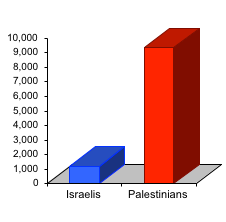
Chart showing that 6 times more Palestinians have been killed than Israelis. 1,104 Israelis and at least 6,836 Palestinians have been killed since September 29, 2000. (View Sources & More Information)
Israelis and Palestinians Injured
September 29, 2000 — Present
9,104 Israelis and 50,742 Palestinians have been injured since September 29, 2000. (View Sources & More Information.) Chart showing that Palestinians are injured at least four times more often than Israelis.
Daily U.S. Military Aid to Israel and the Palestinians
Fiscal Year 2013
Chart showing that the United States gives Israel $8.2 million per day in military aid and no military aid to the Palestinians. During Fiscal Year 2013, the U.S. is providing Israel with at least $8.5 million per day in military aid and $0 in military aid to the Palestinians. (View Sources & More Information)
UN Resolutions Targeting Israel and the Palestinians
1955 — 1992
Israel has been targeted by at least 77 UN resolutions and the Palestinians have been targeted by 1. (View Sources & More Information) Chart showing that Israel has been targeted by 77 UN resolutions, while the Palestinians have been targeted by 1.
Current Number of Political Prisoners and Detainees
Chart showing that Israel is holding 5,604 Palestinians prisoner. 0 Israelis are being held prisoner by Palestinians, while 5,007 Palestinians are currently imprisoned by Israel. (View Sources & More Information)
Demolitions of Israeli and Palestinian Homes
1967 — Present
0 Israeli homes have been demolished by Palestinians and at least 27,000 Palestinian homes have been demolished by Israel since 1967. (View Sources & More Information) Chart showing that 24,145 Palestinian homes have been demolished, compared to no Israeli homes.
Israeli and Palestinian Unemployment Rates
Chart depicting the fact that the Palestinian unemployment is around 4 times the Israeli unemployment rate. The Israeli unemployment rate is 6.9%, while the Palestinian unemployment in the West Bank is 22.6% and 27.9% in Gaza. (View Sources & More Information)
Current Illegal Settlements on the Other’s Land
Israel currently has 260 Jewish-only settlements and ‘outposts’built on confiscated Palestinian land. Palestinians do not have any settlements on Israeli land. (View Sources & More Information) Chart showing that Israel has 227 Jewish-only settlements on Palestinian land.

ifamericansknew.org/
With permission

Russians set up free speech zones for Winter Olympics

0

bbc.co.uk
January 4, 2014

The Russian authorities are to set up a special zone for protest rallies at the Sochi Winter Olympics, where security will be tight.

A special security regime will be in place in and around the southern city from 7 January until 21 March.

The authorities announced last year that a ban on rallies would be imposed in the Games area.

But a decree now says protests during the Games in February can be held if agreed with the authorities.

This article was posted: Saturday, January 4, 2014 at 7:41 am


<!– this is where we need to show the related articles

–>

Source: Infowars

China Informed Japan of Air Defense Zone Plan (ADIZ) in 2010

0

by John Hofilena

Citing confidential documents that they recently acquired, a leading Japanese newspaper has published a news report saying that Chinese military officials had informed a Japanese government delegation about its plans to put up an expanded air defense zone as far back as 2010.

According to the report, senior officers of the People’s Liberation Army Navy (PLAN) met informally with a delegation of Japanese government officials and informed them of China‘s plan to put up an air defense identification zone (ADIZ) that covered the Japan-controlled Senkaku Islands in Okinawa Prefecture.

The documents — minutes of the informal meeting between the PLA officers and Japanese government officials at the China Foundation for International and Strategic Studies in Beijing on May 14-15, 2010 — show that China had already established its ADIZ but had not made it public yet. The report says that upon checking the details of the minutes of that meeting, the area of the zone presented to the Japanese officials is almost identical to the one that was recently announced by the Chinese government in November of 2013.

The more significant revelation, we think, from these documents is that a Chinese navy commodore took the time to explain that the ADIZ it was claiming roughly matched what China claimed as its exclusive economic zone and continental shelf, which is one logical way of defining a sovereign nation’s ocean borders. According to the minutes of the meeting, the Chinese military official clearly explained that the Senkakus were inside this zone. Furthermore, the documents show that the Chinese were already pushing for some sort of cooperation between the two nations, with the PLAN saying that the Chinese and Japanese ADIZ “overlap by about 100 nautical miles,” or 185 kilometers, and put out suggestions saying that the Chinese air force and Japan’s Air Self-Defense Force needed to work out rules to prevent accidental clashes in the overlapping airspace.

These revelations indicate that China had been doing groundwork for the declaration of the ADIZ at least three and a half years before what looked like a surprise announcement in November. The stance of Japan regarding the Senkakus has been unchanged for some time now, where Tokyo continues to claim that there is no territorial dispute at all because the Senkakus are controlled by Japan. These documents show that there already was a question put out by China as far back as 2010. The said documents point to a brigadier general with the PLA’s Academy of Military Science — China’s highest-level military research institute — who asked the Japanese officials, “What shall we do about China’s and Japan’s overlapping ADIZ?”, going on to make the same proposal of cooperation and discussion as the PLAN commodore. It would seem now that the ball is in Japan’s court, and it would be interesting to see what comes out of this situation.

Copyright , japandailypress.com 2014

Disclaimer: The contents of this article are of sole responsibility of the author(s). The Centre for Research on Globalization will not be responsible for any inaccurate or incorrect statement in this article. The Center of Research on Globalization grants permission to cross-post original Global Research articles on community internet sites as long as the text & title are not modified. The source and the author’s copyright must be displayed. For publication of Global Research articles in print or other forms including commercial internet sites, contact: [email protected]

www.globalresearch.ca contains copyrighted material the use of which has not always been specifically authorized by the copyright owner. We are making such material available to our readers under the provisions of “fair use” in an effort to advance a better understanding of political, economic and social issues. The material on this site is distributed without profit to those who have expressed a prior interest in receiving it for research and educational purposes. If you wish to use copyrighted material for purposes other than “fair use” you must request permission from the
copyright owner.

For media inquiries: [email protected]

Source: Global Research

Globalization and the “Fast Food” Industry

0

by Tom Beacham
RINF Alternative News

It is often said that one of the most exciting aspects of being immersed in foreign culture is the mixture of different herbs and spices, meats and fish, fruits and veg that you explore every day. It is a sad fact that food is becoming more traveled than we are. Eating local or traditional food in big cities is proving to get more and more difficult as a result of the globalization process. The quality of French cuisine can be seen almost everywhere, as well as low quality adaptations of traditionally Italian dishes, and San Pedro Sula, in Northern Honduras is a classic example of when the American fast food culture meets classic Central American fare.

During my first half an hour of being here in San Pedro Sula, I find myself engulfed in a conversation with a taxi driver, in which we discussed a number of topics, from the prominence of cartel gun crime to the total domination of American fast food companies, a conversation that could have erupted in Guatemala City, San Salvador, Managua or almost any large Central American city. This domination is clear to see with the aggressive advertising techniques utilised by these restaurant chains. The pinnacle of these ugly and intrusive visuals is used by Coca-Cola, who decided that they are going to prop up an advert that you can see from miles away. The City is swallowed by rolling hills that surround its four corners, so … Coca-Cola decided to put a huge sign up in the hills in the style of the classic ‘Hollywood’ sign of Los Angeles. The sign can be seen from the city centre clearly and can be seen from the main strip of restaurants and fast food outlets … it even lights up a hideous red when the sun goes down.

The hard sell attitude of the fast-food industry is self-evident all over the world. For example: MacDonald’s and Coca-Cola were two of the nine major sponsors for the 2012 Olympic Games, a strange oxymoron. MacDonald’s accounted for less than 2% of the total revenue for the Olympics, but still splashed out a cool $100 million for the four year period, they have been major partners for the last 40 years. They built a 1,500 seat restaurant on the London Olympic site, the biggest in the world and stated that they are trying to “raise brand awareness”, as did Coca-Cola. I just wonder who these people are, sitting watching the Olympics, that are unaware of the existence of MacDonald’s and Coca-Cola, the stagnant branding of these chains and couldn’t draw the infamous golden arches (I know it’s hard to believe, but it is just an “M”).

The point is, aggressive advertising is deconstructing food cultures that out-date us by millennia and have been a huge part of the formation national identity. This for me is depressing, and when travelling now, in certain areas, it’s near impossible to find and immerse yourself in the flavours of the nation, this is a sad fact that is becoming more and more apparent.

And remember — by calling your restaurant “Burgermeister”, burgers do not suddenly become part of local or even German cuisine, although, they do still taste nice…

Tom Beacham — Creator and editor of www.globalissuers.org, a new and exciting group of writers discussing various issues from across the globe. Having conducted research across England and Nicaragua, Tom is looking to progress in the field of Human Rights.

Cantor renews efforts to kill Iran talks

0

House Majority Leader Eric Cantor (R-Va.) has announced his intention to seek a bipartisan resolution against Iran after his efforts to derail the nuclear talks failed last year.

Cantor had hoped to bring a similar resolution to the House floor before the end of the year recess. The bill sought to dictate the terms of a final deal the five permanent members of the UN Security Council plus Germany hope to reach with Iran over its nuclear energy program.

Cantor, the highest-ranking Jewish member of US Congress, shelved those plans after House Minority Whip Steny Hoyer (D-Md.) urged a Å“pause,” following an interim agreement reached between Iran and the world powers in November.

In a memo Friday to his Republican colleagues laying out the legislative agenda for January, Cantor vowed to try again.

Å“Iran remains perhaps the most significant national security threat facing the United States and its closest allies,” Cantor said.

Å“It is my hope that the House, in a bipartisan manner, can express our concerns about Iran’s aggression and state our position on what a comprehensive settlement of the nuclear issue should look like.”

Cantorâ„¢s resolution seeks to set parameters for a final nuclear deal requiring, among other things, an end to Iranâ„¢s uranium enrichment program. This is regarded as a deal-breaker by Tehran that has repeatedly maintained it would not negotiate over its right to enrich uranium.

HJ/HJ

Source: Press TV

Infographic: The Lowdown on Water Storage

0

Every prepper knows the infamous “Survival Rule of Three”.

  • Three minutes without air.
  • Three days without water.
  • Three weeks without food.

So, if a disaster has hit and you’re still breathing, your next concern has got to be water. Contaminated water is one of the number one causes of death in a disaster scenario. It can lead to a host of dreaded diseases like  dysentery, Hepatitis A, viral gastroenteritis, cholera, Shigellosis, typhoid, Diphtheria and polio.

There is nothing that you can store that is more valuable than water or the means to purify water. Without this one vital element that makes up 50-70% of your body, you’re as good as dead.

body water

The following infographic gives you the lowdown on storing water: what to put it in, how to treat it, and how much you should store.

This infographic was graciously provided by 

Food Insurance — Your Freeze Dried Food Storage Source

Lowdown on Water Storage Infographic

FoodInsurance.com

To learn more about the toxins that reside in many municipal water supplies, click HERE.

To learn where you can find fresh, clean drinking water in the midst of an emergency, click HERE.

To learn more about providing a long-term water supply for your family, click HERE.

To learn about how people survived a longlasting SHTF event in Bosnia, including how they managed to acquire safe water, click HERE.

Paul suing Obama admin. over spying

0

Sen. Paul to file class-action lawsuit over NSA spying

Senator Rand Paul will file a class-action lawsuit against the Obama administration over spying programs.

US Senator Rand Paul will soon file a class-action lawsuit against the Obama administration over the National Security Agencyâ„¢s spying on the American people.

In an interview Friday night on the Fox News show “Hannity,” the Kentucky Republican urged everyone in the US with a cellphone to join the suit against the administration.

Å“The question here is whether or not, constitutionally, you can have a single warrant apply to millions of people,” Paul said. Å“So we thought, what better way to illustrate the point than having hundreds of thousands of Americans sign up for a class action suit.”

The outspoken senator said that he began collecting signatures for the class-action lawsuit about six months ago.

Sen. Paul, who will file the suit in the DC District Court as a private citizen, said that Ken Cuccinelli, the Attorney General of Virginia, is the lead lawyer in the initiativeâ„¢s legal team.

Å“Weâ„¢re hoping, with his help, that we can get a hearing in court, and ultimately get this class-action lawsuit, I think the first of its kind on a constitutional question, all the way to the Supreme Court,” Paul said.

Paulâ„¢s Senate campaign website also calls on people in the US to Å“please sign below and join my class-action lawsuit and help stop the governmentâ„¢s outrageous spying program on the American people.”

The senator has asserted that if he could get 10 million people to sign up it would force the government to make changes to its spying programs.

Meanwhile, the Obama administration on Friday moved on two fronts to preserve the NSA’s surveillance activities.

The secretive Foreign Intelligence Surveillance Court renewed the NSA’s permission to continue collecting phone records of millions of Americans, and the Justice Department appealed a major ruling by a federal judge against the spy agency.

HJ/HJ

Source: Press TV

U.S. court allows more phone snooping

0

Reuters
January 4, 2013

The secretive U.S. Foreign Intelligence Surveillance Court on Friday renewed the authority of U.S. intelligence agencies to collect data on millions of Americans’ telephone calls in a program that has set off a legal battle over privacy rights.

The court allowed the intelligence community to collect metadata from phone companies, the Office of Director of National Intelligence James Clapper said in a news release.

The release offered almost no details about the ruling, but a U.S. official said the authority was renewed for three months, and that it applied to the entire metadata collection program.

In the past, these orders were sometimes issued to individual telephone companies. But the official said the latest order covered all companies from which metadata had been collected under recent previous court authorizations.

Full article here

This article was posted: Saturday, January 4, 2014 at 5:52 am

Tags: ,


<!– this is where we need to show the related articles

–>

Source: Infowars

Big Sis: No clemency for Edward Snowden

0

Justin Sink
The Hill
January 4, 2013

Former Homeland Security Secretary Janet Napolitano said Friday that she “would not put clemency on the table” for NSA leaker Edward Snowden.

“I think Snowden has exacted quite a bit of damage and did it in a way that violated the law,” Napolitano said in an interview airing on “Meet the Press” this Sunday.

She said damage from Snowden’s actions will be seen for years to come.

Asked if the administration should consider a deal that would allow Snowden to avoid jail time in return for unreleased documents, Napolitano said she couldn’t judge without knowing what information the former defense contractor still had.

Full article here

This article was posted: Saturday, January 4, 2014 at 5:51 am

Tags: ,


<!– this is where we need to show the related articles

–>

Source: Infowars

The Case of the Missing Recovery

0

Paul Craig Roberts
Infowars.com
January 4, 2013

Have you seen the economic recovery? I haven’t either. But it is bound to be around here somewhere, because the National Bureau of Economic Research spotted it in June 2009, four and one-half years ago.

It is a shy and reclusive recovery, like the “New Economy” and all those promised new economy jobs. I haven’t seen them either, but we know they are here, somewhere, because the economists said so.

Congress must have seen all those jobs before they went home for Christmas, because our representatives let extended unemployment benefits expire for 1.3 million unemployed Americans, who have not yet met up with those new economy jobs, or even with an old economy job for that matter.

By letting extended unemployment benefits expire, Congress figures that they saved 1.3 million Americans from becoming lifelong bums of the nanny state and living off the public purse. After all, who do those unemployed Americans think they are? A bank too big to fail? The military-security complex? Israel?

What the unemployed need to do is to form a lobby organization and make campaign contributions.

Just as economists don’t recognize facts that are inconsistent with corporate grants, career ambitions, and being on the speaking circuit, our representatives don’t recognize facts inconsistent with campaign contributions.

For example, our representative in the White House tells us that ObamaCare is a worthy program even though those who are supposed to be helped by it aren’t because of large deductibles, copays, and Medicaid estate recovery. The cost of this non-help is a doubling of the policy premiums on those insured Americans who did not need ObamaCare and the reclassification by employers of workers’ jobs from full-time to part-time in order to avoid medical insurance costs. All it took was campaign contributions from the insurance industry to turn a policy that hurts most and helps none into a worthy program. Worthy, of course, for the insurance companies.

Keep in mind that it is the people who could not afford medical insurance who have to come up with their part of the premium or pay a penalty. How do people who have no discretionary income come up with what are to them large sums of money? Are they going to eat less, drive less, dress less? If so, what happens to people employed in those industries when demand falls? Apparently, this was too big a thought for the White House occupant, his economists, and our representatives in Congress.

According to the official wage statistics for 2012 http://www.ssa.gov/cgi-bin/netcomp.cgi?year=2012 , forty percent of the US work force earned less than $20,000, fifty-three percent earned less than $30,000, and seventy-three percent earned less than $50,000. The median wage or salary was $27,519. The amounts are in current dollars and they are compensation amounts subject to state and federal income taxes and to Social Security and Medicare payroll taxes. In other words, the take home pay is less.

To put these incomes into some perspective, the poverty threshold for a family of four in 2013 was $23,550.

In recent years, the only incomes that have been growing in real terms are those few at the top of the income distribution. Those at the top have benefitted from “performance bonuses,” often acquired by laying off workers or by replacing US workers with cheaper foreign labor, and from the rise in stock and bond prices caused by the Federal Reserve’s policy of quantitative easing. Everyone else has experienced a decline in real income and wealth.

As only slightly more than one percent of Americans make more than $200,000 annually and less than four-tenths of one percent make $1,000,000 or more annually, there are not enough people with discretionary income to drive the economy with consumer spending. When real median family income and real per capita income ceased to grow and began falling, Federal Reserve chairman Alan Greenspan substituted a credit expansion to take the place of the missing growth in income. However, as consumers became loaded with debt, it was no longer possible to expand consumer spending with credit expansion.

World War II left the US economy the only undamaged industrial and manufacturing center. Prosperity ensued. But by the 1970s the Keynesian demand management economic policy had produced stagflation. Reagan’s supply-side policy was able to give the US economy another 20 years. But the collapse of the Soviet Union brought an era of jobs offshoring to large Asian economies that formerly were closed to Western capital. Once corporate executives realized that they could earn multi-million dollar performance bonuses by moving US jobs abroad and once they were threatened by Wall Street and shareholder advocates with takeovers if they did not, American capitalism began giving the US economy to other countries, mainly located in Asia. As high productivity manufacturing and professional service jobs (such as software engineering) moved offshore, US incomes stagnated and fell.

As real income growth stagnated, wives entered the work force to compensate. Children were educated by refinancing the home mortgage and using the equity in the family home or with student loans that they do not earn enough to repay. Since the December 2007 downturn, Americans have used up their coping mechanisms. Homes have been refinanced. IRAs raided. Savings drawn down. Grown children, now adults, are back home with parents. The falling labor force participation rate signals that the economy can no longer provide jobs for the workforce. In such a situation, economic recovery is impossible.

What the Treasury and Federal Reserve have done, with the complicity of the White House, Congress, economists, and the media, is to focus on rescuing a half dozen banks “too big to fail.” The consequence of focusing economic policy on saving the banks is rigged financial markets and massive stock and bond market bubbles. To protect the dollar’s exchange value from quantitative easing, the price of gold has been forced down in the paper futures market, with the consequence that physical gold is shipped to Asia where it is unavailable as a refuge for Americans faced with currency depreciation.

At a time when most Americans are running out of coping mechanisms, the US faces a possible financial collapse and a high rate of inflation from dollar depreciation as the Fed pours out newly created money in an effort to support the rigged financial markets.

It remains to be seen whether the chickens can be kept from coming home to roost for another year.

Paul Craig Roberts was Assistant Secretary of the Treasury for Economic Policy and associate editor of the Wall Street Journal. He was columnist for Business Week, Scripps Howard News Service, and Creators Syndicate. He has had many university appointments. His internet columns have attracted a worldwide following. His latest book, The Failure of Laissez Faire Capitalism and Economic Dissolution of the West is now available.

This article was posted: Saturday, January 4, 2014 at 5:49 am

Tags:


<!– this is where we need to show the related articles

–>

Source: Infowars

Charlotte Iserbyt on The Perils of Common Core

0

Infowars.com
January 4, 2013

Alex invites former Senior Policy Advisor for the U.S. Department of Education, Charlotte Thomson Iserbyt, to analyze how socialism is subtly promoted in American schools and textbooks.

This article was posted: Saturday, January 4, 2014 at 5:50 am

Tags:


<!– this is where we need to show the related articles

–>

Source: Infowars

Autonomous Terminator Like Robots will Decide Your Fate

0

Infowars.com
January 4, 2013

The U.S. Department of Defence (DoD) revealed its Unmanned Systems Integrated Roadmap, setting out its technology aims for the next 25 years.

Its plans include drone-bombs that can hunt in ‘swarms’ from a mothership.

Next-generation unmanned aircraft will likely be equipped with better sensors and navigational equipment, plus superior autonomous systems.

This article was posted: Saturday, January 4, 2014 at 5:51 am

Tags:


<!– this is where we need to show the related articles

–>

Source: Infowars

90% of shooting rampages could be stopped by quick-thinking civilians: expert

0

David Sherfinski
The Washington Times
January 4, 2013

Mass shootings like the ones that have occurred in recent years in Newtown, Conn., and Aurora, Colo., have tripled in recent years, according to a study set to be published next week for the FBI.

Researchers looked at active shootings in public settings where the primary motive appeared to be mass murder and at least one victim was unrelated to the shooter, according to Yahoo News, which obtained the report.

The study, to be published next week in the “FBI Law Enforcement Bulletin,” a training publication for those in the criminal justice profession, was written by the Advanced Law Enforcement Rapid Response Training (ALERRT) Center at Texas State University.

The prevalence of such events went from about one every other month between 2000 and 2008 – five per year – to more than one a month between 2009 and 2012 – almost 16 per year, the study says.

Full article here

This article was posted: Saturday, January 4, 2014 at 5:49 am

Tags:


<!– this is where we need to show the related articles

–>

Source: Infowars

US senator: Does NSA spy on Congress?

0

Sanders said he asked NSA director if the agency monitored telephone, email and Internet communication by others in Congress or in other elective offices.

US Sen. Bernie Sander, Ind-Vt., said Friday he has asked the National Security Agency whether it has spied on members of Congress and other officials.

In a posting on his official congressional website, Sanders said he has written to the NSA director, Gen. Keith Alexander, to ask whether the agency has monitored telephone, email and Internet communication by others in Congress or in other elective offices.

“Has the NSA spied, or is the NSA currently spying, on members of Congress or other American elected officials?” Sanders asked in the letter.

The post on Sanders’ website said spying includes “gathering metadata on calls made from official or personal phones, content from websites visited or emails sent, or collecting any other data from a third party not made available to the general public in the regular course of business?”

Sanders — who has introduced legislation to restrict powers of the NSA and the FBI to secretly monitor Americans’ electronic communications — said he is “deeply concerned” by disclosures that the NSA has collected massive amounts of data on phone calls, emails and Internet activity “by millions of innocent Americans without any reason to even suspect involvement in illegal activities.”

He said the United States “must be vigilant and aggressive” in protecting against terrorist attacks but noted a federal judge in Washington recently called the surveillance policies “almost Orwellian” in ruling the practice is likely unconstitutional.

The Obama administration Friday filed a formal appeal of the ruling. UPI

AT/ISH

Source: Press TV

US winter storm: At least 16 dead

0

A severe winter storm in the United States has claimed the lives of at least 16 people in the eastern half of the country.

The deaths were caused by difficult traffic conditions mostly in Michigan, Kentucky, Indiana, and Illinois.

Authorities also said a woman, who suffered from Alzheimer, froze to death after she wandered away from her rural New York home and a worker died after a massive pile of salt fell on him.

The blizzard-like conditions, which left two feet of snow in some places, led to the cancelations of about 1,900 flights across the country.

According to forecasters, temperatures were falling to well below freezing and wind chill readings could hit minus 23 Celsius.

Emergency officials warned that anybody who spends more than a few minutes outdoors would start to suffer from frostbite.

New York and New Jersey governors have declared states of emergency and asked everyone to stay at home. Hundreds of schools were closed in Boston and New York.

“This is nothing to be trifled with. People should seriously consider staying in their homes,” New York Governor Andrew Cuomo said.

The heaviest snow fell in Boxford in the state of Massachusetts, which received over two feet of snow.

The township of Lakewood in New Jersey, New Yorkâ„¢s Central Park, and Philadelphia got 10, 6, and more than 6 inches of snow, respectively.

Meanwhile, officials are warning against and preparing for another arctic storm within the next few days which could be even worse than the current one.

AT/ISH

Source: Press TV

10 Signs Religious Fundamentalism Is in Decline

1

If you are a nonbeliever in the mood for a party, here are 10 reasons to celebrate.

Days may be dark right now–after all, as the memes proclaim, axial tilt is the reason for the season. But things are looking bright for those who would like to see humanity more grounded in science and reason. If you are a nonbeliever in the mood for a party, here are 10 reasons to celebrate.

1. Coming out atheist is up and coming. In May 2013, after a deadly tornado destroyed her home, young mother Rebecca Vitsmun gave anunexpected answer when CNN’s Wolf Blitzer asked whether she thanked the Lord for her decision to flee. Vitsmun tells the story in a sometimes-tearfulinterview with Seth Andrews, host of the Thinking Atheist. “I had this moment in which I realized you either lie or tell the truth, and I’m not a liar.” In that moment, Vitsmun outed herself not only to a national media audience but also to her Christian parents and friends.

Vitsmun’s situation was extraordinary, but candor about nonbelief is becoming more and more commonplace. From Hollywood celebs like Angelina Jolie to high school students, skeptics are opening up about their beliefs and values–or simply declining to lie when asked. (A quick-read book, Mom, Dad, I’m an Atheist, offers tips for those who are contemplating when, where and how best to come out.)

2. The cutting edge of freethought is less cutting and edgy. In generations past, coming out as an atheist required a devil-may-care attitude. The social and even financial costs were so high that most admitted atheists were also unflinching social activists, people who had a high degree of zeal and high tolerance for conflict. Most were also white males who were comparatively safe taking on the religious establishment. Until recently, then, atheism was virtually synonymous with anti-theism, and even today people complain that pioneers of the New Atheist movement like Dawkins, Harris, Dennett, and the late great Hitchens are unnecessarily antagonistic.

But thanks in part to their courage and flame-throwing, a new generation is emerging, one that sees atheism not as an end point, but as a beginning. Alain de Botton’s TED talk and book, Atheism 2.0, simply posits the nonexistence of God and then goes on to discuss what humanity can glean from the rubble of religious traditions. Many younger people are casting aside labels and adopting what fits from religious holidays and traditions, in the same way that they mix and match cultural, racial or sexual identities. As boundaries soften, more women, Hispanics and blacks are joining or even leading the conversations.

3. Biblical sexuality is getting binned. Finally. In the last part of December, marriage equality became law in two more states: New Mexico and–drumroll–Utah! Even more exciting is the fact that legal changes can barely keep up with shifting attitudes about queer sexuality. Things are changing when it comes to straight sex, too, and not in keeping with biblical priorities. Perhaps the most consistent sexual theme in the Bible is that a woman’s consent is not needed or even preferred before sex. By demanding an end to rape culture, today’s young women and men are making the Bible writers look as if they were members of a tribal, Iron Age culture in which women were property like livestock and children–to be traded, sold and won in battle. Small wonder the culture warriors have ramped up their fight against contraception and abortion. Imagine if, on top of everything else, all women got access to expensive top-tier contraceptives and the power to end ill-conceived childbearing.

4. Recovering believers are reclaiming their lives. Most atheists and agnostics are former believers, which means that many carry old psychological baggage from childhood beliefs or some post-childhood cycle of conversion and deconversion. While many former believers slip out of religion unscathed, some do not, and believers in recovery now have a name: reclaimers. A small but growing number of cognitive scientists are exploring the relationship between religion and mental illnesses like depression, anxiety disorders and panic. Marlene Winell, a California consultant who works full time with recovering fundamentalists, has brought attention to a pattern she calls Religious Trauma Syndrome. Darrel Ray has created a matching service for secular clients and therapists, while Kathleen Taylor at Oxford has raised the question of whether religious fundamentalism itself may one day be treatable.

Read more

Why Does Hollywood Celebrate Fraudsters Who Rip Us Off?

4

Movies like “The Wolf of Wall Street” have but one message: Take the money and run.

Margot Robbie, who plays the wife of hard-partying stock swindler Jordan Belfort in The Wolf of Wall Street, explains in an interview how Martin Scorsese bamboozles the audience into cheering a morally repugnant man:

“Often, you know, the protagonist, the hero of the story is a bad guy, but you’re on his side the whole way. And everyone else, too, like, they’re not really technically portrayed as good people in the film, but you’re still on their side. They’re breaking the law and you want them to get a way with it. It’s kind of amazing that he can position the audience to feel that way about characters who are blatantly doing horrible things. It’s great though. It’s fun!”

For three hours, Belfort, portrayed with manic intensity by Leonardo DiCaprio, lies, humps and snorts his way through a binge of fraud and frolic that would make Gordon Gekko, and possibly a few Roman emperors, blush. Belfort starts out hustling penny stocks, selling “garbage to garbage men,” but quickly works his way up from screwing over poor people to ripping off wealthy investors, using the proceeds to hire truckloads of hookers and dwarves used for target practice at office parties (seriously!).

Not everyone was amused. In an open letter to Scorsese and DiCaprio, Christina McDowell, the daughter of one of Belfort’s partners in crime, describes the emotional pain and financial ruin she suffered as a teen when the dad she believed in turned out to be a crook. She doesn’t mince words about the treatment of the Belfort saga in the film:

“So here’s the deal. You people are dangerous. Your film is a reckless attempt at continuing to pretend that these sorts of schemes are entertaining, even as the country is reeling from yet another round of Wall Street scandals. We want to get lost in what? These phony financiers’ fun sexcapades and coke binges? Come on, we know the truth. This kind of behavior brought America to its knees. And yet you’re glorifying it–you who call yourselves liberals.”

She’s got a point. Why does Hollywood celebrate financial fraudsters when just about the entire country has been victimized by them?

One Nation Under Fraud

The idea that we can reinvent ourselves and shimmy up the social and economic ladder runs deep in American culture, tapped most famously in The Great Gatsby(recently adapted in a film starring DiCaprio, whose roles as the conman-charmer include the fictional Jay Gatsby and Frank Abagnale, the real-life forger of Catch Me if You Can). It’s as old as the canny Dutch traders who finagled their way into property in early New Amsterdam and morphed into America’s social elite. We’re a country founded in no small part by smugglers, pirates, slavers, and financial fraudsters of every description.

But unlike the case of Australia, our religious traditions run almost as deep as our worship of money. Puritan preachers and historians threw a cloak of morality over this festival of flimflam and taught us that he who has the money must be favored by God – a god who eventually took on a code name: the Market. Guided by an invisible hand, the West was settled and the railroads were built and if large numbers of people were hustled – or worse – in the process, at least we had a shot at upward mobility amid the ruckus. So the story went.

Certainly this tradition explains part of our fascination – and acceptance – of con artists. But Hollywood added its own hypnotic magic to the mix.

Hollywood Hustle

Martin Scorsese is a product of New York’s Little Italy of the 1940s, where certain energetic men broke the bounds of working-class drudgery to become celebrated mobsters. As a boy, Scorsese could not help but be awed by the swaggering swindlers who never suffered humiliation from the factory boss. In reality, it was Franklin Roosevelt’s New Deal which did the most to lift New York City and neighborhoods like Little Italy out of the Depression. But WPA workers weren’t as sexy as mobsters, and in the era of the blacklist, they were anything but likely objects for a movie. Scorsese became entranced by characters from humble places who got their piece of the American pie by playing the right con.

The little boy grew up to give America a body of work enamored with macho crime culture. Scorsese’s first foray into mainstream movie-making, The Color of Money, celebrates of the romance of the pool shark. He followed that success with Goodfellas and Casino, two violent gangster movies that made crime feel glamorous and guilt-free. The hustler was now a rock star, a celebrity, the man to root for, even in his excesses – and of course, he was always a man.

This romance of the swindler, courtesy of Scorsese and Coppola, has permeated American popular culture so profoundly that it now dominates even the daytime soap opera. “General Hospital,” the 50-year-old grande dame of daytime, is now populated by more mobsters than medical personnel. The mob boss has become the romantic hero for America’s stay-at-home moms.

Read more

Promising Momentum Points to Paid Sick Leave Spreading Widely

0

Big money opposes any increase in workers rights, but some of the signs are good.


For 38,000 private sector workers in Newark, mid-December brought good news and bad. The City Council of New Jersey’s most populous city delayed its vote on a paid sick leave bill until January 8 , so no early Christmas present for workers. But the bill they will be voting on after the new year, and by all accounts are likely to pass, will be the strongest sick leave bill in the nation, and will set the bar that much higher for other municipalities and states to come.

The sick leave debate in Newark came at the end of a watershed year for workers and their advocates. Fast food workers went on multiple strikes, drawing more attention to their low-wage plight. Mega corporations Walmart and McDonalds came under pressure and were exposed for not just exploiting their workers, but ultimately costing taxpayers who must subsidize underpaid full-timers. Raising minimum wage came front and center in the national conversation, with Democrats proclaiming it their number-one priority in 2014. And the number of cities requiring private businesses to give their workers some sick pay doubled, including Jersey City, New Jersey’s second biggest city in September, and New York City, despite its billionaire mayor’s veto last summer.

Newly sworn in Mayor Bill de Blasio has promised to make inequality his top priority, and says his choice for the city’s top attorney, Zachary Carter, will help the city extend paid sick leave protections to “more people, more quickly.” In 2013, Portland, Oregon, San Francisco, Seattle, Washington, DC, the tiny town of SeaTac, Washington and the state of Connecticut all passed sick leave legislation. Massachusetts, Oregon and Vermont are poised to pass paid sick day bills, as is the city of Tacoma, WA.

“The tide has changed on paid sick days,” said Jon Green, national deputy director of the Working Families Party. “People look at a waiter or childcare provider or retail worker and they just know that forcing those people to go to work sick isn’t healthy and it isn’t right. Public support for paid sick days is extraordinary, and elected officials who don’t realize it risk paying a steep price.”

Let’s hope.

All in all, about 40 percent of America’s private sector workers are obliged to choose between a paycheck and their health, a deplorable state of affairs that endangers not only the health and welfare of employees, but that of others who work near or are served by them. The situtation is especially dire in the restaurant industry, where according to the Restaurant Opportunities Center United, 90 percent of workers don’t have paid sick days, and 60 percent admit coming to work when they are sick. Not giving workers paid sick leave has been blamed for helping spread the H1N1 flu and other contagious diseases.

The U.S. has the distinction of being the only country of the 15 most economically competitive countries (Australia, Austria, Canada, Denmark, Finland, Germany, Iceland,Japan, Netherlands, Norway, Singapore, Sweden, Switzerland, Britain and the United States) not to guarantee workers sick leave, and generally lags behind in every category of employee rights, from vacation pay to maternity and paternity leave.

The opposition to granting workers (and the public) this modicum of decency that is commonplace among other developed countries (most of these bills allow for a whopping five sick days per year, the most progressive requiring workers to earn an hour of sick pay for each 30 hours worked) is well-funded, well-organized and willing to fight as dirty as they need to. Front and center is the corporate-funded, right-wing American Legislative Exchange Council (ALEC), chambers of commerce and restaurant industry associations, all who make the tired and discredited argument that mandating such policies would cost jobs and be a financial burden on businesses. Sound familiar?

In fact, not granting workers paid leave when they are sick has been shown to cost businesses even more. Sick workers are less productive (as are workers worried about sick loved ones). All evidence from the locales that have enacted these humane policies points to guaranteed paid sick leave being good for business, job growth and the overall economy. One estimate, from the Economic Policy Institute is that without paid sick days, an employer will lose about $225 per year per worker, because of lost productivity.

Not to mention the human cost.

“I watched my parents go to work sick because there was no such thing as paid sick leave and they had four children who needed to eat,” Newark councilwoman Mildred Crump said during a rally for paid sick leave in October. She recounted how her father’s bad cold turned into pneumonia after several mornings of trudging in the freezing cold to the bus. “Shame on anyone who says this is not a good idea. Shame on them. They need to walk a mile in our shoes.”

Nevertheless, so intent are the likes of ALEC and likeminded groups to prevent sick leave from becoming the law of the land that they have been instrumental in pushing preemption bills in as many states as possible. These bills block cities and smaller municipalities from passing sick leave ordinances. Pretty twisted logic for the right-wing, which normally is an advocate for local rule (except when local rule is at odds with the conservative, pro-corporate agenda). Ten such pre-emption laws are in effect, seven of them passed in 2013, when Arizona, Florida, North Carolina, Tennessee, Kansas and Indiana joined Georgia, Wisconsin and Louisiana.

At year’s end, Pennsylvania is in the throes of the battle, with the GOP-controlled state legislature doing its utmost to prevent the Philadelphia city council from passing a paid sick leave bill for restaurant workers as it has tried to do for several years. (Like New York under Bloomberg, the mayor of Philadelphia opposes this benefit for workers.) The preemption bill in Pennsylvania, House Bill 1807, which would prevent local rule, stands a good chance of passing.

Philadelphiamagazine’s Joel Mathis recently noted the peculiar hypocrisy, and real aim of ALEC in all this.

Far from being a Pennsylvania-only effort, it appears that House Bill 1807 is part of a broader effort led by the pro-Republican American Legislative Exchange Council to pass a series of state laws prohibiting paid sick leave around the country. It’s a bill that would never pass the Congress – where Democrats control the Senate: ALEC’s specialty, in essence, is passing national-effects policies at the state level, belying the supposed GOP love of Federalism.

So, enjoy that flu virus served up with your coffee, residents of states where ALEC is on the march.

Related Stories

Source: Alternet

Are Colleges and Universities Exploiting Unpaid Interns, Too?

0

Over the past year, unpaid internships in business have drawn more scrutiny. But some schools – notably, their athletic departments – have sought out unpaid interns, too.


For students interested in a career in sports management, Arizona State University has what seems like a great opportunity. The school’s athletic program, which boasts of 138 national championships, is advertising for an intern to help with “event staging” for the Sun Devils’ football, basketball, and other games.

There are just a few drawbacks. “This position requires physical labor,” the ad states. “The intern must be able to lift up to 50 pounds and work outdoors in extreme weather conditions.” The work is also completely unpaid.

Over the past year, unpaid internships in journalism, film and government have drawn increasing scrutiny. But it turns out, universities aren’t simply sending off kids to internships in these and other fields. Some schools – notably, their athletic departments – are themselves hiring unpaid interns whose responsibilities can sound quite similar to those of everyday employees.

Florida Gulf Coast University, for instance, advertises for an unpaid “Business Operations Intern” whose responsibility would include “processing purchase orders and payment on invoices” and “accurate paperwork filing procedures.” A university website also advertised for an “Athletics’ Facilities and Operations Intern” whose responsibilities include “supervision of the part time Event Staff to hold them accountable for the jobs they perform.” (The department removed that ad after we contacted them, saying the phrasing was inaccurate. They have not reposted it.) Ads for paid jobs at the university list similar responsibilities.

In order to be legal, most internships must not replace paid positions and must also offer significant educational benefits. But the federal government gives nonprofits, including universities, more leeway. (Federal internship guidelines also don’t apply to work-study arrangements, which have long existed as a way to allow students to work part-time to earn money toward their degrees.)

Whatever the law, internships at universities should have clearly defined academic components, said Messiah College internships director Michael True . Otherwise, universities may not be any better than an employer who doesn’t pay but still benefits from the intern’s work.

True oversees internships at Pennsylvania’s Messiah College, and has for two decades overseen an online discussion forum for college internship coordinators. Whether or not a student gets academic credit for an internship, said True, it needs to go beyond doing clerical or administrative tasks.

“Internships need to provide opportunities for setting learning goals and reflective activities to help students grow personally and professionally, not to just work,” True said.

A spokesman for Arizona State University athletic department, Doug Tammarro, said students work with the department in many ways, paid and unpaid, but that the department doesn’t have specific guidelines for who counts an “intern.” As for advertising the possibility of performing physical labor as an unpaid intern, Tammarro said they’re careful not to overwork the students, but “if you work in athletics and facilities, you’re probably going to be asked to do some type of physical labor.”

A university spokeswoman said the school’s human resources department does not manage student internship programs, but she was not able to provide additional comment as of the time of publication.

Bruce Banko II, spokesman for Florida Gulf Coast’s athletic department, said his university’s ads don’t give a full picture of interns’ experience. Interns, he said, spend a majority of their time shadowing a paid staff member.

Still, without the help of the department’s interns, Banko said that “some of those would have to be paid positions.”He said working without interns would still be feasible, but “would it make my days much longer? Yes.” As of publication time, a university official said no one was available to comment further on the school’s on-campus internship policies.

Of course, even unpaid internships can benefit students, helping them get a foot in the door to what is ultimately a very competitive industry. Duane Bailey, deputy athletic director at Seton Hall University, said he’s seen firsthand “how difficult and frustrating it is for a lot of kids looking for work.” Bailey himself started as an unpaid intern.

Seton Hall University’s athletics department offers unpaid internships to students looking to gain experience, but Baileysaid unpaid interns don’t replace paid employees and are simply “an answer to the constant stream of requests that we’ve received from students looking to get experience.” Career Center Director Reesa Greenwald said all on-campus internships are expected to adhere to the same standards as off-campus ones, and that the school prioritizes educational aspects and oversight above compensation.

“I do know that there are many institutions that rely on their intern programs to supplement their workforce but that’s not our model,” Bailey wrote in an email. “If we were to discontinue our program tomorrow there would be zero impact to us.”

But the work doesn’t give all students a leg up. George Twill, a former Seton Hall intern who graduated last year from Fairleigh Dickinson University, said there wasn’t anything necessarily negative about his experience – except for the lack of pay – but it did make him rethink a career in college athletics.

Twill said the work he was doing, which included a lot of data entry related to ticketing, related somewhat to his work toward his master’s degree in sports administration, but the position seemed to teach him more about event ticketing than the athletics industry. Interning without pay was difficult, too, he said: “It gets old really fast.”

In one of the few legal cases involving unpaid internships at universities, a former intern at New York’s Hamilton Collegefiled a lawsuit last year, seeking class-action status, alleging that the school’s athletic department improperly classified its interns to avoid paying the minimum wage. Attorneys for Benjamin Kozik – who wasn’t a student at the time of his internship – say their client was paid about $1,000 month but sometimes worked up to 90 hours per week and “was given additional responsibilities as a Special Teams Coordinator without an increase in pay,” among other allegations.

That case has yet to be decided, and a Hamilton spokesperson declined comment, citing the ongoing litigation.

Massachusetts-based lawyer William E. Hannum III – who specializes in labor law and often represents universities – said schools don’t have a “special deal” on unpaid internships and still need to “refer to and comply with applicable wage and hour laws.”

“An unpaid internship at a college could be problematic if it were not consistent with the college’s mission, and were simply an attempt to get free labor without any educational purpose,” Hannum wrote in an email, adding that the situation could be more problematic if “an unpaid internship served to displace an employee who would otherwise perform the same work.”

Mike Julius said his unpaid internship with Florida Gulf Coast University’s athletics department gave him valuable experience in sports marketing, and that he often felt less like an intern than a regular staff member. At the time of his internship, Julius said, the department was down a full-time employee, so he picked up some additional responsibilities. He got lots of hands-on experience, but no paycheck.

Julius graduated in management (with a sports concentration), but he isn’t working in the industry anymore. After losing his full-time job when the minor league baseball team he was with downsized, he began working at a department store in Toledo, Ohio.

Now, Julius said he’s looking for another job in sports. He says his search thus far has included plenty of positions that pay “basically nothing.” But he expected that.

“It’s a hard field to get into,” he said. “It’s more about love of the job than the money.”

Related Stories

Source: Alternet

Confessions of an Ex-Hoarder

0

‘There’s no mystery why I’ve saved so much stuff: to prove that I’m alive, that I’m someone, that my trail on this earth is worth preserving.’


I’ve run out of excuses for hanging on to stuff.

No, I haven’t achieved Zen non-attachment to material things, but I’m no longer on the road to “Hoarding: Buried Alive.”

It was easiest to get rid of the piles of unread magazines. Those now get the heave-ho every few months. The fear that had made me their custodian, which I’d confused with the theoretical pleasure I’d have when I’d eventually read them, was the chance I’d miss something important. The reality, it turns out, is that if I do overlook some essential, or just juicy, journalism, I’ll hear about it from a friend, or online, and saving a link to it for reading later, even if later never comes, requires no real estate from my non-virtual life.

Clothes were harder to let go. I didn’t really believe that wide ties would come back, or that someday I’d be glad I saved those tap shoes (don’t ask). But it was easy for me to mistake my closet for a scrapbook, to treat old clothes like souvenirs of where, when and who I was when I got them. When that happens now, I remind myself that if I’m warehousing something I haven’t touched for years in order to keep alive the guy who once wore it, it’s less punishing to put a selfie of it on my hard drive than to be sentenced to a lifetime of curating my personal wardrobe museum.

Book-hoarder has been an even tougher role to jailbreak. It’s intellectually respectable to have your own library. I love looking at all those spines on all those shelves; they map the cultural journey I’ve taken, and no Kindle can duplicate that experience. But shelving books three-deep, which I’d been reduced to, was a labor of guilt, not love. I still can’t throw books away; it feels sinful, even if I didn’t like them, even if I never have or will read them. But I’ve learned that I can drop off cartons of books at the local public library with a perfectly clear conscience. If they end up in a dumpster, my hands are clean.

But these were all baby steps. My big problem, the ball I’ve chained myself to for decades, is the stack of boxes, currently numbering 33, in my garage. Every move I’ve made — from my parents’ home, to dorm rooms, to apartments and houses and homes of my own — has included the fiction that it’ll be easier to deal with those multiplying cardboard boxes at the other end, when I unpack. Of course, I never do.

In college, I couldn’t bear to throw away the spiral notebooks I had filled so carefully with notes, not to mention the course catalogues, term papers, student publications that ran what I wrote, calendars, address books, I.D. cards. Travel added new categories of ephemera to save — odd matchbooks, cool baggage tags, train schedules, hostel receipts, shells from Greek islands and sand from Israeli deserts. I don’t think it was OCD; it was proof of my cosmopolitanism, and prophylaxis against amnesia.At first, it was just mail that I saved. When I was a kid, getting a letter was as unusual, though for different reasons, as it is today. I loved mail. Corresponding with someone beyond the bounds of my family bunker was evidence of my growing autonomy, a validation of my nascent identity. I could no more throw letters away than I could toss a Kodachrome in the trash. Yes, I saved pictures, too. And postcards. And comic books, baseball cards, Mad magazines, geometry projects, ticket stubs, lists of books I’d read and places I wanted to go — anything that testified to my existence.

Once in the work world, it was effortless to justify the files I kept amassing. Those pieces of paper made up a personal archive, priceless material for the memoirs I’d one day write and the biographies that would doubtless be written about me. Surely future historians would be grateful for the 18 drafts of Vice President Mondale’s acceptance speech at the 1980 Democratic convention, the relentless pre-production script notes I wrote on “Three Men and a Baby,” the letters I got from baffled friends and newfound fans when Time published a piece I wrote in praise of mysticism.

It’s a wonder I was able confine this monument to me to 33 boxes.

Today I’m on the road to recovery. Marvels like document scanning and cloud storage are enabling my rehab, and though I suppose there’s still the risk that I might turn Dropbox into my digital garage, I’m now throwing away more stuff than I’m converting to PDFs. But it isn’t technology that’s motivated my self-intervention, or the panic of seeing myself in the mirror of a Discovery Channel hoarding show. It’s the freedom I’ve given myself to entertain some humbling thoughts.

The truth is that pretty much no one is going to need this stuff I’ve saved, least of all me. I’m not going to use the 1978 White House phone directory to recall the names that will trigger the anecdotes that will make Chapter 4 of my hypothetical memoir sing. (Those 18 drafts, though, are going to the Minnesota Historical Society.) Shakespeare’s tax records may be gold, and Ben Franklin’s juvenilia may inspire entire dissertations, but the list of dishes I ate on my first trip to Italy are biographically fascinating to no one. The day when I finally have the time to savor the call sheets of the first movie I wrote will likely also be the day I’m evaluated for dementia. Maybe, out of all the mail I’ve hoarded, there’s a way to reconstruct who I was then to the person who wrote it, but I’d rather give those packets of letters back to their authors — which I’ve actually begun doing — than disappear down the forensic rabbit hole of reading them.

There’s no mystery why I’ve saved so much stuff: to prove that I’m alive, that I’m someone, that my trail on this earth is worth preserving. My fear of letting go of those boxes is the fear of mortality, the fear of not having become worthy enough to investigate and document. What’s taken me too long to recognize is that the present moment is more than enough time to manifest and appreciate that worth; that its measure is not what some stranger may someday find riveting; that its meaning and poignancy derive not from the fear of death, but the love of life.

Related Stories

Source: Alternet

Why TED Is a Recipe for Civilizational Disaster

0

“I think TED actually stands for: middlebrow megachurch infotainment,” says the noted cultural theorist.


The following is the text of a talk given at TEDx San Diego by Benjamin Bratton:

In our culture, talking about the future is sometimes a polite way of saying things about the present that would otherwise be rude or risky.

But have you ever wondered why so little of the future promised in TED talks actually happens? So much potential and enthusiasm, and so little actual change. Are the ideas wrong? Or is the idea about what ideas can do all by themselves wrong?

I write about entanglements of technology and culture, how technologies enable the making of certain worlds, and at the same time how culture structures how those technologies will evolve, this way or that. It’s where philosophy and design intersect.

So the conceptualization of possibilities is something that I take very seriously. That’s why I, and many people, think it’s way past time to take a step back and ask some serious questions about the intellectual viability of things like TED.

So my TED talk is not about my work or my new book — the usual spiel — but about TED itself, what it is and why it doesn’t work.

The first reason is over-simplification.

To be clear, I think that having smart people who do very smart things explain what they doing in a way that everyone can understand is a good thing. But TED goes way beyond that.

Let me tell you a story. I was at a presentation that a friend, an astrophysicist, gave to a potential donor. I thought the presentation was lucid and compelling (and I’m a professor of visual arts here at UC San Diego so at the end of the day, I know really nothing about astrophysics). After the talk the sponsor said to him, “you know what, I’m gonna pass because I just don’t feel inspired …you should be more like Malcolm Gladwell.”

At this point I kind of lost it. Can you imagine?

Think about it: an actual scientist who produces actual knowledge should be more like a journalist who recycles fake insights! This is beyond popularisation. This is taking something with value and substance and coring it out so that it can be swallowed without chewing. This is not the solution to our most frightening problems — rather this is one of our most frightening problems.

So I ask the question: does TED epitomize a situation where if a scientist’s work (or an artist’s or philosopher’s or activist’s or whoever) is told that their work is not worthy of support, because the public doesn’t feel good listening to them?

I submit that astrophysics run on the model of American Idol is a recipe for civilizational disaster.

So what is TED exactly?

Perhaps it’s the proposition that if we talk about world-changing ideas enough, then the world will change. But this is not true, and that’s the second problem.

TED of course stands for Technology, Entertainment, Design, and I’ll talk a bit about all three. I Think TED actually stands for: middlebrow megachurch infotainment.

The key rhetorical device for TED talks is a combination of epiphany and personal testimony (an “epiphimony” if you like ) through which the speaker shares a personal journey of insight and realisation, its triumphs and tribulations.

What is it that the TED audience hopes to get from this? A vicarious insight, a fleeting moment of wonder, an inkling that maybe it’s all going to work out after all? A spiritual buzz?

I’m sorry but this fails to meet the challenges that we are supposedly here to confront. These are complicated and difficult and are not given to tidy just-so solutions. They don’t care about anyone’s experience of optimism. Given the stakes, making our best and brightest waste their time — and the audience’s time — dancing like infomercial hosts is too high a price. It is cynical.

Also, it just doesn’t work.

Recently there was a bit of a dust up when TEDGobal sent out a note toTEDx organisers asking them not to not book speakers whose work spans the paranormal, the conspiratorial, new age “quantum neuroenergy”, etc: what is called woo. Instead of these placebos, TEDx should instead curate talks that are imaginative but grounded in reality. In fairness, they took some heat, so their gesture should be acknowledged. A lot of people take TED very seriously, and might lend credence to specious ideas if stamped with TED credentials. “No” to placebo science and medicine.

But … the corollaries of placebo science and placebo medicine areplacebo politics and placebo innovation. On this point, TED has a long way to go.

Perhaps the pinnacle of placebo politics and innovation was featured at TEDx San Diego in 2011. You’re familiar I assume with Kony2012, the social media campaign to stop war crimes in central Africa? So what happened here? Evangelical surfer bro goes to help kids in Africa. He makes a campy video explaining genocide to the cast of Glee. The world finds his public epiphany to be shallow to the point of self-delusion. The complex geopolitics of central Africa are left undisturbed. Kony’s still there. The end.

You see, when inspiration becomes manipulation, inspiration becomes obfuscation. If you are not cynical you should be sceptical. You should be as sceptical of placebo politics as you are placebo medicine.

T and Technology

T — E — D. I’ll go through them each quickly.

So first technology …

We hear that not only is change accelerating but that the pace of change is accelerating as well. While this is true of computational carrying-capacity at a planetary level, at the same time — and in fact the two are connected — we are also in a moment of cultural de-acceleration.

We invest our energy in futuristic information technologies, including our cars, but drive them home to kitsch architecture copied from the 18th century. The future on offer is one in which everything changes, so long as everything stays the same. We’ll have Google Glass, but still also business casual.

This timidity is our path to the future? No, this is incredibly conservative, and there is no reason to think that more gigaflops will inoculate us.

Because, if a problem is in fact endemic to a system, then the exponential effects of Moore’s law also serve to amplify what’s broken. It is more computation along the wrong curve, and I don’t it is necessarily a triumph of reason.

Part of my work explores deep technocultural shifts, from post-humanism to the post-anthropocene, but TED’s version has too much faith in technology, and not nearly enough commitment to technology. It is placebo technoradicalism, toying with risk so as to reaffirm the comfortable.

So our machines get smarter and we get stupider. But it doesn’t have to be like that. Both can be much more intelligent. Another futurism is possible.

E and economics

A better ‘E’ in TED would stand for economics, and the need for, yes imagining and designing, different systems of valuation, exchange, accounting of transaction externalities, financing of coordinated planning, etc. Because states plus markets, states versus markets, these are insufficient models, and our conversation is stuck in Cold War gear.

Worse is when economics is debated like metaphysics, as if the reality of a system is merely a bad example of the ideal.

Communism in theory is an egalitarian utopia.

Actually existing communism meant ecological devastation, government spying, crappy cars and gulags.

Capitalism in theory is rocket ships, nanomedicine, and Bono saving Africa.

Actually existing capitalism means Walmart jobs, McMansions, people living in the sewers under Las Vegas, Ryan Seacrest … plus — ecological devastation, government spying, crappy public transportation and for-profit prisons.

Our options for change range from basically what we have plus a little more Hayek, to what we have plus a little more Keynes. Why?

The most recent centuries have seen extraordinary accomplishments in improving quality of life. The paradox is that the system we have now —whatever you want to call it — is in the short term what makes the amazing new technologies possible, but in the long run it is also what suppresses their full flowering. Another economic architecture is prerequisite.

D and design

Instead of our designers prototyping the same “change agent for good” projects over and over again, and then wondering why they don’t get implemented at scale, perhaps we should resolve that design is not some magic answer. Design matters a lot, but for very different reasons. It’s easy to get enthusiastic about design because, like talking about the future, it is more polite than referring to white elephants in the room.

Such as…

Phones, drones and genomes, that’s what we do here in San Diego and La Jolla. In addition to the other insanely great things these technologies do, they are the basis of NSA spying, flying robots killing people, and the wholesale privatisation of biological life itself. That’s also what we do.

The potential for these technologies are both wonderful and horrifying at the same time, and to make them serve good futures, design as “innovation” just isn’t a strong enough idea by itself. We need to talk more about design as “immunisation,” actively preventing certain potential “innovations” that we do not want from happening.

And so…

As for one simple take away … I don’t have one simple take away, one magic idea. That’s kind of the point. I will say that if and when the key problems facing our species were to be solved, then perhaps many of us in this room would be out of work (and perhaps in jail).

But it’s not as though there is a shortage of topics for serious discussion. We need a deeper conversation about the difference between digital cosmopolitanism and cloud feudalism (and toward that, a queer history of computer science and Alan Turing’s birthday as holiday!)

I would like new maps of the world, ones not based on settler colonialism, legacy genomes and bronze age myths, but instead on something more … scalable.

TED today is not that.

Problems are not “puzzles” to be solved. That metaphor assumes that all the necessary pieces are already on the table, they just need to be rearranged and reprogrammed. It’s not true.

“Innovation” defined as moving the pieces around and adding more processing power is not some Big Idea that will disrupt a broken status quo: that precisely is the broken status quo.

One TED speaker said recently, “If you remove this boundary … the only boundary left is our imagination”. Wrong.

If we really want transformation, we have to slog through the hard stuff (history, economics, philosophy, art, ambiguities, contradictions). Bracketing it off to the side to focus just on technology, or just on innovation, actually prevents transformation.

Instead of dumbing-down the future, we need to raise the level of general understanding to the level of complexity of the systems in which we are embedded and which are embedded in us. This is not about “personal stories of inspiration”, it’s about the difficult and uncertain work of demystification and reconceptualisation: the hard stuff that really changes how we think. More Copernicus, less Tony Robbins.

At a societal level, the bottom line is if we invest in things that make us feel good but which don’t work, and don’t invest in things that don’t make us feel good but which may solve problems, then our fate is that it will just get harder to feel good about not solving problems.

In this case the placebo is worse than ineffective, it’s harmful. It’s divertsyour interest, enthusiasm and outrage until it’s absorbed into this black hole of affectation.

Keep calm and carry on “innovating” … is that the real message of TED? To me that’s not inspirational, it’s cynical.

In the US the rightwing has certain media channels that allow it to bracket reality … other constituencies have TED.

Benjamin H Bratton is a theorist whose work spans philosophy, art and design. He is associate professor of visual arts and director of the Center for Design and Geopolitics at the University of California, San Diego. Starting in summer 2014, he is also professor at the European Graduate School in Saas-Fee, Switzerland. His book The Stack: On Software and Sovereignty, is forthcoming. Seewww.bratton.info and, on twitter, @bratton

Related Stories

Source: Alternet

Fox News’ 5 Worst Moments of 2013

0

It was another banner year for Rupert Murdoch’s propaganda shop. Here are the most cringeworthy moments.

Along with death and taxes, Fox News is one of the few things we can depend on in this world. Just as the sun rises and sets, it’s a given that, over the course of 12 months, many ridiculous, offensive, stupid and bewildering things will be said by persons seated in front of a Fox News studio camera. Whether it’s from the hosts, guests or mere contributors, you can be assured that someone is going to say something that was better left unsaid.

With that in mind, join us as we go through some of the lowest lows from Fox News, moments to remind us that when it comes to lizard-brained inanity, no one holds a candle to the guys and gals at Fox.

5. Bill O’Reilly says Asians aren’t liberals because they’re “industrious and hard-working.”

O’Reilly may be considerably less relevant today than he was around 10 years ago – but he’s still totally racist! While this aside about Asian people isn’t quite so outlandishly bigoted as his infamous recollection of that one time he ate at a place with black people, it’s still a brain-dead comment founded entirely on a racial stereotype. And, in fact, it’s kind of doubly (or triply) racist because it implies that people who vote for liberal politicians arenot industrious or hard-working. Other than that, though, it was a totally defensible thing to say.

4. Megyn Kelly insists Santa Claus is white.

As Salon’s Daniel D’Addario has argued, Kelly is basically a slicker version of Bill O’Reilly, so it shouldn’t come a surprise to find her world rocked by the possibility that a fictional character isn’t necessarily white. Yet there’s something remarkable about seeing a grown person, someone who is supposedly relatively sophisticated, so overcome with cultural panic. And while Kelly’s non-apology apology, in which she accused her critics of race-baiting, was arguably more offensive, the original meltdown makes this list for so deftly mixing the ridiculous with the absurd.

3. Ben Carson compares LBGTQ people to NAMBLA, bestiality supporters.

For Ben Carson – who, in another life, was a very respected and successful neurosurgeon – 2013 was a breakout year. With his anti-Obama speech at the National Prayer Breakfast, Carson became one of the right’s favorite new talking heads. At one point, the Wall Street Journal even urged him to run for president. Unfortunately, Carson soon revealed himself to be more paranoid than presidential, likening LGBTQ people to all manner of sexual criminals. Subsequent comments would make clear that this was not a one-off from Carson; when it comes to politics, he really is this terrible.

2. Geraldo Rivera says jurors would have shot Trayvon Martin sooner than Zimmerman did.

Geraldo Rivera is just the worst, and his coverage of the Trayvon Martin trial was him athis worst. Rarely has one man had such an extended freakout over one article of clothing as did Rivera concerning Martin’s hoodie. What makes this moment of Rivera’s life all the more regrettable, though, is the way he just blithely assumes everyone else (especially women, it seems) is as deathly terrified of young black men as he is. Extra cringe points to Steve Doocy’s “Wow!” in response to Rivera’s assertion.

1. Lauren Green interviews Reza Aslan, can’t figure out why a Muslim would write a book about Jesus.

With the possible exception of Megyn Kelly’s white Santa comments (delivered during a slow news day, not incidentally) no Fox News moment garnered more attention – and outrage – than Lauren Green’s brutally embarrassing and ignorant interview of Reza Aslan. Aslan was there to talk about his book “Zealot,” a historical work about the Jesus. The whole thing is just torturous to watch, but the absolute, no doubt, rock-bottom, worst-of-the-worst moment is probably when Green compares a Muslim writing about Jesus to a Democrat writing about Reagan. Say this much for the segment, though: It’s the kind of thing you only really get at Fox News. Thank god for that.

With permission
Source:
Alternet

10 Disruptors: People Who Really Shook Up the System in 2013

0

In a bleak year filled with bad news, people from Edward Snowden to Elizabeth Warren were brave enough to shake up the establishment.


Americans live in a country lorded over by corporate and banking power. Our big business culture is accompanied by a pervasive and extraordinarily expensive military dominating the globe, ensuring our economic hegemony and protecting our interests. Meanwhile, there is a steady push to privatize as much of the public sector for private profit as achievable, especially in the education sphere.
In addition, the intelligentsia, the hipsters and the most progressive people embrace the corrupt company that is Apple; we are seduced by the beautiful functionality and design of its products, ignoring the fact that Apple is a corporation that is not friendly to America. Despite its rank at the top of the most profitable corporations, Apple gives almost no money to charity–a legacy of Steve Jobs–and as Business Insider describes: Apple avoids $17 million in taxes everyday “through a ballsy… tax avoidance scheme.”
As consumers we often shop and eat at huge companies like Walmart, Dardens and McDonald’s–companies that don’t pay their employees living wages, or remotely what they could, given the historic profits they’re earning.
The exploitative power of the virulent strain of American capitalism is meticulously documented in countless articles, books and documentaries, capturing the thousands of ways the U.S. is an outlier compared with other advanced nations. Vast amounts of our federal budget is devoted to the military, instead of supporting people in need. American companies produce arms and weapons for people, ethnic tribes and countries battling and killing each around the world, while making and selling guns by the millions so people can shoot each other in unprecedented numbers at home. Our penal system by is far the largest in the world, and continues to expand – and privatize– so that our prison population is now over 2.4 million people.
The American capitalist juggernaut seems to gather more steam every day, effectively using its Tea Party shock troops in Congress to stymie even the most modest and humane policies, and leveraging a vast array of resources and political influence to protect its interests at every turn.
The Power of Disruption
“Fighting the power,” as people used to say, is no easy task. Victories are hard to come by and can quickly slide away because the power establishment of money, lobbying, lawyers, PR machines and out-and-out corruption are like Neil Young’s rust: they never sleep.
Often the most effective approach people can take to make the system more equitable is to disrupt it–to force a temporary changing of patterns, expose wrongdoing and spread the word, so some of the contradictions are exposed. Then maybe a change can be achieved, or a harm mitigated, even if temporarily. There is a long history of disrupters of many stripes in America, more recent examples being the Merry Pranksters and the environment warriors, Monkey Wrenchers.
As we know, new technology has long had various disruptive effects on the status quo and brought vast new forms of communication (and unfortunately, spying), while creating a whole new gaggle of obscenely rich people. But the hope that many had for the democratization impact of technology has proven to primarily be a false one, as technology’s primary focus seems to be watching everything we do, everywhere we go–there is no escape.
People often say that sunshine is the best disinfectant. Well, perhaps it can get the ball rolling. But knowing is not changing. Change takes resources, organizing and strong spines. Serious organizing in America has mostly disappeared, replaced by the mentality that signing a petition is effort enough. That may give people a sense of participation, but it rarely translates to systemic change.
1. Edward Snowden, chief disruptor.
There is little doubt that the chief disruptor of our system in 2013 was (and still is) Edward Snowden, whose treasure trove of memos, PowerPoints and classified documents has exposed an all-powerful technological spying machine. Working with journalists Glenn Greenwald and Laura Poitras, and in turn journalists from many other media organizations, we now know amazing amounts of information about just how intrusive and widespread our government’s spy system is.
Many other countries and their leaders are irate. Some American tech companies claim to be upset as well. We shall see whether all this exposure leads to any significant reform. Unfortunately, just letting the world know how screwed up things are can just as easily make people give up, get depressed, and become docile, as move people to some kind of action. The massive security apparatus of the U.S. seems to be far beyond any reform, if President Obama and the Democrats were ever serious about it, which they don’t seem to be. What do they have to gain by reforming this system?
2. Bill de Blasio: mayor of potential disruption.

It is very rare these days for someone with disruptive instincts and intentions to actually gain power. But Bill de Blasio’s landslide victory to become mayor of New York City was one of voters’ most disruptive acts in recent memory. Along with Elizabeth Warren, “Big Bill” becomes the elected official with the most potential and influence.

The thing about de Blasio is that he is already a political pro on every level. He will operate in ways that will sometimes inspire progressives and will at other times chagrin them; for example, his appointment of Bill Bratton as Police Commissioner. Bratton was a brilliant political move doing away with the dark shadow of Ray Kelly and his stop-and-frisk advocacy in one fell swoop. De Blasio told me he thought Bratton “had done an excellent job in LA, working well with progressives and people of color,” so he intends to have him do an excellent job in NYC. It was a neat way of solving what could have been a big political headache.

The main point is, unlike say Rudy Giuliani, de Blasio does not have a security-obsessed brain. He has many other fish to fry, in particular aiming to reduce some of the inequality in NYC, no easy task. As key advisor Kenny Sunshine points out, “de Blasio says basically the same thing wherever he goes.” He is not a politician who tailors things. I loved it at the Nation dinner when he said, “Well you know, I didn’t get the endorsement of the New York Post, or the Daily News, or even the New York Times. The one magazine I did get endorsed by was the Nation, so you could say that the road to City Hall goes through the Nation magazine.”

3. Michelle Alexander: author and speaker as disruptor.

There is nothing more infuriating and depressing in America than the “culture of mass incarceration” that has dominated the U.S. for decades. The result is a virtual gulag of people under the control of the fundamentally racist criminal justice system. Even though white people outnumber black people five to one in the U.S., and both groups use and sell drugs at similar rates, the latter make up 55 percent of those convicted for drug possession and 74 percent of those imprisoned for drug possession, according to the ACLU.

No one has fought harder, and been more articulate in the attempt to bring some sense to American policymakers and the public about our jail-crazy society than Michelle Alexander, an associate professor of law at Ohio State University and a former ACLU lawyer.

The all-powerful prison-industrial complex undermines the futures of those behind bars and their extended families–a poison whose ripple effect contaminates millions upon millions of people. The tragedy is that many are behind bars for victimless crimes, serving harsh sentences. When similar sentencing practices take place in other parts of the world the U.S. is quick to label those nations “police states.” Nothing has contributed more to poverty and inequality than the oppressive U.S. penal system. As Michelle Alexander has pointed out in great detail in her bestselling book The New Jim Crow–as well as in the speeches and talks she gives across the country–nothing else so underscores how deep and persistent racism is in America. There are many heroes in the struggle to disrupt the massive prison complex, but Alexander has become a most visible symbol of smarts, grace and determination.

4. Elizabeth Warren: progressive superstar disruptor.
Progressives have a new leader and Americans a newfound hope for change, as 2013 comes to an end. Warren is a senator who has enjoyed an unusually quick rise to power, so clearly with a huge constituency, that she overnight changed the nature of debate about the future of Social Security. The fight is no longer a matter of billionaire Pete Peterson and Barack Obama pushing cutbacks to a skeptical public. Thanks in great part to Warren, we’re arriving at full recognition of a giant, looming retirement crisis, in which Social Security, Medicare and Medicaid need to be improved and expanded, or many millions of our aging populace will be living in poverty for decades to come. Warren has now come out against the Keystone XL Pipeline, and she is a powerful watchdog over the excessesof the mega-banks. Her speech to the AFL-CIO convention this summer was electrifying as she forcefully told her audience that the Supreme Court is on the path to being a “wholly owned subsidiary of big business.”
5. Harry Belafonte: long-distance disruptor.
The legendary activist, singer and heir to Paul Robeson, Belafonte is still going strong at 87. He’s organizing musicians for many vital causes, bringing together gang leaders to work for peace, and acting as a force of nature and role model for so many talented artists. A strong supporter of Nelson Mandela and the African National Congress while Mandela was still in prison, and a key player in the “We Are the World” musical moment, Belafonte’s arc is broad and his light still shines bright.
As an early supporter of new NYC mayor Bill de Blasio, he made for an interesting moment in the campaign at the First Corinthian Baptist Church in Harlem when he connected the Koch brothers and forces of the right-wing with the Ku Klux Klan–which has some historical accuracy. Ever the adroit, de Blasio didn’t directly endorse Belafonte’s KKK messaging, but soon after he proceeded to criticize the Koch brothers for a batch of other sins, making it clear that progressives had a united front in NYC. Harry Belafonte is a brave, persistent and hugely articulate change agent, making trouble on behalf of the people against the vast array of power, trying to disrupt at every turn, bringing along many thousands of adherents along the way.
6. Amy Goodman and Juan Gonzalez:fearless, truth-telling disruptors.
As far as being persistent thorns in the side of politics as usual, no one does it better than Amy Goodman and Juan Gonzalez. Goodman is, as virtually everyone knows, the hard-working creative force in charge of Democracy Now!, by far the most important and influential progressive media outlet in America (in part because they do TV and radio, and their transcripts are very popular, too). Goodman travels the country, supporting local media, selling books, and telling her stories, and her fans are legion. She is fearless and relentless.
Goodman’s sidekick and cohost for these many years, Juan Gonzalez, may get overlooked at times. But Gonzalez is a top-notch, news-breaking reporter and columnist for the New York Daily News, as good as they get, and deserving of much praise. I can remember back in the late ’60s when I saw Gonzalez standing majestically on the steps of an East Harlem church as one of the revolutionary leaders of the Young Lords, the Latino version of the Black Panthers. Unlike many from that era, Gonzalez has stuck to his guns, a deep and honorable progressive for his entire career.
7. Peter Lewis; Uruguayan president José Mujica; and the people of Washington and Colorado.
Besides gay marriage, one of the few areas in society where there has been a positive disruption is the growing success of the long-term effort to legalize cannabis. Starting today, residents of Colorado over the age of 21 will be able to legally buy cannabis in public stores and smoke it freely. The same will soon be true in Washington State and in the country of Uruguay. After decades of struggle, this is a small miracle. It’s happening despite the fact that thousands are arrested every day and hundreds of thousands are in jail because of this harmless and often highly beneficial plant.
One of a handful of people most responsible for this sea change in the U.S. is Peter Lewis, the fabulously wealthy founder of Progressive Insurance, who died unexpectedly on November 23 this year of a heart attack. Lewis’ financial support, political acumen, and attention to polls and details made him instrumental in many of the campaigns for medical pot, and now for legal marijuana. A big personality, Lewis gave away hundreds of millions to social cases, to Princeton University, and to cultural arts institutions in his hometown of Cleveland. He will be missed, as serious consideration is underway to put legal pot on the ballot in California in 2014.
Meanwhile, Oregon will try to follow in its neighbor Washington’s footsteps. There is hope that Lewis’ family will continue to support public initiative campaigns for legal pot under the guidance of his highly respected strategist Graham Boyd. Advancing legalization will immediately lower the nation’s prison population, and offer easier access to the many proven health benefits of cannabis for millions of people, while potentially undermining the consumption of alcohol, especially among young people, which is one of the true health hazards of our culture.
Uruguayan president José Mujica has a lot of guts and Uruguay will be the first country to be in charge of the pot business–unlike in Colorado and Washington, where it is a highly regulated but private enterprise.
Also this year, Illinois and New Hampshire joined the 18 other states that have legalized medical marijuana use. Even the stuffy Canadian federal government made medical marijuana legal. You’ll soon be able to get a deal on your dope from Groupon and pay in bitcoins. The times they are a changin’.
8. Pope Francis: disruptor from the bully pulpit.
Can Pope Francis be a true international game changer? Let’s hope so Without a doubt, he and Snowden are the two shockers for 2013. I know this pope hasn’t shown himself to be great yet on the question of women–let’s pray that he does. Still, Pope Francis’ message of less greed, less austerity, less corporate irresponsibility and more love will help women around the world and has produced an 88% approval rating. Hmm. Talking radical politics and economics and getting huge popularity is worth paying attention to, especially people with the initials B.O.
9. Ju Hong, immigrant activist: disrupting the president.
One of the hard-to-believe facts about President Obama is the huge numbers of immigrants deported during his term, accompanied by cruel polices breaking up countless families with incredible pain and hardship. According to the New York Times, there is a congressional requirement that more than 30,000 immigrants be detained daily. As of December, 368,000 have been detained this year. As Suzy Khimm reports in the Washington Post, “As of July, Obama deported 1.4 million illegal immigrants since the beginning of his administration – that’s 1.5 times more immigrants on average than Bush deported every month, according to official numbers from the Department of Homeland Security.”
Mass deportations under the Obama administration has been met with resistance and protest, although the media barely covers the topic. The young people known as “Dreamers” are a powerful force among those pushing for immigration reform. They can better be described as fearless and determined. Enter an activist with just the right luck and timing to disrupt an Obama speech in San Francisco this November. Ju Hong, an immigrant rights activist from South Korea and member of Asian Students Promoting Immigrant Rights Through Education, interrupted President Obama to call for an end to mass deportations, engaging in a back-and-forth dialogue with him, not giving in inch. “I thought about my family, I thought about my personal struggle as undocumented, and I thought about my friends and my communities who have been deported and who are currently in detention centers,” Hong told who else but Democracy Now!’s Amy Goodman about why he spoke out. “I felt I was compelled to tell the truth to President Obama that he has the ability to stop the deportations for all.”
10. Disrupting the NFL: Mark Fainaru-Wada and Steve Fainaru, authors of “League of Denial: The NFL, Concussions, and the Battle for Truth.”
Imagine trying to disrupt pro football, American’s most popular sport and a thriving billion-dollar business. League of Denial is a deep and meticulously investigated read, both fantastic and depressing, which exposes how the NFL denied and then consistently covered up overwhelming evidence that the basic everyday violence of football, especially in the brutal trenches of the NFL, causes irreparable brain damage.
The Fainaru brothers probe the increasing public health crisis, a huge problem, not only in the $10 billion NFL industry but in colleges, high school, and even in midget football where children are increasingly at risk. It is hard to come to grips with the fact that the most popular sport in history causes untold harm, and probably should be rethought and eventually eliminated, as crazy as that idea sounds.
There are many heroes and villains in this story, but special thanks to Mark and Steve for telling the story so compellingly, and to ESPN, which despite its dependence on the NFL for its enormous success, gave these top-notch reporters the freedom to do what was necessary.

Related Stories

Source: Alternet

Why Is the IRS Fighting Efforts to Unmask Karl Rove and U.S. Chamber Political Money Laundering?

0

The IRS is fighting the whistleblower instead of pursuing the alleged criminals.


An IRS whistleblower lawsuit that attempts to finger an overseas non-profit affiliated with the U.S. Chamber of Commerce as a dark money conduit that put tens of millions into Karl Rove’s hands during the 2010 elections may soon die in an obscure federal court–unless the judge allows evidence-gathering over the IRS’s objections.

Robert Jacobson, a Tuscon, Arizona physician who brought the lawsuit, believes that a nonprofit created by the State Department in conjunction with the U.S. Chamber to build a much-ridiculed exhibition at the 2010 Shanghai Expo in China had another purpose–diverting large slices of the $70-plus million in donations to Rove for campaigns to retake the House. The idea was that money from GOP-friendly corporations and even the Chinese government would evade oversight by flowing through barely regulated nonprofits.

“I took it to U.S. Tax Court to do discovery,” Jacobson said this week (discovery is the legal term for gathering evidence). “We were in the midst of doing informal discovery, which is the process the IRS has to avoid trials. The [tax agency’s] chief counsel hates whistleblowers… They have a routine to kill whistleblowers.”

Suffice it to say that federal courts have ruled,and the Supreme Court has affirmed, that the IRS doesn’t have to pursue whistleblowing investigations if it finds there is no penalty money to be collected. Jacobson filed his case against Shanghai Expo three years ago. Between 2008 and 2012, the IRS received 33,064 whistleblower complaints and made 630 awards, recouping $1.46 billion and paying $180.1 million in awards, it reported to Congress. Last year, the IRS concluded that since the Shanghai Expo nonprofit had disbanded there was no point in pursuing a further investigation.

Jacobson, who is a physician working with pro-bono lawyers and a filmmaker, Mina Chow, has been filing motions to keep the whistleblower lawsuit alive and let his team do its own investigation under Tax Court supervision. He knows that the IRS is more than reluctant to assess and label nonprofits as political front groups. But that is exactly why the Chamber and Rove’s team chose this political money laundering route, he said.

“I’m arguing that these crimes were so egregious that to ignore them is to become complicit in them,” Jacobson said. “The IRS had an obligation as a law enforcement agency to investigate the claims–felonies that they had abetted in some way.”

Jacobson is due back in Tax Court on January 6 to respond to an IRS motion for a summary judgment to dismiss his suit. He is hoping that an administrative law judge–who is not yet named–will step outside established precedents and allow discovery to continue, including using federal subpeonas to trace the Expo’s multi-millions in donations.

“The IRS has moved for summary judgement to dismiss my case,” he wrote in an email. “My chances are slim, given unfortunate precedents agreed to by the Tax Court under pressure from the IRS. I would like to obtain coverage for my actions, which culminate six years of observing the perpetrators in action–aided and abetted by the Chinese government and ironically, an unwitting Secretary of State Clinton, who raised the essential nut, $75 million, required for the scheme to work.”

The 2010 Shanghai Expo

What happened at the Expo unfolds on several levels. In the first instance, the event was a great embarassment for the State Department. Then-Secretary Hillary Clinton had to support what the business press said was a shoddy exhibition that was officially sanctioned by her department, even though it was initiated under Bush. According to Jacobson, in 1998, Bill Clinton’s State Department first used the vehicle of a State Department-sponsored nonprofit for the Expo in Lisbon, Spain, as a way for lawmakers to go to Europe via a corporate junket that evaded federal campaign finance and lobbying reports.

In 2010, this same precedent was in play for Shanghai, Jacobson said, but Rove’s strategy was to use the overseas nonprofit to raise and funnel mega-millions from GOP-friendly corporations into his campaigns supporting House candidates. Under federal nonprofit law, donors’ identities do not have to be disclosed–which appeals to businessmen who want anti-regulatory officials in power but don’t want to offend consumers.

Rove’s link to the project was via one of his best friends, former Bush Undersecretary of Commerce, Frank Lavin, Jacobson said. Lavin chaired the Expo’s steering committee, he said, which put him atop the fundraising pyramid. “Frank Lavin was the expert at raising money and Karl Rove was the expert at spending it,” Jacobson said.

“I’m not in Tax Court by chance,” he said. “The issue is to expose the racket in Shanghai that happened in 2010,” which “has serious implications for the future.”

In the 2012 presidential cycle, nonprofits that were front groups for political campaigns became the vehicle for hundreds of millions of dollars in political messaging that crossed the line from discussing issues in general to campaigning to defeat or elect candidates. A quarter-billion dollars was raised and spent by nonprofits affiliated with the libertarian industrialist Koch brothers in this manner. At the start of the 2010 midterm season, Rove boasted of raising and spending $200 million.

In late November 2013, the IRS proposed new rules to close this loophope by tightening the definition of political activities by nonprofits in elections. That proposal was attacked by the GOP, saying it infringed on First Amendment rights, just as the party attacked the IRS earlier in 2013 when it questioned whether many Tea Party chapters were genuine nonprofits boosting causes and not political campaigns backing specific candidates.

Jacobson believes what unfolded in Shanghai will resurface in the 2014 midterms unless the government draws a courageous hard line.

“The most crucial aspect of this is the enforcement of laws that would prevent this from happening again,” he said, noting that “someone with principle” would have to “pivot” and take a stand to uphold the law. Since that’s not happening at the IRS, Jacobson is pinning his hopes on an as-yet-unnamed federal Tax Court administrative law judge.

“There is no money in this for me… only the pursuit of justice,” he claimed. “I want to see these creeps in prison. I want Hillary to answer for her role. I want the tax system to be reformed… Imagine, the IRS covering for felons, perjurers and actual transgressions of the U.S. Constitution. But it does.”

Related Stories

Source: Alternet

The Real Reason the Middle Class Is Dead

0

Want to understand the failures of the “free market” and the key to getting a decent wage? Here’s the real story.


Let me tell you the story of an “unskilled” worker in America who lived better than most of today’s college graduates. In the winter of 1965, Rob Stanley graduated from Chicago Vocational High School, on the city’s Far South Side. Pay rent, his father told him, or get out of the house. So Stanley walked over to Interlake Steel, where he was immediately hired to shovel taconite into the blast furnace on the midnight shift. It was the crummiest job in the mill, mindless grunt work, but it paid $2.32 an hour – enough for an apartment and a car. That was enough for Stanley, whose main ambition was playing football with the local sandlot all-stars, the Bonivirs.

Stanley’s wages would be the equivalent of $17.17 today – more than the “Fight For 15” movement is demanding for fast-food workers. Stanley’s job was more difficult, more dangerous and more unpleasant than working the fryer at KFC (the blast furnace could heat up to 2,000 degrees). According to the laws of the free market, though, none of that is supposed to matter. All that is supposed to matter is how many people are capable of doing your job. And anyone with two arms could shovel taconite. It required even less skill than preparing dozens of finger lickin’ good menu items, or keeping straight the orders of 10 customers waiting at the counter. Shovelers didn’t need to speak English. In the early days of the steel industry, the job was often assigned to immigrants off the boat from Poland or Bohemia.

“You’d just sort of go on automatic pilot, shoveling ore balls all night,” is how Stanley remembers the work.

Stanley’s ore-shoveling gig was also considered an entry-level position. After a year in Vietnam, he came home to Chicago and enrolled in a pipefitters’ apprenticeship program at Wisconsin Steel.

So why did Rob Stanley, an unskilled high school graduate, live so much better than someone with similar qualifications could even dream of today? Because the workers at Interlake Steel were represented by the United Steelworkers of America, who demanded a decent salary for all jobs. The workers at KFC are represented by nobody but themselves, so they have to accept a wage a few cents above what Congress has decided is criminal.

The argument given against paying a living wage in fast-food restaurants is that workers are paid according to their skills, and if the teenager cleaning the grease trap wants more money, he should get an education. Like most conservative arguments, it makes sense logically, but has little connection to economic reality. Workers are not simply paid according to their skills, they’re paid according to what they can negotiate with their employers. And in an era when only 6 percent of private-sector workers belong to aunion, and when going on strike is almost certain to result in losing your job, low-skill workers have no negotiating power whatsoever.

Granted, Interlake Steel produced a much more useful, much more profitable product than KFC. Steel built the Brooklyn Bridge, the U.S. Navy and the Saturn rocket program. KFC spares people the hassle of frying chicken at home. So let’s look at how wages have declined from middle-class to minimum-wage in a single industry: meat processing.

Read more

I’m One of the 22,000 Homeless Kids Living in New York

0

It’s impossible to succeed unless you can escape being homeless. My grades went kaputz when I lived in the shelters.

I used to dread it when people at school asked me where I live or if we could hang out at my place. I would try to give my schoolmates a general response, maybe the name of a neighborhood, but they always pressed for more. I’ve been homeless on and off for most of my life. I’ve lived in New York City shelters twice for extended periods of time. Most of the other times my mother and I bounced from house to house of friends and relatives.

I remember one time we were living in a house with 15 people. It was a nice house, but not for 15 people. It was originally three bedrooms, but after we makeshifted it — changing the closets into rooms and stuff like that — we ended up with about seven “bedrooms”. Kids were always running around. Someone would bring in all these animals and then never take care of them. We had two bathrooms but one broke often. One even became a kind of prison for a cat that no one wanted. You would think someone would just take the cat to the ASPCA, but everyone was too lazy. The house fell into disarray. We couldn’t even get down the hallway without stumbling over trash.

Perhaps other students in my school lived like I did, but I never knew it. I recently heard about the New York Times profile of Dasani, an 11-year-old homeless girl. In some ways, I know how she feels. I, too, am one of the estimated 22,000 homeless students in the city.

It’s impossible to succeed unless you can escape being homeless. My grades went kaputz when my mother and I lived in the shelters. I wasn’t at all focused on school during those years. I’m not sure what I was focused on. I was just floating in space. I don’t have any inspiring stories. I just got through it. I didn’t really have anything to hold onto. I honestly don’t even remember much of the 8th grade. If you can get back on your feet, you are back at the starting point that everybody — or at least most people — start at. But getting there is hard.

When people think of the homeless, most can only think of the seeming vagabonds that stink up entire subway cars and beg for change on the street. They don’t think about the aunt that lives with them from time to time, or the office worker that somehow gets there first everyday. Being homeless doesn’t mean that you live on the streets, but it does mean you’re one step closer to doing so.

I was about three when I first lived In the homeless shelter. I had no idea at the time, but my grandfather had just thrown my mother and I out on the streets. At the time, all I cared about was our new apartment. It was nice, and I had my own room. In the common area we had a large couch, where I could be found glued to an equally large TV. There was even another boy about my age just above us. I didn’t ask the big questions: Where’s my Father? Why don’t we see our relatives? My mother purposely kept me unaware of these things.

Read more

10 Most Deplorable Things That Happened in Pop Culture

0

Remember Russell Simmons’ Harriet Tubman sex video?


1. Seth MacFarlane’s Oscar emcee turn.

Okay, we knew that the guy who brought us “Family Guy” was going to be an irreverent Oscar emcee. And Seth MacFarlane delivered irreverence galore. Unfortunately, he served it up with far too much off-color and misogynistic humor, setting the tone for the evening with his sophomoric opening number, “We Saw Your Boobs.” MacFarlane went on to make a crack about violence against women with a joking reference to Chris Brown and Rihanna, and also managed to sexualize nine-year-old Quvenzhane Wallis in a joke ostensibly about George Clooney.

For some reason, the often humorous Onion site proceeded to out-offend MacFarlane immediately when it referred to Wallis as a “c–t.” How this could have struck the editors as funny, no one knows. Not even Onions fans were amused, and it was quickly deleted, with an apology.

2. SNL’s race problem, and Kenan Thompson’s ridiculous explanation.

The long-lived “Saturday Night Live” comedy sketch show went on a hiring binge over the past year, with about half of its cast members moving on. A lucky six comedians were chosen, every single one of them white, although they have not gotten a lot of airtime since. When the blatant lack of diversity–and especially the lack of a single black woman in the cast on a show emanating from the country’s most diverse city–became an issue, Kenan Thompson, one of two black males and a veteran of the show, made the unfortunate statement that black women just aren’t funny enough.

Really? Because we think the opposite is true. Black women are very funny. Kenan Thompson? Not so much.

3. Julianne Hough’s blackface Halloween costume.

Just to make it as simple as possible, here’s a guide for “Dancing with the Stars” regular Julianne Hough and every other white person on when it’s okay to wear blackface: Never.

The professional dancer made the unfortunate choice not only to dress up as Crazy Eyes, the character on Netflix’s hit series “Orange Is the New Black” played by actress Uzo Aduba with orange prison garb. She also tied bantu knots in her hair and donned blackface makeup.

It took her a little while, but eventually Hough came to the realization that the costume was not seen as an homage to her favorite TV character, but just plain old offensive. She apologized on Twitter, but for many, it was too little too late.

As Jezebel’s Callie Beusman wrote:

“You wore blackface–which has historically been used to disrespect and demean black people for centuries, which was quite literally invented as a method of disrespecting and demeaning black people–but had no intention of being disrespectful or demeaning to anyone in any way. OH, OKAY.”

4. Russell Simmons’ Harriet Tubman sex video.

For some truly mysterious reason, entertainment mogul and Def Jam co-founder Russell Simmons thought a sex tape about abolitionist Harriet Tubman was a hilarious idea. He tweeted as much when the clip was made available on his Def Digital YouTube channel. The clip featured the Underground Railroad leader seducing and deceiving her master, and in a variety of sexual positions.

A storm of outrage ensued, with black women leading the charge. Many, like Kimberly Foster writing in the Guardian, questioned how the role model and champion for the full humanity of black boys and men could be so amused by the degradation of a genuine black female hero.

“Clearly, the traumas inflicted upon black female bodies mattered little in his eyes. The gendered nature of sexual violence allows Simmons and other men to find humor in the implied abuse, while striking out against the violence they feel affects them more directly.”

Simmons took down the clip, and issued what many thought was a lame apology that left them none-too-convinced he understood his critics’ point.

Don’t look for Simmons’ name on the bio-pic that Tubman so richly deserves.

5. Alec Bladwin and the very terrible, horrible, very bad year.

Talented, and funny, but anger-management-challenged, Alec Baldwin is often on the right side of the issues. Except when he gets mad, and Alec Baldwin has been getting mad a lot recently. He became infuriated last April when a reporter implied that his wife Hilaria was tweeting during actor James Gandolfini’s funeral, and he raged about the “little bitch” and “toxic little queen,” warning he’d like to put his foot in one of the writer’s orifices – except that he worried “You’d dig it too much.” Soon after, Baldwin deleted the unfortunate tweet, but not before it had essentially gone viral. Any notion that the outburst was an isolated instance completely vaporized when, during a dustup with a paparazzo this fall, Baldwin again allegedly resorted to homophobic slurs. Baldwin denied it, but MSNBC believed it, and canceled his new show with the network. The rest of the public is beginning to believe it, too.

6. “Blurred Lines.”

Possessed of a catchy, if derivative beat, Robin Thicke’s “Blurred Lines” became a summer hit, in some circles. But more thoughtful listeners heard deeply offensive, date-rapey lyrics, notably, “I know you want it…. I hate these blurred lines,” and saw its wildly offensive video featuring fully clothed Thicke in a thicket of totally nude female models, and said I’ll dance to something else, thank you very much.

7. Miley Cyrus and her black female props at the VMAs.

Undeniably, Miley Cyrus skyrocketed to post-Hannah Montana superstar status with her performance at the VMAs, which had tongues wagging for weeks afterward. While much of the outrage was reserved for her skimpy attire, tongue-way-out-of-cheek performance, and twerky duet with “Blurred Lines” singer Thicke, less was said about her exploitative use of black backup singers and dancers, whom she outfitted in cartoonish teddy bear attire accentuating the buttocks. While some of us are willing to defend Cyrus’ right to be as vulgar as her male counterparts, and her right to stick her tongue out as far as she wants for as long as she wants, the demeaning choreography and costuming of her female backup performers was considerably harder to swallow.

8. Kanye West Twitter war with Jimmy Kimmel over… what exactly?

Kanye West, a.k.a. Yeezus, does not take kindly to being made a figure of fun. (Someone should have warned him about that before he partnered with Kim Kardashian.) Someone should also have warned him that comedians are sometimes irreverent before he was booked for an appearance with late-night host Jimmy Kimmel. Rather than being worshipful, Kimmel actually poked some fun at West prompting the messianic rapper to go on a cap-lock twitter rampage. “JIMMY KIMMEL PUT YOURSELF IN MY SHOES … OH NO THAT MEANS YOU WOULD HAVE GOTTEN TOO MUCH GOOD PUSSY IN YOUR LIFE…” and “YOU CAN’T PUT YOURSELF IN MY SHOES. YOUR FACE LOOKS CRAZY… IS THAT FUNNY?… OR IF I HAD A KID SAY IT WOULD IT BE FUNNY???” Kanye was hopping mad, and told Kimmel he resembled SpongeBob. They kissed and made up though, in a true Hollywood ending, and Kanye came back for another visit, ominously warning Kimmel, “You shoulda saw the second set of tweets!”

9. Mariah Carey performs for Angolan dictator.

Apparently, the pop diva did not quite learn her lesson after performing for Muammar Gaddafi in 2009, and apologizing for that in 2011. In December, she performed a two-hour concert for Angola’s autocratic José Eduardo dos Santos in Luanda, the capital. She is reported to have received $1 million for the show.

Dos Santos, president (presumably for life) since 1979, is a known human rights abuser, and severely restricts media, Human Rights Watch says. “The state media and a number of private media owned by senior officials are ruling party mouthpieces in which censorship and self-censorship are common.”

Just to be fair, Carey is far from the only U.S. celebrity who has performed for autocratic human rights abusers. The aforementioned Kanye West performed for Kazakhstan’s president’s family and Jennifer Lopez put on a show at the birthday of Turkmenistan’s dictator.

10. Bob Newhart agrees to headline anti-Gay Catholic conference; then, under duress, he takes it back.

Okay, this is for the old-timers. Say it ain’t so, Bob.

Related Stories

Source: Alternet

6 Things You Should Know About Buying Pot In Colorado

0

Here are some key facts about the historic roll-out of legal marijuana.


January 1 marked a high point for Colorado’s Amendment 64 – the first day recreational marijuana businesses can legally operate in the state. A little more than a year after Colorado passed its ballot initiative to legalize recreational marijuana, individuals can for the first time sell, produce, and purchase marijuana legally, even without a doctor’s prescription. But to both those eager to light up and those fearful of the consequences, it is worth remembering that there remain more restrictions on the marijuana industry than there are allowances, which proponents hope will better control the health and safety of the industry. With Colorado’s law, federal law, and local law all affecting regulation, here are some key facts about Wednesday’s roll-out:

In-state residents can only buy an ounce at a time. Out-of-staters are limited to 1/4 ounce.


You can’t smoke in public, especially not on federal property.As with alcohol, you must be 21 or older to buy marijuana in Colorado. And if you’re a Coloradan, you can’t buy more than an ounce in a single transaction – the equivalent of about 60 joints. Out-of-state residents, however, can only buy a quarter of an ounce. This is because the state wants to give those individuals only enough to use while they’re visiting, and deter them from taking pot back to their state, where marijuana is almost certainly more restricted. There’snothing explicit in the law, however, preventing consumersfrom making two purchases in a day, aside from the fact that it limits possession to one ounce, and the cost. A full ounce costs from $150 to $300 in the medical marijuana market. Recreational prices could be even higher, particularly once sellers add on the 25 percent tax approved by Colorado voters.


You can grow your own pot, but you can’t sell it if you’re not licensed by the state.While marijuana purchase and possession of up to an ounce are legalized, public display and consumption are not. You can’t smoke marijuana in the street, but you also can’t smoke it at any bars, clubs, or even at a marijuana store. While public smoking is prohibited, the state penalty is considered a petty offense carrying a penalty of $100 fine or up to 15 days in jail. Federal prosecution could subject you to a much greater penalty, however, particularly for those smoking on public property. Possession of marijuana on federal land is punishable by up to six months in jail and a $5,000 fine. After the Washington and Colorado ballot initiatives were passed, the U.S. Attorney’s Office in Seattle issued a statement reminding that “it remains against federal law to bring any amount of marijuana onto federal property, including all federal buildings, national parks and forests, military installations, and courthouses.”


You can’t take marijuana out of the state.The major component of Colorado’s law that goes into effect January 1 is the licensing and oversight of the marijuana industry. Those wishing to sell or produce marijuana applied to the state for a license. In the first round, only those already operating as medical marijuana dispensaries were considered. And out of more than 500 medical dispensaries, only 136 are now also authorized to sell recreational marijuana without a doctor’s recommendation – so long as they comply with the state’s extensive testing and state oversight rules to ensure the safety of the product. Those wishing to consume pot in the state can either grow their own – up to six plants – or they can buy it at a licensed dispensary. But if they want to share it with their friends, no money should change hands, since nobody without a license is permitted to sell pot, even through hand-to-hand transactions.

Recreational marijuana is only legal in Colorado and Washington. So once you leave the Colorado border, you are entering territory with another, more restrictive state marijuana law. Surrounding states including Kansas andWyoming have already seen increasing busts of marijuana near the borders after the passage of the ballot initiative last year legalized possession. And one of the major concerns of the federal government that could change their hands-off approach to marijuana is the interstate transport of pot. So while the feds may steer clear of prosecuting state-compliant Colorado dispensaries for now, they may get more aggressive about prosecuting even small-time marijuana offenses at the state border.

You may have to travel a long way to find a legal dispensary.


Federal authorities are cracking down hard on the bad actors.Colorado voters overwhelmingly approved the marijuana legalization ballot initiative, but that doesn’t mean the localities want dispensaries in their own jurisdiction. As of September,more than 100 localities had banned dispensaries or imposed a moratorium, including most of the ten largest cities in Colorado. In fact, out of 136 dispensaries that received state licenses to sell recreational marijuana, 102 are in Denver. So while possession remains legal everywhere, finding a legal place for purchase will be a significant burden in some parts of the state, potentially increasing the likelihood that some will violate the state law.

Marijuana remains illegal under federal law. And for years, to the dismay of the medical marijuana community, federal authorities continued to go after state dispensaries seemingly in compliance with state laws. But this past November, they conducted a raid that seemed aimed solely at those violating or exploiting the state’s medical marijuana law, and seemingly had the support even of the medical marijuana community. In fact, as Sam Kamin and Joel Westword explained recently in Slate, the state is going to need all the help it can get tracking the plant from seed to sale, and enforcing its own scheme of regulation. So while the feds may look the other way as those complying with Colorado law violate the Controlled Substances Act, those violating the new Colorado law may find themselves even more susceptible to punishment by state and federal authorities.

Medical marijuana patients will have increased access.


Colorado already has a medical marijuana law that allows those with a doctor’s approval to buy pot from state dispensaries. But the law doesn’t help everybody. Some medical conditions are not covered by the law, meaning a doctor can’t prescribe marijuana for those ailments. And some may not have taken advantage simply because they are embarrassed to ask their doctor for a recommendation. Under the new law, all of these folks have access. In fact, the first official patient scheduled to purchase marijuana Wednesday morning was an Iraq War veteran who suffers from post-traumatic stress disorder, a condition that is not covered by the state’s medical marijuana law

.

Related Stories

Source: Alternet

Why the American Intelligence Community Is Strikingly “Dumb”

0

“We know everything but learn nothing” would be an honest slogan for the NSA, CIA and lesser-known spy agencies that specialize in leading us so dangerously astray.


If we are so smart why are we so dumb? I am referring to the “intelligence” that our spy agencies have gathered at great cost in both massive secret black box budgets and, much more important, the surrender of our personal freedom to the snooping eyes of our modern surveillance state.

“We know everything but learn nothing” would be an honest slogan for the NSA, CIA and lesser-known spy agencies that specialize in leading us so dangerously astray. For all of their massive intrusion into the personal lives of individuals throughout the world, it is difficult to recall a time when the “intelligence” they collected provided such myopic policy insight.

Take the revelations in The New York Times’ exhaustive six-part investigation published Saturday demonstrating that the devastating 2012 attack in Benghazi, Libya, was an intelligence disaster. The Times “turned up no evidence that Al Qaeda or other international terrorist groups had any role in the assault” that led to the death of the U.S. ambassador and three other Americans. Instead, a local militia leader on the side of the U.S.-supported insurrection in Libya with no known affiliation with al-Qaida is a prime suspect, and he and others allegedly responsible were not on the radar screen of the 20-person CIA station in Benghazi because they were part of the insurgency the U.S. supported.

As for the vast collection of phone and email intercepts maintained by U.S. spy agencies, it turned up only one bit of information, a phone call from someone involved in the mob attacking the U.S. post. He called a friend elsewhere in Africa who allegedly knew some folks in al-Qaida, but the friend “sounded astonished” at the news from Libya, “suggesting he had no prior knowledge of the assault,” according to U.S. officials. In short, the only evidence turned up by the vast spying apparatus was evidence that inconveniently contradicted the al-Qaida connection, so it was not made public.

As The New York Times stated, the Benghazi incident has been billed as “the most significant attack on United States property in 11 years, since Sept. 11, 2001,” an event that launched the much-ballyhooed war on terror. But as with that attack 11 years earlier, the perps turned out to be people the U.S. secret agencies had once trusted. The enemy here was not al-Qaida, but rather a homegrown menace empowered by foreign intervention. “The attack was led,” the Times reported, “by fighters who had benefited directly from NATO’s extensive air power and logistic support during the uprising against Colonel Qaddafi.”

These monsters of our own creation continually haunt us. It was, after all, the United States under both Presidents Jimmy Carter and Ronald Reagan that recruited and armed the anti-Soviet Muslim fanatics who later morphed into Osama bin Laden’s gang. Reagan even embraced them as “freedom fighters” in official ceremonies. So too did the U.S. recently rally an army of fundamentalists to oppose the regime of Moammar Gadhafi in Libya.

Gadhafi, like Hussein in Iraq and Assad in Syria, was a defanged dictator and–inconvenient to the U.S. anti-terrorism narrative–like his fellow secular dictators, an avowed enemy of al-Qaida. But that did not stop the regime change ideologues in the U.S. government from meddling once again in a society that they could barely comprehend. As The New York Times summarized the origins of the Benghazi debacle:

“The United States waded deeply into post-Qaddafi Libya, hoping to build a beachhead against extremists, especially Al Qaeda. It believed it could draw a bright line between friends and enemies in Libya. But it ultimately lost its ambassador in an attack that involved opponents of the West and fighters belonging to militias that the Americans had taken for allies.”

We have left it to the secret state agents to determine the nature of our enemies, “the evil doers,” and never dare to question how often their “evidence” gets it wrong. In the process, debates about foreign policy are hijacked by those with access to secret information, be it Iraq’s nonexistent weapons of mass destruction or Iran’s threat to the stability of the Mideast. This last is the source of greatest irrationality in the war on terror that has committed the U.S. to the side of Sunni fanatics financed by Saudi Arabia in a war against anyone the Saudi theocracy holds in contempt.

Just this week, the Saudi government pledged $3 billion to support the government of Lebanon in its confrontation with Hezbollah. That follows a $5 billion gift to the military dictators of Egypt who overthrew a democratically elected government whose Sunni leadership did not sufficiently cater to Saudi dictates. Then there are this year’s foreign aid bribes of $1 billion to Jordan, $3.25 billion to Yemen, $1.25 billion to Morocco and $750 million to Tunisia to docilely follow the decrees of the Saudi theocracy.

The idiocy of anti-terrorism as a substitute for foreign policy is that Saudi Arabia, the one nation most accurately described as a breeding ground for terrorism, gets to play an outsized role, along with outlier Israel, in deciding U.S. policy for the entire region. If people dare dissent, say any Americans who loathe having their taxes committed in this way, they can be branded as soft on terror. If they go online and express such a view, will they too be picked up in the NSA’s catch-a-spy network?

The excuse is that this sacrifice of our freedom will make us more secure, as in the misnamed “National Security Agency,” by knowing more about our “enemies.” But the record is unmistakably the opposite, that this relinquishing of privacy and transparency has stifled genuine public debate about the goals of our policy and left us both stupid and weak.

Related Stories

Source: Alternet

The Battle Over Public Schools Moves to Center Stage in New York City as New Leader Challenges Privatization Agenda

0

Carmen Fariña brings experience to a wide set of urgent policy questions — but what will that mean for NYC schools?


The populist poetry of Mayor-elect Bill de Blasio’s campaign has officially entered prose mode with his appointment of Carmen Fariña as chancellor.

Fariña is a longtime educator who was a teacher, principal, superintendent, and instructional chief during her four-decade career in the city schools. After a seven-year retirement, she returns as chancellor to confront the pressing policy issues that face the nation’s largest school system.

Her appointment came with a pledge of a “progressive agenda” but few details about her positions on specific policy issues. Yet in the coming months, Fariña will have to bring her extensive experience to bear on thorny terrain that includes union contracts, charter schools, universal pre-kindergarten, struggling schools, curriculum, and much more.

Below, we run through a few of the education conundrums de Blasio and Fariña must confront – and some answers they might consider – as they begin the messy work of governing.

How should the city provide universal pre-K?

De Blasio’s central campaign pledge – to fund full-day pre-kindergarten for all New York City children by taxing the city’s highest earners – is both tricky and ambitious.

On the funding front, de Blasio must either convince Republican legislators and Gov. Andrew Cuomo to sign off on his proposal to raise income taxes for the city’s top earners, or figure out another way to generate $530 million over five years to pay for the pre-K expansion.

Fariña will likely leave the negotiations to de Blasio’s political staff. But if the money comes through, she’ll play a major role in figuring out how to provide full-day preschool to about 50,000 additional four-year-olds. Where will they go? Who will teach them? And what will they learn?

Fariña was already proposing space solutions months ago, suggesting at a public forum that real estate developers be required to build early childhood education centers that would also serve as community centers for middle school students. Underused city school buildings, out-of-use Catholic schools, public-housing community centers, and local nonprofits could also all potentially host the new pre-K seats.

Fariña’s résumé suggests that she would pay close attention to the quality of the instruction offered by the new programs. But while there are successful early childhood programs that could be mined for curriculum, finding and training people to staff the programs could be a steep challenge, in part because pre-K teacher pay can lag nearly $19,000 behind that of a starting kindergarten teacher.

Setting up the sites and hiring the teachers so that the expansion starts by next September, as de Blasio has promised, will not be easy.

“Realistically, getting that done in a year strikes me as extremely optimistic,” said Teachers College professor Aaron Pallas.

How should the city work with the teachers union?

Sources say Fariña was not the top choice for some in the United Federation of Teachers, which did not endorse de Blasio in the primary election. But Fariña’s experience as an educator earned her quick support from the city’s teachers and principals unions, and her remarks today indicated that she is serious about showing respect for the work that educators do.

Whether that tonal shift will translate into material gains for city teachers remains to be seen. After years of bitter clashing with the Bloomberg administration, the UFT hopes to win retroactive pay raises and other desired contract terms in talks with de Blasio and Fariña. Raises for the UFT and the principals union, which have gone for years without contracts, could amount to more than $3 billion.

Again, the financial picture is likely to remain mostly in City Hall’s purview. And de Blasio has said full retroactive pay for all municipal unions won’t happen, that any retroactive pay must be offset by cost savings, and that the UFT’s snub of him in the primary means he is not beholden to the union.

But Farina, who as a young teacher joined her colleagues in striking over the loss of planning periods and other affronts, will influence any changes to work rules for educators. She has said she wants to see a reduced role for test scores, suggesting that she might be receptive to requests to change the city’s teacher evaluation rules, and she is also likely to support calls to give teachers more time for training and collaboration.

Whatever deals de Blasio and Fariña hammer out with the UFT will send a strong message to the city’s 75,000 teachers, said David Steiner, the state’s former education chief.

“The shape of a contract is inseparable from the shape of the work in the schools,” he said.

How should the city handle struggling schools and teachers?

One of the biggest challenges that de Blasio and Fariña face, like their predecessors before them, is how to turn struggling schools around. The Bloomberg administration focused on closing low-performing schools and opening new ones in their place, an approach that followed a system of intensive support for weak schools that did not result in many closures.

Neither de Blasio nor Fariña has said that school closures should be taken completely off the table, but both have said the step should be taken only after aggressive efforts have been made to help schools improve. De Blasio has said he’ll establish an “early warning system” and deploy experienced principals and other staff to struggling schools.

And Fariña has proposed pairing pair principals from schools with similar student populations but widely varying student achievement to exchange ideas about what works and what doesn’t – something that she did as superintendent of District 15.

“Principal-to-principal, teachers-to-teachers, are the best vehicle to professional development that I know,” she said this fall.

Whether that will be enough to revamp chronically low-performing schools or bring about widespread change remains to be seen. According to a 1999 New York Times profile, Fariña’s strategies to overhaul P.S. 6 on the Upper East Side included introducing selective admissions criteria – a move that would hardly solve citywide issues.

Fariña will also have to decide how to adapt the Bloomberg administration’s school and teacher rating systems. De Blasio has promised to do away with the A-to-F letter grades that schools have gotten annually since 2007. But he has not said whether his administration would tinker with the existing system, for example by improving the school “peer group” system or adding more information for families, or overhaul the ratings system more substantially. Given that elementary and middle school grades have been based almost entirely on test scores, it seems likely that Fariña would push for change.

She’ll have somewhat less latitude in adjusting a new teacher evaluation system that UFT President Michael Mulgrew called an “unmitigated disaster.” There, Fariña will have to figure out how, if at all, to change the rules while still adhering to state law.

How should the city deliver support to schools?

Of all of the education policy questions facing the new administration, the one where Fariña has the most experience – how to deliver support to schools – is also where she has the most latitude to make change.

After several shakeups, the Bloomberg administration landed on an organizational structure that lets each school join a multi-borough support network of their choosing, while still being evaluated by local district superintendents. Critics of the arrangement say it can be confusing and result in too little guidance for struggling schools, while advocates say it allows schools to get exactly the help they need.

Whether to preserve the network structure was a major debate during the mayoral campaign, and some 120 pro-network principals recently wrote de Blasio urging him to create a “hybrid system” where principals who like their networks could keep them, while others could lean more on their districts.

Fariña hasn’t publicly spelled out a future for the network structure, but her long track record in the system will give her ample insight to draw on when devising a system of school support. As a former district and regional superintendent, she will have as good answers as anyone about how to balance superintendents’ authority with school autonomy and how to incorporate local stakeholders without cutting off cross-district ties.

Fariña’s avowedly progressive pedagogical preferences suggest that she might want to preserve the way that principals affiliate based on philosophy under the network model. But Elizabeth Phillips, the principal of P.S. 321, said that in her experience, Fariña successfully fostered collaboration among principals from schools with different cultures and student demographics within the district structure.

“One of the things I was so impressed with was how she brought together principals from very diverse districts,” Phillips said.

Even though Fariña doesn’t have to get anyone’s permission to craft a school support system, her vision could be constrained by politics. Even as critics of the current structure, like Mulgrew, say they’re open to compromise, it’s clear they’re pushing for big changes. “There’s no tweaking here,” the union leader said. “It’s just not working.”

How should the city treat charter schools?

During the campaign, de Blasio did not mince words about charter schools, saying they diverted attention and resources from the city’s traditional public schools and that the Bloomberg administration added “insult to injury” by offering them free rent in public-school buildings. He promised to halt such space-sharing arrangements and charge rent to some charter schools.

The question now is whether he can actually rein in charter schools without undermining the high-performing ones or pushing their powerful backers into attack mode.

One possibility would be to phase in the rent plan over several years, giving the schools time to adjust their budgets or look for cheaper facilities, said Pallas, the Teachers College professor. Another way to appease both sides could be to create a system for studying and sharing the innovations of the most successful charter schools, in an outgrowth of the collaboration that Fariña has said should be fostered.

Pedro Noguera, a New York University education professor, cautioned the new mayor not to devote too much time to making decisions about charter schools, which serve only about 6 percent of the city’s public school students.

“The more you’re fighting about charter schools, the less time you have to solve other problems,” he said.

That’s an attitude that Fariña seemed to share when she appeared with Diane Ravitch, the education historian who has fiercely criticized charter schools, at a Brooklyn school earlier this month. While she said she did not support the rigid approach of some charter schools, she also said the charter-district divide can mask areas where district schools should improve.

“Let’s worry more about what we need to do and how we need to do it positively than worry about them,” Fariña said. “Because, you know what, they also have our kids in their buildings, and to me, kids are kids.”

How should the city establish and advance broad ideals?

De Blasio and Fariña will have to decide how to deliver on other pieces of campaign rhetoric, including how to give parents a real voice in some decisions. They are starting that right away, they said today, by bringing the Department of Education’s Division of Family and Community Engagement directly under Fariña’s supervision and by scheduling a series of meetings with parent leaders in each district.

Fariña will also have to take stock of what is and isn’t working in terms of curriculum at a time when teaching and learning are receiving renewed emphasis. She has praised the new Common Core standards, which are meant to propel students toward college readiness, but is certain to scrutinize the curriculum choices that the Bloomberg administration made to help schools transition to the standards.

That scrutiny will come with the eye of someone steeped in literacy instruction and with a reputation for imposing instructional approaches on schools. When Fariña retired in 2006, then-UFT chief Randi Weingarten said that while the union respected her, it had also seen her dictates as “micromanaging of classroom instruction.”

Now, Fariña’s curriculum choices carry even higher stakes: Some educators and parents are already unhappy about the transition to the Common Core, and missteps early on could cost the new chancellor dearly.

The new administration will have the chance to reexamine broader ideals, too. School choice – letting families pick among diferent kinds of schools – was a hallmark of the Bloomberg era, but also a lightning rod for critics who say the system favors families able to navigate the sea of choices. Those critics will want De Blasio to revamp the school choice and enrollment system so that it benefits more families and a more diverse group of students end up at the most selective schools.

As a district chief, Fariña opposed tracking, or achievement segregation, within schools. But her record from P.S. 6 – and today, when her appointment was made at a middle school that screens students in part by their test scores – also suggests a tolerance for selective schools within the broader system.

How she and de Blasio choose to balance the needs of individual families, single schools, and the broader system in order to give all city students a fair shot at a great education cuts to the core of the de Blasio message, said Noguera, the education professor.

“If he recognizes that inequality is the big question facing New York, how is that going to show up in his education agenda?” Noguera asked. “And it’s got to be much more than just preschool.”

Related Stories

Source: Alternet

Ani DiFranco’s Faux-pology: White Privilege and the Year in Race

0

How can we achieve an honest dialogue about race when most people don’t have to confront the history of plantations?


We ended 2013, the 150th anniversary of the signing of the Emancipation Proclamation – a year in which one of the most popular movies, “12 Years a Slave” chronicled the horrors of slavery in Louisiana – with Ani DiFranco huffily

Related Stories

Source: Alternet

New York Times Editorial: Snowden is a ‘Whistleblower’ Who Deserves to Come Home

0

The Times pointed out that Snowden’s actions have shed unprecedented light on the actions of the National Security Agency.


The New York Times editorial board has come out strongly for clemency or a plea deal for Edward Snowden, the National Security Agency private contractor-turned-whistleblower.

In an editorial, the New York Times pointed out that Snowden’s actions have shed unprecedented light on the actions of the National Security Agency (NSA), a branch of government once jokingly referred to as “No Such Agency” because of its penchant for secrecy. But now that Snowden blew the whistle on their efforts at mass surveillance, Americans–and the world–know much more about the NSA. Snowden revealed that the NSA is collecting the metadata from millions of Americans’ phone calls and e-mails, among other revelations.

For his actions, Snowden has been charged with two violations of the Espionage Act, the Obama administration’s favored tool to use against whistleblowers, and a charge of stealing government property. He faces at least 30 years in prison, if not more.

“Considering the enormous value of the information he has revealed, and the abuses he has exposed, Mr. Snowden deserves better than a life of permanent exile, fear and flight. He may have committed a crime to do so, but he has done his country a great service,” the Times states. “It is time for the United States to offer Mr. Snowden a plea bargain or some form of clemency that would allow him to return home, face at least substantially reduced punishment in light of his role as a whistleblower, and have the hope of a life advocating for greater privacy and far stronger oversight of the runaway intelligence community.”

The call for clemency comes as the debate over Snowden’s fate heats up. In comments broadcast on CBS’ “60 Minutes,” NSA official Rick Ledgett said he would consider giving Snowden amnesty if he stopped additional leaks (which likely wouldn’t happen).

The Times concludes with a message for the president: “President Obama should tell his aides to begin finding a way to end Mr. Snowden’s vilification and give him an incentive to return home.”

Related Stories

Source: Alternet

The Stakes Are Raised in the David and Goliath Battle with Food Corporations

0

The war over the future of food will continue intensely, as food corporations have raised the stakes.


2014 is shaping up to be a decisive year for the future of food and farming. Grassroots activists are gearing up for new legislative battles, including state GMO labeling laws and county bans on growing genetically engineered crops. Meanwhile multinational food corporations last month raised the stakes in the ongoing David vs. Goliath battle by petitioning the U.S. Food & Drug Administration (FDA) to allow companies to continue to label or market products that contain genetically modified organisms (GMOs) as “natural.” And all signs point to efforts by industry and the FDA to float either voluntary, or watered-down mandatory GMO labeling laws that would take away states’ rights to impose strict GMO labeling laws, and also exempt a large percentage of GMO ingredients from labeling.

For more than two decades, Monsanto and Big Food have poisoned and profited with impunity, thanks to the FDA’s reckless 1992 dictate that pesticide-drenched (Roundup-resistant) or insecticide-impregnated (Bt-spliced) crops and foods are “safe and substantially equivalent” to non-GE foods. Now, the biotech bullies and junk food giants are under siege by a well-informed and passionate grassroots food movement that is determined to drastically reduce or eliminate the market share of genetically engineered and chemically-intensive foods and crops.

Since natural health and food activists discovered the “Achilles heel” of the GMA and processed junk food industries–mandatory labeling–there has been no stopping this movement. Over the past several years, this movement has painstakingly built a broad national coalition to demand laws requiring mandatory labeling of foods containing genetically engineered ingredients, the same types of laws that have been passed in the European Union and scores of other nations. Food activists, bolstered by a growing number of successful class action lawsuits, are also demanding that food manufacturers and retailers put an end to the routine industry practice of fraudulently labeling or marketing products contaminated with GMOs and other chemicals as “natural” or “all natural.”

In the past two years, citizen activists in 30 states have pressured legislators to pass mandatory GMO labeling laws, with partial success in three states: Vermont, Connecticut and Maine. Anti-GMO campaigners boldly challenged the mega-billion-dollar biotech and Big Food establishment in 2012 in California (Proposition 37) and 2013 in Washington State (I-522) by launching state GMO labeling initiatives. Pro-organic and natural health activists raised a multi-million dollar war chest and mobilized millions of voters in two hard-fought and highly publicized campaigns that industry barely won (51%-49%). Both initiatives garnered national attention. Combined, they forced the biotech and food elite to spend $70 million ($12 million of which was illegally laundered in Washington state through their front group, the Grocery Manufacturers Association) and wage a blatantly dishonest campaign that ultimately divided the industry and damaged the reputations of national brands, including Coca-Cola (Honest Tea and Odwalla); Pepsico (Naked Juice); General Mills (Cascadian Farm and Muir Glen); Unilever (Ben & Jerry’s); Dean Foods (Horizon, Silk, White Wave); Heinz (Heinz Organic), Nestle, and Kellogg’s (Kashi, Morningstar Farms, Gardenburger).

Meanwhile, inspired in part by this anti-GMO grassroots upsurge, over 100 class action lawsuits have been filed across the U.S., charging major food corporations with labeling fraud for labeling or marketing GMO-tainted or chemically processed foods and cooking oils as “natural” or “all natural.” Rather than admit that much of their product lines are junk foods filled with synthetic chemicals and GMOs, and that nearly the entire $70-billion “natural” products industry is based on fraud and deception (i.e. misleading health minded consumers into believing that unregulated, non-certified “natural” products are “nearly organic,”), large companies such as Pepsi, General Mills, Kellogg’s and Con-Agra, and specialty brands such as Chabani and Barbara’s will likely pay out millions of dollars in out-of-court settlements this year while quietly removing “natural” and “all natural” labels from their non-organic products.

GMO labeling laws are the cornerstone of the anti-GMO movement. But consumers are also expanding the fight by demanding outright bans on the growing of GMO crops. A number of counties in California, Washington and Hawaii have already passed bans, while a half dozen others, including counties in Oregon and California, will vote to create GMO-free zones in 2014.

Beyond “Exemptions:” Comprehensive Labeling

In a bizarre but effective propaganda move, polls reveal that Monsanto and the Grocery Manufacturers Association (GMA) bamboozled millions of voters into voting “no” on mandatory GMO food labeling initiatives in California and Washington by pretending to take the side of consumers. How? By pointing out that these ballot initiatives failed to require GMO labels on restaurant, cafeteria and take-out food, and on meat and animal products. During the California and Washington campaigns, industry hammered home its message that the proposed initiatives were “incomplete,” “confusing,” “expensive” and riddled with “loopholes” that somehow benefitted nefarious “special interests.” In fact, consumers would have preferred a more comprehensive law, with no exemptions. But state laws mandate single-subject or limited provision language, and federal law preempts mandatory state labels on meat packages (though not on grocery store shelves, or on meat and dairy cases).

In the wake of Monsanto and the GMA successfully sowing confusion over GMO labeling “exemptions,” a growing number of activists have decided to call industry’s bluff by upping the ante. Future plans include pushing not only for GMO food labeling laws, but for all-inclusive food labeling legislation that will require restaurants, schools and grocery stores to label not just foods that contain GMO ingredients, but also foods from factory farms where animals are fed GMO-contaminated feed.

As Alexis Baden-Meyer, Political Director of the Organic Consumers Association puts it:

Tens of millions of Americans want to know if the food they buy contains genetically engineered ingredients. They want to know whether the meat, fish and animal products they consume come from animals reared on factory farms or CAFO’s (Confined Animal Feeding Operations), where the animals are inhumanely confined, routinely fed genetically engineered grain, injected with synthetic hormones, engorged with growth promoters and dosed with antibiotics. Concerned consumers want and need this information whether they are shopping in a grocery store, sitting down in a restaurant or worrying about what their kids are eating in the school cafeteria. After we win the upcoming strategic battles over GMO food labeling in Vermont and Oregon, organic consumers and our allies will push for comprehensive factory farm labels as well.

Industry’s Next Move: Co-Opting the Right-to-Know Movement

Industry sees the writing on the wall. As the head of the GMA admitted last year “we can’t keep fighting these labeling battles in every state.” Monsanto, Bayer and their allies such as General Mills, Coca-Cola and Pepsi know that in 2014, several states including Vermont and Oregon will likely pass mandatory GMO food labeling laws, while a flood of successful class action lawsuits will highlight the fact that major brands are fraudulently labeling their GMO and chemically-tainted junk foods and beverages as “natural” or “all natural.”

Once a greater degree of labeling transparency is required by law, even if in just a handful of states, leading food manufacturers will find themselves in a terrible bind. Will Kellogg’s or Coke admit that their products contain GMOs in Vermont or Oregon, while refusing to divulge this fact in the other 48 states, Canada and Mexico? Or will they be forced to do what they’ve already done in the EU, take these GMOs out of their products? Similarly if they can’t label their junk foods as “natural” or “all natural,” how will they successfully compete in the marketplace?

Backed into a corner by the anti-GMO movement, industry has come out fighting. The GMA has called on the Obama Administration and the FDA to bail out Big Food. If grassroots-powered state laws and class action judges will no longer permit the biotech and food industry to secretly tamper with non-organic food and then fraudulently label these products as “natural,” then industry wants the federal government to take away states’ power to require GMO labeling, and at the same time, take away the judiciary’s power to rule on fraudulently labeled “natural” products.

Leaked documents obtained by the New York Times reveal that the GMA is lobbying the FDA to allow the use of “natural” on food labels even if the products contain GMOs. As Times writer Stephanie Strom reported on Dec. 19:

Use of the term “natural” is now generating battles similar to previous fights over terms like organic, amid initiatives in several states that seek to label foods in a more transparent way. Last summer, Connecticut passed legislation on labeling that would make it illegal to use the word “natural” on the packaging of any food product containing biotech ingredients, and the governor signed it on Dec. 11.

At the same time former USDA officials Dan Glickman and Kathleen Merrigan are floating the idea that certain members of the organic elite might be persuaded to back off on the demand for strict GMO labeling if certified organic products are allowed to state on their labels that they are “GMO-free.” As Glickman and Merrigan told the LA Times:

Mandatory GMO labeling of all food will continue to arouse passions on both sides of the issue. Though it may not satisfy all GMO-labeling advocates nor be welcomed by all leaders in the biotechnology industry, allowing a GMO-free organic label provides more choice in the marketplace and responds to the demands of millions of American consumers in a practical and common sense way.

Meanwhile informed sources in the organic industry are warning that the FDA might be preparing to propose a watered-down federal GMO labeling law designed to co-opt the organic and anti-GMO movement and take away states’ rights to pass stricter labeling laws covering all genetically engineered ingredients basically nullifying laws now under consideration in Vermont, Oregon and several dozen other states.

This strategy would involve the FDA allowing foods made from highly processed GE ingredients, such as cooking oils, high fructose corn syrup and sugar beets, that contain no easily detectable GE proteins down to a specified level to be labeled “natural”; certified organic foods to be labeled as “GMO-free.” Under this strategy, labels would be required on only those foods that contain readily detectable GMO proteins, as determined by standardized tests. In other words a large percentage of GMO-tainted foods would still not have to be labeled.

So as we near victory on the GMO labeling front in Vermont and Oregon, and in class-action lawsuits this year, we must beware FDA treachery and the willingness of some in the organic and so-called “natural” industry to sell us out. If the FDA proposes a watered-down federal GMO labeling bill, or a rubber-stamp for the fraudulent industry practice of labeling GMO-tainted foods as “natural” or “all natural,” we must raise holy hell, and mobilize as never before.

Either way 2014 is shaping up to be a make or break year for citizen activism on the food and farming front, part of a larger battle that will determine whether we, the grassroots majority, take back our democracy, or surrender to the corporatocracy and their indentured media, scientists and politicians.

Related Stories

Source: Alternet

8 Easiest Ways to Eat Healthy

0

What does a healthy diet really look like? Turns out, they all have a few things in common.


These diets were designed to prevent chronic and degenerative diseases. They all claim to lead you to a healthier life rather than promising weight loss. When we stacked them up side by side, we found that they mostly say the same thing: Cut out processed foods, industrial chemicals, and added sugar. Load up on fresh, organic vegetables and fruit.

Every one of these diets specifically calls for dark, leafy greens like kale. Their differences mostly center on ideal percentages of lean meats and whole-grain carbs.

1. Vegan

The idea: Concern for animals and environment as well as physical health.

How to do it: Eat plant-based foods that do not involve animals.

What to eat: Beans, tofu, peanuts, quinoa, kale.

2. Traditional Asian

The idea: Studies show that Asians live longer with less degenerative disease.

How to do it: Meats in moderation, no dairy.

What to eat: Oily fish, miso, fresh and fermented vegetables, seaweed.

3. National Institutes of Health (TLC) Diet

The idea: Cut high cholesterol for a healthy heart.

How to do it: Very low saturated fat and high soluble fiber.

What to eat: Skinless poultry, low-fat dairy, kale, apples, oats.

4. Raw

The idea: Preserves vitamins and immune-boosting enzymes.

How to do it: Eat 80 percent organic plants never heated above 115 degrees.

What to eat: Apples, beets, kale, almonds, raw-milk cheeses.

5. Mediterranean Diet

The idea: Decrease the risk of heart disease.

How to do it: Limit meat, added sugar, and saturated fats. Get 50 percent of calories from carbs.

What to eat: Fish, whole grain bread, kale, tomatoes, olive oil.

6. Ancestral Diet

The idea: Switch from carb burning to fat burning.

How to do it: Choose nutrient-dense calories: no grains, no added sugars, and no processed foods.

What to eat: Grass-fed meat, kale, fermented foods, avocados, coconut oil.

7. Glycemic Index Diet

The idea: Control blood sugar to cut risk of diabetes.

How to do it: No added sugar. Swap good carbs for bad carbs.

What to eat: Lean meat, whole-grain bread, kale, carrots, cabbage.

8. Anti-inflammatory

The idea: Chronic diseases like Alzheimer’s and cancer are linked to inflammation.

How to do it: Limit processed foods and aim for 30 percent fats heavy in Omega 3s.

What to eat: Wild salmon, kale, olive oil, yogurt, avocados.

This article was written for How To Eat Like Our Lives Depend On It, the Winter 2014 issue of YES! Magazine.

Related Stories

Source: Alternet

Michael Moore: The Obamacare We Deserve

0

Obamacare can’t be fixed by its namesake. It’s up to us to make it happen.


Today marks the beginning of health care coverage under the Affordable Care Act’s new insurance exchanges, for which two million Americans have signed up. Now that the individual mandate is officially here, let me begin with an admission: Obamacare is awful.

That is the dirty little secret many liberals have avoided saying out loud for fear of aiding the president’s enemies, at a time when the ideal of universal health care needed all the support it could get. Unfortunately, this meant that instead of blaming companies like Novartis, which charges leukemia patients $90,000 annually for the drug Gleevec, or health insurance chief executives like Stephen Hemsley of UnitedHealth Group, who made nearly $102 million in 2009, for the sky-high price of American health care, the president’s Democratic supporters bought into the myth that it was all those people going to get free colonoscopies and chemotherapy for the fun of it.

I believe Obamacare’s rocky start – clueless planning, a lousy website, insurance companies raising rates, and the president’s telling people they could keep their coverage when, in fact, not all could – is a result of one fatal flaw: The Affordable Care Act is a pro-insurance-industry plan implemented by a president who knew in his heart that a single-payer, Medicare-for-all model was the true way to go. When right-wing critics “expose” the fact that President Obama endorsed a single-payer system before 2004, they’re actually telling the truth.

What we now call Obamacare was conceived at the Heritage Foundation, a conservative think tank, and birthed in Massachusetts by Mitt Romney, then the governor. The president took Romneycare, a program designed to keep the private insurance industry intact, and just improved some of its provisions. In effect, the president was simply trying to put lipstick on the dog in the carrier on top of Mitt Romney’s car. And we knew it.

By 2017, we will be funneling over $100 billion annually to private insurance companies. You can be sure they’ll use some of that to try to privatize Medicare.

For many people, the “affordable” part of the Affordable Care Act risks being a cruel joke. The cheapest plan available to a 60-year-old couple making $65,000 a year in Hartford, Conn., will cost $11,800 in annual premiums. And their deductible will be $12,600. If both become seriously ill, they might have to pay almost $25,000 in a single year. (Pre-Obamacare, they could have bought insurance that was cheaper but much worse, potentially with unlimited out-of-pocket costs.)

And yet – I would be remiss if I didn’t say this – Obamacare is a godsend. My friend Donna Smith, who was forced to move into her daughter’s spare room at age 52 because health problems bankrupted her and her husband, Larry, now has cancer again. As she undergoes treatment, at least she won’t be in terror of losing coverage and becoming uninsurable. Under Obamacare, her premium has been cut in half, to $456 per month.

Let’s not take a victory lap yet, but build on what there is to get what we deserve: universal quality health care.

Those who live in red states need the benefit of Medicaid expansion. It may have seemed like smart politics in the short term for Republican governors to grab the opportunity offered by the Supreme Court rulings that made Medicaid expansion optional for states, but it was long-term stupid: If those 20 states hold out, they will eventually lose an estimated total of $20 billion in federal funds per year – money that would be going to hospitals and treatment.

In blue states, let’s lobby for a public option on the insurance exchange – a health plan run by the state government, rather than a private insurer. In Massachusetts, State Senator James B. Eldridge is trying to pass a law that would set one up. Some counties in California are also trying it. Montana came up with another creative solution. Gov. Brian Schweitzer, a Democrat who just completed two terms, set up several health clinics to treat state workers, with no co-pays and no deductibles. The doctors there are salaried employees of the state of Montana; their only goal is their patients’ health. (If this sounds too much like big government to you, you might like to know that Google, Cisco and Pepsi do exactly the same.)

All eyes are on Vermont’s plan for a single-payer system, starting in 2017. If it flies, it will change everything, with many states sure to follow suit by setting up their own versions. That’s why corporate money will soon flood into Vermont to crush it. The legislators who’ll go to the mat for this will need all the support they can get: If you live east of the Mississippi, look up the bus schedule to Montpelier.

So let’s get started. Obamacare can’t be fixed by its namesake. It’s up to us to make it happen.

Related Stories

Source: Alternet

10 Worst Sex and Relationship Tips From the Christian Right

0

These holy tips on love, dating and marriage will allow you to please yourself (not that way), your mate and your Lord.


We may have survived yet another war on Christmas. But we must remain vigilant. For the very same secularist, Muslim, homosexualist, communist, atheist freedom-haters who try to take the Christ out of Christmas (and put the melanin into Santa and Jesus) are attacking the very nexus of our entire 2,000-year-old (give or take) Earth: the relationship between man and wife. But have no fear. Below are some handy and holy tips on love, relationships, dating and marriage, which allow you to please yourself (not that way), your mate and your Lord.

1. Girls: shut up. Justin Lookadoo (how sexy is that name!) is a faith-based dating coach, motivational speaker and former juvenile probation officer (killer combo). His books include Dateable: Are You? Are They?, The Dateable Rules and The Dirt on Sex. Lookadoo’s website offers the following gems:

  • “Dateable girls know how to shut up. They don’t monopolize the conversation. They don’t tell everyone everything about themselves.”
  • Shutting up also prevents girls from doing undateable things like asking boys out.
  • “God made guys as leaders. Dateable girls get that and let him do guy things, get a door, open a ketchup bottle [never thought of that one]. They… let guys be guys. Which means they don’t ask him out!!!!!”

Also, a dateable girl “isn’t Miss independent.”

2. Boys: be wild, but godly, and cover up your ladies. Lookadoo says dateable boys “bring God into it.” But that’s more fun than it sounds, since “men of God are wild, not domesticated. Dateable guys aren’t tamed.” But that doesn’t mean being too wild: God’s dateable guys know “porn is bad for the spirit and the mind. They keep women covered up.”

3. Share an eating disorder. The Christian Broadcast Network has some (101, to be exact) ideas for “Creative Dates.” A few of my favorites are nutrition-related: “Make up a fun diet together,” or “Eat creatively one whole day for $1.18.”

4. Engage in strange, antisocial and alienating behavior. Among the CBN’s date ideas are, why not “Kidnap a friend for breakfast … visit the library and ask the librarian a bizarre question … develop a new laugh together … survey the neighborhood with a self-made, bizarre questionnaire … go to the airport and watch people … run your own neighborhood day camp for one day.”

5. Pretend to be senior citizens. The 101 dating tips above are so fun you’ll probably run through them in no time. But don’t despair. Focus on the Family has even more great suggestions, including, “Date like you’re from the generation older or younger than you actually are. Eat ice cream cones and rollerblade in the park for a date fit for teenagers. If you prefer senior-style fun, eat applesauce, play bingo and watch a black-and-white movie.” While you’re at it, rock some Depends underwear, blast Fox News, and complain about having to keep up with the latest terms for black people.

6. Transcribe the Bible together. If you want to bring religion directly into your date, try out the following Focus on the Family idea: “Find a flat piece of scrap wood and use a permanent marker to write out your favorite Bible verses. Take it to a nearby beach, river or lake and toss it in the water. This may be of great encouragement to whoever finds it later on.” Fun for you, fun for your date, and totally creepy for the random person who finds it! What’s not to like?

7. Wives: keep the devil out by submitting. Karen Blake, the author of Do You Hear the Battle Cry? An Essential Handbook for the Wives of Christian Men, has a lot to say about marriage. The bad news is that, “Satan is out to kill your marriage and destroy your ministry.” (But we already knew that.) The good news is that “God has given you the tools to defeat him.” One of the best Satan-defeating tools is submission: “The devil has worked for centuries to set up a world system that says a strong woman must never submit to a man. It says, “Submission means getting walked on.” God clearly commands, “Wives, be subject–be submissive and adapt yourselves–to your own husbands” (Eph. 5:22, Amplified).” As usual, Michele Bachmann is right.

8. Put out so your husband behaves. In her Christian.com-published book No More Headaches: Enjoying Sex & Intimacy in Marriage, Julianna Slattery offers some great tips on how women can help their helpless husbands resist temptation. Take the story of Sheila and Mark:

“While Sheila seemed content to put their sexual relationship on hold for the time being, Mark responded by initiating more frequently. If he was a deer panting for water, she was a camel who seemed capable of walking through the desert for months at a time without a water break. [powerful imagery!]

Over time, Mark began to direct his sexual needs through masturbation and light pornography. A few nights a week, he would stay up late, surfing channels, hoping to catch a glimpse of something sexual. The guilt and shame he felt only intensified the rift of intimacy in their marriage…. More than anything else, he longed to be pure, to share his sexuality only with Sheila. But life was too busy, his desire too strong, his will too weak, and the gulf between them too great.

Like Mark, your husband depends on you to be his partner in his battle against sexual temptation…. you are a key component in his victory. You’re the only woman in the world whom your husband can look at sexually without compromising his integrity!”

9. Dump your Muslim girlfriend. Pat Robertson has much good advice for relationships. A Christian (duh) viewer of Pat Robertson’s 700 Club asked the holy host if he should marry his Muslim girlfriend of three years. Pat’s answer: “No way…. She wants to do her Muslim thing….Walk away.” Worried that walking out on a girlfriend isn’t the Christian thing to do? Don’t worry. It totally is. Robertson explains, Christ is “not gentle Jesus, meek and mild, he really isn’t.” Like so many men, Jesus Christ is merely misunderstood.

10. Stay married to your husband who sexually abuses your kids.In her surprisingly not very forward-thinking book, Created To Be His Help Meet: Discover How God Can Make Your Marriage Glorious, Debi Pearl literally tells women to stay with their abusive husbands:

“But if your husband has sexually molested the children, you should approach him with it. If he is truly repentant (not just exposed) and is willing to seek counseling, you may feel comfortable giving him an opportunity to prove himself…. Stick by him, but testify against him in court. Have him do about 10 to 20 years, and by the time he gets out, you will have raised the kids, and you can be waiting for him with open arms of forgiveness and restitution. Will this glorify God? Forever. You ask, “What if he doesn’t repent even then?” Then you will be rewarded in heaven equal to the martyrs, and God will have something to rub in the Devil’s face. God hates divorce – always, forever, regardless, without exception.”

God totally hates divorce. But he hearts abuse!

Related Stories

Source: Alternet

10 Things Porn Gets Horribly Wrong About Men

0

Here are the biggest male myths we find hardest to swallow.


We recently told you our biggest grievances involving women in mainstream porn. Making a comparable list for men, however, proved to be harder (sorry) than it initially seemed. Partially because, in mainstream straight porn, which is produced, funded, run, and directed by men, the focus is almost entirely on the porn actresses. Rarely do we get sweeping slow pans of pectoral physiques, zoomed in facial grimaces, or the come-hither eyes that women make at the camera. While we do often glimpse extreme penetration closeups, with its accompanying, and at times mesmerizing, ball pendulums, little attention is paid to much else.

Further complicating our attempts is that very few scientific studies on porn have been done (except in the realm of addiction and why no one will think of the children). But! A peer-reviewed Porn Studies Journal is slated to come (sorry again) in 2014, so perhaps this will change soon. In the meantime, some of our stats come from self-proclaimed “idea detective” Jon Millward, who crunched numbers from the Internet Adult Film Database (like IMDB, but for smut) which boasts data on 151,946 titles and 129,831 performers/directors, but as is to be expected, much of Millward’s data focuses on the ladeez.

Despite these obstacles, when it comes to the topic of men, porn still gets a lot wrong. Here are the 10 biggest male myths we find hardest to swallow (not sorry about that one, actually).

1. Only one erogenous zone exists.

In mainstream and especially hardcore porn, men are often reduced to little more than walking, grunting penises who experience no other pleasure except from their deep-V diver. Like RoboCop, but for sexual purposes only. Again, since the onus is on the women in porn, some disregard of male bodies is to be expected. While we don’t expect to be regaled with the pleasures of their watercolors hobby or anything, a little attention could be paid to other erogenous zones, like nipples, necks, thighs, asses, and even balls, which are largely ignored, in porn as in life.

2. Size is subjective.

While no hard or even soft data exists on the average penis size of porn stars versus the average Tom’s Harry Dick, the porn-star-penis-as-huge trope is certainly prevalent and used to sell a variety of pumps, pills, and other penis-enlargement doodads, banking on men’s insecurity and Photoshop to hawk their wang wares. But just as technology can make Smurfs three-dimensional, porn cinematography can make a penis appear larger than it is, with lighting, camera angles, makeup, and even the placement of one’s penis next to, say, a diminutive porn actress. Everything looks big when you stand next to a girl who weighs 80 pounds.

3. The everlasting boner.

In typical porn scenes, men are required to bang longer than the Salvation Army drum on the Easter Day parade, i.e. for 30-60 minutes or more. Despite what you may have heard in Boyz II Men songs, non-porn intercourse typically lasts between 3-7 minutes. As Seymore Butts told Forbes: “The most difficult part about being a male porn star is the hard-on. They have to get it up and off on cue essentially and all the while in between maintain [it] for two to three hours. This must be done under the most difficult of circumstances, including not being attracted to their female co-star, having sex in the most uncomfortable settings, i.e. on hard surfaces, cold/hot weather, etc., and/or having to stop frequently for direction or shot setups.” Male porn performers also use Caverject – a drug injected directly into their penis to maintain those impossible erections, bringing new meaning to the phrase “working stiffs.”

4. Mo’ money shots, mo’ problems.

If sex acts in porn were relative, then we’d all be giving and getting a lot more facials. According to Millward’s porn study, 87 percent of porn actresses will “take a facial” at least once in their careers. For comparison, 62 percent will do anal, 31 percent swallow, and a mere 6 percent will be fisted. The money shot is the most common way to end a porn scene. As with all things, of course there are probably some men and women who enjoy capping off their night with a little sperm in the eye, but it’s also safe to say that the vast majority do not.

5. The jackhammer.

Porn would have us believe that the only tried and true way to fuck a woman is to pound her so hard that the cervical force and momentum spontaneously cause her to travel back to the Triassic period to bring back a tooth from a Therapsid with which to conquer our reptilian overlords in 2057. Really hard, in other words. Of course, a good deep-dicking can be enjoyable (and even preferred!) from time to time, but every time? And for an hour? And no breaks to drink Gatorade laced with speed to keep up the fervent drilling to China? Also, no one ever sweats. Maybe that’s why they keep all the dry ice around.

6. Very little variety of roles for men.

While women can be a wide variety of stereotypes (the randy MILF, the randy sorority girl, the randy babysitter, etc.) the profiles of men in the International Adult Movie Database are sadly bland. They either do boy/girl scenes or they don’t. Even when they do get to play an actual role, it is often the uninspiring pizza delivery guy (“I ordered extra sausage!”), or some kind of repair man. “You know what this sink needs? Twelve inches of reinforced steel pipe. C’mere ladies.”

7. Neither here, nor hair.

Like women in porn, the standard for male porn stars is to partake in bushwhacking (as well as scrotum-shearing, chest-clipping, and rectal-region hair removal). This manscaping, and other body hair removal, is for aesthetic reasons: to make one’s penis appear larger, smoother and cleaner. While non-porn male deforestation has certainly seen a rise (there are a bevy of articles on the topic, major razor brands have launched all-body shavers for men, salons are offering more male services, etc.), there isn’t much research on its overall prevalence. But, a 2008 study from Australia found that 82 percent of gay men and 66 percent of straight men removed their pubic hair at least once, although the largest percentage of both groups said they did it “rarely.”

8. It pays to be gay.

While there are few cultural rewards for bisexual men, except perhaps in the realm of increased hair products, in porn at least, there are definite financial benefits. Gay porn pays about three times as much as straight porn. For this reason, many straight male porn performers have done gay porn, enough to spawn the term gay-for-pay. We can’t say the same for non-porn dude experimentation, as much as we wanted Brokeback Mountain to become a phenomenon.

9. Porn stars weigh less and have more piercings.

The average male porn star weighs 167.5 lbs, 27 pounds less than the national average for men. It makes sense that porn stars would be in better shape than many, considering the physical demands of say, the Standing 69 or the Lawnmower. Aside from weight, however, attractiveness of male porn stars seems more often than not based largely on… how to put it… the quality of the wood. One time we watched a near-elderly man, who looked like a penis with eyes, nail his hot secretary and the sight was so ghastly it almost turned us off porn indefinitely. Speaking of appearances, male porn stars also are more likely to have at least one tattoo (9.5 percent more than average), and a body piercing (13 percent more than average).

10. Male porn stars really get around.

Male porn stars are far more prolific than your average dude (duh), but also considerably more than female porn stars, when it comes to number of partners. Millward again: “The 10 most prolific male performers, on average, have slept onscreen with 1,013 different women each (45 a year for an average career length of 22.4 years). Whereas the 10 most prolific women on average have slept with 148 different men (eight a year for an average career length of 17.7 years). The most prolific of them all, Tom Byron, has slept with 1,127 different women. According to the National Center for Health Statistics, non-porn men have an average of seven sex partners.”

Related Stories

Source: Alternet

The New Financial Scam Driving Workers Deep Into Debt

0

There’s a new game in town: workplace loans, which should really be called company rip-offs.

If you can lure people into borrowing then you own them, sometimes literally–it’s a game as old as money itself.

Regular people don’t know much about money, loan terms or the trap of debt-slavery. This enables predators to dangle loans in front of desperate people and entrap them into various forms of financial and even actual servitude. Again and again schemes and scams pop up that trick people into borrowing. Of course, we all know how the credit-card trap has ensnared millions. Car loan terms have gone from two to three and now as long as five or even six years because people think a lower monthly payment is a good thing. In recent years we’ve seen “subprime” mortgages and payday lenders entrap borrowers. Now there is a new predatory lending scheme in operation called “workplace loans.” Keep an eye out for this, it is just one more way for the financial industry to lure workers into debt slavery.

But also keep an eye out for a different form of workplace loan that can actually help employees.

Yesterday: Payday Loans

These are tough times for a large number of people. By some estimates as many as 76% of Americans are living paycheck to paycheck some or all of the time, if this is defined as not having enough savings to live for at least six months. Some surveys show that 40% of Americans have less than $500 in savings. This means they are one car breakdown away from needing an emergency loan.

These are the very people who are poor credit risks and cannot get loans from the usual sources. So they often turn to “payday lenders.” Payday loans can have an interest rate up to 500%. They charge very high interest rates for short-term loans, often trapping people into a vicious debt spiral, borrowing to pay the interest on earlier borrowing while money for food and rent disappears. These lenders charge 15% or more for a two-week loan. That’s not 15% per year, that’s 15% for two weeks.

The combination of this huge portion of Americans living on the edge, and few lending sources available, the predatory payday loan industry was at one point said to have more payday loan outlets than McDonald’s and Burger King outlets combined.

Fortunately the payday loan industry is coming under scrutiny. States are cracking down on the predatory industry, the Justice Department has been issuing subpoenas looking for illegal or deceptive schemes, and in November the new Consumer Financial Protection Bureau announced its first action against a payday lender. The lender, Cash America International, Inc. will pay back up to $14 million to approximately 14,000 people for robo-signing practices related to debt collection lawsuits and will pay a $5 million penalty for the violations and other misconduct.

Today: Workplace Loans

Now there is a new game in town. It’s called “workplace loans” but in many cases they should be called “company store loans.” You may have heard stories about the old days when companies would set up company towns with company stores. You may have heard the song “16 Tons,” first recorded by Merle Travis in 1946, with its line, “You load 16 tons and what do you get, another day older and deeper in debt, St. Peter don’t you call me ‘cause I can’t go, I owe my soul to the company store.”

When employees are at your mercy, as in times of high unemployment, there are plenty of ways to take advantage of them. Coal mining companies in particular were notorious for running company stores.

You could get a job mining coal, but you had to lease the equipment from the company. The company town would charge exorbitant rent for a place to stay, and the company store would charge outrageous prices for food and other necessities. All of these costs would come out of your pay. (The miners were sometimes paid in special “scrip” that could only be used to pay off what the miner owed the company.)

This new loan scheme is being promoted as a “service” by unscrupulous employers working in cahoots with predatory lenders. The employee can ask for an “advance” and the loan is included right in the paycheck. These loans are great for the lender because payments come straight out of the employee’s paycheck. The loans are terrible for the employee because payments come straight out of the employee’s paycheck.

Workplace loans have very high interest rates, as much as 165% per year, and are repaid directly out of wages. So far only about 100,000 workers are being offered these scams by their companies, but at least half a dozen companies are marketing this “service” to employers.

Read more

See History Being Made: 6 Scenes of Americans Buying Marijuana on 1st Day of Legalization

0

Colorado’s legal weed is proving popular with tourists and locals alike. Here are a few shots of the opening rush.


It’s been one mighty historic week of legal marijuana business transactions in Colorado to begin the New Year.

Smell the Truth‘ s fearless leader David Downs reported live from all the snow and festivities, bringing words and pictures throughout New Years day, while also managing to enjoy bushel upon bushel of legal ganja. Here are a few of the images he grabbed of the opening madness that started the morning of January 1 at 8 a.m.

For the complete slideshow visit SmelltheTruth.org.

Photos:

Crowds formed at dawn at 28 licensed retail shops in Denver, Jan. 1. Some lined up as early as 3 a.m. for the historic occasion.

Iraq war vet Sean Azzariti purchases an eighth-ounce of Bubba Kush to treat symptoms of PTSD.

Jacksonville, FL.’s Adam Hartle was the first to put his name on a list Dec. 31 at 6 p.m. for the morning sale.

Herb and history fans from Ohio, Virginia, Michigan, Florida and beyond flocked to store openings in downtown Denver Jan. 1.

The first crop of retail shops are growing much of their own supplies. By the people. For the people. $48 bucks out the door.

An estimated $600 million in retail marijuana sales will occur in the next year in Colorado, with $67 million in taxes going to schools and public health.

View the complete slideshow at SmelltheTruth.org.

Related Stories

Source: Alternet

“Let the Crime Spree Begin”: How Fraudsters Benefit from Medicare’s Drug Plan

0

Denise Heap, whose mother lived in a nursing home, realized that either her mother was being given expensive medications for conditions she didn’t have…or someone was using her mother to steal drugs.

At another time in her life, Denise Heap might have tossed aside the insurance forms listing the drugs prescribed to her mother.

The “explanation of benefits” forms came like clockwork and didn’t require any action on her part.

But Heap was worried about her mother, Joyce, who was in the end stages of Alzheimer’s disease. Her health had inexplicably declined in the Los Angeles-area nursing home where she’d been living. So in April, when a thick envelope arrived from her mother’s Medicare drug plan, Heap scrutinized it.

What she found was frightening: Her 77-year-old mother was receiving a raft of medications Heap had never seen before.

As Heap began Googling the drugs, she realized something was drastically wrong. Either her mother was being given expensive medications for conditions she didn’t have – such as breast cancer, asthma, emphysema and high cholesterol – or something sinister was going on: Someone was using her mother to steal drugs.

“I flipped,” Heap said. Medicare’s prescription program, known as Part D, paid for more than “$10,000 worth of meds” in just three months, she said.

She first called Medicare to report her suspicions, she said, then the insurance company that managed her mother’s Medicare drug plan. Neither, she said, seemed very concerned.

“I was like, ‘No. No. No. You have to understand. I am trying to help you guys,’” she said.

Read more

Senate Democrats Plan Fast-Track Fix to Reinstate Lost Unemployment Benefits

0

Bill gives three-month extension to more than a million long-term unemployed.


Democratic leaders in the Senate are planning to fast-track legislation to extend unemployment insurance, a move that would provide a lifeline tomore than a million jobless Americans who lost their benefits five days ago.

The bipartisan bill provides a three-month extension the the federal benefits program, a temporary fix designed to allow Congress to work on a solution for the long-term unemployed, who have seen their support vanish.

The benefits, which apply to people who are unemployed for longer than six months, were left to expire on Saturday after a bipartisan budget deal on federal spending for the next two years failed to include a reauthorisation of the program.

In a clear sign that Democrats plan to make poverty and inequality major issues in this year’s Congressional mid-term elections, Harry Reid, the Senate majority leader, told a reporter in his home state of Nevada earlier this week that the bill will be put to a vote when the Senate reconvenes on Monday.

A senior Democratic aide involved in the legislation said any vote may now be pushed back to Tuesday or Wednesday, to make room for the Senate’s confirmation of Janet Yellen as the chair of the Federal Reserve. But the bill remains a priority.

“We have a commitment that the the unemployment insurance bill be one of the first things the Senate moves on,” the aide said. “This is not some abstract political issue. If Congress doesn’t do this, and do it quickly, people will be choosing whether to pay rent or be out on the streets.”

On Thursday, the Labour Department reported that 1.39m people received the special extended benefits during the week ending 14 December, under an extension enacted in 2008, at the start of the recession, in order to help people looking for work.

Last month the Labor Department announced the US unemployment rate had hit a five-year low of 7% in November, but long-term unemployment remains stubbornly high. In November, some 4.1m people had been jobless for 27 weeks or more, unchanged from the previous month. Those individuals accounted for 37.3% of the unemployed. The expiration of the Emergency Unemployment Compensation (EUC) program on 28 December means that only one one in four unemployed Americans are estimated to receive jobless benefits – the smallest proportion in half a century.

Democrats believe the issue could lose Republicans votes in this November’s midterm elections. Some of the highest rates of unemployment are in Republican-controlled states, and polls show the public supports reintroducing federal benefits for the long-term unemployed.

President Barack Obama is expected to make tackling economic inequality a major priority for 2014 and his administration has thrown its weight behind the Senate push to reintroduce the benefits program. Gene Sperling, the director of the White House’s National Economic Council, said on Wednesday the president was committed to providing support to the long-term unemployed — a move administration economists say would also boost the wider economy.

“Failing to extend emergency unemployment insurance through 2014 will negatively impact 14 million Americans — the 4.9 million workers who will see unemployment insurance cut off and the approximately 9 million additional family members they are supporting,” Sperling said. “But if Congress does the right thing and acts to extend emergency unemployment benefits through 2014, it is estimated to lead to 200,000 jobs and a fifth of a point of additional economic growth.”

The bill extending the program for three months — which would be applied retroactively, reimbursing those who lost benefits over the last week — is authored by senators from the two states with the highest unemployment rates: Jack Reed, a Democrat from Rhode Island, and Dean Heller, a Republican from Nevada.

In his brief remarks about the bill, Reid told the Associated Press he was hopeful the bill would pass in the Senate, but was unsure if it would succeed in the Republican-controlled House. “I don’t predict anything in the House,” he said.

In the House, Democratic representative Sander Levin, the ranking member of the House ways and means committee, is working closely with the party’s whip, Steny Hoyer. However, congressional analysts believe the bill is unlikely to succeed without support from senior Republicans in the House, which has so far been absent.

The Congressional Budget Office estimated on Tuesday that the Heller-Reed bill would cost £6.4bn. Around 1.3 million jobless Americans received their last payment on Saturday. On average, a further 72,000 Americans are projected to lose their unemployment insurance each week through the first half of the year.

However, as unemployment is expected to decline, the cost of the program will decline through the year.

A recent study by the liberal Economic Policy Institute said that while it would cost roughly $25.2bn to continue the extensions, the economic stimulus would be significantly amplified because of the “multiplier” effect.

That is principally because research shows the long-term unemployed are likely to spend most if not all of their benefits on basic necessities, such as food and rent, thus boosting the economy.

Economist Heidi Shierholz, who jointly authored the study, said on Thursday that paying out unemployment insurance is consistently ranked as the second-most effective economic stimulus available to federal policy makers, after spending on food stamps.

“There is a consensus among the people who look at the data that a major problem in the economy right now is weak demand,” she said. “Those unemployment benefits were going straight back into the wider economy, increasing demand, and as of 28 December that has all been been sucked out. The one thing I can say is the decision to allow these insurance benefits to expire cannot be based on economics.”

Related Stories

Source: Alternet

We’re Throwing Kids in Jail for a Trifle — It’s Time to End the School-to-Prison Pipeline

1

This practice is ruining lives, mostly of black children, before they even get a chance to start.

Incoming New York City Mayor Bill de Blasio does not lack for issues demanding his immediate attention. Among them are the historic levels of income inequality and homelessness, as well as the matter of a militarized police force and its abuse of power, particularly with regard to communities of color. So he certainly has his work cut out for him. But if he wishes to address many of these urgent issues at the same time while also tackling something of great importance in its own right, a major priority for his administration should be closing the school-to-prison pipeline–the name given to a set of regressive, “zero tolerance” policies that frequently end up pushing students into the criminal justice system instead of through school.

In May of last year, the New York Times editorial board described the situation as follows: “School officials across the country responded to a surge in juvenile crime during the 1980s and the Columbine High School shootings a decade later by tightening disciplinary policies and increasing the number of police patrolling public schools. One unfortunate result has been the creation of a repressive environment in which young people are suspended, expelled or even arrested over minor misbehaviors–like talking back or disrupting class–that would once have been handled by the principal.”

In fact, the results of these policies are more than just “unfortunate”; they’re racist. The stats bear this out. As Molly Knefel reported in Rolling Stone, half of the New York City students suspended during Mayor Michael Bloomberg’s tenure were black, even though black students made up around one-third of the student population. And this is on top of the overpolicing they face in their daily lives, namely as a result of the controversial practice of stop-and-frisk.

In the same article, Donna Lieberman, executive director of the New York Civil Liberties Union (NYCLU), noted that students living in neighborhoods with high rates of stop-and-frisk are also more likely to be suspended than their peers from neighborhoods with lower rates.

The result, according to the NYCLU, is that kids with criminal records consisting mostly of minor infractions that could have been resolved in school face further discrimination when applying for college, scholarships and jobs. This can also have an effect on whether their families are eligible to live in public housing, since people with criminal records are barred from many government assistance programs. And this doesn’t even take into account the psychological toll that coming into contact with the criminal justice system can have on students who are still wading through the thickets of childhood development. Whether in school or out, these children are being subjected to state use of a police force to address social issues that governments have failed to tackle. This practice is ruining lives, mostly of black children, before they even get a chance to start.

Read more

A Simple Economic Truth America’s Super Rich Don’t Want Us to Know About

0

The truth about how different types of tax cuts really impact American society.


For the past 32 years, Americans have been living a lie. It’s a lie that helps out rich people and screws working people, and it’s a lie that needs to be called out.

The people promoting this lie – most all of them rich people themselves – have been so good at promoting this lie that pretty much everybody believes it. It’s even asserted as fact, without contradiction, in the mainstream media. But it’s a lie.

The lie is that raising income taxes on rich people and hugely profitable companies hurts economies and even leads to unemployment. The truth is that raising income taxes on rich people and hugely profitable companies actually helps economies and causes companies to hire more and more people, thus lowering unemployment.

What makes this lie particularly relevant right now is that the French Constitutional Council – their court that decides what’s constitutional and what’s not – has just agreed with the new socialist government that it’s totally legal to raise the very top income tax rates on very wealthy individuals and hugely profitable corporations to 50 percent (effectively 75 percent when you add in their other taxes like our FICA that funds healthcare and retirement).

The lie that tax increases – like the one the French Constitutional Court just approved – raise unemployment, and that tax cuts reduce unemployment, is widely believed because, like so many Big Lies, it has a small germ of truth at its center. That germ of truth is that when people who spend all (or nearly all) of their income every year – poor people and working-class people – have a little more money in their pocket, they spend it. That increases economic activity – there’s more demand for goods and services. To meet that demand, employers hire more workers.

So, you’d think that if you cut the taxes on poor and low-wage people, they’d have more money, which they’d spend, and it would stimulate the economy. That’s true – except for one thing, which is the germ of the lie that rich people use to get everybody to think that tax cuts for rich people help economies.

And here’s that lie. While it would be true that if you cut income taxes on the poor and low-end working people so they had more money in their pockets it would stimulate the economy, it’s impossible. Why is it impossible? Because, as Rush Limbaugh and Mitt Romney point out as often as possible, the bottom 47 percent of American workers make so little money that they don’t pay any income taxes. So there’s nothing to cut. When Republicans talk about tax cuts, they’re not talking about tax cuts for working people.

But what about cutting taxes on rich people? Wouldn’t that give them more money to spend – or even invest – which would stimulate economic growth? That’s the core, of course, of the tax religion of Limbaugh (who has a reported $400 million contract) and Romney (who was reported to have paid no taxes for years on hundreds of millions in income). Cut rich people’s taxes, they say, and the good times will roll!

The thing that makes this a lie is that rich people behave differently from poor and working class people. When they get extra money from tax cuts, they don’t spend it. After all, they already have pretty much everything they may want or need.

Instead, as we learned about Mitt Romney in 2012, they open bank accounts in the Cayman Islands and Switzerland and stash that money for future generations. Or, they’ll buy an American company, like Sensata, and move it to China where they can get cheaper labor and pollute all they want. Or, since they got the money relatively easily and don’t worry so much about losing it – after all, their basic needs are already covered – they gamble with it. They call it “investing in real estate and the market,” but it’s really just gambling.

None of this, of course, translates into America jobs.

And history backs this up.

In 1922, when Republican Warren Harding dropped the top tax rate from 73 percent down to 25 percent, it kicked off a gambling real estate and stock market bubble that burst in 1929. President Roosevelt fixed that by raising the top tax rate on the uber-rich back up to over 90 percent, which led to over 40 years of stability and prosperity. Rich people left their money in their companies, and only took 30 times what their employees did as pay. The economy boomed, and the middle class prospered.

Then Reagan dropped the top tax rate down to 28 percent, leading within a year to the worst recession since the Great Depression, followed by the Savings and Loans crisis.

Bill Clinton took the top income tax rate back up to 39 percent and – presto – the economy boomed. But then Bush junior came into office, cut it back down, and we got another crash. And lots of unemployment.

It’s a simple point of fact. Four times since 1913 we’ve had big tax cuts on the rich, and two led to major crashes, while the other two led to stagnation for working people. All, however, made the rich a lot richer.

And when taxes have gone up? As author Larry Beinhart points out, “Since 1950 we have had five tax increases on the rich. Four out of five times unemployment went down.” Things got better, in other words, for working people.

The flip side, as Beinhart points out, is that, “Since 1950 we have had ten cuts to the top marginal [tax] rate. Six out of ten times unemployment has gone up.” Tax cuts for the rich, in other words, screw working people at least 60 percent of the time, and never help working people.

When Ronald Reagan came into office, taxes on rich people were over 70 percent, and the American middle class was the strongest it’s ever been. Ever since the Reagan tax cuts, however, we’ve been lurching from bubble to bubble, economic crisis to economic crisis.

The French have figured it out that if you want a stable economy, you need to tax the rich. That’s why their version of the Supreme Court just OK’ed a big new tax on the wealthiest people in France. The countries of Scandinavia have been taxing their billionaires and millionaires for over a half a century, and doing so has worked great for places like Sweden and Denmark. And the history of much of the 20th century shows that taxing the rich works right here in America, too.

So if we really want an economy that works, then we need do just one simple thing: ignore the Republican lies and roll back the Reagan tax cuts.

This article first appeared on TruthOut.

Related Stories

Source: Alternet

Nugs for Newbies: 6 Tips Key to Buying and Consuming Legal Cannabis

0

Whether you haven’t toked since the 70’s, or you’re entirely new to the experience, this is great advice.


I distinctly remember the first time I bought weed. Nervous out of my mind, I dialed the beeper (this was 2003 in New York City — every step required discretion). Two minutes later, someone called me back. I gave them my address, then waited two hours (I didn’t yet have the experience necessary to appreciate how fast that was). Then I answered the knock on the door and opened up my home to a complete stranger who never gave his name. He opened up a briefcase full of five different strains, ranging, he explained, from $50 to $80 per eighth. “What’s an eighth?” I asked. He rolled his eyes. Noob.

Determined that the God-knows-how-many curious tourists flocking to Colorado to purchase legal cannabis today should never suffer the same indignities as I did over a decade ago, I present here the sum total of my experience as a pot smoker, distilled into 6 easy maxims. You can thank me later.

Stay on the grass.

New tokers, or anyone who hasn’t lit up since the 70’s, will likely find the dizzying array of pot products for sale at the package store a little confusing. BHO (butane hash oil), ice water, something called ‘shatter’ — the wide selection of products on offer stand testament to just how far the industry has come in 40 years. If you have no tolerance built up already, take my advice and steer well clear of all of these. Just the grass — dried flowers — by itself will be plenty potent enough to get you high, believe me. The main exceptions to this principle, however, are the edibles. Today’s edible products have evolved far beyond mere brownies; many chocolate infusers mold their products to break off easily into precisely measured ‘doses’, so the newbie who doesn’t want to irritate her throat can break off a small square and feel a moderate effect. Just be careful — sugar can trick your brain into thinking it needs more sugar, so you must stalwartly resist the urge to take that extra bite until you’ve given the first dose time to work — up to 1.5 hours for most people.

Vaping is healthier.

Another development which has taken the cannabis industry by storm lately is the proliferation of portable vaporizers. While the reliable Volcano still remains the equipment of choice for the home-bound aficionado, new portable models have opened up possibilities to take one’s vape on the go. These handy devices can drastically reduce any potentially harmful chemicals in marijuana smoke and can avoid irritating the throat (they still will make you cough, however, because of the expectorant properties of cannabinoids). But make sure you pair the right vape with the right product. Some are designed to handle ‘shake’ (dried flowers, ground up), some only work with hashish and some only work with the highest-grade extracts. Perhaps the best choice for the new marijuana user is the O.pen or similar model, because they come with pre-mixed extracts in glycerin, providing an experience familiar to anyone who has tried an e-cigarette. In any case, remember to take just 1-2 puffs at first, then wait at least five minutes to measure the effects before vaping again. It’s easy to get too high on this stuff.

Train your brain.

As strange as this may sound, everyone has to learn how to get high before they can experience it; this is why many marijuana newbies report feeling no effects the first time they smoke pot. Marijuana intoxication is unlike any other feeling in the world, and until your brain knows what to expect it can be difficult to get there. If, after taking a couple hits, you don’t feel any different, try this meditation to deepen the experience. First, relax; close your eyes. Listen to the sounds to your left. Listen to the sounds to your right. Pay attention to how your body feels — is there tightness anywhere? If so, don’t judge — just breathe into the parts of your body which hold the tension, and allow your breath to exhale out. Let go of all judgmental thoughts, all questions of “am I doing it right?” Just float downstream instead.

After a few minutes of mindful breathing, don’t be surprised to suddenly feel noticeably different. Your body may feel lighter; colors may appear more fascinating. Music will open up with more depth than you have ever felt before. And pretty soon, you may start to feel pretty hungry.

Come down with CBD.

There are many wonderful reasons why marijuana intoxication is more pleasant than, say, alcohol (no hangover, for one). Even so, the experience isn’t enjoyable for everyone. If you find yourself feeling paranoid, anxious or nauseous — first of all, relax. Remind yourself that no one in history has ever had a fatal overdose of marijuana, and that everything will pass. Breathe deeply.

Just in case that isn’t enough, make sure to keep some special marijuana handy, called “high-CBD.” Such bud is so called because it contains unusually high levels of cannabidiol, or CBD for short, a non-psychoactive cannabinoid which has been shown to mitigate the effects of THC. Many first-time users who found they accidentally took too much have found relief by smoking (or vaping) a few hits of high-CBD bud; within minutes, the CBD will “bring them back down.” If you’re new to cannabis, or you haven’t ever had anything truly high-grade, asking your vendor for a gram of high-CBD bud can be a good idea, just in case.

Savor the flavors.

For everyone who has never tried it, or anyone who has relied on the same bud from the same dealer for years, the myriad diversity of scents and flavors on selection in Denver will be a revelation. Some taste like pine; others, mango; still others, lavender. Take the time to sample the scents on offer before making your selection.

When you’re ready to consume, use practices which preserve the flavor. Vape, if possible; the low-temp sublimation process preserves the maximum amount of terpenes — the organic chemicals which provide the pot’s flavors. If you’re smoking instead, use a hemp wick. These beeswax-coated twines are wound with hemp fiber, so they neither add to nor take away from the bud’s exotic flavors. Lighters cover up too much with the taste of butane.

Get a grinder.

Regardless of whether you’re rolling joints, packing bowls or loading vapes, a good grinder makes everything easier. Even many experienced tokers often forget to grind up their cannabis before consuming; stuffing whole nugs in pipes can lead to a frustrating experience. But when the bud is ground up ahead of time, it allows smooth airflow which in turn leads to smoother, more flavorful hits.

This is not an exhaustive list, but it will get you started. Apply these principles, and the new year will bring more than just new laws — it will also deliver a healthier way to recreationally relax.

Related Stories

Source: Alternet

Now He Wants 15-Year-Old Child Brides? How Phil Robertson Embodies What’s Wrong with the Christian Right

0

We already knew he was racist and homophobic. Now it emerges that he thinks girls should marry at 15 or 16.


Know what? If you had told me, a month ago, that the Christian Right would have a strong reaction to a bearded religious zealot in a headscarf urging men to take child brides, I’d have believed that. And I would have believed that the man’s family would go on Fox News to defend him, but I would have assumed they were doing it from a bunker somewhere, with voice filters and behind a screen … not in the studio on New Year’s Eve.

Yet this is how things are playing out in the aftermath of footage showingDuck Dynasty’s Phil Robertson advising young men to “marry … girls when they are about 15 or 16”, after, of course, “making sure she can cook a meal”. “You need to eat some meals that she cooks. Check that out,” he said to an audience at a Christian retreat in 2009. “Make sure she carries her Bible,” he added. “That will save you trouble down the road.”

I suppose it depends on how you define “trouble” — Robertson implies that it has to do with the little lady (or, better said, barely pubescent child) wanting some kind of monetary compensation for her labor (“you wait until they get to be 20 years old, the only picking that’s going to take place is your pocket”). It also depends on which version of the Bible she has. Better hope she skips the part where it says, “there is neither Jew nor Gentile, neither slave nor free, nor is there male and female, for you are all one in Christ!” Actually, there a bunch of sections you should edit out.

After his comments about homosexuality (it’s a choice, and a sin) and race (no blacks were “singing the blues” when he was young!) in GQ magazine, Robertson was suspended by A&E (the network that carries Duck Dynasty) for a scant nine days — hardly a season in the wilderness. Given the network’s apparent reluctance to do more than do a pious headshake over those statements, it seems unlikely that they will do more about — or even acknowledge — Robertson’s charged take on the age of consent and gender roles.

Just for the record: the federal age of consent to have sex is 18; it’s 17 in Robertson’s home state of Louisiana. As in most states, sex with a minor is legal if the couple is married, but you can’t just “check with mom and dad”, as Robertson noted: they must sign their consent and be present at the marriage ceremony. If the bride is younger than 16 — which Robertson implies is ideal, I mean, you gotta lock that down — you have to get a court order to obtain a marriage license.

You’d think that Robertson would be on top of these things, as he married his wife when she was 16. But that was in 1966, and perhaps times were different then. You could marry a 16-year-old without much trouble, but not, say, someone of a different race. Or the same sex. As of five years ago, it was still pretty hard to marry someone of a different race: a justice of the peace who refused to marry a mixed race couple was forced to resign after a month of controversy; his parting wordshave an uncomfortable bearing on the Robertson situation: “It’s kind of hard to apologize for something that you really and truly feel down in your heart you haven’t done wrong.”

It is still illegal in Louisiana to marry someone of the same sex, which is, I guess, good news for that half of the under-16 population that can’t be forced into the Robertson clan or its emulators.

If Robertson’s views on female sexuality and servitude had been made public first, the Right could be more properly scandalized. The idea that a young woman is ripe for bedding before she can drive has connotations about that side of a romanticized rustic culture that, even for white people, is decidedly less appealing than the hearth-and-heart, God-and-guns milieu that the earlier Robertson defenders harkened to.

Also, they could blame Miley Cyrus. In a vacuum, conservatives could to spin the apparent marriageability of female children as yet another piece of evidence for the degradation of culture and validation of the right’s embrace of permanent victim status — “Dammit, things didn’t used to be this way!”

Roberts’ initial interview resonated so deeply with conservatives because it fit with the narrative they mutter to themselves daily: “Things used to be better, and once we’re all dead you’ll see we were right all along.” Gay sinners in the closet, darkies picking and grinning on the porch, America the way God (their very particular and peculiar God) meant it to be.

For the Right to reject Robertson now would mean acknowledging that his advocacy of cradle-robbing is of a piece with his comments about the blissful black workers of his youth and his anus-centered eschatology. The thing about marrying off women before they got old enough to know better? It used to be that way, as well. And it was justified with the same paternalistic logic and ruthless rejection of anything that dared to threaten the position of those in power.

For the professional Right — candidates, pundits and the like — this Duck Dynasty flap is a reminder of a different disturbing truth: the gap between what you want voters to believe you stand for and what it’s OK to say out loud. There’s a reason they call it a dog whistle and not a duck call.

Related Stories

Source: Alternet

It Ain’t Just the NSA — Your Local Cops Could Be Spying on You

1

It’s not just the NSA anymore. Here’s how local law enforcement collects your call data, even if unrelated to crime.

By now, it’s well known that the National Security Agency (NSA) is collecting troves of data about law-abiding Americans. But the NSA is not alone: a series of new reports show that state and local police have been busy collecting data on our daily activities as well – under questionable or nonexistent legal pretenses. These revelations about the extent of police snooping in the U.S. – and the lack of oversight over it – paint a disturbing picture for anyone who cares about civil liberties and privacy protection.

The tactics used by law enforcement are aggressive, surreptitious, and surprising to even longtime surveillance experts. One report released last month made front page news: an investigation by more than 50 journalists that found that local law enforcement agencies are collecting cell phone data about thousands of innocent Americans each year by tapping into cellphone towers and even creating fake ones that act as data traps.

A new report by the Brennan Center for Justice at NYU School of Law details how police departments around the country have created data “fusion centers” to collect and share reports about residents. But the information in these reports seldom bears any relation to crime or terrorism. In California, for example, officers are encouraged to document and immediately report on “suspicious” activities such as “individuals who stay at bus or train stops for extended periods while buses and trains come and go,” “individuals who carry on long conversations on pay or cellular phones,” and “joggers who stand and stretch for an inordinate amount of time.” In Houston, Texas, the criteria are so broad they include anything deemed “suspicious or worthy of reporting.” Many police departments and fusion centers have reported on constitutionally protected activities such as photography andpolitical speech. They have also demonstrated a troubling tendency to focus on people who appear to be of Middle Eastern origin.

Like the NSA — their heavy-handed Big Brother — these fusion centers cast a wide net and risk civil liberties for paltry returns. And all of it is happening without sufficient oversight or accountability. In other words, no one is watching Little Brother.

Read more

New Mayor de Blasio: New York Can’t Be “Exclusive Domain of the One Percent”

0

In his inaugural address, de Blasio focused on his campaign pledge to tackle what he called “a tale of two cities,” a growing gap between rich and poor.


The following is a transcript of a Democracy Now! segment.

Bill de Blasio began his term as New York City mayor on Wednesday with a bold pledge to tackle income inequality in the nation’s largest city. De Blasio was sworn in following last year’s historic victories in the Democratic primary and general election on a progressive platform. In his inaugural address, de Blasio focused on his campaign pledge to tackle what he called “a tale of two cities,” a growing gap between rich and poor. “New Yorkers [will] see our city not as the exclusive domain of the One Percent, but a place where everyday people can afford to live, work, and raise a family,” de Blasio said. “We won’t wait. We’ll do it now.”

TRANSCRIPT

JUAN GONZÁLEZ: Here in New York, Bill de Blasio has been sworn in as the city’s new mayor, replacing billionaire Mike Bloomberg. Former U.S. President Bill Clinton administered the oath of office on a Bible once used by Franklin Delano Roosevelt. De Blasio is the first Democrat to lead New York in two decades. In his inaugural address, he vowed to fight income inequality.

MAYOR BILL DE BLASIO: I know that there are those who think that what I said during the campaign was just rhetoric, just political talk in the interest of getting elected. And there are some who think that now, as we turn to governing, well, that things will just continue pretty much the way they always have. So let me be clear: When I said I would take dead aim at the tale of two cities, I meant it. And we will do it. I will honor the faith and the trust you have placed in me, and we will give life to the hope of so many in our city. We will succeed as one city.

And we know this won’t be easy. It will require all that we can muster. And it won’t be accomplished only by me. It will be accomplished by all of us, those of us here today and millions of everyday New Yorkers in every corner of our city. You must continue to make your voices heard. You must be at the center of this debate. And our work begins now.

We will expand the paid sick leave law, because no one should be forced to lose a day’s pay or even a week’s pay simply because illness strikes. And by this time next year, fully 300,000 additional New Yorkers will be protected by that law. We won’t wait; we’ll do it now.

We will require big developers to build more affordable housing. We will fight to stem the tide of hospital closures. And we’ll expand community health centers into neighborhoods in need, so that New Yorkers see our city not as the exclusive domain of the 1 percent, but a place where everyday people can afford to live, work and raise a family. We won’t wait; we’ll do it now.

We will reform a broken stop-and-frisk policy, both to protect the dignity and rights of young men of color and to give our brave police officers the partnership they need to continue their success in driving down crime. We won’t wait; we’ll do it now.

And we will ask the very wealthy to pay a little more in taxes, so that we can offer full-day universal pre-K for every child in this city and after-school programs for every middle-school child. When we say “a little more,” we can rightly emphasize the “little.” Those earning between $500,000 and a million dollars a year, for instance, would see their taxes increase by an average of $973 a year. That’s less than three bucks a day–about the cost of a small soy latte at your local Starbucks. Think about it. A five-year tax on the wealthiest among us with every dollar dedicated to pre-K and after-school. Asking those at the top to help our kids get on the right path and stay there, that’s our mission. And on that, we will not wait; we’ll do it now.

AMY GOODMAN: That was New York City Mayor Bill de Blasio delivering his inaugural address on Wednesday outside City Hall. Well, Juan, you were there covering the inauguration in the bitter cold.

JUAN GONZÁLEZ: In the bitter, bitter cold, yes, it was. A numbing cold, it was for hours out there. But it really was an unusual inauguration, and I’ve covered many of these municipal inaugurations over the years. The most interesting thing, obviously, was the more people-oriented nature of the inauguration. The mayor–the new mayor had given out a thousand tickets to ordinary New Yorkers who applied for them. There was disco music to entertain the–a disc jockey to entertain the audience while they waited in the cold.

And I think it’s kind of–it’s hard to underestimate the extraordinary change that is occurring in city government compared to the Bloomberg era. And there was Michael Bloomberg sitting–probably the most morose look on his face that he’s had in his 12 years in office, as he heard one after another speaker essentially criticize his record. And I think that it’s hard to underestimate the enormous change that’s occurring. It’s almost a 180-degree turn in New York City government, not just with Bill de Blasio, but with the new public advocate, Letitia James; the comptroller, Scott Stringer; and next week the City Council is poised to elect a councilwoman from East Harlem and the South Bronx, Melissa Mark-Viverito, to be–and who’s also the co-chair of the Progressive Caucus, to become the speaker, which is the second most powerful post. So you’ve got basically a coalition of the most progressive public officials almost in memory about to–assumed office in this week. And I think it’s going to be a dramatic change from the sort of corporate-oriented, top-down management style of the Bloomberg era to a more bottom-up effort to address the needs of the 99 percent that obviously Occupy Wall Street put on the national map.

AMY GOODMAN: Now, interestingly, one of the biggest cheers came when he talked about taxing wealthier New Yorkers to help pay for pre-K education.

JUAN GONZÁLEZ: Well, not only pre-K, but I think people have not noticed that he’s also increasingly emphasizing after-school programs and the need for middle-school children to–for parents, working parents, to feel that their children are in safe hands if they’re in after-school programs while–before they arrive–before their parents arrive home from work. So I think he’s emphasizing preschool and after-school programs, which have seen huge slashes over the last couple of decades in terms of government investment in that time between 3:00 and 5:00 or 6:00, when children, many of them, are unsupervised, unfortunately, especially the older children.

AMY GOODMAN: You also profile–in your piece in the New York Daily News today, you talk about Patrick Gaspard, who was there. You talk about him flying in from South Africa, the new U.S. ambassador there. Talk about his significance and his link to de Blasio.

JUAN GONZÁLEZ: Well, most people don’t realize that Bill de Blasio and Patrick Gaspard actually started–they’ve been friends for close to 25 years. They both started, as neophytes, young, political operatives in the Dinkins administration back in the early 1990s and became close friends and have been political allies ever since. Of course, Patrick went on, after being the political director at the powerful hospital workers’ union, 1199, he went on to be–to help organize the two election campaigns of President Obama, then was in the White House as political director, then was head of the DNC or the executive director of the DNC, before he became the ambassador to South Africa earlier this year. So, they’ve been close for years, and he’s still–they’re still very close.

So, many of the people that De Blasio is now looking to, to help in his administration, have also been very close to Patrick Gaspard. He chose as his chief of staff the former top aide to Patrick in all of these different positions, Laura Santucci, who will now become the new City Hall chief of staff. So there’s been a close alliance between them for years. But, of course, now Patrick is an ambassador now; he’s out of politics, per se, but he couldn’t help coming to this inauguration.

AMY GOODMAN: And you talk about the man who trained them both, de Blasio and Gaspard.

JUAN GONZÁLEZ: Yes, both were trained by Bill Lynch, the former deputy mayor under David Dinkins and who was a mentor to many young African-American, Latino and progressive political activists over the years. And, of course, Bill Lynch died earlier this year, and both Patrick Gaspard and Bill de Blasio were at his funeral, as were many, many of the progressive political activists of New York over the decades. So, it’s sort of bittersweet that Bill died just before Patrick was installed as the new South African ambassador and just before Bill de Blasio won his race for mayor.

AMY GOODMAN: We’re going to go to break. When we come back, the charge to Bill de Blasio given in a speech by Harry Belafonte. This is Democracy Now!, democracynow.org, The War and Peace Report. And then we’ll bring you our national broadcast exclusive, as we went to LaGuardia Airport yesterday, right about the same time that Bill de Blasio was being inaugurated, to cover the return of attorney Lynne Stewart. She had been in prison for four years. Stay with us.

Related Stories

Source: Alternet

Marriage Isn’t the Economic Panacea—So Stop Shaming Unmarried Moms

0

Instead of trotting out the tired Trojan horse of marriage as the cure-all for economic woes, let’s focus on better policies for structural problems and stop attacking single mothers.


This piece originally appeared on The Nation Institute website, and is reprinted here with their permission.

This month brought the latest hand-wringing over high-profile single parents, this time advanced by Keli Goff at The Root. Goff had a bone to pick with Evelyn Lozada, the 37-year-old unmarried star of “Basketball Wives” who has announced that she’s pregnant. The problem with this arrangement, Goff lamented, is that Lozada’s pride in her pregnancy sends a message that out-of-wedlock births are just fine. She went on to argue that single parents – poor or wealthy and regardless of any other life circumstance – simply can’t do as well at raising healthy, upwardly mobile children as a two-parent home.

Pundits and researchers vigorously debated this topic in 2013. The goal for most – whether affiliated with conservative outfits such as the American Enterprise Institute or centrist ones such as Third Way – seemed to be to persuade the public that maintaining the stigma around unmarried parenting is a path toward combating low educational attainment, joblessness and other social ills related to poverty.

I heard plenty of arguments along the lines of Goff’s this year, but there is one message I wish had broken through more often: correlation is not causation. Do children who grow up in homes with married parents tend to do better in terms of schooling, jobs and financial security when compared to their peers from single parent homes? Yes. Has anyone proven that this is because of marriage itself as opposed to other factors – such as the higher likelihood that people who are established in well-paying careers will opt for and stay in a marriage and so already have a step up as parents? Has anyone looked at other stable, two-adult arrangements – a mother and grandmother who live together and raise a child from birth until she goes off to college, for example – to see how that child fares compared to a peer from a married, “intact” family? These explorations would deepen a conversation that’s been superficial and moralizing for too long.

Stalled Conversations

In the spirit of hoping for better research into and higher quality debates about family relationships in the new year, let me review the top three examples of how the conversation stalled in 2013.

1. Women are primary breadwinners in four out of 10 U.S. households and some people can’t handle it.

In May, Pew released data that shows a seismic shift in American families in the past 50 years: Women are the main providers in 40 percent of homes with children, up from just 11 percent in 1960. The majority of these households – just over 60 percent – are headed by single mothers.

These facts drove some observers to distraction. At Fox News, Lou Dobbs, Juan Williams and Erick Erickson spoke of “watching society dissolve around us,” men’s natural “dominant role” and the hurt children suffer when a woman keeps a family’s finances afloat.

To be fair, the all-male lineup of commentators was perhaps expressing what some of those surveyed by Pew might say about these changes. About half said children are better off with the mother at home. But two-thirds said more women working for pay offers an economic benefit to families, and 80 percent reject the idea that women should return to their so-called traditional roles. In short, Americans are confused, and TV pundits aren’t helping them. Too many commentators are arguing that we try to return to a mythical golden age, and too few are advocating real world policies that give families good options while women are at work, such as universal childcare and paid parental leave.

2. Whitlock outlines “Hurricane Illegitimacy.”

In November, ESPN.com columnist Jason Whitlock offered his perspective on the sideline antics of 25-year-old Dallas Cowboy Dez Bryant. Whitlock used Bryant’s emotional outbursts during a game as an illustration of what he called “Hurricane Illegitimacy,” the superstorm of children from unmarried parents that has allegedly led to social dysfunction and lawlessness over the past 50 years. For Whitlock, the solution is simple:

If this country wants to really invest in young people, we must first invest in restoring the traditional family unit. As long as 68 percent of black women who have children are unwed, there are no cures for the social maladies preventing black progress.

Whitlock mentions that Bryant’s mother was 14 and his father in his 40s at the time of his birth. But for Whitlock, it’s the absence of marriage and not statutory rape that’s at the heart of the athlete’s alleged problems. He does gesture at the role the war on drugs has played in wreaking havoc on many black families. But his solution is that more of us get married, rather than that more of us challenge poverty and mass incarceration head on while leaving room for multiple ways of creating family.

3. The same-sex marriage debate creates wolves in sheep’s clothes.

In 2010, David Blankenhorn, director of the Institute for American Values – a New York-based think tank devoted to civil society issues – testified against same-sex marriage during California’s Proposition 8 trial. But this year he had a change of heart. In January, he and a group of 75 self-described leaders from all over the ideological spectrum published a manifesto called “A Call for a New Conversation on Marriage” that abandoned the fight on same-sex marriage in favor of the larger fight for marriage. This move came just months after Blankenhorn wrote an op-ed in the New York Times announcing that he no longer opposed same-sex marriage and would shift his focus to “help build new coalitions bringing together gays who want to strengthen marriage with straight people who want to do the same.”

In an article announcing the paper’s release, Blankenhorn acknowledges that donors and board members of IAV who were attached to an anti-same-sex marriage agenda have fled his organization. One former employee explained the challenge this orientation creates: “[Some financing] will be conservative, but the pro-marriage liberals have to step forward, and maybe make it more 50-50.”

It will be telling to see whether the pro-marriage liberals who offer up their names and dollars advocate just as aggressively for policies that support all families. Blankenhorn is branding his effort as “centrist.” But what could be more conservative than arguing that U.S. families should return to a vision of normalcy that no longer fits? And how does such a movement intend to appeal to young people? Among Americans 30 and younger, 40 percent view the growing number of single mothers as a big problem, compared with nearly three-quarters of adults ages 50 and older, according to Pew. Family formation is a hang-up of baby boomers, but not an issue most millennials lose sleep over.

New Year’s Resolution

Here’s a resolution for the new year: If we want to explore how marriage should be an option for everyone because poor and black people should be able to dream of romance and support from an intimate partner like their wealthy, white counterparts, then by all means let’s have that conversation. If we want to talk about the shame and confusion some fatherless children feel when that father’s absence is total and unexplained, let’s go there. Let’s honestly investigate desire and pain and their connection to family structure.

But it’s time to stop buying into the argument that we need more marriage to stabilize the economy and eradicate poverty and otherwise stand in the void created by deep structural problems in our society combined with the absence of good policy.

Let 2014 be the year that Americans stop hearing that the push for marriage is for the children, when it’s actually for onlookers’ own comfort and a way to avoid the necessary work of creating new solutions.

Related Stories

Source: Alternet

Liberals and Lefties Who like Guns — But Not the NRA — Emerge in San Francisco

0

Transsexuals, ex-priests and Democrats love guns, too.


I thought it was a joke, and a bad one, when a strident vegan musician friend from upscale Marin County, just north of San Francisco, said he was thinking of getting a rifle because his neighbor had a nasty pit bull that kept threatening his smaller dog.

Turns out the joke’s on me–my friend is not alone. According to Carla Marinucci, the top political writer at the San Francisco Chronicle, there’s a new faction in America’s gun culture: liberal lefties who love their guns but hate the National Rifle Association. And they have members in the Bay Area, a region with a long history of gun control efforts.

“We’re the NPR of gun clubs–without the tote bags,” Walter Stockwell of San Jose told the paper, saying he joined the Liberal Gun Club to improve his shot and spend time with people who share his views. This allegedly more genteel, intellectual and liberal gun club has about 1,000 members nationally, compared to the NRA’s 5 million.

“Marlene Hoeber is feisty, tattooed, transgender, a self-described feminist, a queer activist–and a crack shot with her favorite ‘toys,’ guns of just about every kind,” the piece began, profiling the club’s California state president. The stereotype-shattering story was promptly reposted on GOPUSA.com, teasing “a peek into leftwing gun culture.”

The liberal shooters say their only similarity to the NRA is a wide interpretation of the Second Amendment–opposing new gun control laws. They called several new laws passed in 2013 by the California Legislature but vetoed by Democratic Gov. Jerry Brown “overprescribed political placebos that fail to cure… the root causes of violence.” That is best addressed by government support “for violence prevention: stronger mental healthcare, addressing poverty, homelessness and unemployment,” their press release said.

The liberal shooters took a few swipes at the NRA. They say they’re really put off by the NRA’s hatred of President Obama, its sloganeering and its right-wing homophobia. The Chronicle reported that Hoeber likes to garden, bake and make bullets. Eric Wooten, a longtime California Democratic Party activist and a member, called Obama “too conservative.”

Other liberals who have emerged from the gun-toting closet include Larry, “a retired Episcopal priest” who said that he found the club when he Googled “liberals” and “guns.” “A lot of us here have been kicked out of other gun forums because of our liberal views.”

The Club’s website has a forum where members volunteer to talk to the press. It has their contact information and defiant quotes that are not very different from what you would find on Tea Party blogs, such as this Dorothy Parker tidbit, “I know the things I know, and I do the things I do; and if you do not like me so, to hell, my love, with you!”

“If anyone ever wants to talk to someone who was, up to very recently, a complete anti-gun wacko and has since converted you can send them my way,” wrote Don1960lp. This post, from CDfingers, said, “I’d love to talk with the Brady Campaign–I’d invite them shooting with my Ruger MKII. They would have fun, and that would be that.”

This is all politically entertaining, to be sure. But there are serious reasons why liberals abhor America’s obsession with guns and violence. The website had a few entries and links that began to address the key question of when to use deadly force in response to real violence. That is the crux of the dilemma facing liberals who do not believe that being armed, trained and ready to shoot is the best, or only answer, to violence–as the NRA clearly believes and touts.

“The world is not respectable; it is mortal, tormented, confused, deluded forever,” Dang, a veteran, wrote, suggesting that force is occasionally needed to protect what matters in life. “But it is shot through with beauty, with love, with glints of courage and laughter; and in these, the spirit blooms timidly, and struggles to the light amid the thorns.”

Most intriguing was this blog and link to a 2013 article in Good magazine by Sarah Stankorb, a Virginian who crossed the divide from peacenik to shooter.

After the Sandy Hook grade school massacre in December 2012, Stankorb went to NRA protests with the sign, “Teach kindness, not killing.” But soon after she became drawn to guns from a desire to protect her young kids. “There but for the grace of God go I,” she thought, summarizing her dilemma–and the question facing anti-gun liberals.

Her editor told her to delve into the hidden world of liberal gun clubs. She found herself driven by fear. She obsessed about bullet-proof child backpacks. She spoke with victims who couldn’t defend themselves or their friends who died. She decided to learn to shoot. Her instructor told her to control her breath, comparing it to taking a yoga class.

“Liberal gun owners represented a unique entry point into a world I didn’t think I would be able to understand,” she wrote. “Rather than the boogeyman, these were people who in most respects were like me.”

Stankorb found she that enjoyed shooting, even if it clearly left her conflicted. Here’s how she ended her lenghthy piece, trumpeted on LiberalGunClub.com as “a decent article by a reporter who started out as an anti.”

“I see in my own hands the blast, the thump of fear and adrenaline in my veins, and my finger depressing the trigger again. I know that however much it still scares the hell out of me to extend my body into the thrust and trajectory of a bullet, were the threat of harm to come to me or my children, I’d want to stand on this side of the gun–not aiming to kill, never to kill–but to have some force behind which to salvage what I love.”

It’s political fun for theSan Francisco Chronicle and GOPUSA’s Midday Report to trumpet liberal Californian gun lovers. But the bottom line is far more difficult. Far too many Americans love the power of firing weapons, turn to weapons to resolve disputes, and fantasize about their ability to pull the trigger and stop threats.

As for Liberal Gun Clubbers who parrot the NRA’s anti-gun control lines, perhaps they ought to be the good NPR liberals and read an especially good book. UCLU law professor Adam Winkler’s Gunfight: The Battle Over Gun Control in America could teach them a critical and unappreciated lesson about American gun history and culture.

“The two ideas–the right to bear arms and gun control–are not mutually exclusive propositions,” Winkler begins. “In fact, America has always had both.”

Related Stories

Source: Alternet

Rich Catholics Threaten Pope Francis – Because He Frightens Them

0

Aggressive and whiny, billionaires like Kenneth Langone threaten to withhold donations to the church.


If anyone wonders whether Pope Francis has irritated wealthy conservatives with his courage and idealism, the latest outburst from Kenneth Langone left little doubt. Sounding both aggressive and whiny, the billionaire investor warned that he and his overprivileged friends might withhold their millions from church and charity unless the pontiff stops preaching against the excesses and cruelty of unleashed capitalism.

According to Langone, such criticism from the Holy See could ultimately hurt the sensitive feelings of the rich so badly that they become “incapable of feeling compassion for the poor.” He also said rich donors are already losing their enthusiasm for the restoration of St. Patrick’s Cathedral in Manhattan — a very specific threat that he mentioned directly to Cardinal Timothy Dolan of New York.

Langone is not only a leading fundraiser for church projects but a generous donor to hospitals, universities and cancer charities (often for programs and buildings named after him, in the style of today’s self-promoting philanthropists). Among the super-rich, he has many friends and associates who may share his excitable temperament.

While his ultimatum seems senseless — would a person of true faith stiff the church and the poor? — it may well be sincere. And Langone spends freely to promote his political and economic views, in the company of the Koch brothers and other Republican plutocrats.

Still, a pope brave enough to face down the mafia over his financial reform of the murky Vatican Bank shouldn’t be much fazed by the likes of Langone.

Yet Langone has reason to worry that the Holy Father is in fact asking hard questions about people like him. Indeed, he could serve as a living symbol of the gross and growing economic inequality that disfigures the American system and threatens democracy.

As a leader of the New York Stock Exchange, he was largely responsible for the scandalous overpayment of his friend Richard Grasso, the exchange president who received nearly $190 million in deferred compensation when he stepped down. Although New York’s highest court eventually upheld Grasso’s pay package, it was a perfect example of the unaccountable, self-serving greed of Wall Street’s elite.

Anything but repentant following the revelation and repudiation of the Grasso deal by NYSE executives, Langone told Forbes magazine in 2004: “They got the wrong f—ing guy. I’m nuts, I’m rich, and, boy, do I love a fight. I’m going to make them s— in their pants. When I get through with these f—ing captains of industry, they’re going to wish they were in a Cuisinart — at high speed.”

He embarked on a furious vendetta against Eliot Spitzer, who had fought to recapture Grasso’s millions as New York attorney general. And when Spitzer was forced to resign as governor in the wake of a prostitution scandal, Langone’s public gloating seemed to indicate that he had played a personal role in exposing his enemy’s indiscretions. He particularly hated Spitzer for attempting to punish and curtail the worst misconduct in the financial industry.

While Langone passionately defended the outlandish grasping of the super-rich like his friend Grasso, however, he has displayed far less indulgence toward workers, especially those struggling to support their families on poverty wages. Until just last year, he was a director of Yum! Brands, the global fast food conglomerate that includes Taco Bell and Kentucky Fried Chicken among its holdings — and that spends millions annually to hold down the minimum wage and prevent unionization of its ill-paid employees and farmworkers.

What all this adds up to is hundreds of millions of dollars in questionable compensation for financial cronies, but not a dime more for low-income workers. It is exactly the kind of skewed outcome Francis means when he speaks about today’s capitalists, “the powerful feeding upon the powerless,” and the need for renewed state regulation to bring their burgeoning tyranny under control. He is talking about Langone, the Kochs and an entire gang of right-wing financiers.

“How I would love a church that is poor and for the poor,” Francis said not long after his election to the papacy. This could be what he gets — and that might not be so bad, for the poor and for all of us, Catholic or not, who love justice.

Related Stories

Source: Alternet

WATCH: Former Miss World Tells Her Harrowing Rape Story to Give Hope and Inspiration to Others.

0

Raped and stabbed just weeks before being crowned, Linor Abargil found a greater purpose.


Ten years ago, Miss Israel, Linor Abargil was abducted, stabbed and raped in Milan, Italy at age 18. Just seven weeks later she went on to win the Miss World competition and vowed to use the honor to tell her story and inspire others in the fight against sexual assault, rid the shame many women feel afterwards and to change the perception of rape around the world.

Throughout her relentless crusade, she has met with many legal complications, particularly when her attacker became eligible for parole. But despite the obstacles, she emerged from her tragedy to become a lawyer and activist as her quest for justice for all victims continues.

Brave Miss World is her story.

Watch the inspiring trailer:

BraveMissWorld – TRAILER from Brave Miss World on Vimeo.

Related Stories

Source: Alternet

Why So Little Outrage Over Melissa Harris-Perry’s Insulting Mitt Romney’s Black Grandchild?

0

Shouldn’t rules of decency apply to everyone, regardless of political persuasion?


Apparently, African-American MSNBC host Melissa Harris-Perry thinks it’s OK for her to have a white mother, but she mocked Republican Mitt Romney for having a black grandchild. Displaying the height of hypocrisy and racial intolerance, panelists on Harris-Perry’s 29 December showderided Mitt and Ann Romney’s adopted black grandson featured on the couple’s Christmas card as not belonging in the picture with the rest of their white grandkids.

Harris-Perry laughed throughout the segment as her guests, one after another, made racist remarks about the photo. One said:

One of these things is not like the other, one of these things just isn’t the same.

Imagine if an innocent black baby had been referred to as a “thing” by Republicans. But since a liberal television show does it, we should accept it and move on? Another panelist went a step further and suggested one of Romney’s sons adopted the black baby out of some affirmative action policy to have a token black in the family. He compared it to the GOP’s inclusion problem:

It sums up the diversity of the Republican Party and the RNC, where they have the whole convention and they find the one black person.

Imagine if President and Mrs Obama had an adopted child who was white or Asian and a conservative TV host or pundit said this? The media would be all over this, demanding they be fired. The reality is that insensitivity — and stupidity — happen across the political spectrum in the US. Harris-Perry and her guests’ classless behavior do not surprise me. During the 2012 presidential campaign, the same liberal reporters mocked Congressman Paul Ryan, then the Republican vice presidential candidate, for having a black girlfriend in college. The Root reporter Keli Goff implied that Ryan only dated her to inoculate himself against racist charges in the future.

But somehow the same rules of decency don’t apply to Harris-Perry. When Rush Limbaugh said Sandra Fluke should pay for her own sex — that is, her own contraception — advertisers pulled the plug on his radio show and he was dragged through the media hot coals for weeks.

In contrast, no one in the liberal media has demanded MSNBC take any action against Perry that is fire her or much less suspend her. Because of the outage expressed largely from conservatives, Perry issued five half-baked apologetic tweets on 31 December for something she should have never said in the first place.

The first tweet was:

If she was truly sorry “without reservation”, why did it take her two days to apologize? And for why didn’t she Harris-Perry call the Romneys and issue a formal statement through MSNBC? (The “statement” that appears on the MSNBC website is simply a compilation of Harris-Perry’s tweets). That would have been sincere. Instead she used her apology tweets as a publicity vehicle by creating a hashtag #MHPapology and using the newly in vogue term “transracial” to describe “mixed or bi-racial” kids.

Really Melissa? You can do better than that. Yet, the priceless tweet was when she admitted she was a little black baby born into a white Mormon family.

Interesting, so what’s good for Harris-Perry isn’t good the Romneys? It’s hard not to read this as a case of: because Melissa is a Democrat, her Mormon family exhibits inclusion when they have a bi-racial child but Republican Mitt Romney’s family shows “tokenism” when his son adopts a black child. Food for thought — and disgust.

Related Stories

Source: Alternet

The Student DebtCropper System: Even the Destitute Hounded by Debt Collectors

0

Student loan debt is the only form of debt not discharged by filing bankruptcy.


This article originally appeared on Naked Capitalism, and is reprinted here with their permission.

As most people who have passing familiarity with student debt in the U.S. know, it’s a millstone that is brutally difficult to remove. But it turns out that even the limited ways out are often not available in practice thanks to the hyper-aggressive conduct of a critical government contractor.

Unlike every other type of obligation save child support and criminal penalties, it can’t be discharged in bankruptcy. The lone type of exception is “undue hardship”: when a borrower is so clearly incapable of ever paying that it’s ridiculous to keep pressing them for the money.

The undue hardship standard is very difficult to meet, so one would think given how stringent it is, and therefore the comparatively small number of cases that are involved, that the student debt collectors would accept this minuscule level of losses and focus their resources on people with means.

But it instead seems that the debt police are unable to contain themselves. A New York Times story discusses bankruptcy court abuses by the organization that is the main contractor to the Department of Education on these cases, the Educational Credit Management Corporation:

A review of hundreds of pages of court documents as well as interviews with consumer advocates, experts and bankruptcy lawyers suggest that Educational Credit’s pursuit of student borrowers has veered more than occasionally into dubious terrain. A law professor and critic of Educational Credit, Rafael Pardo of Emory University, estimates that the agency oversteps in dozens of cases per year.

Others have also been highly critical.

A panel of bankruptcy appeal judges in 2012 denounced what it called Educational Credit’s “waste of judicial resources,” and said that the agency’s collection activities “constituted an abuse of the bankruptcy process and defiance of the court’s authority.”

For a group of bankruptcy appeal judges to make a public statement of this sort is extremely unusual and strong evidence that the critics are on solid ground. The Times starts with a case of Stacy Jorgensen who had $43,000 of student debt as well as large medical bills due to fighting pancreatic cancer. When she filed for bankruptcy, Educational Credit’s position was tantamount to that she had to be a terminal case before any relief was warranted:

“The mere possibility of recurrence is not enough,” a lawyer representing the agency said. “Survival rates for younger patients tend to be higher,” another wrote, citing a study presented in court.

Mind you, Educational Credit’s position was that Jorgenson should not get any sort of break.

This sort of case, where creditors continue to pursue borrowers who’ve discharged their debt in bankruptcy, is sadly familiar to bankruptcy attorneys when the borrower is fighting to keep their home. But what makes this case egregious that the debt had actually been repaid, yet Educational Credit kept trying to defy the court:

The case that caused the bankruptcy judges to accuse the agency of abuse concerned Barbara Hann, who took a particularly drawn-out beating from Educational Credit. In 2004, when Ms. Hann filed for bankruptcy, Educational Credit claimed that she owed over $50,000 in outstanding debt. In a hearing that Educational Credit did not attend, Ms. Hann provided ample evidence that she had, in fact, already repaid her student loans in full.

But when her bankruptcy case ended in 2010, Educational Credit began hounding Ms. Hann anew, and, on behalf of the government, garnished her Social Security – all to repay a loan that she had long since paid off.

When Ms. Hann took the issue to a New Hampshire court, the judge sanctioned Educational Credit, citing the lawyers’ “violation of the Bankruptcy Code’s discharge injunction.”

Educational Credit went on to appeal the sanctions twice, earning a reprimand from Judge Norman H. Stahl of the United States Court of Appeals for the First Circuit, who agreed with the bankruptcy judges that the agency “had abused the bankruptcy process.”

Asked for comment, Educational Credit responded that the case was not related to undue hardship and that it was based on “complicated issues of legal procedure.”

The “take no prisoners” approach of Educational Credit is an overreaction to the failure to make much of any debt collection efforts for student loans, resulting in the failure of the largest student loan guarantor in the early 1990s. Congress stepped in and gave student lenders what amounts to senior standing, allowing them eve to garnish Social Security payments. But Educational Credit has also helped to push the envelope:

One of the places where Educational Credit has had the biggest impact has been to shape the meaning of the phrase “undue hardship,” the standard required since the 1970s for relief from student debt. In 2009, for example, the agency persuaded the United States Court of Appeals for the Eighth Circuit to adopt stricter standards. One argument it made was that if student borrowers seeking bankruptcy could qualify for a repayment plan tied to their incomes they were, by definition, ineligible for relief.

The dissenting judge, Kermit E. Bye, said the decision “improperly limits the inherent discretion afforded to bankruptcy judges when evaluating requests” for relief. He also said the new standards subjected debtors to a higher burden of proof than was actually required by law.

Even if this sort of coverage leads to restrictions on debt collection as a sadistic extreme sport, it will provide relief only to the most distressed student debtors. Sadly, the laws on the books allow for plenty of leeching of student lenders without breaking them on the rack.

Related Stories

Source: Alternet

US Economy Losing Up to One Billion a Week After Jobless Benefits Cut

0

Harvard economist warns of ‘fiscally irresponsible’ decision.

The US economy is losing up to a billion dollars a week because of the “fiscally irresponsible” decision to end long-term unemployment benefits, a Harvard economist said on Friday.

Professor Lawrence Katz based his assessment on official forecasts of the impact to the economy of 1.3 million jobless Americans losing benefits

The benefits, which apply to people who are unemployed for longer than six months, expired last week after a bipartisan budget deal on federal spending for the next two years failed to include a reauthorisation of the program.

Democrats have launched a sustained push to reintroduce the federal program, and a Senate vote on a bipartisan bill to restore the benefits for three months is expected early next week.

On Friday, Democrats in the House of Representatives released a state-by-state breakdown of Labor Department figures, showing the number of people who lost federal benefits when they expired on Saturday. The 1.3 million affected Americans are losing on average $305 per week. In total, Democrats said $400m had been “taken out of the pockets” of job seekers across the country.

“That would mean there is almost a billion dollars we are losing from the economy because of not extending unemployment insurance benefits,” Katz said in a conference call organised by House Democrats.

He later told the Guardian that the calculation was based on the “multiplier effect” of cancelling the benefits program, which had been forecast by the Congressional Budget Office (CBO). Applying the CBO’s estimated multiplier effect to the $400m per week being lost in benefits, Katz said, translated into a cost to the economy of between $600m and $1bn.

“It is actually fiscally irresponsible not to extend unemployment benefits,” he said. “The long-run cost to the taxpayers will be much higher from disconnecting people from the labour market.”

Economists argue that ending emergency unemployment insurance will have an adverse impact on the economy, mostly because people dependent upon the program tend to immediately spend most if not all of the benefits on goods and services.

Thomas Perez, the labor secretary, said on Friday that the Obama administration was planning to throw its full weight behind the push to restore the extension in unemployment benefits, which he described as “a critical lifeline”.

Obama will host Americans who have lost their long-term unemployment benefits at the White House on Tuesday.

“When Congress first past this version of emergency unemployment compensation in 2008, and the president [George W Bush] signed the law, the unemployment rate was 5.6%, and the average duration of unemployment was 17.1 weeks. Today, the unemployment rate is 7%,” Perez said. “The average duration of unemployment is now 36 weeks.”

Betsey Stevenson, a member of the White House’s council of economic advisers, said that while the broad economic outlook was positive, the long-term unemployment rate — currently 2.6% — has remained enduringly high. “To put that in perspective, [during] average or normal times we’d expect to see an unemployment rate that was below 1%.”

Read more

“How Do I Become a Male Porn Star?”

0

After I wrote about the adult film industry, I got emails from men all over the globe with one common request.


On April 23, 2012, I published a post on my Forbes blog: “The Hardest Thing About Being a Male Porn Star.” I don’t remember what prompted the idea for the post, other than the fact that I have been covering the adult movie industry for more than a decade and have long been interested in how its male performers navigate a business in which they play second fiddle to its real stars: women.

I had sent emails to several male porn stars, asking them about the most challenging aspects of their job. Their answers varied from the mundane (“The hardest thing about being a male porn star is convincing your female co-workers that you are an interesting, well-rounded, fun guy who they might consider dating in a parallel universe after a few drinks”) to the mechanical (“The most difficult part about being a male porn star is the hard-on”). Only one of them couldn’t think of anything difficult about his line of work — James Deen, arguably the most famous male porn star working today, who declared his occupation “pretty easy.”

Recently, the post surpassed 1,000,000 views. Every day, it gets several thousand more. Most of the traffic is organic and comes from Google searches; in other words, those who find it are searching for some combination of “male,” “porn” and “star.” Every week, I getemails from men I have never met, who have read the post, who want me to tell them how they can become male porn stars, too.

Hello sir i want to be a porn star so i want to make a porn movie.

Their letters arrive from all over the world: Florida, Suriname, Pakistan. Of those who mention their age, most are in their 20s. They are looking for work, they decided male porn star is the job they would like to do, they need money and believe this is the best way to get it.

I want to be a porn star. Tell me what to do …

Typically, their emails are not very well written. The majority of the men are straight; a few are gay. They all want to know the same thing: How can I be a male porn star? They believe I can introduce them to an agent/producer/figurehead in the porn industry who will cast them in an adult movie to which everyone will masturbate, ostensibly. This is their dream.

I don’t have any adult industries phone numbers how can I find the number?

It is unclear if they know who I am. One addressed his email to “Sir.” For the record, I am a woman. I am a journalist. I download their emails in a home office with a desk, a filing cabinet and a garbage can for recycling. I am married. I am not who they think I am. I do not have a magic wand that can turn them into male porn stars. I don’t know what to tell them. Truth be told, it is very difficult for men to break into the porn business (unless one rides on the coattails of a female who wants to be a porn star, a scenario with its own set of complications); many of the men who work in porn do not make a lot of money ($150 to $300 for a scene is not uncommon); and what it takes to be a male porn star (to wit: get up, get in, get off) is, for lack of a better word, hard.

I am looking to pay for school in these tough times.

The men who email me do not remind me of male porn stars I have known. I have seen woodsmen work. I have had conversations with men who work in porn during which they were naked, sweaty and dribbling spunk from scenes in which they had just performed. I flirted with them, and I wrote down the things they said in a notebook. I liked them. They were tanned, chiseled, waxed. They were smooth talkers, women worshipers, looking for love. You could describe the feelings I had toward them as a kind of romantic longing, one that is never meant to be realized. They appeared suspended between male adolescence and adulthood, caught in the net of those pubescent days when sex is everything, girls are an obsession, and showing what a stud you are makes you the king of your brethren. As grown-ups, they had enslaved themselves to our collective masculine ideal, forever trying to fulfill it, forever failing to do so. They were at war with themselves, their cocks their weapons, a semen-stained sofa in a rented mansion atop a hill in the San Fernando Valley their chosen battlefield — for reasons that, in the end, escaped me, a woman.

This has always been a dream of mine and I would do anything for a chance.

These young men I hear from grew up online. For their generation, the male porn star and his eternal boner symbolize what it means to be a man in the 21st century. In this digital reality, a new vision of masculinity is taking shape in the form of a patchwork man of pixel-based experiences: a click on a porn site, a pirated YouPorn video, an X-rated Google image search. In cubicles and bedrooms, the wannabe woodsman prays for deliverance into manhood at the altar of his glowing screen, gobsmacked by a shared GIF featuring a never-ending pop shot that he worships as if it were a virtual god, the signs of success eternal: money, women and a dick that won’t quit, unless someone breaks the code.

Iv been trying to get into porn since I ended my military contract.

To the uninitiated, James Deen and his peers are sexual superheroes. Yet, in Porn Valley, the male porn star is situated squarely in the industry’s most precarious position. Tasked with holding up an entire production by the strength of his erection, he is beholden entirely to others’ desires: a female costar who may be more interested in a paycheck than in him, a bored director hiding behind a video monitor, a crew member who long ago learned it’s easier to make porn by tuning out than tuning in. The male porn star’s greatest fear: a penile breakdown. From our red velvet seats in the anatomical theater that technology has given us, we watch the woodsman working, scrutinizing his every thrust. If his body fails him, he knows he is penniless, forgotten utterly, a human being chewed up like a piece of gristle spat out by the Great American Capitalism Machine that ate him.

I DOESN’T HAVE SHY TO FUCK IN FRONT OF CAMERA ALONG WITH ALL TECHNICIANS.

Once in a while, I reply to their emails. I ask them all the same question: Why do you want to be a male porn star? Sometimes, they answer. They tell me it’s for the money, so they can support their family. They say it’s because they’re really good at sex, so I should give them a chance. They confess they don’t know, so they can’t explain it to me.

Because intire desire always think about sex like devotional.

A few send photos of themselves. I scrutinize their images for clues. Here he is, smiling for his webcam. Here he is, peering over his erect penis half-obscuring his face. Here he is, resplendent in a sherwani, a golden dragonfly embroidered on his collar. I know the gap between us is real. The distance between us seems impassable. The Internet is the connection between us across the void.

Related Stories

Source: Alternet

Legislating Tyranny

0

Police state lawlessness reflects official US policy. Numerous examples explain. Congress opposes fundamental freedoms.

It terrorizes most people. So do rogue US administrations. Washington is more ruthless today than ever.

Waging war on humanity is much worse. It’s ongoing globally. It’s reflected in congressional legislation.

Authorization for Use of Military Force (AUMF – September 2001) approved open-ended permanent wars. They rage out-of-control. They do so at home and abroad.

The FY 2014 National Defense Authorization Act (NDAA) targets freedom. It prioritizes militarism and permanent wars. It authorizes over $600 billion for global belligerence, mass killing and destruction.

It’s a portion of what America spends overall. Around $1.5 trillion or more annually goes for domestic and foreign militarism.

It’s authorized when America’s only enemies are ones it invents. It’s on top of trillions of dollars of Pentagon waste, fraud and grand theft.

In December 2006, George Bush signed FY 2007 NDAA into law. Included were hidden sections 1076 and 333. Media scoundrels ignored them.

They amended the 1807 Insurrection Act and 1878 Posse Comitatus Act. They prohibited using federal and National Guard troops for law enforcement.

They did so except as constitutionally allowed or expressly authorized by Congress in times of insurrection or other national emergency.

Presidents can now claim emergency powers. They can declare martial law unilaterally. They can suspend the Constitution.

They can do it on alleged “national security” grounds. They can deploy federal and/or National Guard troops on US streets.

They can do it to suppress whatever is called disorder. It includes lawful peaceful protests. America’s First Amendment permits them.

Congress and Bush acted unconstitutionally. They did numerous times throughout Bush’s tenure. Things got worse under Obama.

On May 21, 2009, he addressed national security and civil liberties issues.

He lied saying his “single most important responsibility as president is to keep the American people safe.” He’s gone all out to harm them.

He falsely claimed Al Qaeda “is actively planning to attack us again (and) this threat will be with us for a long time…”

Uncharged detainees pose no threat whatever to America. Obama maliciously claimed otherwise. He offered no evidence proving it. There is none. Innocent victims rot in prison on his say. Others are at risk.

He said those “who cannot be prosecuted” will be held indefinitely without trial. Indefinitely means potentially forever.

Doing so violates America’s 8th Amendment. It prohibits cruel and unusual punishment. It doesn’t matter. Core rule of law principles are null and void. Diktat power replaced them.

In December 2011, Obama signed FY 2012 NDAA into law. For the first time in US history, it codified indefinite military detentions.

It authorized US presidents to order America’s military to capture, arrest, and indefinitely detain anyone anywhere in the world. US citizens are as vulnerable as others.

Indefinite detentions remain the law of the land. FY 2013 NDAA reaffirmed them. So did FY 2014 NDAA.

Detaining people based on uncorroborated suspicions or none at all remains official US policy.

It has strong bipartisan support. It violates core democratic freedoms. They’re vanishing in plain sight. Militarized injustice replaced them.

Presidents have unchecked authority. No one anywhere is safe. Abuse of power replaced rule of law protections. Tyranny is official US policy.

Foreign nationals and US citizens are vulnerable. They can be arrested for any reason or none at all. They can be indefinitely detained in military prisons.

In September 2012, Southern District of New York federal Judge Katherine B. Forrest blocked Obama’s indefinite detention law.

She called it “facially unconstitutional: it impermissibly impinges on guaranteed First Amendment rights and lacks sufficient definitional structure and protections to meet the requirements of due process.”

“If, following issuance of this permanent injunctive relief, the government detains individuals under theories of ‘substantially or directly supporting’ associated forces, as set forth in” NDAA’s section 1021, “and a contempt action is brought before this court, the government will bear a heavy burden indeed,” she added.

Section 1021 states in part:

“Congress affirms that the authority of the president to use all necessary and appropriate force pursuant to the Authorization for Use of Military Force (AUMF) includes the authority for the Armed Forces of the United States to detain covered persons (as defined in subsection (b) ) pending disposition under the law of war.”

“Covered persons” are defined as:

Anyone “who was a part of or substantially supported al-Qaeda, the Taliban, or associated forces that are engaged in hostilities against the United States or its coalition partners, including any person who has committed a belligerent act or has directly supported such hostilities in aid of such enemy forces.”

In July 2013, the New York Second Circuit Court of Appeals overturned Judge Forrest’s ruling. A three-judge panel did so unanimously.

They endorsed uncharged, untried indefinite detentions. Imprisoning US citizens and foreign nationals based on hearsay or nothing at all remains the law of the land.

FY 2014 NDAA reaffirmed what demands prohibiting. On December 26, Obama signed it into law. It went further than earlier. Enhancement of Capacity of the United States Government to Analyze Captured Records is authorized.

Doing so establishes new intelligence collecting. It enhances federal power. Indefinite surveillance is authorized.

The defense secretary is empowered to “establish a center to be known as the ‘Conflict Records Research Center.’ ”

It’s tasked with compiling “digital research database (information) including translations, and to facilitate research and analysis of records captured from countries, organizations, and individuals, now or once hostile to the United States.”

It’ll conduct research and analysis to “increase the understanding of factors related to international relations, counterterrorism, and conventional and unconventional warfare, and ultimately enhance national security.”

The defense secretary is authorized to create an information exchange cooperatively with the director of national intelligence (DNI).

Doing so requires involvement of all 16 US intelligence agencies, as well as intelligence related operations.

Focus is on so-called “captured records.” They’re defined as “a document, audio file, video file, or other material captured during combat operations from countries, organizations, or individuals, now or once hostile to the United States.”

They potentially include telecommunications, emails, text messages, web sites visited, medical history, financial records, and related information.

Ordinary information can be maliciously manipulated. It can be held against us. Potentially it becomes incriminating evidence.

It does if prosecutors say so. They’re experts at creating indictments out of whole cloth. Truth or fiction doesn’t matter.

Freedom is too precious to lose. More than ever it hangs by a thread. Constitutional protections don’t help.

Alleged hostility is undefined. It’s whatever Washington so designates. It includes nations, organizations and individuals. Anyone for any reason or none at all becomes a potential hostile entity.

FY 2014 NDAA sustains America’s war on terror. It continues waging war on humanity. It jeopardizes everyone everywhere. It gives presidents more diktat power.

It further compromises fundamental freedoms. It makes everyone potential enemies. It pronounces guilt by accusation. It turns planet earth into a battleground. It does so unconstitutionally.

On January 29, 1788, James Madison commented in The Federalist No. 46 (The Influence of the State and Federal Governments Compared).

He said the way to combat federal overreach is by refusing “to cooperate with officers of the Union.”

Resisting tyranny is a longstanding US tradition. Jefferson called doing so “obedience to God.”

John Locke said when governments fail people their “trust must necessarily be forfeited, and the Power (shall) devolve into the hands of those that gave it…”

America’s Declaration of Independence affirmed abolishing governments abusing their just powers derived from the consent of the governed.

Civil disobedience more than ever is essential. Henry David Thoreau affirmed “the right of revolution; that is, the right to refuse allegiance to, and to resist, the government, when its tyranny or its inefficiency are great and unendurable.

America today is more unjust than ever in modern times. Arguably it Resistance is a national imperative. The alternative is full-blown tyranny. It’s what no one should accept anywhere anytime.

Stephen Lendman lives in Chicago. He can be reached at lendmanstephen@sbcglobal.net.

His new book is titled “Banker Occupation: Waging Financial War on Humanity.”

http://www.claritypress.com/LendmanII.html

Visit his blog site at sjlendman.blogspot.com.

Listen to cutting-edge discussions with distinguished guests on the Progressive Radio News Hour on the Progressive Radio Network.

It airs Fridays at 10AM US Central time and Saturdays and Sundays at noon. All programs are archived for easy listening.

http://www.progressiveradionetwork.com/the-progressive-news-hour

http://www.dailycensored.com/legislating-tyranny/

Palestinian Children in Cages

0

Israel willfully, systematically, maliciously and lawlessly abuses detained Palestinian children. They’re treated like adult prisoners.

Mercy isn’t Israel’s long suit. Nor are peace, equity, justice or respect for fundamental human and civil rights.

Israel spurns them repeatedly. It’s standard practice. It remains unaccountable for grave crimes against humanity.

The Public Committee Against Torture in Israel (PCATI) calls torture and ill treatment of any kind morally, ethically and legally incompatible with democratic values.

PCATI “advocates for all persons – Israelis, Palestinians, labor immigrants, and other(s).” It does so to “protect them from torture and ill treatment by” Israeli interrogation and enforcement authorities.

It does it in accordance with rule of law principles and other democratic values. It challenges longstanding lawless Israeli practices.

Torture is official Israeli policy. The UN Convention against Torture defines it as:

“any act by which severe pain or suffering, whether physical or mental, is intentionally inflicted on a person for such purposes as obtaining from him or a third person information or a confession, punishing him for an act he or a third person has committed or is suspected of having committed, or intimidating or coercing him or a third person, or for any reason based on discrimination of any kind, when such pain and suffering is inflicted by or at the instigation of or with the consent or acquiescence of a public official or other person acting in an official capacity…”

Fourth Geneva’s Article 27 states:

Protected persons “shall at all times be humanely treated, and shall be protected especially against all acts of violence or threats thereof…”

Its Articles 31 and 32 state:

“No physical or moral coercion shall be exercised against protected persons.”

“This prohibition applies to…torture (and) to any other measures of brutality whether applied by civilian or military agents.”

Its Article 147 calls “willful killing, torture or inhuman treatment…grave breaches” under the Convention and are considered “war crimes.”

Article 7 of the International Covenant on Civil and Political Rights Article 7 states:

“No one shall be subjected to torture or to cruel, inhuman or degrading treatment or punishment.”

Other international law statutes call torture a high crime against humanity. It’s prohibited at all times, under all circumstances, with no allowed exceptions.

Israel operates extrajudicially. Crimes against humanity occur daily. Palestinians face torture and other forms of abuse. Children are treated like adults.

Principle 1 of the UN Declaration of the Rights of the Child says:

“Every child, without exception whatsoever, shall be entitled to (fundamental human and civil) rights, without distinction or discrimination on account of race, colour, sex, language, religion, political or other opinion, national or social origin, property, birth or other status, whether of himself or of his family.”

They’re entitled to special protections and opportunities. It’s to help them develop physically, mentally, morally, spiritually, and socially. It’s so they’ll do it under conditions of freedom and dignity.

They include the right to life, an adequate standard of living, healthcare, education, leisure, safety and peace. Israel systematically denies Palestinians all rights. Children are no exception.

Imagine putting them in cages. Imagine them outside in stormy winter weather. Israel did so in December.

Two Israeli National Public Defender lawyers witnessed it firsthand. They met with Palestinian prisoners. They included young children.

They were “shock(ed)” to see them confined outdoors at night in freezing stormy weather. They spent hours waiting to be taken to court around 6AM.

The practice has been ongoing “for months,” they said. They verified it during previous visits.

They issued an emergency appeal “to prevent another night of such grave harm to humanity.”

They were especially appalled at how young children are treated.

PCATI issued a lengthy statement. It headline “Childhood is not a Privilege but a Right!” It expressed “alarm and condemnation.”

It accused Israel of “failure to protect Palestinian children from direct and indirect torture and ill treatment.” It said “Torture Destroys Childhood, Families (and) Society.”

Israel’s Knesset Public Petitions Committee members discussed how security forces treat Palestinian children during arrests and imprisonment.

According to the Istanbul Protocol Manual on the Effective Investigation and Documentation of Torture and Other Cruel, Inhuman or Degrading Treatment or Punishment (the Istanbul Protocol):

“Perpetrators (of torture) often attempt to justify their acts of torture and ill-treatment by the need to gather information.”

“One of the central aims of torture is to reduce an individual to a position of extreme helplessness and distress.”

Torture “attack(s) an individual’s fundamental modes of psychological and social functioning.”

“The torturer attempts to destroy a victim’s sense of being grounded in a family and society as a human being with dreams, hopes and aspirations for the future.”

“In addition, torture can profoundly damage intimate relationships between spouses, parents, children, other family members and relationships between the victims and their communities.”

Torture especially harms children. The effect on their well-being is devastating. It’s traumatizing. It’s long-lasting. It affects their development. Many children are scarred for life.

It causes profound personality changes. It creates anti-social behavior. PCATI gets scores of complaints. It’s actively working on cases involving children.

It’s gravely concerned about clear evidence. Other NGOs and human rights groups documented Israeli torture and abuse. They did so in cases involving children.

PACTI said “fail(ing) to allow the arrested child or minor to full enjoyment of his or her rights, including the failure to allow for an attorney or accompanying adult at the time of arrest and interrogation places the child in a state of helplessness, distress and increases the pressure being applied to the child by the security forces in order to achieve a confession or information during the interrogation.”

The threshold for what’s considered torture must be lowered in cases involving children, it said. They have the right to rehabilitation. So do adults.

They have the right to have their complaints fully examined, including by competent independent forensic experts. They have the right to testify in their own behalf.

Defense for Children International-Palestine and Lawyers for Palestinian Human Rights said the following:

“Israel is the only nation to automatically and systematically prosecute children in military courts that lack basic and fundamental fair trial guarantees.”

“Around 500-700 Palestinian children, some as young as 12 years old, are arrested, detained and prosecuted in the Israeli military detention system each year.”

“The majority of Palestinian child detainees are charged with throwing stones, and 74 percent experience physical violence during arrest, transfer or interrogation, according to evidence collected by Defence for Children International Palestine.”

“No Israeli children come into contact with the military court system.”

PCATI stressed its position against torture and ill treatment of all kinds. It called on Knesset Public Petitions Committee members to address it responsibly.

It expressed especial concern for abused children. It wants international law enforced. It wants longstanding Israeli torture and ill treatment stopped.

Previous efforts to do so failed. Israel’s Knesset is its most hardline ever. Anti-Palestinian fascists infest it. Expect business as usual to continue. Expect nothing substantive to change.

Expect efforts to relieve Palestinian suffering to get short shrift. Expect the worst of Israeli abuses to continue. Nothing suggests otherwise.

Stephen Lendman lives in Chicago. He can be reached at lendmanstephen@sbcglobal.net.

His new book is titled “Banker Occupation: Waging Financial War on Humanity.”

http://www.claritypress.com/LendmanII.html

Visit his blog site at sjlendman.blogspot.com.

Listen to cutting-edge discussions with distinguished guests on the Progressive Radio News Hour on the Progressive Radio Network.

It airs Fridays at 10AM US Central time and Saturdays and Sundays at noon. All programs are archived for easy listening.

http://www.progressiveradionetwork.com/the-progressive-news-hour

http://www.dailycensored.com/palestinian-children-cages/

Pentagon cuts ‘danger pay’ to US troops

4

The US Department of Defense has cut by almost a third the number of places where US troops would be eligible to receive Å“imminent danger pay.”

The decision would affect about 50,000 US military personnel deployed in countries like Bahrain, Saudi Arabia, Qatar, and the United Arab Emirates, saving the Pentagon nearly $100 million a year.

US military personnel deployed in places where they are eligible for the special pay receive $7.50 a day and the maximum pay per month is $225, according to Army Colonel Steve Warren, a department spokesman.

In 2012, nearly 194,200 US military personnel received imminent danger pay, which cost the Pentagon $500 million.

However, now with 20 locales dropped from the list, the US Defense Department is hoping to save $100 million on an annual basis.

Kyrgyzstan, Uzbekistan, Kuwait, Oman, and water areas and airspace around the Persian Gulf are among the places gone from the list.

Å“This is a routine recertification. … The combatant commands take a look at the security situation in their areas and make recommendations,” Reuters quoted Warren as saying.

Guantanamo Bay, Cuba, home to the notorious US-run prison, Azerbaijan, Afghanistan, Iraq, and the city of Athens, Greece, are among the places where US military personnel can still receive imminent danger pay.

ISH/ISH

With permission
Source: Press TV

Why Berlin is active on behalf of the Russian oligarch Khodorkovsky

0

By
Peter Schwarz

4 January 2014

The release from jail of the Russian oligarch Mikhail Khodorkovsky has been celebrated as a great success for German foreign policy.

After his release from a Russian prison just before Christmas, Khodorkovsky flew directly to Berlin, where he was met at the airport by former German Foreign Minister Hans-Dietrich Genscher. As it turned out, in years of secret negotiations, Genscher had sought intensively to secure the release of the oligarch and had twice met with the Russian President Vladimir Putin, acting in close consultation with German Chancellor Angela Merkel.

Russia expert Alexander Rahr, who assisted Genscher, described Khodorkovsky’s release in the newsweekly Der Spiegel as a “triumph for German secret diplomacy”. It showed that “Germany still enjoys channels [of communication] to Moscow that the British or Americans do not have.”

The term “secret diplomacy” is itself suspicious. Ever since the First World War, it was frowned upon because secret agreements between the great powers had contributed significantly to the outbreak of war. It was then completely discredited by the Hitler-Stalin pact of 1939, with its secret clauses regarding the partition of Poland.

Rahr is regarded as Germany’s most well-known Russia expert, advising both the government and industrial corporations. His mention of “secret diplomacy” raises the question of what secret agreements are linked to the release of Khodorkovsky, and what Berlin’s objectives are in making them.

Genscher’s involvement shows that important goals are at stake. The 86-year-old Free Democratic Party (FDP) politician is a political heavyweight. He has belonged to every German government between 1969 and 1992, first for five years as interior minister and then for 18 years as foreign minister. He was involved in all the fundamental political decisions of the time, especially the dissolution of the Warsaw Pact and German reunification in 1989-90.

Genscher’s account of the release–that it was for purely humanitarian reasons–is not credible. There are tens of thousands of political prisoners worldwide who have far better humanitarian grounds to justify their release than Khodorkovsky.

While it may be true that Russia’s richest man landed behind bars because he tangled with Putin and his circle of power, that does not make him a martyr of democracy. Khodorkovsky, now 50 years old, is one of that exclusive club of oligarchs who, after the collapse of the USSR, used their starting position in the Communist Youth League to enrich themselves by means of robbery, fraud and speculation to take over formerly nationalised property. They left behind not only a social wasteland, but also many dead bodies.

Once the judicial authorities were let loose on Khodorkovsky, it was not difficult to find evidence for his conviction. In September 2011, even the European Court of Human Rights approved the actions of the Russian authorities against Khodorkovsky’s oil company Yukos. His prison sentence was at most “unjust,” because other oligarchs who had perpetrated similar crimes were spared prosecution.

What makes Khodorkovsky of interest to German politicians is his absolute commitment to the looting of social wealth. “Our compass is profit, our idol is Her Majesty, capital,” is his oft-quoted credo from the year 1993. For Khodorkovsky, freedom means primarily the unrestricted freedom of the market, including the opening up of Russia to Western capital.

This brought him into conflict with Putin, who also protects the wealth of the Russian oligarchs, but regards a strong Russian nation-state, which can also act internationally as a great power, as vital to a functioning Russian capitalism.

Probably the most important reason for Khodorkovsky’s arrest in autumn 2003 were his efforts to sell up to 50 percent of the Yukos oil company to the US corporations Exxon and Chevron. For the Kremlin, this was not acceptable. After Khodorkovsky’s conviction, Yukos was broken up and incorporated into the state-dominated oil company Rosneft, which also controls the gas monopoly Gazprom, and is now the largest energy company in the world.

The strategic role of oil and gas has changed over the last ten years. New extraction methods, such as deep sea drilling and fracking, have unlocked new deposits globally, undermining Russia’s position as an energy exporter. Putin was therefore looking for new ways of strengthening the position of Russia. The main project of his third term as president is to build a Eurasian Union. This is to be modelled on the European Union, and would include large parts of the former Soviet Union and other countries.

Before the presidential elections, Putin presented the project in a detailed article in Izvestia on October 3, 2011. He stressed that the Eurasian Union did not “entail any kind of revival of the Soviet Union … It would be naïve to try to revive or emulate something that has been consigned to history.”

Putin wrote that the Eurasian Union promised to strengthen Russia’s global position: “We suggest a powerful supranational association capable of becoming one of the poles in the modern world and serving as an efficient bridge between Europe and the dynamic Asia-Pacific region.”

At the same time, he denied that the project was directed against the European Union. Rather, the Eurasian Union would “join the dialogue with the EU.” The goal is “a harmonised community of economies stretching from Lisbon to Vladivostok.” The partnership between the Eurasian and the European Unions would “prompt changes in the geo-political and geo-economic setup of the continent as a whole, with a guaranteed global effect.”

Putin’s article triggered disquiet in the US and Europe. There was hardly a major newspaper or a think tank which did not comment on it in detail. In particular, the German and US governments concluded that their strategy–bringing large parts of the former Soviet Union under their economic and political control, increasingly isolating Russia, and strengthening their influence in strategically important Central Asia–was at risk.

Even Beijing reacted nervously. It saw Putin’s foray as a rival project to the Shanghai Cooperation Organisation, which is meant to strengthen China’s position in Central Asia.

The right-wing American think tank Heritage Foundation warned: “Russia’s Eurasian Union could endanger the neighbourhood and U.S. interests.” It advised the US and its allies in Europe and Asia, “to balance the Russian geopolitical offensive and protect U.S. and Western interests”.

At a press conference in Dublin in December 2012, then-US Secretary of State Hillary Clinton clearly indicated that the United States will not tolerate Putin’s project. There is a “move to re-Sovietise the region,” Clinton said, regarding talk of a Eurasian Union. “But let’s make no mistake about it. We know what the goal is and we are trying to figure out effective ways to slow down or prevent it.”

The EU and Germany are trying to pull former Soviet republics onto their side under the “Eastern Partnership.” This project is aimed at bringing Ukraine, Moldova, Belarus, Georgia and Armenia closer to the European Union. The EU explicitly excludes simultaneous membership of the Eurasian Union and the Eastern Partnership.

The conflict escalated last November when, at the last minute, the Ukrainian government refused to sign an Association Agreement with the EU. The agreement with the EU would have meant massive cuts in pensions and social spending, as well as gas price increases for private citizens, which the government feared it would not survive politically. On the other hand, Russia was offering the almost bankrupt country loans and gas price discounts of some $20 billion.

The EU and the US responded by massively supporting pro-European protests against President Viktor Yanukovych and his government. The UDAR party of professional boxer Vitali Klitschko, a spokesman of the opposition, is sponsored and trained by the Konrad Adenauer Foundation of Angela Merkel’s Christian Democratic Union (CDU). They do not object when Klitschko regularly stands side by side with the fascist Oleh Tyagnibok from the All-Ukrainian Association “Svoboda.”

So far, the opposition has not succeeded in forcing the government and the president, who have substantial backing in eastern Ukraine, to resign. But they are continuing demonstrations with Western support–signalling to the Kremlin that they are willing to divide the country, should it join Putin’s union. Without the 45 million inhabitants of Ukraine, the largest ex-Soviet republic after Russia, the Eurasian Union would be a rump organisation.

It is in this context that Khodorkovsky’s release must be seen. Since German reunification 23 years ago, the German government has systematically worked to gain a foothold in Eastern Europe and the ex-USSR. In this, Berlin is following the traditional thrust of German imperialism, which in the First and especially the Second World War had conquered Ukraine and parts of Russia.

Berlin has never excluded the possibility of cooperation with Putin, as long as this is on its terms. Chancellor Gerhard Schröder (Social Democratic Party, SPD) enjoyed a personal friendship with the Russian President, and attested him to be a “flawless democrat.” Now Berlin sees a new opportunity to get back in business with Putin on its own terms. While in Ukraine it supports and organises the anti-Russian protests, Berlin hopes simultaneously for a greater opening up of Russia for German capital.

This is how Alexander Rahr, Genscher’s assistant in the negotiations, interprets Khodorkovsky’s release. “If there are politicians who can influence Putin, it is the Chancellor and the former designers of German Ostpolitik ,” he wrote on 2 January in Die Welt. “The fact that Khodorkovsky was flown to Germany after his pardon shows that Putin is seeking a rapprochement with the West via Berlin.”


‘
];
var html = htmlArray.join(”);
$(‘#content.width72’).prepend(html);
$(‘#front-appeal’).animate({opacity:1.0},1000).slideDown(1000);
}
}

function appendInlineAppeal() {
var excludes = [ ‘wsws’, ‘twih’, ‘vide’, ‘sale’, ‘dart’, ‘task’, ‘powe’, ‘gmhv’, ‘raul’ ];
var url = document.location.href;
var filename = url.substring(url.lastIndexOf(“/”) + 1, url.length);
if (!$(‘#content’).is(‘.width72,.category’) && excludes.indexOf(filename.substr(0,4)) == -1) {
var htmlArray = [
‘

‘
];
var html = htmlArray.join(”);
var pCount = $(‘#content’).children(‘p’).length;
var position = Math.floor(pCount*0.1);
$(‘#content’).children(‘p’).eq(position).before(html);
$(‘#inline-appeal’).children(‘form’).children(‘.more-options’).children(‘a’).click(function() {
$(‘#inline-appeal’).children(‘.initially-hidden’).show();
$(this).parent().hide();
return false;
});
}
}

function appendBottomAppeal() {
var excludes = [ ‘lect-a20’ ];
var url = document.location.href;
var filename = url.substring(url.lastIndexOf(“/”) + 1, url.length);
if (!$(‘#content’).is(‘.width72,.category’) && excludes.indexOf(filename.substr(0,8)) == -1) {
var htmlArray = [
‘

‘
];
var html = htmlArray.join(”);
if ($(‘#article-tools’).length > 0) {
$(‘#article-tools’).before(html);
} else {
$(‘#content’).append(html);
}
$(‘#inline-appeal’).children(‘form’).children(‘.more-options’).children(‘a’).click(function() {
$(‘#inline-appeal’).children(‘.initially-hidden’).show();
$(this).parent().hide();
return false;
});
}
}
$(document).ready(function(){
//appendFrontAppeal();
//appendInlineAppeal();
//appendBottomAppeal();
});

Source: WSWS

US appeals court upholds suppression of legal memo approving collection of phone records

0

By
Patrick Martin

4 January 2014

The United States Court of Appeals for the District of Columbia Circuit, the second most powerful federal court, ruled Friday that the Obama administration could keep secret a Justice Department legal memorandum that approved the handover of telephone company consumer data to the Federal Bureau of Investigation.

The unanimous ruling by a three-judge panel upheld the decision of a US district court judge, who had rebuffed a lawsuit filed by the Electronic Freedom Foundation (EFF), a privacy and consumer rights group.

The case concerns a spying program distinct from the dragnet collection of telephone metadata by the National Security Agency, which was exposed last year by former NSA contractor Edward Snowden. On Friday, the secret Foreign Intelligence Surveillance (FISA) Court renewed the authority of the NSA and other intelligence agencies to continue the collection of the telephone records of virtually every American and millions of people internationally for three more months. The extension, routinely granted by the FISA Court, was announced in a press release issued by the Office of Director of National Intelligence James Clapper.

The DC Circuit Court ruling handed down Friday relates to the FBI practice of ordering telecommunications companies to produce the phone records of specific individuals, without a judicial warrant.

The EFF was seeking release of a classified memorandum signed by the Justice Department’s Office of Legal Counsel (OLC) on January 8, 2010. The memo’s existence was revealed in a subsequent report by the Justice Department’s inspector general, which also revealed its conclusion that telephone companies could provide consumer information to the FBI and other government agencies “without legal process or a qualifying emergency.”

The OLC issued the memo to the FBI in response to an internal investigation into data collection under the Bush administration between 2003 and 2006, when the FBI used orders known as “exigent letters” to get information from telecommunications and financial companies.

The EFF filed its lawsuit in 2011 after the Justice Department rejected a Freedom of Information Act request for the memo. The district court judge ruled that the memo was covered by an exception to the law known as the “deliberative process privilege.”

The three-judge appeals court panel agreed with lower court, declaring, “The District Court correctly concluded that the unclassified portions of the OLC Opinion could not be released without harming the deliberative processes of the government by chilling the candid and frank communications necessary for effective governmental decision-making.”

Much of the 20-page opinion issued by the appeals court is a laborious and highly technical effort to conceal the obvious fact that the Office of Legal Counsel was effectively setting policy for the FBI. The appeals court decision quotes numerous judicial precedents to the effect that “an agency is not permitted to develop ‘a body of “secret law,”’ used by it in the discharge of its regulatory duties and in its dealings with the public, but hidden behind a veil of privilege …”

But this is precisely what the latest decision sanctions, behind a screen of legalistic doubletalk claiming that OLC legal memoranda are only advisory and that the FBI did not formally adopt the OLC guidelines as its own rules of operation.

However, as the New York Times pointed out in its analysis of the decision, “The Office of Legal Counsel issues binding legal advice to the executive branch on whether proposed actions would be legal. If it says something is permitted, government officials who act on that advice are essentially immune from prosecution by the Justice Department.”

This is particularly true in the case of the FBI, since both the OLC and the FBI are units of the Justice Department, and the OLC serves as the in-house legal counsel for the entire department.

Prior to the telephone records collection issue, the most notorious case involving the OLC was its drafting of rules, under the Bush administration, permitting the torture of prisoners at Guantanamo Bay, CIA “black sites” and other US government and military prisons.

The Obama administration ultimately made public the “torture memos,” but blocked any sanctions against the Bush administration officials responsible for writing them. John Yoo, Jay Bybee and others were never prosecuted and have since enjoyed prosperous legal careers. Bybee is a federal appeals court judge on the Ninth Circuit, covering the Pacific Coast states.

The composition of the three-judge panel that issued the ruling demonstrates the across-the-board support for police state measures in every section of the US ruling elite. The opinion was written by Judge Harry T. Edwards, one of the longest-serving federal appellate court judges, nominated by President Jimmy Carter in 1979, and one of the first African Americans on the most powerful US circuit court.

Joining the opinion were Judge David Sentelle, a former top aide to arch-reactionary US Senator Jesse Helms and one of the most right-wing federal judges, and Judge Sri Srinavasan, the newest member of the DC Circuit Court, nominated by President Obama and approved by the Senate late last year.

This unanimous line-up only underscores what the World Socialist Web Site has long said about the decay of American politics: there is no significant support for democratic rights in any section of the US ruling class–“left,” right or center.

The appeals court ruling was only one of a number of important developments Thursday and Friday in relation to government surveillance of the American population. In addition to Friday’s FISA Court renewal of the telephone metadata collection program:

* The Justice Department filed a notice of appeal of the decision by US District Court Judge Richard Leon, who ruled last month that the NSA telephone metadata collection program was an unconstitutional violation of the Fourth Amendment. The appeal would go before the same appeals court that issued Friday’s ruling upholding the suppression of the OLC memorandum on telephone spying.

* The American Civil Liberties Union filed notice of appeal of a district court decision in New York City that upheld the constitutionality of the NSA telephone metadata collection program.

* Hundreds of academics around the world launched a petition calling for the governments of the United States, Britain and other countries to halt mass surveillance of telecommunications and the Internet. The petition, billed as “Academics Against Mass Surveillance,” declared, “Without privacy people cannot freely express their opinions or seek and receive information. Moreover, mass surveillance turns the presumption of innocence into a presumption of guilt.”

* The Washington Post reported, based on documents from Edward Snowden, that the NSA had spent $80 million on a research program called “Penetrating Hard Targets,” whose goal was to create qualitatively new quantum computers that could break the encryption now used to protect banking, medical, business and government records throughout the world.

* A federal judge in Brooklyn, New York ruled that US border agents had the authority to search and copy laptop computers carried by travelers at border crossings, even when the travelers were members of the news media. District Judge Edward Korman dismissed a lawsuit filed on behalf of the National Press Photographers Association and other plaintiffs, ruling that the Fourth Amendment prohibition of unreasonable searches does not apply to border crossings because of the threat of terrorism.

Please enable JavaScript to view the comments powered by Disqus.
<!– blog comments powered by Disqus –>


‘
];
var html = htmlArray.join(”);
$(‘#content.width72’).prepend(html);
$(‘#front-appeal’).animate({opacity:1.0},1000).slideDown(1000);
}
}

function appendInlineAppeal() {
var excludes = [ ‘wsws’, ‘twih’, ‘vide’, ‘sale’, ‘dart’, ‘task’, ‘powe’, ‘gmhv’, ‘raul’ ];
var url = document.location.href;
var filename = url.substring(url.lastIndexOf(“/”) + 1, url.length);
if (!$(‘#content’).is(‘.width72,.category’) && excludes.indexOf(filename.substr(0,4)) == -1) {
var htmlArray = [
‘

‘
];
var html = htmlArray.join(”);
var pCount = $(‘#content’).children(‘p’).length;
var position = Math.floor(pCount*0.1);
$(‘#content’).children(‘p’).eq(position).before(html);
$(‘#inline-appeal’).children(‘form’).children(‘.more-options’).children(‘a’).click(function() {
$(‘#inline-appeal’).children(‘.initially-hidden’).show();
$(this).parent().hide();
return false;
});
}
}

function appendBottomAppeal() {
var excludes = [ ‘lect-a20’ ];
var url = document.location.href;
var filename = url.substring(url.lastIndexOf(“/”) + 1, url.length);
if (!$(‘#content’).is(‘.width72,.category’) && excludes.indexOf(filename.substr(0,8)) == -1) {
var htmlArray = [
‘

‘
];
var html = htmlArray.join(”);
if ($(‘#article-tools’).length > 0) {
$(‘#article-tools’).before(html);
} else {
$(‘#content’).append(html);
}
$(‘#inline-appeal’).children(‘form’).children(‘.more-options’).children(‘a’).click(function() {
$(‘#inline-appeal’).children(‘.initially-hidden’).show();
$(this).parent().hide();
return false;
});
}
}
$(document).ready(function(){
//appendFrontAppeal();
//appendInlineAppeal();
//appendBottomAppeal();
});

Source: WSWS

Sri Lanka: Standoff between government and TNA deepens

0

By
S. Jayanth

4 January 2014

The Tamil National Alliance (TNA), a front of Tamil bourgeois parties, last week rejected a call by Sri Lankan President Mahinda Rajapakse to participate in a Parliamentary Select Committee (PSC) to discuss the so-called national question. The committee is another attempt by Colombo to claim that it is seeking a “political solution” to the island’s protracted civil war that ended with the defeat of the separatist Liberation Tigers of Tamil Eelam (LTTE) in 2009.

The TNA is frustrated over the government’s continued refusal to reach a power-sharing deal with the organisation. TNA parliamentarians and provincial and local government members met in Vavuniya on December 24 and resolved not to have any dialogue with Colombo “until it made public” its proposals for “reconciliation”–i.e., agreed to devolution of power to the Tamil elite in the north and east.

The Rajapakse government is nervous about moves for the UN Human Rights Council (UNHRC) meeting in March to establish an international probe into war crimes during the war against the LTTE. The US and UK have already indicated that they plan to move a new resolution against Sri Lanka. Rajapakse hopes that he can deflect pressure from the UNHCR by involving the TNA in discussions.

Last year the UNHRC endorsed a US proposal requesting Colombo to investigate human rights violations and grant limited powers to the island’s north and east. The US and India, which supported the communal war against the LTTE, are now exploiting Colombo’s war crimes to back their geo-political manoeuvres in the Indian Ocean region.

As part of its “pivot” to Asia aimed against China, the US is seeking to undermine economic and political relations between Colombo and Beijing. India, which regards China as a regional rival, is also seeking to undercut Beijing’s influence in Colombo.

The TNA is hoping to use this international pressure to secure the interests of the Tamil elite in Sri Lanka. As well as refusing to participate in the Parliamentary Select Committee, the TNA meeting decided to reject the government’s current survey of casualties, injuries, and property damage during the 30-year of civil war. The survey is part of a report by the Sri Lankan government for the UNHRC.

President Rajapakse has previously dismissed evidence that the military was responsible for war crimes, saying the army was involved in a “humanitarian operation with zero casualties.” The UN, however, has calculated that at least 40,000 people were killed during the final weeks of the war alone. The BBC’s Channel 4 has produced two films on the Sri Lankan government’s war crimes.

On December 28, leading TNA parliamentarian Suresh Premachandran told the media, that his organisation will “push for an independent international probe” into war crimes when the UNHRC meets in March. The TNA, he said, will also brief foreign diplomats in Colombo.

The TNA’s principal concern is not war crimes or the democratic rights of the Tamil masses. The party is seeking a “political solution” to the war that will benefit the Tamil elite, not workers or the rural poor. The TNA won elections for the Northern Provincial Council last September and wants its powers extended.

TNA leader, R. Sambandan and Northern Provincial Council (NPC) Chief Minister C. V. Wigneswaran when previously seeking a deal with Colombo said they did not want to go into the past–that is, into war crimes. But Rajapakse, who depends on political support from Sinhala communal parties and groups, is unwilling to grant even limited powers to the Tamil elite.

Wigneswaran has sought land and police powers for the council under Sri Lanka’s 13th Amendment to the constitution. Colombo made clear, in defiance of the constitution, that it was unwilling to grant these powers. The NPC then passed a resolution demanding that military governor G.A. Chandrasiri be removed and be replaced with a civilian governor. This was rejected by Colombo.

The Rajapakse government, in fact, is strengthening its military occupation over the north and east. It is currently expanding military installations in these areas and building infrastructure to attract foreign investors. An industrial zone is being completed at Atchuveli on the Jaffna Peninsula and the multi-national MAS apparel company has established a factory in Kilinochchi. Several islands around Jaffna peninsula have also been earmarked to develop tourist resorts.

These developments are fuelling the concerns of the Tamil elite who are nervous that they are being bypassed. The TNA is seeking international support to back its efforts to attract global capital and jointly exploit the Tamil working class.

Rajapakse’s Parliamentary Select Committee was only set up last June to counter India’s insistence that Colombo should implement the 13th amendment, which was part of the 1987 Indo-Lanka Accord between the two countries. Concerned that the civil war in Sri Lanka would destabilise the region, India sent military “peacekeepers” to northern Sri Lanka under the Accord to disarm the LTTE. Colombo enacted the 13th amendment setting up the provincial council system that gave limited powers to the Tamil elite.

The 13th amendment remained a dead letter as the Accord broke down, Indian troops withdrew and the war resumed, with the north and east under the control of the military. In the wake of the LTTE’s defeat, the Rajapakse government rejected implementation of the 13th amendment and only held last year’s Northern Provincial Council election under pressure from the US and its allies.

Rajapakse established the Parliamentary Select Committee in an effort to deflect international pressure. Sinhala extremist parties, including Jathika Hela Urumaya, which is part of the ruling coalition, and the opposition Janatha Vimukthi Peramuna, have refused to participate, falsely claiming that it was established to hand power to Tamils.

The refusal of the TNA to take part in the PSC highlights the on-going standoff with the Colombo government over a power-sharing arrangement between the Sinhala and Tamil elites, and the deepening geo-political rivalries with which it has become intertwined.


‘
];
var html = htmlArray.join(”);
$(‘#content.width72’).prepend(html);
$(‘#front-appeal’).animate({opacity:1.0},1000).slideDown(1000);
}
}

function appendInlineAppeal() {
var excludes = [ ‘wsws’, ‘twih’, ‘vide’, ‘sale’, ‘dart’, ‘task’, ‘powe’, ‘gmhv’, ‘raul’ ];
var url = document.location.href;
var filename = url.substring(url.lastIndexOf(“/”) + 1, url.length);
if (!$(‘#content’).is(‘.width72,.category’) && excludes.indexOf(filename.substr(0,4)) == -1) {
var htmlArray = [
‘

‘
];
var html = htmlArray.join(”);
var pCount = $(‘#content’).children(‘p’).length;
var position = Math.floor(pCount*0.1);
$(‘#content’).children(‘p’).eq(position).before(html);
$(‘#inline-appeal’).children(‘form’).children(‘.more-options’).children(‘a’).click(function() {
$(‘#inline-appeal’).children(‘.initially-hidden’).show();
$(this).parent().hide();
return false;
});
}
}

function appendBottomAppeal() {
var excludes = [ ‘lect-a20’ ];
var url = document.location.href;
var filename = url.substring(url.lastIndexOf(“/”) + 1, url.length);
if (!$(‘#content’).is(‘.width72,.category’) && excludes.indexOf(filename.substr(0,8)) == -1) {
var htmlArray = [
‘

‘
];
var html = htmlArray.join(”);
if ($(‘#article-tools’).length > 0) {
$(‘#article-tools’).before(html);
} else {
$(‘#content’).append(html);
}
$(‘#inline-appeal’).children(‘form’).children(‘.more-options’).children(‘a’).click(function() {
$(‘#inline-appeal’).children(‘.initially-hidden’).show();
$(this).parent().hide();
return false;
});
}
}
$(document).ready(function(){
//appendFrontAppeal();
//appendInlineAppeal();
//appendBottomAppeal();
});

Source: WSWS

Quebec’s Bill 60–a chauvinist attack on democratic rights

0

By
Laurent Lafrance

4 January 2014

Quebec’s minority Parti Québécois (PQ) government intends to make its chauvinist Charter of Quebec Values the center of legislative and political debate in Quebec in the first months of 2014, so as to deflect attention from its social spending cuts and with a view to possibly precipitating an election focused on “identity” issues.

Late last year, the government tabled legislation in the National Assembly to enact the Charter and starting on January 14 the Quebec legislature will convene public hearings on Bill 60.

Renamed the “Charter affirming the values of State secularism and religious neutrality and the equality between women and men, and providing a framework for accommodation requests,” Bill 60 actually goes further than the original version of the Charter, unveiled last September, in attacking the social and democratic rights of religious minorities and more than half-a-million public and para-public workers.

Should Bill 60 become law, Muslim women wearing a face-covering (the niqab or burqa) would be denied access to public services, including health care, except in “emergencies.” Furthermore, at the risk of losing their jobs, more than a half-million Quebec public sector workers —including civil servants, teachers, university instructors, hospital workers, and municipal and school board employees —would be banned from wearing so-called “ostentatious” religious symbols at work. The proscribed symbols include the Sikh turban and kirpa, the Jewish kippa and Muslim hijab (headscarf). The wearing of “discreet” crucifixes would, on the other hand, be permitted.

The first version of the Charter proposed that the ban on religious symbols also apply to government-subsidized daycares. Bill 60 widens the restriction on the wearing of religious symbols still further, stipulating that workers from any privately-owned company employed on a contractual basis by a Quebec public or para-public institution could be subject to its provisions.

With many hospitals, educational institutions, and universities signaling their intention to make use of a provision in the Charter’s initial draft allowing them to apply for a renewable, five-year exemption from applying the ban on religious symbols, the government has chosen to sharply curtail exemptions under its Bill 60. Following the bill’s adoption, there will be a one-year “adaptation” period. Thereafter, municipalities, universities, hospitals and other institutions may request a “four-year” transition period at the end of which they will be expected to enforce the religious-symbol ban. Moreover, any institution granted an extended “transition” period must adopt a policy outlining how and when it will bring itself into conformity with Bill 60. Should it fail to do so, the government will have the power to impose such a policy on the institution.

The government has packaged this flagrant attack on democratic rights as an affirmation of secularism and women’s rights. What a cynical fraud!

In addition to providing a loophole for the wearing of Roman Catholic symbols, Bill 60 provides an exemption, in the name of protecting “Quebec’s heritage” for the continuing presence of countless Catholic symbols in the public domain, including the giant electrified cross that sits atop Mont Royal, the mountain from which Montreal takes its name. So as to court support from rightwing Catholics, the ostensibly secularist PQ government has not even ordered the removal of the the crucifix that hangs in the National Assembly. It was placed there in 1936 by Premier Maurice Duplessis, an arch rightwinger, as a symbol of the unity of state and church. According to Bernard Drainville, the Minister for Democratic Institutions and Active Citizenship (i.e. the Charter), the crucifix’s fate will be the determined at a future date through a “consensus-based” decision of all four parties in the National Assembly.

No less hypocritical are the claims of the government, the nationalist elite, including billionaire tabloid-proprietor Pierre Karl Péladeau, and broad sections of feminist professionals and businesswomen that Bill 60 is a blow for women’s rights. In fact, as numerous critics of the bill have observed, the largest group threated by the loss of their jobs and/or denial of employment under the ban on religious symbols are Muslim women–a minority that already suffers from unemployment and poverty rates far above the provincial norm . The PQ knew its Charter would be contentious. Indeed, that was its principal attraction–a means of diverting attention from the PQ’s austerity agenda and dividing the working class. Nonetheless, Premier Pauline Marois and her government were initially taken aback by the breadth of the opposition to the Charter. This opposition is itself socially and politically heterogeneous. It includes broad sections of the working class and religious and ethnic minorities outraged by the government’s attempt to cloak a chauvinist attack on democratic rights in progressive verbiage, as well as important sections of big business. The latter fear the Charter will damage Quebec’s economy by discouraging immigration and investment.

Nevertheless, after protracted internal debate, the PQ decided to press ahead with the Charter, even expanding its scope, in the belief that stoking Quebec chauvinism is its best means of staunching popular opposition to its big business socio-economic agenda and polarizing the electorate into pro-Charter PQ and “anti-Charter” camps.

All three opposition parties have lent legitimacy to the PQ’s chauvinist Bill 60, by endorsing the government’s discriminatory proposal to deny public services to veiled Muslim women and supporting its reactionary claim that immigrants and religious minorities constitute a threat to “Quebec values.”

However, the opposition parties are balking at imposing a blanket ban on all public and para-public employees wearing conspicuous religious symbols. The ostensibly leftwing Québec Solidaire would extend the ban only to those with “coercive powers”–judges, police officers, and prison guards. The rightwing Coalition Avenir Québec (CAQ) has said that in addition to those exercising “coercive powers,” those with “moral authority” over children–i.e. school teachers and daycare workers–should be forced to remove conspicuous religious symbols when at work or lose their jobs.

The Liberals, Quebec’s principal federalist party and the Official Opposition, initially made a show of opposing any state ban on the wearing of religious symbols. Party leader Philippe Couillard went so far as to claim such a ban would be imposed over his “dead-body.” But following a backbench revolt, Couillard made an abrupt about-face in late November and said the Liberals are ready to consider supporting such a ban if limited to state employees in positions of authority.

In an open letter to Couillard, Liberal National Assembly Member Fatima Houda-Pépin had

taken exception to her party leader’s claim that Liberals could never support violations of democratic rights, noting that Quebec Liberal governments have “limited freedom of expression (a fundamental freedom)” by stipulating that all commercial signs must be in French and that if other languages are used French must be predominant.

Houda-Pépin’s remarks underscore that whatever their differences over Bill 60, all sections of the capitalist elite, in Quebec and across Canada, are increasingly indifferent and hostile to democratic rights and want to acclimatize the population to their curtailment and suppression. It should be recalled, the Canadian ruling class strongly supported the Quebec Liberal government’s drive to break the 2012 Quebec student strike; its use of unprecedented police violence and adoption of legislation (Bill78/Law 12) that effectively criminalized the strike and placed draconian restrictions on the right to demonstrate in Quebec over any issue.

Quebec’s unions, including the Quebec Federation of Labour (QFL) and the Confederation of National Trade Unions, have endorsed the chauvinist premises of Bill 60 and many, if not all, of its anti-democratic specifics. Agreeing in principle that the state should regulate the wearing of religious symbols by public employees, the unions quibble only over how far the ban should be extended. For example, the healthcare professionals union la Fédération interprofessionnelle de la santé du Québec (FIQ) has endorsed Bill 60 in toto. Meanwhile, the CSN opposes the ban on religious symbols in hospitals, but calls for its full implementation in the education sector, including child care facilities, and its extension to private schools and daycares.

The unions’ support for the PQ’s anti-democratic Charter is far from surprising. Longtime allies of the big business PQ, the unions constantly wave the flag of Quebec nationalism so as to divide workers in Quebec from their class brothers and sisters in the rest of Canada, the United States and around the world. The unions systematically isolated the 2012 Quebec student strike and worked to channel the opposition to the Charest Liberal government behind the PQ helping ensure its election in September 2012. Through the union-supported PQ, the ruling class was able to re-stabilize the political situation, then initiate a new round of austerity measures that go well beyond those implemented by Charest’s Liberals

Workers should reject the PQ’s chauvinist and anti-democratic charter, which only serves to divide the working class. The real source of the problems facing working people–mounting economic insecurity and social inequality, social dislocation and imperialist wars–are to be found not in religious or ethno-linguistic differences but in the subordination of all socio-economic life to the enrichment of a tiny clique of the ultra-rich.

Please enable JavaScript to view the comments powered by Disqus.
<!– blog comments powered by Disqus –>


‘
];
var html = htmlArray.join(”);
$(‘#content.width72’).prepend(html);
$(‘#front-appeal’).animate({opacity:1.0},1000).slideDown(1000);
}
}

function appendInlineAppeal() {
var excludes = [ ‘wsws’, ‘twih’, ‘vide’, ‘sale’, ‘dart’, ‘task’, ‘powe’, ‘gmhv’, ‘raul’ ];
var url = document.location.href;
var filename = url.substring(url.lastIndexOf(“/”) + 1, url.length);
if (!$(‘#content’).is(‘.width72,.category’) && excludes.indexOf(filename.substr(0,4)) == -1) {
var htmlArray = [
‘

‘
];
var html = htmlArray.join(”);
var pCount = $(‘#content’).children(‘p’).length;
var position = Math.floor(pCount*0.1);
$(‘#content’).children(‘p’).eq(position).before(html);
$(‘#inline-appeal’).children(‘form’).children(‘.more-options’).children(‘a’).click(function() {
$(‘#inline-appeal’).children(‘.initially-hidden’).show();
$(this).parent().hide();
return false;
});
}
}

function appendBottomAppeal() {
var excludes = [ ‘lect-a20’ ];
var url = document.location.href;
var filename = url.substring(url.lastIndexOf(“/”) + 1, url.length);
if (!$(‘#content’).is(‘.width72,.category’) && excludes.indexOf(filename.substr(0,8)) == -1) {
var htmlArray = [
‘

‘
];
var html = htmlArray.join(”);
if ($(‘#article-tools’).length > 0) {
$(‘#article-tools’).before(html);
} else {
$(‘#content’).append(html);
}
$(‘#inline-appeal’).children(‘form’).children(‘.more-options’).children(‘a’).click(function() {
$(‘#inline-appeal’).children(‘.initially-hidden’).show();
$(this).parent().hide();
return false;
});
}
}
$(document).ready(function(){
//appendFrontAppeal();
//appendInlineAppeal();
//appendBottomAppeal();
});

Source: WSWS

Fiat’s $4.35 billion payoff to UAW, Inc.

0

4 January 2014

On New Year’s Day, Italian automaker Fiat agreed to pay $4.35 billion to a United Auto Workers (UAW) trust fund to buy its shares in Chrysler. The deal is a massive payoff to the UAW for the services it has rendered in slashing the wages and benefits of Chrysler workers and boosting the company’s profitability.

Carried out behind the backs of Chrysler workers, in the course of closed-door meetings between Wall Street lawyers and consultants, the agreement illustrates the unbridgeable chasm separating the UAW and the rest of the official unions from the working class.

Under the terms of the agreement, Fiat will pay the UAW-controlled retiree health care trust fund–known as a Voluntary Employees Beneficiary Association, or VEBA–$1.75 billion in cash and Chrysler will make a $1.9 billion contribution. Chrysler also agreed to pay the trust $700 million in four annual installments once the sale closes on or around January 20.

The UAW-controlled fund was given a partial ownership stake in Chrysler as a result of the Obama administration’s forced bankruptcy and restructuring of the Detroit automaker in 2009. In exchange for the multi-billion-dollar payment announced Wednesday, the UAW will relinquish its 41.5 percent share in Chrysler (Fiat owns the other 58.5 percent) and drop a lawsuit demanding a higher price for its shares. As a result, an Initial Public Offering (IPO) that UAW executives had hoped would drive up the value of its shares has been cancelled.

According to the Detroit Free Press, the deal was sealed at a Florida resort during a December 28 meeting between Fiat CEO Sergio Marchionne and Alain Lebec, a senior managing director at Brock Capital Group LLC, which represented the UAW fund.

The payoff to the UAW is being financed out of the sweat and blood of Chrysler workers, who have been subjected to savage wage cuts and speedup over the last four years. It is certain to bring big dividends to the businessmen like UAW President Bob King who control the union, and to the army of Wall Street advisors and legal consultants the UAW hired to engineer the deal.

Fiat shares on the Milan stock exchange jumped 16 percent on news of the stock sale, which was seen as a coup for Fiat CEO Marchionne, who paid far less than analysts had predicted. The merging of the two companies–which will create the seventh largest auto corporation in the world–is expected to unleash a new wave of layoffs, plant closings and wage and benefit attacks in Italy and other countries, and lead to further assaults on American workers.

“Averting an IPO,” the Wall Street Journal wrote, “gives Mr. Marchionne the freedom he needs to further consolidate the companies’ engineering and manufacturing operations… The agreement also will allow him to spend more time on reworking Fiat’s operations in Europe, where it has suffered from a long slump in sales… In return, Fiat said the UAW agreed to support efforts to make Chrysler’s operations more efficient.”

The UAW has already overseen huge attacks on Chrysler workers, reducing the company’s labor costs by nearly a third over the last six years. This has enabled Chrysler–which was bankrupt in 2009–to report nine consecutive profitable quarters. In the first three quarters of 2013, Chrysler made $1.14 billion in profit and reportedly had $11.5 billion cash on hand.

The UAW imposed an estimated $1.3 billion in annual wage and benefit concessions on workers under the terms of the Obama administration’s restructuring of Chrysler and General Motors in 2009. This included a two-tier wage system, which has reduced the pay and benefits of new-hires to the level, in real terms, of the earnings of US autoworkers in the 1930s.

In addition, the UAW has enforced the company’s so-called Alternative Work Schedule, which compels workers to labor for ten hours without overtime pay, enabling Chrysler and other automakers to squeeze the equivalent of 49 more workdays out of its factories.

In exchange for these concessions, the Obama administration handed a sizeable equity stake in Chrysler to the VEBA, which the UAW initially set up in 2007 to relieve the Detroit automakers of their retiree health care obligations. This gave the UAW control of one of the largest private investment funds in the world, estimated by the trust fund’s web site to be valued at $54 billion.

This was not done for the benefit of Chrysler’s 117,000 retirees and their surviving spouses. On the contrary, with its control of the VEBA, the UAW has a direct financial incentive to cut retiree health care benefits. It has already done so by increasing deductibles and co-payments and eliminating coverage of some prescriptions. More is sure to come with the elimination of supposedly “gold-plated” benefits under Obamacare, which the UAW fully supports.

Their Wall Street consultants have no doubt advised the UAW executives that they will have far more money to draw on if current workers die before they can claim too many benefits from the VEBA fund. This gives the UAW a further motivation to impose longer workdays and backbreaking speedup.

One of the key figures paving the way for the final deal with the UAW was Ron Bloom, a former Wall Street investment banker and close financial advisor to the UAW and other unions. Bloom, whom Marchionne hired to negotiate the stock sale with the UAW, epitomizes the marriage of financial parasitism, the trade union apparatus and the Democratic Party.

In the 1990s, Bloom advised the United Steelworkers (USW) union as it helped Wall Street restructure the steel industry, protecting the assets of the USW while leaving hundreds of thousands of steelworkers without jobs or pensions. After advising the UAW on the creation of the VEBA, he served on Obama’s Auto Task Force, which in 2009 restructured the US auto industry in the interests of Wall Street.

The multi-billion-dollar payoff underscores the fact that the UAW is organically hostile to the interests of the workers it claims to represent. After decades of labor-management collaboration and betrayals, the union has completed its transformation into a business enterprise, which shares in the profits derived from the exploitation of the working class. The UAW and the rest of the official unions are controlled by corrupt, upper-middle class elements who are determined to become millionaires by serving as labor contractors and industrial police, working deliberately to provide ever cheaper labor for capitalist exploitation.

While the UAW functions to lower US labor costs for General Motors, Ford and Chrysler, it plays a growing role in helping the US transnational auto companies impose plant closings in Europe, Australia and other countries. It is presently colluding with Volkswagen to obtain union recognition–over the heads of the workers–in order to suppress opposition to near-poverty wages at VW’s factory in Tennessee.

An array of pseudo-left organizations, including Labor Notes and the International Socialist Organization, insist that the UAW and other unions are “working class organizations” that can be reformed by pressure from below or by electing new leaders. They lie! These anti-working class, anti-democratic, bureaucratic organizations can no more be made to serve the interests of workers than can the corporations whose interests the unions really serve.

The World Socialist Web Site has long advocated that workers break free of the grip of these right-wing organizations and create new forms of industrial and political struggle, guided by a completely new perspective. This means rejecting the nationalist and pro-capitalist program of the unions, and their alliance with the Democratic Party, and fighting to create a genuine labor movement based on socialism and the international unity of the working class.

Jerry White

Please enable JavaScript to view the comments powered by Disqus.
<!– blog comments powered by Disqus –>


‘
];
var html = htmlArray.join(”);
$(‘#content.width72’).prepend(html);
$(‘#front-appeal’).animate({opacity:1.0},1000).slideDown(1000);
}
}

function appendInlineAppeal() {
var excludes = [ ‘wsws’, ‘twih’, ‘vide’, ‘sale’, ‘dart’, ‘task’, ‘powe’, ‘gmhv’, ‘raul’ ];
var url = document.location.href;
var filename = url.substring(url.lastIndexOf(“/”) + 1, url.length);
if (!$(‘#content’).is(‘.width72,.category’) && excludes.indexOf(filename.substr(0,4)) == -1) {
var htmlArray = [
‘

‘
];
var html = htmlArray.join(”);
var pCount = $(‘#content’).children(‘p’).length;
var position = Math.floor(pCount*0.1);
$(‘#content’).children(‘p’).eq(position).before(html);
$(‘#inline-appeal’).children(‘form’).children(‘.more-options’).children(‘a’).click(function() {
$(‘#inline-appeal’).children(‘.initially-hidden’).show();
$(this).parent().hide();
return false;
});
}
}

function appendBottomAppeal() {
var excludes = [ ‘lect-a20’ ];
var url = document.location.href;
var filename = url.substring(url.lastIndexOf(“/”) + 1, url.length);
if (!$(‘#content’).is(‘.width72,.category’) && excludes.indexOf(filename.substr(0,8)) == -1) {
var htmlArray = [
‘

‘
];
var html = htmlArray.join(”);
if ($(‘#article-tools’).length > 0) {
$(‘#article-tools’).before(html);
} else {
$(‘#content’).append(html);
}
$(‘#inline-appeal’).children(‘form’).children(‘.more-options’).children(‘a’).click(function() {
$(‘#inline-appeal’).children(‘.initially-hidden’).show();
$(this).parent().hide();
return false;
});
}
}
$(document).ready(function(){
//appendFrontAppeal();
//appendInlineAppeal();
//appendBottomAppeal();
});

Source: WSWS

Cambodian security forces shoot striking garment workers

0

By
John Roberts

4 January 2014

At least four workers have been shot dead, after Cambodian military police opened fire yesterday on striking workers blocking the road near the Canadia Industrial Park in the southern suburbs of the capital Phnom Penh. The national strike for higher pay involving tens of thousands of garment workers began on December 24.

Human rights group LICADHO described the incident as “horrific” and said its own investigation had found that four people had been killed and 21 wounded. The group’s director Naly Pilorge condemned “the appalling use of extreme lethal force by security forces” and called for an end to the use of live ammunition against civilians.

Yean Sothear who had suffered head injuries, told the Phnom Penh Post: “The workers didn’t want violence. We just wanted to block the road … the police attacked us and shot us. Most of the workers were injured. My friend went to the nearby hospital, but the police ordered them not to treat them–that’s why they were angry.”

As of last night 11 workers had been arrested.

City police official Chuon Narin put the number of dead at three and blamed workers, saying that they had thrown stones and petrol bombs at police. However, the use of automatic weapons was a deliberate attempt to terrorise workers after the government set Thursday as the deadline to end the strike.

The violence yesterday followed a series of police assaults on Thursday afternoon, including at the Korean-owned Yakjin factory where workers and their supporters were subjected to severe beatings and dragged away by baton-wielding police. Five hundred police in riot gear had moved into the area but the protests resumed Friday morning. Yakjin produces clothing for Gap and Walmart.

National Military Police spokesman Kheng Tito defended the use of force. “We’re just doing our jobs. We fear the security situation, so we have to crackdown on them. If we allow them to continue the strike, later on, it will become messy and more complicated to control.”

The government is also threatening to take legal action against the unions and workers. Officials warned this week that unions could have their licences suspended or cancelled and union leaders could face penalties.

Most of the country’s 500 garment factories, which supply US and European retailers, are on strike demanding that their monthly wage be increased to $US160 from the current $80. The Asia Floor Wage Alliance, a grouping of trade unions and labour rights activists, has estimated that a living wage for Cambodia would be $283. Workers are facing sharply rising prices, including rents and electricity.

The strikes involve most of the industry’s 400,000 workers, many of whom are women. The size of the strike is unprecedented and part of growing resentment over the low wages and appalling conditions enforced by the Cambodian People’s Party (CPP) government of Prime Minister Hun Sen. From January to November, there were 131 recorded strikes by garment workers compared with 121 for the whole of 2012.

On Tuesday the Labour Ministry slightly increased an earlier offer to increase pay by 25 percent to $100. But Labour Minister Heng Sour warned that there would be no more negotiation and called for an end to the strike by Thursday. On Thursday, the government began moving military units and riot police to factories around the capital.

Coalition of Cambodian Apparel Workers Democratic Union president Ath Thorn offered to continue the negotiations and call off further protests. “But if their response is no, we will continue with the protest,” he said.

The size of the strike and the determination of workers has shaken the Hun Sen regime. The industry turned over more than $5 billion in the first 11 months of 2013, up 22 percent from the same period in 2012, and occupies a central place in the national economy, along with footwear manufacture.

The government is under pressure from factory owners to end the strike. In comments to Reuters, Cheath Khemera, an official with the Garment Manufacturers Association of Cambodia (GMAC), estimated that each factory was losing $20,000 to $30,000 a day in production. “This really impacts the industry seriously,” he said.

The GMAC sent a letter to the government on Thursday asking for permission for their members to export capital equipment to other countries, stating that some of its members were unable to operate in Cambodia. The move underscores the cut-throat competition to drive down costs that pits workers in Cambodia against those in other cheap labour platforms in Asia and elsewhere.

The opposition Cambodian National Rescue Party (CNRP) led by Sam Rainsy has latched onto the strike as a means of pressing its demands for Hun Sen to resign. Amid widespread opposition to the government, the CNRP greatly increased its seats to 55, compared to 68 for the ruling CPP. Rainsy has accused the government of rigging the outcome and is demanding an international inquiry and new elections.

The CNRP is boycotting the parliament creating an ongoing political standoff. The opposition was due to meet with the government yesterday over the deadlock but cancelled the meeting to take advantage of the strike. The opposition is planning another protest rally tomorrow.

Rainsy, a right-wing populist, has offered to meet the demands of garment workers for a monthly wage of $160. He has condemned the violence and started visiting the injured workers in hospital. “The CNRP will do its best to show solidarity with the workers. On the 5th [of January] more people will [the protest],” he declared.

However, the opposition has no fundamental differences with Hun Sen’s policy of transforming Cambodia into a cheap labour platform and would quickly dump its promises if it came to power. The CNRP, like the CPP, wants to further open up the economy for more foreign investment.

The election deadlock involves rival sections of the Cambodian ruling elite: the pro-Western Rainsy is orientated to Washington, while Hun Sen has been more aligned with China. Both factions are organically hostile to an independent movement of the working class and would not hesitate to join together if need be to ruthlessly suppress any significant threat to investment and profits.

Please enable JavaScript to view the comments powered by Disqus.
<!– blog comments powered by Disqus –>


‘
];
var html = htmlArray.join(”);
$(‘#content.width72’).prepend(html);
$(‘#front-appeal’).animate({opacity:1.0},1000).slideDown(1000);
}
}

function appendInlineAppeal() {
var excludes = [ ‘wsws’, ‘twih’, ‘vide’, ‘sale’, ‘dart’, ‘task’, ‘powe’, ‘gmhv’, ‘raul’ ];
var url = document.location.href;
var filename = url.substring(url.lastIndexOf(“/”) + 1, url.length);
if (!$(‘#content’).is(‘.width72,.category’) && excludes.indexOf(filename.substr(0,4)) == -1) {
var htmlArray = [
‘

‘
];
var html = htmlArray.join(”);
var pCount = $(‘#content’).children(‘p’).length;
var position = Math.floor(pCount*0.1);
$(‘#content’).children(‘p’).eq(position).before(html);
$(‘#inline-appeal’).children(‘form’).children(‘.more-options’).children(‘a’).click(function() {
$(‘#inline-appeal’).children(‘.initially-hidden’).show();
$(this).parent().hide();
return false;
});
}
}

function appendBottomAppeal() {
var excludes = [ ‘lect-a20’ ];
var url = document.location.href;
var filename = url.substring(url.lastIndexOf(“/”) + 1, url.length);
if (!$(‘#content’).is(‘.width72,.category’) && excludes.indexOf(filename.substr(0,8)) == -1) {
var htmlArray = [
‘

‘
];
var html = htmlArray.join(”);
if ($(‘#article-tools’).length > 0) {
$(‘#article-tools’).before(html);
} else {
$(‘#content’).append(html);
}
$(‘#inline-appeal’).children(‘form’).children(‘.more-options’).children(‘a’).click(function() {
$(‘#inline-appeal’).children(‘.initially-hidden’).show();
$(this).parent().hide();
return false;
});
}
}
$(document).ready(function(){
//appendFrontAppeal();
//appendInlineAppeal();
//appendBottomAppeal();
});

Source: WSWS

UPTE union facilitates attack on University of California pensions

0

By
Norisa Diaz

4 January 2014

After two years of bargaining, members of the University Professional and Technical Employees/CWA (UPTE) are voting on a tentative contract proposed by the union and the University of California. The contract increases the amount workers must pay toward their pensions to 9 percent, an increase of 1 percent. UPTE represents nearly 15,000 workers throughout the ten UC campuses, ranging from lab scientists, technologists and pharmacists to social workers, editors and writers.

The union describes the agreement as “historic,” largely in reference to an 11.5-13.0 percent pay increase over four years, but such rhetoric serves as a sleight of hand that workers must see through. That a minor holding action in the form of a modest pay raise can be portrayed as a historic victory speaks to the cynical adaptation of the union leadership to a set of social conditions where austerity and concessions are the norm.

The increase that UPTE workers will contribute to their pensions is itself part of a broader attack on workers’ pensions by cities, states and agencies. Far from a historic gain, the UPTE contract is merely a probing maneuver within a larger offensive against the pensions, health benefits and jobs of the working class in which the trade unions themselves are implicated.

UPTE President Jelger Kalmijn claims that the union “made a responsible proposal to contribute an additional 1 percent to the pension fund in exchange for UC agreeing to keep all members on a single plan.” The union claims that they have agreed to raise the amount workers pay toward their pensions to “avoid” a two-tier pension plan that would increase the retirement age.

UC currently pays a total of $1.2 billion a year towards pension costs. On its web site describing the future outlook for the UC Retirement Plan, the university lays clear its goals, “In 2012, UC pays, on average, 83 percent of the cost of retiree health insurance premiums. Regents have approved a plan to gradually reduce that amount over time until it reaches a floor of 70 percent. The level of the UC contribution will be reassessed annually.” This plan will significantly undermine the benefits and ultimately the standard of living for these workers. The union’s proposal will be the starting point to carry out the UC’s objective.

UC claims that it is “facing a $24 billion dollar unfunded liability for its pension and retiree health programs” and to account for these costs, they are pushing a two-tier retirement plan on workers that will increase the retirement age and the amount workers must pay towards their pension.

The real amount of unfunded liability is not clear. In May 2011 the New York Times reported that the unfunded liability was $1.3 billion, in June 2012 the Huffington Post cited UC estimates of $14.6 billion, and today various UC reports cite from $21 billion to $24 billion.

UC may be deliberately inflating their expected pension costs to justify the cuts. This was similarly the case after an NBC report exposed that the Mayor of San Jose publicly lied about the extent of the city’s pension contributions. In order to justify unpopular pension “reform,” the mayor stated that the pensions would cost $650 million by 2015. The NBC investigative unit found that the real cost would be $300 million in 2015 and that the mayor deliberately used an unofficial inflated number.

While UPTE members are told there is no money for pensions, the number of UC upper administration with salaries over $200,000 account for 2.6 percent of the total workforce, garnering 13.8 percent of the over $10 billion total of payroll expenses. For example, UCLA Hospital CEO David Feinberg took home $500,000 in bonuses on top of a $900,000 salary and UCSF Medical Center CEO Mark Laret took home $1.2 million in 2011.

Wielding a total of $53 billion in investments, the real expertise of the UC Board of Regents is finance. The Regents are composed of distinguished representatives of moneyed interests such as Richard C. Blum, prominent Wall Street investor, defense contractor and husband of US Senator Dianne Feinstein, and Paul Wachter, a longtime financial adviser and business partner to Arnold Schwarzenegger, former California governor.

While workers face attacks on their pensions from employers and the state, the trade unions ensure that a genuine social struggle will not be waged. In a joint letter signed by UC vice president of human resources Dwaine Duckett, the union promised that it would not “engage in any strike activity” during these negotiations. The no-strike deal has ensured that the union will defuse anger while they try to sell their concessionary contract to workers.

The attack on pensions within the UC system is of a piece with similar statewide attacks on the living conditions and benefits of the working class. In August of 2012 the California state legislature approved a pension reform deal for state workers that included a new pension tier, raising the minimum retirement age to 52 and the maximum age to 67. Employees hired after January 1, 2013 are required to pay half the cost toward their pensions and current employees will pay half of the amount toward their pensions by January 1, 2018.

The California Public Employment Retirement System (CalPERS) and the California State Teachers’ Retirement System, (CalSTRS) are two of the largest US pension funds. CalSTRS invests over 56 percent of its assets into global equity, 12 percent into real estate, and another 12 percent into private equity funds.

Workers’ pensions rest on the anarchy of the financial market. Both CalSTRS and CalPERS hold more than 50 percent of their portfolios in publicly traded equity (stocks, etc.), while another 10 percent is in private equity and a little less than 10 percent is in real estate. As was seen in 2008, the breakdown of the financial system saw the life earnings of workers washed away when, after years of stock market gambling, the state workers pension fund lost over 41 percent of its value, dropping from $9 billion to $5.8 billion.

Workers not only throughout California, but across the country, face similar attack on their pensions. Once the capital of American industry, the city of Detroit is being looted by a financial elite led by the unelected emergency manager Kevyn Orr, who have set their sights on plundering and dismantling its pensions, public services and cultural heritage. As with the UC system’s reference to “unfunded liabilities,” it is the working class who is being made to pay for Detroit’s bankruptcy.

The ruling elite of California and the University of California are seeking legal relief of their financial obligations to fund workers’ pensions. Taking their cue from the example set in Stockton, California, where pensioners have lost all medical benefits, and looking to the bankruptcy of Detroit for legal precedence, the ruling class seeks to bend the law to dismantle the historic gains of the working class.


‘
];
var html = htmlArray.join(”);
$(‘#content.width72’).prepend(html);
$(‘#front-appeal’).animate({opacity:1.0},1000).slideDown(1000);
}
}

function appendInlineAppeal() {
var excludes = [ ‘wsws’, ‘twih’, ‘vide’, ‘sale’, ‘dart’, ‘task’, ‘powe’, ‘gmhv’, ‘raul’ ];
var url = document.location.href;
var filename = url.substring(url.lastIndexOf(“/”) + 1, url.length);
if (!$(‘#content’).is(‘.width72,.category’) && excludes.indexOf(filename.substr(0,4)) == -1) {
var htmlArray = [
‘

‘
];
var html = htmlArray.join(”);
var pCount = $(‘#content’).children(‘p’).length;
var position = Math.floor(pCount*0.1);
$(‘#content’).children(‘p’).eq(position).before(html);
$(‘#inline-appeal’).children(‘form’).children(‘.more-options’).children(‘a’).click(function() {
$(‘#inline-appeal’).children(‘.initially-hidden’).show();
$(this).parent().hide();
return false;
});
}
}

function appendBottomAppeal() {
var excludes = [ ‘lect-a20’ ];
var url = document.location.href;
var filename = url.substring(url.lastIndexOf(“/”) + 1, url.length);
if (!$(‘#content’).is(‘.width72,.category’) && excludes.indexOf(filename.substr(0,8)) == -1) {
var htmlArray = [
‘

‘
];
var html = htmlArray.join(”);
if ($(‘#article-tools’).length > 0) {
$(‘#article-tools’).before(html);
} else {
$(‘#content’).append(html);
}
$(‘#inline-appeal’).children(‘form’).children(‘.more-options’).children(‘a’).click(function() {
$(‘#inline-appeal’).children(‘.initially-hidden’).show();
$(this).parent().hide();
return false;
});
}
}
$(document).ready(function(){
//appendFrontAppeal();
//appendInlineAppeal();
//appendBottomAppeal();
});

Source: WSWS

North Dakota train explosion raises questions about oil transport safety

0

By
Jeff Lusanne

4 January 2014

A train carrying oil from the Bakken oil fields in North Dakota derailed near Casselton, ND, Monday, in the second major recent train derailment and explosion of Bakken oil.

A train of crude oil and a train of soybeans were passing in opposite directions when a car of soybeans derailed and hit the passing oil train. The oil train then derailed, leading to series of blasts that shook nearby residences and sent a tower of thick, black smoke into the sky.

By evening, thousands of residents within 5 miles south and east of Casselton were told to evacuate, and residents within 10 miles were told to remain indoors. Emergency crews worked overnight to put out the fires, allowing residents to return the next afternoon.

Luckily, neither the train crew or town residents were injured. If the blast had occurred inside Casselton, the story would have ended far worse. The crew of the oil train managed to escape the lead engines, which soon were burned into charred hulks by the fire. Early reports indicate that the crew of the soybean train, once stopped, heroically left their engines to board the rear engine of the oil train and pull some 60 cars of unexploded oil away from the fire.

The disaster follows a similar derailment and explosion of Bakken crude that occurred on July 6, 2013 in Lac-Megantic, Quebec, when a train ran away and derailed at high speed in the town. An enormous explosion followed, resulting in the deaths of 47 town residents.

The boom in Bakken crude oil production in the United States and Canada has led to a dramatic rise in transportation of oil by rail. Bakken crude is produced from a rock formation in North Dakota, Montana, Saskatchewan and Manitoba, with North Dakota as the leading producer. While traditional oil wells drill straight down to access a region of oil, production in the Bakken region has required recent advances in the technology of hydraulic fracturing–where highly pressurized liquid is injected into rock to fracture (“frack”) it, allowing otherwise inaccessible oil and gas to seep out.

Using this method, oil production is relatively decentralized, with thousands of individual wells contributing to the region’s output. Oil is often transported by a pipeline running from the source to a refinery or port. Plans to build an extension of the Keystone XL pipeline from the Bakken region to the Gulf Coast has been stalled amid concerns over its environmental impact. In the meantime, Bakken production has expanded beyond the existing capacity of pipelines, leading to a rapid rise in the transport of crude by rail.

Rail is more expensive than pipelines, but buyers and speculators have found an advantage to its flexibility. Rail terminals and capacity can be expanded faster than a pipeline can be built, and the crude being produced can change destination on the whim of the markets.

Bakken oil is largely “sweet crude,” meaning that it contains a low percentage of impurities like sulfur, making it ideal for refining into gasoline, diesel, and other fuels. Much of the Bakken crude being produced is headed by rail to newly reopened or expanded refineries on the East Coast, which are switching away from higher-priced imported sweet crude, in the move toward “energy independence” championed by the Obama Administration.

In North Dakota, production has gone from under 100,000 barrels per day in 2008 to over 800,000 barrels per day in 2013, making it the second-largest oil producing state after Texas. Workers from across the country, facing mass unemployment, are taking their chances to get high-paying industrial jobs at the wells, as truck drivers and at transload terminals.

Housing and social services have failed to keep up. Some workers end up paying exorbitant long term rates to stay in motels, or use RVs and campers in one of the coldest regions of the US. Rents have soared for local residents, and school districts are struggling to expand to accommodate new students. Residents also worry about the health effects of the chemicals used in the fracking process, which may be polluting the water table.

With the second major Bakken oil derailment and explosion, transportation experts and residents across the country are seeing the potential risk of the expansion of oil-by-rail traffic.

The National Transportation Safety Board (NTSB) arrived on Tuesday to investigate the explosion in Casselton, and said that its preliminary findings point to possible mechanical or equipment failures. Investigators found a broken axle, but the investigation is ongoing.

Aside from these issues, there is the question of the explosiveness of the oil. The July 6 derailment made clear that Bakken crude was far more volatile than producers and shippers had admitted.

An Irving Oil refinery in St. John, NB, Canada, was the intended recipient of the oil that spilled and exploded in Lac-Megantic. The Globe and Mail reported a representative of the refinery had said at in industry conference that the refinery was receiving tank cars that contained “contaminants,” “sludge,” and other “unknown substances.” Furthermore, the oil in a given car was sometimes combined from several sources, making it even more difficult to determine its makeup.

The presentation concluded that the makeup of the oil was not being properly identified and tested prior to shipment–which raised safety concerns–but despite that, the company continued to accept shipments and Canadian and US regulatory authorities did not institute rules that addressed the concerns.

In reaction to the latest derailment, on Thursday the Pipeline and Hazardous Materials Safety Administration issued a safety alert noting that “recent derailments and resulting fires indicate that the type of crude oil being transported from the Bakken region may be more flammable than traditional heavy crude oil.”

The wording of the statement makes clear that the there was no rigorous investigation into the transport of Bakken crude prior to the rapid rise in its transport by rail and agencies are now working to catch up. Producers and railroads are not waiting for the results, however. Second quarter 2013 crude-by-rail shipments hit a record 117,509 carloads, compared to 53,163 carloads in the second quarter of 2012.

Aside from the chemical makeup of the oil, the initial NTSB comments on the Casselton derailment also indicated that the tank cars of the oil train are a notoriously unsafe design known as DOT-111. This design represents a majority of the tank cars carrying both crude oil and ethanol in North America, and lacks updated safety standards to reduce the risk of spillage or damage in the event of a derailment. Even the Association of American Railroads, an industry association, admits that only 30 percent of cars carrying crude meet the updated safety standards.

The author also recommends:

Rail CEO blames firefighters for Quebec oil train disaster
[10 July 2013]

Rail boss scapegoats Lac-Mégantic, Quebec train driver
[13 July 2013]

Canada: Safety Board issues tepid call for more oversight in wake of rail disaster
[24 July 2013]


‘
];
var html = htmlArray.join(”);
$(‘#content.width72’).prepend(html);
$(‘#front-appeal’).animate({opacity:1.0},1000).slideDown(1000);
}
}

function appendInlineAppeal() {
var excludes = [ ‘wsws’, ‘twih’, ‘vide’, ‘sale’, ‘dart’, ‘task’, ‘powe’, ‘gmhv’, ‘raul’ ];
var url = document.location.href;
var filename = url.substring(url.lastIndexOf(“/”) + 1, url.length);
if (!$(‘#content’).is(‘.width72,.category’) && excludes.indexOf(filename.substr(0,4)) == -1) {
var htmlArray = [
‘

‘
];
var html = htmlArray.join(”);
var pCount = $(‘#content’).children(‘p’).length;
var position = Math.floor(pCount*0.1);
$(‘#content’).children(‘p’).eq(position).before(html);
$(‘#inline-appeal’).children(‘form’).children(‘.more-options’).children(‘a’).click(function() {
$(‘#inline-appeal’).children(‘.initially-hidden’).show();
$(this).parent().hide();
return false;
});
}
}

function appendBottomAppeal() {
var excludes = [ ‘lect-a20’ ];
var url = document.location.href;
var filename = url.substring(url.lastIndexOf(“/”) + 1, url.length);
if (!$(‘#content’).is(‘.width72,.category’) && excludes.indexOf(filename.substr(0,8)) == -1) {
var htmlArray = [
‘

‘
];
var html = htmlArray.join(”);
if ($(‘#article-tools’).length > 0) {
$(‘#article-tools’).before(html);
} else {
$(‘#content’).append(html);
}
$(‘#inline-appeal’).children(‘form’).children(‘.more-options’).children(‘a’).click(function() {
$(‘#inline-appeal’).children(‘.initially-hidden’).show();
$(this).parent().hide();
return false;
});
}
}
$(document).ready(function(){
//appendFrontAppeal();
//appendInlineAppeal();
//appendBottomAppeal();
});

Source: WSWS

Mehring Books Holiday Sale ends Monday

0

Hurry to take advantage of great savings

By
Shannon Jones

4 January 2014

The Mehring Books Holiday Sale will end Monday, January 6. Be sure to place your order today to take advantage of deep discounts on sale bundles and individual titles.

Some of our most popular sale items include:

Sale bundles

Arts and culture bundle, now just $37.50. An absolutely unique set of works for those interested in the Marxist perspective on art and culture. Sale Bundle: Writings by David North, now just $27.50. Contains a selection of writings by David North, chairman of the International Editorial Board of the World Socialist Web Site on basic questions of Marxist theory, history and principles. SEP Pamphlet Bundle, now just $19.50. This bundle contains a selection of recently published SEP pamphlets covering a wide range of subjects. Among the topics addressed are US militarism, the social crisis, the US Civil War, workers struggles and the defense of art and culture. SEP Starter Bundle, now just $27.50. This bundle contains a selection of introductory

writings on the history and principles of the International Committee of the Fourth International and the Socialist Equality Party (US) Stalin’s Terror Bundle, now just $27.95. The Stalin’s Terror Bundle includes writings by Russian Marxist historian Vadim Rogovin on the Great Terror. Rogovin demonstrates that the purges of 1937-1938 were aimed at exterminating all those who had any connection to the socialist traditions of the 1917 Revolution.

Single Titles

In Defense of Leon Trotsky (second edition ) by David North ($13.95) WSWS Chronology: 1998-2013 ($12.00) Stalin’s Terror of 1937-38 by Vadim Rogovin ($17.95) 1937, Stalin’s Year of Terror by Vadim Rogovin ($17.95) The Revolution Betrayed by Leon Trotsky ($9.95) The Spanish Revolution by Leon Trotksy ($9.95) Political Profiles by Leon Trotsky ($9.95) Gerry Healy and his Place in the History of the Fourth International by David North ($6.95) The Economic Crisis and the Return of History by David North ($3.95) Art as the Cognition of Life by Aleksandr Konstantinovich Voronsky ($17.95) Problems of Everyday Lifeby Leon Trotsky ($25.20)

And much more….


‘
];
var html = htmlArray.join(”);
$(‘#content.width72’).prepend(html);
$(‘#front-appeal’).animate({opacity:1.0},1000).slideDown(1000);
}
}

function appendInlineAppeal() {
var excludes = [ ‘wsws’, ‘twih’, ‘vide’, ‘sale’, ‘dart’, ‘task’, ‘powe’, ‘gmhv’, ‘raul’ ];
var url = document.location.href;
var filename = url.substring(url.lastIndexOf(“/”) + 1, url.length);
if (!$(‘#content’).is(‘.width72,.category’) && excludes.indexOf(filename.substr(0,4)) == -1) {
var htmlArray = [
‘

‘,
”,
‘

The WSWS needs your support!

‘,
‘

Your donations go directly to financing, improving, and expanding the web site.

‘,
‘Donate‘,
‘

‘
];
var html = htmlArray.join(”);
var pCount = $(‘#content’).children(‘p’).length;
var position = Math.floor(pCount*0.1);
$(‘#content’).children(‘p’).eq(position).before(html);
$(‘#inline-appeal’).children(‘form’).children(‘.more-options’).children(‘a’).click(function() {
$(‘#inline-appeal’).children(‘.initially-hidden’).show();
$(this).parent().hide();
return false;
});
}
}

function appendBottomAppeal() {
var excludes = [ ‘lect-a20’ ];
var url = document.location.href;
var filename = url.substring(url.lastIndexOf(“/”) + 1, url.length);
if (!$(‘#content’).is(‘.width72,.category’) && excludes.indexOf(filename.substr(0,8)) == -1) {
var htmlArray = [
‘

‘,
‘

‘,
”,
‘

The WSWS needs your support!

‘,
‘

Your donations go directly to financing, improving, and expanding the web site.

‘,
‘

‘,
”,
‘

‘
];
var html = htmlArray.join(”);
if ($(‘#article-tools’).length > 0) {
$(‘#article-tools’).before(html);
} else {
$(‘#content’).append(html);
}
$(‘#inline-appeal’).children(‘form’).children(‘.more-options’).children(‘a’).click(function() {
$(‘#inline-appeal’).children(‘.initially-hidden’).show();
$(this).parent().hide();
return false;
});
}
}
$(document).ready(function(){
//appendFrontAppeal();
//appendInlineAppeal();
//appendBottomAppeal();
});

Source: WSWS

Machinists’ union rams through sellout deal at Boeing

0

By
Shannon Jones

4 January 2014

An eight-year contract extension at Boeing was narrowly pushed through Friday after officials from the International Association of Machinists (IAM) forced a new vote on essentially the same deal rank-and-file workers rejected by a two-to-one margin in November. The IAM claimed 51 percent of the workers voting on the sellout agreement ratified it.

The deal–which extends the current contract from 2016 to 2024–eliminates company-paid pensions, imposes higher healthcare costs in accordance with Obama’s health care law and reduces wage increases. It also bar strikes through the expiration of the contract.

The vote tally was greeted in the Everett, Washington union hall with shock, anger and accusations of vote rigging.

After the first vote, Boeing workers were subjected to a nonstop barrage by the union, the corporate media and the Washington state political establishment demanding they submit to economic blackmail by the giant airline manufacturer. Boeing threatened to move construction of its 777X jetliner out of the Seattle area to a low wage state if the contract was defeated. Corporate executives claimed they received bids from 22 states for 54 possible locations.

The IAM International scheduled the vote during the holidays to assure that workers had as little time as possible to study details of the contract and organize opposition. At the same time the IAM hoped that the addition of an additional $5,000 lump sum bonus to be given to each member in 2020 on top of a previously offered $10,000 bonus in 2016 would secure enough ‘yes’ votes to obtain ratification.

The widespread opposition to the sellout comes as Boeing announced its biggest cash payout in history, with plans to implement a $10 billion stock buyback and increase its quarterly dividend by 50 percent. The company is expected to announce record profits for its commercial unit in 2013.

In the run-up to the vote workers were subjected to propaganda from the media denouncing opposition to the concessions. Typical were the comments of the Seattle Times, which declared that Boeing workers “must hunker down and compromise for the future.”

The IAM joined this blackmail, saying that “the timeline for the Puget Sound area is expiring” and warning of “economic destruction” if the concessions were not ratified.

While several leaders of IAM District 751 criticized the international’s decision to hold a revote, they advanced no strategy to oppose Boeing’s threat to relocate production and wipe out tens of thousands of jobs. Officials such as District 751 President Tom Wroblewski–who supported the deal until he confronted mass opposition–accept without question the right of Boeing’s billionaire stockholders and executives to own and control vast productive forces built up on the labor of generations of workers.

Knowing full well that the local officials would not lead any fight against the company and the IAM International, many workers reluctantly voted for the deal.

One Everett, Washington Boeing worker told the W orld S ocialist W eb S ite, “It’s the same deal as before. It’s a bunch of hooey. Even if they build the body here the building of the wings are in question. It is like Boeing is pulling a fast one.” Remarking on the role of the IAM, he said, “Everyone is very pissed off about it. It is like collusion. I think there is going to be serious blowback with the union over this. The union really is tied in with Corporate America.”

Another Boeing worker, commenting on the Seattle Times blog, explained why he changed his vote from “yes” to “no”. “I voted yes the first time and voted no this time. Boeing is getting the largest tax break in history. They don’t need corporate welfare, to give executives huge raises, while cutting my measly pay. Between taxes, healthcare, food, gas, rent, etc., my family is still not doing great. Why should we take a cut so the board approves bonuses for themselves?”

A WSWS reporter spoke to several workers voting at the District 751 hall in Everett. Roger Hendrix said, “The contract language is quite vague. If you are buying a car, you should have a contract that is clear, otherwise you won’t buy it. This contract doesn’t tie Boeing down much–they can still get the work done elsewhere.

“They are using the money they have to buy back stock–not to give us anything. This contract has health care cuts of 16 percent. And to get the $5,000, you have to be in the payroll in 2020! The way the layoffs work in this industry, who can be sure?

Another Boeing worker, Tyler Ackley, said, “This is mostly about taking away our pensions. We are not given much information. I feel the union sees a lot of information behind closed doors.”

Another worker, Ray, added, “I feel the local media is in Boeing’s pocket. The reporting I find there is unbalanced. This contract is really no different than the last one. Boeing has record profits. The backlog of planes is high, and the stock price is high. But we can’t have our pension. And the local is not really supporting us–they are scared. If we are to succeed in this, we need a strong representation.”

Boeing workers must draw the appropriate conclusions from the role of the IAM and every other union. A struggle to defend jobs and living standards can only be waged in direct opposition to every section of the IAM, which is nothing more than an instrument of the corporations and the government.

Rank-and-file committees must be built to begin the industrial and political mobilization of the working class. This requires a new program and strategy. The right to good paying, secure jobs, decent pensions and health care are social rights that must take precedence over the profit interests of the corporate elite. The threat by Boeing to eliminate jobs must be answered by the nationalization of the aerospace industry under the democratic public ownership and control of the working class.

Workers must reject the unions’ political subordination of the working class to the Democratic Party. The working class needs an independent political party of its own, in opposition to the two parties of Wall Street. This party must fight for the reorganization of economic life in the interests of the working class, not the profit requirements of the rich. All workers interested in taking up this fight should contact the Socialist Equality Party.

Please enable JavaScript to view the comments powered by Disqus.
<!– blog comments powered by Disqus –>


‘
];
var html = htmlArray.join(”);
$(‘#content.width72’).prepend(html);
$(‘#front-appeal’).animate({opacity:1.0},1000).slideDown(1000);
}
}

function appendInlineAppeal() {
var excludes = [ ‘wsws’, ‘twih’, ‘vide’, ‘sale’, ‘dart’, ‘task’, ‘powe’, ‘gmhv’, ‘raul’ ];
var url = document.location.href;
var filename = url.substring(url.lastIndexOf(“/”) + 1, url.length);
if (!$(‘#content’).is(‘.width72,.category’) && excludes.indexOf(filename.substr(0,4)) == -1) {
var htmlArray = [
‘

‘
];
var html = htmlArray.join(”);
var pCount = $(‘#content’).children(‘p’).length;
var position = Math.floor(pCount*0.1);
$(‘#content’).children(‘p’).eq(position).before(html);
$(‘#inline-appeal’).children(‘form’).children(‘.more-options’).children(‘a’).click(function() {
$(‘#inline-appeal’).children(‘.initially-hidden’).show();
$(this).parent().hide();
return false;
});
}
}

function appendBottomAppeal() {
var excludes = [ ‘lect-a20’ ];
var url = document.location.href;
var filename = url.substring(url.lastIndexOf(“/”) + 1, url.length);
if (!$(‘#content’).is(‘.width72,.category’) && excludes.indexOf(filename.substr(0,8)) == -1) {
var htmlArray = [
‘

‘
];
var html = htmlArray.join(”);
if ($(‘#article-tools’).length > 0) {
$(‘#article-tools’).before(html);
} else {
$(‘#content’).append(html);
}
$(‘#inline-appeal’).children(‘form’).children(‘.more-options’).children(‘a’).click(function() {
$(‘#inline-appeal’).children(‘.initially-hidden’).show();
$(this).parent().hide();
return false;
});
}
}
$(document).ready(function(){
//appendFrontAppeal();
//appendInlineAppeal();
//appendBottomAppeal();
});

Source: WSWS

German court rejects compensation claim from victims of Kunduz massacre

0

By
Verena Nees

4 January 2014

Four years after the worst massacre by German troops since World War II–in the Afghan village of Kunduz where over 140 people died, including women and children–a Bonn state court has rejected an application for compensation from two of the victims’ families.

The court ruled on December 11 that there was no “culpable breach of official responsibility” by the German commanding officer at the time, Colonel Klein. It also found that he did not breach international humanitarian law, which calls for the protection of civilians and which had led the claimants to pursue compensation. As a result, the German government could not be held retrospectively liable, the court stated.

To the surprise of the victims’ lawyers, the collection of evidence was thereby halted, and witness statements, including from Klein, were not even recorded, although the court had approved the application in March.

Abdul Hannan, an agricultural worker, had claimed compensation for his two sons, aged 8 and 12, who were killed during the bombing. Another claimant was the widow Qureisha Rauf, whose husband died, leaving her with six children. Together they demanded €90,000 of compensation and damages. A further 77 families had lodged compensation claims. Their legal representatives in Bremen, Karim Popal and Dr. Peter Derlider, are now appealing to the upper state court in Cologne.

On the evening of September 4, 2009, Colonel Klein ordered NATO fighter jets to bomb two tankers that had been captured by the Taliban. After the lorries became stuck in a river bed, however, dozens of villagers gathered round the tankers to siphon off petrol. The bombing produced a horrific bloodbath, costing the lives of 140 people, mainly civilians, and severely wounding many more according to NATO figures.

Unlike NATO, which transferred their pilots after opening disciplinary procedures, the German government and defence ministry initially sought to deny the massacre, before going on the offensive to declare Klein innocent.

There was a parliamentary investigatory commission, as well as an investigation by the federal prosecutor, which was abandoned before criminal proceedings were launched. The German army did not even introduce disciplinary measures. In all these investigations, the official version of events was that Klein could not have known that civilians were in the area.

The final report of the federal prosecutor after the halting of the investigation in April 2010, which was kept secret, went a step further, making clear how much control the military leadership has over the decisions of the government and judiciary. The federal prosecutor’s office reportedly denied any breach of international law due to Klein’s “excesses.” It says, even the “killing of several dozen civilians protected [by international law]” had to be justified “out of tactical military considerations in anticipation of military advantages.”

To make clear that the military leadership would take no notice of the horrified response of the population, former Defence Minister Thomas de Maizière (Christian Democratic Union) demonstratively promoted Klein early in 2013 to the rank of brigadier general.

The ruling of the Bonn court must be evaluated against this background. Presiding Judge Heinz Sonnenberger declared at the announcement of the ruling that he had not reached his decision easily. The course of the proceedings indicated that the army exerted extreme pressure behind the scenes.

First, the chamber for matters of state liability stated at the opening of the proceedings on March 20 that the claim was “not obviously without foundation.” It opposed the call of government representative Dr. Mark Zimmer to immediately throw out the charges and announced a review of whether official responsibilities or the Geneva Convention had been breached. This would have provided the basis for individual compensation claims against the federal republic.

Zimmer, the government’s lawyer and a former major in the German army, opposed the judge sharply from the outset. Zimmer challenged the authority of the court, claiming Klein had not exercised “national sovereign power” and had been involved in the structures of the NATO ISAF mission. He also claimed that Germany could not be liable in the exceptional situation of a war–an argument which Berlin had not publicly used at the time of the massacre.

If Germany had to be concerned about liability claims for its role in every NATO mission, Zimmer said, this would be “a very burdensome situation for the soldiers.”

The defence ministry strictly rejected a settlement until the end. When judge Sonnenberger attempted in the first court hearing to reach a settlement and estimated that €3 million for 79 families was not a huge sum, an undersecretary of the defence ministry present heavily shook his head no. In fact, particularly given the estimated €26 to €47 billion spent on the German army’s mission in Afghanistan, such a settlement figure is ridiculously low.

Instead, Zimmer provocatively demanded that the claimants first prove that their relatives had died in the bombing. At the same time, Berlin recognised in the winter of 2009-10 that there had been 90 families of victims; each were paid $5,000 (€3,800) in a bid to bury the matter. According to the Bremen-based lawyers, this money only partly reached the victims’ families, because the German government used Afghan channels which distributed the money exclusively to men. Women who had lost their husbands got nothing, including claimant Qureisha Rauf.

On April 17, the court decided upon gathering of evidence. It called on the German government to provide videos from the US fighter pilots at the scene and the radio recording of communications between the pilots and the German commanding officer. In addition, the court planned to take witness statements in August.

Why the proceedings only commenced with the video and radio recordings on October 31 is not clear. Apparently, a months-long tug of war over the release of the evidence took place. In fact, the requested videos and radio recordings reached the court in unedited form, without translations and partially in the wrong order, the office of Karim Popal reported.

Finally, the December 11 ruling, which rejected the claim, unmistakably reflected the views of the defence ministry and the army leadership. It claimed that Klein had correctly identified the two bombarded tankers as military objects; that the trucks could have been useful for Taliban logistics and could be used in a possible attack; and that Klein had confirmed on a total of seven occasions with a military informant that there were only combatants and no civilians around the tankers.

It also claimed that infrared footage from the American fighter jets had only shown indistinct points; that one could neither determine the size or age of the people from these points nor identify if weapons were being carried; and that a “show of force” flight, suggested by NATO pilots in order to warn potential civilians, was not necessary, as Klein did not have to assume that civilians were in the area.

These are clearly the arguments of the army leadership. Even the commander of the ISAF operation at the time, US General Stanley McChrystal, criticised Klein for abandoning the regular “show of force” flight and demanded his dismissal. However this failed due to the opposition of the German defence ministry.

The fact that Klein explicitly rejected the low flyover to warn civilians was used by the claimants as evidence of a gross breach of international law.

Finally, the court fell into line with the defence ministry over whether individuals could sue on the basis of international law. While the court had in March called into question the defence ministry’s position, now judge Sonnenberger declared that international law could only be the basis of claims between states. This had been established by a unanimous ruling of the German Constitutional Court on August 13, on a complaint brought by victims of the NATO bombardment of the “bridge of Varvarin” during the Kosovo war.

In May 1999, the German government led by the Social Democrat-Green Party coalition ordered for the first time the direct participation of the German army in a NATO intervention. German reconnaissance planes helped provide lists of targets in Serbia, including the bridge near the town of Varvarin, and allegedly provided cover for the bombing on the day of the attack. Ten civilians were killed in the bombardment, and many more injured. Relatives later also lodged claims for compensation against the German government, which they lost at all levels, including first at the same chamber of the Bonn state court as the Kunduz victims.

The Bonn court ruling provoked controversy within legal circles. On Legal Tribune Online, an expert on crimes under international law, Denis Basak, stated that it was problematic that the court “had adopted the questionable view of the federal prosecutor in its decision to halt criminal prosecutions and only partially reviewed international humanitarian law.”

The real question, he said, was “whether General Klein should have been allowed to rely on an informant as a source, who was not even in the area at the time of the attack but only passed on messages he had heard, without any further review.”

The state court had to apply a higher standard than the federal prosecutor, “since public liability does not depend upon a paragraph; an objective breach of duty is sufficient.”

Basak also asked why the court did not deal with General Klein’s “deliberately false reports” to the US pilots. Klein had called for the fighter jets on the grounds that there were “troops in contact,” which according to the rules of engagement was the precondition for an air attack.

Basak continues: “The ruling fits to a situation of drone attacks and targeted killings which shows that international humanitarian law is applied to the so called ‘good’ nations in the ‘war against terror’ only in a very limited way.”

If the Bonn ruling is confirmed at the upper state court in Cologne, this will be a further step in the emergence of German militarism. It gives the army leadership a free hand to inflict civilian casualties in the course of a military mission with complete disregard for international law. It also makes clear how the military now sets the tone for the judiciary and is trying to turn the courts into instruments to assist them in their operations.

Please enable JavaScript to view the comments powered by Disqus.
<!– blog comments powered by Disqus –>


‘
];
var html = htmlArray.join(”);
$(‘#content.width72’).prepend(html);
$(‘#front-appeal’).animate({opacity:1.0},1000).slideDown(1000);
}
}

function appendInlineAppeal() {
var excludes = [ ‘wsws’, ‘twih’, ‘vide’, ‘sale’, ‘dart’, ‘task’, ‘powe’, ‘gmhv’, ‘raul’ ];
var url = document.location.href;
var filename = url.substring(url.lastIndexOf(“/”) + 1, url.length);
if (!$(‘#content’).is(‘.width72,.category’) && excludes.indexOf(filename.substr(0,4)) == -1) {
var htmlArray = [
‘

‘
];
var html = htmlArray.join(”);
var pCount = $(‘#content’).children(‘p’).length;
var position = Math.floor(pCount*0.1);
$(‘#content’).children(‘p’).eq(position).before(html);
$(‘#inline-appeal’).children(‘form’).children(‘.more-options’).children(‘a’).click(function() {
$(‘#inline-appeal’).children(‘.initially-hidden’).show();
$(this).parent().hide();
return false;
});
}
}

function appendBottomAppeal() {
var excludes = [ ‘lect-a20’ ];
var url = document.location.href;
var filename = url.substring(url.lastIndexOf(“/”) + 1, url.length);
if (!$(‘#content’).is(‘.width72,.category’) && excludes.indexOf(filename.substr(0,8)) == -1) {
var htmlArray = [
‘

‘
];
var html = htmlArray.join(”);
if ($(‘#article-tools’).length > 0) {
$(‘#article-tools’).before(html);
} else {
$(‘#content’).append(html);
}
$(‘#inline-appeal’).children(‘form’).children(‘.more-options’).children(‘a’).click(function() {
$(‘#inline-appeal’).children(‘.initially-hidden’).show();
$(this).parent().hide();
return false;
});
}
}
$(document).ready(function(){
//appendFrontAppeal();
//appendInlineAppeal();
//appendBottomAppeal();
});

Source: WSWS

<em>Fallout</em>: Documentary about <em>On the Beach</em>

0

By
Richard Phillips

4 January 2014

Written and directed by Lawrence Johnston; co-written and produced by Peter Kaufman

The subject of Australian documentary filmmaker Lawrence Johnston’s Fallout is the novel On the Beach and subsequent Hollywood movie of the same name. The feature-length work premiered at the 2013 Melbourne film festival and screened in a handful of Australian cinemas late last year.

Published in June 1957, On the Beach by popular-fiction writer Nevil Shute (1899-1960) is a story that gave voice to the British-born, former aeronautical engineer’s concerns about the possible destruction of humanity. Set in the Australian city of Melbourne in the then near future, Shute’s novel occurs in the aftermath of a devastating nuclear war in the northern hemisphere.

Melbourne residents and the crew of a visiting US submarine prepare for their inevitable deaths, including by state-sanctioned suicide pills, as radioactive clouds are pushed southward by prevailing winds. Human life has already been destroyed in North America, Europe, China and the Soviet Union. Melbourne citizens are given about five months to live.

The novel of On the Beach was an immediate success. It sold a hundred thousand copies in the first weeks of its release and quickly became an international best-seller. The rights were sold to director Stanley Kramer (The Defiant Ones, Judgment at Nuremberg, Guess Who’s Coming to Dinner) for £A80,000, the equivalent today of about $A4 million [$US3.6 million], and the movie was shot on location in Melbourne by Italian cinematographer Giuseppe Rotunno. Starring Gregory Peck, Ava Gardner, Fred Astaire and Anthony Perkins, On the Beach was released in December 1959 with unprecedented simultaneous premieres in 18 major international cities, including Moscow and Tokyo.

Kramer’s movie is not a complete artistic success, but it is a commendable work and one that continues to resonate because it seriously grapples with the danger of global nuclear destruction. Perkins’ performance is strong, with sincere efforts by the other Hollywood actors, all genuinely committed to the project. As Ava Gardner later commented: “It was a fictional scenario, but my God, everyone in the cast and crew knew it [nuclear war] could happen… I was proud of being part of this film, proud of what it said.”

Johnston (Night [1994], Life [1996], Eternity [2008]), a technically skilled filmmaker, explores the events in Fallout, bringing together interesting interviews with Shute’s daughter Heather Mayfield, Kramer’s wife and many others. Australian historian Paul Ham, the author of Hiroshima Nagasaki, and journalist Gideon Haigh provide background commentary, and Wayne Miller, one of the first American press photographers sent to Hiroshima after it was decimated by a US atom bomb, is also interviewed. Miller was later hired to photograph the production of On the Beach.

Fallout captures something of the period and the widespread and entirely justifiable fears about global nuclear destruction gripping people during the 1950s.

The documentary begins with footage of US President John F. Kennedy’s 1961 United Nations address: “Every man, woman and child lives under a nuclear sword of Damocles, hanging by the slenderest of threads, capable of being cut at any moment.” The film then reviews the US nuclear destruction of Hiroshima, President Harry Truman’s chilling political justification of the bombing and the horrible impact of “radiation sickness” on the Japanese city’s residents.

Johnston’s work correctly observes that the US was ready to use nuclear weapons against 30 Chinese cities during the Korean War, refers to British nuclear testing in Australia and has footage of US “instructional” films on how ordinary people were supposed to survive a nuclear attack.

Fallout‘s title is not simply a reference to nuclear radiation, but also to the conflict that developed between Shute and Kramer. Shute, a political and socially conservative man, bitterly opposed Kramer’s decision to modify the relationship between book’s two central characters–US submarine captain Dwight Towers (Peck) and Melbourne resident Moira Davidson (Gardner). In the movie, their love is consummated; in the book Towers remains loyal to his wife who has died in the US.

Shute was so angry about the change, his daughter tells the documentary makers, that it brought on a serious stroke from which he died not long after On the Beach was released. Johnson’s Fallout focuses too much on this issue, however, to the exclusion of more significant questions.

The documentary, for example, provides no detailed examination of the US government’s intense hostility to the film. While Kramer makes brief reference to this in a 1960s television interview, little more information is provided.

In line with its Cold War rhetoric and the growing power of America’s military-industrial complex, Washington vigorously worked against On the Beach.

A recent essay by Murdoch University academic Mick Broderick points out that there was “an elaborate and orchestrated campaign” by the Eisenhower administration to undermine the film’s “cultural and political impact.” This involved high-level discussions involving Vice President Richard Nixon, the Secretary of State, the Secretary of Defense, the Atomic Energy commissioner and the heads of the US Information Agency (USIA) and the Office of Civil Defense Management.

The USIA and the State Department, in conjunction with the Pentagon, even drew up “infoguide” notes about the movie for leading government officials. The notes stressed that it was necessary to counteract “the film’s strong emotional appeal for the banning of nuclear weapons,” which could “lead audiences to think in terms of radical solutions to the problem.”

Broderick’s essay concludes: “There are few other documented examples, if any, of US Cabinet level deliberations detailing White House directed interventions in an attempt to mould the public reception of a Hollywood film.”

The New York Daily News, no doubt responding to the government campaign, declared Kramer’s film to be a “defeatist movie … the thinking it represents points the way toward eventual enslavement of the entire human race.”

Fallout, unfortunately, does not include this crucial material. Nor does it mention the dangers posed by contemporary militarist aggression on the part of the US and other imperialist powers.

Journalist Gideon Haigh, given considerable prominence in the documentary, lends credence to Washington’s oft-repeated claim that the “greatest problem” facing humanity is the prospect of nuclear weapons falling into the hands of terrorists or so-called rogue states. Haigh is not contradicted when he asserts that Iran is attempting to construct a nuclear bomb.

The film’s most serious omission is its failure to mention Washington’s so-called “pivot to Asia.” Overseen by US President Barack Obama, this increasingly aggressive military and diplomatic effort to isolate China is dramatically exacerbating tensions throughout the region and creating the conditions for a US-led military conflict. Washington, in fact, is the most destabilising factor in geo-political relations.

When Shute wrote On the Beach in 1957, Australia was regarded as something of a backwater, the last place on earth to be decimated by a nuclear war. All this has changed.

Canberra’s active involvement in the “pivot”–coordinated US-Australia military operations, high-level electronic spying and military targeting through the joint Pine Gap base in central Australia and other facilities, the basing of thousands of US marines in Darwin and advanced plans for joint naval blockades against China–make Australia an immediate military target in any future conflict.

Whether the lack of any reference to this reality is deliberate or the product of ignorance is not clear. Whatever the case, it is at odds with the approach taken by Nevil Shute and Stanley Kramer who resolved to use their skills to sensitise millions of ordinary people about the real and growing danger of nuclear war.

The author also recommends:

Military interference in American film production

[14 March 2005]

Please enable JavaScript to view the comments powered by Disqus.
<!– blog comments powered by Disqus –>


‘
];
var html = htmlArray.join(”);
$(‘#content.width72’).prepend(html);
$(‘#front-appeal’).animate({opacity:1.0},1000).slideDown(1000);
}
}

function appendInlineAppeal() {
var excludes = [ ‘wsws’, ‘twih’, ‘vide’, ‘sale’, ‘dart’, ‘task’, ‘powe’, ‘gmhv’, ‘raul’ ];
var url = document.location.href;
var filename = url.substring(url.lastIndexOf(“/”) + 1, url.length);
if (!$(‘#content’).is(‘.width72,.category’) && excludes.indexOf(filename.substr(0,4)) == -1) {
var htmlArray = [
‘

‘
];
var html = htmlArray.join(”);
var pCount = $(‘#content’).children(‘p’).length;
var position = Math.floor(pCount*0.1);
$(‘#content’).children(‘p’).eq(position).before(html);
$(‘#inline-appeal’).children(‘form’).children(‘.more-options’).children(‘a’).click(function() {
$(‘#inline-appeal’).children(‘.initially-hidden’).show();
$(this).parent().hide();
return false;
});
}
}

function appendBottomAppeal() {
var excludes = [ ‘lect-a20’ ];
var url = document.location.href;
var filename = url.substring(url.lastIndexOf(“/”) + 1, url.length);
if (!$(‘#content’).is(‘.width72,.category’) && excludes.indexOf(filename.substr(0,8)) == -1) {
var htmlArray = [
‘

‘
];
var html = htmlArray.join(”);
if ($(‘#article-tools’).length > 0) {
$(‘#article-tools’).before(html);
} else {
$(‘#content’).append(html);
}
$(‘#inline-appeal’).children(‘form’).children(‘.more-options’).children(‘a’).click(function() {
$(‘#inline-appeal’).children(‘.initially-hidden’).show();
$(this).parent().hide();
return false;
});
}
}
$(document).ready(function(){
//appendFrontAppeal();
//appendInlineAppeal();
//appendBottomAppeal();
});

Source: WSWS

Report reveals the new face of UK poverty

0

By
Tom Pearse

4 January 2014

The Joseph Rowntree Foundation’s Monitoring Poverty and Social Exclusion 2013 report offers the latest figures on poverty across the UK, revealing a growing social crisis.

Figures for 2011/12 show 13 million people are in poverty, with the study warning that this situation will get worse. What the report calls the “calm surface” of current poverty statistics is hiding “a sharp shift downwards.” Noting that pay is still falling relative to prices, and that the real value of benefits will fall further next year, the report warns of the danger that “this downward shift is becoming a downward spiral.”

The foundation defines poverty by net household income, adjusted for size (larger households need more money to reach a given standard of living than smaller ones) and after housing costs have been deducted. People are counted as being in poverty if their household income is below 60 percent of the median income for all UK households. In 2011/12 this poverty threshold for a single adult was £128 a week. For a couple with two children it was £357.

The study makes bleak reading. The authors point to the “discipline and demonization” that are exacted as the price of state financial support for those out of work. They note that the real value of state support, already low, is continuing to fall.

The report identifies the increased pressure on the most vulnerable caused by cuts in housing and council tax benefits. The report is written with the aspiration of a workable welfare system, but even within their limited perspective the authors are clear about the impact of the cuts. Cuts in the welfare system mean people are going hungry. The authors identify this as the reason for the growth in use of food banks.

The numbers using food banks are horrific enough, with more than 350,000 people having used them in 2012/13, even before the deepest cuts have been made. Almost half of the referrals to food banks, however, arise directly from problems with the benefit system that should be assisting the most vulnerable. At a parliamentary debate this month Conservative Party MPs laughed and jeered as the plight of those reduced to using food banks was described.

The Rowntree report examines how poverty has affected income, noting that incomes at all levels have fallen in the last two years. It identifies the group most affected as “working-age adults without dependent children.” Some 20 percent of this group now lives in poverty. This is its highest level in 30 years, with the report noting that the percentage has risen “quite steadily” in that period. The falling income level of working age adults has clearly had an impact on overall poverty, while food prices have risen faster than the rate of inflation over the last decade and utility bills have risen even more quickly.

Rising prices of consumer goods are just one of the causes of the rise in poverty. Between 2002 and 2012, the consumer price index (CPI) rose by 29 percent. That means that on average consumer items cost just under one-third more in 2012 than they did in 2002.

The largest price rises have come on utility bills, transport and rent. Over that decade, the cost of electricity, gas and other fuels rose by 140 percent. Domestic water charges rose by 69 percent. The cost of personal transport (excluding the purchase cost of vehicles) rose by 71 percent, while the cost of public transport rose by 87 percent. Over the last decade public transport has become more expensive relative to private transport.

The report does not address rent rises, which are now rising at twice the annual rate of earnings and reaping record dividends of 10.5 percent per annum for landlords. Average rent rose 12 percent from £121.50 per week to £136 per week between 2010 and 2012.

The report’s most striking statistics are its findings on work. “For the first time on record,” the authors note, “the majority of people in poverty are in working families.” Two-thirds of adults in these families are in work. Of the 13 million people in poverty in the UK in 2011/12, around 6.7 million were in a family where someone worked. The remaining 6.3 million were in work-less working-age families or families where the adults were retired. This is the first time when a majority of those in poverty have been in work.

The report points to escalating youth unemployment and an increase in low-paid work. Unemployment for young adults rose by 7 percent between 2007 and 2012. During that time the number of unemployed 18-25 year-olds increased by 290,000.

The proportion of low-paid jobs increased in 2012, with 39 percent done by people under 30. In 2012, around 27 percent of female employees and 15 percent of male employees were paid below the nominal “living wage” of £7.45 an hour. This increase in low-paid work for women was the first since figures were first documented in 2001.

The poverty figures reveal the fraudulent character of the “living wage” campaign. Two-fifths of adults in working families and in poverty were in families where the earner was paid more than the “living wage”. On average, between 2008/09 and 2010/11, 1.2 million adults were paid below the living wage in the bottom 20 percent of the household income distribution, roughly equivalent to the poverty line. As the report notes, poverty is not just created by low pay, but is complicated by factors such as benefits paid to those in work and housing costs. The report also pointed to a fall in real wages almost every month for over three years.

Its examination of social security and welfare reform also highlighted continued changes in benefits. In February 2013, some 5.2 million people in the UK were claiming an out-of-work benefit. This is around 50,000 fewer than the previous year, but 400,000 more than five years earlier.

The benefit cut which had the greatest impact was the change to Council Tax Support in April 2013. Most of those affected were already living in poverty. In the financial year 2013/14, an estimated 2.6 million families (8 percent of families in the UK) saw their benefit entitlement cut as the result of three welfare reforms. They lost on average £16.90 a week. Two million families saw only a reduction to their Council Tax Support, the largest group affected by only one benefit loss. Of the 660,000 families hit by the so-called “bedroom tax,” two-thirds have also had their Council Tax Support cut.

The report offers a stark evaluation of government policies on welfare reform. “The problems that this government and the last [Labour] see themselves as addressing through their welfare reforms–a soaring benefit bill, worklessness, poverty–are serious indeed. But their roots do not lie in the people caught up in them. Instead they lie elsewhere, in the behaviour of both financial and non-financial corporations, in the laxity of regulators, in an unwillingness to contemplate a low-cost, good-quality alternative to private rented homes, in confused thinking that treats valid answers to questions about individuals (why this person is unemployed rather than that) as if they were valid answers for social ones too (why there is unemployment at all).”

It ends with the warning that “If poverty is really to be ‘tackled’… it is the shortcomings of powerful institutions and ideas that must be the object of relentless attention, not the poor themselves.”

What cannot be said is that this means putting an end to government of, by and for the super-rich and fighting for socialism.

With permission
Source: WSWS

Mehring Books Holiday Sale ends Monday

0

Hurry to take advantage of great savings

By
Shannon Jones

4 January 2014

The Mehring Books Holiday Sale will end Monday, January 6. Be sure to place your order today to take advantage of deep discounts on sale bundles and individual titles.

Some of our most popular sale items include:

Sale bundles

Arts and culture bundle, now just $37.50. An absolutely unique set of works for those interested in the Marxist perspective on art and culture. Sale Bundle: Writings by David North, now just $27.50. Contains a selection of writings by David North, chairman of the International Editorial Board of the World Socialist Web Site on basic questions of Marxist theory, history and principles. SEP Pamphlet Bundle, now just $19.50. This bundle contains a selection of recently published SEP pamphlets covering a wide range of subjects. Among the topics addressed are US militarism, the social crisis, the US Civil War, workers struggles and the defense of art and culture. SEP Starter Bundle, now just $27.50. This bundle contains a selection of introductory

writings on the history and principles of the International Committee of the Fourth International and the Socialist Equality Party (US) Stalin’s Terror Bundle, now just $27.95. The Stalin’s Terror Bundle includes writings by Russian Marxist historian Vadim Rogovin on the Great Terror. Rogovin demonstrates that the purges of 1937-1938 were aimed at exterminating all those who had any connection to the socialist traditions of the 1917 Revolution.

Single Titles

In Defense of Leon Trotsky (second edition ) by David North ($13.95) WSWS Chronology: 1998-2013 ($12.00) Stalin’s Terror of 1937-38 by Vadim Rogovin ($17.95) 1937, Stalin’s Year of Terror by Vadim Rogovin ($17.95) The Revolution Betrayed by Leon Trotsky ($9.95) The Spanish Revolution by Leon Trotksy ($9.95) Political Profiles by Leon Trotsky ($9.95) Gerry Healy and his Place in the History of the Fourth International by David North ($6.95) The Economic Crisis and the Return of History by David North ($3.95) Art as the Cognition of Life by Aleksandr Konstantinovich Voronsky ($17.95) Problems of Everyday Lifeby Leon Trotsky ($25.20)

And much more….


‘
];
var html = htmlArray.join(”);
$(‘#content.width72’).prepend(html);
$(‘#front-appeal’).animate({opacity:1.0},1000).slideDown(1000);
}
}

function appendInlineAppeal() {
var excludes = [ ‘wsws’, ‘twih’, ‘vide’, ‘sale’, ‘dart’, ‘task’, ‘powe’, ‘gmhv’, ‘raul’ ];
var url = document.location.href;
var filename = url.substring(url.lastIndexOf(“/”) + 1, url.length);
if (!$(‘#content’).is(‘.width72,.category’) && excludes.indexOf(filename.substr(0,4)) == -1) {
var htmlArray = [
‘

‘,
”,
‘

The WSWS needs your support!

‘,
‘

Your donations go directly to financing, improving, and expanding the web site.

‘,
‘Donate‘,
‘

‘
];
var html = htmlArray.join(”);
var pCount = $(‘#content’).children(‘p’).length;
var position = Math.floor(pCount*0.1);
$(‘#content’).children(‘p’).eq(position).before(html);
$(‘#inline-appeal’).children(‘form’).children(‘.more-options’).children(‘a’).click(function() {
$(‘#inline-appeal’).children(‘.initially-hidden’).show();
$(this).parent().hide();
return false;
});
}
}

function appendBottomAppeal() {
var excludes = [ ‘lect-a20’ ];
var url = document.location.href;
var filename = url.substring(url.lastIndexOf(“/”) + 1, url.length);
if (!$(‘#content’).is(‘.width72,.category’) && excludes.indexOf(filename.substr(0,8)) == -1) {
var htmlArray = [
‘

‘,
‘

‘,
”,
‘

The WSWS needs your support!

‘,
‘

Your donations go directly to financing, improving, and expanding the web site.

‘,
‘

‘,
”,
‘

‘
];
var html = htmlArray.join(”);
if ($(‘#article-tools’).length > 0) {
$(‘#article-tools’).before(html);
} else {
$(‘#content’).append(html);
}
$(‘#inline-appeal’).children(‘form’).children(‘.more-options’).children(‘a’).click(function() {
$(‘#inline-appeal’).children(‘.initially-hidden’).show();
$(this).parent().hide();
return false;
});
}
}
$(document).ready(function(){
//appendFrontAppeal();
//appendInlineAppeal();
//appendBottomAppeal();
});

Source: WSWS

Machinists’ union rams through sellout deal at Boeing

0

By
Shannon Jones

4 January 2014

An eight-year contract extension at Boeing was narrowly pushed through Friday after officials from the International Association of Machinists (IAM) forced a new vote on essentially the same deal rank-and-file workers rejected by a two-to-one margin in November. The IAM claimed 51 percent of the workers voting on the sellout agreement ratified it.

The deal–which extends the current contract from 2016 to 2024–eliminates company-paid pensions, imposes higher healthcare costs in accordance with Obama’s health care law and reduces wage increases. It also bar strikes through the expiration of the contract.

The vote tally was greeted in the Everett, Washington union hall with shock, anger and accusations of vote rigging.

After the first vote, Boeing workers were subjected to a nonstop barrage by the union, the corporate media and the Washington state political establishment demanding they submit to economic blackmail by the giant airline manufacturer. Boeing threatened to move construction of its 777X jetliner out of the Seattle area to a low wage state if the contract was defeated. Corporate executives claimed they received bids from 22 states for 54 possible locations.

The IAM International scheduled the vote during the holidays to assure that workers had as little time as possible to study details of the contract and organize opposition. At the same time the IAM hoped that the addition of an additional $5,000 lump sum bonus to be given to each member in 2020 on top of a previously offered $10,000 bonus in 2016 would secure enough ‘yes’ votes to obtain ratification.

The widespread opposition to the sellout comes as Boeing announced its biggest cash payout in history, with plans to implement a $10 billion stock buyback and increase its quarterly dividend by 50 percent. The company is expected to announce record profits for its commercial unit in 2013.

In the run-up to the vote workers were subjected to propaganda from the media denouncing opposition to the concessions. Typical were the comments of the Seattle Times, which declared that Boeing workers “must hunker down and compromise for the future.”

The IAM joined this blackmail, saying that “the timeline for the Puget Sound area is expiring” and warning of “economic destruction” if the concessions were not ratified.

While several leaders of IAM District 751 criticized the international’s decision to hold a revote, they advanced no strategy to oppose Boeing’s threat to relocate production and wipe out tens of thousands of jobs. Officials such as District 751 President Tom Wroblewski–who supported the deal until he confronted mass opposition–accept without question the right of Boeing’s billionaire stockholders and executives to own and control vast productive forces built up on the labor of generations of workers.

Knowing full well that the local officials would not lead any fight against the company and the IAM International, many workers reluctantly voted for the deal.

One Everett, Washington Boeing worker told the W orld S ocialist W eb S ite, “It’s the same deal as before. It’s a bunch of hooey. Even if they build the body here the building of the wings are in question. It is like Boeing is pulling a fast one.” Remarking on the role of the IAM, he said, “Everyone is very pissed off about it. It is like collusion. I think there is going to be serious blowback with the union over this. The union really is tied in with Corporate America.”

Another Boeing worker, commenting on the Seattle Times blog, explained why he changed his vote from “yes” to “no”. “I voted yes the first time and voted no this time. Boeing is getting the largest tax break in history. They don’t need corporate welfare, to give executives huge raises, while cutting my measly pay. Between taxes, healthcare, food, gas, rent, etc., my family is still not doing great. Why should we take a cut so the board approves bonuses for themselves?”

A WSWS reporter spoke to several workers voting at the District 751 hall in Everett. Roger Hendrix said, “The contract language is quite vague. If you are buying a car, you should have a contract that is clear, otherwise you won’t buy it. This contract doesn’t tie Boeing down much–they can still get the work done elsewhere.

“They are using the money they have to buy back stock–not to give us anything. This contract has health care cuts of 16 percent. And to get the $5,000, you have to be in the payroll in 2020! The way the layoffs work in this industry, who can be sure?

Another Boeing worker, Tyler Ackley, said, “This is mostly about taking away our pensions. We are not given much information. I feel the union sees a lot of information behind closed doors.”

Another worker, Ray, added, “I feel the local media is in Boeing’s pocket. The reporting I find there is unbalanced. This contract is really no different than the last one. Boeing has record profits. The backlog of planes is high, and the stock price is high. But we can’t have our pension. And the local is not really supporting us–they are scared. If we are to succeed in this, we need a strong representation.”

Boeing workers must draw the appropriate conclusions from the role of the IAM and every other union. A struggle to defend jobs and living standards can only be waged in direct opposition to every section of the IAM, which is nothing more than an instrument of the corporations and the government.

Rank-and-file committees must be built to begin the industrial and political mobilization of the working class. This requires a new program and strategy. The right to good paying, secure jobs, decent pensions and health care are social rights that must take precedence over the profit interests of the corporate elite. The threat by Boeing to eliminate jobs must be answered by the nationalization of the aerospace industry under the democratic public ownership and control of the working class.

Workers must reject the unions’ political subordination of the working class to the Democratic Party. The working class needs an independent political party of its own, in opposition to the two parties of Wall Street. This party must fight for the reorganization of economic life in the interests of the working class, not the profit requirements of the rich. All workers interested in taking up this fight should contact the Socialist Equality Party.

Please enable JavaScript to view the comments powered by Disqus.
<!– blog comments powered by Disqus –>


‘
];
var html = htmlArray.join(”);
$(‘#content.width72’).prepend(html);
$(‘#front-appeal’).animate({opacity:1.0},1000).slideDown(1000);
}
}

function appendInlineAppeal() {
var excludes = [ ‘wsws’, ‘twih’, ‘vide’, ‘sale’, ‘dart’, ‘task’, ‘powe’, ‘gmhv’, ‘raul’ ];
var url = document.location.href;
var filename = url.substring(url.lastIndexOf(“/”) + 1, url.length);
if (!$(‘#content’).is(‘.width72,.category’) && excludes.indexOf(filename.substr(0,4)) == -1) {
var htmlArray = [
‘

‘
];
var html = htmlArray.join(”);
var pCount = $(‘#content’).children(‘p’).length;
var position = Math.floor(pCount*0.1);
$(‘#content’).children(‘p’).eq(position).before(html);
$(‘#inline-appeal’).children(‘form’).children(‘.more-options’).children(‘a’).click(function() {
$(‘#inline-appeal’).children(‘.initially-hidden’).show();
$(this).parent().hide();
return false;
});
}
}

function appendBottomAppeal() {
var excludes = [ ‘lect-a20’ ];
var url = document.location.href;
var filename = url.substring(url.lastIndexOf(“/”) + 1, url.length);
if (!$(‘#content’).is(‘.width72,.category’) && excludes.indexOf(filename.substr(0,8)) == -1) {
var htmlArray = [
‘

‘
];
var html = htmlArray.join(”);
if ($(‘#article-tools’).length > 0) {
$(‘#article-tools’).before(html);
} else {
$(‘#content’).append(html);
}
$(‘#inline-appeal’).children(‘form’).children(‘.more-options’).children(‘a’).click(function() {
$(‘#inline-appeal’).children(‘.initially-hidden’).show();
$(this).parent().hide();
return false;
});
}
}
$(document).ready(function(){
//appendFrontAppeal();
//appendInlineAppeal();
//appendBottomAppeal();
});

Source: WSWS

German court rejects compensation claim from victims of Kunduz massacre

0

By
Verena Nees

4 January 2014

Four years after the worst massacre by German troops since World War II–in the Afghan village of Kunduz where over 140 people died, including women and children–a Bonn state court has rejected an application for compensation from two of the victims’ families.

The court ruled on December 11 that there was no “culpable breach of official responsibility” by the German commanding officer at the time, Colonel Klein. It also found that he did not breach international humanitarian law, which calls for the protection of civilians and which had led the claimants to pursue compensation. As a result, the German government could not be held retrospectively liable, the court stated.

To the surprise of the victims’ lawyers, the collection of evidence was thereby halted, and witness statements, including from Klein, were not even recorded, although the court had approved the application in March.

Abdul Hannan, an agricultural worker, had claimed compensation for his two sons, aged 8 and 12, who were killed during the bombing. Another claimant was the widow Qureisha Rauf, whose husband died, leaving her with six children. Together they demanded €90,000 of compensation and damages. A further 77 families had lodged compensation claims. Their legal representatives in Bremen, Karim Popal and Dr. Peter Derlider, are now appealing to the upper state court in Cologne.

On the evening of September 4, 2009, Colonel Klein ordered NATO fighter jets to bomb two tankers that had been captured by the Taliban. After the lorries became stuck in a river bed, however, dozens of villagers gathered round the tankers to siphon off petrol. The bombing produced a horrific bloodbath, costing the lives of 140 people, mainly civilians, and severely wounding many more according to NATO figures.

Unlike NATO, which transferred their pilots after opening disciplinary procedures, the German government and defence ministry initially sought to deny the massacre, before going on the offensive to declare Klein innocent.

There was a parliamentary investigatory commission, as well as an investigation by the federal prosecutor, which was abandoned before criminal proceedings were launched. The German army did not even introduce disciplinary measures. In all these investigations, the official version of events was that Klein could not have known that civilians were in the area.

The final report of the federal prosecutor after the halting of the investigation in April 2010, which was kept secret, went a step further, making clear how much control the military leadership has over the decisions of the government and judiciary. The federal prosecutor’s office reportedly denied any breach of international law due to Klein’s “excesses.” It says, even the “killing of several dozen civilians protected [by international law]” had to be justified “out of tactical military considerations in anticipation of military advantages.”

To make clear that the military leadership would take no notice of the horrified response of the population, former Defence Minister Thomas de Maizière (Christian Democratic Union) demonstratively promoted Klein early in 2013 to the rank of brigadier general.

The ruling of the Bonn court must be evaluated against this background. Presiding Judge Heinz Sonnenberger declared at the announcement of the ruling that he had not reached his decision easily. The course of the proceedings indicated that the army exerted extreme pressure behind the scenes.

First, the chamber for matters of state liability stated at the opening of the proceedings on March 20 that the claim was “not obviously without foundation.” It opposed the call of government representative Dr. Mark Zimmer to immediately throw out the charges and announced a review of whether official responsibilities or the Geneva Convention had been breached. This would have provided the basis for individual compensation claims against the federal republic.

Zimmer, the government’s lawyer and a former major in the German army, opposed the judge sharply from the outset. Zimmer challenged the authority of the court, claiming Klein had not exercised “national sovereign power” and had been involved in the structures of the NATO ISAF mission. He also claimed that Germany could not be liable in the exceptional situation of a war–an argument which Berlin had not publicly used at the time of the massacre.

If Germany had to be concerned about liability claims for its role in every NATO mission, Zimmer said, this would be “a very burdensome situation for the soldiers.”

The defence ministry strictly rejected a settlement until the end. When judge Sonnenberger attempted in the first court hearing to reach a settlement and estimated that €3 million for 79 families was not a huge sum, an undersecretary of the defence ministry present heavily shook his head no. In fact, particularly given the estimated €26 to €47 billion spent on the German army’s mission in Afghanistan, such a settlement figure is ridiculously low.

Instead, Zimmer provocatively demanded that the claimants first prove that their relatives had died in the bombing. At the same time, Berlin recognised in the winter of 2009-10 that there had been 90 families of victims; each were paid $5,000 (€3,800) in a bid to bury the matter. According to the Bremen-based lawyers, this money only partly reached the victims’ families, because the German government used Afghan channels which distributed the money exclusively to men. Women who had lost their husbands got nothing, including claimant Qureisha Rauf.

On April 17, the court decided upon gathering of evidence. It called on the German government to provide videos from the US fighter pilots at the scene and the radio recording of communications between the pilots and the German commanding officer. In addition, the court planned to take witness statements in August.

Why the proceedings only commenced with the video and radio recordings on October 31 is not clear. Apparently, a months-long tug of war over the release of the evidence took place. In fact, the requested videos and radio recordings reached the court in unedited form, without translations and partially in the wrong order, the office of Karim Popal reported.

Finally, the December 11 ruling, which rejected the claim, unmistakably reflected the views of the defence ministry and the army leadership. It claimed that Klein had correctly identified the two bombarded tankers as military objects; that the trucks could have been useful for Taliban logistics and could be used in a possible attack; and that Klein had confirmed on a total of seven occasions with a military informant that there were only combatants and no civilians around the tankers.

It also claimed that infrared footage from the American fighter jets had only shown indistinct points; that one could neither determine the size or age of the people from these points nor identify if weapons were being carried; and that a “show of force” flight, suggested by NATO pilots in order to warn potential civilians, was not necessary, as Klein did not have to assume that civilians were in the area.

These are clearly the arguments of the army leadership. Even the commander of the ISAF operation at the time, US General Stanley McChrystal, criticised Klein for abandoning the regular “show of force” flight and demanded his dismissal. However this failed due to the opposition of the German defence ministry.

The fact that Klein explicitly rejected the low flyover to warn civilians was used by the claimants as evidence of a gross breach of international law.

Finally, the court fell into line with the defence ministry over whether individuals could sue on the basis of international law. While the court had in March called into question the defence ministry’s position, now judge Sonnenberger declared that international law could only be the basis of claims between states. This had been established by a unanimous ruling of the German Constitutional Court on August 13, on a complaint brought by victims of the NATO bombardment of the “bridge of Varvarin” during the Kosovo war.

In May 1999, the German government led by the Social Democrat-Green Party coalition ordered for the first time the direct participation of the German army in a NATO intervention. German reconnaissance planes helped provide lists of targets in Serbia, including the bridge near the town of Varvarin, and allegedly provided cover for the bombing on the day of the attack. Ten civilians were killed in the bombardment, and many more injured. Relatives later also lodged claims for compensation against the German government, which they lost at all levels, including first at the same chamber of the Bonn state court as the Kunduz victims.

The Bonn court ruling provoked controversy within legal circles. On Legal Tribune Online, an expert on crimes under international law, Denis Basak, stated that it was problematic that the court “had adopted the questionable view of the federal prosecutor in its decision to halt criminal prosecutions and only partially reviewed international humanitarian law.”

The real question, he said, was “whether General Klein should have been allowed to rely on an informant as a source, who was not even in the area at the time of the attack but only passed on messages he had heard, without any further review.”

The state court had to apply a higher standard than the federal prosecutor, “since public liability does not depend upon a paragraph; an objective breach of duty is sufficient.”

Basak also asked why the court did not deal with General Klein’s “deliberately false reports” to the US pilots. Klein had called for the fighter jets on the grounds that there were “troops in contact,” which according to the rules of engagement was the precondition for an air attack.

Basak continues: “The ruling fits to a situation of drone attacks and targeted killings which shows that international humanitarian law is applied to the so called ‘good’ nations in the ‘war against terror’ only in a very limited way.”

If the Bonn ruling is confirmed at the upper state court in Cologne, this will be a further step in the emergence of German militarism. It gives the army leadership a free hand to inflict civilian casualties in the course of a military mission with complete disregard for international law. It also makes clear how the military now sets the tone for the judiciary and is trying to turn the courts into instruments to assist them in their operations.

Please enable JavaScript to view the comments powered by Disqus.
<!– blog comments powered by Disqus –>


‘
];
var html = htmlArray.join(”);
$(‘#content.width72’).prepend(html);
$(‘#front-appeal’).animate({opacity:1.0},1000).slideDown(1000);
}
}

function appendInlineAppeal() {
var excludes = [ ‘wsws’, ‘twih’, ‘vide’, ‘sale’, ‘dart’, ‘task’, ‘powe’, ‘gmhv’, ‘raul’ ];
var url = document.location.href;
var filename = url.substring(url.lastIndexOf(“/”) + 1, url.length);
if (!$(‘#content’).is(‘.width72,.category’) && excludes.indexOf(filename.substr(0,4)) == -1) {
var htmlArray = [
‘

‘
];
var html = htmlArray.join(”);
var pCount = $(‘#content’).children(‘p’).length;
var position = Math.floor(pCount*0.1);
$(‘#content’).children(‘p’).eq(position).before(html);
$(‘#inline-appeal’).children(‘form’).children(‘.more-options’).children(‘a’).click(function() {
$(‘#inline-appeal’).children(‘.initially-hidden’).show();
$(this).parent().hide();
return false;
});
}
}

function appendBottomAppeal() {
var excludes = [ ‘lect-a20’ ];
var url = document.location.href;
var filename = url.substring(url.lastIndexOf(“/”) + 1, url.length);
if (!$(‘#content’).is(‘.width72,.category’) && excludes.indexOf(filename.substr(0,8)) == -1) {
var htmlArray = [
‘

‘
];
var html = htmlArray.join(”);
if ($(‘#article-tools’).length > 0) {
$(‘#article-tools’).before(html);
} else {
$(‘#content’).append(html);
}
$(‘#inline-appeal’).children(‘form’).children(‘.more-options’).children(‘a’).click(function() {
$(‘#inline-appeal’).children(‘.initially-hidden’).show();
$(this).parent().hide();
return false;
});
}
}
$(document).ready(function(){
//appendFrontAppeal();
//appendInlineAppeal();
//appendBottomAppeal();
});

Source: WSWS

<em>Fallout</em>: Documentary about <em>On the Beach</em>

0

By
Richard Phillips

4 January 2014

Written and directed by Lawrence Johnston; co-written and produced by Peter Kaufman

The subject of Australian documentary filmmaker Lawrence Johnston’s Fallout is the novel On the Beach and subsequent Hollywood movie of the same name. The feature-length work premiered at the 2013 Melbourne film festival and screened in a handful of Australian cinemas late last year.

Published in June 1957, On the Beach by popular-fiction writer Nevil Shute (1899-1960) is a story that gave voice to the British-born, former aeronautical engineer’s concerns about the possible destruction of humanity. Set in the Australian city of Melbourne in the then near future, Shute’s novel occurs in the aftermath of a devastating nuclear war in the northern hemisphere.

Melbourne residents and the crew of a visiting US submarine prepare for their inevitable deaths, including by state-sanctioned suicide pills, as radioactive clouds are pushed southward by prevailing winds. Human life has already been destroyed in North America, Europe, China and the Soviet Union. Melbourne citizens are given about five months to live.

The novel of On the Beach was an immediate success. It sold a hundred thousand copies in the first weeks of its release and quickly became an international best-seller. The rights were sold to director Stanley Kramer (The Defiant Ones, Judgment at Nuremberg, Guess Who’s Coming to Dinner) for £A80,000, the equivalent today of about $A4 million [$US3.6 million], and the movie was shot on location in Melbourne by Italian cinematographer Giuseppe Rotunno. Starring Gregory Peck, Ava Gardner, Fred Astaire and Anthony Perkins, On the Beach was released in December 1959 with unprecedented simultaneous premieres in 18 major international cities, including Moscow and Tokyo.

Kramer’s movie is not a complete artistic success, but it is a commendable work and one that continues to resonate because it seriously grapples with the danger of global nuclear destruction. Perkins’ performance is strong, with sincere efforts by the other Hollywood actors, all genuinely committed to the project. As Ava Gardner later commented: “It was a fictional scenario, but my God, everyone in the cast and crew knew it [nuclear war] could happen… I was proud of being part of this film, proud of what it said.”

Johnston (Night [1994], Life [1996], Eternity [2008]), a technically skilled filmmaker, explores the events in Fallout, bringing together interesting interviews with Shute’s daughter Heather Mayfield, Kramer’s wife and many others. Australian historian Paul Ham, the author of Hiroshima Nagasaki, and journalist Gideon Haigh provide background commentary, and Wayne Miller, one of the first American press photographers sent to Hiroshima after it was decimated by a US atom bomb, is also interviewed. Miller was later hired to photograph the production of On the Beach.

Fallout captures something of the period and the widespread and entirely justifiable fears about global nuclear destruction gripping people during the 1950s.

The documentary begins with footage of US President John F. Kennedy’s 1961 United Nations address: “Every man, woman and child lives under a nuclear sword of Damocles, hanging by the slenderest of threads, capable of being cut at any moment.” The film then reviews the US nuclear destruction of Hiroshima, President Harry Truman’s chilling political justification of the bombing and the horrible impact of “radiation sickness” on the Japanese city’s residents.

Johnston’s work correctly observes that the US was ready to use nuclear weapons against 30 Chinese cities during the Korean War, refers to British nuclear testing in Australia and has footage of US “instructional” films on how ordinary people were supposed to survive a nuclear attack.

Fallout‘s title is not simply a reference to nuclear radiation, but also to the conflict that developed between Shute and Kramer. Shute, a political and socially conservative man, bitterly opposed Kramer’s decision to modify the relationship between book’s two central characters–US submarine captain Dwight Towers (Peck) and Melbourne resident Moira Davidson (Gardner). In the movie, their love is consummated; in the book Towers remains loyal to his wife who has died in the US.

Shute was so angry about the change, his daughter tells the documentary makers, that it brought on a serious stroke from which he died not long after On the Beach was released. Johnson’s Fallout focuses too much on this issue, however, to the exclusion of more significant questions.

The documentary, for example, provides no detailed examination of the US government’s intense hostility to the film. While Kramer makes brief reference to this in a 1960s television interview, little more information is provided.

In line with its Cold War rhetoric and the growing power of America’s military-industrial complex, Washington vigorously worked against On the Beach.

A recent essay by Murdoch University academic Mick Broderick points out that there was “an elaborate and orchestrated campaign” by the Eisenhower administration to undermine the film’s “cultural and political impact.” This involved high-level discussions involving Vice President Richard Nixon, the Secretary of State, the Secretary of Defense, the Atomic Energy commissioner and the heads of the US Information Agency (USIA) and the Office of Civil Defense Management.

The USIA and the State Department, in conjunction with the Pentagon, even drew up “infoguide” notes about the movie for leading government officials. The notes stressed that it was necessary to counteract “the film’s strong emotional appeal for the banning of nuclear weapons,” which could “lead audiences to think in terms of radical solutions to the problem.”

Broderick’s essay concludes: “There are few other documented examples, if any, of US Cabinet level deliberations detailing White House directed interventions in an attempt to mould the public reception of a Hollywood film.”

The New York Daily News, no doubt responding to the government campaign, declared Kramer’s film to be a “defeatist movie … the thinking it represents points the way toward eventual enslavement of the entire human race.”

Fallout, unfortunately, does not include this crucial material. Nor does it mention the dangers posed by contemporary militarist aggression on the part of the US and other imperialist powers.

Journalist Gideon Haigh, given considerable prominence in the documentary, lends credence to Washington’s oft-repeated claim that the “greatest problem” facing humanity is the prospect of nuclear weapons falling into the hands of terrorists or so-called rogue states. Haigh is not contradicted when he asserts that Iran is attempting to construct a nuclear bomb.

The film’s most serious omission is its failure to mention Washington’s so-called “pivot to Asia.” Overseen by US President Barack Obama, this increasingly aggressive military and diplomatic effort to isolate China is dramatically exacerbating tensions throughout the region and creating the conditions for a US-led military conflict. Washington, in fact, is the most destabilising factor in geo-political relations.

When Shute wrote On the Beach in 1957, Australia was regarded as something of a backwater, the last place on earth to be decimated by a nuclear war. All this has changed.

Canberra’s active involvement in the “pivot”–coordinated US-Australia military operations, high-level electronic spying and military targeting through the joint Pine Gap base in central Australia and other facilities, the basing of thousands of US marines in Darwin and advanced plans for joint naval blockades against China–make Australia an immediate military target in any future conflict.

Whether the lack of any reference to this reality is deliberate or the product of ignorance is not clear. Whatever the case, it is at odds with the approach taken by Nevil Shute and Stanley Kramer who resolved to use their skills to sensitise millions of ordinary people about the real and growing danger of nuclear war.

The author also recommends:

Military interference in American film production

[14 March 2005]

Please enable JavaScript to view the comments powered by Disqus.
<!– blog comments powered by Disqus –>


‘
];
var html = htmlArray.join(”);
$(‘#content.width72’).prepend(html);
$(‘#front-appeal’).animate({opacity:1.0},1000).slideDown(1000);
}
}

function appendInlineAppeal() {
var excludes = [ ‘wsws’, ‘twih’, ‘vide’, ‘sale’, ‘dart’, ‘task’, ‘powe’, ‘gmhv’, ‘raul’ ];
var url = document.location.href;
var filename = url.substring(url.lastIndexOf(“/”) + 1, url.length);
if (!$(‘#content’).is(‘.width72,.category’) && excludes.indexOf(filename.substr(0,4)) == -1) {
var htmlArray = [
‘

‘
];
var html = htmlArray.join(”);
var pCount = $(‘#content’).children(‘p’).length;
var position = Math.floor(pCount*0.1);
$(‘#content’).children(‘p’).eq(position).before(html);
$(‘#inline-appeal’).children(‘form’).children(‘.more-options’).children(‘a’).click(function() {
$(‘#inline-appeal’).children(‘.initially-hidden’).show();
$(this).parent().hide();
return false;
});
}
}

function appendBottomAppeal() {
var excludes = [ ‘lect-a20’ ];
var url = document.location.href;
var filename = url.substring(url.lastIndexOf(“/”) + 1, url.length);
if (!$(‘#content’).is(‘.width72,.category’) && excludes.indexOf(filename.substr(0,8)) == -1) {
var htmlArray = [
‘

‘
];
var html = htmlArray.join(”);
if ($(‘#article-tools’).length > 0) {
$(‘#article-tools’).before(html);
} else {
$(‘#content’).append(html);
}
$(‘#inline-appeal’).children(‘form’).children(‘.more-options’).children(‘a’).click(function() {
$(‘#inline-appeal’).children(‘.initially-hidden’).show();
$(this).parent().hide();
return false;
});
}
}
$(document).ready(function(){
//appendFrontAppeal();
//appendInlineAppeal();
//appendBottomAppeal();
});

Source: WSWS

Facebook sued over selling users’ data

0

Facebook is being sued over claims it has been monitoring private messages of its users and selling the data to advertisers and marketers.

Users of the social network in the US have alleged that Facebook scans messages composed by users and if they contain links to another website, it follows the link and looks for information in order to profile the senderâ„¢s web activity.

A lawsuit, filed by two Facebook users in federal court in San Jose, California, states that the links to third-party websites are interpreted as a Å“like” of that website and helps profile the userâ„¢s activity on the web for targeted advertising.

Hacker News, for instance, revealed in 2012 the practice of recording links in private messages as “likes”. At the time, some questioned if users knew that links in their messages were being scanned.

This is done “to improve its marketing algorithms and increase its ability to profit from data about Facebook users”, the lawsuit says.

Such a practice is in violation of the US Electronic Communications Privacy Act and California privacy and unfair completion laws, the lawsuit notes.

The lawsuit cites independent research which found Facebook reviews the contents of its users’ private messages “for purposes unrelated to the facilitation of message transmission”.

“Representing to users that the content of Facebook messages is “private” creates an especially profitable opportunity for Facebook, because users who believe they are communicating on a service free from surveillance are likely to reveal facts about themselves that they would not reveal had they known the content was being monitored,” it adds.

“Thus, Facebook has positioned itself to acquire pieces of the users’ profiles that are likely unavailable to other data aggregators.”

The lawsuit also demands that Facebook pays as much as $10,000 in damages for each user.

This is not the first time Facebook faces criticism over its privacy policies. Last September, it came under attack over a proposed change to its privacy policy which would have permitted advertisements to be created using the names and profile pictures of its users.

The recent lawsuit has been issued on behalf of 166 million users in the US but Facebook users all over the world are believed to have been affected by the alleged practice.

Google, Yahoo and LinkedIn are also facing accusations of intercepting usersâ„¢ communications for profit.

AT/ISH

With permission
Source: Press TV

ASA to go ahead with Israel boycott

0

The American Studies Associationâ„¢s president-elect has said she is Å“fully supportive” of the associationâ„¢s decision to boycott Israeli academic centers.

New York University Cultural Analysis Professor Lisa Duggan, who has been elected President of the ASA, has told the New York Post that she supports the boycott of Israeli academic institutions in protest against their Å“discriminatory treatment of Palestinians.”

Professor Duggan told the Post in an email that she is Å“fully supportive of the [ASA] boycott of Israeli academic institutions. We are not boycotting individuals, but only institutions .‰.‰.‚[to protest] the discriminatory treatment of Palestinians by Israeli academic institutions that aid and support the illegal occupation.”

Earlier this month, members of the ASA, which is the largest and oldest association involved in interdisciplinary studies of American culture and history, overwhelmingly voted to ban Israeli universities from collaborating with their campuses.

The organization said the reason behind its decision was that the Israeli institutions were Å“a party” to policies Å“that violate human rights” as Israelâ„¢s Å“violation of international law and UN resolutions” continues and the Å“impact of the Israeli occupation on Palestinian scholars and students” is well-documented.

The move, which is part of a larger international effort to win boycotts of Israeli institutions, angered some US politicians both at state and federal level.

Rep. Eliot Engel (D-New York) urged the ASA to end the boycott, saying he was surprised by the organizationâ„¢s decision.

Two pro-Israeli Democrats in New Yorkâ„¢s state legislature also introduced a bill this week to cut state aid to universities affiliated with the movement.

The legislation was introduced by Assemblyman Dov Hikind, a Brooklyn Democrat who is also a former member of the Jewish Defense League that was classified as a Å“terrorist group” by the FBI in 2001, and state Sen. Jeff Klein, a Bronx Democrat.

ISH/ISH

With permission
Source: Press TV

Top 10 Proofs People Can Be Completely Manipulated Without Hypnosis

0

1. Any article listing the top 10 of anything will be widely read.

2. A poll of people in 65 countries, including the United States, finds that the United States is overwhelmingly considered the greatest threat to peace in the world. The consensus would have been even stronger had the United States itself not been polled, because the 5 percent of humanity living here is largely convinced that the other 95% of humanity — that group with experience being threatened or attacked by the United States — is wrong. After all, our government in the U.S. tells us it’s in favor of peace. Even when it bombs cities, it does it for peace. It’s hard for people under the bombs to see that. We in the U.S. have a better perspective.

3. Polls in the United States through the 2003-2011 war on Iraq found that a majority in the U.S. believed Iraqis were better off as the result of a war that severely damaged — even destroyed — Iraq[1]. A majority of Iraqis, in contrast, believed they were worse off.[2] A majority in the United States believed Iraqis were grateful.[3] This is a disagreement over facts, not ideology. But people often choose which facts to become aware of or to accept. Tenacious believers in tales of Iraqi “weapons of mass destruction” tended to believe more, not less, firmly when shown the facts. The facts about Iraq are not pleasant, but they are important. To believe that the people who live where your nation’s government has waged a war are better off for it, despite those people’s contention that they are worse off, suggests an extreme sort of arrogance — and a misplaced arrogance because you’ve just proven that a few slick politicians can make you believe up is down.

4. According to U.S.ians the greatest threat to peace on earth is a nation that hasn’t threatened any other, and hasn’t attacked any other in centuries, a nation that suffered horrible chemical weapons attacks and refused to use chemical weapons in response, a nation that has refused to develop nuclear weapons but been falsely accused of doing so by the U.S. government for decades. That’s right: a bit of laughably bad propaganda, regurgitated in variations for 30 years, and the smart critical thinkers of the Land of the Free declare a nation with a military budget below 1% of their own — Iran — the Greatest Threat to Peace.[4] Edward Bernays is cackling wickedly in his grave.

5. Because no cartoon character has ever been named after Edward Bernays, nobody’s ever heard of him.

6. In poll after poll after poll, 75% to 85% in the United States say their system of government is broken. Yet, what remains the top piece of advice to agitators for change? That’s right: “Work within the system.” And what remains the fallback ultimate reliable justification for launching or escalating or continuing a war: That’s right: “We need to bring our system of government to others.”

7. When U.S. military spending begins to inch below $1 trillion a year, military-friendly journalists declare the weapons lobby dead. When it begins to inch back slightly above $1 trillion a year, slightly less military-friendly journalists declare the weapons profiteers alive but struggling. In both scenarios the level of spending remains roughly $1 trillion and the difference between the high end and the low end, while greater than most other public programs will ever see, is less than the Pentagon “misplaces” in an average 12-month period.

8. On Tuesdays, President Barack Obama goes through a list of men, women, and children, picks which ones to have murdered, and has them murdered. Knowing this would conflict with hating exclusively a particular sub-group of our public sociopaths, so most people simply choose not to know it.

9. If Iraq had really had those weapons, and if Syria had demonstrably really killed a small number of its victims with the wrong type of weapons, and if Iran were really building nuclear weapons, . . . then launching wars on those countries would still be illegal, immoral, and disastrous. We all have opinions about the question the warmakers want asked, but not about the insanity that lies behind the question.

10. People have been dying since before recorded history, and yet only those who pretend to believe nobody dies can be considered serious, honest, upstanding folk. That there’s another longer life helps us not worry so much about getting screwed during this one. Perhaps it also helps us in allowing our “representatives” to routinely end the lives of so many foreign, and thus ignorant, people.

Footnotes:

1. The last such poll may have been Gallup in August 2010.
2. Zogby, Dec. 20, 2011.
3. The last such poll may have been CBS News in August 2010.
4. Check out Gareth Porter’s forthcoming book, Manufactured Crisis: The Untold Story of the Iran Nuclear Scare.

Ex-US official: Give Snowden clemency

0

The former State Department official tweeted she agreed with a New York Times editorial which called for clemency for Snowden.

President Barack Obamaâ„¢s former top official has said that the National Security Agency whistleblower Edward Snowden should be offered clemency.

Anne-Marie Slaughter, the former State Department director of policy planning, tweeted on Thursday that she totally agreed with a New York Times editorial which called for clemency for Snowden, who leaked information about the US governmentâ„¢s massive surveillance programs.

Å“I agree with @nytimes on Snowden. ËœEdward Snowden, Whistle-Blower,â„¢” Slaughter tweeted.

Slaughter, who served under former Secretary of State Hillary Clinton, oversaw the Policy Planning Staff, which works as an internal think thank offering independent policy analysis to the secretary of state.

Last Wednesday, the editorial boards of The New York Times and The Guardian called on the Obama administration to allow Snowden safe passage back to the US.

Å“Considering the enormous value of the information he has revealed, and the abuses he has exposed, Mr. Snowden deserves better than a life of permanent exile, fear and flight,” The New York Times editorial read. Å“He may have committed a crime to do so, but he has done his country a great service.”

The Guardian also said in an editorial on Wednesday that what Snowden did Å“was an act of courage” because he Å“gave classified information to journalists.”

Richard Ledgett, who heads an NSA task force dealing with unauthorized disclosures, also said last month that Washington should consider granting Snowden amnesty in exchange for returning any additional documents he possesses about Washingtonâ„¢s confidential surveillance programs.

Snowden, who was granted temporary asylum in Russia in August, faces espionage charges in the US. Over the past seven months, he has disclosed documents that brought to light the scope and scale of the US governmentâ„¢s spying activities across the globe.

AT/ISH

Source: Press TV

Stock in marijuana companies skyrocket after Colorado sells $1 mil on first day

0

The long lines stretching around Colorado marijuana shops have apparently not gone unnoticed by investors, with the price of shares for cannabis-related companies skyrocketing since the drug became legal throughout the state on January 1.

One of the claims most often cited by marijuana legalization advocates is how profitable the policy would be both for state governments and the local economy. While a sample size of just a few days is small, the initial success indicates the claims may prove to be true.

A study cited by AFP estimated that the Colorado state government could reap an annual $10 billion by 2018, but private companies already have reason to celebrate. MediaSwipe Inc, which has built a business on selling transaction processing systems to the medical industry and now works with cannabis stores, has seen its shares jump 88 percent over the past month of trading and 69.4 percent on Thursday alone.

Sharing the sudden success is GreenGro Technologies, a growing equipment dealer, with share prices rising 52.3 percent to 6.7 cents. Medical Marijuana Inc, a California grower of medical marijuana, also saw an increase, up 22 percent to 18.9 cents.

Read Full Article

​LA Sheriff’s Department misconduct includes rape, drug smuggling, kidnapping – report

4

Recent misconduct investigations of deputies of the Los Angeles Sheriff’s Department included rape, smuggling heroin into jail, stealing money from a narcotics arrest and misuse of a department helicopter, an oversight report details.

The Office of Independent Review’s new report on misconduct investigations pertaining to the Los Angeles Sheriff’s Department (LASD) outlined administrative discipline cases resolved through Sept. 30, 2013. The Office of Independent Review (OIR) is a civilian oversight body charged with monitoring LASD’s internal investigations.

Privacy laws do not allow the identities of deputies involved in the summarized misconduct, nor does it include dates of any infractions.

Recently enacted LASD reforms have not made much of a difference on the amount of misconduct, except for excessive use of force in jails, said OIR head Mike Gennaco.

“Unfortunately, the cases are probably the same as far as level of egregiousness,” he said Thursday, according to the Los Angeles Daily News.

“With regard to jail cases, I know that force is going down, at least in the downtown jails,” Gennaco added. “The fact that there are cameras make it easier to decide whether the conduct was in or out of policy.”

Assistant Sheriff Todd Rogers responded with concern over the results of the report, saying the LASD does what it can to avoid such behavior while patrolling the entirety of Los Angeles County.

“When these matters are brought to our attention, we make every effort to investigate them as promptly as possible and take the most appropriate correction action,” he told the Los Angeles Daily News. “This can include retraining, written reprimands, suspensions, demotions, and even discharge.”

Among the major cases detailed by the OIR report:

– A deputy accused of sexually assaulting a woman at a traffic stop in exchange for not arresting her for a suspended license. The District Attorney filed 11 felony counts, from bribery to rape, against the deputy.

– A deputy was arrested by Border Patrol for attempting to smuggle an undocumented person over national lines.

Read Full Article

900 wealthiest Americans exempted from paying 2014 Social Security past Jan. 2nd

0

A small, elite group of US citizens has already met their 2014 financial obligation for Social Security two days into the New Year, and will no longer be required to contribute any of their income to the federal program.

Nearly all working Americans will continue to pay the social security tax through the duration of 2014. The 900 wealthiest, however, have fulfilled their responsibility for the whole year on Thursday by earning $117,000 — the maximum total social security is allowed to take from an individual income each year – on the first and second days of the month.

Teresa Ghilarducci, an economics professor at the New School for Social Research, wrote that if everyone eligible paid all year long, “the Social security system would be solvent indefinitely and they still would be the richest and prettiest in all the land.”

Exactly who made enough money to qualify for the end of Social Security payments will be difficult to ascertain until the end of 2014, but by January 2, 2012, 894 individuals across the nation had already fulfilled their commitment. The Los Angeles Times noted that this exclusive club was made up of mostly corporate CEOs who were not in the 1 percent or .01 percent, but rather the .0001 percent of high income earners. Executives at NewsCorp, Philip Morris, Pfizer, ComCast, and Starbucks all made up 70 of the 894 that year.

The income-cap on Social Security taxes has quietly become one of the most contentious issues among activists throughout the country, if not among lawmakers in Washington. A number of politicians have proposed drastically raising the cap or eliminating it altogether, only to see the issue quickly voted down. These activists argue that the very top of the income earners in the US are thus the most capable of contributing to the federal program, and should not be exempted.

Read Full Article

American life to ‘go downhill’ by 2050

4

Penny Trusty, a retired software designer, poses for a photo in her home in Rockville, Md., Thursday, Dec. 26, 2013.

A new opinion poll indicates that a majority of Americans believe the United States will be on a downward spiral for decades.

The poll conducted by Associated Press-NORC Center for Public Affairs Research said 54 percent of those surveyed expect American life to go downhill by 2050.

Fifty-four percent of respondents said life in the United States is worse today than four decades ago when asked to rate the change in American life from 1972 until 2012.

According to the survey, 23 percent think life will improve and 21 percent predict life will remain the same.

Middle-aged, older, and those who earn mid-level incomes are pessimistic about the future.

“I really worry about my grandchildren, I do,” said 74-year-old Penny Trusty of Rockville, Md., a retired software designer and grandmother of five.

“I worry about the lowering of morals and the corruption and the confusion that’s just raining down on them.”

AGB/AGB

With permission
Source: Press TV

At least 13 killed in US winter storm

0

A snow plow pushes snow to clear the sidewalks in New York City on January 3, 2014.

A monster weather system across the mid-Atlantic and New England is being blamed for at least 13 deaths and widespread travel disruption, authorities said.

Icy roads were a factor in traffic deaths in Michigan, Kentucky, Indiana and Illinois, USA Today reported Friday.

A 71-year-old woman suffering from Alzheimer’s disease froze to death after she wandered away from her rural western New York home, the Los Angeles Times reported. A man was killed in Falls, Pa., Thursday when he was buried under a pile of rock salt he had been moving with an excavator, the newspaper said.

New York State Police said Fadle A. Assalami, 54, of Troy, N.Y., was killed Thursday when his car slid off a highway into a guard rail, and then bounced back into a traffic lane, where it was hit by a truck, the (Glens Falls) Post-Star reported.

The driver of the truck was not injured and was not charged. The highway was closed for more than 6 hours after the crash.

Weather forecasters said a nor’easter that blanketed the mid-Atlantic and New England states with snow was expected to push into Canada Friday, leaving bitter cold behind and as much as 2 feet of snow in some areas, CNN reported.

More than 5,600 flights were delayed or canceled across the United States Friday, FlightAware.com — a website that tracks flight delays and cancellations due to weather or mechanical issues — reported. As of Friday afternoon, 2,228 flights were canceled and 3,381 flights were delayed.

In New York, the storm that had dumped 6 inches of snow in Central Park and brought wind gusts of 30-45 mph loomed as a key test of Mayor Bill de Blasio, the New York Times reported. As the city’s public advocate, de Blasio — who took office Wednesday — was critical of the storm response under his predecessor, Michael R. Bloomberg, when plows were slow to reach some neighborhoods.

“This has been and remains a dangerous storm,” de Blasio said in a statement posted on his Twitter page. “It is going to be bitter cold today, and New Yorkers need to be extremely careful going outdoors. The best things people can do are to stay off the roads so we can clear them as fast as possible, and to check in on elderly and vulnerable neighbors who might need help this morning.”

New York Gov. Andrew Cuomo declared a statewide state of emergency Thursday.

North of Boston, residents of Topsfield, Mass., received nearly 2 feet of snow.

Blizzard warnings were in effect for parts of Massachusetts, including Gloucester, Brockton, Plymouth and Cape Cod. Gov. Deval Patrick said the Massachusetts state government would be close Friday because of the storm and urged businesses to stay closed.

Wind chills in parts of Connecticut were expected to range from 5 to 20 degrees below zero Friday. Connecticut Gov. Dannel P. Malloy urged residents to allow extra time for commutes.

Delaware said only essential employees were to report for work Friday, CNN reported.

School districts that had resumed classes after the holiday break canceled school because of the storm.

Forecasters said about a third the nation was in the storm’s path.

Snow was predicted from the Upper Midwest into the Great Lakes, with as much as 8 inches forecast for Michigan’s Upper Peninsula and additional snow expected along a cold front extending through the Midwest into the Central Plains, the National Weather Service said.

In Chicago, wind chills Friday were forecast to dip to 12 below zero, with snow possible during the weekend. The mercury fell to 5 below zero at O’Hare International Airport.

Minneapolis and St. Paul, which experienced several days of below zero temperatures, were expecting to see temperatures warm into the teens Friday and Saturday before returning negative numbers next week.

Minnesota Gov. Mark Dayton Friday ordered all public school classes canceled statewide Monday, with forecasters calling for high temperatures well below zero — in minus double digits in some places.

CNN said the cold moving into the northern Midwest Saturday will shift south Monday and Tuesday, carrying zero-degree temperatures as far south as Nashville.

Three of this weekend’s four NFL wild-card playoff games will be played in freezing cold and snowy conditions. The most extreme cold will be at Lambeau Field in Green Bay, Wis., when the Packers host the San Francisco 49ers Sunday, NFL.com said.

The New Orleans Saints play the Eagles Saturday night in Philadelphia where the temperature is forecast to be in the mid- to upper 20s at game time.

In Cincinnati, where the Bengals host the San Diego Chargers in a day game Sunday, temperatures should be right around freezing and there is about a 90 percent chance of snow and rain.

The Kansas City Chiefs are at Indianapolis for a day game Saturday inside Lucas Oil Stadium. UPI

AGB/AGB

Source: Press TV

2013: A Year of War on Reproductive Rights

0

Protests erupted in the Texas state capitol in July when Governor Rick Perry signed a drastic anti-abortion bill. (Photo: Hallie Boas)From Texas to North Carolina to Arkansas, 2013 has been a rough year for reproductive rights in the United States. But did you know just how rough?

Over the past three years, state-level legislative initiatives have eroded access to abortion and shuttered clinics at a stunning pace. A new study from the pro-choice Guttmacher Institute finds that, in 2013, this trend accelerated and spread, drastically transforming the reproductive rights landscape across the country and entering the new year with considerable momentum.

The report, which was released this week, finds that in 2013, 22 states implemented 70 abortion restrictions. “This makes 2013 second only to 2011 in the number of new abortion restrictions enacted in a single year,” the report reads.

Yet, when considered over a longer time frame, this trend is even more extreme. The report explains, “To put recent trends in even sharper relief, 205 abortion restrictions were enacted over the past three years (2011—2013), but just 189 were enacted during the entire previous decade (2001—2010).”

A majority of the restrictions fall under four categories: “abortion bans, restrictions on abortion providers, limitations on the provision of medication abortion and restrictions on coverage of abortion in private health plans,” explains the report.

The net effect is transforming reproductive rights and access across the United States. “In 2000, 31% of women of reproductive age lived in one of the 13 states considered hostile to abortion [defined as having at least four major abortion restrictions], but by 2013, 56% of women lived in one of the now 27 hostile states.”

The following chart illustrates this trajectory.

The report notes that not all state-level initiatives have curbed reproductive rights. A handful of states passed laws aimed at expanding access to reproductive and sexual health services, including a California law aimed at gradually expanding access to abortion. Yet, this trend is a pittance compared to the nation-wide attack on reproductive rights, the report finds.

“This is still spreading across the country,” said Elizabeth Nash, state issues manager for the Guttmacher Institute, in an interview with The Huffington Post. “We’ve seen a shift from 2011 when much of [the] action took place in Kansas, Arizona and Oklahoma. We’re now seeing Texas, Arkansas, North Carolina – more states are adopting more restrictions.”

_____________________

This work is licensed under a Creative Commons Attribution-Share Alike 3.0 License.

Source: Common Dreams

Pentagon waived sanctions rules on Chinese parts for F-35 fighter

0

The Pentagon waived bans on the use of Chinese-built components on US weapons systems in an effort to keep the colossal F-35 joint strike fighter program on track in 2012 and 2013.

Pentagon documents show its top arms buyer, Frank Kendall, granted waivers to two main F-35 suppliers, Northrop Grumman and Honeywell International, for the use of Chinese magnets in the fighter plane’s radar system, landing gear and other hardware.

Both companies – top military contracting powers working for its peer Lockheed Martin to complete the US$392 billion (and counting) F-35 fighter jet system – would have faced sanctions for breaking US law, thus subjecting the program to further delays. The program is years behind schedule as it is. It is estimated to now stand at 70 percent over initial cost projections.

“It was a pretty big deal and an unusual situation because there’s a prohibition on doing defense work in China, even if it’s inadvertent,” Frank Kenlon, a former top Pentagon procurement official, told Reuters.“I’d never seen this happen before.”

Documents show the Government Accountability Office is investigating three such cases where the F-35 was made using illegal foreign parts, Reuters reported. Congress ordered the GAO to report by March 1 whether American companies are being shut out of the specialty metals market and, if so, what the ramifications would be for American weapons systems.

The waivers granted by the Pentagon concern inexpensive parts, including $2 magnets, used to make 115 F-35 test, training and production aircraft. The last of these aircraft will be delivered in May.

Though lawmakers have said the magnets are also made by US companies, Kendall said the waivers were issued to keep production schedules on track, to avoid millions of dollars in retrofit costs and to prevent delays to the jet’s first use in combat by the Marines in 2015, the documents show.

Kendall indicated the pace of F-35 production must not slow, for potential threats from nations – like China and Russia – developing stealth fighters could emerge. In addition, a delayed F-35 would leave older, less capable fighter jets in use.

To replace the Chinese magnets now, one case showed it would cost $10.8 million and about 25,000 man-hours to fully replace them with American parts, the documents revealed.

Read Full Article

The Case of the Missing Recovery – Paul Craig Roberts

1

The Case of the Missing Recovery

Paul Craig Roberts

Have you seen the economic recovery? I haven’t either. But it is bound to be around here somewhere, because the National Bureau of Economic Research spotted it in June 2009, four and one-half years ago.

It is a shy and reclusive recovery, like the “New Economy” and all those promised new economy jobs. I haven’t seen them either, but we know they are here, somewhere, because the economists said so.

Congress must have seen all those jobs before they went home for Christmas, because our representatives let extended unemployment benefits expire for 1.3 million unemployed Americans, who have not yet met up with those new economy jobs, or even with an old economy job for that matter.

By letting extended unemployment benefits expire, Congress figures that they saved 1.3 million Americans from becoming lifelong bums of the nanny state and living off the public purse. After all, who do those unemployed Americans think they are? A bank too big to fail? The military-security complex? Israel?

What the unemployed need to do is to form a lobby organization and make campaign contributions.

Just as economists don’t recognize facts that are inconsistent with corporate grants, career ambitions, and being on the speaking circuit, our representatives don’t recognize facts inconsistent with campaign contributions.

For example, our representative in the White House tells us that ObamaCare is a worthy program even though those who are supposed to be helped by it aren’t because of large deductibles, copays, and Medicaid estate recovery. The cost of this non-help is a doubling of the policy premiums on those insured Americans who did not need ObamaCare and the reclassification by employers of workers’ jobs from full-time to part-time in order to avoid medical insurance costs. All it took was campaign contributions from the insurance industry to turn a policy that hurts most and helps none into a worthy program. Worthy, of course, for the insurance companies.

Keep in mind that it is the people who could not afford medical insurance who have to come up with their part of the premium or pay a penalty. How do people who have no discretionary income come up with what are to them large sums of money? Are they going to eat less, drive less, dress less? If so, what happens to people employed in those industries when demand falls? Apparently, this was too big a thought for the White House occupant, his economists, and our representatives in Congress.

According to the official wage statistics for 2012 http://www.ssa.gov/cgi-bin/netcomp.cgi?year=2012 , forty percent of the US work force earned less than $20,000, fifty-three percent earned less than $30,000, and seventy-three percent earned less than $50,000. The median wage or salary was $27,519. The amounts are in current dollars and they are compensation amounts subject to state and federal income taxes and to Social Security and Medicare payroll taxes. In other words, the take home pay is less.

To put these incomes into some perspective, the poverty threshold for a family of four in 2013 was $23,550.

In recent years, the only incomes that have been growing in real terms are those few at the top of the income distribution. Those at the top have benefitted from “performance bonuses,” often acquired by laying off workers or by replacing US workers with cheaper foreign labor, and from the rise in stock and bond prices caused by the Federal Reserve’s policy of quantitative easing. Everyone else has experienced a decline in real income and wealth.

As only slightly more than one percent of Americans make more than $200,000 annually and less than four-tenths of one percent make $1,000,000 or more annually, there are not enough people with discretionary income to drive the economy with consumer spending. When real median family income and real per capita income ceased to grow and began falling, Federal Reserve chairman Alan Greenspan substituted a credit expansion to take the place of the missing growth in income. However, as consumers became loaded with debt, it was no longer possible to expand consumer spending with credit expansion.

World War II left the US economy the only undamaged industrial and manufacturing center. Prosperity ensued. But by the 1970s the Keynesian demand management economic policy had produced stagflation. Reagan’s supply-side policy was able to give the US economy another 20 years. But the collapse of the Soviet Union brought an era of jobs offshoring to large Asian economies that formerly were closed to Western capital. Once corporate executives realized that they could earn multi-million dollar performance bonuses by moving US jobs abroad and once they were threatened by Wall Street and shareholder advocates with takeovers if they did not, American capitalism began giving the US economy to other countries, mainly located in Asia. As high productivity manufacturing and professional service jobs (such as software engineering) moved offshore, US incomes stagnated and fell.

As real income growth stagnated, wives entered the work force to compensate. Children were educated by refinancing the home mortgage and using the equity in the family home or with student loans that they do not earn enough to repay. Since the December 2007 downturn, Americans have used up their coping mechanisms. Homes have been refinanced. IRAs raided. Savings drawn down. Grown children, now adults, are back home with parents. The falling labor force participation rate signals that the economy can no longer provide jobs for the workforce. In such a situation, economic recovery is impossible.

What the Treasury and Federal Reserve have done, with the complicity of the White House, Congress, economists, and the media, is to focus on rescuing a half dozen banks “too big to fail.” The consequence of focusing economic policy on saving the banks is rigged financial markets and massive stock and bond market bubbles. To protect the dollar’s exchange value from quantitative easing, the price of gold has been forced down in the paper futures market, with the consequence that physical gold is shipped to Asia where it is unavailable as a refuge for Americans faced with currency depreciation.

At a time when most Americans are running out of coping mechanisms, the US faces a possible financial collapse and a high rate of inflation from dollar depreciation as the Fed pours out newly created money in an effort to support the rigged financial markets.

It remains to be seen whether the chickens can be kept from coming home to roost for another year.

About Dr. Paul Craig Roberts

Paul Craig Roberts was Assistant Secretary of the Treasury for Economic Policy and associate editor of the Wall Street Journal. He was columnist for Business Week, Scripps Howard News Service, and Creators Syndicate. He has had many university appointments. His internet columns have attracted a worldwide following. His latest book, The Failure of Laissez Faire Capitalism and Economic Dissolution of the West is now available.

The post The Case of the Missing Recovery — Paul Craig Roberts appeared first on PaulCraigRoberts.org.

How to Spike the Vitamin D Content of Your Mushrooms

0
mushrooms vitamin D levels boosted with sunlight

By Case Adams, Naturopath

By now most of us should know that mushrooms provide one of the few ways to naturally supplement vitamin D — outside of some healthy sunshine.

However, the unfortunate fact is that most culinary mushrooms provide only small amounts of vitamin D by themselves.

But did you know that you can significantly turn up the vitamin D dial on practically every type of mushroom with a simple step?

Recent research has firmly established that placing most mushrooms — after they are picked and even dried — into the sun or another source of UV-B radiation will dramatically increase their vitamin D levels.

IN one study, USDA researchers analyzed vitamin D content among a variety of mushrooms both in normal conditions — without drying in the sun — and after drying or otherwise exposing the mushrooms to natural sunlight after their harvest.

The results were dramatic.

For example, Maitake mushrooms tested from one supplier had little vitamin D, while Maitake from another producer who exposed them to sunlight contained a high of 2529 IU per 100 grams. Other Maitakes from producers who exposed their mushrooms to sunlight contained 1416 IU of vitamin D.

The vitamin D levels of even white button mushrooms can be spiked with sunlight. While normally-grown button mushrooms may contain only a few IU, a little sunlight will change that. One test compared both sunlight exposure and UVB lamp exposure using Buttons mushrooms. A short exposure to sunlight increased the vitamin D levels from 5 IU to 374 IU per 100 grams. Meanwhile a short exposure to a UV-B lamp increased the same mushrooms from 5 to 410 IU per 100 grams.

It doesn’t matter that the mushrooms haven’t been exposed to sunlight by the producer. We can still boost their vitamin D levels at home. Just a few minutes in the sun can dramatically boost their levels. Pointing their gills upward can increase these levels even more.

These can even get to astronomical levels if they are put in the sun long enough. Paul Stamets and his team put Shiitake mushrooms with 40 IU of vitamin D into the sunlight for eight hours with the gills upward. The resulting analysis revealed an incredible 46,000 IU of vitamin D. Another six hours (14 hours in total) of sunlight exposure kicked up their levels to an eye-boggling 267,000 IU of vitamin D per 100 grams.

The vitamin D produced by mushrooms is primarily D2 — ergocalciferol — but they also produce more conservative amounts of vitamin D3 – cholecalciferol – and vitamin D4 – 22,23-dihydroergosterol. While vitamin D2 is also used by the body in place of the vitamin D3 produced by the sun, it should be noted that D3 is the healthiest and most active form of vitamin D. Vitamin D4 is most known for increasing blood calcium levels, though it is not considered a replacement for D3. Outside of mushrooms, there are few natural sources of D4.

The dramatically boosted vitamin D levels from mushrooms are primarily D2.

Still, research has shown that vitamin D2 from mushrooms can satisfy the body’s blood (25(OH)) levels. Research from Germany’s Freiburg University indeed confirmed that eating vitamin D-containing mushrooms boosted 25OHD levels in vitamin D-deficient people.

What this also indicates is that eating mushrooms after sunlight exposure can provide a natural form of vitamin D for those who have had trouble getting outside or live in more northern regions. It also indicates that harvesting and growing mushrooms in natural conditions — outside — is what nature intended. Many commercial mushroom growers have found that growing mushrooms in darkened rooms increases production.

Regardless of the supplier, we always take remedial action by giving our ‘shrooms a little sunbathing before we add them to our meal.

Learn how to use sunshine to boost health and prevent disease.

REFERENCES:
Haytowitz DB. Vitamin D in Mushrooms. Nutrient Data Laboratory, Beltsville Human Nutrition Research Center, Belsville MD. USDA-ARS.

Phillips KM, Horst RL, Koszewski NJ, Simon RR. Vitamin D4 in mushrooms. PLoS One. 2012;7(8):e40702. doi: 10.1371/journal.pone.0040702.

Simon RR, Phillips KM, Horst RL, Munro IC. Vitamin D mushrooms: comparison of the composition of button mushrooms (Agaricus bisporus) treated postharvest with UVB light or sunlight. J Agric Food Chem. 2011 Aug 24;59(16):8724-32. doi: 10.1021/jf201255b.

Urbain P, Singler F, Ihorst G, Biesalski HK, Bertz H. Bioavailability of vitamin Dâ‚‚ from UV-B-irradiated button mushrooms in healthy adults deficient in serum 25-hydroxyvitamin D: a randomized controlled trial. Eur J Clin Nutr. 2011 Aug;65(8):965-71. doi: 10.1038/ejcn.2011.53.

Stamets P. Place Mushrooms in Sunlight to Get Your Vitamin D. Huffington Post. July 12, 2012. http://www.huffingtonpost.com/paul-stamets/mushrooms-vitamin-d_b_1658690.html. Acc: Dec. 6, 2013.

Stephensen CB, Zerofsky M, Burnett DJ, Lin YP, Hammock BD, Hall LM, McHugh T. Ergocalciferol from mushrooms or supplements consumed with a standard meal increases 25-hydroxyergocalciferol but decreases 25-hydroxycholecalciferol in the serum of healthy adults. J Nutr. 2012 Jul;142(7):1246-52. doi:10.3945/jn.112.159764.

2013: A REVIEW OF THE MOST CENSORED STORIES OF THE YEAR

0

The Global Research News Hour starts the new year off with a retrospective on important international stories of 2013 ignored by the mainstream media.

LISTEN TO THE SHOW

Length (59:40)
Click to download the audio (MP3 format)

As noted elsewhere on this site, 2013 has been marked by spreading environmental degradation, economic uncertainty, and increased military tensions.

Rarely does mainstream media focus much attention on the significant stories affecting literally millions upon millions of people.

In Canada, for example, if you are a regular consumer of the major dailies, or a faithful viewer of national news programs on CBC or Global, you can be forgiven if you believe that the scandal surrounding Senators’ expense accounts, or the spectacle of a crack-addicted mayor of Toronto offsets by a factor of a thousand revelations of a nuclear broth from Fukushima threatening ecosystems in BC, and possibly the entire country.

Consider coverage of indigenous struggles. Major media, including the alternative press, will give extensive coverage of the Idle No More movement, or resistance to fracking in New Brunswick or the tar sands in Alberta. But, how often do we hear about human safaris in the Andaman and Nicobar Islands east of India where a small indigenous tribe is treated like a zoo exhibit? Or the rise of an anti-tribal sovereignty movement in the United States coordinating a sophisticated campaign against federally recognized First Nations and mobilizing racial sentiment against them?

Through his on-line magazine Intercontinental Cry, John Schertow has since 2004 been compiling stories of the more than 500 indigenous nations around the world engaged in active resistance against corporate and colonial forces. Schertow joins us for the first half hour.

Read more

The Apollo moon landings exposed in 2014

0

awe130

It is almost 45 years ago that the Apollo 11 moon landings were sold to the world. 45 years of misinformation, fake images and contradicting stories from people who get paid to keep the public in the unknown. For many years AwE130 did doubt the Apollo moon landings but after we did see the first Chinese images from the moon our doubts were confirmed and we are convinced now that the Apollo moon landings are a hoax. In 2012 AwE30 was contacted by people who are connected to the ALSJ. AwE130 told them that we had doubts about the Apollo moon landings and that if the ALSJ was sure about the landings they would have answers to most of the questions. Within no time AwE130 had direct contact with Eric Jones the chief editor of the ALSJ. We told the ALSJ chief editor that we had doubt about the Apollo moon landings but if they were real, only a correct historical archive would be the answer. AwE130 also told the chief editor that a historical archive needs to include the views of the conspiracy side. If a historical archive only shows one side of the story it is not a historical archive but a propaganda tool that will not withstand the test of time.

The AwE130 investigations showed within no time one after the other mistake in the ALSJ this resulted in one after the other correction plus credits. The contact we had with Eric Jones was for few months. Until we confronted the chief editor with questions he had no answers for any more. The chief editor tried everything to make us say the wrong thing, a common game in the Apollo moon landing debate. AwE130 did not reacted on it and we kept focused on the problem solutions for the problems found in the ALSJ record. It became clear to us that Eric Jones who became at times very personal was not interested in the truth. AwE130 told him if he had a problem to communicate with us, he should just tell us not to contact him any more and that there was no reason to get personal. The following email is one of the last communications we had with Eric Jones and it confirms that the ALSJ chief editor has no intentions to debate the Apollo moon landings in a open and honst debate. We only blocked out the email addresses.

Email from Eric Jones:
***********************
From: XXXXXX@XXXXX.com
Subject: Re: AS11-40-5863-69 the real story
Date: Fri, 26 Oct 2012 13:37:12 +1100
To: XXXXXXX@XXXX.com
Hi Adrian,

I didn’t actually mean you. So far, you’re the most rational hoax believer I’ve encountered. Moving the image to the artistic section is a good idea and will be done, with proper credit to you.

I gather from Ed that at least some hoax believers use his assembly as evidence that the missions have been faked. They can believe what they like; and I can choose to ignore them.

I do think it is time to end this correspondence. I do appreciate the questions that have made me think. However, I realize now that our correspondence has the potential of dragging me into the debate, despite your best intentions.

Wishing you all the best,

Eric
***********************
Eric Jones did fear he would become part of a debate. Even we did not support the moon hoax at that time he called AwE130 hoax believers. Another common practice of the ALSJ communities when you disagree with them. The email shows that the chief editor also uses this kind of communication when you disagree with him.

2014 it is time for the truth,

The Chinese moon lander has shown us images from the moon that look nothing like the Apollo images. The first Chinese image from the moon are real, for the simple reason that if the Chinese would had faked the images they would had made the images look like the Apollo images. Why would the Chinese fake images from the moon and make them look different from the world wide excepted “real” Apollo images. The Chinese images have convinced AwE130 that that Apollo images are faked. That is why we after many years of investigation fully support the Apollo moon hoax theory now. The debate is on with or without Eric Jones, he will be in shock and AwE130 in 2014, we will use different websites and forums to release our information. AwE130 also calls up to the ALSJ whistle-blowers how have informed us over the years to step forward and to speak out. AwE130 a journey towards the truth for all mankind.
Source Article: http://www.awe130.com/index.php/the-latest-news/199

With permission
Source: Infowars

How Government Allows Dangerous Additives Like MSG To Stay in Our Food

2

by Melissa Melton
RINF Alternative News

“The thing that bugs me is that the people think the FDA is protecting them. It isn’t. What the FDA is doing and what the public thinks its doing are as different as night and day.”
– Dr. Herbert Ley, Former Food and Drug Administration Commissioner

The year was 1969, and the “flavor enhancer” monosodium glutamate (MSG) was all over the grocery store, even in baby foods. Despite a place on the U.S. Food and Drug Administration’s GRAS (generally recognized as safe) list, scientific evidence had been mounting against the stuff that it was anything but safe. Psychiatrist Dr. John W. Olney had published a study in Sciencemagazine (spurring even more studies) that year showing that MSG caused irreversible brain damage in infants.

It seemed that feeding pregnant rats a diet with MSG similar to that which an average person could consume in everyday foods resulted in the formation of fetal brain lesions. Everything from neuroendocrine disruption to learning deficits to obesity was found in oral studies where infants were fed MSG and grew up screwed up – and not just rats, either. The studies were replicated with similar brain damaging results in monkeys, baby chickens and mice.

The alarm was sounded and MSG was removed from baby food that same year to quell parents’ fears and save bottom lines; but despite study after study showing potential dangers not just to infants but adolescents and adults as well, it remained on the GRAS list and remained in the grocery store.

When Senator Nelson asked Dr. Olney three years later in congressional testimony how, despite 18 studies (by that time) confirming the dangerous, neurotoxic nature of MSG it was still considered safe for food, Olney’s response was quite to the point: “an industry-managed whitewash”.

It seems a committee at the National Academy of Sciences appointed to assess MSG’s potential hazard was filled with people who had major conflicts of interest. At the same time the committee’s chairman was appointed, he was concurrently under contract by Gerber Products and the International Mineral and Chemical Corporation (which just so happened to produce 80% of the MSG sold in the U.S. at the time) to complete MSG research. Wonder what his goal was there? Sounds really “independent,” doesn’t he? Two other members had also done research for those companies, and two more were concurrently toxicologists for major chemical companies DuPont and Dow Chemical. One of them had even appeared before the senate as a Grocery Manufacturers Association spokesman.

This is the group the FDA appointed to “assess” whether or not MSG was safe to eat, and sure enough, the following year they came out with their official finding of “no evidence of hazard”. One of the studies the committee later cited to senators to prove MSG’s safety was only in its very preliminary stages and only involved a mere 180 chick eggs, while at the same time, a completed study with over 13,000 eggs that clearly showed defects was all-but ignored.

Of the studies available then, the majority (20) reportedly showed that MSG posed a threat to health, while only four showed it was safe – and those four were all industry-funded. Big surprise.

But that’s how it works. What do we have today? Not only do we have MSG in foods all over the place, but it goes by at least thirty different names on product labels: autolyzed yeast, yeast extract, torula yeast,  hydrolyzed protein, whey protein, gelatin, umami… Even if you wanted to avoid MSG, you’d have your work cut out for you simply in trying to keep up with how food manufacturers keep changing the name to continue trying to hide it in their products (likely to cover the fact that many are using substandard ingredients). This is allowed because these companies break down existing proteins to produce MSG derivatives, so they don’t have to put “monosodium glutamate” on the label even though free glutamic acid is still floating around in the food ready to potentially harm whoever eats it.

MSG has been shown to cause enough adverse effects to have it’s own complex: MSG symptom complex. In 1995, the Federation of American Societies for Experimental Biology (FASEB) delivered a 350-page report to the FDA attesting to all of the adverse symptoms eating MSG can cause. Sufferers can experience headaches, nausea, difficulty breathing, rapid heartbeat, chest pain, burning sensations, numbness, weakness, sleepiness, and ultimately obesity, depression, fatigue, eye damage and more (sounds like a pharmaceutical ad featuring the guy from Micro Machines, doesn’t it?).

But hey. Whatever tastes good, right?

MSG is an excitotoxin that kills brain cells. It’s been linked to all kinds of diseases. The body uses the amino acid glutamate to transmit nerve impulses in the brain. Even the FDA admits, “Abnormal function of glutamate receptors has been linked with certain neurological diseases, such as Alzheimer’s disease and Huntington’s chorea. Injections of glutamate in laboratory animals have resulted in damage to nerve cells in the brain,” but the agency basically goes on to say this doesn’t happen when you eat it… over and over and over.

Read up on non-nutritive sweetener aspartame’s approval and you’ll find a similarly ridiculous story. It only took 20 years for them to finally shove that dangerous chemical down people’s throats under a cloud of what can only be described as Hollywood movie script-level controversy.

An archive of scientific studies befitting its own library exists showing how damaging aspartame can be, yet it’s still GRAS and in thousands of products consumed by millions of people all over the world every single day. In 2007, a meta-analysis heralded as “the most comprehensive review ever conducted” by a “panel of experts” was published affirming that aspartame was completely 100% safe across the board. Again, a simple search yielded that ALL of the study authors have significant conflicts of interest that make the elephant in the room look like a fly on the wall. One of the authors was chairman of the American Health Foundation (AHF), funded in part by NutraSweet (aspartame) and other companies selling aspartame. Other board of directors members have included PepsiCo. and National Soft Drink Association reps. The AHF has held conferences on the safety of sweeteners. And that’s just one of the authors. It’s safe to say that this “comprehensive review” is less than independent.

Jacqueline Verrett, who sat on an FDA aspartame panel when it was going through years of being turned down for approval, but later spoke out as a whistleblower when it became clear this was yet another FDA whitewash went on to write the book Eating May Be Hazardous to Your Health where she tells the whole shameful story on MSG’s continued approval. She also discusses just how the FDA uses taxpayer dollars to fund research not to find out if something is safe for you and your family to eat, but to find out how much of a carcinogen you can ingest without immediate consequences.

After all, a little MSG here, a little aspartame there, a little petroleum by-product Red No. 40 or Yellow No. 5 artificial color dye, a little sodium benzoate, a little high fructose corn syrup (produced with mercury cell technology) and years down the road, you won’t have the first clue what caused the cancer that finally killed you (sucking all the money out of your wallet for Big Pharma cancer treatments on the way down, of course).

Chances of being diagnosed with cancer in your lifetime these days? It’s up to one in two for men, one in three for women. There is a 100% chance that you will personally know someone who has or had cancer in your lifetime. It didn’t used to be that way.

Our food didn’t used to contain so much crap, either.

The kind of thinking that led to the FDA’s de minimis interpretation (written by Michael Taylor, a once-Vice President of Public Policy for Monsanto who is currently our FDA Deputy Commissioner for Foods) of the Delaney Clause (a clause that used to protect us from known carcinogens in our food) is used throughout food safety assessment with regulators only looking to whether a food additive is safe enough not to cause immediate, acute toxicity and/or death.

What is systematically ignored is any chronic, or long-term, low-level adverse effects, despite the fact that so many toxic chemicals added to our food today have known carcinogenic effects and bioaccumulate over time.

(This doesn’t even begin to touch upon diabetes, heart disease and strokes, gastrointestinal disorders, autoimmune diseases, allergies…)

Melissa Melton

Melissa Melton is a co-founder of TruthstreamMedia.com. She is an experienced researcher, graphic artist and investigative journalist with a passion for liberty and a dedication to truth. Her aim is to expose the New World Order for what it is – a prison for the human soul from which we must break free.

Nuclear Seafood?

0

capthook

As January begins, some of us are thinking about the holidays and how much fun they’ve had with their families. I can’t help but think about radiation right now, and the “plume” which has already hit the west coast.

With so much evidence, how can the mainstream media cover up the facts? Why isn’t more public research being conducted with the media spearheading a campaign to make sure we are all safe? Here are some of the facts the media has presented thus far, but in a “light hearted” and “non threatening” way.

They assure us that levels are too low to effect the human body, for example. This is simply not true, and completely false. According to Scientist Leuren Moret, the levels released are close to 300 Chernobyl disasters. Now think about this for a moment, and the fact that all of this radioactive material was released — right into our oceans.

“The Tokyo Electric Power Co. acknowledged last week that 300 tons of contaminated water from its crippled Fukushima nuclear plant has been seeping daily into the ocean since a devastating earthquake and tsunami in March 2011.”

….. so this has been just going on all along? Every day since March 2011 ?

Although contaminated air, rainfall and even radioactive debris from Japan have drifted toward the U.S. West Coast since the disaster occurred 2 1/2 years ago, scientists are unclear about how the contaminated waters could impact the health of Americans.

… we’re UNCLEAR on the health implications of radiation now ? … isn’t this 2014 ?

Joseph Mangano, executive director of the nonprofit Radiation and Public Health Project, said “a cocktail of more than 100 radioactive chemicals” from the Fukushima reactors presents hazards when the material is ingested into the body through the food chain or by breathing tainted air.

That contamination has also begun to seep into the sea, and tests Wednesday showed that waters 300 yards (meters) outside the plant contained 3,355 times the legal limit for the amount of radioactive iodine.

It’s the highest rate yet, but Nuclear and Industrial Safety Agency official Hidehiko Nishiyama said it did not pose any threat to human health because the iodine rarely stays in fish.

… What about the other 100 radioactive chemicals?!

Ren Cheng, a spokesman for Taiwan’s Mitsui Food & Beverage Enterprise Group that operates several upscale Japanese restaurants in Taipei, said his company has seen a 50 percent drop in revenue since the crisis began.

“We are not importing any food products from Japan. All the Japanese ingredients we are using were all procured before the quake,” he said. “We have put up signs in our restaurants to reassure costumers about the safety of our food.”

… So some business owners are telling the truth then ….

Last November, independent testing in Japan showed 65 per cent of the catches tested positive for cesium (a radioactive material). Instead of refusing to purchase the poisoned fish, food safety agencies in both the United States and Canada have simply raised the “acceptable level of radiation.” We can’t go offending the Japanese after promising to buy their tainted goods, now can we?

After the North American governments refused to fund testing, oceanographer Ken Buesseler, a senior scientist at the non-profit Woods Hole Oceanographic Institution in Woods Hole, Mass, along with Nicholas Fisher, a marine sciences professor at the State University of New York at Stony Brook, and other concerned scientists, managed to secure private funding for a Pacific research voyage. The results?

Cesium levels in the Pacific had initially gone up an astonishing 45 million times above pre-accident levels. The levels then declined rapidly for a while, but after that, they unexpectedly levelled off.

In July, cesium levels stopped declining and remained stuck at 10,000 times above pre-accident levels.

This means the ocean isn’t diluting the radiation as expected. If it had been, cesium levels would have kept falling.

The finding suggests that radiation is still being released into the ocean long after the accident in March, 2011.

Less than two weeks after the tsunami and subsequent nuclear disaster, Michael Kane, an investigative journalist, reported, “In the wake of the continuing nuclear tragedy in Japan, the United States government is still moving quickly to increase the amounts of radiation the population can “safely” absorb by raising the safe zone for exposure to levels designed to protect the government and nuclear industry more than human life.”

The radiation has absolutely reached the shores of North America. Water samples from across the continent have tested positive for unsafe levels of radioactivity. The levels exceeded federal drinking water thresholds, known as maximum contaminant levels, or MCL, by as much as 181 times.”This means that the complete ecosystem of the Pacific Ocean is now poisoned with radiation and we aren’t being warned.

Samples of milk taken across the United States have shown radiation at levels 2000 percent higher than EPA maximums. The reason that milk is so significant is that it it representative of the entire food supply. According to an article published on Natural News, “Cows consume grass and are exposed to the same elements as food crops and water supplies. In other words, when cows’ milk starts testing positive for high levels of radioactive elements, this is indicative of radioactive contamination of the entire food supply.”

The GMO Food and Drug Pushers Administration and the EnvironmentalDeception Protection Agency, instead of refusing to prohibit the sale of tainted foods and mandatory testing of foods produced and harvested from the Pacific Coast, have simply raised the “acceptable levels” of radioactive material in foods.

Clearly, the “it’s-all-for-your-own-good” government will not protect us, or even inform us of the dangers so we can protect ourselves, because it might dip into the pockets of the global elite, the nuclear energy industry, and the food industries. There is big money behind this cover-up. Refusing to purchase and consume their tainted goods is the best way to fight back, while keeping our families safe and healthy.

How can we protect ourselves? First, be aware of what items are likely to be highly tainted.

1.) SEAFOOD: Question the origin of ALL seafood. Fish and crustaceans from the Pacific Ocean should all be considered to be poisoned with radiation.

2.) WATER: The rainfall and snowfall are all radiated. Do not drink any water that has not been filtered. The tap water that flows from your faucet has NOT been treated to rid it of radioactive particles. A recent report from the NY Times stated, “A rooftop water monitoring program managed by UC Berkeley’s Department of Nuclear Engineering detected substantial spikes in rain-borne iodine-131 during torrential downpours …

3.) DAIRY PRODUCTS: Milk and milk products from the West Coast states currently have the highest levels of radiation in North America.

4.) PRODUCE: Leafy Vegetables, Wines, Tomatoes, Strawberries….all produce from California or any other West Coast State are also likely to be tainted.

5.) MEAT: If a animal eats any leafy vegetable all along the West Coast, that animal has consumed radiation, and is poisoned. This is any animal from cows, pigs, goats, sheep to wild deer and other game.

If you eat the above foods from areas with high radiation levels, you are eating radiation and feeding it to your children. Slowly the radiation levels within your body will build up. This is PERMANENT.

Infant mortality rates across the United States have increased by more than 35% since the nuclear disaster, according to a court statement by Dr. with independent scientist Leuren Moret, MA, PhD. A study published in The International Journal of Medicine indicates that more than 20,000 deaths right here in North America can be directly attributed to the release of radioactive material from Fukushima.

Radioactive isotopes of the type released from Fukushima have a half life of 30,000 years. This means that we must permanently change the way we prepare our food.

– Wash your food with soap and rinse it in filtered water.
– Be aware of the origins of your vegetables, fish, game and seafood.
– Keep abreast of radiation levels to help monitor where your food is acquired.
– Use only filtered water for drinking, cooking and ice.

With permission
Source: Infowars

Nationwide Abortion Protests

0

johnnyboy1111777
Planet Infowars
January 3, 2013

What we need is for a national radio host either Alex Jones or the Hagmanns to call for a nationwide protest week at abortion clinics all over the country for Christians.

That’s all we need. They give the order, we all show up. They tell us the day, and the time it’s going to begin, and we show up.

One thing people have to understand about protests. Saving you breath and energy is everything. There’s no need to shout slogans like “Thou shalt not kill” over and over at a building where no one is listening.

This post appeared in the Activism category.

All of the views expressed are not necessarily endorsed by Infowars.com.

This article was posted: Friday, January 3, 2014 at 5:18 pm


<!– this is where we need to show the related articles

–>

Source: Infowars

White House announces new executive actions on background checks for guns

Alexis Levinson

The White House announced two new executive actions Friday that would expand the government’s access to mental health information during background checks on gun buyers.

The two new actions clarify what constitutes a mental health problem that might prohibit gun ownership and allow states more wiggle room in disclosing such personal medical information.

One executive action frees states from some of the privacy laws that prohibit the disclosure of patients’ medical information, allowing institutions to input mental health information relevant to gun ownership into the National Instant Criminal Background Check System, otherwise known as NICS.

Read more

Pentagon report predicts drone swarms, highly autonomous UAVs

0

The US military hopes that drones will be capable of changing their own missions, altering course without a human command, and buzzing through the skies in coordinated groups within the next 25 years, according to a new Defense Department report.

The US Department of Defense (DoD) explained its hopes for the upcoming decades in its Unmanned Systems Integrated Roadmap, released to the public last week. At nearly 150 pages, the report outlines a variety of goals for air, land, and sea vehicles — yet the unmanned aerial systems (as drones are called) are featured prominently throughout.

For all the science fiction fears drones have roused amongst the public, the technology that the military relies so heavily on is still in its relative infancy. The unmanned vehicles rely on GPS systems to determine their course and in some cases bombing routes, which explains in part why thousands of civilians across the Middle East have been killed without cause.

Critics of current US drone operations in the Middle East as well as their proliferation over the country’s airspace are unlikely to find any comfort in the DoD’s Roadmap. Officials hope to install a variety of algorithms, detection sensors, and advanced machine learning into drones that will implant in the machines a set of internal laws that give them more control over their own behavior.

Read Full Article

“Democratic Dictatorship”: The Transition towards Authoritarian Rule in America

0

Dr. Robert P. Abele
RINF Alternative News

As must appear self-evident to both historians and astute observers by now, the United States, in its history, has had a rather facile and at times acrimonious relationship to the idea of domestic democracy (If this is not self-evident, see Noam Chomsky, Hegemony or Survival, along with Failed States. For a specific analysis of this observation applied to the USA Patriot Act, see my A User’s Guide to the USA Patriot Act). What is seldom noticed, however, is the speed with which the U.S. has moved from a liberal democracy to, at best, an authoritarian government.

To demonstrate this rapid movement in U.S. government, we will use as a base Franklin Delano Roosevelt’s “Four Freedoms” address to Congress, on January 6, 1941. By all rights, and regardless of FDR’s real intent (some say it was to garner support for U.S. involvement in WWII), very few would doubt that his elucidated four freedoms form an important base for understanding liberal democracy. Here are FDR’s own words, quoted at length:

“The first is freedom of speech and expression – everywhere in the world.

The second is freedom of every person to worship God in his own way – everywhere in the world.

The third is freedom from want – which, translated into world terms, means economic understandings which will secure to every nation a healthy peacetime life for its inhabitants – everywhere in the world.

The fourth is freedom from fear–which, translated into world terms, means a world-wide reduction of armaments to such a point and in such a thorough fashion that no nation will be in a position to commit an act of physical aggression against any neighbor—anywhere in the world.

That is no vision of a distant millennium. It is a definite basis for a kind of world attainable in our own time and generation. That kind of world is the very antithesis of the so-called new order of tyranny which the dictators seek to create with the crash of a bomb.

To that new order we oppose the greater conception–the moral order. A good society is able to face schemes of world domination and foreign revolutions alike without fear.”

The point of this article is to compare Roosevelt’s understanding of a “moral democracy,” with where our domestic “democracy” stands today. I will assume that the Four Freedoms are in stark contrast to Authoritarianism, Totalitarianism, and Fascism. But by way of general definition, just for purposes of reference for this article, I would like to adopt the following general definitions of Authoritarianism and Totalitarianism. Authoritarianism exists when an elite group monopolizes all political power; Totalitarianism exists when an elite group monopolizes power on every aspect of society, such as economy, education, art, and acceptable moral codes. When combined with a strong nationalism and militarism, such forms of government become Fascism.

With these contradictory positions as our bookends (i.e. democracy versus Authoritarianism and its extreme forms), the comparison we will make here yields the inevitable conclusion that the U.S. has gone a long way, with increasing speed, in the opposite direction of freedom and a moral society that Roosevelt thought was the key to a thriving democracy.

Roosevelt’s First Freedom: Freedom of speech.

How free is speech in the U.S. today? Even if, in principle, people are free to use technology to communicate their thoughts with others, the squelching of this freedom can easily occur with knowledge of such programs that seek to record such speech, such as the NSA spying programs. Without privacy in sharing our thoughts with others, there is neither freedom of speech nor of association. No protests or dissenting movements can be successful, since those against whom the dissent occurs and who are eavesdropping will be enabled to have all their plans to squelch it in place in advance, based on their pre-knowledge of any dissent and its planned actions.

Contrary to that, the Supreme Court ruled, in National Association for the Advancement of Colored People v. Alabama (1958), that not only was freedom of association protected by the First Amendment, but that privacy of membership was an essential part of this freedom. Worse yet, if the government knows where every person is and with whom they are associating by tracking their technology use, how truly free is our speech? In other words, if you know there is a spook around every corner listening to you, would you alter your speech? Most people would. In short, government programs that seek to have knowledge on and about persons and organizations by collecting it all, “willy-nilly” as Obama stated it, without probable cause that they are engaged in illegalities, directly undermine democracy, if for no other reason than that we do not surrender our right to privacy, of speech, or of association–all of them arguably the engine of democratic discourse–simply because we choose to express to others our disagreement with our government or the corporations with whom they work, or choose to associate with like-minded people.

In direct contradiction to FDR’s First Freedom and the Constitution’s First Amendment regarding free speech, let us examine some NSA programs regarding speech. One is called “Co-Traveler,” the cell phone mapping program that tracks not just the locations of cell phones, but which other cell phones they are in geographical proximity to. It doesn’t matter if your cell phone of off: the program still tracks it. The NSA engages in this operation without warrant or court authorization.

If this wasn’t enough, other Snowden revelations concern malware that the NSA is now sending out to the individual computers in which they are interested. Called the “Computer Network Exploitation,” it is estimated in the Snowden documents to have infected 50,000 computers so far. The malware is powerful enough to take control of the computer it infects. Add to this the facts that corporations such as Google now place cookies on computers for the purpose of government information collection, and the NSA’s “Special Source Operations” (SSO), which “manages surveillance programs that involve collaboration with corporate communication providers” (Robert Stevens, “New Documents Expose More NSA Programs,” World Socialist Web Site, December 14, 2013).

Add to all this what we already know about corporate spying on people. For example, according to a new report on corporate spying, corporations such as Kraft, Cola-Cola, Burger King, McDonald’s, Monsanto, Shell, BP, Chevron, Dow, Wal-Mart, Bank of America, and the U.S. Chamber of Commerce now engage in espionage against nonprofit civic organizations and the individuals involved in them, summarized nicely in Ralph Nader’s article “Corporate Espionage Undermines Democracy,” November 26, 2013). Take all of this together, and you have a powerful but small group of people that control all communications data in the U.S.: the NSA and a few large corporations.

This technology and these practices are not limited to the federal level, either. Now local police use the same spying programs and practices as their federal mentors have done. In fact, the “trickle down” of totalitarian technology and practice has infiltrated local police departments. The Washington Post reports (December 8) that local police departments now have technology to obtain what are called cell phone “tower dumps” from all telecommunication companies that use the towers. Additionally, police agencies are using fake cell phone towers to simply collect data, period. None of this information collection is done with warrants. This means that local police now randomly collect all cell phone information, including GPS location information, email addresses, and web sites.

According to USA Today, this is being done by local police in 33 states.

We can thus conclude first, that NSA actions are not an attempt to thwart terrorism; they are an attempt to maintain full control of citizen association, movement, and information.

But there is a second, even more alarming conclusion that we must draw from this. It was summarized poignantly by Judge Richard J. Leon, who ruled that the NSA’s collection of metadata from phones is “almost Orwellian,” stating forthrightly that the U.S. government had failed to cite “a single case in which analysis of the NSA’s bulk metadata collection actually stopped an imminent terrorist attack.” Couple this judgment with the ruling of Judge Reggie Walton (referenced by Judge Leon), that the NSA was in “systematic noncompliance” with the Federal Intelligence Surveillance (FISA) Court.

Perhaps most egregious of all in the NSA’s “Orwellian” programs is the NSA SIGINET document that in essence states “the law has not kept up with us, so we can violate the law with impunity.” This document, again courtesy of Edward Snowden, states that the law must be adapted to the NSA practice of unlimited spying, rather than the other way around, as is normall the case for a government that abides by the rule of law. It details how the NSA intends to have “mastery of the global network,” and makes open mention of their corporate partners in this venture.

Contrary to the NSA antics, it is certainly well within the confines of the authority of the Justice Department and of Congress to both investigate and criminally prosecute NSA members who are violating our Constitutional rights, specifically in this case, the First and Fourth Amendments. Instead, the U.S. Justice Department defended the NSA spying programs in New York federal court, in November. Additional to that, the Obama administration’s hand-picked “advisory committee” on the abuses of NSA spying recommended only surface changes to the program. Thus, not only have our “democratic” institutions been almost completely silent on this issue, but congressional members have even gone to lengths of engaging in scare tactics in order to continue the unchecked operations of the NSA.

For example, both Democrat Senator Diane Feinstein, and Republican Representative Mike Rogers have publicly claimed that “we are not safer now than we were a year ago,” and that “terror is up worldwide” (both of these quotations come from their appearance on the CNN program “State of the Union,” on December 1). However, when one examines the facts, the total number of deaths that have been classified as “terrorist-related” in 2011 was nine, and six of those were from the lone shooter who murdered worshippers at a Sikh temple in Wisconsin. Likewise, the FBI has listed a total of nine terrorist incidents on U.S. soil, less than half what they were in 2011. The scare statistics are instead drawn from four countries in which terrorist activities have been on the rise: Afghanistan, Iraq, Pakistan, and Syria. This shows clearly that Feinstein and Rogers are lying when they make their claims. Could it be that this is due to the fact that both of their spouses are deeply involved in “private security” contracts with the U.S. military and State Department? (Bill Van Auken, “U.S. Congressional Intelligence Chiefs Promote Terror Scare,” World Socialist Web Site, December 6, 2012).

Roosevelt’s Third Freedom: Freedom from want, especially economic want.

This clearly implies economic equality, as opposed to inegalitarian views of individualist economic gain. Where we stand today in regard to this freedom may readily be demonstrated by two facts: first, the top ten CEO’s today in the U.S. make an average of over $13 million each. On the extreme end, Mark Zuckerberg, founder of Facebook, took home $2.27 billion, while Tim Cook, CEO of Apple, made $143 million, and Howard Shultz of Starbucks made $117.5 million this year. The richest increased their wealth by over $2 trillion this past year, according to the Forbes 400 report from September. To put this in perspective, Andre Damon states in his report of these numbers that “the wealth of these 400 individuals is more than twice the amount necessary to cover the federal budget deficit, which is being used as the justification for slashing food stamps, education, housing assistance, and health care programs” (World Socialist Web Site, October 24, 2013).

For the second fact, compare these obscene salaries with the normal U.S. household, whose income has fallen by approximately ten percent over the past ten years. In fact, according to a report by the Southern Education Foundation, nearly half of public school children in the U.S. are now poor, where “poor” is defined as an annual income of $29,000 for a family of four. Additionally, the report states, of the 45 wealthiest countries in the world, the U.S. ranks second in the level of child poverty rate. If that isn’t enough, with the lack of congressional action for the unemployed, benefits for over one million of the unemployed will expire next week. This news comes as the Federal Reserve continues to add $85 billion per month into the financial system, in order to keep Wall Street profits at a maximum.

While the corporate mentality propagandizes that the destitute are “parasites” on the body politic, corporate millionaires in the fast food industry have conspired to take taxpayer money both “from the top” and “from the bottom.” According to the report “Fast Food CEO’s Rake in Taxpayer-Subsidized Pay,” the CEO’s of these corporations–KFC, Taco Bell, McDonalds, and Pizza Hut named among them–have created and used a tax loophole to let themselves deduct performance-based executive pay from their taxes, so that the higher the CEO salary under this category, the less tax they pay. This is “from the top” of the tax monies. “From the bottom” is the fact that fast food corporations like McDonald’s pay their employees such low wages that the employees need government programs like the Supplemental Nutritional Assistance Program (SNAP) to feed their families. In fact, McDonald’s has a program that assists its employees to get on the food stamp and welfare programs, thus taking taxpayer money to fund the wage gap that they have deliberately created.

Of course, this class inequality is insufficiently wide for the elites. Thus, there are several other actions they have planned in order to widen the class divide in America and to consolidate their complete economic and political power. First, according to a report in The Guardian, their main lobbying group, the American Legislative Exchange Council (ALEC), is now planning a 34-state assault on education, health, tax, worker compensation, and the environment (Ed Pilkington and Suzanne Goldenberg, “State Conservative Groups Plan U.S.-wide Assault on Education, Health, and Tax,” The Guardian, December 5, 2013).

Second, workers are seeing their pensions slashed. The test cases for this assault on the politically unrepresented, helpless class are in Detroit and Chicago. In an excellent analysis of the Detroit bankruptcy issue, Wallace Turbeville argues that the real crisis in Detroit has absolutely nothing to do with pensions or expenses. Rather, the real problem lies in numerous other factors, including “emergency manager” Kevyn Orr’s shady accounting, revenue reductions, state revenue sharing, corporate subsidies, and most of all, questionable financial dealings in such things as interest rate swaps. All of this contributed to the city’s cash flow problem, while the city’s pension contributions and expenses remained relatively stable (Wallace Turbeville, “The Detroit Bankruptcy,”)

In Chicago, corporate Democrat Rahm Emauel announced his plan to entirely eliminate health insurance subsidies for retired city workers, effective on January 1, 2017. This will place far more financial burden on the workers by increasing their premiums, eliminating subsidies, cutting retired workers from the city’s health care plan, and requiring employees to purchase insurance through the Affordable Care Act, otherwise known as “Obamacare.” However, like Detroit, worker pensions are not the problem. Rather, the deficits have been created by reducing tax rates on the wealthy and by raiding pensions, among other things, all with union backing.

Third, Obama and the Democrats’ new federal budget has eight key items that constitute what David Cay Johnston, among many others, has characterized as a huge giveaway to the economic elites who now run the country. The budget cuts 1.3 million Americans out of unemployment insurance, provides no job creation, provides additional tax cuts for the wealthy, maintains tax loopholes for corporations, cuts Head Start back, cuts medical research back, and increases Pentagon spending (by $20 billion) (see “Democracy Now,” December 16, 2013). Johnston could easily have added other serious “class warfare” cuts such as reduction of retirement benefits to federal workers and retired military personnel, and leaving intact sequestration cuts (thus reducing social spending even more). That the Democrats are not merely “conceding,” but have been in on this whole class war from the beginning, is nearly commonplace knowledge by now (for evidence of this assertion, see the Democrat’s report entitled “State Budget Crisis Task Force,” released in July, 2012).

Fourth, while Obama’s speech on inequality on December 4 was crafted to make him appear as the great defender of equality, in point of fact Obama has done everything in his power to maintain a distinct inequality in society, doing his corporate master’s bidding all the way. While these examples are not exhaustive, the following will suffice to indicate support for this claim. First, Obama’s restructuring of the auto industry in 2009 was done precisely to cut wages and benefits to the workers. In that same year he intervened to prevent legislation directed at blocking executive bonuses at various bailed-out banks and insurance companies. Additionally, he has rejected providing federal assistance to states and cities hit hard by the economic crisis, while continuing to pump money into the very banks and Wall Street companies that crashed the economy in 2008. While the average income for average Americans has fallen by several percentage points during his tenure, Obama has failed to advocate strongly for a fair increase in the minimum wage. Simultaneously, he heralds education for all, while cutting Head Start programs from his budget and advocating corporate-owned schools in his “Race to the Top” education program.

Fifth, we should take note of the Trans-Pacific Partnership (TPP), the top-secret, closed-door negotiations between the U.S., Canada, and ten Asian and Latin American countries. This “free-trade agreement” establishes supranational litigation tribunals, to which any given domestic court would be required to defer, for the purpose of ruling on economic and trade matters. Lest this sounds too removed from we, the people, this new capitalist-based court system, which will have no human or civil rights limitations, would rule on issues affecting all of us, such as food production (i.e. genetically modified foods [GMO’s]), individual rights, civil liberties, publishers, internet service providers, internet privacy, and the intellectual and environmental commons (WikiLeaks, “Secret Trans-Pacific Partnership Agreement”). Here is the key part. According to Bloomberg News, “the treaties would elevate individual corporations to equal status with nation states, empowering them to drag the U.S. government before closed-door extrajudicial tribunals.” These tribunals would be composed of three private lawyers who are unaccountable to anyone else, least of all to the electorate, and would have the power “to order taxpayer payments for domestic policies or government actions the corporations oppose.” In its most corrupt part, the TPP calls for judges serving on these tribunals to rotate between serving as judges and actually arguing cases for corporations against governments. There is no independent judicial mechanism to appeal their decisions (Ralph Nader and Lori Wallach, “Congress Shouldn’t Fast-Track Covert Trade Deals,” Bloomberg News, December 11, 2013).

Roosevelt’s Fourth Freedom: Freedom from fear, especially from military aggression.

So who are the military aggressors from whom everyone should be free of fer? How about beginning with the largest spender on military, and the nation and aggresses the most against others? The U.S., which spends three times what the rest of the world spends in total on military weaponry, just gave its military yet another budget boost, this time for $633 billion, while most of its citizens are suffering from a deep recession. Part of that money will no doubt go toward fulfilling our new agreement, announced in November, for the permanent U.S. occupation of Afghanistan. Much like the Iraq agreement, and directly contradictory to Obama’s proclamations, the agreements with both countries allow U.S. troops and bases to continue their operations through 2024. This is not something that the U.S. was “asked” to do, either. As Susan Rice, Obama’s national security director, very publicly put it, it was the U.S. position that Afghanistan President Hamid Karzai sign the U.S.-drafted accord, or face a complete cut-off of U.S. funding and troops. In comparison, a paltry $76.4 billion could fund the Supplemental Nutrition Assistance Program (SNAP). For those whose unemployment insurance is being suspended by the government at the end of the month, just $25.6 billion would suffice to take care of that.

Part of the money being piped into the U.S. military, at the expense of its citizens, is also destined for support of U.S. military provocations in Southeast Asia. Although much ado was made in the U.S. mainstream media over China’s declaration of an air defense identification zone (ADIZ) in the East China Sea, followed by North Korea’s doing the same, and while much was made (rightfully) about U.S. deliberate provocations of China in this zone by the flight of B-52’s directly into the ADIZ, much less attention was paid to two events that demonstrate the military seriousness of Obama’s “Asia pivot.” Both stories indicate how much Obama and his military-corporate masters are itching for a war of territorial control. The first story concerns the U.S. guided missile cruiser USS Cowpens nearly colliding with a Chinese naval vessel in the South China Sea, on December 5. Although the U.S. claimed it was operating in international waters, in point of fact the U.S. was playing chicken with the Chinese fleet formation, by sailing within that formation. What could more incendiary than for the U.S. to deliberately sail their ships into the fleet formation of a country that the U.S. has already very publicly targeted for economic war, and publicly stated its preparedness for a military war? As regards to how serious the U.S. is about the U.S. itch for a “hot war,” in November, the Rand Corporation, an allegedly independent “think-tank” but that just happens to do much of its studies advocating Pentagon issues, released a strategic plan for engaging China in war. It advocates (indeed, it even claims that what has already started is) an “arc” of land-base anti-ship missiles with which to attack China. These missiles, the report claims, should be and are being stationed in Korea, Okinawa, the Philippines, Indonesia, and Malaysia.

Finally, the long shadow of U.S. military and imperialist presence in Syria is once again making the news, with the United Nations now reporting that three-quarters of Syria’s 22.4 million people will need humanitarian assistance just to survive, by the end of 2014. This report says nothing about the roughly three million refugees who have already fled Syria, due to the U.S. proxy war there. This is the inevitable result when a country whose sole concern is military power and economic and social control puts its footprint on a country such as Syria. Note that the Obama administration has said nothing at all concerning these reports, let alone taken any responsibility for the immense social problems that its attempt to control Syria has brought in its wake. The Syrian people, much like the Palestinian people, simply do not exist in the eyes of Totalitarian and militaristic leaders such as our current U.S. regime.

In this examination of U.S. military aggression worldwide, we have not even mentioned the numerous drone strikes that President Obama has ordered and continues to order and publicly support, in Pakistan, Afghanistan, and Yemen, to name but three prominent places. This practice of asymmetric remote-control war shows only signs of increasing in U.S. practice in years to come.

Putting this militarism into perspective, Chalmers Johnson warned in his book Nemesis that we can either have an Empire (i.e. abroad) or we can have a democracy, but we cannot have both. I have been arguing that FDR’s Four Freedoms is a good synopsis of what the side of having a democracy truly means, and arguing that Totalitarianism at home is at least morally equivalent to Empire abroad.

The conclusion of this article seems so obvious that it almost doesn’t need stating, but state it we must:

the United States has rushed headlong into a Totalitarian, if not a Fascist, regime of government-corporate control of the culture and citizens, and we are only seeing the beginnings of it, in part because the Snowden revelations are incomplete, and in part because the government is not forthcoming with just how many and how far its actions go that contradict the Four Freedoms. But with regard to this conclusion, just because our government has the trimmings of a democracy matters not, when the fact is that regardless of who is elected, the political bureaucrats put in office tend to the interests of the ruling regime of corporations and their desire for authoritarian control of all of the information of the culture and the citizens.

This is what Supreme Court Justice Ruth Bader Ginsberg no doubt at least partially had in mind when she stated that if aggregate limits on individual political contributions are not limited, then “500 people will control American democracy.” This makes U.S. elections a sham and a farce. Worse, it bodes ill for the immediate future, in that Totalitarian regimes are extraordinarily difficult to overthrow without a complete revolution in the mindset (i.e. worldview) of the vast majority of citizens. The obvious mindset or worldview change argued for in this article is that if we want to put the brakes on this bullet-train into headlong Fascism, we must reiterate and organize around these Four Freedoms adumbrated by Roosevelt. They are user-friendly, and nicely encapsulate the primary values for any true democracy. That change of mindset is worth re-committing ourselves to in the year to come. Unlike Obama’s empty campaign rhetoric, it is truly our only “hope” for “change.”

Dr. Robert P. Abele holds a Ph.D. in Philosophy from Marquette University He is the author of three-plus books: A User’s Guide to the USA PATRIOT Act (2005); The Anatomy of a Deception: A Logical and Ethical Analysis of the Decision to Invade Iraq (2009); Democracy Gone: A Chronicle of the Last Chapters of the Great American Democratic Experiment (2009); and a contributor of eleven chapters to the Encyclopedia of Global Justice, from The Hague: Springer Press (October, 2011). Dr. Abele is a professor of philosophy at Diablo Valley College, located in Pleasant Hill, California in the San Francisco Bay area. His web site is http://www.spotlightonfreedom.com/

US court upholds memo on phone records

0

A US federal appeals court upholds a Justice Department memo that allows the government to acquire American citizensâ„¢ phone records even when there is no emergency.

The court on Friday ruled that the 2010 Justice Department memorandum allows telephone companies to provide customersâ„¢ calling records to the government without a court order, The New York Times reported.

The ruling may make it easier for the government to shield other memos by the departmentâ„¢s powerful Office of Legal Counsel, which provides binding legal advice to the executive branch, from disclosure under the Freedom of Information Act.

Meanwhile, the US government has filed a notice of appeal to overturn Judge Richard Leon’s ruling that the National Security Agency’s massive collection of phone records is unconstitutional.

US President Barack Obama, Attorney General Eric Holder and NSA Director Keith Alexander formally appealed the Dec. 16 ruling.

Leon ordered the government to stop collecting data on calls from two plaintiffs.

The ruling by the federal judge in Washington was stayed pending appeal, but if upheld it could lead to the NSA being barred from indiscriminately monitoring millions of private calls.

Several rights groups have criticized the US government for its surveillance programs.

The collection of Americansâ„¢ phone records by the NSA is a major aspect of the US governmentâ„¢s domestic spying programs which were revealed when American whistleblower Edward Snowdenâ„¢s leaks revealed the spying activities across the globe.

AGB/AGB

Source: Press TV

America’s Death by Debt and Taxes

0

While the United States put a man on the moon in 1969, it took a bit longer to get there with our spending. But we finally made it with our profligate ways, as 3.9 trillion (our estimated 2013 budget) one-dollar bills stacked up would reach all the way to the moon – and beyond. The question is, can we reach the moon with taxes, too? Since many Americans seem to think so – and continue voting for politicians who spend like drunken sailors – let’s place the issue of taxes and spending in perspective.

Many people believe Americans are under-taxed, even though 2013 federal tax revenue will be $2.9 trillion. So mull over the following examples pertaining to this figure (taken from Rob Bluey at The Foundry and updated):

It is 2,900 billion.

At $45.8 million per year, LeBron James would need to work 63,318.8 years to earn it.

Average life in the U.S. lasts 2.4 billion seconds.

2.9 billion seconds ago take us back to the year Benito Mussolini seized power in Italy: 1922.

2.9 trillion seconds ago woolly mammoths and saber-toothed cats walked the Earth. It was 89,944 B.C.

But while $2.9 trillion is a big figure, how much of this comes from the rich? Are they paying their “fair share”? Consider the following 2010 data from the Internal Revenue Service:

The top one percent of wage-earners paid 37.38 percent of all federal individual income taxes (FIIT) despite earning only 18.87 percent of all adjusted gross income (AGI).

The top five percent of wage-earners paid 59.07 percent of all FIIT despite earning only 33.78 percent of all AGI.

The top 10 percent of wage-earners paid 70.62 percent of all FIIT despite earning only 45.17 percent of all AGI.

The bottom 50 percent of wage-earners paid only 2.4 percent of all FIIT taxes despite earning 11.7 percent of all AGI

To place matters in further perspective, however, taxpayer handouts must be factored into the equation. As MoneyNews.com wrote, using 2010 figures from a Congressional Budget Office report:

The top 40 percent of U.S. wage earners paid 106 percent of U.S. individual income taxes in 2010, while the bottom 40 percent paid negative 9 percent, CNBC reports.

The figure exceeds 100 percent for the top taxpayers because of the sub-zero amount for the bottom taxpayers.

And how do you pay less than zero taxes? The CBO total subtracts “refundable tax credits” from taxes paid. That includes government transfers such as Social Security and food stamp payments.

But desperate times call for desperate measures, and we really do need to right our fiscal ship, and isn’t taxing the rich further the only way to do it? Well, consider what economist Walter Williams wrote in 2011, when the budget was “only” $3.7 trillion:

According to IRS statistics, roughly 2 percent of U.S. households have an income of $250,000 and above.… If Congress imposed a 100 percent tax, taking all earnings above $250,000 per year, it would yield the princely sum of $1.4 trillion. That would keep the government running for 141 days….

Fortune 500 companies earn nearly $400 billion in profits.…Taking corporate profits would keep the government running for another 40 days, but that along with confiscating all income above $250,000 would only get us to the end of June.

… America has 400 billionaires with a combined net worth of $1.3 trillion. Congress could confiscate their stocks and bonds, and force them to sell their businesses, yachts, airplanes, mansions and jewelry. The problem is that after fleecing the rich of their income and net worth, and the Fortune 500 corporations of their profits, it would only get us to mid-August. The fact of the matter is there are not enough rich people to come anywhere close to satisfying Congress’ voracious spending appetite. They’re going to have to go after the non-rich.

Okay, but what if we all, rich and poor, just rolled up our sleeves and got to work? After all, our national debt is now $17.4 trillion, so we could retire it if every man, woman, and child citizen in America came up with $54,699.82. It would erase the debt today.

But tomorrow is a different matter.

Read more

Rand Paul to Lead Class-Action Lawsuit Against Obama over NSA Spying

0

Matthew Boyle

Sen. Rand Paul (R-KY) is leading a class-action lawsuit with hundreds of thousands of Americans against President Barack Obama’s National Security Agency (NSA) over its spying on the American people, Breitbart News has learned.

Sen. Paul will be discussing the lawsuit in an exclusive appearance on Fox News with host Eric Bolling at 10 PM ET on Friday. Breitbart News has learned that Paul will file the class action lawsuit soon in the D.C. District Court and that he will be filing it as an individual, not as a U.S. Senator. For a U.S. Senator to file a such a class action lawsuit against the President of the United States would be extremely rare.

With regard to NSA spying, this is the first class action lawsuit against such activity. This allows the American people to join together in a grassroots manner against President Obama’s NSA for the first time in the legal system, as all other lawsuits have been individuals suing against the agency.

Read more

Coming to a Field Near You: ‘Agent Orange Corn’?

Despite widespread opposition from food safety, environmental and watchdog groups, as well as health professionals and concerned consumers, the USDA has paved the way for the commercial use of genetically engineered crops dubbed “Agent Orange” corn and soybeans.

In its Draft Environmental Impact Statement (EIS) released Friday, the agency said that its “preferred” option for Dow AgroSciences’ “Enlist” corn and soybean, genetically engineered (GE) to be resistant to the herbicide 2,4-D, is to deregulate them.

2,4-D, the third most widely used herbicide in the U.S., is made by Dow Chemical, and was a component of Agent Orange. The herbicide has been linked to Parkinson’s, birth defects, reproductive problems, and endocrine disruption.

Critics say that green-lighting these two genetically engineered crops will expand the use of toxic herbicides at the expense of public and environmental health, while padding the coffers of he pesticide industry.

“‘Agent Orange crops’ are designed to survive a chemical assault with 2,4-D. They will increase the use of toxic pesticides in industrial agriculture while providing absolutely no benefit to consumers,” said Center for Food Safety executive director Andrew Kimbrell.

Some see a cautionary tale from Monsanto’s Roundup Ready crops, which led to an increased use of glyphosate and the creation of “super weeds.”

“USDA is propelling American agriculture further down a path of increased dependence on older, more toxic pesticides.”
–Patty Lovera, Food and Water Watch
“When Dow Chemical and Monsanto first brought out GE crops, they assured us their new, expensive seeds would clean up our environment and reduce pesticide use. That didn’t happen,” said Iowa corn and soybean farmer George Naylor. “Today weeds are resistant to Roundup and many farmers are using older, more deadly pesticides to kill them. 2,4-D corn and soybeans just keep us on the same old pesticide treadmill; it’s a terrible idea.”

This “pesticide treadmill” means profits for the industry.

“GE herbicide-resistant seeds are clearly the growth engine powering the pesticide industry,” stated Pesticide Action Network senior scientist, Marcia Ishii-Eiteman. “These seeds are part of a technology package explicitly designed to drive up herbicide sales.”

Critics also charge that the likely approval means the USDA is abdicating its duty to the American public.

“By continuing to rubber-stamp its approval of Dow and Monsanto’s latest products, USDA has abandoned its responsibility to safeguard American farmers’ crops, health and livelihoods,” Ishii-Eiteman added.

The likely approval of the crops, said Food & Water Watch assistant director Patty Lovera, means the “USDA is propelling American agriculture further down a path of increased dependence on older, more toxic pesticides.”

__________________

This work is licensed under a Creative Commons Attribution-Share Alike 3.0 License.

Source: Common Dreams

US govt appeals ruling denouncing NSA’s mass phone surveillance as unconstitutional

0

The US Justice Department appealed Friday a federal judge’s December ruling that advanced a legal challenge to the National Security Agency’s bulk collection of Americans’ telephone records.

The Justice Department filed the appeal with the US Circuit Court of Appeals in Washington. US government lawyers are asking for a dismissal of US District Judge Richard Leon’s ruling that called the NSA’s domestic phone metadata collection likely unconstitutional.

“I believe that bulk telephone metadata collection and analysis almost certainly does violate a reasonable expectation of privacy,” Leon wrote in mid-December.

“It’s one thing to say that police expect phone companies to occasionally provide information to law enforcement; it is quite another to suggest that our citizens expect all phone companies to operate what is effectively a joint intelligence-gathering operation with the government.”

After the Justice Department’s appeal of the Leon decision, opposing lawyer and plaintiff Larry Klayman said he will ask the appeals court to refer the case directly to the US Supreme Court, AP reported.

Leon’s December ruling ultimately approved a request for injunction filed by conservative activist Klayman and co-plaintiff Charles Strange, and ordered the government to stop collection through the NSA program of “any telephone metadata associated with their personal Verizon accounts” and the destruction of any of their metadata collected previously.

“I am not convinced at this point in the litigation that the NSA’s database has ever truly served the purpose of rapidly identifying terrorists in time-sensitive investigations, and so I am certainly not convinced that the removal of two individuals from the database will ‘degrade’ the program in any meaningful sense,” he wrote.

Read Full Article

Will Cameron’s Rhetoric on EU Migration Threat Appease Brit Voters?

0

Despite the sneers of the MSM pundits, a real tsunami of migrants and “benefit tourists” from Turkey, Ukraine, Belarus, Georgia – not just Romania and Bulgaria – threatens Britain, thanks to ongoing Labor and Tory policies on social benefits and EU membership.

The Progressive choir among the chattering classes in Europe and the United States has been chortling triumphantly about the failure of a massive flood of migrants from Romania and Bulgaria to materialize at airports in the United Kingdom on January 1. The BBC, The Guardian, The Mirror, The Economist, the New York Times, and the other usual members of the establishment media cartel were filled with stories, editorials, and commentaries claiming that the absence of an immense invasion of migrants on the first day of 2014 proved that widely expressed fears of huge waves of aliens were hysterical fantasies inspired by xenophobia and racism.

However, the critics of the expanded European Union immigration policies have not claimed that the January 1 date itself would necessarily produce immediate huge numbers of new immigrants pouring into the country; rather they have pointed out that large numbers of Romanians and Bulgarians have already entered and that many more of the nearly 30 million inhabitants of these two EU members – among Europe’s poorest – are certain to follow, unless action is taken to restrict entry.

When Bulgaria and Romania were admitted to the European Union in 2007, their citizens gained the right to visa-free travel throughout the EU. However, the U.K. was one of nine EU member countries that placed a seven-year restriction barring citizens from the two countries from coming to work or applying for benefits. They have been allowed to work in the U.K. only if they are self-employed or are filling a position for which no British worker is available. At least, that’s how it was supposed to work. But a considerable multitude of Romanians and Bulgarians found ways around those restrictions. Although concerns about the social and economic impacts of the migrants have sparked heated debate in the other eight countries as well (Austria, Belgium, France, Germany, Luxembourg, Malta, Netherlands, and Spain), the fiercest political battling has been in Britain, which has experienced the heaviest influxes from Bulgaria and Romania, as well as from other poor EU countries, Africa, Asia, and the Middle East, thanks to the U.K.’s generous welfare payments, housing assistance, income support, healthcare, and other state benefits.

New Lies for Old

The sneers and jeers from the Labour Party and the Progressive media choir are not likely to play well with average Brits; neither are the assurances from the same sources likely to be believed that the potential migrant flood is nothing to worry about. British voters remember well the same arguments and promises that the Labour government of Tony Blair made with the European enlargement of 2004, when eight former communist countries (Czech Republic, Latvia, Lithuania, Estonia, Hungary, Poland, Slovakia, and Slovenia) were admitted to the EU. The Blair government predicted that only 13,000 migrants per year would come to Britain from the new accession states. In 2007, the government was forced to admit that it had wildly underestimated and that actually 683,000 migrants had come since 2004.

Moreover, it also had to admit that it had grossly misrepresented the facts about foreign nationals taking British jobs. It had “miscounted” in an earlier report that stated only 800,000 foreign workers had gained jobs in England since 1997; the real total was considerably higher: 1.1 million. Somehow, the bureaucrats at the Office of National Statistics had failed to add in a column of 300,000! This meant that foreigners had taken 40 percent of the 2.7 million jobs created during the decade from 1997-2007. Whether due to incompetency or mendacity, the repeated “miscounts” and wildly wrong miscalculations, estimates, and promises regarding EU migration have destroyed British trust in the politicians. With Britain still mired in an economic recession and with high unemployment levels, especially among young people, most British voters do not look favorably on another influx of low-skilled, low-paid, EU migrants.

EU migration, and British dissatisfaction with the EU in general, played a major part in the rejection of continued Labour Party rule in 2010 and the election of the Conservative Party’s David Cameron as prime minister. Over the past couple of years, Labour Party leader Ed Miliband has repeatedly offered public mea culpas for having “gotten it wrong” on immigration, and has again and again promised that Labour can now be trusted to get it right. Voters are not likely to buy it.

Read more

Arizona sheriff’s racial profiling policies will cost taxpayers $21 million

0

Arizona taxpayers are expected to pay roughly $21 million in order to implement changes stemming from a court ruling that found local law enforcement racially profiled Latino residents during traffic and immigration stops.

The money will be paid out over the next year and a half, though the penalties won’t stop there under the ruling against Sheriff Joe Arpaio’s office. Beginning in 2015, Maricopa County will have to pay an additional $10 million a year in order to maintain the changes for as long as the office is placed under the judge’s order.

According to US District Court Judge Murray Snow’s ruling, the sheriff’s office must install new technology, such as video cameras and radios in police vehicles that can record stops as they occur, as well as pay for new training measures that will put an end to illegal arrests. In addition, the sheriff’s office must install, provide vehicles and pay the salaries and benefits for a seven-person team charged with ensuring the judge’s orders are implemented properly.

The penalties come as a significant blow to Arpaio, the self-proclaimed “toughest sheriff” in America, who has long argued for local police to become involved in the enforcement of the nation’s immigration policies. Maricopa County has already spent $1.6 million defending Arpaio in court, a number that’s set to rise even higher as the sheriff appeals the original ruling.

“That’s the price you pay for going out and doing federal immigration work,” Maricopa County Supervisor and Arpaio critic Mary Rose Wilcox told the Associated Press. She added that immigration enforcement should be left up to federal officials.

Back in May 2013, Judge Snow ruled that Arpaio’s office violated the rights of numerous Latino residents by specifically targeting them for traffic and immigration stops based on their ethnicity. Some were also found to have been arrested and detained for extended periods of time without cause.

Despite the ruling against him, Arpaio told the AP that he does not regret his actions, claiming the policies his deputies followed were in line with legislation passed by lawmakers and helped lower crime in the county.

“It was worth the money, and it was worth the effort,” he added.

This isn’t the first time that Arpaio’s actions have stirred up controversy. He has come under fire in the past for arresting critics of his policies at their own homes in the middle of the night, as well as for saying he wants to have unmanned aerial drones help patrol the skies of Maricopa County. He has also questioned the legal status of President Barack Obama by suggesting his birth certificate was likely a forgery.

With permission
Source: RT

Op-Ed: Inside the American police state

0

Justin King
digitaljournal.com
January 3, 2014

For decades, activists have warned of the advancing police state in the United States. The police state arrived, not amidst a storm of riot police, but through the completely unmitigated expansion of total surveillance.

Edward Snowden’s continued leaks have given the world a look at exactly how far the National Security Agency’s assault on freedom has gone. Each new revelation demonstrates that the Agency that was set up in the 1950s to streamline cryptography and communications efforts in America’s fight to preserve liberty against the threat of the Soviet Union has become a larger threat to the freedom of the American people than the Soviet Union ever was. Other federal agencies continue to expand their power beyond the scope of moral conscience and law, and the legislature has no desire to curb the aggressive expansion of federal power.

A brief overview of the Snowden revelations demonstrates clearly that the NSA has extended its surveillance apparatus to levels that George Orwell could never have envisioned. The truly terrifying part is the fact that only a fraction of the documents Snowden has in his possession have been released.

This article was posted: Friday, January 3, 2014 at 3:24 pm


<!– this is where we need to show the related articles

–>

Source: Infowars

Officers shoot fleeing man at border

0

Susan Shroder and Pauline Repard

Two law officers shot a man in a stolen pickup after he led authorities on a pursuit Thursday night from Riverside County to the U.S.-Mexico border and rammed three law enforcement vehicles, authorities said.

The man was wounded in one leg when a San Diego police officer and a U.S. Border Patrol agent opened fire on him at the San Ysidro border crossing, San Diego police said.

Authorities identified the suspect as Carlos Romero, 30, of Riverside County. According to emergency radio traffic, the man was taken to UC San Diego Medical Center.

Read more

No green card? No problem – undocumented immigrant can practice law, court says

0

Catherine E. Shoichet and Tom Watkins

Sergio Garcia’s parents brought him to the United States from Mexico nearly two decades ago. He’s been waiting for a green card ever since.

But there’s one thing the undocumented immigrant no longer has to wait for, according to a California Supreme Court ruling on Thursday: his law license.

Garcia can be admitted to California’s state bar and legally practice as a lawyer there, the court ruled.

Read more

Family sues in Marshall Taser death

0

Sarah Thomas

The family of a Marshall man who died in police custody has filed a lawsuit against the city of Marshall, its former police chief and several police officers.

The plaintiffs in the lawsuit filed Dec. 12 in the U.S. District Court for the Eastern District of Texas are listed as Marcus Dewayne Slade’s family members, including his father, C.S. Slade; his mother, Dorothy Slade; his siblings. Tanisha Slade and Coren Slade-Bell; as well as his son’s mother, Kim Spearman.

The family is suing for wrongful death damages and survival damages against the city, former police Chief Stan Spence and officers John Johnston, Cortney Wells and Stacey Roach. It also is suing Taser international – the company that manufactures the Taser X26 model used against Slade on Jan. 4 – for negligence.

Read more

2013 a Bleak Year for Reproductive Rights: Report

0

Protests erupted in the Texas state capitol in July when Governor Rick Perry signed a drastic anti-abortion bill.From Texas to North Carolina to Arkansas, 2013 has been a rough year for reproductive rights in the United States. But did you know just how rough?

Over the past three years, state-level legislative initiatives have eroded access to abortion and shuttered clinics at a stunning pace. A new study from the pro-choice Guttmacher Institute finds that, in 2013, this trend accelerated and spread, drastically transforming the reproductive rights landscape across the country and entering the new year with considerable momentum.

The report, which was released this week, finds that in 2013, 22 states implemented 70 abortion restrictions. “This makes 2013 second only to 2011 in the number of new abortion restrictions enacted in a single year,” the report reads.

Yet, when considered over a longer time frame, this trend is even more extreme. The report explains, “To put recent trends in even sharper relief, 205 abortion restrictions were enacted over the past three years (2011—2013), but just 189 were enacted during the entire previous decade (2001—2010).”

A majority of the restrictions fall under four categories: “abortion bans, restrictions on abortion providers, limitations on the provision of medication abortion and restrictions on coverage of abortion in private health plans,” explains the report.

The net effect is transforming reproductive rights and access across the United States. “In 2000, 31% of women of reproductive age lived in one of the 13 states considered hostile to abortion [defined as having at least four major abortion restrictions], but by 2013, 56% of women lived in one of the now 27 hostile states.”

The following chart illustrates this trajectory.

The report notes that not all state-level initiatives have curbed reproductive rights. A handful of states passed laws aimed at expanding access to reproductive and sexual health services, including a California law aimed at gradually expanding access to abortion. Yet, this trend is a pittance compared to the nation-wide attack on reproductive rights, the report finds.

“This is still spreading across the country,” said Elizabeth Nash, state issues manager for the Guttmacher Institute, in an interview with The Huffington Post. “We’ve seen a shift from 2011 when much of [the] action took place in Kansas, Arizona and Oklahoma. We’re now seeing Texas, Arkansas, North Carolina – more states are adopting more restrictions.”

_____________________

This work is licensed under a Creative Commons Attribution-Share Alike 3.0 License.

Source: Common Dreams

State Dept. envoy ‘absolutely convinced’ Guantanamo prison will close

0

Five years ago this month, newly-elected President Barack Obama signed an executive order meant to close the United States’ controversial military prison at Guantanamo Bay. Now a State Department official says he’s certain that day is finally forthcoming.
Read Full Article at RT.com

Source: RT

NSA spying ups anti-US sentiment: Sen.

0

US Senator Bernie Sanders says the surveillance programs by the National Security Agency caused an increase in anti-American sentiment across the world.

In a letter to NSA Director Gen. Keith Alexander on Friday, Sanders called Washingtonâ„¢s spying on foreign government leaders and citizens Å“disturbing.”

Å“This particular revelation has caused serious foreign policy setbacks for the United States, weakened our ability to work cooperatively with our allies, and caused an increase in anti-American sentiment throughout the world,” he wrote.

Last year, former NSA contractor Edward Snowden disclosed that the US government was monitoring the phone calls of government leaders of countries such as Brazil, Germany, France, and Mexico among other nations.

Å“In my view, these actions are clearly unconstitutional. As US District Court Judge Richard Leon wrote recently, the NSA programs are Ëœalmost Orwellian,â„¢” Senator Sanders said.

The senator also asked the head of the NSA to say if the agency has monitored members of Congress or other elected officials.

Å“I am writing today to ask you one very simple question. Has the NSA spied, or is the NSA currently spying, on members of Congress or other American elected officials?” he asked.

œ˜Spyingâ„¢ would include gathering metadata on calls made from official or personal phones, content from websites visited or emails sent, or collecting any other data from a third party not made available to the general public in the regular course of business,” he added.

In June, Sanders proposed legislation that would limit the NSAâ„¢s and FBIâ„¢s domestic surveillance powers.

The White House is expected to announce reforms to the massive spying programs in January.

AGB/AGB

With permission
Source: Press TV

Does Steam Speed Up Healing the Common Cold?

0
Steam and the common cold

By Case Adams, Naturopath

Many of us assume that a steam bath or steam vaporization from a humidifier will speed up the healing of the common cold (rhinovirus). We figure it helps clear congestion and the heat of the steam might inhibit or damage the virus. But is it true? Or is this just a good myth?

The assumption is that breathing in steam will clear the lungs and the sinuses. We figure the vapor will loosen the buildup of phlegm within the sinus, the throat and the lungs. This should help speed up the cold. Right?

Not so fast.

The research, as published within the Cochrane Database System Review — inclusive of its strict requirements on study analysis, was accumulated by two independent scientists.

The research design included six different studies, which tested 394 human patients. The data collected included whether the patients experienced symptom relief alongside whether steam treatment sped up the healing of the cold among the patients.

The research did confirm that steam treatment increased symptom relief by 69% among the patients. But this occurred among three of the six studies. The others had mixed results, and one study — conducted in the U.S. — showed that steam treatment caused nasal resistance — worsening symptoms.

Some of the studies showed nose irritation and discomfort as side effects.

As far as viral shedding — the measure of the cold’s continuation and strength — the study that analyzed these found there was no difference between those being treated with steam and those not treated with steam.

In other words, there was little difference in terms of the course of the cold with steam treatment.

The researchers were pretty emphatic about their findings, but they noted that none of these were double-blinded studies. (But how can you created blindedness with a steam bath?) They stated:

“Steam inhalation has not shown any consistent benefits in the treatment of the common cold, hence is not recommended in the routine treatment of common cold symptoms until more double-blind, randomised trials with a standardised treatment modality are conducted.”

What about steam application of essential oils?

What is missing from this review — and these studies — of course, is the use of herbal medicine within the steam. Steam provides a great delivery system for the application of herbal medicine into the lungs – specifically in the form of essential oils, which have proven to be antiseptic and anti-inflammatory (search Realnatural for studies).

After all, steam is simply an elemental state – its effects depend upon what’s in it. Or do we think that steam is steam – even if the steam is polluted?

In one study from London’s University College Medical School, 12 patients with chronic bronchitis were treated with steam with essential oil or a placebo steam treatment. This study was randomized and single-blinded. The patients receiving the essential oil steam had improved mucous clearance and reduced airways obstruction compared to the placebo group.

Another study — this from Russian doctors — found that essential oil of peppermint applied with steam helped reduce symptoms of pulmonary tuberculosis.

So it seems that while steam inhalation with plain steam might not have a tremendous effect upon the duration of our cold, there is good reason to believe that the addition of essential oils may indeed have an effect upon — and a reduction of symptoms of — lung infections that can often result as a cold progresses.

Increase the health of your mucosal membranes.

REFERENCES:

Singh M, Singh M. Heated, humidified air for the common cold. Cochrane Database Syst Rev. 2013 Jun 4;6:CD001728. doi: 10.1002/14651858.CD001728.pub5.

Hasani A, Pavia D, Toms N, Dilworth P, Agnew JE. Effect of aromatics on lung mucociliary clearance in patients with chronic airways obstruction. J Altern Complement Med. 2003 Apr;9(2):243-9.

ShkurupiÄ­ VA, Kazarinova NV, Ogirenko AP, Nikonov SD, Tkachev AV, Tkachenko KG. [Efficiency of the use of peppermint (Mentha piperita L) essential oil inhalations in the combined multi-drug therapy for pulmonary tuberculosis]. Probl
Tuberk. 2002;(4):36-9.

US Senator Wants to Know: Is the NSA Spying on Congress?

Perhaps if the documented mis-truths spoken by General Keith Alexander, director of the National Security Agency, had not been so flagrant or if the public remained in the dark about how the spy agency has spied on the elected leaders of our own foreign allies, the idea of a U.S. Senator demanding to know if the NSA has used its surveillance powers to spy on U.S. lawmakers would be met with some degree of shock.

“Has the NSA spied, or is the NSA currently spying, on members of Congress or other American elected officials?”

However, given what is now known about the NSA’s clandestine programs and the habit of Gen. Alexander, as well as Director of National Intelligence James Clapper, to skirt the truth when it comes to Congress, a letter from Sen. Bernie Sanders (I-Vt.) on Friday seems down right logical, as opposed to out of place.

“I am writing today to ask you one very simple question,” wrote Sanders in the letter addressed to Gen. Alexander. “Has the NSA spied, or is the NSA currently spying, on members of Congress or other American elected officials?”

In order to be specific, Sanders clarified, “‘Spying’ would include gathering metadata on calls made from official or personal phones, content from websites visited or emails sent, or collecting any other data from a third party not made available to the general public in the regular course of business.”

Following up on the letter, the Guardian’s Spencer Ackerman reached out to the Senator’s office, reporting:

Asked if Sanders meant the collection of legislators’ and officials’ phone data alongside every other American’s or the deliberate targeting of those officials by the powerful intelligence agency, spokesman Jeff Frank said: “He’s referring to either one.”

The NSA did not immediately return a request for comment. Hours after Sanders sent his letter, the office of the director of national intelligence announced that the Fisa court on Friday renewed the domestic phone records bulk collection for another 90 days.

Sanders’ question is a political minefield for the NSA, and one laid as Congress is about to reconvene for the new year. Among its agenda items is a bipartisan, bicameral bill that seeks to abolish the NSA’s ability to collect data in bulk on Americans or inside the United States without suspicion of a crime or a threat to national security. Acknowledgement that it has collected the communications records of American lawmakers and other officials is likely to make it harder for the NSA to argue that it needs such broad collection powers to defend against terrorism.

Civil liberties and tech groups are planning a renewed lobbying push to pass the bill, called the USA Freedom Act, as they hope to capitalize on a White House review panel that last month recommended the NSA no longer collect so-called metadata, but rely on phone companies to store customer data for up to two years, which is longer than they currently store it.

Sanders himself has introduced legislation designed to curtail the ability of the NSA to spy on U.S. citizens both domestically and those traveling or communicating abroad, including putting stricter limits on powers now used by the NSA and FBI to secretly track telephone calls by millions of innocent Americans who are not suspected of any wrongdoing.

Sanders’ bill also would put an end to open-ended court orders, like the kind that were renewed today, that have resulted in wholesale data mining by the NSA and FBI. Instead, the government would be required to provide reasonable suspicion to justify searches for each record or document that it wants to examine.

On the question of the NSA actually spying on members of Congress, and not likely alone in his curiosity, Sen. Sanders indicated he looked forward to Alexander’s “prompt” response to his request.

The complete letter follows:

__________________________________________

This work is licensed under a Creative Commons Attribution-Share Alike 3.0 License.

Source: Common Dreams

Fukushima Radiation: US Government Official Hangs Up When Asked About Iodide Purchase

Paul Joseph Watson
RINF Alternative News

An official with the Department of Health and Human Services hung up when asked if the federal government’s purchase of 14 million doses of potassium iodide was linked to the Fukushima crisis.

As we reported earlier this week, the DHHS put out a solicitation asking for companies to supply 700,000 packages each containing 20 pills to be delivered before the beginning of next month.

Potassium Iodide helps block radioactive iodine from being absorbed by the thyroid gland and is used by victims of severe nuclear accidents or emergencies.

Questions immediately arose as to whether such a large purchase was routine or if it was linked to concerns about radiation from the crippled Fukushima nuclear plant impacting the west coast of America.

When Anthony Gucciardi called the procurement office of the Department of Health and Human Services, he was told that the iodide pills were being supplied to pharmaceutical depots and that the 14 million dose figure was “not out of the ordinary” because iodide pills have a shelf life of seven years and that they were bought in bulk to save taxpayer money, adding that the department also bought “millions of doses of flu” in June.

After the DHHS representative denied that the government was stockpiling the potassium iodide for any particular reason, Gucciardi asked, “Do you have any concerns about Fukushima?”, to which he responded, “I have no idea about any of that….there’s no hidden agenda here.”

“So you don’t actually know why you’re buying it?” asked Gucciardi, a question which immediately prompted the official to say “goodbye” and hang up the phone.

The explanation that the pills were being bought in bulk to save taxpayer money was also given as a reason for the Department of Homeland Security’s stockpiling of ammunition, despite the fact that the hollow point bullets being purchased were more expensive than ordinary full metal jackets used for training purposes.

Is the government’s purchase of 14 million doses of anti-radiation pills merely a routine order, or are they stockpiling potassium iodide in preparation for a nuclear catastrophe which could emerge out of the Fukushima crisis? Either way, the DHHS doesn’t seem too keen on answering questions.

If the Fukushima saga has taught us anything, it’s that government officials routinely downplay and lie about risks in the name of preventing panic. However, this method of treating the general public as infants who should be shielded from the truth even at the cost of their own health has already backfired.

Last month it was revealed that 71 U.S. sailors who helped during the initial Fukushima relief efforts are suing the Tokyo Electric Power Co. (TEPCO) after they returned with thyroid cancer, Leukemia, and brain tumors as a result of being exposed to radiation at 300 times the safe level.

With the Japanese government and TEPCO having repeatedly been caught lying about the true radiation levels both in the toxic water spilling into the Pacific Ocean and around the plant itself, mass wildlife die offs are already being recorded as radioactive debris hits the west coast.

Paul Joseph Watson is the editor and writer for Infowars.com and Prison Planet.com. He is the author of Order Out Of Chaos. Watson is also a host for Infowars Nightly News.

The euro zone’s credit crunch will get worse

0

Jason Karaian

Another month, another grim data point on bank lending in the euro zone. The latest numbers, covering November (pdf), show that loans to companies in the euro zone are falling at a 3.9% annual pace, the fastest rate of decline in more than a decade. Loans to households are holding up better, but growth is still only barely positive.

As far as business lending goes, only Finland, Estonia and Belgium managed to eke out growth in November. In Spain, meanwhile, bank loans for businesses are falling by nearly 20% per year.

The lack of bank credit is pushing some companies to seek funds from new sources–witness the small Italian companies recently issuing “minibonds” directly to investors.

Read more

Iraq’s Army And Tribes Are Battling Al Qaeda Right Now For The Future Of The Country

0

Suadad al-Salhy
businessinsider.com
January 3, 2013

Sunni Muslim tribesmen backed by Iraqi troops fought al Qaeda-linked militants for control of Iraq’s western province of Anbar on Friday in a critical test of strength for the Shi’ite-led government of Prime Minister Nuri al-Maliki.

Dressed in black and waving al Qaeda flags, hundreds of Islamist insurgents using machine guns and pick-up trucks mounted with anti-aircraft guns battled tribesmen in the streets of the city of Ramadi on Friday, witnesses, security officials and tribal sources said.

The deployment of tribesmen against the militants – fellow Sunnis – was made possible by a deal tribal leaders struck with the Baghdad government late on Thursday to counter al Qaeda, which has seized government and police buildings in Ramadi and the province’s other main city Falluja, tribal leaders told Reuters on Friday.

This article was posted: Friday, January 3, 2014 at 3:20 pm


<!– this is where we need to show the related articles

–>

Source: Infowars

Euro-Zone Private Lending Plunges

0

Todd Buell
The Wall Street Journal
January 3, 2014

Lending to the private sector in the euro zone plunged in November at the sharpest annual rate since records began more than 20 years ago, data from the European Central Bank showed Friday, suggesting that the region will struggle to get its anticipated economic recovery into full gear.

Private-sector lending in the euro zone declined by 2.3% on the year, after a 2.2% decline in October, the ECB said. The decline suggests that financial institutions remain wary of extending new credit to households and businesses amid doubts over the economic outlook.

The euro zone emerged from a lengthy recession during the second quarter of last year, but the recovery has been fragile, with gross domestic product expanding just 0.4%, at an annualized rate, during the third quarter. Recent economic reports suggest the economy didn’t gain much steam in the fourth quarter. Unemployment is near record highs.

This article was posted: Friday, January 3, 2014 at 3:06 pm


<!– this is where we need to show the related articles

–>

Source: Infowars

Al-Qaeda Make a Stand in Fallujah

0

Infowars.com
January 3, 2014

US veterans of bloody Fallujah battle in Iraq watch as al Qaeda makes comeback there: http://t.co/zlObZ14CY4 — @GoldmanRussell

– ABC News (@ABC) January 3, 2014

This article was posted: Friday, January 3, 2014 at 3:15 pm


<!– this is where we need to show the related articles

–>

Source: Infowars

‘Kerry, You Coward!’: Palestinians Protest Arrival of US Envoy in Occupied West Bank

0

U.S. Secretary of State John Kerry at Ben Gurion Airport near Tel Aviv January 2, 2014. (Brendan Smialowski/Pool)Palestinian protesters greeted U.S. Secretary of State John Kerry in Ramallah on Friday with chants of “Kerry, you coward” and “Kerry go home” as he traveled to the West Bank to meet with Mahmoud Abbas, head of the Palestinian Authority, amid the latest round of talks between the Israeli government and the PA.

Palestinian critics of Kerry say the negotiations have so far favored the demands of Israeli Prime Minister Benjamin Netanyahu, with whom Kerry met with on Thursday and Friday morning before heading to the West Bank.

Reuters reports:

Hours before Kerry was due to meet Palestinian President Mahmoud Abbas, a raucous crowd of several hundred took to the streets of Ramallah, the West Bank’s de facto capital, chanting “Kerry, you coward, there’s no place for you in Palestine!”

Separately, an official close to Abbas dismissed Kerry’s drive for a “framework agreement” as biased toward Israel. […]

Palestinian and Israeli officials have publicly differed on the future status of the West Bank’s border with Jordan, where Israelis want a permanent security presence but Palestinians want a full withdrawal of Israeli soldiers and Jewish settlers.

The goal of the current negotiations, according to the U.S. delegation, is to come to a “framework agreement” between the two parties, in which the Israelis and Abbas’ PA can map out a path towards a future agreement to be signed in April.

“The U.S. does not set an end to those violations as a goal of these peace talks — let alone as a precondition. If it did, Israel would have to end its occupation of the 1967 territories and recognize the Palestinians’ right of return unilaterally — ending violations shouldn’t require negotiations.” —Phylllis Bennis

However, Yasser Abed Rabbo, Abbas’s deputy in the Palestine Liberation Organization, said the “framework agreement” for a peace deal “restricts Palestinian sovereignty on Palestinian land.”

While Kerry said yesterday that an agreement between the two is “not mission impossible,” Netanyahu portrayed the opposite sentiment, claiming that the Palestinian leader is someone who embraces terrorists “as heroes” in a press conference following their meeting.

Netanyahu also recently proposed plans to build 1,400 housing units in the Israeli-occupied West Bank and East Jerusalem.

However, Kerry has called such settlements “illegitimate,” as they are illegal under international law.

According to the Associated Press, in the negotiations Netanyahu is “likely to be asked to accept – with some modifications – the borderlines that existed in 1967 before Israel captured Gaza, the West Bank and East Jerusalem.”

Abbas, on the other hand, will likely be asked to recognize “Israel as the homeland of the Jewish people and give up the so-called ‘right of return’ for hundreds of thousands of Palestinians who fled or were expelled in the war over Israel’s creation in 1948.”

Critics of the overall and so-called “peace process,” however, have long argued that what are widely passed off as “negotiations” towards a peaceable solution between the Israelis and Palestinians are, in fact, an affront to a just end to the occupation of Palestinian land. To many of those critics, U.S.-driven talks themselves, dating back to before the Oslo Accords in 1993, have done more to entrench the conflict than solve it.

And as foreign policy expert and Institute for Policy Studies fellow Phyllis Bennis wrote this fall, the Obama administration’s strategy (led by Kerry) is simply more of the same failed U.S. policy that has existed through successive administrations:

Kerry’s latest foray into Middle East negotiations should be called the Einstein peace process. Doing the same thing over and over again and still expecting different results is the great scientist’s definition of insanity. This time around, indications are that Kerry actually believes, all evidence to the contrary aside, that this latest iteration of the decades-old industry known as the “peace process” might really succeed. But unfortunately for Kerry, his political calculations are about to run aground on the unforgiving shoals of political reality.

The problem, according to Bennis, is that the same failed approach is being tried once again and, as always, the claims of the Israeli government trumps that of the Palestinians living under armed military occupation:

…Part of the problem lies squarely in Kerry’s stated U.S. goal for the talks: “ending the conflict, ending the claims.” Not ending the occupation, not ending the siege of Gaza, not ending the decades of dispossession and exile of Palestinian refugees. Only ending the tension, the dispute — regardless of which version of current reality becomes the officially agreed upon final status. Then, in Kerry’s world, all Palestinian claims will disappear, and the Palestinians, even if their internationally-recognized rights remain out of reach, will smile, applaud their brave leaders, and politely agree to suck it up. (Future Israeli claims will not have to end, of course, because Israeli claims are about “security,” inherently legitimate and non-negotiable, while Palestinian claims — to self-determination, real sovereignty, equality, return — are simply political and up for grabs.)

And Palestinian journalist Ramzy Baroud points out the questionable status of Abbas’ Palestinian Authority, reflecting the argument of many that it is not the legitimate voice of all Palestinians; certainly not of those living under Israeli military blockade in Gaza or the many refugees who remain outside of Palestine altogether. As the “peace process” re-surfaced earlier this year, Baroud wrote:

[The PA], an entity that was created with Israeli consent, and funded by US-led donor countries, cannot operate outside the US political sphere. According to a reading of the just published annual report by the Palestinian Monitory Authority, as reported by Ma’an news agency, the West Bank economic indicators for 2012 were terrible, and prospects for the next two years are even worse. The PA has no political vision, and even if it did, it is too overwhelmed by economic dependency to act as a self-respecting political entity. The PA has to play the game, fully knowing that the game has been rigged from the very start.

All three parties know this very well, but they are willing to return to the negotiations table. Any table will do while they pause for photos, smile and shake hands over and over. By doing so, a media circus made of experts will resume, are ready with metaphors, clichés and sound bites, as long as they are crammed into 30 seconds or less.

And as Bennis concluded:

Israeli violations of international law, the Geneva Conventions, UN resolutions and more remain. The U.S. does not set an end to those violations as a goal of these peace talks — let alone as a precondition. If it did, Israel would have to end its occupation of the 1967 territories and recognize the Palestinians’ right of return unilaterally — ending violations shouldn’t require negotiations. That’s why, ultimately, these talks will fail. Until negotiations are based not on U.S. support for Israeli power but on international law, human rights, and equality for all, the “peace process,” including this latest Einstein Edition, will continue to fail.

_______________________

This work is licensed under a Creative Commons Attribution-Share Alike 3.0 License.

Source: Common Dreams

Five Doctors Without Borders workers abducted in Syria

0

Elwyn Lopez
CNN
January 3, 2014

Five workers for Doctors Without Borders were abducted from a house the organization was using in northern Syria, the group said Friday.

The five were abducted Thursday evening “by a group allegedly for questioning,” said Guillermo Agar, a Doctors Without Borders representative. He passed along the group’s statement to CNN in an e-mail from his base in Madrid.

This article was posted: Friday, January 3, 2014 at 2:58 pm


<!– this is where we need to show the related articles

–>

Source: Infowars

Official ObamaCare Launch: More Insurance Cancellations Than Enrollments

0

All of the warnings regarding the harsh reality of ObamaCare were proven true on January 1, when it became clear that promises to offer healthcare for the masses were highly inflated. On the debut of ObamaCare, more health insurance plans were cancelled than there were new enrollments.

The Daily Caller reports, “More than 4.7 million Americans had their health insurance canceled as a result of any of the thousand-plus-page law’s new rules … but the Department of Health and Human Services confirmed Tuesday that between federal and state exchanges, just two million Americans have signed up for ObamaCare coverage.”

The Obama administration has announced a net loss of at least three million insurance plans. On Sunday morning, the White House stated that just 1.1 million people have used the federal ObamaCare website to sign up for the president’s healthcare network.

“More than 1.1 million people enrolled in a qualified health plan via the Federally-facilitated Marketplace from October 1 to December 24, with more than 975,000 of those enrolling this month alone,” said a 6 a.m. statement from Marilyn Tavenner, the administrator of the Centers for Medicare & Medicaid Services.

The figures are just two thirds of the 3.3 million goal set for December 31, and just one-third of the seven million customers needed by March 31 of this year.

Because of the paltry figures, the White House is now backing away from that benchmark of seven million enrolled by March. The White House now claims that was never their target number.

And the total signups are three million less than the five million people who lost their health insurance policies before Christmas as a result of ObamaCare. The Daily Caller adds, “The minus 3 million is only partially offset by the extension of Medicaid coverage to perhaps 2 million other people, few of whom earn enough to afford commercial insurance.”

Millions of Americans lost their plans because those plans failed to meet the requirements of the new healthcare law. The Daily Caller reports, “All plans must include maternity coverage, for example – including plans for men and post-menopausal women. Even customers without children must purchase plans that cover pediatric services. Other newly established essential benefits include hospitalization, mental-health services and preventive and wellness services.”

Many customers were permitted to keep their current healthcare plans, for now, under a grandfather clause that allows plans purchased before ObamaCare passed in 2010 to continue. But HHS estimates that 40-67 percent of plans would eventually lose their status and cost millions of Americans their insurance plans.

And the enrollment figures could be even lower than what is being touted too, according to the Cato Institute. Health policy expert Michael Cannon of Cato notes that customers are not considered fully enrolled until after they’ve made their first payment. Cannon warns that not all those who signed up will complete the purchase, thereby reducing the figures even more.

The White House has not provided data on who has signed up for the plans, but if more unhealthy and older people signed up for the plans than young and healthy ones, the insurance companies will be saddled with an influx of costlier customers. The companies will likely pass those increased costs onto their customers, compelling the federal government to step in, using taxpayer dollars, to cover the financial losses suffered by the insurance companies.

Many Americans are so frustrated by the broken promises and massive disappointments of ObamaCare that the president’s approval rating has dropped below 40 percent.

Despite the disappointing launch and poor public opinion, however, President Obama continues to maintain an enthusiastic front. “Ultimately I think I’ll be judged on whether this thing is better for people overall,” Obama told NBC’s Chuck Todd in November.

Or, if the new healthcare scheme proves to be a total disaster, as many feel it already is, that may just pave the way for a completely government-run “single-payer” system like many European countries employ. Some analysts feel that this may have been the plan all along, in fact. Either way, such massive government intrusion into Americans’ health decisions is unconstitutional and will cause economic hardship and lower-quality care for many people.

Source: The New American

Five Doctors Without Borders workers abducted in Syria

0

Elwyn Lopez
CNN
January 3, 2014

Five workers for Doctors Without Borders were abducted from a house the organization was using in northern Syria, the group said Friday.

The five were abducted Thursday evening “by a group allegedly for questioning,” said Guillermo Agar, a Doctors Without Borders representative. He passed along the group’s statement to CNN in an e-mail from his base in Madrid.

This article was posted: Friday, January 3, 2014 at 2:58 pm


<!– this is where we need to show the related articles

–>

Source: Infowars

71 US Sailors, Half Suffering From Cancer, to Sue TEPCO For Fukushima Radiation Poisoning

0

After U.S. Navy sailors on the USS Ronald Reagan responded to the 2011 Fukushima disaster in Japan for four days, many returned to the U.S. with thyroid cancer, Leukemia, brain tumors and more.

At least 71 sailors–many in their 20s–reported radiation sickness and will file a lawsuit against Tokyo Electric Power Co. (TEPCO), which operates the Fukushima Daiichi energy plant.

The men and women accuse TEPCO of downplaying the danger of nuclear radiation on the site. The water contaminated the ship’s supply, which led to crew members drinking, washing their bodies and brushing their teeth with contaminated water. Paul Garner, an attorney representing 51 sailors, said at least half of the 70-plus sailors have some form of cancer.

“We’re seeing leukemia, testicular cancer and unremitting gynecological bleeding requiring transfusions and other intervention,” Garner told New York Post.

Senior Chief Michael Sebourn, a radiation-decontamination officer assigned to test the aircraft carrier, said that radiation levels measured 300 times higher than what was considered safe at one point. Meanwhile sailors like Lindsay Cooper have contrasted their initial and subsequent feelings upon seeing and tasting metallic “radioactive snow” caused by freezing Pacific air that mixed with radioactive debris.

“We joked about it: ‘Hey, it’s radioactive snow!” Cooper said. “My thyroid is so out of whack that I can lose 60 to 70 pounds in one month and then gain it back the next. My menstrual cycle lasts for six months at a time, and I cannot get pregnant.

“It’s ruined me.”

Cooper said the Reagan has a multimillion-dollar radiation-detection system, but the crew couldn’t get it activated quickly enough.

“And then we couldn’t go anywhere,” she said. “Japan didn’t want us in port, Korea didn’t want us, Guam turned us away. We floated in the water for two and a half months.”

San Diego Judge Janis L. Sammartino dismissed the initial suit in late November, but Garner and a group of attorneys plan to refile on Jan. 6, according to Fox 5 San Diego.

Though publications like The Washington Times have wondered if the Navy and/or National Security Agency might have known about the conditions the sailors were heading into two years ago, Garner and the attorneys say the lawsuit is solely directed at TEPCO.

“We’re suing this foreign corporation because they are doing business in America,” co-counsel Charles Bonner. “Their second largest office outside of Tokyo is in Washington, D.C.

“This foreign corporation caused harm to American rescuers, and they did it in ways that give rise to jurisdiction here in this country.”

Hear more comments from Bonner, Cooper and Garner in the above video by eon3EMFblog.net .

Source: Global Research

De Blasio’s “Tax the Rich” Plan May Stall in Albany

0

New York Mayor Bill De Blasio will have difficulty in securing the required state approval for his five-year plan to increase the city income tax on residents earning more than $500,000 to finance universal early-childhood education.

Bloomberg News reported that De Blasio’s proposal would raise taxes on income above $500,000 earned in New York City from almost 3.9 percent to 4.4 percent. The increase is estimated to generate $530 million over a five-year period. The average increase would be $973 a year, according to the city’s Independent Budget Office.

“That’s less than three bucks a day – about the cost of a small soy latte at your local Starbucks,” said de Blasio about the tax increase during his January 1 inaugural address. “We do not ask more of the wealthy to punish success; we do it to create more success stories.”

During his campaign and in his inaugural address, de Blasio repeatedly referred to Charles Dickens’ A Tale of Two Cities, a novel about the French nobility’s abuse of peasants and the revolution that followed. “When I said we would take dead aim at the Tale of Two Cities, I meant it,” he said at his inauguration. “And we will do it. I will honor the faith and trust you have placed in me. And we will give life to the hope of so many in our city. We will succeed as one city. We know this won’t be easy. It will require all that we can muster.”

During his January 1 address, he held to an unsurprisingly “progressive” tone: “We are called to put an end to economic and social inequalities that threaten to unravel the city we love. And so today, we commit to a new progressive direction in New York.”

The “progressive” (today’s favored term for socialist) plans outlined in his speech included:

– The above-mentioned more taxes for preschool plan: “We will ask the very wealthy to pay a little more in taxes so that we can offer full-day universal pre-K and after-school programs for every middle school student.”

– An attack on free-market economics: “Of course, I know that our progressive vision isn’t universally shared. Some on the far right continue to preach the virtue of trickle-down economics. They believe that the way to move forward is to give more to the most fortunate, and that somehow the benefits will work their way down to everyone else. They sell their approach as the path of ‘rugged individualism.’ ”

– More public housing, apparently oblivious to the social disaster that has been the hallmark of crime-ridden public housing in New York, as well as the concept of private enterprise: “We will require big developers to build more affordable housing.”

De Blasio was sworn in by former President Bill Clinton and paid tribute to apparent personal role models, such as former New York Mayor Fiorello La Guardia, “who enacted the New Deal here on the city level, battled the excesses of Wall Street, and championed a progressive income tax.” (A heavy progressive graduated income tax was the second plank of the Communist Manifesto. Plank 10 called for free education for all children in public schools, which has now been expanded beyond Marx’s vision to include programs such as de Blasio’s proposed full-day universal pre-K and after-school programs.)

Scott Reig, a spokesman for Dean Skelos (R-Nassau County), the temporary president and co-leader of New York State Senate’s Majority coalition, was quoted by Bloomberg news as making clear that though Republicans are supportive of de Blasio’s school proposal, they don’t want to be accused of raising taxes: “We have said we’re supportive of universal pre-K; the question is, how do you pay for it?”

Though Skelos was elected with the support of the Conservative Party of New York State, his concerns about de Blasio’s plan are obviously purely fiscal, and do not question the city government’s increasing role as a replacement for parental responsibilities or the efficacy of the plans, even though the Head Start program has been shown to be a total failure, as Andrew Coulson made clear in a summary in the New York Post about the findings of a U.S. Department of Health and Human Services study on the subject:

In fact, not a single one of the 114 tests administered to first graders – of academics, socio-emotional development, health care/health status and parenting practice – showed a reliable, statistically significant effect from participating in Head Start.

Skelos’ position echoes the sentiments of Governor Andrew Cuomo, a Democrat, who also supports universal pre-K programs but hesitates to raise taxes to finance such a program in an election year. Despite the fact that support in Albany for a tax increase appears shaky, at best, de Blasio does not want to wait to send his tax plan to Albany. He said during a January 2 press briefing in Manhattan:

I’ve been very clear about this – this is a five-year plan. It has to be sustained. We need all of the resources that we’ve asked for in order to sustain it, and the only way to do that is with a very specific and dedicated tax on those who make a half-million or more. That’s our mission, and we’re committed to it.

Boston Herald columnist Michael Graham wrote a column about de Blasio on January 3, apparently because he fears the New York mayor’s schemes might spread and take root in Boston. He wrote:

New York’s new mayor is an old-school liberal – and proud of it. Instead of reluctantly talking about higher taxes, he openly cheers them. He’s not defensive about calling for a “wealth” tax on families earning $500,000 or more – he’s bragging about it.

De Blasio wants huge increases in mandatory wages, starting with city-subsidized projects and pre-kindergarten for everyone.

Does it matter that higher wages for low-skill workers means fewer workers and more automation? Or that repeated studies show government programs like Head Start have no lasting impact on student performance? None?

Not to de Blasio. He’s a liberal first and a leader second. Which is why New York City’s best and brightest are looking at life in Chris Christie’s New Jersey. (Emphasis in original.)

New Jersey residents working in New York City pay New York State income tax but not the city income tax.

Another one of de Blasio’s proposals goes beyond typical “progressive” policy. It falls under a category named in a Daily Beast (a Newsweek website) headline: “Mayor De Blasio’s Horse Policy Is a Pile of Manure.”

The policy in question, to quote the mayor, is to make it among his highest priorities “to quickly and aggressively move to make horse carriages no longer a part of the landscape in New York City.”

Even Andrew Rosenthal of the liberal New York Times (which endorsed de Blasio) wrote that the new mayor “has a problem prioritizing…. What makes him think this subject is important enough to occupy his first days in office?”

De Blasio apparently believes that the horse-drawn carriages “are not humane” and ”are not appropriate for the year 2014.” He announced, “It’s over.”

As a writer for CBS News observed on January 3: “For generations of tourists, and even some residents, taking a ride on a horse-drawn carriage through Central Park has been a key part of their New York City experience, along with watching a Broadway show and ice skating in Rockefeller Center.”

The iconic carriages have appeared in scores of motion pictures, and a carriage ride through Central Park has become as symbolic of a romantic visit to New York as a similar ride down the Avenue des Champs-Élysées in Paris or a gondola ride through the canals of Venice.

However, observed the Daily Beast’s writer: “If there’s one upside to de Blasio’s Caligulan first action as mayor, it’s that it will forestall the rest of his agenda for a few days or even weeks (here’s hoping).”

Related article:

Bill de Blasio: New York City’s “Progressive” New Mayor

Source: The New American

Welcome to low-wage America

0

More and more American workers are trapped in supply and subcontracting chains for big and powerful employers.

When members of Congress come back from recess, they could put our nationâ„¢s 11.7 million undocumented immigrant workers on a path to citizenship. But if they refuse to, as they did in 2013, theyâ„¢ll be pushing US workers further down the path to becoming like low-wage immigrant workers. After all, our economy is already headed in exactly that direction.

Move over, farmers, factory workers and technology Å“creatives””the emblematic American workers are now low-wage immigrant day laborers and guest workers. More and more, Americans are trapped in the uncertainty and injustice that immigrant workers know all too well, whether theyâ„¢re here on temporary work visas cleaning luxury condos or undocumented and scrambling for daily construction jobs. Increasingly, from an economic standpoint, office parks and store aisles in America are coming to resemble the street corners where day laborers gather and the labor camps where guest workers are trapped. We can either continue to pretend that low-wage immigrant workers are on the fringes of our economy”that their problems are theirs alone”or we can face the fact that their conditions are what weâ„¢re all moving toward, and what millions of US-born workers already face.

Immigrant workers have long experienced vulnerability and instability, and have long been treated as disposable by their employers. Today, roughly one-third of American jobs are part-time, contract or otherwise Å“contingent.” And the number of contingent workers in the United States is expected to grow by more than one-third over the next four years. That means more and more families are without the benefits of full-time work, such as health insurance, pensions or 401(k)s. And more of us are without the employment certainty that leads to economic stability at home”and to the consumer spending that drives the economy.

In addition, while we are working longer and harder, wages are stagnant. Between 2000 and 2011, the US economy grew by more than 18 percent, while the median income for working families declined by 12.4 percent. Once upon a time, workers shared the economic prosperity of their employers: until 1975, wages accounted for more than 50 percent of Americaâ„¢s GDP. But by 2013, wages had fallen to a record low of just 43.5 percent of GDP. Overall compensation, which factors in healthcare and other benefits, has also hit bottom. Immigrants know where this downward spiral leads”just ask the Jamaican guest workers who cleaned luxury beach condos in Florida last summer and came away with paychecks for zero dollars and zero cents.

And like countless immigrant workers, more and more American workers are trapped in supply and subcontracting chains for big and powerful employers. From the late 1970s until the 2008 recession, small businesses were the prime generator of jobs in America, creating roughly 60 percent of all employment. That percentage has been swiftly declining ever since. The percentage of business loans going to small start-ups has also declined. And yet small businesses generally pay higher wages than large corporations, and a significantly higher percentage of every dollar spent at a small business stays in the community and further boosts the local economy, as opposed to dollars fleeing to often distant corporate headquarters. But when large employers dominate an industry or town, they have unchecked power to drive down wages and working conditions”or, in some cases, to try to avoid paying any wages at all. In 2012, Walmart agreed to pay $4.83 million in overdue back wages to more than 4,500 workers. And conditions donâ„¢t get much worse than those of guest workers in the Walmart supply chain who exposed captive labor at a company called CJâ„¢s Seafood that same year, where a supervisor threatened to beat workers with a shovel to make them work faster.

The United States, which presents itself as a global beacon of opportunity and prosperity, is quickly becoming a low-wage nation. Americaâ„¢s immigrant workers are the proverbial canaries in the coal mine”and the coal mine extends from construction sites to supermarkets to Silicon Valley.

We as a nation will be ill equipped to address this profound shift as long as we cling to the divisive vision of an Å“us and them” economy. Some Americans resist immigration reform because they sense the transformation in the nature of work in our country and make immigrants the target of their justified anxiety. In fact, all US workers”immigrants and US-born, low-wage and higher-wage, temporary and full-time”are increasingly in the same boat. The sooner we realize that we all face the predicament of immigrant workers, the sooner we can work together to solve structural inequality in our economy instead of fighting over the crumbs.

AGB/AGB

Source: Press TV

Essential Oils Make Superior Wound Antiseptics — and Combat MRSA

0
essential oils are antiseptic against MRSA

By Case Adams, Naturopath

Good wound dressings are critical to preventing severe infections after an injury. Recent research has confirmed that applying antiseptic essential oils makes for a great alternative to antibiotic creams and other dressings, which often produce antibiotic-resistant microorganisms.

The first study, from the Polytechnical University of Bucharest, tested surgical wound bandages supplied by a German would dressing provider against biofilms of Candida albicans.

The researchers grew the biofilms and applied them to wound bandages that were either coated with essential oils from Salvia officinalis (Sage) and Anethum graveolens (Dill).

The Anethum graveolens essential oil was found to contain antimicrobial compounds such as limonene, carvone and phellandrene, while Salvia officinalis was found the contain thujone, eucalyptol, pinene and camphene. These compounds have each been independently tested in other studies and found to have significant antimicrobial potency.

Another recent study also found essential oils provide a superior antimicrobial activity when applied to wound dressings. Polish university researchers utilized a formula of four essential oils, and found they significantly inhibited the growth of both Staphylococcus aureus and Candida albicans.

Other research has found similar properties. Researchers from the UK’s Manchester Metropolitan University tested several essential oils against three different strains of MRSA bacteria — MRSA stands for methicillin-resistant Staphylococcus aureus.

The researchers tested several essential oils against the MRSA. These included patchouli essential oil, tea tree essential oil, geranium essential oil, lavender essential oil and grapefruit seed extract oil. The researchers applied each individually and in combinations to wound dressings and tested their zones of inhibition against the bacteria. They also compared the antibacterial effects against standard antibacterial dressings such as Flamazine cream (silver sulfadiazine).

The researchers found that a combination of grapefruit seed extract and the geranium oil inhibited the MRSA strains the most. Meanwhile, a combination of geranium and tea tree oil inhibited the S. aureas that was not resistant to antibiotics.

The researchers concluded:
“This study demonstrates the potential of essential oils and essential oil vapours as antibacterial agents and for use in the treatment of MRSA infection.”

How to boost the immune system naturally.

REFERENCES:

Ion Anghel1, Alina Maria Holban, Ecaterina Andronescu, Alexandru Mihai, Grumezescu, Mariana Carmen Chifiriuc. Efficient surface functionalization of wound dressings by a phytoactive nanocoating refractory to Candida albicans biofilm development. Biointerphases 2013, 8:12. http://www.biointerphases.com/content/8/1/12

Budzyńska A, Sadowska B, Wieckowska-Szakiel M, Rózalska B. [In vitro efficacy analysis of absorbent dressing modified with essential oils, against Staphylococcus aureus and Candida albicans]. Med Dosw Mikrobiol. 2013;65(2):77-86.

Edwards-Jones V, Buck R, Shawcross SG, Dawson MM, Dunn K. The effect of essential oils on methicillin-resistant Staphylococcus aureus using a dressing model. Burns. 2004 Dec;30(8):772-7.

‘Affordable Care’ Meltdown: Patients Across the Nation Unable to Receive Care

0

Americans realizing Obama lied about more things than just “If you like your plan you can keep it”

Adan Salazar
Infowars.com
January 3, 2014

The nation is quickly learning the Patient Protection and Affordable Care Act is neither protective nor affordable.

Some who signed up for Obamacare online will never get to see the inside of a doctor’s office. / Image: Subconsci Productions

Weeks before the federal initiative’s deadline, Americans reeled from sticker shock as many saw their health care premiums double and even triple. Some even witnessed individual-market rates quadruple.

And that’s just the people that were able to keep their old plans. Millions of other Americans received letters of cancellation from their insurers telling them their plan no longer met federal guidelines.

In the final days of 2013, millions flooded the government’s online healthcare exchange scrambling to “get covered” before the new year. Two months into the website’s rollout, technicians were still worried that the back-end of the site was still broken, and data passed on to private insurers was “practically useless,” “corrupted by errors, duplication or garbles,” reported the Associated Press.

Now many are weathering the repercussions of socialized healthcare and an ineptly designed website, as hospitals nationwide encounter problems accessing data from insurers, even though patients signed up weeks before the deadline.

One Chicago resident was nearly unable to receive a scheduled surgery after her insurance company spent hours trying to verify whether she was covered or not, a report from the AP claims. That family had signed up for a Blue Cross Blue Shield bronze plan on December 16.

Patients at other hospitals have had to abandon hopes of receiving care altogether out of frustration.

“’They had no idea if my insurance was active or not!’” a sick Springfield, Virginia resident told the UK’s Daily Mail as she left a hospital “without getting a needed chest x-ray.”

In another case, one of the original “cheerleaders” for the ACA has had to admit the law’s monumental failure after she learned first-hand she wouldn’t be able to afford coverage for herself or her 18-month-old son. “I guess I’m hoping that I will find out there’s a way around this, but I don’t know yet,” the woman who wished to remain anonymous told KOIN-TV.

And that’s just three individual, anecdotal cases. New taxes associated with Obamacare will affect everyone equally. From taxes on investment dividends to taxes on medicare and medical devices, to capping deductions on special needs kids, everyone will soon feel the sting of $479 billion in new taxes stemming from “affordable” care.

And for those who refuse, or “opt out” of, Obamacare, steep penalties await.

To Obama’s benefit, the health exchange website’s disastrous rollout is in the rearview now, a site which cost tax payers anywhere from $350 million to $677 million, depending on who you ask. However, rumors that the site still suffers from major security flaws, is unable to transmit the correct patient information to insurers and is potentially covering up a massive data-mining operation haven’t subsided.

But the brilliance of the ACA is that if it fails, which it is designed to do, it can easily be blamed on those rascally “young invincibles” or those pesky “millenials,” of whom so much of the legislation’s math purportedly relies upon.

As the illusion that coverage had been obtained wears off, Americans who toiled for hours on the site believing they were signing up for insurance are realizing it’s back to square one.

Even though many Republicans, and even some Democrats, warned that Obamacare could “meltdown,” it is still astonishing to witness the collapse of so-called ‘Affordable Care’ just three days into the new year.

This article was posted: Friday, January 3, 2014 at 2:27 pm


<!– this is where we need to show the related articles

–>

Source: Infowars

USDA goes forward with herbicide-resistant GMO seeds

0

The commercial use of new herbicide-resistant, genetically modified corn and soybean seeds moved one step closer to reality on Friday when the United States Department of Agriculture announced their introduction in limited quantities.
Read Full Article at RT.com

Source: RT

Protesters Head Off Kerry in West Bank Ahead of Peace Talks

0

U.S. Secretary of State John Kerry at Ben Gurion Airport near Tel Aviv January 2, 2014. (Brendan Smialowski/Pool)Palestinian protesters greeted U.S. Secretary of State John Kerry in Ramallah on Friday with chants of “Kerry, you coward” and “Kerry go home” as he traveled to the West Bank to meet with Mahmoud Abbas, head of the Palestinian Authority, amid the latest round of talks between the Israeli government and the PA.

Palestinian critics of Kerry say the negotiations have so far favored the demands of Israeli Prime Minister Benjamin Netanyahu, with whom Kerry met with on Thursday and Friday morning before heading to the West Bank.

Reuters reports:

Hours before Kerry was due to meet Palestinian President Mahmoud Abbas, a raucous crowd of several hundred took to the streets of Ramallah, the West Bank’s de facto capital, chanting “Kerry, you coward, there’s no place for you in Palestine!”

Separately, an official close to Abbas dismissed Kerry’s drive for a “framework agreement” as biased toward Israel. […]

Palestinian and Israeli officials have publicly differed on the future status of the West Bank’s border with Jordan, where Israelis want a permanent security presence but Palestinians want a full withdrawal of Israeli soldiers and Jewish settlers.

The goal of the current negotiations, according to the U.S. delegation, is to come to a “framework agreement” between the two parties, in which the Israelis and Abbas’ PA can map out a path towards a future agreement to be signed in April.

“The U.S. does not set an end to those violations as a goal of these peace talks — let alone as a precondition. If it did, Israel would have to end its occupation of the 1967 territories and recognize the Palestinians’ right of return unilaterally — ending violations shouldn’t require negotiations.” —Phylllis Bennis

However, Yasser Abed Rabbo, Abbas’s deputy in the Palestine Liberation Organization, said the “framework agreement” for a peace deal “restricts Palestinian sovereignty on Palestinian land.”

While Kerry said yesterday that an agreement between the two is “not mission impossible,” Netanyahu portrayed the opposite sentiment, claiming that the Palestinian leader is someone who embraces terrorists “as heroes” in a press conference following their meeting.

Netanyahu also recently proposed plans to build 1,400 housing units in the Israeli-occupied West Bank and East Jerusalem.

However, Kerry has called such settlements “illegitimate,” as they are illegal under international law.

According to the Associated Press, in the negotiations Netanyahu is “likely to be asked to accept – with some modifications – the borderlines that existed in 1967 before Israel captured Gaza, the West Bank and East Jerusalem.”

Abbas, on the other hand, will likely be asked to recognize “Israel as the homeland of the Jewish people and give up the so-called ‘right of return’ for hundreds of thousands of Palestinians who fled or were expelled in the war over Israel’s creation in 1948.”

Critics of the overall and so-called “peace process,” however, have long argued that what are widely passed off as “negotiations” towards a peaceable solution between the Israelis and Palestinians are, in fact, an affront to a just end to the occupation of Palestinian land. To many of those critics, U.S.-driven talks themselves, dating back to before the Oslo Accords in 1993, have done more to entrench the conflict than solve it.

And as foreign policy expert and Institute for Policy Studies fellow Phyllis Bennis wrote this fall, the Obama administration’s strategy (led by Kerry) is simply more of the same failed U.S. policy that has existed through successive administrations:

Kerry’s latest foray into Middle East negotiations should be called the Einstein peace process. Doing the same thing over and over again and still expecting different results is the great scientist’s definition of insanity. This time around, indications are that Kerry actually believes, all evidence to the contrary aside, that this latest iteration of the decades-old industry known as the “peace process” might really succeed. But unfortunately for Kerry, his political calculations are about to run aground on the unforgiving shoals of political reality.

The problem, according to Bennis, is that the same failed approach is being tried once again and, as always, the claims of the Israeli government trumps that of the Palestinians living under armed military occupation:

…Part of the problem lies squarely in Kerry’s stated U.S. goal for the talks: “ending the conflict, ending the claims.” Not ending the occupation, not ending the siege of Gaza, not ending the decades of dispossession and exile of Palestinian refugees. Only ending the tension, the dispute — regardless of which version of current reality becomes the officially agreed upon final status. Then, in Kerry’s world, all Palestinian claims will disappear, and the Palestinians, even if their internationally-recognized rights remain out of reach, will smile, applaud their brave leaders, and politely agree to suck it up. (Future Israeli claims will not have to end, of course, because Israeli claims are about “security,” inherently legitimate and non-negotiable, while Palestinian claims — to self-determination, real sovereignty, equality, return — are simply political and up for grabs.)

And Palestinian journalist Ramzy Baroud points out the questionable status of Abbas’ Palestinian Authority, reflecting the argument of many that it is not the legitimate voice of all Palestinians; certainly not of those living under Israeli military blockade in Gaza or the many refugees who remain outside of Palestine altogether. As the “peace process” re-surfaced earlier this year, Baroud wrote:

[The PA], an entity that was created with Israeli consent, and funded by US-led donor countries, cannot operate outside the US political sphere. According to a reading of the just published annual report by the Palestinian Monitory Authority, as reported by Ma’an news agency, the West Bank economic indicators for 2012 were terrible, and prospects for the next two years are even worse. The PA has no political vision, and even if it did, it is too overwhelmed by economic dependency to act as a self-respecting political entity. The PA has to play the game, fully knowing that the game has been rigged from the very start.

All three parties know this very well, but they are willing to return to the negotiations table. Any table will do while they pause for photos, smile and shake hands over and over. By doing so, a media circus made of experts will resume, are ready with metaphors, clichés and sound bites, as long as they are crammed into 30 seconds or less.

And as Bennis concluded:

Israeli violations of international law, the Geneva Conventions, UN resolutions and more remain. The U.S. does not set an end to those violations as a goal of these peace talks — let alone as a precondition. If it did, Israel would have to end its occupation of the 1967 territories and recognize the Palestinians’ right of return unilaterally — ending violations shouldn’t require negotiations. That’s why, ultimately, these talks will fail. Until negotiations are based not on U.S. support for Israeli power but on international law, human rights, and equality for all, the “peace process,” including this latest Einstein Edition, will continue to fail.

_______________________

This work is licensed under a Creative Commons Attribution-Share Alike 3.0 License.

Source: Common Dreams

Warren Buffett Bought Stake in Pipeline Company on Same Day as North Dakota Oil Train Explosion

Steve Horn
RINF Alternative News

On December 30, the same day a Burlington Northern Sante Fe (BNSF) oil train derailed and exploded in Casselton, North Dakota, Warren Buffett – owner of holding company giant Berkshire Hathaway, which owns BNSF – bought a major stake in pipeline logistics company Phillips Specialty Products Inc.

Owned by Phillips 66, a subsidiary of ConocoPhillips, Phillips Specialty Products’ claim to fame is lubricating oil’s movement through pipelines, increasingly crucial for the industry to move both tar sands crude and oil obtained via hydraulic fracturing (“fracking”) in an efficient manner.

“Phillips Specialty Products Inc…is the global leader in the science of drag reduction and specializes in maximizing the flow potential of pipelines,” explains its website.

Buffett – the second richest man in the world – sees the flow lubricant business as a lucrative niche one, increasingly so given the explosion of North American tar sands pipelines and fracked oil pipelines.

“I have long been impressed by the strength of the Phillips 66 business portfolio,” he said of the deal in a press release. “The flow improver business is a high-quality business with consistently strong financial performance, and it will fit well within Berkshire Hathaway.”

Already owning 27 million shares of Phillips 66, the marriage between Berkshire and Phillips 66 was a natural one. Corporate law firm giant Bracewell & Giuliani provided Phillips 66 legal representation for the deal.

Buffett Cashing in on All Facets of Big Oil

Few understand the increasing importance of freight rail transportation of oil better than Buffett. But he also understands it’s not an either-or choice: pipelines also are key for moving oil to targeted markets.

Warren Buffett and President Barack Obama; Photo Credit: Wikimedia Commons

In the rail sphere alone, BNSF moves over 1 million barrels per day of Bakken crude to market, with The Dallas Morning News declaring in June 2013 that “without BNSF, the great North Dakota oil boom wouldn’t be as big.”

On top of Phillips Specialty Products and BNSF, Buffett also bought a $3 billion stake in ExxonMobil in November 2013. This came just a few months after he purchased over half-a-billion dollar stake in Suncor.

Far from “either-or,” for Buffett then, it’s a game of investing in “all of the above” of Big Oil’s assets.

“Dodged a Bullet”

In the aftermath of the BNSF’s massive freight train explosion in Casselton, Mayor Ed McConnelltold the press the city with 2,329 citizens was lucky to have “dodged a bullet,” with no fatalities from the disaster.

“There have been numerous derailments in this area,” he told The Associated Press. “It’s almost gotten to the point that it looks like not if we’re going to have an accident, it’s when. We dodged a bullet by having it out of town, but this is too close for comfort.”

In July 2013, another “bullet” came in the form of a freight train carrying oil obtained via fracking in North Dakota’s Bakken Shale. That one exploded in the town of Lac-Mégantic, Quebec, killing 47 people.

Lac-Mégantic explosion aftermath; Photo Credit: Wikimedia Commons

Dubbed “bomb trains” by many train crews due to their volatility and containment of volatile organic compounds (VOCs), the smoking gun in Casselton was the mushroom cloud ascending after the BNSF train exploded.

With the freight rail industry carrying unprecedented levels of oil to market and rail car explosions happening with greater frequency – led in the forefront by BNSF – it’s an industry with many serious safety questions to answer as we turn the page to 2014.

desmogblog.com

Gov SWAT Teams Target “Rugged Individuals” Who Grow Their Own Food, Produce Their Own Electricity

Mac Slavo
RINF Alternative News

The dream of many Americans is to get out of the hustle and bustle of the daily city grind. And what better dream to have then to move your family outside of city limits to the countryside so that you can grow your own food, produce your own electricity with solar power, and live outside the purview of an ever expanding government apparatus?

That was the goal for hundreds of residents living on the outskirts of Los Angeles. Many own their land outright and have been living on it for decades without so much as a peep from their local government. They’ve built their homes using whatever means they had available to them. They planted their own fruits and vegetables. They even set up their own personal power production stations using solar panels and miniature wind farms.

And they’ve lived peacefully without violating the rights of those around them and leaving a very small “carbon footprint” to boot. For all intents and purposes, they achieved a life of independence and freedom.

But the tentacles of tyranny are everywhere and no one is protected from their grasp.

Recently, agents of the Los Angeles county government started paying visits to these rugged individualists. They claimed they were “here to help,” as one resident puts it. But, as is generally the case when the government comes knocking, they were there for exactly the opposite.

What was once a dream come true for many quickly turned into the new American nightmare.

Code enforcement agents for the county showed up in droves. But they didn’t come alone. Along with them came heavily armed “Nuisance Abatement Teams” who raided the homes and land of these peaceful residents as they would those of a criminal.

(Pictured: Armored Nuisance Abatement Team — similar vehicles are in use across the United States)

Last year the county began performing unannounced inspections on his property.

Gallow says he cooperated with the county — clearing brush, then moving his shed, then getting rid of his motor home.

Finally, the county made a demand that shocked him.

“They told me… you have to get off the property. I said get off the property?’ They said ‘yeah, you can’t live here.’ ”

Gallow says county officials told him that neighbors, whom they would not identify, had complained about unsightly structures on his property.

He could keep his land, they told him, but would not be allowed to live on it.

“I said, for what? My closest neighbor is half a mile away. We’re not living in Beverly Hills here, this is my home. All of sudden you got police at my front door — bullet proof vests, guns, and then they surrounded the place. Everything I worked for was just melting away from me.”

“I don’t know where I’m going to go.”

Mr. Gallow is not alone. County enforcement officials with militarized Nuisance Abatement Teams in tow have made similar threats to other residents, ordering them to destroy everything on their properties and to get off their own land.

Watch this shocking, yet unsurprising account of the plight of these Americans who want nothing more than to be left alone:

In the new America, everyone is criminal.

Hattip Steve Quayle, 21st Century Wire

Source: SHTF Plan

Plumes of Mysterious Steam rise from Crippled Fukushima Nuclear Reactor

Fresh plumes of most probably radioactive steam have been detected rising from the reactor 3 building at the crippled Fukushima nuclear plant, said the facility’s operator company.

The steam has been detected by surveillance cameras and appeared to be coming from the fifth floor of the mostly-destroyed building housing crippled reactor 3, according to Tokyo Electric Power Co (TEPCO), the plant’s operator.

The steam was first spotted on December 19 for a short period of time, then again on December 24, 25, 27, according to a report TEPCO published on its website.

The company, responsible for the cleanup of the worst nuclear disaster since Chernobyl, has not explained the source of the steam or the reason it is rising from the reactor building. High levels of radiation have complicated entry into the building and further inspection of the situation.

Three of the plant’s reactors suffered a nuclear meltdown in March 2011 after the Great East Japan Earthquake and resulting tsunami hit the region. The plant is comprised of six separate water boiling reactors. At the time of the earthquake, reactor number 4 had been de-fueled and reactors 5 and 6 were in cold shutdown for planned maintenance, thereby managing to avoid meltdowns.

Read more

CIA Blocks Inquiries on Torture

1

Russ Baker
Global Research

In a recent New York Times article about efforts by the Senate Intelligence Committee to get its hands on (and perhaps release?) an internal report on torture that the CIA doesn’t want to turn over, the author mentions in passing the pending nomination of Caroline D. Krass to be the top lawyer at the Agency.

He then notes that:

Ms. Krass is a ca­reer gov­ern­ment law­yer who works at the Jus­tice De­part­ment’s Of­fice of Le­gal Coun­sel, the arm of the de­part­ment that ad­vis­es the White House on the le­gal­ity of do­mes­tic and for­eign poli­cies.

The of­fice was par­tic­u­lar­ly con­tro­ver­sial dur­ing the Bush ad­min­is­tra­tion, when lawyers there wrote lengthy mem­os ap­prov­ing C.I.A. in­ter­ro­ga­tion meth­ods like wa­ter­board­ing and sleep dep­ri­va­tion, as well as sign­ing off on the ex­pan­sion of sur­veil­lance by the Na­tion­al Se­cu­rity Agency.

That is very useful information, worthy of its own article.

Because the move of Krass from OLC to CIA is highly suspicious. After all, they’re taking someone from the very heart of the cover-up over torture at the Agency and putting her in charge of… legal blocking of inquiries into CIA actions.

Read more

In Wake of Explosive Derailments, Warnings Issued on Crude by Rail

A fireball and smoke are seen after a train carrying crude derailed in Casselton, North Dakota. Following a series of explosive disasters when trains carrying crude oil from the Bakken shale fields of North Dakota derailed, the federal government has issued a warning saying that this type of crude is “more flammable than traditional heavy crude oil.”

The safety alert comes just days after a BNSF derailment near Casselton, North Dakota shot a fireball and black smoke into the sky, and amidst a booming oil-by-rail business that critics have warned is a surefire plan for more accidents.

From the statement issued Thursday:

The Pipeline and Hazardous Materials Safety Administration (PHMSA) is issuing this safety alert to notify the general public, emergency responders and shippers and carriers that recent derailments and resulting fires indicate that the type of crude oil being transported from the Bakken region may be more flammable than traditional heavy crude oil.

Based upon preliminary inspections conducted after recent rail derailments in North Dakota, Alabama and Lac-Megantic, Quebec involving Bakken crude oil, PHMSA is reinforcing the requirement to properly test, characterize, classify, and where appropriate sufficiently degasify hazardous materials prior to and during transportation. […]

PHMSA stresses to offerors the importance of appropriate classification and packing group (PG) assignment of crude oil shipments, whether the shipment is in a cargo tank, rail tank car or other mode of transportation. Emergency responders should remember that light sweet crude oil, such as that coming from the Bakken region, is typically assigned a packing group I or II. The PGs mean that the material’s flashpoint is below 73 degrees Fahrenheit and, for packing group I materials, the boiling point is below 95 degrees Fahrenheit. This means the materials pose significant fire risk if released from the package in an accident

In addtion to the dangers the crude holds, McClatchy reports on how problems with the rail tank cars themselves contribute to accidents, yet the tank cars continue to operate, despite evidence of safety problems going back years. Curtis Tate writes:

The rail industry supports tougher safety requirements for new and existing tank cars, including thicker shells, puncture-resistant shields and stronger valve fittings to prevent spills and fires if the cars should derail. But new rules have been delayed amid concern about the estimated $1 billion cost of making the changes and the time it would take amid a surge in profitable shipments.

The Railway Supply Institute, an industry group, last month proposed a 10-year timeline for retrofitting the entire tanker fleet.

Tate goes on to describe the DOT-111 tank cars, dubbed by one Chicago suburb village president as the “Ford Pinto” of railcars, and responsible for three rail accidents in 2013.

Eight U.S. incidents involving DOT-111 tank cars in the seven years before Lac-Megantic could have warned federal regulators that the cars weren’t up to the task.

The NTSB expressed concern about the integrity of the DOT-111 cars as far back as 1991, and regulators had proposed studying whether the fleet could be improved at least a decade before that.

___________________

This work is licensed under a Creative Commons Attribution-Share Alike 3.0 License.

Source: Common Dreams

Big Nanny Government’s Assaults on Light Bulbs, Coal

4

Chip Wood

If you like your light bulb, you can keep your light bulb.

Actually, just like Barack Obama’s promise regarding health insurance, this one’s not true either. As of Jan. 1 (Happy New Year, by the way!), the import or manufacture of 40-watt or 60-watt light bulbs is now forbidden in the United States. This follows the ban on 75-watt and 100-watt bulbs, which had already been implemented.

I wish we could blame this on the current Administration, but actually this assault on our freedom of choice goes back to 2007, when Congress passed the Energy Independence and Security Act and it was signed into law by President George W. Bush.

Yep, the prohibition on incandescent bulbs is actually six years old. It just didn’t get much publicity until replacement light bulbs began disappearing from store shelves. Now that more consumers realize what’s happening, a whole bunch of people are stockpiling the ones that remain. If this is the first you’re learning of it and you want to keep some incandescent bulbs on hand, good luck finding some.

The experts who’ve decided they know what’s good for us say that, in time, we’ll learn to appreciate the wisdom of their policies. After all, the new compact fluorescent bulbs (CFLs) and light-emitting diodes (LEDs) that we’re being forced to use are much more energy-efficient than the trusty old favorites. The new bulbs last so much longer – up to 23 years, we’re told – that we’ll save money in the long run. So what if they cost 10 times more money than the old, familiar light bulbs that we’ve used for the past 100 years?

Read more

More Than Meets the Eye Behind Cambodia’s Growing Unrest

Tony Cartalucci
RINF Alternative News

The Cambodian people undoubtedly face a tyrannical regime, but US-backed opposition will bring nation only deeper into despair and destitution.

Protests growing in both Thailand and neighboring Cambodia may at first look very similar. Both are against supposedly “elected governments,” but both nations are clearly run by illegitimate dictatorships. Both nations have streets filled with growing numbers of dissatisfied people who are increasingly putting pressure on their respective regimes, lead by one or several opposition parties. And both seek reformed elections.

However, one is heavily backed by the United States’ faux-democracy promoters and offers only further despair and destitution, while the other is heavily opposed by the US and other Western interests, but if successful will restore order to a nation hindered by political instability for years.

Cambodia’s Dictator-for-Life: Hun Sen

Image: Thailand’s Thaksin Shinawatra & Cambodia’s Hun

Sen — two despots with deplorable human rights records

coddled by the West for their shameless selling-out of

their respective nations to the Fortune 500.

The Cambodian people have lived under the tyrannical rule of dictator-for-life Hun Sen for several decades. His “People’s Power Party” has seen uninterrupted rule for over a quarter of a century. In 1997, when last Hun Sen lost an election, he butchered and exiled his opposition in a bloody military coup.

Those who failed to flee, according to Human Rights Watch, were brutally tortured and murdered. Since then, he has presided over a tragically failed state, the victim of the Khmer Rouge, of whom Hun Sen was a participating member, and since then squatted upon by his regime and a large collection of foreign backers.

He is by far one of the most detestable politicians alive on Earth, yet his utility to the West has provided him so far an international media blackhole in which his crimes and atrocities have been hidden for decades.

This can be explained by the literal selling-out of Cambodia from under the feet of its own people, by Hun Sen to foreign corporate-financier interests.

In the Guardian’s 2008 article titled, “Country for sale,” it is reported that:

Almost half of Cambodia has been sold to foreign speculators in the past 18 months — and hundreds of thousands who fled the Khmer Rouge are homeless once more.

The Guardian further elaborated:

Hun Sen and his ruling Cambodian People’s Party (CPP) have, in effect, put the country up for sale. Crucially, they permit investors to form 100% foreign-owned companies in Cambodia that can buy land and real estate outright — or at least on 99-year plus 99-year leases. No other country in the world countenances such a deal. Even in Thailand and Vietnam, where similar land speculation and profiteering are under way, foreigners can be only minority shareholders.

Today, the Cambodian military is literally being sold off to foreign interests now possessing wide swaths of land as mercenary forces to crush any local opposition.

Surely displacing millions, and selling land out from under people is criminal, and an affront to humanity. But strangely enough, this story goes largely unreported, the UN remains eerily silent, and in fact, the United States, as of 2010 has begun training many of the most notorious land-grabbing military units involved in this ongoing atrocity.Indeed, Operation Angkor Sentinel kicked off in July 2010 as US Army troops trained with the local Cambodian troops. The United States shamelessly defended the exercises claiming that:

“Our military relationship is about … working toward effective defence reform, toward encouraging the kind of civil-military relationship that is essential to any healthy political system.”

While the US’ training of Cambodian troops in and of itself does not directly indicate a conspiracy, it positions the US military well for any current or future operations that may be undertaken in support of the US-backed regime in neighboring Thailand. And of course, there is Hun Sen’s stalwart support of the US-backed regime in Thailand, namely the regime of Thaksin Shinawatra.

Back-to-back failed insurrections by Thaksin in 2009 and 2010, after a military coup that ousted Thaksin from power in 2006, saw many of his political allies flee to neighboring Cambodia.

In addition to harboring members of Thaksin’s political machine, Hun Sen went as far as appointing Thaksin himself as a “government adviser on the economy,” in an attempt to bolster his lack of legitimacy.

Amongst those who fled to Cambodia after the 2009-2010 violence was Jakrapob Penkair, a leader of Thaksin’s so-called “red shirt” mob. In an Asia Times report titled, “Plots seen in Thaksin’s Cambodia gambit,” it was stated that:

Before going into exile, Jakrapob told this correspondent that the UDD had clandestinely moved small arms from Cambodia to Thaksin’s supporters in Thailand’s northeastern region, where the exiled premier’s popularity runs strongest. He told other news agencies that the UDD was willing to launch an “armed struggle” to achieve its goals, which included the toppling of the government and restoration of Thaksin’s power.

The report went on to describe possible scenarios for an increasingly militarized attempt by Thaksin to eliminate his enemies, a cue assuredly taken from Hun Sen’s bloody exploits.

But now the cozy relationship between Hun Sen and the West appears to be changing. Growing protests on the streets of Cambodia’s capital city, Phnom Penh are starting to poke holes of light into the darkness Hun Sen’s decades’ spanning crime spree enjoyed. The Western media is still granting his regime an undeserved benefit of the doubt, despite the opposition’s overwhelming backing by the West. This may indicate current protests are punitive and not designed to unseat him, quite yet.

Cambodia’s US-Backed Opposition

Like all of America’s proxy “strongmen,” there are occasionally instances where they are “too strong” and independent to be of much utility to the West. Guiding these regimes back into line with Western interests (or if all else fails, overthrowing them) is the job of US-funded “non-governmental organizations” (NGOs) posing as human rights organizations, independent media fronts, or pro-democracy advocates. In reality, these “NGOs” are none of these. They are simply echo chambers and funding conduits for Western interests to manifest themselves within a targeted nation.


Image: A visual representation of the National Endowment for Democracy’s corporate-financier ties found across their Board of Directors. Far from “human rights advocates,” they are instead simply leveraging such issues to disguise what is in reality corporate-financier hegemonic expansion.

….

The primary source of funding comes from the US National Endowment for Democracy (NED). The progressive-sounding organization is in fact chaired by a consortium of pro-war, big business, corporate-financier interests. They simply use “democracy promotion” as a guise behind which they couch their true agenda — “free trade” and “economic liberalization” which are just euphemisms for the wholesale exploitation and domination of markets, people, society, and government — in other words the modern equivalent of imperialism.

Image: Cambodia’s opposition leader, US-backed Sam Rainsy. Whether he or Hun

Sen loses, US corporate-financier interests

ultimately win.

..

In Cambodia, opposition leader Sam Rainsy has been a regular visitor and collaborator with the US NED and its various subsidiaries. He was a participant in NED’s “World Movement for Democracy” (WMD) Second Assembly in 2000 and again in 2010 for the Sixth Assembly. His opposition movement, and current protests in the streets are receiving support from NED-funded “human rights” advocates like the Cambodian Human Rights Action Committee and the Cambodian Center for Human Rights.

Cambodia Daily’s 2002 article, “Role of US Political Group Stirs Controversy,” would detail further the meddling nature of US-funded NGO’s in Cambodia on behalf of Mr. Rainsy’s political front.

In NED’s November 2011 post titled, “New Strategies for Democracy Promotion” regarding the “Meeting of the Alliance of Democrats,” NED president Carl Gershman stated:

I’ll never forget when Sam Rainsy visited NED last February, soon after the fall of Mubarak. There was a distinct gleam in his eyes when he said, “They showed that it can be done.” Indeed, they did, and the Arab Spring will inspire others in regions far from the Middle East never to give up hope.

Of course, the so-called “Arab Spring” was revealed by the New York Times itself as a US-funded region-wide regime change operation couched behind fictitious ”grassroots uprisings.” In its 2011 article titled, “U.S. Groups Helped Nurture Arab Uprisings,” it stated:

The money spent on these programs was minute compared with efforts led by the Pentagon. But as American officials and others look back at the uprisings of the Arab Spring, they are seeing that the United States’ democracy-building campaigns played a bigger role in fomenting protests than was previously known, with key leaders of the movements having been trained by the Americans in campaigning, organizing through new media tools and monitoring elections.

A number of the groups and individuals directly involved in the revolts and reforms sweeping the region, including the April 6 Youth Movement in Egypt, the Bahrain Center for Human Rights and grass-roots activists like Entsar Qadhi, a youth leader in Yemen, received training and financing from groups like the International Republican Institute, the National Democratic Institute and Freedom House, a nonprofit human rights organization based in Washington, according to interviews in recent weeks and American diplomatic cables obtained by WikiLeaks.

The work of these groups often provoked tensions between the United States and many Middle Eastern leaders, who frequently complained that their leadership was being undermined, according to the cables.

The Republican and Democratic institutes are loosely affiliated with the Republican and Democratic Parties. They were created by Congress and are financed through the National Endowment for Democracy, which was set up in 1983 to channel grants for promoting democracy in developing nations. The National Endowment receives about $100 million annually from Congress. Freedom House also gets the bulk of its money from the American government, mainly from the State Department.

Clearly, Cambodia’s Sam Rainsy imagines himself riding back into power upon a wave of US-funded sedition. A look at the despotic regimes installed in the wake of the US-backed “Arab Spring” not only reveals the disingenuous nature of America’s “democracy promotion” worldwide, but is a cautionary tale to opposition movements in other nations who seek to fight real oppression with cash and leaders supplied by the disingenuous US National Endowment for Democracy.

Cambodians Must Purge US-Backed Elements From Opposition To Truly Take Back Nation

Thailand has never been colonized by a Western nation and possess many strong, independent, indigenous institutions which are contributing to their fight against the Wall Street-backed regime of Thaksin Shinawatra. Cambodia on the other hand was under French colonial rule before being utterly destroyed by the US-backed genocidal Khmer Rouge. Millions would perish, the concept of property abolished, and ancient Khmer institutions decimated and scattered.

Today, there is little left the Cambodian people can call independent institutions with which to fight Hun Sen. In this void, the US has created its faux-NGOs. This will ensure that no matter how many people join the fight, in the end it will be US-dominated institutions bent to the will of the corporate-financier interests that created them, that prevail.

The exploitation at the hands of Hun Sen will simply continue, or even expand under another Western puppet, and the Cambodian people will only have further entombed their national sovereignty.

Before they continue with their genuine struggle against the tyranny of Hun Sen, they must either co-opt and sever the foreign links of the US-backed institutions currently leading and supporting protests, or they must expose and purge these institutions before creating truly free and independent institutions with which to carry on their struggle. A “non-governmental organization” funded by the US is not truly “non-governmental.” It is merely a US government organization — and ultimately holds US interests at heart — not those of the Cambodian people.

Cambodia’s Struggle in a Thai Context

For Thais watching Cambodians struggle against Hun Sen, there are several factors that must be considered.

Hun Sen’s so-far unswerving complicity with Western interests has clearly taken a turn for the worse. Was it simply his neglect of Western directives in exchange for a closer relationship with China that tipped off this latest round of US-backed destabilization? Or was Hun Sen asked to cross a line in support of US-backed Thaksin Shinawatra he was unwilling to cross? If calm is quickly restored to the streets of Phnom Penh, the West may have succeeded in coaxing him across — and in that case Thailand must brace for a counter stroke on Thaksin’s behalf that may have covert Cambodian military muscle behind it.

The danger of allowing foreign-funded NGOs into your opposition should also be noted by Thais. Thaksin Shinawatra’s regime has so far enjoyed the exclusive benefit of US NED’s support with pro-regime propagandist Prachatai receiving millions of baht a year from Washington to carry out its seditious work, and with Thaksin Shinwatra’s “red shirt” leaders being welcomed by NED in Washington DC just ahead of general elections in 2011.

Image: It appears that Thailand’s anti-regime protesters know exactly who they are dealing with. While it is easier in speeches and sound bites to describe Thaksin Shinawatra and his hereditary dictatorship as the central source of Thailand’s problems, it is well understood among protesters that a vast network of foreign-funded NGOs are propping up the Shinawatra regime. Freedom House, for instance, lists as a trustee Kenneth Adelman, who concurrently served as Thaksin’s lobbyist. Pro-regime news website Prachatai, is directly funded by US State Department NGOs such as the National Endowment for Democracy (NED). You will not see the above phrase painted across police barriers in Cambodia, as the current protests are led by these very US-funded NGOs.

….

The success and uniquely positive attributes of the current Thai protests are their true grassroots, indigenous nature. The scorn they receive from across the Western press is an indictment of their independence from Wall Street and London and the fact that protesters are truly pursuing what is in their and their nation’s best interests, not the interests of the Fortune 500. This is a strength that should be jealously protected and enhanced. To understand the value of independent national institutions, one only needs look to Cambodia and the hopeless nature of their struggle, where foreign interests will prevail overall regardless of whether protesters or Hun Sen’s regime win in the streets.

altthainews.blogspot.com

Portion control – how the government plans to dictate what’s on your dinner table in 2014

3

Would you rather sip on unpasteurized milk or a cold glass of soda? Do you prefer Saturday lunch at a fast food joint or a farmers market?

Regardless of your choices, your food freedom – your right to grow, raise, produce, buy, sell, share, cook, eat, and drink the foods you want – is under attack. Here are ten food freedom issues to keep an eye on in 2014.

1: FDA May Ban or Restrict a Growing Number of Food Ingredients. The FDA has proposed banning oils containing trans fats, an ingredient found in foods like coffee creamers and muffins. If you think that’s an overstep, consider that the agency is also likely to propose unprecedented new restrictions on food ingredients like sodium and caffeine in 2014.

Read more

Haiti: Drones and Slavery

Peter Linebaugh
RINF Alternative News

DroneAdventures.org is a Swiss “non-profit” organization that in April 2013 sent two representatives to Haiti to work with a couple of “non-profits” called Open Street Map and International Organization for Migration. For six days with three drones and several lap-top computers these “drone adventurers” mapped 1) shanty towns in Port au Prince to count the number of tents as a first step in making a census and organizing “infrastructure,” 2) river beds to simulate water flow for future flood control, and 3) the University of Limonade “to help promote the school for the next generation of youth in Haiti.”

These drone promoters also made a cheerful video with a happy sound track, pretty pictures of the blue sky, and scores of children running after these pied pipers launching their falcon-like drones as if the children too could fly as easily out of the man-made disasters of life.

“Have you ever wondered how important it is to have detailed and up-to-date maps of a territory?” the drone promoters ask. Not only do we know they are important, we know enough to view them with suspicion. Historically, cartography developed in Europe for military, commercial, and exploitive purposes. “There is a continuous need for up-to-date imagery for aid distribution, reconstruction, disaster mitigation … the list goes on.” Indeed the list does go on, directly to bombing. These things are not for our own good, though every effort is made to start out that way.

The map depends on the bird’s-eye view, or the perspective from above. This viewpoint gave not only amusement but the illusion of omniscience which heretofore in European history had been reserved exclusively to the European divinities. The bird’s-eye view also inspired the Romantic movement of Europe. The viewpoint keeps us gaping upwards into the sky, and ignoring everything around us. The viewpoint initiates the class analysis and profound vision of Volney’s Ruins (1792) and Shelley’s Queen Mab (1812).

...We have seen something like this before, with the origin of the bird’s-eye view. Consider the great French philosopher, Condorcet, or consider the brilliant American bourgeois, Benjamin Franklin. They both welcomed the first hot-air balloons on 11 September 1783 (oh, date of terror and dread!) which made the viewpoint possible. They noted the combination of present amusement and potential power of the balloon. A decade later the balloons were manned for military observation in the French wars against Austria. They are the ancestors of the dirigible, the airplane, (the bomber and the fighter), the rocket, and now the drone. The “bird’s-eye view,” and the aerial machines it makes possible, led directly to Guernica and Hiroshima.

Horace Walpole, the English novelist wrote in 1783 as the first balloon ominously ascended over the countryside, “the wicked wit of man always studies to apply the results of talents to enslaving, destroying, or cheating his fellow creatures.” We could not express the essential contradiction better: technology and slavery went hand in hand.

...Within a year in Haiti, the first balloons went up on the Gallifet plantations at Acul and the Plaine du Nord. Here 800 slaves producing riches for Europe were managed by Odelucq, the man responsible for the balloon launch, indeed the first flight in America. What did the slaves think? Did they stare up into the blue sky with wide eyes and gaping mouths? Moreau, the contemporary scholar, provides the answer, “black spectators did not allow themselves to cry out over the insatiable passion of man to submit nature to his power.”

“The wicked wit of man” belonged to the European bourgeoisie not the black spectators. “How can we make a lot of sugar when we work only 16 hours [a day]?” asked Odelucq. Only by consuming men and animals, he answered himself.

The men and women would not be consumed so easily. They taught the children not to run after false gods or to Europeans preaching technological salvation. The spiritual, military, and social leaders of the slaves appealed to African sky-gods who answered with thunder and lightening on the historic night of 23 August 1791 in the Bois Caïman, thus initiating the first successful slave revolt in the history of the world. It began on the same plantations which had been Odelucq’s proving grounds. The sky above Le Cap turned dark with the smoke of burning plantations. Odelucq was among the first of the oppressors to pay with his life. Surveillance was answered by sousveillance!

The drones which today indiscriminately kill men, women and children in Pakistan and Yemen appeared first in the history of the technology as children’s toys, not weapons. Beware, the cunning eye of the master class is on you!

Peter Linebaugh is a historian at the University of Toledo and the author of the forthcoming “Stop Thief: The Commons, Resistance and Enclosure.”

Haïti Liberté

Quinnipiac Study: Concealed Carry Results in Fewer Murders

0

Bradford Thomas
Truth Revolt
January 3, 2014

In what will certainly be gun control advocates’ new least favorite study, Quinnipiac University’s Mark Gius found not only that states with restrictive concealed weapons laws had higher gun-related murder rates, but that assault weapons bans had no significant impact on murder rates at the state level.

A century after it’s introduction, 1911s continue to be top choices for concealed carry. Credit: Brett via Flickr

The study by economist Mark Gius, published in Applied Economics Letters, sought to “determine the effects of state-level assault weapons bans and concealed weapons laws on state murder rates,” using extensive data from a thirty-year period, 1980-2009.

This article was posted: Friday, January 3, 2014 at 12:20 pm


<!– this is where we need to show the related articles

–>

Source: Infowars

Iran Says Saudi Intelligence Ordered Embassy Bombing in Lebanon

Lebanese sources claim Saudi intelligence runs al-Qaeda affiliates

Kurt Nimmo

Prince Bandar bin Sultan bin Abdualaziz al Saud. Photo: Zamanalsamt

Iran insists that the deadly terrorist bombing of its embassy on November 19 was ordered by Saudi intelligence boss Prince Bandar bin Sultan.

The Iranian news channel, Alalam, made the claim on Thursday, citing unnamed sources in Lebanon. The sources said Majed al-Majed, the Saudi ringleader of the Abdullah Azzam Brigades, an al-Qaeda connected terrorist group, took his orders from Prince Bandar.

Bandar, who considers himself an American Hamiltonian conservative, has been dubbed “Bandar Bush” due to his close relationship with former President George W. Bush and the neocons.

On December 2, Hezbollah Secretary General Seyyed Hassan Nasrallah accused the Saudis of masterminding the bombing. He also said Saudi intelligence runs the Abdullah Azzam Brigades.

Al-Majed was arrested by Lebanese security forces on Wednesday at a hospital in Beirut. It is said he was there receiving treatment for wounds he sustained while fighting with mercenaries in Syria.

According to Alalam, Majed al-Majed lived in the Ayn al-Halwa camp, the largest Palestinian refugee camp in Lebanon, prior to traveling to Syria to work with Abu Mohammad al-Jolani, the boss of al-Nusra Front. In August it was reported that al-Jolani met with his Saudi handlers and the CIA in Amman, Jordan. Alalam reported that two deputies of former U.S. Ambassador Stephen Ford were also present. Saudi deputy minister of defense Prince Salman bin Sultan participated on behalf of his brother Bandar Bin Sultan, according to the report.

In October it was reported that the CIA is training mercenaries in Jordan as part of an ongoing plan to topple the Syrian government. The Washington post report said the CIA is “ramping up and expanding its effort” because “it was clear that the opposition was losing, and not only losing tactically but on a more strategic level.”

In June, the Los Angeles Times reported that CIA operatives and U.S. special operations troops have secretly trained Syrian rebels with anti-tank and antiaircraft weapons since late last year, months before Obama issued plans to arm them directly, U.S. officials and rebel commanders told the newspaper.

Alalam reports the weapons include Russian-designed 14.5-millimeter anti-tank rifles, anti-tank missiles, and 23-millimeter anti-aircraft weapons.

In December, Infowars.com reported that terrorist bombings in the Russian city of Volgograd which killed at least 31 people followed a threat by Saudi Arabia to attack Russia using Chechen terrorists if Moscow did not withdraw its support for President al-Assad in Syria. The threat was made during a closed-door meeting between Prince Bandar and Putin at the beginning of August.

With permission
Source: Infowars

England: Drug companies accused of holding back complete information on clinical trials

0

Rajeev Syal

Clinical trial results are being routinely withheld from doctors, undermining their ability to make informed decisions about how to treat patients, an influential parliamentary committee has claimed.

MPs have expressed “extreme concern” that drug manufacturers appear to only publish around 50% of completed trial results and warned that the practice has “ramifications for the whole of medicine”.

Their conclusions have emerged in a public accounts committee report which examined the Department of Health’s decision to spend £424m on stockpiling the flu drug Tamiflu, before writing off £74m because of poor record keeping.

Read more

Free-Living Animals on Birth Control

0

Why do we say there “too many” of the other animals? They all seem to balance themselves perfectly well until we intrude. Which we do, everywhere. Our population is seven billion and rising. As we spread ourselves out, we devise the cultural carrying capacity idea–introduced by the ecologist Garrett Hardin to mean the limit we declare on any animal community perceived as being in our way.

In North America, after we killed most of the wolves because ranchers and hunters didn’t want the predators around, deer achieved a notable ability to thrive in our midst. Yet they are pressed by our incessant construction and road-building into ever smaller and fragmented green places; and so they are described, in many areas, as having a high population density. Government officials, goaded by media representations that alarm the public, advance the conception of deer as a problem requiring a solution.

Photo by Jeff Houdret.

So officials make plans and draw up budgets that include tens of thousands of dollars for deer eradication, as with the pending plan for the U.S. Department of Agriculture to kill 5000 deer on Long Island. Advocates call it “primitive and ethically indefensible.” They hope the deer can be put on birth control instead. Their online petition says “overwhelming evidence” proves contraception is “effective, humane, less expensive and sustainable over the long term.”

But do we really want a patented, FDA-approved pharmaceutical plan to control other animals? So that we achieve an officially prescribed “density” of the animals in question for any given expanse of space? Is the bio-community that surrounds us something to refashion through some macabre, Disneyesque design?

And it’s not only the highly prolific animals being controlled. Humane Society International, the international arm of the Humane Society of the United States, vaunts its experiments with contraceptives on African elephants as “a new paradigm for elephant management” and garners financial support from the U.S. Fish and Wildlife Service.

But the population has dropped to less than a half-million, compared to some 3-5 million African elephants in the 1930s and 1940s. Highly vulnerable populations of long-tusked elephants, such as a genetically unique community of only 230 at KwaZulu-Natal’s Tembe Elephant Park, are being reduced through contraceptive testing–perhaps, warns Pretoria wildlife veterinarian Johan Marais, to fade into oblivion.

The Humane Society’s contraception experiments involve ultrasound exams and helicopter chases, with flights close enough to shoot elephants with darting rifles. Yet the group’s report on the project asserts: “Not only has immunocontraception proven to be the least invasive and most humane population control mechanism available to us, it proved to very effective in curbing population growth.”

What is humane about forcibly preventing these elephants’ existence? If elephant habitat is shrinking, isn’t that the real issue to address? And it’s not as though this intrusive activity replaces killing. The Humane Society maintains that “relocation and/or culling of elephants in confined reserves may continue to be necessary, but contraception will enable management to better control the frequency and extent of such interventions.”

Dissecting Deer

Not only does contraception erase animals by preventing their offspring from existing; the science itself kills. For researchers at Cornell University and the U.S. Department of Agriculture, 21 white-tailed deer were captured, ear-tagged and collared, and kept in a fenced area at an army depot, with some subjected to multiple contraceptive vaccines. In October 2000, all were “humanely killed,” wrote the researchers, “by a shot to the head or neck from a high-powered rifle fired from a blind or a vehicle.”

The bodies were dissected to ascertain the effects of the vaccine known as porcine zona pellucida (PZP), the most commonly used immunocontraceptive for controlling female mammals. This substance, derived from the bodies of pigs, hijacks the deer’s immune system, making it attack the body’s naturally occurring reproductive proteins.

Most of the vaccinated group had lived with pelvic inflammatory disease, and abscesses the researchers called “remarkable”–tubercular in appearance even two years after the injections. The body of Deer Number 188 showed bone marrow fat depletion with “classic signs of malnutrition normally seen in deer struggling through an extremely harsh winter.”

Gary J. Killian and Lowell A. Miller had, just a few years earlier, published the results of six years of experiments at the Deer Research Center of the Pennsylvania State University. Deer subjected to PZP had fewer fawns, but the adults’ bodies changed so that “the average breeding days each year for the control group was 45, whereas in some years some PZP treated does were breeding more than 150 days” of the year. Thus are the social lives of deer–the schedules of their lives–commandeered by the chemical.

The researchers also tried a hormone-based substance. It stopped antler growth on male deer–whose testicles, and sex lives, also failed to develop. The female deer subjected to the hormone also failed to develop sexually.

And on it goes. A study proposal dated August 2013 and intended for implementation in 2014-2019 by Dr. Allen Rutberg at the Tufts- Cummings School of Veterinary Medicine proposes to use bait and drugs, possibly supplemented with drop-netting, to collect up to 60 female deer from Westchester County, New York. The deer will be immobilized, blindfolded and vaccinated in a comparative study of two types of contraceptive boosters, so as to predict the relative costs of using them for deer management.

Dr. Rutberg regularly contributes reports on this research to the Humane Society of the United States. Yet Rutberg’s description of collecting the deer, despite the clinical language, suggests the anticipation of a torment much like what humane groups are expected to prevent: “Processing after capture in net will include a thorough check for cuts, abrasions, and broken bones as a result of the capture and restraint.”

The Broader View

Meanwhile, the animals that naturally curb the deer population are treated as though their roles in nature don’t count. Eastern coyotes and bobcats, along with the wolves of the West, are persecuted legally and continually. Scientists are also experimenting with the sterilization of coyotes in order to protect the profits of sheep ranchers, and even wolves, low as their numbers are, have been subjected to such experimentation.

While the U.S. government enables ranchers to graze cows on public lands at below-market lease prices, and then “protects” agribusiness or “bolsters” hunting opportunities by killing carnivores such as wolves and coyotes, free-roaming horse populations are annihilated by federal employees on the ranchers’ behalf.

And forced contraception is passing for wild horse protection. The Annenberg Foundation has assisted the Humane Society of the United States with $1,756,850 in grant money for a project called “Assateague of the West: Protecting Wild Horses Through Immunocontraception.” The Humane Society introduced PZP to wild horse populations in 1988, assisted by federal park administrators and the Bureau of Land Management. Under the law, the BLM is to “preserve and maintain a thriving natural ecological balance.” Yet cattle vastly outnumber the free-roaming horses. Erasing free-roaming horses supports ranchers’ financial interests, and not the horses’ best interests. Why can’t the Humane Society let the horses and burros be, and put serious work into resisting the commercial exploitation of public lands?

As for the direct physical and social effects of the contraceptives, some studies on horses suggest few drawbacks while others reveal the opposite. Cassandra M.V. Nunez et al. found that contraception with PZP significantly alters the social lives of the horses of Shackleford Banks, North Carolina–enough to destabilize equine group dynamics. As usual, the researchers called for more research.

The population levels of herbivores, to the extent that they do grow, are a direct result of humankind’s past and present dominion over their natural predators; and biologists have, time after time, found that free-living populations cannot be better managed by humans than nature itself. It’s time to stop mistaking human control for humane treatment.

Lee Hall is a candidate for Vermont Law School’s LL.M. in environmental law (2014). Lee has taught animal law and immigration law, and worked for more than a decade in environmental and animal advocacy. Follow Lee on Twitter: @Animal_Law

Source: Counterpunch

Canada’s Role as “The Empire’s Ally”

0

Prof. Greg Albo

An Interview with Greg Albo and Jerome Klassen

Jordy Cummings (JC): One of the overarching themes of Empire’s Ally in general, and your contribution in particular, is a questioning of the predominant thesis held by supporters and detractors of the Conservative government, that is to say, the idea that there was a qualitative shift in Canadian foreign policy in the last few years, as if being “empire’s ally” is something new.

Can you delineate what has changed in Canadian foreign policy, and what has stayed constant, and connect that, in turn, with shifts within the Canadian ruling classes?

Greg Albo (GA): Let me clarify this by elaborating a few basic themes that I and others attempt to raise in the collection in situating Canada as a core imperialist state playing both an independent and supportive role in relation to the U.S. empire and its strategy of primacy in the world order.

First, in relation to Canadian foreign policy debates, it is necessary to take distance from the dogmas about the Canadian state that even much of the Left has taken aboard. This was seeing Canada as a ‘middle power’ that forged a theory and practice of foreign policy based on new formally equal status of states by the United Nations. For Canada, this meant serving as ‘loyal ally’ to the U.S. in an evolving multilateral world still braced by the Cold War: of nation-states steadily increasing the economic and military interdependence of the continent within formal institutions; developing with the U.S. joint interests in a liberalized international trading system and defending against external — read communist and socialist movements — threats; prioritizing ‘systemic peace’ in relations between the cold war blocs; cultivating a ‘quiet diplomacy’; and contributing to multilateral institutions and fora where differences in tactics could be debated and compromises negotiated between greater and lesser powers in the context of the U.S. strategy of détente. This position was associated with the thinkers that ‘made’ Canadian diplomacy — G. Ignatieff, Pearson, Holmes, and others.

More recently, this was the view that the imperatives of economic integration need to be ‘balanced’ by ‘human security.’ An arsenal of new doctrines of multilateral governance need to be integrated into the foreign policy practices ‘agenda-setting’ powers: democratic capacity-building, developmentalism, peace-building, responsibility-to-protect, discursive diplomacy, civil society enhancement, responsible governance and so on. This has been the approach of M. Ignatieff, Byers, Axworthy and host of others, and formed the key thinking behind what critics have labeled ‘human rights imperialism.’ For these liberals and social democrats, Harper represents a Canadian turn to the foreign policies of a rogue state as it abandons many of these policies and moves toward a practice of diplomatic isolationism from multilateralism.

But Canada has always played, we argue, an important role in imperialism, from the supportive position of Britain in the Atlantic slave triangle to a key ally of the British and U.S. across the 20th century in the making of global capitalism. It has done so, we argue in Empire’s Ally, as a ‘secondary imperialist power.’ This has meant pursuing and developing its own imperialist interests and capacities, but aligned with the dominant imperialist states of the U.K. and the U.S. This is a pattern of ‘co-operative specialization’ in foreign policy as Canada cooperates closely with the lead imperialist power. Over the Cold War period, this meant specializing in diplomacy, peace-keeping and soft power, and in the text Jerome Klassen and Paul Kellogg lay out how this worked. In the period of neoliberalism, the foreign policy tasks have shifted: Canada now specializes in diplomatic coverage for foreign intervention (as in Haiti, Lebanon, Honduras), advancing free trade agreements (NAFTA, with CETA or the Trans-Pacific Partnership) and the hard power of ‘disciplinary militarism’ of foreign combat missions. When looking at the overall position of Canada within the imperialist hierarchies of the state system, it is the continuities that stand out, and it is from there that the specifics of the Harper regime need to be judged. This is pretty much a unique thesis to Empire’s Ally, as only a few writers have pointed in this direction at all, and none of these develop a Marxist-inspired critique of Canadian foreign policy.

Second, the American state’s position as the dominant imperialist power and its continued pursuit of primacy has been a consistent in framing Canadian foreign policy. Obama, for example, never broke with any of the strategies and practices taken up by Bush in the ‘war on terror.’ He continues with the constant referrals to the U.S. as the ‘indispensible nation’ and has acted on the basis of American exceptionalism with respect to the norms of the world order as, for example, the right to deploy drones at its discretion. This is a strategy of ‘disciplinary militarism’: the use of armed force to compel states, if their domestic capitalist classes and political elites are not already doing so, to adhere to the neoliberal world order under U.S. hegemony.

Alongside the American-led international policies for free trade, capital mobility, and the re-capitalization of the banking system, they have formed the basis for what can be called a ‘new imperialism’ in terms of the geo-economic framework that has emerged. This has evolved since Reagan and consolidated as part of the way neoliberalism has formed the new basis of social rule in the 1990s. It is blindingly obvious that Canadian foreign policy even since Mulroney has been a key support to this strategy. What we attempted to do in Empire’s Ally was to accept this context and address how the Canadian state and capital out of their own interest fit within this context, and the way the Canadian state transformed its internal and international security regimes as a result of the Afghan war, as part of what Adam Hanieh refers to in the volume as a ‘single war’ across the Middle and Far East. A lot of conventional military analysts have referred to this as a ‘revolution’ in Canadian military and foreign policy, and there is something to that. But they totally neglect the continuities in Canadian imperialism and simply ignore the role in supporting the internationalization of Canadian capital.

Third, capitalist states always need to be assessed as making, mediating and reflecting the balance of social processes; in other words, as being the institutionalization of social struggles within liberal democracies. They are not neutral instruments held accountable by, and responding to, parliamentary deputies. As such, the department and branches of the state are also being re-ordered and shifting in the internal hierarchy of state power to reflect shifts in social struggle and ruling class strategies. This theoretical point is often seen to be obvious in the case of the Canadian state, given the degree of its autonomy from popular democratic forces, and the way the Canadian state has been continually re-organized to assist capital accumulation, including the foreign and military apparatuses, and trade and capital flows from Britain and the U.S. with Canada.

Since 2001 and the opening of the new round of military interventions, there has been a substantial re-ordering of the Canadian state: a general degradation of the institutions of representation and democratic processes; a hardening of the state in terms of policing, prisons military and the security apparatuses, in all its dimensions, from border security to CSIS; a re-orientation of the economic and trade policy branches to facilitate the internationalization of capital and the competitive capacity of labour processes; and a restructuring of the military and diplomatic apparatuses. But it builds on the project of ‘deep integration’ between Canada and the U.S. since the 1990s. ‘Deep integration’ follows the internal logic of neoliberalism and the linkage between national security and economic liberalization that have been integral to the exercise of American imperial power.

It would take pages to catalogue all of the policy shifts that have been made, but a few can be signaled: the Fortress North America realignment of border and security relations with the U.S., as well as economic competitiveness; the support for FIPA, CETA, TPP and a host of other ‘free trade’ agreements that secure new mandates for the internationalization of capital; the cooperation around continental energy policies, particularly around the extreme energy policies of offshore, fracking and the tar sands; the remaking of Canadian defence policy to secure the Arctic for North American control and for the deployment of Canadian troops in joint operations in multiple battlefields; and the recasting of Canadian diplomatic offices and practices to support ‘hard power’ deployment and alignment with U.S. policies with respect to the Middle East and Latin America. It is this phase of the new imperialism in Canada that we attempt to document in Empire’s Ally, and the way that the Canadian intervention in Afghanistan helped facilitate these transformations.

Read more

White House ‘We the People’ petitions unanswered two years later

2

The Obama administration has touted the White House website’s ‘We the People’ section as a powerful platform for the American public to petition their government. According to a new report, however, those solicitations are all too rarely acknowledged.

“When I ran for this office, I pledged to make government more open and accountable to its citizens,”United States President Barack Obama wrote on WhiteHouse.gov back in September 2011. He was unveiling at the time the website’s new ‘We the People’ feature, and said the addition of it would be“giving Americans a direct line to the White House on the issues and concerns that matter most to them.”

“Soon, anyone will be able to create or sign a petition at WhiteHouse.gov seeking action from the federal government on a range of issues,” senior advisor David Plouffe added at the time. “If a petition gathers enough signatures, the White House staff will review it, make sure it gets to Obama Administration policy experts and issue an official response.”

But 27 months later, an investigation conducted by federal technology site NextGov has revealed that many of the petitions that have met the criteria needed for a response have been long ignored by the administration – including at least one that’s been in limbo for over two years.

“There are currently 30 We the People petitions that have crossed the threshold for an official White House reply but not yet gotten one, including eight that have been waiting more than one year,” Joseph Marks wrote for NextGov on Thursday this week.

On average, Marks added, those petitions have been waiting around 10 months apiece so far for a response.

In the two-plus years since being launched, the White House has undoubtedly been aware of the popularity of the We the People section of its site. Originally the administration required that petitions receive only 5,000 signatures to warrant a response, and then raised that threshold to 25,000 autographs and eventually 100,000.

The White House has responded to 134 requests since Sept. 2011–or around five a month. But 30 petitions that surpassed the signature threshold still remain unanswered, including some that accumulated far more digital autographs than necessary.

Read Full Article

US car makers report disappointing December sales

0

BBC News
January 3, 2014

General Motors (GM) has reported a fall in car sales in December in what was a disappointing month for US car makers.

GM shares fell 2.4% after it reported a 6.3% fall in sales compared with December 2012.

Ford and Chrysler both reported rising sales, but not the increases that industry analysts were expecting.

This article was posted: Friday, January 3, 2014 at 12:01 pm


<!– this is where we need to show the related articles

–>

Source: Infowars

Scientists Look For Evidence of Time Travelers on the Internet

0

Researchers say time travelers would have left clues on world wide web

Paul Joseph Watson
Infowars.com
January 3, 2014

Researchers at Michigan Technological University released the findings of a study last week which sought to find evidence indicating that time travelers had left traces of their presence on the Internet.

RELATED: Searching the Internet for evidence of time travelers

RELATED: Back to the future: Scientists search the internet for evidence of time travelers

Facebook @ https://www.facebook.com/paul.j.watson.71
FOLLOW Paul Joseph Watson @ https://twitter.com/PrisonPlanet

*********************

Paul Joseph Watson is the editor and writer for Infowars.com and Prison Planet.com. He is the author of Order Out Of Chaos. Watson is also a host for Infowars Nightly News.

This article was posted: Friday, January 3, 2014 at 12:05 pm

Tags: ,


<!– this is where we need to show the related articles

–>

Source: Infowars

General Mills Starts Making Some Cheerios Without GMOs

0

Annie Gasparro

General Mills Inc. GIS -0.54% has started producing Cheerios free of genetically modified content, making the 73-year-old breakfast cereal one of the highest-profile brands to change in the face of growing complaints over such ingredients from activist groups and some consumers.

The change–which only affects original Cheerios, not other varieties like Honey Nut Cheerios–has been in the works since about a year ago, when General Mills began working to change manufacturing for Cheerios to eliminate ingredients containing genetically modified organisms, or GMOs.

The company started manufacturing the GMO-free cereal several weeks ago, and expects it to be available to consumers “shortly,” once the products have made their way through the distribution system and onto shelves. The Cheerios will carry the label “Not Made With Genetically Modified Ingredients,” though the company notes that they could contain trace amounts due to contamination in shipping or manufacturing.

Read more

State Dept. intensifies evacuation of South Sudan embassy

0

Citing a “deteriorating security situation,” the United States is evacuating more of its diplomatic officials from war-torn South Sudan.
Read Full Article at RT.com

Source: RT

Israel aims to silence growing international criticism with Texas A&M deal in Nazareth

0

Mondoweiss — 3 January 2013

Two months ago officials from Israel and Texas made an unexpected announcement, unveiling an ambitious plan to build in Israel the first branch of an American university, at a probable cost of $100 million.

The greatest surprise of all was the location: Texas A&M University, one of the biggest in the US, is set to open its new campus in Nazareth, a town of 80,000 in the Galilee, home to the largest community of Christians in Israel and the unofficial capital of the country’s Palestinian minority.

Israel hopes to accomplish several goals from the venture: silence international criticism for its having the highest levels of poverty and inequality among the advanced economies; drive a wedge further between Palestinian Christians and Muslims; stymie efforts by Palestinians in Israel to win educational autonomy; and strike a powerful blow against mounting pressure from the movement for an academic and cultural boycott.

Since Israel’s creation more than six decades ago, Palestinian citizens, who today number 1.5 million and comprise a fifth of the total population, have complained of systematic discrimination and marginalisation in a self-declared Jewish state.

Nazareth has been campaigning to host the country’s first Arab university for 30 years, but has faced adamant opposition from successive Israeli governments, which have rejected any cultural or educational autonomy for the minority. Even in the separate school system for Palestinian citizens, Jewish officials maintain strict control over the most trivial aspects of the curriculum.

But Israel seems to be changing tack in dramatic and high-profile fashion. The government is now hurriedly preparing to overturn a law against the establishment of foreign campuses in Israel so that the university can open in Nazareth on schedule, in October 2015.

Bridge to peace?

At a ceremony on October 23 in Jerusalem, Texas governor Rick Perry and Israel’s president, Shimon Peres, signed an agreement committing Texas A&M to assist in raising funds for the new university, which has been christened the “Peace Campus”.

As its name suggests, the Nazareth branch is being sold as an initiative to help build bridges in a troubled region. Both sides are keen to highlight that the intake of students will be drawn from Israel’s Muslim, Christian and Jewish populations, as well as attracting overseas students. There is even improbable talk of Palestinians from the occupied territories or Arabs from the wider Middle East attending.

At the signing ceremony, Perry said: “We want to see the Nazareth branch as a means to preserving peace and building understanding between cultures.”

Understandably, Nazareth officials have mostly welcomed the move, not least because it will inject much-needed investment and capital into a city that has long been starved of public funds.

But as the dust settles on the deal, questions are being raised about what really lies behind this unexpected reversal of Israel’s long-standing policy towards its Palestinian minority. Is the deal as straightforwardly a good thing as it looks?

It rather depends who is answering the question.

Raja Zaatry, director of Hirak, a Nazareth-based centre campaigning for greater access for Palestinian citizens to higher education, calls the deal “not a good scenario”, and one that has “the potential to be dangerous”.

Zaatry and others’ fears relate to a strange brew of Israeli interests in the Nazareth deal: from its economic concerns as a member of the club of wealthiest nations, to its growing ties to the Christian Zionist far-right in the US, as well as its long-standing policy of internal colonialism towards the Palestinian minority.

Suspicions among Nazareth officials of Israeli bad faith have only been intensified by the fact that negotiations were conducted without their participation. Instead the deal was agreed, after talks behind closed doors, by Peres and the Israeli education minister, Shai Piron, on one side and Perry and the Texas A&M chancellor, John Sharp, on the other.

Speaking at a press conference after the signing ceremony, Perry called the Nazareth campus “an offshoot of this long-term courting of each other.” And yet the courting stage has been highly furtive.

For Nazareth’s leadership, the deal was effectively dropped into its lap unannounced — and the day after nationwide municipal elections, following a period when all the minority’s politicians had been greatly distracted by local matters.

Similarly, it appears most officials at Texas A&M were caught equally off-guard. At least some members of the university’s board of regents, which is supposed to approve and oversee major projects, found out about the impending agreement only from the local media.

Need for economic growth

Israel’s desire to get Texas involved in effectively subsiding the higher education of its Palestinian minority can probably be explained in part by pressures from the Organisation for Economic Cooperation and Development (OECD).

Israel joined the OECD, an exclusive club of the 35 most developed economies in the world, in 2010, chiefly as a way to open the door to foreign investment and lower credit ratings.

But it has faced a series of critical OECD reports that have painted a picture of a strong economy — one bolstered by significant recent finds of natural gas in the Mediterranean — damaged by social cohesion indicators among the worst in the OECD. Israel, for example, has the OECD’s highest rate of poverty, at 20 per cent, beating even Mexico.

The Israeli right has sought to blame two communities for the country’s poor performance in these indices: the Jewish ultra-Orthodox and the Palestinian minority. Both communities generally have low educational qualifications, as well as high levels of unemployment and poverty.

The OECD has warned that these factors could undermine Israel’s attractiveness to investors and its scope for long-term economic growth.

But there are very different reasons for the economic weakness of the ultra-Orthodox and Palestinian minority. The former have chosen a religious lifestyle that rejects secular education and greater economic integration; in the case of the Palestinian minority, as Israeli politicians recognise — at least in private — its social and economic woes have been imposed from without.

At a meeting this month with Angel Gurria, the head of the OECD, Netanyahu promised things would change. “Creating growth is the critical thing that we are committed to.”

In that spirit, Israeli billionaire Stef Wertheimer opened the first industrial park in Nazareth in the summer, after bureaucratic hurdles placed in the way of the project for years were belatedly lifted. He plans to take advantage of the thousands of jobless Palestinian graduates who trained in hi-tech but have been unable to find Israeli companies willing to employ them.

The opening of a university in Nazareth appears to be part of the same trend, according to Zaatry. Israel wants to improve its economic credentials by tapping the potential of the Palestinian minority, without having to redirect state funds away from the Jewish population.

Christian Zionists intervene

Other aspects of the arrangement, however, have set off alarm bells, most especially the news that Texas A&M will not be providing the money directly. Fund-raising will be undertaken at least in part by US evangelicals, led by John Hagee.

Hagee is the founder of Christians United for Israel, a Christian Zionist organisation with more than a million supporters in the US that is best known for raising money to help extremist settlements in the West Bank, which are intended to destroy any chances of a peace agreement.

Christian Zionists support Israel’s Jewish population unreservedly in the hope that by encouraging all Jews to come to Israel they can advance a supposed Biblical prophecy of an end of times, in which the Messiah returns.

Given his oft-expressed disdain for Palestinians in the occupied territories, why is Hagee transforming himself into the economic and educational saviour of Palestinians in the heart of Israel?

In fact, Hagee appears to have been at the forefront of the negotiations over the Nazareth campus. He has even boasted that it was he who engineered the first meetings between Texas A&M and the Israeli leadership. Hagee is known to be close to Israeli prime minister, Benjamin Netanyahu.

Christian Zionist motivations for the deal are not hard to identify. Governor Perry has a strong evangelical following, and may be hoping that the Nazareth campus will help boost his credentials with the wider Christian Zionist movement in the US if, as expected, he seeks the Republican party’s next presidential nomination.

Sharp, Texas A&M’s Catholic chancellor and a former college roommate of Perry’s as well as long-time friend of Hagee’s, has sounded more than a little Christian Zionist in his utterances. He told the New York Times the Nazareth campus was a realisation of a passion: “I wanted a presence in Israel. I have felt a kinship with Israel.”

Jennifer Rubin, a neoconservative columnist for the Washington Post, indicated this month a possible reasoning by the US right in promoting the deal. She noted that it was revealing that Texas, “the heartland of America, especially among evangelical Christians”, rather than New York, home to many US Jews, was behind the deal.

“Americans to a greater degree than ever before identify with and support Israel, both for religious reasons and in recognition of our common defense against Islamic jihadists,” she wrote. “In Texas, as in so many other places in the United States, the idea of divesting in, boycotting or condemning the Jewish state, our best and arguably only stable ally in the region, is anathema.”

Certainly, for Israel and its supporters the establishment of a university in a Palestinian community in Israel will be a useful weapon in its arsenal against the growing pressure for boycott, divestment and sanctions (BDS), especially on US campuses.

This is one of Zaatry’s concerns. He observed: “Israel’s reasoning for advancing a university in Nazareth is at least in part Zionist: to show how democratic Israel is and to silence its critics. That is useful in fighting BDS.”

The fight for autonomy

And then there is the matter of educational autonomy. Palestinian leaders in Israel have been lobbying for funding for a university in a Palestinian community, ideally one that offers courses in Arabic, since the early 1980s.

This has been a priority for several reasons.

The Palestinian population is heavily under-represented in Israeli higher education because of a raft of discriminatory practices, including psychometric tests and exam score-weighting that skew results towards Hebrew-speakers.

Many potential Arab students are also deterred from pursuing higher education in Israel when faced with the inevitable culture shock and educational disadvantage of entering an exclusively Hebrew-speaking environment.

In addition, the location of colleges only in Jewish communities makes finding accommodation extremely difficult for Palestinian students, both because of the practice of reserving dormitory places for former soldiers and because private landlords are averse to renting property to Palestinian citizens.

And finally, an Arab university is regarded as a vital necessity in helping young women from more conservative, especially religious, families break into higher education. Israeli officials have long been advised that such families are loath to allow daughters to live away from home when it requires moving to a Jewish community, where moral standards are seen as laxer.

As a result, only 11 per cent of the student body is from the Palestinian minority, even though Palestinian citizens account for about quarter of the age group that dominates Israeli higher education. The problem has become especially acute in recent years, with a third of all Palestinian students now opting to study abroad, usually in Jordan, rather than struggle through the many obstacles placed in their way in Israel.

Nonetheless, said Zaatry, efforts by the Palestinian leadership in Israel to make higher education more attractive have been consistently stymied by Israeli education officials.

In 2003 Elias Chacour, the Greek Catholic archbishop of the Galilee, set up a small college, Mar Elias, in his hometown of Ibilin. Spurned by the Israeli Council for Higher Education (CHE), Chacour, a Nobel peace prize nominee, made a deal with Indianapolis University, a private Methodist school, to become an overseas campus.

Despite this assistance, Mar Elias was constrained by funding difficulties and a series of Israeli bureaucratic restrictions. It remained a tiny college, teaching a few dozen students, until it closed in 2009, when Israel outlawed arrangements of the kind between Mar Elias and Indianapolis.

However, the core staff re-established the campus in Nazareth, this time as the independent Nazareth Academic Institute. Despite becoming the first Arab higher education institution ever to receive accreditation in Israel, the CHE immediately sought to hamper its operations.

A siege on Nazareth Institute

The Institute, which is allowed to offer just two degree courses, chemistry and communications, is the only recognised college of higher education in the Galilee denied state funding. Bishara Kattouf, one of the Institute’s directors, said: “It seemed clear that the Council [for Higher Education] refused funding because we are an Arab college. It has been a huge struggle to raise the money privately.”

It was also made a requirement of accreditation that the Institute run a compulsory course on “peace studies” for all students.

The OECD has been lobbying Israeli authorities to upgrade the Nazareth Institute’s status since 2010, without success.

That year the Institute’s president, George Knaza, admitted that the Council for Higher Education only agreed to recognise his college following a commitment that he not seek state assistance, “I guess the council hoped we’d die from lack of funding, but we have a very strong drive for life. If we want to develop and contribute to Arab society, we have to have state support. This should also be a state interest.”

In the meantime, while arguing there was no public money available for a university in Nazareth, the CHE upgraded Ariel College, making it the first university located in a settlement. Ariel is so deep inside the occupied territories that annexing its land to Israel would effectively cut the West Bank in two.

Ariel university, which the CHE has awarded a $125 million budget, has been encouraged to recruit Palestinian citizens from nearby communities inside Israel, such as Kafr Qassem, to blunt criticism that the university practises a form of apartheid by excluding Palestinians in the occupied territories from its programmes.

This summer, in an apparent effort to keep up the pressure on the Nazareth Institute, the CHE refused to award degrees to its first-ever graduating class. Kattouf said: “It’s ridiculous. We were told our financial situation is too unstable. But it is only unstable because the Council refuses to help us with funding.

“We have big ambitions for the Institute and there is a lot of local demand but without help from the state our development will always be very slow.”

Until now the CHE has also stood in the way of approving the building of a dedicated campus for the Institute. It has maintained its opposition even though a plot of land, on the lower slopes of the Mount of Precipice, is available and Munib al-Masri, a Palestinian tycoon from Nablus in the West Bank, has committed to funding the construction.

Largely overlooked in the coverage of the Texas A&M deal is the fact that the only way the US university can set up a campus in Israel is by partnering with an Israeli college, as degrees must be issued by the CHE to remain within Israeli law. Texas is therefore reliant on Nazareth Institute to make the agreement possible.

But equally the Institute needs Texas if it ever wants to solve its problems of funding, approval of a campus, and the ability to award degrees. Privately, Nazareth Institute officials admit they are in no position to resist the deal. It has been presented as a sink-or-swim offer.

Zaatry noted: “The government effectively waged a war of attrition against the Institute. It thought they wouldn’t survive long, given that they have to subsidise every student by 20,000 shekels [$5,600] a year. It has been surprised by their staying power.”

Nonetheless, there are real concerns about what will be left of the Nazareth Institute once the deal is implemented. It currently has about 120 students, compared with 58,000 at Texas A&M. After the merger, student numbers at the Nazareth campus are set to rocket to 10,000 within a decade. The suspicion is that the Nazareth Institute will be entirely subsumed, with Texas and the CHE calling the shots.

Suher Basharat, dean of students, has hinted that the new arrangement was far from the ideal solution. “We hoped and wanted to be an Israeli academic institution in every respect, not a branch [of a foreign university],” she told the Haaretz newspaper.

Dangerous downsides to deal

No one in Nazareth wants publicly to be seen opposing too strongly a project that is expected to bring to the city investment and potentially many jobs.

But there are growing suspicions that Israel may have preferred this option because, while it is likely to strengthen a small middle class within the Palestinian minority economically, it is also likely to have two significant negative repercussions. The deal will weaken the minority’s key ambition for cultural and educational autonomy, and it risks dangerously inflaming tensions and divisions along sectarian lines.

With the Texas deal secured, Israeli education officials have effectively averted the mounting pressure posed by the Nazareth Institute, as well as the Palestinian minority’s leaders and the OECD, to concede educational autonomy in the shape of an Arab university.

What the final arrangement between the Nazareth Institute and Texas will look like in practice is still far from clear. But the indications so far are that, in line with the signing ceremony, Texas and Israeli officials will reserve for themselves exclusive control. According to media reports, the language of tuition will be English, and Texas A&M will decide — presumably in conjunction with the CHE — on courses and on staff recruitment.

Having a university in Nazareth should — at least theoretically — make it easier for young Palestinian women to study, but it is unlikely to address another, more pressing concern. If Palestinian students feel deterred from higher education by the difficulties of studying in Hebrew, their second language, it is far from obvious they will be encouraged by the chance to study in their third or fourth language, English. Given that they will be competing with Israeli Jews and overseas students, they are likely to be at a distinct disadvantage.

The fear is that the Nazareth campus will do little to extend the number of Palestinian students entering higher education beyond the current narrow circle of those drawn from middle-class families already accessing higher education.

But even more disturbingly, the heavy influence of Christian Zionists on the agreement could have profound ramifications for Christian-Muslim relations in the city, which are already on a knife edge.

A history of divide and rule

Nazareth, though a holy place to Christians, is a city with a two-thirds Muslim majority — one of the legacies of the 1948 war that established Israel by dispossessing and expelling Palestinians from their historic communities. A significant number of refugees from neighbouring Muslim villages fled to Nazareth for sanctuary, overnight altering its demographic balance.

Since then, Israel has repeatedly tried to inflame tensions between the two communities, especially in Nazareth.

The most notorious flare-up occurred in the city in the late 1990s, after the government — then, as now, led by Netanyahu — made an unprecedented decision to back a provocative scheme by a local group of Muslims to build a huge mosque in a public square next to Nazareth’s main Christian holy site, the Basilica of the Annunciation.

In fact, the government never issued the necessary planning permit and later went on to destroy the mosque’s foundations. But the damage had already been done: by Easter 1999 Christians and Muslims were fighting in the streets over control of the site.

Netanyahu seems again to be in the mood to stir up tensions, apparently as part of Israel’s long-standing divide-and-rule approach to Palestinians, both in Israel and the occupied territories.

His timing seems to have been inspired by the Arab Spring, with Israel now promoting a self-serving argument that Christians in Israel should wake up to the dangers of regional persecution from Muslims.

In August Netanyahu announced a new government initiative to end the exemption of Christians from serving in the Israeli military. Until now, only the small Druze community has served, with both Muslims and Christians refusing the draft.

On this view, as Azmi Hakim, leader of the Greek Orthodox community council in Nazareth argued, Christians are encouraged to identify with and seek protection from the Jewish state. “Israel is telling young Christians that the military will arm them and teach them how to fight. For some, it can be a seductive message.”

Muslims and many Christians are deeply concerned this could be the trigger for renewed strife between them.

‘Zionising’ Palestinian Christians

As part of Netanyahu’s meddling, he appears to be encouraging greater involvement from Christian Zionists in the region.

In the summer Bishara Shilyan, the brother of the Ministry of Defence’s adviser on Christian recruitment, established a Christian-Jewish political movement in Nazareth, the first-ever such party.

Hakim believes Shilyan is receiving funds from a group of local Palestinian Christians in the town of Kafr Yasif, north-west of Nazareth, who have allied themselves to Christian Zionism. Behind them, it is widely assumed, stands US Christian Zionist money.

Allison Deger reported in Mondoweiss last month on a venture by US Christian Zionists to sell small plots of land for $1,200 a time between Nazareth and the Sea of Galilee, as a way to strengthen an evangelical broadcasting network based in Jerusalem and Texas.

How the Holy Land Dream Company has acquired the plots, given that 93 per cent of land in Israel is state-owned and can only be leased by Jews, is so far unclear.

Other evangelical channels have recently established themselves in Jerusalem, including God-TV. It is working closely with the Jewish National Fund, a semi-governmental agency, to plant a forest in the Negev to displace Palestinian Bedouin from their ancestral lands.

Is the Christian Zionist team behind the Peace Campus in Nazareth — Pastor Hagee, Governor Perry and Chancellor Sharp — playing a tangential role in these developments?

One possibility is that Netanyahu and the Israeli right may hope to promote closer involvement by US evangelicals in the lives of the Palestinian Christian community in Israel. That could be potentially useful in undermining the revival of Palestinian nationalism inside Israel that followed the collapse of the Oslo Accords from 2000 onwards.

Palestinian Christians have traditionally been at the forefront of the Palestinian national movement, both in Israel and the occupied territories. They have thereby discredited claims from Israel that it stands on the fault line of a clash of civilisations between a Christian-Jewish west and a Muslim east.

The outlines of a possible Israeli strategy in response may be emerging, one that requires both strengthening the role of Christian Zionists in the Holy Land — with a university campus in the heartland of the Christian population in Israel — and demanding military service from local Christians.

That way, Netanyahu and the right may hope they can start to erode local Christians’ identification as Palestinians and generate new sources of conflict between the Christian and Muslim populations.

The “Zionisation” of local Christians would be a major achievement for the Israeli right. Not least it would clear the path for US evangelicals to claim they represent the true interests of Christians in the Holy Land.

Possibly even more importantly, it would isolate overseas churches that have traditionally shown solidarity with the Palestinians. Some of them are starting to take a lead in the promotion of the BDS campaign and what Israel characterises as a campaign of “delegitimisation” — another strong reason for Israel to want to recruit local Palestinian Christians to its cause.

The Nazareth campus may mark a change of tactic by Israel. But it seems the same cynical strategy is alive and kicking.

Crazed Hypocrite King Calls Snowden “Terrorist Appeaser”, Labels NY Times “An Accomplice”

0

Congressman openly supported IRA terrorists

Steve Watson
Infowars.com
January 2, 2014

GOP Congressman Peter King, who openly expressed support for Irish terrorists in the 1980s, yet again demonstrated how much of a hypocrite he is Thursday by lambasting NSA whistleblower Edward Snowden as a “terrorist appeaser”.

Appearing on Fox News, King repeated previous assertions, stating “Edward Snowden is either a traitor, or a defector, or both.” Hitting out at an editorial written in support of granting Snowden clemency, King also stated “The New York Times is an accomplice.”

“They’re a disgrace. Their editors are a disgrace, and I wish they cared more about America than they did about the rights of terrorists’ appeasers.” King, the chair of the House Homeland Security subcommittee on Counterterrorism and Intelligence, said.

King yet again floated the unproven notion that Snowden deliberately infiltrated the NSA to expose its secrets , rather than being an employee who discovered unconstitutional practices he believed to be detrimental to the American people.

In the face of recent federal judges’ rulings, the The New York Congressman also continued to push the idea that the mass spying programs are all legal and fully authorized.

“No one has found any violations [by the NSA} … no phone calls are being listened to, no emails are being read,” he said.

King has previously called for the extradition and prosecution of Snowden, as well as journalists reporting on the issue, including Glenn Greenwald, the reporter who broke the NSA spying story in the London Guardian.

In an interview conducted last April, King admitted that he had supported the IRA, despite bombings that had killed British soldiers and scores of innocent people, as well as targeting British politicians, including the Prime Minister.

“I once said, ‘If civilians are killed in an attack on a military installation, it is certainly regrettable, but I will not morally blame the IRA for it.’” King noted.

Greenwald has previously labelled King a “supporter of terrorism”

“The last thing I would try to do is read what goes on internally in the swamp of Peter King’s brain,” Greenwald has asserted. “What I do know is that he has a history of all kinds of radical and extremist statements. He himself was a supporter of terrorism for several decades when it was done by the IRA.”

Appearing on CNN yesterday, Greenwald, who has hinted that other NSA Whistleblowers are now leaking secrets under Snowden’s cover, expressed his belief that should Snowden be allowed to return to the United States, the Obama administration would consequently make him “disappear in prison” and “not allow him to speak”.

–––––––––––––––––––––-

Steve Watson is the London based writer and editor for Alex Jones’ Infowars.com, and Prisonplanet.com. He has a Masters Degree in International Relations from the School of Politics at The University of Nottingham, and a Bachelor Of Arts Degree in Literature and Creative Writing from Nottingham Trent University.

This article was posted: Friday, January 3, 2014 at 11:42 am

Tags: ,


<!– this is where we need to show the related articles

–>

Source: Infowars

The Confidence Men

0

In addition to sharing the inside track for a fistful of Oscars in January, both David O. Russell’s “American Hustle” and Martin Scorsese’s “The Wolf of Wall Street” feature confidence men as antiheroes. They also are based on actual historical events, with the late 70s Abscam sting of American politicians featured in Russell’s film, and the rise and fall of penny stock swindler Jordan Belfort in the late 80s dramatized by Scorsese. Although both Abscam and the Belfort tale are ripe for social commentary, the primary goal of these two “prestige” directors is to make entertaining films that dance around the social problems they should address. Finally, both films are imitations of Martin Scorsese, a director who has seen better days. “American Hustle” borrows liberally from the tricks of the Scorsese trade and so does Scorsese himself, who in his 25th film since 1972 ends up plagiarizing “Goodfellas”.

Although David O. Russell has written and directed one of the best comedies of the last two decades–“Flirting with Disaster”–his latest left me looking at my watch after the first half-hour. Although not so nearly as long as Scorsese’s elephantine three-hour opus, it would have been more tolerable if a half-hour had been shaved off its 138 minutes. I can’t say that it would have been any funnier. Shakespeare said that brevity is the soul of wit, but even at 13 minutes “American Hustle” would have been a slog.

In one of the most obvious signs of his lack of command over his material, Russell cast Christian Bale in the role of Irving Rosenfeld, a Bronx Jew who was based on Melvin Weinberg, the con man who the FBI coerced into acting as an intermediary between a fake Sheikh and the politicians they hoped to sting. After Weinberg was arrested on ten counts of fraud, the FBI offered him immunity if he became part of their operation. Let’s leave it like this, casting Bale in such a role makes about as much sense as casting Woody Allen as an Episcopalian minister whose ancestors came over on the Mayflower.

Since the plot of the film has very little to do with historical events (Russell puts in a disclaimer at the beginning of the film that “some of this actually happened”), you have to wonder why in the world Bale felt the need to put on 40 pounds to look like the portly Mel Weinberg. Maybe he thought that this would put him in the record book as the actor who bested Robert DeNiro on the weight alteration scale. Not only did he add a ton of weight to play Irving Rosenfeld, he also lost about the same amount when he was the lead character in “The Machinist”, a film about a man whose chronic insomnia caused such a weight loss that he looked anorexic.

Unlike other films about confidence men such as “The Sting” or “Paper Moon”, the humor in “American Hustle” is conceptual rather than so old-fashioned as to rest on witty dialogue or farcical situations. For example, there’s a scene in “American Hustle” where we see the FBI agent Richard DiMaso (Bradley Cooper) running Abscam in hair curlers. That prompted a wave of laughter from the audience almost equal to the opening scene where we see Irving Rosenfeld gluing a toupee to his baldpate and weaving it into what’s left of his hair. As in almost every scene he appears in, Bale wears a glum face that makes you think he was auditioning for the role of a dying man.

Not that this would have saved the movie, but Louis C.K., who was utterly miscast in a semi-serious role as DiMaso’s boss at the FBI, would have been a much better choice to play Rosenfeld. In fact I would love to sit down with Louis and ask him if he thought the film was funny. I bet he would say no. We Louis’s have a special way of communicating.

The film has a score that amounts to the Greatest Hits of the late 70s, probably meant to capture an era musically that it showed little interest in capturing historically. It goes along with an almost religious dedication to showing how people dressed and what furniture they owned. This faithfulness to period detail smacks of AMC-TV’s “Mad Men” and most Scorsese films.

Through these stylistic flourishes, Russell’s film seeks to stimulate some portion of the average ticket-buyer’s brain by reminding them of their ill-spent youth. In one scene, we see DiMaso dancing at Studio 54 with Rosenfeld’s partner in crime, the beautiful Edith Greensley, whom he has fallen for. It evokes both the Copacabana scene in “Goodfellas” and “Saturday Night Fever”. Nostalgia ain’t what it used to be, I guess.

Except for the conflict between Rosenfeld and DiMaso over Edith, there’s not much in the way of drama in “American Hustle”. When gangsters led by Victor Tellegio (Robert DeNiro) enter the scene as possible investors for a phony Atlantic City gambling casino, you expect things to get interesting with DeNiro reprising the role of mob boss Doyle Lonnegan in “The Sting”. No such luck.

I wonder if very many Arab-Americans will get a laugh out of “American Hustle”. It is worth remembering why it was called Arab Scam (Abscam for short) in the first place. The sting coincided with the energy crisis of 1979 in which American motorists stood on line sometimes for hours to fill their tank. OPEC was viewed at the time as a dagger at our throat in almost the same way as al Qaeda today. It was no accident that the FBI would orchestrate a sting that exploited American fears over the ability of Sheiks to buy and sell American politicians.

Standup comedian Ray Hanania, a Palestinian Christian, was one of the few who made the connection between Russell’s film and the anti-Arab racism that has found such a comfortable home in Hollywood over the years:

Abscam symbolized a high point in the rise of anti-Arab discrimination and racism in American in the 1970s and 1980s.

It was an FBI driven undercover sting to arrest politicians and mobsters in New Jersey and Washington D.C. who were lured into accepting bribes in 1982 from a fictitious Arab sheikh, who was played by an undercover FBI agent of Lebanese heritage.

None of that racism aspect is addressed in the new movie produced by anti-Arab Hollywood called “American Hustle” which stars Christian Bale, Amy Adams and Jennifer Lawrence.

http://thearabdailynews.com/movie-review-american-hustle-Abscam-1982/

Whenever I am tempted to write that a global warming skeptic at some university is a prostitute of the petroleum industry, I have to remind myself that prostitution is an honorable profession compared to a scientist taking money from Exxon. But that pales in comparison to Jordan Belfort titling his memoir “The Wolf of Wall Street”. Wolves, an endangered species, are social animals whose predatory character helps to maintain a healthy ecosystem. Stockbroker crooks like Belfort have no business calling themselves wolves. Bedbugs or scabies is more like it.

I imagine that most people have some inkling about the story, but for those who don’t, this summary should suffice. Belfort started a “bucket shop” called Stratton Oakmont in the late 1980s that eventually turned into a billion-dollar operation that challenged blue chip firms like Goldman Sachs for market share. A bucket shop specializes in selling dubious penny stocks to working class people over the phone using high-pressure tactics with a high commission to the salesman. There is only a difference in quantity as opposed to quality between a Stratton Oakmont and a Goldman Sachs. The government tends to go after people like Jordan Belfort and Bernie Madoff rather than Lloyd Blankfein and Jamie Dimon because their crimes are illegal as opposed to legal. When Blankfein and Dimon were marketing collateralized mortgages, they were inflicting far more damage than a Jordan Belfort could dream of in his wildest imagination.

Belfort was basically a petty thief much like Henry Hill, the lead character in “Goodfellas” whose career was documented in Nicholas Pileggi’s very fine “Wiseguy”. If you’ve seen “Goodfellas”, you will be struck by the similarities with Scorsese’s latest. It has the same heavy doses of nostalgic pop tunes as “American Hustle” but even more ubiquitously. When I think about the heavy reliance of Hollywood movies on background music to prompt an audience on how to react to a scene, my respect for Iranian filmmaker Asghar Farhadi only deepens. His “The Past”, my pick for one of the best films of 2013, dispenses with a film score entirely. But none is needed. The dialog and the acting suffice to allow an audience to know how to feel, at least those members whose brains haven’t been rotted out by laugh tracks on television situation comedies.

The film proceeds at a breakneck pace with Leonard DiCaprio as Belfort coming across as a manic-depressive in the up stage of a psychic cycle, in his instance being triggered by cocaine but just as often by the sight of a Ferrari or a hot looking prostitute. As a character, I am not sure how close he is to the self-portrait found in Belfort’s memoir but if you’ve seen Ray Liotta in the final cocaine-soaked minutes of “Goodfellas” or Al Pacino in “Scarface”, you’ll know what to expect. Alas, that’s part of the problem with “The Wolf of Wall Street”. It starts at one hundred miles per hour in the first 10 minutes and only gets faster. It is the filmic counterpart of a roller coaster ride and amounts to the same kind of cheap thrill.

In a bid to out-Scorsese Scorsese, the director takes the style of “Goodfellas” and ratchets it up to a cartoonish level. There is a grotesque quality to “The Wolf of Wall Street” that reminds you of Hunter Thompson at his worst. For example, in one scene DiCaprio downs a dozen or so Quaalude tablets that don’t kick in immediately. When they do, he tries to make it home safely in his Ferrari driving as slow as he can–or so he thinks. The next day the cops come to arrest him for damage done to property when he was behind the wheel. How could they possibly charge him with a crime when he was driving so slowly, he wonders. They then escort him out to the driveway and show him a nearly demolished Ferrari. I don’t care how many Quaaludes you have taken. If you smack one into a telephone pole or any other stationary object at a high speed, as takes place repeatedly in the flashback, you will remember it the next day. Quaaludes make you stoned but not amnesiac.

I had the same reaction to a scene in which a Forbes reporter visits Stratton Oakmont offices and you see a broker with a python draped around his shoulder and another wearing a half-finished “bespoke” suit. No matter how “wild” a business this was, brokers could not do such things. The visual jokes scattered throughout the film have the net effect of diminishing its reality. I suppose I am one of the few film critics around today that prefers reality, although I do understand the importance of fantasy. Jean Cocteau’s “Beauty and the Beast” remains one of my favorites.

If you want to see how a “bucket shop” operated, there’s no better film representation than the 2000 film “The Boiler Room” that unlike Scorsese’s is steeped in reality (available on Amazon.com streaming). Despite its modest budget, this is a far more impressive work than Scorsese’s.

It was written and directed by Ben Younger and stars Giovanni Ribisi as Seth Davis, a 19-year-old Queens College dropout who is running a betting parlor out of his apartment. One night the manager at J.T. Marlin, a firm just like Belfort’s, stops by to play some Twenty-One. After losing all his money, he makes a bet on Seth. As someone who separates you from your money, he would be an ideal stockbroker.

Unlike “The Wolf of Wall Street” that does not include a single character who was victimized by Belfort, there’s a character in “Boiler Room” who loses his life savings on a bogus stock. Suffering the pangs of conscience, Seth conspires to get the man back his money on the very day the FBI is poised to raid his employer’s office.

Although I have not read Belfort’s memoir, I have a feeling that there was no such similar moral qualms expressed even granting the possibility that the screenplay might have left it out since it would undercut the cartoonish levity of the finished product.

If they did decide to include such characters, a good place to start was with the open letter written to Jordan Belfort by the daughter of a fellow broker he testified against:

So here’s the deal. You people are dangerous. Your film is a reckless attempt at continuing to pretend that these sorts of schemes are entertaining, even as the country is reeling from yet another round of Wall Street scandals. We want to get lost in what? These phony financiers’ fun sexcapades and coke binges? Come on, we know the truth. This kind of behavior brought America to its knees.

And yet you’re glorifying it – you who call yourselves liberals. You were honored for career excellence and for your cultural influence by the Kennedy Center, Marty. You drive a Honda hybrid, Leo. Did you think about the cultural message you’d be sending when you decided to make this film? You have successfully aligned yourself with an accomplished criminal, a guy who still hasn’t made full restitution to his victims, exacerbating our national obsession with wealth and status and glorifying greed and psychopathic behavior. And don’t even get me started on the incomprehensible way in which your film degrades women, the misogynistic, ass-backwards message you endorse to younger generations of men.

http://blogs.laweekly.com/informer/2013/12/wolf_of_wall_street_prousalis.php

Louis Proyect

Source: Counterpunch

Colo. Group Aims to Put the People Above Fossil Fuel Interests

0

A Colorado group is pushing for an amendment to the state constitution that would prevent corporations from usurping the “fundamental rights of people, their communities and the natural environment.” (Photo: Erie Rising/cc/flickr)Local governments should have the authority to protect their communities from big polluters like the oil and gas industries and be able to ban practices such as hydraulic fracturing in the name of health and safety, says an amendment being proposed this week for the Colorado state constitution.

The amendment, the Right to Local Self-Government Act, would give local municipalities state-recognized authority to restrict or ban such businesses from operating within their communities, even if it is technically permitted by state law, if business practices “pose a threat to the health and safety of residents,” Al Jazeera America reports.

The law, proposed by the recently formed Colorado Community Rights Network (CCRN), would be the first of its kind on a statewide level if passed.

According to the law, local government should have the authority to remove the “rights, powers, and duties of for-profit business entities, operating or seeking to operate in the community, to prevent such rights and powers from usurping or otherwise conflicting with the fundamental rights of people, their communities and the natural environment.”

The language of the amendment will be submitted within a week to the secretary of state for approval. CCRN organizers will then have to collect at least 86,105 signatures to get the measure on the ballot for next fall.

“The measure would address any type of corporate project that a local community would deem to be a threat,” organizer Cliff Willmeng told the Daily Camera. According to Willmeng, such threats could include hydraulic fracturing, planting of genetically modified crops, cyanide use in gold mining and dam construction.

The amendment comes on the heals of several legal battles currently being fought in Colorado over such town-wide bans on fracking.

The cities of Lafayette, Fort Collins, Broomfield, and Boulder all voted to ban fracking in the polls last November. However, fossil fuel industry players have initiated legal battles that could potentially see those voter-approved referendums overturned.

The Colorado Oil and Gas Association (COGA) filed a lawsuit last month against the towns of Lafayette and Fort Collins for their bans. Broomfield, which narrowly passed its referendum in a ballot recount, is facing a separate lawsuit by Broomfield Balanced Energy Coalition (BBE), which charges city officials of mishandling the ballot counting.

CCRN’s amendment could see those towns and others who pursue industry regulations in the future safeguarded against industry backlash.

“The oil and gas industry have said they are going to use the state legislature and courts to get what they want, and they’ve been catered to pretty well. The people are pushing back,” said Ben Price, project director at CCRN.

“The idea of consent of the governed says the people directly affected should make that decision,” he said. “We’re not saying people should have a voice – we’re saying people should have the authority to decide.”

_______________________

This work is licensed under a Creative Commons Attribution-Share Alike 3.0 License.

Source: Common Dreams

As Australia Burns, Anger at Prime Minister’s Climate Policies Boils

0

Places such as Leigh Creek have suffered from extreme weather; more than 123 heat records were broken in Australia last summer (Photo: Independent)As Australia closes its hottest year in recorded history, anger at Prime Minister Tony Abbott’s climate change denying policies appears to be reaching a boiling point.

According to findings released January 3 by Australia’s Bureau of Meteorology, “2013 was Australia’s warmest year since records began in 1910.” The report notes that this warming is directly tied to the greenhouse gas effect that is heating the entire planet.

Labor and Green party members say these numbers emphasize just how dangerous Abbott’s efforts to gut Australia’s carbon-curbing measures are.

“Tony Abbott’s a reckless ideologue who ignores the science and is intent on listening to people who are part of the tinfoil hat brigade,” Greens leader Richard di Natale told reporters in Melbourne, according to The Sydney Morning Herald.

“In fact, the only people that don’t believe that climate change is real are prime minister Abbott, his cabinet and some of his advisers,” Labor leader Penny Wong told reporters in Adelaide, according to The Guardian. “He thinks [the climate science] absolute crap and the policy he has is a con job that you have when you think climate change is absolute crap.”

Last week, Tony Abbott’s top business adviser Maurice Newman told the Australian newspaper National Affairs that Australia is “hostage to climate change madness” by being beholden to greenhouse gas-curbing policies driven by “scientific delusion.”

In a strongly-worded retort by Australian clean energy expert Giles Parkinson, however, Newman’s positions were slammed as “demonstrably wrong” and representative of the “madness” of climate denialism pervasive in the right-wing worldwide.

“Disconcertingly,” wrote Parkinson, “these [denialist] claims are no longer the province of bloggers, right wing media and talk-back radio. They now have currency in the highest corridors of power in Australia. Indeed, they are forming the basis of critical decisions being made on economic and infrastructure development in this country.”

_____________________

This work is licensed under a Creative Commons Attribution-Share Alike 3.0 License.

Source: Common Dreams

As Australia Heats, Anger at Abbott’s Climate Policies Boils

0

Places such as Leigh Creek have suffered from extreme weather; more than 123 heat records were broken in Australia last summer (Photo: Independent)As Australia closes its hottest year in recorded history, anger at Prime Minister Tony Abbott’s climate change denying policies appears to be reaching a boiling point.

According to findings released January 3 by Australia’s Bureau of Meteorology, “2013 was Australia’s warmest year since records began in 1910.” The report notes that this warming is directly tied to the greenhouse gas effect that is heating the entire planet.

Labor and Green party members say these numbers emphasize just how dangerous Abbott’s efforts to gut Australia’s carbon-curbing measures are.

“Tony Abbott’s a reckless ideologue who ignores the science and is intent on listening to people who are part of the tinfoil hat brigade,” Greens leader Richard di Natale told reporters in Melbourne, according to The Sydney Morning Herald.

“In fact, the only people that don’t believe that climate change is real are prime minister Abbott, his cabinet and some of his advisers,” Labor leader Penny Wong told reporters in Adelaide, according to The Guardian. “He thinks [the climate science] absolute crap and the policy he has is a con job that you have when you think climate change is absolute crap.”

Last week, Tony Abbott’s top business adviser Maurice Newman told the Australian newspaper National Affairs that Australia is “hostage to climate change madness” by being beholden to greenhouse gas-curbing policies driven by “scientific delusion.”

In a strongly-worded retort by Australian clean energy expert Giles Parkinson, however, Newman’s positions were slammed as “demonstrably wrong” and representative of the “madness” of climate denialism pervasive in the right-wing worldwide.

“Disconcertingly,” wrote Parkinson, “these [denialist] claims are no longer the province of bloggers, right wing media and talk-back radio. They now have currency in the highest corridors of power in Australia. Indeed, they are forming the basis of critical decisions being made on economic and infrastructure development in this country.”

_____________________

This work is licensed under a Creative Commons Attribution-Share Alike 3.0 License.

Source: Common Dreams

Egypt Gone Bad

0

Part I — Going from Bad to Worse

This past week the confrontation between Egypt’s ruling regime and the country’s Muslim Brotherhood intensified. In an act that should make anyone familiar with this ongoing struggle sit up and shake their head, the “military-backed government” in Cairo declared Egypt’s Muslim Brotherhood a “terrorist organization.” In case anyone is inclined to get the sides mixed up, it is the Muslim Brotherhood that is defending democracy in this confrontation, and the media’s use of the euphemism “military-backed government” is to be understood as whitewash for military dictatorship.

The truth is that the Muslim Brothers have behaved in a civil fashion. Indeed, they have shown great restraint in the face of the violent, sometimes terrorist-style provocations of the Egyptian military and police. Always advocating nonviolent demonstrations against the military coup that brought down Egypt’s first honestly elected government in modern times, the Brothers and their supporters have been met with murderous official violence that has killed, wounded and jailed thousands. Thus, when the generals brand the Muslim Brothers “terrorists,” they are using an Orwellian propaganda ploy. As is so often the case, it is the dictatorship that practices terrorism and many of those who are resisting are destined to be its victims.

This doesn’t mean that there has not been violent resistance to the dictatorship. There have been steadily increasing instances of this, such as car-bombings of government buildings and attacks on police and military posts. The violent resistance started in the Sinai region of Egypt and has now spread across the Nile into the country’s heartland. For instance, on 25 December 2013 the police headquarters at Mansoura, a city northeast of Cairo, was destroyed and 15 people died. However, it was not the Brotherhood that launched this or other attacks like it. Ansar Beit al-Maqdis (roughly translated as “Defenders of Holy Jerusalem”), a group unaffiliated with the Muslim Brothers, has taken responsibility. None of this matters to the dictatorship in Cairo. It has taken advantage of the violence to attempt to destroy the Brotherhood. This is probably an impossible goal and its pursuit risks civil war.

It is interesting that Ansar Beit al-Maqdis’s violence has been described in the Western media as “extremist.” Violence can be considered extreme by definition and this group’s violence is spreading. Ansar Beit al-Maqdis has warned that police, soldiers and anyone else associated with the dictatorship is now a target. On the other hand, rarely have the actions of what now passes for a government in Egypt been labeled “extremist” in the media, although the generals have repeatedly killed and maimed nonviolent protesters. In truth it is the dictatorship itself which has set down the options for those who resist it: either give up entirely or pick up the gun. This stands as a lesson in ends and means — the means employed by dictatorial regimes usually don’t allow for peaceful protest and thereby steer the end that is resistance in the direction of violence.

Part II — Abandoning the Democratic Road

There will be many who rationalize Egypt’s military dictatorship by pointing to the flaws of the deposed Morsi government. Some will point out that, even though freely and fairly elected, the Morsi government was soon rejected by growing numbers of Egyptians. Thus, before the coup there were large demonstrations against the elected government. This is true, though the assertion that the protests represented a majority of the population is a politically motivated exaggeration. The problem with this rationale is that, unlike conditions under a dictatorship, there were democratic options open to the those who disliked the elected government. They likewise could have kept up the demand for broader input into government policy until the government compromised. Just before the coup, there were signs that this point was being reached. They could have waited until the next election cycle to attempt to turn the Morsi government out. There is no evidence that Morsi would have prevented future free and fair elections. It is to be noted that one thing the elected government did not do is shoot down protesters in the streets.

It might be that, except for a relatively small youth movement, most of the anti-Morsi coalition were never seriously interested in democracy. From the start of the demonstrations against the elected government, there was little or no hesitation by this coalition to abandon democratic practices. The regulations and procedures put in place by the prior Mubarak dictatorship were repeatedly used to stymie Morsi’s administration. Prominent in the use of this tactic were the courts and judges appointed by Mubarak. It soon became apparent that the anti-Morsi coalition did not have the patience to follow a democratic/electoral route to settling the question of Egypt’s ultimate character. Theirs was an all-or-nothing attitude which quickly led them to call on the military to “save the nation.” What was salvation to look like? One thing that is certain is that the Egyptian military lacks the skill to save, and indeed any interest in saving, Egyptian democracy.

What did this strategy get the anti-Morsi coalition? Did it get them a secular government that respects civil and human rights? Did it get them a government that can be trusted to hold free and fair elections? Certainly not, for the means they employed could not lead to such ends. It got them relief from the maybe of Sharia law in exchange for the certainty of a military coup and the violence through which all military dictators rule.

What do the military dictators of Egypt think their arbitrary and violent use of power will accomplish? Do they think that the country will return to the situation under Nasser-Sadat-Mubarak when authoritarian intimidation kept religious organizations under control and civil society quiet? Do they think that anyone will really be fooled by the rigged elections they are planning for 2014? If so, they have failed to consider the possibility that the democratic election of Mohammad Morsi may well have changed the historical equation. In terms of history, what they should be referencing is not their own dictatorial past but the events of Algeria in the 1990s. In that place and time, another military regime shut down the pro-Islamic results of a democratic election and triggered a decade of savage civil war. This is an end that is quite consistent with the means used by the Egyptian generals in 2013.

Part III — The Evolving U.S. Response

The United States government had been a consistent backer of Egyptian dictatorships ever since Anwar Sadat made his historic peace with Israel in March of 1979. From that time on the U.S. treasury has been paying out at least $1.55 billion dollars (the publicly used low figure) in mostly military aid to Egypt. That aid has helped sustain a corrupt Egyptian officer corps that now controls a good part of the Egyptian economy and has no one to fight except its own people.

In February 2011 a genuinely popular and mostly nonviolent revolt forced the collapse of the Mubarak dictatorship. This led to Egypt’s first internationally monitored, free and fair election. For a while it looked like the Egyptian military would be forced out of politics, and U.S. President Barack Obama seemed to accept this turn of events. Even when the Egyptian generals returned to form and pulled off their coup in July 2013, the Obama administration reacted with displeasure and cut off some of the annual aid payments. The only ones in the Middle East who found this objectionable were other U.S.-supported dictatorships such as those in Saudi Arabia and the Gulf emirates.

However, now the U.S. government might be considering to once more support an Egyptian dictatorship. Suggestions that this might be the case came recently from Secretary of State John Kerry in a speech delivered on 20 November 2013 to the State Department’s Overseas Security Advisory Council. Here Kerry showed an embarrassing lack of knowledge about the events that brought down the Mubarak dictatorship and a remarkably naive notion of what it takes to make and sustain a revolution. Thus:

“Those kids in Tahrir Square, they were not motivated by any religion or ideology. They were motivated by what they saw through this interconnected world, and they wanted a piece of the opportunity and a chance to get an education and have a job and have a future, and not have a corrupt government that deprived them of all of that and more. And they tweeted their ways and Facetimed [sic] their ways and talked to each other and that’s what drove that revolution. And then it got stolen by the one single most organized entity in the state, which was the Brotherhood.”

The fact that Kerry could make such a diagnosis to a group of allegedly knowledgeable security advisers is chilling. Kerry is way off the mark and here is why:

– The very brave youths of Cairo and Alexandria who began the 2910-2011 protests against the Mubarak dictatorship laid the basis for the conditions that eventually brought down that regime. But they alone could not and did not achieve that goal.

– These youth were not devoid of either religion or ideology. Most were Muslims of varying degree of practice and almost all of them believed in a democratic ideology.

– Despite their use of social networking and other technologies, the youth groups were too small to make a revolution.

– The revolution became possible only when much greater numbers were introduced into the streets to transform the demonstrations from large to massive. The decision to bring out those numbers was taken by the Muslim Brotherhood, a group that is religious but was also willing to follow a democratic path.

– The Brotherhood could manage to bring out the large numbers not just because it was “the most organized entity in the state” but because for decades it has also been the most effective and popular social service organization in Egypt.

The truth then is that the Brotherhood did not “steal” the revolution, it made it possible.

Part IV — Conclusion

Today’s Egypt is a mess. It is an economic mess thanks to decades of military dictatorship, corruption and greed. It is a political mess for the same reason. Whatever faults might be laid at the feet of the elected Morsi government, none of them warranted a return to thuggish military rule — an action which, for all practical purposes, brought the ideals of the Arab Spring to a tragic end.

One can only hope that the U.S. government, rising above the historical ignorance of John Kerry and his speech writers, will hold to principle and have as little as possible to do with the regime in Cairo. It is a nasty regime, brutal to its own people, barbaric in its policy toward the imprisoned population of Gaza and, not surprisingly, in bed with the Zionists and autocratic Gulf monarchs. As for Egypt’s democratic revolution that almost was, one can hope that it survives as a precedent for the future.

Lawrence Davidson is professor of history at West Chester University in West Chester, PA.

Source: Counterpunch

US Justice Department opposes block on Obamacare contraception mandate

0

Associated Press
January 3, 2014

The Obama administration says a US supreme court justice should stop blocking the new healthcare law’s requirement that some religion-affiliated organizations provide health insurance that includes birth control.

The Justice Department called on justice Sonia Sotomayor to dissolve her stay, issued late on New Year’s Eve, on the contraceptive coverage requirement of the Affordable Care Act, also known as Obamacare.

The government says religious nonprofit groups can certify that they don’t want to provide contraceptive coverage.

This article was posted: Friday, January 3, 2014 at 11:23 am


<!– this is where we need to show the related articles

–>

Source: Infowars

Thousands Of Illegal Immigrants Show Up At DMV Offices To Obtain Driver Authorization Cards

0

CBS Las Vegas
January 3, 2013

Thousands of Nevada immigrants showed up at Department of Motor Vehicle offices Thursday to obtain driver authorization cards under a new law that made the state the 11th nationally to offer driving privileges to people in the country illegally.

In Las Vegas, long lines began forming before the doors opened at 8 a.m. By noon, wait times at the city’s two busiest offices were two hours or longer.

But the mood was more jovial than other agonizingly long DMV waits given the excitement on the part of immigrants who are now able legally drive to work.

This article was posted: Friday, January 3, 2014 at 11:14 am


<!– this is where we need to show the related articles

–>

Source: Infowars

The Years of Living Stupidly

0

“Who can kill a general in his bed? Overthrow dictators if they’re Red? …CIA man…Who can train guerillas by the dozens? Send them out to kill their untrained cousins?…CIA man…Who can get a budget that’s so great? Who will be the 51st State?…CIA man…Who can mine the harbors Nicaragua? Out hit all the hitmen of Chicag-ua?… CIA man.” – C.I.A. Man, The Fugs.

Sixty Years of Living Stupidly

The New Year has brought what seems like old news. On January 2nd, The New York Times revealed: “Al Qaeda Threatens Falluja and Ramadi, Major Battlegrounds During Iraq War.” That’s right, The New York Times, not The Onion (see: here). To understand this development, we could turn to the Syrian civil war and its spilling over into Iraq. Yet, we might do better to also consult one of the most important articles written by the Times on Iraq, published more than seven years ago by Mark Mazzetti: “Spy Agencies Say Iraq War Worsens Terrorism Threat,” dated September 24, 2006 (see: here). The whole enterprise of the Iraq War simply aggravated the problem of terrorism.

What is going on here? One place to begin is in the 1950s, during the Eisenhower Administration. This government helped to topple democratic regimes in Iran (1953) and Guatemala (1954). These successful coups set the stage for authoritarian regimes and instability. This sequence revealed a failure by military bureaucrats to understand the potential costs created by overthrowing an incumbent state. The Kennedy Administration, inherited the Eisenhower Administration’s Bay of Pigs plot to overthrow Castro, leading to a fiasco for U.S. war planners in April 1961. Cuba was supposed to be another toppled domino, like Iran and Guatemala. Instead, Castro and the Cuban military wiped out the forces behind the U.S.-backed coup attempt. This fiasco was followed by the 1962 Cuban Missile Crisis, a global tragedy in which the Soviet Union and the United States almost led the planet into doomsday.

From Kennedy’s side, the Crisis helped the President to consider some of the limits of a militarized foreign policy and the advantages of general and complete disarmament. This policy stream found its way into Kennedy’s American University address, which was in turn was followed by Kennedy’s assassination and the further escalation of militarism by Presidents Lyndon Johnson and Richard Nixon in the Vietnam (and larger Indochina) War. Yes, Kennedy aided intervention in Vietnam, although some debate his commitments the more important story is that Kennedy stated: “Our primary long range interest in Geneva, however, is general and complete disarmament, designed to take place by stages, permitting parallel political developments to build the new institutions of peace which would take the place of arms.”

In contrast, the main lesson war planners seemed to learn from the Crisis was a naïve belief that the exercise of raw military power could promote security, this despite the near miss of a nuclear war. In The Demilitarized Society, Seymour Melman wrote: “The Cuban Missile Crisis has been used as a model event by American ideologues and arms race planners to teach ‘crisis management’ and to justify escalating military budgets and reliance on arms as a primary instrument of international policy.” Of the Vietnam War, Richard Barnet wrote that the Pentagon Papers revealed that “the bureaucratic model had completely displaced reality: the hard and stubborn facts, which so many intelligence analysts were paid so much to collect, were ignored.” So, the folly behind the war in Iraq, facts denied for myths, has a long history.

The hubris and stupidity continued immediately after Johnson, Nixon and the Vietnam War. Presidents Jimmy Carter and Ronald Reagan helped trigger regime change in Afghanistan by opposing the Soviet occupation and its war with Afghanistan (1979-1989). The dangerous world used to legitimize the military system, was partially made by that very system. In Peter L. Bergen’s book, Holy War Inc., the U.S. policy failures are described at length. He notes the observations of Brigadier Mohammad Yousaf, who ran the Pakistani Inter-Services Intelligence’s operations in Afghanistan during part of the 1980s:

“The CIA supported the mujahideen by spending the taxpayer’s money, billions of dollars of it over the years, on buying arms, ammunition, and equipment,” but “no Americans ever trained or had direct contact with the mujahideen.” Bergen explains that the Pakistanis “funneled hundreds of millions of dollars to anti-Western Afghan factions, which in turn trained militants who later exported jihad and terrorism around the world–including the United States.” John H. Cooley, in his book, Unholy Wars: Afghanistan, America and International Terrorism, explains how part of the Afghan policy built on the infrastructures of the Vietnam War: “Chosen Green Beret officers, many of them seasoned veterans of Vietnam, took draconian secrecy oaths and then began the secret training assignments for the Afghanistan War.” This too took place during the Carter Administration.

Under Presidents Gerald Ford and Bill Clinton, there were no major wars involving U.S. troops. Neither did much to undo the permanent war economy, however. Neither created meaningful policies to end a cycle of violence and associated fundamentalism, poverty and occupations that have globally incubated terrorists. The first President Bush appeared to demonstrate the viability of applying U.S. military power, so that Desert Storm in 1990-1991 (like the Cuban Missile Crisis) was used to legitimate military power projection and war budgets. Yet, Bush I failed to understand that his military and energy policies centered on big military and oil firms were a vast diversion from pressing economic problems at home–much less future security challenges.

By the 2003 Iraq War, George W. Bush oversaw a military apparatus that failed to protect its own headquarters or the country’s largest city. This obvious failure should have indicated that the military emperor had no clothes (see: here). Instead, this truth was passed over and the 9-11 tragedy was used to legitimate fools’ missions in Afghanistan and Iraq. The Bush II administration’s attack on Afghanistan was legitimated by pointing to the Taliban’s hosting of Osama Bin Laden and his terror network. Yet, the U.S. military failed to capture Bin Laden when they had the chance at Tora Bora (see: here). Thus, a war designed to eliminate Al Qaeda instead was part of a multi-billion dollar escapade that will end with negotiations with the Taliban at best or a dissolution of the present government, with neither scenario in itself leading to the end of Al Qaeda. In any event, much of the key training the 9-11 plotters received came from U.S. flight instructors in Florida, not Afghanistan. Florida was the state where poor state regulatory oversight (of elections) helped elect Bush in the first place.

In Iraq, top U.S. military planners sought to dissolve the Iraqi state, creating conditions that created a space for terrorists. Larry Diamond, in Squandered Victory: The American Occupation and the Bungled Effort to Bring Democracy to Iraq, explains that Ambassador L. Paul Bremer III was partially responsible for the failures on the occupation: “Soon after he arrived, Bremer imposed three fateful decisions that collectively put the United States down a treacherous path: dissolving the Iraqi Army, purging from public office tens of thousands of Iraqis (including schoolteachers) with a level 4 or higher membership in the Baath Party, and converting the U.S. presence into a formal occupation, with no clear timetable for transferring sovereignty back to Iraqis.” In contrast, “high-ranking U.S. Army officers opposed the dissolving the Iraqi Army, correctly anticipating that it would leave a security vacuum, humiliate a strategic, well-armed segment of society, and thereby stimulate a violent backlash.”

By Syria, the Obama Administration, through a combination of Russian diplomacy, T-Party and liberal-left opposition and the President’s relative skepticism, was able to avoid a full blown disaster associated with a U.S. bombing campaign. Obama turned to diplomacy to thwart pressure to directly engage the U.S. military machine after the discovery of a chemical warfare attack blamed on the Syrian government. Yet, Seymour Hersh shows this attack was not plausibly linked to the Syrian government, despite Administration claims (see: here). Here again is further evidence that foreign policy crises based on counterfeit threats are a staple of the foreign policy bureaucracy. The Obama Administration has provided aid to insurgents trying to oppose the incumbent Syrian regime, despite the risks of empowering Al Qaeda forces opposing the Bashar Al-Assad regime. A military aid suspension can’t reverse the mess which other U.S. “allies” have made by trying to topple the incumbent government with terror-linked thugs.

Beyond the Limits of Knowledge

Why haven’t U.S. leaders learned their lesson? Why have they helped create a series of failed, terror-ridden states in Afghanistan, Iraq and Syria? Can academic theories of international relations help us at all to disentangle this mess? One might turn first to realist theories which suggest the need to limit military projection to real as opposed to imagined threats. You could complement this with some related understanding of how stable states can more easily mitigate terrorism than instable ones.

The problem with this formulation, however, is twofold.

First, a state like Saddam Hussein’s while relatively stable was based on ruthless repression. This triggered resentment and fueled conflicts and mass killings. Nevertheless, the violence and probability of death dramatically increased after the end of his regime. Moreover, Hussein’s regime received extensive support from the U.S. government during the Reagan and Bush I Administrations.

Second, U.S. war planners are generating imagined threats and powerful economic, political, media and academic interests have their career and power tied to military crises and unjustified power projection. These groups exploit bankrupt security paradigms that rarely work in an era of decentralized terror networks, asymmetric warfare, and popularly-backed insurgencies. Many threats are not simply “socially constructed,” as academic social constructionists like to believe. They are also tied to real material interests in foreign policy bureaucracies, universities, defense firms, think tanks and the like which live or die by mythologies that have nothing to do with security and everything to do with a cycle of violence that maintains insecurities.

Two other approaches are more fruitful. The first is the thesis that military power is limited. It cannot always be used to achieve objectives which planners claim they can achieve. Theorists like Seymour Melman, Gabriel Kolko and–more recently–Andrew J. Bacevich, Jr. have acknowledged that military power cannot always be successfully applied. Melman noted that its use can create political and economic costs as well that hinder the ability to solve both security and other social problems, e.g. the need to address inequitable economic under development. Resources are needed to legitimate and stabilize societies by promoting their self-reliance through aid that supports indigenous economic development. Diplomacy can promote power sharing in contrast to military aid that often supports one faction at the expense of another. U.S. support for the Shiite and Kurdish factions in Iraq has led to a backlash from marginalized Sunni faction.

Another theory is simply that foreign policy is run by stupid persons or persons acting stupidly. One rarely finds this theory applied within academia, but the idea appears randomly in journalistic accounts and statements by exceptional politicians. For example, Lt Col David Kilcullen, an Australian who advises the US Secretary of State, described the Iraq war as stupid (see: here).

Barack Obama when he was about to announce his candidacy for the U.S. Senate called the Iraq War “dumb” in October 2002. It’s true that academics have invented a relatively new idea called “smart power.” But smart power is partially dumb, maintaining an unquestioned faith in hard power, even if backed by soft power (diplomacy, foreign aid, non-military power). Smart power is stupid when it comes to appreciating the logic of disarmament, the historic problems associated with U.S. power projection or even the existence of a military industrial complex (the domestic origins of militarism).

More formally, we can say that knowledgeable critics of wars have lacked power, and those persons with the most power in the foreign policy bureaucracy often lack relevant knowledge. This divide is sustained by militarist careerists who are usually rewarded for promoting militarized foreign policy and not peaceful solutions (as Richard Barnet discussed in the book, Roots of War). The divide is part of an academic discussion related to the crisis of intellectuals and the division of labor.

Edward Said once wrote: “There is no question in my mind that the intellectual belongs on the same side with the weak and unrepresented.” In contrast, in her classic essay “Lying in Politics,” Hannah Arendt noted how politicians regularly lie: “Truthfulness has never been counted among the political virtues, and lies have always been regarded as justifiable tools in political dealings. Whoever reflects on these matters can only be surprised by how little attention has been paid, in our tradition of philosophical and political thought to their significance, on the one hand for the nature of action and, on the other, for the nature of our ability to deny in thought and word whatever happens to be the case.”

Nevertheless, the truth teller can be a marginal, if not maligned figure. The greatest legitimacy is usually bestowed upon individuals who appear “rational,” “sober,” and “pragmatic.” The problem is foreign policy elites are often irrational, drunk with power, and as far from any pragmatic solution as one could imagine. In December of last year, Daniel L. Bryman gave a detailed analysis of “The Resurgence of al Qaeda in Iraq,” before the House of Representatives (see: here). Unfortunately, his narrative fails to account for the decades-long trajectory of mismanagement, disinformation and self-delusion that has mired the foreign policy establishment. Bryman largely believes in the myth of military power and counter-insurgency which has failed the U.S.

In contrast, one might do better to consult a classic counter-culture melody, “CIA Man,” by the Fugs which mockingly relates a government military that lacks any values, except mafia-like hubris and guilt free assassination (see: here). Ironically, spy agencies and the CIA have at times challenged the most stupid notions of the military planners (describing the terrorism impact of the Iraqi war and challenging Israeli government assessments of Iran’s nuclear weapons capabilities). Nevertheless, various presidents from Bush to Obama have tried to limit the counter-narratives by elevating militarist types as CIA heads and gutting critics.

A workable solution to the perpetual foreign policy crisis requires a new economy and civil society institutions that provide a political fund to promote demilitarized politicians, supported by an alternative ethos of diplomacy, foreign aid, and non-militarized soft power. Social movements might explore how universities contribute to the cycle of violence by marginalizing discourses related to disarmament, alternative security and an ecologically-rooted conversion of big oil, auto and defense firms. Otherwise, expect another several years of
dismal headlines in newspapers chronicling blow back, terror states, and meaningless violence.

Jonathan Michael Feldman is part of the Global Teach-In network and can be reached @globalteachin on Twitter.

Source: Counterpunch

Very Modern Cannibals

0

The cannibal community was in a frenzy over some pretty far-out activities by two of that sect’s members, one being now deceased and well-masticated. There have been abundant reports in the German and British press, but not much here, beyond a brief report on CNN.

Meet first Bernd Juergen B, who finished up on the terminal end of a consensual cannibal relationship. According to police reports, he wrote out his will and had it officially recognized by a notary on the morning of his disappearance in March 9, 2001. In the will, he left most of his estate, including a penthouse apartment, to his live-in partner, a fellow named Rene.

Bernd Juergen B had told his boss at Siemens he was taking that Friday off “to attend to some personal matters.” He was last seen at a subway station in Berlin. He then took a train some 300 kilometers from Berlin to an old house near Kassel. Reason for trip? Bernd Juergen B had responded to one of several adverts that read: “Gay male seeks hunks 18-30 to slaughter.” The advertiser meant this literally.

Armin M was also a computer technician and until recently had a job with a software firm in the Rhine Valley city of Karlsruhe, 30 kilometers south of Rotenburg. He lived with his mother in the 17th-century half-timbered manor house, staying on there after her death.

“He was a mama’s boy,” a neighbor later told reporters. “He was totally fixated on his mother, who he said never let him date girls. After she died, he began to thaw out.”

After some initial pleasantries the couple got down to business. Armin cut off Bernd’s penis, sauteed it and the two ate it. The proceedings were videotaped by Armin. Police who later watched the tape are, according to the press, now undergoing psychiatric counseling. “The victim appeared to be fully aware of the situation,” one investigator has told the press. “Videotape material definitely shows both him and the suspect engaged in eating his own flesh prior to his death.” The video also shows that the victim willingly allowed himself to be castrated before both men engaged in eating his severed flesh.

Then Armin M removed body parts for later enjoyment and buried the rest. Police found frozen human flesh and skeletal remains, and a cellar that had been renovated into a makeshift slaughterhouse, complete with trough drains and meat hooks.

The best account of the affair was written by Roger Boyes in the London Times.

Armin M, it turns out, was a former sergeant-major in the German army who later worked for the council in Mainz. In the old house the cops found 50 videos that are said to be worth thousands on the “very specialised market for cannibal acts.” After snacking on the hors d’oeuvre of Bernd’s penis they set forth for the slaughtering room, where Armin M switched on the camera, then stabbed Bernd Juergen B to death. He then hung the body upside down on a meat hook, allowing the blood to drain, and later cut and wrapped the flesh for freezing. Boyes quotes the head of the Criminological Institute in Wiesbaden, Rudolf Egg, as saying “modern cannibals use[d] deep-freezing to extend and ration out their pleasure. Primitive cannibals used to eat their victims all at one go soon after killing.

“If he really derived pleasure from eating a man,” he said, “then he could not possibly eat everything in a single day. And he obviously did not want to eat rotten meat. So he froze the body parts; the act of eating then took on the aspect of a ritual and could be drawn into his sexual fantasies.”

German columnists have been blaming Hollywood, specifically The Silence of the Lambs and Red Dragon. They’re also sprinkling slurs on the cannibal community at large, with the mass-circulation tabloid Bild expressing concern that cannibals could be everywhere. “They are invisible behind their glasses, their hairstyles, their families, their work, their seemingly unblemished innocence.”

Boyes reports that cannibalism “hits a nerve” for a whole generation of Germans who “remember the desperate eating of human organs during the German army invasion of Russia,” when the three-month siege of Stalingrad saw the starving storm troopers eating the bodies of their dead fellows, though presumably they avoided dead Russians as untermensch and therefore unfit for Aryan consumption.

This article is adapted from a “Nature and Politics” column originally published in January 2003.

Jeffrey St. Clair is the author of Been Brown So Long It Looked Like Green to Me: the Politics of Nature, Grand Theft Pentagon and Born Under a Bad Sky. His latest book is Hopeless: Barack Obama and the Politics of Illusion. He can be reached at: sitka@comcast.net.

Alexander Cockburn’s Guillotined! and A Colossal Wreck are available from CounterPunch.

Source: Counterpunch

Will Lebanon Survive in 2014?

0

Beirut

Another week, another terrorist bombing. It’s beginning to look a lot like that here in Lebanon these days. Another apparent suicide bomber detonated a car rigged with explosives in the southern suburbs yesterday killing at least five people and injuring at least 77. The health ministry released a statement just a short while ago reporting that an additional 67 people were treated in hospitals for wounds and released, while 10 people remained hospitalized with more severe injuries.

Many who thought their team and its local and international supporters were invincible appear to be rethinking recent events. More are realizing that their enemies are also skilled and fearless fighters and not at all afraid to die for their religion, or related causes, and may well be growing in number as they view the results of their handiwork.

Yesterday’s explosion is the fourth bombing since last July in Beirut’s southern suburbs known as Dahiyeh. It targeted al-Arid Street two blocks almost directly behind the office of the Sabra-Shatila Scholarship Program (SSSP) near the old Al Manar building which re-located after being repeatedly bombed by US funded Israel forces in 2006. Some preliminary reports indicate that a 20 kilogram bomb was used in the explosion hidden and then detonated inside an olive green Jeep Grand Cherokee.

The latest information this morning comes from Hezbollah security guys who guard our building (and my motorcycle–bless them for both favors!) and who have been visibly present throughout Dahiyeh for the past six months, ever since the spate of neighborhood bombings began. People in South Beirut tend to believe that al-Qaeda-linked groups are responsible for this latest in a series of attacks and some point to the recent reports from UPI and other media that Al-Nusra leader Abu Mohammad al-Golani and Islamic State of Iraq and Syria (ISIS) chief Abu Bakr al-Baghdadi have ordered their fighters specifically into Lebanon for the sole purpose of fighting and destroying Hezbollah.

There are reports, whose accuracy is difficult to verify that scores of jihadists are arriving here from Syria, Iraq and other countries. The last half of 2013 has seen a dramatic rise in the number of young male fighters from North Africa and the Levant. Many are joining Al Nusra and ISIS rather than choosing more “moderate” groups. The six-week training camps are attracting a majority of the wannabe jihadists who come for a number of religious and non-religious reasons and who want to join the better established and most widely admired ‘winning teams.’ Additionally, the Golani and Baghdadi groups reportedly offer the best food, the most “inspiring” jihadist ideology, newer and more powerful weapons, heavy winter clothing including gloves, and salaries of up to $ 450-500 per month depending on potential exhibited during the 45 days training camp with credit given to applicants with vetted previous experience.

Reports suggest that the current “slow war” will intensely in Lebanon following the assassination of a rumored candidate for Lebanese Prime Minister, when and if a new government is formed around here, the former Lebanese Finance Minister Mohammad Chatah. That murder came at a very critical time in Lebanon. It is difficult to identify a period during the past three decades during which divisions and tensions among the Lebanese have previously reached such dangerous levels.

Verbal attacks and thinly veiled threats from the pro-Western alliance known as March 14against the National Lebanese Resistance lead by Hezbollah (March 8) have intensified. Common now are open calls to confront Hezbollah “by all means in order to save Lebanon.” The anti-Assad groups blame the pro-Assad March 8coalition for last month’s assassination of Mohammad Chatah which occurred near the spot in central Beirut where Prime Minister Rafik Hariri and 25 others were killed by a massive car bomb on Valentine’s Day 2005. The Hague based Special Tribunal for Lebanon (STL) is due to start trying that case last this month.

People in the street, from the depressed expressions on the faces of even apparently well to do women these days trudging along fashionable Hamra street—to the young from across the confessions who seek to depart Lebanon and the sooner the better, often cite a laundry list or reasons they think Lebanon never has been a real country, is not and likely never will be.

Indeed, to some foreigners living in Lebanon, it often seems that locals habitually blame outsiders for most, if not all, of their current problems. The Sykes-Picot secret process of creating nations, the French, the USA, Saudi Arabia, “the West”, Iran, Syria, the Gulf countries are among others being identified as the main culprits.

Others are quite sure, for a long list of commonly elaborated reasons that it’s the Lebanese themselves who created the current mess of this claimed ‘non-country.’ The reasons are many but a short list would include that there is no functioning government, no Armed Forces worthy of the name, corrupt politicians who regularly sell out their constituents who for some unfathomable reason keep voting them back into power.

In addition, the poisonous sects and confessions that even give rising ethno-nationalism a bad name, defective character that is exhibited daily among the general population from cheating others at the slightest opportunity, insane, selfish, aggressive driving creating the highest auto accident rates per capital in the world, and considering it their birth-right to disparage others religions while threatening death to those who dares to criticize theirs. This, just for starters.

The gifted writer Michael Young of Beirut’s Daily Star wrote recently that “Everywhere, it seems, the Lebanese are swindled, and feel it. Restaurants charge European-standard prices, but the vast majority serves mediocre food. Many contractors will demand the highest fees for their work, but take no pride in it.

They will bring in cheap laborers to save money, so that one must pay nearly double to repair the myriad errors.” Young continues “Every day, it seems, Lebanon has become a vast con game, an unprincipled country where violence is given free rein, where charlatanism is rewarded, where incompetence is generalized and where legalized theft is widespread — a country which it is easy to leave and from which the young understandably seek escape.”

On a related subject some of these observers’ friends in Syria articulate a solution to the problem that Lebanon has become and that they claim “would be best for all concerned!” They sometimes insist that whatever the outcome of the “current situation” at a minimum and for sure stolen Syrian territory, now referred to generally but not exclusively as “Lebanon” that was unnaturally and wrongfully ripped away and patched into a country by the French and British colonists must be returned to “Mother Syria”.

It is true than whenever this observer crosses over into Syria from Lebanon and arrives in Damascus and engages with people, that despite the current tragic situation there, one feels that Syria in a “real country” with laws and standards and well, civilization. Not only have I never felt that to be the case when in Lebanon I do not recall discussing the subject with any foreigner who does feel that Lebanon is a ‘real country’ or even with many locals in Lebanon who do.

Well, it not this observers business and not only does my own country appear to have more problems than few in this whole region would want to face, the Lebanese do have some good qualities–one imagines.

And for sure this damaged goods observer has no will at all to challenge the Almighty’s creation wisdom these days as there is way too much now on my soggy paper plate without entering the new year with her or him scowling at me too.

For New Years a cherished Lebanese friend, a sweet complainant of what her life has become, sent me this thoughtful message and insight about her personal dilemma and what went wrong with her life:

“When God created Lebanon he said to the angels nearby that it will be a land of terrific natural beauty with tall majestic mountains full of snow, beautifully sparkling rivers cutting through forests filled with many types of trees and high cliffs over-looking sandy beaches and waters with an abundance of sea life. I shall make the land rich and make the people prosper!”

One angel intervened and said, “Lord, isn’t that unfair to the rest of the world?”

“Actually no” God replied, “Just wait and see the neighbors I shall give them.”

Hopefully God will review and amend his work so Lebanon survives 2014. It is not apparent that the Lebanese are capable of doing so.

Franklin Lamb is a former Democratic National Committee Member representing Oregon. He volunteers with the Sabra-Shatila Scholarship Program (sssp-lb.org)

Source: Counterpunch

Who Benefits from the Shatah Assassination?

0

Rannie Amiri

The burial of former Lebanese Finance Minister Mohammed Shatah next to assassinated ex-premier Rafic al-Hariri in Beirut’s Muhammad al-Amin mosque was as striking and deliberate in symbolism as the towering structure itself.

Last Friday’s assassination of the Hariri family’s senior advisor and one-time U.S. ambassador was by similar method: a massive car bomb detonated under his convoy as it drove through the heart of Beirut’s upscale downtown district. As if to purposefully underscore the parallels and frame the post-assassination narrative, it also occurred just a few hundred yards from the site where the billionaire Hariri was murdered in February 2005.

Just as after Hariri’s killing, the calculated recriminations of the March 14 coalition, led by the Future Movement, came fast and furious. Blame was laid squarely at the feet of Hezbollah. March 14 supporters were quick to point out that the crime took place less than three weeks before the Special Tribunal for Lebanon (STL; the U.N.-established court tasked with investigating the Hariri assassination) was set to open proceedings against four accused Hezbollah members.

Read more

Police Open Fire on Striking Garment Workers

Five people were reportedly killed after police opened fire on striking garment workers in Cambodia’s capital on Friday.

Police used “prolonged” live ammunition against striking garment workers in Cambodia.

Workers from hundreds of the country’s garment factories demonstrated in Phnom Penh’s Canadia Industrial Park, home to dozens of factories that make clothing for well-known western brands including H&M and Puma, demanding a doubling of the minimum wage, currently set at $80 a month.

According to local human rights watchdog group Cambodian League for the Promotion and Defense of Human Rights (LICADHO), security forces shot live ammunition directly at civilians, and used tear gas and grenades, leaving 21 injured in addition to the five killed.

“The use of live ammunition was prolonged and no efforts appear to have been made to prevent death and serious injury,” according to a statement from the group.

“We condemn this appalling use of extreme lethal force by security forces,” said Naly Pilorge, LICADHO Director. “Security forces must now put an immediate end to the use of live ammunition against civilians and ensure that all those injured are safely transported to hospital without delay.”

The violence marked a second of clashes between garment workers and police. During the police crackdown on Thursday, rights groups say police detained and violently beat workers, union leaders and monks.

“These latest horrific developments demonstrate why authorities can no longer afford to ignore the social problems and poor living conditions facing workers in Cambodia today,” said Moeun Tola, head of the labor program at the Phnom Penh-based Community Legal Education Centre.

___________________

This work is licensed under a Creative Commons Attribution-Share Alike 3.0 License.

Source: Common Dreams

Kerry facing Israeli ‘desire for lands’

0

US Secretary of State John Kerryâ„¢s efforts to nudge Israelis and Palestinians towards a Å“peace framework” have been made Å“extremely complicated” by Israelâ„¢s deep-rooted desire Å“to take over the lands,” an analyst says.

Å“Israel is animated by one and only one paramount desire which is to eliminate all things non-Jewish from the realm of Palestine,” American academic and writer Joel Kovel told Press TV on Thursday.

Å“And everything theyâ„¢ve done over the past sixty years and of course before that points to this,” he added.

The latest US quest for a long-elusive Å“peace deal” between Israel and Palestine has shown little sign of progress since Kerry revived direct talks in July.

As part of his ninth trip to the region, the top US diplomat arrived in Tel Aviv on Thursday and immediately headed for al-Quds (Jerusalem) to broker negotiations aimed at creating a Palestinian state alongside Israel.

Kerry met with Israeli Prime Minister Benjamin Netanyahu and planned to be in the West Bank on Friday to talk with the acting Palestinian Authority chief, Mahmoud Abbas.

The Israeli premier was not optimistic in brief public remarks and accused the Palestinian leaders of not being committed to negotiations.

Palestinian authorities, on the other hand, say that Israelâ„¢s refusal to stop building settlements in the occupied territories is one of the stumbling blocks to the US-brokered direct talks.

The US and the European Union have also bitterly criticized Israelâ„¢s settlement construction.

Ahead of Kerry’s arrival, Israel said it would formally announce plans to build 1,400 new settlement homes. But in a gesture to Kerry, Tel Aviv backed off the announcement this week. Israeli media have reported the construction will be approved after the US diplomat leaves.

Å“We have to take it at face value and say that whatâ„¢s going on is still the main Israeli impulse to simply take over the lands. This is deeply rooted and itâ„¢s not going away,” Kovel said.

HJ/HJ

Source: Press TV

The Contraception Mandate

0

“Nowadays to be intelligible is to be found out.”

–Oscar Wilde

In the wacky world of American politics, if you as an employer have a religious objection to paying for your employees’ contraceptives, it is you who is contemptuous of religious freedom.

As the New York Times editorial board lectured a judge who thinks otherwise, “the threat to religious liberty comes from employers trying to impose their religious views on workers.”

You read that correctly. Refusing to pay for other people’s birth-control products – more specifically, opposing a government mandate to pay – is equivalent to imposing your religious views.

The Patient Protection and Affordable Care Act (Obamacare) mandates not only that employers provide comprehensive medical insurance to their full-time employees, but also that the coverage include contraceptives – at no cost to employees. Because contraceptives are not found free in nature and insurance companies are for-profit businesses, not charitable foundations, this means that the explicit expense must be borne by employers.

This raises a host of issues. For example, if employers have to pay up front for their employees’ contraceptives, the money will likely be subtracted from some other form of compensation, perhaps other noncash benefits. So employees will pay after all; they just won’t realize it.

Moreover, the use of contraceptives is not an insurable event because it is a volitional action. Insurance was devised to provide financial protection against unlikely but costly happenings, such as major disease, fire, and storms. It was not supposed to be a way to get other people to pay for the routine things you want to buy.

Coverage for contraceptives is like fire insurance that covers arson committed by the policyholder. It’s the kind of thing that only government can bring into existence – by threatening those who fail to comply. The corruption of language is just one of many offenses here. (See my “Contraception: Insuring the Uninsurable.”)

As we know, some employers have a religious objection to contraception and therefore believe that their freedom of conscience is violated by the mandate that compels them to pay for their employees’ birth-control products. (Must I say that the validity of their moral views on contraception is irrelevant as far as justice is concerned?) When this objection was raised, the Obama administration came up with a confusing – and in the end, inconsequential — “accommodation” for some religious organizations, but it fell far short of recognizing the right of all employers not to be forced to pay for other people’s contraception. (Of course, much more than this should have been challenged.)

Now, in the last two weeks, the mandate has taken a hit in the courts. A U.S. district judge in Brooklyn issued an injunction in favor of affiliates of the Roman Catholic Diocese of New York. Then Supreme Court Justice Sonia Sotomayor temporarily exempted a Colorado order of nuns from the mandate to keep it from being hit with big fines.

These and similar cases filed by for-profit companies will end up in the Supreme Court, and there’s no telling what will happen. Let’s recall that the court has already ruled that the government can force each of us to buy medical insurance as long as the penalty for not doing so is called a tax.

We need to hold the mandate’s advocates responsible for their base rhetoric. It is the government’s decree – not the employers who object to it – that violates religious liberty. Those who favor the mandate say repeatedly that employers who would refuse to pay for their employees’ contraceptives because of religious scruples would be denying women access to contraception. That is obviously a lie, sheer demagogy. No woman would be prohibited from obtaining contraceptive products because her employer refused to pay. Even if contraception were prohibitively expensive – which it is not – merely abstaining from paying would not constitute denial of access.

People who make such demagogic statements know the difference between denying access and merely choosing not to foot the bill, but they hope we won’t see the distinction. In other words, they insult our intelligence. (The news media are accomplices in this commission of base rhetoric. I’d like to know of one case in which a reporter asked Cecile Richards, president of Planned Parenthood, to defend her equation of the refusal to pay with the violation of the rights women.)

Next the mandate advocates throw up a smokescreen of irrelevancies, such as the benefits and widespread use of contraception. I call this irrelevant not because the claims are false, but because even if true, they do justify compelling anyone to pay for someone else’s contraception.

That is the only point at issue. On what grounds can the government justly require employers to pay for their employees’ birth control services?

Finally, proponents of the mandate warn that if religious employers can opt out of paying for contraception, what’s to keep any employer from claiming a conscientious objection to all Obamacare (or other) mandates?

Nothing, I hope. We should welcome it. Religious people who oppose contraception are not the only people with rights against the government. No one should be subjected to government mandates. The only thing any of us can be legitimately required to do is abstain from initiating force and fraud against others. Enforceable decrees that go beyond that simple prohibition violate our rights and have no place in a civil society.

Sheldon Richman is vice president and editor at The Future of Freedom Foundation in Fairfax, Va. (www.fff.org).

Source: Counterpunch

In India, a Spectre Haunting Us All

0

In five-star hotels on Mumbai’s seafront, children of the rich squeal joyfully as they play hide and seek. Nearby, at the National Theatre for the Performing Arts, people arrive for the Mumbai Literary Festival: famous authors and notables drawn from India’s Raj class. They step deftly over a woman lying across the pavement, her birch brooms laid out for sale, her two children silhouettes in a banyan tree that is their home.

It is Children’s Day in India. On page nine of the Times of India, a study reports that every second child is malnourished. Nearly two million children under the age of five die every year from preventable illness as common as diarrhoea. Of those who survive, half are stunted due to a lack of nutrients. The national school dropout rate is 40 per cent. Statistics like these flow like a river permanently in flood. No other country comes close. The small thin legs dangling in a banyan tree are poignant evidence.

The leviathan once known as Bombay is the centre for most of India’s foreign trade, global financial dealing and personal wealth. Yet at low tide on the Mithi River, in ditches, at the roadside, people are forced to defecate. Half the city’s population is without sanitation and lives in slums without basic services. This has doubled since the 1990s when “Shining India” was invented by an American advertising firm as part of the Hindu nationalist BJP party’s propaganda that it was “liberating” India’s economy and “way of life”.

Barriers protecting industry, manufacturing and agriculture were demolished. Coke, Pizza Hut, Microsoft, Monsanto and Rupert Murdoch entered what had been forbidden territory. Limitless “growth” was now the measure of human progress, consuming both the BJP and Congress, the party of independence. Shining India would catch up China and become a superpower, a “tiger”, and the middle classes would get their proper entitlement in a society where there was no middle. As for the majority in the “world’s largest democracy”, they would vote and remain invisible.

There was no tiger economy for them. The hype about a high-tech India storming the barricades of the first world was largely a myth. This is not to deny India’s rise in pre-eminence in computer technology and engineering, but the new urban technocratic class is relatively tiny and the impact of its gains on the fortunes of the majority is negligible.

When the national grid collapsed in 2012, leaving 700 million people powerless, almost half had so little electricity, they “barely noticed”, wrote one observer. On my last two visits, the front pages boasted that India had “gatecrashed the super-exclusive ICBM (intercontinental ballistic missile) club” and launched its “largest ever” aircraft carrier and sent a rocket to Mars: the latter lauded by the government as “a historic moment for all of us to cheer”.

The cheering was inaudible in the rows of tarpaper shacks you see as you land at Mumbai international airport and in myriad villages denied basic technology, such as light and safe water. Here, land is life and the enemy is a rampant “free market”. Foreign multinationals’ dominance of food grains, genetically modified seed, fertilisers and pesticides has sucked small farmers into a ruthless global market and led to debt and destitution. More than 250,000 farmers have killed themselves since the mid-1990s — a figure that may be a fraction of the truth as local authorities wilfully misreport “accidental” deaths.

“Across the length and breadth of India,” says the acclaimed environmentalist Vandana Shiva, “the government has declared war on its own people.” Using colonial-era laws, fertile land has been taken from poor farmers for as little as 300 rupees a square metre; developers have sold it for up to 600,000 rupees a square metre. In Uttar Pradesh, a new expressway serves “luxury” townships with sporting facilities and a Formula One racetrack, having eliminated 1225 villages. The farmers and their communities have fought back, as they do all over India; in 2011, four were killed and many injured in clashes with police.

For Britain, India is now a “priority market” — to quote the government’s arms sales unit. In 2010, David Cameron took the heads of the major British arms companies to Delhi and signed a $700 million contract to supply Hawk fighter-bombers. Disguised as “trainers”, these lethal aircraft were used against the villages of East Timor. They may well be the Cameron government’s biggest single “contribution” to Shining India.

The opportunism is understandable. India has become a model of the imperial cult of “neo-liberalism” — almost everything must be privatized, sold off. The worldwide assault on social democracy and the collusion of major parliamentary parties – begun in the US and Britain in the 1980s— has produced in India a dystopia of extremes and a spectre for us all.

Whereas Nehru’s democracy succeeded in granting the vote — today, there are 3.2 million elected representatives — it failed to build a semblance of social and economic justice. Widespread violence against women is only now precariously on a political agenda. Secularism may have been Nehru’s grand vision, but Muslims in India remain among the poorest, most discriminated against and brutalised minority on earth. According to the 2006 Sachar Commission, in the elite institutes of technology, only four out of 100 students are Muslim, and in the cities Muslims have fewer chances of regular employment than the “untouchable” Dalits and indigenous Adivasis. “It is ironic,” wrote Khushwant Singh, “that the highest incidence of violence against Muslims and Christians has taken place in Gujarat, the home state of Bapu Gandhi.”

Gujarat is also the home state of Narendra Modi, winner of three consecutive victories as BJP chief minister and the favourite to see off the diffident Rahul Gandhi in national elections in May. With his xenophobic Hindutva ideology, Modi appeals directly to dispossessed Hindus who believe Muslims are “privileged”. Soon after he came to power in 2002, mobs slaughtered hundreds of Muslims. An investigating commission heard that Modi had ordered officials not to stop the rioters — which he denies. Admired by powerful industrialists, he boasts the highest “growth” in India.

In the face of these dangers, the great popular resistance that gave India its independence is stirring. The gang rape of a Delhi student in 2012 has brought vast numbers into the streets, reflecting disillusionment with the political elite and anger at its acceptance of injustice and a modernised feudalism. The popular movements are often led or inspired by extraordinary women – the likes of Medha Patkar, Binalakshmi Nepram, Vandana Shiva and Arundhati Roy — and they demonstrate that the poor and vulnerable need not be weak. This is India’s enduring gift to the world, and those with corrupted power ignore it at their peril.

John Pilger‘s film, Utopia, about Australia, is released in cinemas on 15 November and broadcast on ITV in December. It is released in Australia in January. www.johnpilger.com

Source: Counterpunch

Did North Korea’s Kim Jong-un Feed His Uncle to Starving Dogs?

0

Autocracy encourages bizarre and brutal behavior

Kurt Nimmo
Infowars.com
January 3, 2014

Jang Song-taek is arrested during a government meeting in North Korea. Photo: KCNA

Reports out of North Korea state the country’s dictator, Kim Jong-un, fed his disgraced uncle to starving dogs. Jang Song-taek was supposedly stripped naked, along with his aides, put in a cage, and then 120 starving dogs were set on them. In December, we learned that Jang, who was said to be included in Jong-un’s inner circle of advisors, was executed, or so we were told by North Korea’s KCNA English-language news agency.

“Despicable human scum Jang, who was worse than a dog, perpetrated thrice-cursed acts of treachery in betrayal of such profound trust and warmest paternal love shown by the party and the leader for him,” the website reports.

A man worse than a dog, fed to dogs? The story is implausible and the source untrustworthy, as Adam Taylor at Business Insider notes, but the prospect of a communist dictator dealing with an enemy in such a brutal fashion is hardly surprising.

Consider what happened in “Democratic Kampuchea,” formerly Cambodia, when Pol Pot and the communist Khmer Rouge took over. In a four year period in the late 1970s between two and three million Cambodians were executed, starved, died of disease, or were worked to death in forced labor camps. This genocide was a direct result of Pol Pot’s “one step” communism more radical than anything Mao came up.

Mao, however, remains the preeminent mass murderer of the 20th Century. He killed nearly 80 million Chinese, far more than Hitler and Stalin combined. Stalin, however, was no slouch — his death toll exceeded seven million. Uncle Joe starved millions of Ukrainians to death and sent millions more to their deaths in gulags. Untold numbers died as a result of numerous political purges.

Kim Jong-un’s grand daddy, Kim Il Sung, North Korea’s autocratic leader, had 1.6 million of his fellow North Koreans liquidated in purges. Millions wasted away in his concentration camps. Kim served as inspiration for other murderous dictators, including Zaire’s Mobutu Sese Seko, who slaughtered a few hundred thousand Africans.

Communist rulers like Stalin and Mao feed on purges and political execution. The Marxist Leo Trotsky was killed with an ice axe by an undercover NKVD agent in Mexico under direct orders from Stalin. During Mao’s so-called Cultural Revolution in the 1960s, students were encouraged to murder their teachers. Mao’s philosophy would later inspire Jerry Rubin, the co-founder of the Youth International Party, who called for middle class kids in America to murder their parents.

Communist dictators know few limits when it comes to eliminating their enemies. Islam Karimov, an official in the Communist Party of the Soviet Union, who later became the party’s First Secretary in Uzbekistan, liked to boil dissidents to death.

Considering the brutal history of communism and other autocratic forms of government, it is entirely possible Kim Jong-un fed his uncle to the dogs. For many Americans, the idea seems outrageously cruel and bizarre, but in North Korea, China under Mao, and the Soviet Union under Stalin, such psychopathic behavior is business as usual.

This article was posted: Friday, January 3, 2014 at 10:49 am


<!– this is where we need to show the related articles

–>

Source: Infowars

The creative flowering of humankind

0

The creative flowering of humankind

by Jon Rappoport

January 3, 2013

www.nomorefakenews.com

Over the past several months, I’ve written articles about how I put together my two collections, The Matrix Revealed and Exit From the Matrix.

There were many threads, many investigations, and much history, some of it personal.

And then there is the why behind it all.

The basic human response to the world around us, unless that response is repressed, is creative.

It’s so natural and direct, one wonders how it can get lost.

The world is a work of art; therefore, it reminds people of creating art themselves.

So easy, so simple. But then the static interference sets in. The static of “should” and “must.” The demands for obedience. The fear of freedom transmitted from person to person.

These elements set up like clay and then they harden. They form a subconscious mold into which life must be poured.

At the highest levels of perverse power, societies and civilizations are made larger and more encompassing. The should, the must, the obedience, the fear are institutionalized.

I’m reminded of science fiction novelist Philip Dick’s remark: “Because today we live in a society in which spurious realities are manufactured by the media, by governments, by big corporations, by religious groups, political groups…So I ask, in my writing, What is real? Because unceasingly we are bombarded with pseudo-realities manufactured by very sophisticated people using very sophisticated electronic mechanisms…They have a lot of it [power]. And it is an astonishing power: that of creating whole universes, universes of the mind. I ought to know. I do the same thing.”

Who will create your reality?

A baby crawling across the floor picking up objects and grasping them, biting them, looking at them, is not only exploring this world; he is gathering material and sensations and images for creative output. He is very much an artist, diving into new experience, from which he will make, unless stopped, imaginative responses.

Imagination, intensely pursued, long enough, begins to break apart the Matrix of trance-like normality.

Creative action is never predictable. It blooms in all directions. It supersedes systems and established patterns. It crashes internal programming. It is not a slave to past, present, or future.

When the creative life takes over, the old rationality of caution, obedience, hardened dead ideas, boredom, and frustration begin to disintegrate.

Space is new, time is new, energy is new.


Here is the list of elements in my collection, Exit From the Matrix.

First, the brand new audio presentations:

INTRODUCTION: HOW TO USE THE MATERIALS IN EXIT FROM THE MATRIX

EXIT FROM THE MATRIX

50 IMAGINATION EXERCISES

FURTHER IMAGINATION EXERCISES

ANESTHESIA, BOREDOM, EXCITEMENT, ECSTASY

ANCIENT TIBET AND THE UNIVERSE AS A PRODUCT OF MIND

YOU THE INVENTOR, MINDSET, AND FREEDOM FROM “THE EXISTENCE PROGRAM”

PARANORMAL EXPERIMENTS AND EXERCISES

CHILDREN AND IMAGINATION

THE CREATIVE LIFE AND THE MATRIX/IMAGINATION

PICTURES OF REALITY AND ESCAPE VELOCITY FROM THE MATRIX

THIS WOULD BE A VERY DIFFERENT FUTURE

MODERN ZEN

GREAT PASSIONS AND GREAT ANDROIDS

Then you will receive the following audio seminars I have previously done:

Mind Control, Mind Freedom

The Transformations

Desire, Manifestation and Fulfillment

Altered States, Consciousness, and Magic

Beyond Structures

The Mystery and Magic of Dialogue

The Voyage of Merlin

Modern Alchemy and Imagination

Imagination and Spiritual Enlightenment

Dissolving Stress

The Paranormal Project

Zen Painting for Everyone Now

Past Lives, Archetypes, and Hidden Sources of Human Energy

Expression of Self

Imagination Exercises for a Lifetime

Old Planet, New Planet, New Mind

The Era of Magic Returns

Your Power Revealed

Universes Without End

Relationships

Building a Business for Success

I have included an additional bonus section:

A pdf of my book, The Secret Behind Secret Societies

A pdf of my book, The Ownership of All Life

A long excerpt from my briefly published book, Full Power

A pdf of my 24 articles in the series, “Coaching the Coaches”

And these audio seminars:

The Role of Medical Drugs in Human Illness

Longevity One: The Mind-Body Connection

Longevity Two: The Nutritional Factors

All the audio presentations are mp3 files. You can download them.

What has been called The Matrix is a series of layers. These layers compose what we call Reality. Reality is not merely the consensus people accept in their daily lives. It is also a personal and individual conception of limits. It is a perception that these limits are somehow built into existence. But this is not true.

What I’ve done here is remove the lid on those perceived limits. This isn’t an intellectual undertaking. It’s a way to open up space and step on to a new road.

That road travels to more and more creative power, joy, and fulfillment.

During that great adventure, the individual experiences what has been labeled “paranormal” and “synchronistic” and “magical.” These words really don’t do us justice. They only hint at what we are and what we can do.

I put this collection together because it expresses, explains, and shows, in detail, how the individual can rediscover and reclaim his/her true power.

That process, that engagement, that life, is beyond solving problems. Our problems, at the core, exist only because we have “misplaced an infinity.”

Everything I’ve done and written in the past 20 years has been aimed, one way or another, at bringing back that infinity, seeing through the layers of disguise, and moving ahead on the sunlit road we all desire.

Jon Rappoport

The author of two explosive collections, THE MATRIX REVEALED and EXIT FROM THE MATRIX, Jon was a candidate for a US Congressional seat in the 29th District of California. He maintains a consulting practice for private clients, the purpose of which is the expansion of personal creative power. Nominated for a Pulitzer Prize, he has worked as an investigative reporter for 30 years, writing articles on politics, medicine, and health for CBS Healthwatch, LA Weekly, Spin Magazine, Stern, and other newspapers and magazines in the US and Europe. Jon has delivered lectures and seminars on global politics, health, logic, and creative power to audiences around the world. You can sign up for his free emails at www.nomorefakenews.com

Filed under: Energy & Imagination, Exit From the Matrix, Matrix Revealed

Every Person Has a Name

0

Ten days ago some 200 asylum seekers from Sudan and Eritrea marched to Jerusalem to protest against their mistreatment by the Israeli government. They had left a new ‘open’ detention facility in the Negev desert, where they are obliged to spend the night and attend three role calls during the day. They walked for about six hours to the nearest city, Beer-Sheva, my hometown. After spending the night at the bus station, they marched on to Nachshon, a kibbutz that had agreed to put them up for the night. The following day, they continued to the Knesset by bus.

There they demonstrated against an amendment to Israel’s Prevention of Infiltration Law, which allows the state to detain migrants who enter the country illegally for up to a year without trial, and to hold those already in Israel in the open detention facility indefinitely. Almost all the protesters had already spent more than a year in an Israeli prison before being moved to the open detention facility, and most if not all of them had submitted a request for asylum more than a year earlier, but had not received a response from the state. Several hours after the protesters arrived in Jerusalem, officers from the immigration police put them back on buses, some by force, while a clerk in the Ministry of Interior issued an order to imprison them for three months.

This imprisonment order, according to the Prevention of Infiltration Law, has to be reviewed by an administrative tribunal and approved within seven days. But on 23 December, the judge ruled that the tribunal did not have the authority to approve the order, which meant that the state had to release the asylum seekers and transfer them back to the open detention facility.

Yet, as the bells struck midnight on Christmas Eve, the state submitted an appeal to a higher court, asking it to verify the imprisonment order. Asaf Weitzen, a lawyer who works for the Hotline for Refugees and Migrants and represents 123 of the asylum seekers, said he was disturbed by the fact that in the appeal the asylum seekers have no names, only numbers.

The judge on duty scheduled a session for 9 o’clock the following morning: the process usually takes a few weeks. Weitzen asked the judge, Sara Dovrat, to bring the defendants to court in order to guarantee the basic right of the accused to hear the charges being brought against them. Dovrat accepted the state’s position that it was too complicated.

Dovrat went on to rule that the court’s authority to approve the imprisonment of the Sudanese and Eritreans needs to be examined in depth. In the meantime, the unnamed and absent asylum seekers would remain in prison. The judge overlooked an important lesson taught in every Israeli primary school: that the moral imperative that every person has a name is categorical and therefore universal.

Neve Gordon is the author of Israel’s Occupation. He can be reached through his website.

First published in London Review of Books.

Source: Counterpunch

Federal Govt Hangs Up When Asked About 14 Million Potassium Iodide Stockpile

0

After detailing the purchase of 14 million radiation fighting potassium iodide pills on behalf of The United States Department of Health and Human Services in what amounted to a ‘bizarre preparation purchase’ as revealed to me by my source, I decided in typical investigative fashion to call up the DHHS purchasing agent listed on the Fed Biz Opps website and ask about the acquisition of the 14 million iodide doses. Before I was able to delve into the issue, however, the federal employee (a true ‘public servant’) hung up on me following a brief ‘goodbye’.

You can watch the video in full, which I recorded over at the Infowars studios:

The post Federal Govt Hangs Up When Asked About 14 Million Potassium Iodide Stockpile appeared first on Storyleak.

Source: Storyleak

U.S. judge asks: Why haven’t the financial executives been prosecuted?

6

Michael Hiltzik

As the five-year statute of limitations approaches for the wrongdoing that bequeathed us the Great Recession, the question of why no high-level executives have been prosecuted becomes more urgent.

You won’t find a better, more incisive discussion of the question than the one by U.S. District Judge Jed Rakoff of New York in the current issue of the New York Review of Books.

[…]

In his new essay, Rakoff takes particular aim at the government’s habit of prosecuting corporations, but not their executives – a trend we railed against earlier this year.

Read more

Homeowner kills intruder during break-in

0

Sarah Willets
Robesonian.com
January 3, 2013

A Maxton man was shot to death on Wednesday when he and three others attempted to break in to a Rowland home housing illegal video poker machines, according to Robeson County Sheriff Kenneth Sealey.

Christopher Deshon Page, 24, was found dead in a car by deputies at about 11:15 p.m. after he was shot by 54-year-old Keith Ryan Bowen at at 8528 Fairley Road, Sealey said. Bowen is the homeowner, but lives on Wesley Road in Rowland, according to Sealey.

The sheriff said Christopher Page, along with Dedric Dwayne Page, 21, an unidentified male and an unidentified female knocked on the door of the home. When Bowen opened the door, he saw that at least one of the people was carrying a handgun, Sealey said, and the intruders forced their way into the home.

This article was posted: Friday, January 3, 2014 at 10:10 am


<!– this is where we need to show the related articles

–>

Source: Infowars

Cambodia garment workers killed in clashes with police

0

BBC
January 3, 2013

Police have opened fire on striking Cambodian garment workers, killing three and injuring several more.

Shots were fired on Friday after the workers blocked a road south of the capital, Phnom Penh, and clashed with the police, eyewitnesses said.

The textile workers have been protesting and demanding the minimum wage be doubled.

This article was posted: Friday, January 3, 2014 at 10:12 am


<!– this is where we need to show the related articles

–>

Source: Infowars

Operatic Storms

0

There is something operatic about a Winter Storm named Heracles, an icy-hearted anti-hero derailing trains, crippling big rigs and ripping down power lines. The gripping quality of these scenes of destruction have to do with staging–the raising of the normal progress of winter to the level of theatrical spectacle.

We can thank the Weather Channel for this turn towards the dramatic. They’re the ones who think that Mother Nature needs to strengthen her brand by forcing her to give birth to celebrity storms. These are the stars that will gain a mass audience both of those warming themselves in front of their televisions as well as those shivering outside, the name of “Hercules” frozen to their lips.

For all its colorful effects, computerized graphics, high-definition images and pounding theme music this dramatization of the elements cannot match the greatest of wintery stagings, the Frost Scene from Henry Purcell’s King Arthur. This semi-opera – “semi” because the main characters do not sing, that detour from normal human discourse being left to supernatural figures or drunks – was premiered at the Queen’s Theatre in London in 1691, as the Little Ice Age of the seventeenth century trudged onward.

The poet John Dryden had written an earlier version of the libretto in 1684 to mark the 25th anniversary of the restoration of Charles II. Cold was on the minds of all Londoners that year: the Great Frost of 1683-4 made that winter the most extreme in the recorded history of the city. The “backward” Spring of 1684 had an April whose mean temperature was below freezing.

The 1691 production with music by Purcell took place in May or June after another bitter winter; the Spring was marginally warmer than expected; the summer even described as “hot.” In those days there was plenty of what we now call extreme weather.

Rather than centering on the Kings of the Round Table, Dryden’s King Arthur takes as its theme the contest between the Britons under Arthur and the Saxons under their King Oswald, the climax coming in the form of a sword-fight duel between the opposing leaders. Arthur disarms his opponent, but spares his life and orders the Saxons back to Germany. It’s ironic then that German Hanoverians would ascend the English throne little more than twenty years after Dryden’s entertainment.

Hailed by many as one of Purcell’s greatest theatrical accomplishments, the Frost Scene comes at the center of the spectacle, in the third of the work’s five acts. Both the Briton and the Saxon King are fighting not only over territory and political dominion, but also over the love of a woman named Emmeline.

The plot thickens like molasses in winter, when Oswald’s magician, Osmond, falls in love with her, too. The sorcerer drugs his own royal master and sets about seducing Emmeline himself. Encountering the lecherous conjurer in an enchanted wood, Emmeline spurns his advances; she is, as the libretto puts it by way of introducing the crucial meteorological theme, “frozen with terror.” Osmond then “assures her that Love will thaw her and demonstrates by using his magic wand to change Britain’s mild clime to Iceland and farthest Thule’s frost.” With this trick Dryden set up the opportunity for the Restoration theater to display its own magic with the special effects of seventeenth-century stagecraft that turned the scene from summer to winter at thrilling speed. Given the bitterness of the weather outside the theater, such a scene probably sent chills down the spines of an audience happy to be enjoying a temperate spring.

With nature now mirroring Emmeline’s frozen heart, Osmond summons Cupid to warm her. Cupid descends to the flapping, flighty figures of an orchestral prelude in bright C Major. The God of Eros then conjures the warmth of love in an ardently declaimed recitative, spiced with chromatic feints.

CUPID
What ho! thou genius of this isle, what ho!
Liest thou asleep beneath those hills of snow?
Stretch out thy lazy limbs. Awake, awake!
And winter from thy furry mantle shake.

This struck a chord with an English public beset by harsh weather patterns, an audience ready for, and wary of, winter at any time of year. Purcell unforgettably demonstrates the power of music to freeze the heart in the “Cold Song” that follows: just thinking about the piece would bring the body temperature down in the middle of the Sahara.

Conjured by the nefarious magician, Osmond, the Cold Genius takes to the stage, Purcell’s music transforming at a stroke the scene from the sunny C major to arctic C minor, each chord stabbed four times before trudging onward to the next bleak, searing sonority. The music traverses the severe chromatic terrain in which Purcell was an unsurpassed guide until at least the heartbeat slows in a final deadly lament.

COLD GENIUS
What power art thou, who from below
Hast made me rise unwillingly and slow
From beds of everlasting snow?
See’st thou not how stiff and wondrous old,
Far unfit to bear the bitter cold,
I can scarcely move or draw my breath?
Let me, let me freeze again to death.

Purcell wrote the piece for a bass voice descending into deepest winter’s lowest temperatures. The most evocative performance of the song comes from Finnish bass Petteri Salomaa with William Christie conducting Les Arts Florissant on a 1995 recording. Extracted from its semi-operatic setting, the Cold Song can be heard on YouTube along with historic images of Thames Frost Fairs held on the frozen-over river.

The Cold Song was the calling card of German glam counter-tenor, Klaus Nomi, whose repertoire extended from Purcell to Chubby Checker; aside from operatic appearances and his own solo shows, Nomi was also one-time back-up singer for David Bowie. Nomi did the Cold Song in many guises, from acoustic to electronic, the high register and piercing clarity of his voice perhaps bringing to mind Winter’s icy grip around the gonads. Nomi’s always bizarre and sometimes beautiful performances extracted from the brittle vocal lines and icy stabs of the harmony the surrealistic modernity of Purcell’s genius for cold.

The magical onset of freezing theatrical weather in the Cold Song might strike many in this Age of the Great Warming as chillingly prescient since the leading climactic model predicts the turning off of the Gulf Stream with increased fresh water in the North Atlantic and the conversion of England to a sub-arctic zone akin to that of Spitzbergen, the isle’s verdant fields and spreading oaks converted to tundra and scrub firs.

The English love to talk about the weather. Thankfully Purcell had them sing about it too. The rogue winter storm unleashed in the Queen’s Theatre in the spring of 1691 will remain in the collective memory long after Heracles’ 2014 muscles have melted and sea levels risen that much higher.

DAVID YEARSLEY is a long-time contributor to CounterPunch and the Anderson Valley Advertiser. His latest book is Bach’s Feet. He can be reached at dgyearsley@gmail.com

Source: Counterpunch

Reagan’s Tax Shock

0
Wall Street has always claimed that income from investments is entitled to lower taxes than other income. As The Street sees it, investments in the market deserve tax breaks because they grow jobs, grow companies, and stimulate the economy.

A tax system tied to that belief is a major driver of rising income inequality. Congress could bend the curve by restoring Ronald Reagan’s 1986 shock: equal taxes on income from wealth and income from work. The idea is back and thriving, as we’ll learn. First, let’s take a hard look at the Wall Street claim.

Buying stocks doesn’t grow jobs or grow the economy, it grows portfolios. The money that’s invested doesn’t go to companies, it goes to the prior owners of the stock. In fact, through dividends and stock buybacks, shareholders take money out of companies rather than put it in; they’re a drain on company funds, not a source.

Billions of shares trade hands every business day. Except for the tiny number that raise money for the issuing companies, it’s all just white noise. There’s no real reason for preferential taxes on investment income.

President Reagan tacitly admitted as much with his signature Tax Reform Act of 1986, which levied equal taxes on capital gains, dividends and ordinary income such as wages. At the signing ceremony, he called the bill “a sweeping victory for fairness” and “the best job-creation program” ever to come out of Congress. Equal taxes soon reverted to unequal, and became more so with the Bush tax cuts of 2001 and 2003 (true, new levies in 2013 did reduce the spread for the most affluent.) Today though, Reagan’s policy is on the rebound.

In 2010, when the federal deficit preoccupied all the Very Serious People in Washington, two bi-partisan groups looked at ways to put the nation’s fiscal house in order. The first was a Congressional body, President Obama’s debt commission, commonly known as Simpson-Bowles; the second was the Bipartisan Policy Center, a top D.C. think tank. The blueprints they drew up differed in many specifics, but in the large not so much. Both called for lower marginal rates and a broadened tax base, the pillars of the 1986 reform. Both broadened the base in large measure, as Reagan did, by taxing all income at the same rates.

Three billionaires say aye, each from a distinct vantage point.

Warren Buffett long ago famously asked why he should pay taxes at a lower effective rate than the secretaries in his office. The hedge fund guru Stanley Druckenmiller has spoken out at college campuses about America’s fiscal stacking of the deck against the young, in favor of the elderly. Tax favors for dividends and capital gains help fuel the unfairness, Druckenmiller says.

Pimco co-founder Bill Gross is the latest equal-tax convert; he published his epiphany in the investment giant’s November newsletter. Gross wrote with feeling about “the plight of labor.” He talked about his wealth having piled up on the backs of workers, about guilt setting in. Finally, this coda: “The era of taxing ‘capital’ at lower rates than ‘labor’ should now end.” Gross also said he had company: Stanley Druckenmiller and Warren Buffett.

President Obama grasps the damage being done by America’s runaway income inequality. As he said in early December, “it challenges the very essence of who we are as a people.” It also challenges him. The president should urge the nation toward greater equality, and make the case for equal taxes on income from wealth and income from work.

It isn’t about redistribution, it’s about tax fairness. Americans understand fairness, as The Gipper well knew.

Gerald E. Scorse helped pass the bill requiring basis reporting for capital gains. His articles on investment taxes have appeared in newspapers across the country.

Notes.

“For stocks, mutual funds and bonds…Congress now requires brokerages to report the basis of these investments, a reform wrought partly after my reporting on this issue and the work of others, including Gerald Scorse, who pressed this issue with lawmakers.” — pp. 271-2 of the David Cay Johnston book, The Fine Print.

Source: Counterpunch

How the Drug War Makes Drugs Less Safe

1

Benjamin M. Wiegold

Desomorphine, a grotesque new drug known on the street as krokodil, has been making news for its increasing popularity as a cheap substitute for heroin, albeit with a devastating range of ill effects of its own. Reports allege that it originated in Siberia in 2002 and has become common in Russia and other Eastern European countries.

The name itself seems to corroborate this, krokodil is Russian for crocodile, and refers to the reptilian-like scales caused by the severe tissue damage from repeated use of this killer drug. For an addict, the life expectancy is less than two years.

Some sources dispute the prevalence of its use, arguing that the drug is not nearly as common as suggested. Special agent Jack Riley, the man in charge of the Drug Enforcement Administration’s (DEA) Chicago office, said that “200 DEA agents in five states have made finding krokodil a top priority,” but that for everything discovered so far, “the lab tells us it’s just heroin.”

Read more

The NSA and the Parable of the Hoarder

3

Thomas L. Knapp

In recent years, “hoarders” – people who collect lots and lots of stuff, until it overpowers them – have become a hot topic in the news and on “reality television.” The mainstream consensus seems to be that “hoarders” are mentally ill, or at least socially abnormal, and need to be “helped,” or at least stopped from amassing huge piles of stuff. I personally disagree with the idea of using force to combat “hoarding,” but I think there’s something useful as allegory in the phenomenon.

I knew a guy once who answered to the general description of “hoarder.” He collected … well, everything. Over the years I knew him, his house filled up with “antiques” (read: Any piece of furniture more than a few years old), “classic computers” (read: Obsolete electronics) and stacks and stacks of old newspapers and magazines.

My friend didn’t suffer from any lack of will to organize his life. He also collected organizing stuff – storage totes, shelves with little cubby holes for categorizing small objects, books on “taking control” of disorganized households. Unfortunately, all he did with that stuff was … well, collect it. It stacked up on top of those old newspapers, which stacked up on top of those obsolete electronics, which stacked up on top of that old furniture. Oh, and he collected cats, too. Lots and lots of cats. Which meant that all those stacks of stuff were covered with cat hair, cat hairballs, and other cat leavings. He had a lot of stuff. Most of it was probably worthless, ruined by his collecting habit if it had ever been worth anything at all.

Read more

‘Human-induced climate change’ to blame for Australia’s hottest year on record: scientists

0

AFP
January 3, 2013

Australia experienced its hottest year on record in 2013, the Bureau of Meteorology said Friday, enduring the longest heat wave ever recorded Down Under, as well as destructive bush fires.

“2013 was Australia’s warmest year since records began in 1910,” the bureau said in its annual climate statement.

“Mean temperatures across Australia have generally been well above average since September 2012. Long periods of warmer-than-average days have been common, with a distinct lack of cold weather.”

This article was posted: Friday, January 3, 2014 at 9:41 am


<!– this is where we need to show the related articles

–>

Source: Infowars

US gun magazine producer to leave Colo. over gun laws

0

Fox News
January 3, 2014

Magpul is a company well known for utilizing user-configurable modules in its products. Credit: Joe Cereghino via Wiki

One of the largest producers of gun magazines in the U.S. is leaving Colorado because of its new gun laws and moving its operations to Texas and Wyoming.

Magpul Industries, based in Erie, Colorado, announced Thursday that it was moving its production, distribution and shipping operations to Cheyenne and its headquarters to Texas, making good on a vow it made to leave Colorado during last year’s heated gun control debate.

In 2013, the company took out a newspaper ad stating it would leave should the state pass a ban on high-capacity magazines and add-ons for semi-automatic rifles.

This article was posted: Friday, January 3, 2014 at 9:39 am


<!– this is where we need to show the related articles

–>

Source: Infowars

Kim Jong-un fed his uncle to pack of starving dogs

0

The Week.co.uk
January 3, 2013

The brutality of North Korean leader Kim Jong-un has been underlined by reports he executed his uncle by putting him in a cage with a pack of starving dogs.

Initial reports suggested Jang Song-thaek, the No.2 man in North Korea, had been shot by a firing squad after being found guilty of treason. But an account in Wen Wei Po — China’s official mouthpiece — suggests the reality was even more disturbing.

According to the report, Jang was stripped naked and thrown into a cage, along with his five closest aides, the Straits Times reports. They were joined by 120 hounds who had been “starved for three days”, the paper says. The dogs were allowed to prey on the men until they were “completely eaten up”.

This article was posted: Friday, January 3, 2014 at 9:57 am


<!– this is where we need to show the related articles

–>

Source: Infowars

How the Army’s recent successful laser test could change the future of warfare

1

Eric Pfeiffer

In December, the U.S. Army successfully tested a vehicle-mounted laser, destroying more than 90 mortar rounds and several unmanned aerial drones.

And an Army official tells Yahoo News that the test could have broad implications for the future, giving the U.S. an edge in low-cost and high-functioning defense technology.

“Although the laser can only engage one target at a time, we can lock-in multiple strikes,” Terry Bauer, Program manager, Army High Energy Laser Mobile Demonstrator (HEL MD), told Yahoo News during a phone interview.

Read more

Neutral — in Whose Favor?

0

A former Israeli army Chief of Staff, a man of limited intelligence, was told that a certain individual was an atheist. “Yes,” he asked, “but a Jewish atheist or a Christian atheist?”

Lenin, in his Swiss exile, once inquired about the party affiliation of a newly elected member of the Duma. “Oh, he is just a fool!” his assistant asserted. Lenin answered impatiently: “A fool in favor of whom?”

I am tempted to pose a similar question about people touted to be neutral in our conflict: “Neutral in favor of whom?”

The question came to my mind when I saw an Israeli documentary about the US intermediaries who have tried over the last 40 years or so to broker peace between the Palestinians and us.

For some reason, most of them were Jews.

I am sure that all of them were loyal American citizens, who would have been sincerely offended by any suggestion that they served a foreign country, such as Israel. They honestly felt themselves to be neutral in our conflict.

Bur were they neutral? Are they? Can they be?

My answer is: No, they couldn’t.

Not because they were dishonest. Not because they consciously served one side. Certainly not. Perish the thought!

But for a much deeper reason. They were brought up on the narrative of one side. From childhood on, they have internalized the history and the terminology of one side (ours). They couldn’t even imagine that the other side has a different narrative, with a different terminology.

This does not prevent them from being neutral. Neutral for one side.

By the way, in this respect there is no great difference between American Jews and other Americans. They have generally been brought up on the same history and ideology, based on the Hebrew Bible.

Let us take the latest example. John Kerry is carrying with him a draft plan for the solution of the conflict.

It was prepared meticulously by a staff of experts. And what a staff! One hundred and sixty dedicated individuals!

I won’t ask how many of them are fellow Jews. The very question smacks of anti-Semitism. Jewish Americans are like any other Americans. Loyal to their country. Neutral in our conflict.

Neutral for whom?

Well, let’s look at the plan. Among many other provisions, it foresees the stationing of Israeli troops in the Palestinian Jordan valley. A temporary measure. Only for ten years. After that, Israel will decide whether its security needs have been met. If the answer is negative, the troops will remain for as long as necessary — by Israeli judgment.

For neutral Americans, this sounds quite reasonable. There will be a free and sovereign Palestinian state. The Jordan valley will be part of this state.

If the Palestinians achieve their long-longed-for independence, why should they care about such a bagatelle? If they are not considering military action against Israel, why would they mind?

Logical if you are an Israeli. Or an American. Not if you are a Palestinian.

Because for a Palestinian, the Jordan valley constitutes 20% of their putative state, which altogether consists of 22% of the territory they consider their historical homeland. And because they believe, based on experience, that there is very little chance that Israelis will ever willingly withdraw from a piece of land if they can help it. And because the continued military control of the valley would allow the Israelis to cut the State of Palestine off from any contact with the Arab world, indeed from the world at large.

And, well, there is such a thing as national pride and sovereignty.

Imagine Mexican — or even Canadian — troops stationed on 20% of the territory of the USA. Or French troops in control of 20% of Germany. Or Russian troops in 20% of Poland. Or Serbian troops in Kosovo?

Impossible, you say. So why do American experts take it for granted that Palestinians are different? That they wouldn’t mind?

Because they have a certain conception of Israelis and Palestinians.

The same lack of understanding of the other side is, of course, prevalent in the relations between the two sides themselves.

On the last day of anno 2013, Israel had to release 26 Palestinian prisoners, who had been held since before the 1993 Oslo Accord. This was part of the preliminary agreement achieved by John Kerry for starting the current negotiations.

Every time this happens, there is an outcry in Israel and rejoicing in Palestine. Nothing exemplifies the mental gap between the two peoples more clearly than these contrasting reactions.

For Israelis, these prisoners are vile murderers, despicable terrorists with “blood on their hands”. For Palestinians, they are national heroes, soldiers of the sacred Palestinian cause, who have sacrificed more than 20 years of their young lives for the freedom of their people.

For days, all Israeli networks have reported several times a day on demonstrations of bereaved Israeli mothers, clutching in their hands large photos of their sons and daughters, crying out in anguish against the release of their murderers. And immediately after, scenes in Ramallah and Nablus of the mothers of the prisoners, clutching the portraits of their loved ones, dancing and singing in anticipation of their arrival.

Many Israelis were cringing at this sight. But the editors and anchormen would be astonished if they were told that they were inciting the people against the prisoner release, and — indirectly — against the peace negotiations. Why? How? Just honest reporting!

This revulsion at the other side’s rejoicing seems to be an ancient reaction. The Bible tells us that after King Saul was killed in the war against the Philistines, King David lamented: “Tell it not in Gath, publish it not in the streets of Askelon (both Philistine towns) ; lest the daughters of the Philistines rejoice, lest the daughters of the uncircumcised triumph.” (II Samuel. 1:20)

Binyamin Netanyahu went further. He made a speech denouncing the Palestinian leadership. How could they organize these demonstrations of joy? What does that say about the sincerity of Mahmoud Abbas? How could they rejoice at the sight of these abominable murderers, who had slaughtered innocent Jews? Doesn’t this prove that they are not serious about seeking peace, that they are all unreformed terrorists at heart, out for Jewish blood? So we cannot give up any security measures for a long, long time.

The prisoners themselves, when interviewed by Israeli TV immediately after their release, argued in excellent Hebrew (learned in prison) that the main thing was to achieve peace. When asked, one of them said: “Is there a single Israeli, from Netanyahu down, who hasn’t killed Arabs?”

The gap of perceptions is, to my mind, the largest obstacle to peace.

This week Netanyahu gave us another beautiful example. He spoke about the continued incitement against Israel in Palestinian schoolbooks. This item of right-wing Israeli propaganda pops up every time the other tired arguments are let out to grass.

How can there be peace, Netanyahu exclaimed, if Palestinian children learn in their classes that Haifa and Nazareth are part of Palestine? This means that they are educated to destroy Israel!

This is so impertinent, that one can only gasp. I don’t think that there exists a single Hebrew schoolbook that does not mention the fact that Jericho and Hebron are part of Eretz Israel. To change this one would have to abolish the Bible.

Haifa and Hebron, Jericho and Nazareth are all part of the same country, called Palestine in Arabic and Eretz Israel in Hebrew. They are all deeply rooted in the consciousness of both peoples. A compromise between them does not mean that they give up their historical memories, but that they agree to partition the country into two political entities.

Netanyahu and his ilk cannot imagine this, and therefore they are unable to make peace. On the Palestinian side there are certainly many people who also find this impossible, or too painful.

I wonder if Irish schoolbooks have obliterated 400 years of English domination or abomination. I doubt it. I also wonder how English schoolbooks treat this chapter of their history.

In any case, if an independent (neutral?) commission of experts were to examine all the schoolbooks in Israel and Palestine, they would find very little difference between them. Of Israel’s four main school systems (national, national-religious, western-orthodox and eastern-orthodox), at least the three religious ones are so nationalist-racist that a Palestinian competitor would be hard-pressed to trump them. None of them says anything about the existence of a Palestinian people, not to mention any rights on the country they may possess. God forbid (literally)!

To be more than a mere fragile armistice, peace needs reconciliation. See: Mandela.

Reconciliation is impossible if either side is totally oblivious to the narrative of the other, their history, beliefs, perceptions, myths.

John Kerry does not need 160 or 1600 experts, neutral or otherwise. He needs one good psychologist. Or maybe two.

One can easily understand the feelings of a mother whose son was killed by a Palestinian militant. If one tries, one can also understand the feelings of a mother whose son was ordered by his leaders to attack Israelis and who returns from prison after 30 years.

Only if the American intermediaries, neutral or otherwise, understand both can they contribute to furthering peace.

URI AVNERY is an Israeli writer and peace activist with Gush Shalom. He is a contributor to CounterPunch’s book The Politics of Anti-Semitism.

Source: Counterpunch

Hitler’s Women and Ours

0

When I attended the Nuremberg war crimes trial in the U.S. zone of defeated Germany I looked at the 22 indicted top Nazis, all men, and wondered, where are the women?

As a young GI I didn’t know much about what would later be called the Holocaust — the industrialized murder of Jews and other “subhumans”. But around my home barracks I’d see masses of German women working incredibly hard to clean up bomb rubble and dig out the corpses. They were so humble and submissive to us their friendly American conquerors, I kept thinking, what were they up to just a year or so ago?

Now, due to such scholarly books as Wendy Lower’s Hitler’s Furies, we know much more about how widespread was German young women’s active complicity in mass murder, especially in the “bloodlands” of eastern Europe.

At least half a million German women, the baby boomers of the World War One, eagerly went into Nazi-Occupied lands not only as concentration camp guards but in the “female” occupations as teachers, nurses, lovers and mistresses of SS killers. Patriotically they even volunteered to shoot, stab and torture prisoners.

In other words, aside from infamous camp sadists like Elsa Koch and Irma Gries (hanged for their crimes), masses
of German ordinary girls saw what was happening — systematic mass murder — as a career move, a form of female liberation. (If you watch old newsreels, note especially the women’s hysterical Nazi salutes and over-the-top approval of a preening Hitler.)

Jump to today. I’ve just seen Katherine Bigelow’s film Zero Dark Thirty as well as some episodes of the immensely popular, award-winning TV series Homeland.

The heroines of both the TV series and movie are young attractive CIA woman agents, single (apparently) and about the age of the German women who “went east”. In Zero Dark Thirty asexual “Maya” is played by Jessica Chastain as a female fury fanatically, cruelly, patriotically obsessed with capturing and killing Osama Bin Laden. (“Bring me somebody to kill,” her CiA boss demands and she complies.) Part of her job is to witness and encourage the sadistic torture of Arab prisoners. These brutal film sequences spare us nothing and go on for a tortuously long screen time allowing us — and the wincing heroine — to enjoy the pain.

Zero Dark Thirty is torture porn.

I’m so intimidated by Homeland’s Emmys and fan loyalty, not to mention almost unanimous critical praise, I hesitate to connect this show and its reckless, self-confessed “bipolar” CIA heroine with Bigelow’s austere heroine with her taste for sadism. And — what a stretch, right? — to Hitler’s furies.

Homeland did three full seasons of multi-episodes. So it’s no spoiler to reveal that the heroine “Carrie” (Claire Danes), a creepy, ethics-challenged, guilt-scarred young CIA counter-intelligence employee, has a “crazy” womanly intuition that a returned Marine hero (Damian Lewis), who has been an Al Queda captive for eight years, is actually a sleeper double or is it triple agent?

Carrie’s bi-polarism is a brilliant ploy that attracts female audiences who can identify with her “rapid mood cycling” (which seems in real life to affect more women than men). I’ve seen Homeland fan blogs where female viewers express heart-wrenching sympathy for Carrie’s mental problem. These women fans are intensely curious about the particular med she takes to control her unstable moods because they wonder how Claire Danes can stay so slim on a pill that makes most real women put on weight. Almost no fan seems to have a problem with Carrie’s enthusiastic six weeks of electro-shock treatment to bring her back to normal. (ECT is coming back into fashion.) Fans swallow whole implausible plot twists that would put a daytime soap opera to shame.

The feminizing of torture probably is here to stay on our screens.

As with Jessica Chastain’s Maya, Carrie’s all-male bosses doubt her intelligence and (with some evidence) her sanity. Her main agency supporter is a bearded Jew brilliantly underplayed by Mandy Patinkin who seems the nicest and most reasonable of spooks. Did I say that the show was originally conceived in Israel and made by the same team that did 24?

Clancy Sigal is a screenwriter and novelist. His latest book is Hemingway Lives. Sigal and Doris Lessing lived together in London for several years.

Source: Counterpunch

Parting Company

0

Here’s a question that I’ve asked in the past that needs to be revisited. Unless one wishes to obfuscate, it has a simple yes or no answer. If one group of people prefers strong government control and management of people’s lives while another group prefers liberty and desires to be left alone, should they be required to enter into conflict with one another and risk bloodshed and loss of life in order to impose their preferences on the other group? Yes or no. My answer is no; they should be able to peaceably part company and go their separate ways.

The problem our nation faces is very much like a marriage in which one partner has an established pattern of ignoring and breaking the marital vows. Moreover, the offending partner has no intention to mend his ways. Of course, the marriage can remain intact while one party tries to impose his will on the other and engages in the deviousness of one-upsmanship and retaliation. Rather than domination or submission by one party, or domestic violence, a more peaceable alternative is separation.

I believe our nation is at a point where there are enough irreconcilable differences between those Americans who want to control other Americans and those Americans who want to be left alone that separation is the only peaceable alternative. Just as in a marriage where vows are broken, our rights guaranteed by the U.S. Constitution have been grossly violated by a government instituted to protect them. These constitutional violations have increased independent of whether there’s been a Democrat-controlled Washington or a Republican-controlled Washington.

There is no evidence that Americans who are responsible for and support constitutional abrogation have any intention of mending their ways. You say, “Williams, what do you mean by constitutional abrogation?” Let’s look at the magnitude of the violations.

Article I, Section 8 of our Constitution lists the activities for which Congress is authorized to tax and spend. Nowhere on that list is there authority for Congress to tax and spend for: Medicare, Social Security, public education, farm subsidies, bank and business bailouts, food stamps and thousands of other activities that account for roughly two-thirds of the federal budget. Neither is there authority for congressional mandates to citizens about what type of health insurance they must purchase, how states and people may use their land, the speed at which they can drive, whether a library has wheelchair ramps, and the gallons of water used per toilet flush. The list of congressional violations of both the letter and spirit of the Constitution is virtually without end. Our derelict Supreme Court has given Congress sanction to do just about anything for which they can muster a majority vote.

James Madison, the acknowledged father of the Constitution, explained in Federalist Paper No. 45: “The powers delegated by the proposed Constitution to the federal government are few and defined. Those which are to remain in the State governments are numerous and indefinite. The former will be exercised principally on external objects, as war, peace, negotiation, and foreign commerce…. The powers reserved to the several States will extend to all the objects which in the ordinary course of affairs, concern the lives and liberties, and properties of the people, and the internal order, improvement and prosperity of the State.” Our founder’s constitutional vision of limited federal government has been consigned to the dustbin of history.

Americans have several options. We can like sheep submit to those who have contempt for liberty and our Constitution. We can resist, fight and risk bloodshed and death in an attempt to force America’s tyrants to respect our liberties and Constitution. A superior alternative is to find a way to peaceably separate into states whose citizens respect liberty and the Constitution. My personal preference is a restoration of the constitutional values of limited government that made us a great nation.

Walter E. Williams is a professor of economics at George Mason University. To find out more about Walter E. Williams and read features by other Creators Syndicate writers and cartoonists, visit the Creators Syndicate Web page at www.creators.com.

COPYRIGHT 2014 CREATORS.COM

Source: The New American

‘Can’t pay my rent’: Laid-off journalist raises $6,000 via New Year internet appeal

0

A former writer for the Raleigh News and Observer, who has been unemployed for the past three years and was on the verge of being homeless, reached out to the internet for $900 to pay his rent — but raised $6,300 and donations are still flooding in.
Read Full Article at RT.com

Source: RT

FBI: Chinese consulate attack was arson

0

The FBI investigates a fire at the Chinese consulate in San Francisco as an arson attack.

The Federal Bureau of Investigation (FBI) says a fire at the Chinese consulate in San Francisco was an arson attack and not an act of terrorism.

There is no indication the fire was an act of terrorism, FBI spokesman Peter Lee said on Thursday.

Lee said he did not know whether the Chinese consulate had received any threats or been the target of protests.

Footage from surveillance cameras shows a person emerging from a parked mini-van, pouring two buckets of gasoline on the front door of the consulate and then setting it ablaze, According to a statement released by the consulate.

The fire charred the entrance of the consulate but no one was harmed.

Wang Chuan, the consulate spokesman, condemned the incident as a Å“despicable attack.”

“We urge the US side to take all necessary measures to provide adequate protection for Chinese consular personnel and properties,” he told reporters outside the consulate on Thursday.

US State Department spokeswoman Marie Harf said there have been no claims of responsibility for the attack.

“We take this incident very seriously, and the Bureau of Diplomatic Security is working with the FBI and local authorities to investigate and apprehend the perpetrators,” she added.

HJ/HJ

Source: Press TV

Gun Accessories Firm Magpul Leaves Colorado After New Anti-Gun Laws

0

Just when some of its customers were beginning to question gun accessories company Magpul Industries’ sincerity about moving out of Colorado in response to anti-gun legislation passed last summer, the organization announced that it has finalized its moves to Wyoming and Texas. The company gained national attention last spring when state representative Lori Saine read a message from the firm’s CEO that he would move Magpul if the legislature passed a bill banning the sale of magazines containing more than 15 rounds of ammunition.

The legislation passed in March, and in April Magpul started investigating various options for its operations and its 250 workers. By October some of the company’s customers were getting antsy, wondering if it was all show and no go. On its Facebook page, Michael Franklin of Arizona, commented:

Hmmm. I hope I’m wrong, but I’m starting to feel dumb for buying a bunch of your stuff to support your company….

What happened to the principles you were passionate about?

Steve Allen, from North Carolina, was slightly more sympathetic:

Still waiting for [your] move. I’m a business owner – I know how difficult a move is.

You drew a line and the Colorado legislature crossed it. I sure hope your line means more than Obama’s line in Syria!

The company, which began operations in 1969, makes a wide range of products supporting the shooting sports and self-defense industries, including magazines (many of which hold more than 15 rounds), rifle sights and grips, buttstocks, hand guards, rails, and other accessories.

In its press release, COO Doug Smith said: “Magpul made the decision to relocate in March 2013 and has proceeded on an aggressive but deliberate path. These dual moves will be carried out in a manner that ensures our operations and supply chain won’t be interrupted.”

Richard Fitzpatrick, Magpul’s CEO, explained why the move to Wyoming and Texas was necessary:

Moving operations to states that support our culture of individual liberties and personal responsibility is important.

This relocation will also improve [our] business operations and logistics.

Included in the press release were copies of letters from the governors of both Wyoming and Texas welcoming the move. Wyoming Governor Matt Mead wrote:

Wyoming and Magpul are a great match. The state is looking to expand and diversify its economy. Bringing an innovative and growing manufacturing operation to Wyoming is a significant step for the state.

We offer Magpul an attractive tax environment, stable and reasonable regulations, not to mention a firm commitment to uphold the Second Amendment.

Texas Governor Rick Perry stated:

In Texas, we understand that freedom breeds prosperity, which is why we’ve built our economy around principles that allow employers to innovate, keep more of what they earn, and create jobs. I’m proud that Magpul is the latest employer to join the ranks of companies that call Texas home.

Magpul’s decision to move its manufacturing operations to Cheyenne was made a little easier with Wyoming’s financial package of some $13 million in loans and grants. The gun accessories firm initially will lease a 58,000-square-foot facility temporarily while a permanent 100,000-square-foot building is being constructed. Negotiations continue with Perry and other Texas officials, and Magpul has narrowed its options for its corporate management offices down to three different locations in the north-central region of the state.

Another Colorado gun accessories manufacturer, HiViz Shooting Systems, based in Fort Collins, announced earlier that it is moving its operations to Laramie, Wyoming. And two other Colorado manufacturers that support Magpul – Denver-based Lawrence Tool & Molding, and Wheat Ridge-based Carbon Arms – are considering similar moves.

What’s particularly noteworthy about Magpul’s move isn’t just its likely improved operations, or the ripple effect of its suppliers following it to its new destination, but the willingness of company officials to take a stand based on principle, and mean it. Concerns voiced by Magpul’s customers that this might just be a publicity stunt have been successfully quelled.

A graduate of Cornell University and a former investment advisor, Bob is a regular contributor to The New American magazine and blogs frequently at www.LightFromTheRight.com, primarily on economics and politics. He can be reached at This email address is being protected from spambots. You need JavaScript enabled to view it.

Source: The New American

Report: Emergency Room Visits May Increase Under Obamacare

0

Susan Jones
cnsnews.com
January 3, 2014

Obamacare supporters, including the president himself, predicted that the Affordable Care Act would reduce the number of trips to expensive hospital emergency rooms, but as The New York Times reported on Friday, that may not be the case.

According to the newspaper, an experiment in Oregon found that newly insured people went to the emergency room “a good deal more often” than those without insurance:

The study, published in the journal Science, compared thousands of low-income people in the Portland area who were randomly selected in a 2008 lottery to get Medicaid coverage with people who entered the lottery but remained uninsured. Those who gained coverage made 40 percent more visits to the emergency room than their uninsured counterparts during their first 18 months with insurance.

This article was posted: Friday, January 3, 2014 at 9:24 am


<!– this is where we need to show the related articles

–>

Source: Infowars

Duck Dynasty Family’s New Gun Line Is A Warning Shot To A&E

0

Clare O’Connor
forbes.com
January 3, 2014

“Do you know what makes me happy, ladies and gentlemen?” asks Phil Robertson in a video ad for his family’s brand new line of guns on the website of firearm manufacturer Mossberg. “To blow a mallard drake’s head smooth off.”

Robertson has far more to be happy about in 2014. The patriarch of the Duck Dynasty clan was recently reinstated by A&E after a brief suspension from the hit show for making anti-gay remarks in an interview.

The network’s capitulation shouldn’t have been surprising given the unprecedented success of the bayou-based series, which set a reality TV record for its August season premiere with 11.8 million viewers.

This article was posted: Friday, January 3, 2014 at 9:34 am


<!– this is where we need to show the related articles

–>

Source: Infowars

Five Years of Nada and Counting

0

In December of 2008 George Bush’s parting gift to the Palestinian people was full support for Israel’s brutal attack on Gaza and her defenseless civilians in the largest open air prison whose 1.7 million residents continue to be the victims of repeated attacks and deprivation.

During the first week of January 2009 President-elect Obama was asked about the deteriorating conditions in Gaza and about the 1400 civilian deaths and massive destruction to the infrastructure. Here is how he answered: “There can only be one president at a time,” which translates into this: don’t bother me with serious issues.

Well, here we are, five years later. Not only has Obama gone AWOL on resolving the Palestine/Israel conflict, but he is also in the process of putting the nails in the coffin of the Palestinian state. All that remains of Kerry’s shuttle hypocrisy is the orchestration and fine tuning of the Clintonesque charade whose intention is to put the blame on the Palestinians.

Libya? Egypt? Sudan? Yemen? Lebanon? Syria? Mali? Somalia? Ethiopia? Eretria? – and counting.

The brevity of this posting is in direct proportion to Obama’s accomplishments, and these accomplishments amount to Rien, Zero, Nada, Niets, Nullite, Annunement, Pas de tout, As pak, Wala Ishi, Niente, Nichts, Lo davar, Nista, Nishto.

Raouf J. Halaby is a Professor of English and Art at a private university in Arkansas. He is a photographer, a sculptor, an avid gardener, and a peace activist.

Source: Counterpunch

Sens. Wyden and Udall Call for End to NSA Dragnet Phone Surveillance

0

Joe Wolverton, II, J.D.
thenewamerican.com
January 3, 2014

Not every federal lawmaker is content to step aside and watch impotently as the executive branch erects a prison state with citizens as suspects and subject to constant surveillance.

In a recent New York Times op-ed, Senators Ron Wyden (left, D-Ore.) and Mark Udall (right, D-Colo.) call for an immediate end to the National Security Agency’s (NSA) dragnet collection of the phone records of Americans. In the opening paragraph, the senators explain the basis of their opposition to this unconstitutional program:

[The] framers of the Constitution declared that government officials had no power to seize the records of individual Americans without evidence of wrongdoing, and they embedded this principle in the Fourth Amendment. The bulk collection of Americans’ telephone records – so-called metadata – by the National Security Agency is, in our view, a clear case of a general warrant that violates the spirit of the framers’ intentions. This intrusive program was authorized under a secret legal process by the Foreign Intelligence Surveillance Court, so for years American citizens did not have the knowledge needed to challenge the infringement of their privacy rights.

This article was posted: Friday, January 3, 2014 at 9:09 am


<!– this is where we need to show the related articles

–>

Source: Infowars

Mayor De Blasio’s Horse Policy Is a Pile of Manure

1

Nick Gillespie
thedailybeast.com
January 3, 2014

If historians debate whether Caligula’s apocryphal attempt to make his horse a consul of Rome signified serious mental illness or was just the emperor’s idea of a joke, contemporary New Yorkers should have no doubt that their new mayor, Bill de Blasio, is nuttier than a squirrel’s turd.

Upon taking office, de Blasio has made it his absolute highest priority “to quickly and aggressively move to make horse carriages no longer a part of the landscape in New York City.” Seemingly paraphrasing Richard Crenna’s Col. Trautman in the first Rambo movie, he flatly told a pre-inauguration press conference, “It’s over.” A hundred-plus years of tradition and a hundred-plus jobs (for humans) gone, just like that, because de Blasio believes that horse-drawn carriages “are not humane.” In their place will be “electric, vintage-replica tourist-friendly vehicles that provide jobs for current drivers.”

And New Yorkers thought that the days of bizarre, Mad King Ludwig of Bavaria-style edicts had finally ended when three-term Mayor Mike Bloomberg finally left City Hall. Among many other things, Bloomberg even banned food donations to homeless shelters because bureaucrats couldn’t verify the gifts’ salt content. What is it that perpetually outdated columnist Cindy Adams likes to say? “Only in New York, kids, only in New York.”

This article was posted: Friday, January 3, 2014 at 8:55 am


<!– this is where we need to show the related articles

–>

Source: Infowars

Gloomy Americans foresee a downhill slide to 2050

0

politico.com
January 3, 2014

Ask people to imagine American life in 2050, and you’ll get some dreary visions.

Whether they foresee runaway technology or runaway government, rampant poverty or vanishing morality, a majority of Americans predict a future worse than today.

Whites are particularly gloomy: Only 1 in 6 expects better times over the next four decades. Also notably pessimistic are middle-age and older people, those who earn midlevel incomes and Protestants, a new national poll finds.

This article was posted: Friday, January 3, 2014 at 9:03 am


<!– this is where we need to show the related articles

–>

Source: Infowars

NSA Super Computer Part of ‘Owning The Net’ Paradigm?

0

New reporting from the Washington Post, based on documents leaked by NSA whistleblower Edward Snowden, revealed Thursday that the spy agency has “been racing to build a computer that could break nearly every kind of encryption used to protect banking, medical, business and government records around the world.”

Critics have blasted the NSA for their obsession with encryption, saying that previously disclosed efforts by the NSA to create so-called “backdoors” into computer security platforms paves the way for additional malicious attacks and weakens the overall structure of the internet. Specifically, the previously secret program according to the Post, is part of a nearly $80 million research project codenamed “Penetrating Hard Targets” tasked with building what is referred to as “a cryptologically useful quantum computer.”

Such a machine, faster than classical computer, would theoretically allow the NSA to overpower other computer systems and bypass security measures installed to protect financial, medical, and other highly sensitive pieces of private information.

According to the Post:

The development of a quantum computer has long been a goal of many in the scientific community, with revolutionary implications for fields such as medicine as well as for the NSA’s code-breaking mission. With such technology, all current forms of public key encryption would be broken, including those used on many secure Web sites as well as the type used to protect state secrets.

Physicists and computer scientists have long speculated about whether the NSA’s efforts are more advanced than those of the best civilian labs. Although the full extent of the agency’s research remains unknown, the documents provided by Snowden suggest that the NSA is no closer to success than others in the scientific community.

Critics have blasted the NSA for their obsession with encryption, saying that previously disclosed efforts by the NSA to create so-called “backdoors” into computer security platforms paves the way for additional malicious attacks and weakens the overall structure of the internet.

A separate portion of the story also mentions the existence of a project called “Owning The Net.” The article does not go into details about the program but the name suggests much about its possible purpose.

The Post article describes how the NSA is in seeming competition to build a workable quantum computer against some of the most advanced public and private research institutes in the world. How far along they are in actually achieving a workable model remains unclear. According to the Post:

Quantum computers have many applications for today’s scientific community, including the creation of artificial intelligence. But the NSA fears the implications for national security.

“The application of quantum technologies to encryption algorithms threatens to dramatically impact the US government’s ability to both protect its communications and eavesdrop on the communications of foreign governments,” according to an internal document provided by Snowden.

Experts are not sure how soon a quantum computer would be feasible. A decade ago, some experts said that developing a large quantum computer was likely 10 to 100 years in the future. Five years ago, Lloyd said the goal was at least 10 years away.

Last year, Jeff Forshaw, a professor at the University of Manchester, told Britain’s Guardian newspaper, “It is probably too soon to speculate on when the first full-scale quantum computer will be built but recent progress indicates that there is every reason to be optimistic.”

____________________________

This work is licensed under a Creative Commons Attribution-Share Alike 3.0 License.

Source: Common Dreams

Snowden to Increase Public Profile in 2014

0

Edward Snowden (shown) isn’t finished exposing damning details of the federal government’s unconstitutional surveillance programs.

In an article published in the Wall Street Journal, Benjamin Wizner, an American Civil Liberties Union (ACLU) lawyer working with the whistleblower, reveals that in 2014 the world “can expect to see [Snowden] engage a little more in the public debate.”

Although he declared that his “mission’s already accomplished,” Snowden seems determined to keep the bright light of revelation shining on the Obama administration’s denial to millions of people of their fundamental freedom from unwarranted searches and seizures. Wizner also told NBC’s Meet the Press that “Mr. Snowden wants to return to the United States, but not if the cost is a long prison term. Instead, the government should take into account the public service Mr. Snowden performed….”

There seems to be movement in that direction. The Associated Press reported on January 2 that “The New York Times and Guardian newspapers have called for clemency for Edward Snowden, saying that the espionage worker-turned-privacy advocate should be praised rather than punished for his disclosures.”

Certainly, a couple of newspapers, regardless of their national prominence, don’t have the power to force the hand of the federal government, but it is notable recognition of the service done to the rule of law and the Constitution by the former NSA sub-contractor.

“He doesn’t believe that the cost of his act of conscience should be a life behind bars,” says Wizner. “There are lots of times when people violate the law and society decides for one reason or another to look forward rather than backwards. I think that this is one of those cases.”

Presently, Snowden is a guest of Vladimir Putin, having resided in Russia since last June. Snowden reached out to Brazil for asylum, promising the Brazilian government he would assist in its efforts to discover the scope of U.S. surveillance in that nation.

This overture drew the ire of retired General Michael Hayden, former director of both the NSA and the Central Intelligence Agency (CIA). As reported by the Wall Street Journal, Hayden told the CBS Sunday morning show Face the Nation:

He has offered to reveal more American secrets to those governments in return for something. And that something is asylum. I think there is an English word that describes selling American secrets to another government and I do think it is treason.

There is also an English word that describes purposefully creating facts out of thin air and it is lying.

The truth is Snowden has sold nothing. Every secret disclosed by Snowden has instantly become public property, an act which has doubtless kept him from reaping millions he could have received on the black market for the immense cache of information he possesses.

The New York Times seems to understand this. In its article calling for clemency or a “substantially reduced punishement” for Snowden, the Times writes, “Considering the enormous value of the information he has revealed, and the abuses he has exposed, Mr. Snowden deserves better than a life of permanent exile, fear and flight.”

Although the Times is rightly praised for its advocacy of leniency for Snowden, the paper called for a reduced punishment. That brings up the question: punishment for what? What laws has Snowden broken? Regardless of the lengths it has gone to to paint Snowden as a traitor and a threat to national security, the Obama administration has failed to make a legally substantial case against the former network specialist.

Not that it hasn’t tried. As The New American reported in June 2012, the Obama administration has filed charges against Snowden. According to the criminal complaint filed by the federal government against Snowden in the U.S. District Court for the Eastern District of Virginia, Snowden will be charged with theft, “unauthorized communication of national defense information” and “willful communication of classified communications intelligence information to an unauthorized person.”

The last two counts are violations of the Espionage Act of 1917.

The Washington Post story on the filing of the espionage charges against Snowden reported that the Eastern District of Virginia District Court was chosen by the Justice Department because Snowden’s former employer, Booz Allen Hamilton, is headquartered within that jurisdiction and it is “a district with a long track record of prosecuting cases with national security implications.”

Given the material role The Guardian has played in the Snowden saga, one would think the paper would offer a more strongly worded defense of his activities. The Guardian wrote that it hopes “calm heads within the present (U.S.) administration are working on a strategy to allow Mr. Snowden to return to the U.S. with dignity, and the president to use his executive powers to treat him humanely and in a manner that would be a shining example about the value of whistleblowers and of free speech itself.”

Again, why should Snowden be treated with anything other than dignity? Furthermore, what “executive power” does the president possess, other than perhaps the authority to pardon Snowden should he ever be charged, tried, and be found guilty of a crime?

For now, Snowden remains in Russia. Judging from Barack Obama’s harsh treatment of previous whistleblowers, there is little hope that he would ever pardon Snowden. Despite his campaign promises to encourage whistleblowing, the president has consistently persecuted and prosecuted each and every one of them.

With the formal filing of the charges against him, Snowden becomes the eighth person to be charged under the Espionage Act by the Obama administration.

Supporters of the president may wonder why he didn’t think this through a little better and provide the whistleblowers with the protection he promised rather than seek to silence the journalists who break the stories given them by these well-informed sources.

The answer to that question was given in a comment made “rather gloatingly” by “a national security representative” to Lucy Dalglish, executive director of the Reporters Committee for Freedom of the Press: “We’re not going to subpoena reporters in the future. We don’t need to. We know who you’re talking to.”

Given this president’s propensity for rapidly and relentlessly enlarging the size and power of the surveillance state apparatus, it is certain that the national security representative’s statement is truer than we would like to believe.

For now, Snowden is safe and he has an open pipeline through which he can send to the Internet (and thus to the world) the substantial amount of evidence he yet retains of the NSA’s unconstitutional surveillance activities. Given the vast scope of the disclosures already made by Snowden, however, it seems that any additional revelations would be adding a thimble full of overreaching in what is already an ocean of despotism.

In 2014, one would hope that Edward Snowden will continue his selfless efforts to expose the full panoply of NSA surveillance programs of which he has evidence and that he will resist the undoubtedly enticing temptations to sell this information to foreign governments or to cultivate a cult of personality that would make himself the center of the story.

Joe A. Wolverton, II, J.D. is a correspondent for The New American and travels frequently nationwide speaking on topics of nullification, the NDAA, and the surveillance state. He is the host of The New American Review radio show that is simulcast on YouTube every Monday. Follow him on Twitter @TNAJoeWolverton and he can be reached at This email address is being protected from spambots. You need JavaScript enabled to view it.

Source: The New American

Rescue: Xue Long calls for help after becoming stuck while trying to help Akademik Shokalskiy

0

Andrew Darby
smh.com.au
January 3, 2013

Chinese polar resupply ship Xue Long has flagged for the first time that it may need help, after spending days among Antarctic pack ice after coming to the aid of private expedition ship Akademik Shokalskiy.

The 15,000-tonne Xue Long notified the Australian Maritime Safety Authority on Friday afternoon that it had concerns about its ability to move through heavy ice.

AMSA said it had placed the Aurora Australis on standby to assist, only hours after it was stood down and allowed to proceed on its resupply mission to Casey station after taking on board 52 passengers rescued from the Shokalskiy.

This article was posted: Friday, January 3, 2014 at 8:47 am


<!– this is where we need to show the related articles

–>

Source: Infowars

French Protest Against Eco Taxes

0

Anne Penketh
theguardian.com
January 3, 2014

When Claudie Le Bail joined tens of thousands of Breton “red cap” demonstrators protesting in Carhaix at the end of November to oppose regional job losses and a green tax on road freight, she took her 79-year-old mother with her.

“It was her first demonstration. She said the disappearing jobs will affect her children. Every generation is affected,” says Le Bail, a 55-year-old educational worker with disabled children who lives in a small village in the far-flung and economically-depressed Breton department of Finistère.

The town of 15,000 is ground zero in the revolt of the red caps — named after Breton bonnets rouges who led an anti-tax protest in the 17th century. The red caps mobilised in a wave of nationalist fervour at the end of last year, bringing together bosses, farmers and workers in a single cause, and crystallising the French disgust at their rising tax burden. “It’s rekindled Breton pride,” says Le Bail’s husband, Daniel Caillavec, who has watched the competitors to his plant nursery vanish one by one in the recession. “We’re now taking our destiny in hand.”

This article was posted: Friday, January 3, 2014 at 8:40 am


<!– this is where we need to show the related articles

–>

Source: Infowars

‘Roadmap’ reveals deadlier US drones

0

Sailors move an X-47B demonstrator onto an aircraft elevator aboard the aircraft carrier USS George H.W. Bush.

The Pentagon has unveiled its Å“roadmap” for future generation of unmanned vehicles, offering a glimpse into more sophisticated and deadlier drones over the next 25 years.

The Unmanned Systems Integrated Roadmap, released last week, marks out several milestones which will see the US armed forces increasingly reliant on unmanned aircraft as well as water and ground-based robots in the coming decades.

The Department of Defense is looking to enhance the precision navigation, swarming munitions and increased autonomy of future drones, according to the document.

The satellite signals behind the Global Positioning System (GPS) which unmanned aircraft currently depend on for navigation are often weak and easily jammed. The Pentagon therefore has tasked the Defense Advanced Research Projects Agency (DARPA) to address the problem and work on the so-called pinpoint inertial guidance systems that are jam-proof.

The Pentagon also wants to see drone-carried munitions deliver much more powerful explosions through the use of “energetic nano-particles” as drone ammunition.

Even though drone-based missions have proven significantly cheaper in a monetary sense compared to more traditional manpower intensive missions, the Pentagon says they are still expensive and seeks to slash costs even further by developing more autonomous robots and offloading as many human tasks as possible onto machines.

The Å“roadmap” also references Å“nano” drones, insect-sized robots designed for land and air, as well as “robotic wingmen” to provide unmanned help to ground-based troops.

While drones in the air are more widely used and familiar, the document says ground-based robots too “have proven their worth in Iraq and Afghanistan across a spectrum of mission areas.”

The “roadmap” also includes a plan to develop water-based drones for mine-hunting and maritime security.

HJ/HJ

Source: Press TV

Did You Know that Nasal Flu Vax Recipients Can Pass the Flu to Everyone Around Them for Up to 21 Days?

0

flumist

Did you know that when a person receives the “FluMist” flu vaccine that anyone around them becomes exposed to the flu as the recipient “sheds” the viruses contained within the vaccine?  With all of the propaganda about how you MUST be vaccinated in order to protect those around you, you’d think that they would warn people who receive this vaccine that they’ve just become the most contagious person in the room, particularly if the person has been browbeaten into receiving the vaccine to “protect” a loved one with a lowered immune system.

This video found via Activist Post, tells of one family’s experience with a FluMist vaccine that was given to their child after the doctor guilted them into it:

The CDC says that it is possible, but rare, for those in contact with someone who has received the Flu Mist vaccine to pass the virus on to others.

Data indicate that both children and adults vaccinated with nasal spray can shed vaccine viruses after vaccination, although in lower amounts than occur typically with shedding of wild-type influenza viruses. Rarely, shed vaccine viruses can be transmitted from vaccine recipients to unvaccinated persons. (source)

Even though it’s clearly not a big deal, based on their vague admission, the CDC still warns that those who have loved ones with serious immune issues should not be vaccinated with Flu Mist, but if the loved ones only have mild immune issues, it’s all good.

People who are in contact with others with severely weakened immune systems when they are being cared for in a protective environment (for example, people with hematopoietic stem cell transplants), should not get the nasal spray vaccine. People who have contact with people with weakened (but not severely weakened) immune systems due to underlying illness (e.g. diabetes, asthma, and heart disease, can get the nasal spray vaccine. (source)

MedImmune, the makers of FluMist are well aware of the risk of passing on the flu.  On the package insert, the manufacturer warns:

“FluMist® recipients should avoid close contact with immunocompromised individuals for at least 21 days.”

You can visit MedImmune’s FluMist propaganda site HERE for more (dis)information.

The main “benefits” to  receiving a squirt of illness up your nose are that you can avoid the dreaded needle and that those with egg allergies can receive it.  A recipient will avoid the sore arm, but may get to enjoy these delightful side effects from the nasal vaccine.

In children, side effects can include runny nose, headache, wheezing, vomiting, muscle aches, and fever. In adults, side effects can include runny nose, headache, sore throat, and cough. Fever is not a common side effect in adults receiving the nasal spray flu vaccine. (source)

Interestingly, those listed side effects are the very symptoms one is trying to avoid by getting the vaccine in the first place. Each and every one is a flu symptom. Huh.  So the point of that vaccines was……..avoiding those?

Here’s How the Vaccine Makes You Contagious

But there’s still that pesky issue of becoming Influenza Alice and spreading your newly acquired bugs to all who come in contact with you.  

Here is how the nasal vaccine makes the recipient contagious:

Flu Mist is made with an attenuated (weakened) live virus (or viruses).  These viruses can be spread through coughing, sneezing, talking, or touch.

So, for example, if a person receives the Flu Mist at the Wal-Mart pharmacy, then sneezes into his hand in response to something being shot up his nostrils (a pretty darned normal response), then touches something on the store shelf (also not an outrageous supposition, considering people touch things all the time at stores), then what happens to the next person who touches that item?

You guessed it – they’ve just been exposed to live flu viruses. Yes, those viruses are “weak” but if that same person then rubs her eyes or touches her face or pulls a hair out of her baby’s mouth, then guess what? Access granted.

How Can You Avoid Getting the Flu If You Don’t Get the Flu Shot?

You will hear in about 10,971 variations that “The best way to prevent catching the flu is to receive your annual flu shot.”

This is actually untrue. The absolute, number one way to avoid catching the flu is through the exercise of good personal hygiene.

  1. Wash your hands frequently when you are out.
  2. Use a paper towel to open bathroom doors and turn on taps.
  3. Although I’m normally not a big fan of hand sanitizer, use it during the height of flu season if you have to touch things that everyone else has been touching, like the handle of the shopping cart, door knobs, and debit machines.
  4. Use antibacterial wipes (or at least baby wipes) to wash your hands and wipe the steering wheel when you get back into your vehicle.
  5. Avoid touching your face — this welcomes germs that are on your hands into your body.
  6. During the height of flu season, consider taking a quick shower and changing clothes when you return home, particularly if you have been in a germ-ridden place like a doctor’s office or pharmacy.
  7. Make sure the kids change clothes and  thoroughly wash their hands when they return home from school.
  8. I shouldn’t really have to say this, but….wash your hands after using the bathroom and before preparing or eating food.

If your local area is being hit hard by the flu, practice avoidance to keep your family healthy.

9.  Stay home as much as possible. (Obviously, if you have work and school outside the home, this become more difficult, but avoid malls, movie theaters, and sporting events for the duration of the epidemic.)

10.  Stay away from sick people if you can.

11.  Avoid eating at restaurants — you don’t know the health or hygiene habits of the kitchen staff.

If someone in your family is sick, try to minimize the spread of the illness.

12.  If you or a family member are sick, stay home from work or school to prevent passing it on to others.

13.  If a family member is sick, keep them isolated away from the rest of the family.

14.  Use antibacterial wipes to clean surfaces that the sick person touches — doorknobs, TV remotes, keyboards, toilet handles, and phones.

15. Immediate place dishes and flatware used by the sick person into hot, soapy dishwater with a drop of bleach in it.

16.  Teach children to cough into the crook of their arm instead of covering their mouth with their hands.

17.  Have the sick person wash their hands frequently with soap and water to help prevent spreading germs through physical contact. If soap and water is unavailable, have them use hand sanitizer.

Some other ways to stay healthy are to use natural strategies to maximize your immune system.

18.  Drink lots of water to keep your system hydrated and efficient.

19.  Take a high quality, organic multi-vitamin.

20.  Take at least 3000 IUs of Vitamin D3 daily – research has shown a link between a Vitamin D deficit and susceptibility to the flu.

21.  Eat lots of fruits and vegetables (preferably organic and pesticide free).

22.  Get 7-9 hours of sleep per day — a tired body has a weaker immunity against viruses.

23.  Don’t smoke — this weakens your resistance against respiratory illnesses and worsens the effect on your body if you do become ill.

24.  Avoid or limit alcoholic beverages.

25.  Avoid or limit processed foods.

Learn more HERE.

The Real Question

So the question is not whether people are contagious after getting the Flu Mist vaccine – that’s pretty clearly established. The real question in my mind (put on your tinfoil hats now)  is whether the flu is being deliberately spread via vaccines or if this is just an unintended side effect. Either way, my family and I will not be participating in the grand experiment that is flu vaccination.

Sound wave 3Dvolution: Japanese scientists move objects using acoustic levitation

0

RT
January 3, 2014

Japanese scientists have been successful in moving an object in a three-dimensional space through a complex system of acoustic levitation, surpassing previous research endeavors that lifted the objects in two dimensions.

In order to move expanded polystyrene particles of 0.6 mm and 2 mm in diameter, the Japanese scientists at the University of Tokyo and the Nagoya Institute of Technology had to place the objects inside a complex set-up of four arrays of speakers.

Using a refinement of the existing technology of sound wave management, bubbles, a screw and a tiny piece of wood were airlifted and moved around in all direction within the experiment’s confines.

“We considered extended acoustic manipulation whereby millimeter-sized particles were levitated and moved three-dimensionally by localized ultrasonic standing waves, which were generated by ultrasonic phased arrays,” the study stated.

The experiment machine is comprised of audio speakers capable generating inaudible high frequencies sound waves that intersect inside a restrained space. The waves then generate a “moveable ultrasonic focal point,” frequency noise greater than 20kHz, where crossover creates standing waves. Some waves are kept in constant position, serving as a suspending force, while other waves are used to support a floating object jammed in the standing waves.

“Our manipulation system has two original features. One is the direction of the ultrasound beam, which is arbitrary because the force acting toward its center is also utilized. The other is the manipulation principle by which a localized standing wave is generated at an arbitrary position and moved three-dimensionally by opposed and ultrasonic phased arrays,” the study said.

The practice of moving tiny objects acoustically along the fixed axes is not new, but it was previously applied to 2D, starting from 1975.

“The essence of levitation technology is the countervailing of gravity. It is known that an ultrasound standing wave is capable of suspending small particles at its sound pressure nodes,” Yoichi Ochiai from University of Tokyo said.

Currently, acoustic levitators are used mostly in industry and for researchers of anti-gravity effects such as at NASA.

This article was posted: Friday, January 3, 2014 at 8:03 am


<!– this is where we need to show the related articles

–>

Source: Infowars

Obama’s Half-Brother ‘Floored’ About President’s Lying About Meeting Him

0

Andrew Johnson
National Review
January 3, 2014

Mark Obama Ndesandjo said he was surprised to hear his half-brother President Barack Obama say they had only recently met for the first time.

“I was floored by it – I don’t know why he said it,” Ndesandjo said to Laura Ingraham, adding that he had met the president several times over the years and still isn’t sure what his motivation was for making the claim. “I think he was being president and was not being my brother,” Ndesandjo said.

From their first meeting, which took place in the 1980s in Kenya, where he lived as an American ex-pat, Ndesandjo​ said both he and the president had different views: Ndesandjo was trying to distance himself from his father and his father’s name, while Obama was looking to further embrace his father’s roots.

This article was posted: Friday, January 3, 2014 at 8:13 am


<!– this is where we need to show the related articles

–>

Source: Infowars

England: Privacy concerns raised as more than one million pupils are fingerprinted in schools

0

Richard Garner

More than a million pupils have been fingerprinted at their secondary school — thousands without their parents’ consent, according to new research published on Friday.

Figures show that four out of 10 secondary schools now use biometric technology as a means of identifying pupils — with nearly a third failing in their duty to seek parental consent before introducing the system.

The figures are based on Freedom of Information request returns from 1,255 schools to the civil liberties campaign group Big Brother Watch with the group warning pupils will grow up believing “it is normal to be tracked like this all the time”.

Read more

Americans Spent $7.45B in 3 Years Helping Other Countries Deal With ‘Climate Change’

1

Patrick Goodenough

American taxpayers spent $7.45 billion to help developing countries cope with climate change in fiscal years 2010 through 2012, according to a federal government report submitted to the United Nations on a subject that Secretary of State John Kerry described as “a truly life-and-death challenge.”

That sum of $7.45 billion, which reached more than 120 countries through bilateral and multilateral channels, met President Obama’s “commitment to provide our fair share” of a collective pledge by developed nations to provide a total of nearly $30 billion in “fast start finance” (FSF), the report stated.

The pledge was made at a Dec. 2009 U.N. climate conference in Copenhagen, and the FSF funding aims to support developing countries adapt to and cope with phenomena blamed on climate change, such as droughts and rising sea levels.

Read more

5-Meter-Asteroid Hits Earth, Burns Up in Atmosphere

0

RIA Novosti
January 3, 2014

A small asteroid hit Earth just hours after it was first discovered, astronomers said, but likely burned up in the planet’s atmosphere.

The five-meter-wide (16-foot) object, which astronomers named 2014 AA, “almost certainly hit the Earth’s atmosphere” on Thursday morning, scientists at the International Astronomer Union’s Minor Planet Center said.

The asteroid entered the Earth’s atmosphere over the Atlantic Ocean somewhere between Central America and East Africa, most likely off the coast of West Africa, at about 2:30 a.m. Universal Time (8:30 a.m. Moscow time), according to calculations by dynamicist Stephen Chesley.

Physicist Peter Brown told Sky & Telescope Magazine that the asteroid’s impact energy was equivalent to the explosive power of 500 to 1,000 tons of TNT and was no bigger than a small car, meaning it was too small to reach the ground intact.

This article was posted: Friday, January 3, 2014 at 8:02 am


<!– this is where we need to show the related articles

–>

Source: Infowars

2013 Ratings: CNN Tops MSNBC in Total Day, But Hits 20-Year Low in Primetime

0

Merrill Knox

Jeff Zucker’s first year at the helm of CNN produced mixed results for the channel. The good news for CNN comes in total day, where the network edged out MSNBC to come in second for the first time in two years. The bad news: CNN was third in primetime, posting its lowest 8-11pmET ratings in 20 years.

The ratings for 2013 (Nielsen Live + Same Day data):

  • Primetime (Mon-Sun): 568,000 Total Viewers / 183,000 A25-54
  • Total Day (Mon-Sun): 413,000 Total Viewers / 131,000 A25-54

Compared to 2012, CNN was flat in total viewers and down -2% in the A25-54 demographic in total day, down the least compared to Fox News and MSNBC. In primetime, the channel was down -16% in total viewers and -18% in the A25-54 demographic. With the exception of HLN, all the cable news networks are down compared to 2012, which was a Presidential election year.

Read more

North Korea Threatens All-Out Nuclear War Upon US (Video)

0

By Susan Duclos


In the video CNN news report uploaded by Mox News, Supreme Leader of North Korea Kim Jong un, has warned of an all out nuclear war with the United States of America. Considering North Korea doesn’t have the resources to wage a war against the US alone, it brings to mind the recent chest beating from China and the positioning of the relevant players for a potential World War III scenario with different countries taking different sides in the battle.

Kim Jong un also spoke for the very first time about the recent execution of his uncle.

According to CNN correspondent Brian Todd, Kim Jong un has been displaying very “unpredictable dangerous behavior” and Western intelligence agencies are watching him very closely.


Back in March 2013, North Korea had released photos and a video about potential strikes against the US, with specific targets highlighted. 


Cross posted at Before It’s News


The Fight for $15: Campaign for Living Wage Readies National Push

0

The push for a true living wage–not $8.25, not $9.50, not $10.10, but an hourly wage of $15–wants to go national.

Following the victory of a $15 established hourly wage in the Washington state city of Seatac in November, coupled with the win of Kshama Sawant who ran for Seattle City Council as a Socialist Alternative candidate and a growing national movement led by low-wage retail and fast-food workers, organizers behind the ‘15Now Campaign‘ think the moment is now right to connect those across the country who are boldly calling for such an increase.

“Good jobs are disappearing while the wealthiest 1% are taking an unprecedented share of the national income,” says Sawant who plans to fight for the $15 wage in Seattle where newly elected Mayor Ed Murray has also endorsed the idea.

“Nobody should have to struggle on poverty wages just to satisfy big corporations’ endless thirst for profits,” she continued. “Fast food and low wage workers are rising up demanding a $15/hour minimum wage. Let’s unite in the Fight for $15 and win an historic victory for working people.”

In statement announcing their new campaign, organizers said they will focus on Seattle as an immediate testing ground, but consider their push a national one.

“A $15 minimum wage in Seattle will set an example that working people and unions across the country would likely be inspired to follow,” the campaign said in their official announcement. “In order to counter the resistance from corporate America, 15now.org appeals to people to get involved and join the fight. At 15now.org, people can donate $15/month, add your name to a list of endorsers, and sign up to volunteer.”

The group plans to hold an initial rally in Seattle on Sunday, January 12th to publicly launch their campaign but acknowledges real progress will only come if they can help “build a massive grassroots campaign with local neighborhood and campus groups, town hall meetings, mass rallies, and strikes.”

Though seen as politically unrealistic by many, organizers and propopents of a $15 wage say the economic data is clearly on their side. According to the group:

  • In 2012, the real median household income was 8.3% lower than it was in 2007, according to U.S. Census Bureau figures.
  • Low-wage jobs accounted for only 21% of recession losses, while 58% of new jobs created between 2010 and 2012 were low-wage, according to the National Employment Law Project.
  • A record 46.5 million people were living in poverty in the U.S. in 2013 according to the Census Bureau.
  • Despite high unemployment and the weakest recovery since World War II, the stock market and corporate profits reached record highs in 2013.
  • According to one study, 95% of the gains of the economic recovery have gone to the richest 1%.
  • If the minimum wage had kept up with productivity gains since 1968, it would be $21.72.

As consumer advocate and former presidential candidate Ralph Nader argued earlier this year, polling shows that the public widely approves of an increased federal wage and despite objections from the large corporate employers–whose executives have seen their salaries skyrocket over the decades–raising worker pay would both stimulate the overall economy and address the widespread inequities that continue to hinder shared productivity gains. As Nader wrote:

The first step in addressing the issue of income inequality in the United States is raising the federal minimum wage. President Obama recently called for raising the minimum wage to $9 an hour by 2015. (Candidate Obama in 2008 supported raising the minimum wage to $9.50 by 2011.) But $9 is far too little — if adjusted for inflation based on the 1968 level, workers making the federal minimum wage would be making at least $10.50 an hour today. According to a recent Gallup poll, over 70 percent of the American public support raising the minimum wage. Many economists agree that it would stimulate the economy through larger sales volume, not harm it. Large companies such as Walmart and McDonald’s (who employ over two-thirds of low wage workers) have profited off the backs of the working poor far too long.

And those at ’15Now’ say that as the wealthiest nation in world history, there is no doubt the U.S. as a whole has the resources to provide every worker a decent standard of living. “Every worker deserves a living wage — no one should have to live in poverty if they work a full-time job (or jobs).”

Find the ‘@FifteenNow‘ campaign and follow their work on Twitter.

_____________________________________

This work is licensed under a Creative Commons Attribution-Share Alike 3.0 License.

Source: Common Dreams

Syria’s Hospitals targeted by NATO-backed Armed Groups

Prof. Tim Anderson
RINF Alternative News

Since 2011 NATO-backed armed groups have systematically attacked more than two thirds of Syria’s public hospitals, and have murdered, kidnapped or injured more than 300 health workers.

The most recent example of this was the destruction of Aleppo’s specialist Al-Kindi hospital.

Syria’s Health Minister Dr Sa’ad al Nayef told a visiting Australian solidarity delegation on 22 December that foreign backed terrorists had detonated two truck bombs, completely destroying the hospital. All health workers inside were killed in the blast. Dr Malek Ali, Syria’s Minister for Higher Education told Syria’s SANA news agency that Al-Kindi, was a functioning educational hospital co-managed by his ministry.


In an Orwellian revision of events the BBC (21 December) reported the destruction of Al-Kindi with the headline: “Syria rebels take back strategic hospital in Aleppo”. The introduction claimed the “massive suicide lorry bomb” had managed “to seize back a strategic ruined hospital occupied by Assad loyalists.” Al-Kindi was said to have been “a disused building” and “according to an unconfirmed report, 35 rebels died in the attack”.

The BBC double-speak needs a little translation. These “rebels” were the mostly non-Syrian troops of the al Qaeda affiliated Jabhat al Nusra, funded and armed by Saudi Arabia and allowed free entry into northern Syria by the government of Turkey. The “Assad loyalists” were the staff of a large public hospital.

Dr al Nayef told the Australian delegation that, since the crisis began in March 2011, 67 of the country’s 94 national hospitals had been attacked and damaged, with 41 out of service. 174 health workers had been killed, 127 wounded and 33 kidnapped.

In addition, 1921 primary health centres had been damaged, and 678 were out of service. 421 ambulances had been lost or were out of service, and 197 support vehicles had been damaged, with 169 out of service.

The scale of destruction of health facilities, combined with attacks on schools, universities and massacres of civilians (often falsely blamed on the government), shows the NATO-backed armed groups have been intent on destroying a functioning state, and have no interest in trying to win public support.

Attacks on public hospitals have been carried out by both the Muslim Brotherhood-linked FSA and the Saudi backed groups al Nusra, ISIS and the Islamic Front.

Minister al Nayef showed the delegation video of the FSA (Farouk Brigade) attacking Homs National Hospital on 6 April 2012, another of the damage to Al- Salamiyeh National Hospital (Hama) after an attack on 21 January 2013 and a third video of the damage to Al Zahrway Hospital (Damascus) after yet another terrorist attack on 5 May 2013.

The Health Minister also gave the delegation details of the 26 November 2013 terrorist attack on Deir-Ateya Hospital in Rural Damascus, where 11 medical staff (2 Anesthesiologists, 3 Resident doctors, 4 Nurses and 2 Drivers) were stabbed to death.

Health services have been free in Syria and the Health Ministry says that “despite all the pressures and the economic siege” the ministry continues to provide free medical and health services, with “nearly 4.5 million citizens” visiting public hospitals in the last year and “more than 30 million” free consultations, treatments and other health services.

Human Rights in Iraq: Horrendous Wave of Executions

0

Daniela Dönges, senior human rights researcher at Geneva International Centre for Justice (GICJ), gave an interview with Salam Musafer from Russian Television RT. Speaking about the horrendous wave of executions in Iraq she explained that the increasingly high number after the US-invasion in 2003 is a topic of great concern to GICJ, which has warned in numerous urgent appeals, reports and statements in the Human Rights Council about the total absence of fair trial standards in Iraq and that death sentences are frequently based on confessions extracted under torture.

In view of the official justification made by the Iraqi government that all executed are terrorists Daniela Dönges warned that first-hand information obtained and documented by GICJ stood in direct opposition to such affirmations made by the Iraqi government and that only an independent and fair judiciary could decide about the innocence or guiltiness of a person. GICJ is working intensively with people on the ground, among them well-respected lawyers and experts, she said, and the Iraqi government’s efforts to justify mass executions are merely attempts to cover-up its tremendous human rights violations.

Of course GICJ has heard the Iraqi delegation in the Human Rights Council defend the horrendous execution practises by the Iraqi government under the pretext of combating terrorism, Daniela Dönges said, but one simply has to take a look at practises inside detention centres in the country and consider that the issue of torture and coerced confessions has been raised by many human rights organizations.Thanks to its many contacts inside Iraq, she unwaveringly stated, GICJ knows what is happening on the ground, and there is absolutely no doubt that there are major problems in the Iraqi judicial system after 2003, especially in view of the executions.

Confronted with the fact that the Iraqi government commonly accuses NGOs such as GICJ of working on a sectarian base, Daniela Dönges dryly stated that the United Nations High Commissioner for Human Rights Navi Pillay herself as well as the United nations Assistance Mission for Iraq UNAMI, who have frequently raised concerns about the flawed Iraqi judicial system and the executions carried under such circumstances, could certainly not be accused of working on a sectarian base and that the real sectarian approach is adopted by those who in a discriminatory manner accused its people for being terrorists without having the proof.

In a next step Daniela Dönges said that GICJ knew from its work on the ground that the pretext of combating terrorism is frequently used as a weapon to prosecute and oppress political opponents, but the real issue at hand is that everybody in this world, regardless of a crime, has the right to a fair trial and legal assistance. No government in the world can therefore accuse anybody of terrorism without having a proof. Only a fair and independent judiciary can do so. Unfortunately since the US-invasion in 2003 the human rights situation in Iraq is constantly deteriorating, Daniela Dönges explained, adding that GICJ is relentlessly working on restoring justice and accountability for the people in Iraq and documenting human rights violations to this end.

Read more

China Brags It Can Hit US Military Bases With New Nuclear Bomber (Video)

0

By Susan Duclos


In a followup to an article from yesterday, January 1, 2014, where we saw that as part of the NDAA, the US can preemptively strike China and that the Pentagon was ordering a review of how and when the US military could strike China’s network of tunnels believed to house their atomic weapons, we now see China has a new nuclear bomber is capable of striking US military bases and allies in the Western Pacific.


This follows disturbing reports from October and November 2013 after China released maps which made it clear they could strike US cities and the the radiation from those strikes would devastate the West Coast and do serious damage all the way into the midwest states.


Photo above -The Washington Times included this map from the Global Times report showing what could represent the range of radiation if a nuclear missile were to be launched against the western United States. (Image source: Washington Times via Global Times)


An H-6K would be able to take off from the air base of the PLA’s 10th air division in Anqing, Anhui province and “strike at all US military bases in South Korea.” In November, Chinese media released a map showing the locations of major US cities and how they would be impacted by a nuclear attack launched from China’s strategic submarine force. In addition, major cities in India, Russian, Vietnam,Malaysia and the Philippines are within the range of the Chinese nuclear bomber. The United States is gravely concerned about China’s new long-range nuclear bomber. The US-China Economic and Security Review Commission warned in its annual report in November that China is “rapidly expanding and diversifying” its ability to strike US bases, ships and aircraft throughout the Pacific, even places like Guam that were previously out of reach.


(Photo above- China’s H-6K strategic bombers can target US military facilities and those of its allies in the Western Pacific)

Tensions are increasing between the US and China, both are capable of utterly destroying each other and yet the implicit threats and ratcheting up of rhetoric and warnings is causing concern amongst those observing, about the possibility of sparking World War III.

Cross posted at Before It’s News


Another Obama Lie Exposed!!!! (Videos)

0

By Susan Duclos


With all the lies already exposed, from Obama’s very public insistence that anyone claiming the Individual Mandate portion of Obamacare was a tax was a liar, until the Supreme Court blew that lie out of the water by saying the only way it was constitutional WAS as a tax, to the claim that is people liked their health insurance plan they could keep it and later finding out that millions couldn’t, one would think those were the worst of the outright lying Obama did before the Obamacare law was passed and signed.


One would be wrong as the biggest Obama/Obamacare lie has just been exposed.


Like so many other parts of ObamaCare, the reality flies in the face of promises. In this case, it was the one where the president assured us that “you’re not going to have anybody getting in between you and your doctor in your decision making.” 

Section 1311(h)(1)(B) of the health law gives the secretary of Health and Human Services blanket authority to dictate how doctors treat patients. Not just patients in government programs like Medicare and Medicaid, but patients with private plans they pay for themselves. On Dec. 2, 2013, we learned from the Federal Register that the rules are now being written. Starting in 2015, insurance companies will be barred from doing business with doctors who fail to comply. The rules will be offered in the name of ensuring “health-care quality,” which of course could mean anything.

According to Congressman Phil Gingrey (R. Georgia), who is a physician, “The powers given to the secretary are so broad, he or she could literally dictate how all physicians nationwide practice medicine.”


In the videos below we see that doctors are concerned over a number of aspects which they are publicly stating will affect their relationship with their patients and patient access to their doctors.


Cross posted at Before It’s News

Poll: US democracy needs overhaul

0

A man standing in front of the US Congress with a sign in his hand reading Ëœfire Congressâ„¢

Fresh off a year of scandals and partisan wrangling in Washington, Americans begin 2014 with a profoundly negative view of their government and little trust in their system of democracy, a new poll finds.

According to a poll conducted by the AP-NORC Center for Public Affairs Research and released on Thursday, half of Americans believe their system of democracy needs either “a lot of changes” or a complete overhaul. Just a meager 1 in 20 said it works well and needs no changes.

After years of disappointment in Washington, Americans are increasingly pessimistic about the direction of their country and have little hope their elected officials can change that.

The percentage of Americans who believe the nation is heading in the right direction has not topped 50 in about a decade, according to the Associated Press.

70 percent of respondents in the new poll reported lack confidence in the US government’s ability “to make progress on the important problems and issues facing the country in 2014.”

Healthcare reform, jobs and the economy and the nationâ„¢s debt and deficit were among the most urgent problems Americans said they would “like the government to be working on” in 2014.

This comes about two months after partisan gridlock forced the first government shutdown in 17 years.

A string of end-of-year opinion polls indicated that the American people were not satisfied with their president, government and Congress in 2013.

The botched rollout of President Barack Obamaâ„¢s healthcare law, government shutdown, controversial revelations of NSA surveillance and stalled efforts on gun control and immigration were among the issues which rocked Washington last year.

HJ/HJ

Source: Press TV

Government Official Hangs Up When Asked About Iodide Purchase

1

Department of Health and Human Services rep. says “no hidden agenda” behind 14 million dose buy

Paul Joseph Watson

An official with the Department of Health and Human Services hung up when asked if the federal government’s purchase of 14 million doses of potassium iodide was linked to the Fukushima crisis.

As we reported earlier this week, the DHHS put out a solicitation asking for companies to supply 700,000 packages each containing 20 pills to be delivered before the beginning of next month.

Potassium Iodide helps block radioactive iodine from being absorbed by the thyroid gland and is used by victims of severe nuclear accidents or emergencies.

Questions immediately arose as to whether such a large purchase was routine or if it was linked to concerns about radiation from the crippled Fukushima nuclear plant impacting the west coast of America.

When Infowars’ Anthony Gucciardi called the procurement office of the Department of Health and Human Services, he was told that the iodide pills were being supplied to pharmaceutical depots and that the 14 million dose figure was “not out of the ordinary” because iodide pills have a shelf life of seven years and that they were bought in bulk to save taxpayer money, adding that the department also bought “millions of doses of flu” in June.

After the DHHS representative denied that the government was stockpiling the potassium iodide for any particular reason, Gucciardi asked, “Do you have any concerns about Fukushima?”, to which he responded, “I have no idea about any of that….there’s no hidden agenda here.”

“So you don’t actually know why you’re buying it?” asked Gucciardi, a question which immediately prompted the official to say “goodbye” and hang up the phone.

The explanation that the pills were being bought in bulk to save taxpayer money was also given as a reason for the Department of Homeland Security’s stockpiling of ammunition, despite the fact that the hollow point bullets being purchased were more expensive than ordinary full metal jackets used for training purposes.

Is the government’s purchase of 14 million doses of anti-radiation pills merely a routine order, or are they stockpiling potassium iodide in preparation for a nuclear catastrophe which could emerge out of the Fukushima crisis? Either way, the DHHS doesn’t seem too keen on answering questions.

If the Fukushima saga has taught us anything, it’s that government officials routinely downplay and lie about risks in the name of preventing panic. However, this method of treating the general public as infants who should be shielded from the truth even at the cost of their own health has already backfired.

Last month it was revealed that 71 U.S. sailors who helped during the initial Fukushima relief efforts are suing the Tokyo Electric Power Co. (TEPCO) after they returned with thyroid cancer, Leukemia, and brain tumors as a result of being exposed to radiation at 300 times the safe level.

With the Japanese government and TEPCO having repeatedly been caught lying about the true radiation levels both in the toxic water spilling into the Pacific Ocean and around the plant itself, mass wildlife die offs are already being recorded as radioactive debris hits the west coast.

With permission
Source: Infowars

Now Disney Can Track Your Every Move with NSA-Style Wristbands

0

Eliana Dockterman

Families planning trips to one of Disney’s theme parks can now get waterproof rubber wristbands embedded with computer chips in lieu of paper tickets. When scanned, the bands can act as a park entry ticket, a FastPass, a hotel room key and a credit card. The “Magic Bands” – which are currently optional – are part of a new MyMagic+ “vacation management system” that can track guests as they move throughout the park.

Efficient? Perhaps. But post-Snowden, some worry that Magic Bands are nothing more than NSA-esque tracking devices. The MyMagic+ system is designed to track users’ purchasing habits, and if parents agree to certain settings, employees playing characters in the park can use hidden sensors to track children and their information; so Goofy can walk up to a child and say something like, “Hi Bobby. Happy birthday.” Pretty creepy. Plus, others worry that someone might be able to hack your band and thus access your hotel room and credit card.

Full article here

Frozen Out: 98% of Stories Ignore That Ice-bound Ship Was On Global Warming Mission

0

Mike Ciandella
newsbusters.org
January 3, 2014

A group of climate change scientists were rescued by helicopter Jan. 2, after being stranded in the ice since Christmas morning. But the majority of the broadcast networks’ reports about the ice-locked climate researchers never mentioned climate change.

The Russian ship, Akademic Shokalskiy, was stranded in the ice while on a climate change research expedition, yet nearly 98 percent of network news reports about the stranded researchers failed to mention their mission at all. Forty out of 41 stories (97.5 percent) on the network morning and evening news shows since Dec. 25 failed to mention climate change had anything to do with the expedition.

In fact, rather than point out the mission was to find evidence of climate change, the networks often referred to the stranded people as “passengers,” “trackers” and even “tourists,” without a word about climate change or global warming.

Chris Turney, the expedition’s leader, is a professor of climate change at the University of South Wales. According to Turney’s personal website, the purpose of the expedition is to “discover and communicate the environmental changes taking place in the south.”

[…]

There was only one news story out of 41 that mentioned climate change. That was CBS “This Morning” Dec. 30. “Despite being frozen at a standstill, the team’s research on climate change and Antarctic wildlife is moving forward,” CBS News Correspondent Don Dahler said. That night, all three evening news programs still failed to make any mention of the group’s climate change research.

Full article here

This article was posted: Friday, January 3, 2014 at 5:37 am

Tags:


<!– this is where we need to show the related articles

–>

Source: Infowars

Corporate Informants: BoA ‘Social Media Trolling’ Spy Team

0

Corporate fascism is in full swing with corporations bragging to the government about what good informants they are while they loot the economy, transferring Chrysler overseas and having taxpayers pay for it and using ObamaCare to transfer America’s wealth to insurance companies.

With permission
Source: Infowars

Sea Change: The Pacific Ocean is Dying

0

Infowars.com
January 3, 2014

The percentage of the Pacific Ocean floor covered by dead creatures has soared from 1% to 98% since Fukushima.

This article was posted: Friday, January 3, 2014 at 5:30 am

Tags: ,


<!– this is where we need to show the related articles

–>

Source: Infowars

NSA seeks to build quantum computer that could crack most types of encryption

0

Steven Rich and Barton Gellman
Washington Post
January 3, 2014

In room-size metal boxes ­secure against electromagnetic leaks, the National Security Agency is racing to build a computer that could break nearly every kind of encryption used to protect banking, medical, business and government records around the world.

According to documents provided by former NSA contractor Edward Snowden, the effort to build “a cryptologically useful quantum computer” – a machine exponentially faster than classical computers – is part of a $79.7 million research program titled “Penetrating Hard Targets.” Much of the work is hosted under classified contracts at a laboratory in College Park, Md.

The development of a quantum computer has long been a goal of many in the scientific community, with revolutionary implications for fields such as medicine as well as for the NSA’s code-breaking mission. With such technology, all current forms of public key encryption would be broken, including those used on many secure Web sites as well as the type used to protect state secrets.

Physicists and computer scientists have long speculated about whether the NSA’s efforts are more advanced than those of the best civilian labs. Although the full extent of the agency’s research remains unknown, the documents provided by Snowden suggest that the NSA is no closer to success than others in the scientific community.

Full article here

This article was posted: Friday, January 3, 2014 at 5:35 am

Tags: , , ,


<!– this is where we need to show the related articles

–>

Source: Infowars

Gerald Celente Forecasts 2014 Trends

0

Infowars.com
January 3, 2014

David Knight speaks with renowned trends forecaster Gerald Celente.

This article was posted: Friday, January 3, 2014 at 5:34 am

Tags: ,


<!– this is where we need to show the related articles

–>

Source: Infowars

Detroit Police Chief: “Good Americans Are Armed”

0

People carrying guns equals a reduction in crime. This comes from the new Detroit Chief of Police James Craig. For an urban Police Chief this is pretty radical stuff, and it’s a good start.

Journalist sues NYPD over Occupy arrest

0

Participants in Occupy Wall Street are arrested during a rally to mark the one year anniversary of the movement in New York, September 17, 2012.

An American journalist has filed a lawsuit against the New York City Police Department, saying NYPD cops illegally beat and arrested him while he was covering the one-year anniversary of the Occupy Wall Street protests.

Chris Faraone was reporting for the Boston Phoenix, an alternative weekly, when an NYPD police officer ordered other cops to Å“stop, tackle, batter, search, arrest, detain and imprison” him while he Å“repeatedly identified himself as a journalist,” reported the New York Daily News.

The incident happened on September 17, 2012, as Faraone was standing on the sidewalk and lawfully Å“photographing, observing and investigating” protests at One Chase Manhattan Plaza.

According to the 14-page Manhattan Federal Court, the NYPDâ„¢s acts were in violation of the US Constitution due to excessive force, illegal search, false arrests, deprivation of due process and freedom of the press.

In November, a federal judge also ruled that New York City police must appear in court in relation to an excessive force complaint filed by two Occupy Wall Street protesters, Heather Carpenter and her fiancé, Julio Jose Jimenez-Artunduaga.

The Occupy Wall Street Movement began on September 17, 2011, when protesters began camping in Zuccotti Park near the New York Stock Exchange.

The movement successfully turned the attention of US politicians and people around the world to corporate greed and corruption in the US and the influence of large corporations on the US government which disproportionately benefits a minority and undermines the majority of the American society.

The Occupy movement soon turned into a national movement across the United States and federal agents began to spy on the protesters.

In November, 2011, police in New York cleared the Occupy Wall Street camp from Zuccotti Park and evicted the peaceful protesters.

ISH/ISH

With permission
Source: Press TV

Delegitimating Israel

2

ANDREW LEVINE

Now that American and European saber rattling has quieted down, Iran’s (aspirational) nuclear weapon no longer seems quite the “existential threat” it used to be. For this, we have Russian and Iranian diplomacy to thank.

Of course, Israeli saber rattling continues unabated. Existential threats keep Israel’s Jewish citizens more or less united and its international supporters on board. The Iranian bomb is especially useful because, being spectral, it is safe as well as effective.

Existential threats to Israel work magic on public opinion throughout the global West. This makes it easier for Western governments, the American government especially, to provide Israel with diplomatic, military and economic support.

They are inclined to do this anyway of course, for both domestic political and geostrategic reasons. But the aid is indispensible, and the Israelis take no chances.

Existential threats also keep “charitable” donations flowing in from private Jewish and evangelical Christian sources.

Indeed, the great fear in Zionist quarters is that without the specter of an Iranian bomb or its functional equivalent, “diaspora” Jews will drift away and dispensationalist Protestants will be less eager than they now are to squander their time and money hastening the end days — when Jews who do not accept Christ will be cast into Hell for all eternity.

The diminution of the Iranian threat is not the only matter of concern to Israel’s leaders. There is also the no longer deniable fact that the Boycott, Divestment, Sanctions (BDS) movement is gaining strength in the United States. It still has a long way to go, but it has already gone far enough to cause concern.

All is not lost, however. Congress is still in Israel’s pocket and the President is still spineless. The tail still wags the dog.

Moreover, Iran’s nuclear program was frozen, not stopped. It could always bounce back and be of service again. Many of Israel’s most servile Congressional pawns are working diligently to make this happens.

But the prospect is chancy, and Tel Aviv is disinclined just to wait and hope. Without letting up on Iran, they have therefore deployed Plan B. Predictably, it has been taken up with gusto by all who follow Israel’s lead.

Plan B is a hybrid strategy; it joins existential threat fabrication with an even hoarier and more familiar ruse – vilifying Israel’s critics.

Calling them anti-Semites, when they plainly are not, has been effective in the past, and no doubt still is. But the ploy suffers from overuse.

In his suburban Philadelphia high school, Binyamin Netanyahu must have heard from his history teacher that America’s greatest President thought that you can indeed fool some of the people all of the time. But Honest Abe forgot to point out that if you keep going about it the same way over and over again, the supply of susceptible people eventually declines.

Netanyahu and his co-thinkers are now discovering that on their own.

It is the same with their blather about “self-hating Jews.” What could be more tired than that; or, in nearly all cases, more obviously false?

This is especially relevant now that the BDS movement is gathering steam. In the United States and elsewhere, progressive, self-loving Jews are leading the way.

And so the word has gone out that vilification is not enough; Israel’s critics must be made out to be existential threats too, functional equivalents of the imaginary Iranian bomb.

To drive the point home, it is important to say it effectively — in other words, to get the language right.

This is why the party line now has it that some of Israel’s critics, the ones in the BDS movement for example, are out to “delegitimate” Israel.

They may not realize it – some of them may even think of themselves as Israel’s friends — but “objectively,” as Stalinists used to say, they are mortal enemies of the Jewish state.

This is not an impossible sell — notwithstanding the fact that, taken at its word, the claim is conceptually confused and highly misleading. That, indeed, is its point.

* * *

Zionists do have reason to fear an Iranian bomb, but not the reason they claim. Were it real, what it would put in jeopardy is not the survival of the Israeli population, but the ability of the Israeli state to bully and oppress as it pleases.

Their reasons to fear BDS and other solidarity movements are more complex.

Before the November 24 interim agreement that brought Iran’s nuclear program to a temporary — or possibly permanent — standstill, Iran probably could have developed a nuclear weapons capability over the next several years. Then, if the Iranian government chose, Iran really would be able to concoct a nuclear weapon.

Nuclear proliferation is always a worrisome development, but this case is less scary than most – except to hardcore Zionists. For the rest of us, an Iranian bomb might not be such a bad thing.

If nothing else, it would deter Israel from having its way with its neighbors and with the Palestinians. It would function in much the way that Soviet nuclear power helped restrain the United States from trying too overtly to take over Eastern Europe.

Since a nuclear war between Israel and Iran would result in the annihilation of both, an Iranian bomb would serve no other, more worrisome or nefarious, purpose.

It would certainly not threaten the physical existence of people now living in Israel. Iran may be ruled by theocrats, but they are not suicidal; neither are the Iranian people.

In that regard, there is more reason to worry about Israel exercising its so-called Samson option — where it rains down death and destruction on both itself and its enemies if it finds itself, like the Biblical Samson, with no alternative other than surrender.

BDS, on the other hand, actually could lead to changes that threaten the Israeli state — not by delegitimating it, but by changing its nature profoundly.

However, at this point, it would be premature to claim that anything like this is in the offing. BDS proponents, like Israel’s critics generally, are a mixed bunch. Their goals are far from settled.

Some only want Israel’s decades long occupation of the tiny portion of Mandate Palestine that is still officially Palestinian to end. Others want Israel to be a state of its people, not a confessional or ethnic state. Some support a two state solution; others favor a bi- or multi-national unitary state.

The common denominator is moral: everyone involved is moved by the realization that Palestinians suffer a grave injustice. BDS is a solidarity movement, aligned with the Palestinian cause.

Does this — indeed, can this – imply “delegitimating” Israel? The short answer is: No. Delegitimation is not what solidarity movements are about.

What solidarity movements do is boost morale and influence world opinion; anything more falls beyond their ken. BDS is no different.

Solidarity movements in themselves are not all that threatening anyway. Even when their objectives are clear and their extent rivals or surpasses anything the world has yet to see, their efficacy is limited.

This is why in Palestine, if a new deal comes about, it will be mainly through the efforts of the Palestinians themselves. It was this way for blacks and coloreds in South Africa; it is always this way. Solidarity movements can help – but, in the end, what they offer is moral support.

To be sure, the U.S. role in maintaining Israeli dominance, and therefore Palestinian subordination, is historically unprecedented. Moving American public opinion in a less one-sided direction can therefore be more than usually helpful.

But the fact remains: BDS and movements like it can only do so much. Only Palestinians can make the situation for Palestinians more just.

Should they succeed, their efforts may indeed lead to regime change in Israel. But nothing that they or anyone else will or can do will delegitimate the Israeli state.

This may seem like a distinction without a difference, but it is not.

Read more

Obama, Mandela, King and the Paradox of Progress

0

Almost as an antidote the onset of holiday cheer, the 2014 budget deal was released in December as a sort of deflationary tactic–lest the masses get their hopes too high. After all, the ruse of declining unemployment has been seen through by those who have seen it all before, and is being held on suspicion by the rest of the country, since it fails to see signs of this so-called recovery in any other areas of the economy. Naturally, progressive elements–those huge coastal swaths of Starbucks America that bookend our heartland Wal-Mart America–cling to even the most dubious shred of optimism emerging from the cloistered White House. One feels for these wrong-footed folks–losing one’s religion, or defending it, is never easy. But the average American spends over $1200 on gifts during any given year, mostly around Christmas, so perhaps the pinch of the household budget will prick their conscience.

The 2014 budget strips away unemployment benefits, food stamp assistance, while doing nothing to shutter tax loopholes for the wealthy, all while proposed military cuts are essentially restored with some fantastic sleight of hand. This represents a continuation of the neoliberal austerity program implemented by bi-partisan consensus after the meltdown of 2008. And how nicely timed it was to follow on the heels of the global outpouring of feeling for the dearly departed Nelson Mandela.

It’s an instructive moment because Mandela and Obama, along with Martin Luther King Jr., were supposed to represent the greatest achievements of the repressed and oppressed in the last fifty years. Each symbolized, in their own way, our higher selves, each presenting a public persona designed to suggest a transcendence of racial enmity and a willingness to forgive his persecutors. Each willing to engage without bitterness, integrate without hate. With the work of these men, society seemed to be changing for the good. And it was improving in important social respects that require little reiteration: civil rights, the end of apartheid, a shattered ceiling of African-American upward mobility.

But for all that, much remained unchanged. Blacks got the right to vote and an end to Jim Crow law, but have continued to labor under the economic burden of near poverty wages. We got a black president, but only when that black candidate paid fealty to elite white power. Social apartheid was dismantled, but economic apartheid continued apace. In fact, it is this latter wrong that plagues the legacy of all three legends. And one has to wonder, reading the tsunami of fawning obituaries and op-eds last month, if there isn’t an inverse relationship between the praise you receive and the threat you pose to the status quo?

Muting the Threat: Three Paradoxes of Social Progress

Alive, King was a provocation, and at the time of his assassination seemed to be turning toward racism’s companion grievances of poverty and war. How fortunate for the shadowy redoubts of wealth and militarism that he was slain. In death, his economic and foreign policy challenges were interred with his casket, and he was posthumously pedestaled for his commitments to civil rights alone–a cause that no right-thinking human could deny. Those companion causes, however, were bold and contentious critiques of power itself, and its capacities for self-enrichment. As such, the tidy janitors of historical revisionism swept them from sight.

How interesting that King died in 1968–just as he was shifting course, attacking the Vietnam War and the economics of poverty–and Lewis Powel’s rallying cry to the American Chamber of Commerce appeared in 1971, effectively launching the politicization of neoliberalism as a form of class war by elites against the disenfranchised, prioritizing the very evils–war and disenfranchisement–against which King fought. A first paradox.

How curious that Barack Obama ascended to the throne of American power in 2008, just as the African-American populace found itself on the wrong end of one of the greatest transfer of wealth from one group to another–over half their wealth, mostly in the form of real estate, largely from black hands to white hands, from vulnerable families to faceless real estate trusts. One would think, by listening to the glistering orations of Mr. Obama, that he would have acted to instantly restore the wealth of an abused minority. But, of course, Obama would never have been handed the scepter of American power had he not first paid fealty to the embedded wealth of American society. Had he not assured real estate, finance, and insurance sectors he was “a free market guy”, capable of enabling corporatism like the best of Republicans. And that he could in fact do it better than his predecessor. Simply swap out the labels to suit the changing economic climate. Deregulation would be reconfigured as toothless regulation (with its overweening regard for the market). Privatization would be swabbed off as energy independence (using the American obsession with independence to undermine ecological mandates). Federal downsizing would be recast as deficit reduction (falsely conflating declining growth with social spending). But as he shouldered his way through the living rooms of silent power, he assured the assembled doyens of industry that it all came to the same. Thus, the downward spiral of blacks was simply accelerated, their claims denied, their houses foreclosed upon, their creditors enriched. A second paradox.

How instructive that Nelson Mandela precipitated and oversaw the dismantling of the racist apartheid regime in South Africa, but his ascendancy to power corresponded with a fatal shift in the economic fortunes of black South Africans, who would watch manufacturing, employment, and wages all decline during Mandela’s prime (see Patrick Bond’s expert summary). Even as whites watched their share of South African wealth rise, as white-held corporations evacuated their money from the newly free state, and as all the best land, mines, manufacturing, and finance remained in the hands of white power. A third paradox.

What can we surmise from these three paradoxes of justice? Namely, that social gains seem to happen only when they don’t threaten established wealth, which is ensured by a clandestine decoupling of social issues from economics. As society steps forward socially, it steps backward economically. On the dais, Mandela hoists the rightful flag of social equality. In the back room, his silent Iago Thabo Mbeki pens away the redistributive platform that was the very core of the African National Congress (ANC).

Enlightened Change, Economic Regression

In each instance–following King’s assassination, and Obama and Mandela’s election–the social gains made by the majestic courage of millions were balanced by a backdoor betrayal of their economic interests. Like a populace infected with a vicious disease, each society soon suffered the hallmark symptoms of neoliberalism. Namely, a reduction in tariffs and subsidies, leading to both the collapse of domestic industry and inflation in the cost of basic goods and services. Manufacturing collapses and unemployment rises along with prices. As a consequence, the country needs to substitute imported goods for those no longer made at home, which means the need for gigantic loans to foot the bill for the imports. The loans are conditioned on some brutal but typical policy prescriptions, including cuts to critical social programs so that debt payments to international lending regimes can be satisfied, and so that the majority see the means of their livelihoods vanish even as their quality of life collapses. Wages decline, jobs perish, costs soar, and the general population forages for credit, which, if it can be had, enlists them in destinies of debt peonage–imitating in micro the debt service of their government in macro. Since related currency controls have been banished (in order to privilege the global community of speculators), the government can’t reverse course because the speculators hold the political class hostage by dangling currency flight (a candidate’s nightmare) over its head like the sword of Damocles.

Of course, all of this is disguised by the clever machinations of the budget office, which is able to artificially create the impression of general growth and prosperity by masking the negative metrics with astonishing stock market growth. Rather than investing in more productive fixed assets in the real economy, from which it is harder to extract one’s capital, investors prefer the easy mobility of financial speculation. Preferably through the creation of a derivatives-based real estate bubble (see Japan, the U.S., and Ireland for instructive examples in this regard). The numbers from this stupendous growth for the few are conflated with the figures of stupefying decline for the majority to produce a perverted per capita profile–one that characterizes a nation in free fall as one in flight.

And that process leaves us with a picture that oddly resembles modern South Africa. Enfranchised blacks in dire straits, with no political party representing their interests. A well-tanned imperial elite doing fabulously well. The government doing little to help the poor, but plenty to enable the rich. And when the complicit politicians and court journalists get a free minute, they step forward with poetic odes to another fallen champion of the underclass–even as they quietly celebrate the renewal of mass delusion and the injustice of the status quo.

Jason Hirthler is a veteran of the communications industry. He lives and works in New York City and can be reached at jasonhirthler@gmail.com.

Source: Counterpunch

21 inches of snow as Mass. closes offices, threat of flooding in Boston (PHOTOS)

0

A New Year’s storm brought howling winds, drifting snow and frigid temperatures to the northwestern US state of Massachusetts. Nearly 55 centimeters of snow fell overnight in the Bay State, prompting the National Guard to be put on standby.
Read Full Article at RT.com

Source: RT

NSA in Your iPhone?

1

Peter Lee

Gadzooks! They’ve cracked the iPhone!?

Newly leaked documents from the National Security Agency highlight Dropout Jeep, a piece of software that could target one of the country’s most popular devices – the iPhone.

According to documents published by the German news website Spiegel Online and dated Oct. 1, 2008, Dropout Jeep would give the NSA the ability to retrieve contact information, read through text messages, listen to voicemails and even turn on the iPhone camera and microphone.

The document goes on to say that while Drop Jeep was currently limited to installation through “close access methods,” the NSA would research ways to install the program remotely in future versions.

If you’re wondering how the NSA developed this fiendish capability, fingers are being pointed at Apple, but a trip through the Wayback machine suggests another possible culprit:

From a 2011 article by Mark Elgan at Computerworld:

Cellphone users say they want more privacy, and app makers are listening.

No, they’re not listening to user requests. They’re literally listening to the sounds in your office, kitchen, living room and bedroom.

A new class of smartphone app has emerged that uses the microphone built into your phone as a covert listening device – a “bug,” in common parlance.

…

The issue was brought to the world’s attention recently on a podcast called This Week in Tech. Host Leo Laporte and his panel shocked listeners by unmasking three popular apps that activate your phone’s microphone to collect sound patterns from inside your home, meeting, office or wherever you are.

…

The new apps are often sneakier about it [than older apps, which were activated by users in order to identify a song that was playing, etc.–CH]. The vast majority of people who use the Color app, for example, have no idea that their microphones are being activated to gather sounds.

Welcome to the future.

…

[M]arketers love cellphones, which are viewed as universal sensors for conducting highly granular, real-time market research.

Of course, lots of apps transmit all kinds of private data back to the app maker. Some send back each phone’s Unique Device Identification (UDI), the number assigned to each mobile phone, which can be used to positively identify it. Other apps tell the servers the phone’s location. Many apps actually snoop around on your phone, gathering up personal information, such as gender, age and ZIP code, and zapping it back to the company over your phone’s data connection.

Read more

America Under the Management Cult

0

Sam Smith 

Save for residual rhetoric, at the beginning of 2014 the United States lies further from its intended course than at any time during its history.

Never has it had an elite so powerful yet so removed from its purported purposes, one more loyal to multinational corporations than to domestic citizens, and one whose conscience has been drained by decades of increasing corruption.

The components of this dismal establishment includes not only the obvious such as the most reactionary right since the Civil War, but major factors that are either ignored or denied such as a national leadership without moral voices, a Democratic Party backed by its liberal fans that has been dismantling 60 years of progress accomplished by the New Deal and Great Society, an academia heavily beholden to its funding sources — whether government or corporate, a media whose Washington branch is deeply embedded in the interests of the very institutions and individuals about which it is supposed to be telling the truth, and a culture driven by the corporations that control it rather than by the artists creating it.

There are other problems, such as intelligence institutions wielding unprecedented improper powers. The NSA, for example, is the most prolific — albeit not most violent — criminal operation in the country, with its victims of illegal spying numbering in the millions. And its challengers are getting at best only mild support from a media that used to care when the government broke the law.

But then we live in an America in which every president since 1988 has had a direct or familial connection with the CIA.

In the latter category are the two Bushes, the elder having been its director. Unreported, however, is the fact that this connection is also shared by Bill Clinton who worked as a CIA informer while briefly and erratically a Rhodes Scholar in England. And Barack Obama worked for a CIA front operation called Business International and reportedly had his tuition debt at Columbia paid off by BIC. Yet, as William Blum has written, “In his book, not only doesn’t Obama mention his employer’s name; he fails to say when he worked there, or why he left the job.” It also appears likely that his mother and grandfather had intelligence connections.

And now the Democrats appear headed towards nominating Hillary Clinton despite her seedy past, her several criminal associates and her less than progressive politics. If she wins and survives two terms, for over 50% of the previous half century America will have been run by two of the most corrupt families to reach the top of our country’s politics. For nearly three quarters of the previous half century our country will have been run by those with direct or familial connections to the CIA. And, for a topping, for two thirds of the half century the country will have been run by graduates of Harvard Business School or the Harvard or Yale law schools.

This is not the America we were taught to love and assist in its noble purposes. But then, these days most of our children are nor even introduced to such thoughts in any meaningful way, except, say, as Answer C in a multiple choice exam.

You can’t have a working democratic republic without an education that supports it, but with No Child Left Behind and Common Core, corporate interests and their political serfs are reducing education to robotic exercises in preparation for students’ similarly robotic experiences in adult life.

But then this is the goal of the multinational corporations that have grasped control of our land and its leaders. Not since the pre-revolutionary colonial days of the British East India Company has America been so much a hostage to such alien institutions. Thanks to such expediencies as Citizens United and international trade agreements, if one follows the money, it leads inexorably away from the natural interests of the United States to huge corporations that are challenging whole countries, including ours, as major possessors of power.

Read more

Nelson Mandela’s Legacy for Political Prisoners

0

“No one truly knows a nation until one has been inside its jails. A nation should not be judged by how it treats its highest citizens but its lowest ones.” (1)

– Nelson Mandela, July 18, 1918 — December 5, 2013

Translator’s Note: The original version of Liliany Obando’s article in Spanish appears here.

At the time of her arrest on August 8, 2008, Liliany Obando was the human rights director for Fensuagro, Colombia’s largest agricultural workers’ union. She’s a sociologist, documentary film maker, and single mother of two children. Prosecutors accused her of terrorism and belonging to the Revolutionary Armed Forces of Colombia (FARC). A week before her arrest she had issued a report documenting the murders of 1500 Fensuagro union members over 32 years. Colombia has 10,000 political prisoners.

Obando left prison after 43 months on March 1st 2012. Because she had yet to be convicted or sentenced, she remained under court jurisdiction. The following year, almost five years after her arrest, a judge convicted her of “rebellion” on a charge of serving on the FARC’s International Commission. She received a sentence of five years, eight months of house arrest and must pay a fine of 707 million pesos, equivalent to $368,347 (USD). The judge acquitted Obando on the charge of handling “resources relating to terrorist activities.” She is currently under court jurisdiction waiting for the Supreme Court to rule on her appeal. The government’s case against Obando and other prisoners rests on discredited material taken from the computers of FARC leader Raul Reyes, seized after his murder. Since her release from prison, Obando and her family have had to endure police surveillance, harassments, and media slander.

Introducing her article, Liliany Obando writes: “We regard as political prisoners all those who are deprived of the liberty because of political reasons, more particularly because of their opposition to and/or criticism of the status quo. They may be unionists or not, convicted prisoners or not, either prisoners of conscience or prisoners of war. Many face charges of rebellion and such like.”

Obando makes use of Nelson Mandela’s commentary on his own imprisonment appearing in Spanish as: Nelson Mandela, “Conversaciones Conmigo Mismo,” Editorial Planeta S.A., Colombia, 2010. Mandela’s reflections appearing below are taken from an English language edition of that book: “Conversations with Myself,” Farrar, Strauss and Giroux, New York, 2010

— W. T. Whitney Jr.

Mandela, Symbol of Dignity

Nelson Mandela, one more of those indispensible individuals giving up his physical existence, leaves his legacy to those of us who dream of and struggle for a world in peace, one with social justice and without discrimination and exclusion.

His life was notable for his struggle against apartheid, for civil and human rights, and for national liberation for his people. Activism led to persecution and prison. His first detention occurred in 1956 on a charge of conspiracy against the regime. He went free shortly thereafter.

His tireless resistance and the political circumstances of his country during the 1960’s put him on the path of armed struggle and underground existence. He was commander in chief of the armed wing of the African National Congress, known as “Umkhonto we Sizwe,” or “spear of the nation.” The government viewed it as a terrorist group.

“The means which are used by the oppressed to advance their struggle are determined by the oppressor himself. Where the oppressor uses peaceful methods, the oppressed will also use peaceful methods, but if the oppressor uses forces, the oppressed will also retaliate with forces.” (2)

He was arrested again in 1964 and accused of sabotage and conspiracy against the South African government. Mandela was sentenced to life in prison and locked up on Robben Island. Carrying identification number 466/64, he spent the first 18 years of his incarceration there, his most difficult time, Mandela himself says. He was forced to break rocks and most of the time could only look out at the bars of his cell windows. Visitors were not allowed. Reacting to strong pressure, the government transferred him and six other political prisoners to Pollsmoor Prison. To counter heavy criticism of his government, South African President Pieter Willem Botha in 1985 offered to free him in exchange for Mandela’s giving up what Botha called his violent struggle. Mandela rejected the offer, saying, “What freedom am I offered while the organisation of the people remains banned? Only free men can negotiate. A prisoner cannot enter into a contract.”

Stricken with tuberculosis, Mandela was transferred to the Victor Verster prison in 1988. From there he would continue the now ongoing process of talks with the South African government. On February 11, 1990, at 72 years of age and having by then spent 27 years of his life in prison — more than 13,000 days — Nelson Mandela was finally free. After negotiations, President Willem de Klerk subsequently lifted all charges against him and against other members of the liberation movements.

:Read more

Inequality of Wealth and the Role of Unions

0

I headed home for the holidays to Lakewood, New Jersey, once a beautiful resort renowned for its lake, pine forests and clean air. At the turn of the last century, it was home for some of the wealthiest in this country. Railroad magnate George J. Gould, then the seventh richest man in America, built a palatial estate with Italian gardens by the town’s lake. His financier father and railroad mogul, Jay Gould, once infamously proclaimed, “I can hire half of the working class to kill the other half.”

John D. Rockefeller, the richest capitalist in the world at the time, built a 30-room summer residence with a golf course and stables on 300 acres. Lakewood is only a short train ride from New York City. So, these social elites would pack up their entourage- ladies’ maids, cooks, stable hands, chambermaids, governesses, china, linens, jewelry and clothing- and take the train to Lakewood.

When I was growing up in the ‘50s Lakewood was a small, ethnically-mixed, working class community of some 15,000 people. The Gould and Rockefeller estates had been turned into a college and county park, respectively. Skating on Lake Carasaljo was a favorite winter activity of the townsfolk and we prided ourselves in our local sports heroes who made it to the pros, Jack Arden in basketball and my friend, Dickie Estelle, pitcher for the San Francisco Giants. Lakewood, like Petaluma, California, was the center of a community of Jewish chicken farmers, which during the McCarthy period was riven with anti-communist Zionists on one side, leftists on the other. The chicken farmers are long gone.

Nowadays, Lakewood is a city of nearly 100,000 people, looking more like a Williamsburg, Brooklyn ghetto of 30 years ago than a small, central Jersey town. Its predominantly Hasidic Jewish community runs the local public school board, not without controversy. Their kids go to private religious schools yet they receive public largesse in the form of transportation and educational programs, provoking the ire of townsfolk including secular Jews.

Yet, the most glaring change in Lakewood is its Tent City for the homeless, situated in the pine barrens for the last couple of years. While I was there a man died at Tent City the day before Thanksgiving, freezing to death outside his tent. A week later four homeless men died during a cold snap back in Santa Clara county, California. Homelessness is not confined to Lakewood, New Jersey or San Jose, California. Appallingly, it’s a national problem with homeless encampments in every state.

The September 11, 2013, Los Angeles Times article (“Income Gap Between Rich and Poor is Biggest in a Century”) reads: “The wealth gap between the top 1% and the bottom 99% in the U.S. is as wide as it’s been in nearly 100 years, a new study finds.” In other words it’s worse now than since the Great Depression and even back to the time of the robber barons, Gould and Rockefeller.

FOR TRADE UNIONS: CLASS STRUGGLE OR CAPITULATION

The U.S. is the most unequal of all advanced industrialized countries because the political system here has shaped the economy in ways that have led to powerlessness of the working class. In short, both political parties, Democrats and Republicans, represent the same capitalist class interests. There is no mass party that represents the working class. Unions have the power to reshape the wealth gap between rich and poor to some extent by negotiating decent contracts and striking to achieve that, if necessary. But they’re not doing that. In countries like Spain, France, Greece and South Korea, unions have been fighting back and even organizing general strikes. But in the U.S., the trade union bureaucracy has cowered in the face of attacks against workers and, indeed, continues to support the twin party system.

In New Jersey, Republican Governor Christie relished bullying teachers in front of cameras at town hall meetings, as he pushed to cut benefits of public workers. He demagogically blames school teachers and other public workers not the bankers for the economic crisis. Unions in New Jersey have done little to challenge Christie by withholding labor power, i.e. striking.

In Wisconsin unionized state workers tried to maintain their standard of living by courageously fighting to defend collective bargaining rights against attacks from Republican Governor Scott Walker by occupying the state capitol. They inspired workers, many of whom were calling for a general strike, but union leaders derailed that struggle into Democrat Party electoral campaigns to recall Walker and elect Democrats. It failed miserably. Now union officials have turned to the courts, the other part of the political system which is tilted heavily toward the wealthy, the capitalist class.

Democrat pundits like Robert Reich, former Secretary of Labor under Clinton, and economist Paul Krugman rail against the ever-increasing disparity in wealth, blaming the Republicans. The fact of the matter is the Democrats have been playing a concomitant role in holding down workers. Just recently they agreed to a federal budget that eliminates 1.3 million workers from receiving extended unemployment benefits in the midst of this crisis. Hypocritically, Obama calls income disparity the greatest challenge of our time. To garner workers’ votes in the coming election they’ll call for raising the minimum wage minimumly for the working poor. The Democrats in New Jersey are calling for a measly increase of $1 an hour to the minimum wage of $7.25 tied to the CPI. Christie also supports raising the minimum wage $1 but over three years. And both parties in a bipartisan effort cut food stamps for the poor. Still, Obama wants to lower social security benefits by using a “chained CPI” which does not reflect real inflation and could reduce seniors’ income by some $20,000 in 10 years. Elephants or asses: a choice of worst or worser for workers trying to level the playing field.

In California this summer when Bay Area transit workers were striking, Democrat Governor Brown appealed to the union officials to call off an effective strike on its fourth day. They readily complied and without a membership vote called the strike off. After further delays, Brown then imposed the state’s version of Taft-Hartley forcing transit workers to work while negotiations were supposed to have continued but didn’t. When Taft-Hartley Act, tagged the “slave labor” bill, first passed, organized labor was outraged and protested. Now BART union officials actually pleaded for Brown to use his “silver bullet”, as they fondly referred to it.

Even after the 60-day “no strike” ban expired, union officials didn’t resume the strike as threatened. A week later two strikebreakers repairing the track were killed by BART managers driving a scab train. Public anger which had been orchestrated by the media against the workers, quickly turned against the BART Board of Directors. But with union officials calling the strike on again and off again, the memberships of SEIU 1021 and ATU 1555 became demoralized. Few showed up for picket duty. Then a tentative agreement was signed, but before the ink was dry, BART Board of Directors stunningly announced that they’d “mistakely” included the Family Medical Leave Act, a paid benefit. The San Francisco Chronicle (December 3, 2013) reported “After six months of contentious negotiations, two strikes and, finally, a hard-won labor agreement, BART’s two largest unions are not about to give in.” But that’s exactly what they did and the membership, angry but demoralized by the unions’ misleadership, ratified the contract. As Marx said, “History repeats itself, first as tragedy, second as farce.” Since BART workers set the standard for transit and other public workers in northern California much was at stake. Thus, is the inequality of wealth in this country is magnified.

DEMOCRATS SHACKLE LABOR

Worse still, Jerry Brown’s former advisor, Steve Glazer running for State Assembly during BART negotiations ran a despicable, high profile electoral campaign petitioning constituents to outlaw transit strikes. That was no fluke. Former Clinton NLRB chair Gould opined in the Los Angeles Times that banning strikes is insufficient. He says it’ll require binding arbitration as well! (LA Times, Aug. 15, 2013). This is on a par with Scott Walkers’ move to ban collective bargaining. It’s clear that the twin political parties-Democrat and Republican- work to advance capitalists’ interests against labor thereby widening the gap of wealth. Is there any more proof necessary to show that American workers need their own working class party to defend their interests?

More? The repeal of the Glass-Steagall Act occurred under Clinton’s admininstration. This act built a firewall between commercial and securities firms. According to many economists, its repeal precipitated the latest crisis. Neo-liberal free trade agreements, supported by both parties seal the capitalist’s deal on a global level. Then, there’s the wars in Iraq and Afghanistan, the longest lasting wars in U.S. history. And overt acts of government repression at home have occurred with both parties at the helm sending a chilling message to organized labor—from Reagan’s shackling and arresting of the leaders of the PATCO air traffic controllers’ strike in 1980 to Obama’s sending an armed Coast Guard cutter to protect a strikebreaking ship loading grain at the multi-national EGT dock being struck by the longshore union in Longview, Washington last year.

Historically, when workers’ leaders have stood up to represent workers in opposing imperialist wars or organizing strikes, the might of the political cudgel has been wielded against them: imprisoning Socialist railroad union leader Eugene V. Debs and black Wobbly Philadelphia longshore leader Ben Fletcher during WWI and Trotskyist James P. Cannon, leader of the organizers of the Minneapolis teamsters’ strike just before WWII, or to move to deport West Coast longshore union president and self-proclaimed Marxist Harry Bridges and maritime labor’s great orator Jamaican-born Communist Ferdinand Smith during the McCarthy witchunt. All this was done by Democratic presidents.

WHICH WAY FORWARD FOR THE UNIONS?

In the midst of the repressive Reagan years, the longshore workers in San Francisco were able to organize an 11-day anti-apartheid cargo boycott on a ship from South Africa. After his release from prison, Mandela on his 1990 world tour acknowledged the role of the longshore union in helping to bring down the apartheid government. http://www.youtube.com/watch?v=NtiIkA2oGD4&t=15m58s

Black South African workers were able to bring down the apartheid regime but not its buttress, capitalism. So capitalism’s depredations have intensified wealth inequality. The median net worth for black households in the U.S. is worse than blacks under apartheid according to Sampie Terreblanche, a professor emeritus of economics at Stellenbosch University. (Worse Than Apartheid: Black in Obama’s America)

A few corrupt blacks, like former NUM mineworkers’ leader now billionaire mineowner, Cyril Ramaphosa, one of the richest men in all of Africa, join whites extracting wealth while sitting atop the black masses. Ramaphosa called on the government to repress the striking miners at Marikana last year. 34 were massacred by police in an act that has been compared to some of the bloodiest during the apartheid regime.

In December, the world glimpsed as President Jacob Zuma was roundly booed by blacks attending the Mandela memorial, a sign of the disenchantment with the ANC government’s corruption their impoverishment. NUMSA, the militant metalworkers’ union, the largest union in South Africa, has just announced that they are forming a workers’ socialist party committed to expropriating the mines to redistribute the wealth to the impoverished masses.

The Coming Challenge for the West Coast Longshore Union

Today, the U.S. trade union bureaucracy, by and large, accepts the domination of the employers at the workplace and collaborates by negotiating concessionary contracts. Even in the once-militant ILWU, the West Coast longshore union, officials show little sign of being up for the fight with grain monopolies. They signed a hugely concessionary contract with multi-national grain monopoly, EGT terminal, two years ago, which whetted the appetites of the other grain monopolies. Now, the union is locked out of grain facilities in Portland, Oregon and across the Columbia River in Vancouver, Washington, the home port of ILWU President “Big Bob” McEllrath. In an unprecedented waterfront scene, scabs have been doing longshore work for months there. Longshoremen from those locals have been picketing those docks diligently in the face of police and scab harassment. What’s needed is a mass mobilization of longshore workers in all West Coast ports in solidarity with the grain ports. In 1990, when strikebreakers in Stockton were doing longshore work, all ports in Northern California were shut down and longshore workers marched on Continental Grain to chase off the scabs and defend their jobs. That’s what’s needed now to win union jurisdiction.

Soon, the ILWU will be engaged in master contract negotiations for the coast. Before the last negotiations in 2008, longshore workers voted at the Coast Caucus to shutdown all West Coast ports to protest the imperialist wars in Afghanistan and Iraq. Former ILWU President Dave Arian opposed it, arguing that it would be foolish for the union to organize such an illegal work stoppage, that it might undermine upcoming negotiations. The union could be fined. And President McEllrath wasn’t happy with it but when Los Angeles longshore president Jo Jo Cortez balked at shutting down the largest port in the country with 60% of the ILWU longshore membership, it was questionable whether the anti-war action had enough wind in its sails. Maritime employers had banked on disunity of longshore workers on the Coast with some ports shutting down and others, like Los Angeles, working. To their surprise rank-and-file unity prevailed and the whole West Coast was shut down on May Day, international workers day, to protest the wars. If unity hadn’t prevailed, there wouldn’t have been any real contract negotiations and the ILWU would not have achieved its historic May Day strike against imperialist war. When the employers’ Pacific Maritime Association threatened to sue under Taft-Hartley, the union warned there’d be no negotiations under such coercion. PMA dropped the suit in short order.

Today, with grain monopolies pillorying ILWU in the Northwest ports, PMA is eager to jump in the ring for negotiations. Yet, another crack was spotted in the ILWU. In the port of Oakland, the most militant port, some longshoremen in violation of the union’s long-standing principles, egged on by a few union officials, crossed a picket line of port truckers, mostly immigrant workers trying to organize. Unless ILWU shuts down all West Coast ports to stop the scabbing now in the Northwest grain ports, PMA will have their way. The present ILWU leadership won’t do it. It’ll take a fire from below, the rank and file, in the militant tradition of the ILWU to to do it and to win.

Another longshore action organized a few years ago shows the way forward. In response to AFL-CIO President Trumka’s call for solidarity actions in support of the embattled Wisconsin workers, S.F. longshore Local 10, in defiance of the Taft-Hartley Act which bans sympathy strikes, shutdown all ports in the Bay Area. Again, employers threatened a suit but dropped it. Shamefully, Trumka didn’t even raise a finger to aid the only union to concretely respond to his call for solidarity actions. That was two years before the ILWU quit the AFL-CIO.

Apparently, Trumka, a former mineworkers’ union leader like Ramaphosa, believes that capitalism is the only way society can be organized. But workers’ leaders who led historic strikes–like Debs, Cannon and Bridges–believed, in their own way, that socialism is a better system for the working class because it eliminates the inequality of wealth by abolishing capitalism and establishing a system based on human need not profit. The phlegmatic U.S. labor movement, now 11% of the workforce, will continue to atrophy as the wealth disparity grows unless the class collaborationist trade union bureaucracy is replaced by a class struggle leadership. Developments in the South African metalworkers’ union, NUMSA, offer a beacon of hope for the future. Will other trade unions, in South Africa and around the world, follow?

Jack Heyman, a retired longshoreman, was one of the organizers in ILWU’s 1984 anti-apartheid action, the May Day 2008 anti-war ports shutdown and the march on the Stockton docks to stop the scabbing.

Source: Counterpunch

Patriotism: Signs of Saturation

0

It is necessary to begin with an acknowledgment that the word, patriotism, is not ordinarily used as a pejorative, hence, would not easily be recognized as such. Naturally this has something to do with dictionary usage, but more — far more — for the way states prepare the minds and habits of their people. The soft term would be persuasion. The harder and more operative term is exploitation.

The weekend CounterPunch adaptation of a 2001 article by Alexander Cockburn and Jeffrey St. Clair, The Good War, Revisited, includes a quote from Charles Beard (1874-1948), a portion here re-quoted:

“In short, with the Government of the United States committed under a so-called bipartisan foreign policy to supporting by money and other forms of power for an indefinite time an indefinite number of other governments around the globe, the domestic affairs of the American people became appendages to an aleatory [uncertain; chancy] expedition in the management of the world…” (emphasis added).

The citizen as appendage is not an appealing metaphor, and yet it is not only taken but taken exceedingly well by most Americans. And if it was true when Beard said it, that we and what we do are mere appendages to a growing imperialism, how much more true must it be today. No matter. Dan Rather, media figurehead, expressed this American “condition” when he stated that George Bush just has to tell him where to line up and he’ll do it. Yeah, he said that. The guy who was so tough on Nixon (not really).

I’m just off a weeklong holiday trip involving some legs on Southwest Airlines. It’s easily my favorite airline and I enjoy the liberty they give to the flight attendants to act out their personalities, although I get the sense that much of their schtick originates in-house.

On one of the flights there were some young, uniformed military personnel. I had noticed in the pre-flight waiting area a young man and woman, both in camouflage fatigues, she with a large backpack. As we inched to the gate at the end of one leg, an attendant solemnly requested that all passengers remain seated while these — in rough paraphrase — brave men and women who have just been deployed overseas and will be fighting on our behalf so that we may remain free have the honor of exiting first. This request was greeted by some polite applause, and then a woman began singing God Bless America. Several seemed to join her but it quickly died out. And then the troops exited to more applause.

A scene like this (familiar to many readers) renders with clarity the excellent selling job the state has done to its “appendages” in pursuance of its power arrangements. It is at once maddening, sad, and tragic.

Maddening that so many people can’t (or won’t) see through a selling technique that, while cleverly done, shouldn’t fool anybody. Sad to witness the Dependent Mind, the mind given over to authority and orthodoxy. Tragic that the young will learn to hate, fight, and die, and cause the reciprocal.

And all at once to see how saturated the country is with a patriotism that is blind to its rotten core. That makes it useless to interfere with the flight attendant that they’re not fighting on our behalf and that only our own government can take away our freedom. That makes it useless to shout down the clapping and singing. That makes it useless to do anything to embarrass the young soldiers that are on the wrong end of all this who actually might bleed and die and never come back. How useless is this patriotism.

And how we respond to this bleeding and dying conforms to our political views about war-making. How are wars started and should it make a difference which side was the aggressor?

One response to this resulted in something known as Patriot Golf Day, after that darling creation of our legislature, the Patriot Act. As a life member (longevity, retired) of the Professional Golfers Association of America and one who still receives media from the association, I’m presented with some of the promotion associated with this particular day.

It began when Dan Rooney, golf professional turned F-16 fighter pilot in Iraq and just off his second tour, had an experience on a commercial airliner like the one just described, only more sobering. The captain’s voice over the intercom:

We have an American hero on board making his final journey from Iraq.

Killed by accident. A chain hoist striking him across the neck. Rooney waited with the other passengers and saw below on the tarmac the American-flag-draped coffin that had been removed from the plane. It was the first war coffin he had seen and it moved him to create a local Fallen Heroes golf tournament with proceeds going to the children of soldiers killed in the war. He quickly expanded it into the national Patriot Golf Day, with support from corporations and associations, amongst them my association, the PGA of America.

Rooney was no stranger to death. He had just never seen it up close. Speeding along at high altitude, supersonically and imperviously, while dropping bombs insulates one from what happens on the ground. The pain. The suffering. The coffins.

His response to the coffin on the tarmac in the rain and the pain of the family members might have taken a different trajectory. He might have wondered, for instance, who is to blame for this? Instead of counting only the lost American lives, he might have at least considered the infinitely more lost Iraqi lives, the more so because we went there. They didn’t come here.

Others have gone through similar experiences to his and come to different conclusions, among them Veterans For Peace, that publishes The War Crimes Times. The masthead:

We will abolish war crimes when we abolish war — which is a crime in itself

Any question of honor — honoring fallen heroes — if the word honor is to have any meaning at all, must refer to the question of goodness. Most good, least good, or plainly at the extremes, simply, good and evil. Does it matter which side started a war? This is not a tough question. What American wouldn’t be able to answer yes, almost reflexively, if the US was not one of the sides? Patriotism can do that to you. It can make you misplace the blame. That’s the Dependent Mind.

The ultimate cynicism of the motivational state consists in forcing its soldiers into a position where their lives are at jeopardy and declaring them brave in advance.

Pin medals on those who fight; jail those who refuse. That’s the game in a nutshell. That’s how it works. Lily Tomlin once mused, what does it mean to be a success in a mediocre world? Following that, what does it mean to be honored by a country that has no respect for international law? To receive the adulation of fellow citizens whose reactions are the patriotically-induced equivalent of canned laughter? Like declaring soldiers brave in advance.

Until we begin to place the honor where it is most deserved — with Veterans For Peace and with the few, not the many, soldiers of conscience who refuse to serve, and Chelsea Manning and Edward Snowden and other whistleblowers of conscience, and there are others, perhaps then we should recognize the honorable service of those that, like I said, “are at the wrong end of all this” and for whatever reason, and there are many, have participated in it and believed they were doing it for the right reasons. For this, we can and should presume their innocence.

James Rothenberg can be reached at: jrothenberg@taconic.net

Source: Counterpunch

Orwell on the Bench

0

If you want a picture of the future, imagine a boot stamping on a human face-forever.

— George Orwell, 1984

Christopher Brauchli

It was easier to write the opinion by ignoring history. And it was only one part of his opinion. Nonetheless, he thought it was so important that it became the first thing he said right out of the box, as it were.

Judge William H. Pauley III, a District Court Judge for the Southern District of New York, dismissed a complaint filed by the American Civil Liberties Union and others. The A.C.L.U. complaint alleged that what is known as the N.S.A.’s bulk telephony metadata collection program is unconstitutional. Judge Pauley found it was not and, in so finding, wrote an opinion that in all important aspects arrived at the opposite conclusion from an opinion issued 11 days earlier by Judge Richard J. Leon in Washington. Judge Leon said the N.S.A. program was “almost Orwellian” and was probably unconstitutional.

Judge Pauley begins his opinion with the following sentences: “The September 11th terrorist attacks revealed, in the starkest terms, just how dangerous and interconnected the world is. While Americans depended on technology for the conveniences of modernity, al-Qaeda plotted in a seventh-century milieu to use that technology against us. It was a bold jujitsu. And it succeeded because conventional intelligence gathering could not detect diffuse filaments connecting al-Qaeda. “

Judge Pauley discussed how the N.S.A. was unable to capture the phone number of one of the highjackers living in San Diego who the N.S.A. mistakenly believed was living overseas. With telephony metadata, the judge observed, the agency would have known the highjacker was living in San Diego and could have given that information to the F.B.I. Presumably, although not stated by the judge, that might have enabled it to thwart the 9/11 attack. Judge Pauley then observed that the government “learned from its mistake” and, among other things, launched “a bulk telephony metadata collection program” which, he said: [O]nly works because it collects everything.”

In concluding as he did that “conventional intelligence gathering could not detect diffuse filaments connecting al-Qaeda” Judge Pauley chose to ignore post 9/11 reports that the intelligence community had plenty of information to “detect diffuse filaments” without metadata collections. What was lacking was the competency citizens had a right to expect from those charged with protecting the country.

Read more

Oakland’s Absent Left

0

Despite Oakland, California’s reputation as a hotbed of radical and progressive politics, there is no leftwing alternative in the city’s mayoral race and there won’t be one. The three credible candidates–Jean Quan, Joe Tuman, and Libby Schaaf–are pro-business, pro-gentrification Democrats. It seems that no viable left candidacy will emerge from the fringe. Why is this?

The left has basically checked out of municipal politics in Oakland and that is a huge mistake. I know it seems nuts to say that the left is absent in Oakland. Wasn’t it just yesterday that Occupy Wall Street protestors swarmed the streets of downtown? Isn’t there always some demonstration or another going on, whether it’s up in the Hills (isn’t that where Angela Davis lives?), in the flatlands of East and West Oakland, or anywhere in between? There are literally scores of lefty writers, activists, and on-going and ad hoc organizations. That’s why it made sense when the New York Times called Oakland the “last refuge of radical America” in 2012.

However, there is a big difference between having leftists in a city vs. actually having a municipal left that cares about changing things on a local level.

As it stands now, no group is advancing a program to transform the City of Oakland as such. No one left of the center is pushing or even talking about comprehensive changes designed to fundamentally alter how the City works or how it fits into the region. People occasionally prod the City to change this or that policy, but no one is trying to rewrite the rules.

Could the left have an impact on the city government?

Experiences in cities elsewhere suggest that it could. Activists have used Richmond, California’s City Hall to challenge “big oil, big soda, and big banks,” making it one of the most progressive cities in the country, to cite the East Bay Express. Up the Pacific coast, socialist Kshama Sawant just won election to Seattle’s City Council. She has urged Boeing workers to take over the factories. She is openly and proudly anti-capitalist. Last July, Chokwe Lumumba became the mayor of Jackson, Mississippi; he describes himself as a revolutionary and wants the city to foster a “solidarity economy” that would include things like “worker-owned co-operatives, co-operative banks, peer lending, community land trusts, participatory budgeting, and fair trade.” Even Jac Asher, the new mayor of that corporate barfpark known as Emeryville, a small city adjacent to Oakland, has called for the inclusion of worker-owned cooperatives in new development.

There is a history of Left engagement with Oakland’s politics. The Black Panthers ran Bobby Seale and Elaine Brown for Mayor and City Council, respectively, in 1973; this was part of their “Base of Operations” campaign, with which they hoped to seize the city government, take control of the Port, and turn Oakland into a hub of global communist revolution. In fact, the Socialist Workers Party, which positioned itself to the left of the Panthers, also ran candidates for local office that year. In the 1980s, the Oakland Progressive Political Alliance pushed progressive candidates and, back in the Stone Age, the Socialist Party ran Jack London for mayor.

I’m not saying that the left must run candidates for local office. Electioneering often slides into pandering, and it is not clear what a left candidate could actually accomplish if he or she were to win office. What I am saying is that we can’t afford to ignore City Hall.

The City presides over an annual budget of approximately a half billion dollars and exercises enormous influence over what happens here. Much of this has to do with development–where it occurs, what it looks like, and who pays for it–and it also has a big impact on policing, schools, among other issues. On a broader level, the City is the main institution that ties us together as citizens–a key point of reference for democracy in the city, or at least the idea of it. Whether or not we choose to engage the city through elections, we do need to engage it.

At the very least, Oakland leftists should start talking about how to transform the city. What would Oakland look like if it was restructured around social justice and emancipatory ideals and linked up with worldwide movements for change? What policies would we implement and why? What policies would we abandon and why? These are tough political questions. We need to start wrestling with them.

As Oakland’s mayoral election heats up, we can expect the candidates to debate who can create the most “business-friendly” climate in the city and, above all, who can put more cops on the street. While this happens, we should start laying the foundation for a real alternative. There are thousands of us here, and we can draw upon what’s going on in cities elsewhere, from elements of local history, and maybe even come up with some bright ideas of our own. Oakland is a great place. It could be awesome.

Chuck Morse is a writer, translator, and editor. He lives in Oakland, California and blogs at Project Oakland.

Source: Counterpunch

The US/India (Un)Diplomatic Farce

0

The current argument between India and America about diplomatic immunity is intriguing and it will be interesting to see how it ends. There might possibly have been improper prosecution in New York of an Indian consular official, Ms Devyani Khobragade, for an alleged misdemeanor. Or the allegations could be correct and her brief detention and charge of criminality could be totally justified. But the outcome will depend on who wins the present undiplomatic quarrel about her protection from prosecution on the grounds – so India claims – that she is a full-fledged diplomat and not just a consular official.

There are major status and legal differences between diplomats and consular people, but US policy on diplomatic protection has been known to alter a bit, according to circumstances.

It’s only two years since the CIA’s cowboy Raymond Davis killed two Pakistani citizens in the city of Lahore by shooting them in the back and whose claim to diplomatic immunity was upheld by President Obama. Davis was masquerading as a consular official, but Obama declared that “We’ve got a very simple principle here that every country in the world that is party to the Vienna Convention on diplomatic relations has upheld in the past and should uphold in the future, and that is, if our diplomats are in another country, then they are not subject to that country’s local prosecution.” Davis was no more a diplomat than Mickey Mouse. He was a trigger-happy Cowboy Intelligence Agency amateur spook who got away with murder because Washington arranged for payment of blood money to the victims’ families. After he killed the two young men he sent a message for rescue and a group of fellow spooks promptly barreled the wrong way along a road in an armored Land Cruiser and hit and killed a motor-cyclist and were promptly spirited out of the country in a US military aircraft to Afghanistan then back to the States. Obama didn’t say anything about them being diplomats, of course, and the whole thing was a tragic farce.

And six months after Davis got home he was arrested for having beaten up a man in a carpark and pleaded guilty in exchange for a two year suspended sentence and a court order to attend anger management classes. You couldn’t make it up. But it’s unfortunate he didn’t attend such instruction before he was sent to Pakistan.

Obama’s contention that diplomats should not be subject to a host country’s prosecution is correct. All diplomats are so exempt, no matter how appallingly they might behave, so the question seems to be definition of just who is a diplomat and who is not a diplomat, and the obvious indication of such status is that the person concerned has a diplomatic passport. Davis didn’t. Nor did the bunch of US hoods who killed the motor-cyclist. And nor did Ms Devyani Khobragade who the Indian press continue to refer to as “a senior Indian diplomat”.

The Vienna Convention is precise about treatment of diplomats in that they “shall not be liable to any form of arrest or detention,” and defines a diplomat as “the head of the mission or a member of the diplomatic staff of the mission.” Did Ms Devyani Khobragade (let’s call her ‘Ms DK’ for the sake of brevity) meet that criterion? Of course not : because Ms DK, like Mr Davis, was designated a consular official. No diplomats, they (as the old Time magazine might have had it).

The Convention on consular relations “guarantees immunity from the host country’s laws only with respect to acts related to consular duties.” But Ms DK was arrested on December 12 on a charge of falsifying documents concerning the visa application of an imported Indian domestic servant. The conditions of her detention were grim, but no more bizarre, brutal and unnecessary than those suffered by a US citizen detained on suspicion of wrongdoing.

In fact she was spared the humiliation of being handcuffed (unlike the grubby former head of the International Monetary Fund, Mr Dominique Strauss-Kahn (DSK), after he was arrested in New York on a sex charge and whose claim to diplomatic immunity was dismissed), but she was subjected to a strip search and disregard of any thought that the person being charged might be fragile in body or mind. It’s a nasty experience, because if you are thought to have stepped out of line in America there’s no compassion ; and Ms DK went through the works. And then India went to work, and that was terrible, too. Because the usually mature, dignified and sensible Republic of India behaved in an inexplicable fashion, lowering itself to absurdity in preposterous retaliation.

The charge against Ms DK was that in order to get an A-3 visa for a personal employee, which required attestation that the named person would receive a fair wage, she claimed in the application for her servant that that she would pay her $4,500 a month but did not pay her that amount, and had therefore made a false declaration. (Ms DK’s own salary is $4,200 a month.)

Her arrest and release on bail were entirely in accordance with American law. But then in a series of immature hissy-fits the Government of India went berserk in frenzied over-reaction, closely followed by the media and, of course, lots of other politicians.

The Washington Post reported that “India revoked the identity cards of US consular personnel and their families, rescinded airport passes, froze embassy imports of liquor and other goods, and began investigating salaries paid to Indian staff members at US consulates, as well as those teaching at US schools in the country.” Not only that, but protective barricades outside the US embassy in Delhi were removed. (There are photographs of this in international media.) Most actions taken to make things difficult for US officials were merely childish – pathetic playground stuff – but for a host government to permit removal of physical security protection from an embassy of any country is disgraceful to the point of criminal irresponsibility. The claim that they were removed because they were surplus to requirements – quite coincidentally and all of a sudden, when the Ms DK affair blew up – is as pitiful as it is patronizing.

Then the Speaker of India’s parliament refused to meet a visiting US Congress delegation and the likely next prime minister, Narendra Modi, tweeted that he “refused to meet the visiting USA delegation in solidarity with our nation, protesting ill-treatment meted to our lady diplomat in USA.” One newspaper reported that “there is also a suspicion that [the maid] might have been passing on vital information to the US,” but that particular piece of idiocy didn’t gain traction.

Then – surprise, surprise! – on 26 December, India’s Ministry of External Affairs came up with the revelation that Ms DK had all along been “accredited” to the Permanent Mission of India to the UN, located in New York and therefore had enjoyed full diplomatic immunity with effect from August 26, 2013. How amazing that this was discovered only two weeks after her arrest.

The affair has plunged into the gutters of bizarre fantasy and farce. India as a nation has made a fool of itself and it seems that its politicians and officials, aided by a ferociously xenophobic media, will continue to make futile efforts to defend the indefensible.

One splendid irony in this absurd circus is that the New York prosecutor involved in the DK case, Mr Preet Bharara, was born in Ferozepur in India. He is a highly intelligent and dedicated public servant who successfully initiated many cases against Wall Street insider traders and others involved in “quite substantial criminality and corruption.” He’s doing a great job in New York, although maybe he’s needed more in New Delhi, where he could inject some much-needed maturity. But he would need to be sure of immunity before he ever dared to try to set foot in the place.

Brian Cloughley’s website is www.beecluff.com

Source: Counterpunch

A Soulless, Digitally Concussed Western World

1

John Stanton 

The USA and European Union (EU) continue on their downward trajectory in the 14th year of 21st Century. The perpetual state of war against terror, drugs, immigrants, the press and whistle-blowers moves on uninhibited. Another war, this time named Austerity, is being waged by USA and EU leaders against the middle and lower classes. Youth are particularly hard hit with the average unemployment rate in the EU at 23 percent. In the USA the figure is 17 percent according to the Bureau of Labor Statistics. But never mind that.

Cutting benefits, or, rather, throwing people away, will reduce the unemployment rate and that’s good for the economy. Such is the mindset of the financier class as reflected in the comments of Joe LaVorgna, chief economist at Deutsch Bank. He noted that in the USA, 23 percent of the 1.5 million who are losing their unemployment benefits will simply exit the work force, and another 850,000, at the state level, would give up on trying to find employment. LaVorgna stated that the unemployment will drop to 6.7 percent. Yippie!

Isn’t Economic Security Supposed to be Part of National Security?

So the middle and lower classes are being wiped out by politicians and finance/business interests that, in the main, control what remains of representative democracy in the USA and the EU. Those powerful interests want nothing less than the purchase of the nation state and all the souls within it. Worse still the elite/upper classes are casting out men, women and children by sanctioning the cutting of the Achilles Tendon of social programs meant to ameliorate unemployment and hunger, and limit the effects of life’s unanticipated disasters.

Evens as Austerity works its dark magic, the businesses and their politicians that promise a “new day” can’t produce enough jobs to to match civil society’s needs.

Where did all the cash go to fund domestic programs? In the USA no mention is made of the trillions of dollars borrowed from social security funds by the US government, or the many trillions of dollars expended on wars and weapons programs, or tax cuts that rob from the poor and give to the rich, or the cash hoarding and outsourcing of jobs by US corporations. But reading the economic news on Reuters as 2014 starts, one would think that an economic recovery–even boom–is on schedule for 2014. But the coverage at Reuters, which is based on US government reports, does not match life on the ground in the USA.

Every day the semi-official organs of the USA (New York Times, Washington Post,, Wall Street Journal and mainstream news outlets like Fox, CBS, ABC) run stories of the economic carnage taking place in the USA and EU. Accompanying those reports are false messages of hope in sidebars which state “employment is up, housing sales are up, manufacturing is up and the future is bright.” Likewise the exploits (covert and overt) of the American and European national security machinery gets big play, as it should. The blood thirsty civil wars ongoing in Libya, Iraq, Syria, Yemen, Afghanistan, the Sudan’s, and Egypt all owe their current states of chaos to the USA’s and EU’s 21st Century colonial strategies and tactics. For example: Invading Iraq where now Sunni and Shia slaughter each other (Christians have abandoned or are under assault); forcing the creation of South Sudan simply for oil and military basing purposes to counter China’s presence; approving a military coup in Egypt; and supporting psychopathic anti-Assad factions in Syria who relish in all forms of execution. It is interesting to note that in Iran, Jews and Christians (each allowed a seat in Iran’s parliament under its constitution) are safer than in most of the countries in Iran’s neighborhood.

The pounding of complex national security matters–which has merged with national economic security—into the heads of Americans and Europeans is unprecedented in scope. For example, each month dozens of electronic media outlets bring news of remotely piloted aerial vehicles (RPV’s) offing some ten cent rebel in Yemen. Unfortunately, in order to get the bad guy, national security officials say, “we had to kill the entire wedding party.” Consider the cyber version of that: in order to get the bad guy, national security officials say, “we had to sweep up all meta-data and our link analysis identified your computer working within the link net. “You may be innocent but we still have to raid your home and take you to jail.” It is a nightmare scenario in which American civilians would be subjected to the jurisprudence of Guantanamo Bay. The precedents are in place.

American security and intelligence failures have forever linked the Boston Marathon and Sandy Hook School with “horror and moral terror,” as the line goes in the movie Apocalypse Now. With the USA still officially a nation at war and operating under a state of emergency since September, 2001, it is no wonder that Americans have made friends with “horror and moral terror”.

Nowhere is that more evident than in the “Breaking Bad” capitalism that both the USA and EU are openly pushing on their populations;they seek the same in the Ukraine, even Russia. The presence of US officials at the site of demonstrations in the Ukraine show the extent to which the US is actively engaged in destabilizing governments friendly to Russia. According to the Christian Science Monitor, “Victoria Nuland, US Assistant Secretary of State, offered cookies and bread to pro-EU activists as she and US Ambassador Geoffrey Pyatt walked through Independence Square in Kiev [Ukraine]…”

Cold War warriors (neoconservatives and neoliberals) were clearly not satisfied with the USSR’s collapse. They wanted, and still long for, Russia proper: its land/resources, infrastructure, and human capital. By ringing Russia with missile defense systems, which can be converted to offensive uses for targeting, the USA/EU continue their warring ways. Without President Putin, who knows what Russia would like like. As it is, he has managed to keep his nation state intact in spite of psychopathic fundamentalists, hiding behind Islam, who recently engaged in the killing of civilians in Volgograd. It must irk Putin to no end to know that the USA/EU instigated for the creation of Islamic fundamentalists during the Cold War to fight the Godless USSR. It appears that is continuing today with the help of Saudi Arabia.

The USA’s Pivot to Asia is more of the same. The USA is prepping for war in Asia, the site of 60 percent of the world’s population. It is a dangerous US national security strategy only profitable for arms manufacturers.

Austerity means squeezing the life and profit out of many millions in the middle and lower income classes in the USA and EU. Workers in both assemblages and classes were once silently content to labor 40 hours in a week–maybe a few more— with health insurance benefits and some paid holidays. Now they are anxiously looking over their shoulders. It is not enough any longer to work hard, pay the bills on time, and have two days off during each work week. The vaunted middle class so prized by every national economy on the planet is fading. There is no longer Economic Security; in fact, there is no security at all.


Read more

Ani DiFranco, Slavery and the Subsidy of History

0

Nathan Goodman

Singer-songwriter Ani DiFranco recently cancelled her “Righteous Retreat in the Big Easy,” a song-writing retreat hosted at the Nottoway Plantation and Resort, a former slave plantation in Louisiana. The venue choice provoked well-deserved outrage, prompting DiFranco to cancel. DiFranco issued what Callie Beusman at Jezebel called “a remarkably unapologetic ‘apology,’” defending her actions more than apologizing for them.

The Nottoway Plantation and Resort doesn’t illuminate the brutal history of slavery; it whitewashes and glorifies slavery. The resort’s website claims that ”Randolph [Nottoway] knew that in order to maintain a willing workforce, it was necessary to provide not only for his slaves’ basic needs for housing, food and medicine, but to also offer additional compensation and rewards when their work was especially productive.” Rather than highlighting the rights violations inherent in enslaving human beings, the resort euphemistically calls slaves a “willing workforce” and advertises the supposed benefits slaves received.

The site also brags that “A dramatic, multi-million-dollar renovation has restored this historic plantation to her days of glory.” I wouldn’t call days of slavery, abuse, and exploitation “days of glory.”

The problem here goes beyond sanitizing the history of slavery. We should ask ourselves why this plantation still exists at all. We should ask why wealthy white people still own it. The slaves mixed their labor with the soil, developing it. They, not the slave-owning criminals who retained title after the Civil War, worked and toiled on the land. As libertarian economist Murray Rothbard wrote,

“elementary libertarian justice required not only the immediate freeing of the slaves, but also the immediate turning over to the slaves, again without compensation to the masters, of the plantation lands on which they had worked and sweated.”

But this justice was denied. Black freedmen did not own their own land, and were instead forced to work for those who had unjustly monopolized the land. Slavery gave way to sharecropping, exploitative wage labor, unemployment, and other forms of exploitation of structural poverty.

Read more

Dealing With the Deluge

0

I didn’t know my son J was in Mexico until he wasn’t. He texted he’d landed safely in Texas and followed this with magnificent photos of Oaxaca’s coast.

I looked at the images and thought of another time he was there. I’d answered my cellphone. One of J’s friends said he’d heard J had been shot. He asked if I knew anything about this. Terrified, I called my son. Had he not answered, I don’t know what I’d have done. Yes, he was robbed. Later, when I tried to sleep, my chest tightened–panic. I knew there’d been a gun. Just knew.

One morning a couple of weeks ago, a friend emailed, “The news is reporting a shooting.” Told me the address was directly across from son H’s house. Immediately, I called H. He said the body was just feet from his sidewalk. He was staring at it as we spoke.

I have an empty nest here. And because I worry so much about the safety of my children, I’d like to move the nest and leave no forwarding address–no news being good.

Here’s the question Dorothy Parker asked when her doorbell rang, “What fresh hell can this be?” Exactly.

Erma and I talk about “fresh hell”–neither wants too much information about our loved ones. Don’t want to hear about a quarrel. Don’t want to know if the grandbaby has the sniffles, a fever.

I’ve become a little calmer about the arrival of my grandson though. I can picture him, an image of J as a baby and then a toddler, hear that little-boy laughter and feel utter joy, but then I think of this world he’s meeting, defined by war, inequality, catastrophic climate change, injustice–and, well, that happiness is interrupted.

An award-worthy worrier, I learned from a champion, my mother, who could have been an Olympic gold medalist in the category of neurosis/neuroses. For so long, our angst was synchronized.

Here’s something unrelated to my children, but it still kept me awake the other night: the 1.3 million jobless Americans who lost unemployment benefits on December 28th and the additional 1.9 million whose benefits will end soon. I lay in bed, wondering about the desperation they must feel.

Imagine not having enough money to buy food or provide shelter for your children.

I read about a woman who said her job is now the search for a job. Was reminded of H’s experience when he was tasked with interviewing prospective employees for a position at his nonprofit. He said, “There were so many overqualified people, so many with PhDs, applying for this part-time position.”

Back to those discussions Erma and I have–about avoiding “fresh hell”. We know it’s impossible. So, we look to dealing with the deluge, even reframing.

Yesterday while driving, I caught a portion of an interview on North Carolina Public Radio’s The State of Things. A young Sudanese man expressed immense gratitude that he was given the opportunity to come to the US to study. Conflicted about his worthiness, he questioned how to embrace the blessings of the resources he found here and realized his responsibility to pay it forward.

He spoke of his war-ravaged country where the ground trembles with bombs and then said the profoundly optimistic: that for your parents to dare to conceive you is an act of defiance against death. I gasped. He’d brushed against my apprehensions. You know, this agonizing over my son’s decision to bring a child into today’s chaos, a child I’ll love with all my heart and worry about.

Maybe I can summon the young man’s words when there’s that familiar encroachment of anxiety or an expectation of “fresh hell”. And I’ll pretend this is effective until I have to pretend no more. Either because I do have hope or the nest has relocated–to an urn. No forwarding address there.

Here’s a gift for you, the interview with Nyuol Tong.

Missy Comley Beattie has written for National Public Radio and Nashville Life Magazine. She was an instructor of memoirs writing at Johns Hopkins’ Osher Lifelong Learning Institute in Baltimore. Email: missybeat@gmail.com.

Source: Counterpunch

Letter to George W. Bush

2

Ralph Nader
RINF Alternative News

George W. Bush
George W. Bush Presidential Center
PO Box 560887
Dallas, Texas, 57356

Dear Mr. Bush:

A few days ago I received a personalized letter from your Presidential Center which included a solicitation card for donations that actually provided words for my reply. They included “I’m honored to help tell the story of the Bush Presidency” and “I’m thrilled that the Bush Institute is advancing timeless principles and practical solutions to the challenges facing our world.” (Below were categories of “tax-deductible contributions” starting with $25 and going upward.)

Did you mean the “timeless principles” that drove you and Mr. Cheney to invade the country of Iraq which, contrary to your fabrications, deceptions and cover-ups, never threatened the United States? Nor could Iraq [under its dictator and his dilapidated military] threaten its far more powerful neighbors, even if the Iraqi regime wanted to do so.

Today, Iraq remains a country (roughly the size and population of Texas) you destroyed, a country where over a million Iraqis, including many children and infants (remember Fallujah?) lost their lives, millions more were sickened or injured, and millions more were forced to become refugees, including most of the Iraqi Christians. Iraq is a country rife with sectarian strife that your prolonged invasion provoked into what is now open warfare. Iraq is a country where al-Qaeda is spreading with explosions taking 20, 30, 40, 50 or 60 lives per day. Just this week, it was reported that the U.S. has sent Hellfire air-to-ground missiles to Iraq’s air force to be used against encampments of “the country’s branch of al-Qaeda.” There was no al-Qaeda in Iraq before your invasion. Al-Qaeda and Saddam Hussein were mortal enemies.

The Bush/Cheney sociocide of Iraq, together with the loss of tens of thousands of U.S. soldiers’ lives, countless injuries and illnesses, registers, with the passage of time, no recognition by you that you did anything wrong nor have you accepted responsibility for the illegality of your military actions without a Congressional declaration of war. You even turned your back on Iraqis who worked with U.S. military occupation forces as drivers, translators etc. at great risk to themselves and their families and were desperately requesting visas to the U.S., often with the backing of U.S. military personnel. Your administration allowed fewer Iraqis into the U.S. than did Sweden in that same period and far, far fewer than Vietnamese refugees coming to the U.S. during the nineteen seventies.

When you were a candidate, I called you a corporation running for the Presidency masquerading as a human being. In time you turned a metaphor into a reality. As a corporation, you express no remorse, no shame, no compassion and a resistance to admit anything other than that you have done nothing wrong.

Day after day Iraqis, including children, continue to die or suffer terribly. When the paraplegic, U.S. army veteran, Tomas Young, wrote you last yearseeking some kind of recognition that many things went horribly criminal for many American soldiers and Iraqis, you did not deign to reply, as you did not deign to reply to Cindy Sheehan, who lost her son, Casey, in Iraq. As you said, “the interesting thing about being the president” is that you “don’t feel like [you] owe anybody an explanation.” As a former President, nothing has changed as you make very lucrative speeches before business groups and, remarkably, ask Americans for money to support your “continued work in public service.”

Pollsters have said that they believe a majority of Iraqis would say that life today is worse for them than under the brutal dictatorship of Saddam Hussein. They would also say George W. Bush left Iraq worse off than when he entered it, despite the U.S. led sanctions prior to 2003 that took so many lives of Iraqi children and damaged the health of so many civilian families.

Your national security advisor, Condoleezza Rice, said publically in 2012 that while “the arc of history” may well turn out better for post-invasion Iraq than the present day violent chaos, she did “take personal responsibility” for the casualties and the wreckage. Do you?

Can you, at the very least, publically urge the federal government to admit more civilian Iraqis, who served in the U.S. military occupation, to this country to escape the retaliation that has been visited on their similarly-situated colleagues? Isn’t that the minimum you can do to very slightly lessen the multiple, massive blowbacks that your reckless military policies have caused? It was your own anti-terrorism White House adviser, Richard Clarke, who wrote in his book, Against All Enemies: Inside America’s War on Terror, soon after leaving his post, that the U.S. played right into Osama bin Laden’s hands by invading Iraq.

Are you privately pondering what your invasion of Iraq did to the Iraqis and American military families, the economy and to the spread of al-Qaeda attacks in numerous countries?

Sincerely yours,

Ralph Nader

P.S. I am enclosing as a contribution in kind to your presidential center library the book Rogue Nation: American Unilateralism and the Failure of Good Intentions by Clyde Prestowitz (2003) whom I’m sure you know. Note the positive remark on the back cover by General Wesley Clark.

Ralph Nader is a consumer advocate, lawyer and author of Only the Super-Rich Can Save Us! He is a contributor to Hopeless: Barack Obama and the Politics of Illusion, published by AK Press. Hopeless is also available in a Kindle edition.

Ruling in favor of US spying appealed

0

The American Civil Liberties Union and the New York Civil Liberties Union have filed a notice of appeal challenging a US federal judge’s ruling that said Washington’s collection of Americans’ phone records was legal.

The ACLU, which works to protect Americans’ constitutional liberty, filed the one-page notice of appeal alongside its New York chapter on Thursday, less than a week after Judge William Pauley of the US District Court for the Southern District of New York dismissed their federal lawsuit against the National Security Agency’s mass call-tracking program.

The case, ACLU v. Clapper, was filed in June and challenged the constitutionality of the US spy agency’s phone records collection program.

However, Judge William Pauley sided with the administration of US President Barack Obama last Friday, ruling that “the Government’s bulk telephony metadata program is lawful.”

Pauley’s ruling came in sharp contrast to a ruling by another federal judge, Judge Richard Leon of the District Court for the District of Columbia, who said the program “almost certainly does violate” the US Constitution.

“We believe that the NSA’s call-tracking program violates both statutory law and the Constitution, and we look forward to making our case in the appeals court,” said ACLU Deputy Legal Director Jameel Jaffer.

The NSA’s massive collection of Americans’ phone records is a major aspect of its domestic spying programs which were revealed when American whistleblower Edward Snowden’s leaks blew the lid on Washington’s spying activities across the globe.

Snowden’s documents have also shown that the NSA tracks the use of US-based web servers by all people around the world and collects nearly 5 billion records per day on the location of cell phones.

Other leaks also revealed that the US government eavesdropped on phone calls of at least 35 world leaders, spied on Russia’s leadership with the help of Sweden, and spied on the 2010 G8 and G20 summits in Toronto as well as the 2009 G20 summit in London with the help of the host countries’ governments.

ISH/ISH

With permission
Source: Press TV

The Story of Gaza

David Swanson
RINF Alternative News

Aoung authors of fiction from Gaza, some of whom say they are finding Palestine on the internet while unable to see it exist in reality, have just published

For five years, the world – just like Obama – has overwhelmingly been “looking forward” when it comes to crimes committed by nations aligned with the U.S. government. But the crimes in Gaza then and now, and in other countries, have been exposed to unprecedented “looking present” through immediate real-time blogging available to those actively looking, even in the places responsible for the far-away terrorism-too-big-to-call-by-that-name. If everyone turned off their television and searched on a computer for news about their own country as reported in other countries, injustice, rather than our natural environment, would be endangered.

The telling of truer-than-news stories by these young Gazans has the potential to reach many more minds, and to set an example that just might scare off the next “humanitarian war” no matter where it’s targeted. If victims of military benevolence can have their stories read by people who matter, or who could matter if they acted, and if those stories inevitably effect understanding of the obvious-but-always-denied fact that they are like we, that those people are people just like these people, that something has “brought out their humanity,” then the shock and awe might have to move from its fictional location in the streets of non-humans’ cities to a real existence in the offices of Lockheed Martin.

The stories in this book are of childhood and family, love and loss, soccer and toothaches. As with any story, people are placed in particularly special circumstances. A visit to the doctor is a visit to someone making decisions of triage: Will your father be sent to a specialist to be saved, or will this baby who has a better chance at living be sent instead? Two farmers, a Gazan and an Israeli unknowingly stand just inches or feet away from each other, separated by an impenetrable wall. A Gazan and an Israeli are perhaps attracted to each other, but blocked by a wall that needs no physical presence. A child is listening to a bedtime story when a missile strikes the house. Who will live? And who will be traumatized? Or was everyone pre-traumatized already?

“I spent that night thinking of Thaer’s home, of the distant life in Mama’s eyes. I kept wondering what’s more torturous: the awful buzz of the drone outside or the sounds of some tough questions inside. I guess I eventually slept with no answer, thanking the drone for not giving my inner uproar any chance to abate.”

Children in Gaza know the names of books, of toys, of movies, of trees, and of deadly flying aircraft. Some of the latter are called “Apaches,” named after a people marched, and imprisoned, and slaughtered by the U.S. military, people kept in camps that inspired the Nazis’, whose camps in turn inspired what the nation of Israel now does to non-Jewish African immigrants. How long will it be before little children in China are pointing to the sky in fear of a swarm of “Gazas”?

These stories are of people and of land, and of efforts to understand other people on the land. Understanding is a challenge:

“If a Palestinian bulldozer were ever invented (Haha, I know!) and I were given the chance to be in an orchard, in Haifa for instance, I would never uproot a tree an Israeli planted. No Palestinian would. To Palestinians, the tree is sacred, and so is the Land bearing it.”

Gazans try to imagine what goes on in the minds of Israeli soldiers, particularly those soldiers who have killed their family members. One story tells the tale of an Israeli soldier’s regret (or what we like to clinically and cleanly call PTSD), and of the soldier’s wife’s efforts to ease his pain:

“Honey, you were doing your job to follow orders. It’s alright.”

These words come as kind words of comfort, spoken to a man beyond the point of being able to hear them. And at the same time they come as an articulation of an ongoing horror of immense proportions. The contrast of these multiple meanings might make us all stop and question what we hear too often without thinking. Here in the United States, for example, any soldier in uniform gets on any airplane first and is thanked for his or her “service.” Surely not thanking someone for their service would be impolite. But those who flip the switch on our prisons’ electric chairs aren’t thanked. Those who risk their lives to put out fires are not thanked. Only those who kill in war, even as their largest current killing operation – in Afghanistan – has the support of 17% in the U.S. and polling around the globe finds a consensus that the United States is the leading threat to peace on earth.

The stories from Gaza are not essays. They do not address the inevitable “What about the Gazans’ own violence?” One need not misunderstand the nature of the occupation, the slow genocide, the international injustice, the vastly disproportionate violence and suffering imposed on one side of this so-called conflict in order to believe that “What about the Gazans’ own violence?” is a reasonable question. Nor need one be a Gazan or an inexcusably arrogant and unsympathetic fool to have the right to disagree with the usual answer. The stories come with an introduction from the editor in which he expresses support for this well-known concept: “by any means necessary.” I prefer this phrasing: “by any means effective.” Means that most easily express rage are sometimes misinterpreted as necessary, while means that have the best chance of succeeding are rejected for not having a greater chance than they do.

The stories themselves don’t actually take up that debate. Rather they depict the struggle merely to survive, the bravery that we may in fact all need everywhere if the earth’s climate goes the way scientists expect. These young people from Gaza may become leaders in a movement to create peace and justice before madness and disaster-imperialism overtake the comfortable and the forgotten alike. I wonder if, and hope, they know the Afghan Peace Volunteers, and the people of No Dal Molin in Italy, and of Gangjeong Village on Jeju Island, and I hope they will join a new worldwide movement to end war that will be launching next year.

David Swanson is author of War is a Lie. He lives in Virginia.

Phil Robertson’s Effective Lesson in Freedom

1

Before the holidays, there was a good deal of public backlash against Phil Robertson, the backwater Louisianan patriarch of A&E’s Duck Dynasty. In case anyone tuned out, the recent salvo of much warranted criticism directed at Robertson has its basis in an interview he did with GQ magazine, in which he equated homosexuality with sinful behavior, going so far as professing that homosexuality is a slippery slope descending towards bestiality. No less egregious, he tried to whitewash the injustices of Jim Crow, telling GQ that black Americans under Jim Crow had nothing to complain about, that Jim Crow was never really a problem because, well…here is his absurdly unintelligent reasoning, inspired, of course, with a discernible dose of that Antebellum racism typical of country bumpkin bigotry: “I’m with the blacks, because we’re white trash. We’re going across the field…. They’re singing and happy […] Pre-entitlement, pre-welfare, you say: Were they happy? They were godly; they were happy; no one was singing the blues.”

Now that the lion’s share of backlash to Phil Robertson’s indiscretion is, for the most part, behind us, we have just the right amount of critical distance needed to reflect on it, to pry a little deeper into the matter and ask the following question–Wherein lies the actual lesson here?

Why not begin with a popular way of thinking; that which is borne in upon today’s proverbial liberal. For instance, a friend of mine recently shared his opinion on Facebook, writing: “The issue I [had with the whole Robertson thing] is that there is political uprising all over the world. Protests, economic collapse, mass murder in African nations… Yet you turn on American news to see what is happening in the world and this is all you see: some backwoods cousin-humping hillbilly thumping his bible too hard. This is why the rest of the world sees Americans as ignorant buffoons.”

Not bad. Although this is a fairly legitimate point my friend makes, one that is quite common among intelligent, socially aware individuals, the problem with this sort of response is that it is too simple, too easy. For one, by focusing exclusively on the injustices happening elsewhere, one nonetheless runs the risk of effectively disregarding or playing down the antagonisms and injustices occurring in one’s own country. Thus today’s authentic leftist must respond not only to the plights abroad, but to the critical issues internal to one’s own country as well. So reasoned, we can now properly assess my friend’s reaction, and perhaps see how he could have followed the logic of his criticism a bit further. For what if we can find good reason for the amount of mainstream press behind Robertson’s idiotic, naïve, hateful, and, for the record, utterly un-Christian gaffe?

It is true: there are millions around the world right now eager to fight, if not fighting already, to actualize their dreams of liberation, to establish a civil society, one which will confer freedoms otherwise suppressed by the oppression of regressive regimes, and so on. And it is precisely for that reason that one should make the following claim: In terms of the media hype that surrounded Robertson, rather than scoffing at America’s mainstream media for giving so much air time to such a “vapid,” “trivial” news item, it would fare better to take a good contemplative look at this media event, and take it seriously. By doing so, we can see that its ascribed triviality merely serves to gloss over its essential cautionary thrust–an invaluable political message if ever there was one. In other words, Phil Robertson, and the rest of his rightwing/libertarian admirers who have come out of the woodwork to support him, is teaching the rest of the country, and the world, a valuable lesson about freedom and the social contract that guarantees us our basic human rights.

After A&E’s decision to “indefinitely” suspend Robertson for his remarks, the harebrained response by his supporters to this is that Robertson is the victim of discrimination, that his criticism of homosexuality and comments about Jim Crow are grounded in free speech, and that, therefore, his penalty is merely part and parcel of their dwindling Constitutional freedoms. Thus another gesture of the same old radical right/libertarian/Tea Party rhetoric: Robertson qua victim embodies the stripping of our Constitutional rights, and blah, blah, fucking blah…

Here it is important to recall Lenin’s admonishing lines regarding the notion of freedom: “Freedom yes, but for whom? To do what?” Can we not, in a sense, play with Lenin’s words here, and suss out from them the irrational agenda behind today’s American right? Not only, as in the case of the Tea Party agenda, does much of America’s rightwing advocate protecting the rights of the hard-working (often white) American–by way of honoring the “exploitative” rich (which, obviously, counters their own interests), but their notion of freedom (which is constitutive of the latter agenda) is just as confused, just as illogical and groundless; so much so that it, too, counters their own interests. In other words–and here is where our valuable philosophical lesson begins–the very notion of freedom being advocated by Robertson’s die-hard supporters is that of ‘pure freedom’, which, paradoxically, equals the lack of freedom.

In order to fully grasp what this means, one should consider Freud’s insightful claim that the basis of our assent to the law lies in the envy of the satisfaction of others, which, without the law, radically disfigures all social arrangements. So, with this in mind, let us now return to those famous lines of Lenin’s regarding the notion of freedom. The appropriate response one should direct toward Robertson’s rightwing supporters and their baseless complaint that freedoms are being taken away is: “OK–freedom yes, but for whom? To do what?”

The crucial point here, is that, following Freud’s understanding of the law, were we all to have the freedom to do and say what we want, when we want, to whom we want–in effect, society would be lawless, and, accordingly, this pure, absolute freedom would result in no real freedom, since one’s absolute freedom to do and say whatever one desires would only bring about considerable harm, exacerbating an unregulated envy of the satisfaction of others, thereby encouraging either: (i) the (imbalanced) freedom for only some to do whatever they choose at the cost of others; or, not that dissimilar from the latter: (ii) the elimination of one’s (absolute) freedom by dint of another’s.

In other words, even freedom itself is not without its limits. Without any law to regulate our human predilections, everyone would be living under the constant threat of being hurt and/or maligned by one another; hence, essentially, no one would be free from the oppression of another. It is precisely in this sense that pure, absolute freedom equals the absence of any real freedom.

Frank Smecker is a veteran of the underground hardcore and indie-rock music scene, and a philosophy student at UVM. He is working on his first book about ideology.

Read more

Nation’s Major Paper Now Says Snowden’s a Hero

Dave Lindorff
RINF Alternative News

Let’s start here by conceding that today’s New York Times editorial [1] saying that President Obama should “find a way to end (Edward) Snowden’s vilification and give him an incentive to return home” was pretty remarkable.

It shouldn’t be, though.

Former National Security Agency employee and contractor Edward Snowden, currently living in exile in Russia under a temporary grant of amnesty, but facing charges of espionage and theft of government property here at home for his copying of thousands of pages of NSA files and for releasing them to US and foreign journalists, is a hero of democratic freedom. He has raised the bar for whistleblowers everywhere, putting his own life at risk to let Americans and citizens of the world know just how pervasively the NSA is spying on us all. The Times, as well as the rest of the news media in the US, should have joined in a campaign to have him nominated for a Nobel Prize. Instead the nation’s leading newspaper, long an ardent supporter of the national security state, simply says he should be offered some kind of a “plea bargain” or presidential clemency, so that he doesn’t have to face the prospect of “spending the rest of his life looking over his shoulder,” or of facing a life sentence in prison.

I’m glad the Times is finally calling for at least some kind of justice or leniency for Snowden. Back on June 11, the paper’s same editorial board was pontificating that Snowden should accept the price of civil disobedience, which the board wrote means “accepting the consequences of one’s actions to make a larger point.” The same editorial writers (none of whom has ever shown that kind of courage), stated that Snowden had “broken the agreement he made” to keep NSA documents secret,” and that he would likely be charged with violating the Espionage Act, a hoary 1917 law that the Obama administration has already dusted off and started using to keep its activities secret, and they said he could face 10 year sentences for each count of document theft – enough to keep him in jail for life.

That earlier editorial view wasn’t quite as bad as some political hacks like House Speaker John Boehner and Senate Intelligence Committee Chair Diane Feinstein, who have been ignorantly calling Snowden a traitor (a crime that carries the death penalty), or journalistic hacks like CNN legal analyst Jeffrey Toobin, who called Snowden a “grandiose narcissist who deserves to be in prison.”

The Times is now admitting Snowden did the whole country and the world a favor by exposing the “crimes” of the NSA, but in its latest cautious editorial, the editors are still saying that Snowden “may have committed a crime” in copying and disclosing NSA files, and they are still okay with the idea that he might end up having to face some “substantially reduced punishment.”

If I were advising Snowden, I would say don’t trust your life to the thugs now running the US government. They might cut you a deal offering you some reduced charge and a short prison term, but first of all, you’d still be a convicted felon at the end of your shortened stay. And that’s if you survived it. Prison in the US is a violent place, and the prison authorities have ways of turning a short stay into a death sentence if their bosses have it in for somebody on the inside.

The Times itself in this latest editorial made note at one point of President Obama’s own lack of honesty. It reported that the president, last August, had argued at a news conference that instead of rushing off to Hong Kong and then Russia, Snowden could have gone public in the US with his information about NSA spying abuses, because “I signed an executive order well before Mr. Snowden leaked this information that provided whistle-blower protection to the intelligence community.” Well yes, the president did sign such a law, but this supposedly brilliant former Constitutional Law scholar and licensed attorney failed to mention that as a private contractor, Snowden is not covered by that law.

Is this a guy you would want to entrust your life to, based upon his word, or the word of the president’s lackey prosecutors in the US Department of Justice?

As the British newspaper the Guardian, which also ran an editorial today defending Snowden [2], noted, “For all his background in constitutional law and human rights, Mr Obama has shown little patience for whistleblowers: his administration has used the Espionage Act against leakers of classified information far more than any of his predecessors. It is difficult to imagine Mr Obama giving Mr Snowden the pardon he deserves.” Note too that the Guardian, unlike the Times, is calling for the president to pardon Snowden, which would mean any crime had been forgiven. The Times is only calling for either clemency, which could potentially leave Snowden open to future punishment, or worse, a plea bargain, which would presumably require him to admit and even be punished on some lesser charge.

The Guardian, also unlike the Times, pointed out that the Espionage Act which Snowden is charged with violating is actually “a clumsy and crude law to use against government officials communicating with journalists on matters where there is a clear public interest — if only because it does not allow a defendant to argue such a public interest in court.” In simpler language, the law is rigged against genuine whistleblowers.

The really interesting thing about this latest New York Times editorial is what is it saying, between the lines, about government criminality. In enumerating some of the NSA’s crimes, all exposed by Snowden, the editors mention breaking privacy laws “thousands of times,” the lying to Congress by Director of National Intelligence James Clapper Jr. (a felony and insult that nobody in Congress is seeking to prosecute), NSA lying to the Foreign Intelligence Surveillance Court responsible for supervising the agency, and “probably” violations of the Fourth Amendment of the US Constitution.

What the editors should have said is that these and other crimes committed by the NSA, many on the basis of secret executive orders issued by the President, who as commander in chief in any event has final responsibility for the NSA, a military organization, are impeachable offenses.

That is, whether or not Edward Snowden may have committed the relatively minor crime of “theft of government property” (the espionage charge against him is ludicrous), the president is guilty multiple times over of what the Constitution calls “High Crimes and Misdemeanors.” If we had a functioning Congress filled with elected officials who took their oaths of office seriously, President Obama would today be facing an Impeachment Panel.

The New York Times did not and will not say that, but the implication is clear.

So I will say it.

The actions of the NSA, at the direction of the President of the United States, are a clear threat to the Constitutionally protected freedoms of the American people, and the only way to defend those freedoms at this point is to prosecute those who are threatening them. A good start would be jailing the felonious liar Clapper and his cohorts in the NSA, followed by submission of articles of impeachment in the House against President Obama.

Dave Lindorff is a founding member of ThisCantBeHappening!, an online newspaper collective, and is a contributor to Hopeless: Barack Obama and the Politics of Illusion (AK Press).

Patriotism Redefined

0

The New York Times begins the New Year with a plea for granting amnesty or a reduction of charges for Edward Snowden, a good and decent start given the Establishment-oriented framework–yet failing to criticize the totality of aggrandizing power, repression, and illegality which lay behind and make possible the abuses–the outright political criminality–that Snowden revealed.

NYT speaks of the “resulting furor” created by his revelations. I wish that were so. But in fact, what furor? The American people, including many self-styled liberals and progressives, manifest the silence found in the already habituated to making an accommodation with tyrannous government in exchange for alleged safety and “freedom” to disproportionately consume the world’s resources and demonstrate near and far US military power.

Beyond silence lies tacit and, for most, actual approval, of national supremacy, itself an unquestioned goal, as measured by a unified hegemonic system in which market penetration, trade-and-investment expansion, regime change, and all necessary means of implementation, take precedence over social democracy at home–the last thing wanted, in the first place. The people, wallowing in the false consciousness of externally-prescribed definitions of patriotism, i.e., that which buttresses the ruling order, allow the commission of CRIMES in their name, including the self-inflicted wounds at home in the further construction of a class-state of widening disparities in wealth and power.

Snowden, to many, remains a traitor, because to admit otherwise, to wholly redefine patriotism as the exposure of and opposition to corrupt, authoritarian government, removes the foundation of complicity in self-serving privilege which, deliberately set in place, blinds us to the near-universal exploitation we practice on others and ourselves.

Nowadays, to be an American is to look the other way. To avert the eyes, as POTUS unleashes missiles on drones, which leave blood spats where humans once stood–or slept in their beds; as NSA in symbiosis with the FISA Court tears apart the fabric of, not only privacy, but what it means to be an individual, entitled to self- and public-respect; as international relations become subject to the promiscuous eavesdropping on the world’s leadership fueling the breakdown of trust so necessary to averting war; and, inseparable from the foregoing, as government’s loss of integrity turns its own mission from serving the general welfare, to providing all-out support from every direction–military, financial, ideological–for mega-capitalism thriving on the spirit of privatization, non-regulation, and rampant cynicism.

No wonder, then, to look in utmost alarm at the true patriot, a whistleblower who blows the whistle on fast-encroaching totalitarianism, militarism, pointless consumerism, and the concomitant of all three, the formation of an underclass, held hostage to a low-wages paradigm, but more, a warning to the rest of society that power directed outward can also–and under provocation, will also–be turned inward.

My New York Times Comment on the editorial of the same date, “Edward Snowden: Whistle-Blower,” Jan. 2, follows:

When is a crime not a crime? What are the political-moral foundations of true patriotism? Ibsen’s “Enemy of the People” is tiddlywinks compared with the enormity of USG’s moral turpitude, Obama’s complicity in if not continued authorization for high crimes and misdemeanors (for starters, categorical violation of the 4th Amendment of the Constitution), the criminal cynicism and blatant disregard for civil liberties and human rights in Washington. The Times of course deserves commendation—a true beacon of sanity in what has become a Nazified milieu of governance and the exercise of power. Hats off for that.

Yet, not sufficient. The problem runs deeper than abuses connected with intelligence-gathering. For that to occur, other factors must be in operation first. There is no longer restraint on the trespass of human privacy—indeed, privacy per se is held in contempt, not only by a government engrossed in seeking power, power not only to satisfy a geostrategic vision of global hegemony and financial-commercial dominance, but power as a philosophic absolute in itself, yet also by a populace corrupted by consumerism and military engagement, to the extent of falsely swapping traditional freedoms for acquiescence in a cesspool of arrogance, superiority, rigid notions of exceptionalism.

It is not a crime to expose repression and illegality. The true criminals are those who create and defend those conditions. Rather than offer amnesty, POTUS should surrender to The Hague.

Norman Pollack is the author of The Populist Response to Industrial America (Harvard) and The Just Polity (Illinois), The Humane Economy, The Just Polity, ed. The Populist Mind, and co-ed. with Frank Freidel, Builders of American Institutions. Guggenheim Fellow. Prof. Emeritus, History, Michigan State. He is currently writing The Fascistization of America: Liberalism, Militarism, Capitalism. E-mail: pollackn@msu.edu.

Source: Counterpunch

The Temptations of Morocco, Redux

0

Guatemalan writer Rodrigo Rey Rosa’s exquisite, but sparse, narrative, The African Shore, posits a number of identity questions for a handful of characters, all of them intersecting with one another but also (and perhaps more importantly) with their geographical locations. First, there’s a Moroccan teenager, named Hamsa, on the outskirts of Tangier, who herds sheep but has dreams of upward mobility, perhaps even international intrigue. Then there’s a Colombian young man, probably in his late twenties, stranded in Tangier because he has lost his passport. And finally, there’s Julie, a young French woman, about the same age as the Colombian. She’s an archaeologist, whose work takes her back and forth between France and Morocco.

The Moroccan setting, mostly in Tangier, comes ready loaded for Rey Rosa, who–according to the notes at the back of the volume–years ago was a disciple of Paul Bowles, who first translated Rey Rosa’s stories into English. The two were close for many years, and after Bowles’ death, Rey Rosa became the much older man’s literary executor. Similarities with Bowles’ The Sheltering Sky (1949) abound but, since the primary setting for The African Shore is Morocco, but there are also connections between Rey Rosa’s novel and several works by the country’s novelist Tahar Ben Jelloun, especially Leaving Tangier (2006).

In Rey Rosa’s novel, Morocco (i.e., Tangier) retains the stereotypic playground for expats that it has been in Western literature for many years. Sexual openness and drugs, with easy availability–all of this juxtaposed against tradition and superstition, especially for people in the country. Hamsa is lured into watching for the smugglers in the sea, which means keeping awake at night. “He was already thinking of the various ways he knew to fight off sleep, like eating red ants or the dirt of an ant hill, drinking water with lice, or wearing an amulet made from an owl’s eye.” That owl’s eye will become important in the plot as the story subsequently unfolds. “Everyone knew that owls don’t sleep at night and that they can see in the dark. This was why, when someone wanted to stay awake all night, it was a good idea to catch an owl and pull out its eye. Some people boiled the eyes in the water and ate them, or you could make an amulet with one of the eyes and wear it on your chest to keep off sleep.”

There is ambiguity about whether the young Colombian has lost his passport or intentionally left it somewhere. Information about his past and a lengthy relationship with a common law wife suggest that he is on the run, avoiding commitments (including his job in Colombia) and that waiting for a new passport to arrive provides him with some time to think about what he intends to do next, whether he will return to Colombia. In the meantime, he’s running out of money, living off the good will of others, getting high on kif, drinking to excess, and searching for sexual partners (prostitutes and expatriates). That sexual exploration connects him to Julie, leading us to wonder if it is archaeology or sex that has taken her away from France.

Then there’s one more “character,” an owl the Colombian buys on the street, moving the bird along with him from hotel to hotel. In his rather ludicrous wandering, the Colombian is connected to others by the bird, including the male lover of the Colombian Counsel, who wants to purchase the bird. There’s a scene where a thug tries to steal the owl (in its cage), involving a lengthy chase on the streets, and finally the bird connects the Colombian to Julie. I mention this sequence of events because the Colombian is a rather passive character, mostly pushed around by others, until a final scene when he has to act to save his life. Even after that, the bird is stolen by Hamsa, and we can only conclude what he intends to do with it, though there is still one final link-up–this time with Julie and Hamsa, with the bird playing a significant part in their tenuous relationship.

The story is elliptical, often more suggestive than dramatic. The North African setting (including Gibraltar) is as vivid and as enervating as the writings of Rey Rosa’s mentor. I’ve been a fan of Bowles and Rey Rosa for years, especially the latter’s stories. It’s a pleasure to read this longer narrative (his only novel), skillfully translated by Jeffrey Gray. The African Shore can be read quickly, in one sitting, so when you ask for more, you’ll experience the pleasures of Rey Rosa’s equally rewarding short stories.

Rodrigo Rey Rosa’s The African Shore

Trans. by Jeffrey Gray

Yale University Press, 146 pp., $13.00

Charles R. Larson is Emeritus Professor of Literature at American University, in Washington, D.C. Email: clarson@american.edu.

Source: Counterpunch

Peace Process Hypocrisy Continues

0
Peace Process Hypocrisy Continues
by Stephen Lendman
On January 2, John Kerry arrived in Israel. It’s his 10th visit since becoming Secretary of State. He’s manipulating sham peace talks.
He’s doing it disgracefully. He’s Israel’s man in Washington. He operated the same way throughout his Senate tenure.  
His conflict resolution plan is one-sided. It favors Israel. It deplores peace. So does Netanyahu. Multiple rounds of talks for years produced nothing. 
Israeli settlement expansions continue. Around 1,400 new units will be announced. Netanyahu delayed doing it until Kerry returns home.
Palestinians never had a legitimate peace partner. They have none now. Longtime Israeli collaborators represent them. 
Continuing a sham process shames them. They do so for special privileges they derive. They betray their own people in the process. They’ve done it for years. Why Palestinians tolerate them they’ll have to explain.
Kerry plans four days of talks. He hopes both sides will accept his one-sided framework. It mocks legitimacy. It denies what Palestinians want most.
It includes an independent state within 1967 borders. It represents 22% of original Palestine. Letting diaspora Palestinians return is fundamental.
So is East Jerusalem as Palestine’s exclusive capital. Palestinians want control of their land, borders, air space, coastal waters and resources.
They want stolen land declared part of Palestine. They want occupation ended once and for all. They want Israel held accountable for decades of high crimes.
They want negotiators representing their interests, not Israel’s. They want long denied peace, equity and justice. 
They want what they’ve never gotten. They want world community support with teeth. They want what they won’t get. Washington and Israel conspire against them. So do world leaders able to make a difference.
Pursuing sham talks mocks legitimate ones. So does Kerry’s shuttle diplomacy. It’s more hypocrisy than real.
On January 2, an unnamed senior State Department official (called SDO below) briefed unidentified questioners by teleconference.
SDO said both sides held “intensive” talks. All “core issues” were covered. Unsaid was that months of negotiations produced nothing. Israel is all take and no give. So is Washington.
“We are not coming (this time) with an American plan that would be imposed on the parties,” said SDO.  (W)e want (both sides to) bridge gaps which could lead to (an) agreement on the framework for permanent status negotiations.”
“(T)his is not an effort to achieve an interim agreement.” It aims for “a full and final peace treaty between the parties.”
False! Peace is impossible when one side deplores it. Palestinians never had a legitimate partner. They have none in Netanyahu.
They have none in the most extremist ever Knesset. They have none because Israel rejects peace. So does Washington. 
Peace defeats their agenda. Conflict and violence advance it. So does unconditional surrender. 
Netanyahu claims a divine to all valued Judea and Samaria land. He demands Jerusalem as Israel’s exclusive capital. 
He continues land theft and dispossessions. He’s terrorizing Palestinians into submission. He intends giving them no rights. 
He wants exclusive control of their resources. He won’t let diaspora Palestinians return. He mocks peaceful conflict resolution. He scorns equity and justice.
Peace in our time is laughable on its face. Continued conflict and occupation harshness are certain. It’s been this way for over 46 years. 
It’s worse than ever now. War could erupt in Gaza anytime. Repeated Israeli provocations make it more likely. Palestinians show enormous restraint.
They respond defensively only after repeated attacks. Israel considers doing so terrorism. Air, ground and sea attacks follow.
So far they’ve been modest compared to Cast Lead and Pillar of Cloud. Things may not remain that way for long. 
When Israel wants war it provokes it. All Israeli wars begin this way. So do smaller scale campaigns. Palestinians are blamed when they happen. They do so with disturbing regularity.
Israeli forces are poised to attack any time. Targeting civilians is an Israeli specialty. So is blaming Palestinians for its own crimes.
A previous article cited Professor Jeremy Salt. He commented during Cast Lead. He wrote “A Message to the brave Israeli Airmen.” 
His comments and this writer’s apply to what happens numerous other times. It happened in late December. It’ll repeat often this year.
What’s it like firing missiles at people you can’t see, asked Salt?
Does it help not knowing who you’re killing?
Is your conscience eased by inflicting disproportionate force on people unable to fight back? Is destroying vital civilian infrastructure OK?
Are you comfortable about slaughtering defenseless civilian men, women, children, infants, the elderly and infirm?
Does it weigh on your conscience, or are you at ease?
Do you sleep well or have nightmares about defenseless civilians slaughtered at home, in beds, kitchens, living rooms, schools, mosques, at work, or at play?
Do farmers in their fields, mothers with children, teachers in classrooms, imams in mosques, children at play, the elderly, frail or disabled threaten your security?
Do you ever question what you’ve done and why? 
Have you no shame, no sense of decency, no idea of the difference between right and wrong?
Do you know inviolable international law? Why do you violate it repeatedly? Doing so makes you guilty of crimes of war and against humanity? Do you know or pretend not to?
Do you blindly follow orders or have a mind of your own? 
Have you murdered civilians before? Will you do it again if ordered? Will you keep following orders blindly or do the right thing?
“Brave” Israeli airmen, soldiers, sailors, and other security force personnel are cowards. They’ve acted lawlessly for decades. They inflict horrendous pain and suffering.
What’s it like talking peace while waging war? How can daily state terrorism end conflict? How can saying one thing and doing another? 
How can decades of broken promises solve anything? How can it when one side categorically refuses? How can it with Washington’s dirty hands involved?
How can it when permanent war and state terror are official policies of both countries? What chance have Palestinians with these type peace partners?
Israel’s main threat is its own belligerence. Palestinians’ best hope is their longstanding redoubtable spirit. They’ve survived on determined will to do so. They won’t quit now.
Sustained resistance gives them hope. So is growing worldwide support. Ordinary people provide it. BDS initiatives get results. 
It’s vital to keep challenging Israeli vulnerabilities. It’s high time America was targeted the same way. Rebel or perish should be a rallying cry for millions.
On January 2, Kerry and Netanyahu held a joint press conference. Kerry is pushing a so-called “framework.” It’s more a rigged process than legitimate peace initiative.
Resolution “will take compromise by both sides,” he said. He means but won’t say he expects Palestinians to relinquish their most precious rights. He wants them to accept Israeli demands.
Netanyahu was blunt like always. His style is bullying. It’s bluster. It’s serial lying. It’s blaming Palestinians for his crimes.
“Palestinian government incitement is rampant,” he said. “(Y)ou see it in the state-controlled media…in schools, in textbooks, in kindergartens.” 
“You see it in every part of Palestinian society. Instead of preparing the Palestinians for peace, the Palestinian teachers are teaching how to hate Israel. This is not the way to achieve peace.”
His comments describe longstanding Israeli policy. Israeli children, youths, and young adults are taught to hate Arabs.
They’re indoctrinated from kindergarten through higher education to become warriors. They’re taught to believe wars solve problems. By inference they told peaceful conflict resolution is self-defeating.
Washington and Israel make peace in our time impossible. Both countries deplore it. 
Palestinians are on their own like always. Liberation remains a distant dream. Maybe some day. Not now. Not anytime soon. Not as long as rogue states America and Israel oppose it.
Stephen Lendman lives in Chicago. He can be reached at lendmanstephen@sbcglobal.net. 
His new book is titled “Banker Occupation: Waging Financial War on Humanity.”
http://www.claritypress.com/LendmanII.html
Visit his blog site at sjlendman.blogspot.com. 
Listen to cutting-edge discussions with distinguished guests on the Progressive Radio News Hour on the Progressive Radio Network.
It airs Fridays at 10AM US Central time and Saturdays and Sundays at noon. All programs are archived for easy listening.
http://www.progressiveradionetwork.com/the-progressive-news-hour

http://www.dailycensored.com/peace-process-hypocrisy-continues/

Lynne Stewart Arrives Home

0
Lynne Stewart Arrives Home
by Stephen Lendman
She’s free at last. On New Year’s day, she arrived at LaGuardia Airport. Deliverance took much too long. She’s back where she belongs. She’s home with loved ones, friends and supporters. 
“It’s just really wonderful,” she said after being released. “I’m very grateful to be free. We’ve been waiting months and months and months.”
“It’s a great way to start the new year,” said her husband Ralph Poynter.
She’s a dedicated human rights activist. She’ll work for the rights of other political prisoners. Many remain unjustly confined longterm in parallel universe hell.
Previous articles discussed her case. It reflects gross injustice writ large. She was wrongfully charged, prosecuted and convicted. She committed no crimes. Justice Department claims otherwise were lies.
She spent 30 years representing society’s most disadvantaged. She did so responsibly. She did honorably. She did it because it matters. She asked little in return. Doing the right thing is its own reward.
She deserved much better. America punishes its best. It rewards its worst. It reveals its dark side doing so. It’s merciless. It’s malicious. It’s cruel. It’s unjust. Bipartisan complicity permits it.
Lynne was targeted for defending clients prosecutors wanted convicted. Kangaroo court proceedings railroaded her to prison.
She was originally sentenced to 28 months. Appeals court pressure increased it to 10 years. At the time, Poynter called it “a death sentence.”
It may turn out that way. Lynne is gravely ill. Last summer she was given 18 months to live. She has Stage 4 cancer. 
Type 2 diabetes, high blood pressure, anemia and asthma complicate it. She was denied proper medical treatment in prison.
She’ll get superb care in New York. Whether it helps remains to be seen. For months, prison authorities denied her compassionate release request. 
Perhaps they held her long enough to kill her. A previous article said Obama wants her dead. Family members, friends, and legions of worldwide supporters hope not.
They rejoice now that she’s free. They pray she’ll survive. She devoted her entire professional career to helping others. She deserves life, not pain, suffering or death.
She’s an inspiration to millions. She’s a role model to emulate. She’s one of America’s best. 
Just societies honor people like Lynne. Ruthless ones like the United States of Barbarism punish them. 
It’s the American way. It’s always been this way. It’s worse than ever now. Police state injustice is the law of the land. 
Thousands of political prisoners languish in prison confinement. Numerous previous articles addressed notable and less well known victims.
Leonard Peltier is an artist, writer, great grandfather, Nobel Peace Prize nominee, peace, equity, justice and indigenous rights activist, and wrongfully imprisoned political prisoner since 1976.
Authorities repeatedly denied him parole, clemency, a pardon, due process on appeal, or retrial. At issue is serious prosecutorial and FBI irregularities. 
Fabricated evidence framed him. He was wrongfully convicted of murder. He had nothing to do with killing two FBI agents.
He’s currently serving two consecutive life terms. It’s not for murder. It’s for dedicated activism.
He’s been brutally treated. He’s been isolated in solitary confinement numerous times. 
He’s not well. He suffers from diabetes, high blood pressure, heart and prostate problems, as well as other ailments. He’s denied proper medical care. 
Washington wants him dead. Authorities are killing him by neglect. Longterm incarceration inflicts enormous harm. He’s one of many political prisoners suffering unjustly behind bars.
So is Mumia Abu-Jamal. He’s a former Black Panther Party leader. He was a Philadelphia-based award-winning radio journalist. 
He wrote critically acclaimed books. He’s a freedom fighter. He champions oppressed people everywhere.
French Professor Claude Gillaumaud called him “an example to all because he remains an activist after spending 30-plus years in hell.”
He’s outspoken against police brutality, criminal injustice, imperial wars, racism and longstanding US barbarism. 
He’s perhaps America’s best known political prisoner. He symbolizes police state injustice.
He was framed for policeman Daniel Faulkner’s 1981 murder. He had nothing whatever to do with it.
He spent over three decades on death row. His trial was a travesty of injustice. Due process was nowhere in sight.
He has legions of global supporters. St. Denis is a Paris suburb. On April 29, 2006, Mayor Didier Paillard hosted a ceremony. It dedicated a street in his honor.
In 2003, Paris Mayor Bertrand Delanoe named him an honorary citizen. He and Pablo Picasso are the only honorees.
In 2012, the Parisian suburb of Bobigny named a street in his honor. He remains imprisoned for supporting right over wrong.
Ramsey Muniz is a Latin America activist. He committed no crimes. He’s imprisoned for life without parole on bogus drug related charges.
The League of United Latin American Citizens (LULAC) said he “contributed greatly to the Chicano Civil Rights Movement during the 1970s as a leader for justice and equality for all Mexican Americans, Hispanics, and Latinos throughout the United States.”
In 1972 and 1974, he was a La Raza Unida Party (RUP) Texas gubernatorial candidate. He represented Mexican Americans.
He did it for greater economic, social, and political self-determination. He was unjustly targeted. It was for challenging entrenched power.
Fifth Circuit Court of Appeals and Supreme Court appeals were denied. After imprisonment he said:
“Is life so dear or peace so sweet as to be purchased at the price of false chains and shackles, the imprisonment of innocence?” 
“I know not what others will do, but as for me, I will forever continue the struggle for my freedom until I die.”
“I firmly believe with my life and heart that we, as a people, as a race, as a nation within a nation, will never be totally liberated, until we formulate and establish our ‘own’ political power in America.” 
Oscar Lopez Rivera is a Puerto Rican independence activist. He was wrongfully convicted of “seditious conspiracy.”
Puerto Rican Independentistas said earlier:
“Our position remains clear: Puerto Rico is a nation intervened, militarily conquered and colonized by the United States.”
“We are prisoners of war captured by the enemy. Our actions have always been and continue to be in the nature of fighting a war of independence, a war of national liberation.”
“The US interventionist government has absolutely no right, no say so whatsoever in regards to Puerto Rico, ourselves, or any Puerto Rican prisoner of war.” 
“The US interventionist government has only one choice…and that is to GET OUT!” 
“It is our right to regain and secure our national sovereignty. Nothing will stand in the way of achieving our goal.”
Rivera is a decorated Vietnam veteran. He was born in Puerto Rico. At age 12, he moved to America. Two years later, he settled in Chicago.
After returning from war, he dedicated himself to helping his Puerto Rican community. He was a community organizer. He was involved in numerous social service initiatives.
He worked for Puerto Rican independence. He became a marked man. Activism forced him underground.
Justice Department authorities named him an FALN (Armed Forces of National Liberation) leader. 
They called him a terrorist for supporting Puerto Rican independence. The FBI called him one of America’s most wanted fugitives.
After arrest and imprisonment, he called himself a “prisoner of war.” He endured longterm solitary confinement.
He’s been wrongfully imprisoned for over three decades. In February 2013, a Puerto Rican festival honored his activism. He wasn’t there to thank organizers for holding it.
COINTELPRO lawlessness targeted numerous victims. They included political dissidents, alleged communists, anti-war, human and civil rights activists, the American Indian Movement, and Black Panther Party among others.
FBI agents infiltrated, disrupted, sabotaged, and arrested activists for ethnic justice, racial emancipation, as well as economic, social and political equality across gender and color lines.
In 1969, Chicago police and FBI agents murders Black Panther leaders Fred Hampton and Mark Clark. They did so while they slept.
Huey Newton titled his 1980 doctoral dissertation “War Against the Panthers: A Study of Repression in America.”
“How many people’s lives were ruined in countless ways by a government intent on destroying them as representatives of an ‘enemy’ political organization,” he said.
“Enemy” ideas included full employment, decent housing and education, justice, peace, and ending police brutality, he explained.
Things today are worse than ever. It bears repeating. Police state injustice is the law of the land.
The Cuban 5 are victims of US state terrorism. They were wrongfully imprisoned on fabricated charges. No evidence whatever existed. 
Prosecutors maliciously accused them of conspiracy to commit crimes against America, espionage, using false documents, and not registering as foreign agents.
Gerardo Hernandez separately was falsely charged voluntary homicide.
They’ve been horrifically treated. Political prisoners fare worst. South Florida is a hotbed of anti-Castro extremism. Washington actively supports it.
Loyalty to their native country got Cuban 5 activists targeted. They committed no crimes. They monitored US-supported terrorist groups. They include Brothers to the Rescue, Omega 7, Alpha 66, Brigada 2506, Comandos F4, and other anti-Castro elements.
Kangaroo court proceedings convicted them. They never had a chance. They’re considered national heroes back home.
Four of the five remain imprisoned. In October 2011, Rene Gonzalez completed his sentence.
The National Committee to Free the Cuban 5 operates in around 20 US cities and over 30 countries. 
Eight Nobel Prize winners called on Washington to free them. So did 110 UK parliamentarians and many others. Doing the right thing isn’t America’s long suit. It never was. For sure it’s not now.
Aafia Siddiqui represents one of the most outrageous examples of US injustice. She’s a Pakistani national. In 1990, she emigrated to America.
She’s an MIT graduate. She’s a Brandeis University PhD. She studied neurocognitive science. 
Her interests were post-doctoral teaching, other academic work, as well as studying the capabilities of dyslexic and other impaired children. 
She married a Boston physician. She’s deeply religious. She raised money for charities. She did volunteer work. She distributed Korans to area Muslim prisoners. She committed no crimes. It didn’t matter.
She was ruthlessly targeted. Justice Department officials wrongfully called her a terrorist. She was guilty of being Muslim in America at the wrong time.
She was abducted in Pakistan. She was home visiting family members. She was held at America’s infamous Bagram, Afghanistan prison. She was brutally tortured and raped.
She was Prisoner 650. She was called the “Gray Lady of Bagram.” It was because other detainees heard her screams during years of confinement.
She’s one of America’s most unjustly held war on terror victims. Charges against her were fabricated. She was declared guilty by accusation.
She never had a chance. Authorities maliciously and wrongfully accused her of terrorism. A dubious incident led to her indictment.
She was well guarded. She was frail and weak. She weighed 110 pounds at most. She was tied down. Then untied. She was left behind a curtain. She peaked through it. 
A US soldier shot her in the stomach. Another bullet struck her side. She was violently thrown to the floor. She was unconscious. She vaguely remembered what happened.
Prosecutors lied. They claimed she managed to grab a US soldier’s rifle. They said she opened fire at close range. She alone was severely wounded.
No forensic evidence proved the rifle she allegedly used was fired. No bullets, shell casings, or bullet debris were recovered. 
No bullet holes were detected. None existed. Prosecutorial charges were lies. They were fake. They were maliciously fabricated to convict.
In September 2010, she was wrongfully sentenced. She got 86 years unjustly. Efforts continue to repatriate her to Pakistan. She remains a horrific war on terror victim.
It’s a war against Islam. It’s against activism. It’s against supporting right over wrong. It’s against freedom. It’s against peace, equity and justice.
It’s for corporate empowerment. It’s for Wall Street, war profiteers,  and other corporate crooks. It’s for unchallenged US global dominance.
It rages out-of-control. It made America unfit to live in. It targets its best and most honorable. 
It threatens free people everywhere. It threatens humanity. Washington’s dark side harms everyone unjustly. 
Rogue states operate this way. America is by far the worst.
Stephen Lendman lives in Chicago. He can be reached at lendmanstephen@sbcglobal.net. 
His new book is titled “Banker Occupation: Waging Financial War on Humanity.”
http://www.claritypress.com/LendmanII.html
Visit his blog site at sjlendman.blogspot.com. 
Listen to cutting-edge discussions with distinguished guests on the Progressive Radio News Hour on the Progressive Radio Network.
It airs Fridays at 10AM US Central time and Saturdays and Sundays at noon. All programs are archived for easy listening.
http://www.progressiveradionetwork.com/the-progressive-news-hour

http://www.dailycensored.com/lynne-stewart-arrives-home/

State of emergency in US states

0

A state of emergency has been declared in New England and the states of New York and New Jersey as people in the north-eastern US continue to struggle with severe snow storm and extreme cold.

Å“As this winter storm unfolds, bringing heavy snow and high winds to many parts of the state, I strongly urge all New Yorkers to exercise caution, avoid travel and stay indoors,” said New York Governor Andrew Cuomo.

The first severe winter storm of 2014 is expected to affect 20 US states and more than 120 million people.

According to FlightAware.com, the storm had delayed or canceled around 8,000 flights flying within, into or out of the US by Thursday evening.

Meanwhile, officials expect the worst of the storm to hit between late Thursday night and early Friday morning.

The governors of New York and New Jersey have both ordered state offices closed on Friday for non-essential workers.

Massachusetts Governor Deval Patrick also described the situation in his state Å“very, very dangerous” saying temperatures could plummet Å“as low as 25 degrees below zero” Thursday night into Friday morning.

Meteorologists with the National Weather Service have warned that the storm Å“will raise havoc” this week.

Å“Falling and blowing snow with strong winds and poor visibilities are likely,” a weather advisory with the service said. Å“This will lead to whiteout conditions making travel extremely dangerous. Do not travel.”

ISH/ISH

Source: Press TV

French President Hollande announces Lebanese arms deal in Saudi Arabia

0

By
Rosa Shahnazarian

3 January 2014

French President François Hollande traveled to Saudi Arabia to meet with Saudi and Lebanese officials on Sunday and Monday. He was accompanied by 30 top business leaders and four ministers, including Foreign Minister Laurent Fabius and Defense Minister Jean-Yves Le Drian.

Hollande held separate meetings with Crown Prince Salman bin Abdulaziz, Saudi King Abdullah ibn Abd al-Aziz Al Saud, former Lebanese Prime Minister Saad Hariri, and Syrian opposition leader Ahmed Jarba.

The main purpose of Hollande’s visit was to back the continuing Sunni opposition forces’ sectarian war against Syrian President Bashar al-Assad’s regime and arm Sunni forces in neighboring Lebanon to the teeth. He inked a weapons deal with Saudi Arabia, which has pledged to provide a $3 billion royal grant to buy French weapons for the Lebanese Army. The grant is two times the entire military budget of Lebanon, which like Syria is a former French colony.

Following the assassination of former Lebanese Finance Minister Mohammad Chatah in a car bomb last Friday, the situation in Lebanon was at the top of the agenda. Both leaders expressed concern over Iran’s role in the region. Other topics included the civil war in Syria, the Israeli-Palestinian conflict, the situation in Egypt, and growing commercial ties between Saudi Arabia and France .

At a press conference at the French Embassy in Riyadh, Hollande pledged to “support the Syrian coalition.” He said that the two countries “share a pledge to work for peace, security and stability in the Middle East.”

Hollande also held a 40-minute meeting with billionaire former Lebanese Prime Minister Saad Hariri of the Lebanese Future Movement on Sunday, accompanied by his foreign minister. Ahead of the meeting, Fabius said Hollande would reiterate Paris’s friendship with Lebanon and his “calls for the integrity and independence” of Lebanon.

Hariri praised France’s readiness to arm the Lebanese Army and also thanked King Abdullah for the “historic and unprecedented” scale of the arms deal.

Hollande and his defense minister also met with Ahmed Jarba, head of the Syrian National Coalition for Opposition and Revolutionary Forces (NCSR).

Fabius told Jarba that he approved of the opposition’s participation in the January 22 Geneva 2 conference. He promised that France would support the “moderate opposition and in no way the terrorist movements that paradoxically serve the interests” of Assad, who he claimed was using the threat of fundamentalists “to put pressure on the moderate opposition.”

This is a cynical dodge, aiming to hide the fact that in Syria, France–together with Saudi Arabia, the United States, and its allies–have backed a collection of Sunni Islamist militias and criminal gangs linked to Al Qaeda.

France, which aggressively pushed for air strikes against Syria last year–before the United States shifted policy and opened up negotiations with Syria’s key regional ally, Iran–continues to provide aid to the reactionary Syrian “rebels.” Hollande continues to insist that a political solution that leaves Bashar al-Assad in power is unacceptable.

The enormous shipment of French weapons to Lebanon, funded by the Saudi royals, represents a renewed intervention of French imperialism into the politics of its former colony.

The references of Hollande and Fabius to regional stability and Lebanese independence were aimed at disguising the character of the visit. In fact, the unprecedented weapons sale represents an intensification of France’s role in the imperialist-backed conflict in Syria and Lebanon, both of which are former French colonies.

The French arms industry is to be provided a boost to its profits at the expense of the Saudi people. Despite being home to the world’s richest oil reserves, Saudi society is shaped by enormous inequality. A quarter of the population lives in poverty, youth unemployment stands at 30 percent, and a large workforce of migrant laborers works the country’s oil fields and construction sites in appalling conditions.

The corrupt and super-rich Saudi royals, on the other hand, monopolize tens of billions of dollars for their own reactionary purposes. Cables released by Wikileaks revealed that a handful of Saudi princes skimmed off revenues of up to 1 million barrels of oil per day in the 1990s, while thousands of other members of the royal family received smaller stipends.

The Saudi monarchy uses another portion of the country’s profits to exert its influence in the region–serving as an instrument of the ambitions of the US, France and other imperialist powers.

The US has now shifted its regional tactics in the direction of direct negotiations with Iran, but the consequences of its policies remain in the form of a conflict that threatens to draw the entire region into a civil war between rival sects and tribal groups.

Saudi Arabia has continued to back the opposition in Syria and add fuel to a conflict that spilled over into Iraq and Lebanon last year. The Saudi monarchy views the US policy shift as a serious threat to its own economic and political position and has refused to be bound by any Western agreement with Iran and Syria.

“The Saudi monarchy cannot fathom the fact that Assad might survive this crisis and then turn against them,” Ali al-Ahmed, director of the Washington, DC-based Institute of Gulf Affairs told the Associated Press. “They reject this possibility and are willing to do what they can to make Assad go.”

Hezbollah, which stands on the opposite side in the Syrian conflict, has insisted that it is the primary target of the French-Saudi weapons deal. A source inside the March 8 alliance, led by Hezbollah, told An Nahar newspaper that “the Saudi grant is linked to the extension of Suleiman’s mandate as Saudi Arabia aims at controlling the army to confront [Hezbollah].”

A caustic editorial in Al-Akhbar by its editor-in-Chief Ibrahim al-Amin addresses President Michel Suleiman, accusing him of serving the whims of France and Saudi Arabia. “In your last visit to Riyadh, the one giving the handout told you that the army’s duty is to fight Hezbollah — disarm them and prevent them from going to Syria. He told you this is the precondition for supporting the army,” al-Amin wrote.

Another Al-Akhbar article claims that the $3 billion donation is conditional on the formation of a cabinet that excludes Hezbollah. It links the donation to Suleiman’s earlier announcement of his intention to form a “neutral government” excluding Hezbollah in the first week of January.

March 8 representatives told Al-Akhbar that “the decision to form a de facto government is part of the war Saudi Arabia is waging in the region, from Syria and Iraq, to Lebanon and Bahrain.” They have threatened to storm the prime minister’s headquarters if they are excluded from government.


‘
];
var html = htmlArray.join(”);
$(‘#content.width72’).prepend(html);
$(‘#front-appeal’).animate({opacity:1.0},1000).slideDown(1000);
}
}

function appendInlineAppeal() {
var excludes = [ ‘wsws’, ‘twih’, ‘vide’, ‘sale’, ‘dart’, ‘task’, ‘powe’, ‘gmhv’, ‘raul’ ];
var url = document.location.href;
var filename = url.substring(url.lastIndexOf(“/”) + 1, url.length);
if (!$(‘#content’).is(‘.width72,.category’) && excludes.indexOf(filename.substr(0,4)) == -1) {
var htmlArray = [
‘

‘
];
var html = htmlArray.join(”);
var pCount = $(‘#content’).children(‘p’).length;
var position = Math.floor(pCount*0.1);
$(‘#content’).children(‘p’).eq(position).before(html);
$(‘#inline-appeal’).children(‘form’).children(‘.more-options’).children(‘a’).click(function() {
$(‘#inline-appeal’).children(‘.initially-hidden’).show();
$(this).parent().hide();
return false;
});
}
}

function appendBottomAppeal() {
var excludes = [ ‘lect-a20’ ];
var url = document.location.href;
var filename = url.substring(url.lastIndexOf(“/”) + 1, url.length);
if (!$(‘#content’).is(‘.width72,.category’) && excludes.indexOf(filename.substr(0,8)) == -1) {
var htmlArray = [
‘

‘
];
var html = htmlArray.join(”);
if ($(‘#article-tools’).length > 0) {
$(‘#article-tools’).before(html);
} else {
$(‘#content’).append(html);
}
$(‘#inline-appeal’).children(‘form’).children(‘.more-options’).children(‘a’).click(function() {
$(‘#inline-appeal’).children(‘.initially-hidden’).show();
$(this).parent().hide();
return false;
});
}
}
$(document).ready(function(){
//appendFrontAppeal();
//appendInlineAppeal();
//appendBottomAppeal();
});

Source: WSWS

At least one dead in explosion in Minnesota neighborhood

0

By
Eric London

3 January 2014

At least one person was killed in a fire that destroyed an apartment building in the working class district of Cedar-Riverside in Minneapolis, Minnesota on New Year’s Day. A minimum of fourteen people are injured, six of them critically. Two additional apartment residents are missing and possibly dead.

The fire resulted from of an explosion inside the building which housed a Somali grocery store, as well as roughly ten apartments that housed working class, mostly Somali immigrants. When firefighters arrived on the scene Wednesday morning, several residents had leapt from the second and third floors and lay injured in the street. Temperatures at the time were about ten below zero Fahrenheit, making fire rescue especially difficult.

Despite the fact that the fire department has expressly eliminated the possibility that the fire was the product of an explosive device, Department of Homeland Security forces remained present at the scene. DHS has a large presence in the Minneapolis area. It closely monitors the city’s large East African and Yemeni populations under the bogus auspices of combatting the “war on terror.”

An investigation performed by the Minneapolis Fire Department revealed that the fire was likely caused by a natural gas explosion. Numerous eye-witnesses reported smelling a gas leak immediately preceding the explosion.

If the explosion was in fact the product of a natural gas leak, blame for the tragedy would fall on CenterPoint Energy, Inc., one of Minneapolis’ main energy providers. CenterPoint officials have vehemently denied the possibility that natural gas was the cause of the explosion, despite the eye-witness testimony. Company spokeswoman Rebecca Virden said that there was no chance that the company was at fault for the death of the immigrant worker.

“We had no natural gas in the area,” she said, citing company-sponsored investigations and testing in the neighborhood.

Virden made the assertion that if the fire was the product of a natural gas leak, “the roof would have come off, the walls would come out,” she said, despite the fact that the building was made of brick. Furthermore, Virden claimed that if gas was involved, “it could be a different type of gas,” than the type provided by CenterPoint.

Despite the denials of the company, Minneapolis Fire Chief John Fruetel said that his department’s investigations indicate that natural gas was the cause. “I’m just basing it on what my investigators say,” Chief Fruetel said when asked to respond to CenterPoint’s denials of responsibility.

The housing complex that was destroyed by the fire was built in 1886 and was poorly maintained. In Cedar-Riverside neighborhood, 50.1 percent of the population is under the federal poverty rate, and median household income stands at a mere $26,688–far below the national average, according to the 2005-2009 American Community Survey.

A 2010 inspection of the building revealed that residents were living in units that had inadequate fire escapes and outdated, non-functional smoke detectors. Mice and insects had reportedly infested the living quarters and pigeons had nested in a room on the third floor. It is unclear whether these problems were fixed, but further inspections failed to mention the infestation and fire-safety issues, citing graffiti and other minor building issues.

Local residents praised the efforts of the firefighters, who braved sub-zero temperatures to fight the massive blaze.

Wali Dirie, director of a nearby civic organization, said that “the firefighters did a great job. They kept [the fire] from reaching our building.”

But despite the best efforts of the firefighters, it is unclear whether the remaining two missing persons will be recovered. Family members, 57-year-old Ahmad Ali and 60-year-old Mrimri Farah, expressed their fear of losing loved ones.

Ali’s ex-wife told the Minneapolis Star Tribune, “I feel very bad but I cannot do anything. Imagine if you lost someone.”

Local Democratic Party officials have sought to prevent residents from drawing conclusions about the possible negligence of CenterPoint Energy. Both Congressman Keith Ellison and Mayor-elect Betsy Hodges described the explosion as unexplainable.

If the death of a worker and the injury of over a dozen more was caused by the negligence of CenterPoint Energy, then the explosion was far from unexplainable. If the company, whose net income was $1.3 billion in 2011, can be shown to have failed to maintain the safety of the natural gas line, then high-ranking company officials should be charged for the murder of the explosion victim, and the company should be forced to pay medical expenses and damages to the victims and their families.


‘
];
var html = htmlArray.join(”);
$(‘#content.width72’).prepend(html);
$(‘#front-appeal’).animate({opacity:1.0},1000).slideDown(1000);
}
}

function appendInlineAppeal() {
var excludes = [ ‘wsws’, ‘twih’, ‘vide’, ‘sale’, ‘dart’, ‘task’, ‘powe’, ‘gmhv’, ‘raul’ ];
var url = document.location.href;
var filename = url.substring(url.lastIndexOf(“/”) + 1, url.length);
if (!$(‘#content’).is(‘.width72,.category’) && excludes.indexOf(filename.substr(0,4)) == -1) {
var htmlArray = [
‘

‘
];
var html = htmlArray.join(”);
var pCount = $(‘#content’).children(‘p’).length;
var position = Math.floor(pCount*0.1);
$(‘#content’).children(‘p’).eq(position).before(html);
$(‘#inline-appeal’).children(‘form’).children(‘.more-options’).children(‘a’).click(function() {
$(‘#inline-appeal’).children(‘.initially-hidden’).show();
$(this).parent().hide();
return false;
});
}
}

function appendBottomAppeal() {
var excludes = [ ‘lect-a20’ ];
var url = document.location.href;
var filename = url.substring(url.lastIndexOf(“/”) + 1, url.length);
if (!$(‘#content’).is(‘.width72,.category’) && excludes.indexOf(filename.substr(0,8)) == -1) {
var htmlArray = [
‘

‘
];
var html = htmlArray.join(”);
if ($(‘#article-tools’).length > 0) {
$(‘#article-tools’).before(html);
} else {
$(‘#content’).append(html);
}
$(‘#inline-appeal’).children(‘form’).children(‘.more-options’).children(‘a’).click(function() {
$(‘#inline-appeal’).children(‘.initially-hidden’).show();
$(this).parent().hide();
return false;
});
}
}
$(document).ready(function(){
//appendFrontAppeal();
//appendInlineAppeal();
//appendBottomAppeal();
});

Source: WSWS

The launch of the Obamacare counterrevolution

0

3 January 2014

On January 1, plans sold by private insurers under the Patient Protection and Affordable Care Act (ACA) began to take effect. The government estimates that more than 2 million people have enrolled for coverage on the insurance exchanges since October 1, including on the problem-plagued HealthCare.gov federal site. Those newly insured under Obamacare have now begun to utilize their new coverage in visits to doctors, emergency rooms and to fill prescriptions.

On July 28, 2009, the World Socialist Web Site wrote of Barack Obama: “His drive for an overhaul of the health care system, far from representing a reform designed to provide universal coverage and increased access to quality care, marks an unprecedented attack on health care for the working population… It is a counterrevolution in health care, being carried out in the profit interests of the giant pharmaceutical companies, insurance conglomerates and hospital chains, as well as the corporations.”

Everything that has been learned so far about the cost and quality of this coverage confirms what we wrote more than four years ago:

  • Private insurance companies are charging steep premiums on the Obamacare exchanges–some 30 percent higher than in the present individual market.
  • The least expensive “bronze” plans carry deductibles as high as $6,350 for an individual and $12,700 for families, which must be paid in full before most coverage kicks in.
  • A large percentage of bronze plans require full payment of the deductible before they cover many doctor visits, including for the flu, childhood illnesses or treatment for injuries.
  • Co-payments for doctor visits average $41 for bronze plans, compared to $28 in the current individual market.
  • Many bronze plans require cost sharing of as much as 40 percent of the price of some prescription medications. Many expensive drugs are not covered at all because they are not included in plans’ drug formularies.
  • Insurers are significantly limiting the choice of doctors and hospitals available on their plans; in many states, only one or two hospitals are included in the Obamacare networks.

All of these factors will have the effect of restricting access to care, not expanding it. The health care “reform” was aimed from the start at cutting costs for the government and corporations, resulting in reduced medical care and rationing for the vast majority of Americans. Claims by the Obama administration that the president’s health care overhaul had anything to do with providing “near universal” access to quality, affordable health care have been exposed as a cynical lie.

The central component of Obamacare, the “individual mandate,” requires those without insurance through their employer or a government program such as Medicare or Medicaid to purchase insurance from private insurers on the insurance exchanges, with minimal subsidies available to those who qualify. There is virtually no government oversight on what private insurers can charge for policies that people are mandated by law to purchase.

While new enrollees are facing Obamacare sticker shock, the private insurance companies are celebrating a profit bonanza. The value of Standard and Poor’s health insurance index rose 43 percent through the third quarter of 2013. Since the passage of the ACA in March 2010, the value of the insurance industry’s common stock has soared by 200 to 300 percent. This is largely the result of insurance firms hiking premiums in the employer-sponsored health care market, the way the majority of American workers and their families are insured.

Employers have been shifting health care costs onto their workforces since at least the late 1980s. Now, the Affordable Care Act is providing the framework and impetus for making even more dramatic changes.

Employers are increasing employees’ share of premium costs and raising deductibles and other cost-sharing mechanisms. Some are shifting their employees to private exchanges, similar to the Obamacare marketplace, while others are dropping their coverage altogether and leaving workers to fend for themselves on the private market or through the ACA.

The launch of the president’s signature domestic program in 2014 follows a year of brutal social cuts presided over by his administration. These include cuts of tens of billions of dollars from antipoverty programs and education and other social services through the “sequester” that began last March; the US government shutdown in October; cuts to SNAP, the food stamp program, beginning November 1; and the bipartisan budget agreement December 11 that slashes retirement benefits for federal workers while leaving the majority of sequester cuts in place. This vicious assault on the working class was capped with the Christmastime cutoff of jobless benefits for 1.3 million long-term unemployed workers.

As the World Socialist Web Site wrote at the time of the ACA’s passage: “The claim that the health care overhaul is an oasis of progress in this desert of social reaction is simply a lie.”

The implementation of Obamacare is an integral part of a social counterrevolution spearheaded by the Obama administration and implemented by both big-business parties. All those–such as the New York Times and pseudo-lefts and “liberals” of various stripes–who have argued that there must be some “progressive” kernel in Obamacare share political responsibility for a social agenda that has been exposed as thoroughly reactionary.

The implications are far-reaching. Obamacare’s individual mandate essentially establishes a voucher system, whereby minimal government subsidies are given to individuals to supplement the purchase of insurance from private companies. Democratic and Republican politicians alike will inevitably seize on this model to privatize and dismantle Medicare and Social Security, the key government programs wrenched from the ruling class through bitter working class struggles.

The politicians and the media will argue that these universal government-run programs are out of date and heading for bankruptcy and should be replaced by more “modern” market-based mechanisms that supposedly give “ consumers” more options– à la Obamacare! Little will be said about the gutting of health care and pensions for seniors, or the huge profit windfall for the health care industry and corporations, that will result.

As the real implications of the health care counterreform become clearer to millions of people, the reality will inevitably provoke an enormous sense of anger and betrayal. Popular opposition must, however, find expression in a program that uncompromisingly fights for the social rights of the working class.

A true reform of the health care system in America–currently held prisoner to the profit motives of the health care industry and its political stooges in Washington–requires that it be based on a socialist program, which proceeds from the satisfaction of human needs, not the enrichment of a parasitic elite.

Kate Randall

Please enable JavaScript to view the comments powered by Disqus.
<!– blog comments powered by Disqus –>


‘
];
var html = htmlArray.join(”);
$(‘#content.width72’).prepend(html);
$(‘#front-appeal’).animate({opacity:1.0},1000).slideDown(1000);
}
}

function appendInlineAppeal() {
var excludes = [ ‘wsws’, ‘twih’, ‘vide’, ‘sale’, ‘dart’, ‘task’, ‘powe’, ‘gmhv’, ‘raul’ ];
var url = document.location.href;
var filename = url.substring(url.lastIndexOf(“/”) + 1, url.length);
if (!$(‘#content’).is(‘.width72,.category’) && excludes.indexOf(filename.substr(0,4)) == -1) {
var htmlArray = [
‘

‘
];
var html = htmlArray.join(”);
var pCount = $(‘#content’).children(‘p’).length;
var position = Math.floor(pCount*0.1);
$(‘#content’).children(‘p’).eq(position).before(html);
$(‘#inline-appeal’).children(‘form’).children(‘.more-options’).children(‘a’).click(function() {
$(‘#inline-appeal’).children(‘.initially-hidden’).show();
$(this).parent().hide();
return false;
});
}
}

function appendBottomAppeal() {
var excludes = [ ‘lect-a20’ ];
var url = document.location.href;
var filename = url.substring(url.lastIndexOf(“/”) + 1, url.length);
if (!$(‘#content’).is(‘.width72,.category’) && excludes.indexOf(filename.substr(0,8)) == -1) {
var htmlArray = [
‘

‘
];
var html = htmlArray.join(”);
if ($(‘#article-tools’).length > 0) {
$(‘#article-tools’).before(html);
} else {
$(‘#content’).append(html);
}
$(‘#inline-appeal’).children(‘form’).children(‘.more-options’).children(‘a’).click(function() {
$(‘#inline-appeal’).children(‘.initially-hidden’).show();
$(this).parent().hide();
return false;
});
}
}
$(document).ready(function(){
//appendFrontAppeal();
//appendInlineAppeal();
//appendBottomAppeal();
});

Source: WSWS

Victims of Bangladesh building collapse neglected

0

By
Wimal Perera

3 January 2014

Nine months after the collapse of the Rana Plaza building complex in Bangladesh killed more than 1,100 people, mainly garment workers and almost 1,000 more, the families of the dead and the survivors have received little assistance and a pittance in financial compensation.

The local administration paid the families of those killed 20,000 Taka ($US258) for funeral expenses and the Prime Minister Sheikh Hasina promised about 100,000 ($1,290) in cash plus saving certificates. The Bangladesh Garment Manufacturers and Exporters Association (BGMEA) paid the unpaid wages of the victims who received as little as $38 per month.

For many of the families, the limited compensation has been spent leaving them in a desperate situation. Most of the dead were young women from poverty-stricken rural areas who took jobs in the garment factories to support their families. The families of the seriously injured who cannot work face the same plight.

Speaking to the New York Times last month, 40-year-old Monju Ara explained that she had lost her 17-year-old daughter Smriti. “We are a poor family. That is why my daughter had to start work. Her wages helped us educate our younger children. Now we had to stop educating them,” she said.

Rehana Khatun, 20, lost both her legs in the disaster. She told the newspaper that she had left her village to find a job at Rana Plaza to make money for her marriage and to support her younger brothers’ education. “I dreamed that I could see my mother smiling. Now it is meaningless to talk about what my dreams are,” she said.

About 200 workers who worked in the Rana Plaza factories are still missing. Their families have received no compensation. Abu Kashem Mollah told the Guardian that he was still waiting. “I have searched frantically. I have given DNA samples. I have given my phone number again and again at many different offices and to many different people but no one has contacted me. I can’t understand it,” he said.

BGMEA officials suggested that many such claims were fraudulent. Senior home ministry official Mainuddin Khandakar blamed the families of the victims, saying that “these are village people who are unclear about how they can properly trace [their relatives].”

Last month an agreement was signed to establish a $40 million fund to provide long term compensation for survivors and the relatives of dead workers. The deal was signed by the BGMEA, Bangladesh Employers Federation and IndustriAll Global Union and a coalition of trade unions in Bangladesh.

While the agreement was hailed as a “landmark”, just four of the global retailers identified as connected to the Rana Plaza garment factories–Bonmarche, El Corte Ingles, Loblow and Primark–agreed to the fund on December 24. Of the remaining 25 companies involved, some are yet to make any offer. Others have refused to make any payment.

According to the New York Times, Mango, a Spanish brand, declared that it only had a test order at one of the factories. Walmart claimed that an unauthorised contractor was producing garments at Rana Plaza without its knowledge. The Children’s Place declared that it would not provide compensation because its garments were not being produced at the time of the collapse.

In one way or another, the major transnationals exploit the complex system of subcontracting to distance themselves from the gross forms of exploitation in the sweatshops that produce their items in Bangladesh and other countries. All of them are responsible for the dirty, dangerous and arduous conditions in which workers labour for little more than $1 a day.

If the compensation package for the Rana Plaza victims is somewhat higher than usual, it is only because the scale of the disaster threatened to undermine the reputation and brand names of the companies involved. The compensation package is simply part of a carefully contrived exercise in damage control orchestrated with the assistance of government officials, trade unions–local and international–and various non-government organisations.

A Wall Street Journal article on December 24 detailed the miserly approach of the companies to work out the compensation amounts, which is not only based on the existing poverty-level wages, but on the lower life expectancy in Bangladesh. For the injured, a guide has been developed to rank the level of injury and calculate the tiny payouts involved.

Details of the $40 million fund are yet to be confirmed. The New York Times explained: “The fund’s members said they hoped to begin making payments in February, although they have yet to decide how much each firm will contribute, which depends in part on whether governments donate.”

The overriding concern of the global retailers, Bangladesh government and local garment manufacturers is to ensure that nothing stands in the way of the country’s $20 billion export industry and the large profits that it produces.

Little will be done to end the failure to enforce basic safety standards in the thousands of garment factories in the country. According to a task force established to inspect factories, 50 percent are located on premises that are not safe. In November last year, 112 workers burned to death in a Tazreen factory.

Under its “fire, electrical and structural safety inspection” program, the government, with the assistance of the International Labour Organisation, had inspected 150 factories by December–well short of its target of 200. Bangladesh has nearly 5,000 garment factories.

It was only after the recent wave of workers’ strikes and struggles that the government was compelled to announce an increased monthly wage of $68–still the world’s lowest. Many factory owners complained they could not pay this limited wage.

The lengthy delay in paying any long-term compensation to the victims of the Rana Plaza tragedy and their families simply underscores the broader contempt of the corporate elite towards some of the most oppressed sections of the working class.


‘
];
var html = htmlArray.join(”);
$(‘#content.width72’).prepend(html);
$(‘#front-appeal’).animate({opacity:1.0},1000).slideDown(1000);
}
}

function appendInlineAppeal() {
var excludes = [ ‘wsws’, ‘twih’, ‘vide’, ‘sale’, ‘dart’, ‘task’, ‘powe’, ‘gmhv’, ‘raul’ ];
var url = document.location.href;
var filename = url.substring(url.lastIndexOf(“/”) + 1, url.length);
if (!$(‘#content’).is(‘.width72,.category’) && excludes.indexOf(filename.substr(0,4)) == -1) {
var htmlArray = [
‘

‘
];
var html = htmlArray.join(”);
var pCount = $(‘#content’).children(‘p’).length;
var position = Math.floor(pCount*0.1);
$(‘#content’).children(‘p’).eq(position).before(html);
$(‘#inline-appeal’).children(‘form’).children(‘.more-options’).children(‘a’).click(function() {
$(‘#inline-appeal’).children(‘.initially-hidden’).show();
$(this).parent().hide();
return false;
});
}
}

function appendBottomAppeal() {
var excludes = [ ‘lect-a20’ ];
var url = document.location.href;
var filename = url.substring(url.lastIndexOf(“/”) + 1, url.length);
if (!$(‘#content’).is(‘.width72,.category’) && excludes.indexOf(filename.substr(0,8)) == -1) {
var htmlArray = [
‘

‘
];
var html = htmlArray.join(”);
if ($(‘#article-tools’).length > 0) {
$(‘#article-tools’).before(html);
} else {
$(‘#content’).append(html);
}
$(‘#inline-appeal’).children(‘form’).children(‘.more-options’).children(‘a’).click(function() {
$(‘#inline-appeal’).children(‘.initially-hidden’).show();
$(this).parent().hide();
return false;
});
}
}
$(document).ready(function(){
//appendFrontAppeal();
//appendInlineAppeal();
//appendBottomAppeal();
});

Source: WSWS

Treatment of political activist Trenton Oldfield shows criminalization of protest in UK

0

By
Allison Smith and Paul Bond

3 January 2014

In December, Australian immigrant and political campaigner Trenton Oldfield won his appeal against deportation from the UK, allowing him to stay in the country with his British wife and baby daughter.

Oldfield has worked for over a decade as a professional campaigner for numerous non-governmental organizations (NGOs). None of these are threatening to the status quo. Oldfield, for example, was Strategic Project Manager at Cityside Regeneration and Coordinator of the Thames Strategy–Kew to Chelsea. In April 2012, he jumped into the Thames during the Oxford and Cambridge boat race–the first time it had been disrupted in 158 years–“in order to draw attention to the mouth dropping, entirely unnecessary and rapidly increasing inequalities that are occurring as a result of austerity.”

Oldfield called the Boat Race a “symbolic representation of ‘the establishment.’” In the three days before the 2012 Boat Race, he said, that the establishment had “received royal assent for the fire sale of the NHS [National Health Service], introduced the Data and Communications Bill and called on people to ‘shop’ their neighbours if they thought they might protest at the forthcoming Olympics.”

He was convicted of causing a public nuisance and sentenced to six months in jail. He served seven weeks, before being released and compelled to wear an electronic tracking device while his deportation was being arranged.

Oldfield, who has been resident in the UK for a decade, had applied for a spousal visa. The application was rejected on the grounds that Oldfield’s presence in Britain was “not conducive to the public good.”

In June this year he received correspondence from the Home Office suggesting he was “undesirable, has unacceptable associations and could be considered a threat to national security” under immigration rules. It was made clear that the intention was to deport him back to Australia.

Oldfield’s arrest was part of a major crackdown against protests ahead of the 2012 London Olympic Games. Conservative Home Secretary Theresa May said the £1 billion security costs were a result of the threat of terrorist attack. The real concern was the development of domestic opposition in response to the government’s austerity measures. This was shown by May’s description of how her department had recently had to combat a new threat from “encampment protests,” and other forms of public disorder that could have disrupted the games.

Judge Anne Molyneux accused Oldfield of selfishly robbing the contestants of their months of training and the spectators the pleasure of watching the event. By contrast, former Olympic rower Sir Matthew Pinsent, the assistant umpire, expressed concern that Oldfield might have been struck on the head by the boat’s outrigger and would have been “very lucky to survive.”

Pinsent later said, “The police came to see me that night and took a statement, which took me by surprise: it wasn’t clear to me what they were going to charge the swimmer with. People said, ‘I hope it doesn’t happen at the Olympics,’ but I’d always reply, ‘Look, I want to live in a country where protest is possible. However unwelcome it was, I still value the freedom to do that.’”

In their determination to suppress protest, the British ruling elite sought to use drastic immigration regulation.

Oldfield criticized the idea “that if you’re an immigrant to a country you can’t protest; that you’re somehow different. I thought citizenship and being part of a country or living in a place was that you participated in all those parts of daily life. The separation that immigrants shouldn’t be allowed to protest and if they do we’re going to take away their rights is really quite a worrying precedent.”

Oldfield said he protested because of huge austerity measures that were “worse than in Dickens’s time.” On the symbolism of the target, he said that “Seventy per cent of government pushing through very significant cuts are Oxford or Cambridge graduates. It was a symbolic gesture to these kind of issues.”

Responding to the judgement, Oldfield’s wife, Deepa Naik, said, “London today is the most unequal society in the Western World … Trenton’s protest was a reaction to an increasingly brutal business, media and political elite. Great Britain has convinced many it is the home of democracy and the gauge of civilisation. Anyone living here today knows Britain is a brutal, deeply divided, class-driven place.”

As soon as the sentence was delivered, the United Kingdom Border Agency and Home Office moved to deport Oldfield back to Australia. Naik said that it was difficult not to see this as “a collective punishment and without any sense of proportionality for the perceived ‘crime.’”

Oldfield, she said, had served his sentence, paid the Crown’s costs, and accepted his criminal record. He did not appeal the verdict and had adhered to all restrictions placed on him, but the government’s punitive measures were “now impacting on our baby.”

There was an outpouring of sympathy for Oldfield during his trial and deportation ordeal. Supporters attending his trial held a banner reading “Stop criminalizing protest.”

The court was also handed a letter with signatures from 265 Cambridge and Oxford staff, students and alumni opposing the deportation. They wrote, “We neither believe that this action constituted an infraction serious enough to warrant such a heavy penalty, nor accept that it establishes that Mr Oldfield is ‘undesirable, has unacceptable associations and could be considered a threat to national security.’

“The Boat Race is a game; its disruption should not result in any individual’s deportation. Certainly its disruption should not be cause to separate an individual from his family, which includes a recently born child.

“We note that the race was completed successfully and no one was harmed by Mr Oldfield’s actions. We do not wish this draconian penalty to be applied in the name of an event representing our institutions.”

In the wake of the “War on Terror” and the 2008 economic crash, the ruling elite have grown to fear social unrest. They have accelerated their attack on democratic rights, including the right to peaceful protest.

In 2009, the Guardian and Observer newspapers wrote a series of articles about the National Public Order Intelligence Unit (NPOIU) campaign against “domestic extremism.” The NPOIU and its affiliated agencies launched a spying operation to prevent any social and political opposition to government austerity policies and war, by tracking the movements of political groups and individuals involved in political activities.

The next Boat Race, in March 2013, was highly militarized. The Daily Mail recorded that “Royal Marines armed with thermal-imaging equipment” were patrolling the river ahead of the race, while commandos would “man up to ten rigid inflatable boats up and down the four-and-a-quarter-mile course” as a “‘visible deterrent’.” Police also monitored social media sites for any signs of planned disruption of the event.


‘
];
var html = htmlArray.join(”);
$(‘#content.width72’).prepend(html);
$(‘#front-appeal’).animate({opacity:1.0},1000).slideDown(1000);
}
}

function appendInlineAppeal() {
var excludes = [ ‘wsws’, ‘twih’, ‘vide’, ‘sale’, ‘dart’, ‘task’, ‘powe’, ‘gmhv’, ‘raul’ ];
var url = document.location.href;
var filename = url.substring(url.lastIndexOf(“/”) + 1, url.length);
if (!$(‘#content’).is(‘.width72,.category’) && excludes.indexOf(filename.substr(0,4)) == -1) {
var htmlArray = [
‘

‘
];
var html = htmlArray.join(”);
var pCount = $(‘#content’).children(‘p’).length;
var position = Math.floor(pCount*0.1);
$(‘#content’).children(‘p’).eq(position).before(html);
$(‘#inline-appeal’).children(‘form’).children(‘.more-options’).children(‘a’).click(function() {
$(‘#inline-appeal’).children(‘.initially-hidden’).show();
$(this).parent().hide();
return false;
});
}
}

function appendBottomAppeal() {
var excludes = [ ‘lect-a20’ ];
var url = document.location.href;
var filename = url.substring(url.lastIndexOf(“/”) + 1, url.length);
if (!$(‘#content’).is(‘.width72,.category’) && excludes.indexOf(filename.substr(0,8)) == -1) {
var htmlArray = [
‘

‘
];
var html = htmlArray.join(”);
if ($(‘#article-tools’).length > 0) {
$(‘#article-tools’).before(html);
} else {
$(‘#content’).append(html);
}
$(‘#inline-appeal’).children(‘form’).children(‘.more-options’).children(‘a’).click(function() {
$(‘#inline-appeal’).children(‘.initially-hidden’).show();
$(this).parent().hide();
return false;
});
}
}
$(document).ready(function(){
//appendFrontAppeal();
//appendInlineAppeal();
//appendBottomAppeal();
});

Source: WSWS

Supreme Court justice stays contraceptive mandate for some church-run institutions

0

By
Patrick Martin

3 January 2014

The Supreme Court stepped into another dispute over the contraceptive mandate in the Obama health care law, with Justice Sonia Sotomayor issuing a stay late New Year’s Eve halting application of the mandate to homes for the aged run by the Little Sisters of the Poor, and requiring the Justice Department to file a brief on the issue by 10 am on January 3.

The Obama administration has not sought to impose the contraceptive mandate on the Little Sisters of the Poor, a small order of nuns based in Colorado, or on the 30 homes for the elderly where the order employs several hundred workers. The issue here is the effort of a far-right Catholic group, the Becket Fund for Religious Liberty, to provoke further court intervention eroding the separation of church and state.

The Supreme Court has already agreed to hear one religion-based challenge to the contraceptive mandate, consolidating two lawsuits brought by corporations whose owners claim religious exemption. The issue in that challenge, to be heard by the high court in March, is whether a for-profit corporation has First Amendment rights to religious freedom.

The suit brought by the Little Sisters of the Poor deals with a separate issue–the rules for hospitals and other public institutions that are affiliated with churches but employ many workers who are not members of religious orders themselves.

The Obama administration exempted religious groups from the contraception mandate in its original formulation of the law, and last year carried out a further climbdown in the face of opposition from Catholic and fundamentalist Protestant groups, exempting church-affiliated institutions from paying the cost of contraceptive coverage for their employees and requiring insurance companies to cover the cost themselves.

As the Justice Department argued before an appeals court panel in Denver on December 30, “To opt out of providing contraceptive coverage, Little Sisters need only certify that they are nonprofit organizations that hold themselves out as religious and that, because of religious objections, they are opposed to providing coverage for some or all contraceptive services.”

Such concessions have only emboldened the right-wing elements that seek to eradicate the separation of church and state, a core democratic precept embodied in the First Amendment to the US Constitution. These groups seek to elevate the religious prejudices of the Catholic Church and evangelical Protestants to the status of legal mandates on the entire US population.

Some Catholic-run institutions have accepted the Obama administration cave-in, but others, including the Little Sisters of the Poor, argue that even the act of filling out the form to claim the exemption from the mandate violates their religious freedom, since it would result in authorizing their insurance company to provide contraceptive coverage to employees.

This argument rests on a grossly distorted conception of liberty, in which the church group insists on its “right” to impose standards of behavior on its employees, even those who are not of the same religious affiliation or not religious at all. In the guise of defending their own “freedom,” the church groups seek to abolish the freedom of their employees to obtain medical treatment, including contraception.

The case of the Little Sisters of the Poor is a particularly flagrant example of an artificially concocted legal challenge, because the insurance broker used by the order, the Christian Brothers Employee Benefit Trust, is a Catholic group that has already been exempted from the contraceptive mandate by the Obama administration. In other words, the lawsuit seeks to “protect” the group of nuns from a non-existent threat in an effort to obtain a further right-wing ruling from the Supreme Court.

This legal challenge was so patently flimsy that the 10th Circuit Court of Appeals, which covers the Rocky Mountain states, refused to grant an injunction to the Little Sisters of the Poor.

The order then appealed directly to Justice Sotomayor, Obama’s first appointment to the Supreme Court, who handles cases originating in the 10th Circuit.

Sotomayor’s order applies not only to the Little Sisters of the Poor, but to more than 200 other faith-based groups that contract with the Christian Brothers Employee Benefit Trust. But the order has no practical effect because the Obama administration had already conceded that neither these groups nor their insurer would be compelled to provide contraceptive coverage.

The Justice Department declared, in an earlier brief filed with the 10th Circuit Court of Appeals: “There is no statutory authority to regulate the third-party administrator of a self-insured church plan and no legal compulsion for that administrator to provide contraceptive coverage where an eligible organization with a self-insured church plan invokes the accommodation.”

In other words, the Obama administration agreed that employees of the Little Sisters of the Poor and the other 200 groups insured through the benefit trust should be denied contraceptive coverage. The Justice Department only wants the religious order to fill out the paperwork to claim its exemption.

Meanwhile, in two similar legal challenges to the contraceptive mandate, appeals courts granted temporary injunctions to religious plaintiffs. The US Court of Appeals for Washington, DC, in a 2-1 ruling, issued a temporary order sought by the Roman Catholic Archbishop of Washington and the Catholic University of America. The Sixth Circuit Court of Appeals did the same for another religious-run nonprofit in Tennessee.

Please enable JavaScript to view the comments powered by Disqus.
<!– blog comments powered by Disqus –>


‘
];
var html = htmlArray.join(”);
$(‘#content.width72’).prepend(html);
$(‘#front-appeal’).animate({opacity:1.0},1000).slideDown(1000);
}
}

function appendInlineAppeal() {
var excludes = [ ‘wsws’, ‘twih’, ‘vide’, ‘sale’, ‘dart’, ‘task’, ‘powe’, ‘gmhv’, ‘raul’ ];
var url = document.location.href;
var filename = url.substring(url.lastIndexOf(“/”) + 1, url.length);
if (!$(‘#content’).is(‘.width72,.category’) && excludes.indexOf(filename.substr(0,4)) == -1) {
var htmlArray = [
‘

‘
];
var html = htmlArray.join(”);
var pCount = $(‘#content’).children(‘p’).length;
var position = Math.floor(pCount*0.1);
$(‘#content’).children(‘p’).eq(position).before(html);
$(‘#inline-appeal’).children(‘form’).children(‘.more-options’).children(‘a’).click(function() {
$(‘#inline-appeal’).children(‘.initially-hidden’).show();
$(this).parent().hide();
return false;
});
}
}

function appendBottomAppeal() {
var excludes = [ ‘lect-a20’ ];
var url = document.location.href;
var filename = url.substring(url.lastIndexOf(“/”) + 1, url.length);
if (!$(‘#content’).is(‘.width72,.category’) && excludes.indexOf(filename.substr(0,8)) == -1) {
var htmlArray = [
‘

‘
];
var html = htmlArray.join(”);
if ($(‘#article-tools’).length > 0) {
$(‘#article-tools’).before(html);
} else {
$(‘#content’).append(html);
}
$(‘#inline-appeal’).children(‘form’).children(‘.more-options’).children(‘a’).click(function() {
$(‘#inline-appeal’).children(‘.initially-hidden’).show();
$(this).parent().hide();
return false;
});
}
}
$(document).ready(function(){
//appendFrontAppeal();
//appendInlineAppeal();
//appendBottomAppeal();
});

Source: WSWS

Hewlett-Packard to cut another 5,000 employees

0

By
Bryan Dyne

3 January 2014

Technology giant Hewlett-Packard announced Monday that it will be cutting an additional 5,000 jobs beyond the 29,000 originally targeted last May. These layoffs are part of a two-year restructuring program that will cut the company’s workforce by over 10 percent and provide an estimated $3.5 billion in savings for the company by the end of fiscal year 2014.

World markets approved of the measure on Tuesday, with HP’s stock rising 10 cents to $28.17.

The Palo Alto, California-based company is the world’s largest producer of personal computers and server systems with offices worldwide. A country-by-country breakdown of the layoffs has not been released, but when the original layoffs were announced, it was stated that a third of them would be from the US.

This current round of job cuts is only the latest in a series of layoffs at HP starting in 2005. Under then-CEO Mark Hurd the company laid off 14,500 workers in 2005, 24,600 in 2008, and 9,000 in 2010. When the current round of layoffs is finished this coming October, the company will have slashed more than one-fifth of its workforce, approximately 80,000 people.

HP’s current CEO, Meg Whitman, has claimed that this will be the last round of layoffs for HP, although whether this will prove to be true or not is undetermined. The company has been in shambles since August 2010 when Hurd resigned following an ethics probe. His successor, Leo Apotheker, attempted to orient the company around software and “cloud” Internet services which fell flat. During Apotheker’s 11-month tenure, HP lost 43 percent of its share price–more than $32 billion in capitalization.

Most recently, HP has been investigated by the US Department of Justice and the Securities and Exchange Commission about alleged bribery, embezzlement and tax evasion by current and former employees. The criminal penalties could result in $25 million per violation.

A large aspect of HP’s restructuring is the need to catch up to competitors such as Apple who have capitalized on the new smartphone, tablet and cloud computing industries. Its annual revenue for the fiscal year ending 31 October 2013 was $112.3 billion–down seven percent from a year earlier. This was largely driven by a decline in revenue from consumer PCs, which fell by 10 percent. Revenue from HP software fell 9 percent.

HP is responding to this decline by slashing operating costs, most easily done through layoffs. Although the company attempts to justify the large reduction in the workforce by saying that the savings will “boost investment in innovation,” it has in fact slashed research and development spending by $180 million–nearly 20 percent cut from a year ago.

Rather than keeping up with current technological trends, Hewlett-Packard’s primary motivation, like other major corporations today, is ensuring that their profits are as large as possible. This priority has resulted not just in layoffs, but in wage and benefit cuts and speedup in all sectors of the company. HP’s upper management has done very well in the process. CEO Meg Whitman made $15.4 million in 2012.

In the US, the consequences for the newly laid off will be especially harsh now that federal extended unemployment benefits have ended. These information technology workers now have a maximum of 26 weeks to find a job before they exhaust unemployment benefits. When state unemployment benefits are exhausted, these workers will be left with nothing as they search for increasingly scarce jobs.

The HP job cuts come alongside layoffs at other Silicon Valley companies this year. Networking company Cisco announced 4,000 layoffs last August–in addition to the 8,000 laid off in 2012. In June 2013 it was reported that security software company Symantec was laying off 1,700 people, although the official figure has not been released.


‘
];
var html = htmlArray.join(”);
$(‘#content.width72’).prepend(html);
$(‘#front-appeal’).animate({opacity:1.0},1000).slideDown(1000);
}
}

function appendInlineAppeal() {
var excludes = [ ‘wsws’, ‘twih’, ‘vide’, ‘sale’, ‘dart’, ‘task’, ‘powe’, ‘gmhv’, ‘raul’ ];
var url = document.location.href;
var filename = url.substring(url.lastIndexOf(“/”) + 1, url.length);
if (!$(‘#content’).is(‘.width72,.category’) && excludes.indexOf(filename.substr(0,4)) == -1) {
var htmlArray = [
‘

‘
];
var html = htmlArray.join(”);
var pCount = $(‘#content’).children(‘p’).length;
var position = Math.floor(pCount*0.1);
$(‘#content’).children(‘p’).eq(position).before(html);
$(‘#inline-appeal’).children(‘form’).children(‘.more-options’).children(‘a’).click(function() {
$(‘#inline-appeal’).children(‘.initially-hidden’).show();
$(this).parent().hide();
return false;
});
}
}

function appendBottomAppeal() {
var excludes = [ ‘lect-a20’ ];
var url = document.location.href;
var filename = url.substring(url.lastIndexOf(“/”) + 1, url.length);
if (!$(‘#content’).is(‘.width72,.category’) && excludes.indexOf(filename.substr(0,8)) == -1) {
var htmlArray = [
‘

‘
];
var html = htmlArray.join(”);
if ($(‘#article-tools’).length > 0) {
$(‘#article-tools’).before(html);
} else {
$(‘#content’).append(html);
}
$(‘#inline-appeal’).children(‘form’).children(‘.more-options’).children(‘a’).click(function() {
$(‘#inline-appeal’).children(‘.initially-hidden’).show();
$(this).parent().hide();
return false;
});
}
}
$(document).ready(function(){
//appendFrontAppeal();
//appendInlineAppeal();
//appendBottomAppeal();
});

Source: WSWS

Condolences from Dave Hyland’s German comrades

0

3 January 2014

David Edward Hyland passed away on the night of December 8, 2013. He was the leader of the faction of the old Workers Revolutionary Party (WRP) of Britain that declared its support for the International Committee of the Fourth International (ICFI) and opposed the attempt of the party’s leadership, Gerry Healy, Cliff Slaughter and Mike Banda, to liquidate the Trotskyist movement in Britain and internationally. Following the split of the WRP from the ICFI in 1986, he became national secretary of the British section, a position he held until he retired in 1998 due to ill health. (See: David Edward Hyland: March 7, 1947–December 8, 2013)

Within hours of Dave’s death, letters of condolence began to arrive from all over the world, sent to his wife, Eileen, and his children, Julie, Tony, Claire and Paula, and to Dave’s comrades in the Socialist Equality Party of Britain. The letters testify to the esteem in which Dave Hyland was held by comrades in the UK and internationally.

Below, we publish condolences sent by some of Dave’s comrades from the Socialist Equality Party of Germany.

**

Dear Julie,

I want to offer my deepest condolences and sympathy to you and Eileen and your entire family. I must admit that I find it difficult to find the right words. I heard about Dave’s death when I was in the train back to Berlin on Monday night.

Of course, I knew about his bad condition, but one is always shocked when it finally happens. It’s such a big loss for you and your family, but of course for our whole movement.

Chris’s obituary was really important in explaining Dave’s critical role during the split. How he obtained David North’s critique, studied it, rang Comrade North, and then took up the fight for the historical and international foundations of the International Committee of the Fourth International within the Workers Revolutionary Party. Chris makes the point that Dave’s decision at this important point was critical for reorienting a significant section of the British membership. One can hardly overestimate the significance of this.

For us, as a younger generation of Trotskyists, it is really important to understand that we are a product of all these struggles and that we have to assimilate them to carry the struggle forward. I am glad that I had the chance to meet Dave once in 2012 at the Socialist Equality Party Congress in Manchester. Despite his illness, he spoke very powerfully and was clearly an inspiration.

And so was his letter to Bettina, which I received a couple of days before he died. I want to read it more carefully again. I don’t know the circumstances of his death, but I know that he was very ill and had to suffer a lot for quite a long time. It always sounds a bit strange, but I hope his physical death was a kind of relief for him. Politically, he will live on in the work of our movement in Europe and internationally.

Johannes

**

Dear Eileen, Julie and Tony,

I received the news of the death of comrade Dave with a profound sadness.

I still recall very vividly the last time I saw Dave in Manchester during the SEP Congress in November 2012 and how he managed, sitting in the wheelchair and relying on oxygen to assist his breathing, to make his contribution, analyzing how the bureaucrats and the fake lefts disarm the working class.

When thinking of Dave, I still visualize a young family who drew my attention in being always present at every WRP meeting in London. That family was Dave, Eileen and the little twin daughters–with me not knowing in those days that there was a connection between Julie and Tony and this great family.

Please pass on my heartfelt condolences also to Claire and Paula, to Jack, Tania, Yasmin and her little sister Shanae.

Françoise

**

Dear Julie

I was really sorry to hear of Dave’s passing and would like to send you and your family my condolences. His contributions during the first summer school after the split with the Workers Revolutionary Party and his encouragement played a big role in getting me back into the discussion and clarifying vital issues.

I could also appreciate his vivid concern for political development in the working class in Germany and France during his subsequent visits in Essen.

Later, I must say, I didn’t realize how ill he was in general, partly because he himself would strictly put political work/duty first and not want to show any signs of being unwell. I read his last letter to the German comrades with emotion and appreciated very much its clarity, frankness and political optimism.

I wish you and your family all the best.

Francis D.

**

Dear Eileen, Julie and Tony,

Although we had expected the sad news, we were deeply shocked to hear about the passing away of Dave. I could not agree more with Chris’ words that he was a man who was ready to give everything, while demanding nothing for himself in return, in the struggle for socialism.

I remember very vividly when, during a visit to Frankfurt/Main, we had to take him to hospital. It must have been around 1988. Although he obviously was in bad pain, he didn’t want comrades to notice. I recall being troubled by the impression that Dave knew it was very serious, but being both proud and modest, he would not complain.

Our thoughts are with you.

Andrea

**

Dear Eileen, Dear Julie,

Dear Tony and Tania and all members of your family,

Dear Chris and Dietmar,

Yesterday I got the sad news of comrade Dave’s death. My deepest sympathy to all of you.

I–as all members of the ICFI who met him–will remember Dave as the strong and resolute working class leader. Unfortunately, I wasn’t for many years in Britain (I will change that), so I couldn’t see him in the last years. But his strong letter to Bettina, which I got a few days ago, is a little comfort to me.

In contemplation of his death, he stressed his firm conviction that all of his conscious life he did in general the right thing–to build the ICFI as the proletarian leadership. As Dave wrote, for that reason there is no need to be sad for him. However, I am sad. His far too early death is a great loss.

I followed his articles in the last period with great interest. Dave represented the best of the British working class. I’m proud to have known him and to be a part of the organization for which he devoted his life.

With warmest regards,

Dietmar

**

Dear Eileen, Dear Julie, Dear Tony,

Please accept our heartfelt condolences. Even though we knew about the terminal nature of Dave’s illness, we were deeply affected when the sad news arrived yesterday morning.

All of us know that comrade Dave played an indispensable role during the split of 1985 in order to win the best forces within the old WRP to the IC. Without his determined struggle for the principles of Trotskyism, there would be no British section of the IC in its present form.

Since this time, Gitta and I met Dave at many meetings and schools and we came to know and value him as a warm-hearted and attentive comrade.

Nobody could have written an obituary of Colin Redgrave comparable to Dave’s. We were fascinated by the clear and vivid manner in which he described the relationship of the SLL to intellectuals and artists. Despite his severe illness, he never lost confidence in our political perspectives and remained convinced of them until the very end.

Lude & Gitta


‘
];
var html = htmlArray.join(”);
$(‘#content.width72’).prepend(html);
$(‘#front-appeal’).animate({opacity:1.0},1000).slideDown(1000);
}
}

function appendInlineAppeal() {
var excludes = [ ‘wsws’, ‘twih’, ‘vide’, ‘sale’, ‘dart’, ‘task’, ‘powe’, ‘gmhv’, ‘raul’ ];
var url = document.location.href;
var filename = url.substring(url.lastIndexOf(“/”) + 1, url.length);
if (!$(‘#content’).is(‘.width72,.category’) && excludes.indexOf(filename.substr(0,4)) == -1) {
var htmlArray = [
‘

‘
];
var html = htmlArray.join(”);
var pCount = $(‘#content’).children(‘p’).length;
var position = Math.floor(pCount*0.1);
$(‘#content’).children(‘p’).eq(position).before(html);
$(‘#inline-appeal’).children(‘form’).children(‘.more-options’).children(‘a’).click(function() {
$(‘#inline-appeal’).children(‘.initially-hidden’).show();
$(this).parent().hide();
return false;
});
}
}

function appendBottomAppeal() {
var excludes = [ ‘lect-a20’ ];
var url = document.location.href;
var filename = url.substring(url.lastIndexOf(“/”) + 1, url.length);
if (!$(‘#content’).is(‘.width72,.category’) && excludes.indexOf(filename.substr(0,8)) == -1) {
var htmlArray = [
‘

‘
];
var html = htmlArray.join(”);
if ($(‘#article-tools’).length > 0) {
$(‘#article-tools’).before(html);
} else {
$(‘#content’).append(html);
}
$(‘#inline-appeal’).children(‘form’).children(‘.more-options’).children(‘a’).click(function() {
$(‘#inline-appeal’).children(‘.initially-hidden’).show();
$(this).parent().hide();
return false;
});
}
}
$(document).ready(function(){
//appendFrontAppeal();
//appendInlineAppeal();
//appendBottomAppeal();
});

Source: WSWS

Civil liberties lawyer Lynne Stewart wins “compassionate release” after four years in prison

0

By
Fred Mazelis

3 January 2014

Lynne Stewart, the 74-year-old veteran civil liberties lawyer serving a ten-year term on trumped up charges of aiding terrorism, was granted “compassionate release” this week and returned to her home in New York City.

Stewart, who suffers from late-stage breast cancer, was finally released from federal prison in Fort Worth, Texas on New Year’s Eve. She returned to New York on New Year’s Day, where she was met at LaGuardia Airport by a crowd of family, friends and supporters, including her husband Ralph Poynter, two daughters, and several grandchildren. She will be living with a son in Brooklyn.

Lynne Stewart is well known in legal circles as a passionate defender of civil liberties and committed advocate for her clients. The charges against her stemmed from a technical violation on her part of prohibitions on communications between prisoners and the outside world. Stewart distributed press releases from the blind Egyptian cleric Sheik Omar Abdel Rahman, who was convicted in 1995 of conspiracy to blow up several New York landmarks.

Stewart was indicted years later and did not stand trial until 2004. She was found guilty in February 2005 after a seven-month trial and jury deliberations that stretched over 13 days, in which a number of jurors reportedly held out for many days for acquittal.

The prosecution of Stewart was both a vindictive attempt to punish her for her militant advocacy and a transparent effort to intimidate other lawyers who take on the cases of unpopular clients. The government went so far in the campaign against Stewart as to lobby for a longer sentence when District Judge John G. Koeltl imposed a penalty of 28 months in prison. The Court of Appeals upheld the verdict but sent the case back to the lower court for re-sentencing, and Koeltl later lengthened the term to 10 years.

All of this was despite the fact that Stewart had been diagnosed with breast cancer in 2005, shortly after her conviction. The breast cancer recurred in 2012 and has reportedly spread to her lungs and bones.

After the exhaustion of appeals, Stewart entered prison in November 2009. She thus served four years of her ten-year sentence. Last summer, Judge Koeltl refused to set her free on compassionate grounds because the federal Bureau of Prisons had not yet agreed to the request. Finally, Koeltl received a motion from the Bureau of Prisons this week based on a diagnosis of a terminal, incurable illness with a life expectancy of less than 18 months.

“The defendant’s terminal medical condition and very limited life expectancy constitute extraordinary and compelling reasons that warrant the requested reduction” in sentence to time served, said Koeltl’s order.

Although Stewart’s family had been hoping for favorable action, when it came it arrived on very short notice and she left the prison within a few hours. As Stewart said on her arrival in New York, she feared that the authorities would finally release her only when she had days or weeks to live, as they have with other prisoners. In the end, however, supporters of the imprisoned lawyer were able to win an earlier discharge.

Stewart’s release is a bittersweet victory under the circumstances. She was jubilant on her return to her family and appeared to be in reasonably good condition. Her family has plans for her to continue chemotherapy for her illness at New York’s Memorial-Sloan Kettering Cancer Center. Stewart, who has been disbarred as an attorney, said that she hoped to continue working on behalf of political prisoners.

Please enable JavaScript to view the comments powered by Disqus.
<!– blog comments powered by Disqus –>


‘
];
var html = htmlArray.join(”);
$(‘#content.width72’).prepend(html);
$(‘#front-appeal’).animate({opacity:1.0},1000).slideDown(1000);
}
}

function appendInlineAppeal() {
var excludes = [ ‘wsws’, ‘twih’, ‘vide’, ‘sale’, ‘dart’, ‘task’, ‘powe’, ‘gmhv’, ‘raul’ ];
var url = document.location.href;
var filename = url.substring(url.lastIndexOf(“/”) + 1, url.length);
if (!$(‘#content’).is(‘.width72,.category’) && excludes.indexOf(filename.substr(0,4)) == -1) {
var htmlArray = [
‘

‘
];
var html = htmlArray.join(”);
var pCount = $(‘#content’).children(‘p’).length;
var position = Math.floor(pCount*0.1);
$(‘#content’).children(‘p’).eq(position).before(html);
$(‘#inline-appeal’).children(‘form’).children(‘.more-options’).children(‘a’).click(function() {
$(‘#inline-appeal’).children(‘.initially-hidden’).show();
$(this).parent().hide();
return false;
});
}
}

function appendBottomAppeal() {
var excludes = [ ‘lect-a20’ ];
var url = document.location.href;
var filename = url.substring(url.lastIndexOf(“/”) + 1, url.length);
if (!$(‘#content’).is(‘.width72,.category’) && excludes.indexOf(filename.substr(0,8)) == -1) {
var htmlArray = [
‘

‘
];
var html = htmlArray.join(”);
if ($(‘#article-tools’).length > 0) {
$(‘#article-tools’).before(html);
} else {
$(‘#content’).append(html);
}
$(‘#inline-appeal’).children(‘form’).children(‘.more-options’).children(‘a’).click(function() {
$(‘#inline-appeal’).children(‘.initially-hidden’).show();
$(this).parent().hide();
return false;
});
}
}
$(document).ready(function(){
//appendFrontAppeal();
//appendInlineAppeal();
//appendBottomAppeal();
});

Source: WSWS

Bill Clinton administers oath of office to New York’s new mayor, Bill de Blasio

0

By
Fred Mazelis

3 January 2014

Bill de Blasio took the oath of office just after midnight on New Year’s Day, becoming the first Democratic Party politician in the New York City mayor’s office in 20 years. The ceremonial and high-profile swearing in took place some hours later on the steps of City Hall, and the oath was then administered, in a move that had unmistakable political significance, by former president Bill Clinton.

The City Hall event, attended by a crowd of 5,000 that included numerous celebrities, was touted as the dawn of a new “progressive” era in New York and throughout the US.

De Blasio chose his words carefully in his inaugural remarks. The speech was advertised as a refusal on the part of the incoming mayor to back away from the “populist” rhetoric of his campaign. “When I said we would take dead aim at the Tale of Two Cities, I mean it,” said de Blasio. Borrowing the phrase associated with the Occupy Wall Street protests of two years ago, he added, “New Yorkers see our city not as the exclusive domain of the One Percent, but a place where everyday people can afford to live, work and raise a family.”

At the same time the new chief executive of New York made it very clear that his aim was to save and defend the profit system, not to fight against it. “We are called to put an end to economic and social inequalities that threaten to unravel the city we love,” he said. “We do not ask more of the wealthy to punish success. We do it to create more success stories.”

The reference to “inequalities” signals the new mayor’s aim: not to put an end to the fundamental social inequality that characterizes New York, with the world’s largest concentration of billionaires and millions of working poor, but to pay lip service to “progressivism” and “social justice” with the aim of staving off a social upheaval that could “unravel the city.”

As for not punishing the wealthy, this was an allusion to de Blasio’s supposedly daring plan for higher taxes to fund pre-kindergarten classes, a plan that is widely expected to face opposition in the state capital, and which would amount to less than $1,000 for those with incomes of up to $1 million.

The new mayor’s resumé says everything that workers need to know about his outlook and his political training. He served in the Dinkins administration and then went to work for Clinton during his two terms in office in the 1990s, when “ending welfare as we know it” and similar measures marked the intensified assault on the living standards and social conditions of the working class.

This was the decade in which the inequality that de Blasio is supposedly so angry about grew at its fastest rate in a century. This was when the repeal of the 1933 Glass-Steagall Act, with Clinton’s vigorous support, laid the basis for the criminal banking activities of the first decade of the 20th century. The new mayor of New York never publicly opposed any of these measures.

After his service at the federal level, de Blasio went on to manage Hillary Clinton’s 2000 Senate campaign. This was followed by stints on the City Council and as New York City’s Public Advocate, before his run for the mayoralty last year.

De Blasio’s appointments have, without exception, been designed to reassure Wall Street. Last month he announced the choice of William Bratton as the new police chief, along with Anthony Shorris as the first deputy mayor. Bratton served under Republican Mayor Rudolph Giuliani in the 1990s and was a key architect of policies that would soon become known as “stop and frisk.” Shorris served both the Koch administrations in the 1980s and Bloomberg 20 years later. The selection of veterans of earlier administrations conveyed an unmistakable message of continuity with previous attacks on the working class.

Now the new mayor has followed up with a number of other key choices. Carmen Farina, the new schools chancellor, has opposed standardized testing and the rapid expansion of charter schools, but de Blasio emphasized that changes in education policies would be mainly ones of tone. Zachary Carter, former US Attorney for the Eastern District of New York, will be the city’s new corporation counsel.

Several other appointments illustrated the theme of continuity. These included Gilbert Taylor, deputy commissioner at the Administration for Children’s Services under Bloomberg, who will become commissioner for homeless services under de Blasio; and Kyle Kimball, who will remain as the president of the New York City Economic Development Corporation.

Most significant of all, de Blasio appointed two veterans of the Koch years of the 1980s to take on the task of negotiating new contracts covering 300,000 municipal workers, most of whom have been working without new agreements for between two and four years.

“This may be the hardest assignment that anyone in the history of labor relations in this city has taken on,” said de Blasio in announcing the choice of Robert Linn as director of labor relations and Stanley Brezenoff as an unpaid advisor to assist Linn. Linn had served as Koch’s chief labor negotiator, and Brezenoff held a number of posts, including deputy mayor. This was a period noted for Koch’s crude attacks on public sector workers, most infamously his rants against striking transit workers when they went on strike in 1980.

The aim of these appointments is clear. De Blasio seeks to make municipal employees and other workers pay for the economic crisis by enlisting the collaboration of the trade unions in imposing new attacks. These will likely include pension and health care cutbacks and the establishment of two-tier systems that attack new workers and lay the basis for a low-wage and low-benefits work force. The pseudo-lefts, from The Nation magazine to the likes of the International Socialist Organization, will find a way to apologize for these measures.

It is in this context that the appearance of Bill and Hillary Clinton at the inauguration and their wholehearted support for the new mayor must be understood. “I wanted not to say much except (administer) the oath,” said Clinton, as reported on the Politico web site. “But I have to say I strongly endorse Bill de Blasio’s core campaign commitment to shared opportunities … and this inequality problem bedevils the entire country. … We cannot go forward if we don’t do it together.”

Clinton is the architect of “triangulation”–in which the Democratic president openly adopted the policies of the Republicans and even more directly subordinated the government’s policies to the immediate requirements of corporate and finance capital, all the while proclaiming that he could “feel your pain.” His embrace of de Blasio represents the recognition that the new mayor will pursue much the same policy in order to defend the interests of Wall Street.

Wide sections of the ruling elite are increasingly worried, five years after the financial crash of 2008, about the consequences of the social polarization and the worsening conditions of the working class. Richard Ravitch, another veteran big business spokesman who previously headed the Metropolitan Transportation Authority in New York and has spent decades shuttling between government and the corporate world, gave an interview to the New York Times this past Sunday in which he warned that “the pressures on New York City are going to be enormous” and that the current levels of inequality are “going to lead to some degree of social unrest.”

De Blasio speaks for these layers of the ruling class. In the weeks before his election victory, his campaign was flooded with hundreds of thousands of dollars of donations from Wall Street and other big business sources. They recognized that social discontent in New York had reached the point where some gestures were required, precisely in order to continue to make the working class pay for the crisis of capitalism.

Millions of workers will see in the coming months and years that only new attacks on their living standards and basic rights can be expected from de Blasio or any other section of the Democratic Party, and that what is critically needed is a break with the parties of big business and the independent mobilization of the working class to fight for socialism.

Please enable JavaScript to view the comments powered by Disqus.
<!– blog comments powered by Disqus –>


‘
];
var html = htmlArray.join(”);
$(‘#content.width72’).prepend(html);
$(‘#front-appeal’).animate({opacity:1.0},1000).slideDown(1000);
}
}

function appendInlineAppeal() {
var excludes = [ ‘wsws’, ‘twih’, ‘vide’, ‘sale’, ‘dart’, ‘task’, ‘powe’, ‘gmhv’, ‘raul’ ];
var url = document.location.href;
var filename = url.substring(url.lastIndexOf(“/”) + 1, url.length);
if (!$(‘#content’).is(‘.width72,.category’) && excludes.indexOf(filename.substr(0,4)) == -1) {
var htmlArray = [
‘

‘
];
var html = htmlArray.join(”);
var pCount = $(‘#content’).children(‘p’).length;
var position = Math.floor(pCount*0.1);
$(‘#content’).children(‘p’).eq(position).before(html);
$(‘#inline-appeal’).children(‘form’).children(‘.more-options’).children(‘a’).click(function() {
$(‘#inline-appeal’).children(‘.initially-hidden’).show();
$(this).parent().hide();
return false;
});
}
}

function appendBottomAppeal() {
var excludes = [ ‘lect-a20’ ];
var url = document.location.href;
var filename = url.substring(url.lastIndexOf(“/”) + 1, url.length);
if (!$(‘#content’).is(‘.width72,.category’) && excludes.indexOf(filename.substr(0,8)) == -1) {
var htmlArray = [
‘

‘
];
var html = htmlArray.join(”);
if ($(‘#article-tools’).length > 0) {
$(‘#article-tools’).before(html);
} else {
$(‘#content’).append(html);
}
$(‘#inline-appeal’).children(‘form’).children(‘.more-options’).children(‘a’).click(function() {
$(‘#inline-appeal’).children(‘.initially-hidden’).show();
$(this).parent().hide();
return false;
});
}
}
$(document).ready(function(){
//appendFrontAppeal();
//appendInlineAppeal();
//appendBottomAppeal();
});

Source: WSWS

As 2014 begins, New York City’s homeless population continues to grow

0

By
Elliott Vernon

3 January 2014

According to the 2013 Annual Homeless Assessment Report (AHAR) presented to Congress by the U.S. Department of Housing and Urban Development (HUD) in November, nearly 64,000 people, including 22,000 children, are homeless in New York City.

In 2013, the number of homeless in New York City increased by 13 percent compared to January 2012. New York State led the nation with the largest increase over 2012. These statistics, coming on top of federal cuts to unemployment benefits and food stamps, reveal the increasing misery in the city with the largest number of billionaires on the planet.

A recent report in the New York Times describes the city’s upsurge in homelessness as “occurring even as the local economy has recovered,” as though the phenomenon were paradoxical. But the exacerbation of New York’s longstanding housing and homelessness crisis is inevitable, given the policies of the Bloomberg administration and the spiraling inequality that is a feature of daily life in America’s largest city.

The economic recovery is a myth for all but the wealthiest. Ninety-five percent of income gains since the 2008 recession have gone to the top 1 percent.

Over its four terms in office, the Bloomberg administration has responded to New York’s housing crisis with programs that rely on market forces and tax breaks for real estate developers to incentivize the creation of affordable housing. The failure of these programs is self-evident as the numbers of homeless people continue to break records, rising by 69 percent in 12 years.

Tax abatements for the real estate industry may indeed have created a few relatively affordable housing units, but the hundreds of millions in lost tax revenue provided the City is little more than an excuse for cutting programs designed to help families leave shelters by finding apartments and work. The “affordable” units thus created, meanwhile, are still well beyond the means of the working poor. In some buildings, the minimum income requirement to rent “affordable” apartments exceeds by thousands of dollars the median income in the very neighborhoods in which, and for which, the housing was ostensibly established.

The administration has made matters worse for the growing homeless population with its well-documented poor management of the public housing system and its complicated homeless services bureaucracy. Bloomberg also discontinued a policy of giving homeless families priority for Section 8 vouchers, and has defunded rental assistance programs.

An increasing number of New Yorkers are barely hanging onto the housing they have. The decline of the real estate market in recent years has not been accompanied by a corresponding decline in rents.

Instead, rents have continued to increase as wages have stagnated. There has been a consequent increase in the numbers of people who are severely rent-burdened, i.e., whose rent and utilities cost half or more of their income.

Some families have resorted to doubling up, and overcrowding has trended upward over the past several years. The poorest borough, the Bronx, has the highest rate of overcrowding. According to the most recent data available from the US Census Bureau, New York has the distinction of being second only to Los Angeles in overcrowding.

There is little reason to expect the housing crisis to improve under the new administration of Democrat Bill de Blasio and his new Commissioner of Homeless Services, Gilbert Taylor, who served in the Bloomberg administration. During his campaign, de Blasio declared his support for requiring developers to dedicate a percentage of space in their buildings to “affordable” housing–the same policy that has failed under Bloomberg. Even if his campaign promises were to come to fruition, it would mean building a pathetic 50,000 new affordable units over a decade.

The Real Estate Board of New York did not spend money to defeat de Blasio, and its president, Steven Spinola, has said “He’s not somebody that there’s any reason for us to be frightened of. We’ve worked with him. We have no reason to believe he won’t work with us.”

Reporters from the World Socialist Web Site spoke to people who were seeking shelter at the city’s Prevention Assistance and Temporary Housing (PATH) center in the Bronx.

Shanika, a mother of two, has been homeless for two-and-a-half years since she came to New York City from Georgia to stay with her mother, who subsequently lost her section 8 housing subsidy. Shanika last worked in August at Jamba Juice, but had to quit because of too-frequent appointments with the city’s housing authority.

Shanika is caught in a catch-22. The Department of Homeless Services (DHS) insists that she could live with her mother but her mother’s Supportive Housing (a government-funded program for the formerly homeless) rules forbid additional people living in her apartment who aren’t on the lease.

Shanika has been found ineligible on the basis that she lives with her mother although, in fact, she does not, as demonstrated by documentation including a letter from her mother’s Supportive Housing case manager.

This bureaucratic nightmare has been going on since October. “I’ve been staying out at my aunt’s house,” Shanika said, “or I have to bounce from house to house to house, with my two-year-old daughter.

“This is the third time I’ve come here and they found me ineligible for a homeless shelter. My kids miss school because every time they find you ineligible you have to bring everyone who is part of your case, which for me means my kids.

“If I come in after 5:00 PM, we have to be there overnight, which means we are forced to stay in a cold room for the night. Then at 5:30 in the morning we get dropped off back in front of the intake center, even though they don’t open for a few hours.

“We are not allowed to bring food into the center, so we can only eat what they give us. This food is terrible, maybe some juice, a disgusting sandwich, or a bagel that is so hard you could chip your tooth on it. It is so bad because they are refreezing already stale food. That is what they are giving to us.

“While they are trying to figure out if you are eligible to stay in a shelter, they put you in a hotel for 10 days. That is a good situation, but I don’t understand why the program is wasting money doing this. They should be putting people in apartments or in shelters. Instead they find people ineligible for benefits and they come back to reapply, they spend another 10 days in the hotel.”

Asked about how she got into this situation, Shanika replied, “Last year I had a home that I lived in for five years, but it was condemned because of Hurricane Sandy. The ACS [Administration for Children’s Services] said kids couldn’t live there. Since I had no one to stay with it meant I had to become homeless in order to keep my kids.

“They put me on the Child Advantage program and said that it would turn into Section 8 [the federal housing assistance program], but that never happened.”

Gesturing to her two-year-old daughter, Shanika said: “All I’m asking for is placement to at least get her out the cold.”

Elizabeth Ramos and her husband, Edwin, told us that this was their first time at the intake facility.

“I am placed in a shelter on Grand Concourse, which they wouldn’t give me the key to,” Elizabeth said. “They were doing construction work, and there is debris in the air. My daughter has asthma. Also, my daughter has kidney disease, so she can’t hold her urine. I waited 35 minutes for a security guard to open the door to enter my apartment.

“I contacted Client Advocacy, and they just moved me to a facility, which is mice-infested, and the beds are all stained.”

We asked how long they’d been homeless. “I just lost my apartment in October of this year,” Edwin said, not long after he had lost his job as a roofer. “The company died out. They gave us the pink slip, and one thing led to another. I couldn’t get unemployment so it was kind of hard to make ends meet. So the only thing we can do is come over here because in Connecticut they don’t have shelter systems like out here. I work now. I’m a grill cook. I’ve done food service for 20 years.

“They downgrade us working people,” he said, “even people who are trying to look for work. There are some people out here who are trying to better themselves. But there’s always somebody who’s bringing them down. So it’s a win-lose situation. You have a job, you can’t make ends meet.

“I don’t have faith in the political institutions. I don’t vote for that reason, because they don’t help. They make situations worse.

“I do catering events as well. You’ve got all these political people, doing these little galas for fundraisers. Where is the money they raise going? They’re spending $2500 on a plate of food.

“It’s either you’re wealthy, and you get to survive. If you’re middle class, you’re screwed. You go to the store and you get a loaf of bread, it’s close to four dollars, a gallon of milk, five dollars. It’s ridiculous. The rent is too high, and the minimum wage is way low.”

The author also recommends:

New York City homelessness continues to set new records

[26 February 2013]

Please enable JavaScript to view the comments powered by Disqus.
<!– blog comments powered by Disqus –>


‘
];
var html = htmlArray.join(”);
$(‘#content.width72’).prepend(html);
$(‘#front-appeal’).animate({opacity:1.0},1000).slideDown(1000);
}
}

function appendInlineAppeal() {
var excludes = [ ‘wsws’, ‘twih’, ‘vide’, ‘sale’, ‘dart’, ‘task’, ‘powe’, ‘gmhv’, ‘raul’ ];
var url = document.location.href;
var filename = url.substring(url.lastIndexOf(“/”) + 1, url.length);
if (!$(‘#content’).is(‘.width72,.category’) && excludes.indexOf(filename.substr(0,4)) == -1) {
var htmlArray = [
‘

‘
];
var html = htmlArray.join(”);
var pCount = $(‘#content’).children(‘p’).length;
var position = Math.floor(pCount*0.1);
$(‘#content’).children(‘p’).eq(position).before(html);
$(‘#inline-appeal’).children(‘form’).children(‘.more-options’).children(‘a’).click(function() {
$(‘#inline-appeal’).children(‘.initially-hidden’).show();
$(this).parent().hide();
return false;
});
}
}

function appendBottomAppeal() {
var excludes = [ ‘lect-a20’ ];
var url = document.location.href;
var filename = url.substring(url.lastIndexOf(“/”) + 1, url.length);
if (!$(‘#content’).is(‘.width72,.category’) && excludes.indexOf(filename.substr(0,8)) == -1) {
var htmlArray = [
‘

‘
];
var html = htmlArray.join(”);
if ($(‘#article-tools’).length > 0) {
$(‘#article-tools’).before(html);
} else {
$(‘#content’).append(html);
}
$(‘#inline-appeal’).children(‘form’).children(‘.more-options’).children(‘a’).click(function() {
$(‘#inline-appeal’).children(‘.initially-hidden’).show();
$(this).parent().hide();
return false;
});
}
}
$(document).ready(function(){
//appendFrontAppeal();
//appendInlineAppeal();
//appendBottomAppeal();
});

Source: WSWS

US man kills wife, self as kids watch

0

A man in West Virginia killed his wife and himself while their children were watching.

West Virginia State Police were investigating on Thursday after a man reportedly shot and killed his wife and then himself while children were watching.

According to WOWK, the shooting occurred in the Comfort area of Boone County on Joeâ„¢s Creek Road at around 9 a.m.

Investigators believed that the man shot his wife and then turned the gun on himself. The wife was found with at least two gunshot wounds.

Children, ages 6 and 10, ran screaming from the home, a neighbor said. The children were later placed in a foster home by Child Protective Services.

Two pistols were recovered from inside the home, state police said. Raw Story

ISH/ISH

Source: Press TV

Stop-and-frisk master takes over NYPD

0

William Bratton was sworn in as New York Cityâ„¢s new police commissioner on Thursday.

Former New York Cityâ„¢s police commissioner William Bratton, who is criticized for his role in ramping up the use of stop-and-frisk tactics, was sworn in as the cityâ„¢s new police commissioner on Thursday.

Brattonâ„¢s second term at the helm of Americaâ„¢s largest police force comes as the cityâ„¢s new mayor Bill de Blasio had promised during his campaign that he would put an end to what he described as an era of abuse and racial discrimination in New Yorkâ„¢s police force.

Sara Flounders, the co-director of the International Action Center, told Press TV on Thursday that New Yorkers are now worried that their new mayor Å“will be new window-dressing.”

Flounders also said that US police will continue to preserve Å“their own position through constant war on both the population here and the population around the world regardless of whoâ„¢s elected in the office and the promises that they make.”

Bratton, whose first term at the helm of the New York City Police Department lasted from 1994 to 1996, is known for introducing Å“innovative and aggressive” policing policies that are still being employed by not only the NYPD but also all police departments around the US.

Police statistics in a 1996 report by Amnesty International showed that the number of civilians shot and killed by police during Brattonâ„¢s first year as NYPD commissioner rose to 31 from 23 the previous year. The data also showed that the number of civilian New Yorkers who were killed in police custody increased from 15 to 23 over the same period of time.

Bratton has also been criticized for ramping up the use of stop-and-frisk tactics which were ruled unconstitutional by US District Judge Shira Scheindlin in August.

Scheindlin described the tactics as a Å“policy of indirect racial profiling” that led the New York City police to routinely stop Å“blacks and Hispanics who would not have been stopped if they were white.”

She did not halt the program but named a federal court monitor to implement reforms.

However, the city immediately appealed her ruling and a federal appeals court in November halted Scheindlinâ„¢s order which called for changes to the NYPDâ„¢s stop-and-frisk program.

ISH/ISH

Source: Press TV

Iraq slides toward civil war

0

By
Bill Van Auken

3 January 2014

Heavy fighting erupted Thursday between Iraqi government troops and Sunni militants who seized large parts of Fallujah and Ramadi, two cities in Iraq’s western Anbar province that were at the center of the armed resistance to the US occupation a decade ago.

The renewed fighting came as figures released by the United Nations and other agencies indicated that the 2013 death toll in Iraq has risen to its highest level since the US military “surge” of 2007-2008.

The United Nations put the number of Iraqi civilian lives lost to violence last year at 7,818, with another 1,050 members of the security forces killed over the same period. Another estimate by the British-based group Iraq Body Count (IBC) put the civilian death toll at 9,475.

In releasing the UN’s estimate, the head of the UN mission in Iraq, Nickolay Mladenov, said: “This is a sad and terrible record which confirms once again the urgent need for the Iraqi authorities to address the roots of violence to curb this infernal circle.”

Noting that last year’s death toll was roughly equivalent to that of 2008, Iraq Body Count pointed out that the 2008 figure “represented a decline in violent deaths (down from 25,800), whereas now it represents an increase; it has more than doubled since last year, when the recorded civilians deaths were 4,500.”

IBC added that “If current violence levels continue unabated throughout the coming year, then 2014 threatens to be as deadly as 2004, which saw the two sieges of Fallujah [by the US military] and Iraq’s insurgency take hold.”

The violence and fatalities have soared since last April, when the Shia-based government of Prime Minister Nouri al-Maliki ordered a violent crackdown on a Sunni protest camp erected in the northern town of Hawija, resulting in the deaths of roughly 50 civilians.

A similar crackdown on Monday against a protest encampment in Ramadi touched off the upheavals that left that city, Fallujah and several smaller towns largely in the hands of antigovernment insurgents.

In a crude attempt to defuse popular opposition, Maliki followed Monday’s dispersal of the protest camp, in which at least 10 people were killed, with an apparent concession to one of the protesters’ demands, announcing Tuesday that he was removing army troops from Sunni population centers in Anbar and leaving security to the regular police.

By Wednesday, however, heavily armed militants laid siege to police stations in Ramadi and Fallujah, releasing at least 100 prisoners, grabbing weapons stocks and burning a number of buildings. For the most part, the police abandoned their positions without putting up a fight.

Maliki then reversed his earlier decree and ordered the reinforcement of army units in the area, which prepared to lay siege to the towns, with artillery shelling parts of Fallujah by Thursday and air strikes reportedly carried out against both that city and Ramadi.

“Half of Fallujah is in the hands of ISIL [the Islamic State of Iraq and the Levant] and the other half is in the control” of armed tribesmen, an Interior Ministry official told the AFP news agency. He said that in Ramadi there was a similar situation, with some areas controlled by ISIL and others controlled by tribesmen.

AFP quoted one of its correspondents in Ramadi as saying he witnessed “dozens of trucks carrying heavily armed men driving in the city’s east, playing songs praising ISIL” and carrying “black flags of a type frequently flown by ISIL.”

ISIL, a Sunni Islamist militia movement linked to Al Qaeda, has become one of the main components of the “rebels” fighting in the Western-backed war for regime-change in neighboring Syria. Having seized control of territory in northern Syria, it has proven capable of moving forces back and forth across the Syrian-Iraqi border to stage car bombings, assaults on military and police units, and sectarian attacks. Its stated aim is the establishment of a Sunni Muslim caliphate spanning both countries.

Maliki had seized upon the actions of the ISIL forces as a pretext for violently suppressing the wider Sunni protest movement that has been provoked by the Baghdad government’s sectarian bias, which has resulted in political marginalization and repression against the Sunni population.

This has included the persecution of Sunni politicians and their aides as “terrorists.” On the eve of the latest crackdown, security forces raided the home of parliament member Ahmed al-Alwani in Ramadi, arresting him and killing his brother and five guards. The move prompted the resignation of 44 members of parliament, most of them Sunni.

Issuing an ultimatum last month for the dispersal of the protest camp, Maliki described it as “the headquarters for the leadership of Al Qaeda.”

This self-serving government narrative seeks to obscure the fact that Maliki’s own sectarian policies have fueled bitter resentment within the Sunni population, driven by lack of services, indiscriminate “terror” raids, imprisonment of thousands without charges, and a de-Baathification program that has been used to expel public workers from their jobs.

The pretense that the government is simply engaged in a war on Al Qaeda terrorism has been utilized to secure backing from both Iran and Washington. The latter recently ordered shipments of Hellfire missiles and other advanced weaponry to the Iraqi security forces. Some of these missiles were reportedly used Thursday in the government assault on Fallujah.

New acts of violence were recorded elsewhere in Iraq as the military confrontation shaped up in Anbar. A suicide bomber detonated a pickup truck filled with explosives on a crowded commercial street Thursday night in Balad Ruz, about 45 miles northeast of Baghdad. At least 19 people were killed in the blast and 37 were wounded. Such attacks have become a daily occurrence, targeting both Shia and Sunni populations.

The Iraqi people are paying the terrible price for more than a decade of US imperialism’s predatory wars and colonial-style aggression. The eight-year American occupation claimed the lives of hundreds of thousands of Iraqis, while imposing a political system that utilized sectarianism as a means of dividing and conquering the country’s population. The Maliki regime is the product of that system.

Now, the US-instigated sectarian civil war in neighboring Syria has provided a new and powerful impulse for civil war in Iraq itself, with Washington’s allies, Saudi Arabia and the other Persian Gulf monarchies, providing material aid to Sunni Islamist fighters on both sides of the border, even as Washington itself continues to prop up the Maliki regime with military aid.

Please enable JavaScript to view the comments powered by Disqus.
<!– blog comments powered by Disqus –>


‘
];
var html = htmlArray.join(”);
$(‘#content.width72’).prepend(html);
$(‘#front-appeal’).animate({opacity:1.0},1000).slideDown(1000);
}
}

function appendInlineAppeal() {
var excludes = [ ‘wsws’, ‘twih’, ‘vide’, ‘sale’, ‘dart’, ‘task’, ‘powe’, ‘gmhv’, ‘raul’ ];
var url = document.location.href;
var filename = url.substring(url.lastIndexOf(“/”) + 1, url.length);
if (!$(‘#content’).is(‘.width72,.category’) && excludes.indexOf(filename.substr(0,4)) == -1) {
var htmlArray = [
‘

‘
];
var html = htmlArray.join(”);
var pCount = $(‘#content’).children(‘p’).length;
var position = Math.floor(pCount*0.1);
$(‘#content’).children(‘p’).eq(position).before(html);
$(‘#inline-appeal’).children(‘form’).children(‘.more-options’).children(‘a’).click(function() {
$(‘#inline-appeal’).children(‘.initially-hidden’).show();
$(this).parent().hide();
return false;
});
}
}

function appendBottomAppeal() {
var excludes = [ ‘lect-a20’ ];
var url = document.location.href;
var filename = url.substring(url.lastIndexOf(“/”) + 1, url.length);
if (!$(‘#content’).is(‘.width72,.category’) && excludes.indexOf(filename.substr(0,8)) == -1) {
var htmlArray = [
‘

‘
];
var html = htmlArray.join(”);
if ($(‘#article-tools’).length > 0) {
$(‘#article-tools’).before(html);
} else {
$(‘#content’).append(html);
}
$(‘#inline-appeal’).children(‘form’).children(‘.more-options’).children(‘a’).click(function() {
$(‘#inline-appeal’).children(‘.initially-hidden’).show();
$(this).parent().hide();
return false;
});
}
}
$(document).ready(function(){
//appendFrontAppeal();
//appendInlineAppeal();
//appendBottomAppeal();
});

Source: WSWS

12-year-old animal activist arrested at parade

0

The New Year’s Day Rose Parade in Pasadena California was interrupted by the arrest of 19 animal rights activists, including a 12-year-old, who tried to stop a SeaWorld float depicting a family of orcas swimming free in the ocean.
Read Full Article at RT.com

Source: RT

​More state abortion restrictions passed in last three years than in previous decade

0

The amount of legislation passed by states across the country that make it more difficult to have an abortion has increased dramatically in the last three years, overtaking those passed a decade prior, according to new analysis.
Read Full Article at RT.com

Source: RT

Legally insane man acquitted in ’92 murder arrested with 36 guns in van

0

A Florida man who fatally shot a truck driver over 20 years ago and was judged to be criminally insane was arrested again when deputies pulled him over and found dozens of weapons and thousands of rounds of ammunition in his vehicle.
Read Full Article at RT.com

Source: RT