While we sleep,fragmentation of America is quietly underway. While Americans direct their anger and attention with meaningless flags and transgender …
Via Youtube
Video: Social Engineering: This Is How America Dies
‘There Is Effectively No Limit on Money in Politics’ – CounterSpin interview with Brendan Fischer on Wisconsin campaign corruption

(cc image: DonkeyHotey)
Janine Jackson interviewed Brendan Fischer of the Center for Media and Democracy about Scott Walker’s campaign finance case for the July 24 CounterSpin. This is a lightly edited transcript.
Janine Jackson: Listeners will remember 2011 efforts to recall Wisconsin Gov. Scott Walker in the wake of his frontal assault on labor rights. In 2012, an investigation was launched into illicit coordination between Walker’s recall-fighting campaign and a number of wealthy conservative groups. The investigation closed this week, but elite media are much more keen to tell us what that means for Walker than what it means for Wisconsin–not to mention constitutionally incapable, it would seem, of seeing past the balance of power between Republicans and Democrats to consider that between the political machinery and the people. Here to help us sort through the court’s ruling and its potential effects is Brendan Fischer. He’s general counsel for the Center for Media and Democracy; they are based in Wisconsin. He joins us now by phone from Washington, DC.
Welcome to CounterSpin, Brendan Fischer.
BF: Thanks for having me.
JJ: Well, it sounds as though the charge was that Walker actively sought to skirt finance laws and that the ruling is: Yes, he did, but it’s OK? I mean, help us to understand exactly what happened here.
BF: That’s about right. Walker was accused of coordinating with outside groups, namely Wisconsin Club for Growth and Wisconsin Manufacturers & Commerce. And these are groups that, after the US Supreme Court’s ruling in Citizens United, can accept unlimited secret donations, and Walker’s campaign is still bound by campaign finance limits that the US Supreme Court has consistently upheld.
And the reason that coordination matters so much is because if a candidate can coordinate directly with a group that takes secret unlimited donations, then the campaign contribution limits that still apply to candidates go out the window, and it basically means that there is really effectively no limits on money in politics any longer. And the Wisconsin Supreme Court threw out the rule that limited coordination between candidates and outside groups and they said that the mere omission of words like “vote for” or “vote against” in a coordinated ad put them beyond the reach of Wisconsin campaign finance law.
JJ: It’s important to underscore that money can come from organizations to the candidate. The candidate will know exactly who sent him that big check; the people who won’t know are the public.
BF: Yeah, that’s exactly right; and the evidence that prosecutors gathered in this investigation and that has been made public is very troubling. There is a mining company CEO that secretly donated $700,000 to a group working with the Walker campaign. After the election, Walker prioritized the mining bill that the company wanted. But at the time that the bill was being debated in the Wisconsin legislature, the public had no idea that the company had donated $700,000 to a group working directly with the Walker campaign.
There was also an example of a chain hardware store owner who gave $1.5 million to this group working with the Walker campaign and in turn, he received $1.8 million in tax credit from the jobs agency that Walker chairs; as well as a significant drop-off in enforcement by the Department of Natural Resources, which enforces environmental laws. These are just two examples among many, of secret contributions to a group working directly with the Walker campaign, that the public had no idea was happening, but Walker had full knowledge of.
JJ: Just want to bring you back for a second, to what is ostensibly the First Amendment point here. Because the whole thing hinges on the fact that these dark money groups are not making ads that say “vote for Scott Walker,” they’re making so-called “issue ads.”
This is what the court said was the important distinction. They are making ads that don’t point towards a particular candidate. Is it your sense that that’s just not a meaningful distinction in theory? It certainly seems not to have been meaningful in practice.
BF: It’s not meaningful at all; and it goes well beyond what any state or federal court has ever held. Up to this point, no court has ever held that the mere omission of words like “vote for” or “vote against” means that coordination is perfectly acceptable. The critical element of the court’s holding in Citizens United was independence. They claimed–I would say questionably–that independent spending poses little risk of corruption because, by definition, it is not coordinated. Once coordination is present, it’s no longer independent. But the Wisconsin Supreme Court ignored that fact and they went well beyond what any court has ever held in opening the floodgates to secret money in politics.
JJ: Well, a big part of this story, and what makes it all feel so kind of claustrophobic, is the fact that the Wisconsin Supreme Court justices, who decided the case, are themselves elected, and their elections are bankrolled by the same groups, some of them, like Wisconsin Club for Growth and Wisconsin Manufacturers & Commerce, that coordinated with Walker and that challenged the law. I mean, it really kinda hurts your brain.
BF: Yeah, that is certainly the most distressing thing about this decision. The court never should’ve heard this case at all. So Wisconsin Club for Growth and Wisconsin Manufacturers & Commerce, the two groups that Walker is accused of coordinating with and that were parties to this case, are also the dominant spenders on Wisconsin Supreme Court elections. By our accounting, they’ve spent together over $10 million electing the court’s four-justice conservative majority; and that raises serious questions of conflicts of interest.
Particularly because two of the justices, Justice David Prosser and Justice Michael Gableman, were elected by very slim margins. So it’s fair to say that but for the $3.6 million that Wisconsin Club for Growth and Wisconsin Manufacturers & Commerce spent supporting David Prosser in the 2011 race, Prosser would not be on the bench. And we can say something similar about Gableman: He won his race by only 20,000 votes, and if WMC hadn’t spent around $2.75 million on Gableman’s race, he also wouldn’t be on the bench. So these justices would not be on the bench were it not for the spending by the exact same groups that were sitting in front of them in court.
JJ: Yes, well, finally I’m going to refer folks to your piece at PRWatch.org that talks about the role of the right-wing echo chamber, the right-wing media machine, in all of this, which was significant. But I would like to ask you about what many folks think of the mainstream or centrist media and the way they approach these issues. Because, you know–you’d hope that, if nothing else, journalists would be compelled by this use of the First Amendment as actually a weapon of secrecy; but what we get instead is the Washington Post, for example, on July 17 describing these groups that don’t have to disclose their donors, and they say, “These groups are not supposed to directly coordinate with political campaigns, but many have found workarounds.”
Workarounds? I mean, “I’m supposed to pay my taxes but I found a workaround.” You know? I can’t help but feel that mainstream media play some role in normalizing this kind of behavior.
BF: Yeah. I think that the groups involved in this case have gotten away with a lot. If you read the mainstream media, you may not know that this entire investigation was actually led by a Republican. So even as Walker and his allies described this as a partisan witch hunt or some sort of political payback, they conveniently ignore the fact that the investigation has been overseen by a Republican, involved the participation of both Republican and Democratic district attorneys across the state. And you might not know that this was not really a questionable area of law. Back in 1999, another Wisconsin Supreme Court justice named Jon Wilcox, who’s no longer on the bench, was fined $60,000 for engaging in basically the same type of issue-ad coordination as Walker. So, this was not a workaround; this was just a broad assertion by groups that thought they could get away with it.
Janine Jackson is the program director of FAIR and the host of CounterSpin.
Hear the interview with Brendan Fischer on SoundCloud:
This piece was reprinted by RINF Alternative News with permission from FAIR.
Video: “I Was Almost Another Dead Black Male”: Denver Teen Recalls Police Beating After 2009 Traffic Stop
http://democracynow.org – We feature a video just released by the oral history project StoryCorps called “Traffic Stop,” in which Alex Landau, …
Via Youtube
Video: Victory Day in Pyongyang: Massive fireworks mark Korean War ceasefire anniversary
North Korea marked the end of the hostilities in the Korean war on July 27, the day which the North recognizes as ‘Victory Day’. A huge firework display took …
Via Youtube
Mexico Investigation Unearths More Mass Graves, but Still No Answers

On Sunday, parents of the Ayotzinapa students, missing for 10 months, led hundreds through the streets of Mexico City to call for justice
The search for 43 college students who vanished in the southern Mexican state of Guerrero 10 months ago has turned up at least 60 clandestine graves and 129 bodies, the Associated Press revealed Monday.
However, none of the remains found in those graves has been linked to the missing youths, “and authorities do not believe any will be,” the AP reports. The 43 leftist student-teachers were allegedly abducted by police in Iguala, Mexico on September 26, 2014 then handed over to a local drug gang that claims to have murdered them and burned the bodies. The students’ relatives largely reject this narrative, accusing the government of a cover-up.
Citing a report released by the Mexican attorney general’s office, AP journalist Maria Verza writes that of the 129 remains found in the graves between October and May, 112 were men, 20 women, and the rest are undetermined. The number of mass graves found by authorities as part of this investigation could be even higher because the information given to the AP only covers instances in which specialists became involved.
“More than 20,000 people are listed as missing across Mexico, and there are many ‘disappeared’ in Guerrero, a state that is a major opium producer and the battleground among several cartels warring over territory and drug smuggling routes,” Verza writes. “The government has said there is no evidence the 43 students were involved in the drug trade, but says they were mistaken for a rival gang.”
On Sunday, a few hundred people led by parents of the missing youths marched in Mexico City to call for justice and answers in the case. Demonstrations have been held on the 26th of each month since the incident.
According to Agence France-Presse, the families are angry at the handling of the case and refuse to believe their children are dead. “We demand the relaunching of the search and the reopening of the case, which this corrupt government has refused to do,” said Vidulfo Rosales, a lawyer for the families.
As Alexandra Délano and Melissa Ortiz Massó wrote earlier this month at Open Democracy: “The demand ‘vivos se los llevaron, vivos los queremos’ (‘alive they took them, alive we want them back’) is still ringing strong, even though government institutions would prefer to close the case. Ayotzinapa awoke us to the fact that this was not an isolated case, that corruption at every level has allowed it to happen (reflected online by the phrase #FueElEstado–’It was the State’), and that Mexicans have had it with the impunity and violence that reigns in their country.”
Just last week, the president of Mexico’s National Commission of Human Rights (CNDH) declared that failures and omissions have marked the government’s investigation into the students’ forced disappearance. CNDH president Luis Raul Gonzalez Perez also said the authorities have not “attended properly to the victims in the case and lacked in diligence in their investigation” and called for an end to “the collusion” between criminals and Mexican authorities that he said have marked the case.
But an investigative report published Sunday in the Mexican daily El Excelsior raised questions about the ability of the CNDH to effect change in a country wracked by violence and corruption.
Most of the commission’s budget is spent on employee’s salaries, not human rights investigations, the report found. That budget has reportedly increased by 62 percent over the last five years, with 70 percent allocated to wages and just 30 percent reserved for actual investigations.
“This situation explained why only around 1 percent of queries presented to the commission end in a concrete human rights recommendations being made,” wrote TeleSUR.
Via Common Dreams. This piece was reprinted by RINF Alternative News with permission or license.
Video: “Collective Healing” at Nat’l Black Lives Matter Convergence Ends with Police Pepper-Spraying Teen
http://democracynow.org – More than a thousand Black Lives Matter supporters converged in Cleveland, Ohio, this weekend for a historic conference to raise …
Via Youtube
Saving Armstrong’s moon suit: Crowdfunders raise $500,000 in 5 days

It took a mere five days for a Kickstarter campaign to preserve the historic space suit, which Neil Armstrong wore during his moon walk in 1969. In that short space of time it managed to reach its $500,000 target.
The Smithsonian Institution launched the campaign last week to conserve, display and digitize Armstrong’s suit in time for the Apollo 11 moon landing anniversary in 2019.
On Sunday, the fundraiser entitled ‘Reboot the Suit’ reached its goal, with 22 days of the campaign remaining.
The Smithsonian will use the money to preserve the space suit so it can become “a centerpiece of a brand new exhibition, Destination Moon, at the Museum in Washington, DC. Planned to open in 2020, Destination Moon will show those who remember the 1960s, as well as generations born later, how an extraordinary combination of motivations, resources, and technologies made it possible for people to walk on the Moon,” the campaign description said.
Armstrong, who was the first man to set foot on the moon on July 21, 1969, described his feat as a “one small step for a man, one giant leap for mankind.”
The astronaut’s moon suit was on public display at the National Air and Space Museum from 1976 to 2006. It had to be put into storage in 2006 because it was falling into decay.
It’s planned to exhibit the suit for a period in 2019 as part of celebrations marking the 50th anniversary of the Moon landing.
The Smithsonian said its Kickstarter campaign will continue. They have increased the funding goal to $700,000.
According to the institute, the extra money will be used “to conserve, digitize, and display the Mercury suit [Alan] Shepard wore during the first American manned space flight in 1961.”
As of Monday, the campaign, backed nearly 7,000 people, has already raised over $551,000.
Via RT. This piece was reprinted by RINF Alternative News with permission or license.
‘UK parliament computers click porn sites over 20,000 times a month’

Newly revealed data shows UK parliament computers visited pornographic websites at least 247,000 times last year, according to a Freedom of Information (FOI) query.
The FOI report says the visits to X-rated websites from the UK parliament’s computer network saw a spike during the parliamentary recess in April.
Attempts to access more than 42,000 sites classed as pornographic were made during April alone last year, totaling more than 1,300 each day, RT quoted the figures.
The Freedom of Information request by the Daily Express found the second most active month was October 2014, where there were more than 30,000 attempts to access porn sites.
The figures do not show which sites were accessed or how long was spent on the pages.
‘NHS crippled by pro-life abortion protesters,’ activists warn
The National Health Service (NHS) is facing undue pressure from anti-abortion protesters and action must be taken to protect its assets and services, authors and activists have urged the health secretary.
The letter, signed by MPs, union bosses and writers, follows the closure of an abortion clinic last week, which was forced to stop operating after pressure from pro-life protesters.
Led by the chair of Abortion Rights, Kerry Abel, signatories are demanding Health Secretary Jeremy Hunt act to protect NHS services.
“It is not acceptable for any part of our National Health Service to be held hostage by a small number of protesters who are preventing women accessing, or getting information about services,” the letter reads.
“We believe that the NHS should be able to ensure that staff can work free from harassment, that patients can access services, and that no appointments are cancelled, or clinics closed, as a result of such disruptive actions.”
Among those who have signed the letter are secular scientist Richard Dawkins, Diane Abbott MP and representatives from the unions Unite, Unison and GMB.
They call on the government to ensure there is “provision for access to safe, legal abortions for women regardless of where they live,” a key part of the UN Convention on the Elimination of Discrimination against Women.
Last week, the British Pregnancy Advisory Service (BPAS) confirmed one clinic had been closed “as a direct result of protest activity.”
However, they did not reveal the exact details or location of the clinic.
The aggressive actions of pro-life campaigners have been criticized in the past, after women were targeted while entering abortion clinics.
In Canada, the US and France buffer zones have been created between protesters and clinics, to ensure the safety of women seeking treatment.
Via RT. This piece was reprinted by RINF Alternative News with permission or license.
Obama Gitmo plan: Kick out half, bring in half

The Obama administration wants to step up transfers of 52 Guantanamo prisoners to foreign countries and bring in the rest to prisons on US soil, allowing the notorious military-run legal black hole to be closed, a presidential aide said.
“Why hand over this albatross to the president’s successor?” Lisa Monaco, a leading national security aide for President Barack Obama told the Aspen Security Conference Saturday.
The White House renewed the effort to shut down the prison on Cuban soil, where captives in the US War on Terror had been kept since it was launched by President George W. Bush after the 9/11 attacks.
Obama pledged to see the site closed on his first day in office, but so far failed to overcome congressional resistance. Nevertheless, the number of inmates in Guantanamo during his tenure reduced from 242 to the current 116.
Now operating the prison has become excessively costly per capita, Monaco said.
“Today, right now,” she said, the government is spending “$3 million per detainee, per year, to house them in Guantanamo. We can be spending that money on a host of national security threats that we’ve been talking about all week.”
The argument seemed to resonate with Senator John McCain, the chair of the Senate Armed Services Committee, to whom the Obama administration is to present the new plan shortly. Speaking after Monaco, the hawkish lawmaker called Guantanamo “a blot on the honor of the United States of America.” McCain said he wanted “to appeal to my fiscal conservative friends that you have to save taxpayers a couple of” million dollars a year.
The White House wants to expedite the transfer of 52 Gitmo detainees to foreign countries for resettlement. It wants to keep the 64 inmates deemed too dangerous to be released to ‘supermax’ prisons in the US, a move that is currently prohibited by legislation.
“We are going to whittle down this group to what I refer to as the irreducible minimum, who would have to be brought here to a secure location, held under the laws of war, continuing under military detention,” Monaco said. “That’s the only way we’re going to be able to close Guantanamo.”
Some of the captives have spent more than a dozen years in Guantanamo prison without any trial or even charges brought against them. Human rights activists call the situation deplorable, saying that the prisoners were denied their right for fair trial and subjected to mistreatment by US officials.
Via RT. This piece was reprinted by RINF Alternative News with permission or license.
Video: Too Far-Right: German MP’s car attacked amid anti-refugee protest
The car of a left-wing German politician was bombed overnight. His constituency – the eastern city of Freital – recently saw mass anti-refugee protests. RT LIVE …
Via Youtube
Video: Obama Visits Ethiopia and Kenya, Land of His Father, to Discuss Counterterrorism, Gay Rights, Jobs
http://democracynow.org – Obama arrived Sunday in Addis Ababa, Ethiopia, for talks with leaders on counterterrorism efforts against al-Shabab in Somalia, and …
Via Youtube
Video: UK spent 13 times more on bombing Libya than it paid to help rebuild
UK government spending has come under the spotlight. It’s emerged that Westminster seems more willing to spend money on bombing, rather than re-building.
Via Youtube
Video: The Global African: Cook Up & Peace in Mali
Telesur’s The Global African talks to D. Watkins about his path from drug dealer to acclaimed writer, and examines a recent peace deal signed in Mali.
Via Youtube
Video: Economists Join the Fight For $15!
Economist Bob Pollin talks about his new co-authored petition calling on economists to support an increase of the federal minimum wage to $15 by 2020.
Via Youtube
Poll: Most Americans Oppose Compensating Israel for Iran Nuclear Deal
An overwhelming majority of Americans oppose providing any special compensation to the state of Israel in order to assuage its concerns about the Iran nuclear deal. Israel’s Prime Minister Benjamin Netanyahu opposes the Iran deal as an “existential threat” and retains Israel’s right to attack Iran.

Asked to indicate their level of support for various compensation options proposed during or after negotiations:
Only 7.9 percent support increasing annual US aid to Israel from $3.5 billion to $5 billion. Israel currently receives the largest share of the total US foreign aid budget. The Obama administration is offering increased aid to reduce Israeli opposition to the deal, though no specific package is on the table.
Just 4.1 percent favor giving Israel deep penetrating “bunker buster” bombs of the type designed to destroy fortified targets. Michael Makovsky, president of the Jewish Institute for National Security Affairs, has widely promoted giving the weapons to Israel along with the bombers needed for delivery.
Scotland Yard police station converted into £10,000 per night luxury hote

London’s Scotland Yard police station, site of the original Jack the Ripper investigations, is to be converted into a £10,000 per night luxury hotel in a £110 million deal involving UK property developer Galliard and the Dubai-based LuLu group.
The historical buildings, once the venue for some of the country’s most notorious investigations, will be turned into a five star hotel.
The Yard will undergo a £50 million (US$77.9 million) refurbishment and will employ up to 250 staff when it opens in 2017.
The cells and meeting room once used by early generations of London coppers — still known as ‘Bobbys’ and ‘Peelers’ after the force’s founder Sir Robert Peel — will contain two bars, a library, luxury rooms and dining facilities.
It will be operated by the Steigenberger Hotel Group.
“The Great Scotland Yard Hotel will be a brand synonymous with exceptional service and refined luxury and quality,” Galliard Director Don O’Sullivan told the Guardian.
Between 1829 and 1890 it was the Metropolitan Police’s headquarters and regularly appeared in Arthur Conan Doyle’s ‘Sherlock Holmes’ novels.
It also served as the base of the original 1888 investigation into the Ripper murders in London’s East End and later as the headquarters of the Royal Military Police for a time.
It is reputed to have been the place where Lord Kitchener made his famous “Your Country Needs You” statement in an effort to recruit soldiers in the run up to the First World War before being used as a Library by the Ministry of Defence (MoD).
The LuLu group is headed by Middle East-based businessman Yusuffali Kader who, with an estimated fortune of $2.5 billion, is one of India’s richest men.
Via RT. This piece was reprinted by RINF Alternative News with permission or license.
Nearly 100,000 German Beekeepers Demand a Ban on GMOs

Bees’ importance cannot be overstated. As TrueActivist has shared before, the tiny, bumbling insects are responsible for a lot – making them essential in the future of our planet.
Therefore, with massive bee die-offs (otherwise known as ‘colony collapse disorder’), it has been the plight of many scientists, beekeepers, and educated activists to do whatever it takes to ensure bees survive.
Some theories exist as to what is causingcolony collapse, such as Monsanto’s GMO crops, the insecticides used to treat them, and EMF frequencies from excessive technological use… but debate persists.
In wake of all the controversy, the German Beekeepers Association (DIB), which represents almost 100,000 beekeepers, decided to take action by calling for a nationwide ban on GMO cultivation. The news comes from a report published by the German NGO keine-gentechnik.de.
As GMWatch shares, this call for a ban follows controversial legislation allowing EU member states to opt-out of GM cultivation, even though it has been approved at the European Union level.
German economics minister rushes to exploit business opportunities in Iran
By Johannes Stern
Rarely in recent years have the foreign travels of a leading German politician caused such a stir as the visit earlier this month to Iran by the German Vice Chancellor and Minister for Economic Affairs Sigmar Gabriel (Social Democratic Party, SPD). With the ink barely dry on the recently-negotiated nuclear program agreement with Iran, Gabriel was already bound for Tehran in the company of a high-level business delegation.
Berlin’s foray into one of the most strategically important and resource-rich countries in the Middle East–Iran has the fourth largest oil and second largest gas reserves in the world–is part of German imperialism’s return to the world stage. Significantly, the visit took place the same week as the federal government enforced a brutal austerity program on Greece and German Foreign Minister Frank-Walter Steinmeier visited Cuba with a delegation.
Gabriel’s trip to Iran was so sudden and his related objectives so obvious that even a number of media outlets, which otherwise regularly beat the drum for a more aggressive German participation in world affairs, felt compelled to comment critically on the expedition.
The Süddeutsche Zeitung newspaper called it “embarrassing” and warned: “Now the impression has been given that Germany is mainly concerned about its business interests. Arriving late is stupid, but sometimes flying off too early is a lot more stupid.”
The Frankfurter Allgemeine Zeitung also referred to Gabriel’s trip as “quick off the mark, if not over-hasty.” The paper’s columnist wrote that it might perhaps “help German industry to once again secure a foothold in this market after the long years of sanctions.” It was, however, “an ambiguous signal” in relation to German foreign policy, according to FAZ.
Criticism of Gabriel’s delegation even came from within the government’s own ranks: “I’m worried about the declaration that Iran is one of our friends,” said Roderich Kiesewetter (Christian Democratic Union, CDU), the CDU/Christian Social Union (CSU) alliance representative in the foreign affairs committee of the Bundestag (federal parliament). He added that Iran could only be “our friend and a stability factor in the region,” when it “actually recognises Israel’s right to exist.” Former SPD parliamentarian and German-Israeli Society president Reinhold Robbe stated that Gabriel gave the impression “that Germany sets its economic interests above everything else.”
The arrogant bluster of Gabriel certainly helped to confirm this “impression.” Soon after his government plane landed at Mehrabad international airport in Tehran, he told German reporters: “Traditionally we have good relations [with Iran], and many companies want to build on existing contacts. And the chance for this will emerge when the agreement enters into force early next year. It will be the first major step, but there will certainly be many more that will have to be taken.”
The business representatives in his entourage were even less able to restrain their enthusiasm for the new opportunities opening up for the export and commodity-hungry German imperialism. President of the Association of German Chambers of Industry and Commerce (DIHK) Eric Schweitzer said, “German industry is highly regarded in Iran,” and continued: “During the reign of the Shah, Iran was Germany’s second most important export market outside Europe. Many want to follow up on that.”
DIHK head of foreign trade Volker Treier proclaimed, “The Iranian economy is geared more towards industry than one might assume. With its 80 million inhabitants and a strong industrial base, the country is predestined to be an export market for German companies.”
The German business press is also enthusiastic about the development. The monthly Manager Magazin gushed that, in addition to “a highly qualified workforce,” there are “a lot of raw materials” available in Iran. The country is seen as “a sleeping giant” that has “substantial pent-up economic demands as a result of sanctions in recent years.”
German imperialism and German capital consider the Iran nuclear agreement, brokered in part through the efforts of German Foreign Minister Frank-Walter Steinmeier, as an opportunity to build on their traditionally close relations with Iran and increase their economic and political influence across the whole region.
Die Welt writes that “the opportunities opening up for German companies in Iran are outstanding.” Relations between businesses from both countries are recognised to have “grown over decades,” and “some German companies have been involved in the heartland of the former Persian empire for more than 100 years.”
According to official sources, some 80 German companies are currently operating directly through branches in Iran, and about 1,000 other enterprises have representatives there. Among the largest German concerns on site are Henkel, Siemens and Bayer. Following the sharp decline in economic relations over recent years, the value of German exports had already increased by almost a third to €2.4 billion (US$2.6 billion) in 2014.
The DIHK now expects a doubling of German exports within the next two years to around €5 billion (US$5.5 billion). The Federation of German Industries (BDI) even assumes that German companies could be exporting goods worth more than €10 billion to Iran in the near future.
Following a joint meeting with Iranian oil minister Bijan Namdar Zanganeh on Monday, Gabriel announced that Germany and Iran will resume the operation of a joint economic commission beginning in 2016. Iranian President Hassan Rohani expressed hope that Berlin would play a “positive role” in the development of relations between the two countries and also between Europe and the entire Middle East, “just as it had done in the nuclear program negotiations.”
What Rohani and the Iranian regime describe as “positive” means in fact the complete submission of the country to the plundering of imperialist powers 35 years after the Iranian revolution.
Commenting under the headline “The Great Race,” the Süddeutsche Zeitung suggested that Germany “is not the only country that wants a careful return to normality.” It pointed out that, although Gabriel was the “first high-ranking western politician in Iran” since the nuclear deal, several other EU foreign ministers had already paid visits to Tehran. France had already sent “a 130-strong business delegation to Iran in February 2014,” in which oil giant Total, plant builder Alstom, the Orange telecommunications group and French automakers were represented.
China is also regarded as an obvious competitor. Anton Börner, head of the BGA foreign trade association, predicts that it will probably be “difficult” for the German business community to “once again become Iran’s largest trading partner.” According to Börner, Chinese companies that have exploited the past years of sanctions “to establish themselves in Iran” would “fight to maintain their position, when the sanctions are withdrawn.”
Commenting on increasing competition from Asian countries, Volker Treier said: “Chinese and Korean companies in Iran have now taken our place in the sun.” He said the Chinese now had “a trade volume of US$50 billion in their business with Iran. We won’t be able to get near such a scale of investment.”
The fact that leading German business representatives are again claiming their right to “a place in the sun” has far-reaching historical implications. When the imperialist forces of the so-called “late emerging German nation” first aspired to achieve “a place in the sun” (words subsequently used in Chancellor Bernhard von Bülow’s address to the German parliament on December 6, 1897), the phrase mainly referred to the possession of colonies in Africa and the Middle East, and the development of a unilateral global policy which twice led to disaster in the 20th century.
As in the past, the renewed grandstanding of German imperialism on the world stage will exacerbate tensions with the US. Although not openly discussed in public, the rush of German businesses to stake claims in Iran is driven by an attempt to forestall potential American competition, which will be excluded from the country prior to the US Congress’s vote on the nuclear program agreement. An Iran dominated by German imperialism or German-led European imperialism would also be a direct geo-strategic challenge to US imperialism, which has concluded the nuclear deal primarily in order to defend its own hegemony in the region.
Via WSWS. This piece was reprinted by RINF Alternative News with permission or license.
Mining job cuts: The destructive anarchy of the capitalist market
Nick Beams
Friday’s announcement by two major global mining companies that they plan to slash tens of thousands of jobs points to the gathering crisis in the world economy. It came amid stagnation in the advanced economies, a slowdown in China and other so-called emerging markets, and the mounting instability and outright destruction of productive capacity being created by the rise of financial parasitism.
The British-based mining conglomerate Anglo American, the world’s fifth largest mining company, announced it would cut 53,000 jobs over the next few years–35 percent of its present workforce–after reporting a $3 billion loss for the first half of the year, mainly the result of a slump in iron ore prices.
On the same day, the platinum producer Lonmin, which has extensive operations in South Africa, said it planned to close or mothball several mine shafts, threatening the jobs of around 6,000 workers. The price of the metal, which has a wide range of industrial uses, has fallen so low that Lonmin’s operations are regarded as unprofitable.
The main reason for the Anglo American loss was a $3.5 billion write-down on the value of its assets, including $2.9 billion on its Minas-Rio iron-ore mine in Brazil. The $8.8 billion project was launched only last year. It was established to take advantage of the “super-cycle” in commodity prices, as a result of infrastructure investment in China that saw iron ore prices rise to as high as $180 per tonne in 2011.
The iron ore price is now below $50 and threatens to go even lower as industrial commodities plummet across the board. In the first half of this year, iron ore has dropped 41 percent, platinum 19 percent, copper 18 percent and coking coal 15 percent. And the fall has not ended.
As the Wall Street Journal stated in an article published on Friday: “The world’s biggest mining companies are haemorrhaging jobs as they downsize to cope with a prolonged China slowdown and a commodity-price slump that they no longer expect to end soon.”
The article noted that the slump in commodity prices over the past two years has already eliminated tens of thousands of mining-related jobs across the world–from the gold mines of South Africa and iron mines in Canada to steelworks in the US. In America, mining sector employment is at its lowest level in five years, while in Australia it has fallen 13 percent over the past year.
The plunge in commodity prices and the swathe of job cuts in its wake have underscored a number of significant features about the state of world capitalism.
Nearly seven years after the collapse of Lehman Brothers, these developments make clear that the resulting financial crisis was only the beginning of an ongoing breakdown of the world economy. Despite the provision of trillions of dollars of ultra-cheap money by the world’s central banks, productive investments in the major economies–the US, Europe and Japan–remain at historic lows.
The flood of money into financial markets is only fuelling speculation in share and other markets, leading to an explosion of parasitism. This is further undermining the real economy through destructive operations, such as mergers, acquisitions and share buy backs, in which jobs are destroyed and profits are accumulated through financial manipulations.
In a speech earlier this month, US Federal Reserve chairwoman Janet Yellen noted that productive growth was “weak” because business owners and managers were not increasing their capital expenditures. Instead, businesses were “holding large amounts of cash on their balance sheets.”
Last week, the Bank of England chief economist Andy Haldane said the “main reason why world growth has been subpar is because businesses have not been investing sufficiently.” He cited figures showing that, whereas in the 1970s only 10 percent of company profits were returned to shareholders, this figure had risen to between 60 and 70 percent. Businesses “are almost eating themselves,” he said.
In other words, the productive forces and resources, created by the labour of billions of workers around the world, are being destroyed by the insatiable profit appetites of the financial oligarchy that dominates the global economy
This wave of devastation is not the product of some peculiar mindset of CEOs and managers. It is the result of the relentless pressure generated by the wall of money in financial markets for an ever-higher rate of return. This is one of the key factors behind the Anglo American decision. A recent Reuters report, published before the latest job cuts were announced, noted that “investors” were concerned that the company’s efforts at restructuring–selling off productive assets–had “run out of steam” and “some shareholders are starting to lose patience.” The result of the financial oligarchs’ impatience was seen in Friday’s announcement.
The commodity price collapse has shattered the myth, promoted assiduously in the wake of the financial crisis, that China and other emerging markets could provide a new platform for global economic growth. As if to emphasise the bankruptcy of that conception, Anglo American’s announcement came the same day as data from China revealed the lowest increase in manufacturing for more than a year.
One of the chief ideological nostrums promoted by the defenders of the profit system is that only through the “magic of the market” is it possible to organise the rational use of the world’s productive forces.
The Anglo American decision rips this claim to shreds, revealing that the market in fact functions as a global wrecking ball.
At the height of the “super-cycle” commodity boom, created by the Chinese government’s decision after 2008 to launch a $500 billion stimulus package and expand credit by an amount equivalent to the entire US financial system, Anglo American decided to massively invest in its Brazilian venture in the belief commodity prices would keep on rising. Now that the speculative bubble has collapsed, the mining industry worldwide has been hit by a crisis of over-capacity, going from boom to bust virtually overnight.
Instead of the rational organisation of production, the industry is being torn apart and tens of thousands of jobs destroyed. In a dog-eat-dog war, large producers, such as BHP Billiton and Rio Tinto, are increasing production with the aim of driving higher-cost producers like Anglo American out of the market.
A statement issued by the National Union of Mineworkers in South Africa pointed to the situation facing the working class. It said the Lonmin job cuts decision was a “bloodbath.”
This term has more than a metaphorical sense. In August 2012, the same trade union was a direct participant in the violent police attack organised by the company and the African National Congress government that led to the shooting deaths of at least 34 miners during a wages strike. Similar violent measures will be employed to impose job cuts, with the full collaboration of the trade union bureaucracy, whether in South Africa or internationally.
However, the mining industry crisis is only symptomatic of what confronts the working class in every industry worldwide as the financial and industrial elites impose social devastation in their relentless pursuit of profit.
This destructive anarchy cannot and will not be alleviated by any “reforms.” It must be ended through a unified global struggle of the working class for an international socialist program, based on the expropriation of the major industrial and financial corporations, thereby opening the way for economic planning on the basis of human need.
Via WSWS. This piece was reprinted by RINF Alternative News with permission or license.
Americans frustrated with police behavior, Attorney General says

US Attorney General Loretta Lynch says people in the United States are frustrated with brutal tactics used by police officers against minorities following the death of several black people in the country.
In an interview with MSNBC that will be aired on Monday, she said the death of Sandra Bland in police custody justifies the frustration.
“The one thing that has come out of this tragic, tragic situation — the loss of life of this young woman — has been a discussion about specific police techniques,” she said.
“Many people see this situation escalating, and I think it shows the frustration that many minority communities feel when they feel that, you know, maybe it wouldn’t have escalated in a different community,” the attorney general added.
Bland, 28, was found dead in her cell three days into being jailed for a minor traffic incident.
They’re All Government Motors Now
GM gets ribbed a lot (and rightly so) for being “government motors” … having accepted (no, demanded) enormous sums of taxpayer money in order to avoid bankruptcy. The bailouts were the corporate equivalent of EBT (which conservatives somewhat oddly or at least, inconsistently, dislike . . . their ire apparently reserved for needy and greedy humans rather than needy and greedy corporations).
Anyhow, the plain fact is they’re all government motors now.
Every car company is a subsidiary of Uncle.
Either they are on the dole, or they are on the payroll. Does it really matter (to us, the people who pay the freight) which? The bottom line is they have their hands in our pockets. Or rather, they have appealed — successfully — to Uncle, who has his hands in our pockets. And, of course, a gun to our heads — implied, at least.
Actual, when necessary.
What’s happened is that the car companies decided about 20 years ago to work with the government rather than for their customers — on the theory that if you can’t beat ’em, join ’em. Instead of fighting mandates tooth and nail — government bureaucrats decreeing the features and equipment your next new car will have (and which you will pay for) — the car companies came to the realization it was less hassle (and more profitable) to embrace the mandates. Even to the extent of anticipating the next one.
To assist the government in thinking up new things to charge people for.
For example, back-up cameras. These will no longer be optional after model year 2017. If you want to buy a 2018 model, you will have no choice about buying the camera.
For “safety,” of course.
And de facto, this is already the case.
It is hard to find a 2015 model car or truck that doesn’t have a back-up camera as part of its suit of standard equipment. Often, it is “bundled” with features you might actually find useful or desirable — like an upgraded audio system or GPS.
Rather than wait for the mandate to kick in, the car companies went all-in early.
Racism, economic inequity parallel issues in US: Democratic candidate

Democratic presidential candidate Bernie Sanders says racism is a problem parallel to income inequality in the US after he was criticized for focusing only on economic issues.
“We have to address both” institutional racism and economic inequality to combat poverty in the United States, Sanders said.
“We have to end institutional racism, but we have to deal with the reality that 50 percent of young black kids are unemployed, that we have massive poverty in America, that we have an unsustainable level of income and wealth inequality,” he said on Sunday.
“Those are issues that do have to be dealt with, and just at the same time as we deal with institutional racism.”
He also touched on the issue of police brutality by mentioning the case of 28-year-old African-American woman, Sandra Bland, who died earlier this month in a Texas prison cell days after she was violently arrested for a minor traffic offense.
“When an African-American woman gets yanked out of her car, when that happens — when we all know that would not have happened to a middle class white woman, we know that we need some serious change in criminal justice in this country,” Sanders said.
Obama’s Line on the Iran Nuclear Deal: A Second False Narrative
Buying into the narrative that Iran is a rogue nuclear state could harm the
thawing of relations between the country and the US
I’m glad that the United States and Iran reached an agreement in Vienna after
nearly two years of negotiations and 35 years of enmity. A failure to do so
under present political conditions would certainly have left a festering conflict
with unpredictably bad consequences. And the successful negotiation of such
a far-reaching agreement in which both sides made significant concessions should
help to moderate the extreme hostility that has been building up in the United
States over the years.
But my enthusiasm for the agreement is tempered by the fact that the US political
process surrounding the Congressional consideration of the agreement is going
to have the opposite effect. And a big part of the problem is that the Obama
administration is not going to do anything to refute the extremist view of Iran
as determined to get nuclear weapons. Instead the administration is integrating
the idea of Iran as rogue nuclear state into its messaging on the agreement.
Secretary of State John Kerry’s testimony before the Senate Foreign Relations
Committee on Thursday makes the administration’s political strategy very clear.
In two sentences, Kerry managed to combine the images of Iranian-supported terrorism
and sectarian violence across the entire region and Iranian determination to
get nuclear weapons. He told the Committee about the administrations plans
to “push back against Iran’s other activities — against terrorism support, its
contribution to sectarian violence in the Middle East,” which he called “unacceptable”.
Then he added: “But pushing back against an Iran with nuclear weapons is very
different from pushing back against Iran without one.”
Six powerful foods that taste better than junk foods
One of the persistent myths about eating healthy is that food that is good for the body doesn’t necessarily taste good. People are encouraged to eat certain foods because they are “good for them” but not because they are delicious. The fact of the matter is, however, that there are many healthy foods out there that taste much better than junk food that is full of saturated fats, sodium, sugar and empty calories and made with the cheapest ingredients that manufacturers can get their hands on. Healthy eating can be pleasurable as well, especially once people train their taste buds to enjoy food that is fresh and healthful rather than coming out of a factory. Below is a list of some of the foods that are both delicious and nutritious, that are healthy but that also taste far better than junk foods.
Strawberries
Fresh strawberries are a delicious treat and go well in salads, smoothies or as a simple and tasty dessert. And they are also incredibly healthy, being loaded with fiber, vitamins, minerals and a powerful collection of anti-oxidants that keep the body in good health.
Blueberries
Like strawberries, blueberries are a delicious addition to smoothies and also go great in mixed fruit salad, compotes or other fruit-based desserts. Pound for pound, blueberries have the highest antioxidant content of any berry and are also a great source of vitamins, minerals and fiber.
Dark chocolate
One of the most delicious ways to stay healthy is to consume dark chocolate on a regular basis. The flavonoids in dark chocolate have been shown to help with weight loss and blood sugar control and can even lower the risk of heart attacks and strokes.
Almonds
Almonds are another food that are as delicious as they are healthy. They can be added to oatmeal, healthy muffins, stir-fries and many other desserts and are a great source of plant-based proteins, fiber, antioxidants and vitamins and minerals that keep the body fit and strong.
Pistachios
Whether eaten plain or added to other dishes (such as a brown rice pilaf), pistachios are not only amazingly tasty, they are considered to be one of the healthiest nuts, since they are rich in oleic acid (the same acid found in olive olive), and antioxidant like lutein and beta-carotene.
Cherries
Cherries have a wonderfully rich and sweet taste and are great in cereals, in fruit-based desserts or even eaten plain. They are full of a powerful antioxidant called quercetin which has proven anti-cancer properties and can also help with arthritis due to their anti-inflammatory properties.
So remember, eating healthy doesn’t have to be a chore! The foods listed above are incredibly good for the body but taste incredibly delicious as well. This makes it easy to enjoy eating right while keeping the body healthy and happy.
Sources:
http://www.medicalnewstoday.com
About the author:
Sofiya has written articles on most health-related topics, including traditional medicine, alternative and naturopathic and natural treatments,health insurance, wellness, medical marijuana, diets and fitness.
Reprinted on RINF Alternative News with permission from Natural News.
Canadian police fatally shoot man outside meeting on controversial dam project
By Roger Jordan
Police in Dawson Creek, British Columbia, fatally shot a man Thursday evening who was allegedly part of a protest outside a BC Hydro public consultation. The event was planned as an information evening on the company’s Site C dam project in the northeast of the province.
Initial reports indicated that a disturbance took place at the event, with a man turning over tables and tearing down posters. At first, media sources alleged that the man was subsequently shot, but it later emerged that officers shot a different individual while responding to the disturbance.
The unusual circumstances surrounding the shooting were further illustrated by the intervention of the Independent Investigation Organization (IIO), the provincial body tasked with examining cases of potential police wrongdoing. IIO spokeswoman Kelly Kilpatrick said Friday evening that in the more than 90 cases in which she had been involved, she had never seen such a dramatic change in the alleged events.
“We verified, verified, verified. At two o’clock I was told the same guy, at three o’clock I was told the same guy, then I land in Dawson Creek and I’m told ‘different guy,’” Kilpatrick said at a media conference Friday evening. She continued, “The RCMP as well as the IIO spent close to four hours last night confirming what we thought was the most relevant, most accurate information. To come speak to you now almost 24 hours later, and provide a significant change in the information is not something we typically find ourselves dealing with.”
On Monday, after a delay of almost four days, police identified the man as 48-year-old James Daniel McIntyre. But they have refused to announce the identity of the officers involved. They claim that McIntyre was wielding a knife when officers came into contact with him, but even the police version of events does not mention that he posed a threat to anyone. In fact, reports said that officers were in a standoff with him outside the hotel where the event took place, and fired after he refused to drop his knife and began acting aggressively. The knife was later recovered from the scene.
The online group Anonymous later released a statement declaring that the dead man was one of its members who had been participating in a protest over the planned construction of the dam, which will use large tracts of environmentally sensitive land in the Peace River region, as well as land controlled by First Nation communities. Repeated protests against the project have occurred over the past year. In May, members of a First Nation community in northeastern BC held a protest outside the provincial legislature in Victoria over the contamination of fish stocks in local rivers by a previous BC Hydro dam project, a phenomenon which they fear will be replicated by Site C.
Anonymous called for supporters across the country to protest at RCMP stations in every province. On Sunday, the RCMP national web site and local web site for the Dawson Creek detachment were down. Anonymous had listed these as targets in its earlier statement.
The group’s version of events was backed up by a National Post report noting that a Twitter message was posted earlier Thursday by a user named Jaymack9 stating that an Anonymous splinter group would be protesting at the Site C event. The Twitter account that posted the message has posted nothing since Thursday.
In comments to the Alaska Highway News, a local witness confirmed that the victim was wearing a Guy Fawkes mask. This has become a symbol associated with Anonymous internationally. The witness met someone after the incident who had taken cellphone footage, and told the local news site what he saw. “He had a video he showed me, and he zoomed in to see what mask it was. [The man who took the video] didn’t know that it was called a Guy Fawkes mask,” the local resident said.
The IIO was called in to investigate another police shooting Saturday, when a suicidal man outside a police station in Surrey was fatally shot by an officer. Another officer suffered a non-life threatening injury in the incident.
Shootings in the province have risen sharply over recent years. During fiscal year 2013-14, RCMP officers were involved in five shootings, but this more than doubled to 11 in 2014-15. There have already been six shootings involving officers since April this year.
Thursday’s events in Dawson Creek are made even more troubling in the context of the mass surveillance of environmental and other protest groups that the government has routinely conducted over recent years. Given what is known about such programs, and the claim of Anonymous that they gave prior notification of the protest at the BC Hydro event, the question arises as to whether the harsh police response was guided by political considerations.
Speaking Sunday, Kilpatrick admitted that the IIO was cooperating closely with the police in its investigations in Dawson Creek. Questioned as to whether Canada’s main spy agency, CSIS (Canadian Security and Intelligence Service), was involved, she answered, “No comment.”
A document obtained via a freedom of information request last year revealed how the Government Operations Centre (GOC), a body within Public Safety Canada, had spied on at least 600 protests and meetings over the previous seven years. These included environmental demonstrations against pipeline projects, First Nation actions against the destruction of land by energy firms, and even public discussions at universities. The intelligence gathered at these meetings was collated by GOC in a central database.
In a related complaint lodged with the Security and Intelligence Review Committee (SIRC), the parliamentary body ostensibly tasked with overseeing Canada’s spy agencies, the British Columbia Civil Liberties Association accused intelligence agents of spying on protest groups in northern BC opposed to Enbridge’s Northern Gateway pipeline. The complaint also requested an investigation of claims that agents infiltrated protest groups.
Neither of these revelations even touched upon the massive spying network built up by the intelligence agencies under successive governments, including the surveillance of the electronic communications of all Canadians, and the undermining of basic legal norms.
Since then, the Conservative government has vastly expanded the powers of the national security apparatus. Bill C-51, framed as an anti-terrorist measure, was passed into law last month and accelerates the drive towards police state rule. Among a wide range of anti-democratic moves, it grants CSIS the power to actively intervene against groups or individuals deemed to be a threat to economic or national security, Canadian diplomatic interests, the constitutional order, or territorial sovereignty.
Via WSWS. This piece was reprinted by RINF Alternative News with permission or license.
The Stock Market Will Start To Fall In July? The Dow Plummeted More Than 500 Points Last Week

By Michael Snyder
(RINF) – Was last week a preview of things to come? There are quite a few people out there that believe that the stock market would begin to decline in July, and that appears to be precisely what is happening. Last week, the Dow Jones Industrial Average fell by more than 530 points. It was the biggest one week decline that we have seen so far in 2015, and some are suggesting that this could only be just the beginning. By just about any measurement that you might want to use, the stock market is overvalued. But we have been in this bubble for so long that many people have come to believe that this is “the new normal”. In fact, earlier today someone that I know dropped me a line and suggested that our financial overlords may be able to use the tools at their disposal to get this current bubble to persist indefinitely. Unfortunately, the truth is that no financial bubble ever lasts forever, and right now some very alarming things are starting to happen behind the scenes. Over the past couple of weeks, the smart money has been dumping stocks like crazy, and the lack of liquidity in the bond markets is beginning to become acute. Could it be possible that another great financial crisis is just around the corner?
Last week took a lot of investors by surprise. The following is how Zero Hedge summarized the carnage…
-Russell 2000 -3.1% — worst week since Oct 2014 (Bullard)
-Dow -2.8% — worst week since Dec 2014
-S&P -2.1% — worst week since Jan 2015
-Trannies -2.8% — worst week since Mar 2015
-Nasdaq -2.2% — worst week since Mar 2015
The talking heads on television were not quite sure what to make of this sudden downturn. On CNBC, analysts mainly blamed the usual suspects…
“I think the market’s very much concerned about the commodity (decline),” said John Lonski, chief economist at Moody’s. “The contraction in China manufacturing activity is gaining momentum and the credit market has yet to signal that rates are not about to go higher.”
He also noted a surprising decline in new home sales and continued lack of revenue growth in earnings. Nearly all the commodities are in a bear market and gold and crude settled at lows Friday.
“You’ve got some major growth concerns and that is what’s weighing on investors minds,” said Peter Boockvar, chief market strategist at The Lindsey Group.
And without a doubt, there are some new numbers that are deeply troubling for Wall Street. For example, it is being projected that S&P 500 companies will collectively report a 2.2 percent decline in earnings for the second quarter of 2015. If this comes to pass, it will be the first drop that we have seen since the third quarter of 2012.
The biggest reason for this decline in earnings is the implosion of U.S. energy companies due to the crash in oil prices. The following comes from CNBC…
Thanks to a collapse in the price of oil, the energy sector is slated to report a monster 54 percent drop in earnings and 28 percent swoon in revenue, compared to the second quarter in the year prior.
Hmm — unlike what so many others were saying initially, it turns out that the oil crash is bad for the U.S. economy after all.
But just like at this time of the year in 2008, most people fully expect that everything is going to be just fine. So many of the exact same patterns that we witnessed the last time around are playing out once again, and yet most of the “experts” refuse to see what is happening right in front of their eyes.
When things crash this time, it won’t just be stocks that collapse. As I have been writing about so frequently, we are also headed for an implosion of the bond markets as well. The following comes from Dr. David Eifrig…
In the U.S. Treasury securities market, financial-services giant JPMorgan Chase estimates that five years ago, you could move about $280 million worth of Treasury securities before your trades moved the market’s price. Now, that’s down to $80 million… a decline of more than 70%.
When a panic sets in, reduced liquidity can cause big swings in market prices.
There is that word “liquidity” again. This is something that I have repeatedly been taking about. Just check out this article from a little over a month ago. A bond is only worth what someone else is willing to pay for it, and if the market runs out of buyers that can cause seismic shifts in price very rapidly. Here is more from Eifrig…
In a run-of-the-mill bear market, you just have a downward trend… When enough investors are selling bonds, it drives down prices. Falling prices lead more investors to start selling. We see that all the time.
A liquidity crisis goes even further. It’s like a classic run on a bank… Without sufficient liquidity, the sellers don’t just see lower prices… they see no prices. Since no one wants to buy bonds at this particular time, the price for them effectively becomes zero.
There has been a lot of speculation about what will happen in the second half of 2015.
We only have a little over five months to go in the year, so it won’t be too long before we see who was right and who was wrong.
Our perceptions of the future are very much shaped by our worldviews. All the time, I get “Obamabots” that come to my website and leave comments on my articles telling me how Barack Obama has “turned the economy around” and has set the stage for a new era of prosperity in America.
Despite all the evidence to the contrary, they choose to believe that things are in great shape because that is what they want to believe. Just check out the results from one recent survey…
While 55 percent of Democrats reported feeling positive about the economy, for example, just 25 percent of Republicans felt the same from March 25 to May 27.
When asked if they thought the economy would improve over the next 12 months, 53 percent of Democrats said yes. Only 23 percent of the Republicans in the survey agreed.
The same perception gap extends to the far future, with 41 percent of Democrats believing that the next generation will be better off than their parents, and just 24 percent of Republicans saying the same.
To me, those numbers are quite striking.
Many Democrats very much want to believe that things are getting better because Barack Obama is in the White House.
Many Republicans very much want to believe that things are totally falling apart because Barack Obama is in the White House.
So who is right and who is wrong?
Please feel free to share what you think by posting a comment below…
Scott Walker’s Big Lie

Eric Zuesse
I have written lots of articles about Barack Obama’s lying. To expose lies by Republicans is not at all a partisan matter for me; it’s about my only commitment, which is to the truth; and here is the truth about Scott Walker: Like Obama, he’s a liar; he plays the public for suckers, in order to get their votes. This isn’t democracy, serving the public; it’s theft of power away from the public, by means of fraud.
Walker’s main claim to fame regarding his record as Wisconsin’s Governor (inaugurated 3 January 2011) is that he improved education, as shown by his state’s ACT test scores being now the second-highest in the nation, and by their having risen since he became Governor; and both of those statements are lies. Typical examples of him asserting these cardinal lies about Wisconsin’s educational performance are here:
his State of the State address on Jan. 13, 2015:
“On top of our economic success, we empowered local school boards to hire and fire based on merit and pay based on performance, so they can keep the best and the brightest in the classroom. And it’s working. Over the past four years, graduation rates are up. Third grade reading scores are up. ACT scores are up – and Wisconsin now ranks second in the country.”
Then, his Conservative Political Action Conference speech, on Feb. 26, 2015:
“Our school scores are better. Our ACT scores are second best in the country. Graduation rate’s up over the past four years. Reading scores are up over the past four years, because we put the power back in the hands of the hard working taxpayers and the people they elect to run their school boards.”
You can see the actual state-by-state current performance here, and, as you can see there, it’s a lie for him to say, “Our ACT scores are second best in the country,” and, “Wisconsin now ranks second in the country” on ACT scores. Wisconsin’s “Average Composite Score” shown there is 22.2. The top composite score was Massachusetts, at 24.3. Tied for second and third were Connecticut and New Hampshire at 24.2. Fourth was Maine at 23.6. Fifth was New York at 23.4. Tied for sixth and seventh were Delaware and Vermont at 23.2. Eighth was New Jersey at 23.1. Ninth was Washington at 23.0. Tied for tenth and eleventh were Minnesota and Rhode Island at 22.9. Twelfth was Virginia at 22.8. Thirteenth was Pennsylvania at 22.7. Fourteenth was Maryland at 22.6. Fifteenth was Idaho at 22.4. Sixteenth was California at 22.3. Seventeenth was Wisconsin at 22.2.
An accurate statement (however meaningless it might have been) on this would have been: “Wisconsin now ranks seventeenth.”
Furthermore, his allegation that “Our school scores are better,” and that, “it’s working,” is also a gross overstatement, at best. The reality is shown here:
http://www.act.org/newsroom/data/2014/pdf/profile/Wisconsin.pdf page 9

Before he came into office, English was at 21.5, and now it’s 21.6. Math was 22.0, and now it’s 22.0. Reading was 22.3, and now it’s 22.4. Science was 22.2, and now it’s 22.3. Composite was 22.1, and now it’s 22.2.
Here’s the nationwide trend during that very same period:
http://www.act.org/newsroom/data/2014/pdf/profile/National2014.pdf page 10

The composite national score has remained unchanged at 21.0.
So: while Wisconsin’s score improved by 22.2/22.1, or 0.45%, the nationwide score has improved by 0.00%. Scott Walker has nothing to brag about on that matter. An accurate statement from him on it would have been:
“During the four years since I became Governor, Wisconsin’s composite ACT scores have improved by 0.45%, whereas the nationwide change was zero: 0.00%.”
His claim that Wisconsin’s composite score “now ranks second in the country” is a blatant lie, which is aimed only at people whom he can fool – people who trust this particular liar (including lots of fundamentalist Christians who are accustomed to taking things on pure faith). But his claim that his policies on education are “working” is so gross an exaggeration that it might as well be considered to be as fraudulent as is his claim that Wisconsin “now ranks second in the country.”
So: his Big Lie is about education – that he has improved it. But what about his second-biggest claim: that he has improved the state’s economy?
His State of the State Address on January 13th said: “If you remember nothing else, remember this: more people are working, while fewer are unemployed.”
Here is the reality:
http://data.bls.gov/timeseries/SMS55000000000000001

As you can see, the uptick started a year before he became Governor, and continued in virtually a straight line thereafter. But it’s nothing to brag about, because this was also the national trend, when Barack Obama came into office two years before Walker and employment increased after George W. Bush’s crash. Here is that national trend:
http://www.bls.gov/ces/cesvininfo.htm

As you can see there, the national figures improved by a ratio of around 140/131, or 7%, while Wisconsin’s figures improved by a ratio of 2882/2741 or 5.1%, throughout Walker’s Governorship, from January 2011 till now. Wisconsin increased employment at a rate significantly below the national average.
Bottom-line: Walker is a con-artist.
But that’s nothing new: During the 2012 Presidential campaign, Mitt Romney’s great claim-to-fame was that he “created 100,000 jobs at Bain.” As I showed, on 13 June 2012, “Romney’s claim to have produced 100,000 jobs at Bain is a flat-out lie. Even his Staples investment didn’t produce any jobs, but reduced jobs — and that’s his best case.”
We can’t have democracy under such circumstances; all that any nation can have when lying is permitted in politics is a race-to-the-bottom in which the biggest liar competes at an enormous political advantage over his competitors, and in which the winners are actually representing not the public but representing the aristocrats who fund politicians’ campaigns. That’s an aristocratically controlled nation, not a democratically controlled one. And (as that link shows), it describes today’s United States. However, today’s liar-in-chief, Barack Obama, actually urged the U.S. Supreme Court to keep it that way, and they did.
NOTE for readers who want to dig deeper: Wisconsin also ranked 17th on overall ACT scores in 2010, just before Walker became the Governor. Another point: a reader of the present article raised the issue that “The ACT score rankings by state that Walker refers to are for states where 50%+ of the students take the test,” but Walker’s speeches don’t say that; only his press office does when journalists question them about his “second best in the nation” claim. So, what Walker (through his press office) is then telling journalists is to interpret his words in a different way than the audiences he’s making his speeches to will naturally be interpreting them. That’s deceptive, in itself: honest politics is common language only, and no journalist should fall for Walker’s tactic of deception. Furthermore, whereas with SAT scores there is a strong tendency for states that administer it to over half of the students to post lower scores on it than do states that administer if to only a smaller percentage of their students, the same isn’t true with ACT scores. Walker’s press office is just lying. Actually, the only scientific comparisons of educational performances of the various states are in the international comparisons as tested in PISA and NAEP, which use random samples of students, instead of self-selected samples; and, as Massachusetts’s teachers’ union proudly noted, “A 2011 Harvard University study found that if Massachusetts was its own country, its students perform on the same level as some of the most educated countries in the world. Just a glance at the study shows Massachusetts topping the state-by-state comparisons at almost every level.” In that comparison reported by Harvard, Massachusetts scored high; Wisconsin scored fairly low, in the “Percentage of students in the class of 2011 at the proficient level in math in U.S. states and foreign.” This was in Walker’s first year as Governor; and, as has been noted here, Wisconsin’s educational performance has remained unchanged from that time till now. What cannot be denied is that Scott Walker’s cardinal claim to having been a good Governor is based on lies that, when journalists ask his press office to explain, he decorates with other types of deceptions. He’d be nowhere without lies.
———-
Investigative historian Eric Zuesse is the author, most recently, of They’re Not Even Close: The Democratic vs. Republican Economic Records, 1910-2010, and of CHRIST’S VENTRILOQUISTS: The Event that Created Christianity.
Video: The Global African: Cook Up & Peace in Mali
Telesur’s The Global African talks to D. Watkins about his path from drug dealer to acclaimed writer, and examines a recent peace deal signed in Mali.
Via Youtube
Video: Dodd-Frank’s 5th Anniversary Passes, But Should We Celebrate?
PERI Economist Gerald Epstein discusses his new co-authored report, “Banking From Financial Crisis to Dodd-Frank: Five Years On, How Much Has Changed?
Via Youtube
Video: Top U.S. and World News Headlines for Monday, July 27
Visit http://democracynow.org to watch the full independent, global news hour, read the transcript, search our archive, and to make a donation to support us.
Via Youtube
Video: After 54 Years, US Isolated and Forced to Renew Diplomatic Relations With Cuba
Michael Ratner talks about the reopening of the Cuban embassy, and says the next steps include ending the embargo and returning Guantanamo.
Via Youtube
Video: Sandra Bland Laid to Rest; First Black Judge in Waller County Demands Sheriff Resign over Her Death
http://democracynow.org – Hundreds gathered Saturday to remember Sandra Bland at the suburban Chicago church she attended for decades before moving to …
Via Youtube
Obama Buys False Iran Narrative
President Obama has fallen into the habit of accepting whatever “group think” is prevalent in Official Washington, which often falsely accuses some “enemy” of a nefarious deed, but Obama then tries to dodge the desired reaction: war. This risky pattern is playing out again over Iran, writes Gareth Porter.
By Gareth Porter
I’m glad that the United States and Iran reached an agreement in Vienna after nearly two years of negotiations and 35 years of enmity. A failure to do so under present political conditions would certainly have left a festering conflict with unpredictably bad consequences. And the successful negotiation of such a far-reaching agreement in which both sides made significant concessions should help to moderate the extreme hostility that has been building up in the United States over the years.
But my enthusiasm for the agreement is tempered by the fact that the U.S. political process surrounding the Congressional consideration of the agreement is going to have the opposite effect. And a big part of the problem is that the Obama administration is not going to do anything to refute the extremist view of Iran as determined to get nuclear weapons. Instead the administration is integrating the idea of Iran as rogue nuclear state into its messaging on the agreement.

An Iranian man holding a photo of Supreme Leader Ali Khamenei. (Iranian government photo)
Secretary of State John Kerry’s testimony before the Senate Foreign Relations Committee on Thursday makes the administration’s political strategy very clear. In two sentences, Kerry managed to combine the images of Iranian-supported terrorism and sectarian violence across the entire region and Iranian determination to get nuclear weapons.
He told the Committee about the administration’s plans to “push back against Iran’s other activities — against terrorism support, its contribution to sectarian violence in the Middle East,” which he called “unacceptable.” Then he added: “But pushing back against an Iran with nuclear weapons is very different from pushing back against Iran without one.”
The administration’s determination to be just as alarmist about Iran’s alleged…
Working Class War Fodder

Who in their right mind would be prepared to fight and die for Shell, Chevron or Coca Cola? Who with half a brain would choose to put their life on the line for Goldman Sachs, Bank of America or General Electric? Any volunteers? I’m guessing there wouldn’t be many.
Then again, I could be wrong. Think of the tens of thousands of NATO troops who over the last decade or so have been in Afghanistan or Iraq. Drunk on the potent aphrodisiac of nationalism and a military that sells life in the armed forces as resembling some computer game reality, young mainly working class men have lined up in their droves to put their lives on the line for their respective governments.
Enticed by the glamour of armed forces’ adverts that proclaim ‘see the world’ or ‘learn a trade’ (in an era of suppressed wages, off-shored jobs, imposed austerity and massive profits), when few poorer people have little chance of doing either, ‘serving queen and country’ (or some other nationalistic slogan) seems like a good option.
This form of economic conscription has meant no shortage of young men signing up to fight wars in far-away lands. Sold under the outright lie of ‘protecting democracy’, ‘humanitarian intervention’ or another apparent high-minded falsehood, thousands have gone off to kill and die and pledge allegiance to a ‘greater good’.
But it’s not the greater good of humankind, queen, flag or country that is at stake. Forget about blurry-eyed patriotism or idealism. These young men are spilling their own blood and the blood of countless others on behalf of corporate interests.
Western ‘liberal democracy’ has nothing to do with empowering people and everything to do with enslaving them and making them blind to the chains that bind them. It is the powerful foundations and think tanks headed or funded by private corporations that drive US policies and its war agenda.
Through their funding or by direct membership of various foundations, think tanks and government bodies, US domestic and foreign policies are formulated to serve corporate interests. It is the Brookings Institute, International Crisis Group and Council on Foreign Relations, among others, where the real heart of the US government lies. In Britain, Chatham House plays a similar role.
John Perkins book ‘Confessions of an Economic Hitman’ details how poorer countries have been neo-colonised by a cabal of US corporations, banks and government agencies. This is achieved via a combination of targeted assassinations, bribery, deceit and financial loans leading to debt dependency. If all of that fails, the troops are then sent in under the banner of ‘humanitarianism’ or protecting ‘national security’. Corporate America has been the leading hand in virtually every US-backed conflict since 1945, from Guatemala in the 1950s right up to Syria and Ukraine today.
Who but a misinformed and brainwashed public would think for one minute that such corporations and their foundations, institutes and agencies would let ordinary folk have any say in policies that would adversely affect their power or enormous wealth? There is no way they would allow any genuine form of democracy that could disrupt their aims. What is required and achieved is an ignorant and misinformed public that places an X on a ballot form every four years in favour of competing corporate-sponsored politicians. A public that readily lines up to support the corporate war agenda, and a public from which a cannon fodder army of young men is recruited to die on the battlefields of Asia.
And as those young men are delivered to their families inside a wooden box or return home suffering from the long-term effects of using health-destroying weapons, there can only be one thought among decent minded folk — ‘what a waste.’
But young men being carted away in a body bag or suffering from life-long illnesses means nothing to the men these wars are fought for. They are just ‘collateral damage’ in pursuit of the ‘greater good’. Not the greater good of lofty idealism. But the corporate brand of ‘greater good’ — greed, resource grabs, ever more profits and ever more power.
The mainstream media glorifies the military at every available opportunity. Obama calls armed forces personnel ‘the real patriots’. In Britain they are ‘our brave lads’. Such rhetoric serves as a smokescreen to hide the true nature of the illegal, imperialist wars NATO continues to engage in.
For many, it seems strange that our ‘brave heroes’, our ‘true patriots’ who were sent out to kill, so often have to rely on charities when back from the battlefield to piece their health and lives back together again. But it’s not so strange. Henry Kissinger, the criminal responsible for scorching, torching, maiming and killing tens of thousands is reported in the book ‘The Final Days’ (Bob Woodward and Carl Bernstein) to have referred to military men as “dumb, stupid animals to be used as pawns for foreign policy.”
Singer-songwriter Elvis Costello once wrote in his song ‘Oliver’s Army’: ‘Call careers information, have you got yourself an occupation’. The song is regarded as an anti-military statement and that particular lyric is reminiscent of a TV ad campaign by the British army to attract young men straight from school from mainly economically deprived areas at the time – the ‘boys from the Mersey and the Thames and the Tyne’.
The reality is that these young men are regarded by the wealthy beneficiaries of the war agenda as constituting disposable working class fodder who have little idea about what or who they are really fighting for. The interlocking directorate of ruling class corporate interests has sold the livelihoods of the working class to the lowest bidder abroad or are now destroying them via ‘free’ trade agreements or austerity. With few decent job prospects, young men are expected to sign up to kill and die for millionaire and billionaire interests whose contempt for ordinary people across the globe is palpable.
Colin Todhunter is an independent writer. His work appears on CounterPunch, RINF, Global Research, The 4th Media, The Ecologist, Countercurrents and elsewhere online and in the print media.
Most ‘alternative media’ sites are unable to pay writers for their work. The financial model of the corporate media does not apply. These sites tend to carry no advertising and are kept alive courtesy of reader donations. Support independent writers in the ‘alternative’ media.
Video: White Privilege is Mind Control
There is a war on for your mind America, and the first shots were fired long ago. Related: NEW MTV SHOW PUBLICLY SHAMES WHITE PEOPLE FOR “WHAT …
Via Youtube
Video: Rocket crashes during naval parade in Sevastopol
A rocket went out of control and crashed into the sea during naval parade in Russian Sevastopol on Sunday. The parade was held due to Russian Navy Day …
Via Youtube
Video: Juice Rap News: Immigrants! Feat. Donald Trump & Tony Abbott
For more Juice News visit thejuicemedia channel: http://www.youtube.com/thejuicemedia & https://thejuicemedia.com/ Mass exoduses of people – refugees, …
Via Youtube
Video: RAW: China holds naval drills demonstrating military capabilities
The Chinese navy shows off its skills during military drills in the South China Sea RT LIVE http://rt.com/on-air Subscribe to RT!
Via Youtube
Video: Operation Give Back in L.A TOMORROW, Tell everyone in L.A
join in on the fun and participate by going to http://Twitter.com/Lukewearechange ASK ANYTHING and Luke has to do it. NYC Operation …
source
Video: Cleveland Police Officer Pepper Sprays Crowd After Violent Attempt at Arresting 14-Year-Old Child
On the final day of the national convening of the Movement for Black Lives, a weekend long conference hosting workshops and organizing spaces in Cleveland, …
Via Youtube
Video: The Richie Allen TV Show Episode 9 In Association With www.DavidIcke.com
Please Support The Show — http://richieallenshow.com/donate/ http://richieallenshow.com/ https://www.facebook.com/richieallenshow …
Via Youtube
Video: Blinding fire seen in Donetsk night sky as shelling goes on
Blasts continue in the city of Donetsk despite ceasefire COURTESY: RT’s RUPTLY video agency, NO RE-UPLOAD, NO REUSE – FOR LICENSING, PLEASE, …
Via Youtube
Video: Sanaa’s dust & smoke: Saudi-led shelling in Yemen continues, truce approaching
The Saudi-led coalition attacks Yemen’s capital, Sanaa, targeting a military base. According to the UN, thousands have been killed and injured since the start of …
Via Youtube
Video: How the Greek Shipping Industry Schemed to Win Big in the Debt Crisis (2/2)
James Henry says it will be difficult to help Greece if global tax competition continues to make fair income taxation impossible.
Via Youtube
Video: If Syriza Ruptures, Will Greece’s Left Unite to Oppose Austerity?
Dr. Panagiotis Sotiris, Member of Antarsya, talks to Dimitri Lascaris about Syriza’s failure to implement its anti-austerity program and the political options that are …
Via Youtube
The Unreality of the Iran-Nuke Fight
Israel is throwing the full weight of its U.S. lobby to crush the Iran nuclear agreement, but there are other factors adding momentum to the opposition — partisanship among Republicans and money from Israeli backers to propagandize the American people, explains ex-CIA analyst Paul R. Pillar.
By Paul R. Pillar
An air of unreality pervades much of the debate on the agreement to restrict Iran’s nuclear program. Opponents of the agreement raise issue after issue on which the agreement is clearly superior to the alternative that would exist if the opponents succeed in getting the U.S. Congress to kill the deal, but the opponents keep raising such issues anyway.
There is, for example, long discussion of the details of inspection arrangements and exactly how many days will elapse between when an accusation is made and when international inspectors could enter a facility. But to the extent any of this is intended as criticism of the agreement it is beside the point because if the agreement is disapproved there would not be any such extraordinary inspections, with 24 days or 240 days or anything else in the way of an adjudication period.

Israeli Prime Minister Benjamin Netanyahu speaking to 2014 convention of the powerful lobbying group, American Israel Public Affairs Committee.
Indeed, if the agreement is killed the universe of possible Iranian “violations” of its obligations would be greatly shrunk because Iran would be under no restrictions at all regarding its nuclear program other than the basic commitment under the Nuclear Nonproliferation Treaty not to build weapons. Similarly, complaints about the number of years certain limits on the Iranian program will be in effect are beside the point because if the agreement is killed there will be zero years of limits.
Everything that has been gained under this agreement in the way of restrictions on, and monitoring of, the Iranian nuclear program is a net, as well as a gross, gain over the situation that prevailed before the negotiations began and over the situation that would prevail if the agreement is killed.
To get these gains, neither the United States nor its negotiating partners nor Iran’s regional rivals
Outrageous Lies About Iran To Derail the Nuclear Agreement
Now that Iran and P5+1 — the five permanent members of the United Nations Security Council plus Germany — have reached a comprehensive long term agreement for limiting Iran’s nuclear program and putting it under strict inspection by the International Atomic Energy Agency, the opponents of the agreement, and in particular Israel and its supporters and lobby in the United State, have intensified their efforts to derail the agreement and force the Congress to reject it. In particular, Israeli Prime Minister Benjamin Netanyahu and his cohorts have been spreading lies, exaggerations, and half-truths about Iran in order to demonize it and make it impossible for those who are sitting on the fence to support the nuclear agreement. How much of Netanyahu’s claims are true? Let us examine some of them.
Destruction of Israel
In his joint press conference with British Foreign Secretary Phillip Hammond on 16 July 2015, Netanyahu claimed that he is astounded by the fact that the agreement with Iran did not address Iran’s wish for Israel’s destruction.
In his press conference of 15 July 2015 President Obama said, “Israel has legitimate concerns about its security relative to Iran. You have a large country with a significant military that has proclaimed that Israel shouldn’t exist.”
The rhetoric about destruction of Israel is unwise and inhumane. But, claiming that the Islamic Republic of Iran wishes physical destruction of Israel is sheer lie. It is not a lie because Iran does not have the military power to destroy Israel, as the United States and Israel have thousands of nuclear warheads to destroy Iran several time over. It is a lie because Netanyahu and others have distorted the unwise rhetoric about Israel’s existence.
Chomsky: ‘The Real Question is…What Exactly Is The Threat of Iran?’

Scholar and activist questions the need for a nuclear agreement when Iran has not violated the nonproliferation treaty
As U.S. Congress considers signing the unprecedented nuclear agreement between Iran and world powers announced earlier this month, renowned scholar and activist Noam Chomsky on Wednesday asked a less-considered question: “Why is the deal being pursued?”
The deal constrains what is referred to as “the Iranian threat,” Chomsky said, “but what exactly is the threat?”
In an interview with Al Jazeera reporter Antonio Mora, Chomsky stated that Iran–which is a party to the Nuclear Nonproliferation Treaty (NPT), an agreement that seeks to achieve global disarmament–has “lived up to” the mandates of that accord, despite allegations it has violated some of them by failing to declare its enriched uranium program.
“I don’t think anyone ought to have nuclear weapons, including the United States, but that’s not the issue,” Chomsky said. “If Iran’s alleged noncompliance with the NPT is an issue–and I add alleged–that certainly doesn’t require sanctions or a treaty or any other actions.”
Chomsky, who has previously described the U.S. treatment of Iran as “torture,” said on Wednesday that the U.S. and Israel “freely use force and violence” throughout the Middle East–unlike Iran, which would only use nuclear power as a deterrent.
“Furthermore, the U.S. is quite open about [their use of force],” Chomsky continued.
Asked what the U.S. should do if a terrorist plot was developing in a remote area of the region, Chomsky noted that the question illustrates the egregious double-standards of American foreign policy. “We feel free to attack people anywhere and kill them who we claim might be planning to harm us in the future. If anyone else did that, we’d nuke them,” he said.
Watch the interview below:
This work is licensed under a Creative Commons Attribution-Share Alike 3.0 License
Via Common Dreams. This piece was reprinted by RINF Alternative News with permission or license.
Cameron says ‘no limit’ on child sex abuse inquiry – if you believe that, you’ll believe anything

British Prime Minister, David Cameron, has pledged full support to the country’s law enforcement agencies investigating child abuse allegations against high-profile politicians.
Cameron says police must take actions “without fear or uncertainty about how high they can go” on any information they receive. He has also urged people to come forward about crimes committed against children.
“These are terrible crimes and that is why we have set up the Goddard inquiry, which will get to the bottom of a lot of problems in the past. These are still live investigations and if there is intelligence or information then gets it to the police and the police where appropriate should take action,” Cameron said.
“I must say that he [Cameron] is probably more concerned about the child protection arguably than his predecessors, Cameron has been very open about the support for the child protection, he’s released a large sum of money for organizations that have been looking after victims and survivors of abuse”, Gabrielle Shaw, CEO at National Association for People Abused in Childhood (NAPAC) told Press TV.
Contract deadline approaches for Verizon and AT&T workers
By Samuel Davidson and Maria Kovalenko
Labor agreements covering tens of thousands of workers at the nation’s two largest telecommunication companies expire in early August. Workers face a struggle not only against Verizon and AT&T but also the Communication Workers of America (CWA) and the International Brotherhood of Electrical Workers (IBEW), which have long served the telecom giants.
The contract covering 38,000 workers at Verizon expires August 1. The contract covering 22,000 workers at AT&T southeast division expires on August 6.
Over the last 35 years, the CWA and the IBEW have collaborated in the destruction of over 300,000 jobs and relentless speedup for those who remain. In addition, the unions have overseen the establishment of two-tier wages and benefits and the vast expansion of the use of term, temporary and contract labor. The unions have also pushed workers into cost-cutting competition against each other, not only between companies but also within corporate divisions.
In 2011, the CWA and IBEW called off a strike at Verizon after just two weeks without obtaining a contract. The unions then worked to demobilize and demoralize workers and after a year pushed through a deal that cut health care and established two-tier health benefits and pensions. The agreement also removed job protections, leading to the destruction of 6,000 jobs since 2011.
The sellout also gave the company power, in any future strike, to terminate workers for supposed picket line violations, including the alleged use of “hate speech” and any action that “impedes or interferes with the operation of a company vehicle.”
The CWA and IBEW are prepared to accept further health and pension cuts along with more job cuts. The companies want to eliminate defined benefit health benefits and replace them with a stipend that workers would use to buy health insurance on private health care exchanges. An email sent by Verizon officials warned employees that continuing the current coverage would trigger the 40 percent “Cadillac tax” under Obama’s Affordable Care Act. Verizon concluded its email: “ask family and friends who work for other employers what their plans provide.”
One of the main purposes of Obamacare–which was supported by both the CWA and IBEW–was to shift health care costs from corporations onto the backs of workers.
Both Verizon and AT&T are also seeking to replace the defined benefit pension plan with a 401(k)-style plan, which is already in place for a large number of workers. In another company email Verizon officials complained that the current pension plan is “out of sync with the benefits offered by the vast majority of American employers.”
The companies are also planning to expand electronic monitoring, including the use of GPS tracking to push for greater productivity. This technology, which the CWA has previously agreed to, has allowed the companies to victimize and fire workers for the slightest infractions.
The CWA just signed a contract at AT&T Legacy division which allows the company to eliminate 500 of the current 3,600 workers. The contract also imposes higher health care premiums and co-pays on workers.
The steady cost cutting has produced vast profits for the corporations. From 2010 through 2014 AT&T has reported $55.53 billion in profits. During the same period Verizon has made $26.9 billion in profits.
In 2014, AT& T CEO Randall Stephenson pocketed $23.9 million, 681 times the annual wage of an average telecom worker. Lowell McAdam, the CEO of Verizon, made over $18 million, 519 times that of the average worker. Over the last five years, the CEOs of both companies made over $100 million.
While the landline business is still making enormous profits and Verizon’s FIOS fiber optic service is expanding, these have become a smaller share of the companies’ overall revenue. Wall Street investors are demanding that companies cut costs and increase productivity in order to extract the same rate of profit from the wireline and wireless sides of the business.
There is great anger among workers after years of job cuts, concessions and productivity increases. As among autoworkers and other US workers who have suffered through the longest period of wage stagnation since the Great Depression, there is a widespread determination to win significant improvements.
Far from fighting to defend their members, the CWA and the IBEW have made their priority the gaining of new members in the growing wireless business. In exchange for a deal that would allow them to collect dues from these lower paid workers, the unions are more than willing to hand over the hard won gains of current and retired workers.
Both AT&T and Verizon have received strong support from the Obama administration and both big business parties in the form of tax cuts, deregulation and the granting of billions of dollars worth of public air waves for pennies on the dollar. Meanwhile the government has rejected any requirements to provide public access to wireless or broadband service, both necessities of modern life. As a result, over half the country, mainly low income and rural areas, lack reliable broadband Internet access.
Far from suffering the losses they have imposed on workers, the CWA and IBEW executives have not lost a dime. Former CWA President Larry Cohen made over $199,000 in 2013. Annie Hill, the secretary-treasurer, earned $176,607, while Dennis Trainor, vice president of District 1, was paid $156,470. Edwin Hill, who heads the IBEW, pocketed $400,000 in 2013 and Salvatore Chilia, the secretary-treasurer, made $348,000.
Both unions also have vast investments. The CWA controls assets worth $564 million, with most of it in real estate, stocks and treasury bonds. The IBEW has total assets of $508 million. Both unions are more concerned about defending these assets, and the profits and income they make from them, at the expense of the workers they claim to represent.
The Socialist Equality Party urges workers to draw the necessary conclusions and to build new organizations of struggle, controlled by the rank and file and independent of the pro-company unions and the big business parties.
Via WSWS. This piece was reprinted by RINF Alternative News with permission or license.
As Obama Lectures Kenya, What Lessons Must US Learn from Africa?

Obama receives applause in Kenya, but region continues to suffocate under U.S. policies whose results often run counter to stated goals
As President Barack Obama spent the weekend in Kenya–from where he departed on Sunday after making a rousing and personal speech about his personal and ancestral ties to the Africa country–many news outlets were marking the occasion by noting it as his first-ever trip as commander-in-chief to the home country of his father and extended family.
“I am proud to be the first American president to come to Kenya — and of course I’m the first Kenyan American to be president of the United States,” Obama said during the speech to a packed stadium in Nairobi, which was repeatedly interupted with loud rounds of applause.
However, given that in order to prepare for the presidential visit it was necessary for Kenyan military and police forces to conduct the “biggest ever security operation” in the nation’s history, some observers took the opportunity to make more critical observations about how Obama’s foreign policy choices in the region have impacted local people and undermined stability during the course of his presidency.
Remarking on the overwhelming military presence in the capital of Nairobi, Abdullahi Halakhe, a regional security analyst, told Agence France-Presse ahead of Obama’s arrival that “the level of security [was] suffocating,”
Aboyami Azikiwe, who runs the Pan African News Wire, took the opportunity of the presidential visit to explain that its implications go far beyond the personal and should compel people to ask important questions about the U.S. role in Africa.
“U.S. policy toward east Africa has not been a rational policy,” explained Azikiwe. Though often an ignored part of the geopolitical conversation in the United States, Obama’s policies in Africa, despite his heritage, have done little to benefit either the African people or most people in the United States. Under Obama’s leadership, argues Azikiwe, the U.S. has “stressed military and counter-terrorism, not economic development and the U.S. government has not shown serious interest in trade with Africa on an equitable basis.”
When it comes to military operations, he continued, “The U.S. government has backed both Kenya and Ethiopia intervening in Somalia with predictably terrible results. Much of U.S. policy in the region is built around AFRICOM [United States Africa Command] which was started in the Bush administration and Obama has continued to back.”
As the Los Angeles Times reported just ahead of Obama’s arrival on Friday, recent weeks have seen a dramatic uptick of U.S. airstrikes against alleged Al Shabab militants in Somalia. However, as many critics have noted, drone strikes and other forms of U.S. military intervention have long acted as destabilizing factors across Africa and elsewhere — not the promised antidote to Islamic extremism, chronic violence and poverty, or political fractures.
According to the LA Times:
The U.S. cast the initial airstrike a week ago as a defensive maneuver to stop Shabab fighters who were moving to attack a military base being used by pro-government soldiers. Kenyan forces followed up the U.S. attacks with an artillery barrage that killed more than 50 fighters.
But the drone attacks have continued, officials said, a rare instance in which American firepower has been used to directly support ground skirmishes against the militants responsible for a wave of bombings and suicide attacks in East Africa.
The U.S. has provided intelligence, training and other logistical support to the Somali army and to African Union troops based there for years. Until now, however, the U.S. confined its role to targeted drone strikes and special operations raids against Shabab leadership.
It’s a change in how we’re providing support,” said a U.S. military official who was not authorized to speak publicly on the matter. “Up until now, we’ve focused strikes on high-value targets. These strikes were launched to defend forces on the ground.”
Sadia Ali Aden, a human rights advocate and freelance writer, remarked on Obama’s visit by highlighting the instability that the joint military campaign by Kenya, Ethiopia, and the United States against al Shabab in Somalia is having on the region.
“U.S. policy toward the entire region has been ineffective, if not dysfunctional,” Aden said. “Partnership with Ethiopia and Kenya on counter-terrorism causes the U.S. to turn a blind eye on certain human rights violations in both countries.”
As investigative journalist Nick Turse documents extensively in his recent book–Tomorrow’s Battlefield: U.S. Proxy Wars and Secret Ops in Africa–the Obama administration’s military operations on the continent are far more extensive than the Pentagon would like to acknowledge publicly. Moreover, the increasing footprint of the US military in countries like Kenya, Somalia, and Djibouti–justified as part of its global “anti-terrorism” campaign–is likely resulting in more instability, not less.
“In the wake of 9/11, even before AFRICOM was created, the U.S. began ramping up operations across the continent in an effort to bolster the counterterror capabilities of allies and insulate Africa from transnational terror groups, namely globe-trotting Islamic extremists,” writes Turse in the book. “The continent, in other words, was seen as something of a clean slate for experiments in terror prevention.”
Even more troubling, as Turse concludes elsewhere, is that quiet expansion and shadowy use of U.S. military forces in various countries lead him to believe that “the U.S. military is digging in for the long haul in Africa.” This, he says, despite AFRICOM proving repeatedly that it has not “the slightest idea how to tip the scales in its own favor” when it comes to defeating militant groups like Al Qaeda, al Shabab, or Boko Haram.
And Azikiwe put it this way: “AFRICOM is ostensibly designed to enhance national security for African states, but the opposite has happened.”
Writing for Foreign Policy in Focus, Francis Njubi Nesbitt, a professor of Africana Studies at San Diego State University, hoped that Obama would use his trip to Kenya and Ethiopia as an opportunity to chart a new course for U.S. relations with the continent:
Kenya, for instance, is the home of the Greenbelt Movement founded by the late Nobel laureate Wangari Maathai. Members are encouraged to replace trees they use for firewood and other domestic needs. Since 1977, the movement has planted over 51 million trees to replace forest cover in Kenya. Greenbelt is an excellent example of a grassroots indigenous movement that mobilizes women’s groups to empower women and girls, promote democracy, and build sustainable lifestyles. The United States could back these efforts by seeking creative financing involving innovative ideas such as carbon exchanges, renewable energy certificates, and other inventive solutions.
The United States could lead the way in crafting international regulations that curb the awful land grabs that are destroying the lives of millions of indigenous people in Ethiopia and other African countries. In Ethiopia, for instance, indigenous people are losing their livelihoods, and in many cases their lives, to multinational agribusiness corporations. It is critical that the international community put pressure on governments to protect the rights of indigenous people. Unfortunately, Obama’s agriculture initiatives continue to emphasize the profit motive at the expense of the environment and the interests of indigenous people.
Increasing U.S. engagement with the burgeoning peace movements on the continent would be commendable. Advocates for peace have long contended that Africa’s myriad conflicts cannot be resolved by military means. Only a political solution that deals with root causes can facilitate dialogue and set the stage for meaningful conflict management. In the case of Somalia, for instance, U.S.-backed government forces and African Union peacekeepers have degraded al-Shabaab but failed to lay the groundwork for the transition to democracy and state-building that are critical for long-term stability.
In his speech on Sunday, Obama stated, “Every country has traditions that are unique. Just because something is a part of your past doesn’t make it right. It doesn’t mean that it defines your future.”
Referring to Kenya’s poor record when it comes to treatment of women and political corruption (though the country’s criminalization of homosexuality was noticeably absent from the speech), the remarks were widely reported as an important and courageous statement by the president.
However, and despite being offered as wisdom to the many proud Kenyans in the large crowd at the Safaricom Indoor Arena in Nairobi who applauded the U.S. president as he spoke, critics of Obama’s policies in Africa and elsewhere may consider it possible that the son born to a Kenyan father–who rose from humble beginnings to become the first black president of the United States–could still afford to follow some of that guidance on behalf of the nation he was elected to lead not once, but twice.
Via Common Dreams. This piece was reprinted by RINF Alternative News with permission or license.
Almost all psych drug use is unnecessary, claims doctor researching medical holocaust of over 5 million psych med victims

More than half a million people age 65 years or older die every year in the West from psychiatric drug use, and the worst part is that these death pills aren’t even effective at treating either mental illness or depression. Researchers from Denmark’s Nordic Cochrane Centre found that the benefits of psych drugs are minimal at best, and that most people who currently use them would be better off just ditching them entirely.
Published in The BMJ (British Medical Journal), an eye-opening paper by Professor Peter Gotzsche reveals that most antidepressants and dementia drugs are generally useless when it comes to providing tangible relief. The drugs are also vastly overprescribed, he says, and they come with such a high risk of adverse effects that it isn’t even worth it for the average person to try them.
Meanwhile, hundreds of thousands of people are dying every year from the normal and prescribed use of psych meds like selective serotonin reuptake inhibitors (SSRIs), which are linked to causing extreme depression and provoking users towards suicide or even homicide. Add to this the fact that most psych meds have never been shown effective, matching or not even reaching placebo in terms of their efficacy, and there’s no legitimate reason for their continued use.
“Their benefits would need to be colossal to justify this, but they are minimal,” Gotzsche warns about the more than half a million people age 65 and older in the West who die annually from psych med use. “Given their lack of benefit, I estimate we could stop almost all psychotropic drugs without causing harm.”
Drug companies fund fake trials to make psych meds appear safe and effective
But what about all those drug trials that supposedly reinforce the science behind the safety and efficacy of psych meds? A bulk of them are funded by pharmaceutical companies that have become experts in the art of manipulation and pseudoscience, says Gotzsche.
By knowing how to conduct clinical trials in such a way as to arrive at preconceived conclusions in favor of drug safety and effectiveness, pharmaceutical companies are able to pull the wool over the eyes of regulators and the public to keep the racket going. For psych meds, this includes enrolling trial participants who were previously taking other drugs that left them with withdrawal symptoms temporarily mitigated by the new drugs being tested.
“Animal studies strongly suggest that these drugs can produce brain damage, which is probably the case for all psychotropic drugs,” contends Gotzsche, who takes particular issue with antipsychotics, benzodiazepines and antidepressants, which he says collectively kill nearly 4,000 people every year in Denmark, and many more in the U.S.
“Given their lack of benefit, I estimate we could stop almost all psychotropic drugs without causing harm — by dropping all antidepressants, ADHD drugs and dementia drugs… and using only a fraction of the antipsychotics and benzodiazepines we currently use. This would lead to healthier and more long-lived populations.”
Big Pharma is an organized crime ring pushing deadly, ineffective drugs on the vulnerable
The only people who should ever be given psych meds, in Gotzsche’s estimation, are those with extreme mental conditions that require acute and closely monitored treatment that is tapered off as quickly as possible — and even then, patients are strongly advised to seek other, safer treatment methods if possible. By no means should any individual ever take psych meds long-term, in other words, as these drugs are highly addictive and can cause serious side effects when trying to quit them.
“The short-term relief seems to be replaced by long-term harms,” says Gotzsche. “Animal studies strongly suggest that these drugs can produce brain damage, which is probably the case for all psychotropic drugs.”
Gotzsche wrote a book published back in 2013 entitled Deadly Medicine and Organised Crime: How Big Pharma Has Corrupted Healthcare that exposes the drug industry for engaging in massive fraud and deception to push deadly drugs like psych meds on the public. The system has been so corrupted by this influence that millions of people are now taking drugs that don’t work and are extremely deadly.
“The main reason we take so many drugs is that drug companies don’t sell drugs, they sell lies about drugs,” reads the book. “This is what makes drugs so different from anything else in life… Virtually everything we know about drugs is what the companies have chosen to tell us and our doctors… the reason patients trust their medicine is that they extrapolate the trust they have in their doctors into the medicines they prescribe.”
You can read a chapter of this powerful book for FREE at the following link:
http://www.radcliffehealth.com.[PDF]
To purchase a copy of Gotzsche’s book, visit:
http://www.amazon.com.
Sources:
Reprinted on RINF Alternative News with permission from
Natural News.
Video: Government Secret Police Program Exposed
Federal agencies are circumventing constitutional obligations by utilizing a secret fusion center where illegally obtained information is passed on to be used …
Via Youtube
Ukraine’s Foreign Minister Implies EU Membership Might Be Impossible

Eric Zuesse
Ukraine’s Euro-Integration website headlined on July 25th, “Klimkin: ‘If Ukraine Won’t Be an EU Member Within 5 Years, We Won’t Ever’,” and reported that, “Foreign Minister Pavlo Klimkin claims that if Kiev is required to wait 5 years before applying for membership in the EU, Ukraine’s joining will be postponed indefinitely.” He says, “If we are forced to wait till 2020 to apply, it won’t work even if we are forced to wait another 25 years.”
Klimkin is quoted as saying that the longer Ukraine waits for membership, the less likely Ukraine’s ultimate membership will be, because “The EU won’t be the same 20 years from now; it will have undergone major changes.” He seems to be suggesting that the EU is a moving target, and that it’s getting farther from Ukraine, not nearer, with each year that passes.
Minister Klimkin had previously expressed, on July 22nd, his condemnation of a visit to the former Ukrainian province of Crimea on the part of some members of the French Parliament. Under the banner, “Statement of the Ministry of Foreign Affairs of Ukraine regarding the breach of the rules of entry to the temporarily occupied territory of Ukraine by foreign citizens,” his Ministry said that,
“We perceive such a trip of French parliamentarians as an irresponsible step and demonstration of their disrespect for sovereignty of Ukraine as well as conscious neglect of the legislation of Ukraine and the policy of France and the European Union on non-recognition of the illegal occupation of the Autonomous Republic of Crimea.”
He thus laid down the gauntlet for the EU to prohibit any further such actions by representatives of any EU member-nation.
By “the illegal occupation of the Autonomous Republic of Crimea,” he was referring to the freely chosen switch by the residents of Crimea for them to become citizens of Russia, and for them to abandon their association with Ukraine, which inclusion within Ukraine had been forced upon Crimeans in 1954 by the Soviet dictator Nikita Khruschev. All opinion polls of Crimeans, both before and after the Ukrainian coup in February 2014 (a coup which polls showed was itself condemned by virtually all Crimeans), indicated an overwhelming desire of Crimeans to abandon Ukraine and to join Russia. However, unlike in the UK, where the residents of Scotland were granted the democratic ability to choose whether to remain as being a part of the UK, Ukraine did not accept a similar right of self-determination for the residents of Crimea. Instead, the post-coup government of Ukraine insists that it owns those people and the land on which they live, and that they have no right to affiliate or disaffiliate with a government of their own choosing.
This is but one of many issues which Minister Klimkin might have had in mind when he said that, “The EU won’t be the same 20 years from now; it will have undergone major changes.” If France, or any other EU nation, were to recognize the legitimacy of the 16 March 2014 plebiscite in which Crimeans voted 97% to separate from Ukraine, that recognition of Crimeans’ sovereignty over the land on which they live would severely reduce the possibility that Ukraine will ever be admitted into the EU.
Yet another issue between Ukraine and the EU was highlighted recently when Klimkin expressed consternation that, as compared to the year prior to Ukraine’s application to enter the EU, 16 of 22 European countries had increased (instead of, as expected, reduced) visa-barriers for Ukrainians seeking to enter them.
For such reasons, Ukraine’s Foreign Minister is demanding a speed-up in the process by which Ukraine will become a member-nation inside the EU – to rush the process, as an accomplished fact, a fait accompli.
———-
Investigative historian Eric Zuesse is the author, most recently, of They’re Not Even Close: The Democratic vs. Republican Economic Records, 1910-2010, and of CHRIST’S VENTRILOQUISTS: The Event that Created Christianity.
Video: Female police officers beat Indian women for accusing senior officer of rape
Female police officers battered a group of Indian women in the northern Indian city of Aligarh, Uttar Pradesh, after they went to a local police station to complain …
Via Youtube
Video: RAW: Palestinians scuffle with Israeli police in Jerusalem on Jewish holy day
Scuffles erupted between Palestinians and Israeli police outside the most sensitive holy shrine in Jerusalem on Sunday. Israeli border police used stun …
Via Youtube
Video: Plane crashes into homes in Tokyo killing 3 people
A small plane has crashed in a residential area in Tokyo, and two men inside the small plane, which was carrying five people, were killed. A woman who was in …
Via Youtube
Video: Child’s last hope: One in thirty children in US homeless, number growing
Levels of poverty, racial disparity and domestic violence are among the main causes of child homelessness in the US. Maria Finoshina continues her journey …
Via Youtube
Video: ‘Japanese people won’t accept nuclear safety grey zone after Fukushima’
Watch full episode https://youtu.be/i8wmBoXhP80 Japan is restarting its first nuclear reactors since the Fukushima disaster. But despite improved safety …
Via Youtube
Video: Best bloopers from RT’s SophieCo as show marks 2 years. Happy Birthday!
Happy birthday, SophieCo! 2 years of hard work… but also plenty of laughs behind the scenes along the way. We picked some bloopers up from the cutting room …
Via Youtube
Video: White Guilt Is BS
MTV the youth division of the government propaganda arm of the military intelligence industrial complex. MTV, The very same network responsible for the …
Via Youtube
Video: How the Greek Shipping Industry Schemed to Win Big in the Debt Crisis (1/2)
James Henry says Greek shipping tycoons created a pipeline for laundering billions of taxable income out of Greece and into Swiss bank accounts.
Via Youtube
Video: UN Reports Blasts Canada’s Human Rights Record on Violence Against Indigenous Women
Aboriginal Legal Service of Toronto’s Christa Big Canoe explains why government policies are leaving indigenous women four times more likely to be murdered …
Via Youtube
Video: Trump Cast as Perfect Ringleader of Corporate Media Circus
Despite outspending the world in elections, U.S. voter turnout one of the lowest since media focus on the interest of the elite, which Trump espouses says …
Via Youtube
Video: Drugs As Weapons Against Us: Did Jimi Hendrix’ manager Mike Jeffery work for MI6?
The CIA’s murderous targeting of Tupac Shakur, Kurt Cobain, John Lennon, Jimi Hendrix, the Black Panthers and other leftist political activists is explored in this …
Via Youtube
Video: Mickey Summers On The Cover-Up of Historic Child Abuse In Nottingham.
Please Support The Show — http://richieallenshow.com/donate/ http://richieallenshow.com/ https://www.facebook.com/richieallenshow …
Via Youtube
Video: German artists crusade against far-right amid rise of neo-nazi rallies
German artists are standing up against what they see as a sharp rise of neo-nazis in the small town of Freital.. RT LIVE http://rt.com/on-air Subscribe to RT!
Via Youtube
Video: Motorbike that runs on WATER: 1 liter to travel 500km
A motorcycle able to travel up to 500 kilometres (310 miles) on a litre of water was trumpeted by creator Ricardo Azevedo in Sao Paulo. READ MORE: …
Via Youtube
Video: Keiser Report: Property Bubble (E788)
In this Keiser Report, Max Keiser and Stacy Herbert discuss the property bubble as a liberty-sacrificing delusion. In the second half, Max continues his interview …
Via Youtube
Video: Clashes, arrests as activists protest Turkish airstrikes in Syria & Iraq
Clashes erupted after police confronted approximately 1000 protesters who had been rallying in the centre of Ankara, Turkey, against Turkish military airstrikes …
Via Youtube
Video: Fire rages at Cosmopolitan hotel, huge plumes of black smoke fill Las Vegas skyline
A huge blaze broke out at the Cosmopolitan Hotel in Las Vegas in the rooftop pool area. One person has reportedly been hospitalized with smoke inhalation.
Via Youtube
Video: Medical Cartel Pushing Forced Vaccination Tyranny Nationwide
On this worldwide broadcast we talk with investigative reporter Jon Rappoport, the editor and publisher of No More Fake News. Help us spread the word about …
Via Youtube
Video: India PM backs calls for UK to pay reparations for colonial-era damage
India’s Prime Minister has expressed support for a politician’s call for the UK to compensate its former colony for decades of British imperial rule. Some estimate …
Via Youtube
How ‘Adjunct’ Professors Are Exploited
While some “star” professors at major universities are very well compensated and college football coaches can make millions of dollars a year, “adjunct” professors are exploited as cheap labor, often needing other jobs and food stamps to survive, notes Laura Finley.
By Laura Finley
The workers’ rights movement has exploded in the last few years, with fast food, agricultural and other workers staging strikes and other nonviolent actions to demand increased wages, benefits and better working conditions. One group of workers that has received far too little attention is adjunct college professors.
According to data collected by the Chronicle of Higher Education, adjuncts at one college and two universities near my home in Southeast Florida earn between $1,380 and $3,000 to teach a fifteen-week, three-credit course. My own university’s published rates range from $1,500 to $3,000. A national survey found the average pay for a three-credit course to be $2,700.

Ohio State University’s University Hall.
Given that the typical equation for calculating preparation and grading time for a three-credit course is three hours for every one hour of class time, it’s safe to assume that adjuncts put in a good 135 hours during a semester. That works out to just over $10 an hour for someone making the lowest rate and about $22 an hour for the higher rate based on the rates listed above.
This is appalling, especially since most adjuncts have terminal degrees and the massive student debt that accompanies them, and it puts many adjuncts in the same camp as 42 percent of workers in the U.S. who earn less than $15 an hour, according to Forbes.
The American Association of University Professors has noted that of the more than 30,000 adjunct professors who would like to obtain a full-time academic position, more than 60 percent hold one or more other jobs.
These wages are not nearly ample to afford the basic necessities of life in the U.S. The Service Employees International Union (SEIU) estimates that in New England, an adjunct professor would have to teach 17 to 24 classes a year to be able to afford a home and pay for utilities. Teaching four classes per year would cover…
Video: Combat Cam: Turkish jets strike ISIS targets inside Syria for first time
Turkish warplanes have bombed Islamic State targets inside Syria, around the town of Jarablus for the first time. Three Turkish F-16 jets successfully hit three IS …
Via Youtube
Video: Ural giant sinkholes: Russian expedition ventures to solve the mystery
It’s been a year since giant craters were spotted in the Russian north, capturing the minds of scientists around the world. They popped up out of nowhere in the …
Via Youtube
Video: Obamacare Death Panels In Financial Death Spiral
Obamacare is in a financial “Death Spiral”.13 percent of people covered by Obamacare in 2015 have been dropped from coverage because many of them failed …
Via Youtube
Video: TSA Crystal Energy Vampires and VidCon!!
In this video Luke Rudkowski takes you on this journey from Miami to Los Angeles as he attends his first ever VidCon. we also give a special message to a fan …
source
Video: Betty Martini: “If You Are Taking Aspartame, It Is Killing You! Stop Now!”
Please Support The Show — http://richieallenshow.com/donate/ http://richieallenshow.com/ https://www.facebook.com/richieallenshow …
Via Youtube
Brendan Fischer on Wisconsin Campaign Corruption, Lee Fang on Eric Holder’s Revolving Door
Play
Stop
X
MP3jPLAYLISTS.MI_0 = [
name: “1. CounterSpin Brendan Fischer Lee Fang “, formats: [“mp3”], mp3: “aHR0cDovL3d3dy5mYWlyLm9yZy9hdWRpby9jb3VudGVyc3Bpbi9Db3VudGVyU3BpbjA3MjQxNS5tcDM=”, counterpart:””, artist: “”, image: “true”, imgurl: “”
];
MP3jPLAYERS[0] = list:MP3jPLAYLISTS.MI_0, tr:0, type:’MI’, lstate:true, loop:false, play_txt:’Play’, pause_txt:’Pause’, pp_title:’FAIR’, autoplay:false, download:true, vol:80, height:71, cssclass:’ ‘, popout_css: enabled:true, colours: [“#fff”, “rgba(201,207,232,0.35)”, “rgb(241,241,241)”, “rgba(245,5,5,0.7)”, “rgba(92,201,255,0.8)”, “transparent”, “transparent”, “#525252”, “#525252”, “#768D99”, “#47ACDE”, “”, 600, 200 ],
cssInterface: “color”: “#525252” ,
cssTitle: “left”: “16px”, “right”:”16px”, “top”:”8px” ,
cssImage: “overflow”: “hidden”, “width”:”auto”, “height”:”71px” ,
cssFontSize: “title”: “16px”, “caption”: “11.2px”, “list”: “12px” ,
classes: interface:’ verdana-mjp’, title:’ left-mjp norm-mjp plain-mjp childNorm-mjp childPlain-mjp’, image:’ Himg right-mjp’, poscol:”, ul:’ darken1-mjp verdana-mjp med-mjp childNorm-mjp childPlain-mjp left-mjp’ ;
 This week on CounterSpin, a sort of theme show on how media cover government corruption disguised as business as usual. First up: A Wisconsin court has just handed Gov. Scott Walker a “big victory,” headlines in the Washington Post and elsewhere declared. One might’ve hoped they’d lead with what the ruling–about Walker’s abuse of campaign finance rules–did for democracy and the public’s right to know who’s paying what to whom in public office. We’ll talk with Brendan Fischer, general counsel at the Center for Media and Democracy, about what just happened in Wisconsin.
 Also on the show: The sense is that the joke is on anyone who’s at all surprised to see former US Attorney General Eric Holder miss nary a beat going from investigating big financial interests to representing them at law firm Covington & Burling. Elite media’s utter lack of interest in the move suggests that outrage is outre, but how might journalists talk about this sort of democracy-mocking shenanigan without normalizing it? Reporter Lee Fang writes for The Intercept and The Nation, among other outlets. He’s followed the revolving door for years; we’ll talk with him about that.
And first, as usual, we take a look back at recent press.
LINKS:
This piece was reprinted by RINF Alternative News with permission from FAIR.
Video: Cyber Warfare: Germany announces new battle ground — the internet
Germany’s vowed to fight against a new emerging war zone – the internet. A new strategy paper by the country’s defense ministry says Berlin will unveil its …
Via Youtube
Video: Will Divisions in Syriza over the Memorandum Fracture the Party?
Michalis Spourdalakis, Dean of the School of Economics and Political Science at the University of Athens, speaks to Sharmini Peries about the divisions …
Via Youtube
Video: CrossTalk: Watching Media
As Ukraine continues to descend into political and financial chaos, Western media — for the most part — remain focused on Russia’s so-called aggression.
Via Youtube
Video: Ο Κώστας Λαπαβίτσας Ï€Ïοτείνει την Îξοδο ως τη μόνη στÏατηγική για τον ελληνικό λαό.
Σε μια Îντονη ομιλία στην Αθήνα, ο Κώστας Λαπαβίτσας υποστηÏίζει ότι το σχÎδιο του ΣΥΡΙΖΑ ήταν να πετÏχει…
Via Youtube
Politico Finds ‘Capital of American Jihad’—Based on 2 Cases, 6 Years and 268 Miles Apart

Politico (7/23/15) finds the “capital of American jihad” based on two examples–or maybe one.
Roughly 10 hours after another white, apparently racist Christian senselessly opened fire in a public place in the American South, Politico (7/23/15) published what has to be one of the worst pieces of Islamophobic pseudo-journalism this side of Pam Geller.
In his piece “Tennessee Is the Capital of American Jihad,” author and “War on Terror” think-tanker James Kitfield sets out to draw a connection between the the recent Chattanooga shooter Mohammad Youssef Abdulazeez and the case of Carlos Bledsoe, who shot up a recruiting station in Arkansas in 2009. The fact that both attacked recruiting stations, both lived in Tennessee and both were Muslim is apparently enough to make Tennessee the “Capital of American Jihad.”
Yes. There is no other evidence provided. That is all.
Three of the worst things in modern journalism–the bogus trend piece, pointlessly sprawling “writerly” #longread pretense and anti-Islamic fear-mongering–have combined forces to create an absurd, albeit literate, piece of War on Terror propaganda.
First problem is the rather glaring fact that the FBI still doesn’t know the Chattanooga’s shooter’s motive. The latest word from the FBI, despite anonymous leaks suggesting an ideological bent, is that the motives of the shooter are unknown. This isn’t to say it couldn’t be “jihad,” but as of now the author is making an assumption that’s at odds with the official government position. If Kitfield has access to some privileged information about Abdulazeez’s motive, by all means he should let us, and presumably the FBI, know.
Alas, the only evidence he can produce to this effect is recent anonymous claims Abdulazeez “followed” Anwar al-Awlaki. in 2013. But as it stands now, Kitfield has the dubious honor of being the only journalist to write a trend piece based on one example. And it’s one from six years ago.
The actual piece is heavy on substance; the problem is that none of the substance supports its thesis. It’s a fairly involved recapping of Bledsoe’s 2000s journey into jihad, but its tenuous contemporary hook of the recent Chattanooga shootings gives the distinct impression the author dusted off a previously written long-form piece on the radicalization of someone from 2009 and jammed it into a newsy context.
Indeed, in an effort to shoehorn in the Chattanooga shooting, the author gets a fairly material fact wrong right out of the gate by saying the Chattanooga shooter, Abdulazeez, is “another America-born-and-raised young man.” There’s only one problem: Abdulazeez was born in Kuwait to Jordanian citizenship, and came to the US when he was five or six.

And note that while Chattanooga and Memphis, where Bledsoe was from, are in the same state, they’re not at all close to each other: They’re 268 miles apart, about the same distance as between Boston and Philadelphia.
But never mind: The Politico piece has an ideologically convenient “trend” to sell and fears to stoke. It’s filled with pro-surveillance propaganda and Cheneyesque pre-crime logic. After lamenting that Bledsoe couldn’t be stopped before he attacked the recruiting center in Little Rock, Kitfield writes, “Again the FBI had a problem: It couldn’t arrest anyone before an actual plot was detected.” Yes, the FBI’s “problem,” from Kitfield’s perspective, is that it can’t arrest people who aren’t committing crimes.

Can you imagine Politico running a headline like this one?
The fear-mongering graphic accompanying the piece is really the low point, however. As we’ve previously reported at FAIR, 60 percent of Americans don’t read past the headline. As such, sensationalistic, bigoted headlines like this actually matter a great deal. Roughly 60 percent of the people who pass by this article are going to come away thinking there’s an orgy of Islamic extremists lurking in the shadows of Tennessee waiting to strike.
And considering just two weeks ago–three days before the Chattanooga shooting–a Chattanooga man plead guilty to plotting to kill Muslims, this type of paranoia does play into dangerous Islamophobic fears. Fears, it turns out, that are so wildly disproportionate to the actual threat that Kitfield has to assume motives for the most recent attack and reach back to the first year of the Obama administration to populate his “terror capital” of two.
Adam Johnson is an associate editor at AlterNet and writes frequently for FAIR.org. You can follow him on Twitter at @adamjohnsonnyc.
Messages to Politico can be sent here (or via Twitter @Politico). Remember that respectful communication is the most effective.
CORRECTION: An earlier version said that the Chattanooga man had been arrested for plotting to kill Muslims three days before the shooting–rather than pleading guilty.
This piece was reprinted by RINF Alternative News with permission from FAIR.
Video: Lift Off! Delta IV rocket carrying USAF satellite blasts off from Florida
United Launch Alliance’s (ULA) launched the 7th Wideband Global SATCOM-7 (WGS-7) satellite atop the Delta IV rocket from the Cape Canaveral Air Force …
Via Youtube
Israel Clears the Bench in Iran Fight
Exclusive: Israel — in its desperation to kill the Iran nuclear deal — is exposing its often-denied influence over the U.S. political/media process. Israeli officials are even using football analogies to rally U.S. lawmakers while emptying the bench of friendly “experts” to mount a goal-line stand, writes Robert Parry.
By Robert Parry
Israel’s Ambassador to the United States Ron Dermer, acting like the coach of a football team, instructed congressional Republicans to “leave everything on the field” in the fight to defeat the international agreement with Iran over its nuclear energy program, a sign of how openly Israel now feels it controls the GOP.
Israel wants the Iran deal killed so it can keep open options for bombing Iran and imposing “regime change.” And, immediately after Dermer’s locker-room-style pep talk, Republican members of Congress began falling into line, lashing out at Secretary of State John Kerry and other senior officials who negotiated the agreement reached earlier this month between six world powers and Iran.
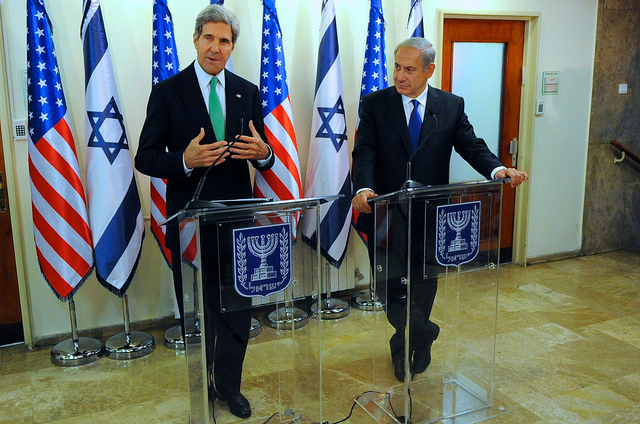
Secretary of State John Kerry and Israeli Prime Minister Benjamin Netanyahu. (State Department photo)
House Speaker John Boehner announced that he would “do everything possible to stop” the deal. Senate Foreign Relations Committee Chairman Bob Corker told Kerry that he’d been “fleeced.” Sen. Marco Rubio, a Republican candidate for president, said the next president — presumably meaning himself if he’s successful — could overturn the deal because it’s not a binding treaty.
All this was remarkable even to The New York Times, which usually looks the other way when Israel flexes its muscles in Official Washington. A Times article by Jonathan Weisman noted the extraordinary image of the Israeli ambassador using sports analogies to rile up Republican congressmen to overturn a key foreign policy initiative of the U.S. president.
“Mr. Dermer’s plea – which is widely expected to be followed by a mail, television and radio assault in Democratic districts during the August recess – demonstrates the power that the Israeli government and supportive interest groups in Washington maintain over…
Video: Robots will create art & may even fall in love – AI engineer
The quest for creating AI (Artificial Intelligence) is on. Two decades ago it all sounded like a far-fetched plot in a science fiction novel. Today, our best minds are …
Via Youtube
Video: On Track: Still 3 yrs off but World Cup 2018 1st official event kicks off
It may still be three years before the World Cup in Russia kicks-off … but officials and players are in St Petersburg ahead of the qualifying draw tomorrow.
Via Youtube
Video: Cash-Strapped Puerto Rico at Hedge Funds’ Mercy (2/2)
TRNN’s Jessica Desvarieux explores how investment funds OppenheimerFunds and Franklin Advisers are pressuring Puerto Rico to pay in full, while Congress …
Via Youtube
Side-By-Side Coverage of Cuba and Iran Highlights Shift in US Media Villain-Making

US Secretary of State John Kerry and Iranian Foreign Minister Mohammad Javad Zarif conclude the nuclear agreement on July 14, 2015.
This was a particularly busy week for the United States news media, with headlines featuring the announcement of a completed multi-lateral nuclear agreement between the Islamic Republic of Iran and the P5+1 bloc of nations, as well as a historic resumption of formal diplomatic ties marked by the reopening of United States and Cuban embassies in Havana and DC. The parallel coverage of the Iranian and Cuban diplomatic achievements offered a distinct, real-time display of the dramatic shift in US media villain-making over the last two decades and its concurrent silencing of oppositional voices.
Corporate media in the United States have a long history of neglecting the viewpoints of those who are often most profoundly affected by US foreign policy, especially when such voices cast a negative light on policies that members of the US government and media elite are invested in promoting. Media outlets have recently come under fire for failing to provide sufficient–if any–coverage of the victims of the ongoing US-backed air campaign in Yemen waged by Saudi Arabia (Intercept, 6/6/15), despite over 1,500 civilian deaths that have occurred there (UN News Centre, 7/7/15). FAIR (7/19/15) and Just Foreign Policy opened a petition to urge the New York Times and Washington Post to reverse this troublesome trend.

To comment on the Iranian nuclear deal, PBS NewsHour featured (from right to left) a Bush administration State Department official (Dennis Ross), a former National Security Adviser (Sandy Berger) and two former CIA directors (James Woolsey and Michael Hayden).
Such overt exclusion was again on full display as media outlets in America digested the announcement of a nuclear deal with Iran. Of the 24 guests who spoke about the Iran deal on the major networks’ Sunday talkshows following the announcement, eight were US government officials, while the only two non-Americans were British Prime Minister David Cameron and Israeli Prime Minister Benjamin Netanyahu (AP, 7/18/15).
Not a single Iranian or Iranian official was presented to offer his or her opinion of the historic deal. Netanyahu–who compared the nuclear negotiations to HBO’s popular fantasy series Game of Thrones, and referred to Iran as a “genocidal enemy” in his speech to the US Congress in March–was a guest on two of the programs, and regularly appears on all of them (Congressional Record, 3/3/15).
Compare this with the coverage of the opening ceremony at Cuba’s embassy in Washington, DC. In light of the platform granted to Cuban officials by the US government for this event, it would have been difficult for media outlets to altogether omit the comments of Bruno RodrÃguez, Cuba’s foreign minister, despite the fact that he used the occasion to criticize US policies that are still in place, including the trade embargo, the blockade and the notorious US military detention facility at Guantánamo Bay.

Bruno RodrÃguez Parrilla, Cuban minister of foreign affairs, was given more airtime during coverage of the lifting of the US embargo on Cuba than his Iranian counterparts during coverage of the nuclear agreement.
Nevertheless, the New York Times, which devoted the vast majority of its article (7/15/15) following the Iran deal to quoting US officials, described RodrÃguez’s remarks extensively and followed them with yet more commentary from individuals sympathetic to Cuba’s standpoint, including former Cuban diplomat Carlos Treto and James Williams, the president of Engage Cuba (7/21/15).
Of course, coverage of Cuba was rarely as balanced in the years preceding the recent rapprochement between the two countries. FAIR ran an article in the May/June 1991 issue of Extra! (5-6/91) cataloging ridiculous comparisons between Fidel Castro and Hitler aired in the US media as lingering Cold War sentiment in America turned its sights once again on the socialist government and its own supposed ballistic nuclear program. Yet this decades-long period of American hostility and subversion culminated in Tuesday’s embassy reopening, which was widely seen as a victory for the Castro administration and the Cuban people against an adversary that politically, militarily and economically outmatched them.
The new air of legitimacy granted to Cuban interests in US media reflects a generational shift of focus away from the spread of socialism and its ideological hostility toward the United States to certain Muslim nations in the Middle East and their objections to US intervention. Once the site of American military cooperation in proxy fights against the Soviet Union, since 9/11 the Middle East has become the primary target of US militarism, and thus corporate media follow suit by silencing external critics of US policy in the region lest their legitimate grievances reach an audience.
As such, while Cuban officials are granted airtime as they forcefully denounce American policies at a walking distance from the US Capitol building, similarly reasonable positions on the part of Iran–the desire to pursue nuclear medical research and civilian power, or a healthy dose of skepticism toward US weapons inspectors, for example–are treated as outrageous demands by American panelists on major network talk shows, which fail to provide any voices that are not explicitly promoting the US government’s agenda (FAIR Blog, 7/20/15). Socialism is simply no longer the threat du jour.
International diplomacy is predicated on the principal of mutual respect and a desire to find common ground, or, as RodrÃguez put it on Tuesday, to “cooperate and coexist in a civilized way, based on the respect for these differences and the development of a constructive dialogue oriented to the well-being of our countries and peoples” (State Department, 7/20/15).
When the media fails to provide a hearing to those who may have legitimate–albeit oppositional–opinions toward US foreign policy, guests like Netanyahu, whose contempt for US negotiations with Iran is perennially fierce and unwavering, fill that gap. A poll published by Pew Research on Tuesday found that 73 percent of Americans support the reestablishment of diplomatic ties with Cuba after 54 years of animosity between the two countries (Pew Research Center, 7/21/15). In contrast, a considerably smaller majority of Americans–56 percent–support the recent deal with Iran (Washington Post, 7/16-9/15).
US relations with Cuba have had a significant time to relax, and clearly there is a still a long way to go with Iran, which George W. Bush famously included as a member of the “axis of evil” in his 2002 State of the Union address (White House Archives, 1/29/02). One might wonder, however, were the US media to grant the same kind of legitimacy to Iranian perspectives as it now does to Cuba’s, whether that latter number might tick up.
John C. O’Day is a graduate philosophy student at Texas A&M.
This piece was reprinted by RINF Alternative News with permission from FAIR.
Video: Revolutionary Expectations and the Fight Against Austerity – Catarina Principe on RAI (5/5)
On Reality Asserts Itself, Ms. Principe says that German workers, who have not yet felt the brunt of the crisis, are starting to realize that they must fight in solidarity …
Via Youtube
Video: Sandra Bland’s Sister Responds to Suicide Allegations, Lawyer Says Waller County Withholding Details
http://democracynow.org – Law enforcement officials in Waller County, Texas, have concluded that the cause of Sandra Bland’s death in police custody was …
Via Youtube
As Economy Heads to Another Crash, BIS Acknowledges: We’re Failing

World’s Most Powerful Bank Reverses Course, to Avoid a Global Depression
German Economic News, Translation (and closing Note) by Eric Zuesse | Published: 22:07:15 20:10 clock
The Bank for International Settlements (BIS) acknowledges in its annual report that the policy of cheap money has failed. All the trillions in monetary stimulus have produced no growth in the real economy. Central banks cannot salvage the economy. Governments – fiscal stimulus – must now resolve the economic crisis. Political leadership is required.
In November 2008, the Federal Reserve in the US began to purchase many billions in securities, to stabilize the markets after the collapse of Lehman Brothers. Later, the Fed bought also US Treasuries, and cut interest rates to a record low of zero to 0.25 percent. So, they set off a global devaluation race. As a result, between just January 1st and March 12th of 2015, one-fifth of all central banks lowered their key interest rates. China was last to join this currency war, but when they did, their easing of monetary policy helped spark a credit-driven bull market that now produces the biggest Chinese slump in 20 years.
The Basel-based Bank for International Settlements (BIS) is considered the “central bank of central banks.” It was originally founded in 1930 to handle German reparations after the First World War. Today the BIS networks together central banks around the world, and manages on their behalf nations’ gold reserves. Its 85th Annual report analyzes the global financial system, seven years after the 2008 crisis. An entire chapter is devoted to shortcomings of the international monetary and financial system. It says that instead of promoting sustainable and balanced growth of the global economy, this system actually undermines growth long-term.
The loose monetary policies of the central banks have produced no significant growth in the real economy, the report’s authors say. On exchange rates and capital movements, the loose conditions have transferred money to countries that do not need it, and this has promoted financial vulnerabilities. The world’s record low interest rates are signs “of a larger malaise.” BIS finds that the long period of low interest rates has generated “unusually long stagnation,” and they warn of a vicious circle of continued falling interest rates. In the longer term, this could weaken the financial sector and lead to permanent dependence on debt.
Claudio Borio, head of the Monetary and Economic Department of the BIS, says in the annual report: ”The most obvious symptom of this malaise is continued extremely low interest rates. They have been extremely low for a very long time, and by any standards. Moreover, the negative yields in some government bond markets are simply unprecedented and previously unthinkable.” Central banks would grope futiley in search of historical parallels. But by now, interest rates have shown very clearly that burdening monetary policy with the task of stimulating growth cannot succeed.
In their attempts to overcome the weakness of the world economy, central banks have become the largest players in the global equity markets. This is according to a study by the Research Institute OMFIF, an international research and advisory group. The study was presented in June 2014 and is based on 29.1 trillion dollars of investments by global central banks and other public institutions. It covers bonds, stocks and commodities. The authors conclude that “In the aftermath of the financial crisis, different forms of ‘state capitalism’ have come to the fore, and, ‘Whether or not this trend is a good thing may be open to question, but what is incontestable is that it has happened.’” Thus, public institutions are mutating to become a large part of the capital markets, and this will potentially overheat share pricess.
Says Borio: ”There are indications that recent years have built up financial imbalances. And this could affect the rest of the world much more than before, because emerging economies have now gained considerable weight.”
The warning comes at a time when the growth of the global economy cools noticeably. In the United States, China, Japan and the BRICS, there was seemingly limitless growth, until recently. Only the deep oil price drop could cover up these negative effects. “The fall in oil prices has encouraged all in all, the global economic growth, and temporarily reinforced the downward pressure on prices – a real godsend,” said Borio. However, the economic policy leeway is now frighteningly small.
“Seven years after the global financial crisis, the policy mix remains very unbalanced. It is still too heavily dependent on monetary stimulus, while the progress in structural reforms is still insufficient,” said Jaime Caruana, General Manager of the BIS, at the launch of the report in Basel.
In a Reuters interview, South Korea’s Hyun Song Shin, the chief research economist of the BIS, warned of new turbulence in financial markets. This time, however, the trigger would not be at the big banks, but at pension funds and asset managers. The International Monetary Fund (IMF) recently warned of the systemic risk posed by pension funds. Low interest rates have again accelerated investments in riskier asset classes, to promote an aggressive search for yield.
“Currently all looks indeed very good, but it may build up to a painful and very destructive outcome,” said Shin. The consequences cannot be foreseen. “We are entering completely uncharted territory.”
BIS economists advocate a triple realignment of the global economy. They propose to move away from the “illusory fine-tuning” of the overall economy in the short term and instead to pursue medium-term strategies. Moreover, economic policy should focus less on short-term output and inflation and instead focus more on the slower than expected financial cycles. Finally, Nation States must realize that it is no longer enough today to keep their own houses in order. A realignment must become aware of the dangers posed by purely national measures.
The BIS says: “It’s more important than ever to replace the short-term perspective by a longer-term view. Financial markets have reduced response times, and policy makers in financial markets are always chasing shorter-term rewards. That’s an increasingly narrow, indefensible position.”
––
NOTE from Eric Zuesse: The BIS report is cagey about its implications for fiscal policy. All it says, really, is on page 22 (28 of the .pdf): “For countries that do have fiscal space and need to use it, the challenge is how to do so most effectively. This means, first and foremost, facilitating private sector balance sheet repair, supporting reforms that boost long-term productivity growth and a greater but judicious emphasis on investment at the expense of current transfers. The quality of public spending matters more than its quantity.”
The BIS is in the business of marketing monetary policy, and shuns Keynesian macroeconomic policies that aren’t based upon standard microeconomic theory. Unlike at the IMF, which likewise markets monetary policy, the economists at BIS don’t even look outside monetary policies. However, the IMF’s economists do. Thus, an “IMF Working Paper,” issued January 2013, and titled “Growth Forecast Errors and Fiscal Multipliers,” presented a definitive empirical study, a meta-analysis of the empirical studies, on the question of the size of the Keynesian multiplier, and found that during economic recoveries from crashes and other distressed economies, it’s much larger than had been assumed by the aristoracy’s economists, such as at BIS and IMF. Basically, this comprehensive empirical study showed that Keynes was right and that the macroeconomic policies that after 1970 re-introduced microeconomically based macroeconomic theories, and that continue to be applied even today – not only by the BIS and IMF but by economists generally – are empirically false. In other words (for example): the policies of “austerity” or in econospeak “fiscal consolidation,” fail miserably, so that what is being done to Greece (and will be done to Ukraine) is bound to fail. Unfortunately, however, aristocrats, investment insiders, benefit enormously from such “austerity” policies, which starve the public in order to benefit investors. Economic growth isn’t really what’s being sought. So: the empirical economic studies are simply ignored, and economic theoreticians still build upon the standard microeconomic foundation, of falsehoods. Essentially, economists get rewarded for promoting those falsehoods. Standard economic theory has no scientific justification, and now it has actual scientific disproof. The BIS study added confirmation to that, but didn’t mention this fact. The BIS management don’t want to call attention to it.
———-
Investigative historian Eric Zuesse is the author, most recently, of They’re Not Even Close: The Democratic vs. Republican Economic Records, 1910-2010, and of CHRIST’S VENTRILOQUISTS: The Event that Created Christianity.
Video: “I Don’t Believe Sandy Committed Suicide”: #BlackLivesMatter Co-Founders Speak Out on Sandra Bland
http://democracynow.org – As a Movement for Black Lives Convening is set to take place this weekend in Cleveland, we discuss the case of Sandra Bland and …
Via Youtube
Hillary Clinton’s Hawkish Response to the Iranian Nuclear Deal
Going back at least as early as the 1989 Presidential election
of Hashemi Rafsanjani, Iran has been attempting to end its international isolation
by improving relations with the United States. And at least since the election
of Iran’s next President, Seyyed Mohammad Khatami, in 1997, it has been the
hope of the Iranian leadership that, once Iran got out of the cold shadow of
the nuclear disagreement, the isolation would thaw, and the antagonism with
the United States in the region would end.
When Iranian Foreign Minister Mohammad Javad Zarif announced that a nuclear
deal had finally been reached, he reiterated this hope that the agreement would
end the antagonist silence between the two sides and escort in a new era of
broader cooperation. Zarif
said he hoped it would “open new horizons for dealing with serious problems
that affect our international community.”
The hawkish Hillary Clinton, though, who could well be the person to inherit
Obama’s agreement, could not free herself from the same irrational, unsubstantiated
words she’s been screeching for years and step out of the cold shadow of the
old horizon into the promise of cooperation offered in the new horizon.
Clinton
said she applauded Obama’s “efforts”, and said the deal “does put a lid
on [Iran’s] nuclear program.” But she was incapable of stopping there and refused
to step through the door of Zarif’s “new horizons”. “But,” she said, “we still
have a lot of concern about the bad behavior and the actions by Iran which remains
the largest state sponsor of terrorism which does go after and undermine governments
in the region, [and] that poses an existential threat to Israel . . . that behavior,”
she paternally scolded, “is something we will have to address”.
Before Clinton asks Americans to let her lead them into the
future, she’d better look a little more clearly at the past.
You Don’t Matter. House Votes for Monsanto’s Right to Deceive Consumers

Ronnie Cummins
On Thursday, 275 members of the U.S. House of Representatives voted in favor of H.R. 1599, the DARK (Deny Americans the Right to Know) Act. By voting for the DARK Act, these politicians voted against truth and transparency, against science, against the more than century-old right of states to legislate on matters relating to food safety and labeling.
They voted against the 90-percent of Americans who are in favor of mandatory labeling of GMOs. They voted against the producers of non-GMO foods.
They voted against you.
Now that the DARK Act has been approved by the House, we’ll have to stop it in the Senate. We have to move fast–because Monsanto is desperate to pass a bill that preempts mandatory GMO labeling laws at the state and federal levels, before Vermont’s GMO labeling law takes effect next year.
H.R. 1599 was sold to Congress via multi-million dollar public relations and lobbying campaigns built on lies and deception. The bill’s sole purpose is to support an industry–Monsanto’s poison-peddling industry–that was founded on lies and deception from the get-go.
Were the Congress members who voted against you fooled by Monsanto’s slick, deceitful packaging of this so-called “Safe and Accurate Food Labeling Act”? Or did they simply vote with their wallets, stuffed full of biotech and junk food industry cash?
We don’t know. But we know this: We can’t let this bill get through the U.S. Senate.
Less than 24 hours before the House vote, the industry-funded front group behind H.R. 1599 was still pushing out the lies. The “Coalition for Safe and Affordable Food,” feigning concern for consumers, emailed members urging them to support the DARK Act because if we require mandatory labeling, it will increase the cost of your food by $500/year. That lie has been debunked over and over, by legitimate independent studies. It’s a lie based on a study funded by, and which remains the intellectual property of, the Council for Biotech Information–of which Monsanto is a member.
Less than 24 hours before the House vote, a staffer in the office of the bill’s sponsor, Rep. Mike Pompeo, told a caller that the DARK Act gives consumers what they want: the means to know whether or not their food contains GMOs. “Consumers can choose to presume that all foods have GMO contents unless they are labeled or otherwise presented as non-GMO. Meaning that it is knowable and it is known by the public which products have GMO and which don’t,” claimed a Pompeo minion.
More lies. The DARK Act creates a voluntary, government-run non-GMO certification program. Unless every producer of non-GMO products pays to have those products certified non-GMO, consumers will still have no way of knowing which products contain GMOs, and which don’t. And why should the burden of labeling fall on the producers of non-GMO foods, when the risk factor is associated with those foods that do contain GMOs?
H.R. 1599 would repeal existing state GMO labeling laws, such as Vermont’s Act 120, and would preempt any future state or federal laws requiring mandatory labeling of genetically engineered foods or foods containing GMOs. That’s unconstitutional, according to the Campaign for Liberty, which said this in a statement yesterday:
Whatever your views on GMOs, there is no Constitutional justification for the federal government to preempt state laws in this area. There certainly is no justification for Congress to preempt private sector efforts to meet consumer demands for non-GMO foods, while allowing those who support the use of GMOs to do so.
Yet 275 members of the U.S. House today voted against the U.S. Constitution. And if we don’t stop them, a majority of U.S. Senators could do the same.
If we are going to stop the federal government from taking away our right to demand truth and transparency in labeling, we will have to double or triple our size and our impact. And we have to do it now.
Via Common Dreams. This piece was reprinted by RINF Alternative News with permission or license.
The Tortured Logic Behind Using Torture
If you watched Batman when you were growing up, chances are you saw him torture someone. If you watched Jack Bauer from the hit show 24, chances are even better that torture scenes were involved. And if you watched the Netflix show Daredevil, you probably saw it in almost every single episode.
The problem with relying on the effectiveness of torture in this context is that it’s a dramatic plotdevice. In these situations torture has to work or else the plot won’t move forward. But in reality torture isn’t done by people in menacing bat-suits or people who have only twenty-four hours exactly until people are going to die. Torture is not only immoral but almost always ineffective.
But try telling that to the CIA and Department of Defense.
Back in December the Senate Intelligence Committee did exactly that when they published a report on the CIA’s use of torture. It revealed tactics like Russian roulette, water boarding, and as John Oliver recently reported, “forced rectal rehydration”. Rectal rehydration involves serving prisoners liquefied food by force-feeding it through a tube inserted into the prisoner’s rectum.
Adding to this, the Christian Science Monitor and other outlets like the New York Timesrecently revealed a damning 542-page report. According to the report, the American Psychological Association (APA) aided the CIA by rebuffing critics of the CIA’s fifteen-year-long “enhanced interrogation.” It did this by deliberately “hiding its head in the sand” about the existence of CIA torture, and even softening its ethical guidelines in order to give tacit approval to the CIA’s techniques. The report also reveals close ties between DOD and APA staff members, as well as an eagerness in the higher ranks of the APA to curry favor with the DOD.
A recent NDAA amendment passed in mid-June makes it a lot harder for the CIA to torture—a good step forward. But it’s also worth noting that torture isn’t “beneath us” as Oliver suggests. It’s never been “beneath” the US government to torture people, to wage unjust wars, to unjustly imprison millions of people for nonviolent offenses, and so on.
But it’s also not something that’s worked for the CIA. The alternative of rapport-building has been studied and found to be far more effective.
Criminal investigation sought into Clinton’s private email account

The Justice Department has been asked to open a criminal investigation into whether Hillary Clinton mishandled sensitive government information with the use of a personal email account during her time as secretary of state, according to a report.
The request is made by inspectors general for the State Department and the intelligence agencies following their assessment in a June 29 memo that Clinton’s private email account contained “hundreds of potentially classified emails,” The New York Times reports.
Clinton, the front-runner for the Democratic presidential nomination for 2016, has denied handling classified information on her private account, which she used to conduct State Department business.
Clinton’s use of the personal email for official business has stirred up a political storm since it was first revealed in March.
Shame on Eric Holder, Wall Street’s Attorney General

Well, well, well. Eric Holder is returning to his cushy job at Covington & Burling where he reportedly pulled in $2.5 million the last year he was there. Holder didn’t think it was strange he was returning to one of Wall Street’s most highly regarded defense firms after all the bankers he let breezily carry on with fraud, bribery, money laundering, tax evasion and plenty of other very prosecutable offenses during his tenure as US attorney general.
Holder explained simply: “The firm’s emphasis on pro bono work and being engaged in the civic life of this country is consistent with my worldview that lawyers need to be socially active.” Yeah, and what about the $2.5 million, Mr. Holder? That’s got nothing to do with it surely.
Holder had just spent six years in Washington handing out slaps on the wrist to financial institutions that claimed they were “too big to fail” while secretly receiving government assistance. His help almost certainly amounted to billions of dollars of aid to Wall Street. Now he’s trotting back on his high horse to go collect millions for his top position in the firm.
Regional War Escalates as Turkey Openly Bombs Targets Inside Syria
Airstrikes on Friday comes as Turkish government also gives US military and other allies permission to stage further operations from its facilities along the Syrian border
Proving that a larger regional war remains among the most significant threats of the protracted military campaign against the Islamic State (or ISIS), Prime Minister Ahmet Davutoglu of Turkey confirmed on Monday that Turkish warplanes bombed several targets inside Syria on Monday.
According to the Associated Press:
Davutoglu said the airstrikes had “removed potential threats” to Turkey and targets were hit with “100 percent accuracy.” He did not rule out further strikes, saying Turkey was determined to stave off all terror threats against it.
“This was not a point operation, this is a process,” Davutoglu said. “It is not limited to one day or to one region… The slightest movement threatening Turkey will be retaliated against in the strongest way possible.”
Turkish police on Friday launched a major operation against terror groups including IS, carrying out simultaneous raids in Istanbul and 12 provinces and detaining more than 290 people.
News that at least three Turkish F-16 fighters took off from the Diyarbakir air base in the southern part of the country to strike at ISIS is the first time Turkey itself has executed airstrikes against its neighbor since the conflict began and marks a potentially significant escalation in the conflict that pits the U.S. military and allied Gulf and European nations against the militant group that has taken over large swaths of both Syrian and Iraqi territory.
Turkish media reported the targets as being close to the Syrian border with Turkey in the village of Hawar al-Naht, but officials would not confirm the exact location.
Reuters reports:
Local people on the Turkish side of the frontier reported the sound of the attack. “We heard something last night, but we couldn’t tell if it was air strikes or gunfire,” said Zeki Polat, a 47-year-old who was sitting in a teahouse in the village of Elbeyli.
The attacks are probably the first time that Turkey has publicly said it bombed Islamic State in Syria, according to Rami Abdulrahman, the head of the U.K.-based Syrian Observatory for Human Rights monitoring group. He said the aim of the strikes could also be “to help rebels on the ground control areas near the border instead of Kurdish forces”.
Turkey has suffered a wave of violence in its largely Kurdish southeast after a suspected Islamic State suicide bombing killed 32 people, many of them Kurds, in the town of Suruc on the Syrian border this week.
The airstrikes also come a day after it was announced that Turkey would allow U.S. and allied warplanes to use the same airbase to stage bombing raids and other missions over Syria and Iraq.
On Thursday, U.S. Defense Department officials announced that Ankara had agreed to allow use of a separate air base in Turkey, called Incirlik, as a launching pad for airstrikes following a phone call between President Obama and Turkish President Recep Tayyip Erdogan.
As the Guardian notes, the latest developments come as Turkey faces increasing levels of internal political tension, with the Erdogan government lumping its many of its left-wing adversaries–namely the Kurdistan Workers’ Party (PKK), but also young socialists and others–together with the militant threat posed by ISIS and those sympathetic to its cause.
“Tension has risen dangerously in the predominantly Kurdish south-east, where many have long accused the [Erdogan government] of directly supporting ISIS against the Kurdish struggle in Syria, a charge Ankara vehemently denies,” the newspaper reports.
Via Common Dreams. This piece was reprinted by RINF Alternative News with permission or license.
Take It Down: US Support for Jim Crow Israel

When it comes to flags, George Carlin said it best:
“I see them as symbols, and I leave them to the symbol-minded.”
Yet, those who fanatically oppose particular flags are just as symbol/simple-minded as those who wave them.
For example, the recent Jacobin surge to purge every Confederate flag flying over American soil represents the latest march of the symbol-minded. After all, what could be more simple-minded than the notion that imposing the removal of a particular color pattern is a victory for the cause of justice?
The symbol-minded #TakeItDown crowd insist that the Confederate flag is, and can only be, a standard of state-empowered bigotry. In support of this, they cite the historical use of it by defenders of Jim Crow against the Civil Rights Movement.
Individuals can appropriate symbols to communicate any message they choose. To presume bigotry in the use of any particular symbol can itself be bigotry.
Yet, even more problematic is the waste of energy on symbols that could have been expended on substance instead. Instead of needlessly antagonizing individuals who might (and might not) support bigoted policies over the symbols they display, activists would do far better to focus on opposing the bigoted policies themselves.
Bipartisan agreement on austerity at Australian premiers’ summit
By Mike Head
This week’s two-day “retreat” and summit involving Australian Prime Minister Tony Abbott and the leaders of the country’s six states and two territories turned into a veritable love-fest between Abbott’s Liberal-National Coalition and the Labor Party, which holds office in four of the states and territories.
Each of the participants at the Council of Australian Governments (COAG) gathering, which concluded in Sydney yesterday, heaped praise on each other, describing the meeting as “very positive” and “very constructive.”
All the Labor premiers’ oppositional posturing against the Abbott government’s devastating $80 billion cut over 10 years to state and territory health and education funding, unveiled in last year’s federal budget, was abandoned. Instead, there was unanimity on finding ways to enforce the measures, as well as deeper cuts to social spending and living standards that will be driven by the rapidly deteriorating state of the global and Australian economy.
Mike Baird, the Liberal premier of New South Wales, the most populous state, said he was “very pleased” with the “very constructive, very positive” discussions. Daniel Andrews, Victoria’s Labor premier, said the leaders had a “very, very constructive discussion.”
Jay Weatherill, South Australia’s Labor premier, was explicit about the basis for the united political front. He said the meeting was the most significant such gathering in his 13 years in politics, because the assembled leaders “levelled with the people of Australia that the services that they want are not able to be funded with the money that we raise.”
In other words, there was agreement all round on the need to slash health and education spending, and to raise taxes, notably the regressive Goods and Services Tax (GST), in order to impose the burden of the global slump and falling government revenues onto the working class.
Abbott, who barely survived a leadership challenge within his own party just five months ago, and whose opinion poll ratings remain at record lows, was particularly appreciative of the support he received from his Labor and Liberal colleagues. He hailed Weatherill’s refusal to rule out Baird’s call, issued on the eve of the COAG summit, for the GST rate to be increased from 10 to 15 percent, thus driving up the prices of household essentials. “Congratulations to Premier Baird and Premier Weatherill for being prepared to enter into this process with decency and good faith,” Abbott declared.
The COAG meeting was held under the lengthening shadow of the collapse in world commodity prices. This is having a severe impact on the Australian economy, which depends heavily on mining exports, especially to the dramatically slowing Chinese market.
According to estimates in today’s Australian, the ongoing fall in profits, jobs, wages and government revenues will produce federal budget deficits over the next decade totalling at least $170 billion more than forecast in the May budget delivered by the Abbott government. These projections followed Reserve Bank governor Glenn Stevens’ warning on Wednesday that Australia’s growth rate may have permanently fallen. In its May budget, the government predicted that growth would surge from the current 2.3 percent to the so-called long-term trend rate of 3.25 percent next year, and then rocket ahead to 3.5 percent for the next five years in a row.
Stevens’ intervention makes a mockery of Treasurer Joe Hockey’s pledge to eke out a budget surplus by 2019—20. According to the Australian’s calculations, the budget deficit will continue to rise, and by 2024—25, public debt will be at least $360 billion, rather than the projected $200 billion.
Even these estimates assume that the Abbott government will be able to push through all its major outstanding austerity measures from the last two budgets, including cuts to higher education and family benefits. Despite a recent series of deals with Labor and the Greens to implement other deeply unpopular pension, fuel and other imposts, key cuts remain stalled in the Senate out of fear of the inevitable electoral backlash.
At the leaders’ summit there was agreement, not only to keep a 15 percent increase in the GST on the table, but to start expanding the tax’s base by extending it to cover most on-line purchases, and possibly all transactions worth more than $20.
The prime minister and state premiers also made an in-principle agreement to drive down health spending by including hospital treatments within the Medicare insurance system, subject to a ramped-up application of the previous federal Labor government’s “efficient price-fixing” mechanism. This “activity-based funding” regime, introduced by Kevin Rudd’s government, forces hospitals to continuously cut the costs of their medical procedures, inevitably at the expense of patient care.
Likewise, the leaders agreed to consider handing over all vocational education and training to the federal government, a move designed to accelerate the outsourcing of the tertiary education sector to cost-cutting and profiteering corporate providers. That process was begun, and became a centrepiece, of former Labor Prime Minister Julia Gillard’s “education revolution.”
Abbott said the deals were just the first steps toward what he has described as a shake-up of the Australian federation–the full extent of which is yet to be unveiled. It was “the start of a process,” he stressed, cautioning against “springing tax changes on an unsuspecting public.”
Abbott’s comments betrayed a wider nervousness about the increasingly evident public disgust for the Labor and Coalition parties and the political establishment as a whole. He spoke about avoiding “scare campaigns” in order to “build the kind of trust and confidence that we need to see more of in our democracy.”
Nevertheless the unity at the COAG summit was most sharply expressed in the greatest bipartisan “scare campaign” of all–drumming up fears of terrorism as a means of justifying war abroad and police-state measures at home. One of the main items on the COAG agenda was the adoption of a new terrorism alert register and “counter-terrorism strategy.”
Against a backdrop of 10 Australian flags–a new record–the leaders announced that the existing terrorism threat levels, which escalate from low to medium, high and then extreme, will be replaced by the more alarming categories of not expected, possible, probable, expected and certain.
A five-point “strategy” was adopted, the two key elements being: “Shaping the global environment, including through Australia’s military contribution to the coalition against Islamic State” and “Disrupting terrorist activity within Australia through the joint efforts of law enforcement and intelligence agencies.”
In other words, the Labor and Liberal leaders underscored their unconditional commitment to the escalating US-led war in the Middle East, and Washington’s preparations for open conflict with China, in order to “shape the global environment.” They also reiterated their complete backing for, and involvement in, the regime of mass surveillance and vast police powers that is being constantly fortified by additional “counter-terrorism” legislation.
Up to now, the initial targets of these measures have been mostly Islamic fundamentalists accused of supporting or advocating opposition to the brutal military interventions in the Middle East. As the economic situation deteriorates, however, and the gutting of social spending and living standards intensifies, this state apparatus will be increasingly directed at suppressing social unrest and political opposition to the government and the entire parliamentary setup.
The corporate and media elite is continuing to demand that the government implement far deeper austerity measures, accusing Abbott and federal Labor leader Bill Shorten of lacking the political courage to pursue them. Today’s Australian editorial cautiously welcomed the COAG outcomes, but then insisted: “The bottom line: much more work is needed to foster higher growth. Reform is stalled, policy formulation has been compromised and our political leaders have been sidetracked from the growth road.”
This week’s display of unity is another bid by Labor’s leaders to demonstrate that they, no less than the Coalition, can be counted upon to police this offensive.
Via WSWS. This piece was reprinted by RINF Alternative News with permission or license.
Pro-Israel groups in US expand campaign against Iran nuclear accord

The most influential pro-Israel lobbying group in the United States is expanding its campaign to pressure Congress into rejecting the recent accord over Iran’s nuclear program.
The American Israel Public Affairs Committee (AIPAC), the biggest Zionist group in the US, will deploy about 300 lobbyists on Capitol Hill next week to try to convince lawmakers to vote against the nuclear agreement.
AIPAC, along with some other pro-Israel advocacy groups, will spend approximately $20 million to fund a national television advertising campaign to inform the public “about the dangers of the proposed Iran deal,” according to officials in the pro-Israel camp.
Pressure from AIPAC, which has more than 100,000 members and maintains a vast pool of donors, could worry lawmakers who are up for re-election next year.
AIPAC critics have stated it acts as an agent of the Israeli regime and has a “stranglehold” on Congress with its extensive influence and financial power.
Pentagon, CIA Instructed to Reinvestigate Whistleblower Cases
The action by the intelligence community inspector general is the first public indication that a new intelligence appeals system is underway. The panel was set up by President Barack Obama as an independent forum that can evaluate whether whistleblowers were improperly fired or otherwise punished for disclosures after their agencies rejected their claims.
The cases, nonetheless, demonstrate that the whistleblower system continues to be beset with problems and bureaucratic delays despite being overhauled by Congress and the Obama administration.
“Navigating the system as an intelligence employee is still very burdensome and overwhelming,” said Michael Helms, a former Army intelligence officer whose case is one of the two being kicked back. “A decade after I blew the whistle on inadequate care for military civilians, I’m still waiting for justice.”
Obama pointed to the reforms when former NSA contractor Edward Snowden revealed he had decided to go to the media with classified documents about the spy agency’s data collection programs instead of relying on the whistleblower system. Snowden asserted that intelligence agencies couldn’t be trusted to look into serious malfeasance or to protect high-profile whistleblowers.
The two cases are significant because they involve intelligence employees who say they were retaliated against even after they complained to Congress about what they described as significant problems at the CIA and the Defense Department.
Anti-war politician building momentum for Labour leadership

Jeremy Corbyn’s candidacy ‘takes on a much wider significance, because it can be part of rebuilding a left committed to social movements,’ says Stop the War Coalition
Veteran UK politician Jeremy Corbyn, a 66-year-old left-winger whose stances against austerity, nuclear weapons, and war have been described as “uncompromising,” is gathering steam ahead of upcoming Labour party leadership elections, according to new polling released this week.
A YouGov poll for the London Times suggests that in the final round of voting, the socialist Islington North MP would finish six points ahead of previous frontrunner Andy Burnham. The poll shows Corbyn as the first preference for 43 percent of party supporters.
“It’s obvious that, for some young people at least, Corbyn is scratching a persistent anti-Blairite, anti-establishment itch.”
–Rhiannon Lucy Cosslett, New Statesman
The party leadership contest, the result of which will be announced on September 12, was triggered after the resignation of Ed Miliband in the aftermath of Labour’s defeat in May’s general election. Corbyn’s candidacy stemmed from a desire within the party to present a view that differed from that of the other candidates–particularly on questions of inequality and austerity.
In an interview with the Guardian‘s “Politics Weekly” podcast, Corbyn warned that unless a clear alternative narrative to Conservative (Tory) austerity was voiced by Labour, the National Health Service “will be largely parceled up and privatized out, if not destroyed altogether, and the gap between the rich and the poor will be bigger than ever.”
In an exclusive interview with the Daily Mirror published Thursday, Corbyn said there were “large numbers of people” who wanted to end the “grotesque inequality in Britain.”
Referencing other fights against austerity across the European continent, Corbyn added: “I have been in Greece, I have been in Spain. It’s very interesting that social democratic parties that accept the austerity agenda and end up implementing it end up losing a lot of members and a lot of support. I think we have a chance to do something different here.”
“Jeremy’s candidacy takes on a much wider significance, because it can be part of rebuilding a left committed to social movements which can provide the antidote to a government committed to pro-war policies and to cutting welfare, including the benefits of some of the poorest in society.”
–Stop the War Coalition
That message seems to be resonating, at least in some quarters. As journalist Rhiannon Lucy Cosslett noted for the New Statesman on Thursday, “a significant portion of the support Corbyn is receiving is coming from new, young Labour members.”
“Better a passionate and interesting opposition that has moral conviction than a bunch of identikit shysters who will jettison their values as soon as electoral victory looks likely, is how the way of thinking goes,” Cosslett wrote. “Those of us who are inspired by Corbyn can expect to be called young and idealistic, or be told we need to ‘do our research,’ but there it is. It’s obvious that, for some young people at least, Corbyn is scratching a persistent anti-Blairite, anti-establishment itch.”
And as the New York Times reports on Friday, Corbyn “got a big lift when ’s largest trade union, Unite, a crucial financial backer of the Labour Party, came out in strong support.”
Corbyn upsets “the ruling elite,” Unite leader Len McCluskey told the Times. “They try and rubbish it, they try to turn it into a joke, but secretly they will be worried sick that ordinary people are suddenly given something to inspire them and something to link onto.”
For his part, former UK Prime Minister Tony Blair–whose reign saw the Labour party dragged rightward and the country dragged into war–has warned, “You don’t win from a traditional leftist position.” Meanwhile, Blair’s former adviser, John McTernan, told BBC Newsnight two of the other candidates should withdraw in favor of an “anyone but Corbyn” candidate.
But as columnist Russell Razzaque wrote at the The Independent on Friday, “If the Labour party keeps moving to the right in response to an increasingly right-wing Tory government, then we come to realise that it has no anchor. And that, far more than any perceived fear of the far left, is what will sound the death knell for the party I’ve supported all my adult life.”
According to the Guardian, Corbyn, “who opposed the decision to go to war in Iraq and has defied his party’s whip 284 times since 2005, has often been at odds with the Labour leadership, but he insists that the party remains a comfortable home for his politics: ‘[The Labour party is] a mass organization and was founded by trade unions and socialists and provides the only viable option for serious political change in Britain’.”
As the Stop the War Coalition, on whose board Corbyn sits, put it: “Jeremy’s candidacy takes on a much wider significance, because it can be part of rebuilding a left committed to social movements which can provide the antidote to a government committed to pro-war policies and to cutting welfare, including the benefits of some of the poorest in society.”
Via Common Dreams. This piece was reprinted by RINF Alternative News with permission or license.
Video: Top U.S. and World News Headlines for Friday, July 24
Visit http://democracynow.org to watch the full independent, global news hour, read the transcript, search our archive, and to make a donation to support us.
Via Youtube
Video: ET Phone Home? Drone buzzes ‘alien —made’ crop circles in Russia
Drone footage shows crop circles that have appeared in Tolyatti, Samara region, Thursday. Local residents are reported to be enthralled by the chance that …
Via Youtube
Video: Insider Reveals All About Hillary’s Master Plan
On today’s broadcast we talk with former Clinton insider Larry Nichols about the possible continuation of the Clinton dynasty and what the Tea Party can do to …
Via Youtube
Video: Keiser Report: Bankers Lives Matter (E787)
In this Keiser Report Max Keiser and Stacy Herbert discuss the fact that life’s but a walking shadow, a poor homeless schmuck that struts and frets his squeegee …
Via Youtube
Video: Grey Sky: Mount Sinabung volcano spews ash in Indonesia
Eruptions of ash from North Sumatra’s Mount Sinabung volcano shrouded the skies over parts of the Indonesian archipelago. RT LIVE http://rt.com/on-air …
Via Youtube
Video: US Condemns Israel’s Plan to Demolish West Bank Village – Just Lip Service?
After Israel’s high court orders demolition of homes in West Bank village of Khirbet Susiya, Gaza Unsilenced Co-Editor Refaat Alareer says this reflects a move …
Via Youtube
Video: Shock Therapy: Greek govt votes ‘yes’ for 2nd round of reforms
Greece has overwhelmingly approved a second set of reforms demanded by its European creditors. This decision has cleared the way for talks on a multi-billion …
Via Youtube
Video: Community Calls for Mayor’s Resignation
Probe will include election irregularities and possible misuse of federal grants by Pocomoke city officials.
Via Youtube
Video: How To Fight A Judge And Win
In this video Luke Rudkowski interviews Carlos Miller and Grant Stern of PINAC about their recent victory over judges in Jacksonville Florida. To learn about …
source
Different aspects to the blockade of Donbass

Alla Pierce
“This war is not against our militia, but a campaign of terror against the residents.”
(Andrey Purgin, The Head of Parliament of Donetsk People Republic)
The Western backed coup leaders in Kiev do everything to stifle life in the rebellious Republics by refusing to release their pincer grip that surrounds them.
There are various aspects to the blockade that is enforced against the residents of Donbass.
One is a military blockade with nonstop shelling, such as, for instance, in long-suffering Gorlovka, where people rise in the morning without any guarantee that they will survive through the day or go to bed without knowing if they will be alive to wake up the following morning. Residents of Gorlovka and the surrounding towns and villages are fully blocked. Any and all humanitarian aid is prevented from reaching them.
As in any war there are those that barely survive under relentless shelling. These unfortunate souls live within close proximity of the front lines. They simply have nowhere to go and have no choice but to eke out a morose existence underground. Little children have been forced to subsist in dark and dank basements since last year, just like Poroshenko proudly proclaimed to the whole world, remember? These basements have no sanitary facilities such as kitchens or bathrooms and are unfit for human life. There are no air vents in there. Now, think here, we are talking about children that should be basking in the sunshine, thriving in childhood and receiving proper nutrition.

In addition to the ongoing bombardment which then morphed into a chronic violation of the Minsk Agreements now, Kiev uses the one of the most brutal weapons of oppression – a total economic blockade.
Victor Penner, Adviser to The Head of Lugansk People republic talks about the economic situation in the republic.
“The Economy of Lugansk province was systematically destroying during the last 23 years of Ukrainian independence. Hostilities just catalyzed this process. During not full 3 month economy of Lugansk region was undermined. The Banking system was shutdown. Social security payments ceased. Tens thousands of high class specialists fled because of the ongoing hostilities, creating a brain drain. The situation is prolonged by the fact that even with a formal ceasefire the recovery of the LPR economy is slow. Young republic is in a hanging position. By still being formally a part of Ukraine, our government cannot enable the functioning of an autonomous banking system and organize free trade with our most important economic partner — the Russian Federation.”
Today’s Lugansk suffers from acute shortages of water. It may be a slight exaggeration to claim that the entire water supply is shut down, but it is an accurate fact that only certain regions of the city have no water at all but others have it an hour or two during the day.
 A Woman from Lugansk speaks:
«To me the war is long lines of people getting water and the sound of shopping carts, carrying containers with water and the constant nonstop searching for more».
The elderly Mother of this woman — is paralyzed and they need water to simply keep her in a normal sanitary condition, besides anything else.
These are the medals awarded of this old woman for saving many wounded soldiers from the battlefield during World War II.
Donbass is also struggling from shortages of food. Here is a recent report:
“About 3 hectares of wheat were destroyed near the village of Tavriceskoye Telmanovskaya area as a result of shelling by the Ukrainian side.“
It means children won’t have enough bread again.
I asked residents of the Republics where they get food to survive? Most of it arrives in humanitarian convoys from Russia. Some people even traverse around military checkpoints and go over to the Ukrainian side to buy groceries. The basic answer was “from wherever”. The food is coming from different places, sometimes it is resold privately meaning it is impossible to enforce centralized sanitary control and guarantees of quality.
Last year Kiev banned the import of all drugs to hospitals, a logical action toward people they are killing and want to keep killing.
Another aspect of the economic blockade is the prevention of transport into the region. Herein lies the most distinctive feature of the Ukrainian war. Any blockade has the purpose to isolate the subject with the aim of destroying it or inducing it to accept the certain conditions. But not in Ukraine. Here this concept is broader. The blockade of Donbass is also an opportunity to make a profit.
The transport restrictions against the Republics continue and they also include the restriction of any postal service. The residents of Donbass have insurmountable obstacles to cross over to the Ukrainian side, for instance to the banks to resolve any issues. Sometimes the only one way to do it by finding unconventional ways to cross the border.
Residents of Lugansk People Republic talk:
– My old mother-in-law got very ill, and she lives on the “other” side. We were not able to get there. My wife’s sister put her in hospital but we can’t even visit.
– A woman from village of Korobets came to do the paper work for retirement, but she was told that she crossed the border in the wrong way, although she did everything according to these new rules. She was forced to pay a fine of 1800 UAH.
– The only place where people can go to do their retirement paper work is Severo-Donetsk, but no matter how you cross the border you are getting a penalty of 1700 or 1800 UAN.
Andrey Purgin, The Head of DPR Parliament:
“The main objective is not only to strangle us economically and politically – this act of oppression is so trivial in Ukraine — it’s all about money. The actual line of defense is held by territorial battalions. You can see their ads that you can buy a permit to go back and forth. The price to move a vehicle currently runs at 150,000 hryvnia. So, they simply make millions of hryvnia on the front lines. … The line of separation was created to make money. People go to Ukrainian territory without permits, then collect 200-300 hryvnia to pay for everyone at the checkpoint and on the way back they do the same. This is done in order to earn extortionate amounts of money. Everybody is earning money from the prosecutor and SBU.
And nothing changes, because it is beneficial to all. Everybody makes money. Everything is this way in Ukraine: legitimizing lawless, banal robbery and making money out of nothing – this is absolute corruption.”
For a long time industrial Donbass fed the whole Ukraine. In another way, involuntarily, it continues to do so.
Now, who can be surprised by the fact that Points of the Minsk Agreements that called for the abolition of the blockade were violated?
Video: Meredith McLeod Reporting On Bill HR 2232 For The Richie Allen Show!
Please Support The Show — http://richieallenshow.com/donate/ http://richieallenshow.com/ https://www.facebook.com/richieallenshow …
Via Youtube
Video: Tough Pill: Iran deal heads to congress for approval
Congress is about to hold its first hearing on the Iran deal issue. Diplomats in Vienna took a long time to agree on a deal which was hailed as breakthrough.
Via Youtube
Video: ‘United We Stand!’ — Protest of Sandra Bland death broken up by police in NYC
Activists took to the streets of New York City to protest police brutality and the death of Sandra Bland. RT LIVE http://rt.com/on-air Subscribe to RT!
Via Youtube
Video: Are we alone? Tech-garch $100 mn search for ET w/Prof Stephen Hawking
Are we alone in the Universe? That’s the question a new $100 million search for extra-terrestrial intelligence wants to answer. Famed cosmologist Professor …
Via Youtube
Video: Meanwhile in India: School-crashing leopard takes over classroom
A leopard entered a private school in India’s southern Karnataka state, injuring three people, as well as causing the school to be evacuated. The big cat was …
Via Youtube
‘Corporate Influence Has Won’: House Passes Anti-GMO Labeling Bill

Legislation dubbed the DARK Act had backing of powerful groups who poured money into defeating state-level GMO-labeling efforts
The U.S. House of Representatives on Thursday passed legislation that would block states from requiring the labeling of genetically engineered foods, or GMOs–a move that consumer rights groups decried as corporate power defeating Americans’ right to know what’s in their food.
The bill, H.R. 1599–dubbed the “DARK Act” (Deny Americans the Right to Know) by its critics–passed 275-150.
It was backed by the food industry, including the Grocery Manufacturers Association and Monsanto Company, which have poured money into defeating GMO labeling initiatives.
Wenonah Hauter, Executive Director of Food & Water Watch, a group that opposed the bill, explains: “The bill that passed includes provisions that would preempt states from labeling GMOs or enforce already passed GMO labeling provisions (like Vermont’s Act 120), and would prohibit states from having any oversight of GMO crops, for example, a county-wide ban on growing GMOs or GMO-free zones in certain organic seed-producing areas. Instead, this bill would create a voluntary federal GMO labeling standard for companies, weakening already deficient regulations.”
It was co-sponsored by Rep. Mike Pompeo (R-Kan.), who said following the vote that bill “provides needed clarity in food labeling.”
Among those disappointed in the passage of the legislation is the Center for Food Safety.
“Passage of this bill is an attempt by Monsanto and its agribusiness cronies to crush the democratic decision-making of tens of millions of Americans. Corporate influence has won and the voice of the people has been ignored,” stated Andrew Kimbrell, executive director of Center for Food Safety.
Environmental Working Group (EWG) was also opposed to the bill, and cited widespread public support for labeling GMOs.
“It’s outrageous that some House lawmakers voted to ignore the wishes of nine out of 10 Americans,” said Scott Faber, senior vice president of government affairs for EWG.
The outcome of the vote was a “foregone conclusion,” he continued, because “this House was bought and paid for by corporate interests.”
But Ronnie Cummins, international director of the Organic Consumers Association, stressed that the fight is far from over–so expect resistance.
“We are committed to stopping this outrageous, anti-consumer, anti-democracy legislation from succeeding,” Cummins said. “We will do so by mobilizing a massive opposition movement that transcends political party affiliations, and that unites consumers of all ages with organic farmers and retailers whose livelihoods are threatened by this legislation, and with the medical and scientific experts who are outspoken about the potential health and environmental risks associated with GMO crops and foods.
“It’s time to hold every member of Congress accountable. Either they stand with Monsanto and Big Food in support of the DARK Act, or they stand with the overwhelming majority of their constituents for truthful labeling and consumer choice,” Cummins stated.
Instead of H.R. 1599, hundreds of farm, public interest and environmental organizations have urged (pdf) passage of bipartisan legislation that would require labeling of GMOs.
Via Common Dreams. This piece was reprinted by RINF Alternative News with permission or license.
More Than 165,000 Petition Signers Demand SEC Finalize Rule Requiring CEO-to-Worker Pay Ratio Disclosure
WASHINGTON – In petitions delivered today to the U.S. Securities and Exchange Commission (SEC), more than 165,000 Americans demanded that the commission finally implement the proposal requiring companies to disclose their CEO-to-median worker pay ratio which was mandated by the Dodd-Frank Act of 2010.
The petition signatures were gathered by the AFL-CIO, CREDO Action, MoveOn.org, Americans for Financial Reform and Public Citizen. (The petitions and their signers may viewed or downloaded here.)
“It’s been five years since this proposal was passed under the Dodd-Frank Wall Street Reform and Consumer Protection Act, but no action has been taken to enforce it. The time to implement this proposal is long overdue and the American people are tired of waiting,” said Heather Slavkin Corzo, AFL-CIO Director of Office and Investment.
Wall Street and big corporations continue to lobby against this reform that will increase transparency and accountability to the investing public.
“Dodd-Frank requires the SEC to issue a forceful CEO pay-disclosure rule, but once again the SEC is simply refusing to do its job under Mary Jo White’s leadership,” said Murshed Zaheed, Deputy Political Director at CREDO Action. “White and the other commissioners need to remember that they work for the American people — not Wall Street — and implement this basic transparency rule now.”
“We have seen a small number of financial elites handcuff bipartisan common sense reform that many House members and Senators have worked hard to implement. It’s time for the SEC to do its job and implement this rule,” said Lisa Gilbert, director of Public Citizen’s Congress Watch division.
“The SEC has a statutory obligation to complete this rule — and a strong public-policy reason to do so as well,” said Lisa Donner, Executive Director of Americans for Financial Reform. “The pay ratio is information that shareholders should have on how a company is organized; there is no good reason that implementation of this simple and clear Dodd Frank requirement should be delayed.”
“Americans have made it very clear–they want an economy that works for all workers and not just for CEOs. They want a level playing field. The grassroots movement to demand a new and transparent economic fairness has been growing all year and now over 165,000 Americans have joined in calling on the SEC to act,” said Justin Krebs, Campaign Director at MoveON.org.
###
This piece was reprinted by RINF Alternative News with permission or license.
Video: Forest fire inferno lights up night sky in Croatia
Hundreds of residents and tourists have been evacuated as firefighters struggled to cope with raging forest fires on Croatia’s Adriatic coast. Around 200 …
Via Youtube
NPR Ombud Responds on FAIR Commentary Study – 'Somewhat arbitrary,' though pretty much 'what NPR already knows'

NPR ombud Elizabeth Jensen: ‘NPR already knows’ that it has a diversity problem. (photo: James Wrona/NPR)
National Public Radio ombud Elizabeth Jensen (NPR.org, 7/22/15) responds to FAIR’s study of NPR commentary, saying, “I find the specific numbers in the study somewhat arbitrary, even though the broad sweep of its conclusions pretty much echo what NPR already knows.”
She provides a fair summary of FAIR’s findings:
The overwhelming majority of the commentaries were arts criticism. The study found 14 “regular” commentators (that is, those who had more than one commentary in the study period.) Eleven were men, and all but one (NPR TV critic Eric Deggans) were non-Latino whites. Out of the 111 segments FAIR found in total, 7 percent were from one of the three female commentators and 11 percent were from Deggans, who is African-American. So, a total of 82 percent of the regular commentaries were from white men.

NPR‘s Jensen seemed to suggest that cooking writer Bonny Wolf’s commentaries should have been counted in FAIR’s study even when they fell outside of the study’s timeframe. (photo: Jesse Baker/NPR)
But Jensen is critical of the study for studying only NPR‘s main news programs–All Things Considered, Morning Edition and the Weekend Edition shows–and for focusing on “regular” commentators, by which we mean commentators who appeared more than once during our study period. Jensen presents figures for women and people of color her office found doing one-shot commentaries during the study period–12 women, 10 people of color–without letting us know how many such one-shot commentaries her office found in total, which amounts to presenting a numerator without a denominator.
(She also raised doubts about the exclusion of Bonny Wolf, a commentator who only had one commentary during the study’s timeframe, because Wolf had other commentaries that were outside that timeframe–which seems rather an odd criticism, unless you reject the idea that studies have a beginning and an end.)
Jensen further questioned our definition of commentary as single-voiced perspectives:
Should only monologues count in the case of arts criticism? Or for that matter, political commentary? As the study notes, NPR‘s political commentary is largely handled through conversations–not monologues–with regular Friday guests. Sometimes a conversation is just a more interesting way to engage with a viewpoint or plays to the strengths of a particular commentator.
FAIR’s report did look at NPR‘s Friday point/counterpoint segments, and found them to feature even less diversity than regular commentaries–with punditry that was 97 percent male and 83 percent white. But we defined “commentary” the way we did, as segments with a single voice, because otherwise it would be hard to draw a line between commentators expressing opinions and sources being interviewed. And the point of focusing on commentators rather than sources is that while NPR can always argue that its decisions about sources are circumscribed by the realities of the world, its choice of commentators is limited only by whose perspectives it finds worth listening to.
It is always possible to second-guess what was left out or left in by the design of a study. To the extent possible, we wanted to make this study as comparable as possible to FAIR’s two earlier attempts to analyze NPR‘s commentator roster. This allows us to say that the preponderance of white males in NPR‘s commentary is not a new problem–they were 85 percent of regular commentators in 1991, 60 percent in 2003 and 71 percent in 2015–and is not steadily getting better over time. This suggests that the problem is not lack of awareness or of enough time to change, but that of all the things NPR looks for in commentators, ethnic and gender diversity are fairly low on the list.
We appreciate Jensen’s acknowledgment that “having overwhelmingly white viewpoints does not reflect enough of the country.” But the fact that that is not the central reaction of NPR‘s ombud to a study finding that 82 percent of her network’s regular commentaries are by white men–and that she chooses instead to focus on how the numbers could have been crunched differently–gives us little hope that if we repeated this study again in another decade we would find results that are markedly different.
Jensen’s complete response to FAIR’s study can be read here.
Jim Naureckas is the editor of FAIR.org.
You can send comments to NPR ombud Elizabeth Jensen via NPR’s contact form or via Twitter: @ejensenNYC. Please remember that respectful communication is the most effective.
This piece was reprinted by RINF Alternative News with permission from FAIR.
Philippines’ Terror-Inducing ‘War on Terror’
A largely forgotten front in George W. Bush’s “global war on terror” has been the Philippines where military campaigns to crush various rebel groups and political activists have led to charges of extrajudicial killings, torture and other war crimes, reports Marjorie Cohn.
By Marjorie Cohn
After Sept. 11, 2001, President George W. Bush declared the Philippines a second front in the war on terror (“Operation Enduring Freedom-Philippines”). The Philippine government used this as an opportunity to escalate its war against Muslim separatists and other individuals and organizations opposing the policies of the government. The egregious human rights violations committed by the Philippine military and paramilitary forces are some of the most underreported atrocities in the media today.
The International Peoples’ Tribunal on Crimes Against the Filipino People, held July 16-18 in Washington, D.C., drew upward of 300 people. An international panel of seven jurors heard two days of testimony from 32 witnesses, many of whom had been tortured, arbitrarily detained and forcibly evicted from their land.

President George W. Bush pauses for applause during his State of the Union Address on Jan. 28, 2003. Seated behind him are Vice President Dick Cheney and House Speaker Dennis Hastert. (White House photo)
Some testified to being present when their loved ones, including children, were gunned down by the Philippine military or paramilitary. I testified as an expert witness on international human rights violations in the Philippines, many of which were aided and abetted by the U.S. government.
Thirty-one-year-old Melissa Roxas was a community health adviser who went to the Philippines in 2009 to conduct health surveys in central Luzon, where people were dying from cholera and diarrhea. In May of that year, 15 men in civilian clothes with high-powered rifles and wearing bonnets and ski masks forced her into a van and handcuffed and blindfolded her. They beat her, suffocated her and used other forms of torture on her until releasing her six days later. Roxas was continually interrogated and even threatened with death during her horrific torture. She was likely released…
Video: Global Elite To ‘Save Planet’ By Exterminating Humanity
http://www.infowars.com/total-emergency-alert-elite-now-evacuating/ On the Sunday, June 21 transmission of the Alex Jones Show, Alex expounds on how the …
Via Youtube
Video: The Human Face of Greece’s ‘Unprecedented’ Refugee Crisis
On a visit to a park in Athens that hundreds of refugees have made their home, TRNN documents the arrest of two Afghan refugees and a Greek journalist, …
Via Youtube
NYT Enforces Ukraine ‘Group Think’
Exclusive: Determined to enforce the “group think” on Ukraine, the editors of The New York Times lashed out at Russia for urging an expanded inquiry into last year’s MH-17 shoot-down. But the Times won’t join calls for the U.S. government to release its intelligence on the tragedy, writes Robert Parry.
By Robert Parry
It’s good that Arthur Conan Doyle didn’t substitute The New York Times’ editorial board for Sherlock Holmes in his stories because, if he had, none of the mysteries would have gotten solved or the wrong men would have gone to the gallows.
Thursday’s editorial on last year’s shoot-down of Malaysia Airlines Flight 17 reveals that the Times’ editors apparently find nothing suspicious about the dog-not-barking question of why the U.S. government has been silent for a full year about what its intelligence information shows.

President Barack Obama talks with President Petro Poroshenko of Ukraine and Commerce Secretary Penny Pritzker following a bilateral meeting in the Oval Office, Sept. 18, 2014. (Official White House Photo by Pete Souza)
This reticence of U.S. intelligence is especially suspicious given the fact that five days after the July 17, 2014 tragedy which killed 298 people, the U.S. Director of National Intelligence rushed out a “government assessment” citing “social media” and pointing the finger of blame at ethnic Russian rebels in eastern Ukraine and the Russian government.
But once U.S. intelligence analysts had time to evaluate the satellite photos, electronic intercepts and other data, the U.S. government went silent. The pertinent question is why, although that apparently is of no interest to the Times which aimed its editorial against Russia for seeking a more inclusive investigation, which the Times does find suspicious.
“On the face of it, that looks like an accommodating gesture from the government that is backing the Ukrainian separatists believed to have fired the fatal missile on July 17, 2014, and that probably supplied it to them. It’s not.
“The real goal of the draft resolution Russia proposed on Monday at the Security Council is to thwart a Dutch-led criminal investigation of what happened and…
Video: #SayHerName: Protests Demand Justice for Sandra Bland & Black Teen Found Dead in Jail 1 Day Later
http://democracynow.org – In Texas, new information has emerged about the arrest of Sandra Bland, the 28-year-old African-American woman found dead in a …
Via Youtube
EU Visa-Slams Ukrainians After February 2014 Ukrainian Coup

Eric Zuesse
Although the coup in Ukraine in February 2014 was allegedly done in order to get Ukraine into the European Union (because the overthrown President Viktor Yanukovych had just before declined the EU’s offer for Ukraine to join the EU), European countries are now denying Ukrainians visas even more than they had been doing before the coup and its follow-on Association Agreement with the EU.
Ukraine’s independent European Integration website headlined on July 21st, “The Percentage of Refusals Increased,” and reported that, “Of the 22 countries in the Schengen area [the countries where visas are not required], 16 increased the percentage of refusals of entrance to Ukrainians as compared to the year 2013,” which was the final year prior to the coup.
Furthermore: “Switzerland and Finland denied visas to Ukrainians at a rate three times higher than in 2013, and Spain, Portugal, Greece and Sweden denied visas almost twice as much as in 2013.”
Ukraine’s Foreign Minister Pavlo Klimkin “admitted: Some consulates deliberately do not give visas to Ukrainians, even when they are eligible.”
The same website had reported on June 26th that they were informed, “Most of the people who are affected by this live outside Kiev and the other major cities. … I fear it will lead to increased numbers of forged papers from those areas.”
On July 15th, the website quoted Klimkin at a meeting of Ukraine’s parliamentary committee on European integration, saying, “Some countries pretend that everything remains as it was before, but against the background of internal pressure [to block more Ukrainians from visiting] they change the visa practice.” That report quoted Klimkin saying he is “now putting pressure on these consulates and capitals, demanding they return to the previous practice.”
The report on July 21st discussed what might be causing these increased refusals: “Why are Ukrainians denied visas? On this, we asked our expert Visa-free diary editor, … Sergei Sidenko:
‘The problem of increasing the number of refusals last year was a response to the events in the East [especially the region that had voted 90%+ for Yanukovych and rejected the coup-imposed government, and where the new Ukrainian government responded by bombing that region]. Some countries are suspicious of Ukrainians generally, but especially of people who live near the conflict-zone, suspicious that they’ll take advantage of tourist visas and ask for asylum.’”

The EU hadn’t been very eager for Ukraine to join it, but Ukraine’s joining the EU had long been a goal of American Presidents in order to isolate and weaken Russia, and especially President Obama planned for this, and made the changes in his Administration right after the 2012 U.S. Presidential election, in order to carry it out, such as by promoting Victoria Nuland to run European affairs, and transferring Geoffrey Pyatt to the Kiev Embassy to become the man on the ground coordinating it. The fractious EU has gone along with Obama’s plan, and (except for Netherlands), wasn’t involved with planning and perpetrating the coup. This is the reason why there still is considerable ambivalence within Europe as to whether or not Ukraine should ever be admitted into the EU: the U.S. is more eager for that to happen than the EU itself is. The EU’s leaders were even shocked to find out that Yanukovych had been overthrown by a coup. Only after the fact did it become “the most blatant coup in history,” because of the many leaks (such as the ones linked to here at “shocked to find out” and “coordinating it”). It was entirely a U.S.-run operation.
———-
Investigative historian Eric Zuesse is the author, most recently, of They’re Not Even Close: The Democratic vs. Republican Economic Records, 1910-2010, and of CHRIST’S VENTRILOQUISTS: The Event that Created Christianity.
Video: Theodore Bikel Remembered: Fiddler on the Roof Actor and Activist Speaks Out on Israel and Palestine
http://democracynow.org – We spend the hour remembering the renowned actor, musician, composer and activist Theodore Bikel, who died Tuesday at the age …
Via Youtube
Video: Food Fight: French farmers protest over low product prices
French farmers have been venting their anger over record low prices for milk and meat. They claim they are barely able to meet their costs, struggling to compete …
Via Youtube
Video: Max Blumenthal on Je Ne Suis Pas Charlie
Max Blumenthal talks to Paul Jay about his new film on Islamophobia & anti-Semitism in France.
Via Youtube
The Dangers of European Dis-Union
The “European Project” is under unprecedented stress from fissures both east-and-west (over the Ukraine crisis) and north-and-south (over the Greek and refugee crises) — and it’s unclear whether the Continent’s bureaucrats can keep the European Union from splintering apart, as Nat Parry explains.
By Nat Parry
The near collapse of the Greek economy and the harsh austerity package forced on Athens by the European Union has led to increasing commentary in recent weeks on what the developments might mean for the “European project” — the one-time seemingly inevitable drive on the European continent for an “ever closer union” based on principles of economic, social and territorial cohesion and solidarity among EU member states.
Far from a demonstration of cohesion and solidarity, as New York Times columnist Paul Krugman noted in a July 12 op-ed, the lesson learned over the past few weeks is that “being a member of the eurozone means that the creditors can destroy your economy if you step out of line.” In Krugman’s view, the fundamental economics are simple enough: “imposing harsh austerity without debt relief is a doomed policy no matter how willing the country is to accept suffering.”

Greek Prime Minister Alexis Tsipras (center) with French President Francois Hollande (left) and German Chancellor Angela Merkel (right).
Krugman is not alone in his bleak appraisal of the situation. In testimony to the House Foreign Affairs Committee’s Subcommittee on Europe, Eurasia, and Emerging Threats on July 14 on the topic of “The European Union’s Future,” prominent American academic Stephen Walt said that the EU, despite its past achievements, now suffers from growing tensions and several self-inflicted wounds.
Walt called the decision to create the euro in 1999 “an enormous blunder,” which was done “for political rather than economic reasons.” The euro’s early critics have since been proven right, according to Walt, with the current crisis demonstrating that the EU lacks the political and institutional mechanisms needed to make a common currency work.
The euro’s proponents had assumed 15 years ago that the currency members…
Video: Top U.S. and World News Headlines for Thursday, July 23
Visit http://democracynow.org to watch the full independent, global news hour, read the transcript, search our archive, and to make a donation to support us.
Via Youtube
Video: Spoof News? Satirical site predicts Israel — US arms deal
After exhausting talks on Iran finally saw a deal reached, the spoof news website, the Onion, came up with its own headline – US Soothes Upset Netanyahu with …
Via Youtube
Video: ISIS Attacks Kurds in Turkey…With Tacit AKP Approval?
Scholar and activist Sardar Saadi discusses the political context of the recent ISIS attacks in Turkey.
Via Youtube
Video: Hot Topic: Anti-Muslim sentiment rages in US after 4 marines killed
The debate over radicalization is heating up in the US following the killing of 4 marines by a Muslim American in Tennessee last week. A retired general has …
Via Youtube
Video: A Short History of Black Lives Matter
Black Lives Matter co-founder Patrisse Cullors discusses the history of BLM, its politics, goals and future.
Via Youtube
Video: Drone Down! US predator aircraft found crash landed in Iraq
An unmanned MQ-1 Predator drone worth around $21 million was found crashed near Samawa. The drone was flying on a combat mission as part of US-led …
Via Youtube
Video: Thousands Protest As Greek Parliament Approves Second Round of Austerity Measures
Demonstrators tell TRNN’s Dimitri Lascaris why they oppose reforms demanded by Greece’s creditors and why they support leaving the Eurozone.
Via Youtube
Video: Greece adds 10% VAT to everyday products
As the Greek parliament is preparing to vote on another set of reforms needed to secure its bailout deal, the Greek people have already seen some austerity …
Via Youtube
Video: How Psychological Warfare Is Waged On You
Alex continues examining the aftermath of the Charleston shooting, the shooter’s medically induced psychosis and the barrage of attacks on the Second …
Via Youtube
Video: Base Jump Disaster: This is what parachute failure looks like (GRAPHIC)
Warning some of the scenes in this video you may find disturbing Base jumper died in the eastern Turkish province of Erzincan, Tuesday, after he got caught in …
Via Youtube
Video: ‘You’re about to break my wrist!’ Police release video of Sandra Bland arrest
A police dashcam video has been released showing the arrest of 28-year-old activist Sandra Bland who later died in Texas police custody. The new footage …
Via Youtube
Video: RAW: Bus depot fire kills one in southeast China
Bus depot fire kills one in southeast China. RT LIVE http://rt.com/on-air Subscribe to RT! http://www.youtube.com/subscription_center?add_user=RussiaToday …
Via Youtube
Video: ‘Both sides need to cease fire first, then withdraw’ — OSCE deputy monitor in Ukraine
The OSCE looks forward to further stabilization of the conflict in Ukraine and stands ready to support this important process, says Alexander Hug, Deputy Chief …
Via Youtube
Video: Life On The Road For 3 Days
In this special behind the scenes video, Luke Rudkowski takes you behind the scenes and documents 3 days of his life as he goes from Tokyo, L.A and Miami.
source
Video: Fraudcast News: How Bad Journalism Supports Our Bogus Democracies, ex-Reuters Patrick Chalmers
Patrick Chalmers has written an important and timely book.
Via Youtube
Video: Fmr. US Army Colonel Ann Wright On Israeli War Crimes, Freedom Flotilla and BDS.
Please Support The Show — http://richieallenshow.com/donate/ http://richieallenshow.com/ https://www.facebook.com/richieallenshow …
Via Youtube
Video: BLAST OFF! International expedition heads to ISS
A new space crew has blasted off to the International Space Station on a Soyuz ship in the first piloted flight after several cargo ship crashes in the last three …
Via Youtube
Video: R2-D2 in Zero Gravity: Star Wars toy on its way to ISS
Small R2-D2 toy heads to International Space Station with astronauts from Russia, US and Japan aboard Soyuz ship. RT LIVE http://rt.com/on-air Subscribe to …
Via Youtube
Ukrainian News Service Says Standard of Living Is Plummeting

Eric Zuesse
The plunging economy of Ukraine has evidently become so bad that Ukrainians now can even feel safe to call publicly for stopping the war against the separatist Donbass region of the country, and for reallocationg those military expenditures so that Ukrainians in the non-rebelling part of the country won’t starve to death.
On July 23rd, Dmitriy Gordon, a leading Ukrainian journalist, is thus, for the first time, publicly urging that the separatist region, Donbass (consisting of the Donetsk and Luhansk districts), be officially acknowledged to be no longer part of Ukraine. He says that “It is better to dissociate Ukraine from the occupied territories of Donbass, to spend that money on housing and financial aid for immigrants [refugees from Donbass] than to keep the people [the vast majority of residents in Donbass] who hate Ukraine [though they actually didn’t hate Ukraine until Ukraine’s government was violently overthrown in February 2014 and the new government bombed them for not accepting that new government]. … I will tell an unfashionable view. Many people think it, but not everyone will dare to say it out loud. Ukraine does not need Donbass. It shackles the country. … It is like a lizard that lays aside its tail. … We need to get away from Donbass, and move into Europe without this tail.”
The choice between guns and butter becomes easier when there is no butter. And the butter in Ukraine is now gone. So, butter is what Ukrainians increasingly want. Thus, for example, RIA Novosti Ukraine news agency headlined on July 19th, “Ukraine Today: Poverty, Absolute Poverty, and Retirees Dream of Death,” and reported that, “Two years ago, the average salary of Ukrainians in dollar terms amounted to 275 American money. Now it’s less than 100 dollars.”
This RIAN report says that, “Neither the President of Ukraine Petro Poroshenko, nor Prime Minister Yatsenyuk, nor Speaker of Rada [Parliament] Volodymyr Groisman – none of them – expresses public concern about the lowered living standards; no one has called to review them, much less to improve these economic conditions.”
It goes on to say, “Expert of the Public Safety Fund Yuri Havrylchenko believes that the current level of income of the majority of the Ukrainian population is poverty, and retirees are in a state of slow death from starvation. … [He says,] ‘In Ukraine, all workers live in poverty. The level of their income and consumption is less than 17 dollars a day. With a few exceptions, almost all pensioners live below the absolute poverty line, consumption is less than $5 a day. This means that they are dying of hunger, only slowly. If they do not even have enough to eat, then what can we say about the cost of everything else?'”
Mr. Gordon, for his part, might be attacked for urging separation, if he were blaming Ukraine for the civil war; so, he instead blames the residents of Donbass (the direct victims of the coup-installed government), as the cause of Ukrainians’ misery. He says: “For the most part residents of the region adhere to pro-Russian views. They hate Ukrainians, don’t want to speak Ukrainian, and they reject Ukrainian and European values.”
He adds, “Criminal psychology is inherent in so many people there … It is no accident Yanukovych was elected so much at the mercy of bandits in the Donetsk region.” Yanukovych had won more than 90% of the votes that were cast in Donbass.
Yanukovych had turned down the offer from the European Union because the economists at the Ukraininian Academy of Sciences had calculated that the EU’s offer would cost Ukraine $160 billion.
———-
Investigative historian Eric Zuesse is the author, most recently, of They’re Not Even Close: The Democratic vs. Republican Economic Records, 1910-2010, and of CHRIST’S VENTRILOQUISTS: The Event that Created Christianity.
Video: Explosions & tear gas: Protesters blast door off govt building, face off against riot police
In the Bolivian city of Potosi supporters of striking miners clashed with police after blasting the door off a government building. The violence comes after failed …
Via Youtube
‘Media Have Been Applying a False Narrative to the Entire Issue’ – CounterSpin interview with Gareth Porter on the Iran deal
Janine Jackson interviewed journalist Gareth Porter about the Iran deal for the July 17 CounterSpin. This is a lightly edited transcript.
Janine Jackson: Last fall, the PBS NewsHour referred to the need for Iran to “persuade the world” it wasn’t going to get weapons, in return for lifting sanctions.
NBC’s David Gregory said the international community, divided on many things, are united on this: “They think Iran is up to no good and wants to build a nuclear weapon.”
US corporate media have a habit when discussing Iran, though not only then, of presenting what are overwhelmingly US points of view as those of the whole world–a less-than-helpful quality as we try to understand the deal with Iran currently making headlines.
Here to help us sort through it is investigative journalist Gareth Porter, author of Manufactured Crisis: The Untold Story of the Iran Nuclear Scare and a regular contributor to Middle East Eye.
Welcome back to CounterSpin, Gareth Porter.

Gareth Porter (photo: Independent Institute)
Gareth Porter: Thanks so much for having me, Janine.
JJ: Well, let’s leap right in. Media are calling the deal “historic” and crucial to Obama’s legacy, for good or for ill. But you wrote recently that media are rather missing the import of these negotiations and of how they came about. What are they missing? What’s the more appropriate takeaway, if you will?
GP: Well, of course there is a great deal that the media are missing about the background of this, because of the fact that the media have been basically applying a false narrative to the entire issue of the Iran nuclear program for so long, and that means that they are missing essentially the entire true history of the program.
In my focus on one particular issue, I don’t mean to suggest that this is by any means the only problem with the news media interpretation or take on the Iran nuclear deal. But what I thought was particularly appropriate at this point is to look back and see, how did the US come to the point where it was ready to negotiate a deal on the nuclear program with Iran? And the answer to that is certainly not something that you will learn from reading the news media accounts.
I’ve been following this for some years now, and what struck me about the relevant history here is that, in fact, if you go back to the 1990s, the people within Iran who are part of this very strong, the most powerful political faction in the country, really, the Rafsanjani faction–named after the former President Rafsanjani, who wanted to integrate Iran into the global capitalist economy, and realized that their only hope for doing that was to reach some kind of an agreement with the United States–really began in the late 1980s and early 1990s to engage the United States diplomatically and politically. And what happened was that the United States was simply not interested, either under the George H.W. Bush administration or the Clinton administration, and certainly not the George W. Bush administration.
Why did the United States not take any interest in diplomatic engagement with Iran? Because, at that point, Iran was simply too weak, and the disparity in power with the United States was simply too great. The United States government did not see any compelling strategic reason to have a negotiating process with Iran.
In my book, I point out quite precisely in the very early 1990s, when the Bush administration at that time basically shifted a policy that had been planned to be carried out by the White House to reciprocate a gesture by Rafsanjani in helping to release US hostages in Lebanon, by essentially making some public concession or gesture to Iran, and instead of doing that, in the wake of the victory over Iraq, the administration decided that they didn’t really need Iran at all in their plans for the Middle East, and simply embarked on a new period of hostility toward Iran. So that was the beginning of this 25-year period, essentially, of the US being much less interested in reaching agreement with Iran than Iran was.
That’s been misunderstood, because Iran has not simply said, United States, we’ll do whatever you want to have an agreement with you. They wanted the United States to lift the sanctions. And that was the primary issue for many years, and the United States wasn’t willing to do that. So it was not really until the second Obama administration that the United States really deigned to enter into a fundamental negotiating process with Iran. Up until that time, the posture of the United States was: We will put pressure on Iran to force it to give up its nuclear program. Or, we’re really not interested in doing that; we will just carry out regime change, as was the case with the Bush administration.
What I’m really talking about here is the impact of the vast disparity in power between the United States and Iran, and how that has shaped the history of the whole question of the diplomatic engagement between the two countries.
JJ: Hearing about Obama’s efforts at coercion, and sort of threats of regime change, it’s very interesting in light of coverage, like the New York Times story I just saw, that talked about how this deal is due to Obama’s “faith in diplomacy”–as though that were an abiding characteristic of this White House’s posture towards Iran. But just to spell it out, when you’re talking about the shift in power relations, that, you know, Iran didn’t suddenly start wanting sanctions lifted–that’s been their goal for a long time. What changed did have to do with Iran’s nuclear program. That’s what’s played the role in shifting the power.
GP: It was precisely the fact that the Iranians began in 2006, to not only enrich uranium, but to essentially build up a stockpile of low-enriched uranium. And then in 2010, in order to get the attention of the Obama administration, to get it to agree to negotiations, the Iranians began to enrich the levels of uranium to 20 percent, which was regarded as an alarming sign by the Obama administration. And that was certainly one of the things that prompted Obama to decide that it was the time to begin the process of negotiations.
But it was also the failure of the pressure on Iran through, of course, the economic sanctions beginning in 2012, but also the failure of cyber attacks in 2009 and 2012, and the exploitation by the Obama administration of the–at least implicit–threat of an attack on the Iranian nuclear program by the Israelis. So that combination of pressures–which Obama hoped would bring about a shift in Iranian negotiating posture–failed, and therefore Obama is really compelled, I think, into finally going into a real negotiating situation with Iran.
JJ: Well, as we now read about working things out at the table rather than on the battlefield, I think it’s worth saying that when you hear a bland phrase like “economic measures,” or “sanctions,” there’s real harm there. I mean, it’s not as though sanctions — while of course they are not war — it’s not as though they have a light or a non-noteworthy impact on society. And Iran had been in this unique, strange legal status for a long time.
GP: That’s right, of course. It does have an impact on society, it has political and social implications, broadly speaking, for Iran. And at the same time one has to understand that it’s also a matter of national pride; it’s a symbolic insult to Iran to be in that situation. So there are multiple reasons for why Iran was so strongly motivated–going back really to the mid 1990s, when the United States first imposed unilateral economic sanctions, basically a complete trade embargo, on Iran–to really remove all the sanctions that they could.
JJ: Well, I’m going to refer people to your piece on MiddleEastEye.net for further elaboration of these ideas. Finally, I want to ask you, what do you know about the Iranian public reaction to the deal? They are almost entirely missing from US media’s story. What’s the reaction there?
GP: Well, I think there is overwhelming welcoming of the agreement, and worry that somehow it’s not going to work out the way they hoped. Certainly the Iranian people have been subjected to so many disappointments over the years in general regarding the relationship or non-relationship with the United States. There is certainly a great deal of caution, of not being too overjoyed by this, and just waiting to see how it’s going to work out.
Janine: We’ve been speaking to Gareth Porter; his book is Manufactured Crisis: The Untold Story of the Iran Nuclear Scare, and you can find his recent reporting on the Iran deal on MiddleEastEye.net. Gareth Porter, thank you so much for joining us today on CounterSpin.
GP: My pleasure; thanks, Janine.
Janine Jackson is the program director of FAIR and the host of CounterSpin.
Hear the interview with Gareth Porter on SoundCloud:
This piece was reprinted by RINF Alternative News with permission from FAIR.
Video: Protesters throw petrol bombs as Greek parliament votes on bailout reforms
An anti-austerity protest held outside the Greek Parliament in Athens ahead of the vote on the implementation of further austerity measures has resulted in …
Via Youtube
Video: Part 3: Ta-Nehisi Coates on Being Black in America
http://democracynow.org – We spend the hour with Ta-Nehisi Coates, author of “Between the World and Me,” an explosive new book about white supremacy and …
Via Youtube
Technology, indoor lifestyles destroying humanity’s eyesight
For a long time, we believed that short-sightedness, or myopia, was largely down to our genes. However, over the past 50 years, myopia has doubled among young people. This raised the question of whether something other than our heritage could be causing such a rapid change in eye health.
According to new studies, years of indoor teaching and heavy use of our ever-present technologies such as computer screens, televisions, tablets and smartphones are to blame.
Today in the UK, 23 percent of 12- and 13-year-olds suffer from short-sightedness, compared to just 10 percent in the 1960s. Experts say that this dramatic increase is due to the fact that modern children play outdoors far less often than they did in past generations.
This is also why Australians are faring much better than the rest of the developed world. Australian kids spend more time playing outside and less time glued to a TV screen or playing computer games.
Researchers believe that the particularly intensive blue light of LED screens could irreversibly damage the retina of the eye, as outlined in a previous Natural News report.
In East Asian countries with intensive education, such as China, the numbers are even worse. Up to 90 percent of graduated teenagers are short-sighted, compared to just 10 to 20 percent in the 1960s. To reduce these numbers, one Chinese city is experimenting with transparent classrooms that allow sunlight to come in.
“Most short-sightedness comes on around six or seven years of age, which is probably younger than in the 1960s. We’re getting short-sightedness at an earlier age and we’re getting more of it,” says Kathryn Saunders of the University of Ulster, who carried out the latest survey.
According to Chris Hammond of King’s College London, people with a degree are twice as likely to be short-sighted compared to people who left after primary school. This makes researchers around the world suspect that technology is not the only culprit; sitting too much in a classroom or spending hours on homework also affects our sight.
One study found that almost 30 percent of ethnic Chinese living in Singapore are short-sighted, compared with only 3 percent of the same ethnic group in Australia. Kids in Australia spend at least two hours a day outside, while kids in Singapore are pushed to do their absolute best at school from the age of four.
Some experts, like Chris Hammond, believe that constantly being indoors and staring at books or electronic devices when we are young makes our eyeballs grow larger. This causes light to focus in front of our retina rather than on it. Others, like Saunders, believe that the problem might be caused by a lack of the sun’s essential vitamin D.
Although the exact reason for the increase in these numbers is still unclear, experts urge parents to send their kids outside to spend more time in nature. Not only will this improve eyesight, but it can also counteract the increase in obesity caused by the modern sedentary lifestyle.
Natural ways to improve eye health
– Spend more time with children outside.
– Forbid games and television a few hours per day.
– Encourage children to take up an outdoor sport.
– Wear sunglasses when going outside on a sunny day to protect your eyes from UV light.
– Eat foods rich in carotenoids. These include leafy greens, kiwi fruit, carrots, apricots, cantaloupe, sweet potatoes, tomatoes, berries, bell peppers and many other red, orange or yellow fruits and vegetables.
– Include more omega-3 rich foods in your diet. These include fish or krill oil, salmon, sardines, and many nuts and seeds.
– Avoid sugar, refined grains and processed foods.
– Several studies also link cardiovascular activity, such as running and aerobics, to improved vision. Just 20 minutes about four times a week can help improve eye health.
Sources of this article include:
http://www.nature.com/news/the-myopia-boom-1.17120
http://www.thetimes.co.uk/tto/health/news/article4421027.ece
http://www.bbc.com/news/health-17942181
http://www.dailymail.co.uk
http://www.naturalnews.com/031960_vision_improve.html
http://www.naturalnews.com/046453_vision_cardio_activity_exercise.html
Reprinted on RINF Alternative News with permission from Natural News.
Trump, McCain and ‘Chicken-hawk-ism’
The fury over Donald Trump’s slur against Sen. McCain’s time as a Vietnam War POW has obscured a larger point about “chicken-hawk-ism,” how U.S. political/media insiders hail the soldiers for “heroism” but send them into harm’s way with little appreciation of their sacrifice, writes ex-CIA analyst Paul R. Pillar.
By Paul R. Pillar
The sheer outrageousness of some of Donald Trump’s public utterances invites condemnation that is so justifiably quick and unqualified that it leads us to overlook respects in which what Trump says or stands for reflects larger patterns that many Americans do not condemn and may even support.
There is a reason that Trump moved to the top of the polls of Republican primary voters, and the reason isn’t his hair. Dana Milbank of the Washington Post addressed this phenomenon the other day in a column in which he noted how, when Trump briefly ran for the presidential nomination of the Reform Party in 2000, he distinguished himself from Pat Buchanan by taking relatively progressive positions on immigration and social issues.

Billionaire and Republican presidential candidate Donald Trump.
That’s quite a contrast with how Trump, now running for the Republican nomination, has called Mexicans a bunch of rapists. Milbank’s persuasive explanation is that what we have heard each time is much less any sincere convictions of Trump but instead the kind of red meat that he has calculated will most excite the constituency to which he happens to be appealing.
Trump’s most recent outrageous comment – his disparaging of John McCain’s military service – leads naturally and appropriately to comparing what those two individuals were doing as young men during the years in question.
Michael Miller and Fred Barbash do a good job in the Post of relating how, while McCain was stoically enduring suffering in captivity in North Vietnam and heroically resisting his captors’ demands for a “confession” in return for his release, Trump was enjoying a life of privilege, partying, and pecuniary pursuits. Student deferments and the luck of a high draft lottery number kept Trump out of the military.
Trump’s story regarding military…
Video: White Privilege Hypocrite Liberals Call For Gun Ban
In an emotional speech that heaped scorn and blame on America for failing to pass gun control measures while it supposedly perpetuates racism, Democratic …
Via Youtube
Uber v NYC
The Committee for Taxi Safety, an industry group composed of New York City taxi reps, proposed a cap on the number of new for-hire vehicles in the city a few months back. The cap is aimed squarely at Uber and other app-based ride-hailing companies which are quickly outpacing the taxi industry. Last month, the NYC city council introduced legislation mirroring the CTS proposal. Here’s what you need to know.
NYC Council Bills 842 and 847
Council bill 842 entails a 1% growth cap on new for-hire vehicles for one year. Bill 847 provides for a study of the impact of ride-hailing services on traffic and congestion in the city. Council member Stephen Levin, who introduced the legislation, spoke to Reason’s Stephanie Slade:
“New licenses for for-hire vehicles are being issued, right now, left unchecked, at 2,000 a month. And there are environmental impacts to that, because you have 25,000 new cars on the road that are driving around all the time.
There is an impact to congestion, which slows down city buses, for example…There could be health impacts, potentially, with asthma rates. Regardless, it’s something that needs to be studied.”
In the same interview, Levin, who acknowledges backlash from his constituency, claims that there is “no scarcity of options” for for-hire vehicles in NYC. When Slade countered by asking why livery companies are adding 2,000 cars per month if there is “no scarcity of options”, Levin fumbled:
“Um…because…I mean, I don’t know. I think that’s one thing the study can look at.”
Uber has responded strongly to the proposed cap, claiming it would “destroy 10,000 jobs” and installing a new feature on its app: the De Blasio option, which increases your wait time significantly. Facing heavy backlash, the city has shifted its narrative:
“New Yorkers deserve a real examination of whether Uber drivers are treated fairly; whether customers are protected against discrimination; whether Uber and other for-hire services will provide accessibility for the disabled, which they don’t do reliably today; and whether New York City streets will become even more clogged as tens of thousands of more vehicles enter the market.”
Originally about traffic congestion, health and environmental impacts, the claimed purpose now is something New York City is well-versed in: regulatory oversight.
Uber experienced in fighting NYC
The proposed cap is far from the first time the young company has clashed with Empire City regulators. In September of 2012, Uber launched UberTaxi, a collaborative effort with yellow cab drivers in the city, which was promptly shut down by the Taxi and Limousine Commission (TLC).
More recently, the Big City has clamped down on Uber drivers who perform illegal street-hails. For-hire vehicle services are only allowed to do pre-arranged trips, whether through an internet app or a dispatching station. Between April 29 and June 15, the city seized 496 cars affiliated with Uber’s bases for violating the rule.
In May, the TLC proposed new rules on app-based ride services that would require the companies to submit each and every change to their app for approval, in addition to paying a $1,000 fee for the introduction of new apps. Opposition was mobilized quickly and forcefully in the form of a May 14 letter from the Internet Association to NYC Mayor Bill de Blasio, condemning the proposal that, they say, “risks undermining New York’s progress and status as a global leader.” Signed by tech giants such as Facebook, Google, Twitter, Yelp and several others, the letter picked up steam and, with the help of protests from Uber and Lyft, the TLC proposal was dropped last month. The new rules instead require only notification of app modifications, not approval of the changes.
Vote on legislation nears, gloves come off
In an editorial for the New York Daily News last week, Mayor de Blasio laid out his reasons for supporting the 1% cap on for-hire car services. Contradicting (again) the originally reported reason for the one-year cap (a traffic and congestion study), de Blasio criticized Uber’s marketing tactics in the city and demanded more oversight to protect workers and riders, derided the companies’ price-surge model and mentioned the congestion issues as a footnote. UberNYC General Manager Josh Mohrer penned a letter on Monday, responding to de Blasio’s op-ed point-by-point and inviting him to participate in a live-streamed debate. de Blasio, who received over $500,000 from the taxi industry during his 2013 mayoral campaign, declined the open invitation, warning the tech company that “people will reject” the ride-hailing service if it continues to “dictate to government”.
NYC Councilman Ydanis Rodriguez, who co-introduced the legislation, tweeted yesterday morning that if Uber drivers get into an accident, there is no insurance coverage involved. This claim is patently false, as the TLC requires every Uber driver to maintain commercial liability coverage of $200,000 per person and $100,000 minimum liability. After he was called out by Uber’s Josh Mohrer, Rodriguez deleted the tweet and reposted it, having added a link to an obscure investment blog article that worries Uber’s valuation is too high.
A vote on the bills could come as early as Thursday; check back for updates.
This work is free and open source. You have permission to republish this article under a Creative Commons license with attribution to DiurnaNews.com. Follow us on Twitter and email article submissions to theDiurna@gmail.com.
Israeli envoy calls on US Congress to reject Iran agreement

Israel’s ambassador to the United States has called on the Republicans in the US Congress reject the successful conclusion of nuclear talks between Iran and the P5+1 group of countries, despite the Obama administration’s warning to officials not to work against the agreement.
During a meeting with House Republicans on Wednesday, Ron Dermer said a comprehensive nuclear accord with Iran will pave the way for a powerful nuclear Iran. He said Congress is the last stop to thwart the agreement.
According to Reprehensive Steve King, Dermer’s message was: “‘Congress is the last stop to avoid this, and if this Congress doesn’t shut down the president’s deal… it paves the way for not just a nuclear Iran but a very highly powered nuclear Iran, and it changes the dynamics in the region, it changes the destiny of the world.’”
At Wall Street Journal, Government-Enforced Monopolies = ‘Free Market’
Those folks at the Wall Street Journal are really turning reality on its head. Today it ran a column by Robert Ingram, a former CEO of Glaxo Wellcome, complaining about efforts to pass “transparency” legislation in Massachusetts, New York and a number of other states.
This legislation would require drug companies to report their profits on certain expensive drugs, as well as government funding that contributed to their development.
Ingram sees such laws as a prelude to price controls. He then warns readers:
There is no surer way to bring pharmaceutical innovation to a halt in the US than letting governments decide how much companies can charge for their products or harassing them into lower prices. It also represents a fundamental misunderstanding of how pharmaceutical research works. Scientific discoveries involve trying and failing, learning from those failures and trying again and again, often for years.
Ingram bizarrely touts the “flowing pipeline of new wonder drugs spurred by a free market,” which he warns will be stopped by “government price controls.” This juxtaposition is bizarre, because patent monopolies are 180 degrees at odds with the free market. These monopolies are a government policy to provide incentives for innovation. Ingram obviously likes this policy, but that doesn’t make it the “free market.”
Of course, there are other ways that the government can finance research and development, such as paying for it directly. It already does this to a large extent. At the encouragement of the pharmaceutical industry, it spends more than $30 billion a year on mostly basic research conducted through the National Institutes of Health. It could double or triple the amount of direct funding (which could be contracted with private firms like Glaxo) with the condition that all findings are placed in the public domain.
This would eliminate all the distortions associated with patent monopolies, such as patent-protected prices that can be more than 100 times as much as the free-market price. This would eliminate all the ethical dilemmas about whether the government or private insurers should pay for expensive drugs like Sovaldi, since the drugs would be cheap. It would also eliminate the incentive to mislead doctors and the public about the safety and effectiveness of drugs in order to benefit from monopoly profits.
It would be great to have an honest debate about the best way to finance drug research. The first step is to stop conflating government-granted patent monopolies with the free market.

One important point that Ingram gets wrong in this piece is his claim that
prescription drugs account for only about 10 percent of US healthcare spending, according to the Centers for Disease Control and Prevention. This percentage has not changed since 1960 and is projected to remain the same for the next decade.
While spending on drugs is roughly the same share of health care spending as it was in 1960, this is a sharp recovery from the level of the early 1980s, when it was close to 5 percent. Furthermore, spending on pharmaceuticals rose by more than 10.0 percent in 2014, which means that currently they are growing rapidly as a share of total healthcare spending.
This piece was reprinted by RINF Alternative News with permission from FAIR.
Video: Part 2: Ta-Nehisi Coates on Being Black in America
http://democracynow.org – We spend the hour with Ta-Nehisi Coates, author of “Between the World and Me,” an explosive new book about white supremacy and …
Via Youtube
Video: Juan González: Ride-Sharing Service Uber “Using Any Means Necessary” to Stop Regulation Attempts
http://democracynow.org – As the fight over the $40 billion ride-sharing service Uber is about to climax in New York City with a pending vote to cap temporarily …
Via Youtube
Hillary Clinton’s Leftward Flip-Flops
Faced with a populist surge in favor of Sen. Bernie Sanders, Hillary Clinton has tacked strongly to the left and — in so doing — is leaving in her wake many long-held positions on crime, trade, same-sex marriage, etc., to such a degree that it’s hard to know what she’d do as president, says Evan Popp.
By Evan Popp
As a strong challenge from the Left emerges in the form of Vermont Sen. Bernie Sanders, Hillary Clinton, who was once thought to be headed for a coronation in the Democratic presidential primary, has tried to recast herself as a progressive champion. However, in her mad dash to the left, Clinton cannot escape her history of supporting, as the First Lady and then as a senator, the decidedly centrist and corporate-friendly policies of her husband, President Bill Clinton.
The contrast in views espoused by First Lady/ Sen. Clinton, versus 2008, and to a greater extent, 2016 presidential candidate Clinton, could emerge as a major problem for her campaign. Although Clinton has been extremely close-lipped to the media thus far in her latest bid for the Democratic nomination, by attempting to portray herself in speeches as a progressive during a time in which the political winds of the millennial generation are blowing left, Clinton has unwittingly shown herself to be a consummate flip-flopper who takes the positions that are most likely to return her to the White House.

Former Secretary of State Hillary Clinton.
A run-through on a litany of issues important to progressives reveals a candidate in Clinton who once held decidedly anti-progressive views on many of the important questions of the day.
Same-Sex Marriage
Few issues in recent memory have prompted as great a reversal of public opinion in as short a time as same-sex marriage. Between 2003 and 2013, the proportion of Americans supporting marriage equality rose 21 points nationwide, from 32 percent to 53 percent. As recently as May 2015, before the historic Supreme Court ruling that made same-sex marriage legal across the country, 57 percent of Americans were supportive of marriage equality.
Clinton came out in favor of marriage equality in 2013, after a majority of Americans had already…
Video: “Between the World and Me”: Ta-Nehisi Coates Extended Interview on Being Black in America
http://democracynow.org – We spend the hour with Ta-Nehisi Coates, author of “Between the World and Me,” an explosive new book about white supremacy and …
Via Youtube
1. Whisper to NYT 2. Demand Anonymity 3. Truth!

Yes, Mideast militants knew the NSA was tracking their cell phones when Edward Snowden was still a teenager. (graphic: Intercept)
Glenn Greenwald (The Intercept, 7/21/15) traces the transmission of a demonstrably false claim–that ISIS’s “top leaders now use couriers or encrypted channels that Western analysts cannot crack to communicate” as a result of “revelations from Edward J. Snowden”–from nameless “intelligence and military officials” to a front-page piece by the New York Times‘ Eric Schmitt and Ben Hubbard (7/20/15) to other journalists gleefully retweeting and reprinting the false claim as fact.
As Greenwald summarized:
Look at what the New York Times, yet again, has done. Isn’t it amazing? All anyone in government has to do is whisper something in its journalists’ ears, demand anonymity for it, and instruct them to print it. Then they obey. Then other journalists treat it as Truth. Then it becomes fact, all over the world. This is the same process that enabled the New York Times, more than any other media outlet, to sell the Iraq War to the American public, and they’re using exactly the same methods to this day.
This is a concise description of how the US government uses prestigious–and pliable–media outlets to manufacture facts.
In the case of Snowden, of course, corporate journalists have a special interest in believing the government’s smear: They’re largely in the business of retailing government “secrets,” doling out information that the government wants to get out in a controlled fashion that maintains its value through artificial scarcity. Whereas Snowden is really trying to expose actual government secrets–one of the biggest of which is that the main reason they’re secret is to keep them from the government’s own citizens, not from official enemies.
Jim Naureckas is the editor of FAIR.org.
You can send a message to the New York Times at letters@nytimes.com, or to public editor Margaret Sullivan at public@nytimes.com (Twitter:@NYTimes or @Sulliview). Please remember that respectful communication is the most effective.
This piece was reprinted by RINF Alternative News with permission from FAIR.
Video: “I Will Light You Up!”: New Dash Cam Video Shows Arrest of Sandra Bland, Found Dead in Texas Jail
http://democracynow.org – In Texas, authorities have released police dashboard camera footage that shows the arrest of Sandra Bland, a 28-year-old …
Via Youtube
Video: Right Sector supporters rally in Kiev and call for new Ukrainian revolution
Over 3000 supporters of the Ukrainian nationalist Right Sector movement have gathered in the center of Kiev. RT’S Murad Gazdiev has more on to what has …
Via Youtube
Video: RAW: Right Sector rallies in central Kiev
Thousands of members and supporters of the Ukrainian far-right Right Sector movement rallied on Maidan square in Kiev, to demand that the country’s …
Via Youtube
Video: SYRIZA’s Stability Rocked by New Memorandum (3/3)
Leo Panitch in favor of preparing for the Inevitable Grexit, but one has to factor in Geo-political power relations that will get in the way.
Via Youtube
Video: SYRIZA’s Thessaloniki Programme vs. Euro-Troika Austerity
Leading member of the Left Platform of SYRIZA, Dr. Stathis Kouvelakis defends the original mandate for national reconstruction given to SYRIZA by the people …
Via Youtube
Obama Should Release MH-17 Intel
A year ago, the U.S. government issued a sketchy report on the Malaysia Airlines Flight 17 shoot-down citing “social media” and other flimsy data implicating eastern Ukrainian rebels and Russia, but then — as hard intelligence became available — went silent. Now, U.S. intelligence veterans are demanding release of that intel.
MEMORANDUM FOR: The President
FROM: Veteran Intelligence Professionals for Sanity (VIPS)
SUBJECT: Releasing an Intelligence Report on Shoot-Down of Malaysia Airlines Flight 17
It has been a year since the shoot-down of Malaysia Airlines Flight 17 over Ukraine, resulting in the death of 298 passengers and crew. The initial response by the U.S. government supported the contention that the likely perpetrators were anti-government forces in southeastern Ukraine (the customary media misnomer for them is “separatists”), and that they were possibly aided directly by Moscow.
On July 29, 2014, we Veteran Intelligence Professionals for Sanity (VIPS) suggested that the United States Government report publicly what intelligence it actually had relating to the shoot-down lest the incident turn into another paroxysm of blaming Russia without cause. We are still waiting for that report.
President Barack Obama delivers a statement on the situation in Ukraine, on the South Lawn of the White House, July 29, 2014. (Official White House Photo by Lawrence Jackson)
Executive Summary
Tensions between the United States and Russia over Ukraine are fast reaching a danger point. A major contributing factor in the American public’s negative perception of Moscow is last year’s downing of Malaysia Airlines Flight 17.
A public report detailing the investigation of the incident by the Dutch Safety authorities is expected by October but the draft is reportedly already in the hands of the United States government. There is speculation that the report will dovetail with media and leaked government sources that have placed primary blame on the ethnic Russian Ukrainians in southeastern Ukraine opposed to the government put in place after the Western-engineered coup of Feb. 22, 2014, in Kiev.
As the relationship with Moscow is of critical importance, if…
Video: Top U.S. and World News Headlines for Wednesday, July 22
Visit http://democracynow.org to watch the full independent, global news hour, read the transcript, search our archive, and to make a donation to support us.
Via Youtube
Video: ‘Washington’s foreign policy in Ukraine shifts together with its interests’
Thousands of supporters of the Ukrainian nationalist Right Sector group have gathered in the centre of Kiev, demanding that the government resigns. The US …
Via Youtube
Video: ISIS flag burns as London Kurds protest deadly Suruc terror attack
Over 1500 predominantly Kurdish protesters marched through the streets of North London protesting the alleged Islamic State suicide bombing of Kurdish …
Via Youtube
Video: Lufthansa jet escapes collision with drone during landing at Warsaw’s Intl airport
A Lufthansa passenger plane carrying 108 passengers narrowly avoided a possible drone fewer than 100 meters away during a landing at Warsaw’s …
Via Youtube
Video: Charleston Shooting: South Carolina Refuses To Turn Towards Hate
Alex Jones and Jakari Jackson continue examining the aftermath of the Charleston shooting, the shooter’s medically induced psychosis and the barrage of …
Via Youtube
Video: Big Games, Bigger Scandals! A Look at Toronto’s Pan-Am Games
Award-winning journalist Nick Fillmore discusses his latest reporting into the “gross public over-spending” associated with the Pan-Am games.
Via Youtube
Video: What’s the U.S. Role In the Greek Crisis?
CEPR Economist Mark Weisbrot discusses the role of the U.S.-dominated institutions in the current crisis in Greece.
Via Youtube
Video: Southaven Mississippi Police Hogtie Widespread Panic Concertgoer, Who Later Dies
Mississippi Police killed a concertgoer attending the Widespread Panic performance. This is the last moments he is seen in public, dead or alive. The witnesses …
Via Youtube
Video: Nick Kollerstrom: “7/7 Is A Lie & The Greatest Injustice Ever Perpetrated On The British People”
Please Support The Show — http://richieallenshow.com/donate/ http://richieallenshow.com/ https://www.facebook.com/richieallenshow …
Via Youtube
Iran Deal Dooms ‘Full-Spectrum Dominance’
The international agreement to ensure that Iran’s nuclear energy program stays peaceful is not just a victory for non-proliferation but part of a more realistic realignment of U.S. policy toward the Mideast, finally recognizing the bloody futility of “full-spectrum dominance,” writes ex-CIA official Graham E. Fuller.
By Graham E. Fuller
Comments abound on President Barack Obama’s achievement in reaching an agreement with Iran on nuclear issues. For a predictable minority it’s not an achievement at all but a terrible setback. Most criticism focuses on the challenge of possible Iranian cheating, which misses the big picture: is Washington itself able to deal with an ascendant Iran – much like the challenge of an ascendant China?
In economic and military terms Iran can’t of course hold a candle to China. But its regional role does pose a significant challenge to those who resist the specter of popular political change.

President Barack Obama talks with President Hassan Rouhani of Iran during a phone call in the Oval Office, Sept. 27, 2013. (Official White House Photo by Pete Souza)
The major challenge that Iran poses is not of course really nuclear at all – we’ve dealt in the past with far “crazier” nuclear totalitarian powers such as Stalin’s Russia, Kim Jong Il’s North Korea or Mao’s China.
Some – not all – elements of the Israeli security establishment may perceive the nuclear threat as serious, primarily because Israel cherishes its position as sole nuclear power in the region. A potentially nuclear Iran down the road also limits U.S. and Israeli ability to act militarily in the region with impunity.
But even that is not Iran’s real challenge; that lies in its revolutionary stance and consistent outspoken opposition to U.S. (and Israeli) dominance of power in the Middle East. That kind of stance historically quickly earned one the label of “rogue state” in Washington parlance – a state that resists the U.S.-dominated strategic order. …
Iran, however, is probably the most important state since Abdul Nasser’s Egypt to have adopted this outspoken and dedicated stance of challenge to American ability to act with impunity in…
Mental Illness Doesn’t Explain Mass Violence—but Neither Does ‘Islamic Extremism’
With the latest mass shooting in Chattanooga, corporate media followed the usual pattern of being ready and willing to label violence as “terrorism” so long as the suspect is Muslim–e.g., Time‘s report on the shooting, “How to Stop the Next Domestic Terrorist” (7/20/15)–despite questions occasionally raised about whether “terrorism” is the appropriate frame to describe attacks on military installations (e.g., Slate, 7/17/15).

CNN‘s Anderson Cooper, talking to correspondent Gary Tuchman, recognizes that “depression” doesn’t explain mass violence–but seems to suggest that “Islamic extremism” does.
At the same time, perhaps responding to critics of the double standard in treatment of Muslim mass murder suspects, US journalists did do something with reported shooter Mohammod Abdulazeez that is often reserved for white suspects with Christian backgrounds: delving into Abdulazeez’s psychology and viewing his alleged crime through the lens of mental illness–as with the New York Times‘ report, “In Chattanooga, a Young Man on a Downward Spiral” (7/20/15).
Trying to square the terrorist narrative with the mental illness narrative, CNN‘s Anderson Cooper (7/20/15) came up with a peculiar question (as noted by Sam Husseini), asking correspondent Gary Tuchman:
Now, did the gunman’s parents acknowledge the possibility their son committed these murders in the name of Islamic extremism? I mean, they say it’s depression, but, you know, depression doesn’t lead most people to kill other people.
It’s true what Cooper says: Most depressed people, and people with mental illness in general, will never hurt anyone. But it’s just as true that religious beliefs–”extremist” or otherwise–don’t “lead most people to kill other people.”
It’s a sign of media failure to understand the criticisms made of terrorism coverage that Cooper doesn’t recognize that “Islamic extremism” is no more a satisfying explanation of why someone might become violent than “depression” is.
Jim Naureckas is the editor of FAIR.org.
Messages to CNN can be sent to here (or via Twitter @CNN). Please remember that respectful communication is the most effective.
This piece was reprinted by RINF Alternative News with permission from FAIR.
Video: Sky turns grey over Sanaa: Yemen capital under Saudi attack
Just a day after 43 people die during shelling in Yemen’s capital Sanaa, the city is again attacked by Saudi-led air forces, reportedly targeting Yemeni military …
Via Youtube
Video: Turkish police deploy tear gas, water cannon against Kurds at rally after deadly terror attack
Turkish police deployed water cannon and tear gas to disperse a demonstration led by Kurds who were angry that central authorities were not able to prevent a …
Via Youtube
Obama Prosecutes No Mega-Crooks. Hillary Also Wouldn’t. Would Sanders?

Eric Zuesse
The chief reason why the USA is no longer a democracy (if it ever was) is that its mega-criminals have impunity, just like kings and other dictators in countries that make little pretense to being a ‘democracy.’
Any country where someone stands above the law is a dictatorship, by those people, against the public – against everyone who is punishable by that nation’s executive, legal, and judicial, process, if they violate that country’s laws.
Any country where there are two classes of people, one class who are above the law, and another class who are subject to the law, is, by definition, a dictatorship, by the former group, over and against the latter mass. That’s what a dictatorship is – that’s what it consists of: an aristocracy and its agents, on the one hand; and the public on the other.
For example, George W. Bush still has not been prosecuted, nor even investigated by the U.S. Government under Obama, for his mega-crimes, from which not only Americans suffer, but people around the world suffered – and we all suffer them today.
He certainly was guilty of violating U.S. laws, including treaties that the U.S. had signed, against torture, even though he has never been prosecuted, nor so much as (in the U.S.) investigated, for any of the numerous crimes, organized crimes, RICO-type crimes, such as Hitler did and for which Hitler’s subordinates were hanged after foreign powers took over. (Hitler, of course, committed suicide.) Nor were Bush’s subordinates investigated for that. Obama has protected them all. If Hillary Clinton becomes President, she certainly won’t instruct her Attorney General to investigate either Bush’s crimes or Obama’s crimes (such as his protection of his predecessor from even being investigated for his numerous crimes). But would Sanders? If he wouldn’t, then no one would, and then there is no chance for the U.S. peacefully to become a democracy, because there will then remain two classes of people in the U.S. – the aristocrats and their agents (such as the U.S. Presidents they place into office) on the one hand, and the public on the other. (The law is applied against only the latter group, the public.) If this ongoing succession of criminal Presidents who let their predecessors off the hook continues, then unquestionably the United States is a land where crimes that are committed by the nation’s leadership are not and will not be prosecuted; so, it’s then an established dictatorship, because the nation’s leaders stand, and will continue to stand, above the law, and the law is applied only to punish and restrain the people down below in the social order.
Furthermore, as I first documented in a 2004 book and repeated in an 18 April 2015 online article, with documentation to the sources both times, George W. Bush definitely did lie (intentionally deceive) America into invading Iraq. At a 7 September 2002 joint press conference with British Prime Minister Tony Blair, he was asked, “Q Mr. President, can you tell us what conclusive evidence of any nuclear – new evidence you have of nuclear weapons capabilities of Saddam Hussein?” and he answered that a “new report … came out of the Atomic – the IAEA that they were six months away from developing a weapon. I don’t know what more evidence we need.” Immediately, the IAEA denied that they had issued any such “new report” at all, or had any evidence that Iraq after 1998 had restarted their WMD program, but the President never paid any attention to their statement denying his statement, nor did the U.S. press – they ignored this exposure of an obvious fabrication by the U.S. President. It was the only clear and outright lie by Bush (assisted by the compliant U.S. press) regarding WMD in Iraq as the ‘justification’ for invading Iraq. Others of Bush’s numerous ‘misstatements’ on WMD could be attributed to the CIA (and Bush never fired his CIA Director, even after he blamed the CIA after-the-fact when no WMD were found to be in Iraq), but this one was instead attributed to the IAEA – which they promptly denied to be true. Bob Woodward repeatedly said things like “A mistake certainly can be argued, and there is an abundance of evidence. But there was no lying in this that I could find.” But Woodward couldn’t find it because, like other ‘journalists,’ he didn’t even ask the IAEA about Bush’s allegation which they had promptly denied. U.S. ‘journalists’ (actually stenographers for the U.S. Government) reflexively trust U.S. Government sources, and the IAEA isn’t part of the U.S. Government (they’re neither Democrats nor Republicans) – so, they just ignored it (even though it’s what Bush in that statement had referred to as his source).
So: Bush unquestionably did lie his nation into invading Iraq. Under the precedent that was established at the Nuremberg Tribunals following WW II, that’s a hanging offense – and Germans were hung for such war-creating lies, back then. Obama’s refusing to apply accountability for that hanging crime by Bush has made Obama an accessory after-the-fact, selectively not applying the law regarding his predecessor’s enormous crime of aggression against another sovereign nation, which had posed no threat to the U.S., and, even under Bush’s lies wasn’t clearly indicated to constitute an invasion-worthy threat to the United States. The entire Bush Administration had to lie through their teeth in order to invade Iraq – and they did. And now, Obama is part of their crime.
On 26 March 2014, I headlined “Obama Definitely Lied About Having Intent to Prosecute Banksters,” and I linked to the sources on that. Although Obama was truthful when he told the assembled banksters in private that he would block any prosecution of them, he lied in public when he said the exact opposite: that he would “hold accountable those who broke the law” regarding those mortgage-backed securities and deceptions against both mortgagees and outside investors.
Subsequently, I listed and documented the following three categories of areas of crime that will need to be investigated and prosecuted regarding Barack Obama: (1) Torture. (2) Protecting Banksters. (3) Perpetrating Ethnic Cleansing Abroad.
On top of that, Ted Rall bannered, on 17 February 2015, “Obama Destroyed Libya,” and documented that “What he did to Libya is as bad as what Bush did to Iraq.” So: there really is no basis on which the question of which of those two U.S. Presidents was the worse can easily be answered. And, on top of that, Obama’s international ‘trade’ deals will produce even more damage to the public (and more benefit to the aristocracy) than Bill Clinton’s did.
Those might seem to be crimes by Republicans – they’re so far to the right – but under Obama they have also become crimes by Democrats. Our entire Federal Government is thus now what one reasonably expects from a dictatorship. We even have the type of press that one expects in a dictatorship.
If this country does not stop being a dictatorship as soon as the next President enters office, and prosecutions start against the prior two Presidents and their officials, then only a violent second American Revolution will stand any realistic possibility of restoring American democracy, and the sham pretenses that this country is a ‘democracy’ should simply end. Lying doesn’t do any good for anybody, except psychopaths. It’s doing lots of good for them. And that’s why it should stop, right now. We don’t need to wait for the next President for that.
There is no excuse for continuing the lying. None at all.
———-
Investigative historian Eric Zuesse is the author, most recently, of They’re Not Even Close: The Democratic vs. Republican Economic Records, 1910-2010, and of CHRIST’S VENTRILOQUISTS: The Event that Created Christianity.
Video: Lena Pillars: Drone buzzes new UNESCO site in Yakutia region
Sinsky Pillars now recognized by UNESCO as a World Heritage Site after begin included in the Lena Pillars Nature Park. The pillars were formed 400000 years …
Via Youtube
Video: Democrats Don’t Give A Damn About Black People
Alex Jones breaks down the globalists plans to destroy humanity and user in total enslavement to keep you safe and a look at the history of the democrats ties to …
Via Youtube
Learning from the Greek ‘Betrayal’
Europe’s defenders of neoliberal economics — favoring the market interests of wealthy elites over the social needs of average people — marshaled their forces to crush the Greek challenge to “austerity,” with Greek Prime Minister Tsipras betraying his supporters, John Pilger told Dennis J Bernstein.
By Dennis J Bernstein
Filmmaker and columnist John Pilger sees the capitulation of Greece’s Syriza leadership to German-led demands for more austerity on the Greek people — in exchange for a new bank bailout — as a “betrayal.”
Pilger, who spoke late last week with Pacifica’s Flashpoints host Dennis J Bernstein, also called the Greek situation a moment of bracing clarity for activists confronting the powerful political forces arrayed against popular movements..
Alexis Tsipras, leader of Greece’s Syriza party. (Photo credit: FrangiscoDer)
DB: What is your overview of what happened in Greece?
JP: Greece is important, obviously, for the Greek people, because they have suffered so much. But it’s also important for all of us because here was a government that promoted itself and was accepted, to a large degree, as different — dare I say radical — but different. It was going to take on these autocratic forces in Europe that have built this fortress of extreme capitalism. I repeat — extreme capitalism.
The neo-liberalism in the heart of the European Union is an extreme version. They were challenging that. They were saying, yes, we have debts, but the super wealthy in Greece incurred the debts. All of them were good neoliberals. The ordinary Greek taxpayer didn’t incur these debts and the debts of the Greek parliament are odious, illegitimate and illegal. This is not the Victorian times, or debtor prison times. The country is not going to be put in prison.
This is the platform that the Syriza government campaigned on. They not only campaigned on it, but then they held a referendum less than two weeks ago where a majority of the Greek people clearly voted against doing any kind of austerity deal. They’ve been betrayed. Lessons must be learned from this.
DB: What does this betrayal look like? It looked like a dramatic, profound and troubling…
Video: Cold Justice? Woman beats alleged molester tied to tree in India
A woman, who was reportedly molested by the accused, raised the alarm and locals promptly started to search for the man. Once they found the suspect they …
Via Youtube
UN Security Council approves pact on Iranian nuclear programs
Peter Symonds
The UN Security Council yesterday voted 15-0 to approve a resolution putting in place key elements of the nuclear agreement reached last week between Iran and the P-6 group–the US, Britain, France, China, Russia and Germany. The resolution paves the way for the lifting of most UN sanctions on Iran once it has implemented severe restrictions on every aspect of its nuclear programs.
Under the 104-page resolution, UN restrictions on the sales of nuclear-related material will remain in place for a decade. Sanctions on ballistic missiles and specific Iranians involved in the country’s nuclear programs will continue for eight years. Bans on the import and export of conventional weapons will remain for five years.
The UN resolution also gives force to the extraordinary “snap-back” provisions of the nuclear pact. In the event that the US or any other party to the agreement brings allegations of a breach by Iran and the issues are not resolved, the UN sanctions are automatically re-imposed unless the UN Security Council decides otherwise. Given that the US has a veto in the UN Security Council, it has a ready means to manufacture a pretext and threaten Iran with restored sanctions at any point.
During the UN Security Council session, US ambassador to the UN Samantha Power traded barbs with her Iranian counterpart. “This nuclear deal doesn’t change our profound concern about human rights violations committed by the Iranian government,” Power declared, “or about the instability Iran fuels beyond its nuclear program.” She accused Iran’s “terrorist proxies” of continuing to threaten Israel.
Leaving aside the hypocritical “human rights” posturing, Power’s remarks were directed at counteracting opposition to the nuclear deal both within the US and in the Middle East. President Obama formally introduced the nuclear agreement on Sunday to Congress, where the Republican majority vowed to oppose the deal.
US Defence Secretary Ashton Carter is currently touring the Middle East in a bid to placate Israel and other critics of the nuclear agreement. Prior to his arrival in Israel yesterday, Carter reasserted the Obama administration’s willingness to go to war against Iran if needed. He praised the agreement as “a good one… [as] it does nothing to prevent the military option” and boasted that the US was “preserving and continually improving” to attack Iran.
As Carter himself noted, his visit was “not going to change anyone’s mind in Israel.” Israeli Benjamin Netanyahu, who at the invitation of Republican leaders addressed a joint session of the US Congress in March, has been deeply hostile to the negotiations with Iran. Netanyahu denounced last week’s agreement as a “historic mistake” and yesterday condemned the UN vote as “hypocritical,” claiming that Iran had violated past UN resolutions.
While he is not expected to announce new military support for Israel, Carter said he would discuss ways to boost Israel’s anti-missile and counter-terrorism capacities and to ensure its “qualitative military edge” over regional rivals. The US defence secretary will also fly to Saudi Arabia where the monarchy has been critical of an agreement which it claims will strengthen its long-time regional rival Iran.
The ructions with US allies in the Middle East highlights the scope of the strategic shift being made by American imperialism in reaching a nuclear pact with Iran. If the agreement goes ahead, which is by no means certain, the Obama administration is clearly hoping to enlist the Iranian regime in its efforts to secure US hegemony in the Middle East and beyond. At the same time, however, such a deal threatens to alienate traditional US allies.
A further complicating factor is that the US faces competition from the European powers which are supporting the agreement to further their own economic and strategic interests in Iran. While the US Congress is likely to take months to debate the nuclear deal, the European Union voted yesterday to approve the agreement, setting in motion mechanisms to end European sanctions on Iran.
German Vice-Chancellor Sigmar Gabriel, who is also minister for energy and economics, arrived in Tehran last weekend for talks aimed at renewing German economic ties and doubling trade once sanctions are lifted. He headed a 60-member delegation that included business executives from top German firms including Mercedes-Benz, Siemens and Volkswagen.
Ramin Rabii, chief executive of the Tehran-based Turquoise Partners Group, which assists foreign investors in Iran, told the Guardian that the number of Europeans approaching his firm had risen exponentially. “We have hosted more than a 100 foreign investment delegations in Iran over the past 15 months,” he said, “of those 90 percent were European, many from Scandinavia, UK, German, Italy, but even from the US.”
Concerns have already been voiced in Washington that the European powers, particularly Germany, could steal a march on the US by consolidating their own relations in Tehran. Democrat Senator Robert Menendez, who has been critical of the negotiations, raised questions about whether US allies in Europe could be relied on. “I’d like to be able to trust Europe,” he told the Washington Post, “but when they are frothing at the mouth about business interests, especially once those business interests are really entrenched, will it be so easy to call a violation a violation?”
The nuclear pact also faces opposition in Iran where the commander of the Iranian Revolutionary Guards, Major General Mohammad Ali Jafari, publicly criticised the agreement yesterday. He declared that the deal was “clearly in contradiction” to some of the country “redlines” focussing in particular on restrictions on “maintaining and upgrading Iran’s defence capabilities.”
At this stage, however, Iran’s supreme leader Ayatollah Ali Khamenei, who has the ultimate say over defence and foreign policy, has cautiously indicated his support for the agreement, while emphasising that it did not mean an end to Iran’s hostility to the US and its ally Israel. In a speech on Saturday, Khamenei said that Iran would not negotiate with the US on global or regional issues, but “sometimes, in some exceptional cases, like the nuclear case, and due to expediency, we may negotiate.”
Iranian ambassador to the UN, Gholamali Khoshroo, adopted a similar approach during yesterday’s Security Council session. While supporting the resolution, he declared that sanctions had been “unjustifiably” imposed in the first place, pointing out that no proof had ever been given that Iran had been seeking to build nuclear weapons.
Khoshroo also lashed out at US ambassador Power declaring that it was ironic that the US accused Iran of destabilising the Middle East. Referring to the US-led wars in Afghanistan and Iraq, he said: “The country that invaded two countries in our region and created favourable ground for the growth of terrorism and extremism is not well-placed to raise such accusations.”
This anti-US posturing is primarily aimed to blunting criticism of the agreement inside Iran, where the country’s parliament and Supreme National Security Council still have to approve the deal.
Via WSWS. This piece was reprinted by RINF Alternative News with permission or license.
US, Israel can’t tolerate Iran’s independence: Analyst

Israel and the Zionist lobby in the United States are working with Congress to attack Iran’s nuclear program as a pretext to undermine Tehran for its independence from American hegemony, an author and analyst in Chicago says.
“There is an anti-Iranian blitzkrieg campaign being conducted by Israel, by its lobby in America led by AIPAC, and by members of Congress,” Stephen Lendman told Press TV on Tuesday.
Iran is “independent and that’s what really at issue at stake,” Lendman said.
Iran and the P5+1 group — the United States, Britain, France, China, Russia and Germany — reached a conclusion on the Joint Comprehensive Plan of Action (JCPOA) on July 14 in the Austrian capital of Vienna following days of intensive talks over Tehran’s nuclear program.
The conclusion of the Iran nuclear talks has come under heavy criticism from Israel and from Republicans in Congress, which could vote to reject it; though it is unlikely they would get enough votes to override a presidential veto.
Israeli Prime Minister Benjamin Netanyahu has campaigned hard to prevent a nuclear accord, including a controversial speech to Congress in March that infuriated the Obama administration and seriously harmed relations with the US.
“The Iran nuclear program is a pretext for the real agenda of America and Netanyahu and Israel and all of the extremist hawks in Congress, senators and congressmen, Republicans and Democrats, and the real issue is Iranian independence,” Lendman observed.
Video: Keiser Report: Two Faced Greek Govt (E786)
In this episode of the Keiser Report, Max Keiser and Stacy Herbert discuss Greek prime ministers bearing referendums as privatization schemes move full steam …
Via Youtube
Video: Asylum Limbo: Migrants find refuge in churches in Europe
EU ministers failed to agree on how to redistribute migrants from overstretched Italy and Greece – falling short on convincing all members that a quota system is …
Via Youtube
Video: Five Years Later, Dodd-Frank is at the Chopping Block
In what they hope to be a final push, Republicans are posed to dismantle the Dodd-Frank Wall Street Reform and Consumer Protection Act five years after it was …
Via Youtube
Video: A Victory for the People in Havana: Former Cuban Parliamentary Speaker Hails Restoration of Ties
http://democracynow.org – Hundreds of dignitaries from Cuba and the United States gathered outside the Cuban Embassy in Washington, D.C., to mark the …
Via Youtube
Video: Chokeholds & Beatings: IDF abuse Palestinian children — Human Rights Watch
Israeli security forces have abused Palestinian children, choking, beating and coercing them into confessions – that’s according to a recent Human Rights Watch …
Via Youtube
Video: Secret Talks & Sperm Deals: Sen. Patrick Leahy Details Back Story to Renewed U.S.-Cuban Ties
http://democracynow.org – Senator Patrick Leahy of Vermont also attended Monday’s opening of the Cuban Embassy in Washington, D.C. He played a pivotal …
Via Youtube
A Reminder about Comment Policy
From Editor Robert Parry: At Consortiumnews, we welcome substantive comments about our articles, but comments should avoid abusive language toward other commenters or our writers, racial or religious slurs (including anti-Semitism and Islamophobia), and allegations that are unsupported by facts.
If we notice violations of this comment policy, we will take down such comments. If readers spot such violations, they can bring them to our attention at consortnew@aol.com. Repeat offenders will be placed on a watch list requiring case-by-case approval of their comments.
Obviously, our preference is for commenters to show self-restraint and to make their observations in a respectful and thoughtful way. We have plenty of work to do without having to police the comment section.
Also, because of annoying SPAM, we have installed a SPAM filter that uses algorithms to detect SPAM. The filter does a good job at this, but sometimes catches legitimate comments by accident. During the day, we try to recover these comments, but please do not be upset if one of your comments suffers this fate. We will try to correct it.
Robert Parry is a longtime investigative reporter who broke many of the Iran-Contra stories for the Associated Press and Newsweek in the 1980s. He founded Consortiumnews.com in 1995 to create an outlet for well-reported journalism that was being squeezed out of an increasingly trivialized U.S. news media.
Video: Tires Burning: Ferry workers strike block Channel Tunnel in Calais
Striking workers from MyFerryLink set fire to tires on the motorway and blocked the Channel Tunnel entrance in Calais, to protest against planned job cuts after …
Via Youtube
Video: “Africa’s Pinochet”: Former U.S.-Backed Chadian Dictator Hissène Habré Faces War Crimes Trial
http://democracynow.org – In news from Africa, the trial of Hissène Habré, the former dictator of Chad, began in Senegal on Monday but took an unexpected turn …
Via Youtube
Video: Corporate Meds: Debate rages over MMR vaccine
A worldwide debate is raging over possible links between Autism and the all-in-one childhood vaccine against measles, mumps and rubella known as MMR.
Via Youtube
Video: Is the Era of U.S.-Backed Anti-Castro Terrorism Over? Reflections on Restored Ties Between Nations
http://democracynow.org – Hundreds of dignitaries from Cuba and the United States gathered in Washington on Monday to mark the reopening of the Cuban …
Via Youtube
Federal Reserve documents stagnant state of US economy
By Barry Grey
The US Federal Reserve Board last week released its semiannual Monetary Policy Report to Congress, providing an assessment of the state of the American economy and outlining the central bank’s monetary policy going forward. The report, along with Fed Chair Janet Yellen’s testimony before both the House of Representatives and the Senate, as well as a speech by Yellen the previous week in Cleveland, present a grim picture of the reality behind the official talk of economic “recovery.”
In her prepared remarks to Congress last Wednesday and Thursday, Yellen said, “Looking forward, prospects are favorable for further improvement in the US labor market and the economy more broadly.”
She reiterated her assurances that while the Fed would likely begin to raise its benchmark federal funds interest rate later this year from the 0.0 to 0.25 percent level it has maintained since shortly after the 2008 financial crash, it would do so only slowly and gradually, keeping short-term rates well below historically normal levels for an indefinite period.
This was an expected, but nevertheless welcome, signal to the American financial elite, which has enjoyed a spectacular rise in corporate profits, stock values and personal wealth since 2009 thanks to the flood of virtually free money provided by the Fed.
But as Yellen’s remarks and the Fed report indicate, the explosion of asset values and wealth accumulation at the very top of the economic ladder has occurred alongside an intractable and continuing slump in the real economy.
In her prepared testimony to the House Financial Services Committee and the Senate Banking Committee, Yellen noted the following features of the performance of the US economy over the first six months of 2015:
* A sharp decline in the rate of economic growth as compared to 2014, including an actual contraction in the first quarter of the year.
* A substantial slackening (19 percent) in average monthly job-creation, from 260,000 last year to 210,000 thus far in 2015.
* Declines in domestic spending and industrial production.
In her July 10 speech to the City Club of Cleveland, Yellen cited an even longer list of negative indices, including:
* Growth in real gross domestic product (GDP) since the official beginning of the recovery in June, 2009 has averaged a mere 2.25 percent per year, a full one percentage point less than the average rate over the 25 years preceding what Yellen called the “Great Recession.”
* While manufacturing employment nationwide has increased by about 850,000 since the end of 2009, there are still almost 1.5 million fewer manufacturing jobs than just before the recession.
* Real GDP and industrial production both declined in the first quarter of this year. Industrial production continued to fall in April and May.
* Residential construction (despite extremely low mortgage rates by historical standards) has remained “quote soft.”
* Productivity growth has been “weak,” largely because “Business owners and managers… have not substantially increased their capital expenditures,” and “Businesses are holding large amounts of cash on their balance sheets.”
* Reflecting the general stagnation and even slump in the real economy, core inflation rose by only 1.2 percent over the past 12 months.
The Monetary Policy Report issued by the Fed includes facts that are, if anything, even more alarming, including:
* “Labor productivity in the business sector is reported to have declined in both the fourth quarter of 2014 and the first quarter of 2015.”
* “Exports fell markedly in the first quarter, held back by lackluster growth abroad.”
* “Overall construction activity remains well below its pre-recession levels.”
* “Since the recession began, the gains in… nominal compensation [workers’ wages and benefits] have fallen well short of their pre-recession averages, and growth of real compensation has fallen short of productivity growth over much of this period.”
* “Overall business investment has turned down as investment in the energy sector has plunged. Business investment fell at an annual rate of 2 percent in first quarter… Business outlays for structures outside of the energy sector also declined in the first quarter…”
The report incorporates the Fed’s projections for US economic growth, published following the June meeting of the central bank’s policy-setting Federal Open Market Committee. They include a downward revision of the projection for 2015 to 1.8 percent-2.0 percent from the March projection of 2.3 percent to 2.7 percent.
That the US economy continues to stagnate and even contract is indicated by two surveys released last week while Yellen was testifying before Congress. The Fed reported that factory production failed to increase in June for the second straight month and output in the auto sector fell 3.7 percent. The Commerce Department reported that retail sales unexpectedly fell in June, declining by 0.3 percent.
These statistics follow the employment report for June, which showed that the share of the US working-age population either employed or actively looking for work, known as the labor force participation rate, fell to 62.6 percent, its lowest level in 38 years. During the month, some 432,000 people in the US gave up looking for a job.
The disastrous figures on business investment are perhaps the most telling indicators of the underlying crisis of the capitalist system. The Fed report attributes the sharp decline so far this year primarily to the dramatic fall in oil prices and resulting contraction in investment and construction in the energy sector. But the plunge in oil prices is itself a symptom of a general slowdown in the world economy.
Moreover, a dramatic decline in productive investment is common to all of the major industrialized economies of Europe and North America. In its World Economic Outlook of last April, the International Monetary Fund for the first time since the 2008 financial crisis acknowledged that there was no prospect for an early return to pre-recession levels of economic growth, linking this bleak prognosis to a general and pronounced decline in productive investment.
The American phenomenon of record stock values fueling an ever greater concentration of wealth at the very top of society, while the economy is starved of productive investment, the social infrastructure crumbles, and working class living standards are driven down by entrenched unemployment, wage-cutting and government austerity policies, is part of a broader global process.
The economic crisis in the US and internationally is not simply a conjunctural downturn. It is a systemic crisis of global capitalism, centered in the US. A defining expression of this crisis is the dominance of financial speculation and parasitism, to the point where a narrow international financial aristocracy plunders society’s resources in order to further enrich itself.
While the economy is starved of productive investment, entirely parasitic and socially destructive activities such as stock buybacks, dividend hikes and mergers and acquisitions return to pre-crash levels and head for new heights. US corporations have spent more on stock buybacks so far this year than on factories and equipment.
The intractable nature of this crisis, within the framework of capitalism, is underscored by the IMF’s updated World Economic Outlook, released earlier this month, which projects that 2015 will be the worst year for economic growth since the height of the recession in 2009.
Via WSWS. This piece was reprinted by RINF Alternative News with permission or license.
22 percent of US children live in poverty: Report

Nearly one in four children is living in poverty in the United States, a higher percentage compared to the poverty rate during the Great Recession in the late 2000s, according to a new report by a child advocacy group.
About 22 percent of Americans kids, 18.7 million, lived in low-income households in 2013, a four percent increase since 2008, the Annie E. Casey Foundation said in a report released on Tuesday.
Data for 2014 are not yet available, but the report anticipates that the child poverty rate remains at an “unacceptably high level.”
“Although we are several years past the end of the recession, millions of families still have not benefited from the economic recovery,” said Patrick McCarthy, president and CEO of the Casey Foundation.
“While we’ve seen an increase in employment in recent years, many of these jobs are low-wage and cannot support even basic family expenses. Far too many families are still struggling to provide for the day-to-day needs of their children, notably for the 18.7 million kids who are living in poverty. We can and must do better: we can make policy choices to lift more families into economic stability,” McCarthy said.
African American, American Indian and Hispanic children were more than twice as likely to live in poverty as white children, the report said.
UK defence secretary admits flouting parliamentary ban on military involvement in Syrian war
By Chris Marsden
It should have been an occasion of high political drama of national import. Defence Secretary Michael Fallon had been forced to answer opposition MPs for the government covertly signing off on British pilots taking part in US and Canadian air raids in Syria–in naked defiance of not one but two parliamentary votes.
Instead Fallon was not only able to dismiss criticism from those he had concealed this from, but used the occasion to proclaim the government’s intention to revisit the issue of UK military operations in Syria as early as September.
Last week a Freedom of Information request by the human rights group Reprieve forced the Ministry of Defence (MoD) to admit that British personnel, embedded with US, Canadian and other coalition forces, had been “authorised to deploy with their units to participate in coalition operations” against Islamic State/ISIL/ISIS/Daesh in Syria.
In August 2013, the British parliament voted down a government attempt to secure agreement in principle for military intervention against the regime of Bashar al-Assad in Syria. This was to be waged alongside the United States on the pretext of a chemical attack in Ghouta that was likely carried out by Washington-backed insurgents.
One year later, on September 26, parliament voted massively in favour of supporting British air strikes in Iraq and to take part in a renewed drive by the US to establish its control of the oil-rich Middle East–this time using the pretext of the emerging threat posed by ISIL to its puppet regime in Baghdad.
The motion recognised “the clear threat ISIL poses to the territorial integrity of Iraq,” but only permitted “the use of UK air strikes to support Iraqi, including Kurdish, security forces’ efforts against ISIL in Iraq.”
In the face of public opposition to any attempt to expand the anti-ISIL campaign into a regime change operation in Syria that could provoke a regional war, the motion explicitly stated that it did “not endorse UK air strikes in Syria as part of this campaign and any proposal to do so would be subject to a separate vote in Parliament.”
It now transpires that this was being flouted by the government almost immediately. Fallon in parliament admitted that he had personally approved the deployment of embedded UK forces on a bombing mission for the first time in autumn 2014.
He faced a feeble protest led by Labour’s Defence Secretary Vernon Coaker.
Coaker seemed almost embarrassed to complain of how Fallon had lied to MPs, when only this month he and Prime Minister David Cameron had reassured the House of Commons that they would seek parliamentary approval before conducting air strikes in Syria. He framed his remarks as someone who would now find it more difficult to sell Labour support for such a shift to the electorate.
The government had risked undermining public confidence in the fight against ISIL, he complained: “Can you not see that your authorisation could have resulted in a British pilot being captured, tortured or indeed killed by ISIL? And can you not see how such an event would have undermined public confidence in our entire strategy to combat ISIL?”
“It is crucial … that in these important and sensitive matters the confidence and trust of this parliament is maintained as well that of the British people. The government has acted in a way that puts that confidence and trust at risk.” He added, “You can’t take Parliament with you if you keep Parliament in the dark.”
Coaker and interim Labour leader Harriet Harman last Tuesday attended a special meeting of the National Security Council to register their support for an extension of UK operations into Syria.
Fallon during yesterday’s debate admitted that five British pilots were involved in air strikes in Syria and 75 had been involved in wider allied military operations there. As justification for not informing parliament and why he had not exercised his right to withdraw permission for the use of British troops in operations that ran contrary to UK foreign policy, he variously declared:
ï‚· The 2013 vote had been about operations against Assad–before the emergence of ISIS.
ï‚· Over 30 British people had been killed in Tunisia by supporters of ISIS and it was in the UK’s interests to tackle it “at source.”
ï‚· The UK supported the purpose of operations against ISIS.
ï‚· The missions involving UK troops had been approved by allied governments.
ï‚· These were not British military operations and if they were “of course we would have come to Parliament for preliminary approval.”
Fallon did not survive unscathed because of the power of this eclectic defence, but because of the weakness of the attack waged by Labour and the Scottish National Party.
Only one MP, Labour’s Michael Meacher, so much as urged Fallon to consider his position, while a number of emboldened Tories urged a swift change in policy to allow for UK operations in Syria.
Fallon was left free to go on the offensive.
Asked whether the government would withdraw British pilots from carrying out operations in Syria until parliament had voted to take action there, he replied, “No … we continue to have personnel embedded with American and Canadian forces. They are engaged in action that is legal, that is necessary and in action that I welcome and I would hope this house would welcome to help defeat ISIL.”
Making clear his intention to press for UK action in Syria, he stated that the “command and control” of ISIL “is in northern Syria… It is from there its weapons and fighters flow into Iraq. It is from there that its global influence spreads and from where the direct threat to the UK comes… We are also determined to use the forces at our disposal to do more to tackle ISIL at its source.”
The UK’s ruling elite and its US ally have for over a decade now carried out their combined agenda of military aggression virtually unopposed–not only in Afghanistan, Iraq and Libya but with the ongoing military provocations against Russia. Yesterday’s debate proved that when the government decides to move towards full participation in operations in Syria, it will do so with majority support in parliament and without serious opposition from any faction of Labour or the SNP.
None of the official parties are genuine opponents of war, because all vie for the support of a ruling elite for whom wars of conquest and for control of vital resources and markets are essential to their ongoing self-enrichment. Today MPs begin their summer holiday and will not reassemble until September 7. While they relax, the war in Iraq and Syria will rage on, conducted as always on the basis of lies and as a conspiracy against the express wishes of millions of working people.
Via WSWS. This piece was reprinted by RINF Alternative News with permission or license.
Europe’s Next Bad Idea: Bring in the Technocrats

One of the ideas floating around in the aftermath of the sack of Athens has been that of, in effect, deposing the Syriza party from the outside and installing a “technocratic” government in Greece.
But let me note, as I have before, that what Europe calls technocrats aren’t people who know how the world works; they’re people who subscribe to the approved fantasies and never change their minds, no matter how badly wrong things go. Despite the overwhelming evidence that austerity has had exactly the dire effects that basic textbook macroeconomics said it would, technocrats cling to a belief in the confidence fairy.
Despite a striking lack of evidence that “structural reform” delivers much of a growth boost, especially in an economy suffering from a huge output gap, they continue to present structural reform – mainly in the form of disempowering workers – as a sovereign remedy for all ills. Despite a clear record of past failure, they continue to push for sales of Greek assets as a supposed answer to debt overhang.
In short, what Europe usually means by a technocrat is a Very Serious Person, someone distinguished by his faith in received orthodoxy, no matter the evidence. It’s as John Maynard Keynes wrote: “Worldly wisdom teaches that it is better for reputation to fail conventionally than to succeed unconventionally.”
And it looks as if there’s a lot more failing conventionally in Europe’s future.
Video: SYRIZA’s Stability Rocked by New Memorandum (2 / 3)
Leo Panitch says the latest memorandum is a shell game.
Via Youtube
Most Americans support conclusion of Iran nuclear talks: Poll

A majority of people in the United States are supporting the conclusion of nuclear negotiations between Iran and the six global powers, a new poll has indicated.
The survey conducted by Washington Post-ABC News finds 56 percent support the July 14 agreement that is set to limit Iran’s nuclear energy program in exchange for lifting sanction against Tehran.
It also showed only 37 percent oppose the international agreement.
The same poll was also conducted after the two sides reached a framework agreement in April and 59 percent of Americans backed and 31 percent opposed the deal.
On Monday, the UN Security Council unanimously endorsed a draft resolution turning into international law the Joint Comprehensive Plan of Action (JCPOA) reached between Iran and the P5+1 group of countries last week.
All 15 members of the Security Council voted for the draft resolution, setting the stage for the lifting of sanctions against Iran.
The resolution calls for the “full implementation” of the Vienna agreement “on the timetable established,” and urges UN member countries to facilitate the process.
New Probe Exposes Horrific Child Abuse by Israeli Forces

Palestinian children face chokeholds, stun grenades, and forced confessions at the hands of Israeli forces, Human Rights Watch report reveals
Israeli forces are choking, beating, and abusing Palestinian children as young as 11, arresting and coercing them into confessions without granting them access to lawyers or even informing their parents of their whereabouts, a new investigation from Human Rights Watch reveals.
The findings are contained in a report–Israel: Security Forces Abuse Palestinian Children–based on interviews with six children between the ages of 11 and 15, and corroborated by witness testimony and video evidence. All of the children were accused of throwing rocks between March and December 2014–a common charge that can lead to decades in prison.
“Israel has been on notice for years that its security forces are abusing Palestinian children’s rights in occupied territory, but the problems continue,” said Sarah Leah Whitson, Middle East and North Africa director for HRW. “These are not difficult abuses to end if the Israeli government were serious about doing so.”
In each case, parents were not told their child had been arrested and the children were not provided lawyers during their interrogations. Two boys and one girl said they were forced under threat of beatings to sign confessions that were written in Hebrew, a language they don’t understand.
The families of two children were not permitted to visit or even call them during their respective incarcerations of 64 and 110 days.
Israeli forces inflicted violence on the children using stun grenades, chokeholds, and physical beatings. Two children urinated on themselves throughout the course of the arrest due to fear, and several say they suffer lasting psychological impacts, including nightmares.
“When they drove me from the settlement to the office, they put a black cloth bag on my head, and were shouting, ‘We’re going to beat you, you’re going to tell us who was with you throwing stones,'” 11-year-old Rashid from the Silwan neighborhood in East Jerusalem told HRW. “Then they were pushing me around, and cursing me, in Arabic. They kicked me in the shin, and my leg turned different colors. I was freezing. They kept putting me into a car and taking me out.”
Most of the children’s full names are being withheld in the report for their protection.
Though the HRW report falls short of calling the atrocities torture, many organizations–from Defense for Children International-Palestine to the United Nations–have extensively documented Israel’s systematic torture and mistreatment of Palestinian children.
The problem is compounded by the large scale of such arrests and detentions. Palestinian human rights organization Addameer reports that approximately 700 Palestinians under the age of 18 from the occupied West Bank alone are prosecuted in Israeli military courts every year after being arrested and detained. The organization estimates that more than 8,000 Palestinian children have been incarcerated by Israel since 2000.
Whitson emphasized in a statement that Israel’s abuse of Palestinian children is “at odds with its claim to respect children’s rights,” and the U.S. shares responsibility for this mistreatment: “As Israel’s largest military donor, the U.S. should press hard for an end to these abusive practices and for reforms.”
Via Common Dreams. This piece was reprinted by RINF Alternative News with permission or license.
Greece, The Troika and Maggie Thatcher

by David Morris
In its policies toward Greece, the “Troika” – a new shorthand for the combined will of the European Commission, European Central Bank, and International Monetary Fund – has actively and enthusiastically embraced Maggie Thatcher’s social and political philosophy, memorably captured in her chilling assertion, “There is no such thing as society.”
That philosophy has found its fullest and most concrete exposition in a 2014 “competition assessment” of Greece made by the Organization for Economic Cooperation and Development (OECD). The OECD analyzed 555 Greek regulatory restrictions and made 329 specific recommendations the Troika expects Greece to enact with dispatch. Again and again the report views as virtually criminal regulations that favor small business, local ownership, and a reliance on local and domestic suppliers.
The OECD, for example, points an accusing finger at a Greek regulation requiring milk labeled “fresh” to have a maximum shelf life of 5 days. The regulation makes Greek “fresh” milk, on average, more expensive than in other EU countries. Why? “The high retail price of milk in Greece is a direct consequence of the high prices paid to Greek producers, since the five-day regulation makes imports next to impossible.” To the economists at the OECD and the Troika price is all. But the majority of Greeks, and I daresay many of the rest of us, might well support an agriculture policy that asks us to pay a few more cents for a bottle of milk to sustain and nurture an ecosystem of small, domestic dairy farmers.
The OECD demands Greece abolish any laws restricting the days or hours a business can operate (e.g., Sunday closing laws) – despite the fact that several European countries have enacted such policies to protect workers and small businesses. Germany has some of the most restrictive rules on opening hours of all.
The OECD insists, “The current retail price regulation of books should be abolished…” Why? “(N)ew retail channels such as the Internet will be developed.” The market demands that small publishers and bookstores make way for Amazon.
The OECD bids Greece abolish ownership provisions to “allow the development of retail pharmacy chains not owned or run by pharmacists.” The country’s pharmacy care should be opened to giant drugstore chains.
Each of these examples reveals a full-throated assault on Greek society by the Troika. Let’s examine the OECD and the Troika’s bid to overturn Greece’s pharmacy laws more closely. These require, as noted, that pharmacies be owned and operated by a licensed pharmacist, prohibit a pharmacist from owning more than one store, require that over-the-counter drugs be sold only in pharmacies, and cap the price of these medicines. The OECD’s demands galvanized a 24-hour strike by pharmacists in mid June.
The OECD report oddly leaves out the fact that about half of the countries in the European Union have pharmacy ownership laws. For more than a decade these laws have been challenged by the European Commission, which increasingly views its primary mission as reducing any sense of national identity and cohesion. The EC has disputed these popular laws in Austria, Bulgaria, Cyprus, France, Italy, Germany, Greece, Portugal and Spain.
In 2009 the European Court of Justice agreed with the European Commission that prohibiting corporations from operating pharmacies does restrict the freedom of establishment and the free movement of capital. But it ruled pharmacy ownership laws an acceptable exercise of national authority.
The Court observed, “It is undeniable that an operator having the status of pharmacist pursues, like other persons, the objective of making a profit. However, as a pharmacist by profession, he is presumed to operate the pharmacy not with a purely economic objective, but also from a professional viewpoint. His private interest connected with the making of a profit is thus tempered by his training, by his professional experience and by the responsibility which he owes, given that any breach of the rules of law or professional conduct undermines not only the value of his investment but also his own professional existence.”
Most Americans may be unaware that we too have a law protecting independent pharmacies. The same year the European Court of Justice affirmed the right of nations to protect independent pharmacies, a Walmart- and Walgreens-backed bill was submitted to the North Dakota House of Representatives to overturn a unique state law that requires pharmacies to be owned and operated by a licensed pharmacist.
The bill was defeated 35 to 57. In 2011, the giant chains tried again and suffered an even more lopsided defeat 26 to 68. In 2014 an entity financed exclusively by a $3 million contribution from Walmart (North Dakota’s population is 740,000) hired an out-of-state signature-gathering firm to put a measure to overturn the law on the ballot. Voters rejected the measure 59-41 percent.
North Dakotans obtain their medications from 171 independent and locally owned pharmacies throughout the state. They clearly like the system, and a report from the Institute for Local Self-Reliance found they have every reason to. North Dakotans have pharmacy care that outperforms care in other states on every key measure, from cost to access. North Dakota prescription drug prices are more affordable than in two-thirds of all states. North Dakota’s rural areas are 51 percent more likely to contain a pharmacy than similarly-populated areas of South Dakota, which is dominated by large pharmacy chains. North Dakota urban areas have more pharmacy competition
North Dakota is the only U.S. state with a pharmacy ownership law but Greece is not the only European state that has one. Nor is it alone in having Sunday closing or retail book pricing laws.
Greece continues to have the legal right to enact such regulations. But its almost-prostrate government may no longer have the capacity, nor the will, to defend rules that have shaped the culture its citizens have cherished for so long.
Via Common Dreams. This piece was reprinted by RINF Alternative News with permission or license.
In Case You Missed…
Some of our special stories in June focused on the bloody crises in Ukraine, Syria, Libya and elsewhere in the Middle East – and on propaganda’s harm to democracy and fairness, from war to Tom Brady.
“Neocon Fugitive Given Ukraine Province” by Robert Parry, June 2, 2015
“NYT’s New Propaganda on Syria” by Robert Parry, June 3, 2015
“An Urgent Reassessment of Jesus” by the Rev. Howard Bess, June 3, 2015
“Sleepwalking to Another Mideast Disaster” by Robert Parry, June 4, 2015
“How Reagan’s Propaganda Succeeded” by Robert Parry, June 4, 2015
“On TV, the Enemy We’ve Met” by Patrick Cribben, June 5, 2015
“Obama’s Big Lie on Syria” by Daniel Lazare, June 5, 2015
“Obama’s ‘G-1-plus-6’” by Ray McGovern, June 7, 2015
“Cold War II to McCarthyism II” by Robert Parry, June 8, 2015
“Israel’s ‘Legitimacy’ War” by John V. Whitbeck, June 8, 2015
“Obama’s Stupid Propaganda Stuff” by Robert Parry, June 9, 2015
“Barack Obama: No Jack Kennedy” by Ray McGovern, June 10, 2015
“Israel Seeks to Criminalize Criticism” by Lawrence Davidson, June 10, 2015
“WPost Plays Ukraine’s Lapdog” by Robert Parry, June 11, 2015
“U.S. House Admits Nazi Role in Ukraine” by Robert Parry, June 12, 2015
“Hiding Facts to Thwart Democracy” by Kirk Wiebe, June 12, 2015
“Jeb Bush’s Tangled Past” by Chelsea Gilmour, June 12, 2015
“The Bush Family ‘Oiligarchy’” by Sam Parry, June 12, 2015
“NFL’s ‘Deflategate’ Findings ‘Unreliable’” by Robert Parry, June 14, 2015
“The Saga of Cesar Chavez” by James DiEugenio, June 14, 2015
“Standing Up for Truth and Ben Franklin” by Coleen Rowley, June 14, 2015
“Samantha Power: Liberal War Hawk” by Robert Parry, June 15, 2015
“Explaining Myself” by Robert Parry, June 16, 2015
“Fiddling While the World Burns” by David William Pear, June 17, 2015
“Can US Stop Enabling Israel?” by Alon Ben-Meir, June 18, 2015
“Obama’s Libya Fiasco” by Andres Cala, June 19, 2015
“The Rush to a New Cold War” by Dennis J Bernstein, June 19, 2015
“Facing America’s Great Evils” by Robert Parry, June 20, 2015
“The Dangers of Religious Primitivism” by Lawrence…
Video: Top U.S. and World News Headlines for Tuesday, July 21
Visit http://democracynow.org to watch the full independent, global news hour, read the transcript, search our archive, and to make a donation to support us.
Via Youtube
MSM finally admits Western diets lack nutrition and cause disease… a decade after independent media sounded the alarm

The mainstream media and their high-paying pharmaceutical sponsors make it seem like disease is random, striking people without warning. In this way of thinking, people start to feel like helpless victims. They can quickly become scared and lose touch with their bodies and minds. They start lining up for routine medical checks and injections. Sometimes, fear-stricken patients end up submitting to barbaric medical practices like a mastectomy or hysterectomy. Yes, doctors now encourage women to anticipate cancer by cutting off and gutting out their healthy body parts!
Amidst all the fear, disinformation and unnecessary cutting, independent media and health education sites like NaturalNews and the Weston A. Price Foundation stand out, reminding the world that the disease process starts within the body and is connected to the under-utilization of important nutrients. It’s a nutrient-depleted, acidic internal environment that allows disease to take hold. Processed foods are known to deplete the beneficial microbes in the gut, hurting the body’s ability to defend itself against infection. Understanding these principles puts people back in charge of their own health instead of inciting a fear of the world around them.
The mainstream media is now finally confessing that the nutrient-void western diet is at at the helm of diseased bodies. These diets, which consist mainly of refined sugars, saturated fats, and processed foods, ultimately destroy the gut microbes that regulate the immune system.
Mainstream media confesses that Western diets put people in a state of disease
The truth can no longer be ignored. CNN is now coming out and admitting that Western diets are a main cause of disease. Ian Myles from the U.S. National Institute of Allergy and Infectious Diseases describes a Western diet as “overconsumption of over-refined sugars, highly refined and saturated fats, animal protein and a reduced intake of plant-based fibers.”
As urbanization takes hold of the population, there is less physical activity and a greater acceptance of the sweet and greasy Western diet. David Tilman, a professor of Ecology at the University of Minnesota, says, “People around the world, as incomes go up, choose more calories and meat in their diet.” He says that there is a “nutrition transition occurring around the world.” These high-calorie diets provide a false feeling of good sense while silently stifling the quality of people’s lives.
“We have a whole new group of people who are malnourished because they eat foods that are no good for them, that have no nutritional benefit,” says Tilman.
A western diet increases the risk of infection
Most of the time, the mainstream media blames disease on under-vaccinated populations, even though the first measles death in the past ten years occurred in a vaccinated individual.
As the truth becomes hard to bear, the mainstream media is starting to cough it up, finally revealing how the Western diet puts the body in a state of disease. Infectious disease expert Ian Myles says that highly processed and refined foods of the Western diet put the body in a perpetual state of disease. “It throws your immune system off kilter,” he says.
Jeremy Nicholson, the head of the department of surgery and cancer at Imperial College London, says that beneficial gut microbes play an important role in regulating the immune system. These protective bacteria species can be pushed out of the body by processed foods. When the good microbes are wiped out, the bad ones take over, making a person more prone to infection.
Processed food ingredients like fructose and palmitic acid also confuse the body. The body might even recognize these ingredients as a bacterial infection. Bewildered, the body launches an immune system attack against the food ingredients, ultimately causing inflammation. This confusion and inflammation within the body weakens the immune system against the actual pathogens that a person might have to face in the future.
“It throws off the way your body responds… and by the time you recognize it, it will have gotten worse,” says Myles.
On top of all that, this inflammation can damage surrounding cells, causing cells to replicate faster. This increases the chances of mutation in the genes, heightening the risk for cancer in the body. Men who eat a Western diet are two and half times more likely to die from prostate cancer. Studies also show that changes in gut bacteria caused by processed foods put people at risk of colon cancer.
Sources for this article include:
http://www.foxreno.com
http://www.cnn.com/2015/07/07/health/western-diet-health/
Reprinted on RINF Alternative News with permission from
Natural News.
Seeking War to the End of the World

If the neoconservatives have their way again, U.S. ground troops will reoccupy Iraq, the U.S. military will take out Syria’s secular government (likely helping Al Qaeda and the Islamic State take over), and the U.S. Congress will not only kill the Iran nuclear deal but follow that with a massive increase in military spending.
Like spraying lighter fluid on a roaring barbecue, the neocons also want a military escalation in Ukraine to burn the ethnic Russians out of the east and the neocons dream of spreading the blaze to Moscow with the goal of forcing Russian President Vladimir Putin from the Kremlin. In other words, more and more fires of Imperial “regime change” abroad even as the last embers of the American Republic die at home.
Much of this “strategy” is personified by a single Washington power couple: arch-neocon Robert Kagan, a co-founder of the Project for the New American Century and an early advocate of the Iraq War, and his wife, Assistant Secretary of State for European Affairs Victoria Nuland, who engineered last year’s coup in Ukraine that started a nasty civil war and created a confrontation between nuclear-armed United States and Russia.
Kagan, who cut his teeth as a propaganda specialist in support of the Reagan administration’s brutal Central American policies in the 1980s, is now a senior fellow at the Brookings Institution and a contributing columnist to The Washington Post’s neocon-dominated opinion pages.
On Friday, Kagan’s column baited the Republican Party to do more than just object to President Barack Obama’s Iranian nuclear deal. Kagan called for an all-out commitment to neoconservative goals, including military escalations in the Middle East, belligerence toward Russia and casting aside fiscal discipline in favor of funneling tens of billions of new dollars to the Pentagon.
Kagan also showed how the neocons’ world view remains the conventional wisdom of Official Washington despite their disastrous Iraq War. The neocon narrative gets repeated over and over in the mainstream media no matter how delusional it is.
The Iran nuclear pact and US imperialism’s drive for global hegemony
After 20 months of negotiations, the Obama administration last week reached agreement with Iran, China, France, Russia, the UK and Germany on a 15-year accord to “normalize” Iran’s civil nuclear program. Should this agreement survive the opposition of sections of the US ruling elite, it will constitute a significant tactical shift on the part of US imperialism, one with potentially far-reaching implications.
Since the 1979 Iranian revolution toppled the Shah’s bloody US-backed dictatorship, implacable opposition to Iran has been a constant in US foreign policy. During the past 12 years, Washington dramatically intensified its campaign of bullying and threats. Having ordered the invasion of Afghanistan and Iraq, respectively Iran’s eastern and western neighbors, George W. Bush twice came close to launching war against Iran.
In 2009, the Obama administration sought to bring about regime-change in Tehran via a “Green Revolution” fomented through unsubstantiated claims of a stolen election. Two years later, Washington cajoled its European allies to join the US in imposing the most punishing economic sanctions ever deployed outside a war.
Now, in exchange for sweeping concessions from Iran, Washington has agreed to suspend the economic sanctions and provide Tehran a 15-year path to “normalize” its civil nuclear program.
Obama has stipulated that last week’s agreement with Tehran is limited to the constraints on its civil nuclear program. Yet Obama, Secretary of State John Kerry and other leading US officials have also made clear that they view the agreement as exploratory, a means to test Iran’s intentions. Their policy of “engagement” with Iran is a strategic bet that through a combination of continuing pressure and inducements, including an influx of Western investment, US imperialism will be able to harness Tehran to its predatory agenda.
The Republican Party leadership, the Wall Street Journal and the American Israel Public Affairs Committee (AIPAC) are publicly opposing this shift. They are demanding that Obama extract iron-clad guarantees of Tehran’s submission and warning against sidelining the US’s traditional Mideast client states, above all Israel and Saudi Arabia.
The public bluster of the Republicans, however, is not necessarily an indication of the real intentions of the main decision-makers in the Republican Party. To some extent, the Republicans’ opposition can prove useful to Obama in prying further concessions from Tehran. That said, it is far from certain the Iran nuclear accord will be implemented, let alone endure.
The nuclear accord and the fractious ruling class debate over it are a reflection of the mounting problems that US imperialism faces as it seeks through aggression and war to offset the erosion of its relative economic power and to confront multiplying challenges to its global hegemony.
There is deep dissatisfaction within the US ruling class over the outcome of the three major wars the US has waged in the broader Middle East over the past decade-and-a-half. In Ukraine, Washington has thus far been stymied, with the sanctions imposed on Russia failing to produce the desired results. To the Obama administration’s dismay, many of its closest allies, led by Britain, defied the US and signed up as founding members of the Chinese-led Asian Infrastructure Development Bank earlier this year.
All of this has left the Obama administration and the US ruling class groping for an effective, integrated plan of attack.
Certain things can be said concerning the trajectory of US imperialism, the strategic calculations that underlie the proposed shift in US relations with Iran, and the implications of this shift:
* Obama and the entire US ruling elite are determined to maintain US global hegemony through military force.
There is something decidedly ominous about the president’s repeated proclamations over the past week that the failure of his diplomatic turn to Iran would result in war. These comments underscore that Washington is far from renouncing violence and point to the explosive character of global relations.
* Central to American imperialism’s global strategy is dominance over Eurasia, the vast land mass that is home to almost two-thirds of the world’s population.
In pursuit of this aim, Washington has long viewed Iran as an especially significant prize. The country stands at the intersection of three continents (Europe, Asia and Africa), commands the Straits of Hormuz, through which 40 percent of the world’s exported oil flows, straddles two of the world’s most energy-rich regions (Central Asia and the Middle East), and itself possesses the world’s second largest natural gas and fourth largest oil reserves.
* Washington’s trumped-up conflict with Iran over its nuclear program was never just about Iranian-US relations. Nor was it solely about control of the Middle East. It always involved the broader question of US relations with the world’s major powers.
Even as US dependence on Mideast oil has declined, Washington has stepped up its efforts to maintain control over the Middle East so as to ensure domination over a region that supplies many of its principal competitors in Europe and Asia, including China and Japan, with much of their oil.
* When Obama claims, as he has repeatedly done, that for US imperialism war is the only alternative to a nuclear deal with Iran that realizes many but not all of Washington’s objectives, he is, for once, not lying.
Had the sanctions regime started to unravel, Washington would have faced a demonstrable challenge to its pretensions to world leadership, one that it could not walk away from without suffering a major geo-political defeat. In response, it would have been obliged to extend the sanctions–in other words, retaliate against the “sanctions-busters” by freezing their overseas assets and denying Iran access to the US-European controlled world banking system. Or, in order to avoid such action, which could quickly spiral into a military confrontation with China or Russia, the US would have been compelled to render the issue moot by abandoning the sanctions in favor of all-out war.
The Pentagon has long been planning and gaming such a war. And while the American people know nothing of these plans, in various think tank reports it is openly admitted that a war with Iran–a country four times the size of Iraq and with nearly three times the population, and which has significant state and foreign militia allies–would quickly envelop the entire Middle East. It would further inflame the US-stoked Sunni-Shia sectarian conflict and, at the very least, tie down much of the US military for a protracted period. Last, but not least, such a war would incite rising popular opposition in the US, where class tensions are already fraught after decades of social reaction.
Obama is arguing that US imperialism has a cheaper, more prudent alternative. One, moreover, that, as Defence Secretary Ashton Carter boasted Sunday, “does nothing to prevent the military option” in the future.
* The agreement with Iran has been designed to give the US the maximum leverage over Iran and the maximum strategic flexibility. Should Tehran prove insufficiently pliant or should circumstances change, the US can initiate procedures to automatically “snap back” the sanctions and pivot back to confrontation with Iran.
Moreover, all of Obama’s arguments in favor of the nuclear accord–his assertion that it is better to “test” Iran’s intentions than immediately embark on a war that could prove hugely damaging to US imperialism’s strategic interests–are predicated on Washington’s supposed right to wage pre-emptive war against Iran.
* The Obama administration sees Western engagement with Iran as a means of preventing Tehran from being drawn into closer partnership with China and Russia. China is already Iran’s biggest trading partner and Russia its most important military-strategic partner.
A further US priority is to see if it can enlist Iranian support in stabilizing the Middle East under Washington’s leadership. The US and Iran are already at least tacitly allied in supporting the Iraqi government and Iraqi Kurdish militia in opposing ISIS in Iraq.
The Obama administration has also served notice that it intends to use the nuclear agreement to pressure Iran to assist it in reaching a political agreement in Syria that would see Bashar al-Assad’s Baathist regime replaced by one more amenable to US interests. Reversing previous US policy, Obama announced last week that Tehran should “be part of the conversation” in resolving the Syrian conflict.
* Longer term, the supporters of Obama’s Iran gambit aim to “turn” Iran, transforming it into an advance post of US imperialism in the Middle East and all Eurasia. That means to return the country to the type of neo-colonial subjugation that existed under the Shah’s regime.
Toward this end, Washington plans to probe and exploit the deep fissures within Iran’s bourgeois-clerical regime. It is keenly aware that the reins of Iran’s government are now in the hands of a faction (led by ex-president Hashemi Rafsanjani and his protégé, the current president, Hassan Rouhani) that has argued since at least 1989 for a rapprochement with Washington and has longstanding close ties to European capital.
* The Iran nuclear accord only intensifies the contradictions in US foreign policy, laying the basis for future shocks.
While exploring engagement with Iran, Washington is seeking to placate its traditional regional allies by showering them with offers of new weapons systems and increased military and intelligence cooperation. These actions threaten Tehran, which–notwithstanding the relentless US media campaign aimed at depicting it as an aggressor–already faces a massive military technology gap, not just with Israel, but with Saudi Arabia and its Gulf allies.
Nor can the US afford to stand idly by as the European powers scramble to get back into Iran. On Sunday, Germany’s Vice-Chancellor and SPD leader Sigmar Gabriel arrived in Iran at the head of a German business delegation. French Foreign Minister Laurent Fabius has said he will soon follow.
To secure support from the US ruling elite, Obama is stressing that he has only agreed to lift the latest round of US sanctions on Iran. Other sanctions imposed in the name of opposing terrorism remain, meaning US corporations continue to be effectively barred from doing business in Iran.
If the US is not to lose out in the race to secure Iranian assets, it must either move forward with rapprochement–over the strenuous opposition of Washington’s current Mideast allies–or revert back to confrontation and demand the Europeans and others follow suit.
* Other strategic calculations, many of a pragmatic and short-term character, also appear to be bound up with the Obama administration’s decision to consummate a deal with Iran now. One cannot make firm judgments about these calculations, as events are moving rapidly and Washington’s policies are fraught with contradictions.
However, it was striking that in the lengthy interview Obama gave to the New York Times last week, the US president praised President Vladimir Putin, saying the agreement with Tehran could not have been reached without Russia’s strong support. He added that he had been “encouraged” by a recent phone call Putin made to talk about Syria. “That,” declared Obama, “offers us an opportunity to have a serious conversation with them.”
Is it possible that Obama is considering responding positively to Putin’s pleas for a ratcheting down of tensions over Ukraine in exchange for Moscow’s abandonment of Syria’s Assad? Could this be bound up not just with the crisis of US policy in the Middle East, but also with growing tensions between Washington and Berlin? Could this be intended as a shot-across-the-bow to Germany?
The US ruling elite has reacted with dismay to Germany’s cavalier role in the recent negotiations between the EU and Greece–not out of any concern for the Greek masses, but because of Berlin’s bald assertion of its new role as Europe’s disciplinarian.
Should the US ruling elite ultimately opt to move forward with the Iran deal, it will be from the standpoint of better positioning itself to withstand challenges to its dominance, including through military means, from its more formidable opponents, not only Russia and China, but also Germany, Japan and the other imperialist powers.
Keith Jones
Via WSWS. This piece was reprinted by RINF Alternative News with permission or license.
California man arrested for allegedly ‘treating’ cancer patient with bag of dirt

A California man is out on bail after being accused of posing as a doctor and illegally practicing medicine. He allegedly gave a desperate cancer patient expired medication and a “baggie of dirt” for treatment, authorities say.
Investigators in Ventura County, California said Vincent Gammill, 69, was arrested in early July under suspicion of practicing medicine without a license and providing “cancer treatment” that involved expired medications, powders, liquids and instructions on how to mix a compound. One prescription even included a “baggie of dirt.”
Authorities said they found 25,000 prescription pills at the treatment center at his home, including morphine, Ambien, steroids and other drugs of Mexican and Russian origin. The investigation started after a patient went to police with her concerns.
The case revolves around a California woman with late-stage cancer who gave Gammill $2,000 for 16 hours of consultation and treatment, according to investigators.
She had followed Gammill’s work online since 2008, when she was first diagnosed with breast cancer. After the cancer spread to her brain, lungs and bones, she was more willing to try his treatments, the woman, who has only been identified as Fern, told ABC.
“[Cancer patients are] very vulnerable because there isn’t a cure and when you’re getting further down the line you get desperate,” Fern said.
Fern was given a mysterious powder and oil that was mixed in a capsule. As part of her instructions, she was told one of the chemical compounds could burn a hole through a table and was shown how to mix the compound over a frying pan, investigators said.
“She began to get a burning sensation in her stomach and Gammill told the victim it was good her stomach was burning because that meant the ingredients were still active,” the police said in their report.
“When she got back and started thinking about what he had given her and what he had said … she realized she was scammed out of $2,000,” Detective Robert Davidson of the Ventura County Sheriff’s Office said.
That was when she called police. Because the woman’s illness could have limited her ability to protect her rights, Detective Davidson said Gammill is also accused of suspicion of dependent adult abuse.
Gammill reportedly first told police that he had some kind of degree in science. He later admitted that he had no qualifications beyond a high school diploma.
On the Natural Oncology Institute website, where Gammill is listed as director, it also says he is a pharmaceutical designer and consultant. The institute says it provides information to clients about research and clinical experience regarding what works and what doesn’t for cancer patients.
“I’m totally innocent of everything,” Gammill told the Ventura County Star.
He said he’s not a doctor and doesn’t act like one.
“If anyone is a victim, it’s me. I don’t treat people for cancer,” he said. “I help let them know what their options are.”
Gammill is scheduled to appear in Ventura County Superior Court on August 31. Investigators from Ventura and Contra Costa counties said they’re seeking other possible victims.
Via RT. This piece was reprinted by RINF Alternative News with permission or license.
Police falling short of child protection

Major improvements are needed to child protection in the UK, according to Her Majesty’s Inspectorate of Constabulary (HMIC).
South Yorkshire police have been urged to make serious changes to improve child protection, just three years following the Rotherham child sex abuse scandal which shocked the country.
This comes ten months after a report identified “serious concerns” regarding the police force’s approach towards dealing with child protection.
HM Inspector of Constabulary, Mike Cunningham said: “In September last year HMIC raised serious concerns about the way the force was approaching this kind of work, which was undermining the service it provides children”
9/11 victims could lose financial aid: NY lawmakers

Victims of the 9/11 terrorist attacks in the US may lose financial support in October 2016 unless Congress reauthorizes the compensation fund, say three New York lawmakers.
The lawmakers have issued warnings as the September 11th Victim Compensation Fund will expire then. However, officials have resolved only a quarter of compensation claims so far.
Over 5,600 awards have been approved which have totaled more than $1.3 billion.
“At that pace, the program will run out of money,” said Reps. Carolyn Maloney, Jerrold Nadler, and Peter King in a press released on Monday.
“Claim determinations could be cut by half or more, unless Congress extends and fully funds the program,” warned the lawmakers, who introduced a bill a few months ago.
The bill, which authorizes the funding and extends it permanently, has been backed by a quarter of the House, according to Maloney.
Global One Percent Celebrate at the Bohemian Grove
July 18th 2015 was the first day of this year’s summer camp for the world’s business and political aristocracy and their invited guests. 2,000 to 3,000 men, mostly from the wealthiest global one percent, gather at Bohemian Grove, 70 miles north of San Francisco in California’s Sonoma County–to sit around the campfire and chew the fat–off-the-record–with ex-presidents, corporate leaders and global financiers.
Speakers this year giving “Lakeside Chats” include past Secretary of Defense and the CIA Leon Panetta, Paul Volcker Jr. former Federal Reserve Chairman, retired Admiral Mike Mullen former Chairman of the Joint Chiefs of Staff, NYU Law Professor Bryan Stevenson, producer Norman Lear, the founder of AOL Steve Case, and Christopher Hill former US Ambassador to Iraq.
The Bohemian Grove summer encampments have become one of the most famous private men’s retreats in the world. Club members and several hundred world-class guests gather annually in the last weeks of July to recreate what has been called “the greatest men’s party on earth.” Spanning three weekends, the outdoors event includes lectures, rituals, theater, camp parties, golf, swimming, skeet shooting, politics, sideline business meetings and feasts of food and alcohol.
McCain’s POW Cover-Up
Eighteen months ago, TAC publisher Ron Unz discovered an astonishing account of the role the 2008 Republican presidential nominee, John McCain, had played in suppressing information about what happened to American soldiers missing in action in Vietnam. Below, we present in full Sydney Schanberg’s explosive story.
* * *
John McCain, who has risen to political prominence on his image as a Vietnam POW war hero, has, inexplicably, worked very hard to hide from the public stunning information about American prisoners in Vietnam who, unlike him, didn’t return home. Throughout his Senate career, McCain has quietly sponsored and pushed into federal law a set of prohibitions that keep the most revealing information about these men buried as classified documents. Thus the war hero who people would logically imagine as a determined crusader for the interests of POWs and their families became instead the strange champion of hiding the evidence and closing the books.
Almost as striking is the manner in which the mainstream press has shied from reporting the POW story and McCain’s role in it, even as the Republican Party has made McCain’s military service the focus of his presidential campaign. Reporters who had covered the Vietnam War turned their heads and walked in other directions. McCain doesn’t talk about the missing men, and the press never asks him about them.
The sum of the secrets McCain has sought to hide is not small. There exists a telling mass of official documents, radio intercepts, witness depositions, satellite photos of rescue symbols that pilots were trained to use, electronic messages from the ground containing the individual code numbers given to airmen, a rescue mission by a special forces unit that was aborted twice by Washington–and even sworn testimony by two Defense secretaries that “men were left behind.” This imposing body of evidence suggests that a large number–the documents indicate probably hundreds–of the U.S. prisoners held by Vietnam were not returned when the peace treaty was signed in January 1973 and Hanoi released 591 men, among them Navy combat pilot John S. McCain.
Mass of Evidence
The Pentagon had been withholding significant information from POW families for years. What’s more, the Pentagon’s POW/MIA operation had been publicly shamed by internal whistleblowers and POW families for holding back documents as part of a policy of “debunking” POW intelligence even when the information was obviously credible.
The pressure from the families and Vietnam veterans finally forced the creation, in late 1991, of a Senate Select Committee on POW/MIA Affairs. The chairman was John Kerry. McCain, as a former POW, was its most pivotal member. In the end, the committee became part of the debunking machine.
One of the sharpest critics of the Pentagon’s performance was an insider, Air Force Lt. Gen. Eugene Tighe, who headed the Defense Intelligence Agency (DIA) during the 1970s. He openly challenged the Pentagon’s position that no live prisoners existed, saying that the evidence proved otherwise. McCain was a bitter opponent of Tighe, who was eventually pushed into retirement.
Included in the evidence that McCain and his government allies suppressed or sought to discredit is a transcript of a senior North Vietnamese general’s briefing of the Hanoi politburo, discovered in Soviet archives by an American scholar in 1993. The briefing took place only four months before the 1973 peace accords. The general, Tran Van Quang, told the politburo members that Hanoi was holding 1,205 American prisoners but would keep many of them at war’s end as leverage to ensure getting war reparations from Washington.
Throughout the Paris negotiations, the North Vietnamese tied the prisoner issue tightly to the issue of reparations. They were adamant in refusing to deal with them separately. Finally, in a Feb. 2, 1973 formal letter to Hanoi’s premier, Pham Van Dong, Nixon pledged $3.25 billion in “postwar reconstruction” aid “without any political conditions.” But he also attached to the letter a codicil that said the aid would be implemented by each party “in accordance with its own constitutional provisions.” That meant Congress would have to approve the appropriation, and Nixon and Kissinger knew well that Congress was in no mood to do so. The North Vietnamese, whether or not they immediately understood the double-talk in the letter, remained skeptical about the reparations promise being honored–and it never was. Hanoi thus appears to have held back prisoners–just as it had done when the French were defeated at Dien Bien Phu in 1954 and withdrew their forces from Vietnam. In that case, France paid ransoms for prisoners and brought them home.
In a private briefing in 1992, high-level CIA officials told me that as the years passed and the ransom never came, it became more and more difficult for either government to admit that it knew from the start about the unacknowledged prisoners. Those prisoners had not only become useless as bargaining chips but also posed a risk to Hanoi’s desire to be accepted into the international community. The CIA officials said their intelligence indicated strongly that the remaining men–those who had not died from illness or hard labor or torture–were eventually executed.
My own research, detailed below, has convinced me that it is not likely that more than a few–if any–are alive in captivity today. (That CIA briefing at the Agency’s Langley, Virginia, headquarters was conducted “off the record,” but because the evidence from my own reporting since then has brought me to the same conclusion, I felt there was no longer any point in not writing about the meeting.)
For many reasons, including the absence of a political constituency for the missing men other than their families and some veterans’ groups, very few Americans are aware of the POW story and of McCain’s role in keeping it out of public view and denying the existence of abandoned POWs. That is because McCain has hardly been alone in his campaign to hide the scandal.
The Arizona senator, now the Republican candidate for president, has actually been following the lead of every White House since Richard Nixon’s, and thus of every CIA director, Pentagon chief, and national security adviser, not to mention Dick Cheney, who was George H.W. Bush’s Defense secretary. Their biggest accomplice has been an indolent press, particularly in Washington.
Veteran filmmaker Hayao Miyazaki denounces government plans to remilitarise Japan
By Richard Phillips
Acclaimed animator and filmmaker Hayao Miyazaki last week denounced Japanese Prime Minister Shinzo Abe’s moves to undermine the country’s nominally pacifist post-World War II constitution and called for an unambiguous apology to China and Korea for Japanese war crimes committed during World War II.
Miyazaki made the comments last Monday, a few days before Abe’s right-wing Liberal Democratic Party (LDP) government, with the backing of its ally New Komeito, pushed 11 new “collective self-defence” bills through the parliament’s lower house.
The measures, which are expected to be rubber-stamped during the next two months in the upper house where the LDP has a majority, are based on the government’s “reinterpretation” of the constitution in July last year.
Final passage of the new legislation will allow the foreign deployment of Japanese troops with the US and other military allies and are in line with a US-Japan military agreement signed in April and Washington’s “pivot” to Asia aimed at militarily encircling China.
“I think we are going in completely the wrong direction,” Miyazaki told a meeting hosted by the Foreign Correspondents’ Club of Japan and streamed live over the Internet.
Japan’s challenge, he said, is to find a new means of creating peace and stability in the region. “Prime Minister Abe seems to want to be remembered in history as the man who revised the constitution and remilitarised Japan, but this is despicable,” the 74-year-old animator said.
During the hour-long press conference Miyazaki also noted the approaching 70th anniversary of the end of WWII, and said Tokyo should make “very clear that [Japan’s] aggressive war was a complete mistake and that we have deep regret for the great damage it caused the people of China …
“Regardless of the political situation, Japan has to have deep remorse over a long period of militarist activities in China. There are many people who want to forget this, but it is something that must never be forgotten.”
Miyazaki, a liberal pacifist, has carved out a five-decade career as an animator, filmmaker, writer and manga artist and founded Studio Ghibli. While his meticulous, hand-drawn animations have always been popular with millions of Japanese youth, international releases of his full-length features–Princess Mononoke (1997), Spirited Away (2001), Howl’s Moving Castle (2008), Ponyo (2008) and The Wind Rises (2013)–brought him a global audience and numerous awards, including an Academy lifetime achievement award, the first anime director to receive the prize.
Miyazaki’s denunciations of the Abe government are another indication of widespread anti-war sentiment in Japan and, in particular, the mass opposition to the government’s efforts to legitimise overseas operations by the Japanese military.
According to a Kyodo News poll conducted on the weekend, the Abe government’s approval rating plunged by 9.7 points to 37.7 percent, the lowest since it was elected in December 2012. More than 70 percent of those surveyed were opposed to the way the security legislation was pushed through the parliament.
Last month about 25,000 people demonstrated outside the Japanese parliament against the government’s new self-defence laws. Over 20,000 marched to the parliament last Tuesday and another 6,000 demonstrated on Saturday over the lower-house passage of the new legislation and carrying placards stating “We will not tolerate Abe’s politics.”
Miyazaki’s anti-war views are well-known. He refused to visit the US to receive an Oscar for Spirited Away in protest against the US invasion of Iraq and is an official spokesman for the Henko campaign group, which is opposing the construction of a new US marine base at Onaga in northern Okinawa.
The popular animator and filmmaker’s political outlook, however, is a confused combination of pacifism, Japanese liberalism and environmentalism.
In a lengthy interview in 2013, Miyazaki forthrightly denounced Abe and others “who mess around with our [pacifist] constitution,” appealed for the government to pay compensation to Chinese, Japanese and Korean “comfort women” enslaved by the Japanese military during WWII and called for a negotiated solution to the territory conflicts with China and Korea.
In the same interview, however, Miyazaki declared that he supported previous Japanese military missions in Iraq and the Persian Gulf, repeating the official lie that Japanese involvement had been “humanitarian.” He also called for national self-reliance and blamed “overpopulation” for war.
In his comments last week, while opposing militarism, Miyazaki also tacitly accepted the official line in Washington and Tokyo that Chinese expansionism is to blame for rising tensions. He declared that it was “impossible to curb China through military force. We have to find another way and I think that’s the purpose of having a pacifist constitution.”
Obama and Abe have both exploited claims of Chinese expansionism to justify their military build-up against China. While Miyazaki made no reference to the US, the Obama administration is centrally responsible for stoking tensions in Asia through its military “rebalance” to the region and by encouraging allies such as Japan to take a more aggressive stance towards China.
Miyazaki’s denunciations of the Abe administration last week no doubt struck a chord with millions of Japanese citizens. But his utopian appeals for a peaceful resolution of tensions in Asia ignore the bloody lessons of the past century that resulted in the deaths of millions in two world wars, the Korean War and the Vietnam War.
The source of war is not to be found in “overpopulation” but in the capitalist system and its outmoded division of the world into rival nation states which is once again fuelling the drive to a new global conflict.
Via WSWS. This piece was reprinted by RINF Alternative News with permission or license.
The Value of Protest

As a strong supporter of Bernie Sanders, my first reaction to hearing about Saturday’s Black Lives Matter protest at Netroots Nation was disappointment. This looks bad, I thought. Bad for Bernie, who is the only presidential candidate with any chance of challenging structural injustice. And bad for Black Lives Matter, who could easily be interpreted as shutting down progressive discussions about immigration and economic inequality to make people focus on their priorities. I’ve had my share of mistakes during protests, as have all the activists I respect most, so I certainly had some sympathy. But I thought their protest was just that: a mistake.
Then I watched the video of Sanders responding to the protest, or should I say, failing to respond and instead just speaking over and past them. He tried to just continue with his stump speech and seemed annoyed with the disruption. Several times he looked at moderator Jose Antonio Vargas as if he expected Vargas to control these women, once asking, “Are you in charge here?” The closest he came to discussing policing issues directly was mentioning his success with community policing in Burlington, VT, a city that was pretty much all white and pretty much irrelevant to the discussion of racist policing.
As black women, those activists are people who have always been systematically locked out of the public discourse, and they were making their voices heard even if it ruffled some feathers. In theory, Bernie’s campaign platform is all about the way ordinary citizens have been locked out of the political discourse and the need to make those voices heard. But when the very thing he says he is looking for appeared right in front of him, he didn’t see it. As my dad says, if it was a snake it would have bit him. And this time, it did.
Others have written thoughtful reflections on what this protest meant for challenging white privilege. The value for me personally was in what the protest exposed in Bernie Sanders, and by extension, myself. When asked directly about white supremacy and police violence against people of color, Sanders responded by talking about fixing the economic system and providing more jobs. He didn’t explicitly connect unemployment with getting killed by police, but the implication was that if a black person doesn’t have a job, we can pretty well expect that he’ll get gunned down by a cop. Bernie was focused on Big Ideas, and derailing that to talk about one woman, or even one certain segment of the population, seemed like a frustrating distraction.
Video: As Economic & Spiritual Debt Increases, Humanity Approaches Mass Extinction Event
On the Sunday, June 21 transmission of the Alex Jones Show, Alex expounds on how the elite are preparing for dire economic calamity, as more indications of …
Via Youtube
Video: Victory of Diplomacy Over War in Iran Deal?
Author and analyst Phyllis Bennis says it’s largely a win for those opposed to militarization.
Via Youtube
Video: RAW: Masked men throw smoke bombs, attack anti-Poroshenko protesters
Several masked man attacked anti-Poroshenko protesters in Western Ukraine. The Protesters were marching in the streets of Dnepropetrovsk demanding fair …
Via Youtube
Video: Estamos de Vuelta! The Cuban Embassy Reopens
Lawrence Wilkerson, retired army colonel and former chief of staff for Colin Powell, discusses what he sees as positives and potential negatives in the new …
Via Youtube
Video: The Social Economic Enslavement Of Japan
In this video Luke Rudkowski interviews economist Marc Abela in Tokyo Japan. Marc has lived in Tokyo for over 25 years and gives an amazing interview about …
source
Video: Alex Jones: “The Pope Is Calling For A New World Order!”
Please Support The Show — http://richieallenshow.com/donate/ http://richieallenshow.com/ https://www.facebook.com/richieallenshow …
Via Youtube
Video: Freak flash flood sweeps 2 women away in China (GRAPHIC)
Flood water swept away two Chinese women who were standing on the roof of a house. One of them was saved by other villagers later, but the other 25-year-old …
Via Youtube
Video: Revolutionary Expectations and the Fight Against Austerity – Catarina Principe on RAI (4/5)
On Reality Asserts Itself, Ms. Principe and Paul Jay talk about making decisions in a new kind of party.
Via Youtube
Video: CrossTalk: Iran – Game Changer?
Iran and the global powers have a deal, but what is next? Can Israel’s allies on Capitol Hill derail the agreement? Can we expect the Israelis and the Saudis to …
Via Youtube
Video: Terrorism in Turkey: Bomb kills 27, injures hundreds near Syrian border
At least 27 people have been killed and over 100 injured in an explosion that struck a cultural center in the town of Suruc, southeastern Turkey, near the Syrian …
Via Youtube
Hidden Origins of Syria’s Civil War
Exclusive: In the early months of the Syrian civil war, the West’s mainstream media presented the conflict as a simple case of good-guy protesters vs. bad-guy government, but the conflict was more complicated than that and the one-sided version only made matters worse, writes Jonathan Marshall.
By Jonathan Marshall
Since the Syrian civil war began in 2011, nearly a quarter million people have perished and fully half of the country’s inhabitants have been forced from their homes, creating the worst refugee crisis in the past quarter century. Meanwhile, the continuing advance of brutal Islamist factions – which a leading CIA officer in 2013 termed the “top current threat to U.S. national security” – makes the chances of restoring peace and human rights seem more remote than ever.
Many parties are to blame, but certainly among them are interventionists in the United States and its allies who rationalized supporting the Islamist opposition – and refusing to embrace serious peace negotiations – on the grounds that Syrian President Bashar al-Assad is a uniquely evil dictator. That image of Assad grew directly out of his regime’s brutal response to civilian protests that began in early 2011, soon after the start of the Arab Spring.

A scene of destruction after an aerial bombing in Azaz, Syria, Aug. 16, 2012. (U.S. government photo)
Summarizing the conventional wisdom, the International Coalition for the Responsibility to Protect notes that “The crisis in Syria was prompted by protests in mid-March 2011 calling for the release of political prisoners. National security forces responded to widespread, initially peaceful demonstrations with brutal violence. From summer 2011 onwards, Syrian President Bashar al-Assad refused to halt attacks and implement the meaningful reforms demanded by protestors. In July 2011, accounts emerged from witnesses, victims, the media, and civil society that government forces had subjected civilians to arbitrary detention, torture, and the deployment and use of heavy artillery.”
That August, following critical reports about the regime’s crimes, President Barack Obama joined European leaders in demanding that Assad…
Video: First time in 54 years: Cuban embassy reopens in DC, flag raised
Relations between Cuba and the US took another step forward Monday as the Cuban embassy reopened in Washington and the US embassy began operations …
Via Youtube
Video: UN endorses Iran nuclear deal unanimously, paving way for sanctions relief
The UN Security Council has approved a resolution on implementing last week’s nuclear deal with Iran. All 15 members voted in favour, with no abstentions.
Via Youtube
Video: Few citizens in NATO member states back military help for ally – poll
A friend in need is a friend indeed – or so goes the old maxim. But that’s not the case for NATO as it turns out. A new survey conducted among 8 countries in the …
Via Youtube
Video: Cameron vs extremism: Long-term plans to tackle radicalization of Britons announced
The UK’s Prime Minister, David Cameron, has revealed his government’s long-term strategy for tackling extremism and the radicalization of Britons. RT LIVE …
Via Youtube
Video: Charleston Residents Reject Mainstream Media Lies
Help us spread the word about the liberty movement, we’re reaching millions help us reach millions more. Share the free live video feed link with your friends …
Via Youtube
It’s Simple, Face the Nation: Iran Doesn’t Trust US Inspectors—and Shouldn’t

Face the Nation‘s John Dickerson grilling cabinet members Ernest Moniz and John Kerry about a nonexistent promise to get Iran to agree to inspections “anytime, anywhere.”
When Face the Nation‘s John Dickerson (7/19/15) interviewed Secretary of State John Kerry and Energy Secretary Ernest Moniz about the Iran deal, his second question–after “when [Americans] see Iranians dancing in the street with this deal, why shouldn’t they be suspicious about it?”–was about the fact that it doesn’t give the United States the ability to inspect anyplace in Iran with no notice. Dickerson cited the Israeli prime minister:
One of the real opponents of this deal, Prime Minister Benjamin Netanyahu, said of the 24-day waiting period on inspections, he said, you wouldn’t tell a drug dealer, give them 24-day notice. They would just flush the drugs down the toilet.
Does he have a point?
Moniz made the obvious point that you can’t actually flush a secret nuclear program “down the toilet”:
I don’t think that’s really an option here with nuclear materials…. We feel very confident in the capability of IAEA with environmental sampling to detect any nuclear activity very, very long after it has occurred.
But Dickerson persisted, turning to Kerry: “What happened, Mr. Secretary, with anytime, anywhere?” To which the secretary of State responded: “There’s no such thing in arms control as anytime, anywhere. There isn’t any nation in the world, none, that has an anytime, anywhere.”
But, persisted Dickerson, “Ben Rhodes, deputy national security adviser, said in April you will have anywhere, anytime, 24-7 access.”
That’s not actually what Rhodes said; when asked about “anywhere, anytime” by CNN‘s Jake Tapper (4/6/15), he responded, “Well, Jake, first of all, under this deal, you will have anywhere, anytime 24/7 access as it relates to the nuclear facilities that Iran has.” In other words, anywhere that’s a nuclear facility–not anywhere in the country that the US happens to be curious about. (Rhodes clarified this the same day in an interview with Israeli TV–see Politifact, 7/19/15.) Kerry and Moniz said pretty much the same thing to Dickerson.
This obviously left Dickerson unsatisfied: “We will have to move on there,” he said, before going on to ask a question about how the deal will not prevent the “terrorist nation” of Iran from having a conventional military.
Perhaps the discussion would have been more satisfying–if not for Dickerson, then for viewers–if anyone had acknowledged the reality that it would be foolish for Iran to accept unlimited inspections at any location on its territory because the United States has in the past used inspections as a cover for espionage that facilitated military attacks. As Jon Schwarz put it in a piece in The Intercept (7/15/15):
All countries have things they legitimately want to hide, such as conventional military secrets and the security procedures of their leaders…. During the 1990s the US demonstrated with Iraq that it would routinely abuse the weapons inspections process in order to uncover such legitimate secrets–and use them to target the Iraqi military and try to overthrow the Iraqi government.
These efforts are not exactly a secret to US corporate media; the Washington Post and Boston Globe jointly broke the news that the UN’s UNSCOM inspection program in Iraq had been used for US military espionage on January 6, 1999 (written up by Seth Ackerman in FAIR’s Extra!, 3-4/99, 11-12/02). In the Globe‘s words, UNSCOM concealed “an ambitious spying operation designed to penetrate Iraq’s intelligence apparatus and track the movement of Iraqi leader Saddam Hussein.”
The Post (1/17/99) later revealed that intelligence garnered through the UNSCOM spying was used to bomb military targets in Iraq, with military analyst William Arkin writing:
National security insiders, blessed with their unprecedented intelligence bonanza from UNSCOM, convinced themselves that bombing Saddam Hussein’s internal apparatus would drive the Iraqi leader around the bend.
Rather than apologizing for this misuse of the inspections process, Washington insiders defended it. USA Today (3/3/99) reported:
Experts say it is naive to believe that the United States and other governments would not have used the opportunity presented by the UN commission to spy on a country that provoked the Persian Gulf War.
So it wasn’t considered debatable at the time–though a few years later, when the US was gearing up for an invasion of Iraq, US media started treating it as an allegation made by Iraq rather than an actual operation that had been exposed by leading US papers (as Ackerman documented–Extra!, 11-12/02).
And now that the US is trying to get inspectors into another Mideast country, no one in a position to either ask or answer questions on elite news shows like Face the Nation even recalls the scandal–or, if they do, they’re too polite to mention it.
But you can be certain that Iran remembers it.
Jim Naureckas is the editor of FAIR.org.
Messages to Face the Nation can be send to facethenation@cbsnews.com (or via Twitter @FaceTheNation). Please remember that respectful communication is the most effective.
This piece was reprinted by RINF Alternative News with permission from FAIR.
​British ex-MEP jailed for 5 years over expenses fraud

A former UKIP MEP has been jailed for five years at South London’s Southwark Crown Court for unlawfully claiming almost £500,000 worth of expenses from the European Parliament (EP).
Ashley Mote, 79, of
Hampshire, southern England, submitted false claims for his
parliamentary allowance, and used the funds to pay for court
battles that ensued.
The former MEP fraudulently obtained nearly €355,000 (US$391,000)
and £184,000 ($286,000) of allowances to which he was not
entitled.
The jury found him guilty on four counts of obtaining funds in a
deceitful manner, three counts of false accounting, two of fraud,
and one each of acquiring criminal property, concealing criminal
property and theft.
It took the jury an hour and 42 minutes to find Mote guilty of
the criminal offences, which had been committed between November
2004 and July 2010.
Mr. Justice Stuart Smith, who presided over the case, said Mote
“lied and lied again” during the trail.
On sentencing, Stuart-Smith told Mote his “greed and
dishonesty” was matched only by his “hypocrisy.”
“While this was going on, you carried out a high-profile
campaign condemning corruption and the improper use of public
money in the very institution which you were leeching it,”
Stuart-Smith added.
The judge said Mote “abused” his position of trust that
the European Parliament placed in him by consistently lying.
“You knew perfectly well what the rules were for the claiming
of expenses and you also knew perfectly well that what you were
doing had nothing to do with funding whistleblowers and
everything to do with funding your bridging loan, your mortgage,
your legal expenses that were unrelated to your role as an
MEP,” he said.
“[The jury] listened to you closely for days as you lied,
protested, lied and lied again about the monies you had
fraudulently claimed as expenses while serving your constituents
and your country as an MEP.”
Between 2004 and 2010, Mote deceived colleagues who shared his
political ideals and considered him to be a political hero.
In 2014, he was elected as UKIP MEP for South East England, but
was expelled from the party shortly afterwards, having been
prosecuted by the Department for Work and Pensions (DWP) for
benefits fraud. He sat as an independent MEP until 2009.
UKIP party leader Nigel Farage told the BBC Mote was never a UKIP
MEP, but was “elected on a UKIP list.”
“I found out very quickly and thought he was a wrong ‘un so I
kicked him out of the party,” Farage said, insisting this
would be Mote’s “second prison sentence.”
Via RT. This piece was reprinted by RINF Alternative News with permission or license.
The Revolving Door: Greasing the Wheels of the TTIP Lobby
The prospective EU-US trade deal TTIP (Transatlantic Trade and Investment Partnership) could be the world’s biggest such treaty. While there are disagreements and divergences, in many areas of the negotiations the European Commission is singing from the corporate hymn-sheet. The revolving door between the public and private sectors is helping to grease the wheels of the TTIP corporate lobby. Some of the EU’s most senior decision-makers and officials, alongside those from the member state levels, spin through the revolving door into corporate advisor roles; others go in the other direction, from corporate jobs into the public sector. These revolving door cases cover some of the biggest EU corporate lobby sectors, including telecoms and IT issues; food and agriculture; finance; investor-state dispute settlement; pharmaceuticals; regulatory cooperation; and others. This phenomenon creates great potential for conflicts of interest, and demonstrates the synergies between business interests and the European Commission, the UK government, and others when it comes to TTIP and trade negotiations.
Revolving door cases featured in this report
Introduction
TTIP, the Transatlantic Trade and Investment Partnership, is one of the biggest games in town right now. As negotiations between the European Union and the United States enter their tenth round of talks in July 2015, TTIP is slated to become the biggest trade deal in the world. It is a major policy priority for the European Commission which claims that the deal will create jobs and boost economic growth. Europe’s biggest businesses have come out united in strong support for TTIP.
US plans to punish Putin with more sanctions

US officials are considering new sanctions to further limit Moscow’s access to Western credit, alleging that Russia has failed to fulfill demands put forward by the Minsk agreement to resolve the Ukraine crisis.
According to a report by the Times, Washington wants to punish Russian President Vladimir Putin for not putting an end to the fighting between the Ukrainian military and pro-Russian forces in eastern Ukraine.
Putin signed the Minsk agreement with Ukrainian President Petro Poroshenko in February following negotiations held in the presence of French President Francois Hollande and German Chancellor Angela Merkel.
The United States imposed the first round of sanctions against Russia in the wake of Crimea’s annexation last year.
The European Union soon followed suit and imposed its own economic sanctions against Russia that were later extended until the end of January 2016.
According to EU spokeswoman Maja Kocijancic, the bans were aimed at forcing Russia to comply with the ceasefire introduced by the Minsk agreement.
"UK systems highly tinted with colonialism"

UK economic and political systems are highly tinted with colonialism deeply rooted in the country’s history an expert told Press TV.
Societal Affairs Analyst and Social Justice Practitioner Explo Nani-kofi referred to the recent investigation into racist views of UK police officers saying because of the colonialist history of the UK, people in the country see themselves as superior to other nations.
A UK police investigation says many police officers have used a secret online forum to express their racist views about ethnic groups. The investigation has sparked a hot debate in the UK about the police brutality.
The Real Reasons For the Iran Agreement

Paul Craig Roberts
(RINF) – Obama is being praised as a man of peace for the nuclear agreement with Iran. Some are asking if Obama will take the next step and repair US-Russian relations and bring the Ukrainian imbroglio to an end?
If so he hasn’t told Assistant Secretary of State Victoria Nuland or his nominee as Vice Chairman of the Joint Chiefs of Staff, Air Force General Paul Selva, or his nominee as Chairman of the Joint Chiefs of Staff, Marine General Joseph Dunford, or his Secretary of the Air Force, Deborah Lee James.
The other day on Ukrainian TV Victoria Nuland declared that if Russia does not “fulfill its obligations,” by which she means to turn all of Ukraine over to Washington including Crimea, a historical Russian province, “we’re prepared to put more pressure on Russia.” During the past week both of Obama’s nominees to the top military positions told the US Senate that Russia was the main threat to the US, an “existential threat” even. With this level of war rhetoric in play, clearly Obama has no interest in reducing the tensions that Washington has created with Russia.
In my last column I wrote that the agreement with Iran does not mean much, because Washington can renew the sanctions at any time merely by making false charges against Iran. Obama knows this even if Lindsey Graham and John McCain pretend that they don’t know it.
The US and its proxies continue to murder people over a large area of the earth. Clearly Obama is not a man of peace, and neither are his European enablers and the United Nations. So what is the reason for the accommodation with Iran after many years of rabid demonization of a country for no other reason than the country insisted on its rights to nuclear energy granted by the Nuclear Non-Proliferation Treaty?
If you can free yourself from the brainwashing from the presstitute media, three BIG reasons jump out at you. One is that the neoconservatives’ perception of the threat has shifted from “Muslim terrorists” to Russia and China. Unlike Muslim terrorists, both Russia and China are constraints on Washington’s unilateralism. Since the collapse of the Soviet Union, Washington has grown accustomed to being the Uni-Power, able to exercise its will unchallenged in the world. The rise of Russian strength under Putin and Chinese strength under the new policy has destroyed Washington’s Uni-Power privilege. Washington wants the privilege back.
Washington is not in good shape, economically or militarily. According to Nobel Economist Joseph Stieglitz and Harvard University budget expert Linda Bilmes, Washington has wasted at least $6 trillion dollars in its 14-year old wars in the Middle East. Despite the extraordinary cost, Washington has been defeated, and is now faced with the Islamic State, a new entity arising out of Washington’s mistakes that is creating a new country partly out of Iraq and partly out of Syria.
Despite its gigantic hubris, Washington has figured out that the US cannot simultaneously take on Russia, China, Iran, and the Islamic State. This realization is one reason for the nuclear agreement with Iran. It removes Iran from the mix.
A second reason for the agreement is that Iran is opposed to the Islamic State and can be employed as an American proxy against the Islamic State, thus freeing Washington for conflict with Russia and China.
A third reason for Washington’s agreement with Iran is Washington’s concern with Europe’s energy dependence on Russia. This dependence is inconsistent with the EU going along with Washington’s sanctions against Russia and with NATO’s military moves against Russia. Washington wants to end this dependence and has hopes that money can bring Iran into becoming a supplier of natural gas and oil to Europe.
The explanation I have provided is realism, not cynicism. All that the agreement with Iran means is that Washington has belatedly realized that the concocted Iranian and Muslim threats are using up time, energy, and resources that Washington needs to apply to Russia and China. Moreover, there were too many threats for the American people to know which was paramount.
One of the reasons that Greece has to be destroyed is to block the entry of Russian natural gas into Europe from the Russian pipeline into Turkey.
Washington has US troops in Ukraine training the Ukrainian military how to subdue the break-away provinces, and the stooge Ukrainian government has taken no steps to comply with the Minsk Agreement. Clearly Washington intends that peace is not in the cards in Ukrainian-Russian relations.
At some point Russia will have to accept defeat or else stop contributing to its own defeat. On more than one occasion when the Russian break-away provinces had the Ukrainian military totally defeated, the Russian government intervened and prevented the collapse of the Ukrainian military. For its consideration, Russia has been rewarded with more demonization and with US aid to the Ukrainian military. When hostilities resume, which they will, Russia and the break-away Russian provinces will find themselves in a worsened position.
The Russian government cannot pursue peace when Washington is pursuing War.
Dr. Paul Craig Roberts was Assistant Secretary of the Treasury for Economic Policy and associate editor of the Wall Street Journal. He was columnist for Business Week, Scripps Howard News Service, and Creators Syndicate. He has had many university appointments. His internet columns have attracted a worldwide following. Roberts’ latest books are The Failure of Laissez Faire Capitalism and Economic Dissolution of the West and How America Was Lost.
Gangs of the State: Police and the Hierarchy of Violence

Hierarchy of Violence: A system of oppression in which those with power, existing above those without, enact and enforce a monopoly of violence upon those lower on the hierarchy. Violence done by those higher on the hierarchy to those lower is normal and is accepted as the order of things. When violence is attempted by those lower on the hierarchy upon those higher, it is met with swift and brutal repression.
December 15th, after the killings of Officers Liu and Ramos of the NYPD, New York City mayor Bill de Blasio tweeted “When police officers are murdered, it tears at the foundation of our society. This heinous attack was an attack on our entire city.” On July 18th, the day after Eric Garner, a longtime New Yorker and father of six, was choked to death by NYPD officer Daniel Pantaleo, the mayor of of the Big Apple had only this to say: “On behalf of all New Yorkers, I extend my deepest condolences to the family of Eric Garner.”
In his condolences there was no mention of a “heinous attack” against the actual people of New York City. There was no mention of the “tearing at the foundation of our society” either. Still further, in the case for the police officers, de Blasio went as far as to use the word “murdered” long before a shred of evidence was provided. Yet in the face of video footage (that pesky thing called evidence) of Eric Garner’s actual murder at the literal hands of an NYPD officer, de Blasio showed no “outrage”, only platitudinous sentiment.
Experimental GMO wheat crop devoured by aphids; written off as yet another total biotech failure

A U.K.-based agricultural research organization recently threw away nearly $5 million on a failed field trial of experimental, genetically-modified (GM) wheat. Rothamsted Research says it is “disappointed” that the transgenic crop, known as “whiffy wheat,” utterly failed to deter aphids, succumbing to the same amount of insect damage as real wheat.
The company is blaming the controversial nature of the field trial for its high costs; most of the money was spent building elaborate fencing and installing high-tech security systems to keep people from destroying the “Frankencrops.” Most Brits, it turns out, not to mention Europeans and Americans, are vehemently opposed to GMOs, especially when they aren’t properly labeled.
Now that a major research group has flushed away such a large sum of money on an imitation crop that simply doesn’t work, some groups are calling for an end to GMO research altogether. The advocacy group GM Freeze, for example, referred to the experiment as “folly,” noting that it was a complete waste of money that could have been put towards something actually useful rather than just another corrupt attempt at bio-piracy.
The group GeneWatch UK expressed similar sentiments, telling the media that GMOs almost always turn out to be nothing but empty promises that are never fulfilled. Wild claims of improved crop yields and reduced pesticide use often help them gain commercial approval, only to have the opposite come true in the real world.
“With GM crops, it’s always jam tomorrow and never jam today,” stated Helen Wallace, director of GeneWatch UK, as quoted by The Independent. “We have had more than 30 years of promises and useful traits but they have not been delivered, despite massive promotion of GM technology by governments and PR agencies.”
UK taxpayers forced to partially fund failed GM wheat trial
According to reports, the experimental GM wheat was engineered with an artificial gene for a substance known as beta-farnesene, which is what aphids naturally secrete as a pheromone to warn other aphids of an impending threat. The idea was to implant this gene into wheat so the crop could act like an aphid, scaring off real aphids and protecting the plant.
However, just like all other artificial GM trials, the wheat’s release of beta-farnesene ultimately failed to work; aphids in the field apparently grew resistance to the substance and ignored it. This is exactly what occurs with chemical pesticides, which initially ward off pests until eventually pests grow resistant to it or mutate.
If the money for the trial had come from private investors, it would be one thing. However, a significant portion of the funding came from the public purse, representing an absolute misuse of this scarce financial resource.
“The waste of over £1m of public funding on a trial confirms the simple fact that when GM tries to outwit nature, nature adapts in response,” stated GM Freeze Director Liz O’Neill.
Tony Juniper, a British campaigner, environmentalist, sustainability adviser and former director of Friends of the Earth also commented to BBC News about the failure of GM technologies. The power struggle to control the food supply through patented seed traits is wearing thin, and the people have made it clear what they think about the issue.
“I still believe the industry is finding it hard to prove a role for itself and that conversations going on around more integrated approaches to farming — that rely less on technological ‘silver bullets’ — have more potential than the pursuit of GM methods, that often miss the point as to what the actual problem is,” he’s quoted as saying by RT.com
“Then there are the issues about who controls the technology, via patents, contracts and royalty payments, and how the widespread uptake of GM farming could have profound impacts in terms of how power is distributed across the food system.”
Sources for this article include:
Reprinted on RINF Alternative News with permission from Natural News.
Pentagon chief: Iran agreement doesn’t ‘prevent military option’

US Defense Secretary Ashton Carter says the nuclear agreement between Iran and the P5+1 group of countries does not prevent Washington from using military force against Iran if it deems a military option necessary.
Carter made the remarks on Sunday on his way to Tel Aviv where he is scheduled to hold meetings with Israeli leaders on Monday and Tuesday, before leaving for Saudi Arabia and Jordan.
“One of the reasons why this deal is a good one is that it does nothing to prevent the military option,” Carter told reporters on board his flight to Israel.
He went on to say that the United States is “preserving and continually improving” such a military option should Iran violate the terms of the nuclear agreement.
After 18 days of intensive talks, Iran and the P5+1 group of countries – the US, Britain, France, Russia, China, and Germany — announced the conclusion of nuclear negotiations in the Austrian capital, Vienna, on July 14.
Protesters demand justice for black man killed by police in Mississippi

A large crowd of people have gathered at a park in Stonewall, Mississippi to protest the death of Jonathan Sanders, an unarmed black man killed by a white police officer.
The furious crowd on Sunday kept shouting “No justice, no peace!” and threatened to boycott the local business to show their frustration with the inaction by authorities.
The protesters marched a mile to Stonewall Police Department and were addressed by the National Association for the Advancement of Colored People president and the mothers of Sanders’ two kids.
Sanders, 39, was a horse trainer who was approached on the night of July 8 by 25-year-old officer Kevin Harrington.
According to witnesses, the cop confronted Sanders after being heard saying “I’m going to get that nigger!”
He then approached Sanders and reportedly proceeded to fatally strangle the man by holding him in a chokehold for 20 minutes.
Witnesses also confirmed that Sanders remained cooperative during the whole incident and the excessive amount of force by the officer was uncalled for.
An autopsy found that “manual asphyxiation” was the cause of death and law enforcement agencies have informed the victim’s family that the death was indeed a homicide.
The US presidency for sale
Patrick Martin
The 2016 US presidential election will be the most expensive in history, costing an estimated $10 billion, when all spending by candidates, the Democratic and Republican parties, super PACs and other corporate lobbies and trade unions is tabulated.
The vast sums being raised and spent by the Democratic and Republican candidates make a mockery of the claims that the United States is a democracy in which the people rule. It is big money that rules, dominating the entire process of selecting the candidates of the only two officially recognized parties and effectively determining the outcome of the vote on November 8, 2016.
Of the $390 million raised so far, $300 million has gone to the 15 announced candidates for the Republican presidential nomination, while $90 million has gone to four Democrats–$71.5 million of that to the Democratic frontrunner Hillary Clinton. The disparity is misleading: once the primary contest is over, and a Republican is selected to face Clinton, there will be billions spent on each side in the general election campaign.
The role of big money in the presidential campaign has become so obvious that even the corporate-controlled media can’t cover it up any longer. The Washington Post, for example, published a report July 16 whose headline left little to the imagination: “2016 fundraising shows power tilting to groups backed by wealthy elite.” The article noted that “independent” expenditures by so-called super PACs–political action committees loosely linked to the candidates–would for the first time exceed the spending by the candidates and their official campaign committees.
On the Republican side, the pace has been set by Jeb Bush, brother of former president George W. Bush and son of former president George H.W. Bush. His campaign and two associated super PACs raised $119 million during the second quarter of 2015, the largest amount ever raised for a presidential candidate so early in the campaign.
Nearly all this money came from well-heeled donors: Bush himself gave more money to his own campaign ($399,720) than all of his small donors combined ($368,023). Besides the billionaires and multi-millionaires who gave up to $1 million apiece to the super PAC (the limit set by the Bush campaign), Bush raked in cash from lobbyists representing finance, oil, wholesale, real estate and a raft of other industries.
Super PACs are the offspring of the Supreme Court’s 2010 Citizens United decision and subsequent court actions, which effectively removed any limit on what billionaires and corporations can give to political action committees (donations to candidates themselves are still limited to $2,700).
Super PACs first played a significant role in 2012, mainly in the Republican primary campaign, where billionaires Sheldon Adelson and Foster Friess kept Newt Gingrich and Rick Santorum in the field against Mitt Romney, himself a hedge fund boss and near-billionaire.
What is happening in 2016 is a further quantitative leap. Super PACs account for $230 million in funding for Republican candidates, compared to $65 million raised by the candidates themselves.
Every significant Republican candidate has a billionaire (or in the case of Donald Trump, is a billionaire), except Senator Rand Paul of Kentucky, whose occasional objections to US military adventures overseas have cut him off from such funding, causing his campaign prospects to fade rapidly.
Super PAC funding has made Jeb Bush the frontrunner, while also boosting Senator Ted Cruz ($53 million) and Senator Marco Rubio ($44 million) to the status of serious contenders. Another top Republican hopeful, Governor Scott Walker of Wisconsin, raked in $20 million for his super PAC before declaring his candidacy July 13.
Super PACs will sustain at least another half dozen Republican candidates. Three billionaires are funding former Texas Governor Rick Perry, with $16 million of the $17 million he has raised. Ohio Governor John Kasich, who is to announce next week, has $11.5 million, and New Jersey Governor Chris Christie $10 million. Even Louisiana Governor Bobby Jindal, a latecomer to the campaign, is backed by $9 million in super PAC money. Former Arkansas Governor Mike Huckabee and former Hewlett Packard CEO Carly Fiorina also have enough big-money donors to run campaigns.
On the Democratic side, the same essential reality prevails, albeit masked by the pretense that the Democratic Party is the party of working people, and the populist rhetoric of some of the Democratic challengers to former secretary of state Hillary Clinton.
Clinton’s fundraising has the same profile as the Republican candidates, with the difference that, not expecting a serious primary contest, Clinton’s strategists asked big money donors to hold their fire until the general election campaign. Most Democratic billionaires, like Warren Buffett, currency speculator George Soros, and investment banker Tom Steyer, are waiting until next year.
But Clinton has already raked in smaller amounts–essentially down payments–from media billionaires Haim Saban and Fred Eychaner, hedge fund operator Marc Lasny, J.B. Pritzer of the Hyatt family fortune, Lynn Forester de Rothschild, and numerous other Hollywood, Silicon Valley and Wall Street moguls.
Last week Clinton posted on her campaign web site the names of 122 “bundlers” who raised at least $100,000 for her campaign in the second quarter. These included corporate lobbyists for Dow Chemical, Microsoft, Exxon, PepsiCo, Verizon and MasterCard, among many, many others. The identity of one “bundler” is telling: Steven Rattner, the investment banker who headed Obama’s auto task force that imposed 50 percent pay cuts on newly hired autoworkers.
Clinton’s main challenger, Vermont Senator Bernie Sanders, has no super PAC but raised $15.2 million anyway, mainly over the Internet. He actually raised more money than Clinton from small donors, those who gave less than $200. This shows that Sanders is performing his assigned function: using anti-billionaire rhetoric (which includes refusing to have a super PAC), to attract those disaffected by the right-wing policies of the Obama administration, and bringing them back into the orbit of the Democratic Party.
This entire process has nothing whatsoever to do with democracy. It shows how the US financial aristocracy manipulates public opinion, seeking to preserve the illusion of popular choice in the presidential election behind the most transparent of fig leaves. In the meantime, the billionaires will put the candidates through their paces, selecting the individual they will install in the White House to do their bidding.
Via WSWS. This piece was reprinted by RINF Alternative News with permission or license.
Video: Danny Glover and Medea Benjamin on Assata, Guantanamo and Trade as Cuban Flag Rises in Washington
http://democracynow.org – As U.S.-Cuban diplomatic relations are officially restored after five decades, we speak to two activists who have spent decades …
Via Youtube
US can never be trusted in its foreign policy because of Israel: Journalist

The US government cannot be trusted in fulfilling its nuclear obligations with Iran because American politicians are beholden to Israel, a journalist and political commentator in Toronto says.
“The Americans are backpedaling somewhat on the nuclear accord, this is standard duplicity on the part of American politicians. They don’t seem committed to anything,” said Brandon Martinez.
“So if they don’t follow on this Iran deal, this would just confirm for the world that America can never be trusted in its foreign policy,” Martinez told Press TV on Monday.
“Its dealings with foreign countries have shown to be untrustworthy; they’ve in the past made agreements with other nations only to break those agreements,” he added.
Martinez made the remarks after US Defense Secretary Ashton Carter said en route to Israel Sunday that the “military option” against Iran remains despite the nuclear accord.
The Canadian journalist said Carter’s two-day visit to Israel is a typical move by senior US officials to pledge their firm commitment to Tel Aviv.
Carter visited Tel Aviv on Monday in an attempt to ease concerns of the key ally over the nuclear agreement with Iran.
The Pentagon chief met with Israel’s Minister of Military Affairs Moshe Ya’alon on Monday and will meet with Prime Minister Benjamin Netanyahu on Tuesday before traveling to Saudi Arabia and Jordan.
As Cuban Flag Rises in U.S. Capital, ‘Antiquated Policies’ Still in Place

The ‘removal of the economic, commercial and financial blockade… the return of occupied territory in Guantánamo, and respect for the sovereignty of Cuba,’ must come next, said Cuban Foreign Minister Bruno Rodriguez
The Cuban embassy on Monday officially opened in Washington, D.C., exciting the many who support restoring diplomatic relations with the Caribbean nation for the first time in 54 years.
But another raised flag in the U.S. capitol should not signify the end of the American effort to reestablish official ties with the country, Cuban officials and human rights activists said.
Cuban foreign minister Bruno Rodriguez, who visited the U.S. capital for the first time on Monday for the flag-raising ceremony, said the U.S. must now lift its comprehensive trade embargo against the Caribbean nation and return the U.S. naval base at Guantánamo Bay to the Cuban people.
“The historic events we are living today will only make sense with the removal of the economic, commercial and financial blockade, which causes so much deprivation and damage to our people, the return of occupied territory in Guantánamo, and respect for the sovereignty of Cuba,” Rodriguez said.
For its part, the peace activist group CodePink on Monday is hosting a party outside of the Cuban embassy during its opening ceremony, both to celebrate the normalizing of relations–announced in December by U.S. President Barack Obama–and to call attention to the important steps that must follow.
“[D]espite this encouraging act of diplomacy, more work needs to be done, including lifting the travel ban and the embargo, and returning the Guantánamo Naval Base to the Cuban people,” the organization said in a statement.
“Congress should ignore the few representatives who are opposed to normalization, and immediately pass the Freedom to Travel to Cuba Act to allow Americans to travel to Cuba just as they are allowed to travel anywhere else in the world. This should be followed by the passage of the bill to lift the embargo, finally putting to rest the Helms Burton Act that codified the failed American policy of isolation and hostilities,” CodePink continued.
The U.S. broke off relations with Cuba in 1961 following two years of crumbling diplomacy in the wake of the Cuban Revolution, which saw the overthrowing of the U.S.-backed authoritarian government of President Fulgencio Batista.
Netfa Freeman, an organizer with the Campaign for a Just Policy Towards Cuba for the Institute for Policy Studies, wrote in an op-ed published at Common Dreams that Obama’s announcement in December recycled much of the same language that has been used by previous U.S. officials to justify ignoring Cuba’s right to self-governance.
Freeman wrote:
One need only listen closely to the announcement made by U.S. President Barack Obama – which was couched in language about “promoting change” on the island – to realize that while the strategy of undermining Cuba’s sovereign right to national self-determination has changed, the goal remains the same: regime change.
While the Obama administration insists that it’s just changing a U.S. policy that was “not working,” it remains an essentially disrespectful position against Cuba.
Better relations between Washington and Havana are a good thing, but they have to come from a place of respect. Both the Cuban and the American people have to see past the hypocritical rhetoric of the U.S. government to realistically determine their best interests in this new and unprecedented rapprochement.
CodePink’s co-founder, Medea Benjamin, cautioned that the “opening [of] the embassies in Havana and Washington is a great and historic step, but everything that President Obama has done can be undone by the next president. Congress must now step up and pass the needed legislation to finally put an end to the antiquated policies towards Cuba that have failed for 54 years.”
Those ideas were also discussed in an interview with Democracy Now! on Monday. Benjamin and actor and activist Danny Glover reiterated the need to lift the sanctions.
“Viva la Cuba,” Glover said. “It is an important day for the Cuban revolution, it is an important day for the Cuban people, an important day for the American people, and for the world as well…. But it’s just the beginning, because the embargo is still in place.”
Responding to a growing concern over granting U.S. corporations free rein to establish businesses and trade in Cuba, Benjamin noted that the decision to enter into those relationships would be “up to the Cubans.”
“We can be very critical of the companies that are going to Cuba… but Cuba’s had 50 years to be worried about this,” Benjamin said. “I think we should trust that they’re going to make the decisions that they feel are best for them, and I think we can do things like support the co-ops, support the very small businesses, do things that kind of shape the economy that our friends in Cuba would like to see.”
In addition to the economic climate, Benjamin spoke briefly about the growing call for the U.S. to close Guantánamo Bay and return the land it sits on to Cuba. CodePink will travel to the U.S. military prison in November to stage actions on the ground of the naval base.
Via Common Dreams. This piece was reprinted by RINF Alternative News with permission or license.
Crony Pharma and Vaccinations
Let me be clear: I fully support the use of vaccines and believe they play a vital role in protecting the health of individuals and the public at large. That does not mean, however, that every vaccine is healthy, imperative, or right for every individual in every circumstance.
Over the past few centuries, vaccinations have saved millions from deadly and disfiguring diseases that once ravaged the world -from whooping cough and diphtheria to smallpox and polio. There is no question that many of these vaccines have been among the greatest medical advancements in history. There is also no question that vaccines can and do injure people as the hundreds of millions of dollars awarded in vaccine court have proved.
Like any form of healthcare, vaccines come with potential benefits and potential risks. As Americans, we all have a basic right to weigh those pros and cons for ourselves – as we do with any form of preventative care or medical treatment – and make decisions that are appropriate for ourselves and our families. This is one of our nation’s most basic civil liberties. You don’t have to be a doctor or a scientist to know that.
It is simply unacceptable for the government to infringe on this right by forcing a mother or father to accept a one-size-fits-all approach to their child’s medical care. Such a requirement should never be tolerated, but is particularly troubling when questions still remain concerning the safety of certain chemicals used to produce some vaccines. So long as these substances carry any potential hazard, their use should be a parent’s decision – not the government’s.
Laws that force parents to substitute their own judgment for that of a politician are particularly worrisome when that politician may rely on the very corporations that produce these vaccines to support their campaigns. Over the past 20 or so years, pharmaceutical companies have given nearly $300 million to candidates for federal office, spent almost $200 million influencing California state elections, and have amassed over $3 billion in fees for high-powered lobbyists in Washington. I don’t think its crazy to be suspicious when these companies receive guaranteed revenue streams from politicians they have spent billions trying to influence.
State General Assistance Programs Are Weakening Despite Increased Need

State General Assistance (GA) programs, which provide a safety net of last resort for those who are very poor and do not qualify for other public assistance, have weakened considerably in recent decades and are continuing to do so, despite ongoing need for aid in the wake of the recession. The number of states with General Assistance programs has fallen from 38 to 26 since 1989, and benefits have shrunk in inflation-adjusted terms in nearly every state since 1998.
The 26 states with GA programs generally serve very poor individuals who do not have minor children, are not disabled enough to qualify for (or do not yet receive) Supplemental Security Income (SSI), and are not elderly.[1] Only 11 of the 26 states provide any benefits to childless adults who do not have some disability; the others require recipients to be unemployable, generally due to a physical or mental condition. (See Figure 1.)
There is no federally supported cash safety net program for poor childless adults who do not receive SSI; Temporary Assistance for Needy Families (TANF) only serves families with minor children. Thus, state or local GA programs are generally the only cash assistance for which such individuals can qualify. Some are uniform statewide programs; others have mandatory state guidelines but allow county programs to adopt varying eligibility standards. (See Appendices II and III for greater detail.)
US should hang NSA leaker Edward Snowden: Former senator

The United States should publicly hang National Security Agency (NSA) whistleblower Edward Snowden if he is captured by the US government, according to a former Republican senator.
“We need to hang him on the courthouse square as soon as we get our hands on him,” said retired senator Saxby Chambliss, who served as vice chairman of the powerful Senate Intelligence Committee.
“I hope none of you have any sympathy for him,” he told students at the Terry College of Business in Athens, Georgia.
Chambliss, who stepped down from Congress last year, made the threats against Snowden during a discussion about the recent cyber attack on the US Office of Personnel Management.
The comments reflect the animosity that many national security and intelligence officials in Washington feel toward Snowden, who sought refuge in Russia two years ago to avoid prosecution in the US over espionage charges.
The US Hand in the Syrian Mess
Exclusive: Neocons and the mainstream U.S. media place all the blame for the Syrian civil war on President Bashar al-Assad and Iran, but there is another side of the story in which Syria’s olive branches to the U.S. and Israel were spurned and a reckless drive for “regime change” followed, writes Jonathan Marshall.
By Jonathan Marshall
Syria’s current leader, Bashar al-Assad replaced his autocratic father as president and head of the ruling Ba’ath Party in 2000. Only 35 years old and British educated, he aroused widespread hopes at home and abroad of introducing reforms and liberalizing the regime. In his first year he freed hundreds of political prisoners and shut down a notorious prison, though his security forces resumed cracking down on dissenters a year later.
But almost from the start, Assad was marked by the George W. Bush administration for “regime change.” Then, in the early years of Barack Obama’s presidency, there were some attempts at diplomatic engagement, but shortly after a civil conflict broke out in 2011, the legacy of official U.S. hostility toward Syria set in motion Washington’s disastrous confrontation with Assad which continues to this day.

Syrian President Bashar al-Assad in front of a poster of his father, Hafez al-Assad.
Thus, the history of the Bush administration’s approach toward Syria is important to understand. Shortly after 9/11, former NATO Commander Wesley Clark learned from a Pentagon source that Syria was on the same hit list as Iraq. As Clark recalled, the Bush administration “wanted us to destabilize the Middle East, turn it upside down, make it under our control.”
Sure enough, in a May 2002 speech titled “Beyond the Axis of Evil,” Under Secretary of State John Bolton named Syria as one of a handful of “rogue states” along with Iraq that “can expect to become our targets.” Assad’s conciliatory and cooperative gestures were brushed aside.
The Assad regime received no credit from President Bush or Vice President Dick Cheney for becoming what scholar Kilic Bugra Kanat has called “one of the CIA’s most effective intelligence allies in the fight against terrorism.” Not only did the regime…
Video: Are Incarcerated People Poorer Than Non-Incarcerated People?
TRNN Executive Producer Eddie Conway speaks with Bernadette Rabuy from the Prison Policy Initiative about her new report on income levels of incarcerated …
Via Youtube
Buckingham Palace orders inquiry, threatens legal action over Nazi salute film
By Julie Hyland
A grainy video–17 seconds long–was published as an exclusive on Saturday by Rupert Murdoch’s Sun newspaper, under the heading “Their Royal Heilness,” igniting a political firestorm. The film depicts a young Queen Elizabeth and members of her family giving a Nazi salute.
Thought to have been taken in 1933, it shows the queen, then aged six, playing with her three-year old sister Margaret, her mother and her uncle, then Prince Edward.
Smiling at the camera, the queen’s mother makes a Nazi salute. Following her lead, Elizabeth mimics the salute, which is then repeated by her mother and uncle.
Buckingham Palace reacted furiously to publication of the footage, ordering an inquiry into security breaches and threatening legal action over copyright infringement.
The family were “playing and momentarily referencing a gesture many would have seen from contemporary news reels.”
“No one at that time had any sense how it would evolve,” a spokesperson said. “To imply anything else is misleading and dishonest. The Queen is around six years of age at the time and entirely innocent of attaching any meaning to these gestures.”
While the children are innocent, the same cannot be said of the adults.
Commenting in the Guardian, historian Alex Von Tunzelmann said, “It’s completely revisionist to start saying people didn’t know what the Nazis were doing. Nobody thinks the Queen is a Nazi, but that’s not the point. It’s a myth that no one knew in the 1930s what the Nazis were about… a lot of people in the aristocracy thought this was the perfect obstacle to the threat of communism.”
In January 1933, the year the film was apparently made, Adolf Hitler was made chancellor of Germany. Two months later, he was granted dictatorial powers.
For the German bourgeoisie, Hitler’s fascists were indeed seen as the necessary means to defeat the threat of communism, through war against the Soviet Union and mass repression of the working class at home.
Hitler had set out this aim in his Mein Kampf (first published in 1925). Within months of taking office, the Nazi regime had begun the mass round-up of communist and socialist workers, opening the infamous Dachau labour camp, and began banning Jews from government, health and legal professions. In July the De-Naturalisation Law revoked the citizenship of naturalised Jews.
The queen’s uncle Edward would have been well aware of Hitler’s mission. He had welcomed Hitler’s accession, saying, “It is the only thing to do. We will have to come to it, as we are in great danger from communists too.”
The then Prince of Wales was reportedly a sympathiser of the British Union of Fascists, founded by Sir Oswald Mosley, who hoped to emulate the German dictator.
For his part, Hitler wanted an alliance with Britain against Russia, and actively sought out support. Karina Urbach, author of Go-Betweens for Hitler details how the Fuhrer deployed members of the German aristocracy for secret missions to win their British royal cousins to this end.
Urbach records how, after Edward acceded to the throne in January 1936, the Anglo-German Duke of Coburg was able to report to Hitler, the “British King sees an alliance with Germany as a necessity. It has to become a leitmotiv of British foreign policy.”
Edward is said to have sought a secret meeting with Hitler, and even threatened to give up the throne if war was declared. He was forced to abdicate, however, in December 1936, in favour of his brother, George VI.
Officially, Edward’s abdication was caused by his desire to marry Wallis Simpson, an American divorcee. More critical, however, were concerns that Simpson was a Nazi collaborator who was passing on British government secrets to Berlin.
Just ten months later, Edward and Wallis were invited on an all-expenses paid visit to Germany, where they were photographed fawning on Hitler at his Berchtesgaden retreat.
Abdication did not end the plotting. Urbach has found evidence in Russian and Spanish archives that Edward discussed a secret alliance with Hitler in 1940, in which he would be installed as king after Nazi invasion. Edward told a Spanish diplomat, “This war has to end at all costs and the best way to end the war would be for the Germans to bomb Britain.”
In 1996, a 60-year old Foreign Office memorandum released by the Public Record Office confirmed Edward’s plan to be puppet king. Dated July 7, 1940 and sent from occupied Czechoslovakia to Sir Alexander Cadogan, permanent secretary at the Foreign Office, the memo reports “that the Germans expect assistance from the Duke and Duchess of Windsor [Edward and Wallis], the latter desiring at any price to become Queen. The Germans have been negotiating with her since June 27.
“The status quo in England expect an understanding to form an anti-Russian alliance.
“The Germans propose to form an opposition government with the Duke of Windsor, having first changed public opinion by propaganda. The Germans think King George will abdicate during the attack on London.”
There has been a massive effort to conceal the full extent of Edward’s treason, which continues to this day. But in response to what is known, the official narrative is that Edward was just a bad apple.
The clip, however, is especially damaging because of the involvement of the queen’s parents, George VI and his wife, Elizabeth. As historian Christopher Wilson noted, “It is quite clear from the footage that it is the cameraman–the future King George VI–who is encouraging first Elizabeth, then her mother, and lastly the Prince of Wales, to make the Nazi salute.”
Urbach records that after Edward’s abdication, Hitler courted George VI, with one German diplomat reporting, “If he remains on the throne, the German attitude will be useful since he has great sympathies for the Third Reich.”
Following the annexation of Austria in March 1938, Hitler’s aristocratic go-between held several discussions in London, Urbach explains, to talk to “Bertie [George] and Elizabeth… His mission was successful; Hitler got the Sudetenland.”
George VI and the queen mother were strident supporters of Prime Minister Neville Chamberlain’s policy of “appeasement” with Nazi Germany–aimed at giving Hitler a free hand against the Soviet Union.
At any rate, should Edward’s ambitions have achieved fruition in 1940, it is likely he would have found significant support for a Vichy-style regime from within the ruling elite.
Those seeking common cause with the Nazis read like a veritable “Who’s Who?” They include Lord Brocket, Lord Redesdale, Lord Londonderry (Churchill’s cousin), the newspaper magnate Lord Rothermere, the Duke of Westminster, Marquess of Graham and the fifth Duke of Wellington.
In May 1939, the secret elite Right Club was founded by the Scottish Unionist MP Archibald Ramsay, who described its objective as being “to oppose and expose the activities of organised Jewry.” It is thought to have had more than 200 members from within the heart of the British establishment.
The Sun is now leading a campaign to open up the royal archives. Some have suggested that its exclusive is motivated by Murdoch’s long-standing “republican” sympathies. Others have speculated that the film could have been among those found in Edward’s villa near Paris after his death. The property and its contents were bought by former Harrods owner Mohammed Al Fayed, the father of Dodi Fayed, who died with Princess Diana in a car crash in August 1997.
Much still needs to be revealed. But the re-emergence of such politically embarrassing historical truths, ones long carefully buried beneath a mountain of censorship and lies, must reflect more contemporary and profound conflicts and disagreements–that may go far beyond those already offered up as an explanation.
Via WSWS. This piece was reprinted by RINF Alternative News with permission or license.
Iran war threats by Pentagon chief aim to ‘placate Israel’

Former CIA contractor Steven Kelley says the United States wants to placate Israel after Secretary of Defense Ashton Carter stated that the recent Iran’s nuclear conclusion would not prevent the US from using military force if necessary.
“The remarks made by the US Defense Secretary Ashton Carter regarding the nuclear agreement… seem very inflammatory and contradictory and counterproductive and against the framework and the desires and the spirit of the treaty,” he told Press TV on Monday.
“We do know that of course he is trying to be diplomatic and placating; his role right now is to placate the Israelis and to convince them and tell them what they want to hear,” he added.
Carter said earlier that one of the reasons the recent nuclear conclusion with Iran would make for a good agreement is because “it does nothing to prevent the military option.”
The top US official also maintained that the United States preserves and attempts to improve upon its military option in case Iran violates the terms of the nuclear conclusion.
Kelley, however, said this is just a “rhetoric” that the United States has adopted to convince Israel and keep it from conducting a military attack on Iran which would be “suicidal” for Tel Aviv.
​Slavery victims abandoned by UK govt face further abuse, exploitation

Traumatized human trafficking survivors, abandoned by the government, are at high risk of being lured back into the clutches of criminals, a new report reveals.
Thereport, published by The Human Trafficking
Foundation (HTF) on Monday, shows victims freed from “modern
day slavery” are discarded and left to their own devices
after leaving government-funded safe houses.
Today we are launching a new report that reveals how #modernslavery
survivors are ‘abandoned’ by public authorities http://t.co/cWaFqWY7Dh
– HumanTraffickingFdn (@HumanTraffFdn) July
13, 2015
Speaking to RT on Monday, director of the Human Trafficking
Foundation, Tatiana Jardan said an effective strategy to stop
survivors of modern slavery from falling into further abuse is
vital.
“We believe that if no effective strategy is put in place to
prevent re-victimisation by ensuring long-term support to
survivors of modern slavery, the cycle of abuse and exploitation
of vulnerable people may continue unabated,” she said.
Britain has seen a considerable increase in human trafficking
over the past two years. The UK National Referral Mechanism
received 2,340 referrals of potential victims last year,
according to the National Crime Agency (NCA). This is a
34-percent increase on 2013.
RT – With license.
Bank of Canada announces second interest rate cut in six months
Roger Jordan
Canada’s central bank, the Bank of Canada, announced a 0.25 cut in its prime lending rate last Tuesday, reducing it to 0.5 percent.
The move means that over the past six months, the bank has halved the rate at which it lends money to Canada’s major financial institutions. It has done so in response to a deterioration of Canada’s economy and mounting global economic turbulence.
The 0.25 percent cut is even more significant when placed in the context of the low interest rate-policy that the Bank of Canada, like other central banks, has pursued for the past seven years in an attempt to revive economic growth in the aftermath of the 2008 world financial melt-down.
The Bank all but acknowledged that Canada slipped into a recession in the second quarter of the year. The economy contracted at an annualized rate of 0.6 percent in the first quarter. Recent figures showed that in April the downturn continued and the Bank is now predicting that when figures for the just completed 2nd quarter are tabulated they will show the economy contracted at an annualized rate of 0.5 between April and June.
Bank Governor Stephen Poloz opened his remarks to his Tuesday press conference by pointing to the underlying problems confronting the Canadian economy. “Global economic developments” said Poloz, “have been quite disappointing, and these have led to a significant downgrade of our estimate of Canadian economic growth for 2015.”
Poloz identified three factors impacting negatively on the economy: the collapse in oil prices since last summer, which has severely undermined activity in the energy sector; the mounting economic and stock market turmoil in China, where vast investments have been wiped out in a matter of weeks; and anemic economic growth in the United States, resulting in lower than expected exports for Canada.
This left out the impact on international markets of the Greek debt crisis. Although Greek Prime Minister Alexis Tsipras capitulated to German-led European Union demands to turn Greece into a virtual colony of European financial institutions, commentators still fear that the crisis in Europe could have much broader consequences for the global economy and financial system.
Despite the careful wording employed by Poloz in his remarks, he could not conceal the serious risks faced in the period immediately ahead: “Financial stability risks remain elevated. Of particular note are the vulnerabilities associated with household debt and rising housing prices.”
“We must acknowledge,” added Poloz, “that today’s action,” that is the lowering of interest rates, “could exacerbate these vulnerabilities.”
Poloz was even more explicit in June about the seriousness of the situation. In comments delivered at a panel discussion at the Swiss-based Bank for International Settlements (BIS), he said that criticism of the Bank’s January rate cut because of its potential to further stimulate an over-heated housing market and thereby further increase household debt was misplaced: “If the doctor says you need surgery to avoid death, the side effects usually don’t deter you, you just go ahead and manage them somehow. Other issues must be subordinate and I think of them as side effects.”
According to Statistics Canada, household debt amounted to 163.3 percent of disposable income in the first quarter, close to the record of 163.6 percent set in the fourth quarter of 2014. Since then, the economy has continued its decline.
As well as the result of low interest rates, increased debt levels are an expression of a sustained assault on the wages and living standards of the working class carried out by big business and its political hirelings. The persistent drive over recent years by the federal Conservative government to balance the budget has led to billions being removed from public services and social programs on which large numbers of people depend. In Ontario, the provincial Liberal government has attacked public sector workers with the full support of the trade unions, imposing its net zero wage increase policy, while in Quebec, the Couillard Liberal government is taking the axe to public spending and slashing the wages, benefits and pensions of public sector workers.
In Alberta, the oil price plunge produced a $7 billion budget deficit, which the newly-elected New Democratic Party government will seek to cut in a budget due in the fall.
The plunge in the economy is throwing a spanner in the works of the Conservatives’ plan to conduct a campaign in the upcoming federal election based on their economic and fiscal record. In April, Finance Minister Joe Oliver tabled a budget in Parliament which claimed that Canada would achieve a $1.4 billion surplus in the 2015-16 fiscal year, the first balanced budget since 2008.
But since then, economic forecasts have repeatedly been downgraded to the point where the surplus is now very much in question. Even Oliver, who based his April budget on a growth rate in 2015 of 2 percent, could only state vaguely at a recent press conference with reference to the International Monetary Fund’s latest statistics, “The IMF confirmed what I and numerous independent analysts have been saying–the Canadian economy will grow this year.”
On July 9 the IMF reduced its global growth outlook from 3.5 to 3.3 percent and slashed Canada’s growth forecast for 2015 from 2.2 to 1.5 percent. US growth expectations were also cut, undermining the hopes of Poloz and others that a strong rebound south of the border will help push the Canadian economy forward.
When making its rate cut this week, the Bank of Canada reduced its own growth forecast to 1.1 percent. If this turns out to be the actual rate of growth, the consequences for the federal budget would be considerable. A study of the April budget suggested that government revenue would fall by $4.1 billion. To maintain its balanced budget commitment, the Conservatives would therefore have to find an additional $2 billion in savings.
The slowing economy is also taking its toll on the balance of trade. In May, exports were down while imports rose from the previous month, producing the second-highest trade deficit on record of $3.3 billion. The breakdown showed a decline in exports of 0.6 percent, with imports up 0.2 percent from the previous month. Significantly, the record was set just two months earlier in March, when the deficit reached $3.9 billion.
The sharpest decline came in commodities, such as copper and iron ore. China’s economic slowdown in particular has led to a drop in the demand for these resources, leaving Canadian exports to China down by over $300 million in May.
The declining demand for natural resources is putting paid to Harper’s claim, made in 2006, that Canada was an “emerging energy superpower” which would enjoy economic growth through the export of oil, gas and minerals.
Jobs have not been spared. The economy lost 6,400 jobs in June, as part-time employment was down by 71,000 positions, compared to an increase in full-time posts of 64,000. The official jobless rate is 6.9 percent but Statistics Canada concedes when “discouraged workers,” i.e. those who having given up looking for work, and part-time workers who want full-time jobs are counted, the real jobless rate is closer to 10 percent.
Discussions in ruling circles are growing about the need for deeper attacks on the working class to achieve greater competitiveness, boost profits and promote economic growth. While noting that external developments such as the Chinese slowdown and reduced commodity prices were major factors having a negative impact on Canada, a Maclean’s article published the same day as Poloz’s interest rate cut bemoaned the “deep structural reasons” preventing higher exports in Canada’s manufacturing sector, in spite of the cheaper dollar.
This is a euphemism for the wages and labour costs associated with doing business in the country.
In revealing comments made to CBC’s “The House,” former parliamentary budget officer Kevin Page emphasized that whatever government emerges from the October 19 federal elections, the program of austerity pursued by the Conservatives would have to be intensified. While praising the fiscal record of Harper’s government, he raised the concern that “This is a government that has been very secretive about its austerity programs.”
“I think a future government,” continued Page, “is going to have to look at ‘do we have the resources to make sure we’re still getting cheques going out to seniors, we’re taking care of meat inspectors, we’re taking care of the Coast Guard, of veterans’.”
The trade-union supported NDP, which currently is leading in the opinion polls, is committed to a balanced budget and keeping in place the massive personal-income, capital gains and corporate tax cuts made by federal Liberal and Conservative governments over the past two decades. According to recent media reports the NDP is currently hunting for one or more “star” candidates with solid big business credentials who can be sold to Canada’s corporate elite as possible NDP’s finance ministers in waiting.
Via WSWS. This piece was reprinted by RINF Alternative News with permission or license.
Iran nuclear conclusion ‘bad for Israel,’ US presidential candidate says

Republican presidential hopeful Scott Walker says the conclusion of Iran’s nuclear talks is bad for Israel and he would call the agreement off should he become US president.
In an interview with CNN on Sunday, the Wisconsin governor described the July 14 agreement between Tehran and the six world powers as a “bad deal.”
“It’s a bad deal for us, it’s a bad deal for Israel, it’s a bad deal for the world,” Walker said.
“It’s not just the starting gun, it will accelerate the nuclear arms race,” he continued.
The presidential candidate said he would impose economic sanctions against Iran again after he won the White House.
“The US putting sanctions would have an impact on others, so they’d have to consider what impact it would have on relations that they do with Iran and the impact it would have on their own economy,” he said.
Washington and its five negotiating partners concluded the nuclear negotiations with Iran in Vienna on July 14.
Iran sanctions are set to be removed in exchange for some limitations on the country’s nuclear energy program.
On Sunday, Israeli Prime Minister Benjamin Netanyahu said the agreement is “the dream deal” for the Islamic Republic.
Snowden documentary filmmaker sues US over years of harassment

Oscar-winning film director Laura Poitras is suing the US government to find out why she has been searched, questioned and subjected to enhanced security screenings over the past six years, being stopped over 90 times during the course of her travels.
“I am filing this lawsuit because the government uses the US
border to bypass the rule of law,” said Poitras in a
statement. “This simply should not be
tolerated in a democracy.”
Poitras is a professional journalist and Academy Award-winning
documentary filmmaker. Her work has also received a Pulitzer
Prize and a MacArthur “genius” grant. Poitras’s documentary about
National Security Agency whistleblower Edward Snowden,
Citizenfour, won her an Oscar earlier this year.
In her federal complaint, Poitras, an American citizen, said she
was searched and questioned every time she entered the US between
2006 and 2012, on more than 40 occasions. She was also subjected
to secondary security screening on more than 50 occasions while
leaving the US, outside the US during the course of international
travel, and on domestic flights in the US.
Security agents gave Poitras different reasons for why she was
being stopped. They told her she had a criminal record even
though she has never been arrested. Another time she was told her
name appeared in a national security threat database, and on
another occasion that she was on the government’s no fly list,
according to the complaint filed in a US District Court in
Washington, DC on Monday.
She was often detained for hours during these secondary security
screenings, and has had a laptop, camera, mobile phone and
reporter notebooks seized and their contents copied. She was once
allegedly threatened with being handcuffed for taking notes
during her detention, as border agents said her pen could be used
as a weapon. The searches were conducted without a warrant, often
without explanation, and no charges were ever brought against
her.
“I am also filing this suit in support of the countless other
less high-profile people who have also been subjected to years of
Kafkaesque harassment at the borders,” said Poitras. “We
have a right to know how this system works and why we are
targeted.”
For the past decade, Poitras has been “documenting
post-September 11 America” with films like
Citizenfour. Other documentaries featured the work of
dissident Chinese artist Ai Weiwei, journalist Jacob Appelbaum,
and NSA whistleblower William Binney. She has also made
documentaries about the military commissions for Guantanamo Bay
prison and the US’ military occupation of Iraq.
Not only is Snowden considered a criminal, apparently the
journalists that covered him are too. Filmaker sues US gov
http://t.co/aMDWvsIYxH
– Andrew Brown (@Andy_Ed_Brown) July
13, 2015
A year ago, Poitras filed a freedom of information request (FOIA)
for records naming or relating to her, including case files, but
agencies either said they had no records or didn’t respond to her
request at all. The FBI, however, did respond in May, saying they
had six pages relevant to the request but wouldn’t release the
records because of grand jury secrecy rules.
“We are suing the government to force it to disclose any
records that would show why security officials targeted Poitras
for six years,” said Jamie Lee Williams, an Electronic
Frontier Foundation attorney who is representing Poitras in the
case.
“By spurning Poitras’ FOIA requests, the government leaves
the impression that her detentions were a form of retaliation and
harassment of a journalist whose work has focused on US police in
the post-9/11 world.”
The complaint was filed against the Department of Homeland
Security, the Department of Justice, and the Office of the
Director of National Intelligence.
Via RT. This piece was reprinted by RINF Alternative News with permission or license.
Video: Top U.S. and World News Headlines for Monday, July 20
Visit http://democracynow.org to watch the full independent, global news hour, read the transcript, search our archive, and to make a donation to support us.
Via Youtube
America’s Lockup Complex
Year-over-year, America sets new prison records. No other nation on Earth comes close to America’s “lock’em up” ethos.
Therefore, assuming that imprisonment records are accurate, the U.S. is one of the most dangerous countries in the world. How else explain the enormous “lock’em up” numbers? What’s going on? Is America riddled with criminals? Jeez, it’s a wonder that tourists come to America with so many criminals on every street corner.
Not to worry! Tourists feel safe because the jails are bulging, overflowing, thus, criminals must be off every street corner and already locked up. That’s what they presume to be true. Why else would they flock in droves to visit Walt Disney World, Six Flags, Universal Orlando, SeaWorld Orlando, Busch Gardens Tampa Bay, Magic Kingdom, Hollywood’s Walk of Fame, where Mickey Mouse has a star, and other unique American cultural highlights that are targets of post-modernism’s cultural critique.
For sure, the bad guys/gals must be locked up. After all, how many more could possibly be on the loose when, according to prisonstudies.org: The top three lock’em up countries in the world are the U.S. China, and Russia, but exceptionally, the U.S. (pop. 320 million) has more people in jail than China (1.4 billion) and Russia (pop. 144 million) combined. For sure, that’s a world record!
Spoiler alert: How US politics could wreck the Iran deal

The US and world powers have struck a landmark deal with Iran over its controversial nuclear program, but the agreement faces tough obstacles ahead — particularly with Republican lawmakers and presidential candidates vowing to unravel it.
With much of the fierce rhetoric against the agreement coming
from the Republican Party, which just so happens to currently
control Congress, the political focus has shifted from whether or
not President Barack Obama would strike a deal with Iran to
whether or not his political opponents can kill it before it even
gets up and running.
Here are three ways domestic political maneuvering could bring
down the nascent nuclear accord.
Congress can kill the deal
Under the compromise agreement passed by Congress and signed by
President Obama, Congress has 60 days to review the international
agreement and vote to either approve or disapprove its
implementation. The deal does not require Congressional approval
to go into effect, but a vote against it would stop Obama from
lifting sanctions against Iran, which is needed to move the
process forward. If they aren’t lifted, the deal may as well not
exist.
This option appears to be the most direct path forward for
opponents of the deal, but it will require a significant amount
of bipartisan consensus building on a polarizing issue — not
exactly something the legislative branch has a good track record
for over the past few years. Since President Obama has already
promised to veto any disapproval of the deal, opponents would
have to scrounge up a sizable amount of Democratic votes to
overturn it.
If every single Republican in the House votes against the deal,
44 Democrats would need to join them to form a veto-proof
majority. Given the same scenario in the Senate, 13 Democrats
would have to join the GOP.
So far, many in the president’s party have generally refrained
from criticizing the nuclear accord. One exception has been
Representaive Brad Sherman (D-California), who argued that the
point of sanctions was to change the regime in Tehran, and that
the deal now makes this goal much more difficult. He said Iran
will benefit from sanctions relief and use some of that influx in
cash to “kill a lot of Sunnis … Americans, Israelis and work
other mischief.”
Via RT – Reprinted with licence.
Just a ‘Mistake,’ As US Airstrikes Kill Allied Soldiers in Afghanistan

Helicopters attack outpost in broad daylight in what could be worst such incident in nearly 14 years of war
In what may be the worst “friendly fire” incident of the U.S. war in Afghanistan since it began in 2001, reports on Monday indicate that at least ten Afghan soldiers were killed and others wounded after their compound was fired on by U.S. military helicopters.
According to initial reports citing Afghan officials, a pair of U.S. gunships attacked the outpost in Logar Province in the morning hours. Pentagon officials have confirmed there was an “incident” in the area which is now under investigation.
Agence France-Presse reports:
The early morning raid in Baraki Barak district of Logar province comes as coalition forces increase air strikes on potential militant targets despite a drawdown of NATO forces after 13 years of war.
The bombing marked the second such incident in the area since last December when a NATO air strike killed five civilians and wounded six others.
“At 6am (0130 GMT) today, two US helicopters attacked a checkpoint in Baraki Barak,” district governor Mohammad Rahim Amin told reporters. “The checkpoint caught fire … and 10 Afghan army soldiers were killed,” he added, revising down a previous estimate that 14 soldiers were killed.
A statement by Afghanistan’s Ministry of Defense said that helicopters belonging to the U.S.-led military coalition had come under enemy attack in the area and returned fire, mistakenly hitting the army post.
Despite that statement, the Afghan army corps commander for the region, Sharif Yaftali, told the Washington Post that the U.S.-led coalition had “made a very big mistake” because the strike was during the daytime, and the outpost was perched on a hill top, making it visible for U.S. forces to determine that it was controlled by its allies.
“The Afghanistan flag was waving on our post, when we came under attack,” said Yaftali.
Via Common Dreams. This piece was reprinted by RINF Alternative News with permission or license.
President Obama postures as prison reformer
By Evan Blake
US President Barack Obama visited Federal Correctional Institution El Reno, a medium-security prison in Oklahoma on Thursday, as part of a series of public events aimed at presenting Obama as an opponent of mass incarceration.
The tour of El Reno was the first time a sitting president had ever visited a federal penitentiary. Obama visited an emptied cell block, where he spoke with six nonviolent drug offenders for a VICE documentary to be shown on HBO this fall.
The visit to El Reno came after Obama commuted the sentences of 46 nonviolent drug offenders on Monday and gave a speech on the American criminal justice system at the NAACP’s 106th national convention in Philadelphia on Tuesday.
In both his speeches, Obama called for reducing incarceration rates in the US and specifically overcrowding in prisons. He argued that this should be accomplished by reforming laws pertaining to nonviolent drug offenses.
The Associated Press described Obama’s visit as follows: “After his meeting with inmates, Obama walked past rows of empty cells secured by large grey doors. Prison officials opened cell no. 123 for the president, who gazed at its sparse trappings: a bunk bed and third bed along the wall, a toilet and sink, along with a small bookcase and three lockers.”
Obama claimed to be shocked at the conditions: “Three full-grown men in a 9-by-10 cell,” he mused.
As with every social issue, Obama acts as though the disastrous conditions facing millions of people locked up in US prisons has nothing to do with his own actions.
For nearly seven years, Obama has presided over the largest apparatus of mass incarceration in human history. In 2013, the US incarceration rate was 716 per 100,000, by far the highest in the world. Despite Obama appearing to have just noticed this fact in the waning years of his presidency, the American gulag system has actually expanded under his watch.
Today, roughly a quarter of all prisoners worldwide are held in American prisons, despite the fact that the US represents just 5 percent of the world’s population. By 2013, the federal prison population had swelled by 15,930 people over the course of Obama’s presidency to 205,700 people. He has granted clemency to just 89 prisoners during his time in office, 46 of whom were freed last week.
The wretched conditions facing prisoners in the US go far beyond the talking points raised by Obama. Mentally ill prisoners suffer constant abuse and often torture in American prisons.
In federal prisons, 61 percent of women and 55 percent of men suffer from at least one mental health problem, according to the Bureau of Justice Statistics (BJS). These rates are even higher in state and local prisons, so that an estimated one in five prisoners in the US has a serious mental illness, such as schizophrenia or major depression.
Obama made passing references to solitary confinement, with empty advice for Attorney General Loretta Lynch to consider reforms for this brutal method of imprisonment. Under Obama’s watch, over 80,000 people have continued to languish in solitary confinement across the country. These prisoners are forced to live in a tiny cell for 22 hours a day, with almost no direct human contact, sometimes for decades at a time.
Over the course of his presidency Obama has continually supported the death penalty, a practice banned by most industrialized countries. Even following the gruesome botched execution of Clayton Lockett last year, Obama reiterated his support for capital punishment, declaring: “There are certain circumstances in which a crime is so terrible that the application of the death penalty may be appropriate.”
Despite his supposed sudden concern for nonviolent drug offenders, Obama maintained a hard line stance toward those convicted of violent crimes, declaring, “There are people who need to be in prison, and I don’t have tolerance for violent criminals. Many of them may have made mistakes, but we need to keep our communities safe.”
These words come from a man who, on a weekly basis, approves the murder of innocent civilians in countries around the world via drone strikes and other forms of military intervention.
During Tuesday’s speech, Obama bemoaned the fact that the Justice Department spends roughly a third of its total budget on incarceration, saying, “Every dollar they have to spend keeping nonviolent drug offenders in prison is a dollar they can’t spend going after drug kingpins, or tracking down terrorists, or hiring more police and giving them the resources that would allow them to do a more effective job community policing.”
In other words, Obama’s entire supposed argument against mass incarceration is from the standpoint of increasing the efficiency of the repressive apparatus of the state.
In the context of the Administration’s record, these statements have ominous implications. Local protests against police violence over the past year, from Ferguson, to New York, to Baltimore and across the US, were brutally suppressed and accompanied by mass arrests.
During the protests against the police murder of Freddie Gray in Baltimore, local and federal police detained roughly 250 people on April 27 alone, as part of a sweeping assault on democratic rights that also involved the imposition of a curfew and a media blackout. Those arrested faced deplorable conditions and strained the resources of the prisons at which they were held, with individual holding cells often stuffed with 10 or more protesters.
All of this has been done with the full complicity and support of the Obama Administration, which, since taking office, has presided over a continuous and sweeping series of attacks on democratic rights.
Via WSWS. This piece was reprinted by RINF Alternative News with permission or license.
Cameron sets out plan against ‘extremism’

British Prime Minister David Cameron has outlined a new five-year government strategy to tackle what he termed as extreme ideology.
Cameron said that “the root cause of the threat” Britain faces “is the extremist ideology itself.”
He also said the Western foreign policy in the Middle East was not to blame for what British media described as ‘Islamic extremism.’
“When people say: ‘It’s because of the involvement in the Iraq war that people are attacking the West,’ we should remind them: 9/11 – the biggest loss of life of British citizens in a terrorist attack happened before the Iraq war,” Cameron said.
The British premier noted, “Others might say: it’s because terrorists are driven to their actions by poverty. But that ignores the fact that many of these terrorists have had the full advantages of prosperous families and a Western university education.”
He further warned those Britons who travel to the Middle East to join militant groups such as ISIL that they will only become “cannon fodder” for terrorists.
Cameron also acknowledged past mistakes of handing out funding to “to self-appointed ‘community leaders’ who sometimes used it in a divisive way.”
Pew report: US unfunded public pension liabilities hit $1 trillion
By George Gallanis
State and local public pension funds were underfunded by more than $1 trillion in 2013, a $54 billion increase from the year before, according to a report issued Tuesday by The Pew Charitable Trusts. The pension shortfall is the result of decades of underfunding by state and local governments, even as they have offered billions of dollars in tax handouts to big business.
The pension obligations of all US states totaled $3.4 trillion, of which $968 billion were unfunded, according to the report. This total hits over $1 trillion when combined with unfunded local pension obligations. States such as Illinois and Kentucky ranked last in pension funding, with Illinois only funding 39 percent of its pension obligations.
Many states were unable to meet their annual required contribution (ARC), which is the annual amount of money an employer must contribute for a pension to be considered fully funded. The ARC for 2013 was $92 billion, yet states only contributed $74 billion, an $18 billion dollar shortfall. Only 24 states were able to contribute at least 95 percent of their determined ARC.
The pension shortfall for all states is expected to remain around $1 trillion in the coming years. Preliminary data for 2014 already suggests the pension deficit for all states to be above $900 billion.
While the 2008 crash significantly worsened the pensions crisis, the underfunding of pensions has been ongoing for decades. As noted by the Pew report, “The recession exacerbated the challenges–but many states entered the recent downturn with fundamental weaknesses in their retirement systems that stemmed from earlier mistakes and decisions.”
The report further notes that, “The gap between the pension benefits that state governments have promised workers and the funding to pay for them remains significant.” It adds, “Many states have enacted reforms in recent years and have benefited from strong investment returns. But investment returns are uncertain, and government sponsors in many states have continued to fall short of making recommended contributions in 2013.”
In other words, state and local governments, led by big business politicians, have systematically starved pension funds of cash for decades, based on the claim that there is “no money” to properly fund them. This has taken place even as these same politicians have given billions of dollars in state and local funds to major corporations in the form of tax abatements as incentives.
Having created the pension funding crisis, politicians nationwide are using the underfunded state of pensions as a pretense to slash workers’ pension benefits, even under conditions when they are protected by state constitutions.
The Detroit bankruptcy, which began in July of 2013 and concluded last November, laid the ground for an unprecedented attack against workers’ pensions. The bankruptcy resulted in the slashing of most Detroit retirees’ pensions by 4.5 percent, together with the elimination of health insurance benefits.
This has been followed by Democratic politicians in California proposing an amendment that would remove the protection of public employee pensions from the state’s constitution. In June, a bill was passed by the Pennsylvania senate that allows for the slashing of benefits for current workers and the elimination of defined-benefit pensions for new workers.
In Illinois, Republican Governor Bruce Rauner has introduced legislation to dramatically reduce wages and pensions of Illinois state workers. In Chicago, public school teachers are faced with paying the entire cost of their pensions out of pocket.
Meanwhile, the White House has been leading the assault on pensions at the federal level. Passed by Congress last December, legislation now grants multiemployer pension plans the ability to cut benefits of current retirees, which was previously forbidden under federal law. In June, the White House unveiled a plan that would allow multiemployer pension funds to impose benefit cuts on retirees even if they vote down benefit cuts.
Via WSWS. This piece was reprinted by RINF Alternative News with permission or license.
‘UK’s RAF training foreign states to counter militant missiles’

A new report says staff from the UK’s Royal Air Force (RAF) are training foreign governments to prevent airliners being shot down by militant missiles.
According to the Sunday Times, a team of British experts, including RAF troops, has been training foreign governments on how to increase security at airports to prevent such attacks.
The report says UK government officials estimate that up to 10,000 portable, ground-to-air missile systems, known as “manpads”, went missing from Libyan arms bunkers after the 2011 revolution in the North African country.
The shoulder-launched missiles have since turned up in war zones and failed states across Africa and the Middle East, and have been described as an unprecedented menace to air traffic.
Sanders Putting Pressure on Clinton in Democratic Contest

But Bernie Sanders is always there. Garnering the largest crowds of the presidential race. Raising millions of dollars, more than nearly every other candidate of either party. And boasting a following that can only be described as intense.
Over the weekend, he received a raucous reception in the early nominating state of Iowa at the first joint appearance of the Democratic candidates, with supporters banging their fists on the table, clinking silverware against glasses and interrupting him with their enthusiasm. “Preach!” shouted one woman.
Clinton still boasts the highest poll numbers and a record amount of money raised. Now the surprising popularity of Sanders, the 73-year-old self-described socialist who relishes being a champion of the underpaid, overworked American worker, means Clinton will have to spend money and effort for a nomination many assumed was hers for the taking.
“Bernie is authentic,” said Kurt Meyer, Democratic chairman of a trio of rural counties in north-central Iowa, who has not endorsed a candidate. “He has a fervor in his message that connects with people.”
Perhaps This Is Obama’s Grand Strategy

Eric Zuesse
Washingtonsblog’s anonymous founder and principal commentator is one of the most deeply knowledgeable writers on current events, and on July 19th he headlined “Governments Worldwide Will Crash the First Week of October … According to 2 Financial Forecasters.” He noted that both Martin Armstrong and Larry Edelson, two of the most respected stock-market predictors, are independently of each other predicting that “virtually all governments worldwide will be hit with a gigantic economic crisis in the first week of October 2015,” due to “a collapse of government solvency” as ricocheting government defaults spiral each other downward; and, because the U.S. won’t be forced to crash as quickly as Europe and Japan, there will then be a temporary worldwide rush into U.S. corporate stocks and bonds, especially stocks, as the short-term safe haven for investors fleeing from sovereign (government) bonds.
The next day, July 20th, Michael Meier’s German Economic News bannered “Clear Signs of Relaxation Between Obama and Putin,” and reported: “The nuclear deal with Iran and the withdrawal of heavy weapons by the rebels in the eastern Ukraine are clear signs of a détente between Russia and the US. The EU now needs to quickly develop their own strategy. Otherwise, the Europeans will have to pay for the chaos in Ukraine.” The article continues, addressing Europeans:
Your countries have to pay an enormous price for the sanctions [against Russia, and, earlier, against Iran]. With regard to a possible new global economic crisis, the loss of the Russian sales market has been devastating. The hope to do business quickly after the nuclear deal with Tehran could prove to be an illusion. Even the lightning-trip by Economy Minister Sigmar Gabriel to Tehran will change little. Unlike Russia, the EU towards Iran continued business with Iran during the sanctions, but was stubborn to pay the extra cost of following U.S. requirements. Meanwhile, Russia has caught up technologically and is now sure to be able to step up its exports to Iran and outside of the arms industry [and thus will be less dependent upon imports from Europe after the anti-Russia sanctions are lifted].
The greatest danger, however, threatening the EU financially is in Ukraine: The EU echoed US policy there [though, unlike the U.S., the EU has lost hugely from U.S. Ukrainian policy]: [This U.S. policy was] Ukraine should join the EU and end all connections with Russia. For the U.S., Ukraine is far away, no real trading-partner [though it might become one after the February 2014 change of government in Ukraine. Not so for Europe: Ukraine is now, in effect, inside Europe.]. …
The reckless Association Agreement between the EU and Ukraine took the European taxpayer immediately into the obligation: As in Greece, the Americans will insist that Europeans must keep Ukraine financially afloat. [Whereas the U.S. has few financial obligations there, the EU now is committed to Ukraine via its post-February-2014 Association Agreement. And Russia has already lost what it had risked in Ukraine, and now is relatively immune to Ukraine’s continuing collapse.] The Russians can always carry out their threat, and stop the gas deliveries through Ukraine [if the EU does not pay Ukraine, and Ukraine not pay Russia]. …
The costs of the “rescue” of Ukraine will exceed those for Greece many times.
So, with Japan’s having postponed its crash as long as possible, and the EU’s crash being now imminent, a flood of foreign billionaires’ cash into U.S. equities seems assured.
Now consider this 12 March 2013 explanation from me of how the Obama Administration, with the acquiescence of both Parties in Congress, simply postposed until at least 2019 what will probably be the biggest U.S. economic crash ever, and focus especially upon this graph in that article:

The article explains: “So, basically, another Great Depression seems to be predicted here. According to their model, it will probably happen after the interest-rate on 10-year Treasuries rises above 5.2%, when the unrealism of current official projections has become sufficiently clear to the world so that the federal debt resumes soaring and the interest-portion of federal expenditures rises similarly. That would be some time after 2018.”
However: What would happen if, in, say, October 2015, all the rest of the industrialized world crashes and their investors are pouring into U.S. equities? In that case, the Federal Reserve will be able to end their QE and raise U.S. interest rates beyond the magical 5.2% with impunity.
Has Obama’s strategy been to weaken all other major economies so that the U.S. will still be able to avoid a collapse even while the wealth-disparity between America’s rich and poor continues getting ever-wider (largely via the Fed’s monetary policies reinforcing the fiscal policies from a heavily Republican pro-austerity Congress)? For example, is this part of the reason for what Obama has been doing to Ukraine, and to Russia, and soon stopping doing to Iran? Has he been preparing to get foreign aristocrats to pour their money into Wall Street?
If this is true, then how did he manage to get the EU to cooperate with this policy, which is economically suicidal for them? What are even European aristocracies expecting to win from this? Obviously, the European public lose enormously: their former welfare states will transform, like in Greece and in Ukraine, into high-tax low-welfare virtual national prisons, even as refugees pour into them from the wars that America has largely engineered in northern Africa and in Ukraine. Is Obama a brilliant psychopath?
These questions are not hyperbollic. Clearly, Obama is a brilliant and enormously successful liar. Clearly, benign interpretations of his Presidency are either stupid or lying, and they can’t explain in any intelligently credible way his actions, nor comport his actions with his words. For some reason, Americans assume that they should continue trusting him, and much of the rest of the world does, too, even though he is on record as being a strong defender of lying in political matters – he believes that politicians have an unlimited right to lie to the public.
How long will the public’s suckerdom continue, and why has it continued as long as it has?
———-
Investigative historian Eric Zuesse is the author, most recently, of They’re Not Even Close: The Democratic vs. Republican Economic Records, 1910-2010, and of CHRIST’S VENTRILOQUISTS: The Event that Created Christianity.
The Risks of Rejecting Iran-Nuke Deal
Israeli Prime Minister Netanyahu has told the U.S. Congress to reject the Iranian nuclear deal and the Israeli propaganda machine is fully in gear to back up his demands, but the deal’s opponents ignore the risks of their potential success, writes ex-CIA analyst Paul R. Pillar.
By Paul R. Pillar
The first few days of argumentation about the recently completed agreement to restrict Iran’s nuclear program have taken predictable directions – predictable not only because the shape of the deal was known well before all the drafting was finished in Vienna but also because the principal opposition to the agreement has little or nothing to do with the terms and instead is opposition to any dealing with Iran.
A recurring pattern in discourse about the agreement this past week has been reluctance by opponents to talk about the alternative of no agreement – again, unsurprising, given that the alternative is patently worse on nearly all the points (inspections, duration, limits on enrichment, etc.) on which the agreement gets criticized. This has meant, as Peter Beinart has noted, much evasiveness and changing of the subject when opponents are asked about the alternative.
Israeli Prime Minister Benjamin Netanyahu.
The opposition approach has been dominated by two general lines of attack: shooting at provisions of the agreement as if the alternative were not the absence of an agreement but instead some perfect pact, notwithstanding the unattainability of that ideal; and reminding people of all the reasons they should dislike Iran, notwithstanding how far this gets from the nuclear nonproliferation objective that is what the agreement is all about.
Among the numerous obfuscating aspects of the public discourse on this subject are some more subtle ways in which the issue has gotten framed. One of these ways is to regard this agreement and its implementation as somehow riskier, or involving the taking of greater chances, than the alternative of no agreement.
For example, David Sanger of the New York Times, who has made into an art form the weaving of his evident disdain for the agreement into reporting on the subject for the nation’s premier newspaper of record, wrote…
Video: Russian combat robot Platform-M goes cruising in Sevastopol
Russia’s latest military equipment is showcased today in Sevastopol, ranging from remote-controlled Platform-M combat robot & ‘Bastion’ air defense and …
Via Youtube
Video: Revolutionary Expectations and the Fight Against Austerity – Catarina Principe on RAI (3/5)
On Reality Asserts Itself, Ms. Principe and Paul Jay talks discuss building a movement and an electoral strategy, and what happened to the mass protests in …
Via Youtube
Video: Exclusive: Inside ‘luxury’ escape tunnel of Mexican drug lord El Chapo
Mexican police have been on a massive manhunt this week for a former drug kingpin and billionaire, who escaped from a maximum-security prison. Joaquin …
Via Youtube
Video: Jaw-dropping: Surfer fights off shark attack live on TV in S. African competition
Courtesy of World Surf League (WSL): www.worldsurfleague.com Professional Australian surfer Mick Fanning had a huge scare as his board was attacked by a …
Via Youtube
Video: Charleston Distances Itself From Media Race Baiting
Help us spread the word about the liberty movement, we’re reaching millions help us reach millions more. Share the free live video feed link with your friends …
Via Youtube
Video: ‘We have to take future forward’: Retired F1 legend keeps pace with Finnish innovative companies
Formula Racing and management have much in common — world- WATCH FULL EPISODE https://youtu.be/ZJkI-NP9-AI Finnish racer Mika Hakkinen, now …
Via Youtube
Video: ‘The plan gives hope, Iran can be cooperative’: State Rep on Iran deal
US congressmen have 60 days to revise final documents on the deal with Iran; their reaction is mixed. Paul Heroux, Massachusetts State Representative, shares …
Via Youtube
Video: Divine Descent: More than 30 skydivers perform amazing synchronic stunt
‘Eagles Over Oshkosh,’ a group of professional skydivers, freefall in perfect harmony before splitting and parachuting to the ground near Ottawa, Illinois.
Via Youtube