U.S. policy toward the Middle East carries an extraordinary burden of strategically outdated and politically overweight baggage, from oil deals with Saudi Arabia to emotional ties to Israel. What’s needed now is a thorough reexamination of what’s in the U.S. national interest, says ex-CIA analyst Paul R. Pillar.
By Paul R. Pillar
There is much to be said for what is commonly called a “zero-based review” – a fresh look at a problem or project unencumbered by existing assumptions and practices. Just about any organization or mission could benefit periodically from such an assessment, to make possible the removal of accumulated historical impedimenta. This is true of U.S. foreign policy, which exhibits far more continuity than is often assumed.
Failure to perceive that continuity stems from the tendency to think in a more disjointed way in terms of presidential administrations. “Doctrines” get attributed to different presidents whether or not the presidents themselves have spoken in such terms. If an administration does not seem doctrinal enough and distinctive enough to pundits, it is apt to be criticized for having “no strategy.” Continuity from one administration to another is not expected and is even rejected.
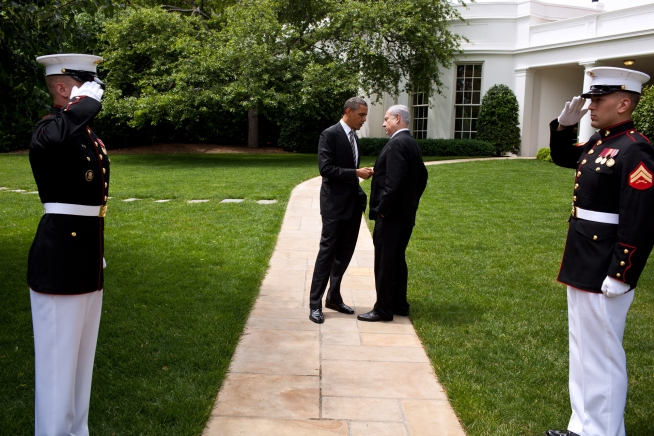
President Obama speaks with Israeli Prime Minister Benjamin Netanyahu outside the White House on May 20, 2011 (White House photo by Pete Souza)
The underlying continuity that nevertheless exists is partly a reflection of, and a sensible response to, constancy in fundamental U.S. interests and in the constraints the country faces in pursuing those interests. That’s good. But it also partly reflects adherence to certain familiar beliefs, themes, and objectives simply because those beliefs, themes, and objectives have always been there, at least in living memory, and it would be difficult and politically costly to challenge them. And that’s not good.
That latter pattern certainly has been true of U.S. policy toward the Middle East, a region of especially costly U.S. involvement. Modern U.S. involvement in the area could be said to have been launched with Franklin Roosevelt’s meeting with King Abdul Aziz Ibn Saud, the founder of…