By failing to challenge many of Official Washington’s “group thinks” on the war policy, President Obama has become captive to them as reflected in his decision to extend the U.S. military operation in Afghanistan despite little or no prospect of success, as ex-CIA analyst Paul R. Pillar explains.
By Paul R. Pillar
It probably was inevitable, as a matter of how Washington as a whole approaches such things these days, that President Barack Obama would make his decision about keeping 5,500 troops in Afghanistan into 2017. There is too much of an expectation that when internal violence prevails in a country in which the United States has had as much past involvement as it has had in Afghanistan, the United States should have its military forces on the scene to try to do something about it, no matter how dim are the prospects for accomplishing much there.
Things have not always been so. It is a departure for the United States to make a habit out of indefinitely stationing significant numbers of its military personnel amid other people’s internal strife. This is not entirely a recent phenomenon; the United States did similar things, for example, in Nicaragua during the first third of the Twentieth Century and later on a much larger scale in Vietnam. But those instances are rightly regarded as failures, they did not have the makings of a habit, and they were not associated with the sort of political expectations about such things that are as persistent and widespread as those that prevail today.
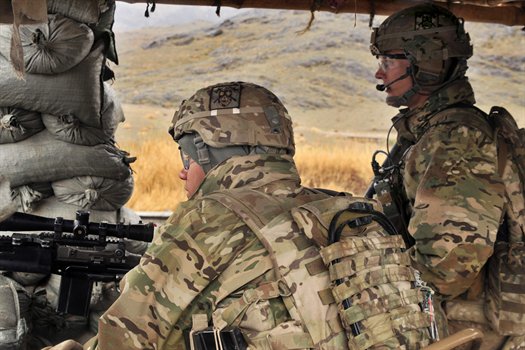
U.S. troops in Afghanistan man a checkpoint near Takhteh Pol in Kandahar province, Afghanistan, Feb. 26, 2013. (U.S. Army photo by Staff Sgt. Shane Hamann)
Perhaps the record of long-term stationing of U.S. forces since World War II in such allied countries as Germany and South Korea has obscured how much of a departure are the sorts of long-term deployments we see today in the Middle East and South Asia. But that earlier stationing of forces was mostly about deterring external aggression, which is a very different business from doing something about internal disorder.
In the former, if nothing happens over a long time while U.S. forces are overseas, that might be a mark…