Iran has sought negotiations with the U.S. for two decades, but both Democratic and Republican administrations favored hostility demanded by Israel and Saudi Arabia. Finally, Iran found a track — sacrificing much of its nuclear program — to achieve a breakthrough, writes Gareth Porter for Middle East Eye.
By Gareth Porter
Now that Iran nuclear deal is completed, the attention of Western news media and political commentators is predictably focused overwhelmingly on the opposition to the agreement within the U.S. Congress and from Israel and the Saudi-led Sunni Arab coalition.
That media lens misses the real significance of the Joint Comprehensive Plan of Action, which is that Iran succeeded in negotiating an agreement with the United States that upheld its national right to a nuclear program despite the obvious vast disparity in power between the two states. That power disparity between the global hegemon and a militarily weak but politically influential regional “middle power” has shaped not just the negotiating strategies of the two sides during the negotiations but, more importantly, how they came about in the first place.
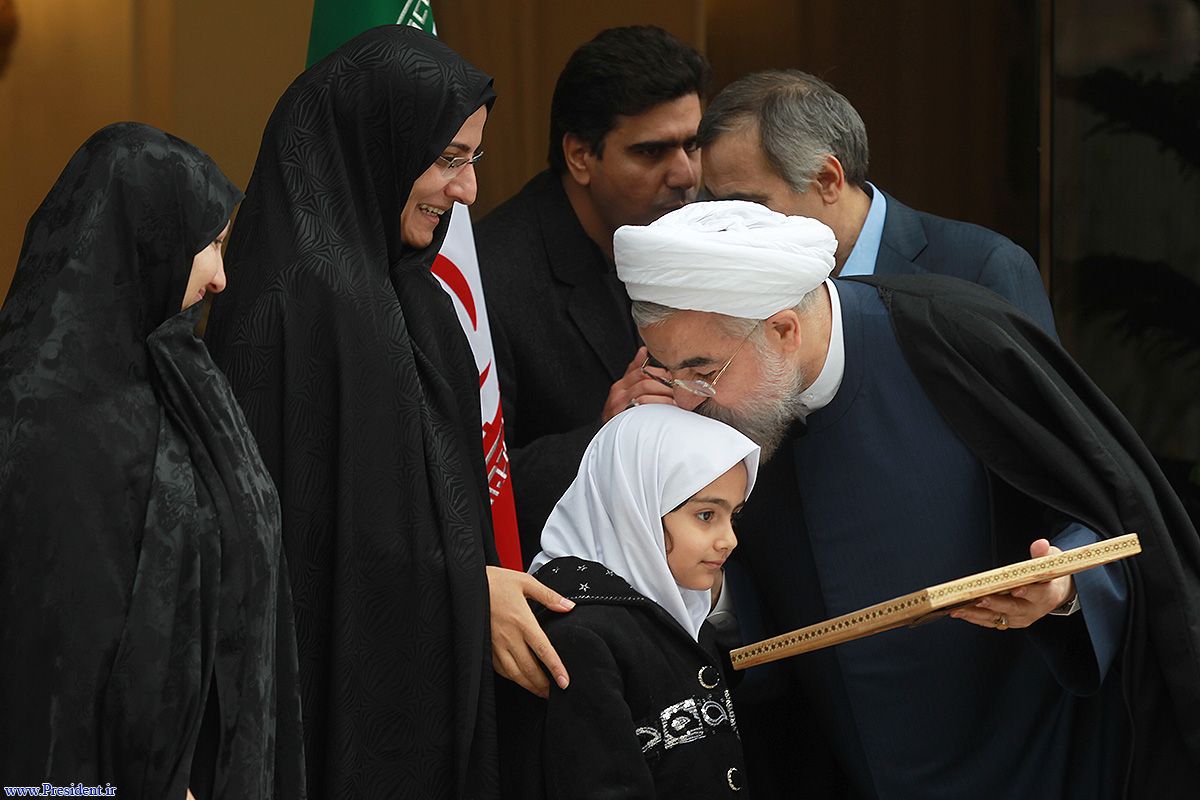
Iran’s President Hassan Rouhani celebrates the completion of an interim deal on Iran’s nuclear program on Nov. 24, 2013, by kissing the head of the daughter of an assassinated Iranian nuclear engineer. (Iranian government photo)
The news media have adopted the Obama administration’s view that negotiations were the result of Iran responding to international sanctions. The problem with that conventional view is not that Iran wasn’t eager to get the sanctions removed, but that it was motivated to do so long before the United States was willing to negotiate.
In fact, Iran had long viewed its nuclear program not only in terms of energy and scientific advancement but also as a way of inducing the United States to negotiate an end to the extraordinary legal status in which Iran has been placed for so long. Even during the Bill Clinton administration Iranian strategists wanted to get the United States to move toward more normal relations, but Clinton was determined to be the most pro-Israeli administration in U.S. history, and instead…