Toronto International Film Festival: Part 4
The Death of Stalin, The Other Side of Everything, Insyriated—The filmmakers’ inability to deal with complex questions, or worse
By
David Walsh
30 September 2017
This is the fourth in a series of articles devoted to the recent Toronto International Film Festival (September 7-17). Part 1 was posted September 22. Part 2 was posted September 26 and Part 3 on September 28.
Armando Iannucci’s The Death of Stalin is a fatally ill-conceived “black comedy” about the demise of the gravedigger of the Russian Revolution, Joseph Stalin, in March 1953. The film is not so much maliciously anti-communist as it is, above all, historically clueless.
Iannucci and fellow screenwriters David Schneider and Ian Martin present the various surviving Stalinist officials, Nikita Khrushchev, Georgy Malenkov, Vyacheslav Molotov, Anastas Mikoyan, Nikolai Bulganin and the rest, all of whom had gallons of blood on their hands, as a largely ineffectual bunch of bunglers and toadies, jockeying “comically” for position. The betrayal of the Russian Revolution was one of the greatest tragedies in world history. Iannucci’s film doesn’t begin to confront the vast significance of the events in the Soviet Union.
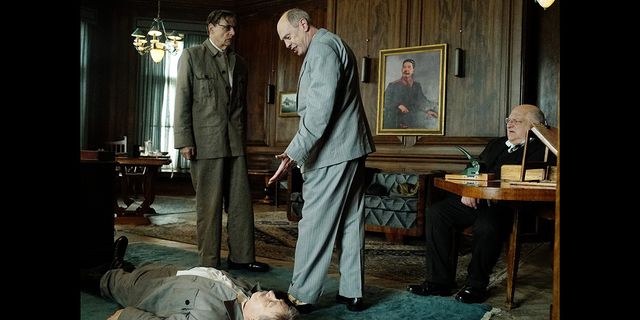
His work loosely bases its antics on certain real facts. In the opening sequence, Stalin (Adrian McLoughlin) telephones a Radio Moscow engineer and requests a recording of the concert that has just been played, forcing the man (Paddy Considine) to frantically round up the musicians and a new conductor, as well as a new audience, and perform the concert again.
Stalin thereupon has a stroke and goes into a coma, apparently after reading an audacious, angry note from a pianist whose family members have died in…