Afghanistan has long been called the “graveyard of empires,” the site of failed invasions. But the U.S. – in its 15-plus-year endeavor – seems determined to dig its own grave there, as ex-CIA analyst Paul R. Pillar describes.
By Paul R. Pillar
Fifteen years and counting. America’s longest war keeps getting longer. The very duration of the expedition, with an end no more in sight now than it had been at any of several points one could have chosen over the last several years, ought to indicate the need for a fundamental redirection of policy. And yet there continue to be calls, including from influential members of Congress, to sustain and even enlarge the U.S. military campaign in Afghanistan.
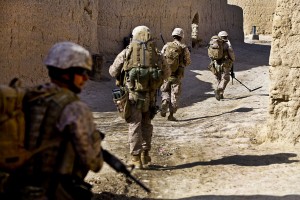
U.S. Marines patrol street in Shah Karez in Helmand Province, Afghanistan, on Feb. 10. (U.S. Marine Corps photo by Staff Sgt. Robert Storm)
That campaign has now continued under three U.S. presidents, two Afghan presidents, too many U.S. military commanders to count, and a variety of operational strategies associated with the different generals. Different levels of U.S. troops also have been tried, with the peak of just over 100,000 American troops reached in 2011.
Something approaching peace and stability will come to Afghanistan the only way it ever has come to Afghanistan in the past: through deals reached among the different factions, power centers, and ethnic groups within Afghanistan. External military intervention does not negate or obviate that process, and instead becomes the object of Afghan resistance to outside interference. It is not for nothing that the place is called the graveyard of empires.
The shape of any deals reached among Afghan factions matters relatively little to the United States. One need make no apologies for borrowing from old speeches in describing the current conflict in Afghanistan as a quarrel in a faraway country between people of whom we know nothing. Unlike the circumstances in which that phrase was first used, there is no hostile and threatening power poised to exploit passivity on our part.
The U.S.-led intervention in Afghanistan in the fall of 2001 was, at that time, a just response to an attack on the…