
The Manhattan Institute’s panel on “Quality of Life” (photo: Manhattan Institute)
Last week I rolled up to 7 World Trade Center in Lower Manhattan for a “Quality of Life Panel” hosted by the Manhattan Institute, one of the city’s most influential conservative think thanks. As a policing activist and writer in New York City very much focused on the Broken Windows theory–which says punishing low-level “quality-of-life” offenses deters serious crime–the event caught my eye.
The panel, held November 19, was the centerpiece of “Quality of Life Week,” a discussion touching on the city’s handling of homelessness and the perceived signs of returning “disorder.” The discussion was one of many facilitated by The Beat, the Manhattan Institute’s social media-oriented “daily email blast that cuts through the clutter…drawing from the work of the Manhattan Institute’s scholars.”
The Beat, it turns out, “is your go-to source to get the facts.”
I like to get the facts, so I finagled my way into the event as a writer and blogger, which was important since MI’s MO was to bring in members of the media to educate them about the Institute’s take on on the issues of the day. The Beat provides a bevy of conservative ideas and research on issues ranging from traffic to crime in public housing to the mythical “Ferguson Effect,” a theory promulgated by Manhattan Institute fellow Heather MacDonald in the pages of Wall Street Journal (5/29/15)–and which began to ratchet up last year in City Journal (12/22/14), MI’s quarterly magazine.
To understand The Beat, you have to understand the Manhattan Institute’s influence both in New York and nationally. Co-founded in 1978 by a British chicken tycoon named Antony Fisher and William Casey, who would go on to be Ronald Reagan’s CIA director, the organization has been at the forefront of the usual conservative skirmishes: charter schools, cutting welfare, climate change denial, fracking, etc.
In New York City, the think tank was instrumental in the NYPD’s adoption of Broken Windows as it pushed aggressive quality-of-life policing with the administration of Mayor Rudy Giuliani and police commissioner Bill Bratton in the early 1990s. A special 1992 City Journal issue titled “The Quality of Urban Life” breathed life into quality-of-life policing, convincing Giuliani to promote Bratton from transit chief to police commissioner.

“A prostitute smokes crack in Bushwick, Brooklyn, in the early 1990s”: photo illustrating City Journal‘s defense of Broken Windows (photo: Andrew Lichtenstein/Corbis)
MI continues promoting quality-of-life policing today: When Broken Windows became the focus of criticism in Ferguson, Baltimore and back in New York as people protested the shooting deaths of unarmed men, Bratton and Broken Windows co-creator George Kelling published defenses of their theory–where else but in an issue of City Journal (Winter/15)?
Then, of course, there’s the organization’s deep stable of fellows. MacDonald, Bratton and Kelling are all notable current or former senior fellows. Joining Bratton on last week’s panel were Fred Siegel, an old Giuliani staffer and longtime professor, and Jason Riley, a Wall Street Journal columnist–both MI senior fellows. In the audience that day was Michael Meyers, the leader of a questionable New York civil rights “coalition” (it’s really just him) who now moonlights as Fox News‘ “civil rights expert”–also a Manhattan Institute fellow. And I’m not sure, but Nicole Gelinas, New York Post columnist and MI senior fellow, was probably there as well.
So you can imagine what I was walking into for the panel. Moderated by NY1‘s Errol Louis, the lineup included Bratton, Siegel, Riley and Mayor Bill de Blasio’s spokesperson Phil Walzak. Bratton, perhaps recognizing me, pointed me out to his security team. They were nice enough to stay nearby and make sure I was safe until I took my seat.
After a few minutes of shmoozing between Bratton (who made multiple sweeps of the cookie tray), Manhattan Institute fellows and reporters from local media–Politico, CBS, NY1, the Gotham Gazette (which published an opinion piece by the MI president that same day)–Louis began the panel with a pretty remarkable question posed to Bratton.

Bill Bratton lamented that state law and the Constitution handcuffed what he could do about homelessness. (photo: Manhattan Institute)
“Is there a nexus,” Louis asked, “to counter-terrorism work that quality-of-life strategies would be part of the toolkit to help keep the city safe?”
“There actually is,” Bratton responded.
While I was prepared to listen to a hefty amount of the usual conservative talking points, this one was pretty wild. The way that we police a homeless person or a young black man performing in the subway has a “nexus” with how the city prepares to fight ISIS or Al Qaeda?
Perhaps I shouldn’t be surprised. Members of the media like Louis (whose father was a police officer) are already fairly tight at the hip with Bratton and the police department. And, after all, Bratton did testify publicly last year that NYPD officers trained in counterterrorism were being sent into public housing buildings. Still, I took furious notes.
Bratton went on to talk about the “radicalization” of young people and how not just parents, but also teachers and coaches, should start to recognize “changes in behavior” and “lifestyle” in young people and execute the “see something, say something” approach before things get out of hand.
Riley, continuing to go off the topic of quality of life, at one point made the mistake of trying to criticize Walzak and the de Blasio administration for last year’s dismantling of the NYPD’s demographics unit, a program which surveilled New York Muslims. An angry Bratton countered that it was he himself who cut the program, noting that the unit was 15 or 16 people who were basically getting no important intel. His surveillance apparatus was much more sophisticated, he explained. Riley didn’t talk much after that.
Eventually the conversation steered back towards quality of life and the panel’s (and audience’s) almost unanimous disgust toward one group of people: the homeless. Louis began by reading an open letter published in that day’s Daily News (11/19/15) penned by a woman from the Upper West Side complaining that she saw actual homeless people while she walked her young child to art class. “Something massive and scary is happening,” she went on to say, blaming the liberal de Blasio administration. While Siegel credited Bratton with keeping crime stats down, he also described a stark change in the city that oddly wasn’t reflected in any crime statistic, but rather a level of “menace that’s returned,” embodied by the homeless person asking for a nickel or dime, as he put it.
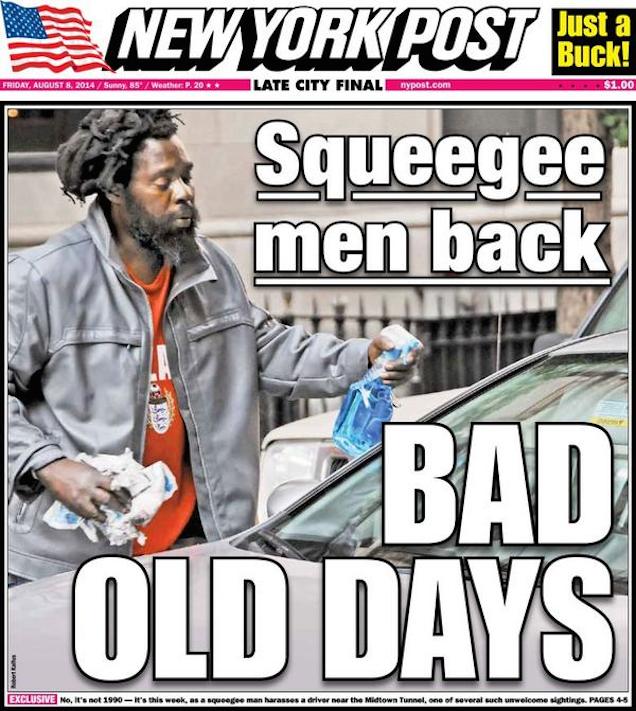
New York Post (8/14/14) warns about the return of a 1990s bugbear.
In explaining these signs of decay and disorder, Siegel mentioned that the news media had done the early work of pointing out that there were, believe it or not, still homeless people in New York. CBS‘s Marcia Kramer, who was in the audience, could attest to that as she filed several reports focusing on a homeless black man in Columbus Circle. The panel also noted the numerous New York Post front pages from this past summer (though not the Post stunt of having a reporter dress up as a homeless man in front of the mayor’s home). Siegel mentioned, perhaps inadvertently, that public opinion on there being a supposed homelessness epidemic actually followed that synchronized media coverage (which even had the help of police unions).
Ah, so the media homeless hysteria in fact preceded the public’s opinion swing, helping to shape it. That makes a lot of sense. A few straight days of front pages might convince people that there’s a problem. If “menace” can be measured through New York Post covers, then Siegel was right. And if the question of there being a breakdown of the city’s quality of life, the theme of the panel, was primarily media-made, then the Manhattan Institute was smart to stay ahead of that narrative by hosting writers and journalists at events that take MI’s own claims as self-evident.
At the end of the discussion, a woman from the audience was chosen to ask a question; she begged Bratton for a solution to poor people asking her for change as she’s leaving her local Whole Foods supermarket in Manhattan. He recommended she call the cops, or have the store call the cops. And in a moment of solidarity with the utterly disgusted and mostly white audience (the guy next to me repeatedly whispered “sickening” at the mention of the homeless), Bratton marveled that he, too, has to deal with the problem, since there’s a shelter near his home, in “one of the better areas” of the East Side. That likely was not his other home in the Hamptons; Bratton complained last year that he’s forced to see graffiti on his train ride home to the Island.
Seemingly at a loss for clear solutions other than to harp on his Broken Windows approach and that he “made his name” on clearing beggars from the subways “during Giuliani,” Bratton lamented how state laws and the Constitution have handcuffed what he and his officers can do about the homeless. The audience seemed equally disappointed.
Finally, after I’d had enough of the homeless-bashing, I left the immaculate surroundings of the Downtown conference room and headed back out into the city. In the subway station, there were three members of a family struggling to get a bunch of worn-out suitcases onto the train. The group–a woman, her mother and her brother–had just left a shelter where the younger woman had been staying with her months-old baby.
She had been in the women-only shelter for a few months after years of living on the streets. She was leaving to move in with Mom, who lives in public housing, after life in the shelter became unbearable. Recently she and her baby were forced to sleep in the shelter’s basement when they didn’t arrive in time for the curfew. There had also been an incident where cops were called after she had tried to get her clothes and possessions from the shelter.
The cops had given this woman, who didn’t want to give her name, a hard time. But this was nothing new, as she had been constantly disrespected and harassed by cops during her years living on the streets, she said. Her mother and brother both rolled their eyes at mention of the police. Mom was going to have to ask another family member to leave so make room for her daughter and new granddaughter. It was a struggle, they said. Just seeing them try to get all of bags onto the train filled my heart with a lot of raw emotions.
And yet in the back of my head, all I could think of was Bratton and the staffers and audience of the Manhattan Institute, dining on catered lunch and chocolate cookies, pounding the table about their “quality of life.”
Josmar Trujillo is a former columnist for Extra! who writes at the Huffington Post, Newsday and amNY. He is also an organizer with the Coalition to End Broken Windows and New Yorkers Against Bratton.
This piece was reprinted by RINF Alternative News with permission from FAIR.