In spinning another propaganda theme, Official Washington is putting out the storyline that Iran is supporting Syria only to appease hardliners in Tehran, but the reality is that top Iranian leaders agree that a victory by the Islamic State or Al Qaeda must be prevented, writes Gareth Porter at Middle East Eye.
By Gareth Porter
Iranian President Hassan Rouhani’s address at the UN General Assembly and a talk the previous night to about 150 Americans touted the recent nuclear breakthrough as a precedent for further diplomatic accommodation with the United States. But both speeches also called on Washington to change its policy toward the conflicts in the Middle East.
Despite notable differences between the two presentations, the thrust of Rouhani’s argument was that Iran is ready to apply the style of diplomacy that brought about the nuclear breakthrough to conflicts in the Middle East, but that it could not accept a U.S. policy that puts the survival of the Syrian state at risk.
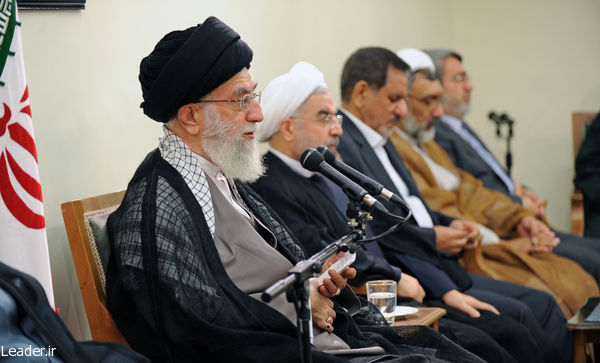
Iran’s Supreme Leader Ali Khamenei sitting next to President Hassan Rouhani and addressing the cabinet.
In the UN speech, Rouhani called the Joint Comprehensive Plan of Action (the official name for the nuclear deal) an historic “victory over war” but had harsh words for U.S. support for the destabilizing policies of its allies in the region.
In the talk to the American audience, which this writer attended, he was more precise on both scores. He offered to apply the model of “win-win” negotiations to a peaceful settlement of the war in Yemen that would involve all Yemeni parties to the conflict. He vowed, “We are willing to help with actionable measures to maintain everyone’s safety.”
But Rouhani was also very firm in insisting that the United States should agree to common actions to stop the threat of a takeover by “Daesh” (the Arabic acronym for the Islamic State, ISIS, or ISIL) before discussing the fate of the Assad regime.
“The priority” on Syria, he said, “is the duty to collaborate against terrorism,” although he then added that this “doesn’t mean a future form of government in Damascus should not be thought of.”
In the past, Obama administration…