A popular way to begin the first day of class in constitutional law in many American law schools is to ask the students what sets the U.S. Constitution apart from all others. Usually, they answer that it’s the clauses that guarantee the freedom of speech, privacy and due process.
Yes, each of those guarantees — if upheld — is vital to restraining government, but the overarching and most important unique aspect of the Constitution is the separation of powers. The constitutions of many totalitarian countries pay lip service to free speech, privacy and due process, but none has the strict separation of powers that the U.S. does.
Under our Constitution, the Congress writes the laws, the president enforces them and the courts interpret them; and those powers and functions may not constitutionally be mixed or exchanged. The Congress also declares war. The president also wages war. The courts also invalidate the acts of the other two branches when they exceed their constitutional powers.
The Supreme Court has ruled that the separation of powers is integral to the Constitution not to preserve the prerogatives of each branch of government but to divide governmental powers among the branches so as to keep power diffused — and thereby limited and protective of personal freedom.
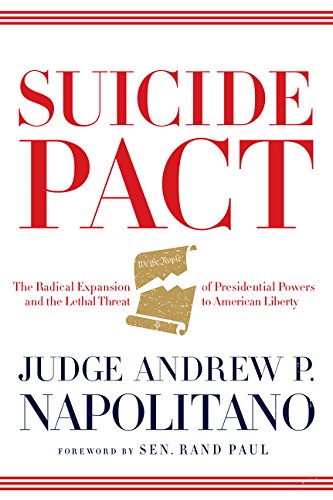
Suicide Pact: The Radi…
Best Price: $1.50
Buy New $3.94
(as of 08:25 EDT – Details)

James Madison, who wrote the Constitution, wanted not only this diffusion by separation but also tension — even jealousy — among the branches so as to keep each in check.
Thus, even if one branch of government consented to ceding an essential power to another branch, such a giveaway would be unconstitutional, the Supreme Court has ruled, because the core…