The Founders sought to shield the U.S. government from foreign influence via the Emoluments Clause, which is now being tested by President Trump’s financial conflicts, as ex-CIA analyst Paul R. Pillar explains.
By Paul R. Pillar
A lawsuit filed by Maryland and the District of Columbia is the second such suit alleging that President Trump is violating the clause in the U.S. Constitution that prohibits officials from accepting emoluments from foreign states.
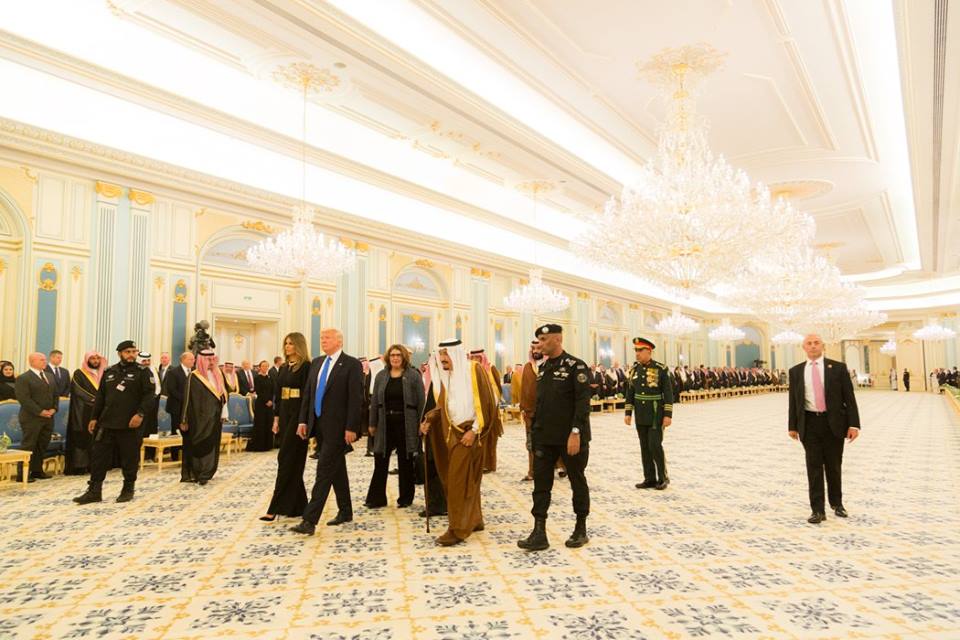
President Donald Trump and First Lady Melania Trump are escorted by Saudi King Salman on their arrival, May 20, 2017, to the Royal Court Palace in Riyadh, Saudi Arabia. (Official White House Photo Shealah Craighead)
The principal focus of the suits is the Trump hotel that occupies the Old Post Office Building a few blocks from the White House (and is the subject of yet another irregularity, in that government officials are supposed to be legally barred from leasing that publicly owned property).
The new suit may have a better chance than the first one of establishing standing to sue, given that the plaintiffs represent jurisdictions with business interests that may lose customers to the Trump hotel because of its connection to the presidency. Earlier this year, for example, the Kuwaiti embassy, which for many years had held its national day celebration at the Four Seasons Hotel, held the event instead at Trump’s hotel.
The lost business is legally significant regarding standing to sue, and when a public official gains a commercial advantage because of his position, there is a fairness issue regarding businesses competing on an uneven playing field. But which Washington hotel gets to host embassy parties is hardly the most important question involved.
We can get a sense of the relevant concerns of the Founding Fathers by noting that the Emoluments Clause is part of a broader prohibition in the Constitution (in Article I, Section 9) that bars the granting of any title of nobility and the acceptance “of any present, Office, Emolument, or Title, of any kind whatever, from any King, Prince, or foreign State.”
Emolument may be an Eighteenth-Century word that is not in many active vocabularies in…