The mainstream U.S. media, which knows President Trump disdains facts, accepted his claims about the April 4 Syrian chemical incident without question and ignored doubts of intelligence analysts, a dilemma that Lawrence Davidson addresses.
By Lawrence Davidson
Government intelligence agencies, particularly those in the United States, have a problem. Its nature was spelled out by the retired British diplomat Alastair Crooke in an article entitled “Trump’s 59-Tomahawk Tweet” on April 8. As the title suggests, Crooke was reacting to President Trump’s precipitous attack on a Syrian government airbase, following the chemical weapons episode of April 4 at the Syrian town of Khan Sheikhoun.
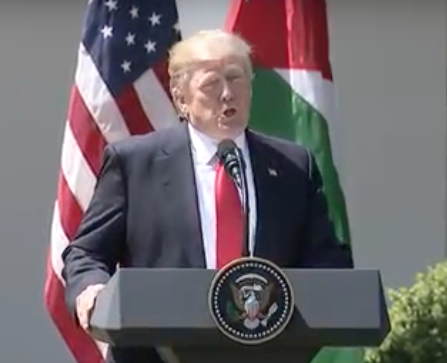
President Trump at a news conference with Jordan’s King Abdullah II on April 5, 2017, at which the President commented on crisis in Syria. (Screen shot from whitehouse.gov)
Crooke notes that U.S. intelligence had raised doubts as to the Syrian government’s responsibility for the release of poison gas. It seems likely that the Russians had alerted U.S. forces that the Syrian air force was going to attack a rebel warehouse in Khan Sheikhoun that was allegedly full of explosives and weapons. Unbeknownst to the Russians, the Syrians and the Americans, the warehouse also held a poisonous mix of organic phosphates and chlorine.
There is also evidence suggesting that whatever released the poison gas came from an explosive device placed on the ground. Wherever the resulting gas cloud came from, and a Syrian government bomb is certainly not the only possibility, it spread over a local neighborhood and killed a number of exposed residents.
The American mass media nevertheless immediately blamed Damascus for an attack using chemical weapons. Trump, also immediately, believed the mass media. He is, after all, increasingly known as the Fox TV president. Taking his cue from the media, he paid insufficient heed to his own intelligence agencies’ doubts. As a result, as Crooke puts it, “the Tomahawks flew.”
All of this led Crooke to ask “whether Western intelligence agencies still retain an ability to speak-out to power.” Can they still, effectively, convince their…