Many Republicans will oppose the Iran-nuclear deal to discredit President Obama and some Democrats will succumb to pressure from Israel, but the ultimate choice is whether politics and pressure will overrule the world’s interest in constraining Iran’s nuclear program, writes ex-CIA analyst Paul R. Pillar.
By Paul R. Pillar
Completion of the agreement to restrict the Iranian nuclear program puts into sharp relief the choice for anyone who weighs in on the topic and especially for the U.S. Congress, which will have an opportunity to accept or reject the deal.
Gone is any meaningful kibitzing on how well the negotiators are doing their jobs. Gone are endless speculative permutations of how different issues might be resolved. Gone is conjecturing about how the outline that was the framework agreement announced in April will be fleshed out with detailed terms. The question has been stripped down to a simple and easy-to-understand form: it is a choice between the agreement that has just been announced, and no agreement at all about the Iranian nuclear program.
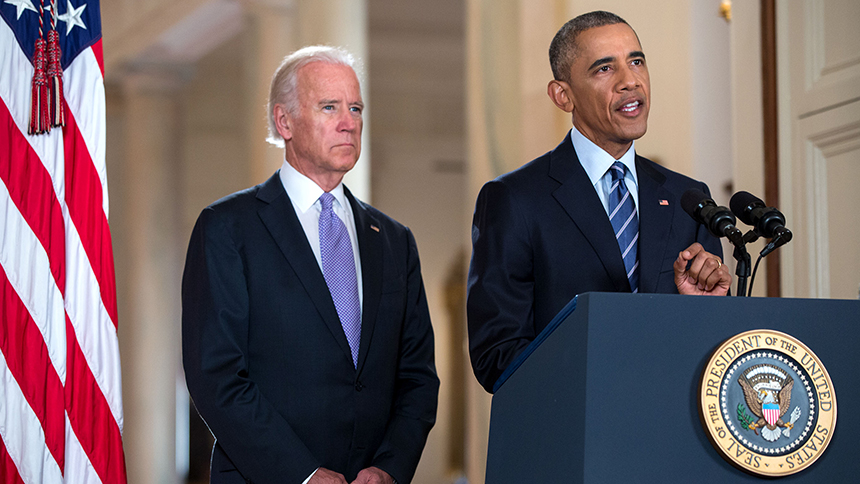
President Barack Obama, with Vice President Joe Biden, announcing the signing of the Iran-nuclear agreement on July 14, 2015. (White House photo)
We can finally get beyond the sterile rhetoric about good deals and bad deals and the vacuous cliché that no deal is better than a bad deal. Comparison between this agreement and no agreement is what determines whether the agreement is bad or good. A good deal is one that is better than no deal; a bad deal is one that is worse.
It has always been a fantasy that a “better deal” than what emerges from these negotiations would somehow be possible. The long, arduous, deadline-extending nature of the negotiations that ended in Vienna makes the notion that something “better” could have been wrung out of the Iranians seem all the more phantasmagorical. Awareness that five other countries besides the United States and Iran are parties to this agreement, and that some of the most recent hard negotiations have taken place within the P5+1, ought further to dispel this notion.
The alternative to the agreement – i.e., no agreement – would mean no restrictions on…