A successful nuclear deal with Iran could mean an expanded Iranian role in blocking Islamic State advances in Iraq and Syria, but the potential U.S.-Iran cooperation alarms Israel and Saudi Arabia — which may explain President Obama’s silence on the topic, examined by Flynt and Hillary Mann Leverett.
By Flynt Leverett and Hillary Mann Leverett
The Iran nuclear talks may be getting close to some sort of conclusion in Vienna, but American political and policy elites remain, to an appallingly large extent, clueless as to what is really at stake in the negotiations. (This was a significant theme in Hillary’s appearance on CNN, see here, and in Flynt’s appearance on CNBC, see here, to discuss the Vienna talks.)
And, while the headline from a recent NBC News poll notes that Americans favor an Iran nuclear deal by a “2 to 1” margin, in fact, the polls shows that a plurality of Americans say they don’t know what to think about a possible Iran nuclear deal.
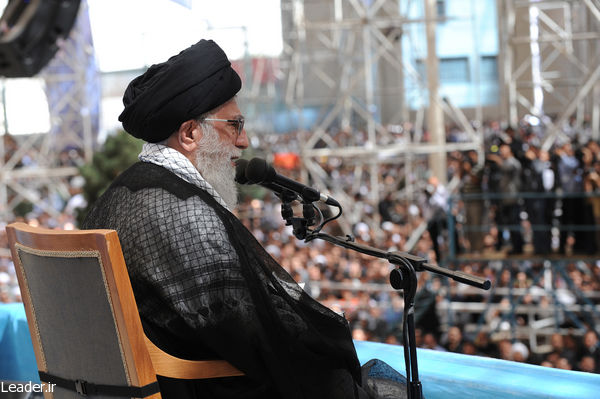
Iran’s Supreme Leader Ali Khamenei speaks to a crowd. (Iranian government photo)
These observations underscore a point that we have been making for some time: President Barack Obama has yet to make the case to his fellow Americans for why an Iran nuclear deal – and, beyond that, a potential realignment of U.S. relations with the Islamic Republic – is not just profoundly in American interests, but is strategically imperative for the United States.
This failure will almost certainly make it more difficult for Obama (and his successor) to implement a deal. Furthermore, this failure will severely circumscribe the strategic benefits that the United States can accrue from a deal.
At the moment, many American elites convey particular distress over the Obama administration’s inability simply to dictate the terms of a prospective United Nations Security Council resolution that would endorse a final nuclear agreement and, to help implement such an agreement, remove international sanctions previously authorized by the Council against the Islamic Republic.
In its approach to drafting a new Security Council resolution, the Obama administration has been demanding that previously authorized limits on exports…