U.S. expansion of NATO up to Russia’s borders and last year’s U.S.-backed coup in Ukraine have drawn reactions from Moscow and now counter-reactions from Washington, including a plan to preposition U.S. military hardware in the Baltic States. But is that the best option, asks ex-CIA analyst Paul R. Pillar.
By Paul R. Pillar
The U.S. Department of Defense reportedly has plans to place tanks, infantry fighting vehicles, and other heavy weapons in the Baltic countries and elsewhere in Eastern Europe. It is easy to see what this is about. It is an attempt to send a signal – a warning, of sorts – to Russia amid the continued tensions that events in Ukraine have heightened.
The type of signal was chosen to be strong enough to be reassuring to East Europeans who are looking for reassurance and to meet domestic demands to be seen standing up to Vladimir Putin, while being restrained enough not to prod the Russians into making some destructive response.
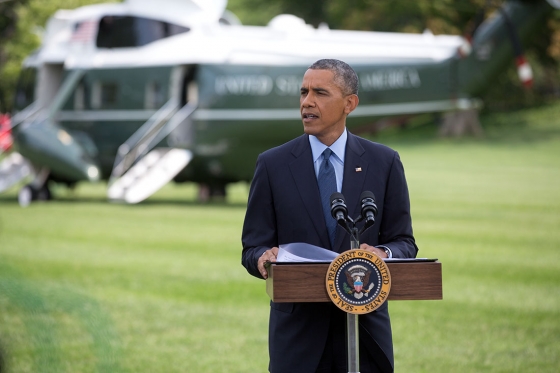
President Barack Obama delivers a statement on the situation in Ukraine, on the South Lawn of the White House, July 29, 2014. (Official White House Photo by Lawrence Jackson)
If this positioning of military equipment was the middle option on an options paper, the alternatives bracketing it were the weaker option of limiting policy toward Russia to non-military measures, or the more provocative one of stationing U.S. troops and not just equipment in those Eastern European locations. In other words, a half measure, similar to how economic sanctions are often seen as a compromise between doing nothing beyond a diplomatic demarche or sending in the Marines.
Military moves as signals have long been a part of international relations and of deterrence, but we still ought to ask about the strategic wisdom and rationale of the proposed equipment deployment. Even a mere signal loses its meaning and effectiveness if it is disconnected from material implications and consequences.
The positioning of materiel sounds like some familiar U.S. moves in Cold War-era Europe, but it actually is different. U.S. troops in Europe became the prototypical “trip-wire” of the Cold War, with an attack against them being widely assumed to…