By nature all men are equal in liberty but not in other endowments.
– Thomas Aquinas
A good place to start.
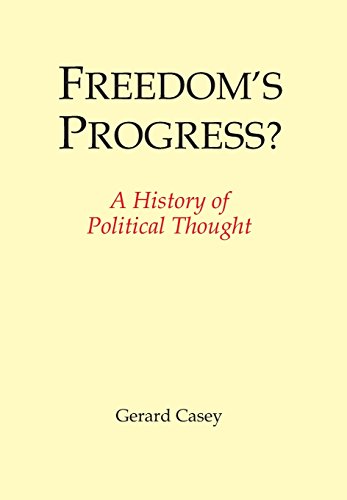
Freedom’s Progress?: A History of Political Thought, by Gerard Casey
Thomas Aquinas lived for about fifty years, during the middle of the thirteenth century. He was at the heart of what was one of the most intellectually revolutionary periods in European history:
…he was one of those who led the successful fight to have the newly translated (into Latin) works of Aristotle accepted by the academic and ecclesiastical establishments…
Freedomu2019s Progress…
Best Price: $90.01
Buy New $73.13
(as of 10:35 EDT – Details)

In addition to Aristotle, another rediscovered source for this revolutionary period was Emperor Justinian’s sixth century codification of Roman law. A quick detour into Justinian’s work:
…Justinian tried to restate the whole of Roman law in a manageable and consistent form…. [The members of the second commission] were to read the works of authority, none of them written later than about AD 300, and excerpt what was currently valid.
The compilers were authorized to alter the texts they kept. If the new version of a text differed from the old, the new prevailed, on the theory that Justinian was entitled to amend the previous law as he wished.
Justinian was Eastern Emperor. Presumably, his codification of law was the basis upon which the Byzantine Empire was built. What can be said of this? This codified law supported a long-lasting, reasonably stable, commercially successful empire; connecting Asia and Western Europe, its economy was far more dynamic than could be found east or west; gold coinage, while not free-market derived, was respected – certainly…