Russian revolutionary art exhibition in London excises Trotsky—and, more generally, historical truth
Revolution: Russian Art 1917–1932
By
Paul Mitchell
25 February 2017
“We are not celebrating revolution here … I don’t think there is much to celebrate. Quite the contrary as you will see from the exhibition…” —Natalia Murray, co-curator, on the eve of the opening of the Royal Academy’s “Revolution: Russian Art 1917–1932” exhibition.
Such a comment is fair warning to anyone planning to visit the current exhibition at the Royal Academy in London.
Prior to the opening of “Revolution: Russian Art 1917-1932”, Guardian art critic Jonathan Jones expressed concern that the exhibition’s curators would fail to portray art under Bolshevism as “brutal propaganda”, equivalent to that of the Nazis. He need not have worried. (For our reply to Jones’s article see here)
Murray’s aim as curator of the Royal Academy exhibition is to pour scorn on and discredit the 1917 October Revolution and to combat the contemporary impact of the works it inspired, such as the depiction of liberation in Boris Kustodiev’s “Demonstration on Uritsky Square on the day of the opening of the Second Comintern Congress in July 1920.”
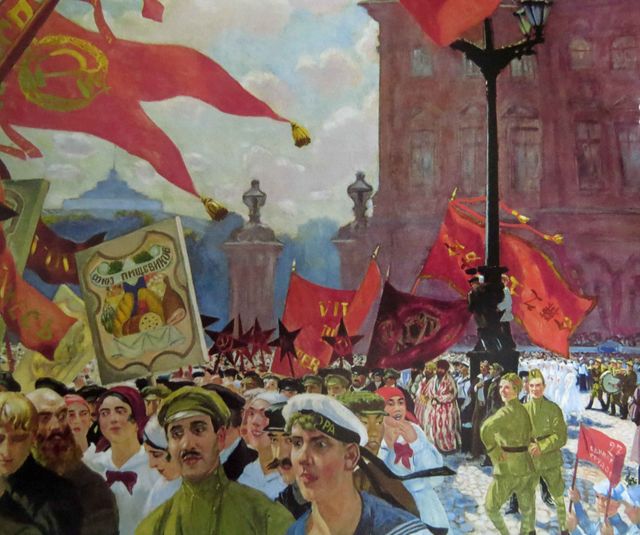
To that end, Murray serves up bitter doses of anti-communism and relentless denunciations of everything “Bolshevik”. Her essay in the catalogue, “Cultural Heroes”, is a rant against supposedly disenchanted and jaded artists, while a final sentence grudgingly admits that the Revolution “produced some of the most remarkably talented people in the history of Russia, or indeed of Europe.”
Murray’s premise is that art was flourishing in…