The New Cold War promises untold riches for the Military-Industrial Complex, causing hawks inside the Obama administration to push for more hostilities with Russia, as in a Syrian case study dissected by Gareth Porter for Truthdig.
By Gareth Porter
Airstrikes by the United States and its allies against two Syrian army positions Sept. 17 killed at least 62 Syrian troops and wounded dozens more. The attack was quickly treated as a non-story by the U.S. news media; U.S. Central Command (CENTCOM) claimed the strikes were carried out in the mistaken belief that Islamic State forces were being targeted, and the story disappeared.
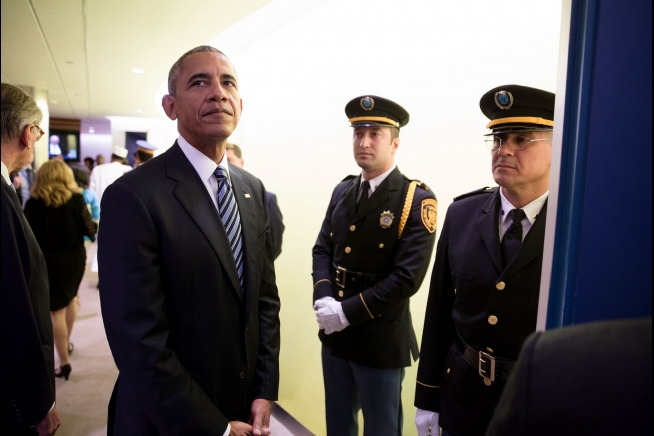
President Barack Obama waits backstage before making his last address at the United Nations General Assembly in New York, Sept. 20, 2016. (Official White House Photo by Pete Souza)
The circumstances surrounding the attack, however, suggested it may have been deliberate, its purpose being to sabotage President Obama’s policy of coordinating with Russia against Islamic State and Nusra Front forces in Syria as part of a U.S.-Russian cease-fire agreement.
Normally the U.S. military can cover up illegal operations and mistakes with a pro forma military investigation that publicly clears those responsible. But the air attack on Syrian troops also involved three foreign allies in the anti-Islamic State named Operation Inherent Resolve: the United Kingdom, Denmark and Australia. So, the Pentagon had to agree to bring a general from one of those allies into the investigation as a co-author of the report. Consequently, the summary of the investigation released by CENTCOM on Nov. 29 reveals far more than the Pentagon and CENTCOM brass would have desired.
Thanks to that heavily redacted report, we now have detailed evidence that the commander of CENTCOM’s Air Force component attacked the Syrian army deliberately.
Motives Behind a Pentagon Scheme
Secretary of Defense Ashton Carter and the military establishment had a compelling motive in the attack of Sept. 17 — namely, interest in maintaining the narrative of a “new Cold War” with Russia, which is crucial to supporting and expanding the budgets of their institutions.

U.S. Defense…