At year’s end, it’s often worthy to think back on how you thought the year would go and compare it to what actually happened. For writers who have made predictions, it represents a more public challenge, as ex-CIA official Graham E. Fuller explains.
By Graham E. Fuller
Having rashly ventured last year into making predictions for the coming year of 2015 in the Middle East, how do those assessments bear up today, one year later?
This self-graded scorecard comes in two separate articles: due to space limitations I take up here today two of the five predictions–and try to assess how close they came to what actually transpired, and what new trends may now be observable. The other three will follow next week.
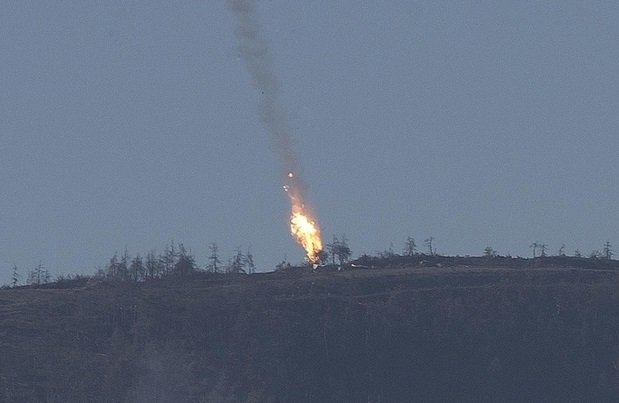
Video of the Russian SU-24 exploding in flames inside Syrian territory after it was shot down by Turkish air-to-air missiles on Nov. 24, 2015.
- ISIS will decline in power and influence.
My Prediction last January 2015: I have stated earlier that I do not believe ISIS is viable as a state; it lacks any coherent and functional ideology, any serious political and social institutions, any serious leadership process, any ability to handle the complex and detailed logistics of governance, and any opportunity of establishing state-to-state relations in the region. Additionally it has alienated a majority of Sunni Muslims in the world, regardless of deep dissatisfactions among Sunnis in Iraq and Syria. Ideally ISIS should fail and fall on its own, that is, without massive external, and especially Western, intervention that in some ways only strengthens its ideological claims. To be convincingly and decisively defeated, the idea of ISIS, as articulated and practiced, needs to demonstrably fail on its own and in the eyes of Muslims of the region.
January 2016 Scorecard Assessment:
This forecast held up pretty solidly. ISIS has indeed clearly entered a process of decline over the past year. It has lost significant territory and some major cities in both Iraq and Syria; the tide of hostility towards it now includes a modest but real (and reluctant) shift by Turkey and Saudi Arabia against it, in part due to external pressures on both those states and the rising ISIS…