As Official Washington rages over alleged Russian hacking of Democratic emails, a forgotten back story is how the U.S. government pioneered the tactics of cyber-war and attacked unsuspecting countries, recalls Michael Brenner.
By Michael Brenner
The psychodrama over the alleged but unsubstantiated Russian hacking of Democratic emails to influence the U.S. presidential election has yet to reach its climax. Already, though, it has earned nomination as the most surreal and passionate work of fiction of the Twenty-first Century.
In all the excitement, it is easy to lose perspective. Perhaps the biggest piece of the untold story is the United States government’s pioneering role in electronic surveillance and hacking. We seem to have forgotten that the National Security Agency and the Central Intelligence Agency eavesdropped on heads of state in Germany, Brazil, Argentina, Iraq, Venezuela – and, at last count, several score other capitals. Also, the United Nations Secretary General, the President of the European Union Commission, the European Central Bank and God knows whom else.
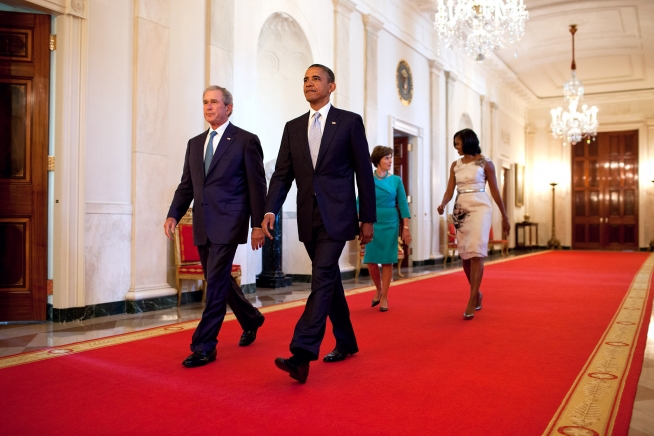
President Barack Obama and former President George W. Bush (with First Lady Michelle Obama and former First Lady Laura Bush) walk to a White House event on May 31, 2012. (Official White House Photo by Chuck Kennedy)
This was not coincidental. It was part of a calculated strategy approved by two successive Presidents to monitor all electronic communications around the globe. Author James Bamford and other knowledgeable experts have provided us with a detailed history of the program.
Yet, the U.S. — as presented to us by the mainstream media and most commentators reflecting Official Washington –is portrayed as the innocent among the main protagonists. The plot line represents America as the victim of unprovoked cyber aggression by the Russians and, in other circumstances, the Chinese – these attacks coming out of the blue, an aggressive blow in an assumed contest for global dominance between the powers.
Is any of this true? Frankly, we haven’t even seen the proof. But let’s assume that there is an element of truth to it (leaving apart the nonsense about a…