Exclusive: A decade ago, the Bush administration was eager to bomb Iran but U.S. intelligence analysts challenged the casus belli by finding that Iran was not building a nuclear bomb, recalls ex-CIA analyst Ray McGovern.
By Ray McGovern
On a recent TV appearance, I was asked about whistleblowing, but the experience brought back to mind a crystal-clear example of how, before the Iraq War, CIA careerists were assigned “two bosses” – CIA Director George Tenet and John Bolton, the Under Secretary of State for Arms Control and International Security, the arch-neocon who had been thrust on an obedient Secretary of State Colin Powell.
CIA “analyst” Frederick Fleitz took the instructions quite literally, bragging about being allowed to serve, simultaneously, “two bosses” — and becoming Bolton’s “enforcer.” Fleitz famously chided a senior intelligence analyst at State for not understanding that it was the prerogative of policymakers like Bolton – not intelligence analysts – to “interpret” intelligence data.
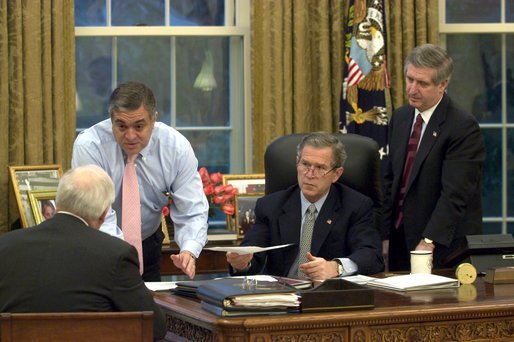
President George W. Bush and Vice President Dick Cheney receive an Oval Office briefing from CIA Director George Tenet. Also present is Chief of Staff Andy Card (on right). (White House photo)
In an email from Fleitz in early 2002, at the time when one of his bosses, the pliable George Tenet, was “fixing” the intelligence to “justify” war on Iraq, Fleitz outlined the remarkable new intelligence ethos imposed by President George W. Bush, Vice President Dick Cheney and their subordinates who were reshaping the U.S. Intelligence Community.
Apparently, senior State Department intelligence analyst, Christian Westermann, “had not gotten the memo” on how things had changed. Rather, he was performing his duties like a professional analyst under the old rules. Westermann had the temerity to block coordination on a speech in which Bolton wanted to make the spurious assertion that Cuba had a developing biological weapons program.
On Feb. 12, 2002, after a personal run-in with Westermann, Fleitz sent Bolton this email: “I explained to Christian [Westermann] that it was a political judgment as to how to interpret this data…