Over-classification of U.S. government information is a grave threat to the Republic, giving politicians and bureaucrats the power to hide facts that aren’t really sensitive but are vital to a meaningful public debate, such as the IG report on President Bush’s surveillance program, says ex-NSA analyst Kirk Wiebe.
By Kirk Wiebe
A few weeks ago, as the result of a Freedom of Information Act request by the New York Times, we were able to view a redacted version of the so-called “Five IG’s” report, formally entitled “Report on the President’s Surveillance Program” or PSP, written by the Inspectors General of the Defense Department, the National Security Agency, the Justice Department, the Central Intelligence Agency, and the Office of the Director of National Intelligence.
What was most interesting about the portions of the report that were released was how badly over-classified much of the report originally was. The first paragraph of the introduction to Volume 1, dated July 10, 2009, was rather innocuous until you notice the “scratch out” of the original classification, (TS//SI//OC//NF).
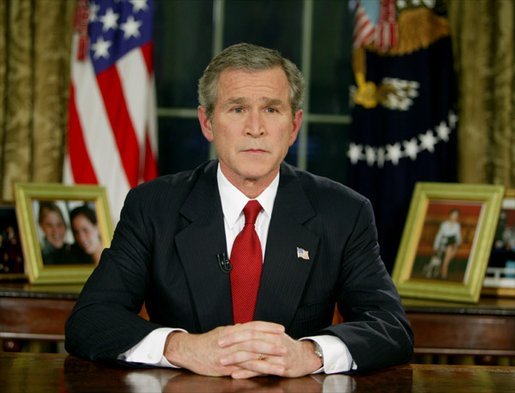
President George W. Bush announcing the launching of the Iraq invasion on March 19, 2003. (White House photo)
As someone who has worked extensively with classified information, converting it from raw source materials to forms appropriate for analysis, as well as for publication to a wide array of intelligence consumers throughout the U.S. Government, I can tell you without hesitation that it is highly unusual to see an entire paragraph of an originator-controlled (OC) document rendered completely unclassified after being initially classified Top Secret.
In fact, I have never seen such a gross change in classification in more than 34 years of intelligence work. First, the terminology making up the classification of the paragraph in question:
TS means Top Secret (information that — if released to an enemy — would result in grave damage to the security of the United States); SI for Special Intelligence (intelligence derived from signals); OC for Originator Controlled (no changes to content or classification can be made without the permission of those…