Despite discouraging headlines about last-minute troubles facing the nuclear deal with Iran, negotiators have devised a clever way of sidestepping the touchy issue of when Iran would get sanctions relief – by delaying the actual signing until initial steps have been taken, reports Trita Parsi.
By Trita Parsi
Contrary to public posturing on the timing and pace of sanctions relief, a framework for handling this critical matter of the nuclear deal has been resolved, according to Iranian sources.
Iranian officials have on numerous occasions insisted that sanctions relief must come immediately upon the signing of an agreement. This has been at direct odds with the position of the U.S. government and its allies, who insist that relief only can come after Iran has taken numerous steps limiting its nuclear activities.
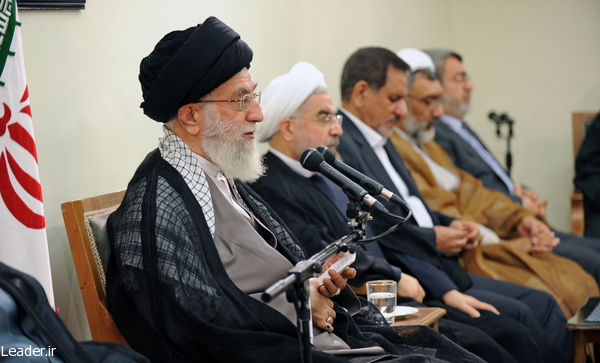
Iran’s Supreme Leader Ali Khamenei sitting next to President Hassan Rouhani and addressing the cabinet.
As oftentimes is the case in diplomacy, the solution was found in a combination of a play with words and practical measures. This is exactly what the diplomats did to reconcile the Iranian insistence on front-loaded sanctions relief and the Western position of relief being provided only after the International Atomic Energy Agency has verified Iranian steps to curtail its nuclear program.
According to Iranian sources, the agreement is divided into three phases. The initial phase — called “adoption of agreement” — takes place as the two sides agree on a final deal. This phase will kick in over the next few days — if a deal is reached.
The next phase — the operationalization of the agreement — will begin once the domestic political processes of various parties have conclusively approved the agreement. This phase has been added primarily as a result of the U.S. Congress passing the Corker bill, in which the American legislature gave itself the right to review and vote on the nuclear deal.
The timing of the second phase is directly related to the duration of the Congressional review process. If the two sides come to an agreement prior to July 10, the review process is set at 30 calendar days, in addition to 22 calendar days for Congress to…