By the winter of 1916-1917, the World War on the Eastern Front had brought Tsar Nicholas II’s armies to the verge of collapse. Casualties for the Russian Empire approached six million dead, wounded, missing and captured. The army was woefully undersupplied. Mutinies proliferated against an incompetent officer corps indifferent to the suffering of the overwhelmingly peasant army. In Russia, as well as in Germany and even the United States, food prices grew rapidly, provoking increasing social unrest.
New York, February 20: Bread riots in Manhattan
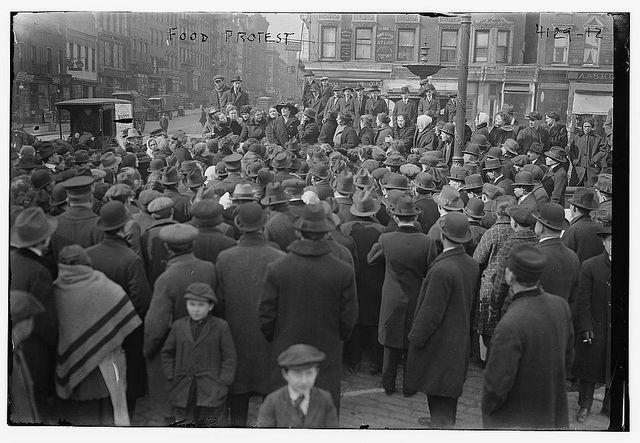
A wave of hunger riots begins in the United States as consumer prices skyrocket, driven by the immense profits American capitalism is reaping from the war in Europe. In New York City’s East Side, thousands protest before City Hall, with women chanting, “We want food for our children.” Thousands are involved in bread riots in Brooklyn. The protests quickly spread to Philadelphia and Boston.
Petrograd, February 23 (Feb. 10 Old Style): Bolsheviks call Petrograd strike
The Bolsheviks call for a general strike in Petrograd to protest the anniversary of the arrest of their Duma contingent, which had taken place earlier in the war. Only a few factories respond to the strike, and those that do are not out for long. According to Victor Chernov, a leader of the peasant-oriented Socialist Revolutionary Party, the limited success of the strike “convinced the political police of their own strength and of the workers’ helplessness.”
Tsarskoye Selo, Russia, February 23 (Feb. 10 O.S.): Duma leader visits Tsar
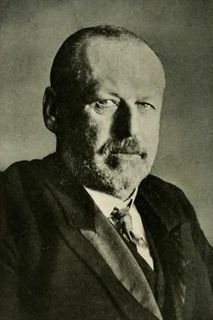
Mikhail Rodzianko, president of the Russian Duma, travels to Tsar Nicholas’ elaborate palace, Tsarskoye Selo, to plead for changes to the Tsar’s cabinet and greater powers for the Duma to avert social upheaval….