Revolution: New Art for a New World—A careless, unserious treatment of Russian Revolutionary art
By
Joanne Laurier and David Walsh
17 March 2017
It is the fate of every truly significant social overturn, every great revolution, to be misunderstood, slandered, lied about and distorted. That is the specific and ignoble task of the intellectual defenders of the old order. Sometimes that process occurs in spectacular ways, sometimes in petty and paltry ones.
Margy Kinmouth’s documentary, Revolution: New Art for a New World, falls into the latter category. The director, more than anything else, is entirely out of her depth.
Inevitably, 2017 is witnessing the publication of various articles and books, the mounting of art exhibitions and the release of films devoted to the centenary of the October Revolution. Most are weak or worse, revealing the poor understanding of or intense hostility toward this titanic event among the so-called intellectuals—and also taking advantage of the generally low level of popular historical knowledge.
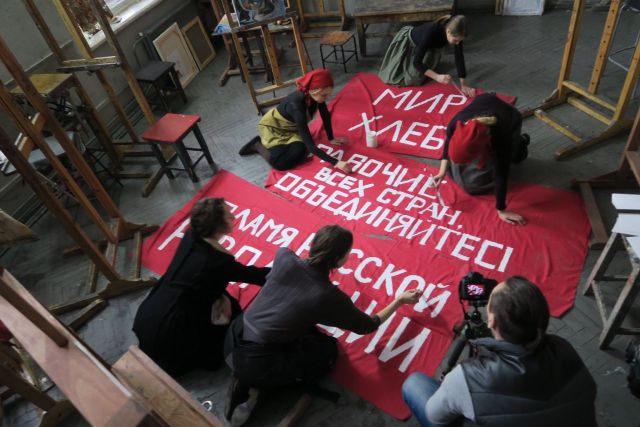
The purported focus of Kinmouth’s film is the Russian and Soviet avant-garde artists, including Kazimir Malevich, Alexander Rodchenko, Gustav Klutsis, Nikolai Suetin, Pavel Filonov, Marc Chagall, and Wassily Kandinsky. One of the documentary’s few strengths is its interviews with descendants of a number of these artists. Some of those moments are fascinating.
Trying to describe the structure of Revolution: New Art for a New World is difficult, because the work lacks a coherent organization. It jumps from event to event, personality to personality, with almost no discernible logic.
In any case, the film opens with the International Woman’s Day protests of February (March)…