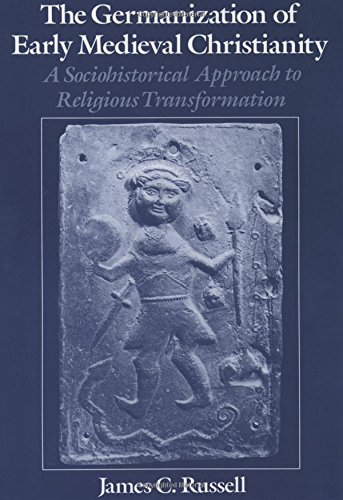
The Germanization of Early Medieval Christianity: A Sociohistorical Approach to Religious Transformation, by James C. Russell
Russell begins his specific examination of the acceptance of Christianity by the Germanic people, the first covering the period 376 – 678. This covers the period from the Germanic entrance into the Roman Empire until the Anglo-Saxon mission by Bishop Wilfrid of York to Frisia.
When speaking of Christianity in this context, there are two prominent theologies: Germanic Arianism and Frankish Catholicism. Seeking refuge from the Huns, the Visigoths negotiated with Valens, the Arian Christian emperor of the Eastern Empire: Arianism was adopted in exchange for asylum.
In Christianity, Arianism is a monotheistic Christological doctrine which asserts the belief that Jesus Christ is the Son of God who was begotten by God the Father at a point in time, is distinct from the Father and is therefore subordinate to the Father….The Arian concept of Christ is based on the belief that the Son of God did not always exist but was begotten by God the Father.
Several characteristics can be noted from this first encounter, characteristics that would repeat for even centuries into the future: political leaders vouched for their subjects regarding Christianization; Christianity was associated with Roman culture and the Roman polity; there was little or no religious instruction prior to baptism.
The Germanization of E…
Best Price: $27.35
Buy New $30.09
(as of 06:30 EDT – Details)

By the middle of the sixth century, several tribes – to include the Bavarians, Thuringians and Lombards – accepted the Arian form of Christianity; others – including the Franks, Alamanni and Saxons – remained…