The mainstream U.S. media claims a monopoly on determining truth, despite a very spotty record of getting it right and a blindness to the reality that there are usually two sides to a story, as Gilbert Doctorow explains.
By Gilbert Doctorow
We’re told that we’re living in a post-truth (or post-factual) era, a political culture in which debate is framed largely by appeals to emotion disconnected from the details of policy, a culture that eschews a foundation of solid facts. Indeed, it is said that in this post-truth time, facts have become “secondary” if not entirely irrelevant. But who gets stuck with this “post-truth” label – and it is typically used as an insult – is not so simple.
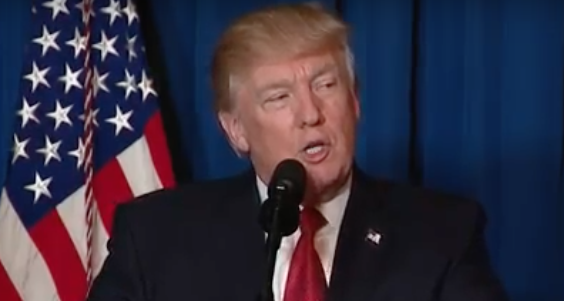
President Trump delivers his brief speech to the nation explaining his decision to launch a missile strike against Syria on April 6, 2017. (Screen shot from Whitehouse.gov)
In 2016, “post-truth” was chosen as the Oxford Dictionaries’ Word of the Year, due to its prevalence in the context of the Brexit referendum and the U.S. presidential election, but it’s clearly true that “post-truth” is not entirely a new phenomenon. Political lies and fabrications are as old as time and in recent years have come from Democrats as well as Republicans.
However, this Word of the Year has developed a distinctly partisan and derogatory usage in the United States. It relates not just to the 2016 U.S. presidential election, but specifically to the Republican nominee in that election who now sits in the Oval Office. That is to say, the word has been instrumentalized, another fashionable concept of our day, to attack Donald J. Trump, whom the word’s framers consider to be the embodiment of post-truth.
This is not to suggest that Trump’s character weakness for self-serving tall stories does not justify severe criticism. It was not for nothing that Rex Tillerson, in his prepared statement at the opening of his Senate confirmation hearings to become Secretary of State, chose to stress that truth was something he would always make a guiding principle in his State Department operations. From his training as an engineer, he promised that he would follow the facts…