Exclusive: Official Washington marches in propaganda lockstep about Crimea’s decision to rejoin Russia two years ago, with references to a Russian “invasion” and a “sham” referendum of Crimea’s voters, but the reality is different, says ex-CIA analyst Ray McGovern.
By Ray McGovern
With high symbolism Russian President Vladimir Putin is visiting Crimea “to check on the construction of the Kerch Strait Bridge, which will link the Crimean peninsula and continental Russia,” the Kremlin announced on Thursday.
As the Russians like to say, “It is no accident” that he chose today – marking the second anniversary of Russia’s annexation of Crimea three weeks after the U.S.-sponsored coup in Kiev on Feb. 22, 2014, and just days after a referendum in which Crimean voters approved leaving Ukraine and rejoining Russia by a 96 percent majority.
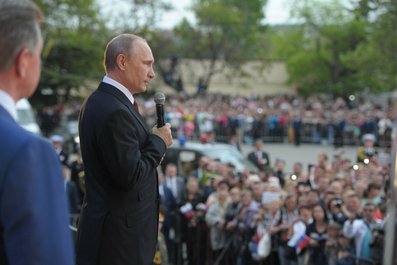
Russian President Vladimir Putin addresses a crowd on May 9, 2014, celebrating the 69th anniversary of victory over Nazi Germany and the 70th anniversary of the liberation of the Crimean port city of Sevastopol from the Nazis. (Russian government photo)
The 12-mile bridge is a concrete metaphor, so to speak, for the re-joining of Crimea and Russia. When completed (the target is December 2018), it will be the longest bridge in Russia.
Yet, the Obama administration continues to decry the political reunion between Crimea and Russia, a relationship that dates back to the Eighteenth Century. Instead, the West has accused Russia of violating its pledge in the 1994 Budapest agreement — signed by Ukraine, Russia, Great Britain and the U.S. — “to respect the independence and sovereignty and existing borders of Ukraine,” in exchange for Ukraine surrendering its Soviet-era nuclear weapons.
Did Moscow violate the Budapest agreement when it annexed Crimea? A fair reading of the text yields a Yes to that question. Of course, there were extenuating circumstances, including alarm among Crimeans over what the unconstitutional ouster of Ukraine’s president might mean for them, as well as Moscow’s not unfounded nightmare of NATO taking over Russia’s major, and only warm-water, naval base at Sevastopol…