A century since the publication of Henri Barbusse’s antiwar novel, Under Fire
By
Sandy English
4 January 2017
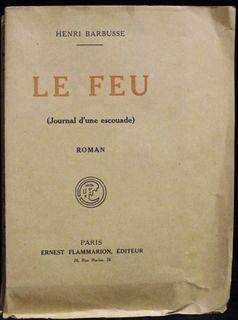
In January 1917, French novelist Henri Barbusse published his novel Under Fire: The Story of a Squad (Le Feu: Journal d’une escouade), [1] which related the experiences of a French army unit in the First World War. The book was based on the writer’s own experiences in the trenches facing the German lines in northern France, where he served for 17 months. The novel had been published in serial form toward the end of 1916, and appeared as a book in the first month of the new year.
After the passage of 100 years, Under Fire remains one of the most compelling works of art from the early part of the 20th century, and the first—and, in some ways, the most psychologically revealing—of the antiwar novels that the war of 1914-1918 produced in Europe and America over the next two decades.
Perhaps more importantly, the novel itself became a factor in the struggle against the war. It expressed, in the very middle of almost unimaginable destruction, the thoughts and feelings of millions of workers, small tradesmen and farmers from Europe, Canada, Australia and the colonies, and soon from the United States, as those around them were dying in fetid trenches, by poison gas, artillery bombardment and sniper or machine gun fire. Under Fire provoked an immediate reaction from hundreds of thousands of readers, and mirrored the revival of an antiwar movement in the French working class.
After the war, Lenin was to remark that Barbusse’s novels [Le Feu and Clarté (Clarity)], “may be cited as particularly graphic corroborations of the mass phenomenon, observed everywhere, of the growth of revolutionary consciousness among the masses.” [2]
A…