

In recent times, gold has become a key topic in the world’s media. Interest in this yellow metal is warming up reports about the plans of Germany and other countries to repatriate their gold reserves from the USA and Great Britain, to where they were moved at various times.
Heated debates have begun regarding how responsibly central banks and finance ministries are storing the gold reserves that have been entrusted to them. There are also suspicions that there is less gold there than is being officially reported. This article is going to put forward the theory that there is virtually no gold left in the vaults of central banks in leading economically developed countries…
1. Gold auctions, or the tip of the iceberg
Over a period of four decades, central banks have disposed of their gold reserves. Two types of «disposal» have been used: a) metal auctions; b) covert operations.
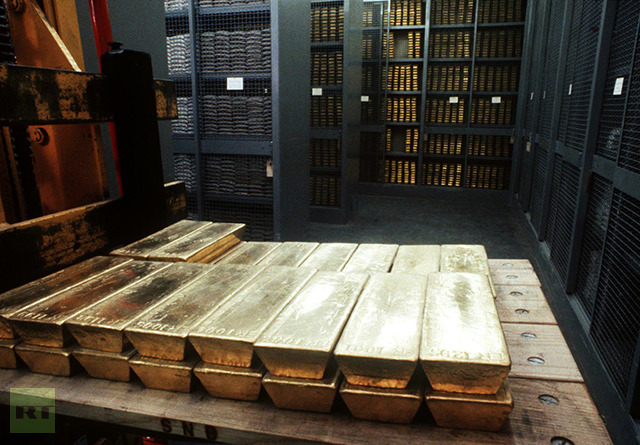
Stronghold of Swiss National Bank
The simplest and most obvious is gold auctions, which in 1975 amounted to 36,700 tonnes of all the official reserves of all the countries and international organisations in the world. This represents the visible tip of the iceberg. Auctions began immediately after the gold-dollar standard was abolished, de facto initially and then de jure (in the 1970s). All the gold auctions from official reserves can be divided into three categories:
1. the early auctions in the second half of the 1970s to the beginning of the 1980s. These were auctions organised by the US Treasury and the International Monetary Fund;
2. auctions by central banks as part of the so-called «Washington Gold Agreement», which came into operation in the autumn of 1999; and
3. isolated auctions by individual central banks and international organisations in different years.
In the 1970s, the USA sold 530 tonnes and the IMF sold 732 tonnes — a total of 1,262 tonnes. In the 1980s, the world’s monetary authorities made almost no sales or purchases of gold, its reserves were in a «frozen» state. In the 1990s, net sales of gold from the official reserves of economically developed countries amounted to the already considerable sum of 2,900 tonnes. At the end of 2000, the world’s official gold reserves contained 3,600 tonnes less gold than in 1975.
At the beginning of the new century, sales were predominantly executed under the Washington Agreements. In September 1999, an agreement was signed in Washington between 17 central banks, including the European Central Bank, regarding
This article originally appeared on : Global Research