

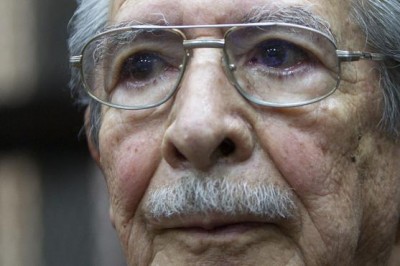
Washington, D.C., May 9, 2013 — After weeks of powerful testimony and excruciating procedural wrangling, the trial of former Guatemalan dictator EfraÃn RÃos Montt and his intelligence chief José RodrÃguez Sánchez on charges of genocide and crimes against humanity is coming to an end. With Judge Yazmin Barrios’s request for closing arguments yesterday, the government’s lead prosecutor, Orlando López, gave more than two hours of summation based heavily on the Guatemalan military plans, manuals, and operational records entered as evidence. With this posting, the National Security Archive looks at the army’s strategy behind the counterinsurgency campaign launched by RÃos Montt against the guerrillas and the civilian population suspected of supporting them.
For background on the trial and daily summaries of the proceedings, commentary, analysis, documents and photographs, see the Open Society Justice Initiative website, created in partnership with the National Security Archive, the International Center for Transitional Justice, CEJIL and the Guatemalan on-line news site Plaza Pública.
See also PBS Newshour’s “Guatemala: Why We Cannot Turn Away.”
For part one of this special report on RÃos Montt, see Indicted for Genocide: Guatemala’s EfraÃn RÃos Montt.
Next Posting: U.S. Policy and the RÃos Montt Regime.
Controlling the counterinsurgency: Plan de campaña “Victoria 82″
RÃos Montt’s decision to purge and reorganize the military prepared the armed forces for what would become the most intensive phase of the counterinsurgency in the conflict’s twenty-year history. The army’s strategists began to plan the scorched earth operations that would decimate the Mayan regions of the country in the months to come. A U.S. defense attaché report informed Washington in April that “The army intended to act with two sets of rules, one to protect and respect the rights of average citizens who lived in secure areas (mostly in the cities) and had nothing to do with subversion. The second set of rules would be applied to the areas where subversion was prevalent. In these areas (‘war zones’) the rules of unconventional warfare would apply. … Guerrillas would be destroyed by fire and their infrastructure eradicated by social welfare programs.” [Document 1]
The army’s determination to wage total war was driven not simply by military imperatives, but by deep political concerns as well. Lucas GarcÃa’s regime had put the military on warning about the potential political power of the indigenous population. The perceived success of the guerrillas (particularly the Guerrilla Army of the Poor – the EGP – operating in the northwest of the
This article originally appeared on : Global Research