Nine years ago a German drone nearly collided with a passenger plane over Afghanistan. The classified drone camera footage drew public attention after the German defense ministry scrapped a drone program for its lack of anti-collision technology.
Footage taken by an EMT Luna X-2000 reconnaissance drone as it
passed mere meters under the left wing of an Airbus A300
passenger plane surfaced on YouTube several years ago. After the
encounter, the drone was caught in the plane’s wake turbulence,
lost control, and crashed over the Afghan capital Kabul, Der
Spiegel reported.
The Ariana Afghan Airlines plane was carrying about 100 people on
board, the magazine said. The manufacturer of the 40kg drone has
claimed that the near-collision occurred after the passenger jet
veered off-course without informing ground control.
The video was leaked a week after German Defense Minister Thomas
de Maizière decided to scrap the $652 million EuroHawk program —
meant to be a replacement for existing reconnaissance aircraft —
including the Luna drones. EuroHawk is part of the NATO Global
Hawk project, under which Germany was to buy Northrop Grumman
RQ-4B drones and fit them with customized sensors.

However, the German military would not be able to certify the
drone for use in European airspace without an anti-collision
system, which would make the aircraft too expensive, de Maizière
said, adding that even with such a system installed certification
would not be guaranteed. German media also reported that EuroHawk
suffered from technical problems and cost overruns.
Germany has bought one drone from the US manufacturer of the
EuroHawk program, and was expected to purchase four more. If
given the green light, the contract would be worth $1.3 billion.
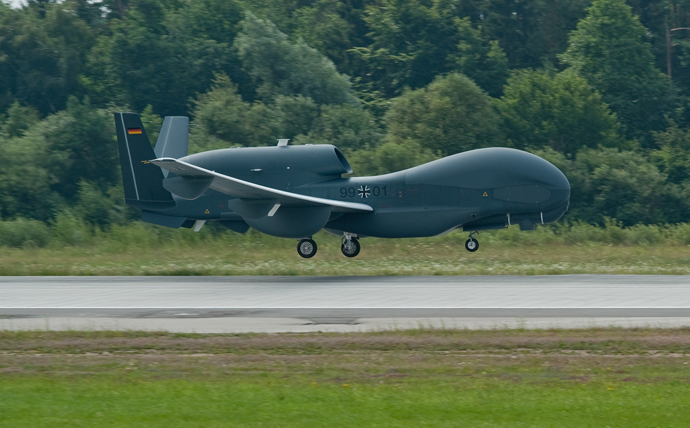
De Maizière came under criticism recently for the drone program
after a leaked defense ministry report showed that the drone’s
flaws were apparent as early as 15 month ago. Critics have
accused the minister of failing to act and continuing to spend
taxpayer money on the doomed project. De Maizière will appear
before the German Parliament this week to report on the issue.
Advancements in unmanned weapons systems have become a global
controversy in recent years. Militaries have praised the weapons
for not endangering the lives of operators, and for being
generally more cost-effective than older manned hardware.
But critics are expressing increasing concerns over the
collateral damage caused by drone strikes, the vague legal
justifications for their use, and the potential creation of
weapons that would remove human judgment altogether from the
decision to pursue a target.
There is also the perception that nations with advanced drone
technology — specifically the US and Israel — have an unjust
capability to enforce their policies on other countries.
This article originally appeared on: RT