Exclusive: The CIA’s covert war in Laos – in the 1950-60’s – has remained a model for U.S. proxy wars through today’s “war on terror,” but the forgotten lesson was the conflict’s destructive failure, recalls war correspondent Don North.
By Don North
In the first of many mistakes of the Vietnam War, President Dwight Eisenhower said in 1954, “You have a row of dominoes set up, you knock over the first one, and what will happen to the last one is the certainty that it will go over quickly.”
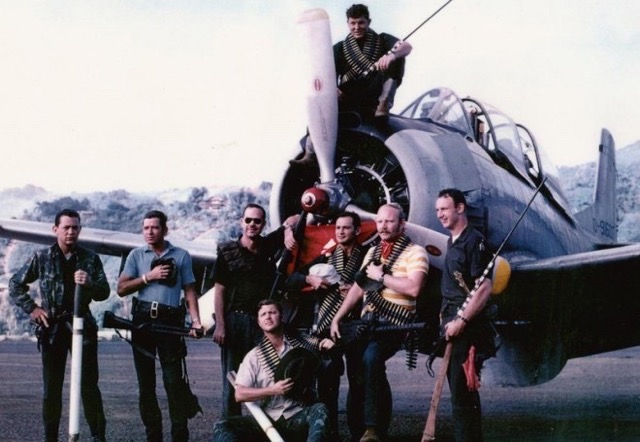
CIA pilots and crews prepare to re-arm a T-28 bomber for bombing missions on Laos 1964.
By January 1961, Eisenhower had warned his successor John F. Kennedy that Laos was the most pressing foreign policy issue in the world and he had initiated Operation Momentum in Laos, for the CIA to train and arm a small force of Hmong tribesmen to fight the communist Pathet Lao and their North Vietnamese supporters.
But history would prove the “domino theory” in Southeast Asia was a misconception of tragic proportions. Thailand, Malaysia, Indonesia and the Philippines would all confidently resist communist influence and would have surely have done so without the bloodbath of millions of deaths across Vietnam, Cambodia and Laos.
As a young freelance journalist in 1965, I tried to cover the secret war in Laos. In the capital Vientiane, I encountered CIA pilots running supplies to the Hmong army in Long Chen and urged them, over many beers at the bar of the Continental Hotel, to take me along but without success.
Now, more than a half century later, author Joshua Kurlantzick, a senior fellow for Southeast Asia at the Council on Foreign Relations, has published a book, A Great Place to Have a War, based on recently declassified documents and interviews with major players behind the secret war in Laos.
He also analyzes how the conflict in Laos was the genesis of the CIA’s support for clandestine paramilitary operations around the world, a pattern that continues through today. He concludes that the strategy in Laos set a sinister precedent for American presidents to conduct war without congressional or media oversight.
Kurlantzick writes, “The Laos program…