The political crisis in Turkey, after a failed coup and mass arrests, sees President Erdogan consolidating his power and blaming his troubles on a Turkish exile living in Pennsylvania, as ex-CIA official Graham E. Fuller explains.
By Graham E. Fuller
Last week, witnessed what may be the last act of an unfolding struggle between two major Islamic movements in Turkey. Turkish president and leader of the AKP party Recep Tayyip Erdogan accused exiled Islamic leader Fethullah Gülen of plotting the failed coup against the government.
Immediately thereafter Erdogan has unleashed massive Stalin-style purges and arrests across the country of anyone suspected of any connection with Gülen, or indeed of anyone of any ideology who opposes Erdogan.
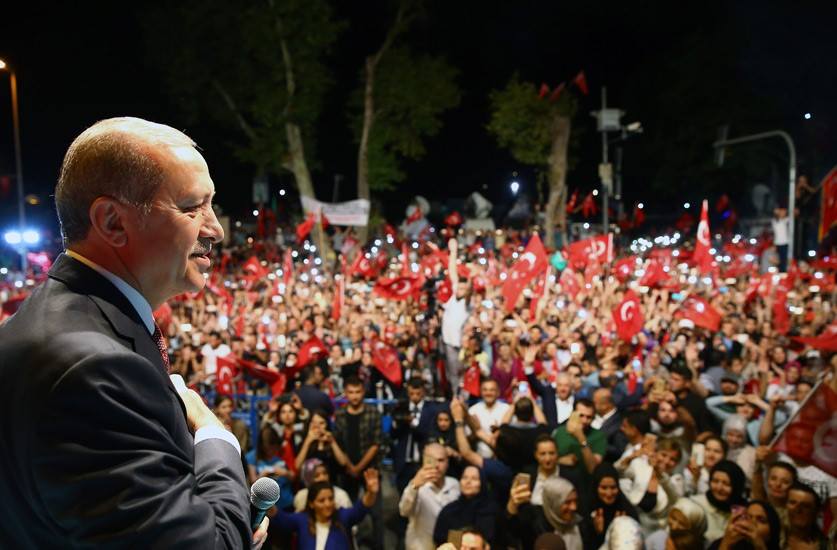
President Recep Tayyip Erdogan addresses citizens in front of his residence in Istanbul on July 19, 2016. (Photo from official website of the Presidency of the Republic of Turkey)
First of all, when we talk about Islamic leaders in Turkey, we’re talking about a very different scene than in most of the rest of the Muslim world. In Turkey it’s basically about a struggle among Islamic moderates. Neither Erdogan nor Gülen call for any kind of Islamic State, or Shari’a law, or Caliphate, or jihad against the West. They both operate fairly comfortably within a primarily secular state structure established a century ago by the country’s modernizing secularist founder Mustafa Kemal Atatürk.
We’re not really talking about Islam or theology but power and influence. (And politics in Turkey has always been a fairly rough game, even within a basically democratic order.)
But there are important differences between the two groups. Erdogan runs a political party; Gülen operates a civil movement called Hizmet (Service). Erdogan comes out of a more traditional Sunni Turkish Islamist movement; Gülen comes out of an apolitical, more Sufi, mystical and social tradition. Gülen is interested in slow, deep social change including secular higher education; Erdogan as a party leader is first and foremost interested in preserving his party’s power that operates in a populist manner trying to raise the general welfare.
But…