Turkey’s failed “coup” has shaken up the region’s geopolitics, splintering the powerful Turkish military, forcing President Erdogan to focus on internal “enemies,” and undermining the Syrian rebels next door, says ex-British diplomat Alastair Crooke.
By Alastair Crooke
“God’s Gift,” the words used by President Recep Tayyip Erdogan to describe the July 15 army “coup” and the opportunity it has provided to thoroughly purge the Turkish state, were not uttered casually, or without a full understanding of their historic resonance.
Erdogan’s “Gift” was an evident allusion to the so-called “Fortunate Event” or the “Auspicious Incident” of June 1826, which also revolved around an attempted military coup by the élite military force known as the Janissaries, who had become to be viewed by the Sultan, as “seditionists.”
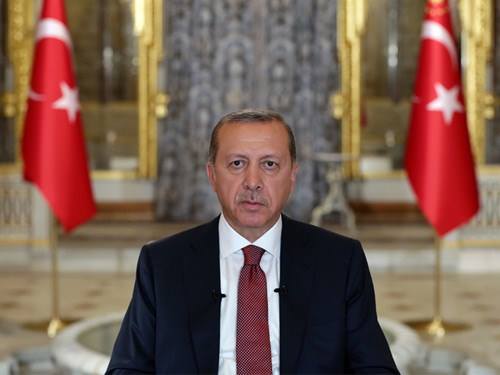
Turkey’s President Recep Tayyip Erdogan delivers a message on the failed coup attempt on July 15. (Photo from the official website of the Presidency of the Republic of Turkey)
The Janissaries mounted their coup against Mahmud II on June 15, 1826. The London Times of June 16, 1826, related: “The Sultan was at his summer palace of Bschektash. The Aga Pacha, and the Pacha commanding on the Asiatic bank of the Bosphorus, repaired to Constantinople with their troops: 8,000 topschis, or artillery, also went thither.
“At length, his Sublimity being resolved to quell the rebellion, caused the standard of the Prophet to be displayed, and proclamations to be made in all the quarters of the city, that all men of honour — that is to say, true believers — had immediately to rally round this standard … [there was then some] hesitation among the rebels; their numbers were reduced by desertion, while, on the other hand, all the people hastened to assemble round the sacred standard. The energy of the Aga Pacha did the rest; he has crushed the rebels with grape-shot, burnt their barracks in the Ahnudan, and pursued them without mercy.”
What is particularly interesting about Erdogan’s allusion is that, according to Wikipedia, “Historians suggest that Mahmud II purposely incited the revolt, and…